Closing days of the Bastile—Latest inmates—Lally-Tollendal
suffers death for alleged treason—Damiens attempts
life of Louis XV—Sentence and execution—Dumouriez in
the Bastile—Linguet and his experiences—Marquis de
Sade—Cagliostro—The Revolution—Attack upon the
Bastile—Weakly defended—Garrison massacred—De
Launay, the governor, murdered—Demolition of the Bastile—Last
days of Vincennes—The Temple prison survives
in part—The last home of Louis XVI—Prisons in
great request through Revolutionary epoch—Treatment in
them more horrible than in old days—Unlimited atrocities.
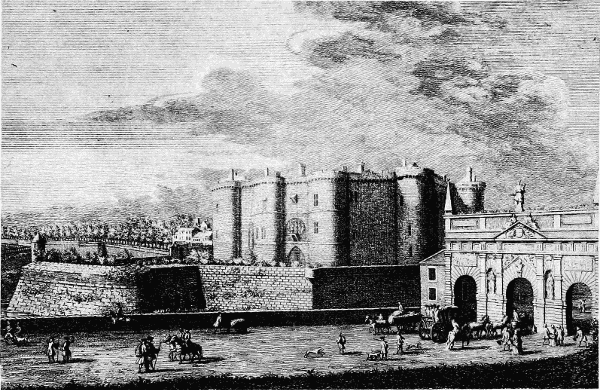
The days of the Bastile’s existence were numbered.
It had not long to stand, but it maintained
its reputation to the last. Philosophers, princes,
libellous poets, unfortunate commanders and traitors
to the State rubbed shoulders within.
De La Chalotais, the Attorney-General of Brittany,
was committed in connection with a rising in
his province and disputes with its Governor, the Duc
d’Aiguillon; but chiefly for his hostility to the
Jesuits,—a circumstance which culminated in the
expulsion of the society from France and many of
the Catholic countries of Europe. The Prince of
Courland, Charles Ernest, an undeniable swindler
and adventurer, was arrested and sent to the Bastile
on a charge of forgery and detained there for
three months. Marmontel, the historian, was committed,
accused of writing a satire against the Duc
d’Aumont, and has preserved an interesting account
of his reception in the Castle.
“The Governor, after reading my letters,” writes
the historian, “allowed me to retain my valet....
I was ushered into a vast chamber, in which were
two beds, two baths, a chest of drawers and three
straw chairs. It was cold, but the gaoler made a good
fire and brought plenty of wood. At the same time
he gave me pen and ink and paper on condition of
giving an account of how each sheet was employed.
I found fault with my bed; said the mattresses were
bad and the blankets unclean. All was instantly
changed.... The Bastile library was placed at my
disposal, but I had brought my own books.” The
dinner brought him was excellent. It was a maigre
day and the soup was of white beans and very fresh
butter, a dish of salt cod for second service, also
very good. This proved to be the servant’s dinner
and a second came in for Marmontel himself, served
on china and fine linen with forks and spoons in
silver, and was gras, consisting of an excellent
soup, a succulent slice of beef, the fat leg of a boiled
capon, a dish of artichokes, some spinach, a fine pear,
some grapes, a bottle of old Burgundy and a cup
of fragrant coffee. After all this he was still offered
a chicken for supper. “On the whole,” says Marmontel,
“I found that one dined very well in
prison.” His stay in the Bastile was for a few days
only, as the libel was the work of another, whom
Marmontel would not betray.
Scant favor was shown to French officers of those
days who were unsuccessful in war. One Dutreil
was accused of misconduct in the defence of Martinique,
and after trial by court martial was sentenced
to military disgrace, to have his sword
broken, the cross of St. Louis torn from his breast,
and to be imprisoned for life. He came first to the
Bastile with two other officers and passed on thence
to the Isle of Sainte Marguerite to occupy the same
prison as the whilom “Man with the Iron Mask.”
The harsh measure meted out to French officers who
failed is much commented upon by the French historians.
Too often disaster was directly traceable
to neglect to provide means and the lack of proper
support. It was seen already in India, and Dupleix
bitterly complained that the government gave him
no assistance, kept him ill supplied with money and
sent out the most indifferent troops.
A very prominent and very flagrant case was that
of Count Lally-Tollendal, who was denounced as
having betrayed the interests of France, and caused
the loss of her Indian possessions. He was of Irish
extraction, a hot-headed, hare-brained Irishman,
whose military skill was unequal to a difficult campaign.
His had been an eventful career. He became
a soldier in his tender years, and held a commission
in Dillon’s Irish regiment when no more
than twelve and was engaged in the siege of Barcelona.
He rose quickly to the command of a regiment,
and was promoted to the rank of lieutenant-general
at the early age of thirty-seven. At one
time he conceived a plan for landing a body of ten
thousand on the English coast to support the rights
of the Pretender, and spent a large portion of his
fortune in the carrying out of the scheme, which,
of course, came to nothing. During his career as
commander in India, the Count committed very
grievous blunders, and lacked the tact and diplomacy
which had brought success to his great predecessor,
Dupleix. Count Lally began by committing
fearful excesses, and showed his contempt for the
native religion by desecrating the most honored
temples and sanctuaries. He triumphed over the
English for a time, and drove them back into the
heart of the country, whence they turned and attacked
afresh; and having delayed his retreat he
was defeated with considerable loss. Other disasters
speedily followed until he was eventually surrounded
and besieged in Pondichéry, which he
defended and held with desperate bravery, but was
forced at last to surrender.
Lally became a prisoner of war at the fall of
Pondichéry and was sent to England. He heard
there of the storm of abuse that was vented upon
him in Paris, and he asked permission to go over
and stand his trial. He was released on parole for
the purpose, and arrived in his native country, taking
with him “his head and his innocence,” as he
wrote to the Duc de Choiseul. A man of fierce
temper and overbearing demeanor, he had made
numerous enemies and incurred the bitter jealousy
of his colleague, the naval commander in Indian
waters, Comte d’Ache. When brought to trial after
a long and wearisome detention for fifteen months
in the Bastile, the long list of charges against him
contained many that were pitiful and contemptible.
When at last arraigned, the trial lingered on for
more than a year and a half, when fresh evidence
was found among the papers of Father Lavuar, the
superior of the Jesuits in Pondichéry. The priest
had gone to Paris to claim a pension from the government,
but died suddenly, and it was found that he
had left a large amount of gold and a number of
documents compromising Lally-Tollendal’s character
and accusing him of treason and malversation.
This testimony was accepted and led to his conviction
and sentence to death.
His demeanor during his trial won him a certain
sympathy with the crowd. The vehemence of his
denials of guilt and his violent temper impressed
people with an idea that he was a much wronged
man. In England he had many apologists and supporters.
It was said on his behalf that he went to
India a perfect stranger to the country, he made
native allies who proved false to him, his troops
mutinied, he had no horsemen; yet he took ten
fortresses, won nine battles and made a good fight
until he was out-numbered, and all through was
badly seconded by his own officers. Voltaire’s
opinion of him is worth quoting: “I am persuaded
that Lally was no traitor. I believe him to have
been an odious man, a bad man, if you will, who
deserved to be killed by any one except the executioner.”
Again, “It is very certain that his bad
temper brought him to the scaffold. He is the only
man who ever lost his head for being brutal.”
The sentence of the Parliament was death by
decapitation, and Lally was sent from the Bastile
to the Conciergerie to hear his sentence. Great precautions
were taken along the road as it was feared
the populace might make some demonstration in his
favor. He resented being compelled to kneel to hear
sentence, and was greatly incensed when told he
must die. “But what have I done?” he vainly protested.
The sentence produced a great effect upon
him, but he regained his self-possession on returning
to the Bastile. Many persons interceded on his
behalf, but the King remained unmoved, although
public opinion remained the same and disapproved
of his execution. The authorities, however, feared
that the people might be inclined to rescue him, and
therefore ordered him to be gagged while being led
to the Place de Grève. The Count strongly resisted
this mode of treatment, but the gag was placed in
his mouth, and he was otherwise held in check.
Just before the execution took place he ordered the
headsman, young Sanson, to remove a handsome
vest he (Lally) was wearing, composed of the
golden tissue made only in India, and directed that
it should be presented to the executioner’s father,
who was also present. The first blow from the
younger was not successful, so the final act was
performed by old Sanson, and was greeted with a
cry of horror from the assembled crowds.
A hundred and fifty years had elapsed since
Ravaillac had suffered for the assassination of
Henri Quatre and had brought no diminution of
the savage cruelty of the French criminal law. In
1757 the extreme penalty was inflicted upon another
culprit who had dared to lift his hand against the
cowardly voluptuary who occupied the throne, and
in precisely the same bloodthirsty and abominable
fashion. Ravaillac killed his victim; Damiens did
no more than prick his man with the small blade
of a horn handled penknife. Louis XV was so
frightened at this pitiful wound that he “trembled
between the sheets,” under the strong belief that
the weapon had been poisoned. A confessor was
instantly summoned, and absolution was pronounced
after the King had detailed his sins. This
absolution was repeated aloud every minute of the
night.
What had actually happened? It was an intensely
cold night, the 5th of January, 1757, and the
King, clad in his furs, came down-stairs at Versailles
to enter his carriage. A crowd of courtiers,
footmen and an escort surrounded the doorway as
the King emerged on the arm of his grand equerry.
Suddenly the King exclaimed, “Some one has
struck me and pricked me with a pin. That man
there!” and as he spoke he inserted his hand beneath
his fur coat, to find it smeared with blood
when he withdrew it. “That is certainly the man,”
added the King, pointing to Damiens. “Let him
be arrested, but do not kill him.” In the wild confusion
that now arose, Damiens might easily have
slunk away, but he stood his ground and was seized
by the guards. Immediate vengeance was wreaked
by his removal to the nearest guard-house, where
he was put to the torture by the application of red-hot
irons to his legs, but he would say no more than
that he had not desired to kill the King, but only
to give him a salutary warning.
Deep anxiety prevailed when this trifling attempt
upon the life of a worthless, self-indulgent
monarch was known through the country. The
story was exaggerated absurdly. “This fearful attempt
is of a nature to cause so just an alarm that
I do not lose a moment,” writes one of the ministers,
“in diminishing your apprehension and acquainting
you with the facts of this terrible event.”
After “the terrible accident,” the King was bled
twice. “The wound is healthy, there is no fever,
and he is perfectly tranquil, and would be inclined
to sleep, were it not that the wound is on the right
side, that on which his Majesty is accustomed to
lie,” continued the minister. The provinces were
greatly excited. “I found the whole city of Bordeaux
in the greatest consternation,” writes the
Lieutenant-Governor of Guienne. At Aix the
courier was expected with breathless impatience,
and good news was received with shouts of joy
and clapping of hands. The delight at Marseilles
when good news came was equal to the terror inspired
by the first evil report.
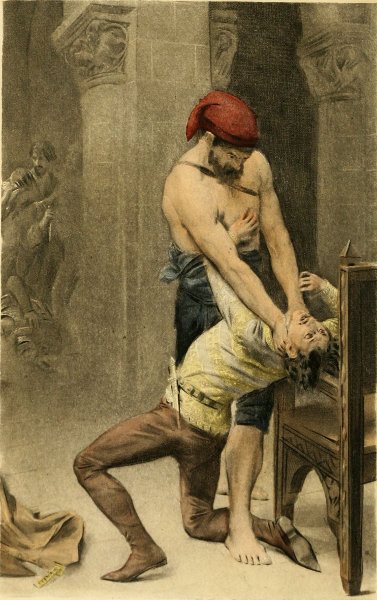
Damiens was taken straight to the Conciergerie,
where the legal machinery could be best set in motion
for his trial and the preliminary torture. His conviction
was a foregone conclusion, and his sentence
in all its hideous particulars was on exactly the same
lines as that of Ravaillac. He was to be subjected
to the question, ordinary and extraordinary, to make
the amende honorable, to have his right arm severed,
his flesh torn off his body with red-hot pincers,
and finally, while still alive, to be torn asunder limb
from limb by teams of horses in the Place de Grève.
The whole of the details are preserved in contemporary
accounts; but having been described in the case
of Ravaillac, they are too brutal and revolting for a
second reproduction.
The motive by which Damiens was led to this
attempted crime is generally attributed to his disapproval
of the King’s licentious life. Louis so
thought it, and for a time was disposed to mend his
ways, to give up the infamous Parc aux Cerfs where
he kept a harem, and to break with Madame de
Pompadour. But the favorite was not dismissed
from the apartments she occupied upon the top floor
of the palace at Versailles, and the King still saw
her from day to day. Her anxiety must have been
great while the King’s wound was still uncured, for
she feigned illness and was constantly bled; but
she soon recovered her health when she was reinstalled
as the King’s mistress. The occasion had
been improved by the Jesuits, for the King when
sick was very much in the hands of the priests; but
de Pompadour triumphed, and the matter ended in
their serious discomfiture and expulsion from
France.
Although Damiens did not himself see the interior
of the Bastile, many persons suspected of
collusion in the crime were committed to it; some
supposed to be accomplices, others as apologists or
as authors of lampoons and satirical verses. Among
the prisoners were Damiens’s nearest relations, his
wife and daughters, his father, mother, nieces, several
abbés, ladies of mature years and young children.
The detention of some of these was brief
enough, but one or two were imprisoned for twenty
odd years. The Dauphin was charged with complicity,
but there was no more proof of it than that
he was little at court, and was known to sympathise
with the Jesuits. As a matter of fact no one was
shown to be privy to the attempt. Damiens, in spite
of the most horrible tortures, never betrayed a soul.
A story told by Jesse in his “Memoirs of George
Selwyn” may be related here to give a ray of relief
to this sombre picture. The eccentric Englishman
was much addicted to the practice of attending executions.
He went over to Paris on purpose to see
Damiens done to death, and on the day mixed with
the crowd. He was dressed in a plain undress suit
and a plain bob wig, and “a French nobleman observing
the deep interest he took in the scene, and
imagining from the plainness of his attire that he
must be a person in the humbler walks of life, resolved
that he must infallibly be a hangman. ‘Eh
bien, monsieur,’ said he, ‘etes-vous arrive pour voir
ce spectacle?’ ‘Oui, monsieur.’ ‘Vous etes bourreau?’
‘Non, monsieur,’ replied Selwyn, ‘je n’ai
pas cet honneur, je ne suis qu’un amateur.’”
Among the latest records affording a graphic
impression of the interior of the Bastile is that of
the French officer Dumouriez, who afterwards became
one of the first, and for a time, most successful
of the Revolutionary generals, who won the battles
of Fleurus and Jernappes and repelled the German
invasion of the Argonne in the west of France.
Dumouriez fled to England to save his head, and
was the ancestor of one also famous, but in the
peaceful fields of literature and art. George Du
Maurier, whose name is held in high esteem
amongst all English speaking races, traced his
family direct to the French emigré, who lived long
and died in London. It is a little curious that the
eminent caricaturist who long brightened the pages
of “Punch” the author of “Trilby,” should be
connected with the French monarchy and the ancient
castle of evil memory.
The elder Dumouriez was imprisoned as the outcome
of his connection with the devious diplomacy
of his time. He had been despatched on a secret
mission to Sweden on behalf of the King, but the
French Minister of Foreign Affairs suspected foul
play. The movements of Dumouriez were watched,
and he was followed by spies as far as Hamburg,
where he was arrested and brought back to France
straight to the Bastile. He gives a minute account
of his reception.
First he was deprived of all his possessions, his
money, knife and shoe buckles, lest he should commit
suicide by swallowing them. When he called
for a chicken for his supper, he was told it was a
fast day, Friday, but he indignantly replied that the
major of the Bastile was not the keeper of his conscience
if of his person, and the chicken was provided.
Then he was ushered into his prison apartment,
and found it barely furnished with a wooden
table, a straw bottomed chair, a jar of water and
a dirty bed. He slept well, but was aroused early
to go before the Governor, the Comte de Jumilhac,
who gave him a very courteous and cordial welcome,
but, after denying him books and writing
materials, ended by lending him several novels,
which he begged him to hide. The Governor continued
to treat him as a friend and companion
rather than a prisoner. “He came and saw me
every morning and gossiped over society’s doings.
He went so far as to send me lemons and sugar to
make lemonade, a small quantity of coffee, foreign
wine and every day a dish from his own table, when
he dined at home,” he writes. No fault could be
found with the daily fare in the Bastile. The quality
was usually good and the supply abundant.
“There were always five dishes for dinner and
three for supper without counting the dessert.”
Besides, Dumouriez had his own servants, and one
of them, the valet de chambre, was an excellent
cook.
After a week of solitary confinement, which he
had relieved by entering into communication with
a neighbor, the captain of a Piedmontese regiment,
who had been confined in the Bastile for twenty-two
years for writing a song about Madame de Pompadour,
which had been hawked all over Paris,
Dumouriez was removed to another chamber which
he describes as “a very fine apartment with a good
fireplace.” Near the fireplace was an excellent bed,
which had been slept in by many notable inmates of
the prison. The major of the Bastile said it was
the finest room in the castle, but it had not always
brought good luck. Most of its previous inhabitants,
the Comte de St. Pol, the Maréchal de Biron,
the Chevalier de Rohan and the Count de Lally-Tollendal,
ended their days upon the scaffold. Significant
traces of them were to be found in the sad
inscriptions upon the walls. Labourdonnais had inscribed
some “touching reflections;” Lally had
written some remarks in English; and La Chalotais
some paraphrases of the Psalms. Dumouriez’s immediate
predecessor had been a young priest, who
had been forced into taking orders and tried to
evade his vows, inherit an estate and marry the girl
of his choice. He was committed to the Bastile, but
was presently released on writing an impassioned
appeal for liberty.
Dumouriez was detained only six months in the
Bastile and was then transferred to Caen in Normandy,
where he was handsomely lodged, and had
a garden to walk in. The death of Louis XV and
the complete change of government upon the accession
of the ill-fated Louis XVI immediately released
him. He came to Court and was told at a public
reception that the new King profoundly regretted
the harshness with which he had been treated, and
that the State would make him amends by promotion
and employment.
With Louis XVI began a milder and more
humane régime, too late, however, to stave off the
swiftly gathering storm that was soon to shake and
shatter France. The King desired to retain no
more State prisoners arbitrarily, and sent a minister
to visit the prisons of the Bastile, Vincennes and
Bicêtre to inquire personally into the cases of all,
and to liberate any against whom there was no definite
charge. He proposed that there should be no
more lettres de cachet, and the Bastile became gradually
less and less filled. The committals were
chiefly of offenders against the common law, thieves
and swindlers; but a large contingent of pamphleteers
and their publishers were lodged within its
walls, and one ancient prisoner still lingered to die
there after a confinement of twenty-seven years.
This was Bertin, Marquis de Frateau, guilty of
writing lampoons on Madame de Pompadour, and
originally confined at the request of his own family.
A man who made more mark was Linguet, whose
“Memoirs,” containing a bitter indictment of the
Bastile, from personal experience, were widely read
both in England and France. They were actually
written in London, to which he fled after imprisonment,
and are now held to be mendacious and untrustworthy.
Linguet had led a strangely varied
life. He had tried many lines—had been in turn
poet, historian, soldier, lawyer, journalist. He
wrote parodies for the Opera Comique and pamphlets
in favor of the Jesuits. Such a man was certain
to find himself in the Bastile. He spent a couple of
years there, and the book he subsequently wrote was
full of the most extravagant and easily refuted lies.
Yet there is reason to believe that his statements
did much to inflame the popular mind and increase
the fierce hatred of the old prison, which ere long
was to lead to its demolition.
The Bastile also received that infamous creature,
most justly imprisoned, the Marquis de Sade, whose
name has been synonymous with the grossest immorality
and is now best known to medical jurisprudence.
Beyond doubt he was a lunatic, a man
of diseased and deranged mind, who was more properly
relegated to Charenton, where he died. He
was at large during the Revolutionary period and
survived it, but dared to offer some of his most
loathsome books to Napoleon, who when First Consul
wrote an order with his own hand for the return
of the Marquis to Charenton as a dangerous and
incurable madman.
One of the last celebrities confined in the Bastile
was the Cardinal de Rohan, a grandee of the Church
and the holder of many dignities, who was involved
in that famous fraud, dear to dramatists and romance
writers, the affair of the Diamond Necklace.
His confederates, some of whom shared his captivity,
were the well known Italian adventurer and
arch impostor, who went by the name of Cagliostro,
who played upon the credulity of the gullible public
in many countries as a latter day magician, and the
two women, Madame de La Motte-Valois, who devised
the fraud of impersonating the Queen before
de Rohan, and Mdlle. d’Oliva, who impersonated
her.
We come now to the eventful year 1789, when
the waters were closing over the Bastile, and it was
to sink under the flood and turmoil of popular passion
in the first stormy phase of the French Revolution.
Paris was in the throes of agitation and
disturbance, the streets filled with thousands of reckless
ruffians, who terrorised the capital, breaking
into and plundering the shops, the convents, even
the royal Garde-Meuble, the repository of the
Crown jewels; and committing the most violent excesses.
A large force of troops was collected in
and about Paris, more than sufficient to maintain
order had the spirit to do so been present in the
leaders or had they been backed up by authority.
But the King and his Government were too weak
to act with decision, and, as the disorders increased,
it was seen that no reliance could be placed upon
the French Guards, who were ripe for revolt and
determined to fraternise with the people. The
people clamored for arms and ammunition, and
seized upon a large quantity of powder as it was
being removed secretly from Paris. Fifty thousand
pikes were turned out in thirty-six hours.
Two revolutionary committees directed affairs,
and it was mooted at one of them whether an attack
should not be made upon the Bastile. The more
cautious minds demurred. It would be neither useful
nor feasible to gain possession of the ancient
fortress which, with its guns mounted and its impregnable
walls, might surely make a vigorous resistance.
At last it was decreed to approach the
Governor of the Bastile with peaceful overtures,
asking him to receive a garrison of Parisian citizen-militia
within the place as a measure of public
safety. M. de Launay, the veteran Governor, civilly
received the deputations with this proposal, but although
inwardly uneasy would make no concessions.
He awaited orders which never arrived, but
was stoutly determined to do his duty and remain
staunch to the King.
His position was indeed precarious. The garrison
consisted of a handful of troops, chiefly old
pensioners. The guns on the ramparts were of obsolete
pattern, mostly mounted on marine carriages,
and they could not be depressed or fired except into
the air. Moreover the powder magazine was full,
for the whole stock of powder had been removed
from the Arsenal, where it was exposed to attack
and seizure, and it was now lodged in the cellars of
the Bastile. But the Governor had done his best
to strengthen his defence. Windows had been
barred, and exposed loopholes closed. A bastion
for flanking fire had been thrown out from the
garden wall. Great quantities of paving stones
had been carried up to the tops of the Towers, and
steps taken to pull down the chimney pots,—the
whole for use as missiles to be discharged on the
heads of the besiegers. Nevertheless the place could
not hold out long, for it was almost entirely unprovisioned.
The attack upon the Bastile appears to have been
precipitated by a cowardly report spread that the
guns of the castle were ranged upon the city and
that a bombardment was threatened. A deputation
was forthwith despatched to the Governor, insisting
the direction of the guns be changed and inviting
him to surrender. M. de Launay replied that
the guns pointed as they had done from time immemorial,
and that he could not remove them without
the King’s order, but he would withdraw them
from the embrasure. This deputation retired satisfied,
assuring the Governor that he need expect no
attack, and went back to the Hotel de Ville. But
presently an armed mob arrived, shouting that they
must have the Bastile. They were politely requested
to return, but some turbulent spirits insisted
that the drawbridges should be lowered, and when
the first was down, advanced across them, although
repeatedly warned that unless they halted, the garrison
would open fire. But the people, warmed with
their success, pressed on, and a sharp musketry duet
began, and put the assailants to flight in great disorder,
but did not send them far. Presently they
came on again toward the second drawbridge and
prepared to break in by it, when firing was resumed
and many casualties ensued.
At half past four o’clock in the afternoon three
carts laden with straw were sent forward and used
to set fire to the outbuildings, the guard-house, the
Governor’s residence and the kitchens. A number
of French grenadiers with three hundred citizens
now advanced and made good their entrance; but
the drawbridge was let down behind them and a cry
of treachery arose. Fire was opened on both sides
and a sharp combat ensued. The issue might have
been different had the defence been better organised,
but the garrison was small (barely a hundred men),
was short of ammunition, had not taken food for
forty-eight hours, and could make no use of the
artillery. At five o’clock M. de Launay, hopeless
of success, desired to blow up the powder magazine,
urging that voluntary death was preferable to massacre
by the infuriated people. The vote of the
majority was against this desperate means and in
favor of capitulation. Accordingly a white flag
was hoisted on one of the towers to the sound of
the drum, but it was ignored, and the firing continued
amid loud shouts of “Lower the drawbridge!
Nothing will happen to you!” The Governor
thereupon handed over the keys to a subordinate
officer. The mob rushed in and the fate of the
garrison was sealed. The sub-officers, who had laid
down their arms and were unable to defend themselves,
were killed, and so also were the grand
old Swiss Guards, stalwart veterans, who were
slaughtered with but few exceptions.
In the midst of the affray, M. de Launay was
seized and carried off to the Hotel de Ville. Frenzied
cries of “Hang him! Hang him!” greeted
him on the way, and the unfortunate Governor is
reported to have looked up to Heaven, saying,
“Kill me. I prefer death to insults I have not deserved.”
They now fell upon him from all sides
with bayonet, musket and pike, and as a dragoon
passed, he was called upon to cut off the victim’s
head. This man, Denot (whose own account has
been followed in this description), essayed first with
a sword, then completed the decapitation with his
knife. The severed head was paraded through
Paris till nightfall on a pike. This was the first
of many similar atrocities. The people, without
restraint, became intoxicated with brutal exultation.
The wildest orgies took place, and the wine shops
were crowded with drunken desperadoes, who were
the heroes of the hour. The now defenceless castle
was visited by thousands to witness its final
destruction. Numbers of carriages passed before
it or halted to watch the demolition as the stones
were thrown down from its towers amid clouds of
dust. Ladies, fashionably dressed, and dandies of
the first water mingled with the half-naked workmen,
and were now jeered at, now applauded. The
most prominent personages, great authors and
orators, celebrated painters, popular actors and actresses,
nobles, courtiers and ambassadors assembled
to view the scene of old France expiring and new
France in the throes of birth.
The wreck and ruin of the Bastile were speedily
accomplished. The people were undisputed masters,
and they swarmed over the abased stronghold,
filling it from top to bottom. “Some threw
the guns from the battlements into the ditch; others
with pickaxes and hammers labored to undermine
and destroy the towers. These smashed in furniture,
tore and dispersed all the books, registers and
records; those laid prompt hands on anything they
fancied. Some looted the rooms and carried off
what they pleased. Strict search was made through
the Bastile for prisoners to set free, yet the cells
were for the most part empty. The committals during
this last reign had not exceeded 190 for the
whole period, and when it capitulated only seven
were in custody. Gruesome rumors prevailed that
several still lingered underground, in deep subterranean
cells; but none were found, nor any skeletons,
when the whole edifice was pulled down.”
This demolition was voted next year, 1790, by
the committee of the Hotel de Ville, which ordered
that “the antique fortress too long the terror of
patriotism and liberty” should be utterly razed to
its very foundations. The workmen set to work
with so much expedition that in a little more than
three months a portion of the materials was offered
for sale. A sharp competition ensued at the auction,
and the stones were fashioned into mementoes, set
in rings, bracelets and brooches, and fetched high
prices. The contractors for demolition made a
small fortune by the sale of these trinkets.
Napoleon at first intended to erect his great Arc
de Triomphe upon the site of the Bastile, but
changed his mind and selected the place where it
now stands. The Place de la Bastile remained for
forty years a wilderness—in summer a desert, in
winter a swamp. The revolution of 1830, which
placed Louis Philippe upon the throne of France,
was not accomplished without bloodshed, and it
was decided to raise a monument to those who lost
their lives on this somewhat unimportant occasion.
The result was the elegant column, which every
visitor to Paris may admire to-day in the Place de
la Bastile.
Vincennes, the second State prison of Paris, survived
the Terror and exists to this day converted
into a barracks for artillery. A portion of the
Temple, the especial stronghold of the Knights
Templars already described, still existed in part
when the Revolution came. Strange to say, its
demolition had been contemplated by the Government
of Louis XVI, and it had already partly disappeared
when the storm broke, and rude hands
were laid upon the luckless sovereign who became
a scapegoat, bearing the accumulated sins of a long
line of criminal and self-indulgent monarchs.
When Louis and his family fell into the power of
the stern avengers of many centuries of wrong doing,
they were hurried to the Temple and imprisoned
in the last vestige of the fortress palace. It
stood quite isolated and alone. All had been razed
to the ground but the donjon tower, to which was
attached a small strip of garden enclosed between
high walls. This became the private exercise
ground of the fallen royalties. The King occupied
the first floor of the prison and his family the second
floor. The casements were secured with massive
iron bars, the windows were close shuttered so
that light scarcely entered, and those within were
forbidden to look out upon the world below. The
staircase was protected by six wicket gates, each so
low and narrow that it was necessary to stoop and
squeeze to get through. Upon the King’s incarceration
a seventh wicket was added with an iron
bar fixed at the top of the staircase, always locked
and heavily barred. The door opening directly into
the King’s chamber was lined with iron.
Louis was never left alone. Two guards were
constantly with him day and night, as is the rule to
this day with condemned malefactors in France.
They sat with him in the dining-room when at meals
and slept in the immediate neighborhood of his bedroom.
His guards were in the last degree suspicious,
and he endured many indignities at their
hands. No whispering was allowed, not even with
his wife and children. If he spoke to his valet, who
slept in his room at night, it must be audibly, and
the King was constantly admonished to speak
louder. No writing materials were allowed him at
first. He was forbidden to use pens, ink and paper
until he was arraigned before the National Convention.
But he was not denied the solace of books,
and read and re-read his favorite authors. In Latin
he preferred Livy, Cæsar, Horace, Virgil. In
French he preferred books of travel. For a time he
was supplied with newspapers, but his gaolers disliked
his too great interest in the progress of the
Revolution, and the news of the day was withheld
from him. His reading became the more extensive
and it was calculated on the eve of his death that he
had read through 257 volumes during the five
months and seven days of his captivity in the
Temple.
The daily routine of his prison life was monotonously
repeated. He rose early and remained at his
prayers till nine o’clock, at which hour his family
joined him in the breakfast room as long as this
was permitted. He ate nothing at that hour but
made it a rule to fast till midday dinner. After
breakfast he found pleasant employment in acting
as schoolmaster to his children. He taught the
little Dauphin Latin and geography, while the
Queen, Marie Antoinette, instructed their daughter
and worked with her needle. Dinner was at one
o’clock. The table was well supplied, but the King
ate sparingly and drank little, the Queen limiting
herself to water with her food. Meat was regularly
served, even on Fridays, for religious observances
no more controlled his keepers, and the King would
limit himself to fast diet by dipping his bread in a
little wine and eating nothing else. The rest of the
day was passed in mild recreation, playing games
with the children till supper at nine o’clock, after
which the King saw his son to bed in the little pallet
prepared by his own hands.
The time drew on in sickening suspense, but
Louis displayed the unshaken fortitude of one who
could rise above almost intolerable misfortune. Insult
and grievous annoyance were heaped upon his
devoted head. His valet was changed continually
so that he might have no faithful menial by his side.
The most humiliating precautions were taken
against his committing suicide—not a scrap of
metal, not even a penknife or any steel instrument
was suffered to be taken in to him. His food was
strictly tested and examined; the prison cook tasted
every dish under the eyes of a sentry, to guard
against the admixture of poison. The most horrible
outrage of all was when the bloodthirsty sans-culottes
thrust in at his cell window the recently
severed and still bleeding head of one of the favorites
of the court, the Princess de Lamballe.
We may follow out the dreadful story to its murderous
end. Years of tyrannous misgovernment in
France, innumerable deeds of blood and cruel oppression,
such as have been already presented in this
volume, culminated in the sacrifice of the unhappy
representative of a system to which he succeeded
and innocently became responsible for. The bitter
wrongs endured for centuries by a downtrodden
people, goaded at length to the most sanguinary reprisals,
were avenged in the person of a blameless
ruler. Louis XVI was a martyr beyond question;
but he only expiated the sins of his truculent and
ferocious forerunners, who had no pity, no mercy,
no compassion for their weak and helpless subjects.
Louis’ trial, under a parody of justice, and his execution
amid the hideous gibes of a maddened, merciless
crowd, was the price paid by the last of the
French kings, for years of uncontrolled and arbitrary
authority.
The day of arraignment, so long and painfully
anticipated, came as a sudden surprise. On Monday,
December 10th, 1793, the captive King when at
his prayers was startled by the beating of drums
and the neighing of horses in the courtyard below
the Donjon. He could not fix his attention on the
morning lesson to his son, and was playing with
him idly when the visit of the Mayor of Paris
roused him and summoned him by the name of Louis
Capet to appear at the bar of the Convention. He
then heard the charges against him, and the day
passed in mock proceedings of the tribunal. The
King’s demeanor was brave, his countenance unappalled
by the tumultuous outbursts that often
came from the audience in the galleries. As the
judges could come to no agreement on the first day,
the proceedings were declared “open,” to be continued
without intermission. For three more days
the stormy debates lasted and still the Convention
hesitated to pass the death sentence on the King. In
the end it was carried by a majority of five.
Louis XVI bore himself like a brave man to the
last. He addressed a farewell letter to the Convention
in which he said, “I owe it to my honor and to
my family not to subscribe to a sentence which declares
me guilty of a crime of which I cannot accuse
myself.” When he was taken to execution from the
Temple and first saw the guillotine, he is said to
have shuddered and shrank back, but quickly recovering
himself he stepped out of the carriage with
firmness and composure and, calmly ascending the
scaffold, went to his death like a brave man.
The Bastile was gone, but the need for prisons
was far greater under the reign of liberty, so-called,
than when despotic sovereigns ruled the land. The
last of them, Louis XVI, would himself have swept
away the Bastile had he been spared. He had indeed
razed For-l’Evèque and the Petit Châtelet, and
imported many salutary changes into the Conciergerie
out of his own private purse. During the
Revolutionary epoch many edifices were appropriated
for purposes of detention, the ordinary prisons
being crowded to overflowing. In the Conciergerie
alone, while some two thousand people waited elsewhere
for vacancies, there were from one thousand
to twelve hundred lodged within the walls without
distinction of age, sex or social position. Men,
women and children were herded together, as many
as fifty in the space of twenty feet. A few had beds,
but the bulk of them slept on damp straw at the
mercy of voracious rats that gnawed at their clothing
and would have devoured their noses and ears
had they not protected their faces with their hands.
Within six months of 1790, 356 prisoners were
confined in the prisons of Bicêtre, Luxembourg, the
Carmelites and Saint Lazare, en route to the guillotine.
St. Pélagie held 360 at one time. “In
Paris,” says Carlyle, “are now some twelve prisons,
in France some forty-four thousand.” Lamartine’s
figures for Paris are higher. He gives the number
of prisons as eighteen, into which all the members
of the Parliament, all the receivers-general, all the
magistrates, all the nobility and all the clergy were
congregated to be dragged thence to the scaffold.
Four thousand heads fell in a few months. A
number of simple maidens, the eldest only eighteen,
who had attended a ball at Verdun when it was
captured by the Prussians, were removed to Paris
and executed. All the nuns of the Convent of
Montmartre were guillotined, and next day the
venerable Abbé Fenelon. In September, 1792, there
was an indiscriminate massacre, when five thousand
suspected persons were torn from their homes and
either slaughtered on the spot or sent to impromptu
prisons. That of the Abbaye ran with blood, where
150 Swiss soldier prisoners were murdered at one
sweep. The details of these sanguinary scenes are
too terrible to print. Every prison provided its
quota of victims—La Force 80, the great Châtelet
220, and 290 from the Conciergerie.
“At Bicêtre,” says Thiers, in his history of the
Revolution, “the carnage was the longest, the most
sanguinary, the most terrible. This prison was the
sink for every vice, the sewer of Paris. Everyone
detained in it was killed. It would be impossible to
fix the number of victims, but they have been estimated
at six thousand. Death was dealt out
through eight consecutive days and nights; pikes,
sabres, muskets did not suffice for the ferocious
assassins, who had recourse to guns.” Another authority,
Colonel Munro, the English diplomatist,
reported to Lord Grenville that Bicêtre was attacked
by a mob with seven cannon, which were loaded
with small stones and discharged promiscuously
into the yards crowded with prisoners. Three days
later, he writes: “The massacre only ended yesterday
and the number of the victims may be gathered
from the time it took to murder them.” He puts the
total at La Force and Bicêtre at seven thousand, and
the victims were mostly madmen, idiots and the
infirm.
The picture of these awful times is lurid and
terrible, and brings the prevailing horror vividly
before us. The prisons of Paris were thirty-six in
number, all of large dimensions, with ninety-six
provisional gaols. In the French provinces the latter
were forty thousand in number, and twelve hundred
more were regularly filled with a couple of
hundred inmates. The most cruel barbarities were
everywhere practised. Prisoners were starved and
mutilated so that they might be driven into open
revolt and justify their more rapid removal by the
guillotine. Paris sent 2,600 victims to the scaffold
in one year. In the provincial cities the slaughter
was wholesale. Lyons executed 1,600, Nantes,
1,971, and a hundred were guillotined or shot daily.
Many were women, some of advanced age and infirm.
At Angers, to disencumber the prisons, 400
men and 360 women were beheaded in a few days.
Wholesale massacres were perpetrated in the fusillades
of Toulon and the drownings of Nantes,
which disposed of nearly five thousand in all.
Taine says that in the eleven departments of the
west half of France a million persons perished, and
the murderous work was performed in seventeen
months.
Of a truth the last state of France was worse
than the first, and the sufferings endured by the
people at the hands of irresponsible autocracy were
far outdone by the new atrocities of the bloodthirsty
revolutionaries in mad vindication of past wrongs.
END OF VOLUME III.