“——My ring I hold dear as my finger; ’tis part of it.” Shakspeare
WITH A PREFACE BY R. H. STODDARD.
NEW YORK JOHN W. LOVELL COMPANY 150 Worth Street, corner Mission Place
Entered according to Act of Congress, in the year 1854, by CHARLES EDWARDS,
In the Clerk’s Office of the District Court of the United States for the Southern District
of New-York.
PREFACE.
The history of finger-rings is more abundant than
the poetry, which is chiefly connected with the ceremonies
and observances in which they figure. What
this history is Mr. Edwards has indicated in the gossipy
pages which follow, and which contain a world
of curious information. Interesting in themselves,
they are valuable for their references, which enable
the reader to verify the statements of Mr. Edwards,
and to pursue his line of study farther than he has
chosen to do. He will find many particulars in regard
to rings of all sorts, among the different people by whom
they have been worn, in ancient and modern times,
and of the important part they have played in the history
of the world. He will also find many allusions
to them in the poets, but not so many poems of which
they were the inspiration as he might have expected,
for the simple reason that such poems do not exist.
“The small orbit of the wedding-ring,”
as a nameless old poet satirically calls it, has seldom
proved large enough for genius to revolve in. Mr. Edwards
quotes but one marriage poem,
“Thee, Mary, with this ring I wed,”
which he fails to trace to its author, the Rev. Samuel
Bishop, who has written nothing else that is worth
remembering. I am happy to restore it to him, and
to quote a second poem, which is rather more elegant
and less familiar, and which is put down to the credit
of William Pattison, of whom I know nothing. I take
it from Dr. Palmer’s “Poetry of Courtship and Compliment”
(1868), an admirable collection of amorous
verse.
TO HER RING.
Blest ornament! how happy is thy snare,
To bind the snowy finger of my fair!
O, could I learn thy nice concise art,
Now, as thou bind’st her fingers, bind her heart.
Not Eastern diadems like thee can shine,
Fed from her brighter eyes with beams divine;
Nor can their mightiest monarch’s power command
So large an empire as my charmer’s hand.
O, could thy form thy fond admirer wear,
Thy very likeness should in all appear;
My endless love thy endless love should show,
And my heart flaming, for thy diamond glow.
R. H. S.
CONTENTS.
CHAPTER ONE.
1. Interest and Importance attaching to Rings; Shakspeare’s Ring; Earl Godwin. 2. Words symbolum and ungulus. 3. Ring-money. 4. Rings in Mythology; Theseus; Prometheus, Inventor of the First Ring. 5. Seals from the Scarabæus. 6. Rings in Greek Urns. 7. Judah and Tamar; Alexander. 8. Ring a Symbol of Fidelity, Eternity and of the Deity. 9. Roman Rings. 10. Rings in German Caverns. 11. Rings of the Gauls and Britons. 12. Anglo-Saxon Workers in Metal. 13. Ladies’ Seal-rings. 14. Substance, Forms and Size of Rings; Number, and on what fingers worn; Pearls; Carbuncle; Death’s-head Rings. 15. Law of Rings. 16. Order of the Ring. 17. Rings found in all places. 18. Persian Signets. 19. Value of ancient Rings. 20. Love’s Telegraph, and Name-rings; Polish Birth-day Gifts. 21. Rings in Heraldry. 22. Rings in Fish. 23. Riddle. 24. Ring misapplied. 25. Horace Walpole’s Poesy on a Ring.
1. The Ring an Emblem of Power; Pharaoh; Quintus Curtius; Antiochus Epiphanes; Augustus; King of Persia; Egypt under the Ptolemies; Roman Senators; the Forefinger. 2. Rings used in Coronations; Edward the Second; Mother of Henry VIII.; Queen Elizabeth; Charles II.; Coronation Rings; Canute; Sebert; Henry II.; Childeric; Matilda, wife of William the Conqueror. 3. King withdrawing a Proceeding from the Council by the use of a Ring. 4. The Doge of Venice marrying the Adriatic. 5. The Ring of Office of the Doge. 6. The Fisherman’s Ring. 7. Papal Ring of Pius II. 8. Investiture of Archbishops and Bishops by delivery of a Ring; Cardinal’s Ring; Extension of the two Forefingers and Thumb. 9. Serjeant’s Ring. 10. Arabian Princesses. 11. Roman Knights. 12. Alderman’s Thumb Ring.
RINGS HAVING SUPPOSED CHARMS OR VIRTUES, AND CONNECTED WITH DEGRADATION AND SLAVERY,OR USED FOR SAD OR WICKED PURPOSES.
1. Antiquity of Amulets and Enchanted and Magical Rings; Samothracian Rings; Double Object in Amulets; Substance and Form of them. 2. Precious Stones and their Healing or Protective Powers: Jasper; Diamond; Ruby; Carbuncle; Jacinth; Amethyst; Emerald; Topaz; Agate; Sapphire; Opal; Cornelian; Chalcedony; Turquoise; Coral; Loadstone; Sweating Stones. 3. Enchanted Rings; those possessed by Execustus; Solomon’s Ring; Ballads of Lambert Linkin and Hynd Horn. 4. Talismanic Ring; Elizabeth of Poland; Ring against Poison offered to Mary of Scotland; Rings from the Palace at Eltham and from Coventry; Sir Edmund Shaw; Shell Ring. 5. Medicinal Rings. 6. Magical Rings; Ariosto; Ring of Gyges; Sir Tristram; Cramp Rings; Rings to cure Convulsions, Warts, Wounds, Fits, Falling Sickness, etc.; Galvanic Rings; Headache and Plague Rings; Amulet against Storms. 7. Ordeal. 8. Punishment in time of Alfred. 9. Founding of Aix-la-Chapelle. 10. Ring on a Statue. 11. Bloody Baker. 12. The Borgia Ring. 13. Rings held in the Mouth. 14. Rings used by Thieves, Gamblers and Cheats. 15. Roman Slave.
RINGS COUPLED WITH REMARKABLE HISTORICAL CHARACTERS OR CIRCUMSTANCES.
1. Ring of Suphis; Pharaoh’s Ring given to Joseph. 2. Rings of Hannibal; Mithridates; Pompey; Cæsar; Augustus and Nero. 3. Cameo. 4. Ethelwoulf; Madoc; Edward the Confessor; King John; Lord L’Isle; Richard Bertie and his Son Lord Willoughby; Great Earl of Cork; Shakspeare’s Signet-Ring; The Ring Queen Elizabeth gave to Essex; Ring of Mary of Scotland and one sent by her to Elizabeth; Darnley; The Blue Ring; Duke of Dorset’s Ring in the Isle of Wight supposed to have belonged to Charles the First, and Memorial Rings of this Monarch; Earl of Derby; Charles the Second; Jeffrey’s Blood-Stone; The great Dundee; Nelson; Scotch Coronation Ring; The Admirable Crichton; Sir Isaac Newton; Kean; Wedding Ring of Byron’s Mother. 5. Matrons of Warsaw. 6. The Prussian Maiden.
1. The Gimmal or Gimmow Ring. 2. Sonnet by Davison. 3. Church Marriage ordained by Innocent III.; and, Marriage-Ring. 4. Rings used in different countries in Marriages and on Betrothment: Esthonia; the Copts; Persia; Spain; Ackmetchet in Russia. 5. Betrothal Rings. 6. Signets of the first Christians. 7. Laws of Marriage. 8. Wedding Finger; Artery to the Heart; Lady who had lost the Ring Finger. 9. Roman Catholic Marriages. 10. Marriage-Ring during the Commonwealth. 11. Ring in Jewish Marriages. 12. Superstitions. 13. Rings of twisted Gold-wire given away at Weddings. 14. Cupid and Psyche. 15. St. Anne and St. Joachim. 16. Rush Rings. 17. Rings with the Orpine Plant. 18. Ancient Marriage-Rings had Mottoes and Seals. 19. The Sessa Ring. 20. Rings bequeathed or kept in Memory of the Dead: Washington; Shakspeare; Pope; Dr. Johnson; Lord Eldon; Tom Moore’s Mother. 21. The Ship Powhattan. 22. Ring of Affection illustrated by a Pelican and Young. 23. Bran of Brittany. 24. Rings used by Writers of Fiction; Shakspeare’s Cymbeline. 25. Small Rings for the Penates; Lines to a Wife with the gift of a Ring. 26. Story from the “Gesta Romanorum.”
1. Interest and Importance attaching to Rings; Shakspeare’s Ring; Earl
Godwin. 2. Words symbolum and ungulus. 3. Ring-money. 4. Rings in
Mythology; Theseus; Prometheus Inventor of the First Ring. 5. Seals
from the Scarabæus. 6. Rings in Greek Urns. 7. Judah and Tamar; Alexander.
8. Ring a Symbol of Fidelity, Eternity, and of the Deity. 9. Roman
Rings. 10. Rings in German Caverns. 11. Rings of the Gauls and
Britons. 12. Anglo-Saxon Workers in Metal. 13. Ladies’ Seal-rings.
14. Substance, Forms and Size of Rings; Number, and on what fingers
worn; Pearls; Carbuncle; Death’s-head Rings. 15. Law of Rings. 16. Order
of the Ring. 17. Rings found in all places. 18. Persian Signets.
19. Value of ancient Rings. 20. Love’s Telegraph, and Name-rings; Polish
Birth-day Gifts. 21. Rings in Heraldry. 22. Rings in Fish. 23. Riddle.
24. Ring misapplied. 25. Horace Walpole’s Poesy on a Ring.
§ 1. A CIRCLE, known as a finger-ring, has been an
object of ornament and of use for thousands of years.
Indeed, the time when it was first fashioned and worn
is so far in the past that it alone shines there; all around
is ashes or darkness.
This little perfect figure may seem to be a trifling matter
on which to found an essay; and yet we shall find it
connected with history and poetry. It is, indeed, a small
link, although it has bound together millions for better
for worse, for richer for poorer, more securely than could
the shackle wrought for a felon. An impression from it
may have saved or lost a kingdom. It is made the symbol
of power; and has been a mark of slavery. Love
has placed it where a vein was supposed to vibrate in
the heart. Affection and friendship have wrought it
into a remembrance; and it has passed into the grave
upon the finger of the beloved one.
And, though the ring itself may be stranger to us, and
might never have belonged to ancestor, friend or companion,
yet there can be even a general interest about
such a slight article. For instance, a few years ago a
ring was found which had belonged to Shakspeare, and
must have been a gift: for the true-lover’s knot is there.
Who would not desire to possess, who would not like
even to see the relic? There is reason to suppose that
this ring was the gift of Anne Hathaway, she “who had
as much virtue as could die.” And we must be allowed
to indulge in the idea that it was pressing Shakspeare’s
finger when those lines were inscribed “To the idol of
mine eyes and the delight of my heart, Anne Hathaway:”
We shall find many interesting stories connected with
rings. By way of illustration, here is one:
In a battle between Edmund the Anglo-Saxon and
Canute the Dane, the army of the latter was defeated
and fled; and one of its principal captains, Ulf, lost his
way in the woods. After wandering all night, he met,
at daybreak, a young peasant driving a herd of oxen,
whom he saluted and asked his name. “I am Godwin,
the son of Ulfnoth,” said the young peasant, “and thou
art a Dane.” Thus obliged to confess who he was, Ulf
begged the young Saxon to show him his way to the
Severn, where the Danish ships were at anchor. “It is
foolish in a Dane,” replied the peasant, “to expect such
a service from a Saxon; and, besides, the way is long,
and the country people are all in arms.” The Danish
chief drew off a gold ring from his finger and gave it to
the shepherd as an inducement to be his guide. The
young Saxon looked at it for an instant with great earnestness,
and then returned it, saying, “I will take
nothing from thee, but I will try to conduct thee.”
Leading him to his father’s cottage, he concealed him
there during the day; and when night came on, they
prepared to depart together. As they were going, the
old peasant said to Ulf, “This is my only son Godwin,
who risks his life for thee. He cannot return among his
countrymen again; take him, therefore, and present him
to thy king, Canute, that he may enter into his service.”
The Dane promised, and kept his word. The young
Saxon peasant was well received in the Danish camp;
and rising from step to step by the force of his talents,
he afterwards became known over all England as the
great Earl Godwin. He might have been monarch;
while his sweet and beautiful daughter Edith or Ethelswith
did marry King Edward. “Godwin,” the people
said in their songs, contrasting the firmness of the father
with the sweetness of the daughter, “is the parent of
Edith, as the thorn is of the rose.”[2]
§ 2. The word symbolum, for a long time, meant a
ring; and was substituted for the ancient Oscan word
ungulus.
§ 3. In examining ancient rings, care must be taken
not to confound them with coins made in the shape of
rings.[3] The fresco paintings in the tombs of Egypt
exhibit people bringing, as tribute, to the foot of the
throne of Pharaoh, bags of gold and silver rings, at a
period before the exodus of the Israelites. Great quantities
of ring-money have been found in different countries,
including Ireland.[4]
Egyptian Ring-money.Celtic Ring-money.
The ancient Britons had them. That these rings were
used for money, is confirmed by the fact that, on being
weighed, by far the greater number of them appear to
be exact multiples of a certain standard unit. Layard
mentions[5] that Dr. Lepsius has recently published a bas
relief, from an Egyptian tomb, representing a man
weighing rings of gold and silver, with weights in the
form of a bull’s head; and Layard also gives a seeming
outline of the subject, (although its description
speaks of “weights in the form of a seated lion.”) It is
presumed that these rings are intended for ring-money;
the fact of weighing them strengthens this idea; and
see Wilkinson’s Popular Account of the Ancient Egyptians,
(revised,) ii. 148-9.
§ 4. We not only find rings in the most ancient times,
but we also trace them in mythology.
Fish, in antediluvian period, were intelligent, had fine
musical perception and were even affectionate. Thus,
in relation to Theseus, the Athenian prince: Minos happened
to load Theseus with reproaches, especially on
account of his birth; and told him, that, if he were the
son of Neptune, he would have no difficulty in going to
the bottom of the sea; and then threw a ring in to banter
him. The Athenian prince plunged in, and might
have been food for fishes, had they not, in the shape of
dolphins, taken him upon their backs, as they had done
Arion, and conveyed him to the palace of Amphitrite.[6]
It is not said whether she, as Neptune’s wife, had a
right to the jetsam, flotsam, and lagan, to the sweepings
or stray jewelry of the ocean; but she was able to hand
Theseus the ring, and also to give him a crown, which
he presented to the ill-used lady Ariadne, and it was
afterwards placed among the stars.
And, coupled with mythology, we have, according to
the ancients, the origin of the ring. Jupiter, from
revenge, caused Strength, Force and Vulcan to chain
his cousin-german Prometheus to the frosty Caucasus,
where a vulture, all the livelong day, banqueted his
fill on the black viands of his hot liver. The god had
sworn to keep Prometheus there (according to Hesiod[7])
eternally; but other authors give only thirty thousand
years as the limit. He who had punished did, for
reasons, forgive; but as Jupiter had sworn to keep
Prometheus bound for the space of time mentioned, he,
in order not to violate his oath, commanded that Prometheus
should always wear upon his finger an iron
ring, to or in which should be fastened a small fragment
of Caucasus, so that it might be true, in a certain sense,
that Prometheus still continued bound to that rock.
Thus, as we have said, came the idea of the first ring,
and, we may add, the insertion of a stone.[8]
While some writers, under this story, connect Prometheus
with the first ring, Pliny still says that the inventor
of it is not known, and observes that it was used
by the Babylonians, Chaldeans, Persians and Greeks,
although, as he thinks, the latter were unacquainted
with it at the time of the Trojan war, as Homer does
not mention it.[9]
It has however been said that Dschemid, who made
known the solar year, introduced the use of the ring.[10]
Touching Pliny’s notion of the antiquity of rings,
there is, in Southey’s “Commonplace Book,” (second
series,[11]) the following quotation from “Treasurie of
Auncient and Moderne Times,” (1619:) “But the good
olde man Plinie cannot overreach us with his idle arguments
and conjectures, for we read in Genesis that Joseph,
who lived above five hundred yeares before the
warres of Troy, having expounded the dreame of Pharaoh,
king of Ægypt, was, by the sayde prince, made
superintendent over his kingdom, and for his safer possession
in that estate, he took off his ring from his hand
and put it upon Joseph’s hand.” ... “In Moses’s
time, which was more than foure hundred yeares before
Troy warres, wee find rings to be then in use; for we
reade that they were comprehended in the ornaments
which Aaron the high priest should weare, and they of
his posteritie afterward, as also it was avouched by Josephus.
Whereby appeareth plainly, that the use of
rings was much more ancient than Plinie reporteth
them in his conjectures: but as he was a Pagan, and
ignorant in sacred writings, so it is no marvell if these
things went beyond his knowledge.”
It is pretended that seal-rings were an invention of
the Lacedemonians, who, not content with locking their
coffers, added a seal; for which purpose they made use
of worm-eaten wood, with which they impressed wax or
soft wood; and after this they learned to engrave seals.[12]
§ 5. Cylinders, squares and pyramids were forms used
for seals prior to the adoption of ring-seals.[13] These
settled with the Greeks into the scarabæus or beetle, that
is to say, a stone something like the half of a walnut,
with its convexity wrought into the form of a beetle,
while the flat under surface contained the inscription for
the seal. The Greeks retained this derivable form until
they thought of dispensing with the body of the beetle,
only preserving for the inscription the flat oval which
the base presented, and which they ultimately set in
rings. This shows how ring-seals came into form. Many
of the Egyptian and other ring-seals are on swivel, and
we are of opinion that the idea of this convenient form
originated with the perforated cylindrical and other seals,
which were, with a string passed through them, worn
around the neck or from the wrist.[14]
The sculpture of signets was, probably, the first use of
gem engraving, and this was derived from the common
source of all the arts, India.[15] Signets of lapis lazuli and
emerald have been found with Sanscrit inscriptions, presumed
to be of an antiquity beyond all record. The
natural transmission of the arts was from India to Egypt,
and our collections abound with intaglio and cameo
hieroglyphics, figures of Isis, Osiris, the lotus, the crocodile,
and the whole symbolic Egyptian mythology
wrought upon jaspers, emeralds, basalts, bloodstones,
turquoises; etc. Mechanical skill attained a great excellence
at an early period. The stones of the Jewish high-priests’
breast-plate were engraved with the names of the
twelve tribes, and of those stones one was a diamond(?).
The Greek gems generally exhibit the figure nude; the
Romans, draped. The Greeks were chiefly intaglios.
It is generally understood that the ancients greatly
excelled the moderns in gem engraving, and that the art
has never been carried to the highest perfection in modern
times. Mr. Henry Weigall, however, states that “this
supposition is erroneous, and has probably arisen from
the fact of travellers supposing that the collections of
gems and impressions that they have made in Italy are
exclusively the works of Italian artists; such, however,
is not the case, and I have myself had the satisfaction of
pointing out to many such collectors, that the most admired
specimens in their collections were the works of
English artists.”[16]
§ 6. Rings have been discovered in the cinerary urns
of the Greeks. These could hardly have got there
through the fire which consumed the body, for vessels
still containing aromatic liquids have also been discovered
in the urns. It is very possible they were tokens
of affection deposited by relations and friends. Such
remembrances (as we shall see) are found in the graves
of early Roman Christians.
The idea that rings in Roman urns were secretly and
piously placed there, is strengthened by the fact that it
was contrary to the laws of Rome to bury gold with
the dead.[17] There was one exception to this rule, which
appears odd enough to readers of the nineteenth century,
namely, a clause which permitted the burial of such gold
as fastened false teeth in the mouth of the deceased, thus
sparing the children and friends of the dead the painful
task of pulling from their heads the artificial teeth which
they had been accustomed to wear. It seems strange to
find that these expedients of vanity or convenience were
practised in Rome nearly two thousand years ago.
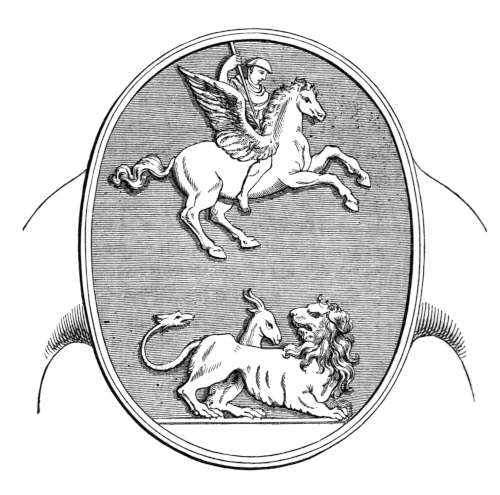
Maffei[18] gives a description and enlarged illustration
of a gold ring bearing a cornelian, whereon is cut the
story of Bellerophon upon his winged horse, about to
attack the chimera; and also a small but exquisite urn
of porphyry, which contained funeral ashes and this ring.
These were found in the garden of Pallas, freed man of
Claudius; and Maffei reasonably makes out that the
ring had belonged to him. Bellerophon is said to have
been a native of Corinth, and Pallas was from that city.
Nero became emperor mainly through Pallas, and yet
he sacrificed the latter to be master of his great riches.
These relics thus possess much interest. Although a
freed man, merely as such, had no right to wear a gold
ring, yet Pallas gained the office of Prætor, and so was
entitled to one. (In Plutarch’s Galba, the freed man of
the latter was honored with the privilege of wearing
the gold ring for bringing news of the revolt against
Nero.)
§ 7. In the unpleasant story of Judah and Tamar, we
see that the former left in pledge with the latter his signet.[19]
This, most likely, was in the shape of a ring,
although such signets were often worn from the wrist:
for, in this case, he also pledged his bracelets.
In the Scriptures, the signet ring is frequently named;
and Quintus Curtius tells us that Alexander wore one.
After his fatal debauch, and finding himself past recovery,
and his voice beginning to fail, he gave his ring to
his general, Perdiccas, with orders to convey his corpse
to the temple of Ammon. Being asked to whom he
would leave his empire, he answered, “To the most
worthy.”[20]
§ 8. The ring was generally the emblem of fidelity in
civil engagements; and hence, no doubt, its ancient use
in many functions and distinctions.[21] A ring denoted
eternity among the Hindoos, Persians and Egyptians; and Brahma, as
the creator of the world, bears a ring in his hand. The Egyptian
priests in the temple of the creative Phtha (Vulcan of the Greeks)
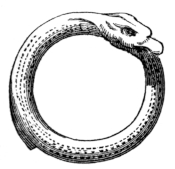
represented the year under the form of a ring, made of a serpent
having its tail in its mouth—a very common shape of ancient
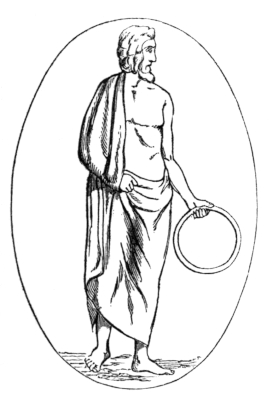
rings. Although Jupiter is often figured with attributes of mighty
power, yet he is seldom coupled with a mark of eternity. There is,
however, a gem (an aqua-marine, engraved in hollow) of this deity
holding a ring as the
emblem of eternity.[22]
Pythagoras forbade the use of the figures of gods upon rings,
lest, from seeing their images too frequently, it should breed a
contempt for them.[23]
It has been attempted to connect with a ring the consecration of a
circle, as emblematical of the Deity. Over the door of a Norman
church at Beckford, in Gloucestershire, England, is a
rude bas-relief, representing the holy cross between the four beasts,
used as symbols of the Evangelists. The “human form divine” appears
to have been beyond the sculptor’s power; he has made a ring. The
others are an eagle, lion, and bull.[24]
§ 9. The Romans distinguished their rings by names
taken from their use, as we do.[25] The excessive luxury
shown in the number worn, and the value of gems and
costly engraved stones in them, and the custom of wearing
lighter rings in summer and heavier in winter, are
among the most absurd instances of Roman effeminacy,
(as we shall hereafter more particularly show.)[26] The
case in which they kept their rings was called Dactylotheca.
No ornament was more generally worn among
the Romans than rings. This custom appears to have
been borrowed from the Sabines.[27] They laid them
aside at night, as well as when they bathed or were in
mourning, as did suppliants. However, in times of sorrow,
they rather changed than entirely put them aside;
they then used iron ones, taking off the gold rings.[28] It
was a proof of the greatest poverty, when any one was
obliged to pledge his ring to live. Rings were given by
those who agreed to club for an entertainment. They
were usually pulled off from the fingers of dying persons;
but they seem to have been sometimes put on
again before the dead body was buried.
There is no sign of the ring upon Roman statues before
those of Numa and Servius Tullius. The rings were
worn to be taken off or put on according to festivals,
upon the statues of deities and heroes, and upon some of
the emperors, with the Lituus ensculped, to show that
they were sovereign pontiffs.
This lituus is a crooked staff; and the Roman priests
are represented with it in their hands. They, as augurs,
used it in squaring the heavens when observing the flight
of birds. It is traced to the time of Romulus, who being
skilled in divination, bore the lituus; and it was called
lituus quirinalis, from Quirinus, a name of Romulus.
It was kept in the Capitol, but lost when Rome was taken
by the Gauls; afterwards, when the barbarians had
quitted it, the lituus was found buried deep in ashes,
untouched by the fire, whilst every thing about it was
destroyed and consumed.[29] Emperors appropriated to
themselves the dignities of the office of high priest,[30] and
hence this priestly symbol upon their medals, coins and
signets. Although it is a common notion that the pastoral
staff of the Church of Rome is taken from the shepherd’s
crook, it may be a question whether it did not
take its rise from the lituus?
Brave times those Roman times for lawyers—or patrons,
as they were called. Their clients were bound to
give them the title of Rex; escort them to the Forum
and the Campus Martius; and not only to make ordinary
presents to them and their children or household,
but, on a birth-day, they received from them the birth-day
ring. It was worn only on that day.[31]
There were rings worn by flute-players, very brilliant
and adorned with a gem.
In the Sierra Elvira, in Spain, more than two hundred
tombs and an aqueduct were discovered. Several skeletons
bore the rings of Roman knights; and some of
them had in their mouths the piece of money destined
to pay the ferryman Charon.[32] These skeletons crumbled
into dust as soon as they were touched. What a perfect
subject for a poem by Longfellow!
Roman stamps or large seals or brands have been
found of quaint shapes. Some of them are in the form
of feet or shoes. Drawings of them appear
in Montfaucon. They were fashioned
to mark casks and other bulky
articles. Caylus gives an illustration
of a ring in the form of a pair of shoes,
or rather, the soles of shoes.[33]
Pliny observes that rings became so common at Rome,
they were given to all the divinities; and even to those
of the people who had never worn any. Their divinities
were adorned with iron rings—movable rings, which
could be taken off or put on according to festivals and
circumstances.
§ 10. At Erpfingen in Germany, remarkable stalactical
caverns have been discovered. Every where, and especially
in the lateral caves, human bones of extraordinary
size, with bones and teeth of animals, now unknown,
have been discovered, and there, with pottery, rings
were found.
§ 11. Rings were in use among the Gauls and Britons,
but seemingly for ornament only. They are often found
in British barrows. Anglo-Saxon rings were common.[34]
William de Belmeis gave certain lands to St. Paul’s
Cathedral, and at the same time directed that his gold
ring set with a ruby should, together with the seal, be
affixed to the charter for ever. The same thing was done
by Osbart de Camera, he granting to St. Paul’s, in pure
alms and for the health of his soul, certain lands; giving
possession by his gold ring, wherein a ruby was set; and
appointing that the same gold ring with his seal should
for ever be affixed to the charter whereby he disposed
of them.[35]
Anglo-Saxon kings gave rings to their wittenagemot
and courtiers, and they to their descendants.
§ 12. In metals the Anglo-Saxons worked with great
skill. We read of the gold cup in which Rowena drank
to Vortigern. So early, perhaps, as the seventh century,
the English jewellers and goldsmiths were eminent in
their professions; and great quantities of other trinkets
were constantly exported to the European Continent.
Smiths and armorers were highly esteemed, and even the
clergy thought it no disgrace to handle tools.[36] St.
Dunstan, in particular, was celebrated as the best blacksmith,
brazier, goldsmith and engraver of his time. This
accounts for the cleverness with which he laid hold of
the gentleman in black:
“St. Dunstan stood in his ivy’d tower,
Alembic, crucible, all were there;
When in came Nick to play him a trick,
In guise of a damsel, passing fair.
Every one knows
How the story goes:
He took up the tongs and caught hold of his nose.”[37]
§ 13. Ladies used seal-rings in the sixth century; but
women of rank had no large seals till towards the beginning
of the twelfth.[38]
§ 14. There is scarcely a hard substance of which rings
have not been composed. All the metals have been
brought into requisition. First, iron; then, as in Rome,
it was mingled with gold.
Conquerors wore iron rings until Caius Marius changed
the fashion. He had one when he triumphed over
King Jugurtha.[39] And while stones have lent their aid
as garniture for metal, these too have made the whole
hoop.
We find rings of two stones; such were those which
the Emperor Valerianus gave to Claudius.
Near to the Pyramids, cornelian rings have been discovered.
Rings of glass and other vitreous material have
been found. Emerald rings were discovered at Pompeii,
also glass used instead of gems. Some made entirely of
one stone, as of amber, have been obtained.[40]
With the Egyptians, bronze was seldom used in rings,
though frequently in signets. They were mostly of gold
and this metal seems to have been always preferred to
silver.
Ivory and blue porcelain were the materials of which
those worn by the lower classes were made.[41]
An ancient ring of jet has been dug up in England.
There were some rings of a single metal, and others
of a mixture of two;[42] for the iron, bronze and silver
were frequently gilt, or, at least, the gold part was fixed
with the iron, as appears from Artemidorus.[43] The
Romans were contented with iron rings a long time; and
Pliny assures us that Marius first wore a gold one in his
third consulate. Sometimes the ring was iron, and the
seal gold; sometimes the stone was engraven, and sometimes
plain; and the engraving, at times, was raised,
and also sunk. (The last were called gemmæ ectypæ,
the former gemmæ sculpturâ prominente.)
An incident, mentioned by Plutarch, shows how distinctive
was a gold ring.[44] When Cinna and Caius
Marius were slaughtering the citizens of Rome, the slaves
of Cornutus hid their master in the house and took a
dead body out of the street from among the slain and
hanged it by the neck, then they put a gold ring upon the
finger, and showed the corse in that condition to Marius’s
executioners; after which they dressed it for the funeral,
and buried it as their master’s body.
The rings of the classical ancients were rather incrusted
than set in gold in our slight manner.[45]
The first mention of a Roman gold ring is in the year
432 U. C.; but they, at last, were indiscriminately worn
by the Romans. Three bushels were gathered out of the
spoils after Hannibal’s victory at Cannæ.[46]
“Lovely soft pearls, the fanciful images of sad tears,”
have been used in rings from the time of the Latins.
Cleopatra’s drinking off the residuum of a pearl, worth
three hundred and seventy-five thousand dollars, aside
from luxurious extravagance, seems to be somewhat
nasty; but we are inclined to believe that this fond
queen had faith in its supposed medicinal and talismanic
properties:
“—— Now I feed myself
With most delicious passion.”
Pliny, the Roman naturalist, gravely tells us that the
oyster which produces pearls, does so from feeding on
heavenly dew. Drummond thus translates him:
“With open shells in seas, on heavenly dew,
A shining oyster lusciously doth feed;
And then the birth of that ethereal seed
Shows, when conceived, if skies look dark or blue.”[47]
Early English writers entertained the same notion;
and Boethius, speaking of the pearl-mussel of the Scotch
rivers, remarks, that “These mussels, early in the morning,
when the sky is clear and temperate, open their
mouths a little above the water and most greedily swallow
the dew of heaven; and after the measure and quantity
of the dew which they swallow, they conceive and
breed the pearl. These mussels,” he continues, “are so
exceedingly quick of touch and hearing, that, however
faint the noise that may be made on the bank beside
them, or however small the stone that may be thrown
into the water, they sink at once to the bottom, knowing
well in what estimation the fruit of their womb is to all
people.” In the East, the belief is equally common that
these precious gems are
“—— rain from the sky,
Which turns into pearls as it falls in the sea.”
The ancient idea that pearls are generated of the dews
of heaven, is pretty conclusively met by Cardanus,[48] who
says it is fabulous, seeing that the shell fishes, in which
they are conceived, have their residence in the very
bottom of the depth of the sea.
The charlatan Leoni de Spoleto prescribed the drink
of dissolved pearls for Lorenzo the Magnificent, when he
was attacked by fever aggravated by hereditary gout.[49]
There was supposed to be a gem called a carbuncle,
which emitted, not reflected, but native light.[50] Our old
literature abounds with allusions to this miraculous gem.
Shakspeare has made use of it in Titus Andronicus,
where Martius goes down into a pit, and, by it, discovers
the body of Lord Bassianus; and calls up to Quintus
thus:[51]
“Lord Bassianus lies embrewed here,
All on a heap, like to a slaughter’d lamb,
In this detested, dark, blood-drinking pit.
Quintus. If it be dark, how dost thou know ’tis he?
Martius. Upon his bloody finger he doth wear
A precious ring, that lightens all the hole,
Which, like a taper in some monument,
Doth shine upon the dead man’s earthy cheek,
And show the ragged entrails of this pit:
So pale did shine the moon on Pyramus,
When he by night lay bathed in maiden’s blood.”
Ludovicus Vartomannus, a Roman, reporteth that the
king of Pege (or Pegu), a city in India, had a carbuncle
(ruby) of so great a magnitude and splendor, that by
the clear light of it he might, in a dark place, be seen,
even as if the room or place had been illustrated by the
sunbeams. St. or Bishop Epiphanius saith of this gem,
that if it be worn, whatever garments it be covered
withal, it cannot be hid.[52]
It was from a property of resembling a burning coal
when held against the sun that this stone obtained the
name carbunculus; which being afterwards misunderstood,
there grew an opinion of its having the qualities
of a burning coal and shining in the dark. And as no
gem ever was or ever will be found endued with that
quality, it was supposed that the true carbuncle of the
ancients was lost; but it was long generally believed
that there had been such a stone. The species of carbuncle
of the ancients which possessed this quality in the
greatest degree was the Garamantine or Carthaginian;
and this is the true garnet of the moderns.[53]
Rings, with a death’s head upon them, were worn by
improper characters in the time of Elizabeth of England.
This kind of ring is referred to in Beaumont and
Fletcher:
Although we meet with nothing to show the motive
for wearing such rings by the characters referred to, we
are inclined to fancy the desire was to carry the semblance
of a widow and to let the ring have the character
of a mourning token. Lord Onslow, who lived in the
time of Elizabeth, bequeathed “a ring of gold with a
death’s head” to friends.[55]
Sir Isaac Newton was possessed of a small magnet set
in a ring, the weight of which was only three grains, but
which supported, by its attractive power on iron, seven
hundred grains. It has been observed that such instances
are by no means common, although the smallest
magnets appear to have the greatest proportionate
power.[56]
Our own sailors, in the quiet weather of a voyage,
will, with the aid of a marlinspike, make exceedingly
neat rings out of Spanish silver or a copper coin.
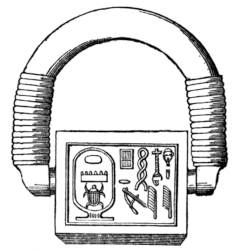
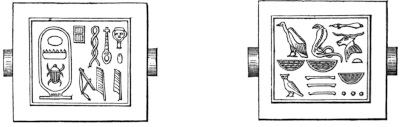
Some of the Egyptian signets were of extraordinary
size. Sir Gardiner Wilkinson mentions an ancient Egyptian
one which contained about twenty pounds worth of
gold. It consisted of a massive ring, half an inch in its
largest diameter, bearing an oblong plinth, upon which
the devices were engraved; on one face was the successor
of Amunoph III., who lived B. C. 1400; on the
other a lion, with the legend, “Lord of strength,” referring
to the monarch; on the other side a scorpion, and
on the remaining one a crocodile.
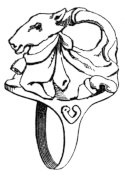
In the work of Count Caylus, there
is a vignette of a ring of bronze, remarkable
from its size and the subject
upon it.[57] The collet or collar of the
ring is an inch in height, and eleven
lines in thickness. The figure upon it
is an ox—or, as the author we have referred
to calls it, a cow, recumbent and
swaddled, or covered by draperies; and
it wears a collar, to which hangs, according to this author,
a bell. He considers that it was made when the Romans
wore them of an excessive size, and while Gaul
was under the dominion of the former. He does not
give any guess at the intention or meaning of the subject.
We believe it was, originally, Egyptian; and
made in memory of the sacred Bull Apis, (found in
tombs,) honored by the Egyptians as an image of the
soul of Osiris and on the idea that his soul migrated
from one Apis to another in succession. And as to what
Caylus considers a bell, we are inclined to designate a
bag. In Dr. Abbott’s collection of Egyptian Antiquities
are not only mummies of these sacred bulls, but also
the skulls of others, and over the head of one is suspended
a large bag, found in the pits with the bulls, and
supposed to be used to carry their food.
Addison, in observing upon the size of old Roman
rings,[58] refers to Juvenal, as thus translated by Dryden:
“Charged with light summer rings, his fingers sweat,
Unable to support a gem of weight.”
And he goes on to say, that this “was not anciently
so great an hyperbole as it is now, for I have seen old
Roman rings so very thick-about and with such large
stones in them, that it is no wonder a fop should reckon
them a little cumbersome in the summer season of so hot
a climate.”
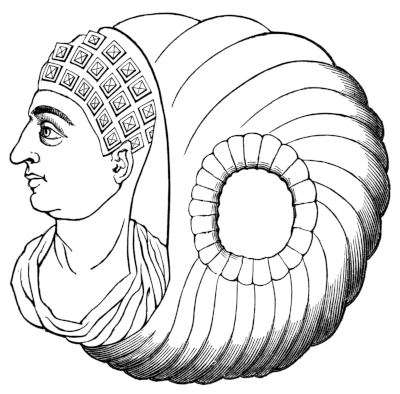
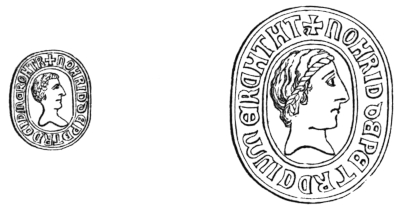
As a proof of the size to which Roman rings sometimes reached,
we here give an outline of one as it
appears in Montfaucon.
This ring bears the portrait of Trajan’s good queen
Plotina. The coiffure is remarkable and splendid, being
composed of three rows of precious stones cut in facets.
According to Pliny, devices were not put upon the
metal of rings until the reign of Claudius.
When a wealthy Egyptian had been embalmed and
placed in a superb case or coffin, with a diadem on his
head and bracelets upon his arms, rings of gold, ivory
and engraved cornelian were placed upon his fingers.[59]
Contrary to what might have been supposed, the
British Museum is not rich in rings. Through a dear
friend, the author is able to give drawings of a few of its
treasures, and the following extract from a letter: “They
can trace none of their rings with any certainty. The
collection is not large, and has been bought at various
times from other collections and private sources, which
could give no history, or, if attempted, none that can be
relied on. Mr. Franks, the curator of this department,
kindly made the impressions I send of those he considered
most curious, and selected the others for me.”
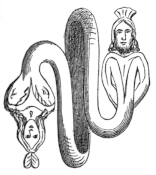
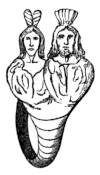
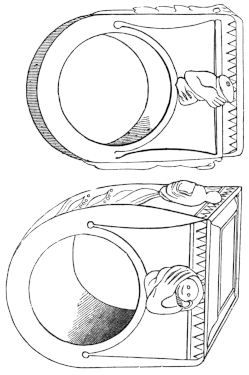
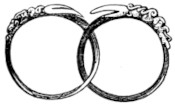
Here is one of those rings. It
bears the heads of Isis and Serapis.
A similar ring (perhaps the same)
is figured in Caylus,[60] who observes
on the singularity of form and
the ingenuity attendant upon shaping
it, while it is considered extremely
inconvenient to wear. It
would, however, suit all fingers,
large or small, because it can be easily diminished or
widened. The two busts are placed at the extremities of
the serpent which forms the body of the ring contrariwise—if
we may be allowed the expression—so that
whatever position or twist is given to the ring, one of
the two heads always presents itself in a natural position.
The ring given by Caylus was found in Egypt, but is
said to be of Roman workmanship and made when the
former was under the dominion of the Romans; and he
hints that the heads may represent a Roman emperor
and empress under the forms of Isis and Jupiter Serapis,
adding, “I will not hazard any conjecture on the names
that may be given them. I will content myself with
saying that the work is of a good time and far removed
from the lower empire; and I will add, that the quantity
of rings which were wrought for the Romans
of all the states may serve to explain
the extraordinary forms which some present
to us.”
Here is another, from the British Museum,
in which Isis and Serapis appear,
singularly placed. This ring is Romano-Egyptian,
and of bronze.
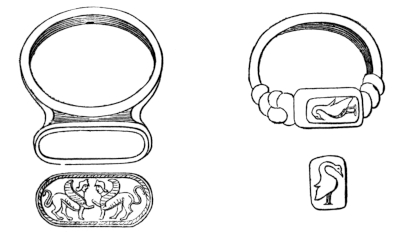
Here are two, Etruscan, from the same source, with
an impression from each.
No. 1.No. 2.
They are both of gold, while No. 2 has a white stone
which works upon a swivel.
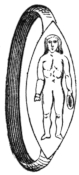
We add, in this portion of our book, another
from the British Museum. It is worked from
Greek or Etruscan gold, and was found in the
Abruzzi.
Illustrations of some of the Egyptian seal-rings
contained in the British Museum, will be
found in Knight’s Pictorial Bible, at the end
of the third chapter of Esther.
Fashion and Fancy have given us rings of all imaginable
shapes, and these powers, joined with Religion and
Love, have traced upon them every supposable subject.
Although modern rings seldom display the exquisite
cutting and artistic taste which appear upon antiques,
still the latter exhibit sentimental phrases and sentiments
similar to such as are observed upon rings of the present
day. The Greeks were full of gallantry. Time has
preserved to us incontestable proofs of the vows which
they made to mistresses and friends, as well as of the
trouble they took and the expense they went to in order
to perpetuate their sentiments. Caylus,[61] who says this,
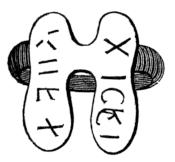
gives a drawing of a ring bearing the words KIPIA KAAH,
Beautiful Ciria; and adds, “This inscription is simple
but energetic; it appears to me to suit the sentiment.”
In Montfaucon are several illustrations of Greek sentences
upon rings, which carry out what Caylus has observed;
thus there are (rendered into English), Good be with you,
Madam. Good be with you, Sir. Good be with him
who wears you and all his household. Remember it.
Theanus is my light. Upon a ring bearing a hand
which holds a ring: Remember good fortune. There
are, also, upon Roman rings, sentiment and compliment
in Latin sentences, as thus translated: Live happy, my
hostess. You have this pledge of love. Live in God. Live.
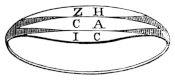
And Caylus[62] gives a description and drawing of a remarkably
formed gold ring; and although it bears Greek words,
he leaves it in doubt whether it is of Roman or Grecian
workmanship. It has the appearance of three rings united,
widened in the front and tapering within the hand. Upon
the wide part of each are two letters, the whole forming
ZHCAIC, Mayest thou live. The
Romans often preferred the Greek
language in their most familiar
customs.
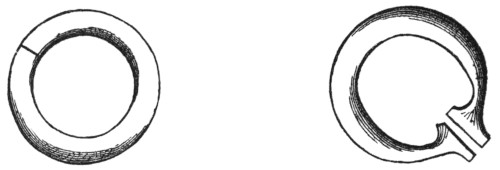
A ring of bronze has been discovered, in the form of
a snake with its tail in its mouth, made on the principle
of some of our steel rings which we use
to hold household keys, widening their
circle by pressure.[63] In the finger-ring,
the part in the mouth is inserted loose,
so as to draw out and increase to the
size of the circle needed.
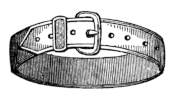
Rings of gold are common in England at the present
day, made to form a strap with buckles, precisely, in
shape, a common belt or collar. It lies flat like an
ordinary leather strap, and is formed
of small pieces of gold which are kept
so delicately together that the lines
of meeting are scarcely perceptible.
This is accomplished by having many minute and unseen
hinges, which make the whole pliable and allow it
to be buckled (as a ring) upon the finger.
Nothing is new. One of the prettiest modern rings,
used as a remembrancer, has a socket for hair and a
closing shutter. Roman remains were found at Heronval
in Normandy, and among them were rings. One
of these was almost of modern form, with a small place
under where the stone is usually fixed, into which hair
might be inserted.[64] We are constantly retracing the
steps of antiquity.
A Roman gold ring of a triangular form has been discovered
in England, with an intaglio representing the
story of Hercules strangling the Nemean lion.[65] And
also a ring that, while it was remarkable for its thickness,
had a whistle on one side, which was useful in calling
servants before the time of domestic bells.[66]
We shall find that there were rings in which poison
was carried.
Wilkinson has discovered several Egyptian rings,
where the subject is made up of two cats sitting back to
back, and looking round at each other, with an emblem
of the goddess Athor between them.
We do not know why Athor, Venus, should be between
these sentinel cats. Had the symbol of Pasht,
Diana, been there, the thing would have been less difficult;
for cats, like maids, “love the moon,” and their
guardian goddess was Pasht. Their attitude is more
watchful than sacred cats would be supposed to assume,
and might rather appear to apply to the species embalmed
in Kilkenny history.
There is an Anglo-Saxon ring inscribed Ahlstan,
Bishop of Sherborne, which has the hoop of alternate lozenges
and circles. It has, also, a Saxon legend. Epigraphs
in that language are extremely rare. It has been
supposed that Ahlstan had command of the Saxon army.
In the catacombs of Rome, where the early Christians
“wandered about in sheep-skins and goat-skins, being
destitute, afflicted, tormented,”[67] where they stealthily
prayed and lived and died, vast quantities of signet
and other rings have been discovered, as well as medals,
cameos and other precious stones. Signet rings of
different devices, as belonging to different owners, are
in the catacombs here; and this has raised the idea that
they were deposited by relatives and friends as the stone
lid of the grave was about to be shut,—offerings of love
and affection.[68]
“What a picture,” exclaims a writer in the London
Art Journal,[69] “do these dark vaults display of the devotion,
the zeal, the love of those early Christian converts
whose baptism was in blood! I picture them to myself,
stealing forth from the city in the gloomy twilight, out
towards the lonely Campagna, and disappearing one by
one through well-known apertures, threading their way
through the dark sinuous galleries to some altar, where
life and light and spiritual food, the soft chanting of the
holy psalms and the greeting of faithful brethren, waking
the echoes, awaited them. The sight of these early
haunts of the persecuted and infant religion is inexpressibly
affecting; and I pity those, be they Protestant or
Catholic, who can visit these hallowed precincts without
an overwhelming emotion. How many martyrs, their
bodies torn and lacerated by the cruel beasts amid the infuriated
roar of thousands shrieking forth the cry of Christianos
ad leonem! in the bloody games of the Flavian amphitheatre,
breathing their last sigh, calling on the name
of the Redeemer, have passed, borne by mourning friends
or by compassionate widows or virgins to their last dark
narrow home, along the very path I was now treading!
How many glorified saints, now singing the praises of
the Eternal around the great white throne in the seventh
heaven of glory, may have been laid to rest in these
very apertures, lighted by a flickering taper like that I
held. But I must pause—this is an endless theme, endless
as the glory of those who hover in eternal light and
ecstatic radiance above; it is moreover a pæan I feel
utterly unworthy to sing.”
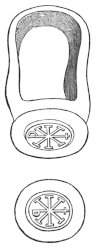
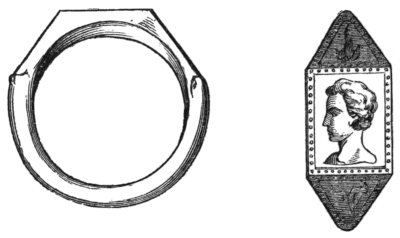
We have received a drawing and impression
of a ring which is in the British
Museum; and our opinion is that it belonged
to one of the early Christians.
While the ΧΑΙΡΩ, I rejoice, upon it,
favors the idea, the monogram (upon the
signet part) confirms it. This is, evidently,
the name of Jesus in its earliest
monogrammatic form, made up of the
letters Χ. and Ρ. As commonly found on
monuments in the catacombs of Rome, it
has a single cross with the Ρ. thus, ☧
while in our illustration the cross
is multiplied; and this is the only
difference. Surely such a memorial as this is more likely
to have been the ring of the lowly-minded “fisherman,”
than the one which is said to be framed with diamonds
and worn by the Pope. In Dr. Kip’s very interesting
work on the Catacombs of Rome, there is an illustration
of a seal-ring, upon which a like monogram appears,
although somewhat complicated.[70]
Near Cork, in Ireland, a silver ring was discovered,
the hoop whereof is composed of nine knobs or bosses,
which may have served instead of beads and been used
by the wearer in the Catholic counting of them. The
antiquaries of Ireland have considered this ring as very
ancient.[71]
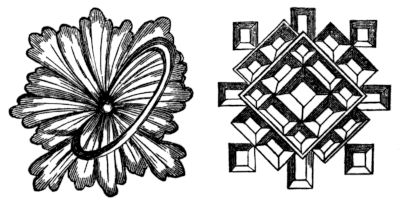
In referring to Irish rings, it may be well to mention
one which was found in the county of Westmeath, with
some very ancient remains.[72] It is remarkable, from
being set with many diamonds in beautifully squared
work. On account of the place where it was discovered,
a suggestion has been made that it may have belonged
to Rose Failge, Prince of Ireland, eldest son of Calhoir
the Great, who reigned A. D. 122, he being called the
Hero of Rings. However, diamonds do not appear to
have been named among precious stones at that early
period.
The author is not aware that diamonds are often set
loosely or upon swivel in a ring. We have mention of
one in the reign of James I. of England. Robert Cecil,
Earl of Salisbury, (nicknamed by a cotemporary “Robert
the Devil,” and by James called his “little Beagle,”)
was dangerously ill at Bath; but on a report of his recovery,
the King sent purposely the Lord Hay to him,
with a token, “which was a fair diamond, set or rather
hung square in a gold ring without a foil”—and this
message, “That the favor and affection he bore him was
and should be ever, as the form and matter of that, endless,
pure and most perfect.”[73] A writer, given to detraction,
says that this great statesman died of the disease of
Herod, upon the top of a mole-hill; and that his body
burst the lead it was wrapped in. On his tomb lies the
skeleton of the Earl curiously carved. He seemed well
to weigh the glory of a courtier, for in writing to Sir
John Harrington,[74] he said: “Good Knight, rest content
and give heed to one that hath sorrowed in the bright
lustre of a Court, and gone heavily even on the best
seeming fair ground. ’Tis a great task to prove one’s
honesty and yet not spoil one’s fortune. You have tasted
a little hereof in our blessed Queen’s time, who was
more than a man, and, in truth, sometimes less than a
woman. I wish I waited now in your presence chamber,
with ease at my food and rest in my bed. I am pushed
from the shore of comfort, and know not where the
winds and waves of a Court will bear me. I know it
bringeth little comfort on earth; and he is, I reckon, no
wise man that looketh this way to heaven.”
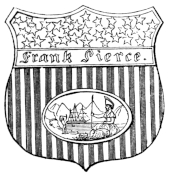
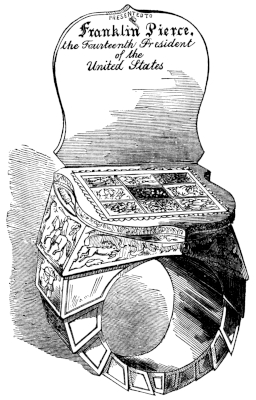
In the year one thousand eight hundred and fifty-two, some
citizens of California presented President Pierce with a gigantic
ring. We here give an outline, and add a description of it from
Gleason’s Pictorial Newspaper for the 25th of December, 1852.
“It is already pretty widely known to the public generally,
that a number of citizens of San Francisco have
caused to be manufactured and forwarded to Gen.
Pierce, a most valuable and unique present, in the form
of a massive gold ring, as a token of esteem for the President
elect. Of this ring our artist has herewith given
us an admirable representation. It is a massive gold
ring, weighing upwards of a full pound. This monster
ring, for chasteness of design, elegance of execution, and
high style of finish, has, perhaps, no equal in the world.
The design is by Mr. George Blake, a mechanic of San
Francisco. The circular portion of the ring is cut into
squares, which stand at right angles with each other, and
are embellished each with a beautifully executed design,
the entire group presenting a pictorial history of California,
from her primitive state down to her present flourishing
condition, under the flag of our Union.
“Thus, there is given a grizzly bear in a menacing attitude,
a deer bounding down a slope, an enraged boa, a
soaring eagle and a salmon. Then we have the Indian
with his bow and arrow, the primitive weapon of self-defence;
the native mountaineer on horseback, and a
Californian on horseback, throwing his lasso. Next
peeps out a Californian tent. Then you see a miner at
work, with his pick, the whole being shaded by two
American flags, with the staves crossed and groups of
stars in the angles. The part of the ring reserved for a
seal is covered by a solid and deeply carved plate of
gold, bearing the arms of the State of California in the
centre, surmounted by the banner and stars of the United
States, and inscribed with ‘Frank Pierce,’ in old Roman
characters. This lid opens upon a hinge, and presents
to view underneath a square box, divided by bars
of gold into nine separate compartments, each containing
a pure specimen of the varieties of ore found in the
country. Upon the inside is the following inscription:
‘Presented toFranklin Pierce, the Fourteenth President
of the United States.’ The ring is valued at $2000.
Our engraving gives a separate view of the lid, so as to
represent the appearance of the top of the ring both when
it is open and when it is closed. Altogether, it is a massive
and superb affair, rich in emblematical design and
illustration, and worthy its object.”
Rings appear to have been worn indiscriminately on
the fingers of each hand. It would seem, however, from
Jeremiah, that the Hebrews wore them on their right
hand; we there read that when the Lord threatened
King Zedekiah with the utmost effects of his anger, he
told him: “Though Coniah the son of Jehoiakim, king
of Judah, were the signet on my right hand, yet would
I pluck thee thence.”[75]
Trimalchion wore two rings, one large and gilt, upon
the little finger of his right hand, and the other of gold,
powdered with iron stars, upon the middle of the ring
finger.[76]
Among the Romans, before rings came to be adorned
with stones, and while the graving was yet on the metal
itself, every one wore them at pleasure on what hand and
finger he pleased. When stones came to be added, they
had them altogether on the left hand; and it would have
been held an excess of foppery to have put them on the
right.
Pliny says, they were at first worn on the fourth finger,
then on the second or index, then on the little finger, and
at last, on all the fingers excepting the middle one.
Clemens Alexandrinus has it that men wore the ring
on the extremity of the little finger, so as to leave the
hand more free.
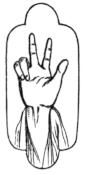
According to Aulus Gellius,[77] both the Greeks and
Romans wore them on the fourth finger of the left
hand; and the reason he gives for it is this, that having
found, from anatomy, that this finger had a little nerve
that went straight to the heart, they esteemed it the most
honorable by this communication with that noble part.
Macrobius quotes Atteius Capito, that the right hand
was exempt from this office, because it was much more
used than the left, and, therefore, the precious stones of
the rings were liable to be broken, and that the finger
of the left hand was selected which was the least employed.
Pliny says, the Gauls and ancient Britons wore the
ring on the middle finger.
At first, the Romans only used a single ring; then,
one on each finger, and, at length, as we gather from
Martial,[78] several on each. Afterwards, according to
Aristophanes,[79] one on each joint. Their foppery at
length arose to such a pitch that they had their weekly
rings.
The beast Heliogabalus carried the point of using rings
the farthest, for, according to Lampridius, he never wore
the same ring or the same shoe twice.
Heliogabalus was a funny wretch:—he would frequently
invite to his banquets eight old men blind of
one eye, eight bald, eight deaf, eight lame with the gout,
eight blacks, eight exceedingly thin, and eight so fat that
they could scarcely enter the room, and who, when they
had eaten as much as they desired, were obliged to be
taken out of the apartment on the shoulders of several
soldiers.
Egyptian women wore many, and sometimes two or
three on one finger; but the left was considered the hand
peculiarly privileged to bear these ornaments; and it is
remarkable that its third was decorated with a greater
number than any other and was considered by them as
the ring finger.[80] This notion, as we have observed, the
Grecians had.
The idea of wearing rings on the fourth finger of the
left hand, because of a supposed artery there which went
to the heart, was carried so far that, according to Levinus
Lemnius, this finger was called Medicus; and the old
physicians would stir up their medicaments and potions
with it, because no venom could stick upon the very
outmost part of it but it will offend a man and communicate
itself to the heart.
With regard to the translation of rings from the right
to the left hand, it may be pleasing to refer to that
charming old work, Enquiries into Vulgar and Common
Errors, by Browne:[81] he says, “That hand [the left]
being lesse employed, thereby they were best preserved,
and for the same reason they placed them on this finger,
for the thumbe was too active a finger and is commonly
imployed with either of the rest: the index or fore finger
was too naked whereto to commit their pretiosities, and
hath the tuition of the thumbe scarce unto the second
joynt: the middle and little finger they rejected as extreams,
and too big or too little for their rings; and of all
chose out the fourth as being least used of any, as being
guarded on either side, and having in most this peculiar
condition that it cannot be extended alone and by
itselfe, but will be accompanied by some finger on either
side.”
As to the Egyptians deriving a nerve from the heart
in the fourth finger of the left hand, the priests, from this
notion, anointed the same with precious oils before the
altar. And Browne, in his Vulgar Errors, says, “The
Egyptians were weak anatomists, which were so good
embalmers.”[82]
In the General Epistle of St. James,[83] we have this:
“For if there come unto your assembly a man with a
gold ring, in goodly apparel, and there come in also a
poor man in vile raiment; and ye have respect to him
that weareth the gay clothing, and say unto him, Sit thou
here in a good place; and say to the poor, Stand thou
there or sit here under my footstool: are ye not then
partial in yourselves and are become judges of evil
thoughts?” In an illustrated edition of the New Testament,
it is said, the expression “with a gold ring” might
very properly be rendered, “having his fingers adorned
with gold rings;” and that about the time referred to in
the text, the wearing of many rings had become a fashion,
at least among the master people, the Romans,
from whom it was probably adopted by persons of
wealth and rank in the provinces. The custom is noticed
by Arrian; while Seneca, in describing the luxury and
ostentation of the time, says, “We adorn our fingers
with rings, and a jewel is displayed on every joint.”
There is a newspaper anecdote of an eminent preacher at
Norwich, in England, which shows that he had the
above verse (from the Epistle of St. James) in mind when
it occurred. His Reverence made a sudden pause in
his sermon; the congregation were panic-struck. Having
riveted their attention, he addressed himself by name
to a gentleman in the gallery. “Has that poor man
who stands at the back of your pew a gold ring on his
finger?” The gentleman turned round, and replied, “I
believe not, sir.” “Oh, then, I suppose that is the reason
he must not have a seat.” The gentleman had three
gold rings on his hand; and his pew was nearly empty.
Here is another anecdote of a priest, in worse taste
than the last. Albert Pio, Prince of Caspi, was buried
with extraordinary pomp in the Church of the Cordeliers
at Paris. He had been deprived of his principality
by the Duke of Ferrara, became an author, and
finally a fanatic. Entering one day into one of the
churches at Madrid, he presented holy water to a lady
who had a very thin hand, ornamented by a most beautiful
and valuable ring. He exclaimed in a loud voice
as she reached the water, “Madam, I admire the ring
more than the hand.” The lady instantly exclaimed,
with reference to the cordon or rope with which he was
decorated, “And for my part, I admire the halter more
than I do the ass.” He was buried in the habit of a Cordelier;
and Erasmus made a satire on the circumstance,
entitled the “Seraphic Interment.”
The Hebrew women wore a number of rings upon
their fingers.[84]
Hippocrates, in treating of the decency of dress to be
observed by physicians, enjoins the use of rings. We
have somewhere seen it suggested, that the rings thus
worn by physicians might have contained aromatic water
or preservative essence, in the same way as their canes
were supposed to do; and hence the action of putting
the heads or tops of the latter to their noses when consulting
in a sick-room.
§ 15. The author deems it as well to refer to the law,
in relation to rings. In common parlance, we consider
precious stones to be jewels; but rings of gold will pass
by that word. In the time of Queen Elizabeth, the Earl
of Northumberland bequeathed by his will his jewels to
his wife, and died possessed of a collar of S’s, and of a
garter of gold, and of a button annexed to his bonnet,
and also many other buttons of gold and precious stones
annexed to his robes, and of many chains, bracelets
and rings of gold and precious stones.[85] The question
was, whether all these would pass by the devise under
the name of jewels? It was resolved by the justices,
that the garter and collar of S’s did not pass, because
they were not properly jewels, but ensigns of power
and state; and that the buckle of his bonnet and the
button did not pass, because they were annexed to his
robes, and were no jewels. But, for the other chains,
bracelets and tings, they passed under the bequest of
jewels.
Persons who desire to leave specific rings to friends
should designate them; for, otherwise, the particular article
will not pass. Thus, “I give a diamond ring,” is
what is called a general legacy, which may be fulfilled
by the delivery of any ring of that kind; while “I give
the diamond ring presented to me by A,” is a specific
legacy, which can only be satisfied by the delivery of
the specified subject.[86] A legacy of £50 for a ring is but
a money legacy; it fastens upon no specific ring, and
carries interest like other money bequests.[87]
A family ring may become an important piece of evidence
in the establishment of a pedigree; and the law
admits it for that purpose: upon the presumption, as
Lord Erskine has it, “that a person would not wear a
ring with an error upon it.”[88]
In ancient times dying persons gave their rings to some
one, declaring thereby who was their heir.[89]
§ 16. We do not find in any work on orders of knighthood,
any association having direct reference to a ring;
but in a volume of the Imperial Magazine there is a
reference to the Order of the Ring, said to have been
copied from a beautifully illuminated MS., on vellum.[90]
The sovereign of the order was to wear upon the fifth
finger a blue enamelled ring, set round with diamonds,
with the motto, Sans changer. The matter looks fictitious,
for it embraces the seeming signatures of Leonora,
Belvidera, Torrismond and Cæsario.
Lorenzo the Magnificent, of the Medici family, bore a
diamond ring with three feathers and the motto, Semper;
and when the Medici returned to Florence, Giuliano de
Medici instituted an order of merit, denominated the
Order of the Diamond, alluding to the impresa, an emblem
of his father. This was done to secure influence
by recalling the memory of the parent. The members
of it had precedence on public occasions, and it was
their province to preside over festivals, triumphs and
exhibitions.[91]
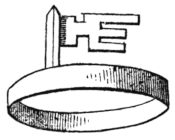
§ 17. Rings have been found in strange places, and
under interesting circumstances. We find them upon
and below the earth; within the Pyramids; beneath the
ashes of Pompeii and Herculaneum; and strewed over
battle-fields.[92] They have been discovered on the field
of Cressy.
§ 18. In Persia, at the present day, letters are seldom
written and never signed by the person who sends them;
and it will thus appear that the authenticity of all orders
and communications, and even of a merchant’s bills, depends
wholly on an impression from his seal-ring.[93] This
makes the occupation of a seal-cutter one of as much
trust and danger as it seems to have been in Egypt.
Such a person is obliged to keep a register of every
ring-seal he makes; and if one be lost or stolen from the
party for whom it was cut, his life would answer for
making another exactly like it. The loss of a signet-ring
is considered a serious calamity; and the alarm which
an Oriental exhibits when his signet is missing, can only
be understood by a reference to these circumstances, as
the seal-cutter is always obliged to alter the real date at
which the seal was cut. The only resource of a person
who has lost his seal is to have another made with a
new date, and to write to his correspondents to inform
them that all accounts, contracts and communications to
which his former signet is affixed are null from the day
on which it was lost.
Importance has been given to signets in England.
This was at a time when the schoolmaster had not made
many penmen. “And how great a regard was had to
seals,” says Collins, in his Baronage, “appears from
these testimonies; the Charter of King Henry I. to the
Abbey of Evesham, being exhibited to King Henry III.
and the seal being cloven in sunder, the King forthwith
caused it to be confirmed,” etc., etc.; “and in 13 Ed.
III., when, by misfortune, a deed, then showed in the
Chancery, was severed from the seal, in the presence of
the Lord Chancellor and other noble persons, command
was not only given for the affixing it again thereto, but
an exemplification was made thereof under the Great
Seal of England, with the recital of the premises. And
the counterfeiting of another man’s seal was anciently
punished with transportation, as appears from this record
in the reign of King John,” etc., etc. “It is also as remarkable
that in 9 H. III. c. c. marks damages were
recovered by Sir Ralph de Crophall, Knight, against
Henry de Grendon and William de Grendon for forcibly
breaking a seal from a deed. Also so tender was every
man in those times of his seal, that if he had accidentally
lost it, care was taken to publish the same, lest another
might make use of it to his detriment, as is manifested
in the case of Benedict de Hogham,” etc. “Also not
much unlike to this is that of Henry de Perpount, a person
of great quality, (ancestor of his Grace the Duke
of Kingston,) who, on Monday, in the Octaves of St.
Michael, 8 Ed. I., came into the Chancery at Lincoln
and publicly declared, that he missed his seal; and protested,
that if any instrument should be signed with that
seal, for the time to come, it should be of no value or
effect. Nor is that publication made by John de Greseley
of Drakelow, in Com. Derb. 18 R. II., upon the
loss of his seal, less considerable,” etc., etc.[94]
§ 19. We are aware of the value of many modern
rings, arising from their being used as mere frames for
jewels. And ancient ones, from the same fact or from
having exquisite engraving upon them, were also highly
prized. Nonius,[95] a senator, is said to have been proscribed
by Anthony for the sake of a gem in a ring, worth
twenty thousand sesterces.
The “Roving Englishman”[96] informs us, that the Pasha
wears on his right-hand little finger, a diamond ring
which once belonged to the Dey of Algiers, and cost a
thousand pounds sterling.
§ 20. An English work, of but little note, professes to
make out “Love’s Telegraph,” as understood in America,
thus:—If a gentleman wants a wife, he wears a ring on
the first finger of the left hand; if he is engaged, he wears
it on the second finger; if married, on the third; and
on the fourth if he never intends to be married. When
a lady is not engaged, she wears a hoop or diamond on her
first finger; if engaged, on the second; if married, on the
third; and on the fourth if she intends to die a maid.[97]
Many of our readers are aware that there are name-rings,
in which the first letter attaching to each jewel
employed will make a loved one’s name or a sentiment.
In the formation of English rings of this kind, the terms
Regard and Dearest are common. Thus illustrated:—R(uby)
E(merald) G(arnet) A(methyst) R(uby) D(iamond).—D(iamond)
E(merald) A(methyst) R(uby) E(merald)
S(apphire) T(opaz). It is believed that this pretty notion
originated (as many pretty notions do) with the French.
The words which the latter generally play with, in a
combination of gems, are Souvenir and Amitié, thus:
S(aphir or Sardoine) O(nix or Opale) U(raine) V(ermeille)
E(meraude) N(atralithe) I(ris) R(ubis or Rose diamant).—A(méthiste
or Aigue-marine) M(alachite) I(ris) T(urquoise
or Topaze) I(ris) E(meraude).
Here are the alphabetical French names of precious
stones:[98]
A.
Améthiste. Aigue-marine.
B.
Brilliant. Diamant, désigniant la même pierre.
C.
Chrisolithe. Carnaline. Chrisophrase.
D.
Diamant.
E.
Emeraude.
F.
(Pas de pierre connue.)
G.
Grenat.
H.
Hiacinthe.
I.
Iris.
J.
Jasper.
K.
(Pas de pierre connue.)
L.
Lapis lazuli.
M.
Malachite.
N.
Natralithe.
O.
Onix. Opale.
P.
Perle. Peridot. Purpurine.
Q.
(Pas de pierre connue.)
R.
Rubis. Rose diamant.
S.
Saphir. Sardoine.
T.
Turquoise. Topaze.
U.
Uraine.
V.
Vermeille (espèce de grenat jaune).
X.
Xépherine.
Y. Z.
(Pas de nous connus.)
Kobell says,[99] “In name-rings, in which a name is
indicated by the initial letter of different gems, the emerald
is mostly used under its English and French name
(Emeraude) to stand for e, which would otherwise not be
represented. (The German name is Smaragd.) While on
this point, it may be mentioned that a difficulty occurs
with u, but recent times have furnished a name which
may assist, namely, a green garnet, containing chrome,
from Siberia, which has been baptized after the Russian
Minister Uwarrow, and called Uwarrovite.”
The Poles have a fanciful belief that each month of
the year is under the influence of a precious stone, which
influence has a corresponding effect on the destiny of a
person born during the respective month. Consequently
it is customary among friends and lovers, on birth-days,
to make reciprocal presents of trinkets ornamented with
the natal stones. The stones and their influences, corresponding
with each month, are supposed to be as
follows:
January—Garnet.
Constancy and Fidelity.
February—Amethyst.
Sincerity.
March—Bloodstone.
Courage, presence of mind.
April—Diamond.
Innocence.
May—Emerald.
Success in love.
June—Agate.
Health and long life.
July—Cornelian.
Contented mind.
August—Sardonyx.
Conjugal felicity.
September—Chrysolite.
Antidote against madness.
October—Opal.
Hope.
November—Topaz.
Fidelity.
December—Turquoise.
Prosperity.
Modern jewellers are known to palm off imitations of
gems; and so did sellers of trinkets in ancient times.
The moderns only run the chance of a loss of custom;
but the latter were well off if they got no greater fright
than the jeweller who sold to the wife of Gallienus a
ring with a piece of glass in it. Gallienus ordered the
cheat to be placed in the circus, as though he were to be
exposed to the ferocity of a lion. While the miserable
jeweller trembled at the expectation of instant death,
the executioner, by order of the emperor, let loose a
capon upon him. An uncommon laugh was raised at
this; and the emperor observed that he who had deceived
others should expect to be deceived himself.
A ring often figures in the old English ballads. Thus,
in Child Noryce, the hero of it invites Lady Barnard to
the merry greenwood:
“Here is a ring, a ring, he says,
It’s all gold but the stane;
You may tell her to come to the merry greenwood,
And ask the leave o’ nane.”
§ 21. A ring, as an heraldic figure, is found in coats
of arms throughout every kingdom in Europe. In Heraldry,
it is called an annulet. We find the ring “gemmed”
borne in the arms of the Montgomeries, who hold
the Earldom of Eglinton; and one of whom figures in the
ballad of Chevy Chase:
“Against Sir Hugh Montgomerie
So right his shaft he set,
The gray-goose-wing that was therein
In his heart blood was wet.”
A father and son of this family were opposed to each
other in the battle of Marston Moor. The father, from
his bearing, had the popular appellation of Gray Steel.
We find the amulet borne in the coats of arms of several
of the peers and gentlemen of England.
Louis IX. of France, St. Louis, took for his device a
marguerite or daisy and fleur-de-lis, in allusion to the
name of Queen Marguerite his wife and the arms of
France, which were also his own.[100] He had a ring made
with a relief around it in enamel, which represented a
garland of marguerites and fleurs-de-lis. One was
engraven on a sapphire with these words, “This ring
contains all we love.” Thus, it has been said, did this
excellent prince show his people that he loved nothing
but Religion, France and his wife. It is a question, however,
whether the emblem on the escutcheon of the kings
of France is really a fleur-de-lis. Some think it was originally
a toad, which formed the crest of the helmet worn
by Pharamond; and others, the golden bees which were
discovered in the tomb of Childeric at Tournay in 1653.[101]
The story is that Clovis, after baptism, received a fleur-de-lis
from an angel. Since then France has been called
“the empire of lilies.” The coat of arms of Clovis and
his successors was a field of azure, seeded with golden
fleurs-de-lis.
§ 22. The story of losing rings and finding them in fish, is
as old as Pliny, and we shall have to mention Solomon’s
ring, which, it is said, was found in one. We have an
English statement[102] of a Mrs. Todd, of Deptford, who, in
going in a boat to Whitstable, endeavored to prove that
no person need be poor who was willing to be otherwise;
and, being excited with her argument, she took off her
gold ring and throwing it into the sea, said, “It was as
much impossible for any person to be poor, who had an
inclination to be otherwise, as for her ever to see that
ring again.” The second day after this, and when she
had landed, she bought some mackerel, which the servant
commenced to dress for dinner, whereupon there was
found a gold ring in one. The servant ran to show it to
her mistress, and the ring proved to be that which she
had thrown away.
We are told in Brand’s “History of Newcastle,” that
a gentleman of that city, in the middle of the seventeenth
century, dropped a ring from his hand over the bridge
into the river Tyne. Years passed on; he had lost all
hopes of recovering the ring, when one day his wife
bought a fish in the market, and in the stomach of that
fish was the identical jewel which had been lost! From
the pains taken to commemorate this event, it would
appear to be true; it was merely an occurrence possible,
but extremely unlikely to have occurred.
We are inclined to add in this section a circumstance
connected with a ring as it appeared in a respectable
English periodical. Fact, here, beats fiction:
“Many years ago a lady sent her servant, a young
man about twenty years of age, and a native of that part
of the country where his mistress resided, to the neighboring
town with a ring, which required some alteration,
to be delivered into the hands of a jeweller. The young
man went the shortest way across the fields; and coming
to a little wooden bridge that crossed a small stream, he
leant against the rail, and took the ring out of its case to
look at it. While doing so, it slipped out of his hand,
and fell into the water. In vain he searched for it, even
till it grew dark. He thought it fell into the hollow
of a stump of a tree under water, but he could not find
it. The time taken in the search was so long, that he
feared to return and tell his story, thinking it incredible,
and that he should be even suspected of having gone
into evil company and gamed it away or sold it. In
this fear he determined never to return—left wages and
clothes, and fairly ran away. This seemingly great misfortune
was the making of him. His intermediate history
I know not; but this, that after many years’ absence,
either in the East or West Indies, he returned with a
very considerable fortune. He now wished to clear
himself with his old mistress; ascertained that she was
living; purchased a diamond ring of considerable value,
which he determined to present in person, and clear his
character, by telling his tale, to which the credit of his
present position might testify. He took the coach to the
town of——, and from thence set out to walk the distance
of a few miles. He found, I should tell you, on
alighting, a gentleman who resided in the neighborhood,
who was bound for the adjacent village. They walked
together, and in conversation, this former servant, now a
gentleman, with graceful manners and agreeable address,
communicated the circumstance that made him leave
the country abruptly many years before. As he was
telling this, they came to the very wooden bridge.
‘There,’ said he; ‘it was just here that I dropped the
ring; and there is the very bit of old tree into a hole of
which it fell—just there.’ At the same time he put
down the point of his umbrella into the hole of the knot
in the tree, and drawing it up, to the astonishment of
both, found the very ring on the ferrule of the umbrella.”
Here also was an occurrence against which one would
have previously said the chances were as one to infinity.
It was a circumstance which we see to be most unlikely,
yet must acknowledge to be possible, and, when well
authenticated, to be true.
In the year 1765, a codfish was sold, and in its stomach
was a gold ring. It had remained there so long
that the inscription was worn off, although the scrolls in
which it had been written remained entire.[103] Codfish,
like sharks, swallow any thing, whether fresh or salted,
bits of wood, red cloth, and even a whole book has been
found in one. We are not aware, however, that a cod
has turned “State’s evidence,” as it is said a shark did.
A shark had swallowed a log-book, thrown overboard to
him by a pirate; and afterwards repenting, took the first
hook that offered, and thus turned State’s evidence—so
as to hang the villain by the revelation of the document.[104]
§ 23. Poetical riddles are but a low species of verse,
and yet the best of poets have made them. We find a
neat one on a ring, which, in riddle-phrase, has been
said to “unite two people together and touch only one.”
It runs thus:
“Though small of body, it contains
The extremes of pleasure and of pains;
Has no beginning, nor no end;
More hollow than the falsest friend.
If it entraps some headless zany,
Or, in its magic circle, any
Have entered, from its sorcery
No power on earth can set them free.
At least, all human force is vain,
Or less than many hundred men.
Though endless, yet not short, nor long;
And what though it’s so wondrous strong,
The veriest child, that’s pleased to try,
Might carry fifty such as I.”
George Herbert—“Holy Mr. Herbert,” as Isaac Walton
calls him—has an enigma in which a ring appears.
We must confess our inability to solve it, and leave
readers to do so. It is entitled—
“HOPE.
“I gave to Hope a watch of mine; but he
An anchor gave to me.
Then an old prayer-book I did present,
And he an optic sent.
With that, I gave a phial full of tears;
But he a few green ears.
Ah, loiterer! I’ll no more, no more I’ll bring:
I did expect a ring.”
§ 24. Rings are sometimes misapplied. In the church
of Loretto is the house in which some Catholics say the
Virgin mother of Jesus was born, it having occupied a
lane in Nazareth where Christ resided, and which, after
a long flight of years, was transported by angels to
Loretto. It must, as it stood in Nazareth, have resembled
a mud cabin. Within it is a miraculous statue of
the Virgin and child, in cedar wood. “The Bambino,”
says an authoress, “holds up his hand, as if to sport
a superb diamond ring on his finger, presented to him
by Cardinal Antonelli; it is a single diamond, and
weighs thirty grains.”[105]
§ 25. The scenes through which many rings are carried
must be as remarkable as those exhibited in “The
Adventures of a Guinea,” or “of a Feather.” “My
Lady Rochford,” writes Horace Walpole, “desired me
t’other day to give her a motto for a ruby ring, which
had been given by a handsome woman of quality to a
fine man; he gave it to his mistress, she to Lord *****,
he to my Lady; who, I think, does not deny that it has
not yet finished its travels. I excused myself for some
time, on the difficulty of reducing such a history to a
poesy—at last I proposed this:
‘This was given by woman to man and by man to woman.’”[106]
It may be well for the author to so far take the part of
a jeweller, as to sort his Rings before he exhibits them.
We propose to speak of:
1.—Rings connected with power.
2.—Rings having supposed charms and virtues, or connected
with degradation and slavery, or used for sad
and wicked purposes.
3.—Rings coupled with remarkable historical characters
or circumstances.
4.—Rings of love, affection and friendship.
CHAPTER TWO.
RINGS CONNECTED WITH POWER.
1. The Ring an Emblem of Power; Pharaoh; Quintus Curtius; Antiochus
Epiphanes, Augustus; King of Persia, Egypt under the Ptolemies; Roman
Senators; the Forefinger. 2. Rings used in Coronations; Edward the
Second, Mother of Henry VIII.; Queen Elizabeth; Charles II.; Coronation
Rings, Canute; Sebert; Henry II.; Childeric; Matilda, wife of
William the Conqueror. 3. King withdrawing a Proceeding from the
Council by the use of a Ring. 4. The Doge of Venice marrying the Adriatic.
5. The Ring of Office of the Doge. 6. The Fisherman’s Ring. 7. Papal
Ring of Pius II. 8. Investiture of Archbishops and Bishops, by delivery
of a Ring; Cardinal’s Ring; Extension of the two Forefingers and Thumb.
9. Serjeant’s Ring. 10. Arabian Princesses. 11. Roman Knights. 12. Alderman’s
Thumb Ring.
§ 1. From the most ancient times, a ring has been an
emblem of power.
Pharaoh put his ring upon Joseph’s hand, as a mark
of the power he gave him; and the people cried, “Bow
the knee.”[107]
Quintus Curtius tells us that Alexander the Great
sealed the letters he wrote into Europe with his own
ring seal, and those in Asia with Darius’s ring; and that
when Alexander gave his ring to Perdiccas, it was understood
as nominating him his successor.
When Antiochus Epiphanes was at the point of death,
he committed to Philip, one of his friends, his diadems,
royal cloak and ring, that he might give them to his
successor, young Antiochus.[108]
Augustus, being very ill of a distemper which he
thought mortal, gave his ring to Agrippa, as to a friend
of the greatest integrity.
The ring given by Pharaoh to Joseph was, undoubtedly,
a signet or seal-ring, and gave authority to the
documents to which it was affixed; and by the delivery
of it, therefore, Pharaoh delegated to Joseph the chief
authority in the state.[109] The king of Persia, in the
same way, gave his seal-ring to his successive ministers,
Haman and Mordecai; and in the book of Esther,[110] the
use of such a ring is expressly declared: “The writing
which is written in the king’s name, and sealed with the
king’s seal, may no man reverse.”
That ministers or lords under the king had their rings
of office, is also apparent from what occurred with the
closing of the den of lions: “And a stone was brought
and laid upon the mouth of the den; and the king sealed
it with his own signet, and with the signet of his lords;
that the purpose might not be changed concerning
Daniel.”[111]
In Egypt, under the Ptolemies, the king’s ring was the
badge under which the country was governed. It seemed
to answer to the great seal of England.[112] We read
that Sosibius, minister under Ptolemy Philopater, was
forced, by popular clamor, to give up the king’s signet
ring to another. Here was a going out of a Lord John
Russell, and a coming in of a Lord Palmerston.
At first, Roman Senators were not allowed to wear
gold rings, unless they had been ambassadors; but, at
length, the Senators and Knights were allowed the use
of them; although Acron in Horace observes they could
not do it unless it were given them by the Prætor.[113] The
people wore silver rings.
Inhabitants of the eastern world do not sign their
names. They have ring-seals, in which name and title
are engraven, and they make an impression with thick
ink where we make our signature. To give a person, then,
your seal-ring, is to give him the use of an authority and
power which your own signature possesses. This explains
the extraordinary anxiety about seals, as exhibited in the
laws and usages of the East, and to which we have referred
in a former chapter. It also illustrates Judah’s anxiety
about the signet which he had pledged to Tamar.
In ancient times, the forefinger was emblematical of
power. Among the Hebrews, “the finger of God”
denoted his power; and it was the forefinger among the
gods of Greece and Italy which wore the ring, the emblem
of supremacy.[114]
§ 2. Rings are used in coronations. The English
public records, as now extant in the Tower of London,
contain no mention of any coronation proceedings before
the reign of Edward the Second. The accounts of the
forms observed with reference to that king being crowned,
as also of Richard the Second, are the two most
ancient from which the minutes of those matters can
be collected on official authority.[115] However, there is
enough of Saxon times left to show that the Anglo-Saxon
kings used a ring in their coronation ceremonies.[116]
In a curious old manuscript relating to the Ancient
Form of the Coronation of the Kings and Queens of England,
we have this: “After the king is thus arrayed,
then let the crown be placed upon the king’s head by
the Archbishop, and afterwards let a ring be put upon
the king’s hand by the Bishop.”
In Leland’s Collectanea is a circumstantial account of
the coronation of the mother of Henry the Eighth. In
describing the ceremonies made use of by the Archbishop:
“He next blest her ring and sprinkled on it holy
water.”
In the ceremony of Queen Elizabeth’s coronation, she
was wedded to the kingdom with a ring, which she
always wore, till the flesh growing over it, it was filed
off a little before her decease.[117]
On the restoration of Charles the Second of England,
measures were adopted to repair, as much as possible,
the loss of the ancient regalia of the crown taken from
their depository, the Jerusalem Chamber, Westminster,
and broken up and sold by the Parliamentarians.[118] The
new regalia was constructed by Sir Robert Vyner, the
king’s goldsmith. The cost of it was £21,978 9s. 11d.
In an account of the coronation of Charles II. of England,[119]
we have the following, which comes after a description
of the robing and crowning: “Then the master
of the jewel house delivered to the Archbishop the ring,
who consecrated it after this manner, saying: ‘Bless, O
Lord, and sanctify this ring, that thy servant, wearing
it, may be sealed with the ring of faith and, by the power
of the Highest, be preserved from sin; and let all the
blessings, which are found in Holy Scripture, plentifully
descend upon him, that whatsoever he shall sanctify may
be holy; and whomsoever he blesseth may be blessed.
Amen.’ After which he put it upon the fourth finger
of the king’s right hand, and said: ‘Receive this ring of
kingly dignity, and by it the seal of Catholic Faith, that
as this day thou art adorned the head and prince of this
kingdom and people, so thou mayest persevere as the
author and establisher of Christianity and the Christian
faith; that being rich in faith and happy in works, thou
mayest reign with Him that is King of kings; to whom
be honor and glory for ever and ever. Amen.’” Think
of this imposing ceremony; and then remember the after
life and the death of that royal libertine. Better for his
country had he never known a British oak for safety.
The living tree was dishonored when its foliage shaded
him. What can be said in favor of one who squandered
on his mistresses seventy thousand pounds sterling,
which had been voted by Parliament for a monument to
his father? And also to think of the joking excuse, that
his father’s grave was unknown!
In an explanation of what are called the sacred and
royal habits and other ornaments wherewith monarchs
of England are invested on the day of coronation, we
have a description of the king’s and queen’s coronation
rings. The king’s is a plain gold ring, with a large table
ruby violet, wherein a plain cross or cross of St. George
is curiously enchased. The queen’s coronation ring is
likewise gold, with a large table ruby set therein and
sixteen other small rubies round about the ring, whereof
those next to the collet are the largest, the rest diminishing
proportionally.
In the account of Ancient Regalia which were destroyed
and dissipated in the time of the Commonwealth
in England, there is no mention of a ring.
In the year one thousand seven hundred and sixty-six,
some workmen discovered a monument while repairing
Winchester Cathedral, in England.[120] It contained the
body of King Canute, and was remarkably fresh. There
was a wreath around the head, several ornaments of gold
and also silver bands; upon a finger was a ring, in which
was set a large and remarkably fine stone; while in one
of the hands was a silver penny. This silver penny was
not for “the ferryman that poets write of,” as was the
piece of money in the mouths of the Roman knights
whose passing-away bodies we have before referred to;
but, although it may have been for Peter and not Charon,
is it not probable that we find here a custom of Christian
times springing out of heathen root? A statue of Jupiter
has been turned into a Christ; and that which the
Roman used for the boatman of Styx, is here meant for
one who had the key of heaven.
While Henry the Second, of England, was rebuilding
Westminster Abbey, the sepulchre of Sebert, king of the
East Angles, was opened.[121] The body was dressed in
royal robes, and there was a thumb-ring, in which was
set a ruby of great value.
Horace Walpole, having reference to the opening of
this monarch’s tomb, complains, like an antiquary, of
the reburying the king’s regalia. “They might, at least,
have cut out the portraits and removed the tomb [of King
Sebert] to a conspicuous situation; but though this age
is grown so antiquarian, it has not gained a grain more
of sense in that walk—witness, as you instance, in Mr.
Grose’s Legends, and in the dean and chapter reburying
the crown, robes and sceptre of Edward I. There would
surely have been as much piety in preserving them in
their treasury, as in consigning them again to decay. I
did not know that the salvation of robes and crowns depended
on receiving Christian burial. At the same time,
the chapter transgresses that prince’s will, like all their
antecessors, for he ordered his tomb to be opened every
year or two years, and receive a new cere-cloth or pall;
but they boast now of having inclosed him so substantially
that his ashes cannot be violated again.”[122]
When the tomb of Henry the Second, of England, was
opened, it appeared that he was buried wearing a crown
and royal robes, with other paraphernalia, while there
was a great ring upon his finger.[123]
Richard the Second, of England, by his will directed
that he should be buried in velvet or white satin, etc.,
and that, according to royal usage, a ring, with a precious
stone in it, should be put upon his finger.
The body of Childeric, the first king of the Franks,[124]
was discovered at Tours. It was found in royal robes,
and, with other regalia, a coronation ring.
In the year one thousand five hundred and sixty-two,
the Calvinists broke open the tomb of Matilda, wife to
William the Conqueror, in the Abbey of Caen; and
discovered her body dressed in robes of state and a gold
ring, set with a sapphire, upon one of her fingers. The
ring was given to the then abbess, who presented it to
her father, the Baron de Conti, constable of France, when
he attended Charles IX. to Caen in 1563.
§ 3. In the time of Henry VIII. of England, the king’s
ring was used to withdraw from the Council the power
to adjudge a matter and to place it entirely in the hands
of the monarch. We refer to the complaints against
Cranmer, which are made use of by Shakspeare,[125] who
has very closely followed Fox, in his Book of Martyrs.[126]
The king sends for Cranmer, and follows up his discourse
thus: “Do you not consider what an easy thing it is to
procure three or four false knaves to witness against you?
Think you to have better luck that way than your master
Christ had? I see by it you will run headlong to your
undoing, if I would suffer you. Your enemies shall not
so prevail against you, for I have otherwise devised with
myself to keep you out of their hands. Yet, notwithstanding,
to-morrow when the council shall sit and send
for you, resort unto them, and if, in charging you with
this matter, they do commit you to the Tower, require
of them, because you are one of them, a counsellor, that
you may have your accusers brought before them without
any further indurance, and use for yourself as good
persuasions that way as you may devise; and if no entreaty
or reasonable request will serve, then deliver unto
them this my ring, (which, then, the king delivered unto
the Archbishop,) and say unto them, ‘If there be no remedy,
my lords, but that I must needs go to the Tower,
then I revoke my cause from you and appeal to the king’s
own person by this token unto you all;’ for, (said the
king then unto the Archbishop,) ‘so soon as they shall see
this my ring, they know it so well that they shall understand
that I have reserved the whole cause into mine own
hands and determination, and that I have discharged
them thereof.’ Anon the Archbishop was called into
the council chamber, to whom was alleged as before is
rehearsed. The Archbishop answered in like sort as the
king had advised him; and in the end, when he perceived
that no manner of persuasion or entreaty could serve,
he delivered them the king’s ring, revoking his cause
into the king’s hands. The whole council being thereat
somewhat amazed, the Earl of Bedford, with a loud voice,
confirming his words with a solemn oath, said, ‘When
you first began the matter, my lords, I told you what
would become of it. Do you think that the king would
suffer this man’s finger to ache? Much more (I warrant
you) will he defend his life against brabbling varlets.
You do but cumber yourselves to hear tales and fables
against him.’ And incontinently upon the receipt of the
king’s token, they all rose and carried to the king his
ring, surrendering that matter, as the order and use was,
into his own hands.”
§ 4. The stranger in Venice is yet shown the richly
gilt galley, called Bucentaur, in which the Doge, from
the year 1311, was accustomed to go out into the sea
annually on Ascension Day, to throw a ring into the
water, and thus to marry, as it were, the Adriatic, as a
sign of the power of Venice over that sea.[127] This ceremony
does not go into remote antiquity, yet the origin
of it is of considerable date. In the year 1177, when the
Emperor Barbarossa went to humble himself before the
Pope, who had taken refuge in Venice, the Pope, in testimony
of the kindness he had there received, gave to the
Doge a ring, and with it a right for the Venetians to call
the Adriatic sea their own. He bade the Doge cast it
into the sea, to wed it, as a man marries his wife; and
he enjoined the citizens, by renewing this ceremony
every year, to claim a dominion which they had won by
their valor; for they had, with a small squadron, defeated
a large fleet of the Emperor’s and taken his son prisoner;
and it was to regain his son that the Emperor
submitted himself to the Pope.
The ceremony took place on Ascension Day. The
Doge, the senators, foreign ambassadors and great numbers
of the nobility, in their black robes, walked to the
sea-side, where the magnificent vessel, the Bucentoro,
was waiting to receive them. They then proceeded
about two miles up the Laguna, and when arrived at a
certain place, they all stopped. The Doge then rose
from his chair of state, went to the side of the vessel and
threw a gold ring into the sea, repeating the following
words: “We espouse thee, O sea! as a token of our
perpetual dominion over thee.” At the close of this part
of the ceremony, all the galleys fired their guns; and
the music continued to play. On their voyage back,
they stopped at a small island, where they went to church,
and high mass was there celebrated. They then returned
in the same order they at first set out.[128]
This cry of perpetual dominion over the sea, puts us
in mind of the story of Canute; and knowing the present
prostrate and decaying condition of Venice, truly may
we say: “How are the mighty fallen.” One of our
frigates would make the whole maritime power of Venice
tremble like the ring as it went through the waters.
This ceremony was intermitted in the year one thousand
seven hundred and ninety-seven.[129]
§ 5. The Doge of Venice had a ring of office. We
find it figuring in the acts through which the Doge
Foscari had to move. A noble creature was this Foscari.
No Brutus ever behaved with the awful dignity which
was apparent in Foscari at the period of his son’s torture
in his presence.[130]
When the Council of Ten demanded of him
“The resignation of the Ducal ring,
Which he had worn so long and venerably,”
he laid aside the Ducal bonnet and robes; surrendered
his ring of office, and cried out:
“There’s the Ducal ring,
And there the Ducal diadem. And so,
The Adriatic’s free to wed another.”
The ring was broken in his presence, and as nobly as
the old Doge had borne himself, whether when strangers
were before him, or when his son was tortured in his
presence, (as an awful punishment for the yearning of a
young heart for childhood’s home,) so did this great
Venetian still act. He refused to leave the Ducal
palace by a private way. He would descend, he said,
by no other than the same giant stairs which he had
mounted thirty years before. Supported by his brother,
he slowly traversed them. At their foot, leaning upon
his staff, for years of age were upon him, he turned
towards the palace, and accompanied a last look with
these parting words: “My services established me within
your walls; it is the malice of my enemies which
tears me from them.” The bells of the Campanile told
of his successor. He suppressed all outward emotion, but
a blood-vessel was ruptured in the exertion and he died
in a few hours.
§ 6. A Pope wears a ring of gold with a costly emerald
or other precious gem set in it.
The decrees of the Romish Court consist of bulls and
briefs. The latter are issued on less important occasions
than the former. Briefs are written upon fine white
parchment, with Latin letters; and the seal is what is
called “The Fisherman’s Ring.” It is a steel seal, made
in the fashion of a Roman signet, (signatorius annulus.)
When a brief is written to any distinguished personage,
or has relation to religious or general important matter,
the impression from the Fisherman’s Ring is said to be
made upon a gold surface; in some other cases it appears
upon lead; and these seals are generally attached by
strings of silk. Impressions of this seal are also made
in ink, direct upon the substance on which the brief is
written. The author has obtained a sight of an impression
of the Fisherman’s Ring, attached to a bull or brief
in the archives of the Catholic bishopric of New-York,
and liberty to copy it for publication.[131] The impression
is in ink upon vellum or fine parchment,
at the left hand of the extreme
lower corner, balancing the signature
at the other (lower) corner. We are
not aware that a sketch has ever before
been made public.
A “Fisherman’s Ring” was used
at a very early period; and no doubt the original device
has been renewed. The reader will observe the antique
form of the prow of the boat and oar, as well as the singular
flying drapery attached to the head of the figure.
When a pope dies, the cardinal chamberlain or chancellor
(camerlengo), accompanied by a large number of
the high dignitaries of the Papal Court, comes into the
room where the body lies; and the principal or great
notary makes an attestation of the circumstance. Then
the cardinal chamberlain calls out the name of the deceased
pope three times, striking the body each time
with a gold hammer; and as no response comes, the
chief notary makes another attestation. After this, the
cardinal chancellor demands the Fisherman’s Ring, and
certain ceremonies are performed over it; and then he
strikes the ring with the golden hammer, and an officer
destroys the figure of Peter by the use of a file.
From this moment all the authority and acts of the late
pope pass to the College or Conclave of Cardinals.
When a new pope is consecrated, it is always the
cardinal chancellor or chamberlain who presents the
renewed Fisherman’s Ring; and this presentation is
accompanied by imposing ceremonies.
Gavazzi, who tilts at every matter which may appear
mystically Catholic, just as an excited bull runs at a red
mantle, says: “The Fisherman’s Ring now in use is most
valuable, and would hardly square with the simplicity
of Peter;”[132] and he remarks, in reference to the present
Pope: “This man has on one of his fingers a splendid
ring, composed of diamonds and pearls of great price,
and this ring of $8,000 is called the Fisherman’s Ring;
it symbolizes the ring of poor St. Peter, which cost, perhaps,
two cents.” Gavazzi must be in error. A ring
like that of the “Fisherman’s,” subject to be destroyed
on the death of a pope, would not be surrounded by
brilliants; and the fact that this ring is used as a signet
to impress a gold or leaden surface, or even vellum, carries
with it the conviction that it would not be encircled
with precious stones and pearls; for, independent of the
chance of injury, they would impede an impression. It
is very possible that the official ring, bearing an emerald,
and which a pope wears as Bishop of Rome, might be
further ornamented. We have been favored with a sight
of a ring used by the present Archbishop of New-York,
which is composed of an extra large oblong emerald of
beautiful color, surrounded by brillants. This ring is
worn on the fourth finger of the right hand.
Horace Walpole refers to his friend Mr. Chute’s playfully
using an expression which couples
itself with the fisherman’s ring:
“Mr. Chute has received a present
of a diamond mourning ring from a
cousin; he calls it l’annello del Piscatore.
Mr. Chute, who was unmarried,
meant that his cousin was fishing for
his estate.”
§7. There is a massive ring extant,
chased with the arms of Pope Pius the
Second.[133] It is of brass, and has been
thickly gilt. It is set with a topaz, the
surface of which has lost its polish.
On the hoop of the ring are chased the arms of Pope
Pius the Second, of the family of Picolomini, the papal
tiara, and this inscription, Papa Pio. The stone is set in a
massive square facet, carried up to a considerable height
above the finger; and on each of the four sides is placed,
in relief, one of the four beasts of the Revelation, which
were used to typify the Evangelists. Pope Pius the
Second is better known by his literary name of Æneas
Sylvius. His works, which include a History of Europe,
a History of Bohemia and a long series of letters, have
passed through several editions. He was elected Pope
in 1418, and died in 1464. This ring is considerably
larger in size than the rings usually found buried with
bishops, and which were probably what they received
on their consecration. It must have been intended to
have been worn over a glove. It seems to have been
a state ring worn on one of those occasions when all
Christendom came to receive his benediction.
The estates and honors which composed the ecclesiastical
temporalities were considered to partake of the nature
of fiefs; and, therefore, to require similar investiture
from the chief lord. Charlemagne is said to have
introduced this practice and to have invested a newly
consecrated bishop by placing a ring and crosier in his
hands.
By a Concordat at Worms, Henry V. resigned for ever
all pretence to invest bishops by the ring and crosier.
§ 8. During the times of the early British kings, it
was a rule for the monarch to invest archbishops and
bishops, by delivery of a ring and the pastoral staff.
Anselm was hurried into the presence of William Rufus,
in order to be made Archbishop of Canterbury.[134] He
hesitated, because he was subject to Normandy, and the
way in which the holy men around him acted, savors
very much of a portion of the hurly-burly of a popular
democratic election. When no argument could prevail,
the bishops and others who were present clapped the
pastoral staff into his hands, forced the ring upon his
finger, shouted for his election and bore him by force
into the church, where Te Deum was sung. This right
of investiture became a serious matter of dispute in the
time of Anselm.
Miracles have been attributed to Anselm. A Flemish
nobleman was cured of a leprosy by drinking the water in
which Anselm had washed his hands; and a ship, wherein
he sailed, having a large hole in one of her planks,
nevertheless took in no water so long as the holy man
was on board.[135]
From the reign of Charlemagne, sovereign princes
took upon them to give the investiture of the greater
benefices by the ring and pastoral staff.[136] Gregory VII.
was the first who endeavored to take from them this right,
towards the end of the eleventh century.
Arnulph, immediately on his consecration as Bishop
of Rochester, gave the attendant monks to understand
how a dream about a ring had foretold this dignity.[137]
“Arnulph being received by the monks with all marks
of respect, said to us, on the very day of his election:
‘Brethren, I had assurance given me a few days ago
that, unworthy as I am, I should soon be raised to the
dignity now conferred upon me. For as I slept one night,
Gundulphus’ (who had been Bishop of Rochester) ‘appeared
to me, offering me a ring of great weight; which
being too heavy for me, I refused to accept it; but he,
chiding me for my stupidity in rejecting his present,
obliged me to receive it, and then disappeared.’ This he
related to us; and we were convinced it was no fantastical
illusion which the holy man had seen in his sleep,
since, being made Bishop of Rochester, he received that
very ring, which Bishop Gundulphus, when alive, had
given to Ralph, then an abbot, but afterwards bishop.”
Symbols of ring, staff, mitre and gloves are not used
at the present day in the consecration of archbishops and
bishops of the Church of England. The delivery of the
pastoral staff in the Roman pontificate was preceded by
its consecration, and followed by the consecration and
putting on of a ring in token of his marriage to the
church; and of a mitre, as an helmet of strength and
salvation, that his face being adorned, and his head (as
it were) armed with the horns of both Testaments, may
appear terrible to the adversaries of the truth, as also in
imitation of the ornaments of Moses and Aaron; and
of gloves, in token of clean hands and breast to be preserved
by him.[138]
The episcopal ring, and which is thus esteemed a
pledge of the spiritual marriage between the bishop and
his church, was used at a remote period. The fourth
Council of Toledo, held in 633, appoints that a bishop
condemned by one council and found afterwards innocent
by a second should be restored by giving him the
ring, staff, etc.[139]
From bishops, the custom of the ring has passed to
cardinals, who are to pay a large sum for the right to
use a ring as such. Perhaps this arises from the fact
that cardinals and prelates do not, strictly, belong to the
hierarchy.
A bishop, like a pope, receives a gold ring, set with
a green gem. Sometimes an abbot of a convent is invested
with a ring, but this is said only to occur when
he possesses a bishop’s powers.
Solid gold rings are frequently found in tombs of
abbots and bishops.[140]
In a description of the finger-ring found in the grave of
the venerable Bede, it is said, that no priest, during the
reign of Catholicity in England, was buried or enshrined
without his ring. This, however, has been questioned.[141]
High dignitaries of the Church do not appear to have
restricted themselves to a single ring. On the hands of
the effigy of Cardinal Beaufort in Winchester Cathedral,
there are gloves fringed with gold and having an oval-shaped
jewel on the back; while on the middle and
third fingers of each hand are rings worn over the gloves.
In new paving and beautifying of Exeter Cathedral
in England, a leaden coffin was found
of a Bishop Bitton, who died in 1307.[142] Near
the bones of the finger was discovered a sapphire
ring set in gold, in the centre of which
was engraved a hand with the two forefingers
extended in the attitude of benediction.
This extension of the two forefingers, in company with
the thumb, must have been often observed in Catholic
pictures. We see it in the painting of the Virgin and
Child in the Düsseldorf collection now in New-York.
The thumb and the first two fingers have always been
reserved as symbols of the three persons of the Trinity.[143]
When a bishop gives his blessing, he blesses with the
thumb and first two fingers. Sepulchral monuments
bear witness of this fact.
Both the Greek and Latin Churches agree that the
thumb and first two fingers symbolize the Trinity.[144]
It is, however, insisted that the origin of thus using the
thumb and two fingers is not of Christian, but of heathen
derivation; for Apuleius mentions this practice as the
usual one with orators soliciting the attention of an audience.[145]
Here we see another pagan custom become a
Christian one.
The hand, with the thumb and two fingers extended,
is sometimes called the “hand of justice.”[146]
Miniature hands, taking in a part of the arm, are found
in Rome, which have the thumb and two forefingers
extended and the remaining fingers closed. Caylus
gives a drawing of one (two inches and nine lines in
length) which has a serpent stretched on the back of
the hand, after having surrounded the wrist, and a lizard,
likewise in relief, placed upon the arm.[147] The author
we have referred to cannot account for this peculiar
disposition of the thumb and fingers; but he considers
that the thing itself was an offering, and refers to a hole
in it by which it could be suspended. But we observe that
Addison, in his Remarks on Italy,[148] says: “The custom
of hanging up limbs of wax, as well as pictures, is certainly
direct from the old heathens, who used, upon their
recovery, to make an offering in wood, metal or clay of
the part that had been afflicted with a distemper, to the
deity that delivered them. I have seen, I believe, every
limb of a human body figured in iron or clay which
were formerly made on this occasion, among the several
collections of antiquities that have been shown in Italy.”
This, however, does not account for the snake and the
lizard, or the peculiarity of closing two fingers and elevating
the others with the thumb; and we are inclined
to raise a question, whether the miniature hand and arm,
figured by Caylus, was not an amulet and worn as such?
The position of the fingers and thumb may here denote
power, or authority and control over noxious creatures.
A Roman soldier going into Egypt might carry such an
one.[149] (This custom of offering a model of the restored
part, was common with the ancient Egyptians.[150])
Catholics kiss the bishop’s hand, or, rather, the ring
which he wears in virtue of his episcopal office.
In the earliest ages bishops sealed with rings; but
from the ninth century they had distinct seals.[151]
It is said that formerly bishops wore their rings on the
forefinger of the right hand.[152]
When a bishop receives the ring at his consecration,
the words used are: “Receive the ring, the badge of
fidelity, to the end that, adorned with inviolable fidelity,
you may guard, without reproach, the Spouse of God,
that is, the Holy Church.”
§ 9. At the English Law Bar, there is a distinction
among the barristers. Those called Serjeants are of the
highest and most ancient degree, and judges of the Courts
of Westminster are always admitted into this venerable
order before they are advanced to the Bench.
The ceremony of making a serjeant is or rather was
a very imposing and expensive one. Connected with
this ceremony, the serjeant had to give a great dinner,
“like to the feast of a king’s coronation,” and which
continued seven days, and he had to present gold rings,
bearing some loyal motto, to every prince, duke and
archbishop present, and to every earl and bishop, lord
privy seal, lords chief justices, lord chief baron, every
lord baron of Parliament, abbot and notable prelate,
worshipful knight, master of the rolls, every justice,
baron of exchequer, chamberlain, officer and clerk of the
courts, each receiving a ring, convenient for his degree.
And a similar token was given to friends.
These rings were delivered by some friend of the new
serjeant’s and who was of the standing of barrister. He
was called his colt. Whitlock says, when the new Serjeants
counted, their colts delivered the rings.[153] Why
they are thus called is not very clear: “colt,” according
to Shakspeare, is a young foolish fellow.
In 1 Modern Reports, case 30, we have a hint of “short
weight.” “Seventeen serjeants being made the 14th
day of November, a daye or two after Serjeant Powis,
the junior of them all, coming to the King’s Bench bar,
Lord Chief Justice Kelynge told him that he had something
to say to him, viz.: that the rings which he and
the rest of the serjeants had given weighed but eighteen
shillings apiece; whereas Fortescue, in his book De
Laudibus Legum Angliæ, says, ‘The rings given to the
chief justices and to the chief baron ought to weigh
twenty shillings apiece;’ and that he spoke not this expecting
a recompence, but that it might not be drawn
into a precedent, and that the young gentlemen there
might take notice of it.”
We consider the matter about serjeants’ rings sufficiently
curious and interesting to allow of our adding
extracts from Fortescue and Cooke:
“But this you must understand,[154] that when the day
appointed is come, those elect persons, among other solemnities,
must keep a great dinner, like to the feast of
a king’s coronation, which shall continue and last for the
space of seven days, and none of those elect persons
shall defray the charges growing to him about the costs
of this solemnity with less expense than the sum of four
hundred marks; so that the expenses which eight men
so elect shall then bestow, will surmount to the sum of
three thousand and two hundred marks, of which expenses
one parcel shall be this: Every of them shall give
rings of gold to the value of forty pounds sterling at the
least; and your chancellour well remembreth, that at
what time he received this state and degree, the rings
which he then gave stood him in fifty pounds. For every
such serjeant, at the day of his creation, useth to give
unto every prince, duke and archbishop being present
at that solemnity and to the Lord Chancellour and Lord
Treasurer of England a ring of the value of 26s. 8d.
“And to every earl and bishop, being likewise present,
and also to the lord privy seal, to both the lords chief
justices, and to the lord chief baron of the King’s Exchequer
a ring of the value of 20s.
“And to every lord baron of the Parliament, and to
every abbot and notable prelate and worshipful knight,
being then present, and also to the master of the rolls
and to every justice a ring of the value of a mark; and
likewise to every baron of the exchequer, to the chamberlains
and to all the officers and notable men serving
in the king’s courts rings of a smaller price but agreeably
to their estates to whom they are given.
“Insomuch that there shall not be a clerk, especially
in the Court of the Common Bench, but he shall receive
a ring convenient for his degree; and, besides these, they
give divers rings to other of their friends.”
“And on Tuesday, May 10,[155] in the second week of
the term, the said Sir John Walter being of the Inner
Temple, Sir Henry Yelverton of Grayes Inne and Sir
Thomas Trevor of the Inner Temple, with the benchers,
readers and others of those Inns of Court whereof they
respectively had been, being attended by the warden of
the Fleet and marshall of the Exchequer, made their appearance
at Serjeants Inne in Fleet street, before the
two chief justices and all the justices of both benches.
And Sir Randolph Crew, chief justice, made a short
speech unto them, and (because it was intended they
should not continue serjeants to practise) he acquainted
them with the king’s purpose of advancing them to seats
of judicature, and exhorted them to demeane themselves
well in their several places. Then every one in his order
made his count, (and defences were made by the ancient
serjeants,) and their several writs being read, their coyfs
and scarlet hoods were put on them, and being arrayed
in their brown-blew gownes, went into their chambers,
and all the judges to their several places at Westminster,
and afterward the said three serjeants, attyred in their
party-coloured robes, attended with the marshall and
warden of the Fleete, the servants of the said serjeants
going before them, and accompanied with the benchers
and others of the several Inns of Court of whose society
they had been, walked unto Westminster and there
placed themselves in the hall over against the Common
Pleas bar.
“And the hall being full, a lane was made for them
to the barre; (the justices of the Common Bench being
in court) they recited three several counts, (and several
defences made to several counts,) and had their writs
read. The first and third by Brownlow the chief prothonotary,
and the second by Goulton the second prothonotary.
And Sir John Walter and Thomas Trevor
gave rings to the judges with this inscription, ‘Regi
Legi servire libertas.’ And Sir Henry Yelverton gave
rings whereof the inscription was, ‘Stat Lege Corona,’ and
presently after (they all standing together) returned to
Serjeants Inn, where was a great feast, at which Sir
James Lee, Lord Treasurer and the Earl of Manchester,
Lord President of the Council, were present.”
§ 10. Arabian princesses wear golden rings on their
fingers, to which little bells are suspended, so that their
superior rank may be known, and they, themselves, receive
in passing, the homage due to them.[156]
§ 11. The insignia of honor peculiar to the Roman
knights were a charger, furnished at the public expense,
a golden ring and a certain place in the theatre.[157] The
senators also wore golden rings.[158]
§ 12. We read of:
“—— an agate stone
On the forefinger of an alderman;”
but cannot discover whether an alderman in Shakspeare’s
time wore a ring in connection with his office. We however
find this: “Grave persons, such as aldermen, used
a plain broad gold ring upon the thumb.” It may be
that Shakspeare was not thinking of an alderman whose
duties were attached to a mere city, but of the earl or
alderman of a whole shire, to whom the government of
it was intrusted. Such a person, from the authority he
possessed, might have worn a ring of power in former
times. The word had the same signification in general
as senator. By Spelman’s Glossary it appears there
was anciently in England a title of aldermannus totius
Angliæ; and that this officer was in the nature of Lord
Chief Justice of England.
It will be seen that there is an incorrectness in Mercutio,
a Veronese and in Verona, referring to an alderman.
Knight, in his edition of Shakspeare, sees this and proposes
that we read, instead of alderman, burgomaster.
It has been observed that in whatever country Shakspeare
lays the scenes of his drama, he follows the costume
of his own.[159]
In a portrait of Lady Ann Clifford, the celebrated
Countess of Pembroke, she wears a ring upon the thumb
of her right hand.
The mention of this lady will, at once, call up Ben
Jonson’s epitaph of the “wise, fair and good,” and
excuse us for quoting:
“That is a touching pillar planted on the road between
Penrith and Appleby, in the year 1656, by Anne,
Countess Dowager of Pembroke, to commemorate her
final parting with her mother on this spot, on the second
of April, 1616. The inscription declares that Anne of
Pembroke gave four pounds to be annually distributed
‘upon the stone hereby’ amongst the poor within the
parish of Brougham. Well, after forty years of troubles—and
troubles that must have cost the ‘pious Pembroke’
many a bitter hour—it is pleasant to think of the daughter
returning to consecrate it. Four pounds a year could
not do much good, you may say, to the people of
Brougham: but it may consecrate the spot in years of
scarcity by the thanks of people sorely pressed; and the
spirit of tenderness which dictated the bounty is something
to think of every year.”[160]
In a polyglot dictionary published in 1625, by John
Minshew, under the article Ring Finger, it is said that
rings were worn on the thumb by soldiers and doctors.
A thumb-ring would not seem to be always connected
with a dignity, if it is to be judged of through its inscription
or bearing. A massive thumb-ring of brass,
strongly gilt, was formerly in the collection of the late
Marquis of Donegal. Its motto, within side, was in
quaint Latin, (Cauda piera meleor cera,) which may be
rendered in this jingle:
RINGS HAVING SUPPOSED CHARMS OR VIRTUES, AND
CONNECTED WITH DEGRADATION AND SLAVERY, OR USED FOR SAD OR WICKED
PURPOSES.
1. Antiquity of Amulets and Enchanted and Magical Rings; Samothracian
Rings; Double Object in Amulets; Substance and Form of them. 2. Precious
Stones and their Healing or Protective Powers; Jasper; Diamond;
Ruby; Carbuncle; Jacinth; Amethyst; Emerald; Topaz; Agate; Sapphire;
Opal; Cornelian; Chalcedony; Turquoise; Coral; Loadstone; Sweating
Stones. 3. Enchanted Rings; those possessed by Execustus; Solomon’s
Ring; Ballads of Lambert Linkin and Hynd Horn. 4. Talismanic Ring;
Elizabeth of Poland; Ring against Poison offered to Mary of Scotland;
Rings from the Palace at Eltham and from Coventry; Sir Edmund Shaw;
Shell Ring. 5. Medicinal Rings. 6. Magical Rings; Ariosto; Ring of
Gyges; Sir Tristram; Cramp Rings; Rings to cure Convulsions, Warts,
Wounds, Fits, Falling Sickness, etc.; Galvanic Rings; Headache and
Plague Rings; Amulet against Storms. 7. Ordeal. 8. Punishment in
time of Alfred. 9. Founding of Aix-la-Chapelle. 10. Ring on a Statue.
11. Bloody Baker. 12. The Borgia Ring. 13. Rings held in the Mouth.
14. Rings used by Thieves, Gamblers and Cheats. 15. Roman Slave.
§ 1. Rings were made use of by way of charm and
talisman in remote ages.
Their potency was directed against fascination of every
kind, but more particularly the evil eye, against demons
and witches, to excite debility, against the power of
flames, against wounds in battle and, indeed, every
danger and most diseases. Nor was it the ring alone,
for the supposed virtue existed also in the material or in
some device or magical letter engraved upon its circumference.
Shakspeare is thinking of the fascination of the eye in
“Titus Andronicus,” when he makes Aaron say:[162]
“And faster bound to Aaron’s charming eyes.”
It has been observed that even Solomon was not exempt
from the dread of the fascination of the evil eye,
and reference is made to Proverbs xxiii. 6: “Eat thou
not the bread of him that hath an evil eye, nor desire
thou his dainty meats.” A writer, however, remarks
how the context clearly shows that nothing more is intended
than to express the disquiet with which a niggardly
person regards what another consumes at his
table.[163] This dreaded fascination still perplexes the
minds of Orientals; and is not banished from Spanish
and Neapolitan superstitions. Naples is the headquarters
for charms and amulets. All the learning has been
collected by the Canon Jorio and the Marques Arditi.[164]
We read of the Samothracian talismanic iron ring,
engraved with magical characters, inclosing an herb cut
at a certain time or small stones found under particular
constellations.[165] Samothrace is an island of the Ægean
sea, opposite the Trojan territory, and celebrated for its
mysteries. An initiation into those mysteries was supposed
to have efficiency in preserving persons from dangers
by sea.[166]
It has been observed that inscribed rings, commonly
called talismanic or cabalistic rings, are improperly so
designated. The mixed term is much more appropriate,
annuli virtuosi. Perhaps mystical might be a suitable
name.
Although true “Abraxas” stones have that word engraved
upon them, and most of these are as old as the
third century, yet this term is now applied to gems
which bear supposed talismanic emblems, although it
would be most proper to call them Abraxoids.
According to Caylus, amulets were always made with
a double object: to flatter the superstition of the people
and serve for seals; thus holding on to the charm itself,
while they were able to spread a supposed effect through
impression; and this idea, he observes, is strengthened
by the fact that the subjects cut upon them never appear
in relief.
Philostratus says: “The Indian Brahmins carry a
staff and a ring, by means of which they are able to do
almost any thing.” Here may be the origin of similar
articles received by Christian kings and ecclesiastics as
emblems of power?
Stones and conglomerated earth were mostly used for
amulets.
Wherever the living man turns up the remains of past
ages, superstition is shown to belong to them through
the appearance of amulets; and no matter whether the
subjects be Pagan or Christian—for still we find this
proof of weakness. Even in our own day, men will
carry these things under some creed that allows or custom
which defends their use. It is a pity such persons
do not feel, as they must know, that he is nearest heaven
whose conduct is his talisman.
Many of the ancient amulets are in other shapes than
rings; often in the form of perforated cylinders, worn
round the neck; and we presume they were set in rings
for convenience.
Werenfels, in his Dissertation on Superstition,[167] where
he speaks of a superstitious man, says: “He will make
use of no herbs but such as are gathered in the planetary
hour. Against any sort of misfortune he will arm himself
with a ring, to which he has fixed the benevolent
aspect of the stars and the lucky hour that was just at
the instant flying away, but which, by a wonderful nimbleness,
he has seized and detained.”
A ring, being a circle, was given to the initiated in
the Eleusinian mysteries as an amulet possessed of the
power to avert danger.[168]
We find amulets referred to in Isaiah: “In that day
will the Lord take from them the ornaments of the feet-rings
and the net works and the crescents, the pendents
and the bracelets and the thin veils, the tires and the
fetters and the zones and the perfume boxes and the
amulets.”
Fosbroke[169] says that the makers of talismanic rings
generally used to have the sealing part made of a square
shape; we, however, find many of an oval form.
“Amulet” with us, is talisman with the Arabians.
The Jews were extremely superstitious in the use of them
to drive away diseases; and the Mishna forbids them,
unless received from an approved man who had cured at
least three persons by the same means.
The use of charms and amulets to cure diseases or
avert danger and mischiefs, both from the body and the
fruits of the earth, was even common among ignorant
and superstitious Christians: for Constantine had allowed
the heathen, in the beginning of his reformation, for
some time, not only to consult their augurs in public,
but also to use charms by way of remedy for bodily distempers,
and to prevent storms of rain and hail from
injuring the ripe fruits, as appears from the very law
where he condemns the other sorts of magic (that tended
to do mischief) to be punished with death. St. Chrysostom
thundered against the use of amulets and charms,
as did St. Basil and Epiphanius, which shows that this
piece of superstition, of trying to cure diseases without
physic, was deeply rooted in the hearts of many Christians.[170]
We here give an enlarged specimen of one of these
complicated amulets—an amulet against evil, to act favorably
and fortunately.[171]
The emblems are thus made out. The hare, rustic
head and head of a goat are to be considered as representing
the god Pan, and to be a guard against fear and
certain sudden terrors called panics, which were thought
to be occasioned by this god.[172] The cornucopia (erect)
is to confirm abundance and happiness. In Memphis a
white cock was held to be a sacred animal. He was
consecrated to the sun: according to the Egyptians, to
Osiris. It was made an emblem of the soul. When
Socrates hoped to be able to unite the divinity of his soul
with the divinity of the greater world, he ordered a
cock to be sacrificed to Æsculapius, as to the physician of
souls. This animal was sacrificed to Annubis, who was
the sailor’s Mercury. The dolphin, fed from food thrown
away by sailors, is to represent those seeming friends
who swim with and follow our fortunes until they get
depth of water sufficient for themselves. Here the cock,
by treading upon a dolphin, with a palm branch over
him, represents the power of wisdom in the soul over a
feigned or evil friend.
We are inclined to present the reader with another of
these remarkable combinations, which is said to be an
amulet of health.[173]
The bird Ibis appears here as it is seen in the hieroglyphics
upon obelisks. It was dedicated to Osiris and
Isis, good and salutary genii. This creature treads upon
the crocodile, emblematical of Typhon, who was reckoned
among the Egyptians as the cause of every evil.
The two-headed Janus may signify the power of the sun
and of Osiris from east to west in the day and in the
night (although it has been questioned whether the faces
are not those of Pythagoras and the magician Apollonius).
The goat’s head, which also appeared in the last
gem, is said to be an amulet of health and intended to
have power to defend against evils which malice might
work, and such its power is marked by holding in its
mouth a monstrous crested dragon allied to hatred and
coupled with poisonous qualities and carrying a terrible
appearance.
§ 2. Jasper, set in rings, took the lead of all other
precious stones in its supposed healing power; and this
power was supposed to be strengthened when combined
with silver in preference to gold.
Even Galen has recommended a ring with jasper set
in it and engraved with the figure of a man wearing a
bunch of herbs round the neck. Many of the Gnostic
or Basilidian gems, evidently used for magical and talismanic
purposes, were of jasper. Rings of this material,
and to be used as marriage tokens, are said to be made
at Wesingburg, the materials being supplied from the
shores of Lake Wetter.[174]
Pierre de Boniface, a great alchemist and much versed
in magic, who died in 1323, is the reputed author of a
manuscript poem on the virtues of gems, of which the
celebrated Nostradamus gives the following pretended
extract:
“The diamond renders a man invincible; the agate
of India or Crete, eloquent and prudent, amiable and
agreeable; the amethyst resists intoxication; the cornelian
appeases anger; the hyacinth provokes sleep.”[175]
In a scarce poem, by T. Cutwode, entitled Calthæ Poetarum,
or the Humble Bee, (1599,) the goddess Diana is
introduced, modestly clothing and attiring the heroine:
“And with an emerald hangs she on a ring,
That keeps just reckoning of our chastitie.
And therefore, ladies, it behoves you well
To walk full warily when stones will tell.”
The ancients have had a very high esteem of the diamond,
“champion of the precious stones,” insomuch as
they have thought it to be endued with divine virtues,
and that if it were but worn in a ring or carried about a
person near his heart, it would assuage the fury of his
enemies and expel vain fears, preserve from swooning,
drive away the vanity of dreams and terrors of the
night and frustrate all the malign contagious power of
poisons.
According to Josephus, the high-priest of the Israelites
wore a ring on his finger of inestimable value and
celestial virtue; and Aaron had one whereof the diamond,
by its virtues, operated prodigious things, for
it changed its vivid lustre into a dark color when the
Hebrews were to be punished by death for their sins,
when they were to fall by the sword it appeared of a
blood-red color, while, if they were innocent, it sparkled
as usual.
It is reported of the diamond that it is endued with
such a faculty as that if it be in place with a loadstone,
it bindeth up all its power and hindereth all its attractive
virtue. Also, that if a diamond be put upon the
head of a woman without her knowledge, it will make
her, in her sleep, if she be faithful to her husband, to
cast herself into his embraces; but if she be an adulteress,
to turn away from him.
We take the above from a quaint work, by Thomas
Nicols.[176] He goes on to say: “It hath been by the
ancients esteemed powerfull for the driving away of
Lemures, Incubos and Succubos; and for the hindring
of contentions and to beget in men courage, magnanimitie
and stout-heartednesse.”
A species of ruby, called Balassius, or Palatius,[177] is
said to restrain fury and wrath. There is a story of
this stone by Ælian.[178] Heraclis had cured the fractured
thigh of a stork. The creature flying in a dark night
by a palace where one of these stones lay flaming like a
lamp, took it up and brought it to Heraclis and cast it
into her bosom, as a token of the acknowledgment of the
favor which it had received from her in the cure of its
harm. Andreas Baccius, speaking of a rubine of his
inclosed in a ring, says that on the fifth of December,
1600, he was travelling with his wife Catharina Adelmania
to Studgard, and, in his travel, he observed his
rubine to change its glory into obscurity, whereupon he
told his wife and prognosticated that evil thereupon
would ensue either to himself or her, which accordingly
did; for, not many days after, his wife was taken ill
with a mortal disease and died. After which, he saith,
his rubine, of its own accord, did again recover its
former lustre, glory, beauty and splendor. A perfectly
pure deep carmine-red ruby often exceeds in price a
diamond of the same size[179] It has been written, that,
if the carbuncle be worn in an amulet (or drunk) it will
be good against poison and the plague, and will drive
away sadness, evil thoughts, terrible dreams and evil
spirits; also that it cleareth the mind and keepeth the
body in safety, and that if any danger be towards it the
stone will grow black and obscure, and that being past,
returns to its former color again.[180]
The jacinth or hyacinth is said to have the faculty to
procure sleep when worn in a ring on the finger. Cardanus
says he was wont to wear one to the intent to procure
sleep, to which purpose “it seemed somewhat to
confer, but not much.” The amethyst is said, by Aristotle,
to hinder the ascension of vapors; and that this is
done by the stone drawing the vapors to itself and then
discussing them. Andreas Baccius says that it sharpens
the wit, diminishes sleep and resists poison.
The emerald is said to be at enmity with all impurity;
and will break if it do but touch the skin of an adulterer.
We cannot forego Nicols’ description of this stone: “The
emerald is a pretious stone or gemine of so excellent a
viridity or spring-colour as that if a man shall look
upon an emerald by a pleasant green meadow, it will
be more amiable than the meadow, and overcome the
meadow’s glorie by the glorie of that spring of viriditie
which it hath in itself. The largeness of the meadow it
will overcome with the amplitude of its glory, wherewith
farre above its greatnesse it doth feed the eie; and
the virescencie of the meadow it will overcome with the
brightnesse of its glory, which in itself seemeth to embrace
the glorious viridity of many springs.” It is reported
of Nero that he was wont to behold the fencers
and sword players through an emerald as by a speculum
or optic glass and that for this cause the jewel is
called gemina Neronis. According to Pausanias,[181] the
favorite ring of Polycrates, a tyrant of Samos, contained
an emerald. He was advised by Amasis, king of Egypt,
to chequer his continued prosperity and enjoyments by
relinquishing some of his most favorite pleasures; and
he complied by throwing into the sea this most beautiful
of his jewels. The voluntary loss of so precious a ring
affected him for some time; but a few days after, he received,
as a present, a large fish, in whose belly the jewel
was found.[182]
Albertus Magnus observes: “If you would sharpen
the understanding, increase riches and foresee the future,
take an emerald. For prophesying, it must be placed
beneath the tongue.”
The topaz is said to free men from passions and sadness
of mind; and that, if it be cast into boiling water,
it will suddenly “astonish it into coldness.”
The agate is stated to be good against poisons. It is
reported of the eagle that it doth carry this gem into
her nest to secure her young from the bitings of venomous
creatures. “If,” says Albertus Magnus, “you would
avoid all dangers and overcome all earthly things and
possess a stout heart, take an agate. It causes danger
and opposition to vanish and makes a man strong, agreeable
and of good cheer.”
The sapphire, according to St. Jerome, will procure
the wearer the favor with princes and all others, pacify
enemies, free him from enchantments, bonds and imprisonments
and it looseth men out of prison and assuageth
the wrath of God. It is reported of it that it
is of so contrary a nature to poisons that if it be put into
a glass with a spider or laid upon the mouth of the glass
where it is, the spider will quickly die.[183] It is said to keep
men pure and, therefore, is worn by priests.[184] The Gentiles
consecrated this gem to Apollo, because, in their inquiries
at his oracle, if they had the presence of this gem with
them, they imagined they had their answer the sooner.
The opal is said to sharpen the sight of its possessor
and cloud the eyes of those who stand about him, so
that they can neither see nor mind what is done before
them; for this cause it is asserted to be a safe patron of
thieves and thefts. Albertus Magnus says, “If you wish
to become invisible, take an opal and wrap it in a bay-leaf,
and it is of such virtue that it will make the bystanders
blind, hence it has been called the patron of
thieves.” Nicols gives a glowing description of this
stone.[185] “The opalus is a pretious stone which hath in
it the bright fiery flame of a carbuncle, the pure refulgent
purple of an amethyst, and a whole of the emerauld’s
spring glory or virescency, and every one of them
shining with an incredible mixture and very much pleasure.”
It is reported of Nonius, a Roman senator, that
he had rather been deprived of his country and senatorship
than part with an opal which he had from Antonius.
It is asserted of the cornelian that it causeth him that
weareth it to be of a cheerful heart, free from fear and
nobly audacious and is a good protection against witchcraft
and fascination.
“Chalcedony procureth victory to him that is the possessor
of it and carrieth it about him. It is much used
for signets, for it sealeth freely without any devouring
of the wax.”[186]
The report on jaspers is that they preserve men from
drowning; and “divers do very superstitiously attribute
much power and virtue to them if figures, images and
characters be engraven upon them. The effects which
by this means are wrought in or for any, Andreas Baccius
doth attribute to the devil.”[187]
We might presume that the ring of Gyges held the
opal or the stone known as the Heliotrope or Oriental
jasper; for Pliny gives the report of magicians that
if this gem be anointed with the juice of the marigold,
it will cause him that carrieth it to walk invisible.
The forget-me-not stone, turquoise or Turkey stone,
“ceruleous like unto a serene heaven,” if worn in a ring
of gold will, it is said, preserve men from falls and from
the bruises proceeding of them by receiving that harm
into itself which otherwise would fall upon the man;
yet these virtues are said not to be in the gem except it
has been received as a gift. “The Turkeys,” says Fenton,
in his Secrete Wonders of Nature,[188] “doth move when
there is any peril prepared to him that weareth it.” Ben
Jonson and Drayton refer to the same superstition.
Rueus says, that he saw a Turchoys, which, upon the
death of its master, lost all its beauty and contracted a
cleft, which, a certain man afterwards buying at an under
price, returned again to its former glory and beauty,
as if, observes he, by a certain sense, it had perceived
itself to have found a new master. The same author
says of it that it doth change, grow pale and destitute
of its native color if he that weareth it do, at any time,
grow infirm or weak; and again, upon the recovery of
its master, that it doth recover its own lovely beauty,
which ariseth of the temperament of its own natural
heat and becometh ceruleous like unto a serene heaven.
According to the ancients, the wearing of the turquoise
had a most excellent quality: it destroyed animosity
and, in particular, appeased discord between man and
wife.
It is possible that Shakspeare had in his mind the seeming
influence of the turquoise (as well as its value):
“Tubal. One of them showed me a ring, that he had of your daughter
for a monkey.
“Shylock. Out upon her! Thou torturest me, Tubal; it was my
turquoise; I had it of Leah, when I was a bachelor: I would not have
given it for a wilderness of monkeys.”
The Arabs value the turquoise chiefly for its reputed
talismanic qualities; and they seek for large pieces,
without particular reference to purity of color. The
stones intended for amulets are usually set in small rings
of plated tin.
The wearing of coral in a ring has been thought of
power to “hinder the delusions of the devil, and to secure
men from Incubus and Succubus.”[189]
All remember Shakspeare’s beautiful exposition of
adversity:
Fenton, writing in 1569, says: “There is found in
heads of old and great toads a stone which they call
borax or stelon: it is most commonly found in the head
of a he-toad.” They were not only considered specifics
against poison when taken internally, but “being used
in rings, gave forewarning against venom.” This stone
has often been sought for, but nothing has been found
except accidental or perhaps morbid indurations of the
skull. Lupton says,[191] “You shall know whether the
tode-stone be the right and perfect stone or not. Hold
the stone before a tode, so that he may see it, and if it
be a right and true stone, the tode will leap toward it
and make as though he would snatch it. He envieth so
much that man should have that stone.” Nicols, in his
Lapidary, observes:[192] “Some say this stone is found in the
head of an old toad; others say that the old toad must
be laid upon the cloth that is red, and it will belch it up,
or otherwise not; you may give a like credit to both
these reports, for as little truth is to be found in them as
may possibly be. Witnesse Anselmus Boetius in Lib. 2,
in the chapter of this stone; who saith that to try this experiment
in his youth, he took an old toad and laid it upon
a red cloth, and watched it a whole night to see it belch
up its stone, but after his long and tedious watchful
expectation, he found the old toad in the same posture to
gratifie the great pangs of his whole night’s restlessness.
“Some of the toads that carry this precious jewel
must be very large, for Boetius says the stone is found
of the bigness of an egg, sometimes brownish, sometimes
reddish, sometimes yellowish, sometimes greenish.” It is
reported that if poison be present, the alleged stone will
go into a perspiration. In connection with this sensitiveness,
it may be observed that precious stones are said to
sweat at the presence of poison. We are told that the
jewels which King John wore did so in his last sickness.
There is no doubt, however, although Shakspeare makes
him cry out, “Poison’d—ill fare,” that John got his death
from unripe pears and new cider. His living about three
days from his attack, is a reasonable proof of not dying
by poison.[193]
In a strange old book, and from which an interesting
article appears in “Household Words,” it is said, the
use of a ring, that has lain for a certain time in a sparrow’s
nest, will procure love.
§ 3. That kind of fortune-telling, called Divination,
has held an empire over the mind of man from the earliest
period. It was practised by the Jews, Egyptians,
Chaldeans, Persians, Greeks and Romans, and is known
to all modern nations.[194]
The species of divination by rings is called Dactylomancy.[195]
Scott, in his work on Demonology,[196] observes, that in
the now dishonored science of astrology, its professors
pretended to have correspondence with the various spirits
of the elements on the principles of the Rosicrusian
philosophy. They affirmed they could bind to their
service and imprison in a ring some fairy, sylph, or
salamander and compel it to appear when called and
render answers to such questions as the viewer should
propose. It is remarkable that the sage himself did not
pretend to see the spirit; but the task of reviewer or
reader was intrusted to a third party, a boy or girl usually
under the years of puberty.
As to divination by means of a ring, in the first place
the ring was to be consecrated with a great deal of mystery:
“the person holding it was clad in linen garments
to the very shoes, his head shaven all round, and he held
the vervein plant in his hand,” while, before he proceeded
on any thing, the gods were first to be appeased
by a formulary of prayers, etc. The divination was performed
by holding the ring suspended by a fine thread
over a round table, on the edge of which were made a
number of marks, with the twenty-four letters of the
alphabet. The ring, in shaking or vibrating over the
table, stops over certain of the letters, which, being joined
together, compose the required answer.[197]
Clemente Alexandrino speaks of enchanted rings
which predicted future events—such were two possessed
by Execustus, the tyrant of Phocis, who was able, by
striking them together, to know, by the sound, what he
ought to do and what was to happen to him. He was,
however, killed through treason. The magnificent rings
had been able to tell the time of his death, but they
could not point out the means of avoiding it.
Arabian writers make much mention of the magic
ring of Solomon.[198] It is said to have been found in the
belly of a fish; and many fictions have been created
about it. The Arabians have a book called Scalcuthal
expressly on the subject of magic rings; and they trace
this ring of Solomon’s, in a regular succession, from
Jared the father of Enoch to Solomon.[199] Josephus,[200]
after extolling the wisdom and acquirements of Solomon,
and assuring us that God had enabled him to expel
demons by a method remaining of great force to the days
of the historian, says:
“I have seen a certain man of my own country whose
name was Eleazar, releasing people that were demoniacal,
in the presence of Vespasian, his sons and his captains
and the whole multitude of his soldiers. The manner
of the case was this: he put a ring, that had a part
of one of those roots mentioned by Solomon, to the nostrils
of the demoniac; after which, he drew out the
demon through his nostrils; and when the man fell
down, immediately he adjured him to return unto him
no more, making still mention of Solomon and reciting
the incantations which he composed.
“And when Eleazar would persuade and demonstrate
to the spectators that he had such a power, he set a little
way off a cup or basin full of water, and commanded
the demon, as he went out of the man, to overturn it,
and thereby to let the spectators know that he had left
the man; and when this was done, the skill and wisdom
of Solomon was shown very manifestly.”
In the popular old ballad of Lambert Linkin,[201] rings
give proof of a terrible coming event by bursting upon
the fingers:
“The Lord sat in England
A drinking the wine.
“I wish a’ may be weel
Wi’ my lady at hame;
For the rings o’ my fingers
They’re now burst in twain.
“He saddled his horse,
And he came riding down;
But as soon as he viewed,
Belinkin came in.
“He had na weel stepped
Twa steps up the stair,
Till he saw his pretty young son
Lying dead on the floor.
“He had na weel stepped
Other twa up the stair,
Till he saw his pretty lady
Lying dead in despair.
“He hanged Belinkin
Out over the gate;
And he burnt the fause nurice,
Being under the grate.”
We would refer our reader to a beautiful Syrian legend
in the “Household Words,”[202] in which a ring is
made to play an interesting part upon the fingers of a
maiden, who is able to know of the good or ill fortune
and faith of her absent lover through its changes. He,
in giving it, had informed her: “If good fortune is with
me, it will retain its brightness; if evil, dim. If I cease
to love, and the grave opens for me, it will become
black.” Fitful changes then come and go upon the
ring, as the light and shadow of life accompany the
roving lover.
There is a like notion in the ancient Scotch ballad of
Hynd Horn:[203]
“And she gave to me a gay gold ring,
With a hey lillelu and a how lo lan;
With three shining diamonds set therein,
And the birk and the brume blooms bonnie.
“What if these diamonds lose their hue,
With a hey lillelu and a how lo lan,
Just when my love begins for to rew,
And the birk and the brume blooms bonnie.
“For when your ring turns pale and wan,
With a hey lillelu and a how lo lan,
Then I’m in love with another man,
And the birk and the brume blooms bonnie.
“Seven long years he has been on the sea,
With a hey lillelu and a how lo lan;
And Hynd Horn has looked how his ring may be,
And the birk and the brume blooms bonnie.
“But when he looked this ring upon,
With a hey lillelu and a how lo lan,
The shining diamonds were both pale and wan,
And the birk and the brume blooms bonnie.
“Oh! the ring it was both black and blue,
With a hey lillelu and a how lo lan;
And she’s either dead or she’s married,
And the birk and the brume blooms bonnie.
“He’s left the seas and he’s come to the land,” etc.
John Sterling, whose life has been written by the Rev.
Julius Charles Hare, composed a fiction which is worked
up through a supposed talismanic Onyx Ring. The hero
had been reading an old book on necromancy; it caused
him to long to change his lot; he appears to be able to
do this, through the appearance or apparition of an old
man. “Would you,” says this figure, in a sweet but
melancholy voice, “in truth accept the power of exchanging
your own personal existence at pleasure for
that of other men?” After a moment’s pause, he answered
boldly, “Yes.” “I can bestow the power, but
only on these conditions. You will be able to assume a
new part in life once in each week. For the one hour
after midnight on each Saturday, that is, for the first
hour of the new week, you will remember all you have
been and whatever characters you may have chosen for
yourself. At the end of the hour you may make a new
choice; but, if then deferred, it will again be a week
before the opportunity will recur. You will also be incapable
of revealing to any one the power you are gifted
with. And if you once resume your present being, you
will never again be able to cast it off. If, on these
terms, you agree to my proposal, take this ring and wear
it on the forefinger of your right hand. It bears the
head of the famous Apollonius of Tyana. If you breathe
on it at the appointed hour, you will immediately become
any person you may desire to be,” etc. The hero
hesitates and says, “Before I assent to your offer, tell
me whether you would think me wise to do so.”
“Young man, were I to choose again, my choice would
be to fill the station where nature brought me forth and
where God, therefore, doubtless, designed me to work.”
The ring is taken; it is supposed to be at a time when
this same hero is in a suspense of love, and he appears
successively to take the form of those who are around
the maiden of his affections. All this, in fact, is imagined
by him while in sickness. He secures his lady
love; and sees upon her finger an onyx ring like the
one which had appeared to have allowed of his visionary
changes. She held up her hand before his face,
which his first impulse was to kiss; but he saw that on
one of the fingers was an onyx ring. “How on earth
did you come by that? It has haunted me as if a magic
Ariel were fused amid the gold or imprisoned in the
stone.” “I will tell you.” And then the lady, somewhat
lamely for the story, informs him how she came into
possession of it. The author acted cleverly in coupling
Apollonius with this ring: for he is reputed to have
been a most potent magician; not only miracles have
been imputed to him, but one writer dares to rank him
above Jesus in superhuman powers.
§4. Crowned heads have believed in amulets.
When Elizabeth of Poland could not induce her son
Andrea to leave his lustful wife of sixteen, Joan of
Naples, and he was determined to be and act the King
of Sicily and Jerusalem, she drew from her finger a
richly chased ring, took Andrea aside, placed it upon
his finger, and, clasping him in her arms, “My son,”
she said, in a trembling voice, “since you refuse to accompany
me, here is a talisman which I never make
use of but in the last extremity. While you retain this
ring upon your finger, neither steel nor poison can injure
you.” “You see, then, my mother,” answered the
prince, smiling, “thus protected, you have no reason to
fear for my life.” “There are other deaths besides those
by poison or steel,” replied the queen, sighing. When
the course pursued by Andrea had determined Joan
that he should be killed, her paramour Bertrand d’Artois
told her of the talisman. “Nevertheless, he dies,”
cried Joan. The next day, and in the castle of Aversa,
this Queen of Naples was working, with her delicate
hands, a rope of silk and gold.
When conspirators flew upon him, they attempted to
strangle him with their hands, for it was supposed he
could not be slain by steel or poison, owing to the amulet
which his mother had given him. Struggles and terror
were about to allow of his escape, when Bertrand
d’Artois seized the prince round the body and, after a
desperate resistance, felled him to the ground; then
dragging him by the hair of the head to a balcony which
looked out upon the gardens and placing his knee upon
his victim’s breast, “This way, barons!” he cried; “I
have got something to strangle him with!” and, after
a desperate struggle, he succeeded in passing a rope
of silk and gold round the unfortunate man’s neck.
When strangled, his body was cast over the balcony.
Charles of Duras was the mainspring of this tragedy;
and he afterwards died on the same spot, and was
thrown over the same balcony. Years after and while
Joan was a prisoner in the castle of Aversa, two Hungarian
barons, in complete armor, presented themselves
before her, making a sign that she should follow them.
She rose and obeyed in silence; but a dismal cry
burst from her when she recognized the place where
Andrea and Charles of Duras had each died a violent
death. Recovering herself, however, she inquired, in a
calm voice, why they had brought her to that place.
One of the barons showed her a rope of silk and gold.
“Let God’s justice be accomplished!” cried Joan, falling
on her knees. And in a few minutes she had ceased
to suffer. This was the third corse that was thrown over
the balcony of Aversa.[204]
Patrick, Lord Ruthven, a man suspected of occult
practices and who had been appointed of the privy
council of Mary, Queen of Scots, offered her a ring to
preserve her from the effects of poison.[205]
Amulet rings have been used by
persons calling themselves Christians
even in, comparatively, late
times. Caylus gives one covered
with letters of the twelfth century.
The body of the ring is simple and
square; each of its surfaces is completely
filled with characters, skilfully engraved.
The words are barbarous and the whole is senseless—the
name of Jesus Christ abbreviated with the words
Alpha, Adonai and Agla and the cross repeated appear
here as they frequently do upon amulets. At the end
of the lines, two Arabic characters are distinctly marked
7. I. These sort of characters did not pass, according
to common opinion, from Africa to Spain until the tenth
century; and it was through Spain that they were communicated
to other parts of Europe. Rings of the shape
of this one and for similar use often inclosed sprigs of
some herb or hair or other light substance. The present
one, however, is said to be solid and does not contain
any foreign matter.
A gold ring has been found in the palace at Eltham
in Kent, England.[206] It is set with an oriental ruby and
five diamonds, placed at equal distances round the exterior.
The interior is plain, but on the sides is this inscription:
Qui me portera exploitera
Et a grand joye revendra.
or,
Who wears me shall perform exploits;
And with great joy shall return.
From these lines it is evident that the ring has been
worn as an amulet; and there is a very probable conjecture
that it may have been presented to some distinguished
personage when he was on the point of setting
out for the Holy Land, in the time of the Crusades.
The inscription is in small Gothic letters, but remarkably
well formed and legible. The shape of the ruby, which
is the principal stone, is an irregular oval, while the
diamonds are all of a triangular form and in their native
or crystallized state.
A ring of gold was found at Coventry in England.
It is evidently an amulet. The centre device represents
Christ rising from the sepulchre, and in the background
are shown the hammer, sponge and other emblems of
his passion. On the left is figured the wound of the side,
with the following legend: “The well of everlasting
lyffe.” In the next compartment two small wounds, with
“The well of comfort,” “The well of grace;” and afterwards,
two other wounds, with the legends of “The well
of pity,” “The well of merci.” On the inside is an inscription
in Latin which embraces the amulet, having
reference to the three kings of Cologne.[207]
Sir Edmund Shaw, goldsmith and alderman of London,
directed by his will circa 1487, to be made “16
Rings of fyne Gold, to be graven with the well of pitie,
the well of mercie and the well of everlasting life.”
Benvenuto Cellini mentions that, about the time of his
writing, certain vases were discovered, which appeared
to be antique urns filled with ashes. Amongst them
were iron rings inlaid with gold, in each of which was
set a diminutive shell. Learned antiquaries, upon investigating
the nature of these rings, declared their opinion
that they were worn as charms by those who desired to
behave with steadiness and resolution either in prosperous
or adverse fortune.[208] (By way of parenthesis: This
dare-devil man of fine taste, Cellini, having finished a
beautiful medal for the Duke of Ferrara, the patron of
Tasso, the magnificent Alfonso sent him a diamond ring,
with an elegant compliment. But the ring was really
not a valuable one. The Duke threw the mistake
upon his treasurer, whom he affected to punish, and sent
Cellini another ring; but even this was not worth one
quarter of the sum he owed him. He accompanied it
with a significant letter, in which he ordered him not to
leave Ferrara. The artist, however, ran away as fast as
his legs would carry him, and was soon delighted to find
he was beyond the fury of the “Magnifico Alfonso.”)
§ 5. Ancient physicians carried signets or rings, frequently
wearing them upon the thumb, upon which were
engraved their own names, sometimes written backwards,
or the denominations of the nostrums they vended. With
regard to one of these seals, we find the word aromatica
from aromaticum, on another melina, abbreviation of
melinum, a collyrium prepared with the alum of the
island of Melos.[209] A seal of this kind is described by
Tochon d’Annecy bearing the words psoricum crocodem,
an inscription that has puzzled medical antiquaries.
It has been suggested that the use of talismanic rings
as charms against diseases may have originated in the
phylacteries or preservative scrolls of the Jews, although
it is easy to imagine that, in the earliest days of medicine,
the operator, after binding up a wound, would
mutter “thrilling words” in incantation over it, which,
in process of time, might be, as it were, embodied and
perpetuated in the form of an inscription, the ring, in
some degree, representing a bandage.[210] It appears to
us this is much further from fact than that a barber’s
pole represents an arm with a bandage.
Amulet rings for medicinal purposes were greatly in
fashion with empyrics and ancient physicians.[211]
In Lucian’s Philopseudes, one of the interlocutors in
a dialogue says that since an Arabian had presented
him with a ring of iron taken from the gallows, together
with a charm constructed of certain hard words, he had
ceased to be afraid of the demoniacs who had been
healed by a Syrian in Palestine.
In another dialogue, a man desires that Mercury should
bestow a ring on him to insure perpetual health and preservation
from all danger.
These rings were to be worn upon the fourth or medical
finger.
Marcellus, a physician who lived in the reign of
Marcus Aurelius, directs the patient who is afflicted
with a pain in the side to wear a ring of pure gold inscribed
with some Greek letters on a Thursday at the
decrease of the moon. It is to be worn on the right
side, if the pain be on the left; and vice versâ.
Trallian, another physician who lived in the fourth
century, cured the colic and all bilious complaints by
means of an octangular ring of iron, upon which eight
words were to be engraven, commanding the bile to take
possession of a lark. A magic diagram was to be added,
which he has not failed to preserve for the certain advantage
of his readers. He tells us that he had had
great experience in this remedy and considered it as extremely
foolish to omit recording so valuable a treasure;
but he particularly enjoins the keeping it a secret from
the profane vulgar, according to an admonition of Hippocrates
that sacred things are for sacred purposes only.
The same physician, in order to cure the stone, directs
the wearing a copper ring, with the figure of a lion, a
crescent and a star to be placed on the fourth finger;
and for the colic, in general, a ring with Hercules
strangling the Nemean lion.
In the Plutus of Aristophanes, to a threat on the part
of the sycophant, the just man replies that he cares
nothing for him, as he has got a ring which he bought
of a person, whom the scholiast conceives to have been
an apothecary, who sold medicated rings against the influence
of demons, serpents, etc. Carion, the servant,
sarcastically observes that this ring will not prevail
against the bite of a sycophant.[212]
As to medicinal rings, Joannes Nicolaus, a German
professor, has most unceremoniously ascribed the power
of all these medical charms to the influence of the devil,
who, he says, by these means, has attracted many thousands
of human beings into his dominions.[213]
Lucati has attributed the modern want of virtue in
medicated rings to their comparative smallness, contending
that the larger the ring or the gem contained in it,
the greater the medium power, especially with those
persons whose flesh is of a tender and penetrable nature.
Lord Chancellor Hatton sent to Queen Elizabeth a
ring against infectious air, “to be worn,” as the old courtier
expresses it, “betwixt the sweet dugs” of her bosom.
Ennemoser, in his History of Magic, a work made
more visionary by the unsatisfactory additions of the
Howitts, gravely speaks of coming events manifested
in diseases. We have a betrothal ring in the following
extract:[214]
“In the St. Vitus’s dance, patients often experience
divinatory visions of a fugitive nature, either referring
to themselves or to others and occasionally in symbolic
words. In the ‘Leaves from Prevorst,’ such symbolic
somnambulism is related, and I myself have observed a
very similar case: Miss v. Brand, during a violent paroxysm
of St. Vitus’s dance, suddenly saw a black evil-boding
crow fly into the room, from which, she said, she
was unable to protect herself, as it unceasingly flew round
her as if it wished to make some communication. This
appearance was of daily occurrence with the paroxysm
for eight days afterwards. On the ninth, when the attacks
had become less violent, the vision commenced
with the appearance of a white dove, which carried a
letter containing a betrothal ring in its beak; shortly
afterwards the crow flew in with a black-sealed letter.
The next morning the post brought a letter with betrothal
cards from a cousin; and a few hours after, the
news was received of the death of her aunt in Lohburg,
of whose illness she was ignorant. Of both these letters,
which two different posts brought in on the same day,
Miss v. Brand could not possibly have known any
thing. The change of birds and their colors, during
her recovery and before the announcement of agreeable
or sorrowful news, the symbols of the ring and the black
seal, exhibit, in this vision, a particularly pure expression
of the soul as well as a correct view into the future.”
§6. Some of the finest scenes in Ariosto are brought
out through a magic ring. When it was worn on the
finger, it preserved from spell; and carried in the mouth,
concealed the possessor from view. Thus, in the Orlando
Furioso, where Ruggiero had Angelica in the lone forest
and secure from sight, she discovers the magic ring upon
her finger which her father had given her when she first
entered Christendom and which had delivered her from
many dangers.
“Now that she this upon her hand surveys,
She is so full of pleasure and surprise,
She doubts it is a dream and, in amaze,
Hardly believes her very hand and eyes.
Then softly to her mouth the hoop conveys,
And, quicker than the flash which cleaves the skies,
The ring of Gyges is taken notice of both by Plato
and Tully. This Gyges was the master shepherd to
King Candaules. As he was wandering over the plains
of Lydia, he saw a great chasm in the earth and had
the curiosity to enter it. After having descended pretty
far into it, he found the statue of a horse in brass, with
doors in the sides of it. Upon opening of them, he
found the body of a dead man, bigger than ordinary,
with a ring upon his finger, which he took off and put
it upon his own. The virtues of it were much greater
than he at first imagined; for, upon his going into the
assembly of the shepherds, he observed that he was invisible
when he turned the stone of the ring within the
palm of his hand and visible when he turned it towards
his company. By means of this ring he gained admission
into the most retired parts of the court; and made
such use of those opportunities that he at length became
King of Lydia. The gigantic dead body to whom this
ring belonged was said to have been an ancient Brahmin,
who, in his time, was chief of that sect.
Addison, in one of his Tatlers,[216] playfully declares he
is in possession of this ring and leads his reader through
different scenes, commencing thus: “About a week ago,
not being able to sleep, I got up and put on my magical
ring and, with a thought, transported myself into a
chamber where I saw a light. I found it inhabited by
a celebrated beauty, though she is of that species of
women which we call a slattern. Her head-dress and
one of her shoes lay upon a chair, her petticoat in one
corner of the room and her girdle, that had a copy of
verses made upon it but the day before, with her thread
stocking, in the middle of the floor. I was so foolishly
officious that I could not forbear gathering up her clothes
together to lay them upon the chair that stood by her
bedside, when, to my great surprise, after a little muttering,
she cried out, “What do you want? Let my petticoat
alone.”
To have the ring of Gyges is used proverbially sometimes
of wicked, sometimes of fickle, sometimes of prosperous
people who obtain all they want. It is alluded
to in Beaumont and Fletcher’s Fair Maid of the Inn:
“—— Have you Gyges’ ring,
Or the herb that gives invisibility?”
The Welsh Sir Tristram is described as having had,
from his mother, a mystical ring, the insignia of a Druid.
Let us now look particularly at the subject of cramp
rings.
St. Edward, who died on the fifth of January, 1066,
gave a ring which he wore to the Bishop of Westminster.
The origin of it is surrounded with much mystery.
A pilgrim is said to have brought it to the king and to
have informed him that St. John the Evangelist had
made known to the donor that the king’s decease was at
hand.[217] This “St. Edward’s Ring,” as it was called,
was kept for some time at Westminster Abbey as a relic
of the saint, and was applied for the cure of the falling
sickness or epilepsy and for the cramp. From this arose
the custom of the English kings, who were believed to
have inherited St. Edward’s powers of cure, solemnly
blessing every year rings for distribution.
Good Friday was the day appointed for the blessing
of rings. They were often called “medycinable rings,”
and were made both of gold and silver, and the metal
was composed of what formed the king’s offering to the
Cross on Good Friday.
The prayers used at the ceremony of blessing the rings
on Good Friday are published in Waldron’s Literary
Museum; and also in Pegge’s Curiatia Miscellanea, Appendix,
No. iv. p. 164.
Cardinal Wiseman is in possession of a MS. containing
the ceremony of blessing cramp rings. It belonged
to the English Queen Mary. At the commencement of
the MS. are emblazoned the arms of Philip and Mary,
around which are the badges of York and Lancaster and
the whole is inclosed within a frame of fruit and flowers.
The first ceremony is headed: “Certain Prayers to be
used by the Queen’s Leigues in the Consecration of the
Crampe Rynges.” Accompanying it is an illumination
representing the queen kneeling, with a dish—containing
the rings to be blessed—on each side of her; and
another exhibits her touching for the evil a boy on his
knees before her, introduced by the clerk of the closet;
his right shoulder is bared and the queen appears to be
rubbing it with her hand. The author of the present
work caused an application to be made for leave to take
a copy of this illumination, so that his readers might
have the benefit of it: the secretary of the Cardinal
refused.
In a medical treatise, written in the fourteenth century,[218]
there is what is called the medicine against the
cramp; and modernizing the language, it runs thus:
“For the Cramp. Take and cause to be gathered on
Good Friday, at 5 Parish Churches, 5 of the first pennies
that is offered at the cross, of each Church the first
penny; then take them all and go before the cross and
say 5 paternosters to the worship of the 5 wounds and
bear them on the 5 days, and say each day all much in
the same way; and then cause to be made a ring thereof without alloy
of other metal and write within
it Jasper, Batasar, Altrapa” (these are blundered forms of the three
kings of Cologne) “and write without Jh’es Nazarenus; and then take
it from the goldsmith upon a Friday and say 5 paternosters as thou
did before and use it always afterward.”
Lord Berners, the translator of Froissart, when at the
court of the Emperor Charles the Fifth as ambassador
from Henry the Eighth, in a letter dated 21st June, 1518,
writes to Cardinal Wolsey: “If your Grace remember
me with some crampe rynges, ye shall do a thing much
looked for and I trust to bestow thaym well, with Godd’s
grace.”[219]
A letter from Dr. Magnus to Cardinal Wolsey, written
in 1526,[220] contains the following: “Pleas it your
Grace to wete that M. Wiat of his goodness sent unto
me for a present certaine cramp ringges, which I distributed
and gave to sondery myne acquaintaunce at
Edinburghe, amonges other to Mr. Adame Otterbourne,
who, with oone of thayme, releved a mann lying in the
falling sekeness, in the sight of myche people; sethenne
whiche tyme many requestes have been made unto me
for cramp Ringges at my departing there and also
sethenne my comyng from thennes. May it pleas your
Grace, therefore, to show your gracious pleasure to the
said M. Wyat that some Ringges may be kept and sent
into Scottelande; which, after my poore oppynyoun,
shulde be a good dede, remembering the power and
operacion of thaym is knowne and proved in Edinburgh
and that they be greatly required for the same cause by
grete personnages and others.”
The mode of hallowing rings to cure the cramp is
found in what is entitled an “Auncient Ordre for the
hallowing of Cramp Rings,” etc. It is amusing to read
of the degrading course which king, queen, ladies and
gentlemen had to take, each one creeping along a carpet
to a cross. The account runs thus: “Firste, the
King to come to the Chappell or clossett, with the lords
and noblemen wayting upon him, without any sword
borne before hime of that day, and ther to tarrie in
his travers until the Bishope and the Deane have
brought in the Crucifixe out of the vestrie and laid
it upon the cushion before the highe alter. And then
the usher to lay a carpet for the Kinge to creepe to
the crosse upon. And that done, there shall be a
forme set upon the carpett before the crucifix and a
cushion laid upon it for the Kinge to kneel upon. And
the Master of the Jewell house ther to be ready with
the crampe rings in a bason of silver and the Kinge to
kneel upon the cushion before the forme. And then the
Clerke of the Closett be readie with the booke concerninge
the halowinge of the crampe rings, and the aumer
must kneele on the right hand of the Kinge, holdinge
the sayd booke. When that is done, the Kinge shall rise
and go to the alter, weare a Gent. Usher shall be redie
with a cushion for the Kinge to kneele upon; and then
the greatest Lords that shall be ther to take the bason
with the rings and beare them after the King to offer.
And thus done, the Queene shall come down out of her
closett or traverss into the Chappell with ladyes and
gentlewomen waiting upon her and creepe to crosse, and
then go agayne to her clossett or traverse. And then
the ladyes to creepe to the crosse likewise, and the Lords
and Noblemen likewise.”
In 1536, when the convocation under Henry the
Eighth abolished some of the old superstitious practices,
this of creeping to the cross on Good Friday, etc., was ordered
to be retained as a laudable and edifying custom.[221]
Even in the dark ages of superstition, the ancient
British kings do not seem to have affected to cure the
king’s evil or scrofula. This gift was left to be claimed
by the Stuarts. The Plantagenets were content to cure
the cramp.
In our own time we find three young men in England
subscribing sixpence each to be moulded into a ring for
a young woman afflicted with the cramp.
In Berkshire, England, there is a popular superstition
that a ring made from a piece of silver collected at the
Communion is a cure for convulsions and fits of every
kind.[222] Another curious British superstition, by way of
charm, is recorded: that a silver ring will cure fits if it
be made of five sixpences, collected from five different
bachelors, to be conveyed by the hand of a bachelor to
a smith that is a bachelor. None of the persons who
give the sixpences are to know for what purpose or to
whom they gave them. While, in Devonshire, there is a
notion that the king’s evil can be cured by wearing a
ring made of three nails or screws which have been
used to fasten a coffin that has been dug out of the
churchyard.
There is a medical charm in Ireland to cure warts. A
wedding-ring is procured and the wart touched or pricked
with a gooseberry thorn through the ring.[223]
A wedding-ring rubbed upon that little abscess called
a sty, which is frequently seen on the tarsi of the eyes,
is said to remove it.[224] In Somersetshire, England, there
is a superstition that the ring-finger, stroked along any
sore or wound, will soon heal it. All the other fingers
are said to be poisonous, especially the forefinger.[225] In
Suffolk, England, nine young men of a parish subscribed
a crooked sixpence each to be moulded into a ring for a
young woman afflicted with fits. The clergy in that
country are not unfrequently asked for sacramental silver
to make rings of, to cure falling sickness; and it is
thought cruel to refuse.[226] There is a singular custom
prevailing in some parts of Northamptonshire and probably
there are other places where a similar practice
exists. If a female is afflicted with fits, nine pieces of
silver money and nine three-halfpennies are collected
from nine bachelors. The silver money is converted into
a ring to be worn by the afflicted person and the three-halfpennies
(i. e. 13½d.) are paid to the maker of the ring,
an inadequate remuneration for his labor but which he
good-naturedly accepts. If the afflicted person be a male,
the contributions are levied upon females.[227] In Norfolk
a ring was made from nine sixpences freely given by
persons of the opposite sex and it was considered a charm
against epilepsy. “I have seen,” says a correspondent
in Notes and Queries,[228] “nine sixpences brought to a silversmith,
with a request that he would make them into
a ring; but 13½d. was not tendered to him for making
nor do I think that any three-halfpennies are collected
for payment. After the patient had left the shop, the
silversmith informed me that such requests were of frequent
occurrence and that he supplied the patients with
thick silver rings, but never took the trouble to manufacture
them from the sixpences.”
Brande, in his Popular Antiquities,[229] says: “A boy,
diseased, was recommended by some village crone to
have recourse to an alleged remedy, which has actually,
in the enlightened days of the nineteenth century, been
put in force. He was to obtain thirty pennies from
thirty different persons, without telling them why or
wherefore the sum was asked; after receiving them, to
get them exchanged for a half-crown of sacrament money,
which was to be fashioned into a ring and worn by the
patient. The pennies were obtained, but the half-crown
was wanting—the rector of the place, very properly,
declined taking any part in such a gross superstition.
However, another reverend gentleman was more pliable;
and a ring was formed (or professed to be so) from the
half-crown and worn by the boy.” A similar instance, which
occurred about fourteen years since, has been furnished
to the same work by Mr. R. Bond of Gloucester: “The
epilepsy had enervated the mental faculties of an individual
moving in a respectable sphere in such a degree
as to partially incapacitate him from directing his own
affairs; and numerous were the recipes, the gratuitous
offering of friends, that were ineffectually resorted to by
him. At length, however, he was told of what would
certainly be an infallible cure, for in no instance had it
failed; it was, to personally collect thirty pence, from
as many respectable matrons, and to deliver them into
the hands of a silversmith, who, in consideration thereof,
would supply him with a ring, wrought out of half a
crown, which he was to wear on one of his fingers—and
the complaint would immediately forsake him. This
advice he followed; and for three or four years the ring
ornamented (if we may so express it) his fifth or little
finger, notwithstanding the frequent relapses he experienced
during that time were sufficient to convince a less
ardent mind than his that the fits were proof against its
influence. Finally, whilst suffering from a last visitation
of that distressing malady, he expired, though wearing
the ring—thus exemplifying a striking memento of the
absurdity of the means he had had recourse to.”[230]
Quite recently, a new means has been contrived for
deluding the public in the form of rings, which are to
be worn upon the fingers and are said to prevent the
occurrence of and cure various diseases. They are called
galvanic rings. Although by the contact of the two
metals of which they are composed an infinitesimally
minute current of electricity (hence, also, of magnetism)
is generated, still, from the absurd manner in which the
pieces of metal composing the ring are arranged and
which displays the most profound ignorance of the laws
of electricity and magnetism, no trace of the minute current
traverses the finger upon which the ring is worn; so
that a wooden ring or none at all would have exactly the
same effect as regards the magnetism or galvanism.[231]
Epilepsy was to be cured by wearing a ring in which
a portion of an elk’s horn was to be inclosed; while the
hoof of an ass, worn in the same way, had the reputation
of preventing conjugal debility.[232]
Michaelis, a physician at Leipsic, had a ring made of
the tooth of a sea-horse, by which he pretended to cure
diseases of every kind.[233] Rings of lead, mixed with
quicksilver, were used against headache; and even the
chains of criminals and iron used in the construction of
gibbets were applied to the removal of complaints.
Rings simply made of gold were supposed to cure St.
Anthony’s fire; but, if inscribed with magic words, their
power was irresistible.
With regard to rings supposed to possess magical properties,
there is one with an inscription in the Runic character,
on jasper, being a Dano-Saxon amulet against the
plague. The translation is thus given:
On another ring, inscribed with similar characters,
and evidently intended for the same purpose, the legend
is as follows:
“Whether in fever or leprosy, let the patient be happy
and confident in the hope of recovery.”[235]
Rings against the plague were often inscribed Jesus—Maria—Joseph
or I. H. S. Nazarenus—Rex—Judæorum.
A ring was dug up in England, with the figure of St.
Barbara upon it. She is the patroness against storms;
and it was most likely an intended amulet against them.[236]
However, St. Barbara was not solely here depended
upon, for it has around it Jesu et Maria.
§ 7. The ordeal of touch, by a person accused of murder,
remarkably appears in an English trial.[237] There, the
murdered woman, at the touch of the accused, “thrust
out the ring or marriage finger three times and pulled it
in again and the finger dropped blood upon the grass.”
The report goes on to say, that “Sir Nicholas Hyde,
seeming to doubt the evidence, asked the witness, ‘Who
saw this besides you?’ Witness. ‘I cannot swear what
others saw; but, my lord, I do believe the whole company
saw it; and if it had been thought a doubt, proof
would have been made of it, and many would have
attested with me.’ The witness observing some admiration
in the auditors, spake further: ‘My lord, I am minister
of the parish and have long known all the parties,
but never had any occasion of displeasure against any of
them, nor had to do with them or they with me, but as
I was minister, the thing was wonderful to me; but I
have no interest in the matter, but as called upon to testify
the truth, that I have done. My lord, my brother
here present is minister of the next parish adjoining, and,
I am assured, saw all done that I have affirmed.’” The
clergyman so appealed to confirmed the statement; and
the accused were convicted and hanged.
§ 8. Amongst the dooms or punishments which Æthelbirht,
King of Kent, established in the days of Augustine,
the amount of what was called bot or damages to be
paid for every description of injury to the person is fully
detailed.[238] The laws of King Alfred comprise, likewise,
numerous clauses respecting compensation for wounds
inflicted; and the term “dolzbote” occurs in c. 23, relating
to tearing by a dog. A silver ring was found
in Essex, England, inscribed with the Anglo-Saxon word
dolzbot, the exact meaning of which is compensation
made for giving a man a wound either by a stab or
blow.[239]
§ 9. We find a romantic story coupled with the founding
of Aix-la-Chapelle. Petrarch relates[240] of Charles
the Great of France, that this monarch was so fondly
attached to a fair lady that, after her death, he carried
about her embalmed body in a superb coffin and that
he could not indeed forsake it, because, under the tongue,
was a gem “enchassée” in a very small ring.
A venerable and learned bishop, who thought a living
beauty was preferable to the remains of a departed one,
rebuked his sovereign for his irreligious and strange
passion and revealed to him the important secret that
his love arose from a charm that lay under the woman’s
tongue. Whereupon the bishop went to the woman’s
corse and drew from her mouth the ring; which the
emperor had scarcely looked upon when he abhorred
the former object of his attachment and felt such an
extraordinary regard for the bishop that he could not
dispense with his presence for a single moment, until
the good prelate was so troubled with royal favor that
he cast the ring into a lake or marsh. The emperor
happened to be attracted to the site of the submerged
ring; and, in consequence, founded upon it a palace and
church, which gave birth to Aix-la-Chapelle.
The Germans have a legend which they connect with
what must have been this ring. It runs thus: Charlemagne,
although near his dissolution, lingered in ceaseless
agony, until the archbishop who attended him caused
the lake to be dragged and, silently placing the talisman
on the person of the dying monarch, his struggling soul
parted quietly away. This talisman is said to be in the
possession of Louis Napoleon; but it is described as a
small nut, in a gold filagree envelopment, found round
the neck of Charlemagne on the opening of his tomb and
given by the town of Aix-la-Chapelle to Bonaparte and
by him to his favorite Hortense, ci-devant Queen of Holland,
at whose death it descended to her son. In the
German legend it is said to have been framed by some
of the magi in the train of the ambassadors of Aaroun-al-Raschid
to the mighty Emperor of the West, at the
instance of his spouse Fastrada, with the virtue that her
husband should be always fascinated towards the person
or thing on which it was.[241]
§ 10. Some of our readers are lovers of operatic music,
and have heard Zampa. The placing of a ring on
the finger of a statue and its consequences must have
been gathered from a story by Floriguus. He mentions
the case of a young gentleman of Rome, who, on his
wedding day, went out walking with his bride and
some friend after dinner; towards evening, he got to a
tennis-court and while he played he took off his ring
and placed it upon the finger of a brass statue of Venus.
The game finished, he went to fetch his ring; but Venus
had bent her finger upon it and he could not get it off.
Whereupon, loth to make his companions tarry, he there
left it, intending to fetch it the next day, went then to
supper and, so, to bed; but, in the night, the truly brazen
Venus had slipped between him and his bride, and thus
troubled him for several successive nights. Not knowing
how to help himself, he made his moan to one Palumbus,
a learned magician, who gave him a letter and
bade him, at such a time of the night, in such a crossway,
where old Saturn would pass by with his associates,
to deliver to him the epistle. The young man, of
a bold spirit, accordingly did so; and when Saturn had
read it, he called Venus, who was riding before him, and
commanded her to deliver the ring, which forthwith she
did.
Moore has even made use of this tale. He calls it
“The Ring,” and uses upwards of sixty stanzas on it.
He seems here to have laid aside, as much as it was
possible for him, his usual polish and tried to imitate
Monk Lewis. The scene is laid in Christian times; his
hero is one Rupert; and the deliverer a Father Austin.
Moore says he met with the story in a German work,
“Fromman upon Fascination;” while Fromman quotes
it from Belaucensis.
It is remarkable how often we find stories, which have
originated in heathen times, made a vehicle for Catholic
tales. The above has found its way into monkish legend.
In The Miracles of the Virgin Mary, compiled in the
twelfth century, by a French monk,[242] there is a tale of a
young man, who, falling in love with an image of the
Virgin, inadvertently placed on one of its fingers a ring,
which he had received from his mistress, accompanying
the gift with the most tender language of respect and
affection. A miracle instantly took place and the ring
remained immovable. The young man, greatly alarmed
for the consequences of his rashness, consulted his friends,
who advised him, by all means, to devote himself entirely
to the service of the Madonna. His love for his
former mistress prevailed over their remonstrances and
he married her; but on the wedding-night, the newly betrothed
lady appeared to him and urged her claim, with
so many dreadful menaces that the poor man felt himself
compelled to abandon his bride and, that very night,
to retire privately to a hermitage, where he became a
monk for the rest of his life. This story has been translated
by Mons. Le Grand, in his entertaining collection
of fabliaux, where the ring is called a marriage-ring.
Perhaps this last story grew out of the legend of St.
Agnes. A priest, who officiated in a church dedicated
to St. Agnes, was very desirous of being married. He
prayed the Pope’s license, who gave it him, together
with an emerald ring; and commanded him to pay his
addresses to the image of St. Agnes in his own church.
Then the priest did so and the image put forth her
finger and he put the ring thereon; whereupon the
image drew her finger in again and kept the ring fast—and
the priest was contented to remain a bachelor; “and
yet, as it is sayd, the rynge is on the fynger of the ymage.”[243]
§ 11. There is a legend of a Sir Richard Baker, who
was surnamed Bloody Baker, wherein a ring bears its
part.[244] This Sir Richard Baker was buried in Cranbrook
church, Kent, England, and his gauntlet, gloves, helmet
and spurs are suspended over his tomb. The gloves are
red. The Baker family had formerly large possessions
in Cranbrook; but in the reign of Edward VI. great
misfortunes fell on them; by extravagance and dissipation
they gradually lost all their lands, until an old house
in the village (now used as the poor-house) was all that
remained to them. The sole representative of the family
remaining at the accession of Queen Mary was Sir Richard
Baker. He had spent some years abroad in consequence
of a duel; but when Mary reigned he thought
he might safely return, as he was a papist; when he came
to Cranbrook, he took up his abode in his old house; he
brought one foreign servant with him; and only these two
lived there. Very soon strange stories began to be whispered
respecting unearthly shrieks having been heard
frequently to issue at nightfall from his house. Many
people of importance were stopped and robbed in the
Glastonbury woods and many unfortunate travellers were
missed and never heard of more. Richard Baker still continued
to live in seclusion, but he gradually repurchased
his alienated property, although he was known to have
spent all he possessed before he left England. But wickedness
was not always to prosper. He formed an apparent
attachment to a young lady in the neighborhood,
remarkable for always wearing a great many jewels. He
often pressed her to come and see his old house, telling
her he had many curious things he wished to show her.
She had always resisted fixing a day for her visit, but
happening to walk within a short distance of his house, she
determined to surprise him with a visit; her companion,
a lady older than herself, endeavored to dissuade her
from doing so, but she would not be turned from her
purpose. They knocked at the door, but no one answered
them; they, however, discovered it was not locked and
determined to enter. At the head of the stairs hung a
parrot which, on their passing, cried out:
“Peepoh, pretty lady, be not too bold,
Or your red blood will soon run cold.”
And cold did run the blood of the adventurous damsel
when, on opening one of the room doors, she found it
filled with the dead bodies of murdered persons, chiefly
women. Just then they heard a noise and on looking
out of the window saw Bloody Baker and his servant
bringing in the murdered body of a lady. Nearly
dead with fear, they concealed themselves in a recess
under the staircase. As the murderers, with their
dead burthen, passed by them, the hand of the unfortunate
murdered lady hung in the baluster of the
stairs; with an oath, Bloody Baker chopped it off and
it fell into the lap of one of the concealed ladies. As
soon as the murderers had passed by, the ladies ran
away, having the presence of mind to carry with them
the dead hand, on one of the fingers of which was a
ring. On reaching home, they told their story; and, in
confirmation of it, displayed the ring. All the families
who had lost relatives mysteriously were then told of
what had been found out; and they determined to ask
Baker to a large party, apparently in a friendly manner,
but to have officers concealed. He came, suspecting
nothing; and then the lady told him all she had seen,
pretending it was a dream. “Fair lady,” said he,
“dreams are nothing; they are but fables.” “They
may be fables,” said she, “but is this a fable?” and she
produced the hand and ring. Upon this the officers
rushed in and took him; and the tradition further says,
he was burnt, notwithstanding Queen Mary tried to save
him on account of the religion he professed.
§ 12. Dumas has it[245] that Cæsar Borgia wore a ring, composed
of two lion’s heads, the stone of which he turned
inward when he wished to press the hand of “a friend.”
It was then the lion’s teeth became those of a viper
charged with poison. (His infamous father, the old poisoner
Alexander VI., kept a poisoned key by him, and
when his “holiness” wished to rid himself of some one
of his familiars, he desired him to open a certain wardrobe,
but as the lock of this was difficult to turn, force
was required before the bolt yielded, by which a small
point in the handle of the key left a slight scratch upon
the hand, which proved mortal.)
§ 13. Liceto, as referred to by Maffei, gives an example
of a ring forming part of the Barberini collection,
which has engraved upon the stone a Cupid with butterflies;
and, on the hoop of it, Mei Amores, i. e. My Loves.
This shows a freedom of subject that may have reference
to pretty plain flirting or wantonness. A fragment of
Ennius, which runs thus: Others give a ring to be viewed
from the lips, is coupled with a wanton custom (in full
vigor in the time of Plautus) for loose characters to take
the hoop of the ring with the teeth and, leaving the stone
out of the mouth, thus invite young persons to see either
the figure or minute characters and who had to approach
very close to do it.
§ 14. We have heard of rings with delicate spring-lancets
or cutting-hooks, used by thieves to cut pockets before
they pick them.
It is said that gamblers have rings with movable parts,
which will show a diminutive heart, spade, club or diamond
according as a partner desires a particular suit or
card to be led.
Thieves in America will often wear a ring with the
head of a dog projecting and its ear sharpened and still
further extended, so that a blow with it would cut like
any sharply pointed instrument. The present Chief of
Police in New-York is in the habit of clipping off these
sharp ears whenever he has a rogue in custody who possesses
such a ring. And characters of the like class wear
one bearing a triangular pyramid of metal, with which
they can give a terrible blow.
The crime of ring-dropping consists, generally, in a
rogue’s stooping down and seeming to pick up a purse
containing a ring and a paper, which is made in the form
of a receipt from a jeweller, descriptive of the ring and
making it a “rich, brilliant, diamond ring;” and in the
fellow’s proposing, for a specified payment, to share its
value with you.
When Charles VIII. of France crossed the Alps, he
descended into Piedmont and the Montferrat, which
was governed by two Regents, Princes Charles Jean
Aimé and Guillaume Jean. They advanced to meet
Charles, each at the head of a numerous and brilliant
court and shining with jewels. Charles, aware that, notwithstanding
their friendly indications, they had, nevertheless,
signed a treaty with his enemy, received them
with the greatest courtesy; and as they were profuse in
their professions of amity, he suddenly required of them
a proof: it was, to lend him the diamonds they then wore.
The two regents could but obey a request which possessed
all the characteristics of a command. They took
off their rings and other trinkets, for which Charles gave
them a detailed receipt and, then, pledged them for
twenty-four thousand ducats.[246]
§ 15. When the Roman slave was allowed his liberty,
he received, with a cap and white vest, a ring. The ring
was of iron.[247] We have not heard the origin of this stated,
but it appears to us it was gathered from the fable of
Prometheus. The slave had been fastened, as it were, to
the Caucasus of bondage; and when freed from that, he
had, still, as Prometheus had, to wear an iron ring, by
way of remembrance. He was not permitted to have
one of gold, for that was a badge of citizenship.[248] However,
vanity is inherent in bond and free; and slaves
began to cover their iron rings with gold, while others
presumed to wear the precious metals alone.[249] The iron
rings of slaves were alluded to by Statius, who died about
thirty years later than Pliny.[250] Apuleius introduces a
slave, with an iron ring, bearing a device.
We all remember Moore’s lines, beginning with:
“Rich and rare were the gems she wore,
And a bright gold ring on her wand she bore.”
This was rather an Irish way of wearing a ring, on the
top of a snow-white wand, instead of upon a lily-white
finger. The poet works out and polishes and varnishes
these verses from the following story in Warren’s History
of Ireland:[251] A young lady, of great beauty, adorned
with jewels and a costly dress, undertook a journey
alone, from one end of the kingdom to the other, with a
wand only in her hand, at the top of which was a ring
of exceeding great value; and such an impression had
the laws and government of the then monarch, Brian
Borholme, made on the minds of all the people that no
attempt was made upon her honor, nor was she robbed
of her clothes or jewels. Ireland may or not be changed
since that time; yet the monarch Brian does not seem
to have worked through moral suasion, if we may believe
an Irish verse-maker, who certainly uses neither the
delicacy of sentiment nor the polish of Moore:
“Oh, brave King Brian! he knew the way
To keep the peace and to make them pay;
For those who were bad, he knocked off their head;
And those who were worse, he kilt them dead.”
CHAPTER FOUR.
RINGS COUPLED WITH REMARKABLE HISTORICAL CHARACTERS
OR CIRCUMSTANCES.
1. Ring of Suphis; Pharaoh’s Ring given to Joseph. 2. Rings of Hannibal;
Mithridates; Pompey; Cæsar; Augustus and Nero. 3. Cameo. 4. Ethelwoulf;
Madoc; Edward the Confessor; King John; Lord L’Isle; Richard
Bertie and his Son Lord Willoughby; Great Earl of Cork; Shakspeare’s
Signet-Ring; The Ring Queen Elizabeth gave to Essex; Ring of Mary of
Scotland and one sent by her to Elizabeth; Darnley; The Blue Ring; Duke
of Dorset; Ring in the Isle of Wight supposed to have belonged to Charles
the First, and Memorial Rings of this Monarch; Earl of Derby; Charles
the Second; Jeffrey’s Blood-Stone; The great Dundee; Nelson; Scotch
Coronation Ring; The Admirable Crichton; Sir Isaac Newton; Kean;
Wedding Ring of Byron’s Mother. 5. Matrons of Warsaw. 6. The Prussian
Maiden.
§ 1. When Egypt is mentioned, the Pyramids rise in
their sublimity—a sublimity made perfect by their vastness
and mysterious age. We can fancy Abraham beholding
them with awe, as, in the moonlight, they seemed
to be awful and gigantic reflexes of his own tents looming
into the heavens. We can imagine Alexander, rushing
triumphantly on as the sun warmed and brightened
their points; and Cambyses, within their shadow, horrifying
the Egyptians by the destruction of their god Apis.
We can hear, too, the modern destroyer, with the bombastic
cry to his soldiers that, from the summits of those
monuments, forty centuries looked down upon them:
they must indeed have looked down upon those who
came as locusts and were swept away like them! And
as our minds enter, from the outward heat, into the cold
chamber of the Pyramids, we observe Champollion, Wilkinson,
Vyse and Lepsius unrolling ages with the unwinding
of papyrus and illuminated bandage.
Let us, however, attempt to sink these mighty mountains
of man’s labor below the desert—upon which they
now heavily press as though they were sealing the earth—and
bring up, amid the vast desert and in their place,
a single figure, bearing a signet-ring upon its finger. It
is Suphis or Cheops, King of Memphis, who caused the
Great Pyramid to be made for his monument. What a
speck, for such a tomb! The monuments of man take
up much space. Here was a whole nation employed to
make one man’s mausoleum. We fear that the virtues
which live after men could often go within the compass
of their finger-ring.
To every kingly order or decree connected with the
foundation of the Great Pyramid or with the thousands
of men who had to work or with the prodigious material
employed, an impression of the signet-ring of Suphis
had to be attached. Rings have been used for higher
and holier things; but never for so vast a human purpose.
Now, bring up, once more, (through the mind’s enchantment,)
the Pyramids, built upwards of two thousand
years before the time of Christ, with all the busy
centuries which have encircled them; and looking back,
we can hardly think that this ring of Suphis, a circle
which an inch square might hold—is undestroyed! And
even if it be, we can scarcely believe that it is to be
seen within the sweep of our own observation. The city
of New-York holds the ring of Suphis. In the Egyptian
collection formed by Dr. Abbott is this ring. And if
exquisite work can add to its value, it has it in a high
degree. Beautiful in execution;—there is something
wonderful in its preservation; while a species of awe,
seldom attaching to a small substance, seems to chill
our nature and we are dumb while we look upon it.
Here is the most valuable antique ring in the world.
This ring alone ought to be sufficient to secure the collection
to New-York for ever.[252]
It may be well to copy a description of this relic as it
appears in Dr. Abbott’s Catalogue:
“This remarkable piece of antiquity is in the highest
state of preservation, and was found at Ghizeh, in a
tomb near that excavation of Colonel Vyse’s called Campbell’s
tomb. It is of fine gold; and weighs nearly three
sovereigns. The style of the hieroglyphics is in perfect
accordance with those in the tombs about the Great
Pyramid, and the hieroglyphics within the oval make
the name of that Pharaoh of whom the pyramid was the
tomb. The details are minutely accurate and beautifully
executed. The heaven is engraved with stars: the
fox or jackal has significant lines within its contour:
the hatchets have their handles bound with thongs, as is
usual in the sculptures; the volumes have the string
which binds them hanging below the roll, differing in
this respect from any example in sculptured or painted
hieroglyphics. The determinative for country is studded
with dots, representing the sand of the mountains at the
margin of the valley of Egypt. The instrument, as in
the larger hieroglyphics, has the tongue and semi-lunar
mark of the sculptured examples; as is the case also
with the heart-shaped vase. The name is surmounted
with the globe and feathers, decorated in the usual manner;
and the ring of the cartouch is engraved with
marks representing a rope, never seen in the sculptures:
and the only instance of a royal name similarly encircled
is a porcelain example in this collection, inclosing the
name of the father of Sesostris. The O in the name is
placed as in the examples sculptured in the tombs, not
in the axis of the cartouch. The chickens have their
unfledged wings; the cerastes its horns, now only to be
seen with the magnifying glass.”
Signet of the actual size.
Probably the next most important ring is one believed
to have been that which was given by Pharaoh to the
patriarch Joseph. Upon opening, in the winter of 1824,
a tomb in the necropolis of Sakkara near Memphis,
Arab workmen discovered a mummy, every limb of
which was cased in solid gold; each finger had its particular
envelope, inscribed with hieroglyphics: “So
Joseph died, being an hundred and ten years old; and
they embalmed him and he was put in a coffin in
Egypt.”[253] A golden scarabæus or beetle was attached
to the neck by a chain of the same metal; a signet-ring
was also found, a pair of golden bracelets and other
relics of value.[254] The excavation had been made at the
charge of the Swedish Consul; but the articles discovered
became the prize of the laborers. By a liberal
application of the cudgel, the scarabæus with its chain, a
fragment of the gold envelope and the bracelets were
recovered. The bracelets are now in the Leyden Museum,
and bear the same name as the ring.[255] This signet-ring,
however, which was not given up at the time,
found its way to Cairo and was there purchased by the
Earl of Ashburnham. That nobleman having put his
collection of relics, with his baggage, on board a brig
chartered in Alexandria for Smyrna, the vessel was
plundered by Greek pirates, who sold their booty in the
island of Syra. The signet in question fell thus into the
hands of a Greek merchant, who kept it till about three
years ago, when it was sold in Constantinople and purchased
and brought finally to England. It is again in
the possession of the Earl of Ashburnham. This signet
has been assigned to the age of Thothmes III. The quantity
and nature of the golden decorations existing in the
tomb referred to indicate it as the sepulchre of one of
the Pharaohs or of some highly distinguished officer of
the royal household; and a calculation places the death
of the patriarch Joseph in about the twentieth year of
the reign of Thothmes III. The signet would be an excellent
specimen of the antique of a kind called Tabat,
still common in the country and which resemble, in all
but the engraved name upon this signet, the ring placed
by Pharaoh on Joseph’s hand. The seal turns on a
swivel, (and, so, has two tablets,) and, with the ring or
circle of the signet, is of very pure and massive gold.
The carving is very superior and also bold and sharp,
which may be accounted for from the difficult oxydization
of gold above all metals. In connection with this
ring, it is necessary to remember what occurred when
“Pharaoh took off his ring from his hand and put it
upon Joseph’s hand.”—“And he made him to ride in
the second chariot which he had; and they cried before
him, Bow the knee; and he made him ruler over all the
land of Egypt. And Pharaoh said unto Joseph, I am
Pharaoh and without thee shall no man lift up his hand
or foot in all the land of Egypt. And Pharaoh called
Joseph’s nameZaphnath-paaneah.” The seal has the
cartouch of Pharaoh. And one line upon it has been
construed into Paaneah, the name bestowed by Pharaoh
on Joseph. This signifies, in combination with “Zaphnath,”
either, the Revealer of Secrets, or, the Preserver of
the World.
A discovery of the ring of Suphis and that which
Pharaoh gave to Joseph appears to border on the marvellous;
and, yet, such things were and gentleness of
climate may allow us to suppose that they still exist,—while
modern energy, science and learning are so laying
bare the world’s sepulchre of the past that we ought not
to disbelieve at the suggested resurrection of any thing.
In excavations recently made in Persia, the palace of
Shushan and the tomb of Daniel have probably been
found; and also the very pavement described in Esther,
i. 6, “of red and blue and white and green marble.”[256]
§ 2. Hannibal carried his death in his ring, which was
a singular one. When the Roman ambassadors required
the king of Bythinia to give Hannibal up, the latter, on
the point of the king’s doing so, swallowed poison, which
he always carried about in his ring. In the late war
between America and Mexico, rings were found upon
the fingers of dead officers of the latter country. These
opened and, it is said, a poisonous substance was discovered;
and there is a notion that the owners of these rings
were ready to act the part of Hannibal: poison themselves
rather than become prisoners.
The Romans were very curious in collecting cases of
rings, (dactylothecæ,) many of which are mentioned as
being at Rome; among these was that which Pompey
the Great took from Mithridates and dedicated to Jupiter
in the Capitol.[257]
And Pompey’s ring is known. Upon it were engraved
three trophies, as emblems of his three triumphs over the
three parts of the world Europe, Asia and Africa.[258] A
ring with a trophy cut upon it has helped to victory:
When Timoleon was laying siege to Calauria, Icetes took
the opportunity to make an inroad into the territories of
Syracuse, where he met with considerable booty; and
having made great havoc, he marched back by Calauria
itself, in contempt of Timoleon and the slender force
he had with him. Timoleon suffered him to pass; and
then followed him with his cavalry and light-armed foot.
When Icetes saw he was pursued, he crossed the Damyrias
and stood in a posture to receive the enemy, on the
other side. What emboldened him to do this was the
difficulty of the passage and the steepness of the banks
on both sides. But a strange dispute and jealousy of
honor which arose among the officers of Timoleon awhile
delayed the combat: for there was not one that was
willing to go after another, but every man wanted to be
foremost in the attack; so that their fording was likely
to be very tumultuous and disorderly by their jostling
each other and pressing to get before. To remedy this,
Timoleon ordered them to decide the matter by lot; and
that each, for this purpose, should give him his ring.
He took the rings and shook them in the skirt of his
robe; and the first that came up happening to have a
trophy for the seal, the young officers received it with
joy and, crying out that they would not wait for any
other lot, made their way as fast as possible through the
river and fell upon the enemy, who, unable to sustain
the shock, soon took to flight, throwing away their arms
and leaving a thousand of their men dead upon the spot.[259]
Cæsar’s ring bore an armed Venus. On that of Augustus
there was, first, a sphinx; afterwards, the image
of Alexander the Great; and at last, his own, which the
succeeding emperors continued to use. Dr. Clarke says,
the introduction of sculptured animals upon the signets
of the Romans was derived from the sacred symbols of
the Egyptians and hence the origin of the sphinx for the
signet of Augustus.
Nero’s signet-ring bore Apollo, flaying Marsyas. This
emperor’s musical vanity led him to adopt it.
§ 3. When the practice of deifying princes and venerating
heroes became general, portraits of men supplied
the place of more ancient types. This custom gave birth
to the cameo; not, perhaps, introduced before the Roman
power and rarely found in Greece.
§ 4. In the British Museum is an enamelled gold ring
of Ethelwoulf, King of Wessex, second King of England,
A. D. 836, 838. It bears his name.[260]
The tradition of Madoc, one of the last princes of
Powis, is kept up by the discovery of a gold signet-ring,
with the impress of a monogram placed under a crown.
It is supposed to be the ring of Madoc.
The ring of Edward the Confessor has been discovered;
and is said to be in the possession of Charles Kean the
actor and that he wears it whenever he plays the character
of King Lear. This performer is a collector of
antiquities. He purchased the red hat of Cardinal Wolsey
at the sale of the Strawberry Hill collection. This
hat was found by Bishop Burnet, when Clerk of the
Closet, in the great wardrobe and was given by his son,
the Judge, to the Countess Dowager of Albemarle, who
presented it to Horace Walpole.
King John of England is reputed to have secured a
ring to aid his designs upon the beautiful wife of the
brave Eustace de Vesci, one of the twenty-five barons
appointed to enforce the observance of Magna Charta.[261]
The tyrant, hearing that Eustace de Vesci had a very
beautiful wife, but far distant from court and studying
how to accomplish his licentious designs towards her,
sitting at table with her husband and seeing a ring on
his finger, he laid hold on it and told him that he had
such another stone, which he resolved to set in gold in
that very form. And having thus got the ring, presently
sent it to her, in her husband’s name; by that token conjuring
her, if ever she expected to see him alive, to come
speedily to him. She, therefore, upon sight of the ring,
gave credit to the messenger and came with all expedition.
But so it happened that her husband, casually
riding out, met her on the road and marvelling much to
see her there, asked what the matter was? and when he
understood how they were both deluded, resolved to find
a wanton and put her in apparel to personate his lady.
The king afterwards boasting to the injured husband
himself, Eustace had the pleasure to undeceive him. We
may imagine the cheated monarch’s rage and how freely
he used his favorite oath of, “by the teeth of God!”
Lord L’Isle, of the time of Henry VIII. of England,
had been committed to the Tower of London on suspicion
of being privy to a plot to deliver up the garrison of
Calais to the French. But his innocence appearing
manifest on investigation, the monarch released and sent
him a diamond ring with a most gracious message.
Whether it was his liberty or the ring or the message,
the fact is that he died the night following “of excessive
joy.”[262]
The turquoise was valuable enough for princely gift.
Anne of Brittany, young and beautiful, Queen of Louis
the Twelfth of France, sent a turquoise ring to James the
Fourth of Scotland, who fell at Flodden. Scott refers
to it:
“For the fair Queen of France
Sent him a turquoise ring and glove;
And charged him, as her knight and love,
For her to break a lance.”
And, in a note, he says that a turquoise ring, “probably
this fatal gift,” is (with James’s sword and dagger) preserved
in the College of Heralds, London; and gives the
following quotation from Pittscottie: “Also, the Queen
of France wrote a love-letter to the King of Scotland,
calling him her love, showing him that she had suffered
much rebuke in France for the defending of her honor.
She believed surely that he would recompense her again
with some of his kingly support in her necessity, that is
to say, that he would raise her an army and come three
foot of ground, on English ground, for her sake. To that
effect she sent him a ring off her finger, with fourteen
hundred French crowns to pay his expenses.”
Some of the trials of life which Richard Bertie and his
wife Catharine, Duchess of Suffolk, underwent,[263] are matters
of history. They arose from the zeal of the Duchess
for the Reformation in the reign of Edward VI. and
through the malice of Bishop Gardiner. The lady had in
her “progress” caused a dog in a rochet (part of a bishop’s
dress) to be carried and called by Gardiner’s name. They
had an only son Peregrine Bertie, who claimed and obtained
the Barony of Willoughby of Eresby. He was
sent as general of auxiliaries into France; and did good
service at the siege of Paris and by the reduction of
many towns. His troops were disbanded with great
commendation; and Lord Willoughby received a present
of a diamond ring from the King of France.[264] This
ring he, at his death, left his son, with a charge, upon
his blessing, to transmit it to his heirs. Queen Elizabeth
wrote a free letter inviting him back to England, beginning
it, “Good Peregrine.” His will is a remarkable
one. It begins thus: “In the name of the blessed divine
Trynitie in persons and of Omnipotent Unitye in Godhead,
who created, redeemed and sanctified me, whom
I steadfastlye beleeve will glorifye this sinfull, corruptyble
and fleshely bodie, with eternal happiness by a joyeful
resurrection at the general Judgment, when by his
incomprehensible justice and mercye, having satisfied for
my sinfull soule, and stored it uppe in his heavenlye treasure,
his almightye voyce shall call all fleshe to be joyned
together with the soule to everlasting comforte or discomforte.
In that holye name I Pergrin Bertye,” etc., etc.,
etc. He was once confined to his bed with the gout
and had an insulting challenge sent him, to which he
answered, “That although he was lame of his hands and
feet, yet he would meet his adversary with a piece of a
rapier in his teeth.” His idea of a “carpet knight” is
observable in his saying, that “a court became a soldier
of good skill and great spirit as a bed of down would one
of the Tower lions.”
Richard Boyle, who, by personal merit, obtained a
high position and is known as the “great Earl of Cork,”
did not forget his early life. When he was in the
height of his prosperity, he committed the most memorable
circumstances of his life to writing, under the title of
“True Remembrances;” and we find the mention of a
ring which his mother had given him: “When first I
arrived in Ireland, the 23d of June, 1588, all my wealth
then was twenty-seven pounds three shillings in money
and two tokens which my mother had given me, viz. a
diamond ring, which I have ever since and still do
wear, and a bracelet of gold worth about ten pounds; a
taffety doublet cut with and upon taffety; a pair of black
silk breeches laced; a new Milan fustian suit laced and
cut upon taffety, two cloaks, competent linen and necessaries,
with my rapier and dagger; and, since, the blessing
of God, whose heavenly providence guided me
hither, hath enriched my weak estate in the beginning
with such a fortune as I need not envy any of my neighbors,
and added no care or burthen to my conscience
thereunto.”[265]
We have mentioned Shakspeare’s signet-ring. It is
of gold and was found on the sixteenth day of March
in the year one thousand eight hundred and ten, by a
laborer’s wife upon the surface of the mill-close, adjoining
Stratford churchyard. The weight is twelve penny-weights;
it bears the initials W. S.; and was purchased
by Mr. R. B. Wheeler (who has published a Guide to
Stratford-upon-Avon[266]) for thirty-six shillings, the current
value of the gold. It is evidently a gentleman’s ring
of the time of Elizabeth; and the crossing of the central
lines of the W. with the oblique direction of the lines of
the S. exactly agree with the character of that day.
There is a connection or union of the letters by an ornamental
string and tassels, known commonly as a “true
lover’s knot”—the upper bow or flourish of which forms
the resemblance of a heart. On the porch of Charlcote
House near Stratford, erected in the early part of Elizabeth’s
reign by the very Sir Thomas Lucy said to have
persecuted Shakspeare for deer stealing, the letters T. L.
are surrounded in a manner precisely similar. Allowing
that this was Shakspeare’s ring, it is the only existing
article which originally belonged to him.
Singularly enough, a man named William Shakspeare
was at work near the spot when this ring was
picked up.[267] Little doubt can be entertained that it
belonged to the poet and is probably the one he lost
before his death and was not to be found when his will
was executed, the word hand being substituted for seale
in the original copy of that document. The only other
person at Stratford having the same initials and likely
to possess such a seal was William Smith, but he used
one having a different device, as may be seen from
several indentures preserved amongst the records of the
corporation. Halliwell believes in the authenticity of
this relic. Mr. Wheeler, its owner, says: “Though I
purchased it upon the same day for 36s. (the current
value of the gold) the woman had sufficient time to destroy
the precious ærugo, by having it unnecessarily immersed
in aquafortis, to ascertain and prove the metal,
at a silversmith’s shop, which consequently restored its
original color.”
In the Life of Haydon the painter,[268] we have the following
letter from him to Keats, (March 1, 1818:) “My
dear Keats, I shall go mad! In a field at Stratford-upon-Avon,
that belonged to Shakspeare, they have found a
gold ring and seal, with the initials W. S. and a true
lover’s knot between. If this is not Shakspeare’s, whose
is it?—a true lover’s knot! I saw an impression to-day,
and am to have one as soon as possible: as sure as you
breathe and that he was the first of beings, the seal
belonged to him.
“O Lord!B. R. Haydon.”
Let us now turn to the ring that Queen Elizabeth gave
to the handsome, brave and open-hearted Devereux, Earl
of Essex; and which was probably worn by him, when,
on his trial, he was desired to hold up his right hand,
and he said that he had, before that time, done it often
at her majesty’s command for a better purpose. The
story of this ring has been discarded by some authors;
but we see no reason to doubt it. We take our account
from Francis Osborn’s Traditional Memoirs on the Reign
of Queen Elizabeth.[269] “Upon this,” says he, “with a
great deal of familiarity, she presented a ring to him,
which after she had, by oaths, endued with a power of
freeing him from any danger or distress, his future miscarriage,
her anger or enemies’ malice could cast him
into, she gave it him, with a promise that, at the first
sight of it, all this and more, if possible, should be
granted. After his commitment to the Tower, he sent
this jewel to her majesty by the then Countess of Nottingham,
whom Sir Robert Cecill kept from delivering
it. But the Lady of Nottingham, coming to her death-bed
and finding by the daily sorrow the Queen expressed
for the loss of Essex, herself a principal agent
in his destruction, could not be at rest till she had discovered
all and humbly implored mercy from God and
forgiveness from her earthly sovereign; who did not
only refuse to give it, but having shook her as she lay
in bed, sent her, accompanied with most fearful curses,
to a higher tribunal.” This reads like truth; and what
a picture it presents! Mark the fury of such an overbearing,
half-masculine Queen; and, the repentant passiveness
of the dying Countess!
Dr. Birch, in his Memoirs, says: the Queen observed,
“God may forgive you, but I never can.”
We are inclined to believe that Elizabeth swore pretty
roundly on this occasion, as it is known she could; and
that there was a violence on the occasion is even shown
by Dr. Birch: he says—“The Countess of Nottingham,
affected by the near approach of death, obtained a visit
from the Queen, to whom she revealed the secret; that
the Queen shook the dying lady in her bed, and thenceforth
resigned herself to the deepest melancholy.”
The melancholy continued; and this haughty woman
was soon smitten; refusing to rest on a bed, from a superstition
that it would be her death couch, she became
almost a silent lunatic, and crouched upon the floor. There
sat she, as did another queen, who cried—
“Here I and sorrow sit,
Here is my throne;”
neither rising nor lying down, her finger almost always
in her mouth, her eyes open and fixed on the ground.[270]
But her indomitable will did not leave her in her death
hour. She had declared she would have no rascal to
succeed her; and when she was too far gone to speak,
Secretary Cecil besought her, if she would have the
King of Scots to reign after her, to show some sign unto
them. Whereat, suddenly heaving herself up, she held
both her hands joined together, over her head, in manner
of a crown. Then, she sank down, and dozed into another
world.
The Chevalier Louis Aubery de Maurier, who was
many years the French Minister in Holland, and said
to have been a man of great parts and unsuspected veracity,
gives the following story of the Essex ring:[271]
“It will not, I believe, be thought either impertinent
or disagreeable to add here what Prince Maurice had
from the mouth of Mr. Carleton, Ambassador from England
in Holland, who died Secretary of State, so well
known under the name of my Lord Dorchester and who
was a man of great merit. He said that Queen Elizabeth
gave the Earl of Essex a ring in the height of her
passion for him, ordering him to keep it, and that whatever
he should commit she would pardon him when he
should return that pledge. Since that time, the Earl’s
enemies having prevailed with the Queen, who besides
was exasperated against him for the contempt he showed
for her beauty, which, through age, began to decay, she
caused him to be impeached. When he was condemned,
she expected that he should send her the ring; and
would have granted him his pardon according to her
promise. The Earl finding himself in the last extremity,
applied to Admiral Howard’s lady, who was his relation,
and desired her, by a person whom she could trust, to
return the ring into the Queen’s own hands. But her
husband, who was one of the Earl’s greatest enemies and
to whom she told this imprudently, would not suffer her
to acquit herself of the commission; so that the Queen
consented to the Earl’s death, being full of indignation
against such a proud and haughty spirit who chose rather
to die than to implore her mercy. Some time after, the
Admiral’s lady fell sick and being given over by her
physicians, she sent word to the Queen that she had
something of great consequence to tell her before she
died. The Queen came to her bedside, and having ordered
all the attendants to withdraw, the Admiral’s lady
returned her, but too late, that ring from the Earl of
Essex, desiring to be excused that she did not return it
sooner, having been prevented doing it by her husband.
The Queen retired immediately, being overwhelmed
with the utmost grief; she sighed continually for a fortnight
following, without taking any nourishment; lying
abed entirely dressed and getting up an hundred times
a night. At last she died with hunger and with grief,
because she had consented to the death of a lover who
had applied to her for mercy. This melancholy adventure
shows that there are frequent transitions from one
passion to another and that as love often changes to hate,
so hate, giving place sometimes to pity, brings the mind
back again into its first state.” Sir Dudley Carleton, who
is made the author of this story, was a man who deserved
the character that is given of him and could not but be
well informed of what had passed at court. The Countess
of Nottingham was the daughter of the Lord Viscount
Hunsdon, related to the Queen and also, by his
mother, to the Earl of Essex.
The story of the ring and the relations of the Queen’s
passion for the Earl of Essex were long regarded by
many writers as romantic circumstances. But these facts
are now more generally believed. Hume, Birch and other
judicious historians give credit to them. Dr. Birch has
confirmed Maurice’s account by the following narrative,
which was often related by the Lady Elizabeth Spelman,
a descendant of Sir Robert Cary, Earl of Monmouth,
whose acquaintance with the most secret transactions of
Queen Elizabeth’s court is well known:[272]
“When Catharine, Countess of Nottingham, wife of
the Lord High Admiral and sister of the Earl of Monmouth,
was dying, (as she did, according to his Lordship’s
own account, about a fortnight before the Queen,)
she sent to her majesty, to desire that she might see her
in order to reveal something to her majesty, without the
discovery of which she could not die in peace. Upon
the Queen’s coming, Lady Nottingham told her that,
while the Earl of Essex lay under sentence of death, he
was desirous of asking her majesty’s mercy, in the manner
prescribed by herself, during the height of his favor:
the Queen having given him a ring which, being sent to
her as a token of his distress, might entitle him to her
protection. But the Earl, jealous of those about him
and not caring to trust any one with it, as he was looking
out of the window one morning, saw a boy, with
whose appearance he was pleased, and, engaging him,
by money and promises, directed him to carry the ring,
which he took from his finger and threw down, to Lady
Scroope, a sister of the Countess of Nottingham and a
friend of his lordship, who attended upon the Queen
and to beg of her that she would present it to her majesty.
The boy, by mistake, carried it to Lady Nottingham,
who showed it to her husband, the Admiral, an
enemy of Lord Essex, in order to take his advice. The
Admiral forbid her to carry it or return any answer to
the message; but insisted upon her keeping the ring.
“The Countess of Nottingham having made the discovery,
begged the Queen’s forgiveness, but her majesty
answered, ‘God may forgive you, but I never can;’
and left the room with great emotion. Her mind was
so struck with this story that she never went to bed, nor
took any subsistence, from that instant: for Camden is
of opinion that her chief reason for suffering the Earl
to be executed was his supposed obstinancy in not applying
to her for mercy.”
Miss Strickland considers that the story of this ring
should not be lightly rejected.
There are two rings extant claiming to be the identical
one so fatally retained by Lady Nottingham. The first
is preserved at Hawnes, Bedfordshire, England and is
the property of the Reverend Lord John Thynne. The
ring is gold, the sides are engraved and the inside set
with blue enamel; the stone is a sardonyx, on which is
cut, in relief, a head of Elizabeth, the execution being
of a high order. The second is the property of a Mr.
Warner, and was given by Charles the First to Sir
Thomas Warner, the settler of Antigua, Nevis, etc. It
is a diamond set in gold, inlaid with black enamel at
the back and sides.[273]
And now let us turn to one of Elizabeth’s victims, who
had her talent and was her contrast: for Mary of Scotland
was womanly and beautiful. So charming was she in
the mind of the French poet Ronsard that he tells us
France without her was as “a ring bereft of its precious
pearl.”[274] The nuptial ring of Mary, Queen of Scots, on
her marriage with Lord Darnley, is extant.[275] It is, in
general design, a copy of her great seal, the banners
only being different, for, in the great seal they each bear
a saltier surmounted by a crown. (In her great seal
made when Dowager of France, after the death of Francis
the Second, the dexter banner is St. Andrew’s Cross,
the sinister the Royal Arms of the Lion.) The ring part
is enamelled. It is of most beautiful and minute workmanship.
An impression is not larger than a small
wafer. It has the initials M. R.; and on the interior is
a monogram of the letters M. and A., Mary and Albany:
Darnley was created Duke of Albany.
A use of the arms of England by Mary came to the
knowledge of and gave great offence to Elizabeth and
Burghley; and the latter obtained a copy of them so
used, which copy is now in the British Museum. It is
endorsed by Burghley, “False Armes of Scotl. Fr. Engl.
Julii, 1559.” The following doggrel lines are underneath
the arms:
“The armes of Marie Quene Dolphines of France
The nobillist Ladie in earth for till aduance,
Off Scotland Quene, and of England also,
Off Ireland als God haith providit so.”
A letter has been discovered in the handwriting of
Mary herself which presents the monogram of M. and
A. that is upon the ring. This epistle is in French; and
the following is a translation:
“Madam, my good sister, the wish that I have to omit
nothing that could testify to you how much I desire not
to be distant from your good favor, or to give you occasion
to suspect me from my actions to be less attached
to you than, my good sister, I am, does not permit me
to defer longer the sending to you the bearer, Master of
my Requests, to inform you further of my good will to
embrace all means which are reasonable, not to give
you occasion to be to me other than you have been
hitherto; and relying on the sufficiency of the bearer, I
will kiss your hands, praying God that he will keep you,
Madam my good sister, in health and a happy and long
life. From St. John’s Town, this 15th of June.
“Your very affectionate and faithful
“Good Sister and Cousin,
“Marie R.”
“To the Queen of England, “Madam my good Sister “and Cousin.”
The history of the ring bearing the arms of England,
Scotland and Ireland, (and which is said to have been
produced in evidence at the trial of the unfortunate
Mary as a proof of her pretensions to the crown of England,)
is curious. It descended from Mary to her grandson
Charles the First, who gave it on the scaffold to
Archbishop Juxon for his son Charles the Second, who,
in his troubles, pawned it in Holland for three hundred
pounds, where it was bought by Governor Yale; and
sold at his sale for three hundred and twenty dollars,
supposed to the Pretender. Afterwards it came into the
possession of the Earl of Ilay, Duke of Argyll. It was
ultimately purchased by George the Fourth of England,
when he was Prince Regent.[276] This is sometimes called
the Juxon ring.
It appears by Andrews’s continuation of Henry’s History
of Great Britain,[277] that Mary had three wedding
rings on her marriage with Darnley: “She had on her
back the great mourning gown of black, with the great
mourning hood,” (fit robes for such a wedding!) “The
rings, which were three, the middle a rich diamond, were
put on her finger. They kneel together and many prayers
are said over them,” etc., etc. Rings of Mary of Modena
have been mistaken for those of Mary of Scotland.
There is a ring at Bolsover Castle containing a portrait
of Mary.[278]
A word more of Elizabeth and Mary. Aubrey says,[279]
“I have seen some rings made for sweethearts, with a
heart enamelled held between two right hands. See an
epigram of George Buchanan on two rings that were
made by Elizabeth’s appointment, being layd one upon
the other showed the like figure. The heart was two
diamonds, which joyned, made the heart. Queen Elizabeth
kept one moietie, and sent the other as a token of
her constant friendship to Mary, Queen of Scots; but
she cut off her head for all that.” Aubrey, who also
quotes an old verse as to the wearers of rings: Miles,
mercator, stultus, maritus, amator,—here alludes, it is
presumed, to a diamond ring originally given by Elizabeth
to Mary as a pledge of affection and support and
which Mary commissioned Beatoun to take back to her
when she determined to seek an asylum in England.
The following is one of Buchanan’s epigrams on the
subject of the ring, described by Aubrey:
“Loquitur adamas in cordis effigiem sculptus, quem
Maria Elizabethæ Angl. misit:” (The diamond sculptured
into the form of a heart and which Mary sent to the
English Elizabeth, says:)
“Quod te jampridem videt, ac amat absens,
Hæc pignus cordis gemma, et imago mei est,
Non est candidior non est hæc purior illo
Quamvis dura magis non image firma tamen.”
These lines we thus render in verse:
“This gem is pledge and image of my heart:
A heart that looks and loves, though not in view.
The jewel has no clearer, purer part—
It may be harder, but is not more true.”
The sentiment in this epigram must have been gathered
from expressions made by Mary herself: for, at a
time when she was at Dumferline and desired and hoped
for an interview with Elizabeth, she received, through
the hands of Randolph, a letter from the English Queen,
“which first she did read and after put into her bosom
next unto her schyve.” Mary entered into a long private
conversation with Randolph on the subject of their proposed
interview; and asked him, in confidence, to tell
her frankly whether it were ever likely to take effect.
“Above any thing,” said she, “I desire to see my good
sister; and next, that we may live like good sisters
together, as your mistress hath written unto me that
we shall. I have here,” continued she, “a ring with a
diamond fashioned like a heart: I know nothing that
can resemble my good will unto my good sister better
than that. My meaning shall be expressed by writing
in a few verses, which you shall see before you depart;
and whatsomever lacketh therein, let it be reported by
your writing. I will witness the same with my own
hand, and call God to record that I speak as I think with
my heart, that I do as much rejoice of that continuance
of friendship that I trust shall be between the queen my
sister and me and the people of both realms, as ever I
did in any thing in my life.” “With these words,” continues
Randolph, “she taketh out of her bosom the
Queen’s Majesty’s letter; and after that she had read a
line or two thereof, putteth it again in the same place,
and saith, ‘If I could put it nearer my heart I would.’”[280]
Mary’s sad going to England, makes us remember
Wordsworth’s sonnet:
“——; but Time, the old Saturnian seer,
Sighed on the wing as her foot pressed the strand,
With step prelusive to a long array
Of woes and degradations, hand in hand,
Weeping Captivity and shuddering Fear,
Stilled by the ensanguined block of Fotheringay!”
Original size.
In the British Museum is a ring which belonged to
one whose life had been a tissue of cowardice, cruelty,
falsehood and weakness, Lord Darnley. If this was
a ring he ordinarily wore, it probably was upon his
finger when he led the way to the murder of Riccio and
pointed him out to the slayers. However this may be,
the story goes that when Darnley was reconciled to
Mary and was in the house called Kirk of Field, she,
one evening, on taking leave in order to attend a marriage
of a servant, embraced him tenderly; took a ring
from her finger and placed it upon his. It was on this
night that a terrific explosion was heard, which shook
the city of Edinburgh. Then it was that the Kirk of
Field was blown up; and at a little distance, in the garden,
were the dead bodies of Darnley and his page. We
are not of those who believe that Mary’s hand or heart
were in this murder, notwithstanding we read of the
vote of the Scotch Parliament and peruse Buchanan’s
suggested letters from the Queen to Bothwell—especially
as these epistles are not forthcoming. It has been
said that Buchanan expressed sorrow on his death-bed
for what he had written against Mary. But he certainly
was not a repentant. We have a proof of his indomitable
disposition in the fact that when, at his dying
hour, he was informed that the King was highly incensed
against him for writing his books De Jure Regni and
History of Scotland, he replied, “he was not much concerned
about that, for he was shortly going to a place
where there were few kings.”[281] Writers who show no
esteem for Buchanan give him the character of an inveterate
drinker even up to his death hour; he, “continuing
his debauches of the belly, made shift to get the
dropsy by immoderate drinking,” and it was said of
him, by way of jest, that he was troubled vino inter cute
and not aquâ inter cute (by wine between the skin and
not water between the skin).[282]
There is a ring known in English history as the Blue
Ring.[283] King James the First kept a constant correspondence
with several persons of the English court for
many years prior to Queen Elizabeth’s decease; among
others with Lady Scroope, sister of Robert Carey, afterwards
Earl of Monmouth, to which lady his majesty
sent, by Sir James Fullerton, a sapphire ring, with positive
orders to return it to him, by a special messenger,
as soon as the Queen actually expired. Lady Scroope
had no opportunity of delivering it to her brother Robert
while he was in the palace of Richmond; but waiting
at the window till she saw him at the outside of the
gate, she threw it out to him and he well knew to what
purpose he received it. Indeed, he was the first person
to announce to James his accession to the crown of England;
and the monarch said to him: “I know you have
lost a near kinswoman and a mistress, but take here my
hand, I will be a good master to you and will requite
this service with honor and reward.” This Robert Carey
wrote his own memoirs; and therein says: “I only relied
on God and the King. The one never left me; the
other, shortly after his coming to London, deceived my
expectations and adhered to those who sought my ruin.”
Thomas Sackvil, Duke of Dorset, who was Lord High
Treasurer of England in the times of Elizabeth and
James I., has left a remarkably long and curious will,
which shows exceeding wealth and a mixture of seeming
humility, obsequious loyalty and pride of position.
His riches appear to have mainly come from his father,
who was called by the people Fill-Sack, on account of
his vast property. A great number of personal ornaments
are bequeathed; and among them many rings, which are
particularly described. He often and especially notices[284]
“one ring of gold and enamelled black and set round
with diamonds, to the number of 20., whereof 5. being
placed in the upper part of the said ring do represent
the fashion of a cross.” This ring is coupled with “one
picture of the late famous Queen Elizabeth, being cut
out of an agate, with excellent similitude, oval fashion
and set in gold, with 20. rubies about the circle of it and
one orient pearl pendant to the same; one ring of gold,
enamelled black, wherein is set a great table diamonde,
beying perfect and pure and of much worth; and one
cheyne of gold, Spanish work, containing in it 48. several
pieces of gold, of divers sorts, enamelled white and of
46. oval links of gold, likewise enamelled white, wherein
are 144. diamonds.” These rings, chain and picture are
to remain as heirlooms; while particular directions are
given to place them in the custody of the warden and
a senior fellow of New College at Oxford during minority
of his descendants, to be kept within the said college
“in a strong chest of iron, under two several keys,” etc.
The testator states how the “said rynge of gould, with the
great table diamonde sett therein togeather with the said
cheyne of goulde, were given to him by the Kinge of
Spayne;” while the way in which he obtained the ring
set round with twenty diamonds is thus elaborated in
the will: “And to the intent that they may knowe howe
just and great cause bothe they and I have to hould the
sayed Rynge, with twentie Diamonds, in so heighe esteeme,
yt is most requisite that I do here set downe the
whole course and circumstance howe and from whome
the same rynge did come to my possession, which was
thus: In the Begynning of the monethe of June one
thousand sixe hundred and seaven, this rynge thus sett
with twenty Diamondes, as is aforesayed, was sent unto
me from my most gracious soveraigne King James, by
that honorable personage the Lord Haye, one of the
gentlemen of his Highnes Bedchamber, the Courte then
beying at Whitehall in London and I at that tyme remayning
at Horsley House in Surrey, twentie myles
from London, where I laye in suche extremitye of sickness
as yt was a common and a constant reporte all over
London that I was dead and the same confidentlie affirmed
even unto the Kinge’s Highnes hymselfe; upon which occasion
it pleased his most excellent majestie, in token of
his gracious goodness and great favour towards me, to
send the saied Lord Hay with the saied Ringe, and this
Royal message unto me, namelie, that his Highness
wished a speedie and a perfect recoverye of my healthe,
with all happie and good successe unto me and that I
might live as longe as the diamonds of that Rynge
(which therewithall he delivered unto me) did indure,
and, in token thereof, required me to weare yt and keep
yt for his sake. This most gracious and comfortable message
restored a new Life unto me, as coming from so renowned
and benigne a soveraigne,”—but enough of this
fulsome praise of the coward King of Holyrood. It
makes us think of Sir Richie Moniplie’s scene: “But
my certie, lad, times are changed since ye came fleeing
down the back stairs of auld Holyrood House, in grit
fear, having your breeks in your hand, without time to
put them on, and Frank Stewart, the wild Earl of Bothwell,
hard at your haunches; and if auld Lord Glenwarloch
hadna cast his mantle about his arm and taken
bluidy wounds mair than ane in your behalf, you wald
not have crawed sae crouse this day.”
There is a ring in the Isle of Wight, shown as having
belonged to Charles the First of England; and the following
story is told of it.[285] When Charles was confined
in Carisbrook Castle, a man named Howe was its master
gunner. He had a son, a little boy, who was a great
favorite of Charles. One day, seeing him with a child’s
sword by his side, the King asked him what he intended
doing with it? “To defend your Majesty from your
Majesty’s enemies,” was the reply; an answer which so
pleased the King that he gave the child the signet-ring
he was in the habit of wearing upon his finger.
An engraving of the ring has been published. The
article itself is in the possession of a descendant of Howe’s.
It is marked inside with the letters A and T conjoined
followed by E. The author cannot trace or couple these
letters with Charles the First; and he is otherwise inclined
to doubt the story. It is a tale to please loyal
readers. Charles was an intelligent man; and he was not
likely, especially under his then circumstances, to have
given his signet-ring to a child. There is a very pretty
incident connected with his passing to prison, where he
might beautifully have left a ring with a true-hearted
lady. As he passed through Newport, on the way to
the Castle of Carisbrook, the autumn weather was most
bitter. A gentlewoman, touched by his misfortunes and
his sorrows, presented him with a damask rose, which
grew in her garden at that cold season of the year and
prayed for him. The mournful monarch received the
lady’s gift, heartily thanked her and passed on to his
dungeon.
It is true that Charles, when in the Isle of Wight,
gave a ring from his finger. But the receiver of it was
Sir Philip Warwick. This ring bore a figure cut in an
onyx; and was handed to Sir Philip in order to seal the
letters written for the King by that knight at the time
of the treaty. This ring was left by Sir Philip to Sir
Charles Cotterell, Master of the Ceremonies, who, in
his will, (16th April, 1701,) bequeathed it to Sir Stephen
Fox. It came into the possession of the latter’s descendant,
the late Earl of Ilchester and was stolen from his
house in old Burlington street, London, about seventy
years ago.[286]
Just before his execution, the same monarch caused a
limited number of mourning rings to be prepared.
Burke, in his Commoners of Great Britain and Ireland,
mentions the family of Rogers in Lota. This family
was early remarkable for its loyalty and attachment to
the crown. A ring is still preserved as an heirloom,
which was presented to its ancestor by King Charles
the First during his misfortunes. Robert Rogers of Lota
received extensive grants from Charles the Second. In
the body of his will is the following: “And I also bequeathe
to Noblett Rogers the miniature portrait ring
of the martyr Charles I. given by that monarch to my
ancestor previous to his execution; and I particularly
desire that it may be preserved in the name and family.”
The miniature is said to be by Vandyke.
The present possessor of this ring says that when it was
shown in Rome, it was much admired; the artists when
questioned, “Whose style?” frequently answered, “Vandyke’s.”[287]
Although many doubt whether Vandyke ever
submitted to paint miniatures, yet portraits in enamel
by him are known to be in existence.
A ring, said to be one of the seven given after the
King’s death, was possessed by Horace Walpole and
sold with the Strawberry Hill collection. It has the
King’s head in miniature and behind, a skull; while
between the letters C. R. is this motto:
“Prepared be to follow me.”
There is another of these rings (all of which may be
considered as “stamped with an eternal grief”) in the possession
of a clergyman. The shank of the ring is of fine
gold, enamelled black, but the greater part of the enamel
has been worn away by use. On the inner side of the
shank an inscription has been engraved, the first letter
of which still remains, but the rest of this also has been
worn away by much use. In the shank is set a small
miniature in enamel of the King, inclosed in a box of
crystal which opens with a spring. At the back of the
box, containing the miniature, is a piece of white enamel,
having a death’s head surmounted by a crown with the
date January 30 represented upon it in black. A memorial
ring of Charles the First, which has a portrait
of the King in enamel and an inscription at the back,
recording the day of his execution, was exhibited before
the members of the London Antiquarian Society in
March, 1854.[288]
Rings, with portraits of Charles the First on ivory, are
not uncommon.
When the body of Charles the First was discovered
in 1813, (in the royal burial place at Windsor,) the hair
at the back of the head appeared close cut; whereas, at
the time of the decollation, the executioner twice adjusted
the King’s hair under his cap. No doubt the
piety of friends had severed the hair after death, in
order to furnish rings and other memorials of the unhappy
monarch.
A noble character was James Stanley, seventh Earl of
Derby, who was beheaded for his loyalty to Charles the
First.
As a proof of his bravery, with six hundred horse he
maintained fight against three thousand foot and horse,
receiving seven shots in his breast-plate, thirteen cuts in
his beaver, five or six wounds on his arms and shoulders,
and had two horses killed under him.
His manliness shows well in his answer to Cromwell’s
demand that he should deliver up the Isle of Wight: “I
scorn your proffers; I disdain your favors; I abhor
your treasons; and am so far from delivering this island
to your advantage, that I will keep it to the utmost of
my power to your destruction. Take this final answer
and forbear any further solicitations; for if you trouble
me with any more messages upon this occasion, I will
burn the paper and hang the bearer.”[289]
He was executed contrary to the promise of quarter
for life, “an ancient and honorable plea not violated
until this time.”
There is a deeply interesting account of his acts and
deportment written by a Mr. Bagaley who attended on
him. The Earl wrote letters to his wife, daughter and
sons; a servant went and purchased all the rings he
could get and lapped them up in several papers and
writ within them and the Earl made Bagaley subscribe
them to all his children and servants. This coupling his
servants with his children in connection with these death
tokens is charming. The Earl handed the letters with the
rings to Bagaley and, in relation to delivering them, he
used this beautiful and perfect expression—“As to them,
I can say nothing: silence and your own looks will best
tell your message.”
On quitting his prison, others confined there kissed
his hand and wept; but as to himself, he told them:
“You shall hear that I die like a Christian, a man and a
soldier.”
He was to be beheaded at Bolton. On his way thither,
Bagaley says: “His lordship, as we rode along, called
me to him and bid me, when I should come into the
Isle of Man, to commend him to the Archbishop there
and tell him he well remembered the several discourses
that had passed between them there concerning death
and the manner of it; that he had often said the thoughts
of death could not trouble him in fight or with a sword
in hand, but he feared it would something startle him
tamely to submit to a blow on the scaffold. But,” said
his lordship, “tell the archdeacon from me that I do
now find in myself an absolute change as to that opinion.”
At night when he laid him down upon the right side,
with his hand under his face, he said: “Methinks I lie
like a monument in a church; and to-morrow I shall
really be so.”
There was a delay in his execution, for the people of
Bolton refused to strike a nail in the scaffold or to give
any assistance. He asked for the axe and kissed it. He
forgave the headsman before he asked him. To the
spectators, he said: “Good people, I thank you for your
prayers and for your tears; I have heard the one and
seen the other and our God sees and hears both.” He
caused the block to be turned towards the church. “I
will look,” cried he, “towards the sanctuary which is
above for ever.” There were other interesting circumstances
attending his execution. With outstretched
arms he laid himself down to the block, exclaiming,
“Blessed be God’s name for ever and ever. Let the
whole earth be filled with his glory.” Then the executioner
did his work—“and no manner of noise was
then heard but sighs and sobs.”
We are left without any account of the way in which
Bagaley delivered the rings; but, imagination can make
a picture of a darkened and dismantled mansion, suffering
widow and children, with terrified retainers, and
Bagaley standing in the midst, weary, heart-sick, tearfully
presenting the melancholy remembrances and
realizing the truthfulness of the words of his brave, good
and gentle master: “Silence and your own looks will
best tell your message.”
The French woman Kerouaille, favorite mistress of
Charles the Second, and created Duchess of Portsmouth,
is said to have secured two valuable diamond rings from
the King’s finger while the throes of death were on him.
The following graphic description is worth reading:
“I should have told you, in his fits his feet were as
cold as ice, and were kept rubbed with hot cloths,
which were difficult to get. Some say the Queen rubbed
one and washed it in tears. Pillows were brought
from the Duchess of Portsmouth’s by Mrs. Roche. His
Highness, the Duke of York, was the first there, and
then I think the Queen, (he sent for her;) the Duchess
of Portsmouth swooned in the chamber, and was carried
out for air; Nelly Gwynne roared to a disturbance and
was led out and lay roaring behind the door; the Duchess
wept and returned; the Princess (afterwards Queen
Anne) was not admitted, he was so ghastly a sight, (his
eye-balls were turned that none of the blacks were seen,
and his mouth drawn up to one eye,) so they feared it
might affect the child she goes with. None came in at
the common door, but by an odd side-door to prevent a
crowd, but enough at convenient times to satisfy all.
The grief of the Duchess of Portsmouth did not hinder
her packing and sending many strong boxes to the French
ambassador’s; and the second day of the King’s sickness,
the chamber being kept dark—one who comes from the
light does not see very soon, and much less one who is
between them and the light there is—so she went to the
side of the bed, and sat down to and taking the king’s
hand in hers, felt his two great diamond rings; thinking
herself alone, and asking him what he did with them on,
said she would take them off, and did it at the same time,
and looking up saw the Duke at the other side, steadfastly
looking on her, at which she blushed much, and
held them towards him, and said, ‘Here, sire, will you
take them?’ ‘No, madam,’ he said, ‘they are as safe
in your hands as mine. I will not touch them till I see
how things will go.’ But since the King’s death she has
forgot to restore them, though he has not that she took
them, for he told the story.” This extract is taken from
a letter written by a lady who was the wife of a person
about the court at Whitehall and forms part of a curious
collection of papers lately discovered at Draycot
House near Chippenham, Wiltshire, England.[290]
Jeffreys, the bloody Jeffreys, whose greatest honor
was to make a martyr of Sidney, while rising in royal
favor and when about to depart for the circuit to give
the provinces “a lick with the rough side of his tongue,”
(a favorite expression of his,) experienced a mark of
regard from Charles the Second. The King took a ring
from his own finger and gave it to this besotted wretch
of a chief justice. At the same time the monarch bestowed
on him a curious piece of advice to be given by
a king to a judge: it was, that, as the weather would be
hot, Jeffreys should beware of drinking too much.[291]
The people called the ring “Jeffrey’s blood-stone,” as he
got it just after the execution of Sir Thomas Armstrong.
Roger North says: “The king was persuaded to present
him with a ring, publicly taken from his own finger, in
token of his majesty’s acceptance of his most eminent
services; and this by way of precursor being blazoned
in the Gazette, his lordship went down into the country,
as from the king legatus a latere.” The Lord Keeper
North, who, it has been said, hated Jeffreys worse than
popery,[292] speaks of the terror to others of the face and
voice of the chief justice: “as if the thunder of the day
of judgment broke over their heads;” and shows how
Jeffreys, who, by this time, had reached the position of
Lord Chancellor, was discovered by a lawyer that had
been under the storm of his countenance:[293] “There was
a scrivener of Wapping brought to hearing for relief
against a bummery bond; the contingency of losing all
being showed, the bill was going to be dismissed. But
one of the plaintiff’s counsel said that he was a strange
fellow and sometimes went to church, sometimes to conventicles
and none could tell what to make of him
and it was thought he was a trimmer. At that the
Chancellor fired; and ‘A trimmer,’ said he, ‘I have
heard much of that monster, but never saw one. Come
forth, Mr. Trimmer, turn you round, and let us see your
shape;’ and at that rate talked so long that the poor
fellow was ready to drop under him; but, at last, the
bill was dismissed with costs and he went his way. In
the hall, one of his friends asked him how he came off?
‘Came off!’ said he, ‘I am escaped from the terrors of
that man’s face, which I would scarce undergo again
to save my life; and I shall certainly have the frightful
impression of it as long as I live.’ Afterwards, when
the Prince of Orange came and all was in confusion, this
Lord Chancellor, being very obnoxious, disguised himself
in order to go beyond sea. He was in a seaman’s garb
and drinking a pot in a cellar. This scrivener came into
the cellar after some of his clients; and his eye caught
that face, which made him start; and the Chancellor,
seeing himself eyed, feigned a cough and turned to the
wall with his pot in his hand. But Mr. Trimmer went
out and gave notice that he was there; whereupon the
mob flowed in and he was in extreme hazard of his life,”
etc., etc. This term “Trimmer” seemed to be very obnoxious
to Jeffreys. Once at the council and when the
king was present, Jeffreys “being flaming drunk, came
up to the other end of the board and (as in that condition
his way was) fell to talking and staring like a madman,
and, at length, bitterly inveighed against Trimmers
and told the king that he had Trimmers in his court and
he would never be easy so long as the Trimmers were
there.”[294] North gives the interpretation of the word
“Trimmer,” which was taken up to subdivide the Tory
party, of whom all (however loyal and of the established
church professed) who did not go into all the lengths of
the new-flown party at court, were so termed.[295]
The name of the great Dundee instantly brings to mind
one of the most spirited and characteristic ballads ever
written:
“The Gordon demands of him which way he goes—
Where’er shall direct me the shade of Montrose!
Your Grace, in short space, shall hear tidings of me:
Or that low lies the bonnet of Bonny Dundee.
Come, fill up my cup; come, fill up my can;
Come, saddle the horses and call up the men;
Come, open your gates and let me gae free,
For it’s up with the bonnets of Bonny Dundee.”[296]
All of this is gone; low lies Bonny Dundee; and the
untruth of what is called history is all we have of
him. There was a ring of which a description and an
engraving remain containing some of Lord Dundee’s
hair, with the letters V. D. surmounted by a coronet
worked upon it in gold; and on the inside of the ring
are engraved a skull and this poesy:
“Great Dundee, for God and me. J. Rex.”
This ring, which belonged to the family of Graham of
Duntrune, (representative of Viscount Dundee,) has, for
several years, been lost or mislaid.[297]
A memorial of Nelson is left in some half-dozen of
rings. In the place of a stone, each ring has a metal
basso relievo representation of Nelson, half bust. The
metal, blackish in appearance, forming the relief, being,
in reality, portions of the ball which gave the Admiral
his fatal wound at Trafalgar.
Cardinal York, the last of the Stuart family, left as a
legacy to the Prince of Wales, afterwards George the
Fourth, a valuable ring which was worn by the kings
of Scotland on the day of their coronation.[298]
We have met with but one case where, in a college
disputation, the successful contestant was rewarded with
a ring. James Crichton, who obtained the appellation
of the “Admirable Crichton,” had volunteered—it was
at a time when he was only twenty years of age—to
dispute with any one in Hebrew, Syriac, Arabic, Greek,
Latin, Spanish, French, Italian, English, Dutch, Flemish
and Sclavonian; and this, either in verse or prose. He
did not seem to prepare himself, but occupied his time
in hunting, hawking, tilting, vaulting, tossing a pike,
handling a musket and other military feats. Crichton
duly appeared in the College of Navarre and acquitted
himself beyond expression in the disputation, which
lasted from nine o’clock in the morning until six at
night. At length, the President, after extolling him
highly for the many rare and excellent endowments
which God and nature had bestowed upon him, rose
from his chair and, accompanied by four of the most
eminent professors of the University, gave him a diamond
ring (with a purse full of money) as a testimony of regard
and favor.[299]
In England, during the year 1815, a tooth of Sir Isaac
Newton was sold for seven hundred and twenty pounds
to a nobleman who had it set in a ring.
The elder Kean used to wear, to the hour of his death,
a gold snake ring, with ruby head and emerald eyes. At
the sale of his effects, it fetched four guineas and an
half.[300]
On the day of the arrival of Miss Milbankes’ answer
to Lord Byron’s offer of marriage, he was sitting at
dinner in Newstead Abbey, when his gardener came
and presented him with his mother’s ring, which she
had lost and which the gardener had just found in
digging up the mould under her window. Almost at
the same moment, the letter from Miss Milbankes arrived;
and Lord Byron exclaimed, “If it contains a consent,
I will be married with this very ring.”[301] It does
not appear whether it was really used. Strange, if it
were! and singular that his lordship, so full of powerful
superstition, should have suggested it. His mother’s
temper had been, in part, his bane; her marriage was a
most unhappy one; the poet’s father notoriously wedded
for money and was separated from his wife—while, the
poet’s offer, at a time when he was greatly embarrassed,
coupled with his own mysterious after-separation, would
make this ring appear a fatal talisman if it were really
placed upon Miss Milbankes’ finger. It was in his after-bitterness,
in his desolate state and dissoluteness that
Byron called the wedding-ring “the damn’dest part of
matrimony.”
§ 5. In the last Polish struggle, the matrons of Warsaw
sent their marriage rings to coin into ducats.[302]
A few years ago the signet-ring of the famous Turlough
Lynnoch was found at Charlemont in the county of Armagh,
Ireland. It bears the bloody hand of the O’Neils
and initials T. O. The signet part of the ring is circular
and the whole of it silver. O’Neils had been kings of
Ireland and were also Earls of Ulster. The symbol of the
province of Ulster was a bloody hand. Fergus, the first
King of Scotland, was descended from the O’Neils.
King James the First made this bloody hand the distinguishing
badge of a new order of baronets and they
were created to aid by service or money for forces in
subduing the O’Neils.[303]
During the years 1813, 1814 and 1815, when Prussia
had collected all her resources, in the hope of freeing
herself from the yoke which France had laid upon her,
the most extraordinary feelings of patriotism burst forth.
Every thought was centred in the struggle; every coffer
was drained; all gave willingly. In town and village
altars were erected, on which ornaments of gold, silver
and precious stones were offered up. Massive plate was
replaced in palaces by dishes, platters and spoons of
wood. Ladies wore no other ornaments than those made
of iron, upon which was engraved: “We gave gold for
the freedom of our country; and, like her, wear an iron
yoke.” One evening, a party had assembled in the house
of an inhabitant of Breslau. Among them, was a beautiful
though poor maiden. Her companions were boasting
what each had contributed towards the freedom of
their country. Alas! she had no offering to proclaim—none
to give. With a heavy heart she took her leave.
While unrobing for the night, she thought she could dispose
of her hair and, so, add to the public fund. With
the dawn, she went to a hairdresser’s; related her simple
tale; and parted with her tresses for a trifling sum, which
she instantly deposited on an altar and returned to her
quiet home. This reached the ears of the officers appointed
each day to collect the various offerings; and
the President received a confirmation from the hairdresser,
who proposed to resign the beautiful hair, provided
it was resold for the benefit of fatherland. The
offer was accepted; iron rings were made, each containing
a portion of hair; and these produced far more than
their weight in gold.[304]
CHAPTER FIVE.
RINGS OF LOVE, AFFECTION AND FRIENDSHIP.
1. The Gimmal or Gimmow Ring. 2. Sonnet by Davison. 3. Church Marriage
ordained by Innocent III.; and, Marriage-Ring. 4. Rings used in
different countries on Marriages and in Betrothment: Esthonia; the Copts;
Persia; Spain; Ackmetchet in Russia. 5. Betrothal Rings. 6. Signets of
the first Christians. 7. Laws of Marriage. 8. Wedding Finger; Artery to
the Heart; Lady who had lost the Ring Finger. 9. Roman Catholic Marriages.
10. Marriage-Ring during the Commonwealth. 11. Ring in Jewish
Marriages. 12. Superstitions. 13. Rings of twisted Gold-wire given
away at Weddings. 14. Cupid and Psyche. 15. St. Anne and St. Joachim.
16. Rush Rings. 17. Rings with the Orpine Plant. 18. Ancient Marriage-Rings
had Mottoes and Seals. 19. The Sessa Ring. 20. Rings bequeathed
or kept in Memory of the Dead: Washington; Shakspeare; Pope; Dr.
Johnson; Lord Eldon; Tom Moore’s Mother. 21. The Ship Powhattan.
22. Ring of Affection illustrated by a Pelican and Young. 23. Bran of
Brittany. 24. Rings used by Writers of Fiction; Shakspeare’s Cymbeline.
25. Small Rings for the Penates. 26. Story from the “Gesta Romanorum.”
§ 1. One of the prettiest tokens of friendship and
affection is what is termed a Gimmal or Gimmow Ring. It is
of French origin. This ring is constructed, as the name imports,
of twin or double hoops, which play within one another, like the
links of a chain. Each hoop has one of its sides flat and the other
convex; and each is twisted once round and surmounted with an
emblem or motto. The course of the twist, in each hoop, is made to
correspond with that of its counterpart, so that, on bringing together the flat
surfaces of the hoops, these immediately unite in one ring.[305]
This form of ring is connected with the purest and
highest acts of friendship; it became a simple love token;
and was, at length, converted into the more serious
sponsalium annulus, or ring of affiance.
The lover putting his finger through one of the hoops
and his mistress hers through the other, were thus symbolically
yoked together; a yoke which neither could
be said wholly to wear, one half being allotted to the
other; and making, as it has been quaintly said, a joint
tenancy.
Dryden describes a gimmal ring in his play of Don
Sebastian:[306]
“A curious artist wrought ’em—
With joints so close as not to be perceived;
Yet are they both each other’s counterparts!
(Her part had Juan inscribed; and his had Laydor;
You know those names were theirs;) and in the midst
A heart divided in two-halfs was placed.
Now if the rivets of those rings, inclosed,
Fit not each other, I have forged this lie,
But if they join, you must for ever part.”
Gimmal rings, though originally double, were, by a
further refinement, made triple and even more complicated,
yet the name remained unchanged.
Herrick, in his “Hesperides,” has the following lines:
“THE JIMMAL RING OR TRUE-LOVE KNOT.
“Thou sent’st to me a true-love knot; but I
Return’d a ring of jimmals, to imply
Thy love had one knot, mine a triple-tye.”
A singular silver gimmal ring was found in Dorset,
England; the legend Ave Maria is partly inscribed on
each moiety and legible only when they are united.[307]
A beautiful enamelled ring of this kind which belonged
to Sir Thomas Gresham, is extant.[308] It opens horizontally,
thus forming two rings, which are, nevertheless,
linked together and respectively inscribed on the inner
side with a Scripture posy: QUOD. DEVS. CONJVNXIT (what
God did join) is engraved on one half and HOMO NON
SEPARAT, (let not man separate), on the other. The ring
is beautifully enamelled. One of the portions is set with
a diamond and the other with a ruby; and corresponding
with them, in a cavity inside the ring, are or rather were
within the last twenty years two minute figures or genii.
The workmanship is admirable and probably Italian.
The reader who may be curious to know more about
the gimmal ring, and the probable derivation of the
word Gimmal, is referred to a learned and interesting
article by Robert Smith, Esq., in the London Archæologia,
vol. xii. p. 7.
It is possible that Shakspeare was thinking of gimmal
rings, some of which had engraven on them a hand
with a heart in it, when (in the Tempest) he makes Ferdinand
say to Miranda “Here’s my hand” and she answers
“And mine, with my heart in it.”
§ 2. Coupled with the love of youth for maiden, we
have one of the most simple and perfect of old English
sonnets (by Davison):[309]
“PURE AND ENDLESS.”
“If you would know the love which you I bear,
Compare it to the ring which your fair hand
Shall make MORE precious, when you shall it wear:
So my love’s nature you shall understand.
Is it of metal pure? So endless is my love,
Unless you it destroy with your disdain.
Doth it the purer grow the more ’tis tried?
So doth my love; yet herein they dissent:
That whereas gold, the more ’tis purified,
By growing less, doth show some part is spent;
My love doth grow more pure by your more trying,
And yet increaseth in the purifying.”
As far back as the fifteenth century a lover wore his
ring on the last or little finger.[310]
§ 3. It is said that Pope Innocent the Third was the
first who ordained the celebration of marriage in the
church; before which, it was totally a civil contract;
hence arose dispensations, licenses, faculties and other
remnants of papal benefit.[311] Shelford[312] observes it came
with the Council of Trent. The Council sat within the
Bishopric of Trent, Germany, from the year 1545 to
1563.
But the ring was used in connection with marriage
before Catholic times. The Greeks had it. We find
from Juvenal[313] that the Romans employed the ring.
There was commonly a feast on the signing of the marriage
contract; and the man gave the woman a ring
(annulus pronubus) by way of pledge, which she put
upon her left hand, on the finger next the least: because
of the suggested nerve running to the heart.[314] The ring
was generally of iron, though sometimes of copper and
brass, with little knobs in the form of a key, to represent
that the wife had possession of the husband’s keys.[315]
Roman keys attached to a ring for the finger are not
uncommon.[316] The ring is at right angles
to the axle and, therefore, it could only
be used for a lock which required very
little strength to turn it or as a latch-key.
It may be a question, whether these
were not rings used on marriages?
Maffei gives a gem, upon which is engraved only the
two Greek words ΑΘΑΝΑΣΙ ΠΙΣΤΙΣ, in English, Faith
immortal, which he considers as intended to be set in a
betrothal ring—in some one of those rings which lovers
gave to their beloved, with protestations of eternal constancy,
as a tacit promise of matrimony. Some Roman
nuptial rings had inscriptions, as Ama me; Amo te; Bonam
vitam, etc. Among other rings found at Pompeii
were some which are considered to have been wedding-rings.[317]
One, of gold, picked up in Diomed’s house, had
a device representing a man and woman joining hands.
Another, was a double gold ring, in
which two small green stones were set.
There is no evidence that the ring
was used by the Egyptians at a marriage.[318]
On the authority of a text in Exodus,
wedding-rings are attempted to
be carried as far back as the Hebrews.[319] Leo of Modena,
however, maintains that they did not use any nuptial
ring.[320] Selden owns that they gave a ring in marriage,
but that it was only in lieu of a piece of money
of the same value which had before been presented. It
probably was ring-money or money in the shape of a ring,
(of which we have before spoken.)
§ 4. The common use of the ring in different countries,
when betrothment or marriage takes place, is remarkable.
In Esthonia, a province of the Russian empire, where
the girls consider marriage the one great object to be
coveted, attained and prepared for from the earliest dawn
of their susceptibilities, they spin and weave at their
outfit, frequently for ten years before their helpmate is
forthcoming: this outfit extends to a whole wardrobe
full of kerchiefs, gloves, stockings, etc. When they have
formed an acquaintance to their liking, the occasion having
been usually of their own creating, they look forward
with impatience to the moment of the proposal being
made. But there is one season only, the period of the
new moon, when an offer can be tendered; nor is any
time so much preferred for a marriage as the period of
the full moon. The plenipos in the business of an offer
are generally a couple of the suitors’ friends or else his
parents, who enter the maid’s homestead with mead and
brandy in their hands. On their approach the gentle
maiden conceals herself, warning having been given her in
due form by some ancient dame; the plenipos never make
a direct announcement of the purpose of their mission,
but in most cases tell the girl’s parents some story about
a lamb or an ewe which has got astray and they desire to
bring home again. The parents immediately invite them
to drink, vowing that they know nothing of the stray
creature; if they decline to drink with them, it is a sign
either that they have no inclination for the match or that
their daughter has whispered them “her heart has no
room for the youth in question.” But if all are of one
mind, the parents set merrily to work on the mead and
brandy and give the suitor’s envoys free license to hunt
out the stray lambkin. When caught, she is also expected
to taste of the cup; and from that moment the bridegroom
becomes at liberty to visit his bride. He makes
his appearance, therefore, a few days afterwards, bringing
presents of all kinds with him, together with a ring,
which he places on the maiden’s finger as his betrothed.[321]
The Copts have a custom of betrothing girls at six or
seven years of age, which is done by putting a ring upon
their finger; but permission is afterwards obtained for
her friends to educate her until she arrives at years of
discretion.[322]
In Persia, a ring is among the usual marriage presents
on the part of the bridegroom.[323]
It is said that in Spain every girl who has attained
the age of twelve may compel a young man to marry
her, provided he has reached his fourteenth year and she
can prove, for instance, that he has promised her his hand
and given her to understand that he wished her to become
his wife. These proofs are adduced before an ecclesiastical
vicar. A present of a ring is considered sufficient
proof to enable the girl to claim her husband. If the
vicar pronounces the marriage ought to take place, the
youth, who has been previously sent to prison, cannot be
liberated until after the celebration.[324]
Dr. Clark, in his Travels in Russia, describes the marriage,
at Ackmetchet, of Professor Pallas’s daughter with
an Hungarian General according to the rites of the Greek
Church. After ascertaining as to ties of blood between
them and voluntary consent, a Bible and crucifix were
placed before them and large lighted wax tapers, decorated
with ribbons, put into their hands.
After certain prayers had been read and the ring put
upon the bride’s finger, the floor was covered by a piece
of scarlet satin and a table was placed before them with
the communion vessels. The priest having tied their
hands together with bands of the same colored satin
and placed a chaplet of flowers upon their heads, administered
the sacrament and afterwards led them, thus
bound together, three times round the communion table
followed by the bride’s father and the bridesmaids.
During this ceremony, the choristers chanted a hymn;
and after it was concluded, a scene of general kissing
took place among all present, etc.
§ 5. The betrothal of a young couple was formerly attended
with considerable ceremony, a portion of which
was the exchange of rings. Shakspeare alludes to this
in the play of “Twelfth Night:”
“Strengthened by the interchangement of your rings.”
We have a similar thing in “Two Gentlemen of
Verona:”[325]
Julia. “Keep this remembrance for thy Julia’s sake.” Proteus. “Why then we’ll make exchange; here, take you this.”
[Giving a ring.
Julia. “And seal the bargain with a holy kiss.”
This betrothing, affiancing, espousal or plighting troth
between lovers was sometimes done in church with great
solemnity; and the service on this occasion is preserved
in some of the old rituals.[326]
The virgin and martyr, Agnes, in Ambrose, says:
“My Lord Jesus Christ hath espoused me with his ring.”
This interchangement of rings appears in Chaucer’s
“Troilus and Cresseide:”
“Soon after this they spake of sondry things
As fitt to purpose of this aventure,
And playing enterchangeden of rings
Of whom I can not tellen no scripture.
But well I wot, a broche of gold and assure
In which a rubie set was like an herte,
Creseide him gave, and stacke it on his sherte.”[327]
In Germany, a loving couple start on the principle of
reciprocity and exchange rings. This is not done at the
time of the marriage ceremony, but previously when
the formal betrothment takes place, which is generally
made the occasion of a family festival. The ring thus
used is not called a wedding ring, but Trau ring, which
means ring of betrothal. A particular ring does not
form part of the ceremony of marriage. Royalty, however,
appears to go beyond the common custom of the
country, even in a marriage. At the late marriage of
the Emperor of Austria, the Prince Archbishop of
Vienna, who performed the ceremony, took rings from
a golden cup and presented them to the august couple,
who, reciprocally, placed them on each other’s finger;
and, while either held the hand of the other, they received
the episcopal benediction.
In the early Christian Church a ring of troth, the
annulus pronubus, was given by the man to the woman
as a token and proof of her betrothment.
Pope Nicholas, A. D. 860, in the account which he
gives of the ceremonies used in the Roman Church,
says: “In the espousals, the man first presents the
woman whom he betroths with the arræ or espousal
gifts; and among these, he puts a ring on her finger.”[328]
This ring, which may be traced back to the time of
Tertullian, appears to have come into the Christian
Church from Roman usage; although the Oriental ring
of betrothment may have been the origin of both.
According to the ritual of the Greek Church, the
priest first placed the rings on the fingers of the parties,
who afterwards exchanged them. In the life of St.
Leobard, who is said to have flourished about the year
580, written by Gregory of Tours, he appears to have given
a ring, a kiss and a pair of shoes to his affianced. The ring
and shoes were a symbol of securing the lady’s hands and
feet in the trammels of conjugal obedience; but the ring,
of itself, was sufficient to confirm the contract.[329]
It would seem that, on the ceremony of betrothal, the
ring was placed on the third finger of the right hand;
and it may be a question, whether the beautiful picture
by Raffaelle, called Lo Sposalizio, should not be considered
as an illustration of espousal or betrothing and
not a marriage of the Virgin. Mary and Joseph stand
opposite to each other in the centre; the high priest,
between them, is bringing their right hands towards
each other; Joseph, with his right hand, (guided by the
priest,) is placing the ring on the third finger of the
right hand of the Virgin; beside Mary is a group of the
virgins of the Temple; near Joseph are the suitors, who
break their barren wands—that which Joseph holds in
his hand has blossomed into a lily, which, according to
the legend, was the sign that he was the chosen one.[330]
The same circumstance, of placing the ring on the third
finger of the right hand, is observable in Ghirlandais’s
fresco of the “Espousals” in the church of the Santa
Croce at Florence.
There is certainly some confusion as to the hand on
which the marriage-ring was placed. However, in religious
symbols of espousal, the distinction of the right
hand was certainly kept. In an ancient pontifical was
an order that the bridegroom should place the ring
successively on three fingers of the right hand and leave
it on the fourth finger of the left, in order to mark the
difference between the marriage-ring, the symbol of a
love which is mixed with carnal affection and the episcopal
ring, the symbol of entire chastity.[331]
The espousal became the marriage-ring. The esponsais
consisted in a mutual promise of marriage, which
was made by the man and woman before the bishop or
presbyter and several witnesses; after which, the articles
of agreement of marriage (called tabulæ matrimoniales)
which are mentioned by Augustin, were signed by both
persons. After this, the man delivered to the woman
the ring and other gifts: an action which was termed
subarrhation. In the latter ages the espousals have always
been performed at the same time as the office of
matrimony, both in the western and eastern churches;
and it has long been customary for the ring to be delivered
to the woman after the contract has been made,
which has always been in the actual office of matrimony.[332]
According to Clemens Alexandrinus, the ring was
given, not as an ornament but as a seal to signify the
woman’s duty in preserving the goods of her husband,
because the care of the house belongs to her. This idea,
by the by, is very reasonable, as we shall hereafter show,
when speaking of the ritual of the Church of England.
The symbolical import of the “wedding ring,” under
the spiritual influence of Christianity, came to comprise
the general idea of wedded fidelity in all the width and
importance of its application.[333]
§ 6. The first Christians engraved upon their seals symbolical
figures, such as a dove, fish, anchor or lyre.[334] The
rings used in their fyancels represented pigeons, fish,
or, more often, two hands joined together. Clemens of
Alexandria, who permitted these symbols, condemns not
only the representation of idols, but also of the instruments
of war, vases for the table and every thing repugnant
to the strictness of the Gospel.
A ring, when used by the church, signifies, to use the
words of liturgical writers, integritatem fidei, the perfection
of fidelity and is fidei sacramentum, the badge of
fidelity.[335]
§ 7. The canon law is the basis of marriage throughout
Europe, except so far as it has been altered by the
municipal laws of particular States.[336] An important alteration
was made in the law of marriage in many countries
by the decrees of the Council of Trent, held for the
reformation of marriage. These decrees are the standing
judgments of the Romish Church; but they were
never received as authority in Great Britain. Still the
ecclesiastical law of marriage in England is derived from
the Roman pontiffs. It has been traced as far back as
605, soon after the establishment of Christianity there.[337]
Marriages in the Episcopal Church are governed by
the Rubric. This term signifies a title or article in
certain ancient common-law books.
Rubrics also denote the rules and directions given at
the beginning and in the course of the liturgy, for the
order and manner in which the several parts of the office
are to be performed.
Statutes of the English Parliament have confirmed
the use of the rubric inserted in the part of the Common
Prayer Book relating to the marriage ceremony.
But prior to the British marriage acts, a case arose where
no ring was used according to the Common Prayer Book.
A then Chief Justice (C. J. Pemberton) was inclined
to think it a good contract, there being words of a present
contract repeated after a person in orders.[338]
The rubric directs that the man shall give unto the
woman a ring, laying the same upon the book; and the
priest, taking the ring, shall deliver it unto the man to
put it on the fourth finger of the woman’s left hand.
And he says, “With this ring I thee wed, with my body
I thee worship and with all my worldly gifts I thee
endow.” These words are best explained by the rubric
of the 2d of Edward VI., which ran thus:[339] “The man
shall give unto the woman a ring and other tokens of
spousage, as gold or silver, laying the same upon the
book; and the man, taught by the priest, shall say,
‘With this ring I thee wed, this gold and silver I thee
give;’” and then these words, “With all my worldly
goods I thee endow,” were delivered with a more peculiar
significancy. Here the proper distinction is made,
the endowment of all his goods means granting the custody
or key and care of them. It will be seen that the
word “endow” is kept apart from the positive gift of
pieces of gold and silver. It has been said that the ancient
pledge was a piece of silver worn in the pocket;
but marriage being held sacred, it was thought more
prudent to have the pledge exposed to view by making
it into a ring worn upon the hand.[340]
The Christian marriage-ring appears, in its substance,
to have been copied from the Roman nuptial ring. It
was, according to Swinburn, of iron, adorned with an
adamant; the metal hard and durable, signifying the
durance and perpetuity of the contract. Howbeit, he
says, it skilleth not at this day what metal the ring be
of, the form of it being round and without end doth
import that their love should circulate and flow continually.
In the Roman ritual there is a benediction of the ring
and a prayer that she who wears it may continue in perfect
love and fidelity to her husband and in fear of God
all her days.[341]
§ 8. We have remarked on the vulgar error of a vein
going from the fourth finger of the left hand to the
heart. It is said by Swinburn and others that therefore
it became the wedding finger. The priesthood kept up
this idea by still keeping it as the wedding finger; but
it was got at through the use of the Trinity: for, in the
ancient ritual of English marriages, the ring was placed
by the husband on the top of the thumb of the left hand,
with the words, “In the name of the Father;” he then
removed it to the forefinger, saying: “In the name of
the Son;” then to the middle finger, adding: “And of
the Holy Ghost;” finally, he left it, as now, on the fourth
finger, with the closing word “Amen.”[342]
As to the supposed artery to the heart. Levinus Lemnius
quaintly says:—“A small branch of the artery and
not of the nerves, as Gellius thought, is stretched forth
from the heart unto this finger, the motion whereof you
may perceive evidently in all that affects the heart of
woman, by the touch of your forefinger. I used to raise
such as are fallen in a swoon by pinching this joint and
by rubbing the ring of gold with a little saffron: for, by
this, a restoring force that is in it passeth to the heart
and refresheth the fountain of life unto which this finger
is joined. Wherefore antiquity thought fit to encompass
it about with gold.”[343]
By the way, a correspondent, in a British periodical,
suggests: that a lady of his acquaintance has had the
misfortune to lose the ring finger, and the question is
raised whether she can be married in the Church of
England!?[344]
In the “British Apollo” it is said that, during the
time of George the First, the wedding-ring, though placed
in the ceremony of the marriage
upon the fourth finger, was worn upon the thumb.[345]
The use of the ring has become so common in England
that poor people will not believe the marriage to be
good without one; and the notion also is that it must
be of gold. At Worcester (England) on one occasion,
the parties were so poor that they used a brass ring.
The bride’s friends indignantly protested that the ring
ought to have been of gold; and the acting officer was
threatened with indictment for permitting the use of such
base metal.
In another case of humble marriage, the bridegroom
announced that a ring was not necessary. The woman
entreated to have one. The superintendent of the poor
took part with the woman and represented how the absence
of it would expose her to insult; and he, kindly,
hesitated to proceed with the marriage until a ring was
produced. The man yielded at last and obtained one.
The woman’s gratitude brought tears into her eyes.
§ 9. In Roman Catholic marriages, with the priest in
pontificals, go two clerks in surplices. The latter carry
the holy-water pot, the sprinkler, the ritual and a little
basin to put the ring in when it is to be blessed.[346] After
the pair have clasped hands and the priest has by words
joined them together, he makes the sign of the cross
upon them; sprinkles them with holy water; blesses the
wedding-ring and sprinkles it also with holy water in
the form of a cross, after which he gives it to the man,
who puts it on the wedding-finger of the woman’s left
hand.
§ 10. The supposed heathen origin of our marriage-ring
had well nigh caused the abolition of it during the
time of the Commonwealth in England. The facetious
author of Hudibras gives us the following chief reasons
why the Puritans wished it to be set aside:
§ 11. The author of the present essay found a difficulty
in getting a correct account of the use of the ring
in Jewish marriages;[348] although there is an exceedingly
learned and interesting decision in relation to one in the
English Ecclesiastical Reports.[349] He applied to a professional
friend of the Jewish persuasion, who obtained
the following interesting particulars from one of our best
Hebrew scholars:[350] The nuptial rite among the Jews consists
of three distinct acts which together form the regular
marriage ceremony.
1st. The religious act Kidushin, consecration, by which
the husband that is to be mekadesh consecrates—that
is to say, sets apart from all other women and inhibits
to all other men the woman who, by that act, becomes
his wife.
The ceremony is performed in manner following. A
canopy is raised under which the bridegroom takes his
stand. The bride is brought in and placed either at his
right hand or opposite to him. The officiating minister
pronounces the initiatory nuptial benediction, after which
he receives from the bridegroom a ring that must be
of a certain value and the absolute property of the
bridegroom, purchased and paid for by him and not
received as a present or bought on credit. After due
inquiry on these points, the minister returns the ring
to the bridegroom, who places it on the forefinger of the
bride’s right hand, while at the same time he says to her
in Hebrew: “Behold! thou art mekudesheth consecrated
unto me by means of this ring, according to the law of
Moses and of Israel.” The bride joins in and expresses
her consent to this act of consecration by holding out her
right hand and accepting the ring; which—after her
husband has pronounced the formula—constitutes her
his lawful wife; so that, even though the marriage should
not be consummated, neither party is thenceforth at
liberty to contract another marriage, unless they have
previously been divorced according to law: and if the
woman were to submit to the embraces of another man,
she would be guilty of adultery.
The law which enjoins “consecration” requires that
the symbol of the act should be an object made of one
of the precious metals—gold or silver—and of a certain
value. But though the law does not insist on or even
mention a ring, yet the custom of using a ring has, during
very many centuries, so generally prevailed—to the
exclusion of all other symbols—that the words “by means
of this ring” have been incorporated in the formula of
consecration. In the greater part of Europe and in
America the ring is usually of gold; but in Russia,
Poland and the East the poorer classes use rings of
silver.
2d. The civil act Ketubah, written contract: As soon
as bridegroom and bride have completed the act of consecration,
the officiating minister proceeds to read the
marriage contract, a document in Hebrew characters,
signed by the bridegroom in the presence of two competent
witnesses—by which the husband engages to protect,
cherish and maintain his wife; to provide her with
food, raiment, lodging and all other necessaries; and
secure to her a dowry for the payment of which the
whole of his estate—real and personal—stands pledged.
When this document has been read, the minister pronounces
the closing nuptial benediction, and a glass is
broken in memory of Jerusalem destroyed, (see Psalm
cxxxvii.,) which completes the ceremony. The psalm
here referred to is that most beautiful one, beginning,
“By the rivers of Babylon,” and ending with what has
immediate reference to the destruction: “Happy shall
he be that taketh and dasheth thy little ones against the
stones.”[351]
3d. But all the time these religious and civil acts are
being performed, the young couple have likewise before
their eyes and above their heads the emblem of the
moral act Hhupah, cohabitation or living together by
themselves under one roof. This is the purpose for which
the canopy is raised over them; beneath which they
ought, by right, to stand quite alone—though generally
the minister and parents or nearest friends also find room
under it.
These three distinct acts—religious, civil and domestic—to
constitute marriage according to the regular form
Hhupa ve kidushin, require ten adult male witnesses.
But so binding is the act of consecration, that if it were
performed privately, without the knowledge of parents
or assistance of minister and solely in the presence of
two competent witnesses who hear the man pronounce
the formula “Behold thou art consecrated unto me,” etc.,
and see the woman accept the ring, this proceeding, however
irregular and reprehensible, constitutes a marriage
perfectly valid in the eyes of the law.
Larpent, writing from France, but imbued with an ordinary
English prejudice, which is apt to ridicule unfamiliar
things and lose sight of reasons for customs, blurts
out this: “I have been to the Jew’s wedding. The ceremony
consists principally of singing and drinking and
blessing in Hebrew. There must be something Jewish,
however, as usual, and that is concerning the ring, which,
as soon as produced, is shown round to all the rabbis
near and some elders, etc., and to the sponsors, to be
sure it is really gold or otherwise the marriage is void;
and the true old clothesman-like way in which they all
spied at the ring was very amusing. Nearly the last
ceremony is the bridegroom’s smashing a wine-glass in
a plate on the floor, with an idea that he and his spouse
are then as difficult to separate as it would be to re-unite
the glass. The gentleman showed gallantry by exerting
all his force and looking most fiercely as he broke the
glass.”[352]
The handing of the ring from the minister to some one
of the persons present has a reason broader than that
which Larpent is pleased to assign, as we consider we
have shown. We confirm it by saying, that the Jewish
law requires, at the time of marriage, that a valuable
consideration should pass from the bridegroom to the
bride. This consideration is represented by the ring,
which, therefore, must not be of less value than the
minimum fixed by the law. And as this value has to
be ascertained and attested, which cannot be done by
less than two witnesses, the officiating minister or Rabbi,
after making the inquiries required by law, examines
the ring and hands it to the presiding officer of the synagogue,
(a layman, who is supposed to know more about
the value of gold or silver than a Rabbi,) who also examines
and hands it back to the minister; and these two,
the minister and the officer of the synagogue, then witness
that the article is of that value which the law requires.
We say this advisedly; and can add as positively
that the ring is never handed round to third persons.
At a marriage to which the author was invited—a
marriage between a Jewish merchant and the amiable
daughter of a learned Rabbi in New-York—the usual
course was not departed from. The father of the bride,
who officiated, received the ring from the bridegroom,
ascertained that it was the young man’s own property
lawfully acquired, examined and then delivered it to the
president of the synagogue. He, also, examined and
handed the ring back to the minister, who, finally, performed
the ceremony.
§ 12. Some married women are so rigidly superstitious
or firm that they will not draw off their wedding-ring
to wash or at any other time: extending the expression
“till death do us part” even to the ring.[353]
And there is a superstition connected with the wear
of the ring, worked into this proverb:
“As your wedding-ring wears,
Your cares will wear away.”
§ 13. Gold-wire rings of three twisted wires were
given away at weddings; and Anthony Wood relates of
Edward Kelly, a “famous philosopher” in Queen Elizabeth’s
days, that “Kelly, who was openly profuse beyond
the modest limits of a sober philosopher, did give away
in gold-wire rings (or rings twisted with three gold wires)
at the marriage of one of his maid servants, to the value
of £4,000.”[354]
§ 14. A gold ring has been discovered in Rome, which
has the subject of Cupid and Psyche cut into the metal.[355]
We give an enlarged illustration of it. Psyche is figured
more ethereally than she generally appears upon gems.
The lower portion of this emanation seems to partake of
the delicate plumage of the butterfly; and the whole
prettily illustrates the soul. There is a strong contrast
between these figures; and we are inclined to think the
designer intended it. While Psyche is all that we have
said, the other form comes up to Colman’s theatrical
Cupid:
“Fat, chubby-cheeked and stupid.”
Byron observes that the story of Cupid and Psyche is
one uniform piece of loveliness.
§ 15. The meeting of St. Anne and St. Joachim at
the Golden Gate is a favorite subject.[356] The Nuns of
St. Anne at Rome show a rude silver ring as the wedding-ring
of Anne and Joachim.
§ 16. A wicked trick upon weak and confiding women
used to be played by forcing upon their finger a rush
ring: as thereby they fancied themselves married.[357]
Richard, Bishop of Salisbury, in his Constitutions, Anno
1217, forbids the putting of rush rings or any of like
matter on women’s fingers.
De Breveil says,[358] it was an ancient custom to use a
rush ring where the necessity for marriage was apparent.
§ 17. Rings occur in the fifteenth century, with the
orpine plant (Telephium) as a device. It was used because
the bending of the leaves was presumed to prognosticate
whether love was true or false. The common name for
orpine plants was that of midsummer men. In a tract said
to be written by Hannah More, among other superstitions
of one of the heroines, “she would never go to bed on
Midsummer Eve without sticking up in her room the
well-known plant called midsummer men, as the bending
of the leaves to the right or to the left would never
fail to tell her whether her lover was true or false.” The
orpine plant occurs among the love divinations on Midsummer
Eve in the Connoisseur:[359] “I likewise stuck up
two midsummer men, one for myself and one for him.
Now if this had died away, we should never have come
together; but, I assure you, his blowed and turned to
mine.”
§ 18. Marriage-rings, in the olden time, were not, as
now, plain in form and without words.[360] Some had a
seal part for impression.[361] A ring of this kind was
ploughed up in the year 1783 on Flodden Field. It was
of gold and an inscription upon it ran thus: “Where
are the constant lovers who can keep themselves from
evil speakers?” This would have been a relic for Abbotsford;
but Dryburgh Abbey has the wizard; and a stranger
is in his halls.
A Roman bronze ring has been discovered of singular
shape and fine workmanship, which appears to have been
intended as a token of love or affection.[362]
The parts nearest the collet are flat and resemble a
triangle from which the summit has been cut. Its
greatest singularity is an intaglio ploughed out of the
material itself, representing the head of a young person.
The two triangular portions which start from the table
of the ring are filled with ornaments, also engraved hollow.
Upon it is the word VIVAS or Mayest thou live.
§ 19. In the year 1845, an interesting ring was found at
Sessa, (the Suessa Auruncorum of the ancients,) situate
in the Terra de Livaro, Kingdom of Naples. We here
give the original signet. A drawing of the same with its
outer edge, which, as it will be seen, contained the name
of an after owner and the outer ring, with its religious
maxims along its edge, appears in the Archæological
Journal.[363] The stone which forms the signet is of a deep-red
color and, apparently, a species of agate. In the
centre are engraved two right hands joined together,
with the following letters above and below, C. C. P. S.,
I. P. D. Our cut is somewhat larger than the original.
Judging from the workmanship
of the signet, it is believed
to have been executed
in the period between the
reigns of Severus and Constantine
or, in other words,
about the middle of the third
century. The interpretation
of these letters must be left to conjecture. It would
appear, however, to have been regarded as an object of
value or interest at a later period, when it was set in
gold for the person whose name appears round the stone
in capital letters, which are to be thus read:
✠ SIGILLV· THOMASII· DE· ROGERIIS· DE· SUESSA· Sigillum Thomasii de Rogeriis de Suessa.
On the outer side of the hoop of the ring are two
other inscriptions, also in capital letters. The first
reads:
✠ ET· VERBU: CARO: FACTU: E: ET ABITAUIT: INOB· Et verbum caro factum est et habitavit in nobis.
The workmanship of these inscriptions is exceedingly
good and the letters well formed and sharply cut. It
will be remarked that in the first legend on the hoop the
letter T. in the word Imperat is omitted for want of space;
and in the second, for the same reason, not only the final
m, as usual, is twice suppressed, but the word est is given
in the abbreviated form of e; several letters are joined
together; the aspirate is omitted inhabitavit; and the
letter n is made to serve for the final of in and the
initial of nobis. As to the date of this ring, it may,
very probably, be ascribed to the thirteenth century.
There can be no doubt that the owner, Thomasius de
Rogeriis, must have been a member of the Neapolitan
family of Roggieri. The legend upon the ring, Christus
vincit, Christus regnat, Christus imperat, is found, also,
in the series of Anglo-Gothic gold coins from the reign
of Edward III. of England to that of Henry VI.
We have been favored with the perusal of a presentation
copy of the article (in the Archæological Journal) and
from it have taken the above explanation. This copy
was sent by the possessor of the ring, George Borrett,
of Southampton, England, Esquire, to Isaac E. Cotheal,
of New-York, Esquire; and it has, interleaved, (with the
addition of a wax impression,) the following MS. note:
“The Abbé Farrari, a priest attached to the Church of
Sta. Maria in Comedia, (also called the Bocci della
Venite,) submitted it to some members of the Propaganda
at Rome, 12th April, 1845, who described it as
follows: Christus vincit, Christus regnat, Christus imperat,
et verbum caro factum est, et habitavit in nobis.
Sigillum Thomasii de Rogeriis de Suessa: Christ conquers,
Christ reigns, Christ commands and the Word
was made flesh and dwelt in us. The seal of Thomas
de Rogeriis de Suessa.
“The veritable signet of Cicero (i. e.) the coral in the
centre of the ring only. There were members of the
Propaganda who thought it resembled some impressions
attached to documents in the Vatican of the Roman
Governor in Judea, ‘Pontius Pilate.’ The gold setting
is supposed to be about the eighth or ninth century by
some dignitary in triumph over the pagan philosopher
or governor.”
Notwithstanding what is thus said, we are strongly
under the impression that it was a mystical ring or one
worn in remembrance of a marriage. Upon marbles
and gems which illustrate the marriage ceremony, the
bride and bridegroom are represented with their respective
right hands joined. In Montfaucon[364] (and figured also
in Maffei) is a gem which has marital symbols and among
them a ring and the clasped right hands; and, in the
same work, (Montfaucon,)[365] we find a ring precisely in the
form and of the size of the Sessa ring, with right hands
disposed in exactly the same manner and also letters
above and below the emblem. The words there are:
PROTEROS VGIAE
Proteros and Hygie; and Montfaucon says, “Cela
marque peut être le mariage contracté entre les deux.”
Addison, in his Dialogue on Medals, says: “The two
hands that join one another are emblems of Fidelity;”
and he quotes (Ovid’s Met. lib. iv.):
“—— Inde Fides dextræque data.”
(Thence faith and the right hand joined.) And also
Seneca (Hurc. Fur. lib. iv.):
“Sociemus animos, pignus hoc fidei cape,
Continge dextram.”
(Let us unite souls, receive this pledge of faith, grasp
the right hand.)
We can hardly imagine a more perfect token of love,
affection or friendship than this of right hands clasped
and the names of giver and receiver. We commend it
to loving friends and jewellers.
This joining of right hands appears upon ancient
English marriage-rings. Here is one, with its motto,
The Nazarene:
A silver wedding-ring, dug up at Somerton Castle,
Lincolnshire, has a poesy very common in former times:
There is a marriage gold ring of the time of Richard the
Second of England, having a French motto, translated,
Be of good heart, and bearing the figure of St. Catharine
with her wheel, emblematical of good fortune, and St.
Margaret, to whom Catholics address their devotions for
safe delivery in childbirth.[367] The author has seen an old
American ring, in the possession of a young man, whose
grandfather presented it on his wedding day to his wife.
It has a piece of jet set in it and is cut into raised angular
facets. On the inside is engraved:
“First love Christ, that died for thee,
Next to him, love none but me.”
T. A. G.
John Dunton, a London bookseller and who is mentioned
in the Dunciad, describes, in his autobiography,
his wedding-ring: as having two hearts united upon it
and this poesy:
“God saw thee
Most fit for me.”
This would not seem to have attached to his second
wife; for she left him and wrote in one of her letters,
“I and all good people think you never married me for
love, but for my money.”
Dr. John Thomas, who was Bishop of Lincoln in 1753,
married four times. The motto or poesy on the wedding-ring
at his fourth marriage was:
“If I survive,
I’ll make them five.”
This Rev. Dr. John Thomas was a man of genial
humor. He used to tell a story of his burying a body;
and a woman came “and pulled me,” said he, “by the
sleeve in the middle of the service. ‘Sir, sir, I want to
speak to you.’ ‘Prythee,’ says I, ‘woman, wait till I
have done.’ ‘No, sir, I must speak to you immediately.’
‘Why then, what is the matter?’ ‘Why sir,’ says she,
‘you are burying a man who died of the small-pox next
to my poor husband, who never had it.’”
§ 20. Heroes, philosophers, poets—indeed, men of all
classes leave remembrances in the shape of rings. The
will of Washington contains this: “To my sisters-in-law
Hannah Washington and Mildred Washington, to my
friends Eleanor Stuart, Hannah Washington of Fairfield
and Elizabeth Washington of Hayfield, I give each a
mourning ring of the value of one hundred dollars.
These bequests are not made for the intrinsic value of
them, but as mementoes of my esteem and regard.”
Shakspeare bequeathes such tokens to several friends—among
them, to his brother players, whom he calls “my
poor fellows”—“twenty shillings eight pence apiece to
buy them rings.” Pope bequeathed sums of five pounds
to friends, who were to lay them out in rings. This great
poet was no admirer of funerals that blackened all the
way or of gorgeous tombs: “As to my body, my will is
that it be buried near the monument of my dear parents
at Twickenham, with the addition after the words filius
fecit of these only, et sibi: Qui obiit anno 17—, ætatis—:
and that it be carried to the grave by six of the poorest
men of the parish, to each of whom I order a suit of
gray coarse cloth as mourning.”
The affection which Dr. Johnson bore to the memory
of his wife was a pretty point in his heavy character:
“March 28, 1753. I kept this day as the anniversary of
my Letty’s death, with prayer and tears in the morning.
In the evening I prayed for her conditionally, if it were
lawful.” Her wedding-ring, when she became his wife,
was, after her death, preserved by him as long as he
lived with an affectionate care in a little round wooden
box and in the inside of which he pasted a slip of paper
thus inscribed by him in fair characters:
Husbands can love, where friends may see nothing to
admire: Mrs. Johnson has been summed up as “perpetual
illness and perpetual opium.”[369]
Lord Eldon wore a mourning ring for his wife. In
his will we find this: “And I direct that I may be
buried in the same tomb at Kingston in which my most
beloved wife is buried and as near to her remains as possible;
and I desire that the ring which I wear on my finger
may be put with my body into my coffin and be buried
with me.”[370]
The last gift of Tom Moore’s mother to him was her
wedding-ring: “Have been preparing my dear mother
for my leaving her, now that I see her so much better.
She is quite reconciled to my going; and said this morning,
‘Now, my dear Tom, don’t let yourself be again
alarmed about me in this manner, nor hurried away from
your house and business.’ She then said she must, before
I left her this morning, give me her wedding-ring
as her last gift; and, accordingly sending for the little
trinket-box in which she kept it, she, herself, put the
ring on my finger.”[371]
The poet Gray was the possessor of trinkets; and,
perhaps, we may refer these to the “effeminacy” and
“visible fastidiousness” mentioned in Temple’s Life,
(adopted by Mason.) In his will, the poet gives an
amount of stock to Richard Stonehewer, and adds:
“and I beg his acceptance of one of my diamond
rings,” while to Dr. Thomas Wharton he bequeaths
£500—and, “I desire him also to accept of one of my
diamond rings.” He bequeaths his watches, rings, etc.,
to his cousins Mary Antrobus and Dorothy Comyns, to
be equally and amicably shared between them.
§ 21. On the 1st of March, 1854, the ship Powhattan
sailed from Havre for New-York, with two hundred and
fifty passengers. Not far from Barnegat Inlet she became
a wreck, so complete that not a vestige of her reached
land. The passengers were seen to cling to the bulwarks
and, then, drop off by fifties; her captain, through his
trumpet, could be heard to implore attention to them;
while the sea crushed and dashed all to death on the
fretted beach. The clothing of one of the victims, who
was not more than twenty years of age, showed her to
have belonged to the wealthy class of Germans. She
was beautiful even as she lay in death dabbled with
sea-weed and scum. Upon her fingers were two rings;
one, plain and the other had a heart attached to it.
They were marked P. S. and B. S. 1854. This we
gather from a fleeting newspaper. While the mind
sighs as it leaves the corpse to its shallow, seaside, foreign
and premature grave, a curiosity is awakened by
the rings and the attendant emblem. The date shows
them to be very late gifts. Were these tokens of affection
from brother and sister—for one heart might well
do for both—and who placed them upon that now cold
hand, then glowing with an affection that throbbed from
under those rings? Or, was this young creature on her
way to her youthful husband, who had come before and
built up a home and whose betrothal was shown in the
heart, while the plain ring had made them one before God
and the church and who was watching for her and, in
fancy, had, through day dreams and in night watching,
fancied the vessel sweep into port and the hand, that
lovingly wore his gifts, wave a recognition? It may be
that father and mother were the donors, with a blessing
and a prayer and the added almost certainty of thought
that she who received with a last kiss, would long survive
parents to reverence the tokens, hallow their memory
and think of Fatherland! Oh, how much of fact,
of poetry, of sadness may crowd around a little ring!!
§ 22. We can hardly meet with a prettier token and illustration
of affection than is to be found upon an ancient
silver ring. It has a pelican feeding three young ones
from the life-current oozing out of her breast; with the
words: Their Mother. There is but little doubt that
this was one of three rings given by a mother
to her three children. The pelican is made an
emblem of charity; and Hackluyt, in his
Voyages, speaks of the “Pellicane”—“which
is fain to be the lovingst bird that is, which
rather than her young should want, will spare her heart-blood.”
In no form or fashion could a mother’s love
have been more beautifully and permanently displayed—pure
as the metal, perfect as the emblem. It makes
us feel that love is indestructible; that it came from
Heaven and returns thither. No matter what may have
been the sorrows, the cares and the long-suffering of that
mother; no matter though her heart dances no longer to
the music of her children’s voices; no matter what were
the earthly trials of those loved children; no matter
though their home-nest has been torn down or that the
snow of the world covers where the wings of the parent
bird were spread; no matter though the grave has taken
all, save this illustration of a divine emanation:—we feel
that such love could not die and the throbbing from the
poet’s soul comes upon our memory:
§ 23. This love between mother and child, from its undying
purity, is always a pleasant thing to trace and to follow.
In the Household Words,[373] a work in which there is
more of usefulness, pleasure and beauty than in any other
modern book, a ring plays a pretty part in a ballad of the
youthful knight, Bran of Brittany. He was “wounded
sore,” and “in a dungeon tower, helpless he wept in the
foeman’s power.”
The ballad goes on to show how young Bran, from
his bed, at morn, at noon, at vesper, asked the warder
whether he saw a ship; and when, at last, the warder
says he observes one, he couples it with the falsehood
that the color of its flag is black.
“When the downcast knight that answer heard,
He asked no more, he spake no word.
He turned to the wall his face so wan,
And shook in the breath of the Mighty One!”
The mother touches the strand; hears a death-bell;
asks of a gray-haired man; speeds wildly to the tower:
“At the foot of the tower, to the gaoler grim,
She sobbed aloud and she called to him:
O! open the gates (my son! my son!)
O open the gates (my only son!)
They opened the gates; no word they said:
Before her there her son lay dead.
In her arms she took him so tenderly,
And laid her down—never more rose she!”
The ballad then describes an oak, with lofty head,
whereon the birds gather at night:
“And amidst them comes ever croaking low,
With a young dark raven, an aged crow.
Wearily onward they flap their way
With drooping wings, soaked through with spray,
As they had come from a far countrye;
As they had flown o’er a stormy sea.
And the birds they sing so sweet and clear
That the waves keep very still to hear.
They all sing out in a merry tone,
They all sing together—save two alone.
With mournful voice ever croaking low,
Sing, happy birds! says the aged crow,
Blest little birds! sing, for you may,
You did not die from home far away!”
How this noble ballad would have stirred the hearts
of the authors of “The Lay of the Last Minstrel” and
of “Christabel”!
§ 24. Authors of fiction, from early times, have made
use of rings for their scenes. Shakspeare not unfrequently
introduces them; indeed the most interesting
portion of Cymbeline is worked up through the wager
of a ring as to the honor of the heroine. Imogen, in
taking leave of Posthumus, says:
“——— Look here, love;
This diamond was my mother’s; take it, heart;
But keep it till you woo another wife,
When Imogen is dead.
Posthumus. How! how! another?
You gentle gods, give me but this I have,
And sear up my embracements from a next
With bonds of death! Remain thou here,
(Putting on the ring,)
While sense can keep it on.”
And he, then, exchanges for it, “a manacle of love,” a
bracelet, placing it upon her arm, that “fairest prisoner.”
Iachimo induced Posthumus to wager this ring,
which he esteemed “more than the world enjoys”—but
it is unnecessary to go further: for who has not read
Shakspeare?
§ 25. Roman iron rings, wrought with much care and
having precious stones, but minute enough for a child,
have been found. One or two of them are mentioned and
illustrated in Caylus,[375] who, no doubt rightly,
considers they were intended for the finger of a
domestic deity or household god.
The Romans clung to their home deities; and this
is the best part of their character. One of the most
beautiful of the antique draped figures, cut upon a
signet, represents a woman contemplating a household
god,[376] “a symbol of that domestic affection which the
ancients, exalted almost blamelessly, into an object of
divine homage.”[377]
It was on this particular gem that Croly wrote these
charming lines:
“Domestic love! not in proud palace halls
Is often seen thy beauty to abide;
Thy dwelling is in lowly cottage walls,
That in the thickets of the woodbine hide;
With hum of bees around, and from the spring,
Shining along thro’ banks with harebells dyed;
And many a bird to warble on the wing,
When morn her saffron robe o’er heaven and earth doth fling.
O! love of loves!—to thy white hand is given
Of earthly happiness the golden key!
“Thine are the joyous hours of winter’s even,
When the babes cling around their father’s knee;
And thine the voice that, on the midnight sea,
Melts the rude mariner with thoughts of home,
Peopling the gloom with all he longs to see.
Spirit! I’ve built a shrine; and thou hast come;
And on its altar closed—for ever closed thy plume!”
Gifts of rings by lovers have always been common;
but the intimate relation between husband and wife
brings toils, duties and sacrifices which generally charm
off ordinary love tokens. It is comforting, however,
when the husband can look to the past, to the present, to
the future with sentiments like those embraced in the following
beautiful lines in connection with the gift of a ring:
And there is a charm and gentleness about the following
lines which Dr. Drennan addressed to his wife,
with a gift of a ring:
“Emblem of happiness! not bought nor sold;
Accept this modest ring of virgin gold.
Love, in this small, but perfect, circle trace;
And duty, in its soft but strict embrace.
Plain, precious, pure, as best becomes the wife;
Yet firm to bear the frequent rubs of life.
Connubial life disdains a fragile toy,
Which rust can tarnish and a touch destroy;
Nor much admires what courts the general gaze,
The dazzling diamond’s meretricious blaze,
That hides, with glare, the anguish of a heart,
By nature hard, but polished bright by art.
More to thy taste the ornament that shows
Domestic bliss and, without glaring, glows,
Whose gentle pressure serves to keep the mind
To all correct; to one discreetly kind—
Of simple elegance the unconscious charm;
The holy amulet to keep from harm.
To guard, at once and consecrate, the shrine—
Take this dear pledge:—it makes and keeps thee mine.
§ 26. There is an interesting story in the Gesta Romanorum[379]
(indeed the whole work is full of pleasing matter)
entitled the judgment of Solomon. It is often
represented in that illumination which in the ancient
manuscripts of the French translation of the Bible by
Guiars des Moulins is prefixed to the Proverbs of Solomon,
although the story itself does not occur in that
Bible. It appears to have been a great favorite in the
middle ages; and was often related from the pulpit. A
king, in some domestic difference with his wife, had been
told by her that one only of her three sons was a true
offspring, but which of them was so she refused to discover.
This gave him much uneasiness; and his death
soon afterwards approaching, he called his children together;
and declared, in the presence of witnesses, that
he left a ring, which had very singular properties, to
him that should be found to be his lawful son. On his
death a dispute arose about the ring between the youths—and
it was at length agreed to refer its decision to
the King of Jerusalem. He immediately ordered that
the dead body of the father should be taken up and tied
to a tree; that each of the sons should shoot an arrow
at it and that he who penetrated the deepest should have
the ring. The eldest shot first and the arrow went far
into the body; the second shot also and deeper than the
other. The youngest son stood at a distance and wept
bitterly; but the king said to him: “Young man, take
your arrow and shoot as your brothers have done.” He
answered, “Far be it from me to commit so great a crime.
I would not for the whole world disfigure the body of
my own father.” The king said: “Without doubt you
are his son, and the others are changelings: to you,
therefore, I adjudge the ring.”
Here the author closes his “Dactylotheca” or casket
of rings.
Metaphorically speaking, he fears it has been discovered
that he does not wear a ring of power; and that no talismanic
ring is in his possession. And it may be that
some constrained position in which the writer has kept
his readers, will allow them to desire the use of cramp
rings for relief. If so, he would willingly “creep to
cross” to succor them: provided the ending of this essay
did not answer that purpose.
One thing the author will hope; and it is this: that his
readers and he have fashioned the interesting token of
friendship a gimmal ring; and if it be so, then they will
pass from this work with the idea that they have one part
of such ring, while the writer may proudly hold to the
other, until some future essay shall bring author and
friends and the twin hoops of the gimmal together again.
With such a token upon his hand, he can waive a farewell.
[101] When the tomb of Childeric, father of Clovis, was opened, there were
found, besides the skeletons of his horse and page, his arms, a crystal orb and
more than three hundred little ornaments resembling bees of the purest gold,
their wing part being inlaid with a red stone like cornelian. It has, however,
been asserted that they were what are called fleurons, supposed to have been
attached to the harness of the monarch’s war-horse. Napoleon, wishing to
have some regal emblem more ancient than the fleur-de-lis, adopted the fleurons
or bees, and the green ground as the original Merovingian color,
(Notes and Queries, viii. 30.)
[102] London Gent.’s Mag. for January, 1765, p. 210.
[103] Gentleman’s Magazine, vol. xxxv. old series, p. 141.
[104] Article in the N. Y. Albion for 31st Dec. 1853, on Cod and Cod Fishing,
627.
[115] An Historical and Critical Enquiry into the nature of the Kingly Offices,
etc., by T. C. Banks, p. 7. See also a complete account of the Ceremonies
observed in the Coronation of the Kings and Queens of England, 4th edition,
published by J. Roberts. Also, the entire Ceremonies of the Coronation of
King Charles II., and of Queen Mary, consort of James II., as published by
the Learned Heralds, Ashmole and Sandford.
[126] See also Antiquitat. Britannicæ, 334, 336; Burnet, 327, et seq.
[127] Encyc. Am., Art. Venice. And see Scott’s Discovery of Witchcraft
(1665,) p. 152.
[128] In the Gentleman’s Magazine for March, 1798, p. 184, is a minute account
of this ceremony, which somewhat varies from the above: “On Ascension
Day, the Doge, in a splendid barge, attended by a thousand barks and gondolas,
proceeds to a particular place in the Adriatic. In order to compose
the angry gulf and procure a calm, the patriarch pours into her bosom a
quantity of holy water. As soon as this charm has had its effect, the Doge,
with great solemnity, through an aperture near his seat, drops into her lap a
gold ring, repeating these words, ‘Desponsamus te, Mare, in signum veri perpetuique
dominii.’ ‘We espouse thee, O sea! in token of real and perpetual
dominion over thee.’”
[149] Since writing the above, we have come across Ennemoser’s History of
Magic, who refers to these hands; and while he takes up with the notion of
their being votive offerings, he refers to the extended fingers to show that
a cure had been effected by magnetic manipulation. In reference to one particular
specimen, the author considers the hand itself to be an appropriate
emblem from having performed the cure. (Vol. i. p. 255.) This, then, does
away with the idea that a cure in the hand itself was effected; and if we
take away the hand, the remarkable figures with which it was studded do not
seem to be connected with or emblematical of any kind of disease. All this
brings us nearer to our notion, that these hands were used as amulets.
[172] “The first author of it (general shout) was Pan, Bacchus’s Lieutenant-General
in his Indian expedition, where, being encompassed in a valley with
an army of enemies, far superior to them in number, he advised the god to
order his men in the night to give a general shout, which so surprised the
opposite army that they immediately fled from their camp; whence it came
to pass that all sudden fears impressed upon men’s spirits without any just
reason were called by the Greeks and Romans pannick terrors.”—Potter’s
Greece, iii. c. 8.
[175] Fosbroke’s Encyclopædia of Antiquities, p. 246.
[176] A Lapidary, or the History of Pretious Stones, with cautions for the undeceiving
of all those that deal with pretious stones, (1652,) p. 51.
[177] This name occurs among the ancients, because it is the mother-dwelling
or the palace, as it was said, in which the carbuncle or true ruby is produced
and dwells.—Kobell, 274.
[193] This subject may allow us to mention what is called the “mad-stone,” a
supposed antidote to hydrophobia. The following is from the New-York
Tribune newspaper for July 4, 1854:
The Mad-Stone.—The reference of The Washington Union to the mad-stone
(one of which is now in the possession of the family of the late Mr.
John King Churchill, in Richmond, Va.) has drawn articles upon the subject
from several of our cotemporaries. The Petersburg Intelligencer has been
shown one, in the possession of Mr. Oliver, who resides in Petersburg, and,
it is said, has several certificates of cases in which it has been successfully used
for the bite of a mad dog. It is rectangular in shape, with parallel sides
and polished surfaces, traversed by dark-gray and brown streaks, and about
a size larger than half a Tonquay bean, except that it is not near so thick.
Upon being applied to the wound of the patient, says The Intelligencer, it
soon extracts the virus, which, it is said, may be distinctly seen in the water,
into which it is repeatedly dipped during the operation. The Portsmouth
Globe says: “We were raised—‘brought up’ is, perhaps, the word—in Petersburg,
Va., and among our very earliest recollections is one concerning a cure
from hydrophobia, made through the agency of a mad-stone. The person,
whoever it was that was bit by a rabid dog, went to Williamsburg, in this
State, where it was said that a mad-stone was located, and came back well,
and was never troubled either with madness or its symptoms. Our next notice
of the subject was when two individuals in Petersburg were bitten by
mad dogs. One, we think, lived in Halifax street, and his father believing the
mad-stone a humbug, refused to let his son go and try it. He was seized
with the fits, after the usual medicinal agents had failed, and died in great
agony. The other visited the mad-stone—still then at Williamsburg—and
entirely recovered. The next case was this: We were travelling from Paineville,
Amelia County, to Farmville, Prince Edward County, Va., and stopped
at a blacksmith’s house to get dinner. In the course of conversation, he
said he had been bit by a mad dog, that had destroyed by its bite a number
of cattle, sheep and hogs, and that he hastened at once to Williamsburg;
that, on the way, he had suffered much from the bite, but after the
application of the stone, he had got relief and suffered none since. ‘That
bite,’ said he, laying much emphasis on the cost, ‘cost me nearly a hundred
dollars.’
“Such is all that we remember concerning the mad-stone.”
As a pendant, we give a “slip” from the Richmond (Virginia) Penny Post
for August 12, 1854. The description, if it may be so called, of the stone
referred to is remarkable: “as large as a piece of chalk,” and “almost indescribable:”
“An article which we inserted in the Penny Post some two months ago,
has elicited remarks from the press in every quarter. We know from facts in
our possession, that we were ‘rectus in curia.’ Mr. W. Bradly, who resides
some half mile from the city, has left at our office the genuine Simon Pure
mad-stone, which can be examined by the curious. We understand from Mr.
Bradly that this stone has been in the Bradly family for more than one hundred
years; and we are informed by gentlemen of intelligence from the counties
of Orange, Green, Culpepper and Madison that they are cognizant of
more than fifty cures of mad-dog bites, snake and spider bites. This is a
most valuable discovery, and one which ought to be generally known. We
mentioned facts some time since, with regard to Sale’s mad-stone, located in
Caroline County, which excited only a sneer from the press; none are so blind
as those who will not see. We who write this happen to know facts connected
with this matter, and we have faithfully given them. This stone is
rather a curious-looking affair; it is about as large as a piece of chalk, perfectly
porous, and truth to say, almost indescribable. When applied to the
wound either of a snake or mad-dog bite, it will draw until all its pores are
saturated, then drop off, and if placed in warm water will soon disgorge and
then be ready for action again. We shall keep this stone in our office for
several days for the inspection of the curious. It ought to be purchased by
the city for the use of the public. We understand that Mr. Bradly will sell
it for $5,000; if it saves one valuable life, it will be cheap at double that
price.”
In connection with this, we add a letter from the Macon Journal and Messenger,
(August, 1854:)
A Tale for the Curious.—We received the following communication from
Major J. D. Wilkes, of Dooly County. He is a highly respectable citizen,
well known to us, and we feel no hesitation in assuring the public that he
would make no statements which were not fully reliable.
“Editors of the Journal and Messenger:
“Permit me to lay before your readers a few facts which may furnish matter
of speculation for the curious, but may be doubted by some or ridiculed by
others. They are, nevertheless, strictly true. Some twelve years ago I went
out with a party on a deer hunt, and shot down a fine buck. While dressing
him, I cut up the haslet for my hounds, and in doing so, I cut out a stone of
dark greenish color, about where the windpipe joins the lights. It was from
an inch and a half to two inches long, and quite heavy for its size, although
it appears to be porous. I have heard of such stones from old hunters, and
that they possessed the faculty of extracting poison, and other medical virtues,
but they were seldom found. They were called beasle or bezoar stones.
I have been a frontier man and killed many a deer, but have never found
another of the same kind. I laid it by more as a matter of curiosity than
having any faith in its virtues.
“On the 12th ult. I had a favorite dog bitten on the nose by a large rattlesnake.
The dog at once commenced reeling and fell down. I was within a
few feet of him, and immediately (as the only remedy at hand) forced a chew
of tobacco down his throat. I got him home very soon and dissolved some
alum, but found his jaws nearly set. I forced open his mouth, and poured it
down his throat. I then recollected seeing in your paper of the 5th ult. the
description of a stone and its virtue in extracting poison, in possession of some
family in Virginia, which stone, I presume, was similar to the one I had taken
from the deer. I got a bowl of warm water and applied the stone to the place
bitten, and then dropped it into the water, when I could see a dirty, dark
green substance shooting out of it. This I repeated three times with a similar
result. The fourth time it seemed to show that all the poison had been
extracted. In less than a minute the dog got up, vomited up the tobacco,
and the swelling subsided immediately. In less than two hours he was perfectly
well, and eating any thing that was offered him.
“Now I will not decide which of the three remedies—the tobacco, the alum
or the stone—cured the dog; but from the fact that he was immediately
cured on the application of the stone, should reasonably weigh in favor of
that remedy. In the article published in your paper it is remarked that ‘We
are not aware that the existence of such is known to the scientific world at
all,’ and it is spoken of as its origin being a mystery, and wholly unknown.
Now, will not the above facts reveal the mystery of their origin? I have now
several highly respectable neighbors who were with me when I obtained the
stone. I live about nine miles east of Montezuma, in Dooly County, where
it may be seen or the use of it obtained, by any one who may need it.
[199] Solomon’s wisdom and happiness have become proverbial; and the fable
of the rabbins and the heroic and erotic poems of the Persians and Arabians
speak of him, as the romantic traditions of the Normans and Britons do of
King Arthur, as a fabulous monarch, whose natural science, (mentioned even
in the Bible,) whose wise sayings and dark riddles, whose power and magnificence
are attributed to magic. According to these fictions Solomon’s
ring was the talisman of his wisdom and power.—Ency. Amer., Art. Solomon.
[201] Motherwell’s Minstrelsy, vol. ii. p. 164, (Ticknor’s edit.) In Chambers’s
Collection of Scotch Ballads, this story goes under the name of Lammilsin.
[230] Lupton, quoted by Brande, says: “A piece of a child’s navell string,
borne in a ring, is good against the falling sickness, the pain of the head and
the collick.”
“Annulus frigatorius. A ring made of glass (salt) of antimony, formerly
supposed to have the power of purging.” Gardiner’s Medical Dictionary.
[231] Beckmann’s History of Inventions, i. 46, (Bohn’s edit.)
[232] See also Burton’s Anat. of Melancholy, (1621,) p. 476; Browne, ch. xviii.
[233] Archæologia, xxi. 122; Illustrated Magazine of Art, i. 11.
[252] We write at a time when a subscription is going among the inhabitants
of New-York for the purchase of this collection; and already have private
citizens subscribed to the amount of $25,000. This tells well for republican
individual enterprise and taste.
The author has to acknowledge the prompt kindness of Dr. Abbott, in
allowing him to take impressions as well from the Suphis-ring as from many
others in the Doctor’s collection.
[254] Pote’s Inquiry into the Phonetic Reading of the Ashburnham Signet.
(Pickering, 1841.)
[255] See Wilkinson’s Manners of the Egyptians, iii. 374.
[256] On the tomb is the sculptured figure of a man bound hand and foot, with
a huge lion in the act of springing upon him to devour him. No history
could speak more graphically the story of Daniel in the Lion’s Den.—The
(American) Family Christian Almanac for 1855.
[269] P. 92. And see Johnson’s Life of Coke, p. 147; Hume, Horace Walpole.
The ring is said to be retained in the family of the Countess of Nottingham.
[295] Lord Halifax, who is described by Dryden under the character of “Jotham”
in Absalom and Achitophel, was at the head of the party called Trimmers;
and in his “Preface to the Character of a Trimmer,” thus explains the
term: “This innocent word Trimmer signifies no more than this: that if
men are together in a boat and one part of the company would weigh it
down on one side, another would make it lean as much to the contrary, it
happens that there is a third opinion, of those who conceive it would be as
well if the boat went even, without endangering the passengers. Now, ’tis
hard to imagine by what figure in language or by what rule in sense this
comes to be a fault; and it is much more a wonder it should be thought a
heresy.”
[296] Miss Mitford’s Recollections, 425, (Am. edit.)
[330] The beautiful architectural design in this picture is said to be copied, but
very much improved, from a picture by Perugino, the master of Raffaelle. As
the latter had a genius beyond copying and as Perugino made use of the talents
of his pupil, it is fair to suppose that Raffaelle composed the building and
afterwards claimed its outline by inserting it, with improvament from reflection,
in his own painting, Lo Sposalizio. The general form and proportions
are to be found in Brunelleschi’s design for the octagon chapel of the Scholari
annexed to the church Degl’ Angeli at Florence. See Kugler’s Hand
Book of Painting, by Eastlake, p. 332.
[372] A gold ring, bearing a pelican feeding her young, was found at Bury St.
Edmunds, England. (Gent.’s Mag. xxxix. 532, N. S.) The crest of the house
of Lumley, Earls of Scarborough, is a pelican in her nest feeding her young.
[374] Has not the idea of this black flag been taken from the black sail referred
to by Plutarch in his life of Theseus? When the latter was to go with the
Athenian youths to attempt the destruction of the Minotaur, a ship was prepared
with a black sail, us carrying them to certain ruin. But when Theseus
encouraged his father Ægeus by his confidence of success against the Minotaur,
he gave another sail, a white one, to the pilot, ordering him, if he brought
Theseus safe back, to hoist the white; but if not, to sail with the black one
in token of his misfortune. When Theseus returned, the pilot forgot to hoist
the white sail and Ægeus destroyed himself.
[378] We do not know who is the author of these lines. They appeared
anonymously in the Gentlemen’s Magazine (London) for 1780, vol. 1. Old
Series, 337, and it is merely said that they are by the “writer of lines on
presenting a knife and verses on a former wedding day.”