CHAPTER V. THE EIGHTEENTH CENTURY — THE CONSPIRACY OF HENTZI; THE INSURRECTION AT FRIBOURG — DISORDERS AT GENEVA (1707-1782 A.D.) — TUMULTS IN NEUCHÂTEL — ARISTOCRACY AND DEMOCRACY — FEDERAL RELATIONS OF THE SWISS STATES — SWITZERLAND FEELS THE SHOCK OF THE FRENCH REVOLUTION — FRENCH TROOPS IN SWITZERLAND — FOOTNOTES
There is an evil worse than war and that is the debasement of
peoples. The wounds of war may be healed, but moral degradation
leads nations to the tomb. During the peace that followed the battle
of Villmergen up to the time of the French revolution Switzerland
suffered more calamities than in all the wars against Burgundy and
Austria. For during the eighty years of repose during which the
swords of the Winckelrieds, the Fontanas, the Halhwyls, and the
Erlachs were tarnishing, the rust of egoism and of pride succeeded
in eating away the tablets on which was engraven the loyal union of
the ancient Swiss; and like a corpse the old confederation was rotting
away. In vain degenerate sons decorated pompously the corpse of
the achievements of their ancestors, that they might conceal the fact
that the spirit which animated it aforetime had left it.—Zschokke.b
The outward peace enjoyed by the confederacy during the eighteenth
century (the last of its existence in its primitive form) was contrasted by
incessant inward disturbances. The first of these which claims our attention
is the conspiracy of Hentzi at Bern. Here, as in most towns of the confederacy,
a more and more formal and regular aristocracy had grown up by
degrees in the course of centuries. From time immemorial the powers of
government had been held by the avoyer and council. For the protection of
the burghers against the encroachments of the council, and of that body
against the influence of the multitude, an assembly of two hundred of the most
respectable burghers was formed, the members of which were annually elected.
The most important acts, which imposed duties on every burgher, not only
for himself but for his posterity, were often brought before the whole body
of citizens, and even country people; the more so as at that time a few villages
constituted the whole domain of Bern. The continual aggrandisement of the
state rendered obsolete the fundamental laws of its constitution, which became
imperceptibly modified in proportion as political emergencies appeared to
require alterations. When the power of Bern was doubled by the conquest
of the Vaud, the assembly of the burghers ceased to be thought of. The
dignities of the state became hereditary in those families which had once
obtained a seat in the great council. It is true that the other burghers remained
eligible to public functions; but it was rarely indeed, and generally by means
of intermarriages, that a new family raised itself to the rank of the rulers
de facto.
[1743-1749 A.D.]
The administration of these ruling families was, in general, not devoid of
wisdom and equity; and, in fact, the principal subject of complaint was that
participation in state affairs had ceased to be open to all. It was, however,
precisely this system of aristocratic exclusion which was felt so insupportably
by many of those who were subjected to it, that so early as 1710 attempts
were made to break it up. These were renewed with increased vigour, in
1743, by six and twenty burghers, who combined to petition the council for
the revival of a greater equality of rights in favour of the general body of citizens.
These adventurous men incurred the censure of the authorities, and
were placed under arrest in their houses or banished.
Amongst the exiles was Samuel Hentzi, a man of no ordinary talent and
spirit. He had fixed on Neuchâtel as the place of his banishment; the
term of which was shortened by the favour of the authorities. On his return,
the embarrassed state in which he found his domestic economy, and the ill
success of his efforts to obtain a lucrative office, may have mingled with
other motives in inducing him to take the lead in a desperate undertaking
of a little band of malcontents, who, without money, arms, or even unity of
purpose, dreamed of overturning a government strong in its own resources,
and sure of support from the whole Helvetic body, and of instituting equality
of rights among all burghers, and appointment to all offices by lot. Yet,
with all their root and branch work, the conspirators had no idea of remedying
the real defects of the state, of satisfying the prevalent and increasing discontents
of the Vaud, or of procuring an extension of political rights to the whole
people: for, in the plan of a constitution annexed to their mediated manifesto,
exclusive regard was paid to the burghers at Bern; and the rest of the people
would hardly have been bettered by their accession to the dignities which had
hitherto been engrossed by the ruling families. The 13th of July, 1749, was
fixed for the execution of the plans of the conspirators; but many of their
own number had opened their eyes by this time to the utter impossibility of
success, produced by the disunion and imprudence of their colleagues—to
the passion and cupidity of some, and the atrocious hopes of murder and
plunder entertained by others.
No man felt more sensibly the criminal views of his party than the only
man of ability and public spirit among them, Hentzi. He would not betray
those with whom he had long pursued the same object; but he made an
attempt to save himself by flight from further participation in their plans and
foreseen destiny. It was too late: a betrayer had already done his work.
Hentzi and other leaders of the party were taken and beheaded during the
first exasperation of the government. Sentence of death was also pronounced
upon some who had made their escape; others were imprisoned or banished,
but soon afterwards pardoned. On embarking with her two sons to quit
the Helvetic territory, the wife of Hentzi exclaimed, “I would rather see these
children sink in the Rhine-stream than they should not one day learn to
avenge the murder of their father.” However, when the sons came to manhood,
they displayed more magnanimity than their mother; and one of them,
who rose to distinction in the service of the Netherlands, requited with good
offices to the burghers of his native town the unmerited misfortunes which
they had brought upon his family.
In Fribourg—where, in olden times, equality of rights for all burghers
had been settled as a principle—a no less close aristocracy had formed itself
than in Bern, since the middle of the seventeenth century. A few houses,
under the denomination of secret families, had contrived to exclude, not only
the country people, but a large proportion likewise of the town burghers,
from all participation in public affairs; and, in 1684, admission into the number
of these secret families was rendered wholly impossible. From thenceforwards,
constantly increasing discontent displayed itself both in town and
country. Several very moderate proposals for alleviating the pressure of this
oligarchy were rejected with such haughtiness by the government, that disaffection
swelled into revolt.
[1781 A.D.]
In 1781 Peter Nicholas Chenaux of la Tour de Trême, John Peter Raccaud,
and an advocate of Gruyères of the name of Castellaz, formed a league
for the achievement of a higher degree of freedom. First they endeavoured
to work upon the people by fair promises. Then Chenaux, at the head of a
select band of fifty or sixty, undertook to terrify the government into a compromise.
But the gates being closed on the party, and the walls manned
with armed burghers, this undertaking ended in open revolt. The toll of
alarm-bells summoned up the country people from every hill and valley in
the canton to assist in the coercion of the domineering capital. A body of
nearly three thousand men encamped before the walls of Fribourg, and
further aid was hourly expected. The terrified burghers instantly called
for the armed intervention of Bern, and the latter town detached a part of
its guard without delay. Three hundred dragoons marched upon Fribourg,
and were to be followed by fourteen hundred foot. The burghers of Fribourg
now thought themselves strong enough to meet force with force. The garrison
made a sally from the town, and on the first sight of the Bernese flag,
not to mention the heavy artillery, the malcontents solicited an armistice.
The surrender of their arms and of the ringleaders was demanded as preliminary
to all negotiation. The people refused the latter of these conditions,
but fled panic-struck on the first attack, without making any resistance.
The whole affair would have ended without bloodshed, had not the leader
Chenaux been murdered in his flight by Henry Rosier, himself one of the popular
party. The two remaining heads of the insurgents got clear off: Chenaux’s
corpse was delivered to the public executioner, and his head fixed on
a spear above the Romont gate. Sentence of death was passed on Castellaz
and Raccaud, the two fugitives. Several others were visited with less degrees
of punishment: new reinforcements from Bern, Solothurn, and Lucerne
secured the town from any recurrence of tumult, and their ambassadors
strove to promote the restoration of tranquillity. It was ordered to be proclaimed,
from all the pulpits, that the council was well disposed to protect
the old and well attested rights of its loving subjects, as well as to hear, with
its never-failing graciousness, every suitable and respectful representation.
Three days were allotted to each commune to lay their complaints and wishes
before the government, through delegates. But when months elapsed without
the popular grievances having obtained a hearing, the loss of Chenaux
began to be appreciated. Multitudes assembled round his tomb weeping and
praying: pilgrimages, as if to the tomb of a saint, were made thither with
banners, and with crucifixes. Vainly were these demonstrations of feeling
stigmatised, by the government as crime against the state, by the bishop as
impious profanations. They were neither to be checked by posting sentinels,
nor fulminating excommunications. They were the last sad consolation of
the people—the last substitute for hopes that were already given up.
[1707-1714 A.D.]
Shortly after the establishment of Genevan independence, it had been
decreed by the general assembly, for the better suppression of hostile attempts
against their hard-won freedom, that whoever should propose a change in
the government of Geneva should be considered to deserve capital punishment.
This did not, however, hinder alterations being made, at different
times, in various parts of the constitution. So early as the middle of the
sixteenth century, the laws were revised and improved. The advantageous
situation of the town and the long duration of peace promoted the increase
of wealth in Geneva, and the rise of many families to opulence. These families
aimed at separating themselves from their fellow citizens, even in their places
of habitation, by settling in the upper part of the town, near the council-house,
while the other burghers inhabited the lower town. The principal
families already regarded themselves as a standing patriciate; and even the
name of patrician came into use in the acts of council.
The year 1707 witnessed an effort of the inferior burghers to wrest from
the principal families a part of their usurped power, and to introduce amendments
in the constitution. In this emergency, the council invoked the
mediation of Bern and Zurich, received a confederate garrison, and maintained
itself by force of arms and by execution of its principal antagonists.
A renewal of the disturbances which had been quelled by such violent measures,
was produced, in 1714, by the imposition of an arbitrary tax by the
council for the enlargement and completion of the fortifications of the town.
This stretch of power occasioned great discontent among the burghers; bitter
attacks and censures on the government appeared in print; and the more
strictly these were prohibited, they obtained the more eager perusal and
credence.
One of the arch-promoters of the rising storm was Michael Ducrest, a
Genevan burgher and noble, an officer in the army, and a member of the great
council. This man opposed himself with extraordinary vehemence to the
building of the new fortifications, and heaped offensive charges on the partisans
of the measure. The government condemned him to recant, and, on his
evading compliance by flight, a penal sentence was pronounced against him.
New attempts which he made to excite disturbance were followed by a sentence
of perpetual imprisonment. This sentence could not be put in execution,
as Ducrest had taken refuge under a foreign jurisdiction, where he set
at defiance the council of Geneva, and provoked that body to such a degree
by his writings and intrigues against them, that sentences more and more
severe were heaped upon his head, until at length the most offensive of his
writings was torn by the hangman, and his effigy was suspended from the
gallows. His person, however, enjoyed impunity till 1744, when he was
taken into custody in the territory of Bern. The government of Geneva did
not thirst for his blood, and was content with his perpetual imprisonment.
Even in this situation he contrived to mix in Hentzi’s conspiracy, was confined
in the castle of Aarburg, and closed, in extreme old age, as a state
prisoner, a life which he had spent in incessant labours in the cause of democracy.
[1734-1738 A.D.]
Meanwhile Geneva continued to be agitated by party manœuvres and
popular discontents. In the year 1734 a body of eight hundred burghers
addressed themselves to the heads of the government, desiring the curtailment
of the projected fortifications, and the repeal of the tax levied for
that object. The council only replied by preparations for defence: firearms
were transported to the council hall; barricades erected in the approaches
thither as well as in those to the upper town, where the principal class of
burghers lived, and the garrison kept in readiness to act on the first signal.
All this apparatus was regarded with mistrust by the burghers, who were
still farther provoked by reports of the approach of Bernese troops, and by
the removal of a part of the town artillery to the upper regions, while two
and twenty other pieces were spiked. The multitude made themselves
masters of the city guard, pointed field-pieces on the road by which the troops
from Bern were expected, and tumultuously demanded the convocation of
the burgher assembly, the sovereign authority of Geneva. The council contrived
to win over the members of this body so far that they voted unanimously
the completion of the fortifications and the continuance of the tax
for ten years. The declaration of an amnesty and improvement of the
criminal and judicial administration formed the rest of their business. The
burghers laid down their arms and returned to their ordinary vocations; so
that an embassy which arrived from Zurich and Bern found Geneva in a state
of apparent tranquillity.
Permanent ill will was fostered only against the syndic Trembley, commander
of the garrison and conductor of the defensive preparations of the
council. Whatever this person had done by the instructions of the council
was laid to his individual account, and added to the mass of dark imputations
which were heaped on him, as the head of an already obnoxious family.
He plumed himself on the favour of the confederate ambassadors, and forfeited
thus the last chance of retrieving himself in the public opinion. The
remembrance of the armed intervention of Zurich and Bern, in 1707, was too
recent to admit of their ambassadors doing any good to Trembley’s cause
through the medium of pacific intercession. The departure of these embassies
removed the only screen of the syndic: he demanded his dismission, which
was refused him, in order to deprive him of his functions more ignominiously.
No resistance or artifice of a powerful connection could save him: the tumults
were renewed with increased fury; and the question soon ceased to regard
the person or party of Trembley, and became that of the triumph of the
aristocratic or democratic principle at Geneva. In 1737, the council ventured
several arrests, and the consequence was that the whole body of burghers
rushed to arms, and the council was defeated, not without bloodshed. A
garrison from Bern and Zurich was thrown into the town: the ambassadors
of these cantons, in concert with the French ambassadors, undertook the
office of mediators, and in 1738 framed a constitution which set limits to the
assumptions of the council and the principal families, and was gratefully
and all but unanimously accepted as a fundamental law by the burghers.
[1762-1768 A.D.]
After four and twenty years of repose and prosperity, occasion was given
to new political movements at Geneva by a subject of a nature purely speculative.
It pleased more than one government about this time to apply the
doom of fire, which had been visited by inquisitors on the ill fated victims of
their zealotry, to certain of the more remarkable works of the human intellect—a
proceeding highly calculated to draw the eyes of the reading public on
productions which seemed worthy of such signal condemnation. On the
first appearance of that work of Rousseau which opened views so novel and
so striking on the moral and still more on the physical education of man, the
parliament of Paris had the work burned by the hangman, and sentenced
Rousseau to imprisonment, which he only escaped by flight. Both of these
decisions were immediately repeated by the council of Geneva [1762], which
improved on them by launching a like condemnatory sentence against the
Contrat Social of the same author. It was in vain that Rousseau’s connections
demanded a copy of the sentence against him: their reiterated demands,
though supported by a large body of burghers, were rejected by the council.
The popular party, which vindicated the right of the burgher assembly to
bring up representations or remonstrances
against the council on any subject
under discussion, distinguished
themselves by the name of representatives.
Their claims were met by asserting
a droit négatif, or right of rejection,
on the strength of which the council
pretended that nothing that should not
have been previously consented to by
themselves could come before the general
assembly. The partisans of the
council were called negatives.
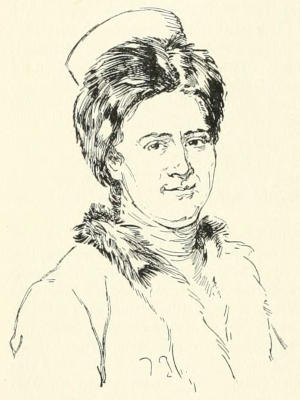
Jean Jacques Rousseau
(1712-1778)
The tranquillity of Geneva was once
more disturbed to such a degree by
passionate discourses, party writings,
and manœuvres that the ambassadors
of Zurich, Bern, and France again interfered,
and pronounced themselves in
favour of the council. The representatives
rejected their decision, the ambassadors
left Geneva, French troops
advanced on the town, and all trade and
intercourse were suspended. But the
French ministry speedily became lukewarm
in the cause of the negatives.
The latter, when they found themselves
abandoned by all foreign aid, apprehending what might ensue, patched
up a peace with the representatives. By a compact closed in March, 1768,
the burghers acquired valuable rights, and even a third party, that of the so-called
natifs or habitans (old inhabitants, excluded by birth from taking part
in public affairs), obtained extended franchises, and was flattered with a
prospect of participation in all the rights of citizenship.
But on recovery from the first panic, reciprocal hatred soon revived.
The negatives were vexed at having made such important sacrifices, and aimed
at resuming all their former ascendency. Moreover they found a favourable
hearing in the French court, which had long viewed with an evil eye the trade
and wealth of Geneva, desired to raise the neighbouring Versoix to a commercial
town, and hoped, by encouraging tumult and disorder at Geneva,
either to annihilate its industry and opulence, or ultimately to bring it under
the sovereignty of France. French emissaries therefore aided the negatives
in spiriting the natifs up against the representatives, by promising to confer
on them the franchises withheld by the latter. But the representatives flew
to arms, took possession of the gates, and speedily succeeded in disarming
the unpractised and undisciplined mob of natifs. Well aware by what
manœuvres the natifs had been led to revolt, they prudently abstained from
taking any vindictive measures against them; but, on the contrary, imparted
to them, in 1781, that equality of rights which had been promised by the
negatives, and endeavoured thus to win them over permanently to the common
cause.
[1782 A.D.]
The council, on the other hand, impelled by French influence, declared
the newly conferred rights illegally extorted, and invoked the mediation of
Bern and Zurich. But, betwixt representative stubbornness and negative
assumption, the ambassadors of these towns could exert but limited influence.
They essayed to put an end to disputes by amicable arrangements, but were
baffled by the intrigues of the French court, which was resolved to recognise
no democratical system on its frontiers, and soon proceeded to open force in
support of its secret policy. The first act of aggression was to garrison
Versoix; a measure which gave just offence to Zurich and Bern, who thereupon
renounced all adhesion to the mediation of 1738, and left the Genevans
to their own discretion. France also declared she would mix no more in the
affairs of Geneva; the government was overthrown and a new constitution
established.
Zurich and Bern now declared formally and coldly that they could not
acknowledge a government erected by revolt. Still more indignation was
exhibited by France and Savoy, who entered into a league for the coercion of
the town. Bern, too, joined this league in 1782, that the destiny of Geneva,
that point d’appui of her own dominion, might not be trusted altogether to
the caprices of foreign powers. On the appearance of the allied troops before
the gates of Geneva, the burghers, unaware of the bad state of their defences,
swore to bury themselves in the ruins of their native town rather than yield.
But when the cannon of the besiegers was advanced up to their walls, and the
alternative of desperate resistance or surrender was offered, the disunited city
opened her gates without stroke of sword, after the principal heads of the
representative party had taken to flight.
Mortal dread accompanied the victorious troops as they entered Geneva.
Many had reason to tremble for their lives, their liberty, and possessions. No
punishments, however, were inflicted, excepting only the banishment of the
principal popular leaders; but the rights of the burghers were almost entirely
annihilated by the arbitrary arrangements of the victors; the government
was invested by them with almost unlimited power, and proceeded under their
auspices to prohibit all secret societies, military exercises, books and pamphlets
on recent events, and to reinforce the garrison by twelve hundred men
under foreign leaders. Thus the town was reduced to utter subjection, and
depopulated by exile and emigration. From thenceforwards commerce and
enterprise fell into decay; and for seven long years a forced, unnatural calm
dwelt in Geneva.
During these years the government was conducted with much mildness,
the administration of justice was impartial, that of the public revenues incorrupt,
art and industry were encouraged to the utmost. But nothing could
win the lost hearts of the people back to the government. The iniquity of the
so-called règlement of 1782, the destruction of their franchises, and the disarming
of their persons, had wounded irrecoverably the feelings of the burghers.
The malcontents increased daily in number; and even many former
negatives now disowned their party, which had gone greater lengths than they
had ever wished or expected. At length, on the death of Vergennes, the
French minister, and arch enemy of Genevan independence, the spirit of
freedom awoke with all its ancient strength in Geneva, and the burghers
arose to break their slavish fetters. But the recital of the subsequent occurrences
must be postponed until we come to notice the train of events fired by
the French Revolution.
[1748-1767 A.D.]
The little principality of Neuchâtel, the succession of which had descended
in the same line since the era of the second Burgundian monarchy, came, in
1707, into the hands of the king of Prussia, as next heir to the ancient house
of Châlons. In 1748, Frederick II displayed that love of economy which distinguished
all his measures, by farming out certain parts of the public revenue
arising from tithes, ground rents, and the crown lands; from the former
administration of which many of the inhabitants had enjoyed considerable
profits. The loss of these, of course, was felt as a grievance by the losers;
but what was viewed with more concern by the mass of the inhabitants was
the prospect of still further innovations. Accordingly five communes of the
Val de Travers transmitted their remonstrances through a delegate to Berlin;
and their example was soon afterwards followed throughout the principality.
The arrival of two commissaries, despatched by the king to Neuchâtel,
was viewed with discontent as an encroachment on its immunities. Shortly
after their coming, an attempt was made to put in execution the proposed
financial system, of which the only result was to provoke a tumultuous popular
movement. On the 7th of January, 1767, the burgher assembly of
Neuchâtel passed a resolution of exclusion from the rights of citizenship,
against all who should farm or guarantee the farming of the revenues. On
this the royal commissary, Von Derschau, brought a suit before the council
of Bern, against the town of Neuchâtel; and the advocate-general, Gaudot,
who had formerly been a popular favourite, much to the surprise of his fellow-citizens,
seceded to the royal side, and thenceforwards gave his active assistance
to the commissary.
The cause was decided at Bern (with some limitations) in the royal favour.
With regard to the resolutions of the Neuchâtel burghers, already referred to,
it was decreed that they should be cancelled in the presence of the burgher
assembly, and a public apology made to the vice-governor. The costs of the
whole process to be paid by the town. Gaudot, who had attacked the civic
immunities both by word and writing, naturally became an object of popular
indignation. By way of compensation, however, he received a lucrative
government office, along with the functions of procurator-general, from which
another man had been removed who possessed the popular favour. He
returned to Neuchâtel from Bern with the royal plenipotentiaries. These
and the vice-governor advised him to take up his residence in the castle; but,
in spite of their recommendations, Gaudot thought fit to repair to his own
residence. The same evening, clamour and disturbance took place around
the house, which the magistrates were forced to protect by military force.
The next morning the mob returned in increased numbers, and was still
further exasperated by missiles being thrown down upon them. A carriage,
escorted by servants in the royal livery, which had been sent by the king’s
commissary for Gaudot, was knocked to pieces by the infuriated multitude.
Gaudot and his nephew now imprudently fired from the windows, and their
shots took effect, fatally for themselves. The exasperated populace forced
its way into the house; Gaudot was killed by three shots, and the mob dispersed
after the deed, with cries of “Long live the king.” The chief actors
in this tragedy escaped, and could be executed only in effigy. The whole
affair was ultimately compromised by the benevolent moderation of the
great Frederick; and terms of pacification were accepted by the communes,
which provided alike against arbitrary government and popular turbulence.
On this occasion, Frederick displayed more generosity than would have
been shown by any cantonal government; and his conduct seemed to justify
the general reflection, which must often occur to the student of Swiss history
that when administrative abuses are introduced into a monarchy, it only requires
a well-disposed and enlightened prince to crush the gang of official
oppressors and extortioners; because such a prince is powerfully backed in
such measures by the public opinion. Whereas, when the majority of the
ruling class in misnamed republics is corrupted so far as to speculate on the
profits of malversation, it generally takes care to recruit its ranks with new
accomplices; or, at all events, only to promote to public offices such men as
will at least shut their eyes to public abuses. The magnanimity of Frederick
was but ill repaid to his successor by the tumults which ensued in Neuchâtel
on the commencement of the French Revolution; and we have lately seen
the same misunderstandings, as in the last century, arise between the now
canton of Neuchâtel and its Prussian sovereign.
The democratical cantons, where the assembled population exercised the
supreme power in their landsgemeinde, held the lowest station, in almost
every respect, amongst the confederates. Narrowness of mind and ignorant
hatred of all innovation withstood every proposal of improvement; while
passion and prejudice, aided by the artifices of demagogues, often occasioned
acts of crying injustice. Judicial proceedings were in the highest degree
arbitrary; confession of crimes was extracted by torture, which, indeed, was
often employed when nothing more remained to confess. Capital punishment,
even for minor offences, was by no means rare. Public offices, particularly
that of bailiff or land-vogt, were commonly conferred not on the worthiest but
on the highest bidder; and the proceeds of this ignominious traffic went to
the public treasury. Was it to be wondered at if these functionaries in their
turn set justice up to auction in their bailiwicks, and endeavoured to recover
their advances to the government by every sort of oppression of its subjects?
[1780 A.D.]
Mental cultivation was extremely neglected in these cantons, scientific
establishments were rare, and those for education were, for the most part,
in the hands of the capuchins; whose esprit de corps was at least on one occasion
beneficial, by preventing the admission of the jesuits into the canton
of Schwytz in 1758. Elsewhere, however, similar influences produced worse
effects. In Glarus, so late as 1780, an unfortunate servant girl was executed
as a witch, on the charge of having lamed the leg of a child by magic, and
having caused it to vomit pins. Credulous souls were even found to believe
the affirmation that the girl had administered pin-seed through the medium
of a magical cake, which had afterwards borne its fruit within the body of
the child. The political relations of these cantons, in the period now before
us, were of little importance.
The constitutions of the aristocratical cantons had all of them this circumstance
in common, that not only the capital towns assumed the rule
of the whole canton, but the burghers of those towns themselves were divided
into ruling and non-ruling families, of which the former monopolised admission
to all places of honour. But the governments of these cantons
deserve to be treated of more at length.
Bern, which, in the first period after its foundation, had no domains of
any importance outside its walls, possessed in that immediately preceding
the French revolution a territory containing more than 400,000, inhabitants.
This considerable tract of land was administered by 250 ruling families, of
which, however, only about sixty were in actual possession of the government;
and these again were divided into so-called great and small families, and did
not easily suffer others to rise to an equality with them. The sovereign
power resided in 299 persons, of whom the great council was composed. A
little council or senate of five-and-twenty formed the executive. The rural
districts and the Pays de Vaud were governed by land-vogts or bailiffs. It
was chiefly there that discontent prevailed against the Bernese government.
The nobles of the Pays de Vaud were rendered wholly insensible to the real
and solid advantages secured to them by that government, by resentment
of their exclusion from all public employments. The peasants of that district,
for the most part subjects or bondsmen of the nobles, sighed under the weight
of feudal oppression and its accustomed offspring, poverty, neglected culture,
mental and moral abortion.
Davel
A singular attempt at revolt was made in 1723 by Major Daniel Abraham
Davel, a well-intentioned man, of excellent character, but a decided political
and religious enthusiast, possessed with the idea that he was called by inspiration
to emancipate the Vaud from Bern. He assembled the regiment of militia
which he commanded, under the pretext of a review, and with these troops,
who were altogether ignorant of his real design, and unprovided with stores
or ammunition, he surprised the town of Lausanne at a point of time when
all the Bernese land-vogts had gone to Bern for the annual installation.
Davel offered his aid for the restoration of independence to the hastily
assembled town council. He found, however, no kindred spirit in that body;
and the cautious citizens put him off with fair words till a force was under
arms sufficient to crush him. Meanwhile his troops had discovered the
real object of their commander, and shrank from him in surprise and consternation.
He himself was arrested, cruelly tortured for the discovery of
accomplices, of whom he had none, and lastly beheaded.
A certain contempt of scholastic acquirements seemed the prevailing
tone at Bern; and school education naturally came to deserve the low esteem
which it met with. Accordingly those patrician youths who did not serve
in the army remained for the most part unemployed until they obtained
places under government. The establishment of what was called the “exterior
state” afforded but a superficial substitute for more solid attainments, and
initiated youth only too early in the petty intrigues and jealousies of faction.
This institution, which was also known by the name of the “shadow state,”
was intended to give the youth of the ruling families opportunities for acquainting
themselves with the forms at least of public business, and of acquiring
an unembarrassed address, so important for republicans. It parodised the
dignities and offices of the state, the election of avoyers, councillors, and
senators, had its secretaries and functionaries of all ranks, and distributed
by lot 120 vogtships, which for the most part took their names from ruined
castles.
Without any sufficient evidence, some would refer to the era of the
Burgundian war the origin of this institution, which received the sanction
of government in 1687, and for which a council-house, far more splendid
than that which belonged to the actual government, was built in 1729. The
seal of this “exterior state” bore an ape astride on a lobster, and looking
at himself in a mirror. These and similar traits of humour seem to owe
their descent to an era exceedingly remote from the measured formality
of later times.
The government of Lucerne, which with Solothurn and Fribourg formed
the remaining pure Swiss aristocracies, consisted of a little council of six-and-thirty
members, which, reinforced by sixty-four others, held the sovereign
authority. With regard to intellectual cultivation, the most contradictory
features were observable at Lucerne. On the one hand, learning,
enlightenment, and patriotism were hereditary distinctions of some families;
while, on the other hand, the mass was imbued with ignorant fanaticism.
On the one hand, the encroachments of the papacy were resisted with inflexible
firmness; while, on the other hand, the clergy kept possession of a highly
mischievous influence in the state. On the one hand, a series of saints’
days and holidays was abolished, as being dedicated to dissoluteness more
than devotion; while, on the other hand, we are horror-struck by the burning
of a so-called heretic. In 1747, a court, consisting of four clergymen, sentenced
Jacob Schmidli, a man of blameless life, to be strangled, and then
burned with his books and writings, because he had not only read the Bible
for his private edification, but had explained and recommended it to others
as the sole true basis of religion. His wife, his six children, and seventy-one
other persons were banished, his house was burned to the ground by
the hands of the public executioner, and a monument raised on its former
site, to perpetuate the ignomy (query: of the victim or of his judges?).
The appearance of two pamphlets in 1769, on the question “whether
removal or restriction of the monastic orders might not be found beneficial
to the Catholic cantons?” excited terrible uproar at Lucerne, where certain
classes were constantly scenting danger to church or state from some quarter.
The town and county clergy, and the bigots in the council, were rejoiced
to get so good an opportunity to persecute the holders of free principles,
and raised a deplorable howl, as if the canton were on the verge of destruction.
The whole population was plunged in consternation and astonishment,
by thundering sermons and rigorous prohibitions of the obnoxious
work. Free-thinkers were fulminated against by name from the pulpits;
and Schinznach, which had witnessed the formation of the Helvetic society,
was denounced as the focus and headquarters of heresy.
This society, which aimed at the diffusion of useful knowledge, public
spirit, and union throughout the Helvetic body, without reference to varieties
of religion, rank, or political system, was founded by a knot of patriotic
and instructed men, in the pious hope of arresting the decline of the confederation.
At its commencement it consisted of no more than nine members,
but added to its numbers with astonishing rapidity. The society was
soon viewed with an evil eye by the cantonal governments, which dreaded
all independence of feeling and action in the people. At Bern, political
dangers were anticipated from it, as symptoms of refractoriness were exhibited
shortly after its formation by the nobles in the Vaud; while at Lucerne it
was regarded as a conspiracy for shaking off the Catholic religion, and assisting
the supposed ambition of Bern to gain ascendency over the whole confederation.
The aristo-democratical governments next come under our notice, and
in these, as in most of the purely aristocratical, the metropolis had obtained
unlimited power over the whole canton. In these, however, particular
families did not engross the sovereign power; the collective body of citizens
had maintained themselves by means of the regulations of their guilds in the
possession of considerable influence over the public affairs. Accordingly
the magistracy favoured the monopolies which enriched the metropolitan
traders, and imposed restraints on the industry and invention of the surrounding
country. Thence the subjects of these towns were much more
harshly administered than those of the aristocratical cantons. Their ancient
charters fell into oblivion, and were withdrawn as far as possible from public
inspection; they were not only excluded from civil and military, but even
from ecclesiastical functions; and the exercise of many branches of industry,
and the sale of their productions in the towns, was wholly cut off by corporation
privileges. Moreover, since the commencement of the century of which
we are treating, no mode of acquiring the rights of burghers remained open;
they were only conferred on extremely rare occasions to reward eminent
merit; or when the times became troublesome to conciliate influential burghers.
Hence that discontent and disaffection which broke out at the close
of the century found a principal focus in the heart of the mixed aristocracies.
In the larger cantons the public administration was for the most part
incorrupt; and that of justice was liable on the whole to fewer complaints
than in many other European countries. The pay of public servants, with
few exceptions, was extremely moderate. Men who had devoted their whole
lives to public affairs, and who had filled the highest offices in the state, lost
more than they gained by the bounty of their country. At Zurich, the
expenses of the government were wholly defrayed without the imposition
of taxes, properly so called, from the revenues and interests of the national
lands and capital, from ground-rents, tithes, the salt monopoly, and the
produce of the premium paid by the several guilds of traders in return for
their exclusive privileges. The same description is applicable to the government
of Bern, excepting that here the course of justice was tedious and expensive.
The superior financial resources of the latter canton enabled her to
execute more for public ends than Zurich. Bern invested considerable sums
in foreign securities, particularly in the English funds; and, besides, amassed
a treasure amounting to some millions of dollars, which became, as we shall
presently see, and as Mably had predicted, the booty of rapacious and powerful
neighbours.
Very different was the condition of the free or common bailiwicks, particularly
those of the democratical cantons; here most of the land-vogts
sought by every species of extortion to indemnify themselves for the sums
for which they had in fact bought their places from the general assemblies
of their respective cantons. Many made an open traffic of justice; took
presents from both parties; helped delinquents to evade deserved punishment
who could pay for exemption, and exacted contributions from the
wealthier class whenever and wherever they could. Even farther than in
the German domains of Switzerland were abuses of this kind carried in the
Italian bailiwicks, and most of all in those of the Grisons. The inevitable
tendency of such treatment was to debase the popular character in those
districts, and its effects have left unequivocal traces even to this day.
In those towns of which the constitution was grounded on corporate
bodies, the privileges of the burghers and their guilds received progressive
extensions. Propositions were made which would hardly have been conceivable
in monarchical states, and could only, in fact, take place where
particular classes had to decide upon the destiny of the rest of their fellow-countrymen.
In Bâle it was several times proposed, under the pretext of
protection to agriculture, that the exercise of certain manufactures should
be prohibited altogether in the rural part of the canton.c
The federal bond which united the various cantons and their allies was
very loose, and far different from that which fastened together the united
provinces of Holland, or even from the federal compact of the United States
of North America. There was not in Switzerland any permanent sovereign
body, no standing federal magistrate equally acknowledged by all, no central
government having its own establishment, its own treasury, its own
servants, civil and military. The general diets could not decide upon any
important question, unless it had been previously debated and decided on
in the councils of each of the cantons, who were applied to by their own
deputies for fresh instructions at every new case which was brought before
the diet. The cantons were not even each allied to all. The eight older
cantons had among them a federal compact for their common defence, and
even of these eight the five first only, viz. Zurich, Schwyz, Uri, Unterwalden,
and Lucerne, were bound to enter into no other alliance without each other’s
consent; while the other three, Glarus, Zug, and Bern, were at liberty to
form alliances with other states or foreign princes, provided such alliances
contained nothing prejudicial to the federal bond. The eight cantons were
also bound, by the convention of Stanz, to assist one another in supporting
the form of government established in each of them.
The five junior cantons, viz. Fribourg, Solothurn, Bâle, Schaffhausen,
and Appenzell, had no federal bond with the whole of the rest, nor among
themselves, but every one of them was allied to some one or more of the
others. The three forest cantons alone were allied to every one of the
other cantons. By these means, however, the guarantee of common defence
was secured to each; for, as any canton attacked had the right of calling
some other cantons to its assistance, and as these were entitled to call others,
all would be brought in to take a part, in virtue of their particular bonds.
The general diets of the confederation were either ordinary or extraordinary.
The ordinary diets met once a year at Frauenfeld in Thurgau,
instead of Baden, where, until the treaty of Aarau in 1712, they had been
accustomed to meet. The deputy from Zurich presided: he brought forward
the matters to be discussed, collected the votes, framed the resolutions,
etc. Each canton or associate had one vote and questions were decided by a
simple majority. The sittings were held with closed doors, and at the end
of the session the deputy of Zurich drew up a statement of the decisions of
the diet, of which he sent a copy round to each canton. The principal business
of the diet was to hear appeals from the common bailiwicks, and to
inspect the accounts and inquire into the conduct of the bailiffs.
Extraordinary diets were assembled at the request of any particular
canton, or of any of the foreign ministers in case of urgent business. In
such a case the canton of Zurich summoned the other cantons to send their
deputies to Frauenfeld, or any other place fixed upon, acquainting them
at the same time with the nature of the subjects which were to be discussed,
in order that the cantonal governments might give instructions to their
deputies accordingly. The foreign minister, at whose request an extraordinary
diet was convoked, was bound to pay the expenses of the deputies who
were thus called from their homes at an unexpected season.
The partial diets were held by the Protestant cantons at Aarau, and
by the Catholic ones at Lucerne. There was no fixed time for their meeting,
but they were summoned as the occasion required it.
A regulation, called the “defensionale,” was, as we have seen, agreed
upon at a general diet held at Baden in 1668, for providing against sudden
emergencies, such as an attack from foreign powers, when the proceedings
of the diet would have proved too slow for the common safety. In such a
case deputies were to be named by all the members of the Helvetic body,
and invested with full powers to direct the military force of the nation, which
was to be raised by contingents from the militia of each state. This body
consisted of 9600 men for the thirteen cantons, 1400 for the associates, and
2400 for the subject bailiwicks—in all 13,400 men; which number, however,
might be doubled and trebled if required.
The militia of each canton consisted of all the males from sixteen to sixty
years of age, and these received military instruction at certain epochs. Only
one-third of the whole, however, consisting of the youngest and strongest, were
enrolled into regiments, the other two-thirds supplying them with recruits if
necessary. The regiments were divided into fusileers and electionaries, the
fusileers being all young unmarried men, who were considered as always ready
to march at a moment’s notice; the electionaries were composed of the married
men, of an age and size proper for service, and these were called out
after the fusileers. When in active service they received regular pay; but
every man was bound to provide his own uniform, arms, and accoutrements.
The Swiss, it is well known, furnished troops to several European powers,
according to certain treaties or capitulations, as they were called, agreed
upon between those powers and the various cantons. The chief power having
Swiss troops in its service was France, who had retained them ever since the
treaty made between the Swiss and Louis XI. Under Louis XIV the number
of Swiss troops in the French service amounted to 28,000 men; but, in 1790,
at the beginning of the French Revolution, there were not more than 15,000,
who were divided into twelve regiments. Six Swiss regiments were in the
service of Holland, four were serving in Piedmont, four at Naples, and four
in Spain: the pope had also a small body guard of Swiss. There has been
considerable misconception abroad upon this subject; the cantons have been
represented as selling their countrymen as if they were cattle, while the truth
is that the men were not sold, but enlisted of their own accord for a certain
period of time, receiving the bounty money.d
Agriculture was advanced by the cultivation of clover and of other artificial
grasses, and by the consequent increase of pasturage and manure.
Many districts which had formerly been regarded as unfruitful were thus
rendered remarkable for fertility. The processes of manuring, and many
other processes in Swiss cultivation, became a model for foreign agriculturists.
Arts and manufactures were extended more and more widely. In
the canton of Bern, in the Thurgau, and elsewhere, industry was employed
on native materials in the linen manufacture; in Zurich, St. Gall, and Appenzell,
in working up imported wool in spinning, weaving, and cotton printing.
Silk manufactures occupied Zurich and Bâle, and the latter town enriched
itself by its riband manufacture. Trade in all its branches throve at Geneva;
where a wholesale watch manufacture was conducted, and from whence
watchmaking was soon spread through the district of Neuchâtel, where it
suggested many other mechanical processes.
Intellectual culture and social refinements marched abreast with commercial
wealth. Not only the towns were embellished with architectural
structures, but in the Emmenthal, and around the lakes of Zurich and Geneva,
arose new and splendid edifices which bespoke increasing opulence. In
Neuchâtel, which a century before had been inhabited by shepherds, the
villages assumed the appearance of towns; and the wealthy marts of England
or the Netherlands were recalled to the mind of the traveller by the
principal street of Winterthur. Intercourse with other states in trade or
in foreign services naturalised new wants and desires, yet many still adhered
to the old usages and manners. In whole districts, especially in the democratic
cantons, public opinion imperiously set limits to the advance of luxury.
In other places sumptuary laws maintained a struggle with the various arts
of invention; and a wholesome state of simplicity was preserved in Zurich,
St. Gall, and Bâle, in which celibacy became a rarity.c
Although in political matters dissentions prevailed, yet in intellectual
and scientific life a sense of the unity of the fatherland was beginning to
arise, notably in the reformed towns, where intellectual life had made great
strides since the success of the war of Toggenburg. Men began to study
their own position, learnt to know the individuality of Switzerland, and drew
thence the hope of a brighter future. The pioneers of the movement were
Scheuchzer of Zurich, and Haller of Bern. J. J. Scheuchzer (1672-1733),
physician and naturalist, made himself famous by various journeys into
the Swiss Alps, wrote the first natural history of Switzerland, and also completed
a large map of Switzerland, by which labours he put new life into
patriotism.
Albrecht von Haller (ob. 1777), the great poet and naturalist, by
unrivalled industry acquired an extensive and learned education; he also
possessed a strong poetic vein, and a warm and patriotic heart. Among
his poems which appeared in 1732, Die Alpen (The Alps) made a great impression
by its poetic depth and the novelty of its ideas. Full of indignation
at the depravity of the time, and yearning for natural and unspoiled conditions,
he there depicts with vigorous touches the life of nature and of men
in the Alps, the simple, beautiful customs of the Alpine folk, with a patriotic
warmth and enthusiasm before unknown. In another poem, Der Mann der
Welt (The Man of the World), he laments the degeneration of his fatherland;
in a third, Die verdorbenen Sitten (Demoralisation), in contradistinction to
the good old times, he apostrophises the decay of his own day, exclaiming—“O
Helvetia, once the land of heroes, how is it possible that the men whom
we now behold could have descended from thy former inhabitants?” By
his poems and his researches in natural science Haller became so famous in
other lands that he received a number of honourable calls; yet he declined them
all: he wanted to devote his powers to his beloved country, and from 1753
until his end he served her as a government official with affectionate devotion
and self-sacrifice.e
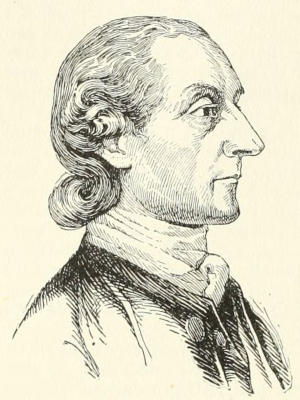
J. C. Lavater
(1741-1801)
Eloquence and daring imagination conferred European celebrity on
Lavater. Rousseau promulgated truths in education and in politics which
will not be lost for future generations, whatever alloy of paradox or perverse
misapplication they might suffer from himself or his followers. The bitterness
of religious and political dissension which had long prevailed in so many
odious forms began to decline, and the personal worth of men began to be
estimated by less absurd criteria than their speculative opinions. Old
prejudices vanished, or at all events were mitigated, and even if the recognition
of principles more enlightened was with many a matter of fashion
and imitation, still those may be deemed fortunate whose existence falls
on a period in which truth and liberal sentiments find favour and adoption.
On the whole, the century was not worse than those which had preceded
it. Even if the forms of government favoured many abuses, a more extended
spirit of activity prevailed amongst the people than in previous generations;
and though it is true that no extraordinarily great actions were performed,
it is also true that no great occasion called for their performance. It cannot
be denied that too much jealousy prevailed
between the cantons, and that more reliance
was often placed on strangers than
on fellow confederates. But Germany,
which united might have given law to
Europe, had been even more distracted by
like errors, reduced to a mere battle-field
for foreigners, and robbed of its most valuable
dependencies.c
Seldom during the eighteenth century
did the confederates act together. Only
once did the confederation appear as a unit
toward the outside. That was in 1777,
when an alliance was concluded with
France which well expressed the subserviency
of the Swiss at this period to that
country. The members of the diet convened
at Solothurn went through a humiliating
ceremony. They appeared in a
body at the ambassador’s hotel, followed
him to church and thence to the place of
the deliberations. By this treaty the Helvetic
body was bound to render a levy of
six thousand men to France in case her territory
was invaded, and in return the king of France promised the Swiss help in
danger and to maintain the privileges accorded them by his predecessors.af
[1789-1794 A.D.]
The Swiss government, as well as that large portion of their subjects who
were contented with their condition, and desired no alteration in it, were
startled out of a state of perfect tranquillity by the first shock of the French
revolution. The shifting of the whole political scenery of Europe surrounded
them with entirely new embarrassments. They resembled steersmen tolerably
capable of guiding their bark safely through the tempests of their native
lakes; but who found themselves now on unknown seas without chart or
compass. The situation of the Swiss regiments engaged in the French service
afforded the first reason for disquietude; the next was the apprehension
of infection from the principles predominant in France. Alarming political
movements soon began in the interior; and the solution of the problems
which were set before Swiss politicians by the progress of events in the neighbouring
countries was the more difficult the more various were the views,
wants, and relations of the cantons, and the lands which were subject to them.
It was in the latter districts, as might have been expected, that the new
ideas gained the greatest currency, and that the first attempts were made for
their realisation. Educated and thinking men in the subject towns and territories
brooded resentfully on their exclusion from all public posts and dignities.
In those cantons where trade and manufactures were most cultivated,
it was regarded as an intolerable hardship by the enterprising and wealthy
rural proprietor, that he was hindered by oppressive regulations from purchasing
the requisite raw materials, or from disposing of the products of
his industry in any quarter except to a wholesale dealer of the capital. Similar
resentments were excited by corporate privileges. Nevertheless, in the German
regions of Switzerland, a longer time elapsed before the new modes of
thinking, and the comparisons which they suggested, set the public mind in
motion. This took place much sooner in the west, where the French language
and neighbourhood made communication easier; above all, in Geneva, where
nothing but an auspicious hour was waited for to burst asunder a yoke imposed
by foreigners.
A rise in the price of bread, which was imputed to the government, gave
occasion to the long prepared explosion. On the 26th of February, 1789, the
burghers assailed the garrison with everything which could be turned into a
weapon of offence. Fire-engines with boiling water supplied the place of
artillery: the garrison was put to the rout, and the power of the government
overturned the more easily, as its foreign props had now ceased to support
it. The ruling class was compelled to throw itself wholly on the citizens, to
restore the ancient liberties of the town, and to recall the banished heads
of the representatives. But the hour was come for the ruin of Genevan
independence. The country people and habitans of the town now demanded
an equality of rights with the burghers, on the model of republican France;
and the latter power was induced to second their wishes, by the suggestions
of the ex-representative Clavière. The malcontents were kept for a while in
check by troops from Bern and Zurich; but, on the withdrawal of these in
1792, the country people, habitans and natifs, flew to arms, made themselves
masters of the town, deposed the government, and established, on the model
of France, a national convention, with committees of general safety and of
public welfare.
A show of moderation and tranquillity lasted some time longer; but distrust
and exasperation received continual new aliment, and the disinterested
friends of peace could hardly prevent some furious outbreak. Many votes
were gained to a proposed new constitution, by the hope of securing order
and repose; and in the beginning of 1794 it was adopted by a large majority.
In April, syndics and council were again installed in their former functions,
and the event was announced to Zurich and Bern with expressions of hope
and confidence. Bern, however, could not resolve, on the instant, to give
the name of confederates to these newly re-established authorities; and what
had been done had no effect in mitigating the violence of those who put themselves
forwards as the organs of the multitude, which they first set in motion
for their own purposes, and then were forced, in turn, to flatter its passions,
in order to continue popular favourites. Meanwhile, the price of necessaries
rose, while trade and industry stagnated; and the repeated demands for so-styled
free-will offerings to the public were answered by supplies more and
more sparing.
In order to crush, at a stroke, all resistance, and to furnish themselves
with the necessary stores and ammunition, the party of terrorists made a
nocturnal seizure of the arsenal in July, 1794, occupied all the posts in warlike
array; and filled the prisons of the town, and even the corn-magazine,
with nearly six hundred men, whom they chose to designate as aristocrats;
and amongst whom were a number of the most respectable members of the
magistracy, merchants, and men of letters. Of eight of the prisoners first
examined, a revolutionary tribunal contented itself with sentencing one to
death; but the clamour and threats of the multitude worked on these unsteady
judges to retract their verdict, and extend the same condemnation to all the
others. The doom of four of these was commuted for banishment by the
general assembly; but a band of wretches again collected, stormed the prisons,
and the bloody tribunal now sentenced their victims to be shot; and
afterwards endeavoured to excuse itself on the plea that this had only been
done to prevent worse atrocities. More executions followed, which included
several persons who had actively promoted revolution. Numbers were banished,
in order to secure the ruling party a majority in the general assembly.
The large sums required by a revolutionary government for the payment of
public officers, and the armed force of the populace, were defrayed by imposing
heavy contributions on the possessors of property; indifferentists being
made to pay double, aristocrats a treble amount.
[1796 A.D.]
Party spirit, however, cooled by degrees; approximations and concessions
took place between all classes of citizens, who felt, in common, the general
ruin of public and private happiness; and the disappointment of all the
hopes which had formerly found indulgence. In 1796, a return to the old
constitution was agreed upon, on condition of equality of rights being conceded
to the old and new burghers, and the town and country inhabitants.
The exiles returned home, and all rejoiced that they could again breathe
freely. For two years more, the little republic dragged on an infirm existence;
till it was finally united with France in 1798, and forced to partake,
for fifteen years, the destinies of that country.
Of the men who had at different times been banished for political offences
from Switzerland, many had taken refuge in the French metropolis, and
endeavoured to persuade the republican statesmen that their enemies were
equally those of France. [Notable among them was La Harpe of Vaud, who
published a treatise on the situation of the Pays de Vaud and demanded its
restoration from Bern.] Their representations found the easier audience, as
Switzerland was already regarded with greedy eyes by their hearers. “At
an early period of the Revolution,” observes an English writer,i “the views
of France were directed towards Switzerland, as well from its importance as
a barrier on her eastern frontier, as from its central position between the
German Empire and Italy. The reduction, therefore, of Switzerland, was a
favourite object of the republican rulers, and was only suspended by the
dread of adding its people to the host of enemies who menaced France on all
sides; they accordingly temporised under the mask of friendship, and succeeded
in preserving the neutrality of the Helvetic confederacy, by fomenting
the national antipathy to the house of Austria. Yet even during this specious
display of friendship, their agents industriously spread disaffection, and
prepared the mine which was ready to explode on the first favourable opportunity:
such an opportunity presented itself at the conclusion of the treaty
of Campo Formio, which left the Swiss without an ally on the Continent. At
this period the French Republic had acquired a colossal strength. The king
of Sardinia, deprived of half his territory, was the vassal of France; the
pope, and the king of Naples, owed the possession of a precarious sceptre to
the forbearance of the directory; Prussia pertinaciously maintained her close
connection with the new republic; and Austria, vanquished by the genius of
Bonaparte, had concluded a dishonourable peace.
“But the French rulers were not content with planting the tricoloured
flag on the summit of Mont Blanc, on the left bank of the Rhine, and at the
mouth of the Scheldt, and with establishing the limits of their empire by the
natural boundaries of the Pyrenees, the Alps, the Mediterranean and the
ocean. With a view to secure their territories against the future aggressions
of the continental powers, they purposed to form a series of dependent republics
along the line of their frontiers, as a kind of outwork, to remove the point
of attack. At the extremities of this line they had already established the
Ligurian and Batavian republics; the Cisalpine soon followed. A connecting
link of this chain was Switzerland, which covered the most vulnerable
parts of the French territory; and, from its natural strength and central
position, formed the citadel of Europe.”
Besides these motives, acknowledged by the French themselves, their
rapacity was stimulated by the treasures known to exist at Bern and elsewhere,
the amount of which, as usual, was enormously exaggerated. What
was required, in short, was not a motive but a pretext for intermeddling with
the internal regulations of the Helvetic body. That body had with the
utmost caution avoided giving offence; had recognised every successive form
of government in France; and had turned out of their territories the unfortunate
French émigrés who had fled thither for refuge from the rage of their
own countrymen.
The triumphs of Napoleon in Italy were concluded by the construction
of the Cisalpine Republic. The Swiss subjects of the Valteline, Chiavenna,
and Bormio, were tempted to desire participation in the freedom thus established
on their borders; and Napoleon offered the Grisons the alternative of
conceding equal rights to these districts, or of seeing them included in the
new Cisalpine state. Parties ran so high on this proposal, that no friendly
understanding was possible; and when the term allowed for reply elapsed
without any being given, Napoleon put his threat into effect, and confiscated
all property belonging to the Grisons contained in the above-mentioned districts.
Such was the first encroachment on the ancient limits of Switzerland:
shortly afterwards the bishopric of Bâle was annexed to France. Great consternation
was caused by these proceedings in the confederation; but still
more serious evils were at hand. In the canton of Bâle the peasantry murmured
loudly against the town: in the Aargau several towns advanced tumultuous
claims against Bern, for the recovery of their old and chartered rights;
and the Pays de Vaud reclaimed its freedom with more impatience than
ever. It was said besides, that a French army was already marching on
Switzerland; ostensibly to support the claims of the malcontents, but really
to make themselves masters of the land for their own purposes. Bern and
Fribourg hastily levied forces for the coercion of their turbulent dependencies;
and a diet of the confederacy was summoned at Aarau. Much was said
and nothing done at this meeting, as the cantonal governments neither
trusted each other nor their subjects. The members of the diet renewed
the original league of the cantons, as if urged by the presentiment of its coming
dissolution. The oath had hardly been taken, when a messenger from
Bâle brought the intelligence that the mansions of the land-vogts were in
flames; that a large body of peasantry had entered the town, and that all
the subject districts had declared themselves free.
The spectacle of feebleness and fear in the authorities, combined with
dogged resistance to the wishes of the people, of course diffused, instead of
quelling, the spirit of revolt. As in the thirteenth and succeeding century,
the prerogatives of the nobles had been forced to yield to the claims of a class
of burghers and of shepherds, so soon as the example of the Lombard towns,
and the growth of public prosperity, had excited independence of feeling; so
likewise, in the times of which we are treating, it had ceased to be within the
power of a privileged class to contend with success against the claims of the
so-called third order, encouraged as it was by the example of France. Some
districts, indeed, took no part in the prevalent agitations, and pertinaciously
adhered to the accustomed order of things; others, more distinguished for
enlightenment and enterprise, demanded an equality of rights in town and
country; others, again, required the restoration of ancient franchises: some
regarded nothing as attainable but by French interference; while nobler
minds retained an insurmountable abhorrence for the agency of strangers in
the internal affairs of their country.
[1797-1798 A.D.]
It became more and more evident that the policy of the French directory
led them to foment intestine discord in Switzerland. For several years past
it had been observed, that foreign emissaries set themselves to work upon
the public opinion. A person of the name of Mengaud made his appearance
at Bâle, under the unusual and equivocal title of commissary, and set his
seal on the papers of the French embassy: this individual not only made no
secret of his intelligence with the malcontents in Switzerland, but affected to
display it ostentatiously. He went to Bern on the 10th of October, 1797,
where he demanded, in a note addressed to the government, the dismissal of
the English ambassador Wickham, who had certainly exerted himself openly
against France, but had done so as the envoy of a power at war with that
country. Bern referred the demand of Mengaud to the then directing canton,
as a matter which concerned the whole confederacy.
Wickham relieved for the moment the embarrassment of the Helvetic body,
while he deprived the French directory of a present pretence for violence, by
taking his departure on a tour into Germany; but he left an able diplomatist
behind him in the person of his secretary Talbot. Mengaud was received at
Zurich and Bern with undisguised aversion, and no diplomatic visits were
paid him at either of these places. In the month of November, an embassy
from the latter town had been sent to Paris; which, though admitted to an
audience of the director Barras, soon received a rude dismissal homewards.
Great were the hopes infused into the disaffected party by the promises of
Mengaud, and other subordinate agents of France; and proportional fears
were excited amongst the friends of the old system, including the greater
number of public functionaries. In order to increase their uneasiness, Mengaud
threatened the diet of the confederation in January, 1798, with the
entrance of French troops into Switzerland, should Austria be suffered to
occupy the Grisons. He travelled to the place of meeting at Aarau, with
tricoloured flags flying from his carriage; and, on his arrival there, hung out
an immense banner in front of his house. The triumphant revolutionists of
Bâle had already formed a tricoloured flag of their own, by the addition of
green to their formal cantonal colours, black and white, and their delegate at
Paris, Ochs, had hastily sketched what he called an Helvetic constitution,
on the model of that of the French Republic. This document was printed
in Italian, French, and German, and distributed by Mengaud, not in official
quarters only, but throughout the whole population of the cantons.
In the mean time, a division of the French army, under Menard, appeared
on the western frontier; and the Pays de Vaud, protected by it, declared its
independence of Bern. The Bernese government saw the necessity of trying
the force of arms on its subjects; and the command of the forces having been
declined by councillor Erlach of Spiez, who had hitherto been one of the
strongest assertors of aristocracy, it was conferred on Colonel Rudolf Weiss,
who had, till then, sustained the character of a champion of the opposite
system; and had contributed, by a published work,g to the favourable temper
of the partisans of Robespierre towards the Swiss confederation. An
unusual delegation of full powers placed in his hands the whole military government
of the Vaud. The new commander held conferences with the leaders
of the malcontents; published a treatiseh intended to conciliate them, but
intermixed conciliation with menace. Chillon was recovered by surprise
from the insurgents, and the German troops of Bern were moved on the frontiers
of the Vaud.
Meanwhile, General Menard was already on the lake of Geneva, with ten
thousand men of the conquering army of Italy; and to him the insurgent
leaders, alarmed for their own safety, addressed themselves. Menard replied,
that he was instructed to give them aid and protection; and threatened
Colonel Weiss that he would repel force with force, if the former should persist
in drawing troops around a territory already declared independent, and
in arming the communes against each other. Without taking any measures
of defence—without even attempting to maintain himself on the high
grounds—Weiss withdrew to the neighbourhood of Yverdun. It happened,
accidentally, that two French hussars were shot on the outposts of the Bernese
army, because they had not immediately answered the challenge of the sentinels.
This incident was taken up by Menard, and afterwards by the directory,
as an infringement of the law of nations, and the commencement of
hostilities.
The revolution of Bâle, and the entrance of French troops into the Pays
de Vaud, rendered it impossible for reflecting men any longer to doubt that
sweeping social changes were inevitable. Yet the Swiss democracies would
not be persuaded that anyone could shake their constitutions, or force on
them a new species of freedom. The numerous friends of things as they were
still hoped to steer themselves through the crisis without any great sacrifices,
by mere dint of tenacity and delay. Many, moreover, flattered themselves
with the notion that the plans of France were levelled at no wider mark than
the Vaud; and were prompted by a petty feeling of jealousy towards Bern
[the stronghold of the aristocracy], to see nothing in the affair but a mortification
to that envied canton.
It could hardly be conceived at Bern, that the French should have
advanced without meeting any resistance up to Yverdun, while the headquarters
of Colonel Weiss were withdrawn behind Avenche. He was instantly
dismissed from his command, which was transferred to General Erlach of
Hindelbank; but the evil effects of exorbitant discretionary powers had
been so sensibly felt, that the opposite extreme was now adopted. Meanwhile,
the leading statesmen of Bern, had, at length, became convinced that
concessions must be made to the people. Fifty-two members were added to
the great council from amongst the burghers, citizens of the minor towns, and
rural inhabitants. It was resolved to introduce, within a year’s time, a new
constitution; in which admission to every public function should be open to
all, and due proportion should be observed in the emoluments of all public
services. These resolutions were laid before the directory, together with a
demand for the withdrawal of the French troops. The government also
stooped to make a like communication to Mengaud, to acquaint him with
the actual political system of Bern, and inform him of the wish of that canton
to preserve peace with France. Mengaud made just such an answer as ought
to have been expected from him. He demanded a prompt and complete
change of the old political system, declared that further delays could not be
suffered by the majesty of the French Republic; and designated the persevering
defenders of the existing order as a handful of inveterate tyrants.
Disregarding their own positive engagements, the French, on the 8th of
February, took possession of the town of Bienne. Yet the confederates still
hoped to conciliate France, and were encouraged in this illusion by General
Brune, who now commanded the French troops, reinforced by several thousand
men, and fixed his headquarters at Payerne. This subtle leader, who,
without having performed a lengthened public career, was, to borrow a diplomatic
expression, rompu dans les affaires, proposed, with artful blandishments,
and with hinted hopes of peaceful adjustment, an armistice of fourteen
days; during which the discipline and enthusiasm of the Bernese army had
time to abate, indecision and distrust to increase, and recruits to join the
French army.
Meanwhile, General Schauenburg had collected a division of troops on
the frontiers of Solothurn and Bern, equal in strength to that of Brune. The
latter announced, on the 26th of February, that he had received full powers
to treat from the executive directory. He proposed his ultimatum to the
Swiss delegates, that without farther delay they should introduce a provisional
government, take measures for the establishment of a new constitution,
with securities for freedom and equality, liberate all prisoners for political
offences, and withdraw their own troops, as well as those of the other cantons.
On the due fulfilment of these conditions, the French troops should be
drawn off likewise; and should not again enter the Swiss territory, unless the
government called for their assistance.
On the very day when Brune had given his insolent ultimatum, Erlach
entered the great council at Bern, accompanied by eighty of his officers, who
were members, like himself, of that body. In a moment of unusual resolution,
he was invested with full powers to commence hostilities on the close of
the armistice. However, two days afterwards, the delegates returned from
Brune’s encampment at Payerne. Erlach and his brothers in arms were no
longer present in council; the rest of that body were paralysed by the imminent
and gigantic danger; and the full powers which had just been given the
general were taken away. The same evening, Erlach received instructions
not to attack the French, which fired his troops with anger and suspicion, and
tended to confirm the belief in the treachery of their leaders, already widely
prevalent in the army. Brune’s ultimatum, in all its principal features, was
accepted. The delegates of Zurich, Wyss, and Tscharner sought a conference
with him, when he renewed his former offers in cold and peremptory language;
but now added a novel stipulation to them, namely, that, even after
the confederate troops were disbanded, his should remain till the new constitution
should be established. It was affirmed, truly or otherwise, that he
granted, without difficulty, an extension of the truce for twenty-four hours;
notwithstanding which, the delegates, on their return, saw his troops already
in motion for the attack. Orders for the commencement of hostilities had
also been forwarded from the council of war at Bern to the army, and two
hours afterwards, retracted.
In obedience to the first of these contradictory instructions, the Bernese
colonel Gross had given notice to the French outposts that the truce would
come to an end at ten in the evening of the 1st of March; but when he withdrew
his former announcement on the arrival of counter-orders, Schauenburg
would admit no further parley. He had already attacked, without warning,
the old castle of Dornach, in the neighbourhood of Bâle, which sustained a
siege of twenty-four hours. The attack of a Bernese division near Vingels
was repulsed with loss, and the French surprised the Bernese posts at Lengnau,
which they carried after an obstinate resistance. The town of Solothurn
capitulated, on Schauenburg’s appearance before it. The passage across the
Aar now lay open to the French troops. Fribourg was attacked and taken,
though a stand was made by the Bernese garrison.
Erlach was now compelled to withdraw his troops behind the Aar and the
Sense; though it was not without extreme reluctance that the men of Bern
abandoned Morat. On the 3rd of March, Brune destroyed one of the finest
monuments of Swiss courage and union, the Ossuary of Morat; and the
French, among whom were many natives of Burgundy, honoured the bones
of their ancestors with a grave, after an interval of more than three hundred
years. Now at length, Bern, Solothurn, and Fribourg proclaimed a levy en
masse of the able-bodied men within their territories. The Bernese army was
in a dreadful state of confusion; particularly that division which stood directly
opposed to Brune, in which the distrust and exasperation of the soldiers were
at their highest pitch. Officers were dismissed by their soldiers, and others
put in their place. Colonels Stettler and Ryhiner were bayonetted and shot
before the very gates of Bern; and Colonels Crusez and Goumoens fell beneath
the sabre-strokes of their own dragoons. Nevertheless, the troops were again
assembled under command of Grafenried, who was admirably supported by
his officers, and repulsed the French in every attempt to charge them at the
point of the bayonet. Eighteen cannons were taken from the enemy, and
their loss in men besides was very considerable.
The Capitulation of Berne; the Constitution Unitaire (1798 A.D.)
The native troops had now fully recovered spirit and confidence; but just
as Grafenried prepared to cross the Sense at Neueneck, the decisive intelligence
arrived that Bern was in the hands of the enemy! Early on the 5th, an
attack had been made by Schauenburg on Solothurn. His force was far
numerically superior to the Bernese; his horse artillery terrified the native
militia by its novelty, and his cavalry was nearly eight-fold that of Bern in
numbers. At Fraubrunnen, the French turned the left flank of the Bernese:
in the Grauholz and at Breitenfeld their militia under Erlach offered a brave
resistance, armed with scythes and other agricultural implements. Men,
women, and even children mixed, and fell in the mortal struggle. On its
unsuccessful issue, ensued the capitulation of Bern.
All was lost: the armed bands of the peasantry dispersed in every direction
with loud accusations of treason against their officers, many of whom
were slain by their own men. Amongst these was the general Erlach, an
illustrious name in the annals of Bern. That unfortunate commander, and
the avoyer Steiger, when the fortune of the day was decided, retreated towards
the Oberland, whither they knew that arms and money had already been
despatched by the government, and where they still hoped to offer an effective
resistance. But Erlach was murdered in the way by the enraged fugitives,
who breathed nothing but revenge for their imaginary betrayal, and it
was only by chance that Steiger did not meet a similar fate.
Even public extremity could not restore public spirit. Every little canton
treated, armed, and cared for itself exclusively, totally regardless of the rest.
Wherever the authorities had, till then, withheld freedom from their subjects,
they no longer delayed to grant it; but bestowed emancipation with so ill a
grace, as to indicate how gladly they would have refused it, had they dared.
France now assumed a tone of direct command, and proclaimed the dissolution
of the Helvetic body, and the establishment of a constitution unitaire,
embracing the whole of Switzerland under one uniform system of government.
This system announced a perfect equality of rights between the inhabitants
of the towns and of the villages, assigned the nomination of judges, magistrates,
and legislators, to the people in their primary assemblies, and entrusted
to the government the choice of executive functionaries. The founders of
this new Helvetic republic next proceeded to the more material objects of
their mission. They levied large contributions on the towns, appropriated
the treasures amassed at Bern, Zurich, Solothurn, and Fribourg, and carried
off many members of council and other persons, as hostages for the further
payments exacted from those places.
But the people of Uri, Nidwalden, Schwyz, and Glarus, were resolved not
to deliver up their old independence so easily, and organised a heroic, though
a useless, resistance under their brave leader Aloys Reding. The most brilliant
and the most sanguinary struggle took place at Rothenthurm, in the
neighbourhood of the battle-field of Morgarten. These Alpine shepherds
combated with a spirit and success which showed them not unworthy of their
forefathers. Thrice were the attacks of regular troops, four times their number,
repulsed, with serious loss on the side of the enemy. But the vigour of
this peasant militia was exhausted by their very successes, and they were,
finally, compelled to accept terms from the invaders, and to bow beneath the
yoke of the Helvetic Republic. Thus ended the old Swiss confederation,
after enduring for a term of nearly five centuries. “It fell,” says an enlightened
native historian,[1] “not exactly for want of strength in the bands which
held it together; for, without any stronger bond of union the old confederates
won their freedom, crushed or repelled the force of mighty antagonists,
and rendered themselves powerful and formidable. The Swiss succumbed in
the last unfortunate struggle, because the feeling of duty, the lofty faith in
their country and its fortunes, had become chilled in the bosoms of the many,
and because the democratical cantons thought of none but themselves.”
While the well-instructed friends of their country regretted the rude violence
with which every link in the system of society, from the Alps to the
Jura, had been totally torn away from its ancient holdings, they could not
fail to perceive the ultimate benefits educible from the general convulsion.
The former aggregation of little states had been productive of estrangement
and enmity; the cantons had been proved powerless, even for self-defence;
separately too poor for public enterprises; collectively incapable of any combined
action. But now an opportunity seemed to be given to the Swiss people
of becoming one great family, enjoying equal rights. The mass of the
people, however, was not penetrated by such ideas, and only deplored the
breach made in their old habits and usages. They had, indeed, demanded
freedom and independence, but not this melting up into an uniform mass.
They would have preferred that every petty district, nay, every single valley,
should become a free and independent canton, ruling itself in its own assemblies,
according to its own pleasure, and only connected by federal ties with
the rest of the Swiss people. The whole subsequent march of events tended
only to increase the desire for a subdivided federative system of this kind,
and the aversion for the newly established order. The new general government,
called an executive directory, after its prototype at Paris, resided at
Aarau without inspiring either respect or confidence, dependent on its sole
protectors, the French plenipotentiaries. In the senate and the great council,
composed of delegates from all the cantons, the conflicting opinions of parties
caused an incessant wordy warfare. Out of doors the same parties abandoned
parliamentary weapons, and asserted their discordant creeds with arms in
their hands. New and old laws and regulations were perpetually coming
in collision. While the state was often without the most indispensable means
for its maintenance, and even for the daily pay of its functionaries, the French
plenipotentiaries, leaders, and subalterns, rioted in shameless superfluities at
the cost of the country, and sent to France the surplus of their plunder.
The discontents of the people were considerably aggravated by the murmurs
and manœuvres of the ci-devant authorities; of the monks who apprehended
the abolition of all monasteries; of the priests who had suffered
diminution of the stipends, and of the traders and artisans in the towns who
no longer enjoyed the sweets of corporations and monopolies. They trusted
to the approaching renewal of war between France and Austria, and prepared
to support the emperor for the expulsion of the French. When the whole
population was summoned, in July, 1798, to take the oath of allegiance to
the newly formed constitution, disturbances and revolts took place in many
districts.c
CHAPTER VI. SWITZERLAND SINCE 1798 — CHANGES OF CONSTITUTIONS AND ADMINISTRATIONS — THE EVACUATION OF SWITZERLAND; THE NOMINATION OF DEPUTIES (1802-1803 A.D.) — THE ACT OF MEDIATION (1813 A.D.); CABALS FOLLOW NAPOLEON’S FALL — SWITZERLAND DEVELOPS ALONG NEW LINES — REACTION AND REFORM; EFFECTS OF THE REVOLUTION OF JULY — SIEBENER KONKORDAT; DISPUTES OVER ASYLUM AND RELIGION — THE SONDERBUND WAR (1847 A.D.)
War with France was at length renewed by the emperor of Austria, and
a division of his army entered the Grisons. A signal defeat sustained by the
French troops near Stockach, in Swabia, the victorious advance of the Austrian
army into Switzerland, and the removal of the seat of the Helvetic
government from Lucerne to Bern, seemed to inspire the conflicting parties
with renewed animation and fury. Swiss fought against Swiss under the
banners of France and Austria; tumults and revolts took place on account
of the French conscription or in favour of the Austrian invasion; battles were
fought between foreign armies in the valleys, on the Alps, and on the banks
of the lakes; and horse and man clambered over heights which had formerly
been only known to the chamois hunter. The Grisons and the mountainous
lands as far as the St. Gotthard were alternately won and lost by French and
Germans. The victorious banners of Austria were carried on the left as far
as Zurich and the St. Gotthard, on the right up to the banks of the Rhine,
supported by the Russians under Suvarov. Switzerland had never sustained
such desolating inroads since the times of the Romans, Alamanni, and Burgundians.
Many of the old superseded members of the government now looked forward
to the speedy restoration of their authority, which they here and there
attempted to recover with the assistance of the Austrian bayonets: even the
new abbot of St. Gall resumed the exercise of his feudal rights, such as they
had existed before the recent emancipation which had been granted to the
people. The effects of this iniquitous resumption did not fail soon to be felt
by the proud prelate himself; Zurich and Schaffhausen, too, were soon forced
to acknowledge that the people did not wish to be replaced in its state of
subjection. The decisive and brilliant victory of Massena near Zurich, and
the destruction of Suvarov’s army, which had marched over the Alps from
Italy, restored the Helvetic constitution throughout the whole country.
Parties now supplanted and succeeded each other in quick succession, so that
none could remain long at the helm or consult for the public benefit.
[1801 A.D.]
First of all, the legislative councils dissolved the executive directory,
and substituted for it an executive committee; then, in its turn, this executive
committee dissolved the councils, convoked a new legislature, and styled
itself an executive council. Twelve months afterwards a general Helvetic
diet was assembled at Bern for the formation of a new and improved constitution:
this, like the former deliberative bodies, was arbitrarily deposed from
its functions, and a newest-of-all constitution established, in October, 1801.
Alois Reding, the victor of Rothenthurm, as the foremost Swiss landammann,
was placed at the head of the senate; but as he possessed neither the confidence
of the French rulers nor that of those who detested all recurrence to
the old state of things, a new act of arbitrary power deposed him from the
presidency of the council.
These continual changes of administration were looked upon with absolute
indifference by the Swiss people, who only sighed at the total interruption
of law and order, the increase of taxes, and the lawless acts of the French
soldiery. The Valais more particularly suffered by the military tyranny to
which it was subjected. The object of France was to separate it from Switzerland,
in order to keep a route open across the Alps into Italy.
In the same degree as popular consideration ceased to attend the ever-changing
but equally odious aspects of the new government, individual opinions
and wild fancies obtained prevalence. Mystical views were propagated
in Appenzell; and the anabaptists reared their heads once more in Bern and
Zurich. The quiet of the former town and its neighbourhood was suddenly
disturbed by a swarm of fanatics from Amsoldingen. Two years before, a
quack doctor and fanatic, by name Antony Unternerer, had fixed his abode
in that village. A certain flow of language, combined with prepossessing
manners and the profuse employment of benedictory formulas in human
diseases, as well as in those of cattle, had gained for this fellow the confidence
of the multitude. He held meetings in which particular parts of the New
Testament were interpreted in a new and peculiar manner; and his adherents
ceased their attendance on the ordinary divine service. Unternerer addressed
a summons in writing to the supreme tribunal of Bern, to appear, with all its
prisoners and their keepers, in the cathedral church on the morning of Good
Friday, when the Saviour of the world would ascend the pulpit and hold his
judgment. He also summoned all his disciples to meet at Bern on the same
day. Many of them had already remained during several days assembled
together; and, anticipating the coming judgment, had transferred their
worldly possessions to others. Curiosity drew a multitude together from all
quarters. Unternerer himself was announced as Saviour by his adherents;
and seditious projects peeped out under the mantle of fanaticism. However,
such a wholesome effect was produced by the arrest of the ringleader, the
consignment of his most conspicuous followers to the lunatic hospital, and
the billetting of dragoons in the houses of others, that the poor enthusiasts
soon came to their senses, lamenting the error of their ways and the transfer
of their properties.
[1802-1803 A.D.]
The Peace of Amiens, betwixt France and the other belligerent powers in
consequence of which the French garrisons were drawn home out of Switzerland,
afforded opportunity to the party and provincial spirit to show itself
with new vigour. On the 12th of July Montrichard, the French resident in
Switzerland, communicated in an extra-official note to the Helvetic landammann,
Dolder, that he had received commands from the minister of war
to hold himself, with the troops under his orders, in readiness for instant
return to France. The landammann laid this note before the then executive
council, who were considerably embarrassed by its import, and addressed
themselves to Montrichard and to the Swiss ambassador at Paris, to petition
for a postponement of the measure. But shortly afterwards, Boizot, secretary
of the Helvetic embassy, arrived from Paris with Talleyrand’s note,
which fixed for the approaching 20th of July the complete evacuation of
Switzerland. It was now out of the question for the heads of the Helvetic
government to oppose themselves to a measure invoked by the wishes of a
large majority. Accordingly the executive council did its best to assume an
unconstrained and easy attitude; and with all expedition voted its liveliest
thanks to the first consul for his purpose of withdrawing his troops from
Switzerland, which they hailed as the highest proof of his benevolence and respect
for the independence of the Helvetic nation.
The reply of the French minister was couched in terms of disinterested
delicacy, which almost seemed ironical. He talked of the French troops as
the battalions which the first consul had consented to leave in Switzerland
on the conclusion of peace. He based the proposed measure on the confidence
entertained by the first consul in the virtues of the Helvetic people,
who were now better agreed, as he said, on the principles of political organisation,
and in whose attachment the government would find sufficient securities
for the maintenance of order and tranquillity. “The Helvetic government
could regard this resolution but as a pledge of the consul’s confidence in its
friendly intentions and policy, and of his disinclination to meddle with the
internal affairs of other nations.”
It is impossible to assign with any certainty the motives by which this
ambiguous language and conduct were dictated. The first consul may have
meant to give a popular example of moderation and respect for the faith of
treaties; or he may have designed a covert chastisement for the feeble attempts
at independence made by the Helvetic government and its refusal of unconditional
acquiescence in the projected separation of the Valais; or he may
have wished to extort an express prayer for the stay of his troops, or to revive
the struggle of parties, and compel the Helvetic government to throw itself
into the arms of France, and urge him, as though against his will, to assume
the part of arbiter and ruler; or, finally, perhaps, the best solution of his conduct
may be found by supposing the combination of all or most of these
motives.
Conformably with the system thus enforced upon them, the executive
council made known to the Swiss people the departure of the French troops,
as a gracious boon the offer of which they had eagerly accepted. In effect, the
removal of these troops was performed with such celerity that none were left
behind but the sick in the hospitals and a handful of men here and there to
guard whatever French property was not of a movable description.
The news of the retreat of the French troops and the ill-concealed uneasiness
of the government flew through the country with wonderful rapidity,
and everywhere roused the concealed but numerous enemies of the existing
order, who had hitherto lurked inactively, as it were in scattered cantonments.
The Valais declared itself independent. Uri, Schwyz, and Unterwalden
took up arms against the Helvetic government. The town of Zurich,
likewise, threw off allegiance to it—an example which was speedily followed
by Schaffhausen and Bâle. A general levy took place in the Aargau against
Bern: the helpless Helvetic government fled for refuge to Lausanne, while a
diet was held in Schwyz for the restoration of the old league. The feeble
body of troops in the pay of the government were driven from the interior of
the country, and followed their employers into the Vaud: everywhere the
opposite factions prepared for active hostilities; the towns planned the destruction
of the general government; the peasants armed for their freedom
against the pretensions of the towns; and the Pays de Vaud arrayed itself
in defence of Helvetic unity. Blood had already flowed, and civil war
appeared inevitable, when Napoleon turned his eyes again upon Switzerland,
and commanded peace in a tone which was not apt to meet with resistance.
“Inhabitants of Switzerland” (such were the terms of a declaration
addressed by him through General Rapp to the cantons of the Helvetic
Republic): “you have presented, during two years, a melancholy spectacle.
Sovereign power has alternately been seized by opposite factions, whose
transitory and partial sway has only served to illustrate their own incapacity
and weakness. If you are left to yourselves any longer, you will cut one
another to pieces for years, without any prospect of coming to a rational
understanding. Your intestine discord never could be terminated without
the effective interposition of France. I had resolved not to mix in your
affairs; but I cannot and will not view with indifference those calamities to
which I now perceive you exposed. I retract my former resolution. I offer
myself as your mediator, and will exert my mediation with that energy
which becomes the powerful nation in whose name I speak. Five days after
reception of the present declaration, the senate shall assemble at Bern to
nominate three deputies to be sent to Paris, and each canton will also be
admitted to send delegates thither. All citizens who have held public employments
during the last three years may also appear at Paris to deliberate
by what means may best be effected the restoration of concord and the
reconciliation of parties. Every rational man must perceive that my purposed
mediation is a blessing conferred on Switzerland by that providence
which, amidst so many concurring causes of social dissolution, has always
preserved your national existence and independence. It would be painful
to think that destiny had singled out this epoch, which has called to life so
many new republics, as the hour of destruction to one of the oldest commonwealths
in Europe.”
The Helvetic senate instantly replied to this announcement by declaring
that it received, with lively gratitude, this new proof of the friendly dispositions
of the first consul, and would conduct itself in all points in conformity
with his wishes. In a proclamation addressed to the Helvetic people, after
some allusion to the mighty and uplifted arm of the mediator, it recommended
union, tranquillity, and calm expectation. The cantonal diets met to elect
deputies to Paris. The several communes also were permitted to despatch
delegates thither at their own expense. The mandate of Napoleon and the
presence of his soldiers induced conflicting parties to suspend their hostilities,
and tacitly, at least, to acquiesce in his mediation, as they could come to no
agreement with each other.
[1803-1813 A.D.]
On the 10th of December, 1803, Swiss delegates were received in the office
of foreign affairs at Paris, to hear a note of Bonaparte read, in which he
addressed them as president of the French and Cisalpine republics, and laid
down the basis of his intended mediation. “A federal constitution,” he said,
“is a point of prime necessity for you. Nature herself has adapted Switzerland
for it. What you want is an equality of rights among the cantons, a
renunciation of all family privileges, and the independent federative organisation
of each canton. The central constitution may be easily arranged afterwards.
The main points for your people are neutrality, promotion of trade,
and frugal administration: this is what I have always said to your delegates
when they asked my advice; but the very men who seemed to be the best
aware of its truth turned out to be the most obstinately wedded to their
privileges. They attached themselves, and looked for support, to the enemies
of France. The first acts of your insurgents were to appeal to the privileged
orders, annihilate equality, and insult the French people. No party shall
triumph; no counter-revolution take place. In case of violation of neutrality,
your government must decide upon making common cause with France.”
On the 12th, Bonaparte received a select number of the Swiss deputation
to whom he further addressed himself as follows: “The only constitution fit
for Switzerland, considering its small extent and its poverty, is such a one as
shall not involve an oppressive load of taxation. Federalism weakens larger
states by splitting their forces, while it strengthens small ones by leaving a
free range to individual energies.” He added, with an openness peculiar
to great characters, and unequivocally indicative of good will, “When I make
any demand of an individual, he does not often dare to refuse it; but if I am
forced to apply myself to a crowd of cantonal governments, each of them
may declare itself incompetent to answer. A diet is called: a few months’
time is gained; and the storm blows over.”
Almost every word of the first consul during these negotiations has historical
value. Most of his expressions wear a character of greatness; all of them
afford a clue to the system on which he acted. One or two passages, taken
at random here and there, will suffice for a specimen: “It is the democratic
cantons which distinguish you, and draw on you the eyes of the world. It is
they which do not allow the thought of melting you up with other states to
gain any coherence or consistency. The permission to settle wherever they
please, in pursuit of their vocation, must be extended to all natives of Switzerland.
The small cantons are said to be averse to this principle; but who on
earth would ever think of troubling them by settling amongst them? France
will re-open a source of profit in favour of these poorer cantons, by taking
additional regiments into her pay. France will do this, not because she needs
additional troops but because she feels an interest in attaching these democracies.”
The Act of Mediation, which resulted from these conferences, restored
the old federative system; but not without introducing very considerable
improvements. The amnesty announced by it precluded all persecutions,
and the new agitations necessarily arising from them. All servitude and all
privilege were abolished; while equality of rights and freedom of industry
were established. The mischievous freedom formerly enjoyed by the several
cantons of entering into hostilities or alliances against each other was quite
put an end to. In future, they could only use their arms against the common
enemy; and the objects of the whole league could no longer be frustrated by
the humours of its individual members.
The dissolution of the Helvetic general government followed naturally on
the completion of the above-mentioned arrangements; and soon afterwards
Napoleon recalled his troops from Switzerland. The people, in almost every
part of the country, returned quietly to their usual occupations, and tendered
their allegiance to the new order of things. In the canton of Zurich alone
several communes refused the oaths; complaining of the difficulties newly
thrown in the way of the redemption of tithes, ground-rent, and other burdens.
They would listen to no friendly representations; but committed acts of
violence on unoffending functionaries, set fire to the castle of Wadenschwyl,
and finally took to arms. The prolonged disorders of former years had accustomed
them to lawless self-defence; but the insurrection was soon suppressed
by the aid of the neighbouring cantons, combined with the well-affected part
of the Zurichers.
The ringleader John James Willi, shoemaker in the village of Horgen,
and others of his more conspicuous comrades, were punished with death.
The less distinguished rioters suffered imprisonment, and forty-two offending
communes were visited with a war-tax of above 200,000 florins. It was well
that the first flame of revolt was speedily extinguished, before it had time to
spread itself through the country. Parties remained everywhere unreconciled;
and each imagined nothing to be required for their predominance but
the fall of the new order of things. The friends of Helvetic unity still murmured
at the cantonal partition of the country. The monasteries murmured
as they felt their existence threatened; and Pancrace, the ci-devant abbot
of St. Gall, openly stigmatised the inhabitants of that district as contumacious
vassals of the empire. Many of the country people murmured, who wished
for Landsgemeinde, on the model of the original cantons. Many patrician
and city families murmured that their privileges were swept away, and the
peasantry no longer their subjects. The majority of the people, however,
wished for nothing but peace and quiet, and decidedly adhered to the existing
order of things, and the rights which they had acquired under that order.
Thus the peace of the country remained for the most part undisturbed;
and a series of comparatively prosperous years followed. The energies of
the Swiss had been awakened by the years of revolution and of civil war,
and displayed themselves in a hitherto unprecedented degree. They no
longer stood apart from each other as formerly, like strangers; but had been
made better acquainted by the storms of social collision. The concerns of
each canton were now interesting to all. Journals and newspapers, which
had formerly been suppressed by timid governments, instructed the people
in useful knowledge, and drew its attention to public affairs. The Swiss of
all cantons formed societies for the furtherance of objects of common utility,
for the encouragement of various arts and sciences, and for the maintenance
of concord and patriotism. The canal of the Linth formed a lasting monument
of this newly reawakened public spirit.
Since the people had ceased to be viewed as in a state of perpetual infancy
a new impulse was given to trade and industry, which were now no longer
cramped and confined, as formerly, by corporate restrictions and monopolies.
The participation in public affairs allowed to all free citizens enforced a mild
and equitable conduct on the governments. Schools were increased and
improved throughout the country; the military force was newly organised;
and, on the whole, a greater number of laudable objects were provided for in
the space of ten years than had been thought of in the previous century.
When the throne of Napoleon sank under the power of the allies, the
public-spirited part of the Swiss nation fondly imagined that the hour was
come in which their country’s honour and independence might be established
on a firmer footing than ever. To preserve the benefits gained to the land
by his act of mediation was the wish of a large majority of the people. If
the Swiss had sometimes felt, along with others, the iron arm of that formidable
despot (who had, however, spared them more than any neighbouring
population), yet his gift of a constitution had become deservedly dear to them.
It had dried up innumerable sources of discord. Under it a fellow-feeling,
never before experienced, had been diffused in the same degree as individual
pride had been humbled. The cessation of a state of subjection, wherever it
had before existed, had decupled the number of confederates, and all restraints
on free communication betwixt one canton and another had been removed.
The cantons sent their contingents for the protection of the frontiers,
voted extraordinary imposts for their maintenance, and a diet was assembled
at Zurich with unanimous instructions from its constituents. This body
declared with one voice its resolution “to observe a conscientious and impartial
neutrality with regard to all the high belligerent powers,” expressing, at
the same time, its full anticipation that “the same would be acknowledged
upon their part.” It addressed itself as follows to the confederates: “The
great and only end of all our endeavours is to maintain this neutrality by
every means in our power; to protect our country’s freedom and independence;
to preserve its soil inviolate, and to defend its constitution.” The
senate of Bern expressed itself as follows: “Our object is to guard the pacific
borders of our country inviolate from the march of foreign armies; we are
unanimously resolved, however, at all events, to maintain tranquillity, order,
and security in our canton by all the means which stand in our power.”
Such was the general sense of the Swiss people. Not such, however, was
the sense of the great families in the once dominant towns of the confederation.
Many of these wished to see their country invaded by foreign armies, by aid
of which they hoped to restore the old league of the thirteen cantons, with all
its hated appendages of sovereignty and servitude, which had vanished from
the face of the land in 1798.
The Swiss delegates were received in a friendly manner by the emperor
of Austria and the king of Prussia; but no direct recognition of their neutrality
was vouchsafed to them. The satellites of these monarchs gave them distinctly
to understand that Switzerland was regarded and would be treated
as nothing else than as a limb of the French system. A large Austrian force
was collected on the frontiers, particularly in the neighbourhood of Bâle;
yet many still believed that a determined vindication of neutrality would not
be put down by violence. In the meantime, the Swiss delegates were stopped
at Fribourg in Brisgau on their return homewards from Frankfort, and their
letters were intercepted. A general enervation seemed to have spread itself
over the conduct of the affairs of the confederation at this crisis. There is no
ground for supposing that the men who led their forces and presided in their
governments acted the part of secret conspirators against the order of things
which they professed to defend. But when the overwhelming powers of the
allies came pouring in upon them; when these were joined by kings who owed
their crowns to Napoleon; when even the French ambassador dissuaded
reinforcement of the frontier cordon—when, in short, the ancient state of
things renewed its sway on every side, while a decided popular will showed
itself nowhere, opposition was in a manner overwhelmed by the force of circumstances.
A proclamation, couched in terms of mildness and of amity, was issued
by Prince Schwarzenberg, the Austrian commander-in-chief; and at the same
time Count Capo d’Istria declared, on his arrival in Zurich, that the monarchs
could not recognise a neutrality which, in the existing situation of Switzerland,
must be nothing more than nominal. The armies of the allied powers hoped to
find none but friends there. Their majesties pledged themselves solemnly not
to lay down their arms until they should have secured the restoration to Switzerland
of the territories wrested from her by France—a pledge which we shall
presently see was adhered to but indifferently. They disclaimed all wish to
meddle with her internal constitution; but at the same time could not allow
her to remain under foreign influence. They would recognise her neutrality
from that day in which she became free and independent.
The Austrian army marched over the Rhine on the 21st of December, 1813,
through the territories of Bâle, Aargau, Solothurn, and Bern, into France.
During the first months of the following year the burdens and even the dangers
of war were felt very severely in the northern and western parts of Switzerland,
particularly in Bâle, which received much annoyance from the obstinate
defence of Hüningen, and the hostile disposition of the commander of that
place. Geneva, too, while she welcomed in anticipation the new birth of
her ancient independence, saw herself suddenly surrounded with the actual
horrors of warfare, and threatened with a regular siege. The continual passage
of large bodies of troops brought malignant fevers and maladies in their
train, and it became more and more difficult to supply them with provisions.
On the entrance of the Austrian troops, Bern set the example of abolishing
the Act of Mediation, and reclaimed the restoration of the predominance
which she had previously enjoyed in the Helvetic body. The example was
followed first by Solothurn and Fribourg, and then by Lucerne. In Zurich,
too, the diet declared the Act of Mediation, by virtue of which it was sitting,
null and void, and drew up a plan for a new confederation of the nineteen
cantons. But this was not enough for some of the men in power at that
time, who demanded nothing short of the restoration of the old league of the
thirteen cantons, and had already summoned the Pays de Vaud and the Aargau
to return under the government of Bern. These cantons, however, resolutely
rejected the proposal.
The diet, which was again convoked at Zurich and consisted of delegates
newly elected by all the nineteen cantons, was now the only feeble bond which
kept the Helvetic body together. Interested voices were raised on every side
for annihilating or mutilating the last constructed cantons, which for sixteen
years had enjoyed the boon of freedom and independence. Zug demanded a
part of its former subject lands from the Aargau; Uri, the Valle Levantina from
the canton of Ticino; Glarus, the district of Sargans from the canton of St.
Gall; the prince abbot Pancrace, his former domains and sovereignties in the
Thurgau; Schwyz and Glarus combined to demand compensation for their
privileges over the districts of Utznach, Gaster, Wesen, and Ersatz; Unterwalden,
Uri, and Schwyz united in a similar demand for compensation for the
sovereign rights which had formerly been possessed by them in Aargau,
Thurgau, St. Gall, and on the Ticino.
In these cabals and commotions Zurich, Bâle, and Schaffhausen displayed
the least of prejudice or passion; while the Aargau and the Vaud showed
themselves worthy of their freedom by the spirited resolution of their people.
In the lands and towns of Bâle, Solothurn, and Zurich it was proposed to
espouse the cause and rally round the standard of the Aargau. Bern, however,
avoided open hostilities, and even offered to recognise the independence
of the Vaud on certain conditions, which were rejected by the latter. Aargau
now made menacing demonstrations, and a dangerous ferment showed itself
in the Oberland. Here, as in many other places, the jealousy and suspicion
of the various parties came into play, in proportion as discussion was broached
on the limits to be assigned to the rights of the people and their governments.
News was daily received of scattered plots and insurrections, of imprisonments
and banishments, in various places. The town of Solothurn called for the
protection of a Bernese garrison against the threatened attacks of its own
people. Swiss troops were precipitately despatched to the banks of the
Ticino to prevent the breaking out of civil war; while other troops were sent
into the canton of St. Gall to put an end to a scene of absolute confusion.
[1815 A.D.]
While Switzerland was thus given up to a state of such disquietude that
blood had already flowed in more than one district, and the gaols of several
towns were filled with prisoners, the plenipotentiaries of the great powers
were sitting in congress at Vienna, to establish the peace of Europe on a
durable foundation. The allies had already allowed the addition to the Helvetic
body of Geneva, as well as of the Valais, and the Prussian principality
of Neuchâtel. Swiss delegates made their appearance with equal promptitude
in the imperial metropolis on the Danube, as they had done eleven years
before in the capital of France.
But the politics of Europe moved no faster at Vienna than those of Switzerland
did at the diet of Zurich. No settlement of Swiss affairs had been made,
when the sudden news of Napoleon’s landing from Elba and his triumphal
march through France awakened European diplomacy once more from its
slumbers. The diet called to arms the half contingent of fifteen thousand
men for the defence of the frontiers. Two battalions of the Vaud were
detached hastily to Geneva, and the same canton received as friends and
comrades the troops of Bern, against which it had taken up arms a month
before. The most important elements of discord seemed to have disappeared—the
most inveterate enemies to be reconciled.
On the 20th of March, 1815, the definitive arrangements of the allied
powers were promulgated. The existing nineteen cantons were recognised,
and the increase of their number to two-and-twenty confirmed, by the accession
of Geneva, Neuchâtel, and the Valais. The canton of Vaud received
back the Dappenthal, which had been taken from it by France. Bienne
and the bishopric of Bâle were given to Bern by way of compensation for
its former sovereign rights over the Vaud. One moiety of the customs
received in the Vale Levantina was assigned to Uri; the prince abbot Pancrace
and his ci-devant functionaries were indemnified with 8000 florins
yearly. A decision was also given on the indemnification of those Bernese
who had possessed jurisdictions in the Pays de Vaud, and on many other
points in dispute. The complaints of the Grisons alone were disregarded—Chiavenna,
the Valtellina, and Bormio, which had now become the property
of Austria, were neither restored nor was any compensation for them given,
notwithstanding the clause to the contrary in Prince Schwarzenberg’s proclamation.
The cantons now remodelled their respective constitutions in the midst
of agitations of all kinds. Those in which the supreme power is assigned
to the Landsgemeinde for the most part removed the restrictions on the
popular prerogative, which had been introduced by the Act of Mediation,
and approximated anew to pure democracy. In the city cantons the capitals
recovered, though in various modifications and proportions, a preponderance
in the system of representation. Even in these privileged places, however,
many friends of the public weal remained true to the conviction tried and
proved by past experience (and about to receive after no long period additional
confirmation from the march of events)—that participation of the lesser
towns and rural districts in public functions was a requisite condition for
the permanence of tranquillity; and that the members introduced from these
remoter parts of the country would form vigorous roots of the slender stem
of authority, and fix them wide and deep in a republican soil.
[1817-1823 A.D.]
In 1817, the confederates were led by the invitation of the emperor
Alexander into a signal deviation from the policy of their forefathers. They
entered into a close alliance with Austria, Russia, and Prussia; and allowed
themselves to be mixed up with the system of the great powers, by giving
their adhesion to the Holy Alliance, unmindful of the lessons left by the
Swiss of old times.
On the conclusion of the War of Liberation from Napoleon, an opinion
which the allied powers had encouraged by their promises became prevalent
through great part of Germany—that the efforts of the people should be
requited by the grant of representative constitutions. The realisation of
this object was pursued by open and secret means, which soon aroused attention
and mistrust on the part of the governments. Investigations were
set on foot, followed up by penal inflictions; and many of the accused parties
made their escape into Switzerland. A similar course was taken by some
Italians, on the suppression of the Piedmontese revolts and the abortive
revolution of Naples. Natives of France, moreover, who had given offence
to their government, either by republican principles or by adherence to
the cause of Napoleon, in like manner sought a place of refuge in Switzerland.
These occurrences did not fail to give umbrage to several cabinets, which
was increased by the friendly welcome and assistance afforded to the fugitives
from Greece. It never seemed to occur to foreign potentates what a blessing
in the vicissitudes of European affairs was the existence of a land to which
political victims of all parties might resort as an inviolable sanctuary.
The year 1823, that of the French invasion of Spain under Louis XVIII,
seemed an epoch of especially unfriendly dispositions in more than one
European court against Switzerland. There were personages who would
willingly have used these dispositions to effect some limitation of Helvetic
independence; but their influence was either insufficient for that purpose
in the cabinets to which they belonged, or Europe seemed as yet not ripe
for success in such an experiment. Meanwhile the remonstrances and demands
of continental powers afforded matter of anxious consultation to the Helvetic
diet; and their usual subjects of discussion were increased by two new topics—foreign
police and surveillance of the press.
It was resolved that both these points touched the prerogatives of the
separate cantons, and therefore did not admit of decision at any general
diet. An invitation was accordingly issued to the governments of all the
cantons, exhorting them to adopt vigorous measures, in order that nothing
might find its way into newspapers and journals inconsistent with proper
respect to friendly governments. With regard to foreign police it was proposed
to take measures for preventing the entrance or residence of such
strangers as had left their country on account of crimes or efforts at disturbance
of the public repose; and for providing that no foreigners should be
admitted except such as could show certificates or passports from their
respective governments.
In many of the cantons these demands were met by a ready alacrity not
only to urge their execution in their full extent but even to improve on them
by subjecting discussion of domestic as well as of foreign affairs to strict
surveillance. On the other hand, in more enlightened parts of the confederacy,
it was thought that public discussion and the old right of sanctuary
should be guarded from every species of encroachment. The diets continued
to busy themselves with deliberations on both subjects. Returning
tranquillity diminished the uneasiness of the cabinets; and, by consequence
their inquisitive and minute attention to Switzerland. Individuals lost the
importance which had formerly been ascribed to them, and the sojourn of
strangers in Switzerland again became freer. The press occasioned more
prolonged discussions at the diets and in several of the councils; but in the
midst of these it obtained more and more freedom, and in some districts
shook off all its former restrictions.
During these years an interest in church affairs diffused itself amongst
laymen, as well as amongst theologians by profession. In the educated classes
religious indifferentism became less frequent; while the genuine spirit of
tolerance made progress. This tendency, like every other widely extended
mental movement, had its questionable as well as its pleasing features.
Shocking ebullitions of fanaticism are reported to have taken place in Zurich,
Bern, and other cantons. A footing was gained in Fribourg and the Valais
by the revived order of Jesuits; and the friends of human improvement
could not regard without anxiety their influence in ecclesiastical matters
and in education.b
The reaction making itself manifest throughout Europe in the third decade
of the nineteenth century appeared also in the individual cantons of Switzerland
and in its general government. The same disparity between the rights
of the nobility and those of the people which existed in northern Germany
was to be found here. As we have seen, the cantons for the most part had
an aristocratic government in which a few favoured families, the patricians,
had so decided a preponderance that there was hardly a shadow of representation
of the people. As at an earlier period in other countries there had
been a distinction between Stadt and Amt (city and subject land), so at this
time in Switzerland the same distinction was still made between Stadt and
Landschaft (city and rural district). The citizens belonging to the latter
were permitted to send but a few members to the “great council” of a
canton.
With such privileges in the hands of the patrician families the administration
of the state was as bad as possible. Offices were apportioned more
according to birth than merit, the finances were not always managed in the
interests of the state. The evils of the administration of justice had become
proverbial. Federal laws for the regulation of domestic intercourse and commerce
were not thought of. The diet which met at one of the three leading
places (Vororte)—Bern, Zurich, and Lucerne—did not fall behind the German
diet in reactionary sentiment, adhered closely to the system of Metternich
and sent its men as mercenaries to France and Naples that it might provide
appointments as officers for the young patricians.
[1830-1832 A.D.]
The younger generation, such as was growing up at the universities and
elsewhere, would not content itself with such republics. Everywhere the
opposition of the liberals was becoming active against the rule of the oligarchies.
Since the uprisings in northern Germany, especially, the demand for constitutional
reforms became still more general. Societies were formed and the
liberal press did not tire in proclaiming the principles of the new era; political
equality, abolition of all privileges, equal representation for all the citizens of
a canton, freedom of the press, etc. Bern, at that time the chief place
(Vorort, capital), whose government
was the most aristocratic
of all, September 22nd, 1830,
sent a circular letter to the governments
of the cantons urging
them to proceed against the
press and to hold fast to the old
constitutions. This only fanned
the flame. In the months of
October and November assemblies
of the notables and of the
people were held in almost all
the cantons, the principles of
new constitutions were determined
upon, and in a few weeks
the governments were forced to
accept them.
Place de la Palud, Lausanne
Already before the revolution
of July, in May, 1830, the oligarchal-ultramontane
government
in Ticino was overthrown
and a different one erected on a
democratic basis. The new constitution
was accepted by the
people in March, 1831. Events
took a similar course in Zurich,
where it was chiefly a matter of
the relation of the rural districts
(Landschaft) to the too powerful
city; in Aargau, St. Gall, Lucerne,
Solothurn, Fribourg—where
the hierarchical aristocracy,
supported by the Jesuits
and congregationalists (Congregisten)
who had been driven out of France, mustered out soldiers but was
overthrown together with everything belonging to it; in Vaud—where, acting
with the hot-bloodedness of Frenchmen, the people called out to the great
councillors (Gross-räthe) of Lausanne, “Down with the tyrants!” and established
a radical constitution; in Schaffhausen and in Bern—where the deposed
government for a time had the mad plan to maintain itself by help of the
discharged Swiss soldiers of Charles X; in Bâle—where bloody encounters
twice occurred, and where for the adjustment of the quarrel federal troops
had to take station, the great council of the city consented rather to a separation
from the rural districts than conform to their demands. Thus there
were formed here in 1832 the two half-cantons, Bâle (city) and rural Bâle
(with its government at Siestal). Similar desires for separation also showed
themselves in Schwyz and Valais, but they were laid aside after embittered
conflicts. On the other hand, the old constitution remained in force in Uri,
Unterwalden, Zug, Geneva, Glarus, the Grisons, and Appenzell. In Neuchâtel
the liberal party would no longer recognise the king of Prussia as the sovereign,
but was suppressed in 1831 by the energy of the Prussian general Von
Pfuel; and the movement ended in a victory for the existing government.
[1832-1845 A.D.]
The party which in 1831 had secured a more liberal form of government
in a majority of the cantons strove also to achieve reforms in the federal constitution.
At the diet of 1832 it obtained the appointment of a commission
which was to revise the federal statutes and present its conclusions to an
extraordinary session of the diet of 1833. The liberal cantons, Bern, Aargau,
Thurgau, St. Gall, Solothurn, Zurich, and Lucerne, concluded the agreement
of the Seven (Siebener Konkordat) for the preservation and attainment of
popular sovereignty. On the other hand the conservative party, Uri, Schwyz,
Unterwalden, Valais, Neuchâtel, and the city of Bâle, united in the league
of Sarnen (Sarner-Bund). In conjunction with the neutral party these succeeded
in 1833 in balking federal revision. As a result their hopes and demands
increased. Armed bands from Schwyz and the city of Bâle, July 30th, 1833,
entered Outer Schwyz and rural Bâle to compel the submission of these seceding
districts. The consequence was that Schwyz and Bâle city were occupied
by federal troops and the league of Sarnen was declared annulled. The separation
of Bâle into two independent cantons was recognised and the reunion
of Schwyz was declared—this, however, with complete equality of rights.
The gathering of many fugitives from Germany, Poland, and Italy, who
found an asylum in republican Switzerland but who at times abused hospitality,
brought on complications with foreign powers. The most active
among these revolutionists was Giuseppe Mazzini of Genoa, who in spite of
total lack of any promise of success was continually setting on foot new
attempts at insurrection, to keep his Italian fellow countrymen in practice.
“Young Italy” which he founded at that time caused an inroad of about four
hundred men under General Romarino into Savoy in order from this point to
revolutionise Piedmont and the rest of Italy. After the occupation of several
villages the undertaking foundered because of the indifference of the
people. From this time on Switzerland in the eyes of the outside world
appeared as the hearth of radicalism, especially as Mazzini wished to extend
his activity to the whole of Europe and for the republicanisation of this continent
founded “Young Europe.” Now it rained diplomatic notes. The
neighbouring powers complained of the abuse of the right of asylum and held
out the prospect of the most hostile measures, if Switzerland would not expel
the participants of the Italian raid and keep a better watch over the rest.
Louis Philippe went farthest in severity toward Switzerland and even threatened
her with war if she would not expell Louis Napoleon, who had returned
from America, and was living in Arenenberg as a citizen of Thurgau. The
latter left Switzerland for England of his own accord.
Even more important were the consequences of the religious conflicts.
The calling of Doctor Strauss from Würtemberg to the University at Zurich
in 1839 roused the rural population to arms and caused the fall of the liberal
government at Zurich; this did not again secure supremacy till 1845. More
significant was the question of the convents. In a conference at Baden in
1834 seven cantons had determined upon the subjection of the church to the
authority of the state and the employment of the convents for purposes of
general usefulness. Most violent was the quarrel over this matter in the canton
Aargau, whose radical government finally, in 1841, closed all the convents,
among others the wealthy one of Muri, and took possession of the property
for “purpose of instruction and benevolence.” Among the bigoted Catholics
there was great excitement over this. It led to a victory of the ultramontane
party in Lucerne and Valais in 1844. This party called the Jesuits to
Lucerne to take charge of the instruction of youth.
[1845-1847 A.D.]
In this affair the wealthy farmer Joseph Leu and Sigwart Müller showed
themselves especially active. The Jesuits had also established themselves in
Fribourg and Schwyz. To expel them from Switzerland was the aim of all
the liberal cantons. The expedition of the free lances (Freischaren) of 1845
under the leadership of Ochsenbein of Bern met with failure. The government
of Lucerne, still more embittered by the murder of Leu, assumed a
terrorising attitude, demanded the punishment of the free lances, and restoration
of the convents of the Aargau; and when no attention was paid to these
demands concluded with Schwyz, Uri, Unterwalden, Zug, Fribourg, and
Valais a separate league (Sonderbund) for mutual protection against external
and internal enemies. This league within a league was not to be endured;
and, since the liberal cantons were in the majority, they decided at the diet
in Bern, in July, 1847, upon the dissolution of the Sonderbund, as being contrary
to the Pact of Federation (Bundesvertrag) and upon the expulsion of
the Jesuits. As the fanatics of Lucerne failed to obey the diet, orders were
given for federal action against the cantons of the Sonderbund. The federal
army was mustered in and the experienced general Dufour of Geneva was
placed at its head.c
[1847 A.D.]
Europe had followed with an attentive eye the events we have just related.
Peoples were preoccupied with them, courts saw in them a source of serious
anxiety. All, taking the Vienna congress as their point of view, desired a
federative, neutral, and peaceable Switzerland. From this point of view
the cause of the Sonderbund seemed to them to have justice on its side. But
everywhere, owing to diversified interests, the language differed. “A fine
country and a good people,” said King Louis Philippe, “but it is in a bad way.
Let us keep from interfering. To hinder others so doing is to render them a
great service.” Guizot nevertheless proposed to occupy himself in Swiss
affairs in a conference to be held at Paris or in London, but he was unsuccessful.
Once Austrian troops on the one hand, French on the other, drew
near Switzerland, but they were speedily recalled to their cantonments. Metternich
would willingly have taken the lead, had he not known that France
could not leave Austria to interfere alone. Thenceforth, of the two powers,
one contented itself with secretly aiding the Sonderbund by relays of arms
and money, the other with lavishing encouragements on the seven cantons
through its ambassador.
Prussia hesitated, recommending Neuchâtel prudence. Czar Nicholas
could not understand an intervention unless the powers had sixty thousand
men behind them. Great Britain would not interfere at all. Under the
ministry of Lord Palmerston, a young statesman named Peel, son of the
illustrious minister of that name, joined the Bear Club at Bern where radicals
met. At Rome, the French ambassador, Rossi, an ancient deputy of the
Geneva diet, was charged to solicit Pius IX to recall the Jesuits from Lucerne.
It was thought both in London and Paris that the best means of restoring
peace to Switzerland was to take from the radicals their principal grievance
and their flag. The holy father contented himself with letting the Swiss
know that he would remain passive in the strife (passive se habere decrevit).
Switzerland, under these circumstances, was persuaded that the moment
had come frankly to declare to Europe her intention of being sole interpreter
of her Pact of Alliance; to have done with the questions that agitated her;
and to constitute herself on the basis of an enlarged and equitable democracy,
which would soon see her the first on the road towards which all European
peoples were proceeding. She knew the states which lavished advice on her
to be torn by a revolutionary spirit and incapable of uniting against her in a
common resolution. It was under the influence of this thought that Ochsenbein
opened the confederation diet on the 5th of July, 1847.
Although only the son of a hotel keeper, without instruction in the classics,
but gifted with prompt and pleasing intelligence, he presented himself unembarrassed
before an assembly wherein the heads of the two parties dividing
Switzerland were sitting, and at which the majority of ministers from foreign
powers assisted. Frankness characterised his discourse. Foreseeing a
European crisis—“Our modern world,” said he, “rests on worm-eaten
columns, on institutions that have for support only the powers of habit
and interests, a construction that the slightest storm will make a ruin.
Well, this storm approaches; the colossus is quite aware of it. He sleeps a
dangerous sleep.” Descending from these heights to questions of the moment,
the president of the diet proclaimed the right of the majority, whom Switzerland
had always recognised. When this majority had been declared, he
courteously invited all the cantons to join with it. Callame, a Neuchâtel
deputy, exposed in language firm and untouched by passion the gravity of
events that had given place to a separate alliance, and demanded that they
should leave those who had concluded it the time to convince themselves
that it was no longer necessary.
In reality, the vote of the majority meant a declaration of war. The
diet adjourned so as to give the parties time either to unite or to finish their
preparations for hostilities. It reassembled on the 18th of October. Two
delegates, envoys of peace, were sent from each of the Sonderbund cantons,
but they met with scant welcome: one-half wanted war.
Colonel Dufour is Made Commander of the Army
On the 29th of October the deputies from the seven cantons left Bern,
and on the 4th of November it was decided that the decree ordering the dissolution
of their alliance should be executed by arms. The diet put on foot fifty
thousand men, and entrusted the command, with the rank of general, to
Colonel Dufour, of Geneva. No name in the army was more respected, none
had more weight. Dufour did not belong to either side. In sympathy he was
conservative, but was none the less a man of progress. He had been in the
wars and published writings on military science, fruits of a long and wide
experience. No chief knew as he did the canton militia, over whose manœuvres
he had for a number of years presided in the camp at Thun, as chief
instructor of the engineering corps. To these warlike qualities he united the
virtues of a man of peace. He was occupied in the elaboration, on a plan
he had conceived, of the fine map of Switzerland which bears his name, when
he was called to quit the pursuits of the student for the field of battle. He
comprehended the danger to his country. He clearly perceived his duty,
and he thought only of accomplishing it.
In accepting the first command he made what he considered necessary
stipulations, demanding a sufficient number of troops and absolute power.
All this he obtained, though not without some resistance. He was given
100,000 men and 260 field pieces. This army he distributed into seven
divisions. In the choice of superior officers, he exacted that he alone should
judge of their capacity without any regard to political opinion; this was the
way both to get excellent officers and to prepare for what he considered to be
his duty—the quieting of hatreds after the struggle. In a short time there
was no longer question of politics in the army. Addressing once his heads
of divisions, “I shall never depart,” he said, “from the laws of moderation
and humanity. A stranger to political agitation and faithful to my military
duties, I shall try to establish order and discipline in the federal troops, to
make public and private property respected, to protect the Catholic religion
in her ministers, her temples, and her religious establishments—in a word,
to do everything to soften the inevitable evils of war. If violence be used,
let it not come from us. After fighting, spare the vanquished; however
strong one may be, relieve the despair of the enemy: then we can congratulate
ourselves after the fight on never having forgotten that it was between confederates.”
These instructions being made known, the general resolved to trust nothing
to chance, and to make no offensive movement unless sure of the superiority
of his forces; this he recognised as the surest way towards a speedy ending
with the least bloodshed. Soon the confidence he inspired began to show
itself. The city of Bâle, long undecided, sent him excellent artillery. Neuchâtel
and Appenzell alone continued to take no part in the war. The
promptitude with which the army got under arms, well ordered, well clothed,
and well equipped, astonished foreigners. The redivision of troops was
necessitated by the situation. The country occupied by the Sonderbund
formed three distinct masses—Fribourg, the original cantons, and Valais.
Dufour proposed to attack them separately, and to begin with Fribourg.
Preparations of the Sonderbund
The powers held exaggerated ideas of the Sonderbund forces. It could
hardly put on foot more than thirty thousand regular troops. The Landsturm,
it is true, meant a more considerable number of men, but not having
received sufficient organisation could not be compared to the excellent reserves
of the large cantons, and did not give the help expected of them. Far from
one another, the separatist states could only with difficulty lend one another
aid. The original cantons tried nevertheless to keep their ways open by
means of boldness in offensive actions. Even before the diet began its campaign,
the men of Uri seized the St. Gotthard passes (November 3rd); threw
themselves across the Levantina, surprised three thousand Ticinese encamped
at Airolo, and drove them as far as the Moesa bridge. But arrived at this
point, they found themselves face to face with Grisons and Ticino militia,
superior to them in number, who stopped their progress. The expedition
had no other result than that of holding back two thousand excellent soldiers
from the places where decisive blows were to be struck. Another attempt,
made from Lucerne, to penetrate into Catholic Aargau and to free Fribourg,
by means of a diversion, had no better success.
The Capitulations of Fribourg and Lucerne End the Sonderbund
Without taking much account of these movements, Dufour occupied
himself only in concentrating his forces so as to surround the Sonderbund
states, on all their accessible frontiers. His provisions were assured, his
hospital organised. Immediately upon the rupture being announced, Colonel
Ochsenbein, who presided over the diet, left office to put himself entirely
at the disposition of the general-in-chief. The general placed him at the head
of the Bernese reserves, which composed his seventh division and which he
assimilated with the active troops. He stationed them first on the Lucerne
frontier, and when he arranged to draw near Fribourg, he called Ochsenbein
to advance towards that capital, in order to make the enemy think he would
attack from the eastern side. However, twenty thousand men and fifty-four
artillery pieces, under colonels Rilliet, Burkhard, and Donatz, advanced
from the north and west by different routes, and kept their movements
secret that they might arrive on the same day at the gate of Fribourg. On
the 13th the town was surrounded. An experienced leader, Colonel Maillardoz,
had raised defences all round, and they had prepared to attack these
exterior forts when the Fribourg government, recognising the impossibility
of resistance, gave up the town, dismissed the troops, and renounced the
Sonderbund. The taking of Fribourg would not have cost the federal army
a single man if through a mistake a Vaudois troop had not rushed under fire
from the Bertigny redoubt, which resulted in seven killed and a large number
wounded.
As soon as Fribourg had capitulated the general confided to Colonel
Rilliet the care of occupying the military cantonments and watching the
entrance of Valais. He himself hastened to Aarau, to prepare for the investment
of Lucerne. Two rivers, the Emme and the Reuss, protected this
town. The bridges on these rivers had been broken or fortified. The ground
on which it was foreseen that the most serious engagements would be delivered
was the labyrinth which stretches from the Reuss to the Lake of Zug; bristling
with wooded hills, where passage had been stopped by barricades and mines
had been laid in the defiles. It was necessary to attack these strong positions,
because they served as a link between Schwyz and Lucerne, and success
on this point was decisive, whilst elsewhere it was not so. The leader whom
the five cantons had put in charge of their militia, Ulrich de Salis-Soglio,
understood this, and went to these places. The forces he could dispose of
were some twenty thousand regulars and a similar body of the Landsturm.
Salis had learned warfare in fighting Napoleon. A sincere Protestant, he
had nevertheless devoted himself to a cause which had his political sympathies,
but of which he despaired.
A resolution being taken to force his entrenchments, Dufour set five
divisions of his army on the march from the various points they occupied,
giving them Lucerne as object. Ochsenbein’s reserves went down the Emme
valley, overcoming a lively resistance. The Burkhard and Donatz divisions
approached the Emme and the Reuss between the bridges of Wolhusen
and Gislikon, at the same time that colonels Ziegler and Gmur at the head
of some odd thousands of men attacked Salis in his intrenched camps. Ziegler
mastered the Gislikon bridge and the Honau defiles. Gmur, after having
received on his march the submission of Zug, scaled the heights of Meyers
Kappel. Everything made for success. Victory was hotly disputed, but
the Schwyzers were in the end thrown back towards Immensee, whence
they fell back on Art and Goldau. Troops from the other cantons turned
to Lucerne. The separation of Schwyz with its allies was accomplished.
On every hand the federal troops marched simultaneously on that capital.
The gates were opened to them by a convention, and on the 24th of November
Dufour made his entry. On the following days the Waldstätte and the
Valais made their submission. Twenty-five days after the decree of execution
the task of the army was complete—the Sonderbund no longer existed.d
[1848-1874 A.D.]
The diet now debated the draft constitution drawn up by Kern of Thurgau
and Druey of Vaud, which in the summer of
1848 was accepted by fifteen and a half cantons,
the minority consisting of the three forest cantons,
Valais, Zug, Ticino, and Appenzell (Tuner Rhodes),
and it was proclaimed on September 12th.
From 1848 onwards the cantons continually
revised their constitutions, always in a democratic
sense, though after the Sonderbund War
Schwyz and Zug abolished their Landsgemeinde.
The chief point was the introduction of the referendum,
by which laws made by the cantonal
legislature may (facultative referendum) or must
(obligatory referendum) be submitted to the
people for their approval; and this has obtained
such general acceptance that Fribourg alone does
not possess the referendum in either of its two
forms, Ticino having accepted it in its optional
form in 1883. It was therefore only natural that
attempts should be made to revise the federal
constitution of 1848 in a democratic and centralising
sense, for it had been provided that the
federal assembly, on its own initiative or on the
written request of fifty thousand Swiss electors,
could submit the question of revision to a popular
vote. In 1866 the restriction of certain rights
to Christians only was swept away; but the attempt
at final revision in 1872 was defeated by a
small majority, owing to the efforts of the anti-centralising
party. Finally, however, another
draft was better liked, and on April 19th, 1874,
the new constitution was accepted by the
people. This constitution is that now in force,
and is simply an improved edition of that of 1848.
The federal tribunal (now of nine members only)
was fixed (by federal law) at Lausanne, and its jurisdiction enlarged, especially
in constitutional disputes between cantons and the federal authorities,
though jurisdiction in administrative matters (e.g., educational, religious,
election, commercial) is given to the federal council—a division of
functions which is very anomalous, and does not work well.
A Swiss Finial
A system of free elementary education was set up, and many regulations
were made on ecclesiastical matters. A man settling in another canton
was, after a residence of three months, only, given all cantonal and communal
rights, save a share in the common property (an arrangement which as far
as possible kept up the old principle that the “commune” is the true unit
out of which cantons and the confederation are built), and the membership
of the “commune” carries with it cantonal and federal rights. The referendum
was introduced in its “facultative” form—i.e., all federal laws
must be submitted to popular vote on the demand of thirty thousand Swiss
electors or of eight cantons. If the revision of the federal constitution is
demanded by one of the two houses of the federal assembly or by fifty thousand
Swiss citizens, the question of revision must be submitted to a popular
vote, as also the draft of the revised constitution—these provisions, contained
already in the constitution of 1848, forming a species of “obligatory
referendum.” It was supposed that this plan would lead to radical and
sweeping changes, but as a matter of fact there have been (1874-1886) about
one hundred and seven federal laws and resolutions passed by the assembly,
of which nineteen were by the referendum submitted to popular vote, thirteen
being rejected, while six only were accepted—the rest becoming law, as
no referendum was demanded. There has been a very steady opposition
to all schemes aiming at increased centralisation. By the constitutions of
1848 and 1874 Switzerland has ceased to be a mere union of independent
states joined by a treaty, and has become a single state with a well-organized
central government.
[1874-1887 A.D.]
This new constitution inclined rather to the Act of Mediation than to
the system which prevailed before 1798. A status of “Swiss citizenship”
was set up, closely joined to cantonal citizenship: a man settling in a canton
not being his birthplace got cantonal citizenship after two years, but was
excluded from all local rights in the “commune” where he might reside.
A federal or central government was set up, to which the cantons gave up
a certain part of their sovereign rights, retaining the rest. The federal
legislature (or assembly) was made up of two houses—the council of states
(Stände Rat), composed of two deputies from each canton, whether small
or great (forty-four in all), and the national council (National Rat), made
up of deputies (now 145 in number) elected for three years, in the proportion
of one for every twenty thousand souls or fraction over ten thousand, the
electors being all Swiss citizens. The federal council or executive (Bundesrat)
consisted of seven members elected by the federal assembly; they are jointly
responsible for all business, though for the sake of convenience there are
various departments, and their chairman is called the president of the confederation.
The federal judiciary (Bundesgericht) is made up of eleven
members elected by the federal assembly for three years; its jurisdiction is
chiefly confined to civil cases, in which the confederation is a party (if a
canton, the federal council may refer the case to the federal tribunal), but
takes in also great political crimes—all constitutional questions, however,
being reserved for the federal assembly. A federal university and a polytechnic
school were to be founded; the latter only has as yet been set up
(1887) and is fixed at Zurich. All military capitulations were forbidden
in the future. Every canton must treat Swiss citizens who belong to one
of the Christian confessions like their own citizens, for the right of free settlement
is given to all such, though they acquired no rights in the “commune.”
All Christians were guaranteed the exercise of their religion, but the Jesuits
and similar religious orders were not to be received in any canton. German,
French, and Italian were recognised as national languages.
The constitution as a whole marked a great step forward; though very
many rights were still reserved to the cantons, yet there was a fully organised
central government. Almost the first act of the federal assembly was to
exercise the power given them of determining the home of the federal authorities,
and on November 28th, 1848, Bern was chosen, though Zurich still
ranks as the first canton in the confederation. By this early settlement of
disputes Switzerland was protected from the general revolutionary movement
of 1848.
The federal constitution of 1848 set up a permanent federal executive,
legislature, and tribunal, each and all quite distinct from and independent of
any cantonal government. This system was a modified revival of the state
of things that had prevailed from 1798 to 1803, and was an imitation of the
political changes that had taken place in the cantonal constitutions after
1830. Both were victories of the centralist or radical party, and it was
therefore but natural that this party should be called upon to undertake the
federal government under the new constitution, a supremacy that it has kept
ever since. To the centralists the council of states (two members from each
canton, however large or small) has always been a stumbling-block, and they
have mockingly nicknamed it “the fifth wheel of the coach.” In the other
house of the federal legislature, the national council (one member per twenty
thousand, or fraction of over ten thousand of the entire population), the
radicals have always since its creation in 1848 had a majority. Hence, in the
congress formed by both houses sitting together, the radicals have had it all
their own way. This is particularly important as regards the election of the
seven members of the federal executive which is made by such a congress.
Now the federal executive (federal council) is in no sense a cabinet—i.e.,
a committee of the party in the majority in the legislature for the time being.
In the Swiss federal constitution the cabinet has no place at all. Each member
of the federal executive is elected by a separate ballot, and holds office for
the fixed term of three years, during which he cannot be turned out of office,
while as yet but a single instance has occurred of the rejection of a federal
councillor who offered himself for re-election.
Further, none of the members of the federal executive can hold a seat in
either house of the federal legislature, though they may appear and speak
(but not vote) in either, while the federal council as such has not necessarily
any common policy, and never expresses its views on the general situation
(though it does as regards particular legislative and administrative measures)
in anything resembling the “speech from the throne” in England. Thus
it seems clear that the federal executive was intended by the federal constitution
of 1848 (and in this respect that of 1874 made no change) to be a
standing committee of the legislature as a whole, but not of a single party in
the legislature, or a “cabinet,” even though it had the majority. Yet this
rule of a single political party is just what has taken place. Between 1848
and the end of 1899, thirty-six federal councillors were elected (twenty-three
from German-speaking, eleven from French-speaking, and two from Italian-speaking
Switzerland, the canton of Vaud heading the list with seven). Now
of these thirty-six two only were not radicals, viz. M. Ceresole (1870-75) of
Vaud, who was a Protestant liberal-conservative, and Herr Zemp (elected in
1891), a Romanist conservative; yet the conservative minority is a large one,
while the Romanists form about two-fifths of the population of Switzerland.
But, despite this predominance of a single party in the federal council, no
true cabinet system has come into existence in Switzerland, as members of
the council do not resign even when their personal policy is condemned by a
popular vote, so that the resignation of Herr Welti (a member of the federal
council from 1866 to 1891), in consequence of the rejection by the people
of his railway policy, caused the greatest amazement and consternation in
Switzerland.
[1891-1900 A.D.]
The chief political parties in the federal legislature are the right, or conservatives
(whether Romanists or Protestants), the centre (now often called
“liberals,” but rather answering to the whigs of English political language),
the left (or radicals), and the extreme left (or the socialists). In the council
of states there is always a federalist majority, since in this house the smaller
cantons are on an equality with the greater ones, each indifferently having
two members. But in the national council (147 elected members) there has
always been a radical majority over all other parties, the numbers of the
various parties after the triennial elections of 1899 being roughly as follows:
radicals, 86; socialists, 9; Centre, 19; and the Right, 33. The socialists long
worked under the wing of the radicals, but now in every canton (save Geneva)
the two parties have quarrelled, the socialist vote having largely increased.
In the country the anti-radical opposition is made up of the conservatives,
who are strongest in the Romanist, and especially the forest cantons, and of
the “federalists” of French-speaking Switzerland. There is no doubt that
the people are really anti-radical, though occasionally led away by the experiments
made recently in the domain of state socialism: they elect, indeed, a
radical majority, but very frequently reject the bills laid before them by their
elected representatives.
From 1885 onwards Switzerland had some troubles with foreign powers
owing to her defence of the right of asylum for fugitive German socialists,
despite the threats of Prince Bismarck, who maintained a secret police in
Switzerland, one member of which, Wohlgemuth, was expelled in 1889, to
the prince’s huge but useless indignation. From about 1890, as the above
troubles within and without gradually subsided, the agitation in the country
against the centralising policy of the radicals became more and more strongly
marked. By the united exertions of all the opposition parties, and against
the steady resistance of the radicals, an amendment was introduced in 1891
into the federal constitution, by which fifty thousand Swiss citizens can by
the “initiative” compel the federal legislature and executive to take into consideration
some point in the federal constitution which, in the opinion of the
petitioners, requires reform, and to prepare a bill dealing with it which must
be submitted to a popular vote. Great hopes and fears were entertained at
the time as to the working of this new institution, but both have been falsified,
for the initiative has as yet only succeeded in inserting (in 1893) in the
federal constitution a provision by which the Jewish method of killing animals
is forbidden. On the other hand, it has failed (in 1894) to secure the
adoption of a socialist scheme by which the state was bound to provide work
for every able-bodied man in the country, and (also in 1894) to carry a proposal
to give to the cantons a bonus of two francs per head of the population
out of the rapidly growing returns of the customs duties.
The great rise in the productiveness of these duties has tempted the Swiss
people of late years to embark on a course of state socialism, which may be
also described as a series of measures tending to give more and more power to
the central federal government at the expense of the cantons. So, in 1890,
the principle of compulsory universal insurance against sickness and accidents
was accepted by a popular vote, in 1891 likewise that of a state or federal
bank, and in 1898 that of the unification of the cantonal laws, civil and
criminal, into a set of federal codes. In each case the federal government
and legislature were charged with the preparation of laws carrying out in
detail these general principles. But in 1897 their proposals as to a federal
bank were rejected by the people, while at the beginning of 1900 the suspicion
felt as to the insurance proposals elaborated by the federal authorities
was so keen that a popular demand for a popular vote was signed by 115,000
Swiss citizens, the legal minimum being only 30,000: they were rejected (20th
of May, 1900) on a popular vote by a two to one majority. The preparation
of the federal codes has progressed quietly, drafts being framed by experts
and then submitted for criticism to special commissions and public opinion.
But this method, though the true one to secure the evolving of order out of
chaos, takes time.
By a popular vote in 1887 the federal authorities were given a monopoly
of alcohol, but a proposal to deal similarly with tobacco has been very ill
received (though such a monopoly would undoubtedly produce a large
amount), and would pretty certainly be refused by the people if a popular
vote were ever taken upon it. In 1895 the people declined to sanction a
state monopoly of matches, even though the unhealthy nature of the work
was strongly urged, and have also resolutely refused on several occasions to
accept any projects for the centralising of the various branches of military
administration, etc. Among other reforms which have recently been much
discussed in Switzerland are the introduction of the obligatory referendum
(which hitherto has applied only to amendments to the federal constitution)
and the initiative (now limited to piecemeal revision of the federal constitution)
to all federal laws, etc., and the making large federal money grants to
the primary schools (managed by the several cantons). The former scheme
is an attempt to restrain important centralising measures from being presented
as laws (and as such exempt from the compulsory referendum), and not as
amendments to the federal constitution, while the proposed school grant is
part of the radical policy of buying support for unpopular measures by lavish
federal subventions, which it is hoped will outweigh the dislike of the cantons
to divest themselves of any remaining fragments of their sovereignty.e
BRIEF REFERENCE-LIST OF AUTHORITIES BY CHAPTERS — Chapter I. Switzerland to the Founding of the Confederation (earliest times to 1291 A.D. ) — Chapter II. The Rise of The Swiss Confederation (1288-1402 A.D. ) — Chapter III. The Confederation at the Height of its Power (1402-1516 A.D. ) — Chapter IV. The Sixteenth and Seventeenth Centuries — Chapter V. The Eighteenth Century — Chapter VI. Switzerland Since 1798
[The letter a is reserved for Editorial Matter.]
Transcriber’s Note: Chapters I-IV are not in this volume.
b Strabo, Geographica.
c John Wilson, History of Switzerland (in the “Cabinet Cyclopædia”).
d Ferdinand Keller, Pfahlbauten.
e Frederic Troyon, Habitations lacustres.
f Victor Gross, Les Proto-helvétes.
g Elisée Reclus, The Lacustrian Cities of Switzerland (in Smithsonian Report for 1861).
h G. O. Montelius, De Chronologie der Pfahlbauten in Mittheilungen der Anthropologischen Gesellschaft in Wien. Vol. XXX.
i John Lubbock, Prehistoric Times.
j T. Studer, Pfahlfan Bevölkering in Zeit für Ethr. Verband, 1885.
k Rudolf Virchow, in letter prefixed to V. Gross, Les Proto-helvétes.
l Robert Munro, The Lake Dwellings of Europe.
m A. Vieusseux, The History of Switzerland.
n Michael Stettler, Annales.
o Johann von Müller, Geschichte der Schweizerischen Eidgenossenschaft.
p Alexandre Daguet, Histoire de la Confédération Suisse.
c E. A. Freeman, The Historical Geography of Europe.
d A. Rilliet, Les Origines de la Confédération Suisse.
e J. Dierauer, Geschichte der Schweizerischen Eidgenossenschaft.
f W. A. B. Coolidge, History of Switzerland in Encyclopædia Britannica.
g K. Dändliker, Histoire du Peuple Suisse.
k J. Von Müller, Geschichte der Schweizerischen Eidgenossenschaft.
l G. Meyer von Knonau, Die Sage von der Befreiung der Waldstätte, in Sweizer Oeffentliche Vorträge.
m A. Huber, Die Waldstätte, Uri, Sweiz, Unterwalden, etc.
n R. von Radegg, Capella Eremitana.
o John of Winterthur, Chronikon Vitodurani in W. Oechsli’s Anfänge der Schweizerischen Eidgenossenschaft.
p W. Oechsli, Quellenbuch zur Schweizer Geschichte.
q A. Vieusseux, The History of Switzerland.
r J. Wilson, History of Switzerland.
s J. Vulliemin, Histoire de la Confédération Suisse.
b W. A. B. Coolidge, Switzerland, in Encyclopædia Britannica.
c A. Vieusseux, The History of Switzerland.
d Vulliemin, Histoire de la Confédération Suisse.
e A. Dauget, Histoire de la Confédération Suisse.
f A. Morin, Précis de l’Histoire.
g Wilson.
h P. Verri, Storia di Milano.
i F. Guicciardin, Historia di Milano.
b A. Vieusseux, The History of Switzerland.
c J. K. L. Gieseler, Compendium of Ecclesiastical History.
d J. Wilson, History of Switzerland.
e J. Strickler, Grundniss der Schweizer-Geschichte.
f Maguenot, Abrége de l’Histoire de la Suisse.
g Daguet, Histoire de la Confédération.
b Johann Heinrich Daniel Zschokke, Des Schweizerlandes Geschichte.
c J. Wilson, History of Switzerland.
d A. Vieusseux, The History of Switzerland.
e K. Dändliker, History of Switzerland.
f A. Daguet, Histoire de la Confédération.
g R. Weiss, Coup d’œil sur les relations politiques entre la république Française et le corps Helvétique (1793).
h R. Weiss, Réveillez-vous, Suisses, le danger approche.
i W. Coxe, A History of the House of Austria.
b J. Wilson, History of Switzerland.
c W. Müller, Politische Geschichte der Neuersten Zeit.
d Vulliemin, Histoire de la Confédération Suisse.
e W. A. B. Coolidge, article on Switzerland in Encyclopædia Britannica.
A GENERAL BIBLIOGRAPHY OF SWISS HISTORY BASED ON THE WORKS QUOTED, CITED, OR CONSULTED IN THE PREPARATION OF THE PRESENT WORK; WITH CRITICAL AND BIOGRAPHICAL NOTES
Adams, F. O., and C. D. Cunningham, The Swiss Confederation, London, 1889.—Ah, J.
J. von, Die Bundesbriefe der ältern Eidgenossen, Einsiedeln, 1891.—Alt, F. N. de, Histoire
de la Suisse, Fribourg, 1750-1755, 10 vols.
François Joseph Nicholas, baron of Alt, the son of an ancient patrician family of Fribourg,
Switzerland, was born in 1689, and died in 1771. His history, which was admirably
planned, would have greater value for the general student if much of the extraneous matter
and all the violent Catholic partisanship were eliminated.
Amtliche Sammlung der Akten aus der Zeit der Helvetischen Republik, 2 vols., translated
by J. Strickler, Bern, 1886-1890, 4 vols.—Amtliche Sammlung der ältern eidgenössischen
Abschiede 1245-1798, 1839-1856, 8 vols. Reports of the old Federal diets, containing
an enormous amount of historical matter.—Anshelm, Berner-Chronik, Bern, 1825-1833, 6 vols.—Arx,
J. von, Geschichte von St. Gallen, St. Gallen, 1810, 2 vols.—Aubigné, T. A. d’, Histoire
Universelle 1550-1601, Geneva, 1626, 3 vols.
Théodore Agrippa d’Aubigné, one of the most notable characters of the sixteenth century,
was born at St. Maury, near Pons, February 8th, 1550, of an old and noble family which
had embraced the religion of the Calvinists. The young d’Aubigné neglected none of the
educational opportunities afforded him by his father, and at the age of six was already able to
read Latin, Greek and Hebrew. At thirteen he escaped from the restraints of his tutor to take
part in the siege of Orléans. After his father’s death he won reputation as a warrior under
the prince of Condé, and later entered the service of the king of Navarre. In the wars of
Henry IV for the recovery of his kingdom, d’Aubigné further distinguished himself; but he
was finally obliged by the enmity of the queen-mother to retire from the court. During his
exile he composed the history of his time, a work remarkable for its fearless frankness. The
first two volumes were printed without opposition; but the third was condemned on account
of its merciless criticisms. D’Aubigné, however, caused it to be printed, thereby incurring the
burning of all three volumes; the confiscation of all his goods, and the savage persecution of
his later years, until his death at Geneva, April 29, 1630.
Bachtold, J., and F. Vetter, Bibliotek älterer Schriftwerke der deutschen Schweiz, Frauenfeld,
1882-1884, 5 vols.—Baker, T. G., The Model Republic, London, 1895.—Baebler, J. J.,
Die alten eidgenössischen Bunde, St. Gall., 1848.—Baumgartner, G. J., Die Schweiz in ihren
Kämpfen und Umgestaltungen, 1830-1850, Zurich, 1853-66, 4 vols.; Erlebnisse auf dem Felde
der Politik, Schaffhausen, 1844; Geschichte Spaniens zur Zeit der französichen Revolution,
Berlin, 1861; Geschichte des Schweiz Freistaats und Kantons St. Gallen, Zurich, 1868, 2 vols.—Berchtold,
J., Histoire du canton de Fribourg, Fribourg, 1841-1845.—Berthold, de Constance,
continuator of the Chronicon de sex ætatibus mundi.—Blochmann, C. J., Heinrich
Pestalozzi, Leipsic, 1846.—Bloesch, E., Rapport sur les affaires communales Berne, 1851.—Blumer,
J. J., Staats- und Rechtsgeschriften der Schweiz. Demokratien, St. Gallen, 1850-59,
3 vols.; Handbuch des schweiz. Bundesstaatsrechts, Schaffhausen, 1877-87, 13 vols.—Bluntschli,
J. K., Geschichte des schweiz. Bundesrechts, Stuttgart, 1875, 2 vols.; Staats- und
Rechtsgeschichte der Stadt und Landschaft Zurich, Zurich, 1838, 2 vols.—Bohmer, J. F.,
Regesta Karolorum, Frankfort, 1833.—Bonivard, F., Les Chroniques de la Genève, Geneva,
1831, 2 vols.
François Bonivard, to whom we owe the vivid pictures of the agitations which marked the
beginning of the sixteenth century, was born of Savoyard parents, in 1493, at Seyssel. At
seventeen he became prior of St. Victor, a community of Benedictines near Geneva. Revolutionist
at heart, he entered into the struggle against the duke of Savoy, who in 1519 imprisoned
him and confiscated his priory. He died in 1570, aged seventy-seven years, after a troubled
youth and a melancholy old age as pensioner in the city where he had once been a man of mark.
He left behind him the invaluable chronicle of his time, written half in Latin, half in the quaint
French of his day, in a style at once rude and naive, familiar and vigorous, and brimming with
picturesque imagery and lively metaphor.
Bonnechose, E. de, Les Réformateurs avant la Réforme, Paris, 1860, 3rd edition, 2 vols.—Brandstetter,
J. L., Repertorium über die Zeit und Sammelschriften der Jahre, 1812-1890,
Bâle, 1892.—Bulletin official du Directoire Helvétique, 3 vols.—Bullinger, H., Reformationsgeschichte,
Frauenfeld, 1838-40, 3 vols.
Henry Bullinger was born at Bremgarten in 1504 and died at Zurich in 1575. After a
preliminary course at Emmerich, his father having refused him the means necessary to
continue his education, he made money by singing in the streets and in 1520 he recommenced
his studies at Cologne, with the idea of joining the community of the Chartreux. But his
resolution and his religion as well were changed by his association with Zwingli, whose doctrine
he embraced and whose successor he became. In addition to his history of the Reformation
and numerous theological writings he edited the complete works of Zwingli.
Burckhardt, Der Kirchenschatz des Münsters zu Basel, Bâle, 1867.
Cæsar, J., De bello gallico.—Casus S. Galli. By Ekkehard IV. Translated by G. Meyer von
Knonau, Leipsic, 1878.—Chambrier, F. de, Histoire de Neuchâtel et Valangin jusqu’à l’avènement
de la maison de Prusse, Neuchâtel, 1840.
Frédéric de Chambrier, the real founder of the Academy of Neuchâtel, was a man of
wide culture and varied resources. In his Histoire he follows faithfully, century by century,
the progress of the little but proud and independent people of Neuchâtel, handling his character
analyses with skill and persisting in a style at once simple and dignified.
Chauffour-Kestner, Études sur les Réformateurs du XVI Siècle.—Cherbuliez, A., De la
Democratie en Suisse, Geneva, 1843.—Chronique d’Edlibach.—Chronica de Berno.—Chronique
Anonyme.—Chronique des chanoines de Neuchâtel, Michaud, 1839.—Chronik
des Hans Fründ, Chur, 1875.—Colton, J. M., Annals of Switzerland, New York, 1897.—Coxe,
W., A History of the House of Austria, London, 1807.—Crétineau, Joly J., Histoire
du Sonderbund, Paris, 1850, 2 vols.—Curti, T., Geschichte der Schweizerischen Volksgesetzgebung,
Zurich, 1885.
Daguet, A., Biographie de Guillimann, Fribourg, 1843; Les barons de Forell, Lausanne,
1873; Histoire de la Confédération Suisse, Geneva, 1880, 2 vols.
Alexander Daguet, Swiss historian and professor was born at Fribourg, March 12, 1816, of
a family of poor nobles. Since 1866 he has held the chair of history and pedagogy at the
Academy of Neuchâtel. He has edited successively numerous educational journals and figures
among the authors of the publications of the Société de la Suisse romande. In his own country
and abroad he has gained innumerable distinctions. He is the founder of several literary and
historical societies, and the honored member of many more.
Dändliker, C., Ursachen und Vorspiel der Burgunderkriege, Zurich, 1876; Geschichte der
Schweiz, Zurich, 1884-88, 3 vols.; A short history of Switzerland, translation by E. Salisbury,
London, 1899.
Chas. Dändliker, Swiss historian, was born at Staffa, May 6, 1849. He studied at Zurich
and Munich and in 1871 was called to the chair of history at the Pedagogical Institute, Küssnacht,
where he is still instructor. In 1887 he was named professor extraordinary in Swiss
history at the University of Zurich. His history of Switzerland has been translated into
English.
Dawson, W. H., Social Switzerland, London, 1897.—Der Schweizerische Republikaner,
Zurich, Lucern, Bern, 1798-9, 3 vols.—Dierauer, J., Geschichte der schweizerischen Eidgenossenschaft,
Gotha, 1887, 2 vols.—Dottain, E., La question suisse, éclaircissements historiques,
Paris, 1860.—Droz, N., Instruction civique, Geneva and Lausanne, 1885; Die Schweiz
im 19ten Jahrhundert, Lausanne, 1899.
Numa Droz, minister of foreign affairs for the Swiss Confederation, was born January 7,
1844, of a humble family of watchmakers. In 1864 he turned his attention to politics and
became editor of a radical instrument, Le National Suisse. During the elections of 1869 he
obtained a high place in the grand council, thanks to his facile elocution and his ardent
liberalism. He was in 1882 one of the negotiators of the Franco-Swiss treaty. His writings
are distinguished for clearness of presentation, beauty of style, and substantialness of matter.
Dubs, J., Das öffentliche Recht der Eidgenossenschaft, Zurich, 1855, 2 vols.—Dufour, G.
H., Der Sonderbundskrieg, Bâle, 1882.
Eckhardus, Jr. (monk of St. Gall), St. Galler Kloster-Chronik, Leipsic, 1891.—Egli, S. E.,
Die schlacht bei Kappel, Zurich, 1873.—Elgger, C. von, Kriegswesen und Kriegskunst der
schweizerischen Eidgenossenschaft, Lucerne, 1873.—Escher, H., Die Glaubensparteien in der
Eidgenossenschaft, Frauenfeld, 1882.—Etterlin von Lucerne, Petermann, Kronica von der
löblichen Eydtgnoschaft, Bâle, 1507.
Petermann Etterlin, captain of Lucernois in the wars of Burgundy, was the first to give
to the world a veritable Swiss chronicle. A good deal of fiction is mixed with his facts, but
we glean from his writings many interesting details of the scenes in which he was an actor.
Fassbind, T., Geschichte von Schwyz, Schwyz, 1832-1838, 5 vols.—Feddersen, Geschichte
der Schweizerischen Regeneration, Zurich, 1867.—Fetscherin, W., Die eidgenössischen
Abschiede aus den Jahren 1814 bis 1848.—Fiala, F., Archives pour l’histoire de la Réformation
en Suisse, 1868-69, 2 vols.—Fleury, J., Franc-Comtois et Suisse, Besançon, 1869.
Jean Fleury, professor of French literature at St. Petersburg, member of numerous
societies of savants in France, England, and Russia, was born at Vasteville, Feb. 14, 1816.
He has published a considerable quantity of political, literary, pedagogical, and other papers,
besides numerous books on a variety of subjects.
Forel, F., Introduction de Regeste des documents de la Suisse romande, Lausanne, 1862.—Freeman,
E. A., “The Landsgemeinde of Ury and Appenzell,” in History of Federal government,
London, 1863.—Froment, A., Acts et gestes merveilleux de la cité de Genève, 1548.
Froment was a continuator of the chronicles of Bonivard and of Jeanne de Jussie.
Furrer, P., Geschichte von Wallis, Sitten, 1850-1854, 4 vols.
Galiffe, J. B. G. (fils), Genève historique et archéologique, Geneva, 1869-72, 2 vols.—Galiffe,
J. A. (père), Notices généalogiques.—Gaullier, E. H., La Suisse en 1847, Geneva, 1848.—Gaullier,
E. H. A., and Schaub, C., La Suisse historique et pittoresque, Geneva, 1855-6, 2 vols.;
Les armoiries et les couleurs de la Confédération et des cantons suisses, Geneva and Bâle, 1879.—Gelpke,
Kirchengeschichte der Schweiz, Bern, 1856-1861, 2 vols.—Gingins la Sarra, F.
de, Épisodes des Guerres de Bourgogne, Lausanne, 1850.—Gisi, W., Quellenbuch zur Schweizergeschichte,
Berne, 1869.—Grandpierre, L., Mémoires politiques, Neuchâtel, 1877.—Gelzer,
H., Die zwei ersten Jahrhunderte der Schweizergeschichte, Bâle, 1840; Die zweiletzten
Jahrhunderte der Schweizergeschichte, Aarau and Thun, 1838-39.—Gregory of Tours, Historia
Francorum.—Grasser, J. J., Schweizerisch Heldenbuch, Basel 1624.—Grote, G., Seven
letters on the recent politics of Switzerland, London, 1847.—Guérard, Polyptyque d’Irminon,
Paris, 1844, 2 vols.—Guillimann de Fribourg, F., De rebus helvetiorum, 1598.
François Guillimann (or more properly Vuillemain), a distinguished savant, was born at
Romont, a canton of Fribourg. He taught at Solothurn, afterwards became professor of
history at Fribourg and historiographer to the emperor Rudolf II. His death is variously
placed at 1612 and 1623. Besides numerous poems he has left us valuable historical works.
Gut, Der Überfall in Nidwalden, Stanz, 1862.—Guye, P. H., Die Schweiz in ihrer
politischen Entwickelung als Föderativ-Staat, Bonn, 1877.
Haller, C. L. von, Geschichte der Wirkungen und Folgen des österreichischen Feldzugs
in der Schweiz, Weimar, 1801; Histoire de la Réforme protestante dans la Suisse occidentale,
Lausanne, 1828.
Charles Louis von Haller, grandson of the great Albert von Haller, was born at Bern in
1768 and died at Solothurn May 17, 1854. In 1806 he was elected member of the two councils
and was ejected from both in 1821 when it became known that he had embraced Catholicism.
He sojourned for a time in France, but returned in 1830 to Solothurn, where he died at an
advanced age.
Haller, C. L. de, Helvetischen Annalen.—Heer, J., Jahrbuch des historie Vereins des
Cantons Glarus; Heft, 1865.—Hegel, C., Stadtchroniken, Leipsic, 1862-64, 19 vols.; Scriptores
rerum Germanicarum, Munich, 1885.
Charles Hegel, an eminent German historian, son of the celebrated philosopher, was born
at Nuremburg June 7, 1813; since 1856 he has been professor of history at the University of
Erlangen.
Heierli, J., Urgeschichte der Schweiz, Bern, 1901.
Jacque Heierli, Swiss litterateur, was born October 11, 1853, at Herisan (Appenzell); he
devoted himself to pedagogy and has made the whole of the north of Europe the field of his
researches.
Henne, A., Schweizerchronick, St. Gallen, 1840.—Henne-am-Rhyn, O., Geschichte von
St. Gallen, 1863; Geschichte des Schweizervolkes, Leipsic, 1865, 3 vols.—Hermann le
Paralytique (monk of Reichenau), Chronicon de sex ætatibus mundi, Bâle, 1529.
Hermann of Reichenau, surnamed the Paralytic on account of a contraction of the limbs,
was the son of a count of Wehringen, born in 1013. In spite of his physical affliction he was
possessed of unusual intelligence, and he became at an early age the most learned man of his
day. He embraced the monastic life. He became abbot of Reichenau, where he died in 1054.
He continued his chronicle up to the day of his death, after which it was continued by Berthold
de Constance.
Herminijard, A. L., Correspondance des Réformateurs, Bâle, 1546; Harlem, 1868.—Heusler,
A., Der Bauernkrieg von 1653, in der Landschaft Basel. (Bâle, 1864); Verfassungsgeschichte
der Stadt Basel, Bâle, 1860.—Hidber, B., Schweizerisches Urkundenregister,
Bern, 1863-1877, 2 vols.
Basil Hidber, Swiss historian, born at Mels, November 23, 1817; professor of natural
history at the University of Bern.
Hilty, C., Vorlesungen über die Helvetik, Bern, 1878; Die Bundes Verfassung der
schweizerischen Eidgenossenschaft, Bern, 1891.
Charles Hilty, Swiss jurisconsult, born at Werdenberg, February 28, 1833; called in 1873
to the chair of common (public) and federal law in the University of Bern.
Hisely, J. J., Cartulaire de Hautcrest; sur l’origine et le développment des libertés des
Waldstelle, Uri, Schwyz, et Unterwalden, Lausanne, 1839; Histoire du comte de Gruyère,
Lausanne, 1855.—Hodler, Geschichte des Sweizervolkes, neuere Zeit., 1865.—Herzog, J.
A., Das Referendum in der Schweiz, Berlin, 1885.—Hottinger, J. J., Das Wiedererwachen
der wissenschaftlichen Bestrebungen in der Schweiz während der Mediations und Restaurationsepoche;
Vorlesungen über die Geschichte des Untergangs der alten Eidgenossenschaft, Zurich,
1844; Vorlesungen über den Untergang der schweizerischen Eidgenossenschaft, Zurich, 1866;
Geschichte der Eidgenossen, Zurich, 1825-1827, 2 vols.
Johann Jacob Hottinger, born in 1783, professor of Greek at Zurich, must not be confounded
with Jean Jacques Hottinger, also a professor at Zurich, who died in 1819.
Hug, L., and Stead, P., The story of Switzerland, New York, 1890.—Hutten, U. von,
Œuvres complètes, Berlin, 1822-1825, 5 vols.
Imhof, J. (Bourcard Leu), Die Jesuiten in Luzern.—Istria, Dora d’, Switzerland, London,
1858, 2 vols.
Jahn, H. A., Chronik des Cantons Bern, Bern, 1857; Der Keltische Alterthum der Schweiz,
Bern, 1860.
Henry Albert Jahn, Swiss historian and archæologist, professor at Bern, formerly secretary
of the department of the interior, was born at Bern, October 9, 1811.
Johannis, Vitodurani, Chronicon, Zurich, 1856.—Jovii, P., Historiæ sui temporis, Bâle,
1567, 2 vols.—Jullien, Histoire de Genève, 1865.—Jussie, Jeanne de, Levain de calvinisme,
1605.
A religious abbess of the convent of St. Claire, whence she was driven in 1535, together
with the other members of the community, to seek refuge at Annecy, where she later became
abbess. She has pictured for us in all its crudity the conflict of popular passions in the most
primitive style, and in language, which is in itself an index to the comedy, the tragedy, and the
overwhelmingly gross superstition of her day and generation.
Justinger, C., Bernerchronik, Bern, 1871.
Keller, A., Die kirchlich politischen Fragen bei der Eidg. Bundesrevision von 1871.—Klingenberger,
Chronik, Gotha, 1861.—Königshofen, J. von, Chronique helvétique.—Königshoven,
von Strasbourg, J. T., Chronicum latinum, Strasburg, 1678.
Jacques Twinger Königshoven, better known under the name of Twinger, a celebrated
chronicler of the 14th century, was born at Strasburg in 1346, of rich and influential parents.
At the age of thirty-six he changed his condition of citizen for the ecclesiastical state and died
in 1420, aged seventy-four years.
Kopp, J. E., Urkunden zur Geschichte der Eidgenössischen Bunde, 1835; Geschichte der
Eidgenössischen Bunde, Leipsic and Berlin, 1844-52, 11 vols.
Laharpe, F. C., Mémoires, Bern, 1864.—Liebenau, T. von, Blicke in die Geschichte
Engelbergs, 1876; Die Schlacht bei Sempach, Luzern, 1886; Indicateur de l’histoire suisse,
1876; Die Böcke von Zurich. Stanz., 1876.—Lavater, J. C., Letter to the French Directory,
London, 1799.—Lütolf, Die Glaubensboten der Schweiz, Luzern, 1871.
Mallet, J., Considérations sur la Révolution, Brussels, 1793.—Mallet-Dupan, J., Mémoires
historiques et littéraires, Geneva, 1779-1782, 5 vols.—Mallet, P. H., Histoire des Suisses
ou Helvétiens, Geneva, 1803, 4 vols.
Paul Henri Mallet, an eminent historian, was born at Geneva in 1730, of a family remarkable
for the number of great men it has produced. He held the position of professor of history
in several universities, and was a member of the academies of Upsal, Lyons, Cassel, and the
Celtic Academy. He died of a paralytic stroke in the city of his birth, February 8, 1807.
Marsauche, L., La Confédération Helvétique, Neuchâtel, 1890.—Matile, G. A., Monuments
de l’histoire de Neuchâtel, Musée historique, 3 vols.—May de Romainmotier, E.,
Histoire militaire des Suisses, Bern, 1772, 2 vols.
E. M. de Romainmotier was born at Bern in 1734, and became known to the world
chiefly through the military history. This, though a somewhat mediocre production as a
literary work, contains important facts not to be found elsewhere.
McCracken, W. D., Rise of the Swiss Republic, New York, 1901.—Mémoires et
Documents publié par la Société de la Suisse romande, Lausanne.—Meyer von Knonau,
Gerold, Eidg. Abschiede; St. Gallische Geschichtsquellen, St. Gall, 1870-81, 5 vols.; Die Sage
von der Befreiung der Waldstätte, Bâle, 1873.—Meyer, H., Die Denare und Bractealen in
der Schweiz, Zurich, 1858-60; Geschichte der XIᵉ und XXIᵉ Legion, Mittheilungen de
Zürich, Zurich, 1853.—Meyer, J., Geschichte des schweiz. Bundesrechts, Zurich, 1849-1852,
2 vols.—Meyer von Knonau, Ludwig, Handbuch der Geschichte der schweizerischen Eidgenossenschaft,
Zurich, 1843, 2 vols.
Louis Meyer von Knonau was born at Zurich September 12, 1769. He studied history,
law, and philology at Halle, where he became an ardent disciple of Professor Wolf. He filled
various diplomatic offices with firmness and intelligence, retired to private life in 1839, and died
September 6, 1841. His history of the confederation is one of the most accurate and complete
at the disposition of the student. His son, Gerold, born March 2, 1804, followed in his father’s
footsteps and devoted himself to public life. The government confided to his care the
archives of Zurich and charged him with the publication of the documents of the federal diet.
He died November 1, 1858.
Miles, H., Chronik, St. Gall., 1902.—Mohr, T. von, Die Regesten der Benedictiner-Abtei
Einsiedeln, Chur., 1848.—Mommsen, T., Römische Geschichte, Berlin, 1885, 5 vols.; Inscriptiones
Confœderationes helveticæ, Mitt. d. antiq. Ges., Zurich, vols. 10 and 15.
Theodor Mommsen, an eminent historian, was born Nov. 30, 1817, at Garding, Schleswig,
of a Danish family. He was displaced in 1852 from the chair of law at Leipsic for partisanship
in political events, but was immediately called to that of the University of Zurich. During the
Franco-Prussian War he was among the bitterest enemies of France.
Monnard, C., Histoire de la Confédération suisse, Zurich, 1847-1853, 5 vols.
Charles Monnard was born in 1790, and died at Bonn in 1865. His chief labor was the
continuation of the history of Switzerland by J. von Müller. His classic style is apt to strike
us of to-day as too stilted, but it is easily overlooked in the appreciation due to his solid merit,
his simple modesty, his generous and liberal spirit.
Moor, Theodore, Historisch-chronologischer Wegweiser, Chur., 1873; Wegweiser durch
da Curratien, 1873.—Morel, G., Mémoires et documents de la Soc. d’histoire de la Suisse
romande; Die Registen der Benedictiner-Abtei Einsiedeln.—Morell, C., Die helvetische
Gesellschaft.—Morin, A., Précis de l’histoire politique de la Suisse, Geneva and Paris,
1856-75.—Müller, J. von, Der Geist der Ahnen oder die Einheitsbestrebungen in der Schweiz
vor der helvetischen Revolution, Zurich, 1874; Geschichte der schweizerischen Eidgenossenschaft,
1841-1847, 7 vols.; Indicateur d’antiquités suisses, 1875; Schweizergeschichte, Lausanne,
1795-1801, 11 vols.; Der Geschichten Schweizerischer Eidgenossenschaft, Liepsic and Zurich,
1805-16, 5 vols.—Müller-Friedberg, Schweizerische Annalen, 1830, 6 vols.—Muralt, C.,
Schweizergeschichte mit durchganziger Quellenangabe, Bern, 1885.
Nayler, F. H., History of Helvetia, London, 1801, 2 vols.—Nisard, M., Études sur la
renaissance, Paris, 1855.—Nuscheler, A., Die Siechenhäuser in der Schweiz, Zurich, 1866.
Ochs, Geschichte der Stadt und Landschaft Basel, Bâle, 1796-1822, 8 vols.—Ochsenbein,
Die Kriegsgründe und Kriegsbilder des Burgunderkrieges, 1876.—Oe, Die Anfänge der
schweizerischen Eidgenossenschaft, Zurich, 1891.—Oechsli, W., Lehrbuch für den Geschichtsunterricht,
Zurich, 1885; Quellenbuch zur Schweizergeschichte, Zurich, 1886; Die Anfänge
der schweizerischen Eidgenossenschaft, Zurich, 1891.
William Oechsli, born October 6, 1851, at Riesbach, was destined by his family to the
ministry; but he deserted theology for history, and after exhaustive study at Heidelberg,
Berlin, and Paris, he was called in 1887 to the professorship of Swiss history in the Zurich
Polytechnical Institute.
Orelli, A. von, Das Staatsrecht der schweizerischen Eidgenossenschaft, Fribourg, 1885.
Pierrefleur, P. de, Mémoires.
The Memoirs of Pierre de Pierrefleur, grand banneret of Orbe, present an accurate picture
of the progress of the Reformation. Modestly and without recrimination, though himself an
ardent Catholic, he endeavours accurately to reproduce day by day the scenes which pass before
his eyes—truth without passion, simplicity without grossness his chief object. Moderation is
the keynote of this recital from the lips of the pious and honourable knight of Orbe. Unfortunately,
the original chronicle having been lost, we are obliged to content ourselves with extracts.
Peyssonel, C. C. de, Discours sur l’alliance de la France avec les Suisses et les Grisons,
Paris, 1790.—Pfyffr, C., Sammlung kleiner Schriften, Zurich, 1866.—Pirkheimer, W.,
Historia belli Suitensis sive Helvetici, Tiguri, 1735.—Planta, P. C. von, Die Schweiz in ihrer
Entwicklung zum Einheitsstaate.—Pupikofer, Geschichte des Thurgavs, Bischoffzell, 1830.—Pury,
S. de, Chronique des chanoines de Neuchâtel, Neuchâtel, 1839.
Rahn, J. N., Geschichte der bildenden Künste in der Schweiz, Zurich, 1876.—Rambert,
E., Les Alps suisses, Geneva, 1875.
Eugene Rambert, born in 1830, first turned his studies in the direction of theology, but at
twenty-four he was appointed to the chair of French literature at Lausanne, which he
occupied until the Confederation called him to the Polytechnical School. His sojourn at
Zurich lasted twenty-one years, when, in 1881, he returned to his own canton. He was not
long, however, to breathe his native air, his laborious career being suddenly cut short in 1886.
His works are numerous and varied, but all are remarkable for great power, authority, and
calm.
Rauchenstein, H., Der Feldzug Cæsars gegen die Helvetier, Zurich, 1882.—Relatio
Conflictus Laupensis.—Reportorium der Abschiede der Eidgenössischen Tagsatzungen,
1803-1848, 3 vols. (Additional reports of the old federal diets).—Rilliet, A., Les Origines de
la Confédération suisse, Geneva, 1868.—Rochholz, Eidgenössische Liederchronik, Bern, 1835.—Rodt,
E. von, Die Feldzüge der Schweizer gegen Karl den Kühnen. Geschichte des bernischen
Kriegswesens, Schaffhausen, 1843-1844, 2 vols.—Roget, Amedee, Les Suisses et Genève,
Geneva, 1864; Histoire du peuple de Genève, Geneva, 1870-83, 7 vols.—Rossel, V., Histoire
littéraire de la Suisse romande, Bern, 1887-91, 2 vols.—Rovéréa, F. de, Mémoires, Bern.—Ruchat,
A., Histoire de la Réformation en Suisse, Lausanne, 1727-28.
Abraham Ruchat, the father of Swiss (French) history, was born in 1678 of a peasant
family. Educated in Germany and Holland, he returned to Switzerland to become professor of
history at the University of Lausanne. The Histoire de la Réformation en Suisse was but a
part of a projected general history of Switzerland which was never completed. Ruchat says
of his labours: “I have been tempted nine times to give up the enterprise and live in peace;
but the desire to serve my country has ever reinvested me with courage. I seek not glory,
but truth and the public good. I have always endeavoured to write as though some day I were
to be called to account for the products of my pen.”
Sarnen, Livre blanc de Sarnen, in Les Origines de la Confédération suisse, by A. Rilliet,
Geneva, 1868.—Schilling, D. (the younger), Luzerner Chronik, Luzern, 1862.—Schreiber, H.,
Loriti Glareanus, Fribourg, 1878.—Schuler, M., Geschichte des Landes Glarus; Thaten und
Sitten der Eidgenossen, Zurich, 1856, 7 vols.—Secrétan, E., Galérie suisse, Biographies Nationales,
Lausanne, 1874.—Seehausen, R., Schweizer Politik während des dreissigjahrigen
Krieges, Halle, 1882.—Segesser, P. von, Eidgenössische Abschiede Staats- und Rechtsgeschichte
von Luzern, Lucerne, 1839-1856, 17 vols.—Simmler, J., Vom Regiment der löblichen Eidgenossenschaft,
Zurich, 1576.—Steiger, R. de, Coup d’œil général sur l’histoire militaire des Suisses,
Lausanne, 1869.—Steinauer, Geschichte des Freistaates Schwyz, Einsiedeln, 1861.—Stettler,
M., Annales oder Beschreibung der vornehmeten Geschichten, Bern, 1626, 2 vols.—Studer,
H., Till-Eulenspiegel im Lande des Tell, Zurich, 1900.—Strickler, J., Lehrbuch der
Schweizergeschichte, Zurich, 1874; Aktensammlung der helvetischen Republik, Frauenfeld,
1899; Die Quellen zur Reformationsgeschichte, 1884.—Stumpf, J., Swiss Chronicle, Zurich,
1547.
Tageblatt der Gesetze und Dekrete der gesetzgebenden Rathe der Helvetischen Republik,
Bern, 1800, 6 vols.—Tillier, J. A. von, Geschichte der Eidgenossen während der
Zeit des sogeheissenen Fortschrifts, Bern, 1853-1855, 3 vols.; Geschichte der Eidgenossenschaft
während der sogenannten Restaurationsepoche, Zurich, 1848-1850, 3 vols.; Geschichte der Eidgenossen
während der Herrschaft der Vermittlungsakte, Zurich, 1845-1846, 2 vols.; Geschichte
des Freistaates Bern, Bern, 1838-1839, 5 vols.; Geschichte der helvetischen Republik, Bern,
1843, 3 vols.—Tschudi, A., Chronicon Helveticum, Basel, 1734-1736, 2 vols.
The most complete of the early Swiss chronicles and the basis of Müller’s history.
Vaucher, P., Esquisses d’histoire Suisse, Lausanne, 1882.—Vieusseux, A., History of
Switzerland, London, 1846.—Vincent, J. M., State and Federal Government of Switzerland,
Baltimore, 1891.—Vischer, W., Geschichte det Schwäbischen Städtebünde, Göttingen, 1861.—Vita
S. Galli, Translated by A. Potthast in Die Geschichtschreiber der deutschen Vorzeit,
Vol. 1, Berlin, 1857.—Vögeli, Vaterländische Geschichte, Zurich, 1872.—Vogelin, A. and
Escher, Geschichte der schweizerischen Eidgenossenschaft, Zurich, 1854, 4 vols.—Vulliemin,
L., Histoire de la Confédération suisse, Lausanne, 1875-1876, 2 vols.
Louis Vulliemin was the founder of the Société d’histoire de la Suisse romande, together
with Felix Chavannes the poet and F. de Gingins the historian. Imaginative, ardent, patriotic,
variously gifted, Vulliemin devoted all his talent to his country’s use, and merits the eternal
gratitude of Switzerland.
Wattenwyl, Geschichte der Stadtund Landschaft Bern, Schaffhausen, 1867-1872, 2 vols.—Weidmann,
Father, Geschichte der Landschaft St. Gallen, St. Gall, 1834.—Wild, K., Auszüge
aus handschriftlichen chroniken und aus den Rathsprotokollen der Stadt und Republik St. Gallen,
St. Gall, 1847.—Wilson, J., History of Switzerland, London, 1832.—Wintherthur, Morf
de, Dittes Pædagogium, Heft, 1878.—Wirth, Statistik der Schweiz, Zurich, 1871-75, 3 vols.—Wittekind,
(monk of Corvey), Chronique.—Wyss, G. von, Geschichte der Historiographie
in der Schweiz, Zurich, 1895.—Indicateur d’histoire de Soleure, Solothurn, 1866.
J. G. von Wyss, Swiss historian, born at Zurich March 31st, 1816, is the son of the burgomaster
David von Wyss. He was appointed president of the Société d’histoire suisse in 1854,
and is universally recognised as among the most learned of the historians of the century.
Zellweger, J. K., Geschichte des Appenzellischen Volkes, Trogen, 1830; Chronologische
Uebersicht der Schweizergeschichte, Zurich, 1887; Geschichte der diplomatischen verhältnisse
der Schweiz mit Frankreich, Bern, 1848.—Zschokke, J. H., Histoire de la lutte des cantons
démocratiques, Geneva and Paris 1823; History of the Invasion of Switzerland by the French,
translated by J. Aiken, London, 1803.
A CHRONOLOGICAL SUMMARY OF THE HISTORY OF SWITZERLAND — Before the Roman Conquest — Under Roman Dominion — From the German Invasions through the Carlovingians — Time of Burgundian and Alamannian Rulers — From the Union of Switzerland under the German Emperors to the Founding of the Swiss Confederation — THE FOURTEENTH CENTURY — THE FIFTEENTH CENTURY — THE SIXTEENTH CENTURY — THE SEVENTEENTH CENTURY — THE EIGHTEENTH CENTURY — THE NINETEENTH CENTURY — THE TWENTIETH CENTURY
Before 3000 B.C. (Stone Age.) The lake-dwellers, the earliest people of which traces remain
in what is now Switzerland, live in primitive huts built on piles in the shallow
waters of various lakes. They do not know the use of metal; use stone axe-heads,
fixed in stag’s horn and wood hafts, flint arrow-heads, etc.
3000-1000 B.C. (Bronze Age.) The lakemen learn to manipulate metal; advance in skill and
mental culture; make artistically shaped bronze spear-heads, swords, etc.
1000-100 B.C. (Iron Age.) The lakemen substitute iron for bronze and achieve greater
beauty and perfection of workmanship. Their weapons and implements become
gradually identical with those of historic times. In their later days they come into
contact with Gauls and Romans.
107 B.C. The Helvetians, one of the chief of the tribes then inhabiting Switzerland, led by
the clan of the Tigurini and under command of their chief Diviko, joined the
Cimbri and Teutones in a raid into southern Gaul. The allies defeat the Romans,
under the consul Lucius Cassius, at Agen, and overrun Gaul.
102 B.C. The barbarians are defeated by the Romans under the consul Marius near Aquæ
Sextiæ and one clan of the Helvetians, that of the Toygeni, is annihilated.
101 B.C. Another division of the invading barbarians is cut to pieces by the forces of
Marius and his colleague Catullus, near Vercelli. The Helvetian clan of the Tigurini
alone escapes.
60 B.C. The Helvetians prepare for a second migration into Gaul. A powerful chief, Orgetorix,
promises to secure free passage through the lands of the Allobroges and
Ædui. He is accused of treason and dies, by suicide or murder.
58 B.C. The Helvetians, accompanied by the Boii and neighboring tribes, begin the march.
Julius Cæsar checks the Helvetians at the Rhone, and destroys the Tigurini at
the Arar (Saône). At Bibracte Cæsar defeats the Helvetians. Their remnants
return home.
57 B.C. Cæsar’s lieutenant, Sergius Galba, subdues the Helvetian Veragri and Seduni.
Helvetia is made a Roman province.
52 B.C. The Helvetians take part in the revolt of Vercingetorix.
43 B.C. Romans settle at Noviodunum (Nyon) and in various other parts of Helvetia.
27 B.C. Helvetia is made part of Belgica, one of the provinces of Gaul, and comes more
directly under Roman control.
15 B.C. Rhætia (the Grisons) is subjugated by armies under Drusus and Tiberius Nero
and made a Roman province.
A.D. 69 Aulus Cæcina lays waste Helvetia and massacres large numbers of the inhabitants.
Claudius Corius, a Helvetian deputy, by his eloquence saves the people from complete
destruction. Aventicum (Avenches) becomes a Roman city of importance.
Roman civilisation makes much progress in Helvetia, especially in the western portion.
Under the Romans military roads and fortresses are built.
260 Hordes of Alamanni devastate Switzerland. They partially destroy Aventicum.
300 Christianity makes some converts in Switzerland.
305 Alamanni again overrun Switzerland.
406 The Alamanni conquer eastern Switzerland.
409 The Burgundians march toward the Rhine and approach Switzerland.
443 The Burgundians settle in western Switzerland, receiving “Sabaudia” (Savoy) from
the Romans.
496 The Franks subjugate the Alamanni, acquiring eastern Switzerland.
493 The Goths conquer Rhætia.
500 King Gondebaud rules in Burgundy. His laws become part of Swiss institutions.
524 The Franks, under Clodomir, capture Geneva.
534 The Franks subjugate the Burgundians, bringing western Switzerland into their
power.
536 Rhætia is given up to the Franks by the Goths.
570 The Langobardi invade southern Switzerland.
574 The Frankish king Gontran checks the incursions of the Langobardi.
610 The Culdee monks, led by Columbanus and Gallus, spread Christianity in Switzerland.
687 The Carlovingians begin their rule over the Franks. They foster religious establishments
in Switzerland.
768 Charlemagne ascends the Frankish throne. He gives an impetus to religion, education,
and industry in Switzerland; founds schools and churches and increases their
wealth.
774 The Franks gain possession of the Italian valleys of Switzerland till then held by
the Langobardi.
843 By the Treaty of Verdum western or Burgundian Switzerland falls to Lothair, eastern
or German Switzerland (Alamannia) with Rhætia to Ludwig the German. Feudalism
is becoming well established in Switzerland. The church owns large estates
and the bishops are powerful. Arts and sciences progress in the monasteries of
St. Gall, Reichenau, and Pfäffers.
853 Ludwig the German founds the Fraumünster at Zurich.
888 Rudolf I is crowned king of Upper Burgundy and begins to rule over western
Switzerland.
917 Count Burkhard of Rhætia is made duke of Alamannia (Swabia). He rules over
eastern Switzerland.
919 Burkhard I, duke of Alamannia, defeats Rudolf II of Upper Burgundy at Winterthur.
920 Alamannia is formally incorporated with Germany. Eastern Switzerland thus becomes
a part of Germany.
922 Rudolf II of Upper Burgundy marries Burkhard’s daughter Bertha who brings to
Burgundy the upper Aargau.
930 Rudolf II acquires Arelat (Cisjurane Burgundy) as the result of a raid into Italy
with Hugo of Provence. Thus the kingdom of Burgundy is reunited and Switzerland,
as an important part of this kingdom, attains prominence.
937 Rudolf II of Burgundy dies. Good Queen Bertha, his widow, rules beneficently as
regent for her son Conrad.
940 Conrad is placed under the guardianship of Otto I of Germany. Beginning of German
influence in western Switzerland.
950 Conrad defeats the Hungarians that invade Switzerland.
962 Queen Bertha founds a religious house at Payerne. (Traditional.)
990 Ekkehard II of St. Gall, the most famous man of learning of his time, dies.
992 The serfs rise against the nobles of Aargau and Thurgau.
993 Rudolf III of Burgundy. Switzerland is turned over more and more to the clergy
and the great nobles.
1016 Rudolf III abdicates in favor of Henry II of Germany. Henry is opposed by the nobles
of Burgundy in several battles in Switzerland.
1022 The distinguished scholar Notker III of St. Gall dies.
1032 Conrad II of Germany defeats the Burgundians at Morat and Neuchâtel.
1033 He is crowned king of Burgundy and thus adds western Switzerland to Germany.
1038 Burgundy, Alamannia, and Rhætia fall to Henry III. All Switzerland is hereby reunited
as part of Germany. St. Gall is a leader in learning. The abbeys of Zurich,
Rheinau, and Einsiedeln and the bishoprics of Coire, Constance, and Bâle attain
great eminence.
1045 Henry III of Germany by assuming the crown of Lombardy secures possession of all
the territories of Switzerland not already within his dominions (Italian Switzerland).
He is frequently at Bâle and Solothurn. He holds imperial diets at Zurich
and lavishes gifts on her religious foundations.
1057 Rudolf of Rheinfelden begins his rule as duke of Alamannia and governor of Burgundy,
thus controlling all Switzerland.
1077 Rudolf is elected king by the opponents of Henry IV. Switzerland is drawn into the
struggle between Henry IV and Pope Gregory VII.
1080 Rudolf is slain and his army defeated at Mersburg. The Guelf-Zähringen faction
wars against Frederick of Hohenstaufen for the possession of Alamannia. Many
monasteries, castles, and towns are destroyed in Switzerland.
1090 Berthold II of Zähringen inherits the possessions of the Rheinfeldens in Switzerland.
1097 Berthold II surrenders his claims to the dukedom of Alamannia. He receives as
recompense the imperial bailiwick of Zurich, and is made duke of that portion of
Alamannia lying in what is now Switzerland.
1114 The people of Schwyz resist the encroachments of the monks of Einsiedeln. Henry V
decides in favour of Einsiedeln.
1127 Conrad of Zähringen is created rector of Burgundy by the emperor Lothair. Most
of the territories comprising modern Switzerland are now under the rule of the house
of Zähringen. This family governs benevolently throughout the century.
1140 Arnold of Brescia finds asylum at Zurich.
1144 In the quarrel of Einsiedeln and Schwyz, Conrad III decides in favour of Einsiedeln.
1146 Bernard of Clairvaux preaches the crusade at Zurich. Many Swiss join the crusade.
1152 The Waldstätte are placed under an interdict by the bishop of Constance.
1173 By inheritance of the possessions of the house of Lenzburg in Aargau and in the forest
states the house of Hapsburg gains in wealth and power.
1177 Berthold IV of Zähringen founds the free city of Fribourg.
1186 Berthold V succeeds. He develops the policy of walling in strong cities to offset the
power of the nobles. He fortifies Burgdorf, Moudon, Yuerdon, Laupen, and Schaffhausen.
1190 Berthold V defeats the rebellious nobles at Avenches and in the Grindelwald.
1191 Berthold V founds the city of Bern.
1209 Franciscan monks begin to enter Switzerland.
1211 Berthold V is defeated by Count Thomas of Savoy, who seizes Moudon.
1215 Dominicans begin to enter Switzerland.
1218 Berthold V dies childless. With him the house of Zähringen and the rectorate of
Burgundy ends. Switzerland reverts to Germany. Bern, Solothurn, Zurich, and
other towns become immediately dependent on the emperor, and gain in freedom.
Many nobles become subject to the empire alone and increase in power. The
houses of Savoy, Kyburg (inheritors of the lands of the Zähringens), and Habsburg
become most prominent. Religious orders flourish.
1231 The people of Uri obtain their first charter from King Henry, which nominally places
them directly under the empire.
1240 The community of Schwyz is given a charter from the empire by Frederick II. Savoy
extends her dominion to include Vaud and other portions of Southern Switzerland.
1245-1250 The people of Switzerland take sides in the struggle between Guelfs and Ghibellines.
Risings occur in the Waldstätte against the house of Habsburg which has
gained authority in middle and eastern Switzerland. The expulsion of oppressive
bailiffs (referred to this period by modern investigators from its former position
in 1307-08).
1250 Lucerne enters into alliance with Schwyz and Obwalden.
1254 The antiqua confederatio, the earliest league of the Waldstätte, is formed (uncertain
date).
1255 Pierre of Savoy is acknowledged suzerain of Bern; later of Morat and Bâle.
1264 Pierre of Savoy is acknowledged suzerain of Geneva. The greatness of the house
of Habsburg is founded through the inheritance of the possessions of the Kyburgs.
1266 Zurich with the aid of Rudolf of Habsburg defeats Ulrich of Regensburg. Rudolf
gains in influence with several Swiss towns.
1267 Pierre of Savoy defeats an army sent against him by Rudolf of Habsburg at Löwenburg.
Peace between Habsburg and Savoy.
1273 Rudolf of Habsburg besieges Bâle. He is chosen emperor of Germany. Bâle submits,
Rudolf inherits the possessions of his cousins in the Waldstätte.
1275 Rudolf of Habsburg is consecrated emperor by Pope Gregory at Lausanne.
1277 Rudolf acquires Fribourg. He now holds in Switzerland territories equivalent to
the modern cantons of Aar, Zug, Thurgau, Bern, and Lucerne, the towns of Sursee,
Sempach, and Winterthur, the convent of Säckingen, and the wardenship of the
Waldstätte.
1288 Rudolf twice unsuccessfully besieges Bern.
1289 The Bernese suffer loss in an Austrian ambuscade at the Schosshalde and Bern is
compelled to make peace.
1291 The men of Uri, Schwyz, and Unterwalden (the three Waldstätte) form the Everlasting
League (Ewige Bund), for the defence of their common rights and interests.
The Waldstätte form a temporary alliance with Zurich. In the struggle for the
imperial throne between Adolf of Nassau and Albert, duke of Austria, the confederates
with Zurich and Bâle side against Albert. War ensues. The territories
of the bishop of Constance and the abbot of St. Gall are laid waste.
1292 The Austrians defeat the men of Zurich before Winterthur. Zurich is forced to make
peace with Albert and her alliance with the forest states is annulled.
1294 The first Landsgemeinde of which record remains is held in Schwyz.
1297 Adolf of Nassau as king of Germany confirms the charter of 1240 to Schwyz and
the same charter to Uri.
1298 The Bernese defeat the Austrian nobles at Dornbühl. Albert, duke of Austria, ascends
the German throne and strengthens the power of Austria in Switzerland.
1307 Werner Stauffacher of Schwyz, Walter Fürst of Uri, and Arnold of the Melchthal
in Unterwalden, with thirty companions take an oath on the Rütli to free the
country from oppressors. William Tell shoots the Austrian bailiff Gessler. (These
events are now regarded as legendary.)
1308 The expulsion of the bailiffs. (This event some historians now regard as merely
traditional and refer it to the period 1245-50.) King Albert is murdered. Bern
concludes a league with Solothurn.
1309 Henry VIII confirms the charters of Schwyz and Uri, and grants liberties to Unterwalden,
placing all three under direct imperial jurisdiction. The confederates renew
their alliance with Zurich.
1314 The men of Schwyz capture the abbey of Einsiedeln because of a quarrel over pasture
land. Frederick of Austria places the Waldstätte under the ban of the empire.
The Waldstätte conclude alliances with Glarus, Ursern, Art, and Interlaken. Louis
of Bavaria, rival of Frederick for the German throne, declares the ban removed.
The confederates take his side in the struggle for the throne.
1315 Duke Leopold of Austria, brother of Frederick, moves against the Waldstätte. The
Swiss vanquish the Austrians at Morgarten. Leopold is slain. The three forest
districts renew the Everlasting League of 1291.
1316 Louis of Bavaria recognises the new league, declares the political rights of the house
of Austria forfeit in the forest districts, and confirms their several charters.
1318 Truce with Austria. The Habsburgs surrender all jurisdiction over the Waldstätte,
but their rights merely as landowners are recognized. Risings against Austria
in western Switzerland. Leopold besieges the free town of Solothurn, but soon
withdraws. (Traditional rescue of the Austrians at the bridge by the men of
Solothurn.)
1323 Bern and other Burgundian towns enter into an alliance with the forest districts
for protection against Austria and the aristocracy.
1328 Lucerne revolts from Austria.
1332 Lucerne (fourth of the “old” places) joins the league.
1336 Civic revolution in Zurich places Rudolf Brun at the head of the city government and
gives power to the craft-guilds.
1339 The Bernese with men from the forest districts defeat the nobles at Laupen.
1350 Massacre of Austrian conspirators at Zurich. The men of Zurich destroy the castle
of Rapperschwyl, Zurich thereby incurs the enmity of Austria.
1351 Zurich (fifth of the “old” places) for protection against Austria enters the league.
First regulations as to the aid that the confederates owe to each other, first federal
rights and establishment of the circle of confederate defence. Duke Albert of
Austria unsuccessfully besieges Zurich.
1352 Zug and Glarus (sixth and seventh of the “old” places) enter the league. The duke
of Austria renews war on Zurich. By the terms of the peace of Brandenburg, Zug
and Glarus are again brought into subjection to Austria.
The Confederation of the Eight Old Places
1353 Bern (completing the eight “old” places) enters the league, adding greatly to its
strength.
1354 Zurich is besieged by the forces of Austria and the empire.
1355 Peace is declared at Regensburg (Ratisbon).
1361 Charles IV recognises the confederation of eight states as a lawful union for the
preservation of the public peace (Landfriedensverbindung).
1364 Zug is freed from Austrian rule by the men of Schwyz.
1367 The Gotteshausbund (league of God’s house) is formed in the Engadine.
1368 The Peace of Thorberg adjusts matters between Austria and the confederates. Zug
rejoins the league as a permanent member.
1370 The Parson’s Ordinance (Pfaffenbrief) abolishes special exemption of the clergy and
provides for the preservation of peace among the confederates.
1375 Enguerrand de Coucy to assert claims to lands in Aargau invades Switzerland with a
horde of irregulars in the Guglerkrieg, or English War. De Coucy is routed in the
Entlebuch and at Freibrunnen.
1382 Rudolf of Kyburg, of the Habsburg line, is defeated by Bern and Solothurn, in the
Kyburg War.
1384 Bern and Solothurn take Thun, Burgdorf, and other places from Rudolf of Kyburg.
The Kyburgs are forced to accept citizenship in Bern.
1385 The Swiss cities join the league of the south German towns. The men of Lucerne
demolish Rotenburg, the residence of the Austrian bailiff.
1386 The forest districts come to the aid of Lucerne against Austria. The Swiss defeat
the Austrians in spite of great odds in the battle of Sempach (Arnold Winkelried).
1388 The men of Glarus aided by a few from Schwyz defeat the Austrians at Näfels.
Glarus is delivered from Austria.
1389 The confederates are secured in their conquests by a seven years’ truce with Austria.
Glarus permanently rejoins the league.
1393 Schöno’s attempt to deliver Zurich to Austria fails. By the Sempach Ordinance
(Sempacher Brief) the confederates are drawn closer together by provision for an
army and for the preservation of order.
1394 The truce with Austria is prolonged for twenty years. The Swiss Confederacy is
recognised and political dependence on Habsburg is practically at an end. The
country hereafter is commonly known as Die Schweiz (Switzerland).
1395 Formation of the Upper (Grey) League in the western Grisons.
1402 Revolt of the people of Appenzell and St. Gall against the abbot of St. Gall.
1403 The Appenzellers defeat the abbot’s forces at Vögelinseck.
1405 The abbot’s troops, assisted by an Austrian army, are defeated in the battle of
the Rheinthal or Stoss.
1408 The Appenzellers are beaten at Bregenz.
1411 Appenzell is placed under the protection of the Swiss League (save Bern).
1412 The truce of the league with Austria is prolonged for fifty years. During the first
half of the century the league increases its territory, not giving political rights,
however, to the acquired lands.
1414 The council of Constance is convened. Switzerland is visited by great numbers of
ecclesiastics and great nobles.
1415 Duke Frederick of Austria helps John XXIII escape from Constance. The emperor
Sigismund places Frederick under the ban. By Sigismund’s order the confederates
conquer the Austrian Aargau. Bern receives the lion’s share. The first common
bailiwicks (Freie Amter) are established. Uprising of the Valais against the baron
von Raron, a despotic ruler.
1416 Lucerne, Uri, and Unterwalden form an alliance with Upper Valais.
1417 Uri and Upper Valais take the Val d’Ossola from Savoy.
1422 The attempts of Uri and the confederates to acquire territory to the south of the Alps
receive a check in their defeat by the Milanese at Arbedo.
1424 The Grey League is formally renewed.
1436 The league of the Ten Jurisdictions is formed in the eastern Grisons. Conflicting
claims over the territories left by Frederick, count of Toggenburg, cause dissension
between Zurich and Schwyz. The other confederates take sides with Schwyz.
1440 The men of Zurich invade Schwyz but are compelled to retreat. Felix Hämmerlin,
humanist, furthers the new learning at Zurich.
1442 Zurich allies itself with Austria and resists federal jurisdiction. Civil war (the Old
Zurich War) breaks out.
1443 The Zurich troops are defeated at Sankt Jacob on the Sihl. Stüssi, the burgomaster
of Zurich is slain.
1444 Zurich is besieged by the confederates. Charles VII of France sends to her aid
wild bands of the Armagnacs under command of the dauphin Louis. They slaughter
the confederates, who make a heroic defence at Sankt Jacob on the Birs before Bâle.
1450 Peace is concluded. Zurich is forced to renounce her alliance with Austria.
1452 The Swiss League concludes treaty of friendship with France. A new class of allies,
the associate districts (Zugwandte Orte), begins to gather round the league.
1458 The league forms an alliance with Rapperschwyl. Sigismund, duke of Austria, irritated
by its loss declares war.
1460 The confederates overrun the Austrian Thurgau. This results in the second accession
of common bailiwicks. The art of printing is established at Bâle. Founding of the
University of Bâle. Material and artistic culture flourishes.
1461 Sigismund gives up Thurgau which comes under the protection of the confederates.
1463 The confederates renew the French treaty with Louis XI.
1467 Zurich purchases Winterthur from Sigismund. The league makes a treaty of friendship
with Philip the Good, duke of Burgundy.
1468 The Swiss lay siege to Waldshut. Sigismund buys them off.
1469 Sigismund obtains the protection and financial aid of Charles the Bold of Burgundy.
He gives as security Alsace, the Waldshut, and the Black Forest. The alliance
of Charles with Sigismund violates the treaty of 1467 and incenses the Swiss.
Charles the Bold commits the mortgaged lands to Peter von Hagenbach, as vogt.
His severity is complained of by the Swiss.
1470 Louis XI of France makes a treaty with the Swiss to secure their neutrality.
1471 The three leagues of the Grisons confirm an earlier alliance.
1473 Sigismund becomes the ally of Louis, who aims to reconcile Sigismund and the Swiss
and turn them against Charles the Bold.
1474 The confederates attempt in vain to get redress from Charles the Bold for the wrongs
done by Hagenbach to their friends in Alsace. As the result of the efforts of
Louis XI, the Everlasting Compact (Ewige Richtung) is signed at Constance. By
it Sigismund renounces all Austrian claims on the lands of the confederates and
they agree to support him. The freedom of the Swiss Confederation from the
Habsburgs is now formally established. The Swiss and Sigismund join a league
of the Alsatian and Rhine cities. Hagenbach is put to death with the connivance
of Bern. The confederates at the instance of Sigismund declare war against Charles.
Bern takes the lead in westward aggression. Héricourt is taken by the confederates.
1475 Further successes of the Swiss. Bern captures sixty towns in Vaud, fighting against
Savoy, which has joined Charles the Bold. Bern and Upper Valais form an alliance
and the latter prevents the passage of the Milanese troops of Savoy. The emperor
and Louis desert the confederates.
1476 Charles the Bold captures Granson and has the garrison executed by two of their
own comrades. The Swiss gain a glorious victory in the battle of Granson and retake
the town. Rich spoils and revenge. Charles besieges Morat. In the battle of
Morat the Swiss decisively defeat the Burgundians. By intervention of Louis XI
an arrangement is made with Savoy by which for the first time French-speaking
districts become connected with the confederation. Savoy loses Fribourg, Granson,
Morat, Orbe, Echallens, and Aigle. Bern profits most.
1477 The Swiss and the troops of René, duke of Lorraine, defeat Charles the Bold at the
battle of Nancy. The foundation of Swiss nationality is firmly laid by these victories,
and the fame of Swiss arms is world-wide; but internal jealousies arise.
Riots in various states. The band of the Mad Life. Zurich, Bern, Lucerne, Fribourg,
and Solothurn form a separate league and a perpetual treaty (Burgrecht).
1478 The men of Zurich, Lucerne, Uri, and Schwyz defeat the Milanese at the battle
of Giornico. Switzerland expands toward the south.
1480 Fribourg and Solothurn seek admission to the league. This demand is opposed by
the rural members and supported by the towns belonging to the separate league of
the Burgrecht.
1481 The Compact of Stanz (Stanzer Verkomnis) prevents disruption. Nicholas von der
Fluhe aids to an understanding. Fribourg and Solothurn (the ninth and tenth members)
are admitted to the confederation. The separate league of the towns is dissolved.
Dangerous societies are forbidden. The compact concentrates the government
of the confederation.
1489 Hans Waldmann, burgomaster of Zurich, attempts to subordinate the peasants. He
is overthrown and executed.
1490 Insurrection against the federal government in St. Gall is put down.
1496 The Swiss refuse to obey the imperial chamber, objecting to taxation without representation.
They refuse to join the Swabian League.
1497 The confederates conclude a perpetual league with the Grey League of the Grisons.
1498 The confederates conclude a perpetual league with the League of God’s House (Gotteshausbund)
of the Grisons.
1499 The Swiss go to the support of their allies in the Grisons against the emperor Maximilian
and the Swabian League. Successes of the Swiss at Triesen, at Bruderholz
near Bâle, at Calven, at Schwaderloo, and at Frastenz. The Swiss Confederation
by the peace of Bâle secures freedom from German imperial regulations and rises
to the rank of an allied state of the empire, having practical independence. The
Swiss establish their rights in the Thurgau. The league of Ten Jurisdictions in the
Grisons confirms an alliance with the Swiss League.
1500 Swiss mercenaries engaged by Louis Sforza surrender Novara to the French rather than
fight the Swiss in the French army of Louis XII. By the help of the Swiss Milan
becomes a property of France. The practice of Swiss serving in foreign armies
has now become frequent.
1501 Bâle and Schaffhausen (the eleventh and twelfth members) are admitted to the
confederation.
1510 Schinner, bishop of Sitten, induces Swiss troops to aid in the expulsion of the French
from Italy.
1512 The Swiss conquer Milan and drive the French out of Italy; declare Maximilian duke
of Milan. In return the confederates receive Ticino and the Grisons leagues get
the Valtellina, Cleves, and Bormio.
The Confederation of Thirteen States
1513 Appenzell is admitted to the confederation, thus completing the confederation of Thirteen
States. The Swiss defeat the French at Novara.
1515 Francis I defeats the Swiss at Marignano, breaking the Swiss power in northern Italy.
1516 The Swiss League concludes a treaty of Perpetual Peace with France. Hans Holbein
at Bâle wins great reputation as a painter. His work marks the further advance of
humanism in Switzerland.
1519 Ulrich (Huldreich) Zwingli preaches the Reformation at Zurich.
1521 Twelve states of the confederation (Zurich being restrained by Zwingli) conclude
an alliance with France.
1522 The diet at Lucerne forbids the clergy to preach unauthorised doctrines.
1523 Zwingli’s teaching is sanctioned by the council at two “disputations” at Zurich.
Zurich pushes forward the work of the Reformation, but is not supported by the
other confederates. The first ecclesiastics are publicly married.
1524 Under Zwingli’s leadership Zurich dissolves the monasteries. The forest states prevail
on the diet at Lucerne to pronounce for the old faith. Religious riots occur in the
Thurgau. The monastery of Ittingen is burned down. The Reformation progresses
in eastern Switzerland.
1525 The mass is discontinued at Zurich. The temporal rights of the Grossmünster are
turned over to the state. The Carolinum, a school for humanists, founded by
Zwingli and Zurich, is made a nursery of culture. Lausanne concludes an alliance
with Fribourg and Bern. The disorders caused by the anabaptists are checked.
The Swiss mercenaries are defeated with the French at Pavia.
1526 The disputation at Baden, Eck, and Faber, representing the Catholics, decides in
favor of the old faith. Several executions follow. Geneva forms alliances with
Bern and Fribourg.
1527 Evangelical coburghership of Zurich and Constance (Evangelisches Burgrecht). Execution
of Max Wehrli, the Catholic bailiff in the Thurgau. Troubles in Toggenburg
and St. Gall widen the breach between Catholics and Evangelicals.
1528 Bern joins Zurich and Constance in favour of religious freedom and is followed by
Bâle, Schaffhausen, St. Gall and Mülhausen. The confederation is in danger of
breaking up.
1529 Lucerne, Uri, Schwyz, Unterwalden, and Zug form the Christian Alliance (Christliche
Vereinigung), and ally themselves with Austria. First war of Kappel. The
Austrian alliance is annulled and religious parity for each member of the confederation
is declared by the first Peace of Kappel.
1530 Genoa with confederate aid secures freedom from Savoy.
1531 Second war of Kappel. The Catholic members of the confederation advance on Zurich.
Near Kappel the men of Zurich are defeated and Zwingli is slain. Second Peace of
Kappel. The Reformation in Switzerland is considerably checked. Catholic reaction.
The league is now completely split into Catholics and evangelicals.
1532 William Farel begins to preach the Reformation in Geneva.
1535 The Reformation is successfully planted in Geneva by Farel.
1536 Bern conquers Vaud and Lausanne and takes them from Savoy. Calvin comes to
Geneva. The first Helvetic confession is published.
1538 By influence of the papal party Calvin is exiled from Geneva.
1541 Calvin returns to Geneva and there establishes a theoretic government, the consistorium.
He enters upon a harsh rule, imprisoning and executing his opponents.
1548 Constance is captured by the Austrians in the war of Smalkalden and is cut off from
the Swiss Confederation.
1549 Calvin’s theological disputes with the Zurich reformers are partly settled by the Compromise
of Zurich (Consensus Tigurinus).
1553 Michael Servetus is burned at the stake at Geneva at the instance of Calvin.
1555 Calvin expels from Geneva many who uphold municipal liberty and replaces them
by foreigners. The city gains the name of the “Protestant Rome.” Evangelicals
driven out of Locarno take refuge in Zurich.
1559 Calvin founds the University of Geneva.
1564 Calvin dies. Théodore de Beze succeeds him as head of the church. Emanuel
Philibert, duke of Savoy, supported by the Catholic members of the league, demands
back the districts seized by Bern in 1536. The Treaty of Lausanne restores several
of them. The counter-Reformation (Catholic reaction) makes itself strongly felt
in Switzerland. It is furthered by Carlo Borromeo, archbishop of Milan, and at
Lucerne by Ludwig Pfyffer, the “Swiss king.”
1565 The Catholic states of Switzerland ally themselves with Pope Pius IV.
1566 The second Helvetic Confession is published as a basis for union between the Calvinists
and the Zurich reformers.
1574 The Catholic reaction advances by the establishment of the Jesuits at Lucerne.
1580 A papal nuncio comes to Lucerne. Borromeo founds at Milan the “Collegium Helveticum”
for the education of Swiss priests.
1581 The Capuchins become active in Switzerland for the Catholic reaction.
1582 The Protestants object to the introduction of the Gregorian calendar.
1586 The Golden or Borromean League for support of Catholicism is formed by the seven
Catholic members of the confederation (Uri, Schwyz, Unterwalden, Lucerne, Zug,
Freiburg, Solothurn).
1588 The reformed states form a separate league with Strasburg.
1597 Appenzell is divided into two parts, “Inner Rhodes,” Catholic, and “Outer Rhodes,”
Protestant.
1602 The Duke of Savoy attempts to get hold of Geneva (the “Escalade”).
1620 Massacre of Protestants in the Valtellina. The valley is won for the Catholics. The
Swiss Confederation remains nominally neutral in the Thirty Years’ War, but various
members become involved from time to time.
1622 The Austrians conquer the Prätigau.
1624 French troops take the Valtellina.
1629 The Valtellina is taken by the imperial troops.
1632 The Baden Compromise adjusts the religious status of the “common bailiwicks.”
1635 The French once more capture the Valtellina.
1637 George Jenatsch with help of the Spaniards drives the French out of the Valtellina.
1639 The independence of the Grisons is established.
1648 By the Treaty of Westphalia the Swiss Confederation is formally separated from Germany
and recognized as independent. Religious divisions continue to cripple the
energy of the confederation. Poverty, a result of the Thirty Years’ War, causes discontent.
1653 The Peasants’ War breaks out in Bern, Solothurn, Lucerne, and Bâle because of the
oppression of the governing class. The peasants form a league of Sumiswald. They
are defeated at Wohlenschwyl.
1654 The Protestant Swiss intercede for the Waldenses. They win the friendship of Oliver
Cromwell, who pays great honor to their envoys.
1655 Protestant fugitives from Schwyz find refuge in Zurich.
1656 The first Villmergen War results. Christopher Pfyffer of Lucerne with a body of
Catholics defeats the Protestants at Villmergen. A treaty is concluded which provides
for the individual sovereignty of each member of the confederation in religious
matters.
1663 The confederation makes a treaty with Louis XIV of France, by which Protestant
Swiss mercenaries are taken into the king’s pay.
1668 As the result of encroachments by Louis in the Franche-Comté the confederates provide
for joint action against outside enemies by putting into execution the agreement
known as the Defensionale. French Protestant refugees find shelter in Switzerland.
1707 Pierre Fatio at the head of a committee of the council at Geneva demands a more
liberal government.
1712 The abbot of St. Gall by his oppressions rouses the people of Toggenburg to insurrection.
The second Villmergen War (or war of Toggenburg) between Catholics
and Protestants from these troubles. The Catholics are defeated at Villmergen.
The Treaty of Aarau assures the “common bailiwicks” religious liberty and gives
advantages to the Protestants.
1715 The Catholic members of the confederation by the Truckli Bund agree to put France
in the position of guarantor of the confederation. A period of decline. The confederation
has little unity. Unsatisfactory relations of the classes.
1723 The conspiracy of Davel to free Vaud from the oppression of Bern is crushed.
1729 The “Harten” (hard ones) opponents of the government, and the “Linden” (soft
ones) at Zug struggle for supremacy.
1732 The “Harten” gain a victory over the “Linden” in the Outer Rhodes of Appenzell.
1737 The democrats win a victory for liberal government in Geneva.
1744 Demands for a more liberal government are made in Bern.
1749 Hentzi’s conspiracy attempts in vain to overthrow the oligarchy at Bern.
1748 Discontents of the common people cause disorder in Neuchâtel.
1755 Popular uprisings in the Leventina are crushed by the government of Uri.
1762 The Helvetic Society is founded and fosters aspirations for liberty. Rousseau, then a
citizen of Geneva, publishes the Contrat Social. These books are publicly burned
by order of the city government. The popular party wins in the Outer Rhodes of
Appenzell.
1764 The “Harten” are victorious in Zug.
1768 Armed intervention of France, Zurich, and Bern in Geneva to suppress popular revolts
of the “natives.” Disorders occur in the patriciate of Lucerne.
1770 The “natives” rise in revolt in Geneva.
1777 All of the thirteen states of the confederation join in making a new alliance with
France. Political disturbances occur in Zurich.
1780 The meetings of the Helvetic Society are forbidden.
1781 Anarchy in Geneva. Pastor Waser is executed at Zurich for opposition to the city
government. France, Bern, and Sardinia intervene. Emigration from Geneva.
Insurrection at Fribourg under Chenaux.
1784 Joseph Suter, a popular leader in the Inner Rhodes of Appenzell, is executed.
1789 The French Revolution begins to find sympathizers in Switzerland.
1790 Exiles from Vaud and Fribourg organise the Helvetic Club at Paris to spread the new
ideas in Switzerland. The club stirs up risings in the western part of the confederation.
Lower Valais rises against the oppressive rule of the upper districts.
1792 Porrentruy defies the prince-bishop of Bâle; with the help of the French drives out the
imperial troops; forms the Rauracian Republic. This afterward becomes the French
department of Mont Terrible. Geneva is saved from France by a force from Zurich
and Bern. Massacre of the Swiss guards at the Tuileries by the Paris mob. The diet
of Aarau orders the recall of the Swiss regiments.
1793 A reign of terror begins in Geneva because of uprising of the “natives.”
1794 The revolutionary party assumes control in Geneva. Arrests and murders. Demands
for greater freedom are made at Stäfa in the territory of Zurich.
1795 A reaction sets in in Geneva. The insurrection at Stäfa is suppressed.
1797 Bonaparte incorporates the Italian bailiwicks of the Valtellina with the Cisalpine
Republic. La Harpe calls on the Directory to protect the liberties of Vaud against
the oppression of Bern.
The Helvetic Republic
1798 French troops in response occupy Mülhausen, Bienne, and part of the lands of the
prince-bishop of Bâle. Insurgents open the prison of Chillon. Another French army
enters Vaud and the Lemanic Republic is proclaimed there. The French occupy
Fribourg and Solothurn; defeat the Bernese after fierce fighting at Neueneck; take
Bern, the stronghold of the aristocratic party, and pillage the treasury. The Revolution
triumphs over the Confederation. By order of the Directory, the Helvetic
Republic, one and indivisible, is proclaimed. Peter Ochs of Bâle supplies a constitution.
Ten of the thirteen members of the old confederation accept the new
government. Twenty-three “cantons,” or administrative districts, are created. The
forest districts rebel. Their resistance, headed by Alois Reding, of Schwyz, is put
down after desperate conflicts at Schindellegi, Morgarten, and at Rothenthurm. An
insurrection of the mountaineers of Upper Valais against the French is bloodily
repressed. The French put down an insurrection in Nidwald with great bloodshed.
(The days of terror of Nidwald end.)
1799 Zurich, the forest cantons, and Rhætia become the scene of the struggle of the Austrian
and Russians against the French in the wars of the Coalition.
1802 Strife between the centralists and the federalists. Bonaparte withdraws the French
troops. The Helvetian government is driven from Bern. Bonaparte convenes
Swiss statesmen at Paris in the consulta, and acts as mediator. The Frickthal, the
last Austrian possession in Switzerland, is given to the Helvetic Republic by
Bonaparte.
The Confederation of Nineteen Cantons
1803 Napoleon’s Act of Mediation is made the constitution of “Switzerland.” This name
for the first time is used as the official name of the country. The thirteen members
of the old confederation are set up again and six new cantons are added. There
are to be no more privileged classes or subject lands. Switzerland enjoys ten
years of peace and prosperity.
1804 Insurrection breaks out at Horgen in the canton Zurich.
1806 Neuchâtel is given to Marshal Berthier.
1810 Valais, which has been a separate republic, is made into the French department of
the Simplon. The Swiss Society of the Public Good is founded. Pestalozzi and
Fellenberg work out an educational system.
1813 Austrian and Russian troops, supported by the reactionary party, enter Switzerland;
the diet abolishes the constitution of 1803.
1814 “The long diet” at Zurich attempts to adjust party differences. Bern heads a party
anxious to restore the old order. Zurich and the majority stand out for the nineteen
cantons of Napoleon. The allies enter Switzerland.
The League of Twenty-two States
1815 The Swiss diet accepts the decisions of the congress of Vienna and a new constitution,
the Federal Pact, is adopted. The league of States (Staatenbund) is made to include
twenty-two members. The sovereign rights of each canton are recognised. The
federal diet exercises supreme sovereignty only in purely national concerns. The
great powers at the congress of Vienna guarantee the neutrality of Switzerland.
Switzerland is freed from subserviency to France. New aristocracies make themselves
felt.
1817 Switzerland becomes a party to the Holy Alliance.
1819 The Helvetic Society again takes up political reforms.
1823 Freedom of the press is restricted under influence of the great powers. Intellectual
reaction and ultra-montanism become noticeable and cause dissensions.
1830 The July revolution in Paris finds an echo in Switzerland. Twelve cantons reform
their constitutions in a democratic sense. Popular demonstrations at the assembly
of Uster.
1831 The aristocracy of Bern submits to liberal reforms.
1832 The cantons Zurich, Bern, Lucerne, Solothurn, St. Gall, Aargau, and Thurgau agree
to united action looking toward reform (Siebener Concordat). They are opposed
by the reactionary cantons, Uri, Schwyz, Unterwalden, Valais, and Neuchâtel
which form the league of Sarnen (Sarner Bund).
1833 Bâle is divided into a rural (Baselland) and an urban (Baselstadt) half-canton because
of the desire of the rural population for proportional representation in the Diet.
1834 Political refugees to Switzerland increase to such an extent that measures are taken
by the diet to prevent abuse of the privilege of asylum.
1835 Religious tumults in Aargau.
1836 Difficulties with France over tariff regulations. Religious tumults in the Bernese
Jura.
1838 The Society of the Grütli is founded at Geneva.
1839 Reaction in Zurich against radicals and freethinkers. (Strauss’ Life of Jesus).
1840 Clericals revolt against the radicals in Aargau.
1841 They are put down. Eight monasteries in Aargau are suppressed. The quarrel provokes
disputes in the diet.
1843 The diet effects a compromise in the religious quarrel in Aargau by which four instead
of eight of the monasteries are suppressed. The seven Catholic cantons, Uri, Schwyz,
Unterwalden, Lucerne, Zug, Fribourg, and Valais hereupon form a separate league,
the Sonderbund.
1844 The Sonderbund declares for the reopening of all the monasteries in Aargau. The
clericals in Lucerne, the Vorort, give high posts to Jesuits. Parties of free-lances
attempt to capture the city.
1845 The attack on Lucerne is renewed but is unsuccessful. The radicals gain control in
Zurich.
1846 The radicals become the majority in Bern and Geneva.
1847 The radicals get a majority in St. Gall. The diet in which the radicals are now
in the majority declares the Sonderbund contrary to the Federal Pact. The diet
resolves to revise the pact and asks the cantons to expel the Jesuits. The attempt
to enforce the decree leads to the Sonderbund War. This is quickly ended by the
defeat of the rebellious Catholic cantons at Gislikon, largely because of the good
generalship of Dufour.
Switzerland as a Federal State
1848 A new constitution is accepted by the majority of the cantons. Switzerland becomes
a federal state (Bundesstaat). A central government is organised consisting of
a council of states (Ständerath), a national council (National Rath) and a federal
council or executive (Bundesrath). German, French, and Italian are recognised as
national languages. Bern is chosen the national capital.
1855 The federal polytechnic school is opened at Zurich. Improvements in the educational
system are introduced.
1856 A royalist conspiracy in Neuchâtel is put down and causes a dispute between Switzerland
and the king of Prussia, the overlord of Neuchâtel.
1857 Neuchâtel is definitely ceded to Switzerland.
1859 Switzerland posts troops on the Italian frontier to preserve neutrality in the Italian
War and puts an end to foreign enlistments.
1860 The Swiss government protests against the cession of Nice and Savoy to France.
1861 French troops occupy the Valée de Dappes.
1862 The question of the frontiers in the Valée de Dappes is arranged with France by
mutual cession of territory.
1864 The convention of Geneva introduces humanitarian reforms in warfare. Election riots
at Geneva lead to bloodshed.
1865 International social science congress meets at Bern.
1866 Restrictions on religious liberty of Jesuits, etc., are removed. An attempt is made
to revise the constitution in a democratic sense but fails.
1867 An international congress of workmen is held at Lausanne.
1869 The construction of the St. Gotthard tunnel is decided upon.
1871 Switzerland shelters French refugees of the Franco-German War though insisting
on the maintenance of neutrality. The growth in power of the “old Catholics”
causes disturbances in western Switzerland (the struggle against Ultramontanism).
The Alabama Arbitration Commission meets in Geneva.
1872 An attempt at revision of the constitution is defeated by a small majority.
1873 Abbé Mermillod, appointed by the pope “apostolic vicar” of Geneva, is banished from
Switzerland. The see of Bishop Lachat of Bâle is suppressed by several cantons
because he upholds the doctrine of papal infallibility.
Switzerland under the Constitution of 1874
1874 A new constitution, a revision of that of 1848, is accepted by the people. The referendum
hereby becomes a part of the machinery of the federal government as it
had already been part of that of most of the cantons. The new constitution increases
centralisation in the government. The international postal congress meets
at Bern and lays the foundation for the international postal union.
1876 Religious and political differences cause an armed encounter in Ticino.
1877 A law regulating the working hours in factories is passed, marking an advance in
labour legislation.
1878 James Fazy, noted statesman, dies.
1879 Legislation puts an end to dissensions over the financeering of the St. Gotthard
railway.
1882 The St. Gotthard railway is opened.
1883 Mermillod is appointed bishop of Lausanne.
1884 Bishop Lachat is made apostolic vicar of Ticino. An international conference is held
at Bern to secure the protection of copyright.
1887 Alcohol is made a state monopoly.
1888 The creation of a see at Lugano excites the opposition of the radicals. An important
law for the protection of patents is passed.
1889 Bismarck’s spy Wohlgemuth is expelled. Germany protests. Difficulties arising out
of the Swiss custom of granting political asylum are settled.
1890 Religious riot at Ticino. The principal compulsory insurance against sickness and
accident is accepted by popular vote.
1891 The federal constitution is amended so that fifty thousand citizens by the “initiative”
can compel the federal authorities to prepare and submit to the people any reform
in the constitution demanded by the petitioners. The establishment of a state
or federal bank is approved by the people. The purchase of the Central Railway by
the confederation is rejected by popular vote.
1893 The killing of animals in Jewish fashion is prohibited by exercise of the initiative.
1894 An attempt by the initiative to secure the adoption for the government of a socialist
scheme to provide employment fails.
1896 A National exhibition is held at Geneva. Labour riots directed against the employment
of Italians cause many of these to leave Zurich. The eighteenth international congress
on copyright meets at Bern and takes steps for copyright reform in Germany
and Great Britain.
1897 The national council adopts a bill authorising the confederation to purchase the
five principal railroads when the terms of the concessions expire. The proposals
of the government as to a federal bank are rejected by the people. An international
congress for the protection of labor is held at Zurich. It votes in favor of the prohibition
of Sunday labor, except under special conditions for the restriction of unhealthful
trades and night-work, for the betterment of the conditions of employment
for women and for a working day of eight hours by legal enactment.
1898 The government authorises the construction of the Simplon tunnel. The people vote
for the unification of the cantonal laws civil and criminal into a set of federal codes.
The principle of the purchase by the confederation of the principal railroads is approved
by popular vote. The empress Elizabeth of Austria is assassinated by an
Italian anarchist in Geneva. Expulsion of anarchists follows.
1899 The scheme for the establishment of the “double initiative” is launched. The law
for the compulsory insurance of working men against sickness and accident is
passed by the legislature.
1900 This proposal, however, is rejected by the people by a large majority. The proposals
for proportional representation in the national council and for the election
of the federal council by the people (the “double initiative”) are rejected by
popular vote.
1901 On representation of the Turkish government the federal council suppresses publications
of the party of Young Turkey criticising the sultan for the Armenian massacres.
Public opinion condemning the action of the council as a violation of the
right of asylum finds expression in many places. Anti-Russian demonstrations are
made at Geneva and Bern by socialists. The socialist movement gains in strength.
1902 Difficulties with Italy over the publication in an anarchist organ at Geneva of an
article reflecting on the murdered king Humbert causes the temporary withdrawal
of the diplomatic representatives of the two countries. A general strike in Geneva
leads to disturbances which are put down by troops. The federal council issues a
decree suppressing such religious congregations or orders as have not been authorised
by law. The radical democratic majority in the national council is considerably
strengthened.
1903 A new protective tariff is adopted by popular vote. The Zionist congress at Bâle votes
to investigate Great Britain’s offer of land in East Africa for Jewish colonisation.
PART XXI
THE HISTORY OF RUSSIA
BASED CHIEFLY UPON THE FOLLOWING AUTHORITIES
R. BELL, R. N. BESTUZHEV-RIUMIN, V. A. BILBASOV, A. BRÜCKNER, A. DE
HAXTHAUSEN, E. HERMANN, N. M. KARAMZIN, W. K. KELLY, N. I.
KOSTOMAROV, M. KOVALEVSKI, A. LEROY-BEAULIEU, P. MÉRIMÉE, NESTOR,
A. RAMBAUD, T. SCHIEMANN, J. H. SCHNITZLER, A. A. SCHUMAKR, N. K.
SHILDER, G. M. SOLOVIEV, P. STRAHL, N. TURGENIEV, D. M. WALLACE
TOGETHER WITH A STUDY OF
THE INTELLECTUAL DEVELOPMENT OF RUSSIA
BY
S. RAPPOPORT
WITH ADDITIONAL CITATIONS FROM
ALEXANDER II, A. ALISON, R. N. BAIN, T. VON BERNHARDI, A. J. BEVERIDGE,
CATHERINE II, A. P. DE CUSTINE, T. DELORD, J. ECKHARDT, A. DE
FERRAND, I. GOLIKOV, P. DE LA GORCE, R. GOSSIP, A. N. KUROPATKIN,
LEO, M. LÉVESQUE, C. A. DE LOUVILLE, H. MARTIN, MAURICIUS,
A. MIKHAILOVSKI-DANILEVSKI, H. NORMAN, PROCOPIUS, C. C. DE RULHIÈRE,
F. SCHLOSSER, P. DE SÉGUR, P. SHCHEBALSKI, F. H. SKRINE,
STORCK, H. TYRRELL, VOLTAIRE
Copyright, 1904,
By HENRY SMITH WILLIAMS.
All rights reserved
RUSSIA — INTRODUCTION THE INTELLECTUAL DEVELOPMENT OF RUSSIA
Written Specially for the Present Work
By DR. A. S. RAPPOPORT
School of Oriental Languages, Paris
“Russia evolves very slowly, like an empire that is not of yesterday and
that has ample time before it,” is one of Nietzsche’s remarks before his reason
had hopelessly gone adrift in the vast ocean of insanity. This remark of the
German poet-philosopher is true enough. What Nietzsche, however, did not
know or did not say is that one can hardly speak of any evolution, as far as
general civilisation, intellectual culture, and development are concerned, of
Russia as a whole. Only a small minority, the so-called intelligentia, has
evolved intellectually, not Russia itself. Here lies the fundamental difference
between Russia and the rest of Europe.
There is a vast gulf, ever broadening, between the Russian intelligentia
and the muyiks. Thought and culture, nay even civilisation, seem to be
limited to a select few. The bulk of the people has not only failed to advance
from a state in which it was surprised by Jenghiz Khan, but it has actually
retrograded to a more savage condition. Revolutions have passed over their
heads without in the least affecting them. “The Russian masses,” says
Leroy-Beaulieu (The Empire of the Czars), “have not felt the breath of
either the Renaissance, or the Reformation, or the Revolution. All that has
been done in Europe or America for the last four centuries, since the time of
Columbus and Luther, Washington and Mirabeau, is, as far as Russia is concerned,
non-existent.”
The people never think, or at least have not yet left that crude state of
barbarism which precedes the dawn of civilisation; the first rays of thought
have scarcely tinted with orient hues the dark horizon of ignorance and superstition
of the Russian population; the great events have failed to stir its
mental inertia. I am, however, far from maintaining that the fault lies with
the nature and national character of the people. The rich nature, the subtle
spirit of the Slav, his power of adaptation and imitation make him not only
accessible to western civilisation and culture but also capable of producing
something which bears the impress of the peculiarity of the Slavonic genius.
The intelligentia is now giving ample proof corroborating this statement.
The Russian intelligentia has passed the phases of growing and changing and
doubting and has reached a condition of maturity, asserting its manhood and
right. Before examining the intellectual development of the Russian intelligentia
and the point it has reached, as compared with western Europe, we
must try to find out the causes that first produced that gulf between the few
and the many, and the circumstances that were instrumental in widening it.
It is a mistake to imagine that the very first foundations of Russian
intellectual development were laid by Peter the Great and that Russia,
although behind western Europe in culture and civilisation, is still in her
youthful vigour and freshness and will soon overtake the old world. There
was a time, at the beginning of the eleventh century, when the Slavonic
countries under the rule of the Norman conquerors were on the same level of
civilisation as western Europe. The foundations were laid before the Norman
invasion and very frequent were the relations between this people in
the east and those in the north of Europe. Long before the ninth century,
Kiev was known to the inhabitants of Scandinavia. Many a jarl sought
refuge there and many a merchant ship found its way to the shores of
Russia. On the road along which the commercial connection between the
East Sea and Byzantium developed were situated the towns of Smolensk,
Tchernigov, Pereiaslavl (cf. V. der Brüggen, Wie Russland Europaisch
Wurde, p. 22). When the Norman princes, the warags as they were called
by the Slavonic nations, conquered these towns and subdued one tribe after
the other, the already existing civilisation developed rapidly under the protection
of the new rulers. Forth from Byzantium and Greece, from Italy,
Poland, and Germany, with which countries the descendants of Rurik kept
up a connection, western influence came to the north. Learned monks came
from Byzantium, architects, artisans, and merchants from Greece, Italy and
Germany, and were instrumental in spreading the languages, customs and
ideas of the west. Not only did the kniazi (princes) of Kiev build churches
and edifices after the model of Greek and Italian art, but they established
schools to which Vladimir compelled his nobles and boyars to send their children.
The commercial relations with the west and the south were very vivid
and frequent, and on the market places of Kiev and Novgorod a motley crowd
of Normans and Slavs, Hungarians, Greeks, Venetians, Germans, Arabs, and
Jews were to be seen.
The intellectual culture of the time had not yet, one must admit, penetrated
the masses of the Slavonic tribes. Yet the Normans, as the propagators
of culture, speedily and easily merged into one with the conquered tribes,
much easier perhaps than the Normans who came with William the Conqueror
amalgamated with Britons and Saxons in England. Had the Tatar invasion
not taken place, it is highly probable that the intellectual development of
Russia would have followed the same lines as that of western Europe. The
commercial and intellectual relations with the rest of Europe, so eagerly
sought after and cultivated by the Norman princes, would have continued
and brought the Slav countries in increasingly closer contact with the west
and under the influence of all the currents that were destined to traverse
Europe later on. The Renaissance and the revival of learning which shed
their light upon the dark mediæval age (and only a few rays of which found
their way to Russia by way of Poland at a much later period) would have
made themselves felt in Russia. This was, however, not to happen. The
Mongolian invasion had actually cut off Russia from Europe, and brought it
under the Tatar influence. The Norman civilisation, which was in a nascent
state, was crushed; the threads connecting Russia with Europe were cut off.
The wave of Mongolian invasion had inundated the flat land situated between
Europe and Asia, carried away and destroyed every vestige of western
influence. Kiev, Moscow, Tver, Riazan, Tchernigov, and Smolensk were
conquered by the hordes of the Great Khan, who from his seat somewhere in
the heart of China or in the centre of Asia sent down his generals and tax
collectors.
Hundreds of thousands of Mongols came to Russia, mixed with the Slavs,
and influenced habits, customs, civilisation, social life, administration and
even language. The influence was a very far-reaching and deep one; Mongolism
has penetrated Russian life to a much higher degree than a Russian
would care to admit or western Europeans have realised. Greater and
greater became the gulf between the Russian and the Romance and Teutonic
worlds. But that gulf might have been bridged over and Russia might have
been saved, when the dawn of better and happier days broke in, by another
power: the influence of the church. Here again, however, owing to circumstances,
this in many respects civilising agent was powerless.
In spite of all the reproaches hurled at the church, it must be admitted
that it had all the education in its hands. In Russia, however, the case was
different. From the very beginning, ever since Christianity was introduced,
ever since Vladimir had accepted baptism in Kiev, the Russian people as
Christians were divided into two distinct groups. Whilst the enthusiastic
adherents of the new religion endeavoured to introduce the piety of Byzantium,
the mass of the people, although nominally Christian, remained heathen
in reality and has remained so up to the present. This was due to two reasons.
Vladimir had accepted the Greek form of worship with its asceticism.
Asceticism and monasticism, a retirement from the world, became the Christian
ideal. This ideal was too high, too unattainable and too foreign for
reality and for daily life, whilst on the other hand the perfect Christians
considered the life of the world as sinful and dangerous. Thus the clergy
sought retirement in cloisters and monasteries and the mass, whilst accepting
the ceremonies of Byzantium, had learned nothing of its ethical teachings.
The gulf thus arising between clergy and people was also due to another reason.
The first members of the clergy were Greeks, monks coming from
Byzantium, who spoke a language incomprehensible to the Slavs. The Russian
bishops, who gradually took the place of the learned eastern monks, and
who could communicate with the people, were still too ignorant themselves.
And then suddenly the Tatar invasion came. Connection with Byzantium
was cut off. The influx of the Greek clergy and Byzantine learning had
ceased too early, before the Russians had had time to acquire some amount
of knowledge to replace it. Thus whilst the intellectual development of the
mass took place very slowly, the intellectual level of the clergy sank rapidly.
The consequence was that when the Russian clergy met the people they were
both on the same intellectual level, the priests had nothing to teach and had
no prestige. This also explains, psychologically, the origin of so many religious
sects in Russia. Having no respect and no admiration for the ignorant
priest, addicted to drink, the peasant goes his own way when he suddenly
feels a craving for religious ideals.
Thus the Mongolian invasion had cut off Russia from Europe and whilst
the latter was passing through the phases of transition, approaching slowly
but gradually the times of light and learning, Russia stood still. The Europe
of the Renaissance was not a creatio ex nihilo. It was the result of a slow
process of development. The barbarians who had built their realms on the
ruins of the ancient worlds, Hellas and Rome, had taken over the classical
heritage left to them after the disappearance of the Roman Empire. Rude
and barbarous, however, these new conquerors had no understanding for
the value of the heritage and destroyed many of its richest treasures. Worlds
of intellectual culture were lost. But slowly the age of understanding dawned
and the former barbarians brought forth many of the treasures which they
had relegated to the lumber-room, added many of their own, and blended
them into one whole. The result was the Græco-Roman, Romance, and Teutonic
civilisation. Crusades, Arabian civilisation passing by way of Spain,
scholasticism, Reformation, Renaissance, revival of learning, the discovery of
new worlds, the spread of commerce, scientific inventions and discoveries,
stimulating the desire for learning and creating impulses in every new direction—all
these new and stirring events were so many phases through which
European society and European life passed before they reached the state of
modern development. Many were the streams and cross-currents that traversed
Europe separately before they united and continued the more rapid
advance of a new life and civilisation. All this was lacking in Russia. Russia
missed during its Mongolian period, the time of general transition. None of
the forces which, although invisibly, were steadily furrowing the European
soil and preparing it for the influx of fresh air and new light, were at work in
Russia. The phase of transition had not yet commenced. That period of
constant change, of mingled decadence and spiritual growth, that ceaseless
blending of the old and the new, unnoticed at the time but clearly distinguished
from the distance of later ages, was lacking in Russia. There was
no pope, no powerful church, and consequently no Reformation and no spirit
of individualism—no feudalism, no knights, no Crusades and no acquaintance
with foreign lands, no spread of commerce, and no widening of the mental
horizon of the people. There were no learned monks copying Greek and
Latin manuscripts, paving the way for scholasticism and modern thought.
There was even no language in which the treasures of the ancient world could
be communicated to the Slavs. Few people could write, few even count
properly.
There were no schools and the attempts to establish some such institutions
during the seventeenth century failed. A school was founded at Moscow
under Alexis, but here only a foreign language or two were taught. Its
aim was to train translators for the government. There was no art, nor
technical science. There were no medical men. The two or three foreign
practitioners were considered as sorcerers.
Towards the end of the seventeenth century therefore Russia had absolutely
no culture of her own. All that the Normans had established had been
wiped out. The Byzantine influence had no effect. And when after a struggle
extending over three centuries the czardom of Moscow had thrown off the
shackles of the Great Khan, liberated itself from thraldom and laid the foundations
of the great empire of Russia, it had only established, on the ruins of
the old Mongolian, a new state which was Mongolian and Tatar in its essence
and spirit, in its customs and institutions, and had little or nothing in common
with the rest of Europe.
Moscow was the inheritor of Mongolism, the Czar was spiritually, and even
physically, a descendant of Mongol princes. Ivan IV married a Mongolian
princess, his son married a sister of the Mongol Godunov. They had actually
taken over the inheritance of the khans of Kiptchak. It was in this barren
soil that Peter sowed the seed of European culture. What happened?
Peter was undoubtedly great and deserves this title. He was one of the
great makers of history. But though great in his plans, great in what he
wished to accomplish, he was not great in what he really attained. He only
saw the superficiality of European civilisation. He introduced it like some
foreign product, like some fashionable article, like some exotic plant, without
first asking whether the national soil was propitious for its cultivation. He,
at the utmost, created a hot-house atmosphere where his plants could vegetate,
and they remained what they originally were: exotic. He failed to see
that civilisation is the product of a long process of evolution, the natural product
of the social and national conditions, drawing its life and sap from the
inner forces of the people. Instead of making use of these inner forces of his
people, he endeavoured to introduce civilisation by his power of will. He
only had an eye for the effects but not for the causes that were working as
the hidden springs.
In France, in England, in Germany, in all western Europe, civilisation, the
moral and intellectual evolution, was a natural phenomenon, the effect of previous
causes. In Russia, civilisation was the outcome of a sudden revolution,
the slavish, reluctant and half-hearted compliance with the commands of an
individual will. The former was natural, the latter artificial. An evolution
is a slow change, an unconscious and imperceptible process, finding a state
prepared for innovation, a soil, furrowed and fertile, ready to receive the
seed and to bring forth fruit. A revolution, on the other hand, is a radical,
sudden change which seldom succeeds and, in most cases, calls forth reactions.
In Western Europe there was, as we have see above, a time of transition
from the barbarous to the civilised state. The morning of the Renaissance
had dawned upon mediæval Europe and tinted with orient colours the
sombre sky. The first rays appeared on the horizon of the Italian poets,
dissipating the darkness here and there. The sun gradually rose higher and
higher, penetrated the houses of the people and woke them (who had been
lulled to sleep by the mysterious whisperings of superstition) from their prolonged
slumbers. They awoke, opened their windows and allowed the light
of the morning to penetrate into their dark abodes. Not so in Russia. There
the people were suddenly awakened, dragged out from the utter darkness,
without any transition, into the broad midday of an artificial light. They
opened their eyes, but the light was too strong, too glaring; so they shut them
again. Peter wanted to jump over three centuries and catch up with Europe.
He established a fleet without Russian sailors, an administration with foreign
administrators, an academy of science in a land without elementary schools.
He began a race with Europe but his people could not follow him. He borrowed
everything from Europe and instead of giving his people a chance to
develop naturally and freely, he crushed the spirit of independence and introduced
a knout civilisation. Everything had to be done by order. He forced
his people to swallow Europeanism. The bulk of his subjects, however, could
not digest it. The consequence was that they could not follow the few, and
remained far behind them. The gulf therefore between the few, who form
the present intelligentia, and the great mass—a gulf which was but narrow
towards the end of the sixteenth century when by way of Poland and Livonia
a glimpse of the western sun penetrated into Russia—suddenly widened considerably.
Thus the origin of the striking phenomenon which Russia offers
in her intellectually high developed intelligentia and her uneducated, ignorant
masses is to be sought in Russia’s past, in the absence of a period of transition,
and in Peter’s misunderstanding the process of European civilisation, in his
admiration for the effects, but utter ignorance of the causes that brought
about these effects.
There is, however, yet another factor—a factor which, whilst accounting
for the existence of an intelligentia, or a coterie of intellectuals, and of an
utterly ignorant mass, will also throw some light upon the intellectual development
of this very intelligentia and explain the reasons which compelled it to
choose certain channels by which it sends forth the currents of its thoughts.
This factor is the despotic government of the czars. If Russia’s unhappy
past and Peter’s good intentions but great blunders produced the present
state of intellectual development in that country, the government of the
Reformer’s successors has done its very best to preserve this condition.
The continuous policy of the Russian government to civilise by means of
the knout has on the one hand brought about the result that not Russia but
only a few Russians evolved intellectually and, on the other, it has given a
certain direction to the thought and intellectual productions of these few.
Even during the reign of Peter I or Catherine II, when the spirit of civilisation
began to move its wings, independent thought has had to sustain a fierce
struggle against authority. In the most civilised countries of western Europe
ever and anon a cross-current of reaction traverses the stream of intellectual
evolution: narrow-minded zealots, hypocritical bigots, false patriots, literary
Gibeonites, gossiping old women arrayed in the mantles of philosophers, do
their best to put fetters on the independent thought of man, to nip the free
and natural intellectual development in the very bud by forcing it under the
iron grip of tradition and authority. These reactionary tendencies of the
lovers of darkness are only exceptions, and will lead thought for a while into
a side channel, but cannot stop the triumphant march onwards. Not so in
Russia.
In the empire of the czar thought is almost a crime and every means is
employed to keep it within the boundaries prescribed by the governing
power. To overstep these boundaries, to develop itself freely, and I might
say naturally, is to declare war against authority, to revolt. The history of
evolution of thought in Russia is therefore almost identical with the revolutionary
movement. If whilst working on the construction of the temple with
the right hand, the left has to wield the sword against a sudden attack of the
enemy, the edifice can rise only very slowly. Renan says (in his Future of
Science) that the great creations of thought appear in troublous times and
that neither material ease nor even liberty contributes much to the originality
and the energy of intellectual development. On the contrary the work of
mind would only be seriously threatened if humanity came to be too much
at its ease. Thank God! exclaims the Breton philosopher, that day is still
far distant. The customary state of Athens, he continues, was one of terror;
the security of the individual was threatened at every moment, to-day an
exile, to-morrow he was sold as a slave. And yet in such a state Phidias produced
the Propylæa statues, Plato his dialogues and Aristophanes his satires.
Dante would never have composed his cantos in an atmosphere of studious
ease. The sacking of Rome did not disturb the brush of Michael Angelo.
In a word, the most beautiful things are born amid tears and it is in the midst
of struggle, in the atmosphere of sorrow and suffering that humanity develops
itself, that the human mind displays the most energy and activity in all directions.
Renan was an individualist, and aristocratic in his teachings, and
seems only to have in view the individual, nay the genius. Suffering and
oppression, physical, intellectual and moral, are schools where the strong
gather more strength and come forth triumphant, but where the weaker are
destroyed. What is true for the élite, for the very limited number of the
chosen few, does not hold good for humanity at large, which is not strong
enough to think when it is hungry, to fight against opposing forces and to
hurl down the barriers erected against the advance of thought. Few indeed
are those who can carry on the struggle to a successful issue. The Russian
government, with its Mongolian traditions of autocracy, threw the great
nation, which remained behind Peter’s forward march, back into complete
indifference and apathy, into a state of submissive contentment, where, like
a child, it kisses the rod that punishes it, sometimes cries like a child, and
is lulled to sleep by the whisperings of mystic superstition and the vapours
of vodki.
Has not the populace a terrifying example in the martyrs of Russian
thought? A terrible destiny awaits him who dares to step beyond the line
traced by the hand of the government, who ventures to look over the wall
erected by imperial ukase. “The history of Russian thinkers,” says Alexander
Herzen (Russland’s Sociale Zustände, page 136), “is a long list of
martyrs and a register of convicts.” Those whom the hand of the imperial
government has spared died in the prime of youth, before they had time to
develop, like blossoms hurrying to quit life before they could bear fruit. A
Pushkin and a Lermontov fell in the prime of youth, one thirty-eight and the
other twenty-seven years old, victims of the unnatural state of society. Russia’s
Beaumarchais, Griboiedov, found a premature end in Persia in his thirty-fifth
year; Kolzov, the Russian Burns, Bielinski, the Russian Lessing, died
in misery, the latter at the age of thirty-eight. Czerncevski was torn from
his literary activity and sent to Siberia. Dobrolubov sang his swan-song in
his twenty-fifth year. Chaadaev, the friend of Schelling, was declared mad
by order of the government. If such measures have kept the people in a
state of ignorance and still lowered the already low level of civilisation, the
autocratic rule has further, as it was unable to crush it, caused the intelligentia
to turn its thoughts into a certain direction.
If we follow the development of the Russian intelligentia we notice at once
that all the currents of its intellectual life are, at the present time at least,
converging into one centre, swelling the stream, that is already running high,
to a vast and mighty ocean, which is sending its waters, through many channels,
all over Europe. This centre is literature. Since the foundation of the
Academy of Science by Peter the Great Russian achievements in the domains
of science, technical education, art, sculpture, music, painting, history and
philosophy have been very small.
In science and art the Russians have produced nothing of importance,
nothing original. Mendeleev, Lobatshevski, Pirogov, Botkin, Soloviev are
a few scientific names of some eminence but they are few as compared with
Europe and America. Many others, who are known to the western world
as Russians, are in reality Germans or Armenians. The great historian,
Karamzin, was of Tatar extraction. In the domain of art Vereshchagin is a
Russian but Ainasowski is an Armenian, Brulov a Prussian and Antokolski
a Jew (cf. Brüggen, Das heutige Russland, p. 182).
Russia has had no Spinoza and no Kant, no Newton and no Spencer.
Since the foundation of the University of Moscow in 1755, some semblance of
Russian philosophy has appeared but a Soloviev and a Grote, a Troitski and
a Preobrajenski have only introduced the philosophy of Germany, France,
and England into Russia, but not worked out their own philosophical systems.
Thus, whilst Russian scientists, technicians, artists and even musicians
have to go abroad to complete their education, Russian philosophers
borrow from Hegel or Descartes, from Locke or Comte. This is, however,
not the case with Russian literature. Russia has quickened her development
in the realm of literature. Her decades were centuries. Rapidly she has lived
through phases of growth and evolution, of achievement and reflection which
have filled long periods in other people’s lives. The peaks of Russian creative
power in this domain, the productions of Pushkin and Turgeniev, of Lermontov,
Dostoievski and Tolstoi proudly face the heights of literary western
Europe.
Whilst, however, the Russian genius of the intelligentia centred its force
in literature, this literature bears the unmistakable trait, that distinguishes
it from European literature, of having a tendency to teach and of taking
a moral aspect. Russian literature on the whole has not entered the sphere
of artistic interest, it has always been a pulpit whence the word of instruction
came forth. With very few exceptions, like Merejkovski and Andreiev, the
Russian author is not practising art for art’s sake (l’art pour l’art) but is
pursuing a goal, is accomplishing a task.
The Russian literature is a long cry of revolt, a continuous sigh or an
admonition. Taine says, somewhere, when speaking of Stendhal and Balzac:
“They love art more than men—they are not writing out of sympathy for
the poor, but out of love for the beautiful.” This is just what the Russian
modern author is not doing. The intellectual and instructive moments predominate
over the emotional and artistic.
This state of the intellectual development is explained by what has been
stated above. It is due to the sudden introduction of western ceremonies
and superficial civilisation, followed by a powerful foreign influence on the
one hand, and the general social and political state of the country. When
Peter had suddenly launched Russia—which was floating like some big hulk
between Asia and Europe—towards the west, the few who helped him in
this endeavour came under the complete influence of western thought and
manners. St. Petersburg soon became a Versailles in miniature. Voltaire,
Diderot, and the encyclopædists governed and shaped Russian thought and
Russian society. But not only France—Germany too, and England, Byron
and his individualism, had gained great sway in Russia. The independence
of Russian thought and its intellectual development only dates from about
1840. When it awoke at that time, when it became conscious of itself, it
felt that it had a great work, a great mission to fulfil. Surrounded on one
side by a people that was ignorant, ready to sink lower and lower; opposed,
on the other, by a government that did its best to check individualism and
independence in every possible way—the Russian intelligentia felt its great
responsibility.
Surrounded by a population whose mental development was on a very low
level, the atmosphere was and still is not propitious for the cultivation of
art or science, whilst the Russian author had no time simply to admire the
beautiful in nature but was compelled to look round and try what good he
could do. Thus Russian genius concentrated itself in literature as the best
vehicle to expose the state of Russian society. The Russian writer became
an apostle. He is not anxious to be artistic, to shape his style and to be
fascinating, but to give as true a picture of Russian life as he possibly can, to
show the evil and to suggest the remedy.
Such, in broad lines, is the present state which the few, whom we termed
the Russian intelligentia, have reached in their intellectual development.
In a moment of strength the Russian genius has attained itself, with self-asserting
individuality. Its task is great, its obstacles are manifold, but it
fights valiantly and moves on steadily. This only applies to the few. When
the day of political freedom will dawn for Russia, then and then only the
great evolution and the intellectual development of Russia itself, of the Russian
people as a whole, will begin. On the day when civil and religious despotism,
that everywhere crushes individuality, will cease, then the genius of
the Russian people will spread its pinions, and the masses will awake from
their inertia to new life, like the gradual unfolding of spring into summer.
CHAPTER I. LAND AND PEOPLE AND EARLY HISTORY — EXTENT, CONFIGURATION, AND CLIMATE — THE SIMILARITY OF EUROPEAN AND ASIATIC RUSSIA — THE DUALISM OF NORTH AND SOUTH — THE SOIL OF THE BLACK LANDS AND THE STEPPES — DIVERSITY OF RACES — ETHNOLOGICAL DISTRIBUTION OF RELIGIONS — THE SLAVS — SOCIAL AND POLITICAL ORGANISATION — RELIGION — THE VARANGIAN PERIOD (862-1054 A.D.) — THE REIGN OF IGOR — THE REGENCY OF OLGA — SVIATOSLAV; THE VICTORY OF NORTH OVER SOUTH — NESTOR’S ACCOUNT OF VLADIMIR’S CONVERSION — SVIATOPOLK IS SUCCEEDED BY IAROSLAV (1019 A.D.) — IAROSLAV’S CODE OF LAWS — FOOTNOTES
[To 1054 A.D.]
To arrive at a just appreciation of Russia’s genius we must have a knowledge
of the soil that nourishes her, the peoples that inhabit her, and the history
through which she has passed. Let us begin with nature, soil, and climate.
The first fact that strikes us in regard to the Russian empire is its vastness.[2]
Its colossal dimensions are so out of proportion to the smallness of
the greatest among European states, that, to bring them within the sphere
of human imagination, Alexander von Humboldt, one of the greatest scientists
of his century, makes the statement that the portion of the globe under
Russia’s dominion is greater than the entire surface of the moon at its full.
The territories of that vast empire acknowledge no limits; its vast plains
stretch toward the heart of the old continent, as far as the huge peaks of
central Asia; they are stopped between the Black and the Caspian seas by
the great wall of the Caucasus, whose foot is planted below the sea-level,
and the height of whose summits exceeds by eight hundred feet that of Mont
Blanc.
In lakes Ladoga and Onega, in the northwest, Russia possesses the greatest
lakes in Europe; in Lake Baikal, in Siberia, the greatest in Asia; in the
Caspian and Aral seas, the greatest in the world. Her rivers equal her plains
in proportion: the Obi, the Yenisei, the Amur, in Asia; the Dnieper, the
Don, the Volga, in Europe. The central artery of Russia is the Volga—a
river that, in its winding course of nearly twenty-four hundred miles, is not
altogether European. Nine tenths of the Russian territory are as yet nearly
empty of inhabitants, and nevertheless the population, according to the
census of 1897, taken over all the empire except Finland, numbered 129,000,000;
and the annual increase is very nearly two million.
Europe is distinguished from other regions of the globe by two characteristics
which make her the home of civilisation: her land is cut into by the seas—“cut
into bits,” as Montesquieu says; she is, according to Humboldt, “an
articulated peninsula”; her other distinctive advantage is a temperate
climate which, in great measure the result of her configuration, is duplicated
nowhere under the same latitude. Russia alone, adhering solidly to Asia
by her longest dimension, bordered on the north and northwest by icy seas
which permit to the borders few of the advantages of a littoral, is one of the
most compact and eminently continental countries of the globe.
She is deprived of the even, temperate climate due to Europe’s articulated
structure, and has a continental climate—nearly equally extreme in the
rigour of its winters and the torrid heat of its summers. Hence the mean
temperature varies.
The isothermal lines extend in summer toward the pole; in winter they
sink southward: so that the greater part of Russia is included in January in
the rigid, in July in the torrid zone. Her very vastness condemns her to
extremes. The bordering seas are too distant or too small to serve her as
reservoirs of warmth or basins of coolness. Nowhere else in the Occident
are to be found winters so long and severe, summers so burning. Russia is a
stranger to the great influences that moderate the climate of the rest of
Europe—the gulf stream and the winds of the Sahara. The long Scandinavian
peninsula, stretching between Russia and the Atlantic, deflects from
her coasts the great warm current flowing from the New World to the Old.
In place of the gulf stream and the African deserts it is the polar snows of
Europe, and Siberia, the frozen north of Asia, that hold the predominating
influence over Russia. The Ural range, by its insignificant elevation and its
perpendicularity to the equator, is but an inconsiderable barrier to these
influences. In vain does Russia extend south into the latitude of Pau and
Nice; nowhere this side the Caucasus will she find a rampart against the winds
of the north. The conformation of the soil, low and flat, leaves her open to
all the atmospheric currents—from the parching breath of the central Asian
deserts to the winds of the polar region.
This lack of mountains and inland seas deprives Russia of the necessary
humidity brought to the rest of Europe by the Atlantic and laid up for it in
the storehouses of the Alps. The ocean breezes reach her only when empty
of refreshing vapours; those of Asia are wrung dry long before they touch
her confines. The further the continent stretches, the greater its poverty of
rain. At Kazan the rainfall is but half that of Paris. Hence the lack, over
an enormous southern region, of the two principal elements of fertility—warmth
and moisture; hence in part those wide, woodless, arid, un-European
steppes in the southeast of the empire.
One whole formed of two analogous halves, Russia is in nowise a child of
Europe; but that is not to say that she is Asiatic—that we can shelve her
among the dormant and stationary peoples of the far East. Far from it:
Russia is no more Asiatic than she is European. But in all physical essentials
of structure, climate, and moisture, she is opposed to historical, occidental
Europe; in all these she is in direct relation with the bordering countries of
Asia. Europe proper naturally begins at the narrowing of the continent
between the Baltic and the Black seas.
In the southeast there is no natural barrier between Russia and Asia;
therefore the geographers have in turn taken the Don, the Volga, the Ural,
or again the depression of the Obi, as boundaries. Desert steppes stretch
from the centre of the old continent into Russia by the door left open between
the Ural chain and the Caspian. From the lower course of the Don to the
Aral Sea, all these low steppes on both banks of the Volga and the Ural rivers
form the bed of an old, dried-up sea, whose borders we can still trace, and whose
remnants constitute the great salt lakes known as the Caspian and the Aral
seas. By a hydrographical accident which has had an enormous influence
upon the character and destinies of the people, it is into one of these closed
Asiatic seas that the Volga, the great artery of Russia, empties, after turning
its back upon Europe almost from its very source.
To the north of the Caspian steppes, from latitude 52° to the uninhabitable
polar regions, the longest meridional chain of mountains of the old continent
forms a wall between Russia and Asia. The Russians in olden days called it
the “belt of stone,” or “belt of the world”; but, despite the name, the Ural
indicates the end of Asia on the one side, only to mark its recommencement,
almost unaltered, on the European slope. Descending gradually by terraces
on the European side, the Ural is less a chain than a plateau crowned
with a line of slight elevations. It presents principally low ridges covered
with forests, like those of the Vosges and the Jura. So greatly depressed is
the centre that along the principal passes between Russia and Siberia (from
Perm to Iekaterinburg, for example) the eye looks in vain for the summits;
in constructing a railroad through the pass the engineers had no long tunnels
to build, no great difficulties to surmount. At this high altitude, where the
plains are snow-bound during six or seven months, no peak attains the limit
of eternal snows, no valley enbosoms a glacier.
In reality the Ural separates neither the climates, nor the fauna and flora.
Extending almost perpendicularly from north to south, the polar winds blow
almost equally unhindered along both sides; on both, the vegetation is the
same. It is not till the heart of Siberia is reached—the upper Yenisei and Lake
Baikal—that one finds a different soil, a new flora and fauna. The upheaval
of the Ural failed to wipe out the resemblance and the unity of the two regions
it divides. Instead of a wall between the Russias, it is merely a storehouse
of mineral wealth. In the rocks, of eruptive or metamorphic origin, are
veins of metals not found in the regular strata of the great plains. It no
more separates one from the other than does the river of the same name;
and when one day Siberia shall boast a denser population, the Ural will be
regarded as the axis, the backbone of the two great halves of the empire.
Unity in immensity is Russia’s chief characteristic. From the huge wall
of the Caucasus to the Baltic this empire, in itself greater than all the rest of
Europe, in its numerous provinces presents perhaps less variety of climate
than west European countries whose area is ten or twelve times less. This is
on account of the flat uniformity. And yet, underlying this homogeneity of
climate and configuration, nature has marked with special characteristics and
a distinct individuality a number of regions which, divided into two groups,
embrace all European Russia. Equally flat, with a climate nearly equally
extreme, these two great zones, notwithstanding their similarity, present a
remarkable contrast in soil, vegetation, moisture, and most other physical
and economic conditions. One is the forest region, the other the woodless
zone of the steppes; they divide the empire into almost equal halves.
From the opposition, from the natural dualism of the steppe and the forest,
has sprung the historical antagonism and the now-ended strife between the
two halves of Russia—the struggle between the sedentary north and the
nomad south; between the Russian and the Tatar; between the Muscovite
state laid in the forest region, and the free Cossacks, children of the steppes.
The forest region, though ceaselessly diminished by cutting, still remains the
more extensive. Occupying the entire north and centre, it grows wider
from east to west, from Kazan to Kiev.
Beyond the polar circle no tree can withstand the intensity and permanence
of the frost. On both sides of the Ural, in the neighbourhood of Siberia,
stretch vast boggy plains (toundras), perpetually frost-bound, and clothed
with moss. In these latitudes no cultivation is possible, no pasturage but
lichens is to be obtained, no animal but the reindeer can exist. Hunting and
fishing are the sole occupations of the few inhabitants who make their
dwelling in these lands of ice.
The soil of the wooded plains, at least in the northwest, from the White
Sea to the Niemen and the Dnieper, is low, swampy, and peaty, intersected
by arid sandy hills. The Valdai Hills, the highest plateau, scarcely attain
the height of one thousand feet. This region is rich in springs and is the
source of all the great rivers. The flatness of the land prevents the rivers
from assuming a distinctly marked course, and as no ridge intervenes, their
waters at the thaw run together and form enormous swamps; or, travelling
slowly down undefined slopes, form at the bottom vast lakes like the Ladoga,
a veritable inland sea, or strings of wretched little pools, like the eleven hundred
lakes in the government of Archangel.
The population, though scattered over wide expanses and averaging less
than fifteen to the square mile, fails to wring from the unfriendly soil a sufficient
nourishment. Wheat will not thrive; barley, rye, and flax alone flourish.
A multitude of small industries eke out the livelihood for which agriculture
is insufficient.
The augmentation of the scattered population is scarcely perceptible
having, so to speak, reached the point of saturation. Russia can hope for an
increase of wealth and population in this desolate northland only upon the
introduction into it of industrial pursuits, as in the case of Moscow and the
Ural regions.
Russian civilisation finds a great, though by no means insurmountable
obstacle in the extremes of temperature. It must be remembered that Europe
enjoys a temperate climate unparalleled in her fairest colonies, while other
continents, for analagous reasons, labour under much the same disadvantages
as Russia. The climate of the northern portion of the United States greatly
resembles that of south Russia, while New York, Pennsylvania, and the New
England states pass through the same extremes of temperature as the steppes
of the Black Sea.
The Black Lands, one of the largest and most fertile agricultural tracts in
the world, occupy the upper part of the woodless zone at its juncture with the
forest and lake district. Obtaining moisture and shelter from the latter, the
Black Lands enjoy much more favourable climatic conditions than the steppes
of the extreme south. They derive their name (tchernoziom) from a stratum
of black humus, of an average depth of from one and a half to five feet, consisting
partly of loam, partly of oily clay mixed with organic substances. It
dries rapidly and is thereupon reduced to a fine dust; but it absorbs moisture
with equal promptitude, and after a rain takes on the appearance of a coal-black
paste. The formation of this wonderfully fertile layer is attributed to
the slow decomposition of the steppe grasses, accumulated during many centuries.
The tchernoziom circles like a belt across European Russia, from Podolia
and Kiev on the southwest beyond Kazan in the northeast; after the interruption
of the Ural ridge it reappears in Siberia in the southern part of Tobolsk.
The trees disappear altogether as we advance southwards, till not even a bush
is to be seen. Nothing is visible to the eye but hundreds of miles of fertile
black soil, a limitless field stretching beyond the horizon. As a consequence
of its fertility this portion of Russia is most populous; the population increases
steadily, as railways are constructed and as agriculture gains upon the surrounding
steppes.
Between the Black Lands and the southern seas lie the steppes proper
wherein the dead level of the country, the absence of all arboreal vegetation,
and the summer droughts attain their maximum. These great plains, covering
over half a million miles of Europe, include many different qualities of
soil, destined to as many different ends.
The sandy, stony, saline steppes will forever be unfit for cultivation. The
fertile steppes which occupy the greater part of the space between the Black
Lands and the Black Sea and the sea of Azov consist of a layer of black vegetable
mould ready for cultivation and teeming with fertility. The grass,
growing five or six feet high, in rainy seasons even higher, accounts in some
measure for the absence of woods: its rapid luxuriant growth would smother
young trees.
The virgin steppe with its rank vegetation—the steppe of history and
poetry—diminishes day by day, and will soon disappear before the agricultural
invasion. The legendary Ukraine has almost lost its wild beauty;
Gogol’s steppe, like Cooper’s prairie, will soon be but a memory—lost
in the black belt. The long delay in opening up these grassy plains is
due as well to the lack of water and wood as to the lack of workers. The lack
of water is difficult to remedy, hence the plains are bound to experience alternately
good and bad years; hence, also, the frequent famines in lands which
otherwise might be regarded as the storehouse of the empire.
Perhaps an even greater drawback is the lack of trees; thereby the population
is deprived both of fuel and of materials for building. Stalks of the tall
steppe-grasses and the dung of the flocks, which otherwise would go to the
soil, supply it with a fuel that would not suffice for a dense population. The
introduction of railroads and the opening of coal mines will, however, remedy
little by little these evils, by supplying fuel and restoring the manure to the
soil. The proximity to the estuaries of the great rivers and to the Black Sea
renders the position of these steppes especially favourable to trade with
Europe.
The Ural-Caspian depression is as truly a desert as the Sahara. It contains
but few oases. These saline steppes sink in part below the sea level, like the
Caspian itself, whose ancient basin they formed, and which now, narrowed
and sunk, lies about eighty-five feet below the Black Sea’s surface. This
region is of all European Russia the barest, the driest, and the most exposed
to extreme seasons. It is decidedly Asiatic in soil, climate, flora, fauna, and
inhabitants. This barren steppeland, covering three hundred thousand square
miles, has less than a million and a half inhabitants. It is good for nothing
but pasturage; and is therefore overrun with nomad Asiatic tribes.
We cannot consider as Russian in character the Caucasus and the southern
coast of the Crimea; these present an entirely different aspect, and are as
varied as the real Russia is monotonous. In the valleys of the Caucasus
appear again forests—absent from the centre of the empire southwards—dense
and vigorous, not thin and scattered and monotonous as in the north.
Here fruit-trees thrive, and all varieties of plant life for which Russia seeks in
vain over her wide plains, from the shores of the ice-bound north to the Black
Sea—the vine, which on the banks of the Don finds but a precarious existence;
the mulberry-tree; the olive. Few are the fruits that cannot prosper
in the hanging gardens of the Crimea suspended above the sea, or in Transcaucasia
where, not content with having
introduced successfully the cultivation of
cotton and the sugar cane, the Russian
merchants are anxious to establish tea
plantations.
The number of diverse races is accounted
for by the configuration of Russia.
Lacking defined boundaries to east
and west, Russia has been open always
to invasion—she has been the great highway
of emigration from Asia into Europe.
The strata of human alluvions have nowhere
been more numerous, more mingled,
more broken or inharmonious than on this
flat bed, where each wave, pushed by the
one behind it, encountered no obstacle
other than the wave which had preceded.
Even since historical times it is difficult
to enumerate the peoples who have followed
one another upon Russian soil—who
have there formed empires more or
less durable: Scythian, Sarmatian, Goth,
Avar, Bulgarian, Hungarian, Chazar,
Petcheneg, Lithuanian, Mongol, Tatar;
without counting the previous migrations
of the Celts and Teutones, or of peoples whose very names have perished,
but among whom even the most obscure have left upon the population some
impression whose origin to-day it is impossible to trace.
Costume worn by Cossack of the Ukraine
While the configuration of Russia has left her open to every invader, the
structure of her soil forbade the development of the invaders into organised
nations independent of one another. Instead of being the consequence
of slow development by physical causes, this multiplicity of races and
tribes is an historical heritage. Without considering the glacial regions of
the north, uninhabitable save for hunters and fishers, or the sandy and saline
steppes of the southeast, where wander only pastoral nomads, this complexity
of races and tribes, far from being a result of adaptation to the soil—far
from being in harmony with physical conditions, is directly opposed to them.
Far from having a tendency to race diversion, the natural conditions made for
unity and harmony. The absence of boundaries made it impossible for the
different tribes to isolate themselves.
In the immense quadrilateral comprised between the glacial ocean and the
Black Sea, between the Baltic and the Ural, there is not a single mountain—not
a single dividing line. Over this even surface the different tribes have
been obliged to scatter at random—just as the waters have flowed together,
having no ridge to separate them, no banks to contain them. Thus, while
custom, religion, and language prevented their mingling, they were yet
obliged to live side by side: to invade one another, to mingle one with another
without loss of individuality, as the rivers which flow together without confounding
their waters. Exhausted in the effort to spread over too large
expanses, or broken up into fragments, all these races have the more easily
submitted to the domination of one rule; and under this domination they
have been the more rapidly unified and mingled. From this fusion, begun
centuries ago under the Christian empire and the Muscovite sovereignty, have
sprung the Russian people—that mass of about 129,000,000 souls, which,
compared with other peoples, resembles the sea devouring its own shores, a
sea dotted with islands which it swallows one by one.
Out of the seeming chaos of Russian ethnology emerge definitely three
principal elements—Finn, Tatar, and Slav, which last has to-day to a great
extent absorbed the other two. Not counting the three millions of Jews
in the west, the seven or eight hundred thousand Rumanians in Bessarabia,
the eight or nine hundred thousand Germans of the Baltic provinces and the
southern colonies; without counting the Kalmucks of the steppe of the lower
Volga, the Circassians, the Armenians, the Georgians, and the whole babel
of the Caucasus—all the races and tribes which have invaded Russia in
the past and all which inhabit her to-day can be traced to one of these three
races. As far back as history goes, are to be found upon Russian soil, under
one name or another, representatives of all these three groups; and their
fusion is not yet so complete that we cannot trace their origin, their distinctive
characteristics, or their respective original dominions.
The Finnish tribe seems in olden times to have occupied the most extensive
territory in what is to-day called Russia. It is manifestly foreign to
Aryan or European stock, whence, with the Celts and Latins, Germans and
Slavs, most of the European peoples have sprung. Ethnological classifications
usually place the Finns in a more or less comprehensive group known
variously as Turanian, Mongolian, and Mongoloid.
The Mongols, properly so called, with the Tatars are usually arranged
beside the Finns in the Ural-Altaic group; which, on the other hand, rejects
the Chinese and other great nations of oriental Asia. This classification
appears to be the most reasonable; but it must be noticed that this Ural-Altaic
group is far from presenting the same homogeneousness as the Aryan
or Semitic group. The relationship between the numerous branches is far
less fundamental than between Latin and German; it is probably far more
remote than that between the Brahman or Gheber of India and the Celt
of Scotland or Brittany; at bottom it is perhaps less close than between
the Indo-European and the Semite.
The Finns
The Finnish race, which outside of Hungary is almost entirely comprised
within European Russia, numbers five or six millions, divided into
a dozen different tribes. To the Hungarian family in the north belongs
the only Finnish people which ever played an important rôle in Europe,
or arrived at a high state of civilisation—the Magyars of Hungary. In
the northwest we find the Finns properly so called; they are subdivided into
two or three tribes, the Suomi, as they designate themselves, constituting
the only tribe in the whole empire that possesses a national spirit, a love
of country, a history, and a literature; also the only one that has escaped
the slow absorption by which their kindred have been swallowed up. They
form five-sixths of the population of the grand duchy of Finland—a population
almost wholly rural. A Swedish element mingled with German and
Russian is predominant in the cities.
A Tatar
(Russian)
St. Petersburg is, truth to tell, built in the midst of Finnish territory;
the immediate surroundings are russified, and that quite recently:
even half a century ago Russian was
not understood in the hamlets lying at
the very gates of the capital. To this
Finnish branch belong the Livs, a tribe
nearly extinct, which has given its name
at Livonia; also the Lapps—the last,
physically the ugliest, morally the least
developed, of all the branches of this
tribe.
The race is almost infinitely subdivided;
its members profess all the
religions from Shamanism to Mohammedanism,
from Greek orthodoxy to
Lutheranism. They are nomadic, like
the Lapp; pastoral, like the Bashkir;
sedentary and agricultural like the
Esth and the Finn. They have adopted
the customs and spoken the language
of each and all, have been ruled by
peoples of different origins, have been
russified after having been partially
tatarised—all these influences contributing
to break up the race into insignificant
fragments. As numerous as
their Hungarian kindred, the Finns of
the Russian Empire are far from being
able to claim an equal political significance.
Is it true that the alliance with the Finns is for Russia an irremediable
cause of inferiority? It is doubtful. In their isolation and disruption,
hampered by the thankless soil upon which they dwell, the Finns have been
unable to achieve an original development; as compensation, they have
everywhere manifested a singular facility of assimilation with more developed
races with which they have come in contact; they allowed themselves easily
to be overwhelmed by a civilisation which they themselves were unable
to originate: if they possessed no blood-ties with Europe, they placed no
obstacles in the way of annexation by her. Their religion is the best proof.
The majority have long been Christians; and it is principally Christianity
which has led the way to their fusion with the Slavs and their assimilation
into civilised Europe. From Hungary to the Baltic and the Volga, they
have accepted with docility the three principal historical forms of Christianity;
the most modern, Protestantism, has thriven better among the Finnish and
Esthonic tribes than among the Celtic, Iberian, and Latin peoples.
If we seek in language an unmistakable sign of race and intelligence,
it must be admitted that certain Finns—the Suomi of Finland like the
Magyars of Hungary—have brought their agglutinated languages to a
perfection which for power, harmony, and wealth of expression well bears
comparison with our most complex flexional languages. If it is true that
the Finns are related to the Mongols, they have certainly the virtues of that
race, which holds its own so well in its struggle with Europe: they possess
the same stability, patience, and perseverance; hence perhaps the fact that
to every country and every state which has felt their influence the Finns
have communicated a singular power of resistance, a remarkable vitality.
The Finn has become Christian; the Turk or Tatar, Moslem; the Mongol,
Buddhist: to this ethnological distribution of religion there are few exceptions.
Hereto are attributable the causes of the widely different destinies
of these three groups—particularly the neighbouring Finns and Tatars.
It is religion which has prepared the one for its European existence; it is
religion which has made that existence impossible for the other. Islam
has given the Tatar a higher and more precocious civilisation; it has inspired
him to build flourishing cities like the ancient Sarai and Kazan, and to found
powerful states in Europe and Asia; it has achieved for him a brilliant past,
while exposing him to a future full of difficulties: while saving him from
absorption into Europe, it has left him completely outside the gate of modern
civilisation.
It is the Tatars who have given to the Russians the name of Mongols,
to which the Tatars themselves have but a questionable right. In any
case the title is not applicable to the true Russians, who have at most but
a drop or two of Mongol blood in their veins, and less of Tatar than the
Spaniards have of Moorish or Arab.
At the same time with the process of absorption and assimilation of
the Finnish element, another process has for centuries been going on—an
inverse process of secretion and elimination of the Tatar and Moslem elements
which Russia found herself unable to assimilate. After their submission
a great number of Tatars left Russia, being unwilling to become the
subjects of the infidels whose masters they had been. Before the progress
of Christianity they spontaneously retreated to the lands still dominated
by the law of the prophet. After the destruction of the Khanates of Kazan
and Astrakhan, they tended to concentrate in the Crimea and the neighbouring
straits—in what up to the eighteenth century was known as Little
Tartary; after the conquest of the Crimea by Catherine II they took their
way still farther toward the empire of their Turkish brethren. Even in
our own time, after the war of Sebastopol and after the conquest of the Caucasus,
the emigration of the Tatars and the Nogaians began again on an enormous
scale, together with that of the Circassians. In the Crimea the Tatar
population, already diminished by one-half in the time of Catherine II, is to-day
scarcely one-fifth of what it was at the time of the annexation to
Russia. The introduction of obligatory military service in the year 1874 drove
them out in large numbers. By defeat and voluntary exile have the
Tatars been reduced to insignificant groups in a country where, formerly,
they reigned for centuries—in some parts of which even they were the sole
inhabitants.b
As to the Slavs, who form the nucleus of the Russian population, it is now
generally recognised that they migrated to Russia from the neighbourhood
of the Carpathian Mountains. The Byzantine annalists of the sixth and the
beginning of the seventh centuries, speaking of the Slavs, whom they called
Sklaboi, a name appearing as early as the end of the fifth century, distinguish
two branches of them: the Ants, living from the Danube to the mouth
of the Dnieper; and the Slavs, properly so named, living northeast of
the Danube and as far to the east as the source of the Vistula, and on the
right bank of the Dniester. In this, their statement agrees with that of
Jornandes,l the historian of the Goths. Some Russian scholars suppose
that before coming to the Danube the Slavs lived
near the Carpathians, whence they invaded the
Byzantine empire. These encroachments, beginning
as far back as the third century, resulted
in the penetration of the Slavs into
southern Austria and the Balkan peninsula.
Byzantine annalists of the
sixth and seventh centuries, Procopius
and the emperor Maurice, who had to
fight the Slavs in person, speak of
them as being ever on the move:
“They live in woods and on the banks
of rivers, in small hamlets, and are always
ready to change their abode.” At the same
time these Byzantine annalists describe this
people as exceedingly fond of liberty. “From
the remotest period,” says Procopius,d “the
Slavs were known to live as democracies;
they discussed their wants in popular assemblies
or folkmotes.” “The Slavs are fond of
liberty,” writes the emperor Mauricee; “they
cannot bear unlimited rulers, and are not
easily brought to submission.” The same
language is used also by the emperor Leo.f
“The Slavs,” says he, “are a free people,
strongly opposed to any subjection.” If the
Byzantine historians do not speak of the invasion
of the Slavs into the limits of the
empire during the second part of the seventh
century, it is because their migration took at this time another direction:
from the Carpathians they moved toward the Vistula and the Dnieper.
A Finnish Costume
During the ninth century, the time of the founding of the first principalities,
the Dnieper, with its numerous affluents on both sides, formed the
limit of the Slavonic settlements to the east. This barrier was broken only
by the Viatitchi, stretching as far to the northeast as the source of the Oka.
On the north the Slavs reached the great Valdai plateau from which Russia’s
largest rivers descend, and the southern part of the great lake region, that of
Ilmen.c
There is no indication that the race is deficient in genius. It was the
Slavs who opened the way to the west by two great movements which inaugurated
the modern era—the Renaissance and the Reformation; by the
discovery of the laws that govern the universe, and the plea for liberty of
thought. The Pole Copernicus was the herald of Galileo; the Czech, John
Huss, the precursor of Luther. Poland and Bohemia, the two Slav peoples
most nearly connected with the west by neighbourhood and religion, can cite a
long list of men distinguished in letters, science, politics, and war. Ragusa
alone could furnish an entire gallery of men talented along all lines. There
where remoteness from the west and foreign oppression have made study
impossible and prevented single names from becoming widely known, the
people have manifested their genius in songs which lack none of the qualities
inherent in the most splendid poetry of the west. In that popular impersonal
literature which we admire so frankly
in the romanceros of Spain, the ballads
of Scotland and Germany, the Slav,
far from yielding the palm to the
Latin or the Teuton, perhaps excels
both. Nothing more truly poetical
exists than the pesmes of Servia or the
doumas of Little Russia; for, by a sort
of natural compensation, it is among
the Slavs least initiated into western
culture that popular poetry has flowered
most freely.
A Woman of Yakutsk
In temperament and character the
Slavs present an ensemble of defects
and qualities which unite them more
nearly with the Latins and Celts than
with their neighbours the Germans.
They are characterised by a vivacity, a
warmth, a mobility, a petulance, an exuberance
not always found to the same
degree among even the peoples of the
south. Among the Slavs of purer blood
these characteristics have marked their
political life with a mobile, inconstant,
and anarchical spirit which has rendered
extremely difficult their national
existence and which, taken with their
geographical position, has been the
great obstacle in the way of their civilisation. The distinguishing faculty of
the race is a certain flexibility and elasticity of temperament and character
which render it adaptable to the reception and the reproduction of all sorts of
diverse ideas; the imitative faculty of the Slavs is well known. This gift is
everywhere distributed among them; this Slav malleability, peculiar alike
to Pole and Russian, is perhaps fundamentally but a result of their historical
progress and of their geographical position. But lately entered in at the
gate of civilisation, and during long years inferior to the neighbouring races,
they have always gone to school to the others; instead of living by their own
invention, they have lived by borrowing, and the imitative spirit has become
their ruling faculty, having been for them the most useful as well as the most
widely exercised.
In the west the Slavs fell under the influence of Rome; in the east, under
that of Byzantium: hence the antagonism which during long centuries has
set strife in the midst of the two chief Slavonic nations. United by their
common origin and the affinity of their languages, they are, however, separated
by the very elements of civilisation—religion, writing, and calendar; therein
lies the secret of the moral and material strife between Russia and Poland—a
strife which, after having nearly annihilated the one, actually cost the other
its life; as though from the Carpathian to the Ural, on those vast even plains,
there was not room at one time for two separate states.
In the northwest, on the banks of the Niemen and Dvina, appears a strange
group, incontestably of Indo-European origin yet isolated amidst the peoples
of Europe; harking back to the Slavs, yet forming a parallel branch rather
than offshoot—the Letto-Lithuanian group. Shut away in the north by
marshy forests, restricted by powerful neighbours, the Lithuanian group long
remained closed to all outer influences, whether of East or West. Last of all
the peoples of Europe to accept Christianity, its language even to-day is the
nearest of European tongues to the Sanskrit. The bone of contention among
the Germans, the Poles, and the Russians, who each in turn obtained a footing
among them and left an influence on their religion, they found themselves
divided into Protestants, Catholics, and Orthodox.
Mixed with Poles and Russians, menaced on both sides with complete
absorption, the Lithuanians and the Samogitians, their brothers by race and
language, still number in ancient Lithuania nearly two million souls, Catholics
for the most part; they formed the majority of the population of Vilna
and Kovno. In Prussia some two hundred thousand Lithuanians constitute
the representatives of the ancient population of oriental Prussia, whose name
is derived from a people of that race which kept its language intact up to the
seventeenth century.
The second existing group of this family, the Letts, crossed probably
with Finns, number more than a million souls; they inhabit chiefly Courland,
Vitetesk and Livonia; but, converted, subjected, and made slaves of by the
Teutonic knights, they still live under the dominion of the German barons
of the Baltic provinces, with whom they have nothing in common but their
religion—Lutheranism. Like the Finnish tribes outside of Finland, the
Letts and Lithuanians, scanty in number and widely scattered, are incapable
of forming by themselves a nation or a state. Out of this intermixture of
races by the assimilation of the ruder by the more civilised, was formed a
new people—a homogeneous nation. In fact, contrary to popular prejudice
there is in Russia something more than an intermixture of diverse races—there
is what we to-day call a “nationality”—as united, as compact, and
as self-conscious as any nation in the world. Russia, notwithstanding all her
various races, is yet no incoherent mass, no political conglomeration or
mosaic of peoples. She resembles France in her national unity rather than
Turkey or Austria.
If Russia must be compared to a mosaic, let it be to one of those ancient
pavements whose scheme is a single substance of solid color edged with a
border of diverse forms and shades—most of Russia’s original alien populations
being relegated to her borders and forming around her a sort of belt
of uneven width.
It is in the centre of Russia that is found that uniformity of much more
marked among the Russians than among all other peoples of Europe; from
one end of the empire to the other the language presents fewer dialects and
less localisms than most of our western languages. The cities all look alike;
the peasants have the same customs, the same manner of life. The nation
resembles the country, having the same unity, almost the same monotony as
the plains which it peoples.
The Great Russians and the Little Russians
There are, however, two principal types, almost two peoples, speaking two
dialects and wholly separated from each other: the Great Russians and the
Little Russians. In their qualities and in their defects they represent in
Russia the eternal contrast of north and south. Their history is no less diversified
than their nature; the first have their centre at Moscow, the second at
Kiev. Stretching, the one to the northeast, the other to the southwest, these
two unequal halves of the nation do not precisely correspond to the two great
physical zones of Russia. This is due partly to nature, partly to history,
which has hindered the development of the one and fostered that of the other.
The southern steppes, open to every invasion, long arrested the expansion of
the Little Russians, who for centuries were shut up in the basins of the Dnieper,
the Bug, and the Dniester; while the Great Russians spread freely in the north
and east and established themselves in the enormous basin of the Volga;
masters of nearly all the forest regions and of the great Ural Lake, they took
possession of the Black Belt and the steppes along the Volga and the Don.
The White Russian inhabits Mohilev, Vitebsk, Grodno, Minsk—a region
possessing some of the finest forests in Russia, but whose soil is marshy and
unwholesome. United politically with the Little Russian, the two have been
classed under the name Western Russians. Subjected at an early date by
Lithuania, whose dialect became its official language, White Russia was with
the greater part of Little Russia united to Poland, and was for centuries the
object of strife between that nation and the Muscovite czars, from the effects
of which strife she still bleeds. Of the three Russian tribes this is perhaps
the purest in blood; but thanks to the sterility of the soil and the remoteness
of the sea, she has remained the poorest and least advanced in civilisation.
The Great Russians are the most vigorous and expansive element of the
Russian nation, albeit the most mixed. Finnish blood has left its traces in
their physique; Tatar dominion in their character. Before the advent of the
Romanovs they formed alone the Muscovite Empire, and their czars took the
title “Sovereign of all the Russias” long before Alexis, father of Peter the
Great, justified this title by the annexation of the Ukraine. Hence Great
Russia, under the name Muscovite, has been considered by certain foreigners
the true, the only Russia. This is an error; since the Great Russian, the product
of the colonisation of central Russia by the western Russians before the
invasion of the Tatars antidates the state and even the village of Moscow.
If, therefrom has emerged the Muscovite autocracy, it is impossible to cut
the ties that bind it to the great Slav republic of the world whose name is still
the active symbol of liberty—Novgorod.
Least Slav of all the peoples that pretend to the name, the Great Russian
has been the coloniser of the race. His whole history has been one long struggle
against Asia; his conquests have contributed to the aggrandisement of
Europe. Long the vassal of the Tatar khans, he never forgot under Asiatic
domination his European origin; and in the farthest limits of Muscovy the
very name Asiatic is an insult to the peasant.
Conqueror over Asia, influenced morally and physically by all the populations
assimilated or subjugated by him in his march from the Dnieper to the
Ural, the Great Russian lost something of his independence, his pride, his
individuality; but he gained in stability and solidity.
In spite of the obvious evidences of his mixed blood, the Great Russian
is in perfect harmony with the Caucasian race by the exterior characteristics
which distinguish it—his stature, his complexion, the colour of his hair and
eyes. He is apt to be tall, his skin is white, his eyes are very often blue; his
hair is usually blond, light chestnut, or red. The long heavy beard so dear to
the heart of the moujik and which all the persecutions of Peter the Great
failed to induce him to dispense with, is in itself a mark of race, as nothing
could be smoother than the chin of the Mongol, the Chinese, or the Japanese.
The Little Russians dwelling in the south have brown or dark chestnut
hair, and are of purer race, dwelling nearer to the Occident; they pride themselves
upon their comparatively unmixed blood, their more temperate climate,
their less dreary land; they are a more imaginative, more dreamy, more
poetic people than their neighbours of the north. It is in Little Russia that
the Zaparogians belong, the most celebrated of those Cossack tribes which in
the Ukraine or the southern steppes played so important a rôle between the
Poles, the Tatars, and the Turks, and whose name will ever remain in Russia
the synonym of freedom and independence. Even to-day the Zaparogian,
with his liberal or democratic tradition, remains the more or less conscious
and avowed ideal of the majority of the Little Russians. Another reason, in
the history of the Ukraine, which makes for democratic instincts in the Little
Russians is the foreign origin and denaturalisation of a great part of the
higher classes among the Poles and Great Russians. From this double motive
the Little Russian is perhaps more susceptible to political aspirations, more
accessible to revolutionary seduction than his brother of Great Russia.
Of the Cossacks of to-day only those of the Black Sea transplanted to the
Kuban between the sea of Azov and the Caucasus are Little Russians; the
Cossacks of the Don and the Ural are Great Russians.b
It is extremely difficult to draw an approximately correct picture of the
life of the Russian Slavs even in its barest outlines. Among the widely
scattered tribes there was hardly more than one element tending towards
union—that of language. Frequent contact with the populations living on
their borders and wedged in between them, must of itself have produced considerable
modifications in their mode of life.
The entire social organisation of the early Slavs, like that of all other
Aryan and non-Aryan peoples, was based upon kinship or descent from a
common ancestor.a Even in the Varangian period we can discover traces of
this primeval organisation in clans among a few tribes. In time of peace
these clans were in the habit of meeting together in order to discuss common
affairs. The chroniclerh uses the expression “came together” when he wants
to speak of decisions taken in common. This practice seems to have been
known to all Slavonic peoples. Among the Russian Slavs these folkmotes
were known under the name of vetché, and they remained to the end of their
existence a necessary part of the political institutions, not only in the northern
city republics, Novgorod and Pskov, but also in nearly all the principalities
of Russia, with the exception of one of the latest founded, Moscow.
Among these tribes we also find native princes or clan chieftains (kniaz),
and it is also certain that as early as the ninth century there were among the
Russian Slavs private owners of tracts of land who occupied an advantageous
position as compared with the great bulk of the members of the community,
and from whom the latter nobles (boyars) were descended. But on the whole
the village community formed the nucleus of the entire political and economic
organisation of the eastern or Russian Slavs. It was a world complete in
itself, self-sufficient and independent both economically and juridically. The
community was the possessor of the soil, which was periodically redistributed
among its component members; the separate patriarchal families, and the
assembly of the heads of the families was the body that judged and decided all
things pertaining to the community. It is thus that we are to understand
the apparently contradictory reports of the Byzantine writers, who say, on
the one hand, that the Slavs know of no government and do not obey any
individual, and on the other hand speak of a popular government that has
existed from ancient times, that discusses all things in common, and that has
many petty princes at its head.
It is self-evident that a government adapted to the requirements of a
village community must assume a different character as soon as the settlement
gains in extent and assumes the character of a city. And cities grew
up quite early in northern and southwestern Russia. Toward the end of
the ninth century Kiev had a wide fame as a large and populous city. Constantine
Porphyrogenitus also knows of Novgorod, Smolensk, Linbetch,
Tchernigov, Vishgorod, and Vititchev; in the time of Igor more than twenty
cities can be named. The question as to the origin of Russian cities has
called forth much debate and an extensive literature.
The chief difficulty lies in a proper understanding of the so-called Bavarian
geographer, a writer of the ninth or tenth century, who counts, in his description
of the northern Slavs, some twenty peoples with more than 3,760 cities.
These latter he calls now civitates, now urbes, without indicating that there
is any distinction of meaning to be attached to these terms, so that we are
left to conclude that both names denote settlements. The present consensus
of opinion as to those old Russian cities is as follows:
The old word grad, (now gorod, city) denoted any space surrounded by
a palisade or earthworks. Thus there were wooden and earthen cities built
for protection in time of war, and every community had its city. But in
the regions that offered a natural protection by their inaccessible and swampy
character the need for these cities was not so urgent, so that the wooded
and marshy north had fewer cities than the open south. Numerous remains
of these ancient earth piles enable us to recognise the position and wide
extension of these old Slavonic settlements. Sometimes they are circular
in form, others consist of a double angular trench with outlying earthworks.
These are to be distinguished from the wooden cities, which were originally
built for trading purposes, and only later were fenced in and enclosed, so
that they could also serve for protective purposes. They were built in
favourable situations, adjacent to some trade route. The more complex
social relations that grew up in them demanded a more thorough organisation
of social and political life, for which the village community did indeed furnish
the basis, but which, in the long run, was found to be inadequate. The
questions of general interest to the city were settled in the first place by
the vetché, which greatly resembled the village gathering of the family elders.
But the need of a power which should decide all questions that might
arise while the vetché was in abeyance, was more pressing in the cities, and
favoured the development of the power—originally very limited,—of the
kniazes or princes, who were elective and whose dignity was neither hereditary
nor lifelong. The prince did not even have a permanent military following:
his dignity was of a purely personal nature. It is certain that not he but
the vetché had the power to make laws. Our information concerning the
political organisation of the earliest period of Russian history is very scanty,
and we know more of what it lacked than of what it possessed. What strikes
us most is the absence of a military organisation. In times of danger, those
who could defend themselves took up arms, the remainder fled to places of
safety.
Nor can we discern with certainty any social differentiation into classes.
On the other hand we know that a thriving trade was being carried on in
the ninth century along the route which led from the gulf of Finland through
Lake Ilmen to the Dvina and down the Dnieper to the Black Sea and thence
to Greece. The oldest wooden cities lay along the famous route of the Varangians
to the Greek Empire, along which amidst many dangers, the raw
products of the north were exchanged for the finished commodities of the
south. It is owing to these dangers that
the trader had also to be a warrior, and it
is into those ancient trade relations—peaceful
intercourse enforced by warlike
means—that we are to look for the most
important arms of the old Russian state.
Who discovered this trade route? We see
no compelling reason to deny the honour
to the Slavs, although it is established
beyond doubt that even before the middle
of the ninth century the Northmen reached
Byzantium along this route. On the other
hand, the marauding and trading expeditions
which were carried on by Russians
in the tenth century and earlier to the sea
of Azov, the Caspian, and further still to
the Caucasus and the shores of Persia,
emanated from Scandinavians, and not
from Slavs.
Native of Yakutsk
The religious conceptions of the Russian
Slavs were but little developed. All
other Aryan peoples, including the western
Slavs, excel them in this respect. There
was neither a distinct priestly class, nor
were there images of the gods, nor were
there distinct types of gods. The Arabian
travellers almost unanimously ascribe sun
worship to the eastern Slavs, and Byzantine
writers before the ninth century tell of a belief in a supreme being who rules
the universe. It is now generally accepted that this supreme god was called
Svarog and was a personification of heaven and light, while sun and fire
were regarded as his children. Perun, the thunder god, and Veles, god of
herds, both mentioned by the oldest chronicler, must be brought in relation
to the sun. But it is highly probable that these two gods were taken over
by the Slavs from their Varangian rulers. Water also was regarded as
sacred, and, like the forest, it was filled with animate beings which must be
propitiated with sacrifices, since they had relations to human beings. Water,
fire, and earth were related to death. The russalki, shades of the dead, swam
about in the water, and the bodies of the dead were given up to the flames
in order to make easier their passage to the realm of the dead (rai). The
slaves, as well as the wife and the domestic animals were burned on the
funeral pyre, and cremation was preceded by a feast and games in honour
of the dead. But burial also was common.g
[862 A.D.]
We find the Russian Slavs about the middle of the ninth century split
up into numerous tribes, settled on the soil and engaged chiefly in hunting
and agriculture. A continental people, everywhere confining itself to the
inland country, leaving the sea-borders to non-Slavonic tribes. Politically
they were in the midst of the transition from the clan organisation to the
village community, without any central authority, without any military
organisation, and but little able to resist the inroads from north, south, and
east, of populations who lived by plunder.a The primitive condition of
their political organisation, their extreme subdivision into tribes and
cantons, the endless warfare of canton with canton, delivered them up
defenceless to every invader. While the Slavs of the south paid tribute
to the Chazars, the Slavs of Ilmen, exhausted by internecine conflicts, decided
to call in the Varangians. “Let us seek,” they said, “a prince who will govern
us and reason with us justly. Then,” continues Nestor,h “the Tchud, the
Slavs (of Novgorod), the Krivitchi, and other confederate tribes said to the
Varangian princes: ‘Our land is great and has everything in abundance,
but it lacks order and justice; come and take possession and rule over us.’”
To the elements that have obtained a permanent foothold on the soil of
modern Russia and affected the Slavs in a greater or less degree, a new one
must now be added in the Varango-Russians. The brave inhabitants of
Sweden and Norway, who were known in western Europe under the name
if Northman or Normans, directed their first warlike expeditions against
their Slavonian and Finnish neighbours. The flotillas of the vikings were
directed to the shores of the Baltic, and austrvegr—the eastern route—was
the name they gave to the journey into the country of the Finns and
Slavs on the gulf of Finland and further inland. Gardar was the name they
gave to the Slavo-Finnish settlements, Holmgardar was their name for Novgorod,
Kaenungardar for Kiev. Mikligardar, for Constantinople, shows that
the Normans first learned to know that city through the eastern Slavs. The
Slavs, on the other hand, called those Scandinavians by a name given to them
by the Finns—Rus. The Scandinavians who sent their surplus of fighting
men to Russia and were destined to found the Russian state, lived—as we
learn from the form of the names that have come down to us—in Upland,
Södermanland, and Östergötland, that is, on the east coast of Sweden
north of Lake Mälar. In these lands and throughout the Scandinavian north,
men who were bound to military chiefs by a vow of fidelity were called vaeringr
(pl. vaeringjar, O. Sw. Warung), a name changed by the eastern Slavs into
variag. It was these Russo-Varangians who founded the state of Old Russia.g
At the call of the Slavs of Novgorod and their allies, three Varangian
brothers, Rurik, Sineus, and Truvor (Scand. Hrurekr, Sikniutr, Thorwardr),
gathered together their kindred and armed followers, or drujina, and established
themselves on the northern frontiers of the Slavs: Sineus to the northeast,
on the White Lake; Rurik, the eldest, in the centre, on Lake Ladoga
near the Volkhov River, where he founded the city of Ladoga; and Truvor
to the northwest, at Izborsk, near Lake Pskov. The year 862 is usually
assigned as the date in which the Varangians settled in Russia, and it is the
official year for the founding of the Russian empire; but it is more probable
that they had come before that date.
[865-907 A.D.]
Shortly after their settlement the two younger brothers died and Rurik
became sole chief of all the Varangian bands in northern Russia and assumed
the title of grand-prince. He now became so powerful that he was able to
subject Novgorod, which he made the capital of an empire stretching from
the lakes in the north to the sources of the Dnieper in the south.a The
country drained by that river was also occupied by Varangians, but independently
of Rurik. Two chiefs by the name of Askold and Dir (Scand. Höskaldr
and Dyri) wrested Kiev from the Chazars and ruled over the Polians,
the most civilized tribe of the eastern Slavs. In 865 they led against Byzantium
an expedition which consisted of at least two hundred ships, and according
to Venetian accounts of three hundred and sixty ships, to which
would correspond an army of about fourteen thousand warriors. A tempest
arose and destroyed the fleet in the sea of Marmora. The barbarians attributed
their disaster to the wonder-working virgin, and it is reported that
Askold embraced Christianity. This expedition has a two-fold importance:
(1) it gives us the first certain date in Russian history; and (2) it introduced
the seeds of Christianity into Russia. In the following year, 866, the patriarch
Photius established a bishopric at Kiev.
After the death of his brothers Rurik reigned till his death in 879, when he
was succeeded, not by his son Igor (Scand. Ingvarr), but by the eldest member
of his family Oleg (Scand. Helge). In 882 he set out from Novgorod with an
army composed of Varangians and the subject Slavo-Finnish tribes—Tchuds,
Merians, Vesians, Ilmen Slavs, and Krivitchi—sailed down the
upper Dnieper, took Smolensk, freed the Radimichi and the Severians from
the yoke of the Chazars and incorporated them in his empire, and finally
reached Kiev. Askold and Dir were then got rid of by an act of treachery,
and Kiev was made the capital of an empire embracing nearly all the
eastern Slavs.
The Treaty with Constantinople
But Kiev was only one of the stages in the southward progress of the
Varangians. The great city of the east, Constantinople, was the glittering
prize that dazzled their eyes and was ever regarded as the goal of their ambition.
Accordingly, in 907, Oleg sailed with a fleet of two thousand boats
and eighty thousand men, and reached the gates of Constantinople. The
frightened emperor was obliged to pay a large ransom for the city and to
agree to a treaty of free commercial intercourse between the Russians and
the Greeks. A particular district in the suburbs of the city was assigned
as the place of residence for Russian traders, but the city itself could be
visited by no more than fifty Russians simultaneously, who were to be unarmed
and accompanied by an imperial officer.ga
Oleg’s Varangian guard, who seem to have been also his council, were
parties with him to this treaty, for their assent appears to have been requisite
to give validity to an agreement affecting the amount of their gains as conquerors.
These warriors swore to the treaty by their gods Perun and Volos,
and by their arms, placed before them on the ground: their shields, their
rings, their naked swords, the things they loved and honoured most. The
gorged barbarian then departed with his rich booty to Kiev, to enjoy there an
uncontested authority, and the title of Wise Man or Magician, unanimously
conferred upon him by the admiration of his Slavonic subjects.
The First Written Document of Russian History (911 A.D.)
[911-913 A.D.]
Three years after this event, in 911, Oleg sent ambassadors to Constantinople
to renew the treaty of alliance and commerce between the two empires.
This treaty, preserved in the old chronicle of Nestor, is the first written
monument of Russian history, for all previous treaties were verbal. It is of
value, as presenting to us some customs of the times in which it was negotiated.
Here follow some of the articles that were signed by the sovereigns of
Constantinople and of Kiev respectively:
II. “If a Greek commit any outrage on a Russian, or a Russian on a
Greek, and it be not sufficiently proved, the oath of the accuser shall be taken,
and justice be done.
III. “If a Russian kill a Christian, or a Christian kill a Russian, the assassin
shall be put to death on the very spot where the crime was committed. If
the murderer take to flight and be domiciliated, the portion of his fortune,
which belongs to him according to law, shall be adjudged to the next of kin to
the deceased; and the wife of the murderer shall obtain the other portion of
the estate which, by law, should belong to him.
IV. “He who strikes another with a sword, or with any other weapon,
shall pay three litres of gold, according to the Russian law. If he have not
that sum, and he affirms it upon oath, he shall give the party injured all he
has, to the garment he has on.
V. “If a Russian commit a theft on a Greek, or a Greek on a Russian,
and he be taken in the act and killed by the proprietor, no pursuit shall be
had for avenging his death. But if the proprietor can seize him, bind him,
and bring him to the judge, he shall take back the things stolen, and the thief
shall pay him the triple of their value.
X. “If a Russian in the service of the emperor, or travelling in the dominions
of that prince, shall happen to die without having disposed of his goods,
and has none of his near relations about him, his property shall be sent to
Russia to his heirs; and, if he have bequeathed them by testament, they shall
be in like manner remitted to the legatee.”
The names of Oleg’s ambassadors who negotiated this treaty of peace, show
that all of them were Northmen. From this we may conclude that the government
of the country was as yet wholly in the hands of the conquerors.
Igor, the son of Rurik, who was married to a Scandinavian princess named
Olga (Helga), was nearly forty years of age when he succeeded Oleg in 913.
He ascended the throne under trying circumstance, for the death of the victor
revived the courage of the vanquished and the Drevlians raised the standard
of revolt against Kiev; but Igor soon quelled them, and punished them by
augmenting their tribute. The Uglitches, who dwelt on the southern side of
the Dnieper, contended longer for their liberty against the voyevod Sveneld,
whom Igor had despatched against them. One of their principal towns
held out a siege of three years. At last they too were subdued and made
tributary.
Meanwhile new enemies, formidable from their numbers and their thirst
for pillage, showed themselves on the frontiers of Russia: these were the
Petchenegs, famous in the Russian, Byzantine, and Hungarian annals, from
the tenth to the twelfth century. They were a nomad people, of the Turcoman
stock, whose only wealth consisted in their lances, bows and arrows, their
flocks and herds, and their swift horses, which they managed with astonishing
address. The only objects of their desires were fat pastures for their cattle,
and rich neighbours to plunder. Having come from the east they established
themselves along the northern shores of the Black Sea. Thenceforth occupying
the ground between the Greek and the Russian empires, subsidised by
the one for its defence, and courted by the other from commercial motives—for
the cataracts of the Dnieper and the mouths of the Danube were in the
hands of those marauders—the Petchenegs were enabled for more than two
hundred years to indulge their ruling propensity at the expense of their neighbours.
Having concluded a treaty with Igor, they remained for five years
without molesting Russia; at least Nestor does not speak of any war with
them until 920, nor had tradition afforded him any clue to the result of that
campaign.
[920-944 A.D.]
The reign of Igor was hardly distinguished by any important event until
the year 941, when, in imitation of his guardian, he engaged in an expedition
against Constantinople. If the chroniclers do not exaggerate, Igor entered
the Black Sea with ten thousand barks, each carrying forty men. The imperial
troops being at a distance, he had time to overrun and ravage Paphlagonia,
Pontus, and Bithynia. Nestor speaks with deep abhorrence of the ferocity
displayed by the Russians on this occasion; nothing to which they could
apply fire or sword escaped their wanton lust of destruction, and their prisoners
were invariably massacred in the most atrocious manner—crucified,
impaled, cut to pieces, buried alive, or tied to stakes to serve as butts for the
archers. At last the Greek fleet encountered the Russian as it rode at anchor
near Pharos, prepared for battle and confident of victory. But the terrible
Greek fire launched against the invaders struck them with such dismay that
they fled in disorder to the coasts of Asia Minor. Descending there to pillage,
they were again routed by the land forces, and escaped by night in their barks,
to lose many of them in another severe naval defeat. By the confession of
the Russian chronicles, Igor scarcely took back with him a third part of his
army.
Instead of being discouraged by these disasters, Igor prepared to revenge
them. In 944 he collected new forces [which included a large number of
Scandinavians collected for this special purpose by Igor’s recruiting agents],
took the Petchenegs into his pay, exacting hostages for their fidelity, and again
set out for Greece. But scarcely had he reached the mouths of the Danube
when he was met by ambassadors from the emperor Romanus, with an offer
to pay him the same tribute as had been exacted by Oleg. Igor halted and
communicated this offer to his chief men, whose opinions on the matter are
thus reported by Nestor: “If Cæsar makes such proposals,” said they, “is
it not better to get gold, silver, and precious stuffs, without fighting? Can we
tell who will be the victor, and who the vanquished? And can we guess what
may befall us at sea? It is not solid ground that is under our feet, but the
depths of the waters, where all men run the same risks.”
In accordance with these views Igor granted peace to the empire on the
proposed conditions, and the following year he concluded with the emperor a
treaty, which was in part a renewal of that made by Oleg.[3] Of the fifty
names attached on the part of Russia to this second treaty, three are Slavonic,
the rest Norman.
[948 A.D.]
Igor, being now advanced in years, was naturally desirous of repose, but
the insatiable cupidity of his comrades in arms forced him to go to war. From
the complaints of his warriors it appears that the Russian, like the German
princes, furnished their faithful band with clothing, arms, horses, and provisions.
“We are naked,” Igor’s companions and guards said to him, “while
the companions of Sveneld have beautiful arms and fine clothing. Come with
us and levy contributions, that we may be in plenty with thee.” It was customary
with the grand prince to leave Kiev every year, in November, with an
army, and not to return until April, after having visited his cities and received
their tributes. When the prince’s magazine was empty, and the annual contributions
were not sufficient, it became necessary to find new enemies to subject
to exactions, or to treat as enemies the tribes that had submitted. To
the latter expedient Igor now resorted against the Drevlians. Marching into
their country he surcharged them with onerous tributes, besides suffering his
guards to plunder them with impunity. His easy success in this rapacious
foray tempted him to his destruction. After quitting the country of his
oppressed tributaries, the thought struck him that more might yet be squeezed
out of them. With this view he sent on his army to Kiev, probably because
he did not wish to let his voyevods or lieutenants share the fruit of his contemplated
extortions, and went back with a small force among the Drevlians,
who, driven to extremity, massacred him and the whole of his guard near
their town of Iskorost.i
Olga, Igor’s widow, assumed the regency in the name of her son Sviatoslav,
then of tender age. Her first care was to revenge herself upon the Drevlians.
In Nestor’s narrative it is impossible to separate the historical part from the
epic. The Russian chronicler recounts in detail how the Drevlians sent two
deputations to Olga to appease her and to offer her the hand of their prince;
how she caused their death by treachery, some being buried alive, while
others were stifled in a bath-house; how she besieged their city of Iskorost
and offered to grant them peace on payment of a tribute of three pigeons and
three sparrows for each house; how she attached lighted tow to the birds and
then sent them off to the wooden city, where the barns and the thatched roofs
were immediately set on fire; how, finally, she massacred part of the inhabitants
of Iskorost and reduced the rest to slavery.
But it was this vindictive barbarian woman that was the first of the ruling
house of Rurik to adopt Christianity.d We have seen before how Christianity
was planted in Kiev under the protection of Askold and Dir, and how the
converts to the new religion were specially referred to in the commercial
treaty between Oleg and the Byzantine emperor. There existed a Christian
community at Kiev but it was to Constantinople that Olga went to be baptised
in the presence of the patriarch and the emperor. She assumed the
Christian name of Helena, and after her death she was canonised in the Russian
church. On her return she tried also to convert her son Sviatoslav, who
had by this time become the reigning prince, but all her efforts were unavailing.
He dreaded the ridicule of the fierce warriors whom he had gathered
about himself. And no doubt the religion of Christ was little in consonance
with the martial character of this true son of the vikings. The chronicle of
Nestor gives the following embellished account of Olga’s conversion:a
Nestor Tells of the Baptism of Olga
In the year 948 Olga went to the Greeks and came to Tsargorod (Constantinople).
At that time the emperor was Zimischius,[4] and Olga came to him,
and seeing that she was of beautiful visage and prudent mind, the emperor
admired her intelligence as he conversed with her and said to her: “Thou art
worthy to reign with us in this city.” When she heard these words she said to
the emperor: “I am a heathen, if you wish me to be baptised, baptise me
yourself; otherwise I will not be baptised.” So the emperor and patriarch
baptised her. When she was enlightened she rejoiced in body and soul, and
the patriarch instructed her in the faith and said to her: “Blessed art thou
among Russian women, for thou
hast loved light and cast away
darkness; the sons of Russia shall
bless thee unto the last generation
of thy descendants.” And at her
baptism she was given the name of
Helena, who was in ancient times
empress and mother of Constantine
the Great. And the patriarch
blessed Olga and let her go.
After the baptism the emperor
sent for her and said to her: “I
will take thee for my wife.”
She answered: “How canst thou
wish to take me for thy wife when
thou thyself hast baptised me and
called me daughter? for with the
Christians this is unlawful and thou
thyself knowest it.”
And the emperor said: “Thou
hast deceived me, Olga,” and he
gave her many presents of gold and
silver, and silk and vases and let her
depart, calling her daughter.
Olga
She returned to her home, going
first to the patriarch to ask his
blessing on her house and saying unto him: “My people are heathen and my
son, too; may God preserve me from harm!”
And the patriarch said: “My faithful daughter, thou hast been baptised
in Christ, thou hast put on Christ, Christ shall preserve thee as he preserved
Enoch in the first ages, and Noah in the Ark, as he preserved Abraham from
Abimelech, Lot from the Sodomites, Moses from Pharaoh, David from Saul,
the three young men from the fiery furnace, and Daniel from the lions; thus
shall he preserve thee from the enemy and his snares!” Thus the patriarch
blessed her and she returned in peace to her own land and came to Kiev.
Olga lived with her son Sviatoslav and she repeatedly tried to induce
him to be baptised, but he would not listen to her, for if any one then wished
to be baptised it was not forbidden, but people mocked at him. And Olga
often said, “My son, I have learned wisdom and rejoice; if thou knewest it,
thou too wouldst rejoice.” But he paid no heed to her, saying: “How
should I alone adopt a strange faith, my droujina (followers, men-at-arms)
would mock at me.” She said: “If thou art baptised, all will do likewise,”
but he would not listen to his mother and persisted in the heathen customs,
not knowing that who does not hearken to his mother shall fall into misfortune,
for it is written, he that does not hearken to his father or mother,
let him die the death.[5] And he was angered against his mother. However,
Olga loved her son Sviatoslav, and said: “God’s will be done! If God
wills to have mercy on my race and on the Russian land, he will put into
their hearts to turn to God, even as He did unto me.” And having thus
said, she prayed for her son and for the people night and day, and she brought
up her son until he was grown to be a man.
[964-971 A.D.]
Sviatoslav assumed the reins of government in 964, and he ruled only
till 972, but this short period was filled with warlike expeditions. He crushed
the power of the Volga Bulgarians and of the Chazars, and he incorporated
the Viatitchi in the empire—thus destroying the danger ever menacing
from the east, and uniting all the Slavs under one dominion. In 968 he
marched—at the instigation of the Greek emperor, who furnished him the
means—with an army of sixty thousand men against the Bulgarians of
the Danube, conquered Pereiaslavl (the location of which is unknown) and
Durostorus (the modern Silistria), and began to form the project of erecting
for himself a new empire on the ruins of the Bulgarian power, when tidings
reached him of a raid of the Petchenegs against Kiev and of the imminent
danger to his mother and children who were beleaguered in that town. Leaving
garrisons in the conquered towns he hurried back by forced marches
and drove the Petchenegs back into the steppe. He divided his Russian
dominions among his three young sons, giving Kiev to Iaropolk, the land
of the Drevlians to Oleg, and Novgorod to Vladimir; while he himself went
back to Bulgaria, for “Pereiaslavl is dear to him, where all good things meet,
fine stuffs, wine, fruits, and gold from Greece, silver and horses from Bohemia
and Hungary, furs, wax, honey, and slaves from Russia.”
In 970 he conquered Bulgaria and crossed the Balkans with an army of
thirty thousand men. Defeated before Arcadipole (the present Lüle Burpas),
his barbarian followers gave way to their plundering instincts, ravaged
Macedonia, and scattered in all directions, while the emperor John Tzimiskes
was making extensive preparations for their annihilation. Thus the year
971 was spent. In March of the next year the Russian garrison was almost
annihilated at Pereiaslavl, which the Greeks took by storm, and only a
small remnant reached Sviatoslav. In this hour of need Sviatoslav exhibited
a tremendous energy. By recalling his roving bands he soon found himself
at the head of sixty thousand men, and a pitched battle was fought. Twelve
times the victory wavered from one side to the other, but finally their lack
of cavalry and their inferior armament decided the day against the Russians,
and they were forced back upon Drster. For three months they held the
town against a regular siege, until, reduced in numbers by hunger and
numerous sorties, Sviatoslav decided on a last desperate effort to break
through the Greek lines. The battle is described in great detail by the
Byzantine historians, in whom Sviatoslav’s bravery excited admiration.
Fifteen thousand Russians were left on the field, the survivors were forced
back into Durostorus. Surrounded on all sides, Sviatoslav sued for peace,
and Tzimiskes granted an honourable retreat to a foe so gallant and withal
dangerous. He renewed with him the old treaties, undertook to supply
his army with provisions on its retreat, and also to induce the Petchenegs
to grant a free passage into Russia. But at the rapids of the Dnieper these
sons of the steppe surprised Sviatoslav and killed him, and only a small
remnant of his force, led by the voyevod Svenedl, reached Kiev.ga
Vladimir I
(Died 1015)
Sviatoslav’s overthrow was, after all, a fortunate event for the Russian
empire. Kiev was already a sufficiently eccentric capital; had Sviatoslav
established the seat of government on the Danube, his successor would have
gone still further; and Rurik, instead of being the founder of a mighty empire,
would have been nothing more than the principal leader of one of those
vast but transient irruptions of the
northern barbarians, which often ravaged
the world without leaving behind any permanent
trace of their passage. But in the
Greek emperor Tzimiskes, Sviatoslav met
with a hero as pertinacious as himself, and
with far more talent, and the Russians,
driven back within the limits of Russia,
were compelled to establish themselves
there.i
[977 A.D.]
Sviatoslav’s death seems to have left
no perceptible influence on the destinies
of Russia, for his three young sons were in
the undisputed possession of authority
while he and his warriors were fighting for
a new empire in the Balkan peninsula.
But his division of Russia among his sons,
as if it were his private estate, soon showed
its mischievous effects. In 977 civil war
broke out between Iaropolk, who was at
Kiev, and Oleg, who was in the Drevlian
country. The latter was defeated in battle,
and in his flight met death by the breaking down of a bridge thronged
with fugitives. His territory was thereupon annexed by Iaropolk to his own
dominions.
Vladimir, prince of Novgorod, the youngest of the three brothers, now
became alarmed for his own safety and fled across the sea to seek refuge
among the Scandinavian Varangians. After two years he returned with a
numerous force of Norse adventurers, expelled from Novgorod the voyevods
whom Iaropolk had installed there during his absence, and led his army
against Kiev. On his march he conquered Polotsk on the Dvina, an independent
Varangian principality, killing its prince by the name of Rogvolod
(Scand. Rangvaldr) and forcing his daughter Rogneda to marry him. Iaropolk,
betrayed by his chief men, surrendered Kiev without offering any resistance
and finally delivered his own person into the hands of Vladimir, by
whose order he was put to death. Vladimir now became sole ruler of Russia.
The victory of Vladimir over Iaropolk was achieved with the aid of
Northmen and Novgorodians. It was, therefore, a victory of the Russian
north over the Russian south, of Novgorod, where paganism was still
unshaken, over Kiev, which was permeated with Christian elements. Vladimir
was brought up in Novgorod, and during his two years’ stay in Sweden
he must have become still more strongly impregnated with heathen ideas.
Accordingly we find that no sooner was he firmly seated on his throne at
Kiev than he tried to restore the heathen worship to more than its pristine
strength among the Russian Slavs. Statues of the gods were erected: Perun,
Dashbog, Stribog, Simargla, Mokosh—all of them, with the exception of
Perun, known to us hardly more than by name. Human sacrifices were
introduced, and two Christians, a father and his son, who resisted this blood-tax,
were killed by a fanatical mob—the first and only Christian martyrs
on Russian soil. One is tempted to assume that the Russian Slavs had
originally no representations of the gods, and that it was their Norse princes
who introduced them—at any rate there is no mention of images before
the arrival of the latter; while the mode of worship introduced by Vladimir
bears a bloody character, quite alien to the eastern Slavs. It is evident that
he is making a last effort to impart to the colourless paganism of his subjects
a systematic character which would enable it to resist the growing new
religion.
But the circumstances of this prince soon underwent a change. His
Norse auxiliaries, whose rapacity he could not satisfy, he was soon obliged
to dismiss. According to northern sagas he was even involved in a war
with Sweden, the stronghold of heathenism. His new capital was in constant
commercial intercourse with Byzantium, and the reports that reached him
of its gorgeous worship made a deep impression on the imagination of the
barbarian. But if he was to accept the religion of the Cæsars, he was
determined to do it not as a suppliant, but as a conqueror.ga In what follows
we give in full the circumstantial account of Nestor.
[987 A.D.]
In the year 987, Vladimir called together his boyars and the elders of the
town, and said to them: “Behold, the Bulgarians have come to me saying:
Receive our law; then came Germans and they praised their laws; after them
came the Jews, and finally came the Greeks, blaming all other laws, but
praising their own, and they spoke at great length, from the creation of the
world, of the history of the whole world; they speak cunningly, and it is
wonderful and pleasing to hear them; they say that there is another world,
and that whosoever receives their faith, even though he die shall live to all
eternity; but if he receive another law he shall burn in another world amidst
flames. What think ye of it, and what will you answer?”
And the boyars and elders answered, “Thou knowest, prince, that nobody
finds fault with his own, but on the contrary praises it; if thou desirest to test
this matter deeply, send some of thy men to study their various faiths and see
how each one serves God.” And the speech pleased the prince and all the
people; ten wise and good men were chosen and were told to go first to the
Bulgarians and study their faith. So they went, and coming saw infamous
doings, and how the people worshipped in their mosques, and they returned
to their own country. And Vladimir said to them: “Go now to the Germans,
and observe in the same manner, and afterwards go to the Greeks.”
They came to the Germans, and after having watched their church services,
they went on to Tsargorad (Constantinople) and came to the emperor; the
emperor asked them what brought them there, and they told him all that had
happened. When he had heard it, he was glad and did them great honour
from that day. The next day he sent to the patriarch saying: “There have
come certain Russians to study our faith, prepare the church and thy clergy,
and array thyself in thy episcopal robes that they may see the glory of our
God.” When the patriarch heard this, he called together his clergy and they
celebrated the service as for a great festival, and they burned incense and the
choirs sang. And the emperor went with the Russians into the church and
they were placed in a spacious part so that they might see the beauty of the
church and hear the singing; then they explained to them the archiepiscopal
service, the ministry of the deacons and the divine office. They were filled
with wonderment and greatly admired and praised the service. And the
emperors Basil and Constantine called them and said, “Return now to your
country.” And they bade them farewell, giving them great gifts and showing
them honour.
When they returned to their own country, the prince assembled the
boyars and elders and said to them: “These are the men whom we have sent;
they have returned, let us listen to what they have seen.” And he said:
“Speak before the droujina.” And they said: “First we went to the
Bulgarians and we observed how they worship in their temples, they stand
without girdles, they sit down and look about them as though they were
possessed by the demon, and there is no gladness amongst them, but only
sorrow and a great stench; their religion is not a good one. We then went
to the Germans, and we saw many services celebrated in their temples, but
we saw no beauty there. Then we came to the Greeks, and they took us
where they worship their God, and we no longer knew whether we were in
heaven or on earth, for there is nothing like it on earth, nor such beauty, and
we know not how to tell of it; we only know that it is there, that God dwells
among men, and their service surpasses that of any other land. We can
never forget its beauty, for as every man when he has tasted sweetness cannot
afterwards endure bitterness, so can we no longer dwell here.” The boyars
answered: “If the Greek religion were evil, then thy grandmother Olga,
who was wiser than all men, would not have adopted it.” And Vladimir
replied: “Where then shall we be baptised?” They answered: “Where
thou wilt.” And the year passed by.
[988 A.D.]
In the year 988 Vladimir marched with his troops against Kherson, a
Greek town, and the inhabitants shut themselves up in the town. So Vladimir
established himself on the other side of the town, in the bay, at an arrow’s
throw from the town. And the people of Kherson fought hard against him,
but he blockaded the town and they were exhausted, and Vladimir said to
them: “If you do not surrender I will stay three years if necessary.” But
they would not listen to him.
Then Vladimir ranged his men in battle array and commanded them to
build a trench towards the town. And a man of Kherson, by name Anastasius,
threw out an arrow, on which he had inscribed: “To the east of thee
lie springs, the waters of which come into the town through pipes; dig there
and thou shalt intercept the water.” When Vladimir heard this he looked
up to heaven and said: “If this comes to pass I will be baptised.” He
commanded his soldiers to dig above the pipes, and he cut off the water, and
the people, exhausted by thirst, surrendered.
So Vladimir with his droujina entered into the town. And he sent messengers
to Basil and Constantine, saying: “Behold I have conquered your
famous town. I have heard that you have a maiden sister; if you will not
give her to me, I will do with your capital even as I have done with this town.”
The emperors were grieved when this message was brought to them and sent
back the following answer: “It is not meet to give a Christian maiden in
marriage to a heathen. If thou art baptised thou shalt receive what thou
askest, and the kingdom of heaven besides, and thou shalt be of the same
faith as we, but if thou wilt not be baptised we cannot give thee our sister.”
When he heard this, Vladimir said to the emperor’s messengers, “Tell
your emperor thus: I will be baptised, for I have already inquired into your
religion, and your faith and rites please me well as they have been described
to me by the men whom we have sent.” And when the emperors heard these
words they rejoiced and persuaded their sister, who was named Anna, and
sent to Vladimir saying: “Be baptised and we will send thee our sister.”
Vladimir answered: “Let them come with your sister to baptise me.” When
the emperors heard this they sent their sister with some dignitaries and
priests; and she did not want to go and said: “I am going like a slave to the
heathen, it would be better for me to die.” But her brothers persuaded her
saying: “It is through thee that God shall turn the hearts of the Russian
people to repentance, and thou shalt save the land of Greece from a cruel
war; seest thou not how much harm the Russians have already done to the
Greeks? And now if thou goest not they will do more harm.” And they
persuaded her with difficulty. So she took ship, kissed her parents, and
weeping went across the sea to Kherson.
When she arrived, the people of Kherson came out to greet her, led her
into the town, and took her to the palace. By the will of God Vladimir’s
eyes were then sore and he could not see anything, he was greatly troubled.
And the czarina[6] went unto him saying: “If thou desirest to be delivered
from this malady, be baptised as quickly as possible, or otherwise thou wilt
not be cured.” When Vladimir heard this he said: “If this is accomplished,
truly the God of the Christians is great:” and he was baptised. The
bishop of Kherson after having announced it to the people, baptised Vladimir
together with the czarina’s priests, and as soon as he laid his hands on him,
he saw. When Vladimir perceived how quickly he was healed, he glorified
God, saying: “Now only do I know the true God.” And when his droujina
saw it, many were also baptised. Vladimir was baptised in the church of St.
Basil, which is in Kherson in the midst of the town, where the people hold
their market.
After the baptism Vladimir was wedded to the czarina. And when he
had been baptised the priests expounded to him the Christian faith. After
this Vladimir with the czarina and Anastasius and the priests of Kherson
took the relics of St. Clement and St. Theba, his disciple, as well as the sacred
vessels and relics, and he built a church on an eminence in the middle of the
town, which had been raised with the earth taken from the trench, and this
church still exists. As a wedding present to the czarina he gave back Kherson
to the Greeks, and himself returned to Kiev. When he came there he commanded
all the idols to be overthrown, some to be chopped in pieces, others cast
into the flames. Then Vladimir had the following proclamation made throughout
the town. “Whosoever to-morrow, rich or poor, mendicant or artisan,
does not come to the river to be baptised, will be as an alien to me.” When
the people heard these words, they came joyfully saying: “If this faith
were not good, the prince and the boyars would not have adopted it.” The
next day Vladimir came with the czarina’s priests and those of Kherson to
the banks of the Dnieper, and an innumerable multitude of people were
assembled and they went into the water, some up to their necks, others to
their breasts; the younger ones stood on the banks, men held their children
in their arms, the adults were quite in the water, and the priests stood repeating
the prayers. And there was joy in heaven and on earth to see so many souls
saved. When they were baptised the people returned to their homes and
Vladimir rejoiced that he and his people knew God. He ordered that churches
and priests should be established in all the towns, and that the people should
be baptised throughout all the towns and villages; then he sent for the children
of the chief families and had them instructed in book learning. Thus
was Vladimir enlightened with his sons and his people, for he had twelve
sons. And he henceforth lived in the Christian faith.h
The Death of Vladimir the Christian
The chronicler then goes on to describe the changes wrought in Vladimir’s
character by his conversion: how this prince, who had hitherto been an oriental
voluptuary and maintained in several places numerous harems with
hundreds of wives, suddenly changed into the faithful husband of his Christian
wife; and how he who had murdered his brother (whose wife he appropriated)
and the father and brother of another of his wives, now became fearful of
punishing offenders and criminals lest he commit a sin, so that it became the
duty of his priests to admonish him to enforce justice and punish the guilty.
All this, whether true or false, shows in what deep veneration the founder of
Russian Christianity was held by subsequent generations.
On the other hand, his acceptance of Christianity does not seem to have
diminished his love of war, which in those days, surrounded as the agricultural
Russians were by semi-nomadic and marauding tribes, was indeed a social
necessity. Throughout his reign he was engaged in suppressing revolts,
reconquering territory lost during the reign of the weak Iaropolk—Galicia
or Red Russia had then been lost to Poland—and punishing Lithuanians,
Volga Bulgarians, and Petchenegs. To secure the southern frontier against
these last, he erected a line of fortifications at strategical points and transplanted
a large number of colonists from the north to the borders of the
steppe.a
[1015 A.D.]
Vladimir died in 1015, leaving a large number of heirs by his numerous
wives. From the division that he made among them of his states we learn
what was the extent of Russia at that epoch. To Iaroslav he gave Novgorod;
to Iziaslav, Polotsk; to Boris, Rostov; to Gleb, Murom—these last two principalities
being in the Finn country; to Sviatoslav, the country of the Drevlians;
to Vsevolod, Vladimir in Volhynia; to Mstislav, Tmoutarakan[7]; to
his nephew Sviatopolk, the son of his brother and victim Iaropolk, the principality
of Tourov, in the country of Minsk, founded by a Varangian named
Tour, who, like Askold and Rogvolod, was not of the blood of princes.j
This division of the territories of the state among the heirs of the prince
was in entire accord with the ideas of the Norse conquerors, who regarded
their conquests as their private property. It was, moreover, dictated by the
economic conditions of the time. Money being but rarely employed and all
payments being made in service and in kind, it was indispensable, in making
provision for the members of the ruling house, to supply them with territories
and subjects. The immense extent of Russia, the lack of adequate means of
communication, and its subdivision among a large number of tribes without
any national cohesion, were further reasons for the introduction of this system
of government.a
[1019 A.D.]
Sviatopolk, who claimed a divided parentage between Vladimir and
Iaropolk—being the son of the widow of the latter, who on the murder of
her husband was forced to live with the former, she being already pregnant—was
at Kiev when the news of Vladimir’s death arrived. He had long indulged
in a project for seizing the throne, which was favoured in its formation by
the increasing imbecility of his father, whose death now ripened it into action.
His ambitious schemes embraced a plan for securing the sole monarchy, by
obtaining the grand princedom first, and then by artifice or treachery to put
his brothers out of the way, so that he might thus reorganise under the one
head the divided and independent governments. The moment had now
arrived when this violent scheme was to be put into execution. His brother
Boris, who was employed with the army against the Petchenegs, was the
first object of his hate and fear, because his good qualities had so strongly
recommended him, that he was the most popular of the brothers, and the
most likely to gain the ascendency through the will of the people. There
was but one sure method to get rid of this formidable rival, and Sviatopolk
did not hesitate to adopt it. When the intelligence of his father’s decease
reached Boris, he declared that the throne devolved properly upon the elder
brother, and rejected the unanimous offer of the soldiery to assist in placing
him upon it. This noble insensibility to the general wish alienated his troops,
and exposed him to the designs of his treacherous rival. The assassins who
were commissioned to despatch him found easy access to his tent, and having
first slain a faithful Russian who threw himself before the person of his master,
they soon effected their horrible purpose.
Two other brothers met a similar fate. Gleb was informed by letter that
his father was ill, and desired his return. On his way he was so injured by a
fall from his horse as to be forced to continue his journey in a litter. In this
state he learned that Sviatopolk had issued orders for his murder, which,
tempted probably by the reward, were carried into effect by his own cook,
who stabbed him with a knife in the breast. Both Gleb and Boris were afterwards
sainted, which appears to have been the last compliment paid by the
Russians to their ill-used princes. These villainies alarmed a third brother,
who fled to Hungary; but the emissaries of the triumphant assassin seized
him in his flight, brought him back to the capital, and put him to death.
The way to the throne was now tolerably well cleared. Sviatopolk I
found no further difficulty in assuming the government of Kiev, and calling
in such of the tributary provinces as his recent excesses either terrified into
submission or reduced within his control. But the most powerful opponent
yet remained to be subjugated.
Iaroslav, prince of Novgorod, alarmed and outraged by the cruelties of his
brother, and apprehending that, unless they were speedily arrested, they
would spread into his own principality, determined to advance upon Kiev and
make war on the usurping fratricide. The Novgorodians, to whom he was
greatly endeared by the wisdom and mildness of his sway, entered so warmly
into the expedition, that the tyrant was driven out of Kiev without much cost
of blood, and obliged to flee for refuge to his father-in-law, the duke of Poland.
At that period Poland was resting from the ruinous effects of a disastrous
and straggling campaign in Germany which had considerably reduced her
power, and curtailed her means of satisfying the ambition of her restless
ruler. The representations of Sviatopolk rekindled the ardour of the Poles,
who, animated as much by the desire of recovering those provinces which
Vladimir had formerly wrested from Miecelsas, as by the prospect of ulterior
aggrandisement, readily fell into the proposals of the exiled prince to make
an attempt for his restoration to the throne. Boleslav at the head of a powerful
force, advanced into Russia. Iaroslav, however, apprised of the movements
of the enemy, met them on the banks of the Bug, prepared for battle.
The army of Boleslav lay at the opposite side. For some time the invader
hesitated to ford the river under the fire of the Russian soldiers; and might,
probably, have returned as he came, had not a petty occurrence excited his
impetuosity, and urged him forward. A Russian soldier one day, while both
armies lay inactive within sight of each
other, stood upon the bank of the
river, and with gesticulations and bold
language mimicked the corpulent size
and gait of the Polish duke. This insult
roused the spirit of Boleslav, who,
plunging into the water, and calling on
his men to follow, landed in the face
of the Russians at the head of his intrepid
troops. A long and well-contested
action took place, and tardily
closed in favour of the Poles, who,
flushed with victory, pursued the fugitives
to the walls of the capital.
Sviatopolk was now reinstated in his
throne, and Iaroslav, disheartened by
defeat, made his way to Novgorod,
where, doubtful even of the fidelity of
his own people, he prepared to cross
the Baltic in order to get beyond the
reach of his brother. The Novgorodians,
however, were faithful, and
proved their attachment to his person
by taking down the rigging of the
vessels which had been got in readiness
for his departure, and by levying
contributions amongst themselves for
the purpose of enabling him to procure auxiliary troops to assist in the
recovery of the grand principality.
Iaroslav I
(Died 1054)
In the meantime, Sviatopolk was unconsciously facilitating his own
downfall. After the Poles had helped him to re-establish himself, he began
to feel the oppressive superiority of their presence, and plotted a base design
to remove them. He instigated the inhabitants and the soldiery to conspire
against the strangers, and massacre them in the midst of their security.
Boleslav discovered the plot before it had time to be carried into execution;
and, disgusted at a design so cruel and treacherous, he resolved to take ample
revenge. The capital was plundered of its accumulated wealth by the
incensed Poles, who, but for the moderation of their leader, would have
burned it to ashes; and, loaded with treasures, they returned towards the
Russian frontiers. Sviatopolk was artful enough to turn the whole transaction
to the discredit of his ally, and thus to rouse the courage of his followers,
who were easily persuaded to take the field against Boleslav. The
belligerents met on the banks of the Bug before the Poles had passed the
boundaries. The battle that ensued terminated in the discomfiture of
Sviatopolk, who now returned with broken fortunes to the capital which
he had so lately entered with acclamations of triumph. This was the opportunity
for Iaroslav to appear with his followers. The usurper’s troops were
so reduced by his late disasters, that he was forced to seek assistance from
the Petchenegs, the hereditary enemies of the country; and they, tempted
by hopes of booty, flocked to his standard to resist the approach of Iaroslav.
The armies met on a plain near the place where Boris had been assassinated
by the command of the fratricide. The coincidence was fortunate, for
Iaroslav, taking a prudent advantage of the circumstance, employed all
his eloquence in describing to his soldiers the righteousness of the cause in
which they were engaged against a second Cain, the shedder of a brother’s
blood. His oration, concluding with a fervent prayer to the Almighty to
nerve his arm, and direct his sword, so that he might be made the instrument
of reparation in so just a fight, wrought powerfully upon the assembled
army, and excited them to an unexampled display of bravery. The advantage
of numbers was on the opposite side; but such was the courage exhibited by
the Novgorodians, that after a desperate battle, which lasted throughout
the whole day, they succeeded in putting the enemy completely to flight.
Sviatopolk took to horse and fled, but died in a wretched condition on the
road.
The zeal and bravery of the Novgorodians were not forgotten by Iaroslav
when he ascended the throne and concentrated the sole dominion in himself.
His first attention was directed to the revision of the ill-constructed laws of
their city, and to the grant of certain franchises, which had the effect of
procuring unanimity amongst the inhabitants, and of establishing the peaceful
arts and commercial interests of the place upon a sure and solid foundation.
He at once evinced a capacity for legislation beyond the abilities of his most
distinguished predecessors, and set about the labours of improvement in so
vigorous a temper, and with so much aptitude for his objects, that the happiest
results sprang up under his administration in all parts of the empire.
But it was not in the destiny of the age in which he lived to permit such
extensive benefits to progress without interruption. His brother Mstislav,
the seventh son of Vladimir, a warrior distinguished in his wars against the
Kossoges, discontented with the enlarged authority that the grand princedom
vested in the hands of Iaroslav, transmitted to him a petition praying
of him to cede to him a part of the fraternal appanage which he governed.
Iaroslav partially assented to the request, by granting to his brother the small
territory of Murom. This grant was insufficient to satisfy Mstislav, who
immediately equipped an army and proceeded to wage an offensive war against
the monarch. In this war the invader was successful, but he was not ungenerous
in his triumph; for when he had vanquished the grand prince, he
restored to him so large a portion of his possessions that the empire became
equally divided between them. In this league of amity the brothers continued
to govern for seven years, during the remainder of the life of Mstislav;
and at his death the colossal empire, with all its appanages, reverted to the
hands of Iaroslav.
It is in this part of his reign, and in this memorable period in the annals
of the nation, that we find the first development of justice in Russian legislation,
and the first application of philosophy to the management of public
affairs. Although Iaroslav’s career commenced with war, and although he
extended his arms into Finland, Livonia, Lithuania, and Bulgaria, and even
penetrated into Byzantium, yet it was not by war that the glory of his name
or the ability of his rule was to be accomplished. His wars could hardly
claim the merits of conquests; and in some instances they terminated in such
vague conclusions, that they resembled drawn battles on which much treasure
had been lavished in vain. In Greece he was routed. He was driven before
the soldiers of Sviatopolk, and forced to surrender at his own gates to the
victorious Mstislav. His utmost successes amounted to preservation against
aggression; and so indifferent was he to the barbarian mode of elevating
the empire by wanton and hazardous expeditions into the neighbouring
countries, that on most of those occasions he entrusted the command of his
army to his lieutenants. It is necessary to explain that part of his character,
in order that the loftiness of his nature may be the more clearly understood.
At this period the Russian Empire comprehended those enormous tracts
that lie between the Volga and the lower Danube, and stretch from the
Black Sea to the Baltic. This accumulation of territory was not the work
of a progressive political system; it was not accomplished by the growth
of a powerful government or by the persevering pursuit of co-operating
interests, and the increasing circles of acquisition were in a constant state
of dismemberment, separation, and recall. The surface of the land from
the days of Rurik was overrun by revolutions. The marauder, legalised
by his tribe, haunted the forest and devastated the populous places, carrying
away with him plunder, or usurping authority wherever he remained. The
feudal system, introduced by the Scandinavians as a provision for troublesome
leaders, was carried to excess. The nominal head was disavowed and
resisted at will; and the subordinate governments made war upon each other,
or joined in schemes of rapine, with impunity. The maintenance of each
fief seemed to depend upon civil war; and the office of the grand prince was
not so much to govern the dominions he possessed, as to keep, if he could,
the dominion he was called upon to govern.
Russia, combining these gigantic outlines of territory, was now, for the
second time, united under one head; but, for the first time, under a head
that could discern her necessities, and provide for them. Her civilisation
was in progress, but it wanted the impetus of knowledge, and the control of
law. The reign of the sword had done its work: what was required was the
reign of justice and wisdom to improve and consolidate the triumphs and
acquisitions of the barbarian era. In Iaroslav, Russia found a prince whose
genius was adapted to her critical circumstances. He effectually raised her
from obscurity, and placed her for a time amongst the family of European
states. He made her church independent, increased the privileges of the
people, facilitated the means of instruction, and elevated her national dignity
by contracting domestic alliances with the most powerful countries. His
sister was queen of Poland; his three daughters-in-law were Greek, German,
and English princesses; and the queens of Norway, Hungary, and France
were his daughters. But these were the least memorable evidences of his
greatness. He gave Russia a code of laws, which was more valuable to her
than the highest connections, or the most ambitious accessions of dominion.
This code must be judged in reference to the times in which it was enacted
and in comparison with the formless mass of confused precedents it superseded.
The existence of commercial cities in Russia so far back as the
invasion of Rurik, may be accepted as presumptive proof that there were
not wanting some regulations to render individuals amenable to the common
good. But these were merely the rude precepts of the hunting and agricultural
nations matured into a stronger form, and adapted to the wants of the
commercial community. When the Scandinavians subjugated the aborigines,
the languages, customs, and laws of both fell into still greater confusion by
admixture. When each was imperfect, it was unlikely that a forcible intermixture
would have improved either, or led to the harmonious union of both.
It is to be observed, too, that none of the nations that made up the population
possessed written laws; so that whatever notions of legislation they entertained,
were constantly liable to the fluctuations of capricious opinion, and
were always subject to the interpretation of the strong over the weak. Where
there were no records there was but little responsibility, and even that little
was diminished by the character of the rulers and the lawlessness of the ruled.
The exclusive attention of the princes being of necessity confined to the most
effectual methods of preserving their sovereignties, of enlarging their domains,
and of exacting tributes, it was natural that the unsystematic and crude
usages that prevailed should fall into further contempt, and, instead of acquiring
shape and consistency from experience, become still more oppressive,
dark, and indecisive.
It was this matter of incongruities that Iaroslav cast out; supplying its
place with a series of written laws, in which some sacrifices were made to
popular customs, but which, on the whole, was an extraordinary boon to a
people that, like mariners at sea without a compass, were tossed about in a
tumult of uncertainty and perplexity. Had Iaroslav been a mere soldier,
like the majority of his predecessors, he would have employed his talents in
the field, and directed the enormous physical means at his command to the
purposes of a wild and desolating ambition. But his policy was in advance
of the heathen age: it restrained boundless licentiousness, created immunities,
protected life and property, bestowed rewards, enacted punishments, established
safeguards and facilities for trade, and expounded and confirmed those
distinctions of ranks in which a community on a large scale recognises the
elements of its permanency. He had the magnanimity to forego vulgar
conquests for the higher conquest of prejudices and ancient habits. The
people, probably fatigued with the restlessness of their mode of life, and
yearning after repose and settlement, rendered now more necessary by the
rapid increase of their numbers, received his laws with gratitude.
A short outline of the leading provisions of these laws will form a curious
and valuable commentary upon the character of the grand prince, and the
actual state of the people at this period (1018). The first article of the code
empowers the friends of a murdered man to take satisfaction upon the murderer;
constituting the law as the public avenger only in cases where there
are no friends to take their vengeance in kind. In the event of there being
no relatives to take the revenge into their own hands, the law goes on to enact
that the assassin shall pay into the public treasury a certain fine, according
to the rank of his victim. Thus, for the murder of a boyar, or thane of the
prince, the mulct was fixed at the highest penalty of eighty grivnas;[8] for a
page of the prince, his cook, or other domestics, for a merchant, for the sword-bearer
of a boyar, and for every free Russian, without distinction of origin,
forty grivnas; for a woman, half the usual fine: no fine for killing a slave;
but if killed without sufficient cause, the value to be paid to the master: for a
serf belonging to a boyar or free Russian, five grivnas to the owner; for the
superintendent of a village, an artisan, schoolmaster, or nurse, twelve grivnas;
for a female servant, six grivnas to the master, and twelve to the state.
From these penalties a correct estimate may be formed of the principles
upon which the social fabric was erected. In all these provisions the rich
were favoured above the poor, the strong above the weak. The life of a
woman, because her utility in a barbarous community was rated according
to its menial value, was fixed at half the worth of a man’s, to be proportioned
according to her station. The murder of a slave was not visited with any
penalty whatever; the exception constituting, in fact, the privilege to kill a
slave at pleasure. Slavery was carried to extremity in Russia. Prisoners of
war and their posterity were condemned to perpetual slavery; the poverty of
the soil, and the oppression of its lords, forced many to sell their freedom for
limited periods; insolvent debtors became slaves by law; and all freemen
who married slaves unconditionally, participated in their servitude.
Yet, degrading as these institutions must be considered, it appears that
the rights of the person were scrupulously maintained. Thus this code
enumerates penalties for striking a blow, describes the different degrees of
the offence, and regulates the responsibility accordingly. The distinctions
drawn between the different modes of striking are singular, and help to show
that, ill as the Russians could appreciate public liberty, they had a jealous
sense of that individual respect which, in modern Europe, is called the point
of honour. The penalty for striking a blow with the scabbard or handle of a
sword, with the fist, a stick, cup, or goblet, was twelve grivnas—equal to the
fine for murdering an artisan or a schoolmaster. If the blow was struck with
a club, which, we presume, was considered a plebeian weapon, the penalty
was only three grivnas. But the most characteristic penalty was that of
twelve grivnas for pulling a man by the beard, or knocking out a tooth. The
origin of this law may be easily traced to the Goths and Germans, who were
rigid in the preservation of their hair, to which they attached extraordinary
importance. In the same spirit was the enactment that prohibited the making
use of a horse without the permission of the owner, and that visited with
imprisonment for life the crime of horse-stealing. This legal protection of
the horse is still preserved in the Saxon laws.
The prevailing tendency of the code was to secure to each man his lawful
property, and to arm him with the means of protection. Yet it must be
remarked as a strange inconsistency, in the midst of this anxiety to erect
safeguards around property, that fraudulent debtors were granted a direct
escape from liability to consequences. It was enacted, that if one man lent
money to another, and the latter denied the loan, the ordeal should not apply;
the oath of the defendant being deemed a sufficient release from the debt.
This law was the more unaccountable in a country where the legal interest of
money was forty per cent.,—a circumstance calculated to increase the
motives to dishonesty.
Another enactment makes a distinction between the Varangians and Slavs,
which illustrates the fact that the latter had always been more advanced in
civilisation than the former. By this enactment, a Koblegian or a Varangian
was compelled to take an oath where such a test was required, but a Slavonian
was exempted. It would therefore appear, if the conclusion may be safely
ventured upon, that judicial combats, which formed the final appeal when a
defendant in a cause acquitted himself in the first instance by a solemn oath,
were not adopted amongst the Slavs, who were satisfied with a public examination
of facts, and an adjudication, without the sacred or the physical test.
It is sufficient, however, for the great uses of historical inquiry, to know that a
difference so remarkable between two branches of the people was recognised
and confirmed by law.
One of the most important declarations of the code was that which divided
the population into three classes—the nobles, the freemen, and the slaves.
Of these three, the slaves alone were left unprotected. The freemen, who
were fenced in from the encroachments of the nobles, were composed of the
citizens, the farmers, the landholders, and hired servants. They were sub-classified
into centuries, each of which elected a head, who filled an office
equivalent to that of a tribune. The civil magistracy, thus created, had a
separate guard of their own, and were placed, in virtue of their office, on an
equality with the boyars. The city of Novgorod, which maintained, under
a nominal princedom, the spirit of a republic, exhibited these municipal
franchises in a more complete form than any of the Russian cities; all of
which, however, possessed similar privileges, more or less modified according
to their relative importance, or the circumstances under which their charters
were granted. The chief of the Novgorodian republic was a prince of the
blood; the title of his office was that of Namestnick. He took no share in the
deliberations of the people, nor does it appear that he even possessed a veto
upon their decisions. His oath of instalment bound him as the slave rather
than the governor of the city; for it pledged him to govern agreeably to the
constitution as he found it; to appoint none but Novgorodian magistrates in
the provinces, and even these to be previously approved of by the Posadnick
or mayor; to respect strictly the exclusive rights possessed by the citizens
sitting in judgment on their own order, of imposing their own taxes, and of
carrying on commerce at their own discretion; to interdict his boyars from
acquiring landed property within the villages dependent on Novgorod, and to
oblige them to travel at their private cost; to discourage immigration; and
never to cause a Novgorodian to be arrested for debt. A princedom, accepted
on such restrictive conditions, was but the shadow of a sceptre, as the municipal
union of the legislative and judicial abundantly proved. The first officer
was the Posadnick, or mayor, chosen by election for a limited time; the next
was the Tisiatski, or tribune, who was a popular check upon the prince and
mayor; and the rest of the functionaries consisted of the senate, the city
assembly, and the boyars, all of whom were elective. By the electoral system,
the people preserved a constant guard over the fidelity of their representatives
in the senate, and their officers of justice; so that, while the three grades
propounded by law were kept widely apart, and socially distinguished, the
prerogatives of each were rigidly protected against innovation from the other
two. All that this little republic required to render its security perfect, was
liberty. It was based upon a system of slavery, and sustained its dominion
more by fear than righteousness. Nor was it independent of control, although
all its domestic concerns were uninterruptedly transacted within its own confines.
It was an appanage of the grand princedom; but on account of its
fortunate geographical position on the northern and northwestern frontiers,
which were distant from the capital—a circumstance that delegated to Novgorod
the defence of those remote boundaries—it acquired a degree of political
importance that preserved it for four centuries against the cupidity of the
succession of despots that occupied the throne. The removal of the seat of
empire from Kiev to Vladimir, and finally to Moscow, by drawing the centre
nearer to Novgorod, diminished its power by degrees, and finally absorbed it
altogether.
One of the enactments of the code of Iaroslav will show what advances had
been made towards the segregation of the people into different orders, and
how much the government partook, or was likely to partake, of a mixed form,
in which a monarchical, an hereditary, and a representative estate were combined.
It made the prince the heir-at-law of every freeman who died without
male issue, with the exception of the boyars and officers of the royal guard.
By this regulation the prerogative of the crown was rendered paramount,
while the hereditary rights of property were preserved unconditionally to the
families of the nobles alone. A class of rich patricians was thus formed and
protected, to represent, by virtue of birth, the interests of property; while
commerce and popular privileges were fully represented in the assembly of
the elected senators. The checks and balances of this system were pretty
equal; so that, if the constitution of which these outlines were the elements,
had been allowed to accumulate strength and to become consolidated by time,
it would at last have resolved itself into a liberal and powerful form; the semi-savage
usages with which it was encrusted would have dropped away, and
wiser institutions have grown up in their stead.
So clearly were the popular benefits of the laws defined, that the code
regulated the maximum demand which the proprietor of the soil might exact
from his tenant; and it neither enforced taxation, nor recognised corporal
punishment, nor in the composition of a pecuniary mulct admitted any distinction
between the Varangians and the Slavs, who formed the aristocracy
and the democracy. The prince neither possessed revenue nor levied taxes.
He subsisted on the fines he imposed for infractions of law, on the tributes he
received from his estates, on the voluntary offerings of the people, and the
produce of such property as had fallen to the private title of the sovereignty.
Even the tribute was not compulsory; it was rather a right derived from prescription.
The only dependence of the lords of fiefs was in that they were
compelled to render military service when required to the grand prince; and
it was expected that they should come numerously attended, well armed, and
provisioned. The tribute was the mark of conquest, and was not considered
to imply taxation.
But while the monarchical principle was thus kept within proscribed limits,
the power of the democracy was not sufficiently curbed: over both there was
a check, but the hands of the prince were bound too tightly. His dominion
was despotic, because he was surrounded by men devoted to his will; but the
dominion of the people was boundless, because opinion was only in its rickety
infancy, and the resistance to the offending prince lay in the demonstration of
physical superiority instead of moral combination. They never hesitated to
avail themselves of their numerical advantage. They even carried it to extravagance
and licentiousness; and so much did they exult in their strength,
that they regulated the hours at which the sovereign was permitted to enjoy
relaxation, punished the obnoxious heads of the church by summary ejectment,
and in several instances, taking the charter of law into their own keeping,
deposed their princes. The checks, therefore, established in Iaroslav’s
wise convention between the government and the constituency were overborne
by the rudeness of the times.
That the period had arrived when laws were necessary to the settlement
of the empire, was sufficiently testified by the circumstances, external and
domestic, in which the people were placed. The adoption of Christianity
had partially appeased the old passion for aggression against Constantinople,
which, having now become the metropolis of their religion, was regarded
with some degree of veneration by the Russians. A war of plundering Byzantium,
therefore, could not be entertained with any prospect of success. The
extension of the empire under Vladimir left little to be coveted beyond the
frontiers, which spread to the east, north and south as far as even the wild
grasp of the lawless tribes of the forests could embrace. To the west, the
Russians had ceased to look for prey, since Boleslav, by his easy conquest
of Kiev, had demonstrated the strength of Poland. Having acquired as
much as they could, and having next, in the absence of warlike expeditions
abroad, occupied themselves with ruthless feuds at home, they came at length
to consider the necessity of consulting the security of possessions acquired
at so much cost, and so often risked by civil broils. This was the time for a
code of laws. But unfortunately there still existed too many remains of the
barbarian era, to render the introduction of legal restraints a matter easy of
accomplishment. The jealousy of Greek superiority survived the admission
of the Greek religion. The longing after power still inspired the petty
chiefs; and hopeless dreams of larger dominion wherewith to bribe the discontented,
and provide for the hirelings of the state, still troubled the repose
of the sovereign. The throne stood in a plain surrounded by forests, from
whence issued, as the rage propelled them, hordes of newly reclaimed savages,
pressing extraordinary demands, or threatening with ferocious violence
the dawning institutions of civilisation. In such a position, it was not only
impossible to advance steadily, but to maintain the ground already gained.
Iaroslav Dies (1054 A.D.)
[1054 A.D.]
Could the character of Iaroslav, the legislator, have been transmitted
through his successors, the good of which he laid the seeds, might have
been finally cultivated to maturity. But his wisdom and his virtues died
with him. Nor, elevated as he was in moral dignity above the spirit of
his countrymen, can it be said that he was free from weaknesses that marred
much of the utility of his best measures. One of his earliest errors was
the resignation of Novgorod to his son Vladimir, who had no sooner ascended
the throne of the republican city, than, under the pretext of seeking satisfaction
for the death of a Russian who had been killed in Greece, he carried
arms into the Byzantine empire. The folly of this wild attempt was abundantly
punished in the sequel; fifteen thousand men were sacrificed on the
Grecian plains, and their chief hunted back disgracefully to his own territories.
Yet this issue of one family grant did not awaken Iaroslav to the
danger of partitioning the empire. Before his death he divided the whole
of Russia amongst his sons, making, however, the younger sons subordinate
to the eldest, as grand prince of Kiev, and empowering the latter to reduce
the others to obedience by force of arms whenever they exhibited a disposition
to dispute his authority.
This settlement, enforced with parting admonitions on his death-bed,
was considered by Iaroslav to present a sufficient security against civil
commotion and disputes about the succession. But he did not calculate
upon the ungovernable lust for power, the jealousy of younger brothers,
and the passion for aggrandisement. His injunctions were uttered in the
amiable confidence of Christianity; they were violated with the indecent
impetuosity of the barbarian nature.
With the death of Iaroslav, and the division of the empire, a new period
of darkness and misrule began. The character of the legislator, which influenced
his own time, was speedily absorbed in the general confusion. Iaroslav’s
name was held in reverence, but the memory of his excellence did not
awe the multitudes that, upon his decease, sprang from their retirement to
revive the disastrous glories of domestic warfare. Much as he had done for
the extension of Christianity, he had failed in establishing it in the hearts
of the people. He was an able theologian, and well acquainted with the
church ordinances, agenda, and other books of the Greek religion, many of
which he caused to be translated into the Russian language, and distributed
in copies over the country. So strong an interest did he take in the cultivation
of the doctrines of the church, that he established a metropolitan at
Kiev, in order to relieve the Russian people and their priests from the inconveniences
of attending the residence of the ecclesiastical head at Constantinople,
and also with a desire to provide for the more prompt and certain
dissemination of the principles of faith. But the value of all these exertions
expired with their author. He did much to raise the fame and consolidate
the resources of the empire; but the last act of his political career, by which
he cut away the cord that bound the rods, had the effect of neutralising
all the benefits he meditated to accomplish, as well as those that he actually
effected, for his country. His reign was followed by a period of savage
anarchy that might be said to have resolved the half-civilised world into
its original elements.k
CHAPTER II. THE PERIOD OF THE PRINCIPALITIES — THE CHARACTER OF THE PRINCIPALITIES — THE UNITY OF THE PRINCIPALITIES — THE THEORY OF SUCCESSION — CIVIL WARS — FOOTNOTES
[1054-1224 A.D.]
The period extending from the year of Iaroslav’s death (1054) to the
year of the appearance of the Tatars (1224) is one of the most troublous
and confused epochs in the history of Russia. As the Scandinavian custom
of partition continued to prevail over the Byzantine idea of political unity,
the national territory was constantly divided.
The princely anarchy of oriental Europe finds a parallel in the feudal
anarchy of the Occident. Pogodine enumerates for this period sixty-four
principalities which enjoyed a more or less protracted existence; two hundred
and ninety-three princes who during these two centuries contended over
Kiev and other Russian domains; eighty-three civil wars in which the entire
country was concerned. Foreign wars helped to augment the enormous
mass of historical facts. The chronicles mention against the Polovtsi alone
eighteen campaigns, while these barbarians invaded Christian territory
forty-six times.
The ancient names of the Slav tribes have entirely disappeared, or are
preserved only in the names of towns—as, for instance, that of the Polotchanes
in Polotsk; that of the Severians in Novgorod-Seversk. The elements
in the composition of Russia were thus rather principalities than peoples.
No more is said of the Krivitchi or of the Drevlians; we hear only of Smolensk
or of Volhinia. These little states were dismembered at each new division
among the children of a prince; they were then reconstituted, to be again
divided into appanages. In spite of all these vicissitudes, however, some
among them had an uninterrupted existence due to certain topographical
and ethnographical conditions. Setting aside the distant principality of
Tmoutorakan, established almost at the foot of the Caucasus in the midst of
Turkish and Circassian tribes and counting eight different princes, the following
are, from the eleventh to the thirteenth centuries, the principal divisions
of Russia:
(1) The principality of Smolensk, which occupied the important territory
which is in a manner the central point of the orographic system of Russia;
it comprises the old forest of Okov, where the three greatest rivers of Russia,
the Volga, the Dnieper, and the Dvina, have their rise. Hence the political
importance of Smolensk, which is
attested by the many wars undertaken
against her; hence also her
commercial prosperity. It is noticeable
that all her towns were
built on some one of the three rivers;
all the commerce of ancient
Russia thus passed through her
bounds. Besides Smolensk it is
necessary to cite Mozhaisk, Viasma,
and Toropets, the capital of a secondary
principality, the domain of
two famous princes—Mstislav the
Brave and Mstislav the Bold.
(2) The principality of Kiev,
which was Rus—Russia in the strict
sense of the term. Its situation on
the Dnieper, the proximity of Greece,
the fertility of its Black Lands,
long assured to this state the supremacy
over all other Russian
principalities. To the south it was
bordered by the Nomad tribes of
the steppe. Against the inroads of
these tribes the princes of Kiev were
obliged to construct frontier fortresses;
though frequently they
ceded them lands and took them
into their pay, constituting them
into veritable military colonies. The
principality of Pereiaslavl was a
dependency of Kiev; Vishgorod, Bielgorod, Tripoli, and Torlshok were at
different times constituted into appanages for princes of the same family.
Laplander
(3) The two principalities of Tcheringov with Starodub and Lubetz
and of Novgorod-Seversk with Putivl, Kursk and Briansk, which extended
along the tributaries flowing into the Dnieper from the left—the Soj and
the Desna swelled by the Seim. Tcheringov, extending towards the upper
Oka, had thus one foot in the basin of the Volga; its princes, the Olgovitchi,
were the most redoubtable rivals of those of Kiev. As for the princes of
Seversk, they were ceaselessly occupied with wars against their dangerous
rivals on the south, the Polovtsi. It is the exploits of a prince of Seversk
against these barbarians which form the subject of a chanson de geste—The
Song of Igor.
(4) The duplex principality of Riazan and Murom, another state whose
existence was maintained at the expense of ceaseless war against the nomads.
The principal towns were Riazan, Murom, Pereiaslavl-Riazanski, on the
Oka; Kolomna, at the junction of the Moskva with the Oka; and Pronsk,
on the Pronia. The upper Don bounded it on the west. This principality
was established in the midst of Finnish tribes—the Muromians and the
Meshtseraks. The warlike character and the rude and coarse habits attributed
to the people of the principality doubtless resulted not less from the
assimilation of the aborigines by the Russian race than from the continuous
brutal strife of the inhabitants with the nomads.
(5) The principalities of Suzdal—with their metropolitan towns of
Tver, Suzdal, Rostov, Iuriev-Polski, and Vladimir on the Kliasma; of Iaroslavl
and Pereiaslavl-Zaliesski—which were established on the Volga and the
Oka, in the densest of the northern forests, surrounded by Finnish tribes—Mouromians,
Merians, Vesses, and Tcherimisses. Though situated at the
extreme limit of the Russian world, these principalities nevertheless exercised
great influence over it. We shall see their princes now reducing Novgorod
and the Russia of the lakes to a certain political dependence, the consequence
of a double economical dependence; then victoriously intervening
in the quarrels of the Russia of the Dnieper. The Suzdalians were of the
same character as the Riazanians—rude and warlike. The characteristics
of a new nationality were already noticeable among these two peoples.
That which differentiated them from the Kievans and the Novgorod-Severskans,
who, like themselves, were occupied in the great struggle against
the barbarians, was that the Russians of the Dnieper, sometimes mingling
their blood with that of their enemies, became fused with Turkish tribes,
nomadic and essentially mobile, while the Russians of the Oka and the
Volga united with Finnish tribes, agricultural and essentially sedentary.
This difference between the two foreign elements which entered into the
blood of the Slavs, without doubt contributed to that marked difference in
character between the two branches of the Russian race. During the period
from the eleventh to the thirteenth centuries, as colonization advanced,
from the basin of the Dnieper to the basin of the Volga, the divisions of Little
Russia and Great Russia were formed.
(6) The principalities of Kiev, Tchernigov, Novgorod-Seversk, Riazan,
Murom, and Suzdal, which formed the marches of Russia on the borders
of the steppe with its devastating hordes—constituting its frontier states.
On the confines of the northwest, opposite the Lithuanians, the Letts and
the Tchuds, the same rôle devolved on the principality of Polotsk, occupying
the basin of the Dvina, and on the republican principalities of Novgorod
and Pskov on the lakes of Ilmen and Petpus. The principality of Minsk
was attached to that of Polotsk. It was situated in the basin of the Dnieper
and, owing to that circumstance, its possession was frequently disputed by
the grand princes of Kiev. The towns of Torzhok, Volok-Lamski, Izborsk,
and Veliki Luki belonged to Novgorod; at times they were the capitals of
individual states.
Southwestern Russia comprehended (1) in the fan-shaped territory
formed by the Pripet and its tributaries—Volhinia, with Vladimir in Volhinia,
Lutsk, Turov, Brest, and even Lublin, which is unquestionably Polish; (2)
in the basins of the San, the Dniester, and the Pripet—Galicia proper, or
Red Russia, whose ancient inhabitants, the white Croats, seem to have
originated in the Danubian Slavs. Its principal towns were Galitch, founded
by Vladimirko about 1444; Peremishl; Terebovlia, and Svenigorodka. The
near neighbourhood of Hungary and Poland contributed to these two principalities
distinctive characteristics, as well as a more advanced civilisation.
In the epic songs Galicia, the land of the hero Dvorik Stepanovitch, is a
country of fabulous wealth. The Narrative of the Expedition of Igor gives
an exalted idea of the power of its princes: “Iaroslav Osmomysl of Galicia,”
cries the poet addressing one of them, “high art thou seated upon thy
golden throne! With thy iron regiments thou guardest the Carpathian
mountains, thou shuttest the gates of the Danube, thou barrest the way
to the king of Hungary; at will thou openest the gates of Kiev, and thine
arrows reach far into the distance.”
The disposition of these fifteen or sixteen principalities confirms what
has been previously stated concerning the essential unity of the configuration
of the Russian soil. None of the river-basins forms a closed or isolated
region; no line of heights establishes between them barriers or political
frontiers. The greater number of the Russian principalities belonged to
the basin of the Dnieper, but pushed their limits everywhere beyond. Kiev,
with Pereiaslavl, is the only one strictly confined within it; but Volhinia
puts the basin of the Dnieper in communication with those of the Bug in
the south and of the Vistula; Polotsk connects it with the basins of the
Niemen and the Dvina, Novgorod-Seversk with that of the Don, Tchernigov
and Smolensk with that of the Volga. Between these principalities, water-courses
everywhere establish communications. Russia, though divided into
appanages, was already making toward a great united empire. The lack
of cohesion among nearly all the states and their frequent dismemberments
prevented their becoming actual nationalities. The principalities of Smolensk,
of Tchernigov, of Riazan never possessed that definite historical existence
so characteristic of the duchy of Brittany or the county of Toulouse in France,
the duchies of Saxony, Swabia, or Bavaria in Germany.
The interests of the princes and their ambition to provide an appanage
for each of their children, necessitated at the death of every sovereign a fresh
distribution of Russian territory. Yet a certain cohesion was evident in the
midst of these vicissitudes. There was visible a unity of race and language,
the more marked, notwithstanding differences of dialect, in that the Russian
Slavs, excepting in the southwest, were surrounded everywhere by entirely
dissimilar peoples—Lithuanians, Tchuds, Finns, Turks, and Magyars.
There was also unity of religion; the Russians were differentiated from nearly
all their neighbours in that, in contradistinction to the Slavs of the west, the
Poles, Czechs, and Moravians, they represented a distinct form of Christianity,
acknowledging no tie with Rome and rejecting Latin as the church language.
There was also a unity of historical development, since hitherto the Russian
Slavs had all followed the same destiny, had equally accepted Greek civilisation,
submitted to Varangian conquest, and pursued in common certain great
enterprises, such as the expeditions against Byzantium and the wars with the
nomads. There was finally political unity, as among all—in Galicia as in
Novgorod, by the Dnieper as in the forests of Suzdal—the same family sat
upon all the thrones. All the Russian princes were descended from Rurik,
from St. Vladimir, and from Iaroslav the Great. The civil wars which desolated
the country affirmed anew this unity. No state in Russia could regard
the rest as outsiders, when the princes of Tchernigov and Suzdal were seen to
take up arms solely to decide which among them was the eldest—which held
the right to the title of grand prince and to the throne of Kiev. There were
descendants of Rurik who governed successively the most distant states in
Russia, and who, having reigned at Tmoutarakan on the straits of Ienikale,
at Novgorod the Great, at Toropetz in the country of Smolensk, finished by
obtaining recognition of their right to reign over Kiev.b
A Koriak
If the question be asked why the Russian state continued undivided
throughout the two hundred years of the Varangian period, our answer is
that it was due solely to the fact that
during the greater part of this period
the grand princes left one son and
heir. Whenever the case was otherwise,
as after the death of Sviatoslav
and Vladimir, the brothers straightway
entered upon a struggle for mastery
that did not terminate until all but
one were destroyed. That one then
became undisputed master, for no one
dared dispute the possession of power
with the descendants of Rurik.
The theory of succession in the Rurik
family was as follows: the grand prince
of Kiev was lord paramount of Russia.
He disposed of all vacant principalities,
and was supreme judge and general; but
each of his brothers had, according to
his seniority, the right of succession to
the throne. The death of every elder
brother brought the younger ones a
step nearer to that goal. The order of
advance was from Smolensk to Pereiaslavl,
from Pereiaslavl to Tchernigov,
from Tchernigov to Kiev. But none
could attain to the highest dignity, save
him whose father had held it before him.
Sons of a father who had died before
reaching the goal were excluded from
Kiev and were confined to the possessions
in their hands at the time of their
father’s death. The technical Russian
term for those members of the Rurik family who were excluded from the
highest dignity was Isgoi, and the attempts of the Isgoi to break through the
law of exclusion have had no small share in the bloody and desolate history
of Russia during the period upon which we now enter. But another factor
contributed to the same end. The power of the grand prince was not so predominant
as to enable him to enforce his will and put down disobedience.
His position was based on the idea of patriarchal power, and was respected
by the princes only when it was to their advantage. To maintain himself he
had to resort to the expedient of making coalitions with some of the princes
against the others, and the sword was the final arbiter between the grand
prince and his nominal vassals.c Accordingly the whole of Russia was always
divided in its support of the claims of this or that candidate. The civil wars
which ensued were after all but family quarrels.a
[1055-1069 A.D.]
Iaroslav left five sons. To Iziaslav, the oldest, he gave Kiev; to Sviatoslav,
Tchernigov; to Vsevolod, Pereiaslavl; to Viatcheslav, Smolensk; and
to Igor, Vladimir in Volhinia. The order in which they are given here represents
the order of their respective dignities and their position in the line of
succession. Two of the brothers did not long survive their father. In 1056
Viatcheslav died, and Igor, in accordance with the law of succession, moved
to Smolensk, where he too died in 1060.
About this time a new wave of migration set in from Asia towards the
south-Russian steppe—the Turkish tribe of the Polovtsi. In 1055 Vsevolod
of Pereiaslavl concluded peace with them by bribing them to retire into the
steppe. In 1061 he suffered a defeat at their hands, but they did not follow up
their success and again retired into
the steppe. The civil wars, however,
which soon broke out, were
to bring them back as an ever-menacing
plague to the Russian
population.
Sviatoslav
Among the minor princes, who
were excluded from the succession,
was Vseslav of Polotsk, a descendant
of St. Vladimir. He had helped
his uncles in a war against the
Torks, a tribe kindred to the Polovtsi,
and expected a reward in an
accession of territory. Being disappointed,
he determined to help
himself. First he ravaged the territory
of Pskov, but being unable
to take that city, he invaded the
territory of Novgorod, and it
seems that for a while he was
master of the city. His bold
procedure compelled his uncles
Iziaslav, Sviatoslav, and Vsevolod to unite against him; but, though beaten
by their superior forces, he could not be expelled from the north. The uncles
thereupon resorted to treachery. They proposed to him a friendly meeting
under a guarantee of his personal security and liberty, which they confirmed
by an oath upon the cross. But when he had reached the vicinity of Smolensk,
beyond the Dnieper, he was surprised, captured, and brought to Kiev,
where he was imprisoned. At this juncture the Polovtsi made another
of their raids and defeated the united forces of the brothers, so that Sviatoslav
was obliged to take refuge at Tchernigov, while Iziaslav and Vsevolod fled
to Kiev. There they intended to await the nomad hordes behind the walls
of the cities, sacrificing the open country to the invaders. But the citizens
of Kiev thought differently. At a stormy meeting of the vetché it was decided
to take up arms, and when Iziaslav refused to lead them against the enemy
they liberated Vseslav from his confinement and made him their prince (1068).
Iziaslav was obliged to flee to Poland, where he found a champion in Boleslav
the Bold. Menaced in front by the Poles, and suspicious of his uncles in his
rear, Vseslav thought himself obliged to flee to Polotsk, leaving the Kievans
to the vengeance of Iziaslav (1069). The events of two generations previous,
when Boleslav the Brave captured Kiev for Sviatopolk, were now to be
repeated. The Poles demeaned themselves as masters and committed many
excesses. The Kievans bore it for a year; then exasperated, fell upon the
Poles, who were scattered in their various quarters, and compelled Boleslav
to evacuate the city. After protracted fighting and negotiations, Polotsk
was finally restored to Vseslav, and the old order seemed re-established, when
the two brothers of Iziaslav became suspicious of his designs and suddenly
appeared before Kiev. Iziaslav now fled for the second time, Sviatoslav
became grand prince, while Vsevolod advanced to the principality of Tchernigov.
[1075-1078 A.D.]
Iziaslav left nothing unattempted to regain his position. He had escaped
with his treasure into Poland, but Boleslav was unwilling to renew his
former adventure. The German king Henry IV, whom Iziaslav met at Mainz
in January, 1075, was more favourably disposed and sent an embassy to
Sviatoslav; but it accomplished nothing. Iziaslav also entered into negotiations
with pope Gregory VII, to whom he sent his son Iaropolk. The pope
hoped to be able to annex Russia to the western church, and even went so far
as to grant it to Iaropolk as a fief from the holy see.
But meanwhile Sviatoslav died (1076) and Vsevolod, a man whose mild
character did not exclude the possibility of a peaceful settlement, became
grand prince. Boleslav now lent troops to Iziaslav (1077), and though
Vsevolod marched against him with an army of his own, yet they soon came
to terms. Iziaslav was to be reinstated grand prince for the third time,
while Vsevolod was to retire to Tchernigov, in return for which he was secured
in the succession. Thus Iaropolk’s plans came to naught, and with them the
hope of a reunited church.
However, Vseslav of Polotsk did not yet give up his ambitious designs.
Foiled in his attempt on the throne of Kiev, he tried to create an empire for
himself in the Russian north, and it required three campaigns of the south-Russian
princes to annul his plans. It was during these wars that Vladimir
Monomakh, son of Vsevolod and son-in-law of King Harold of England, first
distinguished himself, though not in a glorious manner. He was the first
Russian prince to engage in a domestic quarrel the Polovtsi, with whose aid he
ravaged the city and principality of Polotsk. Vseslav died in 1101 as prince
of Polotsk, and his memory lived long after him in the traditions of the people,
by whom he was regarded as a sorcerer. The Song of Igor tells how he accomplished
in one night a march from Kiev to Tmoutorakan, and how he could
hear at Kiev the ringing of the church bells at Polotsk.
Russian dynastic conditions had now been restored to the legal order,
and there seemed nothing left to disturb the tranquillity. But the cupidity
of the grand prince soon brought on new dissensions among the members of
the house of Rurik. Viatcheslav and Igor died at an early age, leaving minor
sons whom their uncle refused to provide with appanages. They therefore
tried to gain their right by force. Boris, a son of Viatcheslav, temporarily
got hold of Tchernigov, but being unable to maintain himself in that city he
fled to Tmoutorakan, the last refuge of all the discontented. There he was
soon joined by his brother Gleb, who was expelled by Iziaslav from Novgorod,
and by another brother from Volhinian Vladimir, both of whose appanages
were divided among the sons of Iziaslav and Vsevolod. In the civil war
which followed, the nephews at first had the advantage and captured
Tchernigov; but they were defeated in a decisive battle fought near that
city on the third of October, 1078. Both the grand prince Iziaslav and
Boris fell, and Oleg was obliged to flee once more to Tmoutorakan.
Vsevolod
[1078-1093 A.D.]
Iziaslav was succeeded by Vsevolod, whose reign (1078-1093) was even
more unfortunate than his brother’s had been. He too favoured his own sons
and those of Iziaslav at the expense of his other nephews and in consequence
the sons of Sviatoslav and Igor and of his nephew Rostislav waged against
him unremitting warfare with the aid of the Polovtsi and Chazars, who wasted
the country. Vsevolod’s attempt in 1084 to conquer Tmoutorakan, the
breeding-place of revolts, failed miserably. Finally even Iaropolk, the son of
Iziaslav, who had received so many favours from his uncle, revolted against
him and was assassinated during the war. In those days of turmoil and confusion,
even old Vseslav ventured forth once more from Polotsk and plundered
Smolensk. The grand prince was ill most of the time at Kiev and the conduct
of his affairs lay in the hands of his son Vladimir Monomakh.
Sviatopolk
Vsevolod died April 13th, 1093, leaving two sons, Vladimir Monomakh,
who held Tchernigov, and Rostislav, who held Pereiaslavl. He was succeeded
by Sviatopolk, the second son of Iziaslav,
who was the rightful successor
after the death of his brother Iaropolk,
who, it will be remembered, was assassinated.
Monomakh could easily
have made himself grand prince, for
he was the most popular of the princes
and gained great fame in his campaigns
against the Polovtsi, whom he
defeated twelve times during the reign
of his father; but he was anxious to
avoid violating the law of succession
and thus inviting civil war.
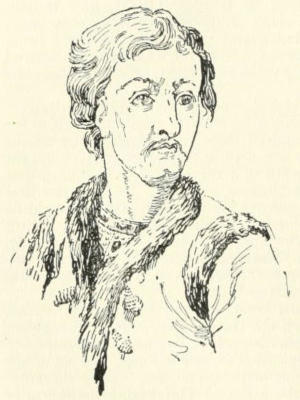
Sviatopolk
Sviatopolk’s reign began with a violation
of the law of nations by imprisoning
ambassadors of the Polovtsi, who
had come to negotiate a treaty with
him. In retaliation the nomads invaded
the country, and with so great a
force that Vladimir and Rostislav, who
had come to the aid of the grand prince,
advised him to purchase peace from
the enemy. He paid no heed to them,
but the event soon justified the prudence
of their counsel. In the battle of
Tripole, fought on May 23rd, 1093, the
Russians sustained a disastrous defeat.
Rostislav was drowned, while Sviatopolk and Vladimir saved themselves by
flight. The next year’s campaign against the Polovtsi was equally disastrous,
and Sviatopolk returned to Kiev with but two companions. Tortchesk
was compelled to capitulate, and the nomads returned to the steppe rich with
booty and prisoners. Sviatopolk now bought peace and took to wife a daughter
of the Polovtsian khan. They returned, however, the same year under
the leadership of Oleg, son of Sviatoslav, who had stayed till now in Tmoutorakan
and thought the moment opportune for enforcing his undoubted rights
upon Tchernigov, which had been the original seat of his father as the second
son of Iaroslav, and which was held by Monomakh, who was the son of Iaroslav’s
third son.
Oleg, was therefore, no Isgoi and would not be treated as such. When he
appeared before Tchernigov, Monomakh had only a small band with him, and
after a siege of eight days was compelled to evacuate the city and retire to
Pereiaslavl, where he had to defend himself during the next three years
against continual irruptions of the Polovtsi. The refusal of Oleg to join in a
combined campaign of the princes against the Polovtsi, and the sudden capture
of Smolensk by his brother David, gave the occasion for a general war
that lasted two years and covered the whole territory of Russia, from Novgorod
to Murom and thence to the steppe, and in course of which one son of Monomakh
fell in battle, while two other sons suffered a decisive reverse at the
hands of Oleg. Finally, a congress of princes was held at Lubetz, in the territory
of Tchernigov, for the settlement of all existing disputes. The result of
its deliberations was that the grand prince was to retain Kiev and Turov,
while to Vladimir were assigned Pereiaslavl, Smolensk, and Rostov; Novgorod
to his son Mstislav, and Tchernigov with all its dependencies to the sons of
Sviatoslav—Oleg, David, and Iaroslav. The latter thus gained possession
of the greater part of Russia. There still remained to be satisfied the three
Isgoi, Volodar, and Vassilko, sons of Rostislav, and David, son of Igor. Of
the former two, Volodar received Peremishl, Vassilko received Terebovl,
while Vladimir in Volhinia was given to David. Polotsk remained in the
hands of Vseslav.
[1097-1110 A.D.]
The congress of Lubetz (1097) brought a respite to the sorely tried Russian
north, but the south was soon subjected to new calamities. Vassilko, son of
Rostislav, was revolving in his mind extensive plans of conquest in Poland,
among the Danubian Bulgarians, and finally against the Polovtsi. He had
begun making extensive preparations, and had taken into his pay several
nomad hordes. David of Volhinia, who was ignorant of Vassilko’s plans,
became alarmed at these warlike preparations, began to suspect a conspiracy
between Monomakh and Vassilko, and succeeded in inoculating the grand
prince with his own alarms and suspicions. Vassilko was allured to Kiev to
attend a religious festival, and there he was captured, thrown into chains,
dragged to Bielgorod, and blinded in an unspeakably cruel manner. The
horror of the bloody deed resounded throughout Russia. Monomakh united
his forces with those of his old enemies, the sons of Sviatoslav, and marched
upon Kiev. The grand prince tried to clear himself of blame and throw the
guilt upon David, and peace was arranged through the mediation of the
metropolitan of Kiev and of Monomakh’s mother.
The grand prince took upon himself the obligation to revenge the outrage
on Vassilko, who was surrendered to Volodar; and David was obliged to flee
to Poland (1099). The grand prince annexed David’s territory, and then
turned, most unjustifiably, against the sons of Rostislav. Defeated by Volodar,
he formed an alliance with Koloman, king of Hungary. The alliances now
assumed a most unexpected and distorted character. David united with the
Rostislavitchi and with Buiak, khan of the Polovtsi; and at Peremishl defeated
the grand prince and his allies. The war, the horrors of which were increased
by repeated raids of the Polovtsi, seemed to draw out without end or aim,
when finally Monomakh convoked a second congress of the princes, which
met in August, 1100, at Uvetitchi, on Kievan territory. The result of its
deliberations was that only a few towns of Volhinia were left to David, the
greater part of the principality being transferred to Iaroslav, son of Sviatopolk;
while the Rostislavitchi were to remain in the undiminished possession
of their territories.
[1111-1116 A.D.]
Thus order was restored for some time, but the direction of affairs really
passed out of the hands of the grand prince into those of Monomakh. Under his
leadership the Russian princes were now united against the Polovtsi, and there
ensued a series of campaigns of which no clear account has come down to us.
The Russians generally had the upper hand, but for a long time the balance
wavered, and the enemy seemed so dangerous to the princes that, following
the example of Sviatopolk, they entered into matrimonial alliances with him.
Thus Monomakh, as well as the two sons of Sviatoslav, David and Oleg, took
Polovtsian wives for their sons. But the year 1111 witnessed a decisive campaign,
in which Monomakh is again seen at the head of the Russian princes.
After crossing the Dnieper and the Vorskla, the Russians pressed on into the
enemy’s country as far as the Don. Two Polovtsian cities were taken, and
one was reduced to ashes; the Don was crossed, and on March 24th and 26th
a great battle was fought. The Russians were on the Sula, the last tributary
of the Don before reaching the sea of Azov, in a most unfavourable position
and surrounded from all sides by the Polovtsi. But the scales were turned
when the drujinas of David and Monomakh, which had been kept all the time
in the rear, made a terrific onset on the exhausted enemy, who fled in panic.
According to tradition, angels preceded the Russians and smote the Polovtsi
with blindness.
Vladimir Monomakh (1113-1125 A.D.)
After a reign filled with civil war and misfortune Sviatopolk died (April
16th, 1113), and all eyes turned toward Monomakh. Legally, however,
the throne belonged to his cousin Oleg, son of Sviatoslav, and Monomakh
seemed at first resolved to recognise his superior right. But the Kievans
were determined to accept no one but Monomakh, and an uprising of theirs,
which was directed primarily against the Jews, whom Sviatopolk had
employed for fiscal purposes, but which threatened to assume larger dimensions,
induced him to yield to the universal demand. Thus the race of
Sviatoslav—otherwise called the Olgovitchi—was excluded, and Monomakh
succeeded in bringing a large part of Russia under his house. During
his reign he continued the wars against the Polovtsi, as well as against the
Finns in the north and east, and the Poles in the west. The steppe was
cleared so thoroughly that tradition, with its customary exaggeration, says
that he forced the Polovtsi back into the Caucasus.
His relations with the Byzantine Empire have not yet been sufficiently
cleared up. He himself was the son of a Byzantine princess, and his daughter
Maria was married to Leo, son of the unfortunate emperor Romanus Diogenes,
who was blinded in 1071 and banished to an island. Leo then made an
attempt at revolt against Alexius Comnenus, but was poisoned in 1116.
Vladimir now espoused the cause of Leo’s son Basil and sent an army to the
Danube, which returned without accomplishing its purpose. According
to a later tradition, which arose under the influence of Moscow, the emperor
Alexius Comnenus, in order to put an end to the devastation of Thrace by
the Russian troops, sent to Vladimir a diadem and other imperial insignia
through Neophyte, metropolitan of Ephesus, who put the diadem on Vladimir’s
head and called him czar. But contemporary accounts tell us nothing
of all this, and it is inherently improbable that Byzantium would bestow
upon the Russian grand prince, who was no longer formidable, a title whose
exclusive possession it so jealously guarded. On the other hand, it is known
that in 1122, or six years after the supposed campaign to Thrace, a granddaughter
of Monomakh was married to a prince of the house of Romanus.
[1122-1125 A.D.]
But the greater portion of Monomakh’s military activity fell into the
reigns of his two predecessors. He was in his sixty-first year when he became
grand-prince, and he naturally avoided all fighting as far as it could
be avoided, employing force only when requisite to maintain his position
as overlord of Russia. As far as circumstances permitted, he was a prince
of peace, and a number of most important legislative measures are attributed
to him, especially the laws relating to usury and to the half-free (zakupi).
Russia had suffered very severely from the civil wars and the raids of the
Polovtsi, and men of small property were reduced to extreme poverty. Being
unable to maintain themselves on their wasted lands, they went to live in
large numbers on the estates of the rich, who sought to reduce them to absolute
slavery, or else they borrowed money at usurious rates and soon sank
into a servile condition. To remedy this ruinous state of affairs, Monomakh
reduced the rate of interest from 120 per cent. to 20 per cent., and decreed
that one who had paid one year’s interest according to the old rate, was
thereby absolved from his debt. He also ordered the expulsion of the Jews
from the whole of Russia.[9] But the problem of the zakupi could not be
solved in this summary fashion. According to the regulations adopted
they were to be regarded as free men who had become bound to the soil by
contract, but who retained the right to acquire property and were not subject
to the master’s jurisdiction. A half-free man loses his freedom only
when he attempts to escape from his master. It was also fixed what payments
and services he was to render, and it was made impossible for the
lord to reduce him to a condition of unrestricted serfdom.
Monomakh died in 1125, at the ripe age of seventy-three. He has left
us a curious paper of instructions to his sons, which dates from 1117, and
in which he gives them much sound advice, enforced by examples from
his own life.c
The “Instruction” of Vladimir Monomakh
The grand prince begins by saying that his grandfather Iaroslav gave him
the Russian name of Vladimir and the Christian name of Vasili, and his father
and mother that of Monomakh; either because Vladimir was really through
his mother the grandson of the Greek emperor Constantine Monomachus, or
because even in his tenderest youth he displayed remarkable warlike valour.
“As I draw near to the grave,” writes he, “I give thanks to the Most High
for the increase of my days. His hand has led me to a venerable age. And
you, my beloved children and whosoever reads this writing, observe the rules
set forth in it. When your heart does not approve them, do not condemn my
intentions, but only say: The old man’s mind was already weakened.”
Having described in their chief features, and for the greater part in the words
of the Psalmist, the beauty of the works and the goodness of the Creator,
Vladimir continues:
“O my children! give praise to God and love also mankind. Neither
fasting, nor solitude, nor monastic life shall save you, but good deeds. Forget
not the poor, feed them; and remember that every possession is God’s, and
only confided to you for a time. Do not hide your riches in the bowels of the
earth: this is against the law of Christianity. Be fathers to orphans; judge
the widows yourselves: do not let the strong destroy the weak. Do not slay
either the righteous or the guilty: the life and soul of the Christian are sacred.
Do not call upon the name of God in vain; ratify your oath by kissing the
cross, and do not transgress it. My brothers said to me: Let us drive out the
sons of Rostislav and take their possessions, otherwise thou art no ally of
ours! But I answered: I cannot forget that I kissed the cross. I turned
to the Psalter and read with compunction: ‘Why art thou so vexed, O my
soul? O put thy trust in God, for I will yet thank him. Fret not thyself
because of the ungodly: neither be thou envious against the evil doers.’ Do
not forsake the sick and do not fear to look upon the dead: for we shall all
die; receive the blessing of the clergy lovingly; do not withdraw yourselves
from them; do good unto them, for they shall pray to the Most High for you.
“Do not have any pride either in your mind or heart, and think: we are
but mortal; to-day we live, to-morrow we are in the grave. Fear every lie,
drunkenness and fornication, equally pernicious for the body and the soul.
Esteem old people as fathers, love the young as brothers. In your household
see carefully to everything yourselves, do not depend either on your pages or
bailiffs, that your guests may not blame either your house or your dinner.
Be active in war, serve as an example to your captains—it is no time then
to think of feasting and luxury. When you have set the night watch, take
your rest. Man perishes suddenly, therefore do not lay aside your arms
where you may meet danger; and get to horse early. When you travel in
your dominions, do not let the princely pages be a cause of offence to the
inhabitants, but wherever you stop give your host food and drink. Above
all, respect your guests and do them honour, both the distinguished and the
supplicants, both merchant and ambassador; if you cannot give them presents,
at any rate regale them with food and drink, for guests spread good and evil
reports of us in foreign lands. Greet every man when he passes by. Love
your wives, but do not let them have an authority over you. Everything
good that you learn, you must remember; what you do not know, learn.
My father, sitting at home, spoke five languages, for which those of other
lands praised him. Idleness is the mother of vices; beware of it. A man
should ever be occupied; when you are on the road, on horseback, without
occupation, instead of indulging in idle thoughts repeat prayers by heart—or
the shortest, but best prayer of all, ‘Lord have mercy!’ Never sleep
without bowing yourself down to the earth; and if you feel unwell, bow down
to the earth three times. Let not the sun find you in your bed! Go early to
church to render morning praise to God: so did my father; so did all good
men. When the sun shone on them, they praised God joyfully and said:
‘Lighten mine eyes, Christ God, and give me Thy beauteous light.’ Then
take counsel with the droujina, or judge the people, or go to the chase; and
at midday sleep, for God has ordained that not only man but also the beasts
and birds should rest at midday.
“Thus lived your father. I myself did all that could be ordered to a page;
at the chase and at war, day and night, in the heat of summer and the cold of
winter I knew no rest. I did not put my trust in burgomasters or heralds, I
did not let the strong give offence to the poor and widows, I myself supervised
the church and the divine service, the domestic organisation, the stables,
the chase, the hawks and the falcons.” Enumerating his military exploits,
Vladimir thus writes: “My campaigns were in all eighty-three; the other
smaller ones I do not remember. I concluded nineteen treaties of peace with
the Polovtsi, took prisoners more than a hundred of their chief princes and
let them go free, and I had more than two hundred put to death and drowned
in the rivers. Who has travelled faster than I? Starting early from Tchernigov,
I was at Kiev with my parents before vespers. We loved the chase,
and often trapped and caught beasts with your grandfather. How many
times have I fallen from my horse! Twice I broke my head, injured my arms
and legs, without caring for my life in youth or sparing my head. But the
Lord preserved me. And you, my children, fear neither death nor combats,
nor wild beasts, but show yourselves men in every circumstance sent from
God. If providence decrees that a man shall die, neither his father nor his
brothers can save him. God’s protection is man’s hope.”
If it had not been for this wisely written testament, we should not have
known all the beauty of Vladimir’s soul; he did not lay waste other states,
but was the glory, the defender, the consolation of his own, and none of the
Russian princes has a greater right to the love of posterity, for he served his
country jealously and virtuously. If once in his life Monomakh did not
hesitate to infringe the law of nations and perfidiously slay the Polovtsian
princes, we can but apply to him the words of Cicero, “The age excuses the
man.” Regarding the Polovtsi as the enemies of Christianity (they had
burned the churches), the Russians thought that the destruction of them—no
matter in what manner—was a work pleasing to God.d
The Fall of Kiev and the Rise of Suzdal
[1132 A.D.]
In the forty-four years that followed the death of Vladimir Monomakh,
the over-lordship passed eighteen times from one hand to another, the average
duration of governments being only two years and a half, and the dignity
attaching to the grand princedom declined in rapid progression until it sank
to a complete nullity. With this constant change of rulers, the devastation
and barbarisation of south Russia proceeded apace, so that it soon ceased to
be the centre of political life. A rapid review of these evil years will suffice
for an understanding of the causes that brought about this retrogression.
We have seen that Vladimir Monomakh reached the throne of the grand
princedom in violation of the superior right of the Olgovitchi. He succeeded
in bringing the greater part of Russia under his sons. Mstislav, the eldest,
held Kiev and southern Russia, while his sons were in Novgorod, Kursk and
Smolensk; Iaropolk held Pereiaslavl; Viatcheslav, Tourov; Iuri, Suzdal;
and Andrew, Vladimir in Volhinia. On the other hand, the princes of Polotsk
were independent; the descendants of Rostislav ruled in Red Russia or
Galicia; and the descendants of Oleg, in Tchernigov, Murom, Riazan, erstwhile
the land of the Viatitchi and Radimitchi, and in the extreme southeast,
Tmoutorakan. With union among the descendants of Monomakh and with
strong grand princes at Kiev, south Russia might have been able to maintain
its ascendancy notwithstanding its unfavourable proximity to the steppe;
but these conditions did not exist. Monomakh’s first successor, Mstislav,
did, indeed, maintain his position, and even annexed Polotsk, whose princes
fled to Greece. But he soon died (1132), and his successor, the brave but
wavering Iaropolk, sowed the seeds of discord in his family by bestowing
Pereiaslavl upon the eldest son of Mstislav and naming him his successor.
Therewith he offended his own younger brothers, one of whom, Iuri Dolgoruki
(Longhand), sought to maintain his right by force. The prince of
Pereiaslavl found support among the Olgovitchi, who were delighted at the
sight of quarrels among the descendants of Monomakh. One of the Olgovitchi,
Vsevolod by name, raised himself to the grand princedom by utilising
these quarrels (1139-1146). But immediately after his death his brother
was overthrown, and Iziaslav, son of Mstislav, became grand prince (1146-1154).
Twice he was expelled by Iuri Dolgoruki, and only maintained himself
by making one of his uncles the nominal ruler.
[1146-1157 A.D.]
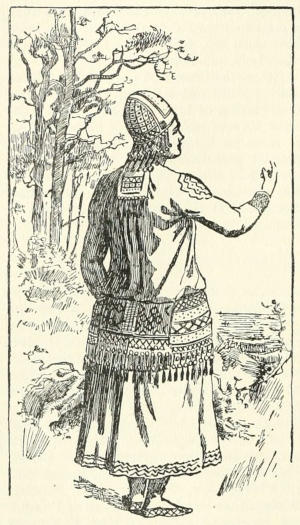
A Mordirne Woman (Ergian Tribe)
After his death the turbulence and confusion increased still further. His
brother Rostislav of Smolensk was
expelled after one week’s reign by
the prince of Tchernigov, who was
expelled in his turn by Iuri Dolgoruki.
The latter might have
shared the same fate, for a confederation
of the princes of Smolensk,
Tchernigov, and Volhinia had already
been formed against him,
but for his timely death (1157).
One of the confederates ruled for
eight months, and then he had to
make room for his successor, who
ruled four months. In the eighty-three
years that elapsed between
the death of Iuri and the capture
of Kiev by the Mongols, the government
changed hands thirty
times. How much the importance
of Kiev and the dignity of the
grand princedom had declined at
this period, we can estimate from
the refusal of Andrew of Suzdal,
son of Iuri Dolgoruki, to take the
throne, though he came next in the
line of succession. He rightly comprehended
that the future belonged
to the Russian north, rather than
to the south, and it was his constant
endeavour to consolidate his
power in that quarter; and when
one of those powerless grand
princes, Mstislav Iziaslavitch, attempted
to strengthen himself by
forming an alliance with Novgorod,
Andrew brought about a combination of eleven princes against him. After a
three days’ siege Kiev was taken by assault and plundered for two days (March,
1169), and Andrew’s brother Gleb was then installed as grand prince of Kiev.
The decay of the south is attributable chiefly to the following causes:
(1) Its geographical position exposed it to the constant inroads of the
nomads of the steppe. This evil, it is true, existed from remotest times,
but its seriousness was increased by the action of the Russian princes themselves,
who employed the nomads in their civil wars. Many of these nomads,
Torks, Berendians, and Petchenegs, settled on the Ros and Dnieper, meddled
in Russian affairs, and contributed to the barbarising of the country. (2)
Every new grand-prince brought with him into Kiev a new following from
his own principality. These foreign elements contributed ever anew to the
unsettling of existing conditions, and prevented the growth of a landed
aristocracy that had its roots in the soil, and of a burgher class. The establishment
of a political tradition thus became impossible. (3) The trade
with Greece had greatly declined owing to the increasing dangers of the
journey to the sea, and more than once the princes were obliged to defend
caravans to and from Byzantium with their entire army.
[1157-1175 A.D.]
But while the south was decaying, a new centre was forming in the north
that was destined to gather around itself the whole of Russia, the principality
of Suzdal-Rostov. The city of Rostov, situated in the country of
the Finnish Merians, was one of the oldest in Russia, and it is reported that
Rurik had bestowed it on one of his warriors. Suzdal also arose at an early
date, at the latest toward the end of the ninth century. The early history
of the region is not known to us, but we know that Iaroslav founded the
city of Iaroslavl, that it was temporarily united to Novgorod, and that after
the death of Sviatoslav II (1076) it was merged in the principality of Pereiaslavl.
Vladimir Monomakh founded Vladimir on the Kliasma, a tributary
of the Oka, and built a church at Rostov. The congress of Lubetz assigned
the entire territory to Monomakh’s sons, and Iuri Dolgoruki became the first
independent prince of Rostov. Although this prince always looked to the
south, yet the colonisation of the north made rapid progress during his reign.
We know that three cities were founded by him, and the chronicle also
attributes to him the foundation of Moscow in 1147. Suzdal was his capital.
When he became grand-prince of Kiev he bestowed this whole country upon
his son Vassilko, while he gave Vishgorod, to the north of Kiev, to his eldest
son Andrew.
But the latter had no liking for the south, and fled from Vishgorod with
a miracle-working image of the Virgin, which he deposited in a church that
he built at a place where he had a vision and which he called Bogolubovo
(God’s love). After the death of his father, in 1157, Rostov and Suzdal
refused to obey his younger brothers and called in Andrew, who was also
joined by those of his father’s followers who had fled from Kiev. But it
is most characteristic of the man and his far-sighted policy that he made no
claims to the throne of Kiev, nor did he establish himself at Rostov or Suzdal
but stayed at Vladimir, where there were no old families nor refractory
citizens to deal with. His brothers, his nephews, the boyars of his father,
he expelled from his dominions and made himself sole ruler. In 1169 he
gave Kiev to his brother Gleb, but he took to himself the title of grand prince.
To become the virtual master of the whole of Russia he only needed to subject
Novgorod, and though the combination of princes that he formed against
it was routed before its gates, yet he ultimately succeeded, by cutting off its
supply of corn, in compelling it to acquiesce in his supremacy and to accept
the prince that he chose for it.
This first would-be autocrat of Russia also comprehended the importance
of making the clergy subservient to his will. He tried to make his capital
Vladimir independent of Kiev in church affairs by establishing in it a metropolitan,
and though he failed in his object, owing to the determined refusal
of the patriarch of Constantinople, yet he succeeded in obtaining the important
concession that in future the Russian metropolitan was to be appointed
only with the assent of the grand prince.
[1205-1221 A.D.]
His despotic and cruel rule finally made him hated by his nobles, and he
was assassinated on June 29th, 1175, at Bogolubovo. After a period of
confusion his second brother, Vsevolod, became grand prince. During this
reign the influence of Suzdal was still further increased, and the entire north,
and even the Olgovitchi of Tchernigov, recognised his supremacy. In the
west and south, however, Roman Mstislavitch of Volhinia, who conquered
Galicia and ruled temporarily at Kiev, offered a successful resistance. But
after the death of the latter in battle with the Poles in 1205, Vsevolod conquered
Riazan, and even deprived the Olgovitchi of Tchernigov, giving them
Kiev in exchange. This prince, like his predecessor, attained his object
by diplomacy rather than by the sword, and at his death in 1212 he was the
most powerful prince in Russia.
His death was followed by a civil war between his two sons Constantine
and Iuri. The latter, though the younger, was nominated by Vsevolod
as his successor, but in 1217 he was beaten by Constantine and his allies—Novgorod
amongst them—and compelled to resign the throne. But Constantine
died in 1218 and Iuri reigned undisturbed till 1237. He fought with
success against the Volga Bulgarians, and founded Nijni-Novgorod (1221).
But his power never became as great as had been that of his father, and he
exerted no influence in southern Russia, which was devastated by Petchenegs
from the steppe and by Poles and Hungarians from the west. All south
Russia now lay exhausted before the impending irruption of the Tatars.c
CHAPTER III. THE TIME OF TATAR DOMINATION — JENGHIZ KHAN; THE TATAR INVASION — INFLUENCES OF TATAR DOMINATION — ALEXANDER NEVSKI — THE GROWING ASCENDENCY OF MOSCOW — THE DESTRUCTION OF MOSCOW (1382 A.D.) — THE DEATH OF DMITRI DONSKOI; HIS PLACE IN HISTORY — THE REIGN OF VASILI-DMITRIEVITCH (1389-1425 A.D.) — VASILI VASILIEVITCH (AFTERWARDS CALLED “THE BLIND” OR “THE DARK”) — A REVIEW OF THE INTERNAL DEVELOPMENT DURING THE TATAR PERIOD — THE INFLUENCE OF TATAR DOMINATION — FOOTNOTES
[1235-1462 A.D.]
In the thirteenth century the steppes of central Asia sent forth a new
conquering horde, constituting the last wave of that migration of peoples
which had commenced in remote antiquity.[10] This Mongol-Tatar horde
dominated Russia for 240 years and left enduring traces of its domination.
It definitively broke the bond between western and eastern Russia, and thus
contributed to the formation of the principality of Lithuania in the west;
while in the east it promoted the rise of the principality of Moscow, which
finally absorbed all the other Russian principalities, threw off their Tatar
yoke, recoiled in its turn upon the steppe, and finally, by turning Russia into
an empire, made forever impossible another invasion from the steppe.
The cradle of the Mongolian race was in all probability the country lying
at the foot of the Altai Mountains. At the time of the appearance of Jenghiz
Khan the Mongols were divided into numerous tribes, which were governed
by their elders and lived in mutual enmity. An unpleasing description of
the exterior and life of the Mongols is given by a Chinese writer, a contemporary
of Jenghiz Khan, and also by Mussulman writers:
“Their faces are wide, flat, and square, with prominent cheek-bones,
their eyes have no upper lashes, their beard and moustaches are of scanty
growth, their general appearance is repulsive. But the present Tatar sovereign,
Temuchin (Jenghiz Khan) is of enormous stature, with broad forehead
and long beard, and distinguished for his valour. They reckon the year
according to the growth of grass. When one of them is asked for his age, he
replies—so many grasses. When asked for the number of the month, they
laugh and reply that they do not know. The Tatars are born in the saddle
and grow up on horseback. They learn to fight almost by instinct, for they
hunt the whole year round. They have no infantry, but only cavalry, of
which they can raise several hundred thousand. They hardly ever resort to
writing, but all, from the commander-in-chief to the commander of ten, give
their orders in person. When they want to take a big town, they first attack
the small places in the vicinity, take all the inhabitants prisoners, and drive
them forward to the attack. For this purpose a command is issued that
every man on horseback should capture ten prisoners, and when this number
is completed they are compelled to collect a certain amount of grass or wood,
earth or stones. The Tatars urge them on night and day, killing those who
become exhausted. Having reached the town, they are compelled to dig
trenches or fill up fosses. In a siege the Tatars reck not of the loss of tens
of thousands: hence they are invariably successful. When they capture a
city they kill all without sparing either young or old, the beautiful or the
ugly, rich or poor, those who submit or those who resist. No person, however
distinguished, escapes this unrevokable penalty of death. The spoil
is divided in proportionate shares among high and low. This people have
no need of baggage or provision wagons; their herds of sheep, cows, horses,
and other animals follow them on their marches, and they eat meat and
nothing else. Their horses do not know barley, but they tear up the
ground with their hoofs and live on the roots. As to their faith, the Tatars
worship the sun at the time of its rising. They do not regard anything as
forbidden, and eat all animals, even dogs and pigs. Marriage is unknown to
them, but many men come to a woman, and when a child is born it does not
know its father.”
Similar descriptions are met with in the narratives of Europeans who
knew the Mongols in the days of their power.
It was among this rude nomad people that Jenghiz Khan was born in 1162.
The son of the chief of a tribe dwelling at the mouths of the Onon and the
Ingoda, affluents of the Amur, Jenghiz was far removed from the focus of
central Asian political life, and his power was originally very small. The first
forty years of his life were spent in struggles with the surrounding peoples;
it is even said that for ten years he was in captivity with the Nyûché, or
Chûrché (the Manchurian rulers of northern China known under the name
of the dynasty of Kin), during which time he became acquainted with Chinese
customs and manners, and also with the weakness of the rulers of China.
Having conquered various Mongolian tribes, he proclaimed himself emperor
at a general assembly of the princes, which was held at the sources of the
river Onon (1206).
“By thus taking the imperial title,” says V. P. Vasiliev, “he gave perfect
expression to the purely Chinese conception that, as there is only one sun in
the heavens, so there must be only one emperor on earth; and all others
bearing this title, all states having any pretensions to independent existence
thereby offend the will of heaven and invite chastisement.” His successes
in Mongolia are explained by his surpassing military talent, the system of
purely military organisation adopted by him, and by the fact that he gave
places in his service to all those who were gifted, of whatever race they might
be.[11] Jenghiz Khan’s conquests advanced rapidly; in 1206 he devastated the
kingdom of Tangut (in southern Mongolia) and in 1210 he commenced a war
with the Nyûché, ruling in northern China. The war dragged on, and meanwhile
the shah of Khuarezm (Bokhara) gave offence to Jenghiz Khan by
slaying the Mongolian ambassadors. Leaving his captains in China, the
Mongolian khan marched to Bokhara (1219), whence, partly in pursuit of
the shah and partly led on by the passion for pillage, the Mongolian troops
directed their way to the west, doubled the southern shore of the Caspian Sea,
crossed the Caucasus, and penetrated into the steppes of the Polovtsi.
[1223-1228 A.D.]
The leaders of these troops were Chépé and Subutai Bahadar. The
Polovtsi applied for help to the Russian prince Mstislav Mstislavitch, and he
called together the princes of southern Russia, amongst whom the most important
were Mstislav Romanovitch of Kiev and Mstislav Sviatoslavitch of
Tchernigov. The armies of the princes moved to the help of the Polovtsi,
and although the Tatars sent ambassadors saying, “God has permitted us
to come on our steeds with our slaves against the accursed Polovtsi; come
and make peace with us, for we have no quarrel with you,” the princes decided
upon a battle which took place by the river Kalka in the government of
Iekaterinoslav. The Russian princes, who did not act in unison, were beaten
(1223), and many were killed, amongst others Mstislav of Kiev. The Tatars
did not penetrate far into Russia, but turned back and were soon forgotten.[12]
Meanwhile the Tatar captains returned to Jenghiz Khan, who, having definitively
subdued Tangut and northern China, died in 1227. He had during
his lifetime divided his possessions amongst his four sons: to the descendants
of Juji (then already dead) was allotted Kiptchak (that is the steppe extending
from central Asia into southern Russia); to Jagatai, Turkestan; to
Okkodai (Ogdai) China; to Tuli, the nomad camps adjoining the share of
Okkodai. Over these princes was to be exalted the great khan, chosen in a
solemn assembly of all the princes. In 1228 Okkodai was proclaimed great
khan.
[1237-1241 A.D.]
At first the question of succession, then the final consolidation of the
empire in northern China, and then again the commencement of the war with
the south kept the princes around the great khan, and it was only in 1235 that
Okkodai sent his nephew Batu, son of Juji, together with Manku, son of Tuli,
and his own son Kuiuk, to conquer the western lands; to their number was
added Sabutai, famous for his Kiptchak campaign. First of all they conquered
the Bulgarians on the Volga, and then came to the land of Riazan.
Here they exacted from the princes a tribute of a tenth of all their possessions
both in lands and in men; the courageous resistance of the Riazan princes
proved unsuccessful, chiefly because the princes of northern Russia did not
unite, but decided on defending themselves separately. After the devastation
of Riazan and the slaughter of her princes (1237), followed that of Suzdal.
Having taken Moscow, the Tatars marched to Vladimir, where they slew the
family of the grand prince, while he himself was defeated and killed on the
banks of the Sit (1238). Thence they were apparently going to Novgorod,
but returned—probably to avoid the marshes. On their way back, Kozelsk
detained them for a long time, but it was finally taken and pillaged.
The tactics of the Tatars in this war consisted in first encompassing each
region as hunters do, and then joining forces at one centre, thus devastating
all. In the years 1239-1240 the Tatars ravaged southern Russia, and in
1240 they took and laid waste Kiev. All Europe trembled at the horrors
of the Tatar invasion; the emperor Frederick II called for a general
arming, but his calls were in vain. Meanwhile the Tatars advanced to Hungary
(1241) and Poland, and defeated the Polish princes at Liegnitz in Silesia;
and it was only the courageous defence of Olmütz in Moravia, by the Czech
voyevod Iaroslav, and the gathering of armies under the command of the
Czech king and the dukes of Austria and Carinthia, that finally caused the
Tatars to turn back. They then founded their chief dwelling place on the
Volga, where near the present town of Tsareva (government of Astrakhan)
they established a wintering place for the horde—Sarai. There the Russian
princes began to arrive with tribute. At first, however, they were obliged
to go to the great khan in Mongolia; for the first khans, Okkodai, Kuiuk, and
Mangku, were lawfully chosen by the princes, and maintained their authority
over all the empire of Jenghiz Khan; and it was only from the time of Kublai
(1260), who arbitrarily took possession of the throne and removed the seat
of government to China, that the bond was definitively severed.
The domination of the Tatars over Russia is regarded by historians from
various points of view: some (such as Karamzin and especially N. I. Kostomarov)
ascribe a decided influence to the Tatars in the development of
Russian life. S. M. Soloviov, on the contrary, is of the opinion that the
influence of the Tatars was not greater than that of the Polovtsi. Both
these opinions are extreme: it is senseless to deny the influence of the Tatars,
for the reason that Russia was long associated with them, and that, since
in her intercourse with the east, Moscow employed Tatar services, much
that was eastern entered into the administration, notably the financial system;
traces of eastern custom may also be found in the military organisation.
These are direct consequences; the indirect ones are hardly less important,
because a considerable share in the interruption of civilisation and the roughening
of the manners and customs of the people may be ascribed to the
separation of eastern Russia from western. On the other hand, it is impossible
to regard the corporal punishments as entirely Tatar, for they were
known in Byzantium, and came to Russia in the manuals of church statutes;
they were known also in the west, and are to be met with in places which
were but little under Tatar domination, such as Pskov. The opinion that
the autocratic power had its origin in the domination of the Tatars must,
it would seem, be entirely rejected, especially when we call to mind the constant
preaching of the clergy, and the fact that John the Terrible directly
appeals to the authority of the Bible and the example of the Roman emperors.
Civilisation and letters were almost unknown to the Tatars. The writers
in their chanceries were for the greater part taken from the nations they
had conquered, as were also the artists who embellished the wintering places
of their khans. Much luxury was to be met with amongst them, but neither
elegance nor cleanliness: in this respect they kept to the very end the customs
of the Mongolian steppes. Also in moral respects they showed themselves
dwellers of the steppes even to the end of their career in history. Cruel
and coarse though they were, they possessed, however, some good qualities.
They were temperate in their lives, and their cupidity was not so great as
that of other Asiatic nations; they were far less given to deceit in trade—in
general, with them, violence predominated over deceit.b
Throughout all of their conquests in Russia, they obviously acted upon
a principle which was well calculated to facilitate their own complete ascendency.
At first they destroyed the walled places that stood in the way
of their projects, and afforded a means of defence to the people; they destroyed
the population wherever they went, in order that the remnant which survived
should feel the more surely the weight of their power; and, at length,
as their advance became the more safe and certain, they relaxed slightly
in their cruelties, enrolling under their standard the slaves they captured,
thus turning their conquests into armaments. But the climate of Russia
rendered it an unsuitable place for their location. As they could not remain
upon the soil which they had vanquished, they established themselves on
the frontiers to watch over their new possessions, leaving nominal Russian
princes to fight for them against the invading tribes that continually rushed
in. Those very invasions served also to strengthen the Tatar yoke, by
weakening the resisting power of the natives.d
In conquering Russia they had no wish to take possession of the soil,
or to take into their own hands the local administration. What they wanted
was not land, of which they had enough and to spare, but movable property
which they might enjoy without giving up their pastoral, nomadic life.
They applied, therefore, to Russia the same method of extracting supplies
as they had used in other countries. As soon as their authority had been
formally acknowledged they sent officials into the country to number the
inhabitants and to collect an amount of tribute proportionate to the population.
This was a severe burden for the people, not only on account of
the sum demanded, but also on account of the manner in which it was raised.
The exactions and cruelty of the tax-gatherers led to local insurrections,
and the insurrectionists were of course always severely punished. But there
was never any general military occupation nor any wholesale confiscations
of land, and the existing political organisation was left undisturbed. The
modern method of dealing with annexed provinces was wholly unknown
to the Tatars. The khans never for a moment dreamed of attempting to
Tatarise their Russian subjects. They demanded simply an oath of allegiance
from the princes, and a certain sum of tribute from the people. The vanquished
were allowed to retain their land, their religion, their language,
their courts of justice, and all their other institutions.
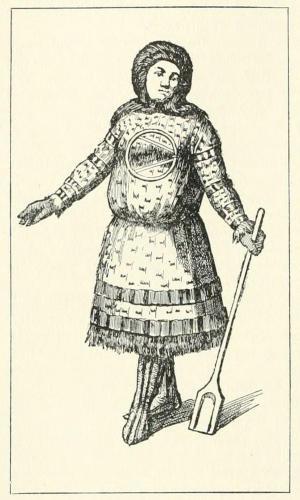
A Female Samoyed
The nature of the Tatar domination is well illustrated by the policy
which the conquerors adopted towards the Russian church. For more than
half a century after the conquest the religion of the Tatars was a mixture
of Buddhism and paganism, with traces of sabaism or fire-worship. During
this period Christianity was more than simply tolerated. The grand khan
Kuiuk caused a Christian chapel to be erected near his domicile, and one
of his successors, Khubilai, was in the habit of publicly taking part in the
Easter festivals. In 1261 the khan of the Golden Horde allowed the Russians
to found a bishopric in his capital, and several members of his family
adopted Christianity. One of them even founded a monastery, and became
a saint of the Russian church! The orthodox clergy were exempted from
the poll tax, and in the charters granted to them it was expressly declared
that if anyone committed blasphemy against the faith of the Russians he
should be put to death. Some time afterwards the Golden Horde was converted
to Islam, but the khans did not on that account change their policy.
They continued to favour the clergy,
and their protection was long remembered.
Many generations later, when
the property of the church was threatened
by the autocratic power, refractory
ecclesiastics contrasted the policy
of the orthodox sovereign with that
of the “godless Tatars,” much to the
advantage of the latter.
At first there was and could be
very little mutual confidence between
the conquerors and the conquered.
The princes anxiously looked for an
opportunity of throwing off the galling
yoke, and the people chafed
under the exactions and cruelty of
the tribute collectors, whilst the khans
took precautions to prevent insurrection,
and threatened to devastate
the country if their authority was
not respected. But in the course of
time this mutual distrust and hostility
greatly lessened. The princes
gradually perceived that all attempts
at resistance would be fruitless,
and became reconciled to their
new position. Instead of seeking to
throw off the khan’s authority, they
sought to gain his favour, in the
hope of thereby forwarding their personal
interests. For this purpose
they paid frequent visits to the Tatar
chief, made rich presents to his wives and courtiers, received from him charters
confirming their authority, and sometimes even married members of
his family. Some of them used the favour thus acquired for extending their
possessions at the expense of neighbouring princes of their own race, and
did not hesitate to call in Tatar hordes to their assistance. The khans,
in their turn, placed greater confidence in their vassals, entrusted them with
the task of collecting the tribute, recalled their own officials who were a constant
eyesore to the people, and abstained from all interference in the internal
affairs of the principalities so long as tribute was regularly paid. The princes
acted, in short, as the khan’s lieutenants, and became to a certain extent
Tartarised. Some of them carried this policy so far that they were reproached
by the people with “loving beyond measure the Tatars and their language,
and giving them too freely land, and gold, and goods of every kind.”c
[1245 A.D.]
The recognition of Tatar sovereignty was complete in the homage and
tribute they demanded and received. Every prince was forced to solicit
his investiture from the khan of Kiptchak; and even when Iaroslav was
established as grand prince over the rest, Batu cunningly allowed several
rivals to put in their claims to that authority, and obliged them to wait so
long for his decision that the order of succession remained unsettled. This
state of suspense in which the feudal lords were kept, and a series of famines
which followed the destructive march of the Tatars, plunged the country into
a condition of abject wretchedness.
During this period of indecision on the one hand, and forlorn imbecility on
the other, the Lithuanians succeeded in appropriating to themselves some
portions of the northwestern division of Russia; and the Swedes, and Danes,
and Livonian knights of the sword proceeded to make demonstrations of a
descent upon Novgorod. Alexander, however, who had succeeded his father
in that principality, finding that the grand prince was unable to render him
any assistance towards the defence of the city, anticipated the advance of the
intruders, and giving them battle on the banks of the Neva gained a decisive
victory. He immediately built strong forts on the spot to repel any future
attempts, and returned in triumph to Novgorod. So signal was the overthrow
of the enemy that Alexander was honoured by the surname of Nevski,
in commemoration of the achievement.
Flushed with a triumph as unexpected as it was important, Alexander
Nevski desired to enlarge the bounds of his power at home. The army was
warmly attached to him, for his personal intrepidity was no less remarkable
than his sagacity—qualities which were rarely so strongly developed in so
young a man. The Novgorodians, however, always jealous of their municipal
privileges, and suspicious of the motives of their rulers, resisted the extension
of Alexander’s power, and, apprehensive that he would abuse his advantages,
they remonstrated against his proceedings, and at last broke out into open
rebellion. The proud spirit of the young prince was justly offended at the
impetuous revolt of his subjects, and he retired at once from the city, going
over to his father at Vladimir, to request the aid of a sufficient force to restore
order. But Iaroslav, in the conviction of his own inadequacy, was unwilling
to interfere with the wishes of the Novgorodians; and, conferring upon
Alexander the inferior principality of Pereiaslavl, he sent another of his sons,
at the request of the people, to reign over the disaffected province.
The Novgorodians, however, speedily discovered their error. The Danes,
induced to speculate upon the absence of Alexander, a second time appeared
within the boundary, and the new prince, an inexperienced young man, made
choice of such measures as clearly proved him to be unfit for his office. The
people became dissatisfied, and, being now convinced that Alexander was the
only man who could relieve them in their difficulty, petitioned him to return;
but he indignantly rejected the request. A second embassy, headed by the
archbishop, was more fortunate, and Alexander Nevski once more placed
himself at the head of the army, and obtained a second victory over the
invaders. Resolved to profit by the obligations under which he laid his
subjects by resuming, at their own instance, the reins of government, and by
freeing them from the presence of a dangerous foe, he now pushed on to
Livonia, and routed the combined forces of a triple alliance of Germans,
Danes, and Tchuds, on the borders of Lake Peipus. This exploit, which the
youthful hero achieved in the year 1245, not only obtained him the love and
admiration of his own subjects, but speedily spread his name through every
part of the empire, until it finally reached the court of the Golden Horde,
where it elicited an unusual degree of curiosity and applause.
In the person of the prince of Novgorod, a new dawn of hope broke over
Russia, and nothing but the disheartening feuds of the chiefs checked the
growth of that incipient desire for liberty which the influence of his successes
was calculated to create. Alexander was adapted to the occasion; and if
the disunited sovereigns could now have consented to forego their low animosities,
and to merge their personal differences in the common cause, Alexander
was the instrument of all others the most fit to undertake the conduct
of so gallant an enterprise. But it required an extraordinary combination of
circumstances to awaken the Russian princes to a full sense of their degradation,
and to inspire them with resolution to set about the rescue of their
country from the chains of the spoiler. Alexander’s example was useless.
He could do no more than demonstrate the possibility of improvement within
the reach of his own domain; but for all purposes of a national and extensive
character, his exertions failed to procure any favourable results.
[1252 A.D.]
On the death of the grand prince Iaroslav, whose reign appears to have
passed unmarked by any events of importance, the khan invited or rather
summoned Alexander to the horde. A number of competitors or claimants
for the grand princedom had already brought forward their petitions: some
were lingering in person at the court; others were represented by ambassadors
bearing rich tributes; and all were in a state of considerable anxiety
pending the decision of the Tatar. Alexander alone was silent. The fame
of his deeds had preceded him. He did not come to supplicate for an honour
to which he felt that he possessed an unexceptionable claim, but he attended
as a point of duty, without reference to a nomination that could hardly increase
his popularity. His independent bearing, his manly figure, and the general
candour and fearlessness of his manners gained him at once the confidence
and admiration of the khan, who did not hesitate to assure him that, although
he had heard much in his favour, report had fallen short of his distinguished
merits.
Auspicious, however, as this reception was, it did not terminate in Alexander’s
appointment to the suspended sceptre of Vladimir. The policy of the
Tatar was to keep the order of succession in periodical uncertainty, so that
the Russians might the more distinctly see how much the destinies of the
country depended on his supreme will. It was not until Alexander paid a
second visit to the horde, in 1252, that he was raised to the dignity of grand
prince. It was accorded to him in a very gracious spirit, and he entered upon
his new office with more earnest zeal than had for a long time before been
displayed by his predecessors.
The first act of the grand prince was an expedition against Sweden, undertaken
with two objects: (1) to crush a formidable foe that occasionally
harassed the frontier districts; and (2) to give employment and opportunity
for pillage to his numerous army, which he had already taught to calculate
upon the rewards of spoliation. The expedition terminated in victory. The
triumphant army laid a part of the Swedish territory under contribution,
succeeded in capturing a number of prisoners, and returned home laden with
spoils.
These successes and the skilful policy of the grand prince made the most
favourable impression on the mind of the khan, who now, whenever dissensions
arose amongst the princes, either referred the adjustment of their differences
to Alexander, or confiscated their dominions and annexed them to the
grand princedom. Two instances of the latter description may be recorded
as evidences of the cunning displayed by the Tatar in the protection of the
Greek religion. While Alexander was at the height of his prosperity, the
prince of Kiev, affected by some sudden admiration of the Roman Catholic
ritual, signified his submission to the pope, acknowledging his holiness’s
supremacy over the churches of his principality. Another prince, his brother-in-law,
adopted a similar measure, which was equally offensive to Tatars
and Russians. The khan, irritated by proceedings so directly at variance
with his will, deprived them of their authority, and transferred their territories
to the grand prince, who, according to some writers, was even assisted
by the Tatars in seizing upon them.
The tribute which had been originally imposed upon the Russians by their
conquerors had always been levied by the princes, the khan being satisfied to
receive it at their hands. As the power of Alexander increased, the khan
gradually recalled this system of delegation, and adopted a more strict and
jealous mode of collection. The first contribution was raised upon the princes,
as tribute money, and they were left to procure it amongst their subjects as
well as they could. But it now assumed the shape of a tax on persons and
property. In order to ensure the regularity of its payment, and protect the
khan against evasions, Tatar officers were appointed in every district to attend
exclusively to the rigid collection of the revenue. From this tax, which was
imposed without distinction upon every Russian, and rated according to his
means, the clergy alone were exempt: and even they, in one instance, were
attempted to be taxed in later times; but the khan who sought to enforce it
was obliged to yield to the double argument of long-established usage and
weighty presents from the wealthy monks.
The new burthen lay heavily upon the people, and the mode in which it
was enforced through foreign collectors, of the nation of their oppressors
enhanced its mortifications. Universal discontent followed the tax-gatherers.
They were treated with unreserved displeasure. It was with great difficulty
they could carry into effect the objects of their unpopular mission, and in
some places, particularly the cities where the population was more compact,
and the communication of opinion more rapid and complete, they were
received with execration. This resistance on the one hand no doubt produced
increased severity on the other; and as the levy advanced, the people became
less cautious in the exhibition of their feelings, and the collectors more rigorous
and despotic. Novgorod, which had always been the rallying point for the
assertion of freedom in Russia, took the lead in this revolt against the khan’s
authority. The Novgorodians, to a man, refused to pay the tax, and even
threatened to wreak their vengeance upon the officers who were appointed
to collect it. The prince of Novgorod, one of Alexander’s sons, urged to
extremities by his republican advisers, sanctioned these declarations of independence,
and openly signified his determination to prevent the exactions of
so ignominious a tribute within the districts dependent upon his rule. Alexander,
perceiving, in this dangerous obstinacy of his son, the source of serious
calamity to the empire at large, and knowing well that neither the Novgorodians,
nor any other fraction of the Russian people, were in a condition to
resist the powerful armies of the khan, should he be provoked to compel
compliance at the point of the sword, undertook in person to appease the
growing tumult, and presenting himself in the city, rebuked the inhabitants for
having perilled the safety of the country by their contumacy, severely punished
rash advisers of his son, and finally arranged the payment of the tax to the
satisfaction of the Tatar offices. Still the Novgorodians were not content.
They remonstrated against the unequal pressure of the tax, setting forth
that it fell more grievously upon the poor than upon the rich, and that if they
were obliged to submit to such a penalty, it should at all events be adjusted
proportionately to the means of individuals. Even this difficulty Alexander
was enabled to meet by assuming the responsibility of the payment himself,
a vexatious and ungrateful duty, which, however, he willingly accepted, as it
afforded him the means of quelling discontents that might have otherwise
terminated in a sanguinary convulsion.d
Death of Alexander Nevski; Appreciation of His Character
[1263 A.D.]
In 1262, disturbances arose in the country of Rostov, where the people
became exasperated at the violence of the Tatar collectors of tribute; a council
was called together and the collectors were driven out of Rostov, Vladimir,
Suzdal, Pereiaslavl, and Iaroslavl; in the last mentioned town the enraged
inhabitants killed the collector Izosim, who had embraced Mohammedanism
to become a Tatar tax-gatherer, and persecuted his former fellow-citizens
worse than the Tatars themselves. Naturally such an occurrence could
not be calmly passed over by the horde, and Tatar regiments were already
sent to take the Christians into captivity. In order to avert this calamity
from the people, Alexander repaired a fourth time to the horde; he was
evidently successful, possibly because of the Persian War which was then
greatly occupying the khan Bergé. But it was his last work; he left the
horde, where he had passed the whole winter, a sick man, and died on the
way back to Vladimir on the 14th of November, 1263; “having laboured
greatly for the Russian land, for Novgorod and Pskov, for all the grand
princedom, and having given his life for the orthodox faith.” By preserving
Russia from calamities on the east, and by his famous exploits for faith
and country in the west, Alexander gained for himself a glorious memory
throughout Russia and became the most conspicuous historical personage
in Russian history from Monomakh to Donskoi. A token of this remembrance
and fame is to be found in the special narrative of his exploits that
has come down to us. “The grand prince Alexander Iaroslavitch,” says the
author of the narrative, “conquered everywhere, but himself was nowhere
conquered;” there came to Novgorod from the western countries a famous
knight, who saw Alexander, and when he returned to his own land he said:
“I have gone through many countries and nations, but nowhere have I
seen such a one, no such king among kings and no such prince among princes;”
and a similar honourable mention was made of him by the khan. When,
after the death of his father, Alexander came to Vladimir, his coming was
terrible, and the news of it flew even to the mouth of the Volga, and the
Moabite women began to frighten their children by saying: “Be quiet,
the grand duke Alexander is coming!” It happened once that ambassadors
were sent to him from great Rome by the pope, who had commanded them
to speak to Alexander as follows: “We have heard of thee, O Prince, that
thou art honourable and wonderful, and that thy country is great, therefore
have we sent unto thee two of the wisest of our twelve cardinals, that thou
mayest hearken to their teaching.” Alexander, having taken counsel with
his wise men, wrote down and described to the pope all that had taken place
from the creation of the world to the seventh œcumenical council, and added:
“All this is well known unto us, but we cannot accept your teachings.”
Following in the footsteps of his father, Alexander gave much gold and
silver to the horde to ransom prisoners. The metropolitan Cyril was in
Vladimir when he heard of the death of Alexander, which he thus announced
to the people: “My beloved children! learn that the sun of the land of
Russia has set;” and all the people cried out in reply: “Then we perish!”e
“It was as vassal and agent of the khan,” says Brueckner, “that Alexander
broke the resistance of Novgorod and compelled it to pay tribute.
On the one hand representing the interests of the khan and repressing the
revolts of the Russians, on the other hand mollifying the anger of the khan
and acting like a shrewd diplomat, Alexander represents a curious combination
of egotism and patriotism. We are not in the possession of sufficient
evidence to form a just estimate of the measure of his services or of his
opportunistic policy, but he is certainly a most interesting character in that
unfortunate and disgraceful period of Russian history.”i
The Grand Princedom
With the death of Alexander commenced afresh the hurtful contests
of the princes for the grand princedom. The division of interests which
had gradually grown up amongst the Tatars, greatly increased the internal
disorders of Russia. Nogay, the Tatar chieftain, who had thrown off the
rule of the khan of Kiptchak, asserted his sovereignty in the southern provinces,
and contended against his rival of the horde, for the right of tribute
in many districts which had hitherto acknowledged implicitly the government
of the first conqueror. This strife between the ruling powers produced
much treachery amongst the Russian princes, who generally allied
themselves to the chief who happened at the moment to obtain the ascendency,
and who thus played a false game to assist them in the accomplishment
of their own individual objects. In this way they wasted their strength;
for whenever a prince profited by the sale of his allegiance, he paid so dearly
for the assistance which procured him the end he had in view, that the gain
in such a case was usually discovered to be a severe loss. The grand princedom
was the prize for which they all struggled; and in the contentions which
marked the struggle, almost every inferior principality became more enfeebled
than before.
Alexander Nevski was one of the few great men whose names stand apart
from the tumultuous throng that crowd the early pages of Russian history.
He was a wise statesman, and a brave soldier. His victories over the enemies
of his country were not less remarkable for completeness and brilliancy,
than his measures of domestic improvement were distinguished by prudence
and foresight. The Danes, the Swedes, the Lithuanians, and the Teutonic
knights severally gave way before him: he enlarged the bounds of his territory,
inspired his army with a fresh spirit of activity, rebuilt several Russian
cities that had been destroyed during the Tatar invasions, and founded
others in well-chosen situations. Russia, under his sway, might have
redeemed her fallen fortunes; but the unnatural hostility of the feudal princes
to the grand princedom, their hatred to any chief whose virtues elevated him
above them, and their ruinous conflicts amongst themselves upon insignificant
grounds of quarrel, paralysed the efforts of Alexander, and deprived
him of the power of rendering that service to his country which he was eminently
qualified to confer. His fame was so universal, that his death gave
opportunity to the display of a fresh burst of superstitious feelings. His
approaching decease was said to have been notified to the metropolitan by
a voice from heaven; and as the body lay in the coffin, the dead man was
said to have opened one of his hands, as the prayer of absolution was spoken
by the officiating clergyman. These miracles obtained Alexander a niche
amongst the Russian saints; and, less in honour of his real merits than his
attributed powers, he was duly canonised after death. Some centuries
subsequently, a monastery was raised to his memory by Peter I, and his
relics were removed to St. Petersburg with extraordinary ceremonies of
devotion. An order of knighthood was afterwards instituted in his name,
which ranks amongst its members some of the monarchs of Europe. These
facts connected with the reputation of Alexander Nevski in Russia are
memorable, as proofs of the veneration in
which he was held.d
The khans committed a serious fault
in preserving a grand prince; it was a still
more striking one, and a consequence of
the first, to place in his hands a sovereignty
disproportioned to those by which he was
surrounded, to select him for too long a time
from the same branch, and to give him
armies to establish himself, and the means
of seducing even themselves by the most
costly presents. The consequence of this
was, that the appanaged princes dared not
enter so readily into a contest with the
grand princes, who were already more powerful
than themselves, and were so formidably
supported. Not daring to contend
with them, they turned their arms against
each other, and thus enhanced by their own
weakness the strength of the grand princes.
Nevertheless, till 1324, that is, for a century
posterior to the Tatar invasion, the
power of the grand princes was doubtful;
but then, amidst the crowd of pretenders
to the grand princedom, two rival branches
made themselves conspicuous, and the
other princes of the blood resigned to
them an arena, in which the scantiness of
their own resources no longer permitted
them to appear. One of these branches was that of the princes of Tver; the
other that of the princes of Moscow.g
[1303-1313 A.D.]
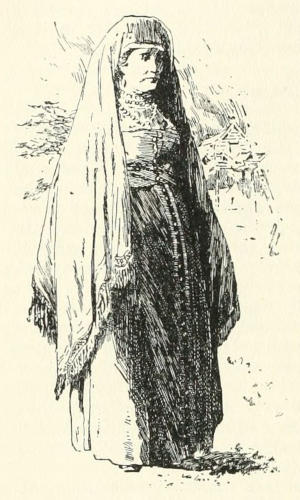
Muscovite Woman
Moscow becomes a princely appanage at a rather late date, although it is
mentioned in the chronicle as early as 1147. The place is also called Kutchkovo.
With this appellation there is connected a tradition, which seems
quite trustworthy, that Moscow had belonged to a certain Kutchka, and the
chronicle also speaks of the Kutchkas as relatives of the wife of Andrew
Bogoliubski and of his murderers. It seems that the first prince of Moscow
was Michael Iaroslavitch, who died in 1248. Other princes are mentioned
as having been at Moscow before that time, but it is difficult to decide
whether they resided there temporarily or permanently. The true line of
Moscow princes begins with Daniel Alexandrovitch [a son of Alexander
Nevski], who died in 1303 and was succeeded by his son Iuri, the famous
rival of the Tver princes.b
Iuri married, in 1313, the sister of Usbek Khan. It was then that, after
having excited the hatred of the Novgorodians, in persisting to subdue them
by means of the Tatars, Michael of Tver drew down upon his head all the
wrath of Usbek, by defeating Iuri, and taking prisoners his wife, who was the
khan’s sister, and Kavadgi, a Tatar general, who came to put the prince of
Moscow in possession of the grand princedom.
For Usbek, after having preferred and supported the rights of Michael
of Tver to the grand principality, had changed his mind in favour of Iuri of
Moscow, who had become his brother-in-law. The enmity of Usbek, however,
remained suspended, until his sister, the wife of Iuri, and the prisoner of
Michael, expired at Tver. Iuri then hastened to the horde, and accused
Michael of having poisoned the princess. The offended pride of Usbek lent
itself to this base calumny; he entrusted the investigation of the affair to
Kavadgi; appeared to the summons; the vanquished passed sentence on his
vanquisher, whom he caused to be put to death; and the infamous Iuri of
Moscow was appointed grand prince in the place of his murdered rival (1320).
His triumph was short: being accused of withholding the tribute due to the
khan, he journeyed to the horde, and was assassinated by the son of his victim,
who was himself immediately executed by Usbek. This vengeance restored
the grand principality to the branch of Tver, in the person of Prince Alexander
Michael’s second son. It remained in it for three years; but then, in 1328,
this madman caused all the Tatars at Tver to be massacred. To the brother
of Iuri, Ivan I, surnamed Kalita,[13] prince of Moscow, Usbek immediately
gave Vladimir and Novgorod, the double possession of which always distinguished
the grand princedom. This concession formed, in the hands of Ivan,
a mass, the connection of which Tver, weakened as it was, did but little
diminish. Consequently, with this power, and the troops that Usbek added
to it, Ivan speedily compelled all the Russian princes to combine, under his
orders, against the prince of Tver; who, after having undergone various
misfortunes, was executed with his son at the horde.
Here begin the two hundred and seventy years of the reign of the branch
of Moscow. This first union of the Russians, under Ivan I, denominated
Kalita, constitutes an epoch; it exhibits the ascendancy of this second grand
prince of Moscow over his subjects; an ascendancy the increase of which we
shall witness under his successors; and for which, at the outset, this branch
of the Ruriks was indebted to the support they received from the Tatars.
For as a word from the khan decided the possession of the throne, that one of
the two rival branches of Moscow and Tver was sure to triumph which displayed
the most shrewd and consistent policy towards the horde. It was not
that of the princes of Tver which thus acted. On the contrary they sometimes
solicited the protection of the khans, and sometimes fought against
them; we have even seen one of them ordering the massacre of the Tatars in
his principality.
The princes of Moscow pursued a different system; they no doubt,
detested the yoke of the khans as much as their rivals did; but they were
aware that, before they could cope with the Tatars, the Russians must be
united, and that is was impossible to subject and unite the latter without the
assistance of the former. They therefore espoused the daughters of the
khans, manifested the utmost submission to the horde, and appeared to be
wholly devoted to its interests.
Now this policy, which, at the commencement of the Mongol invasion
acquired for Alexander Nevski the empire of all Russia, gave it, seventy-four
years later, still more completely to Ivan I: for the sway of the Tatars was
then more recognised; the Russians were more docile to their yoke; and the
cities, which composed the grand principality were more powerful in themselves,
and also by comparison with the rest of Russia, which became daily
more and more exhausted. The wealth of Ivan I was another cause of the
extension of his power.
[1323 A.D.]
The complaints of the prince of Tver, in 1323, prove that Iuri I, grand
prince of Moscow, when he undertook to execute the vengeance of his brother-in-law
Usbek, against Tver, was also entrusted with the collecting of the
tributes; which, however, he retained, instead of sending them to the horde.
Ivan Kalita, his brother and successor, profited by this example. Thus it
was, that by making themselves lieutenants of the khan, the Muscovite
grand princes first became the collectors, and finally the possessors, of the
taxes throughout the whole of Russia; and thus they succeeded to all the
rights of conquest enjoyed by the Tatars, and to their despotism.
There can be no doubt that one of the most copious sources of power to
those sovereigns was the periodical census and the perpetual imposts, so alien
to feudalism, and especially to a feudalism of princes: these imposts and
censuses nothing but the Tatar conquest could have established, and they
were inherited by the grand princes. Already, in the first half of the fourteenth
century, these taxes had rendered Ivan Kalita rich enough to purchase
entire domains and appanages,[14] the protection of Usbek Khan, and the preference
of the primate, who removed his residence from Vladimir to Moscow,
by which means the latter city became the capital of the empire.
It was by virtue of his authority as collector for the Tatars that Ivan
Kalita practised extortion upon his subjects. We see him requiring a double
tribute from the Novgorodians, under pretext that such was the will of the
khan. Armed against the Russians with the dread inspired by the Tatar
name, and against the Tatars with the money of the Russians; intoxicating
the khan and his courtiers with gold and adulation in his frequent journeys
to the horde; he was enabled, as lord paramount, to bring about the first
union of all the appanaged princes against his competitor, the prince of Tver,
whom he drove from Pskov and from Russia, being aided by the primate with
the thunder of the church, then heard in the empire for the first time. The
nobility imitated the clergy. Impelled either by fear, or cupidity, several
boyars of other princes rallied round this grand prince, preferring the fiefs of
so rich and so potent a lord paramount to those of the petty princes whom
they abandoned.
Ivan Kalita pushed forward with horrible vigour in his ambitious career.
“Woe, woe to the princes of Rostov!” exclaims Nicon, “because their power
was destroyed, and everything was concentrated in Moscow.” In fact, from
the Kremlin, which he fortified, Ivan proclaimed himself the arbiter of his
kinsfolk; he reigned in their principalities by the medium of his boyars; he
arrogated to himself the right of being the sole distributor of fiefs, judge, and
legislator; and if the princes resisted, and dared to wage against him a war of
the public good,[15] he hurried to the horde, with purse in hand, and denunciation
on his lips; and the short-sighted Usbek, deceived by this ambitious monitor,
was impolitic enough to disembarrass him of the most dangerous of his competitors,
whom he consigned to frightful torments. The prince of Tver and
his son were the most remarkable victims of this atrocious policy.
Meanwhile, Lithuania, which, from the period of the first overwhelming
of Russia by the Tatars, had emancipated itself from its yoke, had now
become a conquering state. About 1320, Gedimin, its leader, seized on the
Russian appanages of the south and west, which had long ceased to be dependent
upon the grand principality of Vladimir. Kiev, Galitch, Volhinia, became
sometimes Lithuanian, sometimes Polish or Hungarian: driven to despair,
their inhabitants emigrated; they formed the two military republics of the
Zaparogians and Cossacks of Don. Rallying around them the unfortunate
of all countries, they were destined to become one day strong enough to make
head against the Turks and Tatars, between whom they were situated; and
thus to embarrass the communication between those two peoples, whom a
common religion, origin, and interest conspired to unite.
The grand principality was, on the other hand, repeopled by unfortunate
fugitives from the southern Russian provinces, who sought refuge at Moscow.
The empire, it is true, lost in extension; but it was thus rendered more proportionate
to the revived power of its grand prince, who had also fewer competitors
in it: those who remained could not, in point of resources, be compared
with the grand principality. After all, it was much better that the latter
should one day have to recover some provinces from a foreign foe, than from
its domestic enemies: it was suffering an external evil instead of an internal
one, which is the worst of all.
Thus, the macchiavellism of Ivan prospered. It is true that, by the confidence
with which he inspired the horde, and the terrible war which he waged
against his kinsmen, he restored to Russia a tranquillity to which she had long
been a stranger. A dawning of order and justice reappeared under a sceptre
acquired and preserved by such horrible acts of injustice; the depredations
to which Russia had been a prey were repressed; commerce again flourished;
great marts and new fairs were established, in which were displayed the productions
of the East, of Greece, and of Italy; and the treasury of the prince
was swelled still further by the profit arising from the customs.[16]
Such were the rapid effects of the first steps which Ivan took to execute
the system of concentration of power; this great political impulse was so
vigorously given, that it was perpetuated in his son Simeon the Proud, to
whom Ivan left wherewithal to purchase the grand princedom from the
horde, and in whom he revived the direct succession. Accordingly, Simeon
effected, against Novgorod, a second union of all the Russian princes. It
is to be remarked, that he was obliged to cede one half of the taxes to his
brothers; but, at the same time, he reserved to himself the whole authority,
which soon gives to its possessor the mastery of the revenue.
[1353 A.D.]
Simeon having died without children, in 1353, after a reign of twelve
years, Ivan II, his brother, purchased the sovereignty with the wealth of
Kalita. After the six years’ reign of Ivan II, this system and this order
of succession were, indeed, transiently interrupted in the person of a prince,
alien to the branch of Moscow; but we shall soon see the great Dmitri Donskoi
establish them as fixed principles; that prince did not neglect to increase
the wealth[17] of his grandfather Ivan. The people had given to Ivan the
surname of The Purse; as much, perhaps, with allusion to his treasures,
as to the purse, filled with alms for the poor, which is said to have been
always carried before him. At a later period, the constantly progressive
riches of the grand princes of Moscow enabled them to enfeoff directly from
the crown lands three hundred thousand boyar followers; and next, to keep
up a body of regular troops, sufficiently strong to reduce their enemies and
their subjects.[18]
[1359 A.D.]
This system of concentration of power which Ivan Kalita commenced,
by means of his wealth, by the union of the sceptre with the tiara, and by
restoring the direct order of succession; his horrible but skilful macchiavellism
against the princes holding appanages; finally, the fifty years’ repose
which, thanks to his policy, and to their dissensions, the Tatars permitted
Russia to enjoy; these are the circumstances which entitle Ivan to be considered
as standing next after Alexander Nevski among the most remarkable
grand princes of the third period. It was he who had the sagacity on
this stubborn soil to open and to trace so deeply the path which led to monarchical
unity, and to point out its direction so clearly to his successors
that they had nothing to do but to persevere in it, as the only safe road
which it was then possible for Russia to follow.
This concentration of power brought about great changes from 1320
to 1329; as, at that epoch, all the Russian princes in concert solicited from
the horde the recall of the Tatar governors. It was then that, more firmly
fixed, the throne of the grand princes became the rallying point of the Russians:
along with the consciousness of their strength, it inspired them with
a public spirit, which emboldened them. This good understanding was,
in reality, an effect of the ascendency which a direct and sustained succession,
in a single branch of the Ruriks, had already given to it over all the
others.
The Principle of Direct Succession
In fact, sometimes natural justice, sometimes oriental negligence and
cupidity, often the fear of being disobeyed, and lastly, and especially, the
power and riches of the princes of Moscow—whose presents always surpassed
those of the other princes—all these motives had induced the khans
to allow the succession to the grand principality to descend regularly from
father to son in the branch of Moscow.[19] This natural order of succession
Dmitri Donskoi, in 1359, established by a treaty, in which his kinsmen consented
to renounce the mode of succession from brother to brother. It
was the most remarkable among them, Vladimir the Brave, who was the
first to sign this act. In several other conventions, Vladimir acknowledged
himself the vassal and lieutenant, not merely of Dmitri, but also of Vasili his
son, and even of the son of Vasili, when he was only five years of age. This
example, set by a prince who, of all the possessors of appanages, was the
most renowned for his prudence and his valour, was followed by the others.
Thus, like the Capets, kings of France, did Ivan I, and particularly Dmitri
Donskoi, begin the monarchy by restoring the direct succession, in causing,
while they lived, their eldest sons to be recognised as their successors. Afterwards
we see Vasili, son of Dmitri, persevering in this practice, and Vasili
the Blind, his grandson, raising up his tottering throne, and preparing the
autocracy of the fourth Russian period, by associating with himself his next
heir, the great Ivan III.
It is easy to conceive the infallible effect of this order of succession, and
with what promptitude it must necessarily have extended and consolidated
the power of the grand princes. In fact, the ideas of the father being transmitted
to the son by education, their policy was more consistently followed
up, and their ambition had a more direct object. The nobles could not fail
to attach themselves more devotedly to a prince whose son and heir, growing
up amongst them, would know only them, and would recompense their
services in the persons of their children; for the necessary consequence of
the succession of power in the same branch, was the succession of favours and
dignities in the same families.
Even before Dmitri had established the principle, the boyars saw the
advantages which this order of succession held out to them. Here, as elsewhere,
the fact preceded the law. This was the reason of their restoring
the direct line in the grandson of Ivan Kalita; it was they who made him
grand prince at the age of twelve years, and who subjected the other princes
to him. In like manner, about 1430, they maintained this order of succession
in Vasili the Blind. Contemporary annalists declare that these ancient
boyars of the grand principality detested the descent from brother to brother;
for, in that system, each prince of the lateral branch arrived from his appanage
with other boyars, whom he always preferred, and whom he could not
satisfy and establish but at the expense of the old. On the other hand,
the most important and transmissible places, the most valuable favours,
an hereditary and more certain protection, and greater hopes, attracted a
military nobility around the grand princes. In a very short time, their
elevation to the level of the humbled petty princes flattered their vanity,
and completed their junction with the principal authority. This circumstance
explains the last words of Dmitri Donskoi to his boyars, when he
recommended his son to their protection. “Under my reign,” said he,
“you were not boyars, but really Russian princes.” In fact (to cite only
some examples), we see that his armies were as often commanded by boyars
as by princes, and that, from this epoch, it was no longer a prince of the
blood, but a boyar of the grand prince, who was his lieutenant at Novgorod.
Nay, more, when the succession from father to son was once established,
there were, at the very beginning, two minorities (those of Dmitri, and of
Vasili, his grandson), during which the boyars composed the council of
regency, governed the state, and were the equals, and even the superiors,
of the princes who held appanages. This will explain why, in 1392, the
boyars of Boris, the last prince of Suzdal, gave up him and his appanage to
Vasili Dmitrievitch of Moscow. The motive is to be found only in their
interest; as the grand prince of Moscow entrusted them with the government
of the appanages, and thus substituted the nobles in the place of the princes.
A very remarkable circumstance, with respect to Dmitri Donskoi, is,
on the one hand, the energy with which he subdued those princes, and, on
the other, his circumspect treatment of his boyars. According to Karamsin,
it is more especially to their pride and jealousy of the tyssiatchsky of Moscow
(the boyar of the city, or of the commune, a sort of civil and military tribune,
elected by the people), that we are to attribute the abolition of that office
by Donskoi. During the preceding reign, another tyssiatchsky of Moscow,
who claimed precedence of even the boyars of the grand prince, had been
murdered by them.
Dmitri Donskoi
When this hereditary protection afforded by the grand princes of the
Moscow branch was once fairly established,
the nobles of each appanage,
who constituted its army,
had thenceforth an asylum, and, as
it were, a tribunal for redress, to
which they could appeal whenever
they were dissatisfied with their
prince. It was this which made
Tver fall before Ivan Kalita; for
the sovereign prince of that first
and last rival of Moscow having
preferred to his boyars the people
of Pskov, who had defended him,
the former withdrew to Moscow.
The power of Ivan Kalita being
once raised by the Tatars’ aid, and
by the re-establishment of the direct
line of succession, and thoroughly
developed by his son and
grandson, Simeon the Proud and
Dmitri Donskoi, it followed, as a
natural consequence, that he who
was most able to reward and to
punish drew around him, and retained, the whole of the nobles. These
constituted the sole strength of the appanaged princes; their defection,
therefore, completed the subjugation of the princes. Dmitri Donskoi was,
therefore, in reality sovereign, as is proved by his treaties with the princes
who held appanages, all of whom he reduced to be his vassals. And, accordingly,
notwithstanding the appanages which he gave to his sons, and the
dissensions which arose out of that error—an error as yet, perhaps, unavoidable—the
attachment of the nobles, for which we have just assigned a reason,
always replaced the legitimate heir on the throne.
[1366 A.D.]
Already, so early as about 1366, the Russian princes could no longer
venture to contend against their lord paramount by any other means than
by denunciations to the horde; but to what khan could they be addressed?
Discord had created several: what result was to be hoped from them? Divided
among themselves, the Tatar armies had ceased to be an available force.
The journeys to the Golden Horde, which had originally contributed to keep
the Russian princes in awe, now served to afford them an insight into the
weakness of their enemies. The grand princes returned from the horde with
the confidence that they might usurp with impunity; and their competitors
with envoys and letters, which even they themselves well knew would be
of no avail. It was, then, obvious in Russia, that the only protecting power
was at Moscow: to have recourse to its support was a matter of necessity.
The petty princes could obtain it only by the sacrifice of their independence;
and thus all of them became vassals to the grand prince Dmitri.
Never did a great man arise more opportunely than this Dmitri. It was a
propitious circumstance, that the dissensions of the Tatars gave them full
occupation during the eighteen years subsequent to the first three of his
reign:[20] this, in the first place, allowed him time to extinguish the devastating
fury of Olgerd the Lithuanian, son of Gedimin, father of Iagello, and
conqueror of all Lithuania, Volhinia, Smolensk, Kiev, and even of Taurida;
secondly, to unite several principalities with his throne; and lastly, to compel
the other princes, and even the prince of Tver, to acknowledge his paramount
authority.
The contest with the latter was terrible: four times did Dmitri overcome
Michael, and four times did the prince of Tver, aided by his son-in-law, the
great Olgerd, prince of Lithuania, rise again victorious. In this obstinate
conflict, Moscow itself was twice besieged, and must have fallen, had it not
been for its stone walls, the recent work of the first regency of the Muscovite
boyars. But, at length, Olgerd died; and Dmitri, who, but three years before,
could appear only on his knees at the horde, now dared to refuse the khan his
tribute, and to put to death the insolent ambassador who had been sent to
claim it.
We have seen that, fifty years earlier, a similar instance of temerity
caused the branch of Tver to fall beneath that of Moscow; but times were
changed. The triple alliance of the primate, the boyars, and the grand prince,
had now restored to the Russians a confidence in their own strength: they had
acquired boldness from a conviction of the power of their grand prince, and
from the dissensions of the Tatars. Some bands of the latter, wandering in
Muscovy in search of plunder, were defeated; at last the Tatars have fled
before the Russians! they are become their slaves, the delusion of their invincibility
is no more!
The burst of fury which the khan exhibited on learning the murder of his
representative, accordingly served as a signal for the confederation of all the
Russian princes against the prince of Tver. He was compelled to submit to
the grand prince, and to join with him against the horde.
The Battle of the Don or Kulikovo (1380 A.D.)
[1380 A.D.]
Russia now began to feel that there were three things which were indispensably
necessary to her; the establishment of the direct succession, the
concentration of the supreme power, and the union of all parties against the
Tatars. The movement in this direction was taken very opportunely; for it
happened simultaneously that the Mongolian chief, Mamai, was also disembarrassed
of his civil wars (1380), and he hastened with all his forces into
Russia to re-establish his slighted authority; but he found the grand prince
Dmitri confronting him on the Don, at the head of the combined Russian
princes and an army of two hundred thousand[21] men. Dmitri put it to the
choice of his troops whether they would go to encounter the foe, who were
encamped at no great distance on the opposite shore of the river, or remain
on this side and wait the attack? With one voice they declared for going
over to the assault. The grand prince immediately transported his battalions
across the river, and then turned the vessels adrift, in order to cut off all hopes
of escaping by retreat, and inspire his men with a more desperate valour
against an enemy who was three times stronger in numbers. The fight
began. The Russians defended themselves valiantly against the furious
attacks of the Tatars; the hosts of combatants pressed in such numbers to
the field of battle, that multitudes of them were trampled under foot by the
tumult of men and horses. The Tatars, continually relieved by fresh bodies
of soldiers as any part was fatigued by the conflict, seemed at length to have
victory on their side. Nothing but the impossibility of getting over the river,
and the firm persuasion that death would directly transport them from the
hands of the infidel enemy into the mansions of bliss, restrained the Russians
from a general flight. But all at once, at the very moment when everything
seemed to be lost, a detachment of the grand prince’s army, which he had
stationed as a reserve, and which till now had remained inactive and unobserved,
came up in full force, fell upon the rear of the Tatars, and threw
them into such amazement and terror that they fled, and left the Russians
masters of the field. This momentous victory, however, cost them dear;
thousands lay dead upon the ground, and the whole army was occupied eight
days in burying the bodies of the dead Russians: those of the Tatars were left
uninterred upon the ground. It was in harmony of this achievement that
Dmitri received his honourable surname of Donskoi.g
Significance of Battle of Kulikovo
The chronicles say that such a battle as that of Kulikovo had never before
been known in Russia; even Europe had not seen the like of it for a long time.
Such bloody conflicts had taken place in the western half of Europe at the
beginning of the so-called Middle Ages, at the time of the great migration of
nations, in those terrible collisions between European and Asiatic armies;
such was the battle of Châlons-sur-Marne, when the Roman general saved
western Europe from the Huns; such too was the battle of Tours, where the
Frankish leader saved western Europe from the Arabs (Saracens). Western
Europe was saved from the Asiatics, but her eastern half remained long open
to their attacks. Here, about the middle of the ninth century, was
formed an empire which should have served Europe as a bulwark against
Asia; in the thirteenth century this bulwark was seemingly destroyed, but
the foundations of the European empire were saved in the distant northwest;
thanks to the preservation of these foundations, in a hundred and fifty years
the empire succeeded in becoming unified, consolidated—and the victory
of Kulikovo served as a proof of its strength. It was an omen of the triumph
of Europe over Asia, and has exactly the same signification in the history of
eastern Europe as the victories of Châlons and Tours have in that of western
Europe. It also bears a like character with them—that of a terrible, bloody
slaughter, a desperate struggle between Europe and Asia, which was to
decide the great question in the history of humanity: which of these two parts
of the world was to triumph over the other.
But the victory of Kulikovo was one of those victories which closely
border upon grievous defeats. When, says the tradition, the grand prince
ordered a count to be made of those who were left alive after the battle,
the boyar Michael Aleksandrovitch reported to him that there remained in
all forty thousand men, while more than four hundred thousand had been in
action. And although the historian is not obliged to accept the latter statement
literally, yet the ratio here given between the living and the dead is of
great importance to him. Four princes, thirteen boyars, and a monk of the
monastery of Troitsa, were among the slain. It is for this reason that in the
embellished narratives of the defeat of Mamai we see the event represented on
one hand as a great triumph and on the other as a woeful and lamentable event.
There was great joy in Russia, says the chronicler, but there was also great
grief over those slain by Mamai at the Don; the land of Russia was bereft of
all voyevods (captains) and men and all kinds of warriors, and therefore
there was a great fear throughout all the land of Russia. It was this depopulation
through loss of men that gave the Tatars a short-lived triumph over the
victors of Kulikovo.e
[1382 A.D.]
The immediate and inevitable consequence of the battle was a sensible
reduction of the Russian army. The numbers that fell before the Tatars
could not be easily or speedily supplied: nor were the means of a fresh
levy accessible. Those districts from which the grand army was ordinarily
recruited had already exhausted their population; all the remote principalities
had contributed in nearly equal proportion, and the majority
of the rest of the empire was composed of persons who were unaccustomed to
the use of arms, having been exclusively occupied in tillage or commerce.
These circumstances, which did not damp the joy of the victory, or diminish
its real importance, presented to the implacable foe a new temptation for
crossing the border. But it was not until two of the wandering hordes had
formed a junction that the Tatars were able to undertake the enterprise.
The preparations for it occupied them two years. In 1382, the hordes of the
Don and the Volga united, and making a descent upon the frontier provinces
with success, penetrated as far as Moscow. The city had been previously
fortified by the boyars with strong ramparts and iron gates; and Dmitri,
trusting with confidence to the invincibility of the fortifications, left the capital
in the charge of one of his generals, while he imprudently went into the interior
to recruit his army. His absence in the hour of danger spread consternation
amongst the peaceable part of the inhabitants, particularly the clergy, who
relied upon his energies on the most trying occasions. The metropolitan,
accompanied by a great number of the citizens, left the city upon the approach
of the Tatars. The small garrison that remained made an ineffectual show
on the ramparts, and the Tatars, who might not otherwise have gained their
object, prevailed upon the timidity of the Russians, who consented to capitulate
upon a promise of pardon. The Tatars observed their pledge in this
instance as they had done in every similar case—by availing themselves of
the first opportunity to violate it. They no sooner entered Moscow than they
gave it to the flames, and massacred every living person they met in the
streets. Having glutted their revenge with a terrible scene of slaughter
and conflagration, they returned home, satisfied with having reduced the
grand princedom once more, after their own fashion, to subjection. They
did not perceive that in this exercise of brutal rage they strengthened the
moral power of Russia, by giving an increased motive to co-operation, and
by rendering the abhorrence of their yoke still more bitter than before. All
they desired was the physical and visible evidence of superiority; either not
heeding, or not comprehending, the silent and unseen progress of that strength
which combined opinion acquires under the pressure of blind tyranny.
Dmitri, thus reduced to submission, was compelled once more to perform
the humiliating penance of begging his dignity at the hands of the
khan. Empire had just been within his grasp; he had bound up the shattered
parts of the great mass; he had effected a union of sentiment, and a
bond of co-operation; but in the effort to establish this desirable end, he had
exhausted the means by which alone it could be perpetuated. Had the
Tatars suffered a short period more to have elapsed before they resumed
the work of spoliation, it is not improbable but that a sufficient force could
have been raised to repel them: but they appeared in considerable numbers,
animated by the wildest passions, at a time when Dmitri was unable to
make head against their approach. The result was unavoidable; and the
grand prince, in suing to be reinstated on the throne from which he was
virtually expelled, merely acquiesced in a necessity which he could not avert.
But the destruction of Moscow had no effect upon the great principle
that was now in course of development all over the empire. The grand
princedom was still the centre of all the Russian operations: the grand prince
was still the acknowledged authority to which all the subordinate rulers
deferred. While this paramount virtue of cohesion remained unimpaired,
the incursions of the Tatars, however calamitous in their passing visitations,
had no other influence upon the ultimate destiny of the country than that
of stimulating the latent patriotism of the population, and of convincing
the petty princes, if indeed any further evidence were wanted, of the disastrous
impolicy of wasting their resources in private feuds.
The example of Dmitri Donskoi had clearly pointed out the course which
it was the policy of the grand prince to follow; but, in order to place his own
views beyond the reach of speculation, and to enforce them in as solemn a
manner as he could upon his successors, that prince placed a last injunction
upon his son, which he also addressed in his will to all future grand princes,
to persevere in the lofty object of regeneration by maintaining and strengthening
the domestic alliances of the sovereignty, and resisting the Tatars until
they should be finally driven out of Russia. His reign of twenty-seven
years, crowned with eventful circumstances, and subjected to many fluctuations,
established two objects which were of the highest consequence to
the ultimate completion of the great design. Amidst all the impediments
that lay in his way, or that sprang up as he advanced, Dmitri continued
his efforts to create an order of nobility—the boyars, who, scattered
through every part of the empire, and surrounding his court on all occasions
of political importance, held the keys of communication and control in their
hands, by which the means of concentration were at all times facilitated.
That was one object, involving in its fulfilment the gradual reduction of
the power of the petty princes, and contributing mainly to the security of
the second object, which was the chief agent of his designs against the Tatars.
In proportion as he won over the boyars to his side, and gave them an interest
in his prosperity, he increased the power of the grand princedom. These
were the elements of his plan: the progressive concentration of the empire,
and the elevation of the grand princedom to the supreme authority. The
checks that he met in the prosecution of these purposes, of which the descent
of the Tatar army upon Moscow was the principal, slightly retarded, but
never obscured, his progress. The advances that he had made were evident.
It did not require the attestation of his dying instructions to explain the aim
of his life: it was visibly exemplified in the institutions he bequeathed to
his country; in the altered state of society; and in the general submission
of the appanages to a throne which, at the period of his accession, was
shaken to its centre by rebellion.d
[1389 A.D.]
In 1389 Dmitri died at the early age of thirty-nine. His grandfather,
his uncle, and his father had quietly prepared ample means for an open
decisive struggle. Dmitri’s merit consisted in the fact that he understood
how to take advantage of these means, understood how to develop the forces
at his disposal and to impart to them the proper direction at the proper time.
We do not intend to weigh the merits of Dmitri in comparison with those
of his predecessors; we will only remark that the application of forces is
usually more evident and more resounding than their preparation, and that
the reign of Dmitri, crowded as it was from beginning to end with the events
of a persistent and momentous struggle, easily eclipsed the reigns of his
predecessors with their sparse incidents. Events like the battle of Kulikovo
make a powerful impression upon the imagination of contemporaries and
endure long in the remembrance of their descendants. It is therefore not
surprising that the victor of Mamai should have been given beside Alexander
Nevski so conspicuous a place amongst the princes of the new northeastern
Russia. The best proof of the great importance attributed to Dmitri’s
deeds by contemporaries is to be found in the existence of a separate narrative
of the exploits of this prince, a separate embellished biography. Dmitri’s
appearance is thus described: “He was strong and valiant, and great and
broad in body, broad shouldered and very heavy, his beard and hair were
black, and very wonderful was his gaze.” In his biography the severity
of his life is extolled, his aversion to pleasure, his piety, gentleness, his chastity
both before and after marriage; among other things it is said: “Although
he was not learned in books, yet he had spiritual books in his heart.” The
end of Dmitri is thus described: “He fell ill and was in great pain, then
it abated, but he again fell into a great sickness and his groaning came to
his heart, for it touched his inner parts and his soul already drew near to
death.”
Live-fish Merchant
The important consequences of Dmitri’s activity are manifested in his
will and testament, in which we meet with hitherto unheard-of dispositions.
The Moscow prince blesses his eldest son Vasili and endows him with the
grand principality of Vladimir, which he calls his paternal inheritance.
Donskoi no longer fears any rivals to his son, either from Tver or Suzdal.
Besides Vasili, Dmitri had five sons: Iuri, Andrew, Peter, John, and Constantine;
but the two latter were under age, Constantine having been born
only four days before his father’s death, and the grand prince confides his
paternal domain of Moscow to his four elder sons. In this domain, that is
in the town of Moscow and the districts appertaining to it, Donskoi had
ruled over two parts or shares, the share of his father Ivan and of his uncle
Simeon, while the third share was under the rule of Vladimir Andreevitch,
to whom it now remained. Of his two shares the grand prince left one half
to his eldest son Vasili; the other half was divided in three parts among the
remaining sons, and the other towns of the principality of Moscow were
divided among the four sons; Kolomna went to Vasili, the eldest, Zvenigorod
to Iuri, Mozhaisk to Andrew, Dmitrov to Peter.
From the very commencement of his reign the young son of Donskoi
showed that he would remain true to the traditions of his father and grandfather.
A year after the khan’s ambassador had placed him on the grand
prince’s throne at Vladimir, Vasili set out for the horde and there purchased
a iarlik (letter-patent of the khans) for the principality of Nijni-Novgorod,
which not long before, after many entreaties had been obtained
from the horde by Boris Constantinovitch. When the letter heard of Vasili’s
designs, Boris called together his boyars and said to them with tears in his
eyes: “My lords and brothers, my boyars and friends! remember your
oath on the cross, remember what you swore to me!” The senior among
his boyars was Vasili Rumianietz, who replied to the prince: “Do not
grieve, my lord prince! we are all faithful to thee and ready to lay down our
heads and to shed our blood for thee.” Thus he spoke to his prince, but
meanwhile he sent to Vasili Dmitrievitch, promising to give up Boris Constantinovitch
to him. On his way back from the horde, when he had reached
Kolomna, Vasili sent from there to Nijni the ambassador of Toktamish and
his own boyars. At first Boris would not let them enter the town, but
Rumianietz said to him: “My lord prince, the khan’s ambassador and the
Muscovite boyars come here in order to confirm peace and establish everlasting
love, but thou wishest to raise dissensions and war; let them come
into the town; what can they do to thee? we are all with thee.” But as soon
as the ambassador and boyars had entered the town, they ordered the bells
to be rung, assembled the people, and announced to them that Nijni already
belonged to the prince of Moscow. When Boris heard this he sent for his
boyars and said to them: “My lords and brothers, my beloved drujina!
remember your oath on the cross, do not give me up to my enemies.” But
this same Rumianietz replied: “Lord prince! do not hope in us, we are no
longer thine, we are not with thee, but against thee!” Boris was seized,
and when somewhat later Vasili Dmitrievitch came to Nijni, he placed there
his lieutenants; and Prince Boris, with his wife, children, and partisans, he
ordered to be carried away in chains to various towns and kept in strict
imprisonment.e
[1395-1412 A.D.]
The princes of Suzdal, Boris’ nephews, were banished, and Vasili also
acquired Suzdal. Later on the princes of Suzdal made peace with the grand
prince and received back from him their patrimonial estates, but from generation
to generation they remained dependants of Moscow and not independent
rulers. In 1395 took place an event which raised the moral importance of
Moscow: on account of an expected invasion of Timur (Tamerlane), which,
however, never took place, Vasili Dmitrievitch ordered to be transported
from Vladimir to Moscow that famous ikon which Andrew had formerly
taken from Kiev to his beloved town of Vladimir; this ikon now served to
consecrate the pre-eminence of Moscow over all other Russian towns.
Following in the steps of his predecessors, Vasili Dmitrievitch oppressed
Novgorod, but did not however entirely attain to the goal of his designs.
Twice he endeavoured to wrest her Dvinsk colonies from her, taking advantage
of the fact that in the Dvinsk territories a party had been formed which
preferred the rule of the Moscow grand prince to that of Grand Novgorod.
The people of Novgorod were fortunate in defending their colonies, but they
paid dearly for it: the grand prince laid waste the territory of Novgorod, and
ordered some of the inhabitants who had killed a partisan of his at Torzhok
to be strangled; but worse than all, Novgorod itself could not get on without
the grand prince and was obliged to turn to him for help when another grand
prince, namely the Lithuanian, attempted its conquest.
At that period the horde was so torn up with inward dissensions that
Vasili had not for some years paid tribute to the khan and regarded himself
as independent; but in 1408 an unexpected attack was made on Moscow by
the Tatar prince Edigei, who like Mamai, without being khan himself, made
those who bore the name of khan obey him. Vasili Dmitrievitch being off
his guard and thinking that the horde had become weakened, did not take
early measures against his wily adversary, who deceived him by his hypocrisy
and pretended good-will. Like his father he escaped to Kostroma, but provided
better than his father for the defence of Moscow by confiding it to his
brave uncle, Prince Vladimir Andreevitch. The inhabitants themselves
burned their faubourg, and Edigei could not take the Kremlin, but the horde
laid waste many Russian towns and villages. Moscow now learned that
although the horde had no longer the power to hold Russia in servitude, yet
it might still make itself terrible by its sudden incursions, devastations, and
capture of the inhabitants. Shortly thereafter, in 1412, Vasili went to the
horde to do homage to the new khan Djelalledin, brought him tribute, and
made presents to the Tatar grandees, so that the khan confirmed the grand
principality to the prince of Moscow, although he had previously intended
to bestow it upon the exiled prince of Nijni-Novgorod. The power of the
khans over Russia was now only held by a thread; but for some time yet the
Moscow princes could take advantage of it in order to strengthen their own
authority over Russia and to shelter their inclinations under the shadow of
its ancient might. Meanwhile they took measures of defence against the
Tatar invasions, which might be all the more annoying because they were
directed from various sides and from various fragments of the crumbling
horde. In the west the Lithuanian power, which had sprung up under
Gedimin, and grown great under Olgerd, had attained to its utmost limits
under Vitovt.
Strictly speaking, the supreme authority over Lithuania and the part of
Russia in subjection to it belonged to Iagello, king of Poland; but Lithuania
was governed independently in the quality of viceroy by his cousin Vitovt,
the son of that Keistut who had been strangled by Iagello. Vitovt,
following the example of his predecessors, aimed at extending the frontiers
of Lithuania at the expense of the Russian territories, and gradually
subjugated one after another of them. Vasili Dmitrievitch was married
to the daughter of Vitovt, Sophia; throughout his reign, he had to keep up
friendly relations with his kinsman, and yet be on his guard against the
ambitious designs of his father-in-law. The Muscovite prince acted with
great caution and prudence, giving way to his father-in-law as far as possible,
but safeguarded himself and Russia from him. He did not hinder Vitovt
from taking Smolensk, chiefly because the last prince of Smolensk, Iuri, was
a villain in the full sense of the word, and the inhabitants themselves preferred
to submit to Vitovt, rather than to their own prince. When however
Vitovt showed too plainly his intentions of capturing Pskov and Novgorod,
the grand prince of Moscow openly took up arms against his father-in-law
and a war seemed imminent; but in 1407 the matter was settled between them,
and a peace was concluded by which the river Ougra was made a boundary
between the Muscovite and the Lithuanian possessions.
[1425-1435 A.D.]
Vasili Dmitrievitch died in 1425. His successor, Vasili Vasilievitch, was
a man of limited gifts and of weak mind and will, but capable of every villainy
and treachery. The members of the princely house had been held in utter
subjection under Vasili Dmitrievitch, but at his death they raised their
heads, and Iuri, the uncle of Vasili Vasilievitch, endeavoured to obtain the
grand principality from the horde. But the artful and wily boyar, Ivan
Dmitrievitch Vsevolozhsky, succeeded in 1432 in setting aside Iuri and
assuring the grand principality to Vasili Vasilievitch. When Iuri pleaded
his right of seniority as uncle, and in support of his claim cited precedents
by which uncles had been preferred, as seniors in years and birth, to their
nephews, Vsevolozhsky represented to the khan that Vasili had already
received the principality by will of the khan and that this will should be held
above all laws and customs. This appeal to the absolute will of the khan
pleased the latter and Vasili Vasilievitch remained grand prince. Some
years later this same boyar, angered at Vasili because the latter had first
promised to marry his daughter and then married Marie Iaroslavna, the
granddaughter of Vladimir Andreevitch Serpukhovski, himself incited
Iuri to wrest the principality from his nephew. Thus Russia again became
the prey of civil wars, which were signalised by hideous crimes. Iuri, who
had taken possession of Moscow, was again expelled and soon after died.
The son of Iuri, Vasili Kossoi (the Squinting) concluded peace with Vasili, and
then, having treacherously violated the treaty, attacked Vasili, but he was
vanquished, captured, and blinded (1435). After a few years the following
events took place at the Golden Horde: the khan Ulu Makhmet was deprived
of his throne and sought the aid of the grand prince of Moscow. The grand
prince not only refused him his aid, but also drove him out of the boundaries
of the territory of Moscow. Ulu Makhmet and his partisans then established
themselves on the banks of the Volga at Kazan, and there laid the foundations
of a Tatar empire that during a whole century brought desolation on
Russia. Ulu Makhmet, as ruler of Kazan, avenged himself on the Muscovite
prince for the past, was victorious over him in battle, and took him prisoner.
Vasili Vasilievitch only recovered his liberty by paying an enormous ransom.
When he returned to his native land, he was against his will obliged to lay upon
the people heavy taxes and to receive Tatars into his principality and give
them estates. All this awakened dissatisfaction against him, of which the
Galician prince Dmitri Shemiaka, the brother of Kossoi, hastened to take
advantage, and joining himself to the princes of Tver and Mozhaisk, in 1446
he ordered Vasili to be treacherously seized at the monastery of Troitsa and
blinded. Shemiaka took possession of the grand principality and kept the
blind Vasili in confinement, but observing an agitation among the people, he
yielded to the request of Jonas, bishop of Riazan, and gave Vasili his liberty,
at the same time making him swear that he would not seek to regain the
grand principality. Vasili did not keep his oath, and in 1447 the partisans of
the blind prince again raised him to the throne.
[1447-1448 A.D.]
It is remarkable that from this period the reign of Vasili Vasilievitch
entirely changed in character. While he had
his eyesight, Vasili was a most insignificant sovereign,
but from the time that he lost his eyes,
his reign becomes distinguished for its firmness,
intelligence, and decision. It is evident that
clever and active men must have ruled in the
name of the blind prince. Such were the boyars:
the princes Patrikeev, Riapolovski, Koshkin,
Plesktcheev, Morozov, and the famous voyevods,
Striga-Obolenski and Theodore Bassenok,
but above all the metropolitan Jonas.
Jonas Becomes Metropolitan
Russian Woman
Jonas was a native of Kostroma. When he
was made bishop of Riazan he did not in any
wise become a partisan of the local views, his
sympathies inclined to Moscow because, in conformity
with the conditions of that epoch, Jonas
saw in Moscow alone the centre of Russian unification.
In 1431, at the death of the metropolitan
Photius, Jonas was elected metropolitan,
but the patriarch of Constantinople had already
named the Greek Isidore to that office. This
Isidore had participated in the capacity of Russian
metropolitan, in the Florentine council
which had proclaimed the union of the Greek
church with the Roman, the pope of Rome to
be the head of the Universal church. Isidore,
together with the patriarch of Constantinople
and the Byzantine emperor had submitted to the pope; for Isidore was at heart
a Greek: all his aims were directed to the salvation of his perishing country,
and like many other Greeks he hoped through the pope to arouse Europe
against the Turks. It was these hopes that had caused the Greeks of that
time to sacrifice the independence of their church. In the eyes of Isidore
Russia too was to serve as an instrument for Greek patriotic designs; but
the union was rejected at Moscow, Isidore was driven out, and for some
years the office of metropolitan of Moscow remained unoccupied. Kiev had
its own metropolitans since the days of Vitovt, but Moscow did not wish
to have anything to do with them. The bishop of Riazan, Jonas, having
been already named metropolitan by the Russian clergy, enjoyed at Moscow
a pre-eminent importance and influence, and finally, in 1448, this archbishop
was raised to the rank of metropolitan by an assembly of the Russian bishops,
without regard to the patriarch. This event was a decisive breach with
the past, and from that time the eastern-Russian church ceased to depend
upon the patriarch of Constantinople and acquired full independence. The
centre of her supreme power was Moscow, and this circumstance definitively
established that moral importance of Moscow, which had been aimed for
by the metropolitan Peter, which had been held up by Alexis, and which
had received greater brilliancy from the transfer of the ikon of the Blessed
Virgin from Vladimir. From that time the Russian territories not yet
subject to Moscow and aiming to preserve their independence from her—Tver,
Riazan, Novgorod—were bound to her more closely by spiritual
bonds.
When he had for the third time ascended the throne of Moscow, the
grand prince designated as co-regent with himself his eldest son Ivan, who
was thenceforth called grand prince like his father, as is shown by the treaties
of that period. It was from that time that the political activity of Ivan
commenced and gradually widened; and there is no doubt that when he
attained his majority it was he, and not his blind father that directed the
accomplishment of the events which led to the strengthening of Moscow.
Prince Dmitri Shemiaka, who had been obliged to promise on his oath to
desist from any further attempts upon the grand principality, did not cease
to show his enmity against Vasili the Dark. The clergy wrote to Shemiaka
a letter of admonishment, but he would not listen to their remonstrances,
and the armies of Moscow marched with the blessing of Jonas and accompanied
by the young prince, against Shemiaka in Galicia. Shemiaka was
defeated and fled to Novgorod, where the inhabitants gave him a refuge,
and Galicia with its dependencies was again joined to Moscow. Shemiaka
continued to plot against Vasili, took Ustiug, and established himself there;
but the young prince Ivan Vasilievitch drove him out, and Shemiaka again
fled to Novgorod. The metropolitan Jonas issued an edict declaring Shemiaka
excommunicated from the church, forbidding orthodox persons to
eat and drink with him, and reproaching the people of Novgorod for having
received him. It was then decided at Moscow to put an end to Shemiaka
by secretly murdering him; the secretary Borodati, through Shemiaka’s
boyar Ivan Kotov, induced Shemiaka’s cook to prepare and serve to him
a poisoned fowl (1453).
[1462 A.D.]
Vasili the Dark died on the 5th of March, 1462, from an unsuccessful
treatment of burns. He outlived his chief counsellor, the metropolitan
Jonas, by a year, the latter having died on the 31st of March, 1461.h
The beginning of the fourteenth century was the commencement of a
new epoch in the life of Russia; in its two halves two empires began to crystallize:
that of Moscow in the east and that of Lithuania in the west, and the
scattered elements began to gather around the new centres. Such a centre
for eastern Russia was Moscow, until then an insignificant town, rarely
mentioned in the chronicles, being the share of the younger and therefore
less powerful princes. Under Daniel Aleksandrovitch[22] the town of Moscow
constituted the whole principality. With the acquisition of Pereiaslavl
(1302), Mozhaisk (1303), and Kolomna (1308) this region became somewhat
more extended, but when it fell to the share of Ivan Danilovitch after the
death of his brother Iuri, it was still very insignificant; and yet through its
resources the princes of Moscow managed to become the first in eastern
Russia and little by little to gather round them the whole of eastern Russia.
The rise of the principality of Moscow is one of the most remarkable phenomena
in the history of Russia. It is therefore not surprising that particular
attention should have been directed towards it by historians, and
by the light of their united investigations the phenomenon becomes sufficiently
clear.
In the thirteenth century, under the domination of the Tatars in eastern
Russia, there was a continual struggle amongst the princes for the title of
grand prince, to which they also strove to unite the possession of Vladimir.
We also observe another distinctive feature of the time, which was that the
princes did not remain to live in Vladimir, but only strove to unite it to their
own possessions, and thus augment them, and, if possible, secure them for
their families. The struggle was for the preponderance of one family over
another through the extension of its territorial possessions. In the Kievan
period, whoever became prince of Kiev, removed to Kiev, and named someone
of his own family as ruler in his own principality, so that if Kiev were
lost and it should pass into another family, he would not lose his own patrimony.
During the Tatar period we note a new phenomenon: the princes did not
merely separate themselves from their patrimonial lands, but even from
their capitals; for instance: Iaroslav lived in Tver, Basil in Kostroma,
Andrew in Gorodeza, Dmitri in Pereiaslavl, and so on. The power of a grand
prince at that time was only a hegemony, a preponderance over other princes;
as a testimony of their independence the other princes, the elders of their
families (such as Riazan, Tver, etc.) began also to call themselves grand
princes, and the preponderance of the grand prince of Vladimir little by
little lost its significance. To all this there must yet be added another special
circumstance, that in order for anyone to unite Vladimir and its territory
to his possessions and thus obtain the predominance, a iarlik or letter
of the khan was required; no rights were necessary and a wide field was
open for every guest. Thus there appeared a new basis for the right of
succession: the favour of the khan. To obtain this favour was the aim of
all the princes, to keep it—a peculiar art. Whoever possessed this art
would be the head over all eastern Russia, and whoever could maintain this
position was bound to subordinate all the rest to himself. In consequence
of this, the first condition for success at that time was a dexterous tactfulness,
and whoever possessed this quality must come out victor. This dexterousness
was a peculiar distinction of the Muscovite princes, and in it lay
the chief cause of their success. They had neither power nor higher rights,
and all their hopes were founded on their own skill and the favour of the
khan. They had no riches, and their patrimonial lands, poor and secluded,
away from the great rivers which were then the chief means of communication,
did not yield them large means.
But to ensure success with the khan, his wife, and the princes of the horde,
money was necessary; so they became saving and scraping, and all their
capacities were directed to the acquisition of gain. Their qualities were
neither brilliant nor attractive, but in their position it was only by these
sober qualities that anything could be obtained. Alexander Iaroslavitch
(Nevski) pointed out to his successors that their policy should be to give
way when necessary and to wait when uncertain. He who followed this
counsel was successful; whosoever hurried, like Alexander Mikhailovitch
(of Tver), was a loser in the game.
But while taking advantage of every means of influence at the horde,
the Muscovite princes did not lose sight of those means by which they could
also act within Russia itself. Ivan Danilovitch managed to induce the metropolitan
St. Peter to come to Moscow, and his successors continued to reside
in that town. The alliance with the spiritual power, the only power that
embraced the whole of Russia, was of extraordinary advantage to the Muscovite
princes.
The metropolitan could exert his influence everywhere. Thus Theognost
closed the churches at Pskov when that city offered an asylum to Alexander
Mikhailovitch, and St. Sergius did likewise at Nijni-Novgorod when it accepted
a prince to whom Moscow was opposed. This alliance was a most natural
one: if the princes needed the authority of the church, the clergy—at that
time the representatives of the most advanced ideas concerning the civil
order—sought to realise that order of which it stood in need even for its
purely economic interests. There is not the slightest doubt that one of the
chief causes of the devotion of the clergy to the views and policies of the
Muscovite princes, lay in its conviction that it was bound to derive material
advantages from the concentration of all power in the hands of one prince.
In fact, while the system of appanages prevailed, it was, on the one hand,
extremely difficult for the clergy to enjoy its possessions and privileges in
security, because the maintenance of this security depended not on one, but
on many; while on the other hand, the princes of appanages infringed on
clerical privileges more frequently than the grand prince. The dispersion
of the monastic estates over several principalities still further contributed
to the desire of the clergy for the abolition of the appanage system, which
increased the difficulties of managing those estates. Especially in the case
of war among the princes of appanages, the clergy of one appanage might
easily be deprived of its possessions in another appanage, because at such a
time all means of injuring the enemy were considered permissible.
In the increase of power of the Muscovite princes a leading part also
belongs to the Moscow boyars, whose activity was principally displayed
during the youth or minority of the grand princes.[23]
Such were the principal causes of the strength of the Moscow princes;
to them should be added (according to the historians N. V. Stankevitch and
S. M. Soloviov) the central position of the principality of Moscow, both in the
sense that Moscow is near the sources of the chief rivers, and that an attack
from without must first fall on the surrounding principalities. But these
causes are evidently secondary and would have no significance without the
others: Moscow is not so far from the other principalities that these advantages
would belong to her alone. It was much more important that a wise policy,
by preserving Moscow from the attacks of the Tatars, attracted thither an
increased population and thus enriched the principality. A final important
cause was the weakening of the Tatar horde and its dismemberment at the
end of this period, of which the princes of Moscow did not fail to take advantage
for their own ends.b
Karamsin, in relating the history of the invasion of Russia by the Mongols,
makes some reflections on the consequences of the domination of these barbarians
for the Russian people. In spite of his devotion to autocratic power,
he cannot prevent himself from keenly regretting the liberty which this power
had superseded.
“There was a time,” he says, “when Russia, shaped and elevated by the
unity of the sovereign power, yielded neither in force nor civilisation to the
foremost of the European powers founded by the peoples of Germany on the
ruins of the Western Empire. Having the same character, the same laws,
the same usages, the same political institutions, which were communicated
to Russia by the Varangian or Norman princes, she took her place in the new
political system of Europe with some real claims to a great importance, and
with the remarkable advantage of being under the influence of Greece, the
only one of all the powers which had not been overthrown by the barbarians.
This happy time for Russia, is that of Iaroslav the Great. Strengthened by
both Christianity and public order, she possessed a religious teaching, schools,
laws, an important trade, a numerous army, a fleet, unity of power, and civil
liberty. What was Europe at the beginning of the eleventh century? The
theatre of feudal tyranny, of the weakness of sovereigns, of audacity amongst
the barons, of slavery in the peoples, of superstition and of ignorance. The
genius of Alfred and Charlemagne shone through the darkness, but soon faded
away; their memory only has survived, their beneficent institutions, their
generous intentions, disappeared with them.
“The shadow of barbarism, by veiling the horizon of Russia, hid Europe
from its sight at the very time at which enlightenment was beginning to
spread there; when the people began to shake off slavery, and the towns to
contract alliances for their mutual guarantee against oppression; when the
invention of the compass extended navigation and commerce; the time which
saw the foundation of universities, in which fine manners began to soften,
etc. During this period Russia, oppressed and torn asunder by the Mongols,
was collecting all her forces merely that she might not perish. There was then
no question of civilisation for the Russians. The rigours of the climate
did not permit the Mongols to establish themselves in Russia as they had done
in China and India. The khans wished to reign over Russia only from afar.
But the envoys of the horde, representing the person of the khan, did what
they chose in Russia; the traders, even the Mongol vagabonds, treated
Russians as vile slaves. What was the natural consequence? Moral degradation.
Forgetting national pride Russians learnt base cunning—the ruses
and bravado of the weak. They deceived the Tatars, and one another they
deceived still more. While ransoming themselves at the price of gold from
the oppressions of the barbarians, they became more greedy, and less sensitive
to insults and to shame, exposed as they were to the violence of foreign tyrants.
From the time of Vasili Iaroslavitch down to that of Ivan Kalita (that most
unhappy period!) Russia resembled a black forest rather than a state; might
appeared to be right; he who could pillage, pillaged, foreigners and natives
alike; there was no safety, either on the roads or at home; robbery destroyed
property everywhere. And when this terrible anarchy began to disappear,
when the stupor and the terror had ceased, and law, which is the soul of society,
could at least be re-established, it was then necessary to have recourse to a
severity unknown to the ancient Russians. Light pecuniary fines had formerly
sufficed for the repression of theft, but already in the fourteenth century,
thieves were hanged. The Russian of Iaroslav’s day knew no other blows
than those he might receive in a private quarrel; under the yoke of the
Mongols corporal punishment was introduced. It may be that the present
character of the nation still offers traces which were impressed upon it by the
barbarity of the conqueror. It must be remarked also that, together with
other noble qualities, valour and military courage grew visibly weaker.
Formerly the princes had struck with the sword; during this period they
redressed their grievances by means only of baseness and complaints brought
before the khans. If, after two centuries of such slavery, Russians have not
lost all moral sense, all love for virtue, and all patriotism, let us thank the
influence of religion; it is religion which has maintained them in the position
of men and citizens, which has not allowed hearts to grow hard, and conscience
to be silenced. Humiliated as Russians they again raised themselves
under the name of Christians, and they loved their country as being a country
of true believers.
“The internal constitution of the state was changed; everything which
was free, everything which was founded on ancient rights, civil or political,
became extinct. After having humbly cringed to the horde, the princes
returned to their homes as terrible masters, for they were commanding in the
name of a supreme suzerain. That which could not be done either in the
days of Iaroslav the Great or in those of Andrew and of Vsevolod III, was
accomplished noiselessly and without difficulty in the time of the Mongols.
At Vladimir and everywhere else, except Novgorod and Pskov, there was no
longer heard the sound of the vetché bell, that manifestation of popular sovereignty;
a manifestation which was often tumultuous, but dear to the descendants
of Slavo-Russians. This right of the ancient towns was no longer known
to the new towns, like Moscow and Tver, which became important during
the Mongol dominion. Once only do the chronicles make mention of the
vetché of Moscow and they speak of it as an extraordinary event—when
the capital, threatened by the enemy, and abandoned by the sovereign, found
itself thrown on its own resources. The towns had lost the right of electing
their chiefs, who, by their importance and the splendour of their elective
dignity, had given umbrage not only to the princely dignitaries but to the
princes themselves.”f
Wallace’s View
The Tatar domination did not by any means Tatarise the country. The
Tatars never settled in Russia proper, and never amalgamated with the people.
So long as they retained their semi-pagan, semi-Buddhistic religion, a certain
number of their notables became Christians and were absorbed by the Russian
noblesse; but as soon as the horde adopted Islam, this movement was arrested.
There was no blending of the two races such as has taken place—and is still
taking place—between the Russian peasantry and the Finnish tribes of the
north. The Russians remained Christians, and the Tatars remained Mahommedans;
and this difference of religion raised an impassable barrier between
the two nationalities.
It must, however, be admitted that the Tatar domination, though it had
little influence on the life and habits of the people, had a very deep and
lasting influence on the political development of the nation. At the time of
the conquest Russia was composed of a large number of independent principalities,
all governed by the descendants of Rurik. As these principalities
were not geographical or ethnographical units, but mere artificial, arbitrarily
defined districts, which were regularly subdivided or combined according to
the hereditary rights of the princes, it is highly probable that they would in
any case have been sooner or later united under one sceptre; but it is quite
certain that the policy of the khans helped to accelerate this unification and
to create the autocratic power which has since been wielded by the czars.c
CHAPTER IV. FROM IVAN THE GREAT TO IVAN THE TERRIBLE — ACCESSION OF IVAN (III) VASILIEVITCH — CHARACTER AND AIMS OF IVAN — IVAN VASILIEVITCH MARRIES THE GREEK PRINCESS SOPHIA (1472 A.D.) — THE GROWTH OF AUTOCRACY — SUBJUGATION OF THE REPUBLICS — THE FINAL OVERTHROW OF THE TATARS — AFFAIRS OF LITHUANIA — LAST YEARS OF IVAN; INHERITANCE LEFT TO HIS SONS — APPRECIATIONS OF IVAN VASILIEVITCH — ACCESSION OF VASILI IVANOVITCH (1505 A.D.) — WARS WITH LITHUANIA — WARS WITH THE TATARS — THE GROWING POWER OF RUSSIA — MAXINE THE GREEK — PRIVATE LIFE OF VASILI IVANOVITCH; HIS DEATH — A FORECAST OF THE REIGN OF IVAN (IV) THE TERRIBLE — THE MINORITY OF IVAN IV — IVAN ASSUMES THE REINS OF GOVERNMENT — THE DISCOVERY OF SIBERIA — THE RESTRAINING INFLUENCE OF ANASTASIA — IVAN’S ATROCITIES — THE POLISH INVASION — THE REIGN OF TERROR — THE MARCH AGAINST NOVGOROD — CARNAGE IN MOSCOW — THE STRUGGLE FOR LIVONIA — PROJECTS OF ALLIANCE WITH ENGLAND — DEATH OF IVAN THE TERRIBLE — KARAMZIN’S ESTIMATE OF IVAN — IVAN THE TERRIBLE COMPARED WITH PETER THE GREAT — FOOTNOTES
The great ruler who occupied the throne of Moscow at the end of
the fifteenth century, was richly endowed with understanding; to his
contemporaries he appeared more lucky than active, but meanwhile it
was his active mind that directed all the complicated and tangled
threads of the foreign and domestic relations. If his contemporaries
did not always do justice to the great unificator of the land of Russia,
neither is posterity always just to him. We must allow that much
had been prepared by his predecessors, and this was also recognised
by contemporaries; but it is nevertheless impossible not to acknowledge
that Ivan towers far above his predecessors, both by his solution
of ancient problems—the unification of Russia (which he had almost
completed) and the throwing off of the Tatar yoke—and the raising
of new ones. The ability to take advantage of circumstances places
Ivan in the rank of great men. If we do not recognise his greatness,
then we must apply the same judgment in part to Peter, who was
largely only the more determined successor of his brother, father,
and grandfather.—Bestuzhev Riumin.b
[1462-1584 A.D.]
The dynasty of the Muscovite princes, which commenced in the person
of Ivan Kalita, and was preserved unbroken in the lineal descent, was fortunately
strengthened by the accident of the longevity of his successors. The
reigns of Ivan, of Simeon the Proud, of Dmitri Donskoi, of Vasili, and of
Vasili the Blind, embraced a period of 130 years. During that time the people
had become habituated to a right which saved them from the contests of
rival competitors. So many protracted reigns had stamped the legitimate
authority with an unquestioned ascendency, and with this growth of time
its powers inevitably increased. The manners of the Russians were now
formed under a rule in which the succession was fixed and immutable, and
under which a progressive system of legislation was gradually assuming a
compact and tangible form. The chaos of antagonistic principles—of that
misrule which is born of short-lived theories, of constant interruption, and
unsettled governments—was rapidly dissolving; the light of defined administration
and regulated power was rising upon the empire; and the people,
who were now beginning to understand the benefits of constituted rights,
were ready to support their maintenance.
Under these auspicious circumstances, Ivan III, or, as he is called by
some historians, Ivan the Great, ascended the throne.
It was not to be expected that a liberal and enlightened government
could at once spring from the materials which were accumulated in seasons
of anarchy, relieved only by interstitial gleams of peace. The natural issue
of a power purchased by enormous sacrifices, and reared up amidst difficulties,
was unmitigated despotism. The grand princedom was erected in
storms. Its power was built up by constant accessions won at the point of
the sword, or procured by profligate bribery. It was not the growth of
steady improvement, of public opinion, of the voluntary acquiescence of
the people. It began by direct oppression, absolute tyranny, and open
injustice. The acts of outrage which the grand princes committed in their
efforts to sustain their authority were acts of necessity. They were placed
in a situation of peril that exposed them equally to barbarian spoilers without,
and insidious enemies within; and they were compelled to vindicate their
authority by the force of arms and the arts of perfidy. Their whole career
was a fluctuating war against a series of resistances. They conciliated less
than they subdued, and the unity which was at last gained by perseverance
in a mixed policy of violence and hypocrisy was more the bond of an interest
in common, than the reasonable allegiance of a free people to a government
of their own choice.
Throughout the struggle for the concentration of the supreme control
in one head the church, as will already have been perceived, bore a prominent
part. The authority of the clergy had gone on gradually assuming a
more stern and arbitrary aspect, even while the political affairs of the country
were undergoing daily vicissitudes. The evils that afflicted the state passed
harmless over the church; and while the one was subjected to disasters that
checked its progress towards prosperity, the other was constantly enlarging
its powers, profiting by the misfortunes that surrounded it, and gleaning its
share of the good fortune that occasionally improved the hopes of the people.
In the early periods when Russia was merely the victim of her own dissensions,
the church was freely admitted as a mediator, partly in virtue of her
office as the dispenser of charity and peace, and partly from the veneration
in which religion and its ordinances were held. When the Tatars invaded
Russia, they perceived the mighty influence which the priests exercised over
the passions of the people, and, fully persuaded of the wisdom of attaching
to their cause an order of men who wielded so enormous a power, they
increased their privileges, exonerated them from taxes, and placed such
premiums of gain and protection upon the monkish habit, that the highest
amongst the nobility, and many of the princes, embraced the clerical profession,
and added their rich possessions to the revenues of the church. To
such an extravagance was this estimation of the benefits of the cowl carried,
that the majority of the grand princes took vows before their death, and died
in the retired sanctuaries of the religious houses. The monks of the Greek
religion, loaded with the spoils of friends and enemies, lived in fortified dwellings,
like the nobles of other lands, and were defended by formidable retinues.
The primate held a court superior in magnificence to that of the grand prince,
and surrounded by boyars, guards, and all the luxuries of the east, he possessed
almost unlimited power over life and death; he was the first person
who was consulted on all questions of difficulty, and, as a means of exhibiting
the supremacy of his station, he instituted public ceremonies, at which
the princes assisted, holding the bridle of the ass on which he rode. This
tendency of the church to outgrow the space wherein its roots were laid,
was greatly forwarded by the fertilizing contributions which flowed in upon
it from all quarters. Whenever a phenomenon in the physical world alarmed
the superstitions of the people, the major part of the population bequeathed
their wealth to the monasteries, with the hope of propitiating the favour
of Heaven and securing happiness in the next world. The corruptions of
the church of Rome had already crept into the administration of the Greek
faith. The system of donations that prevailed in Papal Italy, where even
the kingdoms of earth were bartered for the kingdom of heaven, had set an
example of which the Russian clergy were not slow to avail themselves. It
was, perhaps, a natural conclusion that the clemency of the Godhead could
be purchased in a country where earthly justice and exemptions from punishments
were sold for pecuniary considerations.
But the lenity and favour shown by the Tatars to the Greek clergy did
not produce the effect upon which they calculated. The Tatars, accustomed
to rule people of different religions, and possessing within themselves no
ecclesiastical foundations, for their wandering mode of life prevented their
priesthood from resolving itself into a corporation, viewed with comparative
indifference the spreading institutions and growing strength of the church.
They only contemplated in the honours and advantages they heaped upon
it, the policy of gaining over to their side a powerful body of auxiliaries.
But the indestructible spirit of Christianity shrunk from a union with the
creed of the pagans; while the barbarous intolerance of the Tatars furnished
a further motive to array the priests against the enemies of their religion
and their country. They knew that in the grand princedom resided the
sole power by which the Tatars were ultimately to be driven out of the land;
they saw that to arm that power with sufficient means it was necessary to
enrich its treasury, to enlarge its bounds, and to attract within the circle
of its sway the allegiance of the whole of the Russian principalities; they
perceived in the civil commotions that oppressed the empire a constant
source of internal weakness, and they dedicated their energies and their
influence to the one object of rendering the grand prince supreme. Mohammedanism
assailed them on the one hand, and the papal church on the other:
they wanted a rallying point of resistance against both; and they could only
find it in the elevation of the throne to an imperial height. Hence, the
clergy supported the principle of legitimacy, which by its consistency and
perpetuity was calculated to promote the progressive ascension of the princely
authority; and thus by degrees, and the inevitable progress of an active
doctrine that survived through every obstacle, the church became blended
with the state; and the policy of the priesthood, exercising its subtle influence
governed and directed the motions of the civil jurisdiction.
Ivan the Great, favoured by such auspicious dispositions on the part of
the clergy, and by the rapid coherence of the principalities, ascended the
throne in 1462, at the age of twenty-two. He was a man of great cunning
and prudence, and was remarkable for indomitable perseverance, which carried
him triumphantly to the conclusions of his designs in a spirit of utter indifference
to the ruin or bad faith that tracked his progress. Such a man alone,
who was prepared to sacrifice the scruples of honour and the demands of
justice, was fit to meet the difficulties by which the grand princedom was
surrounded. He saw them all clearly, resolved upon the course he should
take; and throughout a long reign, in which the paramount ambition of
rendering Russia independent and the throne supreme was the leading
feature of his policy, he pursued his plans with undeviating consistency.
But that policy was not to be accomplished by open and responsible acts.
The whole character of Ivan was tinged with the duplicity of the churchmen
who held so high a place in his councils. His proceedings were neither direct,
nor at first apparently conducive to the interests of the empire; but the
great cause was secretly advancing against all impediments. While he
forbore to risk his advantages, he left an opportunity for disunion amongst
his enemies, by which he was certain to gain in the end. He never committed
himself to a position of the security of which he was not sure; and
he carried this spirit of caution to such an extremity that many of the early
years of his reign present a succession of timid and vacillating movements,
that more nearly resemble the subterfuges of a coward than the crafty artifices
of a despot.
[1467-1472 A.D.]
The objects of which he never lost sight were, to free himself from enemies
abroad, and to convert the princedom at home into an autocracy. So extensive
a design could not have been effected by mere force of arms, for he had
so many domestic and foreign foes to meet at once, and so many points of
attack and defence to cover, that it was impossible to conduct so grand
a project by military means alone. That which he could not effect, therefore,
by the sword, he endeavoured to perform by diplomatic intrigue; and
thus, between the occasional victories of his armies, and the still more powerful
influence of his subtle policy, he reduced his foes, and raised himself
to an eminence to which none of his most ambitious predecessors had aspired.
The powers against whom he had to wage this double war of arms and
diplomacy were the Tatars and Lithuanians, beyond the frontier; and the
independent republics of Novgorod, Viatka, and Pskov, and the princes of
the yet unsettled appanages within. The means he had at his command
were fully sufficient to have enabled him to subdue those princes of the blood
who exhibited faint signs of discontent in their appanages, and who could
have been easily reached through the widely diffused agency of the boyars;
but the obstinate republics of the north were more difficult of access. They
stood boldly upon their independence, and every attempt to reduce them
was followed by as fierce a resistance, and by such a lavish outlay of the
wealth which their commercial advantages had enabled them to amass,
that the task was one of extraordinary difficulty. Kazan, too, the first and
greatest of the Tatar cities, claimed a sovereignty over the republics, which
Ivan was afraid to contest, lest that which was but a vague and empty claim
might end in confirmed authority. It was better to permit the insolent
republicans to maintain their entire freedom, than to hazard by indiscretion
their transference to the hands of those Tatars who were loosened from the
parent stock.
His first act, therefore, was to acknowledge, directly or indirectly, according
to the nature of their different tenures, the rights of all his foes within
and without. He appeared to admit the justice of things as he found them;
betrayed his foreign enemies into a confidential reliance upon his acquiescence
in their exactions; and even yielded without a murmur to an abuse of
those pretensions to which he affected to submit, but which he was secretly
resolved to annihilate. This plausible conformity procured him time to
prepare and mature his designs; and so insidiously did he pursue his purpose,
that he extended that time by a servility which nearly forfeited the
attachment of the people. The immediate object of consideration was obviously
the Golden Horde, because all the princes and republics, and even the
Poles and Lithuanians, were interested in any movement that was calculated
to embarrass the common enemy. Ivan’s policy was to unite as many of his
enemies as he could against a single one, and finally to subdue them all by
the aid of each other. Had he ventured upon any less certain course, he
must have risked a similar combination against himself. He began by withholding
the ordinary tribute from the khan, but without exhibiting any
symptoms of inallegiance. He merely evaded the tax, while he acknowledged
the right; and his dissimulation succeeded in blinding the Tatar, who still
believed that he held the grand prince as a tributary, although he did not
receive his tribute. The khan, completely deceived, not only permitted this
recusancy to escape with impunity, but was further prevailed upon to withdraw
the Tatar residents, and their retinues, and the Tatar merchants, who
dwelt in Moscow, and who infested with the haughty bearing of masters even
the avenues of the Kremlin.g
[1472 A.D.]
By completing the work of his predecessors in destroying the independence
of the townships and the appanaged princes, Ivan created the empire of Moscow.
The form of government of this empire and all the outward surroundings
of power were greatly influenced by the marriage of Ivan to Sophia,
daughter of Thomas Palæologus, and niece of the last emperor of Byzantium,
who brought to Moscow the customs and traditions of the Byzantine Empire.
Ivan had lost his first wife in 1467, and two years later the question arose of
his marriage with the Greek princess. Thomas Palæologus had retired with
his family to Rome; the idea of finding a bridegroom for his daughter belongs
to the Greek vissarion, one of the most zealous partisans of the union and
at that time cardinal. The cardinal and pope had naturally in view the
finding of a new champion against the then terrible Turks, and at the same
time of bringing Russia into the union. The envoy sent to Moscow was a
Greek by the name of Iuri, who said that Sophia had several suitors, whom
she had refused because she did not wish to enter the Latin church. Ivan,
after taking counsel with his mother and boyars, sent to Rome Karl Friazin
(whose brother Ivan had been coiner of money at the court of Moscow) to see
the bride and confer with the pope; the latter gave his consent and required
that boyars should be sent from Moscow to fetch the bride; Friazin was sent
for the bride and carried on the negotiations; finally in June, 1472, Sophia,
accompanied by the papal legate, left Rome. She was met with honours at
Pskov in November of the same year, and was afterwards greeted with like
homage at Novgorod. When Sophia was drawing near Moscow, warm disputes
arose in the grand prince’s council as to whether it could be allowed
that a Latin crucifix should be carried before the legate. The metropolitan
declared that in the event of it being permitted, the pope’s legate should
enter by one gate and he at another: it is unbecoming to us to hear of such a
thing, not to say witness it, for he who shows honour and love to another
religion offends his own; finally the legate had to enter without the crucifix.
On the day of the entry the marriage ceremony took place (November 12),
after which the legate presented his credentials and entered into a controversy
with the metropolitan Philip, who called to his aid the scribe Nikita Popovitch.
The chronicler says that being in despair of getting the better of the
Russian scribes, the legate gave up the controversy, saying that he had no
books with him.b
The marriage of the sovereign of Moscow with the Greek princess was an
event of great importance in Russian history. Properly speaking, an alliance
with the Byzantine emperors was not a novelty, and such marriages, excepting
the first of them—that of St. Vladimir—had no important consequences
and changed nothing essential in Russian life. But the marriage of Ivan
with Sophia was concluded under peculiar circumstances. In the first place,
his bride did not come from Greece, but from Italy, and her marriage opened
the way to intercourse between Muscovite Russia and the west. In the second
place, the empire of Byzantium had ceased to exist, and the customs, political
conceptions, the manners and ceremonies of court life, deprived of their original
soil, sought a fresh field and found it in a country of a like faith—Russia.
As long as Byzantium had existed, although Russia adopted her entire
ecclesiastical system, yet in political respects she had always remained purely
Russian, and the Greeks had no inclination to transform Russia into a Byzantium;
now, however, that Byzantium no longer existed, the idea arose that
Greece ought to re-incarnate herself in Russia and that the Russian monarchy
ought to be a continuation by right of succession of Byzantium, in the same
degree as the Russian Church was by order of succession bone of the bone
and flesh of the flesh of the Greek church. It happened opportunely that
eastern Russia had freed herself from the subjugation of the Tatars precisely
at the time when Byzantium was enslaved by the Turks, and there arose the
hope that the youthful Russian monarchy, strengthened and consolidated,
would become the chief mover in the liberation of Greece.
The marriage of Sophia with the Russian grand prince thus acquired the
signification of a transfer of the hereditary rights of the descendants of
Palæologus to the ruling house of Russia. It is true that Sophia had brothers
who had otherwise disposed of their hereditary rights; one of them, Manuel,
had submitted to the Turkish sultan, another, Andrew, had twice visited
Moscow, but had not stayed there long, and had gone to Italy and sold his
hereditary rights, first to the French king Charles VIII, and afterwards to
the Spanish Ferdinand the Catholic. But in the eyes of the orthodox a transfer
of the rights of the Byzantine monarchs to Catholic kings could not be
regarded as lawful; and such being the case a far greater right was represented
by Sophia, who had remained faithful to orthodoxy, who was the wife
of an orthodox sovereign, who must become and did become the mother and
ancestress of his successors, and who during her lifetime earned the reproaches
of the pope and his partisans, who had been greatly mistaken in counting on
her mediation to bring Muscovite Russia into the Florentine union.
The first visible and outward sign of the fact that Russia came to regard
herself as a successor to Greece, was the adoption of the two-headed eagle,
the arms of the eastern Roman Empire, which thenceforth became the arms
of Russia. From that time much in Russia was changed and assumed a
Byzantine likeness; the change was not effected suddenly, but proceeded during
the entire reign of Ivan Vasilievitch and continued after his death. In
the court household the high-sounding title of czar was introduced, and the
custom of kissing the monarch’s hand. Court ranks were established also:
master of the stables, master of the horse, and chamberlains (the latter, however,
appeared only at the end of Ivan’s reign). The importance of the boyars
as the highest class of society fell before an autocratic sovereign; all became
equal, all alike were his slaves. The honourable appellation of boyar was bestowed
by the grand prince as a reward for services; besides the boyars there
was also created a somewhat lower rank—that of the Iokolnitchi[24]—the commencement
of the Russian hierarchy of ranks. To the time of Ivan Vasilievitch
may also be attributed the establishment of bureaus (prikazi) with
their secretaries and clerks. But most important and essential of all was
the change in the dignity attaching to the grand prince, strongly to be felt
and clearly visible in the actions of the deliberate Ivan Vasilievitch; the
grand prince had become an autocratic sovereign. Even in his predecessors
do we notice an approximation to this, but the first autocrat in the full sense
of the word was Ivan Vasilievitch, and he became so especially after his marriage
to Sophia. From that time all his activity was consistently and unswervingly
consecrated to the strengthening of monarchy and autocracy.c
From the beginning of Ivan’s reign there was no change in political
policy; the old system of the gradual annihilation of the independent republican
communities and appanaged princes continued, as well as the old
waiting policy in regard to the Tatars, which was based on the exploitation
of their internecine quarrels. Vasili had already prepared to deal the final
blow to Novgorod, but had been prevented by the interference of Archbishop
Jonas; and the inhabitants, remembering this, were in expectation of fresh
action on the part of Moscow and sought support from other quarters. Such
support could at that time be afforded them only by the grand prince of
Lithuania, but it was difficult for the people of Novgorod to enter into relations
with him, because such relations would have the signification of a betrayal
of orthodoxy. This being well understood at Moscow, the rulers
there hastened to forestall the danger: the grand prince wrote a letter to
Archbishop Jonas, declaring to him that the Lithuanian metropolitan Gregory
was a disciple of Isidore and a defender of the “unia,” and that relations with
him must not be entered into. In order to support the right on his side,
the metropolitan of Moscow in the interests of Novgorod rejected the solicitations
of the people of Pskov who wished to have a separate bishop; the
grand prince himself left unheeded the insults shown to men of Moscow in
Novgorod, and even the infringement of his ancient princely rights. Occupied
in a war with Kazan, he only exchanged embassies with Novgorod.
[1475 A.D.]
Meanwhile the party in Novgorod which was hostile to Moscow became
more and more rampant; the leaders of this party were the Boretski, the
children of the dead burgomaster (posadnick). They were incited by their
mother Martha, who as an “honourable widow” enjoyed great esteem; the
Boretski were wealthy and had great influence in the vetché. At their instigation
Prince Michael Olelkovitch, brother of Simon, prince of Kiev, was
invited to come from Lithuania to Novgorod. Previously the Lithuanian
princes that had been called upon to serve Novgorod had lived together
with the Muscovite lieutenants; now the question was already different
and the Lithuanian party decided to go further. At the end of 1470 Jonas
died and the question was raised in the vetché of having the archbishop
nominated in Lithuania; this time, however, the archbishop Theophilus
was chosen and his partisans stood out for his consecration in Moscow and
were successful, so that a consent to his passing through was obtained from
the grand prince. An ambassador coming from Pskov with the news that
the grand prince called the men of Pskov upon Novgorod, and offering proposals
of mediation, again gave preponderance to the Lithuanian party.
The vetché assembled, and people in it began to cry out: “We are free men
of great Novgorod and the grand prince of Moscow does us many wrongs
and much injustice; we are for the king of Poland;” with the help of the
“wicked peasants of the vetché” they gained the victory, and an embassy
was sent to Casimir, the result of which was a convention for the submission
of Novgorod to him. Olelkovitch soon left Novgorod, having wronged
the provinces of Novgorod in various ways. The grand prince still wished
to try peaceful measures and sent his ambassador to Novgorod with an exhortation,
and the metropolitan Philip sent a letter of admonishment. After
the failure of this embassy the grand prince assembled his council (douma)
and proposed the question: Shall we march on Novgorod now or wait until
winter? It was well known that a march to Novgorod in summer was very
difficult, yet it was decided to go at once, and a declaration of war was sent.
In July, 1471, the grand prince himself with troops from Moscow and Tver,
and accompanied by his brothers, set out from Moscow; the men of Pskov
joined the Moscow troops on the way. A religious character was given to
the expedition. Before starting, the grand prince went to pray in the cathedral
of Moscow, and chroniclers liken this expedition to that of Gideon against
the Midianites and that of Dmitri against Mamai.
After the battle at Tskorost, Prince Kholmski, a voyevod of Ivan, decisively
defeated the people of Novgorod at the river Shelon (July 14th, 1475?)
and the same day the Moscow voyevod Obrazets defeated Prince Vasili
Shuiski, who was in the service of Novgorod, at the river Shilenga, and subjugated
all the Dvinsk territories; “everywhere the Lord God helped the grand
prince to defend his rights.” Nothing remained for Novgorod but to submit,
for Casimir, occupied with his own affairs, had not come to her defence.
Ivan, coming after his armies, first had Boretski and three other prisoners
put to death, then he relented, accepted the petition of Theophilus which was
supported by a letter from the metropolitan, took a ransom of 15,500 roubles
from Novgorod, and concluded a treaty by which the inhabitants were
bound not to be subject to Lithuania and to have their archbishop nominated
at Moscow.
[1477-1479 A.D.]
In October, 1475, Ivan visited Novgorod and remained there until February,
1476. Received with honours and gifts by great Novgorod and her
dignitaries, the grand prince administered justice as of old; the Slavnovski
and Nikitinski appeared with a complaint against the honourable burgomaster
(posadnick), Vasili Annanin, and nineteen other boyars who had
attacked and robbed them; a similar complaint was brought by the boyars
Ponarin against other boyars who had made incursions into their lands and
robbed them; for such incursions were of very frequent occurrence in Novgorod.
Ivan sent the guilty persons to be imprisoned in Moscow, observing
in his judgment all the ancient forms, and requiring that with his commissaries
there should also be sent commissaries from Novgorod; it was also then that
he allowed the authorities of Novgorod to conclude, as in ancient times, a treaty
with Sweden. In 1477 complainants from Novgorod came to Moscow; “Such
a thing,” says the chronicle, “had never happened before since the beginning
of Novgorod and since it began to have grand princes from the house of
Rurik.” Their coming was quite comprehensible; the smaller folk were
persuaded that it was only by appealing to the tribunal of the grand prince
that they could obtain redress against the greater, and therefore they had
recourse to him. Such a result having been attained, it only remained to
await the first pretext in order to put an end to the independence of Novgorod.
The occasion soon presented itself; in 1477 the envoys from the
bishop and from all Novgorod, Nazar of Podvoiski and Zacharias, the secretary
of the vetché, called Ivan and his son, young Ivan, gospodá and not
lords,[25] as had always been previously done, and the grand prince sent ambassadors
to Novgorod to demand the confirmation of this title. Tumults,
brawls, and even murder took place in Novgorod, and the ambassador was
sent away with an insulting message. Then Ivan assembled his troops to
go against Novgorod; he called upon Tver and Pskov for aid, ordered his
brothers to assemble, and sending before him the Tatar prince, Daniar Kasimovitch,
he set out himself. The people of Novgorod began to negotiate
while the grand prince was still on the way; they had even tried to do so
before, but Ivan, properly calculating that a satisfactory result could only
be obtained by a warlike demonstration, avoided negotiations. All December,
1477, and the beginning of January, 1478, passed in negotiations; finally
Novgorod submitted when her defender, Prince Vasili Shuiski, bent his
knee[26] before Ivan and refused to serve Novgorod any longer. Novgorod
submitted to the “entire will” of Ivan; the vetché was abolished and its
great bell taken to Moscow to ring with other bells; estates were taken from
the monasteries, and allotted to the grand prince, the first example of secularisation:
till then the princes had not possessed estates in Novgorod. When
he left, Ivan took with him the boyars and Martha Boretski, who is said to
have died at Staritza.
It is reported that in 1479 Novgorod again tried to enter into relations
with Casimir, and taking advantage of threatening danger from the Golden
Horde, re-established the ancient form of government, and that the grand
prince came to the town, ordered the gates to be opened, frustrated the
attempt at the very beginning, and took away many of the inhabitants with
him. This account is confirmed by the fact that other chronicles speak of the
arrival of the grand prince at Novgorod, and of the imprisonment of the
archbishop Theophilus. The loss of their independence was a heavy blow to
the people, and as a consolation legends were composed of the foolishness of
the first bishop sent from Moscow, Sergius by name, and of the flame that
came out of the tomb of St. Bartholomew of Khoutinski and burned the feet
of the grand prince.
Viatka, whose inhabitants refused to help the Moscow troops in the war
against Kazan in 1469, was definitively subdued in 1489. The policy of the
transfer of the natives to the ancient provinces and of sending others to take
their places, was also applied to Viatka.
Pskov remained submissive and thereby preserved a shadow of independence;
but the grand prince kept a zealous watch over all that was done there and
did not allow any aspirations to greater independence. Although consenting
that the inhabitants might ask for any prince they wished, he did not approve
of any wilful change of princes, and strongly took the part of Prince Iaroslav
Obolenski, who had had a quarrel with Pskov and whom the people wished
to get rid of; it was only the desire to have done with Novgorod that induced
the grand prince to give way to Pskov and give them a new lieutenant—Prince
Vasili Shuiski (1477). When, later, Ivan named his son Vasili grand
prince of Novgorod and Pskov, the inhabitants sent an envoy begging that
they might be separated, but the grand prince replied wrathfully that he
would give the principality to whomsoever he liked; Pskov also endeavoured
in vain to get its province separated from the rule of the bishop of Novgorod.
[1482-1485 A.D.]
Towards the appanaged princes Ivan pursued the same policy as towards
the townships. Vasili, prince of Riazan, had already been taken by Vasili
the Dark to be educated in Moscow; in 1464 he was sent back to Riazan,
returned to Moscow, married a sister of the grand prince and went back to
Riazan. He died in 1483, leaving two sons: Ivan and Theodore. Ivan, as
grand prince, concluded a treaty with Moscow by which he was placed on a
level with the brother of the grand prince of Moscow, Andrew Vasilievitch.
In 1496 a treaty was concluded between the brothers, by which the younger
was bound, in case he were to die childless, to leave his share to his elder
brother; but Prince Theodore survived his brother and bequeathed his share
to the grand prince of Moscow. In the year 1500 Ivan, grand prince of
Riazan, died, leaving a young son under the guardianship of his mother and
grandmother, who were entirely subservient to the prince of Moscow.
Since 1461 the prince of Tver, Michael Borisovitch, was Ivan’s brother-in-law.
When he came to the throne Ivan concluded a treaty with him, but
although Michael helped Ivan against Novgorod, yet in their mutual relations
the signs that usually preceded the fall of a separate principality might be
observed. In 1476 certain boyars of Tver went over to Moscow. In 1484
it became known in Moscow that the prince of Tver had concluded a treaty
with Casimir and married his granddaughter. Ivan sent troops to lay waste
the districts around Tver; Michael hastened to appease him and concluded a
new treaty with him, by which the prince of Tver was placed on a level with
the second brother of the Moscow grand prince and bound himself not to
appeal to Lithuania without his consent. Meanwhile the departure of the
boyars from Tver continued and Ivan encouraged them by his policy; in
the event of frontier disputes, if the men of Tver were injured they could not
obtain justice, but if those of Moscow were injured, Ivan rigorously demanded
satisfaction. Michael entered into relations with Casimir, but the envoy was
seized, and Ivan sent his troops to Tver; the town surrendered, and Michael
fled to Lithuania. In 1463 the princes of Iaroslav ceded their domain to the
Muscovite monarch, and in 1474 the princes of Rostov, who ruled over
only half of Rostov, for the other half had already been acquired by Kalita,
sold their half to the grand prince. Equally slowly and gradually did the
grand prince also crush the appanaged princes of Moscow; all these princes
were his brothers, with the exception of Michael Andreevitch Vereiski (the
son of Andrew Dmitrievitch, brother of Ivan of Mozhaisk). With Michael
Ivan concluded several treaties that gradually cut down his rights; finally
by the treaty of 1482 Michael ceded, after his death, Belozero to the grand
prince. There was no pretext for this annexation, but one was soon found;
desiring to make a present to his daughter-in-law Helen[27] (upon the occasion
of the birth of his grandson Dmitri) of the ornaments that had belonged to
his first wife, Ivan learned that the grand princess Sophia had given away
much to her niece, who was married to a son of Michael named Vasili; the
irritated grand prince then ordered Vasili to be seized, but he fled to Lithuania;
whereupon Ivan took Vereia from Michael and only returned it to him
as a possession for life. Michael Andreevitch died in 1485, leaving his domains
by will to the grand prince. The appanages of the brothers also little by
little, for one reason or another, were joined to the grand principality; in
1472 Iuri Vasilievitch, of Dmitriev, died, without leaving any testamentary
disposition of his territory; the grand prince took possession of it; the
brothers were angered, but satisfying them with some provinces, the grand
prince concluded a treaty with two of them, Andrew of Uglitch and Boris of
Volotsk, by which they recognised the priority of their nephew Ivan the
Younger and renounced the succession after their brother.
In 1480 the younger brothers again rose against the elder, and Prince
Obolenski Liko went from Moscow to enter the service of Boris; Ivan, probably
learning of his brother’s relations with the people of Novgorod, ordered
Prince Obolenski to be seized at the court of Boris. The princes went to
Rzhev, thence to the boundary of Lithuania, and entered into relations with
Casimir, who however did not help them. Until then they had rejected
negotiations, but seeing Casimir’s inaction, they asked for the intercession
of their mother, but Ivan refused them; they also sought support in Pskov,
but were unsuccessful. The invasion of Ahmed induced Ivan to make peace
with his brothers, and Andrew received a part of the appanage of Iuriev.
Andrew the younger died in 1481, leaving his domain to the grand prince.
In 1484 the mother of the grand prince, who had in some degree restrained
the dissensions of the brothers, died, and in 1486 Ivan bound his brothers by
a new treaty to renounce their rights of inheritance in regard to appanages.
In 1491 Andrew was seized and thrown into prison, where he died in 1494;
his sons were imprisoned with him. Boris also died soon after, leaving his
domains to his sons Theodore and Ivan: the latter, dying in 1504, left his
part by will to the grand prince, whom he calls “gossudar”[28] (sovereign or
sire).
The most conspicuous event in the reign of Ivan—the casting off of the
Tatar yoke—is connected by many with his marriage. But it should be borne
in mind that this was the ancient and sacred ideal of the Moscow princes, to
the fulfilment of which all their desires had long been directed, and for which
they had been gradually preparing the means. Such an event cannot be
explained by one merely accidental circumstance, although it is impossible
not to agree that the dependence of her husband upon the Tatar khan must
have been humiliating to the proud Sophia, and therefore it cannot be denied
that there is some truth in the traditions relating to this subject. But in any
event the circumstance was a merely accessory one, for it is known that long
before this the expression: “May the Lord cause the horde to perish,” was to
be met with in the wills of the Moscow princes; the same expression also
occurs in the testament of Vasili the Dark. The Moscow princes had prepared
for this by taking into their service Tatar princes, in whom they saw the best
means of fighting their enemies, the Tatars. And in this work bequeathed
to him by his forefathers, Ivan Vasilievitch remained true to the deliberate,
persistent policy of his predecessors, never losing sight of his aim, but never
hurrying too much in its attainment.
At the time when Ivan Vasilievitch began to reign, the Tatar horde no
longer constituted an undivided kingdom; previously it had been sometimes
divided and then again reunited, but at this period it was definitively divided
into three chief hordes; the Golden, the Kazanese, and the Crimean, at the
head of the last of which, during the reign of Vasili the Dark, was Azi Girai.
Ivan’s policy consisted in exploiting one horde against the other and one
pretender against the other. Of the principal Tatar hordes, the nearest and
weakest was the Kazan horde, and it was the first which he attempted to
bring under his influence. In 1467 the vassal Kasim, who was in the service
of Ivan, was invited by some of the Tatar princes (mourzas) to come to
Kazan, but the khan Ibrahim met him at the Volga and prevented him from
crossing the river; after insignificant mutual devastations in 1469 a great
army was sent against Kazan, composed of sons of the boyars and Moscow
troops, under the leadership of Constantine Bezzubtiev. The troops marched
right up to the town, but beyond ravaging its territory nothing was done.
In the summer of the same year, two of the grand prince’s brothers, Iuri and
Andrew the Big, marched against Kazan, besieged the town, and Ibrahim
hastened to conclude peace “at the entire will of the grand prince and his
voyevods,” and liberated the prisoners that had been taken during the preceding
forty years. For eight years there was peace, but in 1479 the Kazanese
army made a raid on Russian territory (at Ustiug and Viatka). To
avenge this, troops were sent from Moscow under the leadership of the voyevod
Vasili Obrazets, while from the other side came the men of Viatka and
Ustiug and besieged Kazan. Ibrahim again concluded peace “according to
the will of the grand prince.” At the death of Ibrahim disturbances arose
in Kazan; one of his sons Ali Khan or Alegam, from the younger wife, became
khan, and Muhammed Amin, the son of the elder wife, came to Moscow and
asked for help against his brother.
[1487 A.D.]
In 1487 troops were despatched from Moscow under the leadership of
Daniel Kholmski, the town was taken, Alegam made prisoner, and Muhammed
Amin established on the throne of Kazan; he was so entirely subject to Moscow
that he asked the grand prince’s permission to marry, and even paid a
certain tribute to Moscow. In 1496 the people of Kazan, dissatisfied with
Muhammed Amin, called in the Nogaians; the Moscow troops came to the aid
of the khan, but hardly had they been dismissed before the Nogaian prince
Mamuk came to Kazan, and the khan fled to Moscow. Mamuk, fearing
treason, seized the very persons who had called for him, and in general began
to act arbitrarily. When he went to attack the princes of Arsk, the inhabitants
of Kazan shut the gates against him and sent to Moscow to ask for
another khan, only not Muhammed Amin. Ivan sent them Muhammed’s
brother, Abdul Letiv, and gave to the former Koshira and Serpukhov as fiefs.
In 1502, at the complaint of the people of Kazan, Abdul Letiv was deposed
and banished to Belozero. Muhammed Amin again returned, but he was
already dissatisfied with Moscow, and in this attitude he was supported by
his wife, the widow of Alegam. In 1505, under the pretext that the grand
prince had not satisfied his complaints, Muhammed Amin plundered some
Russian merchants that had come to the fair and marched against Nijni-Novgorod;
Ivan died soon after, before he was able to revenge himself.
The extension of the Russian possessions in the east was accomplished in
another way; in 1472 the grand prince sent troops to the territory of Perm—which
was numbered amongst the Novgorodian possessions—and its prince
was taken prisoner; but until 1505 native princes were left to reign there,
and it was only in that year that Prince Vasili Kover was sent to Perm as
lieutenant. The continual incursions of the Voguls obliged Ivan to send
troops to the Ugrian territory and Prince Kurbski even crossed the Ural.
While leaving there native princes, Ivan nevertheless included the lands of
Perm and Ugria in his title. With the Golden Horde Ivan did not begin
war, although from the very beginning he did not pay tribute punctually.
Ivan’s enemy, the grand prince of Lithuania, incited the Tatars against Moscow,
and in 1471 Casimir called upon Ahmed to rise against the grand prince
of Moscow; Ahmed however took a whole year to assemble his troops, and
meanwhile during the migration of the Tatars from Sarai, which took place
every summer, the people of Viatka came and plundered it. In 1472 Ahmed
at last assembled his troops and took Alexin, but on meeting the grand
prince’s brothers with a strong army at the river Oka, he decided not to go
further.
After this, until 1480, the relations with the Golden Horde remained
indefinite. Meanwhile intercourse was established with the Crimean horde.
Azi Girai died in 1467, and his son Nordovlat succeeded him, but he was
deposed by his brother Mengli Girai, and sought a refuge with Casimir. Ivan
hastened to enter into relations with Mengli Girai through the intermediation
of a Jew of Feodosia, named Kokos; Mengli Girai, without breaking with
Casimir, hastened to affirm these relations, which, however, were not very
profitable, on account of the disturbances in the Crimea: the overthrow of
Mengli Girai, by Aidar, the taking of Feodosia by the Turks, and the consequent
destruction of the power of the Genoese in the Crimea; the capture of
Mengli Girai and his liberation on the condition of his becoming a Turkish
tributary; the devastation of the Crimea by the son of Ahmed, and the rise
of the czarevitch Zenebek to the supreme power. It was only in 1479 that
Mengli Girai finally established himself in the Crimea and that his constant
relations with Moscow commenced.[29]
In 1480 the khan of the Golden Horde, Ahmed, incited by Casimir of Lithuania,
prepared to march against Russia. It is reported that about that time
Ivan refused to pay tribute, and that Sophia persuaded Ivan not to go out
to meet the Tatar envoys under the pretext of illness, and also by her cunning
managed to destroy the hospice of the Tatars in the Kremlin; it is said
that she wrote to the wife of the khan telling her that she had had a vision
in which she had been commanded to build a church upon the very same site,
and that the wife of the khan, who was bribed with presents, managed to
arrange the matter, and when the envoys came there was no resting place to
be found for them in Moscow. However this may be, it is certain that Ivan
ceased to pay tribute. When he heard of Ahmed’s coming Ivan took up his
position on the banks of the Oka, where he remained encamped from July
until September; Ahmed being informed that the passage was here occupied,
passed through the territories of Lithuania and came to the Ugra, but here
he also found the passages occupied. The two armies remained in this position
until November, and in the camp of the grand prince councils were held
as to what should be done, for two parties had arisen, the one proposing to
offer a ransom, while the other was for fighting; the famous letter of Archbishop
Vassain of Moscow was written in the latter spirit. The grand prince
was sometimes at Kolomna and sometimes at Moscow to consult with the
metropolitan. When the frosts set in, by which the Tatars greatly suffered,
the grand prince commanded the Russians to fall back on Kremenets, and
meanwhile the Tatars fled.[30] Soon after his return to Sarai, Ahmed was killed
by Ivak, prince of the Nogaian Tatars; and Mengli Girai delivered Russia
from the sons of Ahmed, with whom he was constantly at war.
The relations with the Crimea, which were of importance in the struggle
against the Golden Horde, were also of importance in the conflict with
Lithuania, and therefore Ivan constantly maintained them; but zealously
looked after his own interests. Of course many presents had to be given
to the Tatars of the Crimea, although Ivan was economical to such a degree
that when sheep were given to the envoys he required the skins to be returned;
but he spent his wealth all the more willingly for this object, because Lithuania
on her side also endeavoured to bribe the horde, and a regular auction
went on in the Crimea. The conquest of Feodosia by the Turks made it
necessary for the Russians to enter into relations with them for commercial
reasons.
[1494-1495 A.D.]
The friendship of Mengli Girai, which had been of value to Ivan in his
conflicts with the Tatars, was of still greater importance in his dealings with
Lithuania: Casimir, occupied with matters in the west, principally the establishment
of his son on the throne of Bohemia, had incited both the inhabitants
of Novgorod and the Golden Horde against Ivan, while Ivan on his side had
instigated Mengli Girai against Lithuania and carried on relations with Casimir’s
enemy, the king of Hungary, Matthias (I) Corvinus. The quarrels of
the border princes serving in the various armies, and their passing into the
service of the Muscovite sovereign, served as the chief pretext for dissatisfaction.
The grand prince of Moscow, taking advantage of the fact that
in the treaty concluded between Vasili Vasilievitch and Casimir, the
subject of the princes had been treated very vaguely, began to receive
those that passed into his service. Thus he received together with their
domains Prince I. M. Vorotinski, Prince I. V. Bielski, and Prince D. Th.
Vorotinski. The complaints at their desertions, the quarrels of the border
princes, and in general, the frontier disagreements, were a continual subject
of friction, which occasionally went as far as slight skirmishes. In 1492 Casimir
died, and Lithuania chose as king his son Alexander, while Poland took
as king his other son John. Ivan again roused Mengli Girai against Lithuania
and sent detachments of his troops to lay waste the frontiers. Propositions
of peace were sent from Lithuania and negotiations for a marriage with
one of the daughters of Ivan were entered upon. In Moscow it was insisted
that the negotiations for peace should precede those for marriage. Meanwhile
more princes passed into the Russian service: two more princes Vorotinski,
Prince Mezetski and Prince Viazemski; the frontier incursions also
continued. Finally in 1494 Alexander sent his ambassadors to open negotiations
both for peace and for the marriage. The treaty concluded by them
recognised the passing of the princes into Ivan’s service, and what was of
even greater importance, Ivan was therein called sovereign of all Russia.
Ivan then gave his consent to the marriage of his daughter Helen with the
grand prince of Lithuania, Alexander, stipulating however that a promise
in writing should be given that Helen would not be constrained to change
her religion. When all this was concluded, in 1495 Ivan sent Helen to Lithuania,
giving her detailed instructions. At the celebration of the marriage
ceremony the Russian ambassadors insisted that the ceremony should also be
celebrated by an orthodox priest. But even from the very beginning it was
manifest that seeds of discord lay hidden in this alliance. Alexander refused
to build an orthodox church at his court, the boyars from Moscow who were
with Helen were soon sent back, and finally Alexander ceased to give Ivan the
title of sovereign of all Russia. The dissatisfaction grew, so that Ivan wrote
to Mengli Girai: “If Alexander makes peace with you now, let us know if he
does not, also let us know, and we are with you, our brother.” More princes
passed into the service of the grand prince of Moscow, amongst them Prince
Simon Bielski, who asserted that persecutions against orthodoxy had commenced
in Lithuania, and accused the bishop of Smolensk, Joseph, of co-operating
with the Latins; Prince Simon Ivanovitch (son of Ivan of Mozhaisk)
with Tchernigov, and Prince Vasili Ivanovitch (a grandson of Shemiaka)
with Novgorod Severski also came over (1499). Ivan sent Alexander a
declaration of war; which began with incursions of the vassal princes, and
on the 14th of July, 1500, Prince Daniel Kholmski, who led the troops of
Tver and Moscow, and the vassal Tatars and princes, met the Lithuanian
hetman Prince Constantine, defeated him, and took him prisoner; on the
other hand the grand prince’s son, Prince Dmitri Ivanovitch, was unable to
take Smolensk, and in general during four years warlike action proceeded
very feebly. Diplomatic intrigue was however carried on with great
activity; Moscow incited Mengli Girai against Lithuania, who sent his sons
to devastate Lithuania and Poland, in spite of tempting offers from
Alexander.
[1495-1503 A.D.]
Stephen of Moldavia, however, hearing of the disgrace and abandonment
into which his daughter Helen (widow of Ivan’s son) had fallen at the court
of Moscow, made peace with Alexander; his enmity however did not express
itself in any important act. Far more important was the help given to
Alexander by the Livonian grand master Plettenberg. Notwithstanding the
truce which had been concluded, the continual collisions between the Livonians
and the inhabitants of Pskov did not cease. To avenge one of these
incursions, Ivan sent twenty thousand troops to Livonia who laid waste the
land, captured towns, and carried away prisoners. A fresh truce was concluded
(1482) which was extended in 1493, but the Germans burned a certain
Russian in Reval, and in answer to Russian complaints they replied that they
would have burned the grand prince himself. This, it is supposed, explains
the order given in 1495 to expel the Hanseatic merchants and close their
shops; but perhaps it is more probable that the true reason was the treaty
concluded with the king of Denmark, the enemy of the Hansa, who had asked
for help against the Swedes, promising in the event of success to cede a part
of Finland to Russia. Ivan sent an army against Sweden; but when the
Danish king took possession of Sweden he gave nothing to Russia. Such
being the relations between Russia and Livonia, it was quite natural that the
grand master Plettenberg should hasten to conclude an alliance with
Lithuania (1501). He defeated the Russians near Izborsk, but did not
take the town and turned back, while the Russians continued to ravage
Livonia. Plettenberg again entered Russian territory, besieged Pskov, and
a battle took place near Lake Smolin, but it was not decisive (1502). Meanwhile
Alexander began negotiations for peace, partly through his brothers
John (after whose death in 1502 he occupied the throne of Poland) and
Vladislav, and partly through embassies. Finally, in 1503, a treaty was concluded
by which Russia kept all her acquisitions and Ivan was granted the
title of sovereign of all Russia. A truce was then concluded with Livonia.
Relations with the German Empire began under Ivan. They commenced
with the visit of the knight Poppel to Moscow; his narratives revealed Russia
to Germany and he came as ambassador in 1489. Negotiations were opened
for the marriage of one of the grand prince’s daughters with Maximilian, the
son of the emperor Frederick; but nothing came of them. The hope that it
might be possible to incite the emperor against the Polish king was also frustrated,
for Maximilian, who had pretensions to the throne of Hungary, made
peace with Vladislav.
[1505 A.D.]
The last years of Ivan’s life were darkened by dissensions and intrigues
in his family. In 1490 died Ivan the Younger, whom Ivan had proclaimed
as his co-ruler. Two parties were then formed at the court; the boyars wished
to see Dmitri, the son of Ivan the Younger, and Helen of Moldavia recognised
as heir; and Sophia designed her son Vasili (born in 1479) to be heir. A plot
was laid against Dmitri; the sovereign heard of it, ordered the conspirators
to be executed, and was greatly angered with Sophia, because he had been
told that she had called in sorcerers to her aid (1497). Ivan then had his
grandson crowned as his successor (1498); but soon Sophia again triumphed:
a conspiracy was discovered in which were involved the princes Patrikëiev
and Riapolovski; Prince Simon Riapolovski was beheaded and the Patrikëievs
were forced to take holy orders. It was supposed that the plot had been
directed against Sophia. From the first Ivan did not “rejoice in his grandson,”
and proclaimed Vasili grand prince of Novgorod and Pskov, and in
1502 he had Dmitri placed under arrest and declared Vasili his successor.
The ambassadors to the various courts were given orders to explain these
occurrences.
Ivan died on the 27th of October, 1505, leaving a will and testament by
which he bequeathed sixty-six of the most important towns to Vasili, and
only thirty to his remaining sons (Iuri, Dmitri, Simon, and Andrew); Moscow
was divided into parts, Vasili receiving two-thirds and the others one-third
in all, but the elder was to have a share even in this third; the younger
brothers were commanded to esteem the elder as a father and to leave him
their inheritance in the event of their dying childless. Thus were changed
the relations of the grand prince to the appanaged princes! In the treaty
concluded between the brothers Vasili and Iuri during the lifetime of Ivan,
Iuri calls his brother “lord,” and binds himself to hold his principality “honourably
and strictly.”
“He sits at home and sleeps, and his dominions augment, while I fight
every day and yet can hardly defend my frontiers.” Such were the words,
it is said, with which Stephen of Moldavia frequently characterised his daughter’s
father-in-law, the grand prince Ivan Vasilievitch.
The observation is a remarkable one, for it represents the first and most
salient feature in the policy of the famous Russian monarch, who in himself
concludes one period of Russian history and opens another. Under him
Russia passes out of its condition of exclusiveness; the west learns that
besides that Russia which is subject to Lithuania, there is already another
Russia, independent, powerful, and self-sufficing; it is even possible that at
first this power was somewhat exaggerated, but it struck contemporaries
because it had, so to say, grown imperceptibly. It would seem that all around
it, as if submitting to some fatal influence, hastened to yield to this newborn
power, while Russia herself did not hasten to announce herself, but only manifested
herself at the last moment when everything was already prepared for
this manifestation, and when it only remained to gather the fully ripened
fruits.
S. M. Soloviovh compares Ivan to the fortunate heir of a long line of
careful merchants who, having amassed a considerable capital, provided their
heir with the means for carrying on vast enterprises. N. I. Kostomarov’sc
judgment is still more severe; he denies any merit in Ivan, judges his activity
by the requirements of other times and circumstances, and does not
recognise in him and his descendants anything beyond their own ambitious
and self-interested motives. Such views were probably called forth as a contradiction
to Karamzin, who on his part, carried away by his dislike of the
violence which—according to him—characterised the reform of Peter, placed
Ivan above Peter. The question “Lithuania or Moscow” was raised with
entire firmness and determination by Ivan, for by the defence of Helen’s
orthodoxy and by receiving into his service the Lithuanian princes who
expatriated themselves because of the persecution of orthodoxy, he became
the protector of the Greek church in Lithuania and thus strove to gain
influence in its internal affairs. The secular policy of Russia was thus marked
out; it was also marked out by his insistence on the recognition of his title
grand prince of all Russia and by his demand for the restoration of Kiev;
intercourse with the west also begins with him.b
In war Ivan showed a caution which his enemies called cowardice. As
behooved a prince, he conducted everything of importance himself. He
exacted strict obedience, and was indefatigable in studying the thoughts and
private circumstances of all important men in his kingdom, and even in foreign
lands. The whole court and people trembled before his spirit and will;
shy women are said to have fainted before his angry and fiery look; seldom,
if ever, did a petitioner dare to approach his throne, and none of the nobles at
the princely table ventured to say a word to another, or to leave his place, if
the ruler, overcome by eating or drinking, happened to fall asleep and remained
so for many hours. All the guests sat there dumb until Ivan awoke and gave
them further orders, either to amuse or to leave him.
He was by no means prodigal of the life of his warriors; in fact, he
expected to gain more from the mistakes of his enemies than others do from
battles; and he knew how to incite his enemies into committing mistakes, as
well as to make use of them. He had the enlargement of his kingdom as
much at heart as his absolute power. He boldly projected many far-seeing
plans, and sought with indefatigable zeal to realise them. After he had
broken the pride of Novgorod he considered nothing impossible, and regarded
his own will as the supreme command. We find no trace of his having been
accessible to the petitions of his subjects, or of his granting public audience
days for the hearing of their requests and complaints.
Arbitrary power over the common people became stronger and prevailed,
and officials abused their power unpunished, for complainants and
helpers were wanting. To enlighten the minds of his people through the
study of science was not a part of his plans, perhaps because he may have
thought that it is easier for the tyrant to rule over rude slaves than over a
free-thinking and enlightened people. He must not be denied the merit of
having raised great edifices at Moscow by means of foreign, especially Italian,
architects; but vanity and love of show probably had more to do with this
than artistic sense and taste. The wide and majestic walls of the venerable
Kremlin with its battlements and towers, secret underground passages, and
fortified gates, were to serve less as objects of beauty than as means of protection
against domestic and foreign enemies. Amongst the useful arts he
especially favoured those of the cannon founder and silversmith; with the former
he desired to terrify his enemies, and with the latter to spread the renown
of his power and glory. His greatest services to the Russian state include,
besides the regulation of the law code, the increase of the state revenues,
partly through the conquest of new provinces, and partly through a better
system of taxation, so that the government could collect a treasure for
unforeseen emergencies and would become less dependent upon chance.
Thus there can be no doubt that as a prince Ivan ranks high and belongs
to the number of those regents who decide the fate of their people and land
for many years, and are a blessed or a cursed remembrance to posterity: but
neither can it be denied that his greatness and fame lose much when we come
to consider him as a man, and see the harshness of his character, his unlimited
pride, his contempt of all human rights, his wild and passionate nature,
and his greed of power. That he was the founder of autocracy, as modern
writers assert, is not altogether his own exclusive merit, although it cannot
be denied that he contributed much towards it by his shrewdness and wise
moderation. When in the early days of his youth he seized the reins of government,
he found much that had been prepared towards the future greatness
of Russia; but Russia was still in a chaotic condition, and its forces were
scattered and sunk as it were in a lethargy; they required an awakening and
regulating hand, and this was principally Ivan’s work. Owing to the unfortunate
system of appanages, which had been the ruin of Russia for many
centuries, by destroying all unity in course of time, sowing the seeds of discord,
and making the Russian state an easy prey to its enemies, the idea of a
common fatherland had quite disappeared; and the internal dissensions
among the princes, as well as the despotic pressure of the foreign barbarians,
had so deranged and disjointed it, that the praiseworthy attempts of individual
grand princes could meet with no brilliant success, and it seemed as if
Russia were fated to play a deeply subordinate part in the hierarchy of states.
Nevertheless those attempts were not quite lost, and the prudent might
surmise that the time would yet come when they would bear fruit, once the
hydra of discord had been conquered and the scattered forces had been
reunited. Ivan’s proceedings in this respect were certainly of a macchiavellian
nature. We have seen that for twenty-three years he patiently
acknowledged the rights of other Russian princes and even their independence,
and that by keeping his conquests to himself and not sharing them with
his brothers and the other princes, and by taking his brother’s inheritance
and giving none to his other brothers, he first began to consider himself as
autocrat and ruler of all Russia, and thus gradually prepared the princes for
a recognition of his undivided sway and their own impotency and subordination.
We do not inquire as to whether the means he used for the attainment of
his end deserve our approval; we will only remark that great conquerors
and founders of new empires, or such as reorganise and rejuvenate old and
decaying states, cannot be judged with the same standard by which wise
regents are judged in regulated states. The resort to violent measures is
often their highest duty, if they are to persist in their work and arrive at the
aim they have imposed on themselves. From a political point of view, Ivan’s
harsh proceedings therefore deserve some exculpation, all the more so when
we consider that he lived at a time when revolutions of every kind were taking
place in the states and their institutions, in the modes of thinking and in
the religion of men, in the arts and sciences, the new forms often seeking to
supplant the old in a violent manner; and when this change also began in
Russia, where intellectual enlightenment was so rare, we should not be surprised
to see the forces of brutality often gaining the upper hand over the
forces of reason.
We now find ourselves at one of the most important turning points of
Russian political history, when by a regulated system of succession and by
the incorporation of the independent principalities with the grand principality,
the Russian monarchy began to establish itself firmly and to extend its
bounds; when the hitherto terrible defiance of over-powerful nobles and of
princes who claimed equal rank with the grand prince submits to the
restraints of a common obedience; when no more dangers threaten Russia
from the side of Novgorod and the Tatars; when a regulated system of taxation,
a treasury and an organised army protect the throne; and finally when
science and art, the administration of justice, personal safety on the roads
and in the towns, besides other blessings of peace and order, also begin to
attract attention, protection, and cultivation in Russia.d
Vasili Ivanovitch succeeded his father, and continued his policy both in
foreign and domestic affairs. He endeavoured to extend the frontiers of the
Russian monarchy on the Lithuanian side, destroyed the independence of
the last appanaged princes and the last republican township, Pskov, and
strove to keep Kazan in subjection.
In his personal character Vasili resembled his father in his sterner aspect.
He let his nephew, the unfortunate Dmitri, die “destitute” in prison; over
his brothers he maintained a strict surveillance, not allowing his brother
Andrew to marry until 1533, when he himself had already two children; with
his boyars he was also stern, though there were but few executions and punishments
during his reign. He preferred, in case of any suspected intention
of departure on the part of a boyar, to take a written guarantee in which the
security promised, in the event of departure, to pay a sum of money for those
for whom he went bail. Vasili even forgave his brother Simon, who had the
intention of going over to Lithuania, and only changed his counsellors. Stern
on the occasion of his divorce from his first wife, Vasili was tender towards
his second wife, and was very fond of his children. In general the characteristics
of Vasili are most faithfully summed up by Karamzin in the following
sentence: “He followed the path indicated by the wisdom of his father,
without fear, without impulses of passion, moving forward with measured
and prudent steps, and drew near to his aim, the aggrandisement of Russia,
without leaving to his successor either the duty or the glory of repairing his
faults.” In the eyes of the historian this, of course, redeems the personally
rather stern sides of his character, which were, however, quite comprehensible
to contemporaries.[31]
[1506 A.D.]
From the very commencement of his reign Vasili found himself confronted
with two questions: that of Kazan—for Muhammed Amin had risen even
during the reign of Ivan and had to be subdued—and that of Lithuania.
From the ambassadors whom Alexander had sent to Ivan he learned that a
new sovereign was now reigning in Moscow. Having given information of
this in Livonia, so that in any case the grand master might be prepared,
Alexander despatched an embassy to Moscow demanding the cession of the
towns that had been conquered by Ivan. The ambassadors received a firm
reply from the new sovereign to the effect that he only reigned over his
legitimate possessions, which he intended to retain.
Alexander saw the necessity of delay before taking a decisive line of
action, of which course he informed the grand master. Meanwhile the
ambassadors who had come from Moscow to announce Vasili’s accession to
the throne required that Alexander should not constrain his wife to change
her religion. But Alexander died in 1506, and when Vasili heard of his death
he wrote to his sister that she should endeavour to persuade the Polish lords
and landed gentry to serve the Russian sovereign, promising at the same time
to protect the Catholic faith. In answer to this first attempt on the part of
Moscow to unite with Lithuania, Helen replied that Sigismund, the son of
Casimir, was being chosen to the throne of Lithuania. Sigismund also sent
ambassadors with the demand to return the conquered towns, and received
the same reply demanding that Helen should not be constrained to adopt the
Catholic faith. At this time Sigismund found an unexpected ally in the
Crimean khan Mengli Girai, who having met with support in Lithuania before
the death of Alexander and being dissatisfied with the Muscovite sovereign
because of his expedition against Kazan, sent an embassy to Lithuania with
proposals for an alliance. Sigismund promised him tribute, and Mengli Girai
gave him a yarlik for the Russian territories of Novgorod, Pskov, and Riazan.
Sigismund informed the grand master of Livonia of the relations with the
Crimea and with Kazan and called upon him to go to war, and measures for
the commencement of war were taken in the diet; but this time his allies
were of but little assistance to Sigismund; Kazan submitted, while the Crimea
and Livonia did not move. On the other hand, Vasili found an important
ally in Lithuania itself in the person of Prince Michael Vasilievitch Glinski.
Prince Michael Glinski, the descendant of a Tatar prince that had left the
horde during the reign of Vitovt and been baptised, had enjoyed great distinction
and influence under Alexander. Glinski was a skilful general and a
highly educated man for those times; he had spent twelve years abroad and
had learned the art of war in the armies of Albrecht of Saxony during the war
in Friesland and of the emperor Maximilian in Italy; he also visited Spain.
In these expeditions and in his continual intercourse with western kings and
princes, Glinski had adopted all the German customs and had become penetrated
with the civilisation of the west. When he returned to Lithuania, Glinski
gained the favour and confidence of King Alexander, who raised him to
the dignity of court marshal and so increased his possessions that, according
to the hyperbolical expression of a Polish historian, he owned almost half of
the entire Lithuanian principality and stood at the head of the numerous
Russian party amongst the Lithuanian lords. It was for this reason that at
the death of Alexander the Lithuanian party hastened to choose Sigismund,
for they feared that Glinski might obtain the throne of the grand principality
and transfer the centre from Lithuania to Russia.
When Sigismund came to the throne he showed an offensive coldness to
Glinski, and paying no attention to his complaints against the lords who were
at enmity with him, at the head of whom was Zaberezhsky, he left for Poland.
Glinski thereupon decided to obtain satisfaction on his own account; he
made an incursion on the estates of Zaberezhsky, killed him, and raised a
revolt against the king. To this end he entered into relations with Mengli
Girai, and Vasili Ivanovitch, on his side, sent one of his secretaries to propose
to him to become the subject of Russia, and promising to leave him the lands
which he might occupy. Glinski however still wavered and tried to effect a
reconciliation with the king; finally losing all hope of this, he joined the
grand prince’s voyevods, who had marched up to the frontiers of Lithuania.
To Glinski and the foreign princes in the Russian service was confided the
task of devastating Lithuania, but the voyevods did not move to their help,
for in Moscow it was counted advantageous to let others do its work. Meanwhile
Sigismund sent an embassy, complaining of Glinski’s reception by
Vasili and of the opening of hostilities. The letter was written in the name
of Helen, and in his reply to her the grand prince directed her attention to
the constraint put upon the orthodox in Lithuania and enjoined her to
remain firm in her faith. Sigismund received no aid from Mengli Girai, but
nevertheless he began warlike operations, which however were limited to
insignificant skirmishes. Finally a treaty was concluded by which all Ivan’s
acquisitions remained to Russia, and all that had been taken by Glinski was
given back (1508). Glinski came to Moscow, where Medin and Maloiaroslavetz
were given to him but he remained dissatisfied.
[1508-1514 A.D.]
The peace of 1508 could not however put an end to the inimical relations
between the two principalities: Glinski could not remain quiet until he was
avenged on his enemies, and Lithuania could not be quiet so long as Glinski
lived; while on his side Vasili Ivanovitch demanded better treatment for his
sister Helen. Thus the relations between the two neighbouring states were
strained. In 1509 Sigismund demanded the surrender or execution of Glinski,
accusing him of the death of Alexander; in the same year he announced
his connection with the Danish king; it can also be easily understood that
each reciprocal embassy complained of frontier quarrels, as is always the case
in such circumstances. In 1512 Vasili informed Sigismund that it had come
to his ears that the voyevods of Vilna and Trotski had seized Helen and held
her captive—which does not appear at all improbable when the unruliness
of the Lithuanian lords is borne in mind—Sigismund denied the fact. That
Helen officially received various rights, for instance that of a tribute or tax
from the town of Bielsk, also does not prove that her position was a very
advantageous one, for this was worth nothing more than other official favours.
In 1513 Helen died and the metropolitan of Kiev was sent for to officiate at
her funeral; thus this victim of political calculations left the scene. Helen
herself, as far as can be judged from her correspondence with her father and
brother, was possessed of considerable tact and energy.
At last a reason for beginning war presented itself; it became known at
Moscow that the incursions made by the Crimeans on the Russian frontier
territories in 1512 were the result of a secret treaty that had been concluded
between Sigismund and Mengli Girai, by which the king had promised to pay
the khan a yearly sum of 15,000 ducats to attack his enemies. Having sent
Sigismund a declaration of war, Vasili began his warlike preparations. The
time was well chosen. In 1511 Albrecht of Brandenburg had been chosen as
Prussian grand master, and although he was a nephew of the Polish king he
refused to acknowledge himself as his vassal, which he was obliged to do by
the Treaty of Thorn; the emperor and the estates of the empire declared
themselves for the grand master. Advised by Glinski, Vasili had entered
into relations with the emperor as early as 1508, but the treaty between them
was only concluded in 1514.
[1514-1518 A.D.]
Without waiting for the termination of these negotiations, the grand
prince assembled an army and in December, 1512, took the field. He marched
against Smolensk and having besieged it unsuccessfully, returned in March,
1513. His second expedition, from June until November of the same year,
was also unsuccessful, but in the third (June, 1514), Smolensk was at last
captured. Vasili made a triumphal entry into the town, being received with
an address of welcome by the bishop of Smolensk. He confirmed the rights
that had been given to its inhabitants by the Lithuanian government; those
in the Lithuanian service who did not desire to remain under him he sent
back to Lithuania, and he appointed Prince V. V. Shuiski, governor of Smolensk.
After the submission of Smolensk the prince of Mstislavl also submitted
to the grand prince. Sigismund himself hastened to the deliverance
of Smolensk. Glinski, probably dissatisfied because Smolensk had not been
given to him, entered into secret intercourse with him. Learning of this
treachery Vasili ordered Glinski to be brought in fetters to Moscow and sent
a voyevod against the king; the king himself remained at Borissov and sent
Constantine Ostrozhski to meet the Moscow troops.
The Russian voyevods, Tcheliadin and Prince Michael Golitza met Ostrozhski
at Orsha on the Dnieper and sustained a terrible defeat. The fidelity
of the boyars of Smolensk and of the bishop himself wavered and they entered
into communication with Sigismund; but the burghers informed Shuiski of
this treachery, and it was only the terribly energetic measures taken by him
that preserved Smolensk for Russia: he ordered all the traitors except the
bishop to be hanged on the walls of the city, the presents that had been given
them by the sovereign to be suspended round the neck of each one. The
assault on Smolensk was unsuccessful, and the war was afterward carried on
feebly, which is explained by the exhaustion of Moscow after the battle of
Orsha and the probable reluctance of the Lithuanian nobility to take an
active part in it. After this Sigismund instigated the Tatars against Russia,
in particular those of the Crimea, where in 1515 Mengli Girai had been succeeded
by Muhammed Girai, who, notwithstanding his relations with Moscow,
made in 1517 an attack on Tula and was repulsed. On his side Vasili
strengthened his relations with Albrecht who kept his vassal, the grand
master of Livonia, in check. However while Albrecht hesitated and demanded
money, Vasili required that he should begin to act. The emperor, instead of
beginning the war, as had been at first supposed he would do, offered his
mediation, and it was with this aim in view that in 1517 the famous baron
Sigismund Herberstein came to Moscow. Polish ambassadors also came;
but with the news of their coming, Moscow also learned of the attack on
Opochka by the Lithuanian troops and their repulse, and when Vasili heard
of its failure he allowed the ambassadors access to him. The negotiations
however came to nothing. The Moscow sovereign demanded Kiev and other
towns, and the Lithuanian king refused to give up Smolensk. The death of
Maximilian (1519) put an end to the imperial mediation; anyhow the emperor
had not wished to give any real assistance: “It is not well”—he wrote to
the grand master Albrecht—“to drive out the king, and make the czar of
all Russia great.”
In 1518 Albrecht again asked for money; the grand prince agreed, and
at the former’s request sent a notification of his alliance with him to the
French king, Francis I—the first instance of intercourse between Russia and
France. In answer to a fresh embassy from Albrecht bringing information
of an invitation from the pope to join an alliance against the Turks, which
Albrecht would not enter into without the grand prince’s consent, an ambassador
was sent to Koenigsberg from Moscow, who was received with the
highest honours by the grand master. But Albrecht’s help was not very
efficacious; he was soon obliged to conclude a treaty with King Sigismund
by which he acknowledged himself his vassal, in return for which he obtained
Prussia as an hereditary possession, laid aside his title of grand master, and
assumed a new title with his new faith, that of duke of Prussia.
[1521-1523 A.D.]
The war at that time was limited to incursions, and Vasili Ivanovitch had
even decided to seek peace; but the envoys that came would not make any
concessions, only letting negotiations drag on in the hope of some event coming
to their assistance; in this manner the war was prolonged until the Lent
of 1521, when negotiations were to be again renewed; however they were
not opened: in Kazan reigned Sahib Girai, the brother of Muhammed Girai,
and they both threatened Moscow, indeed the former advanced as far as
Moscow itself (1521). The devastations of the Tatars weakened Russia for
a time and the negotiations with Lithuania were renewed; although a lasting
peace was not concluded, a truce was continued for five years without the
exchange of prisoners, and by this truce Smolensk remained to Russia. In
1526, through the medium of the emperor’s envoys, negotiations for a definitive
peace were again opened, but Smolensk was an obstacle, neither side consenting
to give up the town which was regarded as the key to Kiev. Smolensk
was treated in the same manner as the other territories annexed; the inhabitants
were transferred to Moscow as had been done with the inhabitants of
Pskov and Novgorod, and it was for this reason that Smolensk stood by Moscow
in 1612.
Besides the relations with Lithuania, the relations with the Tatars constituted
the chief problem of the reign of Vasili Ivanovitch. At his accession
his first enterprise was to send against Kazan an army, amongst the leaders
of which was his brother Dmitri; the siege of Kazan (1506) was unsuccessful,
nevertheless in 1507 Muhammed Amin sent a letter to the grand prince with
proposals of peace. Intercourse with the Crimea originally bore the same
character as in the time of Ivan; a difference was however soon observable;
the Crimea had no longer anything to fear from the remnants of the Golden
Horde, and the Crimeans were therefore ready to make friends with whatever
state would give them most. “Intercourse between the Crimea and the states
of Moscow and Lithuania”—justly remarks Soloviov—“assumed the character
of a bribery of robbers.”
Such being the condition of affairs, it is not surprising that in spite of the
confirmation of the treaty concluded between Ivan and Mengli Girai, the
Tatars should have begun their attacks. In 1507 they were defeated at the
Oka, and in consequence of this, envoys were sent demanding presents, the
liberation of Abdul Letiv, former czar of Kazan and stepson of Mengli Girai,
and asking for assistance against Astrakhan. Vasili Ivanovitch liberated
Abdul Letiv, gave him the town of Iuriev, and by an oath of alliance obliged
him to promise faithfully to serve the czar, not to have relations with his
enemies, not to permit his servants to plunder on the roads or insult the
churches, to live at peace with the other princes, not to wage war against
Kazan without permission, and not to leave the confines of the state of Moscow.
In 1515 Mengli Girai died, and his son Muhammed Girai, who succeeded
him, demanded from Vasili Ivanovitch not only the cession to the Polish
king of Smolensk, at the acquisition of which without his knowledge he was
much incensed, but also of those towns which had been taken by Ivan. After
long delays and much trouble, many insults and, of course, presents, an oath
of alliance was obtained of Muhammed Girai in 1519, but meanwhile the
attacks of the Crimeans continued. The son of Muhammed Girai, the czarevitch
Bogatir, laid waste the borderland of Riazan; and in 1517 the Tatars—notwithstanding
the Russian offer of Koshira, bordering on the steppes, to
Ahmed Girai, brother of the khan—penetrated as far as Tula, where they
were repulsed.
The grand prince then proposed to the council (douma) the question
whether relations with the Crimea should be maintained, and it was decided
that they must be maintained in order to prevent the rupture from becoming
an open one. Meanwhile in 1518 Muhammed Amin of Kazan died, and
Abdul Letiv, who had previously been czar, died a month after him; at the
request of the inhabitants of Kazan a czar was named from Moscow in 1519—Shig
Alei, a prince of Astrakhan, and descendant of the czars of the Golden
Horde. The Crimean khan was greatly dissatisfied at this choice of one
whose family was at an eternal enmity with his own. Shig Alei remained in
Kazan until 1521 when the inhabitants, dissatisfied with him, formed a conspiracy
and invited Sahib Girai, brother of Muhammed Girai, to come and
rule over them. Having established his brother on the throne of Kazan,
Muhammed Girai advanced towards Moscow. The grand prince, warned too
late by his well-wishers at Azov, could not take the necessary measures, and
left Moscow, confiding the defence of the city to the boyars and baptised
Tatar prince, Peter; they entered into negotiations with the enemy and paid
him a ransom. The heroic defence of Pereiaslavl in Riazan by Khabar
Simski somewhat softened the mournful impression of this calamity, which
was augmented by the fact that Sahib Girai had at the same time devastated
the territories of Nijni-Novgorod and Vladimir. The khan was preparing
to repeat his expedition, and the grand prince himself took the field in expectation
of his coming, but he never came.
Another undertaking then occupied Muhammed Girai: in 1523 he joined
the Nogaians and conquered Astrakhan. There the Nogaians quarreled with
him and killed him; his place was taken by Saidat Girai, who sent the grand
prince the following conditions for an alliance: To give him 60,000 altines
(an ancient coin of the value of three kopecks) and to make peace with Sahib
Girai; but Vasili seeing the devastation of the Crimea both by the Nogaians
and the Cossacks of Dashkevitch, who had hitherto acted in concert with the
Crimeans, rejected these proposals. To avenge himself on Sahib Girai, who
had massacred the Russians in Kazan where blood flowed like water, Vasili
himself came to the land of Kazan (1523), devastated it, and made the inhabitants
prisoners; on his return he built the town of Vasilsursk. When in 1524
a great army was sent from Moscow to Kazan, Sahib Girai fled to the Crimea,
and the inhabitants of Kazan proclaimed his young nephew Sava Girai as
czar; the expedition from Moscow was however unsuccessful, although the
people of Kazan, who had lost their artillery engineer, sued for peace.
Their dependence upon the grand prince was irksome to the inhabitants
of Kazan; fresh disputes arose, Vasili brought on an intrigue, and Kazan
soon asked for a new czar. Vasili named Shig Alei, who was at that time in
Nijni, but when the people of Kazan entreated that his brother Jan Alei
(Enalei), who then ruled over Kassimov, should be nominated in his stead,
Vasili consented. Jan Alei was established at Kazan and Shig Alei was given
Koshira, but as he did not keep the peace, and entered on negotiations with
Kazan, he was exiled to Belozero. Disturbances took place in the Crimea;
Saidat Girai was overthrown by Sahib, but the relations between the Crimea
and Moscow remained the same; the Tatars continued to make insignificant
raids and obtained presents. Nevertheless the Tatar messengers began to be
less respectfully treated at Moscow: “Our messengers”—wrote Sahib Girai—“complain
that thou dost not honour them as of old, and yet it is thy
duty to honour them; whoever wishes to pay respect to the master, throws
a bone to his dog.” Of other diplomatic relations those with Sweden and
Denmark bore the character of frontier disputes; the intercourse with the
pope was entered upon through the desire of the latter to convert Russia to
Catholicism and incite her to war against Turkey. The intercourse with the
latter power had no particular results. It is curious to observe that at this
period relations were entered into with India; the sultan Babur sent ambassadors
(1533) with proposals of mutual commercial dealings.b
[1533 A.D.]
Each day added to the importance of Russia in Europe. Vasili exchanged
ambassadors with the eastern courts and wrote to Francis I the great king of
the Gauls. He numbered among his correspondents Leo X, Clement VII,
Maximilian, and Charles V; Gustavus Vasa, founder of a new dynasty; Sultan
Selim, conqueror of Egypt and Soliman the Magnificent. The grand mogul
of the Indes, Babur, descendant of Timur, sought his friendship. The autocracy
affirmed itself each day more vigorously. Vasili governed without
consulting his council of boyars. “Moltchi, smerd!” (Hold, clown!) said he
to one of the nobles who dared to raise an objection. This growing power
manifested itself in the splendour of the court, the receptions of the ambassadors
displaying a luxury hitherto unprecedented. Strangers, though not in
large numbers, continued to come to Moscow, of whom the most illustrious
was a monk from Mount Athos, Maxine the Greek.e
In the early days of his reign, when Vasili was examining the treasures
left to him by his father, he perceived a large number of Greek church books
which had been partly collected by former grand princes and partly brought
to Moscow by Sophia, and which now lay covered with dust in utter neglect.
The young sovereign manifested the desire of having a person who would be
capable of looking them over and of translating the best of them into the
Slavonic language. Such a person was not to be found in Moscow, and letters
were written to Constantinople. The patriarch, being desirous of pleasing
the grand prince, made search for such a philosopher in Bulgaria, in
Macedonia and in Thessalonica; but the Ottoman yoke had there crushed
all the remains of ancient learning and darkness and ignorance reigned in the
sultan’s realms. Finally it was discovered that in the famous convent of
the Annunciation on Mount Athos there were two monks, Sabba and Maxine,
who were learned theologians and well versed in the Slavonic and Greek
languages. The former on account of his great age was unable to undertake
so long a journey, but the latter consented to the desire of the patriarch and
of the grand prince.
It would indeed have been impossible to find a person better fitted for
the projected work. Born in Greece, but educated in the enlightened west,
Maxine had studied in Paris and Florence, had travelled much, was acquainted
with various languages, and was possessed of unusual erudition, which he had
acquired in the best universities and in conversation with men of enlightenment.
Vasili received him with marked favour. When he saw the library,
Maxine, in a transport of enthusiasm and astonishment, exclaimed: “Sire! all
Greece does not now possess such treasures, neither does Italy, where Latin
fanaticism has reduced to ashes many of the works of our theologians which
my compatriots had saved from the Mohammedan barbarians.” The grand
prince listened to him with the liveliest pleasure and confided the library to
his care. The zealous Greek made a catalogue of the books which had been
until then unknown to the Slavonic people. By desire of the sovereign, and
with the assistance of three Muscovites, Vasili, Dmitri and Michael Medovartzov,
he translated the commentary of the psalter. Approved by the
Metropolitan Varlaam and all the ecclesiastical council, this important work
made Maxine famous, and so endeared him to the grand prince that he could
not part with him, and daily conversed with him on matters of religion. The
wise Greek was not, however, dazzled by these honours, and though grateful
to Vasili, he earnestly implored him to allow him to return to the quiet of his
retreat at Mount Athos: “There,” said he, “will I praise your name and tell
my compatriots that in the world there still exists a Christian czar, mighty
and great, who, if it pleases the Most High, may yet deliver us from the
tyranny of the infidel.” But Vasili only replied by fresh signs of favour and
kept him nine years in Moscow; this time was spent by Maxine in the translation
of various works, in correcting errors in the ancient translations, and
in composing works of piety of which more than a hundred are known to us.
Having free access to the grand prince, he sometimes interceded for the
noblemen who had fallen in disgrace and regained for them the sovereign’s
favour. This excited the dissatisfaction and envy of many persons, in particular
of the clergy and of the worldly-minded monks of St. Joseph, who
enjoyed the favour of Vasili. The humble-minded metropolitan Varlaam had
cared little for earthly matters, but his successor, the proud Daniel, soon
declared himself the enemy of the foreigner. It began to be asked: “Who
is this man who dares to deface our sacred church books and restore to favour
the disgraced boyars?” Some tried to prove that he was a heretic, others
represented him to the grand prince as an ungrateful calumniator who censured
the acts of the sovereign behind his back. It was at this time that
Vasili was divorced from the unfortunate Solomonia, and it is said that this
pious ecclesiastic did really disapprove of it; however we find amongst his
works a discourse against those who repudiate their wives without lawful
cause. Always disposed to take the part of the oppressed, he secretly received
them in his cell and sometimes heard injurious speeches directed against the
sovereign and the metropolitan. Thus the unfortunate boyar Ivan Beklemishef
complained to him of the irascibility of Vasili, and said that formerly
the venerable pastors of the church had restrained the sovereigns from indulging
their passions and committing injustice, whereas now Moscow no longer
had a metropolitan, for Daniel only bore the name and the mask of a pastor,
without thinking that he ought to be the guide of consciences and the protector
of the innocent; he also said that Maxine would never be allowed to
leave Russia, because the grand prince and the metropolitan feared his indiscretions
in other countries, where he might publish the tale of their faults and
weaknesses. At last Maxine’s enemies so irritated the grand prince against
him, that he ordered him to be brought to judgment and Maxine was condemned
to be confined in one of the monasteries of Iver, having been found
guilty of falsely interpreting the Holy Scriptures and the dogmas of the
church. According to the opinion of some contemporaries the charge was a
calumny invented by Jonas, archimandrite of the Tchudov monastery, Vassian,
bishop of Kolomna, and the metropolitan.f
There is one event in the private life of Vasili Ivanovitch which has great
importance on the subsequent course of history, and throws a clearer light on
the relations of men and parties at this epoch. This event is his divorce and
second marriage. Vasili Ivanovitch had first contracted a marriage in
the year of his father’s death with Solomonia Sabourov; but they had no
children and Solomonia vainly resorted to sorcery in order to have children
and keep the love of her husband. The grand prince no longer loved her and
decided to divorce her. He consulted his boyars, laying stress on the fact
that he had no heir and that his brothers did not understand how to govern
their own appanages; it is said that the boyars replied “The unfruitful
fig-tree is cut down and cast out of the vineyard.” The sovereign then turned
with the same question to the spiritual powers: the metropolitan Daniel gave
his entire consent, but the monk Vassian, known in the world as Prince Vasili
Patrikëiev, who, together with his father, had been forced to become a monk
during the reign of Ivan because he belonged to the party of Helen, but who
was now greatly esteemed by Vasili, was against the divorce and was therefore
banished from the monastery of Simon to that of Joseph. Maxine the
Greek and Prince Simon Kurbski were also against the divorce, and suffered for
their opinion; and the boyar Beklemishev, who was on friendly terms with
Maxine, was executed. Solomonia was made to take the veil at the convent
of Suzdal and Vasili married Helen Vasilievna Glinski, the niece of Michael
Glinski who had been liberated from prison (1526). From this marriage
Vasili had two sons; Ivan (born 1530) and Iuri (born 1533). Vasili’s love
for his second wife was so great that according to Herberstein he had his
beard cut off to please her. Towards the end of 1533 Vasili fell ill and died
on December 3rd, leaving as his heir his infant son Ivan.b
The rôle and the character of Ivan IV have been and still are very differently
appreciated by Russian historians. Karamzin, who has never submitted
his accounts and his documents to a sufficiently severe critic, sees in
him a prince who, naturally vicious and cruel, gave, under restriction to two
virtuous ministers, a few years of tranquillity to Russia; and who subsequently,
abandoning himself to the fury of his passions, appalled Europe as
well as the empire with what the historian designates “seven epochs of massacres.”
Kostomarov re-echoes the opinions of Karamzin.
Another school, represented by Soloviev and Zabielin, has manifested a
greater defiance towards the prejudiced statements of Kurbski, chief of the
oligarchical party; towards Guagnini, a courtier of the king of Poland;
towards Tanbe and Kruse, traitors to the sovereign who had taken them into
his service. Above all, they have taken into account the times and the
society in whose midst Ivan the Terrible lived. They concern themselves
less with his morals as an individual than with his rôle as instrument of the
historical development of Russia. Did not the French historians during
long years misinterpret the enormous services rendered by Louis XI in the
great work of the unification of France and of the creation of the modern
state? His justification was at length achieved after a more minute examination
into documents and circumstances.
At the time when Ivan succeeded his father the struggle of the central
power against the forces of the past had changed character. The old Russian
states, which had held so long in check the new power of Moscow; the
principalities of Tver, Riazan, Suzdal, Novgorod-Seversk; the republics of
Novgorod, Pskov, Viatka had lost their independence. Their possessions
had served to aggrandise those of Moscow. All northern and eastern Russia
was thus united under the sceptre of the grand prince. To the ceaseless
struggles constantly breaking out against Tver, Riazan, Novgorod, was to
succeed the great foreign strife—the holy war against Lithuania, the Tatars,
the Swedes.
Precisely because the work of the unification of Great Russia was accomplished,
the resistance in the interior against the prince’s authority was to
become more active. The descendants of reigning families dispossessed by
force of bribery or arms, the servitors of those old royal houses, had entered
the service of the masters of Moscow. His court was composed of crownless
princes—the Chouiski, the Kurbski, the Vorotinski; descendants of ancient
appanaged princes, proud of the blood of Rurik which coursed through their
veins. Others were descended from the Lithuanian Gedimine, or from the
baptised Tatar Monzas.
All these princes, as well as the powerful boyars of Tver, Riazan, Novgorod,
were become the boyars of the grand prince. There was for all only
one court at which they could serve—that of Moscow. When Russia had
been divided into sovereign states, the discontented boyars had been at
liberty to change masters—to pass from the service of Tchernigov into that
of Kiev, from that of Suzdal into that of Novgorod. Now, whither could
they go? Outside of Moscow, there were only foreign rulers, enemies of
Russia. To make use of the ancient right to change masters was to go over
to the enemy—it was treason. “To change” and “to betray” were become
synonymous: the Russian word izmiyanit (third person singular of “to
change”) was become the word izmiyanik (“traitor”).
The Russian boyar could take refuge neither with the Germans, the
Swedes, nor the Tatars; he could go only to the sovereign of Lithuania—but
this was the worst possible species of change, the most pernicious form of
treason. The prince of Moscow knew well that the war with Lithuania—that
state which Polish in the west, by its Russian provinces, in the east
exercised a dangerous attraction over subjects of Moscow—was a struggle
for existence. Lithuania was not only a foreign enemy—it was a domestic
enemy, with intercourse and sympathies in the very heart of the Russian
state, even in the palace of the czar; her formidable hand was felt in all
intrigues, in all conspiracies. The foreign war against Lithuania, the domestic
war against the Russian oligarchy are but two different phases of the same
war—the heaviest and most perilous of all those undertaken by the grand
prince of Moscow. The dispossessed princes, the boyars of the old independent
states had given up the struggle against him on the field of battle;
they continued to struggle against him in his own court.
It was no longer war between state and state; it was intestine strife—that
of the oligarchy against autocratic power. Resigned to the loss of their
sovereignty, the new prince-boyars of Moscow were not yet resigned to their
position as mere subjects. The struggle was thus limited to a narrower field,
and was therefore the more desperate. The court at Moscow was a tilt-yard,
whence none could emerge without a change of masters—the Lithuanian
for the Muscovite—without treason: hence the furious nature of the war
of two principles under Ivan IV.e
On the death of his father, Ivan was only three years of age. Helena,
his mother, a woman unfit for the toils of government, impure in her conduct,
and without judgment, assumed the office of regent, which she shared with a
paramour, whose elevation to such a height caused universal disgust, particularly
among the princes of the blood and the nobility. The measures which
had of late years been adopted towards the boyars were not forgotten by that
haughty class; and now that the infirm
state of the throne gave them a
fair pretext for complaint, they conspired
against the regent, partly with a
view to remove so unpopular and degraded
a person from the imperial
seat, but principally that they might
take advantage of the minority of the
czar, and seize upon the empire for
their own ends. The circumstances
in which the death of Vasili left the
country were favourable to these designs.
The licentiousness that prevailed
at court, the absence of a strict
and responsible head, and the confusion
that generally took the place of
the order that had previously prevailed,
assisted the treacherous nobles
in their treasonable projects.
They had long panted for revenge and
restitution, and the time seemed to be
ripe for the execution of their plans.
Ivan the Terrible
(1530-1584)
Amongst the most prominent
members of this patrician league, were the three paternal uncles of the young
prince. They made no scruple of exhibiting their feelings; and they at last
grew so clamorous, that the regent, on the ground that they entertained
designs upon the throne, condemned them to loathsome dungeons, where they
died in lingering torments. Their followers and abettors suffered by torture
and the worst kinds of ignominious punishment. These examples spread
such consternation amongst the rest of the conspirators, that they fled to
Lithuania and the Crimea, where they endeavoured to inspire a sympathy in
their misfortunes. But the regent, whose time appears to have been solely
dedicated to the worst description of pleasures, being unable to preserve herself
without despotism, succeeded in overcoming the enemies whom her own
conduct was so mainly instrumental in creating.
The reign of lascivious folly and wanton rigour was not, however, destined
to survive the wrath of the nobles. For five years, intestine jealousies and
thickening plots plunged the country into anarchy; and, at last, the regent
died suddenly, having, it is believed, fallen by poison administered through
the agency of the revengeful boyars. The spectacle of one criminal executing
summary justice upon another, is not destitute of some moral utility; and
in this case it might have had its beneficial influence, were it not that the
principal conspirators had no sooner taken off the regent than they violently
seized upon the guardianship of the throne.
The foremost persons in this drama were the Shuiski—a family that
had long been treated with suspicion by the czars, their insolent bearing
having always exposed them to distrust. Prince Shuiski was appointed
president of the council of the boyars, to whom the administration of affairs
was confided, and although his malignant purposes were kept in check by
the crowd of equally ambitious persons that surrounded him, he possessed
sufficient opportunities to consummate a variety of wrongs upon the resources
of the state and upon obnoxious individuals—thus revenging himself indiscriminately
for the ancient injuries his race had suffered. During this
iniquitous rule, which exhibited the extraordinary features of a government
composed of persons with different interests, pressing forward to the same
end, and making a common prey of the trust that was reposed in their hands,
Russia was despoiled in every quarter. The Tatars, freed for a season from
the watchful vigilance of the throne, roamed at large through the provinces,
pillaging and slaying wherever they went; and this enormous guilt was
crowned by the rapacious exactions and sanguinary proscriptions of the
council. The young Ivan was subjected to the most brutal insults: his
education was designedly neglected; he was kept in total ignorance of public
affairs, that he might be rendered unqualified to assume the hereditary power;
and Prince Shuiski, in the midst of these base intrigues against the future
czar, was often seen to treat him in a contemptuous and degrading manner,
on one occasion he stretched forth his legs, and pressed the weight of his
feet on the body of the boy. Perhaps these unexampled provocations,
and the privations to which he was condemned, produced the germs of a
character which was afterwards developed in such terrible magnificence,
the fiend that lived in the heart of Ivan might not have been born with him;
it was probably generated by the cruelties and wrongs that were practised
on his youth.
In vain the Belski, moderate and wise, and the primate, influenced by
the purest motives, remonstrated against the ruinous proceedings of the
council. The voice of admonition was lost in the hideous orgies of the
boyars, until a sudden invasion by the Tatars awakened them to a sense
of their peril. They rallied, order was restored, and Russia was preserved.
But the danger was no sooner over than the Shuiski returned in all their
former strength, seized upon Moscow in the dead of the night, penetrated
to the couch of Ivan, and, dragging him out of his sleep, endeavoured to
destroy his intellect by filling him with sudden terror. The primate, whose
mild representations had displeased them, was ill-treated and deposed: and
the prince Belski, who could not be prevailed upon to link his fortunes with
their desperate courses, was murdered in the height of their frenzy. Even
those members of their own body who, touched by some intermittent pity,
ventured to expostulate, were beaten in the chamber of their deliberations,
and cast out from amongst them.
Under such unpropitious auspices as these, the young Ivan, the inheritor
of a consolidated empire, grew up to manhood. His disposition, naturally
fierce, headstrong, and vindictive, was most insidiously cultivated into ferocity
by the artful counsellors that surrounded him. His earliest amusements
were the torture of wild animals, the ignoble feat of riding over old men and
women, flinging stones from ambuscades upon the passers-by, and precipitating
dogs and cats from the summit of his palace. Such entertainments
as these, the sport of boyhood, gave unfortunately too correct a prognostic
of the fatal career that lay before him. By a curious retribution, the first
exercise of this terrible temper in its application to humanity fell upon the
Shuiski, who certainly, of all mankind, best merited its infliction. When
Ivan was in his thirteenth year, he accompanied a hunting party at which
Prince Gluiski—another factious lord—and the president of the council were
present. Gluiski, himself a violent and remorseless man, envied the ascendency
of Shuiski, and prompted the young prince to address him in words
of great heat and insult. Shuiski, astonished at the youth’s boldness, replied
in anger. This was sufficient provocation. Ivan gave way to his rage, and,
on a concerted signal, Shuiski was dragged out into the public streets, and
worried alive by dogs in the open daylight. The wretch expiated a life of
guilt by the most horrible agonies.
Thus freed from one tyranny, Ivan was destined for another, which,
however, accepted him as its nominal head, urging him onward to acts of
blood which were but too congenial to his taste. The Gluiski having got
rid of their formidable competitor in the race of crime, now assumed the
direction of affairs. Under their administration, the prince was led to the
commission of the most extravagant atrocities; and the doctrine was inculcated
upon his mind, that the only way to assert authority was by manifesting
the extremity of its wrath. He was taught to believe that power
consisted in oppression. They applauded each fresh instance of vengeance;
and initiated him into a short method of relieving himself from every person
who troubled or offended him, by sacrificing the victim on the spot.
This terrible system continued for three years. The pupilage of the
prince was an uninterrupted scene of horror; and he was crowned czar of
all the Russias in his eighteenth year, after a minority of blood. The citizens,
unsafe and trembling under a despotism which was so capricious in its enormities,
were at length driven to desperation. They fired the city in several
places one night, and Ivan awoke the next morning amidst flame and smoke,
the tossing of brands, and the imprecations of the multitude. He had been
accustomed to terrors, but this conflagration smote him to the heart. In
the midst of the confusion, Sylvester, a monk belonging to that roving order
of persons who then wandered through the country affecting to be inspired
with a divine mission, suddenly appeared in the presence of the affrighted
despot. With a Gospel in one hand, while the other was raised in an attitude
of prophecy, he pointed to the ruins that surrounded him, and invoking the
attention of the prince to the consequences of his infatuation, he dwelt upon
certain appearances from heaven which prognosticated evil to the dynasty
if these courses were not abandoned; and, working powerfully upon a mind
already agonised with fear, he finally succeeded in gaining a complete ascendency
over the czar. The effect was sudden and extraordinary. The
virtuous Alexis Adaschev aided Sylvester in his efforts to reclaim Ivan;
and these, assisted by the gentle persuasions of the beautiful Anastasia,
Ivan’s young consort whom he had but recently married, appeared to produce
a strong impression upon his feelings.
The result was an entire change in the system of government. Able
and upright men displaced the corrupt and audacious counsellors who had
hitherto filled the empire with alarm; a new organisation of the army took
place; a just assessment of the fiefs, the various services, and contingents,
was established; proprietors of estates were obliged to contribute to the
maintenance of the military strength according to their means; and by a
bonus in the pay of the soldiery, which was now adopted, the available force
of the country was raised to the number of three hundred thousand men.
Thus strengthened, with prudent ministers and a powerful army, Ivan set
himself to the worthy task of subduing the rebellious Tatars. His ardour
even appears to have carried him into extremes, for in the depth of winter
he marched at the head of the soldiery to the siege of Kazan, although his
followers did not hesitate to declare that no good commander would think
of conducting his troops in so rigorous a season into the quarters of the enemy.
But such ebullitions of discontent were punished with so much severity,
that the troops soon learned to be content with the severities which procured
such victories as Ivan was fortunate enough to gain. The first measure of
great utility which he accomplished, was the erection of forts on the frontier
to repel the aggressions of the enemy; but apprehending that even these
were not sufficient to deter the marauders, he advanced upon Kazan, and
captured it by springing a mine—a process in the art of war which was
quite novel to the Russians, and filled them with astonishment and admiration.
Having taken the city, he turned the mosques of the Tatars into
Christian temples, and caused the khan to be baptised; which proofs of his
religious zeal were admirably calculated to ingratiate him in the regards of
the people.
In one of those ecstatic moods which sometimes assail the better judgment
of the old chroniclers, the Russian historian informs us that Ivan,
upon entering Kazan, wept at the sight of the dead bodies with which the
streets were strewn. We certainly cannot put in any evidence in disproof
of this apocryphal assertion, but the picture of Nero fiddling while Rome was
burning is even more probable.
In addition to his successes at Kazan, Ivan was triumphant in the kingdom
of Astrakhan, which he afterwards annexed to the Russian empire.
This acquisition was very valuable, as in that district the vine, and other
rich productions of the soil, grew in remarkable luxuriance. Fortune seemed
on all hands to favour the interval of grace that visited the czar. While he
was pursuing his course of victory in other places, eighty thousand Turks,
who had been despatched by Selim II against Astrakhan, perished in the
desolate steppes by which it was surrounded. The wars were thus terminated
in glorious and important achievements, which laid the foundations of that
expanded commerce which afterwards rendered illustrious the era of one
of the greatest monarchs the world ever produced.
But the most important event which distinguished this period of the reign
of Ivan was the discovery of Siberia, an empire of extraordinary magnitude,
producing the richest furs, and studded with inexhaustible mines of salt,
copper and silver. The discovery was accidental, and caused at first so
slight a degree of attention, that it was suffered to be forgotten until another
accident, some years afterwards, recalled it to the consideration of the government.
A body of men, who had been sent across the mountains of Ingermanland
by the czar, penetrated as far as the banks of the Oley; but the
discoveries they reported were either so imperfect, or so ill-described, that
they were passed over in silence. It subsequently occurred, however, that
a merchant of the name of Strogonov, who was the proprietor of some salt
mines on the confines of Siberia, had his curiosity stimulated by several
persons who traded with him, and whose strange costume and foreign manners
excited in him a desire to become acquainted with the interior of the country
from whence they came. Accordingly he commissioned a few of his people
to return with them into Siberia, and to collect such information respecting
it as their opportunities might enable them to acquire. These people, having
explored the unknown districts, which they found to be inhabited by a
race of Tatars, who possessed a capital called Sibir, returned to their employer
charged with a history of wonders, and a quantity of costly furs, which
promised to open a new source of gain to the diligent merchant. Strogonov,
however, resolved not to keep the knowledge he had thus attained exclusively
to himself, and immediately communicated all he knew to the court.
In the mean time, Iermak, a Don Cossack adventurer, who, at the head of
a gang of those lawless robbers, infested the roads, plundering the inhabitants
and travellers in that part of Russia, happened to come, accidentally, to
the merchant’s dwelling, on his flight from some Russian troops that had
been sent in search of him. While he remained there, he learned by chance,
from Strogonov, of the newly discovered land; and he and his band, being
persons who had nothing to lose, and who subsisted solely by desperate
predatory practices, resolved to enter the strange country, and seek in its
unknown retreats a source of safety and support. The resistance this
adventurer experienced from the Siberians greatly thinned the ranks of his
daring troops, but the forlorn character of the expedition inspired them with
reckless valour; and, after many exhausting conflicts, they finally overran
the country, and made themselves master of the capital. Iermak now
bethought him of what he should do with his perilous conquest; and seeing
that he possessed no means of accumulating sovereign power, or even of
possessing by tribute, or otherwise, so vast a territory, he threw himself
at the feet of the czar, tendered to him the territory he had won, and solicited
in return a full pardon for all the delinquencies he and his followers had committed.
Ivan readily granted the pardon, and took possession of his new
acquisition. The work of annexation went rapidly forward. Several commodious
towns were built, strong forts were constructed, the mines were
garrisoned, and that great expanse of desert and mountains, which was
afterwards destined to become the convict settlement of Russia, was formally
and permanently consolidated in the dominions of the autocrat.
The civil and social improvement of the empire kept pace with the armed
progress. A number of celebrated artists were engaged from the dominions,
and by the permission, of Charles V; the art of letterpress printing was introduced,
and the first type that ever was seen in Russia was imported by Ivan;
the northern parts were opened to a new mercantile intercourse; and Archangel
was established. The laws were revised; and the fees of the governors
of the provinces who administered justice, paying themselves by pecuniary
mulcts on the suitors, were abolished, and in their place gratuitous justice was
administered, and a general assessment levied, which was collected by officers
appointed by government. The grasping demands of the clergy were
restrained, their revenues placed upon a more equitable basis, and their morals
improved by mild but decisive restrictions.
Such were the fruits of the influence of Anastasia, which procured a hearing
for the wisdom of Alexis and Sylvester. While that amiable and enlightened
lady lived, Ivan pursued a course of just and wise measures that reflected
honour upon his name, and conferred extensive benefits upon his country.
But the latent nature was not extinguished: it only slept, hushed into slumber
by the sweet influences before which his savage dispositions were subdued.
An old bishop, who had formerly been banished from the court on account of
his crimes, and who was one day consulted by Ivan, replied to the czar in some
memorable words which were ever afterwards cherished in his memory, and
were not without their power over his subsequent life. “If you wish,”
exclaimed the bishop, “to be truly a sovereign, never seek a counsellor wiser
than yourself; never receive advice from any man. Command, but never
obey; and you will be a terror to the boyars. Remember that he who is
permitted to begin advising, is certain to end by ruling, his sovereign.”
Ivan, kissing the old man’s hand, is said to have answered, “My own father
could not have spoken more wisely!” This remarkable advice—similar to
that which is attributed to a celebrated cardinal of modern times, on his
death-bed—seems to have governed the conduct of Ivan from the moment
that the death of the princess Anastasia released him from the embarrassment
of her counsels. She died in 1560.
[1560 A.D.]
The incarnate fiend, relieved from the oppressive presence of virtue,
resumed at once his original nature. If the narrative of his crimes could be
spared from the page of history, it would rescue us from a series of details, the
very relation of which must sicken the least susceptible mind. But there was
a passion so unearthly in this paragon of monsters—he was so elevated in
atrocity, and reached so sublime a height in the perpetration of cruelties—that
his life, incredible and disgusting as it is, fills too great a space in the
annals of despotism to be passed over lightly. One of his historians charitably
supposes him to have been a lunatic.
The first act of Ivan was to banish his prudent advisers, the men who had
hitherto preserved him from the worst calamities. Those persons were
replaced by others, who studiously laboured to destroy their predecessors by
false stories of their treachery to the czarina, whose death was unequivocally
laid to their charge. That weakness, or superstition, which is an inherent
quality in all savage natures, led Ivan to believe, or to fancy, that he believed
those absurd accusations; and he acted with promptitude upon the miserable
excuse which they afforded him. He hunted the partisans of the late ministers
wherever they could be detected; some he put to the most disgraceful
deaths, others he imprisoned or banished, varying the monotony of their
solitary lives by the infliction of exquisite tortures. One prince, who refused
to join in the lascivious pleasures of the court, was poinarded at prayers in the
church; and another was stabbed to the heart by the czar’s own hand, because
he had the presumption to remonstrate with one of the new favourites. The
prince Andrew Kurbski, a noble who, both in the cabinet and the field, had
rendered the most important services to the government and the country,
received intimation that a similar fate awaited him; and, indignant at the
prospect of such an unworthy return for his devotion to the throne of the
czars, he retired into Lithuania, and united himself with Sigismund, the king
of Poland, and, at that time, one of the most formidable enemies of Russia.
This revolt maddened Ivan beyond control; and his exasperation was increased
by the receipt of a letter from the prince, in which he boldly charged the czar
with all the miseries that were entailed upon their common country, with having
shed the blood of Israel’s elders in the temples of the Lord; and wound up
by threatening him with the vengeance of that tribunal before which he must
one day answer to the accusations of the spirits of the murdered. The messenger
who was daring enough to present this epistle to the czar suffered for
his temerity. Ivan, on learning from whence he came, struck him across the
legs with an iron rod which he usually carried in his hand; and while the
blood flowed copiously from the wounds, leaned unconcernedly upon his rod
to read the rebellious letter. The correspondence that ensued upon this occasion,
like all the correspondence of Ivan’s which has come down to us, is
remarkable for the most blasphemous presumption and arrogant hyperbole.
He wrote all his letters with his own hand, and was proud of his literary
attainments, which, had they been directed into worthier channels, might
have rendered him a distinguished ornament of his age.
The consequence of the disaffection of Kurbski was the enrolment of a
Polish army with a view to a descent upon Russia, and an invasion of the
southern provinces by the Tatars at the instigation of Sigismund. This
demonstration increased the rage of the czar: he treated everybody around
him as if they were the creatures of Kurbski: he distrusted everybody; and
put numbers to the rack and to death on the bare suspicion of their guilt, and
was overheard to lament that he could not find victims enough to satisfy his
wrath. He charged the boyars indiscriminately with harbouring secret
designs against the welfare and happiness of the state; he dispossessed many
of them of their private fortunes; and in a letter which is still extant, he urged
against them as crimes, all the benefits which the sane portion of his rule had
conferred upon Russia. In this delirium of the fever of despotism, the clergy
remonstrated with some firmness; and, in order to obtain a fresh excuse for
making new victims, he adopted an expedient as unexpected as it was singular.
He caused a report to be spread on a sudden, that he was about to leave
Moscow; but the point of his destination, or the reason of his withdrawal
were preserved as profound secrets. The mystery of this announcement
created a panic at Moscow. The people knew not what was to come next,
whether the tyrant was about to put some scheme of universal destruction into
execution, or whether it was merely a prelude to some extravagant exhibition
of superstitious credulity, which always assumed in their eyes the aspect of
religious devotion. Agreeably to this vague announcement of the czar’s
design, one morning in December, at an early hour, the great square of the
Kremlin was filled with travelling sledges, some of which contained gold and
silver, others clothes, and not a few crosses, images, and the relics of saints.
These preparations attracted crowds of astonished gazers, who looked on in
stupid wonder at the extraordinary sight. In a few minutes the czar, followed
by his family, was seen to descend from the palace, with the officers of his
household, and a numerous retinue. From the palace he passed on to the
church of the Assumption; and, having ordered the metropolitan to celebrate
mass, he prayed with great devotion, and received the blessing of Athanasius.
Returning from the church, he held out his hand to the assembled multitudes,
that they might satisfy themselves with a farewell kiss; and then, having in
silence, and with unusual solemnity, walked through the groups that beset his
path, he mounted his sledge, and drove off accompanied by a regiment of horse.
The inhabitants of Moscow, astonished and terror-struck by the scene, were lost
in conjecture. The city was without a government. Ivan had so dexterously
contrived to impress them with an idea that he derived his sovereignty
from God, that he found no great difficulty ultimately in confounding to the
imagination of an enslaved and uninstructed people the distinction between
God and the sovereign; and in every crisis of disaster that occurred, the
people fell back upon their fanaticism, and looked to the czar for that succour
which could alone come from heaven. Deserted at this moment by Ivan,
they began to believe that they were deserted by Omnipotence.
A month elapsed, and no tidings were received of the destination or
proceedings of the czar. At length, at the end of that period, two letters
were received from him; the one addressed to the metropolitan, the other
to the people. The former epistle contained a recapitulation of the disorders
that had prevailed during his minority, all of which he attributed to the
clergy and the boyars; and he asserted that similar crimes against the majesty
of the state were about to break out anew. He also complained that his
attempts to secure the public tranquillity were constantly thwarted by the
evil interference of Athanasius and the clergy; that, therefore, he had abandoned
the helm of affairs, and had left Moscow to wander about the earth.
In his letter to the people, he assured them of his good will, repeated that
he had no cause of complaint against them, and concluded by bidding them
farewell for ever. It appeared by his epistles that he had intrenched himself
in Alexandrovski, a distant fortress that lay in the depths of a gloomy
forest.
These communications spread dismay amongst the Muscovites. Ivan’s
severity towards the nobility and clergy had, even against the grain of reason,
procured him no inconsiderable popularity with the bulk of the people;
and on this occasion it broke forth in lamentations, which derived much of
their force from the association of the ideas of the throne of the czar and the
throne of heaven. Groups of disconsolate citizens assembled in the street
to confer upon what was to be done; the shops were shut, the tribunals of
justice and public offices were closed, and every kind of business was suspended.
“The czar,” they exclaimed, “has forsaken us, and we are lost.
Who will now defend us against the enemy? what are sheep without the
shepherd?” In this state of despair a deputation of the principal inhabitants
waited upon the metropolitan, and besought of him to solicit Ivan to return
to his faithful subjects. Frantic with desperate zeal, they cried, “Let him
punish all those who deserve it; has he not the power of life and death?
The state cannot remain without a head, and we will not acknowledge any
other than the one God has given us.” It was at last resolved that a numerous
body of prelates and nobles should hasten to Alexandrovski, prostrate themselves
in the dust before Ivan, and entreat of him to return to Moscow.
This proceeding had the desired effect. They discovered Ivan in his retreat,
struck the ground before him with their heads, and supplicated him for the
sake of the souls of millions, which were now perishing in his absence as the
head of the orthodox church, to resume his holy functions. This was what
Ivan wanted: he affected to be much moved by their prayers, and with a
show of reluctance consented to return, provided the clergy pledged themselves
not to interfere whenever he found it necessary to punish those who
engaged in conspiracies against the state, or against him or his family. This
artful condition was immediately granted; and the magnanimity of a tyrant
who thus entrapped the people into an admission of the necessity of his
despotic proceedings, was extolled to the skies.
The restoration of the despot was received with acclamations; but the
Muscovites were astonished by the great alteration which had taken place
in his personal appearance during his absence. Only a month, say their
historians, had elapsed, yet they hardly knew him again. His powerful
and muscular body, his expanded chest, and robust limbs, had shrunk to
a skeleton; his head, once covered with luxuriant locks, was now bald; his
rich and flowing beard was reduced to a few ragged stumps; his eyes were
dull; and his features, stamped with a ravenous ferocity, were now deformed
by apparent thought and anguish. Yet these sad changes,—the fearful
effects of the incessant tortures of a mind bewildered by its own fury—excited
the sympathies of the infatuated citizens who beheld them.
After his entry into Moscow he addressed the people, again expatiating
on the crimes of the boyars and the necessity for exercising the dominant
sovereign sway in its extreme development. To this succeeded a pious
exhortation on the vanities of the world—one of the arguments by which
he endeavoured to reconcile his victims to their miserable fate—which he
concluded by a proposal to institute a new body-guard, to be composed of
one thousand men of noble birth, chosen from the general body of the army,
and to be called the Opritshnina, or select legion. The people, blind to the
danger of conceding so great a power to the sovereign, willingly acceded to
this proposal, the execution of which was but a new instrument for destroying
their liberties. The select legion, better known in subsequent years
by the name of the Strelitz, was the foundation of a regular standing army
in Russia; for until the formation of that corps the military force of the empire
was raised upon occasions, each nobleman contributing according to his
ability to meet the exigencies of the demand.[32]
This was the first step to the new reign of terror; and while the select
legion was in course of formation, Ivan employed himself in the erection of
a new palace outside the walls of the Kremlin; for it appears that his ambition
or his fears produced in him a dislike for the ancient residence of the royal
family. In order to build this unnecessary palace, he drove out all the inhabitants
of the adjacent streets, and posted his satellites around the neighbourhood
to keep it free from intrusion. Twelve thousand of the richest inhabitants
were dispossessed of their estates to make room for his designs, and
upon the creatures of his disgraceful bounty he bestowed the spoils of his
plunder. The new palace was to all intents an impregnable fortress; yet
such were the secret horrors engendered by his course of villanies, that Ivan,
thinking that it was not sufficiently secure, retired again to Alexandrovski,
which expanded from an humble village into a considerable town. It contained
a celebrated church of our Lady, which was painted on the outside
with the most gaudy colors, every brick containing the representation of
a cross. Here the czar possessed a large palace surrounded by a ditch and
ramparts: his civil and military functionaries had separate houses; and the
legionaries and trades-people had distinct streets. One of the rules imposed
by the tyrant was that no person should enter or leave the town without his
express permission, and a patrol constantly occupied the neighbourhood to
observe that this order was fulfilled. A new notion now possessed him.
Buried in the forlorn solitudes of the deep forests, he converted his palace
into a monastery, assumed the style and title of abbot, turned his favourites
into monks, and called his body of select and depraved legionaries by the
name of the Brothers. He provided them all with black vestments, under
which they wore splendid habits, embroidered with gold and fur; and he
instituted a code of practice as austere as it was inconsistent. At three
o’clock in the morning, the matin service began, which lasted until seven;
at eight mass commenced again, and at ten the whole body, except Ivan,
who stood reading aloud from some religious book, sat down to a sumptuous
repast. The remnants of the table were afterwards distributed amongst
the poor—for throughout the whole of Ivan’s actions there was always an
evident desire to win the favour of the multitude; the czar dined after the
rest, and then descended to the dungeons to witness the infliction of tortures
upon some of his victims, which gave him extraordinary delight. At eight
o’clock vespers were read; and at ten Ivan retired to his chamber, where
he was lulled to sleep by three blind men. To diversify this monotonous
life, he sometimes visited the monasteries, or hunted wild beasts in the woods;
but he was constantly employed in issuing his instructions upon public
business, and even during prayers often gave his most cruel and sanguinary
orders. Such was the life of the tyrant in his gloomy seclusion at Alexandrovski.
During this period, the select legion increased in number to six thousand
men, embracing in their body all the abandoned and infamous wretches who
could be procured for hire. As types of their office, they were ordered to
suspend from the saddle-bow a dog’s head and a broom—the former to
signify that they worried the enemies of the czar, and the latter to indicate
that they swept them off the face of the earth. They went from street to
street armed with long daggers and hatchets in search of victims, who
amounted daily to a score. They soon became the objects of fear and execration.
The first victims were the prince Shuiski and his son. At the
place of execution, the younger offered himself first to the axe; but the feelings
of nature were so strong in the heart of the parent, that he could not
endure to witness the death of his son, and he insisted on receiving his death
first. When his head rolled off, his son embraced it in a passion of tears;
and while the lips of the living yet clung to the quivering and agonised features
of the dead, the executioner’s axe descended upon the son’s neck. On the
same day four other princes were beheaded, and a fifth impaled. Several
boyars were exiled, others forced to embrace the monastic vows, and a still
greater number were beggared by confiscation. These horrors increased
every day. The streets and squares were filled with dead bodies; and such
was the universal terror, that the survivors did not dare to appear to give
the rites of burial to the dead. It would appear that the murder of individuals
ceased at length to satisfy the insatiate appetite of the monster:
he longed for massacre on a more extended scale; his eyes grew tired of the
slow process of execution in detail. Accordingly he sought for excuses to
lay whole towns in blood. A few of the inhabitants of Tortchesk happening
one day to quarrel with some of the legionaries, Ivan declared them all to
be rebels, and instantly caused them en masse to be either tortured to death
or drowned. The inhabitants of Kolomua were similarly disposed of, merely
because they were the dependents of a nobleman who had outgrown his
favour. He spared neither sex nor age. Many ladies were exposed in the
streets, and then shot in the public sight.
[1569 A.D.]
These atrocities, unparalleled in the annals of the world, form but the prelude
to the enormous crimes of this infamous prince. His march of devastation
to Novgorod may be considered as the grand act of his career of blood.
The provocation which led to the sanguinary punishment of that city was a
falsehood invented by a profligate fellow who wanted to escape justice, and to
take refuge upon the authorities, who had found him guilty of the commission
of some offences. This criminal, knowing that Ivan rewarded all those who
came before him with charges of disaffection, wrote a letter in the name of the
archbishop and inhabitants of Novgorod to the king of Poland, offering to put
the city under that monarch’s protection. This letter he carefully concealed
behind an image of the Virgin in the church of St. Sophia, and then laid before
the czar at Moscow a private revelation of the conspiracy which he had himself
invented. Ivan despatched a trusty messenger to Novgorod, who discovered
the letter in the spot to which the informer had referred, and, upon this evidence,
the city was denounced to the vengeance of the select legion. But as
it was likely that the sight of this dreadful deed would be more exciting than
any he had hitherto witnessed, Ivan put himself at the head of his guards,
and in December 1569, accompanied by his son, departed from Alexandrovski
on his mission of destruction.
On his way he passed through the town of Klin, and exterminated the
whole of the population. When he arrived at the city of Tver, he took up his
quarters at a monastery outside the gates, and sent his soldiers into the city
to massacre and plunder the inhabitants at will. The horrors of the scene
reminded the unfortunate people of the terrible cruelties inflicted upon their
ancestors by the khan Usbak in 1327. At some of the feats of death, Ivan
himself assisted: and his confidential minister Skuratov secretly entered the
cell of a monastery where the virtuous and deposed metropolitan was confined,
and strangled him.
Proceeding onwards from Tver, Ivan depopulated all the towns on his
route to the banks of the Ilmen: and on the 2d of January his advanced
guard entered the devoted and miserable city of Novgorod. The preparations
made upon this occasion to ensure the complete carnage meditated by the
tyrant, are memorable proofs of the coolness with which the demons of the
Opritshnina executed the will of their savage leader. They ordered the
churches and convents to be closed, and demanded a temporary levy from
the monks of twenty roubles per head; and such unfortunate ecclesiastics as
were unable to comply with this exorbitant exaction were deliberately flogged
from morning till night. The houses of the inhabitants were placed under
seizure, and guarded at the entrances, and the owners thrown into chains.
This was merely preliminary to the arrival of the monarch.
In four days afterwards Ivan and the remainder arrived, and rested within
two versts of the city. On the following morning all the monks who had failed
to pay the redemption tax were taken out, beaten to death with clubs, and
their bodies sent to their respective monasteries for interment. On the next
day, accompanied as before by his son, Ivan made his solemn entrance at the
head of his troops into the city. The archbishop, with the clergy, carrying
the miraculous images, met him on the bridge, and attempted to utter the
accustomed benediction: but Ivan, interrupting the ceremony, addressed them
in a long harangue, which consisted of an elaborate curse against their order.
Having satisfied his rage by the delivery of this anathema, he ordered the
crucifix and images to be borne into the church of St. Sophia, where he heard
mass, praying with great fervour, and then retired to the episcopal palace,
where he sat down to dinner surrounded by his boyars. Suddenly, in the
midst of the feast, he started up and raised a terrible cry. The signal was
scarcely given when his satellites, as if by magic, appeared in a body before
him, and seized the archbishop, and the officers and servants. The palace and
the cloisters were then given up to plunder. The czar’s confessor, assisted in
the sacrilege by the master of the ceremonies, burst into the cathedral and
carried off its sacred treasures, the rich vestments, the images, and the bells.
The churches and monasteries were all pillaged, and not a fragment of the
precious accumulations of the temples and religious houses escaped the impious
hands of the spoliators.
Next came the massacre of the inhabitants, which was conducted with the
utmost patience and regularity. Every day from five hundred to one thousand
Novgorodians were brought before Ivan and his son, and immediately
put to death either by torture or fire. Some were tied to sledges and dragged
into the Volkhov; others flung over the bridge into the river—wives with
their husbands, mothers with their tender infants; while soldiers armed with
long sharp spears sailed on the water to pierce and hew those who attempted
to escape by swimming. When the massacre had continued in this way for
five weeks, Ivan drew off and visited the neighbouring monasteries, which he
pillaged indiscriminately, levelling houses, destroying cattle, and burning the
corn. He then returned to Novgorod, and inspected in person the remaining
work of destruction. He passed through the streets while his myrmidons
plundered the shops and houses, which were entered by the doors or windows
indifferently: rich silks and furs were divided by the brutal soldiery, and all
unavailable goods, such as hemp and wax and tallow, were either burnt or
cast into the river. Detachments were then sent into the adjacent domains
to plunder and murder without any respect of persons.
Having exhausted all his arts of ruin, Ivan now relaxed, and issued a general
pardon to the few wretched persons who survived, and to whom death
would have been an act of mercy. He summoned them to appear before him;
and a ghastly assemblage of skeletons, motionless and in despair, stood in the
presence of the murderer like ghosts invoked from the grave. Untouched by
the appalling sight, he addressed them in the mildest language, desired to have
their prayers that he might have a long and happy reign, and took his leave
of them in the most gracious words. The miserable inhabitants were smote
with delirium; they looked around them in vain for the friends that had been
sacrificed, for the houses and the wealth that had been laid waste. Sixty
thousand victims were stretched dead in the streets of the once proud and
opulent republic: and to complete its melancholy doom, pestilence and a
famine succeeded, sweeping off nearly all those who had survived the extermination
of the less merciful czar. The city was now entirely depopulated,
and presented the sepulchral aspect of a vast cemetery.
The monster passed on to the city of Pskov, where, however, he consented
to forego his terrible schemes of destruction, satisfying himself with plundering
the principal inhabitants. He then returned home to Moscow, loaded
with plunder, and carrying in his train the archbishop of Novgorod, and other
distinguished victims, whom he reserved for a public execution.
He had no sooner arrived in Moscow than he caused several of his favourites
to be arrested on the ground of suspicion, but really in order to increase the
number of the wretches he designed to put to death; and thus, naming a day
for a general execution of the whole, extensive preparations were made in the
market place to carry his inhuman project into execution. Eighteen gibbets
were erected, numberless instruments of torture were exhibited, and a great
fire was made in the centre, over which a huge copper cauldron was suspended.
The inhabitants, seeing these dreadful preliminaries, believed that the czar’s
object was to set the city on fire, and consign the people to death; and, flying
from the spot, they abandoned their shops and merchandise, leaving their
property to the mercy of the select legion. In a few hours Moscow was utterly
deserted, and not a living person was to be seen but a troop of the Opritshnina
ranged in gloomy silence round the gibbets and blazing fire. Presently the
beating of drums rose upon the air, and the czar was seen advancing on horseback,
accompanied by his favourite son, and followed by his devoted guards.
In the rear came the spectral troop of victims, in number about three hundred,
wan and bloody, and hardly able to crawl upon the ground. On perceiving
that the theatre of carnage was destitute of an audience, Ivan commanded
his soldiers to collect the inhabitants; and, after a short pause, finding
that they did not arrive with promptitude, he went in person to demand
their presence at the treat he had prepared for them, assuring them at the
same time of the good-will he entertained towards them. The wretched Muscovites
dared not disobey him, and hurrying in terror from their hiding places,
they crowded to the scene of execution, which was speedily filled with spectators
even to the roofs of the houses. Then the dreadful rites began. The
czar addressed the people with exclamations upon the righteousness of the
punishments he was about to inflict, and the people, oppressed with horror,
replied in terms of approbation. A crowd of one hundred and twenty victims,
who were declared to be less guilty than the rest, were first separated
from the others and pardoned. The condemned were called one by one, and
some, after hearing the accusation in general terms from the lips of the czar,
accompanied by occasional blows on the head from a whip which he held in
his hand, were given over to the assassins, who hung them up by the feet, and
then cut them to pieces, or plunged them half alive into the boiling cauldron.
These executions, which are too horrible to be related in detail, lasted for
about four hours; during which time nearly two hundred victims, innocent of
the crimes with which they were charged, suffered deaths of the most exquisite
and prolonged agony.
A despotism so sanguinary and so wanton was well calculated to endanger
the safety of those institutions which the wisdom of others had established.
Russia, distracted through all her provinces by the atrocities of Ivan, soon
became a prey to those unwearied foes who never lost an opportunity of
taking advantage of her domestic difficulties. The declaration of Ivan’s
supremacy to his unfortunate subjects was, “I am your god as God is mine;
whose throne is surrounded by archangels, as is the throne of God.” But
this piece of blasphemy, which had the effect of making the Russians tremble,
only increased the determination of his external enemies. Sweden had
already wrested Esthonia from him; Kettler, the last grand-master of the
Livonian knights, satisfied himself with Courland and Semigallia; while
Battori of Poland, the successor of Sigismund Augustus, deprived him of
Livonia, one of the most important points in his dominions. In 1566, Ivan
laid before an assembly of the states-general, consisting of a convocation of
ecclesiastics, nobles, citizens, and traders, a statement of his negotiations
with Poland on the subject of Livonia; but as his real object was to assert his
tyrannical power rather than to gain the political advantages he pointed out,
the issue of the assembly was merely an admission from all the parties present
that the will of the czar was indisputable, and that they had no right even to
tender him their advice. The great advantage of recovering Livonia from
Poland was obviously to secure it as an outlet upon the Baltic for Russian
commerce, and as a means of opening a communication with Europe. To
the ministry of Sylvester and Adaschev belongs the credit of this admirable
project; but a design which they would have accomplished with comparative
facility, was suffered by Ivan to be wasted in fruitless contentions.
Battori terrified Ivan in the midst of his tyrannies; and the monster
who could visit his people with such an example of cruelties, crouched before
the king of Poland. His fear of Battori carried him to extremes. He not
only supplicated terms at his hands, but suffered him to offer personal insults
to the officers who represented the czar at his court. The grovelling measures
and cowardice of Ivan disgusted his adversary; and in reply to some fresh
instance of dastardly submission, Battori charged him with the grossest
crimes—with having falsified the articles of treaties, and applied inhuman
tortures to his peoples. The letter containing these strong, but just, animadversions,
closed with a challenge to single combat, which the poverty of the
czar’s spirit met by renewed protestations of the most abject character.
At length, urged by the clamour of his advisers, Ivan organised an army
of three hundred thousand men; but, although he could instigate and assist
at the most revolting punishments, he shrunk from a personal share in the
numerous petty conflicts which took place between his forces and the Livonian
knights. Instead of advancing boldly upon the enemy, who could not
have maintained war against the superior numbers of the Russians, he suffered
himself to be shielded by a jesuit, the pope’s envoy, whose intercession with
Battori he had procured by representing, with consummate audacity, that he
hoped to be able to effect the conversion of the Russians to catholicism.
Whenever he fell in with the Livonians, and the collision terminated in victory,
he committed the wildest excesses: plundered the captives of their
wealth, which he transmitted to his own private coffers, and then sentenced
the prisoners to be flung into boiling cauldrons, spitted on lances, or roasted
at fires which he amused himself by stirring—while the sacrificial murders
were in progress. Wars so irregularly conducted, and terminating in such
frightful revenge could not but entail calamities upon the empire. All that
was gained by the long struggle for Livonia, was the occasional plunder which
Ivan appropriated to himself.
To support the system of profligate expenditure to which the whole life
of this extraordinary man inevitably led, he laid on the most exorbitant
taxes, and lent himself to the most unjust monopolies. Nor was he satisfied
with exceeding in this way the most arbitrary examples that had preceded
him; but, with a recklessness of human life, and a disregard of the common
decencies and obligations of the worst condition of society, he proceeded to
rifle his subjects of their private means, sometimes upon slight pretences, but
oftener without any pretence whatever. It would almost appear that his
appetite for sights of destruction had palled with ordinary gratification; and
that he had jaded his invention to discover new modes of cruelty. Having
exhausted in all its varieties the mere art of slaughter, he proceeded to make
his objects violate before his eyes the sacred feelings of nature. He demanded
fratricide and parricide at their hands: one man was forced to kill his father,
another his brother: eight hundred women were drowned, and, bursting into
the houses of his victims, he compelled the survivors to point out the places
where the remnant of their wealth was concealed. His excesses carried him
beyond all law, human and divine. He assumed the place, and even usurped
the attributes of the Deity, and identified himself to a proverb with the
Creator. Not content with indulging his insane passions in the frenzy of an
undisciplined mind, he trampled the usages of Russia under foot, and married
seven wives—which was held by the tenets of the Greek religion to be
a crime of great magnitude.g
[1582-1584 A.D.]
The unfortunate issue of the war with Sweden did not however make Ivan
the Terrible give up the idea of compensating himself for his losses; he continued
to seek for alliances with European states. With this object Theodore
Pissemski was sent to England in 1582 with instructions to endeavour to bring
about a close alliance with Elizabeth against his enemy the king of Poland,
and at the same time to enter into matrimonial negotiations for the czar with
the queen’s relative, Maria Hastings. The English would not entertain
either project, but only sought to obtain an exemption from entry duties
for their trade with Russia. In 1583 Jeremiah Bowes was sent to Moscow
from England with the delicate mission of attaining this object. The negotiations
dragged on a long time; first the czar sent away Bowes and then
recalled him again, and in fact they had not come to an end before the death
of Ivan the Terrible.b
[1584 A.D.]
We have already seen what was the life of Ivan: we shall now see its
ending—which was equally astonishing—desirable indeed for mankind,
but terrifying to the imagination; for the tyrant died as he had lived, that is,
exterminating men, although in contemporary narratives there is no mention
of his last victims.[33] Strong in bodily constitution, Ivan had hoped for a long
life; but what bodily strength could withstand the furious rage of the passions
that agitated the sombre existence of the tyrant? The continued outbursts
of wrath and fear, the racking of the unrepentant conscience, the odious
transports of abominable sensuality, the torments of shame, the impotent
fury at the reverses of his arms, finally the horrible remembrance of the
murder of his own son, had exhausted the measure of Ivan’s strength. At
times he experienced a painful languor, the precursory symptom of dissolution,
but he struggled against it and did not noticeably weaken until the
winter of the year 1584. At that time a comet appeared in the sky between
the churches of Ivan the Great and of the Annunciation, which had the form
of a cross. Curious to see it, Ivan went out on the red staircase, gazed at it
long, grew pale, and said to those around him: “there is the portent of my
death.” Pursued by this idea, it is said that he caused astrologers and pretended
magicians to be sought for throughout Russia and Lapland, brought
together about sixty of them, assigned to them a house in Moscow, and daily
sent his favourite Belski, to confer with them concerning the comet. Soon
he fell dangerously ill. It is said that the astrologers predicted his death
on the 18th of March. During February he was still able to occupy himself
with affairs; but on the 10th of March a courier was despatched to delay the
arrival of the Lithuanian ambassador who was on his way to Moscow, by
reason of the illness of the czar. Ivan himself had given the order; he had
still hopes of recovery, nevertheless he called together the boyars and commanded
that his will and testament should be written down. He declared
the czarevitch Theodore heir to the throne and monarchy, and chose well-known
men for councillors to watch over the prosperity of the state and
lighten for Theodore (who was feeble both in mind and body) the burden of
the cares of the state; these men were: Prince Ivan Petrovitch Shuiski (the
famous defender of Pskov), Ivan Mstislavski, son of a niece of the grand
prince Vasili, Nikita Romanovitch Iuriev (brother of Ivan’s first wife, the
virtuous Anastasia), Boris Godunov, and Belski. To the young Dmitri and
his mother he assigned the town of Uglitch as appanage, the boy’s education
to be exclusively confided to Belski. He declared his gratitude to all his
boyars and voyevods, calling them his friends and companions in arms in
the conquest of unbelieving kingdoms, in the victories gained over the knights
of the Livonian order, the khan, and the sultan. He exhorted Theodore
to rule piously, lovingly and mercifully, advising him and the five chief
dignitaries of the state to avoid war with Christian powers. He spoke of the
disastrous consequences of the wars with Lithuania and Sweden, deplored
the exhaustion of Russia, enjoined a reduction of the taxes and the liberation
of all captives, even of the Lithuanian and German prisoners.
The strength of the sick man presently left him; his thoughts were
beclouded; stretched in unconsciousness upon his bed, Ivan called loudly for
his murdered son, imagined he saw him and spoke to him tenderly. On the
17th of March he felt better from the effects of a warm bath, so that he commanded
the Lithuanian ambassador to come without delay from Mozhaisk
to Moscow. The next day (if Horsey is to be believed) he said to Belski,
“Go and tell those liars, the astrologers, that they shall die: according to
their fables I am to die now, but I feel a great deal better.” But, answered
the astrologers, the day has not yet passed. A bath was again prepared for
the czar in which he remained about three hours, then he lay down on his bed
and rested. Soon he asked for a chessboard, and sitting up in bed in his
dressing-gown, he himself set up the chessmen and wanted to play with
Belski.[34] Suddenly he fell back and closed his eyes for all eternity. The
doctors rubbed him with strengthening fluids, while the metropolitan—probably
fulfilling the will of Ivan that had been long known to him—read
the prayers for the taking of orders over the dying man, giving him the monastic
names of Jonas. During these moments a deep silence reigned throughout
the palace and the capital; people waited in expectancy, but nobody
dared to ask. Ivan lay already dead, yet he appeared still terrible to the
surrounding courtiers, who for a long time could not believe their eyes and
did not announce his death. On the third day magnificent obsequies took
place in the church of St. Michael.
Amidst the various and heavy trials imposed by destiny on Russia,
besides the miseries of the feudal or appanage system, besides the Mongolian
yoke, Russia had also to bear the ferocity of the autocrat-tormentor:
yet she preserved her love for autocracy, believing that plagues, earthquakes
and tyrants are sent by God. Instead of breaking the iron sceptre in the
hands of Ivan, she bore for twenty-four years with the destroyer, arming
herself solely with prayer and patience in order that in happier times she
might have a Peter the Great, a Catherine II (history does not like to name
the living[35]). Magnanimously submissive, the martyrs died on the scaffold
like the Greeks at Thermopylæ, for their country, their faith and fealty,
without thought of rebellion or riot. In order to excuse Ivan’s cruelties
some foreign historians have spoken of plots and conspiracies against which
they were directed; but such plots only existed in the troubled mind of the
czar, as all our chronicles and state papers bear witness. The clergy, the
boyars, the prominent citizens would not have called forth the wild beast
from his lair of Alexandrovski, if they had had thoughts of the treachery
imputed to them with as much absurdity as witchcraft. No, the tiger
gorged himself with the blood of the lambs, and his victims, casting a last
glance on the distressful earth, demanded from their contemporaries and
from posterity both justice and compassionate remembrance.
In spite of all speculative explanations, the character of Ivan, a virtuous
hero in his youth, and an insatiable, bloody tyrant in the years of his manhood
and old age, remains an enigma, and we should doubt the truth of the
most trustworthy narratives concerning him, if the history of other nations
did not show us equally astonishing examples; if for instance Caligula, at
first a model for sovereigns and afterwards a monster of cruelty—if Nero,
the pupil of the wise Seneca, an object of love and an object of loathing,
had not reigned at Rome.
Thus Ivan possessed a superior intellect, he was not uneducated, and
his knowledge was united to an uncommon gift of speech, yet he was the
shameless slave of the most abominable vices. He had an unusually fine memory,
he knew the Bible by heart, he was also well acquainted with Greek and
Roman history, besides the history of his own country, and only used his
knowledge in order to give the most absurd interpretations in favour of
tyranny. He boasted of his firmness and self control, because he could laugh
loudly in the hour of fear and of inward uneasiness. He boasted of his
clemency and generosity, because he enriched his favourites with the possessions
of the boyars and citizens who had fallen into disgrace. He boasted
of his justice, and punished with equal satisfaction the meritorious and the
criminal. He boasted of his sovereign spirit and of knowing how to maintain
the sovereign dignity, ordering that an elephant which had been sent
to him from Persia should be cut to pieces because the animal would not kneel
before him, and cruelly punishing the unfortunate courtiers who dared to
play at cards or chess better than his majesty. Finally he prided himself
on his deep statecraft in exterminating systematically, at certain fixed epochs,
with cold blooded calculation, some of the most illustrious families under
the pretext of their being dangerous to the royal power; raising to their
rank new and mean families; touching with his destroying hand even the
future, for like a swarm of famine-bringing insects, the band of informers,
of calumniators, of “opritchniki”[36] that he had formed, left, as they disappeared,
the seed of evil among the people, and if the yoke of Bati had lowered
the spirit of the Russians, there is no doubt that the reign of Ivan did nothing
to raise it.
But justice must be rendered even to a tyrant: even in the extremity
of evil, Ivan at times seems the phantom, as it were, of a great monarch,
zealous, unwearying, often showing proofs of great penetration in state
matters. For valour he liked to compare himself to Alexander of Macedonia,
although there was not a shadow of courage in his soul: yet he was a conqueror;
in his outward policy he followed unswervingly the great schemes
of his grandfather. He wanted justice to be observed in the tribunals,
and not frequently himself examined the lawsuits, listened to complaints,
read every paper laid before him, and was prompt in his decisions. He
punished the oppressors of the people, unscrupulous functionaries, and extortioners,
both corporally and by putting them to shame (he had them
clothed in sumptuous attire,
seated in carts and
driven by the hangmen
through the streets). He
forbade all drunken excesses
and only allowed the
people to divert themselves
in the public houses during
the Easter holidays and
at Christmastide; at every
other time drunken people
were sent to prison. Although
he did not like daring
reproaches, yet at times
Ivan detested coarse flattery;
of the latter we will
give an instance: The voyevods,
the princes Shtcherbati
and Iri Boriatinski,
who had been ransomed
by the czar from captivity
in Lithuania, were honoured
with his favour, were
given presents, and had
the distinction of dining
with him. He questioned
them about Lithuania.
Shtcherbati spoke the
truth, but Boriatinski lied
shamelessly, averring that the king had neither troops nor fortresses and
trembled at the name of Ivan. “Poor king!” said Ivan quietly, shaking
his head: “how I pity thee!” and suddenly seizing his staff he broke it to
splinters over Boriatinski’s back, saying: “Take that, you shameless
fellow, for your flagrant lying!”
Cathedral of St. Basil, Moscow
(Built by Ivan the Terrible, who considered it so beautiful
that he had the architect’s eyes put out that he might not build another)
Ivan was distinguished by a wise tolerance in matters of religion (excepting
that of the Jews); but although he at first allowed the Lutherans and
the Calvinists to have churches in Moscow, five years later he ordered their
churches to be burned. It is possible, however, that he had heard of the
people’s dissatisfaction and was afraid of some scandal; in any case he did
not hinder their meeting for worship in the houses of their pastors. He
was fond of disputing with learned Germans upon matters of faith and was
not angry at contradiction: thus in the year 1570 he had a solemn discussion
in the palace of the Kremlin with the Lutheran theologian Rotsita, whom
he accused of heresy: Rotsita was seated before him on a raised platform
covered with rich carpets; he spoke boldly in defence of the dogmas of the
Augsburg Confession, and was honoured with tokens of the czar’s favour.
Ivan evinced esteem for the arts and sciences, showing marks of favour
to educated foreigners. Although he did not found academies, yet he contributed
to popular education by increasing the number of ecclesiastical
schools where the laity also could study reading, writing, religion, and even
history, and in particular prepare to become clerks in the chanceries; to the
shame of the boyars, many of whom were not yet able to write. Finally
Ivan is famous in Russian history as a lawgiver and organiser of the state.f
Deeply tragic were the life and destiny of Ivan the Terrible! As we
penetrate into the full signification of his work, we are involuntarily drawn
to the comparison which suggests itself between him and the hero czar of
the eighteenth century. It was not without reason that, according to tradition,
Peter looked upon Ivan as his precursor: they had both entertained
the same projects. Even in the circumstances of their childhood and early
youth there were points of resemblance; but Ivan had not a tender, loving
mother at his side, and this difference was an essential one. There is also
another very essential difference: by nature Ivan was a man of more abstract
character, less capable of and less inclined to practical activity; for this
reason he at times confided in others, then suddenly became suspicious,
but never acted himself. It appeared to him that the duty of a czar was
only to direct the activity of others. Although this is a true view in ordinary
times, it may sometimes become a false one, and Peter served Russia as much
with the carpenter’s hatchet as he did with the sword of Pultowa. The
practical Peter believed in his people, and if at times he overstrained the
bow, yet it was as if he felt that matters would adjust themselves. Ivan lost
faith in everything and everyone; it may also be added that Peter thought
less of himself and in this respect he was larger minded than his terrible
predecessor. The painful impression produced on the historian by Ivan’s
trying to secure a refuge in England, has no parallel in the life of Peter.
Also, however terrible were the executions and punishments in the time of
Peter, and although at times there may be observed in them signs of personal
irritation, yet the impression produced by the narrative of the devastations
in Novgorod is still more distressing. Practical statesmen never go to such
lengths as abstract theorists: Peter never entered into theoretical controversies,
which were foreign to his nature. For the same reason Peter, however
well disposed he might be towards foreigners, always counted himself
a Russian, while Ivan took pleasure in tracing the descent of his race from
Cæsar Augustus. It was also for this reason that Peter could not entirely
abase himself in sensual delights; he had too much work on his hands; his
was a practical, not a contemplative nature. And this is one of the principal
causes of Peter’s success and Ivan’s failure; another and more important
reason lies in the fact that Russia was weaker in the time of the Terrible
czar than in the time of Peter the Great.b
CHAPTER V. THE CENTURY AFTER IVAN THE TERRIBLE — CHARACTER OF BORIS GODUNOV — WAR WITH SWEDEN — SERFDOM — DEATH OF DMITRI (1591 A.D.) — THE REIGN OF BORIS (1598-1605 A.D.) — CAREER AND MURDER OF DEMETRIUS (1606 A.D.) — VASILI IVANOVITCH SHUISKI (1606-1610 A.D.) — ACCESSION OF THE HOUSE OF ROMANOV (1613 A.D.) — THE COSSACKS — LAST YEARS OF MICHAEL — ALEXIS (1645-1676 A.D.) — FEODOR (1676-1682 A.D.) — FOOTNOTES
[1584-1682 A.D.]
Ivan left two sons, Feodor and Dmitri, the first of whom, at twenty-two
years of age, succeeded him. The second, born in 1581, was sprung from a
seventh marriage, contracted by Ivan in contempt of the canons of the Greek
church, which recognises no union as legitimate after the fourth widowhood.
Notwithstanding this circumstance, the right of Dmitri to the title of czarevitch
was not disputed, and he was even regarded as the presumptive heir to
the crown, as the feeble health of Feodor rendered it extremely probable that
he would die without issue.
The character of the new czar contrasted strangely with that of his father.
Gentle and timid as a child, and devout even to superstition, Feodor spent his
days in prayer, or in listening to and commenting upon pious legends. He
was constantly to be seen in the churches, and he frequently took delight in
ringing the bells himself, to call the faithful to divine service. “He is a sacristan,”
said Ivan the Terrible, “not a czarevitch.” When not engaged in
devotional exercises, Feodor used to shut himself up with his buffoons; or
else, from a balcony, he would watch his huntsmen combating with bears.
To a mind so weak, the cares of government were insupportable; and he
therefore lost no time in transferring them to one of his own favourites, the
boyard Boris Godunov, his brother-in-law. He first bestowed upon him the
office of master of the horse, and attached to that title many important duties
and immense power. Shortly afterwards, by a public confession of his own
incapacity, he appointed him pravitel, or regent of the empire.b
From that time on, for eighteen years, the destiny of the Russian monarchy
and people was bound up with the personality of Boris Godunov. His family
traced its origin from the Tatar prince (mourza) Tchet, who in the fourteenth
century had been baptised in the horde by the metropolitan Peter and had
settled in Russia under the name of Zacharias. The Ipatski monastery, erected
by him near Kostroma, was a monument of the piety of the newly baptised
Tatar; it became the holy place of his descendants, who provided for it by
their offerings and were buried there. The grandson of Zacharias, Ivan
Godum, was the forefather of that branch of the family of Prince Tchet which
from the appellation of Godum received the name of Godunov. The posterity
of Godum flourished remarkably; the Godunovs owned estates, but
they did not play an important rôle in Russian history until the time when
one of the great-grandsons of the first Godunov had the honour of becoming
the father-in-law of the czarevitch Feodor Ivanovitch. Then there appeared
at the court of Ivan the Terrible the brother of Feodor’s wife, Boris, who
was married to a daughter of the czar’s favourite, Maluta Skuratov. Ivan
liked him. The exaltation of persons and families through relationship with
the czaritsas was a very ordinary occurrence in the history of Moscow, but
such exaltation was often precarious. The relatives of Ivan’s wives were
destroyed as freely as the other victims of his bloodthirstiness. Boris himself,
by his nearness to the czar, was in imminent peril, and it is reported that
Ivan wounded him badly with his staff when Boris interceded for the czarevitch
Ivan, murdered by his father. But the czar himself lamented his son
and afterwards showed Boris even greater favour for his boldness, which
nevertheless cost him some months’ illness. But towards the end of his life
Ivan, under the influence of other favourites, began to look askance at Boris,
and perhaps things might have gone badly with Godunov had not Ivan died
suddenly.
After Ivan’s death Boris found himself in a position such as had never
before been occupied by a subject in the empire of Moscow. The feeble-minded
Feodor had become czar, and as he could not in any case have ruled
himself, he was obliged to give up his power to that one among his immediate
entourage who proved himself the most capable and crafty. Such a one in
the court circles of that time was Boris. At the time of Ivan’s death he was
thirty-two years of age; of a handsome presence, distinguished for his remarkable
gift of speech, intelligent, prudent, but egotistical to a high degree. All
his activity was directed to the serving of his own interests, to his enrichment,
to the increase of his power, to the exaltation of his family. He understood
how to wait, to take advantage of propitious moments, to remain in the shade
or advance to the front when either manœuvre seemed opportune, to put on
the mask of piety and of every virtue, to show kindness and mercy, and
where it was necessary severity and harshness. Ever deliberate, he never
gave way to enthusiastic impulses and always acted with reflection. Like all
such characters, he was ready to do good if good did not stand in the way of
his personal interests; neither did he stop at any wickedness or crime if he
considered it necessary for the furtherance of his personal advantages, and
least of all when it was a question of personal safety.
There was nothing creative in his nature. He was incapable of becoming
the propagator of any idea or the guide of men into new pathways; egotistical
natures are not fitted for such tasks. As regent of the state he was not
far-seeing, but only apprehended proximate circumstances, and could only
take advantage of them for close and pre-eminently self-centered aims. The
lack of a good education still further narrowed the horizon of his vision,
although his strong common sense enabled him to understand the profitableness
of acquaintance with the west for the furtherance of his power. All the
good of which his mind was capable was frustrated by his narrow egotism
and the extraordinary mendacity that penetrated his whole being and was
reflected in all his actions. This last quality, however, had become a distinguishing
characteristic of the people of Moscow at that period. The seeds
of this vice had long existed, but they were in a very great measure fostered
and developed by the reign of Ivan the Terrible, who was himself falsehood
personified. By creating the opritchniki Ivan had armed the Russians
against one another, and taught them to look for favour or safety in the
ruin of their neighbours; by punishments and executions for imaginary
crimes, he had taught them to give false information; and by perpetrating
the most inhuman villanies for pure diversion, he had educated those around
him in heartlessness and cruelty. Respect for right and morality vanished
after the czar, who according to the national ideal should be the guardian of
both, had organised before the eyes of his subjects such spectacles as the
baiting of innocent persons by bears or the public torture of naked girls, while
at the same time he observed the strictest rules of monastic piety. In moments
of personal danger everyone naturally thinks only of himself; but when such
moments were prolonged for Russians into decades, it is comprehensible that
a generation of self-seeking and hard-hearted egotists must have arisen, whose
whole thought and aspiration were directed to the preservation of their own
safety—a generation for whom, in spite of the outward observance of the
customary forms of piety, lawfulness, and morality, there remained no inward
righteousness. He who was clever beyond the average, was bound to become
a model of falsity; it was an epoch when the mind, rivetted in the narrow
fetters of the self-interested motives inherent in the whole contemporary
sphere of existence, could only show its activity in the attainment of its personal
aims by means of deceit. Desperate diseases of human society, like
physical illnesses, are not quickly cured when the general conditions of life
contribute not to the cessation but rather to the prolongation of the
unhealthy state; the terrible phenomena of the “troubled times” can be
explained only as the outbreaking of the hidden corruptions accumulated
during the awful period of the tyranny of Ivan the Terrible.
The mendacity which constituted a feature of the period is powerfully
reflected in the contemporary Russian sources of information, and it would
be easy to fall into error and inaccurate inferences if we were to trust to them
and accept their guidance; fortunately the evident contradictions and absurdities
into which they fall sufficiently testify to their untruthfulness.c
[1590 A.D.]
Russia boasted of her power, having in reality the largest army in Europe,
yet a part of old Russia was in Sweden’s power. The peace concluded with
King John expired at the beginning of the year 1590. The second interview
with the ambassadors on the borders of the Plusa was fruitless, the Swedes
having refused to restore their conquests. Under such circumstances no understanding
could be arrived at. Sweden proposed a mere exchange, giving
up Koporie for Sumersk on the banks of the Neva. John complained that
the Russians annoyed Finland by incursions, ravaging the land like tigers.
Feodor reproached the voyevods for their brigandage in the Zaonega, Olonetz,
Ladoga, and Dvina countries. During the summer of 1589 they came from
Caianie to pillage the lands belonging to the convents of Sklovetzk, Petchensk,
Kola, Kereta, and Kovda, seizing as booty more than half a million of silver
roubles in cash. In engaging the king to make concessions, the czar spoke
to him of his great allies, the emperor and the shah. But John answered
ironically: “I am delighted to see you now know your weakness and wait
for help from others. We shall see
what kind of aid our relation Rudolph
will give you. As for ourselves, we
do not need allies to finish you off.”
Notwithstanding this insolence, John
asked for a third interview with the
ambassadors. But Feodor declared
to him that neither peace nor a truce
was wanted unless the Swedes would
yield, besides the lands belonging to
Novgorod which they had invaded,
Revel and all Esthonia. In short,
Russia declared war.
Up to that time, Godunov had
only shone by his genius in interior
and exterior politics. Always prudent
and inclined to peace, not warlike
nor aspiring to glory through
arms, he yet wished to prove that his
love of peace did not arise from cowardice
on this occasion when, without
being ashamed or failing in the sacred
use of power, bloodshed could not be
avoided. To fulfil this duty he employed
every means necessary to ensure
success. He put on the field (if
one can credit official documents of
the time) nearly three hundred thousand
fighters, infantry and cavalry,
with three hundred pieces of artillery.
All the boyars, all the czarevitches
(Muhammed, Koul of Siberia,
Rouslanei son of Kaiboula, and Ouraze
Magmet of the Kirghiz), the
voyevods of countries near and far,
towns and hamlets where they lived in quiet, were obliged to be at a certain
time under the royal flag; for the pacific Feodor, having left—not without
regret—his religious occupations, himself headed his army. This was just
what Godunov needed to animate the troops and hinder senseless disputes
among the principal dignitaries concerning ancient lineage and precedence.
Esthonian Girl
Prince Feodor Mstislavski commanded the grand army; the advance guard
was under Prince Dmitri Khvorostinin, a voyevod distinguished for talent
and courage. Godunov and Feodor Romanov-Turiev (descended from the
illustrious Philarete), the czar’s second cousin, were combined with him under
the title court voyevods. The czarina Irene followed her husband from
Moscow as far as Novgorod, where the monarch assigned the destination of
the troops. He ordered some to march to Flanders beyond the Neva; others
to Esthonia as far as the coast; he himself at the head of the principal army
set out on the 18th of January, 1590, against Narva. It was a hard campaign
on account of the severe cold, but distinguished by the zeal of the
troops. The Russians marched to retake what was theirs, and, on the 27th
of January, seized Jama. Twenty thousand Swedes, as many cavalry as
infantry, commanded by Gustav Banér, met Prince Dmitri Khvorostinin
near Narva, but were defeated and driven back into the town, which was full
of people but destitute of provisions. That was why Banér, having left the
necessary number of soldiers in the fortress, fled during the night and
went to Vesemberg, pursued by the Russian Asiatic cavalry, and left all
his baggage and artillery. Among the prisoners were several Swedes of distinction.
On the 4th of February the Russians besieged Narva, and having managed
by a vigourous bombardment to make three breaches demanded a submission.
The commander, Charles Horn, called them on to the assault and
valiantly repulsed the enemy. The voyevods Saburov and Prince Ivan
Tokmakov, as well as certain boyar children, Strelitz, and Mordiren, and
Tcherckess women and soldiers perished in the breach. Nevertheless, this
affair, however brilliant for the Swedes, could not save the town: the cannonade
did not cease; walls were tottering and the Russian troops prepared
for a new assault on the 21st of February. Even at this epoch the Russians
ravaged Esthonia without opposition as far as Revel, and in Finland as far
as the Åbo, for King John had more pride than forces. Then negotiations
were opened. Russia demanded Narva and all Esthonia in return for peace
from the Swedes; but the czar, “yielding to the Christian insistence of Godunov,”
as it is said in official documents, contented himself with re-establishing
the former frontier.
On the 22nd of February Horn, in the king’s name, concluded a peace for
one year, yielding the czar Jama, Ivangorod, and Koporie, with all stores and
war ammunition. It was agreed to fix the fate of Esthonia at a nearby meeting
of Russians and Swedes, by promising to yield to Russia even Karelia,
Narva, and other Esthonian towns. Russia gained in glory by her moderation.
Feodor, after leaving the voyevods in the three fortresses taken, hastened
to return to Novgorod and his wife, and go thence with her to Moscow
to celebrate a victory over those same European powers with which his father,
doubtful of his military skill, had warned him not to engage. The clergy,
headed by the cross, came to meet the sovereign outside the town; and the
metropolitan, Job, in a pompous discourse compared him to Constantine the
Great and Vladimir, according him thanks in the name of country and church
for having driven the infidels from the heart of Holy Russia, also for having
re-established the altars of the true God in the town of Ivan III and in
the old Slav possessions of Ilmen.
Soon Swedish perfidy gave new and important success to the arms of the
pacific Feodor. King John, accusing Horn of cowardice, declared that the
convention signed by him was incriminating. He reinforced his troops in
Esthonia, and sent two seigneurs, lieutenants from Upsala and Vestergöt, to
the mouths of the Plusa, there to have an interview with Prince Feodor
Mstislavski and a member of the Pissemski council, not to give Esthonia to
Russia, but to exact that Jama, Ivangorod, and Koporie should be returned.
At this news not only Feodor’s ambassadors but even the Swiss soldiers
showed their discontent. Ranged on the other side of the Plusa they called
on the Russians, but Russia desired no more slaughter, and they forced their
plenipotentiaries to forego their pretentions, so that nothing but peace was
sought and they ended by consenting to yield all Karelia to Russia. But
she insisted on having Narva, and the ambassadors separated.
That same night the Swiss general, Joran Boyé, treacherously besieged
Ivangorod whilst the terms of the Narva convention had not yet expired.
But the intrepid voyevod Ivan Saburov completely defeated by a vigourous
sortie not only General Boyé but the duke of Sudermania joined with him.
The principal Moscow army was at Novgorod but was not in time to help.
They found the fortress already delivered and saw only from a distance the
enemy fleeing.d
It was Boris Godunov, to whom his contemporaries give the title Lieutenant
of the Empire, who in reality introduced into it the attachment of serfs
to the soil. Up till then the peasants, using and abusing the faculty of passing
from one estate to another, had changed masters on every occasion; and
many were the inconveniences which resulted, notably this that they accustomed
themselves to no given situation with its climate, men, and accessories,
were not attached to the ground, and remained strangers to the locality they
inhabited. Boris was besieged with the landowners’ complaints on this
subject, and saw, besides, that the cultivators themselves, frequently deceived
in their hope of finding a better landlord, would then abandon themselves to
discouragement; and this engendered poverty, increased the number of vagabonds
and the lowest classes, and caused numerous habitations, well suited
to shelter field-labourers, to be deserted, become dilapidated, and fall into
ruin. Boris had favoured agriculture by releasing the peasants on the czar’s
estates, and perhaps those on his own, from the tax. His intentions were
doubtless benevolent: his aim was to unite the labourers and the landlords
as by a family tie, and to augment the well-being of both, by establishing
between them an indissoluble community of interest to their mutual advantage.
It was in this hope that he instituted the law of 1592 or 1593, by
which the peasant’s undisputed right to liberty of removal (vykhod) was
suppressed.
We may, however, believe that Boris had still another motive. In a
country of the extent of Russia and administered as she was, the government
had some difficulty in keeping up direct relations with the peasants who were
bound to pay it the tax and to provide for the recruiting of the army, which
had recently been transformed like the rest. The government was then very
glad to avail itself of the nobles as intermediaries and enlightened executors
of its orders. Consequently it made them its delegates for the administration
and police, an arrangement which simplified the machinery; and the
nobles, acting in their own most apparent interests, must have afterwards
pushed matters to extremes. However that may be, the peasants were now
inscribed in review books and forbidden to go away from their commune
except by the authority of their lord. In spite of the discontent which this
measure produced, it was further strengthened by the ukase of the 21st of
November, 1597, relative to fugitive peasants, of which there were a great
number in consequence of these legal prescriptions, so evidently contrary to
the temperament and genius of the nations. Those who had hired themselves
out for a certain time were forbidden to redeem themselves from the
effects of this new régime, even by reimbursing the sum stipulated as the
price of hire. What was more, these peasants who had disposed of their
persons by contract were not the only ones affected by these laws of oppression:
they touched even the freemen who, without having signed any engagement,
happened to be in the service of the landlords. If they had been there
for more than three months, they were obliged to remain permanently, and
where their time of service was not so long all they gained was the power of
choosing between the last lord and another, but always renouncing the right
of being their own masters. A new ukase ordained that all boyars, princes,
nobles, the military and legal classes, etc., should present, on account of the
individuals in their service, present or in the course of flight, their letters of
serfdom, in order to have them inscribed in the registers of the chamber for
the regulation of serfs.
The measure once taken, Godunov, who wished to be agreeable to the
mass of the rural proprietors, gave it all the extension possible; still, at the
same time he declared the emancipated to be free forever, as well as their
wives and their children; this last, however, was a very feeble amelioration
of an evidently iniquitous law, which did not fail to produce extreme indignation
in the whole rural population. In various places the peasants protested
by flight against the tyranny exercised over them by a power whose despotism
had never gone so far. Want was doubtless not long in bringing the greater
part back to their abandoned homes, or they were constrained to return by
armed force; but St. George’s day, the date when this law of enslavement
was put into execution, was graven in their memories as a day of ill-omen; the
people have never pardoned it for its disgrace and will perhaps continue to
curse it, although the day of reparation is come at last. But the peasant was
not the only one to suffer; the great number of men in flight gave occasion
to a thousand ruinous suits between landowners; they accused each other of
offering an asylum to the fugitives and of keeping them in concealment. The
evil was so great, says the historian upon whose narratives ours is based, that
Boris, though unwilling to abolish a law passed from good motives, decided
at least to declare that it should be only temporary, and, by an ukase of the
21st of November, 1601, he authorised the peasants of boyars’ children, and
of other nobles of the secondary classes, to return, within a fixed period, from
one proprietor to another of the same rank; not more than two at a time,
however, and exception being made of the Moscow district. On the other
hand, he ordered the peasants belonging to the boyars and other great nobles,
and those of the crown, the bishoprics, and the convents, not to stir during
this same year 1601, but to remain in their respective habitations. Karamzin
adds that the sensation produced by all this was such that Boris was personally
affected by it. It is asserted, he says, that the abolition of the old régime
and the uncertainty of the new, a source of discontent to so many, exercised
a great influence over the fate of the unfortunate Godunov. In the end he
seems to have left the matter in suspense, and it was Prince Chuïski who,
raised to the throne under the name of Vasili (V) Ivanovitch, consummated
the social revolution we are speaking of, by his ukase of the 9th of March,
1607, confirming that of 1593 and, in addition, laying down the penalties to
be inflicted on whoever should give asylum to the fugitives. The lot was
cast—the peasant had lapsed into a serf attached to the soil.e
[1591 A.D.]
Boris desired above all things to be feared, but he did not disdain a certain
amount of popularity for his family; and he left no means untried to
render his sister Irene dear to the Russian people. All rigorous measures
were executed in the name of the czar, and by order of the regent; but acts
of clemency and favours of every kind were ascribed to the intercession of
the czarina Irene, who, indeed, was always a docile instrument in the hands
of her brother. She acted and thought only in obedience to his inspirations,
blending with great simplicity of heart her respect and admiration of Boris
with the passionate love which she felt for Feodor.
The intimidated boyars were reduced to silence. Dmitri, still a child,
could cause no apprehension; but his mother, the czarina-dowager, Maria
Feodorovna, and his three uncles, Michael, Gregory, and Andrew Nagoi, might
perhaps attempt to avail themselves of their alliance with the reigning family.
Boris therefore banished them to the town of Uglitch, which had been
assigned as an appanage to young Dmitri by the will of Ivan; and, under
the pretext of intrusting them with the education of the czarevitch, he kept
them there in a kind of exile.
At Uglitch, in 1591, Dmitri, at ten years of age, had his little court—his
jiltsy (children brought up with the young princes), and his great officers,
among whom the regent had doubtless introduced many a spy. The pensions
of the young prince and his family were paid and controlled by a deak, or secretary
of chancery, named Michael Bitiagovski, a creature of Boris; and
between this functionary and the Nagoi there naturally arose frequent discussions,
which increased in bitterness from day to day. Strong in the
authority with which the regent had invested him, the secretary delighted
to cavil at all the pretensions of the family of the czarevitch. It seemed his
constant aim, by the incessant renewal of petty vexations, to make them
feel that their fortune had greatly declined since the death of Ivan the Terrible.
To the complaints which they laid before the czar, Bitiagovski replied
by denouncing any imprudent expressions that might have escaped from the
Nagoi during their exile. If we may believe the report of the secretary of
chancery, the czarevitch already exhibited the ferocious instincts and cruel
tastes of his father. He took pleasure in nothing, it was said, but in seeing
animals beaten, or else in mutilating them with a refinement of barbarity.
It is related that, one winter’s day, when playing with some children of his
own age, he constructed several figures of men out of the snow in the courtyard
of his palace. To each of these he gave the name of one of the great
functionaries of the empire; and the largest of all he called Boris. Then
seizing a wooden sabre, he knocked off either their arms or their heads.
“When I am a man,” said the child, “that is how I will treat them.” These
and similar anecdotes were carefully collected and commented upon at Moscow.
Perhaps they may have been invented by the agents of Boris, in order
to render the Nagoi odious to the Russian nobility; or perhaps, educated as
he was by servants and courtiers in disgrace, the young prince repeated only
too faithfully the lessons which he was taught.
The hopes and fears occasioned by his education were, however, speedily
dissipated by the sudden death of Dmitri. His end was strange, and it is
difficult to say whether it was the result of an accident or of a crime. On
the 15th of May, 1591, the czarevitch, whom his mother had just left for a
moment, was amusing himself with four children, his pages or jiltsy, in the
courtyard of his palace—a spacious enclosure which contained several separate
dwelling houses, built irregularly in various parts. He was still attended
by Vasilissa Volokhov his governess, his nurse, and a chambermaid. It is
probable that they may have lost sight of him for a moment. According to
the unanimous testimony of the three women and of the pages, he was holding
a knife, which he was amusing himself by sticking into the ground, or
with which he was cutting a piece of wood. On a sudden, the nurse looked
around, and saw him weltering in his blood. He had a large wound in his
throat, and he expired without uttering a word. On hearing the cries of the
nurse, the czarina ran up, and in the first transports of her despair exclaimed
that her son had been assassinated. She flew upon the governess, whose duty
it was to take care of him, and beat her furiously with a heavy stick, accusing
her of having admitted the murderers who had just slain her son. At the
same time, as her thoughts doubtless turned to her recent quarrels with
Bitiagovski, she invoked upon that man the vengeance of her brothers and
of the servants of her household.
Michael Nagoi now came up, having just left the dinner table, in a state
of intoxication, according to the testimony of several witnesses; in his turn
he began to beat the poor governess, and ordered that the alarm bell should
be rung at the church of the Saviour, which stood near the palace. In an
instant the courtyard was filled with inhabitants of Uglitch and domestics,
who ran up with pitchforks and hatchets, believing that the palace of the
czarevitch was on fire. With them arrived Bitiagovski, accompanied by his
son and by the gentlemen employed in his chancery. He endeavoured to
speak, to appease the tumult, and cried out at once that the child had killed
himself by falling on his knife in an epileptic fit, from which it was well known
that he frequently suffered. “Behold the murderer!” exclaimed the czarina.
A hundred arms were immediately raised to strike him. He fled into one of
the houses in the enclosure, and barricaded the door; but it was soon burst
open, and he was cut to pieces. His son was slain at the same time. Whoever
raised his voice in his defence, whoever was known to be connected with
him, was immediately struck down and put to death. The governess Vasilissa,
covered with blood and half-killed by the blows she had received, lay
on the ground near the czarina, bareheaded, and with dishevelled hair; for
the servants of the Nagoi had taken off her cap—which was considered by
the Russians, at this period, a more infamous outrage even than blows. One
of her serfs, compassionating her disgrace, picked up her cap, and replaced
it on her head; he was instantly massacred. The furious crowd, still pursuing
and murdering those who were pointed out to its vengeance, carried
the bleeding body of the czarevitch into the church. Thither they dragged
Daniel Volokhov, the son of the governess, who was known to be intimate
with Bitiagovski. This was enough to procure his condemnation as an
accomplice in the crime; and he was immediately put to death before the
eyes of his mother, in front of the body of the young prince. It was with
great difficulty that the priests of the church of the Saviour rescued Vasilissa
and the daughters of Bitiagovski from the hands of the multitude. All
these women, however, were shut up in one of the buildings adjoining the
cathedral; and guards were placed at all the approaches.b
Public opinion denounced Boris, and in order to quiet the people he
ordered an investigation. His emissaries had the audacity to declare that
the young prince, in an access of folly, had cut his own throat, and that the
Nagoi and the people of Uglitch had killed, as murderers, men who were
innocent. The result of this policy was the extermination of the Nagoi and
the depopulation of Uglitch.
Seven years afterward the pious Feodor died: in the person of this pale
and virtuous sovereign ended the violent and sanguinary race of men of prey
who had made Russia. The dynasty, issue of André Bogoliubski, had accomplished
its mission—it had founded a united Russia. The task of bringing
into the heart of Europe this semi-Asiatic country was to devolve on another
dynasty.f
[1598 A.D.]
In 1598 Boris Godunov, by the voice of the electors and through the
intrigues of his friends, ascended the throne of Russia. A crown obtained
by indirect and fraudulent measures could not be preserved without tyranny.
Boris, conscious of the jealousies which his elevation engendered in the minds
of the nobles, and especially in the family of the Romanovs, who were allied
to the race of Rurik but not to the Moscow line, was constantly haunted by
apprehensions, and sought to lose them in the revel, and to propitiate them
by the sacrifice of all persons whom he suspected. Had he been a legitimate
sovereign he would have conferred lasting benefits upon his country, because
he was a wise and paternal ruler in all matters apart from his personal affairs.
He bestowed considerable pains on many laudable measures of improvement;
but these were so sullied by acts of merciless revenge, to which he was moved
by the danger in which he was placed by his usurpation, that it is difficult to
separate his merits from his crimes.
The Tatars of the Crimea, immediately after Boris was proclaimed czar,
exhibited a disposition to renew their old hostilities; but Boris promptly
turned his attention to that part of the empire, and, assembling a numerous
army, availed himself of the opportunity of ingratiating himself with the
troops. The descent of the Tatars was merely an idle threat; but the occasion
was one which contributed considerably to enlarge the popularity of
Boris. He exceeded all his predecessors in the splendour and hospitality of
his entertainments, in the frequency of the amusements which he provided
for the soldiery and the citizens, and the general amenity and condescension
of his bearing in public. It seems to have been the policy of the tyrants of
Russia to conciliate the lower orders, in order that they might, with the
greater facility, crush the aristocracy, from whom they chiefly dreaded opposition;
and Boris was eminently successful in his attempts to ensnare the
affections of the multitude, although he had actually deprived them of the
only fragment of liberty they possessed.
In the commencement of his reign he evinced a strong desire to cultivate
the friendship of the different powers of Europe, from whom severally he
received ambassadors at his court; to extend to all his subjects in common
the means of procuring cheap and rapid justice, in the fulfilment of which he
gave audiences for the purpose of receiving and redressing complaints; and
to diffuse abroad a taste for European knowledge and instruction in those
arts and sciences which had hitherto been neglected and despised. In some
of these wise projects he met great resistance from the clergy, who, released
from the presence of a sovereign who ruled them by a mission from heaven,
began to exhibit uneasiness and impatience of control. Thus constantly
thrown back upon the uncertain tenure of his power, and reminded that he
was not a legitimate master, Boris was forced to exert arbitrary and unjust
means to maintain his authority. The current of the official and privileged
classes was running against him, and he was compelled to erect such defences
as the necessities of the occasion required. But even out of this difficulty he
contrived to extract some benefits for the country.
BORIS GODUNOV, IN RETIREMENT AT THE MONASTERY, INTREATED TO
ACCEPT HIS ELECTION AS CZAR
(Painted for the Historians’ History of the World by Thure de Thulstrup)
For three years a famine fell upon Russia, paralysing the efforts of industry,
and spreading misery and distress over the whole empire. Throughout
the whole of this calamitous period, Boris incessantly employed himself in
devising modes of relief, and levying from the surplus funds of the rich a
treasury of alms to alleviate the wants of the poor. Out of his own abundant
coffers he daily distributed several thousand rubles, and he forced the nobility
and the clergy, who, with a grasping avariciousness, kept aloof from the
miseries that surrounded them, to open their granaries, and to sell him their
stores of corn at half price, that he might distribute it gratuitously amongst
the impoverished people. These exactions depressed the wealthy, and won
the gratitude of the needy; but still they were insufficient to meet the whole
demand of poverty. Great numbers died, and Boris, unable to provide sustenance
for them while living, caused them to be buried with respect, furnishing
to each corpse a suit of linen grave-clothes.
These benevolent exertions of Boris were viewed with distrust and malice
by the nobility, who clearly enough discerned the policy that lay at the bottom.
Their murmurs arose in private, and gradually assumed a sterner
expression in public. At the feasts, and even in the court itself, the signs
and words of disaffection could not be misunderstood. The insecurity of his
position urged Boris to protect himself by a machinery of terror. Into a
small space of time he crowded a number of executions, and consigned several
of the discontented grandees to imprisonment and exile. His alarm magnified
his danger, and supplied him with expedients of cruelty. At his own
banquets he did not hesitate to rise up and denounce particular individuals,
who were immediately seized upon by his adherents, and either put to
death or cast into dungeons, or banished, and their properties confiscated
to the state. Despotism penetrated to all classes; the peasantry, bound to
the soil, were further oppressed by penal laws.
Amongst other sanguinary provisions, it was enacted that all the individuals
of a family were held to be involved in the punishment of a single
member. It was also declared that every Russian who passed beyond the
frontiers was a rebel to his country and a heretic. A father was invested
with all the powers of a despot in his hut, and allowed to inflict summary
punishment upon his wife and children, the latter of whom he was permitted
to sell four times; and this regulation was annulled only by the bondage to
the fief, which substituted a worse tyranny for the domestic slavery. The
merciless rule of Boris may be regarded as the consequence of his situation,
which exposed him to hazards from which he could not escape except by
some such decisive and terrible measures. The iron sway pressed down the
expiring spirit of licentious freedom. The wandering minstrels who had
hitherto travelled through the country, perpetuating in their songs the historical
glories of Russia, and inspiring the people with proud sentiments of
national emulation, disappeared. The metrical chronicles perished in the
general dismay. The immediate result of this struggle to preserve the object
of his guilty ambition was an extensive emigration of the peasantry, who
fled from the scene of misery to embrace the wild freedom of the Cossacks
or seek protection from the king of Poland; and an atrocious jacquerie succeeded,
which was, for a short time, triumphant.g
Never had the government of Boris met with fewer obstacles; never had
the authority of a czar appeared more firmly established. At peace with
foreign powers, and quietly watching the conflicts of his neighbours, he
applied himself to the task of civilising his people, of encouraging commerce,
and of establishing an exact system of police in all the provinces of his empire.
Every one of his acts was received with submission and executed with alacrity;
but, nevertheless, all minds were agitated by a secret disquietude. The
czar could not conceal from himself the aversion with which he was regarded
by the Russians; all classes, nobles and serfs, alike detested him. He saw
all his intentions, all his decrees interpreted as violations of the laws of
the country. At this period of benighted ignorance the Russians, even of the
higher classes, regarded foreigners with a kind of superstitious horror. They
made no difference between a foreigner and an infidel, and applied the name
of “pagan” indiscriminately to the idolatrous Tcheremiss, the Mussulman
Tatar, and the Lutheran or Catholic German. Love of their country, or, to
speak more correctly, of their native soil, was confounded by them with their
attachment to their national religion. They called themselves the “orthodox
people,” and their country Holy Russia. Elsewhere than in that privileged
land it was impossible, they believed, to obtain salvation. The early troubles
of the Reformation in Germany had brought into Russia a large number
of poor adventurers, who had sought to
turn their superior knowledge to account.
The people were not slow to perceive the
pre-eminence of these foreigners in the arts
and industry, but they only detested them
the more on this account. The Germans
were continually charged by the vulgar herd
with a desire to corrupt the national faith,
and to appropriate to themselves the wealth
of the country. Boris, indeed, flattered
them and invited them into his dominions,
feeling that he had need of them to guide
his subjects towards a higher stage of civilisation.
But the commercial privileges and
facilities which he granted to Livonian and
German merchants only served as a pretext
to the most terrible accusation which could
be brought against a sovereign—that of
betraying his country and his religion. He
sent eighteen young gentlemen to study in
Germany, France, and England; their families
lamented them as doomed victims.
On either side of the frontier all contact
with foreigners was deemed a pollution.b
The False Dmitri Appears
[1603 A.D.]
A Female Ostiak
Suddenly, a surprising rumour was
brought from the frontiers of Lithuania, and
spread with incredible rapidity through all
the provinces of the empire. The czarevitch
Dmitri, who was believed to have been assassinated
at Uglitch, was still living in Poland. Having been favourably received
by a palatine, he had made himself known to the principal nobles of the
republic, and was preparing to reclaim his hereditary throne. It was related
that he had wandered for some time in Russia, concealed beneath the frock of
a monk. The archimandrite of the convent of the Saviour at Novgorod Seversk
had given him a lodging without recognising him. The prince had
proceeded thence to Kiev, leaving in his cell a note, in which he declared that
he was Dmitri, the son of Ivan the Terrible, and that he would one day
recompense the hospitality of the archimandrite. On the other hand it was
stated that the persons worthy of belief had seen the czarevitch among the
Zaparogian Cossacks, taking part in their military expeditions and distinguishing
himself by his courage and address in all warlike exercises. The
name of the ataman under whose orders he had enrolled himself was also
given. Other authorities declared that they had seen the same person at the
same time studying Latin at Huszcza, a small town in Volhinia. Though
reports were contradictory as to details, they all agreed on this one point—that
Dmitri was still living, and that he intended to call the usurper to account
for all his crimes.b
Who was the personage whom the Russian historians have called the
“false Dmitri.” Was he really the son of Ivan the Terrible, saved by the
foresight of the Nogai from the assassins’ knife and replaced in the coffin, as
he related, by the son of a pope (Russian parish priest)? Was he, as the
czar and the patriarch proclaimed him, a certain Gregori Otrepiev, a vagabond
monk who was for a time secretary to the patriarch Job and was thus enabled
to surprise state secrets—who in his nomadic life afterwards appeared amongst
the Zaparogians, where he is said to have become an accomplished rider and
an intrepid Cossack? To all these questions, in the present state of our
information, no absolutely certain answer can be given. Kostomarov compared
the handwriting of the pretender with that of the monk Otrepiev and
affirms that they do not resemble each other. Captain Margeret knew people
who conversed with Otrepiev after the pretender’s death. Not to prejudge
the solution we will give this last not the name of Dmitri but that of
Demetrius, with which he signed his letters to the pope.
About the year 1603 a young man entered the service of the Polish pan,
Adam Vichnevetski. He fell or feigned to fall ill, sent for a Catholic priest,
and under the seal of professional secrecy revealed to him that he was the
czarevitch Dmitri, who had escaped from the assassins of Uglitch. He showed,
suspended from his neck, a cross enriched with precious stones, which he
asserted that he had received from Prince Mstislavski, the godfather of
Dmitri. The priest dared not keep such a secret to himself. Demetrius was
recognised by his master Vichnevetski as the legitimate heir of Ivan the
Terrible. Mniszek, palatine of Sandomir, promised him his help. Demetrius
had already fallen in love with Marina, the eldest daughter of Mniszek,
and swore to make her czarina of Moscow; the father and the young girl
accepted the proposal of marriage.
Meantime the strange tidings of the resuscitation of Dmitri spread through
the whole kingdom of Poland. Mniszek and Vichnevetski conducted Demetrius
to Cracow and presented him to the king. The papal nuncio interested
himself in his behalf; the Jesuits and Franciscans worked in concert for his
conversion; in secret he abjured orthodoxy and promised to bring Moscow
within the pale of the Roman church. He corresponded with Clement VIII
whose least servant, infimus cliens, he declared himself to be. Thus he was
recognised by the king, the nuncio, the Jesuits, and the pope. Did they
really believe in his legitimacy? It is probable that they saw in him a formidable
instrument of disturbance; the king flattered himself that he would
be able to turn it against Russia and the Jesuits—that they might use it
against orthodoxy. Sigismund dared not take upon himself to break the
truce concluded with Boris and expose himself to Muscovite vengeance. He
treated Demetrius as czarevitch, but only in private; he refused to place the
royal troops at his disposal, but authorised the nobles who were touched
by the misfortunes of the young prince to aid him as they might desire.
The pans had no need of a royal authorisation; many of them, with the
light-heartedness and love of adventure which characterised the Polish
nobility, took arms.
[1604-1605 A.D.]
No revolution, be it the wisest and most necessary, is accomplished without
setting in motion the dregs of society, without coming into collision with
many interests and creating a multitude of outcasts. The transformation
then being accomplished in Russia for the creation of the modern unitary
state had awakened formidable elements of disorder. The peasant, whom
the laws of Boris had just attached to the glebe, was everywhere covertly
hostile. The petty nobility, to whose profit this innovation had been made,
could only with great difficulty live by their estates: the czar’s service had
become ruinous; many were inclined to make up for the inadequacy of their
revenues by brigandage. The boyars and the higher nobility were profoundly
demoralised and were ready for any treason. The military republics of the
Cossacks of the Don and Dnieper, the bands of serfs or fugitive peasants which
infested the country districts, were only waiting an opportunity to devastate
Moscow. The ignorance of the masses was profound, their minds greedy
of marvels and of change: no nation has allowed itself to be so often captured
by the same fable—the sudden reappearance of a prince believed to be
dead. The archives of the secret chancery show us that there were in Russia,
during the seventeenth and eighteenth centuries, hundreds of impostors, of
false Dmitris, false Alexises, false Peters II, false Peters III. It might be
thought that the Russian people, the most Asiatic of European peoples, had
not renounced the oriental dogma of reincarnations and avatars.
So long as power was in the hands of the skilful and energetic Godunov,
he succeeded in maintaining order, in restraining the fomenters of disturbance,
and in discouraging Demetrius. The patriarch Job, and Vasili Shuiski,
who had directed the inquiry at Uglitch, made proclamations to the people
and affirmed that Dmitri was indeed dead and that the pretender was no
other than Otrepiev. Messengers were despatched bearing the same affirmations
to the king and the diet of Poland. Finally troops were set on foot and
a cordon was established along the western frontier. But already the towns
of Severia were agitated by the approach of the czarevitch; the boyars ventured
to say publicly that it was “difficult to bear arms against a legitimate
sovereign”; at Moscow the health of the czar Dmitri was drunk at festive
gatherings. In October, 1604, Demetrius crossed the frontier with a host
of Poles, and banished Russians, German mercenaries, and Zaparogians.
Severia immediately broke out into insurrection, but Novgorod Seversk
resisted. After Severia, the towns of Ukraine joined in defection. Prince
Mstislavski tried to arrest Demetrius by giving battle; but his soldiers were
seized with the idea that the man against whom they were fighting was the
real Dmitri. “They had no arms to strike with,” says Margeret. Twelve
thousand Little-Russian Cossacks hastened to join the pretender’s standard.
Vasili Shuiski, the successor of Mstislavski, did his best to restore their
morale; this time Demetrius was vanquished at Dobrinitchi. Boris fancied
that the war was ended: it was only beginning. Four thousand Don Cossacks
came to join the brigand. The inaction of the Muscovite voyevods
announced that the spirit of treason was gaining the higher nobility.
In 1605 Boris died, after recommending his innocent son to Basmanov,
the boyars, the patriarch, and the people of Moscow. All took the oath to
Feodor Borissovitch. But Basmanov had no sooner taken command of the
army of Severia than he was in a position to convince himself that neither
the soldiers nor their leaders intended to fight for a Godunov. Rather than
be the victim of an act of treason he preferred to be its perpetrator; the man
in whom the dying Boris had placed all his confidence joined Galitzin and
Soltikov, the secret partisans of Demetrius. He solemnly announced to the
troops that the latter was indeed the son of Ivan the Terrible and the legitimate
master of Russia; he was the first to throw himself at the feet of the
pretender, who was immediately proclaimed by the troops. Demetrius
marched on Moscow. At his approach his partisans rose: the son and the
wife of Godunov were massacred. Such was the sanguinary end of the
dynasty which Boris had thought to found in the blood of a czarevitch.
Let us bear in mind that in 1586 had appeared the narrative of Jean Sauvage,
sailor and merchant of Dieppe, who had come to reconnoitre the harbours
of the White Sea and prepare the way for French traffic. The same
year the czar Feodor Ivanovitch sent to Henry III a Frenchman of Moscow,
Pierre Ragon, to notify him of his accession; at Moscow appeared the first
ambassador sent there by France, François de Carle. In 1587 a company of
Parisian merchants obtained a commercial charter from the same czar.
Henry IV was in correspondence with the czars Feodor Ivanovitch and Boris.
[1606 A.D.]
What was now taking place in Russia is one of the most extraordinary
events of which the annals of the world make mention. An unknown man
was making his triumphal entry into Moscow and the Kremlin (June 20th-30th).
All the people wept for joy, thinking they beheld the scion of so
many princes. One man alone dared to affirm that he had seen Dmitri murdered
and that the new czar was an impostor; this was Vasili Shuiski, one of
those who had superintended the inquiry of Uglitch and who, at the battle
of Dobrinitchi, had defeated the pretender. Denounced by Basmanov, he
was condemned to death by an assembly of the three orders. His head was
already on the block, when the czar sent an express bearing his pardon.
The son of the terrible czar was not recognisable in this act of mercy.
Later on Demetrius was to repent of it. Job, the creature of Godunov, was
replaced in the patriarchate by a creature of the new prince, the Greek Ignatius.
The czar had an interview with his pretended mother, Marie Nagoi,
the widow of Ivan IV: whether because she wished to complete the work of
an avenger, or because she was glad to recover all her honours, Marie recognised
Demetrius as her son and publicly embraced him. He heaped favours
on the Nagoi as his maternal relatives: the Romanovs also were recalled
from exile and Philaret was made metropolitan of Rostov.
The czar presided regularly at the douma; the boyars admired the correctness
of his judgment and the variety of his knowledge. Demetrius was a
man of learning, brave and skilful in all bodily exercises. He was fond of
foreigners and spoke of sending the Russian nobles to study in the west.
This taste for foreigners was not unaccompanied by a certain contempt for
the national ignorance and rudeness. He offended the boyars by his mockeries;
he alienated the people and the clergy by his contempt for Russian
religious rites and usages. He ate veal, did not sleep after dinner, did not
frequent the baths, borrowed money from the convents, turned the monks
into ridicule, opposed the hunting with bears, paid familiar visits to foreign
jewellers and artisans, took no heed of the strict etiquette of the palace, himself
pointed cannon, organised sham fights between the national and foreign
troops, took pleasure in seeing the Russians beaten by the Germans, surrounded
himself with a European guard at the head of which were found men
like Margeret, Knutzen, Van Dennen. A conflict having broken out between
the clergy and the pope’s legate on the occasion of his entry into Moscow, two
bishops were exiled. No one thanked him for resisting the pope and the
king of Poland, refusing to the one to occupy himself in the cause of the
reunion of the two churches, declaring to the other that he would not yield
an inch of Russian territory. The arrival of his wife, the Catholic Marina,
with a suite of Polish noblemen, who affected insolence towards the Russians,
completed the irritation of the Muscovites. Less than a year after the entry
of Demetrius [or as we may henceforth call him, Dmitri] into the Kremlin,
men’s minds were ripe for a revolution.f
The False Dmitri; Marriage and Death
It is difficult to understand why, though as unscrupulous as most adventurers,
Demetrius persisted in his determination to espouse a Catholic Pole,
although he was well aware that such a union would be highly distasteful to
his people. When compelled to solicit the assistance of the palatines of Lithuania
by all means in his power, it was not surprising that he eagerly sought
to ally himself with Mniszek: but now that he was seated upon the throne of
the czars, such an alliance could not be otherwise than prejudicial to his
interests. Yet he was the first to remember his promise, and as soon as he
had been crowned at Moscow he sent to invite Marina to share his throne.
When he signed the promise of marriage in Poland, he was, doubtless, under
the influence of Marina’s charms, but at Moscow we cannot ascribe his impatience
to conclude the projected union to the eagerness of love. For whilst
Vlassiev, bearing magnificent presents for the bride and all her family, was
on his way to Cracow to hasten their departure for Russia, the czar had an
acknowledged mistress, who resided with him in the Kremlin, and this mistress
was no other than the daughter of Boris.
“Xenia,” writes a contemporary author, “was a girl of the greatest intelligence;
her complexion was pink and white, and her black eyes sparkled
with vivacity. When grief caused her to shed tears, they shone with a still
greater radiance. Her eyebrows joined; her body was formed with perfect
symmetry, and was so white that it seemed to have been moulded with cream.
She was an accomplished person, speaking more elegantly than a book. Her
voice was melodious, and it was a real pleasure to hear her sing songs.”
This beauty was fatal to Xenia. After witnessing the death of her mother
and brother, she took refuge first of all in a convent, or, according to some
annalists, she found an asylum in the house of Prince Mstislavski. Soon
afterwards she entered the palace of the enemy of her family, and for some
months she was the favourite mistress of the czar. It was probably to her
influence that several of the Godunovs were indebted for their lives, and even
for some degree of favour. Whether she yielded to seduction or to violence,
as some modern authors have asserted, it is impossible to discover at the
present day. It is no less impossible to decide whether Dmitri allowed himself
to be subdued by the charms of his captive, or whether, like a pitiless
conqueror, he sacrificed her to his arrogant vanity, and desired, with a refinement
of vengeance, to inflict the greatest dishonour on the enemy’s family.
At all events, it appears certain that for some time Xenia exercised such
marked influence over him that Mniszek grew alarmed, and seriously remonstrated
with the czar. It was only when Marina was actually on her way to
Moscow that Dmitri dismissed his captive. He sent her into a monastery,
according to the usage of the time. She took the vows in the convent of St.
Sergius, at Moscow, under the name of Olga, and died there in 1622.
RUSSIAN WEDDING FEAST OF THE SEVENTEENTH CENTURY
(From the painting by C. Makovski)
Original and copyright owned by Messrs. Schumann’s Sons, N. Y.
These singular amours, this fidelity to his engagements in the midst of
inconstancy and even of debauchery, this boldness in attempting a desperate
enterprise, this imperturbable coolness in maintaining an audacious imposture,
this gracefulness in acting the part of a legitimate monarch, so many
brilliant qualities united with puerile vanity and the most imprudent levity—such
are the contrasts presented by the character of Dmitri, which are
perhaps explicable by his extreme youth and his adventurer’s education.
Nothing, however, is more rare than a character all the parts of which are in
perfect harmony. Contradiction is the characteristic of most men, and there
are very few whose lives correspond to the projects which they have formed
or to the hopes to which they have given rise. Who can say that the pleasure
of exhibiting himself in all the splendour of his high fortune before the eyes
of those who had witnessed his poverty had not the greatest share in the
resolutions of Dmitri? Mniszek and Marina were probably the first persons
whose esteem appeared precious to him. To obtain the approbation of a few
Polish palatines, he risked his crown; but does not every man believe that the
world’s opinion is that of the little circle in which he is accustomed to move?b
The security of the pretender was, however, but seeming. Vasili Shuiski,
whom Dmitri had pardoned, presently organised a plot for his destruction.
The czar’s extreme confidence was his ruin. One night the boyars
assailed the Kremlin where no guard was kept. Demetrius was flung from
a window and slaughtered in the courtyard of the palace. Basmanov, who
had tried to defend him, was killed at his side. The corpse of Demetrius was
taken up, a fool’s mask was placed on the face, and the body exposed in the
place of executions between a bagpipe and a flute. The father-in-law and
the widow of Dmitri, the envoys of the Polish king and the Poles who had
come to attend the imperial nuptials were spared but retained as prisoners
by the boyars. The corpse of the “sorcerer” was burned; a cannon, turned
in the direction of Poland, was charged with the ashes and scattered them to
the winds (May, 1606).f
Immediately after the death of Demetrius, the boyars concerted measures
for convoking deputies from all the towns and proceeding to the election of a
new sovereign; but they were not allowed to accomplish their design. The
throne had been but four days vacant when Shuiski directed his partisans to
proclaim himself. They led him forth into the public place, named him czar
by acclamation, and immediately escorted him to the cathedral. There, in
order to ingratiate himself with his new subjects and make them forget the
illegality of his election, he took a solemn oath not to punish anyone without
the advice and consent of the boyars; not to visit the offences of the fathers
on the children; and that he would never revenge himself in any way on those
who had offended him in the time of Boris. Since Novgorod lost its privileges,
this was the first time that a sovereign of Russia had pledged himself to
any convention with his subjects; but Shuiski’s oath was no guarantee for
its fulfilment.
Having good reason to dread the resentment of the Polish nation, Shuiski
sent Prince Volkonski on an embassy to them, to represent the late czar as an
impostor, who had deluded both Poland and Russia; but the ambassador was
not even listened to. Sigismund and his subjects were resolved to be revenged
on the Russians, and to profit by the disturbances which they foresaw would
soon break out among them. Shuiski was not liked by the Russian nobles,
many of whom might have competed with him for the throne had the choice
of the nation been free; and his conduct after his elevation augmented the
number of his enemies. In spite of his oath he could not forget any of his old
grudges; and he ventured to indulge them just enough to exasperate their
objects without depriving them of the power of retaliation. Moscow was the
only city in the empire on the allegiance of which he could rely; but even there
the people had imbibed from their late excesses an alarming propensity to
disorder and mutiny. To meet all the dangers thickening round him Shuiski
had neither an army nor money; for Dmitri’s profusions and the pillage of
the Kremlin had exhausted the imperial treasury. His chief strength lay in
his renown for orthodoxy, which insured him the favour of the clergy. The
more to strengthen his interests in that direction, he made it his first business
to depose and send to a monastery the heretic patriarch Ignatius, who had
been appointed by Dmitri, and to nominate in his stead Hermogenes, bishop
of Kasan, an aged prelate whose simplicity rendered him a useful tool in the
hands of the crafty czar.
Rumours began to be rife in the provinces, and even in Moscow, that
Dmitri was not dead. Many of those who had seen his mangled body exposed
denied its identity, and believed that one of the czar’s officers had been massacred
instead of him. Four swift horses were missing from the imperial
stables; and it was surmised that by means of them Dmitri had escaped in
the midst of the tumult. Three strangers in Russian costume, but speaking
Polish, crossed the Oka in a boat, and one of them gave the ferryman six
ducats, saying, “You have ferried the czar; when he comes back to Moscow
with a Polish army he will not forget this service.” The same party held similar
language in a German inn a little farther on. It was afterwards known
that one of them was Prince Shakhovskoi, who, immediately upon the death
of Dmitri, had, with singular promptitude, conceived the idea of finding a new
impostor to personate the dead one.
To put an end to the alarming rumours, Shuiski sent to Uglitch for the
body of the real czarevitch, that with the help of the patriarch he might make
a saint of him. When the grave was opened the body of the young prince was
found in a perfect state of preservation, with the fresh hue of life upon it, and
still holding in his hands some nuts as miraculously preserved as itself. It is
curious that Shuiski should have forgotten that nothing was said of these nuts
in the report of the inquest at Uglitch signed by himself. That document only
stated that at the moment of his death the czarevitch was amusing himself
with sticking his knife in the ground. Notwithstanding this oversight, the
act of canonisation was good policy; for if the czarevitch became an object of
veneration for the people, if it was notorious that his body worked miracles on
earth, and consequently that his soul was in heaven, then anyone assuming
his name could be nothing but an impostor. The czar took pains to make
known far and wide what prodigies were effected by the relics of the blessed
martyr. But the credit of the new saint was of short duration: Shuiski himself
damaged it by a gross blunder in permitting the pompous removal to the
monastery of Troitsa of the remains of Boris Godunov, whom but a few days
before he had named as the murderer of the sainted Dmitri. No doubt he
hoped in this way to conciliate the partisans of a still powerful family; but
his enemies immediately accused him of blasphemous wickedness, alleging
that he had substituted the body of a newly murdered boy for the decomposed
corpse of the real Dmitri.
The public retractations of the dowager czaritza obtained no more credit
than the miracles imputed to her son. In a letter signed by her, and immediately
published by Vasili, she declared that the impostor Grishka Otrepiev
had threatened her with death to herself and all her family if she did not recognise
him as her son. But who could believe in her sincerity after so many
contradictory avowals and disavowals? Her declaration that she had been
compelled by fear to yield to the threats of a man whose aversion to cruelty
was notorious, suggested to everybody the idea that she acted at that moment
under the coercion of threats and fear.
Civil war began. Prince Shakhovskoi had raised the inhabitants of
Putivle, and in a few days assembled a great number of Cossacks and peasants,
who routed the forces sent against them. The insurrection spread rapidly;
but still the prince, twice miraculously saved, did not make his expected
appearance. Instead of him there came from Poland a general with a commission
bearing the imperial seal of Dmitri. This was an adventurer named
Ivan Bolotnikov, originally a serf to Prince Teliatevski. He had been a
prisoner among the Turks, and having escaped to Venice had probably acquired
some military experience in the service of the republic. His commission was
recognised at Putivle; he took the command of the insurgents, defeated
Shuiski’s forces in two engagements, and pursued them to within seven versts
of the capital. But the inexplicable absence of the prince for whom they
fought damped the ardour of Bolotnikov’s men; for they could not believe
that if Dmitri was alive he would delay to put himself at their head. The
ataman of the Cossacks, too, was mortified at being supplanted in the command
by an adventurer, and suffered himself to be corrupted by Shuiski.
Deserted by a part of his army, Bolotnikov was defeated by Skopin Shuiski,
the czar’s nephew, and forced to shelter himself in the fortress of Kaluga.
[1607 A.D.]
It is probable that all this while Shakhovskoi and the Poles were looking
about for a fit person to play the part of Dmitri; but it required time to find
him, and to put him through training. In this conjuncture the false Peter
Feodorovitch, who had made a brief appearance in the former reign, repaired
to Putivle, and offered himself to Shakhovskoi and the people as regent in the
absence of his uncle. The rebel cause stood in need of the prestige of a royal
name, and the czarevitch Peter was eagerly welcomed. Presently, the czar
having marched against him in person, the impostor and Shakhovskoi shut
themselves up in the strongly fortified town of Tula, where they were joined
by Bolotnikov. Vasili laid siege to the town with an army of a hundred thousand
men; but the besieged, who had no mercy to expect if taken, fought more
earnestly for their own lives than did Shuiski’s soldiers for the rights of a
master to whom they were but little attached. Seeing the light progress he
made, the czar began to doubt the success of an enterprise to fail in which
would be ruin.
While he was in this anxious state, an obscure ecclesiastic, named Kravkov,
presented himself before the czar and his council, and undertook, if his directions
were followed, to drown all the people of Tula. They laughed at him at
first as an idle braggart, but he reiterated his assertion with such confidence
that the czar at last desired him to explain his plan. Tula is situated in a valley,
and the little river Upa flows through the town. Kravkov proposed to
dam the stream below the town, and engaged to answer for it with his head
if in a few hours after the execution of that work the whole town was not laid
under water. All the millers in the army, men accustomed to such operations,
were immediately put under his orders, and the rest of the soldiers were
employed in carrying sacks of earth to the spot chosen for the dam. The
water soon rose in the town, inundated the streets, and destroyed a great
number of houses; but the garrison still fought for several months with
unabated courage, though decimated by famine, and afterwards by a terrible
epidemic. All the efforts both of the besiegers and the besieged were concentrated
about the dam, the former labouring to raise and maintain it, the latter
to break it down. The inhabitants of Tula were persuaded that magic must
have had some share in raising so prodigious a work with such rapidity, and
magic was not neglected among the means by which they sought to destroy it.
A monk, who boasted his proficiency in that art, offered to effect the desired
object for a reward of a hundred roubles. His terms being accepted by
Bolotnikov, he stripped, plunged into the river, and disappeared. An hour
afterwards, when everyone had given him up for dead, he rose to the surface,
with his body covered with scratches. “I have just had to do,” he said,
“with the twelve thousand devils at work on Shuiski’s dam. I have settled
six thousand of them, but the other six thousand are the worst of all, and will
not give in.”
For a long time the inhabitants of Tula continued to fight against men and
devils, encouraged by letters they received in Dmitri’s name, with promises of
succour which never came. Shakhovskoi, the chief instigator of the rebellion,
was the first to propose a capitulation, and was thrust into a dungeon by the
Cossacks. At last, when the besieged had eaten their horses, dogs, and all
other carrion, and had not so much as an oxhide left to gnaw, Bolotnikov and
Peter offered to capitulate on condition of amnesty for their heroic garrison.
They asked nothing for themselves, but declared that unless their soldiers
obtained honourable conditions they were resolved to die with arms in their
hands, and even to eat each other, rather than surrender at discretion. Vasili
accepted these terms, and the gates were opened to him (October, 1607).
Bolotnikov advanced before the czar with undaunted mien, and presenting his
sword, with the edge laid against his neck, offered himself as a victim, saying,
“I have kept the oath I swore to him who, rightfully or wrongfully, calls himself
Dmitri. Deserted by him, I am in thy power. Cut off my head if thou
wilt; or if thou wilt spare my life, I will serve thee as I served him.” Shuiski,
who did not pique himself on generosity, sent Bolotnikov to Kargopol, where
he soon after had him drowned. The false Peter Feodorovitch was hanged;
but Shakhovskoi, the most guilty of the three, was more fortunate. The
victor found him in chains when he entered Tula, and Shakhovskoi made a
merit of his sufferings at the hands of the obstinate rebels whom he had urged
to submit to their sovereign. He obtained his liberty; but the first use he
made of it was to rekindle the flames of insurrection.
Before Shuiski had terminated the siege of Tula, and whilst the issue of
his conflict with one pretender was still dubious, another, assuming the name
of Dmitri, appeared in the frontier town of Starodub, where he was hailed
with enthusiasm. Bolotnikov sent an officer to him from Tula, to acquaint
him with the desperate condition of the town. This envoy was a Polish
adventurer, named Zarucki, who had become one of the atamans of the Don
Cossacks, had fought bravely for the first Demetrius, and been distinguished
by his favour. Although the first glance must have satisfied Zarucki that
the new pretender was an imposter, he affected without the least hesitation
to recognise him as his former master. Another false witness of this identity
was the Pane Miechaviecki, a Pole, who was well known for the eminent
position he had held at the court of the first Demetrius, and who was now
the secret instructor of his successor in what we may call the histrionic details
belonging to his assumed character.
The pupil profited but badly by the lessons he received; for in everything
but profusion he was the reverse of his prototype, and the least attentive
observer could see that he was a coarse, ignorant, vulgar knave, qualified
only by his impudence for the part he had undertaken. The Cossacks were
not such fastidious critics as to be shocked by his uncourtly manners; but
the Poles, whilst treating him as a sovereign for their own ends, were by no
means the dupes of his gross imposture. Baer states that he was originally
a schoolmaster of Sokol, in White Russia; but, according to the Polish writers,
who had better opportunities of learning the truth, he was a Lithuanian Jew,
named Michael Moltchanov.
[1608 A.D.]
The adherents of Dmitri, as we may continue to call him, increased so
rapidly in numbers that he was able to defeat a detachment of Vasili’s army
sent against him from Tula, and to make himself master of the town of Kozelsk
on the road to the capital. When the fall of Tula had left the czar at liberty
to act against him with all his forces, Dmitri retreated to Novgorod Seversk.
There he was joined by unexpected reinforcements led by Rozynckil Sapieha,
Tiszkievicz, Lissovski, and others, the flower of the Polish and Lithuanian
chivalry. Prince Adam Viszinoviecki, the patron of the first false Dmitri,
came in person to the aid of his successor at the head of two thousand horse.
The Don Cossacks brought in chains to him another schemer, who had tried
to put himself at their head. All that is known of the man is that he called
himself Feodor Feodorovitch, and pretended to be the son of the czar Feodor.
His more prosperous rival in imposture condemned him to death.
Dmitri’s army, commanded by the veteran prince Roman Rozinski,
defeated that of the czar with great havoc near Volkhov, on the 24th of April
1608. All the vanquished who escaped the lances of the Poles and Cossacks
fled in disorder to Moscow, and had the victors pressed their advantage, the
capital would have fallen into their hands. Possibly the Polish leaders were
in secret unwilling to let their protégé triumph too soon or too completely, or
to give up Moscow to pillage, which is always more profitable to the soldier
than to the general; but, whatever was the reason, they halted at the village
of Tushino, twelve versts from Moscow, which the impostor made his headquarters,
and there he held his court for seventeen months.
With a view to prevail on Sigismund to recall the Polish volunteers in
Dmitri’s service, Vasili resolved to liberate the ambassadors, the palatine of
Sendomir and his daughter, and the other Poles whom he had kept in captivity
since the massacre of Moscow. With their liberty he bestowed on them
indemnifications for their losses, and only exacted from them a pledge that
they would not bear arms against Russia, or in any way favour the new pretender.
Thus, after having made sport of the most solemn oaths, Vasili
expected to find in men, so deeply provoked, scruples of conscience which he
had never known himself. He sent Mniszek and his daughter away under
charge of an escort; but they were intercepted by a detachment of Poles,
and carried to Dmitri’s camp.
They had been prepared for this event by a letter previously received by
the palatine from his pretended son-in-law, which contained this remarkable
phrase: “Come both of you to me, instead of going to hide yourselves in
Poland from the world’s scorn.” He could hardly have dropped a hint more
adapted to move a woman of Marina’s character. Rather than go back to
encounter ridicule at Sendomir, she was willing to share the bed of a bandit
who might bestow a crown upon her. It is said, however, that in their first
interview with Dmitri neither she nor her father testified all the emotion
befitting so touching an occasion, nor could quite conceal their surprise at the
sight of a man not at all like him whose name he bore. But after a few days
the scene of meeting was played over again with more success, and the whole
camp was witness of Marina’s demonstrations of tenderness for her husband.
In apology for her previous coldness it was said that, having so long believed
her Dmitri was dead, she durst not yield to the delight of seeing him alive
again until she had received the most certain proofs that it was not a delusion.
This clumsy excuse was admitted; Marina’s recognition of the impostor
brought over to him numbers who had doubted till then; and, the news being
soon spread abroad, almost all Russia declared for him, except Moscow,
Novgorod, and Smolensk.
This was the culminating point of his fortunes: their decline was rapid.
The mutual jealousy of the Polish commanders rose to such a pitch that it
became necessary to divide the army; and Sapieha quitted the camp of
Tushino, with thirty thousand men and sixty cannon, to lay siege to the
famous monastery of the Trinity, near Moscow, which was at the same time a
powerful fortress and the most revered sanctuary of Russian orthodoxy.
The support which Shuiski received from the monks was worth more to him
than an army; for besides large subsidies he derived from them a moral force
which still kept many of his subjects true to their allegiance. The loss of
such auxiliaries would have consummated his ruin; therefore the capture of
the monastery was of extreme importance to the impostor. But in spite of
the most strenuous efforts, continued for six weeks, Sapieha was unable to
obtain the least advantage over a garrison whose courage was exalted by
religious enthusiasm; and meanwhile the Poles had to sustain a harassing
and murderous guerilla warfare, waged against them by the plundered peasants,
whom they had made desperate. These partisan bands were about to
be supported by a more formidable army, led by Skopin Skuiski and by James
de la Gardie, who brought five thousand Swedish auxiliaries to Vasili’s aid.
[1609-1610 A.D.]
Early in 1609 these two generals began a brilliant campaign in the north;
the Poles and the partisans of the impostor were beaten in several encounters,
and in a few months the whole aspect of the war was changed. Finally,
Sapieha himself was defeated in an obstinate engagement, forced ignominiously
to raise the siege of the monastery, and shut himself up with the remnant
of his force in Dmitrov. Skopin entered Moscow in triumph; but Vasili’s
jealousy kept him there inactive for two months until he died suddenly, in
his twenty-fourth year. Vasili, to whose cause the young hero’s death was
fatal, was accused by public rumour of having effected it by poison.
For some months before this time there had been a new champion in the
field, whose appearance was equally to be dreaded by Shuiski and Dmitri.
About the end of September, 1609, Sigismund, king of Poland, laid siege to
Smolensk, with an army of twelve thousand men, and immediately summoned
to his standard the Poles who served under Dmitri. The greater part of them
complied, and the impostor fled to Kaluga. In the spring of 1610 Russia
presented a most deplorable spectacle, being devastated by three great
armies, all opposed to one another. In the west, Sigismund was pressing the
siege of Smolensk; in the south, Dmitri was in possession of Kaluga, Tula,
and some other towns. Some of the Poles who had quitted the impostor’s
service had established themselves on the banks of the Ugra, in a fertile
country, which had not yet experienced the sufferings of war; and there,
under the command of their new leader, John Sapieha, they offered their
services simultaneously to Sigismund and the false Dmitri, being ready to
join whichever of them bid highest. Nor was this all: one of the Russian
princes, Procope Liapunov, took advantage of the general confusion to raise
a new banner. He proclaimed himself the defender of the faith, and, at the
head of a considerable force, waged a war of extermination against the Poles
and the Russians who recognised either Dmitri or Vasili. A chronicler applies
to him the phrase which had served to characterise Attila—“No grass grew
where his horse’s hoof had been.” And, as if all these armies were not enough
for the desolation of the land, the Tatars of the Crimea had crossed the Oka,
under pretence of succouring Vasili, their ally, but in reality to plunder the
villages, and make multitudes of captives, whom they carried off into slavery.
Such was the condition of Russia at the moment of Skopin’s death. Vasili
still derived some hope from the division of his enemies, and turned his whole
attention against the most formidable among them. He despatched to the
relief of Smolensk an army of nearly sixty thousand men, consisting partly of
foreign mercenaries, under James de
la Gardie; but he gave the chief command
to his brother, Dmitri Shuiski,
who was neither liked nor respected
by the soldiers. Chiefly in consequence
of this fatal appointment
the whole army was defeated at
Klushino, by a force of only three
thousand horse and two hundred
infantry, led by the veteran Zolkiewski,
and was forced to lay down its
arms. But for the enormous blunders
subsequently committed by
Sigismund, the battle of Klushino
might have determined forever the
preponderance of Poland in the
north.
A Woman of Tschutski
The defeat of Klushino was immediately
followed by an insurrection
at Moscow. Vasili Shuiski was
deposed, and forced to become a
monk; and being soon after delivered
up to Sigismund, he ended his
days in a Polish prison. The same
event was equally disastrous to the
false Dmitri. Deserted by Sapieha
and his Poles, he lost all hope of ascending
the throne of Moscow; he
lived as a robber in Kaluga, at the head of his ferocious gangs of Cossacks
and Tatars, until he was murdered by the latter in December, 1610, in revenge
for the death of one of their countrymen whom he had drowned. Marina
was far advanced in pregnancy when she lost her second husband. She was
delivered of a son, who received the name of Ivan, and to whom the little
court of Kaluga swore fealty. Zarucki declared himself the protector of the
mother and the child, and put himself at the head of the still numerous
remnant of the faction that remained obstinately attached to the name of
Dmitri. But the cause was hopeless; for Zarucki was neither a general nor a
statesman—his talents were those only of a bold leader of Cossack marauders.
Russia was without a sovereign, and the capital was in the hands of the
Polish marshal. Zolkiewski used his advantages with wise moderation, and
easily prevailed on the weary and afflicted Muscovites to resign themselves
to the foreign yoke, and agree to offer the throne to Wladislaw, the son of
Sigismund. One word from the latter’s lips might have reversed the subsequent
fortunes of Russia and Poland; but in his selfish vanity he preferred
the appearance of power to its reality, and claimed the crown of the czars,
not for his son but for himself. Philaretes, bishop of Rostov, and other
ambassadors, were sent to him at his camp before Smolensk, to make known
the resolution of the Russians in favour of Wladislaw. Sigismund insisted
that they should at once put him in possession of Smolensk, which he had
been besieging for a year; and, this being refused, he seized the ambassadors,
and afterwards carried them away to Poland, where they remained nine
years in captivity.
Zolkiewski, foreseeing the consequences of his master’s folly, against
which he had remonstrated in vain, retired from the government of Moscow,
leaving Gonsiewski as his successor. The Polish troops seized the principal
towns, proclaimed Sigismund, and observed none of that discretion by which
the great marshal had won the confidence and esteem of the vanquished.
National feeling awoke again among the Russians; eagerly responding to
the call of their revered patriarch, Hermogenes, they took up arms in all
parts of the empire, and war was renewed with more fury than ever.
[1612-1613 A.D.]
Smolensk fell after an obstinate resistance of eighteen months; but at
the moment of the last assault the explosion of a powder magazine set fire
to the city, and Sigismund found himself master only of a heap of ruins.
The Poles in Moscow, assailed by the Russians, secured themselves in the
Kremlin, after burning down the greater part of the city, and massacring
a hundred thousand of the inhabitants. They were besieged by an immense
levy from the provinces, consisting of three armies; but these seemed more
disposed to fight with each other than to force the Poles in their intrenchments.
One of them consisted chiefly of vagabonds escaped from the camp at Tushino,
and was commanded by Prince Trubetskoi. Zarucki led another in the name
of Marina’s son; the third army, and the only one, perhaps, whose commander
sincerely desired the independence of his country, was that of Prince Procope
Liapunov; but that brave leader was assassinated, and the besiegers, disheartened
by his death, immediately dispersed. About the same time the
patriarch Hermogenes, the soul of the national insurrection, died in his
prison in the Kremlin, to which he had been consigned by the Poles.
Anarchy was rampant in Russia; every town usurped the right to act
in the name of the whole empire, and set up chiefs whom they deposed a
few days afterwards. Kazan and Viatka proclaimed the son of Marina;
Novgorod, rather than open its gates to the Poles, called in the Swedes,
and tendered the crown to Charles Philip, second son of the reigning king
of Sweden, and brother of Gustavus Adolphus. Another imposter assumed
the name of Dmitri, and kept his state for awhile at Pskov; but being at
last identified as one Isidore, a fugitive monk, he was hanged. When all
seemed lost in irretrievable disorder, the country was saved by an obscure
citizen of Nijni-Novgorod. He was a butcher, named Kozma Minin, distinguished
by nothing but the possession of a sound head and a brave, honest
unselfish heart. Roused by his words and his example, his fellow-citizens
took up arms, and resolved to devote all their wealth to the last fraction
to the maintenance of an army for the deliverance of their country. From
Nijni-Novgorod the same spirit spread to other towns, and Prince Pojarski
who had been lieutenant to the brave Liapunov, was soon able to take the
field at the head of a considerable force, whilst Minin, whom the popular
voice styled the elect of the whole Russian Empire, ably seconded him in
an administrative capacity.
Pojarski drove the Poles before him from town to town; and having at
length arrived under the walls of the Kremlin, in August, 1612, he sustained
for three days a hot contest against Chodkiewicz, the successor of Gonsiewski,
defeated him, and put him to flight. Part of the Polish troops, under the
command of Colonel Nicholas Struss, returned to the citadel and defended
it for some weeks longer. At the end of that time, being pressed by famine,
they capitulated; and on the 22nd of October, 1612, the princes Pojarski
and Dmitri Trubetzkoi entered together into that inclosure which is the heart
of the country, and sacred in the eyes of all true Russians. The assistance
of Sigismund came too late to arrest the flight of the Poles.
Upon the first successes obtained by Prince Pojarski the phantom of
Dmitri, and all the subaltern pretenders, disappeared as if by magic. Zarucki,
feeling that an irresistible power was about to overwhelm him, was anxious
only to secure himself a refuge. Carrying Marina and her son with him,
he made ineffectual efforts to raise the Don Cossacks. After suffering a
defeat near Voroneje, he reached the Volga, and took possession of Astrakhan,
with the intention of fortifying himself there; but the generals of Michael
Romanov, the newly elected czar, did not allow him time. Driven from
that city, and pursued by superior forces, he was preparing to reach the
eastern shore of the Caspian, when he was surprised, in the beginning of July,
1614, on the banks of the Iaïk, and delivered up to the Muscovite generals,
along with Marina and the son of the second Dmitri. They were immediately
taken to Moscow, where Zarucki was impaled; Ivan, who was but
three years old, was hanged; and Marina was shut up in prison, where she
ended her days.
The deliverance of Moscow had alone been awaited in order to fill the
vacant throne by a free election. This could not properly take place except
in that revered sanctuary of the imperial power, the Kremlin, where the sovereigns
were crowned at their accession, and where their ashes reposed after
their death. Delivered now from all foreign influence, the boyars of the council,
in November, 1612, despatched letters or mandates to every town in the
empire, commanding the clergy, nobility, and citizens to send deputies immediately
to Moscow, endowed with full power to meet in the national council
(zemskii soveth), and proceed to the election of a new czar. At the same
time, to invoke the blessing of God upon this important act, a fast of three
days was commanded. These orders were received with great enthusiasm
throughout the whole country: the fast was so rigorously observed, according
to contemporary records, that no person took the least nourishment
during that interval, and mothers even refused the breast to their infants.
The election day came: it was in Lent, in the year 1613. The debates
were long and stormy. The princes Mstislavski and Pojarski, it appears,
refused the crown; the election of Prince Dmitri Trubetskoi failed, and the
other candidates were set aside for various reasons. After much hesitation
the name of Michael Romanov was put forward; a young man sixteen years
of age, personally unknown, but recommended by the virtues of his father,
Philaretes, and in whose behalf the boyars had been canvassed by the patriarch
Hermogenes, the holy martyr to the national cause. The Romanovs
were connected through the female branch with this ancient dynasty. The
ancestors of Michael had filled the highest offices in the state. He fulfilled,
moreover, the required conditions. “There were but three surviving members
in his family,” says Strahlenberg; “he had not been implicated in the
preceding troubles; his father was an ecclesiastic, and in consequence naturally
more disposed to secure peace and union than to mix himself up in turbulent
projects.”
The name of the new candidate, supported by the metropolitan of Moscow,[37]
was hailed with acclamation, and after some discussion he was elected.
The unanimous voice of the assembly raised Michael Feodorovitch to the
throne. Before he ascended he was required to swear to the following conditions:
that he would protect religion; that he would pardon and forget
all that had been done to his father; that he would make no new laws, nor
alter the old, unless circumstances imperatively required it; and that, in
important causes, he would decide nothing by himself, but that the existing
laws and the usual forms of trial should remain in force; that he would not
at his own pleasure make either war or peace with his neighbours; and that,
to avoid all suits with individuals, he would resign his estates to his family,
or incorporate them with the crown domains. Strahlenberg adds that
Alexis, on his accession, swore to observe the same conditions.
These forms, however futile they may have been, are remarkable: not
because they render sacred a right which stands in no need of them, but
because they recall it to mind; and also because they prove that, even on the
soil most favourable to despotism, a charter which should give absolute
power to a monarch would appear such a gross absurdity that we know not
that an instance of the kind ever existed.
Nothing could be more critical than the state of the empire at the moment
when its destinies were confided to a youth of seventeen. Disorder and
anarchy everywhere prevailed. Ustrialov gives us the following picture:
“The strongholds on the frontier which should have served to defend his
dominions were in the hands of external or internal enemies. The Swedes
possessed Kexholm, Oresheck, Koporie, and even Novgorod. The Poles ruled
in Smolensk, Dorogobuje, Putivle, and Tchernigov; the country around Pskov
was in the power of Lisovski; Raisin, Kashira, and Tula struggled feebly
against the Tatars of the Crimea and the Nogai; Sarutzki (Zarucki) was established
in Astrakhan; Kazan was in revolt. At home bands of Cossacks from
the Don, and the Zaparogians, and whole divisions of Poles and Tatars ravaged
the villages and the convents that were still entire, when there were hopes of
finding booty. The country was wasted, soldiers were dying of hunger, the
land-tax was no longer collected, and not a kopeck was in the treasury. The
state jewels, crowns of great price, sceptres, precious stones, vases—all had
been plundered and carried into Poland.
“The young prince was surrounded by courtiers belonging to twenty different
factions. There were to be found the friends of Godunov, the defenders of
Shuiski, the companions of Wladislaw, and even partisans of the brigand of
Tushino—in a word, men professing the most various opinions and aims,
but all equally ambitious, and incapable of yielding the smallest point as
regarded precedence. The lower class, irritated by ten years of misery, had
become habituated to anarchy, and it was not without difficulty and resistance
on their part that they were reduced to obedience.” Such, then, was the
situation of the country; but Michael found means to redeem it.
[1617-1627 A.D.]
Notwithstanding the desperate state of his finances, the insubordination of
his troops, the ill-will of the diets, and the confederations continually springing
up against him, Sigismund did not abandon his attempts upon Russia; but
the negotiations which ensued in consequence, upon various occasions, produced
no result. Wladislaw, at the head of an army, once more crossed the
frontiers, and appeared for the second time, in 1617, under the walls of Moscow,
which he assaulted and whence he was repulsed. Deceived in the expectation
which the intelligence he kept up with various chiefs had induced him to form,
harassed by his troops, who were clamorous for pay, he consented to renounce
the title of czar, which he had up to that period assumed, and concluded, on
the 1st of December, 1618, an armistice for fourteen years. The Peace of
Stolbovna, January 26th, 1617, had terminated the preceding year the war
with Sweden, and was purchased by the surrender of Ingria, Karelia, and
the whole country between Ingria and Novgorod; besides the formal renunciation
of Livonia and Esthonia, and the payment of a sum of money.
The captivity of Philarete had now lasted nine years; from Warsaw he
had been removed to the castle of Marienburg, and it was from that place, as
it is asserted, that he found means to communicate with the council of the
boyars, and use his influence in the election of the czar, never dreaming that
it would fall upon his son. The cessation of hostilities restored him to freedom.
He returned to Moscow on the 14th of June, 1619, and was immediately
elevated to the patriarchal chair, which had remained vacant from the
death of Hermogenes, in 1613. His son made him co-regent, and the ukases
of that date are all headed “Michael Feodorovitch, sovereign, czar, and grand
prince of all the Russias, and his father Philarete, mighty lord and most holy
patriarch of all the Russias, order,” etc. There exist, moreover, ukases issued
in the sole name of the patriarch, thus called out of his usual sphere of action,
and placed in one in which absolute power was granted him. He took part in
all political affairs; all foreign ambassadors were presented to him, as well as
to the czar: and at those solemn audiences, as well as at table, he occupied
the right of the sovereign. He held his own court, composed of stolnicks and
other officers; in a word, he shared with his son all the prerogatives of supreme
power. From this period dates the splendour of the patriarchate, which at a
later epoch excited the jealousy of the czar Peter the Great, who was induced
to suppress it in 1721.
Philarete always gave wise advice to his son, and the influence he exercised
over him was always happily directed. A general census, of which he originated
the idea, produced great improvement in the revenue; but, perhaps
without intending it, he contributed by this measure to give fixity to the
system of bondage to the soil. In the performance of his duty as head pastor,
he directed all his efforts to re-establish a press at Moscow,[38] which had been
abandoned during the troubles of the interregnum; and he had the satisfaction
of seeing, after 1624, many copies of the Liturgy issue from it.h
[1627 A.D.]
In the year 1627 the Cossacks of the Don, in one of their periodical uprisings,
conquered Azov, which they offered to the czar, but which he did not
accept. As we shall meet the Cossacks again from time to time, it is worth
while to interrupt our main narrative to make inquiry as to the antecedents
of this peculiar people.a
Soloviev gives the following definition of the term “cossacks”: “At the
end of the first half of the fifteenth century we encounter for the first time
the name of Cossack, principally the Cossacks of Riazan. Our ancestors understood
by this name, in general, men without homes, celibates obliged to earn
their bread by working for others. In this way the name “cossack” took the
meaning of day-labourer. They formed a class altogether opposed to land
owners; that is, the villagers. The steppes, so agreeable to live on, not lacking
fertility, watered by rivers filled with fish, attracted in these countries the
more hardy, namely the Cossacks; the people who could not stay in villages,
those who were pursued for some crime, fugitive serfs, united with each other;
it is this group of individuals who formed the population of the frontiers and
were known under the name of Cossacks. The Cossacks were therefore of
great importance; being an enterprising people they were the first to lead
the way to the great solitudes which they peopled. It was not difficult for a
Russian to become a Cossack; in going to the steppes he did not enter a
strange country, nor did he cease to be a Russian; there among the Cossacks
he felt at home. The Cossacks who remained near the frontier recognised the
right of the Russian government over them in all things, but obeyed it only
when it would prove useful to them. They depended somewhat on the government,
while those who lived far away were more independent.”i
Polish authors have acquainted western Europe with the name and the
fact of the existence of the Cossacks. This name (in Russian kazak) has
passed into other languages, by the writings of the seventeenth century, with
the Polish pronunciation. The etymology of this word long exercised the
sagacity of northern savants. Some derive it from the Slavonic koza “goat”—the
Cossacks, they argued, wandered about like goats. Others believe it
comes from kossa, which signifies “tress of hair,” “scythe,” “body of land
projecting into a river.” Justifications are not wanting for these different
acceptations, since (1) the Cossacks were formerly in the habit of wearing long
braids; (2) they used scythes to make hay, as well as in battle; (3) their first
colonies were on the river banks, which abounded in promontories. In these
days, when etymological study has made such great progress, the word cossack
is generally accepted as derived from the Turkish. In that language
cazak signifies marauder, plunderer, soldier of fortune. Such were in effect
the first Cossacks established on the banks of the Dnieper and its tributaries,
between the Polish, the Tatar, and the Muscovite territories. Their customs
greatly resembled those of the inhabitants on the Border, or Scottish frontier;
and the name of the country where they first appeared, Ukrania (Pokraina)
signifies border, frontier, in the Slavonic dialects.
The Cossacks have never formed a distinct nationality, but their manners
and institutions separate them from the rest of the Russian people. The
Cossackry—to translate by a single word all that the Russians understand by
Kazatchestvo—is the species of society, government, political organisation
which the Russian peasant understands by instinct, so to speak, to which he
conforms most easily and which he probably regards as the best. The different
fractions of the Cossacks were designated as armies according to the provinces
which they occupied. There was the army of the Dnieper, the army of the
Don, that of the Iaïk (Ural), etc. Each of these armies was divided into small
camps or villages, called stanitsas. The ground round the stanitsa, the flocks
which grazed on its meadows, formed the undivided property of the commune.
At regular intervals equal partitions took place for cultivation; but
each gathered the fruit of his own labour and could increase his share in the
common fund by his private industry. Every man was a soldier and bound
to take up arms at the word of the chief whom the public suffrage had designated.
There was one of these for each expedition and he bore the name of
“errant captain,” ataman kotchévoï, which was distinct from the ataman or
political chief for life of the whole army. This captain had under his orders
an adjutant or lieutenant, iéssaoul, then centurions, commanders of fifties,
and commanders of tens. During peace the administration of each stanitsa
belonged to the elders, startchini; but every resolution of any importance had
to be submitted to a discussion in which all the men of the community could
take part and vote. The political or administrative assembly was called the
circle, kroug. There were no written laws, the circle being the living law,
preserving and adding to the traditions. It left, moreover, complete liberty
to the individual, so long as this was not harmful to the community. As to
the foreigner, anything, or almost anything, was permitted. Such institutions
find fanatics amongst men in appearance the most rebellious against all
discipline. The filibusters at the end of the seventeenth century had similar
ones.
We are ignorant of the period of the first organisation of the Cossacks; it
appears, however, very probable that it is contemporary with the Tatar conquest.
The little republic of the Zaparogians
in the islands and on the banks
of the Dnieper seems to be the model on
which the other Cossack governments
were formed; for their dialect, the Little
Russian, has left traces amongst the Cossacks
most remote from Ukraine. There
is no doubt that the first soldiers who
established themselves in the islands of
the Dnieper were animated by patriotic
and religious sentiments. Their first
exploits against the Tatars and Turks
were a protest of the conquered Christians
against their Mussulman oppressors.
In consequence of having fought
for their faith they loved war for its own
sake and pillage became the principal
object of their expeditions. In default
of Tatars their Russian or Polish neighbours
were mercilessly despoiled.
Michael Romanov
Formerly the Cossacks had been recruited by volunteers arriving on the
borders of the Dnieper—some from Great Russia, others from Lithuania or
Poland. The association spread. It colonised the banks of the Don and
there instituted the rule of the stanitsas and the circle. The czars of Muscovy,
while they sometimes suffered from the violence of the newcomers, beheld,
with pleasure the formation on their frontiers of an army which fought for
them, cost them nothing, and founded cities of soldiers in desolate steppes.
From the Don the Cossacks carried colonies along the Volga, to the Terek,
to the Ural; they conquered Siberia. In 1865 descendants of these same
men were encamped at the mouths of the Amur and fringed the Chinese
frontier. The Don Cossacks, conquerors of a country subdued by the Tatars,
submitted to Russia in 1549, but they enjoyed a real independence. It is
true that in war-time they furnished a body of troops to the czar; but war
was their trade and a means of acquiring fortune. They appointed their own
atamans, governed themselves according to their own customs, and scarcely
permitted the Moscow government to interfere at all in their affairs. They
even claimed the right to make war without command of the czar, and in
spite of his injunctions devoted themselves to piracy on the Black Sea and
even on the Caspian Sea. In 1593, when Boris Godunov instituted serfdom
in Russia, by a ukase which forbade the peasants to change their lord or their
domicile, the Cossacks received immense additions to their numbers. All
those who wished to live in freedom took refuge in a stanitsa, where they were
sure of finding an asylum. In their ideas of honour, the atamans considered
it their first duty to protect fugitives. Consequently the most usual subject
of disputes between the government of Moscow and the hordes of the Don
was the restoration of serfs. At times exacted by the czars, when they had
no foreign enemy to fear, it was evaded by the atamans; at times it was in
some sort forgotten, whenever the services of the Cossacks became necessary.
Practically it was considered impossible to get back a serf once he had procured
his adoption into a stanitsa.
There were always two parties among the Cossacks, which might be called
the aristocratic party and the democratic faction, although there was no
nobility amongst them. The old-established Cossacks, possessing a fortune
acquired either by raids or industry, did not look with a friendly eye on the
newcomers, who were strangers to the country. They first preached in the
circle respect of treaties and obedience to the czar; the others, on the contrary,
declared themselves in favour of every violent course, supported those
bold spirits who were meditating some hazardous expedition, and troubled
themselves little concerning the danger of compromising the privileges of the
army of the Don by abusing them. The old Cossacks in contempt called the
newcomers gole (nakedness, trash), and this name, like that of gueux in Flanders,
had ended by being borne proudly by the opposite faction.
The class of poor Cossacks, which was unceasingly recruited from fugitives,
hated the Russian government and obtained the sympathy of the serfs who
dared not break their chain. The condition of the latter was deplorable; at a
time when the life of a freeman was held of small account, a slave was less
than a beast of burden and certainly more miserable. The savagery of manners,
the harshness of the masters, was equalled only by the ferocity of the
laws. One example will be enough to show what the legislation of this epoch
was like. The serf was responsible for his master’s debts. If the lord did
not pay his creditors the serf was put in prison and daily beaten before the
courts of justice until the debtor had paid or the creditors had abandoned
their claims. In their wretchedness the serfs were witnesses of the liberty of the
Cossacks, who spoke the same language as themselves and who had the same
origin. We need not be astonished if, in their despair, they were disposed to
accept as their liberators the Cossacks who came to pillage their masters. A
slave rarely dares to conceive the idea of conquering his liberty; but he is
always ready to aid the freeman who declares himself his protector. Thus
it is to be noted that all the great insurrections of serfs which broke out in
Russia were organised by Cossacks. The False Dmitri, Stenka Radzin, and
Pugatchev furnish the proof of this.b
The peace with Poland being only for a stated term of years, Michael
endeavoured, before its expiration, to have his troops placed in such a condition
by foreign officers that he might be able to reconquer the countries ceded
to the Poles. Nay, on the death of Sigismund, ere the armistice had expired,
he began the attempt to recover these territories, under the idle pretext that
he had concluded a peace with Sigismund and not with his successor. But
the Russian commander, Michael Schein, the very same who had valiantly
defended Smolensk with a small number of troops against the Poles, now lay
two whole years indolently before that town, with an army of fifty thousand
men and provided with good artillery, and at length retreated on capitulation,
a retreat for which he and his friends were brought to answer with their heads.
The Russian nation were so dissatisfied with this campaign, and the king of
Sweden, whom Michael wanted to engage in an alliance with him against
the Poles, showed so little inclination to comply, that the czar was fain to
return to the former amicable relation with Poland. Peace was therefore
again agreed on, and matters remained as they were before.
During his reign, which continued till 1645, Michael had employment
enough in endeavouring to heal the wounds which the spirit of faction had
inflicted on his country; to compose the disorders that had arisen; to restore
the administration which had been so often disjointed and relaxed; to give
new vigour and activity to the laws, disobeyed and inefficient during the
general confusions; and to communicate fresh life to expiring commerce.
It redounds greatly to his honour that he proceeded in all these respects with
prudence and moderation, and brought the disorganised machine of government
again into play. More than this, the restoration of the old order of things,
was not to be expected of him. Much that he was unable to effect was
accomplished by his son and successor, Alexis.
[1645 A.D.]
The administration, however, of the boyar Boris Morosov, to whom
Michael at his death committed the education of Alexis, then in his sixteenth
year, well-nigh destroyed the tranquillity which had so lately been restored.
Morosov trod in the footsteps of Boris Godunov, put himself, as that favourite
of the czar had done, into the highest posts, and thus acquired the most
extensive authority in the state, turned out all that stood in his way, distributed
offices and dignities as they fell vacant among his friends and creatures,
and even became, like Boris, a near relation of the czar Alexis, by
marrying a sister of the czaritza. Like his prototype, indeed, Morosov effected
much good, particularly by making the army a main object of his concern,
by strengthening the frontiers against Poland and Sweden, erecting manufactories
for arms, taking a number of foreigners into pay for the better disciplining
of the army, and diligently exercising the troops himself.
But these important services to the state could not render the people
insensible to the numerous acts of injustice and oppression which were practised
with impunity by the party protected by this minion of the czar. The
most flagrant enormities were committed, more particularly in the administration
of justice. The sentence of the judge was warped to either side by
presents; witnesses were to be bought; several of the magistrates, however
incredible it may seem, kept a number of scoundrels in readiness to corroborate
or to oppugn, for a sum of money, whatever they were required to confirm or
to deny. Such profligates were particularly employed in order to get rich
persons into custody on charges of any species of delinquency sworn against
them by false witnesses, to condemn them to death, and then to seize upon
their property, as the accumulation of wealth seemed to be the general object
of all men in office. From the same corrupt fountain flowed a multitude of
monopolies and excessive taxes on the prime necessaries of life. The consequence
of all this was the oppression of the people by privileged extortioners
and murmurs against injustice and the exhorbitance of imposts. In addition
to this, those grandees who had now the reins of government in their
hands assumed a haughty, austere behaviour towards the subjects, whereas
Michael and his father had been friendly and indulgent, and their gentleness
communicated itself to all who at that time took part in the administration.
From these several causes arose discontents in the nation; such great
men as were neglected and disappointed contributed what they could to fan
these discontents, and to bring them to overt act. Moscow, the seat of
the principal magistrate, who, himself in the highest degree unjust, connived
at the iniquities of his subordinate judges, was the place where the
people first applied for redress. They began by presenting petitions to the
czar, implored the removal of these disorders, and exposed to him in plain
terms the abuses committed by the favourite
and his adherents. But these petitions were of
no avail, as none of the courtiers would venture
to put them into the hand of the czar, for fear
of Morosov’s long arm. The populace therefore,
once stopped the czar, as he was returning
from church to his palace, calling aloud for
righteous judges. Alexis promised them to make
strict inquiry into their grievances, and to inflict
punishment on the guilty; the people, however,
had not patience to wait this tardy process,
but proceeded to plunder the houses of
such of the great as were most obnoxious to
them. At length they were pacified only on
condition that the authors of their oppressions
should be brought to condign punishment. Not,
however, till they had killed the principal
magistrate, and other obnoxious persons, and
forced from the czar the abolition of some of
the new taxes and the death of another nefarious
judge, could they be induced to spare the
life of Morosov, though the czar himself entreated
for him with tears. Thenceforth Morosov
ceased to be the sole adviser of his sovereign,
though he continued to enjoy his favour
and affection.
Tatar Girl of the Teleut Tribe
Some time after these events, disturbances
not less violent occurred in Pleskov and Novgorod,
and were not quelled until much mischief had been done. The pacification
of Novgorod was mainly due to the wisdom and intrepidity of the
celebrated Nicon, who was afterwards patriarch.
While the nation was in this restless and angry mood, another false
Dmitri thought to avail himself of an opportunity apparently so favourable
to gather a party. He was the son of a draper in the Ukraine, and was
prompted to his imposture by a Polish nobleman, named Danilovski. One
day, when the young man was bathing, marks were observed on his back
which were thought to resemble letters of some unknown tongue. Danilovski,
hearing of this freak of nature, determined to build a plot upon it. He
sent for the young man, and had the marks examined by a Greek pope whom
he had suborned. The pope cried out, “A miracle!” and declared that the
letters were Russian, and formed distinctly these words: Dmitri, son of
the czar Dmitri. The public murder of Marina’s infant son was notorious;
but that difficulty was met by the common device of an alleged change of
children, and the Poles were invited to lend their aid to the true prince thus
miraculously identified. They were willing enough to do so; but the trick
was too stale to impose on the Russians. The impostor found no adherents
among them; and after a wretched life of vagrancy and crime, he fell into
the hands of Alexis, and was quartered alive.
Alexis soon had an opportunity to repay in a more substantial manner
the ill will borne to him by the Poles, who had further offended him by
rejecting him as a candidate for their throne, and electing John Casimir.
The cruel oppressions exercised by the Poles upon the Cossacks of the Ukraine
had roused the latter to revolt, and a furious war ensued, in which the enraged
Cossacks avenged their wrongs in the most ruthless and indiscriminate manner.
At last, after many vicissitudes, being deserted by their Tatar allies, the
Cossacks appealed for aid to Alexis, offering to acknowledge him as their
suzerain. With such auxiliaries the czar could now renew with better
prospects the attempt made by his father to recover the territories wrested
from Russia by her inveterate foe. He declared war against Poland; his
conquests were rapid and numerous, and would probably have terminated
in the complete subjugation of Poland, had he not been compelled to pause
before the march of a still more successful invader of that country, Charles
Gustavus, king of Sweden.
[1658-1662 A.D.]
Incensed at seeing his prey thus snatched from him when he had nearly
hunted it down, Alexis fell upon the king of Sweden’s own dominions during
his absence; but from this enterprise he reaped neither advantage nor credit;
and he was glad to conclude, in 1658, a three years’ truce with Sweden,
and subsequently a peace, which was an exact renewal of the Treaty of
Stolbova in 1617. The war in Poland ended more honourably for Russia.
An armistice for thirteen years, agreed upon at Andnissov, in Lithuania,
and afterwards prolonged from time to time, was the forerunner of a complete
pacification, which was brought to effect in 1686, and restored to the
empire Smolensk, Severia, Tchernigov, and Kiev, that primeval principality
of the Russian sovereigns. The king of Poland likewise relinquished to the
czar the supremacy he had till then asserted over the Cossacks of the Ukraine.
Russia had as much need as Poland of repose; for the empire was suffering
under an accumulation of evils—an exhausted treasury, commercial
distress, pestilence and famine, all aggravated by the unwise means adopted
to relieve them. To supply the place of the silver money, which had disappeared,
copper of the same nominal value was coined and put in circulation.
At first these tokens were received with confidence, and no
inconvenience was experienced; but ere long the court itself destroyed that
confidence by its audacious efforts to secure to itself all the sterling money,
and leave only the new coin for the use of commerce. The cupidity displayed
in transactions of this kind, especially by Ilia Miloslavski, the czar’s
father-in-law, taught the public to dislike the copper coinage; it became
immensely depreciated, and extreme general distress ensued. A rebellion
broke out in consequence in Moscow (1662), and though it was speedily put
down it was punished in the most atrocious manner in the persons of thousands
of wretches whose misery had driven them to crime; whilst the authors
of their woe escaped with impunity. The prisoners were hanged by hundreds,
tortured, burned, mutilated, or thrown by night, with their hands bound,
into the river. The number who suffered death in consequence of this arbitrary
alteration of the currency was estimated at more than seven thousand;
the tortured and maimed, at upwards of fifteen thousand.
[1665-1671 A.D.]
The conduct of the Don Cossacks was soon such as to make it questionable
whether the acquisition of these new subjects was not rather a loss than a
gain to the empire. At the end of the campaign of 1665 the Cossacks were
refused permission to disband as usual and to return to their homes. They
mutinied; and several of them were punished with death. Among those who
were executed was an officer, whose brother, Stenka Radzin, had no difficulty
in rousing his countrymen to revenge this violation of their privileges,
and at the same time to gratify their insatiable appetite for havoc and
plunder.
He began his depredations on the Volga by seizing a fleet of boats belonging
to the czar, which was on its way to Astrakhan, massacring part of the
crews, and pressing all the rest into his service. Having devastated the
whole country of the Volga, he descended into the Caspian, and having swept
its shores, returned to the Volga laden with booty. For three years this
flagitious ruffian continued his murderous career, repeatedly defeating the
forces sent against him. At last, having lost a great number of men in his
piratical incursions into Persia, he was hemmed in by the troops of the governor
of Astrakhan, and forced to sue for pardon. The imperial commander
thought it more prudent to accept Radzin’s voluntary submission than to
risk an engagement with desperate wretches whose numbers were still formidable.
Radzin was taken to Astrakhan, and the voyevod went to Moscow,
to learn the czar’s pleasure respecting him. Alexis honourably confirmed
the promise made by his general in his name, and accepted Radzin’s oath
of allegiance; but instead of dispersing the pardoned rebels over regions where
they would have been useful to the empire, he had the imprudence to send
them all back to the country of the Don, without despoiling them of their
ill-gotten wealth, or taking any other security for their good behaviour.
The brigand was soon at his old work again on the Volga, murdering and
torturing with more wanton ferocity than ever. To give to his enormities
the colour of a war on behalf of an oppressed class, he proclaimed himself
the enemy of the nobles and the restorer of the liberty of the people. As
many of the Russians still adhered to the patriarch Nicon, who had been deposed
and sent to a monastery, he spread it abroad that Nicon was with
him; that the czar’s second son (who had died at Moscow, January 16th,
1670) was not dead, but had put himself under his protection; and that he
had even been requested by the czar himself to come to Moscow, and rid
him of those unpatriotic grandees by whom he was unhappily surrounded.
These artifices, together with the unlimited license to plunder which
Radzin granted to everyone who joined his standard, operated so strongly
that the rebel found himself, at length, at the head of two hundred thousand
men. The czar’s soldiers murdered their officers, and went over to him;
Astrakhan betrayed its governor, and received him; he was master of the
whole country of the lower Volga; and on the upper course of the river, from
Nijni-Novgorod to Kazan, the peasants rose to a man and murdered their lords.
Had Stenka Radzin been anything better than a vulgar robber and cut-throat,
he might have revolutionised Russia; but he was utterly without the qualities
most requisite for success in such an enterprise. Disasters overtook him in
the autumn of 1670: a division of his army was cut to pieces; twelve thousand
of his followers were gibbeted on the high-road, and he himself was taken in
the beginning of the following year, carried to Moscow, and executed.
THE ANSWER OF ZAPOROGIAN COSSACKS TO SULTAN MUHAMMED IV
(From the painting by Elias Repin)
The Turks had by this time made war on Poland, and Alexis was bound
by the Treaty of Andnissov, as well as by regard for the safety of his own
dominions, to support the latter power. In 1671 the Turks made themselves
masters of the important town of Kaminitz, and the Cossacks of the Ukraine,
ever averse to subjection, could not tell whether they belonged to Turkey,
Poland, or Russia. Sultan Muhammed IV, who had subdued and lately
imposed a tribute on the Poles, insisted, with all the insolence of an Ottoman
and of a conqueror, that the czar should evacuate his several possessions in
the Ukraine, but received as haughty a denial. The sultan in his letter
treated the sovereign of the Russias only as a Christian gospodin (hospodar),
and entitled himself Most Glorious Majesty, King of the World. The czar
made answer that he was above submitting to a Mohammedan dog, but that
his sabre was as good as the grand seignior’s scimitar.
[1676 A.D.]
Alexis sent ambassadors to the pope, and to almost all the great sovereigns
in Europe, except France, which was allied to the Turks, in order to establish
a league against the Porte. His ambassadors had no other success at Rome
than not being obliged to kiss the pope’s toe; everywhere else they met with
nothing but good wishes, the Christian princes being generally prevented by
their quarrels and jarring interests from uniting against the common enemy
of their religion. Alexis did not live to see the termination of the war with
Turkey. His death happened in 1676, in his forty-eighth year, after a reign
of thirty-one years.
Alexis was succeeded by his eldest son, Feodor, a youth in his nineteenth
year, and of very feeble temperament. The most pressing task that devolved
on him was the prosecution of the war with Turkey, which, as far as Russia
was interested, had regard chiefly to the question whether the country of the
Zaparogian Cossacks should be under the sovereignty of the czar or of the
sultan. The contest was terminated, three years after Feodor’s accession, by
a treaty which established his right over the disputed territory. Only one
other memorable event distinguished his brief reign.
Nothing could equal the care with which the noble families kept the books of
their pedigrees, in which were set down not only every one of their ancestors but
also the posts and offices which each had held at court, in the army, or in the
civil department. Had these genealogies and registers of descent been confined
to the purpose of determining the ancestry and relationship of families
no objection could be alleged against them. But these books of record were
carried to the most absurd abuse, attended with a host of pernicious consequences.
If a nobleman were appointed to a post in the army, or at court,
or to some civil station, and it appeared that the person to whom he was now
subordinate numbered fewer ancestors than he, it was with the utmost difficulty
that he could be brought to accept of the office to which he was called.
Nay, this folly was carried to still greater lengths: a man would even refuse
to take upon him an employ, if thereby he would be subordinate to one whose
ancestors had formerly stood in that position towards his own.
It is easy to imagine that a prejudice of this kind must have been productive
of the most disagreeable effects, and that discontents, murmurs at
slights and trifling neglects, disputes, quarrels, and disorders in the service
must have been its natural attendants. It was, therefore, become indispensably
necessary that a particular office should be instituted at court in
which exact copies of the genealogical tables and service-registers of the noble
families were deposited; and this office was incessantly employed in settling
the numberless disputes that arose from this inveterate prejudice. Feodor,
observing the pernicious effects of this fond conceit—that the father’s
capacity must necessarily devolve on the son, and that consequently he ought
to inherit his posts—wished to put a stop to it; and with the advice of his
sagacious minister, Prince Vasili Galitzin, fell upon the following method.
He caused it to be proclaimed that all the families should deliver into
court faithful copies of their service-rolls, in order that they might be cleared
of a number of errors that had crept into them. This delivery being made, he
convoked the great men and the superior clergy before him. In the midst
of these heads of the nobles, the patriarch concluded an animated harangue
by inveighing against their prerogatives. “They are,” said he, “a bitter
source of every kind of evil; they render abortive the most useful enterprises,
in like manner as the tares stifle the good grain; they have introduced, even
into the heart of families, dissensions, confusion, and hatred; but the pontiff
comprehends the grand design of his czar. God alone can have inspired it!”
[1682 A.D.]
At these words, and by anticipation, all the grandees blindly hastened to
express their approval; and, suddenly, Feodor, whom this generous unanimity
seemed to enrapture, arose and proclaimed, in a simulated burst of holy enthusiasm,
the abolition of all their hereditary pretensions—“To extinguish even
the recollection of them,” said he, “let all the papers relative to those titles
be instantly consumed!” And as the fire was ready, he ordered them to be
thrown into the flames before the dismayed eyes of the nobles, who strove to
conceal their anguish by dastardly acclamations. By way of conclusion to this
singular ceremony, the patriarch pronounced an anathema against everyone
who should presume to contravene this ordinance of the czar; and the justice
of the sentence was ratified by the assembly in a general shout of “Amen!”
It was by no means Feodor’s intention to efface nobility; and, accordingly,
he ordered new books to be made, in which the noble families were inscribed;
but thus was abolished that extremely pernicious custom which made it a
disgrace to be under the orders of another if his ancestry did not reach so high,
or even—in case of equal pedigree—if a forefather of the commander had
once been subordinate in the service to the progenitor of him who was now to
acknowledge him for his superior. Feodor died in February, 1682, after a
reign of five years and a half, leaving no issue.h
CHAPTER VI. PETER THE GREAT — THE CHILDHOOD AND YOUTH OF PETER — PETER ASSERTS CONTROL — MILITARY REFORMS — AZOV TAKEN FROM THE TURKS — SCHEMES OF CONQUEST — CONSPIRACY TO MURDER PETER — PETER TRAVELS TO ACQUIRE KNOWLEDGE — THE INSURRECTION OF THE STRELITZ — WAR WITH SWEDEN — RALLYING FROM DEFEAT — THE ANTECEDENTS OF AN EMPRESS — MILITARY SUCCESS: FOUNDATION OF ST. PETERSBURG — RENEWED HOSTILITIES — POLISH AFFAIRS — CHARLES XII INVADES RUSSIA (1707 A.D.) — REVOLT OF THE COSSACKS OF THE DON; MAZEPPA — MAZEPPA JOINS CHARLES XII; PULTOWA — PETER AND THE POWERS — CATHERINE ACKNOWLEDGED AS PETER’S WIFE (1711 A.D.) — WAR WITH TURKEY — WAR WITH SWEDEN (1714 A.D.) — PETER AT THE HEIGHT OF POWER — PETER’S SECOND EUROPEAN TOUR (1717 A.D.) — THE CZAREVITCH ALEXIS DISINHERITED (1718 A.D.) — DOMESTIC AFFAIRS — RENEWED HOSTILITIES WITH SWEDEN (1719-1721 A.D.) — PETER AS ADMINISTRATOR — WAR WITH PERSIA (1722-1724 A.D.) — LAST YEARS AND DEATH OF PETER — SOLOVIEV’S ESTIMATE OF PETER’S WORK — KOSTOMAROV’S ESTIMATE OF PETER — HAXTAUSEN’S ESTIMATE OF PETER’S INFLUENCE — FOOTNOTES
When, towards the beginning of the eighteenth century, Peter
the Great laid the foundation of Petersburg or rather of his empire,
no one predicted success. Had anyone at that time imagined that a
sovereign of Russia could send victorious fleets to the Dardanelles,
subjugate the Crimea, drive out the Turks from four great provinces,
dominate the Black Sea, establish the most brilliant court of Europe,
and make all the arts flourish in the midst of war—if anyone had
said that he would merely have been taken for a visionary.—Voltaire.b
[1684-1725 A.D.]
The question of the succession was now again thrown open to discussion,
and the family feuds were revived. Ivan, the next in succession, was nearly
blind, and, according to some historians, nearly dumb, and inferior in mind
and body; and shortly before his death Feodor expressed his wish that his
half-brother, Peter, then between nine and ten years of age, should be nominated
to the throne; a nomination of which Ivan had just sense enough to
approve. The imbecility of Ivan was so great that, had it not been for the
influence of the family to which he belonged, and the bold and ambitious
spirit of his sister Sophia, he must have been set aside at once, and Peter
without further difficulty raised to the sovereignty. The Miloflavskoi, however,
were resolved to preserve the right of succession in their own blood;
and Sophia, a princess of singular beauty and high mental endowments, in
the meridian of youth and possessed of indomitable courage, set the example
of contesting the throne, first in the name of her idiot brother and next in
her own name: for when her plans were ripe she did not scruple to declare
that she aspired to the sceptre in the default of the rightful heir. But as all
her machinations were carefully conducted with a colour of justice on behalf
of Ivan, she escaped from the charge of interested motives, which, in the early
part of the plot, would have defeated her grand object.
[1684 A.D.]
While Sophia was employed in devising her plans, the Narishkins urged
with unabating activity the claims of Peter. Friends arose in different quarters
for both parties, and the city was thrown into consternation. But the
Miloflavskoi had the advantage of possession: the keys of power were in their
hands: the officers of the state were in their immediate confidence, and the
bands of the strelitz, the janissaries of Russia, were under their control.
Sophia, availing herself of these fortunate circumstances, pleaded with her
supplicating beauty in the name of her brother; besought the strelitz, by
arts of fascination which were irresistible, to make common cause with her;
and where her eyes failed to impress their sluggard hearts, she was bountiful
in money and promises. A body so corrupt and slavish as the strelitz was
easily won by bribes to any offices of depredation, and they accordingly
declared for the beautiful and prodigal Sophia.
The accession of fourteen thousand soldiers to her side—men who were
ready at any moment to deluge the capital in blood—determined the scales
at once. It was necessary in the first instance to exterminate the Narishkins,
the formidable supporters of Peter; and next, if it could be accomplished with
safety, to make away with the life of the prince. A rumour was accordingly
disseminated that the Narishkins had compassed the death of Feodor, in
order to make room for the young Peter; that they had poisoned him
through the agency of foreign physicians; and that they contemplated a
similar act of treachery towards Ivan. The zeal of the Narishkins seemed to
justify these charges; and the populace, who were universally in favour of
the direct lineal succession, were brought to believe them; particularly as
Galitzin, the favourite minister of Feodor, was the chief counsellor and friend
of Sophia. Affairs were now ripe for revolt. The chiefs of the strelitz, having
previously concerted their plans, broke out into open violence; and for three
days in succession this band of legalised plunderers committed the most extravagant
excesses in the streets of Moscow, secretly abetted by the encouraging
patronage of Sophia. In their fury they murdered all those officers of the
state whom they suspected to be inimical to the views of the princess; and
bursting into the palace of the czars demanded the lives of the Narishkins.
Two brothers of Natalia, the widow of Alexis, were sacrificed on the spot, and
sixty of her immediate kindred were shortly after put to death in the most
cruel manner.
The czarina herself was forced to flee for safety from the capital, accompanied,
providentially for the destiny of Russia, by the young prince Peter.
For sixty versts she fled in consternation, carrying the boy, it is reported, in
her arms: but the ferocious strelitz had tracked her footsteps, and followed
close upon her path. Her strength at last began to fail: her pursuers were
rapidly gaining on her; she could hear the sound of their yells, and the tramp
of their approaching feet: her heart trembled at the horrors of her situation,
and in despair she rushed into the convent of the Trinity to seek for a last
shelter in the sanctuary. The strelitz, uttering cries of savage triumph, followed
on the moment: the despairing mother had just time to gain the foot
of the altar, and place the child upon it, when two of the murderous band
came up. One of them seized the prince, and, raising his sword, prepared
to sever the head from the body, when a noise of approaching horsemen was
heard without: the ruffian hesitated—his fellow murderers at the distant
part of the church were struck with terror—dismayed by the apprehension
of some sudden change in the fortune of the day, he abandoned his grasp of
the prince and fled, and Peter the Great was preserved to Russia.
The immediate result of those violent efforts of the strelitz was the declaration
of the sovereignty in the name of Ivan. That prince, however, trembled
at the prospect of incurring the responsibility of a trust to which he felt
himself to be unequal, and entreated his counsellors to permit his half-brother
Peter to be associated with him in the government. This request, which was
considered on all sides reasonable enough, could not be refused without
increasing the difficulties of Sophia’s party, and rendering such further measures
necessary as might probably betray her motives too soon. It was therefore
sanctioned by the nobles; and on the 6th of May, 1681, the coronation of
Ivan and Peter were celebrated in due form; Sophia being nominated regent,
on account of the imbecility of the one and the youth of the other. Thus
far Sophia had carried her purpose. She was now in possession of the power
to which her ambition tempted her to aspire; but she panted to have that
power formally assigned and publicly acknowledged. In order the more
effectually to exclude Peter from any future lien upon the throne, she brought
about a marriage between Ivan and a young Soltikov; trusting to the issue
for an insurmountable obstacle in the path of the prince, whose dawning
genius, even at that early age, she appeared to dread.c
During Sophia’s government Peter continued to reside with his mother
in the village of Preobrazhenski. His education was entirely neglected; his
teacher, Nikita Zotov, was taken away from him and not replaced by another;
he spent his time in play, surrounded by companions of his own age and without
any intelligent occupation: such an existence would certainly have
spoiled and maimed a less gifted nature. Upon Peter it only had the effect,
as he himself afterwards recognised, of making him feel in later years the want
of that knowledge which is indispensable for a sound education. By reason
of this neglect Peter had to study much when he reached maturity; besides
this, the manner in which his boyhood was spent deprived him of that training
of the character in intercourse with other people which is the mark of an
educated man. From his youth Peter adopted the rough habits of those who
surrounded him, an extreme want of self-restraint, and hideous debauchery.
But his unusually gifted nature could not be crushed by this absence of
all intellectual interests. Peter had no early instruction, but the love of
knowledge inherent in him could not be destroyed. He himself afterwards
communicated the circumstances which directed him into the paths he elected
to follow. When he was fourteen years of age, he heard from Prince Iakov
Dolgoruki that he had possessed an instrument “by means of which it was
possible to measure distances or extension without being on the spot.” The
young czar wished to see the instrument, but Dolgoruki replied that it had
been stolen; so Peter commissioned the prince, who had gone to France as
ambassador, to purchase there for him such an instrument. In 1688 Dolgoruki
brought from France an astrolabe and case of mathematical instruments,
but there was no one amongst the czar’s entourage who had any understanding
of what they were for. Peter applied to a German doctor, but neither did
he know how to use the instruments; finally he found a Dutchman, Franz
Timmerman, who explained to him the significance of the objects. The czar
began to study arithmetic, geometry, and the science of fortification with
him. The teacher was not a great authority in these matters, but he knew
sufficient to give Peter indications, and the talented pupil worked out everything
himself; but his education had been neglected to such an extent that
when he was learning the four rules of arithmetic, at the age of sixteen, he
could not write a single line correctly and did not even know how to divide
one word from the other, joining two or three together with continual mistakes
and omissions.
Some time later Peter was in the village of Izmailov, and strolling through
the storehouses, he looked over a lot of old things that had belonged to the
cousin of the czar Michael Feodorovitch—Nikita Ivanovitch Romanov, who
had been distinguished in his time for his remarkable love of knowledge.
Here he found a foreign-built vessel and questioned Franz Timmerman about
it; the latter could tell him only that it was an English boat, which had the
superiority over Russian boats as being able to sail not only with the wind
but also against it. Peter
inquired whether there
was anyone who could
mend the boat and show
him how to sail it. Timmerman
replied that
there was and found for
Peter the Dutchman,
Christian Brandt (Karstein
Brandt, as Peter
called him). The czar
Alexis Michailovitch had
thought of building a ship
and launching it at Astrakhan,
and had therefore
sent for shipwrights
from Holland; but the
ship that had been built
and launched at Astrakhan
was destroyed by
Stenka Radzin, the shipwrights
were dispersed,
and one of them, the
ship’s carpenter, Karstein
Brandt, lived in Moscow
where he gained a living
by doing carpenter’s
work.
Peter the Great
(1672-1725)
By order of the czar Brandt mended the boat, put in a mast and sail, and
in Peter’s presence manœuvred it on the river Iauza. Peter was astonished
at such art and himself repeated the experiment several times with Brandt,
but not always successfully; it was difficult to turn the boat, which stuck to
the shore because the channel was too narrow. Peter then ordered the boat
to be taken to a pond in the village of Izmailov, but there also navigation was
difficult. Then Peter learned that the lake near Pereiaslavl would be suitable
for his purpose; it was thirty versts in circumference and had a depth of six
sazhen.[39] Peter asked his mother’s leave to go on a pilgrimage to the Troitsa
monastery, came to Pereiaslavl, and examined the lake, which greatly pleased
him. On his return to Moscow he entreated his mother to let him go again
to Pereiaslavl in order to take the boat there. The czaritza could not refuse
her beloved son, although she was much against such a project out of fear
for his life. Together with Brandt, Peter built a wharf at the mouth of the
river Troubezh, which falls into the lake of Pereiaslavl and thus he laid the
foundation of his ship building.
[1687-1689 A.D.]
At that period Peter’s diversions with his companions began to lose their
playful character. He enrolled amongst them volunteers of every condition
and in 1687 he formed with them two regular regiments, called by the name
of the two royal villages near Moscow—the Preobrazhenski and the Semenovski.
Sophia and her partisans endeavoured to represent these diversions
as foolish extravagances; Natalia Kirillovna, the mother of Peter, did not
herself see anything more in them than the amusements of a spirited, impetuous
youth, and thought to steady him by marriage. She found for him a
bride in the person of Eudoxia Lapoukhin, a beautiful young girl; her father,
an okolnitchi, or courtier of the second rank, called Sarion, had his name
changed to Theodore, and the marriage took place on the 27th of January,
1689. Peter had no attachment or love for his wife and only married to
please his mother; in fact, he married as the majority of men married at that
period. His mother hoped that when the young man was married he would
begin to lead the life that was considered fitting for exalted personages. But
soon after the marriage, as soon as the ice began to break up in the rivers,
Peter galloped away to Pereiaslavl and there occupied himself with the building
of ships. His mother wished to draw him away and demanded his return
to Moscow under the pretext of a requiem service for the czar Theodore:
“You were pleased to summon me to Moscow,” wrote the czar to his mother,
“and I was ready to come, but verily there is business on hand.” His mother
insisted that he should come to the capital; Peter obeyed and came to Moscow,
but after a month he was again back at the Pereiaslavl lake. He loved
his mother and in his letters shared with her the satisfaction he experienced in
the success of his work. “Thanks to your prayers,” he wrote, “all is well,
and the ships are a great success.” But the czaritza Natalia did not understand
her son’s passion, and moreover feared Sophia’s inimical designs; therefore
she called him again to Moscow. His young wife also wearied for his
presence and wrote to him, calling him “her joy, her light, her darling,”
and begging him either to come back or let her come to him. Peter, recalled
by his mother’s persistent demands, unwillingly returned that summer to
Moscow.d
It is alleged, with what truth we know not, that at this period Sophia
and her favourite, Prince Galitzin, engaged the new chief of the Strelitz to
sacrifice the young czar to their ambition. It appears at least that six hundred
of those soldiers were to seize on that prince’s person, if not to murder
him. Peter was once more obliged to take refuge in the monastery of the
Trinity, the usual sanctuary of the court when menaced by the mutinous
soldiery. There he convoked the boyars of his party, assembled a body of
forces, treated with the captains of the strelitz, and sent for some Germans
who had been long settled in Moscow, and were all attached to his person,
from his already showing a regard to foreigners. Sophia protested her abhorrence
of the plot, and sent the patriarch to her brother to assure him of her
innocence; but he abandoned her cause on being shown proof that he himself
was among those who had been marked out for assassination.
Peter’s cause prevailed. All the conspirators were punished with great
severity; the leaders were beheaded, others were knouted, or had their tongues
cut out, and were sent into exile. Prince Galitzin escaped with his life, by
the intercession of a relative, who was a favourite of the czar Peter, but he
forfeited all his property, which was immense, and was banished to the
neighbourhood of Archangel.
Sophia Alexievna
(1658-1704)
The scene concluded with shutting up the Princess Sophia in a convent
near Moscow, where she remained in confinement until her death, which did
not happen until fifteen years afterwards. From that period Peter was real
sovereign. His brother Ivan had no other share in the government than that
of lending his name to the public acts. He led a retired life, and died in 1696.
Nature had given Peter a colossal vigour of body and mind, capable of
all extremes of good and evil. It is impossible to review his whole history
without mingled feelings of admiration, horror, and disgust. That he was
not altogether a monster of wickedness
was not the fault of Sophia and her
minister, whose deliberate purpose it
was to destroy in him every germ of
good, that he might become odious and
insupportable to the nation. They
succeeded only in impairing the health,
corrupting the morals, and hardening
the heart of the youthful czar; it was
no more in their power to deprive him
of his lofty nature than to have given
it to him. General Menesius, a learned
Scotchman, to whom Alexis had intrusted
his education, refused to betray
him, and was, therefore, driven from his
charge. The first impressions on the
mind of Peter were allowed to be received
from coarse and sordid amusements,
and from foreigners, who were
repulsed by the jealousy of the boyars,
hated by the superstition of the people,
and despised by the general ignorance.
Thus it was hoped that he would at
last be driven by public execration to
quit the palace for a monk’s cell; but
to ensure his disgrace served to lay the
foundations of his greatness and glory.
Kept at a distance from the throne, Peter escaped the influence of that
atmosphere of effeminacy and flattery by which it is environed; the hatred
with which he was inspired against the destroyers of his family increased the
energy of his character. He knew that he must conquer his place upon the
throne, which was held by an able and ambitious sister, and encircled by a
barbarous soldiery; thenceforth, his childhood had that which ripened age
too often wants, it had an aim in view, of which his genius, already bold and
persevering, had a thorough comprehension. Surrounded by adventurers of
daring spirits, who had come from afar to try their fortune, his powers were
rapidly unfolded. One of them, Lefort, who doubtless perceived in this
young barbarian the traces of civilisation, which had perhaps been left there
by his first tutor, gave him an idea of the sciences and arts of Europe, and
particularly of the military art.
[1692-1695 A.D.]
Lefort, in whom Peter placed his whole confidence, did not understand
much of the military service, neither was he a man of literature, having
applied himself deeply to no one particular art or science; but he had seen a
great deal, and was capable of forming a right judgment of what he saw. Like
the czar, he was indebted for everything to his own genius: besides, he understood
the German and Dutch languages, which Peter was learning at that
time, in hopes that both those nations would facilitate his designs. Finding
himself agreeable to Peter, Lefort attached himself to that prince’s service:
by administering to his pleasures he became his favourite, and confirmed this
intimacy by his abilities. The czar intrusted him with the most dangerous
design a Russian sovereign could then possibly form—that of abolishing the
seditious and barbarous body of the strelitz. The attempt to reform the
janissaries had cost the great sultan Osman his life. Peter, young as he was,
went to work in a much abler manner than Osman. He began with forming,
at his country residence of Preobrajen, a company of fifty of his youngest
domestics; and some of the sons of boyars were chosen for their officers.
But in order to teach those young boyars a subordination with which they
were wholly unacquainted, he made them pass through all the military degrees,
setting them an example himself, and serving successively as private soldier,
sergeant, and lieutenant of the company.
This company, which had been raised by Peter only, soon increased in
numbers, and was afterwards the regiment of Preobrajenski guards. Another
company, formed on the same plan, became in time the regiment of guards
known by the name of Semenovski. The czar had now a regiment of five
thousand men on foot, on whom he could depend, trained by General Gordon,
a Scotchman, and composed almost entirely of foreigners. Lefort, who
had seen very little service, yet was qualified for any commission, undertook
to raise a regiment of twelve thousand men, and effected his design. Five
colonels were appointed to serve under him; and suddenly he was made general
of this little army, which had been raised as much to oppose the strelitz
as the enemies of the state.
Peter was desirous of seeing one of those mock fights which had been
lately introduced in times of peace. He caused a fort to be erected, which
one part of his new troops was to defend and the other to attack. The difference
on this occasion was that, instead of exhibiting a sham engagement, they
fought a downright battle, in which there were several soldiers killed and a
great many wounded. Lefort, who commanded the attack, received a considerable
wound. These bloody sports were intended to inure the troops to
martial discipline; but it was a long time before this could be effected, and
not without a great deal of labour and difficulty. Amidst these military
entertainments, the czar did not neglect the navy: and as he had made Lefort
a general, notwithstanding this favourite had never borne any commission by
land, so he raised him to the rank of admiral, though he had never before
commanded at sea. But he knew him to be worthy of both commissions.
True, he was an admiral without a fleet, and a general without any other
troops than his regiment.
By degrees the czar began to reform the chief abuse in the army, viz., the
independence of the boyars, who, in time of war, used to take the field with
a multitude of their vassals and peasants. Such was the government of the
Franks, Huns, Goths, and Vandals, who, indeed, subdued the Roman Empire
in its state of decline, but would have been easily destroyed had they contended
with the warlike legions of the ancient Romans, or with such armies
as in our times are maintained in constant discipline all over Europe.
Admiral Lefort had soon more than an empty title. He employed both
Dutch and Venetian carpenters to build some long-boats, and even two
thirty-gun ships, at the mouth of the Voroneje, which discharges itself into
the Don. These vessels were to fall down the river, and to awe the Crim
Tatars. Turkey, too, seemed to invite the czar to essay his arms against her;
at the same time disputes were pending with China respecting the limits
between that empire and the possessions of Russia in the north of Asia.
These, however, were settled by a treaty concluded in 1692, and Peter was
left free to pursue his designs of conquest on the European side of his
dominions.
It was not so easy to settle a peace with the Turks; this even seemed a
proper time for the czar to raise himself on their ruin. The Venetians, whom
they had long overpowered, began to retrieve their losses. Morosini, the
same who surrendered Candia to the Turks, was dispossessing them of the
Morea. Leopold, emperor of Germany, had gained some advantages over
the Ottoman forces in Hungary; and the Poles were at least able to repel
the incursions of the Crim Tatars.
Peter profited by these circumstances to discipline his troops, and to
acquire, if possible, the empire of the Black Sea. General Gordon marched
along the Don towards Azov, with his regiment of five thousand men;
he was followed by General Lefort, with his regiment of twelve thousand;
by a body of strelitz, under the command of Sheremetrev and Schein,
officers of Prussian extraction; by a body of Cossacks, and a large train of
artillery. In short everything was ready for this grand expedition (1694).
The Russian army began its march under the command of Marshal Sheremetrev;
in the beginning of the summer of 1695, in order to attack the town
of Azov, situated at the mouth of the Don. The czar was with the troops,
but appeared only as a volunteer, being desirous to learn before he would
take upon him to command. During their march they stormed two forts
which the Turks had erected on the banks of the river.
This was an arduous enterprise, Azov being very strong and defended
by a numerous garrison. The czar had employed several Venetians in building
long-boats like the Turkish saicks, which, together with two Dutch frigates,
were to fall down the Voroneje; but not being ready in time, they
could not get into the sea of Azov. All beginnings are difficult. The Russians,
having never as yet made a regular siege, miscarried in this their first
attempt.
A native of Dantzic, whose name was Jacob, had the direction of the
artillery under the command of General Schein; for as yet they had none
but foreign officers belonging to the train, and indeed none but foreign engineers
and foreign pilots. This Jacob had been condemned to the rods by
Schein, the Prussian general. It seemed as if these severities were necessary
at that time in support of authority. The Russians submitted to such treatment,
notwithstanding their disposition to mutiny; and after they had undergone
that corporal punishment, they continued in the service as usual. This
Dantziker was of another way of thinking, and determined to be revenged;
whereupon he spiked the cannon, deserted to the enemy, turned Mohammedan,
and defended the town with great success. The besiegers made a vain attempt
to storm it, and after losing a great number of men, were obliged to raise the
siege.
[1696 A.D.]
Perseverance in his undertakings was the characteristic of Peter the Great.
In the spring of 1696 he marched a second time to attack the town of Azov
with a more considerable army. The most agreeable part of the czar’s success
was that of his little fleet, which he had the pleasure to see completely
equipped and properly commanded. It beat the Turkish saicks that had
been sent from Constantinople, and took some of them. The siege was carried
on regularly, though not entirely after the English manner. The trenches
were three times deeper than the English, and the parapets were as high as
ramparts. At length the garrison surrendered, the 28th of July, 1696, without
obtaining any of the honours of war; they were likewise obliged to deliver
up the traitor Jacob to the besiegers.
The czar immediately began to improve the fortifications of Azov. He
likewise ordered a harbour to be dug, capable of holding large vessels, with
a design to make himself master of the straits of Caffa, which open the passage
into the Black Sea. He left two-and-thirty armed saicks before Azov,
and made all the preparations for fitting out a strong fleet against the Turks,
which was to consist of nine sixty-gun ships, and of one-and-forty carrying
from thirty to fifty pieces of cannon. The principal nobility and the wealthiest
merchants were obliged to contribute to the fitting out of this fleet; and,
as he thought that the estates of the clergy ought to bear a proportion in the
service of the common cause, orders were issued that the patriarch, the
bishops, and the superior clergy should find money to forward this new expedition,
in honour of their country, and for the general advantage of Christendom.
He likewise obliged the Cossacks to build a number of light boats, such
as they use themselves, with which they might easily infest the whole coast
of the Crimea. The scheme was to drive the Tatars and Turks forever out
of the Crimea, and afterwards to establish a free and easy commerce with
Persia, through Georgia. This is the very branch of trade which the Greeks
formerly carried on to Colchis, and to this peninsula of the Crimea, which the
czar seemed likely to subdue.
Before Peter left the Crimea he repudiated his wife Eudoxia, and ordered
her to be sent to a convent, where, before his return to Moscow, she became
a nun, under the name of Helena. She had long made herself distasteful to
her husband by her querulous jealousy, for which, indeed, she had ample
cause, and by her aversion to his foreign favourites and the arts they introduced.
After his successful campaign against the Turks and Tatars, Peter wished
to accustom his people to splendid shows, as well as to military toil. With
this view, he made his army enter Moscow under triumphal arches, in the
midst of fireworks and other tokens of rejoicing. The soldiers who had
fought on board the Venetian saicks against the Turks led the procession.
Marshal Sheremetrev, generals Gordon and Schein, Admiral Lefort, and the
other general officers, took precedence of their sovereign, who pretended he
had no rank in the army, being desirous to convince the nobility by his example
that merit ought to be the only road to military preferment.
This triumphal entry seemed, in some measure, to resemble those of the
ancient Romans, especially in that as the triumphers exposed the captives to
public view in the streets of Rome, and sometimes put them to death, so the
slaves taken in this expedition followed the army; and Jacob, who had
betrayed them the year before, was carried in a cart, with the gibbet, to which
he was fastened after he had been broken upon the wheel.
Upon this occasion was struck the first medal in Russia. The legend,
which was in the language of that country is remarkable: “Peter I, the
august emperor of Muscovy.” On the reverse is Azov, with these words,
“Victorious by fire and water.”
The paramount idea of Peter’s whole life displayed itself in the siege of
Azov, his first military enterprise. He wished to civilise his people by beginning
with the art of war by sea and land. That art would open the way for
all the others into Russia, and protect them there. By it the czar was to conquer
for his empire that element which, in his eyes, was the greatest civiliser
of the world, because it is the most favourable to the intercourse of nations
with each other.
But ignorant and savage Asia lay stretched along the Black Sea, between
Russia and the south of Europe. It was not, therefore, through those waters
that Peter could open himself a passage to European knowledge. But
towards the northwest, another sea, the same whence, in the ninth century,
came the first Russian founders of the empire, was within his reach. It alone
could connect Muscovy with ancient Europe; it was especially through that
inlet, and by the ports on the gulfs of Finland and of Riga, that Russia could
aspire to civilisation. Those ports belonged, however, to a warlike land,
thickly studded with strong fortresses. It mattered not; everything was to
be tried to attain so important an object.
Peter, however, did not deem it proper to begin such an arduous enterprise
until he should have made himself better acquainted with the nations
which he wished to conciliate, or to conquer, and which were recommended
to him as models. He was desirous, with his own eyes, of beholding civilisation
in what he supposed to be its mature state, and to improve himself in the
details of government, in the knowledge of naval affairs, and of the several
arts which he wished to introduce among his countrymen.
[1697 A.D.]
But he was not allowed to depart in peace. The announcement of his
intention was received with deep disgust by his bigoted subjects. The strelitz
in particular, who saw themselves supplanted by the regiments disciplined in
the European manner, were actively hostile. The childhood and youth of
Peter had several times escaped from their rage; and now, in the horror
which was inspired by his approaching departure for profane Europe, they
determined to sacrifice the impious czar who was ready to defile himself by
the sacrilegious touch of foreigners whom they abhorred. They saw in the
midst of them twelve thousand heretics, already organised, who would remain
masters of their holy city; while they themselves, exiled to the army, were
destined to fight at a distance on the frontier. Nor was this their only grievance,
for Peter had given orders to construct a fleet of a hundred vessels; and
of this sudden creation they complained, as being an insupportable tax in the
midst of an already ruinous war, and as rendering it necessary to introduce
into their sacred land a fresh supply of those schismatical artisans who were
preferred to them. A few days before the departure of their sovereign,
Tsikler and Sukanim, two of the strelitz leaders, plotted a nocturnal conflagration.
They knew that Peter would be the first to hasten to it; and in the
midst of the tumult and confusion common to such accidents, they meant to
murder him without mercy, and then to massacre all the foreigners who had
been set over them as masters.
Such was the infamous scheme. The hour fixed for its accomplishment
was at hand. The principal conspirators assembled at a banquet, and sought
in intoxicating liquors the courage requisite for the dreadful work before them.
But drunkenness produces various effects on different constitutions. Two of
the villains lost in it their boldness, left the company under a specious pretext,
promising their accomplices to return in time, and hurried to the czar to
disclose the plot.
At midnight the blow was to have been struck; and Peter gave orders
that, exactly at eleven, the haunt of the conspirators should be closely surrounded.
Shortly after, thinking that the hour was come, he went thither
alone, and entered boldly, not doubting that he should find them already
fettered by his guards. But his impatience had anticipated the time, and
he found himself, single and unarmed, in the midst of the ferocious gang at
the instant when they were vociferating an oath that they would achieve his
destruction.
At his unexpected appearance they all rose in confusion. Peter, at once
comprehending the full extent of his danger, exasperated at the supposed disobedience
of his guards, and furious at having thrown himself into peril, had
yet the presence of mind to conceal his emotions. Having gone too far to
recede, he unhesitatingly advanced among the throng of traitors, greeted them
familiarly, and, in a calm and natural tone, said, that “as he was passing by
their house he saw a light in it, and guessing that they were amusing themselves,
he had entered in order to share their pleasures.” He then seated himself,
and drank to his assassins, who, standing up around him, could not avoid
putting the glass about, and drinking his health.
But they soon began to exchange looks and signs. At last one of them
leaned over to Sukanim, and said, in a low voice, “Brother, it is time!” The
latter, for what reason is unknown, hesitated, and had scarcely replied, “Not
yet,” when Peter, who heard these words, and along with them the footsteps
of his guards, started from his seat, knocked him down by a blow in the face,
and exclaimed, “If it is not yet time for you, scoundrel, it is for me!” This
blow, and the sight of the guards, threw the assassins into consternation;
they fell on their knees and implored forgiveness. “Chain them!” replied the
terrible czar. Then turning to the officer of the guards, he struck him, and
reproached him with his want of punctuality; but the latter showed him his
order; and the czar perceiving his mistake, clasped him in his arms, kissed
him on the forehead, proclaimed his fidelity, and entrusted him with the
custody of the traitors.
His vengeance was terrible; the punishment was more ferocious than the
crime. First the rack, then the successive mutilation of each member; then
death, when not enough of blood and life was left to allow of the sense of
suffering. To close the whole, the heads were exposed on the summit of a
column, the members being symmetrically arranged around them, as ornaments—a
scene worthy of a government of masters and of slaves, brutifying
each other, whose only god was fear.
After this terrific execution, Peter began his journey in April, 1697, travelling
incognito in the retinue of his three ambassadors, General Lefort, the
boyar Alexis Golovin, and Vonitsin, diak, or secretary of state, who had been
long employed in foreign courts. Their retinue consisted of two hundred persons.
The czar, reserving to himself only a valet de chambre, a servant in livery,
and a dwarf, was confounded in the crowd. It was a thing unparalleled in
history, either ancient or modern, for a sovereign of five-and-twenty years of
age to withdraw from his kingdoms, only in order to learn the art of government.
His victory over the Turks and Tatars, the splendour of his triumphant
entry into Moscow, the multitude of foreign troops attached to his
interest, the death of his brother Ivan, the confinement of the princess Sophia
to a cloister, and the fearful example he had just made of the conspirators
might naturally encourage him to hope that the tranquillity of his dominions
would not be disturbed during his absence. The regency he entrusted to the
boyar Strecknev and Prince Romadonovski, who in matters of importance
were to consult with the rest of the nobility.
The troops which had been trained by General Gordon continued at Moscow,
with a view to awe the capital. The disaffected strelitz, who were likely
to create a disturbance, were distributed on the frontiers of the Crimea, in
order to preserve the conquest of Azov and check the incursions of the
Tatars. Having thus provided against every contingency, he gave a free
scope to his passion for travelling, and his desire of improvement. He had
previously sent threescore young Russians of Lefort’s regiment into Italy,
most of them to Venice and the rest to Leghorn, in order to learn the art of
navigation and the method of constructing galleys: forty more set out by his
direction for Holland, to be instructed in the art of building and working
large ships: others were ordered to Germany, to serve in the land forces and
to learn the military discipline of that nation.
At that period, Mustapha II had been vanquished by the emperor Leopold;
Sobieski was dead; and Poland was hesitating in its choice between the prince
of Conti and Augustus of Saxony; William III reigned over England; Louis
XIV was on the point of concluding the Treaty of Ryswick; the elector of
Brandenburg was aspiring to the title of king; and Charles XII had ascended
the throne.
Setting out from Novgorod, Peter first visited Livonia, where, at the risk
of his liberty, he reconnoitred its capital, Riga, from which he was rudely
repulsed by the Swedish governor. Thenceforth he could not rest till he had
acquired that maritime province through which his empire was one day to be
enriched and enlightened. In his progress he gained the friendship of Prussia,
a power which, at a future time, might assist his efforts; Poland ought to be
his ally, and already he declared himself the supporter of the Saxon prince
who was about to rule it.
The czar had reached Amsterdam fifteen days before the ambassadors. He
lodged at first in a house belonging to the East India Company, but chose
afterwards a small apartment in the yards of the admiralty. He disguised
himself in a Dutch skipper’s habit, and went to the great ship-building village
of Zaandam. Peter admired the multitude of workmen constantly employed;
the order and exactness observed in their several departments; the prodigious
despatch with which they built and fitted out ships; and the vast quantity of
stores and machines for the greater ease and security of labour. He began
with purchasing a boat, and made a mast for it himself. By degrees he executed
every part of the construction of a ship, and led the same life all the time
as the carpenters of Zaandam—clad and fed exactly like them; working hard
at the forges, at the rope-yards, and at the several mills for sawing timber,
extracting oil, manufacturing paper, and wire-drawing. He entered himself
as a common carpenter, and was enrolled in the list of workmen by the name
of Peter Michaelov. They commonly called him Master Peter, or Peter-bas;
and though they were confounded at first to behold a sovereign as their companion,
yet they gradually accustomed themselves to the sight.
Whilst Peter was handling the compass and axe at Zaandam, he received
intelligence of the division in Poland, and of the double nomination of the
elector Augustus and the prince of Conti. Immediately the carpenter of
Zaandam promised King Augustus to assist him with thirty thousand men.
From his shop he issued orders to his army in the Ukraine, which had been
assembled against the Turks.
His troops obtained a victory over the Tatars, in the neighbourhood of
Azov; and a few months after became masters of the town of Orkapi, or
Perekop. For his part he persisted in making himself master of different arts.
With this view he frequently went from Zaandam to Amsterdam, in order to
hear the anatomical lectures of the celebrated Ruisch. Under this master he
made such progress as to be able to perform some surgical operations, which,
in case of necessity, might be of use, both to himself and to his officers. He
likewise studied natural philosophy, under Vitsen, celebrated for his patriotic
virtue and for the noble use he made of his immense fortune.e
Peter in Holland, England, and Austria
Besides ship-building Peter also turned his attention to machinery, factories,
and industry of every kind. Sometimes he was to be found sitting
at the weaver’s loom, sometimes handling the sledge-hammer, axe, and
plane. He could truthfully write to the patriarch Adrian concerning himself:
“We act obedient to the word of God to our first parent Adam and
are working—not because it is necessary, but in order that we may have
a better insight into naval affairs and be the more able to go against the
enemies of Jesus Christ’s name and conquer by his grace.”
On the 9th of September Peter, accompanied by Vitsen and Lefort,
journeyed to Utrecht for a conference with the hereditary stadholder William
of Orange, king of England. On his return he visited the whale-fishing fleet
which had shortly before arrived, so as to become acquainted with everything
concerning whale-fishing—that important branch of the seaman’s
activity.
Peter always took note of everything new and important that he saw.
Vitsen had to take him everywhere—to the hospitals, the foundling
asylums, and the prayer meetings of different religious sects. He found
great pleasure in the anatomical cabinet of the celebrated Ruisch, who had
greatly advanced the art of preserving corpses from decomposition by injections.
It was with difficulty that the czar could be got out of the room.
He stood there transfixed and as it were unconscious, and he could not pass
before the body of a child, that seemed to smile as if it were alive, without
kissing it. His taste for being present at surgical operations went so far
that at his request a special door was made in the wall of the St. Peter Hospital,
by which he could enter it with Ruisch from the embassy, unobserved
and unmolested by the curious. It was this doctor who recommended to
him the surgeons for the new Russian naval and military troops.
After a stay of two months the Russian embassy went to the Hague,
where it had long been expected. The entry was even more magnificent
than at Amsterdam. Peter wished to attend the formal audience of his
embassy in strict incognito. Vitsen, accompanied by two gentlemen,
fetched him in his carriage. The czar wished to take along his dwarf, and
when told that space was lacking, he replied: “Very well, then, he will
sit on my lap.” At his command a drive was taken outside the town. At
every one of the many mills that he passed, he asked what it was for; and on
being told that one before which there were no stores was a grinding-mill,
he jumped out of the carriage, but it was locked. On the road to Haarlem
he observed a small water-mill for irrigating the land. It was in vain that
they told him it was encompassed by water. “I must see it,” was the reply.
The czar satisfied his curiosity and returned with wet feet. Twilight was
already setting in, and the Dutch escort of the czar were rejoicing that the
sight-seeing was at an end. But alas! before entering the Hague, Peter
felt the carriage give a sharp jolt. “What is it?” he inquired. He was
told that the carriage had driven on to a ferry-boat. “I must see it,” said
he, and by lantern light the width, length, and depth of the ferry-boat had
to be taken. Finally, at eleven at night, one of the best hotels in the Hague
was reached. The czar was given a beautiful bedroom with a four-post
bed. He preferred a garret. After midnight it occurred to him to spend
the night at the hotel where his ambassadors were. Looking there for a
place to sleep in, he found a Russian servant snoring on a bear skin. With
a few kicks he awakened him. “Go away, go away, I am going to sleep
here.” At last he found a comfortable resting place.
On the day of the audience, Peter dressed himself as an ordinary nobleman
in a blue garment not overladen with gold lace, a large blond wig, and
a hat with white feathers. Vitsen led him to the anteroom of a hall where
soon the members of the states general and many distinguished spectators
assembled. As some time passed before the retinue of his embassy arrived,
and meanwhile all eyes in the hall were turned towards the ante-chamber
where the czar was, he became extremely restless. “It takes too long,”
he said and wanted to depart. But Vitsen represented to him that he
would have to pass through the hall where the states general were already
assembled. Thereupon he demanded that the lords should turn their backs
to him as he passed through the room. Vitsen replied that he could command
the lords nothing, as they were the representatives of the sovereignty
of the land, but that he would ask them. The reply brought back was that
the lords would stand up as the czar passed through the room, but would
not turn their backs. Peter then drew his great wig before his face and ran
at full speed through the assembly room and down the porch.
In the Hague also Peter had several informal meetings with the stadholder,
King William; he became personally acquainted with the eminent
statesmen Heinsius, Van Slingerland, Van Welde, Van Haven, and with the
recorder of the states general, Franz Flagel. He besought the latter to
find him someone who would know how to organise the Russian chancellery
on the Dutch model. He also entered into connection with the celebrated
engineer, General Coehorn, and on his recommendation took many Dutch
engineering officers into the Russian service.
As Peter next undertook a journey to Leyden, the great scientist Leeuwenhoek
had to come on board his yacht. He brought some of his most
beautiful apparatus and a microscope with him. Peter conversed with him
for two hours, and manifested much pleasure in the observation of the circulation
of the blood in fishes. Boerhaave took him to the Botanical Gardens
and to the anatomical lecture-room. On observing that one of his suite
could not hide his aversion for a body which seemed to him particularly
worthy of observation on account of its exposed sinews, he ordered him to
tear out one of these sinews with his teeth.
From Leyden, Peter returned to Amsterdam. Here he often joined in
the work on the galley which had been commenced at his request. In the
name of the town Vitsen requested the czar to accept this ship as a present.
Peter gave it the name Amsterdam, and in the following year, laden with
wares bought by Peter himself, it started on its first journey to Archangel.
From Amsterdam Peter often made excursions to Zaandam, ever keen and
confident, although his Russian attendants trembled and quaked at the
threatening dangers. On market days he was greatly entertained by the
quacks and tooth drawers. He had one of the latter brought to him, and
with great dexterity soon acquired the knack necessary for this profession.
His servants had to provide him with opportunities for practising the newly
acquired art.
Through Vitsen the Dutch Jews petitioned the czar to permit their
nation, which had been banished by Ivan IV from Russia, to re-enter it, and
they offered to prove their gratitude by a present of 100,000 gulden. “My
good Vitsen,” replied Peter, “you know my nation and that it is not yet
the time to grant the Jews this request. Tell them in my name that I thank
them for their offer, but that their condition would become pitiable if they
settled in Russia, for although they have the reputation of swindling all
the world in buying and selling, I am afraid they would be greatly the losers
by my Russians.”
During his sojourn in Amsterdam Peter received the joyful news of two
successful engagements against the Tatars in July and August. To celebrate
this victory he gave a brilliant fête to the authorities and merchants
of the town. The brilliant victory of Prince Eugene at Zenta was yet more
decisive for the issue of the war against the Turks.
On the 9th of November Peter, accompanied only by Lefort, returned
to the Hague, where he informed King William III of his desire to see
England. The king preceded him, and sent three men of war and a yacht
under the command of Admiral Mitchel to conduct the czar. On the
18th of January, 1698, accompanied by Menshikov and fifteen other Russians
of his suite, he set sail at Hellevoetsluis. Soon after the first days
of his arrival in England, he exchanged the dwelling assigned to him in the
royal castle of Somerset for the house of Mr. Evelyn at Deptford in the
neighbourhood of the admiralty works, whence he could enter the royal construction
yards unseen. There he learned from the master builders how
to draw up the plan according to which a ship must be built. He found
extreme pleasure in observing the cannon at the Tower, and also the mint,
which then excelled all others in the art of stamping.
In his honour Admiral Carmarthen instituted a sham sea fight at Spithead
on the 3rd of April which was conducted on a greater scale than a
similar spectacle given for him in Holland. He often visited the great
cathedrals and churches. He paid great attention to the ceremonial of
English church worship; he also visited the meeting-houses of the Quakers
and other sects. At Oxford he had the organisation and institutions of
the university shown him. As in Holland, he preferred to pass most of his
time with handicraftsmen and artists of every kind; from the watchmaker
to the coffin maker, all had to show him their work, and he took models
with him to Russia of all the best and newest. During his stay he always
dressed either as an English gentleman or in a naval uniform.
In Holland the English merchants had presented the czar with a memorial
through Count Pembroke on the 3rd of November, 1697, in which
they had petitioned for permission to import tobacco (which had been so
strongly forbidden under the czars Michael and Alexis), and offered to
pay a considerable sum of money for the privilege. The marquis of Carmarthen
now again broached the subject, and on the 16th of April a treaty was
signed with the Russian ambassador Golovin for three years, which authorised
Carmarthen’s agents to import into the Russian Empire in the first
year three thousand hogsheads (of five hundred English pounds each), and
in each of the following two years four thousand hogsheads, against a tax
of 4 kopecks in the pound. Twelve thousand pounds were paid down in
advance. This money placed the czar in a position to make still greater
purchases, as well as to engage a greater number of foreigners in his service;
amongst them the astronomer and professor of mathematics Ferguson of
Scotland, the engineer Captain Perry, and the shipbuilders John Dean and
Joseph Ney.f
[1698 A.D.]
King William made Peter a present of the Royal Transport, a very beautiful
yacht, which he generally used for his passage over to Holland. Peter
went on board this vessel, and got back to Holland in the end of May, 1698.
He took with him three captains of men-of-war, five-and-twenty captains
of merchant ships, forty lieutenants, thirty pilots, thirty surgeons, two hundred
and fifty gunners, and upwards of three hundred artificers. This colony
of ingenious men in the several arts and professions sailed from Holland to
Archangel on board the Royal Transport; and were sent thence to the different
places where their service was necessary. Those whom he engaged at Amsterdam
took the route of Narva, at that time subject to Sweden.
While the czar was thus transporting the arts and manufactures from
England and Holland to his own dominions, the officers whom he had sent
to Rome and Italy succeeded so far as also to engage some artists in his
service. General Sheremetrev, who was at the head of his embassy to Italy,
made the tour of Rome, Naples, Venice, and Malta; while the czar proceeded
to Vienna with the other ambassadors. All he had to do now was to observe
the military discipline of the Germans, after seeing the English fleet and the
dockyards in Holland. But it was not the desire of improvement alone that
induced him to make this tour to Vienna, he had likewise a political view;
for the emperor of Germany was the natural ally of the Russians against the
Turks. Peter had a private audience of Leopold, and the two monarchs
stood the whole time of the interview, to avoid the trouble of ceremony.
EXECUTION OF THE STRELITZ BY COMMAND OF PETER THE GREAT
(Painted for The Historians’ History of the World by Thure de Thulstrup)
During his stay at Vienna, there happened nothing remarkable, except the
celebration of the ancient feast of “landlord and landlady,” which Leopold
thought proper to revive upon the czar’s account, after it had been disused
during his whole reign. The manner of making this entertainment, to which
the Germans gave the name of Wirthschaft, was as follows: The emperor
was landlord, and the empress landlady; the king of the Romans, the archdukes,
and the archduchesses were generally their assistants; they entertained
people of all nations, dressed after the most ancient fashion of their respective
countries. Those who were invited as guests drew lots for tickets; on each
of which was written the name of the nation, and the character to be represented.
One had a ticket for a Chinese mandarin, another for a Tatar mirza,
another for a Persian satrap, or a Roman senator; a princess might happen to
be allotted the part of a gardener’s wife, or a milkwoman; and a prince might
act the peasant or soldier. They had dances suited to these different characters;
and the landlord and landlady with their family waited at table.
On this occasion Peter assumed the habit of a Friesland boor, and in this
character was addressed by everybody, at the same time that they talked
to him of the great czar of Muscovy. “These indeed are trifles,” says Voltaire,
from whom the account is taken, “but whatever revives the memory
of ancient customs is, in some measure, worthy of being recorded.”
Peter was preparing to continue his journey from Vienna to Venice and
Rome when he was recalled to his own dominions by news of a general insurrection
of the strelitz, who had quitted their posts on the frontiers, and
marched on Moscow. Peter immediately left Vienna in secret, passed through
Poland, where he had an interview with King Augustus, and arrived at
Moscow in September, 1698, before anyone there knew of his having left
Germany.e
When Peter I arrived from Vienna he found that his generals and the
douma had acted with too great leniency. He cherished an old grudge
against the strelitz; they had formed the army of Sophia which had been
arrayed against that of the czar, and in his mind was still alive the memory
of the invasion of the Kremlin, the murder of his maternal relatives, the terrors
undergone by his mother in Troitsa, the plots that had well-nigh prevented
his departure for the west, and the check placed by the mutineers on the plans
he had matured for the good of his country during his journey through
Europe. He resolved to seize the opportunity thus placed in his hands to
crush all his enemies at one blow, and to inaugurate in old Russia a reign of
terror that should recall the days of Ivan IV. The particular point of attack
had been his taste for foreign fashions, for shaven chins, and abbreviated
garments. These therefore should be the rallying-sign of the Russia of the
future. Long beards had been the standard of revolt; long beards must fall.
He ordered all the gentlemen of his realm to shave, and even performed that
office with his own hand for some of the highest nobles of his court. On the
same day the Red Square was covered with gibbets. The patriarch Adrian
tried in vain to divert the anger of the czar. “My duty is to protect the people
and to punish rebels,” was the only answer he received.
On the 10th of October a first consignment of two hundred prisoners
arrived in the Red Square, followed by their wives and children, who ran
behind the carts chanting funeral dirges. The czar ordered several officers to
assist the headsman in his work. Johann Korb, an Austrian who was an
eye-witness of the scene, relates that the heads of “five rebels were struck
off by the noblest hand in Russia.” Seven more days were devoted to the
executions, and in all about a thousand victims perished. Many were previously
broken on the wheel or given up to other frightful tortures. The
czar forbade the removal of any of the bodies, and for five months Moscow
was given the spectacle of corpses hanging from the turrets of the Kremlin,
or exposed in the public squares. Two of Sophia’s female confidantes were
buried alive, and Sophia herself and the repudiated czarina, Eudoxia Lapukhin,
noted for her attachment to old customs, were confined in monasteries.
After the revolt of the inhabitants of Astrakhan, who murdered their voyevod
(1705), the militia was abolished and the way was clear for the establishment
of a new army.g
[1699 A.D.]
The external relations as well as the domestic circumstances of the empire
were at this juncture peculiarly favourable to the czar’s grand design of opening
a communication with the Baltic. He had just concluded a treaty of
peace for thirty years with the Turks, and he found himself at the head of a
numerous army, a portion, at least, of which was well disciplined, and eager
for employment. The death of General Lefort, in 1699, at the early age of
forty-six, slightly retarded the progress of his movements; but in the following
year he prepared to avail himself of events that called other powers into
action and afforded him a feasible excuse for taking the field.
Charles XII, then only eighteen years of age, had recently succeeded to
the throne of Sweden. The occasion seemed to yield an auspicious opportunity
to Poland and Denmark for the recovery of certain provinces that in
the course of former wars had either been wrested from them by Sweden, or
ceded by capitulation. Augustus, the elector of Saxony, called by choice to
the throne of Poland, was the first to assert this doctrine of restitution, in
which he was quickly followed by the Danish king. Livonia and Esthonia
had been ceded by Poland to Charles XI, and the provinces of Holstein and
Schleswig had been conquered from Denmark in the same reign, and annexed
to the Swedish territories. The object of the allies was to recover those
places. Sweden, thus assailed in two quarters, presented an apparently easy
victory to the czar, whose purpose it was to possess himself of Ingria and
Karelia, that lay between him and the sea. A confederacy was, therefore,
entered into by the three powers for the specific view of recovering by war
those provinces that had previously been lost by war. But Peter miscalculated
his means. The arms of Sweden were crowned with triumphs, and
her soldiery were experienced in the field. The Russian troops, on the contrary,
were for the greater part but raw recruits, and, except against the Turks
and Tatars, had as yet but little practice in military operations. The genius
of Peter alone could have vanquished the difficulties of so unequal a contest.
The preparations that were thus in course of organisation awakened the
energies of Charles. Without waiting for the signal of attack from the enemy,
he sent a force of eight thousand men into Pomerania, and, embarking with a
fleet of forty sail, he suddenly appeared before Copenhagen, compelled the
king of Denmark within six weeks to sign a peace by which the possession of
Holstein was confirmed to the reigning duke, and a full indemnity obtained
for all the expenses of the war. He had no sooner overthrown the designs
of the Danish monarch than he turned his arms against Poland. Augustus
had laid siege to Riga, the capital of Livonia; but that city was defended with
such obstinacy by Count Dalberg that the Polish general was glad to abandon
the enterprise, upon the shallow pretext that he wished to spare the Dutch
merchandise which was at that time stored in the port. Thus the confederation
was dissolved, and the struggle was left single-handed between the
Russians and the Swedes.
Peter, undismayed by the reverses of his allies, poured into Ingria an army
of sixty thousand men. Of these troops there were but twelve thousand disciplined
soldiers; the remainder consisted of serfs and fresh levies, gathered
from all quarters, rudely clad, armed only with clubs and pikes, and unacquainted
with the use of firearms. The Swedish army, on the other hand,
was only eight thousand strong; but it was composed of experienced battalions,
flushed by recent successes, and commanded by able generals. The
advanced guards of the Russians were dispersed on their progress, in some
skirmishes with the Swedes; but the main body penetrated to the interior,
and intrenched itself before the walls of Narva, a fortified place on the banks
of the Narova, a river that flowed from Lake Peipus into the Baltic Sea. For
two months they lay before the town, when Peter, finding it necessary to
hasten the movements of some regiments that were on their march from
Novgorod, as well as to confer with the king of Poland in consequence of his
abandonment of the siege of Riga, left the camp, delegating the command to
the duke of Croy, a Flemish officer, and prince Dolgoruki, the commissary-general.
[1701 A.D.]
His absence was fatal to this undertaking. Charles, during a violent
snow-storm, that blew directly in the face of the Russians, attacked the
enemy in their intrenchments. The besiegers were filled with consternation.
The duke of Croy issued orders which the prince Dolgoruki refused to execute,
and the utmost confusion prevailed amongst the troops. The Russian officers
rose against the Germans and massacred the duke’s secretary, Colonel Lyons,
and several others. The presence of the sovereign was necessary to restore
confidence and order, and, in the absence of a controlling mind the soldiers,
flying from their posts and impeding each other in their attempts to escape,
were slaughtered in detail by the Swedes. In this exigency, the duke of Croy,
as much alarmed by the temper of the Russians as by the superiority of the
enemy, together with almost all the German officers in the service, surrendered
to the victorious Charles, who, affecting to despise his antagonist, contented
himself with retaining a few general officers and some of the Saxon auxiliaries,
as prisoners to grace his ovation at Stockholm, and suffered the vanquished
troops to return home. Thus failed the first descent upon Ingria, which cost
Russia, even on the statement of the czar himself, between five thousand and
six thousand men. The loss of the Swedes is estimated by Peter at three
thousand, but Voltaire reduces the number to twelve hundred, which, considering
the relative positions of both armies, and the disadvantages of other
kinds under which the Russians were placed, is more likely to be accurate.
This unpropitious event did not discourage Peter. “The Swedes,” he
observed, “will have the advantage of us for some time, but they will teach
us, at last, how to beat them.” If Charles, however, had followed up his
success, and pushed his fortunes into the heart of Russia immediately after
this victory, he might have decided the fate of the empire at the gates of
Moscow. But, elated with his triumphs in Denmark, and tempted by the
weakness of the Poles, he embraced the more facile and dazzling project of
concentrating his whole power against Augustus, declaring that he would
never withdraw his army from Poland until he had deprived the elector of
his throne. The opportunity he thus afforded Peter of recruiting his shattered
forces, and organising fresh means of aggression, was the most remarkable
mistake in the whole career of that vain but heroic monarch.
While Charles was engaged in Poland, Peter gained time for the accomplishment
of those measures which his situation suggested. Despatching a
body of troops to protect the frontiers at Pskov, he repaired in person to
Moscow, and occupied himself throughout the ensuing winter in raising and
training six regiments of infantry, consisting of 1000 men each, and several
regiments of dragoons. Having lost 145 pieces of cannon in the affair at Narva
he ordered a certain proportion of the bells of the convents and churches to
be cast into field pieces; and was prepared in the spring of the year 1701 to
resume hostilities with increased strength, and an artillery of 100 pieces of
cannon, 142 field pieces, 12 mortars, and 13 howitzers.
Nor did he confine his attention to the improvement of the army. Conscious
of the importance of diffusing employment amongst his subjects, and
increasing their domestic prosperity, he introduced into the country flocks of
sheep from Saxony, and shepherds to attend to them, for the sake of the wool;
established hospitals, and linen and paper manufactories; encouraged the art
of printing; and invited from distant places a variety of artisans to impart to
the lower classes a knowledge of useful crafts. These proceedings were treated
with levity and contempt by Charles, who appears all throughout to have
despised the Russians, and who, engrossed by his campaign in Courland and
Lithuania, intended to turn back to Moscow at his leisure, after he should
have dethroned Augustus, and ravaged the domains of Saxony.
Unfortunately the divisions that prevailed in the councils of Poland
assisted to carry these projects rapidly into effect. Peter was anxious to enter
into a new alliance with Augustus, but, in an interview he held with that
prince at Birzen, he discovered the weakness of his position and the hopelessness
of expecting any effectual succour at his hands. The Polish diet, equally
jealous of the interference of the Saxon and Russian soldiery in their affairs,
and afraid to incur the hostility of Charles, refused to sanction a league that
threatened to involve them in serious difficulties. Hence, Augustus, left to
his own resources, was easily deprived of a throne which he seemed to hold
against the consent of the people, while Peter was forced to conduct the war
alone. His measures were consequently taken with promptitude and decision.
His army was no sooner prepared for action than he re-entered Ingria, animating
the troops by his presence at the several points to which he directed their
movements. In some accidental skirmishes with small bodies of the Swedes,
he reaped a series of minor successes, that inspired the soldiers with confidence
and improved their skill for the more important scenes that were to
follow. Constantly in motion between Pskov, Moscow, and Archangel, at
which last place he built a fortress called the New Dvina, he diffused a spirit
of enthusiasm amongst the soldiers, who were now becoming inured to action.
[1702 A.D.]
An open battle at last took place in the neighbourhood of Dorpat, on the
borders of Livonia, when General Sheremetrev fell in with the main body of
the enemy on the 1st of January, 1702, and, after a severe conflict of four hours,
compelled them to abandon their artillery and fly in disorder. On this occasion,
the Swedes are said to have lost three thousand men, while there were
but one thousand killed on the opposite side. General Sheremetrev was immediately
created a field-marshal, and public thanks were offered up for the victory.
Following up this signal triumph, the czar equipped one fleet upon Lake
Peipus to protect the territory of Novgorod, and manned another upon Lake
Ladoga, to resist the Swedes in case they should attempt a landing. Thus
guarded at the vulnerable points, he was enabled to prosecute his plans in the
interior with greater certainty and effect.
Marshal Sheremetrev in the meantime marched upon Marienburg, a town
on the confines of Livonia and Ingria, achieving on his progress another
triumph over the enemy near the village of Humolova. The garrison at
Marienburg, afraid to risk the consequences of a siege, capitulated at once,
on condition that the inhabitants should be permitted a free passage, which
was agreed to; but an intemperate officer having set fire to the powder magazine,
to prevent the negotiation from being effected, by which a number of
soldiers on both sides were killed, the Russians fell upon the inhabitants and
destroyed the town.
Catherine I
(1679-1727)
Amongst the prisoners of war was a young Livonian girl, called Martha, an
orphan who resided in the household of the Lutheran minister of Marienburg.
She had been married the day before to a sergeant in the Swedish army; and
when she appeared in the presence of the Russian general Bauer, she was
bathed in tears, in consequence of the death of her husband, who was supposed
to have perished in the melée. Struck with her appearance, and curious
to learn the history of so interesting a person, the general took her to his
house, and appointed her to the superintendence of his household affairs.
Bauer was an unmarried man, and it was not surprising that his intercourse
with Martha should have exposed her to the imputation of having become his
mistress; nor, indeed, is there any reason, judging by the immediate circumstances
as well as the subsequent life of that celebrated woman, to doubt the
truth of the charge. Bauer is said to have denied the fact, which is sufficiently
probable, as it was evidently to his interest to acquit the lady of such an
accusation; but, however that may be, it is certain that Prince Menshikov,
seeing her at the general’s house, and
fascinated by her manners, solicited the
general to transfer her services to his
domestic establishment; which was at
once acceded to by the general, who
was under too many obligations to the
prince to leave him the option of a refusal.
Martha now became the avowed
mistress of the libertine Menshikov, in
which capacity she lived with him until
the year 1704, when, at the early age of
seventeen, she enslaved the czar as
much by her talents as by her beauty,
and exchanged the house of the prince
for the palace of the sovereign. The extraordinary
influence she subsequently
exercised when, from having been the
mistress she became the wife of the
czar, and ultimately the empress Catherine,
developing, throughout the various
turns of her fortune, a genius worthy of consort with that of Peter himself,
opens a page in history not less wonderful than instructive. The marriage
of the sovereign with a subject was common in Russia; but, as Voltaire
remarks, the union of royalty with a poor stranger, captured amidst the ruins
of a pillaged town, is an incident which the most marvellous combinations of
fortune and merit never produced before or since in the annals of the world.
The most important operations of the campaign in the year 1702 were now
directed to the river Neva, the branches of which issue from the extremity of
Lake Ladoga, and, subsequently reuniting, are discharged into the Baltic.
Close to the point where the river flowed from the lake was an island, on which
stood the strongly fortified town of Rottenburg. This place, maintaining a
position that was of the utmost consequence to his future views, Peter resolved
to reduce in the first instance; and, after laying siege to it for nearly a month,
succeeded in carrying it by assault. A profusion of rewards and honours were
on this occasion distributed amongst the army, and a triumphal procession
was made to Moscow, in which the prisoners of war followed in the train of the
conqueror. The name of Rottenburg was changed to that of Schlüsselburg, or
city of the key, because that place was the key to Ingria and Finland. The
solemnities and pomp by which these triumphs were celebrated were still
treated with contempt by Charles, who, believing that he could at any moment
reduce the Russians, continued to pursue his victories over Augustus. But
Peter was rapidly acquiring power in the very direction which was most fatal
to his opponent, and which was directly calculated to lead to the speedy
accomplishment of his final purpose.
The complete occupation of the shores of the Neva was the first object to be
achieved. The expulsion of the enemy from all the places lying immediately
on its borders and the possession or destruction of all the posts which the
Swedes held in Ingria and Karelia were essential to the plans of the czar.
Already an important fortress lying close to the river was besieged and reduced,
and two Swedish vessels were captured on the lake by the czar in person.
Further successes over the Swedish gunboats, that hovered near the mouth
of the river, hastened his victorious progress; and when he had made himself
master of the fortress of Kantzi, on the Karelian side, he paused to consider
whether it would be advisable to strengthen that place, and make it the centre
of future operations, or push onwards to some position nearer to the sea. The
latter proposal was decided upon; and a marshy island, covered with brushwood,
inhabited by a few fishermen, and not very distant from the embouchure
of the Neva, was chosen as the most favourable site for a new fortress. The
place was, by a singular anomaly, called Lust Eland, or Pleasure Island, and
was apparently ill adapted for the destinies that in after-times surrounded it
with glory and splendour. On this pestilential spot, Peter laid the foundations
of the fortress of St. Petersburg, which gradually expanded into a city
and ultimately became the capital of the empire.
The country in the neighbourhood of this desolate island, or cluster of
swamps, was one vast morass. It did not yield a particle of stone, and the
materials with which the citadel was built were derived from the ruins of the
works at Nianshantz. Nor were these the only difficulties against which
Peter had to contend in the construction of the fortifications. The labourers
were not furnished with the necessary tools, and were obliged to toil by such
expedients as their own invention could devise. So poorly were they
appointed for a work of such magnitude that they were obliged to carry the
earth, which was very scarce, from a considerable distance in the skirts of their
coats, or in bags made of shreds and matting. Yet the fortress was completed
within five months, and before the expiration of a year St. Petersburg
contained thirty thousand houses and huts of different descriptions.
So gigantic an undertaking was not accomplished without danger, as
well as extreme labour. Peter, who could not be turned aside from his purposes
by ordinary obstacles, collected a vast concourse of people from a
variety of countries, including Russians, Tatars, Kalmucks, Cossacks, Ingrians,
and Finlanders; and employed them, without intermission, and without
shelter from an inclement climate of sixty degrees of latitude, in deepening
the channels of the rivers and raising the general level of the islands which
were in the winter seasons usually sunk in the floods. The severity of the
labour, and the insufficiency of provisions, caused a great mortality amongst
the workmen. A hundred thousand men are said to have perished in the
first year. While this fort was in progress of erection, Peter despatched
Menzikov to a little island lying nearer to the mouth of the river, to build
another fortress for the protection of the entrance. The model of the fortress
was made by himself in wood. He gave it the name of Kronstadt, which, with
the adjacent town and buildings, it still retains. Under the cannon of this
impregnable fortress the largest fleet might float in shelter.
The establishment of a new city on so unfavorable a site, and the contemplated
removal of the seat of government, received considerable opposition
from the boyars and upper classes, as well as from the inferior grades,
who regarded the place with terror, in consequence of the mortality it had
already produced. The discontent of the lower orders broke out in loud
complaints during Peter’s temporary absence. No measures short of the
most despotic could have compelled the inhabitants of Moscow to migrate
to the bleak and dismal islands of the Neva, and Peter was not slow to carry
such measures into effect.
If the people could have looked beyond the convenience of the moment
into the future prospects of the empire, they must at once have perceived
the wisdom of the change. The paramount object of Peter’s policy was
the internal improvement of Russia. The withdrawal of the nobility, the
merchants, and the artisans from their rude capital in the interior, to an
imperial seat on the gulf of Finland, by which they would be brought into
closer intercourse with civilised Europe, and acquire increased facilities for
commercial enterprise, was evidently calculated to promote that object,
which was distinctly kept in view in the place upon which the city was built.
Peter had not forgotten the practical lessons he had learned during his residence
in Holland. That country, the inhabitants of which in Pliny’s time
were described to be amphibious, as if it were doubtful to which element,
the land or the sea, they really belonged, had been redeemed from the ocean
by the activity and skill of the people; and Peter, profiting by their experience,
adopted Amsterdam as his model in securing the foundations of St.
Petersburg. He employed several Dutch architects and masons; and the
wharfs, canals, bridges, and rectilineal streets, planted with rows of trees,
attest the accuracy with which the design was accomplished. To a neighbouring
island, which he made a depot for timber, he gave the name of New
Holland, as if he meant to leave to posterity an acknowledgement of the
obligations he owed to that country.
The speculations of the czar were rapidly fulfilled in the commercial
relations invited by the establishment of St. Petersburg. Five months had
scarcely elapsed from the day of its foundation when a Dutch ship, freighted
with merchandise, stood into the river. Before the expiration of a year,
another vessel from Holland arrived; and the third vessel, within the year,
that entered the new port was from England. These gratifying facts inspired
confidence amongst those who had been disposed to look upon the project
with such hasty distrust; and Peter, whose power was now rapidly growing
up on all sides, was enabled to extend his operations in every direction over
Ingria. The variety of affairs which, at this juncture, occupied his attention
sufficiently proves the grasp of his capacity and the extraordinary energy
of his mind. At nearly the same time that he founded a new capital he was
employed in fortifying Pskov, Novgorod, Kiev, Smolensk, Azov, and
Archangel; and in assisting the unfortunate Augustus with men and money.
Cornelius van Bruyer, a Dutchman, who at that period was travelling in
Holland, states that Peter informed him that, notwithstanding all these
undertakings, he had 300,000 roubles remaining in his coffers, after providing
for all the charges of the war.
The advances that the czar was thus making in strengthening and civilising
the empire were regarded with such contempt by Charles that he is
reported to have said that Peter might amuse himself as he thought fit in
building a city, as he should soon find him to take it from him and set fire
to his wooden houses. The Porte, however, did not look with indifference
upon his movements, and sent an ambassador to him to complain of his preparations;
but Peter replied that he was master of his own dominions, as the
Porte was of his, and that his object was not to infringe the peace, but to
render Russia “respectable” upon the Euxine.
[1704 A.D.]
The time was now approaching when the decision of the disputes in
Poland enabled Charles to turn back upon Ingria, where Peter was making
so successful a stand. On the 14th of February, 1704, the primate of Warsaw
threw off his allegiance to Augustus, who was in due form deposed by
the diet. The nomination of the new king was placed in the hands of Charles,
who proposed Stanislaus Leszczynski, a young nobleman distinguished for his
accomplishments, who was accordingly declared king of Poland and grand
duke of Lithuania. But Lithuania had not as yet sent in her adherence to
either side; and Peter, still taking a deep interest in the fortunes of Augustus,
whose Saxon troops were every day suffering fresh discomfitures from the
Swedish army, sent that monarch a reinforcement of twelve thousand men
to support his claims in the undecided province. The military force of Russia
had now become a formidable body, highly disciplined, and fully equipped;
and Peter, without loss of time, in the spring of 1704, disposed the remainder
of his army into two divisions, one of which he sent under the command of
Field-Marshal Sheremetrev, to besiege Dorpat, while he took in person the
conduct of the other against Narva, where he had formerly endured a signal
defeat.
Dorpat, which is better known by this siege than by the university which
Gustavus Adolphus had previously established there, was forced to capitulate
by a ruse de guerre. It was necessary in the first instance to become
master of Lake Peipus, for which purpose a Russian flotilla was placed at
the entrance of the Embach. Upon the advance of a Swedish squadron
a naval battle ensued, which ended in the capture or destruction of the whole
of the enemy’s fleet. Peter now sat down before Dorpat, but, finding that
the commandant held out for six weeks, he adopted an ingenious device to
procure entrance into the town. He disguised two regiments of infantry
and one of cavalry in the uniforms of Swedish soldiers, giving them Swedish
standards and flags. These pretended Swedes attacked the trenches, and
the Russians feigned a fight. The garrison of the town, deceived by appearances,
made a sortie, when the false attackers and the attacked reunited,
fell upon the troops, and entered the town. A great slaughter ensued, and,
to save the remainder of the garrison, the commandant surrendered.
At Narva Peter was equally successful. The siege was conducted under
his own personal command. Sword in hand, he attacked three bastions
that offered the strongest points of defence, carried them all, and burst into
the town. The barbarities that ensued were of a nature to revolt even the czar
himself. Pillage, slaughter, and lustful excesses were committed by the
infuriated men; and Peter, shocked at the cruelties he witnessed, threw himself
amongst the barbarians who refused to obey his orders and slew several
of them in the public streets. A number of the unfortunate citizens had
taken refuge in the hôtel de ville; and the czar, appearing in the midst of
them, cast his bloody sword on the table, declaring that it was stained not
with the blood of the citizens but of his own soldiers, which he had shed to
save their lives.
These victories were decisive of the position of Peter. He was now master
of all Ingria, the government of which he conferred upon Menzikov, whom
he created a prince of the empire and major-general in the army. The elevation
of Menzikov, through the various grades of the service, from his humble
situation as a pastrycook’s boy to the highest dignities in the state, was a
practical reproof to the indolent and ignorant nobility, who were now taught
to feel that merit was the only recommendation to the favour of the czar.
The old system of promotion was closed. The claims of birth and the pride of
station ceased to possess any influence at court. The great body of the
people, impressed with the justice that dictated this important change in the
dispensation of honour and rewards, began for the first time to be inspired
with a spirit of emulation and activity; and exactly in proportion as Peter
forfeited the attachment of the few, whose power was daily on the decline,
he drew around him the mixed wonder and allegiance of the many, whose
power he was daily enlarging. Thus were laid the foundations of a mighty
empire in the hearts of a scattered population, as various in habits and in
language as it had always been discordant in interests and disunited in action.
Having acquired this valuable possession, and secured himself in St.
Petersburg against the Swedes, it was the profound policy of Peter to keep
up the war between Charles and Augustus, with a view to weaken by diversion
the strength of the former. He accordingly made a great offer of assistance
to the dethroned king, and despatched General Repuin with six thousand
horse and six thousand foot to the borders of Lithuania; while he advanced
in person into Courland at the head of a strong force. Here he received a
severe check, having fallen in with the Swedish general Lewenhauft, who
defeated the Russians after an obstinate battle, in which the czar’s troops
lost between five thousand and six thousand men, and the Swedes no more
than two thousand. Peter, notwithstanding, penetrated into Courland, and
laid siege to the capital, which surrendered by capitulation. On this occasion
the Swedes degraded themselves by committing an extensive pillage in the
palace and archives of the dukes of Courland, descending even into the mausoleums
to rob the dead of their jewels. The Russians, however, before they
would take charge of the vaults, made a Swedish colonel sign a certificate
that their sacrilegious depredations were the acts of his own countrymen.
The greatest part of Courland, as well as the whole of Ingria, had now
been conquered in detail by Peter, and, as Charles was still engrossed by his
operations in Poland and Saxony, he returned to Moscow to pass the winter;
but intelligence of the approach of the Swedish king at the head of a powerful
force towards Grodno, where the combined armies of Russia and Saxony were
encamped, recalled him from his repose. Peter immediately hastened to the
field, and found all the avenues occupied by Swedish troops. A battle ensued
near Frauenstadt, in which the flower of the confederated battalions, under
the command of General Schullemberg, to the number of eighteen thousand
men, six thousand of whom were Russians, suffered a complete defeat. With
an insignificant exception, they were nearly all slain. Some authorities
attribute this disaster to the treachery of a French regiment, which had the
care of the Saxon artillery; but it is certain that the most sanguinary atrocities
were committed on both sides, in a contest upon the issues of which two
crowns appeared to be dependent.
Wife of a Merchant of Kalonga
The consequences of this overthrow would have been immediately fatal
to Augustus, but for the energy of the czar, who, rapidly organising an army
of twenty thousand men, urged that wavering prince to take advantage of
the absence of Charles in Saxony,
and throw himself once
more into Poland. A revolt in
Astrakhan called Peter into that
part of his territories; but he
deputed General Patkul, a
brave Livonian, who had formerly
made his escape from the
hands of Charles, and had
passed from the service of Augustus
into that of the czar, to
explain the necessity of the
measure. Augustus yielded to
the advice of his ally, and
marched into Poland; but he
had no sooner made good his
progress than, suddenly panic-struck
by the increasing successes
of Charles, he resolved to
sue for peace upon any terms
at which it could be procured.
He accordingly invested two
ambassadors with full powers
to treat confidentially with
Charles, and had the temerity
to cast Patkul into prison.
While the plenipotentiaries were
negotiating this shameful treaty
at the camp of Charles XII,
Menshikov joined the forces of
Augustus at Kalish with thirty
thousand men. The consternation
of Augustus at this unexpected
reinforcement was indescribable;
and his confusion
amounted almost to despair upon the receipt of intelligence that ten thousand
Swedes, under the command of General Meierfeldt, were on their march to
give him battle.
In this dilemma he transmitted a private message to General Meierfeldt
to inform him of the negotiation he had opened with his master; but that
general, naturally treating the whole affair as a mere pretext to gain time,
made preparations for hostilities. The superior force of the Russians decided
the fate of the day, and, after having defeated the Swedes with great slaughter,
they entered Warsaw in triumph. Had Augustus relied upon the energy and
friendship of his ally, he would now have been replaced upon his throne; but
the timidity that tempted him to cast himself upon the mercy of Charles was
prolific of misfortunes. He had scarcely entered Warsaw as a victor when he
was met by his own plenipotentiaries, who placed before him the treaty they
had just concluded, by which he had forfeited the crown of Poland forever.
His humiliation was complete. Thus the weak and vacillating Augustus,
fresh from a triumph that ought to have placed him upon the throne of
Poland, was a vassal in its capital, while Charles was giving the law in Leipsic
and reigning in his lost electorate.
His struggles to escape from the disgrace into which his folly and his fears
had plunged him only drew down fresh contempt upon his head. He wrote to
Charles a letter of explanation and apology, in which he begged pardon for
having obtained a victory against his will, protesting that it was entirely the
act of the Russians, whom it was his full intention to have abandoned, in
conformity with the wishes of Charles; and assuring that monarch that he
would do anything in his power to render him satisfaction for the great wrong
he had committed in daring to beat his troops. Not content with this piece
of humility, and fearing to remain at Warsaw, he proceeded to Saxony, and,
in the heart of his own dominions, where the members of his family were
fugitives, he surrendered in person to the victorious Swede. Charles was too
conscious of his advantages not to avail himself of them to the full, and not
only made the timid Augustus fulfil all the stipulations of the treaty, by which
he renounced the crown of Poland, abandoned his alliance with the czar,
surrendered the Swedish prisoners, and gave up all the deserters, including
General Patkul, whom Augustus had arrested by a violation of good faith,
but he forced him to write a letter to Stanislaus, congratulating him on his
accession to the throne. The unfortunate Patkul was no sooner delivered
into the hands of Charles than he condemned him to be broken on the wheel
and quartered.
The timid and treacherous conduct of Augustus and the deliberate cruelty
of Charles drew from Peter expressions of unbounded indignation. He laid a
statement of the whole circumstances before the principal potentates of
Europe, and declared his determination to use all the means in his power to
drive Stanislaus from the throne of Poland. The first measure he adopted
was the holding of a conference with several of the Polish grandees, whom he
completely gained over to his side by the suavity of his manners. At a subsequent
meeting it was agreed that the throne of Poland was in fact vacant,
and that a diet should be summoned for the purpose of electing a king. When
the diet assembled, Peter urged upon their attention the peculiar circumstances
in which the country was placed, and the impossibility of effecting any substantial
resistance against the ambitious intrigues of Charles, unless a new
king were placed upon the throne. His views were confirmed by the voice of
the assembly, who agreed to the public declaration of an interregnum, and to
the investiture of the primate in the office of regent until the election should
have taken place.
[1707 A.D.]
But while these proceedings were going forward at Lublin, King Stanislaus,
who had been previously acknowledged by most of the sovereigns of Europe,
was advancing into Poland at the head of sixteen Swedish regiments, and was
received with regal honours in all the places through which he passed. Nor
was this the only danger that threatened to arrest the course of the proposed
arrangements for the settlement of the troubles of Poland. Charles, whose
campaign in Saxony had considerably enriched his treasury, was now prepared
to take the field with a well-disciplined army of forty-five thousand men,
besides the force commanded by General Lewenhaupt; and he did not affect
to conceal his intention to make Russia the theatre of war, in which purpose
he was strengthened by an offer on the part of the Porte to enter into an offensive
alliance with him against Peter, whose interference in the affairs of Poland
excited great jealousy and alarm in Turkey. Charles calculated in some degree
upon the support he might receive from the Russians themselves, who, he
believed, would be easily induced to revolt against Peter, in consequence of
the innovations he had introduced and the expenses that he would be likely
to entail upon them by a protracted war.
But the people of Russia were well aware that mere personal ambition did
not enter into the scheme of Peter, and that, although he had broken through
many antiquated and revered customs, yet that he had conferred such permanent
benefits upon the empire as entitled him to their lasting gratitude.
Whatever prospects of success, therefore, Charles might have flattered himself
upon deriving from the dissatisfaction of the great mass of the community
were evidently vague and visionary. But the argument was sufficient for all
his purposes in helping to inspire his soldiers with confidence. About this
time the French envoy at the court of Saxony attempted to effect a reconciliation
between Charles and the czar, when the former made his memorable reply
that he would treat with Peter in Moscow; which answer being conveyed to
Peter produced his equally memorable commentary—“My brother Charles
wishes to play the part of Alexander, but he shall not find a Darius in me.”
Rapid preparations were made on both sides for the war which had now
become inevitable. In the autumn of 1707 Charles commenced his march
from Altranstadt, paying a visit to Augustus at Dresden as he passed through
that city, and hastening onwards through Poland, where his soldiers committed
such devastations that the peasantry rose in arms against them. He
finally fixed his winter quarters in Lithuania. During the time occupied by
these movements Peter was wintering at Moscow, where, after an absence of
two years, he had been received with universal demonstrations of affection.
He was busily occupied in inspecting the new manufactories that had been
established in the capital, when news reached him of the operations of the
Swedish army. He immediately departed, and, with six hundred of the guards
established his headquarters in the city of Grodno. Charles no sooner heard
of his arrival at that place than, with his usual impetuosity, he hastened forwards
with only eight hundred men to besiege the town.
By a mistake, the life of Peter was nearly sacrificed. A German officer,
who commanded the gate towards which Charles approached, imagining that
the whole Swedish army was advancing, fled from his post and left the passage
open to the enemy. General consternation prevailed throughout the city as
the rumour spread; and the victorious Charles, cutting in pieces the few Russians
who ventured to contest his progress, made himself master of the town.
The czar, impressed with the belief that the report was true, retreated behind
the ramparts, and effected his escape through a gate at which Charles had
placed a guard. Some Jesuits, whose house, being the best in the town, was
taken for the use of Charles, contrived in the course of the night to inform
Peter of the real circumstances; upon which the czar re-entered the city,
forced the Swedish guard, and contended for possession in the streets. But
the approach of the Swedish army compelled him at last to retire, and to
leave Grodno in the hands of the conqueror.
The advance of the Swedes was now marked by a succession of triumphs;
and Peter, finding that Charles was resolved to pursue him, and that the
invader had but five hundred miles to traverse to the capital, an interval
unprotected by any places of consequence, with the exception of Smolensk,
conceived a masterly plan for drawing him into a part of the country where
he could obtain neither magazines nor subsistence for his army, nor, in case of
necessity, secure a safe retreat. With this design he withdrew to the right
bank of the Dnieper,[40] where he established himself behind sheltered lines,
from which he might attack the enemy at an advantage, preserving to himself
a free communication with Smolensk, and abundant means of retreat over a
country that yielded plentiful resources for his troops.
In order to render this measure the more certain, he despatched General
Goltz at the head of fifteen thousand men to join a body of twelve thousand
Cossacks, with strict orders to lay waste the whole province for a circle of
thirty miles, and then to rejoin the czar at the position he had taken up on
the bank of the Dnieper. This bold movement was executed as swiftly as it
was planned; and the Swedes, reduced to immediate extremity for want of
forage, were compelled to canton their army until the following May. Accustomed,
however, to the reverses of war, they were not daunted by danger or
fatigue, but it was no longer doubtful that both parties were on the eve of
decisive events. They regarded the future, however, with very different
hopes. Charles, heated with victories, and panting for further acquisitions,
surveyed the vast empire, upon the borders of which he now hung like a cloud,
as if it were already within his grasp; while Peter, more wary and self-possessed,
conscious of the magnitude of the stake for which he fought, and
aware of the great difficulties of his situation, occupied himself in making provision
against the worst.c
Meantime there were foes at home that had demanded the attention of
he czar.a The strelitz were not the only military body belonging to old
Russia whose existence had become incompatible with the requirements of
a modern state. The undisciplined Cossack armies, which had hitherto
formed a rampart for Russia against barbarian hordes, were also to undergo
transformation. The empire had many causes of complaint against the Cossacks,
particularly those of the Ukraine and the Don who had formerly sustained
the usurper, Dmitri, and from whose ranks had issued the terrible
Stenka Radzin.
In 1706 the Cossacks of the Don had revolted against the government of
the czar because they were forbidden to give asylum in their camp to refugee
peasants or taxpayers. The ataman Boulavine and his aids, Nekrassov,
Frolov, and Dranyi, called them to arms. They murdered Prince George
Dolgoruki, defeated the Russians on the Liskovata, took Tcherkask, and
menaced Azov, all the while proclaiming their fidelity to the czar and accusing
the voyevods of having acted without orders. They were in turn defeated by
Vasili Dolgoruki, Bulavin was murdered by his own soldiers and Nekrassov
with only two thousand men took refuge in the Kuban. After clearing out
the rebel camps Dolgoruki wrote: “The chief traitors and mutineers have
been hung, together with one out of ten of the others; and all the bodies have
been placed on rafts and allowed to drift with the current that the Dontsi
may be stricken with terror and moved to repent.”
Since the disgrace of Samoilovitch, Mazeppa had been the hetman of the
Little Russian Cossacks in Ukraine. Formerly a page of John Casimir, king
of Poland, he had in his youth experienced the adventure made famous by
the poem of Lord Byron and the pictures of Horace Vernet. Loosened from
the back of the untamed horse that fled with him to the deserts of Ukraine,
he at once took rank in the Cossack army, and rose by means of treachery,
practised against all the chiefs in turn, to fill the highest posts in the military
service. His good fortune created for him numerous enemies; but the czar,
who admired him for his intelligence and had faith in his fidelity, invariably
delivered over to him his detractors. He put to death the monk Solomon
for revealing his intrigues with Sophia and the king of Poland, and later
denunciators shared the same fate.
Ukraine, meanwhile, was being undermined by various factions. In the
Cossack army there was always a Russian party, a party that wished to restore
the Polish domination, and a party which designed to deliver over the country
to the Turks. In 1693 Petrik, a Turkish chief, invaded Ukraine but failed in
his attempts at subjugation. Moreover, profound dissent existed between
the army and the sedentary populations of Ukraine. The hetman was constantly
scheming to make himself independent, the officers of the army
objected to rendering an account of their actions to others, and the soldiers
wished to live at the country’s expense without working or paying taxes.
The farmers, who had founded the agricultural prosperity of the country,
the citizens in towns who were not secure in the pursuit of their avocations,
the whole peaceful and laborious population, in fact, longed to be free from
this turbulent military oligarchy and called upon the czar at Moscow to
liberate them.
Mazeppa represented the military element in Ukraine and knew that he
was odious to the quiet classes. The czar showered proofs of confidence upon
him, but Mazeppa had reason to fear the consolidation of the Russian state.
The burdens that the empire imposed upon the vassal state were day by day
becoming heavier, and the war against Charles XII served to increase them
still more. There was everything to fear from the imperious humour and
autocratic pretensions of the czar, and the imminent invasion of the Swedes
was certain to precipitate a crisis; either Little Russia would become independent
with the aid of strangers, or their defeat on her soil would deal the
death-blow to her prosperity and hopes for the future. Knowing that the
hour was approaching when he should be obliged to obey the white czar
Mazeppa allowed himself to be drawn into communication with Stanislaus
Leszczynski, the king of Poland elected by the Swedish party. The witty
princess Dolskaia gave him an alphabet in cipher. Hitherto Mazeppa had
given over to the czar all letters containing propositions of betrayal, just
as the czar had surrendered to him his accusers. On receiving the letters of
the princess he remarked with a smile: “Wicked woman, she wishes to draw
me away from the czar.”
When, however, the hand of the sister of Menshikov was refused to one
of his cousins, when the Swedish war and the passage of Muscovite troops
limited his authority and increased taxation in his territory, when the czar
sent urgent injunctions for the equipment of troops after the European
fashion, and he could feel the spirit of rebellion against Moscow constantly
growing around him, he wrote to Leszczynski that though the Polish army
was weak in numbers it had his entire good will. His confidant Orlik was in
the secret of all these manœuvres, and several of his subordinates who had
divined them undertook to denounce him to the czar. The denunciation was
very precise and revealed all the secret negotiations with the emissaries of
the king and of the princess Dolskaia; but it failed before the blind confidence
of the czar. Palei, one of the denunciators, was exiled to Siberia; Iskra and
Kotchonbei, the remaining two, were forced by torture to avow themselves
calumniators, and were then delivered over to the hetman and beheaded.
Mazeppa realised that good fortune such as his could not long endure, and the
malcontents urged upon him the consideration of the common safety. At this
juncture Charles XII arrived in the neighbourhood of Little Russia. “It is the
devil who brings him here!” cried Mazeppa, and placed between his two
powerful enemies he exerted all his craft to preserve the independence of his
little state without giving himself into the hands of either Charles XII or
Peter the Great. When the latter invited him to join the army he feigned
illness; but Menshikov approaching simultaneously with Charles XII, it
was necessary to make a choice. Mazeppa left his bed, rallied his most
devoted Cossacks about him, and crossed the Desna for the purpose of effecting
a junction with the Polish army. At this the czar issued a proclamation
denouncing the treason of Mazeppa, his alliance with the heretics, his plots to
bring Ukraine once more under vassalage to Poland and to restore the temples
of God and the holy monasteries to the uniates. Mazeppa’s capital, Baturin,
was taken by Menshikov and rased to the ground, his accomplices perished on
the wheel or the scaffold.g
[1708-1709 A.D.]
Mazeppa with his army passed over the Desna; his followers, however,
believed they were being led against Charles, and deserted their hetman as
soon as his views were known, because they had more to fear from Peter than
to hope from Charles. The hetman joined the Swedes with only seven thousand
men, but Charles prosecuted his march and despised every warning. He
passed the Desna; the country on the farther side became more and more
desolate, and appearances more melancholy, for the winter was one of the
most severe; hundreds of brave Swedes were frozen to death because Charles
insisted upon pursuing his march even in December and January. The civil
war in Poland in the mean time raged more violently than ever, and Peter
sent divisions of his Russians to harass and persecute the partisans of Stanislaus.
The three men who stood in most immediate relation to the Swedish
king, Piper, Rehnskold, and Levenhaupt, belonged, indeed, among the
greatest men of their century; but they were sometimes disunited in their
opinions, and sometimes incensed and harassed by the obstinacy of the king.
Mazeppa fell a sacrifice to his connection with Charles, his residence (Baturin)
was destroyed by Menshikov, and his faithful Cossacks, upon Peter’s
demand, were obliged to choose another hetman (November, 1708). Neither
Piper nor Mazeppa could move the obstinate king to relinquish his march
towards the ill-fortified city of Pultowa. Mazeppa represented to him in
vain that, by an attack upon Pultowa he would excite the Cossacks of the
Falls (Zaparogians) against him; and Piper entreated him, to no purpose, to
draw nearer to the Poles, who were favourable to his cause, and to march
towards the Dnieper; he continued, however, to sacrifice his men by his
march, till, in February (1709), a thaw set in.
He was successful in gaining the favour of the Zaparogians through their
hetman, Horodenski; but fortune had altogether forsaken the Swedes since
January. In that month they were in possession of Moprik; in February, the
battles at Goronodek and Rashevka were decided in favour of the Russians;
in March, Sheremetrev took Gaditch, which was occupied by the Swedes, and
thereby gave a position to the Russian army which could not but prove
destructive to the Swedes, who were obliged to besiege Pultowa without the
necessary means, because their intractable king insisted upon the siege. In
April and May, the Swedes exerted themselves in vain in throwing up trenches
before the miserable fortifications of Pultowa, whilst the Russians were enclosing
them in a net. One part of the Russians had already passed the Vorskla
in May, and Peter had no sooner arrived, in the middle of June, than the
whole army passed the river, in order to offer a decisive engagement to the
invaders.
Rehnskold acted as commander-in-chief at the battle of Pultowa; for
Charles had received a dangerous wound in his foot ten days before, and was
unable to mount his horse. The Swedes on this day performed miracles of
bravery, but everything was against them, for the Russians fought this time
at least for their country, and had at length gained experience in the field.
The defeat of the Swedes is easily explained, when it is known that they were
in want of all the munitions of war, even powder and lead, that they were
obliged to storm the enemy’s fortifications in opposition to an overwhelming
numerical force, and that Levenhaupt and Rehnskold were so much disunited
in opinion that the former, in his report of the engagement at Pultowa,
makes the bitterest complaints against the commander-in-chief, which
have since that time been usually adopted by all historians. Of the whole
Swedish army, only fourteen or fifteen thousand under Levenhaupt and
Kreuz succeeded in erecting an ill-fortified camp on the Dnieper, where they
were shut up by the Russians and the river.
This small force might possibly have succeeded in fighting its way into
Poland, and Charles had at first adopted this determination; he was, however,
with great trouble, induced to pass the Dnieper, and accompanied by a
small guard, to take refuge in Turkey. His plan was to reach the Bug over
the pasture lands which then belonged to the Tatars on the Black Sea, and,
aided by the Turks and the Tatars, to make his way first to Otchakov and then
to Bender, whence he hoped to persuade the Turks to take part in the Polish
affairs. As soon as the king had escaped (July 10th, 1709), Levenhaupt,
mourning over the sacrifice which the wilfulness of Charles had brought upon
his Swedes, concluded a capitulation, in virtue of which all the baggage and
artillery were surrendered to the Russians, together with the remnant of the
Swedish army, which, calculating those who had been taken prisoners in
the battle, amounted in all to about eighteen thousand men.
Charles’ flight to Bender, and his long residence of five years in Turkey,
were the most favourable events which could have occurred for the accomplishment
of Peter’s great plans. He was now master in Poland. In the
Swedish, German, and French adventurers who had been in Charles’ army, he
received the very best instructors of his people. Among those who entered
into his service, there were experienced officers, artillerymen, architects, and
engineers.
The Swedes, who for thirteen long years were neither set at liberty
nor accorded by their impoverished country the usual support of prisoners
of war, were distributed over the whole of Russia, and sent far into
Siberia. They founded schools and institutions, in order to get a livelihood,
and used their knowledge and experience against their will for the promotion
of Peter’s designs. This was the more important, as there was not a man
among those many thousand prisoners who was not in a condition to teach
the Russians to whom he came something of immediate utility, drawn from
his experience in his native land. Many never returned to their homes,
because they had raised up institutions and commenced undertakings which
were as advantageous to themselves as to the Russian Empire.e
PETER THE GREAT AT THE BATTLE OF PULTOWA
(Painted for The Historians’ History of the World by Thure de Thulstrup)
[1711 A.D.]
A treaty was entered into by Poland, Prussia, and Denmark, which
restored to those states the conquests of Gustavus Adolphus, and to Russia
her sovereignty over her ancient possessions of Livonia, Ingria, and a part of
Finland. When these preliminaries were settled, Peter went in person to
make a defensive treaty with the elector of Brandenburg, the first king of
Prussia; a mode of negotiation unusual amongst sovereigns, but which was
perfectly consistent with the individual character and promptitude of the
czar. Having concluded these important plans, he proceeded to reduce some
Swedish fortresses, and to bombard the town of Riga, the capital of Livonia,
where he lost between nine and ten thousand men by a pestilence that was
then raging in that place. The garrison, struck down by two enemies—the
plague and the Russians, and scarcely able to decide which was the more
fatal—speedily capitulated; and Livonia was once more rendered tributary
to Muscovy.
In the meanwhile Charles was employing all his interest at Constantinople
to prevail upon the sultan to undertake a war against Russia, which the sultan
was easily induced to embrace, in consequence of the ravages committed
by the Muscovite troops on the frontiers of Turkey, and the rapidly extending
power of the czar on the sea of Azov and the Black Sea. The khan of
the Crimean Tatars naturally regarded with apprehension the Russian establishment
at Azov, which the Turks had been forced to surrender a few years
before; and he, therefore, strengthened the arguments that were submitted
to the Divan to persuade them into a declaration of hostilities against the
common enemy. A statement setting forth the formidable advances that
Russia was making in her navy on the Don and in the harbour of Taganrog,
and of the spirit of acquisition she was constantly exhibiting in her encroachments
upon the border lands, was laid before the council by Poniatowski, the
active friend of the Swedish king, and was immediately assented to by the
mufti. In order to render the views of the sultan still more impressive, Count
Tolstoi, the czar’s ambassador at Constantinople, was arrested in the public
streets, and committed to the castle of the Seven Towers.
The indignity offered to Peter in the person of his minister was scarcely
necessary to inflame his irritable temper. Within a short space of time his
plenipotentiary in Saxony was broken on the wheel, and his ambassador in
London imprisoned for debt; but these events had taken place before the
battle of Pultowa, which suddenly elevated him to the highest consideration
amongst contemporary sovereigns. The insult, therefore, which the sultan
cast upon him by the arrest of Count Tolstoi was the more acutely felt, as it
appeared to treat him with contempt in the very hour of victory. He soon
made the necessary arrangements for the approaching war, sending one division
of his army to Moldavia, another to Livonia; and fleets to Azov, the
Baltic, and the Black Sea. It was necessary, however, to return to Moscow
to make provision for the government during his absence, and while he was
there he issued a conscription for the purpose of recruiting his army.
The time was now arrived for acknowledging before his subjects his marriage
with Catherine, which had taken place privately in 1707; and accordingly,
on the 6th of March, 1711, the czarina Catherine Alexievna was solemnly
declared to be his legitimate wife. The ascendency which Catherine had
acquired over him was not more extraordinary than it was propitious. Peter’s
disposition was naturally impatient and cruel, and when he was excited to
acts of severity he could not be restrained by any appeal to his reason or his
humanity. The only influence that possessed any permanent power over
him was that of female society; and the remarkably sweet temper of Catherine,
who was never known to be out of humour, invariably tranquillised him,
even in his most angry moods, so complete was the fascination she exercised
over his mind that the agony of those spasmodic fits to which he was subject
yielded to her soothing presence. Without forgetting the low condition from
which she sprang, she maintained the pomp of majesty with irreproachable
propriety, and united an air of ease and authority that excited the admiration
of those by whom she was surrounded. She was not distinguished by that
lofty beauty which would seem to sympathise with these august qualities;
nor was she either very brilliant in conversation or of a very quick imagination,
but she was graceful and animated; her features were pretty and
expressive, and a tone of good sense and kindness always pervaded her
actions. She was admirably formed for the sphere she embellished, and,
above all, for the peculiar necessities of the era that called her to the throne.
Her devotion to Peter was boundless. She constantly attended him, even
upon occasions of the utmost danger, and especially upon this eventful expedition,
when she accompanied him upon his campaign into Turkey.
The whole body of troops which the precautions of the czar had enabled
him to collect amounted to 130,000 men; but, being distributed in different
quarters, and failing to join the czar on the Pruth, as he expected, he was
obliged to proceed with an army that fell short of 40,000 men. The perils
of the enterprise were so apparent that Peter issued orders requiring the
women who followed in the train of the army to return; but Catherine, who
insisted upon remaining with the czar, prevailed upon him to retract his determination.
This slight circumstance eventually proved to be the salvation
of the czar and his empire.
From Sorokat the army proceeded to Jassy, where Peter was led to
expect supplies from the prince of Wallachia, with whom he had entered into
a secret negotiation; but the sultan, warned of the prince’s intended revolt,
suddenly deposed him, and appointed Cantemir in his place. But Cantemir,
who was a Christian prince, was no less inclined to assist the czar, and proffered
him such aid as he could command; admitting very candidly, however,
that his subjects were attached to the Porte,[41] and firm in their allegiance. In
this extremity Peter found himself at the head of a very inadequate force in
the heart of a wild and rugged country, where the herbage was destroyed by
swarms of locusts, and where it was impossible to procure provisions for the
troops. The dangers of his situation, however, offered a valuable test of
the fidelity and endurance of the soldiers, who, although they suffered the
most severe privation, never uttered a single complaint.
In this state of things, intelligence was received that the Turkish army
had crossed the Danube, and was marching along the Pruth. Peter called a
council of war, and declared his intention of advancing at once to meet the
enemy; in which measure all the generals, except one, expressed their concurrence.
The dissentient officer reminded the czar of the misfortunes of the
king of Sweden in the Ukraine, and suggested to him the possibility that
Cantemir might disappoint him; but Peter was resolved, and, after a fatiguing
march for three nights over a desert heath, the troops arrived on the
18th of June at the river Pruth. Here they were joined by Prince Cantemir,
with a few followers, and they continued their march until the 27th, when
they discovered the enemy, to the number of 200,000 men, already crossing
the river. There was no alternative left but to form the lines of battle; and
Peter, perceiving that the enemy was endeavouring to surround him with
cavalry, extended his lines a considerable way along the right bank.
The situation of the army at this juncture was extremely unfortunate.
The great body of the Turkish soldiers were before the Russians on one side
of the river, and on the other the hostile Tatars of the Crimea. The czar was
thus completely surrounded, his means of escape by the river were cut off,
and the great numbers of the Turks rendered a flight in the opposite direction
impossible. He was placed in more critical circumstances than Charles at
Pultowa, and he had been misled, like that unfortunate prince, by an ally
who did not possess the power of fulfilling his promise. But his presence of
mind and indomitable courage never forsook him. He formed his army,
which consisted in detail of 31,554 infantry, and only 6,692 cavalry, into a
hollow square, placing the women in the centre, and prepared to receive the
disorderly but furious onslaught of the Turks. It is evident that, if the forces
of the sultan had been commanded by skilful officers, the contest must have
been speedily terminated. But the superior discipline of the Russians was
shown in the steadiness with which they met the charge, and maintained
themselves against such great odds. The Turks injudiciously confined their
attack to one side of the square, by which, although the loss sustained by the
Russians was immense, the czar was enabled constantly to relieve the troops,
and supply the front with fresh men. The fight continued for three days.
Their ammunition was at last exhausted, and there remained no choice
between surrendering and making a desperate attempt to cut their way
through the enemy. This latter proposition is said to have been entertained
by Peter, who proposed to force a passage in the night, accompanied by his
officers and a few select men; but it is extremely unlikely that he should have
contemplated a step that must inevitably have sacrificed the czarina and the
remnant of his brave army.
Catherine’s Heroism; the Peace of Pruth
It is not improbable, however, that Peter may have conceived some heroic
design for forcing a passage; but the certainty of failure must have overruled
such an intention almost as soon as it was formed. After the agitation of
that eventful day, he surrendered himself to the anxiety by which he was
oppressed, and, retiring to his tent on the third night, gave strict orders that
he should be left undisturbed. It was on this occasion that the genius and
influence of the czarina preserved the empire, her consort, and the army.
She who had accompanied him through so many dangers, who had shared
in the toils of the field without murmuring, and partaken in the fatigues consequent
upon his reforms and improvements, had a right to be heard at a
moment of such critical importance. In despite, therefore, of his prohibition
she entered his tent, and representing to him the perils by which they were
on all sides environed, urged upon him the necessity of seeking to negotiate a
peace. She not only suggested this measure, which was probably the very
last that might have occurred to Peter, but she undertook to carry it into
effect herself. It is the immemorial custom in the East to approach all sovereigns,
or their representatives, with presents, and Catherine, aware of that
usage, collected all her own jewels and trinkets, and those of the women who
had accompanied the expedition, giving a receipt for their value to be discharged
on their return to Moscow, and dispatched the vice chancellor, accompanied
by an officer, with a letter from Marshal Sheremetrev to the grand
vizir, proposing negotiations for a treaty of peace.[42]
Some hours elapsed, and no answer was returned. It was supposed that
the bearers of the letter were put to death, or placed under arrest, when a
second officer was despatched with a duplicate of the letter, and it was
determined in a council of war, that, should the vizir refuse to accept the
proffered terms, an attempt should be made to break through the enemy’s
ranks. With this view an intrenchment was rapidly formed, and the Russians
advanced within a hundred paces of the Turkish lines. A suspension
of arms, however, was immediately proclaimed by the enemy, and negotiations
were opened for a treaty.
It would appear strange that the vizir should have consented to a cessation
of hostilities under such circumstances, when the Russians were completely
at his mercy; but he was aware that the Russian troops in Moldavia
had advanced to the Danube after reducing the town of Brabilow, and that
another division of the general army was on its march from the frontiers
of Poland. He, therefore, considered it advisable to avail himself of that
opportunity to dictate to Peter the terms upon which he wished to terminate
the campaign, knowing that if he postponed the treaty he would be compelled
to renew the war against the whole force of the empire. The conditions he
proposed were sufficiently humiliating. He demanded the restitution of
Azov, the demolition of the harbour of Taganrog, the renouncement of all
further interference in the affairs of Poland and the Cossacks, a free passage
for Charles back to his own country, and the withdrawal from the sea of
Azov and the Black Sea. Peter subscribed to all these conditions, but refused
to deliver up Prince Cantemir to the sultan, declaring that he would
rather cede to the Turks the whole country as far as Kursk than violate his
word.
This treaty, however, did not satisfy the expectations of Charles; and,
indeed, obtained for him scarcely any advantage. The only passage it contained
which directly related to him was that which bound Peter to give him
a safe return home, and to conclude a peace with him, if the terms could be
agreed upon. He never ceased to importune the sultan to dismiss the vizir
and make war upon Russia, until the Porte, wearied by his ungrateful and
frantic complaints, at last recalled the pension allowed him, and sent him an
order to leave the Turkish dominions. The sequel of that monarch’s career
presents a series of acts that abundantly justify the suspicion that his mind
was shattered by the reverses of fortune he had undergone; for, after remaining
five years in Turkey, and venturing with a band of grooms and valets,
secretaries and cooks to make a stand against an army of janissaries, spahis,
and Tatars he fled in the disguise of a courier to his own kingdom, where he
had not been seen during that long interval and where his death had for some
time been currently believed in.
The battle of the Pruth, so fatal in its results to Peter, was a very destructive
engagement. If the statements of the czar be correct, his army, on the
first day of the engagement, consisted of 31,554 infantry, and 6,692 cavalry,
and was reduced on the last day to 22,000 men, which would make his loss
amount to 16,246. The loss sustained by the Turks was still greater in consequence
of their irregular and scattered method of attack. But numerical
details cannot always be relied upon, since they are frequently modified to
suit the views of one party or the other. There can be no doubt, however,
that the czar fought at an extraordinary disadvantage, and that the losses on
both sides were dreadful.
When the treaty was concluded, Peter returned into Russia, causing the
fortresses of Samara and Kamenka to be demolished; but, as some unavoidable
delay occurred in the surrender of Azov and Taganrog, the sultan became
dissatisfied, and Peter entered into a fresh treaty, by which he pledged himself
to evacuate Poland within three months; stipulating, however, that
Charles, who was still intriguing with the Divan, should be required immediately
to withdraw from Turkey. The fatigues of the campaign required
repose; and Peter, who had suffered considerably by ill health, rested for
some time at Carlsbad for the benefit of the waters.
When Peter returned to St. Petersburg, he again solemnised his wedding
with the czarina, and held a festival in that city which was remarkable for
its pomp and the expression it drew forth of the popular confidence. But
this was only the prelude to fresh labours. He renewed his plans for the
improvement of the country, laid down a number of new roads, cut several
canals, enlarged his navy, and encouraged the erection of more substantial
dwellings in the new city. His ultimate design of establishing St. Petersburg
as the capital of the empire now gradually developed itself; and the first
open measure he adopted towards the accomplishment of that object was
the removal of the senate from Moscow. The commercial advantages the
people had already gained through their communication with the Baltic had
reconciled them to the change, and the opposition with which the return
had been originally received was now considerably relaxed. But much
remained yet to be done before the prosperity of the new capital could be
secured. Resistance from without was more to be apprehended than remonstrances
at home; and Peter was not slow to act upon the necessity of circumstances.
[1714 A.D.]
The possession of Pomerania, the most northerly of the German provinces,
was necessary to the projects of the czar, who desired as much to humiliate
the king of Sweden as to secure the safety of his establishment on the embouchure
of the Neva. Pomerania, which lies north and south between the Baltic
and Mecklenburg, had passed through the hands of several masters, and had
at last been ceded to Gustavus Adolphus in the Thirty Years’ War. In order
to render his design more certain, Peter entered into a league with the electors
of Brandenburg and Hanover, and the king of Denmark, drawing up the
articles himself, and the details of the necessary operations. Stralsund was
first blockaded, and the allied forces proceeded along the Wismar road, followed
at a distance by the Swedish troops under the command of Count
Stenbock, who, coming up with the Danish and Saxon divisions before the
Russians had time to join them, completely routed them in a few hours. This
slight check to their progress was soon repaired by a victory obtained by
Peter over Stenbock (whose march was signalised by disgraceful excesses),
in the little town of Altona, close to Hamburg, which he reduced to ashes.
The Russian army went into quarters for the winter, and the campaign was
again renewed with vigour in the following year, when Stenbock was compelled
to abandon the town of Tenningen, into which he had obtained entrance
by the intrigues of Baron Görtz, one of the most crafty and unprincipled
diplomatists of his age. Stenbock and eleven thousand Swedes surrendered
themselves prisoners of war, and although the ransom demanded for the
liberation of that general was only 8,000 imperial crowns, he was suffered to
linger in the dungeons of Copenhagen until the day of his death. Nearly the
whole of Pomerania was overrun and partitioned amongst the allies, scarcely
a place remaining in the possession of Sweden except Stralsund, the siege of
which Peter confided to Menshikov, while he returned to St. Petersburg to
make preparations for a descent upon Helsingfors in the gulf of Finland. His
operations along the whole line of that coast were equally successful. He
soon mastered Bergo and Åbo, the capital; and, transferring to St. Petersburg
from the latter town a magnificent library, he raised a building for its
reception, which still remains a witness to his enterprise and the spirit of
improvement which seemed to preside over all his actions.
A Naval Victory; Peter’s Triumph
But the Swedes, viewing the encroachments of the czar in Finland with
terror, and resolving to spare no means to arrest his progress, fitted out a
considerable squadron to cruise in the gulf. The czar, however, was ready
to meet them; and, setting sail from Kronstadt, fell in with them close to the
island of Åland, where, after a severe engagement, he destroyed several of
their ships, and took the admiral prisoner. The consternation which the
news of this victory spread over Sweden was so great that even Stockholm
trembled for its safety.
His return to St. Petersburg on this occasion was an ovation of more
than ordinary magnificence. The czarina had just given birth to a daughter;
and, upon his triumphal entry, Peter instituted the order of St. Catherine to
commemorate his sense of her devotion and magnanimity. The galleys of the
conquerors and the conquered sailed up the Neva in procession, and the czar,
in his capacity of rear-admiral, presented to the senate a report of the battle,
and was immediately created vice-admiral, amidst the rejoicings of the people.
It was not the least remarkable feature in the character of this great man that
he set the example, in his own person, of ascending through the different
grades of the service by the force of his individual claims. At Pultowa he
served as major-general, and in the action in the gulf of Finland he acted as
rear-admiral, under the command of Admiral Apraxin. This precedent could
not fail to have due weight with a people who had been so long accustomed
to oppression and the right of the strong hand. It had more effect in generating
a spirit of emulation, and in eradicating the prejudices and vices of feudal
slavery, than a code of the wisest laws could have accomplished.
St. Petersburg presented a scene of festivity such as had never been
known in Russia before. The intercourse of the people with other nations
had in a few years changed the whole character of society. Balls and entertainments,
upon a large scale, diffused amongst the inhabitants a taste for
pleasures that had been hitherto unknown to them. Public dinners were
given in the palace of the czar, to which all classes of persons were invited,
and at which the different ranks were appropriately divided at separate tables,
the czar passing from table to table, freely conversing with his subjects on
matters connected with their particular trade or occupations. Civilisation
was thus promoted in detail, and insinuated in the most agreeable shape into
the domestic usages of the citizens.
But while amusements occupied a part of the czar’s time, he was not
forgetful of the more important affairs that demanded consideration. The
necessity of establishing a naval force had always been apparent, and his
recent victories over the Swedes sufficiently testified the facility with which
it might be rendered available for the ulterior projects which the extension
and security of the empire required. He accordingly devoted much care to
the subject, and in an incredibly short period was master of so large a fleet
that he contemplated a descent upon Sweden, and even calculated upon the
possibility of entering Stockholm. Besides a variety of galleys and other
vessels, he built fifty ships of war, which were all ready for sea within a twelvemonth.
The discovery of some large peculations amongst the ministers and several
favourites of the court just at this juncture directed the czar’s proceedings,
for a short time, into an unexpected channel. It appeared that Menshikov,
Apraxin, and others who held high offices of trust and responsibility had,
either by themselves or through their servants, embezzled a part of the finances
of the empire; that the revenues were consequently in a state of confusion,
that trade was greatly deranged, and that the payments to the army had
been made very irregularly. The ministers, availing themselves of the new
outlet for commerce, had monopolised its chief advantages; and the Dutch
merchants complained bitterly of a system by which they were deprived of
the greater part of their profits. Peter at once established an inquisition
into the facts, and proceeded to act with the utmost rigour. He felt that
the prosperity of his new capital depended mainly upon the justice with
which its affairs were administered, and that its geographical position, which
afforded it so complete a command of maritime resources, must cease to
attract a foreign trade unless its fiscal officers possessed the confidence of the
merchants. Menshikov and the rest pleaded that they had been engaged
abroad in the service of the country, and could not be aware of the malpractices
of their servants. The czar admitted that their plea was in some measure
founded in justice; but, resolved to make an example, he confiscated the
greater part of the property of those whose agents were proved to be guilty.
The estates of the remainder were wholly forfeited; some individuals were
sentenced to the knout, and others were banished to Siberia. This measure
was loudly called for by the necessities of the case, and the inflexible honesty
of the sovereign was never exercised with a more beneficial result.
The unhappy wife of Alexis, who had been treated by her husband with
the most cruel neglect, expired in a few days after having given birth to a
son, whose fortunes she committed to the guardianship of the czar. The
court was plunged into deep affliction by this melancholy circumstance, and
the czar in particular exhibited profound grief. But the birth of a prince to
the czarina converted their mourning into congratulations, and the most
extravagant festivities were held in honour of the event.
St. Petersburg had now gradually become the capital of Russia. Foreign
merchandise imported at Archangel was prohibited from being sent to Moscow,
and was consequently transmitted to St. Petersburg, which was the residence
of the court, of the principal nobility, and of all the ambassadors from
other powers, including at this period two from the East. The rapidity with
which its prosperity advanced was unparalleled. Its manufactures increased
with its external trade, and it soon assumed a rank equal to that of some
of the most important cities in Europe. The fame and power of Peter were
attaining their utmost height. Livonia, Esthonia, Karelia, Ingria, and nearly
the whole of Finland were now annexed to the Russian Empire. He had
established outlets to the sea by which he could communicate in security with
civilised Europe; and within his own territories he had created new establishments
adapted to the various departments of industry, to the army, the
navy, and the laws. Prince Galitzin occupied Finland with a disciplined
army; generals Bruce and Bauer had the command of thirty thousand Russians,
who were scattered through Poland; Marshal Sheremetrev lay in
Pomerania with a large force; Weimar had surrendered by capitulation, and
all the sovereigns of the north were either his allies or his instruments. The
dream of Russian aggrandisement appeared now to be realised almost in full
by the sleepless activity and fertile genius of the czar. It was not surprising,
therefore, that the people of Stockholm daily expected that he would
appear before their gates, and, taking advantage of the disasters of their
fugitive monarch, reduce Sweden to subjection, as he had previously laid
waste the provinces that separated him from the coast of the Baltic Sea on
the one side, and the Black Sea on the other. He was master of both shores
of the gulf of Finland, and the possession of Sweden would have given him
the entire command of the Baltic and the gulf of Bothnia, over which, even
as it was, his flag ranged in freedom. But Peter was too politic to attempt
at this juncture so enormous an extension of power. He was aware of the
jealousies which such a disposition must have excited in Germany and Poland,
and he wisely contented himself with the acquisitions he had already secured;
suffering the headstrong Charles to bring his kingdom into greater jeopardy,
in the hope, probably, that it might ultimately fall to pieces by its own weakness.
At this crisis of affairs the unprincipled Görtz endeavoured to effect a
union between the two monarchs; and negotiations, having that object in
view, were actually commenced, and might have been carried to a more
decisive conclusion but for events which diverted the attention of both sovereigns
into other channels. Görtz has been blamed for projecting this treaty
of reconciliation, and accused of desiring to accomplish through its means a
variety of results, such as the restoration of Pomerania to Sweden and the
crown of Poland to Stanislaus, the dethronement of the king of England,
and, by a conspiracy against the duke of Orléans, the reduction of France
under a Spanish regency. It is very probable that the subtle minister might
have contemplated some of these projects, that he might have anticipated
from the combined armies of the two northern heroes the rescue of Spain and
the advancement of Alberoni, and that he might have even calculated upon
the cession of Pomerania and the recognition of Stanislaus. But, as the adviser
of Charles XII, he was justified in seeking an alliance which must in any case
have greatly benefited his master and protected his country against those
imminent dangers that appeared to be impending over it at the moment; and
if he looked beyond immediate advantages, to remote contingencies, the
design was not, on that account, the less worthy of applause. As it was, it
had the effect of openly confirming the dispositions of Peter towards Sweden,
the czar declaring that he did not enter into war for the sake of glory, but for
the good of the empire, and that he had no desire to exhibit any feelings of
animosity against an enemy whom he had deprived of the power of doing
mischief. Whatever faults may be charged upon Görtz—and there is no
doubt that they were numerous enough—history must pronounce his conduct
upon this occasion to have been guided by a sagacious policy.
[1717 A.D.]
Satisfied with the circumstances of the empire, and anxious to improve
his knowledge of other nations, Peter now resolved to undertake a second
tour through Europe. His first tour had been limited to practical inquiries
into the useful arts; but his second was mainly addressed to an examination
of the political systems of the European cabinets. When he first left his
own country to acquire information abroad, he was young, ardent, uninstructed,
and undistinguished; but now he had achieved a name that was
famous all over the world, and he was regarded, with justice, as one of the
most extraordinary persons of the age. During the nineteen years that had
elapsed, in the interval, he had strengthened and enlarged his dominions,
had traversed and subjugated many provinces, had succeeded in accomplishing
the great purposes of his wise ambition, and had experienced amidst the
splendid triumphs of his career some serious reverses, from which such a
mind as his could not fail to extract useful admonitions. He went forth,
followed by the gratitude of Russia, to improve his knowledge of the means
by which he could contribute still more largely to her prosperity. The czarina
accompanied him upon this journey, but being in her third pregnancy she
rested for a short time at Schwerin, whence she soon afterwards set out to
rejoin her husband at Holland. On her way, however, she was again taken
ill, and delivered at Wesel of a prince, who died on the following day. This
event, it appears, did not delay her intention of meeting her husband in Holland,
as we find that in ten days afterwards she arrived in Amsterdam.
In the meantime Peter had visited Stralsund, Mecklenburg, Hamburg,
and Pyrmont, and subsequently proceeded to Copenhagen, where he was
received with great distinction by the king of Denmark. On this occasion,
a squadron of British ships, under the command of Sir John Norris, and a
squadron of Dutch ships, commanded by Rear-Admiral Grave, arrived at
Copenhagen; and, it being understood that a Swedish fleet was out at sea,
the four armaments, Russian, Danish, Dutch, and English, united under the
standard of the czar, and put out to sea. Not falling in with the Swedes,
who had secured their safety in Karlskrona, the fleets separated, and Peter,
taking leave of the court of Denmark, proceeded to Hamburg. This incident
was always referred to by Peter as one of the most gratifying circumstances
of his life, and even his proudest victories appeared to afford him less pleasure
than the recollection of the moment when he raised his flag as commander-in-chief
of the united fleets.
From Hamburg he continued his route to Lubeck, and had a private
interview with the king of Prussia at Havelberg, whence he returned by the
Elbe to Hamburg. The anecdotes of his journey that have been preserved
in a variety of personal memoirs are all calculated to show the simplicity of his
manners and his natural aversion to parade and ceremony. At Nimeguen,
where he arrived late at night in a common postchaise, accompanied by only
two attendants, he is said to have supped upon poached eggs and a little
bread and cheese, for which the landlord charged 100 ducats the next morning.
Peter remonstrated against the demand, and inquired if eggs were so
very scarce in that place. “No,” replied the landlord, “but emperors are.”
Peter paid the bill, and was well satisfied to have purchased such a hint of
European tactics at so small a rate.
At Amsterdam he was received with a feeling of delight almost approaching
idolatry. The people regarded him as their pupil in the arts of commerce
and ship-building; and shared in the glories of the victor of Pultowa,
as if he were one of themselves. Nor did Peter hesitate in putting them as
much at their ease in his presence as he had done when he had formerly lived
amongst them, working like themselves and participating in their hard labour
and rude fare. The cottage in which he had resided when he was learning
the art of ship-building he now found just as he had left it, but distinguished
by the name of the Prince’s House, and preserved in order by the affectionate
people with unabated interest. Upon entering this humble scene, he was
deeply affected, and desired to be left alone. The recollections that pressed
upon him at that moment were not amongst the least impressive of his busy
life.
His residence in Holland, where he remained for three months, exhibited
a succession of trivial incidents connected with his former associates, all of
whom were recognised by the czar with the greatest cordiality; but while he
was thus engaged in revisiting the dockyards, in examining models, and
receiving small tokens of popular attachment, he was not indifferent to matters
of higher importance. The Hague, from the time of the Peace of Nimeguen,
had acquired the reputation of being the centre of the negotiations of
Europe, and was crowded with travellers and foreign ministers. The foundations
of a European revolution were then being laid in the diplomatic circles of
that place; and the czar prolonged his stay in the Netherlands, with a view
to assure himself more clearly of the state of parties in the south and in the
north, and to prepare for the side which, in the course of time, it might become
advisable for him to take.
Keeping himself aloof from the intrigues by which he was surrounded,
and availing himself of all the opportunities within his reach of improving his
information respecting the state of Europe, he proceeded to fulfil his intention
of visiting France, after he had satisfied his curiosity in Holland. Vast
preparations, worthy of the occasion, were made in France for his reception;
but Peter, with his accustomed contempt of splendour, desired to avoid the
display as much as possible. Accompanied by four gentlemen, he outstripped
the escorts, and entered Paris without ostentation. His journey was a succession
of fêtes; wherever he appeared he was treated with magnificence. His
fame had penetrated the haunts of art and science, as well as the halls of
palaces; portraits of himself and the czarina, medals with flattering inscriptions,
and the most ingenious devices, representing some of the events of his
life, started up before him in places where he least expected to meet such
evidences of his greatness. He stepped in the midst of triumphs, and renewed,
in his ovation at the French capital, the whole history of his glories as a hero
and a legislator. But he could not be flattered out of his simplicity. Declining
the offers of the court, he retired to a private hotel in a remote quarter
of the town, in order that he might employ his time agreeably to his own
wishes, instead of being trammelled by the fatiguing and idle ceremonies of
the Louvre.
He left Catherine behind him in Holland on this occasion, apprehending
that the witty court of France, with its sarcasms and its ceremonials, might
possibly wound by neglect the delicacy of a woman whose greatness of soul
elevated her above the conventions of the palace. The marriage of Louis
XIV with Madame de Maintenon bore some resemblance, it is true, to his
own union with Catherine; but Madame de Maintenon was an accomplished
person, and Catherine’s merits were of a different order. Catherine was a
heroine, Madame de Maintenon a fascinating woman. Catherine had perilled
life by the side of her husband, from the Pruth to the Baltic, upon land and
sea; Madame de Maintenon, retreating from political display, was content to
attest her devotion, and preserve her supremacy, in retirement. Catherine
was of obscure origin, Madame de Maintenon was of noble birth; and while
the czarina was publicly acknowledged by Peter, Madame de Maintenon
became the wife of Louis XIV in private. Yet, although Peter determined
not to risk the feelings of the czarina in the French court, especially as the
death of Louis XIV had removed Madame de Maintenon from the position
which she had previously held, the last wish he expressed on leaving Paris
was to see that celebrated woman, the widow of the king.
Peter was not only a practical artist, but was well acquainted with those
sciences upon which the practical arts are based. He possessed a mathematical
mind and a skilful hand. The rapidity with which he accumulated
knowledge could be paralleled only by the tenacity with which he retained it,
and the facility with which he could employ it as the occasion served. At
the Academy of Sciences they placed before him, amongst other curiosities,
a map of Russia, which he instantly discovered to be full of errors, and
pointed out to the exhibitors the mistakes they had made in the geography
of his dominions, and of the tracts on the borders of the Caspian Sea. He
afterwards accepted at their hands the honour of being admitted as a member
of their body. He visited the manufactories and mercantile depots, and
carried away all the information he could glean from them; had several private
conferences with the French ministers in relation to the subsisting peace
between the northern powers; and drew up the minutes of a treaty of commerce,
which he caused to be shaped into regular form, and negotiated on
his return to St. Petersburg.
Every moment was filled with business. He visited the tapestry of the
Gobelins, the carpets of the Savonnerie, the residences of the goldsmiths,
painters, sculptors, and mathematical instrument makers; and so far overcame
his scruples against appearing in public that he went to see the French
parliament, and attended public worship on two occasions in state. Amongst
the objects that extracted unbounded admiration from him was the tomb of
Cardinal Richelieu, one of the richest specimens of sculpture in Paris. But
it was not on account of the glories of the chisel that it occupied his attention.
He is said to have exclaimed, upon seeing it, “Great man! I would have
given half of my empire to learn of thee how to govern the other half!”
Having satisfied his curiosity in France, he took his leave of that country,
carrying with him several artisans for the purpose of establishing their different
crafts in Russia. During the period of his short residence in the French
capital he inspired a universal sentiment of respect. Although he did not
hesitate to protest against the luxurious extravagance of the court, and even
carried the expression of his opinions so far as to say that he “grieved for
France and its infant king, and believed that the latter was on the point of
losing his kingdom through luxury and superfluities”; yet the witty and
satirical courtiers, who observed him closely, were compelled to bear testimony
to the magnanimity of his nature. Contemporary criticism is of so
much value in the attempt to determine historical character that the opinions
which were pronounced concerning him at this period cannot be excluded
from the estimate which posterity will make of his faults and merits. Louville,l
who was attached to the court, describes him thus:
“His deportment is full of dignity and confidence, as becomes an absolute
master. He has large and bright eyes, with a penetrating and occasionally
stern glance. His motions, which are abrupt and hasty, betray the
violence of his passions and the impetuosity of his disposition; his orders
succeed each other rapidly and imperiously; he dismisses with a word, with
a sign, without allowing himself to be thwarted by time, place, or circumstance,
now and then forgetting even the rules of decorum; yet with the
regent and the young king he maintains his state, and regulates all his movements
according to the points of a strict and proud etiquette. For the rest,
the court discovered in him more great qualities than bad ones; it considered
his faults to be merely trivial and superficial. It remarked that he was usually
sober, and that he gave way only now and then to excessive intemperance;
that, regular in his habits of living, he always went to bed at nine
o’clock, rose at four, and was never for a moment unemployed; and, accordingly,
that he was well-informed, and seemed to have a better knowledge of
naval affairs and fortification than any man in France.” The writers of that
period, who possessed the best opportunities of becoming acquainted with
his movements, speak in terms of admiration of the experienced glance and
skilful hand with which he selected the objects most worthy of admiration,
and of the avidity with which he examined the studios of the artists, the
manufactories, and the museums. The searching questions which he put
to learned men afforded sufficient proof, they observe, of the sagacity of a
capacious mind, which was as prompt to acquire knowledge as it was eager
to learn.
The journey of the czar through France, to rejoin the czarina at Amsterdam,
was distinguished by the same insatiable love of inquiry. Sometimes
he used to alight from his carriage, and wander into the fields to converse
with the husbandmen, taking notes of their observations, which he treasured
up for future use. The improvement of his empire was always present
to his thoughts, and he never suffered an occasion to pass away, however
trivial, from which he could extract a practical hint, without turning
it to account. His activity appeared to be incapable of fatigue. From
Amsterdam, accompanied by Catherine, he passed on to Prussia. Upon his
arrival at Berlin he went at once to a private lodging; but the king sending
his master of the ceremonies to attend upon him, the czar informed that officer
that he would wait upon his majesty the next day at noon. Two hours before
the time, a magnificent cortège of royal carriages appeared before the door
of the czar’s lodging; but when noon arrived, they were informed that the
czar was already with the king. He had gone out by a private way, to avoid
the magnificence which he regarded as an impediment to action.
The character of Frederick of Prussia was distinguished by the same blunt,
persevering, military qualities which belonged to that of Peter. He lived
plainly, dressed like a common soldier, was extremely abstemious, and exhibited
in his habits even a needless severity of discipline. The meeting, therefore,
between sovereigns who so closely resembled each other in their tastes,
who were equally self-devoted to the good of their people, and equally uncorrupted
by the pomp and temptations of power, was a spectacle such as history
rarely presents. The czarina was worthy of entering into the scene, for
she was the only female sovereign in Europe who could share, without shrinking,
the toils and difficulties of their career. Voltaire remarks that if Charles
XII had been admitted to the group, four crowned heads would have been
seen together, surrounded by less luxury than a German bishop or a Roman
cardinal.
But, while Peter, Catherine, and Frederick entertained an utter contempt
for ostentatious display, the fashion of the court, which was probably directed
by the queen, rendered it necessary that the illustrious visitors should be
treated with a show of grandeur and parade which they despised. They
were entertained in a costly style at the palace; and their manners did not
fail to excite the sarcasms and gossip of the courtiers, who were incapable
of comprehending the real dignity of their character, and who were disappointed
to find in the czar and czarina of Russia a couple of plain, rough, and,
agreeably to their notions, vulgar persons. The particulars of this visit to
the court of Prussia are minutely commemorated in the loose and satirical
memoirs of the day; while the visits to Paris, Amsterdam, and London are
recorded, without a single exception, in a spirit of grave admiration, that
exhibits a curious contrast to the flippant tracasseries of Berlin.
Amongst the most pert and lively writers who chronicled the visit and
caricatured the czar and his simple train of followers, is the markgräfin von
Bayreuth. She gives a very amusing account in her memoirs of the reception
at court; and says that when Peter approached to embrace the queen, her
majesty looked as if she would rather be excused. Their majesties were
attended, she informs us, by a whole train of what were called ladies, as part
of their suite, consisting chiefly of young German women, who performed
the part of ladies’ maids, chamber-maids, cook-maids, and washerwomen;
almost every one of whom had a richly clothed child in her arms. The
queen, it is added, refused to salute these creatures. At table the czar was
seized with one of his convulsive fits, at a moment when he happened to have
a knife in his hand, and the queen was so frightened that she attempted to
leave the table; but Peter told her not to be uneasy, assuring her that he
would do her no harm. On another occasion, he caught her by the hand
with such force that she was obliged to desire him to be more respectful; on
which he burst out into a loud fit of laughter, and said that she was much
more delicate than his Catherine. But the most entertaining part of the
whole is a sketch of the personal appearance of the uncultivated sovereigns.
“The czarina,” says the markgräfin, “is short and lusty, remarkably coarse,
and without grace or animation. One needs only see her to be satisfied of
her low birth. At the first blush one would take her for a German actress.
Her clothes looked as if bought at a doll-shop, everything was so old-fashioned
and so bedecked with silver and tinsel. She was decorated with a dozen
orders, portraits of saints, and relics, which occasioned such a clatter that
when she walked one would suppose an ass with bells was approaching.
The czar, on the contrary, is tall and well made. His countenance is handsome;
but there is something in it so rude that it inspires one with dread.
He was dressed like a seaman, in a frock, without lace or ornament.” The
spirit of the tiring-woman shines through the whole of this saucy and superficial
description. The markgräfin took the measure of the illustrious visitors
as she would of her lady’s robe—colour, spangles, and shape. It never
occurred to her that, in the little coarse woman who looked so like a German
actress, she saw the heroine of the Pruth; and that the rude seaman who
frightened the queen was the man who, amidst ignorant wonder and superstitious
resistance, laid the foundations of the most gigantic empire that the
world has ever seen! But the circumstances under which the markgräfin
obtained her impressions were unfavourable to the formation of a just opinion,
or, indeed, of any opinion at all. She was only eight years of age when
she saw Peter and Catherine, although she had arrived at a mature age when
she wrote her memoirs. She retained no more than the silly whispers and
jests of the ante-chamber. She noted down what she heard rather than what
she thought; but it serves to show very clearly the sort of atmosphere in
which the eccentric Frederick moved, and the courtly weaknesses against
which, in his own person, he must have been compelled to sustain a continual
warfare.
On Peter’s return through Holland, he purchased a variety of pictures of
the Dutch and Flemish schools, several zoölogical, entomological, and anatomical
cabinets, and a large collection of books. With the treasures thus
accumulated he laid the foundation of the imperial Academy of Sciences, the
plan of which he drew up himself. He would probably have lingered longer
in those countries, but for the intelligence which he received concerning the
conduct of his son Alexis, which induced him to hasten to St. Petersburg
under the agitation of bitter feelings, in which the natural dispositions of the
father were drawn into direct collision with the duty of the sovereign.c
The czar arrived at St. Petersburg from his foreign tour on the 21st of October,
1717. Twenty years before he had signalised his return from a first
visit to civilised countries by the inhuman butchery of the strelitz, and now
he was about to give still more appalling evidence of the deep depravity
of his heart.
Peter’s early aversion to Eudoxia had a most deplorable influence on
Alexis, the son she bore him in 1690. The dissensions between the father
and the mother speedily diminished the father’s affection for Alexis. Moreover,
as Peter’s vast labours prevented him from paying much attention to
the education of his son, Alexis at first grew up under female tuition, and then
fell into the hands of some of the clergy, under whose guidance he daily
conceived a greater abhorrence for his father. This being observed by
Peter, he put an end to the spiritual education, and appointed Menshikov
superintendent of the prince’s preceptors.
Menshikov was no friend to Alexis, and the latter had been early inspired
by his mother with contempt and aversion for the favourite of his father.
The tutors who were now placed about the prince were not able to eradicate
the prejudices impressed on his mind from his infancy, and now grown inveterate;
besides, he had an unconquerable dislike to them as foreigners. The
future sovereign of so vast an empire that was now reformed in all its parts,
and by prosperous wars still further enlarged; the heir of a throne whose
possessor ruled over many millions of people, had been brought up from
his birth as if designed for a Russian bishop; theology continued to be his
favourite study. With a capacity for those sciences which are useful in government,
he discovered no inclination to them. Moreover, he addicted himself
early in life to drunkenness and other excesses. There were not wanting
such as flattered his perverse dispositions, by representing to him that
the Russian nation was dissatisfied with his father, that it was impossible
for him to be suffered long in his career of innovation, that even his life was
not likely to hold out against so many fatigues, with many other things of
a like nature.
The conduct of Alexis, particularly his indolence and sloth, were highly
displeasing to Peter. Menshikov, from political motives, to preserve himself
and Catherine, was constantly employed in fanning the czar’s resentment,
while the adherents of Alexis, on the other hand, seized every opportunity
to increase the aversion of the prince, who, from his very cradle,
had never known what it was to love, and had only dreaded his father.
Alexis at times even gave plain intimations that he would hereafter undo all
that his father was so sedulously bringing about. Nay, when the latter,
in 1711, appointed the prince regent during his absence, in the campaign
of the Pruth, Alexis made it his first business to alter many things in behalf
of the clergy, so as clearly to evince in what school he had been brought up.
The czar was in hopes of reforming his son by uniting him with a worthy
consort; but even this attempt proved fruitless. The princess of Brunswick-Wolfenbüttel,
who was selected for his bride, and to whom Alexis was married
at Torgau, in 1711, notwithstanding all her eminent qualities of mind and
heart and her great beauty, could make no impression on him, and sank
under the load of grief brought on by this unhappy connection, soon after
giving birth to a prince, who was called by the name of his grandfather,
Peter (1715). By a continuance in his dissolute mode of life, by his bad
behaviour towards his spouse, and his intercourse with persons who were notorious
for their hatred of Peter and his reforms, Alexis seemed bent upon
augmenting his father’s displeasure.
After the death of the princess, Peter wrote his son a letter, the conclusion
of which ran thus: “I will still wait awhile, to see if you will amend; if not,
know that I will deprive you of the succession, as a useless limb is cut off.
Do not imagine I am only frightening you; nor would I have you rely on the
title of being my eldest son; for since I do not spare my own life for the good
of my country and the prosperity of my people, why should I spare yours?
I shall rather commit them to a stranger deserving such a trust than to my
own undeserving offspring.”
At this very juncture the empress Catherine was delivered of a prince,
who died in 1719. Whether the above letter disheartened Alexis, or whether
it was imprudence or bad advice, he wrote to his father that he renounced
the crown, and all hopes of reigning. “God is my witness,” said he, “and
I swear upon my soul, that I will never claim the succession; I commit my
children into your hands, and for myself desire only a subsistence during
life.”
His father wrote to him a second time. “I observe,” says he, “that
all you speak of in the letter is the succession, as if I stood in need of your
consent. I have represented to you what grief your behaviour has given
me for so many years, and not a word do you say of it; the exhortations of
a father make no impression on you. I have brought myself to write to
you once more; but for the last time. If you despise my counsels now I
am living, what regard will be paid to them after my death? Though you
may now mean not to violate your promises, yet those bushy beards will
be able to wind you as they please, and force you to break your word. It
is you those people rely on. You have no gratitude to him who gave you
life. Since you have been of proper age, did you ever assist him in his
labours? Do you not find fault with, do you not detest everything I do
for the good of my people? I have all the reason in the world to believe that,
if you survive me, you will overthrow all that I have been doing. Amend,
make yourself worthy of the succession, or turn monk. Let me have your
answer either in writing, or personally, or I will deal with you as a malefactor.”
Though this letter was harsh, the prince might easily have answered that
he would alter his behaviour; but he only acquainted his father, in a few
lines, that he would turn monk. This assurance did not appear natural;
and it is something strange that the czar, going to travel, should leave behind
him a son so obstinate, but this very journey proves that the czar was in no
manner of apprehension of a conspiracy from his son. He went to see him
before he set out for Germany and France; the prince being ill, or feigning to
be so, received him in bed, and confirmed to him, by the most solemn oaths,
that he would retire into a convent. The czar gave him six months for deliberation,
and set out with his consort.
He had scarcely reached Copenhagen when he received advice (which
was no more than he might well expect) that Alexis admitted into his presence
only evil-minded persons, who humoured his discontent; on this the czar
wrote to him that he must choose the convent or the throne, and, if he valued
the succession, to come to him at Copenhagen.
The prince’s confidants instilled into him a suspicion that it would be
dangerous for him to put himself into the hands of a provoked father and
a mother-in-law, without so much as one friend to advise with. He therefore
feigned that he was going to wait on his father at Copenhagen, but
took the road to Vienna, and threw himself on the protection of the emperor
Charles VI, his brother-in-law, intending to continue at his court till the czar’s
death.
This was an adventure something like that of Louis XI, who, whilst he
was dauphin, withdrew from the court of Charles VII, his father, to the duke
of Burgundy. Louis was, indeed, much more culpable than the czarevitch,
by marrying in direct opposition to his father, raising troops, and seeking
refuge with a prince, his father’s natural enemy, and never returning to court,
not even at the king’s repeated entreaties.
Alexis, on the contrary, had married purely in obedience to the czar’s
order, and had not revolted nor raised troops; neither, indeed, had he withdrawn
to a prince in anywise his father’s enemy; and, on the first letter he
received from his father, he went and threw himself at his feet. For Peter,
on receiving advice that his son had been at Vienna, and had removed
thence to Naples, then belonging to the emperor Charles VI, sent Romanzov,
a captain of the guards, and Tolstoi, a privy-councillor, with a letter in his
own hand, dated from Spa, the 21st of July, N.S. 1717. They found the
prince at Naples, in the castle of St. Elmo, and delivered him the letter,
which was as follows:
“I now write to you, and for the last time, to let you know that you
had best comply with my will, which Tolstoi and Romanzov will make known
to you. On your obedience, I assure you, and promise before God, that I
will not punish you; so far from it, that if you return I will love you better
than ever. But if you do not, by virtue of the power I have received from
God as your father, I pronounce against you my eternal curse; and as your
sovereign, I assure you I shall find ways to punish you; in which I hope,
as my cause is just, God will take it in hand, and assist me in revenging it.
Remember further that I never used compulsion with you. Was I under
any obligation to leave you to your own option? Had I been for forcing you,
was not the power in my hand? At a word, I should have been obeyed.”
Relying on the faith thus solemnly given by a father and a sovereign,
Alexis returned to Russia. On the 11th of February, 1717, N.S., he reached
Moscow, where the czar then was, and had a long conference in private with
his father. A report immediately was spread through the city that a reconciliation
had taken place between the father and son, and that everything
was forgotten; but the very next day the regiments of guards were ordered
under arms, and the great bell of Moscow tolled. The boyars and privy-councillors
were summoned to the castle: the bishops, the archimandrites,
and two monks of the order of St. Basil, professors of divinity, met in the
cathedral. Alexis was carried into the castle before his father without a
sword, and as a prisoner; he immediately prostrated himself, and with a flood
of tears delivered to his father a writing, in which he acknowledged his crimes,
declared himself unworthy of the succession, and asked only his life. The
czar, raising him up, led him to a closet, where he put several questions to
him, declaring, that if he concealed anything relating to his escape, his head
should answer for it. Afterwards the prince was brought back into the
council-chamber, where the czar’s declaration, which had been drawn up
beforehand, was publicly read.
The father in this piece reproached his son with his manifold vices, his
remissness in improving himself, his intimacy with the sticklers for ancient
customs, his misbehaviour towards his consort: “He has,” says he, “violated
conjugal faith, taking up with a low-born wench whilst his wife was living.”
Alexis might fairly have pleaded that in this kind of debauchery he came
immeasurably short of his father’s example. He afterwards reproaches him
with going to Vienna, and putting himself under the emperor’s protection.
He says that Alexis had slandered his father, intimating to the emperor
Charles VI that he was persecuted; and that a longer stay in Muscovy was
dangerous, unless he renounced the succession; nay, that he went so far as
to desire the emperor openly to defend him by force of arms.e
Death of the Czarevitch Alexis
[1718 A.D.]
The proceedings against the czarevitch and his friends lasted for about
half a year: they were begun in Moscow and continued in St. Petersburg; the
cells of the fortress of the latter place were filled with prisoners, amongst
whom were two members of the royal family—the czarevitch and Marie
Alexievna; fresh persons were continually added to their number, denounced
under the pressure of unbearable tortures. One of the differences between
the legal proceedings of that period and the present consists in the fact that,
when we now have the evidence of a crime before us, we endeavour to discover
the persons guilty of it, whereas then they sought to find out whether
someone had not done something criminal.
In May a “declaration” or manifesto was issued setting forth the czarevitch’s
crimes. His whole life was related in the manifesto; mention was
made of his idleness in studying, his disobedience to his father’s will, his ill
treatment of his wife, and finally his flight and his apparent solicitation of
the help of the German emperor and “the protection of an armed hand,”—which
was not at all clearly proved by the evidence. There was, however,
no mention in the manifesto of the fact that he had been promised an unconditional
pardon and the permission to live at a distance with his beloved
Euphrosyne. For all these offences, for his disobedience to his father, his
treachery and dissimulation, the czarevitch and his “accomplices” were
delivered up for judgment to the tribunal; but this tribunal was not an ordinary
one: it was a special one, composed of persons named by Peter himself.
Why was such a departure made from the usual order of things? In matters
of peculiar importance, when it happened that persons in proximity to the
throne were to be judged, it was not unfrequent in western Europe that
special, so-called supreme tribunals were named. But this custom always
gave reason to suppose that the members of those supreme tribunals were only
chosen from amongst those who would be ready to fulfil the will of him who
had named them.
The committee appointed to judge the czarevitch consisted of 127 members
of the clergy and laity; in the instructions given by the czar to the first
it was enjoined that they should act “without any hypocrisy or partiality”;
in the instructions given to the laity the following was signified: “I ask you
in order that this matter may be truthfully accomplished, without seeking to
flatter me; without any respect for persons, to act righteously, and not to
destroy your souls and mine, so that our consciences may be pure at the
terrible day of judgment, and our country secure.” Such were the words
that the czar addressed to the tribunal; they were fine in themselves, but
their signification could not have been great, because the judges were not
independent. The conceptions of the present time require that judges should
not be afraid of being dismissed from their functions, of being deprived of
the salaries accompanying these functions, and so on—then only can a judge
be entirely impartial; but were the judges of the czarevitch and in general
all the judges of that time in such a position? They were all persons in the
government service and entirely dependent on their chiefs; in the present
case whom was it they risked displeasing? The czar himself! It was natural
that they should try and read the czar’s will in the eyes of Menshikov, Tolstoi,
and others of his intimates.
On the 24th of June, 1718, the sentence of the supreme tribunal was pronounced.
The clergy refused to pronounce sentence, but the laity unanimously
decreed the penalty of death against the czarevitch. Execution,
however, did not follow, but something far more terrible than a public death
on the scaffold did—the czarevitch was tortured on the rack. In fact, during
the last days of the sitting of the tribunal, he had been several times subjected
to it and, he was even tortured after sentence had been passed upon him! All
this was more than the feeble organism of the czarevitch could bear, and on the
26th of June he died in a cell of the Petersburg fortress. Amongst the number
of his friends and sharers in his flight many were executed, others banished to
distant places, to monasteries and fortresses; amongst the latter was also
the czarevna Marie Alexievna, who was sent to Schlüsselburg.
Such is one of the darkest episodes of the reign of Peter. The czarevitch
Alexis could not have continued the work commenced by his father; he could
not have succeeded him; he might have been judged, even condemned, if
the tribunal (but an impartial tribunal) had found him guilty, and his head
might have fallen at the hands of the public executioner like that of a criminal.
But he was promised pardon if he would return, and having returned he was
delivered up to the tribunal, he was judged by persons in whose impartiality it
is impossible to believe; finally he was tortured after sentence was pronounced,
when everywhere, even to the most insignificant of men and the greatest of
criminals, time is given to prepare for death. For these things history cannot
forgive the czar. Upon contemporaries the judgment and death of the czarevitch
produced a deep impression. There were persons who admired the
czar’s decision to sacrifice his son to the welfare of the country and his great
plans; they compared him to Brutus. But there were but few such persons
and they for the greater part were foreigners and not Russians. The greatness
of Brutus and civic virtues in general did not powerfully move the hearts
of our forefathers; but each of them felt that it was unnatural for a father to
take away his son’s life!
Terrible rumours as to the details of the czarevitch’s death began to be
current amongst the people; some said that he had been secretly poisoned,
others that he had been strangled, and yet others that the czar himself had
cut off his head in the cell. All these were fables, but fables which, however,
may even now be met with in the works of many foreign authors and which
also prove how powerfully the imagination of contemporaries was affected by
this event and how much it was talked of. That noble quality of human
nature—sympathy with sufferings even when they are deserved—made
the czarevitch dearer still to his numerous partisans. The idea that Peter
had indeed been “changed” became stronger. The common people, the
merchants, the clergy, even distinguished persons, when they were not afraid
of being overheard, said: “Would such a thing have been possible if he were
the rightful czar—would he have killed his son and made the czarevna take
the veil?” In some more fanatical minds the idea became confirmed that
the czarevitch was alive and the name of the unfortunate young man became,
as did in previous times the name of the czarevitch Dmitri, an ensign for impostors
and pretenders.h
The appalling episode we have just related was so far from engrossing
the thoughts of the czar that it hardly interrupted the course of his ordinary
occupations. Nay, as if to darken still more the tragic horrors of the year
1718, by mingling with them the coarsest and most disgusting buffoonery,
it was in that very year he instituted the crapulous burlesque of the Conclave.
The occasion of it was this: During the czar’s visit to Paris, the doctors of
the Sorbonne addressed him with the view of effecting a union between the
Russo-Greek church and that of Rome, and they presented to him a memorial
full of learned arguments against the schismatical tenets of his co-religionists.
This memorial only gave great offence to the court of Rome, without pleasing
either the emperor or the church of Russia.
“In this plan of reunion,” says Voltaire, “there were some political matters
which they did not understand, and some points of controversy which they
said they understood and which each party explained according to its humour.
There was a question about the Holy Ghost, who, according to the Latins,
proceeds from the Father and the Son; and according to the Greeks, at present,
proceeds from the Father, through the Son, after having, for a long time,
proceeded from the Father only. They quoted St. Epiphanius, who says
that ‘the Holy Ghost is not the Son’s brother, nor the Father’s grandson.’
But the czar, at leaving Paris, had other business than to explain passages
from St. Epiphanius; however, he received the Sorbonne’s memorial with
great affability. They also wrote to some Russian bishops, who returned a
polite answer; but the greater number received the overture with indignation.”
It was to dissipate the apprehensions of this reunion that, after
expelling the Jesuits from his dominions, he instituted the mock conclave,
as he had previously set on foot other burlesque exhibitions, for the purpose
of turning the office of patriarch into ridicule.
There was at his court an old man named Sotov, an enormous drunkard,
and a court-fool of long standing; he had taught the czar to write, and by this
service imagined that he deserved the highest dignities. Peter promised to
confer on him one of the most eminent in the known world: he created him
kniaz papa, that is to say, prince-pope, with a salary of 2,000 roubles, and a
palace at St. Petersburg, in the Tatar ward. Sotov was enthroned by buffoons;
four fellows, who stammered, were appointed to harangue him on his exaltation;
his mock holiness created a number of cardinals, and rode in procession
at the head of them, sitting astride on a cask of brandy, which was laid on a
sledge drawn by four oxen. They were followed by other sledges loaded with
food and drink; and the march was accompanied by the rough music of
drums, trumpets, horns, hautboys, and fiddles, all playing out of tune; and
the clattering of pots and pans, brandished by a troop of cooks and scullions.
The train was swelled by a number of men dressed as monks of various
Romish orders, and each carrying a bottle and glass. The czar and his
courtiers brought up the rear, the former in the garb of a Dutch skipper, the
latter in various comic disguises.
When the procession arrived at the place where the conclave was to be held
the cardinals were led into a long gallery, part of which had been boarded off
into a range of closets in each of which a cardinal was shut up with plenty of
food and intoxicating liquors. To every one of their eminences were attached
two conclavists—cunning young fellows, whose business it was to ply their
principals well with drink, carry real or pretended messages to and fro between
the members of the sacred college, and provoke them to bawl out all sorts of
abuse of each other and of their respective families. The czar listened eagerly
to all this ribaldry, not forgetting in the midst of his glee to note down on his
tablets any hints of which it might be possible for him to make a vindictive
use. The cardinals were not released from confinement until they were all
agreed upon a number of farcical questions submitted to them by the kniaz
papa.
The orgie lasted three days and three nights. The doors of the conclave
were at last thrown open in the middle of the day, and the pope and his cardinals
were carried home dead drunk on sledges—that is to say, such of them
as survived; for some had actually died during the debauch, and others never
recovered from its effects. This stupid farce was repeated three times; and
on the last occasion especially it was accompanied with other abominations,
which admit of no description. Peter himself had his death accelerated by
his excesses in the last conclave.
From 1714 to 1717 Peter published ninety-two ordinances or regulations;
in 1718 alone, in that year of crime, thirty-six ukases, or regulations, were
promulgated, and twenty-seven in 1719. The majority of them related
directly to his new establishments. The council of mines dates in its origin
from that period, as do also the uniformity of weights and measures, the
institution of schools for teaching arithmetic in all the towns of the empire;
that of orphan-houses and foundling-hospitals, of workshops for the poor, and
of manufactories of tapestry, silks, linens, and cloths for soldiers’ clothing;
the founding of the city of Ladoga; the canal of the same name, which he
began with his own hands; that of Kronstadt; the plan of another, which now
unites the Baltic to the Caspian by the intermedium of the Volga; besides
numerous measures of detail, including the police, the health of towns, lighting
and cleansing, founded upon what he had remarked during the previous year
in the great cities of Europe.
At this sanguinary epoch it was that, by this multitude of establishments
for the promotion of all kinds of industry, he gave the most rapid impulse to
the knowledge, commerce, and civilisation to which he sacrificed his son; as
though, by thus redoubling his activity, he had sought to escape from himself,
or to palliate, by the importance of the result, the horror of the sacrifice. In
several of these ordinances it is remarkable that, either from the inconsistency
which is inherent in our nature or from the pride of a despot, which believes
itself to be detached from and above everything, he required respect to be paid
to religion, at the very moment when, with such cruelty, he was paying no
respect to the sanctity of his own oath; and yet the importance of keeping
sworn faith must have been well known to a prince who one day said, “The
irreligious cannot be tolerated because, by sapping religion, they turn into
ridicule the sacredness of an oath, which is the foundation of all society.”
It is true that, on this occasion, pushing right into wrong, as he too often
did, he mutilated and banished to Siberia a miserable creature who, when
drunk, had been guilty of blasphemy. So intolerant was he against intolerance.
The raskolniks were, and still are, the blind and uncompromising
enemies of all innovation. One of them, at that period, even believed that he
might avenge heaven by an assassination. Under the guise of a suppliant,
this fanatic had easily penetrated into the chamber of the prince; he was
already within reach of him, and, while he feigned to implore him, his hand
was seeking for the dagger under his clothes, when, fortunately, it dropped
and betrayed the assassin, by falling at the feet of the czar.
This abortive crime had made the persecution rage with redoubled fury
when, all at once, a frightful report was spread; it was soon confirmed that
several hundred of these wretched beings had taken refuge in a church, and,
rather than abjure their superstitions, had set fire to their asylum, leaving
nothing but their ashes to their persecutor. A horrible sacrifice, which,
however, was not useless. Peter saw his error; his intolerance was only political—it
was enlightened by these flames, which religious intolerance witnessed
with such atrocious joy.
Yet, unable to forgive these sectaries an obstinacy which was victorious
over his own, he once more tried against them the weapon of ridicule. He
ordered that they should wear a bit of yellow stuff on their backs, to distinguish
them from his other subjects. This mark of humiliation, however, they
considered as a distinction. Some malignant advisers endeavoured to rouse
his anger again, but he replied, “No; I have learned that they are men of
pure morals; they are the most upright merchants in the empire; and neither
honour nor the welfare of the country will allow of their being martyred for
their errors. Besides, that which a degrading badge and force of reason have
been unable to effect will never be accomplished by punishment; let them,
therefore, live in peace.”
These were remarkable words, and worthy the pupil of Holland and England,
worthy of a prince to whom superstition was a most inveterate enemy.
In reality, he was a believer, but not credulous; and even while he knelt on
the field of victory, he gave thanks to God alone for the reward of so many
toils, and could separate the cause of heaven from that of the priests; it was
his wish that they should be citizens. We have seen that he subjected them
to the same taxes as his other subjects; and because the monks eluded them
he diminished their numbers. He unmasked the superstitious impostures of
the priests, who all sought to close up every cranny by which the light might
have a chance of reaching them.
For this reason, they held St. Petersburg in abhorrence. According to their
description of it, this half-built city, by which Russia already aspired to civilisation,
was one of the mouths of hell. It was they who obtained from the
unfortunate Alexis a promise that it should be destroyed. Their prophecies
repeatedly fixed the epoch at which it would be overthrown by the wrath of
heaven. The labours upon it were then suspended, for so great was the fear
thus inspired that the orders of the terrible czar were issued almost in vain.
On one occasion, these lying priests were for some days particularly active;
they displayed one of their sacred images, from which the tears flowed miraculously;
it wept the fate which impended over those who dwelt in this new
city. “Its hour is at hand,” said they, “and it will be swallowed up, with all
its inhabitants, by a tremendous inundation.” On hearing of this miracle of
the tears, the treacherous construction which was put upon it, and the perturbation
which it occasioned, Peter thought it necessary to hasten to the
spot. There, in the midst of the people, who were petrified with terror, and
of his tongue-tied court, he seized the miraculous image, and discovered its
mechanism; the multitude were stupefied with a pious horror, but he opened
their eyes by showing them, in those of the idol, the congealed oil, which was
melted by the flame of tapers inside, and then flowed drop by drop through
openings artfully provided for the purpose.
[1719 A.D.]
At a later period he did still more; the horrible execution of a young
Russian by the priests was the cause. This unfortunate man had brought
back from Germany a highly valuable knowledge of medicine, and had left
there some superstitious prejudices. For this reason all his motions were
watched by the priests; and they at last caught up some thoughtless words
against their sacred images. They immediately arrested the regenerated
young Russian, sentenced him without mercy, and put him to a torturing
death. But this individual evil produced a general good. Indignant at their
cruelty, Peter deprived the clergy of the right of condemning to death. The
priests lost a jurisdiction which they alleged they had possessed for seven centuries,
from the time of Vladimir the Great, and thus the source of their power
was forever annihilated by this execrable abuse of it.
It was particularly in that sanguinary year, so fatal to the last hope which
the old Russians placed in his successor, that Peter seemed in haste to sever
them from their ancient customs, by giving an entirely new form to the administration
of his empire. As far back as 1711, he had already replaced the old
supreme court of the boyars by a senate, a sovereign council, into which
merit and services might obtain admission, independent of noble origin. Subsequently,
and every year, other changes had been effected. Thus, in 1717,
he brought from France, along with a commercial treaty, the institution of a
general police. But, in 1718, instead of the old prikaz, he substituted, at one
stroke, colleges for foreign affairs, naval affairs, finance, justice, and commerce,
and fixed, by a general regulation, and with the utmost minuteness,
the functions and privileges of each of them.
At the same time, when capable Russians were not to be found, he
appointed his Swedish prisoners, and the most eminent of the foreigners, to
fill these administrative and judicial situations. He was careful to give the
highest offices to natives, and the second to foreigners, that the native officers
might support, against the pride and jealousy of their countrymen, these foreigners
who served them as instructors and guides. For the purpose of forming
his young nobles for the service of the state, he adjoined a considerable
number of them to each college; and there merit alone could raise them from
the lowest stations to the first rank.
[1719-1720 A.D.]
The death of Charles XII was immediately followed by a revolution in
Sweden. His sister Ulrica Eleonora, who was married to the crown prince of
Hesse-Cassel, succeeded him on the throne; but the constitution was changed,
the despotic authority of the crown was reduced to a mere shadow, and the
queen and her husband became the tools of an oligarchy who usurped all the
powers of the state. The czar and the new queen mutually protested their
desire for peace; but Peter at the same time announced to the Swedish plenipotentiaries
that, if the propositions he had made were not accepted within
two months, he would march forty thousand men into Sweden to expedite
the negotiations.
A project for the pacification of the north, the very opposite from that
conceived by Görtz, was formed by the diet of Brunswick. The concocters
of this scheme started from the principle that the German possessions of Sweden
were more onerous than profitable to that power, as the occasions of
interminable wars. It was resolved, therefore, that they should be abandoned
to the powers that had conquered them; but as it was reasonable that
the new possessors should purchase the ratification of their titles by some
services to the common cause, they were required to aid Sweden in recovering
possession of Finland and of Livonia, the granary of that kingdom. Of
all the czar’s conquests nothing was to be left to him but St. Petersburg, Kronstadt,
and Narva; and, if he refused to assent to this arrangement, all the
contracting powers were to unite their forces and compel him to submit.
This was one of those brilliant and chimerical schemes with which diplomatists
sometimes allow their minds to be so dazzled as not to be convinced of their
impracticability until after a lavish waste of blood.
Whilst the allies were in imagination depriving Peter of his conquests,
Siniavin, his admiral, took from the Swedes two ships of the line and a brigantine,
which were carrying corn to Stockholm. The queen of Sweden,
however, encouraged by the promises made her by Lord Carteret, the ambassador
of George I, intimated to the czar that she would break off the conferences
at Åland if he did not consent to restore all the provinces he had
conquered. By way of reply, Peter went in June, 1719, with a fleet of 30
ships, 150 galleys, and 300 barges, carrying in all 40,000 men, to Åland,
took up his station for a while under the cliffs of the island of Lämeland,
and sent Apraxin to ravage the wastes on the right of Stockholm, whilst
Lessy destroyed everything on the left of the city. North and south Telge,
Nyköping, Norköping, Osthammer, and Oregrund, together with two small
towns, were burned, besides 150 noble mansions, 43 mills, 1,360 villages,
21 copper, iron, and tile works—among the iron works one was worth
300,000 dollars; 100,000 cattle were slaughtered, and 80,000 bars of iron
thrown into the sea. The mines were blown up and the woods set on fire,
and Stockholm itself was seriously threatened. Meanwhile, the English
fleet under Admiral Norris again entered the Baltic. Peter sent a message
to the English admiral asking peremptorily whether he came only as a friend
to Sweden or as an enemy to Russia. The admiral’s answer was that as
yet he had no positive orders. This equivocal reply did not hinder Peter
from keeping the sea, and incessantly harassing the Swedes before the eyes
of their naval allies.
The Swedish oligarchs and their mock king[43] had reckoned in vain upon
the intercession of the English ambassador, and the aid of the admiral and
his fleet. Carteret was not even listened to by Peter, and Admiral Norris
did not venture to attack the Russians, because he knew that the English
nation was dissatisfied with the politics of their king and of his ministers,
who favoured his Hanoverian plans. The Swedes were at length obliged
to acquiesce in the Russian demands; negotiations for peace were again commenced
in Nystad at the end of the year 1720, but their conclusion was
only brought about at the close of the following year by the exercise of some
further cruelties on the part of the Russians. The Swedes had demanded a
cessation of hostilities during the whole time in which the negotiations were
pending, but Peter only granted it till May, 1721, in order to compel the
council of state to come to a resolution by that time; and as they still procrastinated,
the whole coast of Sweden was again plundered and devastated
in the month of June.
[1721 A.D.]
The Russian incendiaries landed in sight of the English, whose fleet
under Admiral Norris, still continued in the Baltic, but did not venture to
lend any assistance to the Swedes. The whole coast, from Gefle as far as
Umeå, was ravaged; four small towns, nineteen villages, eighty nobles’ and
five hundred peasants’ houses burned; twelve iron-works and eight saw-mills
destroyed; six galleys and other ships carried away. Peter’s plenipotentiaries
at last prevailed—for he so jocularly called his soldiers and
sailors who were committing such horrible destruction in Sweden. Negotiations
were again opened in Nystad, a small town in Finland, and the war
of twenty-one years was closed by a peace dictated by the conquering czar.
The provinces ceded to Russia by the Peace of Nystad (September 10th,
1721) were Livonia, Esthonia, and Karelia, together with Viborg, Kexholm,
and the island of Ösel; on the other hand, Peter restored Finland, with the
exception of Viborg and Kexholm, and promised to pay two millions of
dollars, but in the first years of the peace scarcely paid off half a million.
From this time forward, the despotic sway and military oppression of
Russia became the dread of all neighbouring countries and people. All
contributed to the external greatness and splendour of the ruler of a barbarous
but powerful race of slaves, whom he constrained to adopt the vestments
of civilisation. The czar commanded in Poland and Scandinavia,
where weak or wicked governments were constantly in dread from the discontent
of the people. He also gained an influence in Germany, which ultimately
caused no small anxiety to the emperor and the empire. The Russian
minister Bestuzhev played the chief part in Sweden in all political affairs,
sometimes by counsel and sometimes by threats, sometimes by mediation
and sometimes by commands. Bestuzhev was powerful in the Swedish council,
and at the same time, in compliance with the wishes of his master, allured
artists, artisans, workmen, and all those who had been deprived of occupation
or ruined by the late inroads of the Russians, to remove with their
tools, manufactures, and trades to Russia. Peter employed these people
in all parts of his empire to raise up manufactories, to originate trades,
and to set mines and iron-works in action.
The Russian minister spoke in a no less commanding tone in Copenhagen
than in Sweden, for Denmark was also frightened by Peter’s threats
to adopt and second the cause of the duke of Holstein. The duke was detained
in Russia by repeated promises, of whose fulfilment there was little prospect.
The Poles, through Russian mediation, were at length reconciled to their
king, and the Russians not only kept firm possession of Courland, but remained
in Poland itself, under the pretence of preserving the peace of the country.
Peter, nevertheless, in his negotiations with Görtz and Charles XII, had
showed himself well inclined to sacrifice King Augustus to his plans; but
this scheme was frustrated by the death of Charles.
Peter had now achieved a prodigious amount of external and internal
power; yet the original nucleus of it all was nothing more than fifty young
companions in debauchery, whom he transformed into soldiers, and the
remains of a sailing-boat, which had been left forgotten in a magazine. In
twenty-five years this seed, nursed by a skilful and vigorous hand, had,
on the one part, produced two hundred thousand men, divided into fifty-five
regiments, and cantoned, with three hundred field pieces, in permanent
quarters; a body of engineers, and, particularly, of formidable artillerymen;
and fourteen thousand pieces of cannon, deposited in a great central establishment,
in the fortresses, and three military magazines on the frontiers of
the three chief national enemies, the Turks, the Poles, and the Swedes.
On the other hand, from the relics of the sailing boat had arisen thirty ships
of the line, a proportionate number of frigates and smaller vessels of war,
two hundred galleys with sails and oars, and a multitude of experienced
mariners.
But with what treasures did Peter undertake the moral and physical
transformation of such an extensive empire? We behold an entire land
metamorphosed, cities containing a hundred thousand souls, ports, canals,
and establishments of all kinds, created; thousands of skilful Europeans
attracted, maintained and rewarded; several fleets built, and others purchased;
a permanent army of a hundred and twenty thousand men, trained, equipped,
provided with every species of arms and ammunition, and several times
renewed; subsidies of men and money given to Poland; and four wars undertaken.
One of these wars spread over half of Europe and when it lasted
twenty-one years the treasury from which it was fed still remained full.
And Peter, whose revenues on his accession did not exceed a few hundred
thousand pounds, declared to Munich that he could have carried on the war
for twenty-one years longer without contracting any debt.
Will order and economy be sufficient to account for these phenomena?
We must, doubtless, admire them in the czar, who refused himself every
superfluity at the same time that he spared nothing for the improvement of
his empire. Much must have been gained when, after having wrested the
indirect taxes from the boyars, who were at once civil, military, and financial
managers, and from those to whom the boyars sold in portions the collecting
of them, Peter, in imitation of Holland, entrusted the finances to committees
composed of select merchants. We may also feel less surprised at the increase
of his revenue, after we have seen him subjecting to taxation the clergy as
well as the laity; suppressing a number of monasteries, by forbidding monastic
vows to be taken before the age of fifty; and uniting their estates to the
domains of the crown, which were swelled by confiscations, by the reversion
of his brother Ivan’s appanage, and by his conquests from the Swedes.
We must remark, at the same time, that he had opened his states to foreign
commerce and to the treasures of Europe, which were carried thither to be
exchanged for the many raw materials which had hitherto remained valueless;
we must consider the augmentation of revenue which necessarily ensued, and
the possibility of requiring to be paid in money a multitude of taxes which
had previously been paid in kind. Thus, in place of quotas of provisions,
which were brought from great distances and were highly oppressive to the
people, he substituted a tax; and the sum raised was applied to the payment
of contractors. It is true that even under this new system the state was
shamefully robbed; for the nobles contrived in secret to get the contracts into
their own hands, in order to fatten upon the blood of the people; but Peter
at length perceived them; the evil betrayed itself by its own enormity. The
czar then created commissions of inquiry, passed whole days in them, and,
during several years, keeping these great peculators always in sight, made
them disgorge by fines and confiscations, and punished them by the knout,
the halter, and the axe.
To this superintendence by the head of the state, which, subsequently to
1715, the contraction of the war within a narrower circle allowed him to exert,
let us add the increase of salary to the collectors, which deprived them of all
pretext for misconduct. Nor must it be forgotten that most of the stipends
were paid in kind; and that, for several years, the war, being carried on out of
the empire, supplied its own wants. It must be observed, too, that the cities
and provinces in which the troops were afterwards quartered furnished their
pay on the spot, by which the charge of discount was saved; and that the
measures which they adopted for their subsistence appear to have been municipal,
and consequently as little oppressive as possible. Finally, we must
remark, in 1721, the substitution, in place of the Tatar house-tax, of a poll-tax,
which was a real impost on land, assessed according to a census repeated
every twenty years, the payment of which the agriculturists regulated among
themselves, in proportion to the value of their produce.
At the same time, the reformer refused to foreigners the privilege of trading
with each other in Russia; he even gave to his subjects exclusively the
right of conveying to the frontiers of the empire the merchandise which foreigners
had bought from them in the interior. Thus he ensured to his own
people the profit of carriage. In 1716 he chose rather to give up an advantageous
alliance with the English than to relinquish this right in their favour.
But all the causes we have enumerated will not yet account for the possibility
of so many gigantic undertakings and such immense results, with a fixed
revenue in specie which, in 1715, was estimated by an attentive observer at
only some millions of roubles. But in the fiscal expedients of a despotic
empire it is to fluctuating revenue, illegal resources, and arbitrary measures
that we must direct our attention; astonishment then ceases, and then begins
pity for one party, indignation against another, and surprise excited by the
ignorance with respect to commercial affairs which is displayed by the high
and mighty geniuses of despotism, in comparison with the unerring instinct
which is manifested by the humblest community of men who are free.
It is the genius of Russian despotism, therefore, that we must question as
to the means by which it produced such gigantic results; but however far it
may be disposed to push its frightful candour, will it point out to us its army
recruited by men whom the villages sent tied together in pairs, and at their
own expense—soldiers at a penny a day, payable every four months, and
often marching without pay; slaves whom it was thought quite enough to
feed, and who were contented with some handfuls of rye or of oats made into
gruel or into ill-baked bread; unfortunate wretches who, in spite of the
blunders of their generals, were compelled to be victorious, under pain of
being decimated! Or will this despotism confess that, while it gave nothing
to these serfs, who were enlisted for life, it required everything from them;
that, after twenty-one years of war, it compelled them to dig canals, like
miserable bond-slaves? “For they ought to serve their country,” said Peter,
“either by defending or enriching it; that is what they are made for.”
Could this autocrat pride himself on the perennial fulness of an exchequer
which violated its engagements in such a manner that most of the foreigners
who were in his service were anxious to quit it? What answer could he make
to that hollow and lengthened groan which, even yet, seems to rise from
every house in Taganrog, and in St. Petersburg, and from his forts, built by the
most deadly kind of statute-labour, and peopled by requisitions? One half
of the inhabitants of the villages were sent to construct them, and were
relieved by the other half every six months; and the weakest and the most
industrious of them never more saw their homes!
These unfortunate beings, whatever might be their calling, from the
common delver to the watchmaker and jeweller, were torn without mercy
from their families, their ploughs, their workshops, and their counting-houses.
They travelled to their protracted torture at their own expense; they worked
without any pay. Some were compelled to fill up swamps, and build houses
on them; others, to remove thither suddenly, and establish their trade there;
and all these hapless men, one part of whom were bent to the earth with toil, and
the other part in a manner lost in a new world, were so badly fed and sheltered,
or breathed such a pestilential air, that the Russians of that period used to
say that St. Petersburg was built upon a bed of human skeletons.
Listen to the complaints of the nobles and the richest merchants: after
the gift of a hundred vessels had been required from them, they were forced
to unite in this slough to build stone houses, and were also constrained to live
there at a much greater expense than they would have incurred in their own
homes. And when even the clergy remonstrated against the excessive taxes
laid upon the priests (who were able to indemnify themselves out of their
flocks) who can be astonished at the possibility of so many creations, and at
the plenitude of a treasury which opened so widely to receive and so scantily
to disburse?
Personal services, taxes in kind, taxes in money—these were the three
main sources of the power of the czar. We have just seen what estimate we
ought to form as to the manner in which the first of these was employed.
As to the taxes in kind and in money, how could the insulated cries of such a
multitude of taxpayers, who were scattered over so wide a space, have reached
the present age, if the excess of a simultaneous and universal evil had not
blended them into one vast clamour, stronger than time and space? It is
from this we learn the names of the throng of taxes which were laid upon
everything, and at every opportunity, for the war, the admiralty, the recruiting-service,
for the horses used in the public works, for the brick and lime-kilns
required in the building of St. Petersburg, for the post-office, the government
offices, the extraordinary expenses, for the contributions in kind, for
the requisitions of men and their pay and subsistence, and for the salaries of
those who were in place; to which must be added innumerable other duties
on mills, ponds, baths, beehives, meadows, gardens, and, in the towns, on
every square fathom of land which bore the name of black, or non-free. And
all this was aggravated by other exorbitant and grinding burdens, and by
fleecing the artisans in proportion to their industry and their assumed wealth—the
result of which was that they concealed both; the most laborious of
them buried their earnings that they might hide them from the nobles; and
the nobles intrusted their riches to foreign banks, that they might hide them
from the czar.
To this we have yet to add the secondary oppressions; collectors, whose
annual pay was, for a long time, only six roubles; and who, nevertheless,
accumulated fortunes in four years, for they converted to their own use two
thirds of the sums which they extorted; executing by torture whoever was
unable to pay, they made the most horrible misuse of the unlimited powers
which according to the practice of absolute governments, were necessarily
entrusted to them—despotism being unable to act otherwise than by delegation.
These men had the right of levying taxes on all the markets of the country,
of laying whatever duties they pleased upon commodities, and of breaking
into houses, for the purpose of preventing or discovering infractions of their
orders, so that the unfortunate people, finding that they had nought which
they could call their own, and that everything, even to their industry, belonged
to the czar, ceased to exert themselves for more than a mere subsistence, and
lost that spirit which only a man’s personal interest can inspire. Accordingly,
the forests were peopled with men driven to desperation, and those who at
first remained in the villages, finding that they were obliged to pay the taxes
of the fugitives as well as their own, speedily joined their companions.
What can bear witness more strongly to the disordered state of those times
than the facts themselves? They show us grandees, who were possessed of
the highest credit, repeatedly convicted of embezzling the public money;
others hanged or beheaded! and a vice-chancellor himself daring, without
any authority, to give places and pensions, and, in so poor a country, contriving
to purloin nearly a hundred and fifty thousand pounds. It was not,
therefore, the czar alone whom the people accused of their sufferings. But
such is the tenure of despotism that, in depriving the people of their will, it
takes upon itself the whole responsibility. All, however, agree that, about
1715, they beheld their czar astounded at the aspect of such numerous evils;
they acknowledge the efforts which he had made, and that all of them had not
been fruitless.
But, at the same time, to account for the inexhaustible abundance of the
autocrat’s treasury, they represent him to us as monopolising everything
for his own benefit, giving to the current coin of his empire the value which
suited his purpose, and receiving it from foreigners at no more than its intrinsic
worth. They accuse him of having engrossed the purchase or sale of
numberless native and foreign productions, either by suddenly taxing various
kinds of merchandise or by assuming the right of being the exclusive purchaser,
at his own price, to sell again at an exorbitant price when he had
become the sole possessor. They say also that, forestalling everything,
their czar made himself the sole merchant trading from European Russia
to China and Siberia, as well as the sole mint-master, the sole trader in tobacco,
soap, talc, pitch, and tar; that having also declared himself the only public-house
keeper in an empire where drunkenness held sovereign sway, this
monopoly annually brought back into his coffers all the pay that had been
disbursed from them.
When, in 1716, he wished to defray the expenses of his second journey
to Holland, and at the same time avoid being a loser by the rate of exchange,
what was the plan which he adopted? He laid hands on all the leather
intended for exportation, which he paid for at a maximum fixed by himself,
and then exported it on his own account, the proceeds being made payable
in Holland, where it was purchased by foreigners.
It is thus that many of his contemporaries explain the riches of a prince
who was the principal manufacturer and merchant of a great empire—the
creator, the superintendent of its arts. In his eyes, his subjects were nothing
more than workmen, whose labours he prompted, estimated, and rewarded
according to his own pleasure; he reserved to himself the sale of the produce
of their industry, and the immense profits which he thus gained he employed
in doubling that produce.
What a singular founder of commerce in his empire was a monarch who
drew it all within his own sphere and absorbed it in himself! We may,
however, be allowed to believe that he sometimes became a merchant and
manufacturer, as he became a soldier and a sailor, for the sake of example,
and that the obstinate repugnance of his ignorant subjects to many branches
of industry and commerce long compelled him to retain the monopoly of
them, whether he would or not. It is curious to remark how his despotism
recoiled upon himself when he interfered with matters so impatient of arbitrary
power as trade and credit. Soloviev is an example of this. Assisted
by the privileges which Peter had granted to him, that merchant succeeded
in establishing at Amsterdam the first commercial Russian factory that had
ever been worthy of notice; but in 1717, when the czar visited Holland for
the second time, his greedy courtiers irritated him against their fellow countryman.
Soloviev had not chosen to ransom himself from the envy which his
riches inspired. They therefore slandered him to their sovereign; he was
arrested and sent back to Russia; his correspondents lost their advances;
confidence was ruined, and the autocrat, by confiscating this source of riches,
destroyed his work with his own hand. Yet he had a glimpse of something
like free-trade principles. He would never impose any higher penalty on
smuggling than confiscation. “Commerce,” he said, “is like a timid maiden,
who is scared by rough usage, and must be won by gentle means. Smuggle
who will, and welcome. The merchant who exposes himself to the chance
of having his goods confiscated runs a greater risk than my treasury. If he
cheats me nine times and I catch him the tenth, I shall be no loser by the
game.”
The Church and the Aristocracy
Peter had never been at any pains to conceal his indifference or contempt
for the national church; but it was not until that culminating point in his
history at which we are now arrived that he ventured to accomplish his design
of abolishing the office of patriarch. He had left it unfilled for one-and-twenty
years, and he formally suppressed it after the conclusion of the Peace
of Nystad; when heaven had declared in his favour, as it seemed to the multitude,
who always believe the Deity to be on the strongest side. In the following
year, however, the synod, in spite of Theophanes, its president, whom
we may consider as his minister for religious affairs, dared to desire that a
patriarch might be appointed. But bursting into a sudden passion Peter
started up, struck his breast violently with his hand and the table with his
cutlass, and exclaimed, “Here, here is your patriarch!” He then hastily
quitted the room, casting, as he departed, a stern look upon the panic-struck
prelates.
Of the two conquests which Peter consummated about the same time—that
over Sweden and that by which he annihilated the independence of the
Russian clergy—it is hard to say which was the more gratifying to his
pride. Someone having communicated to him the substance of a paper
in the English Spectator, in which a comparison was made between himself
and Louis XIV, entirely to his own advantage, he disclaimed the superiority
accorded to him by the essayist, save in one particular: “Louis XIV,” said
he, “was greater than I, except that I have been able to reduce my clergy
to obedience, while he allowed his clergy to rule him.”
Soon after the abolition of the patriarchate, Peter celebrated the marriage
of Buturlin, the second kniaz papa of his creation, with the widow of Sotov,
his predecessor in that mock dignity. The bridegroom was in his eighty-fifth
year, and the bride nearly of the same age. The messengers who invited
the wedding guests were four stutterers; some decrepit old men attended
the bride; the running footmen were four of the most corpulent fellows that
could be found; the orchestra was placed on a sledge drawn by bears, which
being goaded with iron spikes made with their horrid roarings an accompaniment
suitable to the tunes played on the sledge. The nuptial benediction
was given in the cathedral by a blind and deaf priest with spectacles on.
The procession, the marriage, the wedding feast, the undressing of the bride
and bridegroom, the ceremony of putting them to bed were all in the same
style of repulsive buffoonery. Among the coarse-minded courtiers this
passed for an ingenious derision of the clergy.
The nobles were another order in the state whose resistance, though
more passive than that of the clergy, was equally insufferable to the czar.
His hand had always been heavy against that stiff-necked race. He had
no mercy upon their indolence and superstition, no toleration for their pride
of birth or wealth. As landed proprietors he regarded them merely as the
possessors of fiefs, who held them by the tenure of being serviceable to the
state. Such was the spirit of the law of 1715 relative to inheritances, which
till then had been equally divided; but from that date the real estate was
to descend to one of the males, the choice of whom was left to the father,
while only the personal property was to pass to the other children. In this
respect the law was favourable to paternal authority and aristocracy; but
its real purpose was rendered obvious by other clauses. It decreed that the
inheritors of personal property should not be permitted to convert it into
real estate until after seven years of military service, ten years of civil service,
or fifteen years’ profession of some kind of art or of commerce. Nay, more,
if we may rely on the authority of Perry, every heir of property to the amount
of five hundred roubles, who had not learned the rudiments of his native
language or of some ancient or foreign language, was to forfeit his inheritance.
The great nobles had ere this been shorn of their train of boyar followers,
or noble domestics, by whom they were perpetually attended, and these were
transformed into soldiers, disciplined in the European manner. At the
same time several thousand cavalry were formed out of the sons of the priests,
who were free men, but not less ignorant and superstitious than their fathers.
Against the inertness of the nobles, too, Peter made war even in the sanctuary
of their families. Every one of them between the ages of ten and thirty,
who evaded an enlistment which was termed voluntary, was to have his
property confiscated to the use of the person by whom he was denounced.
The sons of the nobles were arbitrarily wrested from them; some were placed
in military schools; others were sent to unlearn their barbarian manners
and acquire new habits and knowledge among polished nations; many of
them were obliged to keep up a correspondence with the czar on the subject
of what they were learning; on their return, he himself questioned them,
and if they were found not to have benefited by their travels, disgrace and
ridicule were their punishment. Given up to the czar’s buffoon, they became
the laughing-stocks of the court, and were compelled to perform the most
degrading offices in the palace. These were the tyrannical punishments
of a reformer who managed that he might succeed in doing violence to nature
by beginning education at an age when it ought to be completed, and by
subjecting grown-up men to chastisements which would scarcely be bearable
for children.
It is with reason that Mannstein reproaches Peter with having expected
to transform, by travels in polished countries, men who were already confirmed
in their habits, and who were steeped to the core in ignorance, sloth,
and barbarism. “The greatest part of them,” he says, “acquired nothing
but vices.” This it was which drew upon Peter a lesson from his sage;
for such was the appellation which he gave to Dolgoruki. That senator
having pertinaciously, and without assigning any reason, maintained that
the travels of the Russian youth would be useless, made no other reply to
an impatient and passionate contradiction from the despot than to fold the
ukase in silence, run his nail forcibly along it, and then desire the autocrat
to try whether, with all his power, he could ever obliterate the crease that
was made in the paper.
[1722 A.D.]
At last, by his ukase of January 24th, 1722, Peter annihilated the privileges
of the old Russian aristocracy, and under the specious pretext of making
merit the only source of social distinction, he created a new order of
nobility, divided into eight military and as many civil grades, all immediately
and absolutely dependent on the czar. The only favour allowed to the old
landed aristocracy was that they were not deprived of the right of appearing
at court; but none of them could obtain the rank and appointments of an
officer, nor, in any company, the respect and distinctions exclusively belonging
to that rank, until they had risen to it by actual service. Such was the
fundamental principle of that notorious system called the tchin;[44] and plausible
as it may appear upon a superficial view, it has been fruitful of nothing
but hideous tyranny, corruption, chicanery, and malversation. The modern
nobility of Russia is in fact but a vile bureaucracy. The only thing truly commendable
in the ukase of 1722 is that it degrades to the level of the rabble
every nobleman convicted of crime and sentenced to a punishment that ought
to entail infamy. Previously, as the reader has already seen, a nobleman
might appear unabashed in public, and claim all the privileges of his birth,
with his back still smarting from the executioner’s lash.
Commerce with the East
Peter had always encountered great difficulty in attracting to St. Petersburg
the commerce of central Russia, which the merchants obstinately persisted in
throwing away upon Archangel. Yet at St. Petersburg they enjoyed several
privileges, and a milder climate allowed of two freights a year, while at Archangel
the ice would admit of only one. To this must be added the advantage
of a calmer sea, a better port, lower duties, a much shorter distance, and a
much larger concourse of purchasers; but no persuasion could make the Russians
abandon the old routine, until at last Peter treated them like ignorant
and stubborn children, to whom he would do good in spite of themselves. In
1722 he expressly prohibited the carrying of any goods to Archangel but such
as belonged to the district of that government. This ordinance at first raised
a great outcry among the traders, both native and foreign, and caused several
bankruptcies; but the merchants, accustoming themselves by degrees to come
to St. Petersburg, at last found themselves gainers by the change.
The trade with the Mongols and Chinese had been jeopardised by the extortions
of Prince Gagarin, the governor of Siberia, and by acts of violence committed
by the Russians in Peking and in the capital of Contaish, the prince
pontiff of a sect of dissenters from Lamaism. To check the growth of this evil,
Peter sent Ismailov, a captain in the guards, to Peking, with presents to the
emperor, among which were several pieces of turnery, the work of his own
hands. The negotiation was successful; but the Russians soon lost the fruits
of it by fresh acts of indiscretion, and were expelled from China by order of
Kam-hi. The Russian court alone retained the right of sending a caravan
every three years to Peking; but that right again was subsequently lost in
consequence of new quarrels. The court finally renounced its exclusive privilege,
and granted the subjects leave to trade freely on the Kiakhta.
Peter’s attention had long been directed to the Caspian Sea with a view
to making it more extensively subservient to the trade of Russia with Persia
and central Asia, which as yet had been carried on at Astrakhan alone, through
the medium of Armenian factors. Soon after the Peace of Nystad had left
the czar free to carry his arms towards the East, a pretext and an opportunity
were afforded him for making conquests on the Caspian shores. The Persian
Empire was falling to pieces under the hand of the enervated and imbecile
Husain Shah. The Lesghiians, one of the tributary nations that had rebelled
against him, made an inroad into the province of Shirvan, sacked the city of
Shemakha, put the inhabitants to the sword, including three hundred Russian
traders, and plundered Russian property to the amount of 4,000,000
roubles. Peter demanded satisfaction; the shah was willing to grant it, but
pleaded his helpless condition, and entreated the czar to aid him in subduing
his rebellious subjects.
This invitation was promptly accepted. Peter set out for Persia on the
15th of May, 1722, his consort also accompanying him on this remote expedition.
He fell down the Volga as far as the city of Astrakhan, and occupied
himself in examining the works for the canals that were to join the Caspian,
Baltic, and White seas, whilst he awaited the arrival of his forces and material
of war. His army consisted of twenty-two thousand foot, nine thousand
dragoons, and fifteen thousand Cossacks, besides three thousand sailors on
board the several vessels, who, in making a descent, could do the duty of
soldiers. The cavalry marched by land through deserts, which are frequently
without water; and beyond those deserts, they were to pass the mountains of
Caucasus, where three hundred men might keep a whole army at bay; but
Persia was in such anarchy that anything might be attempted.
The czar sailed above a hundred leagues southward from Astrakhan, as
far as the small fortified town of Andreeva, which was easily taken. Thence
the Russian army advanced by land into the province of Daghestan; and
manifestoes in the Persian and Russian language were everywhere dispersed.
It was necessary to avoid giving any offence to the Ottoman Porte, which
besides its subjects, the Circassians and Georgians, bordering on this country,
had in these parts some considerable vassals, who had lately put themselves
under its protection. Among them, one of the principal was Mahmud D’Utmich,
who styled himself sultan, and had the presumption to attack the
troops of the emperor of Russia. He was totally defeated, and the public
account says “his country was made a bonfire.”
In the middle of September, Peter reached Derbent, by the Persians and
Turks called Demir-kapu, i.e. Iron Gate, because it had formerly such a gate
towards the south; it is a long narrow town, backed against a steep spur of
the Caucasus; and its walls, at the other end, are washed by the sea, which,
in stormy weather, is often known to break over them. These walls may be
justly accounted one of the wonders of antiquity; they were forty feet high
and six broad; flanked with square towers at intervals of fifty feet. The
whole work seemed one single piece, being built of a kind of brown free-stone,
and a mortar of pounded shells, the whole forming a mass harder than marble
itself; it was accessible by sea, but, on the land side, seemed impregnable.
Near it were the ruins of an old wall, like that of China, unquestionably built
in times of the earliest antiquity; it was carried from the Caspian to the
Black Sea, and probably was a rampart thrown up by the ancient kings of
Persia against the numerous barbarian hordes dwelling between those two
seas. There were formerly three or four other Caspian gates at different
passages, and all apparently built for the same end; the nations west, east,
and north of this sea having ever been formidable barbarians; and from these
parts principally issued those swarms of conquerors which subdued Asia and
Europe.
On the approach of the Russian army, the governor of Derbent, instead
of standing a siege, laid the keys of the city at the emperor’s feet—whether
it was that he thought the place not tenable against such a force, or that he
preferred the protection of the emperor Peter to that of the Afghan rebel
Mahmud. Thus the army quietly took possession of Derbent, and encamped
along the sea-shore. The usurper Mahmud, who had already made himself
master of a great part of Persia, had neglected nothing to be beforehand with
the czar and hinder him from getting into Derbent; he raised the neighbouring
Tatars, and hastened thither himself; but Derbent was already in the czar’s
hands.
[1723 A.D.]
Peter was unable to extend his conquests further, for the vessels with provisions,
stores, horses, and recruits had been wrecked near Astrakhan; and
as the unfavourable season had now set in he returned to Moscow and entered
it in triumph (January 5th, 1723), though he had no great reason to boast of
the success of his ill-planned expedition.
Persia was still divided between Husain and the usurper Mahmud; the
former sought the support of the emperor of Russia; the latter feared him as
an avenger who would wrest from him all the fruits of his rebellion. Mahmud
used every endeavour to stir up the Ottoman Porte against Peter. With this
view, he sent an embassy to Constantinople; and the Daghestan princes,
under the sultan’s protection, having been dispossessed of their dominions by
the arms of Russia, solicited revenge. The Divan were also under apprehensions
for Georgia, which the Turks considered part of their dominions. The
sultan was on the point of declaring war, when the courts of Vienna and
Paris diverted him from that measure. The emperor of Germany made a
declaration that if the Turks attacked Russia he should be obliged to join in
its defence; and the marquis de Bonac, ambassador from France at Constantinople,
seconded the German menaces; he convinced the Porte that their
own interest required them not to suffer the usurper of Persia to set an example
of dethroning sovereigns, and that the Russian Empire had done no more than
the sultan should have done.
During these critical negotiations, the rebel Mahmud had advanced
to the gates of Derbent, and laid waste all the neighbouring countries, in order
to distress the Russians. That part of ancient Hyrcania, now known by the
name of Ghilan, was not spared, which so irritated the people that they
voluntarily put themselves under the protection of the Russians. Herein
they followed the example of the shah himself, who had sent to implore the
assistance of Peter the Great; but the ambassador was scarcely on the road
ere the rebel Mahmud seized on Ispahan, and the person of his sovereign.
Thamaseb, son of the captive shah, escaped, and getting together some troops
fought a battle with the usurper. He was not less eager than his father in
urging Peter the Great to protect him, and sent to the ambassador a renewal
of the instructions which the shah Husain had given.
Though this Persian ambassador, named Ismail Beg, was not yet arrived,
his negotiation had succeeded. On his landing at Astrakhan, he heard that
General Matufkin was on his march with fresh troops to reinforce the Daghestan
army. The town of Baku, from which the Persians called the Caspian
Sea, the sea of Baku, was not yet taken. He gave the Russian general a letter
to the inhabitants, exhorting them, in his master’s name, to submit to the
emperor of Russia; the ambassador continued his journey to St. Petersburg,
and General Matufkin went and sat down before the city of Baku. The
Persian ambassador reached the czar’s court at the same time as the news of
the surrender of that city (August, 1723).
Baku is situated near Shemakha, where the Russian factors were massacred;
and although in wealth and number of people inferior to it, is very
famous for its naphtha, with which it supplies all Persia. Never was treaty
sooner concluded than that of Ismail Beg. The emperor Peter, desirous of
revenging the death of his subjects, engaged to march an army into Persia,
in order to assist Thamaseb against the usurper; and the new shah ceded to
him, besides the cities of Baku and Derbent, the provinces of Ghilan, Mazandaran,
and Astarabath.
Ghilan, as we have already noticed, is the southern Hyrcania; Mazandaran,
which is contiguous to it, is the country of the Mardi; Astarabath borders on
Mazandaran; and these were the three principal provinces of the ancient
kings of the Medes. Thus Peter by his arms and treaties came to be master
of Cyrus’ first monarchy; but this proved to be but a barren conquest, and
the empress Anna was glad to surrender it thirteen years afterwards in exchange
for some commercial advantages.
So calamitous was the state of Persia that the unhappy sophy Thamaseb
wandering about his kingdom, pursued by the rebel Mahmud, the murderer of
his father and brothers, was reduced to supplicate both Russia and Turkey at
the same time, that they would take one part of his dominions to preserve
the other for him. At last it was agreed between the emperor Peter, the sultan
Achmet III, and the sophy Thamaseb, that Russia should hold the three
provinces above mentioned, and that the Porte should have Kasbin, Tauris,
and Erivan, besides what it should take from the usurper.
[1723-1724 A.D.]
Peter, at his return from his Persian expedition, was more than ever the
arbiter of the north. He openly took into his protection the family of Charles
XII, after having been eighteen years his declared enemy. He invited to his
court the duke of Holstein, that monarch’s nephew, to whom he betrothed
his eldest daughter, and from that time prepared to assert his rights on the
duchy of Schleswig-Holstein, and even bound himself to it in a treaty which he
concluded with Sweden (February, 1724). He also obtained from that power
the title of royal highness for his son-in-law, which was a recognition of his
right to the throne, should King Frederick die without issue. Meanwhile he
held Copenhagen in awe of his fleet, and ruled there through fear, as he did
in Stockholm and Warsaw.
The state of Peter’s health now warned him that his end was near; yet still
he delayed to exercise the right of naming a successor, which he had arrogated
to himself in 1722. The only step he took which might be interpreted as an
indication of his wishes in that respect was the act of publicly crowning his
consort Catherine. The ceremony was performed at Moscow (May 18th,
1724) in the presence of the czar’s niece, Anna, duchess of Courland, and of
the duke of Holstein, his intended son-in-law. The manifesto published by
Peter on this occasion deserves notice; after stating that it was customary
with Christian monarchs to crown their consorts, and instancing among the
orthodox Greek emperors Basilides, Justinian, Heraclius, and Leo the Philosopher,
he goes on to say:
“It is also known how far we have exposed our own person, and faced the
greatest dangers in our country’s cause, during the whole course of the last
war, twenty-one years successively, and which, by God’s assistance, we have
terminated with such honour and advantage, that Russia never saw a like
peace, nor gained that glory which has accrued to it by this war. The empress
Catherine, our dearly beloved consort, was of great help to us in all these dangers,
not only in the said war but likewise in other expeditions, in which,
notwithstanding the natural weakness of her sex, she voluntarily accompanied
us, and greatly assisted us with her advice, particularly at the battle of the
river Pruth against the Turks, where our army was reduced to 22,000 men,
and that of the Turks consisted of 270,000. It was in this desperate exigency
that she especially signalised a zeal and fortitude above her sex; and to this
all the army and the whole empire can bear witness. For these causes, and
in virtue of the power which God hath given us, we have resolved, in acknowledgment
of all her fatigues and good offices, to honour our consort with the
imperial crown, which, by God’s permission, shall be accomplished this winter
at Moscow; and of this resolution we hereby give notice to all our faithful
subjects, our imperial affection towards whom is unalterable.”
In this manifesto nothing was said of the empress’ succeeding to the throne;
but the nation were in some degree prepared for that event by the ceremony
itself, which was not customary in Russia, and which was performed with
sumptuous splendour. A circumstance which might further cause Catherine
to be looked upon as the presumptive successor was that the czar himself, on
the coronation day, walked before her on foot, as first knight of the order of
St. Catherine, which he had instituted in 1714 in honour of his consort. In
the cathedral he placed the crown on her head with his own hand. Catherine
would then have fallen on her knees, but he raised her up, and when she came
out of the cathedral the globe and sceptre were carried before her.
It was not long before Peter was with difficulty restrained from sending
to the block the head on which he had but lately placed the crown. We have
already mentioned that the enmity of his first wife is said to have sprung from
her jealousy of Anne de Moens, who was for awhile the czar’s mistress, and
whom, as Villebois tells us, he had serious thoughts of raising to the throne.
But she submitted to his passion only through fear, and Peter, disgusted with
her coldness towards him, left her to follow her inclinations in marrying a
less illustrious lover. Five-and-twenty years afterwards Eudoxia was
avenged through the brother of her rival. Anne de Moens, then the widow
of General Balk, was about the person of Catherine, and the handsome and
graceful young Moens de la Croix was her chamberlain. A closer intimacy
soon arose between them, and so unguarded were they that Villebois, who
saw them together only in public during a very crowded reception at court,
says that their conduct was such as left no doubt on his mind that the empress
was guilty. The czar’s suspicions were roused, and he set spies upon Catherine.
The court was then at Peterhof; Prince Repnin, president of the war
department, slept not far from the czar; it was two o’clock in the morning;
all at once the marshal’s door was violently thrown open, and he was startled
by abrupt and hasty footsteps: he looked round in astonishment; it was
Peter the Great; the monarch was standing by the bedside; his eyes sparkled
with rage, and all his features were distorted with convulsive fury. Repnin
tells us that at the sight of that terrible aspect he was appalled, gave himself
up for lost, and remained motionless; but his master, with a broken and panting
voice, exclaimed to him, “Get up! speak to me! there’s no need to dress
yourself”; and the trembling marshal obeyed.
He then learned that, but the instant before, guided by too faithful a
report, the czar had suddenly entered Catherine’s apartment; that the crime
was revealed, the ingratitude proved; that at daybreak the empress should
lose her head—that the emperor was resolved!
The marshal, gradually recovering his voice, agreed that such a monstrous
act of treachery was horrible; but he reminded his master of the fact that the
crime was as yet known to no one, and of the impolicy of making it public;
then, growing bolder, he dared to call to recollection the massacre of the
strelitz, and that every subsequent year had been ensanguined by executions;
that, in fine, after the imprisonment of his sister, the condemning of his son
to death, and the scourging and imprisonment of his first wife, if he should
likewise cut off the head of his second, Europe would no longer look upon him
in any other light than that of a ferocious prince, who thirsted for the blood
of his subjects and even of those who were a part of himself. Besides, he
added, the czar might have satisfaction by giving up Moens to the sword of
the law upon other charges; and as to the empress, he could find means to
rid himself of her without any prejudice to his glory.
While Repnin was thus advising, the czar, who stood motionless before
him, gazed upon him intently and wildly, and kept a gloomy silence. But in
a short time, as was the case when he was labouring under strong emotions,
his head was twisted to the left side, and his swollen features became convulsively
contracted—signs of the terrible struggle by which he was tortured.
And yet the excessive working of his mind held his body in a state of frightful
immovability. At length, he rushed precipitately out of the chamber into
the adjoining room. For two whole hours he hastily paced it; then suddenly
entering again like a man who had made up his mind, he said to Repnin,
“Moens shall die immediately! I will watch the empress so closely that her
first slip shall cost her life!”
Moens and his sister were at once arrested. They were both confined in
the winter palace, in an apartment to which none had admission except the
emperor himself, who carried them their food. At the same time a report was
spread that the brother and the sister had been bribed by the enemies of the
country, in hopes of bringing the empress to act upon the mind of the czar
prejudicially to the interests of Russia. Moens was interrogated by the monarch
in presence of General Uschakov; and after having confessed whatever
they pleased, he lost his head on the block (November 27th). At the same
time his sister, who was an accomplice in the crime and a favourite of Catherine,
received the knout, and was banished to Siberia; her property was confiscated;
her two sons were degraded and were sent to a great distance, on
the Persian frontier, as private soldiers.
Moens walked to meet his fate with manly firmness. He always wore a
diamond bracelet, to which was a miniature of Catherine; but, as it was not
perceived at the time of his being seized, he found means to conceal it under
his garter; and when he was on the scaffold he confided this secret to the
Lutheran pastor who accompanied him, and under cover of his cloak slipped
the bracelet into his hand to restore it to the empress.
The czar was a spectator of the punishment of Moens from one of the
windows of the senate. The execution being over, he got upon the scaffold,
took the head of Moens by the hair, and expressed with brutal energy how
delighted he was with the vengeance he had taken. The same day Peter had
the cruelty to conduct Catherine in an open carriage round the stake on which
was fixed the head of her unfortunate lover. He watched her countenance
attentively, but fortunately she had self-command enough not to betray her
grief. Repnin adds that, from that dreadful night till his death, Peter never
more spoke to the empress except in public, and that, in his dwelling, he
always remained separate from her.e
[1725 A.D.]
Peter the Great only lived to his fifty-third year. In spite of frequent
attacks of illness and of his calling himself an old man, the emperor might
have hoped to live yet a long while and to be able to dispose of his great inheritance
in accordance with the interests of the state. But his days were already
numbered. When Peter came to St. Petersburg in March, 1723, on his return
from Persia, he appeared in much better health than before the campaign;
in the summer of 1724 he became very weak, but in the second half of September
he grew visibly better, walked at times in his gardens, and sailed on the
Neva. On the 22nd of September he had a very severe attack; it is said that
he fell into such a state of irritation that he struck the doctors and called
them asses; afterwards he again became better, and on the 29th of September
he was present at the launching of a frigate, although he told the Dutch minister
Wild that he still felt rather weak. In spite of this he set off in the beginning
of October to inspect the Ladoga canal, against the advice of his doctor
Blumentrost; then he went to the Olonetz iron works and hammered out
with his own hands a bar of iron of the weight of three pouds;[45] from there he
went to Starya Rusa to inspect the salt works, and in the beginning of November
he went by water to St. Petersburg. But there, at a place called Lakta,
he saw that a boat coming from Kronstadt with soldiers had run aground;
he allowed no one to restrain him, but went himself to their assistance and
helped to float the boat and save the people, standing up to his waist in the
water. The attacks were speedily renewed; Peter arrived at St. Petersburg
ill and could not regain his health; the affair of Mons also aggravated his
condition. He occupied himself but little with affairs, although he showed
himself as usual in public. On the 17th of January, 1725, the malady increased;
Peter ordered that a movable church should be constructed near his sleeping
room and on the 22nd he made his confession and received the sacrament;
his strength began to leave him, he no longer cried out as before from the
violence of the pain but only groaned. On the 27th all criminals were
pardoned who had been condemned to death or to the galleys according to
the articles of war, excepting those guilty of the first two offences against the
law—murder and repeated robbery; the noblemen who had not appeared
at the military reviews at the appointed time were also pardoned. On that
day, at the expiration of the second hour, Peter asked for paper and tried to
write, but the pen fell out of his hand; of that which he had written only the
words “give up everything” could be deciphered; he then ordered his daughter
Anna Petrovna to be called so that she might write under his dictation, but
he could not pronounce the words. The following day, the 28th of January,
at the beginning of the sixth hour after midnight, Peter the Great was no
more. Catherine was almost unceasingly with him, and it was she who
closed his eyes.
In terrible physical sufferings, in full recognition of the weakness of humanity,
asking for the comfort afforded by religion, died the greatest of historical
workers. We have already spoken in the proper place of how the work of
Peter was prepared by all preceding history; how it necessarily proceeded
from the same; how it was required by the people, who by means of a tremendous
revolution in their existence and customs, by means of an extraordinary
effort of strength, had to be brought forth from their hopeless condition into a
new way, a new life. But this in nowise diminishes the greatness of the man
who in the accomplishment of so difficult an exploit lent his mighty hand to a
great nation, and by the extraordinary power of his will strained all her forces
and gave direction to the movement.
Revolutionary epochs constitute a critical time for the life of nations, and
such was the epoch of the reformation of Peter. Complaints of the great
burdens were to be heard from all sides—and
not without cause. The Russian
knew no rest from recruiting: recruiting
for painful, ceaseless military service in
the infantry, and for the newly created
naval service; recruiting of workmen for
new and difficult labour in distant and
unattractive places; recruiting of scholars
for the schools, and of young men to
be sent to study abroad. For the army
and for the fleet, for the great works and
undertakings, for the schools and the
hospitals, for the maintenance of diplomats
and diplomatic bribery, money was
necessary. But there was no money in
the impoverished state, and heavy taxes
in money and in kind had to be levied
upon all; in necessary cases they were
deducted from the salaries; well-to-do
people were ruined by the construction
of houses in St. Petersburg; everything
that could be taken was taken, or farmed
out; the poor people had one object of
luxury—oak coffins; but these were confiscated
by the fiscus and sold at a high
price; raskolniki (dissenters) had to pay
double taxes; the bearded had to pay for
the privilege of wearing their beards.
Orders upon orders were issued; men were to seek for ores and minerals, and for
dye-stuffs; they were to tend their sheep not as they had previously done, to
dress the skins differently, to build boats in a new way, to dare weave no
narrow pieces of cloth, to take their goods to the west instead of to the north.[46]
New government centres were created, new courts established, the people
did not know where to turn, the members of these new institutions and courts
did not know how to go about their novel duties, and official papers were sent
from one place to another.
A Bashkirian Woman
The standing army pressed heavily on the unarmed population. People
tried to escape from the hard service and hide themselves, but all were not
successful, and cruel punishments threatened the disobedient. Illiterate
nobles were forbidden to marry. Meanwhile beneath the new French frocks
and wigs there was the old coarseness of manners; the same want of respect
for human dignity in oneself and in others; the same hideous drunkenness and
noisy brawling with which every festivity was terminated. Woman was
brought into the society of men, but she was not surrounded with the respect
due to her sex and obligations; pregnant women were made to drink to excess.
The members of the highest institutions quarrelled and abused each other in
the coarsest manner; bribery was as bad as before; the weak were subjected
to every violence from the strong, and, as formerly,
the noble was permitted to oppress the
moujik (peasant), the well-born the base-born.
But this is only one side: there is another.
The people were passing through a hard school—the
stern teacher was not sparing in punishments
for the idle and those who violated the
regulations; but the matter was not limited to
threats and punishments alone. The people
were really learning, learning not only figures
and geometry, not only in Russian and foreign
schools; the people were learning the duties of
citizens, the work of citizens. At the emission
of every important regulation, at the inauguration
of every great reform, the lawgiver explains
why he acts thus, why the new is better than
the old. The Russians then received such instruction
for the first time; what now seems to
us so simple and within the reach of all was first
learned by these people from the edicts and
manifestoes of Peter the Great.
A Peasant of Little Russia
For the first time the mind of the Russian
was awakened, his attention directed to the
great questions of political and social organisation;
whether he turned sympathisingly or unsympathisingly
to the words and deeds of the
czar was a matter of indifference—he was obliged
to think over these words and deeds, and they
were continually there to arouse him. That which
might have ruined a decrepit society, a people incapable of development—the
shocks of the epoch of reforms, the utter restlessness—developed the
forces of a vigorous young nation which had been long asleep and required a
violent shock to awaken it. And there was much to be learned. Above was
the governing senate, the synod; everywhere was collegiate organisation,
the advantages of which were set forth in the church statutes. Everywhere
the principle of election was introduced. The trade guilds were withdrawn
from the jurisdiction of the local governors and given their own independent
administration. Peter’s whole system of government was directed against
the chief evils from which ancient Russia had suffered: the immaturity of
forces, the want of a public spirit, the lack of independence of action, the
absence of initiative capacity. The former council of the czar (douma) had
suffered from all the deficiencies enumerated. Peter established the senate,
to which fidelity had to be sworn and the ukases of which had to be obeyed
as the ukases of the czar himself. Peter was not jealous of the power created
by him: he did not limit it; but on the contrary he continually and without
ceremony required that it should profit by its importance, that it should really
be a governing body. Peter’s reproaches and rebukes to the senate were
directed against its slowness, its languor, its want of management, and its
inability to carry its decrees into immediate effect. The Russian of former
times who had received a commission from the government went about in
leading strings. He was not trusted, his smallest movement was feared, he
was swathed like a child in long detailed instructions, and upon every fresh
occasion that presented itself and was not defined in the instructions, the
grown up child required teaching. This habit of asking for orders greatly
angered Peter: “Act according to your own consideration, how can I tell
you from such a distance!” he wrote to those who asked him for instructions.
He employed the collegiate system—whether he had met with it in the west
or whether it had been advised by Leibnitz is a matter of indifference; he
employed it everywhere as the most powerful method of training the Russian
people to unrestrained public activity. Instead of separate individuals,
institutions came to the front, and over all rose the state, the real significance
of which the people of Russia now learned for the first time when they had to
take the oath.
Having set forth the importance of the state, and demanding that heavy
sacrifices should be made, to this new divinity, himself giving the example,
he nevertheless took measures that the individual should not be crushed,
but should receive the requisite, balancing development. The first place
must here naturally be given to the civilisation introduced by Peter, to the
acquaintance with other nations in advance of Russia. We know that
before the time of Peter the bond of the family was powerfully maintained
in Russia; its prolonged existence is easily explained by the condition of
society, which was unable to safeguard its members, and who were therefore
obliged to seek security in private associations, chief among which was the
natural blood relationship between members of the same family or clan.
The elder protected the younger, and had power over them because they
had to answer to the government for them. It was thus in every sphere
of society; the independent Russian never presented himself alone, but
always accompanied by his brothers and nephews; to be without clan and
family was equivalent to being in the utmost poverty. It is easy to understand
that the clan association hindered the development of personality;
the state could not give to personal merit power over clan rights; jealous
to the last degree of any insult to the honour of his clan, the ancient Russian
was indifferent to his own personal honour. But by the end of the seventeenth
century the demands of the state had so increased that the unity of
the clan could not withstand them, and the destruction of precedence (mestnitchestov)
struck a blow to the clan bond in the highest class of society,
among those in the service of the czar. The reform of Peter struck a final
blow by its decided, exclusive attention to personal merit, by raising persons
“above their old parents” (that is, their kinsfolk), by bringing into
the service a large number of foreigners; it became advantageous for new
men to appear to have no clan relations, and many of them began willingly
to trace their origin from foreign countries.
As to the lower ranks of the population, the blow to the clan bond was
brought about by the poll-tax; the former expression, “such a one with
his brothers and nephews,” began to disappear, for the brothers and nephews
had to pay separately each for himself, and appeared as separate, independent
individuals. And not only did the former clan relations disappear,
but even within the family itself, while requiring the deepest respect from
children to their parents,[47] Peter recognised the right of the individual, and
enjoined that marriages should be celebrated by the agreement of the children,
and not by the will of their parents; the right of the person was also
recognised in the bond-servant, for the landowner had to swear that he would
not compel his peasants to marry against their will. We have heard the dispassionate
declaration of a contemporary Russian as to the corruption of
persons in the service of the czars in the seventeenth and the beginning of
the eighteenth centuries, of their indifference to honour, so that amongst
them the shameful saying was current: “Flight may be dishonourable,
but it is salutary.” Under Peter this saying was extirpated, and he himself
testified that in the second half of the Northern War flight from the field
of battle had ceased. Finally the personality of woman was recognised
in consequence of her liberation from the terem.[48]
Thus were the people of Russia trained in the stern school of reform.
The terrible labour and privations they endured were not in vain. A vast
and comprehensive programme was traced out for many future years, not
on paper but on the earth which must open up its riches to the Russian,
who through science had acquired the full right of disposing of it; on the sea,
where the Russian fleet had now appeared; on the rivers, united by canals;
it was traced out in the state by the new institutions and regulations; it was
traced out in the people by the new civilisation, by the enlarging of its mental
sphere, by the rich stores of mental food furnished by the west, now disclosed
to his view, and by the new world created within Russia herself. The greater
part of all this was only in its beginnings; the rest in rough outline—for
much only the materials were prepared, only indications made; and therefore
we have called the work of the epoch of reform a programme, which
Russia is fulfilling until now, and will continue to fulfil, and any deviation
from which has always been accompanied by grievous consequences.
Clearly recognising that the Russian people must pass through a hard
school, Peter did not hesitate to subject it to the painful, humiliating position
of a pupil; but at the same time he succeeded in balancing the disadvantages
of such a position by glory and greatness: in converting it into an active
one, he succeeded both in creating the political importance of Russia and
the means for its maintenance. A difficult problem presented itself to
Peter; for the education of the Russian people it was necessary to call in foreign
instructors, directors who naturally endeavoured to subject their pupils
to their influence, to set themselves above them; but this humiliated the
pupils, of whom Peter wished to make masters as soon as possible. He
did not give way to the temptation, did not accept proposals to carry the
work to a speedy success with the aid of learned foreigners; he desired that
his own Russian subjects should pass through an active, practical school,
even though it might occasion great losses and be accompanied by great
discomforts. We have seen how he hastened to rid himself of a foreign
field-marshal, how he put Russians in all the highest positions and foreigners
only in secondary ones; and we have also seen how he was rewarded for
his faith in his people and his devotion to it.
It was with the same uncommon caution, with the skill required for remaining
within due bounds that Peter solved the difficult problem of church
reform. He destroyed unipersonal government and replaced it by the collegiate
or council system, which fully corresponded with the spirit of the
eastern church; we have seen that one of Peter’s chief cares was to raise the
Russian clergy by means of education; in spite of his strong and comprehensible
aversion to monasticism he did not abolish this institution as did Henry
VIII of England—he only tried to give it a greater activity corresponding to
its character.
From whatever point of view we study the epoch of reforms, we must fall
into wonderment both at the mental and physical powers of Peter. Powers
are developed by their exercise, and we do not know of any historical worker
whose sphere of activity was so vast. Born with an unusually wide-awake
intellect, Peter cultivated this quickness of perception to the highest degree.
From his youth he listened and looked to everything himself, was not guided
or restricted by anyone, but was excited and aroused by the state of society,
already then on the threshold of changes and hesitating between two directions,
agitated by the question of the old and new, when by the side of
ancient Moscow the advance guard of the west, the German suburb, was
already in view. Peter’s nature was cast in the old Russian heroic mould,
he loved breadth and scope; this explains the fact that besides his conscious
attraction for the sea he had also an unconscious attraction for it: the heroes
of ancient Russia yearned for the wide steppes—the new hero yearned after
the broad ocean; places shut in by mountains were displeasing and wearisome
to him. Thus he complained to his wife of the situation of Karlsbad: “This
place is so merry that it might almost be called an honorable prison, for it is
so squeezed in between mountains that the sun can hardly be seen.” In
another letter he calls Karlsbad a hole in the ground.
To the powers of a hero of ancient times corresponded passions not moderated
by any regular, skilful education. We are aware to what lengths the
unbridled passions of a vigorous man could be carried in ancient Russian
society, unrestrained as it was by due bounds: how then could such a society
put a check upon the passions of a man who stood at the very summit of
power? But an observant contemporary woman has very justly declared
with regard to Peter that he was both a very good and a very bad man.
Without denying or diminishing the dark side of Peter the Great’s character,
let us not forget the brighter side, which outweighed the dark and was able to
attach people so strongly to him. If his wrath burst forth at times so terribly
against those whom he regarded as the enemies of the country and of the
general welfare, yet he attached to himself strongly, and was strongly attached
to persons of opposite tendencies.
An unusual greatness, joined to the recognition of the insignificance of
mere human intellect, a stern insistence on the fulfilment of duties, a stern
demand for truth, the capacity of listening to the harshest objections, an
extraordinary simplicity, sociability, and kind heartedness—all these qualities
powerfully attached to Peter the best of the men who had occasion to
come in contact with him; and it is therefore easy to understand the impression
produced upon them by the news of the death of the great emperor.
Nepluev writes as follows: “In the month of February, of the year 1725, I
received the lamentable news that the father of the country, the emperor
Peter I had departed this life. I watered this paper with my tears, both out
of duty to my sovereign and in remembrance of his many kindnesses and
favours to me; verily I do not lie when I say that I was unconscious for more
than twenty-four hours, for it would have been sinful for me to have been
otherwise. This monarch brought our country into equality with others;
he taught us to know that we, too, are men; in a word, whatever you look
upon in Russia was all begun by him, and whatever will be done in future will
be drawn from the same source; as to me personally, above what I have
already written, the sovereign was a good and merciful father. May the
Lord grant to his soul, which laboured so greatly for the common good, rest
with the righteous!”
Another person who was in close contact with Peter (Nartov) says: “If
it should ever happen to a philosopher to look through the archives of Peter’s
secret acts, he would shudder with horror at what was done against the
monarch. We who were the servants of that great sovereign sigh and shed
tears, when we sometimes hear reproaches
against the hard-heartedness and cruelty
which were not in reality to be met with in
him. If many knew what he endured and
by what sorrows he was cut to the heart, if
they knew how indulgent he was to the
weaknesses of humanity and how he forgave
crimes that did not deserve mercy they
would be amazed. And although Peter the
Great is no longer with us, yet his spirit lives
in our souls, and we, who had the felicity of
being near this monarch, shall die faithful
to him, and the ardent love we had for our
earthly god will be buried together with us.
We are not afraid to proclaim the deeds of
our father, in order that a noble fearlessness
and truth shall be learned from them.”i
As an historical character Peter presents
an original phenomenon, not only in the history
of Russia but in the history of all humanity,
of all ages and all nations. The immortal
Shakespeare by his artistic genius
created in Hamlet an inimitable type of a
man in whom reflection takes the ascendancy
over his will and does not permit him to
give substance or effect to his desires and intentions. In Peter not the
genius of the artist, understanding the meaning of human nature, but nature
herself created the opposite type—that of a man with an irresistible, indefatigable
will in whom every thought was at once transformed into action.
“I will it, because I count it good, and what I will must infallibly be”—such
was the device of the whole life and work of this man.
A Kabardinian
He was distinguished by an aptitude and enterprise unattainable for ordinary
mortals. Not having received any regular education, he wished to know
everything and was obliged to study a great deal; however, the Russian czar
was gifted with such a wealth of capacities that even with his short preparation
he astounded persons who had spent their lives over what Peter only
studied by the way. All that he learned he endeavoured to apply in Russia
in order to transform her into a mighty European state. This was the thought
that he cherished sincerely and wholly during the continuation of his entire
life. Peter lived at a time when it was impossible for Russia to remain in the
same beaten track, but must necessarily enter upon the path of renovation.
Being gifted with mental clearsightedness, he recognised this necessity of his
fatherland and set about the task with all the force of his gigantic will.
Peter’s autocracy, inherited from his forefathers, helped him more than
anything. He created the army and the fleet, although for this was required
an innumerable multitude of human sacrifices and the fruits of many years of
national labour. All was offered by the people for this object, although the
people itself did not clearly understand it and therefore did not desire it;
but everything was given because the czar wished it. Incredible taxes were
imposed, hundreds of thousands of the healthy young generation were sent
to the war or to hard and painful labour never to return again. The people
were ruined and impoverished in order that Russia might gain the sea, that
she might extend her frontiers and organise an army capable of being measured
against its neighbours. The Russians had grown attached to their
ancient manners and customs, they hated everything foreign; immersed in
outward forms of piety, they showed an aversion to the sciences. The autocratic
czar compelled them to adopt foreign dress, to study foreign sciences,
to disdain the customs of their forefathers, and to forswear their most sacred
traditions. And the Russians mastered themselves; they were obedient
because it was the wish of their autocratic sovereign.
During the whole of his reign Peter struggled against the prejudices and
evil nature of his subjects and dependants; he prosecuted embezzlers of the
public funds, takers of bribes, imposters, and lamented that things were not
done in Russia as he could have wished. His partisans sought and even now
seek to find in all this the cause of the obdurate vices and defects of the ancient
Russian. But looking into the matter dispassionately, it follows that much
must be ascribed to the character of Peter’s action. It is impossible to make
a man happy against his own will or to force his nature. History shows us
that, in a despotically ruled society, the vices that chiefly hinder the fulfilment
of the most laudable and salutary preconceived designs of the power are most
frequently and saliently manifested. What were the measures that Peter
employed for bringing his great reforms to fulfilment? The tortures of the
Preobrajenski Edict and the secret chancery, sentences of a painful death,
prisons, the galleys, the knout, the tearing of the nostrils, espionage, the
encouragement by rewards of informers. It is comprehensible that by such
means Peter could inoculate neither civil courage, nor the feeling of duty,
nor that love for one’s neighbour which is above all material or intellectual
forces and more powerful than knowledge itself; in a word, although he established
a multitude of institutions and created a new political organisation for
Russia, yet Peter was not able to create a living, new Russia.
Possessed by the abstract idea of the state and sacrificing to this idea the
temporary prosperity of the people, Peter did not act sincerely by the people.
For him they only existed as the ciphers in a total—as the material good for
the construction of the edifice of the state. He valued the Russian people
as far as they were necessary to him in creating soldiers, masons, excavators,
sailors; or, by their laboriously earned kopeck, in furnishing him with means
for the maintenance of the state mechanism. Peter himself by his personality
might serve as a model for the people he ruled over and transformed
only in his boundless, untiring love of work; but in nowise by the moral
qualities of his character. He did not even endeavour to restrain his passions,
which not unfrequently led him to furious outbursts and bloody actions,
although he severely punished like actions in those he ruled over. Peter
allowed drunkenness and double dealing in himself, yet he prosecuted these
same vices in his subjects. Many shocking actions that he committed have
been justified by the sophisms of political necessity. To what an extent his
ferocity and bloodthirstiness were carried is shown by the fact that he was
not afraid to lower his royal dignity by taking upon himself the office of
hangman during the time of the savage execution of the strelitz. Throughout
his reign a bloody vapour arose from those who were tortured and put to
death in accordance with the Preobrajenski Edict and contaminated the air
of Russia, but it evidently did not trouble the slumbers of her sovereign.
Peter himself justified his cruel punishments by the requirements of
justice, but facts prove that he was not equally inflexible in his justice to all
and did not set an example to others in the indulgence he showed to his
favourite, Menshikov, at whose hands such iniquities were committed as
would have cost others their lives. His own outward political actions were
not distinguished by irreproachable integrity and rectitude; the Northern
War can never be justified from the point of view of justice. It is also impossible
to call honourable the expedient Peter made use of with the English
king George when, in spite of the clearest evidence, he assured him of his
devotion and non-participation in the pretender’s designs. How far Peter
respected the rights of neighbouring foreign nations when he had no reason
to fear them is shown by his savage behaviour to the uniat monks of Polosk—an
action for which he himself would have probably punished by death any
one of his subjects who had thus dared to take the law into his own hands in
a foreign land.
All the dark sides of Peter’s character may of course be easily excused by
the features of the age in which he lived; it may justly be pointed out to us
that for the greater part such traits are also to be found in the characters of
his contemporaries. It remains indubitable that Peter surpassed the sovereigns
contemporary with him by the vastness of his intellect and by his
untiring love of work; but in moral respects he was not better than many of
them; and it was for this reason that the society which he wished to re-create
did not rise superior to those societies which were governed by Peter’s contemporaries.
Until Peter’s reign Russia was plunged in ignorance; and, boasting
of her bigoted, ceremonial piety, glorified herself with the name of the New
Israel, whilst in reality she was by no means a “new Israel.” By his despotic
measures Peter created out of her a monarchy that was a terror to foreigners
by her army and fleet; he communicated to the upper class of her people the
outward marks of European civilisation; yet Russia after Peter did not in
reality become the “new Israel” that she had desired to be before his time.
All Peter’s pupils, the men of new Russia who outlived him, were entangled
in their own snares; following their own egotistical aims, they perished on
the scaffold or in exile, and the Russian public man adopted in his conscience
the rule that he might do anything he found profitable, although it might be
immoral, justifying himself by the fact that other nations did the same. Yet,
in spite of all this, as a historical royal worker Peter has preserved for us in
his personality such an exalted moral trait that it involuntarily draws our
heart to him; this trait is his devotion to the ideal to which he wholly consecrated
his soul during all his lifetime. He loved Russia, loved the Russian
people, loved it in the sense of the mass of Russian men who were his contemporaries
and subjects in the sense of that ideal to which he desired to bring
his people; and this love constitutes in him that great quality which incites
us, beyond our own will, to love his personality, setting aside both his bloody
tribunal and all his demoralising despotism reflecting a baneful influence even
on posterity. Because of Peter’s love for the ideal of the Russian people, the
Russians will love Peter until he himself loses the national ideal, and for the
sake of this love they will forgive him all that a heavy burden has laid upon
his memory.d
From the sixteenth to the seventeenth centuries a national spirit dominated
entirely. Moreover, Russian sovereigns had, for many years, perceived that
the people were behind other nations who had sprung into being as late as
themselves or who were inferior either in origin or in physical or intellectual
faculties. To remedy this tardy growth they conceived it necessary to put
themselves into direct contact with the west in order to borrow its light and
imitate its progress. The best way of accomplishing this was, they thought,
to get as many foreigners as possible into the country to train the young; to
give the state new institutions, and remodel the old on western principles.
Ivan Vasilievitch had already drawn a crowd of foreigners, and particularly
Germans; had even tried to put his army on a European footing. The successors
of the Romanov branch followed zealously in this path, but no prince
felt more strongly than Peter I the necessity of letting Russia take a foremost
place in Europe. His quick impetuous nature detested slow and incomplete
measures. To him, to sow without reaping, or prune without tasting the
fruits, was labour provoking all his repugnance.
The impetus he gave Russia is that in which she still continues. Everywhere
in the public and social life of this people is to be noticed the impulse
he gave. It is an accomplished fact that no human power can annul; so all
inquiry to find out if this impetus was necessary and favourable to Russia
would be inopportune and sterile. There is, however, no doubt that in Peter’s
haste in his work of reform he did not sufficiently consider national things
both great and good; that he introduced a crowd of foreign innovations,
some mediocre, some positively bad, without pausing to think whether they
were suitable to the climate, the established order of things, or if they would
fit in harmoniously with Russian nationality.j
CHAPTER VII. CATHERINE I TO PETER III — CATHERINE I (1725-1727 A.D.) — PETER II (1727-1730 A.D.) — ANNA IVANOVNA (1730-1740 A.D.) — THE NOMINAL REIGN OF IVAN VI (1740-1741 A.D.) — ELIZABETH PETROVNA (1741-1762 A.D.) — PETER III (1762 A.D.) — FOOTNOTES
[1725-1727 A.D.]
At the death of Peter the Great two powerful parties were arrayed against
each other, one supporting his youthful grandson Alexievitch, and the
other advancing the claims of Catherine, the Livonian. The Galitzins, the
Dolgoruki, Repnins, and all Old Russia wished to crown Peter’s son, Alexis;
but those who owed their elevation to Peter I, or had been involved in the
suit against his son, as well as the members of the tribunal that had condemned
the czarevitch, felt that their only hope of safety lay in raising Catherine to
the throne. This party, counting among its numbers the most capable and
enlightened men, still held the highest authority in the administration and
in the army, and its adversaries felt that a compromise was the most that they
could expect. Dmitri Galitzin proposed to proclaim Peter II, but only under
the guardianship of the widowed empress.
Tolstoi combated this proposition by showing that it was the surest method
of arming parties against each other, of furnishing hostile factions a pretext
for inciting the people to rebellion against the regent. He demonstrated that
in the absence of the testamentary disposition she had the best right to succeed
Peter I; furthermore, she had been solemnly crowned, had received the oath
of allegiance from her subjects, had been initiated into all the state secrets,
and had learned from her husband the art of reigning. The officers and
regiments of the guards declared energetically in favour of the heroine of
Pruth, and it was finally decided that she should reign alone, with an authority
as absolute as that of her dead husband. This was a greater novelty in Russia
than the regency of Sophia; Catherine was not only a woman, but a foreigner,
a captive, and a second wife, scarcely to be considered as a wife at all. Many
were the protests against a decision which excluded from the throne the grandson
of Peter the Great, and certain of the raskolniks submitted to the torture
rather than swear allegiance to a woman.
Menshikov, one of Catherine’s earlier lovers, now became all-powerful.
He stopped the suit for mal-administration that the late czar had commenced
against him, and obtained for himself Baturin, the former capital of Mazeppa,
which was equivalent to the principality of Ukraine. His despotic and evil
character rendered him odious to his companions and discord everywhere
broke out among the “eaglets” of Peter the Great. Iagushinski publicly
lamented on the tomb of the czar, and Tolstoi was later exiled to Siberia.
Catherine, however, restrained the ambition of her favourite and refused to
sacrifice her other councillors to him.
Catherine’s rule, which was a continuation of that of Peter the Great, gave
the lie to the pessimistic predictions that had announced the abandonment of
St. Petersburg and the fleet, and the return to Moscow. The greater part of
the plans for reform entertained by the czar were put in execution. The
Academy of Sciences was inaugurated in 1726, the publication of the Gazette
was carefully supervised, the order of Alexander Nevski, originated by
Peter, was founded, the Danish captain Béhring was placed at the head of the
Kamchatka scientific expedition, Chasirov, recalled from exile, was commanded
to write the history of Peter the Great, and Anna Petrovna was
solemnly married to the duke of Holstein, to whom she had been affianced
by her father. On the other hand the senate and the holy synod lost their
title of Directors, and the affairs of state were given into the hands of the
secret high council which sat under the presidency of the empress and was
composed of Menshikov, the admiral Apraxin, the chancellor Golovkin,
Tolstoi, Dmitri Galitzin, and the vice-chancellor Ostermann.
On her death-bed Catherine designated as her successor Peter Alexievitch,
the grandson of her husband, and in default of Peter her two daughters Anna
of Holstein and Elizabeth. Pending the majority of the youthful emperor
the regency was to be conducted by a council composed of Anna and Elizabeth,
the duke of Holstein, Menshikov, Apraxin, Golovkin, Ostermann, and
others; but Menshikov after the first sitting took the duties of regent upon
himself.
The empress died on the 17th of May, 1727, and on the following day the
nobility and clergy assembled in the palace to be present at the reading of
the will by which Peter was made emperor of all the Russias. Menshikov
had taken measures to retain his high position and even to increase his power
under the new reign. With the design of removing all those who might be
detrimental to him he banished Apraxin from court, sent Iagushinski to
Ukraine and despatched Makarov on a mission to the mines of Siberia. Menshikov
had further obtained Catherine’s consent to the betrothal of his
daughter to the young prince. He gave his own palace as a residence for the
emperor and surrounded him with men on whose devotion he could count.
He assumed the title of generalissimo and signed his letters to his sovereign
“your father.” He caused the members of his own family to be inscribed in
the almanac beside those of the imperial house, and had his daughters mentioned
in the public prayers; he also planned to obtain the hand of Peter’s
sister, Natalia Alexievna, for his son in addition to marrying his daughter to
the emperor.
Peter II soon began to chafe under the rule of the generalissimo. Menshikov
had appointed Ostermann to be his tutor, but the young prince hated
study and preferred to spend his days hunting with his favourite, Ivan Dolgoruki.
The adroit Ostermann excused himself to the prince for the disagreeable
nature of his pedagogic duties, and contrived to cast all the blame
on Menshikov. The emperor one day sent a present of 9,000 ducats to his
sister Natalia, and Menshikov insolently confiscated them with the remark
that the “emperor was too young to know the proper use of money.” Peter
II rebelled at this and it was with difficulty that the prince appeased him.
The generalissimo had another enemy in the person of Elizabeth, daughter
of Peter the Great and aunt of Peter II. She was seventeen years old at the
time, gay, careless, and lively, with a bright complexion and blue eyes; her
laughter drove the insupportable tutor from his office.
[1728 A.D.]
An illness which overtook Menshikov and kept him absent for a time
from court prepared his downfall; Peter II accustomed himself to the idea of
getting rid of him. When the prince returned and began again to oppose the
young ruler’s wishes the latter left Menshikov’s house, caused all the crown
furniture to be removed from it to the imperial palace, treated his affianced
wife with marked coldness, and finally gave orders to the guards that they
were to obey no commands save those given by their colonels. This was the
prelude to an overwhelming disgrace; in September, 1727, Menshikov was
arrested, stripped of all his dignities and decorations, and banished to his
own lands.
The Dolgorukis profited by the revolution they had caused. They fell,
however, into Menshikov’s error and oppressed the prince with the same
officious care. Like Menshikov they banished all who gave them offence,
even Ostermann for whom Peter began to feel affection, and the old czarina,
Eudoxia Lapukhin, who had been liberated from the prison in Ladoga.
Advancing as a pretext certain placards in which the services of Menshikov
were extolled, they exiled the latter to Berezov, in Siberia, where he died in
1729. Taking no lesson by his example they imposed on the prince a new
bride, Catherine Dolgoruki, sister of his favourite, Ivan. Their administration
bore all the character of a reaction against the reforms instituted by
Peter the Great.
In 1728, when the young emperor went to Moscow for his coronation, he
was warmly received by the people. Ostermann, however, and all the other
faithful servants of the “giant czar” were chagrined at the return of the court
to Moscow and its indifference to European affairs in general. In order to
gain more complete possession of their master the Dolgoruki encouraged his
taste for dissipation and took him away on hunting expeditions that lasted
weeks at a time. Peter would certainly have grown as weary of them as he
had of Menshikov: and to the complaints of his aunt Elizabeth that she was
left without money he had already replied: “It is not my fault: they do not
execute my orders; but I shall find means to break my chains.” The crisis
came about in a different manner from what had been expected; the young
emperor caught cold while attending the ceremony of the benediction of the
waters, and died of smallpox at the age of fourteen years and four months.
The two reigns of Catherine and Peter II, which lasted in all about five years,
were peaceful.
In 1726 Russia had concluded an alliance with the court of Vienna and in
1727 it became involved in the war of the Quadruple Alliance. Despite the
efforts of Campredon and Kurakin the failure of the project of marriage
between Louis XV and Elizabeth had brought about coolness between France
and Russia. The most remarkable episode of the foreign relations was the
attempt of Maurice of Saxony, illegitimate son of King Augustus, to obtain
possession of the duchy of Courland. The offer of his hand had been accepted
by the widowed Anna Ivanovna, and he had been elected at Mittau by the
deputies of the nobility. Disregarding the protestations of Prussia, Russia,
and the Polish diet, he levied a body of troops with the money raised by the
sale of the jewels belonging to an abbess of Quedlinburg, a certain French
actress, his mother Aurora of Königsmark, and Adrienne Lecouvreur, and set
about putting his duchy in a state of defence. His father disavowed him and
Cardinal Fleury did not venture to support him even indirectly. Menshikov,
restored to greater liberty since the death of Catherine I, himself laid claims
to the duchy. He despatched Lacy at the head of eight thousand men to
drive out the Saxon adventurer. The future victor of Fontenoy could get
together no more than 247, and was obliged to swim across an arm of the sea
in his retreat. His election was annulled, his father publicly reviled him as
a galopin, or rascal, and Courland came once more under Russian influence.
[1730 A.D.]
During the reign of Peter II a treaty was signed with Prussia by virtue of
which the two powers pledged themselves to sustain, on the death of Augustus
II, the candidate they might choose for Poland. The emperor Charles VI and
the “sergeant king” sounded Russia as to the eventual dismemberment of
the Polish Republic. This was not the first time that the question of partition
was brought forward. In Asia, Iagushinski
concluded on the Bura a treaty
of commerce with the Celestial Empire
in the name of Peter II, by the
terms of which Russian caravans
could journey to Pekin every three
years and could carry on their trade
toll-free. Russia was also to have the
privilege of keeping four priests and
six young men in Pekin to learn
Chinese. Kiakhta on the Russian
territory and Maimatchin on the
Chinese were to be the authorised
depots.f
Prince Alexander Menshikov
The death of Peter II was universally
regretted in Russia. During his
reign, the empire enjoyed tranquillity
at home and peace abroad; and he discovered
such excellent qualities for
government that the people looked forward
to enjoying under his rule a period
of freedom and prosperity such as
they had never before experienced. There is no doubt, however, that if he
had survived his own good intentions would have been perverted by those
advisers who had obtained so strong a hold upon his mind. His predilection
for Moscow had already produced serious injury to the maritime affairs of St.
Petersburg: the fleet and the army suffered severely by his continued absence
from the capital; and had he lived to complete the change by which he meditated
Russia must have ultimately lost, by the neglect of her great station on
the Neva, the national consequence she had maintained amongst the states of
Europe during the two previous reigns. It was evident, also, that he would
gradually have discouraged the residence of foreigners in his dominions; and
that the old families were acquiring such power at court that they would
finally have succeeded in restoring those national usages which had been set
aside by Peter the Great. If the people, therefore, were deprived on the one
hand of the temporary advantages of a tranquil reign, Russia on the other
was preserved from the risk of permanent evils.
Disappointed in their expectations of an alliance with the emperor, the
Dalgoruki did not wholly relinquish their hopes of securing some advantage
by their position. The young Dalgoruki, impatient of delay, forged a testament
in the name of Peter II, in which Catherine Dalgoruki was named as the
successor to the throne. With this instrument in one hand and a drawn
sword in the other he rushed into the hall, where the senators were assembled
in deliberation, and cried aloud, “Long live the empress Dalgoruki!” But no
voice seconding him in this wild and shallow trick, he sheathed his sword,
and suppressed the fraudulent testament.
The question of the succession was now to be considered; and the only
authentic document by which the proceedings of the council could be regulated
was the will of Catherine I, which devised the succession to the princess
Anna and her posterity, or, in failure, the princess Elizabeth. But Anna had
died two years before, and her husband the duke of Holstein had retired into
Germany. It was true that there was a young prince, the issue of this marriage;
but the council were so averse to the introduction of foreigners into the
state that they decided at once against any claim that might be set up in that
quarter.
The princess Elizabeth, second in the order of nomination, exhibited no
desire to avail herself of the testament of her mother, although she was strongly
urged to do so by Lestocq, her physician, preferring to enjoy the ease of a
life unburdened by the cares of the state. In these circumstances the council,
the senate, and the great officers of state assembled to consult upon the election
of a successor to Peter II. Although the male line of the Romanovs was extinct
in that sovereign, yet the female line was preserved in the three daughters
of Ivan, the stepbrother of Peter the Great, and for some time a partner with
him in the government. The eldest was separated from her husband, the
duke of Mecklenburg; the second, Anna, duchess of Courland, was a widow
living at Mittau; and the third was still unmarried, residing at St. Petersburg.
The objection that was entertained against foreign alliances determined the
senate to reject the claims of the first, and the choice consequently fell upon
Anna Ivanovna.
From the time of the death of Catherine I the prejudice against foreigners
had insensibly acquired weight amongst those influential persons who surrounded
the throne. The Dolgoruki were the most active agents of this sentiment,
through which they hoped at last to reap the largest share of profit
themselves. Taking advantage of the jealousy in which the old aristocracy
held their privileges, and apprehensive that the new sovereign might act upon
the system of her immediate predecessors, they struck upon an expedient by
which they hoped to deprive her of the power of exercising her own judgment,
and to place her under the control of that irresponsible council which had been
instituted by Catherine I. “The welfare of the nation,” said Galitzin, in an
address to the assembly, “demands that the supreme authority and the unlimited
power of the sovereign, by which Russia has suffered so much and which
has been sustained chiefly by the influx of foreigners, should be circumscribed,
and that the crown should be conferred upon the new sovereign under certain
conditions.” This proposal was received with universal approbation, and the
following conditions were unanimously agreed to:
That the empress should govern solely by the resolves of the high privy
council; that she was not, of her own motion, either to wage war or make
peace; that she could not, of herself, impose any new tax upon the people;
that she could not dispose of any important office, nor inflict capital punishment
on any nobleman, nor confiscate his estate, unless he had been previously
convicted of the crime laid to his charge; that she should not alienate any
lands belonging to the crown; and that she could not marry, or nominate an
heir, without obtaining, in the first instance, the consent of the council. A
strange article was added to these conditions—that her chamberlain, von
Biren, should not accompany the empress into Russia.
These conditions, which were apparently intended to curb the tyranny of
the throne, aimed at nothing more than the abolition of one description of
despotism, for the purpose of substituting a worse in its stead. If it abrogated
the supreme and unlimited power of the sovereign, it transferred that
power to the secret council, which was thus elevated above the sovereignty
and the senate and invested with a complete control over the administration
of the public affairs. The proposed change was from an unlimited monarchy
to an irresponsible oligarchy.
The drift of this capitulation was speedily detected by those whose interests
it affected—the aristocracy. They
saw that it concentrated the power of
the state in the hands of seven persons;
that the Dolgoruki had already
possessed themselves of the voice of
the council; and that the issue would
be the sacrifice of the empire to a
family contract. The capitulation,
therefore, was scarcely passed when a
powerful opposition was raised up
against it; and the people, accustomed
to the despotism of an unlimited sovereignty,
from which, amidst all its
severities, they had derived many valuable
safeguards and benefits, declared
that they preferred rendering obedience
to one master instead of seven.
This feeling rapidly spread amongst
the guards, who had good reasons for
objecting to a clause which would
throw the patronage of the army into
the hands of a few persons, who, instead of promoting the meritorious, would,
as a matter of course, provide for their own friends and relatives.
Anna Ivanovna
(1693-1740)
Nor was the princess Anna insensible to the wrong which she suffered from
this novel procedure; and, when the deputation from the council waited upon
her to inform her of her election, and the conditions which were annexed to
it, she would have refused to subscribe to the capitulation, had she not been
already prepared by the advice of General Iagushinski as to the course she
ought to pursue. That officer had previously recommended her to accept the
conditions, but to revoke them immediately after she should be acknowledged
as empress, assuring her, at the same time, that she would be powerfully supported
in the proper quarter. She accordingly agreed to the demands of the
deputation, and was crowned in the usual forms.
The empress Anna was no sooner established upon the throne, than her
friends gave her an opportunity of carrying the advice of General Iagushinski
into effect. A petition signed by several hundred noblemen was presented to
her, in which she was entreated to abrogate the restrictions which the council
had placed upon her authority, and to assume the unlimited power that had
hitherto been exercised by her predecessors. Fortified by this requisition,
the empress presented herself before the council and the senate, and, reading
the terms of the capitulation, demanded whether such was the will of the
nation. Being answered in the negative by the majority of those who were
present, she exclaimed, “Then there is no further need of this paper,” and
tore the capitulation in pieces. This act was ratified and published in a manifesto
which declared that the empress ascended the throne not by election but
by hereditary right, and which exacted from the people an oath of allegiance,
not to the sovereign and the country, as had formerly been the case, but to
the empress alone, as unlimited sovereign, including not only the rights of
sovereignty already existing but those that might be asserted hereafter.
Anna was now empress without conditions, and her chamberlain, von
Biren, was raised to that place in her councils which Menshikov filled during
the reign of Catherine I. The first exercise she made of her power was to
abolish the council of seven and to restore to the senate the privileges it
enjoyed under Peter the Great. She appointed, however, a cabinet of three
persons, with Ostermann at its head, whose duty it was to superintend the
affairs of the most pressing importance, leaving to the senate the management
of less momentous matters. When these arrangements were completed, the
urgent attention of the empress was directed to the foreign relations of the
empire, which, at this crisis, demanded serious consideration.
The struggle for the throne in Poland had entailed jealousies which
threatened not only to involve the peace of Russia but to draw France and
Sweden into the quarrel. The cause of Augustus, the elector of Saxony,
which had originally been espoused by Peter I, was still maintained by the
Russian cabinet; and, although France made strenuous exertions to reinstate
Stanislaus, the father-in-law of Louis XV, yet, by the determined interference
of his northern ally, Augustus was proclaimed king of Poland, and Stanislaus
was compelled to fly. The mortification which France endured under these
circumstances excited in her a strong feeling of hostility against Russia; but
there existed still more cogent reasons why she should make an attempt to
restrain the advances of that power.
It had long been a favourite point in the policy of France to secure upon
the throne of Poland a monarch who should be devoted to her will, and
although she had been hitherto defeated in that object, she did not relinquish
the hope of its ultimate accomplishment. She saw also rising in the north a
gigantic empire, which had already acquired extraordinary power in Europe,
and which threatened at last to overshadow and destroy the influence which
she had been accustomed to exercise in that part of the globe. Urged by
these considerations, and knowing how important it was to Russia to be at
peace with Sweden, she left no means untried to engage the court at Stockholm
on her side. Her diplomacy succeeded even better than she expected and
Russia was once more compelled to watch with vigilance the movements of a
dangerous neighbour, who was still suffering under the disastrous effects of
a war from which Russia had reaped all the benefits and she the misfortunes.
But affairs pressed with still greater energy in a more remote quarter.
It was found by experience that the territories which Peter had acquired in
Persia by the treaty entered into between him, the sultan, and the shah were
exceedingly burdensome to the country. In his desire for the enlargement of
his dominions, Peter overlooked the necessity of ascertaining whether the new
provinces were likely to be productive of advantages, either in the way of
revenue or as adding strength to the frontiers. In order to preserve the
possession of those provinces, it was necessary to maintain a considerable
garrison in the interior, even in time of peace; they were also frequently
exposed to scenes of warfare and devastation; and the climate was so injurious
to the health of the Russians that in the course of a few years no less than
130,000 men perished there.
[1735 A.D.]
The great cost of these dependencies, and their uselessness in a territorial
point of view, determined Anna to relinquish them upon the best terms she
could procure from the shah. She accordingly proposed to that prince the
restoration of the conquered provinces, upon condition that he would grant
to the Russian merchants certain commercial privileges in the trade with
Persia. To these terms the shah acceded, and in 1735 Russia made a formal
surrender of her Persian possessions. This negotiation was connected with
another of still greater importance—a defensive treaty between Persia and
Russia, which was concluded at the same time. The motives which induced
Anna to enter into this alliance require a brief recapitulation of preceding
events.
The unfortunate situation in which Peter I was placed upon the banks
of the Pruth compelled him to submit to the terms dictated by the Porte, by
which he surrendered many important advantages which he had previously
obtained by conquest. The principal sacrifices he had made upon that
occasion were the evacuation of Azov and the destruction of the fortifications
at Taganrog which had the immediate effect of shutting him out from the
trade on the Euxine. The annoyances also to which the empire was subjected
by the frequent incursions of the Crimean and other Tatars into the border
lands, where they committed the most frightful excesses, and the haughty
refusal of the Porte to acknowledge the imperial title which the people had
conferred upon him, led Peter to meditate a new war against the Turks.
He made ample preparations for the fulfilment of this design by fortifying
the frontiers in the neighbourhood of Turkey; but his death arrested the
execution of the project, which was entirely laid aside by Catherine I and
Peter II.
Anna, however, relying upon the assistance of thirty thousand auxiliaries
from Germany, considered this a favourable opportunity for reviving a stroke
of policy which promised such signal advantages to the country, particularly
as the Turk was at this period employed in hostilities against Persia. She
did not long want an excuse for opening the war. The Tatars had of late
made several predatory inroads upon the Russian territories, and laying
waste the districts through which they passed carried off men and cattle on
their return. These Tatars being under the protection of the Porte, the
empress remonstrated upon the subject, and demanded satisfaction; but the
sultan, in his reply, excused himself from interfering in the matter, upon the
pretext that it was impossible to keep those roving bands under proper
restraint. This evasive reply was precisely what Anna anticipated, and as
the sultan declined to render her any atonement, she undertook to obtain
retribution for herself. A force was immediately despatched into the country
of the Tatars, which they overran, spreading ruin in their path, and destroying
the marauders in great numbers. The expedition failed, however, in consequence
of the incautious advance of the troops too far into the interior, where,
not being prepared with a sufficient stock of provisions, they underwent severe
privations, and sustained a loss of ten thousand men.
But this discomfiture did not divert the empress from her grand design;
and in the year 1736 Count Munich, at the head of a sufficient force, was sent
into the Ukraine, with a free commission to retaliate upon the Tatars. After
a victorious course through that region, he passed into the peninsula of the
Crimea; the Tatars, unequal to contending with him in the open field, flying
before him until they reached their lines, extending from the sea of Azov to
the Euxine, behind the intrenchments of which they considered themselves
secure. The lines were established with a view to protecting the Crimea
from any attack on the land side; and, having been built with incredible toil,
and being strongly fortified with cannon, the Tatars deemed them impregnable.
They did not long, however, withstand the vigorous assault of the
Russians, who speedily scaled them, and, driving the tumultuous hordes
before them, soon possessed themselves of the greater part of the Crimea.
But the same inconveniences were felt on this as on the former expedition.
The Tatars on their flight laid the country in ashes, and it was impossible to
provide sustenance for the troops without keeping up a constant communication
with the Ukraine, where provisions at least were to be had, but which
was attended with great difficulty. In this exigency, Count Munich was
obliged to return to the Ukraine, to take up his winter quarters.
War with Turkey
[1737 A.D.]
While Munich was thus engaged against the Tatars, a much more important
movement, in which the real object of the Russian government was
directly exhibited, was taking place elsewhere. General Lacy had laid siege
to Azov, and reduced it to submission on the 1st of July, in the same year.
This bold and decisive step forced the reluctant Divan to take into consideration
the means by which the progress of the Russians could be most effectually
stayed. The sultan was unwilling to commit himself in a war with Russia,
content with the possession of the advantages he had gained by the Treaty
of the Pruth; and even now that Russia had regained one of the ceded forts,
and was manifestly prepared to follow up the victory, he preferred to attempt
the negotiation of peace through the mediation of Austria, for the sake of
avoiding hostilities as long as he could. Russia, however, would not agree to
any accommodation; and, instead of being moved from her purpose by the
representations of Austria, she demanded of that power the fulfilment of the
treaty subsisting between them, by which, in case of need, she was bound to
furnish thirty thousand auxiliaries. This demand placed the subject in a new
light before the German cabinet. The required assistance would obviously
have the effect of enabling Russia to extend her conquests without producing
any benefits whatever to Austria; whereas, if Austria united herself with
Russia in the war, she might derive some advantages from an alliance against
which it appeared highly improbable that the Turks could make a successful
stand. She decided, therefore, upon throwing the whole weight of her power
into the scale, greatly to the consternation of the Turks, who had, in the first
instance, solicited her friendly interference. The sultan, however, felt that,
doubtful as must be the issue of a contest against such formidable enemies, it
would be wiser to risk it than, yielding to intimidation, to make such sacrifices
as would be inconsistent with the security and honour of the country. He
accordingly lost no time in preparing for the campaign. He recruited the
garrisons and forts, raised new levies, put his army into proper condition, and
equipped a fleet for the protection of the Euxine; on the other hand, the
combined forces rapidly prepared to act in concert.
The operations of the year 1737 were not followed by any important
results. The Russian army, strengthened by forty thousand recruits, was
separated into two divisions; one of which, under the command of Count
Munich, proceeded to Otchakov on the Euxine, while General Lacy, with the
other, entered the Crimea. The objects proposed to be attained by these
expeditions were not adequate to the expenditure that attended them.
Otchakov submitted, and was garrisoned by the conquerors; and the Crimea
was again desolated. This was all Russia gained by the sacrifice of about
fifty thousand of her veteran troops. The blame of these barren and expensive
victories was to be attributed to that very union of forces which ought
to have been productive of increased strength. The most unfortunate jealousies
existed, not only amongst the Austrian officers, but between Count
Munich and the Austrians. To so extravagant a length was this dangerous
feeling carried that, with the exception of the affair at Otchakov, Munich
remained inactive throughout the campaign, from an obstinate determination
not to act upon the same plan that was pursued by the Austrians.
Nor was this the only evil that these feuds produced. The Turks, taking
advantage of the dissension, poured in with greater force upon the German
ranks, which they broke through on several occasions, gaining frequent petty
advantages, which, at all events, had the effect of rendering their movements
in a great measure abortive. Constant complaints were now made alternately
by the courts of Vienna and St. Petersburg, respecting the conduct of the
officers at both sides; and, although Munich was especially accused of thwarting
the efforts of the allies, he always had the address to escape from reprehension,
by throwing the censure on his accusers.
These circumstances inspired the Turks with fresh courage. A congress
had been appointed to be held at Nemirov, in Poland, but they withdrew their
ambassador; signifying, however, that if Russia would evacuate Azov and
Otchakov, and the rest of her conquests, they might be induced to entertain
a treaty of peace. This insolent proposition was at once rejected by Russia,
and the war was resumed. In the campaign of the following year, Munich
appeared to be anxious to make amends for his former inactivity; but,
although he made some vigorous marches and vindicated the character of
the soldiery, he effected nothing of substantial importance. A similar fortune
attended General Lacy in the Crimea, from which, after a disastrous progress
through a desolated country, and after a great mortality amongst his troops,
occasioned partly by fatigue and partly by the deficiency of provisions, he
was ultimately obliged to withdraw.
[1739 A.D.]
The opening of the year 1739 promised to make amends for these successive
failures. General Munich, whose ability in the field was admitted on all
hands, collected a numerous army at Kiev, and, crossing the Bug, met the
Turks in a pitched battle, near Stavutshan, in which he obtained a signal
victory. Pursuing his success with vigour, he advanced and, passing the
Pruth, he possessed himself of Jassi, the capital of Moldavia, the whole of which
territory he subjugated in an incredibly short space of time. Retracing his
march, after having achieved this important conquest, he made preparations
for a descent upon Bender. These brilliant triumphs, accomplished with such
rapidity that the couriers were kept constantly occupied in the transmission
of despatches to the court of St. Petersburg, encouraged, for a brief season
the flattering prospects of complete restitution which the unpropitious commencement
of the war had almost annihilated.
But unfortunately the same evil spirit which had frustrated the former
campaigns broke out just at the moment when Turkey was so discomfited that
Russia, had she pushed her successes a little further, might have dictated a
settlement upon her own terms. Envy at the progress of the Russian army
was again exhibited in the ranks of the Austrians, who were suffering under a
contagious disease that helped in a still greater degree to paralyse their
activity. Unfortunately, too, the emperor Charles VI was afflicted with a
dangerous illness; and his daughter, shrinking from the apprehensions of the
future, was extremely desirous by any means to bring about a peace with
Turkey. This disposition on the part of Austria was gladly seized upon by
the sultan; and, before there was time to reconcile the unhappy differences
that existed amongst the allies, a treaty of peace was drawn up and signed
between Austria and Turkey, on the 1st of September, 1739. By this inglorious
treaty, Austria escaped from all further responsibility in the war; but
she purchased the peace at so enormous a price that it is difficult to comprehend
the tortuous policy which led her to adopt so extraordinary a measure.
The war, in which she had embarked in the hope of securing territorial advantages,
had cost her a considerable expenditure in troops and treasure; and
she not only did not obtain an indemnity for this outlay, nor acquire a single
rood of ground by her participation in the campaigns, but by the conditions
of the treaty she was compelled to relinquish Belgrade, her Hungarian rampart
against the Turks, and all those conquests which she had formerly
obtained under the victorious flag of Prince Eugene.
This peace produced great dissatisfaction at St. Petersburg; for, although
Austria reserved to herself the right of fulfilling her treaty with Russia by
succouring her in the field, it was not deemed prudent to prosecute a war single
handed, which had been commenced with such a formidable display of power.
The Turks, relieved from one antagonist, were now the better enabled to resist
the other; and the empress conceived that the wisest course she could pursue
was to negotiate her differences with the sultan, to which proposal he was not
unwilling to accede. A peace was consequently entered into between the
belligerents with such promptitude that it was concluded as early as the 18th
of September. The conditions of this treaty involved compromises on both
sides. It was agreed that Azov and its surrounding territory should be
evacuated and remain uncultivated, as a neutral boundary between the two
empires; a similar arrangement was guaranteed respecting Kabarda, both
governments agreeing to retain in their hands a certain number of hostages
from that province, for better security against an abuse of the stipulation.
It was also settled that Russia should be at liberty to erect a fortress on the
Don, and that the Porte should construct another in the Kuban. Some minor
conquests of the Russians were surrendered: Russian fleets were not to be
allowed to be kept in the sea of Azov or the Euxine; and in the latter sea the
commerce of Russia was to be conducted only in Turkish bottoms.
Internal Administration
The empress Anna, in thus suddenly concluding a peace with Turkey, was
actuated by a still stronger motive than that which was supplied by the
desertion of Austria. She justly apprehended that Sweden, influenced by
the intrigues of France, who had now attained a decided ascendency in the
councils of Stockholm, would endeavour to distract Russia in the north, while
the main body of her army was occupied with the Porte on the south. Secret
negotiations, carried on between the three powers, appeared to confirm this
suspicion. It was true that, at the conclusion of the last war, Russia and
Sweden had entered into an amnesty for twelve years, which was renewed for
a similar period, on its expiration in the year 1736. But this amnesty served
only as a thin disguise for the rankling and bitter hostility which the Swedes
entertained towards Russia. They had not forgotten the protracted and
ruinous struggle between Charles XII and Peter I, which convulsed the whole
kingdom and exhausted its resources; nor the sacrifices which they were compelled
to make at the Peace of Nystad. These feelings were assiduously
cultivated by the French court, which found easy means of securing a strong
party in the national council, which in fact was paramount in Sweden, the
king being completely under its control. The empress, warned of this increasing
desire for a rupture on the part of Sweden, was the more anxious to come
to terms with Turkey, that she might be free to act in Finland and that
neighbourhood, should it become necessary.
Anna was evidently guided in the whole course of her policy by the example
of Peter I, whom she adopted as her model. Fortunate in the choice of at
least two of her advisers—Ostermann in the council of state, and Munich at
the head of the army—she persevered in her attempts to complete those
projects of improvement which her great predecessor had left unfinished.
The canal connected with the Lake of Ladoga, which was designed to facilitate
the transport of provisions to St. Petersburg, was brought to a close by her
in the year 1738. She also fitted out an expedition to sail from Kamchatka
towards the north, for the purpose of determining whether Siberia was connected
with North America.
The manufacture and commerce of Russia, too, commanded a large share
of her attention. She instructed her ambassadors at foreign courts to make
vigilant inquiries after the most skilful persons engaged in those trades in
which Russia was most deficient; and by this means she was enabled to draw
into her dominions a great number of artisans, particularly those who were
experienced in the production of such fabrics as silks and woollen stuffs. In
furtherance of these views she entered into a treaty of commerce with Great
Britain, from which the industry of her people derived a fresh and invigorating
stimulus. It may be observed, also, that she increased the numerical
population by the return of the Zaparogian Cossacks to their allegiance,
shortly after the opening of the campaign in the Crimea, which they had
forfeited by the rebellion of Mazeppa; and that she enlarged her territories by
the acquisition of the province inhabited by the Kirghiz, a nomad tribe, on
the Chinese borders. This latter accession was of great importance, from the
protection it afforded to the frontiers against the incursions to which they had
hitherto been continually exposed: while it not only created a new trade with
the Kirghiz themselves, but gave greater freedom to the commercial intercourse
with China, which had been constantly interrupted by these hostilities.
Biron the Favourite
Throughout her life Anna placed unreserved confidence in a favourite who,
rising from a humble station in society to the first place in the councils of his
sovereign, at last aspired to the illicit possession of her affections. John
Ernest Biron, the son of a gamekeeper in Courland, happening to attract the
attention of the duchess, was appointed her private secretary. From this
post he was elevated to the more important office of chamberlain; and even
then it was rumoured that he stood higher in her grace’s favour than was consistent
with the position which he nominally occupied. When the council
elected his mistress to the imperial throne, it was stipulated that Biron should
not be suffered to accompany her into Russia; and one of the conditions of
the capitulation restricted her from marrying, or choosing an heir, without
the consent of the council and senate. The empress, accepting the sovereignty
under these limitations, left Biron at Mittau, when she came to St.
Petersburg; but she had no sooner abrogated the stipulations within which
her power was restrained, than Biron appeared at court, was created a Russian
count, appointed first lord of the bedchamber, and raised at once to the same
eminence which he had occupied before. Some years previously he had succeeded
in prevailing on the nobility of Courland to confer upon him the title
of duke; and when the Kettler family became extinct by the death of the
duke of Courland, he procured that dignity
from the hands of the electors for
himself and his heirs in perpetuity.
Thus glittering with honours, which
at best were but surreptitiously obtained,
he took upon himself at once in St.
Petersburg the character of one who
wielded an absolute authority. He was
careful, however, not to offend Ostermann
or Munich, because, possessing no
abilities for government himself, he was
obliged to rely upon them as the instruments
of his power. It was supposed
that the Turkish war was undertaken at
the instigation of this daring man, for
the purpose of keeping Munich at a distance
from the capital—that officer
having attained in a high degree the confidence
of the empress. By the most
adroit measures Biron contrived to remove
from a familiar intercourse at court
everybody who might be likely to interfere
with his ambitious designs. Apprehensive
that the empress, freed from the
control of the council, might entertain
thoughts of marriage, he assiduously limited
all opportunities that could lead to
such a result; and even attempted to
prevent a union between the princess
Anna and Ulrich duke of Brunswick, the
object of which had reference to the succession.
In this scheme, however, the
machinations of Biron were defeated,
and the marriage was celebrated in the month of July, 1739. This event seriously
interfered with the projects of the favourite; but his ingenuity was not
exerted in vain in the attempt to derive profit from circumstances which at
first seemed so discouraging.
Death of Anna (1740 A.D.); the Succession
[1740 A.D.]
Russian Peasant Woman
In the August following, the duchess of Brunswick became the mother of
a prince, who was immediately taken by the empress under her own guardianship
and nominated to be her successor. This proceeding, apparently
founded upon some show of justice, was in reality the result of a deep-laid
conspiracy. The empress was in a declining state of health, and it was felt
that she could not long continue to exercise the sovereignty. In this state of
things, it became necessary to provide a successor by an authentic act that
could not afterwards be called into question. Biron aimed at the concentration
of the imperial power in his own hands; but as an open declaration to
that effect would have provoked animosities dangerous to his safety, it was
arranged that the young prince, then but a few weeks old, should be nominated
to the throne, and that Biron should be appointed regent during the minority
of Ivan. Ostermann and Munich, relying upon the future gratitude of Biron,
favoured this crafty design. Biron coquetted for a time with the dignities
which he was solicited to accept; and pretended at last that, in undertaking
the toils of the regency, he yielded to the importunities of others at the sacrifice
of his own private wishes.
The extent of the power thus delegated to him was specified in the provisions
of the will of the empress, which ordained that he should be the administrator
of government until the emperor Ivan had attained his seventeenth
year; and that, should Ivan die before that time, Biron should continue
guardian to Ivan’s brethren, born after him, who should succeed him on the
throne; but that, should neither Ivan nor any of his brethren survive, then
Biron, with the concurrence of the state, should elect and confirm a new
emperor as unlimited monarch. This was the final injunction of the czarina,
who died in 1740.b
A Russian Estimate of Anna and of Biron
Contemporaneous writers are unanimous in asserting that, during her
entire reign, Anna Ivanovna was not only under the influence, but, so to say,
under the domination of her favourite. On the basis of such authorities it
therefore became customary to ascribe to Biron and the Germans who were
grouped around him all the cruelties and coarseness that characterised her
reign. But if we subject this question to a dispassionate and severe criticism
it would appear that such an accusation of Biron—and in general of the
Germans who governed with him—has no firm foundation. It is impossible
to ascribe all the character of the reign to a German clique, because those
Germans who were at the head of the government did not constitute a united
corporation, but each of them followed his own personal interests; they were
envious of one another and at enmity each with the rest.
Biron was a somewhat narrow-minded egotist, incapable of attracting any
circle around him; his power rested exclusively on the personal favour of the
empress; and therefore, as soon as Anna Ivanovna’s eyes were closed forever,
her former favourite had no sure ground to go upon, and although his deceased
mistress had made his position secure yet he was not able to maintain it a
month without her. There is no contemporary indication that the cruelties
which signalised the reign of Anna emanated from Biron or that they were
accomplished at his initiative.
Moreover, the cruelties and in general the harsh measures which signalised
the reign of Anna Ivanovna were not an exclusive characteristic of that epoch;
they did not begin to make their appearance in Russia with her and did not
cease with her. The administration of Peter the Great was signalised by
persecutions even more cruel and harsh of everything opposed to the supreme
power. The actions of Prince Romodanovski in accordance with the Preobrajenski
edict were in no wise milder or more humane than those of Andrew
Ivanovitch Uskakov in the secret chancery. On the other hand, similar
features of cruelty and contempt for human dignity are to be met with after
Anna Ivanovna under Elizabeth Petrovna. Therefore we do not hesitate to
say that all that disturbs us in the reign of Anna should not be ascribed to the
empress herself, nor to her favourite, the duke of Courland, but to the whole
age in which such occurrences took place. On the contrary, if we separate
from that which belongs to the age what we may justly ascribe to the empress
herself and the statesmen of her time, we come to a conclusion which is more
to the advantage and credit of the government of the epoch than to its condemnation.
Many dispositions of the government of that time in matters
of interior policy were accomplished in the spirit of Peter the Great and it was
not in vain that Anna Ivanovna confided the affairs of the state to the wise
and gifted “fledgelings” of Peter. Thanks to them, in many respects the
reign of Anna may be called a continuation of the glorious reign of her great
uncle: in general the life of Russia moved forward and was not stagnant.
The people of Russia suffered from bad harvests during the reign, besides
other various accidental calamities, as for instance fires and robbers; for all
such evils, of course, the governments of the period cannot be blamed, and
there is no doubt that measures were taken to alleviate the distress of the
people.c
For a short time after the death of Anna (1740) Biron maintained an
autocratic rule, assuming the title of His Highness, Regent of the Russian
Empire. But finally the people, jealous of seeing the administration of the
imperial rule confided to the hands of a foreigner—and one too who, instead
of exhibiting a sympathy in their interests, treated them with the most
flagrant tyranny—betrayed universal discontent at the new order of things.
It was held to be a direct act of injustice to debar the duke of Brunswick from
the guardianship of his son; and a formidable party now rapidly sprang up,
prepared to espouse the rights of that prince. The popular disaffection
increased on all sides; but Biron had established his spies in every direction,
and was unsparing in the punishments which he inflicted upon all those persons
whom he had reason to believe inimical to his government. The streets
groaned with the cries of the victims of the knout; the people fled before him,
or, in an agony of fear, prostrated themselves upon the earth as he advanced;
and the dungeons were filled with the unhappy objects of his suspicions. It
was calculated that, throughout the period of his authority, including the
reign of the empress Anna, no less than twenty thousand persons were exiled
to Siberia.
At length the smothered flame broke out, and the demands in favour of
Duke Ulrich took an affirmative shape. Count Munich, disappointed in his
expectations by the hypocritical Biron, warmly embarked on the other side;
and, by still affecting to be the friend of the regent, he was enabled to render
essential service in the revolution which was now swiftly encircling the walls
of the palace. The confidence which the military placed in Munich gave
increased importance to his services; and, as he found that he had nothing
to expect from the regent, he attached himself zealously to Duke Ulrich in
the anticipation that he would ultimately be rewarded with the chief command
of the army, which was the station he had long eagerly desired to obtain.
The revolution which was thus organised was promptly accomplished.
The regent was arrested in the middle of the night, in his house, by a detachment
of the guards; and the principal senators assembled in the palace before
daybreak, and acknowledged the princess Anna as grand duchess of Russia,
and guardian of her son the infant emperor. This proceeding was the work
of a few hours. Biron was at first confined in the castle of Schlüsselburg,
whence he was removed as a prisoner and brought to trial for obtaining the
regency by improper means, for squandering the imperial treasures, for treating
with contumely the parents of the emperor, and for violating the statutes
and ordinances so as to throw the empire into confusion. For these capital
offences he was condemned to death; but his sentence was mitigated to perpetual
banishment to the deserts of Siberia, where, in addition to the ordinary
miseries of that forlorn region, he was compelled to associate in the labours
of the numerous wretches whom he had himself condemned to the same fate.
[He was, however, set at liberty by Peter III, and Catherine II ultimately
restored to him the duchy of Courland.]
Anna of Brunswick Assumes the Regency (1740 A.D.)
The regency of the princess Anna was slightly perplexed at its opening,
by the importunate demands of Munich to be placed at the head of the army—a
post which Duke Ulrich appropriated to himself, and peremptorily refused
to relinquish. As a compensation, however, to Munich, he removed Ostermann,
and appointed his rival in his place as first minister of the government.
Munich did not long hold this office: failing to accomplish a course of policy
which he urged upon the regent, he tendered his resignation, which was
unexpectedly accepted. Frustrated in his hopes, he lingered in St. Petersburg,
anticipating that he would be recalled; but the period of his utility
was past, and his anticipations were disappointed. The ground of his retirement
involved a serious change in the foreign policy of the empire. Frederick
II had just ascended the throne of Prussia, and, regarding with jealousy
the alliance that had been formed between the courts of St. Petersburg and
Vienna, endeavoured to accomplish a union with Russia through the regency
of Munich, whose antipathy to Austria was notorious. Frederick did not
find it very difficult to work upon the vanity and prejudices of the minister,
who was easily brought to prevail upon the regent to enter into a defensive
treaty with the cabinet of Berlin; both parties mutually binding themselves
to furnish assistance, as occasion might require, to the extent of twelve thousand
men. In consenting to this treaty, the regent mentally resolved to
fulfil the stipulation it enjoined, only so long as Prussia should be at peace
with Austria. An occasion soon offered which obliged her to act upon this
secret resolution, Frederick having signified his intention of taking possession
of Silesia as a part of the inheritance of Maria Theresa. In consequence of
this proceeding, a new alliance was formed with Austria at the commencement
of the year 1741, by which a fresh engagement to furnish auxiliaries was
entered into. Munich in vain remonstrated against this measure; and at
last, finding his influence at an end, he solicited permission to resign, which
was granted to him at once. Notwithstanding the disposition thus manifested
on the part of Russia, she did not take any part in the war between
Prussia and Austria; particularly as the king of Poland and the elector of
Saxony, who also raised pretensions to the patrimony of Theresa, protested
against the progress of the Russian troops through Poland; Sweden at the
same time threatening the empire on the borders of Finland.
Sweden Renews the War
[1741 A.D.]
The Swedes had long looked anxiously for an excuse to make war against
Russia; and now that the government of that empire was, to a certain degree,
unpopular, and likely from that circumstance to undergo an alteration, a
favourable opportunity appeared to present itself for executing a project so
gratifying to the whole nation. The ambassador of France at the court of
Stockholm encouraged the council to prosecute this war; while the French
minister at St. Petersburg demonstrated its facility by representing in strong
colours the weakness and instability of the new administration. The Swedes,
flattered by the hopes in which they were led to indulge, already calculated
with certainty upon the results of the campaign; and the diet at Stockholm
were so sanguine of success that they actually drew up no less than three sets
of articles containing the conditions which they intended to dictate at the
conclusion of the war, when they were assured Russia would be compelled to
submit to any terms they might propose. By these articles, they made provision
for the resumption of all the provinces that had been ceded to Russia
by the Treaty of Nystad; and prepared arrangements, in the event of these
not being quite so successful as they expected, by which certain terms, less
humiliating but exceedingly extravagant, were to be forced upon their adversary.
It was decided, at all events, that, in any case, Russia should surrender
Karelia, Ingermanland, and Livonia; that she should not be permitted to
keep a single ship on the Livonia or Esthonian coasts; and that she should be
compelled to grant the free exportation of corn.
These plans of aggrandisement were deliberately settled by the diet, before
any preparations were made for their execution. The Swedes were zealous
enough in their desire to wrest from Russia her conquered territories; but
they were lamentably deficient in the means by which that desire was to be
accomplished. Their fleet was not seaworthy; and the army, brave to a
proverb, was insufficiently furnished with provisions, and so destitute of
skilful commanders that if it had achieved a victory it must have been by
some miracle of good fortune, and not by its own prowess. The generals
Levenhaupt and Buddembrock were the most strenuous advocates of the
war; yet, although its conduct was committed to their own hands, the sequel
proved that the enterprise was as rashly conceived as it was badly conducted.
Russia was the first in the field; and General Lacy, advancing on the
Swedes in August, 1741, before they had time to organise their forces, obtained
a signal victory over them near Vilmanstrand. This fortress immediately
surrendered to the Russians; but the Swedes collected in such superior
numbers that no further progress was made by Lacy throughout the rest of
the campaign.
When Sweden entered upon this ill-advised war, she acted under a conviction
that serious discontents prevailed in Russia against the regency of
the duchess of Brunswick. The sudden changes, succeeding each other with
marvellous rapidity, that had taken place in the imperial government, justified,
in some measure, the supposition that the present regency was as much
exposed to revolution as the preceding administrations. The question of the
succession had been treated so vaguely, and had been subjected to such
fluctuating decisions, that it was believed some new theory would be set up to
annul the last election, as others had been annulled before. There was no
doubt that the division of parties in Russia afforded a reasonable ground for
anticipating a convulsion. The supreme power had latterly become the prize
for which base and ambitious men, without hereditary pretensions and destitute
of personal merit, had struggled with various degrees of success. There
was evidently no settled principle of inheritance; and even the dangerous
principle sanctioned by the example of Peter the Great, which gave to one
unlimited sovereign the right of choosing another to succeed him, was acted
upon capriciously, and appealed to or overruled as it happened to suit the
exigency of the occasion.
The brief reigns of Catherine, of Peter, and of Anna, remarkable as they
were for the confusion to which they led in the attempts to settle the crown,
for the vicissitudes which they drew down upon persons who had previously
enjoyed uninterrupted prosperity, and for the factious views which they
extracted and condensed into conspiracies, might be referred to as furnishing
the probabilities of the future, and confirming the hopes of those who desired,
above all things, to see Russia once more broken up by civil commotions.
The antipathy which existed against foreigners, and the objections of the old
aristocracy to those European reforms that had been from time to time forced
upon the people, were well known to the courts of Stockholm and Paris.
The vulnerable point in the domestic concerns of the empire was laid bare;
and Sweden, who anticipated a revolution from some cause or other, without
being able to predicate from what precise ground of discontent it would spring,
resolved, at all events, to expose to the Russians the permanent evil of their
condition, leaving it to work its effects as it might. With this view she issued
a manifesto, containing the following artful reasons, which were designed to
draw with her the sympathies of the Russian population.
“The sole intention on the part of Sweden,” observed the manifesto, “is
to defend herself by arms against the oppressions exercised against her by
the arrogant foreigners, the ministers of the Russian court; and at the same
time to deliver the Russian nation from the yoke which these ministers have
imposed on it, by assisting the Russians to regain their right of electing for
themselves a lawful ruler.” The foreigners particularly pointed at in this
manifesto were Munich and Ostermann. The allusion, towards the close, of
the design of Sweden to deliver Russia from the yoke of those ministers and
to assist her in her right of electing a lawful ruler, touched upon topics which
were well calculated to disturb the minds of the people, and to suggest to them
notions of independence which they had been hitherto prevented by coercive
institutions from entertaining. But there was either a stolid apathy on the
part of the Russians, an indifference to or ignorance of the nature of liberty,
or a national jealousy at the interference of other countries in their affairs,
which rendered this ingenious and inflammatory document perfectly harmless.
It was disseminated and forgotten; but, although Sweden could not
create a revolution in Russia, there were elements of discord within which
rendered revolution inevitable.
The assertion of the right of the sovereign to nominate his successor was
productive of inconvenience in a variety of ways: (1) as it constantly brought
the new monarch into collision with the authorities, who were thus deprived
of the privilege of election; (2) as it was almost certain to dissatisfy some
party, and to produce continual feuds; (3) as it led to dissensions and attempts
to vindicate the ancient principle, whenever the sovereign, as we have seen,
happened to die intestate; and (4) as it was calculated to perpetuate in particular
families the inheritance of the patronage and the power of government.
But the chief danger arose from the fatal precedent of its interruption,
which was seized upon with avidity as a justification, on all future changes,
of those revolutions which so frequently originated within the walls of the
palace. Alterations had now followed each other so quickly in the persons to
whom the administration of the government was committed, and they were
conceived so rapidly, and executed with such suddenness and decision, that
it was no longer surprising to find the imperial authority vested in the morning
in different hands from those which exercised it the night before.
These bold transactions were, of course, founded upon some plausible pretext—the
unpopularity of the late ruler, the more authentic claims of the
new, the support of the army, or, perhaps, the rare argument of the national
will, which it would be mockery to designate public opinion. The overthrow
of Biron was effected by a combination of circumstances: the hatred in which
he was universally held, his cruelty and rapacity, the obscurity of his origin,
and the fact that he was an alien by birth. But the last of these objections
lay with almost equal force against the young emperor Ivan, and might be
employed with still greater truth against his father, the duke of Brunswick,
who, as husband of the regent, exercised considerable influence at court. A
stronger motive than this was not required to inflame the prejudices of a powerful
section of the nobility, and to yield a satisfactory apology for removing
the regent and her son, who was not considered a true Russian, from power.
The project was not slow in arriving at maturity; and the term of authority
permitted to the guardian of Ivan was, all circumstances considered, of little
more duration than that extended to Biron, who held his perilous elevation
only two and twenty days.
Successful Conspiracy against the Regent
These designs against the throne were greatly facilitated by the strange
conduct of the princess Anna and her husband. Since they had attained their
wishes in the government, their behaviour towards each other had undergone
a most remarkable change. Harmony and confidence seemed to have ceased
between them; and, no longer acting in concert, but, on the contrary, opposing
each other by conflicting views, the affairs of the state unavoidably fell into
perplexity and confusion. The rivalry that had been produced between
Ostermann and Munich in consequence of the favour shown, in the first
instance, by the duke to the latter, contributed to increase that disagreement
in action which was imperceptibly dividing the government into two parties.
Ostermann, finding himself displaced to make way for Munich, attached himself
still more closely to the duke, for the purpose of supplanting his rival upon
the first opportunity; while Munich, on the other hand, smarting under the
mortification he endured by the duke’s repeated refusal of the office he solicited,
sought to ingratiate himself in the good opinion of the regent. The consequence
of this spirit of opposition, fed by the jealousies of those able ministers,
was the daily counteraction by one party of the measures projected by
the other.
The regent was a woman of serene temper and lenient disposition; she
regarded severity with aversion, and always resorted to the prerogative of
mercy where it was possible she could do so consistently with justice: but her
desires were so completely thwarted by Ostermann that the public results of
the administration bore a very different character from that by which they
would have been distinguished had her own opinions been allowed their
proper weight. Perhaps it was to this undercurrent of resistance that the
indifference concerning the government into which she fell ought to be attributed.
But, to whatever cause it might be referred, she gradually neglected
the duties of her station, and suffered them to be discharged at hazard by the
advisers of the duke. Totally estranging herself from her husband, she
retired for weeks together from public affairs, and shut herself up with a
Countess Mengden, who obtained so great an ascendency over her mind as to
withdraw her attention almost wholly from the responsibility of her position.
This circumstance produced considerable dissatisfaction, and heightened the
antipathy with which the people regarded the German party that was now
growing up at court. The aversion entertained towards foreigners now broke
out with more violence than ever. It seemed as if the administration of
affairs had completely passed out of the hands of the Russians. The convention
that had been formed on the demise of Peter II, by which the supreme
authority was vested in the council, which was composed almost exclusively
of members of native families, would have had indirectly the effect of excluding
strangers from the government; but the evils with which it was pregnant,
and its immediate interference with the privileges of the empress, led to its
abrogation. The ascendency of foreigners was then resumed with greater
force than ever. Biron the insolent guardian, Ostermann the experienced
politician, and Munich the able commander rose to the summit and swayed
the destinies of the empire.
Nor did Ivan himself possess a much better claim to be considered as a
Russian. He was but a remote descendant of the house of Romanov; his
father was a German prince, his mother the daughter of a German prince;
and the only member of the imperial house to whom he could refer his lineal
descent was his grandfather Ivan, stepbrother to Peter I. The family, therefore,
that occupied the throne, was almost exclusively of German blood, which
was rendered still more repugnant to the people by the fact that all the most
important offices under government were filled by foreigners. There was in
these circumstances, and in the desire to arrest finally the influence of strangers—which
appeared to progress with increasing certainty in each successive
reign—a sufficient ground for protest; and the extraordinary indolence of
the regent, her utter neglect of state affairs, her discouragement of Russian
customs, and her lavish patronage of her immediate adherents, who were all
obnoxious to the people, furnished the ready pretext upon which a plot was
formed to expel her from the throne.
The princess Elizabeth, daughter of Peter I, residing at St. Petersburg,
was the person in favour of whose claims this conspiracy was got up. By
birth, she was closer to the throne than either the young emperor or the regent;
and the habits of her life were much more congenial to the feelings of the
country. She might have preferred her pretensions on the death of Peter II,
when there was a strong probability that they would have commanded the
suffrages of the council; but at that time she expressed no desire to enter upon
the cares of sovereignty, choosing rather to cultivate the repose of a retired
and tranquil life. Throughout the reign of the empress Anna she observed
the same quiet course, kept aloof from politics, and avoiding, as much as
possible, all intercourse with the great men or distinguished families at court.
Her conduct was so entirely free from suspicion that she enjoyed the closest
intimacy with the empress, who, believing that the princess was averse to the
toils of power, bestowed her full confidence upon her; and even Biron, who
distrusted almost everyone about him, never contemplated any measure to
her prejudice. She enjoyed the immunities of a private person; never made
any display of her rank in public; and was in truth, as she was in appearance,
without a party in the country. The only exception to the privacy of her life
was the attachment she showed for the soldiery, particularly the guards;
which she did not hesitate to exhibit by frequently standing sponsor for their
children.
Yet, although her conduct was so exempt from reproach, the Dolgoruki
were accused of an intention of placing her upon the throne—an intention
which they might have entertained without her knowledge or sanction; for
there was sometimes as much violence committed in forcing the dignity upon
unwilling shoulders as in deposing the possessor. That aspiring family fell
under the displeasure of Biron, and its members were put to the torture
towards the close of the year 1739; when they confessed that they had planned
an insurrection, the purpose of which was to carry off the empress, the princess
Anna, and her husband, to expel the Germans from Russia, to proclaim
Elizabeth empress, and to bring about a marriage between her and one of the
Nariskins. This confession might be true, or it might have been wrung from
the accused by torture, which, in those times, was too often persuasively
employed to make its victims confess more than the truth; but it was satisfactory
for the ends of Biron, who, proceeding to capital punishment at once,
broke one of the victims on the wheel, decapitated three others, and sentenced
two more to a dungeon for life.
There is no reason to believe that Elizabeth contemplated any designs
upon the throne during the reign of the empress Anna, or that the simplicity
of her general conduct was assumed as a disguise for secret intrigues. The
project seems to have occurred to her for the first time, when she saw an infant
emperor consigned to the regency of a foreigner; it was probably strengthened
afterwards, when the guardianship of the child was transferred to its parents,
one of whom was a German by birth, and the other by descent; and it reached
its maturity, when she heard it reported currently that the regent intended to
have herself declared empress on her birthday in the following December,
1741, and to establish the succession in the line of her daughters. This intelligence,
which every day obtained fresh credit at court, imparted a new aspect
to the question. It was no longer to be considered a choice between lineal and
indirect descendants of the house of Romanov, but between a sovereign who
should be chosen by the electors and one who was resolved to usurp by force
what she could not legitimately obtain.
The discontent of the people, the inconsistent bearing of the regent, and
the favourable disposition for a change which began to be developed in influential
quarters, seemed to sanction the act of revolution, and to invoke Elizabeth
from her retirement to fulfil its ends. Personally, she stood alone; she
had never drawn around her any powerful friends; she had never mixed in
the court feuds; and her whole reliance was upon the temper and accidents of
the time. But it was not forgotten in her calculations that the individual who
is the representative of a principle acquires at once all the power which the
cause he espouses can confer, and that he is sure to be sustained by a party for
the promotion of their own objects, although he might be destitute of support
in the attempt to advance his own.
Lestocq, the physician and favourite of the princess, was the mainspring
of the plot. It was by his advice that the enterprise was undertaken, and it
was almost solely by his perseverance that it was prosecuted. He first
addressed himself to the guards, who were individually devoted to the princess.
The earliest confidants of his schemes were Grünstein, a broken merchant, who
was then a corporal in the Preobrajenski guards, and Schwartz, a trumpeter.
Through the agency of these persons, to whom he promised large rewards,
Lestocq succeeded in gaining over to his views a strong party of the soldiery.
M. de la Chetardie, the French ambassador resident at St. Petersburg, readily
engaged in the conspiracy, acting, no doubt, under the sanction of his court,
whose policy it was to convulse the Russian government by any means in its
power, in the hope of ultimately effecting a disunion between that cabinet and
the Austrian emperor. From that minister Lestocq procured the sums of
money that were necessary to carry forward his plans, which now proceeded
with rapidity.
But Elizabeth, who had entered into the project with reluctance, regarded
its progress with fear, and was as anxious to postpone the catastrophe as
Lestocq was eager for its accomplishment. This produced delays which were
nearly fatal. The soldiers, entrusted with a secret of too much magnitude
for persons in their condition, could not long preserve the confidence that was
reposed in them; and at last the design began to be rumoured abroad. It
even reached the ears of the regent, who, possessed by some unaccountable
infatuation, treated it with the utmost carelessness. She either did not
believe in its truth, or lulled herself into security by depending upon the
fidelity of her friends. Unmoved by the danger that threatened her, she concealed
from her husband the information she had received; for which, when
it was too late to retrace her steps, he afterwards severely censured her.
Ostermann, who was early made aware of the proceedings of the conspirators,
warned the regent of her danger, and entreated her to take some decisive
measures to avert it: and the British ambassador, detecting, probably, the
insidious hand of France, predicted her destruction in vain. Her facile nature
still lingered inactive, until at last she received an anonymous letter, in which
she was strongly admonished of the perils by which she was surrounded. A
more energetic mind would have acted unhesitatingly upon these repeated
proofs of the approaching insurrection; but Anna, still clinging to the side of
mercy, instead of seizing upon the ringleaders, who were known to her, and
quieting at once the apprehensions of her advisers, read the whole contents
of the letter in open court in the presence of Elizabeth, and stated the nature
of the reports that had reached her. Elizabeth, of course, protested her
ignorance of the whole business, burst into a flood of tears, and asserted her
innocence with such a show of sincerity that the regent was perfectly satisfied,
and took no further notice of the matter.
This occurred on the 4th of December, 1741. Lestocq had previously
appointed the day of the consecration of the waters, the 6th of January, 1742,
for Elizabeth to make her public appearance at the head of the guards, to issue
declarations setting forth her claims upon the throne, and to cause herself to
be proclaimed. But the proceeding that had taken place in the court determined
him to hasten his plans. Now that the vigilance of the court was
awakened, he knew that his motions would be watched, and that the affair
did not admit of any further delay. He applied himself, accordingly, with
redoubled vigilance, to the business of collecting and organising the partisans
of the princess; continued to bribe them with French gold; and, when everything
was prepared, he again impressed upon his mistress the urgent necessity
of decision. He pointed out to her that the guards, upon whose assistance
she chiefly relied, were under orders to march for Sweden, and that in a short
time all would be lost. She was still, however, timid and doubtful of the
result, when the artful Lestocq drew a card from his pocket, which represented
her on one side in the habit of a nun, and on the other with a crown upon her
head—asking her which fate she preferred; adding that the choice depended
upon herself, and upon the promptitude with which she employed the passing
moment. This argument succeeded; she consented to place herself in his
hands; and, remembering the success that had attended the midnight revolution
that consigned Biron to banishment, he appointed the following night,
the 5th of December, for the execution of his plan—undertaking the principal
part himself, in the hope of the honours that were to be heaped upon him in
the event of success.
When the hour arrived Elizabeth again betrayed irresolution, but Lestocq
overcame her fears; and after having made a solemn vow before the crucifix
that no blood should be shed in the attempt, she put on the order of St. Catherine,
and placing herself in a sledge, attended by Lestocq and her chamberlain,
she drove to the barracks of the Preobrajenski guards. When she arrived
at this point, she advanced towards the soldiers on foot, holding the cross in
her hand; and, addressing them in a speech of some length, justified the
grounds on which she advanced her claims to the throne; reminded them that
she was the daughter of Peter the Great; that she had been illegally deprived
of the succession; that a foreign child wielded the imperial sceptre; and that
foreigners were advanced, to the exclusion of native Russians, to the highest
offices in the state. A considerable number of the guards had been previously
prepared for this proceeding by bribes and promises, and inflammatory liquors
were distributed amongst them to heighten their zeal. With the exception
of a few, who would not violate their duty and who were, in consequence,
manacled by the remainder, the whole body responded to the address with
enthusiasm.
They now proceeded to the palace of the emperor and his parents, pressing
into their train everybody they met on the way, to prevent their object from
being betrayed; and, forcing the sentries at the gates, obtained easy admittance
to the sleeping apartments of the regent and the duke, whom they
dragged, unceremoniously, and without affording them time to dress, out of
their beds, and conveyed to the palace of Elizabeth, where they confined
them under a strong guard. The infant Ivan, unconscious of the misery that
awaited him, was enjoying a gentle slumber during this scene of violence;
and when he awoke he was carried, in a similar manner, to the place where
his unhappy parents were immured. On the same night the principal persons
connected with the government were seized in the same way, and thrown into
prison. Amongst them were Lewis Ernest of Brunswick, the brother of the
duke, Ostermann, and Munich.
This revolution was as rapid and complete as that which deprived Biron
of the regency, and was effected by a similar stealthy proceeding in the silence
of the night. Early on the following morning, the inhabitants were called
upon to take the oath of fealty to Elizabeth. But they were accustomed to
these sudden movements in the palace; and before the day was concluded
the shouts of the intoxicated soldiery announced that the people had confirmed,
by the usual attestation of allegiance, the authority of the empress.[49]
A manifesto was immediately issued, which contained the following statement:
The empress Anna having nominated the grandson of her sister, a child
born into the world only a few weeks before the empress’ death, as successor
to the throne; during the minority of whom various persons had conducted
the administration of the empire in a manner highly iniquitous, whence disturbances
had arisen both within the country and out of it, and probably in
time still greater might arise; therefore all the faithful subjects of Elizabeth,
both in spiritual and temporal stations, particularly the regiments of the life-guards,
had unanimously invited her, for the prevention of all the mischievous
consequences to be apprehended, to take possession of the throne of her father
as nearest by right of birth; and that she had accordingly resolved to yield to
this universal request of her faithful subjects, by taking possession of her
inheritance derived from her parents, the emperor Peter I and the empress
Catherine.
Shortly after this another manifesto appeared, in which Elizabeth grounded
her legitimacy on the will of Catherine I. As the statements in this document
respecting the right of inheritance are singular in themselves, and as they
illustrate in a very remarkable degree the irregularity with which the question
of the succession was suffered to be treated, the passage touching upon those
points appears to be worthy of preservation. It will be seen, upon reference
to previous facts, that these statements are highly coloured to suit the demands
of the occasion. After some preliminaries, the manifesto proceeds to observe,
that on the demise of Peter II, whom she (Elizabeth) ought to have succeeded,
Anna was elected through the machinations of Ostermann; and afterwards,
when the sovereign was attacked by a mortal distemper, the same Ostermann
appointed as successor the son of Prince Antony Ulrich of Brunswick and the
princess of Mecklenburg, a child only two months old, who had not the slightest
claim by inheritance to the Russian throne; and, not content with this, he
added, to the prejudice of Elizabeth, that after Ivan’s death the princes afterwards
born of the said prince of Brunswick and the princess of Mecklenburg
should succeed to the Russian throne; whereas even the parents themselves
had not the slightest right to that throne. That Ivan was, therefore, by the
machinations of Ostermann and Munich, confirmed emperor in October, 1740;
and because the several regiments of guards, as well as the marching regiments,
were under the command of Munich and the father of Ivan, and consequently
the whole force of the empire was in the hands of those two persons,
the subjects were compelled to take the oath of allegiance to Ivan. That
Antony Ulrich and his spouse had afterwards broken this ordinance, to which
they themselves had sworn; had forcibly seized upon the administration of
the empire; and Anna had resolved, even in the lifetime of her son Ivan, to
place herself upon the throne as empress. That, in order, then, to prevent all
dangerous consequences from these proceedings, Elizabeth had ascended the
throne, and of her own imperial grace had ordered the princess with her son
and daughter to set out for their native country.
Such were the arguments upon which Elizabeth attempted to justify her
seizure of the throne. With what sincerity she fulfilled the act of grace
towards the regent and her family, expressed in the last sentence, will be seen
hereafter.
The revolution which elevated Elizabeth to the throne and the circumstances
which preceded that elevation were in every respect remarkable. She
had no claim to the dignity, either by birth or by the regulation in regard to
the succession introduced by the innovating Peter. Elizabeth was the younger
daughter of Peter: Anna, who had been married to the duke of Holstein, was
the elder; and though this princess was dead, she left a son, the representative
of her rights, who, as we shall hereafter perceive, did ultimately reign as
Peter III. The right of primogeniture, indeed, had, in the regulation to
which we have alluded, been set aside, and the choice, pure and simple, of the
reigning potentate substituted; but the infant Peter had the additional claim
of being expressly indicated in the will of Catherine I. These claims, however,
had been utterly disregarded when Anna, duchess of Courland and daughter
of Ivan, brother of Peter I, had been raised by a faction to the throne. On
the death of this empress without issue, Peter, as we have seen, was again
overlooked, through the ambition rather of an individual than of a faction—the
bloodthirsty Biron.
Ivan, the son of Anna, had been preferred to his mother, who had been
married to Prince Antony Ulrich of Brunswick; and no doubt could be entertained
that the object of Biron, in prevailing on the empress to nominate the
child, was to retain the supreme power in his own hands as regent. We have
seen by what means his ruin was effected; what circumstances accompanied
the regency of the duchess Anna, mother of the youthful emperor; and how,
by a similar revolution, Anna herself was replaced by the princess Elizabeth.
That Ivan had no other right to the throne than that conferred by the will
of the empress Anna, was one of the pretexts which Elizabeth employed to
prove the validity of her own title. That will, in the manifesto published
three days after the revolution, was insinuated—probably with great truth—to
have been irregularly obtained; but
in either case it was of no validity, since
the right of Elizabeth was asserted to be
superior even to that of the former empress.
But the instrument was a tissue of
sophistry. Though she had been placed
on the throne by about three hundred
soldiers, she did not hesitate to affirm that
the revolution had been effected at the
demand of all her subjects. In ostentatiously
displaying her clemency, in proclaiming
that she had sent back the
parents of Ivan to their own country, with
all the honours due to their station, she
was equally insincere. Both passed their
lives in captivity, and were transferred
from one fortress to another, according to
her caprice or jealousy. Until his eighth
year Ivan was permitted to remain with
them; but, apprehensive lest his mind
should be taught ambition, he was consigned
to solitary confinement first in the fortress of Oranienburg, next in that
of Schlüsselburg. In one respect his fate was worse than that of his parents:
they died in the course of nature[50]; he, as we shall hereafter perceive, perished
by violence.
Elizabeth Petrovna
(1709-1762)
One of Elizabeth’s first cares was to punish the men who had, during the
former reigns, kept her from the throne—those especially who had assisted
the regent Anna in overturning the power of Biron, and had instigated her
afterwards to seize the throne. All were condemned to death; but the new
empress was not a woman of blood, and the sentence was commuted into perpetual
banishment. Ostermann, Munich, Golovkin, Mengden, Lövenwold,
driven from a power scarcely less than supreme and from riches almost inexhaustible,
were forced to earn their own subsistence in the wilds of Siberia.
Munich opened a school. The hand which had conquered the Turks, which
had given a king to Poland, was employed in tracing mathematical figures for
children.
If Elizabeth could punish, she could also reward. The surgeon, Lestocq,
was made head physician of the court, president of the college of the faculty,
and privy councillor, with a magnificent income. The company of grenadiers
who had raised her to the throne were all declared noble; and the common
soldiers ranked in future as lieutenants. But under a despotic government
there is little security for the great, least of all for those whom capricious
favour has exalted. Presuming on his services, the ambition of Lestocq
urged him to demand higher preferment, and he had the mortification to be
refused. Nor was this all: by his arrogance he offended the most powerful
favourites of Elizabeth, especially the grand chancellor Bestuzhev, who had
been the minister of Anna; and, in seven years after the revolution, he was
exiled to a fortress in the government of Archangel. Exile, in short, was perpetual
in this reign. The empress vowed that no culprit should suffer death;
but death would often have been preferable to the punishments which were
inflicted. Torture, the knout, slitting of the tongue, and other chastisements—so
cruel that the sufferer frequently died in consequence—were not spared
even females.
[1743 A.D.]
Soon after her accession a conspiracy was discovered, the object of which
was the restoration of young Ivan. The conspirators, who were encouraged by
a foreign minister, were seized, severely chastised, and sent into exile. Among
them was a court beauty, whose charms had long given umbrage to the
czarina, and we may easily conceive that the revenge was doubly sweet
which could at once destroy the rebel and the rival. But the number of these
victims was small, compared with that which was consigned to unknown
dungeons, and doomed to pass the rest of life in hopeless despondency. With
all her humanity, Elizabeth suffered that most inquisitorial court, the secret
chancery, to subsist; and the denunciations which were laid before it were
received as implicitly as the clearest evidence in other tribunals.
Foreign Affairs (1743-1757 A.D.)
In her foreign policy this empress seems scarcely to have had an object.
Averse to business, and fond of pleasure, she allowed her ministers, especially
Bestuzhev, to direct the operations of the wars in which she was engaged, and
to conduct at will the diplomacy of the empire. Her first enemy was Sweden.
That power demanded the restitution of Finland, and was refused; hostilities
which, indeed, had commenced at the instigation of France during the last
reign, were resumed, but they were prosecuted with little vigour by the Swedes.
The valour of the nation appeared to have died with their hero, Charles XII.
So unfortunate were their arms that, by the Treaty of Nystad, in 1721, and
that of Åbo, in 1743, Livonia, Esthonia, Karelia, Ingermanland, Viborg, and
Kexholm passed under the domination of Russia.
Still worse than the loss of their possessions was the influence thenceforward
exercised over the court of Stockholm by that of St. Petersburg. In
vain did Sweden endeavour to moderate the exactions of the empress by
electing the duke of Holstein, her nephew, successor to the throne of the Goths:
the Treaty of Åbo was not the less severe. It is, indeed, true that the intelligence
of this election did not reach St. Petersburg until Elizabeth herself, who
was resolved never to marry,[51] had already nominated Duke Peter as her own
successor; but she ought to have received in a better spirit a step designed as
an act of homage to herself.
Had Elizabeth known her own interests, she would never have engaged in
the celebrated war which during so many years shook all Europe to its centre.
But, in the first place, she affected much commiseration for the Polish king,
whose Saxon dominions were invaded by the Prussians, and whom she called
her ally. In the second, she was evidently actuated by a personal antipathy
to Frederick, and whoever were his enemies were sure to be her allies. It would,
however, be wrong to suppose that personal feeling alone was her sole motive
for interfering in a foreign war. There can be no doubt that even at this early
period, and indeed long before this period, the ministers of Russia had cast a
longing eye on the possessions of Poland.
[1757 A.D.]
Courland and Semigallia, though nominally dependent on the Polish crown,
were in reality provinces of Russia. They had been lost to Poland through
the marriage of Anna, niece of Peter I, to Kettler, sovereign of the duchy.
Though she had no issue; though Ferdinand, the successor of Kettler, was also
childless; though the Polish diet contended, with justice, that the fief was
revertible to the republic, Anna was resolved that its future destiny should
be changed. Under the pretext of certain pecuniary claims, the Russian
troops overran the territory; and the states were compelled to elect Biron,
the parent of the empress, to the vacant dignity. After the fall of that unprincipled
adventurer, the states, disgusted with Russian preponderance, had
ventured to unite their suffrages in favour of Charles, son of Frederick Augustus
III king of Poland; but Frederick durst not sanction the election until he
had obtained the permission of the empress Elizabeth. She could, for once,
well afford to be generous; and Duke Charles was suffered to take possession
of the dignity. And, while on this subject, we may so far anticipate events as
to add that Peter III, successor of Elizabeth, refused to admit the rights of
Charles, whom he expelled from the duchy; and that Catherine II incorporated
it with her dominions. That Elizabeth herself had the ambitious views of
her father, in reference not only to Courland but to other provinces, is certain;
and, as we have already observed, one of her motives for engaging in the great
European contest was the prospect of ulterior advantages. The pretext of
succouring an ally was sufficient to justify, in the eyes of Europe, the march
of her armies. In this respect, her policy was macchiavellian enough. But
to her the war was an imprudent one; whatever her views, the time was not
yet arrived when they could be fully executed. Nor were the events always
honourable to the military glory of the empire. The reason is generally and,
perhaps, justly assigned to the partiality of the grand duke Peter, the heir
presumptive, for the Prussian monarch—a partiality so great as to be inexplicable.
The Russian generals, however anxious to win the favour of their
sovereign, still more the honours of successful warfare, were yet loth to incur
the dislike of Peter: hence the operations were indecisive; and success, when
gained, was not pursued.
Antecedents of the Future Peter III
Charles Peter Ulrich, duke of Holstein Gottorp, whom Elizabeth had
nominated her successor, who had embraced the Greek religion, and who, at
his baptism, had received the name of Peter Fedorovitch, had arrived at St.
Petersburg immediately after her accession. He was then in his fourteenth
year. The education of this unfortunate prince was neglected; and the
cause must be attributed alike to his own aversion to study and to the indifference
of the empress. Military exercises were the only occupation for which
he had any relish, and in them he was indulged. At the palace of Oranienbaum,
with which his aunt had presented him, he passed the months of his
absence from court—a period of freedom for which he always sighed. As
his recollections were German, so also were his affections. He had little
respect for those over whom he was one day to reign: instead of native, he
surrounded himself with young German officers. His addiction to such
exercises became a passion, and was doubtless one of the causes that so strongly
indisposed him to more serious and more important pursuits.
But it was not the only cause. In his native province he had probably
learned to admire another propensity, common enough in his time—that
of hard drinking; and it was not likely to be much impaired in such a country
as Russia. His potations, which were frequent and long, were encouraged by
his companions; and, in a few years, he became a complete bacchanalian.
If we add that both he and they indulged in gratifications still more criminal—in
licentious amours—we shall not hesitate to believe the charge of profligacy
with which he has been assailed. Whether the empress was for some time
privy to his excesses has been disputed; but probability affirms that she was,
and that, by conniving at these ignoble pursuits, her policy was to keep him
at a distance from the affairs of state. In this base purpose she was, from
motives sufficiently obvious, zealously assisted by her ministers, especially by
Bestuzhev. Profligate as was the grand duke, he was displeased with this
state of restraint; and he sometimes complained of it with a bitterness that
was sure to be exaggerated by the spies whom they had placed near him.
The Future Catherine II Appears
The empress paid little attention to the reports concerning him. Her purpose
was to disqualify him for governing, to render him too contemptible to be
dreaded; nor was she much offended with his murmurs. That purpose was
gained; for Peter had the reputation of being at once ignorant, vicious, and
contemptible. In a country so fertile in revolutions, where unprincipled
adventurers were ever ready to encourage the discontent of anyone likely to
disturb the existing order of things, this reputation was one of the surest safeguards
of Elizabeth’s throne. She no longer feared that he would be made
the tool of the designing, and she secretly exulted in the success of a policy
which Macchiavelli himself would have admired. Nor did she prove herself
unworthy of that great master in the refined hypocrisy which made her represent
her nephew as a prince of hopeful talents. But even she blushed at some
of his irregularities; and, in the view of justifying him, had furnished him with
a wife. Her choice was unfortunate; it was Sophia Augusta, daughter of the
prince of Anhalt-Zerbst, who, on her conversion to the Greek faith—a necessary
preliminary to her marriage—had received the baptismal name of
Catherine.
This union was entitled to the more attention as in its consequences it
powerfully affected not only the whole of Russia but the whole of Europe.
Shortly before its completion Peter was seized with the smallpox, which left
hideous traces on his countenance. The sight of him is said so far to have so
affected Catherine that she fainted away. But, though she was only in her
sixteenth year, ambition had already over her more influence than the tender
passion, and she smothered her repugnance. Unfortunately, the personal
qualities of the husband were not of a kind to remove the ill impression; if he
bore her any affection, which appears doubtful, his manners were rude, even
vulgar; and she blushed for him whenever they met in general society. What
was still worse, she soon learned to despise his understanding; and it required
little penetration to foresee that, whatever might be his title after Elizabeth’s
death, the power must rest with Catherine. Hence the courtiers in general
were more assiduous in their attentions to her than to him—a circumstance
which did not much dispose him for the better. Finding no charms in his
new domestic circle, he naturally turned to his boon companions; his orgies
became frequent, and Catherine was completely neglected. Hence her indifference
was exchanged into absolute dislike.
The contrast between their characters exhibited itself in their conduct.
While he was thus earning contempt for himself, she was assiduously strengthening
her party. She had the advantage—we should rather say the curse—of
being directed by a wily mother, who had accompanied her into Russia,
and whose political intrigues were so notorious that at length she was ordered
by the empress to return into Germany. The grand duchess, however, had
been too well tutored to suffer much by her mother’s departure; and she
prosecuted her purpose with an ardour that would have done honour to a
better cause.
So long as the German princess remained at court, the conduct of Catherine
was outwardly decorous; but now less restraint was observable in her behaviour.
She was little deterred by the fear of worldly censure, in a court where
the empress herself was anything but a model of chastity; and her marital
fidelity soon came to be more than doubtful.
Court Intrigues; the Death of Elizabeth (1762 A.D.)
[1762 A.D.]
That, in concert with several Russian nobles, of whom Bestuzhev was the
chief, Catherine meditated the exclusion of her husband from the throne and
the elevation of herself as regent during the minority of her son Paul, is a fact
that can no longer be disputed. Hence the criminal condescension of the
chancellor to the views of Catherine; hence his efforts to prevail on the empress
to nominate the infant Paul as her successor. The indiscretion of the grand
duke, who was no favourite with anybody; his frequent complaints of the
tutelage in which he was held; his bursts of indignation at his exclusion from
the councils of the empire—were carefully related to his aunt, with such
exaggeration as were most likely to destroy the last traces of the lingering
regard she bore him. All, indeed, who had been the friends of Catherine, all
who had shared in the confidence of the minister, might well contemplate
with alarm the succession of one that had vowed revenge against the partisans
of both. Besides, the contempt which Peter felt, and which he seldom hesitated
to express, for the Russian people, rendered his succession far from
agreeable to them.
Thus, when, in 1757, Apraxin, field marshal of the Russian forces,
invaded Prussia, took Memel, and, near Jägerndorf, obtained a brilliant
victory over the troops of Frederick, yet, as if defeated, instantly fell back
upon Courland, the cause was something more than the fear of offending
Peter. This retrograde movement surprising, as well it might, both
the empress and her people, Apraxin was placed under arrest, and the
command of the army bestowed on another general. He was tried for
the crime, but absolved—a result still more surprising to men who regarded
merely the surface of things. The reason was that the grand-chancellor,
Bestuzhev, had secretly ordered the marshal to retreat, and was, of course,
his protector in the trial. It was not to please the heir-presumptive of
the crown, whose blind adoration of the Prussian king was so well known,
that Bestuzhev despatched the secret order for Apraxin to retreat: it was
that the chiefs of the army, of whom many were his creatures, might be
ready to join in effecting the revolution which was meditated. But the
ambitious minister, presuming on the distaste which his imperial mistress
generally showed for affairs, and still more on her bodily indisposition, which
at this time placed her life in danger, proceeded too rapidly. His intrigues
were discovered; his letter to the marshal was produced; he was deprived
of all his power; and Peter had the joy of seeing him exiled.
The general who succeeded Apraxin obtained advantages over the Russian
monarch, which had never been contemplated by his predecessor. But though
he took Königsberg, placed most of Prussia under contribution, and defeated
the Prussian army in a decisive engagement, he, too, was unwilling to irritate
beyond forgiveness the heir of the empire, especially as the reports which
daily reached him of Elizabeth’s health convinced him that the succession
was not far distant. Under the pretext of illness, he demanded leave to
retire. His successor, Soltikov (not, we may be sure, the favourite of that
name), was still more successful. Frederick was defeated in one of the best
contested battles of this famous war; Berlin was taken, and Kolberg reduced
after a vigorous siege. The news of this last success reached the empress,
but she was no longer capable of deriving satisfaction from it. Much to her
honour, she withstood all the solicitations of the intriguers who wished to
exclude her nephew and to place Paul on the throne, under the regency of his
mother. She died on the 5th day of January, 1762.b
Spread of Art, Literature, and Education under Elizabeth
The empress Elizabeth had a passion for building; Peter the Great’s summer
palace and even the empress Anna’s winter palace appeared to her small
and confined. Upon the site of the latter she began to build the present
edifices; during her reign was also built the vast, elegant, and beautiful palace
at Tsarskoi Selo; the palace of Oranienbaum was reconstructed, and the fine
churches of the Smolni convent, of Vladimirskaia and of Nicholas Morskoi
(in St. Petersburg) were also erected. Some handsome private houses were
built by Elizabeth’s noblemen, and in general St. Petersburg, which had not long
before been a desert place, consisting chiefly of wooden houses, became greatly
embellished; the palace quay, as may be seen from drawings and engravings
of the time, already showed a continuous row of huge stone edifices.
Of course all these buildings cost enormous sums which led private persons
into debt and the government into superfluous expenditure, but it is impossible
not to observe that there was to be seen in this luxury an artistic quality
which had never before existed. The finest edifices of that period form a
special style, which after temporary neglect is now beginning to be imitated;
the creator of this style in Russia was Count Rastrelli—a foreigner, of whom,
however, Russia has the right to speak. The palaces and churches built by
Rastrelli merit description, and although painting at that time did not represent
a very high standard, yet the ceilings painted in accordance with the
fashion of the day, with bouquets of flowers and mythological goddesses, even
now attract the attention of artists. The grandees gave high prices for pictures
by foreign masters; their houses became distinguished not only for
their handsome façades but also for the comfort of their interior arrangements;
it would hardly be possible, for instance, to imagine anything more nobly
elegant than the house of the chancellor Vorontzov (now the corps des Pages).
All these beautiful architectural productions, and likewise those of music
and painting, were for the greater part the work of foreign artists—visitors to
Russia; but under their influence Russian artists were formed and taste
developed. The church of Nicholas Morskoi was built by a pupil of Rastrelli.
The almost daily theatrical representations produced at court gave rise to the
idea of organising similar representations at the corps des Cadets. The empress
took a lively interest in them; she often assisted at them and lent her diamonds
for the women’s costumes. In their turn these representations could
not but assist the development of a taste for the stage, for dramatic art and
literature in general and from amongst the number of cadet actors not a
few became well known writers, as for instance Beketov, Kheraskov, and
Sumarokov.
We must dwell for a few moments on Sumarokov—a man who in his time
enjoyed an extensive literary reputation and secured for himself the appellation
of Father of the Russian Stage. The love of literature, and especially
of the stage, was already developed in Sumarokov when he was in the corps
des Cadets; when he was afterwards made aide-de-camp to Razumovski, he
could almost daily assist at operas and ballets. At that period he read with
avidity the dramatic authors then in fashion: Corneille, Racine, Voltaire,
and Molière became his idols; he decided to try to imitate them in his own
native language then very undeveloped, and in 1747 he wrote a tragedy, the
Chorists.
It was not the merits of this work, which were very insignificant, but the
unwontedness of the appearance of an original Russian tragedy, and besides
that the fact of its being in verse, that so astounded and enraptured his contemporaries
that they proclaimed Sumarokov the “Russian Racine”; encouraged
by such a success he wrote a second and yet, a third tragedy; he took up
comedy (for which he had hardly any more vocation) and in fact wrote a
whole repertory; there were, however, no actors; because neither in St. Petersburg
nor in Moscow did there any longer exist such company and such theatres
as were begun in the time of Peter.
Meanwhile, far away from both capitals, in Iaroslav there was formed,
almost of itself without any commands or even any encouragement being given,
a Russian dramatic company which is indissolubly bound up with the name
of Volkov. Theodore Volkov was the son of a merchant and had been educated
in the Iaroslav seminary, where, following the example of the Academy
of Kiev, and others, representations of a spiritual or religious character were
given. They produced a great impression upon the young merchant; when
later on he managed to get to St. Petersburg and saw on the stage of the corps
des Cadets a dramatic representation given with scenery, lighting, and mechanical
contrivances, Volkov was stupefied with rapture and astonishment. Being
to the highest degree sensitive to every artistic impression, being a painter, a
musician, and a sculptor—all self-taught—Volkov was also endued with
that constancy and patience without which even gifted natures do not attain
to any results. Volkov studied the material side of scenic art to the smallest
details—that is, the arrangement of the machinery, of the scenes, etc.;
when he returned to Iaroslav he asked his parents, with whom he lived, to let
him have an empty tanner’s shed; there he arranged a pit and a stage, and
making up a company of young merchants like himself, sons of citizens and
clerks, gave representations which aroused the enthusiasm of all the spectators.
The intelligent and practical Volkov, seeing how the population of
Iaroslav flocked to his representations, named a price for them—a five
kopeck piece for the first rows—and thus little by little he amassed a sum
with which in 1752 he was able to build a general public theatre with room
for one thousand spectators.
The taste for the stage had meanwhile greatly spread in St. Petersburg; in
various private houses dramatic representations were given at evening parties;
it was therefore not surprising that the Iaroslav theatre soon began to
be talked of. The empress invited Volkov to come to St. Petersburg with his
company, as she wished to see his representations given on the stage of the
court theatre. She was remarkably pleased with them, and four years later
issued an ukase for the establishment of a public theatre. The first director
of this theatre and almost the only dramatic writer was Sumarokov; according
to the testimony of contemporaries Volkov was one of its most talented
actors and his friend and fellow worker Dmitrievski a great artist.
We must here speak of another still more remarkable Russian native
genius—Lomonosov. It is well known how, when he was a youth of sixteen,
devoured by a thirst for knowledge, he secretly left the paternal roof
and made his way on foot from Kholmogori to Moscow. How unattractive
must life and learning have appeared to him in those early days! “Having
only one altyn (a three-kopeck piece) a day for salary, it was impossible for
him to spend more on food than a halfpenny a day for bread and a halfpenny
worth of kvass (a kind of beer or mead); the rest had to go for paper, books,
and other necessities.” Thus he described his life in the Zaikonospaskvi
Ecclesiastical Academy to Ivan Shuvalov and concluded with the following
words: “I lived thus for five years and did not abandon science!” Theodore
Prokopovitch, when he was already an old man, visited the Moscow academy
a few years before his death; he noticed Lomonosov there and praised him
for his laboriousness and learning. In 1737 Lomonosov was sent abroad to
perfect himself and placed himself under the surveillance of the then famous
scholar, Wolff, who, while despising him for his disorderly life, spoke with
respect of his capacities and success in study. Lomonosov followed the
lectures of the German professors and amused himself with the German
students. The news of Minikh’s great victories and the taking of Khotin
reached him; his patriotic feelings were aroused, and he wrote an ode. When
the verses were received in St. Petersburg everyone was struck with their
harmony; and when Lomonosov returned from Germany in the beginning of
Elizabeth’s reign his reputation as a poet had already preceded him—the
more he wrote the greater his fame became. Poetry, however, was not
Lomonosov’s strongest point, and verses do not occupy a quarter of his
entire works. His mind worked even more than his imagination, and his
scholarly writings are striking in their variety. He composed a grammar of
the Russian language from which several generations have learned; he laid
down rules of versification, the foundation of which are even now recognised
by everyone; he wrote on chemistry, physics, astronomy, metallurgy, geology;
he composed a Russian history, wrote a hypothesis concerning the great
learned expeditions and memoranda bearing on questions of the state (as for
instance measures for increasing and maintaining the population in Russia):
in fact, Lomonosov’s extraordinary intellect seemed to touch upon every
branch of mental activity. He was made a member of the St. Petersburg
Academy of Sciences, but there the German element reigned supreme and
Lomonosov was one of those who, while venerating the work of Peter the
Great and the European learning introduced by him, yet was oppressed by
foreign tutorage and took offence when the Germans put forward their own
countrymen to the detriment of meritorious Russians. Continual disputes
and quarrels arose between Lomonosov and his fellow members; nor, being
of a very impetuous and obstinate nature, was Lomonosov always in the
right. His rough and sharp measures frequently led him into quarrels even
outside the academy, for instance with his literary brethren, Frediakovski
and Sumarokov. All this might greatly have injured Lomonosov, but fortunately
for him he possessed powerful protectors in the persons of Count
Worontzov and Count Razumovski, who liked to show favour to the first
Russian scholar and poet.
But the strongest, truest, and most constant of his protectors was Ivan
Shuvalov. Shuvalov had many defects—his character was weak, lazy, and
careless; but he nevertheless represented one of the most consolatory types
of his epoch: strong, energetic types were not uncommon in the first half of
the eighteenth century, but gentle, benevolent, indulgent natures were rarely
to be met with. Shuvalov was not captivated by clamorous deeds, like the
men of Peter’s time, but by the peaceful progress of science and art. Therefore
if the weakness of his character made him an instrument for the ambitious
designs of his cousin, his heartfelt sympathies drew him towards Lomonosov,
of whom he naturally learned much and—what is of more importance—with
whom he devised means for the spread of education in Russia. The
result of these deliberations was a vast plan for the establishment of schools
throughout the governments, and finally of a university in Moscow. The
establishment of a university seemed of the first necessity, as it was to furnish
Russia with teachers; this had been Peter’s intention with regard to the
academy: but it had not been fulfilled. In his report to the senate upon
this subject, Shuvalov wrote that it would be desirable to appoint a “sufficient
number of worthy men of the Russian nationality, acquainted with the
sciences, to spread education in distant parts among the common people, so
that thus superstition, dissent, and other like heresies proceeding from ignorance
might be destroyed.” The senate approved Shuvalov’s proposition and in
1755 the University of Moscow was founded.
We have given as just and complete a picture of the period of the empress
Elizabeth as is possible in view of the scarcity of information obtainable concerning
many circumstances of that time. Elizabeth left behind her if not a
great memory yet, broadly speaking, a good one. Her administration may
be reproached with much: in its foreign policy it was not sufficiently independent;
it was not sufficiently watchful in interior affairs, where oversights
occasioned special evils; moreover examples of unlawful enrichment attained
huge dimensions. But her reign may be said to have led Russia out of bondage
to the Germans, while the level of education was not in the smallest degree
lowered, but on the contrary considerably raised. Much that brought forth
such brilliant fruits under Catherine II was sown under Elizabeth.d
Bain’s Estimate of Elizabeth
It is the peculiar glory of Elizabeth Petrovna that she consulted once for
all the life work of her illustrious father. During the first fifteen years after
the death of the great political regenerator, his stupendous creation, Russia,
(before him we only hear of Muscovy,) was frequently in danger. The reactionary
boyars who misruled the infant empire under Peter II would have
sacrificed both the new capital and the new fleet, the twin pivots upon which
the glory and the prosperity of the new state may be said to have turned; the
German domination under the empress Anna, directly contrary as it was to
the golden rule of Peter, “Russia for the Russians,” threatened the nation
with a western yoke far more galling than the eastern or Tatar yoke of ruder
times. From this reaction, from this yoke the daughter of Peter the Great set
the nation free, and beneath her beneficent sceptre Russia may be said to have
possessed itself again. All the highest offices of state were once more entrusted
to natives and to natives only, and whenever a foreigner was proposed for the
next highest, Elizabeth, before confirming the appointment, invariably inquired:
“Is there then no capable Russian who would do as well?” Moreover
she inherited from her father the sovereign gift of choosing and using able councillors,
and not only did she summon to power a new generation of native
statesmen and administrators, but she constrained them to work harmoniously
together despite their mutual jealousies and conflicting ambitions.
She herself had advantageously passed through the bitter but salutary school
of adversity. With all manner of dangers haunting her path from her youth
upwards, she had learnt the necessity of circumspection, deliberation, self-control;
she had acquired the precious faculty of living in the midst of people
intent on jostling each other, without in any way jostling them; and these
great qualities she brought with her to the throne without losing anything of
that infinite good-nature, that radiant affability, that patriarchal simplicity
which so endeared her to her subjects and made her, deservedly, the most
popular of all the Russian monarchs. As regards her foreign policy, it may
be safely affirmed she laid down the deep and durable foundations upon which
Catherine II was to build magnificently indeed, but too often, alas! so flimsily.
The diplomacy of Elizabeth, on the whole, was not so confident or so daring
as the diplomacy of her brilliant successor; but, on the other hand, it was
more correct, equally dignified and left far less to chance. It must also be
borne in mind that the energy and firmness of Elizabeth considerably facilitated
the task of Catherine by rendering Prussia, Russia’s most dangerous
neighbour, practically harmless to her for the remainder of the century. This
of itself was a political legacy of inestimable value, and it was not the only
one. All the great captains, all the great diplomatists of the “ever victorious
Catherine,” men like Rumiantsev, Suvarov, Riepnin, Besborodko, the
Panins and the Galitzins, were brought up in the school of Elizabeth. Excellent
was the use which the adroit and audacious Catherine made of these
instruments of government, these pioneers of empire, but it should never be
forgotten that she received them all from the hands of the daughter of Peter
the Great.g
As Elizabeth, on her death-bed, had confirmed the rights of Peter III; and
as the conspirators, deprived of Bestuzhev their guide, were unable to act with
energy, the new emperor encountered no opposition. On the contrary, he was
immediately recognised by the military; and the archbishop of Novgorod,
in the sermon preached on the occasion, thanked heaven that a prince so likely
to imitate his illustrious grandfather was vouchsafed to Russia. Catherine
was present. She wore a peculiar dress to conceal her pregnancy, and her countenance
exhibited some indication of the anxious feeling which she was obliged
to repress. Compelled to defer the execution of her ambitious purposes, and
uncertain what vengeance the czar might exert for her numerous infidelities,
she might well be apprehensive.
But she had no real foundation for the fear. Of all the sovereigns of that
or any age, Peter was among the most clement. Whether he thought that
clemency might bind to his interests one whose talents he had learned to
respect, or that her adherents were too numerous and powerful to allow of
her being punished—whether, in short, he had some return of affection for
her, or his own conscience told him that she had nearly as much to forgive as
he could have, we will not decide. One thing only is certain—that, in about
three months after his accession, he invested her with the domains held by the
late empress. Certainly his was a mind incapable of long continued resentment.
His heart was better than his head. Resolved to signalise his elevation
by making others happy, he recalled all whom his predecessor had
exiled, except Bestuzhev. Many he restored to their former honours and
possessions. Thus the aged Munich was made governor-general of Siberia,
restored to his military command; while Biron, who certainly deserved no
favour, was reinvested with the duchy of Courland. He did more: he restored
the prisoners made by the generals of Elizabeth, and gave them money to
defray their passage home. And, as Frederick had always been the object
of his idolatry, the world expected the armistice which he published, and
which was preparatory to a peace between the two countries.
That declaration was an extraordinary document. In it the emperor
declares that, his first duty being the
welfare of his people, that welfare could
not be consulted so long as hostilities
were continued; that the war, which had
raged six years, had produced no advantage
to either party, but done incredible
harm to both; that he would no longer
sanction the wanton destruction of his
species; that, in conformity with the
divine injunction relative to the preservation
of the people committed to his
charge, he would put an end to the unnatural,
impious strife; and that he was
resolved to restore the conquests made
by his troops. In this case he had been
praised, and with great justice, for his
moderation. We fear, however, he does
not merit so high a degree of praise of
humanity as many writers have asserted.
At this moment, while proclaiming so
loudly his repugnance to war, he was sending troops into his native principality
of Holstein, with the intention of wresting from the king of Denmark
the duchy of Schleswig, which he considered the rightful inheritance of his
family. He even declared that he would never rest until he had sent that
prince to Malabar.
Peter III
(1728-1762)
Nor must we omit to add that from the enemy he became the ally of Frederick;
that his troops joined with the Prussians to expel the Austrians from
the kingdom. His humanity only changed sides; if it spared the blood of
Prussians, it had little respect for that of Austrians. We may add, too, that
there was something like madness in his enthusiastic regard for Frederick.
He corresponded with that monarch, whom he proclaimed his master, whose
uniform he wore, and in whose armies he obtained the rank of major-general.
Had he been capable of improvement, his intercourse with that far-sighted
prince might have benefited him. Frederick advised him to celebrate at
Moscow his coronation—a rite of superstitious importance in the eyes of the
multitude. He was advised, too, not to engage in the Danish war, not to
leave the empire. But advice was lost on him.
In some other respects, Peter deserves more credit than the admirers of
Catherine are willing to allow him. (1) Not only did he pardon his personal
enemies—not only did the emperor forget the wrongs of the grand duke—but
on several he bestowed the most signal favours. He suppressed that
abominable inquisitorial court, the secret chancery, which had consigned so
many victims to everlasting bondage, which had received delations from the
most obscure and vicious of men, which had made every respectable master
of a family tremble lest his very domestics should render him amenable to that
terrible tribunal. Had this been the only benefit of his reign, well would he
have been entitled to the gratitude of Russia. (2) He emancipated the nobles
from the slavish dependence on the crown, so characteristic of that barbarous
people. Previous to his reign, no boyar could enter on any profession, or
forsake it when once embraced, or retire from public to private life,
or dispose of his property, or travel into any foreign country, without the permission
of the czar. By breaking their chains at one blow, he began the career
of social emancipation. (3) The military discipline of the nation loudly
demanded reform, and he obeyed the call. He rescued the officers from the
degrading punishments previously inflicted; he introduced a better system
of tactics; and he gave more independence to the profession. He did not,
however, exempt the common soldier from the corporal punishment which at
any moment his superior officers might inflict. (4) He instituted a useful
court to take cognisance of all offences committed against the public peace,
and to chastise the delinquencies of the men entrusted with the general police
of the empire. (5) He encouraged commerce, by lessening the duties on
certain imports, and by abolishing them on certain exports. (6) In all his
measures, all his steps, he proved himself the protector of the poor. In
fact, one reason for the dislike with which he was regarded by the nobles arose
from the preference which he always gave to the low over the high.
Impolitic Acts of Peter III
But if impartial history must thus eulogise many of this monarch’s acts,
the same authority must condemn more. He exhibited everywhere great
contempt for the people whom he was called to govern. He had no indulgence
for their prejudices, however indifferent, however inveterate. Thus, in
commanding that the secular clergy should no longer wear long beards, and
should wear the same garb as the clergy of other countries, he offended his
subjects to a degree almost inconceivable to us. In ordering the images to
be removed from the churches—he was still a Lutheran, if anything—he did
not lessen the odium which his other acts had produced. The archbishop of
Novgorod flatly refused to obey him, and was in consequence exiled; but
the murmurs of the populace compelled the czar to recall him. Still more
censurable were his efforts to render the church wholly dependent on the state—to
destroy everything like independence in its ministers; to make religion
a mere engine in the hands of arbitrary power for the attainment of any
object. His purpose, in fact, was to seize all the demesnes of the church—its
extensive estates, its numerous serfs—and to pension the clergy like other
functionaries.
In the ukase published on this occasion, he expressed a desire to relieve
ecclesiastics of the temporal cares so prejudicial to their ghostly utility; to
see that they indeed renounced the world, and free from the burden of perishing
treasures, applied their whole attention to the welfare of souls. He therefore
decreed that the property of the church should in future be managed by
imperial officers; and that the clergy should receive, from the fund thus accumulated,
certain annual pensions, corresponding to their stations. Thus the
archbishops of Novgorod, Moscow, and St. Petersburg were to have each
2,500 rubles; and the same sum was to be allowed for the support of their
households, of their capitular clergy, and for the sustentation of the sacred
edifices. But the twenty-three other archbishops and bishops were to have
only 3,000 rubles for both purposes. The salaries of the other ecclesiastics
were carefully graduated. The inferior were divided into three classes—individuals
of the first to receive 500, of the second 300, of the third 150 rubles
per annum. The surplus funds were to be applied to the foundation of hospitals,
to the endowment of colleges, and to the general purposes of the state.
Peter attempted these and other innovations in virtue of the two-fold character
which, from the time of his grandfather, the czars had been anxious to
assume, as supreme heads alike of religion and of the state. Not even the
grand lama of Thibet ever arrogated a higher degree of theocratic authority.
Indeed, our only surprise is that in addition to their other functions they did
not assume that of bishops; that they did not array themselves in pontificals,
and celebrate mass at the altar. But they certainly laid something like a
claim to the sacerdotal character. Thus, on the death of the patriarch, Peter
I opposed the election of another supreme head of the church; and when he
found that the synod durst not venture on so far irritating the people as to
dispense with the dignity, he insisted on being elected himself. If the sultan
of Constantinople combined with himself the two-fold character, why should
it be refused to him? The reign of Peter was too short to permit his designs
of spoliation to be carried into effect; but, by confirming the dangerous precedent
of his grandfather, he had done enough, and his successor Catherine
was enabled to complete the robbery which he commenced.
But the most impolitic measure of Peter—that which rendered those
who might have defended him indifferent to his fate—was his conduct
towards the imperial guards. Two regiments he ordered to be in readiness
for the Danish war. This was contrary to custom. In the faith of remaining
near the court, most of the soldiers had embraced the military life; and
they were as indignant as they were surprised when told that they must
exchange the dissipations of a metropolis for the fatigues and privations
attending a distant campaign. They were offended, too, with the introduction
of the Prussian discipline, which they found by experience to be far
more rigid than that to which they had hitherto been subject; and they
patriotically condemned the innovation as prejudicial to the military fame
of the empire. Still more irritating was the preference which he everywhere
gave to the German over the native troops. His most intimate friends were
Germans; the officers around his person were of the same nation; Germans
directed the manœuvres not only of his household but of all his regiments;
and a German—Prince George of Holstein, his uncle—was placed at the
head of all the imperial armies.
Couple these acts of imprudence with others of which he was hourly
guilty. In his palace of Oranienbaum he constructed a Lutheran chapel;
and though he appears to have been indifferent to every form of religion, he
held this in much more respect than the Greek form, which in fact, he
delighted to ridicule. If churchmen became his enemies, the people in general
were not likely to become his friends when they heard of a boast—probably
a true one—that in the last war he had acquainted the Prussian
monarch with the secrets of the imperial cabinet. Lastly, he insulted men
of honour by making them the jest of his buffoons.
Circumstances much less numerous and much less cogent than these
would have sufficed so ambitious, able, and unprincipled a woman as Catherine
to organise a powerful conspiracy against the czar. But he was accused
of many other things of which he was perfectly innocent. In fact, no effort
seems to have been spared to invent and propagate stories to his disadvantage.
In some instances, it is scarcely possible to separate the true from the
false. Whether, for example, he, from the day of his accession, resolved to
divorce his wife, to marry his mistress, to set aside Paul from succession, and
to adopt Ivan, still confined in the fortress of Schlüsselburg, can never be
known with certainty. That he secretly visited that unhappy prince seems
undoubted; but we have little evidence for the existence of the design attributed
to him. If, in fact, he sincerely contemplated raising the daughter of
Count Vorontzov to the imperial throne, he would scarcely have adopted
Ivan, unless he felt assured that no issue would arise from the second marriage.
He could not, however, entertain any regard for a consort who had so grievously
injured him, and little for a boy whom he knew was not his own. And,
as there is generally some foundation for every report, there seems to be no
doubt that Peter had promised to marry his mistress if she survived his wife.
The report was enough for Catherine: on it she built her own story that her
life was in danger; and that if her son were not designed for a similar fate, he
would at least have that of Ivan.
Catherine Plots against the Czar
The anxiety of the empress to secure adherents was continually active;
and as her husband passed so much time in drunkenness, her motions were
not so closely scrutinised as they should have been. Gregory Orlov, her criminal
favourite, was the man in whom she placed the most reliance. Gregory
had four brothers—all men of enterprise, of courage, of desperation; and
none of them restricted by the least moral principle. Potemkin, afterwards
so celebrated, was the sixth. This man was, perhaps, the most useful of the
conspirators, as by means of his acquaintance with the priests of the metropolis
he was able to enlist that formidable body in the cause. They were not
slow to proclaim the impiety of the czar, his contempt of the orthodox faith,
his resolution “to banish the fear of the Lord” from the Russian court, to
convert churches into hospitals and barracks, to seize on all revenues of the
church, and to end by compelling the most orthodox of countries to embrace
the errors of Luther. The archimandrites received these reports from the
parish priests, the bishops from the archimandrites; nor was there much difficulty
in obtaining an entrance for them into the recesses of the neighbouring
monasteries. The hetman of the Cossacks, an officer of great authority and of
great riches, was next gained. Not less effectual than he was the princess
Dashkov, who, though the sister of Peter’s mistress, was the most ardent of
the conspirators: perhaps the threatened exaltation of that sister, by rendering
her jealous, only strengthened her attachment to the czarina. Through
the instrumentality of this woman, Count Panin, the foreign minister and the
governor of the grand duke Paul, was gained over. Whether the argument
employed was, as one writer asserts, the sacrifice of her sister, or whether, as
another affirms, she was the daughter of the count, who notoriously intrigued
with her mother, is of no moment. What is certain is, that the count was
exceedingly fond of her; and one authority expressly asserts that he became
acquainted with the details of the conspiracy before her, and admitted her
into the plot. This, however, is less probable than the relation we have given;
for the princess had long been the friend of Catherine.
Her activity was unceasing. A Piedmontese adventurer, Odart by name,
being forced to leave his native country for some crime, and having tried in
vain to obtain a subsistence in the neighbouring capitals, wisely resolved to
try his fortune in St. Petersburg—a city where guilt might reside with
impunity, and where it had only to be successful to win the applause of
mankind. As he had a considerable knowledge of the fine arts, especially
of music and painting, he had little difficulty in obtaining an introduction to
the princess Dashkov. She, who had a shrewd insight into human character,
soon perceived that this supple, crafty, active, sober, intriguing, unprincipled
foreigner was just the man that was required to act as spy and confidential
agent. He was introduced to Catherine, whose opinion confirmed that of
her favourite. No choice could, indeed, have been better. Little cared he
in what service he was employed. If a partisan were to be gained, no man
could be more insinuating: if an enemy were to be removed, he had his pistols
and his dirk, without which he never appeared in the street. His penetration
soon enabled him to secure the aid of two other bravos—the one, Possik, a
lieutenant in the guards; the other, Globov, a lawyer in the employment of
the senate. Of the character of these men, some notion may be formed from
the fact that Possik offered to stab the emperor in the midst of the court.
He knew how to ally duplicity with desperation; he was at once the hypocritical
intriguer and the remorseless bravo.
Through the same Princess Dashkov, Volkonski, major-general of the
guards, was won; and by Potemkin, or his ghostly allies, the archbishop of
Novgorod was soon in the secret. The hetman of the Cossacks went further.
Great as was the danger of entrusting that secret to many, he assembled the
officers who served under him, assured them that he had heard of a conspiracy
to dethrone the emperor, too irresistible to be appeased; and exhorted them
to seize the favourable moment of propitiating the favour of the czarina,
rather than, by remaining hostile or inactive, to bring down vengeance on
their own heads. His advice had all the success that he could desire.
While these most vicious and in every way most worthless of men were thus
employed in her behalf, Catherine was no less active. She knew that Count
Panin espoused the cause of her son—less, perhaps, from affection to his
charge, than from the hope of exercising more power under an infant emperor
than under one of the mother’s enterprising character. Her promise, that
his influence should be second only to her own, made him her willing instrument.
His defection constrained the rest of the conspirators: there was no
more heard of a regency; and Catherine was to be proclaimed autocratrix of
all the Russias.
Without increasing unnecessarily the number of the initiated, she yet
prepared the minds of many for some impending change, and rendered them
eager for its arrival by her artful and seasonable insinuations. If an officer
of the guards stood near her, she whispered in his ear that the emperor had
resolved on disbanding the present force, and exiling its chiefs; if an ecclesiastic,
she bewailed the fate of the pure orthodox church; if a less interested
person, she lamented her own misfortunes and those of her son—both
doomed to immediate imprisonment, and she, at least, to an ultimate death.
If a senator were near, she deplored the meditated destruction of the venerable
and patriotic body to which he belonged; the transformation of the
debauchees, perpetually around the emperor, into judges; and the substitution
of the Code Frederic for the ancient law of Russia.
By these means she prepared the minds of the people for the revolution:
her affability, in fact, was the theme of their praise. But she did not trust
merely to their good will. She knew that, unless two or three regiments were
secured, the insurrection might not find immediate supporters, and that the
critical moment might be lost. Without money this object could not be
obtained; and though both she and her confidential agents voluntarily disbursed
all that they could command, and converted their most valuable
effects into coin, the amount was alarmingly inadequate. In this emergency
she applied to the French ambassador for a loan; and when he showed less
readiness to accommodate her than she expected, she addressed herself, we
are told, to the ambassador from England, and with more success. But this
statement is untrue: it was not the English ambassador, but an English
merchant, who furnished her with the sum she demanded. With this aid, she
prevailed on the greater part of three regiments to await the signal for joining
her.
Though the conspirators were, in point of numbers, formidable, their
attempt was one of danger. Peter was about to leave Russia for Holstein,
to prosecute the war against the Danish king; and of the troops whom he
had assembled, though the greater part were on their march, some were now
with him, and might be induced to defend him. Besides, the two great
divisions of his fleet were at Kronstadt and Revel, and nobody could foresee
how they would act. The conspirators agreed that he should be taken by
surprise; that midnight should see him transferred from the throne to a
dungeon. The festival of St. Peter and St. Paul—one of high importance
in the Greek church—was approaching: the following day the emperor had
resolved to depart. It was to be celebrated at Peterhov; there it was resolved
to arrest him.
But accident hastened the execution of the plot. Until the arrival of the
festival, Peter left St. Petersburg for Oranienbaum, to pass in riot and debauchery
the intervening time. Accompanied by the most dissolute of his favourites,
and by many of the court ladies, he anticipated the excesses which awaited
his arrival. That he had received some hints of a plot, though he was unacquainted
alike with its object and authors, is exceedingly probable. His
royal ally of Prussia is said to have advised him to be on his guard, and several
notes are supposed to have been addressed to him by his own subjects. If
such information was received, it made no impression on him; and indeed its
vagueness might well render him indifferent to it. But on the eve of his
departure, when the superior officer of Passik, who had accidentally learned
that danger attended the steps of the emperor, denounced the lieutenant, and
the culprit was arrested, he had an opportunity of ascertaining all the details
of the conspiracy. He treated the denunciation with contempt; affirmed that
Passik belonged to the dregs of the people, and was not to be dreaded; and
proceeded to Oranienbaum. The culprit, though narrowly watched, had time
to write a line to the hetman, whom he exhorted to instant action, if they
wished to save their lives. The note fell into the hands of the princess
Dashkov, who immediately assembled the conspirators.
Not a moment was to be lost: the presence of Catherine was indispensable;
and, though it was midnight and she was at Peterhov, seven leagues distant
from St. Petersburg, one of the Orlovs went to bring her. He arrived at the
fortress, entered a private door, and by a secret staircase ascended to the
apartments occupied by the empress. It was now two o’clock in the morning:
the empress was asleep; and her surprise was not unmixed with terror, when
she was awakened by a soldier. In a moment she comprehended her situation:
she arose, called one of her women, and both, being hastily clad in a strange
habit, descended with the soldier to one of the gates, passed the sentinel without
being recognised, and stepped into the carriage which was waiting for her.
Orlov was the driver, and he urged the horses with so much severity that before
they had proceeded half way from Peterhov to St. Petersburg, they fell down
from exhaustion. The situation of the empress was critical: she might at any
moment be overtaken; and she was certain that with the dawn of day Peter
would acquire some more definite intelligence of the plot. In a state bordering
on distraction, she took refuge in the first house that she approached: it was
a tavern, and here she burned the letters which had passed between her and
the conspirators. Again she recommenced her journey on foot: by good
fortune she met a countryman with a cart; Orlov seized the vehicle, the
peasant ran away; Catherine ascended it, and, in this undignified manner,
she, her woman, and Orlov entered St. Petersburg about seven o’clock on the
morning of July the 9th.
Catherine Usurps the Crown
No sooner was Catherine in the capital than she was joined by the hetman;
and, accompanied by him, she hastened to the barracks of the troops which
he commanded. Four companies immediately declared for her; their
example constrained the rest of the regiment; three other regiments, hearing
the acclamation, and seeing the people hurry to the spot, joined in the cry;
all St. Petersburg was in motion; a report was spread that she and her son had
just escaped assassination by order of the czar; her adherents rapidly multiplied:
and, accompanied by about two thousand soldiers, with five times that
number of citizens, who loudly proclaimed her sovereign of Russia, she went
to the church of Our Lady of Kazan. Here everything was prepared for her
reception: the archbishop of Novgorod, with a host of ecclesiastics, awaited
her at the altar; she swore to observe the laws and religion of the empire;
the crown was solemnly placed on her head; she was proclaimed sole monarch
of Russia, and the grand duke Paul her successor; and Te Deum concluded
the eventful ceremony.
From the church she proceeded to the palace occupied by the late empress;
the mob crowded to see her, and to take the oath of allegiance; while the
more respectable portion of the citizens were awed into submission, or at
least into silence, by a report that Peter had just been killed by falling from
his horse. To gratify the populace, the taverns were abandoned to them:
the same fate visited the houses of all who were obnoxious to the conspirators;
intoxication was general; robbery was exercised with impunity; the palace,
to which Catherine had hastened, was strengthened; a numerous guard was
stationed in its defence; a manifesto was proclaimed; a notification was
delivered into the hands of each foreign minister, and the revolution was
complete.
One object of the conspirators had been to close every avenue of egress
from the capital, that Peter might not be acquainted with the revolution until
it was too powerful to be repressed. All the troops in the vicinity were called
within the walls; but there was one regiment about sixteen hundred strong,
which lay between the city and Peterhov, the conduct of which was doubtful.
Without the slightest knowledge of what had taken place, the colonel arrived
in the city, and was soon persuaded not only to declare for the new sovereign
but to prevail on the regiment to follow his example. He was successful;
and, with the whole body, he returned in triumph to the capital. On this
very day Peter had promised to dine with Catherine: on reaching Peterhov he
was surprised to hear of her flight. Vorontzov, the father of his mistress, the
father also of the princess Dashkov, who had witnessed without repugnance
the dishonour alike of his wife and daughter, proposed to the emperor to visit
St. Petersburg to ascertain the cause of her departure; and, if any insurrection
were meditated, to suppress it. He arrived in the presence of the empress,
was induced to swear allegiance to her, and was ordered to retire into his own
house.
But Peter had already been informed of the revolution; and he traversed
with hasty steps the gardens of Peterhov, indecisive and terrified. Yet he
was not wholly deserted. The brave Munich, whose locks were ripened by
age, and whose wisdom equalled his valour, advised him instantly to place
himself at the head of his Holstein troops, march on the capital, and thereby
enable all who were yet loyal to join him. Whether the result would have
been such as the veteran anticipated, viz. a counter-revolution, may well be
doubted; but there can be no doubt that a considerable number of soldiers
would have joined him, and that he would have been able to enter into negotiations
with the hostile party. He was too timid to adopt the suggestion:
nothing, in fact, could urge him to decisive action. When informed that
Catherine was making towards Peterhov, at the head of ten thousand men,
all that he could resolve to do was to send messengers to her with proposals.
His first was that the supreme power should be divided between them; the
second, when no reply was deigned to his letter, that he should be allowed to
leave Russia, with his mistress and a favourite, and pass the rest of his days
in Holstein. She detained his messenger, and still advanced.
Munich now advised him to embark for Kronstadt, and join his fleet,
which was still faithful; but unfortunately he delayed so long that one of
Catherine’s emissaries had time to corrupt the garrison of the fort: on arriving,
he was prohibited from disembarking, and told that if he did not immediately
retire his vessel would be sunk by the cannon of the place. Still he had
a fleet at Revel; and if it were disloyal he might escape into Prussia, Sweden,
or Holstein. With the fatality, however, which characterised all his measures
on this eventful day, he returned to Oranienbaum, where he disembarked at
four o’clock in the morning of July the 10th. Here he was soon visited by
the emissaries of Catherine; was persuaded to sign an act of abdication; was
conducted to Peterhov; was divested of all his imperial orders; was clad in a
mean dress, and consigned, first to one of the country houses of the hetman,
and soon afterwards to the fortress of Ropscha, about twenty miles distant
from Peterhov. He was not allowed to see the empress; and his mistress and
attendants were separated from him.b
Death of Peter III (1762 A.D.)
What was to be done with Peter? At the deliberations on this question
Catherine calmly listened to arguments as to the necessity of measures being
taken in order that the former emperor should not injure her rule by disturbing
weak minds; she clearly realised all the dangers that might be created for her,
if not by Peter himself at any rate by his partisans. They were not numerous,
yet they did exist and they might multiply in the future. It was necessary
that Peter should be definitively made harmless, but how was it to be done?
During the deliberations on the means to be taken, no restraint was imposed
by Catherine’s presence. The empress was not an Elizabeth Petrovna: she
at once understood the uselessness of imprisonment at Schlüsselburg or any
other place; she was not likely to fall into a fainting fit at any proposition
made. The examples of Ivan the Terrible and Peter the Great did not disturb
her. Nevertheless, not one of those present, not even the persons nearest
to her, reading in her eyes the secret desire decisively to finish once for all
with this unbearable question, would have dared even to hint at an unnatural
death—they knew Catherine, they might read her thought, but not aloud.
When the persons who surrounded Catherine were definitively convinced
that Peter’s removal was recognised by her as indispensable, they decided to
devise a means for it without her knowledge and to accomplish it without her
consent. In this were interested all the personal partisans of Catherine, those
“chosen sons of the people,” who had stirred up the empress to put herself at
the head of the movement. They were far more interested in the matter than
Catherine herself: the change had been brought about by all classes of society,
by the whole nation, not by her; no one could even think of the detested
Peter ascending the throne a second time—it was not on Catherine that the
malcontents would revenge themselves, that is if there were or would be any,
but on the “chosen of the people.” Peter did not prevent a change being
brought about; still, he might hinder not Catherine but many of the “chosen
ones” from reaping the fruits of their labours. The Orlov brothers were above
all interested in the matter; all of them, and especially Gregory, occupied
important posts, which gave them the right to dream of great things; the
realisation of these dreams could, it seemed to them, be prevented only by
Peter’s perpetual imprisonment. As long as Peter lived, Catherine was not
free: it was now observed by everyone that in the manifesto of the 28th of
June Peter was not once called the consort, the husband of Catherine; but
such bonds imposed by the church are not broken either by manifestoes or
imprisonment: Peter living, by the one fact of his being alive, prevented the
Orlovs from attaining the final results of their efforts, their sacrifices. No
matter by what means, somehow the Orlovs must guard not merely what was
as yet only possible and cherished in their dreams, but the good fortune that
had already been attained to; and, for this, haste must be made. The favour
shown to them, especially to Gregory, was visible to every eye. At the court
there were already snares laid for them, intrigues began to be carried on
against them, endeavours were made to overthrow Gregory; if Gregory fell
his brothers would fall with him. Haste must be made.
On Wednesday, the 3rd of July, on the fourth day after the appearance of
the attacks of Peter’s illness, in the evening the doctor, Leyders, came to
Ropscha from St. Petersburg. On Thursday, the 4th of July, the former emperor
probably grew worse: at any rate a second doctor came that day from St.
Petersburg—the regimental surgeon Paulsen. The doctors did not observe
any change for the worse, and according to the expressions of the language of
contemporaries, the condition of the patient left nothing to be desired. Friday
passed quietly. On Saturday, the 6th of July, in the morning while the
prisoner was still asleep, the valet who attended on Peter went out into the
garden, “to breathe the fresh air.” An officer who was in the garden ordered
him to be seized and the valet was put into a carriage which stood in readiness
and removed from Ropscha. In the evening, at six o’clock, a messenger who
had ridden from Ropscha gave to Catherine a packet from Alexis Orlov.
On a sheet of soiled gray paper, in the ignorant handwriting of Alexis Orlov
and by his own drunken hand was traced the following:
Merciful sovereign mother![52]
How can I explain, how describe what has happened; you will not believe your faithful
servant; but before God I speak the truth. Matushka! I am ready to go to my death; but I
myself do not know, how this calamity happened. We are lost, if you do not have mercy.
Matushka, he is no more on earth. But no one had thought of this, and how could we have
thought to raise our hands against the sovereign! But, your majesty, the calamity is accomplished.
At table he began to dispute with Prince Theodore;[53] we were unable to separate them
and he was already no more; we do not ourselves remember what we did; but we are all
equally guilty and deserving of punishment. Have mercy upon me, if it is only for my
brother’s sake. I have brought you my confession and seek for nothing. Forgive or command
that it may be quickly finished. The world is not kind; we have angered you and destroyed
our souls forever.
The news of death is a great matter. It is impossible either to prepare
for it or grow accustomed to it. In the present case the death of Peter, doing
away with many perplexities, and giving a free hand to many persons,
appeared as the only possible and most desirable issue to the political drama
which was agitating the people of Russia. Nevertheless the news of this
death struck some, disturbed others, and puzzled all as an unexpected sudden
phenomenon. On Catherine it produced the strongest impression, and
(justice must be rendered to her) she was the first to control herself, to examine
into the mass of new conditions, created by the death of Peter, and to master
the various feelings which made their invasion together with the news of the
catastrophe of Ropscha.
“Que je suis affectée: même terrassée par cette mort” (How affected and
even overwhelmed I am by this death), said Catherine to Princess Dashkov.
She was touched by it as a woman; she was struck by it as empress. Catherine
clearly recognised her position: the death of Peter, a death that was so sudden,
would at such a time awaken rumours, throw a shadow on her intentions, lay
a spot on the memory of those until then clear, bright ten days; yet she did
not hide from herself that it was only by death that the great undertaking
“begun by us” could be entirely consummated. The tragedy of Catherine’s
position was still further increased by the circumstance of Alexis Orlov’s
having taken an active part in the catastrophe of Ropscha: she was under
great obligations to the Orlovs as empress, while as a woman she was bound
by the ties of affection to Gregory Orlov; she loathed the crime, but she could
not give up the criminal. “One must be firm in one’s resolutions,” said
Catherine, “only weak-minded people are undecided.” Even she herself,
she must conceal the crime and protect the criminal, taking upon herself all
the moral responsibility and political burden of the catastrophe. Catherine
then for the first time showed a healthy political understanding of the widest
diapason and played the rôle she had taken upon herself with the talent of a
virtuoso.
The letter of Alexis Orlov, which entirely exculpated her from all suspicion
was hidden in a cupboard, where it lay for thirty-four years, until the very
death of the empress. With the exception of two or three persons in the
immediate entourage of Catherine, who were near her at the moment when
the letter was received besides Nikita Panin and the hetman Razumovski,
no one ever read it, no one knew of it while the empress lived. Having
decided upon the fate of the letter, she herself marked out the programme
of her actions clearly and shortly: “Il faut marcher droit; je ne dois pas être
suspecte.” (I must walk uprightly; I must not be suspected.)
The programme was exactly fulfilled. The letter of Alexis Orlov did not
communicate the trifling details of the catastrophe, but the general signification
of the narrative did not leave any doubts as to its chief features, and
therefore Catherine considered it first of all necessary to certify whether
poison had been employed; the postmortem examination, made by order of
the empress, did not show the least trace of poison. Neither the medical
certificate as to the cause of death nor the act of death has been preserved;
we can only guess that these certificates directed the composition of the following
“mourning” manifesto:
On the seventh day after our acceptation of the throne of all the Russias, we received the
news that the former emperor Peter III, by an attack of hemorrhage which was common and
previously frequent to him, had fallen into a most dangerous condition. In order therefore not
to neglect our Christian duty and the sacred command, by which we are obliged to preserve the
life of our neighbour, we immediately ordered that everything necessary should be sent to him in
order to avert consequences that might be dangerous to his health through this mischance, and
tend to assist to his speedy recovery. But to our extreme grief and trouble of heart, we yesterday
evening received news that, by the will of God, he had departed this life. We have
therefore commanded that his body should be taken to the Nevski monastery to be there
interred; meanwhile we incite and exhort all our true and faithful subjects by our imperial and
maternal word that, without evil remembrance of all that is past, they should raise to God
their heartfelt prayers that forgiveness and salvation of his soul may be granted to the deceased;
this unexpected decree by God of his death we accept as a manifestation of the divine providence
through which God in his inscrutable judgment lays the path, known to his holy will
alone, to our throne and to the entire fatherland. Given at St. Petersburg on the 7th day of
July, 1762.
Catherine.
The Russian made the sign of the cross as he read this manifesto. Yes,
the judgments of God are indeed inscrutable! The former emperor had
experienced in his last days so many sorrows, so many reverses—no wonder
his feeble, sickly nature, which had already suffered from attacks of hemorrhage,
would not withstand these shocks; in the matter of death nobody
is free: he had fallen ill and died. To the common people his death appeared
natural; even the upper classes, although they might hear even if they did
not know something, did not admit any thoughts of Catherine’s having had
any share in his death. The empress “must not be suspected” and she
remained unsuspected. On the night between Sunday, the 7th of July, and
Monday, the 8th, the body was brought straight to St. Petersburg, directly to
the present monastery of St. Alexander Nevski to the same place where the
body of the princess Anna of Brunswick was exposed for reverence, and later
on the body of the princess Anna Petrovna, Catherine’s daughter.e
CHAPTER VIII. THE AGE OF CATHERINE THE GREAT — CATHERINE’S OWN VIEWS ON RUSSIA — THE POLISH SUCCESSION; THE POLICY OF THE NATIONS — POLAND IS DISMEMBERED — THE MIGRATION OF THE KALMUCKS — INSURRECTIONS AND PRETENDERS — FAVOURITISM UNDER CATHERINE II — GENERAL SUVAROV — THE FAVOURITES LANSKOI AND IERMOLOV — JOSEPH II VISITS CATHERINE; A SPECTACULAR TOUR — OUTBREAK OF THE AUSTRO-RUSSIAN WAR WITH TURKEY — THE SWEDISH WAR (1788-1790 A.D.) — PROGRESS OF THE AUSTRO-RUSSIAN WAR WITH TURKEY — THE DEATH OF POTEMKIN (1792 A.D.); SÉGUR’S CHARACTERISATION — THE QUESTION OF THE IMPERIAL SUCCESSION — THE LAST OF THE FAVOURITES — THE SUBJUGATION AND FINAL PARTITION OF POLAND (1796 A.D.) — THE ANNEXATION OF COURLAND (1795 A.D.) — LAST YEARS AND DEATH OF CATHERINE — A RUSSIAN ESTIMATE OF CATHERINE — FOOTNOTES
We must acknowledge that in many respects Catherine was far from
irreproachable; her very accession to the throne casts a dark shadow
on her moral image. But the reproaches that must be made to her
on this account cannot but be counteracted by the thirty-four years
of greatness and prosperity which Russia enjoyed under her and to
which the popular voice has given the appellation of the Age of
Catherine.—Shehebalski.b
[1762-1796 A.D.]
There are few names so popular in Russia and so dear to her as that of
Catherine II. The generation of men who belonged to her time spoke of her
with the most profound emotion. Memoirs and reminiscences of her contemporaries
breathe almost without exception the same ardent devotion—a
sort of worship of her. In opposition to these feelings, foreign reports of her
represent her as cruel, heartless, and unscrupulous to the last degree. Some
authors represent her as a sort of monster. However strange such contradictions
may appear, they can readily be accounted for. Foreigners view Catherine
II more from the side of her external policy, which was certainly often
unsparing and unscrupulous in the means employed; they refer caustically
to her private life, which was certainly not irreproachable. Russians, on the
other hand, felt above all the influence of her interior administration, which
contrasted sharply from that of her predecessors by its mildness, and which
was full of useful and liberal reforms. The Russians of her day could not
remain indifferent to the glory with which Catherine surrounded Russia. And
thus to the descendants of Catherine, acquainted as they are with the reports
given of her both by Russians and foreigners, she appears as the two-faced
god of antiquity; her visage when turned to the neighbouring powers is stern
and unwelcoming; that, on the contrary, which is turned toward Russia is
full of majesty and mildness.
[1762 A.D.]
The state of affairs was very much entangled when Catherine ascended
the throne, both in the interior of the empire and in respect to exterior policy.
One of the first acts of the new empress was the conclusion of peace with all
those who had taken part in the Seven Years’ War. Not seeing any advantage
to Russia in helping the king of Prussia in his war against the German
emperor and his allies, Catherine did not consider it necessary to assist the
latter. “I am of tolerably martial tastes,” said she, in the first days after
her accession to the throne, to one of the ambassadors to the Russian court,
“but I will never begin war without a cause; if I begin war, it will not be as
the empress Elizabeth did—to please others, but only when I find it favourable
for myself.” These words are characteristic of all Catherine’s further
foreign policy; to listen to them was not without profit for foreign courts,
which, during the preceding reigns, had certainly been over-spoiled by the
complaisance of the Russians.
The next circumstance must have enlightened them still further as to
how little Catherine had the intention of allowing herself to be restrained by
considerations which did not tend to the furtherance of the glory and prosperity
of her dominions. We have already seen by what persistency—sometimes
even to the sacrifice of their dignity—the preceding governments had
succeeded in obtaining the recognition of their right to the imperial title.
France had recognised it only under Elizabeth, and that under the condition
that at all foreign courts the Russian ambassador must, as previously, yield
the precedence to the French ambassador; the late empress Elizabeth herself
engaged that this should be done. When Catherine came to the throne, it
was proposed to her to renew this engagement; she, however, very decidedly
refused to do so, and commanded that it should be declared that she would
break off all relations with those courts that did not recognise her in the
quality of empress—a title, she added, which, however, was in no degree more
exalted than that of the czars. Such were the first acts of the new empress
in regard to foreign governments: they were bold, firm, and determined.b
[1763 A.D.]
The interior condition of Russia and the position at that time occupied
by Catherine are best described by herself, in her own words. In the very
beginning of the year 1764 the procurator-general, A. I. Glebov, was removed
from his functions. As his successor in this weighty and responsible office
the empress named Prince A. A. Viasemski. The procurator-general had to
superintend the finances of the empire, to direct the senate, and to govern
all the interior affairs of the nation, thus uniting in himself the powers of
minister of finance, of justice, and of home affairs. He was subordinate to
none except the law, the good of the country, and the will of the empress.
He was the right hand of the empress: “In cases where you may be in doubt,”
said Catherine to him, “consult with me, and put your trust entirely in God
and in me; and I, seeing how gratifying your conduct is to me, will not forsake
you.” Prince Viasemski was still a young man—he was not yet thirty-seven
years of age. A pupil of the land-forces cadet corps, he had taken
part in the Prussian War—not, however, in the character of a brave soldier,
but as the executor of “secret orders.” At the accession of Catherine to the
throne he was already quartermaster-general. In 1763 he was entrusted with
the pacification of the peasants in the eastern provinces of Russia. He was
well educated, industrious, and was recognised by everyone as an absolutely
honest man. It was this last circumstance that determined Catherine’s choice.
Having selected for herself her “closest helper,” with whom she would have
to be in constant relations, the empress considered it necessary once for all
to have a clear explanation with him, and with her own hand wrote him
“instructions” in which she expressed her own views on Russia, on the chief
branches of the administration, and on herself personally, drawing her portrait
for him as empress:
“The Russian Empire,” wrote Catherine, “is so vast in its extent that
any other form of government excepting that of an autocratic sovereign
would be prejudicial to it; for any other would be slow of accomplishment
and would include in itself a multitude of diverse interests and passions which
tend to the weakening of the administrative power. No, there must be one
sovereign, invested with authority to destroy evil, and who esteems the
public welfare as his own. Other rulers are, in the words of the Gospel,
hirelings.”
The first institution in the empire is the senate. Catherine thus describes
it to the young procurator-general: “In the senate you will find two parties,
but in my opinion a wise policy does not require that much regard should be
paid to them, lest too much firmness should thus be given them: in this
manner they will disappear the sooner; I have only kept a watchful eye over
them and have used men according to their capabilities for one object or
another. Both parties will now try to catch you for their side. In one
you will find men of upright character, although not of far-seeing intellects;
in the other I think their views are wider, but it is not clear whether they are
always advantageous. Some think that because they have been in one or
another country for a long time, everything must be arranged in politics for
the good of their beloved land, and everything else without exception meets
with their criticism, in spite of the fact that all interior administration is
founded on the law of the rights of nations. You must not regard either one
party or the other, but be courteous and dispassionate in your behaviour to
both, listening to everything, having only the good of the country and justice
in view, and walking in firm steps to the shortest road to truth.”
The senate “by its want of attention to the deeds of certain of my forefathers
left its fundamental principles, and oppressed other courts through
which the lower tribunals fell greatly into decline. The servility and meanness
of persons in these tribunals is indescribable and no good can be expected
until this evil is done away with. Only the forms of bureaucracy are fulfilled,
and people do not dare to act uprightly although the interests of the
state thus suffer. The senate having once passed its proper bounds, it is
now difficult to accustom it to the necessary order in which it should stand.
Perhaps for the ambition of some members, the former measures have some
charm, but at any rate while I live, it will remain my duty to command.”
The “servility” of the members of the government offices was ascribed
to the senate, but the senate was not to repair the evil it had occasioned. By
a ukase of the 19th of December, 1763, Catherine required that the “government
offices should be filled by worthy and honest men.” The motive of
this ukase is explained in the above cited instructions to Prince Viasemski.
In these instructions Catherine draws his attention to the great burdensomeness
for the people of the duties on salt and wine, but she confides to his
particular care the question of silver or copper money, which had long interested
her, as well as the position of trade and commerce. “This very delicate
matter,” she says, “of which many persons find it unpleasant to hear must
however be looked into and examined by you.” Catherine did not conceal
from herself that the laws required amending. “Lack of time alone,” she
says, “has prevented the introduction of reforms.”
An Old Mordvinian Woman
Catherine did not forget to tell the young procurator-general what her
views were on the frontier country of
Russia: “Little Russia, Livonia, and
Finland are provinces that must be governed
in conformity with their privileges;
to violate them by revoking them
all suddenly would be quite unseemly,
to call them foreign countries, however,
and treat them on such a basis would
be more than an error—it might
rightly be called stupidity. These provinces,
as also that of Smolensk, must
by the lightest possible means be gradually
russianised so that they shall
cease to be looked upon as wolves in
the forest. The attainment of such an
object is quite easy if sensible persons
are chosen for the governors of these
provinces. When there is no longer a
hetman in Little Russia, we must endeavour
to abolish even the appellation
of hetman.”
Having initiated Prince Viasemski
into the most secret matters, having
reminded him that a procurator-general
in the exercise of his functions is
obliged to oppose the most powerful
personages and that therefore the
sovereign power is his only support,
Catherine in the following passage expressed
her views on her own sovereign
power:
“You ought to know with whom
you have to do. Occasions will arise
daily which will lead you to seek my
counsel. You will find that I have no
other aims than the highest welfare
and glory of the fatherland and desire nothing but the happiness of my subjects
of whatever condition they may be. My only aspiration is that both within
and without my dominions tranquillity, contentment, and peace should be
preserved. I love truth above all things, and you may speak it, fearing
nothing; I shall encourage discussion, if good can be accomplished by it.
I hear that all esteem you as an honest man; I hope to show you by experience
that persons with such qualities can live happily at court. I will add
that I require no flattery from you, but solely frankness and sincerity in your
dealings, and firmness in the affairs of state.” Such an administration programme
and such political principles gave Catherine full right to look calmly
towards the future.c
A subject of deep gravity soon claimed her attention—the approaching
death of the king of Poland and the consequent opening of the succession.
Two parties were contending for power in Warsaw—the court party with
minister Brühl and his son-in-law Mniszek at its head, and the party which
looked to Russia for support and had for chiefs the Czartoriski. The first-named
faction wished to assure the succession to the prince of Saxony, an
aim in which France and Austria shared, and the second, planning to elect a
piast or native noble who should belong to their party, chose as candidate
a nephew of the Czartoriski, Stanislaus Poniatovski. Thus France, which
in 1733 had waged war in the cause of a piast against the Saxon candidate,
now came to support the Saxon against Poniatovski. The face of affairs had
completely changed, and the Polish monarchy, growing weaker day by day,
arrived at the point where it could no longer stand erect save by the aid of
Saxony, a German state. Frederick II had as much reason to dread an
increase of power for Saxony as for Poland, since Saxony was an inveterate
enemy of Prussia in the empire, as was Poland in the regions of the Vistula.
Russia, which had formerly fought against Stanislaus Leszczynski, father-in-law
of Louis XV, was now to oppose the candidate favoured by France and
Austria; it was eager also to prevent the accession to the throne of any
Polish noble wielding too much power of his own. The choice, therefore, of
Stanislaus Poniatovski, a simple gentleman without personal following or
influence, met fully the desires of Frederick II, the interests of the Russian
Empire, and the private feelings of Catherine II, who was happy to bestow
a crown upon one of her former lovers.
[1765 A.D.]
When Augustus III finally died, the diets of convocation and of election
stirred up great agitation all over the country. The two rival parties waged
fiercer strife than ever; at last the Czartoriski called upon the Russian army
to help drive out their enemies, and it was under the protection of foreign
bayonets that Poniatovski inaugurated that fatal reign during which Poland
was to be three times dismembered and in the end wiped completely from the
list of nations. Three principal causes were to bring about the ruin of the
ancient royal republic:
(1) The national movement in Russia, which aimed to complete its territory
on the west and recover, so said its historians, the provinces which had
formerly been part of the domain of St. Vladimir, or White Russia, Black Russia,
and Little Russia. With the national question was mingled another which
had already led, under Alexander Mikhailovitch, to a first dismemberment of
the Polish states. Complaints against the operations of the uniates had multiplied
in Lithuania, and Russia had frequently attempted to intervene. Peter
the Great protested to Augustus II against the treatment accorded to his
co-religionists in Poland, and Augustus had issued an edict assuring free
exercise of the orthodox religion; but this never went into effect owing to
the inability of the monarchy to repress the zeal of the clergy and the Jesuits.
In 1723 Peter begged the intervention of the pope, but his petition was
refused and the abuses continued.
(2) The covetousness of Prussia. Poland being in possession of western
Prussia, that is the lower Vistula including Thorn and Dantzic, eastern
Prussia was completely cut off from the rest of the Brandenburg monarchy,
which was thus made a divided state. The government of Warsaw committed,
moreover, the serious error of confounding Protestant and orthodox
dissenters and harassing them alike.
(3) The inevitable enkindling of Poland in its turn by the spirit of reform
that spread abroad during the eighteenth century. Poniatovski and the most
enlightened of his countrymen had long perceived the contrast presented by
national anarchy as it prevailed at home and the order that was being established
in neighbouring states. Nevertheless, while Prussia, Russia, and Austria
were exerting every effort to re-form themselves into strictly modern
states, Poland still clung obstinately to the traditions of the feudal ages, and
allowed the other European monarchies to get so far ahead that when at last
the impulse to reform did come it hastened the dissolution of the country.
From a social point of view Poland was a nation of agricultural serfs,
above which had been superimposed a numerous petty nobility that was
itself in bondage to a few great families, against whom even the king was
powerless. There existed no third estate unless we can designate by that
name a few thousand Catholic bourgeois and a million Jews, who had no
interest in maintaining a condition of things that condemned them to everlasting
opprobrium. From an economical point of view the country had
only a limited agriculture carried on by serfs after the most primitive methods;
but little commerce, no industries, and no public finances. From a political
standpoint the “legal” nation was composed exclusively of gentleman—rivalry
between the great families, anarchy in the diets, the liberum veto, and
the inveterate habit of invoking foreign intervention having destroyed in
Poland all idea of law or even of state. From a military point of view Poland
was still in the feudal stage of undisciplined militia; it had scarcely any
organised troops outside the cavalry formed of nobles, no infantry, but little
artillery, and no fortresses worthy the name on frontiers that were thus left
open to the enemy. What means of defence had a nation divided against
itself, guilty of having received gold from the enemy, against the three powerful
monarchies which beset it on all sides, and whose ambassadors had more
power than its own king in his diets?
Catherine and Frederick were agreed on two essential points: to vindicate
the rights of dissenters and prevent any reform in the anarchial constitution
which made Poland their easy prey. By affecting to espouse the cause
of tolerance they could blind Europe to their real designs against the integrity
of the country, and Poland’s own noisy fanaticism would further enable them
to conceal their object.
In 1765 Koninski, an orthodox bishop of White Russia, presented a memoir
to the king of Poland in which were recounted all the vexations which the
followers of the Greek religion had been made to suffer in his kingdom. “The
missionary fathers,” said the memoir, “were particularly remarkable for their
zeal; upheld by the secular authorities they were in the habit of summoning
all the Greco-Russian inhabitants of the villages and banding them together
like a flock of sheep six weeks at a time, forcing them to confess, and displaying
thorny rods and stakes to intimidate the rebellious, separating children
from their parents and wives from husbands. In case of stubborn
resistance the recalcitrant ones were severely beaten, their hands were burned,
or they were confined in prison for several months.”
Russia supported the dissenters in the Polish diet and Stanislaus promised
to sustain them. To do this it was necessary to assure to the people the
free exercise of their religion, and to the nobles the political rights of which
they had been despoiled under preceding legislators. The diet of 1766 violently
opposed this proposition, and the deputy Gourovski who had tried to
speak in favour of the dissenters narrowly escaped assassination.
[1767-1768 A.D.]
Repnin, Catherine’s ambassador, urged the dissenters to resort to the
legal method of confederation. Those of the orthodox faith united at Sluth,
the Protestants, under the patronage of the Prussian ambassador, at Thorn;
even at Radom there was a confederation of Catholics and of all those who
feared a reform in the constitution or the abolition of the liberum veto.
Russia, which with Prussia had guaranteed the support of this absurd constitution,
took these also under its protection. Such were the auspices under
which was opened the diet of 1767; the Poles seemed insensible to the attack
made on their independence and exerted themselves solely to maintain intolerance.
Soltik, bishop of Cracow, Zaluski, bishop of Kiev, and two other of
the pope’s ambassadors were the most ardent in opposing the project of
reform. Repnin had them seized and carried to Russia, and so persistently
had Poland shown herself in the wrong that Europe applauded an act, in
itself a violation of the rights of men, which seemed to assure liberty of conscience.
The diet yielded and consented to the dissenting nobles being
granted equal rights with the Catholics; in any case the state religion was to
remain that of Rome.
In 1768 a treaty was drawn up between Poland and Russia by the terms
of which no modification could be made in the constitution without the consent
of the latter power. This was equivalent to legalising foreign intervention,
from the abuse of which Poland was to perish. The Russian troops
evacuated Warsaw, and the confederates sent deputies to render thanks to
the empress.
The Radom Confederation, the most considerable of the three, which had
taken up arms solely to prevent reforms in the constitution, not to support
the dissenters, was gravely dissatisfied with the result. On its dissolution
another and still more numerous confederation was formed, that of Bar in
Podolia, which had for object the maintenance of the liberum veto and the
securing of exclusive privileges to Catholics. It sent deputies to the courts
of Dresden, Vienna, and Versailles to awaken interest in its cause. In the
west opinions differed; on which side were right, the Polish nation, the
brightest promise for the future? Were they at Warsaw with the king, the
senate, and all those who had striven for the enfranchisement of the dissenters
and the reconstruction of Poland, or were they at Bar with the turbulent
nobles who, guided by fanatical priests, had revolted in the name of
the liberum veto and religious intolerance? Voltaire and most of the French
philosophers declared for the king; but the minister of Louis XV, Monsieur
de Choiseul, favoured the confederates, without taking into consideration
that in weakening the power of the Polish king he was weakening Poland
itself. The royal army consisting of only nine thousand men, the government
committed the grievous blunder of calling upon Russia for aid, and the result
was that the Muscovite troops succeeded in recapturing from the confederates
Bar, Berdichev, and Cracow. The Cossacks of the Ukraine, the Zaparogians
and the laïdamaks or brigands were called to arms and a savage war, at
once national, religious, and social, ensued, desolating the provinces of the
Dnieper. The massacre of Ouman, a town belonging to Count Potocki, horrified
the inhabitants of the Ukraine.
The confederates obtained the support of the Viennese court and established
a council at Teschen, and their headquarters at Eperies, in Hungary.
They were still in possession of three strongholds in Poland. Choiseul sent
them money and commissioned successively De Taules, Dumouriez, and the
baron de Viomesnil to assist in their organisation. From the memoirs of
Dumouriez we learn that the forces of the confederation, distributed about
over all Poland, consisted of sixteen thousand cavalry divided into five or
six separate bands, each commanded by an independent chief. Dumouriez
with his undisciplined troops was defeated at Landskron (1771); but Viomesnil,
Dussaillans, and Choisy became masters of the château of Cracow
(1772), which was finally recovered by Souvorov. An attempt made by certain
confederates on the 3rd of November, 1771, to obtain possession of the
person of the king, excited noisy but insincere indignation at the three northern
courts, and increased Voltaire’s aversion to the confederates.d
By the treaty of St. Petersburg (signed August 5th, 1772), the palatinates
of Malborg, Pomerania, Warmia, Culm (except Dantzic and Thorn), and part
of Great Poland was ceded to Prussia. Austria had Galicia, Sandomir, Cracow,
and part of Podolia. Russia had Polotsk, Vitepsk, Mikislav, and
Polish Livonia. The next point was to execute the treaty. A pretext could
not long be wanting for the armed interference of all the three powers: each
had been expressly invited by some one of the parties which divided that
unhappy country, which were perpetually engaged in civil war. The three
bandit chiefs despatched armies into Poland, and Europe waited with much
anxiety the issue of this step. Its suspense was not of long continuance: the
Treaty of St. Petersburg was presented to the Polish king and senate; and
manifestoes, stating the pretensions of each power, were published.
Never were documents so insulting laid before rational men. King and
senate could oppose little resistance to demands so powerfully supported; but
their consent alone could not sanction the dismemberment of the republic.
Hence the diet was convoked. That eight or ten members only should resist
the destruction of their country, that all the rest should tamely sanction it,
might appear incredible if it were not a matter of history. In this monstrous
robbery the lion’s share fell to Russia. She acquired an extent of territory
estimated at 3,440 square leagues, with one million and a half of inhabitants:
Austria had 2,700 leagues, but a greater population, viz. two millions and a
half: Prussia had scarcely 1,000 square leagues, and less than a million of
people.
As the three co-robbers were so courageous as to set at defiance both justice
and public opinion, so magnanimous as to show themselves in their real
character to all posterity, it may appear matter of surprise that they did not
seize on the whole of the kingdom. But though they had resolved to seize the
remainder, they were cautious enough to await the course of events—to take
advantage of any favourable circumstance that might arise. The French
Revolution furnished them with it. That event had many admirers in
Poland, many who wished to imitate it at home. It was easy for the three
neighbouring powers to take umbrage at the progress of republican opinions;
to assert, as indeed truth authorised them to assert, that the Poles were in
communication with the heads of the movement in Paris. In reality, in the
year 1791 a new constitution was proclaimed, exceedingly like a republic.
The reduction of Dantzic and Thorn, the two most important possessions in
the north of Europe, convinced the Poles that they had been duped. Catherine
was not a woman to let others derive the sole advantage where anything
was to be gained. Preparatory to active operations, she declared war
against Poland. The diet resolved to resist; but, as usual, the Poles were
divided among themselves. One party declared for Russia; and though the
greater number declared for independence, they could not be brought to combine.
Success after success was obtained by the Russian general; the empress
negotiated the details of another partition with Prussia; and the king and
the diet were, as before, compelled to sanction it. By it the Russian frontier
was extended to the centre of Lithuania and Volhinia; while the remainder
of Great and a part of Little Poland were ceded to Frederick William. Much
to the honour of Austria, she had no hand in this second iniquity.
The territory of the republic was now reduced to about 4,000 square
miles; and her army, by command of the czarina, was in future not to exceed
fifteen thousand men. The Poles were never deficient in bravery; and they
were, on this occasion, sensitive to the national shame. They felt that the
narrow limits still allowed them would soon be passed, and that their remaining
provinces were intended soon to be incorporated with the neighbouring
states. A general insurrection was organised; an army voluntarily arose,
and Kosciuszko placed himself at its head. For a time wonders were wrought
by the patriots; though opposed by two great enemies—Russia and Prussia—they
expelled the enemy from most of the fortresses; and even when Austria
acceded to the coalition and took Cracow they were not desponding. To
effect impossibilities, however, was an absurd attempt: the majority felt it
to be so, and they sullenly received the foreign law. Kosciuszko was made
prisoner; the last outworks of the last fortress were reduced; Warsaw capitulated;
Stanislaus was deposed; and a third partition ended the existence of
the Polish Republic. By it Austria had Cracow, with the country between
the Pilitza, the Vistula, and the Bug. Prussia had Warsaw, with the territory
to the banks of the Niemen. The rest, which, as usual, was the lion’s
share, fell to Russia.
War with Turkey (1769-1774 A.D.)
[1769 A.D.]
The wars with this power occupied a considerable portion of Catherine’s
reign; yet they were not originally sought by her. The Porte, at the suggestion
of the French ambassador, whose master was anxious to divert her
from her meditated encroachments on Poland, was, unfortunately for itself,
induced to declare war against her. The Grand Seignior, indeed, was the
ally of the republic; and he was one of the parties to guarantee its independence.
But his dominions were not tranquil; the discipline of his armies was
impaired, while that of the Russians was improving every day. Perhaps,
however, he was ignorant of the disadvantages which must attend the prosecution
of the war: certainly his pride was flattered by the insinuation that
he held in his hands the balance of power in eastern and northern Europe.
In 1769 hostilities commenced by the invasion of the Crimea, the khan of
which was the vassal of the Porte. Azov and Taganrog were soon taken;
Moldavia was entered; Servia was cleared of the Tatar allies. Before Kotzim,
however, Prince Galitzin received a check, and was forced to repass the
Dniester. A second attempt on that important fortress was equally unsuccessful.
But the Turks, who pursued too far, were vanquished in some isolated
engagement; and the campaign of 1769 ended by the acquisition of
Kotzim.
The operations of the following year were much more decisive. Galitzin,
disgusted by the arrogance of the favourite Orlov, resigned the command
into abler hands than even his own—those of Count Romanzov. The reduction
of Jassy and Brailov was preparatory to two great victories, which rendered
the name of Romanzov forever memorable in the annals of his country.
The first was on the banks of the Pruth. The Turks, in number eighty thousand,
under the khan of the Crimea, were intrenched on a hill, in a position
too strong to be assailed. But after three weeks, they became wearied of
their inactivity; and believing, from a feint of the Russian general, that he
was about to retire, twenty thousand of them rushed down the hill. They
were repulsed with terrible loss; the remainder carried dismay into the camp;
and the Russians, taking advantage of the circumstances, ascended, forced the
intrenchments, killed many, compelled the rest to flee, and seized considerable
booty, with thirty-eight pieces of cannon. Retreating towards the
Danube, the Turks effected a junction with the grand vizir, whose army was
thereby increased to 150,000.
Unaware of its extent, Romanzov pursued with ardour, and was suddenly
in the presence of his formidable competitor. His position was a critical
one. The vizir was intrenched; and the khan, resolved to efface the shame
of his recent defeat, wheeled round his left flank, and encamped behind him.
Hence he could not move backwards or forwards. On the following day the
vizir gave the signal of battle; and the contest raged for some hours with
desperate fury. Annoyed at the perpetual discharges of the enemy’s artillery,
which alarmingly thinned his ranks, the count ordered his men to fix
their bayonets and rush on the intrenchments. Here the struggle was more
deadly than before; but in the end numbers yielded to discipline and valour.
The Turks fled, the vizir with them, leaving immense stores (among which
were 143 pieces of cannon) in the power of the victors, and nearly one-third
of their number on the field. Romanzov now crossed the Dniester; one of
his generals, Repnin, reduced Ismailov; the other, Panin, took the most
important fortress, Bender, after a siege of three months; while a detachment
from the main army seized the capital of Bessarabia.
Nor were these the only successes of the year. Not satisfied with warfare
on land, Catherine resolved to try her fortunes on the deep; and to do what
none of her predecessors had ever dreamed—to send a powerful fleet into the
Mediterranean, for the purpose of assailing her enemy in Greece. Many new
ships were built; many English naval officers persuaded to command them,
and to teach her seamen the arts by which the superiority of England had
been so long maintained. The Greeks were impatient for the arrival of their
co-religionists; the czarina’s gold had gained over the chiefs, and a general
insurrection of the people was meditated. Her designs were truly gigantic—no
less than to drive the Mohammedans from Europe. The fleet sailed,
arrived in the Archipelago, disembarked both on the islands and the continent;
and while the Turkish possessions were assailed on the Danube, they
were equally perilled in these southern latitudes.
A terrible warfare now commenced—the Greeks everywhere butchering
the Mohammedans, the latter retaliating. A naval battle was inevitable;
the hostile fleets met between Scio and Natolia: the engagement continued
until night, to the manifest advantage of the Russians. That very night the
Turkish admiral was so foolish as to run his ships into a narrow bay, in which
he was instantly blockaded. Some fire-ships, sent by Vice-Admiral Elphinstone,
a Scotchman in the service of the empress, set all of them on fire; and
at sunrise the following morning not a flag was to be seen. This blow sensibly
affected the Turks, especially as the appearance of the Russians in the
Mediterranean had encouraged Tripoli, Egypt, and Syria to rebel against
the Porte. Ali Bey, the governor of Egypt, an able, ambitious, and enterprising
insurgent, was ready to assist his allies with all his might; but the
incapacity yet egregious haughtiness of the Russian admiral, Alexis Orlov,
prevented them from deriving much advantage from the union. The year,
however, was one of brilliant success; and Catherine was so elated that she
built a magnificent palace, which she called after the bay in which the last
victory was gained.
[1771-1774 A.D.]
In the spring of 1771, Orlov again resorted to the Mediterranean, where
the Russian fleet still lay, with the intention of forcing the Dardanelles; while
the armies on the Danube renewed their operations. The position of Turkey
was, indeed, critical: not only was one-half of the empire in revolt, but the
plague had alarmingly thinned the population. Fortunately, however, for
this power, the same scourge found its way into the heart of Russia: its ravages
were as fatal at Moscow as at Constantinople; and it no more spared
the Christians on the Danube than it did the Mohammedans. This calamity
slackened, but did not suspend operations. If the Russians were sometimes
repulsed, the balance of success was decidedly in their favour. The famous
lines of Perekop, from the Euxine to the sea of Azov were forced by Prince
Dolgoruki, though they were defended by fifty thousand Tatars; the whole
of the Crimea, one fortress excepted, was subdued; and the surname of Krimski,
or Conqueror of the Crimea, was given to the victor. The country, however,
was not incorporated with the empire: on the contrary, while it was
declared independent of the Porte, it was proclaimed as merely under the
protection of Russia. The khan, Selim Girai, being thus expelled, proceeded
to Constantinople, where he died. The exertions of the fleet, however, did
not correspond with those of the land forces: all that Orlov effected was to
destroy the Turkish commerce on the Levant.
During the year 1772 no hostilities were committed, and negotiations for
peace were undertaken. Though the two contracting parties, which sent
their representatives to Bucharest, could not agree on the conditions, both
were anxious to recruit their strength, after the heavy losses they had sustained
both by the sword and the plague. Catherine too had another
motive for temporary inaction; she was busily effecting the first partition of
Poland. With the return of the following spring, however, the banks of the
Danube were again the theatre of war; but this campaign was not destined
to be so glorious as the one of 1771. Its opening was unfavourable for the
Russians: while a body of fourteen thousand, under Prince Repnin, were
crossing that river, they were surprised by one of the Turkish generals;
many perished; about six hundred, with the prince himself, were made prisoners
and sent to Constantinople. Shortly afterwards, Romanzov who had
passed that river and was marching on Silistria, was compelled to retrace his
steps. At Roskana a considerable body of his troops was defeated by the
vizir. This harassing warfare—for the Turks carefully avoided a general
action—thinned the ranks and, what is worse, depressed the spirits of the
invaders. Romanzov was no less averse to such a risk. Nor did the fleet
in the Mediterranean effect anything to counterbalance their indecisive yet
destructive operations. What little advantage there was belonged to the
Turks.
The campaign of 1774 promised to be more important than the preceding;
and the Porte, from the rebellion of Pugatchev, was confident of success.
Several actions on the Danube, which, however bravely contested, led to no
result, were yet considered as indicative of a severe if not a decisive struggle.
But the anticipation was groundless. Though several bodies of Tatars, who
were to effect a diversion in favour of Pugatchev, were defeated; though the
Danube was crossed; though twenty-five thousand of the Turks were repulsed
by Soltikov, and another body still stronger by Suvarov, though the vizir
himself was blockaded in Shumla—Europe was disappointed in its expectations;
for negotiations were opened for a peace which was soon concluded.
The Treaty of Kutchuk-Kainardji (1774 A.D.)
[1774 A.D.]
By the Treaty of Kutchuk-Kainardji (July, 1774) Russia obtained the
free navigation of the Black Sea, the right of passage through the Danube,
a large tract of land between the Bug and the Dnieper, with the strong fortresses
of Azov, Taganrog, Kertch, and Kinburn. The rest of the Crimea
was ceded—not, indeed, to the Turks, but to its own khan, who, though
declared independent, must of necessity be the creature of the empress, in
whose hands those fortresses remained. They were the keys to his dominions,
and even to the command of the Black Sea. A sum of money sufficient
to defray the expenses of the war was also stipulated; but it was never paid.
The advantages which Russia derived from the other articles were ample
enough: among them, not the least, was the commerce of the Levant and of
the Black Sea.e
It seemed as if Catherine’s reign was destined to be marked by the most
extraordinary events, and one of them was this simultaneous departure of a
horde variously estimated at from three hundred thousand to six hundred
thousand Tatars, an example at the end of the eighteenth century of one of
those great migratory movements which history never expected again to
record. Catherine was humiliated with having to furnish the example; it
was in too striking contrast with that happiness which her philosophic friends
said the human race enjoyed in her empire; and the peaceful migration of
an indignant and angry people gave the formal lie to all the praises loud
shouted by philanthropy. Our readers will not regret to find here were
details of this unexpected event which suddenly made in the Russian Empire
an empty spot, more than fifteen hundred versts in length, between Tzaritsin
and Astrakhan. These Tatars, known under the name of Kalmucks, were
originally included in three principal tribes. At first subject to China, they
had been frequently at war either with it or with themselves. One of their
khans, Amusanan, defeated and pursued by the Chinese, had taken refuge at
Tobolsk in Siberia, where he died about 1757. These troubles, whose origin
dated back more than sixty years, had in 1696 caused a great number of Kalmucks
of the three tribes to reunite, quit a country devastated by constant
war, and seek new homes at the eastern extremity of the Russian Empire.
They settled or located themselves in a vast stretch of territory close to
the Caspian Sea, between the Ural and the Volga. The Chinese claimed that
according to some ancient treaties Russia had to return all fugitive subjects,
but received no reply except that there was nothing to prevent a wandering
people from settling in waste places, a reply which seventy-five years later
the Chinese made use of on their own part with advantage. Russia received
these fugitive hordes and did not delay in getting service out of them.
Another Tatar nation composed principally of Lesghians, who lived beyond
Kisliar and were greedy for pillage, made frequent incursions into the empire
and depopulated the border by the quantity of slaves they brought back with
them. The new Kalmucks were charged with keeping them out and performed
the duty if not with constant success, at least with a fidelity which
did them great credit. The government felt that this permanent defence was
more advantageous to it than a contribution necessarily small and hard to
collect would be; and consequently, guided a long time by this wise principle,
it contented itself with taking annually from the Kalmucks a certain
number of men and horses for the light cavalry; but when once it deviated
from a rule which it should never have broken, troubles began and the cupidity
of its agents multiplied particular iniquities under pretext of collecting for
the public funds. The Russian governors and even the minor officials were
confirmed in the belief that everything was permitted them because they
were sure that everything would be ignored.
A Kalmuck Woman
Several of the Kalmuck chiefs were treated with indignity. It was established
as a state maxim that they had no
right to complain against injustice; all
protest was regarded as a crime. Finally
the khan Ubashi, alive to his people’s misfortunes
and wretched himself through the
pride and rapacity of his oppressors who
had taken his only son from him, dared to
draw a picture of his sad position and
wished to present it at St. Petersburg.
But all means of getting there were closed
to him. This attempt only aggravated his
fate and vengeance was now added to oppression.
Here is exhibited a truly interesting
spectacle. This numerous people
who, by joining the Lesghians, could, especially
in the condition that Russia then
was, give it the greatest alarm and mete
out terrible retaliation, had no thought of
using force. They had come to seek peace
and had been deprived of it, so they withdrew.
They withdrew without making
use of arms, at least none but what they
were forced to by the necessity of defending
themselves and of procuring what
they stood in need of for themselves and
their large herds in occupying a front
about one hundred leagues wide over a
route nearly twelve hundred leagues in
length.
The preparations for this journey were
made with a secrecy which concealed them
from Russia’s knowledge. A nomadic people
travels with no other equipment than
its herds, which furnish its drink and a
portion of its nourishment. Obliged often
to change locality in order to obtain grazing
grounds, it might without arousing suspicion creep nearer and nearer the
frontiers and even cross them without being stopped by detachments sent in
pursuit. This is what happened. The preparations were furthered by the
Ural Cossacks, who had experienced the same troubles with Russian officials
and who were shortly to rise in open rebellion under Pugatchev. Furthermore
the migration was carried out like all those of northeastern peoples—with
this difference, however: the others came to Europe to invade realms
and destroy and replace the inhabitants; while this one was returning to its
ancestral home to reunite itself to the empire it had left at the end of the
preceding century. In fact, while all known migrations have taken place
from the northeast and east to the west and south, this is the single exception
which retrograded from west to east.
It divided itself into several columns in order to have sufficient stretch of
territory to pasture the herds, and the first column left the Volga on the 16th
of December, 1770. This prodigious assemblage of men, women, and children,
formed of more than eighty thousand families and taking with it an
immense number of cattle, was after a few days on the march vainly attacked
by the Russians, continued its journey, was sometimes obliged to use force
in making its way, and on the 9th of August appeared in the Elenth country
on the borders of China near the river Obi. Its progress may be calculated at
about five leagues per day, a rate that seems almost incredible when one
thinks of all that composed the body. They also had with them as prisoners
a hundred Russian soldiers as well as an officer named Dudun who had commanded
them, who is believed to have been French. It was indeed a strange
destiny for this officer to be brought to China as the slave of a Kalmuck!
The Kalmucks Reach China
Ubashi, shortly after leaving the Volga, had informed the Chinese of the
migration; and precautions were taken in advance that the arrival of such
an enormous crowd should occasion no disorder. The emperor of China
erected forts and redoubts in the most important places to watch the passing
carefully and collect the necessary provisions. The Kalmucks, received like
old subjects, found on arriving provision for clothing, food, and shelter. They
were worn out by fatigue and in an extremely ragged condition. They
had made their way north of the Caspian Sea, one division skirted the borders
of Siberia to gain the fertile banks of the Irtish, the other kept farther south
near the Usben country in order to reach that of the Elenths without crossing
the Kobi desert, where no sustenance would have been found.
They lost on the way more than a third of their number by fatigue, by
sickness, and in the battles they were frequently obliged to wage, especially
against the wandering Tatars. They were but four hundred thousand on
arriving. To each family was assigned a piece of ground suitable as much
for pasturage as for agriculture, to which the government desired that they
should devote themselves—an efficient means of fixing a people and attaching
it to the soil which it cultivates. Ubashi appeared at court and was
received with honour. Twenty thousand other Tatar families who had
accompanied Amusanan in his flight or were dispersed along the Siberian
frontiers followed the example of the Tatars of the Volga, and returned to
their old homes. The Chinese government seemed truly paternal in greeting
these children whose long misfortunes finally brought them back to their
ancestral homes.
Catherine on learning of their departure became justly indignant against
the Russian officials who by force of bad treatment had pushed the Kalmucks
to this extremity; but the wrong was done, and it was impossible to right it.
As soon as she knew what route they had taken she took measures to have
the Peking government send them back. The emperor replied that these
people were returning to their old homes, that he could not refuse them an
asylum, and for the rest if she wished to know the reason of their flight she
had only to ask those who had overwhelmed these people, their chiefs, and
even their khan with outrages and injustices. Catherine, despairing of bringing
them back, was obliged to make use of several bodies of light troops to
protect the frontiers the Kalmucks had recently left.f
A riot in Moscow having clearly revealed the depths of barbarism in which
were still plunged the lower classes of the capital—the domestic serfs, lackeys,
and factory-workers; the insurrection headed by Pugatchev will show
what elements of disorder were still fermenting in the most remote provinces
of the empire. The peasants upon whom fell the whole burden of state
charges, as well as the exactions of proprietors and functionaries, dreamed in
their ignorance of all sorts of impossible changes, and were always ready to
follow impostors; many were the false Peters and Ivans and Pauls who
started up with worthless claims to
trade on the credulity of these simple
minds, deeply imbued as they were
with the distrust of “women on the
throne.” The raskolniks, made savage
and fanatical by previous persecutions,
remained in their forests on the
Volga, irreconcilable enemies of this
second Roman empire that was stained
with the blood of so many martyrs.
The Cossacks of the Don and the
Zaparogians of the Dnieper chafed
under a yoke to which they were
unused, and the pagan, Mussulman,
or orthodox tribes of the Volga were
but awaiting an opportunity to regain
their former liberty and retake the
lands occupied by the Russians.
How little these various ungovernable
elements could accommodate themselves
to the conditions of a modern
state has been shown, when, in 1770,
three hundred thousand of the Kalmuck-Turguts
abandoned their encampments.
Add to these malcontents
a crowd of vagabonds of all sorts,
ruined nobles, unfrocked monks, fugitive
serfs, and pirates of the Volga,
and it will be seen that Russia contained in its eastern portion all the materials
necessary for an immense jacquerie, such as had before been unchained
by the false Dmitri, or Stenka Radzin.
A Bokharian of Siberia
It was the Cossacks of the Jaik, cruelly repressed after their insurrection
in 1766, who were to provide the rebel serfs with a leader in the person of
Emilian Pugatchev, a raskolnik who had escaped from prison to Siberia.
Passing himself off as Peter III, who had been rescued from the hands of the
executioner, he raised the banner of the Holsteins and declared his intention
of marching on St. Petersburg to punish his wife and place his son on the
throne. With a following of but three hundred men he laid siege to the little
fortress of Jaik. All the troops that were sent against him passed over to his
side. He caused all the officers to be hanged, and put to death all the nobles
in the towns through which he passed, capturing by means of such terrorisation
several small fortresses on the steppes. By his intimates who knew the
secret of his origin, he was treated in private as a simple Cossack, but the
populations were deceived and received him with the ringing of bells. Certain
Polish confederates who were captives in these regions organised for
him a body of artillery. For nearly a year he kept Kazan and Orenburg in
a state of terror, defeating all the generals that were sent against him. Peasants
began to rise against the nobles, Tatars and other tribes against the
Russians, until the bitterest of social wars was unchained in the whole Volga
basin. Moscow with its one hundred thousand serfs was thrown into agitation;
among the lower classes there was talk of liberty and extermination of
the masters. Catherine II charged Alexander Bibikov to check the progress
of sedition.
Bibikov was aghast, on arriving at Kazan, to see the extent of the demoralisation.
He set about reassuring the nobles and soothing the lower
classes, but in letters to his wife he wrote: “Conditions are frightful, I fear
all will go ill!” Without great confidence in his own troops he decided to
attack the impostor, whom he recognised as merely an instrument in the
hands of the Cossacks. He defeated Pugatchev twice, once at Tatistchev
and once at Kargula, dispersing his army and seizing his cannon. Bibikov
died in the full flush of victory, but his lieutenants, Michelson, Collongues,
and Galitzin, continued to pursue the vanquished pretender. Hunted
to the lower Volga, Pugatchev suddenly ascended the river and pillaged and
burned Kazan, but was afterwards defeated on the Kazanka. Descending
the river he entered Saransk, Samara, and Tsaritsin, and though hotly pursued
by his enemies took time to establish there new municipalities. Meanwhile
the populations on the route to Moscow were awaiting his coming, and
to meet this expectation innumerable Peter III’s and Pugatchevs arose, who
at the head of furious bands went about assassinating proprietors and burning
châteaux. It was high time that Pugatchev should be brought to justice.
Tracked down between the Volga and the Jaik by Michelson and the indefatigable
Suvarov, he was taken to Moscow, where the people were given
the spectacle of his execution.
[1775 A.D.]
These troubles had been a warning to Catherine II, and she still bore them
in mind when she destroyed the Zaparogian Republic in 1775. The valiant
tribes of the Dnieper, expulsed under Peter the Great and recalled under
Anna Ivanovna, no longer recognised their former territory of Ukraine.
Southern Russia, freed from the incursions of the Tatars, was rapidly being
colonised; cities were springing up on all sides and the vast herb-covered
steppes were becoming transformed into cultivated fields. The Zaparogians
were highly displeased at the transformation, and wished to have their lands
restored to them in their former condition. They protected the haïdamaks
who were constantly harassing the colonists, until Potemkin, the actual creator
of “new” Russia, wearied of such uncomfortable neighbours, occupied
on the empress’ order the sitcha and destroyed it. The malcontents fled for
refuge to the lands of the sultan; the rest were organised into the Cossacks
of the Black Sea, and in 1792 the island of Phanagoria and the southern shore
of the sea of Azov were assigned to them as residence. Such was the end of
the great Cossack uprising which is heard of to-day only in the songs of the
kobzars.d
During the reign of Catherine favouritism attained a very wide development.
In her Memoirsg we meet with the following characteristic passage
which is not devoid of interest: “I was endowed by nature with great sensitiveness,
and an exterior which if not beautiful was, nevertheless, attractive;
I pleased from the first moment and did not require to employ for this purpose
artifice or embellishments. By nature my soul was of such a sociable
character that always when anyone had spent a quarter of an hour with me,
he felt perfectly at ease and could converse with me as if he had known me
for a long time. By my natural indulgence I inspired confidence in those
that had to do with me; because everyone was aware that nothing was pleasanter
to me than to act benevolently and with the strictest honesty. I may
venture to say (if I may be allowed thus to speak of myself) that I was like a
knight of liberty and lawfulness; I had rather the soul of a man than that of
a woman; but there was nothing repellent in this, for to the intellect and
character of a man was united in me the charm of a most amiable woman.
I trust I may be pardoned these words and expressions of my self-love: I use
them counting them as true, and not desiring to screen myself by any false
modesty.
“I have said that I pleased; consequently half of the temptation that
arises is already included in that fact itself; the other half in such cases
naturally follows from the very essence of human nature, because to be subjected
to temptation and to yield to it are very near to each other. Although
the very highest principles of morality may be impressed on the mind, yet
they soon become involved, and feelings appear which lead one immeasurably
further than one thinks. For my part even until now I do not know how
they can be averted. People perhaps may say that there is one means—flight;
but there are cases, positions, circumstances where flight is impossible;
in fact where can one flee to, where seek a refuge, where turn aside amidst
a court that makes a talk over the smallest action? And thus if you cannot
flee, then in my opinion there is nothing more difficult than to shun that which
is essentially pleasing to you. Believe me, all that may be said to you against
this is hypocrisy and founded on a want of knowledge of the human heart.
A man is not master over his own heart; he cannot at his will squeeze it in
his fist and then set it free again.”
Both contemporaries and posterity have not without foundation harshly
judged favouritism under Catherine. One-sidedness and harshness of judgment
in this respect have however deprived both contemporaries and immediate
posterity of the possibility of dispassionately estimating the personality
of the empress in general. Taking into consideration Catherine’s unusual
capacities, the circumstances in which she was placed, and her temperament,
it is impossible not to acknowledge that in accusing her we must not lose
sight of the age in general and of the morals at the court in particular.
Favouritism was no new apparition under Catherine. Almost the same state
of things had arisen during the reign of Elizabeth Petrovna. A particularly
unpleasant impression, however, is made by frequent changes of favourites.
One after another in turn there were “in favour”: Gregory Orlov, Vasiltchikov,
Potemkin, Zavadovski, Zoritch, Korsakov, Lanskoi, Ermolov, Mamonov
and Zubov. Both Russians and foreigners have harshly censured Catherine
for the rapidity of these changes, which were unexpected and sometimes
without any visible cause. On the other hand, even writers who are
unfavourable to Catherine have praised her for the fact that not one of the
favourites banished from the court was ever persecuted or punished, while
history presents a multitude of examples of cruelty and extreme arbitrariness
on the part of crowned women in parallel cases.
It must be acknowledged, however, that favouritism, given the unbounded
cupidity of Catherine’s favourites and of their relations, friends, and acquaintances,
cost the treasury and the nation very dear.h
Under the influence of new favourites and other confidants, the second
half of Catherine’s reign assumed an essentially different character as regards
her actuating motives, although in the outward course of events a certain
resemblance to the first half was preserved. When Catherine began to reign
she had in mind a policy of peaceful splendour, advised also by Panin; she
would willingly have secured the sovereignty of Poland by pacific means. It
was only the force of circumstances which drew her into an undesired war.
Now her ambition assumed a different direction; we behold her recklessly
bent on high-handed conquests, taking the initiative and deliberately
making plans to bring about new wars. And, as this has often proved the
case when government is vested in a woman, the change was caused by the
most intimate personal circumstances. It would be out of place here to
relate in detail the paltriness of all the court intrigues. It will suffice to
recall the fact that Catherine, weary of the brutal tyranny of Gregory Orlov,
tried to shake off his yoke and only succeeded with difficulty in wrenching
herself free. She sent him at the time of the plague to Moscow, much against
his will, and his numerous enemies hardly concealed their hope that he might
never return. The empress endeavoured to keep him at a distance when he
returned, but he struggled to remain master of the field and to stand his
ground, although he saw himself supplanted in her personal favour by an
insignificant young officer of the guards called Vasiltchikov.
The Rise of Potemkin
When Catherine began after a time to feel ashamed of the insignificance
of this young man, the much discussed General Gregory Alexandrovitch
Potemkin, known to the empress in the days of her quarrels with her husband,
knew how to take advantage of this favourable moment to force himself
almost by violence into the long coveted position of her acknowledged
and honoured favourite. The Orlovs tried for some time to wrest from him
his sway over Catherine and over Russia, but they were obliged finally to
give way, and retired to the ancient capital of the empire—which had
remained the national capital, the capital of ancient Muscovy and the refuge
of all who had reasons for avoiding the court.
There is much in this strife that is characteristic of time and place. When
Gregory Orlov was forced to start on his dangerous journey to Moscow, many
hoped, as already pointed out, that he would never return. When he reappeared
safe and sound and in excellent health, and it was feared that he might
regain his lost position in the favour of the empress, many a shrewd man was
unable to conceal his vexation. The distinguished German doctor, Tode, to
whom may be ascribed practically all the expedient measures taken in Moscow
against the plague, remained not only unrewarded, but was unable for
a long time to obtain compensation for the loss of his wardrobe. When he
finally expressed his astonishment thereat, one of the senators is said to have
solved the riddle with the dry remark: “Well, why did you bring the count
back alive?” Then when Gregory Orlov got married in Moscow it was quite
seriously proposed in the senate that the marriage should be dissolved as
sinful, and that the fallen favourite and his wife should be shut up in penitential
monasteries because they had married within the prohibited degrees.
The empress, who had bestowed upon her former friend the title of prince as
a consolation and a farewell, was angered by this decree and caused it to be
revoked. However, in spite of the protection afforded him, Gregory Orlov
came to a tragic end a few years later (1783). He died insane—as tradition
will have it, a violent death, one of the mysterious occurrences that will never
be cleared up.
But the empress Catherine, generally so acute, was singularly deceived
concerning Potemkin, the Prince of Darkness, as he was afterwards called
from a play on his name. He was the son of an insignificant nobleman of
Smolensk, a retired major, and bore a name till then unknown in Russian
history; a man of doubtful capabilities, ignorant, and in fact distinguished
by nothing but a boundless and unscrupulous egotism, by an immense craving
for coarse, extravagant pleasures, and by the nefarious energy with which
he pursued his selfish desires. The first condition for his enjoyment of life
was the power to exercise a boundless autocracy and to be able to tread
under foot not only those who bowed before him but also those who attempted
to resist him.
The empress, however, as a woman and conscious of her unauthorised
position, feeling the need of energetic support, saw in the man, whose almost
gigantic frame seemed to betoken a titanic nature, something really extraordinary,
and believed him destined to accomplish great deeds. Thus Potemkin
retained his ascendancy even after he had withdrawn from her most
intimate favours under the pretence of long-continued ill-health, and had
thrust forward all sorts of handsome insignificant young men who were one
after the other loaded with riches. Potemkin understood how to increase
the distrust which the empress felt for her son, and to keep it constantly
awake. He made her believe that she was continually surrounded by dangers;
that he was the only one who would protect her, and more especially
that he was the only one who would wish to do so under all circumstances. On
the other hand he flattered her vanity still more than her ambition by plans
on an adventurously large scale, by fantastic pictures of fame and greatness
which he suggested to her imagination. Thus, he pointed to the conquest
of Constantinople, the expulsion of the Turks from Europe, the foundation
of a Greek empire on the Bosporus, not as triumphs which one might hope to
see realised in the future but as deeds which might and should be accomplished
within the next few years.
The general idea was not originated by Potemkin. Field-Marshal Munich
had already pointed out to the empress that Constantinople was the necessary
goal of Russian aspirations. But formerly an object so remote in time and
place aroused but little interest. Now everything seemed to have advanced
within grasp; the empress was to wear the crown of the new Greek empire
during her lifetime; now the idea aroused in her the wildest enthusiasm.
The very fact that no cautious statesman would consider these plans only
made Potemkin appear all the greater in her eyes; his assurance raised him
far above the everyday mediocrity of the others.
The eldest grandson of the empress received the name of Alexander, the
second the no less significant name of Constantine. The former was in due
time to inherit the Greek crown from his grandmother. They took care in a
manner which bordered on exaggeration to make prophesies, or to announce
to the whole world the vast schemes with which they deluded themselves.
The young prince was not christened according to the Russo-Greek but the
somewhat different oriental-Greek ritual, as it was practised in the churches
of his future empire. They tried to procure a Greek nurse for him, but as
that did not succeed they at least chose one called Helen. Greek playfellows
were found for him, and he learned modern Greek as if it were his mother
tongue.
The fascination which Potemkin exercised over Catherine may be attributed
to her feeling of insecurity, to the support Potemkin promised her,
and to the vast prospects he opened out for her ambition. There is one
thing calculated to astonish us and that is that neither the empress nor
Potemkin was able to realise how insufficient was the actual might of Russia
at that time to carry out these gigantic schemes. It was scarcely surprising
that Potemkin should be unable to judge of this, for he was an ignorant man,
who was wanting in the most elementary political foresight and was besides
no thinker. But how came it that Catherine should be so deceived, who had
studied earnestly and had by that time accumulated a varied experience?
How could it escape her that the comparatively limited financial resources of
the empire, more especially, would prove quite inadequate, particularly as
they were anything but well husbanded? They gave themselves up light-heartedly
to the magic of the banknote
press and thus brought down untold
calamities upon Russia, as has
been the case also in other countries.
But this calamity did not stand alone;
it is in fact not to be regarded as an
independent manifestation, but rather
as one of a whole series of necessary
consequences of a premature effort of
Russia to lay claim to a world-power
of such magnitude and importance,
before her might was fully established
at home or had attained sufficient
maturity.
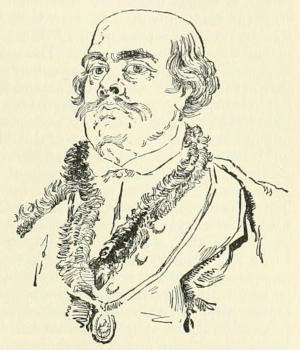
General Suvarov
(1729-1800)
The fact that the forces of the
empire must from that time be almost
entirely devoted to the support of a
foreign policy; that little, if anything,
could be done for the development of
culture and industry (and that only as
a matter of secondary importance),
that no consideration could be given to
the most necessary reforms—none of
these circumstances worked Russia
such visible and tangible harm as the flooding of the country with unconsolidated
paper money doomed in advance to depreciation; as matters stood, this
was probably a greater evil. When Russia entered upon the grasping policy
of Potemkin she began to lay out her future in advance, so to speak, and that
on a scale utterly out of proportion to the actual gain which might be or
which was in fact attained. The evils which resulted have continued to
work themselves out down to the present day. As in this way the germs of
a future power were constantly being sacrificed in order to conjure up power
in the present by overdrawing the resources in hand, the real advancement
of the empire was paralysed, and even the actual might in which they gloried
remained partly a sham which certainly did not correspond with the reality.
When later it became necessary for Russia to participate in the momentous
struggles which involved the destiny of Europe, her power was not matured,
concentrated, or husbanded at the decisive moment—as for instance the
power of Prussia by Frederick William I; her future prospects were encumbered
by a heavy burden and by manifold obligations, the inner development
was behind the times, and her financial position was shaken. It became
necessary continually to make fresh, feverish efforts, which always over-reached
the possibilities of the present and which hindered the inner development
afresh, involved the future deeper and deeper, and exhausted its
resources.i
The Official Status of the Favourite
It may be deemed necessary in this place to explain what were the duties
expected from and the distinguished honours paid to the favourites of Catherine.
When her majesty had made choice of a new favourite, she created
him her general aide-de-camp, in order that he might accompany her wherever
she went, without incurring public censure. From that period the favourite
occupied in the palace an apartment under that of his royal mistress, with
which it communicated by a private staircase. The first day of his installation
he received a present of 100,000 rubles, and every month he found 12,000
placed on his dressing-table. The marshal of the court was ordered to provide
him a table of twenty-four covers, and to defray all his household expenses.
The favourite was required to attend the empress wherever she went, and was
not permitted to leave the palace without asking her consent. He was forbidden
to converse familiarly with other women; and if he went to dine with
any of his friends, the absence of the mistress of the house was always required.
Whenever the empress cast her eyes on one of her subjects, with the
design of raising him to the post of favourite, he was invited to dinner by
some one of her female confidants, on whom she called as if it were by chance.
There she would draw the new candidate into discourse, and judge how far
he was worthy of her destined favour. When the opinion she had formed
was favourable, a significant look apprised the confidant, who, in her turn,
made it known to the object of her royal mistress’ pleasure. The next day
he was examined as to the state of his health by the court physician, and as
to some other particulars by Mademoiselle Protasov, one of the empress’
ladies, after which he accompanied her majesty to the Hermitage, and took
possession of the apartment that had been prepared for his reception. These
formalities began upon the choice of Potemkin, and were thenceforth constantly
observed.
When a favourite had lost the art of pleasing, there was also a particular
manner of dismissing him. He received orders to travel, and from that
moment all access to her majesty was denied him; but he was sure of finding
at the place of his retirement such splendid rewards as were worthy of the
munificent pride of Catherine. It was a very remarkable feature in her
character that none of her favourites incurred her hatred or vengeance, though
several of them offended her, and their quitting office did not always depend
on herself.
Potemkin’s Schemes of Conquest
[1775-1780 A.D.]
Potemkin’s rule commenced at the very time in which the Peace of
Kutchuk-Kainardji was concluded (July, 1774). The disputes with Poland
and the rebellion of Pugatchev were no sooner ended than he immediately
violated every condition of that treaty, well knowing that the empress would
approve of everything he might do. Dowlet Gerai, who was elected khan by
the now independent Tatars, still remained much more favourably disposed
to the Turks than to the Russians: the latter, therefore, by means of money
and intrigues, raised up a pretender against him; and then, under pretence
of an armed mediation, a Russian army occupied a part of the Crimea, and
seemed disposed to make the khan a prisoner, and to seize the whole province.
Dowlet Gerai took refuge with the Turks in April, 1775, and Sahim Gerai, who
was a mere creature of Russia, was elected in his stead, to the great satisfaction
of the Russians, who foresaw that the majority of the Tatars would oppose the
new khan, and thus furnish them with another pretext for a renewal of hostilities.
A war with the Porte appeared unavoidable, and Romanzov received
commands to collect a considerable army on the Dnieper, whilst Repnin in
Constantinople was endeavouring to deceive the sultan, and Potemkin
betrayed the unfortunate Sahim Gerai.
By this time Potemkin had ceased to be the personal favourite of the
empress; but he himself recommended his successors in that post to her
notice. Potemkin was indispensable to Catherine in consequence of those
colossal undertakings which procured her the name of Great; and because
the fear with which he inspired all her enemies secured to her the possession
of the throne, which she withheld from her son Paul. Zavadovski had become
the occupant of the apartments of the royal palace in November, 1776, and
been created a major-general; as soon, however, as he fell under Potemkin’s
suspicion, the latter authoritatively insisted upon his dismissal. Zavadovski
had turned against his patron, and was an eager favourer of the Orlovs and
Field-Marshal Romanzov. For this reason Potemkin succeeded in obtaining
leave of absence for the favourite in July, 1777, in order to provide during his
temporary retirement a substitute who should eventually displace him.
Potemkin had long before selected a Major Zoritch for his adjutant, who was
politically insignificant, but very attractive in his hussar uniform, with a
view to present him to the empress. Zavadovski had no sooner left the
palace than he carried his design into effect, and the empress made Zoritch a
colonel adjutant-general and her companion. At the expiration of nine
months, he too fell under Potemkin’s displeasure, and was obliged to retire,
for the empress was completely under the control of her minister. Next
came Korsakov, a handsome sergeant in the guards, who was suddenly raised
to the rank of aide-de-camp general. He too was indignant at Potemkin’s
unbounded pride and avarice, but attempted in vain to open the eyes of the
empress; he was obliged to yield to the influence of the indispensable tyrant
after he had enjoyed the favour of the empress for fifteen months.
The circumstances of the year 1778 were peculiarly favourable to the
accomplishment of Potemkin’s plans of conquest, for war had broken out in
the spring between France and England, and both powers were so fully occupied
in the west that they had no leisure to attend to the concerns of the
east. Potemkin, therefore, sent an army, commanded by Suvarov, against
the Kuban and Bedjiak Tatars, whilst other Russians penetrated into the
Crimea and were guilty of the most cruel devastations. This led to the seizure
of some Russian ships in the straits of the Dardanelles on the part of the
sultan, who was, however, unable to commence a war without the aid and
co-operation of France. But that power, unwilling to break with Russia,
insisted on mediating, and the sultan was forced to acquiesce. The result
was that the Russian ships were restored, and the sultan formally recognised
Sahim Gerai as the rightful ruler of the Crimea.
Catherine was so pleased with the conduct of France on this occasion that
she embraced with alacrity the plan of the armed neutrality, which was
devised by the French minister Vergennes; and in 1780 she put herself at
the head of that league which was joined by almost all the powers of Europe
except Great Britain. It was formed for the purpose of resisting the right
asserted by the English navy to make prize of an enemy’s goods, or of goods
shipped for an enemy’s port, wherever found, and even though covered by a
neutral flag. The leading principle of the league was that free ships make
free goods. Great Britain would not admit this; but at that time she did
no more than expostulate with her good friend and ally the empress of Russia.
It was not until the reign of Paul that she waged war for the maintenance of
the opposite principle, which she later repudiated during the Crimean
War.
From this time forward, as we have seen, Potemkin, Voltaire, and a host
of flatterers amused the empress with dreams of the restoration of a Byzantine
empire, and the erection of a new capital on the Black Sea. Sahim Gerai
prized the slavish title of a lieutenant-colonel in the guards of a foreign empress
more than that of prince of a nation to which the Russian czars for many
years had been vassals, and he renounced the national costume of his people
in order to glitter in a Russian uniform and wear the decorations of the order
of St. Anne. Potemkin contrived every month to alienate him more and
more from his people, till at last this miserable man was induced to lay down
his khanate, from which he derived a revenue of three or four millions of
rubles, in order, as he thought, to revel peacefully in the enjoyment of some
hundred thousand rubles, which Potemkin was to pay him as the newly
appointed Russian governor-general of Tauris, as the country was now to be
called. Potemkin was too much accustomed to receive and not to give, and
to contract debts without thinking of paying them, to give himself much concern
about the payment of the promised salary, although the empress was
led to believe that the yearly sum always charged to her was in reality regularly
paid to the khan.
[1783 A.D.]
The shamelessness of the Russian government on this occasion fully
equalled the audacity of their manifestoes respecting the partition of Poland,
or that of the state-papers of a Genz and a Talleyrand. In the Russian manifestoes
published in April, 1783, it was made as clear as the sun to the Tatars
that the empress and Potemkin were really proposing to confer upon them
the most signal benefits. It was stated that the Tatars, as Russian subjects,
were in future to be delivered from all the evils of their internal disputes,
and by the incorporation of the Crimea, the Kuban, and the eastern Nogaians
an end was to be put to those oppressions from which they had hitherto
suffered from the Turks and the Russians alternately. What the correspondence
was between these promises and the subsequent reality may be learned
from all the works of travellers who visited these districts, and gave accounts
of the Crimea and the Tatars a generation or two later. That numerous,
free, and rich race of people, clothed in silks and of noble appearance, had
then dwindled into a crowd of starving beggars; their magnificent tented
cities had become gipsy encampments, and their houses and palaces exhibited
mere masses of ruin and decay.
These manifestoes, indeed, as is usually the case, were not intended for
those to whom they were addressed, but merely to conceal in a cloud of words,
from the eyes of those at a distance, the cruelties and bloodshed with which
they were accompanied. The Tatars made an effort to defend their liberties,
and their magnates made no secret of their dissatisfaction; Potemkin, therefore,
had recourse to one of those heroic means which usually find defenders
enough when they are applied for the support of the true faith and of autocratic
government, and are only reviled and execrated in the hands of a
Danton and a Robespierre. He proposed by a single massacre summarily
to annihilate the malcontents, and to awe the rest into submission by the
dread of a similar fate. Posorovski received express orders to make himself
master of the malcontents, their families, and adherents, and put them all to
the sword; he, however, possessed moral courage enough to decline the business
of an executioner. Potemkin’s cousin was not so scrupulous. According
to the accounts, whose unanimous testimony we are obliged to follow,
even when it appears to us incredible, Paul Potemkin caused above thirty
thousand Tatars, of every age and sex, to be massacred in cold blood, and in
this way procured for his cousin the easily won title of the Taurian, and the
place of grand-admiral of the Black Sea and governor-general of the new
province of Tauris.
The massacre in Tauris took place in April, 1783, and the Turks were
unable to render any assistance to the Tatars without foreign support.
Among the European powers, however, England was at that time fully
occupied with the disturbances which in the following year brought Pitt to
the helm of affairs; France was glad to see an end to the American war;
Joseph II was bound by the Treaty of Tsarskoi Selo; Frederick II hoped to
become master of Thorn and Dantzic, if Russia was well-disposed towards
him; and Gustavus III of Sweden was the only monarch who could have
rendered any aid. In the very same year, however, Gustavus suffered himself
to be induced to go to Friedrichsham, where he sold himself to the empress;
nothing, therefore, was now left to the Turks but to yield to their destiny.
The sultan did what had been done by the king of Poland a few years before;
by his consent he changed that into a righteous and legal possession which,
being seized in the midst of peace, was previously a robbery. The whole
territory of the Tatars, the Crimea, the island of Taman, and a great part of
the Kuban were ceded to Russia, and a treaty of commerce was forced upon
the Turks, by virtue of which the Russian consuls in the various ports of
Turkey were erected into a power wholly independent of the government of
the country. This treaty of commerce had been drawn up by Panin before
he had been obliged to yield to the superior influence of Potemkin and withdraw
from public affairs; and it was now concluded on the 10th of June, 1783.
By virtue of this treaty the Turks were obliged to submit the decision of all
mixed civil cases in which a Russian and a Turk were the respective parties,
not to the local tribunals, nor to the higher authorities, nor to a court of arbitration,
but to the Russian consul; and in all pecuniary transactions the
claims of a Russian against a Turk were urged with much greater strictness
than in those cases in which the Turk was the claimant and the Russian the
debtor.
In the eyes of the world, which regards only externals, Potemkin was now
a great and admired statesman; and so absolute was his sway over the empress
herself, that she not only tolerated his insolence, his total neglect of all pecuniary
obligations, his tyranny over all classes, and his imperial expenditure
and magnificence, but allowed him to help himself to an unlimited extent out
of the coffers of the state. Potemkin on the one hand did homage to the
empress as if she were a goddess, and on the other he suffered himself to treat
her with the most insolent familiarity and rudeness. He would even saunter
from his own apartments into hers in his dressing-gown and slippers, with his
stockings hanging down and his legs bare. He went so far as to extort from
those who enjoyed the empress’ favour a part of the money which they
received from her, and yet he allowed poor Sahim Gerai to starve. He never
paid him the assigned pension of 100,000 rubles which was yearly debited to
the empress’ account, and even the displeasure of Catherine could not induce
him to bestow upon this Russian protégé the simplest means of life.
The founding of a new Russo-Grecian capital, with which Potemkin now
busied himself, was a magnificent piece of flattery for the empress, but for
which she was unhappily obliged to pay too dear. Catherine indulged with
Voltaire in those visionary schemes of a utopian Greece, of a civilisation of
which she and not the people was to be the source, of an enlightenment,
industry, and trade to be carried into these conquered deserts by ukases and
courtiers; Potemkin acted according to this fancy. He first erected a city
with buildings of every description, and then sought for inhabitants, or forcibly
drove them for a time from all quarters, when he wished to make a court-spectacle
of this theatrical city and to enchant the empress. It was of no
consequence to him that his city fell to pieces and its inhabitants disappeared
as soon as he turned away his eyes. The new city was called Kherson, a
name long since obscured by that of Odessa; the empress granted 18,000,000
rubles, most of which, however, Potemkin diverted to his own private use.
The situation was badly chosen, and yet this shadow of a capital was for a
length of time charmed into existence by innumerable arts of fraud and open
violence; and the deserts of which it was to be the metropolis were erected
into a province, to which Potemkin gave the name of Catherine’s Glory (Slava
Ekatharina). Another province, somewhat farther to the north, near the
celebrated falls of the Kaidak, was also honoured with the name of the empress,
and called Iekatarinoslav.
The general to whom Potemkin at this time assigned the congenial task
of havoc and destruction in the country of the Nogaian Tatars and in Kuban
was Suvarov, a man who from that period till the end of the century had
the misfortune to be continually employed as the instrument of a murderous
military despotism. In Poland he executed three times those orders of annihilation
which were issued from St. Petersburg. He destroyed the Turks
and sacrificed the Russians by thousands at the will of Potemkin. He subsequently
shared Paul’s hatred against the French and every thought of civil
freedom, and performed the same kind of heroic deeds for that madman’s
pleasure as he had previously done at the bidding of Potemkin. He was
undoubtedly one of the greatest generals of modern times, but wholly destitute
of humanity, for he sacrificed thousands without hesitation in order to
secure a victory or storm a fortress, when either was calculated to produce a
splendid effect though but for the moment. He not only flattered the empress,
but even the common soldiers and their superstitions. Though he was a man
of various knowledge, and had made himself master of all the arts of life as
practised in the highest society, he assumed at court the character of a sort of
court-fool, and acted often as if he were mad, merely in order to carry out
some surprising piece of flattery. In the company of the common soldiers he
affected the manners of the semi-barbarous Russian, lived as they did themselves,
submitted to every privation which they might be called upon to
endure, and knelt and prayed before every wayside image, often when the
roads were deep with mud.
[1785 A.D.]
At the time when a high-flown sentimentality was the fashion in Germany,
and the empress was past fifty, she indulged in a fit of romantic love
for the insipid and spiritless Lanskoi. This turn in her affections was very
agreeable to Potemkin, for Lanskoi neither took up the cause of the destitute
khan, nor yielded to the allurements of the king of Prussia, the emperor
Joseph II, or the English, when they were desirous of engaging him in affairs
of state. Potemkin freely permitted the empress to indulge her visionary
love for the wonderfully handsome and youthful face which captivated her
affections, and did not grudge her, among the many gross and degrading
scenes of her life, the enjoyment of one romantic passion, after the manner of
Werther and Siegwart, from the year 1780 till July, 1784. Catherine’s love
for Lanskoi had been romantic in his life, and her sorrow at his death was not
less extravagant; but notwithstanding all this ideality, she had been also
careful to show him substantial proofs of her affection at the cost of the country.
She bestowed upon him not only all possible titles, orders, and decorations—diamonds,
plate, and collections of every kind, but he left behind
him in cash a property of 7,000,000 rubles.
The fantastic mourning for Lanskoi was no sooner evaporated than the
empress allowed Potemkin, who presented candidates for every office, to
supply her with a substitute for her departed lover. In order to exclude all
other pretenders, Potemkin on every such occasion was prepared to fill the
vacancy; and with this view he had for some time made Lieutenant Iermolov
one of his adjutants. In 1785 this man became the declared favourite of the
empress, and soon ventured to pursue a course which Lanskoi would never
have thought of. He directed Catherine’s attention to the tyranny of Potemkin,
and gave her some hints respecting his behaviour towards Sahim Gerai.
The empress expressed her displeasure without naming the person who had
made her acquainted with the unhappy fate of the khan; Potemkin, however
easily guessed that no man in the empire would dare to speak ill of him to the
empress except Iermolov. He therefore threateningly replied, “That must
have been said by the White Moor,” as he was accustomed to call Iermolov
on account of his fair countenance and flat nose.
Catherine did not hesitate severely to reproach Potemkin for his harsh
and unjust conduct towards the khan, and she even wavered for some months
between her favourite and this son of the Titans, whom she regarded as her
protector and the creator of her glory and her greatness. At the end of June,
1786, a fresh scene occurred, by which the empress was compelled to declare
either for the one or the other. Iermolov had made a new attempt to alienate
the empress from Potemkin; the latter, therefore, haughtily insisted that
either Iermolov or he must retire from her service; Catherine felt herself constrained
to adhere to Potemkin, and Iermolov went upon his travels. During
the course of the year he had been loaded with riches, and on his departure he
was furnished with 100,000 rubles and imperial recommendations to the
Russian ambassadors at all the European courts. On the day after his
departure Momonov, another adjutant of Potemkin, occupied his place.
[1787 A.D.]
About this period Potemkin repeatedly travelled from St. Petersburg to
Tauris and back with all the expedition of a courier, whilst he was engaged in
the building of Kherson, in order to prepare a splendid triumph for the
empress. The neglected Sahim Gerai hastened thither to meet him and
make him acquainted with the urgency of his wants; but Potemkin, instead of
rendering him any assistance, banished him to Kaluga, where he fell into a
state of the deepest poverty. He then conceived that he might find some
relief from his fellow believers, and fled to Turkey, but the sultan caused him
to be arrested as a traitor and renegade at Khotin, to be conveyed to Rhodes,
and there despatched by the bow-string (1787). The plan contemplated by
Potemkin and the empress was to raise the grand duke Constantine, second
grandson of the empress, to the dignity of emperor of Byzantium, at the
expense of the Turks, and at the same time to incorporate the kingdom of
Poland with Russia. The new city of Kherson was no sooner ready for this
grand theatrical representation than the empress was to travel thither to
receive the homage of her new subjects, and to deceive the world by an ostentatious
display of magnificence and pomp.
Joseph II was invited to meet the empress in Kherson, in order to consult
with her upon a partition of the Turkish Empire; but Constantine himself
was in the first instance left at home. The luxury and extravagance exhibited
by Potemkin during the empress’ journey and the fêtes prepared for her
reception and entertainment at Kherson were worthy of the heaven-storming
characters of the pair. They remind us of the extravagance of the Abassides
and the descendants of Timur, with this difference—that civilisation and
the arts were strangers to the people of the caliphs and of the Great Mogul.
Never perhaps was there seen in monarchical Europe, where such things
are not rare, such a gross abuse of the wealth and well-being of the people,
and such insult cast on public opinion by a contemptible comedy, as on the
occasion of this imperial progress.
It began in January, 1787, and was continued night and day. To facilitate
the journey by night, Potemkin had caused great piles of wood to be
erected at every fifty perches, which were kindled at nightfall, and imparted
to the whole district almost the brightness of day. On the sixth day the
cortège reached Smolensk, and fourteen days afterwards Kiev, where the
degraded Polish magnates, who made a trade of their nation, their honour,
and their friendship, were assembled to offer their homage to the empress and
join in the revelry of her court. Potemkin himself had gone forward in
advance in order to arrange the side-scenes of the theatre which he erected
from St. Petersburg to Kherson. Deserts were peopled for the occasion; and
palaces were raised in the trackless wild. The nakedness of the plains was
disguised by villages built for the purpose of a day, and enlivened by fireworks.
Chains of mountains were illuminated. Fine roads were opened by
the army. Howling wildernesses were transformed into blooming gardens;
and immense flocks and herds were driven to the sides of the road in order to
delight the eyes of the empress in her hasty transit. The rocks in the Dnieper
were sprung, that the empress might descend the stream as conveniently as
she had travelled thither in the chamber of her sledge. At the beginning of
May the whole party embarked on the river in fifteen splendid galleys at
Krementshuk, and on the following day Stanislaus of Poland presented himself
at Kaniev, in order, as it were, by his insipid and pitiful character to serve
as a foil to the monarchial splendour of a woman. He accepted an alms of
100,000 rubles for the expenses of his journey, was very graciously received by
Potemkin, treated with coldness and indifference by the empress, and as if his
royal Polish income was simply a Russian pension he begged for an augmentation.
He was not ashamed to acknowledge to all the courts whose ambassadors
accompanied the empress that he regarded his kingdom as a Russian
province, for he besought the empress to grant the succession to his nephew
and to his nation the free navigation of the Dnieper. As is customary in such
cases, there was no lack of promises; but none of his petitions were really
granted, for it was impossible either to value or respect him, and in his
situation he was incapable of inspiring fear.
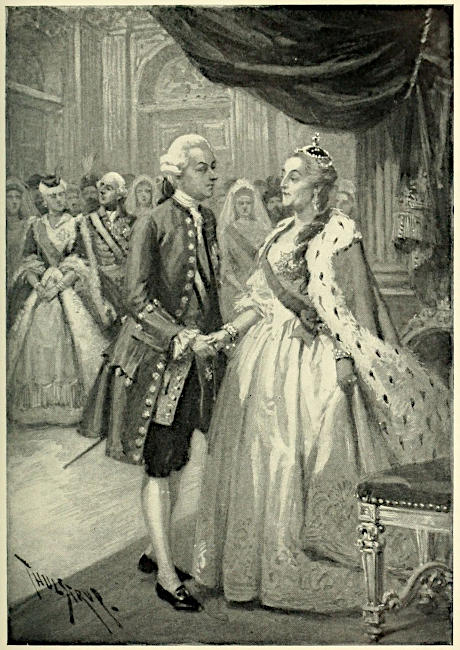
MEETING OF CATHERINE II OF RUSSIA AND JOSEPH II OF AUSTRIA
(Painted for The Historians’ History of the World by Thure de Thulstrup)
The emperor Joseph, who had anticipated the arrival of his ally in Kherson,
travelled to meet her as far as Kaidak, and returned with her. He soon perceived
that she was shamefully deluded by the appearance of prosperity,
civilisation, and population, and that soon as she had passed through all was
again to become empty and deserted. Like the villages, flocks, and men by
the wayside, the new buildings in which the distinguished travellers passed
their nights and the houses and shops in Kherson all vanished again when
they had served their temporary purpose. It will not be regarded as incredible
that 7,000,000 rubles were expended on the journey, when it is known that
the throne itself, which was erected for the empress in what was called the
admiralty at Kherson, cost 14,000. Catherine made a magnificent entry into
the new city, passing under a triumphal arch, on which was inscribed in the
Greek tongue, “The way to Byzantium.”
After the meeting at Kherson the two imperial allies prepared to direct
their forces against the whole extent of the Turkish frontier, from the Adriatic
to the Black Sea. Care was taken, however, to furnish an excuse for the
participation of Austria, by inciting the Turks to make the first attack; for
only in such a case was Austria bound to furnish auxiliaries to the Russians.
To this end Bulgakov, Catherine’s ambassador at Constantinople, was ordered
by every means to excite commotions among the Greeks, Bulgarians, Wallachians,
and Slavonians, as well as in Egypt and in Asia Minor. The Turks,
justly incensed at these intrigues, insisted upon a distinct declaration of their
views on the part of the Russians; and when they received for answer only
the usual diplomatic subterfuge that the ambassador must wait for instructions
from St. Petersburg, they immediately declared war, sent Bulgakov to the
state prison of the Seven Towers, and nothing but the threatening interference
of the English minister could have prevented them from inflicting summary
vengeance upon him, to show their righteous displeasure at the conduct of his
government. Catherine and Joseph had now gained their wishes. The
Turks were the first to declare war, and a pretence was thus afforded to the
Russians to call upon the Austrians for that aid which they were bound by
treaty to render in case of an attack on the part of the Turks.
Catherine published a manifesto, in which after a long enumeration of the
pretended wrongs ascribed to the Porte, she added that, provoked by a conduct,
in itself so offensive, she had, very unwillingly, been obliged to have
recourse to arms, as the only means left her for the support of those rights
which she had acquired at the price of so much blood, and to avenge her
wounded dignity, suffering from the violence that had been used towards her
minister at Constantinople; that entirely innocent of all the calamities inevitably
engendered by war, she relied with confidence, not only on the Almighty
protection and the assistance of her allies, but on the prayers of the Christian
world, for triumph in a cause so just as that which she was obliged to defend.
This manifesto was soon followed up by a second, which declared that the
Porte had arrogantly presumed to insist on a categorical answer to its absurd
demands; and that the empress, forced to repel the aggression of the enemy
of the Christian name, armed herself with confidence, under the protection of
that just God who had so long and so powerfully shielded the Russian Empire.
Had Potemkin been as great a general as he was capable of devising magnificent
plans and playing the Russian tyrant, great things would have been
accomplished in 1787, for all the preparations for the war had been made long
beforehand. Field-Marshal Romanzov was to share the command of the
army with Potemkin; that is to say, he was to do all the work, and the other
was to engross all the merit. Romanzov declined this thankless office, and
Potemkin stood alone at the head of the army; but he did not succeed in
deceiving posterity, for no one has ever ascribed to him what was effected by
the officers under his command—by Repnin, Paul Potemkin, Suvarov,
Kamenskoi, Galitzin, and Kutusov, all of whom became more or less renowned
in later wars. Potemkin found in Suvarov precisely such an instrument as he
needed: for to that general the will of the empress or her favourite was in all
cases a law paramount to all moral obligations, or any feelings of humanity.
He was sent to Kinburn, the chief object of the campaign being apparently
the siege of Otchakov, by the main body under Potemkin, whilst other divisions
were despatched to observe the movements of the Tatars in the Kuban.
[1787-1788 A.D.]
Kinburn was a small fortress occupied by the Russians, and situated upon
a promontory directly opposite to Otchakov, in and around which the Turkish
army was stationed. The object of Suvarov’s mission was to frustrate the
efforts of the Turkish fleet to land a division on the promontory of Kinburn;
and he executed the task in a masterly manner. At first he remained perfectly
quiet in the fortress, after having erected a battery at the extremity
of the promontory, in order to cannonade the Turkish ships from the land, at
the same moment in which they might be attacked by the Russian fleet. He
allowed the Turks to proceed without molestation till they had disembarked
from six thousand to seven thousand men; he then sent a few regiments of
Cossacks against them, and at the same time charged them at the head of two
battalions of infantry with fixed bayonets, and exterminated them all. Immediately
afterwards he employed his battery against the Turkish fleet. The
prince of Nassau-Siegen, who had the command of the Russian gunboats of
Nikolaiev, attacked the Turkish ships at the very entrance of what is called the
Liman, and within range of Suvarov’s guns, to whose well-directed fire he was
indebted for a great share of the advantages which he gained.
The whole remaining part of the year 1787, as well as the spring and a
great part of the summer of 1788, elapsed without anything important having
been undertaken; the whole of the Russian land-forces were, however,
directed towards the Bug, in order to push forward with the greatest expedition
to the Danube. The Turks had already suffered defeats at sea and in
the Caucasus. The Russian fleet in the Black Sea, which was almost wholly
commanded by foreigners, nearly annihilated the Turkish navy; generals
Tallitzin and Tekeli massacred the Tatars of the Kuban, and Tamara reduced
Georgia and Lesghistan. In August, Potemkin at length marched against
Otchakov, but very wisely left the whole conduct of the military operations
to Suvarov, the victor of Kinburn. The Russian operations were delayed in
expectation of an Austrian army, which, in connection with a Russian force
under Soltikov, was to make an incursion into Moldavia. This delay was
protracted till King Gustavus began to exhibit symptoms of making an attack
on the provinces contiguous to Sweden, which were now deprived of means
of defence. He had to revenge on Russia a long series of wrongs, crowned by
the intolerable conduct of Catherine’s ambassador Razumovski, whom she
had sent to form conspiracies against him, and to persecute and insult him in
his own capital.
[1788 A.D.]
Gustavus III would also willingly have induced Denmark to take part in
the movement against Russia; in this, however, he was unsuccessful, although
supported by England and Prussia. Razumovski, the Russian ambassador,
was ordered to leave Stockholm on the 23rd of June, and went to the army in
Finland. The king appeared as if he designed immediately to march against
St. Petersburg, which excited no small concern in the minds of the government,
because, in confident reliance on the king’s misunderstanding with the Swedish
nobles, the whole of their good troops had been despatched to the frontiers of
Turkey.
The king of Sweden was acquainted with the feelings of his nobles, consequently
with those of the generals and officers of his army; he therefore
endeavoured to deprive the malcontents of the apparently legal point of a
refusal to serve, by changing the offensive war which he contemplated into a
defensive one, and for this purpose had recourse to a very childish subterfuge.
There had been a long-existing dispute between the two countries respecting
the bridge over the small river Kimmene, the boundary between the two
states, whether it should be painted in Swedish or Russian colours; he provoked
the Russians to maintain this disputed right by force of arms, and then
proclaimed that he had been attacked by them, and was therefore justified in
carrying on a defensive war without consulting the estates. We leave it undecided
whether he took possession of the bridge by force, and thereby compelled
the Russians to resist force by force; or whether, as the best accounts
allege, he caused some Swedes to be clothed in Russian uniforms in order to
attack his own soldiers, and in this way to justify an offensive war.
The distance from the river Kimmene to St. Petersburg is less than 150 miles.
There would have been no difficulty in storming the small fortresses of Viborg
and Friedrichsham, which lay upon the route, and an unexpected attack from
the sea might probably have led to the surprise and capture of Kronstadt
and Kronslot, the former of which is less than twenty miles from the open
waters, and the latter is situated on a sand-bank in the sea.[54] The favourable
moment, however, for an attack by sea had been already allowed to pass by
the king’s brother Charles, duke of Södermanland, who commanded the Swedish
fleet, and by land the king was precipitate when he ought to have delayed,
and hesitated when everything depended on rapidity.
On the 22nd of June Duke Charles, with fifteen ships of the line and five
frigates, had fallen in with three sail of Russian ships, to the north of the island
of Gothland, which he ought to have captured, but was restrained by a feeling
of reluctance to begin the war (which was then actually commenced), and
immediately a superior Russian fleet appeared. Admiral Greig, an Englishman,
commanded it; his fleet outnumbered the Swedish by two ships of the
line and two frigates, and therefore the issue of the engagement between the
two fleets which took place on the 17th of July was the less inglorious for the
Swedes. They fell in with the Russians off the island of Hogland, and fought
with great skill and courage; they lost, it is true, one of their line-of-battle
ships, but took one of the Russian fleet in its stead; at length, however, they
were compelled to seek for safety in the harbour of Sveaborg, where they were
kept in a state of blockade by the Russians during the whole of the campaign.
The secretary of the king’s embassy in St. Petersburg delivered such an
extremely absurd ultimatum that no other answer was given than an order
from the commandant to take his departure from the capital. Gustavus
commanded armaments to be prepared and a commissariat to be provided,
but left the whole superintendence to others, who neglected everything, and
instead of preparing means to oppose entered into secret correspondence with
the Russians. All this immediately appeared when the king at length resolved
to storm the fortress of Friedrichsham. He found himself destitute of heavy
artillery and other materials of war, which he supposed were all in readiness,
and whilst the artillery was being slowly brought up by land, the nobles were
devising the most shameful treason.
[1789 A.D.]
It was arranged that Friedrichsham should be at once attacked both by
sea and by land; and Siegeroth had actually landed his troops and commenced
operations when he suddenly received counter orders, because the troops
which were with the king refused obedience. In these circumstances, Gustavus
had no other alternative than to return to Stockholm, in order there
to recover his royal dignity and power which he had lost at Friedrichsham.
He entered Stockholm in September, and thenceforth occupied himself in
preparing a coup d’état, which he accomplished on the 17th of February in
the following year. Meanwhile, his traitorous nobles had concluded a truce
with Russia, which was so far advantageous to Gustavus that it liberated his
fleet from its captivity in the bay of Sveaborg. He was now dictator and
autocrat; he had at command the means of prosecuting the war with Russia:
but the favourable moment was past, and the Russians had already completed
all their preparations by land and sea for the defence of their provinces bordering
upon Sweden. Gustavus’ project of burning the Russian fleet in the
harbour of Copenhagen was discovered beforehand, and brought him nothing
but disgrace. When he again joined the army in Finland, his Swedes gave
evidence of their attachment and courage; but he himself again contrived to
injure the success of the war by his interference in its conduct. In the murderous
fights which ensued from the middle of June till the end of July, both
the Russians and Swedes lost great numbers of men, without any other gain
on either side than military renown. The Swedes in the meantime were
unfortunate at sea, and could not have profited by their success had they
been victorious by land.
Admiral Ehrenswerd commanded the Swedish flotilla of flat-bottomed
boats, constructed for navigating the rocky shallows of the coast, whilst the
similar Russian fleet was under the orders of the prince of Nassau-Siegen,
who had shortly before been commander of the Russian fleet in the Black Sea,
and had fallen into disputes with Potemkin, which led to his being sent to the
Baltic. The Russian ships of the line were under the command of Admiral
Tchitchakov, and had on board a considerable number of British naval
officers of experience. This fleet had on the 26th of June fallen in with that
of the Swedes, which was so injured in an engagement between Bornholm
and Gothland as to be obliged to return to Karlskrona. The unfortunate
issue of the battle was generally ascribed to disloyalty on the part of some
of the naval officers.
The king still persisted in his determination of opening up a way for himself
to St. Petersburg, and therefore of storming Friedrichsham. He himself
directed the execution of the project, although he was, properly speaking,
merely a volunteer with his army. By his interference he exposed the Swedish
army to considerable loss, on the same day (August 24th) on which the Russian
flotilla gained an important victory over the Swedes at Rogensalm.
Friedrichsham, according to the king’s command, was to be stormed by the
three generals, Siegroth, Kaulbart, and Platen; the assault, however, failed
of success, and the Swedes were obliged to retire: their flotilla was twice
beaten. The first victory of the Russians at Rogensalm was attributed to
the prince of Nassau-Siegen, who, however, was accompanied by three or
four persons who rendered him the same service which the British officers did
to Admiral Tchitchakov. On the 1st of September the Swedish flotilla experienced
a defeat at Högfors, and the land army, commanded by the king, was
there also compelled to retreat. The loss in human life was indeed great,
but the real injury small, for the Swedish army continued till the beginning
of winter to occupy its quarters on the frontiers of Russia.
The Campaign of 1790; the Treaty of Varela
[1790 A.D.]
During the winter, Gustavus withdrew from his army, but he resumed
his duties as commander in March, 1790, and was now careful to supply all
the deficiencies of the two previous years. On the 15th of April, in Finland,
he reduced the two important posts of Kärnakoski and Pardakovski near
Vilmanstrand; his Swedes were victorious at Valkiala; and on the 30th
repulsed the Russians in their attempt to recover the two posts just mentioned.
On the 4th and 5th of May the Swedes were afterwards beaten at Aberfors
by the Russian general Numsen, and lost twelve pieces of cannon. The king
having again taken Pardakovski, the key of Savolax, immediately caused a
portion of his land forces to embark in the flotilla, of which he himself assumed
the command, and ordered the remainder of the army to press forward by
the shore towards St. Petersburg, relying on the assistance of the fleet, which
was to receive them on board in case of a defeat. The fleet consisted of nineteen
large ships, twenty-seven galleys, and a number of gunboats, which in
all mounted about two thousand guns. It was absolutely necessary to the
execution of this adventurous undertaking that Friedrichsham should in all
haste be reduced by storm. The king, having been successful on the 15th
in a naval engagement, made his third attempt at storming the fortress on
the 17th and 18th of May, and notwithstanding a great loss in men failed in
effecting his object. Although the way by land thus remained barred, he
nevertheless persisted in his design of terrifying the empress in her capital.
Gustavus, having now embarked a greater number of Swedish troops
than before, reached Viborg, and on the 2nd of June, 1790, disembarked a
division of his army at Blörke, about forty miles from St. Petersburg. The
whole success of this rash enterprise depended on his remaining master of
the sea. In order to maintain this superiority, Duke Charles was to prevent
the junction of the two Russian fleets, one of which was lying in Kronstadt and
the other in Revel, and on the 3rd of June he was ordered to engage the division
of the fleet in the former harbour. The Swedish fleet was no sooner thus
withdrawn from its position than an opportunity was afforded to the Russians
to form a junction between their two fleets, which actually took place on the
day the duke entered the sound of Viborg (June 6th). The Swedish fleet was
blockaded by the Russian squadrons, consisting, when united, of thirty ships
of the line and eighteen frigates; the former, however, continued to keep up
its connection with the flotilla. It appears that both the Swedish fleets
would have been entirely lost had the two Russian admirals been qualified
for such a command. Captain Pélissier, who had served in Holland, is said to
have given Admiral Tchitchakov advice which he ought to have followed,
had he not been too obstinately attached to his own opinions; Pélissier even
pointed out to generals Suchtelen and Soltikov the places where they ought
to have erected their batteries in order effectually to bar the egress of the
Swedish fleet from the bay; no attention, however, was paid to his advice.
The prince of Nassau-Siegen proved himself to be in no respect superior as a
commander to Tchitchakov. On the other hand, if the advice of Duke
Charles had been adopted, the Russians would have been victorious without
a battle; King Gustavus and Stedingk, however, rescued the honour of the
Swedish name.
The Swedes had now been closely shut up in the bay of Viborg for three
weeks, and at the end of June were reduced to extremities; in the beginning
of July a grand council of war was held. Duke Charles and many other
members of the council recommended a capitulation, but the king and Stedingk
were in favour of making a desperate effort to force their way through
the enemy’s line. The attempt was accordingly made on the 3rd of July, and
through Tchitchakov’s neglect it was so far successful, as it enabled the Swedish
fleet to bring the blockading squadron to an engagement. But the Swedes
lost in it not only seven ships of the line, three frigates, and more than thirty
galleys and gunboats, but almost the whole of the royal guards, the queen’s
regiment, and that of Upland, amounting to six thousand or seven thousand
men, which had been put on board the fleet. Whilst the larger Swedish ships
thus endeavoured to gain the open sea, the flotilla had withdrawn for safety
into an arm of the gulf, which runs parallel to the shore and stretches towards
Friedrichsham. This inlet, called the sound of Suenske, is extremely difficult
of access on the side towards Friedrichsham, in consequence of a group of
rocky islands at its mouth, but it may be safely reached through the open
harbour of Asph. By this way the prince of Nassau-Siegen determined to
pass into the sound with the Russian flotilla, and attack the Swedes in their
place of refuge.
The latter were well protected from the attack of the Russian fleet by
rocks, and when the prince gave orders for the assault, on the 9th, the sailors
were so exhausted and his orders for battle were so unskilful that the king of
Sweden gained a splendid victory on that and the following day. The loss
of the Russians was so great as to have surpassed any which they had suffered
since the Seven Years’ War. Fifty-five vessels were captured, a number of
others destroyed, and fourteen thousand Russians either taken prisoners or
slain. In spite of this signal victory, the king of Sweden now awoke from his
dream of humbling the pride and glory of Russia; already he began to cast
his eyes towards France, and in the following year he dreamed his monarchical
dream in favour of the French émigrés. The idea of becoming the Godefroy de
Bouillon of the aristocratic and monarchical crusade, which Burke at that time
proclaimed in the English parliament and in his work on the French Revolution,
had been awakened in his mind in 1790, and the empress of Russia found
means of confirming him in his visionary projects. Moreover his means were
exhausted, and he therefore lent a favourable ear to the proposal of Galvez,
the Spanish ambassador, who began to mediate for a peace between Sweden
and Russia.
This peace, concluded at Varela on the Kimmene on the 14th of August,
1790, served to show how empty all Gustavus’ splendour was, and how unreal
and inefficient were all the efforts he had made. It was now seen that all the
blood had been shed to no purpose, and all the treasures of his very poor kingdom
mischievously squandered, for everything remained on the footing on
which it had been in the spring of 1788.
We now return to the war in which Austria and Russia were jointly engaged
against Turkey. The whole Austrian army was ready to take the field at the
end of the year 1787: it formed an immense cordon stretching from the mountains
on the coast of the Adriatic Sea to the Carpathians, and consisted of a
main body and five divisions. Unhappily, the emperor Joseph was desirous
of commanding the main army in person, under the unskilful direction of Lacy,
his military Mentor, who, like his pupil Mack, was a good drill-sergeant, but
no general. The main body consisted of 25,000 infantry and 22,000 horse,
and the whole of the troops together amounted to 86,000 cavalry and 245,000
foot, accompanied by 898 pieces of artillery.
In February, 1788, Russia and Austria had simultaneously declared war
against the Turks; but in August of that year England and Prussia entered
into an alliance, the main object of which was to place Prussia in a situation
to prevent the aggrandisement of Austria, if necessary, by force of arms.
This, however, was superfluous in 1788, because the diversion effected by the
king of Sweden prevented the Russians from proceeding with their usual
rapidity, and the emperor Joseph by his presence with the army frustrated
the effect of his immense armaments. The dissatisfaction with the whole
conduct of the war became so general that Joseph was at length obliged
earnestly to entreat Laudon, who had been the popular hero of the Austrians
since the time of the Seven Years’ War, and whom the emperor had hitherto
neither employed nor consulted, to assume the command of the army in
Croatia.
Successes of Laudon (1788 A.D.)
Laudon, having made an express stipulation that the emperor was not
to interfere with his plans marched against the Turks, defeated them under
the walls of Dubitza the very day after he joined the army, and reduced that
fortress; then, pushing into the heart of Bosnia, he compelled Novi to surrender,
whilst the emperor himself was obliged to hasten to the aid of the army
in the Bannat, which was very hard pressed by the Turks. The division under
Wartensleben, which should have supported it, had been driven back by the
Turks, who succeeded, in consequence of an incomprehensible neglect on the
part of the Austrians, in getting complete possession of the rocky bed through
which the Danube has forced a passage at a distance of six-and-twenty miles
above New Orsova. The pass, which is not more than a pistol-shot in width,
is commanded by a fortified cleft in the rock, called Veterani’s Hole, and
this post the Austrians should and could have maintained when the main
body of the Turks appeared at Old Orsova on the 7th of August; this, however,
they neglected to do. The Austrian general suffered himself to be defeated
and lost thirteen pieces of cannon, and as his communications with the main
army were cut off, he was obliged to retreat so far that the garrison of this
important post was left to its fate. The Turks sacrificed great numbers of
men in order to seize this fastness, by the possession of which they immediately
became masters of the whole navigation of the Danube as far down as Belgrade.
As soon as the Danube was lost, the imperial army found itself threatened in
the rear.
Nothing but disaster attended the operations of Joseph and Wartensleben.
The army under the prince of Coburg was somewhat less unfortunate. Khotin,
which the Russians had captured in the last war without firing a shot, was
reduced by it after a most heroic resistance of three months; and this was
the last exploit of a campaign in which thirty thousand Austrians fell in
desultory skirmishes, and forty thousand were swept off by pestilence—losses
but poorly compensated by the capture of Szabatch, Khotin, Dubitza,
and Novi. Circumstances, however, afterwards proved more favourable.
Jassy was taken; in October, the Russians were in possession of five districts
of Moldavia and of several passes in Wallachia, and the main army was again
able to extend the limits of its operations. Wartensleben sat down with a
part of the army before Mahadia; and the emperor kept possession of the
country from Pantchova to Semlin.
Victories of Suvarov (1788-1789 A.D.)
After the massacre perpetrated by Suvarov upon the Turks on the promontory
of Kinburn, the Russians had remained for a long time quiet; but
by their possession of the coasts they effectually prevented the Turks from
landing any troops, and by the capture of the island of Beresam wholly
excluded them from the mouth of the Dnieper. It was not till late in the
year 1788 that Potemkin summoned Suvarov from Kinburn to conduct the
siege of Otchakov, where, however, he was wounded, and after his return to
Kinburn the siege made very little progress. The avarice of Potemkin
deprived the soldiers of the necessary supplies; and the dreadful cold and
disease proved far more injurious to them than the attacks of their enemies.
At length the frost became so intense that the men were obliged to excavate
pits for dwellings, but the same frost also opened up a means of attacking
the fortress and reducing it after the Russian fashion, that is, without regard
to the sacrifice of thousands of men, a few weeks earlier than they could otherwise
have done. The city is completely protected on the side towards the
Black Sea by a marshy lake called Liman; and now that the lake was frozen,
Potemkin issued orders to storm the fortress from the sea side, where it was
weakest. The Russians were cruelly sacrificed: one regiment was no sooner
mowed down than another was compelled to advance, and above four thousand
men were slain before the storming of Otchakov was effected (December
16th), an exploit which was afterwards extolled to heaven. The Russians,
having at length borne down all resistance and forced their way into the city,
were compensated for their losses and sufferings during the siege by three
days’ murder and pillage; they put citizens and soldiers, men, women, and
children to the sword without mercy or distinction. It is said that twenty
thousand Turks perished in this massacre; but this piece of Russian heroism,
which was not performed by Potemkin himself but by others at his command,
was also rewarded after the Russian fashion. Every soldier who had taken
part in the siege received a medal of honour, whilst Potemkin, who had contributed
nothing to its success, derived the only real advantage. The empress
had previously deprived Razumovski of the office of hetman, which she now
conferred upon Potemkin, who received in addition a present of 100,000
rubles, besides what he had appropriated to himself out of the moneys destined
for the besieging army, and what he had seized out of the rich booty
which fell into his hands after the capture of the city.
The death of the sultan Abd-el-Habed in April, 1789, made no change in
the relations between the Turks and Russians. His successor, Selim, continued
to prosecute the war, and Suvarov having recovered from the effects
of his wound again joined Potemkin’s army, and was put at the head of the
division which was to co-operate with the Austrians. Laudon had now the
command of the whole Austrian army; the prince of Coburg, however, retained
that of the division which was to keep open the communications with the
Russians; and again he gave such numerous proofs of his incapacity to conduct
any great undertakings, or even to help himself out of trifling difficulties,
that the history of the campaign of 1789 alone ought to have prevented the
emperor Leopold from entrusting him with the command against the French,
who possessed generals and soldiers of a very different kind from those of the
Turks. Selim III had succeeded in getting on foot a very considerable force
which was destined to operate on the extreme point of Moldavia, where that
country touches upon Transylvania, and is separated from Wallachia by a
small river, which also divides the little town of Fokshani into two parts, one
belonging to Moldavia, and the other to Wallachia. Coburg was advancing
thither slowly and methodically, when the Turkish army encamped in the
neighbourhood of the town turned suddenly upon him, and filled him with such
apprehensions of being completely shut in that, instead of boldly doing what
Suvarov afterwards did, he anxiously besought that general’s speedy assistance.
Suvarov’s army was lying at Belat in Moldavia; when the news reached
him he at once began a march of between forty and fifty miles in a direct line
over mountains, across ravines and pathless wilds, and in less than thirty-six
hours reached the Austrians on the 30th of July, at five o’clock in the evening.
At eleven that night he sent the plan of the attack upon the Turks, which
was to commence at two in the morning, to the astonished prince, who had
never heard of such rapidity of movement, or seen it equalled even on parade.
The bewildered prince went three times to Suvarov’s quarters without having
seen him; in the battle he made no claim to the supreme command, which
should have belonged to him as the eldest general, but submitted as a subordinate
to Suvarov’s orders. The Turks, to the number of between fifty and
sixty thousand men, were in position at Fokshani when the Russians and
Austrians with forty thousand men passed the river Purna and stormed their
fortified camp, mounting the ramparts and driving them in at the point of
the bayonet, as if they were assaulting ordinary field-works. The camp was
taken in an hour, with the loss of about eight hundred men; the whole body
of the Turkish infantry fell into disorder, their cavalry galloped off, were scattered
in all directions, and pursued for some miles with the greatest impetuosity
and vehement zeal. The whole of the baggage and artillery, all the
stores collected in Fokshani, a hundred standards and seventy pieces of cannon,
fell into the hands of the victors; the Austrians exhibited the same zeal, perseverance,
and courage as the Russians, and had they possessed such a commander
as Suvarov, they would have reaped immense fruits from the victory,
but they became sensible, as early as August, that they were in want of a
proper leader.
Suvarov returned to Moldavia; Coburg looked quietly on whilst the Turks
were collecting a new army, and suffered the grand vizir to advance without
obstruction in Wallachia. The Turks directed Hassan Pasha, who lay in
Ismail, to make an expedition against Repnin, whilst the grand vizir was to
march against Prince Coburg, who had taken up a position at Martinesti, on
the river Rimnik. The news of this fresh attack no sooner reached the Austrian
camp than Coburg, instead of attempting to help himself, again had
recourse to Suvarov, who had already drawn nearer to Coburg from Belat.
The grand vizir’s army, which had been estimated at one hundred thousand
men, pushed forward rapidly by Braila (Ibrahil), and compelled the advanced
posts of the prince to retire into their camp. Suvarov received the prince’s
letter on the 16th of September, immediately gave orders to march, and two
days afterwards succeeded in forming a junction with the Austrians, at the
very moment in which they were to have been attacked by the Turks.
Austrian and Russian Valour; Austria’s Withdrawal (1789-1790 A.D.)
The Austrians then proved anew that they were not to be surpassed when
not commanded as usual by princes and privileged persons, who become generals
whilst they sleep. Coburg, as he had previously done at Fokshani,
totally relinquished the command at Martinesti to Suvarov, who immediately
availed himself of the oversight of the Turks in not fortifying their camp before
they offered battle, and attacked them by storm in their unfinished trenches.
The issue was as glorious as it had been on the 31st of July at Fokshani; the
contest, however, was more obstinately maintained. On this occasion the
Russians formed the left wing, whilst the centre and right were occupied by
the Austrians, whose admirably served artillery scattered the Turkish cavalry,
which had made an attempt to surround and cut off the small body of the
Russians. The victory in this dangerous and hard-fought battle was gained
not merely by the courage, activity, and bayonets of the Austrian and Russian
infantry, but especially by the great military skill of the commander.
His orders to avoid the village of Bochsa, and first to drive the Turks out of
the woods by which they were covered before commencing the main attack,
have been greatly admired, and above all his prudence in not sacrificing the infantry
in a blind storm, which was the more remarkable in a general accustomed
to bring everything to a rapid determination.
The victory was splendid, the booty immense, the Turkish army a second
time utterly dispersed—a necessary consequence of the nature of its composition—and
the number of killed and wounded much greater than at
Fokshani. Prince Coburg, on account of this victory, in which he was entitled
to little share, was created a field-marshal; Suvarov received the dignity of a
count of the empire from the emperor Joseph, and the empress of Russia for
once gave an honourable surname to a man who had really earned it by his
personal services; she raised him to a level with her Tchesmian Orlov and
her Taurian Potemkin, and called him Rimnikski, from the name of the river
on the banks of which he had been victorious.
The victory of Rimnik and the capture of Belgrade by Laudon on the 9th
of October were the harbingers of greater success. Hassan Pasha, the
Turkish high-admiral and celebrated conqueror of Egypt, whose confidence in
his good fortune had encouraged him to assume the command of an army, was
totally defeated at Tobak, in Bessarabia, by Prince Potemkin, and his discomfiture
was followed by the surrender of Bender, Akerman, Kilia Nova,
and Isatza, and by the investment of Ismail. At the same time the prince of
Coburg took Bucharest and Hohenlohe, forcing the passes which lead into
Wallachia, made himself master of Rimnik and Krajova. Laudon also
reduced Semendria and Kladova, and blockaded Orsova, which, being situated
in an island of the Danube, was inaccessible to regular attacks. By
these conquests the allies became masters of the whole line of fortresses which
covered the Turkish frontier; the three grand armies, originally separated by
a vast extent of country, were rapidly converging to the same point, and
threatened, by their united force, to overbear all opposition, and in another
campaign to complete the subversion of the Ottoman empire in Europe.
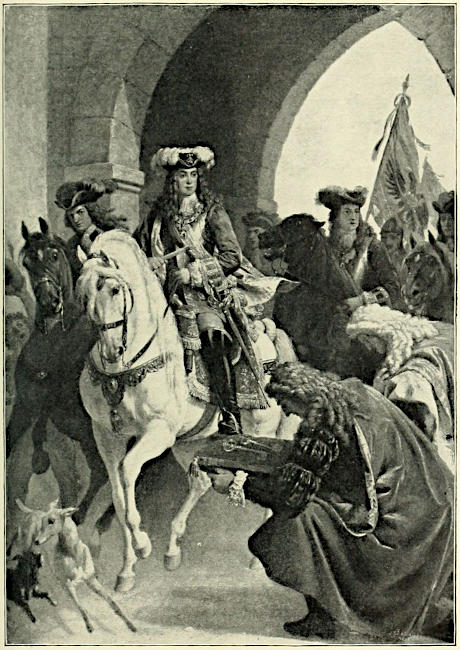
AUSTRIANS ENTERING BELGRADE
(From the painting by Karl von Blaas in the Ruhmeshalle of the Arsenal in Vienna)
But in the midst of this successful career, the increasing ferment in the
hereditary states of Austria, the rebellion in the Netherlands, and, still more,
the interposition of the maritime powers and Prussia, checked the hopes of
Joseph at the very moment when his projects of aggrandisement seemed
hastening to their completion. Justly alarmed at the successes of the two
imperial courts, the three combined powers incited Poland to throw off the
yoke of Russia, delivered the king of Sweden from Danish invasion, and laid
the foundation of a general alliance for reducing the overgrown power of
Austria and Russia. The king of Prussia even encouraged the rising discontents
in Hungary, fomented the troubles which the impolitic innovations of
Joseph had excited in the Netherlands, and, in the beginning of 1790, opened
a negotiation with the Porte for the conclusion of an offensive alliance,
intended not only to effect the restoration of the dominions conquered during
the existing war, but even of the Crimea, and the territories dismembered by
the two imperial courts from Poland.
The only power to which Joseph might have turned as a counterpoise to
this combination was France, from whose recent change of system he had
flattered himself with hopes of a cordial support, and from which he had even
received private largesses to a considerable amount. But now France was
in the throes of her great revolution, and Joseph was left without a resource.
Worn down by innumerable calamities and disease, he died in February, 1790;
and his successor, Leopold, was fortunate enough to conclude a separate
peace with the Porte.
Russia Prosecutes the War; the Storm of Ismail (1790 A.D.)
Russia continued to prosecute the war against the Turks without the aid
of Austria. Ismail still held out, and Potemkin, who had been besieging it
for seven months, began to grow impatient. Living in his camp like one of
those satraps whom he even surpassed in luxury, he was surrounded by a
crowd of courtiers and ladies, who exerted every effort to amuse him. One
of these ladies, pretending to read the decrees of fate in the arrangement of a
pack of cards, predicted that he would take the town at the end of three weeks.
Potemkin answered, with a smile, that he had a method of divination far
more infallible. He instantly sent orders to Suvarov to come from Galatz
and take Ismail in three days. Suvarov arrived and took such measures as
would seem to indicate that he designed a renewal of the regular siege; he
drew together the scattered divisions of the troops, formed them into a large
besieging army of about forty thousand men, and ordered the small Russian
fleet to come into the neighbourhood of the city; but his real design was to
follow the course he had successfully pursued before Otchakov, take advantage
of the frost, and reduce the fortress by storm.
Had not Ismail, according to ancient usage, been built without advanced
works, even a general like Suvarov would scarcely have ventured on such an
attack, which in the actual condition of the defences was attended by such
murderous consequences. On the 21st of September the city was twice summoned,
and on both occasions the garrison and inhabitants were threatened
with the fate of Otchakov. The Turks, however, did not suffer themselves to
be terrified into submission, and the fearful storm was commenced on the
22nd, at four o’clock in the morning. The wall was not mounted till eight
o’clock, after an unexampled slaughter; but still the hottest part of the
struggle took place in the city itself. Every street was converted into a fortress,
every house became a redoubt, and it was twelve o’clock before the
Russians, advancing through scenes of carnage and desperate resistance,
reached the market-place, where the Tatars of the Crimea were collected.
The Tatars fought for two hours with all the energy of despair, and after they
had been all cut to pieces the struggle was still carried on by the Turks in the
streets. Suvarov at length opened a passage for his cavalry through the
gates into the devoted city; they charged through the streets, and continued
to cut down and massacre the people till four o’clock in the afternoon. At
the conclusion of this dreadful butchery the Russians received the reward
which had been promised them when they were led to the storm and to certain
death,—the city was given up for three days to the mercy of the victorious
troops.
[1791 A.D.]
Suvarov himself, in his official report of this murderous enterprise, states
that in the course of four days 33,000 Turks were either slain or mortally
wounded, and 10,000 taken prisoners. He rates the loss of the Russians at
2000 killed and 2500 wounded: a number which seems to us as improbably
small as the usual accounts, which assign 15,000 as the Russian loss, seem
exaggerated. There were two French émigrés present at this storm, one of
whom afterwards became celebrated as a Russian governor-general and
French minister, and the other as a Russian general in the war against his
countrymen. The first was the duke de Richelieu, or as he was then called de
Fronsac, and the second the count de Langeron. Kutusov also served in this
affair under Suvarov and led the sixth line of attack.
European Intervention; the Treaty of Jassy (1792 A.D.)
About this time the whole diplomacy and aristocracy of Europe were
busily employed in endeavouring to rescue the Turks, in order to check the
dangerously rapid progress of the French and Polish revolutionists. There
speedily grew up such a general desire as the English wished to promote—of
two evils to choose the least—to secure and uphold the empire of the Turks
and to let the nationality of Poland perish. Russia, however, declined the
proffered mediation of England in the war with the Turks, as she had resolved
for this time to give up her conquests in Turkey in order to indemnify herself
in Poland: she accepted merely the intervention of the friendly Danes.
Potemkin and the empress were not unthankful for Suvarov’s servility,
since he threw himself and all his services at their feet, and ascribed everything
to them alone. Repnin, whom Potemkin left at the head of the army
when he went to St. Petersburg in October, 1790, pursued a very different course,
doing more in two months than Potemkin had done in three years. He
crossed the Danube with his army, pushed forward into Bulgaria, and caused
the whole Turkish army to be attacked and beaten near Badadagh by Kutusov,
after Gudovitch, the brother of him who had been the faithful aide-de-camp
of Peter III, had completely put down the Tatars in the Kuban in January,
1791. At the head of forty thousand Russians, Repnin then advanced
against one hundred thousand Turks, under the command of the same vizir,
Yussuf, who had fought with such success against the emperor Joseph in the
Bannat.
Potemkin eager to appropriate the impending victory, started with great
expeditiousness from St. Petersburg when both armies were ready for battle
(July, 1791). He took it for granted that Repnin would certainly await his
arrival at the army; but he did no such thing. He offered battle before the
arrival of Potemkin, whose custom it was to enjoy the fruits in the gathering
of which he had no share. The victory which Repnin gained over the great
Turkish army in July at Matchin led to a violent altercation between him
and Potemkin, who came too late to have any participation in the honours
of the day; Repnin, however, still remained in command of the army. Potemkin
afterwards did everything in his power to prevent the peace for which
Repnin was to negotiate, although he clearly saw that the course of events
required the Russians to give up this wholesale conquest of Turkish provinces.
Happily, his death left Repnin’s hands free, and a treaty was concluded at
Jassy on the 9th of January, 1792, between Russia and the Porte, by which
the former acquired nothing more than the fortress of Otchakov, the surrounding
territory from the Dniester to the Bug, and the protectorate of Georgia.
[1792 A.D.]
Not long after Potemkin’s arrival at Jassy, where his headquarters or, to
speak more properly, his capital and his court were established, he was seized
with a malignant fever, and presumed to treat it with the same haughty contempt
with which he had long been used to treat his fellow men: he laughed
at his physicians, and ate salt meat and raw turnips. His disease growing
worse, he desired to be conveyed to Otchakov, his beloved conquest, but had
not travelled more than a few miles before the air of his carriage seemed to
stifle him. His cloak was spread by the road-side; he was laid on it, and there
expired in the arms of his favourite niece Branicka. Catherine fainted three
times when she heard of his death: it was necessary to bleed her; she was
thought to be dying. She expressed almost as much grief as at the death of
Lanskoi; but it was not the lover she regretted: it was the friend whose
genius assimilated with her own, whom she considered as the support of her
throne and the executor of her vast projects. Catherine, holding her usurped
sceptre, was a woman and timid: she was accustomed to behold in Potemkin
a protector whose fortune and glory were intimately connected with her own.
The character of this Russian vizir has been thus sketched by Count Ségur,
who, as ambassador to St. Petersburg, lived long in habits of intimacy with
him:
“Prince Gregory Alexandrovitch Potemkin was one of the most extraordinary
men of his times; but in order to have played so conspicuous a part, he
must have been born in Russia and have lived in the reign of Catherine II.
In any other country, in any other time, with any sovereign, he would have
been misplaced; and it was a singular stroke of chance that created this man
for the period that tallied with him, and brought together and combined all
the circumstances with which he could tally.
“In his person were collected the most opposite defects and advantages
of every kind. He was avaricious and ostentatious, despotic and popular,
inflexible and beneficent, haughty and obliging, politic and confiding, licentious
and superstitious, bold and timid, ambitious and indiscreet. Lavish
of his bounties to his relations, his mistresses, and his favourites, yet frequently
paying neither his household nor his creditors. His consequence
always depended on a woman, and he was always unfaithful to her.
Nothing could equal the activity of his mind or the indolence of his body.
No dangers could appal his courage; no difficulties force him to abandon his
projects. But the success of an enterprise always brought with it disgust.
He wearied the empire by the number of his posts and the extent of his power.
He was himself fatigued with the burden of his existence; envious of all that
he did not do, and sick of all that he did. Rest was not grateful to him, nor
occupation pleasing. Everything with him was desultory—business,
pleasure, temper, carriage. In every company he had an embarrassed air,
and his presence was a restraint on every company. He was morose to all
that stood in awe of him, and caressed all such as accosted him with familiarity.
“Ever promising, seldom keeping his word, and never forgetting anything,
none had read less than he—few people were better informed. He
had talked with the skilful in all professions, in all the sciences, in every art.
None better knew how to draw forth and appropriate to himself the knowledge
of others. In conversation he would have astonished a scholar, an artist,
an artisan, or a divine. His information was not deep, but it was very extensive.
He never dived into a subject, but he spoke well on all subjects.
“The inequality of his temper was productive of an inconceivable oddity
in his desires, his conduct, and his manner of life. One while he formed the
project of becoming duke of Courland; at another he thought of bestowing on
himself the crown of Poland. He frequently gave intimations of an intention
to make himself a bishop or even a simple monk. He built a superb palace,
and wanted to sell it before it was finished. One day he would dream of
nothing but war; and only officers, Tatars, and Cossacks were admitted to
him: the next day he was busied only with politics; he would partition the
Ottoman Empire, and put in agitation all the cabinets of Europe. At other
times, with nothing in his head but the court, dressed in a magnificent suit,
covered with ribbons presented to him by every potentate, displaying diamonds
of extraordinary magnitude and brilliance, he was giving superb entertainments
without any cause.
“He was sometimes known for a month, and in the face of all the town,
to pass whole evenings at the apartments of a young woman, seeming to have
alike forgotten all business and all decorum. Sometimes also, for several
weeks successively, shut up in his room with his nieces and several men whom
he honoured with his intimacy, he would lounge on a sofa, without speaking,
playing at chess, or at cards, with his legs bare, his shirt collar unbuttoned,
in a morning gown, with a thoughtful front, his eyebrows knit, and presenting
to the view of strangers, who came to see him, the figure of a rough and squalid
Cossack. These singularities often put the empress out of humour, but rendered
him more interesting to her. In his youth he had pleased her by the
ardour of his passion, his valour, and his masculine beauty. Being arrived at
maturity, he charmed her still by flattering her pride, calming her apprehensions,
confirming her power, and caressing her fancies of oriental
empire, the expulsion of the barbarians, and the restoration of the Grecian
republics.
“Potemkin began everything, completed nothing, disordered the finances,
disorganised the army, depopulated his country, and enriched it with other
deserts. The fame of the empress was increased by his conquests. The
admiration they excited was for her; and the hatred they raised, for her
minister. Posterity, more equitable, will perhaps divide between them both
the glory of the successes and the severity of the reproaches. It will not
bestow on Potemkin the title of a great man; but it will mention him as an
extraordinary person; and, to draw his picture with accuracy, he might be
represented as the real emblem, as the living image of the Russian Empire.
For, in fact, he was colossal like Russia. In his mind, as in that country,
were cultivated districts and desert plains. It also partook of the Asiatic,
the European, the Tatar, and the Cossack; the rudeness of the eleventh century,
and the corruption of the eighteenth; the surface of the arts, and the
ignorance of the cloisters; an outside of civilisation, and many traces of barbarism.”j
Some time before the death of Potemkin, Catherine had begun proceedings
intended to bar the czarevitch Paul from the imperial succession.a
She was by no means the cruel, heartless mother that many writers are
inclined to represent; but she knew her son thoroughly well, and foreseeing
how destructive of all good his reign would be she could not think without
fear of how the empire, which under her rule had made such rapid strides in
the path of prosperity, glory, and civilisation, would after her remain without
any guarantee for the stability and durability of its existence. With the
intention of preserving the country from such a misfortune, Catherine wished
to make over the throne to the grand duke Alexander Pavlovitch and therefore
the setting aside of the czarevitch appeared in her eyes a state necessity.
Meanwhile it is sufficiently well known that Catherine had long been accustomed
to place the interests of the state above everything and to sacrifice to
them all other considerations and feelings; therefore the difficulties with
which so daring an administrative step was doubtless accompanied could not
stop the creator of the changes of the year 1762. “Obstacles are created in
this world,” Catherine once wrote, “in order that persons of merit may set
them aside and thus add to their reputation; that is the meaning of obstacles.”
Circumstances were also favourable to this new change contemplated
by Catherine, for at that time no law existed that exactly established the
order of succession to the throne. The statute of Peter the Great of the year
1722 was still maintained in full power, and by this statute the reigning Russian
sovereigns had the right of naming anyone they liked as their successors
to the throne according to their own judgment, without being restrained by
any ancient right of primogeniture; and in cases where the heir already
designated showed himself incapable, he could be removed from the throne.
The diary of Krapovitski can serve as a proof that in the year 1787, after
Catherine’s return from her travels in the south of Russia, the question as to
the necessity of changing the succession to the throne had already matured
in the mind of the empress; she entered upon the historical study of the
matter and read “the right of will of monarchs.” On the 20th of August, in
connection with this same question, Catherine discussed with her secretary
the extent to which the misfortunes of the czarevitch Paul Petrovitch had
been caused by the false opinion that as eldest son the throne must belong to
him. Further, on the 25th of August, Krapovitski writes: “Ukases as to the
heirs to the throne, named since the time of Catherine I, have been asked for,
and in the explanations a sort of displeasure was manifested.” To what conclusions
the historical study of the measures taken by Peter the Great led
Catherine may be seen from the context of the following remarks, written by
the empress’ own hand:
“It must be acknowledged that the parent is unhappy who sees himself
obliged for the safeguard of the public good to remove his offspring. This
is a condition which accompanies or is joined to the autocratic and parental
power. And thus I esteem that the most wise monarch Peter I had doubtlessly
the strongest reasons for the removal of his ungrateful, disobedient, and
incapable son, who was filled with hatred, malice, and viperous envy against
him. He sought to find some particle of evil in his father’s deeds and actions
which were conceived in the spirit of good, he listened to flatterers, shut his
ears to the truth, and nothing was so pleasing to him as to hear his most
glorious father defamed and spoken evil of. He himself was a sluggard, a
coward, double-faced, unstable, gloomy, timid, drunken, passionate, obstinate,
bigoted, ignorant man, of most mediocre intelligence and of weak health.”
Independent of these remarks, Catherine’s ideas are even more clearly
expressed in other rough draughts concerning the Greek project and written
in her own hand. She writes as follows: “Should the successes of the war
give Russia the means and occasion to drive out completely the enemies of
the name of Christ from the European frontiers, then Russia, in return for
such an entirely Christian service rendered to the human race, would reserve
to herself the restoration on the ruins of the barbaric power, of the ancient
Greek Empire. Russia would promise to leave such an empire incomplete
independence, to entrust and give it up to the young Russian grand duke
Constantine Pavlovitch, who must then give his promise not to make in any
case any hereditary or other pretensions to the succession of all the Russias,
as equally his brother must do in regard to the Greek succession.” All these
writings clearly testify that at the time of the second Turkish war the empress
Catherine had definitively come to the conclusion that the welfare of the state
required the setting aside from the succession of the czarevitch Paul Petrovitch
and his replacement by the grand duke Alexander Pavlovitch.
Meanwhile the czarevitch on his part did all that was possible to justify
in the eyes of Russia Catherine’s intentions to exclude him from the throne.
A contemporary who was in close relations with him, T. V. Rostopschin writes
as follows: “It is impossible to see without shuddering and pity what the
grand duke’s father does; it is as if he sought for every means of inspiring
hatred and disgust. He has taken it into his head that disrespect and neglect
are shown to him; therefore for this reason, he catches and cavils at everything
and punishes without distinction. Every day one only hears of violence,
of quarrels about trifles of which any private individual would be
ashamed. He sees a revolution everywhere; he sees Jacobite in everything.”
Catherine’s correspondence shows that already in the year 1791 the plan
of excluding the czarevitch Paul from the throne was no secret to those who
were in her intimacy. On the 1st of September, 1791, the empress in a letter
to Grimm expresses herself quite definitely on the matter; in relating her
supposition as to the consequences of the French Revolution, she writes: “But
this will not be in my time and, I hope, not in the time of Alexander.” Finally
on the 14th of August, 1792, Catherine communicates to Grimm considerations
which allow the nomination of Alexander as heir to be regarded as a
matter settled. “Why should the coronation be hurried on?” writes she;
“in the words of Solomon there is a time for everything. First we will
marry Alexander, and then we will crown him with all possible ceremonies,
solemnities, and popular festivities. Oh, how happy he will be himself, and
how happy others will be with him!” The following letter addressed by
Catherine to Count V. P. Mussin-Pushkin on the 14th of September, 1792,
written by the empress’ own hand, is characteristic of the relations which subsisted
at that time between the czarevitch Paul Petrovitch and his mother:
Count Valentine Platonovitch:
I herewith enclose a copy of Kushilev’s letter to the governor of this town in which he says
that the czarevitch has been pleased to order that more than half of the Alexandrovski square,
as the plan sent by him to the governor indicates, should be given up to a certain merchant.
The order itself is a mad one and of the greatest insolence. Tell Kushilev to come to you and
tell him in my name that if he again dares to send such letters anywhere I will send him where
the ravens will not have to seek for his bones; and tell the grand duke that in future he is not
to send any orders by you at anyone’s request.
September 17th, 1793.
Catherine.
Find out beforehand if this was certainly written by the grand duke.
In the year 1794 the empress had recourse to decisive measures for the
accomplishment of the projected change and notified to the council her intention
of setting aside her son Paul as her successor giving as reasons his character
and his incapacity. The entire council was ready to submit to this
decision, but was stopped by Count V. P. Mussin-Pushkin, who said that the
character and instincts of the heir might change when he became emperor;
these remarks put a stop to Catherine’s intention of declaring her grandson
Alexander as her successor, and for a time the matter rested there. But the
opposition that Catherine met with in the council naturally did not stop her
in the pursuit of the aim she had in view. As has already been observed,
obstacles, in her opinion, are only created in order that they may be set aside
by persons of merit; guided by such principles, the empress remained true to
herself and to the matter that was so close to her heart and continued to seek
for fresh ways of carrying through her intentions.k Nevertheless all her efforts
failed in the end, and, as we shall see, Catherine’s son succeeded her in due
course.a
Plato Zubov, the twelfth and last of Catherine’s avowed favourites, succeeded
in some degree to the position which Potemkin had held as a sort of
vice-emperor. Zubov had superseded Momonov, who, soon wearying of the
faded charms of a mistress of sixty, became enamoured of the young princess
Sherbatov, and had the courage to avow it and ask permission to marry her.
Catherine had pride and generosity enough to grant his request without any
reproaches. She saw him married at court to the object of his affection, and
sent him to Moscow loaded with presents. But it was currently reported
that Momonov was so imprudent as to mention to his wife some particulars of
his interviews with the empress, and that she divulged them with a levity
which Catherine could not forgive. One night, when the husband and wife
were gone to rest, the master of the police at Moscow entered their chamber;
and, after showing them an order from her majesty, left them in the hands of
six women, and retired to an adjoining room. Then the six women, or rather
the six men dressed as women, seized the babbling lady, and having completely
stripped her, flogged her with rods in the presence of Momonov, whom
they forced to kneel down during the ceremony. When the chastisement was
over, the police-master re-entered the room and said: “This is the way the
empress punishes a first indiscretion. For the second, people are sent to
Siberia.”
It was in the spring of 1789, when the empress was at Tsarskoi Selo, that
Momonov was married and dismissed. Lieutenant Zubov commanded the
detachment of horse-guards in attendance, and being the only young officer
in sight he owed his preferment to that fortunate circumstance. Nicholas
Soltikov, to whom he was distantly related, and who was at that time in
high credit, took pains to promote his interest, hoping to find in him a
protector against Potemkin, whom he heartily disliked. After some secret
conferences in presence of the Mentor, Zubov was approved, and sent for
more ample information to Mademoiselle Protasov and the empress’ physician.
The account they gave must have been favourable, for he was named
aide-de-camp to the empress, received a present of a hundred thousand roubles
(£10,000) to furnish him with linen, and was installed in the apartment of
the favourites with all the customary advantages.
The next day this young man was seen familiarly offering his arm to his
sovereign, equipped in his new uniform, with a large hat and feather on his
head, attended by his patron and the great men of the empire, who walked
behind him with their hats off, though the day before he had danced attendance
in their ante-chambers. His own were now filled with aged generals
and ministers of long service, all of whom bent the knee before him. He was
a genius discerned by the piercing eye of Catherine; the treasures of the
empire were lavished on him, and the conduct of the empress was sanctioned
by the meanness and the shameful assiduities of her courtiers.
Debaucheries at Catherine’s Court
The new favourite was not quite five-and-twenty years old, the empress
was upwards of sixty. Yet even at this advanced period of her life she
revived the orgies and lupercalia which she had formerly celebrated with the
brothers Orlov. Valerian, a younger brother of Zubov, and Peter Soltikov,
their friend, were associated in office with the favourite. With these three
young libertines did the aged Catherine spend her days, while her armies were
slaughtering the Turks, fighting the Swedes, and ravaging Poland; while her
people were groaning in wretchedness and famine, and devoured by extortioners
and tyrants.
It was at this time she formed a more intimate society, composed of her
favourites and most trusty ladies and courtiers. This society met two or
three times a week, under the name of the Little Hermitage. The parties
were frequently masqued, and the greatest privacy prevailed. They danced,
played at forfeits, joked, romped and engaged in all sorts of frolics and gambols.
Leov Narishkin acted the same part there as Roquelaure at the court
of Louis XIV; and a fool by title, Matrona Danilovna, seconded him. This
was an old gossip, whose wit consisted only in uttering the most absurd vulgarities;
and as she was allowed the common right of fools, that of saying anything,
she was loaded with presents by the lower order of courtiers. Such foreign
ministers as enjoyed the favour of the empress were sometimes admitted
to the Little Hermitage. Ségur, Cobenzl, Stedingk, and Nassau chiefly enjoyed
this distinction; but Catherine afterwards formed another assembly, more
confined and more mysterious, which was called the Little Society. The
three favourites of whom we have just been speaking, Branicka, Protasov,
and some confidential women and valets-de-chambre, were its only members.
In this the Cybele of the north celebrated her most secret mysteries. The
particulars of these amusements are not fit to be repeated.
[1793 A.D.]
Catherine survived Potemkin but four years. The last ten years of her
reign carried her power, her glory, and her political crimes to their highest
pitch. When the great Frederick, dictator of the kings of Europe, died, she
remained the eldest of the crowned heads of the continent; and if we except
Joseph, all those heads together were unequal to her own. If Frederick was
the dictator of these kings, Catherine became their tyrant. The immense
empire which she had subjected to her sway; the inexhaustible resources she
derived from a country and a people as yet in a state of infancy; the extreme
luxury of her court, the barbarous pomp of her nobility, the wealth and
princely grandeur of her favourites, the glorious exploits of her armies, and
the gigantic views of her ambition threw Europe into a sort of fascination;
and those monarchs who had been too proud to pay each other even the
slightest deference felt no abasement in making a woman the arbiter of their
interests, the ruling power of all their measures.
The annihilation of Poland, long meditated, was now resolved on. The
empress could never forgive that nation either for the act of the diet in 1788,
which abrogated the constitution dictated by violence in 1775, or the alliance
of Prussia accepted in contempt of her own, or, above all, the constitution
decreed at Warsaw on the 3rd of May, 1791. Big with these ideas of revenge,
she gave orders to Bulgakov, her minister at Warsaw, to declare war against
Poland.
The diet being assembled received this declaration with a majestic calmness,
which was rapidly succeeded by the generous enthusiasm of a nation
roused to self-defence. The king himself pretended to share the feelings that
animated his people; and the Poles had the weakness to believe that, having
abandoned his former servility to Russia and his customary indolence, he
was becoming the defender of their freedom. An army was collected in haste,
and the command of it given to the king’s nephew, Joseph Poniatowski, an
inexperienced young man, all of whose efforts were obstructed or misdirected
by his traitorous uncle.
The Poles could have opposed the designs of Catherine with an army of
fifty thousand men; but they never yet could be brought to unite their
forces; and their different corps were soon after pressed between an army
of eighty thousand Russians, who fell back from Bessarabia upon the territory
which extends along the Bug, another of ten thousand collected in the
environs of Kiev, and a third of thirty thousand, which had penetrated into
Lithuania.
We shall not here attempt to draw the picture of the various battles that
drenched the plains of Poland with blood, and which, notwithstanding some
advantages obtained by the Poles, consumed the greater part of their troops.
It was then that the illustrious Kosciuszko, who as yet was nothing more
than one of the lieutenants of young Joseph Poniatowski, displayed qualities
that justly obtained him the confidence of the nation, the hatred of the Russians,
and the esteem of Europe.
During all this time Catherine, not trusting alone to the power of her own
arms, had been negotiating with unremitted assiduity. She proposed the
definitive partition of Poland to Frederick William, who was undoubtedly no
less desirous of it than herself. She secretly won over to her views the two
brothers Kassakovski, the hetman Branicki, Rejevuski, and particularly Felix
Potocki, who, while flattering himself perhaps with the hopes of mounting
the throne of Poland, became only the slave of Russia. She even insisted
that Stanislaus Augustus should make a public declaration that it was necessary
to yield to the superiority of the Russian arms. He submitted to this
indignity; but was not on that account treated by the empress with greater
indulgence.
In 1793 the confederation of the partisans of Russia assembled at Grodno,
where the Russian general proudly seated himself under the canopy of the
throne he was about to overturn. The Russian minister Sievers, at the same
time, published a manifesto (April 9th) in which he declared that his sovereign
would incorporate with her dominions all the territory of Poland which
her arms had conquered. The king of Prussia, in concert with Catherine, had
already marched an army into Poland.
The Russians, dispersed about the provinces of that kingdom, committed
depredations and ravages of which history furnishes but few examples. Warsaw
became likewise the theatre of their excesses. The Russian general Igelström,
who governed that city, connived at the disorders of his soldiers, and
made the wretched inhabitants feel the whole weight of his arrogance and
barbarity. The defenders of Poland had been obliged to disperse. Their
property was confiscated; their families were reduced to servitude. Goaded
by so many calamities, they once more took the resolution to free their country
of the Russians. Some of them assembled, and sent an invitation to
Kosciuszko to come and put himself at their head. That general had retired
to Leipsic, with Hugh Kolonti, Zajonchek, and Ignatius Potocki, a man of
great knowledge and sagacity, a sincere friend to his country, and in all
respects the opposite of his cousin Felix. These four Poles joined eagerly in
the resolution adopted by their honest countrymen: but they were sensible
that, in order to succeed, they must begin by giving liberty to the peasants,
who till then had been treated in Poland like beasts of burden.
Kosciuszko and Zajonchek repaired, with all expedition, to the frontiers
of Poland. The latter proceeded to Warsaw, where he had conferences with
the chiefs of the conspirators. A banker named Kapustas, a bold and artful
man, made himself responsible for the inhabitants of the capital. He saw
likewise several officers, who declared their detestation of the Russian yoke.
All, in short, was ripe for an insurrection, when the Russian commanders, to
whom Kosciuszko’s presence on the frontiers had given umbrage, forced him
to postpone it for a time. To throw the Russians off their guard, Kosciuszko
went into Italy, and Zajonchek to Dresden, whither Ignatius Potocki and
Kolonti had retired, but all at once Zajonchek appeared again at Warsaw.
The king himself impeached him to the Russian general Igelström, who had a
conference with him, and ordered him to quit the Polish territory. No alternative
now remained for him but to proceed immediately to action, or to
abandon the enterprise altogether. Zajonchek resolved on the former.
[1794 A.D.]
In 1794 Kosciuszko was recalled from Italy, and arrived at Cracow, where
the Poles received him as their deliverer. In spite of the orders of the Russians,
Colonel Madalinski pertinaciously refused to disband his regiment.
Some other officers had joined him. Kosciuszko was proclaimed general of
his little army, amounting to three thousand foot and twelve hundred horse;
and the act of insurrection was almost immediately published on the 24th of
March. Three hundred peasants, armed with scythes, ranged themselves
under the standard of Kosciuszko. That general soon found himself faced by
seven thousand Russians, who were put to flight after a vigourous resistance.
On hearing at Warsaw of the success of Kosciuszko, the Russian general
Igelström caused all those to be arrested whom he suspected to have any
concern in the insurrection; but these measures served only the more to
irritate the conspirators. The insurrection broke out on the 18th of April.
Two thousand Russians were put to the sword. Their general, being besieged
in his house, requested permission to capitulate; and profiting by the delay
that was granted him, he escaped to the Prussian camp, which lay at a little
distance from Warsaw. Vilna, the capital of Lithuania, followed the example
of Warsaw; but the triumph of the insurgents was there less terrible.
Colonel Iazinski, who was at their head, conducted himself with so much
skill, that he took all the Russians prisoners, without shedding a drop of
blood. The inhabitants of the cantons of Chelm and of Lublin declared
themselves also in a state of insurrection, and were imitated by three Polish
regiments who were employed in the service of the Russians. Some of the
principal partisans of Russia, the hetman Kassakovski, the bishop his brother,
Zabiello, Ozarovski, and Ankvitch were sentenced to be hanged, the first at
Vilna, and the others at Warsaw.
Kosciuszko exerted himself to the utmost to augment his army. He got
recruits among the peasants; and to inspire them with more emulation he
wore their dress, ate with them, and distributed encouragements among them;
but those men too long degraded in Poland were not yet deserving of the
liberty that was offered them. They distrusted the intentions of the nobles,
who, on their side, for the most part lamented the loss of their absurd prerogatives.
Stanislaus Augustus and his partisans augmented still further
the ill-will of the nobles, by representing to them the intentions of Kosciuszko
as disastrous to their order, and by caballing continually in favour of Russia.
[1795 A.D.]
In the mean time, the empress, not satisfied with augmenting the number
of her troops in Poland, had sent her best generals thither. After several
battles, in one of which Frederick William, who had advanced to support the
Russians, fought at the head of his troops against Kosciuszko, who was striving
to prevent the junction of the Russian generals, Suvarov and Fersen, the
Polish commander was attacked by the latter at Macziewice on the 4th of
October. His talents, his valour, and his desperation were unable to prevent
the Poles from yielding to numbers. Almost the whole of his army
were cut to pieces or obliged to lay down their arms. He himself, covered
with wounds, was taken prisoner, ejaculating, “Finis Poloniæ!”
All who were able to escape from the conquerors went and shut themselves
up in Praga, the eastern suburb of Warsaw, where 26,000 Poles and
104 heavy cannon and mortars defended the bridges over the Vistula and the
approach to the capital. Suvarov was soon before the gates with an effective
force of but 22,000 men and 86 field pieces; but even with such odds
against him he resolved to do as he had done at Ismail, and carry the Polish
lines at the point of the bayonet. After cannonading the defences for two
days he gave the order for the assault at daybreak on the 4th of November.
The trenches were carried after a desperate fight of five hours; the Russians
swept into the town, murdering all before them, old men, women, and children;
the wooden houses were speedily on fire; the bridges were broken
down, so that the helpless crowds who attempted to escape into the city were
remorselessly driven into the Vistula. Besides 10,000 Polish soldiers, 12,000
citizens of every age and sex perished in this wanton butchery.
Warsaw itself capitulated on the 5th of November, and was delivered up
to the Russians on the 6th. Poland was now annihilated. One division of
its troops after another was disarmed, and all the generals and officers who
could be seized were carried off. The king, however, who could be induced
to do anything if his comforts were spared, was used as an instrument to
give to power the impress of right. He was again set nominally at the head
of the kingdom till the robbers had agreed upon the division of the spoil, and
had no longer need of him. Suvarov held a splendid military court for a
year in Warsaw, far eclipsing the king, till at length the city was given up to
the Prussians.
The whole of the year 1795 was spent in negotiations with Prussia, and
the last treaty for the partition of Poland was not signed till the 24th of October,
1795. In December, Suvarov travelled from Warsaw to St. Petersburg,
where the empress appropriated the Taurian palace for his residence, and
nominated a special household for his service. On the 1st of January, 1796,
Warsaw was first given up to the Prussians, and negotiations were carried on
till the 21st of October, 1796, respecting the boundaries of the palatinates of
Warsaw and Cracow. By virtue of this partition, first finally arranged in
October, 1796, Austria obtained the chief parts of the waiwodeship of Cracow,
the palatinates of Sendomir and Lublin, together with a portion of the
district of Chelm and portions of the waiwodeships of Brzesc, Podalachia,
and Massovia, which lie along the left bank of the Bug. All these districts
contain about 834 German square miles. Prussia received those portions of
Massovia and Podalachia which touch upon the right bank of that river, in
Lithuania those parts of the palatinates of Troki and Samogitia which lie
to the left of the Niemen, and, finally, a district in Little Poland which
belonged to the waiwodeship of Cracow, making in all about one thousand
German square miles. Russia received the whole of what had hitherto been
Polish Lithuania as far as the Niemen, and to the frontiers of the waiwodeships
of Brzesc and Novogrodek, and thence to the Bug, together with the
greater part of Samogitia. In Little Poland she obtained that part of Chelm
which lies on the right bank of the Bug and the remainder of Volhinia, in all
about two thousand German square miles. During the negotiations for the
partition, Russia caused Stanislaus Augustus to lay down the crown. The
three partitioning powers ensured him a yearly income of 200,000 ducats, and
promised to pay his debts.
Catherine had now conquered, either by her arms or by her intrigues,
almost one-half of Poland, the Crimea, the Kuban, and a part of the frontiers
of Turkey. But she had no need of armaments and battles for usurping
another rich and well-peopled country. Courland and Semigallia, where still
reigned Duke Peter, the feeble son of the famous Biren, had long been prepared
for that annexation, which was now effected almost without an effort.
The flattering reception given to the Courish nobles in St. Petersburg by the
empress, distinctions, honours, posts, and pleasures, rendering their abode
in the imperial residence far preferable to continuing in Mittau, and made
them desirous of being under the sway of the sovereign of a vast empire,
rather than live in obedience to a duke the obscurity of whose origin they
could not forget, and whom they regarded as their inferior. To bring the
people to the same way of thinking as the nobles, Catherine artfully embroiled
them with their neighbours, and created for them reasons of alarm.
She began by instigating the inhabitants of Livonia to insist upon the
fulfilment of an ancient convention, by which the Courlanders were obliged
to bring all their merchandises to Riga: certainly a very strange and hard
condition, by which a nation, that had on its coasts excellent harbours happily
situated, should be obliged to go, at a great expense, to embark the products
of its soil in a foreign city. The quarrel between the Livonians and
the Courlanders was not yet terminated, when the empress sent engineers
into Courland, to mark out a canal, to facilitate the transport of the merchandises
of that country into Livonia. The Courlanders seeing this, and
fearing lest they should be soon forced to make use of this canal, thought it
better for them to be protected than oppressed by the empress, and to be her
subjects rather than her neighbours.
Catherine, being informed of these dispositions, called the duke of Courland
to her, under the pretence of conferring with him on matters of importance.
No sooner was that prince at the foot of the throne of the autocratrix
of the north, than the states of Courland held an assembly, wherein it was
proposed to put the country under the supremacy of Russia. The principal
members of the grand council faintly opposed this motion, observing, that
before they proceeded to a resolution it would be expedient to wait the
return of the duke. The oberburgraf Hoven rose up, and spoke a long time
in favour of Russia. Some councillors expressed themselves of his opinion;
others reproached him with treason. The dispute grew warm on both sides;
challenges were reciprocally given and swords were about to be drawn, when
the Russian general Pahlen appeared in the assembly. His presence restored
tranquillity. No one presumed to raise his voice against Russia; and the
proposal of the nobles was adopted.
The next day, March 18th, 1795, the act was drawn up, by which Courland,
Semigallia, and the circle of Pilten made a formal surrender of themselves
to the empress of Russia; and it was carried to St. Petersburg, where
the duke of Courland learned,
from the mouth of his own subjects,
that they themselves had
deprived him of his dominions.
The empress immediately sent
a governor thither. Some discontent,
however, remained in
Courland; discontent brought
on proscription, and the possessions
of the proscribed were
given to the courtiers of Catherine.
The favourite, Plato
Zubov, and his brother Valerian
obtained a great part of
those rich and shameful spoils.j
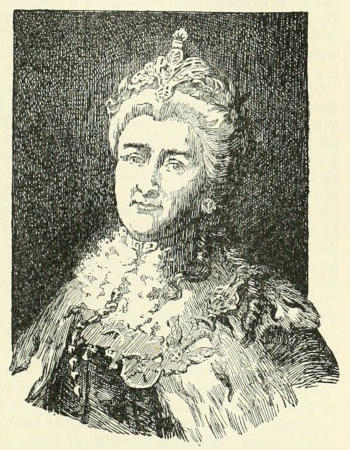
Catherine II
(1729-1796)
Before the breaking out of
the French Revolution the governments
of Louis XVI and
Catherine II had entered into
active negotiations for the formation
of a quadruple alliance
that should include Austria,
Russia, and the two houses of
Bourbon, and should have for
its object the checking of England’s
maritime pretensions and the encroachments of Prussia. After the
taking of the Bastille Catherine realised that she could no longer count
upon the support of France, since that country was exclusively occupied with
its own interior transformation. She kept anxious watch, however, upon
the course of events in Paris, and manifested the liveliest antipathy to the
new principles, falling ill at the news of the king’s execution on the 21st of
January. Led by fear into a violent reaction, the correspondent of Voltaire
and Diderot set a close watch upon all Russians suspected of liberalism. She
destroyed a tragedy of Kniaznin and exiled to Siberia Radichtchev, the author
of a curious book entitled Journey from St. Petersburg to Moscow, in which
were many sharp reflections on serfdom; Novikov was confined at Schlüsselburg,
his printing houses were closed and all his enterprises ruined. She
dismissed Genêt, the French ambassador, refused to recognise either the constitution
of 1791 or the French Republic, issued an ukase announcing the rupture
of diplomatic relations with France, refused to the tri-colour admission
to Russian parts, expelled all French subjects who refused to swear allegiance
to the monarchical principle, extended a warm welcome to French refugees,
and lost no time in acknowledging Louis XVIII.
In 1792 she published her famous note on the restoration of royal power
and aristocratic privileges in France, asserting that only ten thousand men
would be necessary to effect a counter-revolution. She encouraged Gustavus
III, who was assassinated by his nobles at a masked ball (March 16th, 1792),
to place himself at the head of a crusade against democracy. She further
urged England to assist the count d’Artois in a descent he had planned upon
the French coast, and stimulated the zeal of Austria and Prussia. Notwithstanding
this, though she had repeatedly negotiated treaties for subsidies and
promised troops, she took care never to become involved in a war with the
west. “My position is taken,” she said, “my part assigned; I shall watch
the movements of Turkey, Poland, and Sweden.”
The latter country became reconciled to France after the death of Gustavus
III. The punishment of the Jacobins of Warsaw and Turkey was an
easier and more lucrative piece of work. We should also take into account
an admission that she made to her vice-chancellor Ostermann in 1791: “Am
I wrong? I cannot avow all to the courts of Berlin and Vienna, but I wish to
keep them engaged in these affairs so that I may have freedom to carry on
my unfinished enterprises.” She excused herself for not taking part in the
anti-revolutionary crusade by alleging the war with Turkey; then when in
consequence of the revolution of the 3rd of May she was obliged to hasten
the Peace of Jassy, she made the Polish war her excuse; and when this was
ended she affected to excite Suvarov and his soldiers against the atheists of
the west, but in reality thought only of gaining her own ends in the east.
Muhammed, the new king of Persia, had recently invaded Georgia and burned
Tiflis, the capital of Heraclius, a protégé of the empress. Catherine summoned
to her court an exiled brother of Muhammed’s and charged Valerian
Zubov with the conquest of Persia. [His armies were actually under way
when the death of Catherine led to the abandonment of the enterprise.]
[1796 A.D.]
Without being aware of it Catherine II really performed greater service
to France than to the coalition. By her intervention in Poland and her projects
against the east she had excited the jealousy and suspicion of Prussia
and Austria. She took care to pit them against each other; made the second
partition with Frederick William in spite of Austria, and effected the
third with Francis II to the extreme dissatisfaction of Prussia. She contributed
indirectly to weaken and dissolve the coalition, being herself prevented
from joining it by the Polish insurrection that received so much
encouragement from France. She died on the 17th of November, 1796, at
the age of sixty-seven. Since Ivan the Terrible no monarch had extended
the limits of the empire by such vast conquests. Catherine made the Niemen,
the Dniester, and the Black Sea the boundaries of Russia.d
The personality of the empress was as though created for a throne. We
do not meet in history with any other woman so fitted to rule. On all and
each she produced a profound impression. No one has spoken more harshly
and disadvantageously of the empress’ qualities than Masson, yet this pamphleteer-writer
observes that during the space of ten years, having had occasion
to see Catherine once or twice a week, he was always struck by her
unusually attractive personality, by the dignity with which she held herself,
and by the amiability of her behaviour to everyone.
In her Memoirsg Catherine herself has left a detailed narrative of the course
of her development, of her aspirations after power, and of her unscrupulousness
in the means she used to attain her aims. The empress’ frankness in
this respect amounts almost to cynicism. In maturity she at last became an
autocratic sovereign. After the terrible humiliations, the bitter trials she
had endured in her youth, her delight when she found herself in the enjoyment
of unbounded power was all the greater. The fact that the fundamental
change in her surroundings, the rapid passage from entire dependency to
entire potency, did not in any wise awaken in her any despotic inclinations
testifies to the goodness inherent in her nature; when her son was subjected
in his turn to a like change in outward circumstances his despotism knew
no bounds.
We have seen that the unfavourable circumstances in which Catherine found
herself until the year 1762 exercised a baneful influence upon her character;
whereas the power and preponderance which she later acquired had an ennobling
effect upon her nature. Until then she had been necessarily obliged
often to have resource to mean and trifling measures to better her position
and to revenge herself on her opponents; when she was able to exert full
power, to enjoy the advantages of her position, the respect of her contemporaries,
the adoration of the persons that surrounded her, she no longer needed
to employ those means which are generally made use of by the weak in their
struggle against the strong. At the time when a sharp watch was kept over
her, when she was not trusted by either Elizabeth or Peter, she understood
how to dissemble, to play the hypocrite, to feign humility and modesty, whilst
in her soul she was filled with arrogance and contempt for mankind. Now
that she had surrounded herself entirely with persons devoted to her she
could act openly and nobly. The grand duchess in her isolation had been
remarkable for her coldness, her mistrust of mankind, her suspiciousness; the
empress on the contrary gave full scope to the development of feelings of
benevolence, condescension, indulgence, and sincere attention to the interests
of the persons that surrounded her. It was not without reason that Peter
and Elizabeth had mistrusted Catherine and been suspicious of her character;
it was not without reason, either, that in after times many people highly
esteemed Catherine’s kindheartedness.
The history of the court under Peter I, under the empress Anna, and
under Elizabeth is full of examples of tyranny, cruelty, and arbitrariness; all
Catherine’s contemporaries were astonished at the mildness of her behaviour
to those around her and rejoiced at the absence of stiff formalities and hard
measures in her intercourse with her subordinates. In spite of her quick
temper and impulsiveness, Catherine had complete control over herself, and
in her intercourse with her fellow creatures she was governed by principles
of humanity. “I like to praise and reward loudly, to blame quietly,” she
once justly remarked in conversation with Ségur; she sought to avoid occasions
of offending anyone, and was particularly careful in her intercourse
with servants; “I will live to make myself not feared,” she once said, observing
that the stove-heater, who had deserved reproof for some neglect, avoided
meeting her. Often when Catherine had given an order she would make
excuses for the trouble and labour it occasioned. Krapovitski gives instances
of such solicitude on her part; more than once the empress, when impatient
or irritated, having expressed herself somewhat sharply, afterwards acknowledged
her hastiness and endeavoured to repair her fault.
It is said that Catherine, who awoke early and usually rose at six in the
morning, so valued the tranquillity of her servants that without requiring
assistance she dressed herself, lit the fire, and without disturbing anyone sat
down to her books and papers. Various anecdotes are to be found in the
narratives of contemporaries testifying to her indulgence to her servants and
her want of sufficient severity in her intercourse with them. When she was
in a passion she turned up her sleeves, walked about the room, drank a glass
of water, and deferred judgment. Her capacity for removing any misunderstanding
that might have arisen between herself and others was particularly
remarkable. In her letters to various great lords we meet with frequent
exhortations not to give way to despair but to take courage, to believe in
their own capacities, and to hope for success. In moments of danger she
knew how to raise the spirits of those around her, inspiring them with firmness
and courage.
The distinguishing features of Catherine’s character were gaiety, humour,
and an inclination for fun and amusements. She once remarked: “As to
the gaiety of character of Frederick the Great, it must be observed that it
proceeded from his superiority: was there ever a great man who was not distinguished
by his gaiety and who did not possess in himself an inexhaustible
store of it.” She took the greatest pleasure in going to masquerades and, while
preserving the strictest incognito, talking to various people; she herself
related in detail how she had once gone to a masquerade in male attire and
had made a declaration of love to a young girl who never suspected that it
was the empress talking to her. It must not be regarded as a matter of
chance or an act of complaisance that such a multitude of anecdotes testifying
to the magnanimity of Catherine have been preserved; many contemporaries
who do not unconditionally praise her maintain however that she was
capable of listening to unpleasing truths, of recognising her faults and deficiencies,
and of restraining her anger. Such assertions are to be met with
in Razumovski, Derjavin, Mussin-Pushkin, and Teplov.
Of course traits are not wanting which show her obstinacy, self-will, and
arrogance. Derjavin cites several circumstances to prove that in her actions
Catherine was often governed by personal considerations and desires rather
than the real good of the state and strict justice. It is also not without reason
that she is reproached with the fact that, while protesting against the
use of tortures and corporal punishment, she allowed full scope to the cruelties
of Sheshkovski who frequently with his own hand tortured accused persons
in the most atrocious manner; we cannot however determine how far
the empress was cognisant of his barbarous treatment. Referring to some
instances of arbitrariness and infringement of the law, Prince Sherbatov
remarks that the empress held herself above the law and that she thus herself
set a pernicious example to the great noblemen and dignitaries who imitated
her in this respect.
As to Catherine’s piety, Frederick II plainly accused her of hypocrisy and
bigotry. We bear in mind that it was not easy for her to adopt the orthodox
faith, but that when she had adopted it she used outward piety as a means of
strengthening her position in Russia. By strictly observing the rules of the
church, and conscientiously fulfilling her religious duties, she endeavoured to
produce a certain impression on her subjects. At the same time she remained
true to the principles of toleration preached in the literature of enlightenment.
When Voltaire reproached her, saying that she humiliated herself by kissing
the priest’s hand, she justified herself by replying that it was only an outward
observance which would little by little become obsolete. There is no doubt
that Catherine’s piety did not spring from any deep feeling. In her letters
to Grimm, sallies against Luther and the Lutherans are to be met with more
than once; she despised Lutherans for their intolerance and several times
praised the orthodox faith as the best in the world; she compared it to an oak
tree with deep roots.
Side by side with such remarks we meet with bold sallies both from the
lips and in the letters of the empress against excessive piety and fanaticism;
such are certain caustic remarks referring to Maria Theresa and the queen of
Portugal. In certain jeux d’esprit which she allowed herself in connection
with questions of the church and religion in her letters to Grimm, the same
rationalism is to be observed as that which distinguished the votaries of French
literature of the time. Catherine praised the works of Nicholas Sebaldus
Nothanker, especially, because hypocrisy was condemned in them. Deep religious
and philosophical questions she did not like; her chief characteristic
was a certain worldliness. Her point of view was optimistic and her principal
rule of earthly wisdom, gaiety. She did not like to meditate on sad events,
to give way to grief, to dwell upon gloomy subjects; and this partly explains
her esteem for Voltaire, whom she called the “god of gaiety.” This playfulness
and vivacity, this freshness and gaiety she preserved to the end of her
life.h
CHAPTER IX. RUSSIA IN THE NAPOLEONIC EPOCH — EARLY MEASURES OF THE REIGN OF PAUL I — THE CAMPAIGNS OF KORSAKOV AND SUVAROV (1798-1799) — PAUL RECONCILED WITH FRANCE (1800 A.D.) — THE ARMED NEUTRALITY (1800 A.D.) — ASSASSINATION OF PAUL (1801 A.D.) — THE ACCESSION OF ALEXANDER I (1801 A.D.); HIS EARLY REFORMS — THE INCORPORATION OF GEORGIA — RUSSIA JOINS THE THIRD COALITION — THE CAMPAIGN OF AUSTERLITZ (1805 A.D.) — THE CAMPAIGN OF EYLAU AND FRIEDLAND (1806-1807 A.D.) — RUSSIA DECLARES WAR AGAINST ENGLAND (1807 A.D.) — THE CONQUEST OF FINLAND (1807 A.D.) — WAR WITH PERSIA AND WITH TURKEY — CONGRESS OF ERFURT (1808 A.D.) — RENEWED WAR WITH TURKEY (1810 A.D.) — WAR WITH NAPOLEON — CAMPAIGNS OF THE GRAND ALLIANCE (1813-1814 A.D.) — ALEXANDER I AT THE CAPITULATION OF PARIS (1814 A.D.) — THE RUSSIAN OCCUPATION OF PARIS — ALEXANDER I AND THE CONGRESS OF VIENNA (1815 A.D.) — ALEXANDER’S RELIGIOUS MYSTICISM; BARONESS KRÜDENER — ALEXANDER’S HOLY ALLIANCE (1815 A.D.) — FOOTNOTES
Perhaps no sovereign since the days of the Antonines ever was
called to higher destinies, or more worthily filled an important place
in the theatre of the world, than the emperor Alexander I. Placed at
the head of the most powerful and rising empire in existence, stationed
midway between ancient civilisation and barbaric vigour, he was called
to take the lead in the great struggle for European freedom; to combat
with the energy and enthusiasm of the desert the superiority of
advanced information, and meet the condensed military force of a revolution,
which had beaten down all the strength of continental power,
with the dauntless resolution and enduring fortitude which arise in
the earlier ages of social existence. Well and nobly he fulfilled his
destiny. Repeatedly defeated, never subdued, he took counsel, like
his great predecessor Peter, from misfortune, and prepared in silence
those invincible bands which, in the day of trial, hurled back the
most terrible array which ambition had ever marshalled against the
liberties of mankind.—Alison.f
[1796-1815 A.D.]
The emperor Paul I, Catherine’s successor, had been long known for his
singularities, his great dislike of the French, and to everything which Catherine
had done. He appeared desirous of proceeding directly on the very
opposite course to that which she had followed. She had chiefly directed her
attention to foreign relations and affairs, whilst he appeared to occupy his
mind solely with the internal state of his dominions. His very first act was
a proof that he was quite ready to go in opposition to all the ordinary rules
of political prudence, and when under the influence of his humour to follow
his views, reckless of consequences. He caused splendid funeral honours
and services to be performed for his murdered father, and forced the audacious
and godless, though clever criminals, who had helped to place his mother
on the throne, to be publicly exposed to the gaze of the people. Notwithstanding
this, he suffered them to remain in possession of their honours and
estates, whilst he designated them as murderers, and reminded the people that
his mother had taken part in the murder of his father. The body of Peter
III, which had been deposited in the convent of Alexander Nevski, was by
his orders placed beside that of his wife; and it was notified by an inscription
in the Russian language that, though separated in life, in death they were
united.
[1796 A.D.]
Alexis Orlov and Prince Baratinski, two of the murderous band, were
compelled to come to St. Petersburg to accompany the funeral procession on
foot, but they were not so treated as to prevent them afterwards from doing
further mischief. Alexis obtained permission to travel in foreign countries.
Baratinski was ordered never again to show himself at court; which, under
existing circumstances, could not to him be otherwise than an agreeable command.
Single proofs of tender feeling, of a noble heart, and touching goodness,
nay even the emperor’s magnanimous conduct towards Kosciuszko and
his brethren in arms, combined with his sympathy with the fate of Poland,
could not reconcile a court, such as that of Russia under Catherine II had
become, and a city like that of St. Petersburg, to the change of the court into
a guard-room, and to the daily varying humours of a man of eccentric and half-deranged
mind. Even the improvements in the financial affairs of the country
were regarded as ruinous innovations by those who in times past had
profited by the confusion. The whole of Russia, and even the imperial family,
were alarmed and terrified; a complete flood of decrees, often contradictory,
and mutually abrogatory, followed one another in quick succession; and the
mad schemes of the emperor, who was, nevertheless, by no means wicked or
insensible to what was good and true, reminded all observers of the most
unhappy times of declining Rome.b
Imperial Eccentricities
The guards, that dangerous body of men who had overturned the throne
of the father, and who had long considered the accession of the son as the
term of their military existence, were rendered incapable of injuring him by
a bold and vigourous step, and treated without the least deference from the
first day. Paul incorporated in the different regiments of guards his battalions
that arrived from Gatshina, the officers of which he distributed among
the various companies, promoting them at the same time two or three steps;
so that simple lieutenants or captains in the army found themselves at once
captains in the guards, a place so important and hitherto so honoured, and
which gave the rank of colonel, or even of brigadier. Some of the old captains
of the first families in the kingdom found themselves under the command
of officers of no birth, who but a few years before had left their companies, as
sergeants or corporals, to enter into the battalions of the grand duke. This
bold and hasty change, which at any other time would have been fatal to its
author, had only the effect of inducing a few hundreds of officers, subalterns
and others, to retire.
Paul, alarmed and enraged at this general desertion, went to the barracks,
flattered the soldiers, appeased the officers, and endeavoured to retain them
by excluding from all employ, civil and military, those who should retire in
future. He afterwards issued an order that every officer or subaltern who
had resigned, or should give in his resignation, should quit the capital within
four-and-twenty hours, and return to his own home. It did not enter into
the head of the person who drew up the ukase that it contained an absurdity;
for several of the officers were natives of St. Petersburg, and had families residing
in the city. Accordingly, some of them retired to their homes without
quitting the capital, not obeying the first part of the order, lest they should
be found guilty of disobedience to the second. Arkarov, who was to see it
put in force, having informed the emperor of this contradiction, directed
that the injunction to quit St. Petersburg should alone be obeyed. A number
of young men were consequently taken out of their houses as criminals,
put out of the city, with orders not to re-enter it, and left in the road without
shelter, and without any furred garments, in very severe weather. Those
who belonged to very remote provinces, for the most part wanting money
to carry them thither, wandered about the neighbourhood of St. Petersburg,
where several perished from cold and want.
The finances of the empire, exhausted by the prodigalities and still more
by the waste of Catherine’s reign, required a prompt remedy; and to this
Paul seemed at first to turn his thoughts.
Partly from hope, partly from fear, the
paper money of the crown rose a little in
value. It was to be supposed that the
grand duke of all the Russias, who for
thirty years had been obliged to live on
an income of a hundred thousand rubles
(£10,000) per annum, would at least
have learned economy per force; but he
was soon seen to rush into the most unmeasured
sumptuosity, heap wealth upon
some, and lavish favours upon others,
with as much profusion as his mother,
and with still less discernment. The
spoils of Poland continued to add to the
riches of men already too wealthy. All
he could do towards restoring a sort of
equilibrium between his receipts and
disbursements was to lay an exorbitant
tax on all the classes of his slaves. The
poll-tax of the wretched serfs was doubled,
and a new tax was imposed upon
the nobles, which, however, the serfs would ultimately have to pay. After
the first impressions which his accession caused in the heart of Paul, punishments
and disgraces succeeded with the same rapidity and profusion with
which he had lavished his favours. Several experienced the two extremes in
a few days. It is true that most of these punishments at first appeared
just; but then it must be allowed that Paul could scarcely strike any but
the guilty, so corrupt had been all who were about the throne.
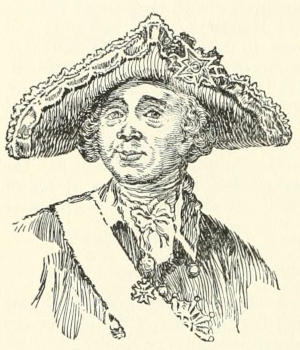
Paul I
(1754-1801)
A whim which caused no little surprise was the imperial prohibition of
wearing round hats, or rather the sudden order to take them away or tear
them to pieces on the heads of those who appeared in them. This occasioned
some disgraceful scenes in the streets, and particularly near the palace. The
Cossacks and soldiers of the police fell on the passengers to uncover their
heads, and beat those who, not knowing the reason, attempted to defend
themselves. An English merchant, going through the street in a sledge, was
thus stopped, and his hat snatched off. Supposing it to be a robbery, he
leaped out of his sledge, knocked down the soldier, and called the guard.
Instead of the guard, arrived an officer, who overpowered and bound him;
but as they were carrying him before the police, he was fortunate enough to
meet the coach of the English minister, who was going to court, and claimed
his protection. Sir Charles Whitworth made his complaint to the emperor;
who, conjecturing that a round hat might be the national dress of the English
as it was of the Swedes, said that his order had been misconceived, and he
would explain himself more fully to Arkarov. The next day it was published
in the streets and houses that strangers who were not in the emperor’s service,
or naturalised, were not comprised in the prohibition. Round hats were
now no longer pulled off; but those who were met with this unlucky headdress
were conducted to the police to ascertain their country. If they were
found to be Russians, they were sent for soldiers; and woe to a Frenchman
who had been met with in this dress, for he would have been condemned as a
Jacobin.
A regulation equally incomprehensible was the sudden prohibition of harnessing
horses after the Russian mode. A fortnight was allowed for procuring
harness in the German fashion; after the expiration of which, the police
were ordered to cut the traces of every carriage the horses of which were harnessed
in the ancient manner. As soon as this regulation was made public,
several persons dared not venture abroad, still less appear in their carriages
near the palace, for fear of being insulted. The harness-markers availed themselves
of the occasion to charge exorbitant prices. To dress the ishvoshtshki,
or Russian coachmen, in the German fashion, was attended with another
inconvenience. Most of them would neither part with their long beards, their
kaftans, nor their round hats; still less would they tie a false tail to their
short hair, which produced the most ridiculous scenes and figures in the
world. At length the emperor had the vexation to be obliged to change his
rigorous order into a simple invitation to his subjects gradually to adopt the
German fashion of dress, if they wished to merit his favour. Another reform
with respect to carriages: the great number of splendid equipages that swarmed
in the streets of St. Petersburg disappeared in an instant. The officers, even
the generals, came to the parade on foot, or in little sledges, which also was
not without its dangers.
It was anciently a point of etiquette for every person who met a Russian
autocrat, his wife, or son, to stop his horse or coach, alight, and prostrate
himself in the snow or in the mud. This barbarous homage, difficult to be
paid in a large city where carriages pass in great numbers, and always on the
gallop, had been completely abolished under the reign of the polished Catherine.
One of the first cares of Paul was to re-establish it in all its rigour. A
general officer, who passed on without his coachmen’s observing the emperor
riding by on horseback, was stopped, and immediately put under arrest. The
same unpleasant circumstance occurred to several others, so that nothing
was so much dreaded, either on foot or in a carriage, as the meeting of the
emperor.
The ceremony established within the palace became equally strict, and
equally dreaded. Woe betide him who, when permitted to kiss the hand of
Paul, did not make the floor resound by striking it with his knee as loud as
a soldier with the butt-end of his firelock. It was requisite, too, that the
salute of the lips on his hand should be heard, to certify the reality of the
kiss, as well as of the genuflection. Prince George Galitzin, the chamberlain,
was put under arrest on the spot by his majesty himself, for having made
the bow and kissed the hand too negligently.
If this new reign was fatal to the army and to the poor gentry, it was still
more so to the unhappy peasantry. A report being spread that Paul was
about to restrict the power of masters over their slaves, and give the peasants
of the lords the same advantages as those of the crown, the people of the
capital were much pleased with the hopes of this change. At this juncture
an officer set off for his regiment, which lay at Orenberg. On the road he
was asked about the new emperor, and what new regulations he was making.
He related what he had seen, and what he had heard; among the rest, mentioning
the ukase which was soon to appear in favour of the peasants. At
this news, those of Tver and Novgorod indulged in some tumultuous actions,
which were considered as symptoms of rebellion. Their masters were violently
enraged with them; and the cause that had led them into error was
discovered. Marshal Repnin was immediately despatched at the head of
some troops against the insurgents; and the officer who had unwittingly given
rise to this false hope, by retailing the news of the city on his road, was soon
brought back in confinement. The senate of St. Petersburg judged him
deserving of death, and condemned him to be broken, to undergo the punishment
of the knout, and if he survived this, to labour in the mines. The
emperor confirmed the sentence. This was the first criminal trial that was
laid before the public; and assuredly it justified but too well those remains
of shame which had before kept secret similar outrages.
The most prominent of Paul’s eccentricities was that mania which, from
his childhood, he displayed for the military dress and exercise. This passion
in a prince no more indicates the general or the hero than a girl’s fondness for
dressing and undressing her doll foretokens that she will be a good mother.
Frederick the Great, the most accomplished soldier of his time, is well known
to have had from his boyhood the most insuperable repugnance to all those
minutiæ of a corporal to which his father would have subjected him; this
was even the first source of that disagreement which ever subsisted between
the father and the son. Frederick, however, became a hero; his father was
never anything more than a corporal. Peter III pushed his soldato-mania
to a ridiculous point, fancying he made Frederick his model. He loved soldiers
and arms, as a man loves horses and dogs. He knew nothing but
how to exercise a regiment, and never went abroad but in a captain’s
uniform.
Paul, in his mode of life when grand duke, and his conduct after his
accession, so strongly resembled his father that, changing names and dates,
the history of the one might be taken for that of the other. Both were educated
in a perfect ignorance of business, and resided at a distance from court,
where they were treated as prisoners of state rather than heirs to the crown;
and whenever they presented themselves appeared as aliens and strangers,
having no concern with the royal family. The aunt of the father (Elizabeth)
acted precisely as did the mother of the son. The endeavours of each were
directed to prolong the infancy of their heirs, and to perpetuate the feebleness
of their minds. The young princes were both distinguished by personal
vivacity and mental insensibility, by an activity which, untrained and neglected,
degenerated into turbulence; the father was sunk in debauchery, the
son lost in the most insignificant trifles. An unconquerable aversion to study
and reflection gave to both that infatuated taste for military parade, which
would probably have displayed itself less forcibly in Paul had he been a witness
of the ridicule they attached to Peter. The education of Paul, however,
was much more attended to than that of his father. He was surrounded in
infancy by persons of merit, and his youth promised a capacity of no ordinary
kind. It must also be allowed that he was exempt from many of the
vices which disgraced Peter; temperance and regularity of manners were
prominent features of his character—features the more commendable, as
before his mother and himself they were rarely to be found in a Russian autocrat.
To the same cause, education, and his knowledge of the language and
character of the nation, it was owing that he differed from his father in other
valuable qualities.
The similarity which, in some instances, marked their conduct towards
their wives, is still more striking; and in their amours, a singular coincidence
of taste is observable. Catherine and Marie were the most beautiful women
of the court, yet both failed to gain the affections of their husbands. Catherine
had an ambitious soul, a cultivated mind, and the most amiable and
polished manners. In a man, however, whose attachments were confined to
soldiers, to the pleasures of the bottle, and the fumes of tobacco, she excited
no other sentiment than disgust and aversion. He was smitten with an
object less respectable, and less difficult to please. The countess Vorontzov,
fat, ugly in her person and vulgar in her manners, was more suitable to his
depraved military taste, and she became his mistress. In like manner, the
regular beauty of Marie, the unalterable sweetness of her disposition, her
unwearied complaisance, her docility as a wife, and her tenderness as a
mother were not sufficient to prevent Paul from attaching himself to Mademoiselle
Nelidov, whose disposition and qualities better accorded with his
own, and afterwards to a young lady of the name of Lopukhin, who, it is
believed, rejected his suit. To the honour of Paul it is related that he submitted
to that mortifying repulse with the most chivalric patience and generosity.
Nelidov was ugly and diminutive, but seemed desirous, by her wit
and address, to compensate for the disadvantages of her person; for a woman
to be in love with Paul it was necessary she should resemble him.
On their accession to the throne, neither the father nor the son were
favourites with the court or the nation, yet both acquired immediate popularity
and favour. The first steps of Paul appeared to be directed, but
improved, by those of Peter. The liberation of Kosciuszko and other prisoners
brought to public recollection the recall of Biron, Munich, and Lestocq,
with this difference—that Peter III did not disgrace these acts of clemency
and justice by ridiculous violences, or by odious and groundless persecutions.
Both issued ukases extremely favourable to the nobility, but from motives
essentially different, and little to the honour of the son. The father granted
to the Russian gentry those natural rights which every man ought to enjoy;
while the son attempted the folly of creating a heraldic nobility in Russia,
where that Gothic institution had never been known. In the conduct which
he observed towards the clergy, Paul, however, showed himself a superior
politician. Instead of insulting the priests, and obliging them to shave their
beards, he bestowed the orders of the empire on the bishops, to put them on a
footing with the nobility, and flattered the populace and the priesthood by
founding churches, in obedience to pretended inspiration.
In his military operations, however, his policy appears to have abandoned
him, because here he gave the reins to his ruling passion. The quick and
total change of discipline he introduced in his armies created him nearly as
many enemies as there were officers and soldiers. In the distrust and suspicions
which incessantly haunted him, his inferiority to his father is also
evident. One of the first acts of Peter III was to abolish the political inquisition
established by Elizabeth; whereas Paul prosecuted no scheme with
greater alacrity than that of establishing a system of spies, and devising
means for the encouragement of informers. The blind confidence of the
father was his ruin, but it flowed from a humanity of disposition always
worthy of respect. The distrust of the son did not save him; it was the
offspring of a timorous mind, which by its suspicions was more apt to provoke
than to elude treason.k
Paul’s Foreign Policy
In regard to foreign matters Paul’s initial policy was one of peace. He
put a stop to the levying of recruits after the manner adopted by his mother—that
is, in the proportion of three men to every five hundred souls—recalled
his army from Persia, and left Georgia to take care of itself. He
showed compassion for the Poles, recalled the prisoners from Siberia, transferred
King Stanislaus from Grodno to St. Petersburg, visited Kosciuszko at
Schlüsselburg and released him in company with the other prisoners. He
bade Kolitchev, envoy extraordinary at Berlin, inform the king that he, Paul,
wished neither conquest nor aggrandisement. He dictated to Ostermann a
circular directed to the foreign powers, in which he declared that of all the
countries of the world Russia alone had been constantly engaged in war since
1756; that forty years of warfare had reduced the population; that the
emperor’s humanity would not allow him to withhold from his beloved subjects
the peace for which they longed; that though on account of these considerations
Russia could take no active part in the struggle against France,
the emperor would “nevertheless remain closely united with his allies, and
would use every means to oppose the rise of the mad French Republic which
threatened all Europe with upheaval by the destruction of its laws, privileges,
property, religion, and customs.” He refused all armed assistance to
Austria, which was alarmed at Napoleon’s victories in Italy, and recalled the
fleet that Catherine had adjoined to the English fleet for the purpose of
blockading the coasts of France and Holland. He even received overtures
made by Caillard, the French envoy to Prussia, and caused him to be informed
that the emperor “did not consider himself at war with the French, that he
had never done anything to harm them, but was rather disposed to keep
peace with them, and would induce his allies to hasten the conclusion of war,
to which end he offered the mediation of Russia.”
It was not long, however, before relations again became strained between
France and Russia. By the Treaty of Campo Formio the Ionian Isles had
been given to the French, who thus acquired a threatening position in the
East and increased power over the Divan. The Directory authorised Dombrowski
to organise Polish legions in Italy. Panin, at Berlin, intercepted a
letter from the Directory to the French envoy, which spoke of a restoration
of Poland under a prince of Brandenburg. Paul, on his side, took into his
pay the troops of the prince of Condé, and established ten thousand émigrés
in Volhinia and Podolia. He offered an asylum to Louis XVIII after his flight
from Brunswick, and installed him in the ducal palace at Mitau with a pension
of 200,000 rubles. The news that a French expedition was being secretly
organised at Toulon made him fear for the security of the coasts of the Black
Sea, which were immediately put in a state of defence. The abduction of
Zagurski, the Russian consul at Corfu, the capture of Malta by Napoleon, the
arrival at St. Petersburg of the banished knights who offered Paul the protectorate
of their order and the title of grand master, the invasion of Helvetian
territory by the Directory, the expulsion of the pope and the proclamation
of the Roman Republic—all were events that precipitated the rupture.
Paul concluded an alliance with Turkey which had been disturbed by an
Egyptian invasion, also with England, Austria, and the kingdom of Naples.
Thus, by the double aggression of Bonaparte against Malta and Egypt, Russia
and Turkey were led, contrary to all traditions, to make common cause.
Paul pledged himself to unite his fleet with the Turkish and English squadron,
and to furnish one body of troops for a descent on Holland, another
for the conquest of the Ionian Isles, and a grand auxiliary army for the campaigns
in Italy and Switzerland.
In the autumn of 1798 a Turkish-Russian fleet captured the French garrisons
in the Ionian Isles. The king of Naples invaded the territory of the
Roman Republic, but Championnet brought the Neapolitan troops back on
to their own ground, and after making a triumphal entry into Naples proclaimed
the Parthenopean Republic.
[1798-1799 A.D.]
The Russian army in Switzerland was placed under the command of Rimski-Korsakov,
that of Holland under the orders of Hermann; while Austria,
at the suggestion of England, requested that the victor of Fokshani and of
the Rimnik should receive the command of the Austro-Russian army. Flattered
by this mark of deference, Paul I recalled Suvarov from exile in his
village. “Suvarov has no need of laurels,” wrote the czar, “but the country
has need of Suvarov.”c
A few days after the battle of Magnano, Suvarov arrived on the Mincio
with the first division of his forces, twenty thousand strong, and took the
command of all the allied troops in Italy. The jealousy of the Austrian generals
was naturally excited and they called a council of war, in order to
examine his plans. The members of the council, beginning at the youngest,
proposed their several schemes. Suvarov quietly heard them all, and when
they had done, took a slate, drew two lines, and said, “Here, gentleman, are
the French, and here the Russians; the latter will march against the former
and beat them.” So saying, he rubbed out the French line, and added, “This
is all my plan; the council is concluded.”
Suvarov kept his word, and in less than three months swept the French
entirely out of Lombardy and Piedmont. Thrusting himself between the
three French armies of Switzerland, northern Italy, and the Parthenopean
Republic, it was his purpose, in concert with the archduke Charles of Austria,
to penetrate into France on its most defenceless side, by the Vosges and
the Jura, the same quarter on which the great invasion of 1814 was afterwards
effected. The campaign opened on the 25th of April, on the steep
banks of the Adda, behind which Moreau had posted his diminished force of
twenty-eight thousand men in three divisions. The passage was forced with
immense loss to the French, who were compelled to abandon Milan, which
Suvarov entered in triumph on the 29th.
After a week’s delay, during which all the principal places of Lombardy
surrendered to the allies, Suvarov followed Moreau’s retreat, and endeavoured
to dislodge him from his advantageous position on the Po. Not succeeding
in this attempt as rapidly as suited his impetuous habits, the Russian general
suddenly changed his purpose, and advanced against Turin, whilst Moreau
at the same moment had resolved to retire to Turin and the crests of the
Apennines, in order to preserve his communications with France. On the
27th of May, Vukassovitch, who commanded the advance guard of the Russians,
surprised Turin, and forced the French to take refuge in the citadel,
leaving in the hands of the victors nearly three hundred pieces of artillery,
sixty thousand muskets, and an enormous quantity of ammunition and military
stores. Moreau’s army, thus deprived of all its resources, was saved
from destruction only by the extraordinary ability of its commander, who
led it safely towards Genoa by a mountain path, which was rendered practicable
for artillery, in four days. With the exception of a few fortresses,
nothing now remained to the French of all Napoleon’s conquests in northern
Italy; they had been lost in less time than it had taken to make them.
[1799 A.D.]
Exulting in the brilliant success of his arms, Paul bestowed another surname,
Italienski, or the Italian, on his victorious general, and ordered by an
express ukase that Suvarov should be universally regarded as the greatest
commander that had ever appeared. Meanwhile the results of his skill and
vigour were neutralised by the selfish policy of the Austrian court, which had
become by the Treaty of Campo Formio, and the acquisition of Venice, in
some degree an actual accomplice with the aggressors against whom it was
in arms. Suvarov was compelled to submit to the dictation of the emperor
Francis I, and deeply disgusted he declared that he was no longer of any use
in Italy, and that he desired nothing so ardently as to be recalled.
The disasters of the French in upper Italy were fatal to their ascendancy
in the south, and Macdonald received orders to abandon the Parthenopean
Republic, and unite his forces with those of Moreau. His retreat was exposed
to great dangers by the universal insurrection of the peasants; but he accomplished
it with great rapidity and skill. The two French commanders then
concerted measures to dislodge the allies from their conquests—a project
which seemed not unlikely to be fulfilled, so obstinately had the Aulic council
adhered to the old system of dispersing the troops all over the territory which
they occupied. Though the allies had above a hundred thousand men in the
field, they could hardly assemble thirty thousand at any one point; and
Macdonald might easily have destroyed them in detail could he have fallen
upon them at once; but the time he spent in reorganising his army in Tuscany,
and in concerting measures with Moreau, was well employed by Suvarov
in promptly concentrating his forces. Macdonald advanced against him with
an army of thirty-seven thousand men, taking Modena on his way, and
driving Hohenzollern out of it after a bloody engagement. The two armies
met on the Trebbia, where a first and indecisive action took place on the
17th of June; it was renewed on each of the two following days, and victory
finally remained with the Russians. In this terrible battle of three days, the
most obstinately contested and bloody that had occurred since the beginning
of the war, the loss on both sides was excessive; that of the French was
above twelve thousand in killed and wounded, and that of the allies not
much less. But nearly equal losses told with very unequal severity on the
respective combatants; those of the allies would speedily be retrieved by
large reinforcements, but the republicans had expended their last resources,
were cut off from Moreau, and had no second army to fall back upon. Macdonald
with infinite difficulty regained the positions he had occupied before
the advance to the Trebbia, after losing an immense number of prisoners.
The fall of the citadel of Turin on the 20th of June was of great importance
to the allies; for besides disengaging their besieging force it put into their
hands one of the strongest fortresses in Piedmont, and an immense quantity
of artillery and ammunition. This event, and Suvarov’s victory on the Trebbia,
checked the successful operations of Moreau, and compelled him to fall
back to his former defensive position on the Apennines. Again, contrary to
Suvarov’s wishes, the allied forces were divided for the purpose of reducing
Mantua and Alexandria, and occupying Tuscany. After the fall of those two
fortresses, Suvarov laid siege to Tortona, when Joubert, who had meanwhile
superseded Moreau, marched against him at the head of the combined forces
of the French. On the 15th of August, another desperate battle was fought
at Novi, in which Joubert was killed, but from which neither side derived
any particular advantage. The French returned to their former positions,
and the Italian campaign was ended.
Suvarov now received orders to join his forces with those under Korsakov,
who was on the Upper Rhine with thirty thousand men. The archduke
Charles might, even without this fresh reinforcement, have already annihilated
Massena had he not remained for three months, from June to August,
in complete inactivity; at the very moment of Suvarov’s expected arrival, he
allowed the important passes of the St. Gotthard to be again carried by a
coup-de-main by the French, under General Lecourbe, who drove the Austrians
from the Simplon, the Furka, the Grimsel, and the Devil’s Bridge. The
archduke, after an unsuccessful attempt to push across the Aar at Dettingen,
suddenly quitted the scene of war and advanced down the Rhine for the purpose
of supporting the English expedition under the duke of York against
Holland. This unexpected turn in affairs proceeded from Vienna. The Viennese
cabinet was jealous of Russia. Suvarov played the master in Italy, favoured
Sardinia at the expense of the house of Habsburg, and deprived the
Austrians of the laurels and the advantages they had won. The archduke,
accordingly, received orders to remain inactive, to abandon the Russians,
and finally to withdraw to the north; by this movement Suvarov’s triumphant
progress was checked, he was compelled to cross the Alps to the aid
of Korsakov, and to involve himself in a mountain warfare ill-suited to the
habits of his soldiery.
Korsakov, whom Bavaria had been bribed with Russian gold to furnish
with a corps one thousand strong, was supported solely by Kray and Hotze
with twenty thousand men. Massena, taking advantage of the departure of
the archduke and the non-arrival of Suvarov, crossed the Limmat at Dietikon
and shut Korsakov, who had imprudently stationed himself with his whole
army in Zurich, so closely in that, after an engagement that lasted two days,
from the 15th to the 17th of September, the Russian general was compelled
to abandon his artillery and to force his way through the enemy. Ten thousand
men were all that escaped. Hotze, who had advanced from the Grisons
to Schwyz to Suvarov’s rencontre, was, at the same time, defeated and killed
at Schanis. Suvarov, although aware that the road across the St. Gotthard
was blocked by the Lake of Lucerne, on which there were no boats, had the
temerity to attempt the passage. In Airolo, he was obstinately opposed by
the French under Lecourbe, and, although Shveikovski contrived to turn this
strong position by scaling the pathless rocks, numbers of the men were, owing
to Suvarov’s impatience, sacrificed before it.
On the 24th of September, 1799, he at length climbed the St. Gotthard,
and a bloody engagement, in which the French were worsted, took place on
the Oberalpsee. Lecourbe blew up the Devil’s Bridge, but, leaving the
Urnerloch open, the Russians pushed through that rocky gorge, and, dashing
through the foaming Reuss, scaled the opposite rocks and drove the French
from their position behind the Devil’s Bridge. Altorf on the lake was reached
in safety by the Russian general, who was compelled, owing to the want of
boats, to seek his way through the valleys of Schächen and Muotta, across
the almost impassable rocks, to Schwyz. The heavy rains rendered the
undertaking still more arduous; the Russians, owing to the badness of the
road, were speedily barefoot; the provisions were also exhausted. In this
wretched state they reached Muotta on the 29th of September and learned
the discouraging news of Korsakov’s defeat. Massena had already set off in
the hope of cutting off Suvarov, but had missed his way. He reached Altorr,
where he joined Lecourbe on the 29th, when Suvarov was already at Muotta,
whence Massena found on his arrival that he had again retired across the Bragelburg,
through the Klönthal. He was opposed on the lake of Klönthal by
Molitor, who was, however, forced to retire by Auffenberg, who had joined
Suvarov at Altorf and formed his advanced guard, Rosen, at the same time,
beating off Massena with the rearguard, taking five cannon and one thousand
of his men prisoners. On the 1st of October, Suvarov entered Glarus, where
he rested until the 4th, when he crossed the Panixer Mountains through snow
two feet deep to the valley of the Rhine, which he reached on the 10th, after
losing the whole of his beasts of burden and two hundred of his men down
the precipices; and here ended his extraordinary march, which had cost him
the whole of his artillery, almost all his horses, and a third of his men.
The archduke had, meanwhile, tarried on the Rhine, where he had taken
Philippsburg and Mannheim, but had been unable to prevent the defeat of
the English expedition under the duke of York by General Brune at Bergen,
on the 19th of September. The archduke now, for the first time, made a
retrograde movement, and approached Korsakov and Suvarov. The different
leaders, however, did nothing but find fault with each other, and the czar,
perceiving his project frustrated, suddenly recalled his troops, and the campaign
came to a close.
Paul’s anger fell without measure or reason on his armies and their chiefs.
All the officers who were missing, that is to say who were prisoners in France,
were broken as deserters, and Suvarov, instead of being well received with
well merited honours, was deprived of his command and not suffered to see
the emperor’s face. This unjust severity broke the veteran’s heart. He died
soon after his return to St. Petersburg; and no Russian courtier, nor any
member of the diplomatic body except the English ambassador, followed
his remains to the grave.
[1800 A.D.]
Frustrated in the objects for which he had engaged in war, Paul was now
in a mood easily to be moved to turn his arms against the allies who had
deceived his hopes. He had fought for the re-establishment of monarchy in
France, and of the old status quo in Europe; and the only result had been the
aggrandisement of Austria, his own immediate neighbour, of whom he had
much more reason to be jealous than of the remote power of France. The
rapid steps, too, which Bonaparte was taking for the restoration of monarchical
forms in that country were especially calculated to conciliate Paul’s good-will
towards the first consul. The latter and his able ministers promptly
availed themselves of this favourable disposition through the connections they
had made in St. Petersburg. Fouché had such confidential correspondence
even with ladies in the Russian capital, that he afterwards received the earliest
and most correct intelligence of the emperor’s murder. Two persons at the
court of St. Petersburg were next gained over to France, or rather to Bonaparte’s
rising empire; these were the minister Rostoptchin, and the emperor’s
favourite, the Turk Kutaisov, who had risen with unusual rapidity from the
situation of the emperor’s barber to the rank of one of the first Russian nobles.
He was also nearly connected by relationship with Rostoptchin.
Rostoptchin first found means to send away General Dumourier from St.
Petersburg, whither he had come for the purpose of carrying on his intrigues
in favour of the Bourbons. He next sought to bring Louis Cobenzl also into
discredit with the emperor, and he succeeded in this, shortly before the opening
of the campaign in Italy in 1800, when the cabinet of Vienna was called
upon to give a plain and direct answer to the questions peremptorily put by
the emperor of Russia. Paul required that the cabinet should answer, without
if or but, without circumlocution or reserve, whether or not Austria would,
according to the terms of the treaty, restore the pope and the king to their
dominions and sovereignty. Cobenzl was obliged to reply that if Austria were
to give back Piedmont to the king of Sardinia it must still retain Tortona and
Alessandria; and that it never would restore the three legations and Ancona.
The measure of the emperor’s indignation was now full; he forbade Count
Cobenzl the court, and at a later period not only ordered him to leave the country,
but would not even allow an embassy or chargé-d’affaires to remain.
The emperor proceeded more deliberately with regard to the English. At
first he acted as if he had no desire to break with them; and he even allowed
the Russians, whom they had hired for the expedition against Holland, to
remain in Guernsey under Viomesnil’s command, in order to assist their
employers in an expedition against Brittany. The English government, however,
at length provoked him to extremities. They refused to redeem the
Russians who had been made prisoners in their service, by giving in exchange
for them an equal number of French, of whom their prisons were full; they
refused to listen to any arrangements respecting the grand mastership of the
knights of Malta, or even as to the protectorate of the order, and gave the
clearest intimations that they meant to keep the island for themselves. Bonaparte
seized upon this favourable moment for flattering the emperor, by acting
as if he had really more respect for Paul than the two powers for whom he had
made such magnanimous sacrifices. Whilst the English refused to redeem
the Russians made prisoners in their service by exchange, Bonaparte set them
free without either exchange or ransom.
The emperor of Germany had broken his word, and neither restored the
pope nor the king of Sardinia, whilst Bonaparte voluntarily offered to restore
the one and give compensation to the other. He assailed the emperor in a
masterly manner on his weak side, causing the six or seven thousand Russians,
whom the English refused to exchange, to be provided with new clothing and
arms, and he wrote a letter to Panin, the Russian minister, in which he said
that he was unwilling to suffer such brave soldiers as these Russians were to
remain longer away from their native land on account of the English. In
the same letter he paid another compliment to the emperor, and threw an
apple of mortal strife between him and England. Knowing as he did that his
garrison in Malta could not hold out much longer, he offered to place the
island in the hands of the emperor Paul, as a third party. This was precisely
what the emperor desired; and Sprengporten, who was sent to France to bring
away the Russians, and to thank the first consul, was to occupy Malta with
them. The Russians were either to be conveyed thither by Nelson, who up
to this time had kept the island closely blockaded, and was daily expecting
its surrender, or at least he was to be ordered to let them pass; but both he
and the English haughtily rejected the Russian mediation.
Paul now came to a complete breach with England. First of all he recalled
his Russian troops from Guernsey, but on this occasion he was again baffled.
It was of great importance to the English cabinet that Bonaparte should not
immediately hear of the decided breach which had taken place between them
and the emperor, and they therefore prevailed upon Viomesnil, an émigré,
who had the command of the Russians in Guernsey, to remain some weeks
longer, in opposition to the emperor’s will. Paul was vehemently indignant
at this conduct; Viomesnil, however, entered the English service, and was
provided for by the English government in Portugal.
Lord Whitworth was next obliged to leave Russia, as Count Cobenzl had
previously been. Paul recalled his ambassadors from the courts of Vienna
and London, and forthwith sent Count Kalitchev to Paris to enter into friendly
negotiations with Bonaparte. In the meantime, the English had recourse to
some new subterfuges, and promised, that in case Malta capitulated, they
would consent to allow the island to be administered, till the conclusion of a
peace, by commissioners appointed by Russia, England, and Naples. Paul had
already named Bailli de la Ferrette for this purpose; but the English refused
to acknowledge his nominee, and even to receive the Neapolitans in Malta.
Before this took place, however, the emperor had come to issue with England
on a totally different question.
The idea of a union among the neutral powers, in opposition to the right
alleged by England, when at war with any power whatsoever, to subject the
ships of all neutral powers to search, had been relinquished by the empress
Catherine in 1781, to please the English ambassador at her court; Paul now
resumed the idea. Bonaparte intimated his concurrence, and Paul followed
up the matter with great energy and zeal, as in this way he had an opportunity
of exhibiting himself in the character of an imperial protector of the weak, a
defender of justice and right, and as the head of a general alliance of the European
powers. Prussia also now appeared to do homage to him, for the weak
king was made to believe, that by a close alliance between Russia and France,
he might be helped to an extension of territory and an increase of subjects,
without danger or cost to himself, or without war, which he abhorred beyond
everything else. The first foundation, therefore, for an alliance between Russia
and France, was laid in Berlin, where Beurnonville, the French ambassador,
was commissioned to enter into negotiations with the Russian minister Von
Krüderer. Beurnonville promised, in Bonaparte’s name, that the Russian
mediation in favour of Naples and Sardinia would be accepted, and that, in
the question of compensations for the German princes particular regard would
be had to the cases of Baden and Würtemberg.
As to the armed neutrality by sea against England, Prussia could easily
consent to join this alliance, because she had in fact no navy; but it was much
more difficult for Sweden and Denmark, whose merchant ships were always
accompanied by frigates. In case, therefore, the neutral powers came to an
understanding that no merchant vessels which were accompanied by a ship of
war should be compelled to submit to a search, this might at any time involve
them in hostilities with England. In addition to Denmark, Sweden, and
Prussia, which, under Paul’s protectorate, were to conclude an alliance for
the protection of trading vessels belonging to neutral powers against the arrogant
claims of England, Bonaparte endeavoured to prevail upon the North
Americans to join the alliance. They were the only parties who, by a specific
treaty in 1794, had acknowledged as a positive right what the others only
submitted to as an unfounded pretension on the part of England. On that
occasion the Americans had broken with the French Republic on the subject
of his treaty, and Barras and Talleyrand had been shameless enough to propose
that the Americans should pay a gratuity, in order to effect a
renewal of their old friendship with France, which proposal, however, the
Americans treated with contempt.
On the 30th of September, 1800, their ambassadors concluded an agreement
at Bonaparte’s country seat of Morfontaine, which referred especially to
the resistance which all the neutral powers under the protectorate of the
emperor of Russia were desirous of making to the pretensions and claims of
England. The Americans first of all declared that neutral flags should make
a neutral cargo, except in cases where the ship was actually laden with goods
contraband of war. It was afterwards precisely defined what were to be
considered goods contraband of war. By the fourth article it was determined
that neutral ships must submit to be detained, but that the ships of war so
detaining a merchantman with a view to search should remain at least at the
distance of a cannon-shot, and only be allowed to send a boat with three men
to examine the ship’s papers and cargo; and that in all cases in which a merchantman
should be under convoy of a ship of war, no right of search should
exist, because the presence of the convoy should be regarded as a sufficient
guarantee against contraband. Inasmuch as England and Denmark were at
open issue concerning this last point, the Americans would have been inevitably
involved in the dispute had they immediately ratified the treaty of
Morfontaine: they were, however, far too cunning to fall into this difficulty;
and they did not therefore ratify the treaty till the Russian confederation
had been dissolved.
Sweden and Denmark had come to issue with England concerning the right
of search in 1798 and 1799, when four frigates, two Swedish and two Danish,
were captured and brought into English ports. True, they were afterwards
given up, but without any satisfaction, for the English still insisted upon the
right of search. The dispute became most vehement in the case of the Danish
frigate Freya, which, together with the merchantmen under her convoy, were
brought into an English port, after a sharp engagement on the 25th of July,
1800; and the English, aware of the hostile negotiations which were going on
in the north, at once despatched an expedition against Denmark.
Sixteen English ships of war suddenly appeared before Copenhagen, and
most unexpectedly threatened the harbour and city with a destructive bombardment,
if Denmark did not at once acknowledge England’s right of search
at sea. Had this acknowledgment been made, Bonaparte’s and the emperor’s
plan would have been frustrated in its very origin; but Denmark had the good
fortune to possess, in its minister Bernstorff, the greatest diplomatist of the
whole revolutionary era, who contrived for that time to save Copenhagen
without the surrender of any rights. It was quite impossible to resist by force,
but he refused to enter upon the question of right or wrong; and in the agreement
which he signed with Lord Whitworth on the 25th of August, 1800, he
consented that in the meantime all occasion for dispute should be avoided,
and thus the difficulty be postponed or removed. Denmark bound herself
no longer to send her merchantmen under convoy—whereupon the Freya,
and the vessels by which she was accompanied, were set at liberty. On this
occasion the emperor Paul offered himself as arbitrator; and when Lord
Whitworth rejected his interference or arbitration, he immediately laid an
embargo on all the English ships in Russian ports.
The news of the agreement entered into at Copenhagen, however, no sooner
reached St. Petersburg, than this first embargo was removed, and the dispute
carried on merely in a diplomatic manner. At last the emperor Paul put an
end to this paper war, when Vaubois, who had defended Malta since July,
1798, against the English, Russians, Neapolitans, and sometimes also the
Portuguese, at length capitulated, on the 5th of September, 1800. The
island was taken military possession of by the English without any reference
whatever to the order, to Naples, to the promise which they had made to the
emperor, or to Bailli de la Ferrette, whom Paul had named as the representative
of the order. As soon as this news reached St. Petersburg, Paul’s rage
and indignation knew no bounds. On the 7th of November, he not only laid
an embargo upon three hundred English ships then in his ports, but sent the
whole of their crews into the interior of Russia, and allowed them only a few
kopecks a day for their support.
Lord Carysfort, the English ambassador in Berlin, was unable for six
weeks to obtain any answer from the Prussian government with respect to its
connection with the northern confederation, although he insisted strongly upon
it; and yet Stedingk, the Swedish minister, and Rosenkranz, the Danish minister,
had signed the agreement for an armed neutrality in the form of that of
1780 as early as the 17th of December, 1800, in St. Petersburg, and the Prussian
minister, Von Luft, in the name of his king, had signified his acceptance of
the alliance on the 18th. When Lord Carysfort at length obtained an answer
on the 12th of February to his demands, so long and repeatedly urged in vain,
Haugwitz had drawn it up equivocally both in form and contents. The
emperor of Russia was so indignant at the ambiguity that he not only expressed
his feelings on the subject warmly, but also took some hostile measures
against Prussia.
On the other hand, the emperor invited Gustavus IV to St. Petersburg where
he was received with the greatest splendour. He arrived at St. Petersburg at
Christmas, 1800, and immediately, as if to insult the English, a grand meeting
of the order of Malta was held; the king himself was loaded with marks of
honour of every possible description, and at the end of December he signed a
new agreement, by which the objects of that of the 16th of the same month
were greatly enlarged. In the former alliance defensive operations alone were
contemplated; but now offensive measures were also agreed upon, with the
reservation, indeed, if they should become necessary. Paul took measures
to refit his fleet, and an army was equipped which was to be placed under the
commands of Soltikov, Pahlen, and Kutusov; the Danish fleet was in good
condition; the Russian minister in Paris appeared to regard the circumstances
as very favourable for gaining Hanover to his master without danger
or risk; and Pitt himself considered the state of affairs so unfavourable, that
he seriously contemplated the propriety of retiring and making way for a new
ministry, in order to render a peace possible. This close confederacy against
England was, however, dissolved at the very moment in which the first consul
appeared to be disposed to favour Naples and Sardinia, in order to gratify
the wishes of the emperor of Russia.
[1801 A.D.]
The catastrophe in St. Petersburg is easily explained by the continually
changing humours of the emperor, by his mental derangement, which had been
constantly on the increase for several months previous to his murder, by the
acts of violence and injustice which he suffered himself to commit, and by the
dreadful apprehension which prevailed among all classes of society, from the
empress and the grand duke down to the very lowest citizen. The emperor’s
sober and rational intervals became progressively rarer, so that no man was
sure for an instant either of his place or his life; thousands of persons completely
innocent were sent to Siberia, and yet goodness and mildness alternated
with cruel severity. The emperor one while exhibited the most striking
magnanimity, at another the meanest vindictiveness.
The beautiful and virtuous empress had patiently submitted to her husband’s
preference for the plain Nelidov, who at least treated her with honour
and respect; but she was obliged also to submit to his attachment to Lopukhin,
who continually provoked strife. She endured these things patiently, lived
on good terms with the emperor, slept immediately under his chambers, and
yet neither she nor her sons, Alexander and Constantine, were able to escape
the suspicions of his morbid mind. It was whispered, by persons in the
confidence of the court, that the emperor had said he would send the empress
to Kalamagan, in the government of Astrakhan, Alexander to Shlüsselburg,
and Constantine to the citadel of St. Petersburg. It is not worth while to inquire
what truth there may have been in these reports; everyone felt that the time
had arrived to have recourse to the only means which can be employed in
despotic kingdoms for effecting a complete change in the measures of government.
This means is the murder of the despot, which in such circumstances
was usually effected in the Roman Empire by the Pretorians, in Constantinople
by the Janizaries, or by a clamorous and infuriated mob, in St. Petersburg by a
number of confederated nobles; and in all these cases was regarded as a sort
of necessary appendage to the existing constitution.
Rostoptchin, the minister, who had long possessed the emperor’s confidence,
was dismissed and in disgrace; and Count Pahlen, who was at the head
of the emperor’s dreadful police, was suddenly and excessively favoured. He,
too, observed, when he had reached the highest pinnacle, that he began to be
suspected. The count was an Esthonian by birth, a man of a cold, deep,
and faithless disposition, and the instrument of all the cruelties and severities
which had been exercised by the emperor. He was also commander-in-chief
of all the troops in the capital, and since the 10th of March had become a member
of the ministry for foreign affairs. Up to this period he had been successful
in discovering and frustrating all the real or pretended attempts at
dethroning the emperor, but he now formed a conspiracy against him, because
he knew that Paul had called to his aid two formidable assistants, to use them
against himself in case of necessity. The emperor had previously sent away
from St. Petersburg and now recalled Lindner and Araktcheiev, two of his most
dreadful instruments of violence, the latter of whom played a fearful part in
Russia even during the reign of the mild and clement emperor Alexander.
Pahlen had previously taken his measures in such a manner that a number
of those to whom the murder of an emperor was no novelty were at that time
collected in St. Petersburg, and only waited for a hint, either with or without
Pahlen, to fall upon the emperor, who had personally given them mortal
offence.
Valerian, Nicholas, and Plato Zubov had first been publicly affronted by
the emperor like the Orlovs, and afterwards dismissed; they remained under
compulsory absence in Germany till they found a medium for securing the
favour of the only person who had any influence over the emperor. This
medium was the French actress, Chevalier, who ruled the Turk Kutaisov
(formerly a valet de chambre, but now adorned with all possible titles, honours,
and orders, with the broad ribbon and stars of Europe), and through him ruled
the emperor. Chevalier obtained permission for the Zubovs to return to the
court, and Plato held Kutaisov bound by his expressed intention of marrying
the Turk’s daughter. Plato had been previously commander-in-chief of the
army, and could, in case of need, reckon upon it with the greater certainty,
as it had been made discontented by the gross and ridiculous treatment of
the generals of the whole army, and even of such a man as Suvarov.
Participators in a plan for setting aside the emperor were easily found
among the nobles, as soon as it became certain that there was nothing to fear.
It was necessary, however, to obtain the consent of the two eldest grand
dukes; but not a word was said of the murder, but merely of the removal of
their father from the government. Alexander was not easily prevailed upon
to acquiesce in the deposition of his father, as, however numerous Alexander’s
failings in other respects may have been, both he and his mother were persons
of gentle hearts. Pahlen undertook the business of persuading the prince,
for which he was by far the best fitted, inasmuch as he knew all the secrets
of the court, and combined all power in himself; he therefore succeeded in
convincing the imperial family of the dangers with which they themselves
were threatened, and of the necessity of deposing the emperor. He appears
to have prevailed with Alexander by showing that he could only guard against
a greater evil by consenting to his father’s dethronement. Certain it is at
least, that Alexander signed the proclamation, announcing his own assumption
of the reins of government, two hours before the execution of the deed by the
conspirators.
The emperor with his family lived in the Mikhailov palace; the 23rd of
March, 1801, was chosen for the accomplishment of the deed, for on that day
the Semenovski battalion of guards was on duty at the palace. The most
distinguished men among the conspirators were the Zubov, General Count
Benningsen, a Hanoverian, who had distinguished himself in the Polish wars
under Catherine, Tchitchakov, Tartarinov, Tolstoi, Iashvel, Iesselovitch, and
Uvarov, together with Count Pahlen himself, who did not accompany the
others into the emperor’s bedchamber, but had taken his measures so skilfully
that, if the enterprise failed, he might appear as his deliverer. Very shortly
before the execution of the deed, Pahlen communicated the design to General
Talitzin, colonel of the regiment of Preobrajenski guards, to General Deporadevitch,
colonel of the Semonovski guards, together with some fifty other officers
whom he entertained on the night on which the murder was committed.
On the evening before his death Paul received, when sitting at supper
with his mistress, a note from Prince Mechereki, warning him of his danger,
and revealing the names of the conspirators. He handed it unopened to
Kutaisov, saying he would read it on the morrow. Kutaisov put it in his
pocket, and left it there when he changed his dress next day to dine with the
emperor. He turned to get it, but Paul growing impatient sent for him in a
hurry, and the trembling courtier came back without the letter on which so
much depended. On the night of the 3rd Paul went early to bed; soon afterwards
the conspirators repaired to his apartment, the outer door of which was
opened to them in compliance with the demand of Argamakov, an aide-de-camp,
who pretended that he was come to make his report to the emperor.
A Cossack who guarded the door of the bedroom offered resistance and was
cut down. The conspirators rushed in and found the bed empty. “He has
escaped us,” cried some of them. “That he has not,” said Benningsen. “No
weakness, or I will put you all to death.” Putting his hand on the bed-clothes
and feeling them warm, he observed that the emperor could not be far off,
and presently he discovered him crouching behind a screen. The conspirators
required him to sign his abdication. He refused, a conflict ensued; a sash
was passed round his neck, and he was strangled after a desperate resistance.
Alexander was seized with the most passionate grief when he learned at
what a price he had acquired the crown. He had supped with his father at
nine o’clock, and at eleven he took possession of the empire, by a document
which had been drawn up and signed two hours and a half previously. The
most dreadful thing of all, however, was that he was obliged not only to suffer
the two chief conspirators, Zubov and Pahlen, to remain about his person,
but to allow them to share the administration of the empire between them.
It was a piece of good fortune that those two thoroughly wicked men were of
very different views, by which means he was first enabled to remove Pahlen,
and afterwards Zubov also. Their associates, however, remained, and at a
later period we shall find Count Benningsen at the head of the army which
was to deliver Prussia after the battle of Jena.
Paul was twice married: by his first wife, Nathalie Alexeievna, princess
of Hesse Darmstadt, who died in 1776, he had no family; by his second, Marie
Feodorovna, princess of Würtemberg, who died in 1828, he had ten children,
the eldest of whom, Alexander by name, now succeeded to the imperial throne.
The accession of Alexander was hailed with sincere and universal delight,
not only as an escape from the wretched and extravagant reign of Paul, but
as the opening fulfilment of the expectations which had long been anxiously
fixed on his heir. The new monarch was twenty-five years of age, of majestic
figure and noble countenance, though his features were not perfectly regular.
He possessed an acute mind, a generous heart, and a most winning grace of
manner. “Still,” says M. Thiers, “there might be discerned in him traces of
hereditary infirmity. His mind, lively, changeable, and susceptible, was continually
impressed with the most contrary ideas. But this remarkable prince
was not always led away by such momentary impulses; he united with his
extensive and versatile comprehension a profound secretiveness which baffled
the closest observation. He was well-meaning, and a dissembler at the same
time.” Napoleon said of him at St. Helena, “The emperor of Russia possesses
abilities, grace, and information; he is fascinating, but one cannot trust him;
he is a true Greek of the Lower Empire; he is, or pretends to be, a metaphysician;
his faults are those of his education, or of his preceptor. What discussions
have I not had with him! He maintained that hereditary right was an
abuse, and I had to expend all my eloquence and logic during a full hour to
prove that hereditary right maintains the repose and happiness of nations.
Perhaps he wished to mystify me; for he is cunning, false, and skilful.”
In the beginning of Alexander’s reign reform succeeded reform, and all
Europe applauded. He quickly put a stop to the system of terror and to the
absurd vexations which Paul had introduced. He disgraced the instruments
who had worked out the will of that poor maniac; he repaired the crying
injustice which had been committed; he once more abolished the terrible
secret inquisition, but, as we already said, it was again established by his
successor. He instituted a permanent council, and contemplated the complete
reorganisation of the administration of the interior. He relaxed the
rigour of the censorship of the press, and granted permission to introduce
foreign works. He reduced the taxes and the expenditure of the court; and
in the first year of his reign he abstained from exacting the recruits for his
army, an exaction odious to those whom it affects, and therefore often accompanied
with fearful violences.
He applied himself most diligently to affairs, and laboured almost as much
as his grandmother, who had devoted three hours to the concerns of the state
when her ministers came to confer with her. He required detailed reports
from all the higher officers of state; and having examined them, caused them
to be published, a thing never before heard of in Russia. He abolished punishment
by torture; forbade the confiscation of hereditary property; solemnly
declared that he would not endure the habit of making grants of peasants, a
practice till then common with the autocrats, and forbade the announcement
in public journals of sales of human beings. He applied himself to the reform
of the tribunals; established pecuniary fines for magistrates convicted of
evading or violating their duties; constituted the senate a high court of justice,
and divided it into seven departments in order to provide against the slowness
of law proceedings; and re-established the commission which had been appointed
by Catherine for the compilation of a code. He applied himself
to the protection of commerce; made regulations for the benefit of navigation,
and extended and improved the communication in the interior of his empire.
He did much to promote general education, and established several new universities
with large numbers of subsidiary schools. He permitted every subject
of his empire to choose his own avocation in life, regardless of restraints
formerly imposed with respect to rank, and removed the prohibition on foreign
travel which had been enacted in the last reign. He permitted his nobles to
sell to their serfs, along with their personal freedom, portions of land which
should thus become the bona fide property of the serf purchaser—a measure
by which he fondly hoped to lay the basis of a class of free cultivators. It
was under his auspices that his mother, Marie Feodorovna, founded many
hospitals and educational institutes, both for nobles and burghers, which will
immortalise her name.
One of the first acts of Alexander’s reign was to give orders that the British
sailors who had been taken from the ships laid under sequestration, and
marched into the interior, should be set at liberty and carefully conducted at
the public expense to the ports from which they had been severally taken.
At the same time all prohibitions against the export of corn were removed—a
measure of no small importance to the famishing population of the British
Isles, and hardly less material to the gorged proprietors of Russian produce.
The young emperor shortly after wrote a letter with his own hand to the king
of England, expressing in the warmest terms his desire to re-establish the
amicable relations of the two empires; a declaration which was received with
no less joy in London than in St. Petersburg. The British cabinet immediately
sent Lord St. Helens to the Russian capital, and on the 17th of June a treaty
was concluded, which limited and defined the right of search, and which
Napoleon denounced as “an ignominious treaty, equivalent to an admission
of the sovereignty of the seas in the British parliament, and the slavery of all
other states.” In the same year (October 4-8) Alexander also concluded
treaties of peace with France and Spain; for between Russia and the former
power there had previously existed only a cessation of hostilities, without any
written convention.
The incorporation of Georgia with the empire, an event long prepared by
the insidious means habitually employed by Russia, was consummated in
this year. The people of Georgia have always had a high reputation for valour,
but at the end of the seventeenth century they suffered immensely from the
Tatars and the Lesghians. Russia supported Georgia, not sufficiently indeed
to prevent the enemy from destroying Tiflis, but quite enough to prove to the
country that, once under the Russian rule, it would be safe from the Mussulmans.
Alexander’s manifesto of the 12th of September, 1801, says that he
accepts the weight of the Georgian throne, not for the sake of extending the
empire, already so large, but only from humanity! Even in Russia very few
could believe that the Georgians surrendered themselves to the czar from a
spontaneous acknowledgment of the superiority of the Russian rule, and of
its ability to make the people happy; to disabuse themselves of any such
notion, they had but to look at the queen of Georgia, Maria, who was detained
at St. Petersburg, in the Tauric palace—a name that might well remind her
of the treacherous acquisition of another kingdom. She rode through the
streets in one of the court carriages, and her features expressed great affliction.
The covering which she wore on her head, as usual in Georgia, prevented the
people from seeing the scars of the sabre wounds she had received before she
quitted the country. Her consort, George XIII, had bequeathed the kingdom
to the Russians, but she protested against the act; and when the Russian
colonel Lazarev came to carry her
away to St. Petersburg, she refused
to go with him. He was about to use
violence, but the queen took out a
poniard from her bosom and stabbed
him. The interpreter drew his sabre
and gave her several cuts on the head,
so that she fell down insensible.
[1803 A.D.]
Concurrently with his domestic
reforms, Alexander occupied himself
in an extensive series of negotiations,
having for their object the general
settlement of Europe upon such new
bases as the results of the last war had
rendered necessary. In particular, he
was engaged as joint arbiter with
Bonaparte in the matter of the indemnifications
to be made to those
princes who had lost a part or the
whole of their possessions by the cession of the left bank of the Rhine.
Alexander was secretly dissatisfied with the part he was made to play in
these transactions, for the authority which he shared in appearance with
Bonaparte, was in reality monopolised by the latter. He abstained, however,
from remonstrating, contenting himself for the present with the outward show
of respect paid to his empire, and with a precedent which, added to that of
Teschen, established in future the right of Russia to mix itself up in the affairs
of Germany. The Peace of Amiens between France and England was broken,
and a war was declared on the 18th of May, 1803, between the two powers,
which was ultimately to involve the whole of Europe. Meanwhile, many
cases were arising to increase Alexander’s displeasure against Bonaparte.
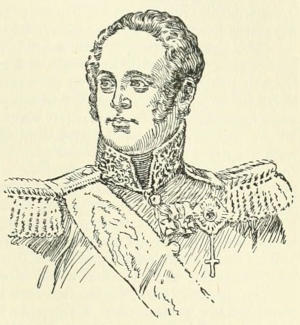
Alexander I
(1777-1825)
The relations between Russia and France were at this time of such a nature
that the Russian chancellor, Vorontzov, said plainly, in a note of the 18th of
July, that if the war were to be prolonged between France and England,
Russia would be compelled finally to take part in it. Before this declaration
on the part of Russia, Bonaparte had a scene with Markov, which alone might
well have caused a rupture. He addressed the Russian ambassador, in a
public audience, so rudely and violently that even Bignon, who is disposed to
worship Bonaparte as a demi-god, is obliged to confess that his hero entirely
lost his dignity, and forgot his position.
[1803-1805 A.D.]
When Markov withdrew in November, he left his secretary of legation,
D’Oubril, as acting ambassador in his place. Everyone, however, foresaw
a breach at no very distant period; and Russia had already, in the autumn of
1803, when nothing was to be done with Prussia, entered into a closer connection
with England. Negotiations were also commenced with Austria, and
a union with Sweden and Denmark, for the purpose of liberating Hanover,
was spoken of. This was the state of affairs at the beginning of 1804: the
murder of the duke d’Enghien brought matters to a crisis. The mother of
the Russian emperor had been all along hostile to everything proceeding from
Bonaparte; and the mild and gentle spirit of the emperor, like that of all
persons of good feeling in Europe, was deeply wounded by the fate of the duke.
From the beginning of 1804, he had no further political reasons for keeping
up a friendly relation with France; he therefore gave himself up entirely to
his natural feelings on hearing of the catastrophe at Vincennes.
By the declarations interchanged between the courts of St. Petersburg and
Berlin (May 3rd and 24th, 1805), it was agreed that they should not allow the
French troops in Germany to go beyond the frontier of Hanover; and that
should this happen, each of the two powers should employ 40,000 men to repel
such an attempt. A convention was also signed between Russia and Austria
before the end of the year, and they agreed to set on foot an army of 350,000
men. England, under the administration of William Pitt, added her strength
to these combinations, and united the several powers in a third coalition for the
purpose of wresting from France the countries subdued by it since 1792,
reducing that kingdom within its ancient limits, and finally introducing into
Europe a general system of public right. The plan was the same as that
which ten years afterwards was executed by the Grand Alliance; it failed in
1805, because the participation of Prussia, on which the allies had reckoned,
was, from the most ignoble motives withheld.
The negotiations of the several treaties connected with the coalition,
occupied the greater part of the year 1805. By the Treaty of St. Petersburg
(August 11th), between Great Britain and Russia, it was agreed that Alexander
should make another attempt for arranging matters with Bonaparte,
so as to prevent the war. The Russian minister Novosiltzov was sent to Paris
by way of Berlin, where he received the passports procured for him from the
French cabinet by that of Prussia; but at the same time, orders reached him
from St. Petersburg, countermanding his journey. The annexation of the
Ligurian Republic to France, at the moment when the allies were making
conciliatory overtures to Napoleon, appeared to the emperor too serious an
outrage to allow of his prosecuting further negotiations. War was consequently
resolved on.
[1805 A.D.]
Napoleon seemed to be wholly intent on his design of invading England.
Part of his troops had already embarked (August 27th), when on a sudden the
camp of Boulogne was broken up, and the army put in march towards the
Rhine, which river it passed within a month after. Austria had set on foot
three armies. The archduke Charles commanded that of Italy; his brother
John was stationed with the second army on the Tyrol; and the third was
commanded nominally by the archduke Frederick, the emperor’s cousin,
but in reality by General Mack. The first Russian army under Kutusov had
arrived in Galicia, and was continuing its march in all haste. It was followed
by another under Michelson. The Russian troops in Dalmatia were to attempt
a landing in Italy.
Mack having crossed the Inn (September 8th), and entered Swabia, Napoleon’s
plan was to cut him off from the army of Kutusov, which was marching
through Austria. In this he succeeded by a violation of the Prussian territory.
Marmont, who had marched by way of Mainz, and Bernadotte, who had conducted
an army into Franconia, where they were joined by the Bavarians,
traversed the country of Anspach, and thus came on the rear of the Austrian
army (October 6th). From that date, scarcely a day passed without a battle
favourable to the French. Several Austrian divisions were forced to lay down
their arms. Mack, who had thrown himself into Ulm, lost all resolution, and
capitulated with 25,000 men (October 19th). Mack’s army was thus totally
dissipated, except 6000 cavalry, with which the archduke Ferdinand had
opened himself a passage through Franconia, and 20,000 men, with whom
Kienmayer had retired to Braunau, where he was met by the vanguard of
Kutusov. The two generals continued their retreat. The Russians repassed
the Danube near Grein (November 9th), and directed their march towards
Moravia. A few days after (November 13th), Vienna fell into the hands of
the French. The Austrians had renounced the design of defending their
capital, but decided that the passage of the river should be disputed.
Vienna is situated at some distance from the Danube, which flows to the
right of the city between wooded islands. The Austrians had placed explosive
materials under the floorings of the wooden bridge which crosses the several
arms of the river, and were ready to blow it up the moment the French should
show themselves. They kept themselves in readiness on the left bank, with
their artillery pointed, and a corps of 7000 or 8000 men, commanded by Count
Auersberg. The French, nevertheless, got possession of the bridge by stratagem.
Murat, Lannes, Belliard, and their staff, leaving their troops behind
them, crossed the bridge, told the Austrians that an armistice was agreed on,
and asked to see their general. He was sent for. Meanwhile, the French
officers kept the Austrian gunners in conversation, and gave time for a column
of French grenadiers to come up unseen, under cover of the woods, seize the
cannon, and disarm the artillerymen. The Austrian commander who had
come to the spot just at the critical moment, fell completely into the trap.
He himself led the French column over the bridge, and ordered the Austrian
troops to be drawn up on parade to receive them as friends. The possession
of the bridge afforded the French troops the means of reaching Znaim sooner
than Kutusov, and thus preventing his junction with Buxhövden.
Meanwhile, Alexander had gone to Berlin, to exert his personal influence
over the timorous king, and prevail on him to abandon his wretched neutral
policy, in which there was neither honour, honesty, nor safety. Alexander
was warmly seconded by the beautiful queen of Prussia, and by the archduke
Anthony, who arrived at the same time on a special mission from Vienna.
French influence rapidly declined in Berlin; Duroc left it on the 2nd of November,
without having been able to obtain an audience, for some days previously,
either from the king or the emperor; and on the following day a secret convention
was signed between the two monarchs for the regulation of the affairs
of Europe, and the erection of a barrier against the ambition of the French
emperor.
The Prussian minister Haugwitz, who had signed this convention only to
gain time, and with a secret determination to elude its provisions, was to be
entrusted with the notification of it to Napoleon, with authority, in case of
its acceptance, to offer a renewal of the former friendship and alliance of the
Prussian nation; but in case of refusal, to declare war, with an intimation
that hostilities would begin on the 15th of December—when they would be
too late. Before that day came, Prussia relapsed into her old temporising
habits; her armies made no forward movement towards the Danube, and
Napoleon was permitted to continue without interruption his advance to
Vienna, while 80,000 disciplined veterans remained inactive in Silesia; a force
amply sufficient to have thrown him back with disgrace and disaster to the
Rhine.
A characteristic scene took place at Potsdam during Alexander’s visit.
The king, the queen, and the emperor went one night by torchlight into the
vault where lay the coffin of Frederick the Great. They knelt before it.
Alexander’s face was bathed in tears; he pressed his friend’s hands, he clasped
him in his arms, and together they swore eternal amity: never would they
separate their cause or their fortunes. Tilsit soon showed what was the value
of this oath, which probably was sincere for the moment when it was taken.
During the retreat of the Austrians and Russians under Kienmayer and
Kutusov from Passau to Krems, the imprudence of Mortier, who had crossed
to the left bank of the Danube at Linz, gave occasion to engagements at Stein
and Dirnstein, in which the French lost more men than they ever acknowledged.
Mortier’s army of 30,000 men consisted of three divisions, under
Generals Gazan, Dupont, and Dumonceau. This army had positive orders
to keep always near to the main body, which was pursuing its march along
the right bank, and never to advance beyond it. Kutusov had long retreated
on the right bank; but on the 9th of November he crossed to the left at Grein,
as before mentioned, and lay in the neighbourhood of Krems, when Mortier’s
troops advanced. The French divisions maintained the distance of a whole
day’s march one from another, because they thought they were following a
fleeing army; but between Dirnstein and Stein they fell in with the whole
Russian army, 20,000 strong, at a place where the French were obliged to pass
through a frightful ravine. On the 11th of November, Mortier ventured to
make an attack with Gazan’s division alone; but near Dirnstein (twenty
hours from Vienna), he got into a narrow way, enclosed on both sides by a line
of lofty walls, and there suffered a dreadful loss. When the French, about
noon, at length supposed themselves to have gained some advantage, the
Russians received reinforcements, outflanked the French, cut them off, and
would have annihilated the whole division, had not Dupont’s come up at the
decisive moment. The latter division had also suffered severely on the same
day. Whilst Kutusov was sharply engaged with Mortier, whose numbers
were being rapidly diminished, and his cannon taken, the Austrian general
Schmidt attacked Dupont at Stein, where the contest was as murderous as
at Dirnstein, till Schmidt fell, and the French forced their way out.
Kutusov, on his march to Znaim, was overtaken by the van of the French,
under Belliard, near Hollabrunn; and everything depended on detaining the
latter so long as might enable Kutusov to gain time for getting in advance.
For this purpose, Bagration, with about six thousand men, took up a position
in the rear of the main body. Nostitz served under Bagration, and had some
thousand Austrians and a number of Russians under his immediate command.
He occupied the village of Schöngraben, in the rear of the Russians,
and in the very centre of their line of march. Belliard ought to have attacked
him first; but as his corps was not superior in number to that of Bagration,
he had again recourse to the expedient which he had already tried, with such
signal success, at the bridge of Vienna. He entered into a parley; declared
that peace with Austria was already concluded, or as good as concluded;
assured them that hostilities henceforth affected the Russians alone; and by
such means induced Nostitz to be guilty of a piece of treachery unparalleled
in war. Nostitz, with his Austrians, forsook the Russians, even those whom he
had under his own command; and they being unable to maintain the village of
Schöngraben, it was taken possession of without a shot; and Bagration and
Kutusov seemed lost, for Murat’s whole army was advancing upon them.
In the meantime the Russians at Hollabrunn extricated themselves from
their difficulty; for they were not so stupidly credulous as the Austrians, but
knew how to deceive the Gascons, by whom they were pursued, as Belliard
had deceived the Austrians. For this purpose, they availed themselves of the
presence in Kutusov’s camp of Count von Winzingerode, the adjutant-general
of the emperor of Russia, who had been employed in all the last diplomatic
military negotiations in Berlin. Murat having sent his adjutant to call upon
Kutusov, whose line of march had come into the power of the enemy, in consequence
of Nostitz’s treachery in capitulating, the Russian general assumed
the appearance of being desirous to negotiate, and Winzingerode betook himself
to the French camp. Belliard and Murat, without taking the trouble to
inquire what powers the count and Kutusov had to conclude a treaty which
should be generally binding, came to an agreement with Winzingerode, by
virtue of which all the Russians, within a certain number of days, were to
evacuate every part of the Austrian territory. This capitulation was to be
sent to the emperor Napoleon, at Schönbrunn, for confirmation; and to this
condition there was necessarily attached another, for the sake of which Kutusov
had commenced the whole affair. There was to be a suspension of hostilities
till the arrival of Napoleon’s answer; and it was agreed that in the meantime
both parties should remain in their then positions.
Bagration, with seven or eight thousand Russians, complied with this
condition, and remained in his position at Hollabrunn, because he could be
observed by the French; but Kutusov, with all the rest of the army, which
lay at a greater distance, quietly continued his route to Znaim; and this, with
a full knowledge of the danger of Bagration being afterwards overwhelmed
by a superior force. On being made acquainted with the capitulation, Napoleon
was enraged, for he immediately perceived how grievously his brother-in-law
had suffered himself to be deceived; and he ordered an immediate
attack. This was indeed made; but eighteen hours had been irreparably lost,
and Kutusov gained two marches on Murat; the whole French army, above
thirty thousand strong, therefore fell upon Bagration.
Bagration, who had still with him the Austrian regiment of hussars of the
crown-prince of Homburg, commanded by Baron von Mohr, offered a vigorous
resistance to the whole French army with his seven or eight thousand men.
The Russian bombs set fire to the village in which was stationed the corps
which was to fall upon Bagration’s flank; the consequence was, that this
corps was thrown into confusion, and the Russians opened up a way for themselves
at the point of the bayonet. The Russian general, it is true, was obliged
to leave his cannon in the hands of his enemy, and lost the half of his force; it
must, however, always be regarded as one of the most glorious deeds of the
whole campaign, that, after three days’ continued fighting, he succeeded in
joining the main body under Kutusov, at his headquarters at Wischau,
between Brünn and Olmütz, and, to the astonishment of all, with one-half
of his little army. Even the French admit that the Russians behaved nobly,
that they themselves lost a great number of men, and that, among others,
Oudinot was severely wounded.
On the same day on which Bagration arrived in Wischau, a junction had
been formed by Buxhövden’s army, with which the emperor Alexander was
present, with the troops under Kutusov, who thenceforward assumed the
chief command of the whole. Napoleon himself came to Brünn, and collected
his whole army around him, well knowing that nothing but a decisive engagement
could bring him safely out of the situation in which he then was, and
which was the more dangerous the more splendid and victorious it outwardly
appeared to be. It is beyond a doubt that the precipitation and haughtiness
of the Russians, who were eager for a decisive engagement, combined with the
miserable policy of the Prussian cabinet and the cowardice of the king, as well
as the fears and irresolution of the poor emperor Francis, and the want of
spirit among his advisers, contributed more to the success of Napoleon’s
plans respecting Prussia, Germany, and Italy, than his victories in the field.
A glance at the situation of affairs at the time of the battle of Austerlitz
will show at once how easily he might have been stopped in his career. There
was nothing Napoleon feared more than that the Russians should march either
to Hungary or to Upper Silesia, and avoid a decisive engagement; he therefore
took means to ascertain the characters and views of the personal attendants
and advisers of the emperor Alexander; and when he had learned that
young men of foolhardy dispositions had the preponderance in his councils,
he formed his plans accordingly. He first advanced from Brünn to Wischau,
and afterwards retired again into the neighbourhood of Brünn, as if afraid to
venture upon an attack. The emperor of Germany, as well as Napoleon,
appeared seriously desirous of a peace; but the former was obliged to propose
conditions which the latter could not possibly accept; and Napoleon wished
first completely to set the emperor Francis free from the Russians, his allies
and from Prussia, before he came to an agreement with him. As Count
Stadion, who came to the headquarters of the French on the 27th of November,
with Giulay, as ambassadors to treat for peace, was a sworn enemy of
Napoleon, and remained so till 1813, and had, moreover, been very instrumental
in founding the whole coalition, and in maturing their plans, his appearance
on this occasion was of itself no good omen for the favourable issue
of the mission.
The proposals made as the basis of a peace were the same as had been contemplated
in the event of a victory on the part of the allies—the French were
to evacuate Germany and Italy. When Napoleon sent Savary (afterwards
duke of Rovigo), the head of his gendarmerie police, under pretence of complimenting
the emperor Alexander, it was indisputably a great part of this
envoy’s object, as appears from the 30th bulletin, to make himself thoroughly
acquainted with the prevailing opinions and the leading characters during the
three days of his sojourn in the emperor’s camp. Savary was very well
received, and sent away with every courtly attention by Alexander; but it
was intimated that it was intended to make common cause with Prussia, and
that it was expected that Novosiltzov, whom the emperor Alexander wished
to send to Napoleon, would meet Haugwitz in Brünn. The hint was sufficient
to induce Savary to decline the company of Novosiltzov.
When Savary informed the emperor of the illusion of the Russian generals,
and of their belief that fears were entertained of the Russians, and that on
this account embassies were sent to seek for peace—Napoleon very cunningly
took care to strengthen the fools in their folly. Savary was sent again
to the enemy’s camp to propose an interview between Napoleon and the
emperor of Russia. The interview was declined; but Prince Dolgoruki was
sent to propose conditions to Napoleon. The latter did not allow him to
come into his camp, but received him at the outposts.
If it be asked why the Russians, with whom there were only some twenty
thousand Austrians, did not wait for their third army, under Bennigsen, or
reduce Bonaparte to the greatest perplexity, by taking up a strong position
in Hungary or Upper Silesia, or remaining quietly upon the heights of Pratzen,
the reply is, that the whole system of supplies was bad, and that want had
reached so great a pitch, that it would have been impossible for them to
remain. Certain it is that they suffered themselves to be drawn down from
the heights, and away from Austerlitz, near Brünn, where the talents of their
generals were unable to devise any plan of battle which Napoleon could not
immediately oversee; it would have been otherwise in the mountains. The
French allege, that Napoleon had long before fixed upon the very place in which
the Russians offered him battle at Austerlitz, on the 2nd of December, as his
battle-field, and laid all his plans accordingly. The possession of the heights
of Pratzen was regarded by those skilled in strategy as the key of this battle-field.
The Russians were in full possession of these heights, with all their
force, on the 1st of December; on the 2nd they descended from them, when
Bonaparte drew back one of the wings of his army. He had long calculated
on gaining the victory by the possession of these heights, and thus rendering
the retreat of the Russians impossible. He did not, therefore, fail, in the
very opening of the battle, to seize upon them.
A column of the third Russian army, under Bennigsen, commanded by
Michelson, just arrived at the decisive moment when Napoleon had also called
to his aid Bernadotte’s corps, and when the Bavarians were on their march
from Budweis to Moravia; but none of their leaders could lay any claim to
the reputation of a commander of genius. Napoleon’s proclamation to his
army shows his full confidence in his own superiority, as well as in that of his
generals and soldiers; and this confidence was fully realised on the bloody
field of Austerlitz on the 2nd of December.
[1806 A.D.]
After the defeat at Austerlitz the emperor made an attempt, whether
sincere or not is uncertain, for a reconciliation with Napoleon. He sent
D’Oubril to Paris, who, after a negotiation of ten days, concluded a treaty
with the French plenipotentiary, General Clarke (July 20th, 1806). But
Alexander refused to ratify the treaty, upon the very questionable allegation
that his ambassador had exceeded his powers.
Prussia now suffered the just consequences of her policy. Disappointed
in her hopes of acquiring Hanover, the reward for which she crouched to
Napoleon, she imprudently provoked him to war without waiting for the
arrival of the aid due to her by Russia. The campaign was decided in one
day by the two terrific defeats of Jena and Auerstadt (October 14th, 1806).
Prussia was hopelessly ruined before the Russian armies, ninety thousand
strong, under Bennigsen and Buxhövden, could arrive to save her. The
Russians entered Prussia in November, and on the 26th of December the
battle of Pultusk was fought with great obstinacy and loss of blood on both
sides. The French spent the whole of a December night without covering;
rain and snow fell incessantly; they waded up to their knees in marshes,
spent twelve hours in making an advance of eight miles, and were obliged to
pay dearly for their passage over the Narev. During the battle, Marshal
Lannes and other generals were several times obliged to put themselves at
the head of single regiments and battalions, and yet no decisive advantage
was gained. The French, indeed, boasted of the victory; because the Russians,
after having maintained their ground on a part of the field, retreated
the next day.
If the victory at Pultusk, of which Bennigsen boasted, and on account of
which he was afterwards rewarded by his emperor, and appointed commander-in-chief,
was very doubtful, on the other hand, Prince Galitzin completely
defeated the French at Golymin, on the very day on which they were to attack
Buxhövden, at Ostrolenka. This victory, too, was the more glorious, inasmuch
as the Russians were less numerous than their opponents. The French,
however, had not been able to bring up their artillery; and the superiority of
the Russians in this particular decided the event. The weather and the time
of the year rendered active operations impossible for some weeks. Bennigsen
retired to Ostrolenka, and afterwards still farther; whilst the French, under
Ney and Bernadotte, were scattered in the country on the farther side of the
Vistula, in which Ney at length pushed forward as far as Heilsberg.
[1807 A.D.]
In January, 1807, Bennigsen and Napoleon came, almost simultaneously,
upon the idea of changing the seat of war from the extreme east to the west.
In the east, the struggle was afterwards carried on by two particular corps—a
Russian, under Essen, and a French, first under Lannes, and then under
Savary. This bloody struggle, however, had no influence on the issue of the
war. Bennigsen no sooner learned that Ney had scattered his troops widely
over the country on the farther side of the Vistula, than he broke up his
quarters, and resolved to attack him, before Bernadotte, who was near, could
come to his relief; but he was too late. Ney had already retreated when
Bennigsen arrived; whether it was as the French allege, because Napoleon,
who had seen the danger with which he was threatened, sent him orders to
retreat, which arrived on the very day on which he was to be attacked by the
Russians, or that General Markov was at first too eager, and Bennigsen afterwards
too irresolute. Ney luckily marched from Heilsberg, nearer to the
Vistula, and Bennigsen followed him hesitatingly, so that Bernadotte was
able to keep him employed for some days till Napoleon came up. On receiving
news of Bennigsen’s march, the French emperor had sent orders to all his corps
to renew the campaign on the 27th, and he had so taken his measures, that
before the Russians had any suspicion of an attack, the main army of the
French would fall upon their left flank, whilst they were on their march. For
this purpose, Bernadotte was to allure Bennigsen quite to the Vistula; and
then to advance again as soon as Napoleon had outflanked the left of the
Russians.
The despatch containing these orders for Bernadotte fell into the hands
of the Russians, through the inexperience of the officer entrusted with it, who
failed to destroy the document at the right time. Thus warned of the impending
danger, and finding themselves pressed on all sides, they allowed their
stores and heavy baggage, at various places, to fall into the hands of the enemy,
and thereby escaped being surrounded. After considerable sacrifices, they
succeeded, on the 6th of February, in reaching the Prussian town of Eylau,
which is only nine hours’ distance from Königsberg. Soult attacked their
rear, on the low hills behind the town, on the 7th, and drove them in; on the
following day a general engagement took place. The honour of the victory is
probably due to the Russians, as even Savary admits, who shared in the battle.
It is not less certain, however, that the whole advantage accrued to the French,
who, indeed, admit that the battle was one of the most dreadful recorded in
history. The French accuse Bernadotte of having, by his delay, prevented
the victory from being complete; whilst the Russians are just enough to admit
that Lestocq, with his Prussians, saved their wing from utter defeat. The
number of deaths in the battle, and on the day preceding it, was immense.
Great numbers fell, not by the sword, but by cold, want, and excessive exertion.
Whole battalions and regiments of the French—as, for example, that of
Colonel Sémelé—were literally annihilated. Few prisoners were made,
because the whole battle was fought with the bayonet.
The royal family of Prussia was placed in a very melancholy position by
the issue of the battle, for they were obliged, in the middle of winter, to flee to
Menel, where they found themselves among Russians, of whom their own
emperor alleged, that, notwithstanding his despotic power, he was not able to
restrain their barbarity, or to put a stop to their rapacity. Here, in the
farthest corner of Prussia, they received news every month of the fall of one
fortress after another, or of forced contributions levied upon their people.
The French army also retired after the battle of Eylau as well as the Russians.
Bennigsen marched towards Königsberg, and although Berthier, on
the morning of the 7th, wrote to the empress that they would be in Königsberg
with their army on the following day, the French, nevertheless, drew off
nearer to the Vistula. Nothing important was undertaken by either party
for some months, but vigorous preparations were made for a new struggle;
whilst new means were tried to prevent Prussia from taking any energetic
measures—that is, from forming a close union with England and Russia.
The king hesitated between the bold advice of Hardenberg and his friends,
and the unconditional submission to the will of Napoleon, which was recommended
by von Zastrov. The Russians were thoroughly dissatisfied with
the English, and complained of being very badly supported by them; they
suffered want of all kinds, were worse treated in many places in Prussia than
the French, and even borrowed 660,000 dollars in coin from the king of
Prussia.
Hardenberg, who accompanied his master to Tilsit, succeeded in having a
new treaty entered into at Bartenstein between Russia and Prussia. Its
principle was the same as that of the agreement made on the 12th of October,
of the preceding year, at Grodno, by virtue of which the emperor bound himself
to support the cause of the king with all his forces. In this treaty, it was
not only promised, just as if they were before Paris, that Prussia should receive
back all that had been lost, but it was formally determined what was to be
done with the conquests wrested from France, and how even the left bank of
the Rhine was to be partitioned among the allies.
About this time Bennigsen was appointed commander-in-chief of the
Russian armies; but he is generally accused of incapacity, and fearful descriptions
are given of the disorders, fraud, and embezzlement which prevailed,
and of the plunder and barbarity which they practised against unfortunate
Prussia. The emperor Alexander, as soon as he arrived at the army, did
everything in his power to restore order; he was able, however, only to remedy
single abuses; even Nicholas, who manifests a degree of severity from which
Alexander shrank back, is not able to reach the source of the evil. Towards
the end of May, Bennigsen thought his troops already sufficiently reinforced
to make an attack upon the French, and drive them across the Vistula; whilst
the combined army of English, Swedes, and Prussians, were to make an attack
from Pomerania. The French army, lying from Dantzic to the Narev, was
brought, before the beginning of June, when the campaign commenced, to
150,000 men, whose pay and sustenance were drawn from the requisitions and
contributions imposed on Prussia. In April, 1807, the French senate passed
a decree levying 80,000 conscripts, 60,000 of whom were to be immediately
sent to the army; and the Poles, too, deceived by the hope of the restoration
of their nationality, raised a body of between 25,000 and 30,000 men, among
whom were whole regiments recruited by the Polish nobility, or formed exclusively
of nobles who volunteered their service, although Napoleon limited all
the expectations of the Poles to the country on this side of the Vistula.
As soon as Bennigsen, in the beginning of June, made a serious movement
in advance towards the Vistula, a series of murderous engagements began,
similar to those which preceded the battle of Eylau; on the 9th, the main body
of both armies came in sight of each other at Heilsberg, and on the 10th the
French made an attempt to drive the Russians from their position. The
united corps of Soult and Lannes, supported by the cavalry under Murat, made
repeated attempts to force the Russians to give way; they, however, kept
their ground.
Bennigsen afterwards heard, at Wehlau, that the French had separated
into two divisions, and he resolved on the 13th, instead of continuing his route
on the farther side of the Alle, to wheel about before Wehlau, and attack the
French. By this step, as all writers admit, he gave himself into the hands of
his great opponent, who never suffered his enemy to commit a fault with
impunity. The position taken up by Bennigsen was such as to leave him no
alternative between victory and destruction, for he had the Alle in his rear,
and a marsh on one flank. Napoleon took advantage of this mistake, as
usual; and the orders which he issued before the battle prove that he was sure
of the victory. About five o’clock in the evening of the 14th of June, a battery
of twenty guns gave the signal for the fight; it was bravely maintained on
both sides, and both armies suffered great loss. The French accounts exaggerate
the number of the Russians who were led into the battle of Friedland,
as well as the number of prisoners: certain it is, however, that seventeen
thousand Russians were either killed or wounded.
After the battle of Friedland, there was no longer any account to be taken
of the Prussians: and it was a piece of great good fortune that such a sovereign
as Alexander reigned in Russia, otherwise Prussia would have been wholly lost.
Lestocq, with his Prussians, was obliged hastily to cross the Haff to Memel;
and their magazines, considerable stores of powder and ammunition, together
with one hundred thousand muskets, which the English had sent by sea to
Königsberg, fell, with the town, into the hands of the French. Bennigsen
was not very closely pursued on the other side of the Alle; he passed the Niemen
on the 19th, and burned down the bridge behind him; immediately afterwards,
Bonaparte arrived in Tilsit. Of all the Prussian fortresses, Colberg
alone might have been able to maintain itself for some weeks, and Graudenz
was saved merely by the peace. The treaty with England, which the Prussian
minister signed in London on the 17th of June, and by which £1,000,000
sterling was promised in subsidies, came too late.
Schladen informs us that all those who were about the king of Prussia had
so completely lost courage, that Von Hardenberg, Von Stein, Von Schladen
himself, and many others who recommended perseverance, found none upon
whom they could reckon. With respect to the Russians, he informs us that
there was a party who assumed a threatening aspect—that the army was
dissatisfied with the war—that the grand duke Constantine behaved often
very rudely towards the Prussians, and allowed himself to be used as an
instrument for working on the fears of his brother Alexander. On the 7th of
June, the emperor manifested a disposition altogether contrary to the agreements
and partition-projects of the convention of Bartenstein. He was dissatisfied
with England, and perceived that the Austrians had no other object
than to fish in troubled water, and he was, therefore, desirous, as much as
possible, to withdraw from the whole affair. He proposed a truce for himself,
with a clause that the Prussians also should obtain a cessation of hostilities;
but the Russians and Prussians were to negotiate each for themselves
respecting the conditions. Napoleon having entertained the proposal, Russia
agreed, that during the continuance of the truce, the French should retain
possession of the whole of Poland, except the circle of Bielostok. The agreement
was signed on the 21st, and a four weeks’ notice of the renewal of hostilities
was reserved. By the terms of the truce granted to Prussia, the French
remained in possession of the whole kingdom; and the few fortresses which
were not yet reduced were not to be supplied either with new works, ammunition,
or provisions. Blücher, who commanded the Prussian auxiliary forces
in Pomerania, was to leave the king of Sweden to his fate. The peace was to
be negotiated at Tilsit, and for that purpose one half of the town was to be
declared neutral.k
Meeting of Alexander and Napoleon at Tilsit (1807 A.D.)
Napoleon desired, as far as means and powers would allow, to give all
possible pomp and solemnity to the interview with his mighty adversary.
With this object, in the middle of the Niemen, opposite Tilsit, a raft was
constructed, on which were two pavilions, covered in white cloth. The one
which was destined for the two monarchs was of vaster dimensions and was
adorned with all possible luxury; the other and smaller one was for their
suites. On the frontals of the pavilions were painted in green, on the Russian
side, an enormous A, and on the side turned towards Tilsit an N of equal
size. To the annoyance of the Prussians, the monogram of Frederick William
III was absent from the decorations of the Niemen raft. The French
guards were ranged in lines, fronting the river. “All this army,” writes an
eye-witness, “awaited the appearance of their invincible leader, their thunder-bearing
semi-divinity, in order to greet him at the moment of his swift passage
to the wharf.” Thousands of the inhabitants of Tilsit and French soldiers
covered the high left bank of the Niemen.
The emperors got into the boats simultaneously. When both boats put
off, the grandeur of the spectacle, the expectation of an event of world-wide
importance took the ascendency over all other feelings. Universal attention
was concentrated upon the boat that carried that wonderful man, that leader
of armies, the like of whom had never been seen or heard of since the times
of Alexander the Great and Julius Cæsar. Napoleon stood on the boat in
front of his suite, solitary and silent, his arms folded on his breast as he is
represented in pictures. He wore the uniform of the Old Guard and the
ribbon of the Legion of Honour across his shoulder, and on his head that little
historical hat, the form of which has become famous throughout the world.
Reaching the raft somewhat sooner than Alexander, Napoleon rapidly got
onto it, and hastened to meet the emperor. The rivals embraced and silently
entered the pavilion, accompanied by the joyful acclamations of the troops
and the inhabitants, who were witnesses of a world-wide event—the reconciliation
of Russia and France. At that moment a large boat put off from
the left bank of the Niemen, having on it about twenty armed soldiers—and
remained between the raft and the Russian shore. Evidently Napoleon did
not hesitate to take open measures of safeguarding against any possible unforeseen
occurrences.
That day the king of Prussia did not assist at the interview: Napoleon did
not wish to see him, and Frederick William remained on the right bank of
the Niemen. “In that fateful hour, whilst the destiny of his monarchy was
being decided, his gaze was constantly fixed and his ear directed towards the
raft, as though he desired to listen to the conversation between the two emperors.
Once he went down to the edge of the river and only stopped when the
water was up to his horse’s middle.” The first interview between Alexander
and Napoleon lasted an hour and fifteen minutes. “I detest the English no
less than you do,” were the first words of the emperor Alexander, “and I am
ready to support you in everything that you undertake against them.” “If
such is the case,” answered Napoleon, “then everything can be arranged and
peace secured.”
Taking advantage of Alexander’s inimical disposition towards Great
Britain, Napoleon entered upon a terrible philippic against the perfidy of
Albion, representing it as a greedy, extortionate nation ever ready to sacrifice
everyone, even its most faithful allies, for its own profit. In further conversation
Napoleon strove to instil into Alexander that he was victimised by his
allies, that he was mistaken in protecting the Germans, those ungrateful and
envious neighbours, and in supporting the interests of a set of greedy merchants
who showed themselves to be the representatives of England; all this
was occasioned, according to him, by a feeling of generosity carried to excess,
and by doubts which arose from the incapacity or corruption of ministers.
After this Napoleon began to praise the valour and bravery of the Russian
troops, with which he had been much struck at Austerlitz, Eylau, and Friedland;
he considered that the soldiers on both sides had fought like veritable
Titans and was of the opinion that the united armies of Russia and France
might dominate the world, and give to it prosperity and tranquillity. Up till
now Russia had squandered her forces, without having any recompense in
view; by an alliance with France she would acquire glory, and in any case
reap substantial advantages. Of course Russia was bound by certain obligations
to Prussia, and in that respect it was indispensable that the honour
of the emperor Alexander should be carefully guarded. In conclusion Napoleon
expressed his intention of restoring to Prussia sufficient territory honourably
to rid the emperor of his ally; after that, he affirmed, the Russian cabinet
would be in a position to pursue a fresh line of policy similar in everything
to that of the great Catherine. Only such a policy, in Napoleon’s opinion,
could be possible and advantageous for Russia.
Having flattered Alexander as emperor, Napoleon in order to complete the
charm proceeded to flatter him as a man. “We shall come to an agreement
sooner,” said he, “if we enter upon negotiations without intermediaries, setting
aside ministers, who frequently deceive or do not understand us; we
two together shall advance matters more in a single hour than our intermediaries
in several days. Nobody must come between you and me; I will be
your secretary and you shall be mine,” added Napoleon. Upon this basis he
proposed to the emperor Alexander for convenience’s sake to transfer the
negotiations to Tilsit, declaring the position of the town to be a central one.
The emperor gladly accepted Napoleon’s invitation, and it was settled that
negotiations should at once be entered upon in order to come to a definitive
agreement[55] on the matter.g
The English government, alleging that in the secret articles of the treaty
of Tilsit, of which they had possessed themselves, they had proof of Napoleon’s
design to seize the Danish fleet, fitted out an expedition against Denmark
with extraordinary celerity. Copenhagen was bombarded for three days, and
a great part of the city destroyed. The Danes then capitulated (September
7), and surrendered their fleet to the English, with all their naval stores in
their arsenals and dockyards.
The expedition against Copenhagen was soon followed by a declaration of
war on the part of Russia against England. In the manifesto published on
this occasion (September 16th), Alexander complained bitterly of the bad
faith of England, as manifested especially in the little aid she had afforded
to the allies who had taken up arms in a cause in which she was more directly
interested than any other power, and in the robber-like act of aggression she
had committed against Denmark. He annulled all former conventions
between Russia and England, especially that of 1801; proclaimed anew the
principle of the armed neutrality; and declared that there should be no communication
between the two powers until Denmark had received just compensation,
and peace was concluded between France and England. In consequence
of this declaration, an embargo was laid on all the English vessels
in Russian ports, and Prussia was compelled to follow this example.
It was not till the 6th of October that a formal demand was made upon
Sweden to close the ports of the Baltic against English ships and trade. The
king persevered in his alliance with England; and finally, because the emperor
of Russia had conferred upon Napoleon the order of St. Andrew, he sent back
his insignia; whereupon Alexander not only returned his Swedish order, but
quietly adopted measures to take possession of Finland, whilst the Danes
were preparing, in concert with the French, to invade the western provinces
of Sweden. Although in the months of November and December, Gustavus
repeatedly declined the proposals of the Russians for a union against England,
everything went on in Sweden as in times of the most profound peace; and
even when the Russian forces were collected on the very frontiers of Finland,
the unfortunate king adopted no measures of defence whatever. On the
21st of January he was, for the last time, called upon to declare war against
England; he replied by concluding a new alliance with her on the 8th of
February. On the 21st, the Russians invaded Finland, without any specific
declaration of war, and on the 14th of March, 1808, Denmark declared war
against Sweden. The whole of Finland as far as Vasa, the island of Åland,
and even the islands of Gotland, Åbo, Sveaborg, and all the fortresses, were
taken possession of by the Russians even before the Swedish army and fleet
were prepared. It was not till the end of April and beginning of May that a
Swedish army under Klingspor and Aldercreutz, supported by a Swedish
fleet, appeared in the field, and fought with various success.
We have lately seen Alexander take military possession of the Danubian
provinces as a “material guarantee,” whilst affecting not to be at war with
Turkey. This was in exact conformity with Russian precedents. Finland,
as we have said, was occupied without a declaration of war; but manifestoes
were issued by General Buxhövden, one of which contained the following passage:
“Good neighbours, it is with the greatest regret that my most gracious
master, the emperor of all the Russias, sees himself forced to send into your
country the troops under my orders. But his majesty the king of Sweden,
whilst withdrawing more and more from the happy alliance of the two greatest
empires in the world, draws closer his connections with the common enemy,
whose oppressive system and unparalleled conduct towards the most intimate
allies of Russia and of Sweden herself cannot be coolly endured by his imperial
majesty. These motives, as well as the regard which his imperial majesty
owes to the safety of his own states, oblige him to place your country under his
protection, and to take possession of it in order to procure by these means a
sufficient guarantee in case his Swedish majesty should persevere in the resolution
not to accept the equitable conditions of peace that have been proposed
to him, etc.”
When the Russians took possession of Finland, the king gave them a pretence
for incorporating it with their empire, which, however, they would no
doubt have done in any case. He caused Alopeus, the Russian ambassador,
to be arrested. This took place on the 3rd of March, and on the 25th a declaration
was published on the part of the emperor of Russia, announcing to all
the powers that “from that moment he regards the part of Finland hitherto
reputed Swedish, and which his troops had only been able to occupy after
divers battles, as a province conquered by his arms, and that he unites it forever
to his empire.”
It was easy to anticipate that the superior force of the Russians must in
the end prevail; although the Russian garrison in Gotland, and that in the
island of Åland, were at first taken prisoners, the island occupied, and the
Russians beaten by land at Vasa on the 26th of July, and by sea at Roggerwick
on the 26th of August. The Swedes lost all the advantages they had thus
gained by the bloody battle fought at Ormais on the 14th of September, and
by the defeat at Lokalar on the 18th. The Russian generals, probably in
order to give courage to the malcontents, who were very numerous in Sweden,
issued orders not to receive any letters or any flags of truce which were sent in
the king’s name, and carried on negotiations with the Swedish generals alone,
for a suspension of arms, which was concluded for an indefinite time, on the
20th of September, but only continued till the 27th of October, when the Russians
resumed hostilities, and the Swedes were driven to the north, across the
Kemistrom. On the 20th of November a new truce was agreed upon between
the Swedish general Adlercreutz and the Russian general Kamenskoi, with
the reserve of fourteen days’ notice before renewal of operations. By the conditions
of this agreement the Swedes were to evacuate the whole of Uleåborg,
and to retire completely behind the Kemistrom, with all their artillery, arms,
and stores.
On the 13th of March in the following year a revolution was effected in
Sweden, by which Gustavus was deposed; his uncle, the duke of Södermanland,
became regent, and was afterwards proclaimed king (June 5, 1809) under the
title of Charles XIII. At Stockholm the people flattered themselves that the
dethronement of Gustavus would speedily bring peace to Sweden; but it was
not so. Alexander refused to treat with a government so insecure as a regency,
and hostilities continued. General Knorring who had passed the Gulf of Bothnia
on the ice with twenty-five thousand Russians, took possession of the Åland
islands, and granted the Swedes a cessation of hostilities, to allow them time
to make overtures of peace. Apprised of this arrangement, Barclay de Tolly,
who had crossed the gulf with another body of Russians towards Vasa, and
taken possession of Umeå, evacuated west Bothnia, and returned to Finland.
A third Russian army, under Shuvalov penetrated into west Bothnia by the
Torneå route, and compelled the Swedish army of the north under Gripenberg
to lay down their arms (March 25th). This sanguinary affair occurred
entirely through ignorance; because in that country, lying under the 66th
degree of north latitude, they were not aware of the armistice granted by
Knorring. On the expiry of the truce, hostilities began again in May, and the
Russians took possession of the part of west Bothnia lying north of Umeå.
The peace between Russia and Sweden was signed at Frederikshamm on
the 17th of September. The latter power adhered to the continental system,
reserving to herself the importation of salt and such colonial produce as she
could not do without. She surrendered Finland, with the whole of east
Bothnia, and a part of west Bothnia lying eastward of the river Torneå. The
cession of these provinces, which formed the granary of Sweden and contained
a population of 900,000 souls, was an irreparable loss to that kingdom which
had only 2,344,000 inhabitants left. In the following year Bernadotte, prince
of Ponte Corvo, was elected crown prince of Sweden, and eventual successor to
the throne, under the name of Charles John.
The loss of Finland had been but slightly retarded by some advantages
gained over the Russian fleet by the combined squadrons of England and
Sweden. The Russian vessels remained blockaded on the coast of Esthonia,
but in an unassailable position, from which they were at last delivered by the
weather and the exigencies of navigation in those dangerous seas. Another
Russian fleet under Admiral Siniavin, which sailed to Portugal to co-operate
with the French against the English, was obliged to surrender to Admiral
Cotton after the convention of Cintra. It was afterwards restored to Russia.
The war declared by that power against England in 1807, was little more than
nominal, and was marked by no events of importance.
The annexation of Georgia to Russia, effected as we have seen, in the beginning
of Alexander’s reign, drew him into a war with Persia, which did not
terminate until 1813. The principal events of that war were the defeat of
the Persians at Etchmiadzin by Prince Zitzianov (June 20, 1804); the conquest
of the province of Shirvan by the same commander (January, 1806);
the taking of Derbent by the Russians (July 3rd); and the defeat of the Persians
by Paulucci, at Alkolwalaki (September 1st, 1810).
About 1805 the condition of the Ottoman Empire, badly organised and
worse governed, was such that everything presaged its approaching dissolution.
Everywhere the sultan’s authority was disregarded. Paswan Oglu,
pasha of Widdin, was in open revolt. Ali Pasha of Janina was obedient only
when it suited his convenience. Djezzar, the pasha of Syria, without declaring
himself an enemy to the Porte, enjoyed an absolute independence. The sect
of the Wahhabees was in possession of Arabia. After the departure of the
English from Egypt, first the beys, and afterwards Muhammed Ali reigned
over that country, and only paid their yearly tribute to the sultan when they
pleased. In Servia, Czerni George was making himself independent prince of
the Slavonians of the Danube. Ipsilanti and Morusi, both Greeks, by the
permission, or rather by the command of Russia, were appointed hospodars
of Moldavia and Wallachia, for seven years at least, and were therefore rather
subjects of the Russians than of the Turks. Selim III, who had reigned since
1789, convinced that the Porte could never re-establish its authority except
by better organising the army, had endeavoured to model it on the European
system. This attempt afterwards cost him his throne.
The English and Russian ambassadors ruled either alternately or together
in Constantinople. But for their interference the old friendship between
France and the Porte would most likely have been restored in July, 1802. At
the time of the foundation of the empire in France, the sultan hesitated long
whether he would lean upon the English and Russian, or upon the French
influence, for he felt a great want of confidence in Napoleon, since he had been
informed by the English of the language which fell from the emperor in conversation
with Lord Whitworth. He was reported to have taken the partition
of Turkey for granted—as a thing unavoidable; and that on such partition
the province of Egypt ought necessarily to fall to the share of France. This
conversation was printed, in 1803, among the documents connected with the
renewal of the war between England and France, and was communicated to
the sultan. The French, indeed, in their official journals, contradicted the
allegation; but who ever put any faith in their official journals?
On this ground we must explain the fact that the Turks favoured the Russians
in the war which they were carrying on with the Persians; suffered them
to sail up the Rion (ancient Phasis), and even to build a fort at its mouth.
They were even desirous of renewing the friendly alliance formed with Russia
in 1798, which renewal, indeed, the emperor of Russia was afterwards unwilling
to confirm, because the English had taken care to have the inviolability of the
Turkish Empire incorporated in the treaty of 1798. Had, therefore, the
emperor of Russia ratified the alliance, he would have guaranteed to the Turks
the actual condition of their empire in Europe, which he did not wish to do.
This excited the suspicion of the Turks, who inclined more and more towards
the French, and did not suffer themselves to be frightened by the threats of
the English and Russians. Immediately after the Peace of Presburg, the
Turks, who had previously acknowledged Napoleon’s empire, sent a new
ambassador to Paris. In return, Napoleon sent engineers, officers, artillerymen,
workmen, and materials, in order to enable the sultan to improve his
army, artillery, and the bulwarks of his empire; whilst, on the other hand,
the Russian ambassador, Italinski, and the English ambassador, Arbuthnot,
threatened war if the alliance with the French was not relinquished; and
Italinski’s threats fell with a double weight because a corps of Russians were
ready for action on the Bug.
About the time at which Napoleon adopted the resolution of attacking
Prussia also, and therefore foresaw a war with Russia, a Turkish army was
assembled to take the field against the Russians on the Turkish frontiers, and
Napoleon clearly saw how advantageous to him a war between the Russians
and the Turks would be. He therefore sent General Sébastiani as ambassador
extraordinary to Constantinople. Sébastiani arrived there in August, 1806;
and soon gained so great an influence that for some time the Divan was entirely
under his direction. At his instance it refused to renew the treaty of alliance
with England, which was on the point of expiring; and it dismissed Ipsilanti
and Morusi, as creatures of Russia, from their offices. In consequence of the
threatening language held by Arbuthnot, the English ambassador, they were
reinstated; but when this took place hostilities had already begun. The
emperor Alexander had ordered General Michelson to enter Moldavia and
Wallachia. The Porte then declared war against Russia (December 30th);
but deviating for the first time from a barbarous custom, it allowed Italinski,
the Russian minister, to depart unmolested.
A few days afterwards, Arbuthnot quitted Constantinople, after having
repeatedly demanded the renewal of the alliance and the expulsion of Sébastiani.
On the 19th of February, 1807, an English fleet, commanded by Vice-Admiral
Duckworth, forced the passage of the Dardanelles, and appeared
before Constantinople. Duckworth demanded of the Divan that the forts of
the Dardanelles and the Turkish fleet should be surrendered to him; that the
Porte should cede Moldavia and Wallachia to Russia, and break off alliance
with Napoleon. But instead of profiting by the sudden panic which his
appearance had excited, he allowed the Turks time to put themselves in a
posture of defence. Encouraged and instructed by Sébastiani, they made
their preparations with such energy and success that in the course of eight
days the English vice-admiral found that he could not do better than weigh
anchor and repass the Dardanelles.
Shortly afterwards Admiral Siniavin appeared in the Archipelago, and
incited the Greek islanders to throw off the Turkish yoke; whilst Duckworth
sailed to Egypt upon a fruitless expedition in favour of the mameluke beys
against Muhammed Ali. Siniavin defeated the Turkish fleet on the 4th of
April, captured several ships, and took possession of some islands. The bad
condition of his ships, however, compelled him to give up the blockade of the
Dardanelles, and to retire, in order to refit, after having another time defeated
the Turkish fleet. Meanwhile, Selim had been deposed. His successor,
Mustapha IV, declared that he would continue to prosecute the war with England
and Russia. But Siniavin, before he retired to refit, met the Turkish
fleet off Lemnos, on the 1st of July: the Turks were beaten, lost several ships,
and a great many men.
The campaign of the Russians on the Danube, in 1807, was not productive
of any decisive result, as General Michelson received orders to detach the third
army corps to oppose the French in Poland, Czerni George, the leader of the
revolted Servians, took Belgrade, Shabatz, and Nish, penetrated into Bulgaria,
where he was reinforced by some Russian troops, and gained divers signal
advantages. The war was conducted with more success on the frontiers of the
two empires in Asia. The seraskier of Erzerum was entirely defeated by General
Gudovitch (June 18); and that victory was the more important, as it
prevented the Persians from making a bold diversion in favour of the Turks.
The emperor Alexander had agreed by the public articles of the Treaty of
Tilsit (July, 1807) to evacuate Moldavia and Wallachia; but this was only a
collusion between the two contracting parties. The Russians not only aimed
at the permanent possession of the two provinces, but regarded all the Slavonians
of the Danube as allies or subjects of the czar. When the Turks, on the
14th of July, concluded a peace with Czerni George, whereby Servia became in
some measure independent—and Czerni George afterwards called himself
prince of Servia—a Russian general guaranteed the treaty by his signature,
as one of the parties to the agreement. In the following year Radovinikin, a
Russian envoy, repaired to Belgrade to establish the new principality; called
an assembly of the nobles; drew up a sketch of a constitution for Servia, and
tried to organise the administration.
The French general, Guilleminot, was sent to the Turkish camp to negotiate
a truce on the terms ostensibly laid down in the Treaty of Tilsit: namely, that
the Russians should evacuate Moldavia and Wallachia, but that the Turks
should not occupy the two provinces until after the conclusion of a definitive
peace. But Guilleminot’s instructions contained a direct command to use the
whole weight of the French influence in favour of the Russians and against
the Turks; even one of Napoleon’s greatest admirers, although owning occasional
republican scruples, admits that their tone was very equivocal. In fact,
it very soon became obvious that the whole mission of the general was a mere
piece of diplomatic imposture and treachery. A congress was held at Slobozia,
in the neighbourhood of Giurgevo, on the 24th of August, 1807, and a truce
was signed, which, it was said, was to continue till the 30th of April, 1808.
The Russians were to withdraw; the fortresses of Ismail, Braila, and Giurgevo
to be given up to the Turks, whose troops, however, were to evacuate Moldavia
and Wallachia in thirty-five days. Everything, however, which afterwards
took place in consultation between the French and Russians, in reference to
Turkey, bore upon a scheme of partition.
The Russians at length, on the 7th of August, had left Cattaro and the
other strong places in Dalmatia to the French; their emperor, on the 9th,
had ceded all his rights as protector of the republic of the seven united islands
to Napoleon, and the latter was busy making preparations thence to extend
his operations and his dominion further to the east. Marmont, who administered
the province of Dalmatia, received orders to fortify Ragusa more
strongly, and to make a report on the best plan to be adopted in case it should
be desirable to send an army quickly from Corfu, through Albania, Macedonia,
and Thrace. The Russians continued to be quiet observers of all this, and in
the mean time made firm their footing in the provinces on the Danube. They
made a pretence of the conduct of the Turks on the occupation of Galatz, and
their ill-treatment of the inhabitants of Moldavia, for not fulfilling the agreement
entered into at Slobozia. The Russian troops, who, according to the
terms of the treaty, were already retiring, received contrary orders; and the
Turks, again driven out of the two provinces, occupied Galatz anew.
The conduct of the negotiation respecting the division of the Turkish booty,
was committed to the chief of Napoleon’s secret police, who had been actively
engaged in the murder of the duke d’Enghien. He now held a princely rank
as the duke of Rovigo, and was sent to St. Petersburg with this and similar commissions.
In the Russian capital the emperor Alexander and the duke acted
as rivals in the art of dissimulation; the emperor loaded him with civilities of
all kinds, as some compensation for the coolness and contempt with which he
was at first treated, to a surprising extent, by the empress-mother and the
Russian nobility. He was, indeed, soon consoled, for the slaves of the czar
were as zealous in showing respect in the presence of their master, as they were
gross in their insolence when not under his observation. The accounts which
Savary gives us of the political principles of the pious emperor and his chancellor,
and their complete agreement with Napoleon’s morality and his own,
would be quite incredible to us, did he not literally quote their words. Savary’s
secret report to the emperor Napoleon, partly written in the form of a
dialogue, is to be found among the fragments of Napoleon’s unprinted correspondence.
A contempt for public agreements, and the plunder of Sweden,
even before the declaration of war, astonish us less than Romanzov’s audacious
contempt of the opinion of all Europe; he thought it not worth a moment’s
consideration; and this was quite in accordance with the language held by his
master in speaking on the subject of Turkey. Thibaudeau has given so correct
an opinion of both the emperors—of the nature of their consultations—of
Savary and Romanzov that we cannot do better than refer the reader to the
words of that writer.
Turkey would at that time undoubtedly have been partitioned, had Austria
been willing to follow the numerous gentle hints to join the alliance of the
emperors, who imagined themselves able to make their will the right and law
of all nations; or if Napoleon had not found it inconsistent with his plans to
bring on at an unfavourable moment a new war with Austria, which he clearly
foresaw in 1808. The Russians, in the mean time, remained, throughout the
whole of the year 1808, in quiet possession of the provinces which had been
previously evacuated by them, and ruled not only in them, but extended their
dominion as far as Belgrade, for the new prince of Servia was likewise under
Russian protection. The army under the command of the grand vizir,
which lay at Adrianople during the winter of 1807-1808, dwindled, during the
continuance of the truce of Slobozia, to a few thousand men, because, according
to ancient custom, the janissaries returned to their homes in winter; it
again increased, however, in the beginning of summer. Bairaktar’s army,
which was organised on the new European principle, was computed at from
twenty to thirty thousand men; it remained on the Danube till its leader, at
length, resolved to put an end to the anarchy prevailing in Constantinople.
He deposed Mustapha IV, who supported the faction of the janissaries, and
placed his brother, Mahmud, on the throne. Bairaktar perished, however, in
an insurrection (November 14th), and Mahmud, too, would have been murdered,
had he not been the last scion of the imperial family. But he was
compelled entirely to change his ministry, and to resign the government into
the hands of those who enjoyed the favour of the ulemas and the janissaries.
During the disturbances in the internal affairs of the Turkish Empire, the
foreign relations continued the same as they were in the year 1807, immediately
after the truce of Slobozia. When Napoleon’s plan of removing the
negotiations respecting a peace between the Russians and the Turks to Paris
failed of success, he found it advisable, in consequence of an impending war
with Austria, to give the Turks into the hands of the Russians. One of
the chief causes of the war between France and Austria in 1809 was the close
union between the latter power and England in reference to Turkish affairs,
which appeared in the co-operation of Lord Paget and Baron von Stürmer,
the English and Austrian ambassadors in Constantinople. It was the Austrians
who mediated the peace between England and the Porte of the 5th of
January, 1809, after the conclusion of which the Turks refused to cede Moldavia
and Wallachia to the Russians, at the congress of Jassy, as they had
formerly done at Bucharest. This led to a new war, of which we shall have to
speak hereafter.
[1808 A.D.]
In consequence of the complete stoppage of trade which followed the
declaration of war in 1807, Russia suffered much more severely than England,
and the Russian magnates, supported by the aversion of the emperor’s mother
to Napoleon, were very far from showing that good-will to the French which
their emperor manifested for Napoleon and his representatives. This was
soon experienced by Savary, duke of Rovigo, who, though overloaded with
marks of politeness by the emperor, in reality proved unable to make any way
at the court of St. Petersburg. Caulaincourt, duke of Vicenza, was afterwards
deceived for some years by appearances, and by Alexander’s masterly art of
dissimulation; but Napoleon soon came to experience in Spain that the personal
proofs of friendship exhibited by the emperor were by no means always
in accordance with the Russian policy. The emperor Alexander himself, for
example, on the urgent request of Caulaincourt, acknowledged Joseph Bonaparte
as king of Spain; whilst Strogonov, the Russian ambassador in Madrid,
alleged that he had no instructions to that effect, and corresponded with the
insurgents. In the same way, Admiral Siniavin, who, on the breaking out of
war with England, had taken refuge in Lisbon with nine ships of the line and a
frigate, not only refused to render any assistance to Marshal Junot, who was
threatened in that city by the English, but even to make a demonstration as if
he were prepared to assist him. The manner in which he afterwards capitulated,
on the 3rd of September, 1808, to Admiral Cotton, who caused his ships
to be taken to England, might indicate a very different disposition, especially
as the ten ships were afterwards given back.
There was, indeed, no want of interchange of civilities between the two
emperors. Whoever compares the attentions and marks of regard which have
been recorded as shown by the one to the other with the secret intrigues which
they were at the same moment weaving against each other in Turkey and
Spain, and with the open enmity which was shown as early as 1811, will learn
from such a comparison what is the real worth of diplomatic and princely
friendships. The emperor of Russia made presents to his imperial brother
of vessels and ornaments of malachite and other precious stones, which the
latter exhibited in the Salon du Prix in the Tuileries, in order to be able to
boast of the friendship of the emperor of Russia in presence of the circles of
the faubourg St. Germain. Busts of Alexander were manufactured in the
imperial porcelain manufactory at Sèvres, and were everywhere to be seen in
the palace and rooms of the imperial family. All who had access to the court,
or wished to make themselves agreeable to the emperor, found it necessary to
purchase these ornaments, and place them conspicuously in their houses. The
friendship was so intimate that one of the emperor of Russia’s adjutants
accompanied the emperor of the French when he went to Bayonne to set aside
the whole reigning family of Spain. This adjutant, however, was the same
Tchernitchev who was engaged in constantly travelling backwards and forwards
between St. Petersburg and Paris, who surrounded Napoleon, in spite of
all his police, with a net of Russian espionage, and bribed all the employés who
were venal in order to obtain papers. He intrigued with ladies to elicit
secrets from them; and finally, in 1812, he even purchased a copy of the plan
of operations for the war, when it was too late to change it.
Napoleon knew that Austria was thinking of taking advantage of the general
discontent and the secret associations in Germany to frustrate the plans
of France and Russia with respect to Poland and Turkey; he was, therefore,
very desirous of assuring himself once more of the Russian emperor before his
journey to Spain. This design was a cause of great anxiety to the very numerous
partisans of the English and Prussian policy at the Russian court, when
the question was raised of a conference between the two emperors in Erfurt.
Von Schladen, the friend of the minister von Stein, therefore presented a memorial
to the emperor of Russia, shortly before his departure to Erfurt on the 7th
of September, 1808, in which Alexander was forewarned of all that would take
place there. From this it may be seen that the emperor of Russia was continually
receiving secret counsel and warning from the enemies of the French,
and that he played his part in Erfurt more ably than Napoleon, from whom he
separated, as even the French writers report, with all the outward signs of
indescribable friendship and esteem, but inwardly full of distrust. Von
Schladen says very freely to the emperor, that he had given him the advice
laid down in his memorial, “in order that he might see through the sophisms,
falsehoods, and deceptions which were prepared for him by Napoleon, and
awaited him in Erfurt.”
On his way to the congress, the emperor visited the king and queen of
Prussia in Königsberg, and arrived on the 26th of September in Weimar, where
his brother Constantine had been staying since the 24th. On the 27th Napoleon
entered Erfurt, and at one o’clock drove out a distance of several miles
from the town to meet the emperor of Russia, who was coming from Weimar.
Our modest object does not permit us to incorporate in our prose the poetry of
the subsequent festivities, nor in glowing language to extol the skill displayed
by the masters of the ceremonies. That splendour enough was exhibited in
Erfurt may be sufficiently gathered from the fact that the four vassal-kings of
the confederation of the Rhine, thirty-four princes, twenty-four ministers of
state, and thirty generals, were by express command to summon up for the
occasion everything which imagination could suggest in the way of courtly
splendour and extravagance. Talma and the Parisian company of actors had
been sent to Erfurt, to act, as Napoleon said, before a pit of kings. Two
armchairs were placed for the two emperors, whilst the other rulers sat behind
them on common chairs. We know not what truth there was in the story,
which was at that time in every mouth, and related in all the French works
written for effect, that the emperor Alexander, whilst Talma was being
applauded on the stage, played his own part with Napoleon in the pit in
quite as masterly a manner. The latter, amidst applause, pronounced the
following line:
The friendship of a great man is a favour of the gods.
when the emperor seized Napoleon’s hand, made a profound bow, and feelingly
exclaimed: “That I have never more truly felt than at the present
moment.” The festivities continued from the 27th of September till the 14th
of October, and furnished to the Germans the most melancholy spectacle of
their princes and nobles conducting themselves publicly, not only as slaves of
Napoleon, but even as servants and flatterers of all his generals and courtiers.
In order to flatter the emperor of Russia, Napoleon acted as if he had been
influenced by Alexander’s application in favour of Prussia; but in reality,
oppressed the king and his subjects afterwards just as before. He profited
by Alexander’s admiration and friendship to make a show of his pretended
willingness to conclude a peace with England. Though he had written three
times directly to the king of England, and had always been referred to the
minister, he nevertheless prevailed upon Alexander to unite with him in
signing another letter addressed to King George. The result was such as
might have been foreseen; the object, however, was attained: the letters and
answers were printed, and officially commented upon in the journals.
The negotiations were carried on personally in Erfurt between the two
emperors themselves, and much was agreed upon which neither the one nor
the other intended to observe. A written treaty of alliance was besides concluded
by Romanzov and Champagny, which was calculated with a view to
a new war with Austria. The substance of the agreement consists in a closer
alliance of the two powers against England, and the cession of Moldavia and
Wallachia to Russia. Hitherto Napoleon had only been willing to concede
this last point on conditions which referred to Silesia. In the fifth article of
the Treaty of Erfurt, which was kept strictly secret, the two emperors agreed
to conclude a peace with England on condition only that that country should
acknowledge Moldavia and Wallachia as a part of the Russian Empire. Then
follow several articles on the cession of those Turkish provinces. In the eleventh
article it is stated, that further negotiations were to be carried on respecting
a further partition. It was agreed, too, that the treaty was to be kept
secret for ten years. Buturlin boasts, with reason, that the emperor Alexander
in Erfurt, by his Greco-Slavonian arts of deception, gained a victory
over the Italo-Gallic talents of Napoleon; and, in fact, the very highest
triumph is to outwit the deceiver.
Even as early as this Napoleon is said to have thrown out the idea of a
marriage with Catherine Pavlovna, Alexander’s sister, which inferred, of
course, a previous separation from the empress Josephine. Alexander, on his
part, is said to have raised difficulties on the question of religion, and to have
referred the matter to his mother, who very speedily had the princess betrothed
to Duke Peter of Oldenburg. Moreover, the reception of the duke of Oldenburg
into the confederation of the Rhine was one of the results of the meeting
in Erfurt.
[1809-1810 A.D.]
The war which broke out in April, 1809, between France and Austria, put
the sincerity of the Russo-French alliance to a practical test. Russia complied
with the letter of her engagements to the one belligerent power by declaring
war against the other; but Prince Galitzin, who was to have made a powerful
diversion in Galicia, came so late into the field and his movements were so
dilatory that it was evident he had no desire to contribute to the success of
his sovereign’s ally. There was no longer any show of cordiality in the
diplomatic intercourse between France and Russia; but both parties found
it convenient for the present to dissemble their mutual alienation. By the
Treaty of Schönbrunn, signed by vanquished Austria (October 14th, 1809),
that power ceded, partly to France and partly to the confederation of the
Rhine, several towns in Germany and Italy, with their dependencies; she
was despoiled, in favour of the duchy of Warsaw, of all western Galicia and
the city of Cracow; and surrendered to Russia a territory whose population
was estimated at 400,000 souls. The emperor of Austria, moreover, recognised
the rights which Napoleon arrogated over the monarchies of the south
of Europe, adhered to his continental system, and renounced all the countries
comprised under the name of the Illyrian Provinces. But the house of Habsburg,
true to the adage, Tu, felix Austria, nube, retrieved its fortunes at the
expense of its pride, by bestowing a daughter in marriage on the conqueror.
Immediately after Alexander’s return from Erfurt orders were given to
open negotiations with the Turks. The conference took place at Jassy; but
it was immediately broken off after the Russian plenipotentiaries had demanded,
as preliminary conditions, the cession of Moldavia and Wallachia,
and the expulsion of the British minister from Constantinople. Hostilities
were then resumed. The Russians were commanded by Prince Prosorovski,
and after his death by Prince Bagration. With the exception of Giurgevo, all
the fortresses attacked by them fell into their hands, until they encountered
the army of the grand vizir, near Silistria, and being defeated with a loss of
ten thousand men (September 26th), were compelled to evacuate Bulgaria.
The grand vizir, without taking advantage of his victory, retired to winter
quarters.
In May, 1810, the Russian main army, under Kamenskoi, again crossed
the Danube at Hirsova, passed through the Dobrudja, and marched straight
against the Turkish main army to Shumla and Varna. At the same time,
the corps of Generals Langeron and Sacken proceeded to blockade Silistria
and Rustchuk. The Turks could nowhere keep the field. At Kavarna they
were routed; at the storming of Bazardjik they lost ten thousand men; at
the storming of Rasgrad three thousand. Silistria was reduced in seven days
by Langeron. So far everything was favourable for the Russians. If they
had added to their advantages the conquest of Rustchuk, the passes of Tirnova
and of Sophia towards Adrianople would have been open, the fortress of
Shumla would have been avoided, and the main army of the enemy would have
been manœuvred out of it. The taking of Rustchuk, and above all the sparing
of the troops, was consequently the next problem for General Kamenskoi.
Instead of doing this, the Russians attempted to storm almost simultaneously
the fortifications of Varna, Shumla, and Rustchuk, were repulsed from these
three places, the defence of which was conducted by English officers, and
suffered so enormously, that the Turks felt themselves strong enough to come
out from behind their intrenchments, and attack the Russian camp before
Shumla. They failed, however, in their attempt to storm it.
[1810-1811 A.D.]
To relieve Rustchuk, the grand vizir sent Mukhtar Pasha with picked troops,
by way of Tirnova, to the Danube. But if the Turks with their united forces
were too weak to force the Russians to abandon the intrenchments before
Shumla, they could certainly not expect with a part of their army to rout the
enemy near Rustchuk, where he stood with his united forces between their
separate wings. Only in case Mukhtar Pasha, who had increased his forces to
forty thousand men, entered Wallachia at Turna, and marched against
Giurgevo, could the offensive have a meaning, or any influence, upon the siege
of Rustchuk, because here it met with the weak point of the enemy. But to
enter upon the offensive with an army in Wallachia, whilst the Russians stood
before the fortresses of the Danube in Bulgaria, never came into the heads of
the Turks. Mukhtar Pasha intrenched himself at the mouth of the Yantra
to cover the passes of Tirnova and Sophia. On the 7th of September he was
attacked in front, flank, and rear, held out with his best troops till the next
morning, and then surrendered with five thousand men, and all his artillery.
After this Sistovo and Cladova capitulated, and on the 27th of September
Rustchuk and Giurgevo surrendered.
The road to Adrianople was now open for the Russians, but their enormous
losses, caused by their own folly, would have prevented their assuming the
offensive beyond the Balkan for this year, even if the season had not been so
far advanced. Reinforcements for the next year could not be expected, as
Napoleon was preparing to attack Russia, and therefore they began to negotiate.
Another insurrection of the janissaries interrupted these negotiations,
but did not induce the grand vizir to profit by this opportunity, and fall with
his whole force upon the Russians, who, at this time, were scattered over the
country from Widdin to Sophia and thence as far as Varna. Not until Czerni
George, in February, 1811, had placed the principality of Servia under the
protection of Russia, did the grand vizir awake from his apathy in Thrace,
and cross the Balkan, with only fifteen thousand men. He, however, proceeded
so slowly that Kamenskoi had time enough to assemble sufficient
forces.
They met at Lofteh on the Osma; the Turks were defeated, and lost three
thousand men. Achmed Pasha, however, a violent and sturdy soldier, without
any higher military education, led fifty thousand fresh troops to Shumla,
and insisted upon their taking the offensive. The Russians had received no
reinforcements, but Kutusov had taken the command. Without any considerable
losses, he concentrated his small army at Silistria and Rustchuk, and
abandoned Bulgaria as far as the latter place, after having rased the fortresses.
In the battle before Rustchuk, on the 4th of July, the Turks were driven
back, but on the 7th, they forced the twenty thousand Russians who
stood on the right bank of the Danube to give up Rustchuk also, though not
until its works had been rased.
Instead of crossing the river from the Dobrudja, and operating with a
superior force upon the Russian lines of communication, the grand vizir
allowed himself to be induced, by the retreat of Kutusov, to cross the Danube
at Rustchuk, without a fortress in his rear. Arrived on the left bank with his
main army, a Russian flotilla barred his retreat, while Russian corps recrossed
the Danube above and below Rustchuk, and took possession of the town (no
longer fortified) and of the Turkish camp (September 7th). The grand vizir
fled, but his main army, still consisting of 25,000 men and 56 pieces of artillery,
was forced to surrender in the vicinity of Giurgevo. A few days afterwards
Count St. Priest took Shirtov, with the whole of the Turkish flotilla on the
Danube. Nicopoli and Widdin next surrendered, so that by the end of the
campaign the Russians were masters of the whole right bank of the Danube.
The Servians, also, aided by a body of Russians, had wrested from the Turks
the last fortresses they held in the principality.
The grand vizir asked for a suspension of arms, with a view to negotiating
a peace; but the terms now demanded by the victorious Russians were such as
the Porte would not accede to. The war was continued in 1811, but always
to the disadvantage of the Turks. Resolved on a last desperate effort, they
assembled a formidable army whilst the conference at Bucharest was still
pending. At last, the rupture between France and Russia changed the aspect
of affairs, and compelled the latter power to abandon the long-coveted prey
when it was already in its grasp. The Russian minister, Italinski, contented
himself with requiring that the Pruth should for the future form the boundary
between the two empires. The sultan regarded even this concession as disgraceful;
but the Russians carried their point by bribery, and the Treaty of
Bucharest was concluded. Its chief provisions were these:
Article 4. The Pruth, from the point where it enters Moldavia to its confluence
with the Danube, and thence the left bank of the latter to its embouchure
on the Black Sea at Kilia, shall be the boundary between the two
empires. Thus the Porte surrendered to Russia a third of Moldavia, with the
fortresses of Khoczim and Bender, and all Bessarabia, with Ismail and Kilia.
By the same article, the navigation of the Danube is common to the subjects
of Russia and Turkey. The islands enclosed between the several arms of the
river below Ismail are to remain waste. The rest of Moldavia and Wallachia
are to be restored to the Turks in their actual condition. Article 6. The
Asiatic frontier remains the same as it was before the war. Article 8 relates
to the Servians, to whom the Porte grants an amnesty and some privileges,
the interpretation of which offers a wide field for the exercise of diplomatic
subtlety. Article 13. Russia accepts the mediation of the Porte for the conclusion
of a peace with Persia, where hostilities had begun anew, at the instigation
of the English ambassador.
Notwithstanding all the demonstrations to the contrary made since the
Peace of Tilsit, England, Russia, Prussia, and also Austria partially, always
continued to maintain a certain mutual understanding, which was, however,
kept very secret, and somewhat resembled a conspiracy. The most distinguished
statesmen both in Russia and Prussia felt how unnatural was an alliance
between Napoleon, Alexander, and Frederick William III, and directed
attention to the subject. This was also done on the part of England, and it is
certain that the emperor Alexander, as early as the meeting in Erfurt in 1808,
expressed his doubts respecting the duration of his alliance with France. The
conduct of Russia in the campaign against Austria, in 1809, first shook Napoleon’s
confidence in his ally. Mutual complaints and recriminations ensued;
but neither party thought it advisable to give any prominence to their disunion,
and Napoleon, even when he had entered, through Thugut, upon the
subject of an Austrian marriage, still continued to carry on negotiations for an
alliance with a Russian princess.
The enlargement of the territory of the duchy of Warsaw, extorted by
Napoleon at the Peace of Schönbrunn, at length led to an exchange of diplomatic
notes, which tended strongly to a war. The Poles naturally expected
from Napoleon and his advisers that he would in some way give new life and
currency to the name of Poland; against this the emperor of Russia earnestly
protested. The whole of the diplomatic correspondence between Russia and
France in the years 1810 and 1811 turns upon the use of the words Poles and
Polish, although Russia had again obtained by the Peace of Schönbrunn a
portion of Austrian Poland, as it had previously obtained a part of Prussian
Poland by the Peace of Tilsit. Seeing that the whole of western Galicia,
Zamoisk, and Cracow had been united to the duchy of Warsaw by the Peace of
Schönbrunn, Russia called upon the emperor of the French to bind himself
expressly by treaty not to revive the names of Pole and kingdom of Poland.
Before the end of 1809 many notes were exchanged concerning this point,
apparently so insignificant, but in reality so important for the peace and
safety of the Russian Empire. Napoleon agreed to give the assurance so
earnestly desired by Alexander, and Caulaincourt, the French ambassador in
St. Petersburg, signed a regular concession of the Russian demand in January,
1810. By the first two articles of this agreement it was laid down that the
word Poland, or Polish, was not to be used when any reference was made to
the enlargement of the duchy of Warsaw. By the third article the two
emperors bound themselves not to revive or renew any of the old Polish orders.
In the fifth, the emperor of the French agreed not further to enlarge the duchy
of Warsaw by the addition of provinces or cities belonging to the former state
of Poland.
This agreement, signed by Caulaincourt, still required the confirmation
of the emperor of the French: and Napoleon had given instructions to his
ambassador only to agree to such an arrangement on condition that the agreement
was drawn up in the usual diplomatic manner: that is to say, in employing
words and phrases so chosen as to be capable of any subsequent interpretation
which may best suit the parties. This was not done. The articles
were very brief, the language so clear and definite as to be incapable of mistake
or misrepresentation. Without directly refusing his sanction to the treaty,
Napoleon required that it should be couched in different language, and caused
a new draft of it to be presented in St. Petersburg. The Russians saw at once
through his purpose, and Alexander expressed his displeasure in terms which
plainly indicated to the French ambassador his belief that Napoleon was really
meditating some hostile measures against him, and was only seeking to gain
time by the treaty.
This occurred in February, 1810; in the following months both Romanzov
and Caulaincourt took the greatest possible pains to bring the question to a
favourable issue, and negotiations continued to be carried on respecting this
subject till September. They could not agree; and after September there
was no more talk of the treaty, much less of its alteration. The relation
between the two emperors had undergone a complete change in the course of
the year.
The cupidity of Russia, far from being glutted by the possession of Finland,
great part of Prussian and Austrian Poland, Moldavia, and Bessarabia,
still craved for more. Napoleon was, however, little inclined to concede
Constantinople and the Mediterranean to his Russian ally (to whose empire
he assigned the Danube as a boundary), or to put it in possession of the duchy
of Warsaw. The Austrian marriage, which was effected in 1809, naturally
led Russia to conclude that she would no longer be permitted to aggrandise
herself at the expense of Austria, and Alexander, seeing that nothing more
was to be gained by complaisance to France, consequently assumed a threatening
posture, and condescended to listen to the complaints of his agricultural
and mercantile subjects. No Russian vessel durst venture out to sea, and a
Russian fleet had been seized by the British in the harbours of Lisbon. At
Riga lay immense stores of grain in want of a foreign market. On the 31st of
December, 1810, Alexander published a fresh tariff permitting the importation
of colonial products under a neutral flag (several hundred English ships
arrived under the American flag), and prohibiting the importation of French
manufactured goods. Not many weeks previously, on the 13th of December,
Napoleon had annexed Oldenberg to France. The duke, Peter, was nearly
related to the emperor of Russia, and Napoleon, notwithstanding his declared
readiness to grant a compensation, refused to allow it to consist of the grand-duchy
of Warsaw, and proposed a duchy of Erfurt, as yet uncreated, which
Russia scornfully rejected.
[1811-1812 A.D.]
The alliance between Russia, Sweden, and England was now speedily concluded.
Sweden, which had vainly demanded from Napoleon the possession
of Norway and a large supply of money, assumed a tone of indignation, threw
open her harbours to the British merchantmen, and so openly carried on a
contraband trade in Pomerania, that Napoleon, in order to maintain the continental
system, was constrained to garrison Swedish Pomerania and Rügen
and to disarm the Swedish inhabitants. Bernadotte, upon this, ranged himself
entirely on the side of his opponents, without, however, coming to an open
rupture, for which he awaited a declaration on the part of Russia. The
expressions made use of by Napoleon on the birth of the king of Rome at
length filled up the measure of provocation. Intoxicated with success, he
boasted, in an address to the mercantile classes, that he would, in despite of
Russia, maintain the continental system, for he was lord over the whole of
continental Europe; and that if Alexander had not concluded a treaty with him
at Tilsit, he would have compelled him to do so at St. Petersburg. The pride
of the haughty Russian was deeply wounded, and a rupture was nigh at hand.
Russia had, meanwhile, anticipated Napoleon in making preparations
for war. As early as 1811, a great Russian army stood ready for the invasion
of Poland, and might, as there were at that time but few French troops in
Germany, easily have advanced as far as the Elbe. It remained, however,
in a state of inactivity. Napoleon instantly prepared for war and fortified
Dantzic. His continual proposals of peace, ever unsatisfactory to the ambition
of the czar, remaining at length unanswered, he declared war.k
But, to get within reach of Russia, it was necessary for Napoleon to pass
beyond Austria, to cross Prussia, and to conciliate Sweden and Turkey; an
offensive alliance with these four powers was therefore indispensable. Austria
was subject to the ascendency of Napoleon, and Prussia to his arms: to
them, therefore, he had only to declare his intentions; Austria voluntarily
and eagerly entered into his plans, and Prussia he easily prevailed on to join
him.
Austria, however, did not act blindly. Situated between the two giant
powers of the north and the west, she was not displeased to see them at war:
she looked to their mutually weakening each other, and to the increase of her
own strength by their exhaustion. On the 14th of March, 1812, she promised
France thirty thousand men, but she prepared prudent secret instructions for
them. She obtained a vague promise of an increase of territory as an indemnity
for her share of the expenses of the war, and the possession of Galicia
was guaranteed to her. She admitted, however, the future possibility of a
cession of part of that province to the kingdom of Poland, but in exchange for
that she would have received the Illyrian Provinces. The sixth article of the
secret treaty establishes this fact.
The success of the war, therefore, in no degree depended on the cession of
Galicia, or the difficulties arising from the Austrian jealousy respecting that
possession. Napoleon consequently might, on his entrance into Vilna, have
publicly proclaimed the liberation of the whole of Poland, instead of betraying
the expectations of her people, confounding and rendering them indifferent
by expressions of doubtful import. This was one of those decisive issues
which occur in politics as well as in war, and which determine the future.
No consideration ought to have made Napoleon swerve from his purpose.
But whether it was that he reckoned too much on the ascendency of his genius,
or the strength of his army and the weakness of Alexander; or that, considering
what he left behind him, he felt it too dangerous to carry on so distant a
war slowly and methodically; or whether, as we shall presently be told by
himself, he had doubts of the success of his undertaking, certain it is that he
either neglected or could not yet venture to proclaim the liberation of that
country whose freedom he had come to restore. Yet he had sent an ambassador
to her diet; and when this inconsistency was remarked to him he replied
that that nomination was an act of war, which only bound him during the
war, while by his words he would be bound both in war and peace. Thus it
was that he made no other answer to the enthusiasm of the Lithuanians than
evasive expressions, at the very time he was following up his attack on Alexander
to the very capital of his empire.
He even neglected to clear the southern Polish provinces of the feeble
hostile armies which kept the patriotism of their inhabitants in check, and to
secure, by strongly organising their insurrection, a solid basis of operation.
Accustomed to short methods and to rapid attacks, he wished to do as he had
done before, in spite of the difference of places and circumstances; for such is
the weakness of man that he is always led by imitation, either of others or of
himself, which in the latter case is habit, for habit is nothing more than the
imitation of one’s self. Accordingly, it is by their strongest side that great
men are often undone!h
Napoleon Invades Russia (1812 A.D.)
[1812 A.D.]
On the 24th of June, 1812, Napoleon crossed the Niemen, the Russian frontier,
not far from Kovno. The season was already too far advanced. It may
be that, deceived by the mildness of the winter of 1806 to 1807, he imagined
it possible to protract the campaign without peril to himself until the winter
months. No enemy appeared to oppose his progress. Barclay de Tolly, the
Russian commander-in-chief, pursued the system followed by the Scythians
against Dairus, and perpetually retiring before the enemy gradually drew him
deep into the dreary and deserted steppes. This plan originated with Scharnhorst,
by whom General Lieven was advised not to hazard an engagement
until the winter, and to turn a deaf ear to every proposal of peace. General
Lieven, on reaching Barclay’s headquarters, took into his confidence Colonel
Toll, a German, Barclay’s right hand, and Lieutenant-Colonel Clausewitz,
also a German, afterwards noted for his strategical works.
General Pfül, another German, at that time high in the emperor’s confidence,
and almost all the Russian generals opposed Scharnhorst’s plan, and
continued to advance with a view of giving battle: but on Napoleon’s appearance
at the head of an army greatly their superior in number, before the
Russians had been able to concentrate their forces, they were naturally compelled
to retire before him; and, on the prevention, for some weeks, of the
junction of a newly levied Russian army under Prince Bagration with the
forces under Barclay, owing to the rapidity of Napoleon’s advance, Scharnhorst’s
plan was adopted as the only one feasible.
Whilst the French were advancing, a warm and tedious discussion was
carried on so long in the imperial Russian council of war at Vilna, whether to
defend that city, or adopt the plan of Barclay de Tolly, the minister of war
and commander-in-chief, that they were at length obliged to march precipitately
to the Dvina with the sacrifice of considerable stores, and to take
possession of a fortified camp which had been established at Drissa. As late
as the 27th the emperor Alexander and the whole of his splendid staff and
court were assembled at a ball, at the castle of Zacrest, near Vilna, belonging
to General Bennigsen, so that the French found everything on the 28th just
as it had been prepared for the reception of the emperor of Russia. They
plundered the castle, and carried off the furniture as booty; the Russians
were even obliged to leave behind them considerable quantities of ammunition
and provisions.
In this way the line of the Russian defences was broken through; and
even a portion of their army under Platov and Bagration would have been
cut off, had the king of Westphalia obeyed the commands of his brother with
the necessary rapidity. The difficulties of carrying on war in such an inhospitable
country as Lithuania and Russia became apparent even at Vilna; the
carriages and wagons fell behind, the cannon were obliged to be left, discipline
became relaxed, above ten thousand horses had already fallen, and their carcases
poisoned the air. General Balakov could scarcely be considered serious
in the proposals which he then made for peace in the name of the emperor of
Russia, because the Russians required as a preliminary to all negotiation that
the French army should first retire behind the Niemen. The mission of a general,
who had been minister of police, and had therefore had great experience
in obtaining information, had no doubt a very different object in view from
that of making peace at such a moment.
Napoleon, in the hope of overtaking the Russians, and of compelling them
to give battle, pushed onwards by forced marches; the supplies were unable
to follow, and numbers of the men and horses sank from exhaustion, owing to
over-fatigue, heat, and hunger. On the arrival of Napoleon in Witepsk, of
Schwarzenberg in Volhinia, of the Prussians before Riga, the army might have
halted, reconquered Poland, have been organised, the men put into winter
quarters, the army have again taken the field early in the spring, and the
conquest of Russia have been slowly but surely completed. But Napoleon
had resolved upon terminating the war in one rapid campaign, upon defeating
the Russians, seizing their metropolis, and dictating terms of peace. He
incessantly pursued his retreating opponent, whose footsteps were marked
by the flames of the cities and villages and by the devastated country to their
rear. The first serious opposition was made at Smolensk, whence the Russians,
however, speedily retreated after setting the city on fire. On the same
day, the Bavarians, who had diverged to one side during their advance, had
a furious encounter at Polotsk with a body of Russian troops under Wittgenstein.
The Bavarians remained stationary in this part of the country for
the purpose of watching the movements of that general, whilst Napoleon,
careless of the peril with which he was threatened by the approach of winter
and by the multitude of enemies gathered to his rear, advanced with the main
body of the grand army from Smolensk across the wasted country upon
Moscow, the ancient metropolis of the Russian empire.
Russia, at that time engaged in a war with Turkey, whose frontiers were
watched by an immense army under Kutusov, used her utmost efforts, in
which she was aided by England, to conciliate the Porte in order to turn the
whole of her forces against Napoleon. By a master-stroke of political intrigue,
the Porte was made to conclude a disadvantageous peace at Bucharest on the
28th of May, as we have already related. A Russian army under Tchitchakov
was now enabled to drive the Austrians out of Volhinia, whilst a considerable
force under Kutusov joined Barclay. Buturlin, the Russian historian of the
war, states that the national troops opposed to the invaders numbered 217,000
in the first line, and 35,000 in the second. Chambray, whose details are very
minute, after deducting the men in hospital, gives the number of those present
under arms as 235,000 of the regular army, without reckoning the garrisons
of Riga, etc. This computation exceeds that of Buturlin, under the same
circumstances, by 17,000. M. de Fezensac allows 230,000 for the total of
the two armies of Barclay de Tolly and Bagration, but adds the army of
Tormassov on their extreme left, 68,000, and that defending Courland, on the
extreme right, 34,000, to make up the Russian total of 330,000 men.
Had the Russians at this time hazarded an engagement, their defeat was
certain. Moscow could not have been saved. Barclay consequently resolved
not to come to an engagement, but to husband his forces and to attack the
French during the winter. The intended surrender of Moscow without a blow
was, nevertheless, deeply resented as a national disgrace; the army and the
people raised a clamour. Kutuzov, though immeasurably inferior to Barclay,
was nominated commander-in-chief, took up a position on the little river
Moskva near Borodino, about two days’ journey from Moscow. A bloody
engagement took place there on the 7th of September, in which Napoleon, in
order to spare his guards, neglected to follow up his advantage with his usual
energy, and allowed the defeated Russians, whom he might have totally annihilated,
to escape. Napoleon triumphed; but at what a price!—after a
fearful struggle, in which he lost forty thousand men in killed and wounded,
the latter of whom perished, almost to a man, owing to want and neglect.k
The Abandonment of Moscow
On his birthday, which was the 30th of August (11th of September of the
Russian calendar), the emperor Alexander received a report from Prince
Kontonzov of the battle that had taken place at Borodino on the 26th of
August, and which as the commander-in-chief wrote, “had terminated by
the enemy not gaining a single step of territory in spite of their superior
forces.” To this Kutuzov added that after having spent the night on the
field of battle, he had, in view of the enormous losses sustained by the army,
retreated to Mozhaisk. The losses on either side amounted to forty thousand
men. As Ermolov very justly expressed it, “the French army was dashed to
pieces against the Russian.” Although the emperor Alexander was not led
into any error as to the real signification of the battle of Borodino, yet wishing
to maintain the hopes of the nation as to the successful termination of the
struggle with Napoleon and their confidence in Kutuzov, he accepted the
report of the conflict of the 26th of August as the announcement of a victory.
Prince Kutuzov was created general field-marshal and granted a sum of 100,000
rubles. Barclay de Tolly was rewarded with the order of St. George of the
second class, and the mortally wounded Prince Bagration with a sum of 50,000
rubles. Fourteen generals received the order of St. George of the third class,
and all the privates who had taken part in the battle were given five rubles
each.
Prince Kutuzov’s despatch of the 27th of August to the emperor Alexander
was read by Prince Gortchakov at the Nevski monastery before a thanksgiving
service which took place in the presence of their majesties, and was printed in
the Northern Post. But the following lines were omitted from the report:
“Your imperial majesty will deign to agree that after a most sanguinary
battle, which lasted fifteen hours, our army and that of the enemy could not
fail to be in disorder. Moreover, through the losses sustained this day the
position has naturally become incompatible with the depleted number of our
troops—therefore, all our aims being directed to the destruction of the French
army, I have come to the decision to fall back six versts, that is, beyond
Mozhaisk.”
A moment of anxious expectation approached in St. Petersburg. Meanwhile
Kutuzov, retreating step by step, led the army to Moscow, and on the
1st of September he assembled a council of war at the village of Filiakh.
There was decided the fate of the first capital of the empire. After prolonged
debates Kutuzov concluded the conference by saying: “I know that I shall
have to pay the damage, but I sacrifice myself for the good of my country.
I give the order to retreat.”
It was already towards nightfall when Rostoptchin received the following
letter from Kutuzov: “The fact that the enemy has divided his columns upon
Zvenigorod and Borovsk, together with the disadvantageous position now
occupied by our troops, oblige me to my sorrow to abandon Moscow. The
army is marching on the route to Riazan.” It was thus that Rostoptchin
received the first definite information of Kutuzov’s intention to leave Moscow
a few hours before the French were in sight of the capital; under these circumstances
the Moscow commander-in-chief did all that was possible on his
side and took all measures for setting the town on fire at the approach of the
army. Rostoptchin departed unhindered in a droshky by the back gates.
When on the 2nd of September Napoleon reached the Dragomilovski
barriers, he expected to find there a deputation, begging that the city
might be spared; but instead of that he received the news that Moscow had
been abandoned by its inhabitants. “Moscow deserted! What an improbable
event! We must make sure of it. Go and bring the boyars to me,” said
he to Count Darn, whom he sent into the town. Instead of the boyars a few
foreigners were collected who confirmed the news that Moscow had been
abandoned by nearly all its inhabitants. Having passed the night on the outskirts
of the city, on the morning of the 3rd of September Napoleon transferred
his headquarters to the Kremlin. But here a still more unexpected
occurrence awaited him. The fires, which had already commenced the eve,
had not ceased burning; and on the night between the 3rd and the 4th of
September the flames, driven along by a strong wind, had enveloped the greater
part of the town. At midday the flames reached the Kremlin, and Napoleon
was forced to seek a refuge in the Petrovski palace, where he remained until the
6th of September, when the fire began to abate.[56] Nine tenths of the city
became the prey of the flames, and pillage completed the calamities that overtook
the inhabitants who had remained in it.
It was only on the 7th of September that the emperor Alexander received
through Iaroslav a short despatch from Count Rostoptchin to the effect that
Kutuzov had decided to abandon Moscow. The next day, the 8th of September,
the fatal news of Napoleon’s occupation of the capital of the empire was
confirmed by a despatch from the field-marshal dated the 4th of September
and brought in by Colonel Michaud. Kutuzov wrote from the village of Jilin
(on the march to the Borovsk bridge) as follows:
“After the battle of the 26th of August, which in spite of so much bloodshed
resulted in a victory for our side, I was obliged to abandon the position
near Borodino for reasons of which I had the honour to inform your imperial
majesty. The army was completely exhausted after the combat. In this
condition we drew nearer to Moscow, having daily greatly to do with the
advance guard of the enemy; besides this there was no near prospect of a position
presenting itself from which I could successfully engage the enemy. The
troops which we had hoped to join could not yet come; the enemy had set
two fresh columns, one upon the Borovsk route and the other on the Zvenigorod
route, striving to act upon my rear from Moscow: therefore I could not
venture to risk a battle, the disadvantages of which might have as consequences
not only the destruction of the army but the most sanguinary losses
and the conversion of Moscow itself to ashes.
“In this most uncertain position, after taking counsel with our first generals,
of whom some were of contrary opinion, I was forced to decide to allow
the enemy to enter Moscow, whence all the treasures, the arsenal, and nearly
all property belonging to the state or private individuals had been removed,
and in which hardly a single inhabitant remained. I venture most humbly to
submit to your most gracious majesty that the entry of the enemy into Moscow
is not the subjection of Russia. On the contrary, I am now moving with
the army on the route to Tula, which will place me in a position to avail myself
of the help abundantly prepared in our governments. Although I do not
deny that the occupation of the capital is a most painful wound, yet I could
not waver in my decision.
“I am now entering upon operations with all the strength of the line, by
means of which, beginning with the Tula and Kaluga routes, my detachments
will cut off the whole line of the enemy, stretching from Smolensk to Moscow,
and thus avert any assistance which the enemy’s army might possibly receive
from its rear; by turning the attention of the enemy upon us, I hope to force
him to leave Moscow and change the whole line of his operations. I have
enjoined General Vinzengerode to hold himself on the Tver route, having
meanwhile a regiment of Cossacks on the Iaroslav route in order to protect
the inhabitants against attacks from the enemy’s detachments. Having now
assembled my forces at no great distance from Moscow I can await the enemy
with a firm front, and as long as the army of your imperial majesty is whole
and animated by its known bravery and our zeal, the yet retrievable loss of
Moscow cannot be regarded as the loss of the fatherland. Besides this, your
imperial majesty will graciously deign to agree that these consequences are
indivisibly connected with the loss of Smolensk and with the condition of
complete disorder in which I found the troops.”
This despatch from Prince Kutuzov was printed in the Northern Post of
the 18th of September, with the exception of the concluding words of the
report: “and with the condition of complete disorder in which I found the
troops.” The sorrowful news brought by Colonel Michaud did not, however,
shake the emperor Alexander in his decision to continue the war and not to
enter into negotiations with the enemy. When he had finished listening to
Michaud’s report, he turned to him with the following memorable words:
“Go back to the army, and tell our brave soldiers, tell all my faithful subjects,
wherever you pass by, that even if I have not one soldier left, I will put myself
at the head of my dear nobles, of my good peasants, and will thus employ the
last resources of my empire; it offers more to me than my enemies think for,
but if ever it were written in the decrees of divine providence that my dynasty
should cease to reign upon the throne of my ancestors, then, after having
exhausted every means in my power, I would let my beard grow and go to eat
potatoes with the last of my peasants, rather than sign the shame of my
country and of my beloved people whose sacrifices I know how to prize.
Napoleon or I—I or he; for he and I can no longer reign together. I have
learned to know him; he will no longer deceive me.”
“The loss of Moscow,” wrote Alexander to the crown prince of Sweden
on the 19th of September, “gives me at least the opportunity of presenting
to the whole of Europe the greatest proof I can offer of my perseverance in
continuing the struggle against her oppressor, for after such a wound all the
rest are but scratches. Now more than ever I and the nation at the head of
which I have the honour to be, are decided to persevere. We should rather
be buried beneath the ruins of the empire than make terms with the modern
Attila.”
The letter that Napoleon addressed to the emperor from Moscow, dated
the 8th of September, in which he disclaimed the responsibility of the burning
of the capital, was left unanswered. In informing the crown prince of it, the
emperor Alexander added: “It contains, however, nothing but bragging.”
The Retreat of the Grand Army
At length the sorrowful days which the emperor Alexander had lived
through passed by, and the hope of better things in the future manifested
itself. On the 15th of October Colonel Michaud arrived in St. Petersburg
from the army, for the second time; but on this occasion he was the bearer
of the joyful intelligence of the victory of Tarontin, which had taken place
on the 6th of October. The envoy also informed the emperor of the army’s
desire that he should take the command of it in person. The emperor replied
as follows:
“All men are ambitious, and I frankly acknowledge that I am no less
ambitious than others; were I to listen to this feeling alone, I should get into
a carriage with you and set off to the army. Taking into consideration the
disadvantageous position into which we have induced the enemy, the excellent
spirit by which the army is animated, the inexhaustible resources of the
empire, the numerous troops in reserve, which I have lying in readiness, and
the orders that I have despatched to the army of Moldavia—I feel undoubtingly
sure that the victory must be inalienably ours, and that it only remains
for us, as you say, to gather the laurels. I know that if I were with the army
all the glory would be attributed to me, and that I should occupy a place in
history; but when I think how little experience I have in the art of war in
comparison with my adversary, and that in spite of my good will I might make
a mistake, through which the precious blood of my children might be shed,
then setting aside my ambition, I am ready willingly to sacrifice my glory
for the good of the army. Let those gather the laurels who are worthier of
them than I; go back to headquarters, congratulate Prince Michael Larionovitch
with his victory, and tell him to drive the enemy out of Russia and then
I will come to meet him and will lead him triumphantly into the capital.”
RETREAT OF NAPOLEON FROM THE BURNING CITY OF MOSCOW
(Painted for The Historians’ History of the World by Thure de Thulstrup)
At that time the fate of the grande armée was already definitively decided.
Having lost all hope of the peace he so desired, Napoleon began to prepare
for retreat. The defeat of his vanguard at Tarontin on the 6th of October
hastened the departure of the French from Moscow; it began in the evening
of the same day. Napoleon’s intention was first to move along the old
Kaluga road, to join Murat’s vanguard, and then go on to the new Kaluga
road; the emperor thus hoped to go round the Russian army and open a
free access for himself to Kaluga. But the partisan Seslavin, who had boldly
made his way through on to the Borovsk route discovered Napoleon’s movements.
Standing behind a tree in the road, he saw the carriage in which was
the emperor himself, surrounded by his marshals and his guards. Not satisfied
with this exploit, Seslavin besides caught a non-commissioned officer of
the Old Guard, who had got separated from the others in the thickness of the
wood, bound him, and throwing him across his saddle, galloped off with him.
The intelligence obtained by Seslavin had for consequences the immediate
move of Dokhtorov’s corps to Malo-Iaroslavetz; at the same time Kutuzov
decided to follow from Tarontin with the whole army, and these arrangements
led, on the 12th of October, to the battle near Malo-Iaroslavetz. The town
passed from the hands of one side to the other eight times, and although
after a conflict of eighteen hours it was finally given up to the French, yet
Kutuzov succeeded in opportunely concentrating the whole army to the
south of it, at a distance of two and one-half versts.
Here, as Ségur justly remarks, was stopped the conquest of the universe,
here vanished the fruits of twenty years of victory and began the destruction
of all that Napoleon had hoped to create. The author of this success, Seslavin,
writes: “The enemy was forestalled at Malo-Iaroslavetz; the French
were exterminated, Russia was saved, Europe set free, and universal peace
established: such are the consequences of this great discovery.”
The field-marshal had now to decide the question whether a general
battle should be attempted for the annihilation of the French army, or
whether endeavours should be made to attain this object by more cautious
means. The leader stopped at the latter decision. “It will all fall through
without me,” said Kutuzov, in reply to the impatient partisans of decisive
action. He expressed his idea more definitely on this occasion to the English
general Wilson, who was then at the Russian headquarters: “I prefer to
build a ‘golden bridge,’ as you call it, for my adversary, than to put myself
in such a position that I might receive a ‘blow on the neck’ from him.
Besides this, I again repeat to you what I have already several times told you—I
am not at all sure that the complete annihilation of the emperor Napoleon
and his army would be such a great benefit to the universe. His inheritance
would give the continent not to Russia or any other power, but to that
power which now already rules the seas; and then her predominance would
be unbearable.” Wilson replied: “Do what you ought, come what may.”
The Russian army began to depart on the night between the 13th and 14th
of October for Detchina.g
Napoleon on the Road to Smolensk
When, on the 14th of October, Kutuzov and his army approached Detchina,
Napoleon turned again from Gorodni in the direction of Malo-Iaroslavetz.
Half-way there, a report was brought to him which announced that
the Russian outposts had quitted this latter town. Napoleon stopped, and,
seating himself near a fire which had been lighted in the open: “What design,”
he said, “had Kutuzov in abandoning Malo-Iaroslavetz?” He was silent for a
moment and then added: “He wants to stop our road to the south.” And,
determined as he was not to fight, Napoleon ordered the army to return
along the Smolensk road, preferring to contend with want of provisions
rather than find himself on the other track, under the necessity of using force
in order to pursue the direction he had intended to take when he quitted
Moscow. Thus the whole plan of campaign was thwarted and the fortune
of Napoleon compromised. From Malo-Iaroslavetz to Waterloo Napoleon’s
career presents nothing but a series of defeats, rarely interrupted by a few
victories. It was in profound silence and with dejection painted on every
visage that the French army, as though under the presentiment of its fatal
destiny, retraced the way to Smolensk. Napoleon marched pensive in the
midst of his downcast regiments, reckoning with Marshal Berthier the enormous
distances to be traversed and the time it must take him to reach Smolensk
and Minsk, the only towns on the Vilna road where food and ammunition
had been prepared.
Kutuzov, learning on the 14th of October that Napoleon had left Malo-Iaroslavetz,
immediately advanced his army on the Miadin road in the
direction of some linen factories, and detached Platov with fifteen Cossack
regiments and some flying squadrons, that they might inform him of Napoleon’s
movements. The next day he received from these squadrons the
assurance that the latter was indeed effecting his retreat by the Smolensk
route. Thus the manœuvres of Kutuzov were crowned with complete success.
Thus it happened that just two months after the 17th of August, the
day on which he had assumed command of the armies, the conqueror’s
eagles were flying with all speed towards the place whence they had taken
flight. The movement carried out on the enemy’s left flank as far as Malo-Iaroslavetz,
and thence to the linen factories, disconcerted all Napoleon’s
plans, closed to him the road to Kaluga and Iukhnov, and forced him to
follow a route which two months before had been ruined from end to end,
and which led across deserts that Napoleon seemed to have prepared for
himself. The enemy’s army, which still amounted to one hundred thousand
men, continued to bear a threatening aspect, but the want of provisions and
the attacks it had to repulse must diminish its forces and hasten its disorganisation.
Hunger, like a gnawing worm, was exhausting the enemy, while
Russian steel completed his destruction. The nearest French magazines were
at Smolensk, eight hundred versts away. To cross this distance with the
little food he possessed, to suffer an immense loss, and, in addition, to be continually
exposed to attacks—such were the exploits now before Napoleon
and such was the position in which Kutuzov had placed him.
The question was: How is Napoleon to be pursued? What direction shall
the army take in order to derive all the advantage possible from the retreat
of the French? To follow the enemy’s steps in columns was impossible without
exposing the army to the pangs of hunger. “I think,” said Kutuzov,
“that I shall do Napoleon most harm by marching parallel with him and acting
on the way according to the movements he may execute.” This happy
idea seemed to be a basis for the manœuvres which Kutuzov subsequently
effected. He gave orders to the army to march on Viazmabi Kussov, Suleïka,
Dubrova, and Bikov; to Miloradovitch to direct his way, with two corps of
infantry and two of cavalry, between the army and the route to Smolensk, and
to approach this route in the neighbourhood of Gzhatsk, and then, proceeding
in the direction of Viazma, along the same road, to take advantage of every
favourable opportunity of attacking the enemy; to Platov, who had been reinforced
by Paskevitch’s division, to follow the French in the rear; and finally
to the guerilla corps to fall on the enemy’s columns in front and in flank. In
ordering these dispositions Kutuzov addressed the following order of the day
to the army: “Napoleon, who thought only of ardently pursuing a war which
has become national, without foreseeing that it might in one moment annihilate
his whole army, now finding in every inhabitant a soldier ready to
repulse his perfidious seductions, and seeing the firm resolution of the whole
population to present, if need be, their breasts to the sword directed against
their beloved country—Napoleon, in fine, after having attained the object
of his vain and foolhardy thoughts, namely that of shaking all Russia by
rendering himself master of Moscow, has suddenly made up his mind to beat
a retreat. We are at this moment in pursuit of him, whilst other Russian
armies occupy Lithuania anew and are ready to act in concert with us to
complete the ruin of the enemy who has ventured to menace Russia. In his
flight he abandons his caissons, blows up his projectiles, and covers the ground
with the treasures carried off from our churches. Already Napoleon hears
murmurs raised by all ranks of his army; already hunger is making itself
felt, while desertion and disorder of every kind are manifested amongst the
soldiers. Already the voice of our august monarch rings out, crying to us,
‘Extinguish the fire of Moscow in the blood of the enemy. Warriors, let us
accomplish that task, and Russia will be content with us—a solid peace will
be again established within the circle of her immense frontiers! Brave soldiers
of Russia, God will aid us in so righteous an achievement!’”
Immediately, as Kutuzov had ordered, a general movement of the army
began in the enemy’s rear. The French left on the road sick, wounded—all
this might delay the march of the retiring troops. The cavalry began no
longer to show themselves in the rearguard. For lack of food and shoeing
the horses became so enfeebled that the cavalry were outdistanced by the
infantry, who continued to hasten their retreat. Speed was the enemy’s
only means of escaping from the deserts in which no nourishment could be
procured, and of reaching the Dnieper, where the French counted on finding
some corn magazines, and forming a junction with the corps of Victor and St.
Cyr and the battalions on the march, the various columns which were there
at the moment, the depots, and a great number of soldiers who had fallen off
from the army and were following it. Convinced of the necessity of hurrying
their steps, all, from the marshals down to the meanest soldiers, went forward
at full speed.
But the temperature grew daily more rigorous. The cold wind of autumn
rendered bivouacs insupportable to the enemy, and drove him thence in the
morning long before daybreak. He struck camp in the darkness, and lighted
his way along the road by means of lanterns. Each corps tried to pass the
other. The passage of the rivers, on rafts or bridges, was made in the greatest
disorder, and the baggage accumulated so as to arrest the movements of
the army. The provisions which the soldiers had laid in at Moscow, and
which they carried on their backs, were quickly consumed, and they began
to eat horseflesh. The prices of food and of warm clothes and footgear
became exorbitant. To stray from the road for the purpose of procuring
food was an impossibility, for the Cossacks who were prowling right and left
killed or made prisoners all who fell into their hands. The peasants from the
villages bordering on the route, dressed in cloaks, shakos, plumed helmets,
and steel cuirasses which they had taken from the French, often joined the
Don Cossacks or Miloradovitch’s advance guard. Some were armed with
scythes, others with thick, iron-shod staves, or halberds, and a few carried
firearms. They came out of the forests in which they had taken refuge with
their families, greeted the Russian army on its appearance, congratulated it
on the flight of the enemy, and by way of farewells to the latter took a just
vengeance upon it. With the enemy the fear of falling into the hands of the
Cossacks and peasants triumphed over the sense of hunger and deterred them
from plundering. The French began to throw away their arms. The first
to set the example were the regiments of light cavalry, to whom infantry
muskets had been distributed at Moscow. The regiments being mixed
together, they shook off all discipline. The disarmed men were at first few
in number, and as they trailed along in the wake of the army they agglomerated
them like snowballs.
The sick and those overcome by fatigue were abandoned on the road
without the least pity. In fear of losing their flags the leaders of regiments
removed them from their staves and gave them in keeping to the strongest
and most tried soldiers, who hid them in their haversacks or under their uniforms,
or wrapped them round their bodies. When Napoleon had passed
Gzhatsk, he no longer rode on horseback in the midst of his troops, but drove
in a carriage, wrapped himself in a green velvet cloak lined with sable furs,
and put on warm boots and a fur cap.
The Battle of Viazma; Smolensk is Found Evacuated
The retreat was performed so rapidly, that Miloradovitch could not begin
the pursuit of the enemy till he had arrived at Viazma. On the 22nd of
October, he attacked the French near this town and beat them. Three guns
and two flags were taken from them and two thousand of them were made
prisoners. When Viazma had been passed, Kutuzov ordered Miloradovitch
to follow in the enemy’s track and to press him as much as possible, and
Platov to get ahead of his right, and attack it in front, as Orlov Denissov was
to do on his left; the guerillas had orders to march quickly on Smolensk. He
exhorted the whole army to harass the French day and night. Kutuzov with
the main body proceeded on the left, on a level with Miloradovitch, to be
able to reach Orscha by the shortest road, in case Napoleon should effect his
retreat on that town; but, if he took the direction of Mohilev, to stop his way
and cover the district whence the Russian army drew its provisions. Kutuzov
was inflexible in the resolution he had taken to keep Napoleon on the Smolensk
road, which was so completely wasted, and to force him to die of hunger
there rather than allow him to penetrate into the southern governments, where
he might have obtained provisions. Anxious to know if Napoleon would not
bear to the left towards Ielna and Mstislavl, and thence to Mohilev, Kutuzov
did not confine himself to insisting on personally directing his army on the
road, whence he could prevent this movement, but he ordered the Kaluga
militia, reinforced by Cossacks and some regular cavalry regiments, to advance
rapidly from Kaluga and Roslavl on Ielna; that of Tula to march on Roslavl,
that of Smolensk on Ielna, and that of Little Russia to do its utmost promptly
to occupy Mohilev.
Such were, in outline, the directions which Kutuzov gave to the army
after the battle of Viazma, when the enemy found itself under the stern
necessity of struggling with a new calamity which it had not yet experienced—namely,
severe cold. The winds raged and thick snow fell for five days;
it blinded the soldiers and lay so thick as to arrest their march. The French
horses, not being rough-shod, fell under the guns, under the carts, and under
their riders; men were lying on the route, dead or dying, dragging themselves
along like reptiles, in villages reduced to ashes and round overturned wagons
and caissons which the powder had blown to pieces. Many among them were
seized with madness. It was in this state that, on the 31st of October, Napoleon
led his army back to Smolensk, which he hastened to reach as the promised
land, never doubting that he would be able to halt there. The thought
of wintering in Smolensk supported soldiers exhausted by fatigue and warmed
those overcome by the cold; each one collected his remaining strength to
reach the town where their misfortunes were to end. On catching sight of
the distant summits of Smolensk, the enemy rejoiced and forgot hunger and
thirst. Arrived at the town they rushed into it by thousands, stifling and
killing each other in its narrow gates, ran for the provisions they believed
themselves sure of finding, and seeking for warm habitations; but it was in
vain; for soon like a thunderclap the news was echoed that there was in
Smolensk neither food nor refuge; that it was impossible to stay there; that
they must go on. Twenty degrees of cold came to crown their misfortunes,
but this suddenly ceased—the next day it thawed; otherwise the sudden
extinction of the enemy would have been inevitable.
Smolensk presented a horrible spectacle. From the Moscow gate to the
line of the Dnieper, the ground was strewn with corpses and dead horses.
Fire had turned the Moscow suburb into a desert; in it and on the snow
which covered the ice on the Dnieper were to be seen wagons, caissons of
ammunition, ambulances, cannon, pontoons, muskets, pistols, bayonets,
drums, cuirasses, shakos, bearskins, musical instruments, ramrods, swords, and
sabres. Amongst the corpses on the banks appeared a long file of wagons,
not yet unharnessed but whose horses had fallen down and whose drivers
lay half dead in their seats. In other places horses were lying with the
entrails protruding from their bodies. Their bellies were split open, for the
soldiers had tried to warm their frozen limbs there, or to appease their hunger.
Where the river banks ended, along the road which skirted the walls of
the town, were seen five versts away six or more ranks of caissons of ammunition
and projectiles, calashes from Moscow, carriages, droshkies, travelling
forges. The French, frozen with cold, ran hither and thither, wrapped in
priests’ cassocks, in surplices, in women’s cloaks, with straw wound about
their legs, and hoods, Jews’ caps, or mats on their heads; nearly all cursed
Napoleon, emitted volleys of blasphemies, and, calling upon Death in their
despair, bared their breasts and fell under his inexorable scythe.
Kutuzov’s Policy
Kutuzov, who had reduced Napoleon to this horrible situation, and who,
by means of his flying squadrons, was kept aware of his every step, had succeeded
in hiding all his own movements. Napoleon believed, as we see by
the orders he gave his marshals, that Kutuzov was not marching parallel with
the French army, but behind it; and yet Kutuzov continued his side movement
round Smolensk, daily receiving reports of defeats of the enemy.
Already, between Moscow and Smolensk, one hundred pieces of cannon
had been taken from the French and 10,000 men made prisoners. In congratulating
the army on its successes, Kutuzov said in an order of the day:
“After the brilliant success which we obtain every day and everywhere over
the enemy, it only remains for us to pursue him speedily, and perhaps the soil
of that Russia which he sought to subjugate will enclose all his bones within
her breast; let us then pursue him without pause. Winter declares itself,
the frost increases, the snow is blinding. Is it for you, children of the North,
to fear all these harsh inclemencies? Your iron breasts resist them as they
resist the rage of enemies. They are the ramparts, the hope of our country,
against which everything is broken. If momentary privations should make
themselves felt, you will know how to support them. True soldiers are distinguished
by patience and courage. The old will set an example to the
young. Let all remember Suvarov; he taught us to endure hunger and cold
where victory and the honour of the Russian people were concerned. Forward,
march! God is with us! The beaten enemy precedes us; may calm
and tranquillity be restored behind us.”i
Kutuzov did not allow himself to be tempted by the disastrous position
of his adversary and remained faithful to the cautious policy he had adopted,
sparing as far as possible the troops entrusted to him. He never once altered
his ruling idea, and remained true to it until the very end of the campaign.
To those who were in favour of more energetic measures he replied: “Our
young folks are angry with me for restraining their outbursts. They should
take into consideration that circumstances will do far more for us by themselves
than our arms.” Kutuzov’s indecision at Viazma and Krasnoi, Tchitchagov’s
mistakes, and Count Wittgenstein’s caution, however, gave Napoleon’s
genius the possibility of triumphing with fresh brilliancy over the
unprecedented misfortunes that pursued him: on the 14th of November
began the passage of the French across the Beresina at Stondianka, and then
the pitiful remains of the grande armée, amounting to nine thousand men,
hurriedly moved, or it would be more correct to say fled to Vilna, closely pursued
by the Russian forces. The frost, which had reached thirty degrees,
completed the destruction of the enemy; the whole route was strewn with
the bodies of those who had perished from cold and hunger. Seeing the
destruction of his troops and the necessity of creating a fresh army in order
to continue the struggle, Napoleon wrote from Molodechno on the 21st of
November his twenty-ninth bulletin, by which he informed Europe of the
lamentable issue of the war, begun six months previously, and after transferring
the command of the army to the king of Naples, Murat, he left Smorgoni
for Paris on the 23rd of November.
As the remains of Napoleon’s army approached the frontiers of Russia, the
complicated question presented itself to the emperor Alexander as to whether
the Russian forces should stop at the Vistula and complete the triumph of
Russia by a glorious peace or continue the struggle with Napoleon in order
to re-establish the political independence of Germany and the exaltation of
Austria. The emperor inclined to the latter decision—that is, to the prolongation
of the war; such an intention was in complete accordance with the
conviction he had previously expressed: “Napoleon or I—I or he; but
together we cannot reign.” At the end of the year 1812 the final object of
the war was already marked out by the emperor Alexander. This is evident
from his conversation with Mademoiselle Sturdza not long before his departure
for Vilna, in which the sovereign shared with her his feelings of joy at
the happy results of the war. Alexander referred in their colloquy to the
extraordinary man who, blinded by fortune, had occasioned so many calamities
to mankind. Speaking of the enigmatical character of Napoleon, he
called to mind how he had studied him during the negotiations at Tilsit; in
reference to this the emperor said: “The present time reminds me of all that
I heard from that extraordinary man at Tilsit. Then we talked a long while
together, for he liked to show me his superiority and lavishly displayed before
me all the brilliancy of his imagination. ‘War,’ said he to me once, ‘is not
at all such a difficult art as people think, and to speak frankly it is sometimes
hard to explain exactly how one has succeeded in winning a battle. In
reality it would seem that he is vanquished who is afraid of his adversary
and that the whole secret lies in that. There is no leader who does not
dread the issue of a battle; the whole thing is to hide this fear for the longest
time possible. It is only thus that he can frighten his opponent, and then
there is no doubt of ultimate success.’ I listened,” continued the emperor,
“with the deepest attention to all that he was pleased to communicate to me
on the subject, firmly resolving to profit by it when the occasion presented
itself, and in fact I hope that I have since acquired some experience in order
to solve the question as to what there remains for us to do.” “Surely, Sire,
we are forever secure against such an invasion?” replied Mademoiselle
Sturdza. “Would the enemy dare again to cross our frontiers?” “It is
possible,” answered Alexander, “but if a lasting and solid peace is desired
it must be signed in Paris; of that I am firmly convinced.”
Kutuzov was of an entirely opposite opinion; he considered that Napoleon
was no longer dangerous to Russia, and that he must be spared on account
of the English, who would endeavour to seize upon his inheritance to the detriment
of Russia and other continental powers. All the thoughts of the field-marshal
were directed to the salvation of the fatherland, and not that of
Europe, as those English and German patriots would have desired, who were
already accustomed to look upon Russia as a convenient tool for the attainment
and consolidation of their political aims. Kutuzov’s opinions, as might
have been expected, were strongly censured by those around Alexander and
in general by persons who judged of military movements from the depths of
their studies.
The frame of mind of such persons is best described in the correspondence
of Baron Ampheldt, who devoted the following witty lines to this burning
question: “Our affairs might even go still better if Kutuzov had not taken
upon himself the form of a tortoise, and Tchitchagov that of a weather-cock,
which does not follow any plan: the latter sins by a superfluity of intellect
and a want of experience, the former by excessive caution. I suppose, however,
that after his passage across the Niemen Bonaparte has not a very large
company left; cold, hunger, and Cossack spears must have occasioned him
some difficulties. Meanwhile, as long as the man lives, we shall never be in
a condition to count on any rest; and therefore war to the death is necessary.
Our good emperor shares these views, in spite of the opinion of those contemptible
creatures who would have wished to stop at the Vistula. But this
is not the desire of the people, who, however, alone bear the burden of the
war and in whom are to be found more healthy good sense and feeling than
in powdered heads ornamented with orders and embroideries.”
On the 28th of November the Russian forces occupied Vilna, after having
taken 140 guns, more than 14,000 prisoners, and vast quantities of stores.
Prince Kutuzov arrived on the 30th of November; he came to a place with
which he was already well acquainted, having formerly filled the position of
Lithuanian military governor. The population, forgetting Napoleon and
their vanished dreams of the re-establishment of the kingdom of Poland,
welcomed the triumphant leader with odes and speeches, and on the stage
of the theatre Kutuzov’s image was represented with the inscription: “The
saviour of the country.”
After the evacuation of Vilna the enemy fled, without stopping to Kovno;
but on the 2nd of December Platov’s Cossacks made their appearance in the
town, which was quickly cleared of the French. The piteous remainder of
that once brilliant army crossed the Niemen; only 1,000 men with nine guns
and about 20,000 unarmed men were left of it. “God punished the foolish,”
wrote the emperor Nicholas twenty-seven years later in his order of the day
to the troops, on the occasion of the unveiling of the Borodino monument;
“the bones of the audacious foreigners were scattered from Moscow to the
Niemen—and we entered Paris.”g
[1813 A.D.]
Rallying with amazing promptitude from the tremendous blow he had
suffered in Russia, Napoleon raised a fresh army of 300,000 men in the beginning
of 1813, in order to crush the insurrection in which all northern Germany
had joined, with the exception of Saxony, after Prussia had openly
adhered to the Russian alliance. By the Treaty of Kalish, which established
that alliance, Alexander engaged not to lay down his arms until Prussia had
recovered the territory it possessed before the war of 1800. Great efforts were
now made by the cabinets of St. Petersburg and Berlin to detach Austria
from France; and so strongly were the national feelings declared in favour
of that policy, that Metternich had the utmost difficulty in withstanding the
torrent, and evading the hazard of committing his government prematurely.
Temporising with consummate art, he offered the mediation of his government
between the hostile parties, and at the same time prosecuted his military
preparations on such a scale as would enable Austria to act no subordinate
part on the one side or the other in the coming struggle. Meanwhile, hostilities
began; the Russians and Prussians were defeated by Napoleon at Lützen
and at Bautzen, where Alexander commanded the allied armies in person;
and they were fortunate in concluding an armistice with him at Pleisswitz on
the 4th of June, 1813. They availed themselves of this truce to reinforce their
armies, and more than sixty thousand fresh troops reached the seat of war
from the south and the middle of Russia.
On the 27th, Austria signed a treaty at Reichenbach, in Silesia, with Russia
and Prussia, by which she bound herself to declare war with France, in
case Napoleon had not, before the termination of the armistice, accepted the
terms of peace about to be proposed to him. A pretended congress for the
arrangement of the treaty was again agreed to by both sides; but Napoleon
delayed to grant full powers to his envoy, and the allies, who had meanwhile
heard of Wellington’s victory at Vittoria and the expulsion of the French from
Spain, gladly seized this pretext to break off the negotiations. Meanwhile,
Metternich, whose voice was virtually to decide Napoleon’s fate, met him at
Dresden with an offer of peace, on condition of the surrender of the French
conquests in Germany. Napoleon, with an infatuation only equalled by his
attempts to negotiate at Moscow, spurned the proposal, and even went the
length of charging Count Metternich with taking bribes from England. The
conference, which was conducted on Napoleon’s part in so insulting a manner,
and at times in tones of passion so violent as to be overheard by the
attendants, lasted till near midnight on the 10th of August, the day with
which the armistice was to expire. The fatal hour passed by, and that night
Count Metternich drew up the declaration of war, on the part of his government,
against France. Austria coalesced with Russia and Prussia, and the
Austrian general, Prince Schwarzenberg, was appointed generalissimo of the
whole of the allied armies.
The plan of the allies was to advance with the main body under Schwarzenberg,
190,000 strong, through the Hartz mountains to Napoleon’s rear.
Blücher, with 95,000 men, was meanwhile to cover Silesia, or in case of an
attack by Napoleon’s main body to retire before it and draw it further eastward.
Bernadotte, crown prince of Sweden, was to cover Berlin with 90,000
men, and in case of a victory was to form a junction, rearward of Napoleon,
with the main body of the allied army. A mixed division under Wallmoden,
30,000 strong, was destined to watch Davout in Hamburg, whilst the Bavarian
and Italian frontiers were respectively guarded by 25,000 Austrians
under Prince Reuss, and 40,000 Austrians under Hiller. Napoleon’s main
body, consisting of 250,000 men, was concentrated in and around Dresden.
The campaign opened with the march of a French force under Oudinot
against Berlin. This attack having completely failed, Napoleon marched in
person against Blücher, who cautiously retired before him. Dresden being
thus left uncovered, the allies changed their plan of operations, and marched
straight upon the Saxon capital. But they arrived too late, Napoleon having
already returned thither, after despatching Vandamme’s corps to Bohemia,
to seize the passes and cut off Schwarzenberg’s retreat. The allies
attempted to storm Dresden, on the 26th of August, but were repulsed after
suffering a frightful loss. On the following day Napoleon assumed the offensive,
cut off the left wing of the allies, and made an immense number of prisoners,
chiefly Austrians. The main body fled in all directions; part of the
troops disbanded, and the whole must have been annihilated but for the misfortune
of Vandamme, who was taken prisoner, with his whole corps, on the
29th. It was at the battle of Dresden that Moreau, who had come from his
exile in America to aid the allies against his old rival Napoleon, was killed by
a cannon ball whilst he was speaking to the emperor Alexander.
At the same time (August 26th) a splendid victory was gained by Blücher,
on the Katzbach, over Macdonald, who reached Dresden almost alone, to say
to Napoleon, “Your army of the Bober is no longer in existence.” This
disaster to the French arms was followed by the defeat of Ney at Dennewitz
by the Prussians and Swedes on the 6th of September. Napoleon’s generals
were thrown back in every quarter, with immense loss, on Dresden, towards
which the allies now advanced again, threatening to enclose it on every side.
Napoleon manœuvred until the beginning of October, with the view of executing
a coup de main against Schwarzenberg and Blücher, but their caution
foiled him, and at length he found himself compelled to retreat, lest he should
be cut off from the Rhine, for Blücher had crossed the Elbe, joined Bernadotte,
and approached the head of the main army under Schwarzenberg. Moreover,
the Bavarian army under Wrede declared against the French on the
8th of October, and was sent to the Main to cut off their retreat. Marching
to Leipsic, the emperor there encountered the allies on the 16th of October, and
fought an indecisive action, which, however, was in his case equivalent to a
defeat. He strove to negotiate a separate peace with the emperor of Austria,
as he had before done with regard to the emperor of Russia, but no answer
was returned to his proposals. After some partial engagements on the 17th,
the main battle was renewed on the 18th; it raged with prodigious violence
all day, and ended in the defeat of Napoleon; Leipsic was stormed on the
following day, and the French emperor narrowly escaped being taken prisoner.
He had lost 60,000 men in the four days’ battle; with the remainder
of his troops he made a hasty and disorderly retreat, and after losing many
more in his disastrous flight, he crossed the Rhine on the 20th of October
with 70,000 men. The garrisons he had left behind gradually surrendered,
and by November all Germany, as far as the Rhine, was freed from the presence
of the French.
In the following month the allies simultaneously invaded France in three
directions: Bülow from Holland, Blücher from Coblentz, and Schwarzenberg,
with the allied sovereigns, by Switzerland and the Jura; whilst Wellington
also was advancing from the Pyrenees, at the head of the army which had
liberated the peninsula. In twenty-five days after their passage of the Rhine
the allied armies had succeeded, almost without firing a shot, in wresting a
third of France from the grasp of Napoleon. Their united forces stretched
diagonally across France in a line three hundred miles long, from the frontiers
of Flanders to the banks of the Rhone. On the other hand, the French
emperor, though his force was little more than a third of that which was at
the command of the allies, had the advantage of an incomparably more concentrated
position, his troops being all stationed within the limits of a narrow
triangle, of which Paris, Laon, and Troyes formed the angles. Besides this,
there was no perfect unanimity among his enemies. Austria, leaning on the
matrimonial alliance, was reluctant to push matters to extremities, if it could
possibly be avoided; Russia and Prussia were resolute to overthrow Napoleon’s
dynasty; whilst the councils of England, which in this diversity held the
balance, were as yet divided as to the final issue. There was a prospect, therefore,
that the want of concert between the allies would afford profitable opportunities
to the military genius of the French emperor.
[1814 A.D.]
On the 29th of January, 1814, Napoleon made an unexpected attack on
Blücher’s corps at Brienne, in which the Prussian marshal narrowly escaped
being made prisoner. But not being pursued with sufficient vigour, and
having procured reinforcements, Blücher had his revenge at La Rothière,
where he attacked Napoleon with superior forces and routed him. Still
Schwarzenberg delayed his advance and divided his troops, whilst Blücher,
pushing rapidly forward on Paris, was again unexpectedly attacked by the
main body of the French army, and all his corps, as they severally advanced,
were defeated with terrible loss, between the 10th and 14th of February.
On the 17th, Napoleon routed the advanced guard of the main army at Nangis,
and again on the 18th he inflicted a heavy defeat on them at Montereau.
Augereau, meanwhile, with an army levied in the south of France, had driven
the Austrians under Bubna into Switzerland, and had posted himself at
Geneva, in the rear of the allies, who became so alarmed as to resolve on a
general retreat, and proposed an armistice. Negotiations for peace had been
in progress for several weeks at Châtillon, and the allies were now more than
ever desirous that the terms they offered should be accepted. But so confident
was Napoleon in the returning good fortune of his arms, that he would
not even consent to a suspension of hostilities while the conferences for an
armistice were going on. As for the conference at Châtillon, he used it only
as a means to gain time, fully resolved not to purchase peace by the reduction
of his empire within the ancient limits of the French monarchy.
Blücher became furious on being informed of the intention to retreat, and
with the approval of the emperor Alexander, he resolved to separate from the
main army, and push on for Paris. Being reinforced on the Marne by Winzingerode
and Bülow, he encountered Napoleon at Craon on the 7th of March.
The battle was one of the most obstinately contested of the whole revolutionary
war; the loss on both sides was enormous, but neither could claim a victory.
Two days afterwards the emperor was defeated at Laon; but Blücher’s
army was reduced to inactivity by fatigue and want of food.
Napoleon now turned upon the grand army, which he encountered at
Arcis-sur-Aube; but after an indecisive action, he deliberately retreated, not
towards Paris but in the direction of the Rhine. His plan was to occupy the
fortresses in the rear of the allies, form a junction with Augereau, who was
then defending Lyons, and, with the aid of a general rising of the peasantry
in Alsace and Lorraine, surround and cut off the invaders, or, at least, compel
them to retreat to the Rhine. But this plan being made known to the allies
by an intercepted letter from Napoleon to the empress, they frustrated it by
at once marching with flying banners upon Paris, leaving behind only ten
thousand men, under Winzingerode, to amuse Napoleon, and mask their movement.
After repulsing Mortier and Marmont, and capturing the forces under
Pacthod and Amey, the allies defiled within sight of Paris on the 29th. On the
30th they met with a spirited resistance on the heights of Belleville and Montmartre;
but the city, in order to escape bombardment, capitulated during
the night; and on the 31st, the sovereigns of Russia and Prussia made a
peaceful entry. The emperor of Austria had remained at Lyons.k
The success at Paris was dearly bought; on the day of the battle the
allies lost 8,400 men, of whom 6,000 were Russians. The magnitude of the
losses is explained by the absence of unity in the operations of the allies and
the consequent want of simultaneousness in the attacks from all parts of the
allied army. However, the success of the day dealt a direct and decisive blow
at the very strongest part of the enemy’s position. While negotiations were
being carried on with the French marshals for the surrender of Paris, the
emperor Alexander made the tour of the troops, which were disposed near
Belleville and Chaumont, and congratulated them on the victory; he then
raised Count Barclay de Tolly to the rank of field-marshal. After that he
returned to Bondy.
Meanwhile negotiations for the capitulation of Paris were being carried
on in a house occupied by Marshal Marmont. There a large company had
assembled anxiously awaiting the decision of the fate of Paris. At the head
of those present was Talleyrand. An agreement between the French and
the representatives of the allied armies was at last arrived at, and at the
third hour after midnight the capitulation of Paris, composed by M. F. Orlov,
was signed; the victors, however, had to give up their original stipulation
that the French troops which had defended Paris should retire by the Brittany
route. In the concluding 8th article of the capitulation, specially referring
to the approaching occupation of Paris by the allies, it was said that the
town of Paris was recommended to the generosity of the allied powers.
Orlov told Marshal Marmont that the representatives of the town of Paris
could unrestrainedly express their desires in person to the emperor Alexander.
A deputation from the town was therefore assembled which should proceed
without delay to the headquarters of the allies; it consisted of the prefect of
police Pasquier, the prefect of the Seine Chabrolles, and a few members of the
municipal council and representatives of the garde nationale. At dawn the
deputies set off in carriages for Bondy accompanied by Colonel Orlov, who
led them through the Russian bivouacs.
On their arrival at headquarters the French were taken into a large room
in the castle. Orlov ordered that his arrival should be announced to Count
Nesselrode, who went to meet the deputies whilst Orlov went straight to the
emperor, who received him lying in bed. “What news do you bring?” asked
the emperor. “Your majesty, here is the capitulation of Paris,” answered
Orlov. Alexander took the capitulation, read it, folded the paper, and putting
it under his pillow, said, “I congratulate you; your name is linked with
a great event.”
At the time when the above described events were taking place before
Paris, Napoleon had made the following arrangements. When Winzingerode’s
division reached Saint-Dizier Napoleon moved from Doulevant to
Bar-sur-Aube. In order to ascertain the real intentions of the allies he
ordered increased reconnoitering, which led to the combat at Saint-Dizier,
and Winzingerode was thrown back on Bar-le-Duc. From the questions
addressed to prisoners Napoleon was convinced that only the cavalry division
was left against him and that the chief forces of the allies were directed
towards Paris. “This is a fine chess move! I should never have thought
that a general of the coalition would have been capable of it!” exclaimed
Napoleon. Without delaying, on the 27th of March, Napoleon directed the
forces he had at his disposal towards Paris by a circuitous route through
Troyes and Fontainebleau. On the 30th of March, at daybreak, when the
allies were already before Paris and were preparing to attack the capital,
Napoleon and his vanguard had hardly reached Troyes (150 versts from
Paris). In the hope that at least by his presence he might amend matters
in Paris, the emperor left the troops behind and galloped off to Fontainebleau;
arriving there at night, he continued his journey without stopping to Paris.
But it was already late, and on the night of the 31st of March, at twenty
versts from Paris, Napoleon met the fore ranks of the already departing
French troops, from whom he learned of the capitulation concluded by Marmont.
At six in the morning Napoleon returned to Fontainebleau.
It was about the same time, on the morning of the 31st of March, that
the deputation from Paris was received by the emperor Alexander at Bondy.
Count Nesselrode presented the members by name to the emperor; after
which Alexander addressed to them a discourse which Pasquier has reproduced
in his Mémoires in the following manner: “I have but one enemy in
France, and that enemy is the man who has deceived me in the most shameless
manner, who has abused my trust, who has broken every vow to me, and
who has carried into my dominions the most iniquitous and odious of wars.
All reconciliation between him and me is henceforth impossible, but I repeat
I have no other enemy in France. All other Frenchmen are favourably
regarded by me. I esteem France and the French, and I trust that they will
enable me to help them. I honour the courage and glory of all the brave men
against who I have been fighting for two years and whom I have learned to
respect in every position in which they have found themselves. I shall
always be ready to render to them the justice and the honour which are their
due. Say then, gentlemen, to the Parisians, that I do not enter their walls
as an enemy, and that it only depends on them to have me for a friend, but say
also that I have one sole enemy in France, and that with him I am irreconcilable.”
Pasquier adds that this thought was repeated in twenty different
tones and always with the expression of the utmost vehemence, the emperor
meanwhile pacing up and down the room.
Then entering into details as to the occupation of Paris, the emperor Alexander
consented to leave the preservation of tranquillity in the capital to the
national guard, and gave his word that he would require nothing from the
inhabitants, beyond provisions for the army; it was decided that the troops
should be bivouacked. Having dismissed the deputation, the emperor Alexander
ordered Count Nesselrode to set off immediately for Paris to Talleyrand
and concert with him as to the measures to be taken in the commencement;
the count entered the town accompanied by a single Cossack.
“The boulevards were covered with well-dressed crowds of people,” writes
Count Nesselrode in his Mémoires. “It seemed as if the people had assembled
for a holiday rather than to assist at the entry of the enemy’s troops. Talleyrand
was at his toilet; his hair only half-done; he rushed to meet me,
threw himself into my arms and bestrewed me with powder. When he was
somewhat tranquillised he ordered certain persons with whom he was conspiring
to be called. They were the duke of Dalberg, the abbe de Pradt, and
Baron Louis. I transmitted the desires of the emperor Alexander to my
companions, telling them that he remained firmly determined upon one point—not
to leave Napoleon on the throne of France; that later on the question
as to what order of things must from henceforth reign would be decided by
his majesty, not otherwise than after consultation with the prominent personages
with whom he would be brought into relations.”[57]
The emperor Alexander had intended to stop at the Élysée palace (Élysée
Bourbon), but, having received information that mines had been laid under
the palace, he sent the communication on to Count Nesselrode; when Talleyrand
heard of it he would not believe the truth of the information, but, from
excess of caution, he proposed that the emperor should stay with him until
the necessary investigations should be made. In all probability the alarm
raised had been prepared by the dexterity of Prince Bénévent himself, who
thus made sure of the presence of the head of the coalition in his house.
After Count Nesselrode’s departure for Paris, Colencourt made his appearance
at Bondy, being sent to the emperor Alexander by Napoleon with proposals
for the conclusion of immediate peace on conditions similar to those
exacted by the allied powers at Châtillon. The emperor told the duke of
Vicenza that he considered himself bound to secure the tranquillity of Europe,
and that therefore neither he nor his allies intended to carry on negotiations
with Napoleon. It was in vain that Colencourt endeavoured to shake Alexander’s
decision, representing to him that the allied monarchs, by deposing
from the throne a sovereign whom they had all acknowledged, would show
themselves upholders of the destructive ideas of the revolution. “The allied
monarchs do not desire the overthrow of thrones,” replied Alexander, “they
will support not any particular party of those dissatisfied with the present
government but the general voice of the most estimable men of France. We
have decided to continue the struggle to the end, in order that it may not
have to be renewed under less favourable circumstances, and we shall combat
until we attain a solid and durable peace, which it is impossible to look for
from the man who has devastated Europe from Moscow to Cadiz.” In conclusion
Alexander promised to receive Colencourt at any time in Paris.
“The subjection of Paris has shown itself to be an indispensable inheritance
for our chroniclers. Russians could not open the glorious book of their
history without shame if after the page on which Napoleon is represented
standing amidst Moscow in flames did not follow that where Alexander
appears in the midst of Paris.”
As he left Bondy, Napoleon’s envoy saw the horse prepared for Alexander
to ride on his approaching entry into Paris; it was a light-grey horse called
Eclipse which had formerly been presented to the emperor when Colencourt
was ambassador in St. Petersburg. About eight o’clock in the morning Alexander
left Bondy. “All were prepared to meet a day unexampled in history,”
writes an eye-witness.
After he had ridden about a verst, the emperor met the king of Prussia
and the guards; letting the Russian guard and his own guard’s light cavalry
pass in front, as they were to head the troops entering Paris, Alexander followed
after them with the king of Prussia and Prince Schwarzenberg, accompanied
by a suite of more than a thousand generals and officers of various
nationalities. After them came the Austrian grenadiers, the Russian grenadier
corps, the foot-guards, and three divisions of cuirassiers with artillery.
The most superb weather favoured the triumph of this memorable day.
What were the feelings which then filled the soul of Alexander? Of what
was the sovereign thinking that had lived through the painful experiences
of Austerlitz, the glitter of Tilsit, changing to the defeat of Friedland and the
burning of Moscow? In entire humility he was prepared to repay the evil
and mortification he had endured by a magnanimity unheard of in history.
Actually there appeared in the midst of Paris a victor who sought for no
other triumph but the happiness of the vanquished. Even at Vilna, in
December, 1812, the emperor Alexander had said: “Napoleon might have
given peace to Europe. He might have—but he did not! Now the enchantment
has vanished. Let us see which is best: to make oneself feared or
beloved.” In Paris a noble field awaited the emperor for changing into action
these generous thoughts and aspirations after the ideal.
The streets were crowded with people, and even the roofs of the houses
were covered with curious spectators. White draperies hung from the windows
and the women at the windows and on the balconies waved white handkerchiefs.
Henri Houssaye has very justly defined the frame of mind of the
Parisian population on the day of the 31st of March: “They did not reason,
they breathed.” Answering graciously to the greetings of the populace, the
emperor said in a loud voice: “I do not come as an enemy. I come to bring
you peace and commerce.” The emperor’s words called forth acclamations
and exclamations of “Vive la paix!” A Frenchman who had managed to
push his way right up to the emperor said: “We have been waiting for you
a long time.” “It is the fault of the bravery of your troops if I have not
come sooner,” answered Alexander. “How handsome the emperor Alexander
is, how graciously he bows. He must stay in Paris or give us a sovereign
like himself,” said the French to each other.
The allied troops were met with joyful exclamations of “Long live Alexander!
Long live the Russians! Long live the allies!” As the allies
approached the Champs-Élysées, the enthusiasm grew and began to assume
the character of a demonstration against the government of Napoleon; white
cockades made their appearance on hats and the exclamations resounded:
“Long live the Bourbons! Down with the tyrant!” All these manifestations
did not, however, arouse the least sympathy among the people for the
Bourbons, who were unknown to it; the movement was purely superficial
and partly artificial. The French, seeing the white bands on the Russian uniforms,
imagined that Europe had taken up arms for the Bourbons, and in
their turn showed the colour for which in their hearts they had no sympathy.
[1815 A.D.]
The restoration of the French Empire hastened the settlement of the
disputed points at the congress of Vienna. On the 3rd of May, 1815,
treaties were signed between Russia, Austria, and Prussia which determined
the fate of the duchy of Warsaw; it was forever united to the Russian Empire,
with the exception of Posen, Bromberg, and Thorn, which were given to
Prussia; Cracow was declared a free town, and the salt mines of Weliczka
were returned to Austria, together with the province of Tarnopol, which
had belonged to Russia since 1809. Alexander took the title King of Poland
and reserved to himself the right of giving to this kingdom, which was destined
to have a social government, that “interior extension” which he
judged right. In general it was proposed to give to the Russian as well
as the Austrian and Prussian subjects the right of national representation
and national government institutions in conformity with the form of
political states which each government would consider most advantageous
and most fitted to the sphere of its possessions. On the same day a treaty
was concluded between the plenipotentiaries of Prussia and Saxony, according
to the conditions of which the king of Saxony ceded to Prussia almost
all Lusatia and a part of Saxony. Finally, more than a month later, on
the 8th of June, 1815, the act of the German alliance was signed, and on
the following day, the 9th of June, the chief act of the congress of Vienna.
Upon the basis of the conditions of the treaty of 1815, Russia increased
her territory to the extent of about 2,100 square miles with a population
of more than three millions; Austria acquired 2,300 square miles with the
million inhabitants, and Prussia 2,217 square miles with 5,362,000 inhabitants.
Thus Russia, who had borne all the three years’ war with Napoleon,
and made the greatest sacrifices for the triumph of the interests of Europe,
received the smallest reward.
A few days before the signing of the treaties that determined the fate
of the duchy of Warsaw, which had so long remained in an indefinite position,
the emperor Alexander informed the president of the Polish senate, Count
Ostrovski, of the approaching union of the kingdom of Poland to the Russian
empire. In this letter, amongst other things, it was said: “If in the great
interest of general tranquillity it could not be permitted that all the Poles
should become united under one sceptre, I have at least endeavoured as far
as possible to soften the hardships of their separation and to obtain for them
everywhere all possible enjoyment of their nationality.” Following upon
this came the manifesto to the inhabitants of the kingdom of Poland granting
them a constitution, self-government, an army of their own, and freedom
of the press.
On the 21st of May, 1815, the solemnity of the restoration of the kingdom
of Poland was celebrated in Warsaw. In his letter to the emperor Alexander,
Prince Adam Czartoriski expressed the conviction that the remembrance
of that day would be for the generous heart of the sovereign a reward
for his labours for the good of humanity. All the functionaries of the state
assembled in the Catholic cathedral church, where, after divine service had
been celebrated, were read the act of renunciation of the king of Saxony,
the manifesto of the emperor of all the Russias, king of Poland, and the
basis of the future constitution. The council of the empire, the senate,
the officials, and the inhabitants then took the oath of allegiance to the
sovereign and the constitution. Then the Polish standard with the white
eagle was raised over the royal castle and on all government buildings,
whilst in all the churches thanksgiving services were celebrated, accompanied
by the pealing of bells and firing of cannon. After this all the state dignitaries
set off to wait on the czarevitch, Constantine Pavlovitch. The troops
were assembled in the plain near Wola, where an altar had been erected;
there, in the presence of the august commander-in-chief of the Polish army,
the soldiers took the oath in battalions. The cannonades and salvoes of
artillery which concluded the solemnity were interrupted by the loud exclamations
of the people: “Long live our king Alexander!”
Prince Adam Czartoriski, who had been sent by the emperor from Vienna,
occupied a place in the council. On the 25th of May Alexander wrote to
him as follows: “You have had occasion to become acquainted with my
intentions as to the institutions that I wish to establish in Poland, and the
improvements that I desire to carry on in that country. You will endeavour
never to lose sight of them during the deliberations of the council and to
direct the attention of your colleagues to them in order that the course of
government and the reforms, which are confided to them to bring into execution,
may be in accordance with my views.” A committee was formed
for the framing of a constitution, composed of Polish dignitaries under the
presidency of Count Ostrovski.
But this benign condition of affairs in the newly created kingdom was
not of long duration, and on the 29th of July, 1815, Prince Czartoriski had
to complain to the emperor of the czarevitch, and expressed his conviction
that no enemy could occasion greater injuries to Alexander. It was, he said,
as though he wished to bring matters to a rupture. “No zeal, no submission
can soften him,” wrote Prince Adam to the emperor. “Neither the army,
nor the nation, nor private individuals can find favour in his sight. The
constitution in particular gives him occasion for ceaseless, bitter derision;
everything of rule, form, or law is made the object of mockery and laughter,
and unfortunately deeds have already followed upon words. The grand
duke does not even observe the military laws which he himself has established.
He absolutely wishes to bring in corporal punishments and gave
orders yesterday that they should be brought into force, in spite of the
unanimous representations of the committee. Desertion, which is already
now considerable, will become general; in September most of the officers
will ask for their discharge. In fact, it is as if a plan were laid to oppose
the views of your majesty, in order to render the benefits you have conferred
void, in order to frustrate from the very beginning the success of your enterprise.
His imperial highness in such a case would be, without himself knowing
it, the blind instrument of this destructive design, of which the first
effect would be to exasperate equally both Russians and Poles and to take
away all power from your majesty’s most solemn declarations. What would
I not give for it to be possible to here satisfy the grand duke and fulfil the
desires of your majesty in this respect! But this is decidedly impossible,
and if he remains here I on the contrary foresee the most lamentable consequences!”
Indeed, as we look more closely into the state of affairs in Warsaw in
the year 1815, it remains an unsolved enigma how the emperor Alexander,
knowing as he did the indomitable character of his brother, could resolve
to confide the destiny of the kingdom he had newly created to the wilful,
arbitrary hands of the czarevitch, whose personality as the probable heir
to the throne of Russia had disturbed the Poles since the time of the termination
of the war of 1812. Prince Czartoriski’s letter did not alter Alexander’s
determination: the czarevitch remained in Warsaw, and continued
his impolitic course of action, the lamentable results of which were revealed
by subsequent events.
On the 21st of May in Vienna the emperor signed the manifesto calling
upon all the powers who observed the laws of truth and piety to take up arms
against the usurper of the French throne. In the same manifesto the annexation
to Russia of the greater part of the former duchy of Warsaw was
announced: “Security is thus given to our frontiers, a firm defence is
raised, calumnies and inimical attempts are repulsed, and the ties of brotherhood
renewed between races mutually united by a common origin. We
have therefore considered it advantageous to assure the destiny of this
country by basing its interior administration upon special regulations,
peculiar to the speech and customs of the inhabitants and adapted to their
local position. Following the teaching of the Christian law, whose dominion
embraces so vast a number of people of various races, but at the same time
preserves their distinctive qualities and customs unchanged, we have desired
in creating the happiness of our new subjects, to plant in their hearts the
feeling of devotion to our throne and thus for ever efface the traces of former
misfortunes arising from pernicious discord and protracted struggles.”
Without waiting for the termination of the congress the emperor Alexander
left Vienna on the 25th of May; he desired to be nearer the Rhine until the
arrival of the Russian troops and in closer proximity to the seat of the
approaching military action.g The Russians, however, who were to have
formed the army of the middle Rhine, were unable, though making forced
marches, to arrive in time to take part in the brief campaign which terminated
Napoleon’s reign of the hundred days.k
When he had left Vienna, the emperor Alexander stopped for a short
time at Munich and Stuttgart, and on the 4th of June he arrived at Heilbronn,
which had been chosen for the Russian headquarters. Here took
place his first meeting with Baroness Juliane Krüdener.
Baroness Krüdener (born Vietinghov), the author of the famous novel
Valérie, had already long since been converted from a vain woman of the
world, and had entered upon the path of mystical pietism. Her acquaintance
with the Moravian brethren and in particular with Johann Jung had definitely
confirmed her ideas in a pious philanthropic direction. With the exaltation
that was natural to her she became more and more persuaded that a
great work lay before her, that God himself had entrusted her with a lofty
mission, to turn the unbelieving to the path of truth. As her biographer
observes, she was ready to affirm in imitation of Louis XIV that “Le ciel
c’est moi” (Heaven is I). In 1814 Baroness Krüdener became intimate with
the maid of honour Mlle. R. S. Sturdza, and through her penetrated to the
empress Elizabeth Alexievna.
But, according to her own words, an inward voice told her that the matter
was not to end there; the final aim of her aspiration was a friendship with
the emperor Alexander, whose spiritual condition at that time was fully
known to her from her conversations with Mademoiselle Sturdza as well as
after the emperor’s interviews with Johann Jung which took place during
his majesty’s stay at Bronchsaal. During the congress of Vienna Juliane
Krüdener kept up an active correspondence with Mademoiselle Sturdza; in
it she referred to the emperor Alexander and the great and beautiful qualities
of his soul. “I have already known for some time that the Lord will grant
me the joy of seeing him,” wrote Baroness Krüdener; “if I live till then, it
will be one of the happiest moments of my life. I have a multitude of things
to tell him, for I have investigated much on his behalf: the Lord alone can
prepare his heart to receive them; I am not uneasy about it; my business is
to be without fear and reproach; his, to bow down before Christ, the truth.”
With these spiritual effusions were artfully mixed mysterious prophecies,
such as: “The storm draws nigh, the lilies have appeared only to vanish.”
Mademoiselle Sturdza was struck by these mysterious prognostications
and showed the letter to the emperor Alexander; he commissioned her to
write to Baroness Krüdener that he would esteem it a happiness to meet her.
The correspondence was further prolonged in the same spirit and finally the
“prince of darkness” appeared on the scene, preventing her conversing with
Alexander, that instrument of mercy, of heavenly things. “But the Almighty
will be stronger than he,” wrote Baroness Krüdener; “God, who loves to make
use of those who in the eyes of the world serve as objects of humiliation and
mockery, has prepared my heart for that submission which does not seek the
approval of men. I am only a nonentity. He is everything, and earthly
kings tremble before Him.” The emperor Alexander’s first religious transport,
in the mystical sense, had manifested itself in the year 1812, when heavy
trials fell upon Russia and filled his soul with alarm. His religious aspirations
could not be satisfied with the usual forms and ceremonies of the church; in
the matter of religion he sought for something different. Having separated
himself, under the influence of fatal events, from those humanitarian ideals
which to a certain degree had animated him in his youth he had adopted
religious conventions; but here, also, by the nature of his character, he was
governed by aspirations after the ideal, without, however, departing from
the sentimental romanticism that was peculiar to him. Under such conditions
Alexander must necessarily have been impressionable to the influence
of pietists and mystics.
When he came to Heilbronn he was overwhelmed with weariness and sadness
after the pompous receptions at the courts of Munich and Würtemberg,
and his soul thirsted for solitude. During the first interview Baroness
Krüdener lifted the veil of the past before the eyes of Alexander and represented
to him his life with all its errors of ambition and vain pride; she proved
to her listener that the momentary awakening of conscience, the acknowledgment
of weaknesses, and temporary repentance do not constitute a full expiation
of sins, and do not yet lead to spiritual regeneration. “No, your majesty,”
said she to him, “you have not yet drawn near to the god man, as a criminal
begging for mercy. You have not yet received forgiveness from him, who
alone has the power to absolve sins upon earth. You are still in your sins.
You have not yet humbled yourself before Jesus, you have not yet said, like
the publican, from the depths of your heart: ‘God, I am a great sinner; have
mercy upon me!’ And that is why you do not find spiritual peace. Listen
to the words of a woman, who has also been a great sinner, but who has found
pardon of all her sins at the foot of the cross of Christ.” Baroness Krüdener
talked to Alexander in this strain for nearly three hours. Alexander could
only say a few broken words, and bowing his head on his hands, he shed
abundant tears. All the words he heard, were, as the Scripture expresses it,
like a two-edged sword, piercing to the very depths of the soul and spirit,
and trying the feelings and thoughts of his heart. Finally, Baroness Krüdener,
alarmed by the agitated state into which her words had thrown Alexander,
said to him: “Sire, I beg you to pardon the tone in which I have spoken.
Believe that in all sincerity of heart and before God I have said to you truths
which have never before been said to you. I have only fulfilled a sacred
duty to you.” “Do not be afraid,” answered Alexander, “all your words
have found a place in my heart: you have helped me to discover in myself
what I had never before observed; I thank God for it, but I must often have
such conversations, and I ask you not to go away.”
From that day such conversations became a spiritual necessity to the
emperor Alexander and a moral support in the pathway upon which he from
thenceforth stood. According to the opinion of Prince Galitzin, Alexander’s
conversations with Baroness Krüdener were of a spiritual tendency, and perhaps
only in part touched upon contemporary events. “There is no doubt,”
says Prince Galitzin, “that Baroness Krüdener, who lived by faith, strengthened
the development of faith in the emperor by her disinterested and
experienced counsels; she certainly directed the will of Alexander to still
greater self-sacrifice and prayer, and perhaps at the same time revealed to
him the secret of that spiritual, prayerful communion which, although designed
by God as an inheritance for all mortals, is unfortunately the portion of a very
few chosen ones.” From that time it only remained for Prince Galitzin to
experience a lively feeling of satisfaction as he observed, “with what giant
strides the emperor advanced in the pathway of religion.”
If the moral sphere in which Alexander began to move awakened the entire
sympathy of Prince Galitzin, others looked upon the matter from another
point of view.
In accordance with the course he had adopted during the campaigns of
1813 and 1814, the emperor desired to remain at the centre of military operations.
This intention was not to the taste of the Austrians, and from their
headquarters at Heidelberg they sent a notification that it was difficult to
find suitable premises in such a small place and that his majesty would be far
more tranquil if he prolonged his stay at Heilbronn. The emperor ordered
an answer to be sent to the effect that he requested that only one or two
houses should be allotted for his occupation in Heidelberg, and that his headquarters
should be established in the neighbouring villages. After this, on
the 6th of June, Alexander removed to Heidelberg and finally took up his
abode outside the town, upon the banks of the Necker, in the house of an Englishman,
named Pickford, and here remained until the 10th of June, awaiting
the approach of his army to the Rhine. The Baroness Krüdener also did not
delay removing to Heidelberg; she settled not far from the house occupied
by the emperor. He spent most of his evenings with her and, listening to her
instructions, in confidential intercourse he told her of the griefs and passions
which had darkened his sorrowful life. In these conversations, the fellow
traveller and collaborator of Baroness Krüdener, Empaitaz, also took part.
Baroness Krüdener did not flatter Alexander, she possessed the gift of speaking
the truth without giving offence. According to the opinion of her admirers
she might have become a beneficent genius for Russia, but this was hindered
by the hypocrisy of various unworthy persons, who took advantage of
this new frame of mind of the emperor, using it as a means for the attainment
of aims which were not at all in accordance with Alexander’s lofty sentiments
and intentions.
Becoming more and more convinced of the power of repentance and prayer,
the emperor once said to Empaitaz: “I can assure you that when I find
myself in awkward situations I always come out of them through prayer. I
will tell you something which would greatly astonish everyone if it were
known: when I am in counsel, with ministers, who are far from sharing my
principles, and they show themselves of opposite opinions, instead of disputing,
I lift up an inward prayer, and little by little they come round to
principles of humanity and justice.”
Alexander had adopted the habit of daily reading the Holy Scriptures and
began to seek in them immediate answers to his doubts. “On the 7th of
June,” relates Empaitaz, “he read the 35th psalm; in the evening he told us
that this psalm had dispersed all remaining anxiety in his soul as to the success
of the war; thenceforth he was convinced that he was acting in accordance
with the will of God.”
The conclusion of the Holy Alliance belongs to this period (1815). In
conceiving the idea of it, the emperor Alexander intended, independently of
ordinary political negotiations, to strengthen the common bond between
monarchies by an act based on the immutable truths of the divine teaching,
to create an alliance which should bind together monarchies and nations by
ties of brotherhood, consecrated by religion, and should be for them, like the
Gospel, obligatory by conscience, feeling and duty. The emperor Alexander
said one day to Baroness Krüdener: “I am leaving France, but before my
departure I want by a public act to give due praise to God the Father, the
Son, and the Holy Ghost, for the protection he has shown us, and to call upon
the nations to stand in obedience to the Gospel. I have brought you the
project of this act and ask you to look over it attentively, and if you do not
approve any of the expressions used to indicate them to me. I desire that
the emperor of Austria and the king of Prussia should unite with me in this
act of adoration, in order that people may see that we, like the eastern magi,
confess the supreme power of God the Saviour. You will unite with me in
prayer to God that my allies may be disposed to sign it.”
Alexander wrote out the draft of the Act of the Holy Alliance with his
own hand, and Mademoiselle Sturdza and Count Vapadistria took part in the
wording of it. The latter ventured to observe that no such act was to be met
with in the annals of diplomacy and that his majesty might express the ruling
idea of the act in a declaration or manifesto. Alexander replied that his
decision was unchangeable, that he took it upon himself to obtain the signature
to it of his allies, the emperor of Austria and the king of Prussia. As to
France, England, and other courts—“that,” said the emperor to him, “will
already be your concern.”
The treaty of the Christian brotherly alliance, imagined by Alexander
and called the Holy Alliance, consisted of three articles according to which
the allies bound themselves: (1) to remain united by the indissoluble ties of
brotherly friendship, to show each other help and co-operation, to govern
their subjects in the same spirit of fraternity in order to maintain truth and
peace; (2) to esteem themselves members of one Christian people, placed by
providence to rule over three branches of one and the same family; and (3) to
invite all the powers to acknowledge these rules and to enter the Holy Alliance.
The sovereigns who signed the treaty were bound, “both in ruling over their
own subjects and in political relations with other governments, to be guided
by the precepts of the holy Gospel, which, not being limited in their application
to private life alone, should immediately govern the wills of monarchs
and their actions.”
King Frederick William willingly declared his consent to become a member
of the Holy Alliance, conceived in the same spirit as the scene that had once
taken place at night at the tomb of Frederick the Great in the garrison church
at Potsdam, and appearing to be the realisation of the thought expressed by
the sovereigns after the battle of Bautzen: “If the Lord blesses our undertakings,”
said they, “then will we give praise to him before the face of the
whole world.”
The emperor Francis, however, received with greater reserve the proposal
to join the Holy Alliance; he was in general incapable of letting himself be
carried away by fantastic ideas and romanticism or of being subject to enthusiastic
impulses of any kind. He consented to sign the treaty only after Metternich
had tranquillised him with the assurance that the project should only
be regarded as inoffensive chatter. But although in his narrative of the
formation of the Holy Alliance Metternich contemptuously calls it “this
empty, sonorous monument,” he passes over one point in silence: by joining
this treaty Austria obtained a valuable instrument for placing Russia at the
head of the reactionary movement in Europe, and Metternich did not hesitate
to take advantage of this circumstance with inimitable art in order to attain
the political aims he had traced out. Only two sovereigns did not receive
invitations to join the Holy Alliance: the pope and the sultan. The prince
regent limited himself to a letter in which he expressed his approval of the
context of the treaty, but on account of parliamentary considerations the
English government did not join the alliance.
The Act of the Holy Alliance concluded in Paris with the emperor of Austria
and the king of Prussia remained secret for some time, as the emperor
Alexander did not desire to make it generally known. Christmas Day
(December 25th, 1815) (January 6th, 1816) was the occasion chosen for the
publication of the treaty. In the manifesto issued, it is said: “Having
learned from experiences and consequences calamitous to the whole world
that the course of former political relations between the European powers
was not based on those principles of truth through which the wisdom of God,
made known in his revelation, assures the peace and prosperity of nations, we
have, conjointly with their majesties, the Austrian emperor Francis I and the
king of Prussia, Frederick William, entered upon the establishment of an alliance
between ourselves (inviting other Christian powers to take part in the
same), by which we are mutually bound, both between ourselves and in relation
to our subjects, to take for the sole means of attaining our ends the rule
drawn from the words and teaching of our Saviour Jesus Christ, enjoining
men to live as brothers, not in enmity and malice, but in peace and love. We
desire and pray to the most High that he may send down his grace upon us,
that he may confirm this Holy Alliance between all the powers, to their common
welfare, and may no one venture to hinder unanimity by falseness to our
compact. Therefore, adding to this a transcript of the alliance, we command
that it shall be made public and read in all churches.”
The most holy synod, in its turn, ordered that the treaty of the Holy Alliance
should be printed and placed on the walls of churches or affixed to boards,
and also that ideas should be borrowed from it for preaching. And thus,
from the year 1816 Russia entered upon a new political path—an apocalyptic
one; from thenceforth in diplomatic documents relating to the epoch, instead
of clearly defined and political aims, we meet with obscure commentaries concerning
the spirit of evil, vanquished by Providence, the word of the Most
High, the word of life.[58] The ideal of the government administrators of
that period, who stood at the head of affairs, became a sort of vague theological,
patriarchal monarchy. Over Europe was lowered the dark veil of continuous
and close reaction.g
The real significance of European history during the next period is best
understood by studying the development of the alliances formed against the
power of Napoleon, like the one under consideration, and which endured
being renewed from time to time as occasion demanded. At first these were
directed towards a definite object, but they gradually assumed wider scope,
and in a spirit quite foreign to the “Holy Alliance,” endeavoured to arrest
and stem the aspirations of the period, whether legitimate or degenerate.
The partly stationary, partly retrograde attitude of all, or most, of the
European governments, which afterward became general, had its inception
at this time. The spirit of absolutism, in short, found expression in the Holy
Alliance. That this mystic Alliance was not suitable for any practical purpose
was proved on the spot.[59]
It was quite apparent and recognised by all that France could not be left
to herself, for it had been determined to leave an allied army of 150,000 men
under the Duke of Wellington in possession of the French fortresses. For
what purpose and under what conditions this was to take place, naturally
had to be decided by some explicit treaty. On the same day on which peace
with France was signed—20th November—the four powers which had
signed the Treaty of Chaumont, England, Russia, Austria, and Prussia concluded
among themselves a new Alliance of real and far-reaching significance.
The new treaty confirmed the compacts made at Chaumont, and on the 25th
of March, of the current year 1815, the allies expressed their conviction that the
peace of Europe depended upon the consolidation of the restored order of
things in France, on the maintenance of the royal authority and of the constitutional
charter; they pledged themselves to reinforce the garrison troops
in France, if necessary by 60,000 men from each of the four Powers, or if
required by their combined army, in order to exclude Bonaparte and his
family for ever from the French throne, but to support the sovereignty of
the Bourbons and the Constitution. They further agreed, after the time fixed
for the investment of France by the allied troops had elapsed, to adopt
measures for the maintenance of the existing order of things in France and
of the peace of Europe. In order to facilitate the execution of these duties
and to consolidate the friendly relations of the four powers, it was arranged
that from time to time, at certain fixed intervals, meetings of the sovereigns
in person or of their ministers—congresses in fact—should take
place, to consult concerning the great and common interests of the allies, and
the measures that might be considered necessary at the time to promote the
welfare and peace of the nations and of Europe.
It was this treaty which founded and introduced the Congress policy of
the next decade, and it is well to note that France although a member of the
Holy Alliance was excluded from this league, as was to be expected, and that
England which had remained outside the Holy Alliance, here stood at the
head of affairs. The true position and significance of things are thereby
made clear.j
CHAPTER X. ALEXANDER I, MYSTIC AND HUMANITARIAN — THE COMPLEX CHARACTER OF ALEXANDER I — MINISTERIAL INFLUENCES; SPERANSKI AND ARAKTCHEIEV — EDUCATIONAL ADVANCES; THE LYCÉE AND THE LIBRARY — EXPULSION OF THE JESUITS FROM ST. PETERSBURG — LIBERATION OF THE PEASANTS OF THE BALTIC PROVINCES (1816-1818 A.D.) — THE EMPEROR AND THE QUAKERS — SECRET SOCIETIES UNDER ALEXANDER I — LITERARY ACTIVITY OF THE PERIOD — FAILURE OF THE POLISH EXPERIMENT — CONSTITUTIONAL PROJECTS — THE MILITARY COLONIES (1819 A.D.) — ALEXANDER AND THE GREEK UPRISING — THE GREAT INUNDATION OF 1824 — THE CLOSE OF ALEXANDER’S REIGN — ALISON’S ESTIMATE OF ALEXANDER I — SKRINE’S ESTIMATE OF ALEXANDER I — FOOTNOTES
Heaven grant that we may one day attain our aim of making Russia
free and of preserving her from despotism and tyranny. This is
my unique desire, and I willingly sacrifice all my labours and my life
to the aim that is so dear to me.—Alexander I.
[1801-1825 A.D.]
In the preceding chapter, we followed the history of the external affairs
of Russia during fourteen years of the reign of Alexander I. Now we shall
witness the incidents of that monarch’s later years, and, in particular, shall
consider the internal condition of Russia during the reign of one of the most
interesting of sovereigns. Clearly to appreciate the complex character of
the reigns, we may follow Shilder, partly by way of recapitulation, in dividing
it into three periods, each of which seems to represent a phase of the
mental evolution of Alexander.a
The first period embraces the time between the years 1801 and 1810,
and is usually designated as the epoch of reforms, but as we penetrate more
deeply into the spirit of that period, we come to the conclusion that it might
more justly be termed the epoch of vacillations. Actually, at this time,
that is from 1801 to 1810, ceaseless vacillations took place in the governmental
life of Russia, both in regard to the outward as well as the inward
policy of the empire; throughout every branch of the administration of the
state an entire instability of views and brusque changes from one political
system to another were to be observed. All these manifestations were conditional
exclusively on the personality of the emperor Alexander, who possessed
the characteristic of not unfrequently vacillating at short intervals
between two entirely opposed frames of mind, without reference to the direction
he had elected to follow.
The second period is continued from 1810 to 1816 and in its inner signification
is entirely concentrated in the struggle with France. This period
in contrast to the preceding, is distinguished by the pursuit of one ruling
idea, carried out with remarkable consecutiveness to the end, an instance
which is almost unique in the whole reign of Alexander. Unexpectedly
to all, to the astonishment of the whole world, in 1812, he showed himself
immovable and decided to be or not to be. Meanwhile Napoleon, preparing
himself for the invasion of Russia, had based his political and military
calculations upon the imaginary weakness of Alexander’s character, and in
this respect the conqueror’s hidden thoughts corresponded with the secret
calculations of his allies, Metternich and Hardenburg. All these three
enemies of Russia were however destined to experience complete disenchantment.
The ruling idea of Alexander, which he then steadfastly followed,
consisted in the overthrow of Napoleon. [These two periods we have covered
in the preceding chapter, but we shall have occasion to revert to certain
phases and incidents of their development.]
The third period, beginning from the year 1816, finishes with the death
of the emperor Alexander in 1825. Historians usually call it the period of
congresses and of the preservation of order in Europe established by them.
It would be more exact and nearer to the truth to call this last decade the
period of reaction.
After the overthrow of Napoleon the emperor Alexander appears as a
weary martyr, wavering between the growing influence of Araktcheiev and
his own personal convictions which he had adopted in the days of his youth.
Amongst the reactionary measures which commenced in 1816 there can
still be traced bright gleams of the enthusiasms and dreams of his youth.
The speech pronounced in 1818 by the emperor at the opening of the Polish
diet testifies to this. But from the year 1820 a complete vanishing of all
the previous ideals to the realisation of which he had once aspired with
sincere enthusiasm, is to be observed. To this moral condition was also united
an incurable weariness of life, the signs of which had already been observed
in the emperor Alexander by Metternich at the congress of Verona in 1822.
As we enter upon a closer analysis of the three periods into which we
have divided this reign, we remark another curious feature in the development
of Alexander. Metternich calls this phenomenon that of the periodic
evolutions of the emperor’s mind (les évolutions périodiques de son esprit).
The phenomenon was repeated with striking regularity about every five
years of his reign. Assimilating to himself any idea with which he was
inspired, Alexander gave himself up to it, unhesitatingly and with full enthusiasm.
The incubation required about two years, during which the idea
acquired for him the importance of a system; the third year he remained
faithful to the system chosen, he became more and more attached to it,
he listened with real enthusiasm to its upholders and at such a time was
inaccessible to any influence that might shake the justness of the views he
had adopted. The fourth year he grew disturbed at the consequences which
might possibly arise; the fifth year there became observable a medley of the
old and vanishing system with some new idea which was beginning to take
birth in his mind. This idea was usually diametrically opposed to the one
that had left his horizon. After that, when he had assimilated the new convictions,
he did not preserve any remembrance of the ideas he had abandoned,
beyond the obligations which bound him to the various representatives of
the former views.b
[1801-1815 A.D.]
From 1806 to 1812 the preponderating influence over Alexander I was
that of Speranski. Son of a village priest, educated in a seminary, and
afterwards professor of mathematics and philosophy in the seminary of
Alexander Nevski, Speranski became preceptor to the children of Alexis
Kurakin, thanks to whom he quitted the ecclesiastical for a civil career,
and became secretary to Trochtchinski, who was then chancellor of the
imperial council. Later, after he had become director of the department
of the interior under Prince Kotchubei, Speranski rose to the position of
secretary of state and gained the complete confidence of the emperor. The
favourites of the preceding period had all been imbued with English ideas;
Speranski, on the contrary, loved France and manifested a particular admiration
for Napoleon. These French sympathies, shared at the time by Alexander
I, formed a new bond between the prince and the minister which was
not severed until the rupture with Napoleon. “We know,” said Monsieur
Bogdanovitch, “Alexander’s fondness for representative forms and a constitutional
government, but this taste resembles that of a dilettante who goes
into ecstacies over a fine painting. Alexander early convinced himself
that neither Russia’s vast extent nor the constitution of civil society would
permit the realisation of his dream. From day to day he deferred the execution
of his utopian ideas, but delighted to discourse with his intimates
upon the projected constitution and the disadvantages of absolutism. To
please the emperor, Speranski ardently defended the principles of liberty,
and by so doing exposed himself to accusations of anarchy and of having
conceived projects dangerous to institutions that had received the consecration
of time and custom.” Painstaking, learned, and profoundly patriotic
and humane, he was the man best able to realise all that was practicable
in the ideas of Alexander.
Speranski presented to the sovereign a systematic plan of reform. The
imperial council received an extension of privileges. Composed as it was
of the chief dignitaries of the state, it became in a measure the legislative
power, and had the duty of examining new laws, extraordinary measures,
and ministerial reports; it was in reality a sketch of a representative government.
After the interview at Erfurt, during which Napoleon had showed
him marked attention, Speranski entered into relations with the French
legal writers, Locré, Legras, Dupont de Nemours, and made them correspondents
of the legislative commission of the imperial council. The Code
Napoleon was not adapted to any but a homogeneous nation emancipated
from personal and feudal servitude, with a population whose members all
enjoyed a certain equality before the law. Thus to Speranski the emancipation
of the serfs was the corner-stone of regeneration. He dreamed of
instituting a third estate, of limiting the number of privileged classes, and
of forming the great aristocratic families into a peerage similar to that of
England. He encouraged Count Stroinovski to publish his pamphlet, Rules
to be Observed between Proprietors and Serfs. As early as 1809 he had decided
that the holders of university degrees should have the advantage over all
others in attaining the degrees of the tchin. Thus a doctor would at once
enter the eighth rank, a master of arts the ninth, a candidate the tenth,
and a bachelor the twelfth.
Like Turgot, the minister of Louis XVIII, and the Prussian reformer,
Stein, Speranski had aroused the hostility of everyone. The nobility of court
and ante-chamber, and all the young officials who wished to rise by favour
alone were exasperated by the ukase of 1809; proprietors were alarmed at
Speranski’s project for the emancipation of the serfs; the senators were irritated
by his plans for reorganisation which would reduce the first governing
body of the empire to the position of a supreme court of justice; and the high
aristocracy was incensed at the boldness of a man of low condition, the son of
a village priest. The people themselves complained at the increase in taxation,
all those whose interests had been set aside united against the upstart;
he was accused of despising the time-honoured institutions of Moscow and of
having presented as a model to the Russians the Code Napoleon when the
country was on the eve of war with France. The ministers Balachev, Armfelt,
Guriev, Count Rostoptchin, Araktcheiev, and the grand duchess Catherine
Pavlovna, sister of the emperor, influenced Alexander against him. Karamzin,
the historian, addressed to the emperor an impassioned memoir on New and
Old Russia, in which he stepped forth as the champion of serfdom, of the old
laws, and of autocracy. Speranski’s enemy even went to the length of denouncing
him as a traitor and an accomplice of France. In March, 1812, he
was suddenly sent from the capital to Nijni-Novgorod and afterwards deported
to a distant post where he was subjected to close surveillance. He was recalled
in 1819, when passions had somewhat cooled, and was appointed governor of
Siberia. In 1821 he returned to St. Petersburg, but did not recover his former
position.
A new epoch now set in. The adversaries of Speranski, Armfelt, Schichkov,
and Rostoptchin attained high positions, but the acknowledged favourite
was Araktcheiev, the rough “corporal of Gachina,” born enemy to progress
and reform and apostle of absolute dominion and passive obedience. He
gained the confidence of Alexander, first by his devotion to the memory of
Paul, next by his punctuality, his unquestioning obedience, his disinterestedness
and habits of industry, and lastly by his ingenuous admiration for the
“genius of the emperor.” He was the most trustworthy of servitors, the most
imperious of superiors, and the most perfect instrument for a reaction. His
influence was not at once exclusive. After having conquered Napoleon,
Alexander looked upon himself as the liberator of nations. He had set Germany
free; he dealt leniently with France and obtained for it a charter; he
granted a constitution to Poland, with the intention of extending its benefit
to Russia. Though the censorship of the press had recently forbidden the
Viestnik slovesnosti to criticise, “the servants of his majesty,” Alexander had
not entirely renounced his utopian ideas. English Protestant influence succeeded
to the influence of France; French theatres were closed and Bible
societies opened.
Nevertheless, this first period of favour for Araktcheiev soon became an
epoch of sterility; though reaction had not yet set in there had at least come
a decided pause. The reforms interrupted by the war of 1812 were not to
be again resumed. The code of Speranski had come to an end and all efforts
to compile one better suited to Russian traditions were of no avail.f
On the 23rd of January of the year 1811 was promulgated the statute of
the lycée of Tsarskoi Selo, which had been definitely worked out by secretary
of state Speranski. The aim of the establishment of the lycée was the education
of young men, and chiefly of those who were destined to fill the most
important posts of the government service. The following circumstance was
the primary cause of the foundation of this higher educational establishment:
although the emperor did not interfere in the matter of the education of his
younger brothers, the grand dukes Nicholas and Michael Pavlovitch, which
was entirely left to the empress, Marie Feodorovna, a case soon presented
itself where the emperor recognised the necessity of departing from the rule
he had established. The widowed empress desired to send her sons to the
university of Leipsic for the completion of their studies; this was, however,
firmly opposed by the emperor, and instead he had the idea of establishing
a lycée at Tsarskoi Selo, where his younger brothers could assist at the public
lectures. A wing of the palace connected by a gallery with the chief building,
was adapted to this purpose, and the solemn opening of the Tsarskoi Selo
lycée took place on the 31st of October,
1811, in the presence of the emperor Alexander.
It commenced with a thanksgiving
service in the court chapel of
Tsarskoi Selo, after which those present
accompanied the clergy who made the
tour of the edifice, sprinkling it with holy
water. At the conclusion of the ecclesiastical
ceremony, the imperial charter
given to the lycée was read in the hall of
the building, and the speeches began.
Amongst them that of the adjunct professor
Kunitzin earned the special approbation
of the emperor for the art with
which it avoided generalisations and
dwelt on the beneficence of the founder.
In conclusion, Alexander inspected the
premises allotted to the students, and
was present at their dinner table.
Tower of Ivan Velika, Moscow
The year 1811 was also signalised
by the completion of the building of the
Kazan cathedral, the first stone of which
had been laid by the emperor Alexander
on the 8th of September, 1801. The constructor of the cathedral was the
Russian architect Andrew Nikivorovitch Voroniknin. The building committee
was under the direction of the president of the Academy of Arts,
Count Alexander Stroganov. The building of the cathedral took ten years,
and on the 27th of September, 1811, on the anniversary of the emperor’s
coronation, the solemn consecration of the new cathedral took place in the
presence of the emperor. Count Stroganov was that day elevated to the
dignity of actual privy councillor of the first rank. He was not destined to
enjoy for long the completion of his work: ten days later he died.
In the very thick of the preparations for war, and amidst such agitating
political circumstances as had been unknown till then, the emperor Alexander
continued to labour for the enlightenment of his subjects. Notable among
his acts at this time was the foundation of a public library. Catherine II’s
idea of founding in the capital a library for general use, and of rendering it
accessible to all, was only brought to fulfilment by Alexander. A special
edifice was built with this object; its construction had been already commenced
during Catherine’s reign. By 1812 all the preliminary work in the
building of this library was completed, and on the 14th of January the emperor
honoured the newly constructed library with a visit, and examined in detail
all its curiosities. Following on this the “draft of detailed rules for the
administration of the Imperial Public Library” was ratified by his majesty on
the 7th of March.
The events of 1812, however, deferred the actual opening of the library:
soon measures had to be thought of to save its treasures. The opening ceremony
took place, therefore, two years later, in 1814, on the 14th of January,
the anniversary of the day on which the emperor Alexander made his gracious
visit to the library, on the memorable occasion of its founding.
A great many festivities took place at the Russian court upon the occasion
of the marriage of the grand duke Nicholas Pavlovitch with the princess
Charlotte of Prussia (July 13th, 1817). About the same time (July 31st, 1817),
a modest festival was celebrated at Tsarskoi Selo—the first distribution of
prizes to students of the lycée. On that day the emperor Alexander, accompanied
by Prince A. N. Galitzin, was present in the conference hall of the institution
he had founded; he himself distributed the prizes and certificates to
the pupils, and after having announced the awards to be given to them and
their teachers he left, bidding a fatherly farewell to all. The poet Pushkin
was amongst the students who took part in the festival.
The year 1815, which had been filled with a series of unexpected events,
terminated with an important administrative measure which no one had
foreseen. On the 18th of January, 1817, an imperial ukase was issued
ordering the immediate expulsion of all the monks of the order of Jesuits
from St. Petersburg, and at the same time forbidding their entry into either
of the two capitals. In the middle of the night they were provided with fur
cloaks, and warm boots, and despatched in carts to the residence of their
brethren at Polotsk.[60] It was enjoined in this ukase that the Catholic church
in St. Petersburg should be “placed on the same footing that had been established
during the reign of the empress Catherine II and which had endured
up to the year 1800.” This expulsion put an end to the pedagogical activity
of the Jesuits in St. Petersburg. The words of N. J. Turgeniev, spoken in the
year 1812 and addressed to his successor Gruber, the Berezovski Jesuit, were,
in fact, realised for the order in the most unpleasant way. He said: “This
is the beginning of the end; you will now do so much that you will be sent
away.” The government was compelled to have recourse to decisive measures
in view of cases of conversion to Catholicism amongst the orthodox
pupils of the Jesuit school in St. Petersburg; besides which the influence of
Jesuit propaganda was spreading in a remarkable way amongst the ladies of
the high society of St. Petersburg.
This measure, however, did not put a limit to the misfortunes that descended
upon the Jesuits during the reign of Alexander. A few years later
(on the 25th of March, 1820) the order was given that the Jesuits should be
expelled finally from Russia, adding that they were not under any aspect or
denomination to be allowed to return; and at the same time the Polotsk
academy was suppressed, as well as all the schools depending on it.
[1816-1818 A.D.]
The nobility of Esthonia had in 1811 announced their desire of giving up
their rights of servitude over their peasants. In the year 1816 this intention
led to the confirmation of the establishment of the Esthonian peasants upon
a new footing, according to which the individual right of servitude was abolished.
The nobility kept the land as their property, and the relations between
the peasants and the landowners were from thenceforth based upon mutual
agreement by free will contracts conformable with rules determining essential
conditions; a period of transition was appointed for bringing in the new order
of things. After the first trial, the individual, landless liberation of the peasants
spread throughout the Baltic provinces and in other governments—namely,
in Courland in 1817 and in Livonia in 1819. The introduction of the
new order of things was everywhere accomplished without any particular
difficulty.
In expressing to the Livonian nobility his satisfaction upon the occasion
of the reform effectuated, the emperor Alexander said: “I rejoice that the
Livonian nobility has justified my expectations. Your example deserves
imitation. You have acted in accordance with the spirit of the times and
have understood that liberal principles alone can serve as a basis for the happiness
of nations.” From these words it is evident that the emperor entertained,
according to Shishkov’s expression, an unfortunate prejudice against
the right of servitude in Russia, and it appeared to many that in other parts
of the empire words would be followed by deeds.[61]
From the year 1816, the peasant question began to occupy society. The
aide-de-camp of his majesty, Kisselev, even presented a memoir to the emperor
which bore the title Of the Gradual Abolition of Slavery in Russia. The memoir
began with the words: “Civic liberty is the foundation of national prosperity.
This truth is so undoubted that I consider it superfluous here to explain how
desirable it is that the lawful independence of which serfs and agriculturists,
are unjustly deprived, should be established for them throughout the empire.
I consider this measure the more needful now that the progress of enlightenment
and our closer contact with Europe, which hourly increases the fermentation
of minds, indicate to the government the necessity of averting the consequences
which may follow, and whose menace it would be already difficult
or impossible to deny. The blood in which the French Revolution was
steeped bears witness to this.” In what manner the emperor Alexander
regarded the memoir presented by his aide-de-camp, and what fate overtook
this production of his pen has remained unknown.
P. D. Kisselev was not the only nobleman who recognised the urgent
necessity of the government’s occupying itself with the peasant question.
The following circumstance serves as a proof of this: in this same year, 1816,
many of the richest landowners of the government of St. Petersburg, knowing
the emperor’s moral aspirations to better the lot of the peasant serfs, decided
to turn them into obligatory settlers upon the basis of the then existing regulations.
The act was drawn up and signed by sixty-five landowners; it only
remained to take it to be ratified by the emperor, and for this purpose the
general aide-de-camp J. V. Vasiltchikov was chosen. Those who had taken
part in the signature of the act supposed that the emperor knew nothing of
the meetings that had taken place on the occasion and were convinced that
he would receive graciously a proposition, which was in accordance with his
manner of thinking. But the emperor Alexander was aware of the determination
of the nobles and hardly had Vasiltchikov, after requesting permission
to present himself to his majesty, begun to speak of the matter, when
Alexander, interrupting him, inquired: “To whom, in your opinion, does
the legislative power belong in Russia?” And when Vasiltchikov replied:
“Without doubt to your imperial majesty as an autocratic emperor,” Alexander,
raising his voice, said, “Then leave it to me to promulgate such laws as
I consider most beneficial to my subjects.”
The emperor’s reply gave little hope of a favourable solution of this
important question. In the then existing state of affairs, the matter could
not avoid passing through the hands of Araktcheiev. This indeed actually
happened. In February, 1818, before the departure of the emperor Alexander
from Moscow for Warsaw to open the first Polish diet, Count Araktcheiev
announced that his majesty had deigned to issue an edict for the liberation of
landowners’ peasants from the condition of serfdom, with the stipulation
that the edict should not in any of its measures be oppressive to the landowners,
and especially that it should not present anything of a violent character
in its accomplishment on the part of the government: but, on the contrary,
that it should be accompanied by advantages for the landowners and
awaken in them a desire to co-operate with the government in the abolition
of the conditions of serfdom in Russia, an abolition corresponding to the spirit
of the times and the progress of education, and indispensable for the future
tranquillity of the possessors of serfs.
In 1814, at the time of the emperor Alexander’s stay in London, the famous
philanthropist Quakers, De Grelle de Mobillier,[62] and Allen, had been
inspired with the idea of taking advantage of a favourable occasion, and
instilling into the minds of the allied sovereigns the conviction that the kingdom
of Christ is a kingdom of justice and truth. With this object they first
set off to visit the king of Prussia, who received them and praised the Quakers
living in his dominions, but expressed his conviction that war is indispensable
for the attainment of peace. The emperor Alexander showed them more
sympathy; he visited a Quaker meeting and received a deputation. The
emperor assured the Quakers that he was in agreement with the greater part
of their opinions, and that although on account of his exceptional position
his mode of action must be other than theirs, yet he was in union with them
in the spiritual worship of Christ. In taking leave of the Quakers, Alexander
invited them to come to see him in Russia and said: “I bid you farewell as
a friend and brother.”
Grelle and Allen arrived in St. Petersburg in November, 1818, during the
emperor’s absence. They went to Prince A. N. Galitzin, of whom Grelle
wrote: “He is a man penetrated by a truly Christian spirit.” Galitzin
received the Quakers with an open heart and informed them that the emperor
had sent him a letter telling him of their coming to Russia and requesting
that they might be received as his friends. After various questions upon
religious matters the Quakers, together with Prince Galitzin, gave themselves
up to silent, inward meditation, and this method, writes Grelle, “did not
appear at all unknown to the prince. Inspired by the love of Christ, we felt
in ourselves, after silent, heartfelt prayer, the beneficent moving of grace.
In taking leave of the prince, he offered us free access to all that could interest
us—to the prisons, to reformatory institutions, and to refuges for the poor.”
Their visit to the St. Petersburg prisons deeply agitated the pious Quakers;
according to Grelle’s observations, some of them were very dirty and overrun
with vermin; the odour was unbearable and the air contaminated to such a
degree that it affected the heads and lungs of the visitors. The Quakers also
inspected a few refuges and schools.
On a subsequent evening the emperor Alexander received the Quakers
alone. He called them his old friends, made them sit beside him on the sofa,
and called to mind with inward emotion their interview in London in 1814, saying
that it had given him the spirit of courage and firmness amidst all the difficult
circumstances in which he was then placed. “The emperor then,” writes
Grelle, “suggested to us some questions upon religious matters, thus showing
his sincere desire to progress in the saving knowledge of truth. He further
questioned us as to what we had seen and done in Russia. We took advantage
of the opportunity to relate to him the distressing condition of the prisons;
and in particular we directed his attention to the wretched state of the prison
in Åbo, and told him about an unfortunate man who had been kept in irons
there for nineteen years. The emperor was touched by our narrative and
said, ‘This ought not to be; it shall not occur again.’” The Quakers also
informed the emperor how deeply grieved they had been to see, upon inspecting
one of the schools, that the pupils were given books to read that were
pernicious to their morals; after which they showed him a specimen of
extracts they had made from the Holy Scriptures for the use of schools. The
emperor remained wrapped in thought for a moment, and then turning to his
companions, he observed: “You have done precisely what I much desired.
I have often thought that schools might serve as a powerful instrument for
the furtherance of the kingdom of Christ, by leading the people to the knowledge
of the Saviour and the principles of true piety. Send me as soon as
possible all that you have succeeded in preparing.”
The conversation then touched on Daniel Villers, also a Quaker, whom
the emperor had called to St. Petersburg to drain the marshes; Alexander said
that he regarded his presence in Russia as a blessing to the people. “It was
not the draining of the marshes,” added the emperor, “nor any other material
necessity that was the cause of my inviting some of your ‘friends’ to come here;
no, I was guided by the wish that their true piety, their probity, and other
virtues might serve as an example for my people to imitate.”
In conclusion the emperor said, “Before we separate, let us try to spend
some time in common prayer.” “We willingly consented,” writes Grelle in
regard to this matter, “feeling that the Lord with his beneficent power was
near us. Some time passed in silent, inward contemplation; our souls were
humbled, and a little later I felt within me the heavenly breathing of the
spirit of prayer and compunction; enfolded by the spirit, I bent my knees
before the greatness of God; the emperor knelt beside me. Amidst the
inward outpourings of the soul we felt that the Lord had consented to hear
our prayers. After that we spent a little while longer in silence and then
withdrew. In bidding us farewell the emperor expressed the desire to see us
again before we left. We spent two hours with him.”
After this remarkable audience, which so graphically expresses the religious-idealistic
frame of mind of the emperor Alexander, the Quakers visited
under the patronage of the widowed empress the female educational establishments,
the young pupils of which aroused much sympathy in them.
Grelle found that some of them had
hearts open for receiving evangelical
inspiration. These visits were followed
by the reception of the Quakers
by the empress Marie Feodorovna.
They told the empress that they were
much pleased at the condition of the
institutions under her patronage, but
at the same time they could not be
otherwise than grieved to see how
little attention was paid in St. Petersburg,
and in general throughout
Russia, to the education of children
of the lower classes; they also spoke
to the empress of the unsatisfactoriness
of the then existing prison accommodations
for women, and indicated
how advantageous it would be
if the prisons were visited by women
capable of instructing and consoling
the unfortunate prisoners. The empress
entirely agreed with these
ideas.
Russian Priest
Soon the emperor again invited
the Quakers to come and see him.
“He again received us in his private
apartments,” writes Grelle, “to which
we were taken by a secret way, avoiding
the guard and the court servants.
Nobody seemed surprised to see us
keeping our heads covered. The emperor,
as before, received us with sincere affability. He began by informing us
that the chains in which we had seen the prisoners at Åbo had been taken off, that
the unfortunate man of whom we had told him had been set at liberty, and
that orders had been given that the other prisoners were to be better treated.
He then asked us to relate to him openly all that we had noticed in the prisons
during our stay in Russia. The governor-general (Count Miloradovitch) had
informed him of the changes and improvements which he considered it advantageous
to carry out in the gaols, and the emperor entirely approved of the
changes that had already been made. He further told us that the widowed
empress had spoken to him with pleasure of our visit to her; that she had
taken to heart what we had said of the extreme neglect of the education of
children of the poorer classes, and that she was occupying herself in searching
for the most effectual measures of remedying this defect as soon as possible.
The emperor added that he had named a certain sum of money to be used for
the establishment of six schools for poor children in the capital, and that the
children were to receive there a religious and moral education. He further
told us that he had attentively perused the books we had prepared and was
delighted with them; that if we had only come to Russia to do this, we had
already accomplished a very important work, and that he intended to bring
our books into use throughout all the schools of his empire.”
Before their departure for Moscow the emperor received his old friends
a third time, and on this occasion he related to them various details of how
he had himself been educated under the supervision of his grandmother,
the empress Catherine. “The persons attached to me,” said he, “had some
good qualities, but they were not believing Christians and therefore my
primary education was not united with any profound moral impressions;
in accordance with the customs of our church, I was taught formally to repeat
morning and evening certain prayers I had learned; but this habit, which
did not in any wise satisfy the inward requirements of my religious feelings,
soon wearied me. Meanwhile it happened more than once that, when I
lay down to rest, I had a lively feeling in my soul of my sins, and of the
various moral deficiencies of my mode of life; thus penetrated by heartfelt
repentance I was moved by a desire to rise from my bed and in the silence
of the night to throw myself upon my knees and with tears ask God for
forgiveness and for strength to preserve greater watchfulness over myself
in future. This contrition of heart continued for some time; but little by
little, in the absence of moral support on the part of the persons who surrounded
me, I began to feel more seldom and more feebly these salutary
movings of grace. Sin, together with worldly distractions, began to reign
more and more within my soul. Finally, in 1812, the Lord in his love and
mercy, again called to me, and the former movings of grace were renewed
with fresh strength in my heart. At that period a certain pious person[63]
advised me to take to reading the Holy Scriptures and gave me a Bible, a
book which until then I had never had in my hands. I devoured the Bible
finding that its words shed a new and never previously experienced peace
in my heart, and satisfied the thirst of my soul. The Lord in his goodness
granted me his Spirit to understand what I read; and to this inward
instruction and enlightenment I owe all the spiritual good that I acquired
by the reading of the divine Word; this is why I look upon inward enlightenment
or instruction from the Holy Ghost as the firmest support in the soul—saving
knowledge of God.”
The emperor then related to his companions how deeply his soul was
penetrated with the desire to abolish forever wars and bloodshed upon earth.
“He said,” writes Grelle, “that he had passed many nights without sleep
in strained and intense deliberation as to how this sacred desire could be
realised, and in deep grief at the thought of the innumerable calamities and
misfortunes that are occasioned by war. At that time when his soul was
thus bowed down in ardent prayer to the Saviour the idea arose in him of
inviting the crowned heads to unite in one holy alliance, before the tribunal
of which all future disagreements that should arise should be settled, instead
of having recourse to the sword and to bloodshed. This idea took such possession
of him that he got up from his bed, expounded his feelings and aspirations
in writing with such liveliness and ardour that his intentions were
subjected on the part of many to unmerited suspicion and misinterpretation—‘Although,’
added he with a sigh, ‘ardent love for God and mankind was
the sole motive that governed me.’ Thoughts of the formation of the Holy
Alliance again arose in him during his stay in Paris. After we had spent
some time in conversing on this important subject, the emperor said to us:
‘And thus we part, in this world, but I firmly trust that we, being separated
by space, will however remain by the goodness of the spirit of God forever
united through inward spiritual fellowship, for in the kingdom of God there
are no limitations of space. Now, before we part, I have one request to
make to you: let us join in silent prayer and see if the Lord will not consent
to manifest his gracious presence to us, as he did the last time.’
“We gladly consented to fulfil his desire. A solemn silence followed
during which we felt that the Lord was amongst us; our souls were reverently
opened before him and he himself was
working within us through his grace.
Somewhat later, I felt, through the breathing
of the love of Christ, the lively desire
of saying a few words of approbation to
our beloved emperor in order to encourage
him to walk with firm steps in the
Lord’s way and to put his whole trust,
unto the end of his earthly journeyings,
in the efficaciousness of the divine grace;
in general I felt the necessity of guarding
him from evil and strengthening him in
his good intention of ever following the
path of truth and righteousness. The
words that I said produced a profound
impression upon the emperor and he shed
burning tears. Then our dear Allen,
kneeling, raised a fervent prayer to God
for the emperor and his people. The
emperor himself fell on his knees beside
him and remained a long while with us in
spiritual outpourings before the Lord.
Finally we solemnly and touchingly took
leave of each other.”
A Valdai Woman
After the year 1815, when the emperor
Alexander already appeared as a weary
martyr, immersed in mystic contemplation
and wavering between the evergrowing
influence of Count Araktcheiev and the
convictions he had himself formed in the
days of his youth, the events of 1812 were
reflected in a totally different manner upon the movement of social ideas
in Russia. The war of the fatherland was accompanied in Russia by an
unusual rising of the spirit of the nation and a remarkable awakening
of the public conscience. The continuation of the struggle with Napoleon
beyond the frontiers of Russia had led Alexander’s troops to Paris. This
enforced military exploit widened the horizon of the Russian people; they
became acquainted with European manners and customs, were in closer
contact with the current of European thought, and felt drawn towards
political judgment. It was quite natural that the Russian people should
begin to compare the order of things in their own country with political
and public organisation abroad. An unrestrainable impulse to criticise
and compare was awakened; thenceforth it was difficult to become reconciled
to the former status of Russian life and the traditional order of things.
It will be asked what abuses presented themselves to the gaze of the
Russian conquerors, who had liberated Europe, upon their return to their
country. An entire absence of respect for the rights of the individual was
patent; the forcible introduction of monstrous military settlements, the
exploits of Magnitski and others of his kind in the department of public
instruction were crying shames; and, finally, the cruelties of serfdom were
in full activity. The subtile exactions which then prevailed in service at
the front completed the development of general dissatisfaction amongst
military circles. There is, therefore, nothing astonishing in the fact that
the misfortunes which then weighed upon the Russian people should have
found an answering call in the hearts of men who were at that time in the
grip of a violent patriotic revival.
The natural consequence of this joyless condition of affairs in Russia
was a hidden protest, which led to the formation of secret societies. Under
the then existing conditions there was no possibility of carrying on reformatory
deliberations with the cognisance of the government. Thus a remarkable
phenomenon was accomplished; on the one hand Russian public thought
was seeking for itself an issue and solution of the questions that oppressed
it; while on the other the emperor Alexander, disenchanted with his former
political ideals and standing at the head of the European reaction, had
become the unexpected champion of aspirations which had nothing in common
with the ideas of which he had been the representative during the best
period of his life. This circumstance made a break in the interior life of
Russia, which imperceptibly prepared the ground for events until then
unprecedented in Russian history. “What has become of liberalism?” is
a question that one of the contemporaries of that epoch sets himself. “It
seems to have vanished, to have disappeared from the face of the earth;
everything is silent. And yet it is just at this instant that its hidden forces
have begun to grow dangerous.” The time had come when secret societies
were in full bloom. The masonic lodges, which had been allowed by the
government, had long since accustomed the Russian nobility to the form
of secret societies. Officers’ circles, in which conversations were carried
on about the wounds of Russia, the obduracy of the people, the distressing
position of the soldier, the indifference of society to the affairs of the country,
imperceptibly changed into organised secret societies.
It happened that yet another time the emperor Alexander expressed
the conviction that the interior administration of Russia ought to be thought
of, that it was necessary that means should be taken for remedying the evil;
but the sovereign did not pass from words to deeds. In reference to this,
the ideas expressed by Alexander to the governor of Penza, T. P. Lubianovski,
on the occasion of his visit to that town in 1824 are worthy of attention.
The emperor had inspected the second infantry corps there assembled;
the manœuvres had deserved particular praise. Observing signs of weariness
on the emperor’s face, Lubianovski ventured to remark that the empire
had reason to complain of his majesty.
“Why?” “You will not take care of yourself.” “You mean to say
that I am tired?” replied the emperor. “It is impossible to look at the
troops without satisfaction; the men are good, faithful and excellently trained;
we have gained no little glory through them. Russia has enough glory;
she does not require more; it would be a mistake to require more. But when
I think how little has been as yet done in the interior of the empire, then
the thought lies on my heart like a ten-pound weight. That is what makes
me tired.”
The profoundly true thought that fell from the lips of the sovereign in
his conversation with Lubianovski was not, however, put into application.
At that period it was impossible to count upon the amendment of the state
edifice through the administrations of the government. The dim figure of
Araktcheiev had definitively succeeded in screening Russia from the gaze of
Alexander, and his evil influence was felt at every step. Therefore in the
main everything led to the sorrowful result that the emperor, as Viguel
expressed it, was like a gentleman who, having grown tired of administering
his own estate, had given it over entirely into the hands of a stern steward,
being thus sure that the peasants would not become spoiled under him.
A few words remain to be said of the fate that overtook the secret societies
after the closing of the Alliance of the Public Good. Benkendorf’s[64] supposition
that a new and more secret society would be formed after this, which
would act under the veil of greater security, was actually justified. The
more zealous members of the alliance only joined together more closely,
and from its ruins arose two fresh alliances—the Northern and the Southern.
The leaders of the Northern Alliance in the beginning were Muraviev
and Turgeniev. Later on, in 1823, Kondratz Bileiev entered the society,
of which he became the leader. The aspirations of the Northern Alliance
were of a constitutional-monarchic character. In the Southern Alliance,
chiefly composed of members of the second army, the principal leader was
the commander of the Viatka infantry regiment, Colonel Paul Pestel, son of
the former governor-general of Siberia. Thanks to Pestel’s influence the
Southern Alliance acquired a preponderating republican tendency; he occupied
himself with the composition of a work which he called Russian Truth,
in which he expounded his ideas on the reconstruction of Russia. Many
members of this society inclined to the conviction that the death of the
emperor Alexander and even the extermination of the entire imperial family
were indispensable to the successful realisation of their proposed undertakings;
at any rate there is no doubt that conversations to this effect were
carried on amongst the members of the secret societies. Soon the active
propaganda of the members of the Southern Society called another society
into existence—the Slavonic Alliance or the United Slavonians. In it
was chiefly concentrated the radical element from the midst of the future
Dekabrists. The members of this society proposed insane and violent
projects and insisted chiefly on the speedy commencement of decisive action,
giving only a secondary importance to deliberations on the constitutional form
of government. Sergei Nuraviev Apostol called them mad dogs chained.
There yet remained a better means for strengthening the designs of the
secret societies—this was to enter into relations with the Polish secret
societies. Negotiations with the representative of the Polish patriotic alliance,
Prince Tablonovski, were personally carried on by Pestel; but the details
of this agreement are even now little known. Such was the dangerous and
fruitless path into which many of the best representatives of thinking Russia
were drawn: each year the crisis became more and more inevitable; and
meanwhile the government became more decisively confirmed than ever
in the pathway of reaction, thus indirectly giving greater power to secret
revolutionary propaganda.
Closing of the Masonic Lodges
In August, 1822, a rescript was issued in the name of the minister of the
interior, ordering the closing of all secret societies, under whatever name they
might exist—masonic lodges or others—and forbidding their establishment
in future. All members of these societies had to pledge themselves not to
form any masonic lodges or other secret societies in the future; and a declaration
was required from all ranks of the army and from the civil service that
neither soldiers nor officials should thenceforth belong to such organisations:
“If any person refuses to make such a pledge, he shall no longer remain in
the service.”
All the measures drawn up by the rescript of August were, however, put
into effect only with regard to the closing of the masonic lodges. As to the
secret societies, which had undoubtedly a political aim, they continued to
develop in all tranquillity. “At that time,” writes a contemporary, “there
was a triple police in St. Petersburg—namely, the governor general, the minister
of the interior, and Count Araktcheiev; but that it did not bring forth
any advantages is proved by the events of 1825.”
According to the remarks of the same contemporary, card-playing had
then spread in St. Petersburg society to an incredible degree. “Certainly in
ninety houses out of a hundred they play,” writes Danilevski, “and although
the circle of my acquaintances has become very vast this year and I go out
a great deal yet I never see people doing anything else than playing at cards.
If one is invited to an evening party, it means cards, and I have hardly made
my bow to the hostess before I find the cards in my hand. When one is asked
out to dinner one sits down to whist before the meal is served. Card-playing
occupies not only elderly people but young ones also. I think this has arisen
partly from a defect in education which is in general observable in Russia—for
when education finishes at seventeen, what store of ideas and knowledge,
what passion for science can one expect to find in adults? This condition is
further exaggerated by the fact that all political matters are banished from
conversation: the government is suspicious, and spies are not unfrequently
to be met with in society. The greater part of them are, however, known;
some belong to old noble families, are decorated with orders, and wear chamberlains’
keys.”
The closing of the masonic lodges called forth the following deliberations
from Danilevski: “As far as I know, masonry had no other object in Russia
beyond benevolence and providing an agreeable way of passing time. The
closing of the lodges deprived us of the only places where we assembled for
anything else besides card-playing, for we have no society where cards do
not constitute the principal or rather the only occupation. We are as yet so
unversed in political matters that it is absurd for the government to fear that
such subjects would furnish conversation at the masonic lodges. With us,
notable persons have rarely been masons; at least none such have visited our
lodge, which is usually full of people of the middle class, officers, civil-service
employees, artists, a very few merchants, and a large percentage of literary
men.”b
These of course are the words of a partisan and must be taken with a certain
allowance. The same remark applies with full force to the testimony
of the historian Turgeniev, whose association with the secret unions has
already been mentioned, and whose comments on the subject, despite a certain
bias, are full of interest. Turgeniev is speaking of the period just following
that in which the government had taken action against the societies.a
Turgeniev’s Comment on the Secret Societies.
The government contributed much [he declares] by its suspicions and
precautions, to strengthen the reports which were afloat concerning secret
societies: to them all was suspect. A species of insurrection having broken
out in a regiment of the guards, of which the emperor was head, the government
thought they could trace it to the action of some society, whereas it was
caused by the brutal and ridiculous conduct of a new colonel they had placed
in command. That such was their conviction there was no doubt, because
two of the officers of the insurrectionary companies were traduced before a
council of war, and condemned, not only without any proof but with no
specification of the crime or fault with which they were charged, whereas in
reality neither the one nor the other officer had ever belonged to a secret
society.
A rash Englishman took it into his head to go round the world and publish
an account of his travels. He arrived at St. Petersburg, went over Russia,
and thence to Siberia. There he was taken for a spy, and soon an order
came from St. Petersburg to conduct him to the frontier. Even pious Protestant
missionaries, propagating with their accustomed zeal Christian morals
among savage peoples, were suspected by the government. They were hindered
in the holy warfare they desired to carry on in the farthest and least
civilised regions of the empire. The powers only saw in them emissaries of
European liberalism.
The public for their part did not fail to take appearances for reality. That
is the common propensity of the crowd in every country. How many times,
before and after this epoch, might not men have been seen addressing themselves
to those who were supposed to be at the head of such societies, and
insistently asking to be admitted. In the army subalterns thus addressed
their chiefs, and old generals sought their young subordinates to obtain the
same favour. It might have been said with equal truth to both parties that
no secret societies existed. Men’s minds, however, were all on the strain for
political events. It was thought that some great change was to come soon,
and everyone wanted to get an inkling of it. Restless curiosity was not the
worst of the inconveniences caused to such associations. Doubtless, the evil
was less due to societies than to persons who judged them after their deceitful
appearances. Perhaps it was the fault of the political order which made
secret societies necessary or, at any rate, inevitable; but it was nevertheless
a serious matter which only publicity could remedy. The strong energy of a
free man would advantageously replace the trickery and restlessness of a
slave.
However, at the epoch of which we now speak, individuals were able to
agitate in various ways, but without the least result. But if such a thing as
an organised secret society did exist, how is it I did not know of it—I who
knew many of those called liberals? I will give convincing proof of what I
here maintain; I quote the words of Pestel, a man sent to the scaffold by the
government not because he had committed some political crime but because
he was considered as the most influential of those who were supposed to
belong to secret associations. Pestel was in St. Petersburg just as my departure
was decided on. He came to see me and spoke with regret of the dissolution
of the Bien Public Society. “As for us” (the 2nd army), he said, “we
have not observed the dissolution. It would be too disheartening. We are
believed to be strong and numerous; I encourage the delusion. What would
be said were it known that we are but five or six who form the association?”
He ended by advising me to renounce my journey, or, at any rate to return
as soon as possible and take up the abandoned work again. “I see quite
well,” he said, “there is absolutely nothing left here of the old society, but at
your house and a few others one can always believe in the existence of the
society. Your departure will weaken
this belief.”
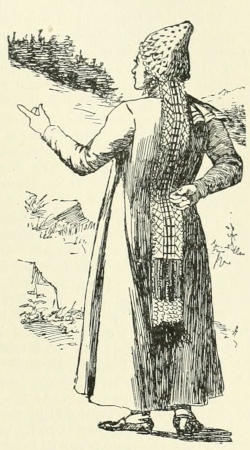
A Tatar Woman
I explained that my health forced me
to leave my affairs, and that, furthermore,
I had little faith in the efficacy of secret
societies. He seemed impressed by my
reasoning and even agreed that I might
be right on this last point.
His attention was much occupied
with certain social theories that he and
some of his friends had formulated.
They thought to find in me one proselyte
more. But they were disappointed, and
Pestel was much surprised and disconcerted.
These theories, which so many
ardent imaginations had adopted, were
no doubt excellent in intention, but they
hardly promised great results. The
genius, or something akin to it, in a
Fourier, the zeal of an Owen, the utopianism
of many others, might make
proselytes and excite admiration; but
the dreams of such men remained but
dreams although they sometimes touched
on the sublime. Only, in default of
possible realisation, these theories might
help humanity by directing the attention
and effort of serious men towards
certain things of which they had sufficiently
appreciated the importance and
utility. But to ensure that result more
imagination was required. One of the fundamental points in the theory of
Pestel and his friends was a universal distribution of territory, its cultivation
to be determined by a supreme authority. At least they wanted to
divide vast crown lands among those who had no property. What Elizabeth
had guaranteed to all Englishmen—the right of being supported by
the poor rates in default of other means of subsistence—they wanted to
guarantee by means of the possession or at least the enjoyment of a certain
quantity of land free for cultivation.
I tried to the best of my power to refute their arguments. It was not
easy. The refutation of certain theories is difficult, and there are some whose
very absurdity makes them unassailable. At last I came to think that Pestel
and his friends were far more discontented with my opposition to their social
theories than with my opinions on secret societies.d
The awakening of the Russian spirit was not manifested in political conspiracies
alone. In science, in letters, and in art the reign of Alexander was
an epoch of magnificent achievement. The intellectual like the liberal movement
no longer bore the exotic and superficial character that had been apparent
during the reign of Catherine; it penetrated to the deepest layers of
society, gained constantly in power and extent, carried away the middle
classes, and was propagated in the remotest provinces. The movement
started in 1801 had not yet ceased, although the government failed to support
the efforts it had itself aroused, and Alexander, embittered and disillusioned,
had come to mistrust all intellectual manifestations. The increased severity
of the censorship had not availed to prevent the formation of learned societies;
literary journals and reviews continued to multiply.
During this period the Besieda, a literary club representing the classical
tendencies, was formed, and the romanticists, Jukovski, Dachkov, Ouvarov,
Pushkin, Bludov, and Prince Viazemski founded the Arzamas. At St.
Petersburg appeared the Northern Post, the St. Petersburg Messenger, the
Northern Messenger, the Northern Mercury, the Messenger of Zion, the Beehive,
and the Democrat, in which latter Kropotkov inveighed against French
customs and ideas, and in the Funeral Orison of my Dog Balabas congratulated
the worthy animal on never having studied in a university, or read
Voltaire.
Literary activity was, as usual, greatest at Moscow, where Karamzine
was editing the European Messenger, Makarov the Moscow Mercury, and
Glinka the Russian Messenger. In his journal Glinka endeavoured to excite
a national feeling by first putting the people on their guard against all foreign
influence, but more particularly that of France, and then arming them against
Napoleon, teaching them the doctrine of self-immolation, and letting loose
the furies of the “patriotic war.” When the Russian Messenger went out of
existence after the completion of its task, the Son of the Soil, edited by de
Gretch, took up the same work and carried the war against Napoleon beyond
the frontiers. “Taste in advance,” it cried to the conqueror, “the immortality
that you deserve; learn now the curses that posterity will shower on
your name! You sit on your throne in the midst of thunder and flame as
Satan sits in hell surrounded by death, devastation, and fire!” The Russian
Invalide was founded in 1813 for the benefit of wounded and infirm soldiers.
Even after the war-fever had somewhat subsided, and considerations less
hostile to France were occupying the public mind, the literary movement still
continued.
Almost all the writers of the day took part in the crusade against Gallomania
and the belief in Napoleon’s omnipotence. Some had fought in the
war against France and their writings were deeply tinged with patriotic feeling.
Krilov, whose fables rank him not far below La Fontaine, wrote comedies
also. In the School for Young Ladies and the Milliner’s Shop he ridiculed
the exaggerated taste for everything French. Besides his classical tragedies
Ozerov wrote Dmitri Donskoi, in which he recalled the struggles of Russia
against the Tatars, and in a measure foretold the approaching conflict with a
new invader. In the tragedy named after Pojarski, the hero of 1812, Kriukovski
made allusions of the same order. The poet Jukovski put in verse
the exploits of the Russians against Napoleon in 1806 and 1812, and Rostoptchin
did not await the great crisis before opening out on the French the vials
of his wrath.
Viewed in general, the literature of Alexander’s period marked the passage
from the imitation of ancient writers and French classicists to the imitation
of French and English masterpieces. The Besieda and the Arzamas were
the headquarters of two rival armies which carried on in Russia a war similar
to that waged in Paris by romantic and classical schools. Schiller, Goethe,
Byron, and Shakespeare were as much the fashion in Russia as in France, and
created there as close an approach to a literary scandal. While Ozerov,
Batiuchkov, and Derjavine upheld the traditions of the old school, Jukovski
gave to Russia a translation of Schiller’s Joan of Arc and of Byron’s Prisoner
of Chillon; and Pushkin published Ruslan and Liudmilla, The Prisoner of the
Caucasus, Eugene Oniegin, the poem Poltava, and the tragedy Boris Godunov.
As in France the romantic movement had been accompanied by a brilliant
revival of historical studies, so in Russia a fresh impulse was given to letters,
and dramatists and novelists were inspired with a taste for national subjects
by Karamzin’s History of the Russian Empire, a work remarkable for eloquence
and charm [as our various extracts testify] though deficient in critical
insight. Schlötzer had recently edited Nestor, the old annalist of Kiev and
father of Russian history.f
Alexander I as a Patron of Literature
Protection and encouragement were shown to literature by Alexander I.
Storcki writes as follows: “Rarely has any ruler shown such encouragement
to literature as Alexander I. The remarkable literary merits of persons in
the government service are rewarded by rises in the official ranks, by orders
and pensions, whilst writers who are not in the government service and
whose literary productions come to the knowledge of the emperor not unfrequently
receive presents of considerable value. Under the existing conditions
of the book trade, Russian authors cannot always count on a fitting
recompense for large scientific works, and in such cases the emperor, having
regard to these circumstances, sometimes grants the authors large sums for
the publication of their works. Many writers send their manuscripts to the
emperor, and if only they have a useful tendency he orders them to be printed
at the expense of the cabinet and then usually gives the whole edition to the
author.”
In view of the desire manifested by Karamzin to devote his labours to
the composition of a full history of the Russian Empire, the emperor by a
ukase of the 31st of October, 1803, bestowed upon him the title of historiographer
and a yearly pension of 2,000 rubles.
During the reign of the emperor Paul, Alexander, in a letter to Laharpe
dated September 27th, 1797, expressed his conviction of the necessity of
translating useful books into the Russian language, in order “to lay a foundation
by spreading knowledge and enlightenment in the minds of the people.”
When he came to the throne, Alexander did not delay in accomplishing
the intention he had already formed when he was czarevitch, and actually
during the epoch of reforms a multitude of translations of works appeared,
which had the evident object of inspiring interest in social, economic, and
political questions and of communicating to Russian society the latest word
of western science upon such questions.
In the establishment of the ministries the question of censorship was not
overlooked; it was transferred to the ministry of public instruction. In
consequence of this arrangement a special statute was issued (July 9th, 1804),
“not in order to place any restraint,” as is stated in the minister’s report,
“upon the freedom of thought and of writing, but solely so as to take requisite
measures against the abuse of such freedom.” The entire statute contained
forty-seven paragraphs—a circumstance worthy of attention if we
take into consideration the fact that the censorship statute presented in the
year 1826 by A. S. Shishkov had grown to 230 paragraphs. According to
the statute of Alexander I the censorship was designed chiefly to “furnish
society with books and works contributing to the true enlightenment of
minds and to the formation of moral qualities, and to remove books and works
of contrary tendencies.” The censorship was entrusted to the university,
constituting in its general jurisdiction the then newly organised department
of the ministry of public instruction, which had the chief direction of schools.
The basis of the functions of the censorship thus constituted was found in the
three provisions following:
(1) Watchfulness that in the books and periodicals published, and in the
pieces represented on the stage “there shall be nothing against religion, the
government, morality, or the personal honour of any citizen.” (2) Care that
in the prohibition of the publication or issue of books and works the committee
shall be “guided by a wise indulgence, setting aside all biased interpretation
of the works or of any part of them which might seem to merit prohibition;
and wisdom to remember that when such parts seem subject to any
doubt or have a double meaning, it is better to interpret them in the manner
most favourable to the author than to prosecute him.” (3) “A discreet and
wise investigation of truths concerning faith, mankind, the position of the
citizen, the law, and all branches of the administration, are to be treated by
the censorship not only in the most lenient manner, but should enjoy entire
liberty of publication, as contributing to the progress of enlightenment.”
Such was the aspect of the censorship and statute which remained
unchanged for more than twenty years, that is during the whole reign of the
emperor Alexander. It was only from the year 1817, from the establishment
of the ministry of public worship and of public instruction, that the censorship
acquired a particularly irksome tendency which was in opposition to the
liberal spirit of the statute: the most complete intolerance, fanaticism, and
captiousness, which had been absent at the commencement of Alexander’s
reign, then made their appearance.
In January, 1818 the emperor Alexander came for a short time to St.
Petersburg, and Karamzin took advantage of his stay in order to present to
him the eight volumes of the History of the Russian Empire which he had
just published. “He received me in his private apartments, and I had the
happiness of dining with him,” wrote Karamzin to his friend I. I. Dmitriev.
“On the 1st of February my History of the Russian Empire was on sale; the
edition was of three thousand copies, and in spite of the high price at which
the work was sold (55 rubles, paper money, per copy), a month later not a
copy was left at the booksellers.”b
The constitution granted to Poland in 1815, based the government on
a tripartite division of power; the three estates of the realm being the king,
a senate, and a house of representatives—the latter two being comprehended
under the name of a diet. The executive was vested in the king, and in
functionaries by him appointed. The crown was hereditary; it was the prerogative
of the king to declare war, convoke, prorogue, or dissolve the diet.
He was empowered to appoint a viceroy, who, unless a member of the royal
family, was to be a Pole. The king or viceroy was assisted by a council of
state and five responsible ministers, their several departments being instruction,
justice, interior and police, war, finance. These five ministers were
subordinate to the president of the council. Considering the exhaustion,
humiliation, and misery to which Poland had been reduced, such a constitution
was apparently a great boon, for it guaranteed civil, political, and religious
freedom; but by the very nature of things it was foredoomed to
destruction.
The first Polish diet assembled at Warsaw on the 27th of March, 1818.
The grand duke Constantine, commander-in-chief of the Polish army, was
elected a deputy by the faubourg of Praga, and during the session was
obliged to renounce his privilege as a senator, because, by the terms of the
constitution, no person could sit in both houses. He was elected by a majority
of 103 votes to 6, an evident proof that the new reign had excited the
liveliest hopes. The emperor arrived at Warsaw on the 13th of March; he
devoted himself laboriously to the examination of state affairs, and on the
27th he opened the diet in person with a speech in the French language. He
said, “the organisation which existed in vigorous maturity in your country
permitted the instant establishment of what I have given you, by putting into
operation the principles of those liberal institutions which have never ceased
to be the object of my solicitude, and whose salutary influence I hope by the
aid of God to disseminate through all the countries which He has confided to
my care. Thus you have afforded me the means of showing my country what
I had long since prepared for her, and what she shall obtain when the elements
of a work so important shall have attained their necessary development.”
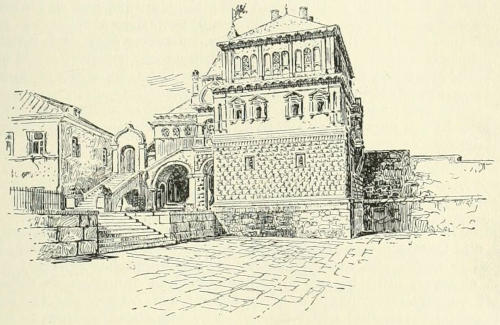
House of the Romanov Czars
There is no reason to doubt that Alexander cherished these intentions in
his own sanguine but impractical way. The enfranchisement of the serfs of
Esthonia, undertaken in 1802 and completed in 1816, and that of the serfs
of Courland in 1817, exhibit the same principles. And when in 1819 the
deputies of the Livonian nobility submitted to the approbation of the emperor
a plan to pursue the same course with the serfs of their province, the following
was his remarkable reply: “I am delighted to see that the nobility of Livonia
have fulfilled my expectations. You have set an example that ought to be
imitated. You have acted in the spirit of our age, and have felt that liberal
principles alone can form the basis of the people’s happiness.”
“Such,” says Schnitzler, “was constantly, during nearly twenty years,
the language of Alexander. He deeply mourned the entire absence of all
guarantees for the social well-being of the empire. His regret was marked
in his reply to Madame de Staël, when she complimented him on the happiness
of his people, who, without a constitution, were blessed with such a sovereign:
‘I am but a lucky accident.’” After 1815 he was no longer even that.
A year had hardly elapsed from the time when Alexander had addressed
the words we have quoted to the diet at Warsaw, ere the Poles began to complain
that the constitution was not observed in its essential provisions; that
their viceroy Zaionczek had but the semblance of authority, whilst all the real
power was in the hands of the grand duke Constantine, and of Novosiltzov
the Russian commissioner. The bitterness of their discontent was in proportion
with the ardour of their short-lived joy. Russian despotism reverted to
its essential conditions; the liberty of the press was suspended; and in 1819
the national army was dissolved. On the other hand, the spirit of opposition
became so strong in the diet, that in 1820, a measure relating to criminal procedure,
which was pressed forward with all the force of government influence,
was rejected by a majority of 120 to 3. Thenceforth there was nothing but
mutual distrust between Poland and Russia.
The institutions which Alexander had given to Poland worked no happy
results, and those which he designed for Russia would have been little better.
He failed to accomplish even the good which he might have effected without
organic changes. But he felt himself arrested by innumerable difficulties.
He often wanted instruments to carry out his will, oftener still the firmness
to support them against court cabals. The immense distances to be traversed,
which, according to Custine, the emperor Nicholas feels to be one of
the plagues of his empire, presented the same obstacle to Alexander. Again,
his desire to exercise European influence distracted his attention from his
proper work at home, and the empire sank back into its old routine. Discouraged
at last, and awakening as he grew older from some of the illusions
of his youth, he gave way to indolence more and more. He saw himself
alone, standing opposed to an immense festering corruption; in despair he
ceased to struggle against it; and in the latter portion of his reign he grievously
neglected the care of his government.
The helm thus deserted by the pilot passed into the hands of General
Araktcheiev, a shrewd, active man, devoted to business, perhaps also well-intentioned,
but a Russian of the old school, without the necessary enlightenment,
without political probity—arbitrary, imperious, and enthralled by
qualities and notions inimical to progress; governed, moreover, by unworthy
connections of a particular kind. Under the rule of Araktcheiev the censorship
became more severe than ever. Foreign books were admitted with difficulty,
and were subject to tyrannical restrictions; many professors of the
new university of St. Petersburg were subjected to a despotic and galling
inquisition; others were required most rigidly to base their course of instructions
upon a programme printed and issued by the supreme authority. Freemasonry
was suppressed. Foreign travellers were surrounded with troublesome
and vexatious formalities. Many rigorous regulations, which had
been long disused and almost forgotten, were revived. In short, Araktcheiev
exercised with intolerable severity a power which he derived from a master
who carried gentleness to an extreme of weakness—who loved to discuss the
rights of humanity, and whose heart bled for its sufferings.
[1819 A.D.]
It was by the advice of Araktcheiev that military colonies were established
in Russia in 1819. The system was not new, for Austria had already adopted
it on some of her frontiers; but its introduction into Russia was a novelty
from which great results were expected, and which neighbouring states
regarded with much uneasiness. The plan was to quarter the soldiers upon
the crown-peasants, build military villages according to a fixed plan, apportion
a certain quantity of field to every house, and form a statute-book,
according to which these new colonies should be governed. The plan at once
received the approbation of the czar. It was the intention of Araktcheiev,
by means of these colonies, to reduce the expense entailed by the subsistence
of the army, and to compel the soldier to contribute to his own maintenance
by cultivating the soil; to strengthen the ranks by a reserve picked from
among the crown-peasants, equal in number to the colony of soldiers; to furnish
the soldier with a home, in which his wife and children might continue
to dwell when the exigencies of war called him away; and to increase the
population, and with it the cultivation of the soil, in a land where hands only
are wanting to change many a steppe into a garden, many a scattered village
into a thriving town.
Russian colonies were thus established in the governments of Novgorod,
Mohilev, Kharkov, Kiev, Podolia, and Kherson; that is to say, in the neighbourhood
of Poland, Austria, and Turkey. Political and military considerations
had combined to fix the choice of localities for these colonies. In
consequence of the vast dimensions of the Russian Empire, troops raised in
the north and west can only reach the southern provinces after long intervals;
and if, on any emergency, Russia should wish to concentrate a large part of
her forces in the neighbourhood of the southern and western frontiers, such
a concentration, it was thought, would be greatly facilitated by the fact of
military colonies, with a large population, being already on the spot. The villages
destined for the reception of military colonies were all to be inhabited
by crown-peasants; these people were now relieved from the duties they
had been accustomed to pay to the government, in consideration of their
quartering men in their houses. All peasants more than fifty years of age
were selected to be so-called head colonists, or master-colonists. Every
master-colonist received forty acres of land, for which he had to maintain
a soldier and his family, and to find fodder for a horse, if a corps of cavalry
happened to be quartered in the village. The soldier, on his part, was
bound to assist the colonist in the cultivation of his field and the farm labours
generally, whenever his military duties did not occupy the whole day. The
soldier, who in this way became domiciliated in the family, received the name
“military peasant.” The officers had the power of choosing the soldiers who
were to be quartered upon the master-colonists. If the colonist had several
sons, the oldest became his adjunct; the second was enrolled among the
reserve; the third might become a military peasant; the others were enrolled
as colonists or pupils. Thus, in the new arrangements, two entirely different
elements were fused together, and one population was, so to speak, engrafted
upon another.
The labour of these agricultural soldiers is of course dependent upon the
will of the officers, for they can only attend to agricultural work when freed
from military duty. The man himself continues half peasant, half soldier,
until he has served for five-and-twenty years, if he be a Russian, or twenty
years if he be a Pole. At the expiration of this time he is at liberty to quit
the service, and his place is filled up from the reserve. Beside the house of
each master-colonist stands another dwelling constructed in exactly the same
manner, and occupied by the reserve-man, who may be regarded as a double
of the soldier. He is selected by the colonel of the regiment from among the
peasants, and is generally a son or relation of the master-colonist. The
reserve-man is instructed in all the duties appertaining to the soldier’s profession,
and is educated in every particular, so that he may be an efficient
substitute. If the agricultural soldier dies, or falls in battle, his reserve-man
immediately takes his place. The colonist now takes the place of the reserve-man,
who in his turn is succeeded by the pupil. The master-colonist, peasant-soldier,
and reserve-man, may all choose their wives at pleasure, and they are
encouraged to marry. The women, on the other hand, are allowed to marry
within the limits of their colony, but not beyond it. The sons of the master-colonists,
soldiers, or reserve-men, between the ages of thirteen and seventeen,
are called “cantonists.” They are drilled like soldiers, and occasionally
attend schools. The children between the ages of eight and thirteen visit
the school of the village in which their parents dwell, and are exercised in the
use of arms on alternate days. Like the cantonists, they wear uniforms, and
are looked upon as future soldiers. All male children are sent to school,
where, by the method of reciprocal education, they are taught to read, write,
and cipher, alternately with their military studies. They are taught to recite
a kind of catechism, setting forth the duties of the soldier; they learn the
use of the sabre; are practised in riding, and, when they have attained the
age of seventeen years, are mustered in the headquarters of the regiment,
and divided into corps, those who distinguish themselves by attention and
diligence being appointed officers. The several component parts of a colony
are as follows:
1. The head colonist—the master of the house and possessor of the
estate. 2. His assistant, who joins him in the cultivation of his farm. 3.
The military peasant, who likewise takes part in agricultural labour. 4. The
reserve-man, who supplies the place of the soldier in case of need. 5. The
cantonist, between the ages of thirteen and seventeen. 6. The boys, from
eight to thirteen years old. 7. Male children under the age of eight years.
8. The female population. 9. The invalids.
The colonies in the south of Russia comprise 380 villages in the provinces
of Kherson, Kharkov, and Iekaterainoslav. The crown has here 30,000 peasants.
Every village contains two or three squadrons, according to its size;
thus they contain altogether 80,000 men. These military districts, as the
regions are called in which the colonies occur, are so strictly divided from the
remaining portions of the provinces, that no man can enter them without a
special passport, granted by the military authorities. Their constitution is
entirely military, even the postal service being executed by soldiers. At every
station a subaltern receives the order for post-horses and inspects it; another
soldier harnesses the horses; a third greases the wheels; and a fourth mounts
the box as coachman. As soon as the military coat appears in sight, every
peasant on the high-road stops, plants his hands stiffly against his sides, and
stands in a military attitude of “attention.”
The laws are administered in the first instance by a detachment from every
squadron, one of the officers acting as president. From the decision of this
tribunal an appeal can be made to the regimental council, which is composed
of the colonel, two captains, and six deputies from among the colonists. The
judgments of this court are laid before the commandant-in-chief of the colonies,
against whose decision neither soldiers nor colonists may protest, officers
alone having the privilege of appealing to the emperor. In the headquarters
of every regiment a copy of the code of laws is kept, and in most
military villages churches are to be found, where a priest, who belonged to
the church before the village was transformed into a military colony, performs
the service.
The success of the military colonies in Russia fell far short of the
expectations of their founders. To the unfortunate crown serfs they
brought an intolerable aggravation of their wretchedness, by making them
feel their slavery even in their homes and their domestic affections. The
consequence was seen in the madness of their revenge on several occasions
when they broke out into rebellion, as for instance at Novgorod,
in 1832. “Nothing,” says Dr. Lee, “could be sold without the knowledge of
the officers in these military colonies. It is said that when a hen lays an egg,
it is necessary to make an entry of the fact in a register kept for this and
other equally important purposes. I was told that when a priest was speaking
to some of these peasants about the punishments of hell, they answered
they dreaded them not, because a worse hell than that in which they were
doomed to pass their whole lives here, could not possibly exist.
“The military colonies,” Lee continues, “please one at first sight from
the order and cleanliness everywhere prevailing in them; but their population
is said to be wretched in the highest degree. When the emperor Alexander
was here, some years ago, he went round visiting every house; and on
every table he found a dinner prepared, one of the principal articles of which
consisted of a young pig roasted. The prince Volkhonski suspected there
was some trick, and cut off the tail of the pig and put in his pocket. On
entering the next house the pig was presented, but without the tail, upon
which Prince Volkhonski said to the emperor, ‘I think this is an old friend.’
The emperor demanded his meaning, when he took out the tail from his pocket
and applied it to the part from which it had been removed. The emperor
did not relish the jest, and it was supposed this piece of pleasantry led to his
disgrace. A more effectual, though bold and dangerous method of exposing
to the emperor the deceptions carried on throughout the military colonies
under Count Araktcheiev could not have been adopted than that which Prince
Volkhonski had recourse to on this occasion. From that time Count Araktcheiev
became his bitter enemy.”
[1822 A.D.]
We have now touched upon all that is worthy of note in Alexander’s
home policy during the last ten years of his reign. That portion of his life
was spent in perpetual motion and perpetual agitation to little or no good
purpose, whilst his proper functions were delegated to Count Araktcheiev,
whose name was a word of terror to everyone in Russia. Absorbed by
affairs foreign to the interests of his empire, Alexander was consistent or
persevering in nothing but his efforts to enforce the dark, stagnant policy
of Austria, which had become that of the Holy Alliance. He was present at
the congresses of Aix-la-Chapelle, Troppau, Laibach, and Verona, and zealously
participated in all the repressive measures concerted there. He was
the soul of the deliberations held at the latter place in 1822, and whilst he
refused aid to the Greeks in their rebellion against their “legitimate sovereign,”
the sultan, he was all but inclined to use constraint to his ally,
France, to compel her, in spite of the opposition of England, to take upon
herself the execution of the violent measures resolved on in behalf of the execrable
Ferdinand of Spain. A speech made at this congress to Châteaubriand,
the French plenipotentiary, has been praised by some of the emperor’s biographers
for its “noble sentiments.” To us it seems well worthy of record
for its unconscious sophistry and signal display of self-delusion.
“I am very happy,” said the emperor to Châteaubriand, “that you came
to Verona, because you may now bear witness to the truth. Would you have
believed, as our enemies are so fond of asserting, that the alliance is only a
word intended to cover ambition? That might have received a colour of
truth under the old order of things, but now all private interests disappear
when the civilisation of the world is imperilled. Henceforward there can be
no English, French, Russian, Prussian, or Austrian policy; there can only
be a general policy, involving the salvation of all, admitted in common by
kings and peoples. It is for me, the first of all, to declare my appreciation of
the principles on which I founded the Holy Alliance. An opportunity presents
itself; it is the Greek insurrection. Certainly no event appeared more
adapted to my personal interests, to those of my subjects, and to the feelings
and prejudices of the Russians, than a religious war against Turkey; but in
the troubles of the Peloponnesus I saw revolutionary symptoms, and from
that moment I held aloof. What has not been done to dissolve the alliance?
Attempts have been made by turns to excite my cupidity, or to wound my
self-love; I have been openly outraged; the world understood me very badly
if it supposes that my principles could be shaken by vanities, or could give
way before resentment. No, no; I will never separate myself from the monarchs
with whom I am united. It should be permitted to kings to form public
alliances, to protect themselves against secret associations. What temptations
can be offered to me? What need have I to extend my empire? Providence
has not placed under my command eight hundred thousand soldiers
to satisfy my ambition, and to conserve those principles of order on which
society must repose.”
This was not the language of “noble sentiment,” but of an intellect narrowed
by sinister influences, perverted to the views of a most sordid policy,
and flattering itself on its own debasement with the maudlin cant of philanthropy.
We may well conceive that it was not without inward pain and self-reproach
that the benevolent Alexander stifled in his heart the voice that rose
in favour of the Greeks, and resisted the wishes of his people, who were animated
by a lively sympathy for their co-religionists. That sympathy was
manifested as strongly as it could be under this despotic government, where
every outward demonstration is interdicted, unless when specially commanded
or permitted by authority. They could not see without surprise the head
of the so-styled orthodox church enduring the outrages of the infidels, and
looking on unmoved whilst one of her chief pastors was hung at the porch of
his church, and multitudes of her children were massacred. These Greeks
had of late been regarded as under the protection of Russia; she was their
old ally—nay, more, their accomplice, who had more than once instigated
them to break their chains. The supineness of the emperor under such circumstances
mortified the nobility, shocked the clergy, and was a subject of
sincere affliction to the people, for whom, in their debased condition, religious
sentiments held the place of political emotions.
High and low obeyed, however; murmurs were suppressed; but the Russians
failed not to attribute to the wrath of God the misfortunes which befel
Alexander, amongst which was the malady with which he was afflicted in
1824. It began with erysipelas in the leg, which soon spread upwards, and
was accompanied with fever and delirium. For a time his life was in danger,
and the people, who sincerely loved him, believed that they saw in this a
punishment from on high because he had abandoned an orthodox nation.
[1824 A.D.]
Another misfortune was a frightful calamity which befel St. Petersburg
in 1824. The mouth of the Neva, opening westward into the gulf of Finland,
is exposed to the violent storms that often accompany the autumnal equinox.
They suddenly drive the waters of the gulf into the bed of the river, which
then casts forth its accumulated floods upon the low quarters on both its
banks. It may be conceived how terrible is the destruction which the
unchained waters make in a city built upon a drained marsh, on the eve of
a northern winter of seven months’ duration. There were terrific inundations
in 1728, 1729, 1735, 1740, 1742, and in 1777, a few days before the birth
of Alexander; but the worst of all was that which occurred on the 19th of
November, 1824, a year before his death. A storm blowing from the west
and southwest with extreme violence, forced back the waters of the Neva,
and drove those of the gulf into it.e
At eight o’clock in the morning the waters began to rise rapidly and had
soon submerged all the lower parts of the town. On the Nevski Prospect
the water had reached the Troitski Perenlok, and by twelve three parts of
the town were submerged, owing to a southwesterly wind which rose to a
violent tempest. At a quarter to three the waters began suddenly to subside.
The emperor was profoundly moved by the awful calamity which took place
before his eyes, and in the gloomy frame of mind that had possession of him
he regarded it as a punishment for his sins. As soon as the water had so far
subsided as to make it possible to drive through the streets he set off for the
Galernaia (in the lower part of the town). There a terrible picture of
destruction was unfolded before him. Visibly affected he stopped and got
out of the carriage; he stood for a few moments without speaking, the tears
flowing down his cheeks: the people, sobbing and weeping, surrounded him:
“God is punishing us for our sins,” said someone in the crowd. “No, for
mine,” answered the emperor sorrowfully, and he himself began to give orders
about arranging temporary refuge and affording assistance to the sufferers.
On the next day, the 8th (20th) of November, Count Araktcheiev, Alexander’s
favourite, wrote the following letter to the emperor:
“I could not sleep all night, knowing what your state of mind must be,
for I am convinced how much your majesty must be now suffering from the
calamity of yesterday. But God certainly sometimes sends such misfortunes
in order that His chosen ones may show in an unusual degree their compassionate
care for the unfortunate. Your majesty will of course do so in the
present case. For this money is necessary and money without delay, in
order to give assistance, not to the well-to-do but to the poorest. Your subjects
must help you, and therefore I venture to submit my idea to you.
“The wise dispositions that you made, batushka,[65] with regard to my
insignificant labours have constituted a tolerably considerable capital. In
my position I have not required to use any of this capital even as table
money, and now I ask as a reward that a million may be separated from the
capital and employed in assisting the poor people. God will certainly give
his help in this matter to the benefit of the country and the glory of your
majesty, and bring about a still better means for its accomplishment.
Batushka, order that a committee may be formed of compassionate people,
in order that they may without delay occupy themselves with the relief of
the poorest. They will glorify your name, and I, hearing it, shall thus enjoy
the greatest pleasure on earth.”
The emperor answered Count Araktcheiev the same day in a few gracious
lines, full of heartfelt gratitude: “We are in complete agreement in our ideas,
dear Alexis Andreivitch. Your
letter has comforted me inexpressibly,
for it is impossible
that I should not be deeply
grieved at the calamity of yesterday,
and especially at the
thought of those who have perished
or who mourn for relatives.
Come to me to-morrow
so that we may arrange everything.
Ever your sincerely affectionate
Alexander.”
The emperor sent a note of
the following content to Adjutant-General
Diebitsch: “In
order to afford effectual relief
to the sufferers from the inundation
of the 7th of November,
and on account of the destruction
of the bridges and the difficulties
of communication between
the various parts of the
town, the following military governors are temporarily appointed under the direction
of the military governor-general, Count Miloradovitch: for Vasili Oetroo,
Adjutant-General Benkendorv; for the St. Petersburg side, Adjutant-General
Komarovski; and for the Viboz side, Adjutant-General Depreradovitch.”
Tverski Gate, Moscow
On the 8th of November the emperor sent for the newly appointed military
governors and declared his will to them—that the most speedy and
effectual assistance should be given to the unfortunate sufferers from the awful
catastrophe. Count Komarovski, in describing the reception given to him
and the other military governors, says that tears were observed in the emperor’s
eyes. “I am sure that you share my feelings of compassion,” continued
Alexander; “here are your instructions, which have been hastily drawn up—your
hearts will complete them. Go from here straight to the minister of
finance who has orders to give each of you 100,000 rubles to begin with.”
According to Komarovski the emperor spoke with such feeling and eloquence
that all the assembled governors were deeply touched.
At the time of the inundation in a space of five hours about 5,000 persons
perished and 3,609 domestic animals; 324 houses were destroyed or carried
away, and 3,581 damaged; besides this pavements, foot ways, quays, bridges,
etc., were either destroyed or damaged. Considerable destruction and damage
was also occasioned in the environs of the capital, on the Petershov road,
in old Petershov, Oranienbaum, and Kronstadt, along the northern shore.
More than 100 persons perished in these places, while 114 buildings were
destroyed and 187 damaged.
On the 22nd of November the emperor assisted at a requiem service in
the Kazan cathedral for those who had perished during the inundation. The
historian Karamzin writes that the people as they listened to the requiem
wept and gazed at the czar.b
The czar, deeply affected by the sad spectacles he had witnessed, never
recovered from the shock. This increased his disgust of life and the heavy
melancholy that had of late being growing upon him. The whole aspect of
Europe gave fearful tokens that the policy of the Holy Alliance was false and
untenable; it was everywhere the subject of execration, and its destruction
was the aim of an almost universal conspiracy, extending even into Alexander’s
own dominions. Poland inspired him with deep alarm, and his native
country, notwithstanding her habits of immobility, seemed ripe for convulsions.
Thus his public life was filled with disappointment and care, and his
private life was deeply clouded with horrors.
The diet of Warsaw had become so refractory, that in 1820 Alexander had
found it necessary to suspend it, in violation of the constitution given by himself;
and though he opened a new diet in 1824, he did so under such restrictions,
that the Poles rightly considered it a mere mockery of representative
forms.
Russia herself was by no means tranquil. In the year 1824 insurrections
of the peasants occurred in several governments, and especially in that of
Novgorod, in dangerous vicinity to the first-founded of the military colonies.
The latter themselves shared the general discontent, and threatened to become
a fearful focus of rebellion, as was actually the case in 1832. There existed
also in Russia other centres of disaffection, the existence of which might have
been long before known to Alexander, but for his culpable habit of allowing
petitions to collect in heaps in his cabinet without even breaking their seals.
He, however, learned the fact on his last journey into Poland in June, 1825,
or immediately after his return.[66] He then received the first intimation of
the conspiracy which had for many years been plotting against himself and
against the existing order of things in Russia—a conspiracy which, as many
believe, involved the perpetration of regicide. It is a curious fact, but one
by no means unparalleled, that in a country where the police is so active, such
a plot should have remained for years undetected. In 1816, several young
Russians who had served in the European campaigns of the three preceding
years, and who had directed their attention to the secret associations which
had so greatly contributed to the liberation of Germany, conceived the idea
of establishing similar associations in Russia; and this was the origin of that
abortive insurrection which broke out in St. Petersburg on the day when the
troops were required to take the oath of allegiance to Alexander’s successor.
These details would be sufficient of themselves to account for the melancholy
that haunted Alexander in the later years of his reign, and which was
painfully manifest in his countenance. But he had to undergo other sufferings.
[1825 A.D.]
He was not more than sixteen years of age when his grandmother, Catherine
II, had married him to the amiable and beautiful princess Maria of Baden,
then scarcely fifteen.[67] The match was better assorted than is usually the
case in the highest conditions of life, but it was not a happy one. It might
have been so if it had been delayed until the young couple were of more
mature years, and had not the empress unwisely restricted their freedom
after marriage, and spoiled her grandson as a husband by attempting to make
him a good one in obedience to her orders. Moreover, the tie of offspring
was wanting which might have drawn the parents’ hearts together, for two
daughters, born in the first two years of their union, died early. Alexander
formed other attachments, one of which with the countess Narishkin, lasted
eleven years, until it was dissolved by her inconstancy. She had borne him
three children; only one was left, a girl as beautiful as her mother, who was
now the sole joy of her father’s sad heart. But the health of Sophia Narishkin
was delicate, and he was compelled to part with her, that she might be removed
to a milder climate. She returned too soon, and died on the eve of her marriage,
in her eighteenth year. The news was communicated to Alexander
one morning when he was reviewing his guard. “I receive the reward of my
deeds,” were the first words that escaped from his agonised heart.
Elizabeth, whose love had survived long years of neglect, had tears to shed
for the daughter of her rival, and none sympathised more deeply than she
with the suffering father. He began to see in her what his people had long
seen, an angel of goodness and resignation; his affection for her revived, and
he strove to wean her from the bitter recollections of the past by his constant
and devoted attention. But long-continued sorrows had undermined Elizabeth’s
health, and her physicians ordered that she should be removed to her
native air. She refused, however, to comply with this advice, declaring that
the wife of the emperor of Russia should die nowhere else than in his dominions.
It was then proposed to try the southern provinces of the empire, and
Alexander selected for her residence the little town of Taganrog, on the sea of
Azov, resolving himself to make all the arrangements for her reception in that
remote and little frequented spot. A journey of 1800 versts, after the many
other journeys he had already made since the opening of the year, was a
fatigue too great for him to sustain without injury, suffering as he still was
from erysipelas; but he was accustomed to listen to no advice on the subject
of his movements, and two or three thousand versts were nothing in his estimation;
besides, on this occasion, in the very fatigue of travelling he sought
his repose: he would fulfil a duty which was to appease his conscience. He
quitted St. Petersburg in the beginning of September, 1825, preceding the
empress by several days. His principal travelling companions were Prince
Volkhonski, one of the friends of his youth of whom we have already heard;
his aide-de-camp general, Baron Diebitsch, a distinguished military man who
had been made over to him by the king of Prussia; and his physician, Sir
James Wylie, who had been about his person for thirty years, and was at the
head of the army medical department.
The journey was prosperous, and was accomplished with Alexander’s
usual rapidity in twelve days, the travellers passing over 150 versts a day;
but his mind was oppressed with gloomy forebodings, and these were strengthened
by the sight of a comet; for though brought up by a philosophic grandmother,
and by a free-thinking tutor, he was by no means exempt from superstition.
“Ilia,” he called out to his old and faithful coachman, “have you
seen the new star? Do you know that a comet always presages misfortune?
But God’s will be done!” A very favourable change having taken place in
the empress’s health in Taganrog, Alexander ventured to leave her early in
October, for a short excursion through the Crimea. On the 26th of that
month Dr. Robert Lee, family physician to Count Vorontzov was one of the
emperor’s guests at Alupka. He relates that at dinner Alexander repeatedly
expressed how much he was pleased with Orianda, where he had been that
day, and stated that it was his determination to have a palace built there as
expeditiously as possible. “To my amazement,” says Dr. Lee, “he said after
a pause, ‘When I give in my demission, I shall return and fix myself at Orianda,
and wear the costume of the Taurida.’ Not a word was uttered when this
extraordinary resolution was announced, and I thought that I must have
misunderstood the emperor; but this could not have been, for in a short time,
when Count Vorontzov proposed that the large open flat space of ground to
the westward of Orianda should be converted into pleasure-grounds for his
majesty, he replied: ‘I wish this to be purchased for General Diebitsch, as it is
right that the chief of my état-major and I should be neighbours.’”
During the latter part of his tour in the Crimea, Alexander had some
threatenings of illness, but peremptorily refused all medical treatment. He
returned to Taganrog on the 17th of November, with evident symptoms of a
severe attack of the bilious remittent fever of the Crimea. He persisted in
rejecting medical aid until it was too late, and died on the 1st of December.
For a long time the belief prevailed throughout Europe that he had been
assassinated; but it is now established beyond question that his death was a
natural one. The empress survived him but five months.
Alexander’s last days were embittered by fresh disclosures brought to him
by General Count de Witt, respecting the conspiracy by which, if the official
report is to be believed, he was doomed to assassination. From that time he
declared himself disgusted with life. Once when Sir James Wylie was pressing
him to take some medicine, “My friend,” said Alexander, “it is the state
of my nerves to which you must attend; they are in frightful disorder.”—“Alas!”
rejoined the physician, “that happens more frequently to kings than
to ordinary men.”—“Yes,” said the emperor, with animation, “but with me
in particular there are many special reasons, and at the present hour more so
than ever.” Some days afterwards, when his brain was almost delirious, the
czar gazed intently on the doctor, his whole countenance manifesting intense
fear. “Oh, my friend,” he exclaimed, “what an act, what a horrible act!
The monsters! the ungrateful monsters! I designed nothing but their happiness.”e
“It is difficult to represent the condition of St. Petersburg during the last
years of the reign of the emperor Alexander,” writes a contemporary. “It was
as though enveloped in a moral fog; Alexander’s gloomy views, more sad than
stern, were reflected in its inhabitants. Many people said: What does he
want more? He stands at the zenith of power. Each one explained after
his own fashion the inconsolable grief of the emperor. For a man who must
live to all eternity, who was famed as the friend of liberty, and who had out of
necessity become her oppressor, it was grievous to think that he must renounce
the love of his contemporaries and the praise of posterity. Many other circumstances
and some family ones also weighed on his soul. The last years
of Alexander’s life,” writes in conclusion the eye-witness of these sorrowful
days, “may be termed a prolonged eclipse.”
The Death of Alexander I
On the 1st of December, 1825, a truly great misfortune fell upon Russia:
the best of European sovereigns had ceased to exist. When he vanished from
the political arena, only the finer side of his life came into view; the remainder
was given over to oblivion. A contemporary who was at the same time a
poet writes: “You see arising before you that beautiful spirit that was welcomed
with such joy in 1801; you see that glorious czar to whom Russia
owes the years 1813 and 1814; you see the comforter of the people after last
year’s inundation; you see that gracious, benevolent man who was so amiable
in personal intercourse,” and who, in the words of Speranski, will ever remain
a true charmer. There was much that was ideally beautiful in his soul, he
sincerely loved and desired good, and attained to it. There was indeed cause
for grief, particularly in view of the uncertainty of the future that awaited
Russia, which, according to the picturesque expression of a Russian writer
after the death of Alexander, had, as it were, to enter a cold, uninviting passage
to a long dark tunnel. This was a feeling that was shared by many
contemporaries.
Independently of the grief which fell upon all Russia, for the persons who
had surrounded the deceased monarch at his death a truly tragic moment
had approached. Far from the capital and from all the members of the imperial
family, in an isolated town (Taganrog) of the Russian empire, at two
thousand versts from the centre of government the terrible question arose:
Who would now be emperor, to whom was the oath of allegiance to be taken,
and by whom in future would orders issue? Moreover, it was amidst the ramifications
of a vast conspiracy and a universal fermentation that these questions
presented themselves.
“The sphinx, undivined even to the grave,” as the poet justly called
Alexander, had not revealed his royal will, and even in view of the inevitable
end he had not considered it necessary to refer by a single word or hint to the
question that was of such crucial interest to the welfare of Russia. On the
contrary, during the last days of his life Alexander had as though consciously
set aside all earthly matters and died like a private individual who has closed
his accounts with the world. Therefore it is not surprising that he failed to
indicate the successor he had chosen; being satisfied with the dispositions he
had previously made in secret, he seemed to think: “After my death they
will open my will and testament and will learn to whom Russia belongs.”
During the life of Alexander no one knew of the existence of the act naming
the grand duke Nicholas Pavlovitch heir to the throne except three state
dignitaries: Count Araktcheiev, Prince A. N. Galitzin, and the archbishop
of Moscow, Philaret. By a fatal concurrence of circumstances, not one of
them was present at the decease of the emperor at Taganrog. Of the three
persons of confidence who were with Alexander, Adjutant-general Prince
Volkonski, Baron Diebitsch, and Tchernichev, not one was aware that the
elder brother’s right to the succession of the throne had been transferred to
the second. Adjutant-general Diebitsch afterwards said to Danilevski: “The
emperor, who had confided many secrets to me, never, however, told me a
word of this. Once we were together at the settlement, and he, directing
the conversation to the grand duke Nicholas Pavlovitch, said, “You must
support him.” I concluded from these words only that, judging from the age
of the grand duke, he might be expected to outlive the emperor and the
czarevitch, in which case he would naturally be their successor.”
Such were the limits of the knowledge that Diebitsch had at his disposal
in Taganrog as the question of the succession. Nor did Prince Volkonski
know anything about the matter. Even the empress Elizabeth Alexievna
was in the same ignorance regarding the rejection of the grand duke Constantine
Pavlovitch.
“When the illness of Alexander at Taganrog no longer gave any hopes of
recovery,” relates Diebitsch, “Prince Volkonski advised me to ask the
empress to whom, in case of the emperor’s death, I as chief of his majesty’s
general staff must address myself, for my position was one of very great difficulty;
I was left chief of the army at a time when instances of a conspiracy
were being disclosed. I could not decide upon personally proposing such a
question to the empress, fearing to distress her, besides which, although I
enjoyed her favour, yet it was not to such a degree as Prince Volkonski,
who was the friend of the imperial family; therefore I urgently requested him
to take upon himself this explanation with the empress. He only consented
under the condition that I should be present. We went together into the
room where the emperor was lying unconscious, and Prince Volkonski,
going up to Elizabeth Alexievna said to her that I, as chief of the staff, requested
her to say to whom, in case of misfortune, I was to address myself?
‘Is the emperor then so ill that there is no hope?’ asked the empress. ‘God
alone can help and save the emperor: only the tranquillity and security of
Russia demand that the traditional forms should be observed,’ answered the
prince Volkonski.
“‘Of course in case of an unhappy event the grand duke Constantine Pavlovitch
must be referred to,’ said the empress. The words plainly proved
the empress’ ignorance as to who was named heir to the throne. Prince
Volkonski and I supposed that the late emperor Alexander had made a will,
for he had an envelope with a paper in it always with him, which never left
him. When we opened it after his death we found that it contained some
written-out prayers.”
Such being the position of affairs it only remained for Adjutant-general
Diebitsch to inform the czarevitch Constantine Pavlovitch in Warsaw of the
melancholy event, as the person who, according to the law of succession, had
become emperor of all the Russias. It was then that Diebitsch wrote a letter
to the empress Marie Feodorovna in which he said in conclusion: “I humbly
await the commands of our new lawful sovereign, the emperor Constantine
Pavlovitch.” The act of the decease of the emperor Alexander was drawn up
in Taganrog, annexed to the report of Baron Diebitsch, dated December 1st,
1825, and sent to the emperor Constantine.b
Majestic in figure, a benevolent expression of countenance, gave Alexander
I that sway over the multitude which ever belongs to physical advantages
in youthful princes; while the qualities of his understanding and the feelings
of his heart secured the admiration of all whose talents fitted them to judge
of the affairs of nations. Misunderstood by those who formed their opinion
only from the ease and occasional levity of his manner, he was early formed
to great determinations, and evinced in the most trying circumstances, during
the French invasion and the congress of Vienna, a solidity of judgment
equalled only by the strength of his resolution. He had formed, early in life,
an intimacy with the Polish prince, Czartorinski, and another attachment,
of a more tender nature, to a lady of the same nation; and in consequence he
considered the Poles so dear to him, that many of the best informed patriots
in that country hailed his accession to the throne as the first step towards the
restoration of its nationality. A disposition naturally generous and philanthropic,
moulded by precepts of Laharpe, had strongly imbued his mind with
liberal principles, which shone forth in full and perhaps dangerous lustre
when he was called on to act as the pacificator of the world after the fall of
Paris. But subsequent experience convinced him of the extreme danger of
prematurely transplanting the institutions of one country into another in a
different stage of civilisation; and his later years were chiefly directed to objects
of practical improvement, and the preparation of his subjects, by the
extension of knowledge and the firmness of government, for those privileges
which, if suddenly conferred, would have involved in equal ruin his empire
and himself.g
Of Alexander I it may be truly said that no monarch ever wielded unlimited
power with a loftier resolve to promote the happiness of his people. And
not theirs alone; for he sympathised with all the myriads doomed to suffering
by false ideals and effete institutions. In him men saw the long-expected
Messiah who was to give peace to a distracted world. But his nature had an
alloy of feminine weakness, unfitting him to bear the reformer’s cross. He
was too sensitive of impressions derived from without; too easily led by
counsellors who gained his confidence but were not always worthy of it. In
youth he was swayed by noble infatuations and enamoured of the most
diverse ideas in turn. But when he stood confronted with a crisis in his
country’s fortunes he rose superior to vacillation and kept a great design
steadily in view. The will-power thus developed, and the resources at his
command, made him for a brief period the leading figure in the civilised
world. Despondency came with the inevitable reaction which followed the
effort. He was drawn into the mazes of German illuminism, which lessened
his capacity for persistent resolve. Its effect was heightened by his failure
to pierce the dense phalanxes of ignorance around him, and by the unvarying
ingratitude which requited his efforts for the public weal. Increasing physical
weakness hastened the death of his generous illusions. An excessive
devotion to duty exhausted his flagging powers and he became unequal to
the task of governing all the Russias. As a dying tree is strangled by parasitical
growths, so was Alexander in his decadence attacked by the enemies
of human progress. When Metternich and Araktcheiev gained the mastery,
all hope of domestic reform and consistent foreign policy disappeared. But
despite the shadows which darkened his declining years, Alexander I of Russia
will stand out in history as one of the few men born in the purple who rightly
appraised the accident of birth and the externals of imperial rank; who held
opinions far in advance of his age, and never wittingly abused his limitless
powers; who displayed equal firmness in danger and magnanimity in the
hour of triumph.h
CHAPTER XI. THE REIGN OF NICHOLAS I — THE INTERREGNUM — THE ACCESSION OF NICHOLAS — TRIAL OF THE CONSPIRATORS (1826 A.D.) — THE CORONATION OF NICHOLAS (1826 A.D.) — CHANGES IN INTERNAL ADMINISTRATION — WAR WITH PERSIA (1826-1828 A.D.) — WAR WITH TURKEY (1828-1829 A.D.) — THE POLISH INSURRECTION (1830-1831 A.D.) — THE OUTBREAK OF CHOLERA AND THE RIOTS OCCASIONED BY IT (1830 A.D.) — THE WAR IN THE CAUCASUS (1829-1840 A.D.) — THE EMPEROR’S CONSERVATIVE PATRIOTISM — UNVEILING OF THE MONUMENT AT BORODINO — DEATH OR RETIREMENT OF THE OLD MINISTERS — GREAT FIRE IN THE WINTER PALACE — THE 25TH ANNIVERSARY OF THE CORONATION OF NICHOLAS I (1851 A.D.) — THE EMPEROR NICHOLAS’ VIEWS ON LOUIS NAPOLEON — EVENTS LEADING UP TO THE CRIMEAN WAR — OUTBREAK OF THE CRIMEAN WAR (1853 A.D.) — FRANCE, ENGLAND, AND TURKEY IN ALLIANCE — THE TAKING OF BOMARSUND — THE SEAT OF WAR TRANSFERRED TO THE CRIMEA (1854 A.D.) — THE BATTLE OF THE ALMA (1854 A.D.) — THE SEIZURE OF BALAKLAVA (1854 A.D.) — THE ADVANCE ON SEBASTOPOL — THE BATTLE OF BALAKLAVA — THE BATTLE OF INKERMAN (NOVEMBER 5TH, 1854) — DEATH OF THE EMPEROR NICHOLAS I — SKRINE’S ESTIMATE OF NICHOLAS — FOOTNOTES
Nicholas Pavlovitch triumphed over two military revolts; then,
as if the twelve days’ interregnum had not existed, he dated his
reign from the 1st of December, 1825, the day of Alexander’s death.
During the first ten or twelve years of his reign embarrassments of
every kind, followed hard upon one another. These embarrassments
were foreign war, first with Persia, and next with Turkey; the
enmity of Austria whilst this latter struggle was going on; the abandonment
of the Russian alliance by France, in consequence of the
revolution of July, 1830; the insurrection of Poland; the epidemic of
Asiatic cholera in 1831 and the popular riots to which this scourge
gave rise, especially in St. Petersburg; a revolt in the heart of the
military colonies; a famine which desolated the southern provinces
during the years 1834 and 1835; the fires at Åbo, Tula, Kazan, and
at last (December, 1837) at the emperor’s own residence, the Winter
Palace. But all these cruel trials did not daunt the courage of the
new autocrat; they served only to bring out the firmness of his mind
and the strong cast of his character.—Schnitzler.c
[1825-1855 A.D.]
After the 24th of November, 1825, Adjutant-general Diebitsch had begun
to send information to Warsaw of the illness of the emperor Alexander, by
means of letters addressed to General Kuruta. The first courier, bearing this
alarming news, arrived at Warsaw on the 1st of December in the evening of
the very day of the emperor Alexander’s death.
The czarevitch Constantine Pavlovitch did not conceal the painful presentiment
that took possession of him, and wrote to Baron Diebitsch the same
day in the following terms: “In spite of all the consolations expressed in
your letter, I cannot rid myself of the painful impression it has produced on
me. I tell you frankly that if I were to obey the dictates of my heart I should
set off and come to you. But unfortunately my duties and my position do
not permit me to give way to these natural sentiments.”
The grand duke Michael Pavlovitch was at that time at Warsaw, and the
czarevitch hid even from him and Princess Lovitch the alarming letters that
he received from Taganrog. “I do not speak to you of the condition of mind
in which I now find myself,” wrote the czarevitch to Adjutant-general Diebitsch
on the 5th of December, “for you know only too well of my devotion
and sincere attachment to the best of brothers and monarchs to doubt them.
My position is rendered all the more painful from the fact that, the emperor’s
illness is only known to me and my old friend Kuruta and my doctor; the
news has not yet reached here, so that in society I have to appear calm, although
there is no such calmness in my soul. My wife and brother do not suspect
anything, so that I had to invent an explanation for the arrival of your first
messenger, which I shall have to do again to-day. If I were to obey only the
suggestions of my heart of course I should have been with you long ago, but
you will naturally understand what hinders me.”
[1825 A.D.]
Meanwhile couriers continued to follow upon each others’ heels and finally
on December 7th, at seven in the evening, the czarevitch received the fatal
intelligence of the death of his brother. The report of Adjutant-general Diebitsch
did not shake the czarevitch’s decision as to the question of the succession
to the throne, and he then said to the grand duke Michael Pavlovitch,
“Now the solemn moment has come to show that my previous mode of action
was not a mask, and to terminate the matter with the same firmness with
which it was commenced. My intentions and my determinations have not
changed one iota, and my will to renounce the throne is more unchangeable
than ever.”
Summoning the persons of his entourage and informing them of the loss
that had overtaken Russia, the czarevitch read them his correspondence with
the emperor Alexander in 1822 and ordered that letters to the empress Marie
Feodorovna, and to the grand duke Nicholas Pavlovitch, should be prepared,
stating that he ceded his rights to the succession to the throne to his younger
brother, by virtue of the rescript of the emperor Alexander of the 14th of
February, 1822. The czarevitch here used the expression “cede the throne
to the grand duke Nicholas Pavlovitch,” because he knew nothing of the
existence of the state act which as long ago as 1824 had invested this cession
with the power of a law. Such were the misapprehensions with which was
accompanied Alexander’s secret and evasive manner of action in regard to
the question of the succession.
Meanwhile what was taking place in St. Petersburg? The news of the death
of the emperor Alexander was received in the capital only on December 9th,
during prayers which were being said for the recovery of the emperor in the
church of the Winter Palace. The circumstances are thus narrated by the
empress Elizabeth Alexievna herself:
On the 9th inst. at the termination of the liturgy, when prayers for the
health of the emperor had already commenced, his highness was called out
from the sacristy by Count Miloradovitch and informed by him that all was
over. His imperial highness became faint, but recovering himself he returned
with Doctor Rule to the sacristy. The empress was on her knees and being
already prepared by the grand duke’s prolonged absence, and guessing her
lot from his face she grew faint; meanwhile the priest presented the cross to
her, and as she kissed it she lost consciousness.
His imperial highness, turning to his wife, said to her “Take care of our
mother, and I will go and do my duty.” With these words he entered the
church, ordered that a reading desk should be brought in, and took the oath
of allegiance to his beloved brother and emperor, Constantine, which he ratified
by his signature; some others who happened to be there also subscribed
to the same: they were the minister of war Tatistchev, General Kutusov, the
general in waiting Potapov, and all the others who were present.
Then he presented himself before the Preobrajenski regiment that was on
guard in the palace (the company of his majesty’s grenadiers), and informed
them of the emperor’s death and proclaimed Constantine emperor. The
grenadiers received the announcement with tears, and immediately took the
oath of allegiance. After this his imperial highness commissioned the general
in waiting, Potapov, to inform the chief and all the other guards of what had
taken place and to bring them from their posts to take the oath, which was
done without delay and with sorrow and zeal; meanwhile General Neitgart
was sent to the Nevski monastery, where were all the general officers of the
guards’ corps, with the proposal to General Voinov to do the same throughout
all the regiments of the guards. Finally similar announcements and instructions
were sent to all the regiments and detachments in both the city and its
environs.
Meanwhile the council of the state had assembled and opened its sitting
by the proposal to break the seals of the envelope which contained the will of
the late emperor. Some discussion
arose, and finally it was decided to unseal
the packet, in order to learn the
last will of the czar.
In the act was drawn up the renunciation
of the throne by the czarevitch
and the nomination of the grand
duke Nicholas as the emperor’s heir.
Some discussion again arose upon this
question, but it was cut short by the
suggestion that his highness should be
invited into the presence of the council.
Count Miloradovitch replied that
his highness had already taken the
oath and that in any case he considered
it unfitting that his highness
should be called, or should come to
the council, but offered to bring all this
to his knowledge and to ask that they
might be allowed to come to him in
order to report all that had taken place; this was done and the grand duke
replied that he could not hinder their coming.
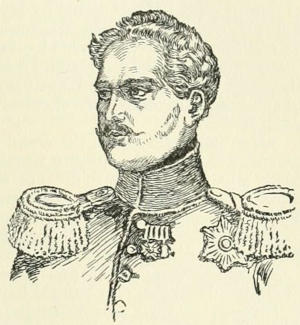
Nicholas I
(1796-1855)
When the members of the council presented themselves before the grand
duke he informed them that the contents of the act had long been known to
him, namely since July 25th, 1819, but that in no case would he dare to occupy
the place of his elder brother, from whose supreme will his lot depended, and
that holding it as a sacred obligation most humbly to obey him in all things,
he had therefore taken the oath and felt entirely certain that the council,
having in view the welfare of the state, would follow his example.
The council followed his highness into the church and at his request took
the oath before him; they were then introduced by him into the presence of
the empress mother, who was pleased to inform them that the act and its content
were known to her, and were made with her maternal consent, but that
she also was enthusiastic over her son’s conduct. Confirming all his actions
she requested the council by their united endeavours to preserve the tranquillity
of the empire.
In accordance with the measures taken, by three o’clock in the afternoon
the troops as well as all grades of officials in the government service had taken
the oath confirming the accession to the throne of the emperor Constantine.
During the whole time tranquillity and order were preserved. It is easy to
imagine the astonishment and vexation of the czarevitch when, instead of
receiving the expected commands of the new emperor, he was informed that
all Russia had taken the oath of allegiance to him as lawful sovereign, and
that the will of the late emperor had not been fulfilled.
Meanwhile early in the morning of December 15th the grand duke
Michael Pavlovitch arrived in St. Petersburg with letters from the czarevitch.
To the amazement of the court and the inhabitants, the grand duke did not
follow the general example of swearing fidelity to the emperor Constantine.
He did not conceal his regret at what had taken place in St. Petersburg, nor the
apprehension with which the necessity of a new oath filled him. He dwelt
on the difficulty of explaining to the public why the place of the elder brother
to whom allegiance had already been sworn should suddenly be taken by the
younger. The grand duke Nicholas in answer to his brother repeated what
he had already said, that he could not have acted otherwise in such a position
as that in which he was placed by his ignorance of the sacred acts of the late
emperor, and that neither his conscience nor his reason reproached him.
“Everything, however,” added he, “might yet be amended and take a more
favourable turn if the czarevitch himself were to come to St. Petersburg; his
obstinacy in remaining at Warsaw may occasion disasters, the possibility of
which I do not deny, but of which in all probability I shall myself be
the first victim.”
After long deliberation the grand duke Nicholas decided to write a fresh
persuasive letter to the emperor Constantine, in which he asked him to decide
finally what his fate was to be; and in conclusion he wrote, “In God’s name,
come.” The empress Marie Feodorovna added her persuasions to those of
her son, and not satisfied with these measures it was decided a few days later
to despatch the grand duke Michael to Warsaw to convince the czarevitch of
the necessity of his presence in St. Petersburg.
An answer from the czarevitch to the grand duke Nicholas’ letter dated
the 14th of December was brought to St. Petersburg by Lazarev, aid-de-camp
to Nicholas: “Your aide-de-camp, dear Nicholas, on his arrival here, confided
your letter to me with all exactitude. I read it with the deepest grief
and sorrow. My decision is unalterable and consecrated by my late benefactor
the emperor and sovereign. Your invitation to come quickly cannot
be accepted by me, and I must tell you that I shall remove myself yet further
away, if all is not arranged in accordance with the will of our late emperor.
Your faithful and sincere friend and brother for life.” But even this letter
did not decide the matter; the return of Belussov from Warsaw with the
answer to the grand duke Nicholas’ letter of December 15th had yet to be
awaited.
A new complication remained to be added to all these difficulties. On
December 24th there came to St. Petersburg and presented himself to the grand
duke Nicholas, Colonel Baron Fredericks of the Izmailovski Life Guards,
who had fulfilled the functions of commandant in Taganrog. He brought
to the grand duke a packet from Baron Diebitsch addressed to his imperial
majesty, to be given into his own hands. To the question as to whether
he knew of the contents of the packet, Fredericks replied in the negative,
but added that as the place of residence of the emperor was unknown in
Taganrog, exactly the same paper had been sent also to Warsaw.
Nothing therefore remained for Nicholas to do but to open the mysterious
packet and “at the first rapid glance over its contents,” writes Baron Korv,
“an inexpressible horror took possession of him.” It was on reading the
report contained in this packet that the grand duke first learned of the
existence of secret societies formed with the object of destroying to the very
roots the tranquillity of the empire. The existence of these societies had
been carefully hidden from him by the late emperor Alexander.
Almost immediately thereafter the courier Belussov returned from
Warsaw with the czarevitch’s decisive answer, which put an end to the
interregnum. Nicholas Pavlovitch was emperor. At nine o’clock in the
evening the emperor sent the following postscript to Adjutant-general
Diebitsch:
The decisive courier has returned; by the morning of the day after to-morrow I shall be
emperor or else dead. I sacrifice myself for my brother; happy if as a subject I fulfil his will.
But how will it be with Russia? What about the army? General Tolle is here and I shall
send him to Mohilev to bear the news to Count Saken. I am looking out for a trustworthy
person for the same commission to Tultchin and to Ermolov. In a word, I hope to be worthy of
my calling, not in fear and mistrustfulness, but in the hope that even as I fulfil my duty so
will others fulfil their duty to me. But if anywhere anything is brewing and you hear of it, I
authorise you to go at once where your presence is necessary. I rely entirely upon you and
give you leave beforehand to take all the measures you deem necessary. The day after to-morrow
if I am alive I will send you, I do not know by whom, information as to how matters
have passed off; on your part do not leave me without news of how everything is going on
around you, especially with Ermolov. I again repeat that here until now everything is incomprehensibly
quiet, but calm often precedes a storm. Enough of this, God’s will be done! In
me there must only be seen the vicar and executor of the late emperor’s will and therefore I
am ready for everything. I shall ever be your sincere well wisher,
Nicholas.
The czarevitch’s decisive answer was brought by Belussov, not through
Riga, but by the Brest-Lithuani road; and therefore the grand duke Michael
Pavlovitch was still in ignorance of the events at Nennal. The emperor
Nicholas immediately sent an express after him commanding him to hasten
to St. Petersburg. The return of the grand duke to the capital where his presence
was of urgent necessity was thus by chance delayed.
Nicholas had now to occupy himself with the composition of his manifesto;
the inexplicable had to be explained and it presented a task of no
little difficulty: Karamzin and Speranski were set to work upon it. The
emperor Nicholas signed the manifesto on the 25th of December, but
dated it the 24th, as the day on which the question of his accession had
been definitely settled by the czarevitch. It was proposed to keep the
manifesto secret until the arrival of the grand duke Michael, but it was
decided that the troops should take the oath of allegiance on the 26th of
December; meanwhile notifications were sent to the members of the council
of state, calling upon them to assemble on Sunday, December 25th, at eight
in the evening, for a general secret meeting.
When the council of state had assembled at the hour designated, Prince
Sopukhin announced that the grand duke Michael would be present at the
sitting. The hours passed in anxious expectation; midnight approached
and the expected arrival of the grand duke did not take place. Then Nicholas
decided to be present at the sitting alone. Taking the place of the president,
Nicholas himself began to read the manifesto announcing his acceptance
of the imperial dignity in consequence of the persisted rejection of it by
the czarevitch Constantine Pavlovitch. Then the emperor ordered that
the czarevitch’s rescript, addressed to Prince Sopukhin, president of the
council, should be read. The 26th of December, 1825, had come. Commands
had been issued that on that day all persons having access to the
court should assemble at the Winter Palace for a Te Deum; eleven o’clock
was the hour first named, but this was afterwards changed to two. Circumstances
arose, however, which postponed the Te Deum to a still later hour.
The members of the secret society decided to take advantage of the end of
the interregnum and the approach of the new oath of allegiance in order
to incite the troops to rebellion and to overthrow the existing order of
things in Russia. The secrecy in which the negotiations with Russia had
been enveloped had given occasion for various rumours and suppositions,
and for the spread of false reports which occasioned alarm in society and
especially in the barracks: all this favoured the undertakings and designs
of the conspirators.
The only issue from the position that had been created by Nicholas in
a moment of chivalrous enthusiasm “undoubtedly noble, but perhaps not
entirely wise,” would have been the arrival of the grand duke Constantine
in the capital with the object of publicly and solemnly proclaiming his renunciation
of the throne. But the czarevitch flatly refused to employ this means
of extricating his brother from the difficult position in which he placed himself;
Constantine considered that it was not for him to suffer from the consequences
of an imprudence which was not his, and the danger of which might
have been averted if matters had not been hurried on, and if he had been
previously applied to for advice and instructions. Thus led into error, some
of the lower ranks of the guards’ regiments refused to take the oath of
allegiance to Nicholas Pavlovitch, and assembled at the Pelrovski square,
before the senate buildings, appearing as though they were the defenders
of the lawful rights of the czarevitch Constantine to the throne.
Meanwhile distinguished persons of both sexes began to drive up to the
Winter Palace. Amidst the general stir and movement going on in the
palace, there sat isolated and immoveable three magnates, “like three monuments,”
writes Karamzin: Prince Lopukhin, Count Araktcheiev, and Prince
A. B. Kurakin. At the time when the military men had already gone out
on the square, Count Araktcheiev, as might have been expected, preferred
to remain in the palace. “It was pitiful to look at him,” writes V. R. Martchenko
in his Mémoires.
The rioters were stubborn for a long time and would not yield to exhortation;
Count Miloradovitch fell mortally wounded. It began to grow dusk.
Then the emperor Nicholas, at last convinced of the impossibility of pacifying
the rioters without bloodshed, gave orders with a breaking heart for the
artillery to fire. A few grape-shot decided the fate of the day; the rioters
were dispersed, and tranquillity at once reigned in the capital.
The Te Deum announced could take place only at half past six. The
troops bivouacked round the palace. “Dear, dear Constantine,” wrote
the emperor the same evening to the czarevitch, “your will is fulfilled: I
am emperor, but at what price, my God!—at the price of the blood of my
subjects.” Arrests were made during that night and investigations pursued
to discover the leaders of the revolt. And thus in the troubles of the
26th of December, the 1st of December, 1825, was terribly recalled. “The
day was one of misfortune for Russia,” writes Prince Viasenski, “and the
epoch which it signalised in such a bloody manner was an awful judgment
for deeds, opinions, and ideas, rooted in the past and governing the present.”
According to the words of Karamzin, on that day Russia was saved from
a calamity “which, if it had not destroyed her, would certainly have torn her
to pieces.” “If I am emperor even for an hour, I will show that I was worthy
of it”; thus spoke Nicholas on the morning of December 26th to the commanders
of the guard regiments assembled at the Winter Palace; and on that
awful day he triumphantly justified his first and impressive words.
[1826 A.D.]
The emperor Nicholas gave all possible publicity to the proceedings against
the secret societies, the Southern, Northern, the United Slavonians, and the
Polish; then the whole matter was transferred to the supreme criminal court,
which had to pronounce sentence on the principal participators in the conspiracy.
Of the accused, Rileeks, Muraviev-Alostob, Bestuzhev-Riumin,
Pesteb, and Kakhovski were condemned to death, and the remaining members
of the secret societies brought before the court were exiled to Siberia
or other places of incarceration.
No one had expected such a termination to the affair. During the whole
of Alexander’s reign there had not been one case of capital punishment,
and it was looked upon as entirely abolished. “It is impossible to describe
in words the horror and despair which have taken possession of all,” writes
a contemporary and eye witness of the events of 1826 in Moscow. This
frame of mind was reflected in the coronation ceremonies. The emperor
Nicholas appeared extremely gloomy; the future seemed more sad and fuller
of anxiety than ever; all was in sharp contrast to the enthusiasm and hopes
that had accompanied the coronation of Alexander in 1801.
Immediately after the termination of the trial of the Dekabrists, the court
proceeded to Moscow for the approaching coronation, which took place on the
3rd of September. Previously the emperor was rejoiced at the unexpected
arrival of the grand duke Constantine Pavlovitch. According to Benkendorf
“the czarevitch’s appearance was a brilliant public testimony of his submission
to the new emperor and of his conscientious renunciation of the
throne; it was at the same time a precious pledge of the harmony which
bound together all the members of the reigning family, a harmony conducive
to the peace of the empire. The public was delighted and the corps diplomatique
completely astounded. The people expressed their satisfaction to
the czarevitch by unanimous acclamations, whilst the dignitaries of the state
surrounded him with marks of respectful veneration.”
The day of the coronation was signalised by an important reform in the
administration of the court; the ministry of the imperial court was created,
and confided to Prince P. M. Volkonski. Thus the old and tried companion
of the emperor Alexander I again occupied the post of a trusty dignitary by
the side of his successor. Prince Volkonski remained minister of the court
until his decease, which took place in 1852. Amongst the favours and the
mitigations of punishments which were granted on the 3rd of September, the
state criminals who had lately been condemned were not forgotten; by
special ukases the sentences of all those sent to the galleys, to penal settlements,
and hard labour were mitigated. Those who had been sent to the
Siberian, Orenburg, and Caucasian garrisons, both with and without deprivation
of the rights of nobility, were enrolled in the regiments of the Caucasian
corps.
During the emperor’s stay in Moscow, the poet Pushkin, who had been
banished to the village of Mikhailovski, was recalled. From that moment
he regained his lost liberty, besides which the emperor Nicholas said to him:
“In future you are to send me all you write—henceforth I will be your
censor.”
On the 18th of October, 1826, the emperor Nicholas returned to St. Petersburg;
although his accession to the throne did not constitute the opening of
a new era for Russia, yet certain changes were made in the system of administration
which had prevailed during the last decade of the reign of Alexander
I. After Count Araktcheiev had been relieved of the management of the general
affairs of the state, it was to be foreseen that he would not remain long at
the head of the direction of the military settlements. And thus it turned out.
In the spring of 1826 Count Araktcheiev, on account of illness, was given
leave to go abroad. In the report presented by him on this occasion to the
emperor he announced to him economies of more than 32,000,000 rubles made
on the military settlements, and concluded his epistle by observing, “Those
impartial judges—posterity and the future—will pronounce a just sentence
on all things.”
On the return of Count Araktcheiev in the autumn from his travels abroad
he did not again take up his duties. In accordance with a ukase which then
followed, the staff office of the military settlements was united to the general
staff of his imperial majesty, under the jurisdiction of its adjutant-general
Baron Diebitsch. At the same time the Novgorod military settlement passed
under the entire direction of General Prince Schahovski, who was nominated
commander of the grenadier corps; the Kherson and Iekaterinoslav settlements
were put under the supervision of their chief, Count Vitt (who was
also commander of a separate corps), while the settlements in the villages of
the Ukraine and Mohilev governments remained under the jurisdiction of
their former chiefs, who bore the rank of commanders of divisions. Count
Araktcheiev, when he had finally bidden adieu to his administrative career,
settled on his Georgian estates, where he died in 1834.
Having delivered Russia from the administrative guardianship of Count
Araktcheiev, the emperor Nicholas, in addition, delivered Russian instruction
from the influence of Michael Leontievitch Magnitzki. On the 18th of
May, 1826, a ukase was issued in which it was stated that “the curator of the
University of Kazan and of its educational district, the actual councillor of
state Magnitzki, is by our command relieved of his functions and of his position
as member of the administration of schools.” But the matter was not
limited to this ukase. Magnitzki continued to live in Kazan and in accordance
with his character he continued to intrigue as usual and indirectly to
influence the university he had left. General Jeltukhin, who had been commissioned
to make a detailed revision of the Kazan University, brought this
fact to the emperor’s knowledge. Nicholas’ reply was rapid and decisive; a
courier was sent with orders to the governor to arrest Magnitzki and send him
to Revel under the surveillance of the commandant. Magnitzki lived there
six years, having given his promise not to absent himself.
An equally sad fate overtook the champion and imitator of Magnitzki,
Dmitri Pavlovitch Runitch, who had filled the office of curator of the St.
Petersburg educational district. By a ukase of the 7th of July, 1826,
Runitch was deprived of his functions and of the position of member of the
chief administration of schools, for his incompetence in the matter of the
direction of the St. Petersburg educational district. The requital experienced
by Runitch for his educational labours was a terrible one; he languished
beneath the consequences for sixteen years and died in 1860 in the conviction
that he had formerly saved Russia, and was suffering for the good work he
had accomplished in the University of St. Petersburg.
Reforms in the Administration of Justice
The lamentable condition of the administration of justice in Russia was
one of the first subjects to which the careful attention of the emperor Nicholas
was directed. In a speech pronounced by the sovereign many years later,
in 1833, before the council of state,
Nicholas Pavlovitch thus expressed
himself:
“From my very accession to the
throne I was obliged to turn my attention
to various administrative matters,
of which I had scarcely any notion.
The chief subject that occupied me
was naturally legislation. Even from
my early youth I had constantly heard
of our deficiencies in this respect, of
chicanery, of extortion, of the insufficiency
of the existing laws or of their
admixture through the extraordinary
number of ukases which were not infrequently
in contradiction to one another.
This incited me from the very
first days of my reign to examine into
the state of the commission appointed
for the constitution of the laws. To
my regret, the information presented to
me proved to me that its labours had
remained almost fruitless. It was not
difficult to discover the cause of this:
the deficient results proceeded chiefly
from the fact that the commission always
directed its attention to the formation
of new laws, when in reality
the old ones should have been established
on a firm foundation. This inspired
me above all with a desire to
establish a definite aim towards which
the government must direct its actions
in the matter of legislation; from the
methods proposed to me I selected
one in entire opposition to the former methods of reform. Instead of drawing
up new laws, I commanded that first those which already existed should be
collected and set in order, whilst I took the matter itself, on account of its
great importance, under my own immediate direction and closed the previous
commission.”
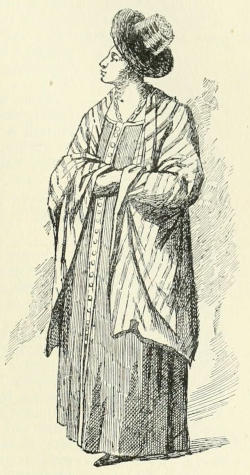
Married Woman of Valdai
With this object was formed and opened on the 6th of May, 1826, the
“second section of his imperial majesty’s own chancery.” M. A. Balongianski
was appointed chief of the second section, but in reality the work itself was
confided to Speranski. The emperor’s choice rested on the latter, out of
necessity, as he did not find anyone more capable around him. When Balongianski
was appointed chief of the second section, the emperor, in conversing
with his former tutor, said to him, speaking of Speranski: “See that he does
not play any pranks, as in 1810.” Nevertheless, in proportion to Speranski’s
successful accomplishment of the work confided to him, the emperor Nicholas’
prejudices against him gradually softened and finally gave way to sincere
favour and full confidence. All the accusations and calumnies directed
against Speranski were, in accordance with the emperor’s own expression,
“scattered like dust.”
Thus the emperor Nicholas in his almost involuntary choice was favoured
by a peculiarly fortunate chance and could hardly have found a person better
fitted for the accomplishment of the work he had planned. The results of
Speranski’s fresh efforts, under completely different circumstances from those
against which he had formerly contended, were the
“complete collection of laws,” and a systematic
code.
Even before the termination of the trial of the
Dekabrists, the emperor Nicholas took another important
measure, which left an imprint on all the
succeeding years of his reign and is directly connected
with the events of the 26th of December.
On the 15th of July, 1826, a supreme edict
was issued in the name of the minister of
the interior Lanskoi, by which the private
chancery of that ministry was abolished
and transformed into the third section of
his imperial majesty’s own chancery. In fulfilment
of this ukase, it was prescribed that the governors
of provinces, in matters which entered within the
sphere of the former division, should no longer
present their reports to the ministry of the
interior, but should submit them directly to his
majesty.
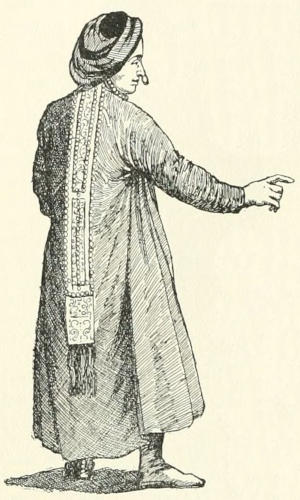
A Woman (Sailor) of the Nogai Tribe
Some days before, on the emperor Nicholas’
birthday, the 6th of July, a supreme order appeared
naming the chief of the first cuirassier division,
Adjutant-general Benkendorf, chief of the gendarmerie
and commandant of the emperor’s headquarters;
to him was confided the direction of the third
section. Adjutant-general Benkendorf explains in
his memoirs in the following manner the reasons for
establishing the institution confided to his direction:
“The emperor Nicholas aimed at the extirpation of the abuses that
had crept into many branches of the administration, and was convinced by
the sudden discovery of the conspiracy which had stained the first moments
of the new reign with blood, of the necessity of a universal and more diligent
surveillance. The emperor chose me to organise a higher police, which should
protect the oppressed and guard the nation against conspiracies and conspirators.
Never having thought of preparing myself for this sort of service,
I had hardly the most superficial understanding of it; but the noble and
beneficent motives which inspired the sovereign in his creation of this institution
and the desire to be of use to him, forbade me to evade the duty to which
his high confidence had called me. I set to work without delay and God
helped me to fulfil my new duties to the satisfaction of the emperor and without
setting general opinion against me. I succeeded in showing favours to
many, in discovering many conspiracies, and averting much evil.” With
the creation of the new third section, the committee of the 13th of January,
1807, established by the emperor Alexander, became superfluous; and on
the 29th of January a ukase was issued closing it.
The disturbances of the year 1825 did not pass without leaving traces on
the peasant population; a momentary confusion ensued, freedom was talked
of, and disorders arose in some provinces—a phenomenon often seen in
previous times. The movement amongst the peasants incited the emperor
Nicholas to publish, on the 24th of May, 1826, a manifesto in which it was
declared that all “talk of exempting the villagers in the state settlements
from paying taxes and of freeing landowner’s peasants and menials from
subjection to their landowners are false rumours, imagined and spread by
evil intentioned persons out of mere cupidity with the object of enriching
themselves through these rumours at the expense of the peasants, by taking
advantage of their simplicity.” It was further said in the manifesto that all
classes throughout the empire must absolutely submit to the authorities
placed over them, and that disturbers of the public tranquillity would be
prosecuted and punished in accordance with the full severity of the laws. It
was commanded that the manifesto should be read in all the churches and at
the markets and fairs during a space of six months; the governors of provinces
were sternly admonished to be watchful in anticipating disorders.
If, however, the emperor Nicholas was forced by circumstances to promulgate
this punitive manifesto, he also issued two rescripts in the name of the
minister of the interior, enjoining upon the nobility behaviour towards their
peasants, which should be in accordance with the laws of Christianity, thus
clearly expressing his desire to protect the peasant against the arbitrariness
and tyranny of the landowners. “In all cases,” wrote the emperor: “I find
it, and shall ever find it, better to prevent evil, than to pursue it by punishment
when it has already arisen.”
Finally the solicitude of the emperor Nicholas for the peasant classes manifested
itself by yet another action. On the 18th of December, 1826, a special
secret committee was formed to which was confided the inspection of the
entire state organisation and administration, with the order to represent the
conclusions it arrived at as to the changes deemed necessary; the labours of
the committee were to be directed also to the consideration of the peasant
question. Besides this the emperor did not leave without attention what
had been said by the Dekabrists, during the time of their examination before a
committee of inquiry, in regard to the internal conditions of the state in the
reign of Alexander I. The emperor ordered a separate memorandum of these
opinions to be drawn up for him and often perused this curious document,
from which he extracted much that was pertinent.b
[1826-1828 A.D.]
The shah of Persia thought he saw in the change of rulers and the troubles
by which it was accompanied circumstances favourable to the recovery of the
provinces ceded to Russia by the Treaty of Gulistan. In August, 1826, he
ordered his troops to move forward. The solemnity of his coronation, which
was then being celebrated and whose splendour was enhanced by the presence
of the czarevitch, did not prevent Nicholas from promptly organising the
defence of the empire. A few weeks afterwards General Paskevitch defeated
the Persians at Ielisavetpol, and in the following year, transferring the theatre
of war to the enemy’s territory, he seized the celebrated convent of Etchmiadzine,
the seat of the Armenian patriarch, and Erivan, one of the great towns
of Armenia; he moreover penetrated as far as Tauris, capital of the Azerbaijan
and residence of the prince royal, Abbas Mirza. Then the shah asked for
peace. It was signed at Turkmantchaï, the 22nd of February, 1828, and
advanced Russia as far as the line of the Araxes, by giving up to her the
provinces of Erivan and Nakhitchevan.
This treaty was concluded, to the great regret of Persia, when the war
with Turkey broke out. This war had been threatening for years; for,
deeply affected by the violences to which the Greeks in the Ottoman Empire
had been exposed ever since the hetaerist insurrection of 1821, and by the
martyrdom which the Greek patriarch had been made to suffer, Alexander
left the sword in its sheath only out of deference to the members of the
Holy Alliance. His successor was thoroughly determined no longer to subordinate
the direction of his cabinet’s policy to the interested views of these
princes and to their fears, though it is true that the latter were well founded.
The Divan, by signing the Treaty of Akerman (October 6th, 1826), had
momentarily averted the storm which was ready to burst; but still more
irritating disputes had afterwards arisen. The conclusion of the Treaty of
London of the 6th of July, 1827, in virtue of which France, England, and
Russia gave existence to a Christian kingdom of Greece placed under their
common protection, was shortly followed by the naval battle of Navarino,
fought on the 20th of October of the same year by the combined fleets of the
three powers, against Ibrahim Pasha, commander-in-chief of the Egyptian
forces in the Morea; and in this memorable conflict, expected by no one, but a
subject of joy to some whilst judged untoward by others, the whole of the
navy which the Porte still had at its disposal was destroyed. Very soon
Mahmud II, yielding to the national desire, let it be understood that he had
never had any intention of lending himself to the execution of a treaty in
virtue of which Moldavia, Wallachia, and Servia were almost as much the
czar’s vassals as his own. This was the beginning of a rupture, and Nicholas
answered it by a declaration of war, which appeared June 4th, 1828, when his
army had already crossed the Pruth.
The campaign of 1828, which accomplished nothing more than the taking
of Braila and Varna, did not give a high idea of the strength of Russia; and
when the emperor made up his mind to take part in it in person, his presence
wrought no change in the feebleness of the results. But it was not the same
with the campaign which followed. Not only did the Russians again pass the
Danube, but after having beaten the grand vizir, Reschid Pasha, at Koulevtcha,
on the 11th of June, Diebitsch marched them across the Balkans for
the first time, a feat which won him the name of Sabalkanski, and proceeded
straight to Adrianople, where he was scarcely more than two hundred kilometres
(about 125 miles) from the Ottoman capital. At the same time
Paskevitch took Erzerum in Asia, and the two generals would doubtless have
joined hands in Constantinople but for the efforts of diplomacy and the fear
of a general conflagration. For Russia was already too powerful; she had
been allowed more than was compatible with the policy of the system of
balance, no doubt from the fear of incurring a grave responsibility by troubling
the peace of Europe. But a prospect like that of the occupation by Russia of
Constantinople and the Straits silenced this fear.
[1829 A.D.]
Austria was ready to send her troops to the help of the Turks, and the
English also seemed likely to declare for the vanquished. It was therefore
necessary to come to a halt. Russia reflected that, after all, “the sultan was
the least costly governor-general she could have at Constantinople,” and lent
an ear to moderate conditions of peace. Nevertheless, if the Treaty of
Adrianople, signed September 14th, 1829, delivered nothing to her in Europe
save the mouths of the Danube, in itself a very important point, it enlarged
her territories in Asia by a part of the pashalik of Akhalzikh, with the fortress
of that name, besides abandoning to her those of Anapa and Pothi on the
Black Sea; it considerably strengthened Muscovite influence in the principalities,
and still further weakened Turkey, not only morally but also materially
by the great pecuniary sacrifices to which she had to subscribe. That power,
once so formidable, was henceforth at the mercy of her northern neighbour,
the principal instrument of her decay.
[1830 A.D.]
But Russia was in her turn rudely shaken by the insurrection in Poland,
always her mortal enemy after she had ceased to be her rival.c
It was in Moscow that the emperor Nicholas received news of the further
progress of the Belgian revolution, in
consequence of which the king of the
Netherlands found himself obliged to
ask for the assistance of his allies by
virtue of the existing treaties. The
emperor at once despatched orders to
Count Tchernishev, Field-marshal Saken,
and the czarevitch to place the
army on a war footing. The czarevitch
was not pleased at the martial turn
given to the diplomatic negotiations;
still more dissatisfied was the Polish Society
of that time, which sympathised
with the revolution of July; neither
was the army in sympathy with the
approaching campaign, which would
bring it into armed collision with
France in the name of the principles of
the Holy Alliance. Although tranquillity
apparently reigned in Warsaw,
yet the secret societies continued to
carry on their destructive work with
success.
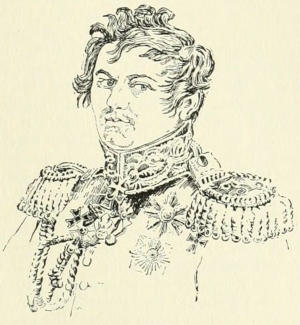
Count Diebitsch-Sabalkanski
(1785-1831)
Various ominous signs of the approaching catastrophe were not, however,
wanting; but the czarevitch continued to lull himself with impossible
hopes that all was peaceful and tranquil and would remain so. As to the
European powers allied to Russia, they did not enter into the matter with
such decided zeal. In the present case it was the Russian autocrat alone
who was ready with entire disinterestedness to take up the defence of the
infringed lawful order. The other powers found it incomparably more
expedient to have recourse to the co-operation of diplomatic remedies; the
result was that, instead of an armed intervention, a general European conference
for the settlement of the Belgian question by peaceful means took
place in London.
Count Diebitsch was still in Berlin awaiting the termination of the negotiations
confided to him, when they were suddenly broken off by an event
upon which the field-marshal had not in the least calculated at the given
moment. On the 3rd of December, 1830, Diebitsch received from the
Prussian minister, Count Berastorf, news of the revolution which had taken
place in Warsaw on the 29th of November: the Polish army, forming a prepared
coalition, had taken up arms against Russia. There remained but one
thing for Diebitsch to do and that was to hasten to St. Petersburg as quickly
as possible. Meanwhile in St. Petersburg the emperor Nicholas had received
only the report of the czarevitch concerning the rising of the troops and of
inhabitants of Warsaw on the evening of the 7th of December, 1830.
On the next day a parade of the Preobrajenski regiment was appointed
to take place, and as usual the emperor came to the riding school. At first
everything proceeded in the usual manner; there were even no traces of inward
agitation manifest upon the handsome face with its regular, classic profile,
which preserved its habitual expression of majestic nobility. At the termination
of the parade the emperor rode into the middle of the riding school,
called the officers around him, and personally communicated to them the
intelligence of the Warsaw rebellion: “I have already made arrangements
that the troops designated by me should move on Warsaw, and if necessary
you too shall go, to punish the traitors and re-establish order and the offended
honour of Russia. I know that under every circumstance I can rely upon
you,” said the emperor. A unanimous outburst of indignation momentarily
seized upon all present and then enthusiastic cries resounded: “Lead us
against the rebels: we will revenge the offended honour of Russia.” They
kissed the emperor’s hands and feet and the hem of his garment with shouts
and cheers. The outburst of indignation was so violent that Nicholas considered
it necessary to moderate it, and with the majesty that was natural
to him he reminded the officers surrounding him that not all the Poles had
broken their oath; that the ringleaders of the insurrection must be punished,
but that vengeance must not be taken on the people: that the repentant must
be pardoned and hatred not allowed.
From the subsequent reports of the grand duke the emperor learned
that the czarevitch had permitted the portion of the Polish army that remained
with him to return to Warsaw; in exchange for this the deputies who came
to the czarevitch promised him and the Russian detachment a free passage
to the frontiers of the empire. It was decided that a sufficient number
of troops should be concentrated in the Polish frontier to allow of decisive
measures being taken against the insurgents. Count Diebitsch was appointed
commander-in-chief of the acting army, whilst the office of chief of the staff
was filled by Count Tolle.
When the czarevitch reached the Russian frontier he wrote as follows
to the emperor Nicholas: “And now the work of sixteen years is completely
destroyed by a set of ensign-bearers, young officers, and students.
I will not further enlarge on the matter, but duty commands me to bear
witness to you that the landed proprietors, the rural population, and in
general all holders of property of any kind are up in despair over this. The
officers and generals as well as the soldiers are unable to keep from joining
the general movement, being carried away by the young people and ensign-bearers
who led everyone astray. In a word, the position of affairs is
extremely bad, and I really do not know what will come of it. All my
measures of surveillance have led to nothing, in spite of the fact that everything
was beginning to be discovered. Here are we Russians at the frontier,
but great God in what a condition!—almost barefoot, for we all came out
as if at the sound of an alarm, in the hopes of returning to barracks, whilst
instead awful marches have had to be made. The officers have been deprived
of everything and have almost nothing with which to clothe themselves.
I am broken hearted; at the age of fifty-one and a half years I never thought
to finish my career in this lamentable manner after thirty-five and a half
years of service. I pray to God that the army to which I have devoted
sixteen years of my life may be brought to reason, and return to the path
of duty and honour, acknowledging its previous errors, before coercive
measures have to be taken. But this is too much to expect from the age
in which we live, and I greatly doubt the realisation of my desires.”
Any agreement with Poland became daily more impossible and both
sides prepared for war. On the 17th of December the emperor Nicholas’
proclamation to the Polish army and nation was issued, and on the 24th a
manifesto was published offering means of reconciliation to all those who
returned to their duty. Meanwhile General Chlopicki was installed as
dictator in Warsaw, but he was unable to save Poland from a rupture with
Russia. Two deputies were sent to St. Petersburg to enter into negotiations
with the emperor Nicholas; they were the minister of finance, Prince Lubetzki
and a member of the diet, Count Ezerski. But neither could these negotiations
avert the bloody events of the year 1831. “It is hard to foresee the
future,” wrote the emperor to the czarevitch; “but weighing the relative
probabilities of success, it is difficult to suppose that the new year will show
itself more distressing for us than the year 1830; God grant that I may not
be mistaken. I should like to see you peacefully settled in your Belvedere
and order re-established throughout; but how much there yet remains to
be accomplished before we are in a condition to attain to this! Which of
the two must perish—for it appears inevitable that one must perish,
Russia or Poland? Decide for yourself. I have exhausted all possible
means in order to avert such a calamity—all means compatible with honour
and my conscience—but they are exhausted. What remains for me to do?”
[1831 A.D.]
Soon the diet assembled in Warsaw took a decision which completed the
rupture between Poland and Russia. On the 25th of January, 1831, the
diet declared the Romanov dynasty to be deprived of the throne of Poland.
The Poles themselves thus unbound the hands of the emperor, and the duel
between Russia and Poland became inevitable. The emperor replied to
the challenge by a manifesto in accordance with which the Russian troops
crossed the Polish frontier, and on the 25th of February a decisive battle
took place before Prague at Grokhov, by which the Polish army was
obliged to retreat to Warsaw with a loss of twelve thousand men.
But Count Diebitsch did not recognise the possibility of taking advantage
of the victory gained, and which would have been inevitably completed
by the occupation of the Polish capital; and Sabalkanski was not fated to
become prince of Warsaw. The Polish troops retreated unhindered across
the only bridge to Warsaw; the new Polish commander-in-chief Skrjinetzski
set out to reorganise the army, the rising spread even to the Russian governments,
and the campaign, against all expectations, dragged on for six
months. Meanwhile it was a war upon which depended, according to the
expression used by the emperor, “the political existence of Russia.”
On the 26th of May Diebitsch gained a second victory over the Polish
army, which also terminated by the favourable retreat of the latter; and
on the 13th of June, the emperor found occasion to write to his field-marshal:
“Act at length so that I can understand you.” The letter was
however not read by Count Diebitsch, for on the 10th of June the field-marshal
suddenly died of cholera in the village of Kleshov near Pultiusk.
He was replaced by Field-marshal Count Paskevitch-Erivanski, who was
as early as April, 1831, called by the emperor from Tiflis to St. Petersburg.
It was decided to cross the lower Vis-Suta and move towards Warsaw. The
czarevitch Constantine outlived Count Diebitsch only by a few days. He
also died suddenly of cholera at Vitebsk, in the night between the 26th and
27th of June of the year 1831.
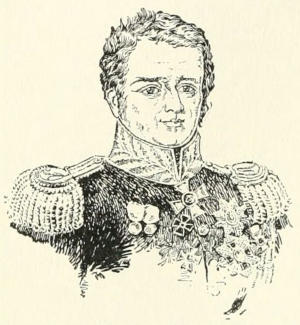
Field-marshal Paskevitch
(1782-1856)
The Polish insurrection from that time daily grew nearer to its definitive
conclusion; it was determined by the two days’ storming of Warsaw, which
took place on the 7th and 8th of September. Finally Field-marshal Paskevitch
was able to communicate to the emperor the news that “Warsaw is at
the feet of your imperial majesty.” Prince Suvorov, aide-de-camp of the
emperor, was the bearer of this intelligence
to Tsarskoi Selo on the 16th of
September.
Nicholas wrote as follows to his victorious
field-marshal: “With the help of
the all-merciful God, you have again
raised the splendour and glory of our
arms, you have punished the disloyal traitors,
you have avenged Russia, you have
subdued Warsaw—from henceforth you
are the most serene prince of Warsaw.
Let posterity remember that the honour
and glory of the Russian army are inseparable
from your name, and may your
name preserve for everyone the memory
of the day on which the name of Russia
was again made glorious. This is the
sincere expression of the grateful heart
of your sovereign, your friend, and your
old subordinate.”
After the fall of Warsaw the war still continued for a while, but not for
long. The chief forces of the Polish army, which had retired to Novogeorgievsk,
finished by passing into Prussian territory at the end of September,
and on the 21st of October the last fortress surrendered. The Polish insurrection
was at an end. But the peace, attained by such heavy sacrifice,
was accompanied by a new evil for Russia; in Europe appeared the Polish
emigration, carrying with it hatred and vociferations against Russia and
preparing the inimical conditions of public opinion in the west against the
Russian government.
The emperor had hardly returned to St. Petersburg from opening the diet
in Warsaw, when suddenly a new care occupied the attention of the government.
The cholera made its appearance in the empire. This terrible illness,
until then known to Russia only by name and by narratives describing its
devastations, brought with it still greater fear, because no one knew or could
indicate either medical or police measures to be taken against it. General
opinion inclined, however, towards the advantages to be derived from quarantine
and isolation, such as had been employed against the plague, and the
government immediately took necessary measures in this direction with the
activity that the emperor’s strong will managed to instil into all his dispositions.
Troops were without delay stationed at various points and cordons
formed from them and the local inhabitants, in order to save the governments
in the interior and the two capitals from the calamity.
In spite of all precautions, however, a fresh source of grief was added to
all the cares and anxieties that pressed upon the emperor at that period.
Since the 26th of June the cholera had appeared in St. Petersburg and in a few
days had attained menacing dimensions. This awful illness threw all classes
of the population into a state of the greatest terror, particularly the common
people by whom all the measures taken for the preservation of the public
health—such as increased police surveillance, the surrounding of the towns
with troops, and even the removal of those stricken with cholera to hospitals—were
at first regarded as persecutions. Mobs began to assemble, strangers
were stopped in the streets and searched for the poison they were supposed to
carry on them, while doctors were publicly accused of poisoning the people.
Finally, on the 4th of July, the mob, excited by rumours and suspicions,
gathered together at the Hay Market and attacked the house in which a
temporary cholera hospital had been established. They broke the windows,
threw the furniture out into the street, wounded and cast out the sick, thrashed
the hospital servants, and killed several of the doctors. The police were
powerless to restore order and even the final appearance of the military
governor-general Count Essen did not attain the necessary result. A battalion
of the Semenov regiment forced the people to disperse from the square
into the side streets, but was far from putting a stop to the disturbance.
The next day the emperor Nicholas went on a steamer from St. Petersburg
to Elagium Island. When he had heard the reports of various persons as to
the state of the town he got into a carriage with Adjutant-general Prince
Menshikov and drove to the Preobrajenski parade-ground in the town, where
a battalion of the Preobrajenski regiment was encamped. When he had
thanked the troops, the emperor continued his way along the carriage road
where he threatened with his displeasure some crowds and shopkeepers; from
there he drove to the Hay Market where about five thousand people had
assembled. Standing up in his carriage and turning to the mob, the emperor
spoke as follows: “Misdeeds were committed yesterday, public order was
disturbed; shame on the Russian people for forgetting the faith of their
fathers and imitating the turbulence of the French and Poles! They have
taught you this: seize them and take those suspected to the authorities; but
wickedness has been committed here, here we have offended and angered God—let
us turn to the church, down on your knees, and beg the forgiveness of
the Almighty!”
The people fell on their knees and crossed themselves in contrition; the
emperor prostrated himself also, and exclamations of “We have sinned,
accursed ones that we are!” resounded throughout the air. Continuing his
speech to the people, the emperor again admonished the crowd: “I have
sworn before God to preserve the prosperity of the people entrusted to me by
providence; I am answerable before God for these disorders: and therefore I
will not allow them. Woe be to the disobedient!”
At this moment some men in the crowd raised their voices. The emperor
then replied: “What do you want—whom do you want? Is it I? I am
not afraid of anything—here I am!” and with these words he pointed to his
breast. Cries of enthusiasm ensued. After this the emperor, probably as a
sign of reconciliation, embraced an old man in the crowd and returned, first to
Elagium and afterwards to Peterhov. The day afterwards the emperor again
visited the capital. Order was re-established, but the cholera continued to
rage. Six hundred persons died daily, and it was only from the middle of
July that the mortality began to diminish.
Far more dangerous in its consequences was the revolt that arose in the
Novgorod military settlements. Here the cholera and rumours of poisoning
only served as a pretext for rebellion; the seed of general dissatisfaction
among the population belonging to this creation of Count Araktcheiev continued
to exist in spite of all the changes introduced by the emperor Nicholas
into the administration of the military settlements. A spark was sufficient
to produce in the settlements an explosion of hitherto unprecedented fury,
and the cholera served as the spark. Order was however finally re-established
in the settlements and then the emperor Nicholas set off for them quite
alone and presented himself before the assembled battalions, which had
stained themselves with the blood of their officers and stood awaiting, trembling
and in silence the judgment of their sovereign.b
The possession of the Caucasus is a question vitally affecting the interests
of Russia in her provinces beyond that range of mountains, and her ulterior
projects with regard to the regions of Persia and Central Asia. Here are the
terms in which this subject is handled in a report printed at St. Petersburg,
and addressed to the emperor after the expedition of General Emmanuel to
Elbruz in 1829:
“The Circassians (Tsherkessians) bar out Russia from the south, and may
at their pleasure open or close the passage to the nations of Asia. At present
their intestine dissensions, fostered by Russia, hinder them from uniting
under one leader; but it must not be forgotten that, according to traditions
religiously preserved amongst them, the sway of their ancestors extended as
far as to the Black Sea. They believe that a mighty people, descended
from their ancestors, and whose existence is verified by the ruins of Madjar,
has once already overrun the fine plains adjacent to the Danube, and finally
settled in Panonia. Add to this consideration their superiority in arms.
Perfect horsemen, extremely well armed, inured to war by the continual freebooting
they exercise against their neighbours, courageous, and disdaining
the advantages of our civilisation, the imagination is appalled at the consequences
which their union under one leader might have for Russia, which has
no other bulwark against their ravages than a military line, too extensive to be
very strong.”
For the better understanding of the war which Russia has been so long
waging with the mountaineers, let us glance at the topography of the Caucasus,
and the respective positions of the belligerents.
The chain of the Caucasus exhibits a peculiar conformation, altogether
different from that of any of the European chains. The Alps, the Pyrenees,
and the Carpathians are accessible only by the valleys, and in these the inhabitants
of the country find their subsistence, and agriculture developes its
wealth. The contrary is the case in the Caucasus. From the fortress of
Anapa on the Black Sea, all along to the Caspian, the northern slope presents
only immense inclined plains, rising in terraces to a height of 3,000 or
4,000 yards above the sea level. These plains, rent on all directions by deep
and narrow valleys and vertical clefts, often form real steppes, and possess
on their loftiest heights rich pastures, where the inhabitants, secure from all
attack, find fresh grass for their cattle in the sultriest days of summer. The
valleys on the other hand are frightful abysses, the steep sides of which are
clothed with brambles, while the bottoms are filled with rapid torrents foaming
over beds of rocks and stones. Such is the singular spectacle generally
presented by the northern slope of the Caucasus. This brief description may
give an idea of the difficulties to be encountered by an invading army. Obliged
to occupy the heights, it is incessantly checked in its march by impassable
ravines, which do not allow of the employment of cavalry, and for the most
part prevent the passage of artillery. The ordinary tactics of the mountaineers
is to fall back before the enemy, until the nature of the ground or the
want of supplies obliges the latter to begin a retrograde movement. Then
it is that they attack the invaders, and, intrenched in their forests behind
impregnable rocks, they inflict the most terrible carnage on them with little
danger to themselves.
On the south the character of the Caucasian chain is different. From
Anapa to Gagri, along the shores of the Black Sea, we observe a secondary
chain composed of schistous mountains, seldom exceeding 1000 yards in height.
But the nature of their soil, and of their rocks, would be enough to render
them almost impracticable for European armies, even were they not covered
with impenetrable forests. The inhabitants of this region, who are called
Circassians, are entirely independent, and constitute one of the most warlike
peoples of the Caucasus.
The great chain begins in reality at Gagri, but the mountains recede from
the shore, and nothing is to be seen along the coast as far as Mingrelia but
secondary hills, commanded by immense crags, that completely cut off all
approach to the central part of the Caucasus. This region, so feebly defended
by its topographical conformation, is Abkhasia, the inhabitants of which have
been forced to submit to Russia. To the north and on the northern slope,
westward of the military road from Mozdok to Tiflis, dwell a considerable
number of tribes, some of them ruled by a sort of feudal system, others constituted
into little republics. Those of the west, dependent on Circassia and
Abadja, are in continual war with the empire, whilst the Nogaians, who
inhabit the plains on the left bank of the Kuma, and the tribes of the great
Kabarda, own the sovereignty of the czar; but their wavering and dubious
submission cannot be relied on. In the centre, at the foot of the Elbruz,
dwell the Suanetians, an unsubdued people, and near them, occupying both
sides of the pass of Dariel, are the Ingutches and Ossetans, exceptional tribes,
essentially different from the aboriginal peoples. Finally we have, eastward
of the great Tiflis road, near the Terek, little Kabarda, and the country of the
Kumicks, for the present subjugated; and then those indomitable tribes, the
Lesghians and Tchetchens, of whom Schamyl is the Ab del Kadir, and who
extended over the two slopes of the Caucasus to the vicinity of the Caspian.
In reality, the Kuban and the Terek, that rise from the central chain, and
fall, the one into the Black Sea, the other into the Caspian, may be considered
as the northern political limits of independent Caucasus. It is along those
two rivers that Russia has formed her armed line, defended by Cossacks, and
detachments from the regular army. The Russians have, indeed, penetrated
those northern frontiers at sundry points, and have planted some forts within
the country of the Lesghians and Tchetchens. But those lonely posts, in
which a few unhappy garrisons are surrounded on all sides, and generally
without a chance of escape, cannot be regarded as a real occupation of the soil
on which they stand. They are, in fact, only so many pickets, whose business
is only to watch more closely the movements of the mountaineers. In the
south, from Anapa to Gagri, along the Black Sea, the imperial possessions
never extended beyond a few detached forts, completely isolated, and deprived
of all means of communication by land. A rigorous blockade was established
on this coast; but the Circassians, as intrepid in their frail barks as
among their mountains, often passed by night through the Russian line of
vessels, and reached Trebizond and Constantinople. Elsewhere, from Mingrelia
to the Caspian, the frontiers are less precisely defined, and generally run
parallel with the great chain of the Caucasus.
[1835 A.D.]
Thus limited, the Caucasus, including the territory occupied by the subject
tribes, presents a surface of scarcely 5000 leagues; and it is in this narrow
region that a virgin and chivalric nation, amounting at most to 2,000,000
of souls, proudly upholds its independence against the might of the Russian
empire, and has for upwards of twenty years sustained one of the most obstinate
struggles known to modern history.
The Russian line of the Kuban, which is exactly similar to that of the
Terek, is defended by the Cossacks of the Black Sea, the poor remains of the
famous Zaparogians, whom Catherine II subdued with so much difficulty,
and whom she colonised at the foot of the Caucasus, as a bulwark against the
incursions of the mountaineers. The line consists of small forts and watch
stations; the latter are merely a kind of sentry-box raised on four posts,
about fifty feet from the ground. Two Cossacks keep watch in them day and
night. On the least movement of the enemy in the vast plain of reeds that
fringe both banks of the river, a beacon fire is kindled on the top of the watch
box. If the danger becomes more pressing, an enormous torch of straw and
tar is set fire to. The signal is repeated from post to post, the whole line
springs to arms, and 500 or 600 men are instantly assembled on the point
threatened. These posts, composed generally of a dozen men, are very close
to each other, particularly in the most dangerous places. Small forts have
been erected at intervals with earthworks, and a few pieces of cannon; they
contain each from 150 to 200 men.
But notwithstanding all the vigilance of the Cossacks, often aided by the
troops of the line, the mountaineers not unfrequently cross the frontier and
carry their incursions, which are always marked with massacre and pillage, into
the adjacent provinces. There are bloody but justifiable reprisals. In 1835
a body of fifty horsemen entered the country of the Cossacks, and proceeded
to a distance of 120 leagues, to plunder the German colony of Madjar and the
important village of Vladimirovka, on the Kuma, and what is most remarkable
they got back to their mountains without being interrupted. The same year
Kisliar, on the Caspian, was sacked by the Lesghians. These daring expeditions
prove of themselves how insufficient is the armed line of the Caucasus,
and to what dangers that part of southern Russia is exposed.
The line of forts until lately existing along the Black Sea was quite as weak,
and the Circassians there were quite as daring. They used to carry off the
Russian soldiers from beneath the fire of their redoubts, and come up to the
very foot of their walls to insult the garrison. Hommaire de Hell relates that,
at the time he was exploring the mouths of the Kuban, a hostile chief had the
audacity to appear one day before the gates of Anapa. He did all he could to
irritate the Russians, and abusing them as cowards and woman-hearted, he
defied them to single combat. Exasperated by his invectives, the commandant
ordered that he should be fired on with grape. The horse of the mountaineer
reared and threw off his rider, who, without letting go the bridle, instantly
mounted again, and, advancing still nearer to the walls, discharged his pistol
almost at point-blank distance at the soldiers, and galloped off to the mountains.
As for the blockade by sea, the imperial squadron has not been expert
enough to render it really effectual. It was only a few armed boats, manned
by Cossacks, that gave the Circassians any serious uneasiness. These Cossacks
like those of the Black Sea, are descended from the Zaparogians. Previously
to the last war with Turkey they were settled on the right bank of the Danube,
where their ancestors had taken refuge after the destruction of their Setcha.
During the campaigns of 1828-29, pains were taken to revive their national
feelings, they were brought again by fair means or by force under the imperial
sway, and were then settled in the forts along the Caucasian shore, the keeping
of which was committed to their charge. Courageous, enterprising, and
worthy rivals of their foes, they waged a most active war against the skiffs of
the mountaineers in their boats, which carry crews of fifty or sixty men.
The treaty of Adrianople was in a manner the opening of a new era in the
relations of Russia with the mountaineers; for it was by virtue of that treaty
that the czar, already master of Anapa and Sudjuk Kaleh, pretended to the
sovereignty of Circassia and of the whole seaboard of the Black Sea. True to
the invariable principles of its foreign policy, the government at first employed
means of corruption, and strove to seduce the various chiefs of the country
by pensions, decorations, and military appointments. But the mountaineers,
who had the example of the Persian provinces before their eyes, sternly
rejected all the overtures of Russia, and repudiated the clauses of the convention
of Adrianople; the political and commercial independence of their
country became their rallying cry, and they would not treat on any other
condition. All such ideas were totally at variance with Nicholas’ schemes of
absolute dominion; therefore he had recourse to arms to obtain by force what
he had been unable to accomplish by other means.
Abkhasia, situated on the eastern coast of the Black Sea, and easily accessible,
was the first invaded. A Russian force occupied the country in 1839,
under the ordinary pretence of supporting one of its princes, and putting an
end to anarchy. In the same year General Paskevitch, then governor-general
of the Caucasus, for the first time made an armed exploration of the country
of the Circassians beyond the Kuban; but he effected absolutely nothing,
and his expedition only resulted in great loss of men and stores. In the following
year war broke out in Daghestan with the Lesghians and the Tchetchens.
The celebrated Kadi Mulah, giving himself out for a prophet, gathered together
a considerable number of partisans; but unfortunately for him there was no
unanimity among the tribes, and the princes were continually counteracting
each other. Kadi Mulah never was able to bring more than 3,000 or 4,000
men together; nevertheless, he maintained the struggle with a courage
worthy of a better fate, and Russia knows what it cost her to put down the
revolt of Daghestan. As for any real progress in that part of the Caucasus,
the Russians made none; they did no more than replace things on the old
footing. Daghestan soon became again more hostile than ever, and the
Tchetchens and Lesghians continued in separate detachments to plunder
and ravage the adjacent provinces up to the time when the ascendancy of
the celebrated Schamyl, the worthy successor of Kadi Mulah, gave a fresh
impulse to the warlike tribes of the mountain, and rendered them more
formidable than ever.
After taking possession of Anapa and Sudjuk Kaleh, the Russians thought
of seizing the whole seaboard of Circassia, and especially the various points
suitable for the establishment of military posts. They made themselves
masters of Guelendchik and the important position of Gagri, which commands
the pass between Circassia and Abkhasia. The Circassians heroically
defended their territory; but how could they have withstood the guns of
the ships of war that mowed them down whilst the soldiers were landing
and constructing their redoubts? The blockade of the coasts was declared
in 1838, and all foreign communication with the Caucasus ostensibly intercepted.
During the four following years Russia suffered heavy losses; and
all her successes were limited to the establishment of some small isolated
forts on the sea-coast. She then increased her army, laid down the military
road from the Kuban to Guelendchik, across the last western offshoot of
the Caucasus, set on foot an exploration of the enemy’s whole coast, and
prepared to push the war with renewed vigour.
In 1837 the emperor Nicholas visited the Caucasus. He would see for
himself the theatre of a war so disastrous to his arms, and try what impression
his imperial presence could make on the mountaineers. The chiefs
of the country were invited to various conferences, to which they boldly
repaired on the faith of the Russian parole; but instead of conciliating them
by words of peace and moderation, the emperor only exasperated them
by his threatening and haughty language. “Do you know,” said he to them,
“that I have powder enough to blow up all your mountains?”
[1839 A.D.]
During the three following years there was an incessant succession of
expeditions. Golovin, on the frontiers of Georgia, Grabe on the north, and
Racivski on the Circassian seaboard, left nothing untried to accomplish their
master’s orders. The sacrifices incurred by Russia were enormous; the
greater part of her fleet was destroyed by a storm, but all efforts failed against
the intrepidity and tactics of the mountaineers. Some new forts erected
under cover of the ships, were all that resulted from these disastrous campaigns.
“I was in the Caucasus in 1839,” says Hommaire de Hell, “when
Grabe returned from his famous expedition against Shamyl. When the
army marched it had numbered 6000 men, 1,000 of whom, and 120 officers,
were cut off in three months. But as the general had advanced further
into the country than any of his predecessors, Russia sang pæans, and Grabe
became the hero of the day, although the imperial troops had been forced
to retreat and entirely evacuate the country they had invaded. All the
other expeditions were similar to this one, and achieved in reality nothing
but the burning and destruction of a few villages. It is true the mountaineers
are far from being victorious in all their encounters with the Russians, whose
artillery they cannot easily withstand; but if they are obliged to give way
to numbers, or to engineering, nevertheless they remain in the end masters of
the ground, and annul all the momentary advantages gained by their enemies.”
The year 1840 was still more fatal to the arms of Nicholas. Almost all
the new forts on the seaboard were taken by the Circassians, who bravely
attacked and carried the best fortified posts without artillery. The military
road from the Kuban to Guelendchik was intercepted, Fort St. Nicholas,
which commanded it, was stormed and the garrison massacred. Never yet
had Russia endured such heavy blows. The disasters were such that the
official journals themselves, after many months’ silence, were at last obliged
to speak of them; but the most serious losses, the destruction of the new road
from the Kuban, the taking of Fort St. Nicholas, and that of several other
forts, were entirely forgotten in the official statement.
On the eastern side of the mountain the war was fully as disastrous for
the invaders. The imperial army lost four hundred petty officers and soldiers,
and twenty-nine officers in the battle of Valrik against the Tchetchens.
The military colonies of the Terek were attacked and plundered, and when
General Golovin retired to his winter quarters at the end of the campaign,
he had lost more than three-fourths of his men.
The great Kabarda did not remain an indifferent spectator of the offensive
league formed by the tribes of the Caucasus; and when Russia, suspecting
with reason the unfriendly disposition of some tribes, made an armed exploration
on the banks of the Laba in order to construct redoubts, and thus cut
off the subjugated tribes from the others, the general found the country,
wherever he advanced, but a desert. All the inhabitants had already retired
to the other side of the Laba to join their warlike neighbours.d
However, in spite of all these disastrous campaigns, Nicholas had not
lost sight of his most important task—that of consolidating internal order
by reforms. His attention had been directed above all to the administration,
from the heart of which he had sought especially to exterminate corruption
with a severity and courage proportioned to the immensity of the
evil. Then he had announced his firm desire to perfect the laws, and had
charged Count Speranski to work at them under his personal direction.
The digest (svod) promulgated in 1833 was the first fruit of these efforts
and was followed by various special codes. Finally, turning his attention
to public instruction, he had assigned to it as a basis the national traditions
and religion and charged Uvarov, president of the Imperial Academy of
Sciences, a man of learning and talent, to animate it with this spirit, so
hostile to the ideas of the west, but—let us say it at once—better suited
to the real needs of the country.
Nicholas, allowing himself to be ruled by this spirit, plunged further
and further into a system which, though contrary to that of Peter the Great,
we do not pretend absolutely to condemn on that account, and which the
marquis de Custinee has highly extolled in his celebrated book, La Russie
en 1839. “The emperor Nicholas,” he said, “thought that the day of mere
seeming was past for Russia, and that the whole structure of civilisation
was to remake in that country. He has relaid the foundations of society.
Peter, called the Great, would have overturned it a second time in order to
rebuild it: Nicholas is more skilful. I am struck with admiration for this
man who is secretly struggling, with all the strength of his will, against the
work of Peter the Great’s genius. He is restoring individuality to a nation
which has strayed for more than a century in the paths of imitation.”
Without ceasing to borrow diligently from Europe her inventions and
arts, her progress in industry, in administration, in the conduct of land
and sea armies—in a word, all the material improvements which she devises
and realises, he endeavoured to close Russia to her ideas on philosophy,
politics, and religion. He condemned exotic tendencies as pernicious to his
states, and, without depriving himself of the services of the Germans, the
principal depositaries of superior enlightenment in that country, as yet only
imperfectly moulded to civilisation, he relied by preference on the party
of the old Russians, which included the clergy, whom he treated with respect
in spite of the inferiority of their position. Nationality, autocracy, orthodoxy—these
three words, taken as the national watchword, sum up the
ideas to which he subordinated his internal policy. The expression, Holy
Russia, which has been the object of such profound astonishment to the
Latin world, reflects also this spirit.
He surrounded with great solemnity those acts which he performed in
his quality of head of the church in his own country, and posed as the protector
of all his co-religionists in Moldavia, Wallachia, Servia, Montenegro,
and other countries. Like his ancestors of preceding dynasties, he adorned
himself on solemn occasions with a gold cross which he wore diagonally on
his breast. This bias was summed up in the new word cæsaropapism. He
regarded with special enthusiasm that one act on account of which, the
accusation of religious intolerance was fixed upon him—an accusation
justified by many of his deeds. In consequence of the decisions of the council
of Florence, and up till 1839, there were in Russia 1,500,000 United Greeks,
subjected to the papal obedience. At their head was the archbishop, sometimes
the metropolitan, of White Russia, and the bishop, or archbishop, of
Lithuania. In 1839 these two prelates, having met in conjunction with
a third, at Polotsk, the seat of the first of these eparchies, had signed a document
in which they expressed the wish to unite, they and their church,
with the national and primitive church, and prayed the emperor to sanction
this union. Nicholas referred the matter to the holy synod, and, the latter
having with great eagerness signified its approval of the act, he sanctioned
it in his turn, adding these words beneath his signature: “I thank God
and I authorize it.” It is well known to what complaints on the part of
the pope this suppression of the uniate Greek church soon afterward gave
rise.c
The emperor Nicholas was fond of great gatherings of the troops, and
an occasion for such was afforded in 1839 by the unveiling of the monument
erected on the battle-field of Borodino. The thought of this muster of the
troops had already occupied the emperor’s mind since 1838, but at that
time he had in view not merely the participation of the troops in manœuvres
and exercises, but the immortalisation of the tradition of the valorous exploits
of the Russian army in the defence of the fatherland against the invasion of
Napoleon. On the day of the unveiling of the Borodino monument, August
26th, 120,000 men were gathered around it. The emperor invited to take
part in the solemnities all the surviving comrades of Kutuzov and many
foreign guests.
On the anniversary of the battle of Borodino a great review of all the
troops assembled on this historic spot took place. In the morning, before
the review began, the following order of his imperial majesty, written by
the emperor’s hand, was read to the troops:
“Children. Before you stands the monument which bears witness to
the glorious deeds of your comrades. Here, on this same spot, 27 years
ago, the arrogant enemy dreamed of conquering the Russian army which
fought in defence of the faith, the czar and the fatherland. God punished
the foolish: the bones of the insolent invaders were scattered from Moscow
to the Niemen—and we entered Paris. The time has now come to render
glory to a great exploit. And thus, may the eternal memory of the emperor
Alexander I be immortal to us: for by his firm will Russia was saved; may
the glory of your comrades who fell as heroes be also everlasting, and may
their exploits serve as an example to us and our further posterity. You will
ever be the hope and support of your sovereign and our common mother
Russia.”
This order aroused the greatest enthusiasm amongst the troops, but it
was highly displeasing to the foreigners; it appeared to them strange and
almost offensive, they considered that “in reality it was nothing but high
sounding phrases.”
Three days later the emperor Nicholas had the battle of Borodino reproduced.
After the unveiling of the Borodino monument the laying of the
first stone of the cathedral of Christ the Saviour took place in Moscow. This
solemnity brought to a close the commemoration of the year 1812 which
had delivered Russia from a foreign invasion and was the dawn of the liberation
of Europe.
The year 1839 was remarkable for yet another important event: the
reunion of the Uniates.[68]
Little by little the workers in the political arena of Alexander’s reign
had disappeared. Count V. P. Kotchulzi, who had been president of the
senate since 1827 and afterwards chancellor of the interior, died in 1834
and had been replaced by N. N. Novseltsev as president of the senate. After
his death the emperor Nicholas appointed to that office Count I. V. Vasiltchikov,
who remained at his post until his death, which took place in 1847.
The emperor was above all grieved at the death of Speranski in the year
1837. He recognised this loss as irreparable, and in speaking of him said:
“Not everyone understood Speranski or knew how to value him sufficiently;
at first I myself was in this respect perhaps more in fault than anyone. I
was told much of his liberal ideas; calumny even touched him in reference
to the history of December 26th. But afterwards all these accusations were
scattered like dust, and I found in him the most faithful, devoted and zealous
servant, with vast knowledge and vast experience. Everyone now knows
how great are my obligations and those of Russia to him—and the calumniators
are silenced. The only reproach I could make him was his feeling
against my late brother; but that too is over”.... The emperor stopped
without finishing his thought, which probably contained a secret, involuntary
justification of Speranski.
In 1844 died another statesman who was still nearer and dearer to the
emperor Nicholas; this was Count Benkendorv of whom the emperor said:
“He never set me at variance with anyone, but reconciled me with many.”
His successor in the direction of the third section was Count A. F. Orlov; he
remained at this post during all the succeeding years of the emperor Nicholas’
reign.
In that same year Count E. F. Kankrin who had been minister of finance
even under Alexander I was obliged on account of ill health to leave the ministry
of which he had been head during twenty-two years. As his biographer
justly observes Kankrin left Russia as an heritage: “Well organised finances,
a firm metal currency, and a rate of exchange corresponding with the requirements
of the country. Russia was in financial respects a mighty power whose
credit it was impossible to injure. And all this was attained without any
considerable loans, and without great increase in taxes, by the determination,
the thrift and the genius of one man, who placed the welfare of the nation
above all considerations and understood how to serve it.”
But at the same time it must not be forgotten that all these brilliant
results were attainable only because behind Count Kankrin stood the emperor
Nicholas. The enemies of the minister and of his monetary reforms were
many; but the snares they laid were destroyed before the all powerful will of a
person who never wavered. This time that inflexible will was directed in the
right path, and the results showed unprecedented financial progress, in spite
of the three wars which it had been impossible for Russia to avoid, despite
the ideally peace-loving disposition of her ruler; and to these calamities must
be added also the cholera and bad harvests. Kankrin’s resignation was
accompanied by important consequences; he was replaced by the incapable
Vrontchenko, while Nicholas took the finances of the empire into his own
hands, as he had previously acted regarding the other branches of the administration
of the state.
Among the old-time servitors of Alexander I, Prince P. M. Volkonski
remained longest in office. He lived until he attained the rank of field-marshal
and died in 1852, having filled the office of minister of the court during twenty-five
years.
One of the younger workers of the Alexandrine period, P. D. Kisselev,
former chief of the staff of the second army, attained to unusual eminence in
the reign of the emperor Nicholas. In 1825 his star nearly set forever, but
soon it shone again with renewed brilliancy and on his return from the Danubian
provinces, which he had administered since 1829, Kisselev was created
minister and count. “You will be my chief of the staff for the peasant department,”
said the emperor to him, and with this object, on the 13th of January,
1838 there was established the ministry of state domains, formed from
the department which had until that time been attached to the ministry
of finance.
A disastrous fire at the Winter Palace began on the evening of the 29th of
December, 1837, and no human means were able to stay the flames; only the
Hermitage with its collection of ancient and priceless treasures was saved.
The ruins of the palace continued to burn during three days and nights.
The emperor and the imperial family took up their abode in the Anitchkov
palace.
The rebuilding of the Winter Palace upon its previous plan was begun
immediately; the palace was consecrated on the 6th of April, 1839 and the
emperor and his family were installed there as previously. As a token of
gratitude to all those who had taken part in the rebuilding of the palace a
medal was struck with the inscription: “I thank you.”—“Work overcomes
everything.”
On the last day of the Easter holidays the emperor Nicholas resolved to
allow visitors access to all the state rooms, galleries, etc.; and in that one day
as many as 200,000 persons visited the palace between the hours of six in the
evening and two in the morning.
Twice the emperor and his family passed in all directions through the
palace that was thronged with the public. An eye-witness writes that “the
public by prolonging their visitation for seven hours so filled the palace with
damp, steamy, suffocating air that the walls, the columns, and carvings on
the lower windows sweated, and streams of damp poured down on to the
parquet flooring and spoiled everything, while the marble changed to a dull
yellowish hue.” 35,000 paper rubles were required to repair the damage.
But the matter did not terminate with this; during one night that summer,
fortunately while the imperial family were staying at Peterhov, the ceiling
in the saloon of St. George fell down with the seventeen massive lustres
depending from it.
[1851 A.D.]
In August 1851, upon the occasion of the twenty-fifth anniversary of his
coronation the emperor Nicholas left St. Petersburg for Moscow, accompanied
by his family. For the first time the journey was accomplished by the
newly completed Moscow railway, constructed in accordance with the will of
the emperor, and in opposition to the desires of many of his enlightened contemporaries.
The opening of the railway to the public followed only on the
13th of November. In Moscow the emperor was met by Field-marshal Paskevitch,
prince of Warsaw. On the eve of the festivities in honour of the anniversary
of the coronation Nicholas visited the field-marshal, and addressed
the following memorable words to him:
“To-morrow will complete twenty-five years of my reign—a reign which
you, Ivan Feodorovitch, have made illustrious by your valiant service to
Russia. It was under sorrowful prognostications that I ascended the throne
of Russia and my reign had to begin with punishments and banishments. I
did not find around the throne persons who could guide the czar—I was
obliged to create men; I had none devoted to me. Affairs in the east required
the appointment there of a man of your intellect, of your military capacity,
of your will. My choice rested on you. Providence itself directed me to
you. You had enemies: in spite of all that was said against you, I held fast
to you, Ivan Feodorovitch. You proved, commander, that I was right.
Hardly had affairs in the east quieted down when my empire was overtaken
by a public calamity—the cholera. The people ascribe every misfortune
to the person who governs. God knows how much suffering this national
affliction cost me. The war with Poland was another grievous trial. Russian
blood was shed because of our errors or because of chastisement sent from
above. Our affairs were in a bad way. And again I had resource to you,
Ivan Feodorovitch, as the only means of salvation for Russia; and again you
did not betray my trust, again you exalted my empire. By your twenty
years’ administration of the Polish land you have laid the foundation for the
happiness of two kindred yet hostile elements. I hope that the Russian and
the Pole will constitute one Russian Empire—the Slavonic Empire; and
that your name will be preserved in history beside the name of Nicholas. It
is not so long ago—when western Europe was agitated by aspirations after
wild, unbridled freedom; when the people overthrew lawful authority and
thrones; when I decided to give a helping hand to my brother and ally, the
monarch of Austria—that you, commander, led my soldiers to a new warfare:
you tamed the hydra of rebellion. In six weeks you had finished the
war in Hungary, you supported and strengthened the tottering throne of
Austria, Ivan Feodorovitch. You are the glory of my twenty-five years’
reign. You are the history of the reign of Nicholas I.”
When Prince Louis Napoleon had accomplished his coup d’état of the 2nd
of December, 1851, and the restoration of the second empire was to be expected,
the emperor Nicholas, judging by a letter which he had received from
Frederick William IV, said: “Before the end of next year Louis Napoleon
will become our colleague. Let him become what he likes, even the great
mufti, if it pleases him, but to the title of Emperor or King I do not think he
will be so imprudent as to aspire.” According to the emperor’s opinion, as
soon as Louis Napoleon desired to make himself emperor he would become a
usurper, because he did not possess the divine right—he would be emperor
in fact but never by right; in a word, “a second Louis Philippe, less the odious
character of that scoundrel.”
[1853 A.D.]
When the French diplomatic representatives in St. Petersburg and Warsaw
evidenced an intention to celebrate the 15th of August, the emperor Nicholas
drew up the following resolution: “A public church service for Napoleon
cannot be allowed, because he ceased to be emperor, being banished and confined
to the island of St. Helena. There is no propriety in celebrating the
birthday of the late Napoleon in our country, whence he was despatched with
befitting honour.” The Napoleonic empire had already transcended the
limits which the emperor Nicholas would at one time have allowed; it was in
direct contradiction to the stipulations of the congress of Vienna, which
formed the basis of the national law of Europe. The emperor’s allies, however,
looked on the matter somewhat differently. Austria and Prussia recognised
Napoleon III; it therefore only remained to the emperor Nicholas,
against his will, to follow their example; but still he departed from the usually
accepted diplomatic forms, and in his letter to Napoleon III he did not call
him brother, but “le bon ami” (good friend). Soon on the political horizon
appeared the Eastern question, artfully put forward with a secret motive by
Napoleon III; his cunning calculations were justified without delay; the
Russian troops crossed the Pruth in 1853, and occupied the principality, as a
guarantee, until the demands presented to the Ottoman Porte by the emperor
Nicholas were complied with. Austrian ingratitude opened a safe path
for the snares of Anglo-French diplomacy. The Eastern War began, at first
upon Turkish territory and afterwards concentrated itself in the Crimean
peninsula around Sebastopol; France, England, and afterwards, in 1855,
little Sardinia, in alliance with Turkey, took up arms against Russia; on the
side of the allies lay the sympathy of all neutral Europe, which already dreamed
of wresting Russia’s conquests from her.b
The revolution of July, 1830, by threatening Europe with the ideas then
triumphing in France, had tightened the bonds, previously a little relaxed,
between the czar and the two great German powers, Austria and Prussia.
Independently of diplomatic conferences, the three monarchs had frequent
interviews for the purpose of adopting measures to oppose the invasion of the
revolutionary principle. Even whilst affecting to abandon the west to the
dissolution towards which he felt it was marching, and to regard it as afflicted
with approaching senility, Nicholas by no means lost sight of its development.
But the East, then in combustion, remained the true mark of Russian policy.
A movement was on foot for the overthrow of the declining Ottoman power,
and its substitution by an Arab power, inaugurated by Muhammed Ali, the
pasha of Egypt. France regarded this movement with no unfriendly eye, but
Russia entered a protest. By giving the most colossal proportions to this
Eastern Question, which extended as far as the countries of central Asia, the
situation created grave embarrassments for the British government. For, to
begin with, when, in 1833, Ibrahim Pasha, at the head of the Egyptian army,
was ready to cross the Taurus and march on Constantinople, within two
months the northern power (summoned to aid by that very sultan whom
Russia had hitherto so greatly humiliated) landed on the Asiatic coast of
the Bosporus a body of fifteen thousand men in readiness to protect that
capital; then the secret treaty of Unkiar-Skelessi (July 8th, 1833) granted her,
as the price of an offensive and defensive alliance with the Porte, the withdrawal
in her exclusive favour of the prohibition forbidding armed vessels of
foreign nations to enter the waters of Constantinople; finally, by the conclusion
of the Treaty of London July 15th, 1840, which left France, still
obstinately attached to the cause of Muhammed Ali, outside the European
concert, she had the joy of causing the rupture of the entente cordiale between
that country and Great Britain—but only momentarily, for a new treaty,
concluded the 13th of July, 1841, likewise in London, readmitted the French
government to the concert.
The events of the year 1848, by bringing back the Russians into Moldavia
and Wallachia, afforded Europe new apprehensions relative to the preservation,
growing daily more difficult, of the Ottoman Empire and the political
balance, the latter of which was seriously threatened if not destroyed by the
colossus of the north, with its population now increased to as much as sixty-five
million souls. But Germany was absorbed by the serious situation of
her own affairs, to which the czar was far from remaining a stranger; and
the latter linked himself by new ties to Austria, in whose favour he had already
renounced his share in the protectorate over the republic of Cracow, when at
the request of the Vienna cabinet he marched against insurgent Hungary
(June, 1849) an army which beat the insurrectionary forces, compelled them
to submission, and thus closed the abyss in which one of the oldest monarchies
of Christendom was about to be engulfed. Then, in 1850, chosen as arbiter
between Austria and Prussia, who were on the point of a rupture, the czar
turned the scale in favour of Austria, and kept Prussia in check by threats.
“Austria will soon astonish the world by her immense ingratitude”: this
famous prophetic saying of Prince Felix of Schwarzenberg, prime minister of the
young emperor Francis Joseph, was not slow of accomplishment. The ingratitude
was a necessity which the history of Austria explains; for in her case, as
for the rest of Europe, the continued and immoderate aggrandisement of
Russia was the greatest of dangers. This leads us, in finishing this general
glance over the history of the period, to say a word on the complications
which, at the moment of the empire’s attaining its apogee, commenced for it a
new phase.
We have elsewhere explained the final cause of the decay of Turkey.
That decay was consummated in favour of the northern neighbour who followed
with attentive gaze the progress of what she called the death struggle.
Certain words pronounced by the autocrat on this subject, and consigned to
diplomatic despatches, had, not long ago, a great circulation. But the influence
of Russia was counterbalanced by that of France and that of Great
Britain. The cabinets of Paris and Vienna obtained important concessions,
we might say diplomatic triumphs, from Constantinople—the one in relation
to the Holy Places, the other on the subject of Montenegro. Russian jealousy
immediately awoke. According to the czar, Turkey had a choice between
two things only: she must regard Prussia as either her greatest friend or her
greatest enemy. To remind her of this, and to neutralise the embassy of
the prince of Linanges on behalf of Austria, Nicholas sent Prince Menshikov,
one of his ministers and confidants, to Constantinople. Arriving February
28th, 1853, Menshikov exhibited a haughty and irritable demeanour; and,
after astonishing the Divan by his noisy opposition, put forward pretensions
relative to the Holy Places which were only designed to lull the vigilance of
England, but were soon followed by others more serious and exorbitant; for
they amounted to nothing less than the restoration to the czar of the protectorate
over all the sultan’s subjects professing the Græco-Russian worship—that
is to say the great majority of the inhabitants of Turkey in Europe.
In vain the Divan protested; in vain the friendly powers interceded.
Unable to obtain the satisfaction he was demanding with the extreme of violence,
the Russian ambassador extraordinary quitted the Bosporous with
menace on his lips. And, in effect, on the 2nd of July, the czar’s troops crossed
the Pruth to occupy, contrary to all treaty stipulations, the two Danubian principalities.
Nicholas was not prepared for war and did not expect to be obliged
to have recourse to that last appeal; he hoped to triumph over the Divan by
audacity. Moreover, he did not think the western powers were in a position to
come to an understanding and to act in common. He was mistaken: Turkey’s
death struggle did not prevent her from making a supreme effort to sell her
life dearly, if it were impossible for her to save it; and on the 26th of September
the sultan declared war on the aggressor. Hostilities began in the course
of the month of October, first on the Danube and afterwards in Asia, where a
surprise made the Turks masters of the little maritime fort of St. Nicholas or
Chefketil. The Porte was not long abandoned to its own resources, for the
time of political torpor in regard to the territorial aggrandisement of the
Muscovite colossus had gone by; the eyes of all were at last opened and a
European crisis was inevitable. At that moment, the fleets of France and
England were already at the entrance of the Dardanelles; and even before
the end of October these fine naval armies passed the straits under the
authority of a firman, and approached Constantinople. In consequence of
the position taken up by these two states, the autocrat broke off relations
with them in the beginning of February, 1854. On the 21st of the same
month he informed his subjects of the fact in a manifesto, recalling to some
extent, by its tone, by its biblical references, and its exalted language, the
Treaty of the Holy Alliance. It may be worth while to reproduce here the
following passage:
“Against Russia fighting for orthodoxy England and France enter the
lists as champions of the enemies of Christianity. But Russia will not fail in
her sacred vocation; if the frontier is invaded by the enemy we are ready to
resist him with the energy of which our ancestors have bequeathed us the
example. Are we not to-day still the same people whose valour was attested
by the memorable displays of the year 1812? May the Most High aid us to
prove it by our deeds. In this hope, and fighting for our oppressed brothers
who confess the faith of Christ, Russia will have but one heart and voice to
cry: ‘God, our Saviour! whom have we to fear? Let Christ arise and let his
enemies be scattered!’”
[1854 A.D.]
Thus, by an almost miraculous concourse of circumstances, an alliance
was formed between France and England, those two ancient and ardent
rivals. Preceded by a formal alliance with the Porte (March 12th), it was
signed in London, April 10th, 1854. This was not all: this memorable document
was immediately submitted to the governments of Austria and Prussia
and sanctioned by a protocol signed at Vienna by the four powers, by which
the justice of the cause sustained by those of the west was solemnly proclaimed.
Austria and Prussia laid down the conditions of their eventual participation
in the war in another treaty, that of Berlin, of the 20th of April, 1854, to
which the Germanic Confederation on its side gave its adhesion. Finally at
Baïadji-Keui, on the 14th of June, 1854, the great Danubian power also concluded
a treaty with the Ottoman Porte, in virtue of which she was authorised
to enter into military occupation of the principalities, whether she should have
previously expelled the Russian army or whether the latter should of its own
will have decided to evacuate them. Russia was in the most complete isolation;
the Scandinavian states, who had hitherto been her allies, declared
themselves neutral; an insurrection in her favour, which was preparing in
Servia, was prevented; that of the Greeks, openly favoured by King Otto,
was stifled. The Turks, thus effectively protected, were able to turn all their
forces on the frontiers, and to prove by heroic acts that they had not lost all
the bravery of their ancestors. In return for Europe’s efforts in favour of the
integrity of his empire, and in order to ward off the reproach they might incur
by supporting the cause of the crescent against a Christian state, the sultan
as early as the 6th of June, 1854, published an edict or irade, by which
he improved in a notable manner the condition of the rayas, and prepared
for their civil freedom, as well as for a complete remodelling of the laws which,
governing up to that day the internal government of the Ottoman Empire,
seemed to render its preservation almost impossible.
Thus that movement of expansion to which Russia had been impelled
during four centuries, and which by conquest after conquest, due either to
diplomacy or the sword, had made Russian power the bugbear of Europe,
finds itself suddenly arrested. “Republican or Cossack,” was the famous
prognostic of Napoleon.c
The immense superiority of the marines belonging to the allies made it
possible to attack Russia on every sea. They bombarded the military port
of Odessa on the Black Sea (April 22nd, 1854), but respected the city and the
commercial port; the Russian establishments in the Caucasus had been
burned by the Russians themselves. They blockaded Kronstadt on the
Baltic, landed on the islands of Åland, and took the fortress of Bomarsund
(August 16th, 1854).f
This fight had lasted from four in the morning until four in the evening,
when the allies saw a white flag over the tower battlements. The commander
asked an armistice of two hours, which was granted. He recommenced firing
before the interval was over. The French batteries overthrew the armaments,
whilst the Vincennes chasseurs acting as free-shooters attacked the cannoneers.
Resistance ceased towards evening and the tower yielded at three o’clock in
the morning. One officer and thirty men were made prisoners. On Monday
no notice was taken of provocation from the fortress, but preparations were
made for the morrow.
On the morning of August 15th the English attacked the north tower. In
six hours three of their large cannon had been able to pierce the granite and
make a breach of twenty feet. The north tower was not long in surrendering;
four English and two French vessels directed their fire on the large fortress.
A white flag was hoisted on the rampart nearest the sea. Two officers of the
fleet were sent to the governor, who said, “I yield to the marine.” This
officer had only a few dead and seventy wounded, but smoke poured in through
the badly constructed windows, bombs burst in the middle of the fortress,
without mentioning the carbine fire of the free-shooters. A longer resistance
was useless.g
In 1855 the Russians bombarded Sveaborg. The allies attacked the
fortified monastery of Solovetski, in the White Sea, and in the sea of Okhotsk
they blockaded the Siberian ports, destroyed the arsenals of Petropavlovsk,
and disturbed the tranquillity of the Russians on the river Amur.
Menaced by the Austrian concentration in Transylvania, and by the landing
of English and French troops at Gallipoli and Varna, the Russians made
a last and vain attempt to gain possession of Silistria, which they had held in
a state of siege from April to July at the cost of a great number of men. In
the Dobrudja an expedition directed by the French was without result from
a military point of view, the soldiers being thinned out by cholera and paludal
fevers. The Russians decided to evacuate the principalities, which were at
once occupied by the Austrians in accord with Europe and the sultan. The
war on the Danube was at an end.
The war in the Crimea was just about to commence.f Siege-trains were
ordered from England and France, transports were prepared, and other
preparations were gradually made. But the cholera attacked both the
armies and the fleets, which for two months lay prostrate under this dreadful
scourge.
In the Black Sea, meantime, the preparations for the Crimean expedition
were pressed forward with greater energy in proportion as the cholera abated.
But many successive delays occurred. Originally the invading force was
to have sailed on the 15th of August; then the 20th was the day; then the
22nd; then the 26th; then the 1st of September (by which time the French
siege-train would have arrived at Varna); then the 2nd of September. At
length all was ready; and 58,000, out of 75,000 men, cavalry, infantry, and
artillery, were embarked at Baltjik on the 7th. The French numbered 25,000,
the English the same; and there was a picked corps of about 8,000 Turks.
In a flotilla of between two and three hundred vessels, this first and much
larger part of the united army were transported up the coast to Fidonisi,
or the Island of Serpents; from which point to Cape Tarkhan, in the Crimea,
they would make both the shortest and the most sheltered passage. Being
reviewed and found all ready at Fidonisi, the armada took its second departure
on the 11th, and reached without accident the destined shore on the 14th.
On that day the troops were landed prosperously at “Old Fort,” some twenty
miles beyond Eupatoria, or Koslov, within four or five easy days’ march
from Sebastopol. Upon this great fortress the columns were at once directed;
while the transports returned in haste to fetch the reserves, amounting to
about 15,000 men.
Contrary to the expectation of the allies, Prince Menshikov, who commanded
in the Crimea, had resolved not to oppose their landing, but to await
them on the left, or southern, bank of the river Alma. The nature of his
position may be gathered from Lord Raglan’s despatch. He says:
“In order that the gallantry exhibited by her majesty’s troops, and the
difficulties they had to meet, may be fairly estimated, I deem it right, even
at the risk of being considered tedious, to endeavour to make you acquainted
with the position the Russians had taken up.
“It crossed the great road about two miles and a half from the sea, and
is very strong by nature. The bold and almost precipitous range of heights,
of from 350 to 400 feet, that from the sea closely border the left bank of the
river, here ceases and formed their left, and turning thence round a great
amphitheatre or wide valley, terminates at a salient pinnacle where their
right rested, and whence the descent to the plain was more gradual. The
front was about two miles in extent. Across the mouth of this great opening
is a lower ridge at different heights, varying from 60 to 150 feet, parallel
to the river, and at distances from it of from 600 to 800 yards. The river
itself is generally fordable for troops, but its banks are extremely rugged,
and in most parts steep; the willows along it had been cut down, in order to
prevent them from affording cover to the attacking party, and in fact everything
had been done to deprive an assailant of any species of shelter. In
front of the position on the right bank, at about 200 yards from the Alma,
is the village of Burliuk, and near it a timber bridge, which had been partly
destroyed by the enemy. The high pinnacle and ridge before alluded to
was the key of the position, and consequently, there the greatest preparations
had been made for defence. Half-way down the height and across its front
was a trench of the extent of some hundred yards, to afford cover against
an advance up the even steep slope of the hill. On the right, and a little
retired, was a powerful covered battery, armed with heavy guns, which
flanked the whole of the right of the position. Artillery, at the same time,
was posted at the points that best commanded the passage of the river and
its approaches generally. On the slopes of these hills (forming a sort of table
land) were placed dense masses of the enemy’s infantry, whilst on the height
above was his great reserve, the whole amounting, it is supposed, to between
45,000 and 50,000 men.”
It was against this fortress—for it was little less—the British, French,
and Turkish forces were led, having broken up their camp at Kimishi on the
19th of September. The way led along continual steppes, affording no
shelter from the burning heat of the sun, nor water to assuage the intolerable
thirst suffered by all. The only relief was afforded by the muddy stream of
Bulganak, which the men drank with avidity. That day an insignificant
skirmish took place between a body of Cossacks and the light division. On
passing over the brow of a hill, the former were discovered drawn up in
order. A slight fire was opened, which wounded three or four of the allies,
but a gun drove up and threw a shell with such wonderful precision in the
midst of the enemy that above a dozen were knocked over by this one projectile,
and the Cossacks speedily disappeared.d
The allies’ plan of aggression was quite as simple as the Russian plan of
defence. It consisted in turning the enemy’s two wings and then overwhelming
them by a front attack. On the extreme right General Bosquet,
in advance of the rest of the army, was to approach rapidly the Alma, cross
it at a point not far from its mouth, ascend the slopes at all costs, then fall
suddenly on the Russians’ left, surround them, and throw them back on the
centre. This movement carried out, Canrobert’s and Prince Napoleon’s
divisions, supported by a portion of the English army, would cross the river,
climb the heights between Almatamak and Burliuk, and make the grand
attack. At the same moment the English army at the left of the French
lines would endeavour to turn the enemy’s right, and thus secure the day.
Forey’s division would remain in reserve ready to help either the weaker
columns or those in immediate danger, as the case might be. On the evening
of the 19th of September Field-Marshal Saint-Arnaud had sent to each
division a tracing of the proposed order of battle. The plan was so simple
that the soldiers had already anticipated and guessed it. At nightfall they
gathered round the camp fires and discussed the chances of the plan with
gleeful excitement. They pointed out to each other the Russian camp fires,
scintillating dots of light shining out on the hill sides, and tried to reckon
up the enemy’s number by the number of lights. A good deal of imagination
mingled with their calculations, but the results did not frighten them, they
were convinced that the following day they would rest victorious on the
plateau.
At the first sounds of the reveille the troops of Bosquet’s division were
a-foot and ready to start, very proud of the place assigned them by the confidence
of the commander-in-chief. The fog having somewhat lifted, at
seven o’clock they left the banks of the Bulganak and marched off in quick
time towards the Alma. They were not more than two kilometres distant
from it when one of the field-marshal’s aides-de-camp arrived hot-foot with
orders to halt, as the English were not ready. Obedience was yielded with
some degree of unwillingness, which grew to impatience as the halt was
prolonged. It was already half-past eleven when the march was resumed.
The division was formed into two columns; Autemarre’s brigade marched
towards Almatamak, where the French scouts had just discovered a ford;
the other brigade, under Bouat, turned towards the sea, so as to cross the
river near its mouth by a sand bank shown them by a steam pinnace. From
their dominating positions the Russians could see this manœuvre, but they
paid no attention to it, judging that nature had provided sufficient defence
for them on that side. They looked upon the whole of this movement as
merely a diversion, and concentrated all their watchfulness on the main body
of the army, which had hitherto remained motionless three kilometres to the
rear of the Alma.
In the mean time Autemarre’s brigade, close on Almatamak and hitherto
hidden from the enemy by the escarpments of the neighbouring cliff, began
to cross the Alma. The 3rd zouaves were the first over the ford, and began
with amazing “go” to climb the plateau. This ascent, which the Russians,
heavily equipped and accustomed to the level, believed impossible, was
relatively easy for men accustomed time out of mind to the foot-tracks of
African mountains. It was wonderful to see these strong, agile soldiers
springing up the slopes, giving a helping hand to one another, clinging to
tufts of grass and scrub, and profiting by the smallest foothold. The Algerian
sharp-shooters followed, then the 50th foot. The most difficult matter was
to get the artillery over, and the boldest faltered before such a task. By
a sheer miracle of stout-heartedness and energy they managed to hoist several
pieces the whole length of the escarpments. Suddenly the zouaves appeared
at the top of the hill, before the very eyes of the astonished Russians, and
by a brisk fire drove off the enemy’s vedettes. In another moment Algerian
sharp-shooters and men of the 50th foot climbed the last slopes in their turn;
then the field guns, dragged up to the heights, were placed in line. At this
identical moment Bouat’s brigade, which had been delayed in crossing the
bar, appeared on the extreme right and began to scale the cliffs nearest the
sea. Only the second battalion of the Minsk infantry occupied this position,
which had hitherto been held impregnable. Debouching from the little
village of Aklese they ran forward; but confused by the fantastic aspect of
this unexpected enemy, flurried by the gaps made in their ranks by the
French long-range guns, they wasted no time over doubling back. Soon,
running away altogether, they threw themselves on the Russian reserves,
followed by the shots of French artillery and by the missiles thrown on to
the plateau by the fleet at anchor near the shore.
Saint-Arnaud, from his position in the rear of the Alma, had watched
the zouaves climb the hill. When they had disappeared over the crest,
he had listened anxiously for the sharp-shooters to open fire. Soon the
roar of cannon was heard, but it was difficult to believe that the artillery
was already engaged. “Are they French guns or Russian guns?” asked
the staff-officers grouped round the commander-in-chief. But the field-marshal
joyfully cried: “I assure you it is Bosquet’s cannon; he has reached
the heights.” Then searching the distance with his glasses: “I can see
red trousers. Ah! there I recognise my African veteran Bosquet!” Summoning
his generals, Saint-Arnaud gave then the final instructions. The
sound of the guns had revived his failing strength; his voice was as strong
as in his palmiest days, and his face was lighted up with confidence, a last
and touching reflection of his warrior spirit. By a gesture he indicated
to his officers the course of the river and the hills which shut in the horizon:
“Gentlemen,” he said, “this battle will be known as the battle of the Alma.”
It being now one o’clock in the afternoon, the front attack was immediately
begun. The first division, under command of General Canrobert,
held the right; to the left was drawn up the 3rd division commanded by
Prince Napoleon. Following the common plan, the latter was to attach
itself to the English right, but it did so only imperfectly, on account of the
slowness of the allies. Set in motion simultaneously, the two French divisions
marched towards the Alma. This time the Russians had anticipated the
attack and were ready to repulse it. Sheltered by clumps of trees, enclosing
walls, and the gardens bordering the river, innumerable sharp-shooters
directed a well-sustained fire against the enemy, and, in addition, a battery
established on the edge of the plateau covered the plain with missiles. Overwhelmed
by this murderous fire the French troops halted. But the artillery
of the 1st and 3rd divisions shelled the ravines, compelling the Russian sharp-shooters
to retreat against a high bank on the left, and by thus diverting
their attention enabled the rest of the French army to advance as far as the
Alma. Laying down their knapsacks the soldiers themselves sounded the
river with branches of trees and boldly crossed wherever it appeared practicable.
Towards two in the afternoon the 3rd division effected a crossing
not far from Burluk. As to Canrobert’s division, it had, almost entirely,
already found a footing on the left bank a little above Almatamak. His
first battalions had already reached the heights and slanted off to the right
so as to join hands with Bosquet’s division.
It was quite time. When Prince Menshikov was informed of the appearance
of Bosquet on the heights near the mouth of the Alma, he at first refused
to believe the news and only the roar of the cannon had convinced him.
Realising the greatness of the danger, the Russian commander-in-chief
immediately hurried to reinforce his left flank, which in his excess of confidence
he had left almost uncovered. As the brigades of Autemarre and
Bouat took up a position, fresh Russian troops debouched on the western
side of the plateau. First a battery of light artillery, which arrived before
the infantry it was summoned to support, lost half its number in a few
moments; then four battalions of the Moscow infantry regiment supported
by another battery. Shortly after this occurred, Prince Menshikov, having
himself visited the scene of action, decided to make a fresh attempt. By
his orders three battalions of the Minsk regiment, four squadrons of hussars
and two batteries of Cossacks were drawn from the reserve to afford active
support to the troops already engaged. Happily for the French these troops
arrived only in driblets, so that their impact was weakened by being broken
up. Even so their little main body, launched on the plateau with no retreat
possible, found itself in a position almost as critical as it was glorious. If
it continued to penetrate into the Russian flank victory was assured, but
if it faltered it had no other prospect than to be brought to bay on one escarpment
after another and routed in the valley, beyond hope of salvation.
The Russian troops were not more numerous than the French, but the twelve
guns of the latter could scarcely hope to hold out against the forty pieces
which the Russians had brought into this part of the field. On receiving
overnight the commander-in-chief’s instructions, General Bosquet had
replied: “You can count on me, but remember
I cannot hold out for more than
two hours.”
The general weariness was great and
moreover the ammunition was giving out.
With growing anguish Bosquet turned his
gaze towards the plain, waiting for the
general attack which was to lighten his
task. His joy may be imagined when he
heard on the left, above Almatamak, the
sharp crack of the zouaves’ rifles, and saw
appearing over the edge of the plateau
General Canrobert’s first battalions.
Alexander Sergevitch Menshikov
(1787-1869)
Help was at hand, and with help the
almost certainty of victory. At that very
moment a happy inspiration of Saint-Arnaud’s
rendered assurance sure. Judging
that the moment had arrived for calling
on his reserves, he sent orders to General
Forey to bring up one of his brigades
to succour Bosquet, and with the other to support General Canrobert. From
that moment the tide of battle set steadily against the Russians. Surrounded
on their left wing, outflanked in their centre, threatened by the French
reserves, they yielded step by step, no doubt with fearful reprisals, but
finally they retired. It was in vain that the Minsk and Moscow regiments,
retreating obliquely, tried to resist both Bosquet’s and Canrobert’s divisions;
these brave endeavours only prolonged the resistance without affecting the
result. After losing the greater number of their leaders they were compelled
to retreat behind the heights and to retire to a tower for telegraphic
communication which marked the enemy’s centre. There a final bloody
engagement took place. At last the flags of the 3rd zouaves and the 39th
foot were hoisted on the top of the tower, signal of the victory which the
Russians thenceforward never disputed.h
The part taken by the British troops in the final assault is thus
described by the special correspondent of the Times:
“The British line was struggling through the river and up the heights in
masses, firm, indeed, but mowed down by the murderous fire of the batteries
and by grape, round shot, shell, canister, case shot, and musketry, from
some of the guns of the central battery, and from an immense and compact
mass of Russian infantry. Then commenced one of the most bloody and
determined struggles in the annals of war. The 2nd division, led by Sir De
L. Evans in the most dashing manner, crossed the stream on the right. The
7th Fusiliers, led by Colonel Yea, were swept down by fifties. The 55th,
30th, and 95th, led by Brigadier Pennefather, who was in the thickest of the
fight, cheering on his men, again and again were checked indeed, but never
drew back in their onward progress, which was marked by a fierce roll of
Minié musketry; and Brigadier Adams, with the 41st, 47th, and 49th, bravely
charged up the hill, and aided them in the battle. Sir George Brown, conspicuous
on a grey horse, rode in front of his light division, urging them with
voice and gesture. Gallant fellows! they were worthy of such a gallant
chief. The 7th, diminished by one-half, fell back to re-form their columns
lost for the time; the 23rd, with eight officers dead and four wounded, were
still rushing to the front, aided by the 19th, 33rd, 77th, and 88th. Down
went Sir George in a cloud of dust in front of the battery. He was soon up
and shouted, ‘23rd, I’m all right. Be sure I’ll remember this day,’ and led
them on again, but in the shock produced by the fall of their chief the gallant
regiment suffered terribly while paralysed for a moment. Meantime the
Guards, on the right of the light division, and the brigade of Highlanders
were storming the heights on the left. Their line was almost as regular as
though they were in Hyde Park. Suddenly a tornado of round and grape
rushed through from the terrible battery, and a roar of musketry from behind
thinned their front ranks by dozens. It was evident that we were just able
to contend against the Russians, favoured as they were by a great position.
At this very time an immense mass of Russian infantry were seen moving
down towards the battery. They halted. It was the crisis of the day.
Sharp, angular, and solid, they looked as if they were cut out of the solid rock.
It was beyond all doubt that if our infantry, harassed and thinned as they
were, got into the battery they would have to encounter again a formidable
fire, which they were but ill calculated to bear. Lord Raglan saw the difficulties
of the situation. He asked if it would be possible to get a couple of
guns to bear on these masses. The reply was, ‘Yes,’ and an artillery officer
(Colonel Dixon) brought up two guns to fire on the Russian squares. The
first shot missed, but the next, and the next, and the next cut through the
ranks so cleanly, and so keenly, that a clear lane could be seen for a moment
through the square. After a few rounds the square became broken, wavered
to and fro, broke, and fled over the brow of the hill, leaving behind it six or
seven distinct lines of dead, lying as close as possible to each other, marking
the passage of the fatal messengers. This act relieved our infantry of a
deadly incubus, and they continued their magnificent and fearful progress up
the hill. The duke encouraged his men by voice and example, and proved
himself worthy of his proud command and of the royal race from which he
comes. ‘Highlanders,’ said Sir C. Campbell, ere they came to the charge,
‘don’t pull a trigger till you’re within a yard of the Russians!’ They charged,
and well they obeyed their chieftain’s wish; Sir Colin had his horse shot under
him, but his men took the battery at a bound. The Russians rushed out,
and left multitudes of dead behind them. The Guards had stormed the right
of the battery ere the Highlanders got into the left, and it is said the Scots
Fusilier Guards were the first to enter. The second and light division crowned
the heights. The French turned the guns on the hill against the flying masses,
which the cavalry in vain tried to cover. A few faint struggles from the
scattered infantry, a few rounds of cannon and musketry and the enemy fled
to the southeast, leaving three generals, three guns, 700 prisoners, and 4,000
wounded behind them. The battle of the Alma was won. It is won with a
loss of nearly 3,000 killed and wounded on our side. The Russians’ retreat
was covered by their cavalry, but if we had had an adequate force we could
have captured many guns and multitudes of prisoners.”
It appears from papers found in Prince Menshikov’s carriage, that he had
counted on holding his position on the Alma for at least three weeks. He had
erected scaffolds from which his ladies might view the military exploits during
the period of obstruction he had provided for the invading force, but he was
hurried away in the midst of a flying army, in a little more than three hours.
Without sufficient cavalry, and having exhausted the ammunition of the
artillery, the allies did not pursue the defeated foe; but rested for a couple of
days, to recruit the able-bodied, succour the wounded, and bury the dead.
Then they went forward towards Sebastopol. A change now took place, as
remarkable an incident as any in the campaign. Learning that the enemy
had established a work of some force on the Belbek, and that this river could
not readily be rendered a means of communication with the fleet, and calculating
that preparations would be made for the defence of Sebastopol chiefly
on the north side, the commanders resolved to change the line of operations,
to turn the whole position of Sebastopol, and establish themselves at Balaklava.
After resting for a couple of days, they started on the march, turned to
the left after the first night’s bivouac, and struck across a woody country,
in which the troops had to steer their way by compass; regained an open
road from Bagtcheserai to Balaklava; encountered there at Khutor Mackenzia
(Mackenzie’s Farm) a part of the Russian army, which fled in consternation
at the unexpected meeting; and were in possession of Balaklava on
the 26th—within four days after leaving the heights above the Alma. Thus
an important post was occupied without a blow.
Balaklava is a close port, naturally cut by the waters in the living rock;
so deep that the bowsprit of a ship at anchor can almost be touched on shore,
so strong that the force possessing it could retain communication with the sea
in spite of any enemy. It is a proof of Menshikov’s want of foresight, or of
his extreme weakness after the battle of the 20th, that Balaklava was left
without effectual defence. The change of operations reminds one of Nelson’s
manœuvre at the Nile, in attacking the enemy on the shore side, where the
ships were logged with lumber and unprepared for action.
By this date, however, the allies were destined to sustain a grave loss, in
the departure of Marshal Saint-Arnaud. The French commander-in-chief had
succeeded in three achievements, each one of which would be sufficient to
mark the great soldier. He had thrown his forces into the battle on the Alma
with all the ardour of which his countrymen are capable, but with that perfect
command which the great general alone retains. He had succeeded in exciting
the soldierly fire of the French, and yet in preserving the friendliest feelings
towards their rivals and allies, the English. He had succeeded in retaining
his place on horseback, notwithstanding mortal agonies that would have subdued
the courage, or at least the physical endurance, of any other man.
Many can meet death, numbers can sustain torture; but the power of holding
out in action against the depressing and despairing misgivings of internal
maladies, is a kind of resolution which nature confers upon very few indeed,
and amongst those very few Marshal Saint-Arnaud will be ranked as one of
the most distinguished. He was succeeded in the command of the French
army by General Canrobert, and died at sea on the 29th. By this event
Lord Raglan became commander-in-chief of the allied forces in the Crimea.
Had Marshal Saint-Arnaud lived, it is hardly to be doubted that he would
have attempted to take Sebastopol by the summary process of breaching and
storming instead of the slower one of a regular siege. The former plan might
have been successful, for it is now known, upon the authority of the Russians
themselves, that when the allies first broke ground before the fortress its preparations
for resistance were very incomplete. On the other hand, events have
too painfully demonstrated that the force with which the siege was undertaken
was totally inadequate, both in numbers and weight of metal. It was
not sufficient to invest the place on every side, or to hinder the garrison of one
of the strongest fortresses in the world from receiving unlimited reinforcements
and supplies of all kinds. Hence, to use General Peyronnet Thompson’s
homely but very apt illustration, the operations before Sebastopol have
hitherto been like the work of drawing a badger out of one end of a box, with
an interminable series of badgers entering at the other.
The position occupied by the English before Sebastopol was to the right of
the French, at a distance of six miles from their ships. They held the summit
of a ridge, whence at long range, they could fire with some effect on the Russian
outworks; but as they descended the slope, their force was broken in two or
three parts, while they were exposed to a fire like that which destroyed so
many brave men at the Alma. The French, on the left, rested on Cape
Chersonesus, and were within three miles of their ships, in a position where,
though they might suffer from the fire of the garrison, they were protected
from the attacks of the Russian army in the field. The attack on the place
by the land batteries and by the ships began on the 17th of October. The
Russians had closed the entrance to the harbour by sinking two ships of the
fine and two frigates (they subsequently sank all the rest of their fleet), and
the fire of the allied ships at long range produced so very little effect, whilst the
casualties sustained by them were so disproportionate to the damage they
inflicted, that the experiment was not repeated.
Eight days afterwards the Russians in turn became the assailants. A
large reinforcement having been received under Liprandi, that general was
detached to the Tchernaia with some 30,000 troops to attack our rear. The
peculiarity of the position of the allied army facilitated its efforts. It has
already been explained that Balaklava is at some distance from the lines of the
besiegers. The road connecting the two runs through a gorge in the heights
which constitute the rear of the British position, and which overlook the small
grassy plain that lies to the north of the inlet of Balaklava. The possession
of the port and the connecting road are essential to the success of the siege.
To defend them, Lord Raglan had placed a body of marines and sailors with
some heavy guns on the heights above the village and landing place of Balaklava;
beneath the heights he had stationed the 93rd Highlanders, under Sir
Colin Campbell, who barred the road down to the village. The plain running
northward towards the Tchernaia is intersected by a low, irregular ridge,
about two miles and a half from the village, and running nearly at right angles
to the rear of the heights on the northwestern slopes of which lay the British
army. This ridge in the plain was defended by four redoubts, intervening
between the Tchernaia and the British cavalry encamped on the southern
part of the plain; and the rising ground in their rear was held by the zouaves,
who had entrenched themselves at right angles with the redoubts. The
extreme right of our position was on the road to Kamara; the centre about
Kadakoi, with the Turkish redoubts in front; the left on the eastern slopes
of the high lands running up to the Inkerman ravine.
The object of the Russians was to turn the right and seize Balaklava, burn
the shipping in the port, and, cutting off our communication with the sea,
establish themselves in our rear. To accomplish this, General Liprandi
gathered up his troops behind the defiles at Tchorgun on the Tchernaia.
Here, having previously reconnoitred our position, he divided his forces on
the morning of the 25th of October, directing one body by the great military
road, the other by Kamara, and debouching upon the plain near the Turkish
redoubts. The redoubts were armed with two or three heavy ship-guns, and
each manned by about 250 Turks. The Russians coming on with the dawn,
some 12,000 strong, with from thirty to forty field-guns, attacked the redoubts
with horse artillery, and carried them in succession; the Turks firing a few
shots, and then flying in disorder under a fire of artillery and the swords of
the Cossacks. Sir Colin Campbell, aroused by the firing, instantly drew up
the 93rd in front of the village of Kadakoi; and the affrighted Turks rallied
for a moment on the flanks of that “living wall of brass,” to use the language
of a French writer, presented by the Highlanders. But the redoubts being
taken, the enemy’s artillery advanced and opened fire; and the cavalry came
rapidly up. As the 93rd was within range, Sir Colin Campbell drew them a
little backward behind the crest of the hill. The British cavalry lay to the
left of the Highlanders, and a large body of Russian cavalry menaced both.
The larger section went towards the encampment of the British cavalry, and
were met at once by the heavy brigade, under General Scarlett. A brief but
brilliant encounter followed: for a moment the Greys and Enniskillens in the
first line seemed swallowed up, in another they reappeared victorious. The
long, dense line of the Russian horse had lapped over their flanks; but the
second British line, consisting of the 4th and 5th Dragoons, charging, the
Russians were broken and rapidly made off. While this was proceeding, a
body of some 400 cavalry rode at the Highlanders, who, not deigning to form
square, mounted the crest of the hill, behind which they had taken shelter,
fired in line two deep, and sent the enemy flying.
But the fighting was not yet over. Seven guns taken in the redoubts yet
remained in the possession of the enemy; and Lord Raglan sent an order to
Lord Lucan to prevent the enemy from carrying off the guns, if possible.
The order was wrongly interpreted as a peremptory order to charge, and in
that sense it was repeated by Lord Lucan to Lord Cardigan, who obeyed it
and charged into the very centre of the enemy’s position, with a desperate
sacrifice of men, but not without inflicting severe blows upon the enemy.
Nor was the loss of life entirely a waste. To the Russians the incident proved
the unmeasured daring of the foe they had to face; to the British troops it
showed the lengths to which discipline and fidelity can be carried. The light
cavalry brigade mustered 607 sabres that morning; in the twenty minutes
occupied by the charge and the return, they lost 335 horses, and had nearly
as many officers and men killed or wounded. The heavy dragoons and the
Chasseurs d’Afrique covered the retreat of the bleeding remnant of this daring
band. It was now nearly noon: the fourth division, under Sir George Cathcart,
and the first division, under the Duke of Cambridge, had come up; and
the Russians abandoned all the redoubts, except the furthest one to the right.
Nothing more was done that day. Looking to the extent of the position previously
occupied. Lord Raglan determined to contract his line of defence to
the immediate vicinity of Balaklava and the steeps in the right rear of the
British army.
Next day the enemy sallied forth from Sebastopol, 7000 or 8000 strong,
and attacked the right flank of the British army; but, steadily met by the
second division under Sir De Lacy Evans, supported by the brigade of Guards,
a regiment of Rifles, two guns from the light division, and two French battalions,
the Russians were gallantly repelled, and then chased down to the slope,
with a loss of some 600 killed and wounded, and 80 prisoners.
Another fierce engagement, the most important of all in which the belligerents
have yet been engaged, took place on the 5th of November. For some
days previously, the Russians, who already possessed a large force in the prolonged
fortifications, and others to the rear of the allies in the neighbourhood
of Balaklava, had been observed to receive large reinforcements, which, added
to Liprandi’s corps on the Russian left, of 30,000 or more, and the garrison,
would probably justify Lord Raglan’s estimate of 60,000 men arrayed against
the allies on the memorable 5th of November. To augment the weight of the
force brought down to crush the besiegers, the now useless army of the Danube
had been withdrawn from Moldavia, leaving Bessarabia still defended by its
special army, but not, it is supposed, entirely exhausting the reinforcements
to be brought from the interior. The effort of Menshikov to throw his strength
into a succession of powerful and, if possible, decisive blows, is shown by the
advance of Dannenberg’s army in the very lightest order, augmenting the
numbers about Sebastopol without much regard either to their equipment or
provision. The aim was to bear down by accumulated pressure; and it was
with such a view that the batteries resumed the bombardment of the allies in
their besieged camp, a strong force from the garrison moved out to act with
Dannenberg’s army, and Liprandi made a feint, that might have been, had it
succeeded, a penetrating attack towards the rear; and as it was, it did busy a
portion of the British and French forces. Thus the allies were to be occupied
all round, while the weak, unintrenched, and unfortified point in their position
towards the valley of the Inkerman was to be penetrated by a force of great
weight and momentum.d
The English encampments were established between Karabelnaia and the
valley of the Tchernaia, on a plateau called Inkerman, which two ravines
narrowed at the south in a way which made it a kind of isthmus. Two strong
Russian columns, consisting together of thirty-six thousand men, converged
in this direction. The first came out from Karabelnaia; the second descended
from the heights on the opposite bank of the Tchernaia and crossed that river
near its mouth in the bay.
They had to join in order to turn the English camp and take it from the
back. Their movements were badly planned; each acted on its own initiative
instead of joining. However, the English were in extreme danger. The
Karabelnaia column surprised one of their divisions and nearly overwhelmed
it by force of numbers. With a small reinforcement the English disputed
every inch of ground with desperation and the struggle was prolonged through
rain and fog, till the Russian general Soimonov was mortally wounded; fear
struck his battalions: they ceased to advance, then retreated, not receiving
any orders, and did not return to the combat.
The column which came from the opposite side of the Tchernaia, and
which General Pavlov commanded, had in the meantime commenced its
attack on the other part of the English camp. Here were furious shocks and
long alternations of success and defeat. Although the English right had been
joined by their left, having got rid of the Karabelnaia column, the inequality
of numbers was still great. The English had driven back the advance guard
of Pavlov’s column to the valley of the Tchernaia; but the greater part of this
column, supported by an immense artillery (nearly one hundred guns) pushed
forward its closely serried battalions with such violence that in the end they
were masters of an earthwork, which protected the right side of the English
camp (a battery of sand bags).
Had the Russians remained in this position, the allies would have lost the
day. Till then the English had made it their pride to keep up the struggle
without the help of the French. There was not a moment to lose; two of
their generals were killed, several no longer able to fight; the soldiers were
exhausted. Lord Raglan called the French, who were awaiting the signal.
General Bosquet, who commanded the corps nearest the English, sent out
the first two battalions he had at hand. It would have been too late if the
enemy had passed the fortification they had seized and had extended beyond
the isthmus. The Russians had been less active than brave. The French
foot soldiers renewed the marvellous charge of the English cavalry at Balaklava.
In their vehemence, they drove the greater number of the Russians
far behind the battery of sand bags; they were repulsed in their turn by the
mass of the enemy; but the movement of the latter had nevertheless been
checked. The Russian leaders were not able to manœuvre promptly enough
to place themselves, as they might have done, between the English and the
new reinforcements of French.
The French battalions arrived in double quick time with that agility
already shown at Alma by the soldier trained in African wars. The Russians
repulsed a second attack; they succumbed under a third made with more
reinforcements. One of their regiments was precipitated by the French
zouaves and turcos from the summit of the rocks into a deep ravine where it
was shattered. The rest of the Russian troops made a slow and painful
retreat under the terrible fire of the French artillery.
This sanguinary day cost the Russians twelve thousand men, killed,
wounded, or missing. The English lost about twenty-six hundred men, the
French seventeen to eighteen hundred. Beside their decisive intervention
on the plateau of Inkerman, the French troops had repulsed a sortie of the
garrison at Sebastopol.
According to military historians, the check of the Russians was due, to a
great extent, to their want of mobility and their incapacity for manœuvring;
the pedantic and circumstantial tactics imposed on them by Nicholas only
served to hinder them in presence of the enemy.
The allies, victorious, but suffering after such a victory, suspended the
assault and decided to keep on the defensive until the arrival of new forces.
They completed the circumvallation which protected the plateau of Chersonesus,
from Inkerman to Balaklava; the Russians had retired completely;
the French protected themselves on the town side by a line of contravallation.i
While the allies were occupied in digging trenches, laying mines, and
increasing the number of their batteries, the Russians, directed by the able
Tottleben, strengthened those defences of the city that were already in existence
and under the fire of the enemy erected new ones. The allies, in spite of
the sufferings incident to a severe winter, established themselves more and
more securely, and on a strip of sandy coast prepared to defy all the forces of
the empire of the czar.
On the 26th of December, 1825, Nicholas had been consecrated by the
blood of conspirators as the armed apostle of the principle of authority, the
destroying angel of counter-revolution. This was a part that he played not
without glory for thirty years, having put down the Polish, Hungarian, and
Rumanian revolutions and prevented Prussia from yielding to the seductions
of the German revolution. He had obstructed if not destroyed the French
Revolution in all its legal manifestations, the monarchy of July, the republic,
and the empire. He had saved the Austrian Empire and prevented the creation
of a democratic German empire. Like Don Quixote he was chivalrous,
generous, disinterested, but represented a superannuated principle that was
out of place in the modern world. Day by day his character as chief of a
chimerical alliance became more of an anachronism; particularly since 1848
aspirations of the people had been in direct contradiction to his theories of
patriarchal despotism. In Europe this contradiction had diminished the
glory of the czar, but in Russia his authority remained unimpaired owing to
his successes in Turkey, Persia, Caucasus, Poland, and Hungary. All complaints
against the police were forgotten as well as the restrictions laid on the
press, and all efforts to control the government in matters of diplomacy, wars,
and administration were relinquished; it was believed that the laborious
monarch would foresee everything and bring all affairs of state to a fortunate
conclusion. Indeed the success of this policy was sufficient to silence the
opposition offered by a few timid souls, and to furnish justification for blind
confidence in the existing government.
The disasters in the East were a terrible awakening; invincible as the
Russian fleet had hitherto been considered, it was obliged to take refuge in its
own ports or to be sunk in the harbour of Sebastopol. The army had been
conquered at Alma by the allies and at Silistria by the despised Turks; a body
of western troops fifty thousand strong was insolently established before
Sebastopol, and of the two former allies Prussia was neutral and Austria had
turned traitor. The enforced silence of the press for the last thirty years had
favoured the committal of dishonest acts by employés, the organisation of the
army had been destroyed by administrative corruption. Everything had
been expected of the government, and now the Crimean War intervened and
threatened complete bankruptcy to autocracy; absolute patriarchal monarchy
was obliged to retreat before the Anglo-French invasion. The higher the
hopes entertained for the conquest of Constantinople, the deliverance of
Jerusalem and the extension of the Slavonic empire, the more cruel the disappointment.
At this moment a prodigious activity manifested itself throughout
Russia, tongues were unloosed, and a great manuscript literature was
passed secretly from hand to hand, bringing audacious accusations against the
government and all the hierarchy of officials:
“Awake, O Russia!” exhorted one of these anonymous pamphlets; “awake
from your deep sleep of ignorance and apathy. Long enough we have been
in bondage to the successors of the Tatar khans; rise to your full height
before the throne of the despot and demand of him a reckoning for the national
disaster. Tell him plainly that his throne is not God’s altar and that God has
not condemned our race to eternal slavery. Russia, O czar, had given into
your hands the supreme power, and how have you exerted it? Blinded by
ignorance and passion, you have sought power for its own sake and have forgotten
the interests of the country. You have consumed your life in reviewing
troops, in altering uniforms, and in signing your name to the legislative
projects of ignorant charlatans. You have created the detestable institution
of press-censorship that you might enjoy peace and remain in ignorance of the
needs and complaints of your people. You have buried Truth and rolled a
great stone to the door of her sepulchre, and in the vanity of your heart you
have exclaimed, ‘For her there shall be no resurrection!’ Notwithstanding,
Truth rose on the third day and left the ranks of the dead. Czar, appear
before the tribunal of history and of God! You have trodden truth under
foot, and refused to others liberty while you were yourself a slave to passion.
By your obstinacy and pride you have exhausted Russia and armed the rest
of the world against her. Bow your haughty head to the dust and implore
forgiveness, ask advice. Throw yourself upon the mercy of your people; with
them lies your only hope of safety!”f
[1855 A.D.]
The chivalrous soul of the Emperor Nicholas could not reconcile itself to
the complete wreck of all its political and spiritual ideals. Nicholas fell a
sacrifice to his persistent pursuit of traditions bequeathed to him by the
Alexandrine policy of the last decade.
On the 2nd of March, 1855, Russia, and all European nations, were dismayed
by the unexpected news of the sudden death of the emperor Nicholas.b
“Serve Russia!” were his last words to his son and heir. “I wished to overcome
all national afflictions, to leave you a peaceful, well-organized and happy
empire.... Providence has ordained otherwise!”j
Nicholas I died as grandly as he had lived, in the firm assurance that he
had done his duty. The nations of Europe watched him shining as a pillar of
fire amid the clouds of anarchy which beset the dawn of his reign. They stood
aghast at his aggressions on Turkey and the relentless severity with which he
crushed the Polish and Hungarian rebellions. For a generation he was the
sword drawn against revolution. He saved Austria from dismemberment,
and checked the premature creation of a democratic German Empire. Diplomatists
styled him the “Don Quixote of politics”; and his chivalrous spirit
had much in common with that of Cervantes’ immortal hero. While he ruled
his subjects with a rod of iron, he was ever ready to serve them with an
unselfishness which has no parallel in history. But his attempt to stereotype
the existing order of things failed because it infringed the law of nature which
decrees that all organisms must advance or decay. As the nineteenth century
wore on, bringing with it inventions which linked mankind in closer bonds and
stimulated the exchange of thought, the czar of all the Russias became an
anachronism.
Nicholas’s conceptions of his duties as a ruler were equally based on illusions.
He strove to cut Russia adrift from Europe, to place her in quarantine
against the contagion of western ideals. Here, again, he essayed the impossible.
Thought defied his custom’s barriers, his censorship, his secret police;
and Russia was already too deeply impregnated with foreign influences to take
the bias which the autocrat sought to give her energies. But, despite the
calamities which it brought on his people, Nicholas’s reaction served as a
corrective to the cardinal vice of Peter the Great’s reforms—their tendency
to denationalise. The world saw in him a despot of the most unmitigated
type. When the storm of hatred in which he went down to his grave had
passed away, his bitterest foes were fain to admit that he had given to all the
peoples of his empire the germs of a sense of brotherhood, a robust faith in
Russia, which is the surest guarantee of a splendid and prosperous future.
Nor were his subjects slow to recall his many admirable qualities. He was
steadfast and true, devoted to the Fatherland, inexorable to himself even
more than to others. He despised feudalism and privileges—those quicksands
which engulphed the French monarchy and threaten the existence of
others as venerable. When Metternich took exception to the grant of the
highest Russian order to Field-Marshal Radetzki, on the score of the veteran’s
humble origin, Nicholas replied that he valued a man, not for his ancestors but
solely for his deserts. In the private relations of life—as a husband, father
and friend, he shone with the serenest light, and conferred undying obligations
on the empire. Before his reign men spoke of an imperial dynasty; they
now allude to the house of Romanov as a “family”; and the domestic joys
in which succeeding czars have sought relief from the cares of state find a
counterpart in millions of Russian homes.k
CHAPTER XII. ALEXANDER II, THE CZAR LIBERATOR — THE FALL OF SEBASTOPOL — AMELIORATION IN THE CONDITION OF THE SOLDIER — THE EMANCIPATION OF THE SERFS (1861 A.D.) — EFFECTS OF THE NEW CONDITIONS — ABOLITION OF CORPORAL PUNISHMENT (1863 A.D.) — REFORMS IN THE COURTS OF JUSTICE — THE POLISH INSURRECTION OF 1863 — THE SUBJECTION OF THE CAUCASUS (1864 A.D.) — WARS WITH KHOKAND AND BOKHARA — A GLANCE AT THE PAST HISTORY OF BOKHARA — THE CONQUEST OF KHIVA (1873 A.D.) — THE RUSSO-TURKISH WAR (1877-1878 A.D.) — SPREAD OF EDUCATION AND CIVILISATION — THE DEATH OF ALEXANDER II — FOOTNOTES
In recalling to memory all that the Russian nation passed through
during the reign of the emperor Alexander II, and comparing the
position and condition of Russia at the end of the reign with what
they were in the beginning, it is impossible not to marvel at the beneficent
change which took place throughout all the branches of
national life during that short space of time. The liberation of the
peasants from the dependence of serfdom, which had weighed on
them for some centuries, and the organisation of their existence, the
abolition of shameful and cruel corporal punishments, the introduction
of provincial and territorial institutions, of the self-government
of towns, the new tribunals and general military service,
without mentioning other less important reforms, innovations and
improvements accomplished by the will of the Czar Liberator, had an
immeasurable influence upon the intellectual and moral regeneration
of the people, and, it may be said, gave to Russia a complete inward
revival.—Schumacher.d
[1855-1881 A.D.]
Born in 1818, Alexander came to power at the age of thirty-seven under
circumstances of the greatest difficulty both at home and abroad. “Your
burden will be a heavy one,” his father had said to him when dying. Alexander’s
first care was to terminate under honourable conditions the war that
was exhausting Russia. At the news of the death of Nicholas the value of
stocks and bonds rose in every exchange in Europe; and the general peaceful
mood was not disturbed by the new emperor’s proclamation that he would
“endeavour to carry out the views of his illustrious predecessors, Peter, Catherine,
the beloved Alexander, and our father of imperishable memory.” A
new conference took place at Vienna between the representatives of Austria,
Russia, and the two western powers. France demanded the neutralisation of
the Black Sea, or the limitation of the naval powers that the czar might place
there. “Before limiting our forces,” replied Gortchakov and Titov, the representatives
of Russia, “take from us Sebastopol!”
[1855 A.D.]
The siege continued. Sardinia in its turn sent 20,000 men to the East.
Austria agreed to defend the principalities against Russia, and Prussia agreed
to support Austria. On the 16th of May Pélissier succeeded Canrobert as
general-in-chief of the French forces. During the night of the 22nd of May
the Russians made two sorties, which were repulsed; all the allied forces occupied
the left bank of the Tchernaia, and an expedition was sent out which
destroyed the military posts of Kertch and Jenikale, occupied the Sea of
Azov, and bombarded Taganrog, leaving the Russians no route by which to
receive supplies save that of Perekop. The Turks occupied Anapa and incited
the Circassians to revolt.
Pélissier had announced that he would gain possession of Sebastopol, and
on the 7th of June he took by storm the Mamelon Vert (Green Hillock) and
the Ouvrages Blancs (White Works), on the 18th he sent the French to attack
Malakov and the English to lay siege to the great Redan, but both expeditions
were repulsed with a loss of 3,000 men. On the 16th of August the
Italian contingent distinguished itself in the battle of Traktir on the Tchernaia.
The last day of Sebastopol had arrived. Eight hundred and seventy-four
cannon directed their thunder against the bastions and the city; and
the Russians, who displayed a stoical intrepidity that nothing could shake, lost
18,000 men from the effects of the bombardment alone. A million and a
half of projectiles were thrown upon the city. The French had dug 80
kilometres of trenches and sunk 1,251 metres of mines before the Mast bastion
alone, and their parallels had been extended to within thirty metres of
Malakov. Under a terrible fire, the noise of which could be heard at a distance
of a hundred kilometres, the Russian bastions crumbled away, and their
artillerists and reserve soldiers fell by thousands. Korinlov, Istomin, and
Nakhimov succumbed. The besieged had not even time to substitute good
cannon for those that had been damaged, and could scarcely accomplish the
burial of their dead. The very eve of the crisis that was to end all had
arrived.b
During the protracted siege of Sebastopol death had claimed Marshal Saint-Arnaud;
the French commander general Canrobert succeeded him and he
was now superseded by General Pélissier. Lord Raglan had fallen a victim
to cholera, and General Simpson was now in command of the English army.
In these weary months of waiting there had been many sanguinary
encounters both by day and by night, and repeated bombardments. But it
was not until September the 8th, 1855, that the grand assault was made.a
At half-past eleven in the morning (September 8) all the trenches before
the Karabel faubourg were occupied by the attacking force. Pélissier, surrounded
by his staff, was installed on the Green Mamelon. In the sixth parallel
was Bosquet, attentive to everything and influencing everyone around
him by his calm energy. The troops, excited, eager, with their clothes loosened
so as to fight the better, filled beforehand with the rage of battle (for
the long siege had tried their patience), impatiently awaited the signal. From
time to time bayonets showed above the parapets. “Down with the bayonets,”
shouted Bosquet, who feared to reveal to the enemy the position of
the French: then he added more gently: “Have patience! the time will
come.” It had as a fact almost come, being now on the stroke of noon.
“Forward!” cried Bosquet, and immediately his colours as commandant
were planted on the parallel. The order flew from mouth to mouth; drums
beat, trumpets sounded; the officers with naked swords led their troops out
of the trenches.
The Malakov garrison at that time was composed of 500 artillery,
certain militiamen or workmen, and 1400 infantry belonging to the Modlin,
Praga and Zamosc regiments. After being prepared for an attack at
daybreak the garrison was no longer upon the alert. Only the gunners
remained by their guns, with a few riflemen along the ramparts. All the rest
were hidden in their bomb-proof shelters and were about finishing their dinner.
Having become accustomed to alarms, they were resting at comparative
ease, and, yielding to that lassitude which often overtakes the mind and will
after a night of anxious watching. They did not move except to salute the
commandant of the fort, General Bessau, who was making an examination of
the casemates and bestowing the cross of St. George on the most deserving.
Suddenly, on the stroke of noon, the sharp crack of the French rifles rent the
air, and the zouaves in their brilliantly coloured uniforms were seen bounding
up the Malakov slopes. “The French are upon us! We are attacked!”
cried the guard. Before the defenders of the bastion had even had time to
pick up their arms, the zouaves had thrown themselves on the work. They
cleared the fosse, and without waiting for ladders scaled the escarp and precipitated
themselves through the embrasures. The Russian gunners stood
to their guns, defending themselves with stones, pickaxes, and sponges.
Meantime the men of the Modlin regiment rushed from their shelters and
massed themselves towards the front of the fort. There took place one of
those hand-to-hand fights, so rare in the history of battles, a desperate, merciless
fight, full of terrible episodes. But the Russians were hampered by
their long cloaks; the assailants, more active than they, dodged the blows of
their enemies, surrounded them, closed with them, and little by little gained
ground. The number of assailants momentarily increased. Immediately
following the zouaves, almost side by side with them, appeared a battalion of
the 7th line regiment, supporting the African troops with energy and bravery.
General Bessau fell, mortally wounded, nearly all the other Russian leading
officers were killed. Pressed and outflanked on every side the besieged fell
back, surrendering the terre-plein, and retiring beyond the first traverses,
and the colours of the 1st zouaves were hoisted on the captured redoubt.
The battle had lasted only half an hour.
During this same space of time Dulac’s division had invaded the Little
Redan and driven back the riflemen as far as the second enceinte; whilst La
Motterouge’s division took possession of the curtain between the Malakov
and the Little Redan. From this post of observation the commander-in-chief
had seen the French eagle planted on the Malakov; he had also witnessed the
triumphant passage of Dulac’s and La Motterouge’s divisions. Immediately
he hoisted the queen’s colours on the Green Mamelon. This was the signal
for which the English were waiting.
At the sight of it they poured out of their trenches; with the intrepid
coolness characteristic of their temperament and their country. First came
their rifles, next the men with scaling ladders, then the attacking columns
composed of the light division and the 2nd division. In making their attack
our allies were at a double disadvantage; in the first place the Russians were
on the alert throughout the length of their line of defence, and, secondly, a
distance of 200 yards lay between them and the Great Redan. A murderous
fire greeted them, and before they could reach the work the ground was
strewn with their red coats. They continued to advance notwithstanding,
doubled to the fosse, scaled it, drew up their ladders, reached the now almost
demolished salient-angle and routed the battalions of the Vladimir regiment.
Before them stretched a great space, open and exposed; beyond it were the
bomb-proof shelters from which the Russians kept up their hottest and best
directed fire. Vainly the attacking party strove to push their undertaking
further: vainly even did they strain every nerve to maintain the ground they
had gained. After an hour and a half of
futile attempts they fell back on their
trenches.
Whilst the English were being foiled
at the Great Redan, Levaillant’s division
approached the central bastion at about
two o’clock and met with no better fate.
At first Couston’s brigade succeeded in
getting possession of the Schwartz redoubt,
to the left of the bastion; it even fought
a battle in the gully known as the Town
Gully. But the commanding officer was
wounded, reinforcements arrived for the
enemy, and it was brought back to the
foremost parallels. To the right of the bastion
Trocher’s brigade had invaded the
Bielkine lunette and gained the bastion
itself, but could no longer maintain its advantage.
Like General Couston, General
Trocher was wounded, and the Russian
reprisals shattered his unhappy regiments.
A second attempt was not more happy,
and orders came from the commander-in-chief
forbidding a continuance of such
bloody efforts.
Alexander II
(1818-1881)
And indeed where was the use of persisting
against the town when the principal
engagement had been fought in the Karabel faubourg, an engagement
which, according to whether it succeeded or failed, would save or compromise
everything else?
At the Little Redan fortune had made the French columns pay dearly
for their early success. Barely mistress of the bastion, Dulac’s division had
been assailed by a heavy fire from the batteries of the Maison-en-Croix and of
the three vessels moored in the roads. Moreover the Russians had brought
up a large number of field-pieces to all the more favourable points, whilst a
considerable number of reserve troops debouched from the Uchakov gully.
Outnumbered; crushed by showers of missiles, and finally compelled to evacuate
a redoubt filled with their dead, our troops had retired to their place-of-arms.
At the curtain La Motterouge’s division had itself given way before the
attacks of the enemy. New columns were formed from the débris of Saint-Pol’s
brigade, which had already lost its general, de Marolles’ brigade, and
the guards division. A little later arrived at full gallop two batteries of the
Lancaster artillery which, by the hotness of their fire, strove to work havoc
in the enemy’s columns, and, above all, to disperse the fog. The Little Redan
was taken, lost, retaken, abandoned. The bloodshed was terrific. General
de Marolles was killed, Generals Bourbaki, Bisson, Mellinet and de Pontevès
wounded, the latter mortally; the trenches were so heaped with dead that
it was almost impossible to move in them. Atop of all this General Bosquet
was wounded in the right side by the bursting of a shell. He was obliged to
relinquish his command, and a rumour even got about that he was dying.
Shortly after a loud report was heard from the direction of the curtain. A
powder-magazine had exploded, claiming fresh victims; General de la Motterouge
was among the wounded. So many casualties, the loss of so many
officers, the difficulty of fighting in a narrow space choked up with dead and
dying, even extreme exhaustion, all combined to dissuade from a renewed
attack on the Little Redan. Only a portion of La Motterouge’s division partially
held its own on the ramparts.
It was now three o’clock. Judging only by the results as a whole the
allies had to count more disappointments than successes. The English had
been beaten back at the Great Redan. The central bastion withstood all
attacks. And finally, in the Karabel faubourg the Little Redan, already
carried, had just slipped from our grasp. But, notwithstanding, there was
more joy than depression amongst those surrounding the commander-in-chief.
All eyes were turned obstinately towards the Malakov. Were the Malakov
safely held, not only would the other checks be made good but the advantage
of the day would rest with the allied army; for the occupation of this dominant
position would render all further resistance impossible. Now, according
to all accounts MacMahon was keeping safe hold of his prize and strengthening
himself there.
He had maintained his position, God only knows at what cost of valour.
We have related how the terre-plein fell into the hands of the allies, and how
this brilliant success had determined the great attack. But inside the work,
fortified and improved with so much care during the long days of siege, the
Russians had thrown up a multitude of traverses beneath which were their
bomb-proof shelters, which formed all over the fort so many trenches easy
of defence. The salient-angle once occupied, it would be necessary to carry
one by one these traverses behind which were drawn up what remained of
the Modlin regiment and the Praga and Zamosc battalions. Happily General
MacMahon had recalled the 2nd, Vinoy’s, division. Thanks to these
reinforcements he had been enabled to force back the enemy, dislodge them
from their positions and drive them towards the gorge of the redoubt.
There an engagement had taken place more terrible than any throughout
the day. Driven to bay at the extremity of the work, the Russians had, by
a series of heroic rushes, attempted to retake the fort, the veritable palladium
of their city. Whilst MacMahon hastily ordered up Wimpfen’s brigade, and
the zouaves of the guard, in short all the reserves, the Muscovite officers
sacrificed themselves one after the other in their efforts to avert a total
defeat. First it was General Lisenko with a few remnants of the Warsaw,
Briansk and Ieletz regiments; then General Krulov with four battalions of
the Ladoga regiment, lastly General Iuverov with the same men newly led
on to battle. Lisenko was mortally wounded, Krulov dangerously so, Iuverov
killed. In the end the Malakov gorge was ours. The engineers began
at once to put it in a state of defence: the capitulation of the little garrison
of the tower, isolated in the midst of the fort, completed the victory. A
supreme effort made a little later by General de Martinau with the Azov and
Odessa regiments only served to demonstrate the powerlessness of our enemies
to wrest the magnificent prize from us.
And magnificent it certainly was. The corpses heaped around the fortress
showed plainly enough the Russians’ obstinate intention to defend or
recapture it. Notwithstanding the fact that our triumph was complete the
fusilade had not ceased. There were still certain volunteers risking their
lives around the Mamelon, meditating some desperate stroke. “Give us
cartridges,” they cried: “Let someone lead us again to battle.” But nearly
all their officers were either dead or in the ambulances, and the remainder
scarcely troubled to answer them. Not that they were indifferent to so
crushing a defeat, but after such desperate fighting an immense weariness
had overtaken them, and, having done all they could to avert their fate they
now submitted to it impassively.
Towards four o’clock Prince Gortchakov arrived on these scenes of confusion
and woe. On receiving the first intelligence of the assault he had
crossed the roads and had been able to follow all the varying chances of the
fight. For a long time he surveyed the Karabelnaia, as if to gauge the
defensive strength of the faubourg; for a yet longer time he contemplated the
Malakov, so lately the pride of the Russians and now lost to them. Neither
the still hot firing which killed one of his officers at his side, nor the time
which pressed availed to cut short this searching examination.
At last, judging that the town was no longer tenable he decided on consummating
the sacrifice. The moment seemed to him a favourable one, for
two reasons: the success gained at the Great and Little Redans and at the
safeguarded central bastion, had established the honour of the Muscovite
arms; whereas the extreme weariness of the allies guaranteed that the
remainder of the day and the ensuing night would be allowed by them to pass
without further offensive action. The Russian commander-in-chief therefore
resolved to evacuate Sebastopol and to make all his troops cross over
to the northern bank. The idea once conceived he hurried to the Nicholas
battery to secure the immediate execution of his orders.
At his post of observation on the Green Mamelon, Pélissier had learnt of
MacMahon’s signal success, and this great advantage, somewhat counterbalanced
it is true by the checks received in other engagements, filled all hearts
with hope. Nevertheless, by reason of this multitude of engagements, victory
appeared to be, though probable, still uncertain. Would MacMahon be able
to maintain his position at the Malakov? Might not some exploding mine
change the triumph into a catastrophe? Would not the defeated Russians
defend themselves from behind their second enceinte, in their streets, in their
houses even? And would not the battle of September 8 have a yet more
bloody morrow? No answer was forthcoming to these questions, and faces
that had begun to brighten grew troubled.
Things were at this stage when, towards the end of the day, General Martimprey
turning his glasses towards the town thought he detected an unaccustomed
movement on the great bridge spanning the roads. Glasses were
passed from hand to hand and, despite the first shades of evening, long processions
of soldiers, waggons, carriages, guns, could be distinctly seen wending
their way towards the northern bank. The bridge gave under the weight,
and shaken by a high wind swayed beneath the swell which from time to time
submerged and almost swamped it. In spite of this hindrance the march
continued, whilst ferry-boats filled with people crossed to the northern bank,
and then returned empty to fetch other passengers. The rapidly falling
darkness prevented further observation, but the spectators felt no doubt that
they were watching the retreat of the Russians.
Prince A. M. Gortchakov
(1798-1883)
They had not all retreated, however. At this supreme moment Gortchakov
bethought himself of Moscow. Several volunteer corps and several
detachments of sappers and marines were left behind, not to give battle to
an already victorious enemy, but to level to the dust the city it was no longer
possible to defend. As night fell the work of devastation was begun. Powder-magazines
were blown up. The cannon and siege trains that could not
be removed were sunk in the bay. All that remained of the North Sea squadron
was sunk; even the Empress Marie was not spared, that splendid vessel
which was commanded by the glorious Nahkimov at the battle of Sinope.
Only the war steamers were saved and taken across to the northern bank.
The blowing up of the Paul battery completed the work of destruction.
When all was finished the great bridge was broken up. Then the executors
of those savage orders departed in boats for the further shore. With them
went the generals who up to that moment had remained at Sebastopol to
guard the retreat. Of this number was Count Osten-Sacken, governor of the
town, who was one of the last to leave,
as a captain abandons his burning ship
only when all the hands have left.
The explosions of that terrible
night had kept the allies on the alert
in their camp, and had triumphed over
their immense fatigue. At daybreak
on the 9th of September, Sebastopol,
already nearly deserted, appeared to
them as an immense heap of ruins
from which shot up tongues of flame
kindled by the incendiaries. For a
long time French and English contemplated
with a mixture of joy and horror
those ruins which attested the greatness
of their triumph and also the
tenacity of their enemies. Beyond the
roadstead, on the northern heights,
appeared the Russians, vanquished but
still menacing.
On the morrow, September 10th, 1855—after 332 days of siege, three
set battles, and three assaults more bloody even than the battles—Pélissier,
as marshal of France, in the name of the emperor, planted his country’s flag
among the smoking ruins.e
With the fall of Sebastopol the war was practically at an end. Hostilities
continued for some time longer, but neither side won any material advantage.
The allies were not in complete accord on the question of the continuance of
the war, England being inclined to push matters to a complete overthrow of
Russia, while France was ready to talk about terms of peace. Lord Palmerston
himself was a strenuous opponent of peace, and declared that Russia had
not been sufficiently humbled. At this juncture Prince A. M. Gortchakov, the
Russian ambassador at Vienna, taking advantage of the divided councils of
the allies, urged Austria to act as peacemaker. The emperor Francis Joseph
thereupon took the occasion to press upon Russia an acceptance of the four
conditions on which Turkey was prepared to make peace, backing the communication
with an implied threat of war in case of denial. On January
16th, 1856, the czar, much against his will, signified his acceptance of Austrian
intervention. The preliminaries of peace were signed on February 1st
and on the 25th of the same month representatives of the great powers
assembled at Paris to settle the details of the peace. Negotiations proceeded
for over a month, France and Russia drawing together and Austria insisting
upon the maximum of Russian cessions.a
[1856 A.D.]
Under the Treaty of Paris, March 30th, 1856, the powers bound themselves
not to intervene singly in the administration of Turkey, to respect her
independence and territorial status, and to treat disputes between any of
them and the Porte as matters of general interest. A Hatti-sherif, or ordinance,
had been obtained by England from the sultan before the congress
opened, which guaranteed equal religious privileges to all his subjects. This
was set forth as an article in the treaty. Russia renounced her claims to a
protectorate over Turkish Christians. She abandoned similar pretensions
with regard to the Danubian principalities, which were in future to be governed
by hospodars elected under European control. She surrendered to
Moldavia the southern portion of Bessarabia, which had been ceded under
the Treaty of Bucharest, retaining however the principal trade-routes southwards
and the fortress of Khotin. The navigation of the Danube was declared
free to all nations, and placed under an European commission.
A clause, through which Russia drew her pen as soon as an opportunity
presented itself, declared the Black Sea neutral and closed it to men-of-war
of all nations. Russia surrendered Kars to Turkey, but regained the portion
of the Crimea in the allies’ occupation. By a separate act she undertook not
to fortify the Åland Isles or to make them a naval station. Thanks to the
astuteness of her diplomacy, she scored a decided success against England in
securing the insertion of articles which limited the scope of naval warfare.
The Treaty of Paris abolished privateering, and provided that a neutral flag
should protect the enemy’s goods, while neutral property, even under a hostile
flag, was exempted from capture. “Contraband of war” was indeed
excepted, but no attempt was made to define the meaning of this ambiguous
phrase. The recognition of a blockade by neutrals was to be conditional on
its effectiveness.g
On the 26th of August, 1856, the emperor Alexander Nikolaivitch placed
on his head, in the cathedral of the Assumption at Moscow, the imperial
crown and received the sacrament of anointing with the Holy Chrism. The
sacred day of the coronation was one of rejoicing and hitherto unprecedented
favours and therefore left the most joyful remembrance in the hearts of
the people.
When he had taken upon himself the imperial crown, the emperor Alexander
II immediately set about the preparation of those great administrative
reforms, which were so full of humanity and justice, which made his reign
illustrious and which immortalised his name.
Solicitous for the welfare of his people, the emperor first of all directed
his attention to the improvement of the condition of the soldier and entered
upon a series of reforms in the organisation and administration of that army,
which was so dear to his heart, with the object of raising the moral spirit
of the troops, of arousing the lower ranks to the consciousness of their dignity
and in general of placing the military profession upon its proper elevated
footing.
As the preserver of order in the state during times of peace and the
defender of the country in time of war, the soldier is justly proud of his
profession; he should not be given cause for mortification by finding beside
him in the service men condemned to the ranks as punishment for vicious
behaviour. Yet in previous times men were frequently made soldiers by
way of punishment for some crime instead of being banished to the settlements:
fugitives, vagabonds, horse stealers, thieves, swindlers, and such
vicious persons found a place in the ranks of the army.
[1860 A.D.]
The emperor Alexander II put an end to this shameful state of things:
by the imperial manifesto of 1860 the enrolment of soldiers as a punishment
for crimes and offences, an abuse which had attained vast dimensions, was
abolished and replaced by other forms
of punishment. But the czar’s chief
care was to bring to fulfilment his
most sacred idea, one which he cherished
day and night: to give liberty to
the peasants who were dependent as
serfs upon the landowners; to abolish
the law of serfdom. Amongst the
great administrative reforms accomplished
during the reign of the emperor
Alexander II, the liberation of
the peasants occupies incontestably
the first place and served as the chief
foundation for all the reforms that followed.
All further changes were directly
or indirectly called forth by the
abolition of the law of serfdom. This
glorious accomplishment which gave
new life to Russia, which breathed a
new soul into the millions of Russian
peasantry, was the most important of
all the great deeds of the emperor Alexander
II, and the brightest jewel in
the crown of his glory.
[1861 A.D.]
A Peasant Costume
The predecessors of Alexander II
had already felt all the evils of the
law of serfdom and had not unfrequently
aimed, if not directly at its
abolition, at least at the amelioration
of the position of the peasant serfs and
their gradual preservation against the arbitrariness of the landowners’
authority. But all these beneficent measures were insufficient for the abolition
of the firmly established order; they only limited the rights of serfdom,
put a certain restraint upon it, but did not abolish the right of the possession
of serfs. The glory of the complete emancipation of the peasants from the
dependency of serfdom, the great and difficult initiative of the entire abolition
of the law of serfdom in Russia belongs wholly to the emperor Alexander II.
The question of the abolition of the law of serfdom constituted the chief
care of the emperor Alexander II during the first years of his reign; all the
course of the work in connection with the matter of the peasants testified
to what firmness of will, immovable convictions and persistency were brought
by the emperor himself into this matter which he regarded as “sacred and
most vital” for Russia.
The emperor spoke many times in public on the peasant question during
the time when the measure was under discussion. The sovereign’s speeches
all displayed his firm, inflexible intention of bringing the work he had conceived
to a successful termination; they had kept up the courage of those
labouring for the peasantry reforms, attracted the wavering, kept opponents
in check, and thus had an enormous influence both on public opinion and
on the course of local and general work in the matter of peasant reforms.
The solution of the peasant question, which was of such vital importance
to Russia, presented many difficulties. Of course it would have been far
easier to master the problem if the emperor had desired to solve it as it had
already been solved in some kingdoms of western Europe, where the peasants
had been at one time in the same position as the Russian serfs; there the
peasants had only been declared individually free, the land remained the
property of the landowner. But such was not the will of the emperor Alexander
II. He desired that the interests of the landlords should be as far as
possible guarded, and also that the emancipated peasants should be endowed
with a fixed quantity of land; not converted into homeless, landless labourers.
Much labour had to be expended over this great problem before an issue
was found for its successful solution. The chief executor of the emperor’s
preconceived plans in the matter of the peasant question was Adjutant-General
J. T. Rostovtsev, in whom Alexander found an enlightened and
boundlessly devoted assistant. In his turn Rostovtsev found a most zealous
and talented collaborator in the person of N. A. Milutin, who warmly took
up the cause of the emancipation of the peasants and who, after the death
of Rostovtsev in 1860, became the chief director of all the work upon this
question. The emperor attentively followed the course of the preparatory
labours on the peasant reforms and without giving any serious heed to the
wiles and opposition of the obstinate partisans of the law of serfdom, he
firmly and unwaveringly directed these labours to the object marked out.
But of course it was impossible to accomplish so vast a work at once.
Four years passed in the indispensable preparatory work. The thoughts of
the sovereign were full of this administrative measure; his heart must have
been frequently overwhelmed with anxieties and fears in regard to the successful
solution of the peasant question. But the czar’s will never weakened,
his love for his people was never exhausted, and the great, holy work of
the emancipation of the rural population of Russia from the bondage of
serfdom, and the organisation of this population into a new form of existence
was at last brought to a successful conclusion.
On the 19th of February, 1861, in the sixth year of the reign of the emperor
Alexander II, all doubts were resolved. On that memorable day, which
can never be forgotten in Russia, was accomplished the greatest event in
the destinies of the Russian people: the emperor Alexander II, after having
fervently prayed in solitude, signed the imperial manifesto for the abolition
of the right of serfdom over the peasants living on the landlords’ estates
and for granting to these peasants the rights of a free agricultural status.
Through the initiative and persistent efforts of their czar more than twenty-two
million Russian peasants were liberated from the burden of serfdom,
which had weighed on them and their forebears for nearly three centuries.
They obtained their freedom and together with it the possibility of enjoying
the fruits of their free labour, that is, of working for themselves, for their
own profit and advantage and of governing themselves and their actions
according to their own will and discernment. Freedom was given to the
Russian peasant by the emperor Alexander II himself; it was not given under
him, but by him; he personally maintained the right of his people to freedom,
personally broke the chains of serfdom; the initiative of this great work,
its direction and its execution belong wholly to the emperor. We repeat,
the laws of serfdom crumbled away at his royal word alone. Together with
the imperial manifesto of the 19th of February, 1861, were promulgated in
both capitals and afterwards throughout all Russia, laws for the organization
of the liberated peasants into the social order, entitled “General regulations
concerning the peasants issuing from the dependence of serfdom.” Upon the
basis of these laws and in particular by virtue of the reforms that followed, the
liberated peasants were thus granted personal, social, and individual rights
which placed them almost on a footing of equality with the other classes of
the state.
Laws and Social Rights Granted to the Peasants
In conferring upon the liberated peasants the individual rights, common to
all citizens of the empire, the czar was solicitous for the establishment of laws
actually conducive to the security and amelioration of their condition, indissolubly
bound up as it had been with the use and enjoyment of the land.
With this object in view it was established that the peasant should have a
share in the perpetual enjoyment of the farm settlements and arable land,
in accordance with the qualities of the land of each locality and with local
requirements. But as the peasants had not means to give the landowner
at once all the value due for their share of the land, and on the other hand
as the prospect of receiving the sum allotted, in small proportions during a
period of thirty to forty years, was not an alluring one for the landowner,
the state took upon itself the office of intermediary between the landowners
and the liberated peasants and paid the landowner in redeemable paper
all the sums due to him and inscribed them as long term debts against the
peasants, who were under the obligation of paying them off by yearly instalments.
Together with the reservation of individual and property rights to the
emancipated peasants, a special peasant government was established for them.
The peasants received the right of disposing independently of their agricultural
and public work, and of choosing from amongst themselves the wisest
and most reliable persons for conducting their affairs under the direction of
peasant assemblies. And as in the life of the Russian peasants many ancient
customs and rules are preserved which are esteemed and observed as sacred,
being the product of the experience of their forefathers, the emperor granted
them also their own district peasant tribunals which decide upon purely
local questions and arbitrate according to the conscience and traditions of
these communities.
The imperial manifesto was, as has already been said, signed on the 19th
of February, 1861, but it was universally proclaimed only on the 5th of March
of the same year; the news of the emancipation evoked an indescribable
enthusiasm, a touching gratitude in the people towards their liberator throughout
the whole length of the Russian land, beginning with the capital and finishing
with the last poor little hamlet.d
Having thus summarised the results achieved by this remarkable manifesto,
we give below a literal translation of the full text of the document
itself.a
Text of the Imperial Proclamation
Manifesto of the Emancipation of the Serfs:
By the Grace of God
We, Alexander the Second,
Emperor and Autocrat
Of All the Russias,
King of Poland, Grand Duke of Finland,
et cætera, et cætera, et cætera,
Make known to all Our faithful subjects.
Having been called by God’s Providence and the sacred law of succession
to the throne of our forefathers and All the Russias, We have in accordance
with this calling vowed to comprehend in
Our royal love and care all Our faithful
subjects of every calling and condition,
from him who nobly wields the sword in
the defence of the fatherland to the modest
worker with the tools of the artisan,
from him who serves in the highest service
of the state to him who draws the
furrow over the field with the plough.
A Street Vender
Upon examining into the position of
the various callings and conditions of the
state structure, We have observed that
the legislation of the state, while organising
actively and well the higher and middle
classes by determining their duties,
rights and privileges, has not attained to
an equal activity in regard to the people
bound to the soil and called serfs because
they, partly through ancient laws, partly
from custom, are hereditarily settled under
the authority of the landowners, upon
whom at the same time the obligation lies
to provide for their welfare. The rights
of the landowners have been until now
extensive and not defined with any exactitude
by the law, the place of which has
been taken instead by tradition, custom
and the good will of the landowner. In
the most favourable cases there have proceeded
from this state of things kind, patriarchal
relations of sincere and true
guardianship and beneficence on the part
of the landlord, and good tempered obedience
on the part of the peasant. But
with the increasing complexity of manners
and customs, with the increasing diversity of relations, the lessening of direct
intercourse between the landowners and peasants, the occasional falling of
the landowner’s rights into the hands of persons who only seek their own
profit, these good relations have weakened, and a path has been opened for
an arbitrariness which is burdensome to the peasants and unfavourable to
their welfare, and to which the peasants have responded by insensibility to
improvement in their own existence.
These matters were observed also by Our ever to be remembered predecessors
and they took measures to effect a change for the better in the position
of the peasants; but these measures were indecisive. In many cases they
depended on the co-operation of the landowners; in others they concerned
only particular localities and were instituted to meet special requirements
or else as experiments. Thus the emperor Alexander I issued a regulation
concerning the freedom of agriculturists, and Our deceased parent Nicholas
I, who rests in God, a regulation as to the obligations of peasants. In the
western governments inventory rules have defined the distribution of the
peasants by the land and their obligations. But the regulations concerning
the freedom of agriculturists and the obligations of peasants have been carried
out only to a very limited extent.
Thus, We have become convinced that the amelioration of the condition
of the serfs or people bound to the soil, is for us a testament of Our predecessors
and a lot appointed to Us, through the course of circumstances, by
the hand of Providence.
We have entered upon this work by an act showing Our confidence in the
Russian nobility, Our confidence in their devotion to the throne, which has
been proved by great trials, and in their readiness to make large sacrifices
for the good of the country. We left the nobility, at its own request, responsible
for the new legislation in behalf of the peasantry. It thus became the
duty of the nobles to limit their rights over the peasants and to take up the
difficulties of the reformation; and this involved a sacrifice of their own
interests. But Our confidence has been justified. In the government committees,
invested with the confidence of the nobility of each government,
the nobility has voluntarily renounced its rights over the persons of the serfs.
In these committees when the necessary information had been collected,
propositions were drawn up for the new code regulating the conditions of persons
bound to the soil, and their relations to the landowners.
These propositions, which, as might have been expected from the nature
of the matter, were very various, have been compared, brought into harmony,
arranged in a regular form, amended and completed in the higher commission
appointed for this matter; and the new propositions thus constituted in the
interests of landowners, peasants, and menials have been examined in the
council of state.
Calling upon God to assist us, We have decided to bring this work to its
accomplishment.
In virtue of the new regulations, the serfs will receive at the proper time
the full rights of free villagers.
The landowners while preserving the rights of property over all the land
belonging to them, will leave the peasants, in return for the dues established,
in perpetual enjoyment of their farm settlements; Moreover, in order to ensure
the security of their existence and the fulfilment of their obligations before the
Government, the quantity of arable land and other necessaries allotted will
be determined by regulation.
Thus profiting by a share of the land, the peasants are in return obliged
to pay in to the landowner certain dues determined by the regulations. In
this condition which is transitory the peasants are denominated as temporarily
bound to work for the landlords.
Together with this they are given the right to buy their farm settlements,
and with the consent of the landlords they can acquire as property the arable
land and other appendages, allotted for their perpetual enjoyment. By such
acquisitions of certain determined quantities of land, the peasants are freed
from any obligations to the landowners on the land purchased and enter into
the position of free peasant-proprietors.
By special regulation in regard to menials or domestic servants, a transitory
position is determined for them adapted to their occupations and requirements;
after the expiration of a space of two years from the day of the issue
of this regulation, they will receive full emancipation
and exemption from taxes.
These are the chief principles by which are
determined the future organisation of the peasants
and the menials. They indicate in detail
the rights granted to the peasants and menials
and the duties laid upon them in respect to the
government and the landlords.
Although these regulations, general, local and
special as well as supplementary rules for certain
particular localities, for the estates of small landed
proprietors, and for peasants working in their
landlords’ manufactories are as far as possible
adapted to the economic requirements, yet in
order to preserve the usual order, We leave to the
landlords the option of making a voluntary agreement
with the peasants regarding land and dues.
As the new system, on account of the inevitable
multitude of changes it involves, cannot be
at once introduced, but requires time for adjustment,
therefore in order to avoid disturbance in
public and private affairs, the order existing until
now shall be preserved for two years, when, after
the completion of the necessary preparations, the
new laws shall go into force.
A Woman of Kamchatka
For the lawful attainment of this, We have
considered it well to command that:
1. In every government a government council
on peasant affairs shall be opened, having the supreme direction of the
affairs of the peasant societies installed on the landowners’ territories.
2. Arbiters of peace are to be nominated in the districts, and district assemblies
formed from them in order to investigate on the spot into any misunderstandings
and disputes which may arise in the fulfilment of the regulations.
3. Besides this, communal councils are to be established on the landowners’
estates, in order that, while leaving the village communities in their
present formation, Volost[69] councils should be opened in the principal villages,
uniting the smaller village communities under one Volost administration.
4. A charter shall be drawn up in each village specifying, on the basis of
the local regulations, the quantity of land appointed for the perpetual enjoyment
of the peasants, and the dues to be paid the landowner.
5. These charters shall be executive, and brought into operation within
a space of two years from the day of the issue of this manifesto.
6. Until the expiration of this term, the peasants and menials are to remain
in their previous condition of subjection to the landlords and indisputably to
fulfil their former obligations.
7. The landowners are to see that order is maintained on their estates,
and preserve the right of the dispensation of justice until the formation and
opening of the Volost tribunals.
In contemplating the inevitable difficulties of the reform, We first of all
lay Our trust in God’s most gracious Providence, which protects Russia.
After this We rely on the valiant zeal of the Honourable body of the
Nobility, to whom We cannot but testify the gratitude it has earned from
Us and from the whole country for its disinterested action in the realisation
of Our preconceived plans. Russia will not forget that it has voluntarily,
incited only by respect for the dignity of man and Christian love for its neighbour,
renounced serfdom and laid the foundation of the new agricultural
future of the peasant. We believe unquestioningly that it will continue its
good work by ensuring the orderly accomplishment of the new regulations,
in the spirit of peace and benevolence; and that each landowner will complete
within, the limits of his own estate, the great civic movement of the
whole body, by organising the existence of the peasants settled on his lands,
and that of his domestic servants, upon conditions advantageous to both
sides, thus setting the rural population a good example, and encouraging it
in the exact and conscientious fulfilment of the state regulations.
The examples that We have in view of the generous solicitude of the landlords
for the welfare of the peasants, and the gratitude of the peasants for the
beneficent solicitude of the landlords, confirm in Us the hope that mutual,
spontaneous agreement will solve the greater number of difficulties; difficulties
which are inevitable in the adaptation of general rules to the diversity
of conditions existent in separate estates; and that by this means the transition
from the old order to the new will be facilitated, and that for the future,
mutual confidence, good understanding and unanimous striving for the common
welfare will be consolidated.
For the more convenient accomplishment of those agreements between the
landlords and peasants, by which the latter will acquire property, together
with the farms and agricultural appendages, assistance will also be afforded
by the government, on the basis of special rules, by the payment of loans,
and the transfer of debts lying on the estates.
We rely upon the good sense of Our people. When the government’s idea
of the abolition of serfdom became spread amongst the peasants who were
unprepared for it, it aroused partial misunderstandings. Some thought of
liberty and forgot all about obligations. But the mass of the people did not
waver in the conviction, that by natural reasoning, a society that freely
enjoyed benefits must mutually minister to the welfare of society by the
fulfilment of certain obligations, and that in accordance with the Christian law,
every soul must be subject unto the higher powers (Rom. xiii, 1), must render
therefore to all their dues, and especially to whom are due tribute, custom, fear,
honour (v. 7); that the lawfully acquired rights of the landowners cannot be
taken from them without fitting recompense for their voluntary concession;
and that it would be opposed to all justice to avail oneself of the land belonging
to the landlord without rendering certain obligations in return for it.
And now we hopefully expect that the serfs, in view of the new future
opening for them, will understand and gratefully receive the great sacrifice
made by the honourable nobility for the improvement of their condition.
They will understand, that having received a firmer foundation of property
and greater freedom in the disposition of their agricultural labours, they have
become bound, before society and themselves to complete the beneficence of
the new law by a faithful, well-intentioned and diligent use of the rights conferred
by it upon them. The most beneficent law cannot make people happy
and prosperous, if they do not themselves labour to establish their felicity
under the protection of the law. Competence and ease are not acquired and
increased otherwise than by unremitting labour, a wise use of powers and
means, strict thrift and an honest, God-fearing life.
The executors of this new system will see that it is accomplished in an
orderly and tranquil manner, so that the attention of the agriculturists may
not be drawn off from their necessary agricultural occupations. May they
carefully cultivate the earth, and gather its fruits in order that afterwards
from well-filled granaries the seed may be taken for sowing the land that is for
their perpetual enjoyment, or that will be acquired by them as their own
property.
Sign yourselves with the sign of the cross, orthodox people, and call upon
God with Us for His blessing on your free labour, on your homes and on the
public welfare.
Given in St. Petersburg, on the nineteenth day of February in the year
one thousand eight hundred and sixty-one from the birth of Christ, and
the seventh of Our reign.
Alexander.f
Let us now turn our attention to the epoch in which this law was published.
As regards the effect of the new law on the mind of the population, it was soon
evidenced, that the cultivated classes, burdened as they were with sacrifices
for the work of reform, expressed their joy and satisfaction at this great
acquisition, far more readily than the peasants, whom it immediately concerned.
The disaffected portion of the Russian nobility was and remained
decidedly in the minority, especially under the first impression of the great
and decided step that had been taken, and no one ventured to manifest disapproval.
Public opinion had declared itself too decidedly in favour of the
government for any one to venture on opposition. On the contrary, the number
was by no means unimportant, of those among the nobles and officials,
who exceeded even the demands of the government, and who could not suppress
their vexation, that their desire that the lands possessed by the community
should be gratuitously transferred into their property, had been
disregarded. Although these voices were not distinctly audible until a later
period, still from the first they had influence, because they could reckon on
the sympathies of the freed portion of the population. Moreover a great part
of the nobles, at that time, looked for a rich compensation for the sacrifice
they had made; they hoped to be able to excite public opinion in favour of
the embryo demand for the restoration of a constitution, and by its assistance
to reach the desired goal. Thus the disaffected feelings of the hitherto ruling
classes were veiled, and maintained in one balance, by hopes of the future;
at the most a small band of stubborn adherents to the system of Nicholas
grumbled at the liberalism come into fashion, could not conceal their vexation
at the loss of their revenues, and used every effort to recover their lost influence
in the court circles.
The Russian peasant received the important tidings of the breaking of his
fetters with profound silence; and some time elapsed before he had made up
his mind what position to assume with regard to it. Partly, the habitual
want of freedom had become too inveterate, and was too deeply rooted, to
be at once cast aside; and partly, the attention of the people was too eagerly
directed to the still pending agricultural arrangements with the proprietors,
for the publication of the emancipation edict to make at once any evident
impression. The effect of the emancipation act was felt most strongly and
evidently in the two capitals of the empire; here there were thousands of serfs
living (as merchants, second-hand dealers, artisans, drivers, servants, etc.)
who had been obliged to purchase with high obroc-payments the right of seeking
their gain, and were always in danger of being recalled by the will of their
masters and constrained to return to the old position of dependence. To
these, the advantages of the newly established arrangement of things were
manifest, and the fruits of it could at once be enjoyed; the emancipation law
limited the duration of their dependence to merely two years, and fixed an
unimportant obroc-sum for this transition period. From these town-serfs,
therefore, proceeded the first exhibitions of thankfulness and joy, the first
ovations to the “liberating czar.” But here also the weak, womanish character
of the Slavonic race did not belie itself; there was no idea of passionate
outbursts. The St. Petersburg descriptions of those momentous February
days tell most characteristically of intoxicated bands of bearded cab-drivers
and artisans, who reeled through the streets, humming as they went “Volyushka,
Volyushka,” (literally, “beloved freedom”). Truly effective, however,
was the shout of rejoicing, with which the masses of the people received
the emperor when he quitted the winter-palace, on the 19th of February, in
order to be present at the reading of the emancipation-ukase in the Kazan
church; and subsequently, the addresses sent to the emperor by the drivers
and lower class of citizens in the two capitals, who had been freed from
serfdom.
Although this law had been published throughout the whole empire on
the same day in all churches, and the peace-mediators (mirovuye-Posredniki)
had at once proceeded to regulate the agricultural questions, the first more
important manifestations in the country did not occur until two months later,
in the end of April, 1861. These were manifestations of dissatisfaction and
disappointment, which appeared east of the Volga, and had the districts of
Kazan and Nijni-Novgorod for their principal centre. In all probability they
were revolutionary agitators from the higher and more cultivated classes who
first scattered the seeds of discontent. The people were persuaded that the
true emancipation-ukase of the czar had been craftily intercepted by the
nobles and officials; that the will of the czar was to consign to the peasants,
without compensation or hindrance, the land they had hitherto cultivated.
These doctrines fell on a soil all the more ready, as the services yielded to the
masters were in the eyes of the people of a purely personal nature, and were
no equivalents for the lands conceded to the communities. “We belong to
the proprietors, but the common land belongs to us,” was the creed of the
peasant; hence the feeling was, that the abolition of personal servitude was
synonymous with the establishment of free property. In the Kazan district,
matters soon reached a pitch of open refusal to obedience; and when the magistrates
interfered, they amounted to attempts at resistance. Popular discontent
assumed at once a genuinely national stamp; it found a leader in a
new Pugatchev, the peasant Anton Petrov, who personated the czar (who
had fled from St. Petersburg, pursued by the boyars); and within a short
time he had gathered round him 10,000 men. After vain attempts to bring
back the infatuated men by gentle means to obedience, military power was
obliged to be employed. Some battalions, led by Count Apraxin, marched
through the insurgent country, and took the ringleader prisoner; and after
Petrov had fallen into their hands, and had been immediately shot, order was
again so completely established, that in May nothing further was thought of
this episode. The peasants returned to their obedience, and everywhere the
arrangements of the peace-arbitrator were complied with. Yet the idea of
the perfect freedom hoped for, was not yet wholly forgotten; the Volga
districts remained for some time longer the scene of revolutionary experiments,
which excited the people with the hope of a “new freedom” still to be expected
and held fast to the old idea of a gratuitous division of the soil. Under the
title Zemliyä i Volyä (Land and Freedom), there appeared from time to time
secretly published pamphlets, which endeavoured to give the agrarian question
a revolutionary colouring, and which were numerously circulated, in the eastern
districts especially. These manifestations of a propaganda, secretly
inflaming the public mind, we shall meet with again in other places, and under
other forms.
In general, the completion of the arrangement between peasant and lord
was unexpectedly quick, and favourable in its course. Little as it can be
asserted, that the Russian peasant subsequently made a just use of his newborn
liberty, or that agricultural progress exhibited any favourable influence
from it; still it is evident, that the peasant population manifested in the
arrangement good-will, a just insight into the state of affairs, and great
tractableness; and that this matter was justly conceived and handled by those
entrusted with it. The execution of the law of the 19th of February, 1861,
was not placed in the hands of ordinary magistrates, but was consigned to
officials, who were selected ad hoc from the number of landed proprietors,
and were furnished with extensive authority. It was a happy idea, and one
of decided and lasting importance, that these peace mediators, or arbitrators,
as they were called, were not reckoned in the service of the state, and were not
fettered to the orders of the bureaucratic hierarchy. For the first time in
Russia, men of the most different calling, and social position, stood side by
side with equal right to join hands for the execution of a patriotic work,
which promised neither title, rank, nor advancement. Generals in command,
and mere lieutenants, councillors of the state, and simple titular councillors,
once the choice of their fellow-citizens and class-equals fell on them,
demanded leave of absence from service, in order to undertake, according
to the law, the demarcation between the estates of the nobles and the lands
of the community within definite districts, and to induce both parties to agree;
it was only where this result could not be attained, that the strict orders of
the regulations were enforced, and the co-operation of higher authority was
appealed to.h
[1863 A.D.]
The first reform that followed on the abolition of the law of serfdom,
which had been an unsurmountable obstacle to any improvement and reform
in the political organisation of the state, was the abolition of the cruel and
shameful corporal punishments which were formerly allotted for crimes.
In the beginning of the reign of Alexander II attention had been directed
to the fact that corporal punishment as a punitive measure did not accomplish
the reformation amendment of the criminal, but only dishonoured the personality
of the man, lowered his feeling of honour and destroyed in him
the sense of his manhood.
The emperor began by diminishing the number of offences amenable to
corporal punishment; the new position which had been given to the peasants
by the abolition of serfdom, soon led to the almost total suppression of corporal
punishment for them.
On the 29th of April, 1863, an imperial ukase followed, by which corporal
punishment was entirely abolished as a punitive measure, determined by the
sentence of the public tribunals. By this memorable ukase, which will
ever remain a glorious monument in the legislation of Russia, were abolished
by the will of the czar-liberator, the last traces of slavery in Russia, the
running of the gauntlet, the spur, the lash, the cat, the branding of the human
body, all passed away into eternal oblivion; the punishment of the rod to
which persons belonging to the class not exempt from corporal punishment
had hitherto been subjected was replaced for them by arrest or confinement
in prison, and was preserved only in two or three cases and then in the most
moderate measure.
Almost simultaneously with the establishment of the provincial and
territorial institutions, the emperor Alexander II recognised it as indispensable
for the welfare of his people, to reform the existing judiciary system and
law proceedings, to render all his subjects equal before the legal authorities,
and to afford them all the same protection of the tribunals and the law.
Ancient Russian tribunals, as is well known, were far from being distinguished
either by their uprightness or the rapidity of their procedure. It is
hardly necessary to remind readers that justice was administered in secret,
behind closed doors, besides which not merely outsiders were refused admittance
to the courts, but even the persons implicated and interested in the
affair. Such chancery secrecy resulted in great lack of truth and justice in
the tribunals. Taking advantage of the secrecy of the proceedings, the
judges allowed themselves to commit every possible abuse: they extorted
money from the suitors, behaved unfairly and against their own consciences,
distorted facts and afterwards decided the affair in accordance with their own
views and pleasure, that is, as was most advantageous and convenient to
them. Another great defect in the ancient Russian tribunals was due to the
fact that the entire procedure was carried on in them exclusively on paper,
upon the foundation of notes alone; verbal explanations were not permitted
in the tribunals. This complicated form of written procedure led to litigations
of incredible length; the most trivial lawsuit sometimes dragged on for
years, requiring enormous expenditure and often in the end ruining the litigants.
In a like manner, the accused, not infrequently innocent people, and
only suspected of some crime or offence, had to languish for years in prison,
awaiting the termination of their affairs before the courts.
The emperor Alexander II was well aware of all these defects and imperfections
in the ancient courts of justice, and as a true friend of humanity,
could not remain indifferent to such an order of things. He therefore desired
that there should be established in Russia a system of justice that would be
“speedy, righteous, merciful, and equitable.” The reign of truth and mercy
in the tribunals could be attained only by a complete reorganisation of the
ancient tribunals, in consequence of which, by command of the czar, new legal
statutes were composed, and received the imperial confirmation towards the
end of November, 1864.
The enormous superiority of the new tribunals over the old ones was at
once evident. The new courts, carrying on their business in public, punished
crimes without respect of persons; all Russian subjects were recognised as
equal before the law and the courts. The appearance of justices of the peace
had a particular importance for the people newly liberated from the dependence
of serfdom; they afforded the hitherto poor and almost defenceless
lower classes a possibility of protecting themselves against every kind of
offence, violence and oppression, and of claiming their legal rights almost
without trouble or expense.
In spite of his ardent reformatory activity in the interior of the empire,
the emperor Alexander II did not neglect foreign policy. Although, at the
conclusion of the Crimean war, the emperor
had recognised the necessity of a prolonged
peace for Russia, and therefore continually endeavoured
to avoid becoming entangled in the
affairs of nations, nevertheless in all cases
where the interests of Russia were affected,
he firmly and calmly declared his requirements,
and by means of peaceful persuasions maintained
the honour and interests of his country.
The suppression of the Polish rebellion of
1863 is particularly remarkable in this respect:
The amelioration of conditions in Poland had
occupied Alexander II immediately after his
accession to the throne, and he had at once
eliminated inequalities of legislation between
his Russian and Polish subjects: all that was
granted to Russia was granted also to the
kingdom of Poland.
A Mestcher Costume
All these favours aroused a feeling of gratitude
in the more moderate and wiser portion
of the population. But they were not received
in the same spirit by those Poles who dreamed
of the re-establishment of the ancient Poland
with its former frontiers, and of giving entire
self-government to the kingdom by means of
its separation from Russia, and the formation
of a separate state. These persons looked
with hostility upon all the actions of the Russian
government and, with the design of entering into an open conflict with
Russia, secretly began to incite the people of Poland to revolt.
In January, 1863, a fresh insurrection burst forth in Poland. But the
revolutionaries were unsuccessful, and the Russian troops defeated them at
every point, taking 300 prisoners and a considerable number of guns. Being
desirous of again trying mild measures, and in the hope of at last bringing the
Poles to reason, the emperor declared that pardon would be granted to all
who laid down their arms by the 13th of May. But the term allotted expired
without good sense having triumphed. Then Count Birg was appointed
viceroy in Warsaw, and Adjutant-General Muraviev, governor-general of the
northwest border. Under the direction of these two men, the conflict took
a more decided character and the suppression of the rebellion was made effective.
Meanwhile, when the insurrection was already almost put down by the
Russian troops, three great western European powers—England, France
and Austria—expressed their sympathy with the Polish movement and at
the same time gave the Poles hopes of assistance. Having concerted together,
and being besides supported by Turkey, these powers simultaneously sent the
Russian government threatening exactions for concessions to Poland. Naturally,
these pretensions on the part of the powers were offensive to Russian
national honour. A feeling of profound indignation and wounded dignity
took possession of the Russian nation, and readiness was expressed to sacrifice
everything to the defence of the fatherland. Prince A. M. Gortchakov
showed himself a worthy champion of Alexander II in the resistance shown
to the European powers.
[1864 A.D.]
Meeting with such decided opposition to their interference, the powers
became convinced that the entire Russian nation stood behind the czar, and
they were obliged to withdraw their exactions. The final suppression of the
Polish insurrection became thenceforth a matter of internal policy. Complete
tranquillity was restored in Poland in the year 1864.
Following on these events a series of measures was undertaken tending
to the gradual union of the kingdom of Poland with the Russian empire. The
most beneficial of all these measures was the ukase of the 2nd of March,
1864, for the reorganisation of the peasantry in the kingdom of Poland.
Strictly speaking, the law of serfdom had been abolished in Poland as
early as the beginning of the nineteenth century, but the freedom the peasants
had then received was no better than servitude; they were individually
free, but had no share in the possession of land. By virtue of the ukase of
the 2nd of March, 1864, the land of which the peasants had the use became
their property, and the compensation to the landowners was defrayed by the
state.
Upon this important measure followed a series of other measures, contributing
to the development of the general welfare of Poland; and finally in
1869, it was declared by the imperial will that measures should be taken for
the complete union of the kingdom of Poland with the other parts of the
empire, by which the definitive pacification of Poland was completed.
The subjection of the Caucasus took place in the year after the suppression
of the Polish insurrection.
Of all the nations that populated the Caucasus, only the Georgians and
Armenians had succeeded, some centuries before the birth of Christ, in establishing
independent kingdoms. But being surrounded by powerful and warlike
mountaineers and bounded on the south by the dominions of Persia and
Turkey, the kingdoms of Georgia and Armenia had gradually fallen into decay,
and therefore Georgia itself turned to Russia, as professing the same religion,
with the request to be received into the empire. Yielding to the urgent
request of the unfortunate country, the emperor Paul I, who was then reigning
in Russia, annexed Georgia in 1800 A.D.
After the annexation of Georgia to Russia, the mountain people made
their appearance from the north and south amongst Russian possessions, but
by continuing their previous plundering and incursions into Russian territory,
they hindered relations between the Caucasus and the empire. Thus,
in order to secure the tranquil possession of Georgia nothing remained but to
subject to Russian domination those wild tribes of the Mohammedan faith
which lived in the mountains separating Russia from the Caucasus. Therefore
during the first years of the nineteenth century there commenced an
almost continuously persistent and truly heroic struggle of the Russian army
against the Caucasian tribes, which was prolonged for more than sixty years
until that definitive subjection of the Caucasus which took place during the
reign of Alexander II.
The Taking of Schamyl
The struggle against the Caucasian mountaineers was rendered peculiarly
difficult at that time by the appearance of Schamyl as their leader, uniting as
he did all the qualities of a brave and experienced soldier to his spiritual calling.
The possessor of an iron will and an astonishing skill in ruling over the
wild mountain tribes, Schamyl converted them into an organ of war which he
directed against the Russians. Added to this he fortified the almost impregnable
mountains, constructed excellent fortresses and established powder-works,
foundries, etc. Seeing all this the Russians began to carry on a regular
warfare against the mountaineers. The commander-in-chief in the Caucasus,
who also exercised the functions of Caucasian viceroy, was Adjutant-general
Prince Bariatinski, with whose nomination the war took a decisive turn.
Prince Bariatinski directed his efforts first of all against the eastern group
of the Caucasian mountains. The general aggressive movement of the Russian
army, which was accomplished after mature reflection, soon placed
Schamyl in an embarrassing position which put an end to the fascination he
had exercised over the mountaineers, who had hitherto been blindly devoted
to him. One tribe after another fell away from Schamyl and declared its submission
to Russia. Defeated and pressed on every side, Schamyl fled to
Daghestan, the extreme eastern province of the Caucasus, on the shores of
the Caspian Sea and took refuge with his family and a little band of adherents
in the village of Gunib situated on the heights of an inaccessible mountain,
where he decided to defend himself to the last. Meanwhile, the Russian
troops, which had indefatigably pursued Schamyl, finally besieged him at
Gunib and surrounded the village itself with a thick chain of soldiers. Upon
the proposal of the commander-in-chief to put an end to the useless defence,
and to spare the village the horrors of an assault, Schamyl, hitherto deemed
invincible, saw his hopeless position, left his refuge, and surrendered himself
as prisoner on the 6th of September, 1859, throwing himself upon the mercy of
the czar. The taking of Schamyl produced an impression of astonishment on
all the mountain tribes: the whole Caucasus trembled with desire for peace.
After the taking of Gunib, and the captivity of Schamyl the whole eastern
portion of the Caucasus submitted to the Russian domination.
After this all the efforts of the Russian troops were immediately directed
towards the western Caucasus, adjoining the eastern shore of the Black Sea;
but the definitive subjection of this part of the Caucasus required yet four
years of uninterrupted and unrelaxed conflicts. Meanwhile, at the beginning
of the year 1863, Field-marshal Prince Bariatinski was on account of
impaired health replaced by a new Caucasian viceroy in the person of the
emperor’s youngest brother, the grand duke Michael Nikolaivitch, after which
the aggressive movements of the Russian troops proceeded with such rapidity,
that the entire conquest of the western portion of the Caucasus was accomplished
in the spring of the year 1864. Thus ended the costly and bloody
Caucasian war, and since then all the Caucasus has belonged to Russia.
[1864-1867 A.D.]
Following on the subjection of the Caucasus, Russia began to settle
accounts with three small neighbouring Mohammedan khanates, those of
Khokand, Bokhara, and Khiva. These khanates were situated amidst the
arid, sandy steppes of central Asia and were populated by half savage robber
tribes who continually made audacious incursions upon Russian central Asian
frontier possessions, attacking Russian mercantile caravans, and plundering
the merchants, either killing or carrying them into captivity and selling them
as slaves. All this greatly hindered Russian trade with Asia, it destroyed
the tranquillity of Russian frontier possessions and therefore had long been
a source of preoccupation and disquietude on the part of the Russian government.
Therefore, in 1864, two small detachments of Russian troops under the
command of Colonel Tchernaiev and General Verevkine, were despatched
from two sides for the punishment of the hostile tribes and the preservation
of the Russian eastern frontier from their plundering incursions. Colonel
Tchernaiev, by storm, took the Khokand fortress of Auliet, while General
Verevkine seized the Khokand town of Turkestan. In the following
year, 1865, General Tchernaiev took by assault one of the most important
towns of the Khokand khanate—Tashkend—after which the khan of Khokand
ceased hostilities and declared his submission to the Russian czar.
Then, however, one of the khanates neighbouring upon that of Khokand—Bokhara—began
to disturb peace on the Russian frontiers and it became
necessary to quiet it. A detachment of Russian troops under the command
of General Romanovski was sent against Bokhara.
The war with Bokhara was as successful as that with Khokand. In the
year 1866 the chief forces of the emir of Bokhara were utterly defeated and
the Russians took some towns and fortresses. But it was only after the
Russian troops had taken the ancient, famous, and wealthy town of Samarkand,
that the emir finally submitted, being bound by a special treaty to
allow the Russian merchants entire liberty to trade in the Bokharan possessions,
and to abolish slavery throughout his dominions. This greatly raised
the prestige of the czar in Asia.
The newly conquered territories in central Asia (in Khokand and Bokhara)
were joined to the Russian possessions, and from them was formed (in
1867) the special government general of Turkestan, with Tashkend for its
chief town.d
It may be of interest to recall in a few words the past history of the
somewhat important territory thus acquired by Russia. We have already
become acquainted with Bokhara in ancient history under the name of
Sogdiana; afterwards in Persian history it appears as T̈ransoxania, or by the
Arabic name of Mawarra an-nahr. The country was conquered by the Arabs
in the early part of the eighth century, and towards the end of the ninth it
was conquered by Ismail, the founder of the Samanids dynasty, who became
emir of Bokhara and Kharezm (Khiva) in 893. Towards the end of the
eleventh century the celebrated Seljuk sultan Malik Shah conquered the
country beyond the Oxus, and in 1216 it came for a short time under the
power of the Kharezmian prince, Muhammed Kutbuddin. In about 1220
the land was subdued by Jenghiz Khan and incorporated into the khanate of
Jagatai. Bokhara remained under the successors of Jenghiz until the whole
country was overrun and conquered by Timur (Tamerlane), who selected
Samarkand as his capital and raised it to a high stage of prosperity. The
descendants of Timur ruled in the country until about the year 1500, when
they were overthrown by the Usbeg Tatars under Muhammed Shaibani, a
descendant of Shaiban, the fifth son of Juji. Muhammed ruled over T̈ransoxania,
Ferghana, Khwarizm and Hissar, but in 1510 he was defeated and
killed by Shah Ismail, the founder of the Persian dynasty of Sufi.
The Shaibani dynasty ruled for nearly a century when it was replaced by
the dynasty of Astrakhan, a house related to the Shaibanis by marriage.
Under two rulers of this family—Iman Kuli Khan and Subhankuli Khan—Bokhara
recovered somewhat of its former glory, and Subhankuli ruled over
Khiva also for a time. In 1740 Bokhara had been so reduced under weak
rulers that it offered its submission to Nadir Shah of Persia, and after his
death the Astrakhan dynasty was overthrown by the house of Mangit (1784),
which is the dynasty at present ruling in the country. Under the first sovereign
of this family, Mir Maasum, Bokhara enjoyed a certain degree of prosperity,
although the ruler was a cruel tyrant and a bigoted ascetic. He led
a curious life of pretended piety, living in filth and misery although surrounded
by wealth. He conquered and almost exterminated the city of
Merv and invaded and devastated Khorassan. At his death in 1802 he was
succeeded by his son Saïd, a weak ruler who lived until 1826. He was succeeded
by one of the worst tyrants who ever occupied a throne—the emir
Nasrullah Bahuder; he was cruel, lustful, treacherous, hypocritical, ungrateful
to friends, whom he rewarded for service by putting them to death—in
short, he appears to have had all the vices it is possible for a human being to
have. It was during his reign that England and Russia tried to acquire
influence in Bokhara. Two English envoys, Colonel Stoddart and Captain
Conolly, were executed in 1842 after several years’ imprisonment in a loathsome
dungeon. The Russian envoy did indeed come away alive from the
court of the tyrant but he succeeded in gaining no concessions for his country.
Nasrullah died in 1860, his last act being to have his wife killed and
her head brought to his bedside. He was succeeded by his son Mozaffer-eddin,
during whose reign the Russian conquest took place.a
[1873 A.D.]
After Khokand and Bokhara came the turn of Khiva. In the early spring
of 1873 three detachments of Russian troops marched on Khiva from different
sides under the command of the governor-general of Turkestan, Adjutant-general
V. P. von Kaufmann. Incredible privations and difficulties had to
be borne and overcome by the Russian troops during this march across the
steppes. First they endured frosts and snowstorms, and then under the
sun’s burning rays they courageously accomplished in the space of one month
a thousand versts march across a desert, and finally reached the borders of
the khanate of Khiva in the beginning of May. In three weeks’ time the
entire khanate was subjugated; some of the towns were taken after a combat,
others surrendered without resistance, and on the 10th of June the capital
of the khanate—Khiva—fell. The Russian troops entered the town in
triumph, covered with fresh glory.
After the taking of Khiva by the Russians, the khan of Khiva fled to the
steppes, but he afterwards returned and declared his submission, in consequence
of which he was reinstated on his throne. But in spite of this a portion
of the Khivan possessions fell to Russia. Besides this, the khan had to
acknowledge a partial dependence upon Russia, he was obliged to reimburse
her by a considerable sum of money for the expenses incurred in the campaign,
and to allow the Russian merchants to trade freely in his dominions;
he was pledged to discountenance plundering, to set at liberty all prisoners
and slaves, and to abolish throughout his possessions forever all traffic in
slaves. Thus, through the medium of the Czar Liberator, freedom was brought
into central Asia—the land of slavery and of arbitrary rule. The complete
pacification of a great country was accomplished.
[1875-1877 A.D.]
Besides the wars already enumerated, Russia had, under the reign of the
Czar Liberator, to carry on another war, which entailed innumerable sacrifices.
In the summer of 1875, the Slavonians of the two Turkish dependencies
of Bosnia and Herzegovina, inhabited by Servian races, rose against their
oppressors, the Turks, and decided to take up arms in defence of their faith,
freedom, and property, and the honour of their wives and daughters, and to
endeavour to obtain equal rights with the Mussulman subjects of Turkey.
In the summer of 1876 the neighbouring Slavonian principalities of Montenegro
and Servia came to the aid of the Bosnians and Herzegovinians, and
declared war against Turkey. The Montenegrins were under the leadership
of their Prince Nicholas, and the Servian troops under the command of the
Russian General Tchernaiev, the hero of Tashkend, who volunteered his
services to the Slavonians.
Although Montenegro, which was small in the number of its sons, but
mighty by their bravery and their love of freedom, had more than once
defeated the Turkish army, Servia with her few troops could not stand against
the Turkish troops, which definitively overcame the Servian forces and were
about to invade the frontiers of Servia. Russia, however, did not allow this
invasion to take place, and in October, 1876, the emperor Alexander II
required from the Turkish sultan the immediate cessation of further hostilities
against the Servians, and in order to support these demands he ordered
that a portion of the Russian army should be placed on a war footing.
The decisive action of the czar towards the Turkish government at once
stopped the invasion of the Turkish hordes into Servia, and a two months’
armistice was concluded between Servia and Turkey.
But in spite of this, the Turks continued their cruelties amongst the
Christians of the Balkans; defenceless Bulgaria in particular suffered from
the fury of the Turks. They traversed the country with fire and sword, striving
to stifle the movement taking place there by the savage slaughter of
thousands of the inhabitants, without distinction of sex or age.
For a long while Russia endeavoured to avert the situation, without having
recourse to arms, in order—as Alexander II expressed it—“to avoid
shedding the precious blood of the sons of Russia.” But all his efforts were
unsuccessful, all means of arbitration were exhausted and also the patience
of that most peace-loving of monarchs, the emperor Alexander II. He found
himself obliged to declare war against Turkey and to advance his troops
towards the Turkish frontier. On the 19th of April, 1877, the emperor joined
his army at Kishinev, where it had been commanded to assemble, and on the
24th of the same month, after public prayers, he informed the troops of their
approaching entry upon the frontiers of Turkey. Thus commenced the Russo-Turkish
war, which was carried on simultaneously in two parts of the world—in
Europe and in Asia.
The commander-in-chief of the Russian troops upon the Asiatic theatre of
the war was the grand-duke Michael Nikolaivitch, governor of the Caucasus.
A few days after the issue of the manifesto declaring war, the Russian troops
had occupied the Turkish fortress of Bajazet without a struggle (April 30th),
and had proceeded to besiege the first class fortress of Kars, justly regarded
as one of the chief points of support of the Turkish army in Asia Minor, after
which at the beginning of May they took by assault another sufficiently important
Turkish fortress—that of Ardahan.
As to the Danubian army, of which the grand-duke Nicholas Nikolaivitch
was appointed commander-in-chief, on the very day of the declaration of war
it entered into the principality of Roumania, which was subject to Turkey,
and directed its march towards the Danube. At the passage of the Danube,
the problem consisted in diverting the attention of the Turks from the spot
where the chief forces of the Russian army were to cross. This was accomplished
with entire success; complete secrecy was maintained, and during
the night between the 26th and 27th of June the Russian troops crossed the
Danube with the assistance of pontoons and rafts, at a point where the Turks
least expected it, namely from Zimnitzi (between the fortresses of Rustchuk
and Nikopol) to Sistova; the Russian losses in this great undertaking did not
exceed 1,000 men fallen from the ranks. Having thus crossed the Danube and
disembarked on the enemy’s shores, the Russian troops, without giving their
adversaries time to recover, began to move into the heart of Bulgaria, and
took town after town and fortress after fortress from the Turks.
But in Asia as well as in Europe the first brilliant successes of the Russians
were followed by some serious reverses, which like the victories were
first manifested upon the Asiatic seat of the war. The most serious reverse
of the Russians in Asia was the unsuccessful attack (June 25th) upon the
Turkish stronghold near Zeven, after which the Russian troops were obliged
to raise for a time even the siege of Kars, and to retire within their own frontiers.
But the temporary reverses of the Russian troops on the European
theatre of the war were far more important. The most serious reverse during
the entire period of the Eastern war was the attack of the Russian troops
upon Plevna. Plevna was an insignificant Bulgarian town. The Russian troops
hoped easily to overcome it, and on the 20th of July a small detachment of
them attacked Plevna. But it turned out that the Turks had already managed
to concentrate considerable forces within the little town, under the command
of the best of their leaders, the gifted and resolute Osman-Pasha, added
to which the most talented European engineers had constructed round Plevna,
in the space of a few days a network of fortifications, rendering Plevna an
impregnable position. In consequence of this the first attack of the Russian
troops on Plevna was repulsed by the Turks; the losses of the Russians
amounted to three thousand killed.
Ten days later (on the 30th of July) the Russian troops made a second
attack against Plevna. But this time again the attack resulted in a like
defeat; the enemy’s forces, which far exceeded those of the Russians, repelled
all the assaults of the Russian troops, added to which this second attack on
Plevna cost the Russians 7,500 men. Following upon this, with the arrival
of fresh reinforcements for the army encamped before Plevna, a third and
final heroic effort was made to take this fortified position by storm. The
chief part in the attack was taken by the brave young general Skobelev and
his detachment. But in spite of his brilliant action, in spite of the heroism
and self-sacrifice displayed by his soldiers, this assault also was unsuccessful.
On the 12th of September, Skobelev repulsed five furious attacks by the whole
mass of Turks, but not receiving assistance, he was obliged to retreat. This
last reverse cost the Russians as many as 3,000 killed and nearly 10,000
wounded. But following on these reverses came a rapidly successive series
of victories of the Russian troops over the Turkish, both in Asia and in
Europe.
The crowning success of the Russian troops in Asia was the fall on the
18th of November of the terrible stronghold of Kars, which was taken by
General Loris-Melikov, after a heroic assault by night. All Europe recognised
the taking of Kars as one of the greatest and most difficult of military
exploits ever achieved. At the same time, on the European theatre of the
war, on the southern slope of the Balkans a great Turkish body of troops was
concentrated under the command of the talented leader Suleiman Pasha, with
the object of retaking at any cost the Shipka pass, which was occupied by a
small Russian detachment. During the space of seven days (from the 21st
to the 28th of August) the Turks endeavoured to wrest from the Russians the
Shipka pass, and a series of furious attacks was made with this object. On
the first two days a handful of heroes, who defended the heights of Shipka,
repulsed all the desperate efforts of Suleiman Pasha’s entire army! The echo
of the incessant artillery fire became one endless roll of thunder. The Russian
ranks dwindled and were exhausted from wounds and fatigue. It was
at that time that the Russian gunners, under the command of General Radetzki
came to their assistance, and by the 24th of August fresh reinforcements
arrived. The Turks’ insane attacks still continued during the 25th, 26th
and 27th, but on the evening of the 27th of August all was suddenly quiet;
the Turks had become convinced that they could not overcome the steadfastness
and bravery of the Russian troops defending the Shipka pass, and had
retired.
Meanwhile, after the third attempt on Plevna, it was decided not to renew
any more such dearly bought attacks, but to limit operations to encircling
the Turkish positions in order to cut off communication between Plevna and
the surrounding places, and thus to starve the Turks into surrender.
At the end of October General Gurko’s division, amongst which were the
guards, took Gorni Dubinak, Telisch and a series of other Turkish strongholds,
situated to the southwest of Plevna and protecting the Sophia road,
along which reinforcements and stores had hitherto been brought into Plevna,
and thus to cut off entirely all communications between that town and the
outside. After less than a month’s time all the provisions that the Turks
had in Plevna were definitively exhausted. On the morning of the 10th of
December, Osman Pasha, being desirous of penetrating through the Russian
lines to the Danube, made a violent attempt to get out of Plevna. He cut
his way through, but after some hours of desperate fighting—during which
he was wounded in the leg—he was thrown back and compelled to surrender,
with all his army to the number of more than 40,000 men. This heated action
cost the Russians 600 men killed, and double that amount wounded.
Taking deeply to heart the successes of his valiant army and the holy
work for which it was fighting, the emperor Alexander II had at the end of
May, 1877, at the very commencement, that is, of the war, arrived in Bulgaria,
and in spite of the weak state of his health had remained all the while
amongst the acting army of the Danube, sharing all reverses and privations
of military life on the march.
“I go as a brother of mercy,” said the czar when he set off for the active
army. And actually, leaving to others all the martial glory of victory over
the enemy, the emperor concentrated his attention upon the sick and wounded
soldiers to whom he showed himself not a brother, but a very father of
mercy. Zealously visiting the sick and wounded soldiers in the hospitals
and ambulances, the emperor showed them heartfelt sympathy, comforted,
encouraged, and sustained the sufferers, listened to their tales with fatherly
love, and with his own hand rewarded those who had distinguished themselves
by their services in battle.
[1877-1878 A.D.]
The wounded and their families were the object of the emperor Alexander’s
unwearied care. He was rejoiced when the provisions sent out for the use of
the wounded by the empress Marie Alexandrovna arrived from St. Petersburg.
Alexander unfailingly distributed them himself, carefully inquiring of
each soldier what he wanted, what he liked, and strove to satisfy each sufferer:
to the musicians he gave accordions, to the readers books, to the smokers
tobacco pouches, to the non-smokers tea, dainties, etc. Both soldiers and
officers were as pleased as children at receiving presents from the hand of the
royal “brother of mercy,” and listening to his cordial, gracious words. The
soldiers’ love for the emperor, their joy and rapture at seeing him acted like
living water on the wounded; everyone that could move strove to rise, to
stand up, to take courage; they stretched out their hands to the czar, kissed
his raiment and blessed his name. It was only after the fall of Plevna when
the war clearly inclined to the advantage of the Russians, and further success
was entirely secured that the emperor, bidding farewell to his troops, left
the active army and in the beginning of December, 1877, returned to Russia.
Immediately after the taking of Plevna it was decided that, without losing
time, the Balkans should be crossed. Meanwhile a severe winter had already
set in and the Turks did not even admit the possibility of the Russian troops
crossing the Balkans at such a time. But here again all the valour of the
Russian army was displayed. To take a whole army across the Balkans in
winter was a work of the very greatest difficulty and danger; but to cross
the Trievna pass had never yet been attempted by any army in the world.
Strictly speaking, the chief part of the Russian army crossed the Balkans at
two other points, but it was part of the Russian strategy to carry an insignificant
portion of the troops across by the Trievna pass in order that the
attention of the Turks should be diverted from the chief army, and the passage
of the latter thus be facilitated. The accomplishment of this terribly difficult
and almost impossible feat was entrusted to General Kartzov’s division.
On the night between the 3rd and 4th of January the division moved on
its road. After having reached by incredible efforts the very summit of
the pass, where a short time was spent, on the 7th of January General
Kartzov’s division stormed the Turkish redoubt, forced their way into it and
drove out the Turks. After this the Russians had to descend to the so-called
Valley of Roses on the southern slope of the Balkans, which was even much
steeper than the northern. As soon as the Russians had come down from
Trievna, the Turks abandoned their positions at the feet of the Great Balkans,
and General Kartzov’s division entered into communication on one side
with General Gurko’s division, and on the other with the Shipka division of
General Radetzki.
After descending the Balkans to the Valley of Roses, General Radetzki,
together with General Skobelev, who had come to his assistance after the fall
of Plevna, attacked on the 9th of January an army of 40,000 Turks at
Kezanlik, who after a stubborn resistance were defeated and taken prisoners.
After having devastated and scattered the Turkish army of Shipka and
accomplished the feat unexampled in history of the passage of the Balkans,
the Russian army continued its victorious advance; Adrianople, the second
capital of the Turkish empire, was taken without a struggle and the troops
drew near to Constantinople itself. Then, on the 3rd of March, 1878, at
a little place called San Stefano, at ten versts from Constantinople, Turkey
signed the conditions of peace offered her by Russia.
Meanwhile the great European powers required that three conditions of
peace should be submitted to their consideration, and thus the treaty of San
Stefano showed itself to be only a preliminary one; the great European
powers ratified it only after considerable changes. These altered conditions
of peace were signed in 1878 by the plenipotentiaries of all the great powers
at the Congress of Berlin; after which on the 8th of February, 1879, a final
treaty of peace, based on these same conditions, was signed at Constantinople
between Russia and Turkey.
The emperor Alexander might certainly with full right have insisted on
the ratification of the treaty of peace of San Stefano without any alterations;
but then Russia would have incurred a fresh war with Europe, while the
emperor deeply felt the necessity of peace. It was time to give the Russian
people rest after they had made such sacrifices in the struggle for their Slavonian
brethren! Pitying his people, the emperor decided—however painful
it might be to him—not to insist on all that had been gained at the price
of Russian blood and confirmed by the treaty of San Stefano with Turkey,
but consented in Berlin to great concessions which did not, however, in any
way interfere with the liberation of the Christian population of Turkey.
By the treaties of San Stefano and Berlin, that part of Bessarabia was
returned to Russia which, by the Peace of Paris in 1856, had been ceded to
her by Turkey after the Crimean campaign. Thanks to this, Russia again
reached the mouths of the river Danube; in Asia she acquired a portion of
the Turkish possessions, with the port of Batum and the fortress of Kars,
which guaranteed her security and future development. Finally, in compensating
for the military expenditure incurred by Russia, Turkey was bound
to pay her an indemnity of 300 million rubles.
Thus terminated the Russo-Turkish War of 1877-1878—that decisive
struggle for the liberation of the Slavonians of the Balkan peninsula, and
although in consequence of the interference of Europe Russia was far from
attaining what she had a right to expect after the enormous sacrifices she had
made, and the glorious victories she had gained, nevertheless the great and
sacred object of the war was attained; on the memorable day of the emancipation
of the peasants in Russia, also the Slavonian nations of the Balkan peninsula
were liberated, by the help of Russia and her great monarch, from the
Turkish yoke which had oppressed them for ages. To the emperor Alexander
II, who gave freedom to many millions of his own subjects, was allotted
also the glorious rôle of liberator of the Balkan Christians, by whom he was
a second time named the Czar Liberator!
The new order of things established in Russia, thanks to the great reforms
of Emperor Alexander II, called forth a particular want of educated, enlightened
men. They were necessary to the wise interpretation and execution of
the luminous ideas of the czar-liberator.
Recognising that the spread of education amongst the people is an indispensable
condition of its prosperity, the emperor Alexander II, who had
become convinced by a personal survey of Russia, that one of the chief obstacles
to her progress lay in the ignorance of the people, wished to give to
his subjects the means for the highest degree of enlightenment. This solicitude
was expressed in a radical reform of all the educational establishments of the
empire, beginning with the university and finishing with the national schools.
Properly speaking, it may be asserted that the primary national schools and
village schools were created during the reign of Alexander II, for until his
reign the primary education of the people
was in a sad condition, and amongst them
an almost total ignorance prevailed.
His legislation for the education of the
masses should justly be numbered amongst
the most important works of the Czar
Liberator. But many were the other reforms
accomplished by him that also had a great
and beneficent signification for the Russian
people. During the reign of the emperor
Alexander II the country which had until
then but few means of intercommunication,
became covered with a network of railways.
In conjunction with the extraordinarily
rapid development of railway communication,
the postal service was perfected,
the telegraph made its appearance, while
commerce and trade acquired wide development.
Finally, essential changes and improvements
were introduced into the financial
administration of the empire; the police
was reorganised and certain modifications
were granted to the press, in consequence
of which there was a powerful awakening
in the intellectual life of the people.
In studying the wars which took place
during the reign of Alexander II, it is impossible
not to remark that they were all
entered upon and carried on, not under the
influence of ambition, not with the thirst
for conquest, but exclusively out of a feeling of humanity, in order to preserve
those living on the frontiers of the Russian empire from the plundering
incursions of half savage Asiatic tribes (as was the case in the subjection
of the Caucasus, of Khokand, Bokhara, and Khiva), or for the deliverance
of the oppressed co-religionists of Russia (as, for example, the deliverance of
the Slavonians of the Balkans).
A Winter Costume
The emperor Alexander II was actively solicitous for the welfare of his
subjects during the twenty-six years of his glorious reign, never losing sight
of the exaltation of the country and the consolidation of the prosperity of
the nation. But in spite of the indefatigable labours and fatherly care of the
emperor Alexander II, in spite of the enormous services he rendered to the
country, of his boundless goodness of heart, his great clemency and unusual
humanity—amongst the Russian people were to be found those who had
more than once tried by violence to shake the existing state and social organisation
of Russia and who did not stop at any crime for the attainment of
their ends. Their boundless audacity finally reached the last limits, and
they dared more than once to make attempts on the life of the Czar-Liberator.
On the 2nd of March, 1880, the 25th year of the reign of the emperor
Alexander II was accomplished, and this memorable day was celebrated with
heartfelt enthusiasm in both capitals and throughout the whole Russian
Empire. But amongst the millions of joyous Russian hearts, for one man
alone in Russia the festivity was not a festivity. That man was the czar
himself, the creator of the happiness of many millions of Russians and the
cause of the rejoicings. The emperor did not doubt the sincere affection of
the people towards him; he knew and felt that Russia loved her czar with
all her soul; but at the same time he knew and felt, that in spite of all the
glory of his reign, in spite of the great measures he had accomplished, the
Russian land bore a handful of malcontents, whose designs it was beyond
the power of anyone to arrest.
[1881 A.D.]
The fatal 13th of March, 1881, came. About one o’clock in the afternoon
the emperor drove in a carriage from the Winter Palace in St. Petersburg,
accompanied by his usual escort, to the Michael riding school to assist at a
grand military parade, appointed to take place that day. Coming out of
the riding school at the end of the parade, at about a quarter to three, and
learning that the grand duke Michael Nikolaivitch, who was present at the
parade intended to visit the grand duchess Catherine Mikhailovna at the
Mikhailovski palace, the emperor proposed to his brother that they should
go together. After spending about half an hour at the Mikhailovski palace
the emperor came out alone, without the grand duke and told the coachman
to “drive home by the same way.” The carriage set off along the Catherine
canal, in the direction of the Theatre bridge.
At three o’clock in the afternoon, at a distance of about 50 sajens from
the corner of the Engineer street, the emperor’s carriage as it drove along the
side of the canal, past the garden of the Mikhailovski palace came alongside
a young man at the footpath of the canal; he afterwards turned out to be
the citizen Nicholas Ivanovitch Rissakov. When he came on a line with the
imperial carriage, Rissakov turned his face towards it, and before the escort
could notice anything, quickly threw beneath the feet of the horses harnessed
to the carriage, something white like snow, which afterwards turned out to be
an explosive instrument wrapped up in a handkerchief. At the same instant
a deafening crash, like a salvo of artillery, resounded; two Cossacks riding
behind the czar’s equipage fell from their horses wounded, and a fourteen
year old peasant boy, mortally wounded, lay groaning on the pavement; a
thick cloud of snow and splinters filled the air. The emperor’s carriage
appeared much damaged by the explosion, all the four windows and the little
glass behind were broken, the frame of the door was splintered at the side
and back, the side of the carriage was broken and the bottom seriously
injured. When he had thrown the explosive instrument under the carriage,
Rissakov began to run off in the direction of the Nevski Prospect, but at a
few sajens from the spot where the explosion had taken place, he slipped,
fell, and was seized by some soldiers who came up. The emperor himself
was entirely uninjured. He ordered the coachman to stop the horses, opened
the left door, got out of the carriage, and went to the spot where Rissakov
was already surrounded by a crowd of people.
Then, when the emperor, desiring to examine the spot where the explosion
had taken place, had left Rissakov, and had made a few steps along the pathway
of the canal, another man—who turned out to be a Pole named Grinevetzki—waiting
till the emperor was at a distance of two arskins from him,
raised his arms and threw something on the footpath at the very feet of the
emperor. At the same moment, not more than four or five minutes after
the first explosion, another deafening explosion was heard, after which a
mass of smoke, snow and scraps of clothing enveloped everything for some
moments. When the column of smoke dispersed, to the stricken gaze of the
spectators a truly awful sight was presented: about twenty men more or
less severely wounded by the two explosions lay on the pavement, and
amongst them was the emperor. Leaning his back against the railing of the
canal, without his cap or riding cloak, half sitting on the footpath, was the
monarch; he was covered with blood and breathing with difficulty; the bare
legs of the august martyr were both broken, the blood flowed copiously from
them, and his face was covered with blood. The cap and cloak that had
fallen from the emperor’s head and shoulders, and of which there remained
but blood-stained and burnt fragments, lay beside him.
At the sight of such an unexpected, such an incredible disaster, not only
the uninjured, but also the sufferers from the explosion rushed to the emperor’s
help. Raising the wounded emperor, who was already losing consciousness,
the persons who surrounded him, with the grand duke Michael, who had
arrived on the spot, carried him to the sledge of Colonel Dvorginski, who had
been following the emperor’s equipage. Leaning over the emperor’s shoulder,
the grand duke inquired if he heard, to which the emperor replied, “I hear,”
and then in answer to the question of how he felt the emperor said: “Quicker
... to the palace,” and then as if answering the proposal to take him to
the nearest house to get help, the emperor said, “Take me to the palace to
die ... there.” These were the last words of the dying monarch, heard
by an eye-witness of the awful crime of the 13th of March. After this the
emperor was placed in Colonel Dvorginzki’s sledge and transported to the
Winter Palace. When the palace was reached the emperor was already
unconscious, and at 25 minutes of 4 o’clock Alexander II was no more.
The emperor Alexander II was great not only as the czar of a nation of
many millions, but by a life devoted to the welfare of his subjects; he was
great as the incarnation of goodness, love and clemency. The autocratic
monarch of one of the vastest empires of the world, this czar was governed
in all his actions by the dictates of his loving heart. Showing himself a great
example of self-sacrificing human love, he lived only in order to exalt the
land of Russia, to alleviate the necessities and consolidate the welfare of his
people.d
CHAPTER XIII. REACTION, EXPANSION, AND THE WAR WITH JAPAN — THE REACTIONARY POLICY UNDER ALEXANDER III — THE RUSSIFICATION OF THE PROVINCES. — FOREIGN POLICY; THE FRENCH ALLIANCE — THE CONQUEST OF THE TEKKE-TURCOMANS (1877-1881 A.D.) — ACCESSION OF NICHOLAS II (1894 A.D.) — KUROPATKIN ON THE RUSSIAN POLICY OF EXPANSION — RUSSIA IN MANCHURIA — THE WAR WITH JAPAN
[1881-1904 A.D.]
In the history of Russia the period extending from 1882 to 1902 was
much less eventful than the thirty years immediately preceding. The reign
of Alexander II had been a time of important administrative reforms and of
great economic, social, and intellectual changes in the life of the nation.
Serfage had been abolished, the emancipated peasantry had been made communal
proprietors of the soil, a democratic system of rural and municipal self-government
for local affairs had been introduced, the tribunals of all degrees
had been radically reorganised, means had been taken for developing more
energetically the vast natural resources of the country, public instruction had
received an unprecedented impetus, a considerable amount of liberty had been
accorded to the press, a liberal spirit had been suddenly evoked and had
spread rapidly among all sections of the educated classes, a new imaginative
and critical literature dealing largely with economic, philosophical, and social
questions had sprung into existence, and for a time the young generation
fondly imagined that Russia, awakening from her traditional lethargy, was
about to overtake, and soon to surpass, on the paths of national progress, the
more advanced nations of western Europe.
These sanguine expectations were not fully realised. The economic and
moral condition of the peasantry was not much improved, and in many districts
there were signs of positive impoverishment and demoralisation. Local
self-government, after a short period of feverish and not always well-directed
activity, showed symptoms of organic exhaustion. The reformed tribunals,
though incomparably better than their predecessors, did not give universal
satisfaction. In the imperial administration the corruption and long-established
abuses which had momentarily vanished began to reappear. Industrial
enterprises did not always succeed. Education produced many unforeseen
and undesirable practical results. The liberty of the press not
unfrequently degenerated into license. The liberal spirit, which had at first
confined itself to demanding feasible reforms, soon soared into the region
of socialistic dreaming and revolutionary projects.
In short, it became only too evident that there was no royal road to
national prosperity, and that Russia, like other nations, must be content to
advance slowly and laboriously along the rough path of painful experience.
In these circumstances sanguine enthusiasm naturally gave way to despondency,
and the reforming zeal of the government was replaced by tendencies
of a decidedly reactionary kind. Already in the last years of the reign of
Alexander II, these tendencies had found expression in ukases and ministerial
circulars, and zealous liberalism was more and more discountenanced in
the official world. Partly from a feeling of despondency, and partly from a
conviction that the country required rest in order to judge the practical
results of the reforms already accomplished, the czar refrained from initiating
any new legislation of an important kind, and the government gave it to be
understood that the period of radical reforms was closed.
[1881 A.D.]
In the younger ranks of the educated classes this state of things had produced
much dissatisfaction, which soon found expression in revolutionary
agitation. At first the agitation was of an academic character, and was dealt
with by the press censure, but it gradually took the form of secret associations,
and the police had to interfere. There were no great, well-organised
secret societies, but there were many small groups, composed chiefly of male
and female students of the universities and technical schools, which worked
independently for a common purpose. That purpose was the overthrow of
the existing régime and the reorganisation of society on collectivist principles.
Finding that the walls of autocracy could not be overturned by blasts
of revolutionary trumpets, the young enthusiasts determined to seek the support
of the masses, or, as they termed it, “to go in among the people” (idti
v narod). Under the guise of doctors, midwives, teachers, governesses,
factory hands, or common labourers, they sought to make proselytes among
the peasantry and the workmen in the industrial centres by revolutionary
pamphlets and oral explanations.
For a time the propaganda had very little success, because the uneducated
peasants and factory workers could not easily understand the phraseology
and principles of scientific socialism; but when the propagandists descended
to a lower platform and spread rumours that the czar had given all the land
to the peasants, and that the proprietors were preventing his benevolent
intentions from being carried into effect, there was a serious danger of agrarian
disturbances, and energetic measures were adopted by the authorities.
Wholesale arrests were made by the police, and many of the accused were
imprisoned or exiled to distant provinces, some by the regular judicial procedure,
and others by so-called “administrative procedure,” without trial.
The activity of the police and the sufferings of the victims naturally produced
intense excitement and bitterness among those who escaped, and a secret
body calling itself the executive committee announced in its clandestinely
printed organs that those who distinguished themselves by endeavouring to
suppress the propaganda would be removed. A number of officials had been
condemned to death by this secret terrorist tribunal, and in some cases its
sentences were carried out. As these terrorist measures had quite the opposite
of the desired effect, repeated attempts had been made on the life of the
emperor. At last, on the 13th of March, 1881, the carefully-laid plans of the
conspirators, [as related in the last chapter], were successful.
Finding repressive police measures insufficient to suppress the revolutionary
movement, Alexander II had entertained the idea of giving a certain
satisfaction to moderate liberal opinion without restricting his autocratic
power. With this object in view he had appointed General Loris-Melikov,
who was credited with liberal views, minister of the interior, and on the
morning of his death he had signed a ukase creating several commissions,
composed of high official personages and eminent private individuals, who
should prepare reforms in various branches of the administration.
His son and successor Alexander III (1881-94), who had never shown
much sympathy with liberalism in any form, entered frankly on a reactionary
policy, which was pursued consistently during the whole of his reign.
He could not, of course, undo the great reforms of his predecessor, but he
amended them in such a way as to counteract what he considered the exaggerations
of liberalism. Local self-government in the village communes, the
rural districts, and the towns was carefully
restricted, and placed to a greater
extent under the control of the regular
officials.
Alexander III
(1845-1894)
The reformers of the previous reign
had endeavoured to make the emancipated
peasantry administratively and
economically independent of the landed
proprietors; the conservatives of this
later era, proceeding on the assumption
that the peasants did not know
how to make a proper use of the liberty
prematurely conferred upon them, endeavoured
to re-establish the influence
of the landed proprietors by appointing
from amongst them “land-chiefs,”
who were to exercise over the peasants
of their district a certain amount
of patriarchal jurisdiction. The reformers
of the previous reign had
sought to make the new local administration
(zemstvo) a system of genuine
rural self-government and a basis for future parliamentary institutions; these
later conservatives transformed it into a mere branch of the ordinary state
administration, and took precautions against its ever assuming a political
character. Even municipal institutions, which had never shown much vitality,
were subjected to similar restrictions. In short, the various forms of
local self-government, which were intended to raise the nation gradually to
the higher political level of western Europe, were condemned as unsuited
to the national character and traditions, and as productive of disorder and
demoralisation. They were accordingly replaced in great measure by the old
autocratic methods of administration, and much of the administrative corruption
which had been cured, or at least repressed, by the reform enthusiasm
again flourished luxuriantly.
In a small but influential section of the educated classes there was a conviction
that the revolutionary tendencies, which culminated in nihilism and
anarchism, proceeded from the adoption of cosmopolitan rather than national
principles in all spheres of educational and administrative activity, and that
the best remedy for the evils from which the country was suffering was to
be found in a return to the three great principles of nationality, orthodoxy,
and autocracy. This doctrine, which had been invented by the Slavophils
of a previous generation, was early instilled into the mind of Alexander III
by Pobiedonostsev, who was one of his teachers, and later his most trusted
adviser, and its influence can be traced in all the more important acts of the
government during that monarch’s reign. His determination to maintain
autocracy was officially proclaimed a few days after his accession. Nationality
and eastern orthodoxy, which are so closely connected as to be almost
blended together in the Russian mind, received not less attention.
Even in European Russia the regions near the frontier contain a great
variety of nationalities, languages, and religions. In Finland the population
is composed of Finnish-speaking and Swedish-speaking Protestants; the Baltic
provinces are inhabited by German-speaking, Lett-speaking, and Esth-speaking
Lutherans; the inhabitants of the southwestern provinces are chiefly Polish-speaking
Roman Catholics and Yiddish-speaking Jews; in the Crimea and
on the middle Volga there are a considerable number of Tatar-speaking
Mohammedans; and in the Caucasus there is a conglomeration of races and
languages such as is to be found on no other portion of the earth’s surface.
Until recent times these various nationalities were allowed to retain unmolested
the language, religion, and peculiar local administration of their ancestors,
but when the new nationality doctrine came into fashion attempts were
made to spread among them the language, religion, and administrative institutions
of the dominant race. In the reigns of Nicholas I and Alexander II
these attempts were merely occasional and intermittent; under Alexander
III they were made systematically and with very little consideration for the
feelings, wishes, and interests of the people concerned. The local institutions
were assimilated to those of the purely Russian provinces; the use of the
Russian language was made obligatory in the administration, in the tribunals,
and to some extent in the schools; the spread of eastern orthodoxy was
encouraged by the authorities, whilst the other confessions were placed under
severe restrictions; foreigners were prohibited from possessing landed property,
and in some provinces administrative measures were taken for making
the land pass into the hands of orthodox Russians. In this process some of
the local officials displayed probably an amount of zeal beyond the intentions
of the government, but any attempt to oppose the movement was rigorously
punished.
Of all the various races the Jews were the most severely treated. The
great majority of them had long been confined to the western and southwestern
provinces. In the rest of the country they had not been allowed to
reside in the villages, because their habits of keeping vodka-shops and lending
money at usurious interest were found to demoralise the peasantry, and even
in the towns their number and occupations had been restricted by the authorities.
But, partly from the usual laxity of the administration and partly
from the readiness of the Jews to conciliate the needy officials, the rules had
been by no means strictly applied. As soon as this fact became known to
Alexander III he ordered the rules to be strictly carried out, without considering
what an enormous amount of hardship and suffering such an order
entailed. He also caused new rules to be enacted by which his Jewish subjects
were heavily handicapped in education and professional advancement.
In short, complete russification of all non-Russian populations and institutions
was the chief aim of the government in home affairs.
In the foreign policy of the empire Alexander III likewise introduced
considerable changes. During his father’s reign its main objects were: in
the west, the maintenance of the alliance with Germany; in southeastern
Europe, the recovery of what had been lost by the Crimean war, the gradual
weakening of the sultan’s authority, and the increase of Russian influence
among the minor slav nationalities; in Asia, the gradual but cautious expansion
of Russian domination. In the reign of Alexander III the first of these
objects was abandoned. Already, before his accession, the bonds of friendship
which united Russia to Germany had been weakened by the action of
Bismarck in giving to the cabinet of St. Petersburg at the Berlin congress
less diplomatic support than was expected, and by the Austro-German treaty
of alliance (October, 1879), concluded avowedly for the purpose of opposing
Russian aggression; but the old relations were partly re-established by secret
negotiations in 1880, by a meeting of the young czar and the old emperor at
Dantzic in 1881, and by the meeting of the three emperors at Skiernewice in
1884, by which the Three Emperors’ League was reconstituted for a term of
three years.
Gradually, however, a great change took place in the czar’s views with
regard to the German alliance. He suspected Bismarck of harbouring hostile
designs against Russia, and he came to recognise that the permanent weakening
of France was not in accordance with Russian political interests. He
determined, therefore, to oppose any further disturbance of the balance of
power in favour of Germany, and when the treaty of Skiernewice expired in
1887, he declined to renew it. From that time Russia gravitated slowly
towards an alliance with France, and sought to create a counterpoise against
the Triple Alliance of Germany, Austria, and Italy. The czar was reluctant
to bind himself by a formal treaty, because the French government did not
offer the requisite guarantees of stability, and because he feared that it might
be induced, by the prospects of Russian support, to assume an aggressive
attitude towards Germany. He recognised, however, that in the event of a
great European war the two nations would in all probability be found fighting
on the same side, and that if they made no preparations for concerted military
action they would be placed at a grave disadvantage in comparison with their
opponents of the Triple Alliance, who were believed to have already worked
out an elaborate plan of campaign. In view of this contingency the Russian
and French military authorities studied the military questions in common,
and the result of their labours was the preparation of a military convention,
which was finally ratified in 1894. During this period the relations between
the two governments and the two countries became much more cordial. In
the summer of 1891 the visit to Kronstad of a French squadron under Admiral
Gervais was made the occasion for an enthusiastic demonstration in favour
of a Franco-Russian alliance; and two years later (October, 1893) a still
more enthusiastic reception was given to the Russian admiral Avelan and
his officers when they visited Toulon and Paris. But it was not till after the
death of Alexander III that the word “alliance” was used publicly by official
personages. In 1895 the term was first publicly employed by Ribot, then
president of the council, in the chamber of deputies, but the expressions he
used were so vague that they did not entirely remove the prevailing doubts
as to the existence of a formal treaty. Two years later (August, 1897), during
the official visit of President Félix Faure to St. Petersburg, a little more
light was thrown on the subject. In the complimentary speeches delivered
by the president of the French Republic and the czar, France and Russia
were referred to as allies, and the term nations alliées was afterwards
repeatedly used on occasions of a similar kind.
In southeastern Europe Alexander III adopted an attitude of reserve
and expectancy. He greatly increased and strengthened his Black Sea fleet,
so as to be ready for any emergency that might arise, and in June, 1886,
contrary to the declaration made in the Treaty of Berlin (Article 59), he
ordered Batum to be transformed into a fortified naval port, but in the
Balkan Peninsula he persistently refrained, under a good deal of provocation,
from any intervention that might lead to a European war. The Bulgarian
government, first under Prince Alexander and afterwards under the direction
of Stambolov, pursued systematically an anti-Russian policy, but
the cabinet of St. Petersburg confined itself officially to breaking off diplomatic
relations and making diplomatic protests, and unofficially to giving
tacit encouragement to revolutionary agitation. In Asia, during the reign
of Alexander III, the expansion of Russian domination made considerable
progress.b
Transcaspia is the official name given to the territory east of the Caspian
which was annexed by Russia in 1881 shortly after the accession of Alexander
III. The country was inhabited by the Turcomans—a branch of the Turkish
race—who have been identified with the old Parthians. They were a
brave but wild and lawless people, bands of whom would frequently sweep
down upon a peaceful village, kill the men, and carry off the women and children
to be sold as slaves in Bokhara and Khiva. Whole villages were sometimes
wiped out in this way. The marauding raids of the Turcomans were
a constant menace to the northern frontier of Persia and we frequently find
the Persians engaged in war with them. The great Nadir Shah was himself
a Turcoman. In 1861 the Persians had made a final attack on the Turcomans
or Tekkes, as they are commonly called, and defeated them.
The Russian conquest of the Central Asian khanates, however, materially
altered the situation of these nomadic robbers; they could no longer sell
slaves in Bokhara, as the Russian laws forbade slavery, neither could they
carry on their depredations in lands guarded by the Russians, hence they
turned to Persia and offered her their allegiance in return for her support
against these civilised intruders. But they were now a serious obstacle in
the way of these same Russians. Caravans from Bokhara and the East, to
reach the Caspian, had to cross the Turcoman desert or else make a long
detour to the north, and these plundering tribes seriously interfered with
commerce.
In 1877 General Lomakin was sent against the Tekkes, but the Russo-Turkish
war intervened before he had accomplished anything. In 1878
Lomakin attacked Dengil Teppe, was defeated by the Tekkes, and forced to
retreat. The natives were greatly encouraged by this victory, their raids
increased, and they tried to stir up the Bokharans and Khivans to revolt.
The Russians now undertook more vigorous measures. General Skobelev
was put in charge of the campaign, a portable railway was started from the
shores of the Caspian towards the Amu Daria, a large force of artillery was
conveyed to the front, and a water distillery—of the greatest service in this
waterless region—was established at Krasnovodsk. Colonel Kuropatkin,
who had been on Skobelev’s staff in the Russo-Turkish war, came by forced
marches to assist his former chief.
The Turcomans were intrenched in three camps—Yangi Kala, Dangil
Teppe, and Geok Teppe. The Russians began the main attack on January
1st, 1881, charging first upon Yangi Kala. The Tekkes fought with the
greatest bravery, but the Russian artillery forced them to evacuate. The
Turcoman sorties were made usually a little after sunset and the attacks were
exceedingly fierce. The Tekkes had their wives and children in camp with
them, huddled in their felt tents, and their sufferings under the continual
artillery fire must have been terrible. Finally upon January 24th, after
three weeks of fighting, the Russians were successful, the Tekkes were routed
with great loss to both Russians and Turcomans. There are different estimates
given as the total number killed.
Cathedral of the Archangel Michael
Beveridge’sc figures, given below, cannot be far from right. He uses
this siege to illustrate the Russian method of conquest. Their method, he
says, “is to wage war while war exists and to employ the methods of peace
only when war is over. Skobelev at Geok Teppe refused to accept the surrender
of the heroic Tekkes who had terrorised Central Asia for centuries,
and he slaughtered more than twenty thousand men, women and children in
twenty days. It seemed quite terrible and was as terrible as it seemed;
but it is hard to see that it is much worse to destroy 20,000 men, women, and
children and secure peace for all time than it is to kill that number during
twenty years and in the process increase the irritation, the disorder, and the
feud. For from the red day of Geok Teppe to this hour, order, law, safety
to travellers, security of commerce and all other things which help to make
up civilisation have existed in Central Asia, as firmly guarded as they are in
the United States. War is bad under any circumstances, but if it must be
it should be thorough, that it may be brief and not fruitless.”
[1885-1894 A.D.]
After calling attention to the efficacy of this method in Manchuria during
the Boxer movement, the author continues: “It is worth the attention of
all men that when Russia has once inflicted her punishment there has seldom
been any recurrence of insurrection. Where Russian law and order and system
have been established they have remained, upheld not by the bayonets
of the soldiers who established them, but by the hands of the very people
among whom and against whose resistance they were planted. Among all
the defects of Russian civilisation, its virtues are striking and elemental, and
one of the chief of them is stability.”
The country of the Turcomans thus conquered was annexed to the Russian
Empire, the final annexation of Merv taking place in 1884.a Alexander III
then allowed the military authorities to push forward in the direction of
Afghanistan, until in March, 1885, an engagement took place between Russian
and Afghan forces at Penjdeh. Thereupon the British government,
which had been for some time carrying on negotiations with the cabinet of
St. Petersburg for a delimitation of the Russo-Afghan frontier, intervened
energetically and prepared for war; but a compromise was effected, and after
more than two years of negotiation a delimitation convention was signed at
St. Petersburg on July 20th, 1887. The forward movement of Russia was
thus stopped in the direction of Herat, but it continued with great activity
farther east in the region of the Pamir, until another Anglo-Russian convention
was signed in 1895. During the whole reign of Alexander III the increase
of territory in central Asia is calculated by Russian authorities at 429,895
square kilometres.
On November 1st, 1894, Alexander III died, and was succeeded by his
son, Nicholas II, who, partly from similarity of character and partly from
veneration for his father’s memory, continued the existing lines of policy in
home and foreign affairs. The expectation entertained in many quarters
that great legislative changes would at once be made in a liberal sense was
not realised. When an influential deputation from the province of Tver,
which had long enjoyed a reputation for liberalism, ventured to hint in a
loyal address that the time had come for changes in the existing autocratic
régime they received a reply which showed that the emperor had no intention
of making any such changes. Private suggestions in the same sense,
offered directly and respectfully, were no better received and no important
changes were made in the legislation of the preceding reign. But a great
alteration took place noiselessly in the manner of carrying out the laws and
ministerial circulars.
Though resembling his father in the main points of his character, the
young czar was of a more humane disposition, and he was much less of a
doctrinaire. With his father’s aspiration of making holy Russia a homogeneous
empire he thoroughly sympathised in principle, but he disliked the
systematic persecution of Jews, heretics, and schismatics to which it gave
rise, and he let it be understood, without any formal order or proclamation,
that the severe measures hitherto employed would not meet with his approval.
The officials were not slow to take the hint, and their undue zeal at once disappeared.
Nicholas II showed, however, that his father’s policy of russification
was neither to be reversed nor to be abandoned. When an influential
deputation was sent from Finland to St. Petersburg to represent to him
respectfully that the officials were infringing the local rights and privileges
solemnly accorded at the time of the annexation, it was refused an audience,
and the leaders of the movement were informed indirectly that local interests
must be subordinated to the general welfare of the empire. In accordance
with this declaration, the policy of russification in Finland was steadily maintained
and caused much disappointment, not only to the Finlanders, but also
to the other nationalities who desired the preservation of their ancient rights.
[1895-1896 A.D.]
In foreign affairs Nicholas
II likewise continued
the policy of his predecessor,
with certain modifications
suggested by the
change of circumstances.
He strengthened the cordial
understanding with
France by a formal agreement,
the terms of which
were not divulged, but he
never encouraged the
French government in any
aggressive designs, and he
maintained friendly relations
with Germany. In
the Balkan Peninsula a
slight change of attitude
took place. Alexander III,
indignant at what he considered
the ingratitude of
the Slav nationalities, remained
coldly aloof, as far
as possible, from all intervention
in their affairs.
About three months after
his death, De Giers, who
thoroughly approved of this
attitude, died (January
26th, 1895), and his successor,
Prince Lobanov, minister of foreign affairs from March 19th, 1895, to
August 30th, 1896, endeavoured to recover what he considered Russia’s legitimate
influence in the Slav world.
Count Lyeff Tolstoi
(1828-)
For this purpose Russian diplomacy became more active in southeastern
Europe. The result was perceived first in Montenegro and Servia, and then
in Bulgaria. Prince Ferdinand of Bulgaria had long been anxious to legalise
his position by a reconciliation, and as soon as he got rid of Stambulov
he made advances to the Russian government. They were well received, and
a reconciliation was effected on certain conditions, the first of which was
that Prince Ferdinand’s eldest son and heir should become a member of the
Eastern orthodox church. As another means of opposing Western influence
in southeastern Europe, Prince Lobanov inclined to the policy of protecting
rather than weakening the Ottoman empire. When the British government
seemed disposed to use coercive measures for the protection of the Armenians,
he gave it clearly to be understood that any such proceeding would be opposed
by Russia.
[1897 A.D.]
After Prince Lobanov’s death and the appointment of Count Muraviev as
his successor in January, 1897, this tendency of Russian policy became less
marked. In April, 1897, it is true, when the Greeks provoked a war with
Turkey, they received no support from St. Petersburg, but at the close of the
war the czar showed himself more friendly to them; and afterwards, when
it proved extremely difficult to find a suitable person as governor-general of
Crete he recommended the appointment of his cousin, Prince George of Greece—a
selection which was pretty sure to accelerate the union of the island with
the Hellenic kingdom. How far the recommendation was due to personal
feeling, as opposed to political considerations, it is impossible to say.
In Asia, after the accession of Nicholas II the expansion of Russia, following
the line of least resistance and stimulated by the construction of the
Siberian railway, was effected at the expense of China. As a necessary basis
for a strong foreign policy the army was systematically strengthened. At
one moment the schemes for military reorganisation involved such an enormous
expenditure that the czar conceived the idea of an agreement among
the great powers to arrest the increase of national armaments. The idea was
communicated to the powers somewhat abruptly by Count Muraviev, Prince
Lobanov’s successor in the direction of foreign affairs, and an international
conference was held at the Hague to discuss the subject; but it had very
little practical result, and certainly did not attain the primary object in view.
[Its final act is given in the appendix to this volume.]
A sketch of the recent history of Russia, however brief, would be incomplete
without some mention of the remarkable industrial progress made during
the period under consideration. Protected by high tariffs and fostered
by the introduction of foreign capital, Russian manufacturing industry made
enormous strides. By way of illustration a few figures may be cited. In
the space of ten years (1887-1897) the number of workers employed in the
various branches of industrial enterprise rose from 1,318,048 to 2,098,262.
The consumption of cotton for spinning purposes, which was only 117 million
kilograms in 1886, was 257 millions in 1898, and the number of spindles,
according to the weekly journal Russia of August 2nd, 1902, was estimated
at that date at 6,970,000. Thanks chiefly to this growth of the cotton industry,
the town of Lódz, which was little more than a big village in 1875, has
now a population of over 300,000. The iron, steel, and petroleum industries
have likewise made enormous progress. Between 1892 and 1900 the estimated
value of metallic articles manufactured in the country rose from 142
millions to 276 millions of rubles. As is generally the case in such circumstances,
protection led to temporary over-production, which brought about
a financial and economic crisis; but if we may accept certain figures given
by Henry Norman,d the crisis could not have been very severe, for he states
that “no fewer than 580 companies declared a dividend during the first nine
months of 1901, their total nominal capital being £105,000,000, and the average
dividend no less than 10.1 per cent.” Much of this progress is due to
the intelligence and energy of M. Witte, minister of finance.b
In connection with the Russian advance in Asia with its climax in the
war with Japan, it may be interesting to notice an address made by General
Kuropatkin to a party of English tourists at Askabad in November, 1897.
Its protestations of peaceful intent will come as a surprise to many who have
seen in the Russian advance only an insatiable land-hunger. General Kuropatkin,
whose fortune it was seven years later to command the Russian army
in the war with Japan, said in part, as quoted in a recent work:a
A Russian Child
“The policy of our government in Central Asia, since the accession of the
late czar, has been eminently
one of peace; and recourse has
never been had to arms until
every other means of gaining a
given object had failed. The
principles which govern the
policy of Russia are very
simple. They are the maintenance
of peace, of order,
and of prosperity in all classes
of the population. The means
employed to compass these
ends are equally free from
complexity. Those who fill
responsible positions are expressly
informed by our government
that the assumption
of sovereignty over alien nationalities
must not be attempted
without very serious
deliberation, inasmuch as such
become, on annexation, Russian
subjects, children of the
czar, and invested with every
privilege enjoyed by citizens
of the empire. His majesty
has enjoined on his representatives,
as their first duty, a
fatherly care of his Asiatic
subjects. In order to prevent
the possibility of internal discord,
we have disarmed the
natives, and no pains have
been spared to induce them
to adopt peaceful pursuits.
The fruits of this action are
already visible. A solitary traveller can now cross central Asia, from the
Caspian to the Siberian frontier, without incurring the smallest risk of attack.
“We may boast with perfect truth that the thirty-five years during
which central Asia has enjoyed the blessings of a firm and civilised rule, have
been years of sustained progress, of daily-increasing strength in bonds of
attachment and good-will, which unite these subject peoples to the inhabitants
of other Russian provinces. Between 1885 and 1888 we established a
stable and logical frontier with the aid of Great Britain; and in the twelve
years which have since elapsed there have been no expeditions throughout
its length of 600 miles bordering on Persia, and 400 on Afghanistan. The
latter country contains much inflammable material, but we have taken every
means in our power to ensure that the internal disorders of that state shall
not react on our frontier. So scrupulous is our regard for the status quo,
that whole tribes have cast themselves on our protection in vain.
“Piruzkuhis, Khezaris, and Jamshidis have crossed our borders in
troops of as many as 1,000 families, but we have always repatriated such
refugees. There have been similar cases in our dealings with Persian subjects.
Turkestan proper has been free from war since the occupation of
Farghana—twenty-one years ago. The Bokhara frontier has remained
intact since the capture of Samarkand in 1868. The last complication on
the Persian border dates from 1829—nearly 70 years ago. Throughout our
frontier conterminous with China we have had no disturbance for more than
a century. I am led to mention these significant facts in order to show that
our policy in Asia is essentially a peaceful one, and that we are perfectly
satisfied with our present boundaries. And I may claim to speak with
authority, apart from my official position, for I have been personally concerned
in all our important military and political movements in Central
Asia since 1868, when, only twenty, I took part in storming Samarkand.”e
[1900-1902 A.D.]
Russian advance in the Far East has been going on so steadily and so
quietly that few realise to what an extent northeastern Asia is becoming
russianised. Russian ships are seen in Chinese and Japanese harbours, Russian
banks are found on Chinese territory, Russian railways are connecting
those remote parts of the world with Europe, and, most important of all,
Russian peasants are being landed in the Far East. The russification movement
is especially active in Manchuria, which province has become prominent
in the last few years. Although on a map of Asia Manchuria does not look
very large, it covers nearly as much space as France and Germany together.
Beveridgec recently said of it: “It is an empire more favourably situated as
to its climatic conditions than any part of Asia. It is in the same latitude as
southern Canada and the northern portion of the United States. Its northern
limits are about the same as the northern limits of Quebec. Its southern
limits are about the same as the southern limits of Maryland. It is bounded
on the north by the richest portions of Siberia, which not many years ago
was itself a part of the dominion of the Manchus; for several hundred miles
on the east by the grain-fields of the Ussuri district of Russian Siberia, also
until recently a part of the Chinese Empire; on the east and south by Korea,
over which the world’s next great war will probably be fought, and soon; on
the west by Mongolia, and on the south by Korea, China, and the gulfs and
extensions of the Yellow Sea, which touches or commands much of that
empire. On these gulfs are two of the finest military and commercial ports
of Asia, or the world—Port Arthur and Talienwan, or, as the Russians call
it, Dalny.”
Russian designs upon Manchuria first became prominent after the Chino-Japanese
war when Russia objected to Japan’s acquiring any territory in that
quarter. During the Boxer uprising in 1900 Russian troops overran Manchuria
and in a convention concluded between Russia and China at the end of the
movement, the civil and military administration of the province was placed
practically under the control of Russia. Owing to objections on the part of
the other powers, however, Russia withdrew this convention and another was
signed in place of it on April 8th, 1902. According to this Manchuria was to
remain “an integral portion of the Chinese Empire”; China pledged herself
to protect the railway and all Russian subjects and their enterprises in Manchuria,
while Russia for her part agreed to withdraw her troops gradually.
This agreement on the part of Russia remained a promise only. In the meanwhile
Manchuria was rapidly becoming russianised. The important cities
along the railway such as New-Chwang, Mukden, Liauyang and Kirin became
centres of Russian forces. Russian immigrants built and inhabited whole
towns laid out like European cities with all modern improvements. Harbin,
which in 1897 was a collection of mud huts, became a Russian city and a centre
of Manchurian trade.
[1903-1904 A.D.]
Russia’s policy in the Far East was the cause of friction with England and
the United States, and especially with Japan; relations with the latter becoming
more and more strained until they finally led to a war which broke out in
February, 1904. In April of the preceding year Russia’s representative at
Peking presented certain demands to the Chinese government which virtually
excluded all foreigners—except Russians—from Manchuria, and were a
plain violation of the principle of the “open door” which Russia had pledged
herself to maintain in that province. Owing to the opposition of the United
States and Japan, however, most of these demands were withdrawn and permission
was granted to open two Manchurian ports, although this was not
carried out. In Korea also Russia opposed Japan, refusing to allow her to
open the port of Wi-ju to foreign trade, and objecting to a Japanese telegraph
from Seul to Fusan, although Russia herself laid a telegraph line on Korean
territory.
In August, 1903, Russia took the important step of establishing a special
vice-royalty in the Amur provinces which had been leased to her in the Liao-tung
peninsula. Vice-admiral Alexiev was appointed as first Russian viceroy
of the Far East, and was invested with civil and military authority which
made him to a great extent independent of St. Petersburg.
In September the Russian ambassador at Peking had announced that
New-Chwang and Mukden would be evacuated on October 8th, but that date
passed and Russian troops were still there, while Russia continued to
strengthen her army and navy in the Far East. Japan demanded that Russia
should evacuate Manchuria in agreement with her promises and that she should
discontinue her aggressive attitude in Korea.
Russia’s answers to Japan’s repeated demands were evasive, and on January
8th, 1904, Japan sent a final note to Russia and, receiving no reply,
withdrew her minister and legation from St. Petersburg on February 6th,
1904. On February 7th both governments issued statements announcing the
severance of diplomatic relations. On February 8th the main Japanese fleet,
under Vice-admiral Togo, opened the war by surprising the Russian fleet at
Port Arthur in a state of unpreparedness, and inflicting much damage.
The attack was repeated on the following day with a repetition of the
result of the first day’s assault. On the same day Admiral Uriu and a small
Japanese squadron attacked and destroyed two Russian cruisers in the harbour
of Chemulpo. Thus at the very outset the Japanese had secured a
decided advantage over their opponents on the sea. At once the cry arose
in Russia that Japan, by not giving official notice of the proposed attack had
violated international law, but neutral nations generally saw in Russia’s complaint
only an attempt to excuse her defeats, and held that the severing of
diplomatic relations was warning enough. Still that the Russians were not
entirely crippled was shown by the fact that within a fortnight their squadron
of four cruisers at Vladivostok cut its way out of the ice, which was supposed
to hold it captive, and harried the Japanese coast. But this danger did not
hinder the transportation of Japanese troops to Korea, which began on
February 18th. The following month saw a continuation of Japanese successes
and of Russian losses. Several times Admiral Togo attacked Port
Arthur, at one time or another almost all of the Russian ships of war sustaining
more or less serious damage. Vladivostok was bombarded, and a succession
of minor engagements took place between the outposts of the two opposing
armies advancing toward one another from opposite sides of the Yalu river.
On February 24th Admiral Togo made an unsuccessful attempt to “bottle
up” the Russian fleet in the harbour of Port Arthur by sinking five old steam-ships
in the channel. Early in March, General Kuropatkin, the Russian minister
of war, was appointed by the czar to the supreme command of the Russian
armies in Manchuria to succeed Viceroy Alexiev and Admiral Makarov was
at the same time appointed to the command of the fleet. By the end of the
month the Japanese had, on the Manchurian border, in Korea, with which
country they had concluded a close alliance, a force estimated at eighty
thousand, with a base at Ping Yang. This was faced by a Russian force,
slightly smaller, but increased daily by reinforcements which kept arriving
in a continuous stream over the Trans-Siberian and Manchurian railways.
The Japanese successes appeared well nigh to stupefy Russia, and the demoralisation
of the czar’s official advisers seemed complete. Beside the loss of
General Kuropatkin, who was succeeded as minister of war by General
Sakarov, both Count Lamsdorf, minister of foreign affairs, and M. Witte, the
finance minister, retired from the cabinet. On April 13th, the Russian battle-ship
Petropavlovsk struck a mine or floating torpedo near the entrance to
Port Arthur harbour and sank with all on board, including Admiral Makarov
and the war artist Vereshchagin.
During the succeeding month war operations of importance or interest
were confined to the land. By the first of May the principal points in the
Japanese military programme had unfolded themselves. The absolute command
of the sea and coast, thus assuring ease and safety in the transportation
of troops and munitions of war, had been secured, and an efficient and formidable
army had been landed on the Asiatic mainland. Korea too had been
thoroughly occupied. The Japanese army, in the last days of April, began
its forward movement under General Kuroki, the purpose being to cross the
Yalu at several points and drive the Russians back into Manchuria.
On May 1st, after a six days fight on the Yalu near Wi-ju, the Japanese
won their first land victory, and secured a firm footing on the Manchurian
side of the Yalu. During the month of May Kuroki continued his advance
into the interior, but his progress was slow owing to the difficulty in maintaining
communication with the coast and constant skirmishing with the
Cossacks who opposed his advance guard. Kuropatkin meanwhile proceeded
to concentrate his forces at Liauyang on the Manchurian Railway
south of Harbin, with the apparent intention of leaving Port Arthur to its
fate.
It was about the latter place that the activity now centred and against it
a second Japanese army under General Oku advanced. On May 25th Oku
landed a force of some forty thousand men near Kin-chau on the narrowest
point of the Liao-tung peninsula. At this point the Nan-shan hills extending
from Kin-chau, on the western side of the isthmus toward Dalny on the east
afforded the Russians an excellent opportunity for defence and here they had
constructed a strong line of fortifications, mounted a large number of guns
and manned them with the flower of the Port Arthur army. After a series
of tentative attacks, Oku made a grand assault under cover of fire from
warships in the harbour of Kin-chau. In the charge up the heights he lost
over 4,000 men, but drove out the Russians, who lost 2,000 men and 78
cannon. Two days later the Japanese occupied Russia’s great commercial
port, Dalny, finding the docks, piers, and railway yards uninjured. It was
thenceforward the Japanese base.
[1904-1905 A.D.]
Port Arthur was now left to its fate, save for the single effort of General
Stakelberg who was detached with 40,000 men to make a dash southward,
but was defeated by Oku at Telissu (Vofangow), eighty miles north of Port
Arthur (June 14-16), and by Kuroki. He made his escape, having lost
some 10,000 men on his vain foray.
Kuropatkin’s tactics were Fabian and his eventual reliance was the reinforcements
which the Siberian railway poured in as fast as possible. The
Japanese forced the attack. Marshal Oyama was in charge of the armies
opposed to Kuropatkin, his subordinates being Nodzu and the brilliant
Kuroki. General Oku also joined Oyama, the Port Arthur siege being placed
in the command of General Nogi. June 26-27 the Japanese took the well-nigh
impregnable position at Fen-shiu-ling pass. Shortly after Kuroki took
the important pass of Motien-ling. On July 17 General Count Keller made
a desperate effort to recapture it, but was repulsed with heavy loss. July 24
Oku took Tashichiao and forced the Russians back to the walled city of Hai-cheng.
July 29 Kuroki took the Yangtse pass, in whose defence General
Keller was killed. Oku having turned his right flank, Kuropatkin was
forced to evacuate Hai-cheng and retreat to his base at Liauyang. He
was also compelled to give up the important city of New-Chwang.
The capture of Liauyang was a great problem. The Japanese were not
ready to open battle till August 24, when they began a twelve days’ combat
which takes a permanent place as one of the largest and fiercest battles in
history. The Russians were estimated at 200,000; the Japanese at 240,000.
The Japanese confessed a loss of 25,000; the Russian loss was perhaps still
greater, as they were defeated and escaped capture or annihilation only by
Kuropatkin’s ingenuity in retreat.
The Russians retired to Mukden. October 2nd Kuropatkin felt strong
enough to take the offensive, and assailed Oyama on the river Shakhe or
the Sha-ho. A series of battles followed, lasting till October 18, when the
Russians fell back again to Mukden, after a loss of 45,000 men killed and
wounded, according to a Russian staff report. Oyama claimed to have found
13,300 Russians dead on the field, and admitted a loss of 15,800 on his own
side.
Meanwhile Port Arthur was undergoing one of the most important sieges
in history. The siege began on May 26th, when Nan-shan hill was taken
and Dalny occupied, though on August 12th the last of the outlying defences
was taken and the Japanese sat down before the permanent works. They
combined a patient and scientific process of sapping, trenching and tunnelling,
with a series of six grand assaults. The collaboration of such skill with such
reckless heroism had its inevitable result. The garrison under General
Stoessel held out with splendid courage against an army totalling perhaps
100,000, but the gradual exhaustion of ammunition, food, and strength,
together with the appearance of scurvy, compelled a surrender. January
3rd, 1905, the Japanese took possession, finding 878 officers, 23,491 men,
besides several thousand non-combatants.
The fleet which had made several efforts to escape had been reduced by
loss after loss, and finally, on the capture of 203 Metre Hill, had been subjected
to the fire of the land artillery and completely destroyed.
During the leaguer of Port Arthur and the gradual beating back of
Kuropatkin, other Russian activities kept diplomacy busy. The seizure of
neutral ships in the Red Sea by two vessels that passed the Dardanelles as
merchantmen and then equipped as cruisers, provoked such indignation in
England and Germany that the seizures were discontinued. The Vladivostok
squadron made daring raids upon Japanese and neutral vessels, but after a
long pursuit was caught by Admiral Kamimura, who sank the Ruric and
crippled the other two cruisers.
Much talk was made of sending the powerful Baltic fleet to the aid of
Port Arthur under the command of Admiral Rojestvensky. It set forth in
October after infinite delays. On the night of the 21st, while in the North
Sea, off the Dogger Bank, it met a fleet of British fishing smacks and fired
on it, sinking one boat and killing two fishermen. The indignation of the
English people was intense, an inquiry was demanded, during the progress
of which the Baltic fleet continued on its long voyage.
The internal condition of Russia was rendered critical by the war, and
by profound commercial distress. June 15th the Governor-General over Finland,
Bobrikov, was assassinated by an opponent of the russification policy.
On July 29th the Czar’s minister of the interior, Von Plehve, was slain by a
bomb thrown at his carriage. Rightly or wrongly, Von Plehve was considered
the special author and adviser of the increasing vigour and tyranny
of the czar’s internal administration. Jews abhorred him as the man
responsible for the Kishinev massacres, and the Finns looked upon him as
the destroyer of their national institutions. He was succeeded by Prince
Peter Sviatopolk-Mirsky, a man of comparatively liberal and progressive
views.
This gave some encouragement to the zemstvos, the farthest step toward
representative government yet taken in Russia. They date only from the
czar’s ukase of January, 1864. Each of the districts in which Russia is
divided is represented by an assembly, elected by the three estates, communes,
municipalities, and landowners. Each district assembly in a province
sends delegates to a general provincial assembly or zemstvo, which body
controls the roads, primary schools, etc. Alexander II meant that these
zemstvos should acquire large power, but after his death they fell under the
sway of provincial governors. November 21st, 1904, the zemstvos lifted
their heads again, and their presidents met in a congress which, by a majority
of 105 to 3, voted to beg the czar to grant Russia a constitution and a genuine
representative government.
The czar, with some asperity of tone, refused a constitution, and while
promising certain reforms, rebuked the zemstvos and forbade their further
discussion of such unsettling topics. Prince Sviatopolk-Mirsky now resigned,
declaring that Russia was on the brink of a great revolution, and that the
bureaucracy must be supplanted by “the freely elected representatives of
the people.” In January, 1905, Sergius de Witte succeeded to the office of
minister of the interior. One of the most prominent European statesmen, a
liberal, and an enemy of Von Plehve, his first statements were nevertheless
disappointing to the believers that radical reforms alone can save Russia.
APPENDIX. DOCUMENTS RELATING TO RUSSIAN HISTORY — I TREATY OF PARIS — II TREATY OF BERLIN, 1878 — III THE HAGUE PEACE CONFERENCE
GENERAL TREATY BETWEEN THE QUEEN OF THE UNITED KINGDOM OF GREAT
BRITAIN AND IRELAND, THE EMPEROR OF AUSTRIA, THE EMPEROR OF
THE FRENCH, THE KING OF PRUSSIA, THE EMPEROR OF RUSSIA, THE
KING OF SARDINIA, AND THE SULTAN
Signed at Paris, March 30th, 1856. Ratifications exchanged at Paris, April 27th
Art. 1. From the day of the exchange of the ratifications of the present
treaty there shall be peace and friendship between her majesty the Queen of
the United Kingdom of Great Britain and Ireland, his majesty the Emperor
of the French, his majesty the King of Sardinia, his imperial majesty the
Sultan, on the one part, and his majesty the Emperor of all the Russias, on
the other part, as well as between their heirs and successors, their respective
dominions and subjects in perpetuity.
Art. 2. Peace being happily re-established between their said majesties,
the territories conquered or occupied by their armies during the war shall be
reciprocally evacuated.
Special arrangements shall regulate the mode of the evacuation, which
shall be as prompt as possible.
Art. 3. His majesty the Emperor of all the Russias engages to restore to
his majesty the Sultan the town and citadel of Kars, as well as the other parts
of the Ottoman territory of which the Russian troops are in possession.
Art. 4. Their majesties the Queen of the United Kingdom of Great Britain
and Ireland, the Emperor of the French, the King of Sardinia, and the Sultan,
engage to restore to his majesty the Emperor of all the Russias the towns and
ports of Sebastopol, Balaklava, Kamiesch, Eupatoria, Kertch, Yenikale,
Kinburn, as well as all other territories occupied by the allied troops.
Art. 5. Their majesties the Queen of the United Kingdom of Great Britain
and Ireland, the Emperor of the French, the Emperor of all the Russias, the
King of Sardinia, and the Sultan, grant a full and entire amnesty to those of
their subjects who may have been compromised by any participation whatsoever
in the events of the war in favour of the cause of the enemy.
It is expressly understood that such amnesty shall extend to the subjects
of each of the belligerent parties who may have continued during the war to
be employed in the service of one of the other belligerents.
Art. 6. Prisoners of war shall be immediately given up on either side.
Art. 7. Her majesty the Queen of the United Kingdom of Great Britain
and Ireland, his majesty the Emperor of Austria, his majesty the Emperor of
the French, his majesty the King of Prussia, his majesty the Emperor of all
the Russias, and his majesty the King of Sardinia, declare the Sublime Porte
admitted to participate in the advantages of the public law and system
(concert) of Europe. Their majesties engage, each on his part, to respect the
independence and the territorial integrity of the Ottoman empire; guarantee
in common the strict observance of that engagement; and will, in consequence,
consider any act tending to its violation as a question of general
interest.
Art. 8. If there should arise between the Sublime Porte and one or more
of the other signing powers any misunderstanding which might endanger the
maintenance of their relations, the Sublime Porte and each of such powers,
before having recourse to the use of force, shall afford the other contracting
parties the opportunity of preventing such an extremity by means of their
mediation.
Art. 9. His imperial majesty the Sultan having, in his constant solicitude
for the welfare of his subjects, issued a firman which, while ameliorating their
condition without distinction of religion or of race, records his generous intentions
towards the Christian population of his empire, and wishing to give a
further proof of his sentiments in that respect, has resolved to communicate
to the contracting parties the said firman, emanating spontaneously from his
sovereign will.
The contracting powers recognise the high value of this communication.
It is clearly understood that it cannot, in any case, give to the said powers
the right to interfere, either collectively or separately, in the relations of his
majesty the Sultan with his subjects, nor in the internal administration of his
empire.
Art. 10. The convention of the 13th of July, 1841, which maintains the
ancient rule of the Ottoman empire relative to the closing of the straits of the
Bosporus and of the Dardanelles, has been revised by common consent.
The act concluded for that purpose, and in conformity with that principle,
between the high contracting parties, is and remains annexed to the present
treaty, and shall have the same force and validity as if it formed an integral
part thereof.
Art. 11. The Black Sea is neutralised; its waters and its ports, thrown open
to the mercantile marine of every nation, are formally and in perpetuity
interdicted to the flag of war, either of the powers possessing its coasts or of
any other power, with the exceptions mentioned in Articles 14 and 19 of the
present treaty.
Art. 12. Free from any impediment, the commerce in the ports and waters
of the Black Sea shall be subject only to regulations of health, customs, and
police, framed in a spirit favourable to the development of commercial transactions.
In order to afford to the commercial and maritime interests of every nation
the security which is desired, Russia and the Sublime Porte will admit consuls
into their ports situated upon the coast of the Black Sea, in conformity with
the principles of international law.
Art. 13. The Black Sea being neutralised according to the terms of Art.
11, the maintenance or establishment upon its coast of military-maritime arsenals
becomes alike unnecessary and purposeless; in consequence, his majesty
the Emperor of all the Russias and his imperial majesty the Sultan engage
not to establish or to maintain upon that coast any military-maritime arsenal.
Art. 14. Their majesties the Emperor of all the Russias and the Sultan
having concluded a convention for the purpose of settling the force and the
number of light vessels necessary for the service of their coasts, which they
reserve to themselves to maintain in the Black Sea, that convention is annexed
to the present treaty, and shall have the same force and validity, as if it formed
an integral part thereof. It cannot be either annulled or modified without
the assent of the powers signing the present treaty.
Art. 15. The act of the Congress of Vienna having established the principles
intended to regulate the navigation of rivers which separate or traverse
different states, the contracting powers stipulate among themselves that those
principles shall in future be equally applied to the Danube and its mouths.
They declare that this arrangement henceforth forms a part of the public law
of Europe, and take it under their guarantee.
The navigation of the Danube cannot be subjected to any impediment or
charge not expressly provided for by the stipulations contained in the following
articles; in consequence, there shall not be levied any toll founded solely
upon the fact of the navigation of the river, nor any duty upon the goods
which may be on board of vessels. The regulations of police and of quarantine
to be established for the safety of the states separated or traversed by
that river shall be so framed as to facilitate, as much as possible, the passage
of vessels. With the exception of such regulations, no obstacle whatever
shall be opposed to free navigation.
Art. 16. Establishing a temporary international commission for the control
of navigation on the Danube.
Arts. 17-19. Establishing a permanent commission for the improvement
and control of navigation on the Danube.
Art. 20. In exchange for the towns, ports, and territories enumerated in
Art. 4 of the present treaty, and in order more fully to secure the freedom of
the navigation of the Danube, his majesty the Emperor of all the Russias
consents to the rectification of his frontier in Bessarabia.
Art. 21. The territory ceded by Russia shall be annexed to the principality
of Moldavia under the suzerainty of the Sublime Porte. The inhabitants of
that territory shall enjoy the rights and privileges secured to the principalities;
and during the space of three years they shall be permitted to transfer
their domicile elsewhere, disposing freely of their property.
Art. 22. The principalities of Wallachia and Moldavia shall continue to
enjoy, under the suzerainty of the Porte and under the guarantee of the contracting
powers, the privileges and immunities of which they are in possession.
No exclusive protection shall be exercised over them by any of the guaranteeing
powers. There shall be no separate right of interference in their
internal affairs.
Arts. 23-27. Concerning the government, administration, preservation of
order in, and defence of the principalities of Wallachia and Moldavia.
Art. 28. The principality of Servia shall continue to hold the Sublime
Porte, in conformity with the imperial hats which fix and determine its rights
and immunities, placed henceforward under the collective guarantee of the
contracting powers. In consequence the said principality shall preserve its
independent and national administration, as well as full liberty of worship,
of legislation, of commerce, and of navigation.
Art. 29. The right of garrison of the Sublime Porte, as stipulated by anterior
regulations, is maintained. No armed intervention can take place in
Servia without previous agreement between the high contracting powers.
Art. 30. His majesty the Emperor of all the Russias and his majesty the
Sultan maintain in its integrity the state of their possessions in Asia, such
as it legally existed before the rupture. A mixed commission for the verification
or rectification of the frontiers is provided for.
Art. 31. The territories occupied during the war by the troops of their
majesties the Queen of the United Kingdom of Great Britain and Ireland, the
Emperor of Austria, the Emperor of the French, and the King of Sardinia,
according to the terms of the conventions signed at Constantinople on the 12th
of March, 1854, between Great Britain, France, and the Sublime Porte; on
the 14th of June, of the same year, between Austria and the Sublime Porte;
and on the 15th of March, 1855, between Sardinia and the Sublime Porte, shall
be evacuated as soon as possible after the exchange of the ratifications of the
present treaty. The periods and the means of execution shall form the object
of an arrangement between the Sublime Porte and the powers whose
troops have occupied its territory.
Art. 32. Until the treaties or conventions which existed before the war
between the belligerent powers have been either renewed or replaced by new
acts, commerce of importation or of exportation shall take place reciprocally
on the footing of the regulations in force before the war; and in all other matters
their subjects shall be respectively treated upon the footing of the most
favoured nation.
Art. 33. The convention concluded this day between their majesties the
Queen of the United Kingdom of Great Britain and Ireland, the Emperor of
the French, on the one part, and his majesty the Emperor of all the Russias
on the other part respecting the Åland Islands, is and remains annexed to the
present treaty, and shall have the same force and validity as if it formed a part
thereof.
CONVENTIONS ANNEXED TO THE PRECEDING TREATY
1. Convention between the Queen of the United Kingdom of Great Britain and
Ireland, the Emperor of Austria, the Emperor of the French, the King of
Prussia, the Emperor of Russia, and the King of Sardinia, on the one
part, and the Sultan on the other part, respecting the Straits of the Dardanelles
and of the Bosporus.
Art. 1. His majesty the Sultan, on the one part, declares that he is firmly
resolved to maintain for the future the principle invariably established as the
ancient rule of his empire, and in virtue of which it has at all times been prohibited
for the ships of war of foreign powers to enter the Straits of the Dardanelles
and of the Bosporus, and that, so long as the Porte is at peace, his
majesty will admit no foreign ship of war into the said Straits.
And their majesties the Queen of the United Kingdom of Great Britain and
Ireland, the Emperor of Austria, the Emperor of the French, the King of
Prussia, the Emperor of all the Russias, and the King of Sardinia, on the other
part, engage to respect this determination of the Sultan’s, and to conform
themselves to the principle above declared.
Art. 2. The Sultan reserves to himself, as in past times, to deliver firmans
of passage for light vessels under flag of war, which shall be employed, as is
usual, in the service of the missions of foreign powers.
Art. 3. The same exception applies to the light vessels under flag of war,
which each of the contracting powers is authorised to station at the mouths of
the Danube, in order to secure the execution of the regulations relative to the
liberty of that river, and the number of which is not to exceed two for each
power.
2. Convention between the Emperor of Russia and the Sultan, limiting their naval
force in the Black Sea.
Art. 1. The high contracting parties mutually engage not to have in the
Black Sea any other vessels of war than those of which the number, the force,
and the dimensions are hereinafter stipulated.
Art. 2. The high contracting parties reserve to themselves each to maintain
in that sea six steam-vessels of fifty metres in length at the line of floatation,
of a tonnage of 800 tons at the maximum, and four light steam or sailing
vessels, of a tonnage which shall not exceed 200 tons each.
3. Convention between her Majesty the Queen of the United Kingdom of Great
Britain and Ireland, the Emperor of the French, and the Emperor of Russia,
respecting the Åland Islands.
Art. 1. His majesty the Emperor of all the Russias, in order to respond to
the desire which has been expressed to him by their majesties the Queen of
the United Kingdom of Great Britain and Ireland and the Emperor of the
French, declares that the Åland Islands shall not be fortified, and that no
military or naval establishment shall be maintained or created there.
Declaration respecting maritime law, signed by the plenipotentiaries of Great
Britain, Austria, France, Prussia, Russia, Sardinia, and Turkey,
assembled in congress at Paris, April 16th, 1856.
The plenipotentiaries who signed the treaty of Paris, of the 30th of March,
1856, being duly authorised, and having come to an agreement, have adopted
the following solemn declaration:—
1. Privateering is, and remains, abolished.
2. The neutral flag covers enemy’s goods, with the exception of contraband
of war.
3. Neutral goods, with the exception of contraband of war, are not liable
to capture under enemy’s flag.
4. Blockades, in order to be binding, must be effective—that is to say
maintained by force sufficient really to prevent access to the coast of the enemy.
The governments of the undersigned plenipotentiaries engage to bring the
present declaration to the knowledge of the states which have taken part in
the congress of Paris, and to invite them to accede to it.
Convinced that the maxims which they now proclaim cannot but be
received with gratitude by the whole world, the undersigned plenipotentiaries
doubt not that the efforts of their governments to obtain the general
adoption thereof will be crowned with full success.
The present declaration is not and shall not be binding, except between
those powers who have acceded, or shall accede, to it.
Done at Paris, the 16th of April, 1856.
[Here follow the names of the plenipotentiaries of the signatory powers.]
Her Majesty the Queen of the United Kingdom of Great Britain and Ireland,
Empress of India, His Majesty the Emperor of Germany, King of Prussia,
His Majesty the Emperor of Austria, King of Bohemia, etc., and King Apostolic
of Hungary, the President of the French Republic, His Majesty the
King of Italy, His Majesty the Emperor of All the Russias and His Majesty
the Emperor of the Ottomans, being desirous to regulate with a view to
European order, conformably to the stipulations of the Treaty of Paris of
30th March, 1856, the questions raised in the East by the events of late years
and by the war terminated by the Preliminary Treaty of San Stefano, have
been unanimously of opinion that the meeting of a Congress would offer the
best means of facilitating an understanding.
[Here follow the names of the ambassadors.]
Who, in accordance with the proposal of the Court of Austria-Hungary,
and on the invitation of the Court of Germany, have met at Berlin furnished
with full powers, which have been found in good and due form.
An understanding having been happily established between them, they
have agreed to the following stipulations:
Art. 1. Bulgaria is constituted an autonomous and tributary Principality
under the suzerainty of His Imperial Majesty the Sultan; it will have a Christian
government and a national militia.
Art. 2. The Principality of Bulgaria will include the following territories:
[Here follows a detailed account of boundaries. These having mainly a
technical interest are omitted here and in other articles of the treaty of the
same nature. Those articles likewise whose importance is purely local are
given in abbreviated form.]
This delimitation shall be fixed on the spot by the European Commission,
on which the Signatory Powers shall be represented. It is understood:
1. That this Commission will take into consideration the necessity for His
Imperial Majesty the Sultan to be able to defend the Balkan frontier of
Eastern Rumelia. 2. That no fortifications may be erected within a radius
of 10 kilometres from Samakov.
Art. 3. The Prince of Bulgaria shall be freely elected by the population
and confirmed by the Sublime Porte, with the assent of the Powers. No
member of the Reigning Dynasties of the Great European Powers may be
elected Prince of Bulgaria. In case of a vacancy in the princely dignity the
election of a new Prince shall take place under the same conditions and with
the same forms.
Art. 4. An Assembly of Notables of Bulgaria convoked at Tirnovo, shall,
before the election of the Prince, draw up the Organic Law of the Principality.
In the districts where Bulgarians are intermixed with Turkish,
Rumanian, Greek or other populations, the rights and intents of these populations
shall be taken into consideration as regards the elections and the
drawing up of the Organic Law.
Art. 5. Differences of religious creed not to be a bar to office holding
in Bulgaria. Complete freedom of worship assured.
Art. 6. The provisional administration of Bulgaria.
Art. 7. The provisional régime shall not be prolonged beyond a
period of nine months from the exchange of the ratifications of the present
Treaty. When the Organic Law is completed the election of the Prince of
Bulgaria shall be proceeded with immediately. As soon as the Prince shall
have been installed, the new organisation shall be put into force, and the
Principality shall enter into the full enjoyment of its autonomy.
Art. 8. The treaties of commerce and navigation as well as all conventions
and arrangements concluded between Foreign Powers and the Porte,
and now in force are maintained in the Principality of Bulgaria, and no
change shall be made in them with regard to any Power without its previous
consent. No transit duties shall be levied in Bulgaria on goods passing
through that principality. The subjects and citizens of commerce of all the
powers shall be treated in the principality on a footing of strict equality. The
immunities and privileges of foreigners, as well as the rights of consular
jurisdiction and protection as established by the capitulations and usages,
shall remain in full force so long as they shall not have been modified with
the consent of the parties concerned.
Art. 9. Tribute to be paid by Bulgaria to suzerain court, etc.
Art. 10. Railway questions in Bulgaria.
Art. 11. Evacuation and demolition of Bulgarian fortresses.
Art. 12. Land rights of non-resident Moslems and others. Commission
to settle questions of state property. Bulgarians travelling in Turkey
subject to Ottoman laws.
Art. 13. A province is formed south of the Balkans which will take
the name of “Eastern Rumelia,” and will remain under the direct political
and military authority of His Imperial Majesty, the Sultan, under conditions
of administrative autonomy. It shall have a Christian Governor-General.
Art. 14. Boundaries of Eastern Rumelia.
Art. 15. His Majesty, the Sultan, shall have the right of providing for
the defence of the land and sea frontiers of the province by erecting fortifications
on those frontiers and maintaining troops there. Internal order is maintained
in Eastern Rumelia by a native gendarmerie assisted by a local militia.
In forming these corps, the officers of which are nominated by the Sultan, regard
shall be paid in the different localities to the religion of the inhabitants.
His Imperial Majesty, the Sultan, undertakes not to employ irregular
troops, such as Bashi-Bazouks and Circassians, in the garrisons of the frontiers.
The regular troops detailed for this service must not in any case be
billeted on the inhabitants. When they pass through the province they shall
not make a stay there.
Art. 16. The governor-general shall have the right of summoning the
Ottoman troops in the event of the internal or external security of the
province being threatened. In such an eventuality the Sublime Porte shall
inform the representatives of the Powers at Constantinople of such a decision,
as well as of the exigencies which justify it.
Art. 17. The governor-general of Eastern Rumelia shall be nominated
by the Sublime Porte, with the assent of the Powers for a term of five years.
Arts. 18 and 19. Creating a European commission for the organisation of
Eastern Rumelia.
Arts. 20 and 21. Concerning foreign relations, religious liberty and railway
administration of Eastern Rumelia.
Art. 22. Regulations concerning Russian occupation of Bulgaria and
Eastern Rumelia. Evacuation of Rumania.
Art. 23. The Sublime Porte undertakes scrupulously to apply, in the
Island of Crete the Organic Law of 1868 with such modifications as may
be considered equitable. Similar laws adapted to local requirements, excepting
as regards the exemption from taxation granted to Crete shall also
be introduced into the other parts of Turkey in Europe, for which no such
organisation has been provided by the present Treaty. The Sublime Porte
shall depute special Commissions, in which the native element shall be largely
represented, to settle the details of the new laws in each province. The
schemes of organisation resulting from these labours shall be submitted for
examination to the Sublime Porte, which, before promulgating the Acts for
putting them into force, shall consult the European Commission instituted
for Eastern Rumelia.
Art. 24. In the event of the Sublime Porte and Greece being unable to
agree upon the rectification of frontiers suggested in the 13th protocol of
the Congress of Berlin, Germany, Austria-Hungary, France, Great Britain,
Italy, and Russia reserve to themselves to offer their mediation to the two
parties to facilitate negotiations.
Art. 25. The provinces of Bosnia and Herzegovina shall be occupied
and administered by Austria-Hungary. The government of Austria-Hungary,
not desiring to undertake the administration of the Sandjak of
Novibazar, which extends between Servia and Montenegro in a southeasterly
direction to the other side of Mitrovitz, the Ottoman administration shall
continue to exercise its functions there. Nevertheless, in order to assure the
maintenance of the new political state of affairs, as well as the freedom and
security of communications, Austria-Hungary reserves the right of keeping
garrisons and having military and commercial roads in the whole of this part
of the ancient Vilayet of Bosnia.
Arts. 26-33. Recognition of the independence of Montenegro and regulations
as to its boundaries, freedom of worship, debt, commerce and defence.
Art. 34. The High Contracting Parties recognise the independence of
Servia, subject to the conditions set forth in the following Article.
Art. 35. Differences of religious creed to be no bar to officeholding in
Servia; freedom of worship assured.
Art. 36. Boundaries of Servia.
Arts. 37-42. Concerning commercial relations and consular jurisdiction in
Servia; railway administration and property rights.
Art. 43. The High Contracting Parties recognise the independence of
Rumania, subject to the conditions set forth in the two following Articles.
Art. 44. Differences in religious creed to be no bar to officeholding in
Rumania: freedom of worship assured.
Arts. 45-46. Concerning the cession of Bessarabian territory by Rumania
to Russia and the addition of the Danubian Delta, etc., to Rumania.
Arts. 47-49. Concerning fisheries, transit dues and rights of foreign consuls
in Rumania.
Art. 50. Reciprocity of consular rights between Turkey and Rumania.
Transfer of public works in ceded territory.
Art. 52. In order to increase the guarantees which assure the freedom
of navigation on the Danube, which is recognised as of European interest, the
High Contracting Parties determine that all the fortresses and fortifications
existing on the course of the river from the Iron Gates to its mouths shall be
rased, and no new ones erected. No vessel of war shall navigate the Danube,
below the Iron Gates, with the exception of vessels of light tonnage in the
service of the river police and customs. The “stationnaires” of the Powers
at the mouths of the Danube may, however, ascend the river as far as Galatz.
Arts. 53-56. Concerning the rights and duties of the European Commission
of the Danube.
Art. 57. Rights of Austria-Hungary on the Danube.
Art. 58. The Sublime Porte cedes to the Russian Empire in Asia, the
territories of Ardahan, Kars, and Batum, together with the latter port, as
well as all the territories comprised between the former Russo-Turkish
frontier and the following line:
[Here follows new boundary line between Russia and Turkey.]
Art. 59. His Majesty the Emperor of Russia declares that it is his intention
to constitute Batum a free port, essentially commercial.
Art. 60. Restoration of Alaschkerd to Turkey: cession of Khotour to
Persia.
Art. 61. The Sublime Porte undertakes to carry out, without further
delay, the improvements and reforms demanded by local requirements in the
provinces inhabited by the Armenians, and to guarantee their security against
the Circassians and Kurds.
Art. 62. Pledge of Turkey to maintain the principle of religious liberty.
Art. 63. The Treaty of Paris, of March 30th, 1856, as well as the Treaty
of London, of March 13th, 1871, are maintained in all such of their provisions
as are not abrogated or modified by the preceding stipulations.
Art. 64. The present treaty shall be ratified, and the ratifications
exchanged at Berlin, within three weeks, or sooner if possible.
In faith whereof the respective Plenipotentiaries have signed it, and affixed
to it the seal of their arms. Done at Berlin, the thirteenth day of the month
of July, one thousand eight hundred and seventy-eight.
[Signatures.]
[An international conference of representatives of the principal
powers of the world assembled at The Hague, May 18th, 1899, in
response to a call issued by the Czar of Russia with a view to concerted
action in regard to an amelioration of the hardships of war,
the furtherance of the principle of the arbitration of international disputes,
the maintenance of a general peace and the possible reduction
of the world’s military and naval armaments. The states represented
were Germany, Austria-Hungary, Belgium, China, Japan, France,
Mexico, the United States, Great Britain, Sweden and Norway, Denmark,
Russia, Spain, Italy, Servia, Siam, the Netherlands, Rumania,
Turkey, Bulgaria, Greece, Switzerland, Luxembourg, Persia and
Portugal. Sessions continued until July 29th, when the delegates
embodied the conclusions reached in a final act for submission to the
several states represented. This final act consisted of three conventions,
three formal declarations and a series of six resolutions. The
resolutions embodied an expression of the desire that certain unsettled
points in regard to neutrals, contraband and so forth might be passed
upon by an international tribunal at an early date. The conventions
were (1) For the pacific settlement of international conflicts; (2) Regarding
the laws and customs of war by land; (3) For the adaptation
to maritime warfare of the principles of the Geneva Convention,
August 22nd, 1864. The declarations had to do with (1) The prohibition
of launching explosives and projectiles from balloons; (2) The
prohibition of the use of projectiles diffusing poisonous gases; (3)
The prohibition of the use of expanding or flattening bullets. The
Conventions were signed at once by 16 powers, Germany, Great
Britain, Austria-Hungary, Japan, Italy, and several minor powers,
withholding their assent temporarily but finally accepting them.]
A. CONVENTION FOR THE PACIFIC SETTLEMENT OF INTERNATIONAL DISPUTES
Title I—On the Maintenance of the General Peace
Art. 1. Agreement of powers to use best efforts to ensure peaceful settlement
of international disputes.
Title II—On Good Offices and Mediation
Arts. 2-4. Recommendation of the principle of mediation, the exercise of
which is never to be considered an unfriendly act.
Art. 5. The functions of the mediator are at an end when once it is
declared, either by one of the parties to the dispute, or by the mediator
himself, that the means of reconciliation proposed by him are not accepted.
Art. 6. Good offices and mediation, either at the request of the parties at
variance, or on the initiative of powers strangers to the dispute, have exclusively
the character of advice, and never have binding force.
Art. 7. The acceptance of mediation not to hinder preparations for, or
interfere with the prosecution of war.
Art. 8. Concerning special mediation.
Title III—On International Commissions of Inquiry
Arts. 9-13. Appointment and procedure of the Commissions of Inquiry.
Art. 14. The report of the International Commission of Inquiry is limited
to a statement of facts, and is in no way the character of an arbitral award.
Title IV—On International Arbitration
Chapter I—On the System of Arbitration
Arts. 15-19. Recognition of the efficacy of arbitration conventions, and
the implied engagement of loyal submission to the award.
Chapter II—On the Permanent Court of Arbitration
Art. 20. Undertaking of the signatory powers to organise a permanent
court.
Art. 21. The permanent court shall be competent for all arbitration cases,
unless the parties agree to institute a special tribunal.
Art. 22. An international bureau, established at The Hague, serves as
record office for the court, and the channel for communications relative to
the meetings of the court. It has the custody of the archives and conducts
all the administrative business.
Art. 23. Selection of members of the court.
Art. 24. Arbitrators are to be chosen from the general list of members
of the court. Alternative provisions in case of failure of direct agreement.
Art. 25. Seat of the tribunal to be ordinarily at The Hague.
Art. 26. The jurisdiction of the permanent court may within the conditions
laid down in the regulations, be extended to disputes between non-signatory
powers, or between signatory powers and non-signatory powers if
the parties are agreed on recourse to this tribunal.
Art. 27. Reminding powers of the existence of the court not to be considered
an unfriendly act.
Art. 28. Institution and duties of a permanent administrative council to
be composed of the diplomatic representatives of the signatory powers
accredited to The Hague and of the Netherland minister for foreign affairs,
who will act as president.
Art. 29. The expenses of the bureau.
Chapter III—On Arbitral Procedure
Arts. 30-31. Regarding agreement to submit to arbitration.
Art. 32. Failing the constitution of the tribunal by direct agreement
between the parties, the following course shall be pursued: Each party appoints
two arbitrators and these latter together choose an umpire. In case of equal
voting the choice of the umpire is entrusted to a third power, selected by the
parties by common accord. If no agreement is arrived at on this subject,
each party selects a different power, and the choice of the umpire is made in
concert by the powers thus selected.
Arts. 33-38. Concerning umpires, seat of tribunal, counsel, and language.
Art. 39. As a general rule the arbitral procedure comprises two distinct
phases; preliminary examination of documents, manuscripts and briefs and
oral discussion of the agreements of the parties.
Arts. 40-51. Concerning procedure as to documents and arguments.
Art. 52. The award, given by a majority of votes, is accompanied by a
statement of reasons. It is drawn up in writing and signed by each member
of the tribunal. Those members who are in the minority may record
their dissent when signing.
Art. 53. Publication of the award.
Art. 54. The award puts an end to the dispute definitively, and without
appeal.
Art. 55. Concerning demand for a revision of the award on account of
the discovery of new evidence.
Art. 56. The award binding only on parties who submitted to arbitration.
Right to intervene of other nations parties to a convention interpreted.
Art. 57. Parties to arbitration to share expenses equally.
General Provisions
Arts. 58-60. Ratification and notification of ratification and the adherence
of non-signatory powers.
Art. 61. In the event of one of the high contracting parties denouncing
the present Convention, this denunciation would not take effect until a year
after its notification made in writing to the Netherland government, and by
it communicated at once to all the other contracting powers. This denunciation
shall only affect the notifying power.
B. CONVENTION WITH RESPECT TO THE LAWS AND CUSTOMS OF WAR ON LAND
[Here follow the names of the signatory powers and a statement of the
reasons for and the necessities which have led to the following convention.]
Art. 1. Contracting powers to accept “Regulations” adopted by the
present conference.
Art. 2. Regulations to be binding only in case of war between two contracting
powers, and cease to be binding when a non-contracting power joins
one of the belligerents.
Arts. 3-5. Concerning ratification by contracting powers, the adherence
of non-contracting powers, and denunciation by a contracting power.
ANNEX TO THE CONVENTION
Regulations Respecting the Laws and Customs of War on Land.
Section I—On Belligerents
Chapter I—On the Qualifications of Belligerents
Art. 1. The laws, rights, and duties of war apply not only to the armies,
but also to militia and volunteer corps, fulfilling the following conditions: I.
To be commanded by a person responsible for his subordinates; II. To have
a fixed distinctive emblem recognisable at a distance; III. To carry arms
openly; and IV. To conduct their operations in accordance with the laws
and customs of war. In countries where militia or volunteer corps constitute
the “army,” or form part of it, they are included under the term.
Art. 2. The population of a territory which has not been occupied who,
on the enemy’s approach, spontaneously take up arms to resist the invading
troops without having time to organise themselves in accordance with
Article I, shall be regarded a belligerent, if they respect the laws and customs
of war.
Art. 3. The armed forces of the belligerent parties may consist of combatants
and non-combatants. In case of capture by the enemy both have
a right to be treated as prisoners of war.
Chapter II—On Prisoners of War
Arts. 4-12. Prisoners of war; their personal property, their imprisonment,
utilisation of their labor, maintenance, recapture of escaped prisoners
and parole.
Art. 13. Individuals who follow an army without directly belonging to it,
such as newspaper correspondents and reporters, sutlers, contractors, who
fall into the enemy’s hands, and whom the latter think fit to detain, have a
right to be treated as prisoners of war, provided they can produce a certificate
from the military authorities of the army they were accompanying.
Art. 14. A bureau for information relative to prisoners of war to be
instituted, on the commencement of hostilities, in each of the belligerent
states, to answer all inquiries about prisoners of war, to keep an individual
return for each prisoner of war.
Arts. 15-16. Concerning rights and privileges of relief societies and information
bureaus.
Art. 17. Officers taken prisoners may receive, if necessary, the full pay
allowed them in this position by their country’s regulations, the amount to
be repaid by their government.
Arts. 18-20. Right of prisoners to freedom of worship; wills; repatriation.
Chapter III—On the Sick and Wounded
Art. 21. The obligations of belligerents with regard to the sick and
wounded are governed by the Geneva Convention of the 22nd of August,
1864, subject to any modifications which may be introduced into it.
Section II—On Hostilities
Chapter I—On Means of Injuring the Enemy, Sieges, and Bombardments
Art. 22. The right of belligerents to adopt means of injuring the enemy
is not unlimited.
Art. 23. Besides the prohibitions provided by special conventions, it is
especially prohibited: (a) To employ poison or poisoned arms; (b) To kill
or wound treacherously individuals belonging to the hostile nation or army;
(c) To kill or wound an enemy who, having laid down arms, or having no longer
means of defence, has surrendered at discretion; (d) To declare that no quarter
will be given; (e) To employ arms, projectiles, or material of a nature to cause
superfluous injury; (f) To make improper use of a flag of truce, the national
flag, or military ensigns and the enemy’s uniform, as well as the distinctive
badges of the Geneva Convention; (g) To destroy or seize the enemy’s property,
unless such destruction or seizure be imperatively demanded by the
necessities of war.
Art. 24. Ruses of war and the employment of methods necessary to obtain
information about the enemy and the country, are considered allowable.
Art. 25. Attack or bombardment of undefended towns prohibited.
Art. 26. Providing for warning before bombardment.
Art. 27. In sieges and bombardments all necessary steps should be taken to
spare as far as possible edifices devoted to religion, art, science, and charity, hospitals
and places where the sick and wounded are collected, provided they are
not used at the same time for military purposes. The besieged should indicate
these buildings or places by some particular and visible signs, which should
previously be notified to the assailants.
Art. 28. Pillage of a town even when taken by assault prohibited.
[Chapters II-V, containing Arts. 29-41, are concerned with Spies, Flags
of Truce, Capitulations, and Armistices.]
Section III—On Military Authority over Hostile Territory
Art. 42. Territory is considered occupied when it is actually placed under
the authority of the hostile army. The occupation applies only to the territory
where such authority is established, and in a position to assert itself.
Art. 43. The authority of the legitimate power having actually passed into
the hands of the occupant, the latter shall take all steps in her power to re-establish
and ensure, as far as possible, public order and safety, while representing,
unless absolutely prevented, the laws in force in the country.
Arts. 44-45. Any compulsion of the population of occupied territory to
take part in military operations against its own country or oath to the
hostile powers is prohibited.
Art. 46. Family honours and rights, individual lives and private property,
as well as religious convictions and liberty, must be respected. Private
property cannot be confiscated.
Art. 47. Pillage is formally prohibited.
Arts. 48-49. Right of hostile power to levy taxes, dues, and tolls in
occupied territory for the administration of such territory.
Art. 50. No general penalty, pecuniary or otherwise, can be inflicted on
the population on account of the acts of individuals for which it cannot be
regarded as collectively responsible.
Art. 51. No tax shall be collected except under a written order on the
responsibility of a commander-in-chief. For every payment a receipt shall
be given to the taxpayer.
Art. 52. Neither requisitions in kind, nor services can be demanded from
communes or inhabitants except for the necessities of the army of occupation.
They must be in proportion to the resources of the country, and of such a
nature as not to involve the population in the obligation of taking part in
military operations against their country. These requisitions and services
shall only be demanded on the authority of the commander in the locality
occupied. The contributions in kind shall as far as possible, be paid for in
ready money; if not, their receipt shall be acknowledged.
Art. 53. An army of occupation can only take possession of the cash,
funds, and property liable to requisition belonging strictly to the state,
depots of arms, means of transport, stores and supplies, and generally all
movable property of the state which may be used for military operations.
Railway plants, land telegraphs, telephones, steamers, and other ships, apart
from cases governed by maritime law, as well as depots of arms and, generally,
all kinds of war material, even though belonging to companies or to
private persons, are likewise material which may serve for military operations,
but they must be restored at the conclusion of peace, and indemnities paid.
Art. 54. The plant of railways coming from neutral states whether the
property of those states, or of companies or of private persons, shall be sent
back to them as soon as possible.
Art. 55. The occupying state shall only be regarded as administrator and
usufructuary of the public buildings, real property, forests, and agricultural
works belonging to the hostile state, and situated in the occupied country.
Art. 56. The property of the communes, that of religious, charitable, and
educational institutions, and those of arts and science, even when state property,
shall be treated as private property. All seizure of, and destruction, or
intentional damage done to such institutions, to historical monuments,
works of art or science, is prohibited.
Section IV—On the Internment of Belligerents and the Care of the Wounded in
Neutral Countries
Arts. 57-60. Concerning the internment, detention and maintenance of
belligerents, and of the sick and wounded of a belligerent in a neutral country.
Application of the Geneva Convention.
DECLARATIONS
(I) The contracting powers agree to prohibit, for a term of five years, the
launching of projectiles and explosives from balloons, or by other new
methods of a similar nature.
(II) The contracting parties agree to abstain from the use of bullets which
expand or flatten easily in the human body, such as bullets with a hard
envelope which does not entirely cover the core, or is pierced with incisions.
(III) The contracting powers agree to abstain from the use of projectiles
the object of which is the diffusion of asphyxiating or deleterious gases.
The above declarations are only binding on the contracting powers in the
case of a war between two or more of them. They shall cease to be binding
from the time when in a war between the contracting powers, one of the belligerents
shall be joined by a non-contracting power.
The non-signatory powers can adhere to the above declarations.
In the event of one of the high contracting parties denouncing the declarations,
such denunciation shall not take effect until a year after the notification
made in writing to the government of the Netherlands, and forthwith communicated
by it to all the other contracting powers. This denunciation shall
only affect the notifying power.
D. CONVENTION FOR THE ADAPTATION TO MARITIME WARFARE OF THE
PRINCIPLES OF THE GENEVA CONVENTION OF AUGUST 22ND, 1854
Arts. 1-5. Military hospital-ships owned either by a state or a private individual
or society not to be considered belligerent.
Art. 6. Neutral merchantmen, yachts, or vessels, having or taking on
board, sick, wounded, or the shipwrecked of the belligerents, cannot be captured
for so doing, but they are liable to capture, for any violation of neutrality.
Art. 7. Concerning the inviolability of the religious, medical, or hospital
staff of any captured ship.
Art. 8. Sailors and soldiers who are taken on board when sick or wounded,
to whatever nation they belong, shall be protected by the captors.
Art. 9. The shipwrecked, wounded, or sick of one of the belligerents who
fall into the hands of the other, are prisoners of war.
Art. 10. Concerning the treatment of the shipwrecked, wounded, or sick,
landed at a neutral port with the consent of the local authorities.
Art. 11. Concerning limitation, ratification, acceptance by a non-signatory
power and denunciation of the above articles.
BRIEF REFERENCE-LIST OF AUTHORITIES BY CHAPTERS — Chapter I. Land and People and Early History (to 1054 A.D. ) — Chapter II. The Period of The Principalities (1054-1224 A.D. ) — Chapter III. The Time of Tatar Domination (1235-1462 A.D. ) — Chapter IV. From Ivan the Great to Ivan the Terrible (1462-1584 A.D. ) — Chapter V. The Century After Ivan the Terrible (1584-1682 A.D. ) — Chapter VI. Peter the Great (1682-1725 A.D. ) — Chapter VII. Catherine I to Peter III (1725-1796 A.D. ) — Chapter VIII. The Age of Catherine II (1769-1796 A.D. ) — Chapter IX. Russia in the Napoleonic Epoch (1796-1815 A.D. ) — Chapter X. Alexander I, Mystic and Humanitarian (1801-1825 A.D. ) — Chapter XI. The Reign of Nicholas I (1825-1854 A.D. ) — Chapter XII. Alexander II, The Czar Liberator (1855-1881 A.D. ) — Chapter XIII. Reaction, Expansion, and the War with Japan (1881-1904 A.D. ) — Appendix. Documents Relating to Russian History
[The letter a is reserved for Editorial Matter.]
b A. Leroy-Beaulieu, L’Empire des Tsars et les Russes.
c M. Kovalevski, Russian Political Institutions.
d Procopius, Gothica seu Bellum Gothicum.
e Mauricius, Strategicum.
f Leo, Tacita seu de re militari.
g T. Schiemann, Russland, Polen und Livland.
h Nestor, Chronicle.
i W. K. Kelly, History of Russia.
j A. Rambaud, Histoire de la Russie.
k Robert Bell, History of Russia.
b A. Rambaud, Histoire de la Russie.
c T. Schiemann, Russland, Polen und Livland.
d N. M. Karamzin, History of the Russian Empire.
b R. N. Bestuzhev-Riumin, Russian History.
c D. M. Wallace, Russia.
d R. Bell, A History of Russia.
e S. M. Soloviov, History of Russia from the Earliest Times.
f N. Turgeniev, La Russie et les Russes.
g W. K. Kelly, History of Russia.
h N. I. Kostomarov, Russian History.
i A. Brückner, Geschichte Russlands.
b R. N. Bestuzhev-Riumin, Russian History.
c N. I. Kostomarov, Russian History.
d P. Strahl and E. Hermann, Geschichte des Russischen Staates.
e A. Rambaud, Histoire de la Russie.
f N. Karamzin, History of the Russian Empire.
g R. Bell, History of Russia.
h S. M. Soloviov, History of Russia from the Earliest Times.
b Prosper Mérimée, Demetrius the Impostor.
c N. I. Kostomarov, Russian History.
d N. Karamzin, History of the Russian Empire.
e Jean Henri Schnitzler, L’Empire des Tsars au point actuél de la science.
f A. Rambaud, Histoire de la Russie.
g R. Bell, History of Russia.
h W. K. Kelly, History of Russia.
i S. M. Soloviov, History of Russia from the Earliest Times.
b Voltaire, Histoire de Russie.
c R. Bell, History of Russia.
d N. I. Kostomarov, Russian History.
e W. K. Kelly, History of Russia.
f P. Strahl and E. Hermann, Geschichte des Russischen Staates.
g A. Rambaud, Histoire de la Russie.
h P. Shtchebalski, Readings from Russian History.
i S. M. Soloviov, History of Russia from the Earliest Times.
j Auguste de Haxthausen, The Russian Empire, its People, Institutions and Resources.
k Claude Carloman de Rulhière, Révolution de Pologne.
l C. A. De Louville, Mémoires.
m Ivan Golikov, The Acts of Peter the Great.
b R. Bell, History of Russia.
c N. I. Kostomarov, Russian History.
d P. Shtchebalski, Readings from Russian History.
e V. A. Bilbassov, History of Catherine II.
f A. Rambaud, Historie de la Russie.
g R. Nisbet Bain, The Daughter of Peter the Great.
b P. Shtchebalski, Readings from Russian History.
c V. A. Bilbassov, History of Catherine II.
d A. Rambaud, Histoire de la Russie.
e R. Bell, History of Russia.
f Antoine de Ferrand, Les trois démembrements de la Pologne.
g Catherine II, Memoirs.
h A. Brückner, History of Catherine II.
i Theodor von Bernhardi, Geschichte Russlands und der europäischen Politik in den Jahren 1814-1831.
j W. K. Kelly, History of Russia.
k N. K. Shilder, The Emperor Alexander I.
b F. C. Schlosser, Geschichte des 18. und 19. Jahrhunderts.
c A. Rambaud, Histoire de la Russie.
d R. Bell, History of Russia.
e R. Gossip, History of Russia.
f A. Alison, History of Europe.
g N. K. Shilder, The Emperor Alexander I.
h P. de Ségur, History of the Expedition to Russia.
i A. Mikhailovski-Danilevski, Vie du Feld-Maréchal Koutouzoff.
j T. von Bernhardi, Geschichte Russlands und der europäischen Politik in den Jahren 1814-1831.
k W. K. Kelly, History of Russia.
l F. H. Skrine, The Expansion of Russia, 1815-1900.
b N. K. Shilder, The Emperor Alexander I.
d N. Turgeniev, La Russie et les Russes.
e W. K. Kelly, History of Russia.
f A. Rambaud, Histoire de la Russie.
g A. Alison, History of Europe.
h F. H. Skrine, The Expansion of Russia 1815-1900.
i Storck, Russland unter Alexander dem Ersten.
b N. K. Shilder, The Reign of the Emperor Nicholas I.
c J. H. Schnitzler, La Russie, Ancienne et Moderne.
d W. K. Kelly, History of Russia.
e A. P. de Custine, La Russie en 1839.
f A. Rambaud, Histoire de la Russie.
g T. Delord, Histoire du second Empire.
h P. De la Gorce, Histoire du second Empire.
i H. Martin, Histoire de la France depuis 1789 jusqu’à nos jours.
j A. A. Shumakr, The Czar Liberator.
k F. H. Skrine, The Expansion of Russia 1815-1900.
b A. Rambaud, Histoire de la Russie.
c D. M. Wallace, Russia.
d A. A. Shumakr, The Czar Liberator.
e P. De la Gorce, Histoire du second Empire.
f Alexander II, Manifesto or Proclamation.
g F. H. Skrine, The Expansion of Russia 1815-1900.
h Julius Eckhardt, Modern Russia.
b D. M. Wallace, article on Russian history in the New Volumes of the Encyclopædia Britannica.
c Albert J. Beveridge, The Russian Advance.
d Henry Norman, All the Russias.
e A. N. Kuropatkin, quoted in F. H. Skrine and E. D. Ross’s The Heart of Asia.
These documents, given in a somewhat condensed form, are from the following sources:
The Treaty of Paris, from H. Tyrrell’s History of the War with Russia; The Treaty of
Berlin and The Hague Peace Conference, from Sir Edward Hertslet’s State Papers, Vol. CX.
A GENERAL BIBLIOGRAPHY OF RUSSIAN HISTORY BASED ON THE WORKS QUOTED, CITED, OR CONSULTED IN THE PREPARATION OF THE PRESENT HISTORY; WITH CRITICAL AND BIOGRAPHICAL NOTES
Anon., La guerre d’Orient en 1877-1878, par un tacticien, Paris, 1880; Tainy nashei
gosudarstvennoi politiki v Polshye. Sbornik sekretnykh dokumentov (The secrets of our
governmental policy in Poland. A collection of secret documents), London, 1899; Secret
Memoirs of the Court of St. Petersburg, particularly towards the end of the reign of Catherine
II and the commencement of that of Paul I (translated from the French), London, 1895; The
Persecution of the Jews in Russia, published by the Russo-Jewish Committee, London, 1890;
Russia, Its Industries and Trade (Official report prepared for the Glasgow Exhibition), Glasgow,
1901; Erinnerungen eines Dorfgeistlichen. Ein Beitrag zur Geschichte der Leibeigenschaft
und ihrer Aufhebung. Aus dem russischen übertragen von M. Oettingen, Stuttgart, 1894
(Bibliothek russischer Denkwürdigkeiten. Edited by Th. Schiemann, vol. 5); An early news-sheet.
The Russian Invasion of Poland in 1563. An exact facsimile of a contemporary
account in Latin, published at Douay. Together with an introduction and historical notes,
and a full translation into English, London, 1874; The French bulletins relating to the war in
Russia, London, 1813; Russia’s March Towards India, by an Indian officer, London, 1893, 2
vols.; Russia Before and After the War. By the author of “Society in St. Petersburg,” etc.
Translated from the German, with later additions by the author, by E. F. Taylor, London and
New York, 1880; Von Nicolaus I zu Alexander III: St. Petersburger Beiträge zur neuesten
russischen Geschichte, Leipsic, 1881; Russisch-Baltische Blaetter, Beiträge zur Kenntniss Russlands
und seiner Grenzmarken, 4 vol., Leipzig, 1886-1888; Russland vor und nach dem Kriege;
auch “Aus der petersburger Gesellschaft,” Leipsic, 1879; Russland am Scheidewege: Beiträge zur
Kenntniss des Slawophilenthums, Berlin, 1888; Lose Blätter aus dem Geheim-Archive der
russischen Regierung; Ein aktenmässiger Beitrag zur neuesten Geschichte der russischen
Verwaltung und Beamten-Korruption, Leipsic, 1882.—Abaza, V. A. Istorya Rossii (History
of Russia), St. Petersburg, 1893.—Abbott, J., Narrative of a Journey from Herat to Khiva,
Moscow and St. Petersburg, during the late Russian invasion of Khiva, London, 1856, 2 vols.—Adam,
Mme., Le général Skobélef, Paris, 1886.—Adelung, F. von, Kritisch-literarische
Übersicht der Reisenden in Russland bis 1700, St. Petersburg, 1846, 2 vols.—Alexander II,
Manifest (The proclamation of emancipation) printed by the Senate, St. Petersburg, 1861.—Alison,
A., History of Europe, London and New York, 1849-1850, 14 vols.—Arnaud, C. A. de,
The New Era in Russia, Washington, 1890.—Arnheim, F., Der ausserordentliche Finländische
Landtag, Leipsic, 1900.—Avril, A. d’, Négociations relatives au traité de Berlin et aux arrangements
qui ont suivi, Paris, 1886.
Bain, R. N., Charles XII and the Collapse of the Swedish empire (Heroes of the Nations
series) New York, 1895; The Pupils of Peter the Great. A History of the Russian Court and
Empire from 1697 to 1740, Westminster, 1897; The Daughter of Peter the Great. A History
of Russian Diplomacy and of the Russian Court under the Empress Elizabeth Petrovna
(1741-1762), Westminster, 1899.—Bakunin, A., M. Herzen, and others, Sozial-politischer
Briefwechsel. Mit einer biographischen Einleitung von M. Dragomanov. Autorisirte
Übersetzung aus dem russischen von B. Minzer, Stuttgart, 1895. (Bibliothek russischer
Denkwürdigkeiten, vol. 6).—Bantysh-Kamenski, D. N. Istorya maloi Rossii (History of Little
Russia) Moscow, 1842.
Bantysh-Kamenski was born in Moscow in 1788. Between 1825 and 1828 he was governor
of Tobolsk, and from 1836 to 1838, governor of Vilna. After that he was engaged in the ministry
of the interior. He died at St. Petersburg in 1850. Besides his “History of Little Russia,”
which is to this day the only complete history in this department, he also wrote a
biographical dictionary and the lives of a number of Russian statesmen and commanders.
Bantysh-Kamenski, N., Diplomatitcheskoe sobranie dyel mezhdu Rossiiskim i Kitaiskim
gosudarstvom s 1619 po 1792 god (a collection of diplomatic papers between the Russian and
Chinese empires from 1619 to 1792) Kazan, 1882; Obzor vnyeshnikh snoshenyi Rossii po 1800 g
(a review of the foreign relations of Russia up to the year 1800, Courland, Livonia, Esthonia,
Poland, and Portugal), Moscow, 1897.—Bell, R., Russia (Cabinet Cyclopædia series), London,
1836, 3 vol.—Bernhardi, T. von, Geschichte Russlands und der europäischen Politik in den
Jahren 1814-1831, Leipsic, 1868-1878, 3 vols.—Bestuzhev-Riumin, K. N., Russkaya istorya
(Russian history) St. Petersburg, 1872, 2 vol.
Konstantin Nikelaievitch Bestuzhev-Riumin was born in 1829. From 1865 to 1882 he was
a professor at the university of St. Petersburg. Besides the History, he has been the author of
a number of monographs. His method is thorough, painstaking, and minute. He insists on a
many-sided study of the national life, and of the exclusion of all philosophical or general
theories, and devotes much more space to internal than to external history, paying special
attention to forms of family life, political organisation, law, religion, and literature. The introductory
chapters give a valuable account of the source and authorities of Russian history. At
his death, in 1897, he left his History a torso. It was translated into German by Dr. Schiemann
(Mitau, 1873-1875).
Beveridge, A. J., The Russian Advance, New York, 1903.—Bigelow, P., The German Emperor
and his Eastern Neighbors, New York, 1892.—Bilbassov, V. A., Istorya Ekateriny II
(History of Catherine II), London, 1895, 2 vols.—Bilbassov, B., Katherina II, Kaiserin von
Russland, im Urtheile der Weltlitteratur. Übersetzt aus dem russischen mit einem Vorwort von
T. Schiemann, Berlin, 1897, 2 vols.; Geschichte Katharina II. Übersetzt aus dem russischen von
M. von Petzold, Berlin, 1893, 2 vols.—Bodenstedt, F. von, Die Völker des Kaukasus und ihre
Freiheitskämpfe gegen die Russen, Berlin, 1855, 2 vols.—Bogdanovitch, M. I., Istorya tsarstvovanya
imperatora Alexandra I i Rossii v yevo vremya (History of the reign of Alexander I and
of Russia during his time) St. Petersburg, 1869-1871, 6 vols.—Bond, E. A., Russia at the Close
of the 16th Century; comprising the treatise “Of the Russ Commonwealth,” by G. Fletcher,
and the travels of Sir J. Horsey (Hakluyt Society Publications, vol. 20), London, 1856.—Bookwalter,
J. W., Siberia and Central Asia, New York, 1899.—Boulger, D. C., England and Russia
in Central Asia, London, 1873, 5 vols.—Brodhead, J. M. N., Slav and Moslem: historical
sketches, Charleston, S. C., 1894.—Brooks, C. W. S., Russians of the South, London, 1854.—Browning,
O., Charles XII of Sweden, London, 1899.—Brueckner, A. Finanzgeschichtliche
Studien: Kupfergeldkrisen, St. Petersburg, 1867; Kulturhistorische Studien: die Russen im Ausland:
die Ausländer in Russland im 17. Jahrhundert, Riga, 1878; Ivan Possoschkow: Ideen und
Zustände in Russland zur Zeit Peters des Grossen, Leipsic, 1878; Peter der Grosse, in Oncken’s
Allgemeine Geschichte in Einzeldarstellungen, Berlin, 1879; Der Zarewitsch Alexei, Heidelberg,
1880; Katharina II, in Oncken’s Weltgeschichte in Einzeldarstelungen, Berlin, 1883;
Istorya Yekateriny II (History of Catherine II), St. Petersburg, 1885, 3 vols.; Bilder aus Russlands
Vergangenheit, Leipsic, 1887; Beiträge zur Kulturgeschichte Russlands im 17.
Jahrhundert, Leipsic, 1887; Die Europäisierung Russlands, Gotha, 1888; Geschichte Russlands:
Überblick der Entwicklung bis zum Tode Peters des Grossen, in Geschichte der europäischen
Staaten, Gotha, 1896.
Alexander Brueckner was born August 5, 1834, at St. Petersburg. After engaging for six
years in business, he turned his attention to the study of history, which he pursued at Heidelberg,
Jena, and Berlin. After returning to St. Petersburg he became professor of history at
the Imperial School of law, in 1867 professor at the university of Odessa, and in 1872 at Dorpat.
Owing to his German origin, he was removed in 1891 from Dorpat and transferred to the university
of Kazan, but at his request he was permitted to settle at Jena. Brueckner is, like
Schiemann and Eckhardt, a German-Russian, and as such has a special qualification for the
presentation of Russian history to a West-European audience. He has written numerous
works both in Russian and in German, and takes rank with the foremost historians of Russia.
Brueggen, E. von der, Polens Auflösung, Leipsic, 1878; Wie Russland europäisch wurde,
Leipsic, 1885.—Bunge, F. G. von, Geschichtliche Entwicklung der Standesverhältnisse in
Livonia, Esthonia, und Kurland bis 1561, Dorpat, 1838; der Orden der Schwertbrüder, Leipsic,
1875.—Burtsev, V., and S. M. Kravtchinski, Za sto lyet (1800-1896). Sbornik po istorii polititcheskikh
i obshtchestvennikh dvizhenyi v Rossii (One hundred years. Documents Relating
to the History of Political and Social Movements in Russia), London, 1897.—Buturlin, Knyaz
D. P., Histoire militaire de la campagne de Russia en 1812, Paris, 1824, 2 vols.
Cary, C., The Trans-Siberian Route, New York, 1902.—Catherine II, empress of Russia,
Memoirs of the Empress Catherine II, written by herself, with a preface by A. Herzen, translated
from the French, New York, 1859.—Celestin, Fr. J., Russland seit Aufhebung der Leibeigenschaft,
Laibach, 1875.—Choiseul-Gouffier, (Tisenhaus), comtesse de, Historical Memoirs
of the Emperor Alexander I and the Court of Russia. Translated by M. B. Patterson, Chicago,
1901.—Colquhoun, A. R., Russia against India: The Struggle for Asia, New York, 1900.—Coxe,
W., An Account of the Russian Discoveries between Asia and America: added, The Conquest
of Siberia, and the history of the transactions and commerce between Russia and China,
London, 1803.—Crusenstolpe, M. I. von, Der russische Hof von Peter I bis auf Nikolaus I,
Hamburg, 1855-1859.—Curzon, G. N., Russia in Central Asia in 1889 and the Anglo-Russian
Question, London, 1889; Persia and the Persian Question, London, 1892; Problems of the Far-East:
Japan, Corea, China, London, 1894; The Pamirs and the Source of the Oxus, London,
1896.—Custine, le marquis de, La Russie en 1839, Paris, 1844, 4 vols.
Danilevski, N. Y., Rossiya i Evropa: Vzgliad na kulturnyia i polititcheskyia otnoshenya
slavianskavo mira k germano-romanskomu (Russia and Europe: a glance at the cultural and
political relations of the Slav world to the German-Romance world), St. Petersburg, 1895.—Day,
W. A., The Russian Government in Poland. With a narrative of the Polish insurrection
in 1863, London, 1867.—De la Gorce, P., Histoire du second Empire, Paris, 1894, 4 vols.—Delord,
T., Histoire du second Empire, Paris, 1868-1875, 6 vols.—Deutsch, L. G., Sixteen
Years in Siberia, New York, 1903.—De Windt, H., Finland as It Is, London, 1901.—Drage,
G., Russian Affairs, New York, 1904.—Dubrovin, N. F., Pugatchev i yevo soobshtchniki
(Pugatchev and his accomplices), St. Petersburg, 1884, 3 vols.; Prisoedinenie Krima k Rossii
(The annexation of the Crimea to Russia), St. Petersburg, 1885-1889, 4 vols.—Duggan, S. P.
H., The Eastern Question: A Study in Diplomacy (Columbia studies in history, economics, and
public law), New York, 1902.
Eckardt, J., Jungrussisch und Altlivländisch. Politische und culturgeschichtliche Aufsätze,
Leipsic, 1871; Distinguished persons in Russian society (translated from the Author’s Aus der
Petersburger Gesellschaft), London, 1873; Aus der Petersburger Gesellschaft, 5th edition,
Leipsic, 1880; Neue Folge, Leipsic, 1881; Von Nikolaus I zu Alexander III, Leipsic, 1881;
Russische Wandlungen. Neue Beiträge zur russischen Geschichte von Nikolaus I zu
Alexander III, Leipsic, 1882.
Julius von Eckhardt was born August 1, 1836, at Wolmar in Livonia. From 1860 to 1867
he was the secretary of the Evangelical-Lutheran Consistory at Riga, one of the editors of the
Riga Zeitung, and an active member of the Liberal-German party in the Baltic provinces of
Russia. After the leaders of this party had been removed from their offices on account
of their Germanising tendencies, Eckardt emigrated to Germany, where he was active first as a
journalist, then as secretary of the Hamburg senate, and finally as German consul at Tunis,
Marseilles and Stockholm. Eckardt was the author of numerous works and pamphlets, many
of which were published anonymously, on Russian, Baltic, and German affairs. He was less
an historian than a publicist and politician; but he had an intimate knowledge of the Russia
of his own day, the Russia of Alexander II and Alexander III, and his works are indispensable
for an understanding of Russian parties and the vacillations of Russian public opinion. His
own point of view is that of a conservative liberal.
Edwards, H. D., Russian Projects against India, London, 1885.—Engelmann, J., Peter
der Grosse, seine Jugend und seine Reformen, Dorpat, 1872; Die Leibeigenschaft in Russland,
Leipsic, 1884; Das Staatsrecht Russlands, in Marquardsen’s Handbuch des öffentlichen Rechts,
vol. 4, Freiburg, 1888.—Engels, F., Die auswärtige Politik des russischen Zarenthums, in
Neue Zeit, Stuttgart, 1890.
Favre, L., Histoire de la guerre entre la Russie et la Turquie, Niort, 1879.—Fenton,
F. de, La Russie dans l’Asie-Mineure; ou, Campagnes du Maréchal Paskewitch en 1828 et
1829, Paris, 1840.—Ferrand, A. de, Les trois démembrements de la Pologne, Paris, 1865, 3
vols.—Fischer, I. E., Sibirskaya istorya s samavo otkrytya (A history of Siberia from its
discovery), St. Petersburg, 1774.—Fisher, J. R., Finland and the Tsars, London, 1899.—Flerovski,
N., Tri polititcheskya sistemy: Nikolai I, Alexander II, Alexander III, (Three
political systems: Nicholas I, Alexander II, Alexander III), Geneva, 1897, (German translation,
Berlin, 1898).—Foster-Fraser, J., The Real Siberia, London, 1902.—Foulke, W. D., Slav or
Saxon: A Study of the Growth and Tendencies of Russian Civilisation, New York, 1887.—Fowler,
G., History of the War between Turkey and Russia to the End of 1854, London, 1855.—Fraehn,
C. M., Ibn Fosslans und anderer Araber Berichte über die Russen älterer Zeit,
St. Petersburg, 1823.—Fraser, J. F., The Real Siberia; with an account of a dash through
Manchuria, New York, 1902.—Frederica, Sophia Wilhelmina, Princess Royal of Russia,
Memoirs, London, 1812, 2 vols.
Galakhov, A. D., Istorya russkoi slovesnosti (History of Russian literature), Moscow,
1894, 2 vols.—Galitsyne, A., Le faux Pierre III, trad. de Pouchkine, Paris, 1858.—George,
H. B., Napoleon’s Invasion of Russia, New York, 1899.—Gerebtzov, N. de, Essai sur
l’histoire de la civilisation en Russie, Paris, 1858, 2 vols.—Gerrare, W., The Story of Moscow
(Mediæval Towns series), London, 1900; Greater Russia, London, 1903.—Gogol, N. V.,
Home Life in Russia, by a Russian noble; revised by the editor of “Revelations in Siberia,”
London, 1854, 2 vols.—Golovin, Knyas I, Russia under the Autocrat Nicholas I, London,
1846, 2 vols.—Gossip, R., History of Russia, London, 1800.—Grigorev, V. V., Rossya i
Azya, Sbornik izslyedovanyi i statey po istorii, etnografii i geografii (Russia and Asia.
Researches in history, ethnography, and geography), St. Petersburg, 1876.—Grodekov, N. G.,
A Ride from Samarcand to Herat, translated by C. Marvin, London, 1885.—Gurowski, A.,
Russia As It Is, New York, 1854.
Hagemeister, I. A., Rozyskanya o finansakh drevney Rossii (Investigations concerning the
finances of ancient Russia), St. Petersburg, 1833.—Hakluyt, R., Discovery of Muscovy
(Cassel’s Nat. Lib.)—Hamley, E. R., The Story of the Campaign: a complete narrative of the
war in southern Russia. Written in a tent in the Crimea, Boston, 1855.—Hanna, H. B.,
Indian Problems, Westminster, 1895-1896, 3 vols.—Hare, A. J. C., Studies in Russia, London,
1885.—Haumant, E., La guerre du Nord (1655-1660), Paris, 1893.—Haxthausen, A. von,
Studien über die inneren Zustände, das Volksleben, und insbesondere die ländlichen Einrichtungen
Russlands, Hanover, 1847-1852, 3 vols.; Die Kriegsmacht Russlands, Berlin, 1852;
Transcaucasia: sketches of the nations and races between the Black Sea and the Caspian,
translated by J. E. Taylor, London, 1854; Tribes of the Caucasus: with an account of
Schamyl and the Murids, translated by J. E. Taylor, London, 1855; Transkaukasia, Leipsic,
1856, 2 vols.; The Russian Empire, Its People, Institutions and Resources, translated by R.
Farie, London, 1856, 2 vols.; Die ländliche Verfassung Russlands, Leipsic, 1866.
Baron August von Haxthausen was born on his father’s estate near Paderborn in Westphalia,
February 3, 1792. He studied in a mining school and took part in the War of Liberation,
1813-1815. His life was mainly devoted to the study of agrarian conditions in eastern
Prussia and in Russia. His researches in the latter country were undertaken at the request
of Nicholas I, and he is generally regarded as the discoverer of the mir or Russian village
community. He died at Hanover, January 1, 1867.
Hedin, Sven, Through Asia, New York, 1899, 2 vols.—Hehn, V., De moribus Ruthenorum.
Zur Charakteristik der russischen Volksseele. Edited by Th. Schiemann, Stuttgart, 1892.—Hellwald,
F. A. H. von, The Russians in Central Asia, translated from the German by
Theo. Wirgman, London, 1874.—Herzen, A. I., Die russische Verschwörung und der Aufstand
vom 14. Dezember 1825, Hamburg, 1858; Russlands soziale Zustände. Aus dem russischen,
Hamburg, 1854; Du développement des idées révolutionnaires en Russie, par A. Iscander
(pseud), Paris, 1851; Le monde russe et la révolution; mémoires, 1812-1835, traduits par H.
Delaveau, Paris, 1860-1862, 3 vols.—Himmelstjerna, S. H. von, Russland unter Alexander III.,
Leipsic, 1891, English translation, Russia under Alexander III., and in the preceding period,
New York, 1893; Verlumpung der Bauern und des Adels in Russland, nach G. I. Uspensky
und A. N. Terpigoriew, Leipsic, 1892.—Historischer Atlas von Russland, Polen, etc., vom
Jahre 1155 bis zum Jahre 1816, Leipsic, 1817.—Holland, Th. E., A Lecture on the Treaty
Relations of Russia and Turkey from 1774 to 1853, London, 1877.—Hourwich, I. A., The
Economics of the Russian Village (Columbia studies in history, economics, and public law),
New York, 1892.—Howard, B., Prisoners of Russia: a personal study of convict life in
Sakhalin and Siberia, New York, 1902.—Howorth, H. H., History of the Mongols from the
Ninth to the Nineteenth Century, London, 1876-1880, 4 vols.
Ignatovitch, I., Pomyeshtchitchi krestyane nakanune osvobozhdenya (Proprietor’s peasants
on the eve of emancipation), in “Russkoe Bogatstvo,” 1900.—Ilovaiski, D. I., Istorya
Rossii (History of Russia), Moscow, 1876-1890, 3 vols.; Smutnoe vremya moskocskavo gosudarstva
(The Troublous Period in the Muscovite Empire), Moscow, 1894.—Ivanin, M. L., O
voyennom iskustvye i zavoevanyakh Mongolo-Tatar i srednyeazyatskikh narodov pri Tchingis
Khanye i Tammerlanye, (The Art of War and the Conquests of the Mongol-Tatars and Central-Asian
peoples under Jenghiz Khan and Tamerlane), St. Petersburg, 1875.
Jauffret, P. E., Catherine II., et son règne, Paris, 1860.
Kapnist, J., Code d’organisation judiciaire russe, Paris, 1893.—Karamzin, N. M., Istorya
gosudarstva rossiiskavo (History of the Russian Empire), St. Petersburg, 1818-1829, 12
vols.
Nikolai Mikhailovitch Karamzin was born December 12, 1765, at the village of Mikhailovka,
in the government of Orenburg, and died June 3, 1826, at Tsarskoi Selo. His first
literary efforts consisted of translations of essays and poems from foreign languages. In 1789 he
undertook a journey to Germany, France, Switzerland and England, the literary result of which
was his Letters of a Russian Traveller, elegant, poetical and sentimental. These letters were
first published in the Moscow Journal, of which he was the founder, and which he edited in
1791-1792. In the same periodical also appeared some of his original stories, one of which
treats of the fall of Novgorod. From 1794 to 1799 he published a number of miscellanies,
Aglaia, The Aonides, and the Pantheon, containing original as well as translated matter. In
1802-1803 Karamzin edited the European Messenger, destined to become one of the most important
Russian reviews, and of which he was the founder. He then turned to the work of his
life, the great History of the Russian Empire, which was to occupy him till his death. In
this last enterprise he was aided and encouraged by the emperor Alexander I, who contributed
60,000 rubles to the cost of publication. The history terminates at the accession of Michael
Romanov in 1613. Karamzin’s work is the first great Russian history. Its style is elegant and
flowing, its erudition large and solid, and it abounds in curious information. It is owing to
these qualities that the book still maintains its place, although much of it has by this time become
obsolete. The book is especially strong in description of battles and analysis of character.
Its spirit is frankly reactionary. The barbarism of early Russia is glossed over by a glittering
veil of romanticism, the material, intellectual and moral condition of the Russian people is
almost entirely ignored, and the book has been styled the “epic of despotism.” A French
translation appeared at Paris in 1819-1820, and a German one at Leipsic in 1820-1833.
Kelly, W. K., History of Russia, London, 1854, 2 vols.—Kennan, G., Tent Life in Siberia,
and Adventures Among the Koraks and Other Tribes in Kamtchatka and Northern Asia, New
York, 1870; Siberia and the Exile System, New York, 1891, 2 vols.—Kinglake, A. W., The
Invasion of the Crimea, London, 1863-1887, 8 vols.—Klaczko, J., Études de diplomatie contemporaine
(1861-1864), Paris, 1866; Deux chanceliers (Gortchakov and Bismarck), Paris, 1877.—Kleinschmidt,
A., Drei Jahrhunderte russischer Geschichte (1598-1898), Berlin, 1898.—Knorr,
E., Die polnischen Aufstände seit 1830, Berlin, 1880.—Kohl, J. G., Russia: Travels,
London, 1842.—Kostomarov, N. I., Istoritcheskya monografii i izslyedovanya (Historical
Monographs and Researches), St. Petersburg, 1863-1867, 3 vols.; Russkaya istorya v zhiznye
opisanyakh yeya glavnyeisliikh dyeiyatelyei (Russian History in the Biographies of its Chief Actors),
St. Petersburg, 1892-1896, 4 vols.; Smutnoe vremya moskovskavo gosudarstva v natchalye
XVII. stolyetya (The Troublous Period in the Muscovite Empire at the Beginning of the Seventeenth
Century), St. Petersburg, 1868; Poslyednie gody ryetchi-pospolitoi (The Last Years of the
Polish Republic), St. Petersburg, 1870; Predanya pervonatchalnoi russkoi lyetopisi (The Traditions
of the Earliest Russian Chronicles), St. Petersburg, 1881; Bogdan Khmelnitski: istoritcheskaya
monografia (Bogdan Khmelnitsky: an Historical Monograph), St. Petersburg, 1884, 3 vols.;
Syevernorusskie narodopravstva vo vremya udyelno-vyetchevovo uklada (Popular Rights in
Northern Russia During the Period of Appanages and Republics. The History of Novgorod,
Pskov, and Vyatka), St. Petersburg, 1886, 2 vols.; Otcherk domashney zhizni i nravov
velikorusskavo Naroda v 16. i 17. stolyetii i starinnye zemskie sbory (A Sketch of the
Domestic Life and Manners of the Great-Russians in the Sixteenth and Seventeenth Centuries;
and the Ancient Provincial Assemblies), St. Petersburg, 1887; Otcherk torgovli moskovskavo
gosudarstva v 16. i 17. stolyetyakh (A Sketch of the Commerce of the Muscovite Empire During
the Sixteenth and Seventeenth Centuries), St. Petersburg, 1889.
Nikolai Ivanovitch Kostomarov was born May 4th, 1817, at Ostrogosh, in the government
of Voronezh. In 1846 he was appointed to a professorship of history in the university of
Kiev. Owing to his activity for the reviving of Little Russian literature he was accused of
harbouring separatist tendencies, arrested, imprisoned for a whole year, and then banished to
Saratov and forbidden to teach or publish his writings. On the accession of Alexander II he
was pardoned, and in 1859 he was appointed professor of history at the university of St.
Petersburg. But in 1862, when the university was closed in consequence of students’
disorders, he resigned his post, and henceforth devoted himself exclusively to writing. He
died at St. Petersburg, April 19th, 1885. His poetical works, which were written in the Little
Russian dialect under the nom de plume of Jeremiah Halka, were published collectively at
Odessa, 1875. Some of them have been translated into German. As an historian Kostomarov
occupies a very high place in Russian literature. His work has assumed the form of
monographs, owing to his idea that Russian history cannot be understood without an
exhaustive study of the numerous ethnological elements and the separate territorial divisions
of which the Russian empire is composed. In his own words, “the Russian empire represents
an integration of parts that once led an independent existence, and for a considerable time
after unification the life of the parts expressed itself in separate tendencies within the general
political structure. To discover and disclose these peculiarities of national life in the divisions
that make up the Russian empire, was the problem I set before myself in my historical
labours.” The justification of this view lies in the comparative recency of the Russian empire,
its weakness in the assumption that the national or provincial character is unchangeable and
immobile. Kostomarov had at his command a vigorous, dramatic style and a lively imagination,
and his books contributed greatly toward the popularisation of historical studies in Russia:
but he was also possessed in a high degree of the critical faculty, and more than one historical
legend has been demolished in his pages. His “Russian History in Biographies” was translated
into German and published at Leipsic, 1886-1889.
Kovalevski, M., Modern Customs and Ancient Laws of Russia, London, 1891; Le Régime
économique de la Russie, Paris, 1896; L’Agriculture en Russie, Paris, 1897; Russian Political
Institutions, Chicago, 1902.
Maxim Kovalevski was born at Kharkov in 1851, of a rich and noble family that is
remarkable for the number of men—and one woman—of science it has given to Russia. He
studied at Berlin, Paris, and London, and in 1877-1887 he was professor of comparative law at
the university of Moscow. Owing to his liberal views he was compelled to give up his
position. Since then he has settled at Paris, where he has collected a valuable library, and
lectured at various seats of learning in Europe and America—Stockholm, Oxford, Brussels,
Chicago. He has written numerous and important works on the history of Russia, France,
England, the Caucasus, etc., and is a recognised authority in the departments of pre-history,
public and private law, and economic history.
Koyalovitch, M. I., Dnyevnik poslyednyavo pokhoda Stefana Batorya na Rossiyu, 1581-1582.
Osada Pskova (A diary of the last campaign of Stephen Batory against Russia in 1581-1582.
The siege of Pskov), St. Petersburg, 1867; Tchtenya po istorii zapadnoi Rossii (Lectures on
the history of Southern Russia), St. Petersburg, 1884.—Kravchinski, S. M., (Stepniak). The
Russian Peasantry: Their Origin, Condition, Social Life and Religion, London, 1888, 2 vols.—Kropotkin,
P. A., Memoirs of a Revolutionist, Boston, 1899.—Kulish, P. A., Istorya
vozsoedinenya Rusi (A history of the unification of Russia), St. Petersburg, 1874.—Kunik, E.,
Die Berufung der schwedischen Rodsen durch die Finnen und Slawen, St. Petersburg, 1844-1845.—Kuropatkin,
Gen. A. N., Les confins anglo-russe, translated by G. Le Marchand, Paris,
1879; Kashgaria, translated by Col. W. E. Gore, Calcutta, 1882; Kritische Rückblicke auf den
russisch-türkischen Krieg 1877-1878, Berlin, 1885-1890, 3 vols.
Alexei Nikolaievitch Kuropatkin was born March 29, 1848. In 1866 he joined the army
of Turkestan as a lieutenant, served with distinction in the expedition of General Kaufman in
1867-1868, was sent at the head of a diplomatic-military mission to the emir of Kashgar, and
studied in 1872-1874 at the academy of the general staff. He joined the French army in
Algeria as a volunteer, was active on his return in Turkestan, and then became chief of the
Asiatic section of the general staff. In 1877-1878 he was chief of General Skobelev’s staff,
under whom he also served in the campaign against the Akhal-Tekke Turkomans, 1880-1881.
In 1890 he became a lieutenant-general and governor of the Transcaspian territory, and later
minister of war.
He is the author of two important works on the last Russo-Turkish War, which have been
translated into French and German, and of a book of travels on Kashgar.
Labensky, A., A Russian’s Reply to the Marquis de Custine’s “Russia in 1839,” London,
1844.—Laferté, V., Alexander II: Détails inédits sur sa vie intime et sa mort, Paris, 1882.—Lamartine,
A. de, Histoire de la Russie, Paris, 1855, 2 vols.—Lansdell, H., Russian Central
Asia, including Kuldja, Bokhara, Khiva and Merv, Boston, 1885.—Latham, R. G., Native
Races of the Russian Empire, London, 1854; Russian and Turk, from a Geographical, Ethnological
and Historical Point of View, London, 1878.—Latimer, Mrs. W. E., Russia and Turkey
in the Nineteenth Century, Chicago, 1893.—Leger, L., Cyrille et Méthode, étude historique sur
la conversion de Slaves au christianisme, Paris, 1868; De Nestore rerum russicarum scriptore,
Paris, 1868; Traduction de la chronique de Nestor, Paris, 1884.—Lehmann, C. and Parvus
(pseud.), Das hungernde Russland, Stuttgart, 1900.—Lemke, M., Otcherki po istorii tsenzuri
(Studies in the History of the Russian Censorship), in “Russkoe Bogatstvo,” 1903.—Leonov,
R., Documents secrets de la politique russe en Orient (1888-1890), Berlin, 1893.—Leroy-Beaulieu,
A., L’empire des Tsars et les Russes, Paris, 1881-1889, 3 vols.; Un homme d’état russe:
Nicolas Milutin, Paris, 1884; La France, La Russie et l’Europe, Paris, 1888; Israël chez les
nations, Paris, 1893.
Anatole Leroy-Beaulieu was born in 1842 at Lisieux. Since 1881 he has been professor of
modern history at the école libre de sciences politiques in Paris. His chief work, “L’empire
des Tsars et les Russes,” is one of the most important works on Russia ever published in
western Europe. The first two volumes treat of the geography, ethnology, and the economic
and political institutions, while the third is devoted to a study of the Russian church and the
sects.
Leroy-Beaulieu, P., The Awakening of the East: Siberia, Japan, China, New York, 1900.—Lestrade,
Combes de, La Russie économique et sociale, Paris, 1896.—Lessar, P., La Russie
et l’Angleterre dans l’Asie centrale, Paris, 1886.—Lévesque, P. C., Histoire de Russie, Yverdun,
1782, 8 vols., Paris, 1812, 4 vols.—Livov, G., Michel Katkoffet son époque: quelque
pages d’histoire contemporaine en Russie (1855-1887), Paris, 1897.—Loris-Melikov, M. T. T.,
Konstitutsya grafa Lorisa-Melikova (The Constitution of Count Loris-Melikov), London, 1893.—Lyaskoronski,
V., Istorya Pereyaslovskoi zemli s drevneyshikh vremyon do polovinny XIII
stolyetya (A History of Pereyaslavl from the earliest times to the middle of the thirteenth century),
Kiev, 1897.
Maggiolo, A. de, France et Russie; Pozzo di Borgo, 1764-1842, Paris, 1890.—Maltsev,
A., Die russische Kirche, Berlin, 1893.—Manstein, Baron de, Memoirs of Russia 1727-1744,
translated from the original manuscript, London, 1773.—Martens, F. F., Étude historique
sur la politique russe dans la question d’Orient, Gand, 1877; Recueil de traités et conventions
conclus par la Russie avec les puissances étrangères, St. Petersburg, 1878-1889, 10 vols.;
Russia and England in Central Asia, London, 1879.—Martin, H., Histoire de France depuis
1789 jusqu’à nos jours, Paris, 2nd edition, 1878-1885, 8 vols.—Marvin, C., The Eye Witnesses’
Account of the Disastrous Russian Campaign against the Akhal-Tekke Turkomans, London, 1880;
The Russian Advance Towards India: conversations with Skobelev, Ignatiev, and other
distinguished Russian generals and statesmen, London, 1882; The Russians at Merv and Herat
and their Power of Invading India, London, 1883; The Russians at the Gates of Herat, London
and New York, 1885.—Marx, F., The Pacific and the Amoor: Naval, military, and diplomatic
operations from 1855 to 1861, London, 1861.—Marx, K., The Eastern Question: a reprint of
letters written 1853-1856 dealing with the events of the Crimean War, London, 1897; Secret
Diplomatic History of the Eighteenth Century, London, 1899; Lord Palmerston, London, 1899.—Massa,
Isaac de Harlem, Histoire des guerres de Moscovie 1601-1611, Brussels, 1876;
Skazanya Massy i Herkmana o smutnom vremeni v Rossii (The Accounts of Massa and Herkmann
of the Troublous Period in Russia), St. Petersburg, 1874.—Masson, C. F. P., Mémoires
secrets sur la Russie pendant les regnes de Catherine II et de Paul I, (in Bibliothèque des
mémoires relatifs à l’histoire de France pendant le 18ᵉ siècle, vol. 22), Paris, 1859.—Maxwell,
J. S., The Czar, his Court and People, New York, 1849.—Mechlin, R., Das Staatsrecht des
Grossfürstenthums Finland, Freiburg, 1889.—Mérimée, P., Les faux Démétrius, Paris, 1852;
Épisode de l’histoire de Russie, Paris, 1854; Les cosaques d’autrefois, Paris, 1865; Mélanges
historiques et littéraires, Paris, 1867; Portraits historiques et littéraires, Paris, 1874.—Michelin,
L. H. S., Finland in the Nineteenth Century, Helsingfors, 1894.—Milukov, P. N.,
Glavnyia tetchenya russkoi istoritcheskoi mysli (The Main Currents of Russian Historical
Thought), Moscow, 1898; Skizzen russischer Kulturgeschichte. Deutsche vom Verfasser durchgesehene
Ausgabe von E. Davidson, Leipsic, 1898-1901, 2 vols.
Milukov was born in 1859. From 1886 to 1895 he taught at the university of Moscow.
But like so many other Russian professors of history and social science, he came in conflict
with the government, and accepted a professorship at the university of Sofia, Bulgaria. He is
one of the ablest of the younger generation of Russian historians, his method being the realistic
or economic. During several years he was a regular contributor of reviews on Russian literature
to the London Athenæum.
Milutin, D. A., Istorya voiny Rossii s Frantsieu v tsarstvovanie imperatora Pavla I v
1799 g. (A History of the War Between Russia and France During the Reign of the Emperor
Paul I in the Year 1799), St. Petersburg, 1852-1853, 5 vols.
Dmitri Alexeievitch Milutin was born July 10, 1816, at Moscow. In 1833 he entered the
army as lieutenant, then served in the army of the Caucasus, in which he advanced in 1843 to
the post of chief of the commissariat department, and in 1856 to that of chief of the general
staff. In 1860 he became first adjutant to the war minister, and in 1862 war minister. In this
capacity he devoted himself toward reorganising the army on a modern basis, and in 1874 he
introduced universal military service. The campaigns of 1877-1878 showed the shortcomings
as well as the improvements of the army under his administration. In 1878 the title of count was
conferred on him. In 1881 he was dismissed by Alexander III owing to his expressed dissatisfaction
with the reactionary, strictly absolutist manifesto of May 11 of that year. He was the
author of a number of works on military history and science, and his history of Souvorov’s
campaign in Italy appeared in a German translation, at Munich, 1856-1858.
Moltke, H. C. B., The Russians in Bulgaria, in 1828-1829, London, 1854.—Monteith,
W., Kars and Erzeroum: with the campaigns of Prince Paskiewitch, London, 1856.—Morane,
P., Finlande et Caucase, Paris, 1900.—Morfill, W. R., Russia (Story of the Nations series), New
York, 1891; A History of Russia from the Birth of Peter the Great to Nicholas II., New York,
1902.—Motley, J. L., Peter the Great, London, 1887.—Munro, H. H., Rise of the Russian
Empire, Boston, 1900.
Nagasee, H., Die Entwicklung der russischen und englischen Politik Persien und Afghanistan
betreffend bis 1838, Halle, A. S. 1894.—Nestor, Prepodobnavo Nestora rossiski lyetopisets
(Holy Nestor’s Russian Chronicle), St. Petersburg, 1767; La chronique de Nestor,
translation by Louis Paris, Paris, 1834, 2 vols.—Neuburger, F., Russland unter Kaiser Alexander
III., Berlin, 1895.—Nicolai, on (pseud. of Danielson) Histoire de développment économique
de la Russie depuis l’abolition du servage, Paris, 1899; Die Volkswirthschaft in Russland nach
der Bauernemancipation. Autorisierte Übersetzung aus dem russischen von Dr. G. Polansky,
Munich, 1899.—Nikitin, P., Istorya goroda Smolenska, (History of the City of Smolensk),
Moscow, 1848.—Nikitski, A., Otcherk vnutrennei istorii Pskova (Outline of the Internal
History of Pskov), St. Petersburg, 1873.—Noble, E., The Russian Revolt: its causes, condition
and prospects, Boston, 1885; Russia and the Russians, Boston, 1901.—Norman, H., All
the Russias: travels and studies in contemporary European Russia, Finland, Siberia, New
York, 1902.—Novikov, Mme. O. K., Skobelev and the Slavonic Cause, London, 1883;
Russia and England from 1876 to 1880: a protest and an appeal: with a preface by J. A.
Froude, London, 1880.
O’Donovan, E., The Merv Oasis, London, 1882.—Ordega, V., Die Gewerbepolitik Russlands
von Peter I bis Katharina II, Tübingen, 1885.—Oxley, T. L., Character and Reign of
Alexander II, London, 1881.
Palmer, F. H. E., Russian Life in Town and Country, New York, 1901.—Parmele, M.
P., A Short History of Russia. New York, 1900.—Pavlov, N. M., Russkaya istorya ot drevneyskikh
vremyon (Russian History from the Earliest Times, 862-1362), Moscow, 1896-1899, 2
vols.—Pekarski, P. P., Nauka i literatura v Rossii pri Petrye Velikom (Science and Literature
in Russia at the Time of Peter the Great), St. Petersburg, 1862, 2 vols.—Pember, A., Ivan the
Terrible, London, 1895.—Pfuel, E. von, Der Rückzug der Franzosen aus Russland, Berlin,
1867.—Pierling, P., Rome et Démétrius, Paris, 1878; La Sorbonne et la Russie, Paris, 1882;
Un Nonce du pape en Moscovie: préliminaires de la trêve de 1582, Paris, 1884; La Saint-Siège,
la Pologne et Moscou (1582-1587), Paris, 1885; Bathory et Possevino, Paris, 1887; Papes et
Tsars (1547-1597), Paris, 1890; La Russie et l’Orient: marriage d’un Tsar au Vatican, Ivan III
et Sophie Paléologue, Paris, 1891; L’Italie et la Russie au XVI siècle, Paris, 1892.—Pingaud,
L., Les Français en Russie et les Russes en France, Paris, 1886.—Pogodin, M. P., Izslyedovanya,
zamyetchanya i lektsii o russkoi istorii (Researches, Comments and Lectures on Russian
History), Moscow, 1846-1857, 7 vols.; Nestor: eine historisch-kritische Untersuchung über
den Anfang der russischen Chroniken. Übersetzt von F. Loewe, (Beiträge zur Kenntniss des
russischen Reiches, vol. 10), St. Petersburg, 1884.—Popowski, J., The Rival Powers in
Central Asia, London, 1893.—Porter, R. K., Narrative of the Campaign in Russia During the
Year 1812, London, 1814.—Possevino, A., Antonii Possevini missio moscovitica ex annuis
litteris Societatis Jesu excerpta et adnotationibus illustrata curante P. Pierling, Paris, 1882.—Pozzo
Di Borgo, Ch., Correspondance diplomatique du comte Pozzo di Borgo, Paris, 1891.—Pyzyrewsky,
A., Der polnisch-russische Krieg von 1831, Wien, 1892-1893, 3 vols.
Rafn, K. C., Antiquités Russes, Copenhagen, 1850-1854, 3 vols.—Ralston, W. R. S.,
The Songs of the Russian People, London, 1872; Russian Folk-tales, London, 1873; Early
Russian History, London, 1876.—Rambaud, La Russie épique, Paris, 1876; Souvorof, (conférances
de Saint-Cyr), Paris, 1889; Français et Russes, Moscou et Sevastopol, Paris, 1892;
L’armée du tsar Alexandre III, in la Revue Bleue, November 10, 1894; Histoire de la Russie,
Paris, 1900; The Expansion of Russia: Problems of the East and of the Far East, New York,
1904.
Alfred Nicolas Rambaud was born July 21st, 1842 at Besançon. Appointed in 1864 a
teacher at the lyceum of Nancy, he advanced steadily until his appointment to a professorship
in the university of Paris in 1882. In 1896 he was minister of education in the Méline
cabinet. He is the author of many works on the history of France, and in conjunction with
Lavisse he is editing the “Histoire générale du IVᵉ siècle jusqu’à nos jours.” His “History
of Russia” is regarded as the best of its kind that has ever been written by a West-European.
Ravenstein, E. G., The Russians on the Amur; its discovery, conquest, and colonisation
and personal accounts of Russian travellers, London, 1861.—Rawlinson, H. C., England and
Russia in the East; a series of papers on the political and geographical condition of Central
Asia, London, 1875.—Reinholdt, A. von, Geschichte der russischen Litteratur von ihren
Anfängen bis auf die neueste Zeit, in Geschichte der Weltlitteratur in Einzeldarstellungen,
vol. 7, Leipsic, 1886.—Reinsch, P. S., World Politics at the End of the Nineteenth Century,
New York, 1900.—Rivière, Ch. de la, Catherine II et la révolution française, Paris, 1895.
Rocca, F. de, Les assemblées politiques dans la Russie ancienne, Paris, 1899.—Rozhkov, N.,
Gorod i derevnia v russkoi istorii: kratki otcherk ekonomitcheskoi istorrii Rossii (City and
village in Russian history; a rapid survey of Russian economical history), in “Mir Bozhi,”
1902; Obzor russkoi istorii s sotsiologitcheskoi totchki zryenya. Tchast pervaya: Kievskaya
Rus (A survey of Russian history from the sociological point of view. Part first: Kievan
Russia), in “Mir Bozhi,” 1903.—Rulhière, C. C. de, Révolution de Pologne, Paris,
1862, 3 vols.
Saraw, Chr. von, Die Feldzüge Karl’s XII, Leipsic, 1881.—Schiemann, Th., Russland,
Polen, und Livland bis im XVII. Jahrhundert, in Oncken’s Allgemeine Geschichte in Einzeldarstellungen,
Berlin, 1886-1887, 2 vols.; Die Ermordung Pauls und die Thronbesteigung
Nikolaus I: neue Materialien veröffentlicht und eingeleitet, Berlin, 1902.—Schlözer, K. von,
Russlands älteste Beziehungen zu Skandinavien und Konstantinopel, Berlin, 1847.—Schmucker,
S. M., Memoirs of the Court and Reign of Catherine the Second, New York, 1855.—Schnitzler,
J. H., Geheime Geschichte Russlands unter den Kaisern Alexander und Nikolaus,
unter besonderer Berücksichtigung der Krisis von 1825, Grimma, 1847, 2 vols., English translation,
Secret History of the Court and Government of Russia Under the Emperors Alexander
and Nicholas, London, 1847, 2 vols.; L’Empire des Tsars ou point actuél de la science, Paris,
1856-1869, 4 vols.; La Russie en 1812, Rostopchine et Koutouzof, Paris, 1863; Les institutions
de la Russie depuis les réformes de l’empereur Alexander II, Paris, 1866, 2 vols.; Geschichte
des russischen Reiches von der ältesten Zeit bis zum Tode des Kaisers Nikolaus, Leipsic, 1874.—Schuyler,
E., Turkistan. Notes of a Journey in Russian Turkistan, Khokand, Bokhara,
and Kuldja, London and New York, 1876, 2 vols.; Peter the Great, London and New York,
1884, 2 vols.—Ségur, P. P. Comte de, History of Russia and Peter the Great, London, 1829.—Semyovski,
V. I., Gornozavodskie krestyane v vtoroi polovinye 18vo vyeka (The Peasants in
Metallurgic Works During the Second Half of the Eighteenth Century), in “Russkaya Mysl,”
1900.—Sergeevitch, V. I., Vetche i knyaz: russkoe gosudarstvennoe ustroistvo i upravlyenie
vo vremena knyazei rurikovitchei (Folkmote and Prince: the Russian Political System in the
Days of the Rurik Princes), Moscow, 1867.—Shilder, N. K., Imperator Alexandr I (The
Emperor Alexander I), St. Petersburg, 1897, 4 vols.; Tsarstvovanie imperatora Nikolaya I
(The Reign of Emperor Nicholas I), St. Petersburg, 1901.—Shoemaker, M. M., The Great
Siberian Railway, New York, 1903.—Shpilevski, S. M., Drevnie goroda i drugie bulgarsko-tatarskie
pamyatniki v Kazanskoi gubernii (Ancient Cities and Other Bulgaro-Tatar Monuments
in the Government of Kazan), Kazan, 1877.—Shtchebalsky, P., La régence de la tzarewna
Sophie: épisode de l’histoire de Russie, 1682-1689, translation by Prince S. Galitzine, Carlsruhe,
1857; Tchtenie iz russkoi istorii (Readings from Russian History), Moscow, 1861, 6 vols.—Shumakr,
A. A., Tsar-Osvoboditel (The Czar Liberator), St. Petersburg, 1901.—Skrine,
F. H., The Expansion of Russia, 1815-1900, Cambridge, 1903.—Soloviov, S. M., Istorya Rossii s
drevneyshikh vremyon (History of Russia from the Earliest Times), Moscow, 1863-1875, 29 vols.
Sergei Mikhailovitch Soloviov was born May 17th, 1820. In 1850 he became a professor
at the university of Moscow. In 1877 he came into conflict with the reactionary policy of the
government toward the universities, and demanded and obtained his dismissal. He died
October 16th, 1879. Besides his monumental History of Russia he was the author of numerous
monographs. The Relations Between the Russian Princes of the House of Rurik was of epoch-making
importance in Russian historical literature. His History of the Fall of Poland has
become the standard work on the subject and was translated into German (Gotha, 1865). But
all his other works are cast into the shade by his stupendous History of Russia from the
Earliest Times, in which he proposed to himself a task excelling, perhaps, the power of any
single human being—the presentation of the entire history of his country, based exclusively on
original research. The result has, therefore, been not wholly successful, and the later
volumes present the appearance of a mere aggregation of materials hastily arranged. But the
material is of the finest quality and will serve as a rich quarry for all future historians.
Soloviov’s method of presentation is calm and dispassionate, his style tranquil and somewhat
dry, but admirably clear. From Karamzin to Soloviov the gulf is wide indeed, and perhaps it
will be well to present a few of the latter’s ideas in order to show the indebtedness that all
modern historians of Russia owe to him. Russian society, like all primitive society, was in its
origin tribal and based on kinship. The introduction of Varangian rule represents the
beginnings of the dissolution of that society and the introduction of political society, based on
territory. But society was still in a transitional stage. The warlike followers of the princes
were free to renounce their allegiance to one master and to choose another in his stead, and
the principle of kinship was still dominant within the house of Rurik itself, thus counteracting
the separatist tendencies of the appanages. It was the colonisation of the north and east and
the removal of the center of Russian life to the Volga, that first makes possible, as well as
necessary, the centralisation of power: for the colonists settle on land that belongs to the
prince and in cities founded by him, while the colonists themselves come from different parts
of Russia and are unconnected by the bond of kinship. In the struggle that follows between
the prince and the refractory, unsubmissive elements—whether of the common people or of the
noble followers—the prince is victorious and the irreconcileables flee to the forests of the north
or to the steppes of the south. Thus we have the origin of the robber bands, and of the
Cossacks—another name for the same thing. But the removal of the centre to the Volga also
implies the estrangement of Russia from European influences, and the Tatar rule plays
in this only a subordinate and external part. The grand princes of Moscow in the fourteenth
and fifteenth centuries are thus seen to be the continuators of the policy of the grand princes
of Suzdal in the twelfth and thirteenth centuries, while the episode of the period of confusion
represents an abortive attempt at the establishment of a milder rule by the Cossacks. Ivan III
and Ivan IV, in their struggle with the foreigner, begin to appreciate the superior potency of
European civilisation, and are the precursors of Peter the Great. But the new tendencies
work with unceasing force during the intervening period, and those who resist the new
tendencies become the nonconformists or Raskolniki (Old Ritualists). This tendency finds its
parallel in Western Europe, where the task had been accomplished two centuries earlier; but
not so the effort to reach the sea, which is a peculiar Russian phenomenon. Soloviov’s work
reaches down to 1774.
Sorel, A., Histoire du traité de Paris, Paris, 1873; La question d’Orient au XVIII. siècle,
Paris, 1889.—Stepniak, S. (pseudonym of Kravtchinski, S. M.), Underground Russia, New
York, 1883; Russia under the Tsars. Rendered into English by W. Westall, New York,
1885; King Log and King Stork, a Study of Modern Russia, London, 1896.
Stepniak, whose real name was Sergius Mikhailovitch Kravtchinski, was born in South
Russia, in 1852, of a noble family. When he left school he became an officer in the artillery,
but his sympathy with the peasants soon led him into the revolutionary agitation, and he became
identified with the terrorist party. In 1880 he was obliged to leave Russia, and after a
few years’ stay in Switzerland and Italy he came to London, where he lived until 1895, when
he was killed by a railway engine at a level crossing at Bedford Park, Chiswick. He was the
author of numerous works on contemporary Russia, dealing chiefly with the revolutionary agitation
and the condition of the peasantry.
Strahl, P. and E. Herrmann, Geschichte des russischen Staates, Hamburg, and Gotha,
1832-1866, 7 vols.—Stevens, W. B., Through Famine-Stricken Russia, London, 1892.—Stumm,
H., Russia in Central Asia, London, 1885.—Sugenheim, S., Russlands Einfluss auf und Beziehungen
zu Deutschland (1689-1855), Frankfort on Main, 1856, 2 vols.; Geschichte der Aufhebung
der Leibeigenschaft, St. Petersburg, 1861.
Tatishtchev, V. N., Istorya Rossii s samykh drevnyeishikh vremyon (History of Russia
from the very Earliest Times), Moscow, 1768.—Tchitchagov, L’Admiral, Mémoires de (1767-1849),
Leipsic, 1862.—Tchitcherin, N., Oblastnyia utchrezhdenya Rossii v 17 vyeke (The Provincial
Institutions of Russia in the Seventeenth Century), Moscow, 1856.—Thun, A., Geschichte
der revolutionären Bewegungen in Russland, Leipsic, 1883; Landwirtschaft und
Gewerbe in Mittelrussland, in Schmoller’s Staats- und Sozialwissenschaftliche Forschungen,
Leipsic, 1880.—Thomson, V. L. P., The Relation Between Ancient Russia and Scandinavia,
and the Origin of the Russian State, London, 1877.—Tilly, H. A., Eastern Europe and Western
Asia, London, 1864.—Tissot, V., Russians and Germans: translated from the French by
S. L. Simon, London, 1882; La Russie et les Russes, Paris, 1884; Russes et Allemands, New
York, 1888.—Tikhomirov, L., Russia, Political and Social, translated from the French by E.
Aveling, London, 1888, 2 vols.—Tolstoi, L. N., La Famine, Paris, 1893.—Tooke, W., Russia;
or a Complete Historical Account of all the Nations which Comprise the Russian Empire, London,
1780-1783, 4 vols.; The Life of Catherine II, London, 1800, 3 vols.; A History of Russia from
A. D. 862 to 1762, London, 1806, 2 vols.—Turgeniev, N., La Russie et les Russes, Paris,
1847, 3 vols.—Tugan-Baranovski, M., Russkaya fabrika v proshlom i nastoyashtchem (The
Russian Factory, Past and Present), St. Petersburg, 1898.—Tyrrell, H., History of the
(Crimean) War with Russia, London, n. d. 4 vols.
Ustrialov, N., Skazanya knyazya Kurbskavo (The Accounts of Prince Kurbski), St.
Petersburg, 1868.
Valikhanov, Veniukov and others, The Russians in Central Asia, translated from the
Russian by J. and R. Mitchell, London, 1865.—Vambéry, A., Central Asia and the Anglo-Russian
Frontier Question, London, 1874.—Vannovski, P. S., Doklad po povodu studentcheskikh
bezporyadkov 1899 g. (Report on the Students’ Disorders in the Year 1899), Publication
of the “Rabotchnoe znamya,” 1900.—Vereshtchagin, V., “1812,” Napoleon in Russia,
London, 1899.—Viniarski, L., Les finances russes (1867-1894), Geneva, 1894.—“Vladimir,”
(pseud.), Russia on the Pacific and the Siberian Railway, London, 1899.—Vogüé, E. de, La
révolte de Pugatchef (Revue des Deux Mondes, 1879); Spectacles contemporains (Loris-Melikov;
Lettres d’Asie), Paris, 1891.—Voltaire, F. M. A. de, Histoire de l’empire de Russie, sous
Pierre le Grand, Paris, 1809.
Waliszewski, K., Peter the Great, London, 1897, 2 vols.; A History of Russian Literature,
London and New York, 1900. (Short History of the Literature of the World, vol. 8); L’héritage
de Pierre le Grand: règne de femmes, gouvernements des favoris (1725-1741), Paris, 1900.—Wallace,
D. M., Russia, London, 1877, 2 vols.
Donald Mackenzie Wallace was born November 11th, 1841. Studied at the universities
of Edinburgh, Berlin, Heidelberg, and the École de Droit of Paris. Resided and travelled in
various foreign countries, chiefly in France, Germany, Russia, and Turkey, during the years
1863-1884. From 1884 to 1889 he was private secretary to Lords Dufferin and Lansdowne
while they were viceroys of India, and during 1890-1891 he accompanied the czarevitch during
his tour in India and Ceylon. In 1883 he published a work on “Egypt and the Egyptian
Question.” His work on “Russia” is universally regarded as the best book on that country
that has ever been issued from the pen of an Englishman.
Westlaender, A., Russland vor einen Regime-Wechsel: politische und wirthschaftliche
Zustände im heutigen Russland, Stuttgart, 1894.—Wilson, R., Brief Remarks on the Character
and Composition of the Russian Army, and a Sketch of the Campaigns in Poland in 1806 and
1807, London, 1810.—Winckler, A., Die deutsche Hansa in Russland, Berlin, 1886.—Windt,
H. de, The New Siberia, London, 1896.—Witte, S. J., Samoderzhavie i zemstvo (Autocracy
and Local Representative Government. A Confidential Communication by the Minister of Finance,
S. J. Witte, in 1899), Stuttgart, 1901.—Wolkonski, Prince S., Pictures of Russian
History and Russian Literature, Boston, 1897.—Wright, G. F., Asiatic Russia, New York,
1902, 2 vols.
Yozefovitch, T., Dogovori Rossii s Vostokom, polititcheskie i torgovye (The Commercial
and Political Treaties of Russia with the East), St. Petersburg, 1869.
A CHRONOLOGICAL SUMMARY OF THE HISTORY OF RUSSIA — THE FIFTEENTH CENTURY — THE SIXTEENTH CENTURY — THE SEVENTEENTH CENTURY — THE EIGHTEENTH CENTURY — THE NINETEENTH CENTURY — THE TWENTIETH CENTURY
862 The Varangian chieftains Rurik, Sineus, and Truvor settle at Ladoga, Bielo-ozero
and Izborsk. This date is purely conventional.
865 Askold and Dir, two Varangian chieftains who had settled at Kiev, lead an unsuccessful
expedition against Constantinople.
879 Rurik dies, leaving the regency of the principality and the guardianship of his son
Igor to Oleg.
882 Oleg takes possession of Kiev after killing Askold and Dir, and makes that city
his capital.
907 Oleg leads an expedition consisting of eighty thousand men and two thousand boats
against Constantinople. A treaty of peace and commerce is concluded.
911 Oleg renews the treaty with the emperor of Constantinople securing valuable trading
privileges for the Russians.
913 Oleg dies, and is succeeded by Igor.
941 Igor leads an expedition against Constantinople. His ships are destroyed by the
Greek fire, and with great difficulty he brings his troops back to Kiev.
944 Igor leads a second expedition against Constantinople. The Byzantines rid themselves
of the barbarians by renewing the treaty that had been made with Oleg
and also paying a ransom. The treaty is given in full by Nestor. Of the fifty
names attached to it three are Slavonic and the rest Norse, which shows that the
two races, the conquerors and the conquered, are beginning to be fused.
945 Igor is killed by the Drevlians, a Slavonic tribe. His wife Olga assumes the regency
during the minority of his son Sviatoslav.
955 Olga embraces Greek Christianity. Her subjects, however, remain on the whole
pagans.
964 Sviatoslav assumes the rule. He is the first of the Varangians to bear a Slavonic
name.
968 Sviatoslav, in the pay of the Byzantine emperor Nicephoros, leads an army of 60,000
men against the Bulgarians of the Danube.
970 Sviatoslav, after dividing the country among his three sons, again marches to Bulgaria,
this time on his own account.
972 Sviatoslav is defeated at Silistria and compelled to evacuate the Balkan peninsula.
973 On his retreat, Sviatoslav is surprised and killed by the Petchenegs of the Dnieper.
977 Rout of Oleg by Iaropolk and his death.
980 Vladimir, after killing Iaropolk, becomes sole ruler.
988 Vladimir is baptized and makes Greek Christianity the state religion. On the day
of his baptism he marries a daughter of the Byzantine emperor Romanos II.
1015 Vladimir dies and the country is divided among his eight sons and a nephew.
1019 Iaroslav, prince of Novgorod and the youngest son of Vladimir, finally becomes
grand prince, and removes his capital to Kiev.
1054 Iaroslav dies. The country is divided among his five sons, one of whom, Iziaslav,
is recognised as grand prince of Kiev. The custom, first introduced by Sviatoslav
of breaking up the country into appanages, has now reached its full fruition.
Russia has become an extremely loose federation of principalities. The central
authority has been reduced to a nullity, and the period is filled with wars among
the petty princes. This, of course, weakened the power of Russia for resisting
foreign invaders, and made it an easy prey to the eastern nomadic tribes, from
the Polovtsi to the Tatars. The chief events during this period are the foundation
of Moscow (1147), the rise of Suzdal in Vladimir, and the pillaging of Kiev (1169)
by Prince Andrew Bogoliubski of Suzdal. The hegemony of Kiev comes to an end
for all time. The principal figures during this period are those of Vladimir II,
surnamed Monomakh (1113-1125), and of Andrew Bogoliubski (1157-1175), who
strove to re-establish some sort of unity and was assassinated by his nobles.
1068 The people of Kiev liberate Vseslav and make him grand prince.
1069 Iziaslav is restored by Boleslaw the Bold of Poland.
1073 Iziaslav is again expelled from Kiev by his brothers Sviatoslav and Vsevolod. Sviatoslav
becomes grand prince.
1076 Death of Sviatoslav. He is succeeded by Vsevolod.
1077 Iziaslav is again restored to the grand princedom.
1078 Iziaslav dies and is succeeded by Vsevolod.
1084 Failure of Vsevolod’s attempt to conquer Tmoutorakan (Tmutarakan).
1093 Death of Vsevolod and accession of Sviatopolk, the second son of Iziaslav. The
Polovtsi defeat the Russians in the battle of Tripole.
1097 The congress of princes at Lubetz.
1100 The congress of princes at Uvetitchi.
1111 Defeat of the Polovtsi on the Sula.
1113 Death of Sviatopolk and accession of Vladimir Monomakh.
1125 Death of Monomakh.
1147 Legendary date for the foundation of Moscow.
1157 Andrew Bogoliubski becomes prince of Suzdal.
1169 Kiev is captured and plundered by Andrew Bogoliubski.
1175 Andrew Bogoliubski is assassinated.
1221 Nijni-Novgorod is founded by Iuri, grand prince of Suzdal.
1223 First invasion of Russia by the Mongols under Jenghiz Khan. The Russians are
defeated on the banks of the Kalka, near where it flows into the Sea of Azov and
adjoining the present site of the town of Mariupol.
1237-38 The Mongols, under Jenghiz Khan’s grandson, Batu, invade northern Russia, burn
Moscow, defeat twice the army of Suzdal (at Kolomna on the Oku and on the Sit),
and plunder Riazan, Suzdal, Iaroslavl, and Tver. But Novgorod is spared.
1239-40 The Mongols ravage southern Russia, burn Tchernigov and Kiev, and extend their
conquests as far west as Volhinia and Galicia. All Russia is now under the yoke
of the Mongols, except the territory of Novgorod.
1240 Alexander, prince of Novgorod, defeats the Swedes on the Neva; whence his surname
Nevski.
1242 Batu establishes the Golden Horde of Kiptchak, with Sarai, on one of the mouths of
the Volga, as its capital. It constituted one of the five divisions of the great empire
of Jenghiz Khan.
1245 Alexander Nevski defeats the German Sword-bearing Knights on Lake Peipus, in the
“battle of the ice.”
1260 Novgorod submits to the Mongols and consents to pay tribute.
1263 Death of Alexander Nevski.
1303 Death of Daniel Alexandrovitch, founder of the Moscow dynasty.
1320 Prince Michael of Tver is executed by order of the khan.
1321 Vladimir in Volhinia is conquered by the Lithuanians. Kiev and all west Russia soon
become Lithuanian.
1404 Smolensk is annexed to Lithuania. A son of Alexander Nevski, named Daniel, was
the founder of the principality of Moscow, to which he added the cities of Kolomna
and Pereiaslavl. He was succeeded by his son Iuri Danilovitch (1303-1325), who
annexed Mozhaisk. In 1313 he marries a sister of Usbek Khan. In 1320 he is
appointed grand prince in place of his murdered rival, Michael of Tver. Iuri is the
initiator of the Muscovite policy to dominate Russia with the aid of the Tatars,
for whom the Muscovite princes henceforth act as tax collectors. In 1325 he was
assassinated by Dmitri, son of Michael of Tver, and Alexander, Michael’s second
son is appointed grand prince. But the grand princedom soon reverts to Moscow,
and Alexander is executed in 1329. Iuri is succeeded by his brother Ivan Kalita
(1328-1340), who receives from Usbek Khan Vladimir and Novgorod together with
the grand princedom, and who also adds Tver to his dominions. He assures the
pre-eminence of Moscow in the Russian church by inducing the metropolitan to
reside there, thereby also securing the alliance of the all-powerful church in the
realisation of his political schemes. Simeon the Proud, son of Kalita (1340-1353),
Ivan II, (1353-1359), brother of Simeon, and Dmitri Donskoi (1359-1389), son of
Ivan II, continue the policy of dominating Russia with the aid of the Tatars,
whom they conciliate with Russian gold, while they gain the support of the nobles
by enhancing their power at the expense of the princes of appanages. Towards
the end of his reign Dmitri feels himself strong enough to resist the Tatars, whom
he defeats in the battle of Kulikovo (1380); but two years later the Mongol general,
Toktamish, invades Russia, burns Moscow and puts to death a great number
of the inhabitants. Dmitri was succeeded by his son Vasili (1389-1425). On the
death of the latter, first his brother, and then his brother’s son, laid claim to the
succession; but the direct lineal succession triumphed twice in the person of Vasili’s
son, known as Vasili the Blind (1425-1462).
1407 The river Ugra is made the boundary between Moscow and Lithuania.
1408 Invasion of Moscow by the Tatars, who burn many towns and villages, but fail to
capture the Kremlin.
1412 Vasili Dmitrievitch goes to the Horde, pays tribute, and the khan confirms to him
the grand princedom.
1435 Vasili Vasilievitch blinds his cousin Vasili Kossoi.
1446 Vasili Vasilievitch is blinded by Dmitri Shemiaka of Galicia.
1448 The archbishop Jonas is elected metropolitan by an assembly of the Russian bishops,
without regard to the patriarch of Constantinople.
1453 Dmitri Shemiaka is poisoned.
1462 Ivan III, son of Vasili ascends the throne. He assumes the title gossudar (lord,
autocrat), and is regarded as the founder of autocracy.
1463 The princes of Iaroslav cede their domain to Moscow.
1464 Ivan gives the hand of his sister to Vasili, prince of Riazan, thus making sure of
the approximate annexation of that appanage.
1469 The khanate of Kazan becomes a dependency of Moscow.
1472 Ivan conquers Perm. Marries the Byzantine princess Sophia, niece of the last
emperor of Constantinople, Constantine Palæologus. Assumes the title of czar
and adopts the two-headed eagle as the symbol of his authority. In consequence
of this marriage many Greeks come to Moscow, bringing with them Byzantine
culture.
1474 The princes of Rostov sell their domain to Moscow.
1478 The republic of Novgorod is annexed. The principal citizens are brought prisoners to
Moscow, their property is confiscated, the possessions of the clergy serve to endow
the boyar followers of Ivan. Ahmed, khan of the Golden Horde, sends ambassadors
demanding homage. Ivan puts the envoys to death, except one, who was to take
back the news to his master. The reply of Ahmed to this outrage is a declaration
of war.
1479 Ivan issues Sudebnik, or Books of Laws, second Russian code after the Russkaia
Pravda of Iaroslav. A comparison of two codes shows how much the Russian
character was lowered by Mongol domination; it is in the reign of Ivan that we
first hear of the use of the knout.
1480 The Mongols invade Russia. The two armies meet on the banks of the Oka and
flee from each other in mutual fear. On his retreat Ahmed is killed and his army is
annihilated by the Nogai Tatars.
1482 Cannon is used for first time at the siege of Fellin in Livonia. It was founded by
the architect and engineer Aristotle Fioraventi of Bologna, the builder of the
Kremlin.
1485 The principality of Tver is annexed to Moscow.
1485 The last prince of Vereya leaves his domains by will to Ivan.
1489 Viatka, a daughter of the city of Novgorod and Pskov, and like them a republic, is
annexed.
1489 Poppel comes to Moscow as the first German ambassador.
1491 Mines of Petchora discovered. For first time silver and copper money is coined
at Moscow from produce of Russian mines.
1492-1503 A large part of Little Russia is reconquered from Lithuanians.
1494 Alexander of Lithuania marries Ivan’s daughter Helen.
1495 Ivan, considering himself to have been insulted by a Hanseatic city, orders all merchants
of all the cities of that union at Novgorod to be put in chains and their
property confiscated. This marks the end of Novgorod’s commercial greatness.
1499 The princes of Tchernigov and Novgorod-Seversk come over to Moscow.
1501 Russians routed in the battle of the Siritza, near Izborsk, by the grand-master of
the Teutonic order, Hermann von Plettenberg.
1503 A treaty is concluded with Lithuania. Moscow retains all her conquests, and Ivan
is granted the title of sovereign of all Russia.
1505 Death of Ivan. Vasili, second son of Ivan, succeeds him.
1508 The Russian army is defeated by the revolted people of Kazan. The victors unite
with the Tatars of the Crimea, invade Russia and carry their ravages up to the
gates of Moscow. Vasili pays a large ransom for the safety of his capital, and
signs a treaty by which he engages to become tributary to the khan. Thirty
thousand prisoners are carried off by the invaders, and sold at Kaffa to the Turks.
1510 Pskov, last Slavonic republic, annexed.
1514 Smolensk is taken from the Lithuanians after being held by them for 110 years.
But in the same year the Lithuanians defeat the Russian force at Orsha, on left
bank of the Dnieper. Thirty thousand Russians are said to have fallen in battle.
1521 Riazan and Novgorod-Seversk, the last independent principalities, are annexed. Crimean
Tatars devastate the country.
1523 A second expedition against Kazan, consisting of 150,000 men, fails of its object; one
of its two divisions is almost annihilated.
1530 Third expedition against Kazan. The city is surprised by night and 60,000 inhabitants
are massacred. But the Russian commander, bribed, it is said, by the remaining
Kazanians, enters into a treaty of peace with them.
1533 Vasili dies. Regency of his wife, Helena Glinska, 1533-37. Supremacy of the Shuiski,
1537-43. Ivan is under the influence of the Glinski till 1547, when they were torn
in pieces by the infuriated Moscow populace. Such was the youth of Ivan the
Terrible.
1547 Ivan is crowned and takes the title of Czar.
1550 The Sudebnik of his grandfather Ivan III is revised.
1551 The Stoglav, or Book of the Hundred Chapters, by which the affairs of the church
were regulated, is issued.
1552 Kazan, which had freed itself during his father’s reign, is annexed.
1553 Chancellor arrives at Archangel and proceeds to Moscow. The English secure great
trading privileges and establish factories in the country.
1556 Astrakhan is annexed. The power of the Mongols is now almost completely broken.
1558 Treaty with Elizabeth of England. A Russian army invades Livonia and takes several
towns. The Teutonic Order thereupon makes an alliance with Poland.
1564 Ivan, with a few personal friends, retires to Alexandrovskoe, near Moscow, and
does not return until after repeated supplications by his nobles. A printing press
established at Moscow.
1571 The Mongols of Crimea invade Russia, burn Moscow, drag 100,000 Russians into
slavery. Next year they make another raid, but are defeated.
1580 Conquest of Siberia by the Cossack Iermak as far as the Irtish river.
1581 Ivan kills his eldest son in a fit of fury.
1582 Peace of Sapolye. Ivan is forced to surrender to Stephen Bathori (Battori) king
of Poland all his conquests in Livonia. The attempt to open for Russia a passage
in the Baltic fails for the present.
1584 Death of Ivan. Feodor, his weak-minded son, succeeds Ivan. Boris Godunov, Feodor’s
brother-in-law, is the real ruler.
1587 A company of Parisian merchants obtains trading privileges.
1590 War with Sweden.
1591 Dmitri, the younger brother of Feodor (Ivan’s son by his seventh wife), and the
only obstacle to Godunov’s ambition, dies at Uglitch. The khan of Crimea makes
one of his periodical raids against Moscow, but is repulsed with great slaughter.
1592 Godunov issues a ukase (edict) binding the peasant to the soil, thus reducing him
to unmitigated serfdom. As a result, peasants emigrate in large numbers to the
Cossacks in order to preserve their freedom.
1597 An edict is issued prescribing the most vigorous measures for the recovery of fugitive
serfs.
1598 Death of Feodor, last of the Ruriks. Boris Godunov is elected to succeed him, first
by the Council of Boyars (douma) and then by a General Assembly (Sobór).
1601 A terrible famine, accompanied by pestilence, devastates Russia. Boris causes immense
quantities of provisions to be distributed in Moscow, whither multitudes
flock from all the provinces. Five hundred thousand are said to have perished
in Moscow alone, which had become a city of cannibals.
1604 Dmitri the Impostor invades Russia and is victorious on the Desna.
1605 Dmitri is defeated on the plain of Dobrinitchi, not far from Ord. Godunov dies.
His son Feodor is proclaimed his successor. Basmanov, commander of the army,
proclaims Dmitri. Feodor and his mother are strangled and Dmitri enters Moscow.
1606 A rebellion breaks out under Vasili Shuiski. Dmitri is killed. Shuiski is proclaimed
emperor.
1608 A second false Dmitri defeats Shuiski’s army near Volkhov, but fails in an attack on
the Troitsa monastery, near Moscow. He is murdered by one of his followers in
1610.
1609 The Poles invade Russia and lay siege to Smolensk.
1610 Shuiski is defeated at Klushino and Wladislaw, son of the Polish king, is crowned
czar.
1611 Revolt of the patriots led by Minin and Prince Pojarski.
1612 The Poles are driven out of Moscow.
1613 Michael Romanov is chosen czar.
1617 Wladislaw appears with an army under the walls of Moscow, but is repulsed. The
Treaty of Stolbovna is brought about by the mediation of England and Holland:
the Russians give up Kexholm, Karelia and Ingria to Sweden, and receive in return
Novgorod, which was lost during the Troublous Period.
1618 Wladislaw consents to abandon his claim to the Russian throne, the czar gives up
his claims to Livonia, Tchernigov and Smolensk, and an armistice is concluded for
fourteen years.
1619 Philarete, the father of Czar Michael, comes back from the Polish captivity, is elected
patriarch, and becomes his son’s associate in the government of the country.
1627 The Cossacks of the Don conquer Azov, which they offer to the czar. After convoking
a sobor, which shows little enthusiasm for the enterprise, the czar orders the
Cossacks to evacuate it.
1633 War with Lithuania.
1634 Peace of Polianovka: the czar surrenders all claims to Livonia and all the country
that once belonged to the Order, as well as to Smolensk, Tchernigov and Seversk.
The Polish king abandons his claim to the Russian throne.
1645 Death of Michael. He is succeeded by Alexis.
1648 Revolt at Moscow against misgovernment of the czar’s favorites, particularly
Morosov, and depreciation of the coinage. This revolt led to a new codification of
the laws (the Ulozhenie), which was based on the preceding codes of Ivan III and
IV, and was sanctioned by a sobor convoked at Moscow. A new police institution,
the “chamber of secret affairs,” is created for the prevention and suppression of
popular uprisings. The Cossacks of the Ukraine revolt from Poland under the
leadership of Bogdan Chmielnicki.
1649-50 Khabarov occupies the course of the Amur.
1654 The Ukraine becomes a Russian protectorate. War with Poland.
1655 Outbreak of war between Sweden and Poland. The Russians occupy Vilna and
join the Swedes in their march upon Warsaw.
1656 Truce with Poland. The Russian arms are turned against Sweden. At first they
were successful, and Narva, Dorpat and other places in Esthonia were taken, Livonia
was conquered, but Riga was besieged in vain, and after many losses all the
conquests are restored.
1655-56 The patriarch Nicon calls two councils of the church for the purpose of revising
the Bible and service-books. In consequence of this change a great schism takes
place in the Russian church. The adherents of the old books are known as Raskolniki,
and are to this day subjects of persecution.
1667 Peace of Andrussov with Poland: Little Russia east of the Dnieper, including Smolensk,
Kiev, Seversk, Vitebsk, and Polotsk are acquired by Russia. Thus the
territory which had been taken by the Lithuanians and annexed to Poland by
Treaty of Lublin (1569) became Russian again.
1670 Rebellion of Stenka Kazin. He takes Tzaritzin, Astrakhan, Saratov, Samara, Nijni-Novgorod,
Tambov, and Penza.
1671 Stenka Radzin is defeated near Simbirsk and executed at Moscow.
1676 Death of Alexis. He is succeeded by his eldest son, Feodor. During his reign the
books of pedigrees (razviadnie Knigi), which determines the rank of each family
and the office to which it was entitled (mestnichestvo), were destroyed.
1682 Death of Feodor. After a sanguinary outbreak of the Strelitz, which lasted three
days, Ivan and Peter were declared joint sovereigns, and their sister Sophia
was to act as regent during their minority.
1689 Treaty of Nertchinsk: the fertile region of the Amur, conquered by a handful of
Cossacks, is restored to the Chinese, and the fortress Albazin is rased.
1696 Peter takes from the Turks the fort of Azov, situated at the mouth of the Don, and
converts it into a naval port. In its vicinity he commences the building of the new
town of Taganrog.
1697-98 Peter makes his first journey through Europe.
1698 The Strelitz break out into open revolt, which is suppressed with great bloodshed.
Their corps is dissolved.
1699 Peter forms a coalition with Poland and Denmark against Sweden.
1700 Beginning of the Northern War. The Russian forces sustain a severe defeat at
Narva. The beginning of the new Russian year is changed from the first of September
to the first of January.
1703 Peter begins the building of St. Petersburg.
1706 The Cossacks of the Don revolt.
1707 The secret marriage of Peter with Catherine takes place.
1709 Mazeppa, hetman of the Little-Russian Cossacks, revolts. Battle of Pultowa.
1710 Turkey declares war against Russia.
1711 The old supreme council of boyars (douma) is replaced by the senate, into which
merit and service might obtain admission independently of noble origin. By the
terms of the Treaty of the Pruth Peter surrenders to the Turks his artillery, gives
back Azov, and undertakes to rase Taganrog.
1714 The Russians gain over the Swedes the important naval victory of Åland or Hankül.
Peter becomes master of Finland.
1717 Peter makes a second tour through Europe. A general police, modelled on that of
France, is instituted.
1718 Peter’s eldest son, Alexis, is executed. The old prikaz is replaced by colleges for foreign
affairs, finance, justice, and commerce.
1719 The Russians ravage Sweden almost up to the gates of Stockholm.
1720 The Russians renew their devastation of Sweden, notwithstanding the presence of
an English fleet.
1721 Treaty of Nystad with Sweden: Peter is left master of Livonia, Esthonia, Ingria,
and the districts of Viborg and Kexholm in Finland. Peter promulgates an ukase
(afterwards abrogated by Paul) that the sovereign has the right of naming his
successor. The Patriarchate is abolished and its income united to the public
revenue. In its place the holy synod is established for the supreme direction of
church affairs.
1722 The tchin is established: whoever enters the service of that state becomes a gentleman.
The exporting of merchandise through Archangel is prohibited in favor of
St. Petersburg.
1722-24 War with Persia. The provinces of Ghilan, Mazandaran, and Astrabad (Astarabath)
are annexed to Russia.
1725 Death of Peter. He is succeeded by his second wife, Catherine.
1726-27 The St. Petersburg Academy of Science founded.
1727 Death of Catherine. She is succeeded by Peter II, son of Alexis. Menshikov, who
was the real ruler of Russia under Catherine, is banished to Siberia.
1730 Death of Peter II. Anna, daughter of Ivan, the brother of Peter the Great, is chosen
his successor after submitting to the terms dictated by the great nobles—terms
intended to convert the government into an oligarchy.
1733-35 War of the Polish Succession: Russia intervenes on behalf of the elector of
Saxony, Augustine III, and defeats the French attempt to replace Stanislaus
Leszczynski on the throne of Poland.
1735 Russia surrenders her Persian possessions in return for extensive trading privileges
to Russian merchants.
1735-39 War with Turkey, in conjunction with Austria. The Russians conquer Otchakov
at the mouth of the Dnieper and the important fortress of Khotin on the same river.
But at the peace of Belgrade, hastily concluded by the Austrians, they retain only
Azov.
1740 Death of Anna. Ivan VI, her grand-nephew, succeeds her, with Biron, duke of Courland,
as regent during his minority.
1741 A coup d’état, led by Field-marshal Münich deposed Biron and raises Princess
Anna, mother of Ivan, to the regency. But Münich is the real ruler. A palace
revolution deposes Ivan, sends Münich to Siberia, and raises to the throne Elizabeth,
a daughter of Peter the Great by Catherine. Sweden, urged on by France,
declares war. The Swedes are defeated at Vilmanstrand.
1742 Seventeen thousand Swedes surrender at Helsingfors. The Armenian churches in
both capitals are suppressed by order of the holy synod.
1743 Treaty of Åbo with Sweden; Russia acquires the southern part of Finland as far as
the river Kymmene.
1753 The custom-houses of the interior, as well as many toll duties, are suppressed.
1755 The first Russian university is founded at Moscow.
1756 The first Russian public theatre is established at St. Petersburg. Three years later
another theatre is established at Moscow.
1757 The Russians under Apraxin defeat at Jägerndorf the Prussians under Lewald.
1758 The Russians under Fermor are defeated by Frederick the Great at Zorndorf. The
Academy of Fine Arts is established at St. Petersburg.
1759 Saltikov defeats Frederick at Kunersdorf.
1760 The Russians plunder Berlin.
1762 Death of Elizabeth. She is succeeded by her nephew, Peter III, son of her sister
Anna. He makes peace with Frederick, restores to him east Prussia, which was entirely
in the hands of the Russians, and orders his army to aid Frederick against the
Austrians. Peter issues an ukase freeing the nobility from the obligation of entering
upon some state employment; is assassinated and is succeeded by his wife,
Catherine. Catherine recalls the Russian armies from Prussia.
1764 Assassination of Prince Ivan. Resumption of the ecclesiastical lands with their
one million serfs by the state.
1766-68 A great sobor is convened, first at Moscow and then at St. Petersburg, for the
compilation of a new code. It fails of its object.
1767 An ukaze forbids serfs to bring complaints against their masters, who were authorised
to send them at will to Siberia or to force them into the army.
1767-74 War with Turkey.
1768 Massacre of Jews at Uman, in the Government of Kiev, under the leadership of the
Cossack Gonta.
1769 The Russians under Galitzin take Khotin.
1770 Rumiantzev is victorious over the Tatars on the banks of the Larga and over the
grand vizir at Kagul. Three hundred thousand Kalmucks, with their wives and
children, their cattle and their tents, flee from Russia to China.
1771 Conquest of the Crimea by Dolgoruki. Annihilation of the Turkish fleet at Tchesme.
1772 The Congress of Fokshani fails to bring about peace and the war is renewed. First
division of Poland. Russia acquires White Russia, including Polotsk, Vitebsk, Orsha,
Mohilev, Mstislavl, Gomel.
1773-74 Pugatchev’s revolt.
1774 Peace of Kutchuk-Kainardji: the sultan acknowledges the independence of the
Tatars of the Crimea, the Bug and the Kuban, and cedes to Russia Azov on the
Don, Kinburn at the mouth of the Dnieper, and all the fortified places of the Crimea.
1775 The Zaparog military republic of the Cossacks is dissolved. The empire is reorganized.
Instead of fifteen provinces there are created fifty governments subdivided
into districts.
1783 Formal annexation of the Crimea and the country of the Kuban.
1787-92 Second war with Turkey in conjunction with Austria.
1788-89 War with Sweden. The Peace of Varela restores the status quo ante bellum.
1788 The storming of Otchakov by Potemkin, accompanied by an indiscriminate massacre.
1789 Suvarov wins the battles of Fokshani and Rimnik. Potemkin takes Bender.
1790 Suvarov takes Ismail. The Austrians sign the Peace of Sistova, but the Russians
continue the war. Repnin defeats the grand vizir at Matchin.
1792 Treaty of Jassy. The Russians retain only Otchakov and the seaboard between
the Bug and the Dniester.
1793 Second division of Poland. Russia obtains an enormous extension of territory in
Lithuania and absorbs the rest of Volhinia, Podolia, and Ukraine.
1794 Kosciuszko is defeated by Fersen at Maciejowice and Suvarov storms Praga, a suburb
of Warsaw.
1795 Third division of Poland. Russia obtains the rest of Lithuania, besides other territories
which at one time had been Russian, while Poland proper is divided between
Austria and Prussia. The former power also obtains Galicia or Red Russia. Courland
is annexed by Russia. Its last duke, Peter Biron, voluntarily renounces it in
return for a yearly revenue.
1796 Death of Catherine. Accession of her son Paul.
1798 Paul promulgates the line of succession according to primogeniture, with precedence
in the male line. Russia joins the second coalition against France, with England,
Austria, Naples and Turkey.
1799 Suvarov defeats Moreau on the Adda, Macdonald on the Trebbia, and Joubert at Novi.
Korsakov is defeated by Massena at Zurich, and Suvarov is forced to make his
memorable retreat across the Alps.
1800 Reconciliation with France, chiefly owing to the English occupation of Malta.
1801 Assassination of Paul. His son Alexander succeeds him. The new emperor concludes
treaties of peace with England, France, and Spain. Georgia, or Grusia, is formally
annexed, and a war with Persia follows in consequence.
1802 Eight ministries are established in place of the colleges founded by Peter the Great.
1804 The Persians are defeated at Etchmiadzin.
1805 Alexander joins the third coalition with Austria and England. Battle of Austerlitz.
1806 Conquest of the Persian province of Shirvan, and the taking of Derbent.
1806 War with Turkey. Alexander joins fourth coalition, of which Prussia is also a member.
Battles of Pultusk and Golymin.
1807 Battles of Eylau and Friedland. Peace of Tilsit. Russia acquires Bielostok, a part
of Prussian Poland.
1808 War with Sweden. Finland is overrun by a Russian army.
1809 By the Treaty of Fredrikshamn Sweden surrenders Finland. The Finns are allowed
complete autonomy, the czar being its grand duke. War with Turkey. The Russians
are defeated at Silistria.
1810 The Russians are victorious over the Turks at Batyen on the Danube.
1811 The Russians are victorious at Rustchuk. Twenty thousand Turks surrender at
Giurgevo.
1812 By the Treaty of Bukharest Russia acquires Bessarabia and a large part of Moldavia,
with the fortresses of Khotin and Bender. The Pruth becomes its boundary. The
district of Viborg, which was acquired from Sweden in 1744, is added to Finland.
Count Speranski, leader of the liberal party, is dismissed. Later he was exiled to
Peru. Invasion of Russia by Napoleon. Battles of Smolensk and Borodino. Firing
of Moscow. Napoleon orders a retreat (October 18). Battle of Malojaroslavetz
compels Napoleon to retreat by his old route. The Beresina crossed (November
26th-29th).
1813 By the Treaty of Kalish Alexander engages not to lay down his arms until Prussia
had recovered all its lost territories. The Russians and Prussians are defeated at
Lützen and Bautzen. The allies are repulsed before Dresden. Battle of Leipsic.
Peace of Gulistan with Persia. Russia obtains Baku and the western shore of the
Caspian.
1814 The Russians invade France together with the allies. At the congress of Vienna
Alexander insists on the creation of a kingdom of Poland under his rule.
1815 By the Treaty of Vienna Alexander obtains all of Poland, except Galicia, Cracow,
and Posen. Conclusion of the Holy Alliance.
1816 Abolition of serfdom in Esthonia.
1817 Abolition of serfdom in Courland.
1818 Abolition of serfdom in Livonia. In all Baltic provinces the emancipated peasants
receive no portion of the land, which remains in possession of the nobles. A constitution
and separate administration are granted to the Polish kingdom.
1819 Establishment of military colonies in the border provinces of the north, west and
south.
1825 Death of Alexander. His brother Nicholas I succeeds him. Revolt of the Dekabrists.
1826 War with Persia.
1827 War with Turkey. The Turkish fleet is destroyed at Navarino by the combined
fleets of England, France, and Russia.
1828 Peace of Turkmanchai. Persia cedes the provinces of Erivan and Nakhitchevan,
pays a war indemnity, and grants important trading privileges. The Russians invade
the Danubian principalities and take Varna. Paskievitch takes Kars.
1829 Diebitsch defeats the Turks at Kluvetchi, takes Silistria, crosses the Balkans, and
takes Adrianople. Peace of Adrianople. Russia gets control of the mouths of the
Danube, of a portion of Armenia including Erzerum, and receives a war indemnity.
1830 The new code, a complete collection of the laws of the Russian Empire, is promulgated.
Polish insurrection. The Russians are compelled to evacuate the country.
1831 Paskievitch takes Warsaw. The building of new Roman Catholic churches in Poland
is prohibited.
1832 Poland is incorporated with Russia. The constitution granted by Alexander is annulled,
and Poland is divided into five governments.
1833 By the Treaty of Unkiar-Skelessi Russia obtains additional rights to meddle in the
internal affairs of Turkey.
1839 A Russian expedition to the khanate of Khiva is compelled to return.
1849 A Russian army is sent into Hungary. Capitulation of Görgei at Villagos.
1853 The Crimean War. The Russians occupy the Danubian principalities. Destruction
of the Turkish fleet at Sinope.
1854 France and England join Turkey. Battle of the Alma. Siege of Sebastopol. Fall
of Bomarsund.
1855 Sardinia joins the allies. Battles of Balaklava, Inkerman, and Tchernaia. Fall of
Sebastopol. Bombardment of Sveaborg. The Russians take Kars. Nicholas I
dies. His son Alexander II succeeds him.
1856 Treaty of Paris. Russia relinquishes the mouths of the Danube and a portion of
Bessarabia, restores Kars, gives up the protectorate over the Oriental Christians
and the Danubian principalities, and agrees to have no war vessels in the Black
Sea.
1858 General Muraviev signs the treaty of Aigun with the Chinese, by which Russia
acquires the entire left bank of the Amur.
1859 Capture of Schamyl.
1861 Emancipation of the serfs.
1863 Polish insurrection.
1864 Final pacification of the Caucasus. Reforms in judicial administration. Institution
of representative assemblies (zemstvos) for governments and districts. By ukase,
Polish peasants are given in fee-simple the lands which they had cultivated as
tenants-at-will.
1865 Tashkend taken from the emir of Bokhara; organisation of the province of Turkestan.
1866 Karakozov fires at the emperor at St. Petersburg.
1867 Governor-generalship of Turkestan created. Sale of Alaska to the United States.
A Slavophil congress is held at Moscow. The prince of Mingrelia relinquishes his
sovereign rights for one million rubles. Russian is substituted for German as the
official language of Livonia, Esthonia, and Courland. Peasants are given the ownership
of the lands which they occupied as tenants.
1868 Samarkand taken from Bokhara.
1870 Khiva is stormed by General Kauffman.
1871 The Pontus Conference, held at London, abolishes paragraph 11 of the Paris treaty
delimiting Russian fortifications and naval forces on the Black Sea.
1873 The right bank of the Amu Daria (Jaxartes) is annexed and the rest of Khiva becomes
a vassal state.
1874 Universal compulsory military service is introduced. The vice-royalty of Poland is
abolished, and its administrative fusion with Russia becomes complete.
1875 Russia cedes to Japan the Kurile islands. Japan gives up its claims to the southern
part of Sakhalin.
1876 The khanate of Khokand is absorbed and transformed into the province of Ferghana.
1877 War with Turkey. The Russian advance is beaten back in Europe and in Asia. The
Shipka pass alone remains in Russian hands. Three defeats before Plevna, which
is besieged and forced to capitulate with 40,000 men. Kars is taken.
1878 The Russians cross the Balkans. The Shipka army is captured, Adrianople taken,
the last Turkish army is almost annihilated, and the Russians reach the Sea of
Marmora. Treaty of San Stefano: Treaty of Berlin. Assassination of General
Trepov at St. Petersburg, and acquittal of Vera Zassulitch. Assassination of General
Mezentsev, chief of gendarmerie.
1879 Soloviov fires six shots at the emperor. An attempt is made to wreck the train by
which the czar was travelling from Moscow to St. Petersburg.
1880 An attempt is made to blow up the Winter Palace. Loris-Melikov is placed at the
head of a commission with dictatorial powers.
1881 Assassination of the emperor. The Tekke-Turkomans are subjected by Skobelev.
Anti-Jewish riots in southern Russia.
1882 The “May laws” of Ignatiev issued against the Jews. Agrarian disturbances in
the Baltic provinces give the government a welcome pretext for additional measures
of russification.
1883 Alexander III is crowned at Moscow.
1884 The Turkomans of the Merv oasis make submission to Russia. The emperors of
Russia, Germany and Austria meet at Skierniewice, where they form the Three
Emperors’ League for the term of three years.
1885 The Afghans are defeated by General Komarov at Penjdeh. The Trans-Caspian railway
is begun.
1886 Contrary to Article 59 of the Treaty of Berlin, Batum is transformed into a fortified
naval port.
1887 A convention between England and Russia is signed for the delimitation of the
Russo-Afghan frontier. The Russian advance in the direction of Herat is stopped.
1888 An army officer named Timoviev makes an attempt on the czar’s life. The Trans-Caspian
railway is completed. Samarkand is linked with the Caspian. The imperial
train is derailed at Borki. The czar and his family escape injury.
1890 Three commissions are appointed to prepare plans for assimilating the Finnish postal,
monetary, and fiscal systems with those of the empire.
1891 A French squadron under Admiral Gervais visits Kronstadt. A succession of famines
begins. An ukase is issued directing the construction of a railway line which
should connect the European system with the Pacific coast. Work is commenced
on seven sections simultaneously.
1893 A Russian squadron under Admiral Avelan visits Toulon.
1894 A military convention, arranged by the military authorities of Russia and France,
is ratified. Death of Alexander III and accession of Nicholas II.
1895 An Anglo-Russian convention is signed settling the disputes as to the Pamirs.
Russia, in conjunction with Germany and France, forces Japan to revise the terms
of the Treaty of Shimonoseki by giving up the Liao-tung peninsula. Russia obtains
the right to carry the Siberian railway across Chinese territory from Stretensk
to Vladivostok, thus avoiding a long detour, besides getting control of North
Manchuria.
1896 Coronation of the czar at Moscow. Catastrophe on the Khodinski plain. The emperor
visits Germany, Austria, England, and France.
1897 President Faure makes an official visit to St. Petersburg, and the term “alliance”
is for the first time used in the complimentary speeches. Specie payment is
established.
1898 Russia leases Port Arthur and Talienwan, and obtains leave to carry a branch of
the Trans-Siberian line through Manchuria to the sea. An imperial decree declares
that the powers of the Finnish diet are to be limited to matters of strictly local,
not imperial, concern. General Bobrikov is appointed Governor-general of Finland.
1899 During the Boxer uprising the Chinese authorities in Manchuria declare war against
Russia. The Russian authorities retaliate with the massacre of Blagovestchensk.
Russia assumes the civil and military administration of Manchuria. Peace Conference
held at the Hague.
1900 The Bank of Persian Loans is founded by the Russian government.
1901 The state monopoly in the manufacture and sale of spirits is extended to the whole
empire.
1903 Vice-Admiral Alexiev appointed as first Russian viceroy of the Far East.
1904 Outbreak of the Russo-Japanese war.
THE RUSSIAN EMPIRE
showing the Accessions since Peter the Great