THE HISTORIANS’ HISTORY OF THE WORLD — Contributors, and Editorial Revisers.
Transcriber’s Note: As a result of editorial shortcomings in the original,
some reference letters in the text don’t have matching entries in the
reference-lists, and vice versa.
PRESCOTT
THE HISTORIANS’
HISTORY
OF THE WORLD
A comprehensive narrative of the rise and development of nations
as recorded by over two thousand of the great writers of
all ages: edited, with the assistance of a distinguished
board of advisers and contributors,
by
HENRY SMITH WILLIAMS, LL.D.
IN TWENTY-FIVE VOLUMES
VOLUME X—SPAIN AND PORTUGAL
The Outlook Company
New York
The History Association
London
1905
Copyright, 1904,
By HENRY SMITH WILLIAMS.
All rights reserved.
Press of J. J. Little & Co.
New York, U. S. A.
Prof. Adolf Erman, University of Berlin.
Prof. Joseph Halévy, College of France.
Prof. Thomas K. Cheyne, Oxford University.
Prof. Andrew C. McLaughlin, University of Michigan.
Prof. David H. Müller, University of Vienna.
Prof. Alfred Rambaud, University of Paris.
Capt. F. Brinkley, Tokio.
Prof. Eduard Meyer, University of Berlin.
Dr. James T. Shotwell, Columbia University.
Prof. Theodor Nöldeke, University of Strasburg.
Prof. Albert B. Hart, Harvard University.
Dr. Paul Brönnle, Royal Asiatic Society.
Dr. James Gairdner, C.B., London.
Prof. Ulrich von Wilamowitz Möllendorff, University of Berlin.
Prof. H. Marczali, University of Budapest.
Dr. G. W. Botsford, Columbia University.
Prof. Julius Wellhausen, University of Göttingen.
Prof. Franz R. von Krones, University of Graz.
Prof. Wilhelm Soltau, Zabern University.
Prof. R. W. Rogers, Drew Theological Seminary.
Prof. A. Vambéry, University of Budapest.
Prof. Otto Hirschfeld, University of Berlin.
Dr. Frederick Robertson Jones, Bryn Mawr College.
Baron Bernardo di San Severino Quaranta, London.
Dr. John P. Peters, New York.
Prof. Adolph Harnack, University of Berlin.
Dr. S. Rappoport, School of Oriental Languages, Paris.
Prof. Hermann Diels, University of Berlin.
Prof. C. W. C. Oman, Oxford University.
Prof. W. L. Fleming, University of West Virginia.
Prof. I. Goldziher, University of Vienna.
Prof. R. Koser, University of Berlin.
PART XV
THE HISTORY OF SPAIN AND PORTUGAL
BASED CHIEFLY UPON THE FOLLOWING AUTHORITIES
LOPEZ DE AYALA, BAKHUYZEN VAN DEN BRINK, H. BAUMGARTEN, F. DE
FONSECA BENEVIDES, G. BERGENROTH, ANDRES BERNALDEZ, ULICK
R. BURKE, E. CASTELAR, NUÑEZ DE CASTRO, PINHEIRO CHAGAS,
J. A. CONDE, W. COXE, R. DOZY, S. A. DUNHAM, FLOREZ Y
LAFUENTE, V. DE LA FUENTE, L. P. GACHARD, DAMIÃO
DE GOEZ, A. HERCULANO, A. DE HERRERA, N.
ROSSEEUW ST. HILAIRE, M. A.
S. HUME, H. C. LEA, DIOGO DE LEMOS, JUAN A. LLORENTE, R. H. MAJOR,
JUAN DE MARIANA, W. F. P. NAPIER, JOÃO P. OLIVEIRA-MARTINS,
J. ORTIZ Y SANZ, W. H. PRESCOTT, P. DE SANDOVAL, M.
SURIANO, A. DE VERTOT, GERONIMO ZURITA
WITH ADDITIONAL CITATIONS FROM
PEDRO DE ABARCA, GIULIO ALBERONI, CRÓNICA GENERAL DE ALFONSO X,
ANNALES COMPLUTENSES, ANNALES TOLEDANOS, BARONIUS, IBN BASSAM,
M. BAUDIER, A. BAUMGARTNER, E. BÉGIN, A. BUCHOT, J. DE BURGOS,
M. M. BUSK, CESARE CANTÙ, L. G. DE CARBAJAL, F. S. CASADO,
BARTOLOMÉ DE LAS CASAS, BERMUDEZ DE CASTRO, PEDRO
CEVALLOS, F. A. DE CHÂTEAUBRIAND, V. CHERBULIEZ,
N. DE LA CLÈDE, DIEGO DE CLEMENCIN,
CABRERA DE CORDOBA,
FELIX DAHN, F. DENIS, JOHN DUNLOP, EL-LAGI, ANTONIO ENNES, E.
GARIBAY, MANUEL DE GODOY, A. GOMEZ, H. GRAETZ, F. PEREZ
DE GUZMAN, GUSTAVE HUBBARD, VICTOR A. HUBER, MODESTO
LAFUENTE, P. VAN LIMBORCH, WILLIAM LITHGOW, FERNÃO
LOPES, J. M. ORTO Y LARA, LUCIO MARINEO, M.
DE MARLIANI, J. F. DE MASDEU, J. M.
MAS-LA TRIE, LUIS DE MENEZES,
CHARLES DE MOÜY, W.
MÜLLER, JAMES C. MURPHY, CHR. G. NEUDECKE, ISIDORUS PACENSIS,
AMÉDÉE PICHOT, RUY DE PINA, ANTONIO DE PIRALA, HERNANDO
DEL PULGAR, G. T. RAYNAL, H. REYNALD, W. H. RULE,
SEBASTIANUS SALMANTICENSIS, HEINRICH SCHURTZ,
MONACHUS SILENSIS, E. SILVERCRUYS, ROBERT
SOUTHEY, H. MORSE STEPHENS, W. C. SYDNEY,
JEAN B. R. DE TESSÉ, RODERICUS XIMENES
TOLETANUS, J. M. DE TORENO, OVIEDO
Y VALDES, A. VARILLAS, H. E. WATTS,
N. W. WRAXALL, WULSA,
ZANETORNATO
The Celts and Celtiberians, 3. The Phœnician invasions, 4. The Greek colonies;
the Carthaginian conquest, 5. The Romans in Spain, 7. Roman administration,
10. Introduction of Christianity, 11. Barbarian invasions, 14. The Goths
arrive, 15. Progress of the Gothic conquest, 17. Leuvigild and Ermenigild, 21.
Recared I and Catholicism, 23. Petty monarchs, 24. The reign of Wamba, 25.
Ervigius and Ergica, 28. Witiza, 29. The fable of Roderic and Florinda, 31. Visigothic
civilisation, 32. Hardships of the Jews, 34. Burke’s estimate of Gothic
rule, 35.
The Asturias and Leon under Pelayo, 38. Sebastian’s account of the battle of
Covadonga, 39. Alfonso the Catholic, 40. Alfonso the Chaste and Bernardo del
Carpio, 42. Alfonso the Great, 43. Alfonso’s successors, 43. Origin of Castile, 46.
Sancho el Mayor, 47. The history of Castile, 48. Origin and earliest history of
the kingdom of Aragon, 50. Burke’s estimate of the Cid, 52. The historical Cid, 53.
Christian Spain in the twelfth century, 58. Foundation of the Spanish orders of
knighthood, 59. Overthrow of the Moslems, 62.
Ferdinand (III) el Santo, 65. Burke’s estimate of Queen Berengaria, 65. Ferdinand’s
conquests, 66. Alfonso the Learned (el Sabio) and his successors, 68.
Mariana’s account of the Divine judgment on Ferdinand IV, 71. Alfonso XI, 72.
Mariana’s account of Pedro the Cruel, 73. Ayala’s account of the king’s honeymoon,
76. Pedro’s false marriage, 78. Ayala’s account of the murder of Fadrique,
80. Other royal murders, 83. The war with Henry of Trastamara, 84. Battle of
Najera or Navarrete, 87. Ayala’s account of the quarrel between Edward and
Pedro, 88. A new revolt; the end of Pedro the Cruel, 89. A final estimate of
Pedro the Cruel, 91.
James the Conqueror, 94. Pedro III and his Sicilian wars, 95. Political growth,
98. Interregnum in Aragon, 106. Aragon under rulers of the royal house of Castile,
107. Rising in Catalonia, 111.
Juan I and the Portuguese wars, 116. John of Gaunt in Spain, 118. The Good
King Henry III, 119. Guzman’s portrait of Juan and his minister, 122. Chronicle
of the constable Don Alvaro de Luna, 124. Internal dissensions, 124. The fall of
Alvaro, 126. Hume’s estimate of Juan II, 127. The disasters of Henry IV, 128.
Marriage of Ferdinand and Isabella, 130. War of the Succession, 132.
Resistance to papal encroachment, 139. The regulation of trade, 140. The pre-eminence
of the royal authority, 141. Progress of the war, 145. The siege of
Malaga, 149. The capture of Granada, 151. End of Moslem sway in Spain, 154.
Spanish explorers and Christopher Columbus, 155. The expulsion of the Jews, 157.
Persecution and revolt of the Moors, 161. Spain in Italy; the Great Captain, 163.
Illness and death of Isabella, 166. Prescott’s estimate of Isabella, 169. Burke’s estimate
of Isabella; Hume’s estimate, 176.
Philip enters Spain, 181, The reign of Philip I, 183. Death of Philip; Juana’s
madness, 185. The return of Ferdinand, 187. Was Queen Juana insane? 189. Ferdinand’s
second regency, 192. Death and character of Ferdinand, 193. The regency of
Cardinal Ximenes, 196. Death and character of Ximenes, 198. The two chief works
of Ximenes, 200. Comparison of Ximenes and Richelieu, 201. Review of the reign
of Ferdinand and Isabella, 202. Discovery and colonisation, 205. The golden age
of Spain, 207.
King Charles becomes emperor, 213. Charles’ struggle with the cortes, 216.
Revolt of the germaneros and the comuneros, 218. Queen Juana released, 219. The
Moors under Charles V, 223. Charles retires from the world, 226. De Marliani’s
review of the influence of Charles V on Spain, 230.
Philip’s marriage with Mary Tudor, 234. Philip’s character, 235. War with
the Turks, 239. Wars with France, 239. The Netherlands, 240. English affairs
and the Armada, 244. Acquisition of Portugal, 246. Moriscos revolt, 247. Moorish
atrocities, 248. Christian atrocities, 249. The misfortunes of Don Carlos, 251. Fate
of the king’s secretary, Perez, 253. De Castro’s estimate of Antonio Perez, 255. The
death of Philip, 256. Dunham’s estimate of Philip II, 259. Watson on Philip’s imprudences,
259.
Causes of Spain’s rapid decline, 262. Philip IV, “the Great,” 266. The Catalan
insurrection, 267. The Thirty Years’ War and the Treaty of the Pyrenees, 268.
Death of Philip IV, 271. King Charles II and the French War, 271. The fate of
the young queen, 274. Last years of Charles II, 275. The distresses of Spain, 277.
French influence dominates, 280. The new queen and the princess Orsini, 282.
War of the Spanish Succession, 283. The Catalan revolt, 290. A new European
war, 292. Philip abdicates and returns, 294. The adventures of Ripperdá, 295.
Spanish account of the war with England, 298. The war of the Austrian Succession,
300. The Good King Ferdinand VI, 301. The singer Farinelli, 301. Charles III,
303. Expulsion of the Jesuits, 306.
The rise of Godoy, 311. Godoy as minister, and the war with France, 313.
Spain in alliance with France against England, 317. The autocracy of Godoy, 320.
Napoleon schemes for Spain, 325. Charles IV abdicates; the Bourbons at Bayonne,
327. Lafuente’s account of the Dos de Mayo, 329. The royal family at Bayonne, 333.
War declared on France, 337. Joseph Bonaparte chosen king of Spain, 337.
The English appear, 340. Moore’s famous retreat, 343. Napier’s story of Moore’s retreat,
345. A Spanish opinion of the retreat, 348. French successes, 348. Wellington
resumes control, 350. The lines of Torres Vedras, 353. Failures in Spain, 357.
Napier’s account of the assault on Badajoz, 359. British progress, 365. Napier’s account
of the retreat, 367. Affairs of 1812-1813, 367. Return of the Bourbons, 370.
England’s share in the war, 372. Napier’s estimate of Wellington, 373.
The reign of terror, 379. The tyrannies of Ferdinand “the Desired,” 380. A
serial revolution, 382. Châteaubriand’s account of the chaos, 386. Civil war, 387.
Intervention of the Holy Alliance, 389. The French invasion, 390. The return of
Ferdinand, 392. Rise of Carlism, 395. War of the Christinos and Carlists, 396. The
stormy regency of Christina, 398. Espartero regent, 399. The profligate queen
Isabella II, 399. The rebellion of 1868, 402. Pirala on the “Mild Anarchy”
of 1869, 403. Estimate of Cherbuliez of General Prim, 404. The hunt for a
king, 406. Amadeo’s reign and the republic, 407. Republican Spain under Castelar,
411. The Basques and Carlism, 412. The dictatorship of Serrano, 414. The Bourbon
Alfonso XII elected, 416. Alfonso XII and the European powers, 418. The
regency of Maria Christina, 418.
Land and people, 425. The origin of Portugal, 427. Herculano’s estimate of the
first Portuguese king, 432. Reigns of Sancho I and Alfonso II, 434. Sancho II
called Capello (“the hooded”), 437. Sancho deposed, Alfonso III succeeds, 438.
Political importance of Alfonso’s reign, 440. Don Diniz, 441. The romance of Iñes
de Castro, 444. Pedro the Severe, 446.
The taking of Ceuta, 455. Prince Henry the Navigator, 459. The reign of
Duarte, or Edward, 461. The regency of Pedro, 465. Alfonso V and La Beltraneja,
468. Reign of João (II) the Perfect, 470. Character of João II, 472. Progress in
discovery, 474. Martius’ account of Vasco and Cabral, 475. The conquest of India,
479. Emmanuel the Fortunate, 484. The great voyage of Magellan, 486.
The Portuguese in Africa, India, and Brazil, 490. Ennes’ account of the decadence
of Portugal, 492. The regencies and the reign of Sebastian, 495. The débâcle
at Kassr-el-Kebir, 496. The cardinal-king and the Portuguese succession, 498.
Philip II of Spain becomes Philip I of Portugal, 500. The English in Portugal, 502.
The false Sebastians, 503. Chagas’ account of the loss of the colonies, 504. Domestic
disaster, 506. Philip II, 508. Philip III (Philip IV of Spain), 508. Ennes’ account
of the conspiracy, 510. Chagas’ account of the 1st of December, 511.
Alfonso VI, 516. Pedro II; João V, 519. The colonies decline, 521. The reign
of José I, 522. The great minister Pombal, 523. The earthquake at Lisbon (November
1st, 1755), 525. Pombal and the Jesuits, 527. A plot to assassinate the king,
528. The exile of the Jesuits, 529. War with Spain, 530. Schlosser’s estimate of
Pombal, 531. The new queen and reaction, 533. The regency and the French Revolution,
536. The invasion of the French, 537. The Throne moves to Brazil, 538.
The Peninsula War, 539. Portugal an English province, 541. The revolt and recall
of the king, 542. The loss of Brazil, 543.
Portugal receives a new ruler and a new constitution, 546. Dom Miguel seizes
the power, 547. Maria II, 550. Cabral and the Chartists in power, 553. The Septembrists
overthrow Costa Cabral, 554. The reign of Luiz, 557. Carlos I becomes
king, 559. Portuguese literature, 560.
The Cathari, 564. The Waldenses, 565. Crusade against the Albigenses, 566.
The Inquisition established, 567. Method of procedure with a suspect, 570. John
Fox on the evils of the Inquisition, 572. How a penitent was treated, 573. The history
of torture, 574. A contemporary account of the preliminaries to torture, 575.
Limborch’s account of the fate of a Jew, 578. The other forms of torture, 580. Tormento
di Toca, 580. The chafing-dish; the water-cure, 580. The proceedings
against an Englishwoman, 581. Inquisitorial documents, 582. How the record was
kept, 583. The proper form of torture for women, 583. Later history of the Inquisition
of Spain, 584. State of the Jews in Spain, 585. “Conversion” of the Jews,
586. Queen Isabella persuaded to persecution, 587. The Inquisition of 1481, 589.
The Spanish or “Modern” Inquisition established, 590. The Auto da fé, 591. Torquemada
and his successors, 592. Llorente’s computation of the victims of the Inquisition,
595. Effects and influences of the Inquisition, 598.
BOOK I THE HISTORY OF SPAIN FROM THE EARLIEST TIMES TO THE PRESENT DAY
CHAPTER I. LAND AND PEOPLE; AND GOTHIC SWAY — THE CELTS AND CELTIBERIANS — THE PHŒNICIAN INVASIONS — THE GREEK COLONIES; THE CARTHAGINIAN CONQUEST — THE ROMANS IN SPAIN — ROMAN ADMINISTRATION — INTRODUCTION OF CHRISTIANITY — BARBARIAN INVASIONS — The Goths Arrive (411 A.D. ) — PROGRESS OF THE GOTHIC CONQUEST — LEUVIGILD AND ERMENIGILD — RECARED I AND CATHOLICISM — PETTY MONARCHS (601-672 A.D.) — THE REIGN OF WAMBA — ERVIGIUS AND ERGICA — WITIZA (702-709 A.D.) — THE FABLE OF RODERIC AND FLORINDA (709-711 A.D.) — VISIGOTHIC CIVILISATION — HARDSHIPS OF THE JEWS — BURKE’S ESTIMATE OF GOTHIC RULE — FOOTNOTES
[to 711 A.D.]
Few histories afford lessons of greater value than those of Spain and
Portugal. They teem with proofs that independence and liberty are not less
important to the wealth and political power of a country than to its happiness;
that neither natural advantages nor the character of the inhabitants, neither
increase of territory nor external peace and domestic tranquillity can in any
measure counterbalance the destructive effects of a foreign yoke, or of a despotic
government.
The Spanish peninsula, considered as a whole, combines most of the
advantages of an insular, with those of a continental, position. Almost
entirely surrounded by the sea, Spain is an island with regard to trade and
fisheries; whilst the neck of land that connects her with France at once
furnishes in the Pyrenees a mountainous barrier against that country, and
preserves her from entire dependence upon winds and waves in her external
relations.
In the climate, the genial warmth of the south of Europe is tempered by
sea-breezes, in nearly every direction, and the fertile soil yields equally the
necessaries and the luxuries of life—corn, fruit, wine, fine merino wool, and
olive oil. The mountains abound in mineral treasures, and afforded in early
times one of the principal supplies of gold and silver. The natives of this
favoured land are brave, sober, hardy, and enterprising. Yet notwithstanding
all these sources of prosperity, Spain, which in the sixteenth century
startled Europe with the first fears of universal monarchy, was long the
most enslaved, oppressed, ignorant, and indigent, of civilised countries.b
In the earliest stage of its history we find Spain occupied by a comparatively
homogeneous people—the Iberians, who are related as to language;
but this is probably only the result of a long, already complete development
and does not at all represent the original state of the country. Unfortunately,
prehistoric investigation in Spain is too far behind to offer much towards
a solution of even the most pressing problems. We may assume primarily
that the Pyrenean peninsula, like northern Africa, southern Europe, and
western Asia, was originally settled by that short-headed, dark-haired, and
light-skinned race for whom the name of Armenoids, or, from a philological
standpoint, of Alarodians, has been suggested.
But the people who afterwards were called Iberian are probably nothing
else than a mixture of this ancient population with the long-headed, blond
race of Cro-Magnon, which came from the north and appears in France and
northern Africa. For that reason alone they might be supposed to have
been in Spain, situated as it is between the two, even if certain remains
of their culture did not make this supposition almost a certainty. The large
number of blonds which, contrary to general opinion, are found in Spain and
Portugal may in the main go back to this earliest invasion of northern
hordes, which was followed by two more in the course of history. Possibly
the new race forced its language upon the original inhabitants and perhaps
the traditions of the Iberians, which tell of the immigration of their forefathers
from Gaul, refer to the invasion of this blond population. The
Sicanians and Siculians in southern Italy, likewise inhabitants of territories
neighbouring northern Africa, are also supposed to be related to the Iberians.c
Whence the Iberians came has always been, and must remain, a matter
of dispute. That they, like the Celts, were a branch of the great Indo-European
family, and had spread along the south of Europe from the slopes
of the Caucasus, was long held as an article of faith by scholars whose opinions
were worthy of respect; but more recent investigations tend somewhat
to shake belief in this theory. That they were a dolichocephalic (long-headed)
race of short stature and very dark complexion, with plentiful
curly black hair, is certain, and they probably inhabited the whole of Spain
in the neolithic age, either as successors of a still earlier race—of which
it is possible that the Basques, who still form a separate people in the north
of Spain and southwest of France, may be the survivors—or as the primitive
inhabitants dating from the prehistoric times when Africa and Europe, and
possibly also America, were joined by land. In any case, what is known
of their physique seems to negative the supposition that they were of Indo-European
or Aryan origin; and to find their counterpart at the present
time, it is only necessary to seek the Kabyle (Kabail) tribes of the Atlas,
the original inhabitants of the African coast opposite Spain, who were driven
back into the mountains by successive waves of invasion. Not alone in
physique do these tribes resemble what the early Iberian must have been, but
in the more unchanging peculiarities of character and institutions the likeness
is easily traceable to the Spaniard of to-day. The organisation of the
Iberians, like that of the Atlas peoples, was clannish and tribal, and their
chief characteristic was their indomitable local independence.
From the earliest dawn of history the centre of Spanish life, the unit
of government, the birthplace of tradition, and the focus of patriotism have
been the town. A Spaniard’s pueblo means infinitely more to him than his
town means to an Englishman or a Frenchman. No master race has succeeded
in welding the Kabyles, Tuaregs (Tuariks), and Berbers into a
state, as the Romans did with the mixed Iberians and Celts; and in Spain,
to the present day, with its numberless paper constitutions and its feverish
political experiments, the pueblo keeps its practical independence of a centralised
government, which has federated pueblos into provinces, but has
never absorbed or entirely destroyed the primitive germ of local administration.
The village granary (posito) still stands in the Spanish village, as its
counterpart does in the Atlas regions; the town pasture and communal
tillage land continue on both sides of the straits to testify to the close
relationship of the early Iberians with the Afro-Semitic races, which included
the Egyptian or Copt, the Kabyle, the Tuareg, and the Berber. The
language of the Iberians has been lost, but enough of it remains on coins of
the later Celtiberian period to prove that it had a common root with the
Egyptian and the Saharan tongues, which extend from Senegal to Nubia on
the hither side of the negro zone. With all this evidence before us we may
be forgiven for doubting the correctness of the theory which ascribes a Caucasian
origin to the primitive Iberian people. Long before the dawn of
recorded history, while mankind was hardly emerging from the neolithic
stage, a vast incursion of Celts had come from the north and poured over the
western Pyrenees into Spain.d
The second invasion from the north, that of the Celts, falls in the first
period of recognised history, so that we know little of how it came about or
the conditions preceding it, and can only enumerate the results. It cannot
even be determined if the march of the Celts upon Spain was contemporaneous
with the violent incursion of Celtism into upper Italy and southern
Germany, which in its further advance carried single troops as far as Asia
Minor and Greece; at any rate it is probable.
The Celts introduced a new culture into the land south of the Pyrenees,
which lay off from the main track, since they represent the period which as
the advanced iron age followed the age of bronze. Before them agriculture
was yet in its beginning; the pure-blooded Iberians for a long time afterwards
held to the rough conditions of the preceding era, lived from the
products of their goat-herds, on the acorns from the mountains and from
the scanty grain they raised by their primitive methods of agriculture. The
Celts, indeed, like most conquering nations, considered agriculture unworthy
a free man, but compelled their dependents to cultivate their territory regularly
and to deliver up a part of its products.
The Celtic flood inundated only a portion of the peninsula. One tribe—later
called the Celtics—settled in the region about the middle Guadiana,
the centre of which is the present Badajoz. The Artebrians inhabited the
northwestern coast without mixing much with the native population. On
the other hand a large mixed race, afterwards called the Celtiberians, grew
up in what is to-day Old Castile, and brought into subjection the neighbouring
Iberian tribes who were more cultured and less warlike than the
dwellers in the mountains. The domination of the Celts over the whole
Pyrenean peninsula is not to be thought of: not even among the Celtic
tribes themselves was there unity. The genuine mountain peoples, such as
the Lusitanians in the west, the Asturians, Cantabrians and Vasconians in
the north, preserved complete independence. Southern Spain, where under
a milder sky a certain culture had developed at an early date, was also preserved
from Celtic encroachment and saw indeed more welcome strangers at
its coasts—the Phœnicians, whose commercial spirit found here a glorious
field for its activity. Even before their arrival the inhabitants of the
country may have fashioned ornaments from the precious metal which
was so abundant in their land, without valuing this treasure particularly, or
expending much toil in procuring it; now for the first time, when the marvels
of a foreign culture were offered them in exchange for these things,
did they turn their attention to the hidden treasures of their land. But the
Phœnicians were hardly the first to visit the western shores of the Mediterranean
as traders and pirates; the very fact that tribes of Iberian descent
had pushed as far as lower Italy points to the existence of intercourse by
ships. In the same way Etruscan commerce must have touched Spain. The
nurhags—those curious solid towers, which are especially frequent on the
coasts of Sardinia and which must once have served as places of refuge for
the people when in danger—are dumb but intelligible witnesses to the fact
that the Mediterranean must have been peopled with pirates even in prehistoric
times. Egypt, the only country in the world whose inhabitants at that
time already kept historical records, often saw robber hordes appear on its
coasts. But we know no further particulars of these ancient conditions.c
[ca. 1500-600 B.C.]
The Phœnicians, as already observed, were among the first who, attracted
by the never-failing instinct of gain, directed their course to a country which
promised the highest advantages to their commerce. The precise period of
their entering into relations with the inhabitants is unknown. For some
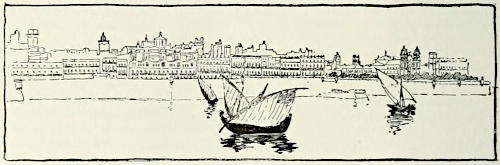
time their settlements, of which Gades, now Cadiz, was the first and most
powerful, were confined to the coasts of Bætica, whence they supplied the
natives with the traffic of Asia Minor and the shores of the Mediterranean,
in exchange for the more valuable productions of the peninsula, such as gold,
silver, and iron.[1] Previously to their arrival, the use of these metals was,
it is said, unknown to the Celts and Iberians. At first, for the convenience
of their trade and their worship the Phœnicians obtained permission to
build magazines and temples: these soon expanded into villages, and the
villages into fortified towns. Besides Cadiz, Malaga, Cordova, and other
places of minor note were monuments of their successful enterprise, and
proofs of their intention to fix their permanent abode in a country on which
nature had lavished her choicest gifts. In time they penetrated into the
interior, and arrived in the heart of the mountainous districts of the north,
probably to superintend the operations of the mines which they had prevailed
on the natives to open. Coins, medals, and ruins, attesting their
continued location, have been found in most provinces of Spain, and even at
Pamplona in Navarre. Almost everywhere have they left traces of their
existence, not only in medallic and lapidary inscriptions, but in the religion,
language, and manners of the people.
It is possible, however, that the residence of this people in Spain may
have been confounded with that of the Carthaginians. The similarity in
language, manners, and superstitions might naturally have diminished the
distinction between the two nations, and in time destroyed it. The uncertainty
which hangs over this period, and the apparent incongruity of the
few dates handed down to us, with the transactions which accompany them,
confirm the suspicion. The whole period, indeed, from the first settlement
of the Tyrians to the wars between the rival republics of Rome and Carthage,
is too conjectural to deserve the name of historical, though some few
facts are seen to glimmer through the profound darkness which surrounds
them.
[ca. 600-227 B.C.]
The successful example of the Phœnicians stimulated the Greeks to
pursue the same advantages. The Rhodians arrived on the coast of Catalonia,
and founded a town, which they called Rhodia (Rosas) from the name
of their island. They were followed by the Phocians, who dispossessed their
countrymen of Rosas, and extended their settlements along the shores of
Catalonia and Valencia. Other expeditions departed from the numerous
ports of Greece, towards the same destination, but at intervals considerably
distant from one another, and gave names to new establishments, some of
which may be still recognised, notwithstanding the changes that time has
made. It does not appear that either the Phœnicians or the Greeks aimed
at domination; the towns which they founded, and continued to inhabit,
were but so many commercial depots—populous indeed, but filled with
peaceable citizens, whose lucrative occupations afforded them neither time
nor inclination for hostilities. Not so with the Carthaginians, who joined
all the avarice of merchants to all the ambition of conquerors.
The African republic had long watched with jealousy the progressive
prosperity of the Tyrians, and waited for an opportunity of supplanting
them. That opportunity at length arrived (480 B.C.). The avarice of
these merchants had caused them to adopt measures which the high-spirited
natives considered as oppressive. A dispute arose: both parties recurred to
arms; and, after a short struggle, the lords of the deep were forced to give
way before their martial enemies. Several of the Phœnician settlements
fell into the hands of the victors, who appeared bent on rescuing their soil
from these all-grasping strangers. Seeing Cadiz itself threatened, the latter
implored the assistance of the Carthaginians, who had already a settlement
on the little island of Iviza. The invitation was eagerly accepted; perhaps,
as has been asserted, the Carthaginians had fomented the misunderstanding,
and urged it to an open quarrel. However this be, they landed a considerable
force on the Bætican coast; and, after a few struggles, the details of
which we should vainly attempt to ascertain, they triumphed over both
Phœnicians and natives, and seized on the prize they had so long coveted.
Thenceforth Cadiz served as a stronghold whither they could retreat whenever
danger pressed too heavily, and as an arsenal where fetters might be
manufactured for the rest of Spain.
The progress of the Carthaginian arms, we are told, was irresistible; it
was not, however, rapid, if any reliance is to be placed on the dates of
ancient writers: the provinces of Andalusia, Granada, Murcia, Valencia,
and Catalonia did not acknowledge the supremacy of the republic until, with
some other provinces, they were overrun, rather than subdued, by Hamilcar,
father of the great Hannibal (235 B.C.), and most of the warlike nations in
the interior, especially in the mountainous districts, never afterwards bent
their necks to the yoke, though the veteran armies of Africa were brought
against them.
Eight years were spent by the Carthaginian general in extending and
consolidating his new conquests. He had need of all his valour—and few
captains had ever more—to quell the perpetual incursions of tribes glorying
in their independence, and strangers to fear. For this purpose he built several
fortresses (the important city of Barcelona is said to have been among
the number), in which he distributed a portion of his troops to overawe the
surrounding country; while, with another portion, he moved from place to
place, as occasion required his presence. Probably his severity alienated the
minds of the people from the domination he laboured to establish. He was
checked in the career of his conquests by the Edetani and Saguntines, who
openly revolted, and made vigorous preparations for their defence. He fell
upon them, but neither the number of his forces nor his own bravery could
succeed against men to whom the hope of freedom and of revenge gave irresistible
might. Two-thirds of his army perished, and himself among the
number. His son Hannibal being too young to succeed him, the administration
of the Carthaginian provinces and the conduct of the war devolved, by
a decree of the senate, on his son-in-law Hasdrubal, who adopted towards
the natives a line of conciliation; he could be cruel when he chose; but as
there is reason to believe that he aimed at an independent sovereignty, he
wished to secure their support in the event of a struggle with Carthage.
Punic loyalty, like Punic faith, could subsist no longer than a regard to self-advantage
would permit.
[227-219 B.C.]
The city of Cartagena, which Hasdrubal founded on the modern gulf of
that name, and which he furnished with an admirable harbour, was the most
glorious monument of his administration. The success of his arms, the
nature of his designs, roused the fears both of the Greek colonies on the
coast of Catalonia and Valencia, and of several independent nations in
the interior. They resolved to call in a third power, which had long
regarded with jealousy the growing prosperity of Carthage. Rome eagerly
embraced the cause of the discontented states (227 B.C.), probably, indeed,
she had secretly fomented that discontent. She sent a deputation to Carthage,
which obtained from the senate two important concessions: that the
Carthaginians should not push their conquests beyond the Ebro; that they
should not disturb the Saguntines and other Greek colonies. Though Hasdrubal
promised to observe them, he silently collected troops, resolved to
make a final effort for the entire subjugation of Spain before Rome could
succour the confederates. In three years, his formidable preparations being
completed, he threw off the mask, and marched against Saguntum. On his
way, however, he was assassinated by the slave of a man whose master, a
native prince, he had put to death.[2] The attachment of this slave to his
master’s memory could be equalled only by the unshaken firmness with
which he supported the incredible torments inflicted on him by the fierce
Hannibal.
This famous Carthaginian was in his twenty-fifth year. He was more to
be dreaded than all his predecessors united. To military talents and personal
valour, perhaps unexampled in any age, he joined astonishing coolness
of judgment and inflexibility of purpose. While Hasdrubal was actuated
only by selfish considerations, Hannibal recognised, as the great principle of
his actions, revenge—revenge against the bitter enemy of his country, and
still more against the destroyers of his kindred. There is a moral grandeur
in this all-engrossing purpose of Hannibal, which, notwithstanding its fell
malignity, unaccountably rivets our admiration.
The young hero lost no time in extending his conquests, and amassing
resources for the grand approaching struggle with the Romans. Having
subdued some warlike tribes of modern Castile and Leon, and brought into
full activity some rich silver mines at the foot of the Pyrenees, he marched
at the head of 150,000 men against Saguntum, which he invested in due
form. In vain did the Roman deputies whom the senate despatched for the
purpose intimate to him that an attack on the ally of the republic would be
regarded, as a declaration of war against the republic herself. He had vowed
the destruction of the city. Yet, though he pressed the siege with the
utmost vigour, such was the valour of the defenders that neither his mighty
genius for war nor his formidable forces could reduce the place in less than
nine months: it would not even then have fallen, had not famine proved a
deadlier enemy than the sword. The citizens resolved that the last act of
this fearful tragedy should be a suitable consummation of the preceding
horrors. Having amassed all their valuable effects, and everything combustible,
into one pile, and placed their wives and children around it, they
issued from the gates, and plunged into the midst of the surprised enemy.
The slaughter was prodigious on both sides; but, in the end, numbers
and strength prevailed against weakness and desperation; the Saguntines
were cut off almost to a man. No sooner was their fate known in the city
than their wives, who were in expectation of the result, set fire to the
pile, and cast both themselves and children into the devouring element.
The city in flames soon discovered the catastrophe to the Carthaginians, who
immediately entered, and put what few stragglers they could find—chiefly
the aged of both sexes—to the sword.[3] Some, however, had previously
secured their safety by flight. Thus perished one of the most flourishing
cities of Spain, and one which will be forever memorable in the annals of
mankind (219 B.C.). Its destruction hastened, if it did not occasion, the
Second Punic War, as described in the history of Rome.
Hannibal mustered his forces for the invasion of Italy. The exploits
of the Carthaginian hero beyond the bounds of the peninsula have been
treated of in the history of Rome. While he is spreading destruction around
him, and the towers of “the eternal city” themselves are tottering, our task
must be to cast a hurried glance at the transactions which, after the invasion
of Scipio, happened in the country he had left behind. The Carthaginian
yoke is allowed on all hands to have been intolerable. The avidity with which
the local governors sought pretexts for seizing on the substance of the natives;
the rigour with which some of the captive tribes were made to labour in the
mines; the exactions of a mercenary and haughty soldiery; the insolence
of success on the one hand, and the smart of wrongs endured on the other—prepared
the way to the commotions which shook all Spain to its centre, and
ultimately ended in the destruction of its oppressors.g
[219-206 B.C.]
The Romans, either alarmed by the progress of Hannibal, or becoming
aware of the value of such allies as the Spaniards, now sent larger armies to
their assistance, headed by their ablest generals. Spain was the theatre
of the first exploits of Publius Cornelius Scipio, afterwards surnamed Africanus
from his victories over the Carthaginians in Africa. In Spain, Scipio
gained the hearts of the natives by his great and good qualities, not the
least of these being his self-command—one instance of which has ever since
been a favourite theme with painters, poets, and moralists. The charms of
a beautiful captive had touched his young heart, and the laws of the age
made her in every respect his slave. He respected her undefended loveliness,
and restored her, in unsullied purity, to her betrothed bridegroom.
In cordial co-operation with the Spaniards, Scipio finally expelled the Carthaginians
from Spain in 206 B.C.
[206-45 B.C.]
The object of the Romans, in assisting the Spaniards against Carthaginian
oppression, had not been the emancipation of their gallant allies. They
immediately proceeded to reduce the peninsula to the condition of a Roman
province, governed by their prætors. This
was not easily or speedily accomplished.
The natives resisted their new, as they had
done their former invaders. Numantia,
besieged by a second Scipio, emulated the
heroism of Saguntum.b In vain did the
inhabitants send deputations to the consul;
he coolly replied that he was content to
await the inevitable effects of famine. But
their impatience could not await the slow
effects of such a death; some took poison;
some fell on their swords; some set fire to
their houses and perished in the devouring
flames. Thus perished all; not a living
creature survived (133 B.C.).g The Cantabrians,
who inhabited the northwestern
part of the peninsula, were not even nominally
subdued during the continuance of
the Roman Republic. The other portions,
Celtiberia in the north, Bætica in the
south, and Lusitania in the west, were conquered
after a long struggle, and constituted
the Roman province, but remained
the scenes of constantly recurring warfare.
The natives revolted against the extortion
and tyranny usually practised by the Roman
governors of subject states; and the leaders
of republican factions, when defeated everywhere
else, often found in Spain abundant
means of making head against the masters
of the world.
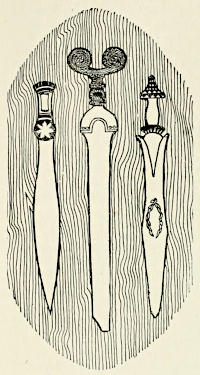
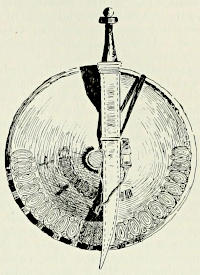
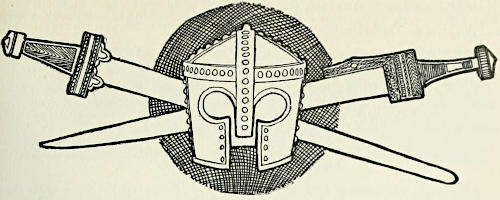
Gallo-Roman Weapons
The most remarkable of the native insurrections was that organised in
Lusitania by Viriathus. This extraordinary man was bred a shepherd; he
turned robber, became the captain of a band of outlaws, and raising a standard
to which all the disaffected flocked, he defeated several Roman armies. He
was vanquished by treachery, the consul Servilius having bribed three of his
followers to assassinate him in his sleep. After his murder, the rebellion,
as the haughty conquerors termed every insurrection for self-defence, was
speedily quelled. Spain was soon afterwards the theatre of the last struggle
of the horrible civil wars with which Marius and Sulla desolated the Roman
world. When Sulla had finally triumphed at Rome, Sertorius, a leader of
the defeated party, fled to Spain, and there long bade defiance to the dictator’s
power. He was at length vanquished by Cneius Pompeius Magnus, familiarly
called Pompey the Great, and, like Viriathus, was murdered by his own
treacherous partisans. Pompey, during his command in Spain, merited the
good-will of the nation, which subsequently espoused his cause in his contest
with Julius Cæsar. After Pompey’s death his party still held out in Spain.
But Cæsar repaired thither in person; his military skill prevailed, and the
province was shortly pacified.b As long as Rome treated the provincials
merely as a conquered people the provincials remained unsubdued; but as
soon as wiser and more friendly counsels generally prevailed, the Roman
Spaniard grasped the hand that was extended to him, and became one of the
proudest and most loyal citizens of the empire. Left to themselves, the
tribes were ever divided, factious, disturbed. United under Lusitanian Viriathus
or even under Roman Sertorius, they long successfully withstood the
power of the republic. United under Julius and Augustus Cæsar, they
became the most Roman of the provincials of Rome.
[229 B.C.-138 A.D.]
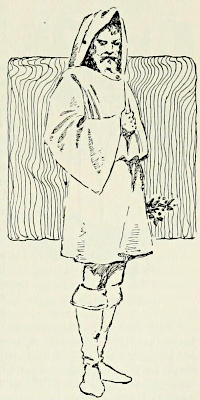
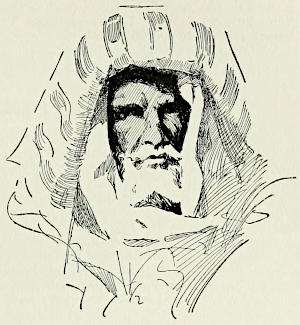
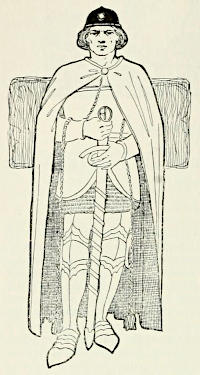
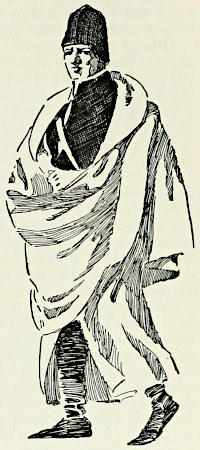
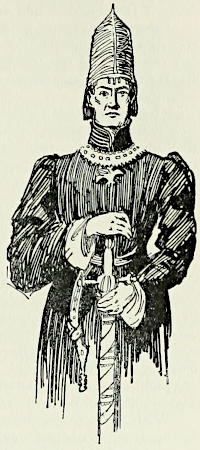
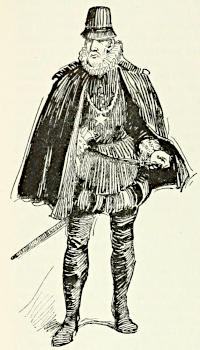
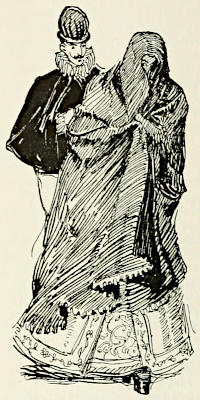
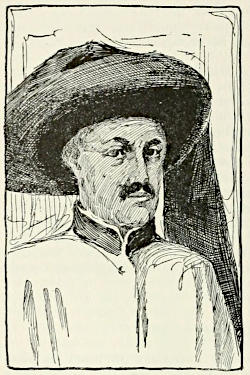
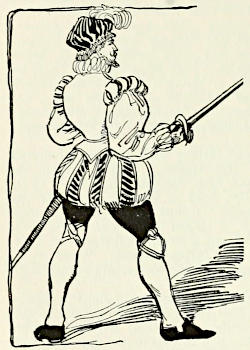
A Gallo-Roman
A great susceptibility to personal influence has ever been a striking
characteristic of the Spanish people. Under the sympathetic Hasdrubal they
accepted the dominion of Carthage; under the fiery Hannibal they fought,
the hardiest and most loyal of his soldiers, in the Punic armies in Italy. In
the early days after Saguntum, when Roman Scipio came, not as a destroyer
but as a deliverer, and displayed his greater qualities of clemency and justice,
the Spaniards would have compelled him to be their king. But Scipio was
not always clement. The successors of Sempronius Gracchus were not always
just. They were not even judicious. “For great men,” says the Spanish
proverb, “great deeds are reserved.” And
the coming of one of the greatest men the
world has ever seen was the beginning of
the end of the dark days of early Spanish
history. Cæsar, indeed, marched sternly
through the country at the head of his
legions; nor did he stay his hand until he
had reached far off Corunna, where he chastised
and astonished the wild tribes of Brigantium
or Finisterre; but his policy in the
more settled districts was ever genial and
pacific. Four times did Cæsar visit the
peninsula; and the fourth time—his legions
well filled with loyal and admiring Spaniards—he
fought, “not for glory but for
existence,” on the bloody field of Munda.
And with the final triumph of the great
Julius begins the peace and prosperity of
Roman Spain.j
Disturbances, however, again broke out,
and it was only under Cæsar’s successor,
Augustus, that it was finally and completely
subjugated, even the Cantabrians being
then at last subdued. Once reduced to submission,
Spain appears to have slumbered
for ages in the tranquillity of servitude,
under the despotic sway of the Roman
emperors. It was esteemed one of the most
valuable and flourishing provinces of the
empire, containing, as we learn from Pliny,h
not less than 360 cities. During her subjection to a thraldom, shared with
all the then known world, Spain boasts of having given birth to the celebrated
Roman poets Lucan and Martial, to the philosopher Seneca, and to two
of the very few good Roman emperors, Trajan and Hadrian, as well as to many
other men of distinguished character, though of somewhat inferior note.b
[206 B.C.-161 A.D.]
It must not be supposed that the authority of the Roman officers extended
at first over all the cities of the peninsula. Some cities were governed even
in the last resort by their own laws; some depended immediately on the
metropolis of the Roman world; some were free, and left to their ancient
laws and tribunals. They were colonial, municipal, Roman, allied, tributary;
and others there were which enjoyed the right of Latium. Thus the province
of Tarragona contained 179 cities, of which 12 were colonial, 13 Roman,
18 enjoying the Latin law, 1 ally, and 135 tributary. Bætica had 185
cities; viz., 9 colonial, 18 municipal, 29 of the
Latin law, 6 free, 3 allied, 120 tributary. Lusitania
had 45; 5 colonial, 1 municipal, 3 Latin,
36 tributary.
The colonies were peopled by the citizens
of Rome, chiefly by soldiers. The inhabitants of
these establishments forfeited not the slightest
of their privileges by their location in the provinces.
The municipal cities were those which
were admitted to the honour of Roman citizenship;
which were in like manner exempted
from the jurisdiction of the provincial governors;
and the inhabitants of which could
aspire to the highest dignities even in “the
eternal city.” The right of Latium was less
valuable: in the cities possessing it, the magistrates
only were recognised as Roman citizens.
The free cities (immunes) were such as the
conquerors left in the undisturbed possession
of their native laws and tribunals, and were
not taxed towards the support of the rest of the
empire. This privilege was conferred with reluctance,
or rather extorted by necessity, and
was always regarded with jealousy; to six
Spanish cities only was it granted. The allied
cities (confæderatæ) were still fewer in number,
and were at first really independent, as the word
implies. The tributary cities (stipendiariæ)
occupied the lowest grade in the scale of civic
society, and were those which chiefly supported
the cumbrous frame of Roman government.
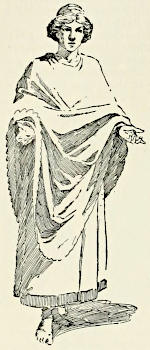
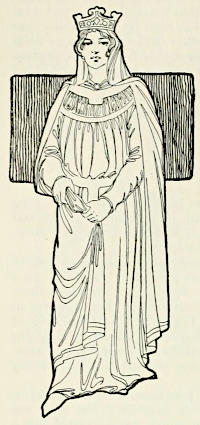
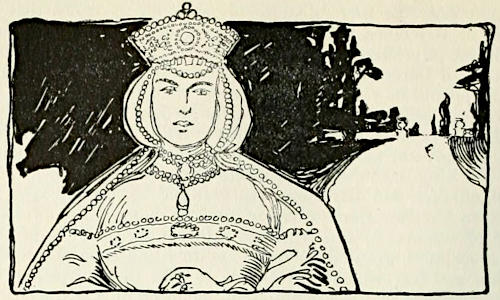
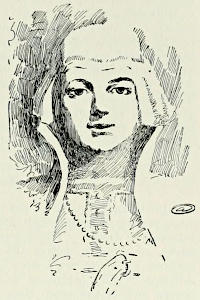
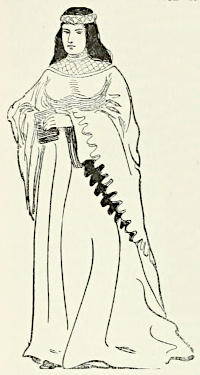
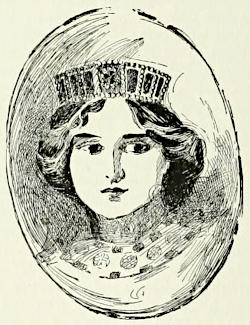
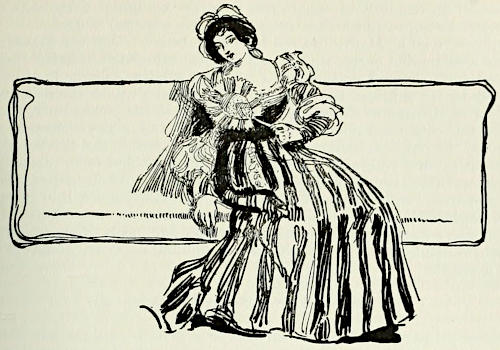
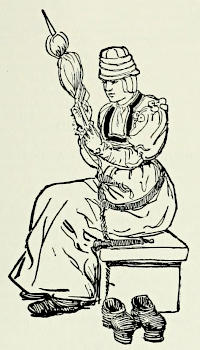
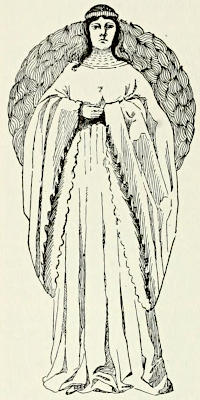
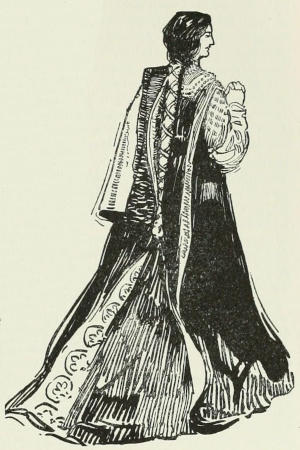
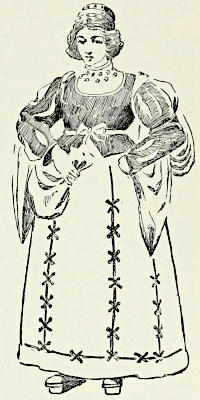
A Gallo-Roman Woman
But the distinctions between these various classes were not long maintained.
By Otho many Spaniards were admitted to the rights of citizenship;
by Vespasian, such of the cities as had not the privilege already were presented
with the right of Latium; and by Antoninus every remaining barrier
was removed, all his subjects throughout his vast empire being declared citizens
of Rome: from this moment the civil constitution of that empire was of
necessity uniform. The cities which obeyed the constitution of Rome were
governed in a manner similar to those of Italy. Each had its municipal council
or curia, the members of which (decuriones) were chosen from the principal inhabitants
of the provinces. Their office, however, appears to have been
unenviable, because it was in all probability gratuitous and because they were
responsible for the payment of customs. Nothing need be said on its laws, as
they are the same as those which governed Rome under the republic and the
empire.
The military state of Spain under the Romans is a subject little understood.
That a considerable number of troops for foreign wars was furnished
by this important province is attested by numerous inscriptions; but, except
in cases of difficulty and danger, the Roman troops in the peninsula seldom
exceeded three legions—a force so inconsiderable that either the natives
must have lost all desire to recover their ancient independence, or they must
have become completely reconciled to the domination of their proud masters.
The policy, indeed, which admitted them not only to the honour of citizenship,
but to the highest dignities, civil, military, and even religious, must have
been admirably adapted to insure not merely the obedience but the attachment
of the conquered.
So long as the empire continued prosperous, Spain, notwithstanding the
evils it was made to endure, could not but participate to a certain extent in
the general prosperity. The arts of life, the most elegant no less than the
useful, were taught to flourish: that architecture had reached a high degree of
perfection is evident from the numerous remains of antiquity which time has
spared; that agriculture was cultivated with equal success, is no less apparent
from the testimony of that most excellent of judges, the naturalist Pliny.
The riches of the soil, in corn, in oil, and in fruits, were almost inexhaustible;
and the sheep were held even in higher estimation in those days than in the
present. The vine was cultivated with so much success that the juice of
the grape produced in the environs of Tarragona was pronounced equal to
the best wines of Italy. These productions, with those of the mines, and the
demand for native manufactures, gave rise to an extensive commerce; more
extensive, indeed, than that which had existed under the Carthaginians.
There was this important difference between the two conquering nations:
while the African, with the characteristic selfishness of a trader, engrossed
every advantage to himself, the noble-minded Roman admitted others to a
free participation in those advantages.
[206 B.C.-305 A.D.]
If tradition as an authority had not long ceased to be recognised on this
side the Pyrenees, the historian would have little difficulty in fixing the
period of the introduction of the Christian faith into Spain. Its uninterrupted
voice has named St. James the Elder as the first herald of the Gospel
to the idolatrous people of that country. That the apostle traversed the
peninsula, from Lusitania and Galicia to the heart of Aragon; that while at
Saragossa he was honoured by a visit from the Virgin, and that by her
express command he erected on the spot a church in her honour; that after
his martyrdom at Jerusalem his body was brought by his disciples from Syria
to Iria Flavia (now El Padron), in Galicia, and thence transferred to Compostella,
to be venerated by the faithful as long as the world shall endure, no
orthodox Spaniard ever doubted. With equal assurance of faith it is believed
that St. Paul, in person, continued the work of his martyred fellow-disciple,
and sowed the seeds of the new doctrine in Catalonia, Aragon, Valencia, and,
above all, in Andalusia. Certain it is that Spain can adduce her martyrs as
early as the second century—perhaps even in the first.
It was during the reign of the fierce Diocletian that the fires of persecution
blazed with the greatest fury throughout the peninsula. It must not,
however, be concealed that the crown of martyrdom was sometimes pursued
with an eagerness that evidenced rather the intemperance of a mistaken zeal,
than the soberness of a rational principle. The fury of persecution cooled
after the death of Diocletian. During the civil wars which ravaged the
empire under Maximian and Constantius Chlorus, the Christians began to
breathe: Constantine followed; and, after his conversion, the church had
peace from without; but within, the partisans of Athanasius and Arius
clouded the horizon of her tranquillity.
[305-400 A.D.]
Of the three national councils held during the first four centuries, the
first is that of Illiberis or Eliberis, a town once seated near modern Granada.
It may also be termed the most interesting, as it was probably held before
the conversion of Constantine, and, therefore, some years anterior to that of
Nicæa: if so, it is the most ancient council, not merely of Spain, but of the
Christian world, the acts of which have descended to us. That of Cæsar-Augusta
(Saragossa, 380 A.D.), which was also national, consisted of only
twelve bishops, and was convened for the sole purpose of condemning the
heresy of Priscillian. The third, which was the first council of Toledo (400
A.D.), was attended by nineteen bishops, with a corresponding number of inferior
ecclesiastics. Its first act was to admit the canons of Nicæa; especially
those which relate to the ordination of priests; but it is chiefly remarkable
for its symbol of faith, in which that great Catholic doctrine, the procession of
the Holy Ghost from the Father and the Son [filioque], is expressly asserted;
a doctrine, as is well known, not formally received by the universal church
before the fourth Lateran council in 1215. Its twenty canons relate to holy
orders, to the chastity of virgins devoted to God, and to the continency of
ecclesiastics and their widows. From these councils it does not appear that
the Spanish church had yet received the dignity of primates, archbishops, or
metropolitans. The bishops seem to have been equal in power, and independent
of one another, the only superiority admitted arising from priority
of consecration; neither is there any reason for concluding that appeals were
of necessity carried to Rome, though the superior veneration attached to that
see, and the superior characters of those who filled it, rendered such appeals by
no means uncommon. The bishops and the clergy were elected by the people.
Baptism was administered by the bishop or the presbyter, or, in their absence,
by the deacon. In cases of urgent necessity, it could also be administered
by a layman, provided he had not contracted a second marriage.
Ceremonial penance was a public satisfaction given to the church where
the crime was more than usually scandalous; the penitent, in this case,
occupied a place separated from the rest during a period proportioned to
the heinousness of the offence. A penance of one year was inflicted on the
player of dice, because the heathen deities were necessarily invoked in this
ancient game; of two years on the subdeacon who married a third time,
and on the ecclesiastic who wore a crown in imitation of the pagan priests; of
three years on him who lent his apparel for the use of pagan processions; on the
deacon who confessed a mortal sin before ordination, and on the parents who
broke the betrothals of their children; of five years on him who married his
daughter-in-law or sister-in-law, on the widow who sinned and married her
accomplice; on backbiters, in however trivial an affair, of husbands or wives
guilty of adultery, on single women guilty with different men, on deacons
proved guilty of any capital crime previous to ordination; and on housewives
who by stripes occasioned, involuntarily, the death of their slaves (if
voluntarily, the penance was seven years); of ten years on the apostate or
heretic on returning to the faith, on the Christian whom curiosity led to the
heathen sacrifices, on all prostitutes, and on all consecrated virgins who broke
their vow; of the whole life on the widow of a bishop, presbyter, or deacon,
who remarried, on those who frequently violated their conjugal fidelity, and
on the gentile priests who, after conversion and baptism, sacrificed to idols.
Besides these regulations, the bishop had power to suspend from all intercourse
with the faithful the man who sat at the table of a Jew, him who distributed
satirical or libellous compositions, and him whose scandals deserved
public censure.
There was one means by which the offenders just mentioned could obtain
their restoration to the privileges of communion, even before the expiration
of the time of penance decreed by the
canons. This was, by soliciting peace from
the confessors; that is, from such as had
sustained persecutions and torments for
the faith of Christ. The confessor gave
his peace to the penitent in an instrument
which he called literæ confessoriæ or pacificæ.
This the penitent presented to the bishop,
who immediately absolved him; and in
token of his readmission to the rights of
communion, gave him another instrument,
literæ communicatoriæ, which secured him
access to the sacramental table in whatever
church he appeared. This superstitious
custom was founded on the opinion that,
from the abundance of their merits, the confessors
could well afford a portion to such
penitents as had none of their own. What
a fruitful train of abuses indulgences occasioned
at a much subsequent period, and
how repugnant they appeared to the common
sense and common justice of mankind, is
well known.
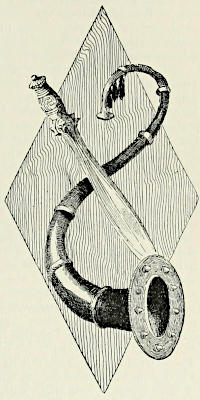
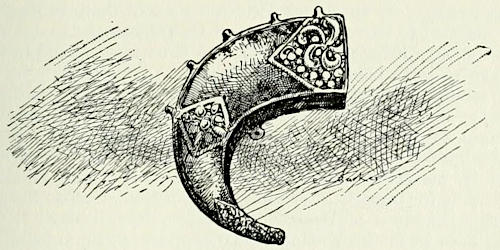
Gallo-Roman Sword and Horn
On the matrimony and continency of
the Spanish clergy, there has been much
acrimonious disputation: one party contending
that strict celibacy was obligatory on
them from the apostolic times; the other,
that marriage was permitted to them, under
certain restrictions, no less than to laymen.
One of the most singular characteristics of
the early councils of Spain is the permission granted to bishops and other
ecclesiastics to follow any honourable branch of commerce, but in their own
districts.
Persons consecrated to God were acknowledged and protected by the
early church; but monasteries were not introduced into Spain during the
first four centuries. The women who took, in the hands of the bishop and
before the altar, the vows of virginity; and the men who, in the same manner,
subjected themselves to the obligations of continence and religious contemplation,
passed their lives sometimes in their own houses, but generally in
communities of two or three in the abodes of aged ecclesiastics. The former
assumed the veil from their first profession, as a public sign of their calling.
But lest war should be sworn before the strength of the enemy was known,
the council of Saragossa decreed that no woman should utter the irrevocable
vow, or assume the veil, before the age of forty years, though previous to that
period chastity was strongly recommended, and its observance consecrated.
Some of the provisions, especially of the first council, will appear unreasonably
severe. We must, however, take into consideration the prevalence of
idolatry at the beginning of the fourth century, and the anxiety of the fathers
of Illiberis to preserve their flocks from the infection of paganism. The
canons which regard the remarriage of the widows of ecclesiastics are sufficiently
absurd. The sixty-seventh, which prohibited Christian women from
keeping long-haired slaves, requires explanation. These slaves were males,
generally of Gaul or Germany, and their ostensible business was to dress the
hair of the rich ladies; their real one—such was the depravation of manners
produced by paganism—was to gratify the licentious desires of their mistresses.
But the gradual decline of heathenism, no less than the increasing
influence of Christianity, purified the female mind.
[380-395 A.D.]
Like the other Christian provinces of the empire, Spain had its heresies.
Omitting that of Arius—which, during the reign of Constantine and his
sons, so much distracted the Christian world, and against which Osius, the
bishop of Cordova, signalised himself with a zeal only inferior to that of
Athanasius himself—the most remarkable was the heresy of the Priscillianists.
One Mark, an Egyptian heretic, having sown the seeds of gnosticism
in Gaul, passed into Spain, where the fluency of his speech, no less than the
nature of his doctrine, procured him some disciples, among whom Priscillian
was the most eminent. This Spaniard was rich, eloquent, subtle, enterprising,
and consequently well adapted both to extend and to multiply the
errors of Mark, of which he soon became the acknowledged head. He
taught that marriage was an unnatural and tyrannical restraint; that pleasure
was one of the great privileges of our nature; that to live according to
the impulses of nature was the part no less of virtue than of wisdom. He
held the Manichæan doctrine of the two great principles; and, with Sabellius,
confounded the persons of the Trinity. To all this he joined the Chaldean
superstition of starry influences, and the metaphysical subtleties of the Egyptians
and Greeks. A multitude of women soon embraced the sensual system
of this arch-heretic; their example constrained the other sex: even the
clergy were at length infected by the pleasing errors; and, to crown all, two
bishops of Bætica openly professed themselves the followers of Priscillian.
The orthodox party beheld with alarm the progress of this detestable heresy.
Finally the vindictive fury of his enemies prevailed, even more than the justice
of their cause. Priscillian and his partisans were beheaded (384 A.D.).
So long as Maximus lived, the numerous adherents of Priscillian were
pursued with unrelenting severity by Idatius; but soon after the death
of that emperor, this turbulent prelate, whose cruelties had long revolted
his episcopal brethren, was banished, and the heat of persecution began to
abate. Yet Priscillianism was not extirpated; notwithstanding its renewed
condemnation by the first council of Toledo, it continued to distract the
church of Spain long after the accession of the Gothic dynasty.
From the accession of Honorius the Roman Empire existed only by sufferance.
The fierce hordes of northern Europe now prepared to inundate
the fertile provinces of the south, and the more powerful local governors to
secure themselves an independent sovereignty. Spain was soon agitated by
the spirit which spontaneously burst forth from Britain to Thrace. While
Constantine, who had assumed the purple, raised England and the Gauls
against the feeble successor of the Cæsars, his son Constans passed the
Pyrenees to gain over the natives of the peninsula. The youth found or
made adherents, and was for a time successful; but in the sequel he was
compelled to return to Gaul for reinforcements. The appearance of another
candidate for empire (Jovinus) distracted the attention and weakened the
efforts of the kindred adventurers; and ultimately all these became successively
the victims of imperial vengeance, chiefly by means of the warlike
tribes whom the minister of Honorius had marched from the shores of the
Baltic, to crush the new insurrections. But the policy of that minister was,
if not perfidious, at least short-sighted.
[395-415 A.D.]
The barbarians whom he had thus introduced into the heart, and to whom
he thus betrayed the weakness of the empire, from allies soon became masters.
They looked with longing eyes on the rich plains of southern France and of
Spain. At length, finding the Pyrenean barrier but negligently guarded, the
Suevi, under their king Hermeric, the Alans under Atace, and the Vandals
or Silingi, under Gunderic, burst through it, and poured the tide of destruction
over the peninsula (409 A.D.). The ravages of these barbarians, we are
told, were dreadful. Towns pillaged and burned, the country laid waste, the
inhabitants massacred without distinction of age and sex, were but the beginning
of evils. Famine and pestilence made awful havoc; the wild beasts,
finding nothing to subsist on in their usual haunts, made war on the human
species; and the latter consumed the very corpses of the dead. Nay, mothers
are said to have killed their children to feed on their flesh.[4] The conquerors
at length ceased from their wantonness of desolation. They found that to
turn the country into a wilderness was not the best policy in men who
designed it for a permanent abode. They divided it by lot: Bætica fell to
the Vandals, Lusitania to the Alans, and Galicia, with a great portion of
Leon and Castile, to the Suevi.
A fourth people, more formidable than the rest combined, came to trouble
the new settlers in their possessions. These were the Goths under Atawulf,
(Ataulphus) whom Honorius had the address to remove from Italy, by
ceding to them the fertile provinces of southern Gaul, and the peninsula.
Having established the seat of his kingdom at Narbonne, where he married
his imperial captive Placidia, he passed the Pyrenees, made a triumphant
entry into Barcelona, and from thence undertook several expeditions against
the Vandals. A conspiracy was formed against his life; and the sword of
a dwarf pierced his body, as he was conspicuously watching the evolutions
of his cavalry, in the courtyard of his palace at Barcelona.
Sigeric succeeded, whose ruffianly conduct instantly drew on him the
detestation of the Goths. Scarcely had he put to death the six surviving
children of Atawulf, and compelled the widowed Placidia to adorn his triumph
by walking barefoot through the streets of Barcelona, than another conspiracy
deprived him of his throne and his life. The election of the Goths now fell on
Wallia, a chief every way worthy of their choice (415). His first expedition,
however, against the Roman possessions in Africa was disastrous. A violent
tempest destroyed his fleet, and forced him to relinquish his design. The
news of this disaster soon reached Gaul, and brought Constantius, the general
of Honorius, at the head of a numerous army, towards the Pyrenees. Wallia
collected the remnant of his troops, and hastened to receive him. Fortunately
for the Gothic king, love rather than ambition occasioned the hostile
approach of Constantius. That general was more anxious to gain possession
of Placidia, whose hand had been promised him by the emperor, than to
effect the destruction of the king. No sooner did the two armies encamp
in sight of each other, than he proposed peace on conditions too advantageous
to be rejected. Wallia had only to surrender the royal widow, and
promise to march against the Suevi and the other nations who held possession
of the peninsula, to secure not merely the neutrality but the favour of
the Romans. Placidia was restored, and peace made with the Romans.
[415-429 A.D.]
Hostilities were now vigorously commenced against the kindred barbarians.
The Vandals were expelled from their habitations, and forced to seek
an asylum among the Suevi of Galicia. The Alans of Lusitania were almost
entirely cut off, with their king Atace: the remnant incorporated with the
Vandals, and their name forever disappeared from the peninsula. The Suevi
would doubtless have shared the fate of one or other of these people, had they
not hastened to acknowledge themselves tributaries of Rome; they were left
in undisputed possession of the country they inhabited. The pride of Honorius
caused him to regard these signal successes as for his own benefit. The
victor was rewarded with a portion of Languedoc and Gascony, from Toulouse
to the ocean. That city he made the seat of his kingdom, where he
died, two years after his glorious triumphs. From this time to the reign of
Euric, the Goths remained chiefly in their new possessions, and were seldom
in Spain. Though they considered themselves the rightful lords of the
country, the real sovereignty rested with the Suevi and Vandals.
Under the reign of Theodoric I, Wallia’s successor, the Vandals made
war on the Suevi. The latter retreated to the fastnesses of the Asturias.
The Vandals forsook Galicia, and fought their way to their former settlements
in Bætica, whence Wallia had expelled them. To that province they communicated
their name—Vandalusia; which was subsequently changed into
Andalusia.[5] There they maintained themselves, in opposition to the imperial
generals. The ports of Andalusia and Granada presented them with facilities
for pushing their successes on the deep. They constructed a fleet;
infested the Balearic Isles; pillaged the coast of Valencia; sacked the city
of Cartagena; laid waste the shores of Mauretania; and returned to Seville,
where the last act of their king, Gunderic, was to despoil the opulent church
of St. Vincent.[6] A new and higher career was now opened before them.
The offer made them by Boniface, the African prefect, of two-thirds of that
country, if they would assist him against his enemies, they joyfully accepted.
Before embarking, however, they inflicted a terrible blow on their enemies,
the Suevi, whom they overthrew near Merida—whom they precipitated, with
their king, into the waters of the Guadiana. They then tranquilly returned
to the sea coast; and, to the number of eighty thousand, passed over to
Africa, in March, 429, eighteen years after their arrival in Spain.
[429-469 A.D.]
The retreat of these restless barbarians did not insure tranquillity to
Spain. The Suevi, under their new king, Hermeric, issued from their dark
mountains, and bore down on the peaceable inhabitants of Galicia. But it
was reserved for his son Richilan, to whom, in 438, he resigned his sceptre,
to raise the fame of the nation to the highest pitch. He routed the Romans
on the banks of the Venil, and seized on Merida and Seville.
In the meantime, Theodoric was no less occupied in humbling the Roman
power in southern Gaul. While meditating hostilities against the triumphant
Suevi, he was summoned to encounter the renowned Attila, king of the
Huns. His well-known valour placed him at the head of the right wing of
the Franks, Romans, and Goths, who combined to arrest the progress of the
tremendous torrent. His death on the plains of Châlons (451) where the
pride of the barbaric king was humbled, endeared him still more to his
subjects, who gratefully elevated his son Torismond to the vacant throne.
But the reign of the new king was brief, and his end tragic. In one year, by
the hands of his two brothers, he was deprived of empire and of life, in his
capital of Toulouse; and Theodoric II, the elder of the fratricides, was elected
in his place.[7] The reign of this prince was diversified by alternate success and
disaster. He first turned his arms against the Suevi, whom he vanquished,
and made their king, Richiarius, prisoner; but being recalled to France, the
army which he left in the peninsula was routed by the natives of Leon, who
were indignant at the excess it committed. The whole country was now
in the most miserable condition. Goths and Romans and Suevi traversed
it in every direction, and everywhere left melancholy vestiges of their barbarous
fury. Another fierce tribe, the Herulians, landed on the coast of
Catalonia, and zealously prosecuted the same work of desolation. Then the
Suevi split into two parties, which pursued each other with the most vindictive
feelings, but which were always ready to combine when the natives were to
be plundered, or when Goths and Romans were to be opposed.
The Spaniard was the prey of all: his labour was doomed to support the
innumerable swarms which spread from the Pyrenees to the rock of Calpe,
and which, like so many locusts, destroyed wherever they settled. The
scourge was more than galling—it was intolerable. Native bands were at
length formed in most parts of the peninsula, not merely to take vengeance
on the rapacious invaders—for in that case they would have been a blessing
to their country—but to plunder all who came in their way. Many of these
horrors would have been averted, had Theodoric been at liberty to return in
person to Spain, and finish its subjugation; but his wars with the Romans,
the Burgundians, and the Franks found him for some years employment
enough. At length he was assassinated, it is said, by his brother Euric, in
his capital of Toulouse. One of the first acts of Euric was to despatch an
army to humble the pride of the Suevi. His arms were eminently successful.
The Suevi sued for and obtained peace, and were allowed to remain in undisturbed
possession of Galicia, with a portion of modern Leon and Portugal,
and to retain their kingly form of government. So completely were they
become the vassals of the victors that during a whole century they remained
in quiet subjection. We hear no more of them until the time of Leuvigild,
who dealt the last blow to their national existence, and, as we shall hereafter
see, incorporated them with his Gothic subjects.
[469-522 A.D.]
The Romans were less fortunate; their domination in the country was
ended forever by the fall of Tarragona. They continued, indeed, to hold a
few unimportant places on the coast; not because they had valour to defend
them, but because Euric had no naval force to assail them from the sea. The
conqueror, though master of all Spain, disdained to be confined within limits
which his ambition deemed much too narrow. Rome was now tottering to her
fall; and he resolved to pluck some of the most fertile provinces of Gaul from
her feeble grasp. Odoacer the Mercenary, king of Italy, renounced in his
favour all the Roman provinces beyond the Alps, as far as the Rhine and the
ocean: and thenceforward the Goths regarded Gaul and Spain as their lawful
inheritance. The victor established the seat of his empire at Arles, where
he passed in tranquillity the remainder of his days. He died in that capital,
(484 A.D.) after engaging his subjects to elect for their king his son Alaric.
Euric was the founder of the Gothic kingdom of Spain. The extinction of
the Roman sway, and the subjection of the Suevi, rendered him absolute lord
of the country. The six kings, his predecessors, were rulers in Gaul, not of
Spain; however they might regard its provinces as rightfully their own, they
could obtain possession only by force of arms. Their conquests, however,
had been partial and temporary; before Euric, the peninsula was overrun,
not subdued. He was also the first legislator of his nation. The laws
which he collected and committed to writing served as the foundation of the
famous Gothic code, known by the name of the Forum Judicum, or Fuero
Juzgo. He was a great prince; but the fratricide which is believed to have
opened him the way to the crown, and the cruelty with which he persecuted
the orthodox (like his predecessors, he was an Arian), are dreadful stains on
his memory.
But Alaric was unable to tread in the steps of so great a prince as his
father. In vain did his father-in-law Theodoric, who had just founded the
kingdom of the Ostrogoths in Italy, interpose in his behalf: the fierce
Clovis marched towards Poitiers, where Alaric then lay, resolved, as he said,
to expel the heretical Arians from the soil of Gaul.[8] The Visigoths, after a
sharp conflict, were routed with great loss, and their king was left dead on the
field. Clovis pursued his successes, and soon reduced the greater part of
their possessions in the south of France, and entered victorious into their
capital of Toulouse.[9] Alaric left a son; but as he was too young to be
intrusted with the government, his bastard brother, Gesalric (Gensaleic)
had the address to procure the elective crown. But the king of the Ostrogoths
invested Gaul, overthrew the Franks, who were pressing the siege
of Carcassonne, and forced Gesalric to seek for safety in Barcelona. The
humbled Clovis was glad to sue for peace from the formidable Theodoric,
who united the two kingdoms of the Ostrogoths and Visigoths under his
own sceptre. To Theudes, one of his ablest generals, he intrusted the
administration of the country and the guardianship of his grandson. Theodoric
resigned the sceptre of Spain to his grandson, on that prince’s arriving
at a suitable age. Theudes now retired into private life.
[522-554 A.D.]
Amalaric was the first Gothic king who established his court in Spain,
in the city of Seville. To Athalaric, the successor of Theodoric, he ceded
that portion of France which lies between the Rhone and the Alps, and
received in return his father’s treasures, which Theodoric had removed from
Carcassonne to Ravenna: in the rest of Gothic Gaul, with all Spain, he was
solemnly confirmed by Athalaric. To secure his possessions in Gaul against
the formidable Franks, Amalaric demanded and obtained the hand of
Clotilda, the sister of the royal sons of Clovis. But the union was unfortunate.
The king was a violent partisan of Arius; the queen as obstinate
a professor of orthodoxy: at first each attempted to convert the other; but
finding their efforts ineffectual, the one was filled with rage, the other with contempt.
Childebert marched against his brother-in-law; the result was fatal
to Amalaric, who fell by the swords of the Franks, whether on the field of
battle, as Procopiuso asserts, or afterwards as he was seeking sanctuary in
a church, must forever remain undecided. The battle in question appears
to have been fought, not in Gothic Gaul, but in Catalonia. Childebert
returned to France with his sister and the immense treasures which he had
seized in the Arian churches.
With Amalaric ended the royal line of the mighty Alaric. Theudes was
unanimously elected to the vacant throne (531). He appears to have been engaged
in hostilities for some years with the vindictive or ambitious sons of
Clovis. Gothic Gaul he was compelled to abandon to its fate, but he vigorously
defended his peninsular dominions, which were invaded and laid waste
by Childebert and Clotaire. Elated with his successes, the victorious Theudes
passed the straits of Gibraltar, and laid siege to Ceuta, then in possession of
the imperial troops. The place was invested with vigour; and this recent
conquest of Belisarius would soon have passed to the Visigoths or the Vandals,
but for the pious scruples of the king. Though an Arian, he revered
the Sabbath; on which he not only refrained from hostile operations, but
with his soldiers was occupied in public worship. Less strict than their foe,
the besieged issued from the walls, fell on the Goths at the hour of prayer,
and committed on them a carnage so horrible that the king had some
difficulty to escape. He did not long survive this disaster. An assassin
contrived to penetrate into the recesses of his palace, and with a poniard
to deprive him of life. Before he expired, he is said to have ordered that
the murderer should not be punished, as in his death he recognised the
hand of heaven, which thus chastised him for a similar crime he had
himself committed many years before. He left behind him the character
of a just, a valiant, and an able ruler, who secured to his kingdom the
blessings of internal peace by avoiding all invidious preference of his own
religious sect, and treating the orthodox with as much favour as his Arian
brethren.
Of the next two princes who successively swayed the Gothic sceptre,
very little is known. The former, Theudisela, who had been the general of
Theudes, and had acquired considerable fame in the war with the Franks,
was a monster of licentiousness. This second Sardanapalus had scarcely
reigned eighteen months before his destruction was effected by his enraged
nobles. He was supping with them one evening in his palace at Seville,
when the lights were suddenly extinguished, and a dozen swords entered his
body. He was succeeded by Agila, whose reign was one continued series
of commotions. Many cities refused to recognise his election. He marched
to chastise them, but was vanquished and ultimately slain by his own soldiers
after being defeated by Atanagild, a Gothic noble (554).
Toledo
[554-567 A.D.]
Scarcely had Atanagild obtained the throne, the great object of his
wishes, when he discovered how fatally his ambition had blinded him. The
troops of Justinian, his imperial ally, had no intention of leaving the country.
From their fortresses in the Carthaginian province they defied his power to
expel them. Nor were his successors more fortunate; the unwelcome intruders
remained until they were insensibly incorporated with Gothic inhabitants.
This prince is more famous from the misfortunes of his two daughters than
from his own deeds. The one he married to Sigebert king of Metz, the
other to Chilperic king of Soissons. The latter, Galeswintha, Galsvinda, or
Gosvinda, was murdered by order of her husband—no doubt at the instigation
of his mistress, Fredegund. In Spain the memory of her sister Brunehild,
is held in the highest reverence: in France, it is branded with infamy.
The persecutions which after her husband’s death she sustained from the
unprincipled Fredegund, and the ferocious Chilperic, and her tragical end,
many years afterwards, by the command of Clotaire, are events which belong
to the history of France rather than that of Spain. Into the question of
her guilt or innocence no inquiry need be instituted here: there are authorities
enough to be consulted on both sides; and in both abundant reason may
be found to lament the influence of national prejudice, which can blind the
wise and exasperate the good.[10]
During the reign of Atanagild, the Suevi, who had abandoned paganism
for the errors of Arius, in the time of their king Rechiarius, about a century
before, were converted to the orthodox faith. Though subject to the Goths,
they had still preserved, as before observed, their kingly form of government.
Theodomir, their present monarch, and his court solemnly abjured Arianism,
were rebaptised, and admitted into the bosom of the church. After a
peaceful, just, and useful reign of near fourteen years, and an interregnum
of five months, occasioned by want of unanimity among the electors, the party
of Narbonne in Gothic Gaul succeeded in raising Liuva [Leuva or Leova]
to the throne. He contented himself with Gothic Gaul; and, in the second
year of his reign, he confided to his brother Leuvigild (Leovigild) the sovereignty
of Spain. Of Liuva no more is known except that he died in three
years from his election, leaving his brother sole ruler of the kingdom.
[567-583 A.D.]
The reign of Leuvigild is more interesting than that of his predecessors.
His arms were triumphant in every direction. The soldiers of the empire
were again compelled to take refuge in their fortresses on the coast; and the
fierce inhabitants of Biscay, Alava, and even Cantabria, to surrender at discretion.
But the most painful, if not the most formidable of his enemies,
he found in his eldest son Ermenigild. Yet few sons had ever more reason
for filial gratitude. By an affectionate father, on his marriage with the
princess Ingunda, daughter of the famous Brunehild and of Sigebert (which
was celebrated in Toledo in 582) he had been associated in the royal dignity,
and in every other respect treated with the utmost liberality. But Ingunda
was orthodox, and Gosvinda, the second wife of Leuvigild, a professor of the
Arian sect. The two queens could not long agree: the two husbands, finding
that their palace was scandalised by disgraceful scenes, agreed to have
separate courts: while the elder remained at Toledo, the younger established
his court at Seville, which in splendour was little inferior to that of Leuvigild.
Ermenigild had not long been established in his new palace before he
abjured Arianism, and embraced the Catholic religion. His conversion was
chiefly the work of his consort, who had acquired great ascendency over him.
Leuvigild declared that the crown of the Goths should never adorn the brow
of an apostate. It is difficult to say which of the two first drew the sword
in this unnatural warfare; but there is probability for throwing the guilt on
the son. When no hope of resistance remained the rebel betook himself to
a church, whence he implored pardon from his justly incensed father. The
king promised to spare his life, if he would leave the sanctuary. By the
persuasion of his brother Recared, who appears to have acted throughout in
a manner highly creditable both as son and brother, he came out; and, with
all the outward signs of repentance, threw himself at the feet of the king.
The latter raised him, kissed him, and wept. For some time the father
struggled with the king. At length he ordered that the rebel should be
despoiled of the royal ornaments, and exiled to Valencia, thenceforward to
live as a private individual.
Had all ended here, the justice of Leuvigild would have been approved
by posterity, and the rebel would never have been lauded for virtues which
he did not possess. But Ermenigild had scarcely arrived at his place of exile,
when he again pursued his guilty plots against his country and king. He
again connected himself with the Greeks, the most faithless and most formidable
enemies to the repose of Spain; instigated the natives to rebellion;
and, at the head of this combined force, made an irruption into Estremadura.
The indignation of Leuvigild may well be conceived. Having collected a
veteran body of troops, he opened another melancholy campaign against the
arch-rebel; he was delivered—or he fell—into their hands, and thrown
into the dungeons of a prison in Tarragona. Leuvigild despatched several
confidential messengers to the prince, promising, it is said, not only pardon
but a restoration to royal favour, if he would return to the Arian faith.
With a constancy which certainly does him honour, Ermenigild alike disregarded
promises and threats, and declared his unalterable resolution of living
and dying in the Catholic communion. Then it was that Leuvigild, in a fit
of ungovernable fury, gave orders for the execution of the youth. The
order was but too promptly obeyed: the ministers of vengeance hastened to
the dungeon, and a hatchet cleft the head of the prince of the Goths.
[583-584 A.D.]
That the crimes of Ermenigild deserved death, no one can attempt to
deny; but nature shudders when a parent, in however just a cause, becomes
the executioner of his child: no excuse can shield Leuvigild from the execration
of posterity. But neither will historic truth permit the victim to be
called a martyr. But what are we to think of St. Ermenigild[11]—what of
the daring impiety which could invest a weak and wicked youth with attributes
little less than divine? By the breviary of the Spanish church, and
one or two ancient chroniclers, we are told that the dungeon of the saint,
on the night of his execution, was illuminated with celestial light; that
angels hovered over the corpse, and celebrated his martyrdom with holy
songs! Then as to the miracles wrought by his intercession—omitting all
mention of those which are said to have occurred during the darkness of the
Middle Ages—a darkness in Spain “that might be felt”—what are we to
say of Morales,’u a writer who, so late as the close of the sixteenth century,
gravely tells us that in his behalf a signal miracle has been performed
through the instrumentality of this precious saint?[12] Even the judicious
Masdeu,r at the close of the eighteenth century, could not, or perhaps dared
not, divest himself of the pitiful prejudices of his country’s faith.
After the news of Ermenigild’s death, the brothers of Ingunda armed in
the cause of their widowed sister. At the same time the Suevi showed a
disposition to be restless, and prepared to descend from the mountains of
Galicia, on the plains of central Spain. Nothing could exceed the promptitude
with which Leuvigild met these threatening disasters. While he himself
marched to subdue his rebellious vassals, whose nationality he had long
resolved to destroy, he despatched his son Recared into Gaul to oppose the
Franks. Both expeditions were eminently successful. All Galicia submitted,
and a final period was put to the domination of the Suevi, 177 years
after their arrival in Spain. In the latter expedition, Recared, after various
successes, expelled the invaders from Gothic Gaul. The great Leuvigild was
now undisputed master of the peninsula, with the exception of some maritime
fortresses still held by the Greeks. Unfortunately, however, for his
fame, he stained the lustre of a splendid reign by persecuting the orthodox
or Catholic party. He is the first of the Visigoth kings[13] represented on
ancient coins, with the royal diadem on his brow. But his riches were not
wholly expended in idle pomp. The city of Recopolis, which he founded in
Celtiberia, in honour of his son Recared, was a monument of his patriotism.
Such, also, were the improvements which he introduced into the national
legislation.
[586-589 A.D.]
Leuvigild died in 586. A year before his death, he associated his son in
his royal dignity. His greatest glory, in a Spaniard’s eye, is his suspected
conversion to the Catholic faith a few days before his death. If the alleged
change were less disputable, we should hear no more of his defects; they
would be carefully covered by the veil of orthodoxy.
On the death of his father, Recared I was unanimously acknowledged
sole king of the Goths. In about a year after his accession, this prince conceived
the hardy project of reclaiming his subjects from heresy. Time and
patience, as well as a prudent dexterity, were indispensable towards the success
of his project. By inviting his Catholic and Arian prelates to dispute
in his presence, and by assuming the appearance of perfect impartiality
between them, he laid the foundation of the change he meditated.
His next was a bolder step, though in perfect accordance with his new
policy: he restored to the Catholic churches the treasures of which they had
been deprived by his predecessors, and secured to the more indigent ones a
considerable augmentation of revenue. When he saw his preparations sufficiently
matured, he assembled his nobles and clergy at Toledo (May 8th,
587), to discuss his proposal. Having prevailed on the assembly to pass
three consecutive days in fasting and prayer, he opened the business of the
meeting in an elaborate speech. He submitted that, if unity of religion
could be restored, an end would be put to the troubles which had so long
agitated the kingdom. Lastly, he caused an instrument to be read, containing
his abjuration of Arianism, and the confession of his belief in the
co-equality of the Three Persons, and in the authority of the Catholic and
apostolic church; and entreated all who were present to follow his example.
When he and his queen had solemnly signed the act of confession, most
of the prelates and nobles in the assembly hastened to do the same. The
Catholic faith was thus declared the religion of the state. Spaniard, Sueve,
and Goth were thus joined in one communion; and a canon was drawn up at
the suggestion of St. Leander and the king, and with the full concurrence
of the several members present, that henceforth no person should be admitted
to the Lord’s Supper who should not previously recite the symbol of
belief, as sanctioned by the council of Constantinople.
[589-621 A.D.]
Scarcely had the Gothic monarch effected the conversion of his subjects,
when he was called to defend those of southern Gaul against Gontram, king
of the Franks (589). Near Carcassonne they were utterly routed, and their
camp seized by the general of Recared, nine thousand of their number being
left dead on the field. Not less signal was his success over the Basques, who,
with their characteristic restlessness, had long harassed the neighbouring
provinces. The imperialists, too, he humbled, and compelled them to seek
refuge in their fortresses. The rest of this monarch’s reign was a continual
effort to promote the happiness of his people: his administration was beyond
example prosperous; and he enjoyed to an unrivalled extent their confidence
and affection. It has been truly said of him that there arose no war in
which he was not victorious; no rebellion which he did not crush; no conspiracy
which he did not discover. In his last illness this king was devout
enough, according to St. Isidore,p the contemporary bishop of Seville, to
make a public confession of his sins, in conformity with the practice of the
primitive church. He died in 601.
Of the eleven succeeding sovereigns little is known, and that little is not
very interesting. In general their reigns were brief, and their actions unimportant;
so that we have the less reason to regret the scantiness of our historic
materials. Liuva II, the eldest son and successor of Recared, ere two
years were passed, was assassinated by the same Witteric whom his father’s
clemency had pardoned. Witteric had little reason to congratulate himself
on his success. In his wars he was uniformly unfortunate; and in his family
he was not more to be envied. In the seventh year of his reign he was murdered
at his own table, and his body buried without honour.
Gundemar, the next king (610), was more fortunate in his warlike enterprises.
He triumphed over the Basques and the imperialists. He had one
advantage—an advantage not always enjoyed by the Visigoth monarchs of
Spain—that of dying a natural death. Sisibut (Sisebert) was much superior.
His successes over both the Basques and the imperialists were more
signal: they were also more solid, since he reduced and retained several
fortresses belonging to the latter; those which lay near the straits of Gibraltar
were lost to them forever. But he deserves greater praise for his humanity
than for his valour or skill in war. He wept over the wounds of his
prisoners; and, with his own money, often redeemed such as were taken
by his soldiers. Whenever a town was sacked, he ordered it to be proclaimed
that the enemies who, even when the contest was hopeless, should
reach his quarters and claim his protection, should escape with both life and
liberty. Such an expedient is indicative enough both of his own admirable
clemency and of the blood-thirsty disposition of his Goths, who were accustomed
indiscriminately to massacre every living thing that fell in their way.
Strange that this prince, who was thus indulgent to his very enemies,
should so rigorously have persecuted his Jewish subjects! He published an
edict which left them no alternative but baptism or scourges and utter
destitution. Eighty thousand of the poor wretches submitted to the rite;
a great number escaped into France; such as remained and were obstinate in
their faith were treated with great cruelty. At length, however, the church
wisely desisted from this execrable policy. It was accordingly ordained by
the fourth council of Toledo that the holy sacraments should no longer be
administered to such as were unwilling to receive them. In other respects
Sisibut was a wise and patriotic monarch. The construction of a fleet for
the purpose not only of the country’s defence, but of making his subjects
acquainted with maritime affairs, was, in a Gothic king, a magnificent
thought. He is also believed to have surrounded the city of Evora with fortifications.
He died in 621. His son, Recared II, reigned only three months.
[621-673 A.D.]
Suintila, the next in succession, is represented as a strange compound
of great and vicious qualities; at least his life exhibited, at two different
periods, a strange contrast with itself. On the one side he had the glory of
effecting what his predecessors had attempted in vain—he reduced all the
fortresses held by the imperialists, and forever ended their influence in
the peninsula: he was thus the first Gothic monarch of all Spain. With
equal success he quelled the commotions of the Basques. His triumphs
changed him: the hours which he had formerly devoted to the happiness of
his people were now passed in sensuality. He became cruel. What still
more exasperated the Goths, so tenacious of their original equality, and so
jealous of their sovereign’s prerogatives, was his conferring on his son Recared
the title of king, and thereby laying the foundation of hereditary monarchy.
Seeing the universal dissatisfaction inspired by this once popular ruler, one
Sisenando, a noble Goth, planned his deposition. The Goths deposed their
king, and proclaimed Sisenando the successor (631). The fourth council of
Toledo (assembled in 633), after passing some canons for the better discipline
of the church, entered fully into his views by excommunicating Suintila, the
wife, children, and brother of that monarch.
On the death of this monarch the choice of the Goths fell on Chintella
(Chintila), who, in conformity with the regulation just mentioned, convoked
the prelates at Toledo to confirm his election. These fathers issued another
decree, that in future no one should be nominated as king who was not of
noble blood and of Gothic descent; all candidates, too, were subjected to
excommunication who should endeavour to attain their end by unlawful
means. In another council (the sixth of Toledo), held about eighteen
months afterwards, the third canon obliged all future kings to swear, not
only that they would not suffer the exercise of any other religion than the
Catholic, but that they would rigorously enforce the laws against all dissidents,
especially “that accursed people,” the Jews. Tulga, who was elected in
640, was also a model of the peaceful virtues. The aged and inflexible Cindasuinto
(Chindaswind), who ascended the throne in 642, associated with
him in the royal dignity his son Recesuinto (Receswind), and on his death in
653 that prince remained in secure possession of the crown. The piety of
this monarch made him the favourite of the church; the readiness with
which he sanctioned a law that the wealth acquired by future kings should be
transmitted, not to their children or heirs, but to their successors, rendered
him no less that of the nation.
[673-677 A.D.]
After the death of Recesuinto in 672, the eyes of the Gothic electors
were turned on Wamba, whose wisdom and virtues were well known to the
whole nation. But this excellent man, who had filled some of the most honourable
posts in the monarchy, and had found little happiness in greatness,
was little inclined to accept the proffered dignity. He alleged his advanced
age, and his consequent incapacity to undertake duties requiring such labour
and activity. Prayers and tears were vainly employed to move him. At
length, one of the dukes of the palace placed a poniard at his breast, and
bade him choose between the sepulchre and a throne. Such a choice was no
longer difficult, and Wamba reigned.
If Wamba, as there is reason to believe, had been induced to refuse the
crown chiefly from an apprehension of popular levity, his prudent foresight
was verified by the event. The Basques revolted, and their example was
instantly followed by the inhabitants of Gothic Gaul. The evil was increased
by the bigotry of the king; he issued a decree, banishing all Jews who
refused to be baptised: these exasperated exiles flocked to Nîmes, whose
count, Hilderic, had drawn many nobles and prelates into the rebellion. The
cause of the monarch appeared hopeless, when Duke Paul, a Greek by
nation, and consequently wily and unprincipled, who had been despatched at
the head of an army to suppress the commotion beyond the Pyrenees, prevailed
on his troops to join the malcontents, and on
several important fortresses to open their
gates to him. Even Barcelona and Narbonne
were detached from their fidelity to
the king.
In the meantime the artful Greek had
prevailed on the Goths of Gaul to proclaim
him king. The prudent Wamba, after
the successful issue of the Cantabrian war,
marched towards Catalonia. On the confines
of that province, he divided his forces
into three considerable bodies; of which,
while one was conveyed by sea, the other
two proceeded towards the Pyrenees by two
different routes. Barcelona submitted almost
without resistance; Gerona offered
none; two of his generals speedily reduced
the fortress of Clausina, on the site of the
modern Clusas, and made Hilderic and
Ranosind prisoners. The victorious king
now marched on Narbonne, in the hope of
ending the war by the reduction of that
capital, and the seizure of the rebel. But
Paul, whose self-confidence seemed to have
greatly abated, had precipitately retired to
Nîmes, leaving the defence of Narbonne
to Duke Wittimer. He surrendered, and,
with his companions, was publicly scourged
as a rebel.
A Spanish Flagellant
The reduction of Narbonne was followed
by that of other strong places in the neighbourhood.
No time was now lost in marching against Nîmes, where Paul
was entrenched with his bravest troops. The assault was delivered with
fury, and was as furiously repelled. Eventually the walls were surmounted:
the struggle on the summit was terrible, but short; it was renewed in the
streets, but the sword of the Goths still pursued its destructive career.
Wamba now entered triumphantly into Nîmes, by the pardoned inhabitants
of which he was received with unfeigned gratitude. By his command Paul,
with the other leading rebels, was dragged, by the hair of the head, from the
vaults of the amphitheatre. The judges of the tribunal voted for the death
of the most guilty; but the merciful monarch satisfied himself with condemning
them to wear shaven crowns, and to a religious confinement within the
walls of Toledo. Having pacified the whole of Gothic Gaul; having deposed
some governors, and created others; having repaired the towns which had
been injured, and banished the Jews, Wamba returned to his capital.
[677-680 A.D.]
After those glorious exploits, Wamba applied his undivided cares to the
interests of his subjects. By cultivating the arts of peace, by bettering
the temporal condition of the people, by encouraging the clergy to greater
diligence, by strengthening the walls of Toledo, and by causing justice to be
administered with mercy, he secured the confidence of his kingdom. The
bases of his character seem to have been incorruptible integrity, an ardent
zeal for his country’s good, and a rare union of moderation with firmness.
He was also unrivalled for prudence; he provided for everything. Foreseeing
the enterprises to which the fanatic ambition of the Saracens would
inevitably impel them, he prepared a fleet for the defence of the coast. He
had soon to congratulate himself on his prophetic caution. About the year
677, a fleet of 170 barques, filled with these barbarians, passed the straits
of Gibraltar, and attempted to land: they were assailed, dispersed, or taken
by the ships of the king, whose vigour long kept the Mussulmans in awe.
Though masters of nearly all northern Africa, from the Nile to the Atlantic
Ocean, they wisely respected for many years the territories of the Goths.
Had Wamba been succeeded by monarchs of equal prudence and activity,
the scourge of Saracenic domination, the greatest, perhaps, that ever afflicted
any people, would probably have been forever averted from Spain.
But neither the virtues nor the abilities of Wamba, it is said, could
exempt him from the fate common to so many of the Visigothic kings—from
domestic treason. If that fate, however, be common in kind, it differs
widely in manner, in the present instance. On Sunday, October 14th, 680,
the king fell into a state of insensibility, and seemed to be deprived of life.
As no doubt appeared to be entertained by his servants that he was dying,
in conformity with the custom of his times, his head was hastily shaven, and
he was enveloped in a penitential habit; in other words, he was transformed
from a layman into a member of the monastic profession. Though he
recovered in about twenty-four hours, his doom was everlastingly sealed:
though his profession had been involuntary, and even forced on him while
in a lifeless state, the obligation was not the less imperative. Disqualified
thus strangely from enjoying the honours and from participating in the
duties of public life, he retired to the monastery of Pampliega, near Burgos,
where he passed the remainder of his days.
Such are the facts of this strange occurrence. The only difficulty is to
determine whether the suspension of the vital powers in Wamba was a natural
or a previously contrived event. Two chroniclers of the ninth century
(Sebastianv of Salamanca, and the anonymous monk of Albeldaw) assert that
the indisposition or trance of Wamba, and his consequent tonsure, were the
work of Ervigius, a nephew of King Cindasuinto, who had long aspired to
the throne. He administered, say they, a draught to the monarch, which he
considered potent enough to destroy reason, if not life itself; and in the
lethargy which followed the monastic penitence was imposed, whether by
his contrivance, or through the piety of the royal attendants, is doubtful.
But what reliance is to be placed on the testimony of these chroniclers, who
wrote so long after the event? Not a hint is given of this treason in the
work of the contemporary prelate St. Julian,x nor in the acts of the twelfth
council of Toledo, assembled after the retirement of Wamba, nor in the
epitome of Isidore of Badajoz,z who wrote about seventy years after the time;
in short, there is no contemporary authority whatever for fixing so deep
a stain on the character of Ervigius. On the contrary, the three instruments
which he produced on his accession were acknowledged to be authentic: the
first, which was signed by the great officers of the palace, stated the fact
of the tonsure and habit being imposed; the second, which was signed
by Wamba himself, contained his renunciation of the crown in favour of
Ervigius; and the third was an injunction addressed by that monarch to
the metropolitan of Toledo to proceed with the coronation of his appointed
successor.
On the other hand, it may be contended with some appearance of reason
that the silence of St. Julian and of the fathers of the council is sufficiently
explicable: neither would wish to draw on themselves the vengeance of the
reigning king by giving utterance to their suspicions. And as to the three
instruments so carefully adduced, does not that very care imply an apprehension
on the part of him who took it that his proceedings would be narrowly
watched, his motives, perhaps, called in question? Would innocence, which,
like charity, never judges harshly, or suspects, have taken such pains to
furnish evidence so connected and elaborate? Undue anxiety has often shot
beyond its mark. Then the subsequent conduct of Ervigius, which, as we
shall soon see, is censurable for something worse than imprudence, must
naturally confirm the suspicions of such as incline to the opinion of his guilt.
On such a subject, however, where certainty can never be expected, the wise
will hesitate to decide, and the good to condemn.[14]
[680-687 A.D.]
Having summoned a council at Toledo, the twelfth held in that city
(680), Ervigius had little difficulty in persuading the fathers to acknowledge
the authenticity of the three instruments he produced; and, consequently,
his claim to the Visigothic crown. They even showed a blind devotion to his
will in other respects, not very honourable to their characters, nor respectful
to the memory of an excellent prince. But, with all his wily contrivances,
Ervigius had the mortification to see the bulk of the people still attached
to their late sovereign. To make that sovereign appear tyrannical, and
to attach to his interests all who now justly suffered for their participation in
the rebellion of Paul, he summoned the thirteenth council of Toledo, and
requested the assembled prelates to reverse the salutary measures of his
predecessor. Accordingly, the first canon restored to their ranks, possessions,
and rights, all who had ever taken arms against Wamba. Even yet
Ervigius was apprehensive. He sent for Ergica, the nephew[15] of Wamba;
and offered that prince the hand of his daughter, with the succession to the
throne, on the condition that the latter would swear to protect his family
when he should be no more. The proposal was eagerly accepted; the marriage
was solemnised; and, on the death of Ervigius, the crown of the Goths
fell on the brows of the son-in-law.
Gratitude is not always the virtue of princes. Scarcely was Ergica in
possession of the envied dignity, than he showed his hostility to the memory
of his benefactor. Resolving to use the same weapons as had been employed
by that king, he convoked the fifteenth council of Toledo to aid his views of
vengeance; he represented to the fathers the oath which he had taken to
protect the family of Ervigius, and how difficult it was to be observed amidst
the general complaints of his people against the rapacity of that family.
The supple ecclesiastics, who had long lost sight of the independence of
their vocation, and were become the mere ministers of the monarch (in fact,
the bishops were, ex officio, ministers of the crown, in a state which has been
truly called theocratic), immediately declared that an unjust oath was not
binding; and that the king might punish or reward any of his subjects, the
relatives of Ervigius among the rest, as justice or equity dictated. In consequence
of this decree, Ergica is said to have punished with severity the
enemies of Wamba and his house—in other words, the partisans of Ervigius;
and even to have repudiated his wife, thus dissolving the only remaining
bond which connected him with the rival family.
[687-709 A.D.]
In the sixth year of his reign Ergica was afflicted with a rebellion, which
spread into Gothic Gaul. He had also engagements with the Franks—probably
connected with the conspiracy of Sisebert; but in none did he
obtain any advantage. A more formidable conspiracy was discovered the
following year. Notwithstanding the severity of the penal laws against
their nation, many Jews, though outwardly Christians, were retained in the
peninsula by the attractions of a lucrative commerce; but their souls
groaned within them under the oppressions they were made to endure;
and they were naturally eager to engage in any undertaking which promised
them toleration and revenge. On the present occasion they were said to
have secretly conspired with their brethren of Africa; perhaps, too, with the
Saracens, on whose arms they had long prayed for success. To avert the
threatened explosion, the king convened the seventeenth council of Toledo,
which decreed severe penalties against the guilty. The eighth canon (de
Judæorum damnatione) not only reduced to perpetual slavery all the baptised
Jews—and Spain had long suffered no other—who relapsed, or who conspired
against the state, but ordered that, at seven years of age, their children
should be taken from them, and educated under the direction of approved
Christians.[16] In 698 this king associated with him his son Witiza, and caused
that prince to be recognised as his successor. Witiza, to whom Galicia was
confided, established his court at Tuy; and thenceforth, to the death of
Ergica, the coins of the kingdom bore two royal heads, with the motto
Concordia Regni. The father died at Toledo in 702, leaving behind him a
doubtful reputation.[17]
Of Witiza we know little that is certain, but much that is apocryphal.
Over his character, his actions, and even his death, there rests a cloud of
uncertainty which will probably never be removed. It is, however, agreed
that in the beginning of his reign he evinced many great qualities; that he
redressed many grievances inflicted by his father; that he restored their
possessions and liberty to many who had been unjustly deprived of both;
and that he remitted the heavy arrears of taxes due at his accession—nay,
that, to prevent the possibility of their being collected, he caused the books
in which the names of the defaulters were contained to be publicly burned.
On the other hand, we are told that he was addicted to the greatest luxury;
that he took many concubines, with whom he lived openly, in defiance
of church remonstrances; that in the indulgence of his brutal appetite he
spared neither the high nor the low, neither wife nor maiden; and that,
to stifle complaint, he published an edict by which he allowed all his subjects,
ecclesiastics no less than laymen, as many concubines as they could
obtain.
All this, however startling and improbable, may possibly be true. Though
not a word of it is to be found in the continuator of Joannis Biclarensis,ff nor
in the contemporary historian Isidorus Pacensis,z the brevity of those writers,
who do no more than chronicle, in the most meagre terms, a few of the more
striking facts, may perhaps account for the omission. The vices too of
Witiza are mentioned by the monk of Moissiac,hh who wrote about one
hundred years after the destruction of Spain, and are alluded to by Sebastian
of Salamanca,v who finished his chronicle towards the close of the ninth
century.g
The history of Witiza’s reputation is a model of the gentle art of blackening
a character, especially in the interests of a religious cause, which can
command the progressive aid of generations. Paquisgg tells the story briefly,
noting that “the further the historians are from the time of Witiza, the more
detailed become their recitals, and the more severe their reprobation.” A
century after his death the foreign and anonymous writer of the Chronicle of
Moissiachh says that he was addicted to extreme luxury. Nearly a century
more, and the Spanish Sebastian of Salamancav broke out more strongly:
“Witiza plunged into odious debauches, lived in a cloud of women and concubines,
and finally to escape the censures of the priests dissolved the assemblies
of the bishops and braved the canons of the church; he even ordered
the bishops and priests to marry. His impieties caused the ruin of the
Goths.”
Another chroniclerw of the same time omits mention of the orgies and
the attack on the church, but accuses Witiza of killing the father of the
great Pelayo and of pursuing the famous hero himself. Two centuries more,
and the monk of Silosii adds that Witiza put out the eyes of a prince of
whom he was jealous. Yet again two centuries, and Lucas Tudensisjj discovers
that, in addition to previously recorded crimes, Witiza, fearing rebellion,
disarmed every subject and tore down the walls of every city but three;
and that he chased from Toledo the bishop Julian to place there his own son
Oppas, besides mutilating the son of King Cindasuinto. In fact, there was
no Bishop Julian at that time; Oppas was not Witiza’s son; and the son of
Cindasuinto, of whom Witiza was said to be jealous, must have been over
eighty years old at the time, even imagining him to have been the son.
About this time Roderic Ximenes,kk finding the old chronicles praising
Witiza as virtuous and the later condemning him as vicious, combined the
two by representing Witiza’s character as undergoing sudden degeneration
from its high beginnings. This patchwork mantle was long worn by Witiza
in the later histories of Morales,u Mariana,q Ferreras,aa and Aschbach.ll
More recent authorities have, however, inclined to discard the evil side of
Witiza’s reputation as a mere fiction of later writers who hated him because
he spared the Jews and resisted the church in some things.
As a picturesque example of how closely allied to fiction is the development
of supposed history, the story of Witiza is of value. There is much
uncertainty as to his end. There seems to have been a rebellion, and the
power seems to have been divided with Roderic, who was called the son of
King Cindasuinto, but was more probably a descendant. The story was told
that Roderic finally, with the aid of Greek allies, captured Witiza and put out
his eyes; but of this the contemporary Isidorus Pacensisz says no word. We
can only be sure that Roderic reigned supreme in 709. So fabulous is the
fame of this Roderic, “the last of the Goths,” that some historians have been
tempted to deny that he ever existed at all. Dahnmm calls him an historical
phantom; and even less credence is given to the famous romance of the
lovely Florinda, to whose virtues he showed no mercy, and whose father in
revenge called in the Arabs from Africa to the rich conquest lying at their
very feet. This romance, though so little credible, is so closely allied with the
Moslem conquest of Spain, that it may well be briefly told, especially as there
is nothing impossible or improbable in the main incidents, once the story is
rid of its miraculous fairy-story accretions, such as the enchanted tower
of Hercules, where Roderic found inscriptions prophesying the coming Arab
storm.a
[709-711 A.D.]
Among the ladies of King Roderic’s court, say the later chronicles of
Spain, there was one of uncommon beauty, named Florinda or La Cava,
the daughter or wife of one Doyllar or Don Illan, or Don Julian. She
had the misfortune to please the king; but as her virtue was equal to her
loveliness, she indignantly rejected his overtures. But kings, and least
of all Gothic kings, were not to be repulsed with impunity; and Roderic
accomplished by force what he could not do by persuasion. The lady dissimulated
her deadly hatred until she had an opportunity of communicating
her dishonour to her father, then absent against the Moors.
All on fire at the indignity done his child and house, the count resolved
on a revenge with which the whole earth should ring. He entered into a
compact with the misbelievers, engaging to put them in possession of the whole
country, if they would wash away his dishonour in the blood of the foul ravisher.
He wrapped his purpose in great secrecy until he had rescued
his daughter from the clutches of the king: he himself fetched her from the
court of Toledo, and behaved to Roderic with so much courtesy that no one
could suspect he knew of his wrong, much less that he was about so fatally
to avenge it. On his return to Ceuta, the seat of his government, he found
the Moors prepared for the expedition: he openly joined them, accompanied
the infidel general to Gibraltar, and thus commenced the famous struggle
which was to end in the subjugation of a great nation.
The whole story of Florinda is evidently a romance—probably of Arabic
invention—similar to the many thousand others which formed the amusement
of the people in the Middle Ages. It is first mentioned by the monk of
Silos,ii who wrote about four hundred years after the Mohammedan invasion.
No doubt, however, can be entertained that Count Julian was among the
most influential and active of the conspirators who called the Arabs into
Spain.
The chivalric Romance of Don Rodericnn—about as good an authority
as the monk of Silos on such a subject—gives us a minute account of the
amour, its progress, and termination. From the whole conversation, as
given by this anonymous novelist, Roderic might be justified in believing
that the scruples of La Cava were not insuperable[18]—that, in fact, she was
willing in heart, but coy through maiden bashfulness. Even at last, when
she might have so easily alarmed the palace, she was silent through fear of
her cries reaching the ears of the queen. Count Julian’s daughter is made
a model of virtue by Southey, and Roderic himself is represented as scarcely
inferior.
[415-711 A.D.]
The government of the Visigoths was, in appearance, an absolute monarchy;
yet the power of the chief was so restrained in its exercise by the
controlling influence of the prelates, that it might, with equal propriety, be
termed a theocracy. In the infancy of their office, the Gothic kings were
no less controlled by their nobles; they were, in fact, but primi inter pares;
they had no royal descent, no hereditary honours, nor, indeed, much transmitted
wealth, with which to captivate or influence their rude companions.
Every fierce chieftain considered himself as good as his king, and might
become one himself. His titles were high-sounding: “Your Glory” was
the most usual; though the epithets of Pious, Conquering, etc., were often
added. Recared was the first of the Visigothic kings distinguished by
the name of Flavius. Whether he assumed it after the imperial family of
that name, or from its reputed Gothic signification, is unknown; but it continued
to adorn the titles of his successors. His father was also the first
who surrounded the throne with regal state, and whose effigy bore the impress
of a crowned head. The successors of that monarch improved on his
magnificence: robes of purple, thrones of silver, sceptres and crowns of gold,
distinguished them still more from the time of Cindasuinto.
Soon after the establishment of the Visigothic monarchy at Toledo, the
power of the crown seems to have been bounded by two restrictions only:
(1) The king could not condemn without legal trial, but he had power to
soften the rigour of severe justice or entirely absolve the delinquents brought
before his tribunals; (2) the second restriction related to the decrees of
king, which were received as binding during his life; but which had no force
in perpetuity, unless sanctioned at the same time by the signatures of the
bishops and barons in council assembled. In other respects he was unshackled.
He could make war or peace at pleasure; he could issue proclamations
which had the force of law, subject to the restriction just mentioned; he
commanded in the field, and presided in the court of justice. The jurisdiction
of the king was not confined to affairs purely temporal. He could
issue general regulations relating to the maintenance of discipline, or the
interests of religion. He could preside in tribunals of appeal, even in affairs
purely ecclesiastical. The king nominated to all vacant bishoprics, and even
translated from one see to another; but this prerogative was very gradually
acquired. The fourth and last ecclesiastical prerogative of the king was that
of convoking national councils, and of confirming them by his authority. He
was thus, in the widest sense, in a degree unknown among other Catholic
nations, the protector of the church. In consequence, the bishops became
courtiers, and generally submissive to the royal will; and even the fathers
of the Toledan councils were swayed by fear, or by the hope of gaining
favour.
In other respects the king was invested by the laws with much outward
reverence. Whoever conspired against his life was punished with death; or
if the capital penalty was remitted, the delinquent was blinded, shaven, and
doomed to perpetual confinement. He who even affronted the king was,
if rich, mulcted in half his possessions; if poor, he remained at the monarch’s
disposal. Whoever defamed the character of a dead king, was punished with
fifty stripes. Yet, with all this studied respect, no monarchs were ever so
unfortunate as those of the Visigoths—none whose empire, liberty, or even
life, was so insecure. From Atawulf to Roderic, the greater number were
assassinated or deposed.
We cannot fail to be struck with the national pride of the Goths: they
alone were styled nobiles, while the rest of the community were viliores.
Under the latter humiliating term were included not merely servi and liberti,
or slaves or freedmen, but even the ingenui, or free-born, whatever might be
their wealth or consideration; and, to preserve the privileged caste uncontaminated,
marriages were rigorously forbidden between the victors and the
vanquished, until Recesuinto abolished the prohibition. Not only was the
slave who presumed to marry a free woman put to death, but the free woman,
who either married or sinned with a slave, was burned at the stake with him.
Again, the relative importance of the three classes, nobles, freemen, and
slaves, was carefully graduated by the laws. For the same crime a greater
punishment was awarded to the second than the first, and to the third than
the second. If from the civil we pass to the military state of the country,
we shall find that the Goths were one vast nation of soldiers, the words
soldier and man being considered almost as synonymous. The obligation of
service was imperative on all freemen; nor were the sons of the king admitted
to his table until they had made their essay in arms. Slaves were also
admitted to join the levies, since every owner was required to take with him
to the field one-tenth of the number he possessed. All Goths capable of
bearing arms, whether lay or clerical, were subject to military duty; and
heavy were the penalties with which he was visited who absented or hid himself
to escape the conscription.
Matrimony, the last of the sacraments mentioned in the Visigothic canons,
was considered of unrivalled importance among a people so tenacious of their
privileges, and so jealous of the purity of their blood. As before observed,
marriages between the victors and the vanquished were rigorously prohibited,
until Recesuinto repealed the obnoxious law. The damsel could not give
her hand to anyone, unless he were not merely approved, but selected for
her, by her parents; or, if an orphan, by her natural guardians; and, if she
married contrary to their wishes, she not only forfeited all right to her share
of her future prosperity, but both she and her husband became slaves—the
slaves of the man for whom her relatives had intended her. The dowry
was given by the bridegroom, not by the guardians of the bride, and was
carefully preserved by them. The impediments to matrimony were numerous.
(1) The male was always to have the advantage of years over the female.
(2) He or she who had been betrothed to anyone could not marry another
before the expiration of two years; if this prohibition was disregarded,
slavery was the doom of both. (3) He who forced a woman could not
marry her. (4) If a Christian married a Hebrew, both were banished to
different places. (5) The monastic orders, public or devotional penitents,
virgins veiled and vowed, were naturally excluded from this sacrament; so
also were kindred to the sixth degree.
A married couple could at any time separate by mutual agreement; but
they could not return to each other, much less remarry. It was only in
case of adultery, or when the husband committed the most abominable of sins,
or when he wished his wife to commit adultery, that the vinculum matrimonii
was declared forever dissolved, and she was at liberty to marry another man.
Adultery was reputed so enormous a crime among the Visigoths, that the
person who committed it became the slave of the injured partner. If a
husband caught his wife in flagrante delicto, he could, with perfect impunity,
destroy both her and her paramour—a permission of which a modern Spaniard
would not be slow to avail himself. When the actual guilt was not
witnessed, every means, not excepting tortures, were used to arrive at its
knowledge.
Under the Goths, Spain was no more exempt from heresies than she had
been under the Romans. The first is that of Nestorius, respecting the mysterious
union of the divine and human natures in Christ; but it was speedily
repressed. The Manichæans and Priscillianists were not more successful;
both Arians and Catholics united in banishing them: extirpation was
reserved for later times. After the accession of Recared, when the Catholic
religion became the only one in Spain, severe penalties were decreed against
all who presumed to differ from the established faith. In the reign of Chintella,
and in a council held at Toledo (the sixth), a decree was made that
thenceforth none but Catholics should be allowed to remain in the country;
and all succeeding kings were to swear that the Jews, the only misbelievers
remaining, should not be tolerated.
By a subsequent law this odious intolerance was more clearly and fatally
defined. Under the penalty of confiscation of property and perpetual banishment,
it prohibited all men, of whatever condition, whether natives or
resident foreigners, ever to call in question, either in public or private, the
holy Catholic and apostolic faith, the evangelic institutions, the definitions
of the fathers, the decrees of the church, whether ancient or recent, the
sacraments, or anything whatever which that church held as holy. After
these decrees the poor Jews could expect little mercy; they had never,
indeed, enjoyed much security since the Roman domination. Sisibut, Sisenando,
Chintella, Cindasuinto, Recesuinto, Wamba, and Ervigius were the
most eager rivals in the race of persecution. They decreed that the Jews
should be baptised; that such as were baptised should not be allowed to
have Christian servants; that they should observe Easter Sunday according
to the Christian rite; that they should respect the matrimonial impediments
already noticed; that they should eat whatever Christians ate, however
solemnly forbidden in their own law; that they should neither read nor
receive into their houses any book contrary to the Christian religion; that
they should not be admissible to any civil offices; that their evidence should
not be received in a court of justice, unless ample testimony were borne to
their moral habits; that when travelling they should make their confession
of faith, and exhibit an episcopal passport at every town they entered; that
they should spend every Sunday in company with Christians, who should
then witness their devotions; and that they should always be present whenever
the catechism was repeated or expounded.
But as, in spite of all these tyrannical measures, the sincerity, if not the
conduct of the forced converts, was naturally suspicious, two successive
confessions of faith, expressed in the most awful terms, were framed for them.
In these confessions they were compelled to swear, in the most solemn and
public manner, by the great Incommunicable Name and Attributes, that they
utterly abhorred, and from their souls forever renounced, all the rites, ceremonies,
customs, and solemnities they had previously respected and observed;
that they would thenceforward live in the most holy faith of Christ, their
Creator and Redeemer; that they would observe all the rites of God’s
church, and shun even the most distant form of intercourse with Jews.
This oppressed nation was, in the sequel, righteously revenged. Who can
blame the readiness with which they received the Mohammedans, and the
zeal with which they endeavoured to overthrow the most accursed government
that ever existed in Europe.g
Spain, with its fertile soil, its varied climate, its noble rivers, its extensive
seaboard, its inexhaustible mines, and its hardy and frugal population,
was the richest inheritance of the Gothic race. Yet, after three centuries
of undisputed enjoyment, their rule was overthrown at once and forever by
a handful of marauders from Africa. The Goth had neglected all his opportunities,
despised all his advantages, heeded no warnings. He had been
weighed in the balance and found wanting; and his kingdom was taken
from him—for he had shown himself unfit for power.
Of all the various systems of government that have been attempted
on this earth, theocracy, or more properly hierocracy, is undoubtedly one
of the very worst. And in all circumstances and conditions where the priest
and the confessor usurp the authority that properly belongs to the magistrate
and to the man, disaster is the inevitable result. From the death of
Recared to the death of Roderic, the government of Spain was a theocracy,
tempered by revolution. At the opening of the eighth century, Spain had
no industry, no commerce, no arms. Not even letters had survived. For
the Catholic church discouraged, if it did not actually prohibit, the study
of polite literature. Virgil and Homer, Tacitus and Livy, were pagans and
atheists, and their works were unprofitable and impious. The study of
natural science or of medicine, the development of manufactures or of industry,
the cultivation of the arts—these were equally unedifying to the devout
Catholic. That sublime manifestation of “poetry in stone,” so strangely
called Gothic architecture, is not only not Visigothic, but it was unknown
in Spain for over four hundred years after the destruction of the Goths.
And although the great province is still covered with the glorious remains
of Roman constructive art, there is scarcely found trace or fragment of the
rude architecture of the Visigoths to tell of their dominion in the peninsula.
When Atawulf first crossed the Pyrenees at the head of the Visigoths,
Latin was already the language of the Roman diocese. When Roderic threw
away his crown on the banks of the Guadalete, Latin was still the language
of the Visigothic kingdom. The Goth had been absorbed by the Roman.
But a nation without a national language is doomed; a state without a state
language is dead. Latin was the mother-tongue of the Romish church of
Spain; but the Visigothic state was speechless. The kingdom, like Wamba,
had been shorn and habited by the ecclesiastical power, and the kingdom,
like the king, disappeared at the touch of the aggressor.j
[1] Aristotle shows more credulity than philosophy when he makes the Phœnicians acquire at
Tarifa (then Tartessus) a quantity of silver so prodigious that the ships could not carry it; and
says that their anchors and commonest implements were of the same metal. The exaggeration
only proves, perhaps, the abundance of silver in the country.
[2] Polybiuse says that he was murdered one night in his tent by a certain Gaul, in revenge of
some private injury. The variation in the account is exceedingly slight.
[3] For an interesting account of this siege, the reader is referred to Livy.f It is improbable,
however, that the destruction was so universal as is affirmed. Polybiusg says it was stormed and
plundered; but he makes no mention of the conflagration or the self-immolation.
[4] [“Matres quoque necatis vel actis per se natorum suorum sint pastæ corporibus,” according
to old Idatius,i but this statement always accompanies stories of famine.]
[5] [The etymology of this name has been disputed, some claiming with Casirik and Gibbonl
that it comes from the Arabic Hondalusia, “the region of the West”; but Condé,m Hume,d
Burkej and the general majority prefer the Vandalusian theory.]
[6] Of course the death of Gunderic was the work of the offended saint. He was struck dead
on the threshold, says one account; he died after securing the plunder, says another. Both
agree that he was carried away by the devil. Idatiusi says: “Gundericus Rex Vandalorum,
capta Hispali, cum impie elatus manus in ecclesiam civitatis ipsius extendisset, mox Dei judicio
dæmone correptus, interiit.”
[7] Jordanesy extends the reign of Torismond to more than three years; the authority of the
bishop Idatiusi, who was a contemporary, is to be preferred. From the same prelate the death
of the king appears not to have been wholly unprovoked: he had probably meditated as much
towards his brothers, who seem to have acted from self-defence. “Thorismo rex Gothorum
spirans hostilia in Theodorico et Frederico patribus jugulatur,” are the meagre words of Idiatus.
Of this catastrophe Jordanesy gives a different account.
[8] [This has been called a “fifth century crusade” and “the first religious war of Europe.”]
[9] [The single combat between Alaric and Clovis, the miraculous fall of the walls of Angoulême,
and other circumstances related by Gregory of Toursn render his authority in these wars
of little weight in any case, unless supported by other testimony, as that of Procopiuso and St.
Isidore.p Burkej calls this battle “the foundation of the Frankish Kingdom of France and the
origin of the Gothic Kingdom of Spain.”]
[10] See Marianaq and above all, Masdeu,r who base their defence on the praises bestowed on
the princess by her contemporaries, as Gregory of Tours,n and on the silence of contemporary
writers as to the crimes reported to have been committed by her. Both charity and chivalry
would induce us to take part with the Spanish historians in favour of a lady, did they not
attempt to conceal her real frailties (of crimes she was probably guiltless), and raise a weak,
in some respects an imprudent woman into a saint. That she was undeserving the severe censures
of Baroniusx is more than probable; but we must agree with Montesquieuf that the queen,
daughter, sister, and mother of so many kings would never have been permitted to sustain the
torments she did, had she not forfeited, in some way or other, the favour of a whole nation.
[11] Ermenigild was not canonised until the pontificate of Sixtus V, towards the close of the
sixteenth century. One of his bones is preserved as a holy relic in the church of Saragossa.
[12] Morales,u fell, he says, into the water at Port St. Martin, enveloped in his cloak. As he
could not swim, he called on God and “his glorious saint” for his soul’s salvation, being hopeless
of bodily safety. He had sunk twice, when a sailor from an adjoining vessel stretched out a pole
on which he laid hold, and was thereby extricated from death. On measuring the pole afterwards,
he found it so short that it could not reach the water! No doubt the saint had lengthened it,
and when its service was done, permitted it to regain its natural dimension. He assures us that
he could enumerate many mercies vouchsafed to him “through the intercession of this holy
prince.” In honour of his patron this author has a poem in Latin hexameters, equal in extent
to a book of the Æneid.
[13] [Yet Burkej says, “If Recared is called the first of the Catholics, Leuvigild may fairly be
styled the last of the Visigoths in Spain.”]
[14] [Among modern historians few feel any doubt of the guilt of Ervigius or Erwig. Among
those who believe he administered the sleeping draught may be named Mariana,q Ferreras,aa
Hume,d and Burke.j But the caution expressed above by Dunhamg and by Masdeur should
modify the certainty of opinion.]
[15] [Dunhamg says the “brother,” but he is generally called the nephew.]
[16] [The unending torments the Jews endured in Spain are described in detail in the work of
Amador de los Ríos.bb]
[17] [Some writers, among whom are the respectable names of Flórezcc and Cardinal Lorenzana,dd
fix the death of Ergica in 700. Marianaq and Masdeu,r with better reason, give 701.
The difference wholly rests on the Interpretation of the Roman numerals in the Visigothic
chronicle of Wulsa,ee No. 34.]
[18] [Burkej notes that in Arabic La Caba or La Cava would suggest a woman of evil life.]
CHAPTER II. THE TIME OF MOSLEM DOMINATION — THE ASTURIAS AND LEON UNDER PELAYO (718 A.D.) — SEBASTIAN’S ACCOUNT OF THE BATTLE OF COVADONGA (718 A.D.) — ALFONSO THE CATHOLIC (739-757 A.D.) — ALFONSO THE CHASTE AND BERNARDO DEL CARPIO — ALFONSO THE GREAT — ALFONSO’S SUCCESSORS — ORIGIN OF CASTILE — SANCHO EL MAYOR — THE HISTORY OF CASTILE (1037-1109 A.D.) — ORIGIN AND EARLIEST HISTORY OF THE KINGDOM OF ARAGON — BURKE’S ESTIMATE OF THE CID — THE HISTORICAL CID — CHRISTIAN SPAIN IN THE TWELFTH CENTURY — FOUNDATION OF THE SPANISH ORDERS OF KNIGHTHOOD — OVERTHROW OF THE MOSLEMS — FOOTNOTES
[711-1214 A.D.]
“They come! they come! I see the groaning land
White with the turbans of each Arab horde:
Swart Zara joins her misbelieving band,
Allah and Mahomet their battle word,
The choice they yield, the Koran or the sword.
See how the Christians rush to arms amain!
In yonder shout the voice of conflict roar’d;
The shadowy hosts are closing on the plain.
Now God and Saint Jago strike for the good cause of Spain!
“By heaven, the Moors prevail! the Christians yield!
Their coward leader gives for flight the sign!
Their sceptred craven mounts to quit the field—
‘Is not yon steed Orelia?’—‘Yes, ’tis mine!
But never was she turn’d from battle line.’
Lo! where the recreant spurs o’er stock and stone!—
‘Curses pursue the slave, and wrath divine!
Rivers engulf him!’—‘Hush!’ in shuddering tone
The prelate said; ‘Rash prince, yon vision’d form’s thine own.’
“Just then a torrent cross’d the flier’s course;
The dangerous ford the kingly likeness tried,
But the deep eddies whelm’d both man and horse,
Swept like benighted peasant down the tide.”
—Scott, The Vision of Don Roderic.
The young Arab power was at the door of Spain before the degenerate
Goths were half awake to their danger. They had hardly shaken off their
slumbers before they were prisoners or fugitives from the house they had
ruled for almost exactly three centuries. Roderic and his sixty thousand
men fought madly for three days at Xeres near the junction of the Guadalete
and Guadalquivir, but when the brave king himself lost courage and
fled—if indeed he fled—the whole race took panic with him. The end of
Roderic is lost in a tangle of fable and tradition. Scott has embalmed the
legend as quoted above, and Southey in his poem, The Last of the Goths,
has built him a splendid mausoleum; but all that history can say is that his
crown and sceptre were found on the bank of the stream and that his kingdom
was as completely disembodied as its empty emblems. And now, as
Humeb says, “The purely Gothic element in Spain was withered up as if
by fire.”
[711-755 A.D.]
The story of the Moslem conquest has been already told in the fifth
chapter of the history of the Arabs, in the eighth volume of this work. To
that the reader is referred for the details of the invasion. The original
Spanish people who had been regarded by the Goths as an inferior race
unworthy of marriage, though the restriction was withdrawn shortly before
the Moslems came, and the Jews, treated by the Goths as a cursed pest whom
it was a virtue to torment—both welcomed the new-comers. They were
rewarded with a gentleness of tolerance and a growth of intellectuality and
commerce that lead one to
question if the Arab domination
of Europe would have
been indeed the horror it is
usually imagined; and if the
repulse Charles Martel gave
the Saracens at Tours in 732
were really the benefit to civilisation
that we are wont to
imagine it.
A Mohammedan Chief
The chapter on Arab civilisation
in the eighth volume
argues that the Arabians gave
to Spain a glory and a culture
of the most brilliant type, extending
from the restoration
of Greek letters to the awakening
of modern science and
commerce of the most splendid
sort. When at length they
were cast out of Spain, the
reaction against them was itself
the effort of an intolerant,
tyrannous, and blood-thirsty
religious system, which even
in its triumph at the time of Ferdinand and Isabella distinguished itself by
the greatest blot on human civilisation, the Inquisition, and by cruelties that
spread zealously round the world to the enslavement and torture, often the
annihilation of remote and innocent races.
It would be so easy to adduce evidence that the Christian powers have
done more harm to civilisation than the Moslem, that perhaps it would be
wiser to omit bigoted self-gratulations on the failure of Arab ambitions in
Europe, and be content with an impartial and non-dogmatic recital of a conflict
in which Europeans and Africans fought with a common greed of power
and masked primeval instincts under the names of religion and patriotism.
The aims of both were checked as much by internal dissensions and treacheries
as by any united opposition, and in neither Christian nor Arab politics
is there much food for pride in humanity. Leaving the reader to find in
the previously mentioned history of the Arabs the account of Moslem rule,
misrule, and feud in the regions they conquered, we may turn to the equally
sordid and selfish, and at times equally lofty and heroic story of the Christians,
who found refuge in rocky fastnesses and there grew slowly and painfully
to a new life and a large hope.
They had much to complain of from Arab cruelty to those who would not
accept the alternatives of “Koran or tribute,” but war was especially brutal
in the Middle Age, and the Christians did not fail to revenge their maltreated
women and children on the non-combatants of the other side. The
pity one instinctively feels at the sufferings of the Christians is somewhat
stifled on realising that the same sufferings had been or would speedily be
visited on the Mohammedans or on other Christians at the first opportunity.
The examples of clemency which are now the commonplaces, the demands
of warfare, were at that time so rare and amazing that they might almost be
said to be always due to the eccentricity of the conqueror. But to take up
the story of the Christian Reconquista:
Roderic was miscalled “the last of the Goths,” for there were two Gothic
rulers to succeed him. In the southeast Theodomir made peace with the
Arabs; reigned as a vassal; and was succeeded in 743 by the Gothic Atanagild,
whose realm was absorbed by Abd ar-Rahman in 755. In the northwest
was Pelayo, who made a great name on small capital.a
[718 A.D.]
The more zealous or more independent Christians, who, after the triumphs
of Tarik and Musa, were dissatisfied with the submission of Theodomir,
gradually forsook their habitations in the south to seek a more secure asylum
amidst the northern mountains of their country. They knew that in the
same hills the sacred fire of liberty had been preserved, in defiance of Carthaginian,
or Roman, or Goth; and they felt that to them was now confided the
duty of reviving its expiring embers.
At first, indeed, the number which resorted to these solitudes was few,
and actuated by the mere hope of individual safety: but as the Mohammedan
excesses became more frequent and intolerable; as neither prompt submission,
nor the solemnity of treaties could guarantee the unhappy natives from
plunder,[19] persecution, and destruction; and, consequently, as the number
of refugees increased, the possibility of a combined defence on a larger scale,
and even of laying the foundation of an infant state, was eagerly indulged.
The care of the sacred relics, which, on the reduction of Toledo, were carefully
conveyed to these mountain fastnesses, the presence not only of prelates,
but of nobles descended from the blood of the Goths, and the necessity of
self-preservation, united these refugees in an indissoluble bond. But they
could do nothing without a head: they proceeded to elect one; and their
unanimous suffrages fell on Pelayo, said by Sebastian of Salamancaf to be
the son of Favila, duke of Cantabria, belonging to the royal house of Cindasuinto.[20]
At the time this unequivocal demonstration of defiance was made by the
Christians, Al-Haur, the Mohammedan governor, was in Gaul; but one of
his generals, Al-Khaman, accompanied, as we are informed, by the renegade
archbishop Oppas, and obedient to his orders, assembled a considerable force,
and hastened into the Asturias, to crush the rising insurrection. Arriving at
the foot of the Asturian mountains without obstacle, the Arabian general did
not hesitate to plunge into the defiles: passing along the valley of Cangas de
Onis he came to the foot of Mount Auseva, near the river Sella. On the
heights of Covadonga, and in the cavern of St. Mary, the small but resolute
band of Pelayo was concealed, waiting for the attack. Loath to run the risk
of one where the advantage of position was so much in favour of the Christians,
Al-Khaman is said to have despatched Oppas to Pelayo, representing
to that prince the inutility of resistance, and the advantage of instant submission.
The refusal of the Asturian, who well knew his position, and what
stout hearts he commanded, was followed by the ascent of the Arabs up the
steep acclivity. But to their consternation huge rocks and stones came
thundering down on their dense ranks, by which they were precipitated into
the narrow valley below. The destruction did not end here: it met those
who attempted to ascend the opposite acclivity. Thousands were crushed
beneath the vast fragments; and the rest would speedily have shared the
same fate, had they not precipitately fled by the way they had advanced.
The confusion attending this retrograde movement was turned to good
account by the Christians, who now issued from their hiding-places, and
inflicted a terrific loss on the fugitives. The extent of that loss we should
vainly attempt to estimate; but that it was great may be learned from the
very admission of the vanquished.h
The brilliance of Pelayo’s success naturally inspired the old chroniclers
to a belief in divine interposition, and the account of this battle by Sebastian
of Salamanca is too vivid an example of history, as it was written by the
churchmen, to be omitted.a
And when Pelayo knew the approach of the Arabs, he betook himself
to a cave, which is called the cave of Santa Maria, and immediately posted
his army around it. And Oppas, the bishop, approaching him, thus said:
“Brother, thou art not ignorant how, when all Spain was under the rule of
the Goths, and when all her armies were joined together, she was unable to
cope with the Ismailites: how much less will be thy power to defend thyself
here in such a strait? Now listen to my advice: relinquish all thoughts
of resistance; that, being in peace with the Arabs, thou mayst enjoy much
prosperity, and preserve whatever thou didst or dost possess.” And Pelayo
replied, “I will neither have the Arabs for friends, nor will I submit to their
dominion. Thou dost not perceive that the church of God is like unto the
moon; now it decreases, and now it regains its former magnitude. And we
trust in God’s mercy that from this very hill which thou beholdest, salvation
may arise for Spain, and the Gothic army be renewed; so that in us may be
fulfilled the saying of the prophet, ‘I will visit their iniquities with a rod, and
their sins with stripes; but my pity will I not withdraw from them.’ Wherefore,
though we have undergone a righteous judgment, we yet believe that there
will descend grace from on high for the restoration of our church, our nation,
and kingdom. We fear not; we utterly despise this multitude of pagans.”
Then the wicked bishop returned to the enemy, and said: “Hasten and
fight; for by the sword only shall ye have peace with this man.” Immediately
they handle their weapons, and begin the battle: the engines are
raised, the missiles fitted to the sling; the swords shine, the spears glitter,
and the arrows are sent forth. But the weapons of the Lord were not wanting;
for as the stones were shot from the slings and engines, and reached
the temple of Holy Mary, ever a virgin, they were miraculously driven back
on those who sent them, and killed a multitude of the Chaldeans. And as
the Lord doth not number the spears, but giveth the victory to whom he
pleaseth, so when the faithful left the cave to join in the battle, the Chaldeans
forthwith fled, being divided into two bodies. And Bishop Oppas
was soon taken, and Al-Khaman slain; in the same place were also slain
124,000 of the Chaldeans. Sixty-three thousand who remained alive ascended
the top of Mount Auseva, and hastily descended by a precipice, which is
usually called Amosa, to the territory of the Liebanians. But neither did
these escape the Lord’s vengeance; for when they reached the banks of the
Deva, near a heritage called Casegadia, that part of the hill which overhung
the river suddenly gave way,—manifestly through God’s judgment,—forced
the sixty-three thousand Chaldeans into the river, and covered them all.
So that, even at this day, when the channel is swollen by the winter torrents,
and the banks are overflown, vestiges of arms and human bones are clearly
to be seen. Do not esteem this a vain or false miracle, but remember that
He who thus covered the Arabs, the persecutors of God’s church, with such
a vast mountain heap, is the same who plunged the Egyptians into the Red
Sea while pursuing Israel.f
Sebastian further adds that 375,000 Moors took refuge in France from
the divine vengeance. His generosity with his numerals equals his liberality
with miracles, but is more confusing. The result of the battle, however, was
most definite. Al-Khaman and his colleague Suleiman were both killed.a
[718-739 A.D.]
Oppas, too, is said to have been taken prisoner, and justly put to death for
his treachery. This was splendid success; but it was almost equalled by the
defeat of Manuza. This chief, who was then governor of a northern city,
hearing of the disastrous defeat of his countrymen, and apprehensive that
the enemy would soon be upon him, ordered his troops to retreat; but he was
overtaken, defeated, and slain by the Asturian hero. These memorable events
fixed the destiny of the infant kingdom; they were the first of a succession
of triumphs which, though sometimes tardy, and often neutralised by accident,
ended in the final expulsion of the invaders from the peninsula. The
Asturias were now left in the undisturbed possession of the Christians, nor
were the Mohammedans for some years in any disposition to assail their
formidable neighbours.
The remainder of Pelayo’s reign is unknown: it was probably passed
in peace. He died in 737, and was buried in the church of St. Eulalia, at
Cangas de Onis. Of Favila, the son and successor of Pelayo, nothing is
known beyond his brief reign and tragical death. In 739, he was killed by
a boar while hunting near the church of the Holy Cross, which he had
founded.
[739-757 A.D.]
Alfonso I, surnamed the Catholic, a son-in-law of Pelayo, descended, we
are told, from Leuvigild, was the next prince on whom the suffrages of the
Asturians fell: not that Favila left no children; but they were doubtless of
tender age, and therefore unfitted for bearing so heavy a burden as the
duties of monarchy in times so critical.[21] Besides, among these rude mountaineers,
hereditary right seems to have been as much unknown as among
their Gothic fathers; the crown, however, was always confined to the same
family, and the election was generally sure to fall on the next prince in succession,
provided he was not disqualified for the dignity either by age, or
impotence of body or of mind.
Though no record remains of Alfonso’s battles with the Arabs, it is
certain that he must have been victor in several; for he made ample additions
to his territories. Lugo, Orense, and Tuy, in Galicia; Braga, Oporto,
Viseu, and Chaves, in Lusitania; Leon, Astorga, Simancas, Zamora, Salamanca,
and Ledesma, in the kingdom of Leon; Avila, Sepulveda, Segovia,
Osma, Corunna del Condé, Lara, and Saldaña, in Castile—these, and many
other places of less note, were reduced by him. It appears, however, that he
acted with cruelty towards the Mohammedan inhabitants, whom he exterminated
to make room for his Christian colonists.[22] Biscay, too, and Navarre,
obeyed Alfonso; so that his kingdom extended from the western shores of
Galicia into Aragon, and from the Cantabrian Sea to the southern boundary
of the Tierra de Campos; that is, over about one-fourth of all Spain. To
account for the rapidity and extent of these conquests—conquests, however,
which for the most part were frequently lost and regained in succeeding
wars,—the reader has only to remember the civil dissensions of Mohammedan
Spain some years prior to the accession of the caliph Abd ar-Rahman.
But Alfonso was not merely a conqueror: the colonies which he established,
the towns which he founded or restored, the churches which he built
or repaired, are justly adduced as signal monuments of his patriotism and
religious zeal. Hence the appellation of “Catholic”—an appellation which
continues at the present day. His end happened in 757.h
In the chronicle of Alfonso the reign of the first Alfonso is treated with
great reverence and his death thus described:
“In the nineteenth year of the reign of Alfonso the Catholic, of the era
791, of the Incarnation of our Lord 753, of the empire of Constantine 15,
and of the Alarabes since Muhammed was their king, 132, it befel that King
Alfonso, having populated such places as he saw he could maintain, and
laboured ever to serve God as far as in him lay, and to maintain his kingdom
in peace and justice, fell sick and died, and rendered his soul to God, and at
the hour of his death voices were heard in the air singing, ‘The righteous
perisheth and no man layeth it to heart, and merciful men are taken away,
none considering that the righteous is taken away from the evil to come. He
shall enter into peace.’[23] And King Alfonso was buried with great pomp in
the town of Cangas with his wife Doña Hermesinda, in the church of Santa
Maria of that town.”k
[757-866 A.D.]
Fruela I (757-768) Alfonso’s son, made Oviedo his capital. To strengthen
his position, endangered by the civil distractions of his reign, he obtained
his recognition as king of the Asturias and Oviedo from the caliph of Cordova
in exchange for an annual tribute. He was very pious, but killed his own
brother, and his difficulties were ended only by his assassination. Four
usurpers, Aurelio, Silo, Mauregato, and Bermudo I. followed one another on
his throne and continued to pay the tribute to Cordova, coupled, the legend
says, with the yearly present of one hundred virgins. Alfonso II, called the
Chaste, is credited with putting an end to this humiliating relation to Cordova.
He was the son of Fruela I and began his reign in 791 by vigorously
repulsing a Moorish invasion. He added to the kingdom on the southern
frontier, but his relations with Charlemagne constitute the chief interest of
his reign. He is said to have offered to make the Frankish monarch his
heir, in return for the latter’s assistance against the Moors, and Louis le
Débonnaire, Charlemagne’s son, twice led an army into Spain, which conquered
the “Spanish Mark.” But Alfonso’s promise to Charlemagne was
disapproved by the nobles; whereupon (so the Spanish writers affirm), a
quarrel ensued between the Franks and the Spaniards of Oviedo. With
this quarrel they connect the great battle of Roncesvalles, where Charlemagne’s
forces under his nephew Roland were defeated and Roland was
slain. But this battle is assigned by Arab writers to 778 A.D., thirteen years
before the accession of Alfonso.a
Of the legendary slaughter, of the heroism of Roland, of the valour of
Bernardo del Carpio, of the hundred and one stories which have been
embroidered upon the simple happening of this mountain ambuscade, no
account can be given here; but at least one important fact comes out of the
legend, namely, that Spaniards of all sorts and races, though divided enough
to be constantly fighting among themselves, had now, for the first time in
their history, the early promptings of the nationality of soil, as apart
from that of faith or tribal connection, sufficiently strong to permit of a
coalition against a foreigner as such. This feeling was again demonstrated
a few years later (797), when Alfonso II, encouraged by his successful
raids against the Moors in the south, bethought him to beg the aid of Charlemagne
to establish himself in his new conquest, even as tributary of the
Frankish emperor. But this the Spanish-Gothic nobles would not endure, and
incontinently locked up their king in a monastery until he promised that no
foreigner should ever be allowed to interfere in struggles on the soil of Spain.b
Alfonso the Chaste was succeeded in 842 by Ramiro I, son of King Bermudo.
His election was disputed but he put down this as other rebellions. He
repelled the Norse invaders, who then ravaged the Moslem coast. His alleged
victories over the Saracens are not recorded by Arab historians. In 850 his
son Ordoño I succeeded him. He won a battle at Clavijo—the great victory
at the same place credited to his father being pure legend. He unintentionally
aided the Moslems by defeating the Arab rebel Musa, but also drove
off the hungry Norse pirates and was a famous builder of cities and castles.
When he died in 866 he left the whole region from Salamanca to the Bay
of Biscay to his eldest son.
Alfonso III, who was then only eighteen and was driven from the throne
for a time, showed his native vigour by re-establishing himself against his
enemies, though his pacificatory schemes to end the rebellions of Navarre
ended in the eventual loss of that realm to Spain.a
[866-914 A.D.]
But Alfonso’s victories over the Mohammedans almost atoned for his
imprudent policy with regard to Navarre—if, indeed, that policy was not
the compulsory result of circumstances. He removed the boundary of his
dominions from the Douro to the Guadiana, and the territories thus acquired
were possessed by his successors above a century, until the time of the great
Almansor. From 870 to 901, his contests with the enemy—whether with
the wickedness of the kings of Cordova
or their rebellious vassals, who aimed
at independence—were one continued
series of successes. His last exploit at
this period was the destruction, in the
battle of Zamora, of a formidable army, led
by the rebel Kalib of Toledo, whose ally,
Abul-Kassim, fell on the field.
Mohammedan Sword and Shield
But this great prince, if glorious in his
contests with the natural enemy, was unable
to contend with his rebellious barons,
headed by his still more rebellious son
Garcia. At the prospect of a civil war,
the king no longer wished to uphold his
rights. Having convoked an assembly
at Bordes, in the Asturias, in 910, he
solemnly renounced the crown in favour
of Don Garcia, who passed at once from
a prison to a throne. To his second son,
Ordoño, he granted the government of
Galicia; and another, Fruela, he confirmed
in that of Oviedo. These concessions
were, doubtless, extorted from him—a
fact that does not speak much for the firmness of his domestic administration;
he appears, like many other princes of his country, to have been great chiefly
in the field of battle.
Alfonso did not long survive his abdication. Having paid a visit to the
shrine of Santiago in Galicia, on his return to Astorga he solicited permission
and adequate forces from his son to make a final irruption into the Mohammedan
territories. Both were granted; and in laying waste the possessions
of the enemy, he had the consolation of reflecting that he had done great
service to the church, and left another signal remembrance of his valour
before his departure. He died at Zamora, at the close of the year 910;
leaving behind him the reputation of one of the most valiant, magnanimous,
and pious sovereigns that Spain ever produced.
[914-950 A.D.]
Of Garcia, the successor of Alfonso III, little more is known than that
he transferred the seat of sovereignty from Oviedo to Leon; made a successful
irruption into the territories of the misbelievers; and died in 914.
The nobles and bishops of the kingdom—henceforth called the kingdom of
Leon—having met, according to custom, for the purpose of nominating
a successor, placed the royal crown on the head of Ordoño, brother of the
deceased Garcia. Ordoño II, under the reigns both of his father and
brother, had distinguished himself against the Mohammedans; and he
resolved that no one should say his head was weakened by a crown.
In 917 he advanced towards the Guadiana, stormed the town of Alhange,
which is above Merida, put the garrison to the sword, made the women and
children captives, and gained abundant spoil. With the wealth thus
acquired he founded the magnificent cathedral of Leon. In a subsequent
expedition he ruined Talavera, and defeated a Mohammedan army near its
walls. Indignant at these disasters, Abd ar-Rahman III assembled a powerful
army, not only from all parts of Mohammedan Spain, but from Africa; but
this immense host was also defeated, under the walls of San Pedro de Gormaz.
In a subsequent battle, however, which appears to have been fought
the same year in Galicia, victory declared for neither party. Nearly three
years afterwards (in 921), Ordoño was entirely defeated in the battle of
Val-de-Junquera, whither he had advanced to aid the king of Navarre.
He took his revenge for this disaster by an irruption into Andalusia, which
he laid waste from the Navas de Tolosa to within a day’s journey of Cordova.
Soon after his return to Leon, the king committed a rigorous but treacherous
act of justice. Four counts of Castile, whom he suspected of disaffection,
were put to death. Ordoño died in 923, immediately after his third
marriage with a princess of Navarre.
Fruela II, brother of Ordoño, was elected in preference to the children
of the deceased king. Alfonso IV, who succeeded in 925, in preference
to the sons of Fruela II, is represented as a prince more addicted to piety
than to ambition. In the sixth year of his reign, he renounced the vanities
of the world, resigned the sceptre into the hands of his brother Ramiro, and
retired into the monastery of Sahagun. The following year, however, he
forsook his cell, and, with a considerable force, hastened to Leon to reclaim
the throne. His brother compelled him to surrender, and again consigned
him to his monastery, with three princes (the sons of Fruela II) his counsellors.
In accordance with the laws of the Visigoths, the punishment of death
was commuted to all four by the loss of their eyes. Alfonso survived his
misfortune about two years and a half.
Ramiro II, who ascended the throne in 930, is chiefly distinguished for
his wars with the misbelievers. He gained a considerable advantage over
Abd ar-Rahman III at Simancas. Like most of his predecessors, Ramiro had
also to struggle with internal discord. The dependent count of Castile,
Fernan Gonsalez, and one Diego Nuñez, a count also in the same province,
for reasons with which history (however communicative romance may be)
does not acquaint us, revolted against him. The king marched against them,
seized their persons, and confined them in two separate fortresses. His
displeasure was not of long duration: he suffered the counts to resume their
offices on their taking the usual oaths of obedience; and he even married
his eldest son, Ordoño, to Urraca, daughter of Fernan Gonsalez. To that
son, on the vigil of the Epiphany, in the year 950, he resigned the crown:
his growing illness convinced him that he had not long to live; he therefore
assumed the penitential garb, and passed his few remaining days in religious
retirement.
[950-967 A.D.]
Ordoño III had scarcely ascended the throne before he was troubled by
the ambitious projects of his younger brother, Don Sancho. That prince,
wishing to share the sweets of power, modestly requested that the government
of one or two provinces might be confided to him; and on the refusal
of the king, he persuaded Garcia of Navarre and the count of Castile to
espouse his interests. That Fernan Gonsalez, the father-in-law of the rightful
sovereign, whose forfeited life had been spared by the generosity of that
sovereign’s father, should thus conspire against Ordoño, proves the infamy
of his character; neither gratitude nor oaths had any influence over this
unprincipled governor. But on this occasion treason and perjury met with
deserved failure: Sancho and the count, at the head of the Castilians and
Navarrese, in vain invaded the territories of Leon; they found Ordoño so
well prepared to receive them that they retreated without risking a single
battle. Incensed at this conduct of his vassal, the king repudiated his wife
Urraca, and immediately married Elvira, a lady connected with the chief
families of Leon. Fernan Gonsalez was now compelled to bow the knee
before him. With equal success he triumphed over the Galicians, who
rebelled. He died in 955.
Sancho I, surnamed from his corpulency the Fat, now arrived at the
summit of his ambition. But by the retributive justice of heaven he was
doomed to bear, and in a still heavier degree, the burden of anxiety which
he had laid on his brother and predecessor. Aided by the restless count of
Castile, whose daughter, the divorced Urraca, he had married, Ordoño, son
of Alfonso IV, aspired to the throne. Despairing of success by open arms,
the two rebels artfully seduced the troops of Sancho from their allegiance,
and persuaded them to join the intruder. This unexpected event deprived
the king of the means of resistance, compelled him to flee secretly for his
life, and raised Ordoño IV to a precarious dignity. The exiled Sancho sought
the aid of his maternal uncle, the king of Navarre. But instead of an
army to regain his rightful possessions, he received the consoling admonition
that he ought to submit with patience to the dispensations of heaven;
and that if he could not regain his kingdom, he might at least rid himself
of his excessive corpulency, with which he appears to have been seriously
inconvenienced. As no Christian leech could be found skilful enough to
effect the change, and as the physicians of Cordova were renowned over all
Europe, he wrote to Abd ar-Rahman III for permission to visit that capital.
It was readily granted: Sancho was courteously received and magnificently
entertained by the caliph; by the juice of certain herbs in a short time he
was effectually rid of his cumbrous mass of flesh, and restored to his former
lightness and agility.[24]
But this was not the only advantage which Sancho derived from his residence
in the court of the caliph. He so won the favour of Abd ar-Rahman
and the Moslem chiefs that they wished to restore him. At the head of his
new allies the king returned to Leon, and was everywhere received with
open arms. The tyranny of the intruder had rendered him obnoxious; his
cowardice made him contemptible to the people. In utter hopelessness of
aid from any of his former subjects, he retired into the Mohammedan territories,
where he ended his days in misery. The restored king did not long
survive his good fortune. In an expedition against Gonsalo Sanchez, count
of Galicia, who aspired to render that government independent of Leon, he
was poisoned under the mask of hospitality by that perfidious rebel, after a
troubled reign of twelve years.
As Ramiro III was only five years of age on the death of his father, his
education fell to the care of his aunt, Doña Elvira, abbess of the convent of
San Salvador, who also appears to have been regent of the kingdom. His
minority offers little that is interesting, if we except a predatory irruption
of the Normans, in 968. As Ramiro grew in years, the qualities which he
exhibited augured anything but good to his people. He became so odious
to the nation that the counts of Castile, Leon, and Galicia threw off their
allegiance to him, and proclaimed in Compostella Prince Bermudo, grandson
of Fruela II. Ramiro immediately assembled an army, and marched against
his rival, whom he encountered near Monterroso in Galicia, in 982. The
contest, though long and bloody, was indecisive; so that both kings, afraid
of renewing it, retired to their respective courts—Ramiro to Leon, and
Bermudo to Santiago. The calamities arising from this civil strife were
increased by the hostile inroads of Almansor, the celebrated hajib of Hisham
II, who now began a career of unrivalled military splendour, and who was
destined to prove the most formidable enemy the Christians had experienced
since the time of Tarik and Musa. Fortunately, however, for the distracted
state, Ramiro did not long survive his return to Leon: his death again consolidated
the regal power.
In the reign of this prince (in 970) died the famous Fernan Gonsalez,
count of Castile, whose fruitless efforts after independence have been already
noticed. His fame arises not so much from the real as from the romantic
exploits with which the fertility of fiction has invested him.
As mention has been frequently made of the counts of Castile, and as
that government is about to form a conspicuous portion of Spanish history,
the subject may be properly introduced here.
[760-1010 A.D.]
Ancient Cantabria, which the writers of the eighth century usually
termed Bardulia, and which, at this period, stretched from the Biscayan Sea
to the Douro, towards the close of the same century began to be called Castella—doubtless
from the numerous forts erected for the defence of the
country by Alfonso I. As the boundaries were gradually removed towards
the south, by the victories of the Christians, the same denomination was
applied to the new as well as to the former conquests, and the whole continued
subject to the same governor, who had subordinate governors dependent
on him. Of the first governors or counts, from the period of its
conquest by that prince in 760 to the reign of Ordoño I (a full century),
not even the names are mentioned in the old chroniclers; the first we meet
with is that of Count Rodrigo, who is known to have possessed the dignity
at least six years, viz., from 860 to 866.
Bermudo II, who, on the death of Ramiro, in 982, was acknowledged
king of Leon, had little reason to congratulate himself on his elevation,
since his reign was one of the most disastrous in the national annals—distracted
alike by domestic rebellion and foreign invasion. The fierce
Almansor laid waste the greater part of his kingdom, entered his very capital,
and forced him to seek refuge in the heart of the Asturias. He died in
999.
Alfonso V was only five years of age on the death of his father; and the
government was consequently entrusted to a regent. That regency is eventful,
from the defeat of Almansor in 1001—a defeat which not only occasioned
the death of that hero, but which was the forerunner of the fall of
Cordova. In the dissensions which followed among the candidates for the
throne of Hisham, the Christian princes of Spain embraced different sides, as
their interests or inclinations dictated. In 1010, Alfonso was imprudent
enough to confer the hand of his sister on Muhammed, king of Toledo—a
prince who was subsequently raised to the throne of Cordova, but was soon
deposed and put to death by Hisham. As the king of Leon grew in years,
he endeavoured to repair the disasters which had been occasioned by the hostile
inroads of the Arabs: he rebuilt and repeopled his capital, whither the
seat of government was again transferred from Oviedo. His good intentions,
however, were not a little thwarted by the rebellion of Count Sancho Garces
of Castile. In 1021, Don Sancho died: his son, Don Garcia, a mere child,
succeeded him. With Don Garcia ended the counts of Castile—which was
thenceforth to be governed by kings, and to remain more than two centuries
dissevered from Leon. Alfonso carried his arms into Portugal, and
laid siege to Viseu, then held by the Mohammedans. He was mortally
wounded by an arrow from the ramparts.
[1010-1037 A.D.]
Like his father, Bermudo III, though already married to the infanta of
Castile, was at a tender age on his accession. Of this circumstance advantage
was unworthily taken by Sancho el Mayor, king of Navarre, who, not
satisfied with assuming the sovereignty of Castile in right of his queen, Doña
Muña Elvira, the elder sister of the queen of Leon, and daughter of Don
Garcia, the last count of Castile, made a hostile irruption into the states of
his brother-in-law. Having passed the Pisuerga, the western boundary of Castile,
he conquered as much of Leon as lay between that river and the Cea.
Peace was, however, made on the condition that the king of Leon should
confer the hand of his sister, Doña Sancha, on Don Ferdinand, one of King
Sancho’s sons. But this peace appears to have been subsequently broken,
doubtless through the ambition of the enterprising Navarrese; for, according
to the Complutensianp and Toledanq annals, that king in 1034 possessed
Astorga, and indeed most of the country as far as Galicia. Yet what need
of conquest? As Bermudo continued childless, the wily monarch might
safely cherish the hope that the crown of Leon would devolve on the brows
of his son in right of the infanta, his daughter-in-law.
On the death of Sancho, in 1035, his ample states were thus divided: to
Garcia he left the kingdom of Navarre, the lordship of Biscay (which had
been hitherto annexed to Castile), and a part of Rioja; to Ferdinand he
bequeathed the new kingdom of Castile, and the conquests he had made
between the Pisuerga and the Cea; to Ramiro fell the states of Aragon,
which had hitherto continued a stateship as much dependent on Navarre as
Castile on Leon; to another son, Gonsalo, he left Ribagorza, with some
forts in Aragon. This policy could not fail to be followed by fatal results.
While Ramiro made war on his brother of Navarre, Ferdinand I was summoned
to the defence of the conquests which he held beyond the Pisuerga,
and which Bermudo resolved again to incorporate with the kingdom of Leon.
Aided by some auxiliary troops under his brother Garcia, he encountered
Bermudo on the banks of the Carrion. The battle, which was fought in
1037, was sanguinary and long-continued; until the king of Leon impatiently
spurred his horse into the midst of the hostile squadrons, and fell mortally
wounded by the thrust of a lance.
With Bermudo III ended the male line of the house of Leon. This prince
deserved a better fate than that of falling by hostile hands at the premature
age of nineteen. The zeal with which he rebuilt churches and monasteries;
the valour which he exhibited against the Mohammedans of Portugal, from
whom he took several fortresses; the firmness with which, even at that early
age, he enforced the administration of justice; and his affability of disposition,
rendered him deservedly dear to his people.h
[1037-1064 A.D.]
After this fateful battle on the Carrion, in which Bermudo fell, Ferdinand,
who had taken Bermudo’s sister to wife, seized upon the whole of
Leon and its dependencies and united them with the rest of his dominions
to form the kingdom of Castile.
His solemn coronation at Leon ushered in a new epoch in the history of
Christian Spain. To pacify the Leonese, who were profoundly aggrieved at
the loss of their supremacy, he caused an assembly of the estates to be held
at Coyanza, and there confirmed all the civil and ecclesiastical privileges and
liberties which had come down to them from earlier times, and added others.
At the same time he augmented the defensive armaments of his dominions,
with the twofold object of repressing rebellion and making war upon the
Saracens.
His elder brother, Garcia, cast envious glances at the flourishing neighbour
country, which rose steadily to greater heights of prosperity and power
under Ferdinand’s wise governance. He was mortified that his hereditary
kingdom of Navarre should be ousted from the dominant position it had
taken under his great father. He therefore laid snares in his brother’s way
and embarrassed his dominion by perpetual intrigues till at length a fratricidal
war broke out between them. The hatred he bore his brother led
Garcia to conclude an alliance with the emir of Saragossa and Tudela. But
the battle of Atapuerca (1054), not far from Burgos, decided the struggle in
Ferdinand’s favour; Garcia was slain by a lance-thrust, the Navarrese were
routed, and most of their Moorish auxiliaries killed or taken prisoners.
Ferdinand then added the district on the right bank of the Ebro to his
own dominions, and left the rest of the kingdom to the late king’s son,
Sancho III.
Having thus tranquillised his own kingdom and assured its safety, he
endeavoured to extend it southwards by making war upon the infidels. He
destroyed the fortresses in the northern provinces of what is now the kingdom
of Portugal, crossed the Douro, and took Lamego, Viseu, and other
fortified towns, under whose walls Christian and Moslem had so often measured
their strength in days gone by. These successes inflamed the Castilians
with martial ardour and religious enthusiasm and made them eager for fresh
ventures. Having first secured the consent of his knights and nobles in an
assembly of the estates, the king conquered a chain of fortified towns on
the eastern frontier of Castile which had long served the enemy as a point
d’appui, and then pressed forward into the heart of the Moorish provinces.
He laid the country waste, and spread terror as far as Andalusia. The aged
ruler of Seville purchased peace with rich gifts, among which were the relics
of St. Isidore, which Ferdinand buried with great pomp at Leon in the
church he had built and dedicated to the saint.
THE ALHAMBRA
Ferdinand crowned his glorious career by the conquest of the great fortified
city of Coimbra, which for six months had offered a stubborn resistance.
The soul of the monarch overflowed with martial ardour and religious devotion.
In time of peace he was to be seen devoutly kneeling at the altar and
joining in the chants of the priests. War was likewise a religious act in his
eyes. With the sword he desired to maintain the honour of God among
the infidels and win a heavenly crown for himself. Returning stricken with
disease from one of his campaigns, the pious king had himself carried into the
church of St. Isidore, where he laid aside the insignia of royalty, and, wrapped
in the garment of a penitent, passed away in the arms of the priests, in 1065.
[1064-1072 A.D.]
At an assembly of the estates, held a few years before, he had made
arrangements for the succession and for the partition of his dominions.
According to these, Castile passed to Sancho
II, his first-born son; Leon and Asturias to
Alfonso, his favourite; Galicia and the newly
districts as far the Douro to
Garcia, the youngest. The cities of Zamora
and Toro he assigned to his two daughters,
Urraca and Elvira, and conferred on them
the patronage of all abbeys in the kingdom.
We know from the romance of The Cid—who
in the reigns of Ferdinand and his sons
performed those prodigies of valour which
later generations celebrated in song—that
shortly after his father’s death Sancho made
war upon his brothers with the intention of
seizing their dominions for himself.[25] After
several battles Alfonso and Garcia were
stripped of their possessions and compelled
to flee to Toledo and Seville. All the country
from the range of the Pyrenees to the
shores of the west Atlantic Ocean, which
Ferdinand had acquired partly by inheritance
and partly by conquest, thus fell under the
sway of his son Sancho. Only the rocky
stronghold of Zamora still owned allegiance
to the princess Urraca, and afforded a safe
refuge to the adherents of the fugitive king
Alfonso and other malcontents.
Knight of the Order of St. Iago
Sancho resolved to conquer this city too,
for fear it should become a centre and bulwark
of rebellion; but was treacherously
murdered under its walls by the lance of a traitor knight, Vellido Dolfo by
name. His army speedily dispersed; only a band of brave Castilians loyally
kept guard over the king’s body and bore it to the abbey of San Salvador
at Oña, where it was solemnly committed to the earth. On receiving the
tidings of his brother’s murder, Alfonso fled secretly from Toledo, where
he had been hospitably entertained, and took possession of Sancho’s kingdom.
Garcia, the younger brother, also came in haste, hoping to regain Galicia,
the share his father had bequeathed him. But Alfonso, who was no less
ambitious and unjust than the murdered Sancho, had his brother perfidiously
seized on his arrival, and kept him in captivity, loaded with fetters,
for the rest of his life.
[1072-1126 A.D.]
Alfonso VI was now master of the whole of his father’s kingdom of
Castile, Leon, and Galicia; and when his royal cousin of Navarre, a few
years later, fell a victim to conspirators, he joined the king of Aragon in the
conquest and partition of the bereaved kingdom; and after its brief hour
of glory it was long before Navarre was again counted among independent
states.
Henceforward history follows the fortunes of the two kingdoms of
Castile and Aragon, which rose upon its ruins. Side by side with them
Catalonia flourished in the east, blest with culture and prosperity, but exercising
no particular influence on the course of events; and towards the end
of the century some knightly adventurers laid the foundation of the kingdom
of Portugal in the west, the northern part of which Alfonso conferred
first on his son-in-law, Raymond of Burgundy, and then on Count Henry, the
husband of his natural daughter Theresa, as a fief of the kingdom of Castile.
All these kingdoms turned their arms against the disunited Mohammedan
world in the centre and south of the peninsula. When once he had gained
secure possession of his kingdom, Alfonso, guided by the judicious advice of
his sister Urraca, who always retained great influence over the brother she
loved so dearly, endeavoured by the excellence of his administration and
legislation to efface the stains that had defiled his path to the throne. He
took counsel with honourable and capable men on affairs of state, he delivered
the communes from the oppressions of royal officers and judges, abolished
the burdensome turnpike toll which had been levied on all pilgrims
who visited the famous shrine of Santiago de Compostella and had given
occasion for many exactions and abuses, and by the disuse of the Gothic
liturgy established in Christian Spain the Roman and hierarchical system of
church government, which had been striving to extend its sway over all the
countries of Europe ever since the time of Gregory VI. By the zeal of the
Benedictines of Sahagun and the French clergy whom he appointed to many
important preferments in the Pyrenean peninsula, the Spanish church was
soon brought at all points under the supremacy of Rome.
He then availed himself of dissensions which had arisen amongst Moslem
rulers to carry his arms into the heart of the Moorish states. After the conquest
of Toledo he was able to cherish the proud hope of extending Christian
rule over the whole peninsula. The arrival of the Almoravids, however,
put an end to his triumphant progress. After a long reign which succeeding
generations have ever borne in mind as a period of glory, justice, and
general prosperity, Alfonso VI died in 1109 of a broken heart at the defeat
of Ucles and the loss of his only son. His daughter Urraca, queen of Leon
and Castile, who governed the country during her son’s minority, espoused
Alfonso I, king of Aragon, as her second husband. But instead of
strengthening the unity and power of Christian Spain, this alliance led
to furious civil wars which served to strengthen and prolong Moslem
dominion.
[714-1076 A.D.]
On the right bank of the river Noguera, which takes rise in the Pic de
la Maladetta, the loftiest summit of the Pyrenees, and flows southward
along the frontier between the districts now known as Catalonia and Aragon,
to mingle its waters with the Segre, had lain from time immemorial the
county of Ribagorza. The owners of this land, men of strong arm and
devout faith, strove with all their might to check the warlike enterprise of
the Moslem, who possessed a sure centre and stronghold in the governorship
of Saragossa.
Their family possessions were broken up by repeated partitions, but
various members of the ancient stock were scattered over the whole country
north of the Ebro and formed fresh alliances and made fresh acquisitions by
marriage and inheritance. Thus the line of the counts of Aragon, who
ruled the town of Jaca and the province of Sobrarbe, early entered into
matrimonial alliances with the family of the counts of Ribagorza. The
royal house of Navarre was also connected by marriage with both families,
and, on the extinction of the male line in both at the end of the tenth
century and the beginning of the eleventh, King Sancho, who was in a position
to enforce the claims of kinship with the sword, took possession of
Aragon, Sobrarbe, and Ribagorza, and on his death bequeathed the province
of Aragon, as has already been stated, to his natural son Ramiro (1035).
The latter assumed the title of “king of Aragon,” and endeavoured by
fraud and force to gain a fitting extension to the territory of his kingdom.
An attempt which he made to wrest Navarre from his elder brother Garcia
was frustrated, but, on the other hand, after Gonsalo, the other brother, had
been assassinated, he succeeded in gaining possession of his territories of
Sobrarbe and Ribagorza, whether by popular election or otherwise cannot be
certain. Ramiro also took the field against the Saracens, but the power and
personal abilities of the emirs of Saragossa (Mundhir ben Yahya and the
Banu Hud) prevented him from gaining any brilliant successes. At the
same time he continued to give proof of his piety by founding abbeys and
giving gifts to the church in the spirit of the counts before him. The abbey
of San Juan de la Peña was the most favoured sanctuary of all, and was
richly endowed with lands and revenues, privileges and liberties by the king
and the nobles of Aragon. The donation which the king had sent to Pope
Alexander II when he introduced the Roman liturgy into Aragon was
declared by Gregory VII to be a tribute due to the apostolic see.
Ramiro fell in battle against the Saracens at the siege of Grados (1063),
and his son Sancho Ramirez, a young prince full of energy, courage, and
adventurous spirit, ascended the throne. He promptly turned his arms
against the Moors. Having first wrested from them all the possessions they
held in the mountainous districts of Aragon, Sobrarbe, and Ribagorza,
he came down upon the fertile plains watered by the Cinca, Gallego, and
other tributaries of the Ebro, and after a fierce engagement in which his
ally, Count Ermengol of Urgel, lost his life (1065), took the important city
of Barbastro which, though lost again a short time after, finally passed into
the power of the Aragonese, and provided them with a favourably situated
base for subsequent conquests. Soon afterwards King Sancho III of Navarre,
the son of Garcia, was murdered at Peñalen by a band of conspirators headed
by his ambitious brother Raymond and his sister Ermesenda (1076). As his
children were not of age and the Navarrese refused to acknowledge the
fratricide as their sovereign, the two kings Alfonso VI of Castile and Sancho
Ramirez of Aragon marched into the neighbour kingdom, put Raymond to
flight and divided the country between them; the country as far as the Ebro
being united to Aragon, and Rioja, with Najera and Calahorra and the
Basque provinces of Alava, Guipuzcoa, and Biscay falling to the share of
Alfonso VI of Castile and Leon.
[1076-1109 A.D.]
Sancho then undertook a war of revenge against the emir Ahmed Muktadir
of Saragossa, who had given shelter to the fugitive regicide Raymond.
Having first seized some favourably situated places on the Ebro he advanced
upon the city of Huesca, which, with the surrounding district, lay like a
broad wedge driven into Aragonese territory, fortified with many strongholds
and severing the north of his dominions from the south. In a war
which lasted for several years and which was marked with every accompaniment
of horror, the brave king succeeded in subjugating a large part of this
district and making a safe road to the very walls of Huesca by a succession
of skilfully planned fortifications. But he was not destined to witness the
fall of the city; he received his death-wound in the siege from the enemy’s
arrows (1094). His valiant son Pedro carried on with vigour and energy
the work which his father had begun and urgently enjoined on him with his
dying breath.
The Moslems strained every nerve to save the bulwark of their dominion
in northern Spain. The emir Ahmed Mostain led a great confederate army,
which numbered not only Almoravids but Christian auxiliaries in its ranks,
into the field against Aragon. But Pedro’s victory at Alcoraz decided the
fate of Huesca. In the very year (1096) in which western Christendom
was making ready to drive the infidels out of Jerusalem, Huesca and all the
country north of the Ebro fell into the hands of the Christians of Spain.
Henceforward the fall of Saragossa could only be a question of time, a question
which would have been decided earlier than it was if a civil war had
not broken out between Alfonso I of Aragon (Alfonso VII of Leon) who
succeeded Pedro in 1104, and his wife Queen Urraca of Castile.o
Before taking up the story of the war of Urraca and Alfonso, we may
consider the exploits of the most famous warrior in Spanish history, the Cid,
whose fame was so overgrown with romance that it became the fashion to
deny that such a man ever existed in reality. But the critical historian who
has robbed us of so many traditions has restored to us the Cid. His deeds
are so typical of the period that they may claim some liberality of space,
for in the words of H. E. Watts,r “The history of mediæval Spain without the
Cid would be something more barren than the Iliad without Achilles.”a
[ca. 1050-1099 A.D.]
The three favourites of mediæval Spanish romance, says the Señor
Lafuente,cc Bernardo del Carpio, Fernan Gonzalez, and the Cid, have this
at least in common, that they were all at war with their lawful sovereigns,
and fought their battles independently of the crown. Hence their popularity
in Spain. The Castilians of the Middle Ages were so devoted to their
independence, so proud of their fueros, such admirers of personal prowess,
that they were disposed to welcome with national admiration those heroes
who sprang from the people, who defied and were ill-treated by their kings.
The Cid is the only knight-errant that has survived the polished satire
of Cervantes. For his fame was neither literary nor aristocratic; but like
the early Spanish proverbs, in which it is said he took so great a delight, it
was embedded deep in the hearts of the people. And although the memory
of his religious indifference may not have added to his popularity in the
sixteenth century in Spain, it is a part of his character which must be taken
into account in gauging the public opinion of earlier days. From the close
of the eighth century to the close of the fifteenth, the Spanish people, Castilians
and Aragonese, were if anything less bigoted than the rest of Europe.
The influence of their neighbours the Moors, and of their Arab toleration
could not be without its effect upon a people naturally free, independent,
and self-reliant; and the Cid, who was certainly troubled with no religious
scruples in the course of his varied career, and who, according to a popular
legend affronted and threatened the pope on his throne in St. Peter’s, on
account of some fancied slight, could never have been the hero of a nation
of bigots.
To judge the Cid, even as we now know him, according to any code of
modern ethics, is supremely unreasonable. To be sure that, even now, we
know him as he was is supremely presumptuous. But that Ruy Diaz was
a great man, and a great leader of men, a knight who would have shocked
modern poets, and a free lance who would have laughed at modern heroes,
we can have no manner of doubt. That he satisfied his contemporaries and
himself; that he slew Moors and Christians as occasion required, with equal
vigour and absolute impartiality; that he bearded the king of Leon in his
Christian council, and that he cozened the king of Saragossa at the head
of his Moslem army; that he rode the best horse and brandished the best
blade in Spain; that his armies never wanted for valiant soldiers, nor his
coffers for goldpieces; that he lived “my lord the challenger,” the terror
of every foe, and that he died rich and respected in the noble city that had
fallen to his knightly spear—of all this at least we are certain; and, if the
tale is displeasing to our nineteenth century refinement, we must be content
to believe that it satisfied the aspirations of mediæval Spain.g
[ca. 1050-1065 A.D.]
The real existence of the Cid and the most important events in his life
have been proved by a sufficient, although not by a large number of documents,
which, being amplified by Middle Age chroniclers, have formed the
basis of later tradition. It is more or less in this traditionary form that the
Cid appears, in Spanish history.
Marianai related the chief events of his life as popular tradition has
collected them from history and fable, and contented himself with adding,
“Some persons hold a large part of this account to be fabulous; I also relate
many more statements than I believe, because I do not dare to pass over in
silence what others assert, nor would I like to assert as certain that which I
doubt for reasons which compel me to do so and which others have stated.”
Prudencio de Sandovalu questioned many single items and declared
whole episodes to be unhistorical. He was followed by Ferreras.v When
finally, in 1792, the Augustine Manuel Risco,w supported by the Gesta Roderici
Campidocti which he had discovered, tried to rescue some part of the old
traditions, the Jesuit, Juan Francisco de Masdeu, doubted not only the genuineness
of this document but the very existence of the Cid. The English
historian Dunhamh was even more firmly sceptical. Robert Southey,x who
published an English translation of the Chronicle of the Cid, tried hard to
steer between history and story and rescue as much as possible of the latter.
Victor Aimé Hubery has the credit of being the first to distinguish
between the historical and mythical elements with great critical ability.
The material used by Huber was not materially enriched until the Dutch
orientalist R. Dozyz discovered in the library at Gotha, in 1844, an Arabic
account of the Cid and his most celebrated deed of arms, the conquest of
Valencia. This was found in the third volume of a history of literature
(Zakira) written by the Moorish author Ibn Bassam,aa in the year 503 of the
Hegira, according to his statement (1109 A.D.), that is, only ten years after
the death of the Cid. It is thus the oldest, the only really contemporary account
of the celebrated Spanish hero that we possess, and is of great historical
value even though written by an enemy. The Dutch scholar was not satisfied
merely to publish the text with a French translation, but also enumerated
the known sources in order to distinguish between the historical and the
more or less legendary traits of the same and to get as historically accurate a
picture as possible of the Cid. At the same time he put entirely too much
confidence in the Arabic account,
placing himself in fact
on the side of the Moors.
Hence in order to get a correct
idea of the Cid’s character
one should not follow
Dozy blindly, but should
rather consider as to how
far the Arab historian deserves
credence on his own
account.
The Cid
(From an old engraving of an alleged portrait)
The date of the Cid’s
birth is not known. However,
it cannot be far from
the middle of the eleventh
century, certainly not more
than ten to twenty years before
the battle on the Carrion
river (1037), in which
Ferdinand I of Castile conquered
the allied kings of
Leon and Navarre, and Bermudo
III, king of Leon, met
his death. With this king,
who left no descendants, the
Visigothic dynasty came to
an end, that dynasty which
since Pelayo for three hundred
years had carried on
the struggles of Christian
Spain against the superior
force of the Moors, under
the most variable circumstances, but ever with increasing success. The
birth, as well as the youth and first warlike deeds of Rodrigo Diaz de Bivar,
later called the Cid,[26] fall in that brilliant period when the kingdom of Spain
first acquired a greater power by the union of Castile and Leon and attained
a certain moral supremacy over Moorish Spain. In a battle led by the eldest
son of the king Sancho, against Sancho of Navarre, the Cid conquered a
knight of Navarre in single combat and thus received the surname Campeador,
i.e., “Challenger.” With the death of Ferdinand I, however (1065), the
scarcely established union fell asunder. In his will he divided his kingdom
among his five children.
[1065-1085 A.D.]
Scarcely three years after his father’s death Sancho was in open fight with
his brother Alfonso at Llantado and won a temporary, though not a decisive
victory. On this occasion Rodrigo de Bivar was promoted to be “banner-bearer,”
i.e., “chief commander” of Sancho’s troops. The brothers kept the
peace for only three years. Eventually Sancho was assassinated. Since
there was no suitable pretendant to the throne, the crown of Castile was
finally offered to Alfonso, but only on condition that he take a solemn oath
to the effect that he was not a party to Sancho’s death. Rodrigo Diaz de
Bivar and eleven other knights administered this oath. The king at the
same time was seized with a violent dislike towards the Campeador. Policy,
however, advised him not to indulge this for the present, but to try to attach
this powerful and influential Castilian to himself by showing him favour.
He even gave him his cousin Ximena in marriage (the 19th of July, 1074).
Alfonso sent him to the court of Mutamid, the king of Seville, to collect
the tribute due him. At the very time of his arrival Mutamid was threatened
by an attack from Abdallah, king of Granada, in whose army were
several Christian nobles, among them Count Garcia Ordoñez, a prince of
royal blood. The Campeador attacked them with his own people, and the
Sevillians defeated them and took Garcia Ordoñez and other Castilian
knights captive, although he freed them again after three days. That was
enough for his enemies, especially Garcia Ordoñez, to malign him before
Alfonso, after his return, saying that he kept a part of their presents for
himself. The earlier dislike of the king was revived, and when Rodrigo, in
1081, on his own initiative and without permission undertook an attack on the
Moors, the king seized the occasion to banish him. Thus the hero, with
whose help the king might have been able to break completely the power
of the Moors, was banished from Christian Spain and compelled to lead the
life of a warrior chieftain or condottiere and even to seek service with the
Moors themselves.
Just at this time (October, 1081) the emir Muktadir of Saragossa died,
leaving two sons, one of whom, Mutamin, received Saragossa, the other,
Mondzir, had Denia, Tortosa, and Lerida. They at once began to dispute
each other’s possessions. Mondzir allied himself with King Sancho Ramirez of
Aragon and Count Berengar of Barcelona. Mutamin won over the Campeador
to his cause and found him his surest support. Rodrigo conducted expeditions
of incredible boldness and became the terror of the princes allied against
Mutamin. The latter besieged the fortress Almenara in overwhelming numbers
and reduced it to such straits that Rodrigo himself advised treating for
peace, in order to save the garrison, but when Mutamin insisted on holding out
he repulsed the enemy in spite of superior force and even took the count of
Barcelona captive. His entry into Saragossa was like a triumph, and the emir
loaded him with honours and presents. Nevertheless the valiant Castilian
would not be bound. As soon as an opportunity offered he tried again
to approach King Alfonso. Not until the latter, in his pride and anger, had
again repulsed him, did he continue to use his talents of generalship and his
personal bravery in the service of Mutamin. He ravaged a large part of Aragon
in an expedition lasting five days, and his attacks were executed so
swiftly that his followers were usually up and away before the alarm could
even be sounded for a repulse. He next attacked Mondzir’s possessions and
plundered large tracts of territory with the same rapidity. When Sancho of
Aragon came to assist his ally, Rodrigo defeated his troops, took sixteen
nobles and two thousand soldiers captive and returned again to Saragossa
with enormous booty. After Mutamin’s death (1085) he continued to serve
his son Mostain; but no details have been preserved of his further warlike
deeds until 1088. In that year he concluded a contract with Mostain, the
object of which was the conquest of Valencia.
[1085-1094 A.D.]
In the complicated intrigues for the ownership of the city, the Campeador
would seem, according to the account of Dozy,z at first to have played a
double, not to say a many-sided part. He made a secret compact with
Mostain, promising to help him get the city but reserving all booty for
himself; but when Kadir made him rich presents he excused himself to
Mostain by saying that an attack on Valencia could not be made without
declaring war on Alfonso, and Mostain himself hesitated before such a step.
At the same time he sent word to King Alfonso that he still regarded himself
as his vassal and that all his expeditions were carried out only for the
purpose of weakening the power of the Moors and of supporting an army at
their expense, which would later bring the whole land into subjection to the
king. So the latter let him keep his troops, with which he occasionally
undertook his favourite raids of conquest and plunder. When reproached for
them he declared that he did it only to earn his living. In 1089 he went
to Castile to have a personal interview with the king. The latter received
him graciously, gave him several castles and drew up a document, deeding
all the fortresses and lands he should conquer from the Moors to him and
his heirs forever. Thereupon the Cid returned to the neighbourhood of
Valencia to join his army, which numbered seven thousand picked men.
But the Cid had another mischance with Alfonso. When the latter
asked him to take part in an expedition against the castle of Aledo, near
Larca, the Cid, through no fault of his own, arrived too late, and the king,
although he suffered no injury thereby, allowed himself to be influenced by
spiteful insinuations, deprived the brave warrior of his favour, took away
the document he had given him the year before, confiscated all his estates,
and imprisoned his wife and children. All attempts of the offended Cid to
prove his innocence were repulsed; the only concession which the king made
was to give back his wife and children. Again was the Cid obliged to fight
his own way as an independent leader, with his own means, and to support
his army by plunder. His bravery and ability met with unusual success.
Kadir of Valencia paid him annually 120,000 dinares, the lord of Alborracin
10,000, the one of Alpuente the same, the lords of Murviedro and of Segorbe
6,000 each, of Jerica 4,000, of Almenara 3,000. The most important deed of
arms in the next period was a brilliant victory over Berengar of Barcelona,
who had attacked him unexpectedly but was defeated and himself taken
captive with five thousand soldiers. The Cid demanded a high ransom, but
set the prisoners free before it could all be paid.
[1094-1101 A.D.]
For the sake of Alfonso he broke off the siege of Liria, which had been progressing
favourably, but an interview with the suspicious monarch led only to
new discord. The latter felt offended on account of a mere trifle and wanted
to take the Cid prisoner. When he escaped, the king, in revenge, himself
undertook an expedition against Valencia, which to a certain extent was
already in the power of the Cid. Rodrigo was deeply offended; with the
speed of lightning he hurled himself on the counties of Najera and Calahorra,
whose governor was his most implacable and powerful enemy, Count Garcia
Ordoñez, the most important man next to the king. He committed such
depredations with fire and sword in his provinces that Alfonso was obliged
to abandon the siege of Valencia to protect his own land from Rodrigo’s
plundering raids. This tragic self-destruction of Spanish force was fortunately
brought to an end again by the dissension and strife among the Moors.
While thus the inhabitants, split up into various parties, were fighting
among themselves, some expecting help from one quarter, others from
another, the Cid by a sudden attack surrounded the city, cut off all provisions
and forced it to surrender on June 15th, 1094, because of most terrible
famine. He was at first very lenient towards the conquered, promised them
a just administration, and warned his own people to be merciful. Roderigo
made Ibn Jahhaf draw up an inventory of all his possessions and swear that
he had concealed nothing. Ibn Jahhaf took the oath and declared himself
ready to die if anyone found anything not on the list. The oath was a false
one. The deceit was soon discovered and then the Cid acted with all the
severity of the times. He caused the treacherous and perfidious royal
murderer to be burned (May or June, 1095), and with him a number of his
friends and associates; he also wanted to condemn his wife and children to
death by burning, but the Christians intervened and obtained their pardon.
Hated as Ibn Jahhaf had been before, he now became a martyr in the eyes
of the Moors. Consequently in their accounts the Cid is charged with perfidy
and cruelty. Now for the first time was the Cid fully and completely master
of this rich and powerful city, the conquest of which was in some respects more
important than that of Toledo by Alfonso. In the eyes of the Castilians it
was a deed having few parallels, the highest and best which their much-feared
warrior-hero achieved in a life so rich in battles. Olocau and Serra,
two fortified places of great strategic importance, now fell into his hands
and he thought with all seriousness of driving the Moors out of the whole
of remaining Spain. An Arab of that time claims to have heard him say:
“A Rodrigo lost this peninsula; another Rodrigo will win it back.” The
Moors themselves saw these thoughts threateningly embodied in him, and
Christian kings had to sue for his friendship.
In 1094 he allied himself with King Pedro of Aragon in order to force
the power of the Almoravids further toward the south. At Beira, near
Candia, where a Moorish fleet could support the attack of the land army,
the Christians were hard pressed; only the heroism, personal bravery and
tact of the Cid revived their sinking confidence and led them to victory, so
that the superior force of the enemy was completely defeated and an immeasurable
booty fell into their hands. After a short rest in Valencia he marched
against Murviedro. Finally on St. John’s day, June 24th, 1098, he entered
the city, celebrated the new victory with a Te Deum, and commanded the
laying of the foundation for a St. John’s church in commemoration of the
event. That he did not pursue selfish ends may be gathered from the testimony
of the Mohammedans themselves, who state that his real end was to
drive them out of Spain. But for the continuous struggle he carried on for
this purpose, especially for the tedious sieges, he had to furnish his own
means entirely. Even when disease and weakness did not permit him to
carry a sword himself, he did not give up his great plan. But his followers
were not so successful as he. They met with Ibn Aisha’s army, which had
just won a brilliant victory at Cuenca over Alvar Fañez who commanded
the royal army of Castile. Even the brave warriors of the Cid, who felt the
need of their old leader, succumbed to the victorious might of the Moslems,
and only a few of them returned to Valencia.
According to the Arab accounts the Cid died in 1099 from rage and grief at
this defeat. For two years after the death of the unconquered warrior his
widow Ximena succeeded in holding the city against the repeated attacks of
the Almoravids. But in October, 1101, having decided to abandon it, the
Christians set it afire in order to spoil the Mohammedan joy of victory.
Mazdali and his army found only smoking ruins when they entered on May
5th, 1102. The body of the Cid was brought by his faithful wife herself and
buried in the cloister of San Pedro de Cardeña at Burgos, where she had
numberless masses said for the deceased. She outlived him only five years
and was likewise buried at Burgos. His son [?] Diego Rodriguez fell in the
battle of Consuegra. Of his two daughters one, Christina, married the
infante Ramiro of Navarre, the other, Elvira, Raymond IV (Raymond Berengar
III) of Barcelona. Through her the Cid became the ancestor of the
later royal dynasty of Spain.
One hundred and thirty-six years passed before Valencia was reconquered
for Christian Spain by James I of Aragon after a difficult and
tedious siege (1238). The heroic life of the Cid, however, did not remain
unfruitful during this interval.bb
[1102-1118 A.D.]
The war between Alfonso of Aragon and his wife Queen Urraca of Castile
lasted many years and was accompanied by conspiracies and partisan warfare
among the nobles, by scandals in the royal palace, by the papal annulment
of the marriage, by plunder of the treasures of the church, by the spoliation
and impoverishment of the people. Even the queen’s death in 1126 did not
immediately put an end to the war, for the two Alfonsos (her husband, and
the son of her first marriage, Alfonso Raymond) now turned their arms
against each other. Finally the clergy negotiated a peace. The two
kingdoms were separated, a compromise being effected with regard to the
disputed districts. Castile with Leon and Galicia formed the territory of
Alfonso VII (or VIII,[27] since his stepfather is also counted amongst the
Castilian kings); Aragon and Navarre were left to king Alfonso I (1126).
The Aragonese now once more turned his arms against the Moslem; the
proud name of Batallador, “the fighter,” which his compatriots bestowed on
him, may serve as evidence of the strength and energy with which he pushed
on the struggle. [He also assumed the title of emperor.] It has been
mentioned that by the conquest of Huesca, his predecessor Pedro had confirmed
and consolidated the kingdom of Aragon. Ten years after his death,
Tudela on the Ebro was won, and formed an important base for further conquest;
but it was only when Alfonso, supported by the knights from the
southern kingdom, had conquered the Saracens in several sharp encounters
and finally, after a siege of seven months, had compelled the surrender of
the city of Saragossa, 1118, the bulwark of the Arab rule in the northeast,
that the kingdom of Aragon was able to proceed with its political development.
Saragossa, so long the seat of a Mohammedan emir, became Alfonso’s capital.
The principal mosque served henceforth for the worship of the Saviour.
The knights and nobles who had stood bravely by the side of the king,
as well as the soldiers who had gathered to his banner from beyond the
Pyrenees, were richly rewarded.
[1118-1150 A.D.]
The Moslems were deeply affected by the loss of Saragossa, the result of
their own want of unity; that they might not be entirely driven from the
territory of the Ebro they nerved themselves to a general resistance. There
was a series of sanguinary conflicts on the Segre and Ebro, and then under
their brave commander Yahya ben Gania they won by stratagem the battle
of Fraga, July, 1134, with which Alfonso ended his heroic life. His efforts
had undermined his strength, and grief at this severe defeat did the rest.
He sank on a bed of sickness from which he never rose again.[28]
The existence of the kingdom was endangered by his death. As he was
childless he had designated the Christian orders of the knights of the Holy
Sepulchre, who had taken the most active share in the struggles against the
Saracens and who possessed lands and castles in all parts of the peninsula,
as his heirs. But this disposition was not carried into effect.
In the “royal city” of Jaca, the Aragonese elected a brother of the dead
man for their king. This was Ramiro II (1134-1137), who had lived in a
cloister from his youth; and thus the warrior was replaced by a monk. On
the other hand the Navarrese raised to the throne Garcia IV, a scion of their
old princely house, and declared their independence of Aragon. Indeed, the
priest-king was a feeble substitute for “the fighter”; still he secured
the continued existence of Aragon. Immediately after his accession Ramiro
espoused Inez, sister of the duke of Aquitaine and Poitou; she bore him a
daughter, Petronilla, who at the age of two years was betrothed, on the
advice of the grandees, to Raymond Berengar IV [or V] of Barcelona, or
Catalonia, and when Ramiro soon after returned to the cloister the count
received the regency of Aragon till the age of the bride should make the nuptials
possible. The result of this marriage was the lasting union of Aragon
and Catalonia[29] under Alfonso II, the son of Raymond and Petronilla.o
Want of space forbids us to give the details of the history of Raymond
Berengar’s dominions. The district had been conquered by the Moslems in
the eighth century, but part of it was recovered for Christianity by the
Franks and formed into a province under the name of the Spanish Mark.
The various counts soon asserted their independence, and those of Barcelona
increasing in power and importance gradually absorbed the dominions of the
rest and became masters of the whole of Catalonia.a
[1082-1162 A.D.]
Raymond sought to fulfil the testamentary dispositions of Alfonso by
founding a special order of knighthood, modelled on the pattern of the
Temple, “for the defence of the Western church and to oppose the Moors
in Spain,” and he bestowed on it large possessions with castles and revenues.
As a special Aragonese branch of the order of the Temple, it was under the
grand-master of Jerusalem. The large profits which the brethren of the order
might hope to derive from the spoils of the Arabs in case of a victory were a
powerful incentive to enterprises and expeditions of conquest.
Before this, Raymond IV, Raymond’s father, a valiant warrior in the
service of Christ, had himself joined the order of the Temple and had
granted it extensive lands and rights. With the help of these, and supported
by the Catalan knighthood and the Pisans, he had fought against the
infidel with courage and success, and in a hotly contested struggle had taken
from them many towns and citadels. He had also extended his territory in
the north of the Pyrenees and had acquired the countship of Carcassonne,
Besalu, Cerdagne, etc. Raymond V was not only the heir to these possessions
which he united to Aragon; he continued the war of conquest against
the Saracens, now single-handed, now in alliance with his brother-in-law,
Alfonso VII (VIII) of Castile, who, like his predecessor, assumed the title
of “emperor of Spain” and claimed the suzerainty over the other Christian
kingdoms.
The Christians soon again succeeded in winning the upper hand of the
Moslems. It was not only that religious enthusiasm, the chivalrous fighting
spirit of the time and the prospect of knightly lands and spoil continually
attracted fresh combatants to the standard; but dissensions and disorganisations
amongst the disciples of Mohammed facilitated the progress of their
arms. One party of the Moors called in the aid of the Castilian king.
Alfonso VII did not hesitate to profit by the disorder amongst the Mohammedans.
While the Portuguese king conquered Lisbon with the help of the
crusaders, the Castilian “emperor,” in conjunction with Raymond of Barcelona,
Count William of Montpellier, and the Christian chivalry of all the
Spanish kingdoms, marched to the coast towns of Almeria, the headquarters
of the Mohammedan pirates, invested it on the land side whilst the fleet of
the Genoese and Pisans blockaded the harbour, and after a long siege compelled
it to surrender. The garrison were put to the sword, and incalculable
spoil was carried off. Raymond Berengar fought with like success against
the Moslems on the Ebro, where, again supported by the Genoese and Pisans,
he took the important city of Tortosa, and then added the whole territory on
the river to his kingdom (1148).
Alfonso VII lived to see the hardly won town of Almeria again wrested
from Castile. On his return from a military expedition he died in the pass
of Muradal, a prince endowed with strength, intelligence, and the love of
justice, full of zeal for the Christian faith and generous to churches and cloisters.
With him the series of “emperors of Spain” comes to an end (1157).
With the death of Alfonso VII of Castile, and that of Raymond of
Aragon and Catalonia, which followed five years later, the Christian kingdoms
of the Spanish peninsula again entered on evil times. Whilst the
Mohammedan world, united and strengthened under the rule of the Almohades,
acquired fresh power in the south and southeast, and won back much
of its ancient possessions, in the north the vigour of the attack and resistance
was broken by divisions and civil contentions.
Although the kingdom of Aragon and Catalonia passed undivided to the
young King Alfonso II, and his suzerainty extended over a great part of
Languedoc and the country of Provence which was governed by a relative
of the royal family, on the other hand, under the sons and successors of
Alfonso VII the Castilian kingdom was dismembered; for Leon with Galicia
and Asturias, and Navarre with the Basque provinces seceded from it and
started an independent political existence under their own princes, without
paying any further attention to the feudal superiority of Castile. The results
of these partitions were intestine disputes and family quarrels which stood
the Moslem in good stead.
[1157-1197 A.D.]
The divisions and weakness of Spanish Christendom would have gained
a still greater ascendency, had not the clergy admonished the knighthood to
the struggle against the infidels as a religious duty and kept alive their zeal
for the faith. They encouraged the formation of the Spanish orders of
knighthood to which the preservation of the Christian kingdoms and the final
overthrow of the Mohammedans was principally owing. Besides the order
of Calatrava which Raymond, abbot of the monastery of St. Mary at Fitero,
founded in 1158 on the model of the Templars and according to the
Cistercian rule, another brotherhood of the faith had come into existence in
the year 1156. This was subsequently called the order of Alcantara, after
its chief fortress. In Galicia the priesthood enrolled a number of warlike
robber knights in the order of St. James of Compostella (1175), for the protection
of the church of the tomb of St. James (St. Iago) in that city, and
laid on them as their most sacred duty the obligation of escorting pilgrims
thither.
It was principally the courage and religious enthusiasm of these armed
brotherhoods that prevented the Moslem from again bearing the banner of
Islam across the Ebro and Douro in the second half of the twelfth century,
when Castile was distracted by internal strife, due to the enmity and jealousy
of the two princely houses of Lara and Castro, when the Christian kings of
the various states turned their arms against each other, when in Catalonia the
confusion mounted to such a height that two archbishops of Tarragona
were murdered and Portugal and Leon lay under ban and interdict on
account of a marriage between near relatives, and anarchy and the right
of the strong hand ruled unchecked.
Since the days of the great Almansor no prince had warred against
Christian Spain with so much success as the Almohad, Abdul-Mumin, “the
commander of the faithful.” But when, against the advice of his officers,
he risked a battle at Santarem, he suffered a defeat in which he lost his life.
But his son Yakub Almansor, a prince whose virtues and great qualities were
not inferior to those of his contemporary Saladin, soon avenged his father’s
death. The Third Crusade increased fanaticism even in the Pyrenean
peninsula. Undisciplined hosts of pilgrims landed in the west and south,
marking their path by robbery and devastation, and Christian and Saracen
were spurred to fresh encounters. Roused by a devastating raid of the
archbishop of Toledo against Seville, and by a written challenge of the Castilian
king Alfonso “the noble,” Yakub Almansor took the field with his
whole army. The Christian host, especially the numerous knights of the
fraternities, both those of the country and foreign Templars and knights
of St. John, opposed him at Alarcon and suffered a complete defeat (1195).
The flower of the Christian chivalry were left on the battle-field. Almost
all New Castile, as far as the fortress of Toledo, fell into the hands of the
infidels; the mountains and citadels of Guadarrama and the want of provisions
alone prevented the Moslems from again penetrating to the mountain
districts of Asturia. Moreover the Castilians were at war with the Leonese
and it was not until the marriage of Berengaria, the daughter of the Castilian
king, with the king of Leon that a reconciliation was effected (1197). But,
for this, king and kingdom were laid under an interdict, because the marriage
was against the church’s law on account of the relationship of the parties,
until Berengaria agreed to a divorce and returned to Castile. Her children,
however, were considered as legitimate. At the same time Sancho of Navarre
concluded an alliance with the Moorish party of the Almohads, in the hope of
obtaining the supremacy over the Christian kingdoms by their assistance.
[1197-1212 A.D.]
Under these circumstances it seemed as though the Spanish Christians
must succumb. Fortunately for them, Yakub Almansor died four years
after the battle of Alarcon. It was not till the new emir Muhammed al-Nasir
had succeeded in mastering his enemies, after several bloody battles, that he
again undertook a “holy war” against the Christians. But in the meantime
the northern kingdoms had revived and the zealous efforts of pope and clergy
had succeeded in temporarily adjusting intestine feuds.
Consequently when, after an interval of fourteen years, Muhammed renewed
the struggle and took the field with vast hosts from Africa and Andalusia,
he met with a powerful resistance (1211). It was not merely that the
whole Spanish chivalry, headed by the members of the orders of every description,
thronged to the standards of the kings of Aragon and Castile; many
ultramontanes from the provinces of southern France and other districts were
to be found there, who, fired by itinerant preachers, had travelled across the
Pyrenees to earn a heavenly reward and earthly possessions as soldiers of
God. By an ordinance of the pope, the assistance of heaven had been invoked
throughout Christendom by fasts and processions. The religious excitement
which at that time had gained possession of all minds, furthered the enterprise.
Never before had such great hosts of warriors encountered one another in
the peninsula.
In numbers, orders, and military discipline the Moslems were superior to the
Christians; like the crusaders in the Holy Land, the Christian warriors in
Spain, especially the free companies who had flocked thither from abroad, sullied
the cause of faith by savage crimes and robbery and persecutions of the Jews in
and about Toledo; and when the Saracens, having wasted their best strength
during eight months before the mountain fortresses of Salvatierra, saw themselves
compelled to agree to deliver up to the king of Castile the beleaguered
city of Calatrava with the treasures collected there, in return for a free passage,
the majority of the ultramontanes withdrew in anger, because the Spanish
princes would not allow the retreating enemy to be waylaid in defiance of the
promise given. Fanaticism had hardened their hearts and stifled the sentiments
of honour and humanity. But in spite of the defection of the foreign
soldiers, the Spanish Christians won a glorious victory in the battle of Las
Navas de Tolosa, in the Sierra Morena, when the rule of the Africans in Spain
received its death-blow (1212), as described in the history of the Arabs.
More than a hundred thousand corpses, amongst them that of Muhammed’s
first-born, strewed the battle-field, and for long after the 16th of July was
celebrated in Toledo by a great thanksgiving festival, called “the triumph of
the cross.” The spoil was enormous, but the brilliant victory was stained
by cruelty and rapine at the capture of the surrounding cities.o
[19] [Compare what the Arab historian Al Lagij said of Alfonso the Catholic: “The terrible
Alfonso, the manslayer, son of the sword, killed tens of thousands of Moslems. He burned
houses and dwellings, and no treaty could be made with him.” Christian historians equal this.
The archbishop Rodrigoc draws a worse view of the desolation of Spain than even Isidored:
“Children are dashed on the ground, young men beheaded; their fathers fall in battle; the old
men massacred, the women reserved for greater misfortune.” He tells us that “every cathedral
in Spain was burned or destroyed”; that “the national substance, etc., was plundered, except
what the bishops could save in the Asturias”; that “the cities which were too strong to be
stormed immediately, were deluded into a surrender”; that “oaths and treaties were uniformly
broken by the Arabs,” etc. Both he and Isidore may exaggerate, but the exaggeration only
proves the fact.]
[20] The monk of Albeldae calls Pelayo the son of Bermudo, and nephew of king Roderic. His
origin is wrapped in much obscurity. [Burkeg says “Pelayo, no doubt, was but a robber chieftain,
a petty mountain prince, and the legends of his royal descent are of later date and of obviously
spurious manufacture; but Pelayo needs no tinsel to adorn his crown. He was the
founder of the Spanish monarchy. The Arabs called him ‘Belay.’”]
[21] Marianai says, that Alfonso inherited in virtue of Pelayo’s will. This is one of the assertions
so common in this writer, without the shadow of a foundation. Equally unfounded is the
assertion that he inherited in right of his wife, Hermesinda, though that circumstance would
doubtless have some weight with the electors. His best claim was, that “in tempore Egicani
et Witizani regum, princeps militiæ fuit,” according to Sebastian.f
[22] [“Dunham,h quoting Sebastian of Salamanca,fomnes Arabes occupatores civitatum interficiens,
says placidly, ‘Such an extermination of the Mohammedan inhabitants to make room
for his Christian colonists was a just retribution on the heads of the followers of a sanguinary
faith.’ A strange nineteenth century Christian gloss! If such things can be written in 1832, it
is hardly surprising that the retributive justice practised in the mountains should have been
somewhat one-sided in 750.”—Burke.g]
[23] [Isaiah lvii, 1-2. In a note upon this Dunhamh says, “Not a single historian of Spain,
from Bishop Sebastianf to Masdeul and Ortiz,m has ventured to express his disbelief in this
miracle.”]
[24]Ipsi Agareni herbam attulerunt, et crassitudinem ejus abstulerunt à ventre ejus, et ad pristinam
levitatis astutiam reductus, etc.—Sampiro.n It is a pity the Mohammedan doctors did
not leave the prescription behind them.
[25] [Previously to this he waged “the war of the Three Sanchos,” so called from the fact that
he, Sancho of Castile, attacked his cousin Sancho of Navarre, who called in the aid of Sancho
of Aragon; and together the latter Sanchos defeated the Castilian, in 1068.]
[26] [It is a curious fact that this warrior is known to the Spaniards by his Arab name of Cid
or Saïd, that is, lord or leader, while to the Arabs he is known by his Spanish name of Campeador
or “Challenger.”]
[27] [Burkeg explains the inconsistent enumerations of the kings of this period as follows:
The curious confusion arising from a twofold or threefold system of numeration of the
Alfonsos of Castile and Leon in the twelfth and thirteenth centuries seems to call for some
special notice. Dunhamh, Romeys and other foreign historians and chronologists, among whom
the count de Mas-Latriet must ever be spoken of with the greatest respect, call Alfonso el
Batallador, of Aragon, Alfonso VII of Leon and Castile, as in right of his wife Urraca; and thus
call Alfonso el Imperador number VIII; and keep Alfonso III of Castile out of the Leonese or
Junto numeration altogether. Thus and in other ways confusion has been introduced, and by
imperfect explanation still worse confounded.
The following, it is to be hoped, is plain:
Alfonso VI of Leon was the first of the name to reign in Castile; and, as in the course of the
next hundred and fifty years the two kingdoms were sometimes under the same king, though
not formally united, and sometimes each with a king of its own, the plan has been generally
adopted by modern Spanish writers of numbering the Alfonsos of Leon and of Castile consecutively,
without regard to the kingdoms over which they reigned, taking no account of the
Alfonsos of Aragon. Thus Alfonso el Sabio was Alfonso IV of Castile, and Alfonso IX of
Leon, but Alfonso X of the consecutive Alfonsos, by which title he is always known. And it is
by this numeration that the late king of Spain was Alfonso XII, and his present majesty is
Alfonso XIII.]
[28] [His ambitious assumption of the title of “emperor of Spain” was scarcely justified by
his uncertain conquests from the Almoravids and was made ridiculous by his failure to subdue
his Christian neighbours in Leon and Castile.g]
[29] [Burkeg says, “The union of Catalonia with Aragon by the marriage of Queen Petronilla
with Raymond Berengar of Barcelona in 1150, was the foundation of the greatness of Spain.”]
CHAPTER III. THE HISTORY OF CASTILE TO THE DEATH OF PEDRO THE CRUEL — FERDINAND (III) EL SANTO — BURKE’S ESTIMATE OF QUEEN BERENGARIA — FERDINAND’S CONQUESTS — ALFONSO THE LEARNED (EL SABIO) AND HIS SUCCESSORS — Mariana’s Account of the Divine Judgment on Ferdinand IV — ALFONSO XI (1312-1350 A.D. ) — MARIANA’S ACCOUNT OF PEDRO THE CRUEL — AYALA’S ACCOUNT OF THE KING’S HONEYMOON — PEDRO’S FALSE MARRIAGE — AYALA’S ACCOUNT OF THE MURDER OF FADRIQUE — OTHER ROYAL MURDERS — THE WAR WITH HENRY OF TRASTAMARA — BATTLE OF NAJERA OR NAVARRETE (1367 A.D.) — AYALA’S ACCOUNT OF THE QUARREL BETWEEN EDWARD AND PEDRO — A NEW REVOLT; THE END OF PEDRO THE CRUEL — A FINAL ESTIMATE OF PEDRO THE CRUEL — FOOTNOTES
[1214-1369 A.D.]
Alfonso III of Castile did not long survive the glorious triumph over
the Moslems at Navas de Tolosa. After two hostile irruptions into the territories
of the enemy, he died in 1214, and was succeeded by his only surviving
son, Henry [Enrique] I. As the new king, however, was only in his eleventh
year, the regency was entrusted to his sister Berengaria [or Berenguela], the
most excellent princess of her age. But neither her wisdom, her virtues, nor
the near relation she held to the infante could avail her with the fierce nobles
of Castile. The house of Lara, whose unprincipled ambition had on a former
occasion been productive of such evils to the state, again became the scourge
of the country. She resigned the custody of the royal ward to Count Alvaro
Nuñez de Lara, the chief of that turbulent family.
No sooner was Don Alvaro in possession of the regency than he exhibited
the true features of his character—haughtiness, rapacity, tyranny, and revenge.
Those whom he knew to be obnoxious to his party he imprisoned or
confiscated their possessions. His exactions, which fell on all orders of the
state, were too intolerable to be long borne: remonstrances were addressed to
him by the clergy; but as they produced no effect, and as he had laid violent
hands, not only on the substance alike of rich and poor, but on the temporalities
of the church, he was solemnly excommunicated by the dean of Toledo. Even
this ordinarily terrific weapon was powerless with one who disregarded both
justice and religion.
[1217-1230 A.D.]
He continued his iniquitous career, running from place to place with the
young king, destroying the habitations and confiscating the substance of
such as dared to censure his measures. But an accident, as unexpected as
its consequences were fortunate for Spain, deranged all his views. Towards
the end of May, 1217, while Henry was playing with his young companions
in the courtyard of the episcopal palace of Palencia, a tile from the roof of
the tower fell on his head, and inflicted a wound of which he died on the 6th
of June following. Knowing how fatally this event must affect his interests,
Don Alvaro, with the intention of concealing it as long as he could, conveyed
the royal corpse as the living prince to the fortress of Tariego; but
the intelligence soon reached the queen, who, on this critical occasion, displayed
a prudence and promptitude justly entitled to admiration. By
the laws of Castile she was now heiress to the crown; but she resolved to
transfer her rights to her son Ferdinand, heir to the crown of Leon, and
thereby to lay the foundation for the union
of the two kingdoms. Knowing that the
young prince and his father, her former
husband, were then at Toro, she despatched
two of her knights with an earnest request
that King Alfonso would allow her to see
her son. The request was immediately
granted, and Ferdinand was conducted to
Antillo, where he was met by his impatient
mother, and received with acclamation by
the people. The states swore allegiance to
her as their lawful sovereign. Immediately
afterwards a stage was erected at the entrance
of the city; and there, on the 31st
day of August, 1217,—near three months
from the death of Henry,—the queen, in
presence of her barons, prelates, and people,
solemnly resigned the sovereignty into the
hands of her son, who was immediately
proclaimed king of Castile.
Count Alvaro Nuñez de Lara
(From an effigy)
But Ferdinand III was not yet in peaceable
possession of the crown: he had to
reduce the towns which held for Don Alvaro,
and, what was still worse, to withstand his
father the king of Leon, who now invaded
the kingdom. Aided by the party of that
restless traitor, Alfonso aspired to the sovereignty.
The Castilian nobles were not
slow in combining for the defence of their
king: they hastened to Burgos in such numbers,
and were animated by such a spirit,
that Alfonso, despairing of success, or perhaps
touched by the more honourable feelings of nature and justice, desisted
from his enterprise.
Tranquillity being thus restored, the kings of Leon and Castile prepared
to commence an exterminating war against the Mohammedans. The crusade
was published by the archbishop Rodrigo, the celebrated historian; and the
same indulgences were granted to those who assumed the cross in Spain, as
to those who visited the Holy Land. Though partial irruptions, generally
attended with success, were made into the territories of the Moors from
various parts,—from Aragon, Castile, Leon, and Portugal,—it was not until
1225 that the career of conquest commenced, which ended in the annihilation
both of the African power and of all the petty kingdoms which arose on its
ruins. In that and the two following years Murcia was invaded, Alhamha
taken, and Jaen besieged, by Ferdinand; Valencia invaded by King James
of Aragon; Badajoz taken by Alfonso, and Elvas by the king of Portugal.
The king of Castile was present before Jaen, which his armies had invested
two whole years, when intelligence reached him of his father’s death (in
1230), after a successful irruption into Estremadura.
[1230-1246 A.D.]
The inestimable advantage which this event was calculated to procure
for Christian Spain—the consolidation of two kingdoms often hostile to
each other—was near being lost. In his last will, Alfonso named his two
daughters—for the kingdom had long ceased to be elective—joint heiresses
of his states. Fortunately for Spain, the majority of the Leonnese took a
sounder view of their interests than Alfonso. Nobles, clergy, and people
were too numerous in favour of the king of Castile, to leave those princesses
the remotest chance of success. No sooner did that prince hear how powerful
a party supported his just pretensions, than he hastened from Andalusia into
Leon. As he advanced, accompanied by his mother Berengaria,—a princess
to whose wisdom he was indebted for most of his successes,—Avila, Medina
del Campo, Tordesillas, and Toro opened their gates to him. Directing his
course towards Leon, Villalon, Mayorga, and Mansilla imitated the example of
the other towns. As he approached the capital, he was met by the bishops
and clergy, the nobles, and the people of the greater portion of the kingdom,
who escorted him in triumph to the cathedral, where he received their
homage.b
Thus the kingdoms of Leon and Castile were forever united. The king
afterwards visited the towns of his new kingdom, administering justice and
receiving on all sides the homage of the different towns, and the most promising
demonstrations of affection from his new subjects.
Ferdinand, having recommenced his campaign in Andalusia, conquered
the town of Ubeda (1234); and in the same year the Christians took
possession of the western suburb of Cordova, defending themselves there
with daring courage. As soon as this news reached the king, who was at
Benavente, he set out and bore down upon Cordova, which the king of
Seville dared not succour, and the siege becoming every day more rigorous,
this large town, formerly chief seat of the Mussulman monarchy, was compelled
to capitulate (1236), the inhabitants being allowed to depart freely
with such of their goods as they could carry.
This conquest filled Christian Spain with joy, not only from its importance
but as being the herald of more glorious victories. The cross was
raised upon the highest pinnacle of the mosque, which was converted into a
Christian church. The pious monarch caused the bells of the church of
Compostella, which were being used as lamps, and which had been brought
thither by Almansor on the shoulders of captive Christians more than two
centuries and a half previously, to be carried back to the church of the
Apostle by captive Mussulmans.c
Queen Berengaria, Spain
(From an effigy)
Ferdinand’s mother, Berengaria [who died in 1246], was one of those rare
beings who seem to have been born to do right, and to have done it. From
her earliest youth she was a leading figure, a happy and noble influence in
one of the most contemptible and detestable societies of mediæval Christendom.
Married of her own free will to a stranger and an enemy, that she
might bring peace to two kingdoms, she was ever a true and loyal wife;
unwedded by ecclesiastical tyranny in the very flower of her young womanhood,
she was ever a faithful daughter of the church; inheriting a crown
when she had proved her own capacity for royal dominion, she bestowed it
on a strange and absent son, with no thought but for the good of her country
and of Christendom; and, finally, as queen-mother and ever-faithful
counsellor, she accepted all the difficulties of government, while the glory of
royalty was reserved for the king whom she had created. Berengaria was
ever present in the right place and at the proper time, and her name is associated
only with what is good, and worthy,
and noble, in an age of violence, and wrong,
and robbery—when good faith was well-nigh
unknown, when bad men were all-powerful,
when murder was but an incident in family
life, and treason the chief feature in politics.d
[1246-1247 A.D.]
In the following campaigns the king took
possession of the kingdom of Cordova, of all
the passes of Sierra Morena on the side of
Estremadura, and finally of Jaen (1246) which
was ceded after a siege of more than a year
by its lord, Muhammed al-Akhmar, who in
the first place was king of Arjona, of which
he was a native, and afterwards of Granada
when he acknowledged himself the vassal of
Ferdinand.
This enterprise being so successfully terminated,
Ferdinand resolved to employ the
great military resources now at his disposal
in the conquest of the town and kingdom of
Seville, the richest and most powerful of the
remaining Mussulman possessions, but almost
entirely dependent on its own strength. The
Christians were well aware that Seville could
expect but little assistance from Africa, and
therefore undertook the enterprise with celerity.
Immediately on the fall of Jaen, Ferdinand
set out for Seville with his whole army,
accompanied by the king of Granada and his
troops, as vassal of Castile. He laid waste to the territory of Carmona, and
took possession of Alcalá de Guadaira, which he made into his arsenal; he also
commanded the country surrounding the capital and Xeres to be devastated.
The following year (1247) commenced the celebrated siege of Seville, in
which a fleet, which had been constructed in Santander and Biscay, took
part commanded by the admiral Boniface, penetrating by San Lucar on the
Guadalquivir. The Moors could receive provisions and relief solely from
Nieblo and Algarve by means of a bridge of boats uniting the fortress with
Triana. This was destroyed by the admiral, who got ready two of the
strongest ships of his fleet and awaited a violent sea wind, when, with all
the sails of both ships set, he weighed anchor at the moment the full tide was
strongest, and let the ships be hurled against the bridge of boats, which was
broken by the force of the shock, thus well-nigh destroying the only hope
of the besieged. From that day a scarcity of food was experienced in the
thickly populated town, but the stores laid in were sufficiently abundant to
enable the town to hold out for another six months.
[1247-1252 A.D.]
Eventually, driven by hunger, the besieged proposed terms, which were
rejected, King Ferdinand desiring that all the Moors should leave the town,
taking with them only such of their property as they could carry. Three
hundred thousand of them left Seville, and on the evacuation of the town
Don Ferdinand entered with his army and took up his residence in the palace
of the Moorish kings. There he devoted himself to organising his new court,
summoning settlers to the country, and granting them licenses and privileges.
After settling matters in Seville, Ferdinand marched with his army
to the maritime towns of the kingdom, taking possession of Xeres (1250),
Medina Sidonia, Cadiz, Puerto de Santa Maria, and other places. Master of the
maritime towns, and unable to make war on the Mohammedans of Granada,
his vassals, he resolved to cross to Africa and overthrow the empire of the
Almohads, leaving instructions to the admiral Boniface to assemble a large
fleet in the ports of northern Spain. Such were the plans of this great monarch,
in spite of his suffering from dropsy, which disease was slowly sapping
his vitality, and of which he finally died in 1252, his death being most
exemplary.
St. Ferdinand is without doubt the greatest hero of the Spanish nation;
to his military genius, manifested in many great expeditions which he
brought to a successful termination, he united two qualities rarely combined—a
prudent policy and an acute sense of justice, which caused him to be
loved and respected by all the kings of Spain and even by his enemies.
It was through the fame of his rectitude that Murcia submitted to him without
warfare, and that from an enemy the king of Granada became his loyal
and submissive vassal. He respected the rights of the rich, but would not
suffer their violence, knowing when to punish and when to pardon. When
it was proposed in the cortes to impose taxes on the people, he would merely
say: “Take heed of what you do, for I fear the curses of an old woman more
than the united power of the Moors.” His enlightened policy is clearly manifested
in that he never acceded to the instances of his cousin, St. Louis of
France, that he would accompany him to Palestine. “There is no lack
of Moors in my own country,” was his answer.
He had a great aversion to making war upon a Christian prince, which
he was never known to do during the whole of a long reign. His qualities
as a governor were superior to the century in which he lived; he commanded
a collection to be made of the ancient laws and customs, he gave a great
impetus to national literature, commanding all public documents, formerly
published in Latin, to be published in the vulgar tongue; and finally, during
his reign, the custom of summoning the deputies of the principal towns
to the cortes was firmly established. He faithfully fulfilled his promises to
the vanquished Moors, and was careful to see that the priests laboured to
convert them. In this he showed greater zeal than in extending his kingdom.c
That he was a just, a pious, an able, and a paternal ruler, as well as a
valiant soldier, is undoubted; but his justice sometimes degenerated into
revenge; and his persecution of heretics—especially at Palencia, where,
with his own royal hands, he condescended to set fire to the fagots on which
they perished—proves either that his disposition was naturally cruel, or that
the very demon of bigotry had smothered within him the best feelings of
humanity. It was probably to this latter circumstance, more than to his
prayers, his fasts, and his frequent use of the discipline, that, in 1671, he was
canonised by Clement X.b
[1252-1275 A.D.]
When Ferdinand the Saint died, after a long and glorious reign, he was
succeeded by his eldest son, Alfonso X, surnamed the Learned,[30] a prince who
concerned himself less with the enlargement of his kingdom than the cultivation
of science, and who, in emulation of the old court of the caliphate
of Cordova, valued culture and learning more highly than military renown.
Although the contentions with the Moors did not quite cease and Castile
not only asserted her supremacy over Granada, but also fitted out a fleet
to carry out the crossing into Africa which had been already meditated
by Ferdinand, yet the mind of Alfonso preferred to dwell on intellectual
matters, on observations of the heavens, and researches into the historical
past of his native country. A prince of various knowledge, and penetrated
with the love of study, he encouraged art and science with much generosity,
shared the tasks of the learned, and sought to accomplish works during his
lifetime which might win greater glory in the eyes of posterity than feats of
war and arms.
Alfonso X enlarged the University of Salamanca by the establishment of
new professorships and by increasing its privileges, so that it could vie with
the institutions of Paris and Bologna; he established observatories and
caused a band of fifty astronomers, some of whom he sent for from a great
distance to prepare the “Alfonsine Tables,” a solid foundation for the
astronomy of a future day, even though he himself diverted astronomical
observations to astrological superstition. Under his supervision learned
historians drew up the Universal Chronicle,e compiled from ancient sources
and dealing with the period from the most ancient times to the date of his
accession. He also encouraged the cultivation of the national language by
introducing the Castilian mother-tongue into the administration of justice
and the state, instead of the Latin which had hitherto been used, and he had
the Bible translated into the language of the people; and that he might do
away with the vast crowd of special fueros (privileges), laws and judicial
usages, he drew up a scientific code of law (Las Siete Partidas), grounded
on the principles of Roman jurisprudence, which was to apply to the whole
kingdom, and superseded not only local laws, but also the free Old Gothic
law. Only three Castilian towns preserved their ancient fueros.
But however distinguished King Alfonso might be as teacher and poet,
as historical and astronomical author, his reign was nevertheless full of
calamity and disorder. The revenues of his kingdom were not sufficient
for the vast expenditure required for the generous support of learned men
and scientific institutions, as well as for the maintenance of a brilliant court.
And when he allowed his pride and vanity to lure him, as son of the
Hohenstaufen princess Beatrice, into assuming the crown of the Holy Roman
Empire and purchasing the votes of the covetous princes at a heavy price,
he found himself in want of money. He contracted debts at high interest,
he laid new taxes on the people, and when all this did not suffice, he debased
the coinage and thus brought about a dislocation of trade and commerce
which placed the nation at the mercy of money-lenders and Jews; and
when, after having made use of the latter as his instruments, he persecuted
and had them tortured until they ransomed themselves by new sacrifices, still
no improvement was effected in the situation. But the greatest misfortune
to the kingdom came from a dispute about the right to the succession.
[1275-1295 A.D.]
Alfonso’s eldest son, Ferdinand de la Cerda, died before his father in a
campaign against the Moors, who had attacked and defeated the governor of
Algeciras in his fortified camp and conquered and slain the archbishop
Sancho of Toledo, a brother of King Pedro III of Aragon, who marched
against them (1275). A decree solemnly promulgated by the king in
accordance with ancient Spanish law declared the second son Sancho heir
to the throne, regardless of the fact that the dead man had left two sons,
Ferdinand and Alfonso. But his widow, Blanche, daughter of St. Louis of
France, now came forward in defence of her sons’ rights and her claims
were powerfully supported both by her brother Philip III and by her stepmother
Iolanthe, a sister of Peter III of Aragon. Thereupon a war ensued,
which outlasted Alfonso’s reign and threw Castile into the greatest disorder
and party strife. The king of France, with whom his sister sought refuge
and help, took up the cause of his two nephews, now living in Aragon, and
for several years conducted a destructive war against Alfonso on the borders
of Navarre and Castile. The attempted intervention of the pope had no
effect. The situation grew still worse when the king, having quarrelled
with his son Sancho, wished to proceed to a partition. This plan was
opposed by the members of the royal house and by a great part of the nobles.
At an assembly at Valladolid Sancho was declared heir to the throne and
regent, and invested with the government of the kingdom in his father’s
stead (1282). Forsaken by his family and the estates, Alfonso called in the
aid of Abu Yusuf of Morocco, while Sancho, disinherited and laid under
a ban by his father in his turn, entered into an alliance with the emir of
Granada. Thus, through the schism in the royal house, the power of the
Moors in southern Spain was once more strengthened. At the same time
the unhappy party wars in Castile itself led to the demoralisation of the
people and the increase of the power of the nobles.f
Burke gives the following picturesque, if perhaps somewhat overdrawn
estimate of Alfonso: “For nigh on five centuries all that was learned and all
that was refined in Spain was found among the Arabs of Andalus. But on
the taking of Seville by St. Ferdinand, the centre of gravity was completely
changed. In the thirteenth century, Spain was passing through a great
social and intellectual revolution, and the first man of intellectual Spain
was Alfonso of Castile. If his royal highness, the heir apparent to the crown
of England, were a senior wrangler, and a double first-class man at the English
universities; if he were called upon to fill the post of Astronomer Royal
of England, in default of any other man in the kingdom worthy even to be
compared with him in that department of science; if he had written a more
brilliant history than Macaulay, and a finer poem than Tennyson; if he were
fit to teach Wagner music, and Cayley mathematics; and if in the intervals of
his studies he had found time to codify the entire laws of England into a digest
which might endure for six hundred years to come: then, and only then, would
the practical pre-eminence of his intellectual attainments, in modern England,
represent the practical pre-eminence of the sabiduria of Alfonso X, in mediæval
Spain. No Spaniard but Isidore of Seville, and no sovereign of any age
or nation, not even Alfred the Great, so much surpassed all his contemporaries
in learning as the king of Leon and Castile; and the Siete Partidas is
a work which as great a scholar as Isidore, and as great a statesman as
Alfred, might well have been proud to own. But learning, or even lawgiving
is not wisdom, and many a wiser and better king than Alfonso has
performed his most elaborate calculations on his ten fingers, and signed his
name with the pommel of his sword.”d
This was still more apparent when, after Alfonso’s death, Sancho IV succeeded
to the kingly power (1284). The families of Lara and Haro, with
their vast wealth and the great number of their vassals, had attained such
overwhelming power that the king was quite subordinate to them. Only
their mutual jealousies and conflicting desire for rule made it possible for
him to still preserve some power and authority over them; but if he favoured
one party he had the other for his bitterest enemy.
At an assembly of the estates (1288) Lopez de Haro, the head of this
family, whose daughter Don Juan, Sancho’s brother and enemy, had married,
became so excited that he not only flung insults at the king, but even threatened
him with his sword. Enraged at this arrogance Sancho’s followers slew
the insolent noble before his eyes. The renewal of the civil war was the consequence,
for the son and brother of the victim fled to Aragon and joined the
party of La Cerda for the overthrow of Sancho. Don Juan in his hatred for
his brother so far forgot himself as to join Abu Yakub, and marched at the
head of a Moorish army against the fortress of Tarifa, which was defended
by the brave Alfonso Perez de Guzman. In vain, however, did he seek to
compel the commander to surrender by threatening to murder the latter’s
son, whom he had taken prisoner; with the heroic spirit of a Brutus, Guzman
himself threw down a sword from the wall, and Don Juan, furious at his
contempt, was inhuman enough, as it is said, to stab the son before his father’s
eyes (1294). Sancho hurried to the rescue and saved the beleaguered town.
Not long after, the king died (1295), and such a storm broke from all sides
against the Castilian kingdom that its dissolution or dismemberment seemed
almost unavoidable.
[1295-1312 A.D.]
As Sancho’s son Ferdinand IV, whom he had appointed his successor, was
still under age, and the marriage of his mother Maria de Molina was regarded
as illegal, not only did the two infantes, Don Juan and Alfonso’s brother
Henry, hitherto kept in captivity at Naples, lay claim, the former to the
crown and the latter to the regency, but Alfonso de la Cerda came back
across the Pyrenees from his sojourn at the French court and, supported by
James II, the king of Aragon, and the powerful nobles of the families of
Lara and Haro, also appeared as a pretender. At the same time the kings of
Portugal and Granada sought to take advantage of the discordant condition,
and the pope refused to grant a recognition of legitimacy.
But the prudence and governing talents of Maria de Molina, to whom the
king had entrusted the regency, met all these difficulties with skill and success.
She managed to divide the infantes by conceding to the elder of them,
the feeble Henry, a share in the government; by a double marriage she
attached the powerful king Diniz of Portugal to the royal house of Castile;
to the Aragonese, the protector of the prince de la Cerda, she offered so successful
and so obstinate a resistance that the union or hermandad of the estates
of his kingdom compelled him to make peace with Castile; she prevailed on
the pope to declare her marriage lawful and the king’s birth legitimate, and
she won over the estates by lowering the taxes. It is true that fresh troubles
afterwards broke out when Ferdinand IV began to reign in his own name
(1305); at last, however, by the Treaty of Campillo, the long dispute about
the succession was adjusted, and Ferdinand remained in possession of the
throne while the princes Ferdinand and Alfonso de la Cerda were indemnified
with revenues and feudal lordships. The latter indeed preferred to live
as a refugee in Germany, rather than give up the kingly title, but his son, the
founder of the ducal house of Medina Sidonia, submitted to the stipulations
of Campillo. But Castile had been too long distracted by civil strife, and
men’s minds were too much demoralised for peace and tranquillity to return
at once without further disturbance. Neither was Ferdinand IV exactly the
man to rally the different parties round his throne. His cruelty and the
violence of his disposition called forth enmity and hatred and increased
the discontent and variance. Jealousy and dissension amongst the grandees
were the chief cause why a campaign entered upon in conjunction with the
Aragonese king against the emir Mulei Nazar of Granada had no success.
On this occasion Ferdinand laid before the pope a complaint against his
uncle Don Juan, the soul of all hostile intrigues, charging him with having
an understanding with the infidels, and he procured a judicial inquiry, the
issue of which he did not, however, live to see.f
The story of Ferdinand’s death may be told in the following translation
from the old Spanish historian Mariana:
By order of King Ferdinand IV of Castile, two brothers, Pedro and Juan
Carvajales, were arrested, being accused of the murder of a nobleman of the
house of Benavides, who was killed in Palencia when leaving the royal palace.
The identity of the murderer was not ascertained, and many were ill-treated
upon suspicion, in particular these two knights, who, after their
defence was heard, were condemned for this crime against the king, without
a proper trial, although they had not confessed their guilt, a dangerous
course to pursue in such cases.
They were condemned to be thrown down from a steep rock near by,
none being able to appease the king, who was intractable when enraged, and
knew not how to restrain his anger. The courtiers, being well aware of
this, took advantage of it to maliciously inform against and ruin those who
stood in their way. At the moment of execution, the knights proclaimed
aloud that their death was an injustice and a great wrong, calling upon God as
witness before heaven and earth; they declared that since the king turned
a deaf ear to their defence and protestations, they appealed to the divine
tribunal, and summoned him to appear before it within thirty days. By a
remarkable coincidence these words, at first looked upon as vain, came to be
regarded in a very different light.
Heedless of the incident, the king set out for Alcaudete, where his army
was encamped; there he fell seriously ill, and was compelled to return to
Jaen, notwithstanding that the Moors were negotiating to deliver up the
town. His condition grew daily worse, and his suffering increased so
greatly that he was unable to treat with them personally. Rejoiced, however,
at the news brought him, that the town was taken, he mentally
planned new conquests, but on Thursday, the 7th day of September, having
retired to rest after dining, he was shortly afterwards found dead. He died
in the flower of his age, being twenty-four years and nine months old, at a
time when his affairs were prospering. He reigned seventeen years four
months and nineteen days, and was the fourth of the name. It was believed
that his death was caused by excess in eating and drinking; others declared
that it was the judgment of God, as, marvellous to relate, it occurred precisely
thirty days after he was summoned[31] to appear, and therefore he is
known as Don Fernando el Emplazado, that is, “the summoned.”g
[1312-1337 A.D.]
Over Ferdinand’s grave, party passion once more lifted its bloody standard.
As the heir to the throne, Alfonso XI, was only two years old at his
father’s death, Don Juan advanced claims to the government of the kingdom,
but found himself thus brought into collision with Ferdinand’s brother, Don
Pedro, and the royal ladies. The kingdom was soon again divided into two
hostile camps, which carried on a savage war with one another. Order and
discipline were at an end, the royal authority disappeared, the possessions of
the crown were alienated, commons, corporations, and powerful nobles seized
what they wanted and freed themselves from all authority; the young king’s
mother, Constanza, and his grandmother, Maria, had entrusted his education
to the archbishop of Avila, who had to hide his pupil in his cathedral to
preserve him from being kidnapped.
To restore some measure of order recourse was at length had to a division
of the governing power. Each was to rule where he had the greatest
following, Juan in the north and west, Pedro in the south and east. At
the same time the pope interfered to effect a reconciliation (1315). The
rulers of the kingdom now undertook a campaign against Ismail, who had
snatched the lordship of Granada from his uncle, Mulei Nazar, the ally of
Castile, a Moorish commander who had been summoned from Fez to the aid
of his co-religionists, and defeated Juan and Pedro in a battle at the river
Venil, in which they lost their lives (1319).
And now whilst the Saracens were profiting by their victory to make
raids and conquests in the kingdom of Castile, four infantes laid claim to
the regency and again filled the kingdom with civil wars and party rage.
In vain did the states endeavour to bring about a settlement, in vain did the
queen-mother Maria and the pope labour to effect a reconciliation; the strife
continued for years, almost uninterruptedly; even when, at fifteen years old,
the king was declared of age and took the reins of government into his own
hand, the confusion was not ended. Alfonso XI had grown up amidst violence
and party intrigues, and exhibited a harsh and savage temper. He
enticed his cousin, Don Juan the younger, who had followed in his father’s
footsteps, to the court at Toledo, had him murdered at a banquet, and seized
from his family the patrimony of Biscay; he repudiated his betrothed, Constanza,
daughter of the infante Juan Emmanuel (a nephew of Alfonso X),
that he might marry a Portuguese princess, which so enraged the injured
father that he again set up the standard of revolt (1328), and supported by
the Castilian grandees and the king of Aragon, conducted a long war against
Alfonso.
Civilisation and morals declined, and vice and crime throve to such an
extent as to bring the Castilian people everywhere into contempt. From
the court itself all sentiment of honour and justice had disappeared. The
king neglected his Portuguese wife in the most insulting manner, and treated
his mistress, Leonora de Guzman, as queen. Garcilasso de la Vega, Alfonso’s
favourite, made himself notorious by perfidy, trickery, and murder till he
and his son were slain by the indignant nobles; Osorio and the Jew Joseph,
who, as the king’s all-powerful advisers and high officials, had acquired for
themselves great wealth, but had also roused the hatred of the people by their
covetousness and extortions, were at last delivered to their enemies by
Alfonso himself, when the one was surreptitiously murdered and the other
hunted from the country with disgrace and ignominy; their wealth went to
feed the royal coffers. Under such circumstances the Saracens could have
easily made new conquests, had not Granada too been distracted at the same
time by internal wars. The king concluded a truce with Castile, by which
Alfonso gained time for the complete overthrow of his domestic enemies.
[1337-1350 A.D.]
After having won over the Basques to his side by confirming their rights
and liberties in an assembly of that bold mountain people under the famous
oak of Guernica, he conquered one hostile town after the other, divided his
enemies by making separate treaties with each, and aided by the diligent
mediation of Pope Benedict XII compelled them, one by one, to make homage
and submission. Alfonso de Haro and other faithless barons made atonement
with their lives. Even the king of Portugal overcame his indignation
at the insults offered to his daughter, and the machinations of the royal
quasi-wife Leonora de Guzman, and, on Alfonso’s promising to atone for the
injury and treat his wife as her position rightfully demanded, he made his
peace with him (1339). Immediately afterwards a new Saracen army from
Africa landed on the Spanish coast under Abul-Hakam, and in conjunction
with the emir of Granada began a holy war with the siege of Tarifa (1340).
But the battle of Salado struck the death-blow of the Mohammedan power
in Spain, and enriched the Christian victors with unlimited booty. The
pope too, who had forwarded the undertaking by briefs and exhortations to
a crusade, received magnificent tokens of the victory as a reward.
This great campaign ended with the conquest of Algeciras and covered
Alfonso’s name with glory and honour, both in the estimation of his contemporaries
and of posterity; to defray its cost the estate of Burgos, after the
example of the Moors, granted the Alcabala tax, a twentieth on all movable
and real property, whenever it was sold or bartered, an impost most injurious
to trade and commerce which though first intended to last only during
the war was afterwards continued for the future. Six years later (1350), at
the siege of Gibraltar, King Alfonso was carried off by the plague, which,
coming from Asia, now spread itself like a destroying angel over the whole
of Europe.f
In Castile, grave disturbances, storms, events, cruel and bloody wars,
deceit, treachery, exiles, and innumerable deaths, followed one on the other;
many great lords met with a violent end, numerous were the civil wars, no
care was taken of matters either sacred or profane; none knew whether
to attribute these disorders to the new king or to the nobles. By common
opinion they were laid to the king’s charge, so much so that he earned from
the people the nickname of “the cruel.” Some trustworthy authors attribute
the majority of these disorders to the intemperance of the nobles, who, heedless
of right, followed their inclinations and inordinate avarice and ambition
in all things good or evil, so that the king was compelled to punish their
excesses.
Upon the death of Don Alfonso, Don Pedro, his son by his lawful wife,
was there and then proclaimed king in the camp, as was just, though he was
only fifteen years and seven months old and was absent in Seville, where he
had remained with his mother. In years he was unfitted for such grave
cares, in natural disposition he showed capacity for great things. He had a
pale complexion, handsome countenance, and majestic air; his hair was fair,
and his stature commanding. He showed signs of great courage, wisdom,
and other qualities. In mind and body he was undaunted by difficulty and
fatigue. Falconry and hawking were his chief pleasures. He was upright
in the administration of justice. To these virtues he joined vices equally
great, which were already visible and increased with age. He despised
others, spoke insolently, listened haughtily, and granted an audience with
difficulty, not only to strangers but also to members of his own household.
These bad qualities were visible from his early childhood; avarice, dissoluteness,
and harshness were added to them in the course of time.
Leonora de Guzman
(Thrown into prison by order of Pedro the Cruel)
These failings, to which he was naturally addicted, increased under the
tuition of Don Juan Alfonso de Albuquerque, the tutor given him by his
father when a little child to train him
in good habits. This may be suspected
from the fact that, after he was king,
this man was admitted to his intimacy,
and in all things was given great
authority, to the envy and discontent
of the nobles, who declared that he
endeavoured to increase his wealth at
the expense of the public good—the
worst possible of all plagues.g
Thus the historian Mariana.g The
figure of Pedro I stands in history
and romance for that of a monster of
cruelty, though it must be borne in
mind that Pedro López de Ayala,h the
chronicler who has left us an account
of his reign, was the friend and supporter
of his rebellious brother Henry
of Trastamara. Pedro was the only
son of Maria of Portugal, queen of
Alfonso XI, but Alfonso’s mistress,
Leonora de Guzman, had several sons
of whom Henry (Enrique) was the
eldest. His father had settled on him
the great domain and title of Trastamara,
and he is generally known as
Henry of Trastamara.a
[1350-1352 A.D.]
On the accession of Pedro, Leonora
de Guzman, dreading his resentment,
or rather that of the queen-mother,
retired to the city of Medina Sidonia,
which formed her appanage. Through
the perfidious persuasions, however,
of a Lara and an Albuquerque, who
governed the mind of Pedro, and who
pledged their knightly faith that she
had nothing to fear, she proceeded to
Seville to do homage to the new sovereign.
No sooner did she reach that
city, than she was arrested and placed under a guard in the Alcazar. The
eldest of her sons, who was permitted to visit her there, would have shared
the same fate, had he not precipitately retreated from the capital. From
Seville she was soon transferred to Carmona; and if her life was spared a
few months, it was not owing to the forbearance, but to the indisposition of
the king, which was at one time so dangerous as to render his recovery
hopeless. Unfortunately for Spain, he did recover; and one of his first
objects, early in 1351, was to draw her from Carmona, and make her accompany
him to Talavera, where she was consigned to a still closer confinement.
Her doom was soon sealed: in a few days she was put to death by the
express order of the queen; no doubt, with the concurrence of the king.
This murder was quickly followed by another. Having despatched one
of his creatures to Burgos, to levy, by his own authority alone, a tax which,
to be legal, required the sanction of the states, the people resisted, and slew
his collector. Accompanied by his unscrupulous adviser, Don Juan de
Albuquerque, he hastened to that capital, to inflict summary vengeance on the
inhabitants. They naturally took up arms; and being joined by Garcilasso
de la Vega, the adelantado of Castile, sent a messenger to the king, disclaiming
all wish to oppose his authority, but beseeching him not to allow Albuquerque,
whose violent character they well knew, to attend him. The request
was disregarded; the count arrived, and the doom of Garcilasso was sealed.
No sooner did Pedro perceive him, than the command was given; “Ballasteros,[32]
seize Garcilasso!” The adelantado begged for a confessor; but no
attention would have been paid to the request, had not a priest accidentally
appeared in sight. Both having retired for a few minutes into a corner,
Albuquerque, who bore great enmity to the prisoner, desired the king to
order what was to be done, and the ballasteros were immediately told to kill
Garcilasso. On receiving the order, the men, who could not conceive it
was seriously given, hesitated to fulfil it: one of them, approaching the
king, said, “Sir king, what are we to do with Garcilasso?” “Kill him!”
was the reply.
The man returned, and with a mace struck the adelantado on the head,
while another associate despatched him. The bleeding body was thrown into
the street; where, after lying for some time to be trodden under foot by
some bulls which were passing, it was removed outside the walls of the city,
to be there buried. The same fate would have befallen the child Nuño de
Lara, who by his father’s death was become the hereditary lord of Biscay,
had not his governess, apprised of the intention, removed to a fortress in the
heart of the Biscayan Mountains. The child, however, soon died; and
Pedro, by imprisoning the female heirs, obtained what he so much coveted—the
rich domains of that house.
Pedro proceeded to Ciudad Rodrigo, to confer on the interests of the
two kingdoms with his grandfather, the sovereign of Portugal. Well had
it been for him had he followed the advice of that monarch, who urged on
him the necessity of living on a good understanding with his illegitimate
brothers, and of forgiving the natural indignation they had shown at the
death of their mother. But both brothers soon left him and revolted. Some
of the confederates were reduced and put to death; but the princes themselves
eluded his pursuit,—Don Tello by fleeing into Aragon. While
besieging the places which had thrown off his authority, he became enamoured
of Doña Maria de Padilla, who was attached to the service of his
favourite’s lady, Doña Isabella de Albuquerque. Through the persuasion
of this unprincipled minister, the uncle of the young lady, Don Juan de
Henestrosa, did not hesitate to sacrifice the honour of his house by consigning
her to the arms of the royal gallant. The connection thus formed,
which continued unto the death of Doña Maria, brought the greatest disasters
on the country.
[1352-1353 A.D.]
Some months previous to this connection, Pedro, in compliance with the
request of the cortes of Valladolid, had agreed that an embassy should be
sent to the French king, soliciting for wife a princess of the royal house of
that nation. The choice fell on Blanche de Bourbon, a princess of excellent
qualities, who, early in 1353, arrived at Valladolid. But the king, infatuated
by his mistress, who had just been brought to bed of a daughter, was in
no disposition to conclude the marriage; and it was not without difficulty
that his minister Albuquerque, who was already jealous of the favours
accorded to the relations of Maria de Padilla, and for that reason the more
eager for its solemnisation, prevailed on him to meet the princess at Valladolid.
Leaving Padilla and his heart at Montalvan, he reluctantly proceeded
towards that city. On his way he accepted the submissions of his
brothers Henry and Tello, whom, on an occasion like the one approaching,
he could not decently punish for their rebellion. Monday, June 3rd, 1353,
the ceremony took place with due splendour.b The contemporary chronicler
Ayala gives so intimate a view of the king and his household that we may
quote part of the sequel in his words.
On the Wednesday after his marriage the king dined in his palace. And
he dined alone that day, with no companions whatever. And while the king
was at table there came to him Queen Doña Maria, his mother, and Queen
Doña Leonora, his aunt, in tears. Then the king rose from the table and
spoke with them aside, and as both he and they afterwards reported they
said to him:
“My lord, it is made known to us that you are minded to go from hence
and rejoin Doña Maria de Padilla, and we beg you in mercy to desist. For
if you do this thing you make but little of your honour in thus forsaking
your wife immediately after your marriage, when all the best and highest in
your kingdom are assembled here. And further, the king of France will
have good cause of complaint against you, who has newly allied himself to
you by this marriage, and has sent you this niece of his whose hand you
asked of him; and he sent her hither with great pomp and retinue, as was
but just. Further, my lord, it will cause grave scandal in your kingdom,
should you thus go hence, for all the highest in your kingdom have come
hither at your command, and it will not be for your good service thus to
depart without word or speech with them.”
The king made answer that he marvelled greatly that they should believe
that he would thus leave Valladolid and his wife, and bade them not believe
it. And the queens replied that they had been most certainly informed
that he was minded to seek Doña Maria de Padilla at once. And the king
assured them that he would not do so, and had no thought of it, and bade
them never believe it. Upon this the queens withdrew, knowing full well
that the king would set out at once, but powerless to prevent it. An hour
after the king called for his mules, saying that he would visit Queen Doña
Maria, his mother. And as soon as the mules were brought he left Valladolid,
and went and slept that day at a place called Pajares. The next
day he went to the village of Montalvan where Doña Maria de Padilla was,
for though he had left her in the castle of Montalvan, he had already sent
her word to come to Montalvan. But many others who were to accompany
him arrived the next day.
[1353-1354 A.D.]
Great clamour and excitement arose in the town of Valladolid, when it
was known that the king had departed thence and had rejoined Doña Maria
de Padilla. Then Don Juan Alfonso de Albuquerque and other knights
visited the queens Doña Maria the king’s mother and Queen Blanche his
wife, and Doña Leonora, queen of Aragon, the king’s aunt, and found them
very sad. And all those who remained there were anxious and dismayed
thinking that this day’s work would bring war and evil on Castile, as indeed
it did. They held their council, saying that it was ill-done of the king thus
to desert his wife, and they were sore grieved at it. And they resolved that
the master of Calatrava, Don Juan Nuñez de Prado, and Don Juan Alfonso
should follow the king, and many other gentlemen with them, and that they
should do their utmost to induce the king to return to his wife, Queen
Blanche, and to amend his ways.
When Don Pedro heard that Don Juan Alfonso de Albuquerque and
the master of Calatrava, Don Juan Nuñez, had turned back, not daring to
seek him, and that the master had gone to his own land, and Don Juan
Alfonso to the castles which he had on the frontiers of Portugal, he immediately
resolved to return to Valladolid in order to meet Queen Doña Maria
his mother, and his wife Queen Blanche, to avoid a scandal in the kingdom.
This was the counsel given him by the gentlemen who were with him. And
thus the king came to Valladolid, and remained there with his wife Queen
Blanche for two days. But he could not be prevailed upon to remain there
longer and he left Valladolid and went to Mojados a village close by. And
the next day he went to Oviende, and remained there for some days; and
he never saw his wife Queen Blanche again.
The next year he ordered Juan Ferrandez de Henestrosa his chamberlain,
and uncle of Doña Maria de Padilla, to go to Arevalo where his wife Queen
Blanche of Bourbon then was, and bring her to Toledo, and place her in the
Alcazar of the said city. And so it was published that all might be aware
of it. The knights of Toledo heard of it, and it was great grief to many that
such a lady as this should be a prisoner and that Toledo should be chosen
for her prison. And Juan Ferrandez de Henestrosa as the king commanded,
brought Queen Blanche to Toledo. And when Queen Blanche of Bourbon
entered Toledo, she said it was her will to go and pray in the church of
Sancta Maria. And she went thither, and as soon as she reached it she
refused to leave the church, fearing imprisonment or death. This she did
by the advice of the bishop and of those who had come with her. Then
Juan Ferrandez de Henestrosa, who had brought Queen Blanche to Toledo,
when he saw that she would not leave the church, begged her graciously to
accompany him to the Alcazar which belonged to the king and her, for she
would find good apartments there; but she would not do so. And the king
replied that he would come himself to Toledo and take such measures in this
matter as best befitted his service.
After Juan Ferrandez de Henestrosa left Toledo, Queen Blanche held
converse with many great ladies of that city, who dwelt there and came every
day to visit her. And she told them how she went in fear of her life, and
that she had heard that the king was minded to come to Toledo, and have
her seized and put to death; and therefore she begged and prayed for some
protection. And all this business of Queen Blanche, she being very young,
for she was not then more than eighteen, was managed by a lady who was
her governess, holding this office by the appointment of Queen Doña Maria,
the king’s mother, who had bestowed it on her. The ladies of Toledo, when
they heard these things every day from Queen Blanche and her governess,
Doña Leonora de Saldaña, were filled with pity for the queen, and they spoke
to their husbands and kinsmen, saying that they would be the meanest men
on earth if such a queen as this, their lady and the wife of their lord the king,
should die such a death in the city where they were; but since they had
power, let them prevent it. For the queen thought and feared that Juan
Ferrandez de Henestrosa would return with the king’s order to seize and
imprison her in the Alcazar, where she was certain she would be put to
death. And she thought that this was not the true will of the king, but
that he had been persuaded to it by certain of his counsellors, kinsmen of
Doña Maria de Padilla, and that the time would come when the king her
lord and husband would hold that they who had saved her from such a death
had done him good service, and would understand that they had not done
wrongfully, but in his interest.
The knights of Toledo, by the many representations made to them, with
tears for the imprisonment and death of so noble a lady as Queen Blanche,
who was a creature without blame and of so high lineage, and because the
highest and best in the kingdom were ill contented with the kinsmen of
Doña Maria de Padilla, were for the most part moved to defend the queen
to the utmost of their power, and to hazard their lives and possessions for
her. And when the knights and squires and true men of the city heard
that Juan Ferrandez de Henestrosa was coming to Toledo, although he was
with the king, and that he was about to seize the queen and imprison her, as
they were given to understand, they took Queen Blanche from the church
of Sancta Maria where she abode, and placed her in the Alcazar of the said
city, on Thursday at the hour of tierce, on the eve of the feast of St. Mary
in August, of that year. And with her all her ladies and damsels, and many
other ladies of the city. And they gave the towers of the Alcazar and of the
city into the keeping of the knights and loyal citizens of that city, for their
defence; for all came to this work right willingly. And on the day that
this was done they seized all their kinsmen who would not take part in it.h
In the meanwhile Pedro wavered in his fidelity to his mistress long enough
to be infatuated with Doña Juana de Castro. Not being able to win her to
his desires, he proposed marriage; and the bishops of Avila and Salamanca
stooped first to substantiate his pretence that he had not really married
Blanche of Bourbon and then to marry him to Juana de Castro. When he
had tired of her person, the king told her that his marriage with Blanche
was a true marriage, and the other only a ruse to overcome her scruples.
A son was born of this outrageous deception.a
When news of this base transaction reached the brother of Juana, Ferdinand
Perez de Castro, who was one of the most powerful lords of Galicia, he
instantly joined the league of the discontented. A civil war now commenced,
which, during some months, raged with more animosity than success
to either party. On its commencement, the king, persuaded that the
fortress of Arevalo was not a secure prison for the unfortunate Blanche,
ordered her, as we have seen, to be conveyed to Toledo and lodged in the
Alcazar of that city. She was immediately rescued from the power of her
jailer, who returned to acquaint his employer with the event. Furious at
the intelligence, Pedro ordered the commanders of Santiago, first to depose
their grand-master, his brother Fadrique, then to march on Toledo, and
force the princess from her sanctuary. But she was no longer there; the
whole city had taken her part, and honourably placed her, under a strong
guard, in the palace of their kings. These defenders of oppressed innocence
were now joined by the heads of the league, whose party daily acquired
strength.
[1354-1355 A.D.]
Neither the sudden, perhaps suspicious, death of Albuquerque, nor the
deposition of Don Fadrique, depressed their zeal. To show that a redress of
grievances, and not individual ambition, was their object, they despatched
messengers to the king, with the assurance of their attachment to his person,
and proposed that, if he would dismiss his mistress with her kinsmen, and
return to his queen, they would instantly lay down their arms. Pedro was
resolved to do neither; but, as it suited his views to protract the negotiation,
he nominated commissioners to treat with those of the league, which
was now strengthened by the accession of the queen-mother. To bring
about an amicable adjustment between her son and his barons, she invited
both to Toro, where she then abode—an invitation which both accepted.
But Pedro now found that he was the prisoner of the leaguers, who changed
the officers of his household, substituted others from their own body, and
closely watched his motions at the time they were treating him with the
highest outward respect. To escape from his situation, he had recourse to
his usual arts—to bribing some heads of the league, and, above all, to dissimulation,
in both cases with success. The king soon contrived to escape,
and threw himself into the fortress of Segovia.
After his escape (1355), Pedro assembled his states at Burgos, and, by
artfully representing himself as thwarted in all his proceedings for the good
of his people by his mother, his brothers, and the other rebels, whose only
aim was to tyrannise over the nation, he procured supplies for carrying on
the war. These supplies, however, were granted on the condition of his
living with Queen Blanche—a condition which he readily promised to fulfil,
without the slightest intention of so doing. After an unsuccessful assault
on Toro, he returned to Toledo, the peculiar object of his hatred. Contrary
to all reasonable expectation, he forced an entrance, and expelled the troops
of his brother Henry. This success would, however, have been unattainable,
had not most of the inhabitants believed in the sincerity of his declaration
to the pontifical representative. The unfortunate Blanche was transferred—not
to his palace, to enjoy her rights as queen, but to the fortress of
Siguenza; the bishop of that see was also consigned to a prison; and some
of the most obnoxious individuals of the league were beheaded or hung.
The legate, Bertrand, no longer withheld the thunders of the church:
Pedro, Maria de Padilla, and even Juana de Castro, were excommunicated,
and the kingdom subjected to an interdict. But these thunders passed
harmless over the head of the royal delinquent, who lost no time in marching
against Toro, where his mother and many of the leaguers still remained.
His first attempt on that place was repulsed with loss; but, after a siege of
some months, he prevailed on the inhabitants, by lavishing extraordinary
promises of clemency, to open their gates to him. How well he performed
his promise appeared the very day of his entrance, when he caused some
barbarous executions to be made in his mother’s sight.[33] The queen fainted
at the spectacle; and, on recovering her senses, requested permission to
retire into Portugal, which was granted. About the same time many Castilian
barons fled into Aragon.
[1355-1358 A.D.]
During the next few years Pedro waged a desultory war against the king
of Aragon, both by sea and land; but the result was decisive to neither of
the belligerents. In this war many of the disaffected barons fought in the
ranks of the latter—a policy for the condemnation of which no words are
sufficiently strong, and which greatly detracts from the commiseration that
must be felt at the fate of some who afterwards fell into his hands. It
cannot be denied that the Castilian king had many provocations to vengeance:
his nobles rebelled for the slightest causes—often without any cause
at all; nor is he known to have put to death any of his subjects, whom he
did not conceive, at one time or other, either openly or secretly to have
aimed at subverting his authority. But the barbarity of his executions;
the duplicity with which he planned the destruction of such as submitted
under the assurance of pardon; his perfidious disregard of promises, or even
oaths, when the openly pardoned objects of his hatred were fully in his
power—not even excepting his nearest connections—stamp him at once as
a ruthless barbarian, and a bloody tyrant.
The execution of his brother Fadrique, grand-master of Santiago, in
1358, is, perhaps, more characteristic of him than any other of his actions.
On some suspicion—whether founded or not in justice must remain
unknown—that the grand-master maintained an understanding with the
king of Aragon, Fadrique was recalled from the Valencian frontier to
Seville, where Pedro then was. He found the king apparently in the best of
humours, and his reception was very friendly.b
The account of the horrible and cold-blooded deed which followed may
be quoted from the contemporary Ayala.
[1358 A.D.]
The king Don Pedro being in Seville in his Alcazar, on Tuesday the 29th
day of May of this year, there came thither Don Fadrique his brother, master
of Santiago, who had just recovered the town and fortress of Jumilla
which is in the kingdom of Murcia. In the truce of a year established
by the cardinal Don Guillen between Castile and Aragon, this town was
claimed for Aragon by a nobleman called Don Pero Maza, who said it
belonged thereto and not to the dominion of the king of Castile, and that
it was not included in the truce. But in this war that town was first for
Castile, and as soon as the master Don Fadrique heard of it, he went thither
and besieged and recovered it, to do the king service. For the master Don
Fadrique was eager to serve the king and do him pleasure. And when the
master had recovered the said town and castle of Jumilla, he went to the
king, from whom letters came every day requesting his presence.
The master arrived in Seville on the said Tuesday in the morning, at the
hour of tierce, and coming immediately to pay his duty to the king, he
found him playing draughts in the Alcazar. And as soon as he came in the
master kissed his hand, and the many knights who came with him likewise.
The king received him with a show of good-will, asking him from whence
he came that day, and if he had good lodgings. The master replied that he
had set out that day from Cantillana, which is five leagues from Seville,
and for his lodgings he knew not of them yet, but was full sure they would
be good. The king bade him go and look to his lodging and then return
to him; and the king said this because many companies had come into the
Alcazar with the master.
Then the master left the king and went to see Doña Maria de Padilla
and the king’s daughters, who were in another part of the Alcazar called
the Caracol. Doña Maria de Padilla knew all that was planned against the
master and at the sight of him she assumed a countenance so mournful that
all might read it; for this lady had a very good heart, and sound judgment,
and liked not the deeds of the king, and the death decreed against the
master lay heavy on her.
After the master had visited Doña Maria and his nieces the king’s
daughters, he went down to the courtyard of the Alcazar, where he had left
his mules, intending to seek his lodgings and bestow his companies. But
when he reached the courtyard of the Alcazar he found that his beasts were
gone, for the king’s porters had given orders for everyone to leave the courtyard,
and they turned out all the beasts and closed the gates; for so they
had been commanded, that there might not be many there. When the master
could not find his mules he was at a loss whether he should return to the
king or what he should do; and one of his knights, whose name was Suer
Gutierrez de Navales, an Austrian, perceived that some mischief was afoot,
for he saw a stir in the Alcazar, and he said to the master, “My lord, the
postern of the courtyard stands open; go out and you shall not lack mules.”
This he repeated many times, for he thought that if the master got outside
the Alcazar he might perchance escape, and there they must needs slay many
of his followers ere they could take him.
In the meanwhile there came to the master two knights who were brothers,
and their names were Ferrand Sanchez de Tovar, and Juan Ferrandez
de Tovar, and they knew nothing of this business. By the king’s orders
they said to the master, “My lord, the king calls for you”; and the master
turned back to go to the king, in dread, for he now suspected evil. As he
passed the doors of the palace and of the different apartments the number
of his followers grew less and less, for those who guarded the doors had
ordered the porters not to let them pass.
When the master came to the place where the king was, none was allowed
to enter save only the master Don Fadrique, and the master of Calatrava,
Don Diego Garcia (who that day accompanied Don Fadrique, the master
of Santiago, and knew nothing of all this), and two other knights. The
king was in a hall called “del Fierro” with the door closed. And when the
masters of Santiago and Calatrava came to the door of the hall where the king
was, it was not opened to them, and they stood at the door. And Pedro
Lopez de Padilla, the king’s ballestero mayor, was outside with the masters,
and thereupon a wicket opened in the hall where the king was, and the king
said to Pedro Lopez de Padilla:
“Pedro Lopez, seize the master;” and he replied, “Which of them?”
and the king said, “The master of Santiago.” Then Pedro Lopez de Padilla
laid hold of the master Don Fadrique, and said, “I arrest you,” and the master
stood silent full of dread, and the king said to some ballesteros who stood
by, “Ballesteros, kill the master of Santiago.”
But even so the ballesteros durst not do it. Then one of the king’s bedchamber,
a man named Rui Gonzalez de Atienza who was in the secret, cried
aloud to the ballesteros:
“Traitors! what are you about? Did you not hear the king command
you to kill the master?”
Then the ballesteros, seeing that it was indeed the king’s order, raised
their maces to strike the master Don Fadrique. When the master of Santiago
saw this, he disengaged himself from the grasp of Pedro Lopez de
Padilla, and jumped into the courtyard. He seized his sword but could not
draw it, for it was slung round his neck under the tabard which he wore,
and when he would have drawn it the hilt caught in the strap and he could
not get it free. The ballesteros pursued him to wound him with their maces
but they could not succeed, for he eluded them and fled from side to side,
in the courtyard.
Then Nuño Ferrandez de Roa, who pursued him more closely than the
rest, came up with him and dealt him a blow on the head with his mace,
so that he fell to the ground, and thereupon all the other macemen came up
and wounded him. As soon as the king saw the master lying on the ground,
he went through the Alcazar thinking to find some of his followers and put
them to death, and he found none; for some had not entered the palace
when the master returned in answer to the king’s summons, because the
doors were well guarded, and some had fled and concealed themselves. But
the king found a squire named Sancho Ruiz de Villegas, who was surnamed
Sancho Portin, and he was the master’s chief equerry. The king found him
in the part of the palace called the Caracol, where Doña Maria de Padilla
dwelt with the king’s daughters, where he had taken refuge when he heard
the noise of the master’s murder. The king entered the room, and Sancho
Ruiz had taken Doña Beatrice, the king’s daughter, in his arms, thinking to
escape death through her. But when the king saw it, he caused his daughter
Doña Beatrice to be torn from his arms, and stabbed him with the dagger
which he wore in his belt.
The king returned to where the master lay, and found that he was not
yet dead, and the king took a dagger from his belt and gave it to a groom
of the chambers, to kill him with. When it was done the king sat down to
eat in the place where the master lay dead, a hall called the Azulejos, which
is in the Alcazar. Then the king sent for his cousin, the infante Don Juan,
(of Aragon) and told him in secret that he was going from thence to Biscay
at once, and that he should come with him, for it was his intention to put
Don Tello to death and give Biscay to Don Juan. For the infante Don
Juan was married to Doña Isabella, sister of the wife of Don Tello, and both
were daughters of Don Juan Nuñez de Lara, lord of Biscay, and of Doña
Maria his wife. And the infante kissed the king’s hands, thinking that
he would act according to his word. That day, after the death of the master
Don Fadrique, the king took the adelantadoship of the frontier from his
cousin the infante Don Juan, saying that he would make him lord of Biscay,
and bestowed it upon Enriquez, who was alguacil mayor of Seville; and he
gave that office to Garci Gutierrez Tello, an honourable gentleman dwelling
in Seville.
That same day on which the master of Santiago died the king sent orders
to Cordova for Pero Cabrera, a gentleman who dwelt there, to be put to death,
as well as a zurat whose name was Ferrando Alfonso de Gabete. And
he sent to kill Don Lope Sanchez de Bendaña, chief commander of Castile,
and they killed him in Villarejo, a place belonging to the order of Santiago,
the property of the commander. In Salamanca they killed Alfonso Jufre
Tenorio; and Alfonso Perez Fermosino in Toro. In the castle of Mora
they slew Gonzalo Melendez de Toledo, who had been held a prisoner
there. And the king ordered all these to be put to death, saying that
they were concerned in the rebellion when some in the kingdom took up the
causes of Queen Blanche, as has already been related. And although
he had indeed pardoned them it appeared that his wrath against them
was not dead.h
[1358-1361 A.D.]
The king and the prince of Aragon departed for Biscay; but, on reaching
Aguilar, they found that Don Tello had been apprised of his intended doom,
and had fled. Pedro followed him to Bermeo, where he learned that the
fugitive had just embarked for Bayonne. In his blind fury he embarked in
the first vessel he found in the harbour, and ordered a pursuit; but the sea
began to rise so high that he soon abandoned it, and returned to the port.
The infante Juan now requested the fulfilment of the royal promise; but he
who had made it had now changed his mind. With his usual duplicity,
however, he amused his cousin, saying that he could do nothing without the
states of the province; that he would speedily convoke them, and procure
the recognition of the new feudatory. He did convoke them; but it was to
persuade them to confer their sovereignty on himself alone.
The disappointed claimant now left Pedro in disgust; but was speedily
recalled to Bilbao, where the king repaired, by the promise that his ambition
should be gratified. The infante hastened to that town, and proceeded to
the house occupied by the court. As he approached the royal apartments,
some of the tyrant’s creatures, as if in jest, deprived him of his poniard—the
only weapon which he had about him, and, at the same moment he was
struck on the head by a mace; another blow brought him lifeless to the
ground. His corpse was thrown from the window of the apartment occupied
by the king into the street; but was afterwards conveyed to Burgos, and
cast into the river.
To revenge the murder of these victims, the two brothers, Henry and
Tello, who had returned to Aragon, made frequent irruptions into Castile.
In a battle fought in 1359, they triumphed over Henestrosa, whom they left
dead on the field; and, in subsequent invasions, they obtained no small portion
of plunder.[34] But none of these things moved the king, who persevered
in his course of barbarities as if his throne rested on a rock of adamant. It
is impossible to specify all his individual acts of murder; such only can be
represented here as are either more than usually characteristic of him, or as
exercised some influence on following events: in revenge for the aid afforded
to his revolted subjects by the infante of Aragon, he put to death Leonora,
the dowager queen of that country, who had long resided in Castile, and who
was also his own aunt. But his famous, or rather infamous compact with
the Portuguese king, Pedro, is most indicative of the man. Knowing how
much that sovereign longed to extirpate all who had been concerned in
the murder of Iñes de Castro,[35] and of whom a few had sought refuge in
Castile; and no less eager on his own part to take vengeance on three or four
of his own obnoxious subjects, who had implored the protection of the Portuguese,
he proposed to surrender the Portuguese in exchange for the Castilian
refugees. The kindred soul of the Lusitanian felt a savage joy at the proposal;
in 1360, the men were exchanged and put to death.
That he cared as little for the king of France as for the pope—both
were distant enemies—Spain had a melancholy proof, in 1361, in the tragical
death of that unhappy queen, Blanche de Bourbon. His orders for her
removal by poison were first given to the governor of Xeres, to whom the
custody of her person had for some time been intrusted; but that governor,
whose name (Iñigo Ortiz de Zuñiga) ought to be revered by posterity,
refused to become the executioner of his queen. It is somewhat surprising
that his life was not the penalty of his disobedience—a doom which he
doubtless expected. A less scrupulous agent for this bloody business was
found in one of the king’s ballasteros, Juan Perez de Robledo, who hastened
to the fortress, superseded the noble Iñigo Ortiz in the command, and perpetrated
the deed—whether by poison or by steel is unknown. The same
violence befell Isabella de Lara, widow of the infante Don Juan, whom the
tyrant had murdered at Bilbao.
[1361-1366 A.D.]
The death of Blanche was followed by the natural one of the king’s mistress,
Maria de Padilla. Whether through the example of the Portuguese
sovereign, who had shortly before proclaimed his secret marriage with Iñes
de Castro, or whether because the Castilian had in like manner actually married
Maria, certain it is, that, in 1362—immediately after the murder of the
king of Granada by his own hand—Pedro convoked the cortes at Seville,
and declared that Maria de Padilla had been his lawful wife, and that for
this reason alone he had refused to live with Blanche de Bourbon: he therefore
required that his son Alfonso should be declared his legitimate successor.
Three of the king’s creatures were brought forward, who swore on the holy
Gospels that they had been present at the nuptials; and the cortes, though
far from convinced of the fact, affected to receive it as such, declared Maria
the queen and Alfonso the heir of the kingdom; and, after him, the daughters
of their monarch by that favourite. If such a marriage were really
contracted, Blanche was deceived as well as Juana de Castro; but, from
want of sufficient evidence, history can place the French princess only in the
rank of Castilian queens. The man who had imposed on the credulity of
Doña Juana, who had broken his faith whenever it suited his views, whose
character was as much distinguished for duplicity as for violence—must
produce some better voucher than his word, or his oath, or those of his creatures,
before he will obtain credit with posterity.
It was to defend himself against the probable vengeance of France, and
the present hostility of Aragon, that, in 1363, Pedro sought the alliance of
Edward III of England and the heroic Black Prince. The danger was the
more to be apprehended, when the king of Navarre joined his brother of
Aragon. For some time, the advantage lay on the side of the Castilian;
who, early in 1364, reduced several towns in Valencia, and invested the
capital of that province; the siege of which, however, he was soon compelled
to raise. But these temporary successes were more than counterbalanced by
the activity of Henry; who, in 1365, prevailed on Bertrand du Guesclin, the
count de la Marche, and other French chiefs, to aid him in his projected
dethronement of the Castilian tyrant.
The French king, Charles V, anxious to avenge the cruel insult done to
his royal house, espoused the cause of Henry, and commanded his disbanded
soldiers to serve in the expedition destined against Castile. To meet it,
Pedro, in 1366, assembled his troops at Burgos. He had not long to wait:
under some noted leaders, the French soon entered Catalonia; they were
favourably received by their ally the king of Aragon, and reached Calahorra
unmolested, the gates of which were speedily opened to them. There Henry
was solemnly proclaimed king of Castile.
The inactivity of Pedro on the invasion of his kingdom was such as to
leave it a doubtful point with posterity whether he was a coward, or whether
he knew too well the disaffection of his people to hazard a battle with the
enemy. In opposition to the urgent remonstrances
of the inhabitants, he precipitately left Burgos for
Seville, without venturing his sword with his
aspiring brother. Henry hastened to the abandoned
city, where he was joyfully received by many deputies
of the towns, and crowned in the monastery
of Huelgas. With the money he found in the
Alcazar, and the presents made him by the Jewish
inhabitants, he was able to gratify his followers;
their chiefs he rewarded more nobly: thus, to Du
Guesclin he gave the lordship of Molina and Trastamara;
and to the Englishman Hugh de Calverley,
who, with the former, had the chief command
of the auxiliaries, the city and lordship of Carrion;
on his brother Tello he conferred the sovereignty of
Biscay; on Sancho, another brother, that of Albuquerque
and Ledesma. He now lost no time in
pursuing the fugitive Pedro. Presenting himself
before Toledo, he summoned that important place
to surrender; which, after some deliberation, obeyed
the summons. There he was joined by deputies
from Avila, Segovia, Madrid, Cuenza, Ciudad Real,
with the submission of those towns. He was now
master of the whole of New Castile.
A Spanish King of the Fifteenth Century
The rapidity of these successes convinced the
guilty Pedro that his own subjects alone would
form but a poor rampart against the assaults of his
brother. To procure the aid of Portugal, he sent
his daughter Beatrice, now the heiress of his states
(his son Alfonso was no more), into that country,
with a great treasure as her marriage portion, for
the infante Don Ferdinand, to whom she had been promised. He was himself
soon obliged to follow her: an insurrection of the Sevillians, who openly
declared for Henry, inspiring the detested tyrant with a just dread of his life,
he fled into the territories of his uncle and ally. But here new mortifications
awaited him: the Portuguese returned both his daughter and his treasures,
on the pretext that, the states of Castile having acknowledged Henry, the
latter had no wish to plunge the two kingdoms into war; all that he could
obtain was permission to pass through the Portuguese territory—he durst
not venture into Estremadura—into Galicia. No sooner was he arrived at
Monterey, than the archbishop of Santiago, Ferdinand de Castro, and other
Galician lords, joined him, and advised him to try the fortune of arms; especially
as Zamora, Soria, Logroño, and other cities still held for him: but,
though they offered to aid him with two thousand foot and five hundred
horse, either through cowardice or distrust he rejected the proposal, and set
out for Santiago, with the resolution of proceeding thence to Corunna, and
embarking for Bayonne, to join his ally the prince of Wales.
[1366-1367 A.D.]
Pedro reached the city of Santiago about the middle of June. While there,
he resolved on the murder of Don Suero the archbishop—a resolution almost
too extraordinary to be explained, yet sufficiently characteristic of the man;
who, whenever blood was to be shed, or plunder to be procured, little
troubled himself about reasons for his conduct. But his most powerful
motive for this atrocious deed was his desire to obtain the towns and fortresses
of Don Suero. The fortresses of the murdered prelate were immediately
occupied. The assassin, leaving them, as well as the support of his
interests, to the care of Ferdinand de Castro, proceeded with his daughter to
Corunna, where, with a fleet of twenty-two sail, he embarked for Bayonne.
Thus, in three short months, without a single battle on either side, was this
cowardly tyrant deprived of a powerful kingdom. It may, however, be
doubted whether the majority of the people cared much for either prince;
on them the fantastic cruelties of Pedro fell harmless: indeed, there is room
for believing that, whatever were his cruelties towards his obnoxious and usually
rebellious barons, he caused justice to be impartially administered, and
wished no unnecessary imposts to be laid on the great towns.
The exiled king was well received by the English hero, who undertook
to restore him to his throne. The treaty into which the two princes had
entered rendered the aid of Edward almost imperative: besides, it was his interest
to oppose the close ally of France; and his own personal ambition
was not a little gratified by the offer of the lordship of Biscay, with 56,000
florins of gold for his own use, and 550,000 for the support of his army. To
insure the punctual performance of the other conditions, Pedro delivered
his daughters as hostages into the hands of the Black Prince. The enterprise
was sanctioned by the English monarch, and the necessary preparations
were immediately commenced.
In the meantime Henry had been joyfully received at Seville, and
acknowledged by the whole of Andalusia. Seeing himself thus master of
the kingdom, except Galicia, he marched to reduce it. He closely invested
Ferdinand de Castro in the city of Lugo. From Lugo the king proceeded
to Burgoo, where he convened his states and obtained the necessary supplies
for the defence of the kingdom. He renewed his alliance with the king of
Aragon; and, in an interview with the sovereign of Navarre, on the confines
of the two monarchies, he prevailed on the latter, for a gift of 60,000
pistoles, and by the promise of two fortresses, to refuse a passage to the
prince of Wales. No sooner, however, was the king of Navarre returned
to Pamplona, than he received messengers from the dethroned Pedro, who
offered to put him in possession of Alava and Guipuzcoa, with the two important
places of Logroño and Vittoria, if he would suffer the English prince
to march through his territories unmolested. Charles had no difficulty in
accepting the latter proposition, as he had accepted the former.
The preparations of the English prince being completed early in the
spring of 1367, he passed the Pyrenees at Roncesvalles, and descended into
the plains of Navarre. In his combined army of English, Normans, and
Gascons, were some of the flower of English chivalry. Instead of opposing
his passage, Charles secretly desired Oliver de Manny, one of Edward’s
generals, to seize him (the king of Navarre) while hunting in a certain
place, and make him prisoner: by this contrivance he hoped to excuse his
inactivity to Henry. Oliver did as directed, and the English prince pursued
his march towards the Castilian frontiers. He was joined by Sir Hugh de
Calverley, who preferred the loss of the new lordship of Carrion to violating
a vassal’s faith by bearing arms against his natural chief. Henry also
advanced; but so well was he acquainted with the valour of his renowned
antagonist, that he was undetermined whether he should do more than hover
round the flanks of the invaders, cut off their supplies, and force them, by
famine, to return. In a council of war, however, which he assembled to
hear the opinion of his officers as to the plan of the campaign, his Castilian
chiefs so justly convinced him that, if he refused the battle, several towns
would immediately declare for Pedro, that he resolved to risk all. No
wonder that he should; for if, as Froissarti informs us, his army was
near seventy thousand strong, he might well have little fear as to the result.
One of his detachments had the advantage over a foraging party of the
allies. On the 2nd of April, the two hostile armies met, west of Logroño,
a few miles south of the Ebro.
[1367 A.D.]
The Castilians immediately occupied the vicinity of Najera: the allies
encamped at Navarrete. To spare the effusion of Christian blood, Edward
sent a letter, by a herald, to the camp of Henry, explaining the causes which
had armed the English monarch in defence of an ally and a relation;
but offering, at the same time, to mediate between the two parties. His
letter, which was addressed, “To the noble and powerful Prince Henry,
count of Trastamara,” not to the king of Castile, was courteously received
by Henry. In his reply, he dwelt on the cruelties and oppressions of
Pedro’s government, whose expulsion he represented as the act of an indignant
nation, and expressed his resolution to maintain both that nation’s
rights and his own by the sword.
The battle which decided the fate of the two kings commenced the following
morning, April 3rd, 1367. The war-cry of “Guienne and St. George!”
on the one side, and of “Castile and Santiago!” on the other, were soon
drowned by the clash of arms, the shouts of the victors, and the groans of
the dying. The struggle was for a short time desperate: but who could
contend with the victor of Crécy and Poitiers? A fierce charge on the left
wing of Henry, by the prince in person, so terrified Don Tello, who commanded
a body of cavalry, that he fled from the field; perhaps he was as
treacherous as he was cowardly. Henry fought nobly; so also did his
antagonist, who, like his celebrated counterpart, Richard III of England,
was as brave as he was cruel. But after the flight of Don Tello, the
infantry of Castile began to give way; and, after some desperate efforts by
Henry to support the contest, resistance was abandoned. The number of
slain, on the part of the vanquished, was eight thousand. Many thousands
were made prisoners—all but a handful, who accompanied the defeated
count into Aragon, whence he escaped into France. Success so splendid is
seldom to be found in the annals of history: it at once restored Pedro to
the Castilian throne. But the heroic victor met with little gratitude from
his faithless ally: as on a former occasion, the states of Biscay were secretly
advised not to accept him for their ruler; and it was not without difficulty
that he could obtain from Pedro an oath that the money due to his troops
should be paid at two instalments—the first in four, the second in twelve
months. But what most disgusted the humane conqueror was the eagerness
which the restored king showed to shed the blood of the prisoners.b
The Spanish historian Ayala has drawn a picture of the Englishman’s
protest against Spanish ruthlessness.
You must know that so soon as the battle was won, from that day
onwards there was little harmony between Don Pedro and the prince, and the
reason thereof was as follows. In the first place, upon the day of the battle,
a gentleman named Iñigo Lopez de Orozco was taken prisoner by a gentleman
of Gascony, whereupon Don Pedro rode upon horseback, and slew the
said Iñigo Lopez; and the gentleman whose prisoner he was complained to
the prince that, this man being his prisoner, Don Pedro came up and killed
him; and he complained not only for the loss of his prisoner, but also
because he held himself greatly dishonoured by the death of this gentleman
who had surrendered to him, and was in his power.
The prince said to Don Pedro that it was not well done of him, for he
knew full well that one of the chief articles of those agreed, sworn, and
signed between them, was that the king should not put to death any gentleman
of Castile, nor any person of note, while the prince was there, until he
had been justly judged, save those whom he had previously sentenced,
among whom this Iñigo Lopez was not included. And that it appeared
from this that the king did not intend to fulfil his engagements towards
him, and he presumed that his fidelity on all points would be the same as in
this matter. The king excused himself as best he might, but neither he nor
the prince was well pleased that day. The day after the battle Don Pedro
asked the prince that all the knights and squires of note, natives of Castile,
who were taken prisoners in the battle, should be delivered to him, and that
a reasonable price should be set upon them, and he would pay it to those
who held them prisoners. And that the prince should be security for such
payments to the knights and men-at-arms who held them prisoners; and the
king, Don Pedro, would pledge himself to the prince for the sum to which
they amounted. And the king said that, if these knights were delivered
to him, he would deal and speak with them in such a way that they should
remain on his side; but if their ransom should be procured by other means,
or they should escape from the imprisonment in which their captors held
them, they would always remain his enemies and be active in his dis-service.
Don Pedro insisted strongly on this point, on Sunday, the day after the battle,
which was fought on the Saturday before Lazarus Sunday, the 3rd of April.
The prince of Wales said to Don Pedro that, saving his royal majesty, his
request was beyond reason, for these lords, knights, and men-at-arms, who
were there in the king’s service and his own, had laboured for honour, and
if they had taken any prisoners they were theirs. And the knights who
held them were of such sort that for all the wealth of the world, though it
were a thousand times the worth of their prisoners, they would never deliver
them to him, for they would think his purpose was to kill them. And he
bade the king urge the point no more, for it was a thing to which he never
could agree; however, if there were any among the captive knights against
whom he had passed sentence before the battle, he would order them to be
delivered to him.
The king said to the prince that if things were to fall out thus, his kingdom
was now more surely lost than ever, for these prisoners were those by
whose fault he had lost his kingdom, and if they were to escape thus, and
not be delivered to him, that he might come to terms with them and win
them to his cause, he held that the prince’s help was of small account, and
that he had expended his treasure in vain. Then the prince was angry at
the words the king, Don Pedro, had spoken to him, and thus made answer:
“Sir kinsman, methinks you are now more like to recover your kingdom
than when it was yours indeed, and you governed it so ill that you
were fain to lose it. And I would counsel you to cease these executions
and seek some means whereby you may recover the good will of the lords,
knights, and noblemen, and the towns and cities of your kingdom; but if,
on the contrary, you govern yourself as you did formerly, you are in sore
peril of losing your kingdom and life, and of being brought to such a pass
that neither the king of England, my lord and father, nor myself, will avail
to help you, though we were so minded.”
Such was the discourse held between Don Pedro and the prince that day,
Sunday, after the battle, when they lay in that camph
[1367-1368 A.D.]
Pedro’s cruelty soon raised new discontent of which Henry was ready
to take advantage, while the English prince was too disgusted[36] to support
further with his bravery the odious tyranny of the Spanish Nero.a
Towards the close of the year (1367), Henry entered Spain by Roussillon,
at the head of a very small force, not exceeding four hundred lances. At
first the king of Aragon attempted to arrest his progress through that kingdom,
but with little zeal; the soldiers sent to oppose him connived at his
passage into Navarre. Having passed the Ebro at Azagra, and set foot on
the Castilian territory, he drew a cross on the sand, and by it swore that he
would not desist from his undertaking while life remained. The neighbouring
inhabitants of Calahorra readily received him within their walls. He was
joined by many of the Castilian barons with considerable reinforcements,
and by the archbishop of Toledo. Leon was besieged and taken; the
Asturias submitted; Illescas, Buytrago, and Madrid opened their gates after
a short struggle; and Toledo, which promised a more obstinate resistance,
was invested. It is useful to observe that the resistance of these places was
the work of the citizens who were generally attached to Pedro; while the
barons and hidalgos were generally for Henry. This circumstance gives
great weight to the suspicion that, while Pedro ruled the privileged orders
with an iron sceptre, he favoured the independence of the people.
[1368-1369 A.D.]
The success of the invader roused Pedro to something like activity in
defence of his tottering crown. His ally, the king of Granada, was persuaded
to arm in his behalf; and to join him with six thousand horse and thirty
thousand foot. His own troops did not much exceed seven thousand, but
the united force was formidable. Cordova was immediately assailed by the
two kings; but the defence was so vigorous, and the loss on the part of
the besiegers so severe, that the enterprise was soon abandoned. The troops
of Muhammed V returned to Granada; and though they afterwards took
the field, they did so, not so much to aid their ally, as to derive some advantage
for themselves from the confusion of the times. The operations of
the war were now very desultory, though destructive to the kingdom. In the
north, Vittoria, Salvatierra, Logroño, and some other places which held for
Pedro, submitted to the king of Navarre in preference to Henry—so great
was their repugnance to that champion of feudal tyranny. Toledo manfully
resisted his assaults. To relieve that important city, which had now been
invested nearly twelve months, Pedro left Seville in March, 1369, and passed
by Calatrava towards Montiel, with the intention of waiting for some reinforcements
advancing from Murcia, before he ventured an action with his rival.
At this time, Bertrand du Guesclin arrived from France with an aid of
six hundred lances. Henry now put his little army in motion; was joined
by the grand-master of Santiago; and, arriving at Montiel with incredible
despatch, he fell on the outposts of his rival, and
forced them precipitately into the fortress.
With a very inadequate force, Pedro was now
besieged in this place, and cut off from all supplies,
which yet reached Henry every hour.
What added to his difficulties was the want of
provisions and of water; so that his men began
to desert one by one to the enemy, or retire to
their respective homes. In this critical situation
he meditated the means of escape.b
After the combat Don Henry took steps to
prevent his enemy from escaping from the castle
of Montiel, causing the exits to be strictly
guarded, and surrounded by a wall of uncemented
stones, presumably to prevent any inmate
from escaping on horseback.
Pedro the Cruel
(From an old print)
Mendo Rodriguez of Sanabria, who was with
the king, on the strength of having at one time
been Du Guesclin’s prisoner, attempted to negotiate
with him for the king’s escape. The conference
began from the ramparts and was secretly
continued at night in the besieger’s camp.
Rodriguez offered the French warrior, on the
part of his lord, 200,000 doubloons of gold and
dominion over towns as important as Almazan,
Atienza, Monteagudo, Deza and Seron, if he
would assist in the king’s flight and join his
party. The prayer was most natural and just
from one so distressingly situated; the answer
was noble and befitting a knight. Du Guesclin
replied that he served in this expedition by
order of his lord the king of France, and in the
service of the count of Trastamara, and therefore, without dishonour, he could
not accede to this prayer; upon which Rodriguez returned to the fortress,
suspicion being afterwards held by some as to his sincerity and loyalty in this
attempt.
Bertrand related what had occurred to Don Henry, and the bastard with
his natural generosity rewarded him by paying him what Rodriguez had
offered, though in acting thus Bertrand had but been faithful to his duty
and to the dictates of honour. He then induced the Frenchman to continue
the negotiations and promise safety to Don Pedro, so that upon the latter’s
coming to his tent he might summon thither Don Henry. The Frenchman
had some suspicion as to the proceeding being unworthy of a knight, but
eventually he conquered his scruples, and acceding to Don Henry’s request
entered into the ignoble plot.
The result was that the king, trusting in the safe escort promised by
Du Guesclin, left the castle of Montiel, where resistance was hopeless, and
where it was impossible to remain as there was even a scarcity of water,
and one by one the defenders were deserting. Armed and on horseback he
came to Bertrand’s tent, and dismounting entered and said to him: “Mount,
for it is time to be away.” Obtaining no reply, the unhappy monarch
was alarmed and attempted to remount, but a traitor’s hand detained him, and
he was made prisoner with his faithful followers Ferdinand de Castro, Mendo
Rodriguez of Sanabria, Garcia Fernandez de Villodre, and others.
The news was speedily carried to Don Henry, if indeed he was not
awaiting it near by, and well armed he hurried to the spot where the king
was. As this scene took place at night in presence of numerous witnesses,
and it was long since they had met, they did not immediately recognise one
another. Don Henry being informed of his brother’s presence, the latter
confirmed the news with noble arrogance, saying: “’Tis I! ’Tis I!”
Then occurred one of the most terrible scenes related in history for the
horror of mankind. Don Henry wounded the king in the face with his
dagger, and both grappling they fell to the ground. Don Henry succeeded,
either by his own strength or with the assistance of a bystander, in falling
on the top and wounding the unhappy king mortally, finally cutting off his
head with furious wrath. Thus on March 23rd, 1369, was consummated a
great crime against the legitimate king, and a repellent fratricide which, if
Don Henry had refrained from presenting himself at that place, would have
been avoided. It may be that he had no intention of killing the king with
his own hand, and that infuriated by his hateful presence he flung himself
upon him precipitately; but he should have foreseen the result, knowing that
Pedro was about to become his prisoner through Du Guesclin’s treachery.
It may be that the latter was merely actuated by a desire to bring this long
war to an end, and secure the throne to Don Henry whom he served, and
who had almost succeeded in winning it; but his intervention in this business,
which terminated in a most horrible fratricide, was disloyal and unworthy
of one whom the French esteem their greatest knight, nor was
treachery called for, as Don Pedro must speedily have surrendered.
To conclude, this tragedy was shameful for the principal actors in it, the
victim alone being free from taint, and to a certain extent his memory
was purified by the shedding of his blood; for had not his tempestuous life
come to so untimely an end, we may feel certain that passionate defenders
would never have arisen to obliterate the title of “cruel” by which he is and
ever will be known in history.j
In recent times, attempts have been made by Mondejar,k and other historical
critics, to vindicate the memory of this king, on the ground that his
chronicler and contemporary, Pedro López de Ayala,h was a blind partisan
of his rival’s, and has injuriously treated his memory. They tell us of a
chronicle of this king, written by Don Juan de Castro, bishop of Jaen, in
which Pedro is represented as one of the best sovereigns of the age—as one
who, while he protected the oppressed, was severe only against his turbulent
and lawless barons. There may be some truth in this latter assertion:
Pedro, like Richard III of England, whom he partially resembles, was probably
no enemy to the humbler orders, but eager only to break the formidable
power of the nobles. Even admitting, what is very probable, that his character
has been somewhat unfairly treated by Ayala, if one-half the deeds
narrated by that author were actually perpetrated by him,—and the careful
minuteness with which they are recorded gives them the appearance of
authenticity,—he has had but one equal in ferocity, and that one was the czar
Ivan IV of Russia. Until Castro’s pretended chronicle is actually produced—and
it has been sought for in vain these three hundred years—and compared
with Ayala, criticism is compelled to receive the testimony of the latter,
confirmed, as it incidentally is, by Froissarti and other contemporary writers.
That he was a man of lust, as well as of cruelty, is apparent from the number
of his mistresses, to say nothing of his two pretended wives.b
Prosper Mériméem is one of the modern defenders of Pedro, but while his
tone is apologetic, his facts leave the resulting opinion only the stronger.
Humen admits the black heart of Pedro, but denies that he was exceptionally
heartless for that time, and insists that his struggles against the nobles were
for the good of the people and his failure to restrain their feudal power a
calamity. It is hard, however, to believe that a monstrosity whom even his
contemporaries found worthy of the fame of the most cruel of the cruel,
could have been moved by any altruistic care for his people, or any motive
except ferocious hatred of any resistance to his unutterable selfishness.
It is difficult to find in history a monarch whose reign had not some
effort for good, since perfection in vice is as impossible as perfection in
virtue. But surely no other king ever deserved less sympathy than Pedro
for his failure to check the noblemen in their greed. Surely the feudal
lords rarely used their power with better excuse than in protecting for a
time the unhappy girl-wife Blanche de Bourbon whom Pedro sought to
murder, and finally put to death. And the revolt of Trastamara can only
be blamed by those to whom legitimacy of descent is a sacred claim on
loyalty, even though the legitimate monarch wield his dagger right and left
and have his kinsmen beaten to death with clubs till the floor of his own
palace was ankle-deep in blood, as the chronicler asserts of Pedro.
It is unjust to deny the monarch the one distinction he earned by consistency
and perseverance in the cause of evil. “Cruel” was his epithet in
his own day; let “cruel” be his epitaph in ours.a
[30] [Usually, but improperly termed, “the Wise” and also “the Astronomer.”b]
[31] [The reader may remember that the Templar Jacques de Molay, when burned alive, similarly
summoned Philip the Fair of France and the pope to meet him before the Judgment Seat,
and that they died soon after.]
[32] A sort of men-at-arms, whose usual weapon was a short club, or mace.
[33] [It is said that she stood to her ankles in the blood of the slaughtered noblemen.]
[34] While Pedro was at Najera, for the purpose of protecting his frontiers against these irruptions,
a priest of San Domingo de la Calzada is said to have waited on him, and foretold, that,
unless he kept on his guard, he would be assassinated by his brother Henry. “Who has advised you
to tell me this?” asked the king. “No one,” replied the priest, “except San Domingo.” Pedro
regarded this as some “weak invention of the enemy,” and caused the priest to be burned alive.
This anecdote, true or false, is extracted from the chronicle of the contemporary López de Ayala.h
[35] The fate of this lady, which has so frequently occupied the tragic muse of the peninsula,
must be looked for in the history of Portugal.
[36] [He did not escape without being the victim of an attempt at poisoning which ruined
his health. He returned, as Burked says, “with the loss of his soldiers, of his money, and of his
health, befooled and cheated in one of the worst causes in which English blood and English
treasure had been squandered on the continent of Europe.” Burke, who also calls Pedro “one
of the greatest blackguards that ever sat upon a throne,” notes that to the last it was two Englishmen
who defended him.]
CHAPTER IV. ARAGON TO THE UNION WITH CASTILE — JAMES THE CONQUEROR (1213-1276 A.D.) — PEDRO III AND HIS SICILIAN WARS — POLITICAL GROWTH — INTERREGNUM IN ARAGON (1410-1412 A.D.) — ARAGON UNDER RULERS OF THE ROYAL HOUSE OF CASTILE — RISING IN CATALONIA — FOOTNOTES
[1162-1475 A.D.]
Owing to the alternate separations and unions of the Spanish kingdoms
and their picturesque activities within their own realms as well as with each
other and with foreign countries, the arrangement of the earlier chronicle
has always puzzled historians. To carry one realm too far forward before
going back to bring forward the other is destructive of a sense of synchronology,
while the attempt to carry them simultaneously is as bewildering as
it is difficult.
To carry Castile forward to that well-known time when Isabella wed
Ferdinand of Aragon is to be compelled to retrace our steps for three centuries.
It seems most convenient to do as follows: Leaving Castile at the
moment of the death of that easily remembered monarch Pedro the Cruel, to
take up Aragon and bring its history to the same point. But once reaching
there it leaves but little more to be said to bring Aragon definitely to the
marriage of its prince Ferdinand with the Castilian princess Isabella. This,
then, we shall do, returning thence to take up the story of Castile after the
death of Pedro the Cruel, after which time the chronicle lies straight and
single.a
[1196-1276 A.D.]
That gallant monarch Alfonso II, the liberal art-loving patron of the
troubadours, who was endowed with such brilliant princely qualities, had
either by right of inheritance or success in arms extended his sway over
a great part of southern France and curbed the might of the Saracens. In
1196 he was succeeded in Aragon, Catalonia, and Roussillon by his first-born
son Pedro II, while the county of Provence and the rest of his possessions
in France fell to Alfonso the younger brother. Pedro had himself
crowned by Pope Innocent III, perhaps with the object of investing the
authority of the crown with greater prestige in the eyes of the nobles. At
his coronation he swore fealty to the pope and pledged himself to pay an
annual tribute to the apostolic see. In order to defray this expense he introduced
a new property-tax, the monedaje, to be levied upon the nobles, who
had hitherto been exempt from taxation. The nobles and cities, incensed at
the new impost and the abasement of the crown, formed a “union” in consequence
of which the king was compelled at least to reduce the tax.
Pedro took part in the wars against the Albigenses as an ally of his
brother-in-law, Raymond of Toulouse, and in 1213 he met his death in battle
before the walls of the fortress of Muret, where he proved himself worthy of
the reputation for heroic strength which he had won two years before in the
famous victory of Ubeda in the plain of Tolosa. Pedro was a true son of
his age; a brave warrior of mighty arm and gigantic stature, he was distinguished
for chivalrous valour as well as for liberality and sumptuous tastes;
a gallant knight, who honoured women in poetry and song and won repute
among the troubadours of his day, though he was harsh and unloving to
his virtuous consort, Maria de Montpellier, granddaughter of the Byzantine
emperor Manuel. His knightly and royal qualities were often overcast by
debauchery, superstition, and religious fanaticism.
[1213-1276 A.D.]
James,[37] the son of Pedro and Maria, had to win by arms the throne which
his uncles contested with him, before he could resume the war of conquest
against the Saracens at the head of the chivalry of Aragon and Catalonia.
He then prosecuted it with such success as to gain for himself the surname
of “the conqueror.” He began by a campaign of four years’ duration, in
which he subjugated Majorca and the rest of the Balearic Islands, so long the
headquarters of a ruthless system of piracy and the terror of all Christian
seaboard states of the Mediterranean.
The Catalans, whose important trade suffered great loss at the hands
of hostile pirates, took a particularly active part in the conquest, and many
Catalan knights and nobles were therefore endowed with fiefs in the
islands. A matter of even greater consequence to the future of the kingdom
of Aragon was James’ expedition against Valencia, which the Spaniards
regarded as a sacred inheritance from the great Cid Campeador, the first
Spanish conqueror. James invaded the territory of Valencia with a great
army of Catalan and Aragonese knights, which was joined by many volunteers
from southern France and even from England. The emir Jomail ben
Ziyan was forced to capitulate, and the capital was vigorously besieged and
reduced to submission (1238). The Saracen population migrated elsewhere,
either voluntarily or under compulsion, their property was assigned to Christian
settlers, Catalans occupied the cities, and the land was given in fee
among the victorious barons and knights. Within the next few days the
other towns fell into the hands of the Aragonese conquerors, the chief of
them being the strongholds of Jativa, situate upon a hill in the midst of a
fertile and lovely country, and the town of Denia; and Moslem dominion was
soon confined to the kingdom of Granada and its strong, rock-built capitals,
for the kings of Castile and Portugal were likewise pushing their frontiers
forward on the Guadiana and the Guadalquivir.
James was one of the greatest monarchs of his century, and not only
because in the course of a reign of sixty-three years he extended the kingdom
he had inherited in every direction, nor because he conquered Majorca
and Valencia, nor even because in the closing years of his life he fought with
youthful ardour against the infidels in Murcia, who had revolted afresh
against their Christian conquerors with the help of the Merinids from Africa,
nor that he fought, as is reported, thirty battles against the Moors; but
because with the might of a conqueror he combined the endowments of
a wise and humane ruler. He was clement and merciful to the Moslem who
sued him for mercy, and greatly as he had the propagation of Christianity at
heart (he is said to have founded nearly two hundred churches in the countries
he conquered) he showed tolerance and consideration for their faith and
their religious and civil laws, and defended the independence of his crown
against the pretensions of the papal see.
[1266-1282 A.D.]
But he was pre-eminent, above all things, as a lawgiver; it was he who
made the first compilation of the laws of Aragon; he founded the maritime
laws of Catalonia,[38] he promoted navigation and trade, laid the basis of the free
constitution of Barcelona, and was the author of a new political organisation
in Valencia. The Catalonian language, intellectual culture, and the art of
poetry likewise enjoyed his patronage; Jordi of Valencia, to whom Petrarch
owes many beautiful passages,[39] and other minstrels lived at his court, which
was not lacking in brilliance and splendour. But his unfortunate idea of
dividing the dominions he had inherited and conquered among his sons
caused him many pangs and wrought great confusion in the kingdom of
Aragon. Several treaties of partition were agreed upon during his reign,
and invariably brought rebellion and civil war in their train. The great
dismemberment he contemplated was only prevented by the fact that the
eldest infante, Alfonso, the son of his marriage with Leonora of Castile,
whom he afterwards divorced, died before his father, and the third of the
sons whom Violante [or Yolande] of Hungary bore him sank into an early
grave. Thus the great provinces of Aragon, Catalonia, and Valencia passed
on united into the hands of Pedro III, and only the Balearic Islands, with
Montpellier, Roussillon, and some of his other possessions fell to the younger
brother, James, as a separate kingdom. Fernan Sanchez, a natural son of the
king, was drowned in the river Chica by order of his brother the infante
Pedro, after a futile attempt at rebellion, and his property was sequestrated.
James not only sanctioned the deed but testified his satisfaction at it, so greatly
had the unnatural strife hardened his usually noble heart.b He died in 1276
and was succeeded by his son.
Pedro III lost no time in restoring tranquillity in Valencia; but scarcely
was this object effected, when many of his rebellious barons, whose constant
end was the curtailment of the royal prerogative and the oppression of the
poor, broke out into an open insurrection. He reduced them to obedience.
In two years they again rebelled, but with no better success: they were
invested in the fortress of Balaguer, which was at length compelled to
surrender, and were for some time detained prisoners.
[1282-1285 A.D.]
But the most important transactions of Pedro were with Sicily. On the
death of Manfred, who had perished at Benevento in battle with Charles
of Anjou, whom the pope had invested with the fief, the French prince took
undisturbed possession of the Two Sicilies. When Conradin had attained
his sixteenth year, knowing the hatred borne to the French rule by the
Sicilies, and that the Ghibelline faction was at his command, he resolved to
vindicate his rightful claims. Despising the papal thunders, which had
consigned him while living to every ill that life can suffer, and when dead to
the goodly fellowship of Dathan, Abiram, and the devil, he invaded Italy,
passed, in contempt of the church, through the city of Rome, where he was
hailed with enthusiasm, and proceeded towards Naples. He was defeated
by his formidable adversary; was taken prisoner in the retreat; was tried,
condemned, and executed at Naples. The Ghibellines, and all who revered
the rights of blood, now turned their eyes towards Constanza, daughter
of Manfred and queen of Aragon, while the Guelfs and all who recognised
the papal supremacy over the kingdom continued the zealous asserters of the
rights of Charles, the pope’s feudatory. But the tyrannical government
of Charles, his rapacity and injustice, soon made him hateful to the whole
body of his subjects. The oppressed inhabitants of Sicily despatched
messengers with renewed complaints to Nicholas III, to Michael Palæologus,
emperor of Constantinople, and, above all, to Pedro of Aragon, whom they
regarded in right of Constanza as lawful ruler, and whom they urged to
expel the tyrant without delay.
Pedro was overjoyed at this opportunity of extending his dominions;
but to fight against the pope, the king of France, brother to Charles of Sicily,
and the whole party of the Guelfs, was too momentous an undertaking to be
lightly commenced. He first secured a considerable sum from the Greek
emperor, to whom the Sicilian usurper was obnoxious; he next collected
a fleet, assembled his barons, gave liberty to his rebel subjects, whom he had
placed in confinement; but took care to conceal his purpose. It seems,
however, to have been divined both by the pope and the French king, who,
alarmed at the extent of his preparations, demanded for what object they
were intended. By pretending that his expedition was to be directed against
Barbary, and by even sending an ambassador to the pope (Martin IV),
soliciting an indulgence for all who joined him in warring against the infidels,
he hoped to lull the suspicions of Europe. But Martin, who was not to be
deceived, contumeliously dismissed the ambassador. This circumstance did
not discourage Pedro, whose armament was prosecuted with an alacrity
inspired by the hope of success. An accident which, operating like a spark
on the inflammable temper of the Sicilians, forced them into open insurrection,
hastened his departure. The citizens of Palermo rose as one man, and
destroyed every Frenchman on whom they could lay hands. Their example
was followed by other towns—by none more heartily than Messina; so that
scarcely a Frenchman was left alive from one extremity of the island to
another. Such is the famous massacre which posterity has called the Sicilian
Vespers. [Burkeg estimates the number of slain at 28,000.]
When Pedro learned that the Messenians were courageously repelling the
assaults of Charles of Anjou, who had passed over from Naples to reduce
them, and when a deputation from Palermo arrived, beseeching him to accept
the crown, he laid aside his extreme caution, and proceeded towards the
western coast of the island. In August he landed at Trapani, where his
reception was enthusiastic; he hastened to Palermo, where he was joyfully
proclaimed king of Sicily. The inhabitants of Messina, still invested by
Charles, besought the new monarch to relieve them, and to receive their
homage. Pedro hastened to their aid. Charles now raised the siege, and
conducted his powerful armament towards the ports of Calabria; it was
pursued by that of Aragon, headed by Don James, a son of Pedro, who took
twenty vessels, with four thousand prisoners. But the young prince, listening
only to his ardour, instead of returning to Messina, pursued Charles to
a fort in Calabria, which he attempted to take; where, being repulsed with
some loss, he re-embarked his troops. His father, indignant at his failure,
deprived him of the naval command, which was intrusted to a more experienced
chief, Roger de Lauria.
No sooner did Pope Martin hear of Pedro’s proclamation at Palermo and
Messina, of the enthusiasm shown towards the monarch by the Sicilians,
and of the flight of Charles, than he excommunicated
the Aragonese. A defiance next followed
between the two rivals; who agreed to decide
their quarrel by combat, one hundred knights
on each side, in the city of Bordeaux, in June
the following year. Until the appointed day
arrived, Pedro employed himself in causing
his queen, who had arrived from Aragon, to
be acknowledged by the Sicilians, and in reducing
some of the forts on the Neapolitan
coast. Leaving Constanza and his son, Don
James, in the government of the island, he
returned into his states, for the purpose, as
was believed, of preparing for the combat.
But that combat never happened, nor, amidst
the conflicting statements of historians, can we
easily decide to which of the royal rivals the
disgrace of its failure must be imputed. It is
certain that Pedro caused one hundred knights
to be selected for the occasion, and that he
appeared secretly at Bordeaux, attended by
three horsemen only, and returned to his dominions
before the lists were opened. For this
extraordinary proceeding he appears to have
had sufficient reason. He found that a considerable
number of troops were silently moving
towards the south of France, with the view,
as he feared, of seizing his person. If the
Aragonese writers are to be credited, the seneschal
of Bordeaux, whom he consulted on the
subject, informed him that the field was not a
safe one, and advised him not to risk his person. This account is the more
probable, from the fact that Pope Martin had previously condemned the
combat, and had required the English king, Edward I, to whom Bordeaux
belonged, and who was to be present on the occasion, not to guarantee a fair
field, nor to be present, either in person or by his seneschals. What confirms
the suspicion that some treachery was meditated is that, though the
English monarch was thus enjoined not to visit the field, in other words, was
given to understand that the battle would not take place, no such intimation
was made to the king of Aragon.
A Royal Attendant, Spain
While Pedro remained in Aragon, his admiral, Roger de Lauria, reduced
the greater part of Malta (1284). He afterwards defeated a French fleet
within sight of Naples, taking the prince of Salerno, the son of Charles,
prisoner. The vindictive pope now proclaimed a crusade against the excommunicated
king of Aragon: his legate zealously preached it in France,
declaring Pedro deprived of the crown, which he conferred on Charles de
Valois, who was thus to possess both it and that of the Two Sicilies.
Fortunately for Pedro both Sicily and Aragon required other weapons
than a furious churchman could wield before they could be drawn from his
sway.
Though the same indulgences as were awarded to all who warred for the
Holy Sepulchre were promised to such as engaged in this Spanish crusade;
though vast numbers, among whom was James, king of Majorca, brother and
vassal of the Aragonese king, flocked to the standard of Philip; though that
monarch lost no time in penetrating, by way of Roussillon, into Catalonia, at
the head of one hundred thousand men, these formidable preparations ended
in nothing. If Gerona, after a long and bloody siege, capitulated, the French
fleet was almost annihilated near Rosas by the famous Roger de Lauria. The
ranks of the invaders were so thinned by pestilence and the sword, that
Philip, leaving a garrison in Gerona, immediately returned to Perpignan,
where he died. The rear of his army in this retreat was dreadfully harassed
by Don Pedro, who recovered Gerona with facility.
Pedro had just despatched his eldest son Alfonso with a small armament
to dethrone his brother Don James, as a punishment for the aid which that
prince had lent to the invaders, when death surprised him at Villafranca del
Panades (1285). In his will he left Aragon and Catalonia to Alfonso, and
Sicily to his second son, Don James.
Though Alfonso III heard of his father’s death immediately after his
disembarkation, he refused to return until he had dethroned his uncle. As
James was not much beloved by the inhabitants of these islands, whom he
had offended by his exactions, the enterprise was successful. The dethroned
king had still Montpellier, Conflans, and other possessions in France: to
these he retired, but they appear the same year to have been laid waste by
Roger de Lauria, the able and intrepid admiral of Aragon.
[1283-1336 A.D.]
During Alfonso’s absence, the nobles of Aragon had assembled in Saragossa,
to provide for the due administration of justice. Some of them were
not a little scandalised that he should have assumed in the Balearic Isles the
title of king, since, by ancient custom, it could be assumed only after he had
sworn before the assembly of the states to observe the customs, privileges,
immunities, and laws of the realm. No sooner did they hear of his return
to Valencia, than they despatched several of their body to wait upon him,
and to express their surprise at his thus arrogating to himself the supreme
power without their formal sanction. He justified himself by replying that
the crown was his by right of succession, and that there would be time
enough to guarantee the constitutions of the realms at the ceremony of his
coronation. Accordingly, when that ceremony took place in the cathedral
of Saragossa, he fulfilled the conditions of the compact.c
Under Pedro III, the knightly monarch,—“girded,” as Dante says, “with
the cord of every virtue,”—the Aragonese, exasperated by the burdensome
taxes which the king was compelled to levy for his costly enterprises, had
extorted such great privileges and liberties in the General Privilege of Saragossa
(1283) that after Pedro’s successor, Alfonso III, a man of milder
temper, had amplified the Privilegium,[40] by fresh concessions to the union of
the nobles, the kingdom of Aragon was less like a hereditary monarchy than
a republican commonwealth with a responsible chief. The king was not only
bound to secure the consent of the estates of the kingdom (cortes) in all
important public affairs, especially for the declaration of war, the conclusion
of peace, the enactment of laws, the imposition of taxes, and the selection
and appointment of the advisers of the crown (the ministers), but it was
further decreed that “without previous sentence of the justiciary and the
cortes of Saragossa, the king might not proceed against any member of the
union by way of capital punishment, imprisonment, or other injury, and
that should he nevertheless do so, the union had power to exclude him
and his descendants from succession to the throne, without thereby incurring
the guilt of wrong-doing or disloyalty.”
On Alfonso’s death without issue (1291) he was succeeded by his brother
James II, up to that time king of Sicily, a well-meaning, kindly, and (as the
surname he bears in history testifies) “just” sovereign, who thought more
of perfecting the laws and constitution and maintaining peace and prosperity
amongst his people than of enlarging the borders of his kingdom.
He handed Sicily over to his brother Frederick as a separate kingdom; but
on the other hand, after protracted wars with the Genoese, he won the island
of Sardinia which the pope had bestowed upon him in fee. A war against
the Moors, which he undertook in conjunction with Ferdinand, king of
Castile, led to no important results. In an attempt to break down the overweening
power of the aristocratic families, James had the assistance of the great
jurist Martínez de Salanova; the power of the justiciary was strengthened.
But the greatest benefits which James conferred upon the Aragonese
nation was a law enacted in the assembly of Tarragona, by virtue of which
the kingdoms of Aragon and Valencia, the county of Barcelona, and the
suzerainty of Majorca were united in perpetuity and incapable of division
by will or gift, though each was to remain a kingdom possessed of its
separate constitution and cortes. The king, however, reserved the right of
assigning to his sons and other members of his family the possession of
particular cities and castles, a right of which his successors frequently
availed themselves to excess, and which often provoked internecine quarrels
and feuds.b
King James died in 1327, and was succeeded by his second son, Alfonso,
his first son having voluntarily renounced his claims that he might, tradition
says, give himself up more completely to his vices.a
Alfonso IV was doomed to much annoyance from the recent conquest of
Sardinia. In 1330 the Genoese, incensed that the Catalans, their rivals in
commerce, should have obtained a settlement in seas which they considered
as exclusively their right, not only fomented a spirit of disaffection among
the islanders, but sent a fleet to invest the capital. A bloody war ensued, the
details of which would afford little interest. To stay these hostilities the
pope frequently interfered, but without effect; the Genoese insisted on
an ample indemnification for the expenses of their armaments; the Aragonese
would consent to none. Thus the warfare raged during the whole
of this prince’s reign. Alfonso, like his predecessors, was not averse to
encourage the rebellions which at this period almost continually afflicted
Castile; but without deriving any ultimate advantage from his ungenerous
policy. If the internal state of his own kingdom was tranquil, it was not so
in his own house. His eldest son and destined successor, Don Pedro,
offended that he had bestowed on Alfonso—another son, by a second wife—some
domains of the crown, complained loudly of his prodigality. The
queen, Leonora of Castile, at whose instigation the alienation had been
made, cherished a deep resentment against her stepson. Pedro despised
her anger; and, to incense her the more, seized on Jativa, which had been
assigned to her on her marriage with his father, and loudly proclaimed his
intention of revoking every grant made by the king, whenever he should
succeed to the sovereignty. It was not in Alfonso’s power to stifle these
dissensions, which not only imbittered his peace but aggravated the hydropsical
disease under which he had long suffered. He died at Barcelona, in
1336.
[1336-1347 A.D.]
No sooner had Pedro IV ascended the throne, than Queen Leonora,
apprehensive of the consequences of her late quarrel with him, fled to Fraga,
whence she implored the protection of her brother Alfonso, king of Castile.
Alfonso naturally espoused his sister’s cause. The pope despatched a legate
to exhort the two kings to settle their dispute by negotiations, and to insist
on justice being done to Queen Leonora. Their deliberations ended in
nothing, beyond a suspension of actual hostilities. Some years having
elapsed, in 1345 the king, so far from wishing to do his stepmother justice,
endeavoured to seize the domains belonging to his two brothers, Ferdinand
and Juan, on the pretext that the revenues of the crown were materially
injured by the prodigality of their common father. On the representations
of the Castilian king, he again suspended, though he was far from abandoning,
his purpose. The troubles which agitated his kingdom will account for
this temporary forbearance.
He offended his barons, in 1347, by purposing to set aside the order of
succession, as established by Don Jayme el Conquistador (James the Conqueror),
which, on the failure of direct heirs male, called in the collateral
male branches—or, in other words, which enforced the Salic law. As Pedro,
by his queen Maria of Navarre, had only a daughter—the infanta Constanza—his
brother Don James was the presumptive heir to the crown. To secure
the succession to his daughter, he assembled twenty-two theologians and
civil jurists, nineteen of whom readily sanctioned her right. They knew
that Doña Petronilla had not been excluded by the accident of sex; that in
Navarre and Castile women were called to the succession; and they could
not approve the arbitrary regulation of James I, nor recognise it as binding
on his successors. But however weighty these reasons, they had no effect on
the prince whom they tended to exclude, and who resolved to vindicate
his supposed claims by force. Amid the elements of discontent which lay
scattered on every side, he had no difficulty in collecting means of resistance.
From the causes just detailed, and from the restless ambition of his
barons, who constantly aimed at diminishing the royal authority, a formidable
confederacy was soon formed against the king. It consisted of prelates,
barons, magistrates, and a majority of the great towns. They formed themselves
into a political union, and bound themselves by oath never to cease
their opposition to the king until their privileges rested on some surer
guarantee than the royal engagement, and until the Salic law became fundamental
in the state. At the head of this league was Don James. A
similar one was soon formed in Valencia, under the guidance of the infante
Ferdinand. Both diligently raised troops to take the field against the king.
Conscious of their united strength, they now loudly demanded the convocation
of the states, which accordingly met at Saragossa, and which were, as
usual, opened by the monarch. Among the demands made by the union,
not the least obnoxious was the nomination of the public officers by themselves—a
concession which, as before related, James II had been constrained
to grant, and which they insisted should thenceforward be held as a
fundamental law of the realm. Pedro showed great reluctance to sanction
it; but on being told that, if he refused to do so, the states would immediately
proceed to a new election, he no longer withstood the torrent. From
that moment, however, he resolved to effect the destruction of the union, if
not by force, by corruption. So well did he labour, so efficaciously were his
gold and promises distributed that in a few days he gained over a few of the
most influential members.
[1347-1356 A.D.]
The king soon closed the states, without yielding any further to the
demands of the union, and hastened into Catalonia, with the avowed purpose
of collecting troops, to reduce the whole body to obedience. That the
leaguers did not prevent his departure was owing to the suspicions irresistibly
forced on their minds that there was treachery in their camp, and that
he had more secret adherents than they had expected. He was followed
to Barcelona by the infante Don James, who sickened and died in that city,
not without suspicions of poison. The union of Valencia, nowise discouraged
by the ill success of that of Aragon, immediately invested the fortresses
which held for the king, whose troops they defeated before Jativa. The
infante Ferdinand, who was now proclaimed lieutenant-general of that province
and head of the confederacy, with a force estimated at thirty thousand
obtained a second victory over the royalists. Pedro now hastened from
Barcelona, to crush in person this formidable rebellion.
He had soon an army on foot with which two of his generals attacked,
defeated, and took Ferdinand.[41] The infante, however, from fear of the
king’s vengeance, was conducted into Castile. Pedro himself advanced
against Saragossa, the very stronghold of faction. One instance of ill fortune
had damped, as much as success had encouraged, the rebels: they
received him with great humility, renounced the privileges of the union, and
threw themselves wholly on his mercy. Thirteen of the most obnoxious ringleaders
were put to death; the rest he pardoned. In an assembly of the states,
which he was no longer afraid of convoking, the ricos homes [or hombres] and
deputies solemnly renewed the renunciation of the privileges claimed by the
union; in presence of them all, the king tore in pieces the registered act of
that body, but at the same time he confirmed his subjects in the possession
of all their ancient rights. Aragon was now pacified; its union was no
more: but Valencia remained in rebellion. Having assembled a formidable
army, James marched into that province, and, in a general battle near the
capital, triumphed over the leaguers. Valencia immediately surrendered at
discretion.
[1356-1365 A.D.]
On the termination of these troubled scenes, Leonora and one of her sons
took refuge in Castile. But misfortunes assailed them there, superior, perhaps,
to any which would have befallen them in Aragon. How the infante
Juan was murdered at Bilbao, and Leonora herself in the castle of Castro
Xeres, by order of Pedro the Cruel, has been related in the reign of that
monarch. Ferdinand, indeed, escaped the vengeance of the tyrant; but,
as we shall soon see, a fate no less tragical awaited him. The misunderstanding
between the two Pedros commenced in 1356, on the refusal of the
Castilian to restore a prize made at sea by one of his Biscayan pirates. The
second offence was committed by an admiral of Catalonia, who, under
the eyes of the Castilian, captured two Pisan vessels—a power with which
the Aragonese were at war—in the port of Santa Maria. With some justice,
the Castilian remonstrated against the violation of a neutral port; and
on the refusal of his brother sovereign to make satisfaction for it, he levied
a heavy contribution on the Catalan inhabitants of Seville, and declared war
against Aragon. Hostilities now commenced, with various success and many
suspensions.
Cordova
In general, the success of the war rested with the Castilian. In 1363,
through the interference of the papal legate, the first peace was made, the
secret conditions of which were of an atrocious character. Pedro of Aragon
engaged not only to remove by death the obnoxious brothers of the Castilian,
but his own, the infante Ferdinand. A servant of Count Henry of Castile
dealt the victim a fatal blow. Henry himself was spared—doubtless because
Pedro foresaw that his new ally of Castile would not fulfil his engagements;
perhaps, also, because he himself had no disposition to do so. His anticipations
were right: war was renewed by the Castilian. His operations were
as indecisive as those of the former.
Seeing that the war did not and could not lead to any result, in 1365
Pedro concerted with the count of Trastamara the invasion of Castile, and
the dethronement of the Castilian king. The aid which Henry obtained
from France, the fate of his first and second invasions, we have already
related. But the Aragonese king—so true it is that no honour can long
subsist among the wicked—was never on good terms with the new king
of Castile. He insisted on Murcia, which Henry, while count of Trastamara,
had agreed to resign, in the event of his obtaining the Castilian throne; and
on the refusal of that prince to dismember so important a province from the
crown, not only coolness, but actual hostilities, between the two kingdoms
were preparing. But those hostilities were soon averted by the papal legates;
and the truce was, from time to time, prolonged, until 1374, when peace was
finally arranged between the two monarchs.
[1338-1386 A.D.]
The foreign transactions of Pedro were of some importance. In 1338
began his misintelligence with Don James, king of Majorca, whose dethronement
he appears to have meditated from the commencement of his reign.
Though, in 1339, James did homage for his kingdom, his destruction was no
less resolved; his unpopular rule afforded Pedro well-founded hopes of
success.
In 1343, Don Pedro sailed with a very formidable armament, landed in
Majorca, and was immediately joined by the islanders. Thus universally
deserted, James fled, leaving the three islands in the power of his brother-in-law.
In opposition to the remonstrances of the pope, who compassionated the
misfortunes of the fugitive king, his possessions in France were threatened,
and several places in Roussillon speedily reduced. This war beyond the
Pyrenees appears to have been as disagreeable to the Catalans and to the Aragonese
as it was to the pope; and only by force could the king obtain supplies
for conducting it. The following year (1344) he declared by a solemn
decree that the Balearic Isles should forever form an integral portion of the
Aragonese crown; and again penetrated into Roussillon, the whole of which,
except the capital, Perpignan, he speedily reduced. The unfortunate James
was later killed in a skirmish.
To Pedro, as to his two predecessors, Sardinia proved a sharp thorn in the
crown. His obstinacy in retaining possession of an island which experience
had shown would never willingly own his sway, which cost him so many successive
campaigns, drew on him the frequent remonstrances of his states, and
the refusal of supplies. As if one ruinous war for an unattainable object
were not sufficient, on the death of Frederick, king of Sicily, in 1377, who
had married his daughter Constanza, he claimed that crown, and showed a
disposition to arm in defence of his claim. But for the obstinacy of his eldest
son and heir, Don Juan, who, in 1384, became a widower, whom he wished to
marry with the young princess Maria, daughter of the late king Frederick,
and now settled on the throne of Sicily, but who secretly formed the indissoluble
connection with a French princess, the effect of his policy would
have been an immediate union of the two crowns. It may, however, be
doubted whether such a union was desirable; since from the distance of the
two kingdoms, and the contiguity of the island to Naples, it could not long
have been perpetuated.
[1386-1387 A.D.]
The ambition of Pedro was insatiable; but it was also senseless, as it
grasped at impossibilities. Hearing that some people of Athens and Patras,
who were of Aragonese extraction—the descendants of the crusaders, who
had conquered this duchy—had risen to establish his domination, he sent an
armament to their aid, and was ultimately acknowledged. It need, however,
be scarcely observed that possessions so far removed from the seat of power
would yield but a nominal allegiance, and would soon be lost. But there
was no advantage, however small in magnitude or transient in duration,
which he was not at all times ready to grasp—generally without much
regard to the rights or feelings of others. The avidity with which, in 1386,
he seized on the city of Tarragona, the government and sovereignty of
which had long rested with the archbishops of that see, is affirmed by some
historians to have been the cause of his death.[42] He died early in the month
of January, 1387, after an agitated reign of fifty-one years.
The duplicity of this monarch was only equalled by his violence; of
sincerity and justice he was wholly destitute; and in savage barbarity he
was scarcely exceeded by his namesake of Castile.
With many of the vices and none of the virtues of humanity, he was
neither loved nor respected; but, in return, he was feared. It is impossible
not to admire his constancy in reverses: he deviated not from his purposes,
nor suffered his mind to be depressed, in the most critical periods of his
reign—and few princes were ever placed in circumstances more critical—yet
he almost uniformly gained his end. Justice must also allow that,
whatever were his personal vices, he was no enemy to the lowest class of his
people. During the reign of this prince, the era of Cæsar was abolished,
and the Christian adopted for the two chief kingdoms of Spain; in 1350 at
Saragossa, and in 1383 at Segovia.c
Pedro IV enlarged the powers of the justiciary, enabling him to oppose
his veto to usurpations on the part of the crown in the same way as to the
encroachments of the feudal aristocracy; he provided for the swift and careful
administration of justice; promoted the study of law, and showed favour
to the legal and juridical profession. Whenever occasion offered and he was
not prevented by the inhibitory intercession or legal warrant of the justiciary,
he curbed the usurpations and arbitrary action of the great nobles and
increased the privileges and power of the knights and burghers.b
[1387-1408 A.D.]
In 1387, Juan I was peaceably acknowledged. His accession was regarded
with great apprehension by his stepmother, Sybilla (the late king led four
ladies to the altar), who, since 1384, had been his open enemy. The reason
of this animosity was here, as in former cases, the eagerness of the king to
alienate the crown domains in favour of his new queen and her family, and
the indignant opposition of the heir apparent. At one time, so vindictive
was the queen that she had expelled the infante from the palace, and had
probably instigated her uxorious husband to try him, and exclude him from
the succession; but the protection of the grand justiciary of Aragon had
screened him from her malice: now, it was her turn to dread his displeasure.
Just before the death of Pedro, she fled from Barcelona, accompanied by her
brother: they were pursued by the Catalonians; were brought back, and
imprisoned until the pleasure of the new monarch, who then lay ill at Gerona,
could be learned. On his recovery, he hastened to that city; caused the
queen to be tried as a witch, who had enchanted the late king, and several
of her kindred and servants as accomplices. Some of the latter were executed;
and she herself would probably have shared the same fate, but for the
interference of the papal legate, and more still for the facility with which she
restored the fortresses conferred on her by her royal husband. These possessions
were immediately transferred to the new queen.
The eagerness which the new king showed to gratify his queen Violante,
surprised and offended the Aragonese. As her disposition was gay, she
insisted on converting the palace into a theatre: balls, concerts, theatrical
representations, and the exhibitions of the gaya ciencia, succeeded each other
without intermission. As the Aragonese themselves were too sober or too
dull to excel in such diversions, professors were brought from France, and
even schools established for instruction in the idle art. It became not merely
the relaxation, but the business of life; the duties of government were
neglected or despised, until remonstrances both frequent and loud fell on
the royal ear. Apparently, however, they produced little effect, beyond the
convocation of the states at Monzon, to deliberate on this pernicious novelty.
There the prelates, nobles, and deputies insisted that the king should expel from
his palace his singers and dancers, his buffoons and his poets—above all,
Doña Carraza Villaragut, one of the queen’s ladies, and the chief promoter
of such fooleries. At first he resisted this interference with his royal recreations;
but when he perceived that his barons were in earnest, that they were
even preparing to arm for his moral reformation, he yielded: the fiddlers
were dismissed, and with them the obnoxious lady.
The short reign of this prince was not without its troubles. An insurrection
broke out among those most restless and faithless of subjects, the
Sardinians. As usual, the efforts of his generals to repress it were but
partially successful. The affairs of Sicily were not more promising. None
of these commotions appears to have occasioned King Juan the least anxiety:
he resumed his diversions, that of hunting especially, with as much eagerness
as before, leaving the cares of government to his queen. One day, while
occupied in this favourite occupation in the forest of Foja, he fell from his
horse, and was killed on the spot.
On receiving intelligence of this catastrophe Aragon, Catalonia, and
Valencia proclaimed Don Martin, brother of the late king, who was then in
Sicily supporting the rights of his son and daughter-in-law, sovereigns of
that island. This choice gave great umbrage to Matthieu count de Foix,
who had married the eldest daughter of Juan, and who contended that the
crown belonged to him in her right. He collected troops and penetrated
into Catalonia; but he found the inhabitants averse to his pretensions, and
indignant at his proceedings. As the states were sitting at Saragossa, he
now adopted the wiser mode of deputing ambassadors to that assembly, with
instructions to espouse his rights, which, according to the laws of legitimate
succession, were well founded. But Aragon had seen only one female sovereign,
Doña Petronilla, and had for some time been inclined to consider the
Salic law as tacitly in force. The count met with a repulse both there and
at Barcelona; but he hoped that arms would be more effectual than arguments;
and, with a second and more numerous army, he invaded Aragon.
There he and his countess solemnly assumed the royal title and arms, and
reduced several towns; but he was soon compelled to retire into Navarre.
[1408-1412 A.D.]
Having pacified Sicily, in appearance at least, and caused his son and
daughter-in-law to be acknowledged by the rebels, Martin, who seems to
have been in no anxiety about the security of his kingdom, proceeded to
Sardinia and Corsica, with the view of restoring tranquillity also in those
islands. The following year he convoked his prelates, barons, and deputies
at Saragossa, and caused his son, the Sicilian king, to be acknowledged his
successor; it was also decreed that Sicily and Aragon should forever be
united under the same sceptre. No sooner had Martin arrived in Spain, than
Sardinia again became the theatre of civil war. The Aragonese had acknowledged
the rival pontiff, Benedict, and Boniface had conferred the fiefs of
Sardinia and Sicily on the count de Molineto. In 1408, the Sicilian king
marched against the rebels, who, with eighteen thousand infantry, did not
refuse the battle. It ended in a complete triumph for the king, and was
followed by the surrender of an important fortress. As the heat of the
weather began to be intensely felt, the victor returned to Cagliari. That
heat and the festivities consequent on his success threw him into a fever,
which, though not in itself fatal, he is said to have rendered so by incontinence.
He died on the 24th of July, 1409. On the death of this prince
Martin and the Aragonese were anxious to name a successor to the crown.c
Civil war was imminent when King Martin departed this life (1410),
leaving the succession of the kingdom by his last will and testament to him
to whom it was lawfully due. By his death the male line of the counts of
Barcelona became extinct—a dynasty which had vigorously and gloriously
filled the throne of Aragon for nearly three centuries.
[1410-1414 A.D.]
No nation whose political sagacity was less highly developed by a free
constitutional and political system could have emerged from the two years
of revolution upon which Aragon now entered without detriment to its
liberty and legal institutions. For during the interregnum the kingdom
fluctuated between two perils; it might either have broken up into its three
constituent parts or succumbed to a military despotism.
Count James of Urgel, an ambitious and unscrupulous nobleman, counted
the majority of the great nobles of Aragon, more particularly the partisans
of the powerful family of Luna, among his adherents, the cortes of Catalonia
was on his side, and what his title might lack he was prepared to make good
by the sword, for the lower classes everywhere were in his service. The
murder of the archbishop of Saragossa by his brutal associate Antonio de
Luna, an act of violence in which he himself was not unconcerned, was
intended to cow all resistance. The ricos hombres[43] saw in anticipation the
return of the time when the right of the mailed fist should override the law,
when the aristocracy, allied with the town rabble, should triumph over the
middle classes, and the anarchy of the unions settle down upon the country
once more. The danger was realised by the wise justiciary Cerdaño, his
friends and those likeminded with him, chief among whom were Gil Ruiz de
Lihori, governor of Aragon, and Berengar de Bardaxi, a man distinguished
alike for genius and learning, and to their judicious and patriotic exertions
the preservation of the ancient constitution is mainly due. Allying themselves
with the freemen of the communes and the minor nobility, they
endeavoured to force the decision into the hands of the cortes. Fortunately
for them the great nobles were split up by faction, for the Urrea family
sided with the constitutional party out of hatred to the Lunas, and their
ranks were soon further reinforced by the accession of the Heredia family,
to which the murdered archbishop belonged. The latter contrived that the
infante Ferdinand should garrison the frontier with Castilian troops to prevent
violent measures on the part of the count of Urgel.
Nevertheless the situation was full of peril, owing to the mutual jealousies
of the three divisions of the kingdom; the cortes of each held
separate consultations and each was anxious to give the casting vote. It
was then that the patriotic energy of the men above mentioned intervened
to save the kingdom from impending ruin. They proposed that a general
parliament should be called together, and that the legal decision should be
left to it, as King Martin had wished; representing at the same time to the
separate assemblies that if the question of the succession were decided by
the sword, the victor would dictate new laws at the sword’s point, as though
to a conquered nation. According to their proposal the cortes of the three
kingdoms were to elect committees for joint deliberation. By this time,
however, they were all too deeply imbued with party spirit, and the cortes
of Valencia refused to co-operate with the rest. Those two astute politicians
Cerdaño and Bardaxi then ventured upon a bold stroke. They induced the
cortes of Aragon and Catalonia to authorise them to nominate a committee
of nine members at their own discretion from the three divisions of the
country. This committee was to sit at Caspe on the Ebro, and after conscientiously
examining the claims of all pretenders was to give its decision
according to law. The Urgel party at Valencia tried to interfere, but the
victory of the barons at Murviedro put an end to their resistance, and the
patriotic caution and justice displayed by Cerdaño and Bardaxi in the selection
of the nine secured general recognition and public confidence.
While the whole country was a prey to tumultuous passions, factions at
strife one with another, civil war raging with all its accompaniments of
crime, rape, and ignominy, these nine men—who were held in the highest
esteem by all men, not only for learning and experience but also for strictness
of morals and blameless life, and who, like Bardaxi, Ferrer, and Aranda
Valseca, were among the first jurists of their day—undertook a laborious
examination of the claims submitted to them by the agents of the various
pretenders. The count of Urgel had the largest following, and if his
Aragonese origin and his descent through the male line were taken into
account he would necessarily have had the prior claim; but his despotic
temper, always apt to choose methods of violence rather than of law, made
them apprehensive of a tyrannic government if he were chosen, and the
majority of the electoral college therefore decided in favour of Ferdinand,
infante of Castile, whose mother Leonora had been the daughter of Pedro IV,
and the wife of Henry II.
No better choice could have been made, and accordingly the new king
was acknowledged by the estates of the three united kingdoms as soon as he
had confirmed the rights and liberties of the realm (1412). Ferdinand, who
combined justice and clemency with vigour, restored tranquillity and order,
and used his power to overawe the malcontents both in Aragon and in the
islands. But the count of Urgel could not brook defeat. Ferdinand treated
him with the utmost distinction, but in spite of all, impelled by his own
ambition and incited by his imperious wife, he presently raised the standard
of rebellion. He invaded and ravaged Catalonia with an army of mercenaries
which the duke of Clarence had handed over to him in Guienne, but
was defeated by Ferdinand (1413), and paid the penalty of his unlawful
deeds by loss of fortune and perpetual imprisonment.
[1414-1454 A.D.]
In the following year Ferdinand added splendour to his accession to the
throne by a gorgeous coronation at Saragossa. Thus the crowns of Castile
and Aragon were worn by scions of the same reigning house, a prelude to
the future union of the two kingdoms under Ferdinand’s grandson and
namesake.
Through the prudence and patriotic zeal of one statesman and friend of
the people, Aragon had passed through a dangerous crisis without injury to
her government or liberties. Ferdinand of the ruling house of Castile, after
he had taken the oath of fealty to the constitution, which he did according
to custom, kneeling bareheaded before the justiciary, was recognised as king
of the united realm and received the homage of the cortes. This upright
and well-disposed monarch, Ferdinand, conscientiously observed the laws
and even respected and acknowledged the excessive liberties and privileges
of the rich commercial town of Barcelona on an occasion when it was extremely
inconvenient to himself to do so; but he died after four years’
reign (1416).
His son, Alfonso V, busied himself during the greater part of his reign
with the affairs of Naples. That newly acquired kingdom in the beautiful
country of the Apennines, where a docile people bowed in obedience and
submission to the will of the master, and
where the senses were courted with a rich,
luxurious life, elevated through social culture
and adorned with art and science, was
more congenial to Alfonso’s inclinations
than his hereditary domain of Aragon with
its rigorous legal forms and its earnest
population; therefore he preferred a residence
in Naples, whilst his native kingdom
was governed by a regency. At its head
was the king’s brother Juan, afterwards
Juan II, a prince well-versed in statecraft
and sharing, in regard to politics and public
morality, the faithless principles of his time.
Already as governor and regent he gave
signs of that inclination to despotism and
tyranny which later on, when he had succeeded
his brother on the throne, he openly
displayed, so that the estates took care to
secure their constitution against invasion
while there was yet time.
Spanish Nobleman, Fifteenth Century
We have seen what importance and
consideration were attached to the position
of chief justice or justiciary of Aragon, the
guardian and protector of the laws. To
secure the office against violation and despotism
of any kind, it was decreed that the
holder should retain office for life, and could
only be removed by the king with consent
of the estates and on sufficient grounds
(1442). There was no danger that a legal
institution of this nature, standing as it did
between the throne and the people, would be diverted against the laws of the
country, since the justiciary was subject to a regular and close inquiry into
the administration of his office from a committee of the states. Besides
this, a navigation law which forbade foreign vessels to ship cargoes in any of
the domains under the crown of Aragon was passed in the reign of Alfonso V
(1454), an important enactment, which gave a new impulse to the maritime
trade of Barcelona, the Catalan capital, at whose instigation the regulation
was made. Thus, both in constitutional progress and in commercial policy,
Aragon was the forerunner of the island kingdom of Britain.
[1442-1458 A.D.]
The reign of Juan, both as regent and afterwards as king, turns to a great
extent on the acquisition of the kingdom of Navarre and the family quarrels
which it kindled. In 1442 the mountain country on either side of the Pyrenees
passed to the princely house of Aragon by the death of Blanche, wife of
Juan, and previously the widow of King Martin. She had inherited Navarre
from her father Charles III and by her will her patrimonial domains were to
fall as an independent lordship to her eldest son Charles, prince of Viana.
More as a matter of courtesy than a legal restriction the condition was added
that, before assuming the government of the country, he should obtain the
consent and approbation of his father. Juan seems at first to have made
no difficulty to his son’s taking possession, so that Charles, while his father
continued to bear the rank and title of king of Navarre, conducted the administration
for several years as governor and ruler of his mother’s inheritance.
But when the prince of Aragon contracted a second marriage with Juana
Henriquez, daughter of a Castilian admiral of the blood royal, rivalries were
awakened which soon assumed a malevolent character. According to the
disposition of her husband, the new consort, an imperious, ambitious, and
enterprising young lady, was to conduct the government of Navarre in conjunction
with the prince of Viana. But the divided rule did not satisfy her
proud spirit; as queen of Navarre she desired to be the only person to issue
orders, and exhibited an arrogant demeanour towards her stepson. The
disagreement soon passed into open hostility when the two conflicting parties
of the Beaumonts and the Agramonts took the opportunity to fight out their
ancient quarrels in sanguinary encounters, and the Castilians, exasperated at
the interference of Aragon in their internal politics, fanned the flame. At the
instigation of the Beaumonts, Charles laid claim to the chief power, and at
the head of his adherents led an army into the field against the queen and
the Agramonts. Juan of Aragon, dominated by his wife’s superior intelligence,
took part against his son. A battle was fought at Aybar, when the
prince of Viana was defeated and made prisoner (1452). Some months
before, in the little town of Sos in Aragon, the queen had given birth to a
son who, as Ferdinand the Catholic, was afterwards to attain to such great
historical importance.
After some time Charles of Viana was released from captivity; but the
opposite party had in the meantime so successfully gained the upper hand in
Navarre, that he could not maintain himself in the government. He betook
himself to Naples to the court of his royal uncle Alfonso V, to beg for his intervention.
The chivalrous, open bearing of the prince won him many friends
and he was able to flatter himself with the prospect of being speedily reinstated
in his mother’s inheritance by the aid of a powerful protector; but his uncle’s
death rendered the hope vain (1458). By the dispositions of the late king’s
will, his brother Juan was to succeed to his possessions in Spain, Sardinia,
and Sicily, and his illegitimate son Ferdinand to the kingdom of Naples.
[1458-1461 A.D.]
The Neapolitans, who mistrusted the gloomy, equivocal character of the
new prince, Ferdinand, tried in vain to persuade the chivalrous prince of
Viana to come forward as a candidate for Naples, holding out to him the
prospect of the people’s support. The magnanimous prince resisted the
temptation; even in Sicily, to which he now turned, similar allurements
awaited him; for there also the memory of his mother Blanche, who as the
consort of King Martin had formerly won much affection in the island, procured
him a good reception and many friends. But here again he withstood
all seductive temptations; he contented himself with the generous assistance
offered him by the gratitude of the islanders, and passed a long time in the
quiet of a Benedictine cloister at Messina, occupied with scientific studies.
He did not give up the thought of a reconciliation with his father and a
restoration of his rights. After all he, as eldest son, was the rightful heir
to the crown of Aragon, and the cortes of the three provinces were on his side.
In this expectation he obeyed an invitation from his father to a personal
interview at Iguala (1460). By a submissive and penitent demeanour towards
the royal couple he endeavoured to put an end to the ancient enmity and win
his father’s heart, but the queen, who wished to secure the succession to her
own son Ferdinand, contrived to keep the distrust of her stepson still alive
and by hostile insinuations to throw suspicion on everything he did. Whilst
he was deceived by a delusive friendliness, he was surrounded by a web of
intrigues. Above all there was exhibited a zealous eagerness to keep him
from receiving any sort of homage or recognition of his rights on the part of
the cortes.
Still the prince did not allow himself to be betrayed into taking an illegal
step; only he became a suitor for the hand of the infanta Isabella of Castile,
with the idea of thus procuring himself a lasting support for his claims to
the throne. But it was just this alliance that was a thorn in the eye of the
queen of Aragon; her policy had already singled out the princess for her own
son, and she was to be the bond of a union between the two kingdoms. The
prince of Viana’s project was endangering this plan in a formidable manner;
it was therefore necessary to make an energetic decision. Charles was
invited by his father to a meeting of the cortes at Lerida. The prince
complied with the request in the hope of being recognised by the estates of
the realm as heir to the throne. But immediately on his arrival he was
arrested and taken to the inaccessible mountain fastness of Morella on the
borders of Valencia; when the cortes showed signs of interposing with a
protest, the assembly was dismissed. On the committee of estates demanding
the cause of this remarkable proceeding, Juan darkly hinted at a plot, the
inquiry into and punishment of which he must reserve for himself.
At the news of these occurrences the excitable Catalans took up the
sword. Armed mobs advanced on Lerida and forced their way into the
palace, while the king fled under cover of the night with a few companions
to Fraga. The assailants were soon at the gates of Fraga, but the royal
couple had already fled to the fortress of Saragossa. The flame of insurrection
rapidly spread; in Navarre the Beaumonts, secretly supported and urged
on from Castile, declared for the prince; in Aragon, in Valencia, in Sicily,
the agitation was of a threatening character.
[1461-1484 A.D.]
King Juan could not resist these active manifestations of the popular desires.
He set his son at liberty, recognised him as his rightful successor, and entrusted
him with the office of governor-general of Catalonia. It was at this moment
that the prince sickened, and soon the melancholy tidings of his death in his
forty-first year were spread through the kingdom (September, 1461). There
was a very natural suspicion that he had succumbed to a poison which had
been brought to him in his captivity. Thus in the prime of life this noble
and chivalrous prince, whose one crime was his lawful claim to the throne
of Aragon, fell a victim to treacherous statecraft. Imbued as he was with
devotion to the higher cultivation of the mind, had he succeeded to the
throne he would have been a worthy rival of his Florentine contemporaries.
The fruit of his profound studies was to be seen in a translation of Aristotle’s
Ethics and a history of Navarre.
Blanche of Castile
The tragedy did not end with Charles’ death; instead, a second one
resulted from it. At his demise he had appointed as heiress of Navarre his
elder sister Blanche, who had formerly been married to Henry IV of Castile
and afterwards repudiated by him because she was childless. But Blanche
had always sided with her brother and had long shared his exile; for this
reason she was now to be overtaken by a similar fate. In conjunction with the
faithless King Louis XI of France, the sovereigns of Aragon surrounded
the unfortunate princess with a net of cabals and deceits in which she could not
fail to meet destruction. For it was firmly resolved that the inheritance of
Aragon should be obtained for her younger sister Eleanor, countess of Foix,
so that on the latter’s death it might pass to her
son Gaston de Foix, the husband of a sister of
Louis. With this view, and in accordance with
a treaty concluded between Aragon and France,
Blanche was forcibly removed from Olit, where
she had hitherto resided, and conducted across
the mountains to be placed under the supervision
of her sister. It was to no purpose that she
appealed in a touching letter to her former husband,
King Henry of Castile, and pledged him
her maternal inheritance of Navarre as the price
of her rescue; there was to be no refuge for her
from the hands of a cruel father and an unloving
sister. In 1462 she was taken to the strong
fortress of Orthez in Béarn, where, after two
years of painful captivity she succumbed to a
poison, given her by the guilty hand of a traitor
By this means Navarre was united to Foix and
Béarn and the ground thus cleared for the subsequent
partition of the ancient kingdom between
France and Spain.
Eleanor lived ten years longer than her son
Gaston de Foix, prince of Viana, who met his
death through a wound from a lance at a tournament
in Lisbon in the year 1469. When she
died, her grandson Francis Phœbus, a handsome
princely boy with shining golden hair, inherited
the throne of Navarre, with his mother Magdalena, sister of Louis XI, as his
guardian. But only four years later Francis Phœbus died suddenly, as it
was believed of poison, and his sister Catherine, then thirteen years old,
entered on the inheritance. In 1484 she married Jean d’Albret, whose
extensive possessions in the southwest of France were thus united to the
kingdom of Navarre. Magdalena, the queen’s mother, had arranged this
marriage, which was very displeasing to the Spanish rulers.
[1461-1469 A.D.]
The king of Aragon had entered into such close relations with France
chiefly because he needed her help against his own people. Far from the
rebellious movements subsiding on the death of the prince of Viana, the
indignation against the king and queen mounted still higher amongst
the excitable Catalans. The imagination of the people painted the tragic
fate of the king’s unfortunate son in the liveliest colours. Charles’ ghost
was seen to glide by night through the streets of Barcelona; he was heard
lamenting in piteous tones over his untimely end and calling for vengeance
on his unnatural murderer. At last he came to be honoured as a saint.
When Queen Juana took her ten-year-old son Ferdinand to Barcelona, that
he might receive the homage of the Catalan estates, she soon saw herself
threatened with a rising, so that she sought refuge in Gerona. The Catalan
troops followed her, made themselves masters of the town and besieged the
fortifications where Juana and the prince were bravely defended by a small
garrison. Thereupon the king of Aragon concluded a treaty with Louis
XI (1462), in consequence of which that monarch sent seven hundred lances
with archers and fieldpieces to the aid of the beleaguered queen.
In return for this Juan promised him 200,000 gold crowns and gave him
the counties of Roussillon and Cerdagne in pledge. The Catalans could
not withstand such a force. They retreated to Barcelona for the purpose of
organising more crushing resistance in that excitable town. They sought
to represent in a memorial that the liberties of their commonwealth had
been betrayed, and that therefore, since the good of the state must be the
highest law, they were justified in repudiating their allegiance. They summoned
the young men to take arms, and turned to Castile and then to
Portugal to win their support in the secession from Aragon (1463). Don
Pedro, constable of Portugal, did actually enter the country with a small
force, to lay claim to the government of Catalonia, to which, as a scion of
the house of Barcelona, he asserted an ancient hereditary right. But the
enterprise did not prosper; little by little, partly with the sword, partly by
means of gold, King Juan gained possession of the most important towns in
the country, such as Lerida, Cervera, Amposta, and Tortosa. Still he could
not succeed in breaking Barcelona’s bold spirit of resistance; even when
the Portuguese infante died suddenly, the town would not hear of conciliation,
and two distinguished burghers were beheaded in the market-place
for their sympathy with Aragon (1466).
The Catalans now turned to the famous “king” René of Anjou, that he
might add Barcelona to the other kingdoms whose royal title he bore without
possessing a handful of their soil. René sent his son John, the chivalrous,
adventurous duke of Calabria and Lorraine, with some thousand
mercenaries, across the Pyrenees. Louis XI, always seeing his own advantage
in disturbances in a neighbouring state, secretly favoured his compatriot’s
enterprise, but without dissolving his alliance with Aragon on that
account.
[1469-1475 A.D.]
This brave robber captain soon possessed himself of the northern district
of Ampurdan and under the walls of Gerona he fought a battle with the
queen, who in this time of trial showed heroic courage, and who since her husband’s
blindness, the result of the hardships of war during the winter before
Amposta, had directed the defence of the country in unison with her son.
John’s chivalrous bearing towards the townspeople of Barcelona won for
him such open sympathy that his public appearance always resembled a
triumph. The embarrassment of King Juan of Aragon reached its highest
point when his consort, who had been the very soul of the government and
the guiding spirit of the war, succumbed to a long and painful illness at a
time when the state coffers were completely drained, when the chief province
of the kingdom was in revolt and partly in the possession of a bold leader of
mercenaries, and new warlike complications were threatening with Navarre
and Castile. But here too the proverb held good, “The darkest hour is
that before the dawn.” In the same year, 1469, the king, now a very old
man, had his sight restored by a skilful Jewish doctor, and Duke John of
Calabria and Lorraine was called to his account, an event that filled the
inhabitants of Barcelona with the deepest grief, which they exhibited by
giving him an imposing funeral. He was laid to rest in the vault of the
ancient rulers of Barcelona. It was only natural that here too the suspicion
of poisoning should be raised, though it was without foundation.
The duke’s death could not break the defiant spirit of the Catalans;
they steadfastly rejected every summons to yield. After a two years’ struggle,
when the greater part of the country had fallen into the hands of the
energetic old king, when the town bands were reduced by heavy losses to a
very small number, and Barcelona was besieged by sea and land, then only
did the stern Catalan spirit stoop to peace. King Juan sweetened their
bitter cup of submission and homage. He confirmed their privileges and
judicial government, granted universal amnesty and conceded to the foreign
mercenaries, and any who might choose to join them, freedom to depart.
After the conclusion of peace King Juan, mounted on a white charger, made
a solemn entry into Barcelona (December, 1472). Thus the succession to
the whole kingdom of Aragon of Ferdinand the Catholic, the husband of the
infanta Isabella of Castile, was secured. The result had been arrived at
with much difficulty, perhaps crime. A few months later the provinces of
Roussillon and Cerdagne, which had been pledged to France, made great
efforts to become reunited to Aragon. King Juan lent them his aid and,
supported by his son, he defended the town of Perpignan with great heroism
against the French. But Louis XI did not let his prize escape him. For
the space of two years he made war on the town and the whole country with
such overwhelming force that at last they were completely broken and submitted
to the foreign yoke. The inhabitants of Perpignan, worn out by
suffering and hunger, were expelled, in 1475, by the malice and cruelty of
the French ruler.b
A few years previous to this, in 1469, the heir of King Juan II, Ferdinand
of Aragon, had married Isabella of Castile, uniting thus the two countries
into one Spain, as we have previously shown. Having thus brought
Aragon’s history down to where it merges into that of Castile, we may
return to Castile, which we left at the death of Pedro the Cruel.a
[37] [Though this king is usually called “Jayme,” he spelled his own name “Jacme” in the
Catalan form.]
[38] [Burke,g however, credits this entirely to Barcelona.]
[39] [This statement of Petrarch’s indebtedness is, however, open to discussion. There was
another Jordi who lived in the fifteenth century and may have been the author of the
poems in which resemblances to Petrarch are detected. This would make Petrarch the original.
But the Spaniards generally attribute the poems to the contemporary of James the Conqueror,
who has left an account of a storm which overtook that monarch’s fleet near the island
of Majorca.]
[40] [This document has been well called Aragon’s Magna Charta, and it was secured in much
the same manner. The Privilege was confirmed by the cortes of Saragossa in 1325, and torture
of witnesses in criminal trials was abolished. In five years followed the Privilege of Union
in which the king of Aragon was forced to authorise unions of his subjects to make war upon the
sovereign in case of a denial of justice, or any attempt to act independently of the justiciar.
We have to look to Poland for a like constitutional defiance of royalty.]
[41] [“The loss of the principal nobles of the union at Epila was a death-blow to the feudal cause
in Aragon.”d]
[42] St. Thecla, patroness of the church of Tarragona, appeared to him, upbraided him with
impiety, and gave him so good a box on the ear, or smack in the face, that he never recovered
from it. “Está muy recibido que fue contigado de la mano de Dios, y se le aparecio en vision
Santa Tecla, la qual le hirio de una palmada en el rostro, y que este fue la ocasion de su dolencia.”—Zurita.e
Who would expect Ferreras,f a writer of the eighteenth century, to believe such
a relation?
[43] [This does not mean “rich men,” as would seem at first sight; but rico here is related to
the German word Reich, i.e., kingdom.]
CHAPTER V. HENRY OF TRASTAMARA AND ISABELLA OF CASTILE — JUAN I AND THE PORTUGUESE WARS — JOHN OF GAUNT IN SPAIN — THE GOOD KING HENRY III (1390-1406 A.D.) — GUZMAN’S PORTRAIT OF JUAN AND HIS MINISTER — CHRONICLE OF THE CONSTABLE DON ALVARO DE LUNA — INTERNAL DISSENSIONS — THE FALL OF ALVARO — HUME’S ESTIMATE OF JUAN II — THE DISASTERS OF HENRY IV — MARRIAGE OF FERDINAND AND ISABELLA — WAR OF THE SUCCESSION (1474-1479 A.D.) — FOOTNOTES
[1369-1479 A.D.]
All Castile breathed more freely at the news of the death of Pedro the
Cruel, and acknowledging Henry of Trastamara as king, did him homage.
By a rule as judicious and just as it was vigorous he endeavoured to obliterate
the dark blots which stained his accession.
Don Pedro’s race vanished from Castilian soil. On the death of his mistress
Maria de Padilla shortly after the murder of the unhappy Blanche,
Pedro had tried every means to secure the succession for her children. He
brought sworn witnesses to testify that he had been joined with Padilla in
lawful wedlock, and induced the estates to confer the first title to the throne
upon her son Alfonso, and, in case of his death without issue, upon her three
daughters, Beatrice, Isabella, and Constanza, in order of seniority. Alfonso,
however, died the same year, and Beatrice followed soon after the frustration
of her projected marriage with the heir of Aragon; while the two youngest,
whom their father had taken with him when he fled to Guiennes, were
detained as hostages by the Black Prince, who sent them to England, where
they were married to two sons of Edward III (Constanza to John of Lancaster
and Isabella to Edmund of York), and thus transmitted to the English
dynasty their claims to the heritage of Castile.
[1369-1373 A.D.]
Henry assumed the government of Castile under difficulties. As the
illegitimate son of King Alfonso XI, he met with strong opposition. Moreover
his right to the throne was contested by others besides a large body of
the Castilian nobility. King Ferdinand of Portugal, who had renewed the
alliance which his father had concluded with Don Pedro, tried to win the
crown of Castile for himself after the murder of the latter, on the ground that
he, being the grandson of Beatrice, princess of Castile, was the only male
descendant born in lawful wedlock. To support his claim he allied himself
with Muhammed, the Moorish prince of Granada. Like Pedro IV of Aragon,
he received with all honour the malcontent and fugitive Castilian nobles.
He paid no heed to the murmurs of the Portuguese at their king’s liberality
to foreigners, but marched into Galicia with an army, while the Moors took
Algeciras; and the king of Aragon endeavoured to unite Molina, Almazan,
Soria, and other frontier districts with his own dominions. At the same
time the duke of Lancaster, uncle of Richard II, assumed the title of king
of Castile in right of his wife, the eldest daughter of Don Pedro, and was
acknowledged as such by the English court.
But Henry extricated himself from the difficulties that encompassed him
in his own country with prudence and skill, and turned the disadvantages of
his opponents to his own profit; and thus he succeeded in putting down all
resistance and seated himself firmly on the throne of Castile, though he was
still regarded by enemies as a usurper. The
Moorish conquests were confined to Algeciras;
the king of Portugal, who also styled himself
“king of Castile,” carried on the war with so
little success that the Spanish historian López de
Ayalab says that it would have been more to his
honour to have discontinued the campaign; the
English had their hands full in their own country,
and the Aragonese, besides having their
attention diverted by a war in Sardinia, found
themselves, by Henry’s shrewd contrivance, confronted
with another adversary in the person of
James III of Majorca, the pretender to the throne
of the Balearic kingdom.
This adventurous infante, though married to
Queen Juana of Naples, had entered the service
of Pedro the Cruel and been taken prisoner at
Montiel. Henry set him at liberty on payment
of a heavy ransom by the wealthy queen of
Naples, and thus fulfilled the double object of filling
his own coffers and setting up a rival to his
enemy. He had already taken possession of the
abundant treasure which the fallen tyrant had
amassed in the strong vaults of the castles of
Seville and Carmona, and had obtained large
subsidies besides from the estates of the kingdom
at Medina del Campo; and was therefore able
to pay off and discharge the mercenary troops
which had carried him to victory and to surround
himself with a well disciplined army. Bertrand
du Guesclin and the leaders of other companies received gifts of towns and
territory over and above their pay, and promptly sold them again.
Henry of Castile
The history of Castile for the next few years is like a diplomatic game of
chess in which the French, the English, and the pope all played their parts
as well as the sovereigns of the peninsula. And all did their best to win.
While the faithless and fickle king of Portugal, who had given great offence
to his own subjects by his marriage, made common cause with the duke of
Lancaster and acknowledged him king of Castile in order to secure the
assistance of England; and while the Roman see, alarmed at the alliance
between Christian courts and the Mohammedans of Granada and Morocco
exhausted itself in attempts at mediation, Henry concluded a treaty with
France and invaded Portugal with an army. Viseu was occupied, Lisbon
blockaded by land and sea and sorely damaged and wasted by fire, Coimbra
was besieged, and only spared by the Castilians out of chivalrous gallantry,
because Ferdinand’s consort Leonora was there waiting the birth of her
child. Many Portuguese nobles with the king’s brother at their head abetted
the Castilians out of disgust at Ferdinand’s marriage. At length the papal
legate brought about a reconciliation, which was accelerated and rendered
easier by Henry’s magnanimity and moderation (1373). The Portuguese
king relinquished his alliance with the duke of Lancaster and England,
banished from his dominions the malcontent Castilians who still refused to
acknowledge Henry king, in spite of his chivalrous nature and high sovereign
qualities, and joined the Franco-Castilian alliance. The war with
Aragon was brought to an equally successful issue. Don Pedro concluded
peace and alliance and restored the districts on the Castilian frontier which
he had occupied in the course of the campaign.
[1373-1380 A.D.]
Biscay was also united to the kingdom of Castile on the death without
issue of the infante Don Tello on whom the king had bestowed it in fee, but
the province remained in possession of its ancient rights and liberties. When
the daughter of Ferdinand de la Cerda, who had married the duke of Alençon,
laid claim to Biscay and the whole of the Lara heritage in her own
name and that of her children, Henry stipulated that her sons should reside
in Spain. They refused, however, to resign the position they held in France,
and he therefore declared the principalities fiefs that had lapsed to the
crown. When Henry had further prevailed upon the king of Navarre to
make peace with him by reimbursing the expenses he had incurred in the
fortification of Logroño and Vitoria, Castile was once more complete within
her ancient borders and his own sovereignty was firmly established and fully
recognised. But by the reckless munificence with which he gave away
the immediate property of the crown, in order to satisfy the nobles and
attach them to the new dynasty, he laid up many troubles in store for his
successors.c
In the schism which afflicted the church, from the rival pretensions
of Urban VI and the anti-pope Clement, Henry declared for neither—doubtless
to gratify his avarice by withholding the customary contributions
to the papal see. He died in 1379. In character he was as cruel as Pedro;
as loose in morals, and scarcely inferior as a tyrant. On the whole, however,
he was a fortunate ruler. Either by bribes or force, he reduced Galicia
to obedience, recovered several places from the king of Navarre, whose capital
he at one time invested, and overawed his neighbours of Portugal and
Aragon.
Juan I followed his father’s advice, by cultivating the friendship of the
French king, whom he frequently assisted in the interminable wars between
that monarch and the English. Like his father, he had also to dread the
pretensions of John of Gaunt the duke of Lancaster; and it was equally his
aim to occupy the ambitious Plantagenet with other affairs than disputing
his succession.
To preserve Portugal as an ally, Juan, in the second year of his reign,
consented or proposed to marry his infant son Henry with Beatrice, presumptive
heiress of the Portuguese crown. This princess, who was in her
tenth year, had been promised to Frederick, brother of the Castilian king;
but the superior pretensions of Henry induced the Portuguese monarch
to prefer the latter for a son-in-law. One condition of the projected marriage
was that, in case either of the young betrothed died without issue, the
other should inherit the states of the deceased. So fair a prospect of uniting
the two crowns could not fail to be agreeable to the two sovereigns. Notwithstanding
this solemn treaty, Ferdinand of Portugal secretly resolved to
make war on Castile; and, with the view of strengthening himself by the
alliance of the duke of Lancaster, he despatched a trusty messenger to obtain
the co-operation of that prince, who readily promised it.
[1380-1385 A.D.]
Juan, who was soon acquainted with the league, resolved to anticipate
his enemy: off Cape St. Vincent his fleet triumphed, in 1381, over that of
Ferdinand; and Almeida was forced to submit to him. The arrival from
England of the earl of Cambridge, brother of the duke, with five hundred
men-at-arms, and as many archers, roused the courage of the Portuguese,
but did them little service. As the allies could obtain no money from
Ferdinand, they did not scruple to lay their hands on whatever they
pleased: hence the distrust and dislike which arose between them and the
natives, and which neutralised the little success obtained by their combined
arms.[44] Wearied alike with his allies and the war, Ferdinand, in 1382,
solicited and obtained peace, and the English returned home. The death of
the queen of Castile leaving Henry a widower, Ferdinand offered him the
princess Beatrice, who had been successively promised to his brother, to his
two sons, and even to the son of the earl of Cambridge; on condition, however,
that the issue of the marriage, whether male or female, should be
the sovereign of Portugal, and that he himself should have no share in the
administration so long as Leonora, the Portuguese queen, should survive
Ferdinand. This condition, so characteristic of Portuguese dislike of Castilian
sway, did not prevent Juan from marrying the princess. Ferdinand
died the very year of this marriage; and his death opened the door to new
hostilities.
Though Juan and his new queen were, in fact, excluded by the treaty
accompanying their union, he no less eagerly claimed the crown in her own
right; and several of the Portuguese nobles admitted the justice of that
claim. Even the widowed queen, Leonora, caused her daughter to be proclaimed
in the capital; but the bulk of the towns and prelates refused to
acknowledge her, and declared Don João bastard brother of Ferdinand,
regent of Portugal. The latter prepared to vindicate his right; when Urban
VI, whom he had refused to recognise, raised up against him his old enemy,
the duke of Lancaster, who was persuaded by that pope again to invade
Castile. The usurper Juan was no less anxious to secure the co-operation of
the Plantagenet, whose departure to claim the crown of Castile he began to
urge with success. To frustrate the double object of this alliance, the Castilian,
in 1384, entered the kingdom, received the homage of his adherents,
and proceeded to invest the capital: but his troops were ignobly defeated
by those of his rival; even the queen-mother scorned to favour his pretensions;
and he was constrained to abandon the siege, and return into his
dominions. In 1385, the states of Coimbra proclaimed his rival king; who
began vigorously to invest the places which held for him.
[1385-1387 A.D.]
Fortune attended the arms of the Portuguese, who successively obtained
possession of the chief fortified places, and, in several partial engagements,
was hailed as victor. A greater and a decisive action was now at hand.
Though he had but ten thousand men, he marched against the Castilian
king, who met him with an army of at least thirty-four thousand; in which
were two thousand French knights. The two armies met near Aljubarrota,
a village in Portuguese Estremadura; where, by the advice of the English
knights who served in his army, the Portuguese intrenched his followers in a
position of some strength. As the troops of the Castilian were wearied by
their march, some of his officers, especially the chronicler Pedro López de
Ayala,b in a council of war assembled to decide on the subject, endeavoured
to dissuade him from the battle; but the greater number, among whom were
the French knights, confiding in their overwhelming numerical superiority
and in their own ardour, inclined him to risk it. The action commenced
towards sunset, on a fine summer evening (August 14th), and was, for a short
time, maintained with great spirit on both sides. In the end, the Portuguese
obtained a splendid victory, most of the Castilian chivalry and ten
thousand of the infantry being left dead on the field: the king himself with
difficulty effected his escape. The loss was so heavy that he ordered his
subjects to mourn for a whole year; while the victors annually commemorated
their triumph. The French allies, who bore the brunt of the battle,
suffered severely on this occasion.
To profit by this victory, the Portuguese monarch commanded his barons
to make an irruption into Castile, while he himself despatched to the duke
of Lancaster a circumstantial account of this signal success. The latter now
burned to assert his rights by other means than threats, or by the mere
report of his preparations; he actually left England, with a small but choice
armament (about fifteen hundred knights, and as many archers), accompanied
by his wife, the lady Constanza, and his three daughters. In July,
1386, he appeared off the coast of Galicia, and ultimately landed at El
Padron; thence he proceeded to Santiago, where he was solemnly proclaimed
king of Castile and Leon. In an interview with the king of Portugal,
on the confines of the two states, both entered into a treaty offensive
and defensive; and, to cement it the more strongly, agreed that the king
should marry Philippa, daughter of the duke.
In the meantime, the Castilian was not idle: he had obtained succours
from his constant ally the French king and encouragement from Clement
VII, the rival of Urban. In the spring of 1387, the duke and the Portuguese
king arrived at Benavente; but their progress was stayed by the
plague, which daily made great ravages in their ranks. After the conquest
of a few towns and fortresses, the allied army retired into Portugal. The
duke himself was seriously indisposed in body, and consequently dispirited.
Their retreat was hastened by intelligence of the troubles which raged in
England, and which ended in the imprisonment, and eventually the death of
the unfortunate Richard II. The Castilian king dreaded the resumption
of hostilities at a more favourable period. He proposed to the Plantagenet
the marriage of his eldest son, Henry, with Catherine, daughter of the duke,
by the princess Constanza, and, consequently, granddaughter of Pedro the
Cruel. To this overture the duke lent a favourable ear; towards the close
of the year the conditions were definitively arranged at Bayonne. The principal
were that, if Henry died before the consummation of the marriage, the
princess should be given to the next son, Don Ferdinand; that Constanza,
mother of the princess, should receive in fief five or six towns in Castile,
besides a revenue of 40,000 francs per annum; that the duke should receive
600,000 in gold, by instalments, as an indemnification for the expenses of
the war; that both Constanza and her husband should renounce all claim to
the Castilian crown; and that hostages should be given him as a security
for the due performance of the first three. Thus, if the personal ambition
of the Plantagenet remained without gratification, he had at least the satisfaction
of seeing one of his daughters queen of Portugal, and the other
destined to the throne of Castile. Early in the following year, Catherine,
who was in her fourteenth year, was betrothed to Henry, who was only
in his ninth, and who on this occasion assumed the title of prince of the
Asturias.
[1387-1390 A.D.]
The king of Castile did not long survive this reconciliation with the
Plantagenet. On the 9th day of October, 1390, he was killed by falling
under his horse. The reign of Juan I was one of continued troubles,
which, though his abilities were moderate, his firmness prevented from ruining
the state, or endangering his own power. Once, indeed, during the
disputed succession to the Portuguese crown, he seriously intended to resign
in favour of his own son Henry, who, as the son of Beatrice, daughter of
Ferdinand, was the true heir to the Portuguese no less than the Castilian
throne. His object was to secure the execution of the treaty made with that
prince, and forever to unite the two crowns. But his nobles, who were
evidently no less averse to such a union than their western neighbours, not
merely advised but compelled him to preserve his dignity.g
But the greatest glory of King Juan’s reign was his successful expedition
against the coasts of England, to punish the presumption of the duke of
Lancaster. Once more the maintenance of the Lancastrian claims was the
signal for the destruction of a British fleet. Not content with threatening
the ports, the Castilians, emboldened by former successes, sailed up the
Thames, in 1380, and took or burned the shipping in the river almost within
sight of London.h
[1390-1396 A.D.]
The crown descended to Henry, Juan’s first-born son, who since his
betrothal in 1387 had taken from the ancestral seat of his family, now elevated
into a principality, the title of “prince of Asturias,” which has been
borne by the heir-apparent of Castile ever since.
Henry, surnamed the Infirm, was a weakly prince of eleven years of age,
and a regency had to be appointed during his minority, whence much evil
accrued to the realm of Castile. By the last testament of the late king the
affairs of state were to be managed by a council of regency composed of the
three estates of the kingdom. This arrangement was contested as showing
too little regard for the rights of the heads of the great families, and a fresh
regency was set up by the help of the estates, in which the lords temporal
and spiritual—the duke of Benavente, a natural son of Henry II, Count
Pedro of Trastamara, the marquis of Villena, the archbishops of Toledo and
Santiago de Compostella, the grand-masters of the orders, and others—divided
the royal authority between them.
No notice was taken of the assessors of the middle class who ought
to have been admitted to their deliberations. But the nobles at the head
of affairs, each one of whom was eager to take advantage of these propitious
circumstances to enrich himself and increase his own power, were soon at
variance and strife among themselves, the kingdom was split up into factions,
the crown property alienated, disorder prevailed throughout the country.
Not until the king, having passed his fourteenth year, proclaimed himself
of age with the consent of the estates and assumed the reins of government
in person (1393) did a change for the better set in. For in spite
of his youth and feeble frame, Henry III was possessed of sagacity and a
real aptitude for political and public affairs. Trusting to the temper of the
nation, which yearned for a strong government and for deliverance from
the oppressive rule of the nobles and the anarchy of the knights, he promptly
proceeded to energetic measures. Not content with sharing the royal
authority among themselves, the lords in power had seized upon many of the
estates of the crown, already much reduced by the lavishness of former kings,
and consequently the necessary funds to meet public expenditure were lacking.
Henry’s first step therefore was to come to an agreement with the
cortes, to which he promised in return for the grant of the alcabalas that
no fresh tax should be introduced without their consent, and then took vigorous
action against the nobles. All gifts and pensions which had been
made at the expense of the crown demesnes during his minority were cancelled
and the revenues of the lords temporal and spiritual reduced to the
level at which they had stood at Don Juan’s death, and at the same time all
engagements which the barons had entered into with one another and confirmed
by oath were annulled.
This bold stroke on the part of the young king greatly incensed the
feudal lords; the duke of Benavente, the marquis of Villena, and the two
infantes Alfonso count of Gijon and Don Pedro of Trastamara, endeavoured
to form a coalition of nobles to avert by force the impending reduction
of their revenues; but it was nipped in the bud by the energetic action of
King Henry, who offered pardon and favour to the obedient and tractable
and menaced the stubborn and recalcitrant with the forces which quickly
gathered round his standard. The leaders of the coalition, unsupported by
the nation and without help from abroad, could not carry their purpose into
effect; they were overthrown or captured one by one, and compelled to submit
to the king’s orders and purchase his favour by taking the oath of fealty
and allegiance.
Henry displayed the same energy and discretion in all other acts of his
reign. His marriage with Catherine of Lancaster, a sister of Queen Philippa
of Portugal, hastened the conclusion of peace with that country, and Castile
then had leisure to restore her lost prestige abroad among Christians and
Mohammedans alike. Although the king relied upon skilful diplomacy
rather than upon arms and armies, his forces by land and sea were in such a
state of efficiency as not merely to enable him to repel all attacks with vigour
but to secure for him the authority of an arbitrator in quarrels between
others. Thus he preserved the peace of his own dominions, set bounds to
the license of Moorish piracy, and enhanced his consequence abroad.
[1396-1417 A.D.]
War was on the point of breaking out with the emir Yusuf of Granada,
kindled by the fanaticism of the grand-master of the order of Alcantara,
who was eager to make converts of the infidels at the sword’s point, when
it was averted by Henry’s presence of mind. He declared that he had
nothing in common with the assailants, most of whom paid for their folly
with their lives in a disastrous battle, and persuaded the offended emir to
restore peace (1394). Yusuf died shortly after, of poison administered to
him by the prince of Fez; and Muhammed, his ambitious second son, usurped
the throne of Granada and threw his elder brother into prison. The king
availed himself of the general apprehension that under the new emir the
friendly relations between Castile and Granada would not last, to incite the
estates to a more liberal expenditure on preparations for war. The amount
of money, ships, and armed men, both horse and foot, which the cortes was
said to have raised in conjunction with the king’s exchequer, bears witness
to the height of prosperity and power to which Castile had risen through
the wise and peaceful policy of Henry III. His contemporaries adduce the
exchange of embassies between the king of Castile and the great Mongol
sovereign Timur [or Tamerlane] as a proof of how far the fame of the former
had extended. The Turkish sultan responded to the embassy from the
Christian king by sending a return embassy with costly presents, among
which were two Christian captives of high rank and great beauty. But
Henry’s life was hastening to its close. He had been prevented by sickness
from opening in person the diet at Toledo, where the demands were presented
of which mention has been made, and was obliged to delegate his
share in the proceedings to his brother Ferdinand, the infante who ascended
the throne of Aragon a few years later. On Christmas Day in the same
year (1406) King Henry III died at the age of twenty-seven, leaving a child
one year old as heir to the throne. Great was the mourning in Castile for
the high-souled prince who had combined vigour with gentleness, maintained
peace and justice, and never violated the constitution or the existing framework
of law by the abuse of the principle he himself had laid down—that
the welfare of the nation is the supreme law against which no usurper or
chartered rights could appeal. His country had all the more reason to lament
him, as a war with the Moors was imminent and a fresh regency in prospect.
Ferdinand, the brother of Henry III, had so fully won the esteem of the
nation that the Castilian nobles tendered him the crown. This the high-minded
prince[45] indignantly refused; but lest the kingdom should be left to
the weak hands of a child and a woman, he undertook the government in
conjunction with Catherine, the widowed queen, and displayed such admirable
qualifications for rule that Castile was for many years spared the evils
usually inseparable from a minority. He gained the confidence of the estates,
kept the nobles under control, and won the fortress of Antequera and the
surrounding country in a successful war against the Moors (1411). When
the cortes of Aragon elected him king (1412), he continued to govern his
nephew’s dominions in conjunction with the queen-mother, and the power
which was thereby concentrated in his hands enabled him not merely to subdue
the rebellious nobles of Aragon and secure himself and his house in possession
of the crown, but to frustrate every revolt in Sardinia and the Balearic
Islands, and to assume the tone of a ruler and arbitrator, even in Sicily.
Unfortunately he died after a reign of four years, in 1416, and Queen Catherine
passed away not long after, too early for the young king, Juan II, who
had hitherto shown but small intellectual vigour, and who now, in the fourteenth
year of his age, took the sceptre in his own hands without either
capacity, experience, or strength of character to wield it. A troublous time
then began for Castile, during which revolts and civil wars dealt grievous
blows at the prosperity and power of the nation.c
The old historian Guzmanj has traced a faithful portrait of the young
sloth who now filled the throne.
[1406-1454 A.D.]
Juan was of tall stature and largely built, but was neither well made nor
possessed of great strength; he had a pleasing countenance, fair complexion,
and high shoulders; his face was broad, his speech slightly rapid. He was
calm and gentle, his conversation measured and simple. As his disposition
was most extraordinary, it is necessary to dilate thereon: he was a man who
in speech was wise and prudent, possessed great knowledge of other men, and
understood those whose conversation was best, most discreet, and most witty.
It pleased him to listen to well-informed men, and he took good note of
what they said. He both spoke and understood Latin. He read well;
books and histories delighted him; he loved to hear witty rhymes, and could
point out their defects; he enjoyed gay and intelligent conversation, in
which he could bear his part. He spent much time in the chase and hunting
of fierce animals, and was well skilled in the art of it. He had studied
music, and could both sing and play well; he was skilful in jousting, and
well versed in the exercise of tilting with reeds.
But enjoying a tolerable proficiency in these graceful accomplishments,
he was lamentably deficient in real virtues, necessary to all men and more so to
kings; for after good faith the chief virtue of a king should be a diligent
application to the government and administration of his kingdom. In this
Solomon proved himself the wisest of all, who, when God bade him ask for
what he most desired, merely begged for wisdom to govern his people, which
request was so agreeable to the Lord, that he granted this virtue and other
singular attributes pertaining to it. This king was so deficient in this respect
that, possessed of the aforesaid accomplishments, he refused to give one hour
to the government of his kingdom. Although during this time there were
more rebellious seditions and evils than were experienced during the reigns of
past kings for more than two hundred years, which were productive of considerable
harm to his fame and kingdom, yet such were his negligence and
remissness in the government of his kingdom that he would never devote any
time to it, but preferred to spend it in other occupations more peaceful and
pleasing than useful or honourable.
And yet in the histories which he read he learned the evils which had
befallen kings and their kingdoms through such negligence and remissness,
and, moreover, was warned by many priests and knights that his kingdom
was in great peril through his neglect, and that his fame greatly suffered
thereby; and what was more serious, that he must render to God strict account
for the evils fallen upon his subjects through his negligence, since God had
given him brain and judgment to govern. In spite of these warnings and
notwithstanding that he saw the scanty obedience he could command, the
little reverence paid him, the contempt of his letters and commands, yet he
would not reform nor give his mind to the government of his kingdom.
Don Juan II of Castile left the government of his kingdom entirely in the
hands of Alvaro de Luna, in whom he placed such singular confidence that, to
those who did not witness it, it appeared hardly credible, and to those who
did it was a matter of extreme wonder. Not only all orders relating to his
rents and treasures, offices of his household and administration of justice were
given by the constable, but nothing was done without the latter’s consent.
It is true that orders and letters, licenses, favours, and donations were made
in the king’s name and under his signature, yet the secretaries waited the
constable’s pleasure to write, the king to sign, and the chancellor to seal;
without it no letter carried weight or was put into execution.
So great was the singular confidence which the king placed in the constable,
and so excessive the latter’s power, that it would be difficult to find a
king or prince, however feared and obeyed, more powerful in his kingdom
than was the constable in Castile, or who enjoyed greater freedom in the
government and administration. Not only the offices, positions, and grants,
of which the king had the disposal, were in his hands, but also the ecclesiastical
dignities and benefices; no man in the kingdom was bold enough to
petition the pope or recognise his orders save with the constable’s consent.
Thus both spiritual and temporal power were in his hands; the king’s sole
responsibility was to affix his signature to letters; for the form and execution
the constable was responsible. So
extended was his power, and so fully had
he taken on himself the king’s prerogative,
that few thought of petitioning the latter
were it for the highest office in the land or
the meanest favour, or returned him thanks
for the same; but to the constable they
were applied for, and to him acknowledged.
But, what is yet more to be marvelled at,
even in natural acts the king allowed himself
to be ruled by the constable; so that
being young and healthy, and knowing his
queen to be young and beautiful, he would
not seek her apartment at night, did the
constable forbid him, nor yet solace himself
with other women, though his inclinations
in this respect were naturally strong.
Don Juan II
(From an effigy)
Finally we have two points to consider
and marvel at: the first a king in many
ways accomplished, yet totally negligent
and remiss in the government of his kingdom,
being neither moved nor stimulated
thereto by discretion, nor by experience of
the difficulties encountered in the disputes
and uprisings occurring in his kingdom,
nor yet by the admonitions and warnings
tendered him by powerful nobles and priests.
Further, that a natural attraction should be
so strong and vigorous as to make him in
all things, without exception, submit to the
constable’s command or counsel with an
obedience unequalled by the most humble of sons to a father, or the most
obedient of monks to his abbot or prior. Some persons, upon noting this
marked love and excessive confidence, held it to be the work of witchcraft,
but this was never proved, although steps were taken in the matter. The
second point is that a man without connections and of such poor origin, in
a kingdom of vast dimensions, containing so many powerful nobles, during
the reign of a king so little feared or obeyed, should enjoy such singular
power. Because if we suppose this power was due to the king’s authority,
how could he give to another what he himself never possessed, or how is it
that the lieutenant was obeyed where he whose place he took could not command
obedience? Truly I fear that no distinct reason can be given for this,
save by him who was responsible for the king’s extraordinary disposition, nor
yet an explanation of the constable’s power, for I know not which is most
to be marvelled at, the king’s character, or the constable’s power.j
We need not feel the amazement felt by Guzman at Alvaro’s power over
the king if we can trust the following portrait of him from an old and anonymous
biography of Alvaro.a
[1417-1420 A.D.]
The outward shape and seeming of Don Alvaro de Luna, master of the
order and knighthood of Santiago, and constable of the kingdoms of Castile
and Leon, were in the following wise:
He was short of stature and very upright; fair complexioned, and of a
very graceful figure all his years, slight and well-built with a well-turned leg
and length of limb in proportion to his height. His neck was long, straight,
and well-shaped, his eyes joyous and always bright. He had a calm presence,
and where he gazed, his eyes dwelt longer than those of other men.
He carried his head ever erect with a joyous countenance; his nose was well
shaped with wide nostrils, his forehead broad, and he was early bald. He
laughed readily and sought food for mirth, and stammered a little in his
speech. He was full of life; he never put on flesh or varied in figure in the
least, so that he seemed made of bone and muscle.
He was temperate and restrained in his habits from his youth; he ever
loved and honoured the whole race of women. He loved much, and ever observed
great secrecy concerning his loves. He made discreet and lively
ballads of his loves, in which he often touched upon the mysteries of other
great deeds. He was always well-dressed, and whatever he wore sat well
upon him, so that whether dressed for the chase, for war, or for state occasions,
he was approved of all. He had a ready wit and was much given to
inventing tales and presenting interludes at the feasts, the jousts, or in the
fight, and in these compositions he very subtly signified what he wished. He
was a famous horseman in both saddles, and a great soldier. He was very
careful to have good fleet horses. He took great delight in getting his arms
repaired, and in examining them and keeping them bright and clean and
point-device. In war, he was too courageous and daring, so that he
often placed himself in great peril, as may be seen from his history and
in many other places. He was often in arms and ever eager for the fray.
He addressed his king at all times with great reverence and ceremony [?].
He was a great huntsman and laboured much therein, and followed the
chase so often, when other business gave him leisure, that he was better
skilled in it than other men. He took great pleasure in discoursing of
archery, and in that sport it was a marvel to find any who could beat him at
the crossbow. He loved wise and prudent men, and endeavoured to win
them to himself and reposed great trust in them; but for those who were
libertines and chatterers, he laughed with them and showed them good countenance,
and held them of small account.k
[1420-1445 A.D.]
It was not to be supposed that the power of De Luna would fail to arouse
the jealousy and indignation of both nobles and people. But the first disturbances
of Juan’s reign were caused by the refusal of his sister, Catalina, to
marry Henry, infante of Aragon. The latter proceeded to use force, succeeded
in capturing not only the princess but Juan himself, and retained
them as his prisoners at Avila. The marriage took place, and though Juan
soon afterwards contrived to escape, Henry and his brother, the king of
Navarre, both continued to give him serious trouble in the succeeding years
of his reign by their invasions of Castile, and the encouragement they gave to
his revolted subjects. The king’s wasteful bounty towards his favourites
was a constant excuse for rebellion. It was against his constable, Alvaro de
Luna, that the enmity of nobles and people alike was chiefly directed.a
In 1439 a league (not the first) was formed against him, and was headed
as usual by Henry of Aragon and the king of Navarre. Its members loudly
demanded the removal of the obnoxious favourite. To dispel the approaching
storm, Don Alvaro retired for a time from the court; but the confederates
refused to lay down their arms until he should be forever driven from
the royal presence. Though the complaints which they elaborately brought
against him were for the most part invented or exaggerated, it is evident
enough that he had abused his influence over the royal mind, and exhibited
as much eagerness to enrich, no matter by what means, his creatures and
instruments, as vindictiveness against all who ventured to thwart his will.
To appease his barons, the king convoked his cortes at Valladolid; such
a step was become necessary, for the leaguers had seized on some of his chief
cities, and were preparing to proceed still further.
The first act of the assembly was to recommend that all parties should
disarm—the king as well as the infante, the constable as well as the king of
Navarre. But this recommendation led to no result; both parties continued
exasperated as before. That of the king was weakened by the desertion
of his only son, Prince Henry, who espoused the cause of the confederates.
The queen followed the example of her son: in short, the aspect of affairs
was so menacing that Don Alvaro began to turn his eyes towards Portugal
in search of an asylum. Through the persuasion of the king, however, who
assured him that everything should be arranged to his wish, he consented to
await the result.
The horrors of internal strife were now felt in all their force; city after
city was invested and taken by the confederate rebels, who showed little
mercy to the partisans of the king and constable. In vain did Juan whisper
peace; in vain did he appear to abide by the decision of his states, which he
might summon for the purpose: as he did not at once and forever banish
Don Alvaro from his presence, his entreaties and remonstrances were equally
disregarded. In 1443 the rebels obtained possession of the king’s person
and held him as a kind of prisoner in his own palace. Though their subsequent
efforts were somewhat paralysed by the defection of Prince Henry,
who even called on all good men to aid him in rescuing his father from
a slavish dependence on them, they persevered not the less in their design.
They took the field against both the prince and the father, who now contrived
to escape and reach the camp of the former. But on this occasion
the confederates were routed and dispersed in several successive actions,
and their strong places recovered by the royal forces. Their estates were
seized by the king, and they themselves forced to seek refuge in Aragon or
Navarre. Subsequently, both the king of Navarre and his brother, the reckless
Henry, collected troops, and invaded, the one Castile, the other Murcia;
but without any other result than that of harassing the innocent peasantry, or
wreaking vengeance on their personal enemies. Finally the victory of
Olmedo, gained by Juan in person over the two brothers, the acquisition of a
considerable number of prisoners, and the death of Henry (of Aragon)
through a wound received in that battle, appeared to consolidate both the
power of the king and the influence of the favourite.
[1445-1453 A.D.]
But royal attachments are seldom permanent, because they are seldom
founded on merit; and because the minds of men, especially those of kings,
are generally incapable of any lasting impression. Though the favour of
Juan II had been protracted far beyond the limits of ordinary duration,
it was not to prove an exception to the usual course of human experience.
Soon after the battle of Olmedo, the partiality of the monarch began to be
weakened. Years elapsed before Juan could put into execution his long-meditated
design of destroying his constable. His attention, indeed, was
long distracted by the irruptions into his territories of the Aragonese and
Navarrese, in conjunction with the Castilian exiles; and by the partial
revolts which from time to time agitated his kingdom (that of Toledo for
instance, occasioned by an exaction, under the name of a loan, of a million
maravedis, was not suppressed without much difficulty). It was not until
the year 1453, that he seriously resolved to rid himself of this formidable
minister.
To rashness, and an insolent contempt of the royal power and authority,
Don Alvaro soon added the crime of murder. Knowing that Alfonso de
Vivero, one of his creatures, was become his secret enemy, he planned the
destruction of that false confidant. One day he held in his own house a
council, to which Alfonso was summoned. On the appearance of the latter,
he was shown the correspondence which he had held with the king relative to
the constable’s arrest, and which Alvaro had intercepted. The confusion of
the traitor would have been evidence enough of his guilt, without the incontestable
documents then produced. On a signal from the constable, he was
dragged to the top of the tower, precipitated headlong, and dashed to pieces
on the ground below. The creatures of Alvaro suddenly raised a note of
lamentation, as if the fall had been purely accidental; but the king was
soon acquainted with the truth, and the more confirmed in his purpose of
vengeance.
[1453-1454 A.D.]
Don Alvaro was at Burgos, when the order for his arrest was given by
the king to the son of the count of Plasencia, to take him dead or alive.
During the night, troops were secretly placed in various parts of the city and
at the entrance of the fortress, into which some men-at-arms were silently
introduced. The royal order was to invest the house in which the constable
resided, and thereby compel him to surrender. Accordingly the young
Zuñiga, with two hundred men-at-arms and twenty horsemen, surrounded
the house, exclaiming, “Castilla! Castilla! libertad para el Rey!” The
constable showed his head from a window; but an arrow being shot at him,
he withdrew it, and his men began to fire on the royal troops. The assault
was repelled; but he himself was at length persuaded to surrender, on receiving
an assurance in writing, under the king’s own hand, that his life, liberty,
and even possessions should be spared. No sooner, however, was he secured,
than his gold and jewels were seized by the faithless monarch, and orders
given to try—in other words, to condemn him. Twelve lawyers and several
barons, being assembled for this purpose, unanimously passed on him
the last sentence and the confiscation of all his possessions. From Burgos
he was conducted to Valladolid, where the execution was appointed to take
place.
He prepared for death with firmness, and with apparent contrition for his
past misdeeds. During the night preceding the execution, the king’s mind
was far from tranquil. He remembered the real services of the constable
through so many years, the affection he had once borne him, and the promise
he had made of sparing his life. The remembrance was so troublesome that
he once or twice delivered a sealed paper to the chamberlain on duty, which
he wished to be taken to Zuñiga—doubtless, to stay the execution. Hearing
of his agitation, the queen, whose conduct throughout was exceedingly
vindictive, hastened to him, and succeeded in suspending rather than removing
his scruples. As the fatal hour approached, Don Alvaro, mounted on a
mule, and attended by two monks, left his house for the scaffold. On the
way, the public herald, according to custom, vociferated his crimes and punishment.
“I deserve all this,” said he, “and more, for my sins!” When
near the scaffold, he called a page of the prince, and said to him, “Page,
tell my lord the prince to reward his servants better than the king, my sovereign,
now rewards me!” He ascended with a firm step, knelt for a few
moments before a crucifix, bared his neck with his own hands, and quietly
laid his head on the block, when the executioner plunged the knife into his
throat, and afterwards separated the head from the body, amidst the tears of
the surrounding multitude.
Thus fell the great constable of Castile, the victim, chiefly, of his own
immeasurable ambition, and in no mean degree of courtier jealousy and of
royal faithlessness. If his crimes were many, they were characteristic rather
of the age than of the man: he was certainly no more criminal than the
great body of the Castilian barons, who despised alike justice and reason
when violence could secure their ends. To him the queen was indebted for
her crown; yet she persecuted him with unrelenting hatred. The numbers
whom he had enriched forsook him as his favour declined; three only of his
army of dependents remained faithful to the last. And as to his trial, the
most eminent legal authorities of Spain have satisfactorily proved that in
his case both the spirit and forms of justice were disregarded.
Juan II did not long survive the constable: he died in 1454. He was
one of the weakest and most despicable princes that ever swayed the scepter
of any country. Besides two sons, he left issue the infanta Isabella,[46] so
famous in the annals of Spain.g
[1406-1458 A.D.]
Juan II was unfortunate in living when he did. Peace-loving and
amiable, one of the greatest patrons of letters who ever ruled in Spain, he
was not without considerable gifts of mind, but utterly unfitted to hold the
reins of government in a state during the crucial period of struggle between
the aristocratic and democratic principles. Alvaro de Luna, though greedy
and intolerant, ruled on the whole not unwisely, with a view to the increase
of the power of the crown, and with a strong king to support him the latter
might have become supreme over both elements, as his great-grandson did.
But though his long reign was politically a failure, it marks a period of
social splendour at court and almost universal luxury such as had never
been seen in Spain before; while Castilian letters, under the patronage of
the king, reached one of those culminating points of development which
appear in Spain at intervals of about two centuries. With the advance of
culture and the arts of peace the old rough epics of an earlier time and the
didactic verse that followed had become unfashionable; and in the early
fifteenth century, both in the courts of Castile and Aragon, lyric poetry and
chronicles of romantic incident became the rage. From King Juan II and
Alvaro de Luna downward, almost every noble and knight wrote verses of
some sort; and of the 136 poets who wrote the songs in the Cancionero General
(Valencia, 1511), probably more than half belonged to the court of Juan II,
while in the Cancionero de Baena the proportion must be still larger. Music,
dances, theatrical interludes, and poetic competitions were the favourite
diversions which kept the king amused, while Alvaro de Luna governed
according to his will.i
The reign of Henry IV, surnamed the Impotent, was even more disastrous
than that of his father. That this surname was not undeserved, we
have the testimony of his own wife, Blanche of Navarre, whom he led to the
altar in 1440, and who, after a union of thirteen years, could complain that
the debitum conjugale remained unpaid. On this ground, in 1453, the marriage
was annulled. After his accession, however, he obtained the hand of
a Portuguese infanta.
From his rebellious conduct towards his own father, it could scarcely be
expected that he would be allowed to sway the sceptre in peace. Besides
the disputes which he had with the crowns of Navarre and Aragon, he was
perpetually subjected to the insults no less than the defiance of his turbulent
nobles, and to the partial revolts of the people whom the exactions of his
revenue officers never failed to exasperate. In 1457 a league was formed
against him, just as it had been against the late king, and composed of the
most influential barons and ecclesiastics: among these was Henry’s favourite
Pacheco, for whom he had obtained the marquisate of Villena, and whom he
had laden with honours and wealth. Their complaints were that the business
of administration was neglected; that the king kept aloof from the
hereditary advisers of his crown, and associated with individuals of low
birth [these included numerous Moors], on whom he lavished his resources
to the great detriment of the state. Whatever might be his other faults,
he was naturally mild, and disposed to cherish his people; to their remonstrance
he replied that he would convoke his cortes, and do whatever they
advised him. They accordingly disbanded. But he soon abandoned himself
to new favourites.
[1458-1465 A.D.]
In the meantime, the confederates again proceeded to strengthen their
league: made a second petition, drawn up in more decided terms than the
preceding; and, besides, insisted that the king should pay more regard to
the education of the infantes, Alfonso and Isabella, and cause the former to
be recognised as his heir by the states of the kingdom. As his answer was
evasive, they again placed the king of Aragon and Navarre[47] at their head,
and laboured by every means to obstruct the course of his government.
Hostilities between him and that monarch were the consequence; but they
led to nothing, especially as from time to time he found means to gain over
several of the discontented lords. His satisfaction was increased by the
pregnancy of his queen; who, early in 1462, was delivered of a daughter,
the infanta Juana or Joanna. Though popular report did not hesitate to
assign the child to the familiarity of the mother
with Don Beltran de la Cueva, count of Ledesma,
one of Henry’s favourites, and even applied to that
issue the significant epithet of Beltraneja, the latter
was not the less eager in securing the recognition
of the princess as heiress to his dominions.
Henry IV
At length the marquis of Villena, the very soul
of the league, being disappointed in his expectation
of the grand-mastership of Santiago, which was
conferred on the count of Ledesma, formed no less a
project than that of arresting both king and queen,
of proclaiming Alfonso, and, in concert with his
confederates, of reigning under the name and authority
of that young prince. Being seasonably warned
by four faithful servants, the king avoided the snare.
Nevertheless in a subsequent interview he agreed
that his brother Alfonso should be declared his heir;
that Don Beltran should resign the grand-mastership
of Santiago in favour of that infante, who should
be consigned to the guardianship of the marquis of
Villena. Early in the following year (1465), these
conditions were punctually performed: Beltran
resigned the dignity, with which Alfonso was immediately
invested; and that infante, on engaging
to marry the Beltraneja, was, at the same time, proclaimed
prince of the Asturias, and successor to the
throne. But Henry’s unexampled concessions were
insufficient. Henry summoned them to lay down
their arms, and to surrender his brother, and went
to invest Arevalo, one of their fortresses: that siege,
however, he soon raised on hearing that Valladolid
had declared for Alfonso, whom the rebels were
conducting to Avila, to be there proclaimed king of Leon and Castile.
The scene which now disgraced Avila was one of unparalleled effrontery.
In the midst of the plain, near the walls of the city, a vast theatre was constructed;
in the centre rose a throne, on which was placed an effigy of
Henry with a crown on the head, a sceptre in the hand, and other ensigns of
royal dignity. A herald ascended the platform and read, in a loud voice,
the various charges that had long been urged against the administration of
the king—his neglect of justice, his incapacity, the outrages which he had
committed against his kingdom and nobles; hence, that, in conformity with
reason and justice, no less than the fundamental laws of the realm, the said
Henry had been pronounced by the most eminent civilians to be unfit any
longer to wear the crown, and that his deposition was imperiously demanded
by the interests of the nation. This decision was justified by an allusion
to other kingdoms, which, in various periods of history, had been compelled
to depose their rulers.
No sooner was this strange homily finished than the archbishop of Toledo,
with the marquis of Villena, the count of Plasencia, the grand-master of
Alcantara, and other barons, ascended the platform, and approached the
statue. The first took off the royal crown; the second snatched away the
sceptre; the third, the sword; a fourth stripped off the kingly robe; a
fifth and sixth, the other emblems of royalty: all six then simultaneously
kicked the statue from the chair, and precipitated it to the ground, loading
it with curses and the most insulting terms of reproach. Alfonso was next
brought on the stage, and was elevated on the shoulders of the nobles, who
exclaimed, “Castilla! Castilla! para el rey Don Alfonso!” The flourish of
trumpets, the beating of drums, and the homage solemnly rendered to the
new king, completed the scene.
[1465-1469 A.D.]
Henry was naturally anxious to punish the rebels, but their attitude was
too formidable for him. They continued under arms, besieging fortress
after fortress, and wreaking vengeance alike on their personal and political
enemies. During these troubles there was a total relaxation of the laws;
numerous bands of robbers paraded the highways, and not infrequently
pillaged the towns of the kingdom; until the inhabitants formed themselves
into voluntary confederations for the protection of their persons and
properties. Thus continued the face of affairs until 1467, when Henry
resolved to risk a battle with the rebels. He met them near Olmedo, where,
after a fierce but indecisive struggle, both armies left the field, each boasting
of the victory. While each was collecting reinforcements to try the event
of another action, arrived a papal legate, who endeavoured to reduce the
rebels to reason, and who was so imprudent as to threaten them with the
thunders of the church unless they laid down their arms and submitted
their complaints to arbitration. Three hundred tongues hooted him from
the camp of the confederates: to avoid something worse, he hastily mounted
his mule, and fled. This event, however, did not prevent the king from
meeting the leaders at Segovia, where a suspension of arms was agreed on.
The following year his rival, the infante Alfonso, died—an event highly
favourable to the king.
The rebels, indeed, proposed to raise the infanta Isabella, his sister, to
the throne, and thereby perpetuate their own impunity; but that princess,
who had principles and an understanding far above her years, refused to
become the tool of a few factious rebels. Finally, peace was made: Isabella
and Henry met with every appearance of good will; and that princess was
recognised, both by him and the great body of the barons and deputies as
the undoubted heiress of the two crowns. The queen, indeed, protested
against this arrangement in favour of her daughter; but her complaints
passed unheeded.
[1469-1474 A.D.]
In the same year was laid the foundations of a union which was to prove
of such unbounded value to Spain; Juan II of Aragon solicited the hand of
Isabella of Castile for his son and heir Don Ferdinand, king of Sicily. The
overture was formally received by the princess; but obstacles of so formidable
a nature intervened that, for some time, there was little hope of a successful
issue to the negotiations. Neither the king nor the queen wished to
see the cause of Isabella supported by so powerful a neighbour as the future
monarch of Aragon would necessarily be. Besides, several barons, who had
followed the fortunes of Henry, and procured great estates at the expense of
the infanta’s adherents, naturally dreaded her accession in any case, especially
if there should be a junction of her power with that of Aragon.
Queen Isabella
Such, however, was the eagerness of Juan to conclude the match; such
the sums he distributed among the Castilian nobles; and so powerful the
interference of the archbishop of Toledo in the cause, that her adherents
decided on bringing the affair as soon as possible to a conclusion. The whole
negotiation was secretly conducted; the rather as the princess was sought
both by the duke of Berri, brother to the French king, and by the monarch
of Portugal, whose agents were sure to oppose
every obstacle in their power to the union
with Aragon. For a time she was a prisoner
in Madrigal, where it was evidently intended
to detain her until she gave her consent to
either the Portuguese or the Frenchman. The
former was considered too old to have issue,
the latter was too far removed to be dreaded.
She contrived to acquaint her friends with
her unexpected position. The primate immediately
collected three hundred lances, and
marched to her relief; the admiral of Castile
and the bishop of Curia did the same; she
was released, and triumphantly escorted to
Valladolid. Ferdinand was invited to hasten
from Aragon with all possible expedition,
while Henry was absent in Andalusia, and
receive his bride. As he was likely to be
intercepted on his reaching the Castilian territory,
he assumed a suitable disguise, and,
with three attendants only, eluded the design
of his enemies. On the 25th of October,
1469, the royal pair received the nuptial benediction
in the cathedral of Valladolid.
No sooner was Henry acquainted with this precipitate marriage, than he
resolved to leave no measure untried for securing the crown to Beltraneja.
To the deputations of his sister and brother-in-law, who entreated him to
forgive a step rendered necessary by circumstances, he returned answers
studiously evasive. The profusion with which he lavished lands, lordships,
and other honours on the more powerful barons, proved how anxious he was
to effect his object. But his attention was long distracted, and his efforts
rendered abortive, by the troubles which lacerated his kingdom. There was
no longer a government: one baron made war on another, and one class of the
community on another, with perfect impunity and with perfect contempt of
their sovereign’s authority. In some towns the streets were deluged with
blood by their contentions. But the king was too mutable in character to
persevere long in any given line of conduct. In 1474 he again sought for an
opportunity of entrapping and imprisoning the infanta and her husband; but
his purpose was divined and eluded.
This weak monarch—weak even to helplessness—died near the close of
1474; by his last will he declared the young Juana his successor, and charged
four of his most considerable barons with its execution. The desire of
wiping away the stain on his manhood did not forsake him even on the verge
of the grave.
On the death of Juan, Ferdinand was at Saragossa; but his consort, being
at Segovia, summoned that city to acknowledge her, and was instantly
obeyed: by the nobles and prelates present, both were solemnly proclaimed
joint sovereigns of Castile and Leon. On his return from Aragon, there
was much dispute as to the power he was to exercise in the administration.
While one party contended that the undivided executive ought to depend
on the queen, as domina et hæres of the monarchy, another maintained that
he alone should govern; since, in default of male issue by the deceased king,
the crown devolved of right to him as the next heir. But the Salic law had
never been in force in this kingdom, however it might be recognised in some
neighbouring states. After frequent and acrimonious consultations, it was
agreed that the king and queen should reign conjointly, and that, in all public
acts, his name should precede hers; but, to save her rights, or rather to
satisfy Castilian jealousy, it was no less stipulated that without her express
sanction he should not have power to alienate any portion of the royal revenues
or domains, nor to nominate the governors of towns or fortresses.
These restrictions were far from pleasing to Ferdinand, who was immoderately
fond of power, and who, at first, even threatened to return into his
hereditary kingdom. His indignation was disarmed by the prudence of the
queen, who, by promising submission to his will, averted so fatal a misfortune.
[1474-1479 A.D.]
But if the majority of the people were in favour of the new reign, there
were yet many barons, and those of considerable influence, who espoused the
interests of Juana. The marquis of Villena, with other barons of the same
party, resolved to marry the young princess to Alfonso V of Portugal,
assisted by whose arms they hoped to make head against the reigning pair.
Alfonso readily embraced the proposals of the disaffected: he collected
troops, and at the same time, as uncle of Juana, applied to the pope for a
dispensation to celebrate the marriage.
However important the stake for which the two parties now began to
contend, the details of that contention are too obscure in themselves, and
were too indecisive, to merit minute attention. Though the Portuguese
obtained some partial successes, among others the strong fortress of Zamora,
the war was decidedly in favour of the Castilian sovereigns: in the very first
campaign the marquis of Villena had the mortification to see his hereditary
domains in possession of the royal forces; while many of the towns and
forts, which had at first declared for Juana, returned to their duty. In 1476
the Portuguese king was compelled to retreat from Zamora, which was
invested by Ferdinand; near Toro he was overtaken by his active enemy,
and a battle ensued, in which victory declared for the latter;[48] it was immediately
followed by the surrender of the fortress. About the same time,
Madrid, which had held for Juana, capitulated to the duke del Infantado:
Ucles followed the example. Both the marquis and the primate were now
tired of their ally and their cause. Negotiations were opened; and, in September,
1479, satisfactorily concluded at Alcacebas.
The principal conditions were that Alfonso should renounce the title of
king of Castile; that he should neither marry, nor in any way favour the
pretensions of Doña Juana; that “this pretended daughter of the late king,
Don Henry,” should be allowed six months to decide whether she would
wait until the infante Juan (only son of Ferdinand and Isabella, then but
a year old) arrived at a marriageable age, or take the veil; that the Portuguese
should restore the few places they still held in Estremadura. It was
added that if, on arriving at a proper age, the infante should be averse to
the match, he had only to pay 100,000 pistoles to be at liberty to marry
whom he pleased. The unfortunate lady, seeing that she was sacrificed to
the interests of the two kings, professed in the convent of St. Clair at
Coimbra.[49]
The very year in which peace was thus happily restored between Castile
and Portugal, Ferdinand, by the death of his father, Juan II, was called to
the throne of Aragon. Having received the homage and confirmed the
privileges of his Aragonese subjects at Saragossa, of the Catalonians at Barcelona,
and of the Valencians in the capital of that province, he returned
into Castile.g
There was now a Spain, though the government of the two kingdoms
was separately administered under separate constitutions long after the time
of Ferdinand and Isabella; yet the double throne was after all one throne,
and Spain was at last a nation, fronting the world united, as far as the
Spaniards of that time could be united, and the first reign of the new realm
was the most glorious of all.a
[44] Let us hope that the atrocities of the English allies—so gently noticed by Froissartd—are
exaggerated; yet certain it is that the old Portuguese chroniclers dwelt largely on them: “Nao
se cançaõ os nossos chronistas de encarecer as atrocidades que estas tropas auxiliares cometteraõ
em todos os terrenos de Portugal por onde andaraõ,” says Lemos.e “King Ferdinand,” says
the Chronicon Conimbricensef “had to seize the church plate to satisfy his allies: Mandou o
ditto senhor rey tomar os thesouros das igrejas, convem a saber, frontaes, e calices et magestades,
para pagar o soldo aos dittos Ingrezos.”
[45] [Humei calls him “one of the noblest personages of Spanish history.”]
[46] [While there are discrepant statements as to the date and place of Isabella’s birth, Prescott
accepts April 22nd, 1451, as the date, and Madrigal as the place.l Burkeh emphasises the fact
that in her veins flowed the blood both of Guzmans and of Plantagenets; both her great-grandmother
and her grandmother were English.]
[47] Juan, king of Navarre, who in 1458 had succeeded his brother Alfonso as king of Aragon.
[48] In this battle it was somewhat singular to see two eminent ecclesiastical dignitaries, the cardinal
De Mendoza and the archbishop of Toledo, fighting on opposite sides. There was something
not exactly apostolic in the former’s hastening along the Castilian ranks, with a crucifix
borne before him, shouting, “Knaves, fight away! have ye not a cardinal with you?”
[In honour of this victory Isabella walked barefoot in a religious procession through the
streets.]
[49] Alfonso later abdicated and went into a monastery.
CHAPTER VI. FERDINAND AND ISABELLA — Resistance to Papal Encroachment — The Regulation of Trade — The Pre-eminence of the Royal Authority — PROGRESS OF THE WAR — THE SIEGE OF MALAGA — THE CAPTURE OF GRANADA — END OF MOSLEM SWAY IN SPAIN — SPANISH EXPLORERS, AND CHRISTOPHER COLUMBUS — THE EXPULSION OF THE JEWS — PERSECUTION AND REVOLT OF THE MOORS (1499-1502 A.D.) — SPAIN IN ITALY; THE GREAT CAPTAIN — ILLNESS AND DEATH OF ISABELLA — PRESCOTT’S ESTIMATE OF ISABELLA — BURKE’S ESTIMATE OF ISABELLA; HUME’S ESTIMATE — FOOTNOTES
[1474-1504 A.D.]
It was fortunate for Spain that her sceptre, at this crisis, was swayed by
a sovereign possessed of sufficient wisdom to devise, and energy to execute
the most salutary schemes of reform, and thus to infuse a new principle of
vitality into a government fast sinking into premature decrepitude.
The whole plan of reform introduced into the government by Ferdinand
and Isabella, or more properly by the latter, to whom the internal administration
of Castile was principally referred, was not fully unfolded until
the completion of her reign. But the most important modifications were
adopted previously to the war of Granada in 1482. These may be embraced
under the following heads: (1) the efficient administration of justice;
(2) the codification of the laws; (3) the depression of the nobles; (4) the
vindication of ecclesiastical rights belonging to the crown, from the usurpation
of the papal see; (5) the regulation of trade; (6) the pre-eminence of
the royal authority.
In the dismal anarchy which prevailed in Henry IV’s reign, the authority
of the monarch and of the royal judges had fallen into such contempt
that the law was entirely without force. The cities afforded no better protection
than the open country. Every man’s hand seemed to be lifted against
his neighbour. Property was plundered; persons were violated; the most
holy sanctuaries profaned; and the numerous fortresses scattered throughout
the country, instead of sheltering the weak, converted into dens of
robbers. Isabella saw no better way of checking this unbounded license
than to direct against it that popular engine, the Santa Hermandad, or Holy
Brotherhood, which had more than once shaken the Castilian monarchs on
their throne. By the activity of this new military police, the country was,
in the course of a few years, cleared of its swarms of banditti, as well as of
the robber chieftains, whose strength had enabled them to defy the law.
The ministers of justice found a sure protection in the independent
discharge of their duties; and the blessings of personal security and social
order, so long estranged from the nation, were again restored to it. At
length, in 1498, the objects for which it was established having been completely
obtained, it was deemed advisable to relieve the nation from the
heavy charges which its maintenance imposed; and the magnificent apparatus
of the Santa Hermandad, stripped of all but the terrors of its name,
dwindled into an ordinary police.
[1474-1476 A.D.]
Isabella was so intent on the prosecution of her schemes of reform, that
even in the minuter details she frequently superintended the execution of
them herself. For this she was admirably fitted by her personal address,
and presence of mind in danger, and by the influence which a conviction of
her integrity gave her over the minds of the people. A remarkable exemplification
of this occurred, the year but one after her coronation, at Segovia.
The inhabitants, secretly instigated by the bishop of that place and some of
the principal citizens, rose against Cabrera, marquis of Moya, to whom the
government of the city had been entrusted, and who had made himself generally
unpopular by his strict discipline.
The queen, on receiving tidings of the event at Tordesillas, mounted her
horse and proceeded with all possible despatch towards Segovia, attended
by Cardinal Mendoza, the count of Benavente, and a few others of her
court. At some distance from the city she was met by a deputation of the
inhabitants, requesting her to leave behind the count of Benavente and the
marchioness of Moya (the former of whom as the intimate friend, and the latter
as the wife, of the alcalde, were peculiarly obnoxious to the citizens),
or they could not answer for the consequences. Isabella haughtily replied
that she was queen of Castile; that the city was hers, moreover, by right of
inheritance; and that she was not used to receive conditions from rebellious
subjects. Then passing forward with her little retinue through one of the
gates, which remained in the hands of her friends, she effected her entrance
into the citadel.
The populace, in the meanwhile, assembling in greater numbers than
before, continued to show the most hostile dispositions, calling out “Death
to the alcalde! Attack the castle!” She herself descended into the courtyard,
where she ordered the portals to be thrown open for the admission of
the people. She stationed herself at the further extremity of the area, and
as the populace poured in, calmly demanded the cause of the insurrection.
“Tell me,” said she, “what are your grievances, and I will do all in my
power to redress them; for I am sure that what is for your interest must
be also for mine, and for that of the whole city.” The insurgents, abashed
by the unexpected presence of their sovereign, as well as by her cool and
dignified demeanour, replied that all they desired was the removal of Cabrera
from the government of the city. “He is deposed already,” answered the
queen, “and you have my authority to turn out such of his officers as are
still in the castle, which I shall entrust to one of my own servants, on whom
I can rely.” The people, pacified by these assurances, shouted, “Long live
the queen!” and eagerly hastened to obey her mandates. The mob dispersed,
and the queen, after a candid examination, having ascertained the
groundlessness or gross exaggeration of the charges against Cabrera, and
traced the source of the conspiracy to the jealousy of the bishop of Segovia
and his associates, reinstated the deposed alcalde in the full possession of
his dignities, which his enemies, either convinced of the altered dispositions
of the people, or believing that the favourable moment for resistance had
escaped, made no further attempts to disturb. Thus by a happy presence of
mind, an affair which threatened disastrous consequences was settled without
bloodshed, or compromise of the royal dignity.[50]
[1476-1479 A.D.]
In the summer of the following year, 1477, Isabella resolved to pay a visit
to Estremadura and Andalusia, for the purpose of composing the dissensions
and introducing a more efficient police in these unhappy provinces; which,
from their proximity to the stormy frontier of Portugal, as well as from the
feuds between the great houses of Guzman and Ponce de Leon, were plunged
into the most frightful anarchy. Cardinal Mendoza and her other ministers
remonstrated against this imprudent exposure of her person, where it was so
little likely to be respected. But she replied that it was true there were dangers
and inconveniences to be encountered; but her fate was in God’s hands,
and she felt a confidence that he would guide to a prosperous issue such
designs as were righteous in themselves and resolutely conducted.
Isabella experienced the most loyal and magnificent reception from the
inhabitants of Seville, where she established her headquarters. The first
days of her residence there were consumed in fêtes, tourneys, tilts of reeds,
and other exercises of the Castilian chivalry. After this she devoted her
whole time to the great purpose of her visit, the reformation of abuses.
She held her court in the saloon of the Alcazar, or royal castle, where she
revived the ancient practice of the Castilian sovereigns of presiding in person
over the administration of justice. Every Friday she took her seat in her
chair of state, on an elevated platform covered with cloth of gold, and surrounded
by her council, together with the subordinate functionaries and the
insignia of a court of justice. The members of her privy council and of
the high court of criminal law sat in their official capacity every day in the
week, and the queen herself received such suits as were referred to her adjudication,
saving the parties the usual expense and procrastination of justice.
By the extraordinary despatch of the queen and her ministers, during the
two months that she resided in the city, a vast number of civil and criminal
causes were disposed of, a large amount of plundered property was restored
to its lawful owners, and so many offenders were brought to condign punishment,
that no less than four thousand suspected persons, it is computed,
terrified by the prospect of speedy retribution for their crimes, escaped into
the neighbouring kingdoms of Portugal and Granada.
The royal audience, or chancery, the supreme and final court of appeal
in civil causes, was entirely remodelled. The place of its sittings, before
indeterminate, and consequently occasioning much trouble and cost to the
litigants, was fixed at Valladolid. Laws were passed to protect the tribunal
from the interference of the crown, and the queen was careful to fill the
bench with magistrates whose wisdom and integrity would afford the best
guarantee for a faithful interpretation of the law. An attorney was provided
at the public expense, under the title of “advocate for the poor,” whose duty
it was to defend the suits of such as were unable to maintain them at their
own cost. The sovereigns testified their respect for the law by reviving the
ancient but obsolete practice of presiding personally in the tribunals at least
once a week. “I well remember,” says Oviedo,b one of their court, “to
have seen the queen, together with the Catholic king her husband, sitting in
judgment in the Alcazar of Madrid, every Friday, dispensing justice to all
such, great and small, as came to demand it. This was indeed the golden
age of justice,” continues the enthusiastic writer, “and since our sainted
mistress has been taken from us, it has been more difficult, and far more
costly, to transact business with a stripling of a secretary, than it was with
the queen and all her ministers.” By the modifications then introduced, the
basis was laid of the judiciary system, such as it has been perpetuated to
the present age. The law acquired an authority which, in the language of a
Spanish writer, “caused a decree, signed by two or three judges, to be more
respected since that time than an army before.”[51]
[1479-1480 A.D.]
Whatever reforms might have been introduced into the Castilian judicatures,
they would have been of little avail without a corresponding improvement
in the system of jurisprudence by which their decisions were to be
regulated. This was made up of the Visigothic code as the basis, the fueros
of the Castilian princes, as far back as the eleventh century, and the Siete
Partidas, the famous compilation of Alfonso X, digested chiefly from maxims
of the civil law. The deficiencies of these ancient codes had been gradually
supplied by such an accumulation of statutes and ordinances as rendered the
legislation of Castile in the highest degree complex, and often contradictory.
The embarrassment resulting from this may be imagined.
In 1480, Dr. Alfonso Diaz de Montalvo was charged with the commission
of revising the laws of Castile, and of compiling a code which should be of
general application throughout the kingdom. Although the many innovations
which were introduced in that age of reform required the addition of
two subsidiary codes in the latter years of Isabella, the Ordenanças of Montalvo
continued to be the guide of the tribunals down to the time of Philip
II, and may be said to have suggested the idea, as indeed it was the basis,
of the comprehensive compilation, Nueva Recopilacion, which has since
formed the law of the Spanish monarchy.
Under the profuse reigns of Juan II and Henry IV, the nobles had introduced
themselves into every great post of profit or authority. They had
ravished from the crown the estates on which it depended for its maintenance
as well as dignity. They coined money in their own mints, like sovereign
princes; and they covered the country with their fortified castles,
whence they defied the law, and desolated the unhappy land with interminable
feuds. It was obviously necessary for the new sovereigns to proceed
with the greatest caution against this powerful and jealous body, and, above
all, to attempt no measure of importance in which they would not be supported
by the hearty co-operation of the nation.
The first measure which may be said to have clearly developed their policy
was the organisation of the hermandad, which, although ostensibly directed
against offenders of a more humble description, was made to bear indirectly
upon the nobility, whom it kept in awe by the number and discipline of its
forces, and the promptness with which it could assemble them on the most
remote points of the kingdom; while its rights of jurisdiction tended materially
to abridge those of the seigniorial tribunals. It was accordingly resisted
with the greatest pertinacity by the aristocracy; although, as we have seen,
the resolution of the queen, supported by the constancy of the commons,
enabled her to triumph over all opposition, until the great objects of the
institution were accomplished.
Another measure, which insensibly operated to the depression of the
nobility, was making official preferment depend less exclusively on rank,
and much more on personal merit, than before. The sovereigns, instead
of confining themselves to the grandees, frequently advanced persons of humble
origin, and especially those learned in the law, to the most responsible
stations, consulting them, and paying great deference to their opinions, on
all matters of importance. The nobles, finding that rank was no longer the
sole, or indeed the necessary avenue to promotion, sought to secure it by
attention to more liberal studies, in which they were greatly encouraged
by Isabella, who admitted their children into her palace, where they were
reared under her own eye.
A Spanish Noblewoman of the Fifteenth Century
But the boldest assaults on the power of the aristocracy were made in the
famous cortes of Toledo, in 1480, which Carbajale enthusiastically styles
“cosa divina para reformacion y remedio de las desordenes
pasadas.” The first object of its attention
was the condition of the exchequer, which Henry IV
had so exhausted by his reckless prodigality that the
clear annual revenue amounted to no more than
30,000 ducats, a sum much inferior to that enjoyed
by many private individuals; so that, stripped of
his patrimony, it at last came to be said he was
“king only of the highways.” Such had been
the royal necessities that blank certificates of
annuities assigned on the public rents were
hawked about the market, and sold at such a
depreciated rate that the price of an annuity did
not exceed the amount of one year’s income.
The commons saw with alarm the weight of the
burdens which must devolve on them for the maintenance
of the crown thus impoverished in its
resources; and they resolved to meet the difficulty
by advising at once a resumption of the
grants unconstitutionally made during the latter
half of Henry IV’s reign and the commencement
of the present. This measure, however violent
and repugnant to good faith it may appear at the
present time, seems then to have admitted of justification,
as far as the nation was concerned;
since such alienation of the public revenue
was in itself illegal, and contrary to the
coronation oath of the sovereign; and those
who accepted his obligations held them
subject to the liability of their revocation,
which had frequently occurred under the
preceding reigns.
The plan suggested by Cardinal Mendoza seems to have been partially
adopted. It was decided that all whose pensions had been conferred without
any corresponding services on their part should forfeit them entirely;
that those who had purchased annuities should return their certificates on
a reimbursement of the price paid for them; and that the remaining creditors,
who composed the largest class, should retain such a proportion only
of their pensions as might be judged commensurate with their services to the
state. Admiral Enriquez, for instance, resigned 240,000 maravedis of his
annual income; the duke of Alva, 575,000; the duke of Medina Sidonia,
180,000. The loyal family of the Mendozas were also great losers, but none
forfeited so much as the overgrown favourite of Henry IV, Beltran de la
Cueva, duke of Albuquerque, who had uniformly supported the royal cause,
and whose retrenchment amounted to 1,400,000 maravedis of yearly rent.[52]
By this important reduction, the final adjustment and execution of which
were intrusted to Ferdinand de Talavera, the queen’s confessor, a man of
austere probity, the gross amount of 30,000,000 maravedis, a sum equal to
three-fourths of the whole revenue on Isabella’s accession, was annually saved
to the crown. The retrenchment was conducted with such strict impartiality
that the most confidential servants of the queen, and the relatives of her
husband, were among those who suffered the most severely. It is worthy
of remark that no diminution whatever was made of the stipends settled on
literary and charitable establishments. It may be also added that Isabella
appropriated the first-fruits of this measure, by distributing the sum of
20,000,000 maravedis among the widows and orphans of those loyalists who
had fallen in the war of the Succession. This resumption of grants may be
considered as the basis of those economical reforms which, without oppression
to the subject, augmented the public revenue more than twelvefold
during this auspicious reign.
Several other acts were passed by the same cortes, which had a more
exclusive bearing on the nobility. They were prohibited from quartering
the royal arms on their escutcheons, from being attended by a mace-bearer
and a bodyguard, from imitating the regal style of address in their written
correspondence, and other insignia of royalty which they had arrogantly
assumed. They were forbidden to erect new fortresses, and they were
expressly restrained from duels.
In the earlier stages of the Castilian monarchy, the sovereigns appear to
have held a supremacy in spiritual, very similar to that exercised by them
in temporal matters. It was comparatively late that the nation submitted
its neck to the papal yoke, so closely riveted at a subsequent period; and
even the Romish ritual was not admitted into its churches till long after it
had been adopted in the rest of Europe. But when the code of the Partidas
was promulgated in the thirteenth century, the maxims of the canon law
came to be permanently established. The ecclesiastical encroached on the lay
tribunals. Appeals were perpetually carried up to the Roman court; and
the popes, pretending to regulate the minutest details of church economy, not
only disposed of inferior benefices, but gradually converted the right of confirming
elections to the episcopal and higher ecclesiastical dignities into that
of appointment.
These usurpations of the church had been repeatedly the subject of grave
remonstrance in cortes. The sovereigns, highly dissatisfied, ordered their
subjects, ecclesiastical as well as lay, to quit the papal dominions; an injunction
which the former, fearful of the sequestration of their temporalities in
Castile, obeyed with as much promptness as the latter. At the same time
Ferdinand and Isabella proclaimed their intention of inviting the princes of
Christendom to unite with them in convoking a general council for the
reformation of the manifold abuses which dishonoured the church. No
sound could have grated more unpleasantly on the pontifical ear than the
menace of a general council, particularly at this period, when ecclesiastical
corruptions had reached a height which could but ill endure its scrutiny.
The pope became convinced that he had ventured too far, and that Henry IV
was no longer monarch of Castile. He accordingly despatched a legate to
Spain, fully empowered to arrange the matter on an amicable basis; but the
legate received orders instantly to quit the kingdom, without attempting so
much as to disclose the nature of his instructions, since they could not but
be derogatory to the dignity of the crown.
Far from resenting this ungracious reception, the legate affected the
deepest humility. Cardinal Mendoza, whose influence in the cabinet had
gained him the title of “third king of Spain,” at length so far mitigated the
resentment of the sovereigns that they consented to open negotiations with
the court of Rome. The result was the publication of a bull by Sixtus IV, in
which his holiness engaged to provide such natives to the higher dignities
of the church in Castile as should be nominated by the monarchs of that
kingdom.
[1480-1481 A.D.]
It will be readily conceived that trade, agriculture, and every branch of
industry must have languished under the misrule of preceding reigns. In
addition to pestilences a fatal shock was given to commercial credit by the
adulteration of the coin. Under Henry IV it is computed that there were
no less than 150 mints openly licensed by the crown, in addition to many
others erected by individuals without any legal authority; and the little
trade which remained in Castile was carried on by barter, as in the primitive
stages of society.
The magnitude of the evil was such as to claim the earliest attention of
the cortes under the new monarchs. Acts were passed, fixing the standard
and legal value of the different denominations of coin. A new coinage was
subsequently made. Five royal mints were alone authorised, afterwards
augmented to seven, and severe penalties denounced against the fabrication
of money elsewhere. The reform of the currency gradually infused new life
into commerce, as the return of the circulations, which have been interrupted
for a while, quickens the animal body. This was furthered by salutary laws
for the encouragement of domestic industry. Internal communication was
facilitated by the construction of roads and bridges. Absurd restrictions on
change of residence, as well as the onerous duties which had been imposed
on commercial intercourse between Castile and Aragon, were repealed.
Public credit was re-established by the punctuality with which the government
redeemed the debt contracted during the Portuguese war; and notwithstanding
the repeal of various arbitrary imposts which enriched the
exchequer under Henry IV, such was the advance of the country, under
the wise economy of the present reign, that the revenue was augmented
nearly sixfold between the years 1477 and 1482.
Thus released from the heavy burdens imposed on it, the spring of enterprise
recovered its former elasticity. The productive capital of the country
was made to flow through the various channels of domestic industry. The
hills and the valleys again rejoiced in the labour of the husbandman; and
the cities were embellished with stately edifices, both public and private,
which attracted the gaze and commendation of foreigners. The writers of
that day are unbounded in their plaudits of Isabella, to whom they principally
ascribe this auspicious revolution in the condition of the country and
its inhabitants, which seems almost as magical as one of those transformations
in romance wrought by the hands of some benevolent fairy.
This, which, we have seen, appears to have been the natural result of the
policy of Ferdinand and Isabella, was derived quite as much from the influence
of their private characters as from their public measures. Under such
a sovereign, the court, which had been little better than a brothel under the
preceding reign, became the nursery of virtue and generous ambition.
Isabella watched assiduously over the nurture of the high-born damsels
of her court, whom she received into the royal palace, causing them to be
educated under her own eye, and endowing them with liberal portions on
their marriage. By these and similar acts of affectionate solicitude she
endeared herself to the higher classes of her subjects, while the patriotic
tendency of her public conduct established her in the hearts of the people.
She possessed, in combination with the feminine qualities which beget love,
a masculine energy of character which struck terror into the guilty. She
enforced the execution of her own plans, oftentimes even at great personal
hazard, with a resolution surpassing that of her husband. Both were singularly
temperate, indeed frugal, in their dress, equipage, and general style of
living; seeking to affect others less by external pomp than by the silent
though more potent influence of personal qualities. On all such occasions
as demanded it, however, they displayed a princely magnificence, which
dazzled the multitude, and is blazoned with great solemnity in the garrulous
chronicles of the day.
Thus laudable objects were gradually achieved by a course of measures
equally laudable; and the various orders of the monarchy, brought into
harmonious action with each other, were enabled to turn the forces which
had before been wasted in civil conflict to the glorious career of discovery
and conquest which it was destined to run during the remainder of the
century.
No sooner had Ferdinand and Isabella restored internal tranquillity to
their dominions, and made the strength effective which had been acquired
by their union under one government, than they turned their eyes to those
fair regions of the peninsula over which the Moslem crescent had reigned
triumphant for nearly eight centuries. Fortunately, an act of aggression on
the part of the Moors furnished a pretext for entering on their plan of
conquest at the moment when it was ripe for execution.
Mulei Abul-Hassan, who succeeded his father in 1466, was of a very
different temperament. His fiery character prompted him, when very
young, to violate the truce by an unprovoked inroad into Andalusia.
When, in 1476, the Spanish sovereigns required, as the condition of a
renewal of the truce which he solicited, the payment of the annual tribute
imposed on his predecessors, he proudly replied that the mints of Granada
coined no longer gold, but steel. His subsequent conduct did not belie the
spirit of this Spartan answer.
[1481-1482 A.D.]
At length, towards the close of the year 1481, the storm which had been
so long gathering burst upon Zahara, a small fortified town on the frontier
of Andalusia, crowning a lofty eminence, washed at its base by the river
Guadalete, which from its position seemed almost inaccessible. The garrison,
trusting to these natural defences, suffered itself to be surprised, on the
night of the 26th of December, by the Moorish monarch, who, scaling the
walls under favour of a furious tempest, which prevented his approach from
being readily heard, put to the sword such of the guard as offered resistance,
and swept away the whole population of the place, men, women, and
children, into slavery in Granada.
It was not long before the desired opportunity for retaliation presented
itself to the Spaniards. One Juan de Ortega, a captain of escaladores,
or scalers, so denominated from the peculiar service in which they were
employed in besieging cities, reported that the fortress of Alhama, situated
in the heart of the Moorish territories, was so negligently guarded that
it might be easily carried by an enemy who had skill enough to approach it.
Its strength of position lulled its defenders into a security like that which
had proved so fatal to Zahara. A sentinel, who was found sleeping on his
post, was despatched, and the whole of the little garrison put to the sword
after the short and ineffectual resistance that could be opposed by men
suddenly roused from slumber. The city in the meantime was alarmed, but
it was too late; the citadel was taken. Nearly a quarter of the population
is said to have perished in the various conflicts of the day, and the remainder,
according to the usage of the time, became the prize of the victors.
The report of this disaster fell like the knell of their own doom on the
ears of the inhabitants of Granada. Isabella had been employed in making
vigorous preparation for carrying on the war, by enforcing the requisite supplies,
and summoning the crown vassals, and the principal nobility of the
north, to hold themselves in readiness to join the royal standard in Andalusia.
After this, she proceeded by rapid stages to Cordova, notwithstanding
the state of pregnancy in which she was then far advanced.
Here the sovereigns received the unwelcome information that the king of
Granada, on the retreat of the Spaniards, had again sat down before Alhama;
having brought with him artillery, from the want of which he had suffered
so much in the preceding siege. It was settled that the king should march
to the relief of the besieged, taking with him the most ample supplies of forage
and provisions, at the head of a force strong enough to compel the retreat
of the Moorish monarch. This was effected without delay; and Abul-Hassan
once more breaking up his camp on the rumour of Ferdinand’s approach, the
latter took possession of the city, without opposition, on the 14th of May, 1482.
Ferdinand, having strengthened the garrison with new recruits, under the
command of Portocarrero, lord of Palma, and victualled it with three months’
provisions, prepared for a foray into the vega of Granada. This he executed
in the true spirit of that merciless warfare so repugnant to the more civilised
usage of later times, not only by sweeping away the green, unripened
crops, but by cutting down the trees and eradicating the vines, and then,
without so much as having broken a lance in the expedition, returned in
triumph to Cordova.
Isabella in the meanwhile was engaged in active measures for prosecuting
the war. She issued orders to the various cities of Castile and Leon, as far
as the borders of Biscay and Guipuzcoa, prescribing the repartimiento, or subsidy
of provisions, and the quota of troops, to be furnished by each district
respectively, together with an adequate supply of ammunition and artillery.
The whole were to be in readiness before Loja by the 1st of July, when Ferdinand
was to take the field in person at the head of his chivalry, and besiege
that strong post. As advices were received that the Moors of Granada were
making efforts to obtain the co-operation of their African brethren in support
of the Mohammedan empire in Spain, the queen caused a fleet to be
manned under the command of her best two admirals, with instructions to
sweep the Mediterranean as far as the straits of Gibraltar, and thus effectually
cut off all communication with the Barbary coast.
Ferdinand, crossing the Jenil at Ecija, arrived again on its banks before
Loja on the 1st of July. The army encamped among the hills, whose deep
ravines obstructed communication between its different quarters; while the
level plains below were intersected by numerous canals, equally unfavourable
to the manœuvres of the men at arms. Ali Atar made a sortie from the
town, for the purpose of dislodging his enemies. The latter poured out from
their works to encounter him; but the Moslem
general, scarcely waiting to receive the shock,
wheeled his squadrons round, and began a precipitate
retreat. The Spaniards eagerly pursued;
but when they had been drawn to a sufficient
distance from the redoubt, a party of Moorish
ginetes, or light cavalry, who had crossed the river
unobserved during the night and lain in ambush,
after the wily fashion of Arabian tactics, darted
from their place of concealment, and, galloping
into the deserted camp, plundered it of its contents,
including the lombards, or small pieces of
artillery, with which it was garnished. The Castilians,
too late perceiving their error, halted from
the pursuit, and returned with as much speed
as possible to the defence of their camp. Ali
Atar, turning also, hung close on their rear, so
that when the Christians arrived at the summit
of the hill they found themselves hemmed in
between the two divisions of the Moorish army.
Ferdinand resolved to fall back as far as Rio
Frio, and await there patiently the arrival of such
fresh reinforcements as might put him in condition
to enforce a more rigorous blockade. An alarm
spread through the whole camp. Instead of standing
to the defence, each one thought only of
saving himself by as speedy a flight as possible.
In vain did Ferdinand, riding along their broken
files, endeavour to reanimate their spirits and
restore order. Ali Atar’s practised eye speedily
discerned the confusion which prevailed through the Christian camp. Without
delay, he rushed forth impetuously at the head of his whole array from
the gates of Loja.
A Spanish Nobleman of the Fifteenth Century
At this perilous moment nothing but Ferdinand’s coolness could have
saved the army from total destruction; he was repeatedly exposed to imminent
peril, and narrowly escaped with his own life, his horse being shot
under him at the very moment when he had lost his lance in the body of a
Moor. Never did the Spanish chivalry shed its blood more freely.
The Moors, finding it so difficult to make an impression on this iron band
of warriors, began at length to slacken their efforts, and finally allowed Ferdinand
to draw off the remnant of his forces without further opposition.
The king continued his retreat, without halting, as far as the romantic site
of the Peña de los Enamorados, about seven leagues distant from Loja, and,
abandoning all thoughts of offensive operations for the present, soon after
returned to Cordova. Mulei Abul-Hassan arrived the following day with a
powerful reinforcement from Granada, and swept the country as far as Rio
Frio. Had he come but a few hours sooner, there would have been few
Spaniards left to tell the tale of the rout of Loja.
[1482-1483 A.D.]
The loss of the Christians must have been very considerable, including
the greater part of the baggage and the artillery. It occasioned deep mortification
to the queen; but, though a severe, it proved a salutary lesson. It
showed the importance of more extensive preparations for a war which must
of necessity be a war of posts; and it taught the nation to entertain greater
respect for an enemy who, whatever might be his natural strength, must
become formidable when armed with the energy of despair.
Information being soon after received that Louis XI was taking measures
to make himself master of the strong places in Navarre, Isabella transferred
her residence to the frontier town of Logroño, prepared to resist by arms, if
necessary, the occupation of that country by her insidious and powerful
neighbour.
There is probably no period in which the princes of Europe felt so sensibly
their own penury as at the close of the fifteenth century; when, the
demesnes of the crown having been very generally wasted by the lavishness
or imbecility of their proprietors, no substitute had as yet been found in that
searching and well-arranged system of taxation which prevails at the present
day. The Spanish sovereigns, notwithstanding the economy which they had
introduced into the finances, felt the pressure of these embarrassments peculiarly
at the present juncture. The maintenance of the royal guard and
of the vast national police of the hermandad, the incessant military operations
of the late campaign, together with the equipment of a navy, not merely
for war, but for maritime discovery, were so many copious drains on the
exchequer. Under these circumstances, they obtained from the pope a grant
of 100,000 ducats, to be raised out of the ecclesiastical revenues in Castile and
Aragon. A bull of crusade was also published by his holiness, containing
numerous indulgences for such as should bear arms against the infidel, as
well as those who should prefer to commute their military service for the
payment of a sum of money. In addition to these resources, the government
was enabled on its own credit to negotiate considerable loans.
With these funds the sovereigns entered into extensive arrangements for
the ensuing campaign; causing cannon, after the rude construction of that
age, to be fabricated at Huesca, and a large quantity of stone balls, then
principally used, to be manufactured in the Sierra de Constantina; while
the magazines were carefully provided with ammunition and military
stores.
An event not unworthy of notice is recorded by Pulgar as happening
about this time. A common soldier, named Juan de Corral, contrived, under
false pretences, to obtain from the king of Granada a number of Christian
captives, together with a large sum of money, with which he escaped into
Andalusia. The man was apprehended by the warden of the frontier of
Jaen; and the transaction being reported to the sovereigns, they compelled
an entire restitution of the money, and consented to such a ransom for the
liberated Christians as the king of Granada should demand. This act of
justice, it should be remembered, occurred in an age when the church itself
stood ready to sanction any breach of faith, however glaring, towards heretics
and infidels.
While the court was detained in the north, tidings were received of a
reverse sustained by the Spanish arms, which plunged the nation in sorrow
far deeper than that occasioned by the rout at Loja.g
[1483-1487 A.D.]
A plundering expedition had been organised against Malaga and it
included the flower of Spanish chivalry. After some conflicts the force
turned back, laden with plunder. In the mountainous passes of the Axarquia
it met such treatment as Pelayo had once meted out to the Moslem
invaders. From every height the Moors poured down volleys of arrows,
shot, and stones. At night great fires were built to reveal their hiding
places. Panic, fatigue, and famine made chaos of resistance and in two days
over eight hundred were killed and sixteen hundred made prisoners. But
of these a large proportion were the choice youth of Spain, and the grief at
court was excessive.
In the meanwhile there had occurred a feud among the Moors that served
the Christians a better turn than many victories. The old king of Granada,
Mulei Abul-Hassan, had for Queen Ayesha; in his harem he had a Greek
concubine and also a Christian woman of Andalusia, Isabella de Solis, daughter
of the governor of Martos. She was called Zoraya by the Moors and
she bore the king a son named Abu Abdallah, more famously called Boabdil.
Mother and son, eager for power, planned intrigues which were punished
with imprisonment. But they escaped and stirred up a revolution so successfully
that the old king was dethroned and driven to Malaga, where he
defeated the Christian foray just described.
So great was the enthusiasm among the Moors that Abu Abdallah saw it
would be necessary to make some military success to counteract the prestige
of his old father. He secured the aid of Ali Atar and with a force of some
ten thousand raided the Christian territory and besieged Lucena about
April 21st, 1483. The count of Cabra coming to relieve Lucena, Abdallah
was caught between two armies. When Ali Atar fell, the Moors fled; but
Abdallah’s horse giving out, he was captured—the first royal Moorish prisoner
in Christian hands. His mother immediately sought to ransom him,
and finally secured his release at the cost of an annual tribute, and a subservience
to Spain. Thus the Christians not only divided the Moors among
themselves, but gained a large faction as ally.a
Notwithstanding the importance of the results in the war of Granada,
a detail of the successive steps by which they were achieved would be most
tedious and trifling. No siege or single military achievement of great moment
occurred until nearly four years from this period, in 1487; although in the
intervening time a large number of fortresses and petty towns, together with
a very extensive tract of territory, were recovered from the enemy. Without
pursuing the chronological order of events, it is probable that the end
of history will be best attained by presenting a concise view of the general
policy pursued by the sovereigns in the conduct of the war.
The Moorish wars under preceding monarchs had consisted of little else
than cavalgadas, or inroads into the enemy’s territory, which, pouring like a
torrent over the land, swept away whatever was upon the surface, but left it
in its essential resources wholly unimpaired. The bounty of nature soon
repaired the ravages of man, and the ensuing harvest seemed to shoot up
more abundantly from the soil enriched by the blood of the husbandman.
A more vigorous system of spoliation was now introduced. Instead of one
campaign, the army took the field in spring and autumn, intermitting its
efforts only during the intolerable heats of summer, so that the green crop
had no time to ripen, ere it was trodden down under the iron heel of
war.
The apparatus for devastation was also on a much greater scale than
had ever before been witnessed. From the second year of the war, thirty
thousand foragers were reserved for this service, which they effected by
demolishing farm-houses, granaries, and mills (which last were exceedingly
numerous in a land watered by many small streams), by eradicating the
vines and laying waste the olive gardens and plantations of oranges, almonds,
mulberries, and all the rich varieties that grew luxuriant in this highly
favoured region. This merciless devastation extended for more than two
leagues on either side of the line of march. At the same time, the Mediterranean
fleet cut off all supplies from the Barbary coast, so that the whole
kingdom might be said to be in a state of perpetual blockade. Such and so
general was the scarcity occasioned by this system, that the Moors were glad
to exchange their Christian captives for provisions, until such ransom was
interdicted by the sovereigns as tending to defeat their own measures.
Ferdinand, who appeared at the head of his armies throughout the whole
of this war, pursued a sagacious policy in reference to the beleaguered cities.
He was ever ready to meet the first overtures to surrender in the most liberal
spirit; granting protection of person, and such property as the besieged
could transport with them, and assigning them a residence, if they preferred
it, in his own dominions. Many, in consequence of this, migrated to Seville
and other cities of Andalusia, where they were settled on estates which had
been confiscated by the inquisitors, who looked forward, no doubt with
satisfaction, to the time when they should be permitted to thrust their sickle
into the new crop of heresy whose seeds were thus sown amid the ashes of
the old one. Those who preferred to remain in the conquered Moorish territory,
as Castilian subjects, were permitted the free enjoyment of personal
rights and property, as well as of their religion; and such was the fidelity
with which Ferdinand redeemed his engagements during the war, by the
punishment of the least infraction of them by his own people, that many,
particularly of the Moorish peasantry, preferred abiding in their early homes
to removing to Granada or other places of the Moslem dominion.
Isabella, solicitous for everything that concerned the welfare of her
people, sometimes visited the camp in person, encouraging the soldiers to
endure the hardships of war, and relieving their necessities by liberal donations
of clothes and money. She caused also a number of large tents, known
as “the queen’s hospitals,” to be always reserved for the sick and wounded,
and furnished them with the requisite attendants and medicines at her own
charge. This is considered the earliest attempt at the formation of a regular
camp hospital on record.
Isabella may be regarded as the soul of this war. She engaged in it with
the most exalted views, less to acquire territory than to re-establish the
empire of the cross over the ancient domain of Christendom. On this
point she concentrated all the energies of her powerful mind, never suffering
herself to be diverted by any subordinate interest from this one great
and glorious object. When the king, in 1484, would have paused a while
from the Granadine war, in order to prosecute his claims to Roussillon
against the French after the death of Louis XI, Isabella strongly objected
to it; but, finding her remonstrance ineffectual, she left her husband in
Aragon, and repaired to Cordova, where she placed the cardinal of Spain
at the head of the army, and prepared to open the campaign in the usual
vigorous manner. Here, however, she was soon joined by Ferdinand, who,
on a cooler revision of the subject, deemed it prudent to postpone his projected
enterprise.
Ever since the victory of Lucena, the sovereigns had made it a capital
point of their policy to foment the dissensions of their enemies. The young
king Abdallah, after his humiliating treaty with Ferdinand, lost whatever
consideration he had previously possessed. Although the sultana Zoraya, by
her personal address and the lavish distribution of the royal treasures, contrived
to maintain a faction for her son, the better classes of his countrymen
despised him as a renegade and a vassal of the Christian king. As their
old monarch had become incompetent, from increasing age and blindness, to
the duties of his station in these perilous times, they turned their eyes on his
brother Abdallah, surnamed El Zagal, or “the valiant,” who had borne so
conspicuous a part in the rout of the Axarquia. The Castilians depict this
chief in the darkest colours of ambition and cruelty; but the Moslem writers
afford no such intimation, and his advancement to the throne at that crisis
seems to be in some measure justified by his eminent talents as a military
leader.
On his way to Granada he encountered and cut to pieces a body of Calatrava
knights from Alhama, and signalised his entrance into his new capital
by bearing along the bloody trophies of heads dangling from his saddle-bow,
after the barbarous fashion long practised in these wars. It was observed
that the old king Abul-Hassan did not long survive his brother’s accession.
The young king Abdallah sought the protection of the Castilian sovereigns
in Seville, who, true to their policy, sent him back into his own dominions
with the means of making headway against his rival.
Notwithstanding these auxiliary circumstances, the progress of the Christians
was comparatively slow. Every cliff seemed to be crowned with a
fortress; and every fortress was defended with the desperation of men
willing to bury themselves under its ruins. The old men, women, and
children, on occasion of a siege, were frequently despatched to Granada.
Such was the resolution, or rather ferocity, of the Moors, that Malaga closed
its gates against the fugitives from Alora, after its surrender, and even massacred
some of them in cold blood. The eagle eye of El Zagal seemed to
take in at a glance the whole extent of his little territory, and to detect
every vulnerable point in his antagonist, whom he encountered where he
least expected it, cutting off his convoys, surprising his foraging parties,
and retaliating by a devastating inroad on the borders.
No effectual and permanent resistance, however, could be opposed to the
tremendous enginery of the Christians. Tower and town fell before it.
Besides the principal towns of Cartama, Coin, Setenil, Ronda, Marbella,
Illora, termed by the Moors, “the right eye,” Moclin, “the shield” of
Granada, and Loja, after a second and desperate siege in the spring of 1486,
Bernáldezh enumerates more than seventy subordinate places in the Val de
Cartama, and thirteen others after the fall of Marbella. Thus the Spaniards
advanced their line of conquest more than twenty leagues beyond the western
frontier of Granada. This extensive tract they strongly fortified, and peopled
partly with Christian subjects and partly with Moorish, the original
occupants of the soil, who were secured in the possession of their ancient
lands, under their own law.
Thus the strong posts which might be regarded as the exterior defences
of the city of Granada were successively carried. A few positions alone
remained of sufficient strength to keep the enemy at bay. The most considerable
of these was Malaga. Before commencing operations against
Malaga, it was thought expedient by the Spanish council of war to obtain
possession of Velez Malaga, situated about five leagues distant from the
former.
The sensation excited in Granada by the tidings of its danger was so
strong, that the old chief, El Zagal, found it necessary to make an effort to
relieve the beleaguered city, notwithstanding the critical posture in which his
absence would leave his affairs in the capital. But having been foiled in a
well-concerted attempt to surprise the Christian quarters by night, he was
driven across the mountains by the marquis of Cadiz, and compelled to
retreat on his capital, completely baffled in his enterprise. There the tidings
of his disaster had preceded him. The fickle populace, with whom misfortune
passes for misconduct, unmindful of his former successes, now hastened
to transfer their allegiance to his rival, Abdallah, and closed the gates against
him; and the unfortunate chief withdrew to Guadix, which, with Almeria,
Baza, and some less considerable places, still remained faithful.
Malaga
(From the Alameda)
Ferdinand conducted the siege all the while with his usual vigour, and
spared no exposure of his person to peril or fatigue. On one occasion, seeing
a party of Christians retreating in disorder before a squadron of the enemy,
who had surprised them while fortifying an eminence near the city, the
king, who was at dinner in his tent, rushed out with no other defensive armour
than his cuirass, and, leaping on his horse, charged briskly into the midst of
the enemy, and succeeded in rallying his own men. In the midst of the
rencounter, however, when he had discharged his lance, he found himself
unable to extricate his sword from the scabbard which hung from the saddle-bow.
At this moment he was assaulted by several Moors, and must have
been either slain or taken but for the timely rescue of the marquis of Cadiz,
and a brave cavalier, Garcilasso de la Vega, who, galloping up to the spot
with their attendants, succeeded, after a sharp skirmish, in beating off the
enemy. Ferdinand’s nobles remonstrated with him on this wanton exposure
of his person, representing that he could serve them more effectually with his
head than his hand. But he answered that he could not stop to calculate
chances when his subjects were perilling their lives for his sake—a reply,
says Pulgar,c which endeared him to the whole army. At length the inhabitants
of Velez consented to capitulate. The capitulation of this place (April
27th, 1487) was followed by that of more than twenty places of inferior note
lying between it and Malaga, so that the approaches to this latter city were
now left open to the victorious Spaniards.
[1487 A.D.]
The old chronicler Bernáldezh warms at the aspect of the fair city of
Malaga, encompassed by Christian legions, whose deep lines, stretching far
over hill and valley, reached quite round from one arm of the sea to the other.
In the midst of this brilliant encampment was seen the royal pavilion, proudly
displaying the united banners of Castile and Aragon, and forming so conspicuous
a mark for the enemy’s artillery that Ferdinand, after imminent
hazard, was at length compelled to shift his quarters.
The Moors were not unmindful of the importance of Malaga, or the gallantry
with which it was defended. They made several attempts to relieve
it, the failure of which was owing less to the Christians than to treachery
and their own miserable feuds. A body of cavalry, which El Zagal despatched
from Guadix to throw succours into the beleaguered city, was encountered
and cut to pieces by a superior force of the young king Abdallah, who consummated
his baseness by sending an embassy to the Christian camp, charged
with a present of Arabian horses sumptuously caparisoned to Ferdinand, and
of costly silks and oriental perfumes to the queen; at the same time complimenting
them on their successes, and soliciting the continuance of their
friendly dispositions towards himself. Ferdinand and Isabella requited this
act of humiliation by securing to Abdallah’s subjects the right of cultivating
their fields in quiet, and of trafficking with the Spaniards in every commodity
save military stores. At this paltry price did the dastard prince consent to
stay his arm at the only moment when it could be used effectually for his
country.
More serious consequences were like to have resulted from an attempt
made by another party of Moors from Guadix to penetrate the Christian
lines. Part of them succeeded, and threw themselves into the besieged city.
The remainder were cut in pieces. There was one, however, who, making
no show of resistance, was taken prisoner without harm to his person. Being
brought before the marquis of Cadiz, he informed that nobleman that he
could make some important disclosures to the sovereigns. He was accordingly
conducted to the royal tent; but, as Ferdinand was taking his siesta,
in the sultry hour of the day, the queen, moved by divine inspiration, according
to the Castilian historian, deferred the audience till her husband should
awake, and commanded the prisoner to be detained in the adjoining tent.
This was occupied by Doña Beatrice de Bobadilla, marchioness of Moya,
Isabella’s early friend, who happened to be at that time engaged in discourse
with a Portuguese nobleman, Don Alvaro, son of the duke of Braganza.
The Moor did not understand the Castilian language, and, deceived by
the rich attire and courtly bearing of these personages, he mistook them for
the king and queen. He suddenly drew a dagger, and darting on the Portuguese
prince, gave him a deep wound on the head, and then, turning like
lightning on the marchioness, aimed a stroke at her, which fortunately
glanced without injury, the point of the weapon being turned by the heavy
embroidery of her robes. Before he could repeat his blow, the Moorish
Scævola, with a fate very different from that of his Roman prototype, was
pierced with a hundred wounds by the attendants, who rushed to the spot,
alarmed by the cries of the marchioness, and his mangled remains were soon
after discharged from a catapult into the city; a foolish bravado, which the
besieged requited by slaying a Galician gentleman and sending his corpse
astride upon a mule through the gates of the town into the Christian camp.
The Castilian army, swelled by daily augmentations, varied in its
amount, according to different estimates, from sixty to ninety thousand men.
Throughout this immense host the most perfect discipline was maintained.
Gaming was restrained by ordinances interdicting the use of dice and cards,
of which the lower orders were passionately fond. Blasphemy was severely
punished. Prostitutes, the common pest of a camp, were excluded; and so
entire was the subordination, that not a knife was drawn, and scarcely a
brawl occurred, says the historian, among the motley multitude.
The battle raged with fire and sword, above and under ground, along the
ramparts, the ocean, and the land, at the same time. But no virtue or valour
could avail the unfortunate Malagans against the overwhelming force of their
enemies, who, driving them back from every point, compelled them to shelter
themselves within the defences of the town. The Christians followed up
their success. A mine was sprung near a tower connected by a bridge of
four arches with the main works of the place. The Moors, scattered and
intimidated by the explosion, retreated across the bridge; and the Spaniards,
carrying the tower, whose guns completely enfiladed it, obtained possession
of this important pass into the beleaguered city. The citizens of Malaga, dismayed
at beholding the enemy established in their defences, and fainting
under exhaustion from a siege which had already lasted more than three
months, now began to murmur at the obstinacy of the garrison, and to demand
a capitulation.
A deputation was despatched to the Christian quarters, with the offer of
the city to capitulate, on the same liberal conditions which had been uniformly
granted by the Spaniards. The king refused to admit the embassy
into his presence, and haughtily answered, through the commander of Leon,
that these terms had been twice offered to the people of Malaga, and rejected;
that it was too late for them to stipulate conditions, and nothing now
remained but to abide by those which he, as their conqueror, should vouchsafe
to them. After a tumultuous debate, the deputies were despatched a
second time to the Christian camp, charged with propositions in which concession
was mingled with menace. They were willing to resign to him
their fortifications, their city, on his assurance of their personal security and
freedom: if he refused this, they would take their Christian captives,
amounting to five or six hundred, from the dungeons in which they lay, and
hang them like dogs over the battlements; and then, placing their old men,
women, and children in the fortress, they would set fire to the town, and cut
a way for themselves through their enemies, or fall in the attempt. Ferdinand,
unmoved by these menaces, coolly replied that he saw no occasion to
change his former determination, but they might rest assured, if they harmed
a single hair of a Christian, he would put every soul in the place, man,
woman, and child, to the sword.
[1487-1489 A.D.]
On the eighteenth day of August, being somewhat more than three
months from the date of opening trenches, Ferdinand and Isabella made
their entrance into the conquered city, attended by the court, the clergy,
and the whole of their military array. The procession moved in solemn
state up the principal streets, now deserted and hushed in ominous silence,
to the new cathedral of St. Mary, where mass was performed. At length,
the whole population of the city, comprehending every age and sex, was
commanded to repair to the great courtyard of the Alcazaba. The dreadful
doom of slavery was denounced on the assembled multitude.[53] One-third
was to be transported into Africa in exchange for an equal number of Christian
captives detained there; and all who had relatives or friends in this
predicament were required to furnish a specification of them. Another third
was appropriated to reimburse the state for the expenses of the war. The
remainder were to be distributed as presents at home and abroad. Thus,
one hundred of the flower of the African warriors were sent to the pope,
who incorporated them into his guard, and converted them all in the course
of the year, says the curate of Los Palacios, into very good Christians.
Fifty of the most beautiful Moorish girls were presented by Isabella to the
queen of Naples, thirty to the queen of Portugal, others to the ladies of her
court; and the residue of both sexes were apportioned among the nobles,
cavaliers, and inferior members of the army, according to their respective
rank and services.
Malaga was computed to contain from eleven to fifteen thousand inhabitants,
exclusive of several thousand foreign auxiliaries, within its gates at
the time of surrender. One cannot, at this day, read the melancholy details
of its story without feelings of horror and indignation. It is impossible to
vindicate the dreadful sentence passed on this unfortunate people for a
display of heroism which should have excited admiration in every generous
bosom. It was obviously most repugnant to Isabella’s natural disposition,
and must be admitted to leave a stain on her memory which no colouring of
history can conceal. The fate of Malaga may be said to have decided that
of Granada.g
The western fortresses of the kingdom being in the power of the Christians,
Ferdinand had now two plans before him for attaining his great object:
he could either at once fall on the capital, or begin with the reduction of the
eastern strongholds. He chose the latter; he knew that, if he triumphed over
Abdallah el Zagal, who possessed Guadix, Baza, Almeria, Vera, etc., he
should have little difficulty in dethroning the fallen Abu Abdallah. Velez
el Rubio, Vera, Mujacar, etc., opened their gates on the first summons. But
the Christians failed before Huescar, Baza, and Tabernas; and had the worst
in more than one skirmish.
Ferdinand again hastened to the field at the head of fifty thousand foot
and twelve thousand horse, resolved with this formidable force to deprive the
Moors of all hopes of a successful resistance. Under the pretence that his
arms were to be directed against only the enemy of his ally, he hoped to
divide still further the Moorish power. He succeeded in his purpose: the
people of Granada looked on, not indeed with indifference, but certainly
without much anxiety for themselves, while their ally marched against the
places which still held for El Zagal. Abu Abdallah, however, was aware of
the result: he even purchased a temporary security, by consenting not only
to abandon his uncle, but to receive into Granada itself a Christian garrison;
in other words, to deliver that capital, after the destruction of El Zagal, into
the hands of Ferdinand. In return, he was to receive ample domain, under the
title of vassalage, from his feudal superior. Though the conditions of the alliance
were secret, El Zagal, convinced that he should now have to encounter
the whole power of the Castilians, prepared for a vigorous defence. His
kinsman, the cid Yahya, with ten thousand men, he sent to Baza, which he
rightly judged would be one of the first places to be invested by Ferdinand.
[1489-1491 A.D.]
Having reduced Xucar, the Christian monarch, as had been foreseen, laid
siege to Baza. This place made a brave resistance during several months:
but in the end, seeing that the provisions were exhausted, and many of the
soldiers cut off in the frequent sorties; that the Christians had entrenched
their camp, and were even encouraged to persevere by the arrival of queen
Isabella—Yahya wrote to El Zagal to say that the place must inevitably be
surrendered unless speedily succoured. The latter, who was busily occupied
in the defence of Guadix, could not spare a single soldier for the relief of
Baza; it was therefore constrained to capitulate; but conditions highly
advantageous to the people were obtained from the two sovereigns. Yahya,
who had several interviews with these sovereigns in their own camp, received
signal proofs of their favour. He vowed not only never again to
take up arms against his liege superior, but to prevail on his kinsman El
Zagal to discontinue a fruitless resistance, and submit as he had done.
Like a true Mussulman, El Zagal coincided in his kinsman’s doctrine of
predestination; he acknowledged that Allah in his eternal decrees had
resolved the destruction of Granada; and he consented to throw himself on
the generosity of Ferdinand. He too hastened to the Christian camp; and
if personal kindness, or even regal liberality, could have atoned for the loss
of a throne, he might have been satisfied. Like Yahya, he received ample
domains, to be forever possessed by his descendants—-the jurisdiction of
Andaraz; the valley of Alhaman, containing two thousand vassals (between
Malaga and Marbella); and half the produce of some salt mines: the annual
return was four millions of maravedis—on his consenting to receive Christian
garrisons into Almeria and Guadix, the inhabitants of which were
guaranteed in all their privileges as subjects. The following year Abdallah
el Zagal, tired, perhaps, of living privately where he had ruled as a king,
sold most of these possessions, and retired to Africa. Purchena, Tabernas,
Almuñecar, Salobrena, and some other towns of the Alpujarras were eager
to follow the example of Baza; so that the once proud kingdom of the
Moors was almost literally confined to the walls of the capital.
Nothing now remained but to complete the overthrow of the Moorish
power by the conquest of Granada. In virtue of the preceding convention,
Ferdinand summoned Abu Abdallah to receive a Castilian garrison. The
poor shadow of a king in vain appealed to the magnanimity of his ally,
whom he besought to remain satisfied with the rich spoils already acquired.
The bare mention of such a proposal would have cost him his head in the
then excited state of feeling. The disastrous position of Mohammedan
affairs, which they imputed, not without some justice, to his ambition and
his subsequent inactivity, roused their wrath so much, that they rose against
him, and would doubtless have been satisfied with nothing less than his
blood, had he not fled precipitately into the Alhambra. Erelong, however, the
violence of the commotion ceased, as everyone perceived the necessity of
combining to save the capital. Its fate was for a time suspended by the
arrival of numerous volunteers from the neighbouring towns, especially from
the villages of the Alpujarras, which had not yet acknowledged the Christian
sway; and from several other places, which now openly revolted. Abu
Abdallah endeavoured to regain the good will of his
people by vigorously preparing for their defence, and
even by making incursions on the new possessions of
the Christians. But neither the revolt nor his own
efforts were of much avail. The inhabitants of Adra
were signally punished for their want of faith; the
king was compelled to seek shelter within his walls,
from the summit of which he soon perceived the advancing
cross of his enemies.
A Spanish Merchant, Fifteenth Century
[1491-1492 A.D.]
In the spring of 1491 Ferdinand invested this great
city with fifty thousand foot and ten thousand horse.
That the siege would be long and bloody was to be
expected from the strength of the fortifications and the
fanaticism of the people. Some time, indeed, elapsed
before the place could be effectually invested; convoys
of provisions were frequently received, in spite of
Ferdinand’s vigilance; and in the sorties which from
time to time took place, the advantage was not always
on the side of the assailants. These partial actions
so thinned the Christian host, that the king at length
forbade them; and to protect his camp against the
daring irruptions of the Moors, he surrounded it with
thick walls and deep ditches. The enemy now saw
that he was resolute in the reduction of the place,
however tardy that reduction might prove. His own
soldiers, whether in the camp or in the newly erected
city of Santa Fé,[54] which he built and fortified both
as a security against the possible despair of the Moors,
and for the greater comfort of his army and court,
were abundantly supplied with every necessary. The
privations to which they were now subject, caused the besieged inhabitants
first to murmur, and next to threaten their imbecile ruler with destruction.
In this emergency, Abu Abdallah hastily summoned a council, to hear the
sentiments of his chief subjects on the deplorable posture of affairs. All
agreed that the camp, the city, and policy of Ferdinand were but too
indicative of his unalterable determination, and of the fate which ultimately,
nay soon, awaited them; that the people were worn out by abstinence and
fatigue; and that, as the necessity was imperative, an attempt should be
made to procure favourable terms of capitulation from the Castilian.
It was on the fourth day of the moon Rabia I [January 2nd, 1492], at the
dawn of day, that Abu Abdallah sent his family and treasures into the
Alpujarras, while he himself, accompanied by fifty horsemen, rode out to
meet Ferdinand, whom he saluted as his liege lord. The keys of the city
were delivered to the latter by Abul-Kassim: the Christians entered, and
their standards were speedily hoisted on the towers of the Alhambra, and all
the fortresses in the place. The fourth day following, Ferdinand and his royal
consort made a solemn entry into the city, which they made the seat of
an archbishopric, and in which they abode several months. As for the feeble
Abu Abdallah, he had not courage to re-enter it. As he disconsolately
took the road to the Alpujarras, and from time to time cast back his weeping
eyes on the magnificent towers behind him, his mother, the sultana
Zoraya, is said to have observed, “Thy womanly tears for the loss of thy
kingdom become one who had not courage to defend it like a man!”j “Alas!”
exclaimed the unhappy exile, “when were woes ever equal to mine!” The
scene of this event is still pointed out to the traveller by the people of
the district; and the rocky height from which the Moorish chief took
his sad farewell of the princely abodes of his youth is commemorated by
the poetical title of El ultimo Sospiro del Moro—“the last sigh of the
Moor.”
The sequel of Abdallah’s history is soon told. Like his uncle, El Zagal,
he pined away in his barren domain of the Alpujarras, under the shadow, as
it were, of his ancient palaces. In the following year he passed over to Fez
with his family, having commuted his petty sovereignty for a considerable
sum of money paid him by Ferdinand and Isabella, and soon after fell in
battle in the service of an African prince, his kinsman. “Wretched man,”
exclaims a caustic chronicler of his nation, “who could lose his life in
another’s cause, though he did not dare to die in his own!”
The fall of Granada excited a general sensation throughout Christendom,
where it was received as counterbalancing, in a manner, the loss of Constantinople
nearly half a century before. The war of Granada is often
compared by the Castilian chroniclers to that of Troy in its duration, and
certainly fully equalled the latter in variety of picturesque and romantic
incidents, and in circumstances of poetical interest. With the surrender of
its capital terminated the Arabian empire in the peninsula, after an existence
of seven hundred and forty-one years from the date of the original
conquest. The consequences of this closing war were of the highest moment
to Spain. The most obvious was the recovery of an extensive territory,
hitherto held by a people whose difference of religion, language, and general
habits made them not only incapable of assimilating with their Christian
neighbours, but almost their natural enemies; while their local position was
a matter of just concern, as interposed between the great divisions of the
Spanish monarchy, and opening an obvious avenue to invasion from Africa.
By the new conquest, moreover, the Spaniards gained a large extent of
country, possessing the highest capacities for production, in its natural
fruitfulness of soil, the temperature of climate, and the state of cultivation
to which it had been brought by its ancient occupants; while its shores were
lined with commodious havens that afforded every facility for commerce.
The scattered fragments of the ancient Visigothic empire were now again,
with the exception of the little state of Navarre, combined into one great
monarchy, as originally destined by nature; and Christian Spain gradually
rose, by means of her new acquisitions, from a subordinate situation to the
level of a first-rate European power.
THE SURRENDER OF GRANADA
The moral influence of the Moorish war, its influence on the Spanish
character, was highly important. The inhabitants of the great divisions of
the country, as in most countries during the feudal ages, had been brought
too frequently into collision with each other to allow the existence of a
pervading national feeling. The war of Granada subjected all the various
sections of the country to one common action, under the influence of common
motives of the most exciting interest; while it brought them in conflict
with a race the extreme repugnance of whose institutions and character to
their own served greatly to nourish the nationality of sentiment. In this
way the spark of patriotism was kindled throughout the whole nation, and
the most distant provinces of the peninsula were knit together by a bond of
union which has remained indissoluble.
The consequences of these wars in a military aspect are also worthy
of notice. Up to this period, war had been carried on by irregular levies,
extremely limited in numerical amount and in period of service, under little
subordination, except to their own immediate chiefs, and wholly unprovided
with the apparatus required for extended operations. The Spaniards were
even lower than most of the European nations in military science, as is
apparent from the infinite pains of Isabella to avail herself of all foreign
resources for their improvement. In the war of Granada, masses of men
were brought together far greater than had hitherto been known in modern
warfare. They were kept in the field not only through long campaigns,
but far into the winter; a thing altogether unprecedented. They were
made to act in concert, and the numerous petty chiefs brought into complete
subjection to one common head, whose personal character enforced the
authority of station. Lastly, they were supplied with all the requisite munitions
through the providence of Isabella, who introduced into the service
the most skilful engineers from other countries, and kept in pay bodies of
mercenaries—as the Swiss, for example, reputed the best disciplined troops
of that day. In this admirable school the Spanish soldier was gradually
trained to patient endurance, fortitude, and thorough subordination; and
those celebrated captains were formed, with that invincible infantry, which
in the beginning of the sixteenth century spread the military fame of their
country over all Christendom.
But, with all our sympathy for the conquerors, it is impossible without a
deep feeling of regret to contemplate the decay and final extinction of a
race who had made such high advances in civilisation as the Spanish Arabs;
to see them driven from the stately palaces reared by their own hands, wandering
as exiles over the lands which still blossomed with the fruits of their
industry, and wasting away under persecution, until their very name as a
nation was blotted out from the map of history.
[1492 A.D.]
While Ferdinand and Isabella were at Santa Fé, the capitulation was
signed that opened the way to an extent of empire compared with which
their recent conquests, and indeed all their present dominions, were insignificant.
The extraordinary intellectual activity of the Europeans in the
fifteenth century, after the torpor of ages, carried them forward to high
advancement in almost every department of science, but especially nautical,
whose surprising results have acquired for the age the glory of being designated
as peculiarly that of maritime discovery.
The Portuguese were the first to enter on the brilliant path of nautical
discovery, which they pursued under the infante Dom Henry with such
activity that before the middle of the fifteenth century they had penetrated
as far as Cape Verd, doubling many a fearful headland which had shut
in the timid navigator of former days; until at length, in 1486, they
descried the lofty promontory which terminates Africa on the south, and
which received the cheering appellation of the Cape of Good Hope.
The Spaniards, in the meanwhile, did not languish in the career of maritime
enterprise. Certain adventurers from the northern provinces of Biscay
and Guipuzcoa, in 1393, had made themselves masters of one of the smallest
of the group of islands since known as the Canaries. Other private adventurers
from Seville extended their conquests over these islands in the beginning
of the following century. These were completed in behalf of the
crown under Ferdinand and Isabella, who equipped several fleets for their
reduction, which at length terminated in 1495 with that of Teneriffe. From
the commencement of their reign, Ferdinand and Isabella had shown an
earnest solicitude for the encouragement of commerce and nautical science.
Under them, and indeed under their predecessors as far back as Henry III,
a considerable traffic had been carried on with the western coast of Africa,
from which gold-dust and slaves were imported into the city of Seville.
The annalist of that city notices the repeated interference of Isabella in
behalf of these unfortunate beings, by ordinances tending to secure them
a more equal protection of the laws, or opening such social indulgences as
might mitigate the hardships of their condition.
A misunderstanding gradually arose between the subjects of Castile and
Portugal, in relation to their respective rights of discovery and commerce
on the African coast, which promised a fruitful source of collision between
the two crowns, but which was happily adjusted by an article in the treaty
of 1479, that terminated the war of the Succession. By this it was settled
that the right of traffic and of discovery on the western coast of Africa
should be exclusively reserved to the Portuguese, who in their turn should
resign all claims on the Canaries to the crown of Castile. The Spaniards,
thus excluded from further progress to the south, seemed to have no other
opening left for naval adventure than the hitherto untravelled regions of
the great western ocean. Fortunately, at this juncture an individual
appeared among them, in the person of Christopher Columbus, endowed
with capacity for stimulating them to this heroic enterprise and conducting
it to a glorious issue.g
The great story of the discovery of America and the new crusade it
began against ignorance and also, unfortunately, against innocent savages,
has a vital bearing, it is true, upon the fortunes, the glory, and the wars of
Spain. But since almost every country in Europe was soon involved in the
same cry of “Westward, ho!” and since the general outlines are familiar to
everybody, it will be permissible to defer the account until the volume on
America, where the details can be given with fullness, consecution, and a
proper sense of proportionate value.
None the less, the reader must not forget that the period of discovery
and the encouragement given it by Isabella and her consort form one of the
most important as one of the most beautiful major features of their reign.
Leaving it to the reader’s imagination to give this better element its due
brilliance and its right significance as a partial atonement to history, we
must turn to the evil side of the reign, an evil so tremendous and loathsome
that it seems incredible when associated with the noble deeds of the
sovereigns. This is the persecution of the non-orthodox in the name of
religion and without a shadow of that gentleness and mercy which one
associates with that name, little as history may have to substantiate that
association.
The Inquisition we shall leave to a separate chapter in the appendix in
which its origin in other countries will be taken up and its history traced in
entirety until its end in the last century. A few words of allusion will
not, however, be amiss in this place.a
While the Spanish sovereigns were detained before Granada, they
published their memorable and most disastrous edict against the Jews;
inscribing it, as it were, with the same pen which drew up the glorious capitulation
of Granada and the treaty with Columbus. The envy raised by their
prosperity, combined with the high religious excitement kindled in the long
war with the infidel, directed the terrible arm of the Inquisition against this
unfortunate people; but the result showed the failure of the experiment,
since comparatively few conversions, and those frequently of a suspicious
character, were effected, while the great mass still maintained a pertinacious
attachment to ancient errors. The inquisitors asserted that the only mode
left for the extirpation of the Jewish heresy was to eradicate the seed; and
they boldly demanded the immediate and total banishment of every unbaptised
Israelite from the land.
The Jews tendered a donative of 30,000 ducats towards the expense
of the Moorish war. The negotiations, however, were interrupted by the
inquisitor-general who held up a crucifix, exclaiming: “Judas Iscariot sold
his Master for thirty pieces of silver. Your highnesses would sell him anew
for thirty thousand. Here he is; take him and barter him away!” So
saying, the frantic priest threw the crucifix on the table, and left the apartment.
The sovereigns, instead of chastising this presumption, or despising
it as a mere freak of insanity, were overawed by it.
The edict for the expulsion of the Jews was signed by the Spanish
sovereigns at Granada, March 30th, 1492. It decreed that all the unbaptised
Jews, of whatever age, sex, or condition, should depart from the realm by
the end of July next ensuing; prohibiting them from revisiting it, on any
pretext whatever, under penalty of death and confiscation of property. It
was, moreover, interdicted to every subject to harbour, succour, or minister
to the necessities of any Jew, after the expiration of the term limited for his
departure. The persons and property of the Jews, in the meantime, were
taken under the royal protection. They were allowed to dispose of their
effects of every kind on their own account, and to carry the proceeds along
with them, in bills of exchange, or merchandise not prohibited, but neither
in gold nor silver.
The doom of exile fell like a thunderbolt on the heads of the Israelites. A
large proportion of them had hitherto succeeded in shielding themselves from
the searching eye of the Inquisition, by an affectation of reverence for the
forms of Catholic worship, and a discreet forbearance of whatever might
offend the prejudices of their Christian brethren. They had even hoped that
their steady loyalty and a quiet and orderly discharge of their social duties
would in time secure them higher immunities. Many had risen to a degree
of opulence by means of the thrift and dexterity peculiar to the race, which
gave them a still deeper interest in the land of their residence. Their families
were reared in all the elegant refinements of life; and their wealth and education
often disposed them to turn their attention to liberal pursuits, which
ennobled the character, indeed, but rendered them personally more sensible
to physical annoyance and less fitted to encounter the perils and privations of
their dreary pilgrimage. They were to go forth as exiles from the land
of their birth—the land where all whom they ever loved had lived or
died; the land not so much of their adoption as of their inheritance; which had
been the home of their ancestors for centuries, and
with whose prosperity and glory they were of course
as intimately associated as was any ancient Spaniard.
They were to be cast out helpless and defenceless,
with a brand of infamy set on them, among nations
who had always held them in derision and hatred.
Spanish Cavalier of the Fifteenth Century
Those provisions of the edict which affected a
show of kindness to the Jews were contrived so
artfully as to be nearly nugatory. As they were
excluded from the use of gold and silver, the only
medium for representing their property was bills of
exchange. But commerce was too limited and
imperfect to allow of these being promptly obtained
to any very considerable, much less to the enormous
amount required in the present instance. It was
impossible, moreover, to negotiate a sale of their
effects under existing circumstances, since the
market was soon glutted with commodities; and
few would be found willing to give anything like
an equivalent for what, if not disposed of within
the prescribed term, the proprietors must relinquish
at any rate. So deplorable, indeed, was the sacrifice
of property that a chronicler of the day mentions
that he had seen a house exchanged for an ass,
and a vineyard for a suit of clothes! Yet there
were found but very few, when the day of departure
arrived, who were not prepared to abandon their
country rather than their religion. This extraordinary
act of self-devotion by a whole people for
conscience’ sake may be thought to merit other epithets
than those of “perfidy, incredulity, and stiff-necked
obstinacy,” with which the worthy curate of
Los Palacios,h in the charitable feeling of that day, has seen fit to stigmatise it.
When the period of departure arrived, all the principal routes through
the country might be seen swarming with emigrants, old and young, the
sick and the helpless, men, women, and children, mingled promiscuously
together, some mounted on horses or mules, but far the greater part undertaking
their painful pilgrimage on foot. The sight of so much misery
touched even the Spaniards with pity, though none might succour them;
for the grand inquisitor, Torquemada, enforced the ordinance to that effect
by denouncing heavy ecclesiastical censures on all who should presume to
violate it. Much the largest division, amounting according to some estimates
to eighty thousand souls, passed into Portugal; whose monarch, João
[John] II, dispensed with his scruples of conscience so far as to give them
a free passage through his dominions on their way to Africa, in consideration
of a tax of a cruzado a head. He is even said to have silenced his
scruples so far as to allow certain ingenious artisans to establish themselves
permanently in the kingdom.
A considerable number found their way to the ports of Santa Maria and
Cadiz, where, after lingering some time in the vain hope of seeing the
waters open for their egress, according to the promises of the rabbis, they
embarked on board a Spanish fleet for the Barbary coast. Having crossed
over to Ercilla, a Christian settlement in Africa, whence they proceeded by
land towards Fez, where a considerable body of their countrymen resided,
they were assaulted on their route by the roving tribes of the desert, in
quest of plunder. Notwithstanding the interdict, the Jews had contrived to
secrete small sums of money, sewed up in their garments or the linings of
their saddles. These did not escape the avaricious eyes of their spoilers,
who are even said to have ripped open the bodies of their victims in search of
gold which they were supposed to have swallowed. The lawless barbarians,
mingling lust with avarice, abandoned themselves to still more frightful
excesses, violating the wives and daughters of the unresisting Jews, or massacring
in cold blood such as offered resistance.
But, without pursuing these loathsome details further, it need only be
added that the miserable exiles endured such extremity of famine that they
were glad to force a nourishment from the grass which grew scantily among
the sands of the desert; until at length great numbers of them, wasted by
disease and broken in spirit, retraced their steps to Ercilla, and consented to
be baptised, in the hope of being permitted to revisit their native land. The
number, indeed, was so considerable that the priest who officiated was
obliged to make use of the mop, or hyssop, with which the Roman Catholic
missionaries were wont to scatter the holy drops whose mystic virtue could
cleanse the soul in a moment from the foulest stains of infidelity. “Thus,”
says the Castilian historian, Ferreras,k “the calamities of these poor blind
creatures proved in the end an excellent remedy, that God made use of to
unseal their eyes, which they now opened to the vain promises of the rabbis;
so that, renouncing their ancient heresies, they became faithful followers
of the cross!”
Many of the emigrants took the direction of Italy. Those who landed
at Naples brought with them an infectious disorder, contracted by long confinement
in small, crowded, and ill-provided vessels. The disorder was so
malignant, and spread with such frightful celerity, as to sweep off more than
twenty thousand inhabitants of the city in the course of the year, whence it
extended its devastation over the whole Italian peninsula. Many of the
exiles passed into Turkey, and to different parts of the Levant, where their
descendants continued to speak the Castilian language far into the following
century. Others found their way to France, and even England. Part
of their religious services is recited to this day in Spanish, in one or more of
the London synagogues.
The whole number of Jews expelled from Spain by Ferdinand and Isabella
is variously computed at from 160,000 to 800,000 souls; a discrepancy
sufficiently indicating the paucity of authentic data. Most modern writers,
with the usual predilection for startling results, have assumed the latter
estimate; and Llorentel has made it the basis of some important calculations
in his History of the Inquisition. A view of all the circumstances
will lead us without much hesitation to adopt the most moderate computation.
This, moreover, is placed beyond reasonable doubt by the direct testimony
of Bernáldez.h He reports that a Jewish rabbi, one of the exiles,
subsequently returned to Spain, where he was baptised by him. This person
estimated the whole number of his unbaptised countrymen, at the publication
of the edict, at thirty-six thousand families. Another Jewish
authority, quoted by the curate, reckoned them at thirty-five thousand.
This, assuming an average of four and a half to a family, gives the sum
total of about 160,000 individuals.[55]
The detriment incurred by the state, however, is not founded so much
on any numerical estimate as on the subtraction of the mechanical skill,
intelligence, and general resources of an orderly, industrious population.
In this view, the mischief was incalculably greater than that inferred by the
mere number of the exiled; and although even this might have been gradually
repaired in a country allowed the free and healthful development of its
energies, yet in Spain this was so effectually counteracted by the Inquisition,
and other causes in the following century, that the loss may be deemed
irretrievable.
The expulsion of so numerous a class of subjects by an independent act
of the sovereign might well be regarded as an enormous stretch of prerogative,
altogether incompatible with anything like a free government. But, to
judge the matter rightly, we must take into view the actual position of the
Jews at that time. Far from forming an integral part of the commonwealth,
they were regarded as alien to it, as a mere excrescence, which, so far from
contributing to the healthful action of the body politic, was nourished by its
vicious humours, and might be lopped off at any time when the health of
the system demanded it. Far from being protected by the laws, the only
aim of the laws in reference to them was to define more precisely their civil
incapacities, and to draw the line of division more broadly between them
and the Christians. Even this humiliation by no means satisfied the national
prejudices, as is evinced by the great number of tumults and massacres of
which they were the victims. In these circumstances, it seemed to be no
great assumption of authority to pronounce sentence of exile against those
whom public opinion had so long proscribed as enemies to the state.
It has been common with modern historians to detect a principal motive
in the avarice of the government. It is, however, incredible that persons
possessing the political sagacity of Ferdinand and Isabella could indulge a
temporary cupidity at the sacrifice of the most important and permanent
interests, converting by a measure so manifestly unsound, their wealthiest
districts into a wilderness and dispeopling them of a class of citizens who
contributed beyond all others not only to the general resources but to the
direct revenues of the crown.
We need look no further for the principle of action, in this case, than the
spirit of religious bigotry which led to a similar expulsion of the Jews from
England, France, and other parts of Europe, as well as from Portugal, under
circumstances of peculiar atrocity, a few years later.[56] Indeed, the spirit of
persecution did not expire with the fifteenth century, but extends even into
our own more luminous days. How far the banishment of the Jews was
conformable to the opinions of the most enlightened contemporaries, may be
gathered from the encomiums lavished on its authors from more than one
quarter. Spanish writers, without exception, celebrate it as a sublime sacrifice
of all temporal interests to religious principle.g
[1492-1499 A.D.]
The establishment of the Inquisition led to the banishment of the Jews;
the latter, in its turn, to the persecution of the Mohammedans. These soon
found that their religious toleration, so solemnly guaranteed by the articles
of capitulation, would be little respected by a prince who did not always
hesitate to break his royal word—nor even his oath—when his interests or
his bigotry was concerned. It is certain that, from the very year in which
Granada submitted, the resolution was taken to convert or expel the Moors;
but their number, the assistance they might receive from Africa, and the
unsettled state of the new conquests, delayed its execution.
In 1499, however, Ferdinand, being at Granada, seriously entered on
what he doubtless considered a path of stern but necessary duty. Having
assembled some of his counsellors and prelates to deliberate on the proper
means of attaining an object so momentous, it was agreed that both end and
means should be left to two eminent prelates—to Francisco Ximenes [or
Jimenes] de Cisneros, archbishop of Toledo, and to Ferdinand de Talavera,
metropolitan of Granada. In selecting two such opposite instruments, it
was doubtless intended that the gentleness of Don Ferdinand should be
fortified by the decision of his colleague: through his influence it doubtless
was that the first steps in the great work were of a mild and rational
nature. The alfaquis were assiduously courted; were persuaded to dispute
on the merits of their respective faiths; and were severally dismissed with
presents.
Whether through conviction or fear, through persuasion or interest,
these men forsook their old religion, and consented not only to be baptised,
but to become the instruments of converting their countrymen. Their
example had great effect: thousands applied for admission into the church;
and thousands more would have joined them at the same time, but for the
fiery zeal of Cardinal Ximenes,[57] which occasioned a serious disturbance.
Seeing that some of their body, who protested against the prelate’s violence,
were by his order conducted to prison, they arose, murdered an obnoxious
alguazil, and hastened to Ximenes’ hotel, which they assailed. He fought
with great spirit. The commotion continued for several days: the whole
Albaycin was in arms; and the insurrection would have spread further, but
for the metropolitan of Granada. Though a messenger of peace had been
stoned to death the preceding day by the Moors of that quarter, he resolved
to go among them, and finally persuaded them to lay down their arms.
But the mischief was not yet ended. Those especially who abode in the
mountains of the Alpujarras were filled with fury at the forcible attempts
made to seduce their brethren from the faith of the prophet; and they flew
to arms. The king himself marched to reduce them; pursued them into the
heart of their hills; forced or persuaded them to submit, and to surrender
both their fortified places and their arms. His success emboldened him to
more decisive measures: missionaries were despatched, wherever there was a
Mohammedan village, to preach the necessity of immediate conversion; and
the efficacy of their labours was not a little owing to the armed bodies of
soldiers who accompanied them. Terrified by the recent fate of the Jews,
whole towns submitted to baptism—the more willingly, perhaps, as no previous
instruction was forced upon them; there was no time for catechism or
preaching: hundreds were sprinkled with holy water at the same time; the
same prayers were repeated over them, and then they stood cleansed in the
laver of regeneration! That such conversions could not be very durable
need not surprise us.
[1499-1502 A.D.]
The following year, the independent mountaineers again revolted, and
massacred all the Christians on whom they could lay hands. They were
again reduced: ten thousand submitted to the necessary
rite; while a greater number fled to their
African brethren. A third time, in the space of a
very few months, were the embers of discontent
fanned into a flame—partly by the injudicious zeal
of the Christian priests, partly by the strong breath
of indignation. This insurrection was the most difficult
to quell: one or two partial successes were
obtained over the royal troops; but, on the appearance
of Ferdinand in person, with a formidable
power, the revolted fortresses submitted. Again
did thousands obtain his permission to settle on the
opposite coast, and bade a final adieu to the peninsula.
By their departure, those who remained were
still less able to make head against the victor, who
no longer hesitated to issue his irrevocable decree
of expulsion against every obstinate follower of the
Arabian prophet.j
A Man of Granada
The sovereigns came to the extraordinary resolution
of offering the alternative of baptism or exile.
They issued a pragmática from Seville, February
12th, 1502, that all the unbaptised Moors in
the kingdoms of Castile and Leon above fourteen
years of age if males, and twelve if
females, must leave the country by the end of
April following; that they might sell their
property in the meantime, and take the proceeds in
anything save gold and silver and merchandise regularly
prohibited; and, finally, that they might emigrate
to any foreign country, except the dominions
of the Grand Turk, and such parts of Africa as Spain
was then at war with. Obedience to these severe provisions was enforced
by the penalties of death and confiscation of property.
This stern edict, so closely modelled on that against the Jews, must have
been even more grievous in its application. For the Jews may be said to
have been denizens almost equally of every country; while the Moors,
excluded from a retreat among their countrymen on the African shore, were
sent into the lands of enemies or strangers. The former, moreover, were
far better qualified by their natural shrewdness and commercial habits for
disposing of their property advantageously, than the simple, inexperienced
Moors, skilled in little else than husbandry or rude mechanic arts. We have
nowhere met with any estimate of the number who migrated on this occasion.
Castile might now boast, for the first time in eight centuries, that every
outward stain, at least, of infidelity, was purified from her bosom. But how
had this been accomplished? By the most detestable expedients which
sophistry could devise and oppression execute; and that, too, under an
enlightened government, proposing to be guided solely by a conscientious
regard for duty.
It is a singular paradox, that Christianity, whose doctrines inculcate
unbounded charity, should have been made so often an engine of persecution;
while Mohammedanism, whose principles are those of avowed intolerance,
should have exhibited, at least till later times, a truly philosophical
spirit of toleration.[58] Even the first victorious disciples of the prophet,
glowing with all the fiery zeal of proselytism, were content with the exaction
of tribute from the vanquished.g
We may now take up in condensed form certain foreign relations that had
busied the Spanish monarchs simultaneously with their religious activities.a
[1479-1502 A.D.]
Soon after his accession, Ferdinand was naturally anxious to procure the
restitution of Roussillon and Cerdagne. But to his pressing embassies on this
subject, Louis XI returned evasive answers. But when Ferdinand, indignant
at the evasions of his successor, Charles VIII, began to arm for the recovery
of this frontier, the latter, who meditated the conquest of Naples, and who
wished to have no enemies to harass France during his absence, commanded
Perpignan and the fortresses of the province to be evacuated by the French
troops; they were immediately occupied by those of Aragon.
The severity of Ferdinand king of Naples had long been borne with dissatisfaction
by the people. Their discontent appeared to the French king
an excellent opportunity for vindicating the claims of his family on that
country, and for gratifying an ambition which was seldom restrained by
considerations of justice. He was the more confirmed in his purpose, when
several Neapolitan nobles, through disgust with their ruler, sought his protection,
and offered to aid him in gaining possession of so fair a kingdom.
The death of the Neapolitan king, and the accession of his son Alfonso,
in 1494, produced no change, either on the intentions of Charles, or the
disaffection of the people; Alfonso was as unpopular as Ferdinand.
In alarm at the preparations of the Frenchmen, and the suspected
hostility of the pope, the new king implored the aid of his Spanish brother
and received the assurance he solicited. In the meantime Charles invaded
Italy by way of Grenoble, and passed through Pavia and Florence direct on
Rome. Having forced the pope into his interests, he continued his march
towards Naples. Alfonso, terrified at the approaching danger, and convinced
how much his subjects wished for his overthrow, abdicated in favour
of his son Ferdinand, who, he hoped, would be able to rally them round the
national standard; and retired to a monastery in Sicily. The hope was
vain; the Neapolitans fled—perhaps as much through cowardice as disaffection—the
moment they came in contact with the French; and the
capital, with the fortified places, submitted to the invader.
But Ferdinand of Spain was not idle; by his ambassadors at Venice he
formed a league with the pope, the republic, the duke of Milan, and the
fugitive king of Naples for the expulsion of the French from Italy. Fortunately
for the common cause, the rapacity and insolence of the invaders had
turned the eyes of the Neapolitans towards their dethroned king, whom
they invited to resume his dignity, and at whose approach they opened the
gates not only of the capital, but of several important fortresses.
[1495-1501 A.D.]
At this time, Don Gonsalvo de Cordova, the captain of Ferdinand, who
had acquired distinction in the wars of Granada, commenced his brilliant
career. The rapidity with which he reduced many of the fortified places,
and triumphed over the French generals on the field, drew the attention of
Europe towards this part of Italy. His exploits at the very first campaign
procured him the appellation of the Great Captain. The Calabrias were
soon entirely forced from the invaders, who were glad to take refuge in the
states of the church, until the arrival of the expected succours from
France. The restored king did not long survive his success; the fatigues
of the campaign consigned him, in 1496, to the grave. He was succeeded
by his uncle, Frederick, son of the first Aragonese king of Naples.
To the new monarch Gonsalvo continued the same eminent services;
and not unfrequently the pope made use of his valour in humbling the
temporal enemies of the church. The king of France in vain attempted, by
way of diversion, to withdraw the attention of Ferdinand from the affairs
of Italy, by the powerful armaments which he frequently moved on Roussillon;
he found the Spanish king, as usual, prepared both to defend the
frontiers, and to secure the crown on the head of Frederick.
But in that relative’s behalf Ferdinand soon ceased to be interested.
For his progressive coolness towards that prince, various reasons have been
assigned; the chief one has been omitted—the king’s all-grasping ambition,
which sometimes took no counsel from justice. On hearing that Louis XII,
the successor of Charles, was preparing to arm for the recovery of Naples,
he besought that monarch to desist from the undertaking; and when he
found that solicitations were useless, he was unprincipled enough to propose
a division of the whole kingdom. Louis eagerly seized the proposal, and the
royal robbers immediately entered into negotiations for adjusting their
respective share of the spoils. At first the city and kingdom of Naples
were adjudged to Louis; the two Calabrias and the Abruzzi to Ferdinand;
the revenue arising from the pasturage of Apulia was to be divided between
them. But a dispute arising, a new division was effected; the latter assigned
the two Calabrias and Apulia to the Spanish king; Naples and the Abruzzo
to the Frenchman. To preserve harmony in other quarters, Louis agreed
at the same time to relinquish his claims over Roussillon and Cerdagne, and
Ferdinand over Montpellier. Both sovereigns sent powerful armaments
to execute this iniquitous compact. No sooner did it reach the ears of
the unfortunate Frederick than he complained to the Spanish monarch of the
monstrous injustice. Ferdinand replied—no doubt with truth—that
he had done his utmost to prevent the French king from the enterprise;
that when entreaties failed, he had even offered a considerable sum to the
same effect; and that it was only when he found Louis bent on the undertaking,
and leagued with the Italian powers to insure its success, that he had
consented to the division; he added, that, as such a division was inevitable,
it was better that France should have a part than the whole. In private
life such reasoning would be characterised as it ought; but kings have too
often pleaded their sovereign exception from obligations which they have
been ready enough to enforce on the rest of mankind.
[1501-1510 A.D.]
While the French troops on one side, and the great captain on the
other, were seizing his provinces, it was impossible for Frederick, with a
people so disaffected as the Neapolitans, to make head against them. As
Louis promised to allow him a pension suitable to his rank, he sought an
asylum in France. Scarcely were the armies in possession of the country,
when their leaders began to quarrel about the precise extent of their respective
territories. A bloody war followed, the details of which may be found
in the Italian history of the period. It exhibits little beyond a continued
succession of victories for the great captain, who triumphed over the veteran
general and armies of France; it ended, in 1504, in the entire subjugation
of the kingdom by the Spaniards.
The brilliant success of the Spanish general now roused the envy of
a few brother officers, who represented him to the sovereign as meditating
designs inconsistent with the preservation of the new conquest to the Castilian
crown. In the frequent orders he received, he but too plainly saw the
distrust of Ferdinand, whom, however, he continued to serve with the same
ability and with unshaken fidelity.[59] In 1506, Ferdinand arrived at Naples,
and his distrust was greatly diminished by his frequent intercourse with the
general. But, as his own heart taught him that human virtue is often weak,
he brought Gonsalvo with him to Spain, leaving the viceregal authority in
the hands of Don Raymond de Cardona.
Into the interminable affairs of Italy, from this time to the death of
Ferdinand, the ever varying alliances between the pope, the emperor, the
Venetians, and the kings of France and Spain, and their results, as they had
not any influence over Spain—scarcely, indeed, any connection with it—we
forbear to enter. We need only observe that Spain retained uninterrupted
possession of her conquest; the investiture of which, in 1510, was
conferred by the pope, as a fief of the church, on Ferdinand.
The happiness of the Catholic sovereigns was not commensurate with
the splendour which surrounded them. To whom must their magnificent
empire devolve? In 1497, the infante Juan, their only son, whom they had
just married to the archduchess Margaret of Austria, died, and his widow
was soon afterwards brought to bed of a still-born child. Hence their
daughters only remained through whom they could hope to transmit their
sceptre to posterity; but even in this expectation they were doomed to
much disappointment.
Doña Isabella, the eldest of the princesses, who was married to the heir
of the Portuguese monarchy, was left a widow as soon as the archduchess
Margaret; and though she was next given to her brother-in-law, Dom
Emmanuel, now become king of Portugal, and the following year was
delivered of a son, she died at the time; nor did the young prince, the
acknowledged heir of the whole peninsula, Navarre excepted, long survive
her. Still, to be prepared against every possible contingency, they married
another daughter, the princess Maria, to the Lusitanian widower; and their
youngest, Catherine, destined to be so famous from her connection with the
English reformation, first to Arthur prince of Wales, and next to Henry,
his brother, afterwards Henry VIII.
Their hopes of an heir, however, rested in their second daughter, the
wife of Philip archduke of Austria, Juana, who, in 1500, was delivered of a
prince, afterwards the celebrated Charles V.
Thus, the crown of Spain was to devolve on a foreign brow—the first
example of the kind which had occurred from the foundation of the monarchy
by Pelayo. Their disappointments, too, were embittered by the
unhappiness of their children. The princess Isabella, who had always
shown more affection for the cloister than for the throne, had been forced
into the marriage, and died a premature and painful death. Juana, though
extravagantly fond of her husband, was treated by him with the most marked
neglect; and the fate of Catherine is but too well known. The misfortunes
of her children sank deeply into the heart of the queen, and brought on a
melancholy which ended in her death.j
[1503-1504 A.D.]
In the beginning of 1503 she had declined so visibly that the cortes of
Castile, much alarmed, petitioned her to provide for the government of the
kingdom after her decease, in case of the absence or incapacity of Juana.
She seems to have rallied in some measure after this; but it was only to
relapse into a state of greater debility, as her spirits sank under the conviction,
which now forced itself on her, of her daughter’s settled insanity.
Early in the spring of the following year (1504) that unfortunate lady
embarked for Flanders, where, soon after her arrival, the inconstancy of her
husband and her own ungovernable sensibilities occasioned the most scandalous
scenes. Philip became openly enamoured of one of the ladies of her
suite; and his injured wife, in a paroxysm of jealousy, personally assaulted her
fair rival in the palace, and caused the beautiful locks which had excited the
admiration of her fickle husband to be shorn from her head. This outrage so
affected Philip that he vented his indignation against Juana in the coarsest
and most unmanly terms, and finally refused to have any further intercourse
with her. The account of this disgraceful scene reached Castile in the
month of June. It occasioned the deepest chagrin and mortification to
the unhappy parents. Ferdinand soon after fell ill of a fever, and the queen
was seized with the same disorder, accompanied by more alarming symptoms.
Her illness was exasperated by anxiety[60] for her husband, and she
refused to credit the favourable reports of the physicians while he was
detained from her presence. His vigorous constitution, however, threw off
the malady, while hers gradually failed under it. Her tender heart was
more keenly sensible than his to the unhappy condition of their child, and to
the gloomy prospects which awaited her beloved Castile.
Her faithful follower, Martyr,p was with the court at this time in
Medina del Campo. In a letter to the count of Tendilla, dated October 7th,
he states that the most serious apprehensions were entertained by the physicians
for the queen’s fate. “Her whole system,” he says, “is pervaded by a
consuming fever. She loathes food of every kind, and is tormented with
incessant thirst, while the disorder has all the appearance of terminating in a
dropsy.”
On the 12th of October she executed that celebrated testament which
reflects so clearly the peculiar qualities of her mind and character. She
begins with prescribing the arrangements for her burial. She orders her
remains to be transported to Granada, to the Franciscan monastery of Santa
Isabella in the Alhambra, and there deposited in a low and humble sepulchre,
without other memorial than a plain inscription on it. “But,” she continues,
“should the king my lord prefer a sepulchre in some other place, then my
will is that my body be there transported, and laid by his side; that the
union we have enjoyed in this world, and, through the mercy of God, may
hope again for our souls in heaven, may be represented by our bodies in
the earth.” Then, desirous of correcting by her example, in this last act of
her life, the wasteful pomp of funeral obsequies
to which the Castilians were addicted, she
commands that her own should be performed
in the plainest and most unostentatious manner,
and that the sum saved by this economy
should be distributed in alms among the poor.
Isabella
(From an old print)
She next provides for several charities,
assigning, among others, marriage portions
for poor maidens, and a considerable sum for
the redemption of Christian captives in Barbary.
She enjoins the punctual discharge of
all her personal debts within a year; she retrenches
superfluous offices in the royal household,
and revokes all such grants, whether in
the forms of lands or annuities, as she conceives
to have been made without sufficient
warrant. She inculcates on her successors the
importance of maintaining the integrity of
the royal domains, and, above all, of never
divesting themselves of their title to the important
fortress of Gibraltar.
After this she comes to the succession of
the crown, which she settles on the infanta
Juana as “queen proprietor,” and the archduke
Philip as her husband. She gives them
much good counsel respecting their future
administration; enjoining them, as they would
secure the love and obedience of their subjects,
to conform in all respects to the laws
and usages of the realm. She recommends
to them the same conjugal harmony which
had ever subsisted between her and her husband; she beseeches them to show
the latter all the deference and filial affection “due to him beyond every
other parent, for his eminent virtues”; and finally inculcates on them the
most tender regard for the liberties and welfare of their subjects.
She next comes to the great question proposed by the cortes of 1503,
respecting the government of the realm in the absence or incapacity of
Juana. She declares that, after mature deliberation, and with the advice of
many of the prelates and nobles of the kingdom, she appoints King Ferdinand
her husband to be the sole regent of Castile, in that exigency, until the
majority of her grandson Charles; being led to this, she adds, “by the consideration
of the magnanimity and illustrious qualities of the king my lord,
as well as his large experience, and the great profit which will redound to the
state from his wise and beneficent rule.”
She then makes a specific provision for her husband’s personal maintenance,
which, “although less than she could wish, and far less than he
deserves, considering the eminent services he has rendered the state,” she
settles at one-half of all the net proceeds and profits accruing from the
newly discovered countries in the West; together with ten millions of maravedis
annually, assigned on the alcabalas of the grand-masterships of the
military orders. And lastly, concluding in the same beautiful strain of conjugal
tenderness in which she began, she says, “I beseech the king my lord
that he will accept all my jewels, or such as he shall select, so that, seeing
them, he may be reminded of the singular love I always bore him while living,
and that I am now waiting for him in a better world; by which remembrance
he may be encouraged to live the more justly and holily in this.”
After performing this duty she daily grew weaker, the powers of her
mind seeming to brighten as those of her body declined. The concerns of
her government still occupied her thoughts; and several public measures,
which she had postponed through urgency of other business or growing
infirmities, pressed so heavily on her heart that she made them the subject
of a codicil to her former will. It was executed November 23rd, 1504, only
three days before her death. Three of the provisions contained in it are too
remarkable to pass unnoticed. The first concerns the codification of the
laws. For this purpose the queen appoints a commission to make a new
digest of the statutes and pragmáticas, the contradictory tenor of which still
occasioned much embarrassment in Castilian jurisprudence. This was a subject
she always had much at heart; but no nearer approach had been made
to it than the valuable though insufficient work of Montalvo[61] in the early
part of her reign; and, notwithstanding her precautions, none more effectual
was destined to take place till the reign of Philip II.
The second item had reference to the natives of the New World. Gross
abuses had arisen there since the partial revival of the repartimientos, although,
Las Casasq says, “intelligence of this was carefully kept from the ears of the
queen.” Some vague apprehension of the truth, however, appears to have
forced itself on her: and she enjoins her successors, in the most earnest manner,
to quicken the good work of converting and civilising the poor Indians,
to treat them with the greatest gentleness, and redress any wrongs they may
have suffered in their persons or property. Lastly, she expresses her doubts
as to the legality of the revenue drawn from the alcabalas,[62] constituting the
principal income of the crown. She directs that the legislature be summoned
to devise proper measures for supplying the wants of the crown—“measures
depending for their validity on the good pleasure of the subjects
of the realm.”
Such were the dying words of this admirable woman, displaying the same
respect for the rights and liberties of the nation which she had shown through
life, and striving to secure the blessings of her benign administration to the
most distant and barbarous regions under her sway. These two documents
were a precious legacy bequeathed to her people, to guide them when the
light of her personal example should be withdrawn forever.
On receiving the extreme unction, she refused to have her feet exposed,
as was usual on that occasion: a circumstance which, occurring at a time
when there can be no suspicion of affectation, is often noticed by Spanish
writers as a proof of that sensitive delicacy and decorum which distinguished
her through life. At length, having received the sacraments, and performed
all the offices of a sincere and devout Christian, she gently expired, a little
before noon, on Wednesday, November 26th, 1504, in the fifty-fourth year
of her age, and thirtieth of her reign.
No time was lost in making preparations for transporting the queen’s
body unembalmed to Granada, in strict conformity to her orders. It was
escorted by a numerous cortège of cavaliers and ecclesiastics, among whom
was the faithful Martyr. The procession began its mournful march the day
following her death, taking the route through Arevalo, Toledo, and Jaen.
Scarcely had it left Medina del Campo when a tremendous tempest set in,
which continued with little interruption during the whole journey. The
roads were rendered nearly impassable; the bridges were swept away, the
small streams swollen to the size of the Tagus, and the level country was
buried under a deluge of water. Neither sun nor stars were seen during
their whole progress. The horses and mules were borne down by the torrents,
and the riders in several instances perished with them. At length,
on the 18th of December, the melancholy and way-worn cavalcade reached
the place of its destination; and, amidst the wild strife of the elements, the
peaceful remains of Isabella were laid, with simple solemnities, in the Franciscan
monastery of the Alhambra. Here, under the shadow of those venerable
Moslem towers, and in the heart of the capital which her noble constancy
had recovered for her country, they continued to repose till after the death
of Ferdinand, when they were removed to be laid by his side in the stately
mausoleum of the cathedral church of Granada.
Her person was of the middle height, and well-proportioned. She had a
clear, fresh complexion, with light-blue eyes and auburn hair—a style of
beauty exceedingly rare in Spain. Her features were regular, and universally
allowed to be uncommonly handsome. The portraits that remain of her
combine a faultless symmetry of features with singular sweetness and intelligence
of expression.
Her manners were most gracious and pleasing. They were marked by
natural dignity and modest reserve, tempered by an affability which flowed
from the kindliness of her disposition. She was the last person to be
approached with undue familiarity; yet the respect which she imposed was
mingled with the strongest feelings of devotion and love. She showed great
tact in accommodating herself to the peculiar situation and character of those
around her. She appeared in arms at the head of her troops, and shrank
from none of the hardships of war. During the reforms introduced into the
religious houses, she visited the nunneries in person, taking her needlework
with her, and passing the day in the society of the inmates. When travelling
in Galicia, she attired herself in the costume of the country, borrowing
for that purpose the jewels and other ornaments of the ladies there, and
returning them with liberal additions. By this condescending and captivating
deportment, as well as by her higher qualities, she gained an ascendency
over her turbulent subjects which no king of Spain could ever boast.
She spoke the Castilian with much elegance and correctness. She had
an easy fluency of discourse, which, though generally of a serious complexion,
was occasionally seasoned with agreeable sallies, some of which have
passed into proverbs. She was temperate even to abstemiousness in her
diet, seldom or never tasting wine; and so frugal in her table, that the
daily expenses for herself and family did not exceed the moderate sum
of 40 ducats. She was equally simple and economical in her apparel.
On all public occasions, indeed, she displayed a royal magnificence; but
she had no relish for it in private, and she freely gave away her clothes and
jewels as presents to her friends.
Among her moral qualities, the most conspicuous, perhaps, was her magnanimity.
She betrayed nothing little or selfish, in thought or action. Her
schemes were vast, and executed in the same noble spirit in which they were
conceived. She never employed doubtful
agents or sinister measures, but the most
direct and open policy. She scorned to avail
herself of advantages offered by the perfidy
of others. Where she had once given her
confidence, she gave her hearty and steady
support; and she was scrupulous to redeem
any pledge she had made to those who ventured
in her cause, however unpopular. She
sustained Ximenes in all his obnoxious but
salutary reforms. She seconded Columbus
in the prosecution of his arduous enterprise,
and shielded him from the calumny of his
enemies. She did the same good service to
her favourite, Gonsalvo de Cordova; and the
day of her death was felt, and, as it proved,
truly felt, by both, as the last of their good
fortune. Artifice and duplicity were so abhorrent
to her character, and so averse from
her domestic policy, that when they appear in
the foreign relations of Spain it is certainly not
imputable to her. She was incapable of harbouring
any petty distrust or latent malice;
and, although stern in the execution and exaction
of public justice, she made the most generous
allowance, and even sometimes advances,
to those who had personally injured her.
Armour of Isabella
But the principle which gave a peculiar colouring to every feature of
Isabella’s mind was piety. Such was the decorum of her manners, that,
though encompassed by false friends and open enemies, not the slightest
reproach was breathed on her fair name in this corrupt and calumnious court.
She gave a liberal portion of her time to private devotions, as well as to the
public exercises of religion. She expended large sums in useful charities,
especially in the erection of hospitals and churches, and the more doubtful
endowments of monasteries. Her piety was strikingly exhibited in that
unfeigned humility which is so rarely found; and most rarely in those whose
great powers and exalted stations seem to raise them above the level of ordinary
mortals. A remarkable illustration of this is afforded in the queen’s correspondence
with Talavera, in which her meek and docile spirit is strikingly
contrasted with the Puritanical intolerance of her confessor. Unfortunately,
the royal conscience was at times committed to very different keeping; and
that humility which made her defer so reverentially to her ghostly advisers
led, under the fanatic Torquemada, the confessor of her early youth, to the
establishment of the Inquisition and the exile of the Jews.
But though blemishes of the deepest dye on her administration, they are
certainly not to be regarded as such on her moral character. It will be
difficult to condemn her, indeed, without condemning the age; for these very
acts are not only excused, but extolled by her contemporaries, as constituting
her strongest claims to renown and to the gratitude of her country. They
proceeded from the principle, openly avowed by the court of Rome, that zeal
for the purity of the faith could atone for every crime. This immoral maxim,
flowing from the head of the church, was echoed in a thousand different
forms by the subordinate clergy, and greedily received by a superstitious
people. It was not to be expected that a solitary woman, filled with natural
diffidence of her own capacity on such subjects, should array herself against
those venerated counsellors whom she had been taught from her cradle to
look to as the guides and guardians of her conscience.
However mischievous the operations of the Inquisition may have been in
Spain, its establishment, in point of principle, was not worse than many other
measures which have passed with far less censure, though in a much more
advanced and civilised age. Where, indeed, during the sixteenth and the
greater part of the seventeenth century, was the principle of persecution
abandoned by the dominant party, whether Catholic or Protestant? And
where that of toleration asserted, except by the weaker? It is true, to borrow
Isabella’s own expression in her letter to Talavera, the prevalence of a
bad custom cannot constitute its apology. But it should serve much to
mitigate our condemnation of the queen, that she fell into no greater error,
in the imperfect light in which she lived, than was common to the greatest
minds in a later and far riper period.[63]
Isabella’s actions, indeed, were habitually based on principle. Whatever
errors of judgment be imputed to her, she most anxiously sought in all situations
to discern and discharge her duty. Faithful in the dispensation of
justice, no bribe was large enough to ward off the execution of the law.
No motive, not even conjugal affection, could induce her to make an unsuitable
appointment to public office. No reverence for the ministers of religion
could lead her to wink at their misconduct; nor could the deference she
entertained for the head of the church allow her to tolerate his encroachments
on the rights of her crown. Isabella’s measures were characterised
by that practical good sense without which the most brilliant parts may work
more to the woe than to the weal of mankind. Though engaged all her life
in reforms, she had none of the failings so common in reformers. Her plans,
though vast, were never visionary. The best proof of this is that she lived
to see most of them realised.
She was quick to discern objects of real utility. She saw the importance
of the new discovery of printing, and liberally patronised it, from the first
moment it appeared. She had none of the exclusive, local prejudices too
common with her countrymen. She drew talent from the most remote
quarters to her dominions by munificent rewards. She imported foreign
artisans for her manufactures, foreign engineers and officers for the discipline
of her army, and foreign scholars to imbue her martial subjects with more
cultivated tastes. She consulted the useful in all her subordinate regulations;
in her sumptuary laws, for instance, directed against the fashionable
extravagances of dress, and the ruinous ostentation so much affected by the
Castilians in their weddings and funerals. Lastly, she showed the same perspicacity
in the selection of her agents, well knowing that the best measures
become bad in incompetent hands.
But although the skilful selection of her agents was an obvious cause of
Isabella’s success, yet another, even more important, is to be found in her
own vigilance and untiring exertions. During the first busy and bustling
years of her reign, these exertions were of incredible magnitude. She was
almost always in the saddle, for she made all her journeys on horseback; and
she travelled with a rapidity which made her always present on the spot
where her presence was needed. She was never intimidated by the weather,
or the state of her own health; and this reckless exposure undoubtedly
contributed much to impair her excellent constitution.
She was equally indefatigable in her mental application. After assiduous
attention to business through the day, she was often known to sit up all
night dictating despatches to her secretaries. In the midst of these overwhelming
cares she found time to supply the defects of early education by
learning Latin, so as to understand it without difficulty, whether written or
spoken, and indeed, in the opinion of a competent judge, to attain a critical
accuracy in it. As she had little turn for light amusements, she sought
relief from graver cares by some useful occupation appropriate to her sex;
and she left ample evidence of her skill in this way, in the rich specimens of
embroidery, wrought with her own fair hands, with which she decorated the
churches.
With all her high qualifications, Isabella would have been still unequal
to the achievement of her grand designs, without possessing a degree of fortitude
rare in either sex; not the courage which implies contempt of personal
danger—though of this she had a larger share than falls to most men; nor
that which supports its possessor under the extremities of bodily pain—though
of this she gave ample evidence, since she endured the greatest suffering
her sex is called to bear without a groan; but that moral courage
which sustains the spirit in the dark hour of adversity, and, gathering light
from within to dispel the darkness, imparts its own cheering influence to all
around. It was her voice that decided never to abandon Alhama. Her
remonstrances compelled the king and nobles to return to the field, when
they had quitted it after an ineffectual campaign. As dangers and difficulties
multiplied, she multiplied resources to meet them; and when her
soldiers lay drooping under the evils of some protracted siege, she appeared
in the midst, mounted on her warhorse, with her delicate limbs cased in
knightly mail, and, riding through their ranks, breathed new courage into
their hearts by her own intrepid bearing. To her personal efforts, indeed,
as well as counsels, the success of this glorious war may be mainly imputed.
Happily, these masculine qualities in Isabella did not extinguish the
softer ones which constitute the charm of her sex. Her heart overflowed
with affectionate sensibility to her family and friends. She watched over
the declining days of her aged mother, and ministered to her sad infirmities
with all the delicacy of filial tenderness. We have seen abundant proofs
how fondly and faithfully she loved her husband to the last, though this love
was not always as faithfully requited.[64] For her children she lived more
than for herself; and for them too she died, for it was their loss and their
afflictions which froze the current of her blood before age had time to chill
it. Her exalted state did not remove her above the sympathies of friendship.
With her friends she forgot the usual distinctions of rank, sharing in their
joys, visiting and consoling them in sorrow and sickness, and condescending
in more than one instance to assume the office of executrix on their decease.
Her heart, indeed, was filled with benevolence to all mankind. In the most
fiery heat of war she was engaged in devising means for mitigating its horrors.
She is said to have been the first to introduce the benevolent institution
of camp hospitals; and we have seen, more than once, her lively solicitude
to spare the effusion of blood even of her enemies.
It is in these more amiable qualities of her sex that Isabella’s superiority
becomes most apparent over her illustrious namesake, Elizabeth of England,
whose history presents some features parallel to her own. Both were disciplined
in early life by the teachings of that stern nurse of wisdom, Adversity.
Both were made to experience the deepest humiliation at the hands of their
nearest relative, who should have cherished and protected them. Both succeeded
in establishing themselves on the throne after the most precarious
vicissitudes. Each conducted her kingdom, through a long and triumphant
reign, to a height of glory which it had never before reached. Both lived
to see the vanity of all earthly grandeur, and to fall the victims of an inconsolable
melancholy; and both left behind an illustrious name, unrivalled in
the subsequent annals of their country.
But with these few circumstances of their history the resemblance ceases.
Their characters afford scarcely a point of contact. Elizabeth, inheriting a
large share of the bold and bluff King Harry’s temperament, was haughty,
arrogant, coarse, and irascible; while with these fiercer qualities she mingled
deep dissimulation and strange irresolution. Isabella, on the other hand,
tempered the dignity of royal station with the most bland and courteous
manners. Once resolved, she was constant in her purposes, and her conduct
in public and private life was characterised by candour and integrity. Both
may be said to have shown that magnanimity which is implied by the accomplishment
of great objects in the face of great obstacles. But Elizabeth was
desperately selfish; she was incapable of forgiving, not merely a real injury,
but the slightest affront to her vanity; and she was merciless in exacting
retribution. Isabella, on the other hand, lived only for others—was ready at
all times to sacrifice self to considerations of public duty, and, far from
personal resentments, showed the greatest condescension and kindness to
those who had most sensibly injured her; while her benevolent heart sought
every means to mitigate the authorised severities of the law, even towards
the guilty.[65]
Both possessed rare fortitude. Isabella, indeed, was placed in situations
which demanded more frequent and higher displays of it than her rival;
but no one will doubt a full measure of this quality in the daughter of
Henry VIII. Elizabeth was better educated, and every way more highly
accomplished, than Isabella. But the latter knew enough to maintain her
station with dignity; and she encouraged learning by a munificent patronage.
The masculine powers and passions of Elizabeth seemed to divorce
her in a great measure from the peculiar attributes of her sex; at least from
those which constitute its peculiar charm, for she had abundance of its foibles—a
coquetry and love of admiration which age could not chill; a levity
most careless, if not criminal; and a fondness for dress and tawdry magnificence
of ornament which was ridiculous, or disgusting, according to the different
periods of life in which it was indulged. Isabella, on the other hand,
distinguished through life for decorum of manners and purity beyond the
breath of calumny, was content with the legitimate affection which she could
inspire within the range of her domestic circle. Far from a frivolous affectation
of ornament of dress, she was most simple in her own attire, and seemed
to set no value on her jewels but as they could serve the necessities of the
state; when they could be no longer useful in this way, she gave them away
to her friends.
Isabella’s Crown
(From an old print)
Both were uncommonly sagacious in the selection of their ministers;
though Elizabeth was drawn into some errors in this particular by her
levity, as was Isabella by religious
feeling. It was this, combined with
her excessive humility, which led
to the only grave errors in the administration
of the latter. Her rival
fell into no such errors; and she
was a stranger to the amiable qualities
which led to them. Her conduct
was certainly not controlled
by religious principle; and though
the bulwark of the Protestant faith,
it might be difficult to say whether
she were at heart most a Protestant
or a Catholic. She viewed
religion in its connection with the
state—in other words, with herself;
and she took measures for enforcing
conformity to her own views,
not a whit less despotic, and scarcely less sanguinary, than those countenanced
for conscience’s sake by her more bigoted rival.
This feature of bigotry, which has thrown a shade over Isabella’s otherwise
beautiful character, might lead to a disparagement of her intellectual
power compared with that of the English queen. To estimate this aright,
we must contemplate the results of their respective reigns. Elizabeth found
all the materials of prosperity at hand, and availed herself of them most ably
to build up a solid fabric of national grandeur. Isabella created these
materials. She saw the faculties of her people locked up in a death-like
lethargy, and she breathed into them the breath of life for those great and
heroic enterprises which terminated in such glorious consequences to the
monarchy. It is when viewed from the depressed position of her early days
that the achievements of her reign seem scarcely less than miraculous. The
masculine genius of the English queen stands out relieved beyond its natural
dimensions by its separation from the softer qualities of her sex; while her
rival’s, like some vast but symmetrical edifice, loses in appearance somewhat
of its actual grandeur from the perfect harmony of its proportions.
The circumstances of their deaths, which were somewhat similar, displayed
the great dissimilarity of their characters. Both pined amidst their
royal state, a prey to incurable despondency, rather than any marked bodily
distemper. In Elizabeth it sprang from wounded vanity, a sullen conviction
that she had outlived the admiration on which she had so long fed—and
even the solace of friendship and the attachment of her subjects. Nor did
she seek consolation where alone it was to be found, in that sad hour.
Isabella, on the other hand, sank under a too acute sensibility to the sufferings
of others. But, amidst the gloom which gathered around her, she
looked with the eye of faith to the brighter prospects which unfolded of the
future; and when she resigned her last breath, it was amidst the tears and
universal lamentations of her people.
It is in this undying, unabated attachment of the nation, indeed, that we
see the most unequivocal testimony to the virtues of Isabella. In the downward
progress of things in Spain, some of the most ill-advised measures of
her administration have found favour and been perpetuated, while the more
salutary have been forgotten. This may lead to a misconception of her real
merits. In order to estimate these, we must listen to the voice of her contemporaries,
the eye-witnesses of the condition in which she found the state,
and in which she left it.
We shall then see but one judgment formed of her, whether by
foreigners or natives. The French and Italian writers equally join in
celebrating the triumphant glories of her reign, and her magnanimity,
wisdom, and purity of character. Her own subjects extol her as “the
most brilliant exemplar of every virtue,” and mourn over the day of her death
as “the last of the prosperity and happiness of their country”; while those
who had nearer access to her person are unbounded in their admiration of
those amiable qualities whose full power is revealed only in the unrestrained
intimacies of domestic life. The judgment of posterity has ratified the
sentence of her own age.g
This portrait of Isabella as drawn by Prescott is glowing with an
enthusiasm that is not self-ashamed. It admits frankly many evils, but in
the sweep of eulogy they practically lose their effect and make no impression
on the mind. Yet Prescott’s opinion was based on a thorough search of the
authorities and upon the impartiality of a foreigner enamoured of a character
purely by the good deeds he had learned to credit to her. It must therefore
be received with respect, though it has, like all such summings-up, provoked
severe disagreements. Even a writer in possession of no new facts could
use the same data for violent denunciation.
The most material attack on Prescott’s opinion is found in the very
positive claim that Isabella’s daughter Juana was not mad, and that her
mother’s treatment of her, founded on religious bigotry with which Juana
did not sympathise, is therefore as cruel in kind as her mercilessness to the
Jews. In the second place the genuineness of Isabella’s last will was questioned
even by contemporaries, but it has never been disproved conclusively;
admitting its authenticity, critics have said that in withdrawing from the
nobility and others the various grants she had made them in payment of
obligations, she committed an outrageous dishonesty or “posthumous royal
plunder.”
Even her simplicity of attire has been denied, and it is said that she
outdid all history in her display when she saw fit to affect splendour. But
this much even Prescott admitted.
As to Juana, Bergenroths is the strongest advocate of her sanity, though
he has not convinced many. He declared that she was simply a heretic in
religion. But even granting her insane, her parents treated her with
“most odious duplicity,” according to Burke,f who can still see why Isabella
should not want the hysterical daughter to take the throne of Castile,
and reduce the great Ferdinand to the limits of Aragon. The proofs of
Juana’s insanity we shall consider in the next chapter.
Burke thinks that Isabella has suffered from too much praise of virtues
she did not possess and too much neglect of her truer gifts. He places the
blame for this largely on the fact that she and her husband were succeeded
by foreign rulers, Habsburgs and Bourbons. He ridicules the tendency to
blame Torquemada and others for the blots of cruelty on her reign, and
blames them on the orthodoxy of the time. He makes of her a creature far
different from the gentle Isabella of Prescott’s idea, and exclaims eloquently:a
The real Isabella is one of the most remarkable characters in history.
Not only was she the most masterful, and, from her own point of view, by
far the most successful ruler that ever sat upon the throne of Spain, or of
any of the kingdoms of the peninsula; she stands in the front rank of the
great sovereigns of Europe, and challenges comparison with the greatest
women who have ever held sway in the world.
In one particular she stands alone among the great ruling women, the
conquerors and empresses of history. She is the only royal lady, save, perhaps,
Maria Theresa of Hungary, who maintained through life the incongruous
relations of a masterful sovereign and a devoted wife, and shared
not only her bed but her throne with her husband whom she respected—a
fellow-sovereign whom she neither feared nor disregarded. To command
the obedience of a proud and warlike people is given to few of the great
men of history. To do the bidding of another with vigour and with discretion
is a task that has been but rarely accomplished by a heaven-born minister.
But to conceive and carry out great designs, with one hand in the
grasp of even the most loyal of companions, is a triumphant combination of
energy with discretion, of the finest tact with the most indomitable resolution
that stamps Isabella of Spain as a being more vigorous than the greatest
men, more discreet than the greatest women of history. Semiramis, Zenobia,
Boadicea, Elizabeth of England, Catherine of Russia—not one of them was
embarrassed by a partner on the throne. The partner of Isabella was not
only a husband but a king, jealous, restless, and untrustworthy. It is in
this respect, and in the immense scope of her political action, that the great
queen of Castile is comparable with the bold empress-king of Hungary,
rather than with any other of the great queens and royal ladies of history.
Isabella revolutionised the institutions of her country, religious, political,
military, financial; she consolidated her dominions, humiliated her nobles,
cajoled her commons, defied the pope, reformed the clergy; she burned
some ten thousand of her subjects, she deported a million more, and of the
remnant she made a great nation; she brooked no man’s opposition, in a
reign of thirty years, and she died in the arms of the king, her husband! It
is open to any man to call her a saint and a heroine. It is open to any man
to call her a bigot and a tyrant. But no man at least may deny that she
was a great queen.f
The contradiction between such an opinion and the opinion of Prescott
is not after all a contradiction in facts but in point of view. Both regard
different phases or facets of one great busy soul striding through a great life
on a line which, whether it led through tenderness or mercilessness, was as
nearly straight as any line ever trod by a human monarch. It is the mockery
of history, however, that while great souls bear great fruits, those fruits are
not always of lasting quality, and time may turn them to poison.
The epitaph that Martin Hume would place above the beautiful memory
of Isabella is sad enough, yet only too just:a
“That her objects were high and noble may be conceded, and that she succeeded
in consolidating Spain as no other monarch had done, is true. But
at what a cost! She had, in conjunction with Ferdinand, encouraged forces
of bigotry and religious hate which flooded her realm with blood and tears,
and threw it back in the race of nations for centuries. Her patronage of
Columbus is more than blotted out by her patronage of Torquemada; her
exalted piety is drowned in the recollection of her treatment of the Jews and
the Moriscos. She was a fair embodiment of the prevailing feeling of her
countrymen: that to them all things are permitted; they can do no wrong,
because they are working for and with the cause of God. We shall see the
bitter fruit this feeling bore later. By the irony, or perhaps the eternal
justice of fate, all the chicanery of Ferdinand, all the wisdom, the labours,
and the fervour of Isabella brought disaster, ruin, and death to Spain. A
thousand times happier would it have been for Castile to have remained
isolated in its corner of Europe, untroubled with the complications of vast
European connections, rather than to have been dragged by Aragon into
a position of responsibility and world-wide ambition for which neither its
native resources nor the extent nor character of its population befitted it.
Its transient grandeur, dearly paid for by long and painful decline, brought
to the Spanish people, even while it lasted, neither peace, happiness, nor
enduring prosperity; and the king and queen who made Spain great were
the worst enemies she ever had.”t
[50] Gonzalo de Oviedob lavishes many encomiums on Cabrera, for his “generous qualities, his
singular prudence in government, and his solicitude for his vassals, whom he inspired with the
deepest attachment.” The best panegyric on his character is the unshaken confidence which
his royal mistress reposed in him to the day of her death.
[51] See the strong language, also, of Peter Martyr,d another contemporary witness of the
beneficial changes in the government.
[52] [It is difficult to reduce these sums to modern values, for the maravedi has been coined in
gold, silver, and the copper alloy or vellon, and its value has fluctuated bewilderingly from a
farthing or quarter of a cent upwards. Assuming that at this time it was equal to about ½d
or 1 cent, Enriquez lost £480 or $2,400; Alva £1,150 or $5,750; Albuquerque £2,800 or $14,000
annually. It is customary to multiply such sums by 7 to get the modern purchasing equivalent.]
[53] As a counterpart to the above scene, twelve Christian renegades, found in the city, were
transfixed with canes, acañavereados, a barbarous punishment derived from the Moors, which
was inflicted by horsemen at full gallop, who discharged pointed reeds at the criminal until he
expired under repeated wounds. A number of relapsed Jews were at the same time condemned
to the flames. “These,” says Father Abarca,i “were the fêtes and illuminations most grateful
to the Catholic piety of our sovereigns!”
[55] [Marianam placed the number at nearly 800,000; Graetzn at 300,000; Burkef at 200,000;
Prescottg as above at 160,000. The smallest of the estimates is sufficiently great to overwhelm
the powers of imagination.]
[56] The Portuguese government caused all children of fourteen years of age, or under, to be
taken from their parents and retained in the country, as fit subjects for a Christian education.
The distress occasioned by this cruel provision may be well imagined. Many of the unhappy
parents murdered their children to defeat the ordinance; and many laid violent hands on
themselves.
[57] He consumed by fire all the Arabic controversial books he could find, which amounted to
five thousand volumes, according to the lowest estimate; Condéo puts it at eighty thousand,
which is commonly accepted.
[58] Prescott adds: “The spirit of toleration exhibited by the Moors, indeed, was made a principal
argument against them in the archbishop of Valencia’s memorial to Philip III. The
Mohammedans would seem the better Christians of the two.”
[59] [There are, however, not wanting documents to show that at times the great captain was
goaded by Ferdinand’s jealous mistreatment into a serious consideration of deserting to the enemy,
or declaring himself king in Italy.]
[60] [In 1492 Ferdinand had been almost killed by an insane assassin. Isabella had nursed him
with the utmost devotion.]
[61] [Dr. Alfonso Diaz de Montalvo. “He first gave to light the principal Spanish codes, and
introduced a spirit of criticism into the national jurisprudence.”—Prescott.g]
[62] [The alcavala or alcabala was a tax of one-tenth on all sales. Thus bread was thrice taxed,
as wheat, then as flour, and finally as bread.]
[63] Even Milton, in his essay on The Liberty of Unlicensed Printing, the most splendid argument,
perhaps, the world had then witnessed in behalf of intellectual liberty, would exclude
popery from the benefits of toleration, as a religion which the public good required at all events
to be extirpated. Such were the crude views of the rights of conscience entertained, in the latter
half of the seventeenth century, by one of those gifted minds whose extraordinary elevation
enabled it to catch and reflect back the coming light of knowledge, long before it had fallen
on the rest of mankind.
[64] [Burkef says, “Ferdinand had at least four illegitimate children by different ladies.
Juana, who was offered with a double marriage portion, in 1489, to the king of Scots. Juan,
archbishop of Saragossa, and two other daughters, both princesses. Raymond de Cardona (the
unworthy successor of Gonsalvo de Cordova in Italy) was also commonly supposed to be a son of
Ferdinand. But the king’s faults were certainly not those of a voluptuary.” Prescottg quotes
Marineor on “the queen’s discreet and most amiable conduct in these delicate matters.”]
[65] She gave evidence of this in the commutation of the sentence she obtained for the wretch
who stabbed her husband, and whom her ferocious nobles would have put to death without the
opportunity of confession and absolution, that “his soul might perish with his body!” (See her
letter to Talavera.) She showed this merciful temper, so rare in that rough age, by dispensing
altogether with the preliminary barbarities sometimes prescribed by the law in capital
executions.
CHAPTER VII. THE REGENCIES OF FERDINAND — PHILIP ENTERS SPAIN — THE REIGN OF PHILIP I (1506 A.D.) — DEATH OF PHILIP; JUANA’S MADNESS — THE RETURN OF FERDINAND — WAS QUEEN JUANA INSANE? — FERDINAND’S SECOND REGENCY (1507-1516 A.D.) — DEATH AND CHARACTER OF FERDINAND — THE REGENCY OF CARDINAL XIMENES — DEATH AND CHARACTER OF XIMENES — THE TWO CHIEF WORKS OF XIMENES — COMPARISON OF XIMENES AND RICHELIEU — REVIEW OF THE REIGN OF FERDINAND AND ISABELLA — DISCOVERY AND COLONISATION — THE GOLDEN AGE OF SPAIN — FOOTNOTES
[1604-1517 A.D.]
The death of Isabella gives a new complexion to our history. We have
been made conscious of her presence and parental supervision, by the maintenance
of order and the general prosperity of the nation. Her death will
make us more sensible of this influence, since it was the signal for disorders
which even the genius and authority of Ferdinand were unable to suppress.
[1504-1505 A.D.]
While the queen’s remains were yet scarcely cold, King Ferdinand took
the usual measures for announcing the succession. He resigned the crown
of Castile, which he had worn with so much glory for thirty years. From a
platform raised in the great square of Toledo, the heralds proclaimed, with
sound of trumpet, the accession of Philip and Juana to the Castilian throne,
and the royal standard was unfurled by the duke of Alva in honour of the
illustrious pair. The king of Aragon then publicly assumed the title of
administrator or governor of Castile, as provided by the queen’s testament,
and received the obeisance of such of the nobles as were present, in his new
capacity. These proceedings took place on the evening of the same day on
which the queen expired.
A circular letter was next addressed to the principal cities, requiring
them, after the customary celebration of the obsequies of their late sovereign,
to raise the royal banners in the name of Juana; and writs were immediately
issued in her name, without mention of Philip’s, for the convocation of a
cortes to ratify these proceedings. The assembly met at Toro, January 11th,
1505. The queen’s will, or rather that portion of it which related to the
succession, was read aloud, and received the entire approbation of the commons,
who, together with the grandees and prelates present, took the oaths
of allegiance to Juana as queen and lady proprietor, and to Philip as her
husband. They then determined that the exigency contemplated in the
testament, of Juana’s incapacity, actually existed, and proceeded to tender
their homage to King Ferdinand, as the lawful governor of the realm in her
name. The latter in turn made the customary oath to respect the laws and
liberties of the kingdom, and the whole was terminated by an embassy from
the cortes, with a written account of its proceedings, to their new sovereigns
in Flanders.
All seemed now done that was demanded for giving a constitutional
sanction to Ferdinand’s authority as regent. By the written law of the land,
the sovereign was empowered to nominate a regency in case of the minority
or incapacity of the heir-apparent. This had been done in the present
instance by Isabella, at the earnest solicitation of the cortes, made two
years previous to her death. It had received the cordial approbation of that
body, which had undeniable authority to control such testamentary provisions.
Thus, from the first to the last stage of the proceeding, the whole
had gone on with a scrupulous attention to constitutional forms. Yet the
authority of the new regent was far from being firmly seated; and it was the
conviction of this which had led him to accelerate measures.b
Ferdinand the Catholic
Before Isabella breathed her last, the dissensions commenced. That, by
the Castilian laws, Juana was now both queen and proprietor of the kingdom,
and that Philip, in right of his
marriage, might claim not only the regal
title, but a considerable share in the
administration, were admitted by many.
On the other hand, the last will of
Isabella, who had constituted her husband
regent until the majority of Charles,
the experience of that prince, the success
of his past government, the solid benefits
which he had conferred on the state,
and the unpopular character of Philip,
as well as his ignorance of the language,
laws, and manners of Castile—induced
all the sober-judging and patriotic part
of the nation to wish for a continuance of
the present rule. Unfortunately, however,
the momentous question was agitated
with more prejudice than reason.
The efforts of Ferdinand to curb the
violence of the aristocracy, his prudent
economy, his firm sway, and the aversion
of many Castilians to the sole domination
of an Aragonese, had created many
enemies. More hoped that, under a
weak and lenient prince like Philip, their
love of power and their avarice would
be equally gratified. Hence, it is no
wonder that an opposition, at once systematic
and violent, was formed to the pretensions of Ferdinand—an opposition
too loud to permit the soft whisper of policy or gratitude to be heard.
Ferdinand was fond of power, and his first steps showed that he would
strive to maintain it. Not a few of the discontented, because disappointed,
nobles retired from Toro in disgust, assembled others of the same faction at
Valladolid, and wrote letters to Philip, then governor of Flanders, pressing
him to come and assume the administration of the kingdom. The archduke,
eager to seize his consort’s inheritance, had the insolence to order his father-in-law
to retire into Aragon, against whose every act of government, since
the death of Isabella, he equally protested.
Ferdinand replied that the affair must be settled by negotiation; that in
no case would he resign the regency until his daughter and son-in-law arrived
in Castile. At the same time, he solicited from the queen, then with her
husband in Flanders, the confirmation of his powers as regent. She caused
the instrument to be prepared; but the treachery of a servant exposed the intrigue
to Philip, who placed her in close confinement, and lost even the
semblance of respect towards her. The latter also entered into an alliance
with Louis XII of France, the enemy of Ferdinand, by whose aid he hoped
to make head against the regent. In the meantime, the factious nobles, who,
though constituting a minority in point of numbers, were all-powerful from
their stations and alliances, continually urged Philip to appear among them
and throw every obstacle in the path of the regent. Seeing the ungrateful
return of a people for whom he had done so much, whose glory and happiness
he had so successfully laboured to promote, and still more offended,
perhaps, with the insults of his profligate son-in-law, the king of Aragon
seriously planned a suitable revenge: it was to remarry, and leave to the issue
arising from it the kingdom of Naples, which he had united with Aragon, or,
perhaps, even Aragon itself.d
[1505-1506 A.D.]
Robertsonc explains his plan as follows: “Exasperated at this universal
defection, and mortified, perhaps, at seeing all his schemes defeated by a
younger politician, Ferdinand resolved, in defiance of the law of nations
and of decency, to deprive his daughter and her posterity of the crown of
Castile, rather than renounce the regency of that kingdom. His plan for
accomplishing this was no less bold than the intention itself was wicked.
He demanded in marriage Juana, the supposed daughter of Henry IV.” But
this Dunhamd indignantly denies: “Surely this historian must have known
that this pretended negotiation with the Portuguese king was but a calumny,
invented by the enemies of Ferdinand, to discredit him with the people. By
no contemporary writer is it mentioned otherwise than a rumour, and by all
it is treated with the contempt it deserves. The age of the princess, which
was full forty-four years, sufficiently exposes the malignity.” Other historians,
however, accept the scheme as quite within Ferdinand’s capabilities.
Martin Humee shares this opinion with Carbajal,f Zurita,g Mariana,h Sandoval,i
and Clemencin,j while Burkek says epigrammatically: “The rights of
Juana, surnamed La Beltraneja, born in wedlock and recognised by her father,
King Henry IV, as his successor on his throne, had only been subordinated
to those of her aunt Isabella by force of arms. And Ferdinand, who had
entered Castile in 1469 by marrying her rival and denying her legitimacy,
now proposed to remain in Castile in 1505 by asserting her legitimacy and
marrying her himself! But the lady refused to entertain his proposals,
and the legitimate queen of Spain remained unwedded in her Portuguese
convent.”a
He solicited the hand of Germaine de Foix, niece of Louis XII, who
eagerly granted it. This intelligence was a thunderbolt to Philip, who now
consented to negotiate; and it was accordingly agreed, by the agents of
the two princes, at Salamanca, that the kingdom should be governed by
Juana, Ferdinand, and Philip, each possessing equal authority; and that all
public instruments should bear the three names. The Austrian, however,
had no intention of observing the treaty: early in 1506, he embarked for
Spain with his consort; but contrary winds forced him to England, where
he was detained, during three months, by the ungenerous policy of Henry
VII. The king of France had refused him a passage through that kingdom
until he had come to a better understanding with the regent—in fact,
Charles could not, as a close ally of Ferdinand, permit an expedition through
his states, evidently hostile to that ally. When Ferdinand heard of the
archduke’s embarkation, he caused prayers to be offered up for a prosperous
voyage, and ordered a fleet to be equipped to convoy the new sovereigns
into the peninsula. He had just celebrated his marriage with the princess
Germaine, when his daughter and the archduke landed at Corunna.d
[1506 A.D.]
Ferdinand, who had expected them at some nearer northern port, prepared
without loss of time to go forward and receive them. But Philip had no
intention of such an interview at present. He had purposely landed in a
remote corner of the country, in order to gain time for his partisans to come
forward and declare themselves. Missives had been despatched to the principal
nobles and cavaliers, and they were answered by great numbers of all
ranks, who pressed forward to welcome and pay court to the young monarch.
He soon mustered an additional force of six thousand native Spaniards,
which, with the chivalry who thronged to meet him, placed him in a
condition to dictate terms to his father-in-law; and he now openly proclaimed
that he had no intention of abiding by the concord of Salamanca,
and that he would never consent to an arrangement prejudicing in any
degree his and his wife’s exclusive possession of the crown of Castile.
Ferdinand, at length, finding that Philip, who had now left Corunna, was
advancing by a circuitous route into the interior on purpose to avoid him,
and that all access to his daughter was absolutely refused, was doomed
to experience still more mortifying indignities. By the orders of the marquis
of Astorga and the count of Benavente, he was actually refused
admittance into those cities; while proclamation was made by the same
arrogant lords prohibiting any of their vassals from aiding or harbouring
his Aragonese followers. “A sad spectacle, indeed,” exclaims the loyal
Martyr,l “to behold a monarch, yesterday almost omnipotent, thus wandering
a vagabond in his own kingdom, refused even the sight of his own
child!” Even his son-in-law, the constable of Castile, had deserted him.
An end was at length put to this scandalous exhibition by an interview.
The place selected was an open plain near Puebla de Senabria, on the borders
of Leon and Galicia (June 23rd). But even then the precautions taken
were of a kind truly ludicrous, considering the forlorn condition of King
Ferdinand. The whole military apparatus of the archduke was put in
motion, as if he expected to win the crown by battle. Ferdinand, on the
other hand, came into the field attended by about two hundred nobles and
gentlemen, chiefly Aragonese and Italians, riding on mules, and simply
attired in the short black cloak and bonnet of the country, with no other
weapon than the sword usually worn. The king trusted, says Zurita,g to the
majesty of his presence, and the reputation he had acquired by his long and
able administration.
The Castilian nobles, brought into contact with Ferdinand, could not well
avoid paying their obeisance to him. He received them in his usual gracious
and affable manner, making remarks the good-humour of which was occasionally
seasoned with something of a more pungent character. Among
others was Garcilasso de la Vega, Ferdinand’s minister formerly at Rome.
Like many of the Castilian lords, he wore armour under his dress, the better
to guard against surprise. The king, embracing him, felt the mail beneath,
and, tapping him familiarly on the shoulder, said, “I congratulate you,
Garcilasso; you have grown wonderfully lusty since we last met.” The
desertion, however, of one who had received so many favours from him
touched him more nearly than that of all the rest.
After exchanging salutations, the two monarchs alighted, and entered a
small hermitage in the neighbourhood. The conference led to no result.
Philip was well schooled in his part, and remained, says Martyr,l immovable
as a rock. There was so little mutual confidence between the parties
that the name of Juana, whom Ferdinand desired so much to see, was not
even mentioned during the interview.[66]
A Cavalier in the Time of Ferdinand
But, however reluctant Ferdinand might be to admit it, he was no longer
in a condition to stand upon terms; and, in addition to the entire loss of
influence in Castile, he received such alarming accounts
from Naples as made him determine on an immediate
visit in person to that kingdom. He resolved, therefore,
to bow his head to the present storm, in hopes
that a brighter day was in reserve for him. On the
27th of June he signed and solemnly swore to an
agreement by which he surrendered the entire sovereignty
of Castile to Philip and Juana, reserving to himself
only the grand-masterships of the military orders,
and the revenues secured by Isabella’s testament.
On the following day he executed another instrument
of most singular import, in which, after avowing
in unequivocal terms his daughter’s incapacity, he
engages to assist Philip in preventing any interference
in her behalf, and to maintain him, as far as in his
power, in the sole, exclusive authority.
Before signing these papers, he privately made a
protest, in the presence of several witnesses, that what
he was about to do was not of his own free will, but
from necessity, to extricate himself from his perilous
situation and shield the country from the impending
evils of a civil war. He concluded with asserting
that, far from relinquishing his claims to the regency,
it was his design to enforce them, as well as to rescue
his daughter from her captivity, as soon as he was in
a condition to do so. Finally, he completed this chain
of inconsistencies by addressing a circular letter, dated
July 1st, to the different parts of the kingdom, announcing
his resignation of the government into the hands
of Philip and Juana, and declaring the act one which,
notwithstanding his own right and power to the contrary,
he had previously determined on executing so
soon as his children should set foot in Spain.
It is not easy to reconcile this monstrous tissue of incongruity and dissimulation
with any motives of necessity or expediency. Why should he,
so soon after preparing to raise the kingdom in his daughter’s cause, thus
publicly avow her imbecility, and deposit the whole authority in the hands
of Philip? Was it to bring odium on the head of the latter, by encouraging
him to a measure which he knew must disgust the Castilians? But Ferdinand
by this very act shared the responsibility with him. Was it in the
expectation that uncontrolled and undivided power, in the hands of one so
rash and improvident, would the more speedily work his ruin? As to his
clandestine protest, its design was obviously to afford a plausible pretext at
some future time for reasserting his claims to the government, on the ground
that his concessions had been the result of force. But, then, why neutralise
the operation of this by the declaration, spontaneously made in his manifesto
to the people, that his abdication was not only a free but most deliberate and
premeditated act? He was led to this last avowal, probably, by the desire
of covering over the mortification of his defeat; a thin varnish, which could
impose on nobody. The whole of the proceedings are of so ambiguous a character
as to suggest the inevitable inference that they flowed from habits of
dissimulation too strong to be controlled even when there was no occasion
for its exercise. We occasionally meet with examples of a similar fondness
for superfluous manœuvring in the humbler concerns of life.
King Ferdinand had no sooner concluded the arrangement with Philip,
and withdrawn into his hereditary dominions, than the archduke and his
wife proceeded towards Valladolid, to receive the homage of the estates
convened in that city. Juana, oppressed with an habitual melancholy, and
clad in the sable habiliments better suited to a season of mourning than
rejoicing, refused the splendid ceremonial and festivities with which the
city was prepared to welcome her. Her dissipated husband, who had long
since ceased to treat her not merely with affection, but even decency, would
fain have persuaded the cortes to authorise the confinement of his wife, as
disordered in intellect, and to devolve on him the whole charge of the government.
But the commons could not brook such an indignity to their own
“natural sovereign”; and the usual oaths of allegiance were tendered to
Juana as queen and lady proprietor of the kingdom, and to Philip as her
husband, and finally to their eldest son, Prince Charles, as heir-apparent and
lawful successor on the demise of his mother.
By the tenor of these acts the royal authority would seem to have been
virtually vested in Juana. From this moment, however, Philip assumed
the government into his own hands. The effects were soon visible in the
thorough revolution introduced into every department. Old incumbents in
office were ejected without ceremony, to make way for new favourites. The
Flemings, in particular, were placed in every considerable post, and the
principal fortresses of the kingdom intrusted to their keeping.
The style of living at the court was on the most thoughtless scale of
wasteful expenditure. The public revenues, notwithstanding liberal appropriations
by the late cortes, were wholly unequal to it. To supply the
deficit, offices were sold to the highest bidder. The income drawn from
the silk manufactures of Granada, which had been appropriated to defray
King Ferdinand’s pension, was assigned by Philip to one of the royal
treasurers. Fortunately, Ximenes obtained possession of the order and had
the boldness to tear it in pieces. He then waited on the young monarch,
and remonstrated with him on the recklessness of measures which must infallibly
ruin his credit with the people. Philip yielded in this instance.
All this could not fail to excite disgust and disquietude throughout the
nation. The most alarming symptoms of insubordination began to appear in
different parts of the kingdom. In Andalusia, in particular, a confederation
of the nobles was organised, with the avowed purpose of rescuing the queen
from the duress in which it was said she was held by her husband. At
the same time the most tumultuous scenes were exhibited in Cordova, in
consequence of the high hand with which the Inquisition was carrying matters
there. Members of many of the principal families, including persons
of both sexes, had been arrested on the charge of heresy. This sweeping
proscription provoked an insurrection, countenanced by the marquis of
Priego, in which the prisons were broken open, and Lucero, an inquisitor
who had made himself deservedly odious by his cruelties, narrowly escaped
falling into the hands of the infuriated populace. The grand inquisitor,
Deza, archbishop of Seville, the steady friend of Columbus, though his name
is unhappily registered on some of the darkest pages of the tribunal, was so
intimidated as to resign his office. The whole affair was referred to the
royal council by Philip, whose Flemish education had not predisposed him
to any reverence for the institution; a circumstance which operated quite as
much to his prejudice, with the more bigoted part of the nation, as his really
exceptional acts.
The minds of the wise and the good were filled with sadness, as they
listened to the low murmurs of popular discontent, which seemed to be
gradually swelling into strength for some terrible convulsion; and they
looked back with fond regret to the halcyon days which they had enjoyed
under the temperate rule of Ferdinand and Isabella.
The Catholic king, in the meantime, was pursuing his voyage to Naples.
Soon after the conquest he had been earnestly pressed by the Neapolitans to
visit his new dominions. He now went, less, however, in compliance with
that request than to relieve his own mind by assuring himself of the fidelity
of his viceroy, Gonsalvo de Cordova. That illustrious man had not escaped
the usual lot of humanity; his brilliant successes had brought on him a full
measure of the envy which seems to wait on merit like its shadow. His
courteous manners, bountiful largesses, and magnificent style of living, were
represented as politic arts to seduce the affections of the soldiery and the
people. His services were in the market for the highest bidder. He had
received the most splendid offers from the king of France and the pope. He
had carried on a correspondence with Maximilian and Philip, who would purchase
his adhesion, if possible, to the latter, at any price; and if he had not
hitherto committed himself by any overt act, it seemed probable he was only
waiting to be determined in his future course by the result of King Ferdinand’s
struggle with his son-in-law.
These suggestions, in which some truth, as usual, was mingled with a
large infusion of error, gradually excited more and more uneasiness in the
breast of the cautious and naturally distrustful Ferdinand. He at first
endeavoured to abridge the powers of the great captain by recalling half the
troops in his service, notwithstanding the unsettled state of the kingdom.
He then took the decisive step of ordering his return to Castile, on pretence
of employing him in affairs of great importance at home. Finding
that Gonsalvo still procrastinated his return on various pretexts, the king’s
uneasiness increased to such a degree that he determined to press his
own departure for Naples, and bring back, if not too late, his too powerful
vassal.
QUEEN JUANA WITH THE BODY OF HER HUSBAND
After a boisterous and tedious passage, he reached Genoa. Here, to his
astonishment, he was joined by the great captain, who, advised of the king’s
movements, had come from Naples with a small fleet to meet him. This
frank conduct of his general, if it did not disarm Ferdinand of his suspicions,
showed him the policy of concealing them; and he treated Gonsalvo
with all the consideration and show of confidence which might impose, not
merely on the public, but on the immediate subject of them.
After quitting Genoa, the royal squadron was driven by contrary winds
into the neighbouring harbour of Portofino, where Ferdinand received intelligence
which promised to change his destination altogether. This was the
death of his son-in-law, the young king of Castile.
This event, so unexpected and awfully sudden, was occasioned by a
fever, brought on by too violent exercise at a game of ball, at an entertainment
made for Philip by his favourite, Manuel, in Burgos, where the court
was then held. Through the unskilfulness of his physicians, as it was said,
who neglected to bleed him, the disorder rapidly gained ground, and on the
sixth day after his attack, being the 25th of September, 1506, he breathed
his last.[67] He was but twenty-eight years old, of which brief period he had
enjoyed, or endured, the “golden cares” of sovereignty but little more than
two months, dating from his recognition by the cortes. His body, after
being embalmed, lay in state for two days, decorated with the insignia—the
mockery of royalty, as it had proved to him—and was then deposited in
the convent of Miraflores, near Burgos, to await its final removal to
Granada, agreeably to his last request.
Philip was so distinguished for comeliness both of person and countenance
that he is designated on the roll of Spanish sovereigns as Felipe el
Hermoso, or the Handsome. His mental endowments were not so extraordinary.
The father of Charles V possessed scarcely a single quality in
common with his remarkable son. As he was naturally indolent and fond
of pleasure, he willingly reposed the burden of government on others, who,
as usual, thought more of their own interests than those of the public.
His early education exempted him from the bigotry characteristic of the
Spaniards; and had he lived he might have done much to mitigate the
grievous abuses of the Inquisition. As it was, his premature death deprived
him of the opportunity of compensating, by this single good act, the manifold
mischiefs of his administration.
Juana’s condition had become truly deplorable. During her husband’s
illness she had never left his bedside, but neither then, nor since his death,
had she been seen to shed a tear. She remained in a state of stupid insensibility,
sitting in a darkened apartment, her head resting on her hand, and
her lips closed, as mute and immovable as a statue. When applied to for
issuing the necessary summons for the cortes, or to make appointments to
office, or for any other pressing business which required her signature, she
replied, “My father will attend to all this when he returns; he is much
more conversant with business than I am; I have no other duties now but
to pray for the soul of my departed husband.” The only orders she was
known to sign were for paying the salaries of her Flemish musicians; for in
her abject state she found some consolation in music, of which she had been
passionately fond from childhood. The few remarks which she uttered
were discreet and sensible, forming a singular contrast with the general
extravagance of her actions.
Finding it impossible to obtain the queen’s co-operation, the council at
length resolved to issue the writs of summons in their own name, as a measure
justified by necessity. The place of meeting was fixed at Burgos in the
ensuing month of November; and great pains were taken that the different
cities should instruct their representatives in their views respecting the
ultimate disposition of the government. Long before this, indeed immediately
after Philip’s death, letters had been despatched by Ximenes and his
friends to the Catholic king, acquainting him with the state of affairs, and
urging his immediate return to Castile. He determined,
however, to continue his voyage to Naples.
The wary monarch perhaps thought that the Castilians,
whose attachment to his own person he
might with some reason distrust, would not be the
less inclined to his rule after having tasted the bitterness
of anarchy.
Juana
While Ferdinand was thus occupied in Naples,
the representatives of most of the cities, summoned
by the provisional government, had assembled in
Burgos (November, 1506). Before entering on
business they were desirous to obtain the queen’s
sanction to their proceedings. A committee waited
on her for that purpose, but she obstinately refused
to give them audience.
She still continued plunged in moody melancholy,
exhibiting, however, occasionally the wildest
freaks of insanity. Towards the latter end of
December, she determined to leave Burgos and
remove her husband’s remains to their final resting-place
in Granada. She insisted on seeing them
herself before her departure. The remonstrances
of her counsellors, and of the holy men of the
monastery of Miraflores, proved equally fruitless. Opposition only roused
her passions into frenzy, and they were obliged to comply with her mad
humours. The corpse was removed from the vault; the two coffins of lead
and wood were opened, and such as chose gazed on the mouldering relics,
which, notwithstanding their having been embalmed, exhibited scarcely a
trace of humanity. The queen was not satisfied till she touched them
with her own hand, which she did without shedding a tear or testifying the
least emotion. The unfortunate lady, indeed, was said never to have been
seen to weep since she detected her husband’s intrigue with the Flemish
courtesan.
The body was then placed on a magnificent car, or hearse, drawn by four
horses. It was accompanied by a long train of ecclesiastics and nobles, who,
together with the queen, left the city on the night of the 20th of December.
She made her journeys by night, saying that a widow, who had lost the sun
of her own soul, should never expose herself to the light of day. When she
halted, the body was deposited in some church or monastery, where the
funeral services were performed as if her husband had just died; and a
corps of armed men kept constant guard, chiefly, as it would seem, with the
view of preventing any female from profaning the place by her presence.
For Juana still retained the same jealousy of her sex which she had unhappily
had so much cause to feel during Philip’s lifetime.
In a subsequent journey, when at a short distance from Torquemada, she
ordered the corpse to be carried into the courtyard of a convent, occupied,
as she supposed, by monks. She was filled with horror, however, on finding
it a nunnery, and immediately commanded the body to be removed into the
open fields. Here she encamped with her whole party at dead of night;
not, however, until she had caused the coffins to be unsealed, that she might
satisfy herself of the safety of her husband’s relics; although it was very
difficult to keep the torches, during the time, from being extinguished by
the violence of the wind, and leaving the company in total darkness.[68]
These mad pranks, savouring of absolute idiocy, were occasionally checkered
by other acts of more intelligence, but not less startling. She had early
shown a disgust to her father’s old counsellors, and especially to Ximenes,
who, she thought, interfered too authoritatively in her domestic concerns.
Before leaving Burgos, however, she electrified her husband’s adherents by
revoking all grants made by the crown since Isabella’s death. This, almost
the only act she was ever known to sign, was a severe blow to the courtly
tribe of sycophants on whom the golden favours of the late reign had been
so prodigally showered. At the same time she reformed her privy council
by dismissing the present members.
These partial gleams of intelligence, directed in this peculiar way, led
many to discern the secret influence of her father. She still, however, pertinaciously
refused to sanction any measures of cortes for his recall; and
when pressed by that body on this and other matters, at an audience which
she granted before leaving Burgos, she plainly told them “to return to their
quarters, and not to meddle further in the public business without her
express commands.” Not long after this, the legislature was prorogued by
the royal council for four months.
[1506-1507 A.D.]
The term assigned for the provisional government expired in December,
and was not renewed. No other regency was appointed by the nobles; and
the kingdom, without even the shadow of protection afforded by its cortes,
and with no other guide but its crazy sovereign, was left to drift at random
amidst the winds and waves of faction. This was not slow in brewing in
every quarter, with the aid especially of the overgrown nobles, whose license,
on such occasions as this, proved too plainly that public tranquillity was not
founded so much on the stability of law as on the personal character of the
reigning sovereign.
The king’s enemies, in the meantime, were pressing their correspondence
with the emperor Maximilian, and urging his immediate presence in Spain.
Others devised schemes for marrying the poor queen to the young duke of
Calabria, or some other prince, whose years or incapacity might enable them
to act over again the farce of King Philip. To add to the troubles occasioned
by this mesh of intrigue and faction, the country, which of late years
had suffered from scarcity, was visited by a pestilence that fell most heavily
on the south.
But although the storm was thus darkening from every quarter, there
was no general explosion, to shake the state to its foundations, as in the
time of Henry IV. Orderly habits, if not principles, had been gradually
formed under the long reign of Isabella. The great mass of the people had
learned to respect the operation and appreciate the benefits of law; and
notwithstanding the menacing attitude, the bustle, and transitory ebullitions
of the rival factions, there seemed a manifest reluctance to break up the
established order of things, and by deeds of violence and bloodshed to renew
the days of ancient anarchy.
Much of this good result was undoubtedly to be attributed to the vigorous
counsels and conduct of Ximenes, who, together with the grand constable
and the duke of Alva, had received full powers from Ferdinand to act
in his name. Much is also to be ascribed to the politic conduct of the king.
Far from an intemperate zeal to resume the sceptre of Castile, he had shown
throughout a discreet forbearance. The great mass of the common people,
too, notwithstanding the temporary alienation of their feelings from the
Catholic king by his recent marriage, were driven by the evils they actually
suffered, and the vague apprehension of greater, to participate in the same
sentiments; so that, in less than eight months from Philip’s death, the
whole nation may be said to have returned to its allegiance to its ancient
sovereign. The only considerable exceptions were Don Juan Manuel and
the duke of Najara. The former had gone too far to recede, and the latter
possessed too chivalrous or too stubborn a temper to do so.
At length, the Catholic monarch, having completed his arrangements at
Naples, and waited until the affairs of Castile were fully ripe for his return,
set sail from his Italian capital, June 4th, 1507. He proposed to touch at
the Genoese port of Savona, where an interview had been arranged between
him and Louis XII. On the 28th of June the royal fleet of Aragon entered
the little port of Savona, where the king of France had already been waiting
for it several days. During their interview the monarchs held repeated
conferences. The subject of discussion can only be conjectured by the
subsequent proceedings, which make it probable that it related to Italy; and
that it was in this season of idle dalliance and festivity that the two princes
who held the destinies of that country in their hands matured the famous
League of Cambray, so disastrous to Venice, and reflecting little credit on
its projectors, either on the score of good faith or sound policy.
At length, after enjoying for four days the splendid hospitality of their
royal entertainer, the king and queen of Aragon re-embarked, and reached
their own port of Valencia, after various detentions, on the 20th of July,
1507. Ferdinand pressed forward to Castile. How different from the forlorn
and outcast condition in which he had quitted the country a short year
before! He intimated the change in his own circumstances by the greater
state and show of authority which he now assumed.
At Tortoles he was met by the queen, his daughter, accompanied by
Archbishop Ximenes. The interview between them had more of pain than
pleasure in it. The king was greatly shocked by Juana’s appearance; for
her wild and haggard features, emaciated figure, and the mean, squalid
attire in which she was dressed, made it difficult to recognise any trace of
the daughter from whom he had been so long separated. She discovered
more sensibility on seeing him than she had shown since her husband’s
death, and henceforth resigned herself to her father’s will with little opposition.
She was soon after induced by him to change her unsuitable residence
for more commodious quarters at Tordesillas. Her husband’s remains were
laid in the monastery of Santa Clara, adjoining the palace, from whose
windows she could behold his sepulchre. From this period, although she
survived forty-seven years, she never quitted the walls of her habitation;
and although her name appeared jointly with that of her son, Charles V, in
all public acts, she never afterwards could be induced to sign a paper, or
take part in any transactions of a public nature. She lingered out a half
century of dreary existence, as completely dead to the world as the remains
which slept in the monastery of Santa Clara beside her.b
[1507-1554 A.D.]
The pendulum of historical criticism to which we have had such frequent
occasion to refer has swung back to the original tradition in another instance.
Juana was generally accounted mad by her contemporaries though she had
admittedly intervals of lucid thought. In the latter half of the nineteenth
century papers were turned up which emphasised her aspects of sanity and
the theory was raised that she was the victim of slander and cruelty.
It was claimed that her only abnormality was her freedom from the
bigotry that bloodied the reign of her father and mother; and that it was
her stay in Flanders that liberalised her creed. This theory fascinated
the iconoclasts who always hunt the evil side of a glorious period, and her
mother and father were openly accused of a hideous disregard of the first
instincts of humanity, of blackening her fame and robbing her of her royal
heritage. The motive of this unnatural crime imputed to Ferdinand and
Isabella was given as a mixture of religious intolerance and of selfishness,
though it might as well have been said that they called her insane to keep
her from undergoing the torture and fire of the Inquisition which ransacked
the kingdom for the most minute heterodoxy. Burkek especially is unsparing
in his denunciations of a cruelty which could not be exceeded if true. He
claims that Ferdinand’s letters show that he knew Juana to be sane, but
simply “unmanageable as she had ever been.”
But in this instance as in so many others, the histories of a few years ago
are put out of date and the histories of long ago brought again into timeliness.
The story of Juana’s rise and fall in history is as follows:a
For a long time writers who spoke of Juana the Mad stuck to tradition
without going back to the original documents. It was only in 1858
that important documents were discovered in the archives at Simancas.
Most of them confirmed tradition, but some of them left doubts in the
mind of a German scholar, Bergenroth,u who collected and published them
with an interesting dissertation in the “state papers.” Interpreting these
documents, which were incomplete and often ambiguous, in a way contrary
to general opinion, he tried to prove that Juana was not insane, but that she
was rather the victim of the ambition and fanaticism of her father and of
her son.
We are to-day better informed, having contemporary texts, some from
Simancas, others from the archives of the historical academy at Madrid,
others from private collections. An eminent Spanish writer, Rodriguez
Villa,v has collected, and commented upon them in a work which one may
safely affirm says the last word on this subject and completely contradicts
Bergenroth’s opinions. The new historian on the one hand introduces elements
hitherto unknown into the question, on the other explains differently
those which were known. His circumstantial account, well supported by
facts, upholds tradition for the most part and exculpates Ferdinand the
Catholic as well as Charles V of the accusation brought against them.
In the meantime Gachardw had shown like tendencies in a monograph on
the subject, and De la Fuentex in a substantial pamphlet had peremptorily
denied the heretical opinions attributed to the queen of Castile.
[1479-1503 A.D.]
The facts are doubly interesting, first because of their romance and peculiar
nature, secondly because of their intimate relations with political events
which, at the end of the fifteenth and beginning of the sixteenth century,
changed the internal form and diplomatic policy of the Spanish monarchy.
As to the real causes of her mental state, they cannot of course be
determined with actual certainty, being hidden in the depths of the human
organism. Villav considers that Juana became “mad through love,” exasperated
first by the infidelities of her husband.
Juana’s early life had passed in peaceful obscurity. She received a careful
and kind training. Did she at that time show any distressing symptoms?
Nothing precisely indicates such a thing. If, to judge from certain anxieties
afterwards manifested by Isabella, it would seem possible that such symptoms
might have appeared, one may suppose that they were considered
at that time as passing incidents and of no importance. It is difficult
to portray her physically or mentally at the time of her marriage. There
is a portrait of her made a few years later when cares had already begun to
mark her face.
It is a picture in the somewhat stiff style of the first Flemish school.
The features are fairly regular, a forehead high and a little prominent, long
eyes with no brilliancy, nose and mouth without character. There are no
striking defects, nor is there beauty of line or of colour. A sad physiognomy,
the eyes reveal only a kind of intellectual lassitude, a vague and dolorous
obstinacy. Force and vitality seem to have been pressed inward and the soul
appears drowned in a morbid dream; the whole face, half archaic, remains a
puzzle. The features are without doubt those of Juana, but immobile and
cold. The portrait shows only a melancholy woman, without charm, sickly,
and lacking in thought.y
Isabella and Ferdinand wanted their son-in-law, Philip, to become
acquainted with the country over which he would some time rule. But the
measure of family misfortune which balanced the weighty political success
of the Catholic kings was not yet full. The first months of the stay of Juana
and Philip in Spain brought indeed only rejoicing and splendour. In Toledo
the Castilian cortes proclaimed allegiance, in Barcelona the Aragonese. But
the archduke Philip soon tired of Spanish life, he longed to get back to
Flanders. Juana could not follow him on account of the state of her health.
In vain she pleaded, in vain her parents urged the flighty gentleman not to
leave her so pitilessly.
[1503-1506 A.D.]
Juana had already shown the beginnings of melancholia, accompanied by
outbreaks of jealousy over her inconstant husband to whom she offered few
attractions. What would happen if he separated himself from her might
have been foreseen; but nothing could keep him. Then a deep melancholy
settled upon the poor soul. “She does not raise her eyes from the ground,”
writes Peter Martyrl in the first days of 1503. “Wealth, power, dominion,
even her parents are of no account to her. With clouded brow she thinks
only of her husband, he only is her care and passion.”
In the spring of 1504 it became necessary to let her have her way and go
to the Netherlands. Here Philip’s heartlessness deepened the cloud of darkness
which obscured the brain of the poor unfortunate, which had never been
very strong. This sad news gave the last blow to Queen Isabella, who had
long been failing; on November 26th, 1504, this woman who had created
Spanish power died.
Juana was now queen of Castile. The cortes took the oath of allegiance
to her and her husband, but at the same time in accordance with Isabella’s
will, since Juana was not able to govern, recognised her father Ferdinand as
regent. Juana declared herself perfectly willing to have her father govern
for her. But Philip was deeply offended, placed his poor wife under strict
surveillance, and made up his mind to get the rule over Castile into his own
hands, pretending that he, as Juana’s husband, had better right to it than her
father. In April, 1506, he appeared with her in Spain. But on September
25th, 1506, the last hour sounded for the young king, and his widow sank into
the depth of insanity.aa
Had Juana’s insanity been accidental it would not have affected her
descendants. Heredity here is incontestable. Most of the symptoms we
have seen in the queen appeared in different degrees and in different forms
in her posterity. Was it not she, was it not her shade which lived again in
the old Charles V, who was tormented with peculiar attacks during his reign,
and then condemned himself to a cloister out of a morose caprice, disgusted
with everything, not from philosophy but from the continuity of his lugubrious
dreams?
Do we not find her again in the fierce Philip II, like her seeking solitude
and darkness in the depths of the Escurial where he combined his sinister
policy with a sickly obstinacy? Is it not again Juana’s diseased mind which
comes to life in the young Don Carlos, like her a prey to a derangement
sometimes furious, sometimes melancholy? He also was confined and kept
from sight; but was more fortunate than his grandmother, having been
more promptly delivered by death. Consider also the cerebral anæmia which
manifested itself in Philip III and Philip IV, both of them weak physically
and mentally, in fever and melancholy; and in the pale spectre of Charles II,
in the exhaustion of his vitality and intermittent hallucinations. These are
not coincidences, they are the results of the transmission, historically attested,
of an organic vice, which is reproduced from generation to generation by
analogous phenomena.
It was the awful fate of Juana, endowed at her birth with all the gifts of
fortune, to endure for fifty years the most lugubrious and degraded fate
imaginable. Other persons may have had more dramatic reverses, but they
at least moved in the current of events of their age; they lived and acted in
the human mêlée. The daughter of Ferdinand and Isabella passed long
years of suffering and neglect in ignorance of contemporary events, sufficiently
intelligent to comprehend her mental feebleness but powerless to act
against it; buried alive, so to speak, at once feverish and inert, condemned
by her own weakness, and bowed down by the weight of fatality, struggling
in vain against the clouds of her intellect and the torments of her life.
But we, while recognising that these events had a fateful effect on the
brain of the princess, cannot accept this explanation in full. We must not
forget that her grandmother on her mother’s side had been confined on
account of insanity at the castle of Arevalos; also before marriage she caused
disquietude to her family, which was kept secret. Ferdinand and Isabella
had certainly noticed strange predispositions in her mind; they did not
emphasise them, hoping that time, marriage, and distraction might attenuate
them, but it is an incontestable fact that they never showed any surprise
when their agents informed them of later events—they spoke of them as
natural results of a diseased state they had long suspected.y
[1507-1512 A.D.]
Ferdinand’s second administration was signalised by the same splendid
effects as the first. In 1509, at the suggestion of Cardinal Ximenes, he proposed
an expedition against Oran on the African coast. The cardinal not
only defrayed the expenses, but accompanied it. It was completely successful:
Oran was stormed, and forced to receive a Christian garrison. The
following year, Bugia, a city on the same coast, was reduced; Algiers,
Tunis, Tremecen, and other places, consented that their native governors
should be the vassals of Ferdinand. Another expedition reduced Tripoli.
In 1511, he himself was preparing to embark with a formidable armament,
to pursue his conquests in that country,—conquests, however, which
his own experience proved to be fleeting,—when he was pressed by Pope
Julius to aid the church against the schismatics under the protection of the
king of France and the emperor. As he was even more proud of his title of
Catholic king than desirous of glory, he despatched an armed force to aid
the chief of the church. Into the interminable affairs of Italy, however,—the
critical wars which Ferdinand carried on in that country in defence of his
Sicilian and Neapolitan possessions,—we cannot enter in this place; they
will be found in the Italian volume. It is sufficient here to observe that the
war was for some time in favour of the French (the emperor had withdrawn
from them), and that the papal allies were defeated.
But this war led to one memorable result, and one not very glorious to
Ferdinand. Wishing to carry hostilities into France, he demanded from
Jean d’Albret, king of Navarre, permission to march his troops through that
country. The Navarrese refused, but at the same time professed his determination
in no way to aid the French monarch, and to remain perfectly neutral.
Scarcely, however, had he given this answer, than he entered into an
alliance, offensive and defensive, with the French king. Resolving to attain
his end by force and to punish the duplicity of the Navarrese, Ferdinand
assembled his forces at Vittoria, invaded Navarre, and in a short time
obtained possession of the whole kingdom, the royal family taking refuge
in France. This new conquest he annexed to his kingdom of Aragon, and
successfully defended it against the invasion of the French. From the blood-stained
house of Foix the sceptre had forever departed; nor could all the
armies of France, during the reigns of the emperor Charles and his son
Philip, restore it to the descendants of Jean.
The conquest of Navarre, however necessary to the tranquillity of Spain,
can be characterised in no other terms than as an act of unblushing rapacity;
yet attempts have been made to justify it, and by writers who would not
willingly be considered the advocates of a criminal abuse of power. According
to Peter Martyr,l the king of Navarre had been excommunicated by the
pope as a schismatic,—as one of the league formed by the emperor and
France against the papal pretentions to the duchy of Ferrara,—and bulls,
absolving the Navarrese from their oath of allegiance, deposing Jean, and
conferring the kingdom on the first that took possession of it, were sent to
Ferdinand; in other words, the enterprise was sanctioned by the head of the
church in gratitude for the aid which, in conjunction with the Venetians, he
afforded the successor of St. Peter. As such a title, however, will not be
admitted at this day even beyond the Pyrenees, the conquest must be designated
as one of the most flagitious transactions of a lawless age.
[1512-1516 A.D.]
Towards the close of his life, Ferdinand still indulged the hope of seeing
an heir who should inherit Aragon, Navarre, Naples, and Sicily. This wish
arose both from his dislike to the emperor, the grandfather of the archduke
Charles, and the whole house of Austria, and from the aversion shown by
his hereditary subjects to a union of the crowns. In 1509 his young queen
had been delivered of a son, who died in a few days. In 1513 he took a
potion which he was persuaded would restore his masculine vigour, but
which destroyed his constitution, and produced a lingering illness, that ended
in death. In his last will he declared his daughter Juana heiress to all his
dominions in Spain and Italy, and after her his grandson Charles. The
regency of Castile, until his grandson should arrive in Spain, he confided to
Cardinal Ximenes; and that of Aragon, with the states dependent on it,
to his natural son, the archbishop of Saragossa.d
[1516 A.D.]
On the evening of the 22nd of January, 1516, he executed the instrument;
and a few hours later, between one and two of the morning of the
23rd, Ferdinand breathed his last. The scene of this event was a small
house belonging to the friars of Guadalupe. “In so wretched a tenement,”
exclaims Martyrl in his usual moralising vein, “did this lord of so many
lands close his eyes upon the world.”
Ferdinand was nearly sixty-four years old, of which forty-one had elapsed
since he first swayed the sceptre of Castile, and thirty-seven since he held
that of Aragon. A long reign; long enough, indeed, to see most of those
whom he had honoured and trusted of his subjects gathered to the dust, and
a succession of contemporary monarchs come and disappear like shadows.
Since Ferdinand had ascended the throne, he had seen no less than four kings
of England, as many of France, and also of Naples, three of Portugal, two
German emperors, and half-a-dozen popes. As to his own subjects, scarcely
one of all those familiar to the reader in the course of Spanish history now
survived, except, indeed, the Nestor of his time, the octogenarian Cardinal
Ximenes.
He died deeply lamented by his native subjects, who entertained a partiality
natural towards their own hereditary sovereign. The event was regarded
with very different feelings by the Castilian nobles, who calculated their
gains on the transfer of the reins from such old and steady hands into those
of a young and inexperienced master. The commons, however, who had felt
the good effect of this curb on the nobility in their own personal security,
held his memory in reverence as that of a national benefactor.
By his dying injunctions all unnecessary ostentation was interdicted at
his funeral. His body was laid by the side of Isabella’s in the monastery
of the Alhambra; and the year following, when the royal chapel of the
metropolitan church was completed, they were both transported thither. A
magnificent mausoleum of white marble was erected over them by their
grandson, Charles V.
Of King Ferdinand’s personal appearance Marineo,m a contemporary who
knew him well, says: “He was of the middle size. His complexion was fresh;
his eyes bright and animated; his nose and mouth small and finely formed,
and his teeth white; his forehead lofty and serene; with flowing hair of a
bright chestnut colour. His manners were courteous, and his countenance
was seldom clouded by anything like spleen or melancholy. He was grave
in speech and action, and had a marvellous dignity of presence. His whole
demeanour, in fine, was truly that of a great king.” He was esteemed one
of the most perfect horsemen of his court.
He was naturally of an equable temper, and inclined to moderation in all
things. The only amusement for which he cared much was hunting, especially
falconry. He was indefatigable in application to business. He had
no relish for the pleasures of the table, and, like Isabella, was temperate even
to abstemiousness in his diet. He was frugal in his domestic and personal
expenditure; partly, no doubt, from a willingness to rebuke the opposite
spirit of wastefulness and ostentation in his nobles. He lost no good opportunity
of doing this. No one has accused him of attempting to enrich his
exchequer by the venal sale of offices, like Louis XII; or by griping extortion,
like another royal contemporary, Henry VII. He amassed no treasure,
and, indeed, died so poor that he left scarcely enough in his coffers to defray
the charges of his funeral.
Ferdinand was devout; at least he was scrupulous in regard to the exterior
of religion. He was punctual in attendance on mass, careful to observe
all the ordinances and ceremonies of his church, and left many tokens of his
piety, after the fashion of the time, in sumptuous edifices and endowments
for religious purposes. Although not a superstitious man for the age, he is
certainly obnoxious to the reproach of bigotry; for he spared no effort to
fasten the odious yoke of the Inquisition on Aragon; and subsequently,
though happily with less success, on Naples.
Ferdinand has incurred the more serious charge of hypocrisy. His
Catholic zeal was observed to be marvellously efficacious in furthering his
temporal interests. His most objectionable enterprises even were covered
with a veil of religion. In this, however, he did not materially differ from
the practice of the age. Some of the most scandalous wars of that period
were ostensibly at the bidding of the church, or in defence of Christendom
against the infidel. This ostentation of a religious motive was indeed very
usual with the Spanish and Portuguese.
It will not be so easy to acquit Ferdinand of the reproach of perfidy
which foreign writers have so deeply branded on his name, and which those
of his own nation have sought rather to palliate than to deny. It is but fair
to him, however, even here, to take a glance at the age. He came forward
when government was in a state of transition from the feudal forms to those
which it has assumed in modern times; when the superior strength of the
great vassals was circumvented by the superior policy of the reigning princes.
It was the dawn of the triumph of intellect over the brute force which had
hitherto controlled the movements of nations, as of individuals. The
same policy which these monarchs had pursued in their own domestic relations
they introduced into those with foreign states, when, at the close
of the fifteenth century, the barriers that had so long kept them asunder
were broken down. Italy was the first field on which the great powers were
brought into anything like a general collision. It was the country, too,
in which this crafty policy had been first studied and reduced to a regular
system.
Such was the school in which Ferdinand was to make trial of his skill
with his brother monarchs.[69] He played the game with more adroitness than
his opponents, and he won it. Success, as usual, brought on him the reproaches
of the losers.
Ferdinand, unfortunately for his popularity, had nothing of the frank and
cordial temper, the genial expansion of the soul which begets love. He
carried the same cautious and impenetrable frigidity into private life that he
showed in public. “No one,” says Giovio,n a writer of the time, “could
read his thoughts by any change of his countenance.” Calm and calculating,
even in trifles, it was too obvious that everything had exclusive reference
to self. He seemed to estimate his friends only by the amount of services
they could render him. He was not always mindful of these services. Witness
his ungenerous treatment of Columbus, the great captain, Navarro,
Ximenes—the men who shed the brightest lustre and the most substantial
benefits on his reign. Witness also his insensibility to the virtues and long
attachment of Isabella, whose memory he could so soon dishonour by a union
with one every way unworthy to be her successor.
Ferdinand’s connection with Isabella, while it reflected infinite glory on
his reign, suggests a contrast most unfavourable to his character. Hers was
all magnanimity, disinterestedness, and deep devotion to the interests of her
people. His was the spirit of egotism. The circle of his views might be
more or less expanded, but self was the steady, unchangeable centre. Her
heart beat with the generous sympathies of friendship, and the purest constancy
to the first, the only object of her love. We have seen the measure of his
sensibilities in other relations. They were not more refined in this; and he
proved himself unworthy of the admirable woman with whom his destinies
were united, by indulging in those vicious gallantries too generally sanctioned
by the age. Ferdinand, in fine, a shrewd and politic prince, “surpassing,”
as a French writer, Varillas,o not his friend, has remarked, “all the
statesmen of his time in the science of the cabinet,” may be taken as the representative
of the peculiar genius of the age; while Isabella, discarding all
the petty artifices of state policy, and pursuing the noblest ends by the noblest
means, stands far above her age.
In his illustrious consort Ferdinand may be said to have lost his good
genius. From that time his fortunes were under a cloud. Not that victory
sat less constantly on his banner; but his ill-advised marriage disgusted his
Castilian subjects. The beauty of his young queen opened new sources of
jealousy; while the disparity of their ages, and her fondness for frivolous
pleasure, as little qualified her to be his partner in prosperity as his solace in
declining years. His tenacity of power drew him into vulgar squabbles with
those most nearly allied to him by blood, which settled into a mortal aversion.
Finally, bodily infirmity broke the energies of his mind, sour suspicions
corroded his heart, and he had the misfortune to live long after he had
lost all that could make life desirable.
Let us turn from this gloomy picture to the brighter season of the morning
and meridian of his life; when he sat with Isabella on the united thrones
of Castile and Aragon, strong in the love of his own subjects, and in the fear
and respect of his enemies. We shall then find much in his character to
admire—his impartial justice in the administration of the laws, his watchful
solicitude to shield the weak from the oppression of the strong; his wise
economy, which achieved great results without burdening his people with
oppressive taxes; his sobriety and moderation; the decorum, and respect for
religion, which he maintained among his subjects; the industry he promoted
by wholesome laws and his own example; his consummate sagacity, which
crowned all his enterprises with brilliant success, and made him the oracle
of the princes of the age.
Macchiavelli,p indeed, the most deeply read of his time in human character,
imputes Ferdinand’s successes, in one of his letters, to “cunning and
good-luck rather than superior wisdom”; but has recorded a riper and
more deliberate judgment in the treatise which he intended as a mirror for
the rulers of the time. “Nothing,” says he, “gains estimation for a prince
like great enterprises. Our own age has furnished a splendid example of
this in Ferdinand of Aragon. We may call him a new king, since from
a feeble one he has made himself the most renowned and glorious monarch
of Christendom; and, if we ponder well his manifold achievements, we
must acknowledge all of them very great, and some truly extraordinary.”
The personal history of Ferdinand the Catholic terminates, of course,
here. In order to bring the history of his reign, however, to a suitable
close, it is necessary to continue the narrative through the brief regency of
Ximenes, to the period when the government was delivered into the hands
of Ferdinand’s grandson and successor, Charles V.
By the testament of the deceased monarch, as we have seen, Cardinal
Ximenes de Cisneros was appointed sole regent of Castile. He met with
opposition, however, from Adrian, the dean of Louvain, who produced
powers of similar purport from Prince Charles. The misunderstanding
which ensued was finally settled by an agreement to share the authority till
further instructions should be received from Charles. It was not long
before they arrived (February 14th, 1516). They confirmed the cardinal’s
authority in the fullest manner, while they spoke of Adrian only as an
ambassador.
The first requisition of Prince Charles was one that taxed severely the
power and popularity of the new regent. This was to have himself proclaimed
king; a measure extremely distasteful to the Castilians, who
regarded it not only as contrary to established usage, during the lifetime
of his mother, but as an indignity to her. It was in vain that Ximenes and
the council remonstrated on the impropriety and impolicy of the measure.
Charles, fortified by his Flemish advisers, sturdily persisted in his purpose.
Ximenes peremptorily declared: “I will have him proclaimed in Madrid
to-morrow, and I doubt not every other city in the kingdom will follow the
example.” He was as good as his word; and the conduct of the capital was
imitated with little opposition, by all the other cities in Castile.
[1516-1517 A.D.]
One of the regent’s first acts was the famous ordinance encouraging the
burgesses, by liberal rewards, to enrol themselves into companies, and submit
to regular military training at stated seasons; and a national corps was
organised, competent, under proper guidance, to protect the liberties of the
people, but destined, unfortunately, to be ultimately turned against them.
Armed with this strong physical force, the cardinal now projected the boldest
schemes of reform, especially in the finances, which had fallen into some
disorder in the latter days of Ferdinand. Unfortunately, the state was not
materially benefited by these economical arrangements, since the greater
part of what was thus saved was drawn off to supply the waste and cupidity
of the Flemish court, who dealt with Spain with all the merciless rapacity
that could be shown to a conquered province. The foreign administration
of the regent displayed the same courage and vigour. Arsenals were established
in the southern maritime towns, and a numerous fleet was equipped
in the Mediterranean against the Barbary corsairs. A large force was sent
into Navarre, which defeated an
invading army of French (March
25th, 1516); and the cardinal followed
up the blow by demolishing
the principal fortresses of the kingdom;
a precautionary measure, to
which, in all probability, Spain owes
the permanent preservation of her
conquest.
It is with less satisfaction that
we must contemplate his policy in
regard to the Inquisition. As head
of that tribunal, he enforced its
authority and pretensions to the
utmost. He extended a branch
of it to Oran, and also to the
Canaries and the New World. In
1512, the “new Christians” had
offered Ferdinand a large sum of
money to carry on the Navarrese
war, if he would cause the trials
before that tribunal to be conducted
in the same manner as in other
courts, where the accuser and the
evidence were confronted openly
with the defendant. To this reasonable
petition Ximenes objected, on
the wretched plea that, in that
event, none would be found willing
to undertake the odious business of
reformer. He backed his remonstrance with such a liberal donative from
his own funds as supplied the king’s immediate exigency and effectually
closed his heart against the petitioners.
Cardinal Ximenes
The cardinal not only assumed the sole responsibility of the most
important public acts, but, in the execution of them, seldom condescended
to calculate the obstacles or the odds arrayed against him. He was thus
brought into collision, at the same time, with three of the most powerful
grandees of Castile—the dukes of Alva and Infantado, and the count
of Ureña. They took refuge in the little town of Villafrata, which they
fortified and prepared for a defence. The cardinal without hesitation mustered
several thousand of the national militia, and, investing the place, set
it on fire and deliberately razed it to the ground. The refractory nobles,
struck with consternation, submitted.
But neither the talents nor authority of Ximenes, it was evident, could
much longer maintain subordination among the people, exasperated by the
shameless extortions of the Flemings, and the little interest shown for them
by their new sovereign. The most considerable offices in church and state
were put up to sale; and the kingdom was drained of its funds by the
large remittances continually made, on one pretext or another, to Flanders.
On the 17th of September, 1517, Charles landed at Villaviciosa, in the
Asturias. Ximenes at this time lay ill at the Franciscan monastery of
Aguilera, near Aranda on the Douro. The good tidings of the royal landing
operated like a cordial on his spirits, and he instantly despatched letters to
the young monarch, filled with wholesome counsel as to the conduct he
should pursue in order to conciliate the affections of the people.
Charles showed a facility to be directed by those around him in early years,
which gave little augury of the greatness to which he afterwards rose. By the
persuasions of his evil counsellors, he addressed that memorable letter to
Ximenes, which is unmatched, even in court annals, for cool and base ingratitude.
He thanked the regent for all his past services, named a place for
a personal interview with him, where he might obtain the benefit of his
counsels for his own conduct and the government of the kingdom; after
which he would be allowed to retire to his diocese and seek from heaven
that reward which heaven alone could adequately bestow!
Such was the tenor of this cold-blooded epistle, which, in the language
of more than one writer, killed the cardinal. This, however, is stating the
matter too strongly. The spirit of Ximenes was of too stern a stuff to be
so easily extinguished by the breath of royal displeasure. He was, indeed,
deeply moved by the desertion of the sovereign whom he had served so
faithfully, and the excitement which it occasioned brought on a return of
his fever, according to Carbajal,f in full force. But anxiety and disease had
already done their work upon his once hardy constitution.[70]
[1517 A.D.]
Death may be supposed to have but little terrors for the statesman who
in his last moments could aver that he had never intentionally wronged any
man, but had rendered to everyone his due, without being swayed, so far as
he was conscious, by fear or affection. Yet Cardinal Richelieu on his death-bed
declared the same.
As a last attempt he began a letter to the king. His fingers refused,
however, to perform their office, and after tracing a few lines he gave it up.
The purport of these seems to have been to recommend his university at
Alcalá to the royal protection. He now became wholly occupied with his
devotions, and manifested such contrition for his errors, and such humble
confidence in the divine mercy, as deeply affected all present. In this tranquil
frame of mind, and in the perfect possession of his powers, he breathed
his last, November 8th, 1517, in the eighty-first year of his age and the
twenty-second since his elevation to the primacy.
Such was the end of this remarkable man; the most remarkable, in many
respects, of his time. His character was of that stern and lofty cast which
seems to rise above the ordinary wants and weaknesses of humanity; his
genius, of the severest order, like Dante’s or Michelangelo’s in the regions of
fancy, impresses us with ideas of power that excite admiration akin to terror.
His enterprises were of the boldest character; his execution of them equally
bold. He disdained to woo fortune by any of those soft and pliant arts
which are often the most effectual. He pursued his ends by the most direct
means. In this way he frequently multiplied difficulties; but difficulties
seemed to have a charm for him, by the opportunities they afforded of displaying
the energies of his soul.
With these qualities he combined a versatility of talent usually found
only in softer and more flexible characters. Though bred in the cloister, he
distinguished himself both in the cabinet and the camp. For the latter, indeed,
so repugnant to his regular profession, he had a natural genius, according to
the testimony of his biographer Gómez;q and he evinced his relish for it by
declaring that “the smell of gunpowder was more grateful to him than the
sweetest perfume of Arabia!” He had a full measure of the religious
bigotry which belonged to the age; and he had melancholy scope for displaying
it, as chief of that dread tribunal over which he presided during the
last ten years of his life.
He carried the arbitrary ideas of his profession into political life. His
regency was conducted on the principles of a military despotism. It was
his maxim that “a prince must rely mainly on his army for securing the
respect and obedience of his subjects.” It is true he had to deal with a
martial and factious nobility, and the end which he proposed was to curb
their licentiousness and enforce the equitable administration of justice; but,
in accomplishing this, he showed little regard to the constitution, or to
private rights.
His first act, the proclaiming of Charles king, was in open contempt of
the usages and rights of the nation. He evaded the urgent demands
of the Castilians for a convocation of cortes; for it was his opinion that freedom
of speech, especially in regard to their own grievances, made the people
insolent and irreverent to their rulers. The people, of course, had no
voice in the measures which involved their most important interests. His
whole policy, indeed, was to exalt the royal prerogative at the expense of
the inferior orders of the state; and his regency, short as it was, and
highly beneficial to the country in many respects, must be considered as
opening the way to that career of despotism which the Austrian family followed
up with such hard-hearted constancy.
His administration provoked numerous lampoons and libels. He despised
them, as the miserable solace of spleen and discontent, and never persecuted
their authors. In this he formed an honourable contrast to Cardinal Richelieu,
whose character and condition suggest many points of resemblance with
his own.
An anecdote is told in relation to his dress. Over his coarse woollen
frock he wore the costly apparel suited to his rank. An impertinent Franciscan
preacher took occasion one day before him to launch out against the
luxuries of the time, especially in dress, obviously alluding to the cardinal,
who was attired in a superb suit of ermine, which had been presented to
him. He heard the sermon patiently to the end, and, after the services were
concluded, took the preacher into the sacristy, and, having commended
the general tenor of his discourse, showed under his furs and fine linen the
coarse frock of his order next his skin. Some accounts add that the friar,
on the other hand, wore fine linen under his monkish frock. After
the cardinal’s death, a little box was found in his apartment, containing the
implements with which he used to mend the rents of his threadbare garment
with his own hands.
He seldom slept more than four hours, or at most four and a half. He
was shaved in the night, hearing at the same time some edifying reading.
He followed the same practice at his meals, or varied it with listening to the
arguments of some of his theological brethren, generally on some subtile
question of school divinity. This was his only recreation. He had as little
taste as time for lighter and more elegant amusements.
[1497-1517 A.D.]
As far back as 1497, Ximenes had conceived the idea of establishing a
university in the ancient town of Alcalá, where the salubrity of the air, and
the sober, tranquil complexion of the scenery, on the beautiful borders of the
Henares, seemed well suited to academic study and meditation. Other
engagements, however, postponed the commencement of the work till 1500,
when the cardinal himself laid the corner-stone of the principal college, with
a solemn ceremonial. From that hour, amidst all the engrossing cares of
church and state, he never lost sight of this great object.[71] The city of
Alcalá underwent many important and expensive alterations, in order to
render it more worthy of being the seat of a great and flourishing university.
The stagnant water was carried off by drains, the streets were paved, old
buildings removed, and new and spacious avenues thrown open.
At the expiration of eight years, the cardinal had the satisfaction of seeing
the whole of this vast design completed, and every apartment of the
spacious pile carefully furnished with all that was requisite for the comfort
and accommodation of the student. It was, indeed, a noble enterprise, more
particularly when viewed as the work of a private individual. As such it
raised the deepest admiration in Francis I, when he visited the spot, a few
years after the cardinal’s death. “Your Ximenes,” he said, “has executed
more than I should have dared to conceive; he has done, with his single
hand, what in France it has taken a line of kings to accomplish.”
Two provisions may be noticed as characteristic of the man: one, that
the salary of a professor should be regulated by the number of his disciples;
another, that every professor should be re-eligible at the expiration of every
four years. It was impossible that any servant of Ximenes should sleep on
his post. Liberal foundations were made for indigent students, especially in
divinity. Indeed, theological studies, or rather such a general course of
study as should properly enter into the education of a Christian minister,
was the avowed object of the institution; for the Spanish clergy up to this
period, as before noticed, were too often deficient in the most common
elements of learning. But in this preparatory discipline the comprehensive
mind of Ximenes embraced nearly the whole circle of sciences taught in
other universities.
In July, 1508, the cardinal received the welcome intelligence that his
academy was open for the admission of pupils; and in the following month
the first lecture, being on Aristotle’s Ethics, was publicly delivered. Students
soon flocked to the new university, attracted by the reputation of its
professors, its ample apparatus, its thorough system of instruction, and,
above all, its splendid patronage, and the high character of its founder.
We have no information of their number in Ximenes’ lifetime; but it must
have been very considerable, since no less than seven thousand came out to
receive Francis I, on his visit to the university, within twenty years after it
was opened.
In the midst of his pressing duties, Ximenes found time for the execution
of another work, which would alone have been sufficient to render his name
immortal in the republic of letters. This was his famous Bible, or Complutensian
Polyglot, as usually termed, from the place where it was printed.[72]
It was on the plan, first conceived by Origen, of exhibiting in one view the
Scriptures in their various ancient languages. It was a work of surpassing
difficulty, demanding an extensive and critical acquaintance with the most
ancient, and consequently the rarest manuscripts. The character and station
of the cardinal afforded him, it is true, uncommon facilities. The precious
collection of the Vatican was liberally thrown open to him, especially under
Leo X, whose munificent spirit delighted in the undertaking. He obtained
copies, in like manner, of whatever was of value in the other libraries of Italy,
and, indeed, of Europe generally; and Spain supplied him with editions of
the Old Testament of great antiquity, which had been treasured up by the
banished Israelites. Some idea may be formed of the lavish expenditure in
this way, from the fact that four thousand gold crowns were paid for seven
foreign manuscripts, which, however, came too late to be of use in the
compilation. The difficulties of the undertaking were sensibly increased
by those of the printing. The art was then in its infancy, and there were
no types in Spain, if indeed in any part of Europe, in the oriental character.
Ximenes, however, careful to have the whole executed under his own eye,
imported artists from Germany, and had types cast in the various languages
required, in his foundries at Alcalá.
The work when completed occupied six volumes folio; the first four
devoted to the Old Testament, the fifth to the New; the last containing a
Hebrew and Chaldaic vocabulary, with other elementary treaties of singular
labour and learning.[73] It was not brought to an end till 1517, fifteen years
after its commencement, and a few months only before the death of its
illustrious projector.
[1502-1507 A.D.]
The resemblance which Ximenes bore to the great French minister,
Cardinal Richelieu, was, after all, more in the circumstances of situation than
in their characters, though the most prominent traits of these were not dissimilar.
Both, though bred ecclesiastics, reached the highest honours of the
state, and, indeed, may be said to have directed the destinies of their countries.
Richelieu’s authority, however, was more absolute than that of Ximenes, for
he was screened by the shadow of royalty; while the latter was exposed,
by his insulated and unsheltered position, to the full blaze of envy, and, of
course, opposition. Both were ambitious of military glory, and showed
capacity for attaining it. Both achieved their great results by that rare
union of high mental endowments and great efficiency in action which is
always irresistible.
The moral basis of their characters was entirely different. The French
cardinal’s was selfishness, pure and unmitigated. His religion, politics, his
principles in short, in every sense, were subservient to this. Offences against
the state he could forgive; those against himself he pursued with implacable
rancour. His authority was literally cemented with blood. His immense
powers and patronage were perverted to the aggrandisement of his family.
Though bold to temerity in his plans, he betrayed more than once a want of
true courage in their execution. Though violent and impetuous, he could
stoop to be a dissembler. Though arrogant in the extreme, he courted
the soft incense of flattery. In his manners he had the advantage over the
Spanish prelate. He could be a courtier in courts, and had a more refined
and cultivated taste. In one respect he had the advantage over Ximenes in
morals; he was not, like him, a bigot. He had not the religious basis in his
composition which is the foundation of bigotry. Their deaths were typical
of their characters. Richelieu died, as he had lived, so deeply execrated that
the enraged populace would scarcely allow his remains to be laid quietly in the
grave. Ximenes, on the contrary, was buried amid the tears and lamentations
of the people; his memory was honoured even by his enemies, and his
name is reverenced by his countrymen to this day as that of a saint.
[1474-1516 A.D.]
We have now traversed that important period of history comprehending
the latter part of the fifteenth and the beginning of the sixteenth century;
a period when the convulsions which shook to the ground the ancient
political fabrics of Europe roused the minds of its inhabitants from the
lethargy in which they had been buried for ages. Spain, as we have seen,
felt the general impulse. Under the glorious rule of Ferdinand and Isabella
we have beheld her emerging from chaos into a new existence, unfolding,
under the influence of institutions adapted to her genius, energies of which
she was before unconscious; enlarging her resources from all the springs of
domestic industry and commercial enterprise; and insensibly losing the
ferocious habits of a feudal age in the refinements of an intellectual and
moral culture.
In the fullness of time, when her divided powers had been concentrated
under one head, and the system of internal economy completed, we have
seen her descend into the arena with the other nations of Europe, and in a
very few years achieve the most important acquisitions of territory, both in
that quarter and in Africa; and finally crowning the whole by the discovery
and occupation of a boundless empire beyond the waters. In the progress
of the action we may have been too much occupied with its details to attend
sufficiently to the principles which regulated them. But now that we have
reached the close, we may be permitted to cast a parting glance over the
field that we have traversed, and briefly survey the principal steps by which
the Spanish sovereigns led their nation up to such a height of prosperity
and glory.
Ferdinand and Isabella, on their accession, saw at once that the chief
source of the distractions of the country lay in the overgrown powers and
factious spirit of the nobility. Their first efforts, therefore, were directed
to abate these as far as possible. A similar movement was going forward
in the other European monarchies; but in none was it crowned with so
speedy and complete success as in Castile.
Another practice steadily pursued by the sovereigns was to raise men
of humble station to offices of the highest trust; not, however, like their
contemporary, Louis XI, because their station was humble, in order to mortify
the higher orders, but because they courted merit wherever it was to be
found—a policy much and deservedly commended by the sagacious observers
of the time. The history of Spain does not probably afford another example of
a person of the lowly condition of Ximenes attaining, not merely the highest
offices in the kingdom, but eventually its uncontrolled supremacy.
The queen’s government was equally vigilant in resisting ecclesiastical
encroachment. It may appear otherwise to one who casts a superficial
glance at her reign, and beholds her surrounded always by a troop of ghostly
advisers, and avowing religion as the great end of her principal operations
at home and abroad. It is certain, however, that, while in all her acts she
confessed the influence of religion, she took more effectual means than any of
her predecessors to circumscribe the temporal powers of the clergy. The
volume of her pragmáticas is filled with laws designed to limit their jurisdiction
and restrain their encroachments on the secular authorities.
Convent of the Martyrs, Granada
By vigilant measures she succeeded in restoring the ancient discipline of
the church, and weeding out the sensuality and indolence which had so long
defiled it.[74] Few of the Castilian monarchs have been brought more frequently
into collision, or pursued a bolder policy, with the court of Rome.
Still fewer extorted from it such important graces and concessions.
The condition of the commons under this reign was probably, on the
whole, more prosperous than in any other period of Spanish history. New
avenues to wealth and honours were opened to them; and persons and
property were alike protected under the fearless and impartial administration
of the law. “Such was the justice dispensed to everyone under this
auspicious reign,” exclaims Marineo, “that nobles and cavaliers, citizens and
labourers, rich and poor, masters and servants, all equally partook of it.”
We find no complaints of arbitrary imprisonment, and no attempts, so frequent
both in earlier and later times, at illegal taxation. In this particular,
indeed, Isabella manifested the greatest tenderness for her people. By her
commutation of the capricious tax of the alcabala for a determinate one, and
still more by transferring its collection from the revenue officers to the citizens
themselves, she greatly relieved her subjects.
Finally, notwithstanding the perpetual call for troops for the military
operations in which the government was constantly engaged, and notwithstanding
the example of neighbouring countries, there was no attempt to
establish that iron bulwark of despotism, a standing army; at least, none
nearer than that of the voluntary levies of the hermandad, raised and paid
by the people. The queen never admitted the arbitrary maxims of Ximenes
in regard to the foundation of government. Hers was essentially one of
opinion, not force.
There is no country which has been guilty of such wild experiments, or
has shown, on the whole, such profound ignorance of the true principles of
economical science, as Spain under the sceptre of the family of Austria.
And as it is not always easy to discriminate between their acts and those
of Ferdinand and Isabella, under whom the germs of much of the subsequent
legislation may be said to have been planted, this circumstance has brought
undeserved discredit on the government of the latter. Undeserved, because
laws mischievous in their eventual operation were not always so at the time
for which they were originally devised; not to add that what was intrinsically
bad has been aggravated tenfold under the blind legislation of their
successors. It is also true that many of the most exceptionable laws sanctioned
by their names are to be charged on their predecessors, who had
engrafted their principles into the system long before; and many others are
to be vindicated by the general practice of other nations, which authorised
retaliation on the score of self-defence.
It would be unfair to direct our view to the restrictive measures of Ferdinand
and Isabella without noticing also the liberal tenor of their legislation
in regard to a great variety of objects. Such, for example, are the laws
encouraging foreigners to settle in the country; those for facilitating communication
by internal improvements, roads, bridges, canals, on a scale of
unprecedented magnitude; for a similar attention to the wants of navigation,
by constructing moles, quays, lighthouses, along the coast, and deepening
and extending the harbours, “to accommodate,” as the acts set forth,
“the great increase of trade”; for embellishing and adding in various ways
to the accommodations of the cities; for relieving the subject from onerous
tolls and oppressive monopolies; for establishing a uniform currency and
standard of weights and measures throughout the kingdom, objects of unwearied
solicitude through this whole reign; for maintaining a police which,
from the most disorderly and dangerous, raised Spain, in the language of
Martyr,l to be the safest country in Christendom; for such equal justice as
secured to every man the fruits of his own industry, inducing him to embark
his capital in useful enterprises; and, finally, for enforcing fidelity to contracts,
of which the sovereigns gave such a glorious example in their own
administration as effectually restored that public credit which is the true
basis of public prosperity.
The most important of the foreign acquisitions were those nearest home,
Granada and Navarre, at least they were the only ones capable, from their
position, of being brought under control and permanently and thoroughly
identified with the Spanish monarchy.
[1492-1517 A.D.]
But far the most important of the distant acquisitions of Spain were
those secured by the genius of Columbus and the enlightened patronage of
Isabella. Imagination had ample range in the boundless perspective of
these unknown regions; but the results actually realised from the discoveries,
during the queen’s life, were comparatively insignificant. In a mere
financial view, they had been a considerable charge on the crown. This was,
indeed, partly owing to the humanity of Isabella, who interfered, as we have
seen, to prevent the compulsory exaction of Indian labour. This was subsequently,
and immediately after her death indeed, carried to such an extent
that nearly half a million of ounces of gold were yearly drawn from the mines
of Hispaniola alone. The pearl-fisheries, and the culture of the sugar-cane,
introduced from the Canaries, yielded large returns under the same inhuman
system.
Ferdinand, who enjoyed, by the queen’s testament, half the amount of
the Indian revenues, was now fully awakened to their importance. It
would be unjust, however, to suppose his views limited to immediate pecuniary
profits; for the measures he pursued were, in many respects, well
contrived to promote the nobler ends of discovery and colonisation. He
invited the persons most eminent for nautical science and enterprise, as
Pinzon, Solis, Vespucci, to his court, where they constituted a sort of board
of navigation, constructing charts and tracing out new routes for projected
voyages. The conduct of this department was entrusted to the last-mentioned
navigator, who had the glory, the greatest which accident and
caprice ever granted to man, of giving his name to the new hemisphere.
In this universal excitement, the progress of discovery was pushed forward
with a success, inferior, indeed, to what might have been effected in the
present state of nautical skill and science, but extraordinary for the times.
The winding depths of the gulf of Mexico were penetrated, as well as the
borders of the rich but rugged isthmus which connects the American continents.
In 1513 Florida was discovered by a romantic old knight, Ponce de
Leon, who, instead of the magical fountain of health, found his grave there.
Solis, another navigator, who had charge of an expedition, projected by
Ferdinand, to reach the South Sea by the circumnavigation of the continent,
ran down the coast as far as the great Rio de la Plata, where he also was cut
off by the savages. In 1513, Vasco Nuñez de Balboa penetrated, with a
handful of men, across the narrow part of the isthmus of Darien, and from
the summit of the Cordilleras, the first of Europeans, was greeted with the
long-promised vision of the southern ocean.
Our admiration of the dauntless heroism displayed by the early Spanish
navigators, in their extraordinary career, is much qualified by a consideration
of the cruelties by which it was tarnished; too great to be either
palliated or passed over in silence by the historian. As long as Isabella
lived, the Indians found an efficient friend and protector; but “her death,”
says the venerable Las Casas, “was the signal for their destruction.” Immediately
on that event, the system of repartimientos, originally authorised by
Columbus, who seems to have had no doubt, from the first, of the crown’s
absolute right of property over the natives, was carried to its full extent in
the colonies. Every Spaniard, however humble, had his proportion of
slaves; and men, many of them not only incapable of estimating the awful
responsibility of the situation, but without the least touch of humanity in
their natures, were individually entrusted with the unlimited disposal of
the lives and destinies of their fellow-creatures. They abused this trust
in the grossest manner; tasking the unfortunate Indian far beyond his
strength, inflicting the most refined punishments on the indolent, and hunting
down those who resisted or escaped, like so many beasts of chase, with
ferocious bloodhounds.
Every step of the white man’s progress in the New World may be said
to have been on the corpse of a native. Faith is staggered by the recital
of the number of victims
immolated in these fair
regions within a very few
years after the discovery;
and the heart sickens at the
loathsome details of barbarities
recorded by one [Las
Casasr] who, if his sympathies
have led him sometimes
to overcolour, can
never be suspected of wilfully
misstating facts of
which he was an eye-witness.
A selfish indifference
to the rights of the original
occupants of the soil is a
sin which lies at the door of
most of the primitive European
settlers, whether papist
or puritan, of the New
World. But it is light in
comparison with the fearful
amount of crimes to be
charged on the early Spanish
colonists; crimes that
have, perhaps, in this world,
brought down the retribution
of heaven, which has
seen fit to turn this fountain
of inexhaustible wealth and
prosperity to the nation into
the waters of bitterness.
A War Vessel of the Fifteenth Century
Ferdinand openly assumed
for himself and his
ministers the responsibility
of maintaining this vicious institution, and subsequently issued an ordinance
to that effect, accompanied, however, by a variety of humane and equitable
regulations for restraining its abuse. The license was embraced in its full
extent; the regulations were openly disregarded. Several years after, in
1515, Las Casas,r moved by the spectacle of human suffering, returned to
Spain, and pleaded the cause of the injured natives, in tones which made
the dying monarch tremble on his throne. It was too late, however, for the
king to execute the remedial measures he contemplated. The efficient
interference of Ximenes, who sent a commission for the purpose to Hispaniola,
was attended with no permanent results. And the indefatigable “protector
of the Indians” was left to sue for redress at the court of Charles, and to
furnish a splendid if not a solitary example there of a bosom penetrated with
the true spirit of Christian philanthropy.
The supply of precious metals yielded by the colonies proved eventually
far greater than had ever entered into the conception of the most sanguine
of the early discoverers. Their prolific soil and genial climate, moreover,
afforded an infinite variety of vegetable products, which might have furnished
an unlimited commerce with the mother-country. Under a judicious
protection, their population and productions, steadily increasing, would
have enlarged to an incalculable extent the general resources of the empire.
Such, indeed, might have been the result of a wise system of legislation.
But the true principles of colonial policy were sadly misunderstood in the
sixteenth century. The discovery of a world was estimated, like that of
a rich mine, by the value of its returns in gold and silver. Much of Isabella’s
legislation, it is true, is of that comprehensive character which shows that
she looked to higher and far nobler objects. But with much that is good
there was mingled, as in most of her institutions, one germ of evil, of little
moment at the time, indeed, but which, under the vicious culture of her successors,
shot up to a height that overshadowed and blighted all the rest.
This was the spirit of restriction and monopoly, aggravated by the subsequent
laws of Ferdinand, and carried to an extent under the Austrian
dynasty that paralysed colonial trade.
Under their most ingeniously perverse system of laws, the interests
of both the parent country and the colonies were sacrificed. The latter,
condemned to look for supplies to an incompetent source, were miserably
dwarfed in their growth; while the former contrived to convert the nutriment
which she extorted from the colonies into a fatal poison. The streams
of wealth which flowed in from the silver quarries of Zacatecas and Potosí
were jealously locked up within the limits of the peninsula. Agriculture,
commerce, manufactures, every branch of national industry and improvement,
languished and fell to decay; and the nation, like the Phrygian monarch,
who turned all that he touched to gold, cursed by the very consummation of
its wishes, was poor in the midst of its treasures.[75]
[1474-1516 A.D.]
From this sad picture let us turn to that presented by the period of our
history when, the clouds and darkness having passed away, a new morn
seemed to break upon the nation. Under the firm but temperate sway of
Ferdinand and Isabella, the great changes we have noticed were effected
without convulsion in the state. On the contrary, the elements of the social
system, which before jarred so discordantly, were brought into harmonious
action. The restless spirit of the nobles was turned from civil faction to the
honourable career of public service, whether in arms or letters. The people
at large, assured of the security of private rights, were occupied with the
different branches of productive labour. Trade, as is abundantly shown by
the legislation of the period, had not yet fallen into the discredit which
attached to it in later times. The precious metals, instead of flowing in so
abundantly as to palsy the arm of industry, served only to stimulate it.
The foreign intercourse of the country was every day more widely
extended. Her agents and consuls were to be found in all the principal
ports of the Mediterranean and the Baltic. The Spanish mariner, instead of
creeping along the beaten track of inland navigation, now struck boldly
across the great western ocean. The new discoveries had converted the
land-trade with India into a sea-trade; and the nations of the peninsula,
who had hitherto lain remote from the great highways of commerce, now
became the factors and carriers of Europe.
The flourishing condition of the nation was seen in the wealth and population
of its cities, the revenues of which, augmented in all to a surprising
extent, had in some increased forty and even fifty fold beyond what they
were at the commencement of the reign: the ancient and lordly Toledo;
Burgos, with its bustling, industrious traders; Valladolid, sending forth its
thirty thousand warriors from its gates, where the whole population now
scarcely reaches two-thirds of that number; Cordova, in the south, and
the magnificent Granada, naturalising in Europe the arts and luxuries of the
East; Saragossa, “the abundant,” as she was called from her fruitful territory;
Valencia, “the beautiful”; Barcelona, rivalling in independence and
maritime enterprise the proudest of the Italian republics; Medina del Campo,
whose fairs were already the great mart for the commercial exchanges of
the peninsula; and Seville, the golden gate of the Indies, whose quays began
to be thronged with merchants from the most distant countries of Europe.
The resources of the inhabitants were displayed in the palaces and public
edifices, fountains, aqueducts, gardens, and other works of utility and ornament.
This lavish expenditure was directed by an improved taste. Architecture
was studied on purer principles than before, and, with the sister arts
of design, showed the influence of the new connection with Italy in the first
gleams of that excellence which shed such lustre over the Spanish school at
the close of the century. A still more decided impulse was given to letters.
Ancient seminaries were remodeled; new ones were created. Barcelona,
Salamanca, and Alcalá, whose cloistered solitudes are now the grave rather
than the nursery of science, then swarmed with thousands of disciples, who
under the generous patronage of the government found letters the surest
path to preferment. Even the lighter branches of literature felt the revolutionary
spirit of the times, and, after yielding the last fruits of the ancient
system, displayed new and more beautiful varieties under the influence of
Italian culture.
With this moral development of the nation, the public revenues, the sure
index, when unforced of public prosperity, went on augmenting with astonishing
rapidity. In 1474, the year of Isabella’s accession, the ordinary rents
of the Castilian crown amounted to 885,000 reals;[76] in 1477, to 2,390,078; in
1482, after the resumption of the royal grants, to 12,711,591; and finally,
in 1504, when the acquisition of Granada and the domestic tranquillity of the
kingdom had encouraged the free expansion of all its resources, to 26,283,334;
or thirty times the amount received at her accession. All this, it will be
remembered, was derived from the customary established taxes, without the
imposition of a single new one. Indeed, the improvements in the mode
of collection tended materially to lighten the burdens on the people.
The territorial limits of the monarchy, in the meantime, went on expanding
beyond example—Castile and Leon, brought under the same sceptre
with Aragon and its foreign dependencies, Sicily and Sardinia; with the
kingdoms of Granada, Navarre, and Naples; with the Canaries, Oran, and
the other settlements in Africa; and with the islands and vast continents of
America. To these broad domains the comprehensive schemes of the sovereigns
would have added Portugal; and their arrangements for this, although
defeated for the present, opened the way to its eventual completion under
Philip II. The names of Castilian and Aragonese were merged in the comprehensive
one of Spaniard; and Spain, with an empire which stretched over
three-quarters of the globe, and which almost realised the proud boast that
the sun never set within her borders, now rose, not to the first class only,
but to the first place, in the scale of European powers.
The extraordinary circumstances of the country tended naturally to
nourish the lofty, romantic qualities and the somewhat exaggerated tone
of sentiment which always pervaded the national character. The age of
chivalry had not faded away in Spain, as in most other lands. It was fostered,
in time of peace, by the tourneys, jousts, and other warlike pageants which
graced the court of Isabella. It gleamed out, as we have seen, in the Italian
campaigns under Gonsalvo de Cordova, and shone forth in all its splendours
in the war of Granada.
The Spaniard was a knight-errant, in its literal sense, roving over seas on
which no barque had ever ventured, among islands and continents where no
civilised man had ever trodden, and which fancy peopled with all the marvels
and drear enchantments of romance; courting danger in every form, combating
everywhere, and everywhere victorious. The very odds presented by
the defenceless natives among whom he was cast, “a thousand of whom,” to
quote the words of Columbus, “were not equal to three Spaniards,” was in
itself typical of his profession; and the brilliant destinies to which the meanest
adventurer was often called, now carving out with his good sword some
Eldorado more splendid than fancy had dreamed of, and now overturning
some old barbaric dynasty, were full as extraordinary as the wildest chimeras
which Ariosto ever sang or Cervantes satirised. His countrymen who
remained at home, feeding greedily on the reports of his adventures, lived
almost equally in an atmosphere of romance. A spirit of chivalrous enthusiasm
penetrated the very depths of the nation, swelling the humblest individual
with lofty aspirations and a proud consciousness of the dignity of his
nature.
In noticing the circumstances that conspired to form the national character,
it would be unpardonable to omit the establishment of the Inquisition,
which contributed so largely to counterbalance the benefits resulting from
Isabella’s government; an institution which has done more than any other to
stay the proud march of human reason; which, by imposing uniformity of
creed, has proved the fruitful parent of hypocrisy and superstition; which
has soured the sweet charities of human life, and, settling like a foul mist on
the goodly promise of the land, closed up the fair buds of science and civilisation
ere they were fully opened. Alas, that such a blight should have
fallen on so gallant and generous a people! That it should have been
brought on it, too, by one of such unblemished patriotism and purity of
motive as Isabella!
[1492-1524 A.D.]
The immediate injury inflicted on the nation by the spirit of bigotry in
the reign of Ferdinand and Isabella, although greatly exaggerated, was
doubtless serious enough. Under the otherwise beneficent operation of their
government, however, the healthful and expansive energies of the state were
sufficient to heal up these and deeper wounds, and still carry it onward in the
career of prosperity. With this impulse, indeed, the nation continued to
advance higher and higher, in spite of the system of almost unmingled evil
pursued in the following reigns. The glories of this later period, of the age
of Charles V, as it is called, must find their true source in the measures of his
illustrious predecessors. It was in their court that Boscan, Garcilasso, Mendoza,
and the other master spirits were trained, who moulded Castilian literature
into the new and more classical forms of later times. It was under
Gonsalvo de Cordova that Leyva, Pescara, and those great captains with
their invincible legions were formed, who enabled Charles V to dictate laws
to Europe for half a century. And it was Columbus who not only led the
way, but animated the Spanish navigator with the spirit of discovery.
Scarcely was Ferdinand’s reign brought to a close, before Magellan completed
(1520), what that monarch had projected, the circumnavigation of
the southern continent; the victorious banners of Cortes had already (1518)
penetrated into the golden realms of Montezuma; and Pizarro, a very few
years later (1524), following up the lead of Balboa, embarked on the enterprise
which ended in the downfall of the splendid dynasty of the Incas.
Thus it is that the seed sown under a good system continues to yield fruit
under a bad one. The season of the most brilliant results, however, is not
always that of the greatest national prosperity. The splendours of foreign
conquest in the boasted reign of Charles V were dearly purchased by the
decline of industry at home, and the loss of liberty. The patriot will see
little to cheer him in this “golden age” of the national history, whose outward
show of glory will seem to his penetrating eye only the hectic brilliancy
of decay. He will turn to an earlier period, when the nation, emerging from
the sloth and license of a barbarous age, seemed to renew its ancient energies,
and to prepare like a giant to run its course; and glancing over the
long interval since elapsed, during the first half of which the nation wasted
itself on schemes of mad ambition, and in the latter has sunk into a state of
paralytic torpor, he will fix his eye on the reign of Ferdinand and Isabella as
the most glorious epoch in the annals of his country.b
[66] [Burkek gives Baudiera as authority for claiming that Ferdinand did not care to see his
daughter, and says, “it must be admitted that if Ferdinand was a detestable father, Philip was a
very sorry husband.”]
[67] [According to Bergenroth,u however, “the general opinion was that he had been poisoned,”
and he insinuates that Louis Ferrer, Ferdinand’s envoy to Philip, was the person who rendered
his master this service. But the suspicion is unsupported by a particle of evidence, and seems to
be sufficiently refuted by a description of the symptoms and course of the disease, to be found in
a letter addressed to Ferdinand by a Dr. Parra, one of the consulting physicians.]
[68] A foolish Carthusian monk, “levi sicco folio levior,” to borrow Martyr’sl words, though
more knave than fool probably, filled Juana with absurd hopes of her husband’s returning to life,
which, he assured her, had happened, as he had read, to a certain prince, after he had been dead
fourteen years. As Philip was disembowelled, he was hardly in a condition for such an auspicious
event. The queen, however, seems to have been caught with the idea. Martyr loses all
patience at the inventions of this “blactero cucullatus,” as he calls him, in his abominable
Latin, as well as at the mad pranks of the queen, and the ridiculous figure which he and the
other grave personages of the court were compelled to make on the occasion. It is impossible
to read his jeremiads on the subject without a smile.
[69] [Martin Humet credits Ferdinand with being the founder of the school of diplomacy ordinarily
called Italian. He blames him also for commencing the long wars between the Spanish
and the French.]
[70] [Oviedos notices a rumour of his having been poisoned by one of his secretaries but vouches
for the innocence of the individual accused, whom he personally knew.]
[71] [“Neither to the buildings nor the endowment did queen or king contribute a single
maravedi.”k]
[72] Alcalá de Henares was called Complutum by the Romans. This name has been variously
derived.
[73] [The original manuscripts were, it seems, sold as waste paper to a manufacturer of skyrockets,
and were destroyed wantonly though brilliantly.]
[74] [To accomplish this she and the austere Ximenes must needs defy even the pope Alexander
VI. The result was as Humee observes: “It is unquestionable that the worst abuses in the
church of which the early reformers complained, had been purged from the Spanish church by
Isabella, and that, at a time when the rest of the clergy of Europe were grossly licentious, the
Spanish priests were generally virtuous and devout.”]
[75] [Martin Humee says: “Spanish gold and silver coin, in a few years, was plentiful in every
country but in Spain itself.”]
[76] The sums in the text express the real de vellom; to which they have been reduced by
Señor Clemencin,j from the original amount in maravedis, which varied very materially in value
in different years.
CHAPTER VIII. THE EMPEROR CHARLES V — KING CHARLES BECOMES EMPEROR — CHARLES’ STRUGGLE WITH THE CORTES — REVOLT OF THE GERMANEROS AND THE COMUNEROS [78] — QUEEN JUANA RELEASED — THE MOORS UNDER CHARLES V — CHARLES RETIRES FROM THE WORLD — DE MARIANI’S REVIEW OF THE INFLUENCE OF CHARLES V ON SPAIN — FOOTNOTES
[1517-1556 A.D.]
Soon after the death of Ximenes, Charles [who as the emperor is known
as Charles V but as King Charles I of Spain] made his public entry, with
great pomp, into Valladolid, whither he had summoned the cortes of Castile.
Though he assumed on all occasions the name of king, that title had never
been acknowledged in the cortes. The Spaniards, considering Juana as
possessed of the sole right to the crown, and no example of a son’s having
enjoyed the title of king during the life of his parents occurring in their
history, the cortes discovered all that scrupulous respect for ancient forms
and that aversion to innovation which are conspicuous in popular assemblies.
The presence, however, of their prince, the address, the artifices, and the
threats of his ministers, prevailed on them at last to proclaim him king, in
conjunction with his mother, whose name they appointed to be placed before
that of her son in all public acts. But when they made this concession, they
declared that if, at any future period, Juana should recover the exercise of
reason, the whole authority should return into her hands. At the same time,
they voted a free gift of 600,000 ducats[77] to be paid in three years, a sum
more considerable than had ever been granted to any former monarch.
[1517-1518 A.D.]
Notwithstanding this obsequiousness of the cortes to the will of the king,
the most violent symptoms of dissatisfaction with his government began to
break out in the kingdom. Chièvres had acquired over the mind of the
young monarch the ascendant not only of a tutor, but of a parent. Charles
seemed to have no sentiments but those which his minister inspired, and
scarcely uttered a word but what he put into his mouth. He was constantly
surrounded by Flemings; no person got access to him without their permission;
nor was any admitted to audience but in their presence. As he spoke the
Spanish language very imperfectly, his answers were always extremely short,
and often delivered with hesitation. Unfortunately for Charles, his favourites
were unworthy of his confidence. To amass wealth seems to have been their
only aim; and as they had reason to fear that either their master’s good sense
or the indignation of the Spaniards might soon abridge their power, they
hastened to improve the present opportunity, and their avarice was the more
rapacious because they expected their authority to be of no longer duration.
All honours, offices, and benefices were either engrossed by the Flemings or
publicly sold by them. Chièvres, his wife, and Sauvage, whom Charles, on
the death of Ximenes, had imprudently raised to be chancellor of Castile,
vied with each other in all the refinements of extortion and venality. Not
only the Spanish historians, who, from resentment, may be suspected of
exaggeration, but Peter Martyr Angleriab [or de Anghierra], an Italian,
who resided at that time in the court of Spain, and was under no temptation
to deceive the persons to whom his letters are addressed, gives a description
which is almost incredible, of the insatiable and shameless covetousness of
the Flemings.
According to Angleria’s calculation, which he asserts to be extremely
moderate, they remitted into the Low Countries, in the space of ten months,
no less a sum than 1,100,000 ducats. The nomination of William de Croy,
Chièvres’ nephew, a young man not of canonical age, to the archbishopric of
Toledo, exasperated the Spaniards more than all these exactions.
Charles, leaving Castile thus disgusted with his administration, set out
for Saragossa, the capital of Aragon, that he might be present in the cortes
of that kingdom. On his way thither, he took leave of his brother Ferdinand,
whom he sent into Germany on the pretence of visiting their grandfather,
Maximilian, in his old age. To this prudent precaution Charles owed the
preservation of his Spanish dominions. During the violent commotions which
arose there soon after this period, the Spaniards would infallibly have offered
the crown to a prince who was the darling of the whole nation; nor did
Ferdinand want ambition nor councillors that might have prompted him to
accept of the offer.
The Aragonese had not hitherto acknowledged Charles as king, nor would
they allow the cortes to be assembled in his name, but in that of the justicia,
to whom, during an interregnum, this privilege belonged. After long delays,
however, and with much difficulty, he persuaded the members to confer on
him the title of king, in conjunction with his mother. At the same time,
he bound himself by that solemn oath, which the Aragonese exacted of their
kings, never to violate any of their rights or liberties. When a donative was
demanded, the members were still more intractable; many months elapsed
before they would agree to grant Charles 200,000 ducats, and that sum they
appropriated so strictly for paying debts of the crown, which had long been
forgotten, that a very small part of it came into the king’s hands. What
had happened in Castile taught them caution, and determined them rather
to satisfy the claims of their fellow-citizens, how obsolete soever, than to
furnish strangers the means of enriching themselves with the spoils of their
country.
From Aragon, Charles proceeded to Catalonia, where he wasted much
time, encountered more difficulties, and gained less money. The Flemings
were now become so odious to every province in Spain by their exactions
that the desire of mortifying them, and of disappointing their avarice, augmented
the jealousy with which a free people usually conduct their deliberations.
Segovia, Toledo, Seville, and several other cities of the first rank
entered into a confederacy for the defence of their rights and privileges;
and, notwithstanding the silence of the nobility, who, on this occasion, discovered
neither the public spirit nor the resolution which became their order,
the confederates laid before the king a full view of the state of the kingdom,
and of the maladministration of his favourites. The preferment of strangers,
the exportation of the current coin, the increase of taxes, were the grievances
of which they chiefly complained; and of these they demanded redress with
that boldness which is natural to a free people. These remonstrances,
presented at first at Saragossa, and renewed afterwards at Barcelona, Charles
treated with great neglect. The confederacy, however, of these cities, at
this juncture, was the beginning of that famous union among the commons
[comuneros] of Castile, which not long after threw the kingdom into such
violent convulsions as shook the throne, and almost overturned the
constitution.
[1518-1519 A.D.]
Soon after Charles’ arrival at Barcelona, he received the account of an
event which interested him much more than the murmurs of the Castilians
or the scruples of the cortes of Catalonia. This was the death of the emperor
Maximilian—an occurrence of small importance in itself, for he was a prince
conspicuous neither for his virtues, nor his power, nor his abilities; but
rendered by its consequences more memorable than any that had happened
during several ages. It broke that profound and universal peace which then
reigned in the Christian world; it excited a rivalship between two princes,
which threw all Europe into agitation, and kindled wars more general, and
of longer duration, than had hitherto been known in modern times.
The revolution occasioned by the expedition of the French king Charles
VIII, into Italy, had inspired the European princes with new ideas concerning
the importance of the imperial dignity. The claims of the empire upon
some of the Italian states were numerous; its jurisdiction over others was
extensive; and though the former had been almost abandoned, and the
latter seldom exercised, under princes of slender abilities and of little
influence, it was obvious that, in the hands of an emperor possessed of power
or of genius, they might be employed as engines for stretching his dominion
over the greater part of that country. Even Maximilian, feeble and unsteady
as his conduct always was, had availed himself of the infinite pretensions of
the empire, and had reaped advantage from every war and every negotiation
in Italy during his reign. These considerations, added to the dignity of the
station, confessedly the first among Christian princes, and to the rights
inherent in the office, which, if exerted with vigour, were far from being
inconsiderable, rendered the imperial crown more than ever an object of
ambition.
Not long before his death, Maximilian had discovered great solicitude to
preserve this dignity in the Austrian family, and to procure the king of
Spain to be chosen his successor. But he himself, having never been
crowned by the pope, a ceremony deemed essential in that age, was considered
only as emperor “elect.” Though historians have not attended to
that distinction, neither the Italian nor the German chancery bestowed any
other title upon him than that of king of the Romans; and no example
occurring in history of any person’s being chosen a successor to a king of
the Romans, the Germans, always tenacious of their forms, and unwilling to
confer upon Charles an office for which their constitution knew no name,
obstinately refused to gratify Maximilian in that point. By his death, this
difficulty was at once removed, and Charles openly aspired to that dignity
which his grandfather attempted, without success, to secure for him. At
the same time Francis I, a powerful rival, entered the lists against him;
and the attention of all Europe was fixed upon this competition, no less illustrious
from the high rank of the candidates than from the importance of the
prize for which they contended. Each of them urged his pretensions with
sanguine expectations, and with no unpromising
prospect of success. Charles considered
the imperial crown as belonging to him of
right, from its long continuance in the Austrian
line; he knew that none of the German princes
possessed power or influence enough to appear
as his antagonist; he flattered himself that no
consideration would induce the natives of
Germany to exalt any foreign prince to a
dignity which during so many ages had been
deemed peculiar to their own nation; and,
least of all, that they would confer this honour
upon Francis I, the sovereign of a people whose
genius, and laws, and manners differed so
widely from those of the Germans that it was
hardly possible to establish any cordial union
between them. He did not, however, trust the
success of his cause to this alone. Great sums
of money were remitted from Spain; all the
refinements and artifices of negotiation were
employed; and a considerable body of troops,
kept on foot at that time by the states of the
circle of Swabia, was secretly taken into his
pay. The venal were gained by presents; the
objections of the more scrupulous were answered
or eluded; some feeble princes were
threatened or overawed.
A Spanish Gentleman, early Sixteenth Century
On the 28th of June, five months and ten
days after the death of Maximilian, this important
contest, which had held all Europe in
suspense, was decided. Six of the electors had
already declared for the king of Spain; and the archbishop of Treves, the only
firm adherent to the French interest, having at last joined his brethren, Charles
was, by the unanimous voice of the electoral college, raised to the imperial
throne. The important intelligence of his election was conveyed in nine days
from Frankfort to Barcelona, where Charles was still detained by the obstinacy
of the Catalan cortes, which had not hitherto brought to an issue any
of the affairs which came before it. He received the account with the joy
natural to a young and aspiring mind, on an accession of power and dignity
which raised him so far above the other princes of Europe. Then it was
that those vast prospects, which allured him during his whole administration,
began to open; and from this era we may date the formation, and are able to
trace the gradual progress, of a grand system of enterprising ambition, which
renders the history of his reign so worthy of attention.
[1519-1520 A.D.]
A trivial circumstance first discovered the effects of this great elevation
upon the mind of Charles. In all the public writs which he now issued as
king of Spain, he assumed the title of “majesty,” and required it from his
subjects as a mark of their respect. Before that time, all the monarchs of
Europe were satisfied with the appellation of “highness,” or “grace”; but
the vanity of other courts soon led them to imitate the example of the
Spanish. The epithet of majesty is no longer a mark of pre-eminence.
The most inconsiderable monarchs in Europe enjoy it, and the arrogance of
the greater potentates has invented no higher denomination.
The Spaniards were far from viewing the promotion of their king to the
imperial throne with the same satisfaction which he himself felt. To be
deprived of the presence of their sovereign, and to be subjected to the government
of a viceroy and his council, a species of administration often
oppressive and always disagreeable, were the immediate and necessary consequences
of this new dignity. To see the blood of their countrymen shed
in quarrels wherein the nation had no concern; to behold its treasures
wasted in supporting the splendour of a foreign title; to be plunged in the
chaos of Italian and German politics were effects of this event almost as
unavoidable. From all these considerations they concluded that nothing
could have happened more pernicious to the Spanish nation; and the fortitude
and public spirit of their ancestors, who, in the cortes of Castile, prohibited
Alfonso the Wise [the Learned] from leaving the kingdom, in order
to receive the imperial crown, were often mentioned with the highest praise,
and pronounced to be extremely worthy of imitation at this juncture. But
Charles, without regarding the sentiments or murmurs of his Spanish subjects,
accepted of the imperial dignity which the count palatine, at the head of
a solemn embassy, offered him in the name of the electors; and declared his
intention of setting out soon for Germany, in order to take possession of it.
This was the more necessary, because, according to the forms of the German
constitution, he could not, before the ceremony of a public coronation, exercise
any act of jurisdiction or authority.
Their certain knowledge of this resolution augmented so much the disgust
of the Spaniards that a sullen and refractory spirit prevailed among persons of
all ranks. The pope having granted the king the tenths of all ecclesiastical
benefices in Castile, to assist him in carrying on war with greater vigour
against the Turks, a convocation of the clergy unanimously refused to levy
that sum, upon pretence that it ought never to be exacted but at those times
when Christendom was actually invaded by the infidels; and though Leo,
in order to support his authority, laid the kingdom under an interdict, so
little regard was paid to a censure which was universally deemed unjust,
that Charles himself applied to have it taken off. Thus the Spanish clergy,
besides their merit in opposing the usurpations of the pope, and disregarding
the influence of the crown, gained the exemption which they had claimed.
The commotions which arose in the kingdom of Valencia, annexed to the
crown of Aragon, were more formidable, and produced more dangerous and
lasting effects. A seditious monk, having by his sermons excited the citizens
of Valencia, the capital city, to take arms, and to punish certain criminals
in a tumultuary manner, the people, pleased with this exercise of power
and with such a discovery of their own importance, not only refused to lay
down their arms, but formed themselves into troops and companies, that they
might be regularly trained to martial exercises. To obtain some security
against the oppression of the grandees was the motive of this association,
and proved a powerful bond of union; for as the aristocratical privileges and
independence were more complete in Valencia than in any other of the Spanish
kingdoms, the nobles, being scarcely accountable for their conduct to any
superior, treated the people not only as vassals but as slaves. They were
alarmed, however, at the progress of this unexpected insurrection, as it might
encourage the people to attempt shaking off the yoke altogether; but as they
could not repress them without taking arms, it became necessary to have
recourse to the emperor, and to desire his permission to attack them (1520).
At the same time the people made choice of deputies to represent their
grievances, and to implore the protection of their sovereign. Happily for
the latter, they arrived at court when Charles was exasperated to a high
degree against the nobility. As he was eager to visit Germany, where his
presence became every day more necessary, and his Flemish courtiers were
still more impatient to return into their native country, that they might
carry thither the spoils which they had amassed in Castile, it was impossible
for him to hold the cortes of Valencia in person. He had for that reason
empowered the cardinal Adrian to represent him in that assembly, and in
his name to receive their oath of allegiance, to confirm their privileges with
the usual solemnities, and to demand of them a free gift.
But the Valencian nobles, who considered this measure as an indignity
to their country, which was no less entitled than his other kingdoms to the
honour of their sovereign’s presence, declared that, by the fundamental laws
of the constitution, they could neither acknowledge as king a person who was
absent, nor grant him any subsidy; and to this declaration they adhered with
a haughty and inflexible obstinacy. Charles, piqued by their behaviour,
decided in favour of the people, and rashly authorised them to continue in
arms. Their deputies returned in triumph, and were received by their fellow-citizens
as the deliverers of their country. The insolence of the multitude
increasing with their success, they expelled all the nobles out of the city,
committed the government to magistrates of their own election, and entered
into an association, distinguished by the name of germandada or “brotherhood,”
which proved the source not only of the wildest disorders but of the
most fatal calamities in that kingdom.c
[1520 A.D.]
At this period it was Charles’ misfortune to make enemies on every side.
As the constitution of Valencia required that he should be present, to fulfil
the compact with his people, he should, doubtless, have hastened thither,
and, by yielding prompt obedience to the laws, have removed all pretext for
rebellion. The same imprudence, the same disregard of established custom,
made him summon the cortes of Castile and Leon to meet him at Santiago;
a thing never before attempted by the most arbitrary of his predecessors.
To the murmurs produced by this innovation, the ministers paid no attention:
on the contrary, they did all they could to fan the flame of discontent, by
interfering in the return of the deputies, and by bribing such as they could
not nominate to submit in everything to the royal will.
Toledo displaced the deputies whom it had chosen, and nominated others
more submissive to the popular voice. It next prevailed on some other
towns to join in insisting on the following concessions: that the king should
not leave Spain; that he should require no subsidy; that, instead of conferring
dignities on foreigners, he should deprive the possessors of those which
they actually held; that no money, under any pretext whatever, should leave
the kingdom; that offices should cease to be venal; and that the cortes
should be assembled, according to ancient custom, in some town of Leon or
Castile, not in an angle of Galicia. Most of these demands were reasonable
enough; but the first two were insulting, and all were sure to be highly
unpalatable to the court. The deputies who bore them waited on Charles,
now at Valladolid, on his way to Galicia, and with some difficulty obtained
an audience. He told them, however, that he was in too much haste to take
the subject into consideration; but that, if they would meet him near Tordesillas,
he would commune with them. To Tordesillas they accordingly
repaired; but a report being maliciously spread in Valladolid that he was
not only about to leave the kingdom, but to take away his mother, the populace
were excited to the highest pitch. A Portuguese lace-maker mischievously
ascended the tower of a church, the bell of which was never sounded
except on extraordinary occasions, and rang with such good-will that six
thousand men were speedily under arms.
It was immediately resolved that all the Flemings should be put to death;
but the intended victims had timely intimation of their danger, and with the
king fled at midnight, the rain descending in torrents, to Tordesillas, where
they arrived at daybreak. The authorities of Valladolid showed great activity
in the apprehension of the ringleaders in the riot, and a few were punished;
but the king, who was naturally clement, ordered the remainder to be liberated.
He now hastened towards Galicia, the Toledan deputies closely following
him, and at every town requesting an audience; but he refused to
see them until they reached Santiago.
On the first day of April, 1520, the states were opened in the convent of San
Francisco. The speech from the throne laid stress on the necessity of the king’s
immediate voyage to Germany; on the expenses with which it would be
attended, as well as on that which had been incurred in preparations for war
with the infidels; and ended by demanding a gratuity. For a moment the
deputies were silent; but those of Salamanca rose, and protested that they
could not take the accustomed oath of allegiance unless the king would comply
with the demands which had been presented to him. They were immediately
supported by a deputy of Toledo, who asserted that, rather than
consent to anything prejudicial, either to the city he represented or to the
kingdom, he would sacrifice his life. Emboldened by the example, the delegates
of Seville, Cordova, Zamora, Toro, and Avila joined with the three,
and the business of the assembly was for some days interrupted. Nothing
can better show the degraded state in which the cortes were held, and the
power which the crown had been accustomed to exercise over the proceedings—debates
were unknown among them—than the next step of the
king: it was no less than to order the Toledan deputies, the most violent of
the party, to leave the court. In vain did they petition: they were compelled
to obey. When the news reached Toledo, the population was in an uproar;
and their anger still further inflamed by the arrest of two of their magistrates,
Juan de Padilla, and Ferdinand Davalos. Whether a royal order was
sent for the arrest, or a citation for the appearance of both, is doubtful:
the mob opposed its execution; and would have murdered the corregidor, the
alcalde, and alguacil mayor, had not all three contrived to escape. The fortress
and gates, with the government of the city, were now seized by the
mob, and the royal officers expelled. The example was imitated by the whole
kingdom of Murcia.
When intelligence of these events reached Santiago, the king proposed
to march on Toledo, and inflict a summary vengeance on that city; but
his ministers—fearing that if he remained any longer in Spain he would
risk the imperial crown, some members of the diet having already threatened
to proceed to a second election—dissuaded him from his purpose. The
states were now transferred to Corunna, where, with some reluctance,—so
effectually had the royal influence been exercised in the interim,—a considerable
subsidy was granted to the monarch. The great cities, however,
refused to sanction it; and even the few deputies who voted it accompanied
it by requests exceedingly obnoxious to the court. Anxious to take possession
of the brilliant dignity which awaited him, and perhaps to escape from
so troubled a kingdom, Charles closed the cortes, and prepared to embark.
He left the regency of Castile to Cardinal Adrian; of Aragon, to Don Juan
de Lanuza; of Valencia, to the count de Melito; and he intrusted the command
of the troops to approved officers. The choice of Adrian, a foreigner,
was peculiarly offensive to the nobles and deputies at court: they solicited
another; but Charles, who generally adhered to his plans with uncommon
tenacity, refused to change. In May he embarked, and proceeded to England,
to concert with Henry VIII the means of humbling the power of the
French king.
The departure of the king was not likely to assuage the turbulence of the
times. If the opposition, so long as it was constitutionally exercised, was
just, and even laudable, it had now degenerated into rebellion, and patriotism
been succeeded by schemes of personal ambition. In Toledo, Padilla, by
pretending to follow the popular current, guided it at his will: his wife,
Doña Maria Pacheco, who had greater talents and even greater ambition
than himself, headed the popular processions, and by her presence authorised
some revolting scenes. From Murcia the governor, the marquis de los Velez,
had been expelled, and a royal officer, who had been sent to institute proceedings
against the guilty, compelled to flee for his life, followed by eight
thousand of the combined rebels.
The example of these great places was too attractive to remain inoperative.
Segovia immediately rose, and hung two of the magistrates. The
mob were, above all, anxious to murder their deputies, of whom both had
agreed to the subsidy at Corunna; but one of them, wisely distrustful of
their intention, had not returned: the other, who returned at midnight, was
dragged along the streets to the place of execution. The monks of San
Francisco issued from their cloisters, with the holy sacrament: the interference
was unavailing; nor was it without difficulty that permission could be
obtained for a confessor to attend him. A monk approached, and though
the office was speedily performed, loud murmurs were raised, by the murderous
herd, at the time so unnecessarily lost. They again seized the rope, dragged
the deputy along, and, though he was dead before they reached the gallows,
hung him on the same tree that had proved fatal to two preceding victims.
Though Valladolid was honoured with the abode of Adrian and the
council of regency, the rabble rose to put the deputies to death; and when
these, too, had the good fortune to escape, even the cardinal was arrested,
but, as it appears, soon released, through the interposition of the nobles and
clergy. Burgos was still more criminal. Unable to find the bishop or his
brethren, individuals peculiarly obnoxious, the rioters, headed by a cutler,
burned a house in which many valuable archives were consumed. They
next proceeded in search of a royal favourite, whose house shared the same
fate. He was overtaken, dragged from the church where he had sought
sanctuary, brought to Burgos, and committed to prison, where he immediately
died from the effect of the blows he had received. Not satisfied with
taking his life, they dragged his corpse through the city, and suspended
it, the head downwards, from the public gallows. The arrival at Madrid of
a royal magistrate, said to be proceeding to Toledo to try the rebels, raised
the rioters, who swore to take his life; and, as he was fortunate enough to
escape, they deposed the magistrates, elected others, seized all the arms they
could find, and summoned the governor of the Alcazar to remit that fortress
into their hands; but he had fidelity enough to set them at defiance. The
siege was prosecuted: a mine was sprung, the gallant handful of defenders
was destroyed, and the place capitulated. Finally, at Avila, Guadalajara,
and Siguenza, the legitimate authority was overthrown; brute force, murder,
rape, and plunder reigned in its stead.
The rebellious communities agreed to act in concert for the common
cause, and to send their representatives to Avila, to hold a sort of national
cortes. Accordingly, Toledo, Madrid, Guadalajara, Soria, Murcia, Cuenca,
Segovia, Avila, Salamanca, Toro, Zamora, Leon, Valladolid, Burgos, and
Ciudad Rodrigo, successively and within short intervals, joined their respective
deputies, while from several of these places troops daily arrived. For
some time, however, nothing important was attempted: the royalist general,
Fonseca, was too busily occupied in raising troops to assail Segovia; and
Ronquillo was too weak to take the field. The weakness of the regent,
who in fear of violence expressed his disapprobation of the hostilities
commenced by Fonseca, redoubled their audacity. Anarchy was now at
its height.
The next proceeding of the rebels was distinguished for more boldness,
and for something like originality. At the head of the troops furnished
by Toledo, Medina del Campo, and other places, and accompanied by two
other chiefs, Padilla proceeded to Tordesillas to gain possession of the imbecile
Juana. He demanded and obtained an audience, expatiated on the
evils which had befallen the kingdom since the death of the Catholic sovereigns,
her parents, and said that her son had abandoned the kingdom to its
fate; he ended by informing her that he placed the troops of Toledo, Madrid,
and Segovia at her disposal. For a moment the queen seemed to have
regained the use of her faculties; she replied that she had never before heard
of her father’s death; that if she had, she would not have permitted the
disorders which prevailed; that she desired the weal of the kingdom, and
that on Padilla, in quality of captain-general, she devolved the duty of
restoring the public tranquillity. Her rational manner of discourse made
the deputies hope that she had been restored to sanity; they did homage to
her as their sovereign queen; and in her name the representatives of the
confederation were brought from Avila to Tordesillas. By issuing all
decrees in her name and by her authority, they hoped to give legitimacy
to their own.
But she almost instantly relapsed into her former lethargy, a circumstance,
however, which they carefully concealed from the world. Emboldened
by the success of their enterprise, and by the number of armed men
who daily joined them, they now resolved to subvert the power of regent
and council, and even to arrest the members. Padilla arrived with twelve
hundred men. The cardinal now prepared to flee; the gates were shut on
him; and he was detained as a sort of hostage for the safety of the rebel
chiefs. In a few days, however, he assumed a disguise and silently escaped.
His first step was to acquaint his master with the events which had happened.
On their side, the confederates,
with an impudence unparalleled in all
history, attempted in the same manner
to justify what they had done.
A Spanish Gentlewoman of the Sixteenth Century
Charles V was in a difficult position:
the hostility of the Lutherans, the
rivalry of Francis I, the disturbances
which threatened to afflict Italy, and
the preparations of the Grand Turk,
rendered it impossible for him to revisit
Spain, even though his absence
endangered the security of that crown.
In this emergency he associated Velasco
the constable and Henry the admiral
of Castile in the regency with Adrian,
and wrote to all the revolted communities
calling on them to obey the
laws and to restore tranquillity, promising
to return the moment his pressing
affairs would allow him. To dispose
them in his favour he renounced the
subsidy which had been voted him at
Corunna, and promised that no benefices
should be conferred on foreigners.
His letters, however, had for some time
little effect on the majority of the
confederates, who declared that they
were dictated by insincerity.
In this critical position of the royal
cause, it was fortunate that Aragon,
Catalonia, and most of Andalusia
stood aloof from the confederation.
Aragon, indeed, was subsequently troubled for a moment, through an
organised opposition to the viceroyalty of Lanuza; but tranquillity was
restored without much difficulty. Seville, Cordova, Xeres, and Granada
either returned, without condescending to open, the proposals of that body,
or reproached it for its excesses. The rebellious towns no less persevered
in their career of violence. It was evident that nothing less than civil war
could decide the problem, whether the king or the mob should exercise the
government. The constable began to act with vigour, to collect his own
vassals, and to summon all who held for the sovereign and the laws to join
him; and he borrowed money from Dom Emmanuel, of Portugal, to support
his levies. The cardinal too seemed to awake from his imbecile inactivity;
and the admiral went from place to place to rouse the sparks of slumbering
loyalty. The result showed what might have been accomplished earlier by
an active combination of the royalist party; about eight thousand well-armed
men soon repaired to Rio Seco. The extent of the preparations and
the expostulations of the constables prevailed on Burgos to withdraw from
the confederacy. On their side the assembly at Tordesillas vigorously prepared
for the struggle, and placed Don Pedro Giron at the head of the rebel
forces, among the ranks of which was the bishop of Zamora, with nine
hundred men, of whom four hundred were ecclesiastics.
[1520-1521 A.D.]
With eleven thousand men Don Pedro advanced towards Rio Seco, took
and pillaged Tordehumos, without any molestation from the royalists, who
were waiting for a reinforcement under the count de Haro. On the junction
of that nobleman, who was raised to the command, the numbers were about
equal; but for some time the royalists were unwilling to begin the attack.
Don Pedro fell back to Villapando, and by this imprudent step exposed
Tordesillas, which, with the queen, Juana, was invested and stormed by the
count. He was already disgusted with the cause he advocated, and he soon
abandoned it for that of the king: his place was supplied by Don Juan de
Padilla.
While a desultory warfare followed, generally favourable to the royalists,
Valencia [the headquarters of the Germania] was the undivided prey
of anarchy; deeds were committed which threw into the shade the horrors of
Castile and Leon. The thirteen syndics first endeavoured to oppose the
entrance of the viceroy: and when this was found impossible, they artfully
misrepresented his actions, organised a determined opposition to his authority,
overawed the administration of justice, rescued the most notorious
criminals from execution, openly attacked his house, and at length expelled
him from the city. The consequences, not in the capital only, but in the
towns, might have been easily anticipated. All who were hostile to the present
order of things were pursued with vindictive rage: they were even
sacrificed at the altar, their wives violated, their children put to death before
their eyes, the priests themselves dragged from their sanctuary, and the holy
sacraments trodden under foot. In short, there was no species of crime left
uncommitted.
But, fortunately for humanity, evil has its climax as well as good, and
the descent in the former case is even more rapid than in the latter. Some
of the rebel leaders returned to their duty; and the count de Haro advanced
against Padilla, who was intrenched in Torre Lobaton, but who fled on the
approach of the royalists. The count pursued, overtook, and in a short
time entirely defeated the rebels near Villalar, April, 1521; Padilla himself,
with two other generals, being among the prisoners. All three were speedily
condemned and executed. Terrified by this blow, Valladolid sued for
and obtained its pardon. Medina del Campo, Segovia, Avila, Salamanca,
Zamora, and other places of less note, followed the example. The prior of
St. John, who had been sent to chastise the inhabitants of Toledo, defeated
the bishop of Zamora, who had ventured to oppose him, and was precipitately
driven into the city. For the bishop’s devotion to the popular cause,
the people escorted him in triumph to the cathedral, and placed him under the
archiepiscopal canopy; but intelligence arriving of Padilla’s defeat, he soon
afterwards fled from the city.
Doña Maria Pacheco, the widow of Padilla, a woman of commanding
talents, of desperate courage, and of little principle, succeeded to the
unbounded authority of her husband. Her character will be best understood
by an anecdote: Two Biscayan brothers, suspected of ill will towards
her husband, were summoned to appear before her in the Alcazar; scarcely
had they crossed the threshold of the fortress when they fell under the
daggers of her creatures: the corpses were first thrown into the river, and
then dragged through the streets by children. In the meantime the prior
of St. John invested the city, from which sorties were frequently made, with
various success. She confined the canons of Toledo, who refused to rob the
church at her requisition, during two days and nights to the chapter-house,
allowing them neither food nor bed; and there they must doubtless have
remained until starvation had released them from her persecution, had they
not submitted. But her despotic reign was approaching its end. The loss
of thirteen hundred men in a desperate sortie so humbled the inhabitants
that all submitted except a determined number, who retired with her into
the Alcazar. Soon afterwards it was compelled to submit, but the heroic
Doña Maria effected her escape into Portugal, where she passed her remaining
days in great poverty.
The success of the royalists in Leon and Castile had little effect on the
desperate rebels of Valencia. That city, like other towns of the kingdom,
continued in the hands of a furious mob, who loudly proclaimed that no
clergy should be maintained, no taxes hereafter paid, no civil government
supported, since all were violations of natural liberty. Hearing that one of
their leaders was defeated at Oropesa by the duke of Segorbe, and that the
viceroy had convoked the ban and arrière-ban of the nobles, the fanatics left
the capital to exterminate all their enemies. Four thousand of them furiously
assailed several towns which continued faithful to the king; one-half
of them were annihilated near Murviedro by the same duke; but, to counterbalance
this check, another army of rebels defeated the viceroy in person
near Jativa. The ferocity of the victors knew no bounds: they had bigotry
enough to force the Moors whom they had conquered to receive baptism,
but after the ceremony they massacred six hundred; saying that possibly
the converts might relapse, and that it was better at once to send them to
heaven, while in a regenerated state.
The viceroy now solicited aid from the regents of Castile; it was
immediately sent; the royalists took the field in greater numbers, and
with greater confidence of success. Fortress after fortress was reduced.
The rapidity of these successes so frightened even the rebels of the capital
that they sued for pardon; it was granted by the viceroy on the consideration
that they would surrender their arms, and in future conform to
the laws. In an incredibly short period all the fortified places submitted.
The confederation was forever destroyed in Valencia; and, though it
lingered for a while in the Balearic Isles, where it raged almost as furiously
as on the continent, it was at length extirpated through the valour of
the royalists.
[1519-1524 A.D.]
These troubled scenes were not the only evil experienced by the Spaniards
at this season: they were afflicted by that of foreign invasion. Knowing
that the forces of the kingdom were occupied in extinguishing the flames of
rebellion, the French king thought this a favourable opportunity of vindicating
the claim of Henry d’Albret to the throne of Navarre. A formidable
army advanced under André de Foix, seized on St. Jean Pied de Pont,
passed by Roncesvalles, invested and took Pamplona,[79] and the country, as
it had no fortresses to defend it, became the easy prey of the enemy. Had
the French been satisfied with this success, and erected fortresses to defend
their conquest, the throne of Navarre might have been restored; but the
general, in accordance, as is believed, with an understanding with the rebels
of the confederation, invaded Castile and invested Logroño. The place
made a gallant defence so as to allow the duke of Najera to advance
with reinforcements. On his approach, the French were signally defeated—six
thousand of their number remaining on the field, their artillery lost,
and many officers captured, among whom was the general-in-chief, André de
Foix; probably a still greater number perished in the pursuit. The kingdom
was regained with greater facility than it had been lost. No sooner
did Francis hear of this signal failure than, anxious to vindicate the honour
of his arms, he despatched a second army, under the grand admiral Bonnivet.
The invaders took Fuenterrabia; but on the approach of Don Bertram de la
Cueva, they were driven back with serious loss. In 1524 Fuenterrabia was
recovered by the emperor.
In July, 1522, the emperor, whose presence had been so often requested
by the royalists, arrived in Spain. Early in the same year the cardinal
Adrian had been invested with the pontifical crown. Having visited his
mother at Tordesillas, Charles hastened to Valladolid, where his presence was
naturally dreaded. It was expected by all that summary justice would be
inflicted on those who had taken a prominent part in the recent disturbances;
but clemency was the basis of his character, and on this occasion he
exercised it to an extent, perhaps, unparalleled in history. He caused proclamation
to be made that, with the exception of about eighty, all individuals
concerned in the recent rebellion were freely pardoned, that all proceedings
should cease, that all preceding condemnations should be revoked, and all
who had suffered from the judgments of the tribunals should be restored to
their possessions and honours. And of the eighty thus excepted, very few
suffered.[80]
This conduct was truly imperial: it necessarily made a deep impression
on the hearts of the people; and, as he had gained policy by experience, the
deference which he now paid to native customs, the preference which he
gave to native habits, the care with which he identified his interests and
views with those of the Spaniards did the rest, and enabled him to exercise
an ascendency over his subjects which few of his predecessors had ever
possessed.d
[1521-1527 A.D.]
From the coming of Charles V to the imperial throne, the history of Spain
became that of Europe. Events assumed such enormous proportions that
the details of interior administration, police, and government lost much of
their importance. The fate of the peninsula was no longer to be decided
within the peninsula itself. Spain by its position could not be the centre of
the vast empire of Charles V; it could only be an annex. Since the suicide
of the Castilian communes at Villalar, all life had passed to the outside.
Charles became a stranger to his hereditary states; he did not visit them
for twenty years except to demand money from them.
Incessant war, which was stifled at one place only to break out in another,
weighed heavily on all Spain, which paid the cost without reaping the fruits.
Treasure from the New World traversed without stopping in her, and fabulous
duties were imposed on all handiwork and provisions. American gold,
peninsular revenues, the commerce of the Low Countries, all were swallowed
up in this bottomless gulf. Half Europe ruined and exhausted itself to
help Charles V to subdue the other half, and after twenty years’ struggle this
dream of European dictatorship was no nearer being realised than at the
beginning.
Grenada, from the Fountain of Hazelnuts
The Moors, expelled from Granada, or forced by a hypocritical conversion
to buy the right of remaining, had ceased to give the government
serious anxiety. Religious unity reigned, in appearance at least, in Andalusia,
now impoverished by the exile of her most industrious inhabitants.
But it was not the same
in the kingdom of Valencia.
We have seen the sad dénouement
of that insurrection,
sister to that of
the comuneros of Castile.
There, also, revolt had been
quenched in blood; but
deep bitterness rankled
in men’s hearts. The people,
oppressed by the
nobles, leagued against
them with the royal power,
and impatiently awaited
the hour of vengeance.
Their hatred fell on the
Moors, numerous in this
country, who, finding no
shelter save on the nobles’
land, had, in the struggle,
espoused the cause of their
suzerains. Popular irritation
left them, to save
their lives, no refuge but
baptism. The new converts,
lip- but not heart-Christians,
bought from
their overlords the right to
renounce this semblance of
Christianity, to return to the rites of Islam, which in reality they had never
abjured. But the Inquisition watched them keenly. The relapsed were
summoned to re-enter the pale of the church within thirty days under
penalty of death and confiscation. The Moors, instead of obeying, had
recourse to arms and took refuge in the Sierra de Bernia. There they maintained
their position for some months, but hunger, threats, and, above all,
promises, decided them to submit.
And yet heroic attachment to the faith of their fathers drove this
unhappy people again to disobey, at the peril of their lives.
Then the last blow fell. An imperial decree ordered all Moors of both
sexes, who had not embraced Christianity, to quit Valencia before the end
of December, and Spain before the end of January. The only port designated
to them was that of Corunna. This port, the most distant of all,
offered a double advantage—that of keeping them far from Africa, and
making them spend all their money on the journey.
[1527-1530 A.D.]
Conquered, like their Andalusian brothers, by the iron necessity which
bound them, the Valencian Moors resigned themselves to baptism. The
neophytes were so numerous that it was found necessary to sprinkle them
collectively with the cleansing water. Spain enthusiastically applauded this
mockery of baptism. “But,” adds Sandoval,f in one of those avowals, good
to hear, which he in his candour makes, “there were then at Valencia twenty-two
thousand houses inhabited by Christians and twenty-six thousand by
Moors, and of these latter, there were not six who received baptism willingly.”
The Moors in the country, less broken to the yoke than those of
the towns, fortified themselves in the Sierra de Espadan, near Segorbe.
There, they defended themselves with success against the troops which
attacked them.
But one day, at Chilches, they pillaged the church and carried off with
them the holy sacrament. At the rumours of this sacrilege the entire country
rose. A crusade was preached by the legate, and indulgences were
granted as in the time of the holy wars. Volunteers flocked from all parts
eager to gain heaven and plunder. Selim, chief of the Moors, displayed
in this little-noted struggle talents worthy of a more vast theatre. The
war dragged on, until the emperor brought with him from the Low Countries
a corps of 4,000 Germans. The Moors, attacked on four sides at once
and driven from every position, were conquered, leaving two thousand men
on the field. The rest ended by yielding at discretion. The conquerors
had sustained considerable loss, but all was forgotten in the joys of victory.
The leaders of the insurrection suffered death; the rest, disarmed, were put
under strict surveillance, saw the mosques closed, the holy books burned,
and, after a useless and last resistance, their only safety in baptism.
A fresh revolt of the Andalusian Moors in 1530 attested how precarious
was the liberty of worship granted them. We see them this time extending
a hand to their African brothers, more disposed than ever to succour them.
Barbarossa, happy in finding this gate of entry into the peninsula, sent
thirty-six vessels from Algiers with land troops. The Africans, reunited
with the Andalusian Moors, intrenched themselves in the Sierra de Perdona,
and repulsed the Spaniards who came to attack them. But soon, convinced
that the revolt offered nothing for the future, they offered their Andalusian
brothers to transport them, with all their goods, to the African coast, and
more than seventy thousand went to seek in Algeria the liberty refused them
in Spain.e
Into the interminable wars of this sovereign—in other words, into his
transactions as emperor of Germany—this chapter cannot enter. Those
in Italy, Germany, and France, must be sought in the histories of those
countries. We may mention that of two expeditions to the African coast,
to humble, if not to extirpate, the Mohammedan pirates, one was successful,
the other disastrous—the latter a casualty occasioned by a tempest; that
he compelled the Grand Turk, who penetrated into the centre of Europe, to
retreat; and that at the battle of Pavia he made his great rival, Francis I,
prisoner. His behaviour to that monarch was neither dignified nor liberal:
anxious to derive the utmost advantage from circumstances, he exacted, as
the price of liberation, conditions which, after long hesitation, Francis signed,
but with a protest that they should not be binding. Accordingly, the French
monarch was no sooner in his own dominions than he openly evaded them,
and again tried the fortunes of war; but he could never—not even by his
alliance with the Lutherans and the Turks—obtain any advantage over his
great rival.
[1525-1556 A.D.]
In 1525 Charles married the princess Isabella, sister of João III king of
Portugal. The issue of this union was, besides two daughters, the infante
Philip, born 1527, destined to be no less famous than himself. For this son
he endeavoured to procure the imperial crown of Germany, but his brother
Ferdinand, who had been elected king of the Romans, would not forego the
dignity, nor would the electors themselves favour the pretensions of the young
prince. In 1554, however, he procured for Philip the hand of the English
princess Mary; and that the marriage ceremony might be performed with
more splendour, he invested him with the regal title by abdicating in his favour
his Italian possessions—the kingdom of Naples and the duchy of Milan.
This was not enough: he was preparing to abdicate the whole of his immense
dominions, and to retire forever from the world.
From the very prime of life the emperor appears to have meditated his
retreat from the world. In 1554, the death of his mother, queen Juana,
made him decide on the immediate fulfilment of his long-cherished project.
For this step, indeed, other reasons might be given. Though only fifty-six,
his frame was greatly enfeebled—the result alike of constitutional weakness,
and of incessant activity; and he was subject to grievous attacks of the gout,
no less than to other acute pains. In such a state, where the least exertion
naturally augmented his infirmities, we may easily conceive that empire
could afford him little gratification, and that life itself must be a burden.
That, in the hope of some alleviation, he should wish to resign his load of
“sceptred care,” has nothing to create surprise. Having concluded a truce
with Henry, the successor of Francis—a truce, however, which the perfidy
of the Frenchman and the ambition of the pope rendered of short duration—and
recalled Philip from England, the emperor assembled at Brussels the
states of the Netherlands (October, 1555). There, amidst the most imposing
solemnity ever witnessed since the days of the Roman cæsars, he resigned the
sovereignty of the Low Countries, which he had inherited from his father,
the archduke Philip, into the hands of his son. In a few weeks after this
august ceremony, Charles, in one no less imposing, resigned the crown of
Spain and the dominions dependent on it both in the Old and New worlds.
The imperial crown he still retained, with the view of once more negotiating
with his brother Ferdinand in behalf of his son; but in a few months afterwards
he despatched the instrument of resignation from the place which he
had chosen for his retreat, the monastery of San Yuste, or St. Justus, one of
the most secluded and delightful situations in Estremadura.d
It was necessary to ascend to the times of Diocletian, to find an example
of a similar abdication of empire, on so deliberate and extensive a scale,
and the great English historian of the Roman Empire has compared the two
acts with each other. But there seems a vast difference between the cases.
Both emperors were distinguished soldiers; both were merciless persecutors
of defenceless Christians; both exchanged unbounded empire for absolute
seclusion. But Diocletian was born in the lowest abyss of human degradation—a
slave and the son of a slave. For such a man, after having reached the
highest pinnacle of human greatness, voluntarily to descend from power,
seems an act of far greater magnanimity than the retreat of Charles.
[1556 A.D.]
Born in the purple, having exercised unlimited authority from his boyhood,
and having worn from his cradle so many crowns and coronets, the German
emperor might well be supposed to have learned to estimate them at their
proper value. Contemporary minds were busy, however, to discover the
hidden motives which could have influenced him, and the world, even yet,
has hardly ceased to wonder. Yet it would have been more wonderful, considering
the emperor’s character, had he remained. The end had not crowned
the work; it not unreasonably discrowned the workman. The earlier, and
indeed the greater part of his career, had been one unbroken procession of
triumphs. The cherished dream of his grandfather, and of his own youth,
to add the pope’s triple crown to the rest of the hereditary possessions of
his family, he had indeed been obliged to resign. He had too much practical
Flemish sense to indulge long in chimeras, but he had achieved the
empire over formidable rivals, and he had successively not only conquered,
but captured almost every potentate who had arrayed himself in arms against
him. Clement and Francis, the dukes and landgrafs of Cleves, Hesse,
Saxony, and Brunswick, he had bound to his chariot wheels; forcing many
to eat the bread of humiliation and captivity, during long and weary years.
But the concluding portion of his reign had reversed all its previous glories.
His whole career had been a failure. He had been defeated, after all, in
most of his projects. He had humbled Francis, but Henry had most signally
avenged his father. He had trampled upon Philip of Hesse and Frederick
of Saxony; but it had been reserved for one of that German race, which he
characterised as “dreamy, drunken, and incapable of intrigue,” to outwit
the man who had outwitted all the world, and to drive before him, in
ignominious flight, the conqueror of the nations.
While he was preparing to crush, forever, the Protestant church, with the
arms which a bench of bishops were forging, lo! the rapid and desperate
Maurice, with long red beard streaming like a meteor in the wind, dashing
through the mountain passes, at the head of his Lancers—arguments more
convincing than all the dogmas of Granvella! Disguised as an old woman,
the emperor had attempted on the 6th of April, 1552, to escape in a peasant’s
wagon, from Innsbruck into Flanders. Saved for the time by the mediation
of Ferdinand, he had, a few weeks later, after his troops had been defeated
by Maurice at Füssen, again fled at midnight of the 22nd of May, almost
unattended, sick in body and soul, in the midst of thunder, lightning, and
rain, along the difficult Alpine passes from Innsbruck into Carinthia. His
pupil had permitted his escape, only because, in his own language, “for such
a bird he had no convenient cage.” The imprisoned princes now owed their
liberation, not to the emperor’s clemency, but to his panic. The Peace of
Passau, in the following August, crushed the whole fabric of the emperor’s
toil, and laid the foundation of the Protestant church.
On the other hand, the man who had dealt with Rome as if the pope,
not he, had been the vassal, was compelled to witness, before he departed,
the insolence of a pontiff who took a special pride in insulting and humbling
his house, and trampling upon the pride of Charles, Philip, and Ferdinand.
In France, too, the disastrous siege of Metz had taught him that in the
imperial zodiac the fatal sign of Cancer had been reached. The figure of a
crab, with the words “plus citra,” instead of his proud motto of “plus ultra,”
scrawled on the walls where he had resided during that dismal epoch,
avenged more deeply, perhaps, than the jester thought, the previous misfortunes
of France. The Grand Turk, too, Suleiman the Magnificent, possessed
most of Hungary, and held at that moment a fleet ready to sail against
Naples, in co-operation with the pope and France. Thus the infidel, the
Protestant, and the holy church were all combined together to crush him.
Towards all the great powers of the earth he stood, not in the attitude of a
conqueror, but of a disappointed, baffled, defeated potentate. Moreover, he
had been foiled long before in his earnest attempts to secure the imperial
throne for Philip.
A Spanish Cavalier of the Sixteenth Century
[1556-1558 A.D.]
Had the emperor continued to live and reign, he would have found himself
likewise engaged in mortal combat with that great religious movement
in the Netherlands, which he would not have been able many years longer
to suppress, and which he left as a legacy of blood and fire to his successor.
Born in the same year with his century,
Charles was a decrepit, exhausted man at
fifty-five, while that glorious age, in
which humanity was to burst forever
the cerements in which it had so long
been buried, was but awakening to a
consciousness of its strength. Disappointed
in his schemes, broken in his
fortunes with income anticipated, estates
mortgaged, all his affairs in confusion;
failing in mental powers, and with a
constitution hopelessly shattered—it
was time for him to retire. He showed
his keenness in recognising the fact that
neither his power nor his glory would be
increased, should he lag superfluous on
the stage when mortification instead of
applause was likely to be his portion.
His frame was indeed but a wreck.
Forty years of unexampled gluttony had
done their work. He was a victim to
gout, asthma, dyspepsia, gravel. He was
crippled in the neck, arms, knees, and
hands. He was troubled with chronic
cutaneous eruptions. His appetite remained,
while his stomach, unable longer
to perform the task still imposed upon
it, occasioned him constant suffering.
Physiologists, who know how important
a part this organ plays in the affairs of
life, will perhaps see in this physical
condition of the emperor a sufficient
explanation, if explanation were required, of his descent from the throne.
The resolution to abdicate before his death had been long a settled scheme
with him. It had been formally agreed between himself and the empress
that they should separate at the approach of old age, and pass the remainder
of their lives in a convent and a monastery. He wished to put a little space of
religious contemplation between the active portion of his life and the grave.
The romantic picture of his philosophical retirement at Yuste, painted
originally by Sandovalf and Siguenza,g reproduced by the fascinating pencil
of Strada,o and imitated in frequent succession by authors of every age and
country, is unfortunately but a sketch of fancy. The investigations of
modern writers have entirely thrown down the scaffolding on which the
airy fabric, so delightful to poets and moralists, reposed. The departing
emperor stands no longer in a transparency robed in shining garments. His
transfiguration is at an end. Every action, almost every moment of his
retirement, accurately chronicled by those who shared his solitude, have
been placed before our eyes, in the most felicitous manner, by able and
brilliant writers.[81] The emperor, shorn of the philosophical robe in which he
had been conventionally arrayed for three centuries, shivers now in the cold
air of reality.
So far from his having immersed himself in profound and pious contemplation,
below the current of the world’s events, his thoughts, on the contrary,
never were for a moment diverted from the political surface of the
times. He read nothing but despatches; he wrote or dictated interminable
ones in reply, as dull and prolix as any which ever came from his pen. He
manifested a succession of emotions at the course of contemporary affairs, as
intense and as varied as if the world still rested in his palm. He was, in
truth, essentially a man of action. He had neither the taste nor talents
which make a man great in retirement. Not a lofty thought, not a generous
sentiment, not a profound or acute suggestion in his retreat has been
recorded from his lips. The epigrams which had been invented for him by
fabulists have been all taken away, and nothing has been substituted, save a
few dull jests exchanged with stupid friars. So far from having entertained
and even expressed that sentiment of religious toleration for which he
was said to have been condemned as a heretic by the Inquisition, and for
which Philip was ridiculously reported to have ordered his father’s body
to be burned, and his ashes scattered to the winds, he became in retreat
the bigot effectually, which during his reign he had only been conventionally.
Bitter regrets that he should have kept his word to Luther, as if
he had not broken faith enough to reflect upon in his retirement; stern self-reproach
for omitting to put to death, while he had him in his power, the
man who had caused all the mischief of the age; fierce instructions thundered
from his retreat to the inquisitors to hasten the execution of all heretics—including
particularly his ancient friends, preachers and almoners, Cazalla and
Constantine de Fuente; furious exhortations to Philip—as if Philip needed
a prompter in such a work—that he should set himself to “cutting out the
root of heresy with rigour and rude chastisement”—such explosions of
savage bigotry as these, alternating with exhibitions of revolting gluttony,
with surfeits of sardine omelettes, Estremadura sausages, eel pies, pickled
partridges, fat capons, quince syrups, iced beer, and flagons of Rhenish,
relieved by copious draughts of senna and rhubarb, to which his horror-stricken
doctor doomed him as he ate—compose a spectacle less attractive
to the imagination than the ancient portrait of the cloistered Charles. Unfortunately
it was the one which was painted from life.m
Charles died September 20th, 1558, not long after a rehearsal of his own
obsequies which it was his whim to experience. He was buried in the monastery,
but twelve years later his son Philip II removed the remains to the
family tombs in the Escorial. Before leaving the reign of Charles V, the
major part of which is left to the volume of German history, we may quote
an estimate of his administration as it affected Spain.a
[1517-1556 A.D.]
Charles had been brought up by Adrian of Utrecht, later on inquisitor-general
and afterwards pope. His first minister was Cardinal Ximenes de
Cisneros, also inquisitor-general, the same who condemned 52,552 Spaniards,
of whom 3,554 were burned. Thus Charles, by his upbringing and the
counsels he received as soon as he became king, was imbued wholly with
religious fanaticism and political tyranny. He was not long in showing
himself an apt pupil of the two inquisitors.
In spite of the inquisitorial hecatombs which spread terror through
Europe, there still existed men who defended public liberty. The last
accents of a perishing liberty echoed in the words addressed by the cortes
to Charles: “Remember, seigneur,” said they to the haughty prince, “that
a king is servant to his subjects.”
Charles hearkened to this and vowed silently never to forget it, but he
refrained from throwing it back into the face of this proud plebiscite, and
contented himself with sowing corruption as much as terror. He succeeded
in enervating popular energy, and gradually drew away into Flanders the
vital part of the nation, there to destroy by force municipal liberties, while
he confided the task of annihilating those of Spain to the grand inquisitor-general
Adrian and the regent.
What astonishing activity, what wonderful audacity were the Spaniards
now possessed with! Rest seemed impossible to these impetuous organisations;
and not being able to fight at home, they hastened after Columbus.
In 1510 the Castilian banner was hoisted at Darien by Vasco Nuñez Balboa,
in 1519 it was planted in Mexico by Ferdinand Cortes, and in 1524 in Peru
by Pizarro. Intrepid warriors, their audacity, their religious yet cruel
fanaticism strike us with astonishment, and even their crimes cannot wholly
suppress our admiration. In those far-off lands whose limits were yet
unknown, the first conquerors lacked space. They seemed to be condemned
by heaven to cut one another’s throats in expiation of their crimes.
The forced humility which Charles V had shown before the cortes of
Valladolid weighed on his despotic heart. In haste to give the lie to those
words, “The king is the servant of his people,” he threw aside his mask
as soon as he felt strong enough to aim a blow at liberty. However, the
Spaniards were not yet accustomed to his attempted tyranny. They rose
in protest against this audacious violation of the oath. The perjured deputies
were the first victims to popular justice.
A civil war seemed inevitable, the future of Spanish public liberty to
hang on the fate of arms. Padilla put himself at the head of the members
of the communes, but the isolation of the provinces, the want of a bond
of communication between the various parties in the nation made this sublime
attempt ineffectual. The privileged classes, save the bishop of Zamora,
followed the orders of the Inquisition. Padilla, martyr to liberty, lost his
head on the scaffold, and with him perished Castilian liberty.
In that very hour when Charles V was stifling resistance to despotism in
the blood of the last representative of popular power, a new adversary was
springing up in Germany. Luther lifted up his already powerful voice in
the Diet of Worms, braved both pope and emperor, shook the Catholic faith,
and developed that principle of reform which would, later on, separate the
empire from the Roman church. In that same year then (1521) liberty,
perishing in Spain, was reborn in Germany. So these two great figures in
history, fighting sternly in Germany, appeared at the appointed day in the
world’s theatre—one to destroy, the other to found liberty. One, emperor
and king, a great warrior, an eminent politician, exercising most incontestable
preponderance, conqueror at Pavia, master of Italy, feared by the Turks
whom he had crushed, gave himself up to every despotic inspiration. He
fulfilled the execrable mission of overthrowing liberty wherever his arm could
reach. After thirty years of warfare, in which cunning, hypocrisy, and courage
were alternately employed, Charles fell under the burden of sterile glory.
His star had paled before Maurice of Saxony at Innsbruck, and before Henry
II in the bishoprics. Reduced in 1552 to treat with his enemies at Passau,
he whom the Diet of Frankfort had elected leader of Christianity militant
ruined Spain, ravished her liberty and ended by hiding his discouragement and
ennui in the depths of a cloister. He abdicated the Spanish throne in favour
of his son, the imperial sceptre was committed to his brother, and Charles left
nothing to posterity but the germ of all the evils developed by his successors.
Charles V filled the world with his glory, his name, and colossal power,
yet never thought of creating a Spanish administration. If he wished to
concentrate supreme power in his own hands, it was certainly not with any
thought of improving the lot of his people, but only to wield a stronger instrument
of tyranny. Surrounded by strangers, he never knew the needs of
Spain nor cared to. All was sterile under his iron hand; slow to act, Charles
never revoked a decision. Neither force nor danger could draw from him
any concession. “I am naturally inclined to persist obstinately in my good
ideas,” he said one day to Contarini. “Sire,” answered the other, “to persist
in good ideas is not obstinacy, but firmness.” The emperor interrupted
him, “But I also persist in bad ones.” In 1520, the taxes were so exorbitant
that the towns declared they would have to increase the crown revenues
without fixing new contributions, and without burdening, as they put it, the
king’s conscience. This result, added the towns, would easily be attained
if the prince would regulate his expenses by his revenue. The Catholic king
spent 12,000 maravedis each day. Charles spent 150,000. Ordinary contributions
did not suffice, but the cortes were opposed to new exactions. They
would only vote subsidies after the redress of wrongs. In the cortes of
Corunna of 1520, Charles found an obstinate resistance to voting for taxes.
He triumphed, however, and soon rid himself of this embarrassing obstacle,
and in 1528 forced the cortes to vote for subsidies before answering their
demands. He dismissed the cortes of 1529 which opposed the fixing of new
taxes; and again at Toledo, in 1538, he encountered opposition to his inroads.
Charles obtained an order from the pope to raise taxes on church goods.
Among other concessions made to him by Rome was the Cruzada bull (authorising
consumption of bacon and eggs on fast days). Commerce and industry
were terribly crippled. In 1526, Charles had recourse to his wife’s portion
to defray war expenses; in 1527, his army not having received its pay, set
out to ask the pope for that which the emperor did not give. In 1529,
Charles, not being able to go to Italy for want of funds, ceded to Portugal
for a large sum the Castilian rights in the Moluccas. He sold the fortresses
of Florence and Leghorn for 150,000 ducats to Cosmo de’ Medici. In a little
more he would have sold the pope the states of Milan and Siena. When all
these resources were exhausted he had recourse to foreign loans. The uncertainty
of public credit, the urgency of present needs obliged him to pay
interest of ten, twenty, and fifty per cent. Is not this like the Spain of to-day—swallowing
up the state revenues in advance?
By 1550, Charles had mortgaged the whole of his revenues—those of Castile
for 800,000 ducats on the 920,000 they yielded; those of Naples and Sicily
for 700,000 on the 800,000 which formed the revenue. Those of Milan,
amounting to 400,000 ducats, were entirely mortgaged, also a large part
of the Flemish revenues. All this without counting the sums coming from
America, the amount of which has been so disputed that it is difficult to fix
the value, but which must have been very considerable.
These usurious transactions ruined the country; their insufficiency compelled
the emperor to make fresh demands for money, but no one would take
his bond. Then foreigners, the only ones who would do so, acquired privileges
which killed native commerce and industry. Thus the lenders had
permission to export articles that Spaniards were forbidden to send abroad.
They held also a monopoly for importations. Nearly all the home and Indian
commerce came by these means into the hands of foreigners. All appeals
were useless, the growing necessities of the prince made him deaf to the just
complaints of his people. Thus there was no interior organisation, no real
government under the military despotism of the first prince of the house of
Habsburg. Charles V destroyed public liberty, corrupted the nobility,
tyrannised, oppressed the people, destroyed industry and commerce, and
lived only by expedients and usurious contracts. A strong, intelligent
administration would have augmented the state revenue, by promoting general
prosperity. Charles V abandoned Spain to all the vice, all the excess
of avaricious despotism which dried up the sources of national prosperity.n
[77] [The ducat may be taken as valuing approximately at 9s. 6d. or $2.30; it being remembered
that gold purchased then much more than now—the usual theory being that it had seven times
its present purchasing power.]
[78] [The name germaneros was given to the rebels of Valencia who were organised into a
“brotherhood” or germania, a word closely allied in sound and meaning to the Castilian
hermandad or “brotherhood.” The name comuneros is simply the Castilian for “commoners.”]
[79] In the defence of Pamplona the celebrated Ignatius de Loyola received a wound in his leg.
During his illness he resolved, if his life were spared, to found the order of Jesuits, both for the
destruction of Lutheranism, and for the propagation of the Catholic religion among distant
nations. See in an earlier volume the chapter on Monasticism.
[80] The warlike bishop of Zamora was confined to the prison of Simancas; there he committed
a murder, and was hanged for it—a fit ending for so stormy and unprincipled a life.
[81] See Stirling,h Bakhuyzen van den Brink,i the works of Mignetj and Pichot,k and particularly
the publication of M. Gachard,l in which last work the subject may be considered to
have been fairly exhausted, and in which the text of Siguenzag and of the anonymous manuscript
discovered by M. Bakhuyzen, in the greffe of the court of appeals at Brussels, are placed
in full before the reader, so far as they bear on the vexed question as to the celebration by the
emperor of his own obsequies.
CHAPTER IX. THE REIGN OF PHILIP II — PHILIP’S MARRIAGE WITH MARY TUDOR — PHILIP’S CHARACTER — WAR WITH THE TURKS (1560-1574 A.D.) — WARS WITH FRANCE (1557-1597 A.D.) — THE NETHERLANDS — ENGLISH AFFAIRS AND THE ARMADA — ACQUISITION OF PORTUGAL — MORISCOS REVOLT — MOORISH ATROCITIES — CHRISTIAN ATROCITIES — THE MISFORTUNES OF DON CARLOS — FATE OF THE KING’S SECRETARY, PEREZ — DE CASTRO’S ESTIMATE OF ANTONIO PEREZ — THE DEATH OF PHILIP — DUNHAM’S ESTIMATE OF PHILIP II — WATSON ON PHILIP’S IMPRUDENCES — FOOTNOTES
[1556-1598 A.D.]
Philip II had received the investiture of Milan and the crown of Naples,
previously to his marriage with Mary Tudor. The imperial crown he had
been obliged, much against his will, to forego. The archduchy of Austria,
with the hereditary German dependencies of his father’s family, had been
transferred by the emperor to his brother Ferdinand, on the occasion of the
marriage of that prince with Anna, only sister of King Louis of Hungary.
Ten years afterwards Ferdinand was elected king of the Romans, and
steadily refused all the entreaties afterwards made to him in behalf of
Philip to resign his crown, and his succession to the empire, in favour of his
nephew. With these diminutions, Philip had now received all the dominions
of his father. He was king of all the Spanish kingdoms and of both
the Sicilies. He was titular king of England, France, and Jerusalem. He
was “absolute dominator” in Asia, Africa, and America; he was duke of
Milan and of both Burgundies, and hereditary sovereign of the seventeen
Netherlands.
Thus the provinces had received a new master. A man of foreign birth
and breeding, not speaking a word of their language, nor of any language
which the mass of the inhabitants understood, was now placed in supreme
authority over them, because he represented, through the females, the
“good” Philip of Burgundy, who a century before had possessed himself,
by inheritance, purchase, force, or fraud, of the sovereignty in most of those
provinces. It is necessary to say an introductory word or two concerning
the previous history of the man to whose hands the destiny of so many
millions was now entrusted.
He was born in May, 1527, and was now, therefore, twenty-eight years
of age. At the age of sixteen he had been united to his cousin Maria of
Portugal, daughter of João III and of the emperor’s sister, Doña Catalina.
Within two years (1545) he became father of the celebrated and ill-starred
Don Carlos, and a widower. In 1548, he had made his first appearance
in the Netherlands. He came thither to receive homage in the various
provinces as their future sovereign, and to exchange oaths of mutual fidelity
with them all. Andrea Doria, with a fleet of fifty ships, had brought him
to Genoa, whence he had passed to Milan, where he was received with great
rejoicing. At Trent he was met by Duke Maurice of Saxony, who warmly
begged his intercession with the emperor in behalf of the imprisoned landgraf
of Hesse. This boon Philip was graciously pleased to promise, and
to keep the pledge as sacredly as most of the vows plighted by him during
this memorable year. The duke of Aerschot met him in Germany with a
regiment of cavalry and escorted him to Brussels. A summer was spent in
great festivities, the cities of the Netherlands vying with each other in
magnificent celebrations of the ceremonies, by which Philip successively
swore allegiance to the various constitutions and charters of the provinces,
and received their oaths of future fealty in return.
His oath to support all the constitutions and privileges was without
reservation, while his father and grandfather had only sworn to maintain
the charters granted or confirmed by Philip and Charles of Burgundy.
Suspicion was disarmed by these indiscriminate concessions, which had been
resolved upon by the unscrupulous Charles to conciliate the good will of the
people. The light-hearted Flemings, Brabantines, and Walloons received
him with open arms. Yet icy was the deportment with which Philip
received these demonstrations of affection, and haughty the glance with
which he looked down upon these exhibitions of civic hilarity, as from
the height of a grim and inaccessible tower. The impression made upon the
Netherlanders was anything but favourable, and when he had fully learned
the futility of the projects on the empire which it was so difficult both for
his father and himself to resign, he returned to the more congenial soil of
Spain.
[1544-1554 A.D.]
In 1554 he had again issued from the peninsula to marry the queen of
England, a privilege which his father had graciously resigned to him. He
was united to Mary Tudor at Winchester, on the 25th of July of that year,
and if congeniality of tastes could have made a marriage happy, that union
should have been thrice blessed. To maintain the supremacy of the church
seemed to both the main object of existence, to execute unbelievers the most
sacred duty imposed by the Deity upon anointed princes, to convert their
kingdoms into a hell the surest means of winning heaven for themselves.
It was not strange that the conjunction of two such wonders of superstition
in one sphere should seem portentous in the eyes of the English nation.
Philip’s mock efforts in favour of certain condemned reformers, and his pretended
intercessions in favour of the princess Elizabeth, failed entirely of
their object. The parliament refused to confer upon him more than a
nominal authority in England. His children, should they be born, might be
sovereigns; he was but husband of the queen—of a woman who could not
atone by her abject but peevish fondness for himself, and by her congenial
blood-thirstiness towards her subjects, for her eleven years’ seniority, her
deficiency in attractions, and her incapacity to make him the father of a line
of English monarchs.
It almost excites compassion even for Mary Tudor, when her passionate
efforts to inspire him with affection are contrasted with his impassiveness.
Tyrant, bigot, murderess though she was, she was still woman, and she
lavished upon her husband all that was not ferocious in her nature. Forbidding
prayers to be said for the soul of her father, hating her sister and
her people, burning bishops, bathing herself in the blood of heretics, to
Philip she was all submissiveness and feminine devotion. It was a most
singular contrast—Mary the queen of England, and Mary the wife of
Philip. Small, lean, and sickly, painfully near-sighted, yet with an eye
of fierceness and fire; her face wrinkled by care and evil passions still more
than by time, with a big man’s voice, whose harshness made those in the
next room tremble; yet feminine in her tastes, skilful with her needle, fond
of embroidery work, striking the lute with a touch remarkable for its science
and feeling, speaking many languages, including Latin, with fluency and
grace; most feminine, too, in her constitutional sufferings, hysterical of
habit, shedding floods of tears daily at Philip’s coldness, undisguised infidelity,
and frequent absences from England—she almost awakens compassion
and causes a momentary oblivion of her identity.
Her subjects, already half maddened by religious persecution, were
exasperated still further by the pecuniary burdens which she imposed upon
them to supply the king’s exigencies, and she unhesitatingly confronted
their frenzy, in the hope of winning a smile from him. When at last her
chronic maladies had assumed the memorable form which caused Philip and
Mary to unite in a letter to Cardinal Pole, announcing not the expected but
the actual birth of a prince, but judiciously leaving the date in blank, the
momentary satisfaction and delusion of the queen was unbounded. The
false intelligence was transmitted everywhere. When the futility of the
royal hopes could no longer be concealed, Philip left the country, never to
return till his war with France made him require troops, subsidies, and a
declaration of hostilities from England.
Upon his first journey out of Spain, in 1548, into his various dominions,
he had made a most painful impression everywhere. “He was disagreeable,”
says Envoy Surianob “to the Italians, detestable to the Flemings, odious to
the Germans.” He was thought deficient in manly energy. He was an
infirm valetudinarian, and was considered as sluggish in character, as deficient
in martial enterprise, as timid of temperament as he was fragile and
sickly of frame. It is true that, on account of the disappointment which he
occasioned by his contrast to his warlike father, he mingled in some tournaments
in Brussels, where he was matched against Count Mansfeld, one of
the most distinguished chieftains of the age, and where, says his professed
panegyrist, Cabrera,c “he broke his lances very much to the satisfaction of his
father and aunts.”
[1556-1598 A.D.]
Those who were most disposed to think favourably of him remembered
that there was a time when even Charles V was thought weak and indolent,
and were willing to ascribe Philip’s pacific disposition to his habitual cholic
and side-ache, and to his father’s inordinate care for him in youth. They
even looked forward to the time when he should blaze forth to the world as
a conqueror and a hero. These, however, were views entertained by but
few; the general and the correct opinion, as it proved, being that Philip
hated war, would never certainly acquire any personal distinction in the
field, and when engaged in hostilities would be apt to gather his laurels at
the hands of his generals, rather than with his own sword. He was believed
to be the reverse of the emperor. Charles sought great enterprises; Philip
would avoid them. The emperor never recoiled before threats; the son was
reserved, cautious, suspicious of all men, and capable of sacrificing a realm
from hesitation and timidity. The father had a genius for action, the son a
predilection for repose. Charles took “all men’s opinions, but reserved his
judgment,” and acted on it, when matured, with irresistible energy; Philip
was led by others, was vacillating in forming decisions, and irresolute in
executing them when formed.
His talents were, in truth, very much below mediocrity. His mind was
incredibly small. A petty passion for contemptible details characterised
him from his youth, and, as long as he lived, he could neither learn to generalise,
nor understand that one man, however diligent, could not be minutely
acquainted with all the public and private affairs of fifty millions of other
men. He was a glutton of work. He was born to write despatches, and
to scrawl comments[82] upon those which he received. He gave audiences to
ambassadors and deputies very willingly, listening attentively to all that
was said of him, and answering in monosyllables. He spoke no tongue but
Spanish, and was sufficiently sparing of that, but he was indefatigable with
his pen. He hated to converse, but he could write a letter eighteen pages
long, when his correspondent was in the next room, and when the subject
was, perhaps, one which a man of talent could have settled with six words
of his tongue. The world, in his opinion, was to move upon protocols and
apostilles. Events had no right to be born throughout his dominions, without
a preparatory course of his obstetrical pedantry. He could never learn
that the earth would not rest on its axis, while he wrote a programme of the
way it was to turn. He was prolix with his pen, not from affluence, but
from paucity of ideas. He took refuge in a cloud of words, sometimes to
conceal his meaning, oftener to conceal the absence of any meaning, thus
mystifying not only others but himself.
He appeared on the whole the embodiment of Spanish chivalry and
Spanish religious enthusiasm, in its late and corrupted form. He was entirely
a Spaniard. The Burgundian and Austrian elements of his blood
seemed to have evaporated, and his veins were filled alone with the ancient
ardour, which in heroic centuries had animated the Gothic champions of
Spain. The fierce enthusiasm for the cross, which in the long internal warfare
against the crescent had been the romantic and distinguishing feature
of the national character, had degenerated into bigotry. That which had
been a nation’s glory now made the monarch’s shame. The Christian heretic
was to be regarded with a more intense hatred than even Moor or Jew had
excited in the most Christian ages, and Philip was to be the latest and most
perfect incarnation of all this traditional enthusiasm, this perpetual hate.
Thus he was likely to be single-hearted in his life. It was believed that
his ambition would be less to extend his dominions than to vindicate his
title of “the most Catholic king.”
His education had been but meagre. In an age when most kings and
noblemen possessed many languages, he spoke not a word of any tongue but
Spanish, although he had a slender knowledge of French and Italian, which
he afterwards learned to read with comparative facility. He had studied a
little history and geography, and he had a taste for sculpture, painting, and
architecture. Certainly if he had not possessed a feeling for art, he would
have been a monster. To have been born in the earlier part of the sixteenth
century, to have been a king, to have had Spain, Italy, and the Netherlands
as a birthright, and not to have been inspired with a spark of that fire which
glowed so intensely in those favoured lands and in that golden age, had
indeed been difficult.
The king’s personal habits were regular. He was most strict in religious
observances, as regular at mass, sermons, and vespers as a monk; much
more it was thought by many good Catholics, than was becoming to his
rank and age. Besides several friars who preached regularly for his instruction,
he had daily discussions with others on abstruse theological points.
He consulted his confessor most minutely as to all the actions of life, inquiring
anxiously whether this proceeding or that were likely to burden his conscience.
He was grossly licentious. It was his chief amusement to issue
forth at night disguised, that he might indulge himself in the common
haunts of vice. This was his solace at Brussels in the midst of the gravest
affairs of state.[83] He was not illiberal; but, on the contrary, it was thought
that he would have been even generous had he not been straitened for money
at the outset of his career. During a cold winter, he distributed alms to the
poor of Brussels with an open hand. He was fond of jests in private, and
would laugh immoderately, when with a few intimate associates, at buffooneries
which he checked in public by the icy gravity of his deportment.
The court was organised during his residence at Brussels on the Burgundian,
not the Spanish model, but of the 150 persons who composed it, nine-tenths
of the whole were Spaniards; the other fifteen or sixteen being of
various nations, Flemings, Burgundians, Italians, English, and Germans.
Thus it is obvious how soon he disregarded his father’s precept and practice
in this respect, and began to lay the foundation of that renewed hatred to
Spaniards which was soon to become so intense, exuberant, and fatal throughout
every class of Netherlanders. He esteemed no nation but the Spanish;
with Spaniards he consorted, with Spaniards he counselled, through Spaniards
he governed.
His council consisted of five or six Spanish grandees, the famous Ruy
Gomez, then count of Melito, afterwards prince of Eboli; the duke of Alva,
the count de Feria, the duke of Franca Villa, Don Antonio Toledo, and Don
Juan Manrique de Lara. The “two columns,” said Suriano,b “which sustain
this great machine are Ruy Gomez and Alva, and from their councils depends
the government of half the world.” The two were ever bitterly opposed to
each other. Alva represented the war party, Ruy Gomez the pacific policy
more congenial to the heart of Philip. The bishop of Arras, who in the
opinion of the envoys was worth them all for his capacity and his experience,
was then entirely in the background, rarely entering the council except when
summoned to give advice in affairs of extraordinary delicacy or gravity.
He was, however, to reappear most signally in course of the events already
preparing. The duke of Alva, also to play so tremendous a part in the yet
unborn history of the Netherlands, was not beloved by Philip. He was
eclipsed at this period by the superior influence of the favourite, and his
sword, moreover, became necessary in the Italian campaign which was
impending. It is remarkable that it was a common opinion even at that
day that the duke was naturally hesitating and timid. One would have
thought that his previous victories might have earned for him the reputation
for courage and skill which he most unquestionably deserved. The future
was to develop those other characteristics which were to make his name the
terror and wonder of the world.f
A Spanish Penitent of the Sixteenth Century
[1555-1557 A.D.]
To acquire a clear understanding of the interminable and complex events
of this remarkable reign, it will be necessary to class them under general
heads, without much regard to the
chronological order. Unlike the reign
of the preceding monarch, some brief
space must be devoted to foreign
transactions; but such only will be
noticed as have an inseparable connection
with Spain, and are absolutely
necessary to explain its condition.
Immediately after the resignation
by the emperor of Naples and Sicily
in favour of Philip, the duke of Alva
was sent to protect that kingdom and
the honour of Spain, against the secret
enmity of the pope and the open
hostility of the French. Paul IV,
who was bound with the tiara in 1555,
was as favourable to France as he was
hostile to her rival. The papal displeasure
was signalised by the arrest
of the Spanish ambassador, and by
the citation of Philip, whom, as king
of Naples, Rome considered as its
vassal.
[1557-1574 A.D.]
Confiding in the promises of
France, Paul in full consistory declared
Philip deprived of the Neapolitan
throne. The latter, having
consulted the most celebrated theologians,
whether, as a dutiful son of
the church, he could arm against its
chief; and having, as was to be expected,
received an answer in the affirmative, prepared to defend his rights.
The duke of Alva entered the papal states, and seized on several fortresses. The
eternal city began to tremble for its security, and was forcing Paul to negotiate
with the victor, when, notwithstanding the truce concluded by the emperor,
a French army under the duke of Guise advanced, and hostilities were continued.
On another part of the frontier, the truce was broken at the same
time by the admiral Coligny, governor of Picardy, who made an unsuccessful
attempt on Douay. Philip himself inflicted so severe a blow on the French
at St. Quentin that Henry in great consternation recalled the duke. The
pope was accordingly left at the mercy of the duke of Alva,[84] who advanced
on Rome, and forced him to purchase peace by withdrawing from the French
alliance. As Turkey was banded with the unscrupulous French, that alliance
was little honourable to the head of the church. At this very time the Ottoman
fleet was ravaging the coast of Calabria, whence it retired with great
booty and many captives. The duke of Alva, whose presence was required
in Flanders, was for a season replaced in the viceroyalty of Naples by the
marquis of Santa Cruz. In 1559, peace was made with France.
But if this peace freed Naples from the hostilities of the French, it could
not arrest the frequent depredations of the Turks. In general, however,
these depredations led to no result, the Mohammedans retiring before the
Spanish forces. But, in 1565, the sultan Suleiman equipped a powerful
armament, both for the conquest of Malta, which the emperor Charles had
conferred on the knights of St. John, and for the invasion of the Spanish
possessions on the continent. It is not easy to account for the apathy apparently
shown by Philip towards their cause, especially after ordering the viceroy
of Sicily to defend them. In vain did Don John of Austria, his natural
brother, to whom, very honourably for himself, he had granted a splendid
household, flee from the court with the intention of embarking at Barcelona,
in aid of the knights; the prince was constrained to return. After one of
the most gallant defences on record, when nearly two-thirds of the assailants,
and most of the defenders, were cut off, about ten thousand Spaniards were
landed on the island, and the siege was raised.
In 1570, the war between the Venetian Republic and the porte again
brought the Spaniards into collision with the latter power; Rome, Venice,
and Spain having confederated for the common defence of Christendom.
The combined fleet assembled at Messina, and resolved to assail the formidable
armament of the sultan. In the celebrated battle which followed [that
of Lepanto in 1571], the papal galleys being headed by Marco Antonio
Colonna, the Venetians by Doria, and the Spaniards by Don John of Austria,
a splendid victory declared for the Christians [see the history of Italy].
But this advantage was not improved, and the vanquished were soon able to
resume. The isle of Jerba, Peñon de Velez a strong fortress on the African
coast, and subsequently Tunis were reduced; and in various isolated engagements
the advantage rested with the Christians. Such conquests, however,
were more easily made than retained. Jerba and Tunis were retaken by
storm; the fortress of Oran was abandoned, after most of its defenders had
perished either by the climate or the harassing warfare.
[1557-1585 A.D.]
The jealousy which had actuated the emperor and Francis was transmitted
to their heirs. Philip, however, had no intention to break the truce
which it had been one of his father’s latest acts to procure; but, as before
observed, the hatred of the pope, and the faithlessness of Henry, forced him
into the war. Assisted by the troops of his consort, Mary of England,
Philip invaded France; and his generals laid siege to St. Quentin, while
the duke of Alva, as before related, vigorously defended Italy against a
French army under the duke of Guise. The constable, accompanied by the
martial chivalry of the country, hastened to relieve St. Quentin; but under
the walls of that fortress he sustained a disastrous defeat, which was followed
by the surrender of the place. Mary had little reason to congratulate herself
on her impolitic quarrel with Henry; she lost Calais, and two smaller
forts,—all that remained of the English possessions in the country,—and died
before the conclusion of the war. So far was Philip from indemnifying his
ally for the loss sustained, that, four months after her decease, he made peace
with France, and confirmed it by a new marriage with Elizabeth [Isabella in
Spanish] daughter of the king of France.
For many years after this event (1559-1585), the two monarchs remained
outwardly in peace, but inwardly agitated by jealousy or ill will: France
had reason to dread the ambitious views of the Castilian; and the latter
was far from satisfied with the secret encouragement afforded by the French
Protestants, with the full connivance of the court, to their brethren of the
Low Countries, who were striving to shake off the Spanish yoke. The
troubles which distracted the Gallic kingdom during the wars of the league
afforded Philip an opportunity, which he had long coveted, of interfering in
the affairs of that kingdom, ostensibly in support of the Roman Catholic
faith, but quite as much for his own advantage. As the protector of the league,
he at first furnished the rebels with money, and subsequently ordered the
governor of the Netherlands, the prince of Parma, to invade the country,
and to effect a junction with them. But the abilities of Henry IV, and the
valour of his Protestant adherents, the assistance of Elizabeth, queen of England,
and, above all, his conversion to the established faith, rendered the
combined efforts of Spaniards and leaguers of no ultimate avail. His subsequent
absolution by the pope destroyed the unnatural coalition which had
been formed against him, and enabled him, with the pontiff’s mediation,
to obtain an honourable peace. Into the interminable transactions of this
period—transactions which are more intimately connected with the history
of France than that of Spain—we cannot enter here.
The most important of the wars of Philip were with his revolted subjects
of the Low Countries. Soon after his accession, he learned that the
Reformation had made alarming progress in these provinces, and he resolved
to extirpate it. His bigotry to the ancient religion, his stern, cruel character,
caused him to prefer violent to persuasive measures. A little reflection
might have convinced him that he could never succeed in his object, and
that by the bare attempt he would risk the security of his government. His
repulsive manners, his arbitrary measures, and the manifest preference
which he gave to his Spanish subjects, soon estranged both Flemings and
Dutch from his person. To his father, whose demeanour was marked by
unwonted condescension, and who really loved them, they had been devotedly
attached.
Though the emperor was no less a bigot than the son,—though from
1521 to 1555 no fewer than fifty thousand Protestants are said to have
perished by fire or sword,—the Roman Catholics were by far the more
numerous party, and ready to support him in his bloody proscriptions. But
now the new opinions had seized on all classes of men, and their professors
were approaching to a numerical level with the rest. This fact, however,
was unknown to the government: many of the converts were so only in
secret; and the few who in despite of the penal decrees attended the public
profession of the reformed doctrines were regarded, not indeed as all, but as
the chief portion of Protestants. In his resolution of extirpating them, the
king commenced by giving new vigour to those decrees; and, to insure their
execution, he created a new tribunal, with powers similar to those of the
ancient Spanish Inquisition, to take cognisance of heresy. These measures
were obnoxious to the people, not merely to the secret Protestants, but to the
Catholics, who were subjected to new impositions to defray the expense.
The latter, too, joined with the former in exclaiming against the presence of
the Spanish troops, which they justly characterised as an infraction of a
fundamental law, that prohibited the sojourn in these provinces of armed
foreigners. Philip, who had extravagant notions of the royal power, paid
no regard to murmurs which he was resolved to stifle by force. As Spain
demanded his presence, he intrusted the regency to his natural sister,
Margaret duchess of Parma, a princess devoted to his will.
[1556-1567 A.D.]
After the king’s departure, the regent put the obnoxious edicts into
execution, and the blood of martyrs moistened the soil of the Low Countries.
Her natural disposition was doubtless averse to cruelty; but she was governed
by Cardinal Granvella, a furious zealot, to whose suggestions, as they
were strictly in conformity with the instructions of Philip, she was almost
compelled to defer. The native nobles, who formed the council of regency,
were not a little chagrined to find their voices powerless—that measures
were framed not only without their consent, but without their knowledge;
and they resolved to remove the odious churchman. Among these were two
of more than ordinary consideration—William prince of Orange, and Count
Egmont; the former governor of Holland, Zealand, and Utrecht, the latter
of Artois and Flanders. They were soon joined by Count Horn, a nobleman
of equal ambition, and equally jealous of Granvella’s ascendency. The
cardinal, perceiving the execration in which he was held, applied for a
release from his unenviable post. It was reluctantly granted by the king,
who never forgave the men that had occasioned it. But it produced no
relief for the dissenters.
The decrees of the Council of Trent—decrees written in blood—were
ordered to be executed with even increased severity by some bigoted counsellors.
A confederacy was now formed, professed to prevent the dreaded
introduction of the Inquisition, but in reality to procure uncontrolled liberty
of conscience, or to throw off the Spanish yoke. It was headed by Philip de
Marnix, lord of St. Aldegonde; but though the three nobles before mentioned
were not members, they were the soul of its proceedings. Emboldened
by their numbers, the lower class of Protestants rose in several of the
towns to inflict on the Roman Catholics what they themselves had suffered;
perhaps more still were incited by the hope of plunder. This was but the
beginning of horrors: a furious organised band, amplified as it went along,
hastened to the neighbouring towns; and, if the relations of Catholic writers
are to be believed, soon laid waste four hundred sacred edifices.
When Philip received intelligence of these events,[85] he called a council,
which, after some deliberation, resolved that an army should be sent to extirpate
heresy by open force. Its command was intrusted to the duke of Alva,
whose relentless disposition seemed well adapted for the task. His powers
were much more ample than those of a general-in-chief: they went so far as
to control the authority of the regent. His arrival spread great consternation
in the provinces; the more so, when counts Egmont and Horn were arrested
(Prince William, too wise to await him, had fled into Germany); and the
regent, finding that she was in fact superseded, resigned her authority, and
returned to Italy. Many thousands, in dread of the approaching persecution,
fled into the Protestant states of Europe; to no country more readily than to
England.
A Spanish Captain of the Sixteenth Century
[1567-1573 A.D.]
A new tribunal, called the Council of Tumults, was formed: its name
implied that it was to take cognisance of the late disorders; but, in reality,
it was to be an inquisition. Its fatal
activity was soon manifest: confiscations,
imprisonment, executions were
of hourly occurrence. The number of
victims is impossible to be estimated:
the Protestants say it amounted to
thousands; the Catholics, that the
ringleaders only suffered the last
penalty. It was, however, severe
enough to fill all the Protestant states
of Europe with concern, and even to
draw forth expostulation from several
Catholic. How little such remonstrance
availed with either the king
or his viceroy, appeared from the execution
of the counts Egmont and
Horn. Their death made a deep
impression on the people, who began
to turn their eyes towards the prince
of Orange, whom they requested to
arm in behalf of his suffering country.
William was sufficiently inclined,
both by love of liberty and personal
ambition, to make the attempt. He
and his brothers had for some time
been making preparations—raising
money and troops in the Protestant
states of Germany, and collecting the
exiles who had fled from the scaffold.
To enter into the details of the interminable
wars which followed, from
1568 to 1598, would little accord either with the limits or the design of
this chapter. They will be found in the history of the Netherlands. In an
assembly of the Dutch states, held at Dordrecht, they openly recognised
William as their governor, and voted him supplies to carry on the war. By
their invitation he arrived among them, and the reformed religion was
declared that of the state. Alva and his son took the field, to recover the
places which had rebelled; and wherever their arms were successful, the cruelties
inflicted by them on the inhabitants were certainly horrible. It may,
however, be doubted whether they were not fully equalled by the atrocities
of the count de la Marek, and other Protestant leaders—atrocities which
William, with laudable humanity, endeavoured to end. Philip was at length
convinced that a wrong policy had been adopted; and Alva was either
recalled, or permitted to retire. He was succeeded by Requesens, a nobleman
of equal talents and moderation. The fortune of his administration
was varied. He soon lost Middelburg; but he defeated and slew Count
Louis of Nassau. He failed before Leyden, the inhabitants of which defended
themselves with a heroism and a constancy never surpassed; but, on the
other hand, he gained some fortresses in North Zealand. On the whole,
however, he was so dissatisfied with his success that anxiety brought him to
his grave.
[1573-1592 A.D.]
Under the council of state which next governed the Netherlands, Spanish
affairs wore a much worse aspect. Sometimes the troops mutinied for their
arrears of pay, which Philip’s coffers could not often satisfy. They seized
Alost, and plundered Antwerp, which had shown more attachment to the
prince’s cause. To restore the fortune of the war, in 1576, Don John of
Austria, the king’s brother, was appointed to the regency. After some warlike
operations, in which assistance was furnished by Elizabeth, and which
were to the advantage of the confederates, the duke of Anjou, who could
muster an army, was invited by the Catholics to take possession of the government.
Before the negotiations with this prince were concluded, Don John
died; and Farnese, the prince of Parma, by far the ablest officer in the Spanish
service, arrived, took command of the king’s forces, and by his valour no
less than his policy changed the position of affairs. He gained possession of
Flanders, Artois, and Hainault; but William of Orange had address enough
to maintain all Holland, Gelderland, and Friesland, with a proportion of
Brabant, in his interests.
These states he formed into a confederacy, called the Union of Utrecht,
from the place where it was held. The apparent object was to secure the
common weal; the real one, to subvert the Spanish sway. This confederacy
was the foundation of the Seven United Provinces. The election of the
duke of Anjou threatened forever to destroy the expiring domination of
Spain, which the same states (in 1581) declared to be at an end. But Anjou
was weak and faithless, and was soon expelled by his new subjects. Subsequently,
indeed, they showed a disposition to be reconciled with him; but
his death intervened, and again left the prince of Parma a theatre for the
exercise of his talents. It was immediately followed by that of the prince
of Orange, who was assassinated by the fanatic Balthasar Gerard, at the
instigation of the Spanish general, if not of a higher personage. The death of
this justly celebrated man did not produce any advantage for Spain: though
his eldest son, the count of Buren, was a hostage in the hands of Philip, the
second, Prince Maurice, soon showed that he was able to tread in his steps.
The southern provinces, indeed, as far as the Schelde, were persuaded or compelled
by Farnese to swear anew allegiance to the Spaniard: from community
of religious feeling and from hereditary attachment his path here was
smoothed; but in the northern, where the principles of the Reformation had
struck so deeply into the soil, the house of Orange had laid the sure foundation
of its future sway. The latter, after the loss of Antwerp, which was
reduced by Farnese in 1585, were strengthened by the accession of Protestants
from the Spanish provinces, and by the arrival of exiles from Germany
and Britain.
[1587-1598 A.D.]
The impolitic war of Philip with France drew the prince of Parma from
the Low Countries. The confederates had not only time to consolidate
their powers north of the Schelde, but to make even destructive irruptions
into Brabant and Flanders. The extraordinary military talents of Prince
Maurice rendered him no mean antagonist for even the able Farnese. In
1592, the latter died, and with him ended the hope of subduing the northern
provinces. The administration of Count Mansfeld, of Ernest archduke of
Austria, of the count de Fuentes, led to little advantage, though the last
was an able man. In 1596, the archduke Albert was appointed to the government,
but it was disastrous; under it Maurice reduced not a few of the
northern fortresses. Philip now opened his eyes to the impossibility of maintaining
the Netherlands in obedience: he found that, even in the Catholic
states, the name of Spaniard was odious; and, as he was approaching the end
of his days, he was naturally anxious to settle the affairs of the country.
These considerations, added to the affection which he bore for his daughter,
the infanta Isabella, and the esteem which he entertained for Albert, made
him resolve to marry the two, and resign the government to them and their
heirs. This was one of his most prudent measures: if it could not recall
Holland and the other Protestant provinces to obedience, it seemed likely at
least to preserve those which were still left. The deed of abdication was
executed in May, 1598, about four months before the monarch’s death.
The succours which Elizabeth had from time to time afforded the insurgents
of the Netherlands was not the only cause of Philip’s resentment
and of his desire for revenge. She had fomented the disturbances in Portugal,
consequent on the death of Cardinal Henry; and her captains, among
whom Sir Francis Drake was the most active, had for many years committed
unjustifiable depredations on the Spanish possessions of South America, and
more than once on the coasts of the peninsula itself. By the Spanish historians
these hostilities are represented as unprovoked in their origin, and as
barbarous in their execution; and candour must allow that there is but too
much justice in the complaint. When Philip’s patience was exhausted, and
his affairs in the Netherlands allowed him a few months’ respite to avenge
the insults he had so long sustained, he diligently began to prepare a mighty
armament, which, though its destination was secret, was suspected by all to
be intended against England.
In 1587, Elizabeth despatched Sir Francis to reconnoitre the coasts of the
peninsula, and if possible to annihilate the preparations which were proceeding
with so much rapidity. In April, that admiral, accompanied by twenty-five
vessels, appeared before Cadiz, and, by hoisting French and Flemish
colours, entered the bay. But he found the troops aware at length of his
country, and drawn up to receive him: he therefore made no attempt to
land; but having set fire to many merchant vessels, he returned. This
aggression was not likely to cool the animosity of Philip: the preparations
were hastened; all the seaports of Spain, the viceroys of Naples and Sicily,
the governor of Milan and the Netherlands furnished vessels, troops, or
money. The general rendezvous was Lisbon, and the command of the fleet
confided to the duke of Medina Sidonia, while the prince of Parma was to
conduct the land-forces. After some fruitless attempts at negotiation, in
which neither party was sincere, and in which both merely sought to gain
time,—how would such conduct be deprecated in private life?—a fleet of
131 ships, some the largest that ever ploughed the deep, carrying, exclusive
of seven thousand sailors, no less than seventeen thousand of the bravest
troops in the Spanish armies, and the flower of the Spanish chivalry, in
May, 1588, left the harbour of Lisbon.
[1588 A.D.]
The pompous epithet of “the invincible,” which self-confidence had
applied to this mighty armament, the approbation of the pope, and the great
reinforcement which the prince of Parma had prepared in Flanders, might
well inspire the enemy with hope of success.i
The fate of the Armada is too well known to need discussion here, especially
as it finds full treatment in the history of England. It is well, however,
to emphasise the opposition of the Spanish officers to the rash project,
and to remember the large part played in the result by the remarkable series
of storms against which the Spanish hulks were from their shape peculiarly
helpless.
A Ship of the Armada
The Spanish historian Mariana,p who dedicated his monumental work to
Philip II, wrote thus calmly of the failure of the Armada:
“King Philip had in readiness a mighty fleet at Lisbon to revenge the
death of the innocent queen of Scots, and the many wrongs done to himself.
The marquis of Santa Cruz was appointed admiral; but he dying in the
midst of these preparations, the duke of Medina Sidonia was substituted in
his place. He set sail in June with fair weather; and having turned Cape
Finisterre, off Corunna, a violent storm so scattered and disabled the fleet
that they could not put to sea again till September.[86] At length it came to
the coast of Flanders, the English fleet always hovering upon their skirts,
whose cannon and the many sand-banks much endangered our fleet. Some
ships were taken by the enemy, and many sore battered by their shot. For
which reason, endeavouring to return home round the north of Scotland,
many ships perished in that stormy season and long voyage. Besides, the
extremity of the cold and want of provisions consumed most of the men, so
that very few ships, and a small number of mariners and soldiers, returned
to several ports of Spain. Thus human designs are disappointed by a superior
power. Doubtless the flower of all the Spanish soldiers was lost in this
expedition, and God by this disaster punished the many sins of this nation.”
The same pious resignation was shown by Philip himself.a
Had the English admiral been well supplied with stores, instead of being
compelled to return in search of them, not a vessel would ever have revisited
Spain. How many actually perished has been disputed; but the Spaniards
fix the number at thirty-two. They must, however, have been the largest,
since half the soldiers returned no more, and most of the noble families had
to mourn a lost member.
On this trying occasion Philip acted with great moderation: he ordered
extraordinary care to be taken of the survivors; received the duke of Medina
Sidonia with kindness; observed that no human prudence or valour could
avail against the elements, and caused thanksgiving to be made that any of
his subjects had returned. The following year an English fleet landed, first
in Galicia, where, according to the Spanish accounts, the loss of the invaders
was one thousand,[87] and next in Portugal, to support the pretensions of the
prior of Crato; but with as little effect. This expedition was injudiciously
planned: at this time the authority of Philip in Portugal was too firm to be
shaken. The satisfaction which he felt was subsequently alloyed by the
hostilities of his enemy in South America, and at Cadiz. In the former,
indeed, his fleet triumphed; but in 1596, that flourishing seaport was taken
and pillaged. The excesses committed on this occasion by the English
troops under the earl of Essex are strongly reprobated by the Spanish historians,
while their existence is denied by the English; here we prefer the
evidence of the natives. Both admit that the plunder was immense. The
insult so enraged the king that he resolved to equip an expedition for
the invasion of Ireland, where he would certainly have been joined by the
disaffected Romanists. This new fleet, however, was even more disastrous
than the famous one of 1588; it was assailed by so furious a tempest that
forty of the vessels were lost, and the rest disabled. The severity of this
second blow deterred Philip from any future attempts on the most hated of
his enemies.
[1580-1588 A.D.]
The transactions of Philip with Portugal will be best related in the chapters
devoted to the modern history of that kingdom. It is here sufficient to
observe that, on the death of Cardinal Henry without issue (1580), the crown
was claimed by the Castilian monarch in right of his mother; that though
there were other competitors, of whom one was supported by England, and
though the Portuguese themselves, from hatred to their neighbours, armed
to oppose him, his forces placed him on the throne of that country; and that
he continued to fill it unto his death. This acquisition, added to the other
extensive dominions of Philip, rendered him by far the most powerful monarch
in Europe.
So far with respect to the foreign transactions of Spain under the eventful
reign of this monarch; its domestic history must now be noticed.
[1567-1580 A.D.]
The revolt of the Moriscos occupies a remarkable place in the native
annals of the sixteenth century. These christianised Moors still remained
Mohammedans at heart; and though they attended at mass, they made
amends in secret for this compulsory apostasy, by celebrating the rites of
their own religion. Early in 1567 a decree was published, that the children
of the Moriscos should frequent the Christian church; that the Arabic should
cease to be used in writing; that both men and women should wear the
Spanish costume; that they should discontinue their ablutions; that they
should no longer receive Mohammedan names; and that they should neither
marry, nor remove from one place to another, without permission from the
proper authorities.
The tenacity with which men adhere to ancient forms, even where there
is not the slightest compromise of principle, appears from the opposition
raised to the edict. The Moriscos contended, with great reason, that no
particular mode of dress involved religious considerations, since, in every
country, even where the same religion prevailed, it was found to vary; that
if their women continued to use the veil, modesty only was the cause; that
their musical instruments were equally harmless; that the use of the Arabic
language could not surely be a sin, since it was the mother-tongue of many
oriental Christians; and that their baths were used, not from religion, but
from cleanliness. The marquis of Mondejar, captain-general of Granada,
who had strongly disapproved the royal ordinance, was persuaded to lay
these representations before the king. They had no effect—a result which
so irritated this people that a general revolt was planned. Its chief authors
were Ferag ben Ferag, descended from the royal house of Granada, and Diego
Lopez ben Abu. The evening of Christmas Day was fixed for the general
rising. With the romantic view of restoring their ancient kingdom, they
secretly elected in Granada a sovereign, Ferdinand de Valor, whom they
named Muhammed ben Humeya, and whose family was of royal extraction.
This bold step was followed by other measures equally secret and vigilant.
Officers were nominated; the mountaineers and inhabitants of the plain
armed, and ordered to rise on the night appointed—when alarm guns should
be fired by the Christians from the fortress of the Alhambra. When the day
arrived, eight thousand men lay in the mountains which overlook the
towers of Granada, and two thousand more in a different direction, waiting
for the signal. They had agreed to assail three of the gates, while another
party should scale the walls: the Mohammedans who had been committed to
the prisons of the Inquisition, or to those of the state, were immediately to be
released, and every Christian in the place to be massacred. Fortunately
for the city, several accidents conspired to avert the catastrophe. The night
was dark; a heavy snow fell in the mountains; it was followed by a still
heavier rain, which rendered them impassable, and compelled the eight thousand
in ambush to retire. Ignorant of this disaster, in accordance with a
preconcerted plan, Ibn Ferag, accompanied by 180 resolute Moriscos, advanced
to the walls of the Albaycin, which they soon scaled, and with loud voices
called on their brethren of that quarter to join them. The call, which, as it
was issued by trumpets, amidst the silence of night, was heard by all, was
applied to deaf ears; none obeyed it.
[1568 A.D.]
But if no impression was made on the capital, the case was far different
with respect to the towns and villages in the province, the Moorish inhabitants
of which rose simultaneously with this attempt. From Granada
Ibn Ferag led his followers into the Alpujarras, where being joined by the
monfis, or banditti of these mountains, he passed from place to place to
sustain the insurrection.
At the same time orders were given by Ibn Humeya to massacre all
Christians above the age of ten years. The vengeance of these ferocious
apostates fell chiefly upon the priests who had forced them to mass, on the
altars and images which they had been compelled to venerate, on collectors
of the taxes, and on the officers of justice.
At Ragol, in the district of Marchena, the priest was dragged from the
altar where he was celebrating mass, and was hung from a pillar: when dead,
he was flayed, and his skin nailed to the wall. At Pitres, after the church
and private houses had been plundered, the prisoners were brought out to
suffer; but for the priest, who, with his aged mother, exhorted them not
to flinch in the trial before them, a more lingering death was reserved. He
was first drawn up by a pulley to the top of the steeple, and suffered to fall;
but though his legs and arms were broken, he was not dead: he was then
heavily cudgelled; still he breathed: a cord was thrown over his neck, and
the end first given to some Morisco women, who dragged him through the
mire, plunging needles, scissors, and knives into his body, until he perished.
These demons of women next destroyed the venerable matron in the same
manner. In some places the executions were conducted with whimsical caprice.
In one, the rebels first shaved both the head and beard of the curate, but not so
dexterously as to avoid inflicting some severe wounds; they next put him to
death. In another, the priest and several of his flock having taken refuge
in the church, and knelt, to prepare for their inevitable fate, before the high
altar, they were seized by the Moorish alguazil; who, in delivering them
into the hands of the bloodhounds outside, observed, “Kill these dogs! Let
the priest have the first blow, in reward for the anxiety he showed about our
souls; let the sacristan have the second, in return for the chastisement he
inflicted on us when we either failed to attend mass or arrived too late!”
A DELEGATION FROM HOLLAND TO PHILIP II
They seized an image of the Virgin, which, after buffeting and kicking and
dragging through the mud, they rolled down a steep eminence, calling on the
idol, with ludicrous jeers, to save itself if it had any virtue in it. In another,
as a Moorish wag was dragging a large crucifix through a sewer, he perceived
a Christian physician, to whom he cried out, “Dog, here is thy Creator!
canst thou not cure him?” The horrified Christian immediately knelt,
kissed the log, which he declared was indeed his Creator, and was immediately
transfixed by the contemptuous bystanders. A magistrate of Santa
Cruz was stripped before his three daughters and one of his grandsons;
his nose was cut off and nailed to his forehead; and in this state all were led
out. On the way to the place of execution, with hands tied behind them,
he forgot his own sufferings to strengthen their constancy by his exhortations:
and his discourse so incensed the Moriscos that one cut off his ears,
and crammed them into his mouth; another, improving on the barbarity, cut
open his belly, and thrust into the cavity, ears, nose, tongue, hands, and
feet; and in this state the poor sufferer was thrown into the flames. The
daughters were spared—probably to satiate the brutal lust of the misbelievers.
The priest of Andarax was roasted over a brazier; and while
sustaining the agony with devout constancy,
his mouth was gagged, that he might not
invoke the divine mercy; the women, tired
of waiting for his death, at length despatched
him with their knives and needles. At one
place, with the view of ridiculing the sacrifice
of the mass, the rebels killed a pig on the high
altar. At another, where, under the assurance
of safety, about one hundred prisoners
who had sought refuge in the fortress surrendered
and were immediately butchered,
two priests rendered themselves peculiarly
obnoxious by their zealous exhortations to
the martyrs. One of them was suspended
with the head downwards, and with a noose
round his neck; at the other end of the cord
a second noose was made, and thrown over
the neck of the other priest, who was similarly
suspended: in their agony they strangled
each other, amidst the shouts of the spectators.
At Oanez, twenty-five Christian
maidens of surpassing beauty were reserved
as a present to the African princes whose aid
had been solicited. As usual, endeavours
were made to convert them, but without
effect. Policy yielding to religious fury,
they were stripped naked, conducted into the
fields, tied to trees, pricked from head to
foot with briers and thorns, and a rope being
passed round them as they stood in a circle,
was drawn so tight as to produce excruciating
agony: in the end they were shot. Such are a few of the horrors perpetrated
by the Moriscos on this occasion. The number of victims cannot
be estimated; it probably amounted to thousands.
A Spanish Captain, Time of Philip II
[1568-1570 A.D.]
When intelligence of these events reached the marquis of Mondejar,
after providing for the defence of Granada, he took the field. Ibn Humeya,
confiding in the defiles of the Alpujarras, prepared to receive him; while
another band of the rebels placed themselves in opposition to the marquis
de los Velez, on the southern frontier of this mountainous district. In some
isolated actions, the Moriscos had the advantage; but this was only when the
Christians went in scattered detachments, and were consequently subject to
surprise. The former were too weak, even with the succours they derived
from Africa, to risk a general engagement. Fortress after fortress fell into
the power of the royal generals, who vigorously pursued the enemy.
The marquis de Mondejar continued the desultory warfare with more or
less success. That success would have been much more decisive, but for the
opposition between him and the marquis de los Velez: the former was for
tempering mercy with justice; the latter for extermination. Horrors now
were as much the work of the Christians as of the Moriscos. An event,
which happened in the fortress of Jubiles made a deep impression on the
rebels, and contributed more than any other cause to feed the flame of civil
strife. That fortress being invested by the marquis, three aged Moriscos
issued from it with the banner of peace, and agreed to its surrender, on the
condition that the lives of the garrison, consisting of three hundred men and
fifteen hundred women, should be respected. It was accordingly entered
by the royal troops, to whom the plunder was abandoned. The men were
lodged with the inhabitants of the town; the women were ordered to be
accommodated in the church. As that edifice, however, would contain no
more than five hundred, the remaining thousand were compelled to pass the
night in the square before it. Guards were posted to protect them.
About the middle of the night, one of the soldiers, being enamoured with
a young Morisca, wished to detach her from her companions. She resisted;
he pulled her away by force; when one of the persons by her side—her
husband or brother, in the disguise of a woman—took her part, engaged,
and disarmed the soldier. The confusion produced by this struggle led to a
tumult; the soldiers rushed from their camp; it was proclaimed that many
armed Moriscos were disguised among the prisoners; and, in the fury of the
moment, the whole number were pitilessly massacred. In vain did the
marquis endeavour to stay the carnage: the authority of the officers was
disregarded. At break of day their fury cooled, and gave way to remorse
on perceiving the bloody corpses of one thousand helpless, unarmed women.
This bloody crime will never be blotted from the minds of men.[88]
The tyranny of Ibn Humeya somewhat counterbalanced the effect which
this terrific tragedy was so well calculated to produce. He assassinated his
father-in-law, repudiated his wife, put to death several of her relatives, and
threatened the same fate for her brother, Diego de Rojas, one of his ablest
adherents. By this hasty vengeance he naturally estranged many of his
followers. As the Christian army advanced into the mountains, he was
compelled to flee from one position to another; but not without loss to his
pursuers.
Mondejar considered that the war was at an end, and that the fugitive
would infallibly be captured. He did not know that, notwithstanding the
heavy losses sustained by the enemy, they were still six thousand in number;
many of them determined to resist to the last extremity. In a few days,
however, on the heights of the Sierra Nevada, one thousand were exterminated
by the marquis de los Velez.
But such were the excesses of the Christian soldiers, the want of faith
which characterised some of their leaders, and the rapacity of all, that no
reverses could make the rebels lay down their arms; and on several
occasions they were enabled to inflict a suitable revenge. The Moriscos had
learned, to their cost, that even when conditions of capitulation had been
proposed and accepted, in violation of their terms the prisoners were plundered
or massacred. It was asserted that no faith could be placed in a
Christian’s word or bond; and the report naturally strengthened the bands
of Ibn Humeya. Philip saw that the two marquises would never cordially
co-operate so long as each led an independent power; and he subjected both
to the authority of his bastard brother, Don John of Austria.
Several districts which had submitted rebelled anew, and Ibn Humeya
was at the head of a far more numerous force than had ever yet taken the
field.
At Valor, whither the marquis de los Velez penetrated, Ibn Humeya made
a vigorous stand; but notwithstanding his valour, which was never perhaps
surpassed, and his abilities, which were of a high order, he was signally
defeated and compelled to flee almost alone. This disaster was partially
repaired by a reinforcement from Africa, and by the spirit of desertion which
prevailed in the camp of the marquis. His own conduct, however, continually
increased the number of his enemies. One night he was strangled,
and Ibn Abu was proclaimed under the name of Mulei Abdallah.
The war now raged with various success; to each party the loss of one day
was counterbalanced by the gain of the next, until Don John of Austria,
who had assembled troops on every side, again took the field in person. He
proceeded to reduce the mountain fortresses. One after another fell into his
hands. To prevent another insurrection after submission, the inhabitants of
the newly subdued towns were transplanted to other parts, generally to the
towns of Andalusia; a few into New Castile. This measure contributed more
than any other to weaken the rebels, and to hasten the conclusion of the war.
In almost every partial action—the enemy could no longer dream of a general
one—the advantage lay with the Christians; nor was the success less
rapid than decided.
As the whole range of mountains was now almost depopulated, the
Moriscos being uniformly transferred to other parts, and as but a handful of
desperate adventurers, most of whom had been professed banditti, remained,
the chiefs who still adhered to Mulei now advised him to submit. He
refused and was killed. With Mulei was extinguished the last spark of the
rebellion.
[1562-1570 A.D.]
The next important feature in the domestic administration of Philip is
the fate of his first-born son, Don Carlos. This prince, who was born in
1545, was by nature of fiery temperament and of irregular manners. In
his seventeenth year he sustained an accident, which was, doubtless, the chief
cause of all his misfortunes. One day, while at the university of Alcalá, he
fell headlong down the staircase, and was for some time stunned by the
blow. As no external injury was visible, his medical attendants hoped that
he would soon be restored; but in a few days he was seized with an alarming
fever, and they were painfully convinced that a serious internal one had
been sustained. The fever increased, delirium approached, the king was
sent for, and all hope of cure abandoned (1562).
In this extremity, when human aid was evidently unavailing, recourse
was had to the merits of San Diego of Alcalá, who had always been the
peculiar object of the prince’s veneration. The holy corpse was exhumed
and brought into the bedchamber of Carlos, whose hands were devoutly
placed on it, and whose lips implored the intercession of the saint; at the
same time a part of the shroud was laid on his burning face. While a procession
of monks removed the corpse to the tomb, the prince, we are gravely
informed, fell into a sweet sleep, in which San Diego appeared to him, and
assured him of a speedy recovery. The prediction, we need scarcely add,
was immediately verified! Unfortunately, however, the saint could only
restore the body; from this moment must be dated the periodical insanity of
the patient, and that invariable eccentricity of manner which is inconsistent
with soundness of intellect.[89] As he grew in years he exhibited his wayward
humour; sometimes the most extravagant freaks. Nothing can more clearly
show his unfortunate state of mind than his behaviour to the duke of Alva,
when that nobleman, on being appointed to the government of the Netherlands,
called to take leave of him. He told the duke that to him alone
belonged the dignity, and that he would take the life of anyone who usurped
it from him. Alva, with great mildness, endeavoured to pacify him, but
in vain: in his fury he drew forth a dagger, and would assuredly have
buried it in the governor’s heart, had not the latter seized his hands and
held him until some gentlemen of the household hastened to the scene.
One of his favourite diversions was to walk the streets by night, sometimes
indecently exposing his person. On one occasion a pair of new boots were
brought, which the prince, finding too tight, immediately cut into pieces,
and made the poor workman swallow several. One day his chamberlain,
Don Alfonso de Cordova, brother of the marquis de las Navas, being summoned
by the bell, was unable to arrive in time for his impatience: he took
the chamberlain in his arms, swore he would throw him out at the window,
and advanced to one for the purpose, when the cries of Don Alfonso brought
the domestics to his aid. Being one day in a forest with his governor, Don
Garcia de Toledo, whom he hated for attempting to restrain his desperate
excesses, he proceeded to stab that nobleman; but the intended victim escaped
and reported him to the king. In short, his conduct to all his servants was
intolerable, alike for its cruelty and caprice: several he beat, a few he
maimed; nor could the exhortations of his father or his confessor make any
impression on him. To the former he bore a bitter hatred: the cause was
that Philip, who knew his fatal infirmity, would not allow him to interfere
with public affairs.
At length, being discovered in an attempt to flee into the Netherlands,
to place himself at the head of the insurgents, the king felt that he should
be compelled to place a guard over his frenzied son. On the night of January
19th, 1568, accompanied by four of his nobles and some armed guards,
he proceeded to the prince’s apartment, took away his papers, his sword,
knives, and everything that could be hurtful to him; assuring him at the
same time that he had no end in view beyond his good.
He confided the care of the prince to six gentlemen of the noblest families
of Spain, two of whom were always to be with him night and day; and he
placed over all the duke of Feria and the prince of Eboli. This measure,
however well intended, did no good: Carlos grew sullen and obstinate; his
freaks more frequent and capricious. To walk in a state of nudity through
his apartments; to refrain from food two days together, and then to eat
voraciously; to drink immoderate quantities of the coldest water; to steal
ice and convey it into his bed;[90] to devour the sourest fruits, were his constant
occupation. The infallible consequences soon appeared: his stomach
refused to retain the most wholesome food, much more the medicines that
were administered to him; a malignant fever assailed him; and he was told
to prepare for death. At this period his better feelings returned; he asked
for his father, whose pardon he humbly demanded, and whose blessing he
received; he received the last sacraments, commended his soul to God, and
died at midnight, July 24th, 1568.
The fate of this maniac prince has called forth much affected commiseration,
inasmuch as it has enabled malignity to assail the memory of the father.
It has been stated that Philip was the rival of his son in the affections of
a French princess [Elizabeth (Isabella), daughter of King Henry II]; that
after she became queen of Spain, she loved the latter, and detested the
former; that jealousy forced the king to the most tyrannical treatment of
the youth; that Carlos was persecuted by the Inquisition, and at length
poisoned, by order of the father.[91] The truth is that Philip behaved with
much moderation to a son who was fit only for a receptacle for lunatics.
[1568-1579 A.D.]
But if impartial justice acquit Philip of guilt, or even of undue severity
in regard to his son, the same favourable verdict cannot be given in regard to
two other affairs, which have been studiously wrapped in great darkness: they
were the assassination of Juan de Escovedo, secretary to Don John of Austria,
and the subsequent persecution of Antonio Perez, Philip’s secretary
of state. The former, who had been sent to Spain on business of his master,
was murdered at Madrid, in March, 1578. The assassins were not unknown;
but they were suffered to escape into Italy, and were afterwards employed
in the service of the Neapolitan viceroy. That they were hired by Antonio
Perez is undoubted, from his own confession; but what interest had he,
what revenge to gratify, in such a crime? The same confession—published
many years after the tragedy—throws the entire blame on the king; nor is
there any reason to doubt its truth.[92]
The most probable hypothesis is that Escovedo was the prime intriguer
in the ambitious schemes which Don John is known to have formed: that
he had persuaded his master to aspire to the hand of Elizabeth, queen of
England, was seriously affirmed by letters from the Low Countries; and that
he had passed two months in England in trying to open negotiations for that
end was said to rest on the authority of the Spanish ambassador at Rome.i
The sons of the murdered Escovedo had, soon after their father’s death,
instituted a prosecution against the secretary, Antonio Perez, as the author of
the foul deed. Through the king’s intervention, and under his sanction, a compromise
was effected between the parties. Perez paid a large sum of money
to Escovedo’s family, whereupon he was set at liberty, and, though forbidden
to appear at court, continued to conduct the business of his office. But
either the alleged intimacy with the princess of Eboli still rankled in Philip’s
mind, or he dreaded the disgraced secretary’s revealing his own share in
Escovedo’s assassination. In 1591 Perez was accused of boasting of the
murder, of betraying state secrets to the princess of Eboli, of falsifying the
letters he deciphered, and of taking bribes. Upon these charges he was
thrown into prison, where, whilst he was offered his liberty as the price
of giving up the king’s letters touching Escovedo’s death, he was treated
with extraordinary severity. Perez accepted the terms, and was released:
but he managed to keep back one note, which Philip, it seems, had forgotten.
[1579-1591 A.D.]
The liberty thus purchased. Perez was not, however, long permitted to
enjoy. The prosecution for the murder was revived; the accused was again
thrown into prison, where he was tortured to extort
a confession, which he had no desire to withhold.
He is said to have revealed all, giving the reserved
royal letter as evidence of his truth; and thus
Philip, whose only object in this strange tissue of
artifice appears to have been the clearing himself
by a judicial sentence from any participation in the
murder, was caught in his own toils. But the situation
and prospects of the prisoner were not improved
by the exposure of his royal accomplice; and he saw
that in flight lay his only chance of life. His escape
was happily managed by the address of his wife.
Perez fled to his native Aragon; and there, though
he was again seized by the king’s orders, his condition
was far different. He appealed to the yet
inviolate laws and privileges of Aragon. The justiciero
mayor, Juan de Lanuza, evoked the cause
before his own tribunal at Saragossa, where the
proceedings were public; and he lodged the accused
in the prison called the Manifestacion, under
his own sole and especial jurisdiction.
Perez in Prison
This was not the tribunal before which it suited
Philip that Perez should be tried. The Inquisition,
therefore, accused the ex-secretary of heretical
opinions; and as the justiciero mayor would not
surrender his prisoner, the inquisitors, with the
assistance of the marquis of Almenara, a minister
of the king, broke open the prison, and removed him
to their own dungeons. Such an infraction of
the Aragonese constitution roused the spirit of the
people, and a regular contest ensued between them
and the king’s officers, in the course of which the
marquis of Almenara was so ill-used as to occasion
his death. Perez was recovered from the inquisitors
and replaced in the justiciero’s custody; again seized by the inquisitors,
and again torn from them by the populace, who, upon this second occasion,
favoured his flight, when Perez, by the aid of his friends, escaped into
France, where he was kindly received and protected by Henry IV.
Philip sent an army into Aragon, to quell and chastise these disorders.
Prudence and submission upon negotiation might still, perhaps, have effected
a compromise: but the justiciero had died during the tumults, and his son,
who had succeeded to his office, rashly attempted to resist by force this
second act of unconstitutional violence; for no foreign troops might enter
Aragon without the consent of the cortes or the justiciero; and each of the
several kingdoms united under the name of Spain still considered the natives
of the others as foreigners. The attempt was unsuccessful, and again the
fatal consequences of unsuccessful rebellion followed. The justiciero, together
with the duke of Villa Hermosa, and some other leaders of the insurgents,
were put to death; and the liberties of Aragon were very greatly
diminished, though not so completely crushed as those of Castile had long
been.n
[1591-1611 A.D.]
Hated by the people while his influence with Philip II lasted, Antonio
Perez became eminently popular as soon as his sufferings began. The secretary
of state had commenced his brilliant career with a careful education,
a vast knowledge, and an experience superior to his years. His handsome
appearance won him the attention and favour of high-born women; his easy
and agreeable manner gave him the highest place at the splendid court; his
great ability, intelligence, and skill in business, his courtier-like cleverness
had promptly won him his king’s affection.
The highest offices were heaped upon him, country-seats, palaces, carriages,
horses, banquets, magnificent furniture, gold, and precious stones, all
that his century could bestow, the delights of luxury, the pleasures of riches,
the adulation of a high position—all was within his reach, and he abused
all without limit or restraint. What could he not promise himself? What
could he not hope for? Nevertheless the scene completely changed for the
dazzled favourite; the hour of misfortune roused him from the soft sleep of
his sybaritic delights, of his ambitious hopes, and imprisonment, tortures,
the most violent and painful sufferings put his rich nature to the proof,
exhausted the resources of his character, humbled his pride, and effacing the
grievous errors of his prosperity, repeatedly poured into his ardent and
pleasure-loving soul the balsam of resignation and the consolations of
melancholy.
Having taken refuge in Paris by the side of Henry IV, he employed the
rest of his life in defending the acts of his administration, and in vindicating
his name from the grave accusations weighing on him. It was then he wrote
his voluminous work entitled Memoirs and Letters of Antonio Perez, a book
now well-nigh forgotten, but which in its time won the highest fame for its
author. And this fame was just. All his writings in France, all his labours
in England, had but the one exclusive aim—his defence; while he excited
the interest of powerful foreigners won by the attraction of his cultured conversation,
his graceful manners, and his flowery and witty letters. By this
means his life and defence gained the highest popularity, his book made the
greatest sensation in Paris, and numerous editions, translations, and extracts
followed in quick succession to satisfy the public eagerness. The attentions
of interest, the praise of admiration everywhere followed Perez, and while
people believed his word and compassionated his dramatic misfortunes, they
anathematised with horror the memory of his persecutor, the son of the victorious
emperor, the eternal enemy of French influence.
An extraordinary coincidence kept the memory of his misfortunes ripe
in Spain. His last persecution is intimately connected with the abolition of
Aragonese fueros, when, a fugitive from prison, Antonio Perez presented
himself in Saragossa, imploring the aid of the country’s laws, and appealed
to the magistrates of the town, and his personal friends watched that no
harm should come to his person. Provocations on one side, excesses and
disorders on the other, brought about a revolution; and when the king’s
troops presented themselves before the gates of Saragossa, the people neither
knew how to calm down nor to resist them, and Aragonese liberty came to
perish on the scaffold of Lanuza. The remembrance of their lost privileges,
the memory of their sufferings, lasted many years in Aragon, and the natives
of the country loved and defended the person of the luckless being who was
the occasion rather than the motive of their rising. The name of Antonio
Perez has become therefore strangely involved with the fueros of his native
land, and both causes have been handed down to posterity united in a common
misfortune and a common love.
But it is unworthy of the learning of the age to judge the first of Spanish
kings by the light of the deceptive rays reflecting from his political and religious
enemies, from the point of view of the philosophical prejudices of the
eighteenth century. By the blunders of his administration, the violence of
his passions, the exaggeration of his character the son of Charles V has given
sufficient food for censure, without heaping on his head false crimes and
imaginary faults. When, trusting to appearances or to partisan reports, one
judges Philip II in his dealings with Antonio Perez, one’s natural feeling is
to absolve the favourite and condemn the king, but if one has the curiosity to
examine contemporary documents, if one investigates the private or public
interests which suddenly changed the condescending friendship of the king
into hatred and persecution, one certainly deplores the misfortune of the
fallen minister and the inexorable anger of his sovereign, but the extravagant
admiration for the victim will slightly decrease, and the abhorrence for the
man who abandoned him to the implacable hatred of his enemies will be less
intense.
His life is a lasting example to proud courtiers that the favour of princes
is inconstant as the calmness of the sea; speedily the tempest comes and
lashes the waves. As the famous duke of Alva said to the prince of Eboli:
“Kings are wont to prove men like children with personal favours, and bait
them like fishes.”
The life of Antonio Perez is an example of the inconstancy of fortune and
the vanity of worldly desires; and there is a warning in the fate of the magnate
who, having drained all the pleasures of riches and seductions of vanity,
dazzled by the height of his position fell into such affliction and misery that
his contemporaries considered him worthy of the title—“fortune’s freak.”m
[1597-1598 A.D.]
Philip now felt his latter end approaching; and, from a natural desire to
leave his wide-spreading dominions in a tranquil state to his son, he gladly
accepted Pope Clement VIII’s proposal to mediate a peace between France
and Spain. The negotiation was procrastinated by the archduke’s surprise
and capture of Amiens, which Henry thought it indispensable to recover,
before he would even listen to terms. The Spanish garrison in that town
capitulated in the autumn of 1597; and in the following summer, notwithstanding
the opposition of Queen Elizabeth and Prince Maurice, the Peace of
Vervins was concluded upon equitable conditions—all conquests being
mutually restored, and all pretensions to any part of each other’s dominions
mutually relinquished.
This peace and the investing of the infanta with the sovereignty of the
Netherlands were the last acts of Philip. He did not live to see the celebration
of her marriage, or of his son’s with Margaret, daughter of the archduke
Charles of Austria, which he had concluded. He had for years been, like his
father, a martyr to the gout, but had never permitted his sufferings to interfere
with his regal duties. During the severest paroxysms, he regulated
everything, and frequently, when urged to spare himself, said that the pains
in his joints did not lame his brain. His last illness was dreadful, his limbs
being covered with ulcers that generated swarms of the most loathsome vermin.
In that condition he lay for fifty days, and is said to have exhibited
during the whole time a wonderful example of Christian patience and resignation.
He died on the 13th of September, 1598. Of his numerous children,
two only survived him—his son Philip, and the infanta Isabella. A second
daughter, Catherine, had married the duke of Savoy, but died before her
father, leaving a large family.
In America the limits of the Spanish empire were extended during this
reign, but not so as sensibly to affect the power or the greatness of the
mother-country. One fact, however, deserves notice. Whilst all surrounding
Indians bowed beneath the yoke, and were rapidly swept away by the
unaccustomed toils their new masters required, one bold and warlike tribe
in the province of Chile, named the Araucans, after submitting like the rest,
rose against their oppressors, and for years defied all the troops the Chilian
and the Peruvian Spaniards could send against them. The war was ended
only by a treaty recognising their independence. In the East Indian seas
the Philippines were named and colonised.
[1556-1598 A.D.]
Philip II had received Spain from his father in a state of brilliant prosperity.
Her agriculture and manufactures were flourishing, and were competent
to supply her large exports to her American colonies. That from this
happy condition Spain began, during his long reign, to decline, is admitted
by those Spanish writers who most warmly eulogise Philip; nor is the great
pecuniary distress denied to which the lord of America and her mines was
latterly reduced. The two facts form a curious comment upon the extraordinary
prudence considered by them as his peculiar characteristic.
For this decline various causes have been assigned by philosophical historians,
as, the numerous colonies that drained the population of the mother-country;
the disgust which men, who saw immense fortunes easily and
rapidly accumulated, in the plunder or the mines of the New World, conceived
for the toils and the slow profits of trade and husbandry; the enormous
waste of men and money occasioned by the various and simultaneous
wars into which Philip was hurried, by either an extravagant ambition or an
uncalculating bigotry. Experience and a maturer philosophy teach us that
whatever ills may be thus occasioned, they are in their nature temporary,
requiring only time to correct themselves; and direct us to seek the true
cause of the gradual downfall of Spain in her loss of liberty.
The union of Spain into one monarchy, under Ferdinand and Isabella, had
lessened the long-existing intimate connection between king and people, and
the dependence of the former upon the latter: the natural consequence was a
diminished respect on the part of the crown for popular rights. The splendour
of Charles’ reign, his clemency, conciliating manners, and good government,
perhaps, blinded the nation to his gradual invasion of their privileges,
and neglect of the forms of a free constitution. Under the sterner sway of
Philip, a complete despotism was established, and it seemed to give him a
boundless power, alarming Europe, at the moment his authority began to
decline. Since the cortes had fallen into contempt, the cities had lost their
importance, and an arbitrary system of taxation had shaken the security of
property.
Under such circumstances, commerce languished, and had no energy to
resist the blow when the English and Dutch fleets intercepted the vessels
bearing Spanish merchandise to America, or bringing back an ample return.
Agriculture, like manufactures, must always suffer from the impoverishment
of any portion of the community; but in Spain it now laboured under peculiar
additional evils. When the nobles were lured from their rural homes to
court, for the purpose of weakening their feudal power, the peasantry, divided
from their natural protectors, robbed of the encouragement and support of
almost princely establishments in every part of the country, sank into a
degraded class; whilst the mighty lords themselves became mere intriguing
courtiers, rapacious for money, in order to rival each other in splendour, and
tyrants of those dependent peasants to whom their ancestors were as fathers.
In this state, the vital spirit that should have reacted against every disaster
was no more; and calamities, in their nature temporary, became permanent.
Philip II adorned Spain with many useful and some ornamental works.
He erected the Escorial, which has ever since been a favourite royal residence.
The Escorial is an immense pile of building, uniting a monastery, a
cemetery, and a palace, dedicated to St. Lawrence in gratitude for the great
victory of St. Quentin, gained upon the day on which his festival is celebrated;
and to stamp it yet more manifestly his, is built in the form of a
gridiron, the instrument of that saint’s martyrdom. The expense of the
Escorial is reckoned as one cause of the exhaustion of Philip’s exchequer.
Philip was, or in emulation of his father and of his great-grandmother
Isabella desired to be, esteemed a patron of literature, and of learning in general:
in token of which he sent his eldest son Don Carlos, his brother Don John,
and his nephew, the prince of Parma, to be educated at the University of Alcalá;
and during his reign flourished most of the great Spanish authors. But
the privilege of proscribing whatever books they should judge dangerous to
Catholicism, which he committed to the Inquisition, more than counterbalanced
his patronising exertions.n
“When he succeeded to his father,” says Hume,k “Spain was already
well-nigh ruined by the drain of the emperor’s wars, imposed upon him by
the inheritance of Flanders and the empire. It would be unfair to blame the
monarch for the folly of his financial measures, as the science of political
economy was yet unknown; but their persistent perversity seems almost
systematic. When no further supplies could be wrung from the cortes, funds
were raised by the seizure of the money which came to merchants from the
Indies in payment for goods, by forced loans from nobles, prelates, or
wealthy burgesses, by the sale of seigniorial rights over villages and towns,
and of the royal patrimony, by repudiating debts, reducing interest, and
hampering commerce and industry.
“The maladministration arising from the evil system of pledging and
farming future resources was never reformed, the squalid lavishness of the
court expenditure was never reduced, a conciliatory policy in order to avoid
the cost of war was never adopted: the only steps which appear to have
occurred to the financial advisers of Philip were those which undermined
public confidence and security, which blighted the national industries, and
which killed future resources for the sake of present advantage. The continued
aggregation of land in the hands of the church and tied up in perpetual
entail, and the expulsion of the Moriscos from Andalusia had well-nigh
ruined agriculture. To prevent whole provinces from starving in the finest
grain country in the world, immense quantities of wheat had to be introduced
from abroad, and the alcabala suspended on bread-stuffs imported into
Seville. Constant wars and emigration, the association of the Moriscos with
industry, and the immense number of church holidays, moreover, made the
ordinary Spaniard contemptuous of work, and scanty in his aggregate production.
And so the vicious circle went on, and the curse of far-reaching
dominions in the possession of an imperfectly unified and organised country
had in seventy years reduced Spain to the last depth of misery and penury.
To some extent this may, of course, be attributed to Philip’s qualities and
limitations; but it was mainly owing to a system and to circumstances
which were originated before his birth and which neither his training nor his
character enabled him to vary.”
His character must be sufficiently clear from his actions: that it was
gloomy, stern, and cruel; that he allowed neither civil freedom, nor religious
toleration, but was on all occasions the consistent enemy of both; that
he was suspicious, dark, and vindictive, are truths too evident to be denied.
On his return to Spain, immediately after his father’s resignation, a characteristic
scene occurred in Valladolid, at an auto-da-fé, which he attended
with much devotion. When the condemned arrived at the place where the fire
and fagot awaited them, one of them, an officer of distinction, asked the king
how he could have the heart to behold the exquisite torments of his people.
“Were my own son,” replied the bigoted tyrant, “such a wretch as thou, he
should suffer the same fate!”
And when the archbishop of Toledo, Don Bartolomeo de Carranza, was
arrested on suspicion of heresy by the office blasphemously called holy, the
king wrote to the inquisitors commanding them to show no respect for persons,
however exalted, but to proceed even against his own son, should the
latter ever dare to doubt the infallibility of the church. All this is bad
enough; yet, by the French writers as well as by our own historians, he
has been treated with injustice. His ambition was certainly subservient
to his zeal for religion; his talents were considerable; for prudence he was
almost unrivalled; his attention to public affairs and to the best interests
of his country has been surpassed by few monarchs; his habits were regular,
his temperance proverbial; his fortitude of mind, a virtue which he had
often occasion to exercise, was admirable; and, in general, he was swayed
by the strictest sense of justice. Even his religious bigotry, odious as it
was, was founded on conscientious principles, and his arbitrary acts on high
notions of the regal authority. By many of his subjects he was esteemed,
by many feared, by some hated, by none loved.i
Some historians have distinguished this prince by the title of Philip the
Prudent, and have represented him as the wisest as well as the most religious
prince that ever filled the Spanish throne. But it is questionable whether
he be entitled to praise on account of his prudence, any more than on account
of his religion. In the beginning of his reign he discovered great caution in
his military enterprises; and, on some occasions, made even greater preparations
than were necessary to insure success. But his ambition, his resentment,
and his abhorrence of the Protestants were too violent to suffer him
to act conformably to the dictates of sound policy and prudence.
He might have prevented the revolt of his Dutch and Flemish subjects
if, after the reformation in the Netherlands was suppressed by the duchess
of Parma, he had left the reins of government in the hands of that wise
princess, and had not sent so odious a tyrant as the duke of Alva to enslave
them. He might, after the defeat of the prince of Orange, have riveted the
chains of slavery about their necks, and gradually accustomed them to the
yoke, if, by engaging in too many expensive enterprises, he had not exhausted
his exchequer, and made it in some measure necessary for Alva to impose
the taxes of the tenth and twentieth pennies, for the maintenance of his
troops. He might, through the great abilities of the duke of Parma, have
again reduced the revolted provinces to obedience, if he had not conceived
the wild ambition of subduing England and acquiring the sovereignty of
France. His armies, in the latter part of his reign, were never sufficiently
numerous to execute the various enterprises which he undertook; yet they
were much more numerous than he was able to support. Few years passed
in which they did not mutiny for want of pay. And Philip suffered greater
prejudice from the disorders and devastation which his own troops committed,
than he received from the arms of his enemies. Against his attempts on
England and France, the wisest counsellors remonstrated in the strongest
terms. And prudence certainly required that, previously to any attack upon
the dominions of others, he should have secured possession of his own. Yet
so great was his illusion that, rather than delay the execution of those
schemes which his resentment and ambition had suggested, he chose to run
the risk of losing the fruits of all the victories which the duke of Parma had
obtained; and, having left defenceless the provinces which had submitted
to his authority, he thereby afforded an opportunity to the revolted provinces
of establishing their power on so firm a foundation that it could not be
shaken by the whole strength of the Spanish monarchy exerted against it for
more than fifty years.h
[82] The character of these apostilles, always confused, wordy, and awkward, was sometimes
very ludicrous; nor did it improve after his thirty or forty years’ daily practice in making them.
Thus, when he received a letter from France in 1589, narrating the assassination of Henry III,
and stating that “the manner in which he had been killed was that a Jacobin monk had given
him a pistol-shot in the head” (la façon que l’on dit qu’il a etté tué, sa etté par un Jacobin qui
luy a donné d’un cou de pistolle dans la tayte), he scrawled the following luminous comment
upon the margin. Underlining the word pistolle, he observed, “this is perhaps some kind of
knife; and as for ‘tayte,’ it can be nothing else but head, which is not tayte, but tête, or teyte, as
you very well know.”—Gachard.d It is obvious that a person who made such wonderful commentaries
as this, and was hard at work eight or nine hours a day for forty years, would leave a
prodigious quantity of unpublished matter at his death.
[83] “Nelle piaceri delle donne è incontinente, prendendo dilettatione d’andare in maschera la
notte et nei tempi de negotii gravi,” etc.—Badovaro.e
[84] [“Alva on his knees asked pardon for bearing arms against the church.”g]
[85] [Watson,h like some other Protestant historians, very gently alludes to these scenes. This
is highly disingenuous. Nor are the Catholics less to blame; they exaggerate as much as their
rivals conceal. The truth is to be gained from neither: it may with difficulty be extracted from
both.]
[86] [The dates generally accepted differ by some months from Mariana’s: May 19th, 1588, the
Armada sails from Lisbon; soon after dispersed by a storm. July 19th, 1588, enters channel off
Cornwall.]
[87] [English historians pass very gently over the failure of this expedition. Some do not even
condescend to notice it. According to Hume,k the English lost more than six thousand of their
eighteen thousand men, a loss of over 30 per cent.]
[88] [Army after army of Christians were hurled upon them with the openly avowed object of
massacre—not war. Women and children, as well as men, were slaughtered in cold blood.
How many thousands fell in the attacks and inevitable reprisals it is impossible now to say. Six
thousand helpless women and children fugitives were sacrificed in one day by the marquis de los
Velez, but still the churchmen were not satisfied. In the council chamber and the cathedral they
cried for blood, and ever more blood—just as the same men did for the blood of Flemish heretics
at the hands of their chief Alva. In vain the civil governors, and even soldiers, advocated some
moderation, some mercy. Deza the inquisitor and Espinosa the cardinal in their purple robes
knew no mercy for those who denied their sacred right to impose a doctrine upon other men.j]
[89] [He was unskilfully treated by the doctors, ghastly superstitions were resorted to instead of
proper surgical treatment, and he lay unconscious, blind, and partially paralysed, until an Italian
surgeon trepanned him, and he then apparently recovered.k]
[90] [But as Prescotto points out, Carlos was confined in a stifling prison, suffering from high
fever. The ice-water treatment was favoured then by certain physicians as it is now universally.]
[91] [The accusation was made by the arch-liar Antonio Perez, and Prince William of Orangel
declared that there was proof at Paris that Philip murdered both his son and his wife; but the
accusation is now generally counted as pure malice.]
[92] [It seems now that Philip gave Perez written authority to kill Escovedo, but that he neglected
to do so till some months later when the king’s hostility had passed and the motive was
simply the personal jealousy of Perez himself.]
CHAPTER X. THE LAST OF THE SPANISH HABSBURGS — CAUSES OF SPAIN’S RAPID DECLINE — PHILIP IV “THE GREAT” (1621-1665 A.D.) — THE CATALAN INSURRECTION — THE THIRTY YEARS’ WAR AND THE TREATY OF THE PYRENEES — DEATH OF PHILIP IV (1665 A.D.) — KING CHARLES II AND THE FRENCH WAR — THE FATE OF THE YOUNG QUEEN — LAST YEARS OF CHARLES II — THE DISTRESSES OF SPAIN — FOOTNOTES
[1598-1700 A.D.]
The two preceding reigns, being by far the most important in the modern
history of Spain, have commanded a corresponding share of our attention.
But as with Philip II ends the greatness of the kingdom, which from that
period declined with fearful rapidity,—as in the present chapter little
remains to be recorded beyond the reign of worthless favourites, the profligacy
of courts, and the deplorable weakness of government,—the journey
before us will be speedily performed.
The first courtier to whom the destinies of the peninsula were confided,
was the duke of Lerma; but as he had no talents either for peace or war, the
burden of administration devolved on a needy adventurer, Rodrigo Calderon,
one of his pages. In his domestic policy—if profligate imbecility deserve
the name—the most signal circumstance is the expulsion of the Moriscos
from Valencia, Andalusia, New Castile, and Granada. During and after
their late rebellion, those baptised infidels were transported from the last-named
kingdom, and dispersed among the Christian inhabitants of the countries
adjoining. Tranquillity could scarcely be hoped from so arbitrary a
measure; the Moriscos felt that they had been treated with equal perfidy
and cruelty, and they thirsted for revenge. They accordingly renewed their
correspondence with the African princes and the grand seignior, whom they
continually urged to invade the peninsula, and in whose favour they promised
to rise on the first signal. Though they were compelled to attend mass, they
sought in secret ample amends for the violation of conscience, by observing
the rites of their own religion, and by heaping insult on that which they
had been constrained to honour with their lips.
The new king, Philip III, observed that he would rather be without
subjects than rule over infidels: the foolish saying was applauded by the
courtiers; and orders, dated September, 1609, were despatched to the captains-general
to force the Moriscos on board the galleys prepared for them,
and land them on the African coast. Those of Valencia, 150,000 in number,
were first expelled; they were followed, though not without great opposition,
nor in some places without open resistance, by their brethren of the other
provinces. In the whole, no fewer than 600,000 were thus forcibly driven
from their ancient habitations, omitting the mention of such as, by assuming
the disguise of Christians, spread over Catalonia and southern France, and
of the still greater number of children, who, being born from Moriscos
and hereditary Christians, were suffered to remain. Those who disembarked
in Africa were treated with characteristic inhumanity.
In 1618, the duke of Lerma was disgraced, and the real minister, Don
Rodrigo Calderon, who had been adorned with numerous titles, was imprisoned.
Subsequently he was tortured, tried, and sentenced to death; but,
before the sentence could be put into execution, the king died. Philip IV,
however, ordered him to the block. The removal of the duke only made
way for another as imbecile and worthless as himself. So that the king was
not troubled with state business, but allowed to have his women and his
diversions, to provide for mistresses and parasites, he cared not who held the
post of minister.
The foreign transactions of this reign are too unimportant to be detailed.
In revenge for the maritime hostilities of the English, an expedition was sent
to Ireland to raise the inhabitants against the government; but it was annihilated
at Kinsale. In the Low Countries the war continued with little glory
to the archduke Albert until 1609, when the independence of the Seven
United Provinces was acknowledged by treaty. With France there was
continued peace, which, in 1612, was strengthened by the double marriage
of the prince of the Asturias with Isabella de Bourbon, and of Louis XIII
with the infanta Anne [Anne of Austria], eldest daughter of the Spanish
monarch. With the Venetians, Turks, and Moors of Africa there were some
engagements, but nothing decisive was the result. Spain still retained the
duchy of Milan, the kingdom of Naples, Sicily, and Sardinia, and the fortresses
on the African coast.
Philip died March 31st, 1621. Besides his heir, and Anne, queen of
France, he left children—Maria, queen of Hungary, Don Carlos and Don
Ferdinand, who entered the church, and attained the dignity of cardinal.
His character needs no description: it was chiefly distinguished for helpless
imbecility, for dissipation, and idleness.c
[1598-1621 A.D.]
The rapid conquest of the Palatinate by the Spanish army, under the
marquis Spinola, and the decisive battle of Prague, which the emperor
gained by means of the treasures of Spain, brightened the last days of Philip
III with a transient lustre. But the constitutional melancholy inherent in
the Castilian line—the taint of the blood of Juana—predominated over all
the excitement of victory and its exhilarating consequences. The gloom
which had overcast the mind of the king could not be dispelled by the most
brilliant successes; and those triumphs which, towards the close of his reign,
diffused universal joy throughout Spain, conveyed no gladness to the breast
of its desponding monarch.
At the accession of Philip IV, the Spanish monarchy had much declined
from that supremacy which it had so long held among the nations. Its territory
indeed was but little diminished, and if power could be measured by
extent of dominion, Spain was still the most potent kingdom in Europe.
But its energy was in a great measure spent, and its resources were nearly
drained.
In every country there is an epoch of exhaustion as well as of excitement;
and in the political constitution, not less than in the bodily frame,
the period of depression quickly follows on that of excitation. The growth
of the Spanish monarchy had been rapid and gigantic—more so, perhaps,
than that of any sovereignty, except the Grecian Empire of Alexander.
But its sudden increase of power had been somewhat forced and premature.
It was produced by the matrimonial alliances of its sovereigns, by accidental
discoveries which opened as if by miracle the gates of dominion, and by the
pre-eminent talents of a few individuals, who, within a short compass of
time, rose in constellation on Spain—Ferdinand the Catholic, with his illustrious
queen Isabella, Gonsalvo de Cordova, Cardinal Ximenes, and the
emperor Charles. Its progress in power was not accompanied by a corresponding
expansion of intellect, or advancement in knowledge. The time
of its supremacy was consequently brief, and the decay which it suffered
during the short reign of Philip III was more swift than any recorded in
the history of the decline or fall of empires.
But though Spain had thus sunk in the space of a few years, the causes
of its depression may be traced through a much longer period, and may
even be found in the era of its augmentation and prosperity. Spain had
not enjoyed but abused her strength; and if the maxim be just, that an
immeasurable ambition is the ruin of nations, never was country better
entitled to destruction. As early as the reign of Charles V, the kingdom
had been emptied both of men and treasure to support foreign wars.
The discovery of America and its mines ought naturally to have given
fresh vigour to industry and commerce; and it undoubtedly promoted them
for a time. But, borne away by political events, energy was diverted from
domestic industry, the truest source of national wealth and greatness, to
foreign colonisation and adventure. The discovery of treasures which they
believed to be inexhaustible, and the example of immense and rapid fortunes
acquired in America and the Indies, produced a contempt of tillage, and
even for the manufactures, the profits of which were comparatively inconsiderable
and distant. Persons, too, of a certain rank and birth, however
poor they might be, were precluded by the prevailing notions from procuring
a subsistence by the exercise of the mechanic arts. But in the New
World they could, without shame, devote themselves to pursuits which in
their own country might not be prosecuted without degradation. Nor did
the produce of the mines afford any compensation for the injury they thus
occasioned. Expended in chimerical projects of foreign ambition, and
schemes to destroy the peace of other nations, the tide of wealth which
flowed from the western world into Spain rushed through the land like a
torrent, without fertilising it.
The extent, too, of the Spanish empire, and the distance of its various
dependencies, was another cause of its decline. In all ages, the ruins of
empires have bespoken the evils of overgrown dominion. The improvement
of remote possessions is never sufficiently attended to, while on their account
the interests of the parent state are frequently neglected. Voituree likens
the Spanish monarchy to an enormous and unwieldy vessel, of which the
prow was in the Atlantic, and the stern in the Indian Ocean. All the vice-royalties
suffered by the inevitable abuses of delegated authority, and were
seldom vivified by the presence of their princes. The whole life, indeed, of
Charles V had been a continued journey; but the Escorial was the fit habitation
of his son, and Philip enjoined to his successors a constant residence
in Spain. All the proceedings at Madrid were dilatory, and no provision
was ever made for any event which seemed to be at a tolerable distance.
Others followed the example of the court, and delay became the sole policy
of the prince, the ministry, and the governors of provinces. Whatever
institutions were favourable to liberty had been suppressed or undermined
in the reign of Charles V, and freedom was at length utterly destroyed by
his despotic and bigoted son.
Nothing, however, impresses us more strongly with a conviction of the indolence
and torpor of the Spanish race, than that the expulsion of the Moors
should have been attended by the fatal consequences which it unquestionably
produced. Elsewhere it would have occasioned no loss or disadvantage,
or would have been followed only by such temporary inconvenience as
ensued in France on the revocation of the Edict of Nantes. But even from
the time of the ancient Celtiberians, the inhabitants of this peninsula had
been disinclined to labour, and indisposed to every species of exertion, except
in war. “The peasants,” says Madame d’Aulnoyd (who travelled in Spain
in the middle of the seventeenth century), “will more willingly endure
hunger and all severities of life, than work, as they tell you, like mercenaries
and slaves. Thus pride, seconded by sloth, prevents them from tilling and
sowing their land, which remains uncultivated, unless some more laborious
and worldly-minded strangers undertake the task, and thus carry off the
gains, while the sorry peasant sits in his chair, thrumming an ill-tuned
guitar, or reading some mouldy romance.”
Voiture,e who resided for some time at Madrid, shortly after the accession
of Philip IV, and travelled to the south of Spain with letters of recommendation
from Olivares, exhibits an amusing and graphic picture of the
indolence prevailing among the lower classes of the inhabitants. “If it
rains, the villagers who bring the bread to Madrid do not come, though they
could get a better price. When wheat is dear in Andalusia, and they have
it in Castile, nobody takes the trouble to send it or to get it. It must be
brought from France or elsewhere.”
Among all ranks celibacy prevailed in an unusual degree. Besides seclusion
in convents and nunneries, many obstacles arose to matrimony from
family pride and the disagreements of parents. Marriages were thus contracted
from interest, without choice, affection, or desire. From these
causes, and from early debauchery, the population was more disproportioned
to the means of subsistence than in any other country of Europe; and hence
the means for defence and for the acquisition of wealth were diminished.
The education of the children, such as they were, of these enforced marriages,
was shamefully neglected among the highest classes, and indeed even
in the royal family.
The riches of the church were totally disproportioned to those of the
rest of the nation, and much wealth was thus locked up in silver images or
golden lamps, which, if judiciously brought into commerce, might have rendered
many thousands of the population opulent and happy. Equally large
were the encroachments which superstition made on the time of the inhabitants,
great part of which was withdrawn from useful labour by religious
festivals, masses, processions, and purchase of pardons.
It was thus that Spain, which, of all the countries of Europe, possessed
the greatest advantages in climate, fertility, and geographical position,
became, in spite of these means of national prosperity, the poorest land in
Christendom. The gifts of nature were all in profusion still, but human
institutions had corrupted its benefits, or
perverted them into sources of weakness
and decay. When the Spanish government
perceived the diminution of coin resulting
from these causes, it attempted to supply
the deficiency, by imposing higher taxes
on manufacturers and artificers. But the
burden became intolerable to the few
remaining workmen. They fled to Italy
and Flanders, or, if they stayed at home,
they relinquished their trades, and no
longer manufactured the fine wools of
Andalusia or the silks of Valencia. The
ministry, having no more manufactures to
tax, next oppressed the farmers, and the
imposts laid on agriculture were as injudicious
as they were numerous and excessive.
“When once a nation,” says Raynal,f “has
begun to decline, it seldom stops. The loss
of population, of manufactures, of trade,
and of agriculture, was attended with the
greatest evils. While Europe was daily
improving in knowledge, and all nations
were animated with a spirit of industry,
Spain was falling into inaction and barbarism.
The duties on commodities, in their
transport from one province to another,
were so high that they amounted almost
to a prohibition, so that the communication
was totally interrupted. Even the transmission
of money from one district to
another was forbidden. In a short time
not a vestige of a road was to be seen. Travellers were stopped at the
crossing of rivers, where there were neither boats nor bridges. There was
not a single canal, and scarcely a navigable river.”.
A Spanish Gentleman, time of Philip II
The pride of the nation had survived its greatness; its animosities had
outlived its power of oppression; but though much of animating health and
vigour was gone, the outward form was still nearly the same. The strength
of Spain was estimated by numbering its provinces and computing the treasures
of the Indies; and to the undiscerning eye of the vulgar, Philip VI
may have appeared as great a monarch as his grandsire. It was thus that
terror, as Schillerg expresses it, still brooded over the lion’s forsaken den;
and hence, while the provinces of Spain were depopulated and impoverished,
many powerful confederations were formed against her, and the humiliation
of the house of Austria was the subject of the vows of politicians in all the
states of Christendom. And in fact with every disadvantage under which
she laboured, and in spite of the rapid depression she had suffered, Spain
might still have regained the lofty station she once held in the rank of
kingdoms, if, at the succession of Philip IV, a wise and energetic monarch
had ascended the throne, or if the reins of government had been intrusted
to a prudent and enlightened minister.
The supremacy of Spain over Italy, her own western mines, and the
oriental treasures supplied by the Indian empire of Portugal—all these,
which had hitherto proved but elements of decay, might, under able administration,
have afforded immense resources. The extensive frontiers of the
monarchy were still guarded by ancient renown and disciplined valour. That
celebrated infantry which was originally formed on the Swiss model, and
had been for more than a century the admiration and terror of Europe, was
still unbroken. It was encouraged by the remembrance of a thousand
triumphs, without one recollection of shame, for no signal defeat had yet
withered the laurels of St. Quentin and Pavia. The soldiery still retained
that intrepid and enterprising, though somewhat ferocious and mutinous
spirit, by which they were marked in the wars of the Low Countries. Their
renowned captain, the noble Spinola, still survived, and many officers must
yet have served in the veteran army which had combated against Henry the
Great, under the prince of Parma.
But Philip IV, though superior to his father in refinement of taste, and
in some specious exterior accomplishments, was equally deficient in vigour of
mind or solid acquirements, and was far inferior to his predecessor in purity
of life. The minister, on whom for more than twenty years he relied with
implicit confidence and devolved the uncontrolled management of affairs,
was a man of irregular genius and of vast designs, which were but ill suited
to the present condition of his country; and to this policy, which was alternately
obstinate and capricious, many have attributed the overwhelming
misfortunes of Spain.k
[1621-1622 A.D.]
When the new king ascended the throne he was only in his seventeenth
year, and he began, like his father, by surrendering the reins of government
to a worthless favourite. This was the count de Olivares, who had
been a gentleman of the bedchamber to the prince of Asturias. This
haughty minion commenced his career by removing from the ministry his
benefactor, the duke of Uceda, and by recalling the valiant Don Pedro
Giron, duke of Osuna, from the viceroyalty of Naples. Whoever had ability,
or popular fame or favour with the king, was sure to experience his envy,
often his deadly persecution. Every servant of the late government was
dismissed or imprisoned, to make way for creatures, if possible, more
worthless.
It is, however, certain that by revoking many of the profuse grants made
by the two preceding sovereigns by dismissing two-thirds of the locusts in
office, by enforcing the residence of many señores, by sumptuary regulations,
and other measures, he increased the revenues of the crown. But these
reforms were but temporary; the minister was too corrupt to persevere in
any line of public advantage; his object was his own emolument, and that
of his creatures. How little Spain could flourish under such princes and
such administrations may be readily conjectured. In its internal affairs,
there was the same gradual decline of agriculture, of commerce, of the
mechanical arts, and, consequently, of the national resources; yet, while
the mass of the people were thus sinking into hopeless poverty, the court exhibited
more splendour than ever. Thus, the reception of Charles, prince of
Wales, and of his tutor, the duke of Buckingham,—who, with the view
of obtaining the hand of the infanta Maria, sister of the king, had been
romantic enough to visit Madrid in disguise,—is a favourite subject of historic
description. The English reader need not be told that this prodigal
expenditure was thrown away, and that Charles, ultimately, obtained a
French princess. Still more expensive were the festivities consequent on
the election of the king of Hungary—who had married the infanta Maria,
sister of Philip—to be king of the Romans, and, consequently, heir to
the imperial crown. If to these fooleries we add the money sent out of the
kingdom to assist the German emperor in the wars with Gustavus Adolphus
of Sweden, we shall not be surprised that the whole nation beheld the conduct
of Philip and his minister with discontent. While tens of thousands
were famishing, from the stagnation of the usual branches of industry—while
plays, pantomimes, entertainments, and other frivolities of the most
costly description were succeeding each other in the capital, in contempt of
so much misery—it required no ordinary stock of patience to witness the
disgraceful contrast. Murmurs and complaints were treated with contempt,
until the Catalans openly opposed the flagitious minister and the royal
puppet.
[1621-1641 A.D.]
The profligate extravagances of the court were not the only cause which
led to the Catalan insurrection. At the close of a war with France—a
war of which mention will hereafter be made—the Castilian troops, in the
fear that hostilities would be recommenced by the enemy, were stationed on
the northern frontier, at the expense of the inhabitants, on whom they were
billeted. This regulation was as unjust as it was arbitrary, and even
odious. The people remonstrated. When the soldiers resisted, lives were
lost on both sides. The ringleaders were imprisoned or fined; to release
them formidable bands of countrymen hastened to Barcelona, the residence
of the viceroy, with the crucifix borne before them, burst open the prisons,
committed many excesses throughout the city, ill-treated the royal officers,
and ultimately killed the viceroy himself as he was endeavouring to escape
by sea.[93] From these scenes, and from the universal hostility of the Catalans
to his violent regulations, Olivares might have learned something useful;
but he was incapable of profiting by the lessons of experience. The marquis
de los Velez was sent with an army to reduce the rebels to obedience. They
implored the aid of the French king. That aid was readily promised, but as
it did not immediately arrive, the whole principality, except the city of
Tortosa, armed.
This was not all: contending that the king, by violating their ancient
privileges, had broken his compact with them, and consequently forfeited all
claim to their obedience, they proclaimed a republic. But as the marquis
had quickly reduced several important fortresses, and was advancing,
breathing revenge on the capital, the new republic was soon destroyed by
its authors, and Louis XIII proclaimed count of Barcelona. The French
monarch had accepted the dignity, even on conditions—such was the jealous
spirit of Catalan freedom—which left him the bare protection of the
province, which excluded him from the slightest influence in it, and which
in fact transformed it into a republic under the name of a sovereign. Not
that he intended to observe those conditions, for it is admitted even by the
national writers that with his characteristic duplicity—duplicity to which
he was urged by his ambassador Argenton—he had resolved to annul them
the first favourable opportunity. After this treaty five thousand French
soldiers passed the Pyrenees; Tarragona, which now held for the king, and
in which all the royal forces were concentrated, was invested, but after a
time relieved; Castilian reinforcements arrived to make head against the
enemy; near twelve thousand French came to assist their countrymen, and
Louis himself advanced to the frontiers of Roussillon to direct their operations.
At this moment, Philip intended to conduct the war in person, and
he actually left Madrid for the purpose at the head of a considerable force;
but at Aranjuez he halted, under the pretext of waiting the arrival of
Olivares, who was in no hurry to join him. In fact, neither king nor minister
had courage enough to meet the enemy. Meantime the French armies
were actively gaining several important advantages: to counterbalance
them, Olivares formed a conspiracy in the very heart of France to assassinate
the minister Cardinal Richelieu, and even to dethrone Louis; but it
was detected, and its prime instrument was beheaded.
[1641-1659 A.D.]
Though a natural death soon called away the cardinal, his successor,
Mazarin, who succeeded also to his Macchiavelian principles, continued the
war. It lingered for years, with various success, or rather with no decided
success, to either part, until the inhabitants themselves grew tired of the
French yoke, and joined with their Castilian brethren. Whether this
change in the public feeling was owing to the haughtiness of their allies,
which is said to have been intolerable, or to the inconsistency of the popular
mind, or still more, probably, to both united, fortune at length began to
favour the arms of Philip. Still the war with the Netherlands and with
the Portuguese, to which allusion will shortly be made, rendered the Spanish
court desirous of peace. The wish was shared by Mazarin, whose
resources were nearly exhausted by hostilities of so many years’ continuance,
and in so many countries. In 1659, the plenipotentiaries of both
powers met at St. Jean-de-Luz, and the conditions of peace, after three
months’ deliberation, were sanctioned by the respective monarchs.c
It may be well here to give a brief review of the larger politics of Spain
in Europe during and after the Thirty Years’ War, though fuller details
must be looked for in the histories of France and the other countries
concerned.a
[1619-1659 A.D.]
The incessant efforts of the Austrian princes to cement the union of
their families, and secure the reciprocal succession to their respective
dominions, had been no less sedulously opposed by France, than their
projects of conquest and aggrandisement. In the pursuit of this object,
the address and good fortune of the French repeatedly triumphed over the
inveterate hostility of the rival house; and by dexterously availing themselves
of times and circumstances, they succeeded in forming frequent marriages
between the two families of France and Spain. Philip II espoused
Isabella, a princess of France; a double match was also concluded between
the infanta Anne, daughter of Philip III, and Louis XIII, and between Isabella,
sister of the French monarch, and the prince of Asturias, afterwards
Philip IV. To obviate, however, the mischiefs likely to ensue from these
occasional aberrations of policy, the Austrian sovereigns endeavoured to
guard and fortify their respective pretensions to the family inheritance, by
renunciations, compacts, and treaties.
These marriages and arrangements formed only temporary suspensions of
hostility. In 1619, the long and eventful contest of the Thirty Years’ War
commenced. The Spanish monarchy, already weakened by past disasters,
was shaken to its foundations. Exactions rendered necessary by the diminished
resources of the government, joined with the abuses inseparable from
delegated power, excited civil troubles: the progress of its decline was
marked by a rebellion in Catalonia; by the temporary insurrection which
rendered Masaniello, a simple fisherman, master of Naples; and by the revolution
which placed the family of Braganza on the throne of Portugal.
The event of this direct conflict was the degradation of the Austrian house
in both its branches, and the partial accomplishment of those extensive
designs which France had long meditated against the remnant of the
Burgundian inheritance, and even against Spain itself. The Peace of
Westphalia, in 1648, opened passages into Germany and Italy, reduced
the empire to an aristocracy, and destroyed the union of the Germanic body,
by the establishment of a religious and political schism.
But even after the emperor Ferdinand III had been forced to withdraw
from the contest, and to submit to the reduction of his power and influence,
Philip IV was induced to continue the war, from the consciousness of past
greatness, the hope of drawing advantage from the civil discords which arose
in France during the minority of Louis XIV, and above all from an unwillingness
to give his eldest daughter in marriage to the French monarch,
which was exacted as the price of peace. During this interval, he not only
resolved to affiance his daughter to the archduke Leopold; but having
become a widower, he cemented his connection with the German branch by
espousing Maria Anna, daughter of Frederick III. At length, his increasing
embarrassments; the loss of Jamaica and Dunkirk, wrested from him
by the successful hostility of Cromwell; the birth of a son, Philip Prospero;
and another pregnancy of his queen, induced him to accept the proposals of
France. Accordingly, preliminaries were signed at Paris, November 7th, 1659,
and a treaty of peace was arranged by the two prime ministers of France,
Cardinal Mazarin and Don Luis de Haro, in the Isle of Pheasants, a small
islet in the river Bidassoa, which divides the two kingdoms.
Costume of a Young Spanish Woman, early Seventeenth Century
[1659-1664 A.D.]
This celebrated act, which has been termed the Treaty of the Pyrenees,
sowed the germ of future wars, and produced to France no less important
advantages on the side of the peninsula and Flanders, than the Peace of
Westphalia had produced to Austria on that of the empire. To France,
Spain ceded Roussillon with part of Conflans and Cerdagne, of Flanders
and Hainault, and all Artois, except the towns and districts of St. Omer and
Aire. The pretensions of France to Navarre were reserved; Dunkirk
and Jamaica were yielded to England: and the duke of Lorraine, the last
remaining ally of Spain, was reduced to dependence, by dismantling the fortifications
of Nancy, and by the compulsory cession of Moyenvic and Bar.
Finally, the king of Spain consented to give in marriage his eldest daughter,
Maria Theresa, to Louis XIV; but under the express condition that she
should, for herself and issue, renounce all right to her paternal inheritance.
In return, the king of France restored all his conquests in the Netherlands,
Italy, and Catalonia, and agreed not to assist the Portuguese. Accordingly,
the signature of the treaty was followed by the celebration of the marriage,
June 2nd, 1660, before which the infanta renounced for herself and her
posterity all right and title to every part of the Spanish dominions in the
strongest terms which ingenuity could devise. Her renunciation was afterwards
ratified with equal solemnity by Louis XIV, for himself and his heirs,
and confirmed by the cortes then assembled at Madrid. The French court,
however, made a mockery of such engagements;
and the well-known observation of
Mazarin to the plenipotentiaries employed
in negotiating the treaty shows at once the
most shameless perfidy and the ultimate
object of this connection: “Let the match
be concluded, and no renunciation can prevent
the king from pretending to the
succession of Spain.”
As little did the French monarch respect
his engagements not to interfere in the
affairs of Portugal, the hope of which had
been one of the principal inducements with
Philip to conclude this disadvantageous
treaty. On the contrary, the most glaring
prevarication was employed to justify the
active support afforded to the Portuguese:
their resistance was successfully employed
to exhaust the remaining strength of the
Spanish monarchy, and to prepare the way
for that system of aggression and usurpation
which was shortly to be exhibited, to
the terror and indignation of Europe.h
THE BATTLE OF VILLAVICIOSA
[1659-1664 A.D.]
Commensurate with the origin of the
Catalan insurrection was that of Portugal.
As this is not the proper place to enter
into an examination of the causes which
produced, or the circumstances which attended
that natural burst of freedom, we
defer both to the history of Portugal.
Here it is sufficient to observe that the
discontented Portuguese, despising the royal puppet at Madrid, and
burning with an intolerable thirst for the restoration of their independence,
proclaimed the duke of Braganza under the name of João IV;
and that in several campaigns they nobly vindicated the step. Assisted by
their allies the English, Dutch, and French, they continued the war with
indomitable valour, and with general success until 1664, when, in the
battle of Villaviciosa, they inflicted so severe a blow on the arms of Philip
that he precipitately abandoned hostilities. This was one of the causes
which led to the disgrace of Olivares. Nothing can better show the uncontrolled
power of this minister, and the criminal negligence of every public
duty by the king, than the fact that the latter remained long ignorant
of the momentous events in Portugal. At length, fearing to conceal them
any longer, the count one day observed, with an air of studied carelessness,
“The duke of Braganza has run stark mad; he has proclaimed himself king
of Portugal! This folly will bring your majesty twelve millions in confiscations!”
The only reply was, “We must put an end to the mischief”;
but the remonstrances of his queen, and the rebellion of the minister’s nephew,
the duke of Medina Sidonia, for whom the minister wrung a reluctant pardon,
determined Philip to exile Olivares from the court. This was actually
done; but the kingdom experienced no benefit by a change of favourites.c
“The unmeasured blame usually lavished upon Olivares,” says
Hume,j “appears hardly just, notwithstanding the disastrous results of his
rule. His great sin was that he tried to insist upon all Spaniards making
equal sacrifices to pay for the barren pride which all Spaniards shared.”
The character of Philip, who died in 1665, needs no description. Though
from a few early successes he was called “the great” and “the planet king,”
his reign, next to that of Roderic the Goth, was the most disastrous in the
annals of Spain. Omitting the distress which it brought on the people, and
the horrors of the Catalan insurrection, the loss of Roussillon, Conflans, a
part of Cerdagne, Jamaica, much of the Low Countries, and above all Portugal,
and his recognition of the independence of the Seven United Provinces,
are melancholy monuments of his imbecility. A still worse effect was produced
by the frequent reverses of his arms in Italy and the Low Countries,[94]
reverses which encouraged the smallest states to set his power at defiance;
thus, both in the East Indies, and on the coast of America, his settlements
were plundered or seized by Holland. In private life, his conduct was as
little entitled to respect: by his mistresses he had six or seven children,[95] of
whom the most famous was Don John, surnamed of Austria, believed to be
the son of an actress of Madrid, and born in 1629.
On this son the choicest favours of the crown were conferred; he was
made prior of St. John, and was several times at the head of the Spanish
armies. In Italy, the Netherlands, Catalonia, and Portugal, he showed that
he was not unworthy to bear the name of his great predecessor, the son of
the emperor Charles; in the last-named country his success would have been
more decided, had not the queen, who hated his popularity and envied his
fame, diverted the supplies which were intended for him, and left him no
other alternative than that of retiring from the service. Hence the foundation
of the dissensions which, as we shall perceive in the ensuing reign, distracted
the state. Of Philip’s numerous offspring by his two queens, Isabella,
daughter of Henry IV of France, and Maria Anna, daughter of the emperor
Ferdinand III, three only survived him. Maria Theresa queen of France,
Margaret queen of Hungary, and his successor Don Charles.
[1665-1669 A.D.]
If the affairs of this kingdom had been so unfortunate during the reigns
of the two Philips, they were not likely to improve under a child who, at his
accession, had not attained his fourth year, especially as Don John, the
favourite of the nation, was at open hostility with the queen-regent and her
confessor the father Nithard [or Nitard], a German Jesuit. This churchman
is represented as haughty to the nobles, supple to the queen, and in his general
conduct corrupt; but as the representation comes from men always jealous
of foreigners, it must be received with caution. An unbiassed mind will
easily perceive that his chief fault was the unbounded power he exercised
through the queen. The disasters which befell her administration added to
the popular discontent.
Though the perfidious Louis XIV had disclaimed, both for himself and
his successors, all title to the Spanish possessions, one of his first acts, after his
marriage, was to assert, in right of his queen, a monstrous pretension to
the Low Countries. In an obscure district of a remote province there was
an ancient custom, called devolution, now virtually abrogated by time, that
even a daughter of the first wife should inherit in preference to a son by
the second: hence, as Maria Theresa, the consort of Louis, was sprung from the
first, and Don Charles from the second marriage of Philip, the French monarch
poured his legions over the frontier, and with great rapidity reduced
most of the fortresses from the Channel to the Schelde. At his instigation
the Portuguese made an irruption into Estremadura. The union of Sweden,
Holland, and England, to oppose the ambition of the Frenchman, saved the
whole Netherlands from subjugation; but, by the Peace of Aix-la-Chapelle,
May 2nd, 1668, he retained the most valuable of his conquests; and by that
very union, which thus saved a portion of her northern possessions, Spain
was compelled to acknowledge the independence of Portugal.
Of these disastrous circumstances advantage was taken by Don John of
Austria, who had been exiled from the court, to load both the queen and her
confessor, now a counsellor of state, with increased obloquy. During the
flagitious career of the French, the voice of the Spaniards proclaimed him as
the only man fit to support the sinking fortunes of the monarchy: to remove
him from their attachment, and from his own intrigues, he had been nominated
governor of the Low Countries. He refused the dignity. Being
retired to Consuegra, a conspiracy was formed or pretended against the life
of Nithard, and revealed by one of the accomplices, who asserted that its
hidden spring was John.
Whether this conspiracy was, as most men suspected, a stratagem of
the queen and her party, or a really meditated deed of blood, it enabled the
regent to act with more vigour: she despatched a strong party of cavalry to
arrest John, and consign him to the Alcazar of Toledo. He fled into Aragon;
and from his refuge assumed a higher tone, insisting that satisfaction
should be made him for a suspicion so injurious to his honour, and that the
Jesuit should be banished from the kingdom. With seven hundred resolute
followers, he advanced towards Madrid. He was met by the papal nuncio,
who had been charged with the honourable duty of mediation. To the
request that he would remain four days at Torrejon until his demands were
satisfied, he replied that Nithard must leave the kingdom without delay.
The insolence of this mandate—for such it was—exasperated the queen;
but she was constrained to comply with it, and the Jesuit was dismissed.
Father Nithard was certainly a disinterested, he appears to have been a
well-meaning man. He would accept no money (a moderate sum excepted,
necessary to defray the expense of his journey to Rome), asserting with an
honest pride that he entered Spain a poor priest, and a poor priest would
leave it: however, he was subsequently raised to the dignity of cardinal.
[1669-1677 A.D.]
Don John renewed his intrigues, artfully uniting the cause of the people
with his own, and at length compelling the court to invest him with the
government of Aragon, Catalonia, Valencia, the Balearic Isles, and Sardinia.
The following years he passed in sovereign state at Saragossa, silently
watching the course of events which, as he had anticipated, were of the
same adverse character to the nation. France, true to her career of spoliation
in all ages, in 1672 invaded Holland, now the ally of Spain, with one
hundred thousand men: to such a host resistance was vain, and most of
the country was seized by the invaders.
Spain, like England, Germany, and other states who confederated to
arrest the daring progress of Louis, flew to the assistance of her prostrate
ally, and immediately afterwards declared war against France. As usual,
the advantage turned in favour of the stronger party. In Burgundy,
Franche-Comté, which Spain had inherited in right of the ancient dukes of
that province, was conquered, and some destructive inroads were made into
Catalonia; the few fortresses remaining to the Spanish monarch in the Low
Countries were threatened, one or two actually reduced; and Messina in
Sicily was instigated by the enemy to rebel. In three years the rebellion
subsided of itself, the inhabitants of Messina being glad to escape from the
yoke of Louis by returning to their obedience. In 1675 Don John was
ordered to pass over to that island; but as the royal majority was at hand
when the regent’s term of authority would expire, he hoped that he should
be called to the ministry; a result for which his friends were actively disposing
the king. But through the arts of the queen, Maria Anna, he was
suddenly ordered to leave Madrid. There can be no doubt, however, that
his own presumption hastened this disgrace, for he had insisted on being
acknowledged as infante of Castile, and consequently as collateral heir to
the monarchy. The queen triumphed the more as her son was as imbecile
in mind as he was sickly in body, and as with her alone would continue the
affairs of administration.
A new, and, if scandal is to be believed, a less innocent favourite than
Father Nithard, was found in Ferdinand de Valenzuela, who had been page
of the duke del Infantado, and who to specious manners and some knowledge
added an agreeable person. But the queen’s triumph was transient: the
creatures of Don John became more numerous and clamorous. The leading
grandees, who detested the new favourite for his vanity, and still more for
his meanness of birth, joined in the cry. The torrent became too strong to
be stemmed even by her. She resolved to derive merit from necessity; for
knowing that Don John was preparing to leave Saragossa for Madrid, she
not only suffered her son to command his immediate presence, but she herself
wrote in the same strain. At his approach Charles II retired to another
palace, ordering his mother not to leave the one she inhabited; and despatched
the archbishop of Toledo to Hita to welcome his brother. The
power of John was now unbounded, while Maria Anna, notwithstanding her
efforts to recover the royal favour, was circumscribed to her own household.
John was affectionately received by the king, and was declared prime minister.
The first decree which he signed was for the arrest of Valenzuela, now
degraded from the class of nobles to which the favour of Maria Anna had unworthily
raised him. He was conveyed to the castle of Consuegra, forced
to disgorge his ill-gotten wealth, and banished to the Philippine Islands.
He died in Mexico.
[1677-1679 A.D.]
The administration of Don John was no less deplorable than that of the
regent whom he had so criminally supplanted. Occupied in the cares of
vengeance, or in providing for his creatures, he feebly opposed the victorious
progress of Louis. Valenciennes, Cambray, St. Omer, and other places were
speedily reduced: Ypres and Ghent were assailed with equal success; and
Puycerda, on the Catalan frontier, yielded about the same time to another
French army. Most of these places, however, were restored at the Peace of
Nimeguen, September, 1678, of which the most unpopular condition was that
Charles should receive the hand of the princess Marie Louise, niece of the
French king. That nation had always been regarded with jealousy, it was
now hated by the Spaniards. John did not live to witness the solemnisation
of the nuptials. The ill success of his government, his haughty behaviour
towards the grandees, his persecution of such
as belonged rather to their country than to
his party, and his tyranny even over the king,
rendered him not merely unpopular, but
odious. In this state mental anxiety put an
end to his life (September 17th, 1679) at the
moment his enemies were preparing to hasten
his downfall.[96] The queen-dowager returned
to court, not indeed to resume her ancient
influence, but to assist in the multiplication of
intrigues, and, consequently, the perplexities
of her imbecile son.c
[1679-1691 A.D.]
Marriage had come to be one of the political
resources of Louis XIV. Another matrimonial
alliance, still more important, had been
concluded a few months previously. It has
been said that Don John of Austria, the uncle
and minister of the king of Spain, hoped to
find in France a support against his rival, the
king’s mother, who was upheld by the court at
Vienna. Don John had caused the negotiations
undertaken by the queen-mother for
uniting the Catholic king with a daughter of
the emperor to be broken off, and had solicited
for Charles II the hand of Marie Louise of
Orléans, a niece of Louis XIV and daughter of
the duke of Orléans by his first wife Henrietta
of England. It can be imagined with what eagerness this proposition was
received, since it was supposed that it would establish the diplomatic preponderance
of France at Madrid.
A Spaniard of the Seventeenth Century
The contract was signed on the 30th of August, 1679, to the great joy
of Louis XIV, but to the still greater sorrow of the bride. It was only with
despair that the poor young girl left the paradise of Versailles to bury herself
in the tomb of the Escorial, at the side of that strange husband who
was only the shadow of a king, only the shadow of a man. For a whole
month she saddened the court and wounded the national susceptibilities of
the Spanish ambassadors by the violence of her grief. She seemed to have a
presentiment of her sad fate. She had not yet started when the protector
she was to meet on the other side of the mountains expired and her natural
enemy the queen-mother seized again from the dying hands of Don John
the power she had lost. Marie Louise found on foreign soil only long hours
of weariness, and implacable persecutions which were terminated by a prolonged
agony and perhaps by a crime. She was one of the most pathetic
victims of the cruel policy of dynasties. The sacrifice, however, was useless;
the young queen acquired no influence at Madrid and, the anti-French policy
having gotten the upper hand together with the queen-mother, by the intervention
of the prince of Orange, a rapprochement was brought about between
Spain and England, the effects of which Louis XIV fought with greater success
at Windsor than at the Escorial.l
Dunlopk gives many details of the journey of the young bride to her
imbecile husband. To the natural homesickness so peculiarly characteristic
of the French, she added a complete ignorance of the Spanish language and
a nature rebellious to the unusual formality of Spanish court etiquette.
The royal bridegroom into whose arms she was driven was, as a result of the
Austrian marriages, not only weak-minded but also repulsive physically; his
chin was so huge that he could not masticate and his tongue so large that
his speech could hardly be understood. He was treated as a baby till he
was ten and was almost illiterate; his amusements were those of a lascivious
boy and he died in the decay of old age when he was not yet forty.
An incident of Charles II’s reign was the renewal of the inquisitional
fury, and one of the fêtes of the young queen was the privilege of watching
fifty wretches led out to torture and execution; one beautiful Jewess
appealed to the queen who was helpless to save her.
The queen was very charitable and yet was left on a stinted allowance
irregularly paid. Her reputation suffered slander—as what queen’s has
not?—and Humej calls her a pagan; but Dunlop says that her character
was untainted. She found congenial friends naturally among the people
of her own country, but these were eventually forbidden her presence. Sunny
as her nature was, it is small wonder that she pined and did not make headway
against the thick plots against her. She died in February, 1689—of
cholera morbus it was claimed, though poison was of course alleged.
Dunlopk well says, “Of all political queens, the fate of Louise d’Orléans
is perhaps the most to be pitied.” Her life had been vain; she had not
satisfied her uncle Louis XIV by fastening French influence on the court;
she had not satisfied Spanish hopes by bearing an heir to the monstrosity she
had been forced to wed; and she had not even been happy.a
[1691-1700 A.D.]
Omitting the detail of obscure wars—obscure at least to the Spaniards—which
almost uniformly turned to their prejudice, on the death of Marie
Louise, in 1689, the French monarch again poured the storm of war over the
frontier of Catalonia. What most heightened his resentment was the immediate
marriage of the widowed Charles with a princess of the house of Austria;
to that house he had always been a mortal enemy, and he feared lest the king,
who was hitherto childless, should at length have an heir. For some time,
indeed, the efforts of the invaders, owing to their insignificant numbers, were
often repulsed, or neutralised by subsequent reverses; but, in 1691, Urgel
was taken by the duke of Noailles; Barcelona and Alicante were severely
bombarded by sea. Two years afterwards Palemos and Rosas capitulated;
the following year the Spaniards were defeated in a considerable battle; the
victors took Gerona; Hostalric, and other places, followed the example,
and Barcelona itself was threatened. Destitute of money and of troops,
the efforts of the cabinet to raise both were but partially successful, and the
time which should have been spent in vigorous hostilities was thus wasted
in almost useless preparation. After a short suspension of hostilities, Barcelona
fell into the power of Vendôme.
Spain trembled to her most distant extremities; and she could scarcely
believe in the reality of her good fortune when, at the Peace of Ryswick,
in 1697, Louis restored all his conquests. She was too much confounded by
this display of magnanimity to divine the cause; yet that cause was not
insufficient. From his niece, Marie Louise, the French monarch had learned
to suspect the impotency of Charles; the sterility of the recent marriage
confirmed the suspicion; and as he aspired in consequence to place a prince
of his family on the throne of Castile, he did not wish to diminish the
value of the inheritance by its dismemberment.
In 1698 the health of Charles, which had always been indifferent, began
so visibly to decline that all hope of issue was abandoned. On his demise
three chief claimants could aspire to his throne: first, the dauphin of France,
as the eldest son of Maria Theresa, eldest daughter of Philip IV; secondly,
the emperor Leopold, who not only descended from Ferdinand, brother of
Charles V, but whose mother was the daughter of Philip III; thirdly, the
electoral prince of Bavaria, whose mother was the only daughter of the infanta
Margarita, a young daughter of Philip IV. Of these claims, that of the
dauphin was evidently the strongest, since his mother was the eldest sister
of Charles. It is true that she had renounced for her issue all claim to the
crown of Spain; but this renunciation had been demanded by the Spaniards,
from a fear lest the two crowns should fall on the same brow. To such a
union Europe would never have consented; and the objection was almost
equally strong to the union of Spain with Germany. Hence the hostility
to the pretensions both of the dauphin, as heir of the French monarchy,
and of the emperor Leopold. Hence, too, the celebrated, and infamous as
celebrated, treaty of partition, which, in October, 1698, was signed at the
Hague by the plenipotentiaries of England, Holland, and France. By it
Naples and Sicily, with Guipuzcoa, San Sebastian, and Fuenterrabia were
ceded to the dauphin; Spain and the Indies to the Prince of Bavaria; while,
for the third party, Charles, second son of Leopold, and the representative
of his rights, Milan only was reserved. The death of the Bavarian prince
destroyed this beautiful scheme of spoliation; but its authors did not long
delay in framing another, which gave Spain, the Indies, and Netherlands to
Charles, and which amplified the original portion of the dauphin.
But Louis XIV had no intention to renounce the splendid inheritance;
if he could not procure it for the dauphin, or, which would ultimately be
the same, for the eldest son of the dauphin, there was a second son, Philip,
duke of Anjou, who would be less the object of jealousy to the European
powers. With the same view, Leopold was willing that his own rights, and
those of his eldest son, should devolve on the archduke Charles the youngest.
Both princes sent their emissaries to the court of Charles II, to besiege his
sick-bed, and to procure a testamentary declaration in favour of their respective
pretensions. The intrigues which continued for so many months to
distract the court and kingdom, to embitter rival animosity, and to disturb
the last hours of the king, are too endless to be detailed.
The duke of Anjou’s ablest support was Cardinal Portocarrero, archbishop
of Toledo. The cardinal terrified Charles’ conscience by a representation
of the civil wars which must inevitably follow the uncertainty of
succession, and, above all, by frightening him with the responsibility of the
consequent bloodshed. On a mind so religious as the king’s, these representations
made a deep effect; he observed that, however near the ties of blood,
his salvation was still nearer; and after a long, a bitter struggle, he signed
the testament which called the duke d’Anjou to the undivided sovereignty
of the Spanish dominions. As he subscribed the momentous instrument,
his heart still clung to his family, the tears ran from his eyes, while,
with a faltering voice, he sorrowfully exclaimed, “God is the disposer of
kingdoms!”
Before the signature of this important act, the health and strength of the
king had visibly declined; in fact he exhibited in himself a mere shadow of
existence. His deplorable, and as it appeared, extraordinary state, one alike
of pain, of mental vacuity, and even of half consciousness, gave rise to a
report that he was bewitched. He prepared for his end; appointed a council
of regency, headed by Cardinal Portocarrero, until the duke of d’Anjou
should arrive in Spain; and on the morning of November 1st, 1700, bade adieu
to his worldly sorrows, after one of the most disastrous reigns on record.c
[1665-1700 A.D.]
Thus, at length, terminated the long but inglorious sway of Charles II,
in the thirty-ninth year of his age, and the thirty-sixth of his unfortunate
reign. His character is written in the events of his clouded life. He was
mild and conscientious; suspicious and distrustful from diffidence in his
own powers and talents; timid, inconstant, and irresolute, from the influence
of hypochondriac affections; chaste from temperament; ignorant from total
want of instruction; superstitious from habit and education; he was utterly
destitute of discernment, energy, or skill; he was but a ghost even of his
grandsire Philip III, and in his premature decay formed no unfit emblem of
the declining kingdom over which he reigned.
Charles, indeed, was not wholly responsible for the state of degradation
to which Spain was reduced when he closed his fatal career. The administrations
of Lerma and Olivares had prepared the way for a long train of
losses, humiliations, and disasters; but the wavering and fluctuating counsels
of Charles completed the ruin of his country. Spain, which contained
twenty millions of inhabitants in the reign of Ferdinand and Isabella, had
only eight millions at the close of the reign of Charles II. Moncada, an
author of the beginning of the seventeenth century, estimated the population
of its capital at 400,000; and Uztariz, who wrote immediately after the
accession of the Bourbons, calculated it at only 180,000, so that it may be
rated that it had diminished by one-half during the reigns of Philip IV and
his son. Except, indeed, from courtesy and custom, and the extreme interest
excited by the question of the succession, Spain, at the end of the reign of
Charles, would scarcely have been reckoned among the powers of Europe.
Her finances were in a state of most frightful disorder. The revenues
of the crown were absorbed by those agents or farmers, on whom the urgent
necessities of government reduced it to depend for supplies; and, at the
same time, the people, both in the capital and provinces, were loaded with
every species of extortion and monopoly. The ample treasures of the New
World were still worse administered; the viceroys, after defrauding the
crown and oppressing the subject, were suffered to return from their governments
and to enjoy, with impunity, the produce of peculation. The harbours
of Spain contained but ten or twelve rotten frigates; the arsenals for the
navy were neglected, and even the art of shipbuilding had fallen into oblivion.
Her army amounted to not more than twenty thousand men, without
discipline, pay, or clothing. Her forts and citadels had crumbled into ruins.
Even the breaches made into the walls of Barcelona during the Catalan insurrection
continued open, and at the other chief fortresses there were neither
guns mounted nor garrisons maintained. Such was the want of vigour in
the laws, and remissness in the officers of justice, that reins had been given
to every species of licentiousness. The slightest rise in the price of provisions
excited tumult and alarm. Madrid had become the rendezvous of robbers
and the asylum of assassins, who haunted even the palaces of the grandees
or the churches, unmolested and unpunished. Its squares and streets were
filled with discarded domestics and famishing artisans, without occupation
or the means of subsistence. Those establishments destined to maintain the
respect due to royalty had sunk into empty form, and were insufficient to
protect the king from mortifying insults, both to his authority and person.
The responsible ministry were without intelligence or skill in the science of
government: the real influence was in the officers of the household—the
king’s confessor, the prelates, and the inquisitors of the realm. The private
and bitter jealousies of the grandees, the enmity of the provinces towards
each other, and the rigid adherence to ancient forms and usages, however
inapplicable to modern circumstances, all conspired to prevent a cordial
co-operation in any useful or national object, and completed, in the last year
of the seventeenth century and at the end of the Austrian dynasty, the
picture of Spain.
Yet the sway, no doubt, of the imbecile Charles may have appeared more
feeble from the contrast it presented to the energy and skill of the other
governments of Europe, which, at the close of this century, were ruled by the
ablest monarchs who had ever appeared, at one era, since the first rise of its
states on the wreck of the Western Empire. The energies both of Holland
and England were wielded by William III; Louis XIV reigned in France,
the prudent Pedro in Portugal, John Sobieski in Poland, Charles XII in
Sweden, and in Muscovy Peter the Great—the immortal czar.k
[93] [Catalan writers, witnesses of these scenes, describe with enthusiasm the patriotic ardour
shown by all classes in the town, the courage, daring, and diligence displayed even by women
and children in bringing provisions, ropes, ammunition, medicine, and all kinds of assistance to
the defenders on the walls, those who had nothing themselves going to the houses and through
the streets asking for help. Even the nuns in their convents sent biscuits and preserves, while
others prayed to God for the triumph of the Catalan cause; some women dressed as soldiers and
went about with swords and daggers.b]
[94] The troubles in Naples included the famous insurrection led by the fisherman Masaniello.
[95] According to the Venetian ambassador Zanetornatoi he had thirty-two illegitimate children.
[96] [Humej says he died of fever and ague, though poison was of course hinted and Maria Anna
blamed.]
CHAPTER XI. REVIVAL OF SPAIN UNDER THE FIRST BOURBONS — FRENCH INFLUENCE DOMINATES — THE NEW QUEEN AND THE PRINCESS ORSINI — WAR OF THE SPANISH SUCCESSION — THE CATALAN REVOLT (1713-1714 A.D.) — A NEW EUROPEAN WAR (1715-1719 A.D.) — PHILIP ABDICATES AND RETURNS (1724 A.D.) — THE ADVENTURES OF RIPPERDÁ — SPANISH ACCOUNT OF THE WAR WITH ENGLAND (1739-1741 A.D.) — THE WAR OF THE AUSTRIAN SUCCESSION (1740-1746 A.D.) — THE GOOD KING FERDINAND VI (1746-1759 A.D.) — The Singer Farinelli — CHARLES III (1759-1788 A.D.) — EXPULSION OF THE JESUITS — FOOTNOTES
[1700-1788 A.D.]
Du sein de Paris, Madrid reçoit un Roi.
—Voltaire, La Henriade.
On the 1st of November, 1700, died Charles II, the last male of the
Austrian dynasty, which had governed Spain from the death of Ferdinand
and Isabella.
[1700-1701 A.D.]
The king had scarcely expired, before the ministers and officers of state
assembled, according to ancient custom, to examine and publish the royal
testament. As this was a new era in the history of Spain, and as general
anxiety prevailed to know the new sovereign, the palace was crowded with
people of all ranks, and the antechamber filled with the foreign ministers and
principal courtiers, all eager to receive the earliest intelligence. At length,
the folding doors being thrown open, the duke of Abrantes appeared, and a
general silence ensued to hear the nomination. Near the door stood the two
ministers of France and Austria, Blécourt and Harrach. Blécourt advanced
with the confidence of a man who expected a declaration in his favour; but
the Spaniard, casting on him a look of indifference, advanced to Harrach
and embraced him with a fervour which announced the most joyful tidings.
Maliciously prolonging his compliment, and repeating his embrace, he said,
“Sir, it is with the greatest pleasure—sir, it is with the greatest satisfaction—for
my whole life, I take my leave of the most illustrious house of
Austria.” The ambassador, who during this strange address had already
begun to express his own satisfaction and promise the future favour of his
sovereign, was thunderstruck with the malicious, unexpected insult; and it
required all his firmness to remain and hear the contents of the will, which
overthrew the hopes and baffled the plans of his imperial master.
Philip arrived at Madrid on the 18th of February. On the 21st of April
he made a triumphal entry, with a magnificence calculated to flatter a chivalrous
and high-spirited nation, and to display all the splendour of a crown
esteemed by its subjects the most powerful in the whole Christian world.
The eyes of Spain and of Europe were turned to the young king, who was
to form the commencement of a new dynasty, and whose accession was a
new era in the political history of modern times. Philip had just entered the
seventeenth year of his age. Bred up in a bigoted and monotonous court,
where everything bore the stamp of submission and bent before the nod of the
great monarch, Philip had learned to regard the person and will of his grandfather,
Louis XIV, with a respect almost bordering on adoration. He had
imbibed also a deep and awful sense of religion, and in his whole conduct and
deportment displayed a moral purity and scrupulous decorum which are rarely
found in courts.
As the primary object of Louis XIV was a desire to exclude a hostile
family, and employ the power, resources, and territories of Spain for the
aggrandisement of his own kingdom, the means and persons who were to
direct the movements and fashion the character of Philip were all adapted
to the attainments of this end. The first instructions given by the monarch to
his pupil and grandson, amidst much trifling and commonplace advice, contain
the outlines of that system which time and events were to mature and
complete.
Philip literally obeyed these instructions. He placed his full confidence
in Portocarrero; he suffered him to assume the power of forming the new ministry,
of gratifying his personal or political antipathies, and filling at his pleasure
all offices and appointments of state; and from the commencement of his
reign Philip was the king of a party and the vassal of France, to whom he
principally owed his crown. As Louis foresaw, therefore, that the possession
of the Spanish crown must ultimately depend on the decision of arms, he had
spared no pains to commence a contest with advantage, even before the death of
Charles; and he hoped by a prompt and vigorous effort to bring it to a
speedy and successful issue. He had gradually collected a powerful army
on the Spanish frontier. By threats and promises he prevailed on the king
of Portugal to acknowledge the new sovereign, and conclude an alliance
with the house of Bourbon. At the same time he secured an entrance into
Italy by negotiating a marriage between Philip and a princess of Savoy. He
likewise obtained permission to introduce a French garrison into Mantua,
the key of the principal military passage from Germany into Italy.
The unexpected tenor of the Spanish testament, and the foresight and
promptitude of Louis, struck a temporary panic into the principal courts of
Europe. In Holland the dread of impending ruin excited a unanimous sentiment
of indignation against France. Preparations were made for hostilities;
but Louis surprised all the frontier fortresses, and captured fifteen thousand
Dutch troops by whom they were garrisoned. The fear of an immediate
invasion, extorted from the Dutch government an acknowledgment of Philip
as sovereign of the whole Spanish monarchy. The parliament and nation
of England constrained William to follow this example. The court of
Vienna made vigorous preparations to bring the dispute to the test of arms.
On the other hand, the sanguine expectations which the Spanish nation
had formed of the wisdom, perfection, and energy of the new government,
were too extravagant to be realised; and it was the just remark of the
shrewd Louville, that even should an angel descend from heaven to take
the reins, the public hopes must be disappointed in the existing state of
Spain, gangrened as it was from one extremity to the other. The crown
was not only robbed of its splendour, but reduced to inconceivable penury.
The same difficulties occurred in raising ten pistoles as ten thousand; the
salaries of the royal household were unpaid; the pay of the troops was in
constant arrears, and the royal guards were often reduced to share with
mendicants the charitable donations of convents and hospitals. The whole
army did not exceed twenty thousand men. Thus, totally ruined within
and unprovided for war without, it was evident that the preservation of the
crown must solely depend on the exertions of Louis XIV.
The change of sovereigns led to other mischiefs, which all the vigilance
of the French court was in vain exerted to prevent. On the accession of a
French prince, Madrid was crowded with swarms of Frenchmen, of the most
despicable and abandoned characters, who were eager to gather the fruits
of the promised land. Whole tribes of harlots, swindlers, gamesters, pickpockets,
and projectors, allured thither by the lucre of gain, vilified by their
infamous conduct their native country, and gave new force to that odium
which had hitherto operated as an insuperable barrier between the two
nations. The seeds of rebellion were diffused, and the public grievances
aggravated by the fanaticism of the clergy. The priests abused the sacred
office of confession to excite discontent; the French were stigmatised as
heretics; those who were connected with them were accused of irreligion,
and even the authority of the pope was falsely employed to give new
strength to the pretensions of an Austrian prince. All these causes contributed
to excite discontent in a nation wedded to ancient establishments and
proud of former magnificence. But the general odium was still further
aggravated by the appointment of a Frenchman to the management of the
finances. As Portocarrero was himself unequal to the task of remodelling
the revenue, Louis, at the instigation of the council, sent Jean Orry [or
Orri], a man of obscure birth who in a subordinate branch of the finances
in France had acquired a superior knowledge of political economy.
The new minister proposed extensive reforms both in the nature and
perception of the revenue, and endeavoured to model it on that of France,
with a precipitancy and want of address or discretion ill calculated to
conciliate the unbending firmness of the Spanish character. This abrupt
attempt to lay the axe at once to the root of all abuses gave great offence to
every class of the nation; and the clamour was heightened by his plans for
resuming the fiefs extorted by the nobles from the crown in times of trouble
and confusion. The nobles imperiously demanded the convocation of the
cortes of Castile, the only legitimate assembly which could authorise the
innovations, and as an additional argument they urged the necessity of
exchanging the customary pledges between the monarch and the people, by
the confirmation of the material privilege on one side, and the oath of
allegiance on the other. A proposal to convene a body which had essentially
curbed the royal authority, embarrassed the king and his personal friends
and adherents. It was referred to Louis, but he prudently declined interfering,
and Philip, after long deliberation, endeavoured to evade it by declaring
that the journey which he was about to make to Catalonia to receive his
bride rendered it necessary to defer the convocation till after his return.c
[1701-1702 A.D.]
The choice of a wife had been an object of anxiety: it fell on Maria
Louisa, a princess of Savoy, a lady of mild habits, and no more than fourteen
years of age—one who seemed to be excellently fitted for passive obedience.
To prevent her correspondence with the court of Turin, she was deprived of
all her native domestics; nor was any one of her suite suffered to attend
her, except the princess d’Orsini [or des Ursins, or Orsinos], as her camarera
mayor, or superintendent of her household. As this lady would probably
exercise much influence over the queen, and through the queen over the
king and government, she had been selected with great caution. By birth
she was French, of the illustrious family of La Trémouille. Her first husband
was the prince of Chalais, with whom she had passed some years in
Spain: her second, whom she had married in Italy, was Flavio d’Orsini, duke
of Bracciano, and grandee of Spain. Her intimacy with Madame de Maintenon
proved of singular service to her ambition, after her husband’s death.
A French woman herself, indebted to France for her present fortune and
her hopes of greater; acquainted with the Spanish language, society, and
manners; possessing an extensive knowledge of the world, a fascinating
manner, an intellect at once penetrating and supple; eloquent in her speech,
always cheerful and even tempered, with art sufficient to hide her own views
and to profit by those of others, she appeared admirably adapted for the
purpose of Louis. Hence, after receiving minute instructions for her conduct,
she was placed with the young queen, to whom she soon became necessary,
and over whom her influence was unbounded.[97]
While Philip remained with his new queen at Barcelona, he opened the
cortes of Catalonia. His reason for convoking that assembly was the hope
of a considerable donative, perhaps of a supply sufficient to meet the war
which his rival the archduke Charles was preparing to wage on his Italian
possessions. Before any money was voted, demands were very properly
made, and, with some modifications, granted; but the donative was so trifling
in amount as to be scarcely worth acceptance. By the states homage
was sworn to the king—no doubt with sincerity, notwithstanding the bitter
injustice of the marquis of San Felipe,b who broadly asserts that they had
no intention of observing the oath, and who calls the Catalans naturally
perfidious. From Catalonia Philip was expected to return to Madrid; but
in the belief that the wavering loyalty of the Neapolitans and Milanese—in
the former a conspiracy had broken out for Charles, but soon suppressed—would
be confirmed by his presence, he resolved to pass over into Italy.
During his absence he left the queen regent of the kingdom, directing her
on her return to the capital to hold the cortes of Aragon.
Philip could not command the cordial respect of the Neapolitans. The
pope refused to grant him the investiture of the kingdom. From Naples he
hastened to Milan, to oppose the imperial general, Prince Eugene, who, notwithstanding
the opposition, had established himself in Lombardy. After
some unimportant operations, he was present at the bloody but indecisive
battle of Luzzara, where he showed great bravery. Soon afterwards he left
the camp on his return to Spain, where he was now summoned.
Though William of England had acknowledged Philip, he had done so
with duplicity: he knew that both his parliaments were at that time averse
to war, and he could only wait for some act of hostility on the part of Louis,
which, by incensing the English, should enable him to draw the sword. The
measures which Louis aimed at the English and Dutch commerce soon furnished
him with the opportunity he sought. The two governments now
entered into an alliance with
Austria, which had hitherto
been fighting her own battles
in Germany and Italy. The
chief objects of this alliance
were to obtain satisfaction
for the Austrian claims on
Spain; to rescue the Netherlands
from France; to prevent
the union of the French
and Spanish crowns; and
to exclude subjects of the
former from the Spanish
possessions in the West Indies.
In revenge for this
impolitic conduct of William,
Louis, with equal impolicy,
acknowledged the son
of the exiled James Stuart
as king of England. This
insult roused the Protestant
party; supplies were voted
for the war; and though the
king died in the midst of
the preparations, Anne succeeded
to the same policy.
A Spanish Captain
Here commences the celebrated
War of the Succession,
which for so many years
agitated all Europe, covered
the Netherlands with blood,
desolated the fairest provinces
of Spain, and ended in
the loss of her Italian possessions. The limits of the present chapter will
allow us to do no more than briefly advert to its more striking incidents.
The reader desirous of fuller information may refer to the histories of France,
England, and Austria.
[1702-1704 A.D.]
Omitting all mention of the interminable operations in the Low Countries,
Germany, and Italy, in 1702 an expedition consisting of thirty English
and twenty Dutch vessels of the line, exclusive of numerous transports, and
carrying eleven thousand men, was sent against Cadiz. It was headed by
the duke of Ormond, who was totally unqualified for the post; nor were the
subordinate generals much more happily chosen.
To the solicitations made by the allied generals, that the local governors
would change their sovereign, either insulting replies were returned, or a
contemptuous silence was observed. The reply of Villadarias, who said that
Spaniards never changed either their religion or their king, was the sentiment
of all except one. The disembarkation being at length effected, with some
loss, the governor of Rota admitted the invaders, and for his treason was
created a marquis, by the agent of the archduke. But the inhabitants had
little reason to congratulate themselves; they were plundered, insulted,
beaten, and even murdered by the licentious soldiery. At the town of Santa
Maria, the inhabitants of which fled at the approach of the invaders, greater
excesses were committed.[98] Equally unsuccessful was the attempt of the
English ships to force their way into the harbour. Cowardice was now
added to murder and rapine; the invaders precipitately retreated to their
ships; six hundred of the rearguard were cut to pieces by half the number
of pursuers; more still were drowned in their precipitate efforts to regain
the ships—all who straggled behind were massacred by the incensed peasantry.
The armament returned, and in Vigo Bay it destroyed the greater
part of a Spanish and French fleet, rich by the productions of the Indies.
The fate of the governor of Rota, who on the retreat of the English had
been hanged by order of Villadarias, did not deter a nobleman of the highest
rank, of great power, and still greater riches, from the same treason.
Cabrera, the admiral of Castile, who in the preceding reign had dispensed
the patronage of the crown, from disappointed ambition, at seeing the cardinal
Portocarrero in possession of a post to which he considered himself
entitled, opened a treasonable correspondence with the court of Vienna.
His intrigues, in a few short months, did more for the allied cause than
would have been effected by the English cabinet in as many years: he drew
the Portuguese king, Pedro II, into the confederacy, and persuaded Leopold
to allow the archduke to visit the peninsula. The treaty which was signed
at Lisbon in May, 1703, was as infamous to the character of its partisans as
any other transaction of this war.
On the return of Philip, he found the government embarrassed, and the
nation indignant, at the recent loss of his wealthy galleons in Vigo Bay.
He found, too, the divisions in his cabinet more bitter than even at the
period of his departure. To the princess Orsini was owing the declining
power of Cardinal Portocarrero, and the ascendency of the count de Montellano,
who showed more deference to the queen’s favourite. D’Estrées, a
man of considerable talent, of great family, and highly in favour with Louis,
disdained to win the princess: the same influence procured his recall, his own
nephew, the abbé D’Estrées, being made an instrument of his disgrace. At
the same time the Spanish cardinal retired in disgust. The abbé succeeded
to his uncle’s post; he, too, quarrelled with the princess; and by conduct at
once rash and double, brought on himself the indignation of the king and
queen. In his recall, however, he had the gratification to perceive that his
charges against the favourite princess d’Orsini had their effect, and that
she was ordered to leave the Spanish court at the same time.
Indignant at the loss of her favourite, the queen exhibited her revenge
by thwarting the measures of the new French ambassador, the duke of
Grammont, and by opposing the execution of every order sent from Paris.
Louis soon found that, if he wished to retain his ascendency, her resentment
must be appeased. This could be effected only by the return of the princess.
That celebrated woman accordingly resumed her former empire; and Grammont
was replaced by a successor.
While this feeble cabinet was thus a prey to the basest passions, the
storm of war again lowered on the frontier. In pursuance of the treaty
with Portugal, twelve thousand English and Dutch troops, who were soon
joined by the archduke Charles in person, were landed in that country. But
the duke of Schomberg, the general of the English forces, was a man of factitious
reputation; he was far inferior in either activity or ability to a son
of the English James II, the duke of Berwick, whom Louis placed at the
head of the combined French and Spanish army.
With a force considerably superior to that of the enemy, divided into three
bodies, and accompanied by Philip in person, he advanced into Portugal.
First, Salvatierra was invested and reduced; other fortresses shared the
same fate.
Fagel, the Dutch general, was surprised in the wild recesses of the Sierra
Estrella; and though he himself effected his escape, his whole division was
captured. The marquis de las Minas, the only good officer in the Portuguese
service, took the field, defeated Ronquillo, one of the Spanish generals, and
in a few days rescued several of the fortresses which had been reduced.
Under the walls of Monscato a still more decisive advantage was gained
over Ronquillo. The skill of De las Minas was equal to his valour; he
baffled every attempt of Berwick to dislodge him, and even forced that general
to return across the frontier.
As for Schomberg, he did nothing during the whole campaign, says
Berwick,e but move from place to place with his army: he was consequently
removed, and succeeded by Lord Galway, a man more imbecile than himself.
Berwick could easily have triumphed over his stupid or cowardly enemies;
but as he was no favourite at court, obstacles were thrown in his way, and
towards the close of the campaign he was recalled.
[1704-1705 A.D.]
While these indecisive events were passing in Portugal, an expedition,
under the prince of Hesse-Darmstadt and Sir George Rooke, the English
admiral, proceeded to Barcelona in 1704. The prince had boasted that no
sooner should the standard of Charles be erected, than it would be joined by
thousands of the disaffected Catalans. But though sufficiently inclined to
throw off their allegiance to Philip, none joined the English, who, after an
ineffectual attempt on Barcelona, re-embarked, and returned towards Portugal.
On their passage, however, they took Gibraltar; and Sir George had
the satisfaction to inflict some loss on the French fleet off the coast of
Malaga. But the transactions of the year were little honourable to the allies
of Austria.
The following year was destined to prove more memorable, and more
successful to the allies. Gibraltar, the blockade of which had been commenced
the preceding October by the marquis of Villadarias, and which was
now pressed by Tessé, the successor of Berwick, made so gallant a defence
that in May its siege was raised. Though disappointed at the ill success of
its imbecile generals in Spain, the English cabinet was emboldened, by
the victories of Marlborough, to make new and mightier efforts against the
Bourbon prince in the south. In June, fifteen thousand men, under Lord
Peterborough, were despatched to Spain. This extraordinary man, whose
eccentricities even surpassed his genius, on arriving at Lisbon was joined by
the archduke Charles, who was justly disgusted with the ill success of his
affairs in Portugal. The prince of Hesse-Darmstadt persuaded the archduke
to advance against Barcelona. He well knew that the indignation of the
people against the crown and the Castilians, joined to their desire for the
recovery of their lost independence,—a desire which had subsisted with
unimpaired force since the time of Ferdinand the Catholic,—had multiplied
the disaffected.
[1705-1706 A.D.]
On arriving before Barcelona, Peterborough saw that the fortifications
were in the best state, and well defended; and he knew that an army four
times as numerous as the one he commanded would be necessary to form the
first line of circumvallation. In this emergency he resolved to attempt
the surprise of the fortress of Monjuich, which overlooks the city, and the
possession of which would, if not decide, at least prepare the surrender of
Barcelona. But that fortress, being built on the summit of an abrupt hill,
and protected by formidable works, was considered impregnable; and impregnable
it would have proved to an open attack. Secrecy being the soul of
his enterprise, which he did not communicate even to the archduke, with the
view of lulling the garrison into security, he re-embarked his great guns,
and announced his intention of sailing for Italy. But, the very night appointed
for his departure, he silently moved fourteen hundred men towards
the works, acquainted the gallant Hesse-Darmstadt with his intention; and
both heroes, on reaching the foot of the ramparts, waited until day should
dawn.
The assault was then vigorously made by about three hundred men. It
succeeded though the prince was killed. From this elevation the artillery
of the English played with tremendous effect on the ramparts of the city; a
breach was made, and a day appointed for the assault. The governor,
Velasco, though among the bravest of the brave, to avoid the horrors attending
a storming, offered to capitulate. On the 23rd of October, the archduke
solemnly entered, and was proclaimed king of Spain. The example of the
capital was followed by the rest of the principality; it spread into Valencia,
next into Aragon and Murcia, which ultimately ranged themselves on the
same side. For the rapidity of such success it is difficult to account.
The English historians gently slide over the atrocities of this war.
Though all profess to follow San Felipeb they do not mention the rapes,
murders, acts of sacrilege, and robberies committed by the English and their
allies, the Catalan miquelets, who were, in fact, a species of banditti. Wives
ravished before the eyes of their fettered husbands, daughters before their
fathers; even churches turned into brothels, and the altars used as the most
convenient places for the consummation of such iniquities, are said to have
been common scenes. The Catalans themselves are implicated in them.
Lord Mahonf will not allow Tesség to have possessed merit of any description.
Both his memoirs and his letters show that he was a sagacious
observer; and his military talents were unquestionably not mean.
The reduction of Barcelona and the insurrection of Valencia could not
fail to make a profound impression at Madrid. By this time Philip seems
to have attained a salutary conviction that, unless he assumed an activity
corresponding to his circumstances, his reign would soon be at an end; he
accordingly resolved to take the field in person. Having petitioned Louis
for a powerful reinforcement, and withdrawn most of the troops engaged on
the frontiers of Portugal,—leaving a handful only under Berwick, who had
been again ordered to assume the conduct of the western war,—he proceeded
to invest Barcelona, the recovery of which would naturally constrain the
submission of Catalonia, and perhaps put an end to the war by the capture
of his rival.
In the passage through Aragon little care was taken by the royal army
to cultivate the good will of the people; because a lieutenant was murdered
in his bed at Guerrea, the incensed soldiers were permitted, not only to
plunder the inhabitants, but to massacre the neighbouring peasantry. Philip
proceeded towards the capital, under the walls of which he was joined by
the duke of Noailles; and he had the gratification of seeing the entrance to the
harbour blockaded by a fleet of thirty sail. Yet twenty-three days elapsed
before the fall of Monjuich, and several more before a breach was made in
the walls of the city wide enough to admit the assailants. In a few
hours Philip was assured that the enemy would be in his power. At this
critical moment, when the sun of Charles seemed to be set forever, a British
squadron appeared in sight; the French fleet retired towards Toulon.
Valencia
Philip, forsaking his guns, his baggage, and even his wounded, made a
precipitate though reluctant retreat. At this time his affairs seemed hopeless.
The duke of Marlborough had just triumphed at Ramillies; a French
army in Italy had been almost annihilated; and the war in his own western
provinces was no less disastrous than in the eastern. Great as were the
abilities of Berwick, his small band could not face the forty thousand enemies
before him: he therefore retreated, and had the mortification to witness
the capture of Alcantara, Ciudad Rodrigo, and Salamanca, and the approach
of the confederates towards Madrid. By his advice the court was removed
to Burgos, the ancient capital of Castile. It was high time; for scarcely
had Philip left it, when the light troops of Galway and De las Minas appeared
in sight, and on the 28th day of June, those chiefs, at the head of thirty
thousand men, made a triumphant entry into Madrid.
To ordinary and even to many acute observers the Bourbon power
seemed forever fallen in the peninsula. Without forces, without money,
a fugitive from his capital, which was occupied by a formidable enemy, his
fairest provinces in the power of his rival, Philip was expected to retreat
into France. But adversity called forth powers which had hitherto slumbered
within him, and the existence of which had not been suspected, perhaps,
even by himself. With a fortitude which would have done honour to
a stoic, he bore his sudden, almost overwhelming reverses: with pathetic
simplicity he harangued his handful of troops, whom he assured of his
unalterable resolution of dying with them in defence of their common
country; and, as to the future, he looked forward with a hope which showed
that he knew the Spanish character much better than his timid counsellors.
[1706-1707 A.D.]
When the allied troops had entered into Madrid, no shout had been
raised in favour of Charles: a mournful silence reigned on every side.
Madrid was not Spain, and the Spaniards were not Flemings—facts of
which the allied generals had soon a melancholy experience. In Castile,
almost every individual became a soldier. Estremadura furnished and
equipped twelve thousand; in Salamanca, no sooner had the allies left it on
the march to the capital than the inhabitants arose, again proclaimed Philip,
and levied a body of troops to cut off all communication between them and
Portugal. Those whom sickness or age prevented from drawing the sword,
contributed their money to the same end. “The day before yesterday,”
wrote the princess Orsini, “a priest brought 120 pistoles to the queen, from
a village which contained only the same number of houses. He said, ‘My
flock are ashamed of sending so small a sum; but they wish me to say that
there are also 120 hearts faithful even to death.’ The good man wept as he
spoke, and truly we wept with him!” The rising spirit of the people was
not the only cause of this change: the allied generals grew suddenly
inactive; the troops in Madrid abandoned themselves to many excesses,
which they found more attractive than the fatigues and dangers of a
campaign. Had even the inhabitants been attached to Charles, the presence
of the Portuguese—such were nearly all the troops under De las Minas—would
have changed their loyalty into disgust. Another expedient of a
most loathsome kind did more mischief; the common women were instructed
to visit the tents of the invaders, of whom six thousand were soon taken to
the hospitals.
Charles himself wasted so much time in Barcelona and Aragon, that
when he joined his generals at Guadalajara he perceived the active Berwick
at the head of a greater force than his own. By that able man his communication
with Aragon was intercepted—it had been already cut off with
Portugal; Andalusia was in arms, so that his only way of escape was into
Valencia.
Philip joined in the pursuit as far as the confines of Murcia, witnessed
the reduction of Orihuela, Cuenca, and Cartagena, and returned in triumph
to Madrid, which received him with enthusiastic demonstrations of joy.
[1707-1710 A.D.]
The tide of success had now set in too strongly to be stemmed by any
barrier opposed by the allies. On the plain of Almanza, De las Minas and
Galway were signally defeated by the able Berwick. This victory established
the throne of Philip: it inspired his adherents with confidence; in
the same degree it dispirited his enemies, and it was followed by advantages
of still greater moment. While the duke d’Orléans, who arrived with
reinforcements from France, led an army into Aragon, Berwick proceeded
to reduce the fortresses of Valencia. The capitals of both kingdoms submitted
without striking a blow: in the former, the example was imitated by
the remaining strong places; in the latter Denia, Jativa, and Alicante
resisted, but were ultimately reduced. In punishment of their desperate
valour the inhabitants of Jativa were barbarously butchered, the walls were
razed to the ground, and when it was subsequently rebuilt, it was not
allowed to retain its former name, but received that of San Felipe. But the
heaviest of all penalties was the abolition of the ancient fueros, both of
Aragon and Valencia, by a royal decree of June 29th, 1707. This abolition
was effected in virtue of the royal authority, and of the right of conquest;
the privileges, says the decree, had been granted at the mere pleasure of the
crown, and the same pleasure now revoked them. The pretension was not
more iniquitous than it was false. But these considerations had no influence
on the Castilians, who looked only at the rebellion, and who, envious of the
distinction hitherto possessed by the other kingdoms, were now resolved to
reduce them to the same level. The same fate had been decreed against the
privileges of Catalonia, the recovery of which now occupied the cares of
the French general. But, before this object could be gained, new and
almost unparalleled difficulties had to be encountered. Naples was conquered
by the Austrians; and Milan was already in their power. Tortosa
made a long and brilliant defence; some reinforcements were received from
England; Galway was displaced by Stanhope, an officer of courage and
experience; Count Starhemberg, the imperial general, arrived with auxiliaries,
and the Balearic Isles were reduced by the allies.
Yet though in addition to these misfortunes the duke of Orléans was
recalled through the intrigues of the princess Orsini; though, from the
reverses of his arms in the Low Countries, Louis XIV intimated that he
should be compelled to make whatever terms he could with the allies, if
even they insisted on the sacrifice of his grandson; though the finances were
in a distressed state; though, in the memorable campaign of 1710, Philip
failed against Balaguer, was defeated by Starhemberg at Almenara, still
more signally near Saragossa; though he was forced to retreat to his capital,
and immediately afterwards to transfer his court from Madrid, which he
was again destined to see in the power of his enemies, to Valladolid—still
he had the consolation to find that his reverses endeared him to his people,
and that Spanish loyalty and honour were not to be shaken. Volunteers
again flocked in from all quarters; again were contributions of money and
corn sent as free gifts. Add to this that the victory of La Godiña, obtained
over the luckless Galway, the recovery of Ciudad Rodrigo, and the reduction
of some Portuguese fortresses on the Estremadura frontier had naturally
encouraged many to remain firm in their loyalty; and so great was the
attachment borne to him that, when his rival Charles entered the capital
(in October), scarcely a “viva!” was raised even by the lowest of the mob.
The English general candidly confessed that the allies could command no
more of the country than where they were actually encamped, and that the
nation was against them. Charles was soon disgusted with Madrid; he left
it the following month, and was scarcely beyond the gates when he had the
mortification to hear the bells merrily ringing for his departure. During
their stay, his English allies exasperated the people beyond forgiveness by
their continued insults to the established faith, and by lawless rapine.
Again was Philip recalled by the inhabitants of Madrid, who greeted him
with their warmest acclamations. Accompanied by the duke of Vendôme,
who had arrived from France, he hastened in pursuit of the allies. At
Brihuega they overtook Stanhope, at the head of fifty-five hundred men,
chiefly English. In suffering himself to be surprised by a force so much
superior, in a town of which the fortifications were few, and these few
ruinous, was a fatal error; but he nobly resolved to prolong the defence to
the last extremity. But in the end, when longer resistance was impossible,
these brave men capitulated, and were dispersed through Castile.
The following morning Starhemberg, who had been requested by Stanhope
to advance to the relief of his allies, arrived within sight of the place,
and Vendôme prepared to receive him. In the battle which ensued, fortune
declared for Vendôme.
[1710-1713 A.D.]
These disasters, at a time when the allied cause was expected to be resistless,
the amazing sacrifices of men and money, which England had so long
and so unwisely made, and, above all, the change of Queen Anne’s ministry,
strongly indisposed her people to the continuation of the war. Besides, by
the death of the emperor Joseph, in April, 1711, Charles, the last male of his
house, succeeded to immense possessions, and was invested with the imperial
dignity—an expectation indeed soon verified by the event; and the
union of so many states with the crown of Spain threatened to become no
less fatal to the pretended balance of power than even the union of France
and Spain.
At length Louis, having consented to swear that the two crowns of France
and Spain should never be united on the same head; and Philip having
renounced, both for himself and his successors, all claim to the former—engagements
which neither considered binding—a general peace was signed,
April 11th, 1713, by the ambassadors of all the sovereigns except the emperor.
Its provisions, as far as Spain is concerned, were few but momentous. Philip
was acknowledged king of Spain and the Indies; but Sicily, with the regal
title, was ceded to the duke of Savoy, and Milan, Naples, Sardinia, and the
Netherlands to the emperor; Gibraltar, and Minorca, with the commercial
advantages before mentioned, to the English; a general amnesty was guaranteed
to the Catalans, but without any stipulations for the preservation of
their ancient fueros. In case Philip died without issue, the succession was
to devolve, not on a prince of the house of France but on the duke of
Savoy.
By this celebrated peace Spain was stripped of half her possessions in
Europe. The War of the Succession was now virtually at an end: Charles,
disabled by the defection of his allies, opened negotiations for withdrawing
his troops from Catalonia; and though the inhabitants of the capital were
resolved to continue the struggle unaided, it could not be of long continuance.
Neither this war, nor the peace which followed it, was honourable to
the allies. It was signalised by many atrocities, and by incessant insults
to the religion of the country, and the morals of the people.
Of all the parties in this war, England is by far the most censurable.
Hurried into it by hereditary, and in this case absurd, jealousy of France,
she conducted it without glory, and ended it with discredit. She forced the
Catalans into rebellion, yet she now abandoned them to a cruel and vindictive
persecution.
[1713-1714 A.D.]
When the Catalans knew that the king had resolved to abolish their
fueros, that neither honour nor justice was to be expected from England,
and that the emperor himself was compelled to forsake them, instead of
bewailing their situation, they manfully resolved to continue in arms against
the whole force of the Bourbons. They rejected the proffered amnesty of
Philip, unless their privileges were to be declared inviolable. Had the king
complied with this condition, he would, doubtless, have attached to his throne,
by the strongest of all ties, this brave and independent people; but he
appears to have regarded every form of freedom with abhorrence, and to
have considered the frequent insurrections as a consequence of their superior
rights. A slight acquaintance with the national history would have taught
him that they were occasioned by the repeated and unconstitutional usurpations
of the crown.
The Catalans did not fall without one of the noblest struggles on record.
An overwhelming army reduced all their fortresses, except Cardeña and the
capital; the latter was invested, held for months in a state of blockade, while
a formidable artillery played, with few intermissions, on the walls. In the
spring of 1714, twenty thousand Frenchmen, under Berwick, arrived to reinforce
the besiegers; nay, an English squadron was despatched for the same
purpose. Nothing could daunt the inhabitants; all who were strong enough
flew to arms; even the women
and the ecclesiastics. Unfortunately
they disgraced their
cause by many excesses: never
was tyranny more complete than
that which reigned within the
walls of Barcelona. All who
did not prefer the rashest to the
most moderate measures, were
massacred by a ferocious mob.
Even priests were forced from
the altar or the pulpit to the scaffold
or the gallows. In the
meantime Berwick found that
his most vigorous attacks were
repulsed with loss. The desperate
defenders had rallied
round a black banner, on which
was the representation of a
death’s head,—an intimation
that they would neither give
nor receive quarter,—in a series
of wild, almost superhuman
efforts.
Pulpit, Burgos Cathedral
Nothing now remained but
to make the last awful attempt.
Fifty companies of grenadiers
advanced. Of the desperate
valour of the besieged some idea
may be formed, when it is known
that in the course of this eventful
day the bastion of San Pedro was won and lost eleven times: women and
priests advanced to the charge with amazing impetuosity; and such was the
havoc which they and their comrades inflicted on the enemy, that in one
regiment, long before the close of the struggle, every superior officer had
fallen, and an ensign remained with the command. But numbers prevailed:
after twelve hours of incessant fighting, the small remnant of Catalans began
to give way; a white flag was hoisted, the carnage was suspended, negotiations
were opened; but as the deputies still insisted on the inviolability of
their ancient rights, they were hastily broken off. During the night, a fire
of musketry was maintained from the houses; but in the morning of September
12th, when Berwick was proceeding to put all to the sword, and
burn the city to the ground, the leaders consented to capitulate.[99]
[1712-1716 A.D.]
In return for his renunciation of all future claim to the crown of Fiance,
in 1712, Philip forced, rather than persuaded, his council to alter the order
of succession in Spain—to introduce a sort of Salic law, by which the most
distant male of the family would be called to the inheritance in preference
to the nearest female. The cabals of the princess Orsini, who aspired to a
small independent sovereignty in the Low Countries, and who in her disappointment
opposed everything which had not served her personal ambition,
added to the national dissatisfaction. Even after the death of the queen of
Spain, in February, 1714, who left two sons, the infantes Luis and Ferdinand,
her influence remained paramount. Perceiving that Philip would not long
remain without a queen, it was her aim to provide him with one who would
be as flexible to her purposes as the last. To preserve her present reign, she
caused the direction of affairs to be intrusted to M. Orry, whose attempts to
shake the power of the Inquisition, to curtail the immunities of the church,
rendered both him and her the objects of orthodox hatred. But her ascendency
was fast hastening to its close; and, with all her penetration, it was
hastened by one of far humbler rank, but of superior cunning to herself.
At this period the celebrated Italian abate Alberoni appears on the
stage of Spanish history: he had entered the country as the agent of the duke
of Parma, and had been protected by Vendôme. He had access to the
court, where he soon insinuated himself into the good graces of the princess.
Seeing her embarrassment in choosing a wife for the king, he
one day proposed Elizabeth [or Isabella] Farnese, daughter of the late,
and niece of the present duke of Parma, whom he artfully represented as
simple, devout, immured from the world, and exactly fitted to become her
instrument.
Negotiations were secretly opened for the marriage; the papal dispensation—for
the future was nearly related to the deceased queen—was procured;
and the favourite exulted in the prospect of continued rule, when
she discovered the real character of her future mistress. Scarcely was she
introduced to Elizabeth, when, by order of the latter, she was arrested and
hurried towards the frontier, without a moment’s time to collect her wardrobe.
She passed to Rome, where she ended her days in the household of
the unfortunate Stuart. Her fate excited no sympathy; it was rather
beheld with satisfaction: but yet it will be regarded by future generations
with much interest, as a peculiar illustration of the instability of courts.
The disgrace of the princess Orsini was followed by the removal of Orry
and her other creatures from the administration. Like her predecessor
Maria Louisa, Elizabeth succeeded to the most unbounded power over the
royal mind, especially after the death of Louis XIV, whom Philip had been
accustomed to regard with mingled reverence and fear. That event changed
his policy. Next to Louis XV, now a child, he was the heir to the French
crown—his renunciation to procure the Peace of Utrecht had been esteemed
both by himself and his grandfather a farce—and, as such, he might aspire
to the regency. It was dexterously seized by the duke d’Orléans, a circumstance
which alienated him from the French court.
[1716-1718 A.D.]
The queen, whose talents were of a higher order than her predecessor’s,
whose power of dissimulation would have been honoured even in Italy, aspired
to place a son of her own (in 1716 she was delivered of the infante Don
Charles) on the throne of France. To the attainment of this object, and the
continuation of the Spanish influence in Italy, her whole soul was bent.
Having, by his dexterous intrigues no less than the queen’s favour, annihilated
the power of the prime minister, the cardinal Del Giudice, and obtained
the direction of affairs, Alberoni began to exhibit his designs on Italy, which
were so injurious to the Austrian domination in that peninsula. They could
not be wholly hidden from the imperial court; hence distrust, next ill will
between Madrid and Vienna.
The impolitic and arbitrary arrest of the Spanish ambassador in Italy, by
the emperor’s order, so irritated Philip, that he resolved on war, even though
he knew that a triple alliance had been formed between France, England,
and Holland, to preserve the integrity of the Treaty of Utrecht. As Spain
was sure to stand alone in the conflict, and might probably be opposed to all
Europe, Alberoni strongly disapproved the war, until he saw that, by persisting
in his fruitless opposition, he should only seal his own disgrace. From
that moment he showed great alacrity in preparing for it. With the view
of conferring greater lustre on his character and administration, he compelled
the pope to bestow on him the dignity of cardinal.
In August an armament, consisting of twelve ships and nine thousand
men, left Barcelona and steered for Sardinia. In about two months the
island was subdued. So unjustifiable an aggression, without previous declaration
of war, deeply mortified the emperor and alarmed Europe. In
June, 1718, a Spanish fleet, consisting of twenty-three ships and thirty
thousand men, again left Barcelona, cast anchor about four leagues from
Palermo, and landed the forces. Europe beheld with some alarm this vigorous
and unexpected effort of a power which, since the reign of Philip II, had
sunk into insignificance. In the apprehension of another war not less fatal
than that which had been ended by the Peace of Utrecht, France now joined
with England, Austria, and the Dutch in the treaty afterwards known by
the name of the Quadruple Alliance. But the cardinal disregarded the
approaching storm, and refused to recall the forces in Sicily. Palermo and
Messina (except the citadel) were speedily occupied; the whole island was
preparing to receive the Spanish yoke, when the British fleet, under Admiral
Byng, arrived off the Sicilian coast. In the action which followed, the Spanish
fleet was almost wholly taken or destroyed. In revenge, Alberoni entered
into an alliance with Charles XII of Sweden and the czar Peter to assist the
Stuart in an invasion of Great Britain; but the death of the Swedish hero
frustrated his hopes.
His next step was to organise a conspiracy, the object of which was to
arrest the French regent, the duke of Orléans, and to proclaim Philip as the
guardian of the infante Luis. It was discovered, and war declared against
Spain. At the head of thirty thousand men, the celebrated Berwick passed
the Pyrenees into Biscay, traversed Béarn, invaded Catalonia, took Urgel,
and, after an ineffectual attempt on Rosas, retired into Roussillon. Undaunted
by these reverses, the cardinal fitted out at Cadiz a formidable expedition,
which he professed to be directed against Sicily, but which he despatched
under the duke of Ormonde; towards Scotland, to assist in placing James
Stuart on the throne of Britain. But a fatality seems to have attended all
Spanish armaments against England. Off Cape Finisterre, the present one
was dispersed by a violent storm; two frigates only reached their destination,
and the handful of troops they poured on the Scottish coast was soon
compelled to surrender. In revenge a British squadron committed great
devastations on the coast of Galicia.
[1718-1724 A.D.]
In Sicily, affairs began to assume an appearance equally unfavourable
for this enterprising minister. Austrian troops were poured into the island,
and the Spaniards were driven from their plains into the fortified places.
Spain now stood alone against armed Europe. These misfortunes made a
deep impression on the mind of Philip, who began to regard his minister with
an unfriendly eye. The cardinal, in the height of his power and totally
unsuspicious of his situation, received a sudden order to leave Madrid in a
week, and the Spanish dominions in three.
His memory was bitterly persecuted in Spain: attempts were made to
procure his degradation from the purple; but he vindicated himself in an
elaborate apology,i which he contrived to publish, and which did little
honour to Philip and the queen. In twelve months, on the death of Clement
XI, he emerged from his secret retirement, and attended the conclave for
the election of a new pope. He was subsequently a great favourite with the
Roman see. While in power he had introduced many and most salutary
improvements into the internal administration; he restored to a considerable
extent the national prosperity; and he was beyond all comparison the
greatest minister the country had possessed since the famous cardinal Ximenes
Cisneros.
After the removal of the cardinal, Philip acceded to the Quadruple
Alliance, renounced all claim to the dismembered provinces of the monarchy,
consented to see Sicily transferred to the emperor, and Sardinia to the duke
of Savoy: in return, he was acknowledged by his old rival as king of Spain
and the Indies; and the reversion of the two Italian principalities was
entailed on the issue of his present marriage—on the condition, however,
that they should never be united with the Spanish crown. But these were
poor advantages in comparison with the extent of his preparations for the
war. Having humbled the Moors of Africa, who had long aimed at the reduction
of Ceuta, he demanded Gibraltar, which, in fact, had been verbally
promised to him by the duke of Orléans, as the condition of his acceding to
the Quadruple Alliance. That the duke had acted by the authority of the
English government, is indisputable; but the ministry, seeing the opposition
of the English people to the restitution of so important a place, were not
ashamed to sacrifice the honour of the country, and to evade the fulfilment
of the pledge. This was a subject of endless dispute between the two governments
during the remainder of Philip’s reign.
In revenge, and because he really found that his best dependence was in
his own family, in 1721, he contracted a matrimonial alliance with the
hereditary enemy of England: his eldest son Luis was contracted with
Louisa Isabella [or Elizabeth], daughter of the duke of Orléans. Soon after, he
formed a resolution which filled all Europe with astonishment, that of abdicating
the crown in favour of his son and of retiring to the splendid palace
of San Ildefonso, which he had himself founded. The motives for this step
may be found in his melancholy temperament, in his religious feeling—a
feeling little tempered by sober reason—and in an anxiety to escape from
sceptred cares, which had weighed more heavily on him than on any other
prince of the age. Nor was he without the ambition of equalling, in this
respect, the glory of his predecessor the emperor Charles. The decree of
abdication was dated January 10th, 1724; and Philip, having solemnly vowed
never to resume the crown, retired in a few days to his chosen retreat. The
court of the youthful Luis was filled with Philip’s own creatures, who paid
more deference to him than to their new monarch; nor was anything of moment
undertaken without his previous sanction. The irregularities of the
court afforded him sufficient pretext for interference. Louisa Isabella,
the new queen, was wayward, capricious, and depraved; regardless of Spanish
customs, and attached to the follies if not the licentiousness of the French
court. To correct her, she was arrested, and confined to the Buen Retiro,
but released before the end of the week, on her promise of amendment.
The death of Luis (who by will declared him successor), by the smallpox,
in August, 1724, after a seven months’ reign, again induced Philip to claim
the sovereignty. But that sovereignty he had solemnly abdicated; the act
had been registered by the council of Castile, and sanctioned by his own
vow. Through the artifices of the queen, however, who prevailed on the
papal legate to absolve him from his vow, he dismissed his unwelcome scruples,
and resumed the regal functions in all their extent.
[1724-1726 A.D.]
The restoration of Philip was naturally that of his queen’s policy—the
establishment, by treaty or force, of his son Don Charles [afterwards Charles
III] in the Italian principalities. Indignant at the evident lukewarmness of
England, France, and Holland, in a matter which they themselves had proposed
to advocate, he suddenly swerved from his past policy, and despatched
an ambassador to Vienna to obtain from the emperor, hitherto his bitter
rival, advantages which were not to be expected from the interested delays
of the mediators.
The person employed in this mission was one of the most extraordinary
characters in political life—the baron de Ripperdá, a Catholic gentleman of
Spanish descent, but a native of the Netherlands, of good education but
of no principle. Perceiving that his religion was a barrier to his ambition
in his native country, he embraced the Protestant, and was returned a
deputy to the states-general. His general talents and his knowledge of
commerce were such that he was chosen envoy to Madrid, to settle the commercial
differences of the two nations. Perceiving that both fortune and
honours were to be more easily obtained in the service of Spain than in
any other, he resigned his ministry, procured letters of naturalisation, and
reverted to his original religion.
The fall of Alberoni, which was partly owing to his intrigues, and the
bold plans he proposed for invigorating the industry and improving the revenues
of the kingdom, rendered him a favourite with Philip; with the
queen, his bold suggestion to negotiate immediately with the emperor established
his credit. Being selected for the difficult mission, in November,
1725, he repaired secretly to Vienna. Early in the following year treaties
were signed. For his services on this occasion, and still more for the magnificent,
though impracticable proposals which he had made for the renovation
of the Spanish monarchy, the ambassador was created duke de Ripperdá,
a grandee of Spain, and on his return, prime minister.
[1726-1729 A.D.]
But his elevation turned his head; his inability to realise any of the
magnificent promises which he had made showed him in his true colours—as
an unprincipled adventurer. Not six months had elapsed since his accession
when, by a royal decree, he was dismissed from his employments and
transferred to the fortress of Segovia. There he would, doubtless, have
ended his days without trial, had he not contrived to effect his escape by
the aid of a maid-servant whom he had seduced, and who afterwards
accompanied him in all his extraordinary adventures. He arrived safely in
Portugal, embarked at Oporto, remained a short time in England, and proceeded
into his native country; but the imminency of his danger increasing,
he fled to Morocco, where a renegade had secured him a favourable reception.
Whether, as is asserted, during his short stay in Holland he again embraced
the Protestant faith, is perhaps doubtful,
but that at the court of Mulei
Abdallah he submitted to circumcision
is probable, even though the relation
rests on no other authority than that
of his enemies. It is certain that for
some years he directed the councils and
commanded the armies of the Moorish
emperor, after whose dethronement
he retired to Istria, where he ended his
days in 1737, professing, in his last
moments, that he died in the Roman
Catholic faith.
Spanish Noblewoman
[1729-1738 A.D.]
The chief remaining transactions of
this eventful reign must be related with
greater brevity. For some time after
the disgrace of Ripperdá, Spain adhered
to the German alliance; and was alternately
friendly or adverse to England,
according as the policy of the two
courts harmonised or varied. Gibraltar
was more than once besieged, but without
effect. British armaments frequently
appeared off the Spanish coast,
but without inflicting much injury. As
the emperor was naturally averse again
to admit the Spaniards into Italy, and
sought for delays, even for evasions,
in fulfilling his compact, in 1729 the
Treaty of Seville, between Spain, England,
and France, broke the connection
between the courts of Vienna and Madrid. Philip, by threatening to revoke
the commercial advantages secured by the Treaty of Seville, forced the
English king to interfere in behalf of Don Charles. In virtue of his efforts,
and the assistance of France, the infante was soon invested with the actual
possession of Parma and Piacenza, and declared successor to Tuscany.[100] As
England evinced a disposition to remain on good terms with the emperor, the
Bourbons adhered the more closely to each other; the kings of Spain, France,
and Sardinia entered into an alliance against Austria.
It was now that doubtful measures and useless treaties were succeeded
by active and extended hostilities. While one French army crossed the
Rhine, and another passed the Alps, a Spanish army under Charles invaded
Naples, and conquered it almost without an effort. Sicily was next reduced;
and the infante, by order of Philip, was solemnly crowned king of the Two
Sicilies. By the Treaty of Vienna, in 1735, the emperor, whose arms had
been almost uniformly unfortunate, consented to acknowledge Charles, and
in return he received Parma and Tuscany.
Omitting the petty intrigues in the cabinet of Madrid—the rise of one
worthless favourite, or the ruin of another—the foreign transactions of the
country continued to be sufficiently important. England was soon brought
into hostile collision with this monarchy. One reason was the jealousy
entertained of the Bourbon family by the recent acquisition; another was
the opposition thrown in the way of English commerce by the ministers of
Philip; a still greater was the contraband traffic which England resolved to
maintain with the American colonies—a traffic not very honourable to England
and deeply injurious to Spain. On the other hand, the royal officers
in the West Indies, under the pretext of the right of search, made many
illegal seizures; and, on all occasions, exhibited indirect hostility to the
British trade. Her right of search arose from her sovereignty, and had
been confirmed by successive treaties; but it was suddenly assailed by the
English opposition.l
THE LAST OF THE ARMADA
There is no doubt that though the English were most frequently to
blame in these transactions, several cases of injustice and violence might be
imputed to the Spaniards. These cases were carefully culled out, and
highly coloured by the British merchants: these were held out to the British
public as fair samples of the rest, while a veil was thrown over the general
practice of illicit traffic in America. The usual slowness of forms at Madrid
and the difficulty of obtaining redress, even in the clearest cases, added to
the national indignation in England: it was also inflamed by a denial of the
right to cut logwood in the bay of Campeche, and disputes on the limits of
the new settlement which the English had lately formed in North America,
and which, in honour to the king, had received the name of Georgia.
These grievances of the British merchants, embodied in angry yet artful
petitions, were urged by the opposition in repeated attacks and with combined
exertions. First came a motion for papers, next the examination of
witnesses, next a string of resolutions, then a bill for securing and encouraging
trade to America. The tried ability of Pulteney led the van on these
occasions, and under him were marshalled the practical knowledge of Barnard,
the stately eloquence of Wyndham, and the rising genius of Pitt.
William Murray, the future earl of Mansfield, also appeared at the bar as
counsel for the petitioners, and thus commenced his brilliant public career.
Every resource of oratory was applied to exaggerate the insults and cruelties
of the Spaniards, and to brand as cowardice the minister’s wise and honourable
love of peace. It was asserted that the prisoners taken from English
merchant vessels had been not merely plundered of their property, but tortured
in their persons, immured in dungeons, or compelled to work in the
Spanish dockyards, with scanty and loathsome food, their legs cramped with
irons, and their bodies overrun with vermin. Some captives and seamen
who were brought to the bar gave testimony to these outrages, and were
then implicitly believed. Yet calmer judgment may remember that they
were not examined upon oath, and had every temptation to exaggerate
which interest, party zeal, or resentment can afford; that to inveigh against
the Spaniards was then considered a sure test of public spirit; and that they
were told to expect, upon the fall of Walpole, a large and lucrative indemnity
for their pretended wrongs.
[1738-1739 A.D.]
But the tale that produced the most effect upon the house, and found
the loudest echo in the country, was what Burke has since ventured to call
“the fable of Jenkins’ ears.” This Jenkins had been master of a trading
sloop from Jamaica, which was boarded and searched by a Spanish guarda
costa, and though no proofs of smuggling were discovered, yet, according to
his own statement, he underwent the most barbarous usage. The Spanish
captain, he said, had torn off one of his ears, bidding him carry it to his
king, and tell his majesty that were he present he should be treated in the
same manner.
This story, which had lain dormant for seven years, was now seasonably
revived at the bar of the house of commons. It is certain that Jenkins had
lost an ear, or part of an ear, which he always carried about with him
wrapped in cotton, to display to his audience; but I find it alleged by no
mean authority that he had lost it on another occasion, and perhaps, as
seems to be insinuated, in the pillory. His tale, however, as always happens
in moments of great excitement, was readily admitted without proof; and a
spirited answer which he gave enhanced the popular effect. Being asked
by a member what were his feelings when he found himself in the hands
of such barbarians, “I recommended,” said he, “my soul to God, and my
cause to my country.” These words rapidly flew from mouth to mouth,
adding fuel to the general flame, and it is almost incredible how strong
an impulse was imparted both to parliament and to the public. “We have
no need of allies to enable us to command justice,” cried Pulteney; “the
story of Jenkins will raise volunteers.”
On his part, Walpole did not deny that great outrages and injuries had
been wrought by the Spaniards, but he expressed his hope that they might
still admit of full and friendly compensation; he promised his strenuous
exertions with the court of Madrid, and he besought the house not to close
the avenue to peace by any intemperate proceedings, and especially by
denouncing altogether the right of search,[101] which the Spaniards had so long
exercised, and would hardly be persuaded to relinquish.j
[1739-1741 A.D.]
At length Walpole could no longer resist public outcry; King George
gave orders for a numerous squadron to be fitted out and appointed Vernon
admiral of the fleet destined against the Spanish Antilles. A formal declaration
of war was published on October 23rd, 1739. London received it with
enthusiasm, the bells of the churches were pealed, a huge multitude accompanied
the heralds, and everywhere it was heard with frenzied acclamation.
It would seem that Great Britain’s salvation depended on this war, and speculators
rejoiced at the prospect of the treasures to be brought from the mines
of Peru and Potosí. It was also many years since the Spaniards had entered
on a war with such unanimous good will. Monarch, ministers, and people
looked upon it as a national struggle, in which justice and the interests and
honour of king and state were at stake.
Fortunately also, the fleet arrived opportunely from America, with great
profits, having evaded the vigilance of the English who attempted to give
chase. By this means, while England was compelled to keep a considerable
fleet to watch the movements of the French who threatened her coasts, numerous
Spanish privateers set sail from all the ports of Spain, and cruising
about with daring courage captured a number of English merchant ships in
a very short time. We are assured that within three months of the issue of
the letters of reprisal, eighteen English prizes had been brought into San
Sebastian, and that before the year was over a list remitted from Madrid was
published in Holland, which put the value of the prizes made at more than
23,000,000 reales [£234,000 or $1,170,000]. This only increased the anger
and desire for vengeance of the English. Their efforts were principally
directed against the Spanish possessions in the New World. Vernon’s squadron
attacked and took Porto Bello, November 22nd, 1739. The news was
received in England with universal jubilation, though it hardly called for
such general rejoicing, the prize certainly not corresponding to the expenses
of so large a fleet, all that Vernon seized at this place being three small ships
and $3,000 in Spanish money.
The English now despatched a formidable fleet of twenty-one ships of the
line and as many frigates with nine thousand men, to invade the West Indies,
the chief object of their ambition.
This squadron was to join Vernon’s; and almost at the same time Commodore
Anson set sail with another small squadron to cruise about the coast
of Peru and Chile. Much time had passed since so large and well-equipped
a fleet had set sail from Great Britain; the kingdom held the brightest hopes
of it, the English thinking to cut off communication between Spain and the
New World, and by depriving the former of the treasures of America to bring
it to more humble and peaceable terms. But this nation, so apt to criticise
the Spanish slowness, delayed their preparations for so long that the season
passed, and the Spaniards had time to fortify their towns and prepare for
defence. But the English attacked Cartagena, and succeeded in taking possession
of several advanced forts at some distance from the town.
These trifling successes made Admiral Vernon so confident of victory,
that he despatched letters to England announcing that he would shortly be
master of the town. The news was received in London with extraordinary
rejoicing; the English believed that they were near to overthrowing the
Spanish empire in America, and in their enthusiasm they caused a medal
to be struck, representing on one side Cartagena, and on the other a bust of
Vernon, with an allegorical inscription to the illustrious avenger of national
honour. These bright hopes speedily vanished; Vernon attempted an
assault on the fort of San Lazaro, for which twelve hundred men were
appointed, but nearly all fell victims to their ill-advised courage; the few
who remained were cut down by a party of Spaniards who sallied out of the
castle. This reverse increased the discord between Vernon and Wentworth,
commander of the troops; the continual rains had caused an outbreak of a
fatal disease which soon reduced the troops to half their number. They
were compelled to abandon the enterprise, and withdrew to Jamaica, having
destroyed all the forts they had taken.
Commodore Anson visited the coast of Chile, took possession of Payta,
and spent three days in sacking and firing the town. He then directed his
course to Panama in search of the rich vessels which carried the treasures
of the Indies to Spain. He finally succeeded in giving chase to the Spanish
galleon, Nuestra Señora de Covadonga, which he attacked and captured with
all her treasures, valued at £313,000 [$1,565,000], the richest prize, says an
English writer, ever brought into British ports, but also the only loss of any
importance suffered by Spain in this war.
The English made other attempts on the coasts of the New World, but
without success, either because of the intemperance of the climate and the
discord among the generals, or because of the precautions and wise measures
taken by the Spanish government. Admiral Vernon decided to attempt the
conquest of Cuba; but after several fruitless attempts he soon saw that his
forces were inadequate for the purpose. He was forced to withdraw, having
lost eighteen hundred men. Thus we may count as destroyed the army and
fleet which had left England, and raised the confident hopes of the English
people of depriving Spain of her dominion in America. A few ships and a
few weakened troops were all that remained on Vernon’s return to England.
Such was the result of the naval war between England and Spain. An
English contemporary writer calculates that at least twenty thousand men
were sacrificed in this unfortunate expedition, and a foreign writer estimates
the prizes taken by the Spaniards during the war at 407 English ships.k
With this temperate Spanish account English historians generally agree,
Wm. Connor Sydneym calling the war “one of the greatest blots in the
chronicles of the realm.” Spain’s new naval power had been largely due to
the zeal of the minister José Patiño, who had, however, died in 1736, too soon
to see the glory of the victory over England.a
[1740-1746 A.D.]
The death of the emperor Charles VI, the famous competitor of Philip,
without male issue, stimulated this monarch, as it did other sovereigns, to
acts of spoliation. While Bavaria, Saxony, Prussia, and France each pursued
its advantage, without regard to the succession which each had guaranteed
with the deceased emperor, he looked toward Italy in search of an
establishment for the infante Philip [or Felipe], his second son by the present
queen. Hence all Europe was engaged in war. In 1741 an army was
sent to Italy, a junction effected with the Neapolitans, and the combined
forces marched into Lombardy. But several circumstances impeded the
success of the Spanish arms. The king of Sardinia joined England and
Austria; a superior force expelled Montemar, the Spanish general, from his
position; a British squadron compelled the king of Naples to observe neutrality;
and the troops of that power were consequently recalled. During
the following years the war sometimes raged, but often languished, with
various success. Don Philip headed the army in person; but was more than
once compelled to retreat into the French territory; while at sea the superiority
generally lay with the British over the combined fleets of France and
Spain. At length the Neapolitan king broke his neutrality, and rejoined the
Spaniards: this junction enabled Don Philip to resume the offensive. But
after some desperate struggles,[102] the Spanish and French troops were expelled.
In the Treaty of Aix-la-Chapelle, in 1748, Spain was disposed to lay down
her arms, by the cession of Parma, Guastalla, and Piacenza, to Don Philip.
Before the conclusion of this peace, in July, 1746, an attack of apoplexy
hurried Philip V to the grave. His character is apparent enough from his
actions: indeed, it requires no other illustration. Whatever might be his
general weakness, his unconquerable indolence, his subjection to his queens,
he had a sincere desire for the good of Spain; and in part that desire was
fulfilled. Under his rule the country enjoyed more prosperity than it had
experienced since the days of Philip II. Nor was he deficient in a taste for
literature. He founded the royal library of Madrid, the royal Spanish academy,
the academy of history, and the academy of San Fernando, for the
encouragement of the fine arts. In private life he was a model for princes:
he was almost spotless. His only fault, let us rather say his only misfortune,
was his want of capacity for the station he occupied: he would have been
an admirable private gentleman, or an exemplary ecclesiastic.
Ferdinand VI, second son of the deceased monarch, by Maria Louisa of
Savoy (the fate of the eldest, Luis, has been already related), was, on his
succession, in his thirty-fourth year. Though he did not want natural affection
for his step-brothers, he was not to be controlled by the queen-dowager,
whose influence was forever at an end; nor would he sacrifice the best interests
of his kingdom to provide Italian sovereignties for the infantes [his
half-brothers]. Hence, he consented to procure peace for his dominions by
the Treaty of Aix-la-Chapelle, as related. His disposition was averse to war,
which, as he clearly saw, had obstructed the career of the national improvement;
nor was he so blind as to be ignorant that the blood and treasures of
his people had been wasted for French or Austrian rather than Spanish
objects. He respected the king of France as the head of his house, but he
asserted his resolution not to become the viceroy of that monarch. If to
this we add that he was a prince of honour, of integrity, of strict veracity,
we shall have said all that truth will permit in his praise.
He had the melancholy temperament, the incapacity, the indolence of his
father; nor was he less uxorious. His queen, Maria Theresa Magdalena
Barbara, daughter of João V, king of Portugal, to whom he had been united
in 1729, was a woman of engaging manners and of mild disposition, but avaricious.
The same blemish attached to one of the most influential ministers,
the marquis of Ensenada,[103] a man of low origin, but of ready parts and of
profuse expenditure.
But the strangest influence over the destiny of the kingdom was that
exercised by a singer, the famous Farinelli, who by his profession had made
a fortune in England, and had been attracted to the court of Madrid in the
hope that his music would have some effect over the hypochondriac Philip.l
Carlo Broschi, surnamed Farinelli, was a Neapolitan, whose voice and
skill had obtained him great musical renown, and enabled him to amass a
handsome fortune upon the boards of the London opera-house. During one
of Philip’s worst fits of hypochondria, Elizabeth Farnese invited Farinelli
to Madrid, in order to try the effect of exquisite music upon her husband’s
obstinate melancholy. The result answered to her utmost hopes. She
arranged a concert in a room adjoining that where Philip had for months
lain in bed, pertinaciously resisting every entreaty to attend either to the
business of his kingdom or the cleanliness of his person. Farinelli’s vocal
powers aroused him. He sent for the performer, and amidst a profusion of
encomiums, promised to grant him whatever reward he should ask. Whereupon
Farinelli, by the queen’s instructions, requested the king to rise from
his bed, undergo the usual operations of shaving and dressing, and attend
the council of state. Faithful to his word, Philip complied, and returned
for a while to his ordinary habits of life. From that moment Farinelli was
retained, with a handsome pension, at Philip’s court, and daily soothed the
half insane monarch with his melodious warblings.
[1737-1759 A.D.]
Upon Ferdinand’s accession this favour rose to unexampled height.
Farinelli, besides being appointed director of the opera, and, in fact, superintendent
of all the royal pleasures, was honoured with the cross of Calatrava.
Farinelli seems never to have forgotten himself in this singular exaltation.
He rejected all bribes, laughed at the adulation of his superiors, and long
answered to those who besought his interference, “I am a musician, not a
politician.” In spite of his modesty, however, he at length became a political
agent, having discovered that his intervention was, upon many occasions,
agreeable and convenient to Barbara. The influence he was thence forward
led to exert acted in two opposite directions from the honest feelings of his
heart, as did Barbara’s from the dictates of her policy: his warm attachment
to the empress-queen, whose subject he was born, and to England, where he
had acquired his wealth, rendering him a zealous advocate of their interests,
whilst friendship for Ensenada induced him, if not to assist in forwarding
all that minister’s plans, yet to make the utmost exertions to support him
in his place.n By what strange instruments are mankind governed![104]
The reign of Ferdinand exhibits little more than a contest between the
British and French agents, in support of the respective policy of their
nations: Carvajal took part with the former, Ensenada with the latter. In
1754, Carvajal’s death dejected the English as much as it elated the hopes
of the French. Soon afterwards, Ensenada himself was disgraced. Ferdinand
continued to observe a wise and dignified neutrality in the European
war, occasioned by the rivalry of France and England. Not even the offer
of Minorca, which the French conquered from the English, nor that of assisting
in the reduction of Gibraltar, could incline the court in favour of the
Gallic policy. Equally fruitless was the offer of Gibraltar by the English
themselves, as the condition of joining the confederacy against France. But
so mild, and just, and virtuous a prince was not long spared to Spain and to
Europe. After the death of his queen, in 1758, he would never attend to
either affairs of state or the ordinary enjoyments of life: in twelve months
he followed her to the tomb. As he died without issue, he left the crown to
his next brother, Don Charles, king of the Two Sicilies.
Indolent as were the habits of Ferdinand, he was a blessing to Spain,
not merely from his pacific reign, but from his encouragement of agriculture,
commerce, and the arts.[105] But the greatest benefit he procured for his
country was the abolition of the grievous abuse of papal patronage. By it
the chair of St. Peter had nominated to all benefices which fell vacant during
eight months out of the twelve—thence called apostolical—and in any
month, provided the possessor died in Rome. This monstrous usurpation was
independent of expectations, indults, annats, fifteenths, and the other endless
sources of papal rapacity. In 1753, the king procured from the pope
a concordat, by which the right of nomination, during every month, was
reserved to the crown; and the tributes contracted to be paid by the holder
of the benefice to the see of Rome, in return for his nomination to it, were
suppressed.
[1759-1762 A.D.]
By the Treaty of Vienna the two crowns of Naples and Spain were
never to be placed on the same head: hence Charles III, on his accession to
the latter, was compelled to resign the other in favour of a son. As the
eldest, Philip, was a constant prey to mental imbecility, the second, Charles,
succeeded to the rights of primogeniture, and was declared heir to the Spanish
monarchy; while the third, Ferdinand, was hailed as king of the Two
Sicilies. Having appointed a council of regency during the minority of
Ferdinand, Charles bade adieu to his former subjects, whom his administration
had strongly attached to his person, and proceeded to Madrid. In
the ministry he made few changes. He retained General Wall, but suffered
Ensenada to return to court; he dismissed the minister of finance, whom he
replaced by the marquis Squillaci [called Esquilache by the Spaniards],
an Italian nobleman of considerable experience in that department; and he
advised Farinelli to quit the kingdom.
When Charles ascended the throne, he found France and Great Britain
involved in a war which, under the vigorous administration of Pitt, was
highly disastrous to the arms of Louis. The success of the English displeased
him; he feared lest the victors should turn their arms against his
richest settlements in the New World. France was eager to make common
cause with him. The result was an intimate alliance, known by the name
of the Family Compact, by which the enemy of either was to be considered
the enemy of both, and neither was to make peace without the consent of the
other. However secret the articles, they were suspected by Pitt, who
would have anticipated Spain by an immediate declaration of war, and by
breaking off the hollow negotiations which, to gain time, France had commenced,
had he not been replaced at this juncture by a court favourite, the
earl of Bute. The new ministry were made the dupes of the Bourbon
courts; the negotiations were artfully prolonged until the arrival of the
Spanish treasures from the Indies, and until preparations were made by both
countries to carry on the war with vigour.
[1762-1781 A.D.]
The mask was then dropped, and hostilities were invited. However
unstable the English ministry, under a sovereign more feeble even than
his predecessors, a vigour had been given by Pitt to every branch of the
public service, which in the present war secured the triumph of English
arms. In the West Indies, the Havana, in the east, Manila, were taken
(1762); nor were the allied French and Spanish arms successful in Portugal,
which, in punishment of its connection with England, was invaded by
twenty-two thousand men, under the marquis of Soria. They could only
take Almeida before they were compelled to retire within the Spanish territory.
Worse than all other disasters was the state of the finances, which
were, in fact, exhausted; while the interruption to trade, occasioned by the
present hostilities, rendered it impossible for any minister to rely on new
contributions. In this emergency, the two courts turned their eyes towards
peace, which was concluded at Paris, February 10th, 1763. Omitting the
concessions made by France, Spain purchased the restoration of the conquests
which had been made, by the cession of Florida, by the permission to
cut logwood in the bay of Honduras, and by a renunciation of all claim
to the Newfoundland fisheries.
These unfavourable conditions were not likely to remove, however it
might be prudent to smother, the irritation of the Spaniards. But such, at
length, were the improvements effected in the collection of the revenues,
and in the national forces by sea and land; such the results of a wise economy
and a better discipline, under the superintendence of the count of
Aranda, a man of enterprising genius, that these forces were considerably
augmented, and taught to confide in their own strength. The British
ambassadors at Madrid were no longer treated with even outward respect.
That Spain was inclined to war is evident from the whole conduct of its
ministers; but the desire was counteracted by the internal embarrassments
of France. Thus affairs continued, until the count of Aranda being succeeded
by the marquis of Grimaldi, and the latter, in his turn, by the count
of Florida-Blanca, England received another blow through her ally Portugal.
Portugal, the queen-dowager of which was the sister of Charles,
joined the Family Compact.
The progress of the misunderstanding between England and her American
colonies (1776-1783) afforded an opening for humbling her power. By
entering into an alliance with the rebels, and by an open war with Britain,
France at once indulged her hereditary enmity, and secured a friend in the
rising states. With a policy as blind as it was vindictive, Florida-Blanca
persuaded Charles to concur with France in behalf of the revolted colonies.
Charles declared war, procured the co-operation of a French fleet, and caused
Gibraltar to be closely invested. The situation of England, at this time,
was exceedingly critical. By all Europe her ruin was considered at hand.
Without an ally; opposed not only to her colonies, but to France and Spain,
which were favoured by the secret wishes of Portugal, Morocco, Holland,
Russia, and Austria; a prey to intestine commotions; cursed by an imbecile
and extravagant court, and by a ministry no less despicable, her prospects
were indeed hopeless. But the native vigour of her defenders, though it
could not avert disasters unexampled in her history, and was in most
instances lamentably misdirected, at least averted impending ruin. Gibraltar,
though garrisoned with no more than a handful of men, exhibited a
defence which astonished all Europe; and, though the coasts of England
were frequently insulted by the appearance of a hostile flag, no descent followed.
These fleets were not long suffered to exhibit even these ineffectual
bravadoes. Having retired to the peninsular ports, one of them was defeated
by Admiral Rodney, who about the same time had the good fortune to capture
a convoy of fifteen sail. But the capture of a British merchant fleet
by the enemy; the loss of some settlements in the West Indies and on the
banks of the Mississippi, and the conquest of West Florida by Galvez, an
enterprising Spanish officer, more than counterbalanced this advantage.
These disasters would have been much greater, had not the English cabinet
contrived to spread division between the two allied powers. The offer of
Gibraltar—an offer made with anything but sincerity—more than once
arrested the hostile march of Spain, and led to secret negotiations. Florida-Blanca
had, however, the good fortune to propose the famous armed neutrality,
by which the maritime power of Europe endeavoured to annihilate
the naval superiority of Britain; and he had the still greater glory of recovering
Minorca [February, 1782, after seventy-four years of English possession].
Elated by this success the Bourbon ministers despatched a formidable fleet to
expel the English from the West Indies, whilst their allies the Dutch, in
concert with Hyder (Haidar) Ali, strove to drive the same enemy from the
Carnatic. But the French admiral De Grasse sustained so signal a defeat
that the enterprise, as far as regarded the West Indies, was abandoned. To
England, however, the war was fatal: the American colonies obtained their
independence. Humbled and discouraged, the ministry now made propositions
for peace; and negotiations for the purpose were opened at Paris. It
was at length concluded (1783) on terms sufficiently humiliating to the British
nation. She surrendered the two Floridas, Minorca, Tobago, and Gorée on
the African coast, consented to be excluded from the greater part of the Gulf
of Mexico, and to admit the French to a participation of the Newfoundland
fisheries: while, in return for such concessions, she could not obtain
the slightest advantage for regulating her trade either with the peninsula
or the American colonies.
Advantageous as were the conditions of peace, Charles, when his resentment
towards England was cooled, could not fail to perceive the impolicy of
the recent war. He had assisted to establish a republic on the confines
of his Mexican empire, and he knew that his own colonies had caught the
same fire of independence. In fact, he had soon the mortification to see
extensive districts in South America in open insurrection.
The remaining foreign transactions of Charles may be shortly dismissed.
His treaty with the sultan of Constantinople and with the Barbary states
freed his subjects from piratical depredations, and procured them commercial
advantages in the Mediterranean superior to those enjoyed by any other
European power. In Portugal, where his influence was confirmed by the
marriage of his daughter Carlotta with the infante João, afterwards João IV,
he procured from the French a share in the commercial advantages which
had been hitherto exclusively enjoyed by the English. In an equal degree
was the English influence impaired in Holland by the ascendency of the
Bourbon courts. He wrested from the ministry most of the commercial
privileges which during two centuries had been possessed by the British in
the West Indies. But as he grew in years he became less favourably disposed
towards France, and more willing to cultivate a good understanding
with England.
[1759-1783 A.D.]
The internal administration of Charles was not less signal than his foreign
policy. It exhibits many novelties; of which some were highly beneficial,
while others were odious to the people. So long as the efforts of his ministers
were confined to the improvement of commerce and agriculture, to cleansing
and lighting the streets, to the construction and repairs of the roads, to the
reorganisation of the police, and to the amplification of the public revenues,
they were cheered by the popular approbation; but when flapped hats and
long cloaks—those screeners of assassination—were prohibited, a loud outcry
was raised against the introduction of foreign customs. A monopoly
for the supply of oil and bread to the people of Madrid bore on the lower
orders much more sensibly than a change of costume, and called forth loud
imprecations against the marquis Squillaci, the author of this impolitic innovation.
On the evening of Palm Sunday (1766) the mob arose. They
spread throughout the city, breaking the lamps, assassinating the soldiers,
and forcing every man they saw to lower the brim of his hat. The following
morning the king communicated with them; promised that the obnoxious
minister should be replaced by a Spaniard; that the decree against flapped
hats and cloaks should be repealed; that the price of oil, bread, soap, and bacon
should be reduced, the monopoly destroyed, and the insurgents pardoned.
The following morning, however, hearing that the royal family and the
ministers had fled to Aranjuez, they assembled in greater numbers than
before. During forty-eight hours the city was a prey to this lawless mob.
Charles wrote to the Council of Castile that the obnoxious minister was
already exiled, and that, if the people would quietly disperse, his other promises
should be executed with equal fidelity. The message, being proclaimed
throughout the city, was received with shouts of applause; the rioters
instantly surrendered their arms and drums, shook hands with the soldiers,
and departed to their homes.
That this commotion was a political intrigue was no less the conviction
of the king than of his ministers; and his suspicions fell on the Jesuits.l
[1759-1767 A.D.]
It is unnecessary to trace here the rise and progress of this celebrated
order whose position in history has been such a peculiar one. It will be
sufficient to observe that their spirit of intrigue, dangerous maxims, bond
of union, and persevering ambition had long rendered them an object of fear
and jealousy to many of the European governments; and there was scarcely
a political intrigue, or public commotion, in which they were not actually
implicated, or supposed to be engaged. Such, however, was their extensive
influence, from the number and talents of their members, and the authority
which they exercised over the public mind, by monopolising, in a great
degree, the duties of education; such also was their influence in the cabinets
of Catholic princes, as directors of their consciences, and such the wealth and
power they had appropriated, that till the middle of the eighteenth century
no statesman had been found bold enough to smite this spiritual colossus.
The first blow was struck in the petty kingdom of Portugal, by the marquis
of Pombal, the minister of a weak and superstitious monarch, whose court and
household were filled by their members and adherents.
From a suspicion, well or ill founded, that they were implicated in the
memorable attempt to assassinate the king, they were in a single day involved
in one common disgrace, their property confiscated, their members transported
as prisoners to the coast of Italy and set ashore in the states of the church.
Their expulsion from Portugal (1759) dissipated the terror inspired by their
name and power, and prepared the way for their expulsion from France, which
took place in 1764, with circumstances of more humanity and moderation
than in Portugal.
It now became the leading principle of the French minister to complete
their downfall in other countries, and particularly to obtain their expulsion
from Spain. For this purpose, Choiseul employed all the resources of
intrigue to excite alarm at their character and principles, and implicate
them in every offence which was likely to throw disgrace on their body. He
did not scruple even to circulate forged letters, in the name of their general
and chiefs, and to propagate reports of the most odious and criminal nature
against the members themselves individually. These artifices and this
anxiety will not appear superfluous, when it is considered that Spain was
the country which gave rise to the institution, and fostered it with peculiar
affection; that the king, a devout prince, had shown himself its friend and
protector. The final cause which led to their expulsion was the success of
the means employed to persuade the king that their intrigues had caused the
recent tumult at Madrid, and that they were still forming new machinations
against his own person and the royal family. Influenced by this opinion,
Charles, from their zealous protector, became at once their implacable enemy,
and hastened to follow the example of the French government (1767).
[1767-1783 A.D.]
He confided the execution to Count de Aranda, who had so ably suppressed
the commotions at Madrid. The king himself wrote, and directed
with his own hand, circular letters to the governors of each province, which
they were to open at a particular hour and in a particular place. When the
period arrived, the six colleges of the Jesuits at Madrid were surrounded at
midnight with troops, headed by officers of the police, and admission being
obtained, the bells were secured, and a sentinel placed at the door of each
cell. The rector was commanded to assemble the community; and the different
members being collected in the refectory, the royal decree of expulsion
was formally read. Each member was then permitted to take his
breviary, linen, chocolate, snuff, a few other conveniences, and his money, on
specifying the amount in writing. They were distributed in different vehicles,
each carriage under the escort of two dragoons, to prevent any communication,
and were thus conveyed to the coast. So complete were the
precautions, and so prompt and regular was the execution, that the inhabitants
of the capital were ignorant of the event till the following morning,
when the cavalcade was already on its journey.
In the same manner each college, in the different parts of Spain, was
invested. The transports, under the convoy of several frigates, steered for
the ecclesiastical state, and appeared off Cività Vecchia, where the different
officers had orders to land their unfortunate charge. But the pope forbade
their admission, under the pretext that, if the Catholic sovereigns of Europe
should abolish the religious societies, the papal dominions would be too small,
and the treasure too poor to maintain them. During these delays, the Jesuits
were crowded like convicts on board the transports, in the most sultry season
of a sultry climate; and of the old and infirm, or those who had suffered from
their sedentary life, numbers perished within sight of land. At length, after
beating about the Mediterranean, exposed to storms and tempests for three
months, they were received on the isle of Corsica; those who had the misfortune
to survive preceding hardships were deposited in warehouses like bales
of goods, without beds, and almost without the common necessaries of life.
They remained in this deplorable situation, till their destiny was fixed by
a compromise with the pope, when they were permitted to repair to Italy,
and receive the scanty pittance allotted for their maintenance by the king of
Spain. In the distant and extensive colonies of South America, similar precautions
were adopted.
On considering this transaction with impartiality, it is impossible to deny
that, however necessary the expulsion of the Jesuits might be deemed, yet
the execution itself was one of the most arbitrary and cruel measures ever
held out to the indignation of mankind. No other reason was alleged for
these rigorous measures than the absolute good pleasure of the king. In this
state of proscription they were not only prohibited from justifying their
conduct, but it was ordained that if one single Jesuit should send forth the
slightest apology in their favour, the pensions of all should instantly cease,
and that all subjects of Spain who should presume to publish any writing,
either for or against them, should be punished as if guilty of high treason:
circumstances which can scarcely be credited in a free nation, if the truth
were not still attested by the edict for their expulsion. The only apology
which can be advanced in favour of such a cruel measure is that, the whole
body being closely linked together in absolute obedience to their general, no
one member could presume to publish anything without the approbation of
his superior; and such was their mighty influence over the consciences
of persons of all ranks and descriptions that, if any had been permitted
to continue in Spain, or to return thither while the ferment subsisted, they
might have excited dangerous tumults among the people.
Charles notified this important measure to the head of the church in firm
but respectful terms. It was not to be expected that the pope would acquiesce
in so sudden and unqualified an expulsion of the most zealous partisans
of the holy see, and still less so bold and irritable a pontiff as Clement XIII.
The reply of the king announced respect and affection for the head of the
church, but unshaken firmness in his resolution. The example of Spain was
speedily followed by the king of Naples. The Jesuits were expelled with
the same precautions as in Spain, and conveyed without ceremony across the
frontier into the ecclesiastical state. When a petty sovereign like the duke
of Parma ventured to expel the Jesuits from his states, and establish various
regulations to restrain the papal authority, Clement deemed it a proper
opportunity to exercise his spiritual power, without the danger of a repulse.
He therefore issued a brief against the duke, threatening his territories with
interdict, and his person with excommunication, unless he revoked his ordinances
against the privileges and rights of the church.
The princes of the house of Bourbon, watchful for an opportunity to
abridge the pretensions of the Roman see, accordingly opposed this exertion
of papal authority with the most vigorous measures. France occupied Avignon
and the Venaissin, and Naples seized Benevento; and all the Catholic
powers united in a common censure of the papal brief as illegal and vindictive.
But while the dispute was yet in suspense, the decease of the aged pontiff
opened a field for the struggle of the civil against the ecclesiastical power.
No intrigue was spared by the Catholic powers to baffle the influence of the
Jesuits, and obtain the election of a person who would enter into their views;
and they at length procured the choice of Ganganelli, a monk of the order
of Minor Conventuals. He ultimately yielded to the incessant and pressing
solicitations of all the Catholic powers; and on the 21st of July, 1773, abolished
the order of Jesus by a bull, in which he ascribes his consent to respect
for the representations of the king of Spain, who insisted on this measure
as necessary for the tranquillity of Christendom and the peace of his own
dominions.
Charles, satisfied with having annihilated the power of the Jesuits, secured
the tranquillity of his dominions, and eradicated their influence as a body,
reverted to his natural mildness, and by a royal rescript permitted the members
who yet survived to return to Spain, and obtain possession of lands
which had fallen to them by inheritance (1783).c
[1783-1788 A.D.]
It is almost needless to add that, in the present, as in the case of the
Templars, and at a later period in that of the suppressed monasteries in England,
a very small portion of the possessions so unjustly confiscated was applied
to any useful purpose; in Spain, as in England, it found its way into the
pockets of a needy sovereign, of courtly minions, or of unprincipled adventurers.
In most respects, the internal administration of Charles was one of
unmixed good. The increase of the standing army, a force absolutely necessary,
not merely for the national defence, but for the preservation of domestic
tranquillity; its improved discipline; a judicious organisation of the police;
the restriction of ecclesiastical immunities in such cases as were incompatible
with the well-being of the people; the circumscription of the powers of the
Inquisition; an attempt to colonise the Sierra Morena; the establishment
of schools to supply the void left by the expulsion of the Jesuits, signalised
the administration of the count of Aranda. The same reforms were extended
or improved by the count of Florida-Blanca, who added others of
even superior importance. The encouragement of agriculture, commerce,
and the useful arts of life; a radical change in the intercourse of Spain with
her colonies; a considerable augmentation in the returns of the mines, in the
customs, in every branch of the revenue; the introduction of new manufactures,
and the encouragement of such as were already established; the
facilitation of intercourse, by means of new roads and canals, between the
great marts of Spain; and numerous reforms in the forms of judicial process,
and in the responsibility of the judges, were a few of the many benefits
conferred by this great minister on his country.
Charles III died, December 14th, 1788, at the age of seventy-three. From
the vigour of his constitution he would, doubtless, have lived longer, had not
his heart been affected by the precarious state of his relations in France, by
the loss of his son Don Gabriel, of his daughter-in-law Doña Maria of Portugal,
and of their infant. He was a prince of considerable talents, of excellent
intentions, and of blameless morals. In his public character, his best
praise is to be found in the fact that, through his ministers, he introduced a
degree of prosperity to which his people had been strangers since the days
of Philip II. In private life he was unlike most kings. During a long
widowhood, his example afforded no encouragement to licentiousness: as he
was severe towards himself, he was naturally so toward others. His chief
defects were obstinacy, too great reserve, even with his ministers, and an
immoderate addiction to the exercise of hunting. By his queen Amelia, a
princess of Saxony, he left issue (1) Philip Pascal, excluded through natural
imbecility; (2) Charles his successor, imprisoned and forced to abdicate by
Bonaparte; (3) Ferdinand, king of the Two Sicilies. Four other sons
preceded him to the tomb.l
Humeh calls Charles III “the only good, great, and patriotic king that
providence had vouchsafed to Spain in modern times.” Coxec tells of his
placid temper, and his lovableness; “those who attended on his infancy
grew gray, or died in his service.” The anecdote is told of him that on his
death-bed his confessor asked if he could pardon his enemies, and he
answered; “Why should I have waited till this extremity? They were all
forgiven the moment after the offence”—a spirit rare indeed in Spanish
history.a
[97] [“Henceforward for years, during the most troublous crisis of Spain’s fall, she did more for
the country and for the young king and queen than all the ministers together. Manners and
morals were reformed, light and brightness penetrated where gloom and ignorance alone had
existed before. A Frenchwoman sent specially to serve French interests, she stood firm in
defence of Philip and his wife, and of Spanish traditions, when everything depended on her
prudence.”—Hume.d]
[98] [“Here they committed the most enormous sacrileges, adding the rage of enemies to that
of heretics,” says San Felipe.b]
[99] [“After thirteen years of struggle, the most obstinate and deadly in the modern history of
Europe, Catalonia was brought back to the fold, shorn of all her privileges and assimilated to the
contemned Castile.”—Hume.h]
[100] [“And so at last, after years of constant plotting and secret treaties innumerable, Elizabeth
Farnese had triumphed in the great object of her life: all Europe accepted the sovereignty
of her son over the Italian dominions of her forefathers. She had kept Europe in effervescence
for years, but she had her way; and the persistence of one woman had re-established
Spanish influence in Italy and raised Spain once more to a leading place in the councils
of the world.”—Hume.h]
[101] [The importance of this “right of search” will recur in connection with the War of 1812
between England and the United States. The war hereafter described is sometimes called “The
War of Jenkins’ Ear.”]
[102] [“At Piacenza the Franco-Spanish army was literally cut to bits by Lichtenstein (July 16th,
1746), and the ambitious dreams of Elizabeth Farnese seemed to melt into thin air.”—Hume.h
Fuller details of this war will be found in the French, Austrian, and English histories.]
[103] [En se nada, that is, “in himself nothing,” referring to his humble origin.]
[104] [Was it not time, after the disastrous influences of cardinals, monks, warriors, merchants,
and noblemen had been tormenting Spain for centuries, that a musician should be tried? Are
not the eminently beneficial results of the singer’s influence over the benevolent king his
justification?]
[105] [Martin Humed calls Ferdinand VI “the most truly beneficent sovereign that Spain had
known for centuries. The encouragement extended to learning and intellectual progress was
even more marked than that given by his father. Academies and learned societies sprang up
everywhere;” and again,h “Ferdinand had found Spain struggling painfully to the light, still
ruined, bankrupt, and miserable. He left it enjoying comparative prosperity, with a fleet of
fifty ships of war and £3,000,000 ($15,000,000) in the treasury.”]
CHAPTER XII. SPAIN AND THE FRENCH REVOLUTION — THE RISE OF GODOY — GODOY AS MINISTER, AND THE WAR WITH FRANCE — SPAIN IN ALLIANCE WITH FRANCE AGAINST ENGLAND — THE AUTOCRACY OF GODOY — NAPOLEON SCHEMES FOR SPAIN — CHARLES IV ABDICATES; THE BOURBONS AT BAYONNE — LAFUENTE’S ACCOUNT OF THE DOS DE MAYO — THE ROYAL FAMILY AT BAYONNE — FOOTNOTES
[1788-1808 A.D.]
Charles IV ascended the throne at the mature age of forty. The nation
entertained great expectations from their new king. His first measures confirmed
the hopes of those who confined their views to a continuation and
increase of the benefits conferred during Charles III’s reign, if not the expectations
of those who desired bolder innovations or of those who regretted the
days of inquisitorial omnipotence. He confirmed Florida-Blanca in his post,
and, at his suggestion, remitted considerable arrears of taxes incurred by
indigence, suspended the alcabala upon wheat, and adopted economical
reforms for the purpose of saving out of the annual expenditure of the
country the means of liquidating the still unpaid debts of the crown.
Charles further showed his good sense by amicably settling a dispute
that had arisen with England, at the price of partially abandoning a useless
extension of the monopoly claimed by Spain along the western coasts of
America. But from this period the history of Spain, as of every other country
in Europe, becomes involved with the extraordinary events taking place
in France on account of the French Revolution.b For a full account of
these events one must look in the history of France, only those being
recounted here which have a close bearing on Spain.a
[1789-1792 A.D.]
The relations of these neighbouring and long-allied countries, France and
Spain, were now of the strangest character. Hereditary affection attached
the two royal families to each other, and they were furthermore united by
ties of blood and community of interests. The king and especially the
Spanish ministers poured their fear-mingled hatred upon the national assembly
and the principles of the Revolution on every occasion.
France and the assembly which personified it had no more deadly enemy
than Florida-Blanca. He allied himself in turn with the emperor Leopold
in order to dictate to the French people the measure of reform they required,
and with the northern cabinets to force the assembly to destroy its work
with its own hands, and re-establish the absolute monarchy as it existed
before the Revolution. Finally he tried to reconcile the Grand Turk with
the empress Catherine to permit of Russia’s joining the other continental monarchies
in building a dike to resist the rush of the revolutionary torrent.
But, during the interval, events had progressed; for after the French
king’s flight and his arrest at Varennes, the situation had become most
serious. Royalty was dead, but the king still lived, and an imprudent step
might compromise the threatened life. Florida-Blanca realised this and
refused to associate Spain with a counter-revolutionary plot which was
being organised in the south of France. But at the same time he sent
the national assembly a letter and pleaded the cause of the fugitive king,
prisoner in his own palace, in a tone which sounded more like a threat than
a prayer. The assembly, its dignity hurt, replied with a scornful order of
the day; and the breach between the two governments, whose principles
were so opposed, widened more than ever.
Not daring to declare war upon France, the imprudent minister declared it
at least upon the French in his own country; a decree ordered all foreigners
resident in Spain to take an oath of allegiance to the Catholic faith, to the
monarch and laws of the country, and to renounce their nationality and call
themselves Spaniards. This tyrannical measure, apparently directed at all
foreigners, was in fact aimed at the French alone, who were established in
the peninsula to the number of thirteen thousand. The assembly was not
deceived, and realised that, from that time on, it had an avowed enemy in
the Spanish minister.
The Pyrenees were frequently crossed by French emissaries charged
with the spreading of revolutionary doctrines to the peninsula. Florida-Blanca,
hard pressed, finally established a quarantine on the frontier with
the object of protecting Spain against the incendiary propaganda. Under
this pretext he was able to keep a sufficiently large body of troops on the
whole line of the Pyrenees to gain France’s respect, lend a hand to anti-revolutionary
plots in the south, and, in case of invasion by northern powers,
keep up a useful diversion in the south and complete the blockade of
France.c
[1788-1792 A.D.]
It becomes now necessary to disclose a scene of licentious turpitude, such
as we have long been spared in the annals of the court of Madrid. Maria
Louisa the queen of Charles IV had, from the very moment of her marriage,
betrayed a total disregard for the laws of conjugal fidelity, and her notorious
gallantries could scarcely be checked even by the austerity of Charles III.
That king, however, uniformly banished his daughter-in-law’s lovers, as soon
as the rumour of a new intrigue was brought to him, whilst the prince of
Asturias remained so blind to his wife’s guilt that he frequently, though
always in vain, supplicated his father to recall persons whose society was
peculiarly agreeable to the princess. One of the paramours thus exiled was
Luis de Godoy, the eldest son of a noble but decayed family of Estremadura,
who was serving with his brothers in the ranks of the horse guards; and
this young man, anxious not to lose in absence the affections of the princess,
employed his brother, Don Manuel, to deliver secretly letters expressing
his constant passion and his lamentations over his banishment.
Don Manuel availed himself of the opportunity his office as letter-carrier
afforded him, to supplant his absent brother, and thenceforward he held the
exclusive possession of Maria Louisa’s heart. She introduced her new
favourite to the prince of Asturias, who soon appeared to share his wife’s
attachment for him; and when the death of Charles III removed the only
restraint upon her conduct, the queen hoped to place Godoy at the head of
the government. Charles IV would not,
however, violate the respect he owed
to the memory of his father, by displacing
his minister. Florida-Blanca, as
has been stated, retained the supreme
authority, and, for a while, Godoy was
obliged to rest content with inferior
honours, unbounded influence over the
queen, and the wealth lavished upon him
by both herself and her royal consort.
This state of affairs lasted till 1792,
and during those three years Florida-Blanca’s
caution combined with Charles’
fears for Louis XVI’s safety, to preserve
peace between France and Spain. But
the restrictions imposed upon the intercourse
between the two countries, by
inconveniencing trade, had created great
dissatisfaction amongst the Spaniards;
and the queen and Godoy took care that
not only their murmurs, but various
accusations, true or false, of malversation
and oppression, laid to the minister’s
charge, should reach the king’s
ear. In February, 1792, Florida-Blanca,
upon these imputations, was deprived of
his high office, and thrown into prison. As soon as it was thought no danger
existed of his recovering the king’s favour, he was released from confinement.
Charles IV
The fall of Florida-Blanca did not at once make way for Godoy’s exaltation
to his post. The count De Aranda, in his seventy-fourth year, succeeded
to the vacant premiership, May, 1792, and as a disciple, or at least an admirer
of French philosophy, urged his royal master to pursue a more liberal course, to
cultivate more zealously than heretofore the friendship of then constitutional
France. De Aranda repaid the queen’s patronage by his concurrence in that
showering of court favours upon Godoy,[106] which his predecessor had offended
her by opposing.b
But in the meantime events were developing so rapidly that diplomacy
followed them with difficulty. The two fatal days of June 20th and August
10th caused that phantom of royal will still present in France to disappear.
Prussia and Austria, which had no interests to guard, declared war on France
immediately. The latter replied by doing away with royalty, by beginning
the trial of the king, a prisoner in the temple, and thus broke, in the face
of the whole world, with all the monarchies in declaring herself their mortal
enemy.
Charles IV, devoted like his father to the French royal family, was
broken-hearted over the insults and disgrace heaped upon the unfortunate
Louis XVI. De Aranda, whose connection with the French encyclopædists
wounded the double cult of the Spanish people for religion and monarchy,
found himself daily more estranged from his former friends. The French
ambassador, who had ceased all relations with the Madrid cabinet, summoned
Spain to choose between war and peace, and to make her choice known.
The state council took up the questions and was not long in deciding in
favour of war. But France was acting while Spain was preparing to act,
and the blood-stained pages of this terrible history were unfolding one after
another. The massacre of prisoners in September was the Jacobins’ reply
to the attacks of the allied monarchs, as well as the high-handed challenge
thrown to whosoever dared try to stop the progress of the revolution.
While waiting to be attacked from the south its arms were triumphing in
the north; the duke of Brunswick, in spite of his warnings and proclamations,
had been driven to shameful flight. In the face of such a situation
De Aranda drew back. Certainly it was neither courage nor determination
which failed him, but for him there was one matter which overruled everything
else, and that was the danger threatening the life of the unhappy
monarch. The minister of foreign affairs, Le Brun, showed himself disposed
to treat with Spain, but the convention exacted before anything else that
the Madrid cabinet should recognise the republic.
For Charles IV to acknowledge the republic was to sanction the fall of
the Bourbons and the ruin of one of the princes of that family; it would
betray his affections and his dearest interests. Hard pressed by disguised
threats, the Spanish minister, in spite of his white hairs, went so far as to
declare that, if the sacred soil of his country was invaded, he, the oldest
officer in the army, would ask of his king a drum and go from town to town
sounding the call to arms. In the meantime Charles IV had thought the
matter over, and the desire to save Louis XVI’s life overruled every other
consideration. He decided to keep a strict neutrality towards France.
Moreover he was not ready for war, and an army is not created in an
instant, especially in Spain where everything is done slowly and at great
cost.c But at any rate the time now seemed ripe to dismiss De Aranda from
his post and call Godoy to his place, De Aranda being permitted to keep the
presidency of the council. It was late in 1792 that the queen’s favourite
became the king’s chief agent.a
[1792-1793 A.D.]
The new minister’s task was far from easy. The ability of the most
experienced statesman would scarcely have been able to cope with the events
taking place in France with too rapid strides. The trial of the unfortunate
Louis XVI had begun and his life hung by a thread. The great, the sole
question for Charles IV was to save him. Godoy proposed to offer France
the mediation of the Madrid cabinet between herself and the northern powers
in place of De Aranda’s neutral policy; the basis of negotiations to be the
abdication of Louis XVI and the delivering of hostages as a sign of good
faith. An unlimited credit was opened for Spain’s representative at Paris
in order to buy up judges. But all was useless. A letter from the Spanish
minister to the convention was returned by order of the day.
“France,” said a member, “can only treat with powers that have recognised
the republic.” Danton thundered against the audacity of the Spanish
government, and not even the reading of the letter was allowed. The members
who had held out their hands for Spanish gold were the first to vote the
death of the king. Finally, at the last moment, the Castilian chargé
d’affaires having again tried to intercede in favour of the royal victim,
Danton in anger proposed for this alone to declare war on Spain, to punish
her for daring to interfere in the affairs of the republic.
The king’s death on January 21st, 1793, of course cut short all negotiations.
The whole of Spain rose in horror and indignation at the news.
Godoy, not very scrupulous himself in matters of national honour, exclaimed
on learning the fatal news, “To-day a treaty of peace with France would be
an infamy; it would make us accomplices of a crime that thrills Spain as
it does the whole world.” De Aranda alone remained faithful to his system
of neutrality and to that utilitarian morale of which England presents the
most finished type. He addressed the king a long memoir on the danger of a
war for which Spain was not prepared. But neutrality was but a dream in
the present condition of minds and things in Spain as well as in France.
The day after the king’s execution the French minister of foreign affairs
ordered his agents to declare war on every country which refused to recognise
the republic or treat with her. Thus did the Revolution throw its
challenge to Europe, and attacked so as not to be itself attacked. It was no
longer with kings but with peoples that it wished to deal. As for Spain,
neutrality and disarmament on both sides—that was the ultimatum which
Bourgoing offered Godoy, reserving to France the right to maintain garrisons
in the strongholds on the frontier.
The convention was the first in its declaration of war, drawn up by Barère
in the style of the period. “The intrigues of the court of St. James,” it said,
“have triumphed at Madrid. The papal nuncio has sharpened the dagger
of fanaticism in the states of the Catholic king. The Bourbons must
vanish from the throne they usurped, thanks to the blood and gold of our
ancestors.”
Spain responded by a firm but altogether moderate declaration of war.
A royal decree banished from the peninsula within three days all the French
who were not resident there. Moreover, this war, which De Aranda himself
was powerless to prevent, had become popular in Spain before it had been
declared; the gazettes were full of offers and contributions; there was an
outbreak of enthusiasm quite on a par with that of France.c
Toulon proclaimed the dauphin, as Louis XVII, according to the constitution
of 1791, and invited the united English and Spanish fleets under
Lord Hood and Don Juan de Langara, to take possession of their town, port,
and fortifications in his name. Charles likewise prepared to invade France
by land. A powerful Spanish army commanded by Ricardos, governor of
Catalonia, and reinforced with the Portuguese auxiliaries, crossed the Pyrenees,
and entered Roussillon. On the 22nd of June, 1793, they took Bellegarde,
one of the strongest frontier fortresses, afterwards occupying several
places of less note, leaving them to winter in force on the French territories.
The Portuguese troops displayed great gallantry in all these actions.
[1793-1794 A.D.]
But it was only in this southwestern portion of France that the ill fortune
of the republicans continued to the end of the year. In the course of the
autumn they everywhere else recovered their losses. Toulon likewise was
retaken.
In the year 1794, whilst France seemed most completely disorganised and
enfrenzied by Jacobinical fury and terror, her armies, rendered well-nigh
innumerable by the masses of population poured into her camps, and led by
generals, often of names till then unknown, who started up either from the
ranks or from professions and trades the least akin to arms, were almost
uniformly victorious. The prodigious reinforcements sent, in the very
beginning of the year, to the southwestern provinces turned the fortune of
war against the Spaniards and Portuguese. Early in February they suffered
two severe defeats near St. Jean-de-Luz. In April the Spaniards were similarly
vanquished in Roussillon, but still occupied their principal conquests.
Towards the latter end of that month, however, the brave veteran, General
Dugommier, was sent to supersede the incompetent French commanders in
Roussillon. The consequences were fatal to the peninsular armies. In the
beginning of May, Dugommier gained two victories over them—one near
Céret, and the other near Coullioure—in which the baggage, equipage,
and artillery of the defeated armies, with about nine thousand prisoners,
fell into the hands of the victors. The remaining Spanish conquests in
Roussillon surrendered.
Ricardos, whose military talents and experience had been one main cause
of Spanish success, was now no more. He was succeeded by the count de la
Union, a young grandee. He made a daring and vigorous effort to relieve
Bellegarde, but in the end was defeated, with the loss of twenty-five hundred
men, and compelled to retreat. Bellegarde capitulated on the 20th of
September, after a five months’ siege. General Dugommier immediately
entered Catalonia, and in the beginning of October again engaged La Union,
whom he again defeated, but purchased the victory with his own life. His
army followed the retreating enemy, and in the course of a few days avenged
their general’s death by that of the count de la Union, and three more
Spanish generals, who fell in another battle, fought on the 20th of the same
month, when the Spaniards were once more beaten, and completely routed.
The Spanish army sought shelter behind the lines, which had, during the
last six months, been diligently prepared for the protection of Catalonia
against an invading foe. These, though defended by forty thousand men,
and fortified with eighty-three redoubts, the French, now commanded by
General Pérignon, next attacked with irresistible impetuosity, and carried
in the space of three hours, when, without further obstacle, they advanced
upon Figueras. The works of Figueras were deemed pretty nearly impregnable;
it was abundantly provided, and well garrisoned. But the panic
that seems to have ensued upon the count de la Union’s death, and that had
facilitated the forcing of the lines, had extended hither, and Figueras, to the
astonishment even of the besiegers, surrendered almost without resistance.
Several places in the north of Catalonia followed its example. At the western
extremity of the Pyrenees the French arms were equally successful.
Charles and his new minister, Godoy, were undismayed by these disasters.
They endeavoured to excite the population to rise in a mass against the
invaders. Their attempts were unavailing; and whilst the French complained
of the stupid and superstitious insensibility of the people, whom
their promises of liberty could not allure to join (fraternise, as they called it)
with them, the court of Madrid complained equally of popular disaffection,
as a main cause of the failure of their efforts to defend the country. The
nation seems, in fact, to have taken no interest in the war. The nobles,
however, and the clergy, including the orders of knighthood and the monastic
orders, were zealous in the cause, and freely offered ample contributions from
their salaries, ecclesiastical revenues, commanderies, and private fortunes, to
meet the exigency of the moment.
Godoy
(From an old print)
[1794-1795 A.D.]
The misfortunes of the coalition on the eastern frontier of France were
not calculated to encourage the Spanish court in its determination to resist.
But the brilliant successes of the
French by land were but little
compensated by their naval and
colonial losses. The prince of
Orange and his family fled to England;
and although Holland was
not, like the Netherlands, made
nominally a French province, she
was so in effect, since, under the
name of the Batavian Republic,
she became wholly dependent upon
France, at whose disposal all Dutch
resources, in wealth, fleets, and
colonies were placed. The fate of
Spain was somewhat different.
The strong town of Rosas, in Catalonia,
fell on the 5th of January,
1795; after which four months
passed in seeming inactivity, the
French preparing for their advance
upon Madrid, and the Spanish court
vainly endeavouring to rouse the
nation to resistance. Upon the 5th
of May the Spanish army was completely
routed by the French near
Sistella, and with it the last hopes
of Charles and Godoy fell.
Peace was now the only chance of escaping entire subjugation. The disposition
of the persons in power at Paris was accordingly sounded through
the American ambassador, and they were found willing to diminish the number
of their enemies. On the 22nd of July a treaty was signed, by which
France agreed to evacuate her conquests in Catalonia and Biscay; and Spain,
in return, ceded to France the portion of the island of Santo Domingo that still
belonged to her. Spain further promised to use her utmost efforts to detach
Portugal likewise from the coalition. The conditions of this treaty were so
much more favourable than Charles had expected, that in his joy he rewarded
the duke of Alcudia with the title of Prince of the Peace [Principe de la Paz],
by which he has ever since been known—an honour the more remarkable,
because, contrary to the usual practice of the continent, in Spain as in England,
the title of prince had, till then, been practically confined to the royal
family.[107] From this period the whole system of Spanish policy was changed,
and rendered so entirely subservient to the views of France that Godoy has
been accused by his countrymen of corruption; there is certainly nothing
in his character or principles that renders it likely he should have scorned
a bribe. It is needless, nevertheless, to recur to such a suspicion for the
explanation of his conduct. Spain made peace because she could not resist
France; and the same weakness would induce her to submit to the dictation
of her powerful ally. Charles seems to have followed, unresistingly, the
impulses of his queen and favourite.
The Peace of Bâle was followed by the conclusion of a treaty with the
United States of North America, by which the Prince of the Peace agreed to
open the navigation of the Mississippi to the American Republic, and, as far
as the United States were concerned, to render New Orleans a free port;
measures equally beneficial to both parties.
[1795-1797 A.D.]
The Prince of the Peace strove to encourage arts and industry, and
especially sought to recover the breed of fine horses for which Andalusia had
formerly been renowned, and which, having been long neglected in the prevalent
passion for mules, had degenerated. He even attempted to oppose
the immense power and ever-accumulating wealth of the Spanish clergy.
But the arts of French diplomacy overbore Godoy’s steadiness in preferring
the real interests of Spain to hopes of sharing in the military fame and
the territorial aggrandisement of France. On the 19th of August, 1796, a
treaty of alliance, offensive and defensive, was signed between France and
Spain, by which it was stipulated that either power, if engaged in a separate
war, should be entitled to claim from the other fifteen ships of the line, and
twenty-four thousand soldiers; and that if the two countries should be jointly
engaged in war, all the forces of both should act in common. It was further
distinctly stated in the treaty that these stipulations referred especially to
England, inasmuch as Spain had no cause of quarrel with any other enemy
of France.
Two months after the signature of a treaty so incompatible with any views
of real neutrality, the Spanish court declared war against England, with the
usual accusations of contraband trade, and infringement upon colonial rights.
But Spain failed in her endeavours to detach Portugal from the coalition, and
to exclude English goods.
[1797-1801 A.D.]
By the Treaty of Campo-Formio (1797) Austria ceded the Netherlands
to France, and the Milanese to the new Cisalpine Republic, formed of all
the conquered or revolutionised Italian states. But all this prosperity was
for France, not for her allies. Since the commencement of hostilities the
Spanish fleets had, like the French, been blockaded in port by British squadrons.
Early in February, 1797, however, the Spanish admiral, Don José
de Cordova, at the head of twenty-seven sail of the line, made his way out
of Cartagena harbour, and passed the straits of Gibraltar in search of the
British fleet, which, relying upon his great superiority of force, he hoped to
annihilate. On the morning of the 14th Cordova came in sight of the
enemy he sought. Sir John Jervis, the English admiral, had only fifteen
sail of the line, but resolved, nevertheless, to give battle, and endeavoured
to compensate his great disparity of numbers by a manœuvre somewhat
analogous to those by which Bonaparte gained his victories on land. He bore
down with his whole force upon the Spaniards before their line was formed,
cut off one large division of their fleet, and thus engaging upon less
unequal terms, defeated Cordova, took four large ships, and drove the rest
into the port of Cadiz. He was ably assisted in this bold attack by
Commodore Nelson.
In Cadiz, Jervis (created Lord St. Vincent, in honour of his victory)
blockaded the Spanish fleet, still far more numerous than his own, and,
whilst he lay off the harbour, greatly harassed the coasting trade of Spain.
He likewise bombarded the town, but, though he thus did a good deal of
damage, produced no material result. Lord St. Vincent thought to follow
up his advantage in another direction, by sending Nelson with a squadron
to seize, if possible, both the town of Santa Cruz, in the island of Teneriffe,
and a valuable register ship then lying in the port of that island. The
attack was made with the daring intrepidity that characterised all Nelson’s
actions; but the admiral had been led to form the scheme by false information
as to the strength of the place. The attempt failed, and cost as many
lives as the preceding battle. Nelson lost his arm. The Spaniards defended
the fort with great gallantry, and when the English abandoned their enterprise,
displayed towards them all kindness and courtesy. In the West
Indies an expedition under Admiral Harvey and General Sir Ralph Abercromby
sailed from Martinique to attack the island of Trinidad. Four sail
of the line were voluntarily burned to prevent their falling into the hands
of the English, and the governor capitulated the 18th of February. Encouraged
by their success, Abercromby and Harvey next attempted the stronger
island of Porto Rico, but failed, with considerable loss.
In the month of November General Stuart attacked Minorca, and after a
short resistance, the governor, Quesada, surrendered the island, upon condition
of being sent with his garrison to the nearest Spanish port. This was
pretty much the whole Spanish share in the war this year, beyond the usual
contribution of troops to the French armies. With the military transactions
of 1798-1799 Spain had no concern. Her merchant ships were everywhere
captured by British cruisers, as were the few armed vessels necessarily sent
to sea singly or in small detachments.
During the year 1800, Spain and Portugal had little to do but to observe
the change in the fortunes of France and her enemies, resulting from the
return of Bonaparte and his exaltation to the head of the government.
Bonaparte crossed the Alps, traversing the Great St. Bernard by ways till then
deemed hardly passable for single foot travellers, but over which he actually
transported his whole army, even artillery, and, by the splendid victory
of Marengo, recovering at once all losses in Italy, re-established his Cisalpine
Republic.
The first consul had already, in a secret treaty, extorted from his ally
Charles IV the cession of Louisiana; and he now required from Charles’ kinsman,
the duke of Parma, the reversion of his duchy at his death to the French
Republic. In return, he bestowed Tuscany, under title of “the kingdom of
Etruria,” upon the duke’s eldest son, Luis, prince of Parma, who had married
a Spanish infanta. In April, 1801, the king and queen of Etruria left
Madrid, where they had resided since their marriage, to take possession of
their newly assigned dominions. They were directed by Godoy to pass
through Paris; and thus two Bourbon princes were the first of the many
sovereigns who, during Bonaparte’s reign, were required to present their
personal homage at the Tuileries.
[1801-1802 A.D.]
But Tuscany seems to have been judged more than compensation for Parma
and Louisiana; and Charles was expected to pay a yet higher price for the
kingdom bestowed upon one daughter and son-in-law, by assisting to despoil
another daughter and son-in-law of their patrimony. Affection for the
princess of Brazil and her children had urged the king of Spain to make
unusual exertions for the sake of warding off from Portugal the effects of
French enmity; and his troops, his fleets, and his American gold had been
found so useful that he had enjoyed sufficient influence to render his mediation
effectual with the Directory. But the peace of Lunéville rendered the friendship
of Spain less important; and Bonaparte’s hatred of England was far more
implacable than that of his directorial predecessors. The first consul could
not forgive Portugal’s fidelity to her old ally; and now insisted upon Charles’
declaring war against his son-in-law. The obstinate refusal of the court of
Lisbon to comply with the solicitations of the court of Madrid, detach itself
from England, and accept the alliance of France, was the ground of hostility
alleged in the Spanish manifesto.
This declaration was answered by a counter declaration from João, the
prince of Brazil; but for a while both parties seemed to rest content with this
paper war; and there can be no doubt that during their constrained hostilities
a perfectly good understanding existed between the unwilling belligerents.
The first consul was not to be thus deceived, and he informed his ally that if
Spain were not prepared to invade Portugal, French troops should be sent to
her assistance. To avoid receiving such aid, if possible, the Prince of the
Peace took the field at the head of between thirty and forty thousand men, and
entered the Portuguese province of Alemtejo. The prince of Brazil thereupon
summoned the whole population of Portugal to arm in defence of the
country, and in person led an army against the invaders, but offered scarcely
any opposition to their progress. In little more than a fortnight the Spanish
reduced several fortified towns, and drove the Portuguese beyond the
Tagus. England afforded her faithful ally little succour, therefore, beyond a
subsidy of £300,000, and her permission and advice to make peace upon the
best terms obtainable. The plan of operations laid down by the first consul
had been that Spain should invade the southern and France the northern
provinces of Portugal; and a French army was now advancing to execute its
allotted task.
On the 28th of June, General Leclerc, having traversed Spain, crossed
the frontiers at the head of thirty thousand men, and laid siege to Almeida;
St. Cyr followed him with another corps. This was an invasion of a different
character from the last, and the Portuguese regent made more vigorous
efforts for defence. He now earnestly solicited the help of England, and
her troops took possession of the island of Madeira to hold for him. But
his best resource was another treaty of peace, negotiated at Madrid between
France and Portugal by the French and Portuguese ambassadors to Spain,
the consul’s brother, Lucien Bonaparte, and Cipriano Ribeiro Freire. By this
treaty, Dom João submitted to pay £1,000,000 to France, and to surrender
a considerable district in the north of Brazil, the province called Portuguese
Guiana, as far as the mouth of the Amazon, in order to give extent and
compactness to French Guiana or Cayenne. No mention was made of the
fortresses which had been the pretext for this last French invasion.
By the treaties of Amiens (1802) and Lunéville (1801), the king of Spain
recovered Minorca, and saw the Parma branch of his family raised from the
ducal to the royal rank; the future heritage of his eldest daughter’s children,
Portugal, was redeemed from impending subjugation at the price of some
little spoliation, in which he himself shared. But the greatest advantage the
restoration of peace afforded him was the cessation of the enormous drain
upon his resources, naval, military, and above all financial, which had lately
reduced his dominions to a state of lamentable exhaustion. The expenditure
during the war had amounted to four times the revenue; and only a long
period of peace, together with the most judicious system of economy and
fiscal regulation, could have reinstated Spain in anything like prosperity.
Of this there could be no hope, under the sway of Charles IV, or rather of
his favourite Godoy.
[1797-1803 A.D.]
The king’s attachment to his wife’s paramour bore almost as much the
character of passion as the queen’s. Godoy’s influence over the former was
not to be shaken by representations of his incapacity, or by court cabal;[108] and
over the queen it remained undiminished
either by jealousy or infidelity on either
side, to the end of her life. To her jealousy
he owed an alliance with the royal
family. He had formed a criminal connection
with a young lady of noble birth;
and the queen, to prevent his marrying
her rival, persuaded the king to give him
a princess for his wife. For this purpose
an illegal marriage, contracted by the
king’s uncle, Don Luis, a cardinal and
archbishop of Toledo, with a lady of the
name of Vallabriga, was sanctioned, and
its issue, a son and two daughters, were
recognised as infantes of Spain. The son
succeeded his father as archbishop of
Toledo, and was made a cardinal; and
the eldest daughter was bestowed, as an
infanta, upon the Prince of the Peace.
Queen Maria Louisa, Wife of Charles IV
So splendid a marriage had no more
effect than his intrigue with the queen
in restraining Godoy’s libertinism. It
equalled his rapacity; and the latter vice
being almost glutted by the profusion of
the royal pair, his favour was most surely
propitiated by those who had a handsome
sister, wife, or daughter to sacrifice to his
appetite. The queen, finding it impossible to rid herself of these innumerable
rivals, sought consolation in emulating his inconstancy. But it never required
more than a word from Godoy to have his rivals overthrown, and his political
opponents entangled in their own snares.
Such scenes of licentiousness could not be daily exhibited at court, without
producing the most noxious effect upon all who came within the poisonous
sphere of their influence. The higher orders were well-nigh demoralised,
and a shameless system of corruption pervaded every branch of the administration,
from the highest to the lowest throughout Spain; evils compared
with which the good really done by the Prince of the Peace was but as dust
in the balance.
When his connection by marriage with the royal family raised him above
any ministerial office, leaving him merely a sort of viceroy over the whole
Spanish monarchy, Godoy introduced some able men in his stead, such as
Saavedra and Gaspar Melchor de Jovellanos, though the kingdom was not
long permitted to reap the benefit of their talents. Illness afforded Saavedra
a fair pretext for resigning an office which his difference in opinion from
Godoy would scarcely have suffered him to retain, and would certainly have
prevented his exercising according to his judgment and conscience. Jovellanos
incurred the hatred of the queen, by opposing her constant interference
in public affairs; that of Godoy, by joining in a plot for the abridgment, if
not overthrow of his power; he was in consequence not only dismissed, but
rigorously immured in a Carthusian monastery in Majorca.[109]
The Prince of the Peace affected, in compliance with the fashion of the
day, to be a patron of the arts, of learning, and of modern improvements. He
commanded Pestalozzi’s new system of education to be adopted in Spain; he
recommended the general practice of vaccination, and despatched vessels to
all the colonies for the purpose of introducing that preventive; and he
encouraged to the utmost of his power the patriotic or economical societies
established under the name of Friends of the Country, in order to promote
agriculture, by diffusing the knowledge of improved methods of tillage
amongst the farmers, and assisting with small loans such as were cramped in
their operations by indigence. These merits were, however, as has been said,
nothing to counterbalance the evils under which Spain laboured, and most of
which were ascribed to the profligate corruption of the court. The yellow
fever, which in the years 1800 and 1801 ravaged and partially desolated the
south of Spain by the misery it occasioned, increased the prevailing dissatisfaction;
and the detestation of Godoy was excessive and universal.
By no one was the extent of his power more bitterly felt or his person
more abhorred than by Ferdinand, prince of Asturias. The education of this
prince had been purposely intrusted by the favourite to incapable persons;
the queen hated and persecuted a son upon whom she, perhaps, looked as
a future rival for power. As he advanced to manhood, the adversaries of
Godoy gathered around him, and Don Juan Escoiquiz, canon of Toledo, the
only man of any ability who had been placed about him, became the head of
a sort of party in favour of the prince of Asturias. In 1802 all these persons,
and indeed the country at large, looked impatiently to Ferdinand’s marriage
with Maria Antonia, daughter of the king of Naples, as the era of some
effective change in the court. But the virtues and talents of Maria Antonia
were altogether unavailing against the arts of her mother-in-law and the
influence of Godoy.
[1803-1805 A.D.]
Meanwhile the peace that had momentarily tranquillised Europe was evidently
upon the point of ceasing. A burst of passion on the first consul’s
part against Lord Whitworth, the English ambassador, on the 13th of March,
1803, astonished the diplomacy of Europe. On the 12th of May, 1803, Lord
Whitworth left Paris, and on the 18th the king of England declared war
against France. Spain and Portugal were permitted to remain neutral, but
were compelled to purchase that permission by heavy sacrifices of both
wealth and dignity. The pecuniary contributions drawn by Bonaparte from
Spain and Portugal, or wrung from the Hanse towns, together with the
produce of the sale of Louisiana to the United States of North America, were
applied to building and equipping the gunboats with which he proposed to
invade England.
The following year put an end to the neutrality of Spain. At first it
appeared as though she would once more take part against France, for the
court of Madrid vehemently objected to the sale of Louisiana to the United
States, as contrary to the secret conditions upon which that province had
been ceded to France. But the Prince of the Peace was overawed or bribed
by Bonaparte. He contented himself with objecting, and immediately
returned to his former subserviency.
The English envoy Frere was informed by the British admirals cruising
off the Spanish coast that an armament was fitting out at Ferrol, and that
indications of activity appeared in other ports, whilst French soldiers and
sailors were permitted to pass through Spain to recruit a French fleet lying
in a Spanish harbour.
The result of these suspicions was that the British ministry determined
upon the very extraordinary step of ordering, without any previous declaration
of war, the seizure of four Spanish frigates, then bringing home freights
of the precious metals and other valuable merchandise. These ships were
not, it is averred, to be captured as prizes, but in order to be held as security
for the future more impartial neutrality of Spain. This measure, more in
accordance with Bonaparte’s treatment of neutrals than with the principles
of international law, which England professed to defend, was executed as
feebly as it was, perhaps, unwarrantably conceived. On the 5th of October
an engagement ensued, that ended by the blowing up of one of the Spanish
vessels—on board of which were several passengers of high rank—and the
surrender of the others. This attack and capture during the nominal continuance
of peace enraged the Spanish nation beyond all further show of
neutrality, and afforded too fair a colour to French declamation against
England’s naval tyranny.
On the 12th of December, 1804, the court of Madrid declared war against
England in a virulent manifesto; and the Prince of the Peace, now created
generalissimo of his Catholic majesty’s forces (a title devised to give him
the supreme command), published an address, calling upon every individual
Spaniard to assist in avenging the insults of the tyrants of the sea. The
war produced no event this year beyond the capture of Dutch Guiana (Surinam)
by an English expedition. In France Bonaparte accomplished the
transmutation of his office of consul of a republic into the dignity of emperor.
The year 1805 was rich in memorable battles by sea and land. On
the 21st of October, off Trafalgar, Villeneuve and Gravina the Spanish
admiral, with thirty-three sail of the line and seven frigates, encountered
Nelson, who had lured them out of Cadiz, by persuading them that his force
amounted only to twenty-one sail of the line. They found him with twenty-seven
and three frigates. It was too late to retreat, and they engaged.
The battle was one of the hardest contested and most decisive ever fought
at sea. Lord Nelson fell, but survived long enough to know that the victory
was gained. This splendid victory seems to have nearly annihilated the
fleets of France and Spain, and to have completely repressed Napoleon’s
schemes for obtaining any naval superiority over, or equality with Great
Britain. From that time he appears to have really abandoned the idea of
invading England, how much soever he still threatened. But the maritime
triumphs of the latter country were fearfully balanced by the reverses of her
continental allies. A negotiation was at this time set on foot for detaching
Spain from France; and the court of Madrid showed itself well disposed to
concur in the requisite arrangements. Napoleon’s yoke pressed too heavily
to be ever voluntarily borne; and although Charles IV had, in the first
instance, joyfully hailed the accession to power of an individual able to
control and terminate the revolution, all such kindly disposition had been
forcibly crushed by the barbarous and illegal execution of a prince of his
own Bourbon blood, the duke d’Enghien. To this feeling of resentment
was added fear, nearly equal to that inspired by the Revolution itself, when
the conqueror of Europe began to dethrone sovereigns and to distribute
crowns amongst his own kindred.
[1805-1806 A.D.]
Charles, notwithstanding his fears of Napoleon, had still delayed to
acknowledge the usurper of half his brother Ferdinand’s kingdom; and
when he understood that, in his negotiation with England, the emperor
insisted upon Sicily likewise for Joseph, and proposed to dismember Spain
of Minorca, Majorca, and Iviza, by way of compensation to the despoiled
king of Naples, Charles’ indignation burst forth, and Godoy’s imperfectly
appeased fears revived. A plan of future operations was concerted between
the Prince of the Peace in person, and the Russian and Portuguese ambassadors,
the secret of which was carefully kept even from the Spanish ministers.
It was arranged that Spain and Portugal should arm under colour of hostilities
against each other; and that, at the moment when Russia should take
the field, their united armies, supported by the fleets of England, should
invade the south of France.
Spain bitterly felt the consequences of war with England in the loss of
her fleets, and the consequent interruption to her intercourse with her colonies.
On June 27th, 1806, the English officer Popham seized Buenos Ayres. The
enterprise was in every way rash and ill-advised. He had not troops sufficient
to maintain his conquest, and it was recovered by the Spaniards. But
the English, if driven out of Buenos Ayres, were not expelled from the
country, and this alarmed the Spanish government for its transatlantic
empire. Sympathising in the anger and terror awakened in Charles’ mind
by the words Napoleon had uttered while stepping into his carriage to set off
for the Prussian frontiers (“If Charles IV will not acknowledge my brother
as king of the Two Sicilies, his successor shall”), and elated with the tidings
of the new German war, Godoy lost sight of the secrecy and caution in which
his hostile designs had hitherto been wrapped. Without waiting for the
proposed co-operation of either England or Russia, he flung aside the mask.
He did not, indeed, announce that France was the enemy with whom he
contemplated a war, but he published a proclamation (October 5th, 1806) in
which he summoned the nation to arms.
On the 14th of the same month Napoleon, in the terrible battle of Jena,
completely routed, dispersed, and destroyed the Prussian army. In the
palace at Berlin, Napoleon read the imprudent manifesto of the Prince of
the Peace; and if the destiny of the Bourbon kings of Spain had been previously
doubtful, it was thenceforward sealed. The news of Jena struck the
Prince of the Peace and his infatuated sovereigns with affright proportionate
to their recent presumption; and they strove to obviate the effects of their
imprudence by various means, which, contradicting each other, proved the
bad faith against the French emperor which they endeavoured to deny. The
French and Spanish newspapers were filled with paragraphs, in some of which
the manifesto was alleged to be a forgery by the enemies of the Prince of
the Peace; whilst in others it was avowed as directed against either England
or the emperor of Morocco. The decree for levying troops was immediately
revoked, and a second circular ordered the governors to disregard the
former. Godoy did not, however, rely upon the effects of these artifices.
He is believed to have lavished his ill-gotten treasures upon the agents of
French diplomacy, whilst he sent a private envoy of his own, distinct from
the king’s, Don Eugenio Izquierdo, to Berlin, humbly to confess and implore
forgiveness. Napoleon felt that this was not the season for engaging in a
new war, and he suffered the hostile demonstration of the court of Madrid
to pass unnoticed. But he sought yet further to weaken Spain by requiring
that sixteen thousand of her best troops, under her best general, the marquis
de la Romana, should be sent into Prussia as reinforcements of the northern
army. It was at this period that the famous Berlin decree was published,
declaring the British Islands in a state of blockade; and Spain was of course
required fully to concur in the execution of this fantastic measure.
[1806-1807 A.D.]
Charles IV, overjoyed at his seeming escape from certain destruction,
strove to express his gratitude to Godoy, to whose address he ascribed his
supposed safety, by new honours and rewards. The favourite was appointed
high admiral, when scarce a ship remained; he received the title of “most
serene highness,” never before borne in Spain but by the two Don Johns, the
illegitimate sons of Charles V and of Philip IV; and he was named protector
of commerce and the colonies. Adorned with these new dignities, Godoy
made a sort of triumphal entry into Madrid that offended the people, and
both alarmed and irritated the prince of Asturias. Orders were given for
the burning of all English manufactures, conformably to the injunctions of
the Berlin decree; Joseph Bonaparte was acknowledged as king of the Two
Sicilies, and Ferdinand IV’s name inserted in the court almanac merely as
a prince of the blood, the eldest of the king’s brothers; and king, queen,
and favourite remained satisfied that they had fully appeased and satisfied
the master of the continent.
On the 7th of July, 1807, the treaty was signed at Tilsit, by which the czar
Alexander ratified all Napoleon’s changes of European sovereigns. The
French emperor, convinced that the czar was inalienably his friend, returned
to Paris towards the end of July, and devoted his meditations to the punishment
of Charles IV, and the subjugation of Spain and Portugal. One of the
first steps in execution of his designs upon the peninsula was, in the month
of August, to order the French and Spanish ambassadors conjointly to declare
to the prince-regent of Portugal that he must concur in the Continental
System—viz., shut his ports against English commerce, confiscate all English
property, and imprison all English subjects to be found within his
dominions, or they were instructed immediately to leave Lisbon.
Portugal’s hesitation at once to obey the imperious mandate afforded a sort
of pretence for hostility which Napoleon eagerly seized, and submission came
too late. Neither could Spain’s mediation be hoped. The fears or the
ambition of Godoy had prevailed over the parental feelings of the now nearly
imbecile Charles IV, and Spain was endeavouring to share in the spoil, not
to protect the victim. A treaty, the shameless iniquity of which can be
paralleled only by the treaties between Austria, Russia, and Prussia for the
partition of Poland, had been signed at Fontainebleau, on the 27th of
October. By this treaty Charles surrendered to Napoleon his infant
grandson’s kingdom of Etruria (King Louis I had been dead some years),
over which he had no right whatever, and bargained to receive for him in
its stead the small northern provinces of Portugal, Entre-Minho-e-Douro and
Tras-os-Montes, under the name of the kingdom of Northern Lusitania,
which kingdom the young monarch was to hold in vassalage of the crown of
Spain. The much larger southern provinces, Alemtejo and Algarve, were
to constitute the principality of the Algarves, for Godoy, under a similar
tenure. And the middle provinces were to be occupied by Napoleon until a
general peace, when, in exchange for Gibraltar, Trinidad, and any other
Spanish possession conquered by England, they might be restored to the
family of Braganza, upon like terms of dependence. The Portuguese
colonies were to be equally divided between France and Spain.
Neither Napoleon nor Godoy had waited for the actual signature of this
treaty to commence their operations for carrying it into effect, so impatient
were both to secure their prey. On the 18th of October, Junot, in obedience
to his master’s orders, crossed the Pyrenees, and, being kindly received
by the Spaniards, began his march towards the Portuguese frontiers, whilst
the Spanish troops were equally put in motion towards their respective
destinations.
As will be more fully described in the Portuguese history, the invaders met
practically no resistance, and the royal family fled across the ocean to Brazil.
The first steps towards the execution of the Treaty of Fontainebleau
being thus taken, the Prince of the Peace became impatient for its publication,
and his own installation in his allotted dominions. But it is very
doubtful whether Napoleon ever meant that treaty for more than a means of
facilitating his ulterior designs; if he did, his purpose was now changed,
and he no longer intended to admit of any partnership in his new acquisition.
But even whilst he was negotiating the treaty with Godoy, his ambassador,
Beauharnais, was artfully fomenting the dissensions existing in the Spanish
royal family.b
Napoleon was tempted to take Spain, and yet knew not how to seize such
a rich prey. In the meantime one of those scandals broke out at the
Escorial which showed up in full light the miseries of dynasties, which must
suffer, in common with the poorest, ills common to mankind yet cannot like
them hide their woes from the world. Charles IV, given up to pleasure,
passed from the hunt to the studio, from the studio to the stable. The
queen, occupied only in preserving what beauty time had left her, sacrificed
her duties as a wife and a sovereign to the sole desire of keeping the love of
Godoy. The Prince of the Peace, without being quite indifferent to the
country’s interests, put his own fortune first. Master of the queen, to whom,
moreover, he allowed unworthy rivals, he flattered Napoleon, from whom he
hoped a crown. In the same palace lived Ferdinand, prince of Asturias,
heir to the throne, a man who was grossly artificial and wicked, yet one
whom Spain was disposed to obey if only to show hatred to the Prince of the
Peace. Ferdinand’s chief counsellors were the duke de Infantado, strongly
attached to all the prejudices of an ancient régime, ambitious, but with all
the inflexibility of an honest man, and his tutor Escoiquiz, of a supple and
dreamy disposition, ambitious to play the rôle of Ximenes or at least of
Cardinal Fleury. It was with such personages that Napoleon was to dispute
the possession of Spain.
[1807-1808 A.D.]
Napoleon had known for a long time of the quarrels which divided the
court of Madrid, for Ferdinand also had asked his help; and, to replace
the princess of Asturias, who had just died, had asked through the intervention
of M. de Beauharnais the hand of a princess of the Bonaparte family.
Napoleon had received these overtures with a certain surprise, neither absolutely
accepting nor rejecting. Ferdinand, as he wrote to M. de Beauharnais,
was “surrounded even in his private rooms by observant spies.” His writing
for some time past had given these spies cause for anxiety, and on the 27th
of October the queen persuaded her weak-minded husband to order the
prince’s apartments to be ransacked for papers. It was a terrible blow. In
Ferdinand’s rooms was discovered a secret alphabet destined for a mysterious
correspondence, an order, with the date left blank, which named the duke
de Infantado governor of New Castile, and a memorial destined by Ferdinand
for his father, in which he denounced the crimes of the Prince of the Peace
and the complicity of his mother. The queen was furious; she saw in these
papers the proof of a conspiracy, and demanded the immediate arrest of the
prince and his accomplices. Ferdinand was confined to his own rooms, and
Charles IV addressed a proclamation to the Spanish people in which he
accused his son of trying to assassinate him. At the same time this unhappy
king wrote to Napoleon to denounce the crime, expressing a readiness to
alter the succession to the throne.
The chance, so long expected, had at length arrived. Napoleon, who had
as yet taken no definite steps, wrote to Beauharnais to be very observant but
to do nothing, and hastened the march of his troops towards the Pyrenees.
To the army commanded by General Dupont he joined another which he
called “the observation corps for the coast line,” and gave the command to
Marshal Moncey, who had already fought in Spain. Hardly was Ferdinand
arrested, when he gave signs of contemptible weakness. He denounced his
confidants, humiliated himself before the Prince of the Peace, implored pardon
of his father and mother in dishonourable letters, and left his friends
to appear before the judges—judges who, fortunately, had the courage to
acquit them. The Prince of the Peace was not without anxiety. His hopes
were ruined if Ferdinand married a princess of the imperial family. On the
other hand, his principality in Portugal now seemed a little risky since Junot
governed as master, and ceded no place to Spaniards. At the same time he
also saw Charles IV much flattered by an alliance with the imperial family
and resolved to solicit it.
It was only in the month of January, 1808, that the emperor thought of
taking definite action. Three projects suggested themselves: to marry
Ferdinand to a French princess and so make him a vassal of the empire; to
cede Spain a portion of Portugal and take all the provinces beyond the
Ebro; or else dethrone the Bourbons and replace them by a Bonaparte. He
stopped at this last resolution, and prepared his designs with a rare duplicity.
On the 20th of February he sent Murat into Spain with orders to occupy
Pamplona, Barcelona, and San Sebastian, and to get on as far as Madrid.
Napoleon really hoped so to reduce the Spanish sovereign by terror that
he, imitating the house of Braganza in Portugal, would flee, or attempt to
flee, into America. Then he would take possession of the vacant throne.
This plan should have succeeded. The queen and the Prince of the Peace
were terrified and thought seriously of setting out, and brought the old king
to their way of thinking. Everything failed owing to the resistance of the
prince of Asturias. Ferdinand reckoned on the friendship of Napoleon. A
part of the nation had the same illusion about the French, regarding them
as rescuers come to free them and drive away the Prince of the Peace. So
preparations for the king’s flight met with lively opposition. The king was
obliged to address a proclamation to the people saying he would not go, and
to show himself at the palace windows to receive the evidence of an affection
mingled with suspicion and threats. On the 17th of March, troops arriving
to escort the king only served to augment the agitation. That very evening
there was a rising. The
crowd ran to the palace,
obliged the king to show
himself, then went to the
house of the Prince of
the Peace. Furious at not
finding him, they revenged
themselves by pillaging
the house. These disorders
troubled the king
and queen for two reasons:
they were anxious for their
favourite, for whose safety
they were most concerned,
and they saw in these
scenes the image of the
French Revolution; and
so feared for themselves
the fate of Louis XVI and
Marie Antoinette.
Joseph Bonaparte
On the 18th of March,
to save the Prince of the
Peace, the king stripped
him of all his offices and
exiled him. But this only
produced a temporary lull.
On the 19th, the prince,
who for two days had been
living hidden in a barn in a bundle of osiers, decided to come out of his
hiding-place. Discovered immediately, he had great trouble, though protected
by some bodyguards, to escape the violence of the crowd. He was
taken to a barracks which served him both as prison and refuge. A furious
crowd followed and threatened to force the doors. Troubled by the cries
which they heard from afar, the king and queen had recourse to Ferdinand,
begging him to save his friend. The prince agreed with triumphant joy,
presented himself at the barracks, dispersed the crowd by telling them justice
should be done, and appearing before Godoy promised him pardon.
“Are you already king, that you grant pardon?” cried the prisoner. “No,”
answered Ferdinand, “but I shall be, soon.”
He was indeed to be king that very day, for a little while only, it is true;
but how could he guess the fate which awaited him? The king and queen
were utterly terrified, and on learning that the crowd had just wrecked the
carriage destined to take away the Prince of the Peace, their fright redoubled.
To save their lives and that of their friend they did not hesitate to lay down
the royal power. Charles IV signed his abdication and Ferdinand was proclaimed
amid outbursts of frantic joy.f
Ferdinand VII, notwithstanding the neglect of his solicitations for Napoleon’s
protection, seems to have felt no mistrust of the emperor’s good-will
towards himself. He retained several of his father’s ministers, especially
Cevallos, although allied by marriage to Godoy; but he likewise raised the
chief of those who had been imprisoned, as his accomplices in the conspiracy
of the preceding October, to high posts. He released Jovellanos from prison;
confiscated the property of the Prince of the Peace, without awaiting his
trial; and repealed some vexatious taxes. The nation was delighted with
their new monarch; but their exultation and Ferdinand’s joy in his accession,
and trust in the supposed favour of Napoleon, were alike short-lived.
Napoleon himself seems to have been momentarily perplexed by the
tumults at Aranjuez and the old king’s abdication. He had hoped probably
to find the kingdom deserted by its rulers, and open to the first occupant.
He paused upon his journey to await what should next occur; whilst Murat,
under pretence of besieging Gibraltar, pressed forward with such celerity
that, on the 23rd of March, he entered the town, and established himself in
the magnificent palace of the Prince of the Peace. Upon Ferdinand’s arrival,
Murat paid him neither military nor personal honours, alleging the necessity
of learning Napoleon’s decision upon the late transactions, ere the prince of
Asturias could be acknowledged as king of Spain.
With a French army in Madrid, Ferdinand saw that the stability of his
throne depended upon his recognition by the emperor of France. He therefore
addressed a justificatory account of the recent events to Napoleon, and
renewed his solicitations for the hand of an imperial princess. Evidently
Napoleon never meant to acknowledge Ferdinand as king; but it was essential
to his schemes, since he could not frighten the whole Spanish royal family
away, to get them all into his own hands; and Charles’ vacillating conduct
afforded him the means of so doing. Charles wrote to the French emperor,
protesting against his abdication as forced. The old queen, and her daughter
the queen of Etruria, wrote to Murat, begging him to save the life of his
and their friend, Godoy, and declared that they wished only some safe asylum
where they and he might spend the remainder of their lives together. Murat
promised his support.b
Napoleon sent Savary to Madrid, commissioned not to recognise the prince
of Asturias but to flatter his hopes and make him decide to come to Bayonne,
where the emperor himself was going. In fact the whole business
resolved itself into getting hold of Ferdinand, and was nothing more than a
trap. Murat, Savary, Beauharnais—all were in the conspiracy; the first
hoping for a crown, the last with the good faith of misguided honesty.
Savary alone knew Napoleon’s designs and served them without scruple.
Ferdinand and his counsellors had entire faith in the emperor. Ferdinand
hoped to avoid other concessions by giving up some colonies to France.
Only, to obtain this, an interview with the emperor would be necessary.
Another motive urged Ferdinand to take this imprudent journey. Murat
only showed deference to the old sovereigns, and affected to render them
all the homage due to royalty. It was necessary that Ferdinand should see
Napoleon and be recognised by him as king of Spain.
As soon as they learned of their son’s projected journey, the old sovereigns,
left at Aranjuez, also wanted to go to him whom they called their
protector and friend. Soon, therefore, the emperor had under his hand the
whole Spanish dynasty. These journeys, however, were not accomplished
without difficulty. The people of Madrid threatened at first to oppose Ferdinand’s
departure, and the prince himself became seriously uneasy when he
learned at Burgos that the emperor was still at Bordeaux. He went on
however as far as Vitoria, but once in this town he refused to go farther.
General Savary tried persuasion, then threats, but all to no purpose. He
therefore went to the emperor, who had just arrived at Bayonne, and obtained
for Ferdinand a letter full of promises calculated to make him decide to continue
his journey. In case he should resist, Savary brought to Murat and
Bessières an order to arrest Ferdinand and proclaim Charles IV.
Without knowing of the threatened danger, Ferdinand still hesitated.
If many of his counsellors were urging him on, defiance was bursting out all
around, and Izquierdo, coming expressly from Vitoria, predicted exactly all
the evils that would break over Ferdinand and the empire. The emperor’s
letter silenced all scruples, and, reassured by fresh promises from Savary,
Ferdinand set out surrounded by an escort which would not have allowed
him to change his mind. When the Bidassoa was crossed, Ferdinand there
only found Berthier and Duroc, who saluted him as prince of Asturias. At
Bayonne, the emperor received him cordially, embraced him and kept him
to dinner, but always as prince of Asturias. Finally, that very evening,
the emperor, who had now no need for dissimulation, told Escoiquiz that he
had need of Spain; that he had resolved to dethrone the Bourbons, and
offered to make Ferdinand king of Etruria. Simultaneously Savary made
the same communication to the prince. It was a terrible blow!f
We draw near to one of those critical, supreme, and solemn moments in
the history of nations when the excess of an evil brings inspiration, and
counsels a remedy; when indignation at the treachery of some, sorrow at the
humiliation and degradation of others, produce in a people an eager and
salutary reaction respecting their outraged dignity; which causes them to
recover themselves, gives rise to grand ideas, and endows them with the
courage of anger and desperation, resulting in an impetuous and heroic outburst,
in which, finally, they rehabilitate their tarnished honour, and regain
their lost courage. Popular instinct, being by this time more prudent and
far-seeing than governors and councillors, and as suspicious and distrustful
of the French as it had been previously simple and candid, saw with sorrow
the tortuous turn taken by public affairs. The people of Madrid were
specially mortified by the journey and absence of their beloved Ferdinand,
brought about by deceptions and stratagems; by the liberty given to the
hated Godoy, through the influence of the emperor and his agents; and by
Murat’s efforts to cause Charles IV to be re-acknowledged king.
Outside Madrid, in Toledo and Burgos, riots and risings took place, in
which some excesses were committed, which although provoked by French
impudence and audacity served Murat as an excuse for presenting imperious
and haughty complaints to the supreme junta, exaggerating injuries and
making them the motive of harassing it with exactions and petitions. Seeing
the junta inefficient and weak, Murat haughty and daring daily reviewing
his force, the capital occupied by the brilliant imperial guard of infantry
and cavalry and by the infantry commanded by Musnier, the Retiro fortified
with artillery, Marshal Moncey’s force surrounding the environs of Madrid,
and a second line farther back composed of Dupont’s divisions, in the Escorial,
Aranjuez, and Toledo, forming in all an army of twenty-five thousand
men, while the Spanish garrison barely numbered three thousand—the
oppressed people became secretly agitated; the very French detected a certain
hatred in the looks of the residents, and noted a gloom on their faces,
a sign of the concentrated rage hidden in their breasts, which fear alone
restrained, and which needed but a light breath to cause it to break out in
an impetuous explosion. To this was added the rumour spread abroad, and
the idea which the people had formed of the heroic resistance which it was
said Ferdinand was opposing in Bayonne against renouncing the crown,
which Napoleon, wishing to wrest it from him, was urging him to do,
Ferdinand being in their eyes the defenceless victim of the imperial violence.
The junta continued to step from concession to concession, from
weakness to weakness. They speedily found themselves involved in a new
dispute.
On the 30th of April the grand duke of Berg (Murat) presented himself
before the junta, bearing a letter from Charles IV to the president, the
infante, summoning to Bayonne his two children, the queen of Etruria,
and the infante Don Francisco.
Eventually the 2nd of May [dos de Mayo] dawned, a day that was to be
ever remembered. From the early morning the signs which generally herald
a popular rising were noticeable. Numerous groups of men and women,
among which were many peasants from the suburbs who had remained over
night, filled the Plaza de Palacio, from whence the infantes were to leave
Madrid. At nine o’clock the carriage bearing the queen of Etruria and her
children left without opposition and without sign of feeling from the people,
partly because they looked on her as almost a foreign princess, and partly
because she was of those who opposed Ferdinand. The servants of the
palace spread the report that the infante Don Francisco, still a child, was
crying, because he did not wish to leave Madrid; this excited the pity of
the women and the anger of the men. At this moment Murat’s aide-de-camp
Lagrange came upon the scene, and the people thinking he was come
to hasten the departure of the prince, a general murmur was heard.
One spark is sufficient to ignite well prepared fuel. At the cry of an old
woman—“God help me! They are taking all the royal family to France!”—the
multitude rushed upon the grand duke’s aide-de-camp, who would
have fallen a victim to the fury of the populace had not an officer of the
Walloon guard shielded him with his body. Murat, who lived close by and
heard of what was passing in the vicinity of the palace, despatched a battalion
with two pieces of artillery. This troop fired a volley on the defenceless
multitude, without previous warning. Instantly the residents of Madrid
rushed into the streets, armed with guns, carbines, swords, pikes, and as
many other arms as each one could carry; and with daring courage fell
impetuously upon all the Frenchmen they encountered, although those who
begged for mercy were shut up in a safe place, and, with a few exceptions,
those who remained in their houses were respected. Murat, who was accustomed
to fighting, both on the field and in the streets and squares of large
towns, now set his forces in movement, in such a manner that, coming from
the different extremes of the capital and converging by the principal streets
to the centre of the town, they came up scattering the multitude; while the
imperial guard, commanded by Daumesnil, struck at the groups, stabbing
the people. And the Polish lancers and the mamelukes, who distinguished
themselves by their cruelty, forced the houses from whence the people were
firing on them, or where they supposed they were firing, and entering sacked
them and killed the residents.
THE FRENCH IN SPAIN
In spite of the disparity of the forces, and the superiority due to equipment,
instruction, and military discipline, the people fought with extraordinary
valour; many sold their lives dearly; sometimes the mob forced masses
of cavalry to retreat; others fired from a corner with dexterous skill, while
from the balconies, windows, and roofs men and women threw down all
kinds of implements on the imperial troops. But it was impossible for a
people without leaders and undisciplined to sustain the struggle.
The rumour that the French had attacked one of the other barracks
moved the already hesitating artillery corps to take part with the people,
and the valiant officers Don Pedro Velarde and Don Luis Daoiz, taking the
lead, commanded three cannon to be brought out and supported by the
peasants and by a picket of infantry commanded by an officer called Ruiz;
they proposed to repulse the enemy, and shortly succeeded in compelling a
detachment of one hundred French to surrender. But presently Lefranc’s
column came down upon them, and a desperate struggle ensued, deadly
volleys were discharged, the losses on either side were numerous; in the
beginning of the conflict Ruiz fell to the ground mortally wounded; the
intrepid Velarde died gloriously, pierced by a ball; but ammunition ran short
and the French charged with their bayonets. Such was the defence of the
artillery, which cost the French dear, and such the example of patriotism
given by the valiant Daoiz and Velarde to the glory and honour of Spain,
who have been ever since, and will ever be, the eternal objects of the veneration
and worship of their country.[110]
The members of the junta of government wished to give proof of
humanity if they had not shown energy, and commissioned two of their
number to carry word to Murat that if he would give orders for the firing
to cease, they would re-establish quiet in the town. Murat acceded; and
the commissioners went through the streets waving white handkerchiefs
crying “Peace! Peace!” The multitude quieted down upon the promise
of reconciliation and pardon for the past. Many unfortunates owed their
lives to this step; the entrances to the streets were guarded by the French;
at certain places cannon were mounted with lighted match in readiness to
complete the terror of the people, a fatal sign that the reconciliation and
pardon were soon to be converted into desolation and vengeance.
Meanwhile the horrible edict, or order, given below had been published,
though scarcely anyone was aware of its publication:
Soldiers:
The ill-advised populace of Madrid has risen in arms and committed murders. I am
well aware that Spaniards worthy of the name have lamented that such excesses should
have been committed, and I am far from confounding them with a few miserable wretches
who live only for plunder and crime. But the French blood which has been spilt cries
out for vengeance. For this reason I have issued the following order: Article I, This
night General Grouchy shall assemble the military commission. Article II, All those who
were taken in the rebellion carrying arms shall be shot. Article III, The junta or government
is about to command the inhabitants of Madrid to be disarmed. All the residents
of the town when the time required for the execution of this resolution has elapsed,
who shall continue to carry arms, or keep such in their houses without special license, shall
be shot. Article IV, Any band of more than eight persons shall be looked upon as a meeting
of rebels, and fired on till they disperse. Article V, Every town or village where a
Frenchman is murdered shall be burned. Article VI, Masters shall answer for their servants,
owners of factories for their employees, fathers for their sons, and superiors of convents
for their religious. Article VII, Authors of written or printed seditious pamphlets, and
those who distribute or sell them, shall be looked upon as agents of the English and as such
shall be shot.
(Signed), Joachim.
Given in our headquarters of Madrid, on the 2nd
of May, 1808. By order of his royal highness,
the chief of the staff,
Belliard.
In accordance with this Draconian edict the French searched everyone,
and seized all persons bearing arms, even though it were a penknife or scissors;
some they shot upon the spot, and imprisoned others in the barracks
or in the Casa de Correo, where the military commission had been
established. Night came on, and its appalling silence was unbroken save
for the roar of the cannon discharged at intervals, or the report of the guns,
as the unfortunate residents, in bands or bound in twos, were shot, without
their defence being heard, close to the hall of the Prado at the spot where
now stands a sad but glorious monument, recording and handing down
to posterity the patriotism of those who were here sacrificed; which monument
is a pillar of shame for this inhuman sacrifice.
Such was the end of the popular movement of the 2nd of May, a day
eternally remembered in Spanish annals.[111] The country honours her sons
who offered themselves as a holocaust for her, and every year a solemn civic
religious ceremony takes place which keeps that day of mourning and
weeping, and of glory to the country fresh in the memory of every Spaniard.
Nor was this a coup d’état coldly prepared and planned by Murat, as
some have imagined, nor a plot arranged by Spaniards in patriotic unions,
as others say; it was a spontaneous and unpremeditated outburst, an
explosion of pent-up anger on the part of a people invaded by deceptions and
perfidy, deprived by treachery of the objects of their affection and of their
devotion, of their kings and princes, and dominated by the haughty and
hypocritical foreigner. And Murat seized the opportunity offered him
and which he had watched coming, to humiliate Castilian pride, and smooth
the road to seat a French prince on the Spanish throne, a throne which his
imagination represented to him as being within his own reach.
On the following day houses and shops were closed, the streets were
deserted and silent, the silence being unbroken save by the imposing echo
of the measured tread of the French patrols, making their rounds. The
edict of the preceding day was affixed in the public places.[112] Murat further
published a proclamation beginning, “Valiant Spaniards: the 2nd of May
will be for me, as it will be for you, a day of mourning.” He blamed
the common enemy of France and Spain for this rebellion; he declared that
he had received a previous warning of it which he had not credited, until
the rebellion had burst upon him, and he was compelled to chastise the
offenders; he assured them that the emperor was anxious to preserve the integrity
of the Spanish monarchy without separating from it a single village
or exacting any war tax; he exhorted the ministers of the church, the magistrates,
gentlemen, landholders, and merchants to use their influence to keep
down sedition.d
Meanwhile by Napoleon’s orders Charles IV, Maria Louisa, and Godoy
had been sent to Bayonne where Ferdinand awaited Napoleon’s nod.a
Immediately after the arrival of the royal parents, with Napoleon’s
approval, Godoy being their principal and well-nigh only councillor, Ferdinand
was summoned, and in the presence of the foreign sovereign Charles
commanded him to restore the crown on the morning of the following day
by means of a pure and simple abdication, threatening him that, in event of
his refusal, he, his brothers, and all his suite should from that moment be
treated as exiles.
Napoleon supported him with energy, and when Ferdinand was about to
reply, his august father sprang from his seat, and attempted to strike him,
accusing him of wishing to deprive him of life as well as of his crown. The
queen, silent up to then, became enraged, outraging her son with insulting
affronts, being carried away to such a point by her ungovernable anger that,
according to Napoleon, she herself begged him to bring Ferdinand to the
scaffold, which demand, if true, coming from a mother, strikes one with
horror. Her son remained mute, and sent in his abdication, dated May 1st,
on these conditions: that the king his father should return to Madrid,
whither Ferdinand should accompany him, to be treated as his most dutiful
son; that in presence of an assembly of the cortes Ferdinand should formally
renounce the crown, explaining his motives for so doing; that King Charles
should not take back with him to Spain any persons who had justly incurred
the nation’s hatred.
Charles IV, as might be supposed, did not accede to his son’s conditions,
and on the 2nd sent him a written reply, in which, in the midst of various
severe though just reflections, Napoleon’s hand is discerned, and even his
expressions—such as: “Everything must be done for the people, and nothing
for himself; I cannot consent to any convocation of an assembly; a new
suggestion of your inexperienced followers.” Such was Bonaparte’s invariable
aversion to popular assemblies, although without them he might have
remained in the obscurity in which fate had placed him.
On the 5th of May, the report reached Bayonne of what had occurred in
Madrid on the Dos de Mayo. It was five in the afternoon; all were seated
save the prince. Charles repeated his former accusations, insulted Ferdinand
with asperity, blamed him for the rising and for the consequent
deaths; and, calling him a perfidious traitor, again warned him that unless
he resigned the crown he should be declared a usurper without delay, and he
and all his household looked upon as conspirators against the life of their
sovereign. On the 6th Ferdinand, being intimidated, made a pure and
simple abdication in favour of his father in the terms set down by the latter.
Charles had not waited for his son’s abdication to conclude a treaty with
Napoleon by which he ceded to him the crown without any other restriction
than that of preserving the integrity of the kingdom and the Catholic
religion to the exclusion of all others. Small and petty even to the last,
Don Manuel Godoy only haggled obstinately over an article relating to pensions.
For the rest, the manner in which Charles gave up the crown
covered with shame the father, who with one blow indirectly deprived all
his sons of their succession to the throne. Arranged in a foreign land, in
the eyes of the world this abdication lacked the indispensable circumstance
of having been executed freely and willingly, above all being in favour of the
sovereign within whose territory this important article had been inserted in
the treaty.
So ended the reign of Charles IV; and no one better than himself gives us
an exact and true idea of his life than, when dining with Napoleon in Bayonne,
he expressed himself as follows: “Every day, winter and summer, I went
hunting until twelve o’clock; then I dined, and immediately returned to my
hunting until twilight. Manuel [Godoy] gave me the news, and I went to
bed, to begin the same life on the following day, unless some important ceremony
prevented me.” Such was the manner in which the king had governed
for the space of twenty years. According to the sketch which he draws of
himself, he merits the same title [fainéant] as that applied to various kings
of France of the Merovingian dynasty. Nevertheless, Charles possessed
qualities which might have made him shine as a king, and fulfil all the duties
of his high calling, but for his idleness and the weakness which caused him
to blindly give way to the queen’s will and irregular caprices. With another
wife than Maria Louisa, his reign would not have compared unfavourably with
that of his august predecessor, and although the situation of Europe was
very different, as a result of the French Revolution, yet, well governed and
without interior discord, Spain might perhaps have peacefully continued her
industries and advancement without upheavals and confusion. The abdication
of Ferdinand in favour of Charles IV, and of the latter in favour of
Napoleon being formally drawn up, there yet lacked Ferdinand’s renouncement
of his rights as prince of Asturias, because although he had restored
the crown to his father on the 6th of May, he had not by this act renounced
his rights as immediate heir. It appears according to Don Pedro Cevallosg
that upon Ferdinand refusing to accede to this last concession Napoleon said,
“There is no medium, prince, between renouncement and death.” Others
deny this threat, and indeed it would seem strange that such rigorous
measures should have been resorted to with a person who had so clearly shown
his weakness.
The queen of Etruria, in spite of the flattering attention she had bestowed
on Murat and the French, was no happier in her negotiations than the rest
of her family. The Treaty of Fontainebleau could not be kept with her
son because Napoleon had promised the deputies of Portugal to maintain
the integrity of that kingdom; nor could indemnification be granted her
in Italy, as to allow any branch of the Bourbons to reign in that country
was contrary to Napoleon’s great views; the queen was compelled to be
satisfied with this reply, accept the pension allotted her, and submit to the
same fate as her parents.
During the stay of the prince of Asturias and the infantes in Bayonne
various plots were set on foot for their escape. A resident of Cevera de
Alhama received money from the supreme junta of Madrid for that purpose.
The duke of Mahon had sent the offer of a large sum from San Sebastian for
the same object. Ferdinand’s counsellors received the money in his name
and by his orders, but the flight never took place, although several plans
were proposed. They would have required less vigilance on the part of the
French government and more courage on the part of the Spanish princes to
bring them to a successful ending.
The renouncements being formally executed, Napoleon lost no time in
despatching the members of the royal family of Spain to the interior of
France. Charles IV and his wife, the queen of Etruria and her children,
the infante Don Francisco, and the Prince of the Peace, left for Fontainebleau
on the 10th of May, and thence proceeded to Compiègne. On the
11th Ferdinand VII, his brother and uncle, the infantes Don Carlos and
Don Antonio, left Bayonne; the palace of Valençay, the property of Prince
Talleyrand, being assigned as their residence.h
[106] [“The rapidity with which she loaded Don Manuel Godoy with advancement, favours,
lands, and distinctions for which he had no particular merit, gave ground for evil reports. In a
few years he was made successively knight commander of the order of Santiago, captain of his
company, officer of the Spanish lifeguards, captain-general of the corps, brigadier of the royal
forces, field-marshal, gentleman of his majesty’s chamber with office, sergeant-major of the royal
bodyguard, knight of the Grand Cross of the royal and distinguished order of Charles III, grandee
of Spain with the title of duke of Alcudia, councillor of state (from 1784-1791), and superintendent-general
of posts and roads, etc.”—Lafuente.d]
[107] [An earlier exception to the rule is to be found in the case of Luis de Haro, who received
the same title of Prince of the Peace after the conclusion of the Peace of the Pyrenees in 1659.]
[108] [Godoye in his memoirs uses the fact of the king’s unchanging devotion as a proof that his
relations with the queen were honest and that he held his post purely by his devoted fidelity to
both king and queen.]
[109] [The count de Toreñoh says of him: “No sooner did he hold out protection to wise and
esteemed men than he humbled them. At the same time that he was encouraging a special
science, establishing a new professorship, or supporting some measure of improvement, he
allowed the marquis Caballero, a declared enemy to advancement and learning, to trace out a
scheme of general public instruction to be adopted in all the universities, which was incoherent
and unworthy of the century, permitting him also to make serious omissions and alterations in the
codes of law. Although he banished from the court and exiled all those whom he believed to be
opposed to him, or who displeased him, as a general rule he did not carry his persecutions any
farther, nor was he by nature cruel; he showed himself cruel and hard only with respect to the
illustrious Jovellanos; sordid in his avarice, he sold, as if in public auction, offices, magistratures,
dignities, sees, sometimes for himself, sometimes for his mistresses, sometimes to satisfy the
caprices of the queen.”]
[110] [Napieri says these officers were “in a state of great excitement from drink.”]
[111] [The feeling the Spaniards cherish for this futile riot may be compared to the American
regard for the similar occasion known as the Boston “Massacre” of 1770.]
[112] [Of the Dos de Mayo Napieri says: “This celebrated tumult, in which the wild cry of Spanish
warfare was first heard, has been represented by authors who adopt all the reports of the day,
sometimes as a wanton massacre, sometimes as a barbarous political stroke to impress a dread
of French power. It was neither. The fiery temper of the Spaniards, excited by strange events
and the recent tumults against Godoy, rendered an explosion inevitable, and so it happened. If
the French had stimulated this disposition to violence, with a view to an example, they would
have prepared some check on the Spanish garrison; they would not have left their hospital
unguarded, or have so arranged that their own loss should surpass that of the Spaniards; finally,
they would have profited from their policy after having suffered the injury. Moncey and Harispe
were, however, most active in restoring order, and, including the peasants killed outside the
gates and the executions afterwards, the whole number of the Spanish slain did not exceed one
hundred and twenty, while more than five hundred French were killed. Amongst the wounded
were seventy of the imperial guards, which would alone disprove any premeditation: for if Murat
were base enough to sacrifice his men with such a detestable policy, he would have given the
conscripts to slaughter rather than the select soldiers of the emperor.”]
CHAPTER XIII. THE PENINSULAR WAR — WAR DECLARED ON FRANCE — JOSEPH BONAPARTE CHOSEN KING OF SPAIN — THE ENGLISH APPEAR — MOORE’S FAMOUS RETREAT — Napier’s Story of Moore’s Retreat — A Spanish Opinion of the Retreat — FRENCH SUCCESSES — WELLINGTON RESUMES CONTROL — THE LINES OF TORRES VEDRAS — FAILURES IN SPAIN — NAPIER’S ACCOUNT OF THE ASSAULT ON BADAJOZ — BRITISH PROGRESS — NAPIER’S ACCOUNT OF THE RETREAT — AFFAIRS OF 1812-1813 — RETURN OF THE BOURBONS — ENGLAND’S SHARE IN THE WAR — NAPIER’S ESTIMATE OF WELLINGTON — FOOTNOTES
[1808-1814 A.D.]
The Spaniards have boldly asserted the deliverance of the peninsula to
be the work of their hands. This claim is unjust to the fame of Wellington,
injurious to the glory of the British arms. The imbecility of Charles IV,
the vileness of Ferdinand, the corruption imputed to Godoy, were undoubtedly
the proximate causes of the calamities which overwhelmed Spain; but
the primary, the historical cause, was the despotism springing from the
union of a superstitious court and a sanguinary priesthood, a despotism which
suppressed knowledge, contracted the public mind, sapped the foundation of
military and civil virtue, and prepared the way for invasion. No foreign
potentate would have attempted to steal into the fortresses of a great kingdom,
if the prying eyes and clamorous tongues of a free press had been
ready to expose his projects, and a disciplined army present to avenge the
insult: Spain, destitute of both, was first circumvented by the wiles, and
then ravaged by the arms of Napoleon. She was deceived and fettered
because the public voice was stifled; she was scourged and torn because her
military institutions were decayed.
When an English force took the field, the Spaniards ceased to act as
principals in a contest carried on in the heart of their country and involving
their existence as an independent nation. After the first burst of indignation
the cause of independence created little enthusiasm. Horrible barbarities
were exercised on French soldiers thrown by sickness or the fortune of war
into the power of the invaded, and this dreadful spirit of personal hatred
was kept alive by the exactions and severe retaliations of the invader; but
no great general exertion to drive the latter from the soil was made, at least
none was sustained with steadfast courage in the field; manifestoes, decrees,
lofty boasts, like a cloud of canvas covering a rotten hull, made a gallant
appearance, but real strength and firmness could nowhere be found.
Strange indeed was the spectacle presented—patriotism supporting a
vile system of government, a popular assembly working to restore a despotic
monarch, the higher classes seeking a foreign master, the lower armed in the
cause of bigotry and misrule. The upstart leaders, secretly abhorring freedom
though governing in her name, trembled at the democratic activity
they excited; and while calling forth all the bad passions of the multitude
repressed the patriotism that would regenerate as well as save. The country
suffered the evils without enjoying the benefits of a revolution; tumults
and assassinations terrified and disgusted the sensible part of the community;
a corrupt administration of the resources extinguished patriotism; neglect
ruined the armies. The peasant-soldier, usually flying at the first onset,
threw away his arms and went home; or, attracted by the license of the
partidas, joined the banners of men, the most part originally robbers, who
were as oppressive to the people as the enemy; and these guerilla chiefs
would in their turn have been quickly exterminated, had not the French,
pressed by the British battalions, been compelled to keep in large masses:
this was the secret of Spanish constancy. Copious supplies from England and
the valour of the Anglo-Portuguese troops supported the war, and it was the
gigantic vigour with which the duke of Wellington resisted the fierceness of
France and sustained the weakness of three inefficient cabinets that delivered
the peninsula.b
The slaughter of the 2nd of May at Madrid, and the treatment of Ferdinand
at Bayonne were as the spark of fire to the mine, and the explosion,
beginning in the original cradle of Spanish liberty, the Asturias, spread in the
course of the month over all Spain. Juntas, or councils, composed of the most
influential and generally of the most enlightened persons of their respective
neighbourhoods, were formed in every province, and most large towns.
Many excesses and crimes were committed; many persons fell sacrifices to
the suspicions, justly or unjustly excited by their own conduct, of being
agents and partisans of the French. When Seville, as next in importance
to Madrid and Barcelona, and therefore first of the unsubdued cities of Spain,
claimed for her junta the title of supreme, and a degree of authority over
the others, the other juntas frankly acknowledged her pretensions. In the
name of Ferdinand VII, the supreme junta of Seville, on the 6th of June,
declared war against Napoleon and France. Orders were issued for enrolling
the whole male population of Spain, combined with judicious instructions
to the Spanish leaders to avoid risking their raw soldiers in pitched battles
against the disciplined veterans of France; and fast-sailing vessels were sent
to the colonies, to warn them against the designs of France and claim obedience
to the supreme junta, as lawfully exercising the authority of Ferdinand.
The crown of Spain Napoleon is said to have originally destined for
Lucien Bonaparte, the ablest of his brothers. But Lucien was a republican
upon principle; he had besides accumulated in the public service a large
fortune, which he was enjoying at Rome in the pleasures of taste and literature;
and, in addition to the sacrifice of his principles and his tastes, Napoleon
required from him that of his affections. He would not comply with
Napoleon’s desire that he should repudiate the mother of his children in order
to wed a princess. He is believed to have refused the crown of Spain; and
Napoleon assigned it to Joseph, already king of Naples.
A sort of Spanish assembly, meant as a substitute for the cortes, and
called by the French name of the “notables,” was summoned to Bayonne, to
meet and acknowledge Joseph, and to accept the new constitution to be conferred
upon them with their new king. Many obeyed the call, some from
believing resistance to the power of Napoleon impossible; some preferring
reforms imposed by the hand of a foreign conqueror to the vices of their
late government; and more from motives of personal interest.
Joseph then selected his ministers, the great officers of his household, etc.
Urquijo, who had succeeded to Saavedra under Charles IV, and been like
him displaced by Godoy’s jealousy, was appointed secretary of state; Cevallos
minister for foreign affairs; Jovellanos for the interior; Cabarrus of
finance; Pinuela of justice; Azanza of the Indies; Mazarredo of the marine;
O’Farrel of the war department. Jovellanos alone firmly and perseveringly
refused to hold office under the intrusive king. But of those present some
appear to have accepted the places offered them merely because they saw no
other means of getting back to their own side of the Pyrenees.
The new king of Spain entered his allotted kingdom on the 9th of July,
1808, and issued proclamations inviting his subjects to submission by the
fairest promises of good government. But he found it requisite to pause at
Vitoria, until his imperial brother’s generals should make way for his progress
to his capital. This did not seem likely to be an affair of any great
difficulty, for the insurgents were as yet unsupported from abroad. The
war between England and Spain was declared to be at an end. But the
strength of England was then frittered away in various remote expeditions;
and the only immediately disposable force consisted of about nine thousand
men, who had been assembled at Cork for an attack upon South America. All
hostile measures against the Spanish colonies were now out of the question;
and Sir Arthur Wellesley [afterwards made duke of Wellington], to whom
the command of this small body of men was given, was directed to proceed
with it to the assistance of Spain and Portugal.
On the first symptoms of resistance, Murat had fortified the palace of
Buen Retiro, nearly adjoining Madrid, made dispositions for defending the
capital (which his successor, Savary, followed up), and sent generals of
merited reputation, with considerable divisions of the army, in several directions,
to suppress the rebellion, as it was termed, and control the country.
The success of the adverse parties in these different situations had been
various. At Cadiz, a French squadron had been compelled to surrender,
and that nominally without the aid of the British fleet, which, however, lying
off the mouth of the harbour, prevented Admiral Rosilly from escaping to
sea. Moncey had been repulsed with considerable loss from before Valencia.[113]
But the greatest battle that had yet occurred in this war was now to be
fought for the purpose of opening Joseph’s road to Madrid, whither Napoleon
had enjoined him to repair with all speed. Cuesta, with the army of Castile,
and Blake with that of Galicia, had united at Rio Seco, where their combined
forces amounted to thirty thousand men. Bessières attacked them on
the 14th of July with little more than fifteen thousand. The superior skill
and discipline of the French very soon prevailed over their courage and
numbers. They lost five or six thousand men, killed and wounded, and
twelve hundred prisoners. The two generals threw the blame on each
other, and separated in mutual disgust. This victory cost Bessières less
than four hundred men. Joseph pursued his journey; and on the 20th
made his triumphant entry into Madrid. Orders had been given that the
streets through which the procession was to pass should be decorated, according
to Spanish custom, by hanging tapestry, etc., from the windows, and
that the church bells should be rung. The inhabitants obeyed; but the
tapestry they hung out was old, dirty, and ragged, and the bells tolled as
for a funeral. The meanest of the populace scorned to pick up the money
scattered amongst them as the king passed, leaving it to the French soldiers;
and the theatres, which were opened gratis in honour of the day, were filled
only by Frenchmen. The council of Castile, which had previously seemed
disposed to submit, refused to take the oath required of them to the new
sovereign and constitution, alleging that both must first receive the sanction
of the nation through the cortes; and the Spanish soldiers, who did duty
jointly with the French, deserted by whole guards at a time, leaving not a
single sentinel at his post. The first tidings received by Joseph at Madrid
were in harmony with the character of his reception.
Dupont had advanced prosperously, defeating all who opposed him, as far
as Cordova, which he took by storm, but almost without resistance. However,
Castaños, an old soldier, attacked Dupont with about double his numbers,
and gained a victory so complete that at Baylen, whither four days of
engagement had drawn the French main body, and upon the very day
of Joseph’s entrance into Madrid, Dupont, with nearly twenty thousand
men, surrendered upon condition of being sent with his whole corps to
France. The terms of the capitulation were afterwards broken by the
vindictive rage of the peasantry, whom their generals could not control.
Numbers were put to death, and the rest, instead of being sent to France,
were confined in the hulks in the bay of Cadiz, where they suffered every
kind of misery, and the greater part perished.c In its moral effects the
battle of Baylen was one of those events which, insignificant in themselves,
cause great changes in the affairs of nations. The defeat of Rio Seco, the
preparations of Moncey for a second attack on Valencia, the miserable plight
of Saragossa, the despondency of the ablest men of Spain, and the disgust
and terror generally excited by the excesses of the populace, weighed heavy
on the Spanish cause: one victory more, and the moral as well as the physical
force of Spain would have been crushed. The victory of Baylen opened
as it were a new crater for Spanish pride, vanity, and arrogance; the glory
of past ages seemed to be renewed, every man thought himself a Cid, and,
in the surrender of Dupont, saw, not the deliverance of Spain, but the
immediate conquest of France. “We are obliged to our friends the English,”
was a common phrase among them when conversing with the officers
of Sir John Moore’s army; “we thank them for their good-will, we shall
escort them through France to Calais, the journey will be pleasanter than a
long voyage: they shall not have the trouble of fighting the French, and
we shall be pleased to have them spectators of our victories.” This absurd
confidence might have led to great things, but it was a voice—nothing more.b
Madrid, upon which the victorious Andalusian army could now advance
unopposed, was no longer deemed a residence for Joseph; and on the 31st
of July, after a residence of ten days, having summoned Bessières from the
pursuit of Blake and Cuesta to protect his retreat, the king and his party
evacuated the capital, and withdrew to Vitoria. Another triumph obtained
soon afterwards by the Spaniards was the successful defence of Saragossa.c
On the morning of the 4th of August, after feigning an attack upon the
Aljaferia and gate of Portillo, the formidable battery of San Engracia was
suddenly set to work, twenty-six pieces simultaneously vomited fire upon
the convent of this name, and nearly all the defenders of it perished in the
ruins. At five o’clock all the batteries of Saragossa were levelled; the
French, crossing the Huerva, precipitated themselves into the town by two
wide breaches. Then followed fierce hand-to-hand fights, sustained with
desperate valour among the dead bodies and ruins. At the fiercest moment of
the fight, General Verdier caused the following brief message to be brought
to Palafox: “Peace and capitulation?” “War and steel!” answered
without hesitation the leader of the men of Saragossa. The bloody contest
was continued; trampling on the dead the French advanced triumphantly.
But the news of Baylen caused them to raise the siege.e
At this period of the war a new actor appeared upon the stage, upon
whom thenceforward, the fortune of the peninsula mainly depended. On
the 12th of July, 1808, the British expedition sailed from Cork; and its
commander, Sir Arthur Wellesley, as soon as the whole was fairly under
way, preceded it in a frigate, in order to gather the information requisite
for regulating its destination. Landing was made in Mondego Bay. It
was the 5th of August before all the troops were on shore. Spencer having
arrived during the landing, his junction raised the numbers of the little
army to thirteen thousand; and with them Sir Arthur began his march
towards Lisbon.
Upon receiving intelligence of Sir Arthur’s landing, Junot sent Laborde,
one of the ablest of the French generals, from Lisbon, with three thousand
foot and five hundred horse to check the progress of the British; and calling
in his various detachments, he ordered them severally to effect their junction
with Laborde. Under these circumstances, the English commander’s object
was to prevent the junction of the several detachments—an object which
the skill and celerity of his movements enabled him, in the most important
instance, to effect. Wellesley was thus enabled to attack Laborde at Roliza
on the 17th of August, with great numerical superiority. He drove him
from his position with comparative facility; but Laborde fell back about a
mile to much stronger ground, where he again awaited the English, and
here the battle was sanguinary. Laborde, after displaying both skill and intrepidity,
abandoned the contest, retreating in good order.
After the victory was gained, Sir Arthur, now reinforced to about sixteen
thousand men, proposed turning the left flank of the position occupied by
Junot and his united forces—about fourteen thousand men—and endeavouring
to cut him off from Lisbon. But, unfortunately, Sir Arthur Wellesley
was no longer commander-in-chief. The English ministry had not
known how to appreciate the man whose extraordinary talents had as yet
only been tried in India; and three senior officers had been appointed to
supersede him, and, as it proved, each other. The nomination of one of
these could not be blamed, for Sir John Moore then certainly ranked higher
in public estimation as a general than Sir Arthur Wellesley; but Sir Harry
Burrard and Sir Hew Dalrymple had never been in situations to display
military capacity. Sir Harry Burrard arrived on the very day that the
reinforcements joined Sir Arthur; and with all the caution of old age refused
to sanction the advance of an army deficient in cavalry and artillery horses,
especially as ten thousand men were daily expected with Sir John Moore.
On the morning of the 21st, Junot fell upon the British army, with the
impetuosity characterising his countrymen and Napoleon’s warriors. They
were, however, repulsed in every attack; the defects of the position, and the
almost total want of cavalry, were immediately remedied by the ability of
the general, and the loss was far greater on the side of the French, and less
on that of the British, than at Roliza. The battle was over by noon; a
considerable portion of the army had not been engaged, and Sir Arthur
proposed to follow up his victory, pursue the retreating enemy, cut him off
from Lisbon, and thus deliver the capital from the French yoke. Again
Burrard’s caution prevailed to forbid the pursuit, and still the army remained
at Vimeiro.
Sir Harry Burrard’s authority expired almost as soon as he had thus
unfortunately used it; and on the 22nd Sir Hew Dalrymple landed to take the
supreme command. On the evening of the same day, before he could well
make himself master of the state of affairs, General Kellermann was sent by
Junot to the British camp to propose an armistice, and the evacuation of
Portugal by the French troops upon conditions. Such as it was, the so-called
Convention of Cintra was signed, and Portugal delivered from her conquerors,
on the 30th of August, within a month of General Wellesley’s landing.
The authority of Queen Maria and the prince-regent was now restored
throughout Portugal. Sir Hew Dalrymple reinstated the council of regency
appointed by the prince at his departure, and began his preparations for
entering Spain. He was, however, recalled to stand a sort of trial for concluding
the Convention of Cintra which provoked wild rage in England; Sir
Harry Burrard and Sir Arthur Wellesley returned home to give evidence
upon the subject, and the command devolved upon Sir John Moore.
About sixty thousand French troops were now left in Spain. But the
British army with all its reinforcements did not exceed twenty-five thousand
men. Sir John Moore was of a temperament rather desponding than sanguine:
although a brave and able officer, he had not the self-reliance characteristic
of a master-mind, and the conduct of the Spaniards abundantly
justified his mistrust of the allies, in co-operation with whom he was required
to risk an army too valuable to be rashly hazarded, but too small
singly to engage the French forces now concentrated upon the Ebro. But
now that Spanish energy had driven the intrusive king and his foreign
troops almost to the foot of the Pyrenees, Spanish pride deemed all accomplished,
and the restraints that had compelled union were no more. Provincial
ambition, local, and even individual interests, jealousy, and intrigue
tainted the patriotism of the juntas.
Meanwhile discussions were going on as to the mode of government to be
adopted. Florida-Blanca, the president of the Murcian junta, and the Council
of Castile (which, on the evacuation of Madrid, had there assumed the
reins of government) strongly pointed out the necessity of some central
executive power, and the evils resulting from the existing anarchy of independent
juntas. The convocation of the cortes, or the choice of a Sicilian
prince as regent, were proposed, amongst other expedients. At length it
was agreed that each junta should send two deputies from its own body to
form a central and sovereign junta, each separate junta, however, still governing
its own province. The central junta was installed at Aranjuez on
the 26th of September. Florida-Blanca, one of the Murcian deputies, was
chosen president (Jovellanos was the only other member of much reputation),
and its first measure was a solemn proclamation of Ferdinand VII.
France was now pouring one hundred thousand additional men into Spain,
Ney, duke of Elchingen, temporarily holding the command until the emperor
should arrive from Erfurt to rule the war in person. The French army
was, however, still waiting Napoleon’s arrival to make a forward movement,
when the Spaniards, to the number of 130,000 men, formed in a crescent
around them.
One of Sir Arthur Wellesley’s reasons for approving the Convention of
Cintra had been that it immediately set the English army at liberty to enter
Spain. But this advantage was either neglected or lost in the care of investigating
the circumstances of that convention. It was not till the beginning
of October that Sir John Moore received orders to enter Spain, and co-operate
with the armies assembled around the French. Sir David Baird was,
at the same time, sent to Corunna with ten thousand men, to act under Moore,
who appointed Salamanca for their junction. Neither food nor means of
transport had been provided; Baird was unfurnished with pecuniary resources,
whilst the Galician and Austrian juntas, though so abundantly supplied
by the profuse munificence of the English ministry, refused the troops
of their benefactors every kind of succour. Indeed, most of the juntas
appear to have misapplied the money sent by England to their own purposes,
and often to have made no use whatever of the arms and stores. Moore
could not cross the frontiers till the 11th of November; and the absurd precipitation
of the central junta, and of those inexperienced generals who were
equal in authority to Castaños, had already brought the Spanish forces into
collision with the French. After many days’ skirmishing and manœuvring,
Blake had been defeated, October 30th, by Lefebvre, but had retreated,
rallied his men, and being joined by some of La Romana’s troops, again
made head.
Napoleon himself entered Spain on the 8th of November, and the influence
of his genius was immediately apparent. On the 10th, Soult, duke of Dalmatia,
attacked, defeated, and utterly routed Belvedere. He then turned
upon the line of retreat of Blake, whom Victor, duke of Belluno, defeated at
Espinosa on the 11th, and Soult finally annihilated at Reynosa on the 13th.
The greater part of the veterans brought back from the Baltic were destroyed
in Blake’s successive defeats. Blake fled to the Asturian mountains, where
he reunited the relics of his army, and met La Romana, who, though disappointed
in all his schemes, assumed the command of these routed troops, and
exerted himself strenuously to reorganise and reinforce them. The emperor
now turned his forces against Castaños and Palafox, whilst his cavalry swept
the plains of Leon and Castile. On the 23rd, Lannes attacked Castaños and
Palafox at Tudela, and completely routed them.
NAPOLEON IN THE PYRENEES
Napoleon now advanced upon Madrid, and on the 30th reached and
attacked the Somosierra. The pass was defended by General San Juan; his
troops fled after firing one volley, and afterwards sought to excuse their
panic by accusing their unfortunate commander of treachery, and murdering
him. The French crossed the mountains almost unopposed, and appeared
before Madrid. In the moment of danger the inefficiency of the central
junta became apparent. On the approach of the French armies the whole
body fled towards Badajoz.
Guenca
Napoleon appeared before Madrid on the 2nd of December, and summoned
the city to surrender, with fearful threats in case of resistance. On
the morning of the 5th Morla surrendered Madrid. The emperor took possession
of the palace of the kings of Spain; and in his proclamations
threatened the Spaniards that, unless by their conduct they earned Joseph’s
pardon, he would find another kingdom for his brother, and make Spain a
French province. Such threats were not adapted to conciliate the haughty
Spaniards; and the really beneficial decrees he promulgated, diminishing
the exorbitant power of the clergy and the number of monks and nuns, by
exasperating the whole ecclesiastical body, confirmed the nation in its
enmity to him and his dynasty. Regardless of this enmity, however,
Napoleon prepared to overrun and subjugate Portugal and the south of
Spain with his grand army, whilst a division of thirty-five thousand men
again besieged Saragossa. The central junta continued its fight to Seville,
and the troops, which the different generals had rallied in considerable numbers,
prepared to defend the Sierra Morena and the Tagus.
Moore’s situation was unquestionably one of great difficulty. The
French are stated to have had two hundred thousand men in Spain; he
could not bring into the field above twenty-five thousand; Madrid had
fallen; and of the Spanish armies nothing remained within his reach but
the few thousands, half clothed and half armed, that La Romana was endeavouring
to organise. Moore had lost all confidence in Spanish professions, and
was convinced that Frere, who vehemently urged him to attempt something,
was deceived by his zeal in the Spanish cause and his ignorance of the
Spanish character. Nevertheless Moore resolved to make such a diversion
as should recall Napoleon from the south and from Portugal, and, if possible,
to destroy Soult, who was within his reach with inferior numbers, before
he could be reinforced. But he undertook this bold and generous enterprise
with a heavy heart, and, as appears from his own letters, as sacrificing
his own judgment to what he knew were the expectations of the British
public. Moore began his movement on the 11th, effected his junction with
Baird, and reached Sahagun on the 21st of December. There he halted two
days for his supplies, meaning to attack Soult on the 24th. But on the 23rd
he received information that Napoleon, upon hearing of his advance, had
suspended all his operations in the south and west, and was marching in full
force against the English. The projected diversion was thus accomplished;
and he began his retreat towards Galicia, where he proposed embarking, and
carrying his army southwards to join the Spanish forces collecting in Andalusia.
The retreat was most disastrous. Officers and men disliked it; the
bonds of discipline were early relaxed, and the bulk of the army was a mere
drunken mob, never resuming any semblance of order or propriety except
when there appeared a prospect of a battle. Then all were again found
British soldiers.c
Lisbon in 1800
(From an old Spanish print)
Before discussing this famous disaster we may quote the words of H.
M. Stephens,d who, after calling Moore “the only English general who has
gained lasting fame by the conduct of a retreat,” and referring to his death
as showing “how a modern Bayard should die in battle—every thought for
others, none for himself,” thus sums up his position in history:
“It may be possible, in the face of his heroic death, to exaggerate
Moore’s actual military services, but his influence on the British army cannot
be overrated. The true military spirit of discipline and of valour, both
in officers and men, had become nearly extinct during the American war.
Abercromby, who looked back to the traditions of Minden, was the first to
attempt to revive it, and his work was carried on by Moore. The formation
of the light regiments at Shorncliffe was the answer to the new French
tactics, and it was left to Wellington to show the success of the experiment.
Moore’s powers as a statesman are shown in his despatches written at Salamanca,
and he had the truest gift of a great man—that of judging men.
It may be noticed that, while Wellington perpetually grumbled at the bad
qualities of his officers and formed no school, Moore’s name is associated with
the career of all who made their mark. Among generals, Hope, Graham, Sir
E. Paget, Hill, and Craufurd, all felt and submitted to his ascendency, and of
younger officers it was ever the proud boast of the Napiers, Colborne, the
Beckwiths, and Barnard that they were the pupils of Moore, not of Wellington.
Nay more, he inspired an historian. The description of Moore’s
retreat in Napieri is perhaps the finest piece of military history in the English
language, not only because the author was present, but because his heart
was with the leader of that retreat; and, if Napier felt towards Wellington
as the soldiers of the Tenth legion felt towards Cæsar,[114] he felt towards Moore
the personal love and devotion of a cavalier towards Montrose.”
We can do no better than quote at some length Napier’s famous account
from his work, which has been favourably compared with those of Thucydides,
Xenophon, and Cæsar.a
[1808-1809 A.D.]
That Moore succoured Spain in her extremity, and, in her hour of weakness,
intercepted the blow descending to crush her, no man of candour can
deny. For what troops, what preparations, what courage, what capacity
was there in the south to have resisted even for an instant the progress of a
man like Napoleon, who, in ten days and in the depth of winter, crossing
the snowy ridge of the Carpentinos, had traversed two hundred miles of
hostile country, and transported fifty thousand men from Madrid to Astorga
in a shorter time than a Spanish courier would have taken to travel the same
distance? This stupendous march was rendered fruitless by the quickness
of Moore; but Napoleon, though he failed to destroy the English army,
resolved, nevertheless, to cast it forth from the peninsula. Being himself
recalled to France by tidings that the Austrian storm was ready to burst, he
fixed upon Soult to continue the pursuit. Including Laborde, Heudelet, and
Loison’s division, nearly sixty thousand men and ninety-one guns were put
on the track of the English army.
Soult, nowise inferior to any of his nation, if the emperor be excepted,
followed Moore with vigour. Nineteen thousand British troops posted in
strong ground might have offered battle to very superior numbers; yet
where was the use of merely fighting an enemy who had three hundred thousand
men in Spain? Nothing could be gained, but Moore might by a quick
retreat reach his ships unmolested, and carry his army from that narrow corner
to the southern provinces and renew the war under more favourable
circumstances. But in the immense wine-vaults of Bembibre hundreds of
men remained inebriated, the followers of the army crowded the houses, and
many of Romana’s disbanded men were mixed with this heterogeneous mass
of marauders, drunkards, muleteers, women, and children. Moore, leaving
a small guard with them, proceeded to Calcabellos. At Calcabellos the
reserve took up a position, Baird marched to Herrerias, and Moore went on to
Villa Franca; but in that town also great excesses had been committed by the
preceding divisions; the magazines were plundered, the bakers driven from
the ovens, the wine-stores forced, the commissaries prevented making the
regular distributions; the doors of the houses were broken, and a scandalous
insubordination then showed a discreditable relaxation of discipline by the
officers. Moore arrested this disorder, and caused one man taken in the act
of plundering a magazine to be hanged in the market-place.
Under the most favourable circumstances, the tail of a retreating force
exhibits terrible scenes of distress, and on the road near Nogales the followers
of the army were dying fast from cold and hunger. The soldiers, barefooted,
harassed, and weakened by their excesses at Bembibre and Villa
Franca, were dropping to the rear by hundreds, while broken carts, dead
animals, and the piteous spectacle of women and children, struggling or falling
exhausted in the snow, completed a picture of war, which like Janus has
a double face.
The British army was not provided to fight above one battle; there were no
draught cattle, no means of transporting reserve ammunition, no magazines, no
hospitals, no second line, no provisions: a defeat would have been ruin, a
victory useless. A battle is always a serious affair; two battles in such circumstances,
though both should be victories, would have been destruction.
A terrible storm of wind and rain, mixed with sleet, commenced as the army
broke up from the position at Lugo; the marks were destroyed, the guides
lost the true direction, only one of the divisions gained the main road, the
other two were bewildered, and when daylight broke the rear columns were
still near to Lugo. The fatigue, the depression of mind occasioned by this
misfortune, and the want of shoes broke the order of the march, stragglers
became numerous, and unfortunately Baird, thinking to relieve the men during
a halt which took place in the night, desired the leading division to take
refuge from the weather in some houses a little way off the road. Complete
disorganisation followed this imprudent act. The commander-in-chief, who
covered this march with the reserve and cavalry, ordered several bridges to
be destroyed, but the engineers failed of success in every attempt.
As the troops approached Corunna, on January 12th, 1809, the general’s
looks were directed towards the harbour, but an expanse of water painfully
convinced him that to fortune at least he was in no way beholden;
contrary winds still detained the fleet at Vigo, and the last consuming exertion
made by the army was rendered fruitless. The men were put into
quarters, and their leader awaited the progress of events. The reserve was
posted between the village of El Burgo and the road of Santiago de Compostella.
For twelve days these hardy soldiers had covered the retreat, during
which time they traversed eighty miles of road in two marches, passed several
nights under arms in the snow of the mountains, were seven times engaged,
and now took the outposts having fewer men missing from the ranks,
including those who had fallen in battle, than any other division in the
army: an admirable instance of the value of good discipline, and a manifest
proof of the malignant injustice with which Moore has been accused of
precipitating his retreat beyond the measure of human strength.
Now a painful measure was adopted; the ground in front of Corunna
is impracticable for cavalry, the horses were generally foundered, it was
impossible to embark them all in the face of an enemy, and a great number
were reluctantly ordered to be shot; worn down and foot-broken, they
would otherwise have been distributed among the French cavalry, or used
as draught cattle until death relieved them from procrastinated suffering.
But the very fact of their being so foundered was one of the results of
inexperience; the cavalry had come out to Corunna without proper equipments,
the horses were ruined, not for want of shoes but want of hammers
and nails to put them on. Soon the French gathered on the Mero, and
Moore sought a position of battle. On the evening of the 14th the transports
from Vigo hove in sight; the dismounted cavalry, the sick, the best
horses, and fifty pieces of artillery were embarked, six British and three
Spanish guns being kept on shore for action. When Laborde’s division
arrived, on the 15th, the French force was not less than twenty thousand
men, and Soult made no idle evolutions of display. Distributing his
lighter guns along the front of his position, he opened a fire from the heavy
battery on his left, and instantly descended the mountain with three columns
covered by clouds of skirmishers. The ground about that village was intersected
by stone walls and hollow roads; a severe scrambling fight ensued, the
French were forced back with great loss, but, being reinforced, renewed
the fight beyond the village. Major Napier,[115] commanding the 50th, was
wounded and taken prisoner, and Elvina then became the scene of another
contest. The line of the skirmishers being supported vigorously, checked
the advance of the enemy’s troops in the valley; at the same time the centre
and left of the army also became engaged, and a furious action ensued along
the line, in the valley, and on the hills. Sir John Moore, while earnestly
watching the result of the fight about the village of Elvina, was struck on
the left breast by a cannon-shot.
Notwithstanding this great disaster the troops gained ground, and when
the night set in, their line was considerably advanced beyond the original
position of the morning, while the French were falling back in confusion.
Their disorder facilitated the original plan of embarking during the night.
Hope, upon whom the command had devolved, resolved therefore to ship
the army, and so complete were the arrangements that no confusion or difficulty
occurred; the pickets kindled fires to cover the retreat, and were
themselves withdrawn at daybreak to embark under the protection of Hill’s
brigade, which was in position under the ramparts of Corunna.
When the morning of the sixteenth dawned, the French, seeing the British
position abandoned, pushed some battalions to the heights of San Lucia,
and about midday opened a battery on the shipping in the harbour. This
caused great confusion amongst the transports, several masters cut their
cables, and four vessels went on shore, but the troops were rescued by the men-of-war’s
boats, the stranded vessels burned, and the fleet got out of harbour.
Hill then embarked at the citadel, which was maintained by a rearguard
under Beresford until the 18th, when, the wounded being all on board, the
troops likewise embarked; the inhabitants faithfully maintained the town
meanwhile, and the fleet sailed for England. The loss of the British, never
officially published, was estimated at eight hundred; of the French at three
thousand. The latter is probably an exaggeration, yet it must have been great.
From the spot where he fell, the general was carried to the town by his
soldiers; his blood flowed fast and the torture of the wound was great; yet
the unshaken firmness of his mind made those about him, seeing the resolution
of his countenance, express a hope of his recovery: he looked steadfastly
at the injury for a moment, and said: “No, I feel that to be impossible.”
Several times he caused his attendants to stop and turn round, that he might
behold the field of battle; and when the firing indicated the advance of the
British, he discovered his satisfaction and permitted the bearers to proceed.
When life was almost extinct, with an unsubdued spirit, as if anticipating the
baseness of his posthumous calumniators, he exclaimed: “I hope the people
of England will be satisfied. I hope my country will do me justice.” In a
few minutes afterwards he died, and his corpse, wrapped in a military cloak,
was interred by the officers of his staff in the citadel of Corunna. The guns
of the enemy paid his funeral honours, and Soult with a noble feeling of
respect for his valour raised a monument to his memory on the field.b
English historians, especially Napier,b are so severe in their aspersions on
the Spanish that it is only fair to give the words of a Spanish historian and
contemporary, the count de Toreño, who says:
“The residents of Corunna with disinterested zeal not only assisted the
English, but also kept faith with them, and did not immediately surrender
the fortress, a noble example rarely given by towns when they see themselves
abandoned by those from whom they expected protection and aid. So ended
General Moore’s retreat, censured by some among his own compatriots,
upheld and even praised by others. Leaving the investigation and criticism
of this campaign to military men, we are of opinion that the chance of being
compelled to fight before his troops embarked, and also his having ended his
days honourably on the field of battle, have lent lustre to the glory and good
name of General Moore. For the rest, if a veteran well-disciplined army
such as the English, provided with abundant supplies, began a retreat before
combating, in the progress of which retreat there were witnessed such disorders,
such damage, such scandals, who can wonder that there were disorders
and confusion in the Spanish retreats, executed after fighting, with an army
of raw recruits, lacking all resources, and in their own country? We do not
say this to detract from British glory, but in defence of our own, so reviled
by certain English writers—by those indeed who took part in this disastrous
campaign.”f
[1809 A.D.]
In Catalonia an attempt by the Spaniards to recover Barcelona was
defeated by St. Cyr, who likewise took Rosas. In Galicia La Romana sheltered
himself and his little band amidst the mountains, whilst Soult overran
the province; Corunna surrendered to him as soon as the English troops
were safe on board, and Ferrol followed its example, delivering up the
squadron in its port.
On the 22nd of January, 1809, Joseph returned to Madrid. His second
entrance does not appear to have called forth the same demonstrations of
national feeling as the first. The municipality and the several councils
received him with loud professions of loyalty, and all the population took
the oath of allegiance.
Saragossa had been invested by Marshal Moncey the 20th of December,
1808, and summoned to surrender; Palafox gave the answer that might be
expected from his conduct in the former siege, and with his brave townsmen
prepared to stand a second, yet more destructive. For a while the siege
languished, and dissension existed amongst the besieging generals. But, on
the 22nd of January, 1809, Lannes assumed the command; and on the 1st
of February the besiegers forced their entrance into the town, and for three
weeks the struggle, street by street and house by house, was maintained,
with all the circumstances of affecting heroism recorded on the former occasion.
But the numbers that had thronged to defend Saragossa were her
bane: pestilence was engendered in the crowded cellars, and proved a yet
more deadly foe than the French. The posts were manned by hospital
patients, sitting, because they could not stand; Palafox was in his bed
delirious; and on the 22nd of February the junta capitulated. Lannes
violated the capitulation in many points, and sent Palafox, whose liberty had
been stipulated, prisoner to France. The central junta loaded the city and
all its inhabitants and defenders with praises, honour, and rewards.[116]
The reconquest of Portugal was now the object of the French. Soult
was appointed governor of that kingdom, and ordered to invade it from the
north, whilst Victor and Lapisse were to co-operate with him, the former in
the south, and the latter from Ciudad Rodrigo.
Soult took Oporto by storm on the 29th of March, fixed his headquarters
there, and seems to have meditated becoming king of northern Lusitania, if
not of Portugal. But Oporto was the limit of his conquest. Behind him
La Romana, who had rallied his constantly increasing army, found Ney full
employment, and Silveira was again master of Tras-os-Montes. In the south
Victor could not invade Alemtejo till he should have defeated Cuesta and
the Estremaduran army; and Lapisse could not make himself master of
Ciudad Rodrigo, which was defended chiefly by Sir Robert Wilson with his
Lusitanian legion. This legion was the first attempt, in the course of the
war, to improve the Portuguese soldiers, by placing them under British
officers. The prince of Brazil was induced to send General Beresford a
commission as field-marshal and general-in-chief of the Portuguese army.
With this commission, Beresford landed early in March, and immediately
proceeded to train the troops and to place over them as many effective
English officers as he thought national jealousy would bear (always, however,
nominally commanded by a native colonel).
Bonaparte is calculated to have had at this time about 270,000 men in
the peninsula. These he deemed amply sufficient for its subjugation, and at
the moment could not well reinforce them. His alarms touching Austria
had proved just. If Napoleon was successful as ever in Germany, his generals
were not equally prosperous in the peninsula. And what was of yet
more consequence, on the 22nd of April, Sir Arthur Wellesley arrived in the
Tagus, bearing the character of general-in-chief of the English and Portuguese
troops.
There was no hesitation in Sir Arthur’s measures. He resolved first to
clear Portugal of invaders, then to assist Spain. On the 6th of May, leaving
a body of British and Portuguese on the Tagus to watch Victor, he began
his march from Coimbra with about thirteen thousand British troops, three
thousand Germans, and nine thousand of Beresford’s new levies, to effect
the first of these objects. The French troops, who had ventured to take
post south of the Douro, were everywhere outmanœuvred and driven back.
Soult, having broken the bridges and secured the boats upon the Douro, a
broad and rapid stream, believed the English could only cross by their ship-boats
at the mouth of the river. But on the 12th, Sir Arthur contrived to
procure four barges at a point where a wood concealed the river, and a hill
his army, from the town, whilst his guns could play on the point at which
the men were to land; and before the French suspected so daring an attempt,
some companies were passed over who made good their footing.
Soult, after a short contest, evacuated Oporto, and precipitately retreated.
The pursuit was continued for five days, till the French marshal, sacrificing
his artillery, stores, baggage, and even his sick and wounded, escaped with
the remnant of his troops, by mountain paths through which no regularly
equipped and appointed army could attempt to follow. Sir Arthur then
abandoned the chase, appointed Trant military governor of Oporto (the
bishop had fled to Lisbon, where he was thenceforward a leading member of
the regency), and leaving the protection of the northern provinces to Silveira
and his Portuguese, returned southwards, to assist Cuesta against Victor.
The utter impracticability of this brave, zealous, and upright, but narrow-minded,
prejudiced, and obstinate old man,[117] thwarted every scheme proposed,
and thus wasted much valuable time. The British commander found it
impossible to obtain from his Spanish coadjutor either provisions or means
of transport for his artillery and stores.
The French now returned with superior numbers, under the command of
the king, aided by his major-general, Marshal Jourdan. Upon the 27th and
28th of July they attacked the allies at Talavera. The battle, long, obstinately
contested, and sanguinary, ended in the complete defeat of the assailants;
but the destitute and exhausted condition of the English troops, who
were without provisions for man or horse, prevented their pursuing the discomfited
enemy, who was consequently enabled to retreat in good order.
The good that should have resulted from the victory was further counteracted
by an alarm from the north, and Cuesta’s perverse temper.
La Romana had rallied and increased his little army, and had so harassed
Soult and Ney, that they, considering likewise the greater importance of the
transactions then taking place in the south, resolved to evacuate the province.
They did so, and Galicia remained thenceforward unmolested by invaders.
In their progress southwards the two marshals were joined by Mortier, and
Soult received from Napoleon the command of the combined corps with
orders to march upon the English and Cuesta. The Spaniards stationed to
secure the mountain passes fled; and Sir Arthur led the British army against
this new foe, intrusting to Cuesta the maintenance of the post of Talavera.
An apprehension of Victor’s advancing anew induced Cuesta to evacuate
Talavera, and he hastened after Wellesley, leaving fifteen hundred British
wounded to the enemy, whilst it is said many of his own carts were removed
empty. This step, and Soult’s advance in unexpected strength, exposed Sir
Arthur to be cut off from Portugal. His troops were starving; and as the
protection of Portugal was the point chiefly insisted upon in his instructions,
he retreated to a frontier position on the Guadiana. Venegas was defeated
at Almonacid. Blake’s army of Aragon and Valencia had been beaten and
dispersed; and the fall of Spain appeared to be inevitable. Venegas’
repeated defeats had now made him so unpopular that the command of his
army was taken from him.
Meanwhile the central junta exerted themselves to reinforce Cuesta’s
army, which had been surprised and half destroyed by the enemy since its
separation from the English; and they thought of removing the unmanageable
general. A paralytic stroke saved them that trouble, by compelling
him to resign. The command of the principal army of fifty thousand men
was given to Areizaga who was ordered to free Madrid, before the reinforcements,
set at liberty by the end of the Austrian war, could reach Spain.
The same peculiarity of the Spanish character, namely, assuming as done
whatever is promised, or even wished, seems to have convinced the inexperienced
statesmen of the central junta that the general they had sent to conquer
could not be beaten, and that a decree, ordering the English army to be
well supplied, must answer every purpose, though they took no measures for
procuring the provisions or the cattle required. Lord Wellington remained
in his cantonments; and on the 17th of November, Areizaga was totally
defeated at Ocaña. The French now menaced Portugal: the British general
was prepared for its protection.
The French were masters of nearly all Spain north of the Sierra Morena,
with the exception of Galicia, Valencia, and Catalonia; and in this last
province, although it resisted most stoutly, the French army, under St. Cyr,
held the field, and Gerona, one of the most important fortresses not in their
hands, fell in December, after emulating the glory of Saragossa during
a seven months’ siege.[118] But their garrisons were distressed, and their
communications were harassed both by the British cruisers on the coast, and
by the Catalans themselves, who were almost all in arms, as miquelets or
guerrillas, displaying the same indomitable spirit they had shown in former
wars. In the course of the year 1809, as the regular armies were defeated
and dispersed, the example of the Catalans was followed throughout Spain;
and bands of guerillas consisting of peasants, deserters, outlaws—of individuals,
in short, of all classes—were everywhere established, the command
of which was assumed by men of talent and resolution, likewise of all classes—officers,
monks, physicians, yeomen, or smugglers. This was a mode of
warfare to which the climate was favourable, the vindictive Spanish character
peculiarly adapted, and habits of discipline unnecessary. They appeared in
force wherever a blow was to be struck; when pursued, they dispersed and
vanished. A few of the guerilla leaders, as Juan Martin Diaz, better known
as the Empecinado, Julian Sanchez, Juan Diaz Porlier, Don Mariano de
Renovalos Longa, and last, and far the greatest, the two Minas, uncle and
nephew, acquired a celebrity that renders the record of their names indispensable
in Spanish history.
[1809-1810 A.D.]
The central junta, opposed by the local junta, and alarmed at their own
unpopularity, were now prevailed upon to transfer their authority to a regency
of five persons. The regency, instead of devoting their time and thoughts
to calling forth the resources and energies of the country, or even to the
defence of Cadiz, began their administration by a vehement attack upon
the measures of the central junta, accused that body of usurpation and peculation,
threw some of the members into prison, and banished even the
excellent Jovellanos to his native province, where his conduct was ordered
to be watched. Alburquerque was deprived of the government of Cadiz
and sent as ambassador to England, where he soon died, of mortification, it is
said, at his ill usage. Whilst the regency were persecuting their predecessors,
or occupied with commercial interests, Andalusia and Granada submitted
at once to the conqueror, who met resistance only from Cadiz.
The war with Austria was now over, and it was generally expected that
the dreaded Napoleon would return to the peninsula, to bear down all resistance
by the energy of his own mighty genius. But he sent his favourite
general, Masséna, whom he had surnamed the Spoiled Child of Victory, to
conquer Portugal, drive the English into the sea, and, it was supposed,
receive the crown of Portugal as his reward.
The Spaniards had now no army on foot deserving the name, and
central Spain, from the Pyrenees to the lines before Cadiz, was nominally
in the possession of King Joseph, Galicia and Estremadura, on the western,
and Murcia, Valencia, and Catalonia on the eastern side, with a few fortresses,
being all that yet remained unconquered; and, in Catalonia, Suchet was
slowly making formidable progress. But the temper of the people never was
less subdued, and the war had assumed a character of extraordinary ferocity.
Napoleon deemed that professional soldiers only had a right to fight; and
instead of respecting the patriotic feeling that roused the whole nation to
struggle for independence, he considered the armed peasantry as mere licentious
rebels against their lawful king. Hence whilst the ordinary courtesies
of war were observed towards the British, nearly all the Spaniards and the
irregular Portuguese troops were treated with wanton cruelty, and their
women exposed to the grossest outrage from the French soldiery, until
almost every individual in the Spanish guerilla bands, and the Portuguese
irregulars, had a private injury to revenge; and even sympathy in their
resentments can barely palliate the sanguinary temper in which that revenge
was sought. And to these personal motives of exasperation was added a
deep sense of religious horror, since the French emperor had seized upon
the estates of the church, upon Rome itself, and carried Pope Pius VII,
who refused to sanction his spoliation, a prisoner to France. From the
influence of so many various feelings, the whole of Spain was now overrun
by fierce guerillas, and Joseph, in fact, was only master of the places actually
occupied by French soldiers.
As soon as the French movements threatened Portugal, Lord Wellington
could not hope, with 27,000 British, and 30,000 nearly untried Portuguese
troops, to defend Portugal against 80,000 French veterans, led by an able
general, and supported by bodies of 30,000 or 40,000 men, acting as a rearguard.
The British commander was even then directing the construction of
those military works, known as the lines of Torres Vedras, by which the
naturally strong ground covering Lisbon was rendered nearly impregnable;
and his main object upon the frontier appears to have been retarding the
enemy’s advance, until those lines should be perfected and the harvest
gathered in. He intended that the inhabitants should then evacuate the
intermediate district, with all their provisions and movable property; and
that he himself, retreating to his lines, should draw Masséna into a desert
country, where the French marshal could not subsist his troops, and would
find himself confronted by a strong army, in an impregnable position, whilst
his rear and communications were harassed by militia and ordenanzas, the
proper name of the Portuguese armed peasantry.
Masséna, recently created by his imperial master, the prince of Essling,
dedicated the spring to assembling his army, and making preparations; nor was
it until he began the siege of Ciudad Rodrigo that the line by which he proposed
to invade Portugal was ascertained. That town was gallantly defended
by its governor, Herrasti, assisted by the guerilla chief, Sanchez, from the
4th of June till the 10th of July, 1810. When the place was no longer
tenable, Sanchez and his band, breaking through the besiegers, escaped, and
Herrasti capitulated. Lord Wellington’s plan required that he should
hazard no attempt to relieve the besieged,[119] but his menacing position had
long kept Masséna’s usually enterprising temper in check, and continued to
do so; for upwards of a month was suffered to elapse after the fall of
Ciudad Rodrigo ere the French general proceeded to lay siege to the neighbouring
Portuguese fortress, Almeida.
Salamanca
[1810 A.D.]
The allied army, falling back as he advanced, offered no interruption.
But an English officer commanded the Portuguese garrison in Almeida, and
a defence yet longer than Ciudad Rodrigo’s was confidently expected. An
accident caused the explosion of the principal powder magazine on the 26th
of August, when, through the panic of some and the treachery of others,
the garrison flung down their arms, and forced the mortified governor to
capitulate. Masséna concentrated his forces about the middle of September
and prepared, as he hoped, to drive the British to their ships. Lord Wellington
arranged his army upon the ridge of Busaco, and awaited the enemy.
The French troops scaled the steep ascent with daring alacrity, but were
driven down again with heavy loss. The French killed and wounded in
this battle are estimated at from five to six thousand, those of the allies
at twelve hundred: but perhaps not the least important event of the day was
that the Portuguese troops displayed a steadiness of courage which had
scarcely been as yet expected from their training. On the following day
Masséna, learning that there was a mountain road by which he could turn
the left of his adversary’s position, filed off his troops in that direction,
vainly hoping to reach Coimbra the first. On the 29th Lord Wellington
prevented him, by retreating upon that city along the direct road.
It was not till they actually saw the allied army retreating before the
invaders that the inhabitants prepared to obey Lord Wellington’s proclamation,
and forsake their homes. And now it was too late to attain the end
for which the order had been given. The provisions were left behind, the
mills were scarcely damaged; whilst the helpless and desolate crowds that,
flying from the enemy, accompanied the troops, encumbered their march, and
gave birth to the usual disorders of a retreat. Such disorders were, however,
repressed by the vigour with which Lord Wellington punished, and the precautions
he took to prevent them; whilst Masséna’s negligence indulged his
troops in a license that rendered the disorder of the pursuing far greater
than even now was that of the retreating army. At Coimbra alone the
French troops, during the three days they spent there, wasted and destroyed
stores that might have supplied two months’ subsistence. But at Coimbra
Masséna was still ignorant of the existence of the lines of Torres Vedras;
and still believing that he was merely chasing the British to their ships,
he probably saw no need of restraining his troops or of providing against
famine.
On the 10th of October the allied army took up its position within those
extraordinary lines, of which one end rested upon the sea, and the other
upon the Tagus, extending in length twenty-nine miles, at about thirty-five
miles average distance from Lisbon. The utmost skill of the engineer had
been exerted to improve the natural strength of this mountain line, and to
supply its deficiencies. A second line of fortifications had been prepared
some ten miles nearer Lisbon, in case the first should be lost, or prove too
extensive for the numbers occupying it; and a third to protect a possible
forced embarkation. But this danger was happily gone by. Reinforcements
arrived from England, additional Portuguese corps were assembled,
and La Romana, at Lord Wellington’s request, brought in two Spanish divisions.
Before the end of the month seventy thousand regular troops were
within the lines, ready to be moved, along convenient roads, to whatever
points might be threatened, whilst sixty thousand Portuguese militia manned
the different forts and redoubts that commanded the approaches.
Masséna halted in disagreeable surprise before the stupendous fortress.
He was obliged to send foraging detachments to great distances; these were
cruelly harassed, and sometimes cut off by the Portuguese militia and ordenanzas.
Towards the middle of November, Masséna withdrew from before
the lines, and took up a strong position at Santarem, upon the Tagus.
Wellington, to observe him, stationed himself in advance of his lines, upon
which he could fall back at a moment’s warning.
Throughout the greater part of Spain meanwhile a desultory warfare had
been carried on, in which the French were generally successful. Victor was
conducting the siege of Cadiz, an operation that proceeded languidly on both
sides, from want of numbers on Victor’s, and the usual causes on that of the
Spaniards.
The assembling of the cortes was looked to as the period and as the means
of the regeneration of Spain. These hopes were confirmed, and the peculiar
character of the Spanish resolution was, at the same time, curiously illustrated
by the mode in which the elections were carried on, even in the provinces
most thoroughly occupied by the French. Considerable bodies of
armed peasants, or of guerillas, sometimes temporarily drove the French
from the town where an election was appointed to take place, sometimes
merely held them at bay, whilst the suffrages were collected. And thus,
almost everywhere, deputies were elected who, sooner or later, found their
way to Cadiz. On the 24th of September, 1810, the cortes were solemnly
opened. The assembly immediately decreed a new levy of 150,000 men,
together with provision for the support and equipment of all the Spanish
armies. But then, as if this decree had sufficed for expelling the enemy, who
held the whole country in subjection, they dedicated their whole attention to
framing a constitution, and to establishing sweeping theories, resembling
those adopted by the French National Assembly, and equally democratic in
their tenor. The disputes that ensued between the cortes and the regency
ended in the dissolution of the latter body, for whom was substituted an
executive council of three. The cortes offended the clergy by attacking
the Inquisition, and attempting other ecclesiastical reforms for which the
country was unripe, exasperated the whole church, and sowed the seeds of
the fatal subsequent reaction that robbed Spain of all the internal benefits
she ought to have derived from the restoration of her representative legislature.
[1810-1811 A.D.]
Although they had allowed the colonies to send deputies to the cortes,
they were not willing to treat the colonists as brethren. The colonies had
unanimously professed their loyalty to Ferdinand, and their adhesion to the
national cause. The emissaries employed by Napoleon and Joseph to seduce
them had been everywhere derided and punished; and the American revenues,
regularly conveyed to the mother-country by English vessels, ought, if
fairly applied, to have done much towards supporting the war.
On the intelligence of the surrender of Seville, the subjugation of Andalusia,
and the flight and dispersion of the central junta, the province of Caracas
assumed that Spain was conquered; and, declaring that it never would
submit to Joseph, cast off the authority of the mother-country whilst proclaiming
inviolable fidelity to Ferdinand. This example was followed by the
other provinces of Terra Firma, as the north coast of the South American continent
was called; and on the 19th of April, 1810, the Venezuela confederation
proclaimed its independent existence under Ferdinand VII. They refused to
acknowledge the Cadiz regency and cortes, with whom they carried on a paper
war; and those bodies, vehemently resenting this daring assertion of independence,
divided the forces that should have been dedicated to the expulsion
of the enemy from Spain, in order to compel colonial submission.
From the injudicious appointment to the chief command of the worst of all
the Spanish generals, Lapeña, Cadiz must have fallen, if Soult had not been
ordered by Napoleon to co-operate with Masséna against Portugal. Lapeña,
to whom Graham, as a measure of conciliation, gave up the supreme command,
stood inactive in a safe and distant post, with eleven thousand Spaniards,
whilst at Barrosa, Graham, with little more than four thousand English
and Portuguese, fought and defeated nearly nine thousand French. By
the Spanish general’s refusal even to pursue the beaten enemy, the benefit
of this hardly won success was lost. The council and cortes approved of
Lapeña’s conduct: he claimed the merit of the victory, and Graham, in
disgust, resigning his command to General Cooke, joined Lord Wellington.
La Romana died on the 24th of January, 1811. Olivenza had capitulated on
the 22nd, and the French laid siege to Badajoz. La Romana’s successor, Mendizabal,
was defeated by Soult; but Don Raphael Menacho, the governor of
Badajoz, defended the place stoutly, and Soult remained before it. In
Portugal the winter had passed with little alteration. Wellington and
Masséna had spent it in watching each other.
[1811 A.D.]
By the end of February, 1811, the provisions, which the obstinacy of the
regents had left to the French, were exhausted. Masséna learned from his partisans
in Lisbon that English reinforcements had landed on the 2nd of March, and
on the 6th he had evacuated Santarem and begun his retreat. He conducted
it with great skill, stained, however, with as great and wanton cruelty. In
fact, this retreat, though highly honourable to the general’s abilities, remains
one of the foulest blots upon the moral character of the French army.[120] But
the pursuit was conducted by Lord Wellington with yet greater ability, every
strong position taken by the French army being immediately turned by the
British; and on the 5th of April Masséna was finally driven across the frontiers
of Portugal. This retreat cost the French about six thousand men, and
the allies a tenth of that number. Masséna’s previous losses are estimated
at twenty-five or thirty thousand.
Lord Wellington, having now again delivered Portugal, asked for such
reinforcements as might enable him to undertake the deliverance of Spain,
without being, as before, dependent upon the obstinate generals and feeble
counsels of that country. But to the feasibility of his future schemes, and
even to the maintenance of Portugal and of Cadiz, the recovery of Almeida,
Ciudad Rodrigo, and Badajoz was indispensable. The first of these fortresses
Wellington immediately blockaded, and directed Marshal Beresford to lay
siege to the last.
Masséna, having refreshed, re-equipped, and reorganised his army in
Spain, marched to relieve Almeida. His advance produced the battle of
Fuentes de Onoro, fought on the 5th of May, in which, after an obstinate and
sanguinary contest, they were repulsed, and again retreated. Brennier, the
governor of Almeida, then despairing of relief, blew up the fortifications of
the place, made his way, with little loss, through the British lines, and rejoined
Masséna. Ciudad Rodrigo was next blockaded, but the French easily introduced
convoys, and the blockade was abandoned. Little progress was made
in the south. Some smaller places Marshal Beresford recovered; but he had
scarcely invested Badajoz when the approach of Soult, with a powerful army,
obliged him to raise the siege. He fought a battle at Albuera on the 16th of
May. But the victory was purchased by the loss of forty-five hundred
British, killed and wounded, out of six thousand, and twenty-six hundred
Germans, Spaniards, and Portuguese. Lord Wellington arrived in Beresford’s
camp soon after the battle, and Badajoz was besieged a second time
under his own direction.
On the night of the 5th of June an attempt was made to storm. It failed;
was repeated two nights later, and again failed, both times with heavy loss.
Upon this second repulse, as the combined French armies, to the amount of
seventy thousand men, were approaching, Lord Wellington, who had but
fifty-six thousand, and was particularly inferior to his adversaries in cavalry,
raised the siege, and withdrew the troops to a strong position, limiting himself,
for the present, to the defence of Portugal. No other war raged now to distract
the attention of the French emperor; but he did not again take the
command of the peninsular armies, and it is difficult to assign a valid reason
for his conduct. He contented himself with sending reinforcements to the
extent of fifty thousand men, naming Marmont, duke of Ragusa, to supersede
Masséna, whose conduct of the invasion of Portugal he of course blamed;
and placing Catalonia, like Aragon, under Suchet’s command, and also
Valencia when he should have conquered that province.
[1811-1812 A.D.]
Suchet had deserved this confidence: he had done more than any other
French general both to conquer Spain and to bend her to the yoke. Aragon
was tolerably submissive; Tarragona, the last fortress of Catalonia, fell in
June. Considering his work done in Catalonia, although guerilla bands
still occupied the mountain fastnesses, and the bold and able Sarsfield
watched every opportunity of directing them upon the French, Suchet
next invaded Valencia. He defeated several detachments of the Spanish
army, and on the 16th of October laid siege to Murviedro. Blake gave
battle on the 25th of October, and was defeated. Upon this disaster, Murviedro
capitulated, and Blake took another strong position to protect the
capital, Valencia, where Suchet, on the 26th of December, again defeated
him, driving him into Valencia. There Suchet besieged him, and compelled
him to capitulate on the 8th of January, 1812. This campaign, the most
successful the French had made in Spain since the first, Napoleon rewarded
by creating Suchet duke of Albuféra, and granting him the royal domain of
that name in Valencia, as an inalienable fief of the French empire.
The dissensions with the colonies likewise diverted both the attention and
the resources of the Spanish government from the vigorous prosecution of
the war. In every American province insurrection now raged. In Mexico,
after a severe struggle, the Spaniards regained the ascendency. In South
America the insurgents everywhere prevailed, as will be described later in
the histories of Spanish America.
The year 1812 opened with an exploit, the brilliant rapidity of which
seems equally to have confounded the French and enraptured the Spaniards.
Lord Wellington had long been silently forwarding every preparation for
the siege of Ciudad Rodrigo. On the 8th of January, 1812, he suddenly
appeared before the place, invested it, and on the 19th the town was
stormed.c But throwing off the restraints of discipline, the British troops
committed frightful excesses; the town was fired in three or four places, the
soldiers menaced their officers and shot each other; many were killed in
the market-place, intoxication soon increased the tumult, and at last, the fury
rising to absolute madness, a fire was wilfully lighted in the middle of the
great magazine, by which the town would have been blown to atoms but for
the energetic courage of some officers and a few soldiers who still preserved
their senses.
To recompense an exploit so boldly undertaken and so gloriously finished,
Lord Wellington was created duke of Ciudad Rodrigo by the Spaniards,
earl of Wellington by the English, marquis of Torres Vedras by the Portuguese.b
By disguising his designs, Lord Wellington hoped to master Badajoz
like Ciudad Rodrigo, before Soult and Marmont should have time to hear
of the siege, and unite their forces to raise it. On the 16th of March, 1812,
Badajoz was invested. The works were hurried on with the diligence
already practised, and on the 24th an important fort was carried by assault.
On the 30th information was received that Soult was advancing with his
whole disposable force to raise the siege; that Graham and Hill were retreating
before him towards Albuera; that Marmont, taking advantage of the allied
army’s removal, had crossed the frontier, blockaded Ciudad Rodrigo, masked
Almeida, and marched southwards, plundering and ravaging the country, as
far as Castello Branco; and that the cavalry and militia, left to observe him,
had fallen back, the latter upon the mountains, the former towards the
Tagus. In consequence of this threatening intelligence, the siege was
pressed with increased ardour; on the 6th of April three sufficient breaches
were made; and on the night of that day they were stormed.c
The account of this desperate attack is perhaps the most dramatic, and
is certainly the most famous, portion of Napier’s History of the War in the
Peninsula, which, as we have already stated, is regarded as the most
eminent military history in the English language. We quote herewith the
greater part of what is a masterwork of literature describing a masterwork
of heroism.a
[1812 A.D.]
Dry but clouded was the night, the air thick with watery exhalations from
the rivers, the ramparts and the trenches unusually still; yet a low murmur
pervaded the latter, and in the former lights were seen to flit here and
there, while the deep voices of the sentinels at times proclaimed that all was
well at Badajoz. The French, confiding in Phillipon’s direful skill, watched
from their lofty station the approach of enemies whom they had twice before
baffled, and now hoped to drive a third time blasted and ruined from the walls.
The British, standing in deep columns, were as eager to meet that fiery destruction
as the others were to pour it down, and both were alike terrible for their
strength, their discipline, and the passions awakened in their resolute hearts.
Former failures there were to avenge, and on both sides leaders who furnished
no excuse for weakness in the hour of trial. The possession of Badajoz had
become a point of personal honour with the soldiers of each nation, but the
desire for glory with the British was dashed by a hatred of the citizens on
an old grudge; and recent toil and hardship with much spilling of blood
had made many incredibly savage; for these things render the noble-minded
indeed averse to cruelty but harden the vulgar spirit: numbers also, like
Cæsar’s centurion, who could not forget the plunder of Avaricum, were
heated with the recollection of Ciudad Rodrigo and thirsted for spoil. Thus
every spirit found a cause of excitement, the wondrous power of discipline
bound the whole together as with a band of iron, and in the pride of arms
none doubted their might to bear down every obstacle that man could
oppose to their fury.
At 10 o’clock, the castle, the San Roque, the breaches, the Pardaleras,
the distant bastion of San Vincente, and the bridge-head on the other side of
the Guadiana were to have been simultaneously assailed, and it was hoped the
strength of the enemy would shrivel within that fiery girdle. But many
are the disappointments of war. An unforeseen accident delayed the attack
of the 5th division, and a lighted carcass thrown from the castle, falling close
to the 3rd division, discovered their array and compelled them to anticipate
the signal by half an hour. Then, everything being suddenly disturbed, the
double columns of the 4th and light divisions also moved silently and swiftly
against the breaches, and the guard of the trenches rushing forward with a
shout encompassed the San Roque with fire and broke in so violently that
scarcely any resistance was made. But a sudden blaze of light and the
rattling of musketry indicated the commencement of a more vehement combat
at the castle. There General Kempt—for Picton hurt by a fall in the
camp, and expecting no change in the hour, was not present—there Kempt, I
say, led the 3rd division. Having passed the Rivillas in single files by a
narrow bridge under a terrible musketry, he had reformed, and running up
a rugged hill, reached the foot of the castle, where he fell severely wounded,
and as he was carried back to the trenches met Picton, who was hastening
to take the command.
Vimeiro
Meanwhile the troops, spreading along the front, had reared their heavy
ladders, some against the lofty castle, some against the adjoining front on
the left, and with incredible courage ascended amidst showers of heavy
stones, logs of wood, and bursting shells rolled off the parapet, while from
the flanks the enemy plied his musketry with fearful rapidity, and in front
with pikes and bayonets stabbed the leading assailants or pushed the ladders
from the walls; and all this was attended with deafening shouts and the
crash of breaking ladders, and the shrieks of crushed soldiers answering
to the sullen stroke of the falling weights. Still swarming round the
remaining ladders those undaunted veterans strove who should first climb,
until all being overturned, the French shouted victory, and the British,
baffled but untamed, fell back a few paces and took shelter under the rugged
edge of the hill. There the broken ranks were somewhat reformed, and
the heroic Ridge, springing forward, seized a ladder, and calling with stentorian
voice on his men to follow, once more raised it against the castle, yet to
the right of the former attack, where the wall was lower and an embrasure
offered some facility. A second ladder was soon placed alongside of the
first by the grenadier officer Canch, and the next instant he and Ridge were
on the rampart, the shouting troops pressed after them, the garrison, amazed
and in a manner surprised, were driven fighting through the double gate
into the town, and the castle was won. A reinforcement from the French
reserve then came up, a sharp action followed, both sides fired through the
gate, and the enemy retired; but Ridge fell, and no man died that night
with more glory—yet many died, and there was much glory.
All this time the tumult at the breaches was such as if the very earth had
been rent asunder and its central fires bursting upwards uncontrolled. The
two divisions had reached the glacis just as the firing at the castle commenced,
and the flash of a single musket discharged from the covered way
as a signal showed them that the French were ready; yet no stir was heard
and darkness covered the breaches. Some hay-packs were thrown, some
ladders placed, and the forlorn hopes and storming parties of the light
division, five hundred in all, descended into the ditch without opposition;
but then a bright flame shooting upwards, displayed all the terrors of the
scene. The ramparts, crowded with dark figures and glistering arms, were
on one side, on the other the red columns of the British, deep and
broad, were coming on like streams of burning lava; it was the touch of the
magician’s wand, for a crash of thunder followed, and with incredible
violence the storming parties were dashed to pieces by the explosion of
hundreds of shells and powder-barrels.
For an instant the light division stood on the brink of the ditch amazed
at the terrific sight, but then with a shout that matched even the sound of
the explosion the men flew down the ladders, or disdaining their aid leaped
reckless of the depth into the gulf below; and at the same moment, amidst
a blaze of musketry that dazzled the eyes, the 4th division came running in
and descended with a like fury. There were only five ladders for the two
columns which were close together, and a deep cut made in the bottom of
the ditch was filled with water from the inundation; into that watery snare
the head of the 4th division fell, and it is said above a hundred of the fusiliers,
the men of Albuera, were there smothered. Those who followed
checked not, but, as if such a disaster had been expected, turned to the left
and thus came upon the face of the unfinished ravelin, which being rough and
broken was mistaken for the breach and instantly covered with men; yet
a wide and deep chasm was still between them and the ramparts, from
whence came a deadly fire wasting their ranks. Thus baffled they also commenced
a rapid discharge of musketry and disorder ensued. Now a multitude
bounded up the great breach as if driven by a whirlwind, but across the
top glittered a range of sword-blades, sharp-pointed, keen-edged on both
sides, and firmly fixed in ponderous beams chained together and set deep in
the ruins; and for ten feet in front the ascent was covered with loose planks
studded with sharp iron points, on which feet being set the planks moved
and the unhappy soldiers falling forward on the spikes rolled down upon
the ranks behind. Then the Frenchmen, shouting at the success of their
stratagem and leaping forward, plied their shot with terrible rapidity, for
every man had several muskets, and each musket in addition to its ordinary
charge contained a small cylinder of wood stuck full of wooden slugs, which
scattered like hail when they were discharged. Once and again the assailants
rushed up the breaches, but always the sword-blades, immovable and
impassable, stopped their charge, and the hissing shells and thundering powder-barrels
exploded unceasingly. Hundreds of men had fallen, hundreds
more were dropping, still the heroic officers called aloud for new trials, and
so furious were the men themselves that in one of these charges the rear
sometimes followed by many, sometimes by a few, ascended the ruins;
strove to push the foremost on to the sword-blades, willing even to make
a bridge of their writhing bodies, but the others frustrated the attempt by
dropping down; and men fell so far from the shot, it was hard to know
who went down voluntarily, who were stricken; and many stooped unhurt
that never rose again. Vain also would it have been to break through the
sword-blades, for the trench and parapet behind the breach were finished,
and the assailants, crowded into even a narrower space than the ditch was,
would still have been separated from their enemies and the slaughter would
have continued.
Order was impossible! Officers of all ranks, followed more or less numerously
by the men, were seen to start out as if struck by sudden madness
and rush into the breach. Colonel Macleod of the 43rd, a young man whose
feeble body would have been quite unfit for war if it had not been sustained
by an unconquerable spirit, when one behind him in falling plunged a bayonet
into his back, complained not but continuing his course was shot dead
within a yard of the sword-blades. Yet there was no want of gallant leaders
or desperate followers, until two hours passed in these vain efforts had convinced
the troops the breach of the Trinidad was impregnable. Gathering
in dark groups and leaning on their muskets, they looked up with sullen
desperation at the Trinidad; while the enemy, stepping out on the ramparts
and aiming their shots by the light of the fire-balls which they threw over,
asked as their victims fell, “Why did they not come into Badajoz?”
In this dreadful situation, while the dead were lying in heaps and others
continually falling, the wounded crawling about to get some shelter from
the merciless shower above, and withal a sickening stench from the burned
flesh of the slain, Captain Nicholas was observed making incredible efforts to
force his way with a few men into the Santa Maria bastion; but when they
had gained two-thirds of the ascent a concentrated fire of musketry and
grape dashed nearly the whole dead to the earth: Nicholas was mortally
wounded and the intrepid Shaw stood alone. With inexpressible coolness
he looked at his watch, and saying it was too late to carry the breaches
rejoined the masses at the other attack. After this no further effort was
made at any point, and the troops remained passive but unflinching beneath
the enemy’s shot which streamed without intermission.
About midnight, when two thousand brave men had fallen, Wellington,
who was on a height close to the quarries, ordered the remainder to retire
and reform for a second assault; he had heard the castle was taken, but,
thinking the enemy would still resist in the town, was resolved to assail the
breaches again. This retreat from the ditch was not effected without further
carnage and confusion. All this time the town was girdled with fire.
Walker’s brigade, having passed on during the feint on the Pardaleras, was
escalading the distant bastion of San Vincente. His troops had advanced
along the banks of the river and reached the French guard-house at the
barrier-gate undiscovered, the ripple of the waters smothering the sound
of their footsteps; but just then the explosion at the breaches took place,
the moon shone out, the French sentinels discovering the columns fired,
and the British soldiers springing forward under a sharp musketry began to
hew down the wooden barrier at the covered way. The Portuguese, panic-stricken,
threw down the scaling-ladders, the others snatched them up again
and forcing the barrier jumped into the ditch; but the guiding engineer
officer was killed, there was a cunette which embarrassed the column, and the
ladders proved too short, for the walls were generally above thirty feet high.
The fire of the enemy was deadly, a small mine was sprung beneath the soldiers’
feet, beams of wood and live shells were rolled over on their heads,
showers of grape from the flank swept the ditch, and man after man dropped
dead from the ladders.
Fortunately some of the defenders had been called away to aid in recovering
the castle, the ramparts were not entirely manned; and the assailants,
discovering a corner of the bastion where the scarp was only twenty feet
high, placed three ladders there under an embrasure which had no gun and
was only stopped with a gabion. Some men got up with difficulty, for the
ladders were still too short, and the first man who gained the top was pushed
up by his comrades and drew others after him until many had won the summit;
and though the French shot heavily against them from both flanks and
from a house in front, their numbers augmented rapidly and half the 4th
regiment entered the town itself to dislodge the French from the houses,
while the others pushed along the rampart towards the breach and by dint
of hard fighting successively won three bastions.
In the last of these combats Walker, leaping forward sword in hand
at the moment when one of the enemy’s cannoneers was discharging a gun,
was covered with so many wounds it was wonderful that he could survive,
and some of the soldiers immediately after, perceiving a lighted match on the
ground, cried out: “A mine!” At that word, such is the power of imagination,
those troops who had not been stopped by the strong barrier, the deep
ditch, the high walls and the deadly fire of the enemy, staggered back
appalled by a chimera of their own raising; and in this disorder a French
reserve under General Veillande drove on them with a firm and rapid charge,
pitching some men over the walls, killing others outright, and cleansing the
ramparts even to the San Vincente. There however Leith had placed Colonel
Nugent with a battalion of the 38th as a reserve, and when the French came
up, shouting and slaying all before them, this battalion, two hundred strong,
arose and with one close volley destroyed them; then the panic ceased, the
soldiers rallied, and in compact order once more charged along the walls
towards the breaches; but the French, although turned on both flanks and
abandoned by fortune, did not yet yield.
Meanwhile the portion of the 4th regiment which had entered the town
was strangely situated. For the streets were empty and brilliantly illuminated
and no person was seen, yet a low buzz and whispers were heard
around, lattices were now and then gently opened, and from time to time
shots were fired from underneath the doors of the houses by the Spaniards,
while the troops with bugles sounding advanced towards the great square of
the town. In their progress they captured several mules going with ammunition
to the breaches; yet the square itself was as empty and silent as the
streets, and the houses as bright with lamps: a terrible enchantment seemed
to be in operation—they saw only an illumination and heard only low whispering
around them, while the tumult at the breaches was like the crashing
thunder. Plainly, however, the fight was there raging, and hence, quitting
the square, they attempted to take the garrison in reverse by attacking the
ramparts from the town side; but they were received with a rolling musketry,
driven back with loss, and resumed their movement through the streets. At
last the breaches were abandoned by the French, other parties entered, desultory
combats took place, Veillande, and Phillipon who was wounded, seeing
all ruined, passed the bridge with a few hundred soldiers, and entered San
Christoval.
Now commenced that wild and desperate wickedness which tarnished the
lustre of the soldiers’ heroism. All indeed were not alike, hundreds risked
and many lost their lives in striving to stop the violence; but madness generally
prevailed, and as the worst men were leaders here, all the dreadful
passions of human nature were displayed. Shameless rapacity, brutal intemperance,
savage lust, cruelty and murder, shrieks and piteous lamentations,
groans, shouts, imprecations, the hissing of fires bursting from the houses, the
crashing of doors and windows, and the reports of muskets used in violence,
resounded for two days and nights in the streets of Badajoz! On the
third, when the city was sacked, when the soldiers were exhausted by their
own excesses, the tumult rather subsided than was quelled: the wounded
men were then looked to, the dead disposed of. Five thousand men and
officers fell in this siege, and of these, including 700 Portuguese, 3,500 had
been stricken in the assault, 60 officers and more than 700 men being slain
on the spot. The five generals, Kempt, Harvey, Bowes, Colville, and Picton
were wounded, the first four severely; 600 men and officers fell in the escalade
of San Vincente, as many at the castle, and more than 2,000 at the breaches,
each division there losing 1,200. And how deadly the breach strife was may
be gathered from this: the 43rd and 52nd regiments of the light division lost
more men than the seven regiments of the 3rd division engaged at the castle.[121]
Let it be considered that this frightful carnage took place in a space of
less than a hundred yards square; that the slain died not all suddenly nor
by one manner of death—that some perished by steel, some by shot,
some by water, that some were crushed and mangled by heavy weights, some
trampled upon, some dashed to atoms by the fiery explosions; that for hours
this destruction was endured without shrinking, and the town was won at
last. Let these things be considered, and it must be admitted a British army
bears with it an awful power. And false would it be to say the French
were feeble men; the garrison stood and fought manfully and with good discipline,
behaving worthily: shame there was none on any side. Yet who shall
do justice to the bravery of the British soldiers—the noble emulation of the
officers? Who shall measure out the glory of Ridge, of Macleod, of Nicholas,
of O’Hare of the 95th, who perished on the breach at the head of the stormers,
and with him nearly all the volunteers for that desperate service? Who
shall describe the springing valour of that Portuguese grenadier who was
killed, the foremost man at the Santa Maria; or the martial fury of that
desperate rifleman, who, in his resolution to win, thrust himself beneath the
chained sword-blades, and there suffered the enemy to dash his head to pieces
with the ends of their muskets? Who can sufficiently honour the intrepidity
of Walker, of Shaw, of Canch, or the hardiness of Ferguson of the 43rd, who
having in former assaults received two deep wounds was here, his former
hurts still open, leading the stormers of his regiment, the third time a volunteer,
the third time wounded? Nor would I be understood to select these
as pre-eminent; many and signal were the other examples of unbounded
devotion, some known, some that will never be known; for in such a tumult
much passes unobserved, and often the observers fell themselves ere they
could bear testimony to what they saw: but no age, no nation ever sent forth
braver troops to battle than those who stormed Badajoz. When the extent
of the night’s havoc was made known to Lord Wellington, the firmness of
his nature gave way for a moment, and the pride of conquest yielded to a
passionate burst of grief for the loss of his gallant soldiers.b
One result of this triumph was the immediate and final retreat of the
French from Estremadura and Portugal. Marmont raised the blockade of
Ciudad Rodrigo, and fell back to Salamanca.
In Spain, the native leaders meanwhile continued their desultory warfare;
Lacy, Sarsfield, Rovira, Mina, and Porlier in the north, the Empecinado
and Sanchez in the Castiles, and Ballasteros in the south, gained trifling
advantages over the enemy in divers engagements; but for want of concert
no material result was obtained from their successes, whilst Suchet made
himself master of the whole kingdom of Valencia, with the single exception
of Alicante. In Tarifa, a town defended only by an old wall, eighteen hundred
English and Spanish troops, commanded by Colonel Skerrett, repulsed
ten thousand French led by the duke of Belluno in person.[122]
Meanwhile General Hill had driven the French from Almaraz upon the
Tagus, and thus obtained possession of the only place through which the
enemy’s armies of Portugal and of the south could conveniently keep up their
communication across the river. The earl of Wellington then advanced
towards Salamanca on the 13th of June, 1812. He there, despite the efforts
of Marmont, reduced several very strong forts. Marmont retreated to the
Douro. A series of masterly manœuvres ensued, in which, during six days,
the contending generals displayed all the resources of their art. The advantage
in this pure trial of skill remained with the Briton, who, on the 22nd
of July, seizing upon a rash movement of Marmont’s, instantly attacked him,
and gained the splendid victory of Salamanca, in which the French lost seven
thousand prisoners, at least as many killed and wounded, including three
generals killed and four wounded, amongst whom was Marmont himself,
eleven pieces of artillery, and two eagles. The loss of the allies amounted
to fifty-two hundred killed and wounded, the former including one general,
the latter five.
Clausel, who upon Marmont’s being disabled, succeeded to the command,
rallied the routed army, and retreated to Burgos. Wellington pursued him
as far as Valladolid, and then turning southwards, marched upon Madrid.
Joseph had not above twenty thousand men for the defence of his capital;
he abandoned it at the approach of the allies; but weakened himself by
leaving a garrison of two thousand men in a fortress adjoining the palace of
Buen Retiro. They capitulated on the approach of the British. Lord
Wellington entered Madrid on the 12th of August, and was received with
every demonstration as the deliverer of Spain. The new constitution was
proclaimed in the capital, and sworn to with eager zeal. And now the
exploits and services of the British general had at length so far conquered
Spanish jealousy that the cortes named the duke commander-in-chief of the
Spanish forces.
Soult raised the blockade of Cadiz on the 25th, and united with Suchet.
He left, however, a garrison in Seville, which fell into the hands of the
English and Spanish troops on the 27th. Joseph, on the advance of Hill,
retreated in the same direction, and Andalusia was again freed from the
presence of the invaders. But the position of Lord Wellington at Madrid,
which had already produced most of the expected advantages, was becoming
dangerous. He was disappointed of the diversions upon which he had relied.
Maitland’s army proved too weak, amounting only to six thousand men, to
attempt a landing in Catalonia. It was therefore directed to Alicant, where
the Anglo-Sicilian army necessarily remained in garrison. Wellington quitted
Madrid on the 1st of September, to march against Burgos, leaving half his
army under Hill to observe Soult, and if possible defend Madrid. The English
troops that had garrisoned Cadiz now joined the army.
Segovia
The French retreated as the allies advanced. On the 19th, Lord Wellington
occupied Burgos, and laid siege to the castle. Here the deficiency
of means proved more detrimental than ever, rendering it impossible to
conquer the science and courage displayed in the defence, or to prevent the
approach of Souham with all the disposable French force in the north of
Spain. Lord Wellington, on the 22nd of October, judged it expedient to raise
the siege, and take up his winter quarters on the Portuguese frontier.
About the same time, Joseph and Soult advancing upon Madrid, Hill in
obedience to his instructions, retreated to Salamanca, where, on the 3rd of
November, he joined Lord Wellington. On the 24th, the troops went into
cantonments along the frontier line, headquarters being fixed at Freynada.
It is mortifying to be compelled to add that, leisurely as was this retreat,
and untroubled by aught save very wet weather, the troops, dispirited by
their failure before Burgos, discovered much of the disorder and insubordination
that had marked Sir John Moore’s retreat to Corunna.c
Drunkenness and insubordination were exhibited at Torquemada, where
the great wine-vaults were invaded, and twelve thousand men were at one
time in a state of helpless inebriety. The negligence of many medical and
escorting officers conducting the convoys of the sick, and the consequent bad
conduct of the soldiers (for where the officers are careless the soldiers will be
licentious) produced the worst effects. Outrages were perpetrated on the
inhabitants along the whole line of march, terror was everywhere predominant,
the ill-used drivers and muleteers deserted, some with, some without
their cattle. The commissariat lost nearly all the animals and carriages
employed, the villages were abandoned, and the under-commissaries were
bewildered or paralysed by the terrible disorder thus spread along the line.
The rest of the retreat being unmolested was made with more regularity,
but the excesses still committed furnished glaring evidence that the moral
conduct of a general cannot be fairly judged by following in the wake of a
retreating army. There was no want of provisions, no hardships to exasperate
the men, and yet the author of this history counted on the first day’s
march from Madrid seventeen bodies of murdered peasants; by whom killed,
or for what, whether by English or Germans, by Spaniards, or Portuguese,
in dispute, in robbery, or in wanton villany was unknown; but their bodies
were in the ditches, and a shallow observer might thence have drawn foul
and false conclusions against the English general and nation. The Spaniards,
civil and military, evinced hatred of the British. Daily did they
attempt or perpetrate murder. The civil authorities, not less savage, were
more insolent than the military, treating every British person with an intolerable
arrogance. The whole loss of the double retreat cannot be set down
at less than nine thousand, including the loss in the siege.
When the campaign terminated, Wellington, exasperated by the conduct
of the army and the many crossings he had experienced during the campaign,
gave vent to his indignation in a circular letter addressed to the superior
officers. In substance it declared that discipline had deteriorated during the
campaign in a greater degree than he had ever witnessed or ever read of in
any army, and this without any disaster, any unusual privation or hardship
save that of inclement weather; that the officers had lost all command over
their men, and excesses, outrages of all kinds and inexcusable losses had
occurred; that no army had ever made shorter marches in retreat or
had longer rests—no army had ever been so little pressed by a pursuing
enemy; and this unhappy state of affairs was to be traced to the habitual
neglect of duty by the regimental officers.b
[1812-1813 A.D.]
The year 1812 saw everywhere the beginning of the reverses which overthrew
the colossal empire of Bonaparte. There was nothing to counterbalance
the exultation excited in Spain by these frightful reverses of her
unrelenting foe, except the continuance of the dissensions with the colonies.
The prince of Brazil, who had previously created Lord Wellington count of
Vimeiro and marquis of Torres Vedras, now conferred upon him the title
of duke of Victoria, in commemoration of his many victories; and it might
also have seemed in anticipation of the most decisive of his peninsular
battles. The allied armies were now, for the first time, about to take the
field under favourable circumstances; and he, whose genius had hitherto
been severely tried in contending with and surmounting every species of
obstacle, might hope to pursue that more dazzling career of glory which
silences the cavils of envy and of ignorance. The resources of the peninsula,
such as they were, were placed at his disposal. What was of more consequence,
the French emperor, instead of constantly pouring reinforcements
into Spain in numbers that almost seemed to render Lord Wellington’s victories
barren triumphs, was compelled to withdraw thence many troops.
Soult, with thirty thousand veterans, was recalled from Spain.
The complicated arrangements requisite to bring so variously composed
an army into activity, delayed Lord Wellington’s opening the campaign until
the middle of May; when he took the field at the head of nearly seventy
thousand men, English and Portuguese, independently of the Spanish army
of Galicia under Castaños on his left, and another on his right under Don
Carlos de España. The French had still 160,000 men in Spain; and as
many of these as were not engaged in the eastern provinces under Suchet,
or employed in garrison duty, were stationed around Madrid and between
the capital and the Douro.
Lord Wellington ordered General Murray to remove his troops by sea to
Catalonia, in order both to relieve Valencia by drawing Suchet northwards,
and to be nearer the scene of the principal operations, and sent Sir Thomas
Graham, with the left wing of the army, to cross the Douro within the limits
of Portugal, and thus turn a perhaps impregnable position, whilst he himself
with the centre, and Sir Rowland Hill with the right, advanced towards
it in front, driving before them all detachments from the army of Portugal,
as it was still termed, that were stationed south of the Douro. The
manœuvre seems to have confounded the enemy. The army of Portugal
retreated. Joseph and Jourdan collected the army of the centre, and
evacuating Madrid, hastened to join the army of Portugal near Burgos.
Joseph fell back to Vitoria, the principal depot of the French in the northern
provinces; there he halted, drew up his army in battle array, and prepared
to make a last struggle for his crown. It is said that the French occupied
the very ground on which, in the fourteenth century, the Black Prince had
defeated Du Guesclin and recovered the Castilian crown for Don Pedro.
Lord Wellington on the 21st of June, 1813, attacked. The Spaniards
fought with a courage that proved their former panics and failures to have
been mainly attributable to want of confidence in their commanders and
their comrades. The French wings were first assailed and driven back.
Then, when their formidably posted centre had been weakened to support
the wings, and was, besides, threatened on the flanks, that too was assailed
and carried. The French had never before been so utterly routed. The
whole army dispersed and fled; Joseph narrowly escaped being taken
prisoner; artillery, baggage, everything upon which the existence of an army
depends fell into the hands of the victors, as well as the wives of many of the
French superior officers, and the marshal’s staff of Jourdan. The victory
was actively followed up; most of the French garrisons were taken, or surrendered
upon being summoned; the remaining French detachments, by a
series of nearly bloodless manœuvres, were driven across the Pyrenees; and
by the 7th of July no part of Joseph’s army remained in Spain except the
garrisons of Pamplona and San Sebastian.
Suchet’s was now the only French army in Spain, and his force remained
unbroken in the eastern provinces, opposed to Sir John Murray. That
general was conveyed with his troops by a British fleet from Alicante to the
Catalan coast, and landing, on the 3rd of June, near Tarragona, immediately
invested that town. He had made little progress with the siege when
Suchet’s advance from Valencia was announced. Murray re-embarked his
troops with such precipitation, although Suchet was some marches distant,
that he left his artillery and stores behind. But the news of the battle of
Vitoria and its consequences determined Suchet to abandon that province
and concentrate his troops in Catalonia. Aragon was freed, and Mina had
the gratification of recovering the heroic Saragossa from her conquerors.
When Napoleon received the tidings of the battle of Vitoria and its
disastrous results to his brother’s hopes, he sent back Soult to resume the
command from which he had taken him; to collect reinforcements, reorganise
the fugitive army, raise the sieges of Pamplona and San Sebastian,
and, in conjunction with Suchet, drive the British out of Spain. To enable
him to effect these objects, he named him imperial lieutenant in Spain,
giving him authority far beyond what had ever before been intrusted to any
marshal. Soult took the field at the head of nearly one hundred thousand
men, endeavouring to break through the extremity of the British line, in
order to relieve Pamplona. The French marshal’s first measures seemed to
promise him success. On the 25th of July, 1813, with about fifty thousand
men, he attacked two separate posts held by divisions of the right wing
under Sir Rowland Hill. The allies fought obstinately, but were obliged
to give way. On the 26th Lord Wellington arrived on the scene of action,
immediately resolving to give battle for the protection of the blockade of
Pamplona. The French were defeated in two successive engagements on the
30th and 31st, after which Soult retreated into France. On the 1st of August
the allied troops resumed their former positions amidst the Pyrenees.
The two sieges proceeded; but the provisions in Pamplona still held
out: the fortifications of San Sebastian were admirable, the approaches difficult,
and the garrison defended itself pertinaciously. When the town was
taken (August 31), the siege, and especially the assault, had cost great
numbers of lives—nearly four thousand; and the troops, infuriated by the loss
of their comrades and their own danger, could not be restrained by the few
surviving officers of the storming party, or even taught to discriminate between
friends and foes, Spaniards and French. Greater outrages are said to have
been committed upon the inhabitants of San Sebastian than in any other town
taken by the allies; and it was longer ere the generals could restore order.[123]
The surrender of Pamplona set the allied forces at liberty, and Lord
Wellington immediately determined to advance into France, leaving Suchet
and his corps to the care of the Catalans, assisted by the Anglo-Sicilian
army. In beginning his operations upon the enemy’s territory, one of
the first cares of the British commander was to repress the ferociously vindictive
temper of his Spanish and Portuguese troops, who longed to retaliate
upon the French nation the injuries and outrages they had suffered from the
French soldiery. At first it was found impossible altogether to control this
disposition, in which the native officers but too much sympathised with their
men. But the firmness and severity with which such offences were punished
soon introduced a better temper.
On the 10th of November, 1813, Soult’s line of defence was attacked,
and notwithstanding the great pains bestowed upon strengthening it, was
forced; fifteen hundred prisoners and fifty guns fell into the victor’s hands,
besides quantities of stores. On the 9th of December hostilities were
renewed. The allied armies drove the French back into the intrenched
camp they had prepared close to Bayonne, and Soult, by attacking, after five
days of almost incessant fighting, in which the loss was necessarily great
(five thousand of the allies, and far more of the French were killed or
wounded), retreated into his intrenched camp. The weather was still very
severe, and Lord Wellington therefore again cantoned his troops, but upon
a more advanced line, and both armies passed the remainder of the month
in repose.
Whilst Lord Wellington, with those forces, for whom, as for their leader,
Napoleon had professed such superlative disdain, was thus penetrating into
France, the situation of the French emperor had undergone many changes.
It was at Leipsic, October 16th, 1813, that the battle, fatal to his hopes of
maintaining his sovereignty over Germany, was fought. Every German
state, including the whole Confederation of the Rhine, had now thrown off
allegiance to Napoleon. The allied sovereigns advanced to the banks of the
Rhine. There they halted for the remainder of the year, satisfied with their
achievements, and willing to give Napoleon, whom they still feared, an
opportunity for negotiation. Wellington and his army alone, of the hostile
forces, wintered in France.
Napoleon saw that to recover all he had lost, or even to keep all he yet
retained, was, for the moment at least, impossible; and he resolved to relax
his grasp in that quarter, where renunciation of his now vain pretensions
need not induce the abandonment of real power. He opened a negotiation
with the prince to whom, as he believed, he could still dictate the terms of the
treaty to be concluded—namely, the captive of Valençay, Ferdinand VII.
Since the seizure of the Spanish royal family at Bayonne, they had pretty
much vanished from public view. The old king and queen, with their
favourite, Godoy, had been transferred to Rome, where they vegetated contentedly
upon the ample pension assigned them. The queen of Etruria,
whose feelings appear to have been somewhat livelier than those of her kindred,
had incurred Napoleon’s anger by an abortive attempt at escaping to
England, and was strictly immured in a convent at Rome, with her daughter;
her son, the dethroned king, being taken from her, and committed to
the care of her parents. Ferdinand remained at Valençay. He had written
a letter of congratulation to Joseph Bonaparte upon his accession to the
Spanish throne. He repeatedly addressed to Napoleon congratulations on
his victories. When a scheme for his liberation was devised by the British
cabinet—partly through compassion but chiefly under an idea that the
presence of an acknowledged king would put an end to the factions and
jealousies that distracted the Spanish councils, thwarted Lord Wellington’s
designs, and impeded his progress—Ferdinand not only refused to escape,
but denounced the attempt to Napoleon, and took the opportunity to renew
his often rejected request that he might be adopted into the imperial family,
by receiving the hand of a Bonaparte princess. He was further said to
employ his time in embroidering a robe for some image of the Virgin. But
the stories were regarded as calumnious inventions, propagated for the purpose
of lowering Ferdinand’s character in general estimation; and the
imprisoned king remained as before an object of loyal veneration, of esteem,
and pity.
[1813-1814 A.D.]
Immediately on reaching Paris, after his calamitous retreat from Leipsic,
Napoleon addressed a letter to Ferdinand, telling him that England was
endeavouring to overthrow the monarchy and nobility of Spain, in order to
establish a republic in that country, and offering him his liberty, together
with the alliance of France, that he might return to Spain, and put an end
to the disorders now convulsing the kingdom and further menacing it.
After a little delay and negotiation Ferdinand yielded. On the 11th of
December, 1813, a treaty was signed at Valençay, by which he was recognised
as king of Spain and the Indies, all old treaties and alliances between France
and Spain were revived and confirmed, and Ferdinand undertook for the
immediate evacuation of Spain and her dependencies by the English. Even
this treaty, however, Ferdinand referred to the approbation and sanction of
the regency and the cortes; and San Carlos was despatched with a copy of it
to Madrid, whither the seat of government was now transferred from Cadiz.
On the 8th of January, 1814, the regency through its president, the
cardinal de Bourbon, addressed a respectful answer to the king, in which
they assured him of their joy at the prospect of his majesty’s approaching
liberation, but returned the treaty unratified, and transmitted copies of the
law, and of the treaty with England, which prevented its ratification.
Towards the middle of February, 1814, the weather improved, and Lord
Wellington drew his troops from their cantonments. By a series of able
manœuvres, and of engagements ending with the well-contested and brilliant
victory of Orthez, gained on the 27th of February, he drove Soult successively
from post to post, through a country of peculiar difficulty, and
abounding in strong defensive positions, of which the French marshal skilfully
endeavoured to avail himself, but was uniformly foiled by the superior
skill of his British competitor. Sir John Hope lay before Bayonne with
the left wing. By the help of an English squadron, under Admiral
Penrose, the close investment of Bayonne laid open the direct road to Bordeaux,
and on the 8th of March Wellington sent Beresford with fifteen
thousand men to make himself master of that town. Beresford was accompanied
by the duke of Angoulême, as a royalist party with the mayor at their
head were well known to be anxiously expecting the prince. The French
garrison evacuated the town as the allied troops approached, and the inhabitants,
assuming the white cockade, and receiving the prince with enthusiastic
loyalty, proclaimed Louis XVIII. Lord Wellington, recalling Beresford,
recommenced his operations against Soult. On the 18th they began their
movement up the Adour, the French retiring before them. On the 19th,
Soult was driven from Vic-en-Bigorre, and on the 20th from Tarbes, when
he retreated upon Toulouse.
Whilst Ferdinand’s allies and subjects were thus progressively triumphing
over his oppressor, the captive prince had regained his liberty. Napoleon,
finding that no treaty concluded with the king of Spain, whilst his prisoner,
would be acknowledged by the nation as valid, on the 14th of March released
him unconditionally, as the only remaining chance of detaching Spain from
England, and recovering his former influence over that country. Ferdinand
was conducted to Perpignan, and there, on the 19th of March, delivered over
to the care of Suchet, who was to make arrangements, under the royal
guarantee, for the safe return of the different French garrisons, spread over
the eastern coast of Spain, to his army, upon their surrendering to the
king the fortresses they still held. Ferdinand, on the 24th, was received by
Copons and throngs of his native subjects, who had flocked from every place
within reach, to greet the return of their beloved sovereign. Ferdinand’s
signature having, however, by the then law of the land, no authority until
he should have taken the oath prescribed by the constitution, Suchet’s object
was unattained. The surrender of the fortresses, and the safe passage
of the garrisons still remained to be negotiated betwixt him and Copons;
and before they had brought it to a conclusion, the progress of events in
France rendered all arrangements of the kind unnecessary.
Lord Wellington had not allowed Soult time to receive the accession of
strength he expected from the result of Suchet’s negotiations. He followed
him to Toulouse, forced the passage of the Garonne, and on the 10th of
April, 1814, under the walls of the city, gained the last victory of this war,
in the battle of Toulouse. Soult retired into the town, which, upon Wellington’s
preparing to invest it, he evacuated on the night of the 12th, the
allied army permitting him to withdraw unmolested. The next day they
took possession of the city, where they were received with every demonstration
of joy, and the inhabitants proclaimed Louis XVIII. It was the last
occasion upon which the act could have the grace of a spontaneous impulse
of the people.
The allied armies appeared before the French capital. Maria Louisa,
with her son, and the ministry, had fled to Blois. Joseph followed the
empress, and Paris capitulated. On the 31st of March Alexander and
Frederick William had entered the city at the head of their troops. Napoleon
gave way; and abdicated unconditionally. The title and rank of emperor
were, in return, confirmed to him, although his empire was limited to
the tiny island of Elba. The Bourbons were now restored to their long lost
throne; and peace was re-established throughout Europe. Lord Wellington,
like the rest of the allies, now of course evacuated the French territory,
and dissolved his mixed army, the British, Spanish, and Portuguese.c
Napoleon’s enormous armies had been so wonderfully organised that they
existed and fought in Spain for six years, and without cessation; for to them
winters and summers were alike; they endured incredible toils and privations,
yet were not starved out, nor were their small armies beaten by the
Spaniards. And for their daring and resource a single fact recorded by
Wellington will suffice. They captured more than one strong place in
Spain without any provision of bullets save those fired at them by their
enemies, having trusted to that chance when they formed the siege! Before
the British troops they fell; but how horrible was the struggle, how many
defeats they recovered from, how many brave men they slew; what changes
and interpositions of fortune occurred before they could be rolled back upon
their own frontiers! And this is the glory of England, that her soldiers
and hers only were capable of overthrowing them in equal battle. What
battle except Baylen did the peninsulars win? What fortress did they take
by siege? What place defend? Sir Arthur Wellesley twice delivered
Portugal. Sir John Moore’s march to Sahagun saved Andalusia and Lisbon
from invasion at a critical moment. Sir Arthur’s march to Talavera delivered
Galicia. Graham saved Cadiz. Smith saved Tarifa. Wellington recaptured
Ciudad and Badajoz, rescued Andalusia from Soult and Valencia from
Suchet; the Anglo-Sicilian army preserved Alicante, and finally recovered
Tarragona and Barcelona under the influence of the northern operations,
which at the same time reduced Pamplona and San Sebastian. England
indeed could not alone have triumphed in the struggle, but for her share let
this brief summary speak:
She expended more than £100,000,000 [$500,000,000] on her own
operations, she subsidised both Spain and Portugal, and with her supplies
of clothing, arms, and ammunition maintained the armies of each, even to the
guerillas. From thirty up to seventy thousand British troops were employed
by her; and while her naval squadrons harassed the French with descents
upon the coasts, and supplied the Spaniards with arms and stores and money
after every defeat, her land-forces fought and won nineteen pitched battles
and innumerable combats, made or sustained ten sieges, took four great
fortresses, twice expelled the French from Portugal, preserved Alicante,
Cartagena, Tarifa, Cadiz, Lisbon; they killed, wounded, and took two hundred
thousand enemies. And the bones of forty thousand British soldiers
lie scattered on the plains and mountains of the peninsula. For Portugal
she reorganised a native army and supplied officers who led it to victory;
and to the whole peninsula she gave a general whose like has seldom
gone forth to conquer. And all this and more was necessary to redeem that
land from France!
Wellington met the peculiar difficulties which attend generals controlled
by politicians. An English commander dare not risk much, when
one disaster will be his ruin at home; his measures must be subordinate
to his primary consideration. Wellington’s caution, springing from that
source, had led friends and foes alike into wrong conclusions as to his system
of war: the French call it want of enterprise, timidity; the English have
denominated it the Fabian system. These are mere phrases. His system
was the same as that of all great generals. He held his army in hand, keeping
it with unmitigated labour always in a fit state to march or to fight, and
acted indifferently as occasion offered on the offensive or defensive, displaying
in both a complete mastery of his art. That he was less vast in his
designs, less daring in execution, neither so rapid nor so original a commander
as Napoleon, must be admitted; and being later in the field of glory
it is presumed he learned something of the art from the greatest of all masters.
Yet something besides the difference of genius must be allowed for
the difference of situation; Napoleon was never, even in his first campaign
of Italy, so harassed by the French as Wellington was by the English, Spanish,
and Portuguese governments; their systems of war were however alike
in principle, their operations being only modified by their different political
positions. Great bodily exertion, unceasing watchfulness, exact combinations
to protect their flanks and communications without scattering their
forces—these were common to both; in defence firm, cool, enduring, in
attack fierce and obstinate; daring when daring was politic, yet always
operating by the flanks in preference to the front; in these things they were
alike: in following up a victory the English general fell short of the French
emperor. The battle of Wellington was the stroke of a battering-ram—down
went the wall in ruins; the battle of Napoleon was the swell and dash
of a mighty wave before which the barrier yielded and the roaring flood
poured onwards covering all.
But there was nothing of timidity or natural want of enterprise to be discerned
in the English general’s campaigns. Neither was he of the Fabian
school. He recommended that commander’s system to the Spaniards, he did
not follow it himself; his military policy more resembled that of Scipio Africanus.
Wellington was never loath to fight when there was any equality of
numbers. Slight therefore is the resemblance to the Fabian warfare. And
for the Englishman’s hardiness and enterprise, bear witness the passage of the
Douro at Oporto, the capture of Ciudad Rodrigo, the storming of Badajoz,
the surprise of the forts at Mirabete, the march to Vitoria, the passage of the
Bidassoa, the victory of the Nivelle, the passage of the Adour below Bayonne,
the fight of Orthez, the crowning battle of Toulouse! To say that he committed
faults is only to say that he made war; to deny him the qualities of
a great commander is to rail against the clear midday sun for want of light.
Iron hardihood of body, a quick and sure vision, a grasping mind, untiring
power of thought, and the habit of laborious minute investigation and arrangement—all
these qualities he possessed, and with them that most rare faculty
of coming to prompt and sure conclusions on sudden emergencies. This is
the certain mark of a master-spirit in war.b
[113] [“Though of short duration the resistance of Valencia is nothing less than marvellous,”
says the count de Toreño.f “She had no soldiers for the defence, her ordinary garrison having
been ordered to different places, no experienced leaders, none but subalterns to lead the courageous
peasants. The French lost two thousand men, amongst whom were Cazal, general of
engineers, and other officers of high rank. Sheltered by their walls and batteries the Spaniards
had but few comrades to mourn, and no person of importance.”]
[114] [These are Napier’s words in dedicating his great work to Wellington.]
[115] The author’s eldest brother; he was said to be slain. When the French renewed the
attack on Elvina, he was somewhat in advance of that village, and alone, for the troops were
scattered by the nature of the ground. Being hurt in the leg, he endeavoured to retire, but was
overtaken, and thrown to the ground with five wounds; a French drummer rescued him, and
when a soldier with whom he had been struggling made a second attempt to kill him, the drummer
once more interfered. The morning after the battle Marshal Soult sent his own surgeon to
Major Napier, and, with a kindness and consideration very uncommon, wrote to Napoleon, desiring
that his prisoner might not be sent to France, which from the system of refusing exchanges
would have ruined his professional prospect; the drummer also received the cross of the Legion
of Honour. When the 2nd corps quitted Corunna, Marshal Soult recommended his prisoner
to the attention of Marshal Ney. The latter, treating him rather with the kindness of a friend
than the civility of an enemy, lodged him with the French consul, supplied him with money,
gave him a general invitation to his house, and not only refrained from sending him to France,
but when by a flag of truce he knew that Major Napier’s mother was mourning for him as dead,
he permitted him, and with him the few soldiers taken in the action, to go at once to England,
merely exacting a promise that none should serve until exchanged. I would have not touched
at all upon these private adventures, were it not that gratitude demands a public acknowledgment
of such generosity, and that demand is rendered more imperative by the after misfortunes
of Marshal Ney. That brave and noble-minded man’s fate is but too well known. He who had
fought five hundred battles for France, not one against her, was shot as a traitor! Could the
bitterest enemy of the Bourbons have more strongly marked the difference between their interests
and those of the nation?
[116] [As Napierb points out, however, though the Spanish glorify this siege and called Saragossa
“Spain,” for her bravery: “Deprive the transaction of its dazzling colours, and it shows thus:
Thirty-five thousand French, in the midst of insurrections, and despite of circumstances peculiarly
favourable to the defence, reduced fifty thousand of the bravest and most energetic men in Spain.
The latter suffered nobly, but was their example imitated? Gerona indeed, although less celebrated,
rivalled, perhaps more than rivalled, the glory of Saragossa; elsewhere her fate spoke,
not trumpet-tongued to arouse, but with a wailing voice that carried dismay to the heart of the
nation.”]
[117] [Napierb thus pungently sums up Cuesta: “Cuesta’s knowledge of both friend’s and
enemy’s strength and positions was always inaccurate and his judgment false; he never gained a
decisive action, and lost every army he commanded.”]
[118] [Lafuentee gives the following incidents of the siege of Gerona: “The holy patron of the
town, St. Narcissus, was named generalissimo, it being to his protection and intercession that
the devout residents attributed their safety in the attacks and dangers of the wars of past times.
Of the 900 men who garrisoned the fortress of Monjuich 511 soldiers and 18 officers had perished,
and nearly all the rest were wounded before it was abandoned. It cost the French 3,000 men to
conquer the ruins. Whenever the limited number of the garrison permitted, Alvarez ordered
sallies to be made by small bodies of men. It is related how, on the occasion of one of these sallies,
the officer who was to direct it was asked where he would take refuge in case of necessity. ‘In
the cemetery,’ he replied.
“When November had set in the town was ravaged by pestilence, while it suffered
from the horrors of famine. Even the most unclean animals were bought at an exorbitant
price and devoured. Emaciated, and no less hungry than the men, the very animals fell upon
and ate one another. Pools of stagnant water full of refuse were seen in the streets; scattered
here and there lay the unburied corpses; for the living there was neither shelter nor rest;
the air was pestilential and disease was abroad; the overfull hospitals lacked remedies for the
sick. During the month of November, 1,378 soldiers alone died. The spirits of the strongest and
most valiant began to fail, and yet the dauntless governor Alvarez seized or harshly turned away
the emissaries despatched by the French general to advise him to surrender. And upon hearing
someone in the fortress pronounce the word ‘capitulation,’ he turned upon him: ‘How!’ he
exclaimed in imposing accents, ‘are you alone a coward here! When provisions are at end we
will eat you, and such as you.’ At length capitulation was necessary and so ended the famous
and memorable siege of Gerona, which lasted seven long months, during which time the enemy’s
40 batteries discharged against the town more than 60,000 balls and 20,000 bombs and grenades.”]
[119] [The Spanish historian, the count de Toreño,f says of this siege:
“All the residents, without distinction of class, age, or sex, rushed to the assistance of the
troops. Lorenza, a woman of the people, distinguished herself among the women, being twice
wounded; and even two blind men, one led by a faithful dog, employed themselves in useful
works, ever smiling and jovial, visiting the posts of greatest danger, crying out above the hissing
of the balls, ‘Courage, boys; long live Ferdinand VII! Viva Ciudad Rodrigo!’
“The Spaniards were angered with the English for not assisting the town. Lord Wellington
had come thither from the Guadiana disposed, and even as it were in honour bound to compel the
French to raise the siege. In this case he could not put forward the usual excuse that the Spaniards
did not defend themselves, or that by their want of concert they caused the failure of the
well-matured plans of their allies. The marquis de la Romana came from Badajoz to Wellington’s
headquarters, and joined his prayers to those of the residents and authorities of Ciudad
Rodrigo, to those of the Spanish government, and even to those of some of the English. In
vain! Wellington, determined not to take any step in the matter, remained obstinate.
“Were we to imitate the example of certain English historians, a wide field is here open to
us to fittingly reply to the unjust recriminations which such historians have largely and wrathfully
poured out, with respect to the Spanish military operations. But with more impartiality
than they have shown and following no other guide but truth, setting aside public opinion, we
declare, on the contrary, that Lord Wellington acted as a prudent general if, to compel the enemy
to raise the siege, it was necessary to risk a battle. His forces were not superior to the French,
his soldiers lacked the necessary quickness to manœuvre in the open and without set positions,
nor did the Portuguese troops possess that discipline and experience of fighting which gives self-confidence.
A battle gained would have saved Ciudad Rodrigo, but it would not have ended the
war; and had they lost it, the English army would have been destroyed, the enemy enabled to
advance to Lisbon, and a terrible if not mortal blow have been dealt to the Spanish cause. The
voice of public opinion deafened the ears of the government with complaints, qualifying the
conduct of the English as at least tepid and indifferent.”]
[120] [Napier,b while admitting the harshness of Masséna’s deeds, blames the Portuguese peasantry
for many atrocities, and says that at least one of the worst outrages blamed upon Masséna’s
men—the pulling to pieces of João I’s body—was actually done by the British themselves. Many
of the charges against the French he declares not only slanderous but impossible.]
[121] [On this triumph the count de Toreñof says: “During this siege the French displayed
consummate courage and skill; the first was also displayed by the English, but not the latter.
This was proved by their losses in the assault of the breaches, and their valour and triumph in
the escalade. This was usually the case with them in the besieging of towns. The English treated
their foes well, but maltreated the inhabitants of Badajoz. The latter awaited their liberators
with impatience, and prepared presents and refreshments for them, not to escape their fury, as
certain British historians have asserted, as from allies and friends such conduct was not to be
expected, but rather to welcome and gratify them. More than six hundred inhabitants of both
sexes were killed by the English. The work of pillage and destruction lasted the whole of the
night of the 6th and the following day. The exhortations of their leaders were disregarded, and
Lord Wellington himself was threatened by the bayonets of his soldiers, who impeded his
entrance into the fortress to check the disorder. Order was re-established the following day with
troops purposely brought from without. Nevertheless the cortes presented thanks to the English
general, not wishing that the excesses of the soldiers should in any way detract from the advantages
resulting from the reconquest of Badajoz. The regency conferred upon Wellington the
grand cross of San Fernando.”]
[122] [Though Skerrett was covered with honours for this victory, Napierb shows that he was
forced by certain officers to defend the place against his will, and that his mistakes even then
were only overcome by Captains Smith and Mitchell. He sets the numbers of the garrison at
twenty-five hundred; the number of French was variously rated between five and ten thousand.]
[123] [Napierb says: “San Sebastian, a third-rate fortress and in bad condition when invested,
resisted a besieging army possessing an enormous battering train, for sixty-three days. The
place was, in fact, won by accident—the ignition of the French powder-barrels and shells, which
alone opened the way into the town.” Of the sad atrocities committed by the British troops,
Napier goes on to say:
“A thunderstorm, coming down from the mountains with unbounded fury immediately
after the place was carried, added to the confusion of the fight. This storm seemed to be a
signal from hell for the perpetration of villany which would have shamed the most ferocious barbarians
of antiquity. At Rodrigo intoxication and plunder had been the principal object; at
Badajoz lust and murder were joined to rapine and drunkenness; but at San Sebastian, the
direst, the most revolting cruelty was added to the catalogue of crimes. One atrocity of which a
girl of seventeen was the victim staggers the mind by its enormous, incredible, indescribable barbarity.
The resolution of the troops to throw off discipline was quickly made manifest. A
British staff officer was pursued with a volley of small arms and escaped with difficulty from
men who mistook him for the provost-marshal of the 5th division; a Portuguese adjutant who
endeavoured to prevent some wickedness was put to death in the market-place, not with sudden
violence from a single ruffian, but deliberately by a number of English soldiers; and though
many officers exerted themselves to preserve order and many men were well conducted, the
rapine and violence commenced by villains spread; the camp-follower soon crowded into the place,
and the disorder continued until the flames, following the steps of the plunderer, put an end
to his ferocity by destroying the whole town.”]
CHAPTER XIV. THE RESTORATION OF THE BOURBONS — THE REIGN OF TERROR — THE TYRANNIES OF FERDINAND “THE DESIRED” — A SERIAL REVOLUTION (1814-1822 A.D.) — CHÂTEAUBRIAND’S ACCOUNT OF THE CHAOS — CIVIL WAR — INTERVENTION OF THE HOLY ALLIANCE (1823 A.D.) — THE FRENCH INVASION — THE RETURN OF FERDINAND (1823 A.D.) — RISE OF CARLISM — WAR OF THE CHRISTINOS AND CARLISTS (1833-1839 A.D.) — THE STORMY REGENCY OF CHRISTINA (1833-1841 A.D.) — ESPARTERO REGENT (1841-1843 A.D.) — THE PROFLIGATE QUEEN ISABELLA II (1843-1868 A.D.) — THE REBELLION OF 1868 A.D. — PIRALA ON THE “MILD ANARCHY” OF 1869 A.D. — ESTIMATE BY CHERBULIEZ OF GENERAL PRIM — THE HUNT FOR A KING — AMADEO’S REIGN (1870-1873 A.D.); AND THE REPUBLIC (1873-1874 A.D.) — REPUBLICAN SPAIN UNDER CASTELAR (1873 A.D.) — THE BASQUES AND CARLISM — THE DICTATORSHIP OF SERRANO — THE BOURBON ALFONSO XII ELECTED (1875 A.D.) — ALFONSO XII AND THE EUROPEAN POWERS — THE REGENCY OF MARIA CHRISTINA (1886-1902 A.D.) — FOOTNOTES
[1814-1902 A.D.]
On the 7th of March, 1814, Ferdinand VII definitely received his passports
from the French. Master of himself once more, he began to think of means of
returning to the capital and recovering his former power. But, at the same
time, he resolved to avoid doing anything that would seem to sanction modifications
accomplished by the cortes, regarding such as an attack on his sovereign
power. To enter Spain without making any promise at all was the
essential point. The king’s counsellors proposed he should send a king’s
messenger to Madrid bearing a letter carefully flattering the hopes of the
Liberal party without undertaking to fulfil the slightest engagement with
regard to it. Ferdinand acted on this advice, and charged General Zayas to
bear to Madrid the news of his immediate return, and to give the regency a
letter wherein were these ambiguous words:
“As to the re-establishment of the cortes and all they have been able to do of use for the
kingdom during my absence, my approbation will be given in so far as it all conforms to my
royal intentions.”
The general set out for Madrid with this letter and hastened to arrive
thither, where his coming produced the liveliest enthusiasm. The cortes
affected to see in the message a pledge for the political future of their sovereign,
and abstained thenceforth from those energetic measures alone able to
save them. While they thus lulled themselves in fancied security, Ferdinand
had hastened to gain the Spanish frontier by Toulouse and Perpignan. On the
24th of March he crossed the Fluvia, limit chosen by Marshal Suchet as
the theatre which was to see the solemn restoration of the royal captive to the
Spanish troops. The ceremony was carried out amid general enthusiasm, and
all the people eagerly ran to assist at such a novel spectacle.
From this moment, Ferdinand, reinstated in his kingly prerogatives, found
himself under a double influence, one drawing him to the representative system,
the other towards that absolute monarchy which best suited his desires
and tastes. In all the towns he went through, and particularly in Gerona
where he had stayed some days, a people mad with joy, drunk with enthusiasm,
had cast themselves at his feet, had dragged his carriage, and given most
striking testimony of obedience and submission.[124]
Sure now of the destiny awaiting him, he decided to abandon the route
fixed by the decree of the 2nd of February.
During this triumphal journey (24th of March to the 6th of April), the
gravest events had taken place in France, and one may conceive that Ferdinand,
before attempting his coup d’état, did not want to get too far away
from the frontier, at any rate while the issues were doubtful. Certain
events were very favourable: the entry of the allies into Paris; the creation
of a provisionary government; Napoleon’s abdication, and departure
for Elba; and lastly the proclamation of Louis XVIII, which should lead to
the suppression of hostilities and the end of the war.
The Aragonese were just as unbridled as the Catalans in expressing
monarchial fanaticism. So while the authorities remained faithful to the
regency, the people showed such enthusiasm for the king that he could no
longer doubt for an instant that he could now venture all. Old courtiers,
interested in seeing the ancient court restored, constantly urged him to
retake absolute authority.
Yet, while the storm was slowly gathering that would sweep them away,
the cortes, always dominated by a perfectly unjustified feeling of confidence,
never ceased publishing decrees which served to feed the general enthusiasm
in the king’s favour. The weak royalist minority which still existed in
their midst had ceased to make common cause with them. Its leader, Mozo
de Rosales, had gone to Valencia carrying a representation in which the
events of the past six years were considered as a passing saturnalia, similar
to those which the Persians used to celebrate during an interregnum, and
which put forth that order would only reign in Spain from that day when
kingly authority should be reinstated in its integrity. Whilst the cortes
waited with lively impatience to know their fate, they celebrated the fête of
the 2nd of May with great pomp; ascribed several civic rewards to soldiers
who had bravely fought in the war of Independence; transferred the seat
of their meetings from the theatre of Los Canos del Peral to the convent of
Doña Maria of Aragon; and decreed a death sentence against anyone demanding
constitutional reform before eight years. Such were the acts of the
cortes. The cardinal De Bourbon, president of the regency council, accompanied
by the minister of state, Don José Luyando, was to present himself
before the monarch, and a commission, presided over by the Bishop of Urgel,
was to go on in front of him as far as La Mancha plains.
Ferdinand arrived the 16th of April on the borders of Turia. There he
found everything had been prepared by the care of his uncle Don Antonio,
De Macanaz, and Escoiquiz, to whom were united Villamil and Lardizabal,
whose reverses at Cadiz had filled them with bitterness and spite against the
representative system. The highest aristocrats came to Ferdinand offering
him riches enough to enable him to act without the concourse of the cortes.
General Elio, betraying his first duty and oblivious of obedience owing to
the regency, promised the strongest assistance from all his army corps. A
special paper, entitled Lucindo, boldly advocated a return to the old régime.
The time had come to act in a decisive manner. Ferdinand applied himself
to the work. In receiving the cardinal De Bourbon he affected to give him
his hand to make him kiss it in sign of homage, as if to show that the regency
was nothing but an emanation from his own authority. In the same fashion
he received the commander’s bâton which the latter presented before the
troops, as if by this to teach the
soldiers that obedience was due to
himself alone. He received representatives
from the Persians with
cordiality.[125] He made a cavalry
corps precede him commanded by
Don Santiago Wittingham, to Madrid,
and then received a solemn
oath from all the officers to “support
him in all his rights.”
Ferdinand VII
Such symptoms were decisive,
and, once made public, he had only
to exercise the direct absolute
authority which he had just seized.
This is exactly what happened.
The king signed on the 4th of May
at Valencia the famous manifesto
now so mournfully celebrated. In
this he stated that not only did he
refuse to swear to the constitution
or to recognise any decree extraordinary
or ordinary, but he declared
that constitution annulled, of no
value either to-day or forever, as
its acts had never been nor could
be effaced by time. Then, without
making known his absolutist
programme, he marched straight on Madrid with General Elio, having given
orders to the cardinal De Bourbon and Luyando to retire, the one on Toledo,
the other on Cartagena.
It seemed impossible that the arrival of General Wittingham almost under
the walls of Madrid should not open the deputies’ eyes as to Ferdinand’s
intentions; nevertheless, they took no measures for their personal security.
The execution of the Valencia decree had been confided to General Eguia,
nominated captain in general of New Castile, and known under the name
of Coletilla because of his attachment to old costumes and his habit of wearing
his hair in a plait at the back of his head as in Charles III’s time. Eguia,
who was commander-in-chief of Elio’s first division of troops, and who only
preceded the king by some days, was supported by Wittingham’s cavalry
and the underhand movements of the count of Montijo, who had raised the
slums of Madrid against those favourable to the representative system.
Under these circumstances he had not any difficulty in executing the coup
d’état with which he had been intrusted. Thus, while Ferdinand pursued
his triumphal march from Valencia to Madrid in the midst of a joy and
enthusiasm officially worked up, midst subversive cries around him for the
suppression of the constitution and re-establishment of absolutism, while he
refused to see the cortes’ deputation who came before him at La Mancha, all
vestiges of the preceding system were being carefully destroyed in the city.
A terrible persecution fell on all the men who had helped in establishing the
constitutional system.
In the one night of the 10th of May, 1814,—a day so celebrated in the
annals of the Spanish liberals,—Eguia took from their houses and imprisoned
all regency members, all state councillors, all deputies who were
known as partisans to the constitution whether in the actual cortes or the
preceding one. Of this number were the two regents Don Pedro Agar and
Don Gabriel Ciscar, the ministers Don Juan Alvarez Guerra and Don Manuel
Garcia Herreros, the constituents Muñoz Torrero, Arguelles, Oliveros,
Villanueva, the deputies Martínez de la Rosa, Canga-Arguelles, and Cepero.
Some had the good luck to escape, among these Toreño and Isturiz. As to
the others, they were surprised in their homes. So unexpected was such a
ruse in the then circumstances of the country, that no one had dreamed of
taking the slightest precautions. The day after their arrestation they were
constantly exposed to the insults of the multitude who reproduced in Spain
all the excesses of that blind reaction in the south of France. The Madrid
populace, after having torn away the corner-stone of the constitution, went
in tumultuous procession to the quiet street where the prisoners were shut
up, and there shouting “Death to the liberals!” they begged with frightful
cries permission to drag the corpses in the mud as they had dragged the
stone of the constitution.
This tumult was the work of the count of Montijo and several monks
who, seeing the star of their ascendency reappear in the horizon—an ascendency
lost for six years—had, at the same time as the Valencia decree was
proclaimed in all the squares, circulated a scandalous leaflet having for the
object an organised proscription and the raising of the masses against all
partisans of the liberal system. Thus the 13th of May, 1814, saw Ferdinand’s
triumphal entry into his capital. He had already given his reign the distinctive
character that marks it out in history: an obstinate return to old
ideas; a cruel proscription against all the men devoted to culture and intelligence
and gifted with liberal aspiration; a stirring up of the masses by a
recrudescence of religious fanaticism; an exaltation of monarchical principle
pushed as far as absolutism, and a near re-establishing of the Inquisition,
convents, favouritism, and all their fatal consequences.b
The great mass of the people, who were not enlightened enough to feel
the want, or appreciate the blessings, of political liberty, had not sufficient
experience of the benefits which the new institutions were calculated to confer
to have conceived any value for them; and the troops, who, from their
intercourse with the English army, might have learned some respect for
liberty and equal laws, were hostile to the cortes on account of the neglect
and injustice with which they had frequently been treated.
Ferdinand proceeded to acts for which no palliation can be found, namely,
inflicting punishments upon those who had defended his cause when he himself
had abandoned it, but had, in his opinion, forfeited all claim to his
gratitude, by seeking to limit the power they preserved for him. Fortunately,
however, Sir Henry Wellesley extorted from the king a solemn
promise that no blood should be shed for political opinions. No lives therefore
were taken. But the cardinal De Bourbon was banished to Rome. The
only symptom of gratitude shown by Ferdinand to those who had so zealously
served him, was his confirming to Lord Wellington the honours and
rewards conferred upon him by the cortes.
In America the long-pending dispute with the United States respecting
the boundaries of Louisiana and West Florida was finally settled by the sale
of both the Floridas to that power. The war with the colonies continued,
but altered in character. Ferdinand there took part with the cortes he had
condemned, pertinaciously refused to acknowledge the equality, the sort of
federal connection with the mother-country that the colonies claimed, and
wasted the resources of Spain by sending his best troops across the Atlantic
to assert the old Spanish monopoly. The colonies, exasperated by this
return for their loyalty, now disowned the authority of Ferdinand, and proclaimed
their entire and absolute independence. Ferdinand resisted these
pretensions yet more vehemently than the former, but it was evident from
the beginning that Spain had finally lost her transatlantic empire. Cuba,
Porto Rico, and the Philippines were her only remaining colonies.
As the short convulsion, which followed Napoleon’s return from Elba in
the following spring and was terminated by the dreadful and glorious battle
of Waterloo as finally sealing Bonaparte’s fall, produced no other effect in
the peninsula than an order to arm, a detail of these affairs would be out of
place here.q
[1814-1824 A.D.]
A famous society, that of the Exterminating Angel, had extended its
roots over the whole country under the direction of a former regent, the
bishop of Osma, and was moving all the apostolics of the peninsula as by a
single mind. It had relations with the principal bishops to whom several owed
their offices; its ramifications crept into all the monasteries, and much more
violent than its French chapter it preached the extermination of all the liberals.
The military commissions set to work with a new activity aided by a
mass of regulations whose laconism and hypocrisy were only equalled by
their vigour and violence. They had the power of condemning to death all
who were guilty of lèse-majesté, that is to say all who declared themselves
opposed to the rights of the king or in favour of the constitution. With
the help of this ambiguous phrase, any writer who put into print any words
in which the rights of Ferdinand were doubted, anyone who in any manner
whatever had co-operated in the revolution of 1820-1823; anyone who kept in
his house a copy of the constitution, a portrait of Riego, any souvenir whatsoever
of the illustrious exiles living in a foreign country, anyone who by a shout
or word, spoken even in drunkenness, showed hatred of tyranny—any of
these could be found guilty of lèse-majesté. A decree bearing the date of
October 9th, 1824, which through some expiring sentiment of modesty was
not inserted in the official gazette, but nevertheless was applied with care,
suppressed all of the laws and delivered the lives of all citizens over to
these tribunals. A premium was put upon information and a secret police
penetrated into every household in order to divine the secret of consciences
and to purge Spain of all the liberal element. Not age, sex, virtue, or
poverty were protection against these terrible commissions; wealth alone
sometimes saved from death. He who had some fortune bought his life with
the greatest part of his property.
The commission of Madrid, presided over by a fierce brute named
Chaperon, who acquired the melancholy honour of giving his name to the
whole epoch, surpassed all its rivals in the number of condemnations and
severity of sentences. It sent to the scaffold all those in whose homes portraits
of Riego were discovered, and to the galleys the women and children
who committed the crime of not denouncing their husbands or fathers.
More than one well-born woman thrown into infamous prisons with the most
odious criminals died of despair in the midst of the unjust abjection to
which she saw herself reduced. Chaperon, like all the judges who consented
to make themselves the devoted instruments of social hatred, rejoiced in the
midst of the terror which his name inspired, and under the general torpor that
it created. He assisted at executions in full uniform; they were fête days for
him, and on one occasion, anxious to hasten the execution of one of his condemned
(it was a national militiaman who had taken part in the defence of
Madrid, the 7th of July, against the revolted guards), he pulled, himself, the
legs of the poor victim already hanging from the fatal gibbet, and this exploit
finished, retired, proud to have exercised the functions of executioner and
judge.b
[1814 A.D.]
The places left in the power of the French were evacuated one by one,
and finally, on the 20th of July, Spain gave its assent to the treaty of peace
and friendship which the allies had concluded with France on the 30th of the
preceding May. In the beginning of May the king had found a ministry
which he modified before the end of the month, but at the head of it each
time he placed the duke of San Carlos. The system of persecution continued
and everything which seemed to favour innovations was vigorously opposed.
Ferdinand regained his power, the cortes had disappeared, the constitution
of Cadiz existed only in people’s memories. The Spain of 1814 became again
the Spain of 1807; as before, she was subject to the joint domination of
prince and clergy. The legislative bodies which constituted the government
and the chief judicial magistracy of 1808 were abolished in 1814.
Among the reforms introduced by Joseph’s government and by that of the
cortes after him, there were some which were unjust, extortionate, contrary
to the re-established order; but there were others which should have been
retained or modified with reservations. The king had no thought of making
a choice. He considered, not the nature of the acts, but their origin; the
good and the bad, salutary reform and disastrous measure, all were included
in a general proscription. The state, impoverished by a long war, had at
hand timely assistance in the estates of the religious communities, without
being obliged to impose heavy burdens on the people; never had there been
such a favourable opportunity for limiting and regulating these exaggerated
possessions which had fallen into mortmain. A measure calling for investigation
and reform which had been authorised by a papal bull under Charles
IV might now have been carried into effect. But no attention was paid to
anything of the kind. All their goods of which the cortes had disposed were
returned to the convents, and at the same time a royal order re-established
the holy office of the Inquisition on the ground that the government of usurpation
and the pretended cortes had regarded the suppression of this tribunal
as a very efficacious method of furthering their perverse schemes. The Jesuits
were recalled, receiving again the goods which had belonged to them
in the preceding century.
The administration of the realm was with great pains thrown again
into the secular confusion out of which so many ministers had laboured to
disentangle it. Instead of the happy division of territory decreed by the
cortes, there reappeared the spectacle of provinces governed by captains-general,
who added to their plenitude of military and administrative authority
certain judicial attributes. Lastly the councils of Castile, of the Indies,
of the orders, of finance, marine and war, authorities independent of the
ministry, whose traditions made them hostile to any reform undertaken in
the interests of the reigning power or of the people, began again to operate.
Around Ferdinand was formed that too famous camarilla[126] controlled by
the Russian minister, which, wholly lacking in a broad outlook, seemed to
have no object but destruction and vengeance. At the same time that
it overturned all which the revolution had done for the unity of Spain,
it struck at all those men who had incurred its hatred. Ten thousand Spaniards
had had the misfortune to attach themselves to the French cause;
they were banished and their goods confiscated. The members of the regency,
those of the cortes, all the ministers, all the individuals who had taken part
in framing the constitution or had been zealous partisans of it, were brought
before commissioners to be tried with no legal formality. The number
of the condemned was considerable: presides, imprisonment in the citadels,
exile—such were the penalties inflicted; the king made no use of his right
of pardon and these acts continued with cold perseverance. Two years after
the king had regained his full power, the prisons were still full, and long
proscription lists still appeared at intervals.
Such a government could not fail to have a dire influence on the interior
prosperity of the country; but it is difficult to imagine the extent of the
disorder into which everything had been thrown. It was necessary to resort
to arbitrary taxes which caused discontent without affording much relief to
the treasury and to exorbitant custom duties which completed the destruction
of commerce by breaking off all relations with foreign countries. The
old régime, to remain in possession of Spain, would have needed the treasures
of the New World to hold the country in subjection, and to defray the
expenses of an administration useless at its best. But then it would have
had to get the better of the insurrections already victorious or soon to be
so in Venezuela, Chile, Peru, Buenos Ayres, and Mexico, and to combat all
the points of that immense continent at once. In order to quell their revolution,
which was termed a revolt, an army needed first to be procured.
To embark this army a fleet was necessary for the equipment of which both
time and means were lacking; the government was reduced to bargaining
for ships with Russia. In order to obtain immediate assistance it had to
resort to a system of credit and give some assurance of a good administration
together with securities for the public debt. This necessity was so pressing
that in the ministerial council Don Martin Garay, surnamed the Necker
of Spain, and several others of the same school were placed at the side of men
like Eguia and Lozano de Torres, those defenders of ancient customs.
Garay had to promise services for which he had no resources and at the
same time establish credit for an enormous public debt, the securities for
which had just been taken away. Garay had counted on resources which
were daily becoming more illusory through the complete cessation of commerce
and the disastrous state of agriculture. Events in America demanded
an expenditure of forces which Spain could not have mustered even in her
palmiest days. When Garay wished to resort to more radical measures, he
was sent into exile. Nothing seemed able to uplift the credit of the industrial
situation of Spain, blockaded from Cadiz to Corunna by the corsairs of
the insurgent colonies, compromised with the United States for Florida, and
obliged to purchase the seeming neutrality of England in the struggle with
the colonies.
[1814-1818 A.D.]
By reason of so much capricious violence the upper classes had become discontented
and the people indifferent, the government was reduced to relying
on armed force. But the
army itself, ill equipped and
ill paid, was become a hotbed
of insurrection. Secret
societies were organised
everywhere and complaints
led to plots. The well-known
guerilla Mina responded
by an armed revolt
to a refusal to give him the
title of captain-general in
Navarre, but he was abandoned
by his companions
and escaped death only by
flight to France in 1814. In
1815, General Diaz Porlier
incited the garrisons of Corunna
and Ferrol to revolt
for a brief space, and proclaimed
the constitution of
Cadiz. He was also abandoned
and ended his life
on the gallows. Even in
Madrid a conspiracy was
formed headed by War Commissioner
Richard, who perished
on the scaffold in 1816.
The next year General Lacy
undertook in Catalonia what Porlier had attempted in Galicia. The plot
was discovered and Lacy shot. In Valencia in 1818 also revolts took place;
the captain-general Elio[127] seized the insurgent chief Vidal, who was immediately
hung with twelve of his accomplices.
General Francisco Mina
So many unsuccessful attempts served only to irritate the malcontents
who still hoped to find better support among their companions at arms.
Such was the disposition of a number of officers at Cadiz, where an army was
slowly and with difficulty being got together for a definitive expedition against
the rebellious colonies, upon which all the hopes of the Spanish government
were concentrated. The soldiers were frightened by tales of old mutilated
warriors who had returned from Colombia. They were made to see the possibility
of escaping the misfortune which awaited them without being
exposed to the reproach or suspicion of a lack of courage. They were told
stories of the last war, of the liberty conquered and then lost, of honour
compromised.
[1818-1820 A.D.]
The conspirators had more hope of success because they had the chief of
the expedition himself, O’Donnell, the count of Abisbal, on their side; but
this general turned traitor, denounced the conspirators, and even arrested
some of them. But he too was later suspected, and was recalled with all the
signs of disgrace. Persecutions recommenced. Everything pointed to a
redoubling of rigour which in turn produced a redoubling of irritation and
also of hope. The conspirators again took up their plans which had been
interrupted for an instant, but this time they did not look to generals for
help. A less distinguished leader gave the impulse to revolt in one of the
cantonments.
The 1st of January, 1820, Rafael del Riego assembled a battalion
encamped in a village, presented it with the constitution of 1812 as the law
of the country, to which he made it swear allegiance, marched upon Arcos,
surprised and captured O’Donnell’s successor Calderon with his staff, and
continued his march upon San Fernando where he was joined by Colonel
Quiroga. But the gates of Cadiz remained closed to them, the garrison and
the fleet took on a hostile attitude toward the rebels. At the same time an
army of thirteen thousand men under General Freire arrived with forced
marches to quell the insurrection. Thereupon Riego advanced towards the
centre of Andalusia preaching insurrection and proclaiming the constitution
of Cadiz. But the general indifference of the country was enough to thwart
the enterprise of the insurgents. There was discouragement in the camp
at the isle of Leon and, the governmental forces accumulating in Andalusia,
it seemed that the rebellion was about to expire.
But the emissaries charged with arousing the provinces worked without
relaxation. The 21st of February they succeeded in proclaiming the constitution
in the capital of Galicia. Ferrol followed this example the 23rd.
The same thing took place at Vigo. The government tried to compromise
with the revolution and offered to assemble the cortes, but no confidence was
placed in these promises because it was remembered that the decree of May
4th, 1814, by which the constitution was abolished, had promised to convoke
the cortes but had not been carried into effect. The revolutionaries of the
capital incited by the feebleness of the government worked openly towards
their object. General Ballesteros, who came to Madrid to declare to the
monarch that he must accept the constitution, was hailed as a deliverer by
the king; the 9th of March Ferdinand took the oath for this act which
he detested, at the moment when Riego’s column, reduced to a few men, was
forced to disband, and the garrison at Cadiz was energetically opposing the
insurrection.
When the king had sworn to observe the constitution of 1812, the people
and the troops which still remained faithful gave up without resistance.
Everyone had been affected by the disastrous effects of the régime to which
the country had been subjected for several years and all were glad to be
freed from it without a civil war. The prisons were opened. The reins of
government were in the hands of ministers whose ideas were wholly popular.
Several provinces were governed by juntas, one was established even in the
capital, which was known as the provisional junta. The government consulted
it on all important matters. The country awaited with impatience
the arrival of the deputies who were to give it a better order of things than
that from which it had just been delivered, instead of giving thought
to the necessary improvements. Thoughtful minds perceived that it was
necessary substantially to modify the civil legislation; to render remunerative
large masses of untaxed property; to negotiate with Rome a reform
which would alter the position of the clergy; to re-establish the financial
situation; to place the provinces under a common law, combining extensive
local liberty with unity of administration; above all not to imitate the
preceding government in its deeds of violence.
The first acts of the cortes showed that it understood its task. An important
law concerning entailed estates was passed in a spirit of wisdom;
they were placed in the category of
free property and their owners
could dispose of them with certain
reservations and just conditions.
But the assembly was largely composed
of members of the special
cortes of Cadiz who considered
the work of the constitution perfect
and would suffer no change in it.
Thus, before proceeding to anything
else, it was necessary to deal with
those who had opposed their constitution
in 1814—the sixty-nine
deputies known as the Persians,
who had presented the king at
Valencia with an address in favour
of absolute power. On the other
hand the enthusiasts wanted to advance
much more quickly in the
path of improvement. There soon
came to be a distinction between
the liberals of 1812 and those of
1820. The radical party soon kept
no bounds; its papers, its clubs
attacked the ministers, the cortes,
the king. It was supported by
the army of the isle of Leon, and
the government wished to disperse
the bodies composing the latter among the different garrisons. The men
of the isle of Leon thereupon took occasion to send to Madrid Riego, who
was commander-in-chief during the absence of Quiroga, deputy to the cortes.
Here applause and ovations were lavished upon the leader of the men of 1820,
who, carried away by popular favour, braved the cortes and the ministers.
But the garrison and the national militia decided for the established order.
Riego was exiled to Oviedo, the army of the isle was disbanded.
General Rafael del Riego
Nevertheless the presence of Riego at Madrid gave an impulse to the
radicals which remained after his departure. Fresh conspiracies were
brought to light against the new régime. The discussion of the law regarding
religious orders was affected by their attitude of mind. They tried
to accomplish at once, what should have been the work of years. In
immediately suppressing the greater part of the religious congregations
and putting their goods up for sale, difficulties of more than one kind were
created. In Catalonia and Valencia troops had to guard the gates of the
monasteries day and night to prevent pillage and massacre. The king had
hesitated to sanction the decree, and, after the session closed on the 9th of
November, he made an unsuccessful trial of absolute power by nominating
General Carvajal captain-general of New Castile, without the signature of
the minister of war. The fermentation then became terrible and the minister
augmented it in order to frighten the king. The latter threatened and
insulted on all sides was forced to return to Madrid from his retreat in the
Escorial. When one day his bodyguard was moved to pity by the dangers
he ran, their quarter was besieged and the corps disorganised. The
ayuntamiento of Madrid imposed their measure on the government.
[1820-1821 A.D.]
After having swallowed so many affronts Ferdinand wished to make an
attempt to shake off the yoke. He hoped with his new resolution to impose
on his adversaries, who were troubled by the attitude of the great European
powers, since England alone had frankly recognised the constitutional government.
Russia had not concealed her displeasure at the triumph of the insurrection.
Prussia and Austria held themselves in a reserve which boded no
good, and France had tried to bring about a change in the position of the king
of Spain. Ferdinand chose the opening of the second session of the cortes,
on March 1st, 1821, to deliver his attack. After finishing the customary
address prepared by his ministers he read a supplement added by himself
complaining of the ministers who had permitted his person to be subjected
to such outrages. The next day he dismissed them and chose a new cabinet
from the moderate party of the chamber. Events in Piedmont and Naples
gave cause for conflicting sentiments. Attempts of the absolutists gave rise
to disturbances in Valencia, Corunna, Seville, and Barcelona. The king in
order to ward off the anger of the demagogues sent a message to the cortes
expressing his grief over events in Italy and his sympathy with the Italian
patriots. The ministry, also desiring to forestall public defiance, on April
17th proposed two laws, one of which pronounced a sentence of death on all
who should try to overturn the religion of the constitution, and a decree of
banishment against any person who used any expression tending to such an
overthrow. The second law provided that those accused of conspiracy and
arrested by armed force, whatever their social position, be placed before a
military tribunal chosen from the corps which had made the arrest. Judgment
was to be pronounced within six days, and executed within forty-eight
hours after being confirmed by the chief military authority. There was to
be no appeal or exercise of pardon by the king. The populace would have
liked to apply this law to all political offenders.
[1821-1822 A.D.]
Confusion increased from day to day. Republican uprisals took place in
Malaga and Barcelona. In the environs of Manresa were armed bands in
the name of “the faith.” There was conspiracy at Murcia and absolutist
agitation at Malaga. Bands were arming themselves on the frontier of
France, and no one knew where to turn for money to organise the sadly
needed troops. The cortes was moreover beginning to give way before the
weight of events which attacked it on all sides. The question of the independence
of America terrified it, and it did not care to renounce the pretensions
of despotic Spain over men who had made use of the right of insurrection.
But negotiations proved useless. Out of so many vast possessions Spain
retained only a few fortified places occupied by the remnants of its armies.
Riots became more and more frequent at Madrid, but they were put
down by the courage and sangfroid of Morillo. The cortes separated February
22nd, 1822, at a moment when Seville and Valencia were given up to
rebellion, the Basque provinces and Navarre were infested with bands armed
in the name of the altar and of the throne, others in Aragon, Alcañiz,
Calatayud, Alagon, and Caspe proclaimed the authority of the Virgin and
of religion.
The new cortes opened the 1st of March, 1822, with Riego as president,
who very soon fell into discord with the new ministry presided over by
Martínez de la Rosa. The quarrels between the branches of power incited
absolutist riots and revolutionary insurrection throughout the country.
The cortes finally decided to send a message to the king informing him of
the necessity of putting a stop to the critical situation of the realm. After
stating its complaints it demanded more resolute men at the head of affairs,
and also the expulsion of prelates and priests who preached fanaticism and
rebellion. The king relying on popular manifestation in his favour did not
reply to the deputation. In Catalonia was a considerable body called Army
of the Faith under the command of Miralles, Romagosa, and Marañon, called
the Trappist, who succeeded in capturing Urgel by assault.d
The eminent writer Châteaubriand, who was a representative of France
at the Congress of Verona, and who was one of the principal advocates of
the French invasion of Spain, has brilliantly pictured the chaos of affairs, in
1822, which led him to think French intervention necessary. We may quote
briefly his description:
The press, secret societies, clubs, had disorganised everything. Barcelona,
Valencia, Pamplona had risen. One side cried “Vive Dieu!” the
other “Vive Riego!” Killing was carried on in the name of Him who
murders not and of him who murders. At Madrid, regiments fought
against the royal grenadiers; young men walked about the streets crying
for absolute monarchy. God and the king! It was all one in Spain; las
ambas magestades. In the very house of cortes, deputies were saying that a
refusal to listen to the popular complaint authorised dagger justice. Riego,
the president, was powerless. He was always ready to sing the Trágala.[128]
A couplet of it might at any moment mean a crown; but, if it was not good,
the crown would vanish, and one would remain on the highway with the
throne changed into a mere stage.
The serviles, who paraded their name as proudly as though it were a royal
designation, profited by one hour’s respite and reaction against secret societies
to re-seize power. Royalist risings replaced revolutionary insurrections. The
Descamisados, matadors in servile pay, were beaten in their turn. They
revived the human sacrifices of their Carthaginian ancestors. Monarchical
sections appeared under the old guise. Govostidi, Misas, Merino, fabulous
heroes of the presbytery, rose in Biscay, Catalonia, and Castile. Insurrection
spread. Quesada, Juanito, Santo-Ladron, Truxillo, Schafaudino, and
Hierro were all alive with it. Finally Baron Eroles showed himself in Catalonia.
Near him was Antonio Marañon. Antonio, called the Trappist, was
first a soldier, then fled into cloistered life under the influence of passion.
He carried cross and sword with equal enthusiasm. His military dress was
a Franciscan gown, on which hung a crucifix. At his waist hung a sword,
pistols, and a rosary. He used to gallop along carrying a whip. Peace and
war, religion and license, life and death, were united in one man, who alternately
blessed and exterminated. Crusades and civil massacres, psalms and
war hymns, Stabat Mater and Trágala, genuflection and jota Aragonese,
triumphs as martyr or soldier, souls mounting heavenwards to strains of the
Veni Creator, rebels shot to military music—such was existence in this corner
of the world.
Ferdinand, on the banks of the Tagar, rio qui cria oro e piedras preciosas,
had sworn to the constitution only to betray it. Sincere friends invited
him to modify instructions, working with the cortes. Shortsighted friends
urged him to overthrow them; royalist successes secretly flattered the king;
the hope of an uncontrolled sovereignty gratified him. Want of power to
wield power made him love it the more.
The king’s birthday fell on the 30th of May. It was celebrated by the
peasants of La Mancha, reunited at Aranjuez. In vain the soldiers repeated
the patriotic cry of the peasants, even as the bodyguard at Versailles sang
“O Richard! O mon Roi!” If France had not soon interfered, Ferdinand
would have followed where Richard led Louis XVI. The militia marched
on the people, and a townsman lifted his sword against Don Carlos—that
last of the kings and one who waited so heavy a crown. At Valencia, a
detachment of artillery wanted to deliver General Elio, shut up in the citadel.
The Catalonian insurgents, now organised, had taken the name of the Army
of the Faith.f
On the 21st of June, 1822, the Army of the Faith learned the isolated
condition of the feeble garrison in Seo de Urgel. Romanillo, Romagosa, and
Miralles, with the Trappist, arranged to meet under its walls. Helped by
the citizens, they immediately surrounded the citadel. An assault was
decided on, and the Trappist, setting an example to the soldiers, was the
first to scale the tower, a crucifix in one hand, in the other a long whip,
emblem of power. He braved the balls directed against him, and the
soldiers, persuaded of his invulnerability, followed after. The tower was
taken, the other forts were surrendered, and next day the citadel, with sixty
artillery pieces and sixteen hundred guns, was in the hands of the apostolics.
This first success was most important, for the French aides had, in promising
help, made a formal condition that the Army of the Faith should
possess at least one stronghold.
In proportion to the consternation excited among the leaders by the
taking of Seo de Urgel, so was Ferdinand strongly roused and the courage
of those about him stirred. It was now a question with them all of quickly
striking a decisive blow. The instrument for this was soon found in the
royal guard, wherein most lively discontent reigned because the cortes had
shown intention of reorganising it, and who, seeing themselves in danger of
losing all their privileges, had decided to fight against the national militia,
whose principles were particularly odious to them.
This guard at Madrid alone numbered six entire battalions; that is, a
more considerable force than the rest of the garrison, and there was, moreover,
a brigade of carbineers, then in garrison at Castro del Rio, near Cordova.
A young officer, already celebrated at Cadiz for his royalist devotion,
Don Luis Fernandez of Cordova, received from the king or had a self-imposed
mission to concentrate all this military force and lead it against the
established system. The projected reforms of the cortes made this easy,
and, on the 25th of June, the carbineers of Castro del Rio raised the standard
of revolt in Andalusia. At Aranjuez and Madrid the royal guards
began a series of struggles with the people and the militia—struggles which
every day became more animated. On the 27th the court returned from
Aranjuez to the capital, and this was the signal for fresh outbreaks. The
royal ceremony of closing the first session of the cortes took place on the
30th. This important act was carefully observed, because Ferdinand did
not think himself really in a position to act until he had freed himself from
these importunate adversaries. But on returning from the ceremony, when
the king had just regained his palace, a lively quarrel burst out. Some
shouted “Long live our absolute king!” and some “Long live the constitution!”
The guards were simply furious. Stationed at the Plaza de Oriente,
they suddenly returned to the crowd, drove them back, and chased away
some national militia picketed on the square. Then they organised themselves
in military style as though in an enemy’s city. Some among their
officers belonged to the cortes, one of them, Mamerto Landáburu, wanted to
recall his men to discipline. They insulted him, whereupon he drew his
sword to punish the offenders himself, but, far from being listened to, he
became their first victim. Three grenadiers struck him behind and he fell
bathed in his own blood at the very gates of the palace.
The Madrid populace had for two years been too accustomed to scenes of
tumult, to rise at the news of an isolated act. But the national militia took
arms incontinently, and seized two plazas.
It was a critical moment for Ferdinand. Supported by a military force
which would only take orders from himself, he could find a serious concourse
in the ministry against all his enemies, if he only consented to the drawing
up of a charter and granting the representative institutions for which he had
shown so much anxiety before M. de Villèle. But the king thought himself
now in a position to acquire absolute power. He knew that a regiment
of militia had joined with the carbineers at Castro del Rio; and he had seen
insurgent troops of Andalusia coming to help his guards at the very doors of
his palace. However, he had to reckon with the militia and the garrison
of Madrid, and these two elements were preparing to fight with a calmness
and courage that argued success. These formed under the name of the Holy
Battalion, and under Don Evaristo San Miguel there was a special corps
composed of ardent patriots. The most distinguished generals, Ballesteros,
Alava, and Palarea, showed inclination to make the laws respected. For
several days the two parties remained face to face. The two battalions
stationed at the palace were vilely seduced by the king and his courtiers.
Money was freely scattered among the guards, and they were excited to
fight by promises of all kinds.
By the 6th the necessity of taking a definite step was felt. But favourable
news arriving of the insurrection of Castro del Rio, the aspect of affairs
suddenly changed. Orders were given that neither the ministers, the state
councillors, nor the political leader were to leave the palace, as grave events
might happen during the night.
And just so it happened. The four Pardo battalions marched on the
capital in the hope of surprising it and disarming the national militia.
Arrived at one of the chief gates, they divided into three columns, one making
for the artillery park, a second to the Puerta del Sol, and a third to the
Constitution square. As fate so willed, the first column met a patrol of
the Holy Battalion, and this circumstance decided the issue of the struggle.
A few stray shots awoke the people. In an instant every patriot was afoot;
each ran to his post, and the guards were driven from the artillery park and
the Plaza Mayor. They retired in sufficiently good order on the Puerta del
Sol column, which had tried to take the Casa de Correos, but had been stopped
by means of a strong barricade put up behind the door. A governmental
committee exacted that the four rebellious battalions should lay down their
arms, and allowed the other two to go out armed to settle in the villages
of Vicalvaro and Leganes, with the one condition that they should give up
the murderers of Landáburu.
This capitulation ought to have ended the struggle, but did nothing of
the sort. The four battalions to be disarmed refused obedience, going out
of the palace by a gate which led to the Campo del Moro and fleeing in the
direction of Alcorcon, after discharging their arms at the militia. After
this, no conciliatory efforts were made. Three columns, commanded by
Ballesteros, Copons, and Palarea pursued and smote them hip and thigh,
killing a great number and taking many prisoners. If some stories can be
believed, Ferdinand crowned his infamy in these memorable days by personally
urging on the conquerors. “After them! After them!” cried he to
Morillo from his balcony, so ordering the extermination of those who had
given themselves to his cause.b
[1822-1823 A.D.]
The new administration began by banishing from the capital all those who
were suspected of having counselled this last attempt of the court, and by appointing
new officers; Quiroga received the command in Galicia and Mina in
Catalonia. At Valencia General Elio was condemned for an imaginary crime by
a council of war in obedience to the cries of the populace, and was strangled on
September 11th. But while the conquerors of July 7th were pursuing their
triumph, civil war was spreading its ravages, and events of a new order gave
it a more political character. At Urgel a government was established with
the title “supreme regency of Spain during the captivity of the king.”
This was recognised by a majority of the officers in the so-called royal army,
by General Eguia, O’Donnell, the general inquisitor, the bishop of Pamplona
and various juntas of the provinces. The troops obtained some successes
and were aided by the French government. Its agents were favourably
received by the congress at Verona. Nevertheless it was compelled to
evacuate Urgel, and install itself at Puycerda, whence it was forced to retreat
to France and terminate its existence at Toulouse on December 7th. Mina
pursued the royalist bands relentlessly.
The next extra session of the cortes opened the 7th of October at a
moment when war was raging on the northern frontier. The famous brigand
Jayme Alfonso had raised the standard of the faith in Murcia; the priest
Merino had also re-entered the field. Civil war raged in Castile, Andalusia,
and in the province of Toledo.d
But Spain was not allowed to work out its own salvation. Europe was
dominated at this time by the Holy Alliance, which disguised a resolution to
repress popular liberties and to maintain despotism under a pretended zeal
for piety, justice, and brotherly love. At the Congress of Verona (October,
1822), France, Austria, Russia, and Prussia agreed upon armed intervention
in Spain, in spite of the protest of Canning on the part of England. Spain
was to be called upon to alter her constitution and to grant greater liberty
to the king, and if an unsatisfactory answer was received France was authorised
to take active measures.a
In the first days of January, 1823, France, Austria, Russia, and Prussia
presented notes at Madrid demanding a change in the political constitution
and the liberty of the king. On the 11th of the month the cortes declared
that it would make no concessions to the threatening powers. The ambassadors
of Russia, Austria, and Prussia demanded their passports at once and
left Madrid; the French minister followed soon after.
A cruel blow to the strength of the constitutionals followed in the success
of various royalist armies. On February 19th, 1823, after the closing
of the extraordinary sessions of the cortes, the news of the deposition of the
ministry caused violent disorder. The palace was besieged and the king
forced to revoke the decree. The popular societies of the free masons and
the comuneros fought strenuously with each other: at the same time they
agreed in rejecting all proposals to modify the constitution, in spite of the
vice of the duke of Wellington and the ambassador of England. The new
cortes which had opened the 1st of March was engaged in transferring the
government to Seville. The king was notified that he must prepare himself
for such a move, and in spite of vague and uncertain plots the departure
took place on the 20th.d
[1823 A.D.]
It does not lie within our province to give in detail all the various incidents
which signalled the union of the French army on the borders of the
Pyrenees, and finally the decision to brave events and to pass the Bidassoa
on the 7th of April before the liberals could develop their plans to seduce
the troops.
The French army was divided into five large corps and presented an
effective of ninety-five thousand light infantry and twenty-one thousand
horse. In addition to this very respectable number of troops, the
intervention counted equally on apostolic insurgents in the various provinces.
The baron d’Eroles could bring nearly nine thousand Catalans in
the pay of the Urgel regency. Eguia, at Bayonne, who for two years had
spent a sum of nearly two millions in fomenting civil wars in Navarre and
the Basque provinces, put at the duke of Angoulême’s disposition all divisions
and bands which, under the orders of Carlos, O’Donnell, Quesada,
Guergué, and Longa, had carried on a guerilla warfare against governmental
generals. Finally in the interior of the country relations were established
with all such leaders as Bessières, Sampère, Merino. One might estimate at
least thirty-five thousand men against the constitutional system.
The French army expected to meet a vigorous resistance in the Basque
provinces, especially as the lay of the land lent itself so admirably to intelligent
strategy. But General Ballesteros, to whom had been given the task
of defending these provinces, surprised perhaps by the rapidity of an invasion,
ordered his troops to retire before the enemy’s advance-guard. San
Sebastian received the French with cannon-shot and refused to open its
gates, but Fuenterrabia and the Passage were occupied immediately. The
duke of Angoulême ordered Bourke to follow up the siege of San Sebastian,
and himself went straight on with the bulk of the army for Vitoria. The
French troops found without the slightest difficulty all provisions and stores
needed, thanks to the business-like ways of the commissariat Ouvrard, who
knew how to raise the speculative spirit in the Basques, and faithfully paid
for all goods brought him. This brought into a country ravaged by poverty
an unexpected good instead of ruin and desolation. There was no danger
encountered in scaling the Pyrenees. The duke of Angoulême, conqueror
without fighting, could establish his headquarters at Vitoria and patiently
wait the concentration of all his columns before marching directly on the
capital.
After the government departed, military authority was concentrated at
Madrid in the hands of General O’Donnell, the count of Abisbal. A vigorous
defence was expected in the Guadarrama defiles, but the count was not
straightforward in his dealing. He had arrived at the highest honours
by flattering each party successively. Instead of arming the population
and occupying the most important points, he entered into secret negotiations
with the staff of the duke of Angoulême, which had received most detailed
instructions to spare bloodshed by using means of corruption, with which
it had been generously provided. Gained over to the cause against
which he had pronounced in 1820, Abisbal openly pointed out to his officers
the impossibility of resisting the invasion. The army officers, indignant,
went in a body to his house and intimated that it was time for him to resign.
Abisbal realised the danger he ran, and fled to France.
An army thus abandoned by its leader at the last moment, found itself
unfit to arrest the victorious march of the duke of Angoulême. Of the two
generals who had succeeded Abisbal, one of them, Castel dos Ruis, decided
to go on into Estremadura heading the bulk of his troops. The other,
Zayas, was left with a feeble corps of from twelve to fifteen hundred to
obtain a capitulation which would at least assure life and property to the
inhabitants of Madrid. This last measure was full of foresight, for while
the near coming of the French army was spoken of, Bessières, the same leader
of the band who a little before had threatened Madrid, had made a bold
move and pretended to occupy the city, while his followers hoped to give
it over to pillage. But Zayas, with the help of the garrison and national
militia, fearlessly barred his passage, forced him to retreat, and kept him
outside the city walls until the arrival of the first French troops—this, in
spite of his repeated threats and the rage of all the bad subjects greedily
anticipating an easily won booty.
The multitude in all large cities are always ready for a spectacle, fête, or
anything emotional. Moreover, Madrid had within her a crowd of partisans
of absolutist principles—all those who belonged to the palace or the clergy,
all those whom a liberal administration had deprived of employment, and the
relations of refugees. These warmly welcomed him who was conqueror over
a constitutional system. But the duke of Angoulême, although received
with open arms, with acclamation, song, and dance, could hardly mistake the
general feeling. For while the absolutists thronged the streets, the middle
class, who alone desired and upheld liberty, hid their humiliation by their firesides.
The duke had to put an end to the excesses of a mad populace who
would overthrow the constitution and pillage the houses of all the well-known
constitutionists. For three days the manolas overran the town singing the
Pitita; they went into the churches and solemnly put Ferdinand’s portrait
on the altar in place of the saints. In the hope of getting out of this anarchistic
situation, the duke hastened to give a definite form to the new
government, which would definitely take matters in hand, in a proclamation
dated from Alcobendas (23rd of May, 1823), announcing his intention of
leaving the Spaniards to govern themselves and inviting the former counsellors
of Castile and the Indies to choose a regency to take the helm of the
state until Ferdinand had recovered his full liberty. The duke of Angoulême
made the terrible mistake of sanctioning nominations that were fatal and soon
to be regretted. Then having seen the regency commence work with the duke
of Infantado as president, and the new ministry formed wherein Canon Victor
Saez was minister of foreign affairs and Don J. B. Erro minister of finance,
he thought he could rest with perfect security and have nothing but his
military operations to occupy him until Ferdinand was seized from the
cortes.
The unlucky prince did not realise that, in confiding the government of
Spain to personages picked out by former counsellors, he was practically
condemning the unhappy country to ten years of a horrible system of persecution
and religious fanaticism; that he was making the French flag
responsible for the organisation of the most odious government which the
human mind could conceive, and soiling the white flag he wished to hold
high by making it the symbol of ignorance, fanaticism, and shameful
arbitration.b
Meanwhile the cortes held Ferdinand practically a prisoner in Seville.
On the approach of the French the king, protesting violently, was haled to
Cadiz, after the appointment of a regency of three. In his diary Ferdinand
describes vividly the humiliation of his position, and it is evident that he
was treasuring up a wealth of grudges to repay with all his liberality in spite.
Late in June Cadiz was besieged by land and sea. After a heavy bombardment,
during which Ferdinand kept signalling to the duke of Angoulême,
Cadiz fell on the 23rd of September, 1823, and on October 1st Ferdinand was
delivered free to the French at Puerto de Santa Maria.
The 1st of October Ferdinand crossed from Cadiz to Santa Maria. He
was scarcely in possession of his authority before he annulled every act
which had been passed since March 7th, 1820, and announced that he considered
himself released from all obligations towards his rebellious subjects
and that he was going to punish their assaults. The extreme party which
carried him with it no longer restrained its vengeance. The duke of
Angoulême returned to Madrid and left immediately for Paris. The king
proceeded to the capital where the absolutist party welcomed him in triumph.
But there he saw that he must submit to a new yoke, for when certain officers
of the voluntary royalists were presented to him, remembering the
national militia he remarked that they were “the same dogs with different
collars.”
The conquerors gave themselves up to the intoxication of vengeance.
One of the victims most passionately demanded was Riego, who paid the
penalty for his deeds on the 7th of November in the public square of
Madrid.[129] The generals Ballesteros and Morillo went into exile. The
prisons were full to overflowing. The populace hurled its rage against the
liberals, who were proscribed under the name of Negros; during the ministry
of Victor Saez, the king’s confessor, the hangman seemed to be the most
active instrument of power.
[1823-1826 A.D.]
Ferdinand felt himself too strongly ruled by the absolutist faction[130] and
he feared moreover the projects the latter seemed to be forming in connection
with his brother, the infante Don Carlos, for whom they hoped for a
more complete devotion. His old partisan Bessières, now at the mercy of
the faction, having called together his troops without the government’s
order, paid for it on the scaffold. Ferdinand was forced to retard the evacuation
of Barcelona by the French for fear of the hostility from the partisans
of pure despotism; he was obliged to go to Catalonia to scatter the assemblies
of troops clamouring too loudly for an absolute king, and he returned
to Madrid full of fear and suspicion. His reign after the fall of the Saez
ministry is easy to characterise.
No new principle was proclaimed,
no abuse was solemnly repudiated.
Not one word of authority gave
reason to suppose that at some time
any thought would be given to reforming
ancient customs, to modifying
the absolute right of the
throne which is inseparable from
that of religion. In 1826, when
the Brazilian charter was established
in Portugal, a governmental
proclamation still comprised all the
duties of a Spaniard in the following
precepts: “Love the king, obey
the king, and die for his absolute
power.”
Calomarde
(Minister of Ferdinand VII)
[1826-1833 A.D.]
In spite of these formulas another
spirit directed affairs. The
council of state had to be purged
of its most influential personages.
Old adherents of the constitution
and even of King Joseph surrounded
the throne at times, because
the king had no other sentiment
than that of personal safety;
he did not wish to give himself up
completely to the party which was
already proclaiming another name than his own. He had always had a horror
of the constitution, but he did not ignore the fact that the exclamation of
Vive l’inquisition! had been accompanied by another cry. Thus he saw himself
compelled to crush both parties, to sacrifice without pity the authors of
audacious attempts, no matter on which side they might be. Moreover he
had good cause to treat with the new spirit because he had need of money
for his administration and army, and to get it he had to revert to foreigners.
It was declared by the government which succeeded him that from 1823 to
the end of his reign the public debt increased 665,000,000 francs.
Ferdinand did not wish to constitute a party, to proclaim his principles,
to cause his interests to dominate. He merely chose men reputed to be
skilful and opposed them in his council to men who were necessary but dangerous.
Spain lent itself to this oblique course because her passions had
died out: the voluntary royalists who opposed the Negros had been punished.
The majority of the episcopal body turned a deaf ear to cries for the
re-establishment of the Inquisition. In 1827 the old hands “of the faith,”
who had arisen in Catalonia against Ferdinand and his ministers, had been
crushed with no hope of return. The same causes brought about the
extinction of the liberal effervescence. Mina himself was obliged to escape
by flight from the persecutions of populations which had once celebrated
his exploits.
Ferdinand appeared equally indifferent or undecided in regard to the
members of his family. On March 29th, 1830, when his young wife Maria
Christina of Naples was pregnant, he issued a “pragmatic sanction” proclaiming
as a law of the state a resolution of King Charles IV, made in
accord with a demand of the cortes of 1789, abolishing the Salic law instituted
in 1713 by Philip V, and thus re-established the right of women to
inherit the throne of Spain; but he afterwards showed no predilection for
the young princess Maria Isabella Louisa, who was born in July of the same
year.
Don Carlos I
Again he assembled the most devoted partisans of his brother Don Carlos
about his throne, and when an attack of the gout brought him to the edge of
the tomb in September, 1832, he signed
a decree revoking the new law of succession.
Then, returned to life again,
he placed the infante Don Carlos at
a distance, drove away the ministers
who had wrung the fatal signature
from his feeble hand and denounced
their odious manœuvres; and as though
to protect himself against new obsessions
he placed the government in the
hands of the queen, his wife, until his
health should be restored. He let her
publish decrees of amnesty for political
criminals, take measures to destroy the
existence of the voluntary royalists,
reduce the privileges of the council of
Castile; then, for fear of seeing her
advance too rapidly in the way of reforms,
he had her announce in a manifesto
of December that he did not
intend to introduce the slightest innovation
into the constitutional laws of
the monarchy, nor to change anything
that was established. On January 4th,
1833, he announced that, as his health was sufficiently recovered, he had reassumed
the reins of government. The day before, so that they might receive
full authenticity, the queen placed in the archives the act of the cortes of
1789 and the revolution of Charles IV in regard to the abolition of the Salic
law. In spite of his antipathy towards innovators Ferdinand felt that it was
necessary to constitute a political force around the cradle of his daughter.
Men for whom the name of Don Carlos was a menace came together to
defend the young princess. A decree of April 7th, 1833, convened the
cortes at Madrid. The 3rd of June, the nobles, prelates, and delegates of
the cities took an oath of allegiance to the princess of the Asturias, as heiress
of the crown of Spain and the Indes. The 29th of September, 1833,
Ferdinand died, leaving a heavy sceptre in the hands of his daughter.d
[1833-1834 A.D.]
Though Ferdinand while alive had been accumulating legal acts in favour
of direct descent, he had attached more and more importance to obtaining the
acquiescence of his brother Don Carlos in his sovereign will. He had sent a
royal order asking when he thought of recognising the already proclaimed
heiress. Don Carlos, not to be behindhand, profited by this to take up a
definite position as claimant in the eyes of the public. He wrote his brother
a letter which he hastened to make public, in which these words were found:
You ask whether or not I intend recognising your daughter as princess of the Asturias?
My conscience and honour will not permit this. My rights to the crown, if I survive you,
or you leave no male posterity, are so legitimate that I need not enumerate them. These
rights were given by God when he willed my birth, and he alone can take them away by
granting you a son, an event that I desire perhaps even more than you. Moreover, I am
defending the rights of all those who come after me. Thus I find myself obliged to send
you the enclosed declaration, of which I send a formal copy to you and other sovereigns, to
whom I hope you will communicate it.
Adieu, very dear brother of my heart. I am always yours, always yours lovingly, and
you are ever present in the prayers of your most affectionate brother,
Carlos.
The declaration was thus worded:
Sire:
I, Carlos-Maria-Isidoro de Bourbon, infante of Spain, am thoroughly convinced of
my legitimate rights to the Spanish throne in case of my surviving you, or your not leaving
male issue. I say that my conscience and my honour will not permit me to swear to or
recognise any other rights, and this I declare.
Your affectionate and faithful servant,
Don Carlos, Infante.
Ramalhao, April 29th, 1833.
In answer to this declaration Ferdinand wrote to his brother saying that,
without dreaming of violating his conscience, he nevertheless must forbid
his returning to Spain, “for very serious political reasons and in consideration
of the country’s laws.” He could not, he continued, make the declarations
to foreign kings, basing his refusal on the principle that foreign governments
ought not to interfere in interior state affairs. The salutations used were
always full of an affectionate tenderness that formed a curious contrast to
the real purport of the letters.
Don Carlos submitted to the banishment imposed, but had no idea of
leaving Portugal, so as soon as an order came to go to Italy, he busied himself
with reasons for not doing anything of the kind, not openly refusing that
obedience which he had always affected to owe his brother, but inventing a
crowd of pretexts for not rendering it. The now published correspondence
between the two brothers on this occasion shows, on the infante’s part, a
series of successive inventions to excuse his stay in Portugal, and from the
king a refutation of the vain pretexts advanced, and a constant endeavour
to remove obstacles to departure. Ferdinand, at length, left off using a
tone of fraternal love and spoke as an annoyed king, desiring his brother to
say whether he intended to obey or not. The answer was proud and disdainful.
Don Carlos said if he left Portugal, he would have the air of
a fugitive who had committed some crime: that he declined to put himself
in such a shameful position, and, if really guilty, demanded a trial according
to the laws of the realm (July, 1833).
From this date Don Carlos led a party quite in opposition to his sovereign,
although keeping up an appearance of not stirring up civil war before
his brother’s death. He began to gather round him in his little court at
Ramalhao, then at Mafra and Coimbra, all those who had refused their oath to
Princess Isabella. Inflammatory pamphlets went thence in every direction
to spread doubt in men’s minds as to the legality of Ferdinand’s testamentary
arrangements. A few active men were already engaged in raising army
corps. Baron Los Valles was sent into France and England to convince
those two governments of the justness of the claim put forth by the Spanish
infante.b
Scarcely had King Ferdinand VII closed his eyes, when the apostolic party
in northern Spain, especially in Navarre and the Basque provinces, proclaimed
Don Carlos, brother of the king, as King Charles V. In order successfully
to oppose the Carlists, who
fought for absolutism and
priesthood, there was nothing
for the regent, Maria Christina,
to do but to throw herself
into the arms of the liberal
party. Thus the seven years’
war between Carlists and
Christinos grew out of a fight
for the throne into a civil war
and a battle for principles.
The Carlists had the upper
hand to start with, owing to
the ability of their general,
Zumalacarregui, against
whom the Christinos could
place no equally matched
leader. From Portugal, where
Don Carlos was residing with
his beloved nephew, Don Miguel,
this general threatened
the frontiers of Spain.
Queen Maria Christina
[1834-1855 A.D.]
Hence Christina turned to
England and France, and the
Quadruple Alliance of April
22nd, 1834, was concluded
between these states and Spain
and Portugal, the object of
which was to maintain the constitutional throne of Isabella and of Maria da
Gloria and to drive out the two pretendants, Carlos and Miguel. Still, in
that same year, these two men, who enjoyed the favour of the eastern powers
and of the pope to a high degree, were obliged to leave Portugal. Carlos
went to England in June, on an English ship, but he escaped again in July,
and, after an adventurous journey through France, appeared suddenly in
Navarre to reanimate the courage of his followers by his royal presence. The
war was carried on with passion and cruelty on both sides. After the death
of Zumalacarregui, who lost his life on June 14th, 1835, at the siege of Bilbao,
the Christinos, who exceeded in numbers, seemed to have the advantage. But
they could accomplish little against the restless Cabrera, who had just received
his first ecclesiastical orders, and had gone over into the camp of the pretender.
He was a most able guerilla leader. The turning-point came first
when the command of the Christino army was intrusted to Espartero. He
conquered the Carlists in 1836 in a
bloody battle at Luchana, hastened to
the relief of the capital when the Carlists
advanced to the vicinity of Madrid
in 1837, and compelled Carlos to
retreat.
Thomaso Zumalcarregui
To these losses was added discord
in the camp itself. The pretender,
wholly lacking in competence and independence,
was the tool of his camarilla,[131]
who in the choice of a general
paid more attention to a knowledge
of the catechism than of the arts of war
and displaced the most able leaders to
put up their own creatures in their
stead. The new general, Guergué,
was beaten several times by Espartero
in 1838, which gradually cooled the
enthusiasm of the northern provinces.
He was deposed and the chief command
given to the crafty Maroto, who, as an
enemy of the camarilla could have
maintained himself against their continual
attacks only by gaining great
victories. Since he could not win
these against the superior force of
Espartero, he concluded the Treaty
of Vergara with him on August 31st, 1839, according to which he went over
to the Christinos with his army and obtained in return an amnesty and the
confirmation of the freedom of Basque and Navarre. With this, the cause
of Don Carlos was hopelessly lost. The latter went to France in September
with many of his followers, and had to pass six years under police supervision
in the city of Bourges. Not until 1845, after he had transferred all
his pretensions to his eldest son, the count of Montemolin, did he receive
permission to depart, whereupon he betook himself to Italy. He died at
Trieste on March 10th, 1855. His followers continued to fight for some
time longer in Catalonia under Cabrera. But they also were overpowered by
Espartero, and in July, 1840, with a force of about eight thousand men, were
obliged to flee to France, where they were kept under supervision. The
civil war was now at an end, but the strife continued. Espartero, entitled
duke of victory (Vittoria) was the most influential and the most popular
personage in Spain, with whom everyone, even the queen-regent, had to
reckon.
[1833-1841 A.D.]
In the meanwhile the latter neither by her private life nor by her political
conduct had been able to win the love and respect of the Spaniards.
Her liberal attacks did not go very deep and as soon as the immediate necessity
was past they gave place to the most opposite tendencies. At the spread
of the Carlist rebellion in 1834, she had placed the once persecuted Martínez
de la Rosa, known as a poet and writer, at the head of the ministry and had
given the country a constitution [the estatuto real] which satisfied no one.
The cortes convened again after a long interval and soon became divided
into the two hostile factions of the moderates (moderados) and the progressists
(progresistas). The ministries changed rapidly. The progressists
demanded abolition of the monks’ orders and confiscation of their property,
which was in part carried out. In single cities it came to bloody excesses;
cloisters were destroyed, monks and nuns murdered, priests and Jesuits
driven over the border. The continual wavering, the frequent dissolution
of the cortes increased the discontent; the progressists in 1836 feared a
reaction and wanted to make concessions. Revolts were organised in the
larger cities, the constitution of 1812 was placed on the programme. The
government responded by placing Madrid in a state of siege, by disbanding
the national guard. Revolt broke out in the summer residence, La Granja,
whither Christina had retreated. Soldiers of the guard forced their way into
the palace and compelled her to adopt the constitution of 1812.
A constitutional assembly discussed a revision of the same, and thus
the new constitution of 1837 came into being. Christina took oath to keep
it, but hoped by watching over the election to bring the moderados into the
cortes and the ministry. When she succeeded in accomplishing this in 1840,
she issued a municipal law in accordance with which the election of municipal
authorities was placed in the hands of the government. This caused a revolt
in Madrid and other cities, and when Christina commissioned Espartero,
who had just returned victoriously, to quell the uprisal in Madrid he refused
to be made the tool of an unpopular policy. And yet he was the only man
who could check the revolution which was threatening on all sides. Hence
Christina was obliged to appoint Espartero as ministerial president on
September 16th, 1840. He chose all progressist members for his cabinet,
made a triumphal entry into Madrid on September 29th, and placed his programme
before the queen-regent in Valencia on October 5th. In this he
demanded repeal of the municipal law, dissolution of the cortes, and dismissal
of the camarilla.
The regency had little attraction more for Christina under such conditions.
Other influences were also at work. Shortly after the death of her husband,
she had taken a handsome life-guardsman, called Muñoz, into her favour, had
made him chamberlain, and had secretly married him. The union was soon
proclaimed by a large number of children, but not until 1844 was there a
public marriage, whereupon Muñoz was made duke of Rianzares and grandee
of Spain. By this act she had thrown away her womanly respect and laid
herself open to all sorts of attacks, so that she preferred to leave the country.
On October 12th, she resigned her position as regent and travelled to France.
[1841-1843 A.D.]
The newly elected cortes, on May 8th, 1841, named Espartero regent of
Spain and guardian of the queen Isabella and her sister the infanta Luisa
Fernanda. Nor did he prove unworthy of this high position, seeking to
establish order in all branches
of the state administration
and to preserve his respect
before the clergy and the
pope. Since he knew how
energetically Christina, supported
by Louis Philippe,
was working against him
with her influence and her
money, he attached himself
more to England, whereupon
those who were envious of
him, and his rivals, accused
him of selling Spain’s commercial
interests to England.
The fact that he quelled a
rebellion in Barcelona in
1842 by a bombardment,
was charged against him as
tyranny. New revolts broke
out in the south in 1843;
Colonel Prim hastened to
Catalonia and placed himself
at the head of the
soldiers who had been won
over through large expenditures
of money by Christina’s
agents. Espartero’s bitterest enemy, General Narvaez, landed in Valencia and
entered Madrid with his troops. Espartero, against whom moderados and
progressists had conspired together, found himself abandoned and set sail for
England from Cadiz on July 26th, 1843. Not until 1848 was it safe for him
to return.
Espertero, Regent
[1843-1851 A.D.]
In November, 1843, the thirteen-year-old Isabella was declared of age.
She took over the reins of government, appointed Narvaez, who had been
raised to be duke of Valencia, president of the ministry, and called back
her mother. This opened the doors and gates to French influence, to the
game of intrigue and reaction. The constitution of 1837 was changed in
1845 in favour of absolutism, the freedom of the press was limited, the
national guard abolished, and the cortes even more than in France reduced
to a nominal existence. In order to insure for his house a lasting influence
in Spain and to obtain for it a reversion of the Spanish throne, Louis Philippe,
acting with Christina, brought about a marriage on October 16th, 1846,
between Isabella and her cousin Francis de Asis, and between the infanta
Luisa and the duke of Montpensier, the youngest of his sons. (Louis
Philippe had planned at first to marry Isabella also to one of his sons, the
duke of Aumale, but he gave this up on account of the decided protest of
Palmerston’s cabinet and chose instead for Isabella in Francis de Asis that
person who, on account of his
mental and bodily weakness,
would stand least in the way of
his son, Montpensier). This
marriage which was conducted
wholly in secret cost Louis
Philippe the friendship of the
English cabinet. The pleasure-loving
Isabella, following in
the footsteps of her mother,
soon grew heartily tired of her
Francis and enjoyed herself in
July, 1847, at La Granja, with
the handsome and agreeable
progressist General Serrano
and other officers, while Francis
found himself condemned
to a hermit’s life at the hunting
castle of Pardo. The marriage
was a very unfortunate
one, and Christina, the evil
genius of Spain, fled one day
and came back the next.
Queen Isabella II
Isabella kept more and more
to the path of her father Ferdinand,
and pursued an administrative
policy which joined
military despotism to clerical
absolutism and in which confessors and soldiers played a rôle, and even
guided the rudder of state. While such conduct repelled the liberal elements
from her side the frivolity of her private life made her lose all claims to
respect.[132] She even went so far that the legitimacy of all her children was
doubted. No wonder that from time to time revolts broke out, which, as is
customary in Spain, were incited and led by officers. The government saved
itself by executions and deportations. The ministerial president Marshal
Narvaez, who bore the title duke of Valencia, was always ready for such
drastic measures. His successor was Gonzalez Bravo [or Brabo] Murillo,
who soon had the whole army against him.e His cabinet was very significant
and important, not only because of the question of economies, but also
because of Bravo Murillo’s project to abolish or diminish the military preponderance
which was not very beneficial to the country. The germs of
discord remained, to be united with those displayed in other acts, such as the
ostentatious reception of Narvaez in Paris by the Spanish representative, the
duke de Sotomayor, who was replaced by the marquis de Valdegamas, and
the ridiculous prohibition of the farce called the entierro de la sardina (the
burial of the sardine) and the piñata ball. The burial of the sardine is part
of the carnival festivities on Ash Wednesday. The piñata ball is a masked
ball at the theatre—the piñata being a large earthenware jar full of sweets;
the dancers are blindfolded, turned round, and have to try and break the
jar with poles, after which there is a general scramble for the sweets.
These sports were prohibited by the minister of government without consulting
his colleagues, whom he thus compromised, occasioning resignations
and annoyances, while the prestige of the new cabinet in the palace suffered
somewhat from the ill-judged and useless measure of one of its members.
In an unfriendly spirit towards the ministry, Napoleon showed marked honour
to Narvaez and Sotomayor. General O’Donnell [who had won distinction
in the Morocco wars of 1860 and become duke of Tetuan] showed himself
somewhat disrespectful towards the minister of war because he had made
several military appointments out of the order of seniority, the young officer
of infantry wishing to put an end to this injustice.j
Marshal Narvaez
[1851-1868 A.D.]
Spain was, on the surface, a monarchy akin to that of France, Belgium,
and England. Below the surface, as soon as the dynastic peril had subsided
and the throne of the queen was
somewhat consolidated, the old
reactionary undercurrent set to
work. A novel and powerful instrument
of reaction—militarism—appeared
on the scene and made
Spain sadly famous. Its interference
in politics and its pronunciamientos
were fatal to discipline and,
what was far worse, to the sense of
respect for parliamentary legality
which is the corner-stone of modern
institutions. It must be said that
Castilian militarism somewhat
atoned for its interference in politics
by using its extraordinary influence
quite as often in the cause
of liberty and of progress as in
defence of reactionary cabinets and
palace favourites. It will suffice
to say that Marshal Espartero acted
thus from 1836 to 1843 to crush
the first Carlist risings, and to
check the caprices of the regent
Doña Christina, and then, in 1854-1856,
again stepped in to check
another reaction. Marshal O’Donnell
was the champion of moderate liberalism from 1856 to 1866, which might
have preserved the crown of Queen Isabella had she not always harboured
preferences for retrograde statesmen and generals. Marshals Prim and
Serrano, too, were in the van of the progressists and advanced liberals who
would fain have served their queen, but went over to revolution and conspiracies
at last in sheer disgust. Such names can well be set against those
of the military champions of political reaction and religious intolerance—marshals
Narvaez [who died in 1868], Cheste, Novaliches, and Calonje.k
[1868-1869 A.D.]
In July, 1868, a great military revolt was to break out. The minister
caused the most important generals, among them Serrano and Dulce, to be
deported to the Canary Isles, and even banished from Spain the queen’s
brother-in-law, the duke of Montpensier, whose name seemed to serve as a
watchword for the revolution. Excitement increased in the land. Isabella
thought herself compelled to enter into closer relations than hitherto with
her friend and ally, as she called Napoleon
III, and arranged an interview with
him for the 18th and 19th of September
in the two frontier posts Biarritz and
San Sebastian. Napoleon was accredited
with the plan of recalling his troops from
Rome and filling their places with Spanish
soldiers in the event of his beginning his
long-threatened war with Germany. Isabella,
who had just been honoured by
receiving the Golden Rose of the Faith
and Virtue from the pope, was very much
in favour of such a project.
General Leopold O’Donnell
But at the very moment when the
Franco-Spanish alliance was to have been
concluded and their majesties were at
their appointed posts, rebellion broke out
in Cadiz. It was the 18th of September.
The banished generals Serrano and Prim
returned, the rear-admiral Topete joined
them with the whole fleet, the few faithful
troops were conquered by Serrano on
September 28th, near Alcolea. All the
larger cities, even Madrid, took sides with
the revolution with the cry, “Down with the Bourbons! down with the
Jesuits!” on the 29th; and so there was nothing left for Isabella but to leave
San Sebastian the next day and to take refuge on French soil. She at once
took up her residence at Pau whence she uttered a passionate but unavailing
protest against her exile. When she realised that all hope of restoration,
for the present, was gone, she went to Paris, where she died in 1902.
The direction of the state was intrusted to the leaders of the revolution.
Marshal Serrano took the position of president of the ministry, Prim
became minister of war, Topete of marine. The order of Jesuits and a number
of cloisters were abolished, freedom of faith was proclaimed; in Barcelona
and Madrid even Protestant services were held. The newly elected
cortes, convened on February 18th, 1869, deliberated over a new constitution,
declared in favour of a constitutional monarchy, and appointed Serrano regent,
until a suitable candidate could be found. The political outlook, however,
was not favourable for Spain. There existed a strong republican party,
which threatened to oppose with arms the establishment of a new throne;
the island of Cuba, that “pearl of the Antilles,” was in full revolt, ready to
break loose from Spain and found an independent republic; and Carlism
again raised its head.e
[1869-1870 A.D.]
At the end of the year 1869, the state of the nation clearly showed that
when parties pursue private rather than public aims the result can be no
other than what then existed—that is, a monarchy without a monarch, a
powerless regency, a constitution disregarded and infringed, an ill-directed
and expiring camara, a dictatorship without a dictator, and an empty
treasury and a retrograding revolution.
We do not lay the fault of this upon any of the men concerned in
our revolution, and we do not think that history does so either, but we cannot
cease to lament the lack of one of those men of genius who take the lead
without imposing themselves. The situation had not improved at the beginning
of the year 1870.
The cortes again resumed its labours. With praiseworthy frankness,
Prim, as president of the council, said that they had reached a pitch of confusion
in which, surrounded by thick clouds, they might come near to realising
the fable of the two wolves who met on a dark night and devoured each
other so that nothing was left but their tails.
Union facilitates the work of construction which is gradually perfected
in every detail, but dissension entails the fate of the builders of the tower of
Babel. A nation can show no sadder or more futile spectacle; and yet it is
the history of all. Is mankind condemned ever to turn in this vicious circle
and never to get free from it? It is impossible to think so, for in the midst
of this continual conflict of interests and bastard ambitions the nineteenth
century has achieved imperishable victories.
Nations conquer their sovereignty and of their own right make their laws,
and struggle unceasingly to overcome ancient traditions, uproot absurd vices
and tyrannical tendencies. Thus even as science pierces the mountains,
explores the depths of the sea, discovers and explains the spots on the sun,
and almost realises the aforetime foolish and chimerical ambition of the
Titans; so politics, that science of modern societies and of free and civilised
nations, will find the solution of the social problem bringing the rights of all
men, the interests of all nations, and the good of all humanity into combined
and harmonious action. A vast idea like a great discovery suffices to bring
the whole world into close relationship. And like the electric current which
flashes words and ideas from pole to pole, a grand political inspiration, social,
human, fraternal, moral, just, and worthy, needs but to be hinted to triumph.
Printing had but to be invented to extend over the whole world; steam
came into immediate use, and Franklin needed but a lightning-conductor for
Turgot to exclaim:
“Eripuet cœlo fulmen
Sceptrumque tyrannis.”
And the lightning-conductor alone produced the cable which brings both
worlds into constant communication, the thread which annihilates distances
and transmits thoughts and events. Politics is indeed a science, and if
nothing is impossible to science, shall anything be impossible to politics?
This work of social reconstruction advances slowly, all collecting materials
and contributing their ideas to its perfectionment; the work will be completed;
it is but a question of time, and what appears long in the life of the
individual is very short in the life of nations. Liberty and civilisation
being inseparably welded, where civilisation is least, liberty finds most
obstacles, and the task must be more difficult and laborious.
In the meanwhile Spain was going through a troubled period, and it was
said in the press and in the cortes that a heavy responsibility lay upon those
who had taken part in a political movement the issue of which was so unfortunate,
and cut off the country from the civilising progress of the century
and the social importance to which it had so many claims; that the triumphant
liberal spirit was suffocating for want of guidance, and could not succeed
in laying definitive institutions upon a solid basis; that the perils
surrounding the revolution were increasing; that all was unstable and
that “a mild anarchy” reigned everywhere, as was said by the minister
of government himself, who was yet so dilatory in framing fundamental
laws.
There followed the famous session of March 19th, 1870, when the forced
harmony exploded between unionists, progressists, and democrats, placing
regency, government, and country in a terrible position. Thus it was
published by a deputy of recognised ability, who had good reason to be well
acquainted with the internal workings of the camara, that “it would be difficult
to conceive worse confusion than that to which it was a prey. Without
true unity in the ministry, without true unity in the majority, without
unity even in the midst of the oppositions, every individual, whether
minister or deputy, radical or conservative, republican or traditionalist, in
the questions natural or incident to the debate expressed his own opinion
without thought for the general interests of any party; the result of which
was that every one of the three hundred representatives who had their seat
upon the benches of the congress spoke a different language, and if such
a state of moral anarchy continued, the assembly would before long be
converted into a regular tower of Babel.”l
There are in every country men who accomplish their ends by romantic
adventures, and this is more common in Spain than anywhere else. There
it is an ancestral or fictitious adventurer, who has really no other god but
his own interests, but succeeds by his audacities and a kind of native generosity
in giving an air of grandeur to his exploits, a varnish of glory and
poetry to his cupidity. So the favourite Spanish hero, the famous Cid
Campeador, appears to us when criticism has rolled away the luminous clouds
with which pure legend has surrounded him. The Rodrigo whom Corneille
celebrated was only the vision of a poet; the true Cid of history was
a man of prey, not troubled with scruples, ready to espouse all causes,
bearing into every camp the restlessness of his moods and courage, fighting
alternately for or against his prince, serving Christ or Mohammed, and, if
one can believe the Arabic chroniclers, preferring a bushel of gold to a smile
from Ximena. His mighty sword thrusts, his haughty bearing, his natural
grandiloquence, redeemed everything; he had received from heaven the art
of persuasive speech, and posterity remembers words more than intentions.
The romancero relates that, being in a hurry to set out on an expedition,
and having need of money, he borrowed a very large sum from a Jew, giving
him as guarantee a coffer full of jewels, which coffer being opened after his
departure, was found to contain only sand. On his return, the Jew
reproached him with deception. “Yes, it was sand,” he answered loftily,
“but this sand contained the gold of my given word.” The idea was good,
albeit a trifle extravagant.
It is not with any evil intention to the memory of General Prim, to suggest
that he also was a hero with too easy a conscience. Is one bound to
have more convictions, more principles than the Cid? “Do you know,” said
Castelarm when orator of the opposition, “who is General Prim’s god?
It is Chance. Would you know his religion? It is Fatalism. And his ideal?
The dream of always keeping power in his own hands. To that everything
is brought to bear and to that everything is sacrificed. Institutions
matter nothing to him; he bends them to his convenience. Laws count
even less for him. They are mere spider webs, to be brushed aside by
the swords of his captain-generals.
Parties are as nothing, he dissolves
them. Engagements have never
hampered him, for he forgets them.
The most inconceivable alliances
are not repugnant, provided he and
his are advantaged thereby.”
General Prim
But it is just to add that General
Prim, when he came into power,
astonished his enemies as much as
his friends by the continued wisdom
of his conduct. The most redoubtable
trial of an adventurer is success.
His ideas must grow with his fortune;
having gained the coveted
rank, he must break with his past,
his habits and memories, so as to
transform himself into a statesman.
Only those who have good stuff
in them lend themselves to such
changes, and Don Juan Prim soon
proved that the Aranjuez conspirator
possessed the qualities of a politician,
a quick sense of justice, a
power of realising situations, skilful
management of men and interests,
and tact sufficient to use his authority
without doing anything irregular. He could use strategy in councils, employing
a sober yet nervous eloquence which went straight to the point, and
possessed above the art of speaking the more useful one of being silent. A
Portuguese has remarked that this last talent, strongly admired among a
talkative people, made a man resemble a Gothic cathedral, and gave him the
prestige of obscurity and mystery.
To be president of the council was no easy task. It was already difficult
to govern an assembly composed of two parts; the difficulty was still greater
when there were three. Oscillations from the Centre, who formed the
necessary support for the majority, gave the minister perpetual anxiety and
forced him to see-saw politics. The radicals, or democratic monarchists, led
by a highly popular man, Rivero, and a man of great talent, Martos, played
a very considerable rôle in the constituent cortes of 1869. They were at
one with the liberal unionists in desiring a king, even as they agreed with the
republicans to make a democratic constitution with all possible speed. Government
could only expect a conditional support from them. It was inconvenient
to satisfy them, dangerous to let them be discontented. It was
necessary then perpetually to negotiate with these monarchists by circumstance.
A single imprudence might have lost all.
Monarchists by conviction were themselves divided into a crowd of
small parties, each having its candidate for the throne.
General Juan Prim needed all his attention and skill to maintain some
degree of cohesion among so variegated a majority. He had to dominate
the unruly, satisfy the ambitious by a portfolio, and the vain by a decoration;
to reassure the timorous, calm the impatient, even like a good sheepdog
who runs ceaselessly round a flock, heading the foremost, driving in the
scattered, hastening the laggards. Each party sought to gain the general for
their candidate, for Don Juan, as someone said at the congress, resembled
a political zero, which, placed at the right of a figure, increased its value tenfold,
and a candidature quoted at nine on the political bourse would be worth
ninety when it had gained the approving smile of the president. His reigning
principle was to discourage no illusion. “He knows quite well,” said
the opposition, “that he cannot maintain his position much longer in this
unstable equilibrium, which consists in keeping in with all parties, being
against all parties, and above them all. The secret of his politics is to keep
everyone hoping. He gives them no promises, for he is circumspect and
never commits himself. He never betrays himself by his acts, being very
reserved, diplomatic, and making no engagements; but he gives hope by his
enigmas, his reticences, his air of mystery.”
Don Juan, however, was not always so reserved. When occasion
demanded, he denounced to the majority the dangers which threatened
them, adjuring them to seek safety in conciliatory politics, short of which
only misery and disaster could be expected. If his advice was ill received,
he complained that they made government impossible, and spoke of retiring.
This manœuvre, executed with military precision, never failed of its effect.
Thanks to his warning, his threats, and his reticences, that same majority,
composed of men who never agreed nor loved one another, persisted in
remaining united, a rare spectacle in Spain.n
[1870-1871 A.D.]
Thus there existed a monarchical constitution with no monarch; and a
large number of republicans took pains to make a monarchy impossible by
speeches in the cortes and by revolts in the provinces. No one seemed
desirous of the crown of a country politically lamed by its party system and
financially rotten. The ministerial president and minister of war, Count
Prim, made every effort to find a suitable personage, but for a long time in
vain. The former regent of Spain, Espartero; the Coburg prince, Don
Ferdinand, father of the king of Portugal; King Luiz of Portugal himself;
Prince Thomas of Genoa, nephew of the king of Italy—refused in turn.
The duke of Montpensier, whose wife was sister to the ex-queen Isabella,
was ready to accept it, but on account of this very relationship he had many
opponents among the monarchs, who, when it came to selecting a Bourbon,
preferred Prince Alfonso, Isabella’s son, to her brother-in-law.
Isabella made her plan with this end in view. Acting on the advice of
her friend the empress Eugénie she signed her resignation on June 25th, 1870,
and made over all her political rights to her son Alfonso. First, however,
there was question of another prince. Among those who in 1869 had
returned a negative answer was Prince Leopold of Hohenzollern-Sigmaringen,
who, as a Catholic, as husband of a Portuguese princess, as a relative of the
Napoleonic house, and as belonging to the reigning house of Prussia, seemed
a very suitable person in the eyes of the government. The latter returned
to this choice in 1870 and in June sent a deputation to him. This time the
prince accepted. The deputation returned to Madrid, a ministerial council was
held, and on June 2nd it was decided to offer the crown of Spain to Prince
Leopold of Hohenzollern officially and to proclaim this candidacy publicly.
The news was brought to all the capitals of Europe on July 3rd, by telegraph.
The country stood at a new crisis of affairs.e
Napoleon III of France opposed the giving of the crown of Spain to a
Prussian prince, and secured his resignation. This success led him to
further demands, which he pressed so outrageously that Prussia, long ready
to avenge its old disgraces before French armies, returned answers that led
Napoleon to declare war. The Franco-Prussian War of 1870-1871 was the
result. Prussia took a new place in the world and in Germany, the French
armies were surrendered in droves by their king and his general officers, and
France was rid both of her Napoleon III and of her military reputation.
And all this as the result of the Spanish advertisement for a king. The
prince Hohenzollern, who had refused the bauble once, and had had it taken
away when he reached out to accept it, was dropped from the eligible list.a
Marshal Prim had persuaded the second son of the king of Italy, Prince
Amadeo, duke of Aosta,[133] to accept the candidacy. The cortes elected him
king of Spain on November 16th, 1870, with a vote of 191 to 98. He arrived
in Madrid on January 2nd, 1871, and took oath to support the constitution a
few days after Prim had fallen a victim to a murderous assault. The government
of the new king, who had made Marshal Serrano first ministerial president,
was a continual fight for the ministry between the monarchic factions,
while the republicans and Carlists organised revolts in the south and north.e
Serrano was a soldier risen to the highest ranks through the favour
of Queen Isabella, whom he had not hesitated to betray the moment he
believed that others would be put over him in the highest offices of politics
and the army. His real ability as a general was more than mediocre.
Allied with Prim in the insurrectional movement and the pronunciamiento
of 1868 he was able to overthrow his benefactress’ throne; but the day
after the 29th of September he saw himself transformed by his colleague
into a puppet king. Prim, who was his superior in a hundred ways, especially
in ability and energy, henceforth ruled over him. Not daring to
revolt against his comrade, he submitted tranquilly, contenting himself
with the pomp of the regency which he had received in exchange for his
submission to the imperious will of the minister of war.
[1871-1872 A.D.]
After the assassination of the marshal, Serrano found himself again in
the highest place and obliged by his position to direct the beginnings of a
young king, lacking in great political qualifications and the indispensable
knowledge of Spain’s needs and aspirations as well as being very unpopular
on account of his foreign origin. To succeed in such a task a man of exceptional
ability was required and Serrano’s talents were but mediocre. Under
the marshal’s feeble hand, passions far from being calmed flared up much
fiercer than ever and discord penetrated every element of official life.
Marshal Serrano and his colleagues having given in their resignations,
Amadeo determined to try the experiment of a radical régime. But Señor
Zorilla was incapable of rising above the violent and mean passions of the
party to which he belonged. Amadeo was compelled to dismiss him in less
than three months. Admiral Malcampo was invested with the power on
October 6th; six weeks later he too was compelled to hand in his resignation.
Amadeo now confided the power to Señor Sagasta, December 20th, 1871.
The situation, however, became more critical day by day. The king was
absolutely isolated in the midst of his people. The educated and especially
the aristocratic classes, justly wounded at seeing a foreign prince seated
without any right whatever on the throne, held aloof from the court. The
clergy could scarcely be expected to sympathise with a régime that exhibited
decided Voltairian tendencies.
The people had never sanctioned the arbitrary choice and protested
against the accomplished act sometimes by noisy demonstrations, more often
by a still more dangerous attitude of cold and irreducible hostility. The
republicans benefited largely by the situation. Amadeo was daily covered
with mud and the ministry found it impossible to make the royal dignity
and person respected. In order to quell so formidable a storm, the genius
of a Napoleon I, the skill of a Cavour would have been required, and even
then it is more than doubtful that with the prestige which genius gives and
the resources which the most perfect art of governing men can provide,
Amadeo would have settled his dynasty firmly in Spain. In truth the
greatest fault found was with his foreign origin, and this intrinsic defect
could not be overcome by personal merit.
How often, turning his thoughts towards his absent country, towards that
city of Turin where he was the idol of its citizens, must Amadeo have
regretted not having resisted more vigorously the demands of his father and
the Italian ministers, as they prayed him to accept that crown of Spain for
which he had so little vocation.
His tastes were simple and his habits modest—altogether too modest for
Spain. He was affable, received everyone, and forced himself to appear as
amiable with the common people as with the politicians and the few great
nobles who had not deserted the court. He understood the low condition
of the treasury and did not take a penny of the civil list which the constitution
allowed him. He lived upon his own personal income, spending freely,
and always tried to make use of Spanish articles and purveyors. The queen
on her part zealously occupied herself with good works. Yet when Amadeo
passed through the Madrid streets those who did not salute him were assuredly
in greater number than those who through politeness took off their hats
as he went by. The reception was no better in the provinces whenever the
king and queen visited them.
And the situation kept on getting worse and worse. Señor Zorilla’s
downfall deeply incensed that statesman. In place of carrying on an honest
opposition to Señor Sagasta, Zorilla, who had once promised Victor
Emmanuel to be “the most faithful of servants,” hastened as soon as he was
no longer minister to ally himself with the monarchy’s worst enemies, made
common cause with the most violent anarchists in order to undermine not
only the cabinet, but the throne he had helped to establish. King Amadeo’s
position was becoming more and more critical. Placed between the republicans
and Alfonsists, who fought him both in and out of parliament, and
the Carlists who, less attached to constitutional forms and the manners of
modern nations, openly declared war, raising the standard of war under the
very eyes of his generals and officials, the king could not even count on the
co-operation of his partisans, whose differences were now entirely incurable.
Prime minister Sagasta was retired at the end of two months’ sterile work
and troubled existence. What could all this statesman’s abilities do towards
consolidating a monarchy deprived of a nation’s support and condemned in
public opinion?
The second Serrano ministry, of which Señor Sagasta was also a member,
began its labours May 26th, 1872; but the king’s hopes were again deceived.
Serrano and his colleagues,
judging the situation too critical
to be remedied by ordinary
measures, submitted a decree
for the king’s approbation which
arbitrarily suspended several
privileges guaranteed by the
constitution, at the same time
inviting his majesty to take in
person the chief command of
the army against the Carlists.
Amadeo returned an energetic
refusal to Marshal Serrano’s
requests. It was asked that
he take part in civil war, and he
could not stoop to this exigency.
Ready to shed his blood for
Spain the day on which his
adopted country should be
threatened from abroad, it was
absolutely repugnant to him to
direct a campaign in which his
subjects would simply cut one
another’s throats. If he had not
abdicated before, it was only to let his people and the whole of Europe see
that he knew how to face danger, and that he had no intention of shirking
his duties the moment they became most serious and pressing—a noble line
of conduct, which even those who never approved of Amadeo’s taking the
Spanish throne must highly and unreservedly praise.
Sagasta
Marshal Serrano was incensed by the king’s attitude and sent in his resignation.
The monarch now thought for a moment of throwing aside the
crown, which weighed more heavily on his brow than the leaden capes on
the shoulders of the damned in Dante’s Inferno. But to avoid the appearance
of fleeing before the Carlists, he decided to postpone the execution of
his resolve. He resigned himself to trying one last experiment with the
radicals, by calling the famous Zorilla once more to the head of affairs, June
13th, 1872.
Zorilla’s return to power immeasurably increased the audacity and violence
of the sectarians. Sure henceforth of impunity, and impatient to
attain their proposed end, they did not shrink from crime. On July 18th,
1872, towards evening, as Amadeo was preparing to visit a circus, a warning
was hastily brought him that his life was to
be attempted and that the police were on the
track of a plot. In vain did the queen, his
ministers, and household officials implore him
to renounce his visit. The king, scorning
their advice and taking no notice of the threatening
danger, would not consent to stay in
the palace. He wished his people to know
that he feared not in the least to brave the
assassins who were preparing an ambush in
which he was to suffer the sad fate of
Marshal Prim. Maria Victoria and the
marquis Dragonetti, in despair of convincing
the king, determined to accompany him
in his drive across the capital.
King Amadeo
[1872-1873 A.D.]
When the royal carriage reached the
Calle del Arenal, at precisely the spot indicated
by the police as the place where the
attack would be attempted, a discharge of
firearms suddenly came from a side street
and wounded one of the horses without
touching the king or queen, who owed their
lives to their coachman’s cool-headedness.
As for the assassins, they easily made off
under cover of the night, protected by their
accomplices. Maria Victoria returned almost
fainting to the royal palace. Amadeo, on the
contrary, as intrepid before murderers’ bullets
as he had been on the field of Custozza,
never lost for a moment that impassible calm, witness both of his contempt
for danger and strength of soul. He himself announced the attempt to his
father in the following telegram:
“I advise your majesty that this evening we have been object attack. Thanks to God, all
safe.—Amadeo.”
This infamous deed, far from provoking the fall of the monarchy,
retarded it. After this event it would appear that he was laying down the
sceptre through fear of assassination. Meanwhile political affairs grew
ceaselessly worse. While the Carlist insurrection, in spite of the efforts of
General Moriones and the captain-general of Catalonia, assumed more and
more disquieting proportions, chaos attained its apogee in governmental
spheres, in the street, and in the heart of the cortes. The army now began
to make some sign. It could no longer endure the despotism of the discredited
advocates who were governing and ruining the country. The treasury
was in the most pressing distress, and from all directions the violent tide of
general discontent rose towards the throne on which an honourable but powerless
king was sitting. Zorilla, not content with the ruin which he had accomplished,
tried to overcome the resistance of the army by a vigorous action as
inopportune as unjust. He proposed to the king to entrust a man named
Hidalgo who was a by-word for treachery in the army with the command of a
division in Catalonia. The king implored Zorilla to give this plan up. Zorilla
threatened to resign. Finally Amadeo signed a decree as fatal as it was mad,
not however without manifesting his anger and disgust. As soon as Hidalgo
appeared, the artillery officers resigned en masse. The disorganisation of the
army had become complete and put the finishing touches to the state of
disorder; Zorilla prepared new decrees which, under pretext of mastering
the military recalcitrants, would have provoked a general explosion. But
this time Amadeo I did not show himself disposed to follow the wishes of the
radical leader. He would not consent to accomplish Spain’s ruin and determined
to abdicate. In vain did Zorilla and his supporters make an effort to
deter the king from a resolution which would shatter their ambitious
calculations. Amadeo would not listen to their prayers. He obliged
the prime minister to communicate the act of abdication to the cortes,
February 8th, 1873.
Amadeo left Spain as soon as possible after his abdication, February
12th. He returned to Italy by way of Lisbon. Every noble heart, even
among his enemies, gave impartial homage to his chivalric character and
loyalty; but the aversion of the people to a foreign monarchy was such
that the king’s departure was one of the saddest ever known. While on
the way near Badajoz some cowardly assassins fired upon the train which
was bearing the son of Victor Emmanuel and his family back to the Italy
they never should have left.
Time has softened the Spaniards’ animosity against the duke of Aosta.
To-day they recognise his fine qualities, while they admit, and not without
reason, that even apart from his foreign origin he was not made to rule in
that country, whose spirit he so little understood and whose pompous and
aristocratic customs he never would have been able to assimilate.
The Spaniards have not forgotten the memory of this thoroughly honest
king, who, wishing to remain true to his agreements, preferred giving up the
throne to violating them, who firmly refused to become the tool of anarchists
or to use force against a country which was not his own. They have also
retained a touching memory of Queen Maria Victoria and of her piety and
boundless charity. The attitude of the Spanish press on the duke of Aosta’s
death at Turin, January 18th, 1890, proved that his name is no longer
unpopular across the Pyrenees; and in forgetting the mistake he committed
in 1871, Spain knows how to give homage to the fine and brilliant qualities
of her former king.o
[1873-1874 A.D.]
The congress declared at once in favour of a republic on February 11th,
and on February 12th chose a ministry to take charge of the executive, in
which Figueras was president and Castelar was foreign minister. The programme
of the new rulers was: “a federative republic for Spain, with self-government
for the single states as in Switzerland and the United States; suppression
of centralisation; abolition of the standing army; absolute separation
of church and state; proclamation of the rights of the individual on the
basis of a democratic constitution and under the authority of the law.” If
these political fantasies were to be accepted into the constitution, Spain
would cease to exist—there would be merely cantons, municipal republics,
and communes, in which Parisian conditions repeated themselves. The
cortes was dissolved, and on June 1st a new constitutional cortes convened.
This declared for the federative republic on June 8th, and drew up a preliminary
outline of a constitution in which the above principles were adopted.
With this, the so-called Intransigentes were not yet satisfied; they wanted
a red republic and a social revolution. Since they could not impose their
demands on the cortes, they left it, went into the southern states, and raised
the red flag of rebellion. Ministries and presidencies followed each other in
quick succession.
Emilio Castelar
On September 7th, Castelar was chosen president of the executive, and at
the outset found himself confronted with such chaos that he demanded and
obtained unconditional authority for
adopting military and political measures,
including the declaration of a
state of siege; he also postponed the
debate on the constitution and adjourned
congress from September 18th
to January 2nd. Thus the visionary
federative republican Castelar, understanding,
however, the difference between
theory and practice, had a full
dictatorship in his hands. He needed
such power. In the north, the Carlists
were making decided advances,
having with them in the field the pretender
Don Carlos and his brother
Don Alfonso; in the south, communes
were being formed in single
cities which renounced allegiance to
the government; in the army shameless
insubordination ran riot, soldiers
fired on their officers, generals went
over to the rebels. The cities of
Alcoy, Seville, Cadiz, Valencia had to be taken by force, others surrendered
at the approach of the generals.
Opposition lasted longest in the sea fortress of Cartagena, where General
Contreras stood at the head of a committee of safety, as president of the
republic of Murcia, had diplomatic dealings with foreign consuls, and bombarded
and burned the neighbouring ports Almeria and Alicante. From
these piratical excursions he came into contact with foreign warships, and
the energetic German captain Werner, supported by an English captain,
deprived him of two ships. Cartagena was surrounded from the land side
and bombarded, but it did not surrender until after a siege of four months,
on January 12th, 1874, to the governmental general Lopez Dominguez, after
Contreras had left the harbour the day before, accompanied by the revolutionary
junta, and after several hundred men had broken through the weak
blockade of governmental ships and escaped to Algiers.e
Carlism would long since have been reduced to impotency by the opposition
it aroused among all classes of Spanish society, if one particular circumstance
had not associated with its cause those interests and passions which
it had taken under its protection. There are provinces in northeastern
Spain which are Spanish only in name and which enjoy a veritable autonomy
of which they are both jealous and proud. Furnishing the state neither soldiers
nor money, they themselves regulate the use they make of their revenue,
the equipment and employment of their militia—in fact all the details of
internal administration. Honest, loyal, hardy, maintaining their roads and
highways in their own fashion, which indeed left nothing to be desired;
cultivating the least accessible of their mountains up to the very edges of the
precipices, more industrious than the majority of the Spanish, the Basques of
Guipuzcoa, Avala, and Biscay, had governed themselves for centuries, and
they constituted a true mountain republic very similar to the primitive cantons
of Switzerland. Who has not heard of the famous and everlasting oak
of Guernica, under whose shade they held their patriarchal assemblies or
calzaras and which in bygone days inspired Rousseau in the Contrât Social to
utter these memorable and oft-quoted words: “When we see the happiest
people in the world regulating their affairs of state by a body of peasants
under an oak, and always conducting themselves wisely, what is to prevent
one scorning the refinements of other nations which make themselves famous
and miserable with so much art and mystery?”
Like all truly republican peoples the Basques regarded their freedom as
a prerogative or a happy accident. They gave no thought to letting their
neighbour share it and had never sought to make their happiness a subject of
propaganda. Their language—the Eskuara—which has nothing in common
with Spain or indeed with any known idiom, was a barrier between them
and the rest of the peninsula, and reduced them to a state of isolation in
which their freedom rejoiced. As their language possesses no literature, the
few general ideas which circulate in their villages and townships come from
their priests, who teach them what goes on in the world, what is said and
planned at Madrid. Thus, narrow in mind as they are suspicious and defiant,
their sole aim is to preserve their fueros.
It had been easy to make them understand that the liberal monarchy
nourished the dark design of depriving them of these, and that it was disposed
to reduce them to the same system of government as the other Spanish
provinces. And it was not more difficult for the pretender to persuade them
that only an absolute monarchy could guarantee the franchises which were
dearer to them than life. Did they not know that their liberty was a
privilege, and that privileges have less to fear from a king who can do as
he pleases than from a constitutional régime, whether monarchy or republic,
where everything is governed by law?
So, with the exception of the village bourgeoisie, won over to liberal ideas,
these mountaineers belong body and soul to the Carlist cause, and thus we
have seen the singular phenomenon of a republican people trying to impose
upon others a government they would not have had at any price, and working
to set upon the Spanish throne an absolute king who promised to let
them remain a republic as a reward. “We hope that before long,” wrote
Señor Castelar on the 12th of September, 1873, “these Basque provinces
which furnish subsidies and spies to the Carlist and where the army of
the republic can nowhere find either protection or assistance, will receive
the chastisement their errors deserve, since these the happiest and freest
provinces of Spain are fighting not to obtain a king for themselves or to offer
him of their sons and the fruits of their economy, but to impose one upon the
Spanish nation while continuing to live themselves as a republic. Certainly
the government will respect a legislation which is in harmony with its
principles and ideas, but I am its spokesman in saying to these people
that if anything threatens their future and that tree celebrated by Rousseau
as the monument of liberty, it will be due to their blind obstinacy
in supporting at the price of their blood, as the Swiss did formerly, the
monster of absolutism.”
It was among these sandalled republicans in hides and blue berets, indefatigable
walkers and great players of peloto, that Carlism recruited its ranks
as well as in Navarre and a part of Catalonia. The mountain regions in
general were in the hands of the clergy and the pretender. They furnished
them brave, sober, robust soldiers, nimble as smugglers, knowing all the
secret passes and defiles, skilful at making off after a defeat and dispersing
so as to rally elsewhere, possessing in fact all the necessary qualities for this
species of tricky and partisan war in which Spain has always excelled. The
country also lent itself to it. It was rugged and cut up, well fitted for ambuscades
and surprises—full of difficulties for the invader who could not operate
in detachments without exposing himself, nor in masses without being uneasy
without sustenance.
However, if Carlism had preserved its troops, it was weakened by the
loss of some of its most noteworthy chiefs. The spirit of the times is a subtle
and penetrating gas, and the élite of the party was unable to resist its malign
influence. One of the heroes of the seven years’ war—the illustrious general
Cabrera, whose name alone was worth an army to the pretender—had found
the latter deaf to his advice and was compelled to refuse him his services.
Among Don Carlos’ faithful adherents there were men of heart and intelligence
who grumbled under their breath at his mistakes. As for the pretender
himself, he was no longer master of his actions. The church was the
mouthpiece of his will and it announced to Spain that if Don Carlos wished
to mount the throne it was to give the people back their God—him of
former days, whose glance rested with delight on the san-benito of a scourged
and repentant heretic. They did not take the trouble to conceal from the
Spaniards the designs they had upon them. When certain persons spoke to
France, they had recourse to the precautions of the oratory, to the subtleties
taught by casuistry, to reticences and equivocation, to denials which did not
deny, and to promises which did not promise anything. If they did the country
of Voltaire and Mirabeau the honour of lying to her, they inflicted on
Spain the affront of their outrageous sincerity. They openly declared to her
that they intended to bring back the Golden Age when the monk reigned and
sent free-thinkers to peaceful sleep. The struggle which was now steeping
the Pyrenees and the Cantabrian mountains in blood was a war to the death
waged upon the bourgeoisie by fanatical priests, of shepherds upon their
lambs; it was the white demagogy, which despairing of triumph had not
scrupled to league itself with the pirates of Cartagena for the extermination
of liberal ideas.n
Castelar’s former party associates, who had forgotten nothing and learned
nothing, could not forgive him for having brought the federative republicans
to order with powder and shot; for having appointed conservative generals,
and entered into negotiations with the papal see in regard to vacant bishoprics.
When the cortes re-assembled on January 2nd, 1874, its president,
Salmeron, brought about a vote of lack of confidence in Castelar’s government,
whereupon the latter promptly resigned.
Before further action could be taken the cortes was dispersed by Pavia,
the captain-general of Madrid, on January 3rd,[134] and a military dictatorship
established under Marshal Serrano. Republican revolts which broke out in
several cities were quickly suppressed and a large force was sent against the
Carlists. The latter kept the important fortress Bilbao closely invested, had
captured Portugalete, the port belonging to it, had forced Moriones first to
take refuge on a ship, and on February 24th, 1874, when he again advanced
from the west, had driven him to retreat, after being defeated at Somorrostro.
Marshal Serrano
Serrano, entitled “president of the executive power of the republic,” now
hastened to the scene of action, but in the battles of March 25th and 26th
he did not succeed in breaking
through the firm position of the
Carlists at Somorrostro. He procured
reinforcements, however,
renewed the attack on April 28th,
and compelled the enemy on May
1st to give up its position, abandon
the investment of Bilbao, and to
evacuate Portugalete. General
Concha, appointed commander-in-chief
of the northern army, on
June 25th attacked the Carlists
under Dorregaray, who were firmly
entrenched on the heights of Estella,
but was repulsed and fell
after a battle of three days. The
Carlists neglected to take a strategical
advantage of their victory
and shot down a large number
of prisoners. Don Alfonso, the
brother of the pretender, did no
better in Catalonia, for after conquering
the Castilian city Cuenca
he delivered it up to plunder, fire,
and sword. The Carlist general
Mendiri did not succeed in capturing
the fortress Irun in the northern
field of war: he was compelled
to retreat on November 10th from Laserna, but he himself on December 9th
forced the advancing general Loma to retreat to San Sebastian. Hereupon
Serrano again hastened to the scene with the purpose of making a general
attack on the enemy, at the head of four army corps, and forcing it back to
the French frontier. He needed time, however, to get the necessary number
of troops together.
[1874-1875 A.D.]
Serrano had one political success to rejoice over which occurred with no
intervention on his own part. On the 30th of June Don Carlos had caused the
Prussian ex-captain Albert Schmidt, who was at Concha’s headquarters as
correspondent for German papers and had fallen into the hands of the Carlists,
to be shot, although he was a non-combatant. This act in defiance of
the rights of war, and the barbaric
way in which the war was conducted
as a whole, led Prince Bismarck to
take diplomatic measures against
Carlism, which was to a great extent
financially supported by the
legitimists in France, the feudals in
Austria, and by the Jesuits in the
Vatican. He thus made it possible
for the remaining powers to recognise
Serrano’s government officially
and exerted an indirect pressure
on the French government,
which was rendering the Carlists
all sorts of assistance on the French
frontier, with the object of holding
it more closely to its obligations.
All the powers except Russia
decided to recognise the Spanish
government and sent ambassadors
to Madrid. The German ambassador
was received with special
marks of attention on September
12th. Two German warships were
despatched to the bay of Biscay to
protect the interests of the Germans
living along the coast, and to prevent
the smuggling in of materials
of war. But Serrano’s small military success against the Carlists brought
about a new turn in affairs at the end of the year 1874.
Don Carlos de Bourbon
[1875-1883 A.D.]
General Martínez Campos, who, like most of the officers, was an adherent
of the overturned Bourbon dynasty, on December 29th, at Murviedro, proclaimed
the son of the ex-queen Isabella as King Alfonso XII of Spain.
The army generally declared in favour of Alfonso, Sagasta’s ministry
resigned, Serrano laid down the chief command and the presidency, a ministerial
regency was formed on the 31st under Cánovas del Castillo, which
informed Isabella, then living at Paris, of the elevation of her son to the
throne. The latter left Paris on January 6th, 1875, landed in Barcelona,
arrived at Madrid the 14th, and although he was not yet eighteen, took
over the reins of government.
The inexperienced king was in a difficult position. The state treasury
was almost empty; the war with the Carlists consumed enormous sums and
brought few results; the close relations of the king to his godfather Pope
Pius demanded especial considerations; the papal nuncio required the most
extensive concessions in return for his supporting the king; he wanted to
bring back the old intolerance and priesthood, and if possible to return to the
Inquisition; the ex-queen Isabella, who had lost all title to respect, impatiently
awaited her return to Madrid. In every direction, nothing could be
seen but dangerous reefs which confronted the government.e
That Cánovas del Castillo should undertake the leadership of the new
government was quite as much a matter of course as that the first and most
imperative duty of the government should be to overthrow the Carlist rebellion.
At first, it was put down in Catalonia and Aragon where its chief
seat, Seo de Urgel, fell on August 26th, 1875. Thereupon all forces were
directed towards the north against the Basque territories, the old citadel of
Carlism. The closely besieged Pamplona was relieved on November 24th,
and, when Quesada advanced with one hundred thousand men, Estella also fell
on February 19th, 1876. On February 28th, the king himself entered Pamplona;
on the same day Don Carlos retreated over the border to France.
The victors conducted themselves humanely on the whole, although ten
thousand persons were exiled, as many more lost their property, and a limitation
of the old fueros of the Basque lands was planned. It was not until
1878, however, that Martínez Campos succeeded in quelling the rebellion in
Cuba after important economical concessions, when the rights of a Spanish
province were granted to the Cubans. [For fuller details see the history of
Spanish America in a later volume.]
In the meanwhile on May 24th the newly elected cortes, which the king
had opened on February 15th, 1876, had adopted the new constitution (proclaimed
June 30th). This provided for a senate and house of representatives
controlled by general and direct election, established freedom of the press,
of religion, and of unions, but abolished trial by jury, civil marriage, and
freedom of teaching, in order to win over the radicals and the clergy. Rome
at first protested against the freedom of religion but gave up this point, as
the Protestants were actually so limited and oppressed in the exercise of their
rights that all the firm fervour of belief of men like Pastor Fliedner in Madrid
was needed to endure it all and actually to establish an evangelical church
in the Spanish capital where now Luther’s hymn of victory, “A firm foundation
is our God,” resounds also in Spanish (“Castillo fier es nuestro Dios!”).
The republican attempts on the king’s life on October 25th, 1878, and
December 30th, 1879, were only after-effects of the long period of unrest;
on the whole the pacification of the country made unmistakable progress.
The government exercised the utmost watchfulness against Carlist plots and
even effected a papal prohibition against Spanish bishops. The opposition
of Catalan manufacturers to the commercial treaty with France was summarily
suppressed by the proclamation of a state of siege; a republican
revolt on the part of the soldiers in Badajoz on August 5th, 1883, was energetically
put down and severely punished by the king, who, wholly on his
own responsibility, attempted to put a stop to the old mischief of having
officers take part in political party intrigues and boldly ordered the dismissal
of a large number of unsubmissive and irresponsible elements. The social
democratic associations of the mano nero (the black hand) seemed very dangerous
for a time. These were favoured by the severe economical decay of
the last years, and grew rapidly until, divided into about three thousand
groups and controlled by a central organisation at Xeres, they covered the
south like a net. Since they distinguished themselves by deeds of violence
of all kinds, the government at last took decisive measures, overpowered
their ringleaders and caused seven of them to be executed.
Alfonso XII
[1879-1886 A.D.]
Several years passed thus before the king could venture to enter into any
personal relations with the most powerful foreign rulers. Not until September,
1883, did he proceed to Austria and Germany, accompanied by
several of his ministers, when on the occasion
of the grand manœuvres at Frankfort
on the Main, Emperor William gave him
the honorary command of the 15th regiment
of Ulans. Alfonso XII visited this regiment
in its quarters at Strasburg, on his
return journey to France and for this reason
on his entry into Paris, on September 29th,
the chauvinistic mob hailed him as the roi-ulan
and insulted the laws of hospitality
with hoots and howls. The king in knightly
fashion repaid their treatment by giving
10,000 francs for the poor of Paris. Emperor
William, in order to show his warm
sympathy for the king, sent the crown-prince
to Spain. The latter set sail with a German
fleet and landed in Valencia November
22nd after a stormy passage. Although
the Spaniards were at first cool and reserved,
after a few weeks spent in Madrid and the
most important cities of the south, the prince
completely won them over by his imposing
and kindly personality and by the regard
shown to the king in such demonstrative fashion contributed his share
towards firmly establishing the Spanish throne. The friendly relations thus
introduced did not indeed hinder the outbreak of popular hatred against
Germany in 1885 in connection with the dispute over the Carolines; only
the statesmanlike firmness of the king and the moderation of Germany hindered
serious troubles and assured the continuance of the Bourbon throne
which had only just been re-established.
But the days of the young monarch were already numbered, November
25th, 1885, he died of consumption in the Pardo palace. He left two
daughters by his second marriage with the archduchess Maria Christina of
Austria (November 29th, 1879), Mercedes and Maria Theresa; not until several
months after his death, on May 17th, 1886, was the heir to the throne,
Alfonso XIII, born. He was proclaimed king on the same day, under the
regency of his mother. The latter recalled to the mind of the Spanish that
other queen of German blood, Elizabeth Christina of Brunswick, the wife
of Charles VI.p
[1886-1897 A.D.]
The widow of Alfonso XII quietly assumed that there was no debate as
to her right to be regent of Spain, which found itself facing an addition to
its astonishingly long list of minorities. And the new minor was not yet
born. The situation was serious. The latest policy of the cabinet had not
been popular in its reaction from liberalism, and even Cánovas del Castillo
advised the queen-regent to begin her administration by concessions. He
recommended his ancient rival Sagasta, who was called to the Pardo, and by
the pact since called after the place, agreed to use his influence to uphold the
regency while frankly stating his intention to make gradual reforms in
the direction of restoring the constitutional liberties of 1868.
In Paris Ruiz Zorilla was agitating for a revolution and restoration of
the republic, while the Carlists were trying to stir Don Carlos to leave his
retreat in Venice and invade Spain. The pope, however, felt that the
interests of the church would be better subserved by peace, especially as he
found Maria Christina an ardent and generous Catholic, who encouraged
the Jesuits to unsurpassed power over education. But Sagasta’s influence
kept the country from any entanglements in European alliances, re-established
trial by jury, which Alfonso XII had abolished, and universal suffrage which
Alfonso had vetoed; enlarged the liberties of speech and press, and modified
the tariff beneficially. A few military conspiracies were frustrated and
mildly punished. A strong aid to Sagasta was Emilio Castelar, who saw
the gradual return of his republican ideals.
Maria Christina
But by 1890, Maria Christina, who was even more dictatorial than her
late husband, asked his resignation and called in Cánovas, whose conservative
and high-tariff policy brought
a marked diminution of foreign
trade. Cánovas’ chief trouble
came from his own party. After
two and a half years, he resigned
and again advised the calling of
Sagasta, who sent an expedition
of twenty-five thousand soldiers
under Campos to Morocco and
forced the sultan to pay an indemnity
of £800,000 for attacks on
the Spanish outposts at Melilla
in Morocco. He was not so happy
with the Cuban question.
Cuba had long been rather the
victim and prey of the mother-country
than a colony, and the
efforts for relief by the few friends
in Spain had received practically
no attention. The growth of the
sentiment of revolt, the failure of
the milder policies of men like
Martínez Campos, and the equal
fiasco of the mediævally relentless
policy of General Weyler, who
won the name of “butcher,” are
detailed in the later volume devoted
to Spanish America. It must suffice here to say that Cánovas was
assassinated by an anarchist, August 9th, 1897, while pressing a bill for more
liberal home rule in Cuba. He was succeeded by the former war minister
General Azcarraga.
Meanwhile the people of the United States had been so deeply stirred
by the decades of torture inflicted on their island neighbours in Cuba that
General Weyler was recalled through pressure brought to bear by American
diplomacy. The conservative cabinet gave way to Sagasta, Marshal Blanco
replaced Weyler and tried a gentler policy. But the ruination of Cuba
could not be checked by any mild and negative treatment. The people of
the United States had been wrought to a pitch of horror by the tales of the
starvation of Cuban men, women, and children by the thousand, and when
the United States cruiser Maine, while visiting the port of Havana, was
blown up with great loss of life, it needed only the declaration of a commission
of inquiry that she had been sunk by a submarine mine, to bring the
United States to demand the evacuation of Cuba by Spain. There was no
implication that the destruction of the Maine had official sanction, but it
was given as a final proof of the intolerable state of affairs in Cuba.
[1897-1898 A.D.]
The demand was naturally more than Spanish pride would bear and the
American minister was given his passports. The European powers refused
to intervene, though the press was almost unanimously for Spain, except in
England. It was notorious that Spanish
resources were hopelessly inadequate to
a protracted war with the infinite riches
of the United States, but the American
navy was small and according to European
experts decidedly inferior in discipline,
morale, and efficiency to the
Spanish navy. This theory was exploded
by the swift and utter destruction of two
Spanish fleets, that of Admiral Montojo
by Admiral Dewey in Manila Bay, May
1st, 1898, and that of Admiral Cervera
by the fleet under Admiral Sampson in
Santiago de Cuba, July 3rd. Land-forces
in Cuba, the Philippines, and Porto Rico
won those islands with comparatively little
struggle, as is described in the second
volume of our history of the United States.
Antonio Cánovas del Castillo
Late in July, Spanish pride saw nothing
left but surrender of practically all
her colonies. A treaty of peace was signed
at Paris, December 12th, 1898, after a protocol
had put an end to hostilities for
some months. The Caroline Islands which
remained to Spain in the Pacific, and over
which there had almost been a war with Germany in 1885, were sold to
Germany in 1899 for £800,000; and in 1900 the United States bought two
small islands that had been overlooked in the earlier treaty, paying $100,000
(£20,000) for them.
Spain came out of the war in a sad financial state. Besides the practical
annihilation of her navy and the great loss of her army’s prestige, her
national debt of £259,116,500 had been increased by £60,000,000 for war
expenses (borrowed at very high interest); and the United States had
forced her to assume the Cuban and Philippine debts of £46,210,000. The
mountain of debt that confronted her was thus £365,326,500; or more than
$1,826,600,000.
The liberals, who had been compelled to take the government at the outbreak
of war, had faced inevitable defeat, but there were so many details of
maladministration, of neglect and ignorance in war preparations that the
blame of the disaster fell on them as if they had been its origin. Sagasta
gave way to the conservative Silvela. He feared to support the radical
measures which Villaverde, the minister of finance, felt necessary for the
reduction of expense and the increase of revenue, and which provoked violent
and organised resistance from tax-payers. Villaverde in consequence was
sacrificed, though he had attacked his problem with sanity and courage.
The resistance of the National Tax-payers’ Union did not cease, however, and
Silvela was driven to rigorous measures of repression.
[1898-1902 A.D.]
In spite of the severe up-hill struggle that is before Spain, it is everywhere
believed that the loss of her colonies is the greatest blessing that could
have befallen her. So great a drain were they upon the industries, the
morals, and the population of the home-country, and so corrupt had their
administration become that their removal resembled the amputation of a limb
given over to gangrene. Already signs of healthier conditions are numerous,
and, as industry, like charity, should begin at home, the outlook of the new
attention to the great natural resources of the peninsula is most alluring.
Not the least sign of promise is the growing popular feeling against the
vampire of priestcraft. Early in her history Spain developed the most
advanced and organised liberties of all European governments. Then she
came under the sway of the church, and it became for centuries her boast
that she was the most faithful and meekest of disciples. At the same time
she became and continued the most ignorant, the most depraved and superstitious,
the most blood-thirsty, of all European nations. Her loyal subjects
were proud of their chains; haughty in the obstinate ignorance of her Jesuitical
schools and the fiery intolerance of their rulers and people. Her
non-orthodox were broken on the rack, tormented and burned at the stake
after suffering all the diabolic ingenuities of the Inquisition. Her provinces,
as the Netherlands, were kept in ceaseless and odious war. Her colonies
were steeped for centuries in oppressions resulting in the absolute obliteration
of whole races, and the lasting savagery of others. And these horrors were,
practically without exception, done in the name of the church and with its
official approval. It is clear to the outside world that Spain must shake
loose the affectation of religion from the education of the masses, from the
intrigues of the court, and from the politics and everyday life of the people,
before this brave and brilliant race can take its place in line with the rest of
Europe on the march of civilisation and the betterment of mankind.
In 1902, the regency of Maria Christina came to an end: her son was
declared of age and crowned as Alfonso XIII.a
[124] [Humec vividly describes this royal progress: “Through the stark and ruined country he
went; the emaciated and famished inhabitants, hardly one of whom but had some dear one killed
in the war, filled to overflowing with love and hope of better times under the sway of their new
king. They had suffered so much for him; he was young and had suffered too, they said, in his
exile: surely he would be good to them, make bread cheap, and heal their bleeding wounds.
Most of the towns on the way had changed the name of their great square from Plaza Mayor to
‘Plaza de la Constitucion’; and the marble slabs bearing the latter inscription were now torn
down and splintered, and the thoughtless mob, little knowing or caring what it all meant, shouted
themselves hoarse with cries of ‘Death to liberty and the Constitution!’ and ‘Long live Ferdinand.’”c
The amazing cry of “Hurrah for chains!” was also heard.]
[125] The name Persians was given to the servile deputies who had signed the memorial in which
the period from 1608 to 1814 was compared to the old Persian saturnalia of crime which accompanied
a change of rulers.
[126] [Spanish kings had been ruled by favourites before; but Lerma and Olivares, even Valenzuela
and Godoy, were men of education and breeding, whilst the secret advisers of Ferdinand
were, many of them, coarse, ignorant buffoons. Meeting at night with noisy mirth they settled
over the heads of the ministers questions of national policy, and even made and unmade ministers
in mere caprice. Ministers were appointed or dismissed arbitrarily by Ferdinand for the most
puerile reasons, and were sent into prison or exile at the idle fancy of the king. The members
of the camarilla were treated in the same way, being one day in high favour and the next in jail.
There were over thirty ministers in the six years from 1814 to 1820, an average of two months’
duration for each. The most prominent member of the camarilla was a low buffoon called “Chamorro,”
who had been a water-carrier, another, Ugarte, was a second-hand broker; Tattischeff,
the Russian minister, was also a member.c]
[127] The blood-thirsty Elio tortured to death a woman who had just given birth to a child.
[128] That is, “Swallow it,” meaning the constitution, a popular street song of Cadiz, which
may be compared with the “Ça ira!” of the French Revolution.
[129] [He was dragged through the streets in a basket drawn at the tail of an ass; he was then
hanged and quartered as if he were a felon.]
[130] [The minister Calomarde was one of the most violent of the absolutists. Born in 1773 he had
worked his way upward gradually till in 1823 be entered the cabinet. For ten years he was the
most influential of the ministers and deserves much of the discredit due to all who managed
the realm. It is unnecessary to dispute over the exact share of each. There was odium enough
for all. In 1833 Calomarde sided with Don Carlos and was banished, dying in Toulouse in 1842.]
[131] [Burgosh thus sums up Don Carlos: “The heart of this prince was as incapable of elevated
sentiments as his head was of political combinations. His profound ignorance made him regard
the enthusiasm displayed by the passionate and disheartened crowds as general and unanimous,
and the delight of the populace he regarded as a sign of approbation of the system of intolerance
with which he was credited. In the unarrested march of his force to Madrid in 1837 the
delighted pretendant saw the hand of providence raising him to the throne of his ancestors, and
his apathy prevented his taking the means which his fatalism moreover considered unnecessary.
His courtiers, puffed up with passing advantages, thought that by dint of them and the stolid
impassivity of their sovereign they could give the rein to their resentments.”]
[132] [In 1852 a priest named Merino stabbed her, but her life was saved by the whalebone of
her corsets. The priest was garrotted, his body burned.]
[133] [“Young, valiant, having bled for the country whose dominions his father had extended,
crowned with glory, beloved by his fellow citizens, educated in the liberal spirit and holding an
enviable position, he neither coveted the throne of Spain, his aspirations being ever modest, nor
refused any sacrifice to win success for the nation which had won his sympathy from the first.
The liberals could not deny that Amadeo belonged to a family which represented the
liberal spirit, more than any other in Europe, and which had seconded the aspirations of lovers
of liberty. The fact of the duke of Aosta’s being educated in the latter school, was a guarantee
not to one party, but to all liberals; and if he obtained the votes of the constituents, sacrificing
his most dear affections to the love of the country, there should be but one rule for all liberal
monarchists—king and liberty. This rule had inspired great men in England to found the
monarchy of 1688 and this is what Spanish patriotism advised.”—Pirala.l]
[134] [At the head of the Madrid garrison, the captain-general of the capital turned the members
of the cortes into the streets, dismissed the government, including the war minister, and dissolved
parliament. He then profoundly surprised his fellow countrymen by declining to use his dictatorship
as a stepping-stone to power. For the first time in Spain, the victorious leader of a pronunciamiento
invited the leaders of all parties to form a government to restore and maintain
peace. Castelar naturally declined. Cánovas del Castillo, the chief agent of the Alfonsist propaganda,
held aloof, because he saw that events were playing into his hands. Marshal Serrano,
with Sagasta and Martos, consented to form a nameless provisional government, which attempted
for eleven months to reorganise Spain, first crushing the republican risings in the south, and then
vigorously attacking the Carlists in northern and central Spain.k]
BRIEF REFERENCE-LIST OF AUTHORITIES BY CHAPTERS — Chapter I. Land and People and Early History — Chapter II. The Time of Moslem Domination — Chapter III. Castile, to Death of Pedro the Cruel — Chapter IV. Aragon, to the Union with Castile — Chapter V. Trastamara, to Isabella — Chapter VI. Ferdinand and Isabella — Chapter VII. The Regency of Ferdinand — Chapter VIII. The Emperor Charles V — Chapter IX. Philip II — Chapter X. Last of the Spanish Habsburgs — Chapter XI. Revival under the First Bourbons — Chapter XII. Spain and the French Revolution — Chapter XIII. The Peninsular War — Chapter XIV. The Bourbon Restoration
BOOK II THE HISTORY OF PORTUGAL FROM THE EARLIEST TIMES TO THE PRESENT
CHAPTER I. EARLY HISTORY TO JOÃO I — LAND AND PEOPLE — THE ORIGIN OF PORTUGAL — HERCULANO’S ESTIMATE OF THE FIRST PORTUGUESE KING — REIGNS OF SANCHO I AND ALFONSO II — SANCHO II CALLED CAPELLO, “THE HOODED” — SANCHO DEPOSED, ALFONSO III SUCCEEDS (1245 A.D.) — POLITICAL IMPORTANCE OF ALFONSO’S REIGN — DOM DINIZ — THE ROMANCE OF IÑES DE CASTRO — PEDRO THE SEVERE — FOOTNOTES
[to 1383 A.D.]
The reasons for which Portugal is neglected are precisely those which
in some eyes make her truly lovable. For a half-century art has done almost
nothing for the natural river highways; and the Douro, the Guadiana, and
the Tagus flow through this kingdom like the wandering rivulets of great
English parks. The large towns of the interior, Coimbra, Santarem, Evora,
and Miranda, look like pretty kiosks rising about flowering thickets; peaceful
retreats, solitudes animated with a life that jogs quietly along and does
not go with leaps and bounds as in France, where a satisfied humanity stands
still, instead of rushing into the unknown risks of the future.
The cities of the coast, Lisbon, Oporto, appear more like dwelling-places
conveniently placed the better to enjoy the sunlight and the ocean breezes
than wide-awake communities guarding their mercantile interests in the
commercial exchange of the products of the Old World with the riches
of the New.
[to 1147 A.D.]
If the Portuguese had been as skilful speculators as they were intrepid
sailors and distinguished warriors, Henry the Navigator, who set the example
of maritime conquest, Dias, Vasco da Gama, Cabral, Albuquerque, valiant
captains identified with all the glories of the Aviz dynasty, would have imitated
the speculative prudence of the Dutch, their rivals. And if, when the
illustrious house of Braganza opened the era of national liberties, the people
had had in their heads less of poetic imagination and more power of reason;
if, courageous and adventurous as they were, they had shown themselves
more positive, the French, at first, and then the English, would never have
invaded their treasury, exploited their soil, and paralysed their industries.
Truly a childlike nation, satisfied with little, pursuing the ideal, economical
without avarice, pure in morals, sober, generous, hospitable, the Portuguese
have bred heroes in place of diplomats, poets in place of capitalists: they
knew how bravely to defend their country against the Romans, the Arabs,
and the Spaniards, and still more recently against the army of Napoleon.
They have kept themselves a free nation, independent and original, possessing
a language, a literature, distinct manners and customs, and governed
politically by one of the most liberal constitutions of Europe.
To make Portugal complete, Brazil and the colonies were necessary to
this country whose language is spoken on the European continent by only
five millions of men; and again the narrow domain which so restricts the
use of this tongue creates an obstacle to the popularity of the works to
which language gives birth, just as its poverty impedes the development of
the fine arts. Jealousy and indifference, the double affliction of southern
nations, have curbed the artistic and literary aspirations of the Portuguese.
What man of genius would resolve on a career of self-denial only to be calumniated
and persecuted as was Prince Henry, to achieve a miserable end
like Admiral Pacheo, or like Camoens; or to languish forgotten, like the
painter Glama, reduced to making tavern signs; like the sculptor Machado
de Castro and the founder Costa, creators of an equestrian statue of José I,
worthy of ranking with the greatest art works of the eighteenth century?
Encouragement and recompense are the safeguards of emulation, and emulation,
utilising the moral resources of a people, permits them the use of its
advantages to rise to the level of other nations.
Except for a few coins, the Phœnicians, the Phocæans, and the Carthaginians
have left almost no trace in Portugal of their occupation or their
passing; but the touch of Rome clings better than in Spain. Cæsar’s Pax
Julia sleeps thirty feet beneath the city of Beja and needs only the simple
power of will to be awakened, with its population of statues, its inscriptions,
and its frescoes; Liberalitas Julia, the Ebora of Ptolemy, planted like Beja
upon high ground in the province of Alemtejo, has a double character, that
of a Grecian town with its temple of Diana and that of a Roman city with
its great aqueduct, immense works, wrought under the hand of Quintus Sertorius,
who made himself master eighty years before the Christian era. The
aristocracy of Pax Julia and Liberalitas Julia was accustomed to spend its
summers in the little municipality of Alcacer, where there was a famous
bath under the protection of a local divinity, the nymph Salacia. Braganza,
the Juliobriga; Lisbon, the Felicitas Julia of the Augustan era, had equally
received their political baptism from the conqueror of Gaul; while ancient
Lusitania, become a Julian or Cæsarian country, easily adapted the popular
customs and organisations of the Roman government to its Carthaginian
institutions.
Vespasian and Trajan made an important town of Chaves; Viseu is the
Vesontium of the consul D. Brutus; Lamego, the Urbs Lamacœnorum of
Trajan. Setubal occupies a terrace opposite the ancient Roman colony
of Cetobriga. At Braga, Ponte de Lima, Salvaterra, we find traces of amphitheatres,
aqueducts, baths, and temples; so that well-directed excavations
would evoke the manes of that sovereign people which, governing the universe,
kept watchful station on the coast of Hispania to keep an eye on
Numidia.
[to 1170 A.D.]
From the seventh century to the capture of Lisbon in 1147 Moorish
architecture had its compromising effect on the elegant majesty of the great
lines and arches of the Saracens’ predecessors; the baths of Cintra, the wall
and seventy-seven towers of Lisbon, the fortifications and palaces of Evora,
and many mosques since transformed into churches, signified, towards the
close of the twelfth century, the degree of Islam’s foothold on Portuguese
soil—an unsteady tenure, without consistence, without depth, bearing witness
to the rapidity of conquest as well as to the fear of ephemeral possession.
Little by little, in place of the mosques, arose churches, veritable
apostolic citadels, headquarters for the war against the infidel. Formless
and rude at first, they developed as the Christian armies won back the land;
but when the native peoples effected their definite triumph they were obliged
to call in foreign artists, more skilful than themselves in the interpretation
of the architectural vernacular.
The Portuguese knew how to fight bravely and to sing their triumphs,
but they did not know how to build; and for this reason the monastery of
Alcobaça, founded in fulfilment of a vow by Alfonso I, king of Portugal, in
1170, is an Anglo-Saxon church, built by workmen from England. A new
architectural epoch dates from the fifteenth century, and its character has been
best perpetuated in the abbey of Batalha. Of its kind, this is one of the
most beautiful edifices in existence; and assuredly it is the most majestic
and the most pure in form that Portugal possesses. It was built in the reign
of João I (1385-1433) who brought from England a celebrated sculptor
named Stephenson. Many German, English, and Norman artists summoned
by the monarch came to aid him. João himself and his queen Philippa,
granddaughter of Edward III of England, supervised the work. And that
nothing might be lacking to the poetic magnificence and graceful details of the
building, another queen, the pious Leonora, and two monarchs—João II,
the poet king, and after him, Emmanuel—followed the continuance of the
work with intelligent interest. Nothing in the whole peninsula rivals in
magnificence the façade of the monastery, nor in boldness of design its
chapter hall.b
[712-1109 A.D.]
It has been stated that geographically the kingdom of Portugal is an
integral part of the Iberian peninsula; the only reason why it has retained
its independence, while the other mediæval states of that peninsula have
merged into the kingdom of Spain, is to be found in its history. When
Philip II of Spain annexed Portugal it was a century too late for it to
coalesce with Spain. It had then produced Vasco da Gama and Alfonso de
Albuquerque, and its language had been developed from a Romance dialect
into a literary language by Camoens and Sá de Miranda. Conscious of its
national history, it broke away again from Spain in 1640, and under the
close alliance of England maintained its separate and national existence
during the eighteenth century. A union with Spain might have been possible,
however, during the first half of the present century had not a generation
of historians and poets arisen who, by recalling the great days of the
Portuguese monarchy, have made it impossible for Portugal ever again to
lose the consciousness of her national existence.
The history of Portugal really begins with the gift of the fief of the
Terra Portucalensis or the county of Porto Cale to Count Henry of Burgundy
in 1094; for any attempt to identify the kingdom of Portugal and
the Portuguese people with Lusitania and the Lusitanians is utterly without
foundation. With the rest of the Iberian peninsula, Portugal was colonised
by the Phœnicians and conquered by the Carthaginians; and the Roman
province of Lusitania, whether according to the division of Iberia into three
provinces under Augustus or into five under Hadrian, in no way coincided
with the historical limits of the kingdom of Portugal. In common with the
rest of the peninsula, it was overrun by the Vandals, Alans, and Visigoths,
and eventually conquered by the Arabs in the eighth century. It was not
until the fifteenth century that an attempt was made by Garcia de Menezes
to identify Lusitania with Portugal. Under the influence of the Renaissance,
Bernardo de Brito insisted on the identity, and claimed Viriathus as
a Portuguese hero. Other writers of the same epoch delighted in calling
Portugal by the classical name of “Lusitania,” and Camoens, by the very
title of his great epic, Os Lusiadas, has immortalised the appellation.
For two centuries Portugal remained subject to the Omayyad caliphs,
and under their wise rule the old Roman coloniæ and municipia, such as
Lisbon, Lamego, Viseu, and Oporto, maintained their Roman self-government
and increased in wealth and importance. Towards the close of the tenth
century, as the Omayyad caliphate grew weaker, the Christian princes of
Visigothic descent who dwelt in the mountains of the Asturias began to
grow more audacious in their attacks on the declining power, and in 997
Bermudo II, king of Galicia, won back the first portion of modern Portugal
from the Mohammedans by seizing Oporto and occupying the province now
known as Entre-Minho-e-Douro. In the beginning of the eleventh century
the Omayyad caliphate finally broke up, and independent emirs established
themselves in every large city, against whom the Christian princes waged
incessant and successful war.c
In 1027 Alfonso V of Leon fell before Viseu, the siege of which was in consequence
abandoned; but in 1057, both it and Lamego were recovered by his
son-in-law, Ferdinand I; and the following year Coimbra shared the same
fate. In 1093, Santarem, Lisbon, and Cintra were reduced by Alfonso VI,
the famous conqueror of Toledo, whose arms were generally so successful
against the misbelievers.[135] As these conquests were continually exposed to
the irruptions of the Almoravids, in 1095 that monarch conferred the government
of Portugal from the Minho to the Tagus, and the right of conquering
as far as the Guadiana, on Henry of Besançon or Burgundy, who in
1072 had married his illegitimate daughter Theresa, and to whose arms he
had been so much indebted for many of his recent successes.[136]
[1095-1139 A.D.]
The nature of the authority conferred on the new count has been a
matter of much controversy between the Castilian and Portuguese writers.
While the latter maintain that the concession of Alfonso was full and
entire,—a surrender of all feudal claims over the country, which the count
was to govern in full sovereignty,—the former no less zealously contend
that the government was to be held as a fief, hereditary indeed, but no less
dependent on the crown of Leon. In the absence of documentary evidence,
probability only can guide us. It is unreasonable to suppose either that the
king was willing, or, if willing, that his nobles would allow him to dismember
at once and forever so fair a territory from his crown, and that too in
favour of a stranger and an illegitimate daughter—for illegitimate she was,
notwithstanding the allegations to the contrary by some Portuguese writers,
who seldom regard truth if unpalatable to their national vanity. That
Portugal was conferred as a dependent fief is also confirmed by the disputes
between its early sovereigns and those of Leon—the former striving to
maintain their avowed independence, the latter to reduce them to their
reputed original vassalage. Alfonso died in 1109.
The administration of Henry was vigorous, and his military conduct
glorious. His triumphs over the Mohammedans were frequent, whether
achieved in concert with his father-in-law, Alfonso, or by his own unaided
arm. Nor were his efforts to crush rebellion, whether of his local Christian
governors or of his Mohammedan vassals, less successful. One of his last
acts was to assist his natural sovereign, Urraca, daughter of Alfonso, against
her husband the king of Aragon. He died in 1112, leaving many ecclesiastic
structures enriched by his liberality. Braga, Oporto, Coimbra,
Lamego, and Viseu were the places most indebted to his piety. Unfortunately
for his memory, many of the great deeds recorded of him by his
partial people rest on authority too disputable to be received. Probably
some of them have been confounded with those of his more famous son.
During the minority of Alfonso [or Affonso], the son of Henry, who, at
his father’s death, was only in his second year, the administration of
the kingdom was assumed by the widowed Theresa. The character of this
princess is represented as little superior to that of her sister Urraca: the
same violence, the same unbridled passions, and the same unnatural jealousy
of her son appear, though in a degree undoubtedly less criminal, to have
distinguished her conduct. Yet on that sister and her nephew, the successor
of Urraca, she sometimes made war, in the hope of profiting by the
dissensions of the period; on every occasion she was repulsed, and was
forced to sue for peace. Her intimacy with Dom Ferdinand Peres,
whom she is supposed to have secretly married, and through whom all
favours were to be solicited, roused the jealousy of the courtiers. By their
persuasion Alfonso, whom she had rigorously endeavoured to exclude from
all participation in public affairs, undertook to wrest the sovereignty
from her hands. He had little difficulty in collecting troops; for no sooner
did he erect the standard of resistance, than the discontented nobles flocked
round it. His preparations reached the ears of his mother, who wrathfully
armed to defend her authority. The two armies met near the fortress of
Guimarães, where the princess was utterly routed, and forced to seek refuge
in the castle of Leganoso. There she was speedily invested, and compelled
to surrender the reins of government into the hands of her son, while her
favourite or husband fled into Galicia. She survived her fall about two
years.[137]
The new count was destined to prove a more formidable enemy to the
Mohammedans than even his able father. During the first years of his
administration, he was at variance with his cousin, Alfonso VII or VIII,
whose Galician territories he invaded, and with whose enemy, the king of
Navarre, he entered into alliance.h
When Alfonso Henriques was no longer checked by the enmity of his
Christian neighbours, he prosecuted his enterprises against the Moors with
such vigour that he soon extended his sway nearly to the Tagus; and, by
the terror of his progress, obliged Ali to send from Africa a powerful army,
to support the walis, next threatened against him. A battle ensued, esteemed
the most memorable in Portuguese annals, but which has been so disfigured
by national vanity or ignorance that the facts relating to it are not easily
ascertainable. The numbers of the Mohammedans are rated at three hundred
thousand, and even at six hundred thousand men; and this host is said
to have been commanded by five kings. Since the establishment of the
Almoravid domination, there were no Moorish kings left in Spain; but the
name was erroneously given to the walis who led the troops of their respective
provinces. What does seem certain respecting the battle in question is
that the Mussulman forces were incomparably superior to the Portuguese;
that, dreading an invasion, which, even if ultimately foiled, must still bring
inevitable ruin upon his territories, the count boldly crossed the Tagus, and
advanced to the plain of Ourique [or Orik], where he entrenched himself
strongly, and awaited the attack; that the Moors repeatedly assaulted his
fortifications and were as often repulsed, until at last, from weariness and
mortification, they fell into some disorder; and that Alfonso Henriques,
seizing the critical moment, burst out upon them from behind his lines, and
completed their discomfiture. Upon the field of victory the army were said
to have hailed their count king of Portugal; and this glorious day, the 25th
of July, 1139, is considered the epoch of the foundation of the monarchy.
The five walis of Badajoz, Beja, Elvas, Evora, and Lisbon were found
amongst the dead, and honoured with the royal title. The conqueror
assumed, as the arms of Portugal, their five shields, arranged in what he called
a cross, though the figure they present more resembles that of a cinque upon
dice; and accordingly the Portuguese arms are termed As Quinas, the Cinques.
[1139-1147 A.D.]
Alfonso’s military election was said to have been subsequently confirmed
by the cortes of Lamego, with a solemnity well deserving attention, as perhaps
the only instance on record of a formal compact between prince and
people, at the original establishment of a monarchy.i But it is now denied
that such a cortes ever sat, the story being of much later date. The true
kingship of Alfonso Henriques dates from 1143 when, at the intervention of
a papal legate, Alfonso VII recognised him as king and vassal of the pope.a
Having established his own independence of foreign authority, the new
king proceeded to the emancipation of his clergy from their subjection to
the archbishop of Toledo, whose primacy extended over the whole peninsula.
This was the subject of long negotiations with the papal see; but
Alfonso Henriques at length obtained from Pope Alexander III a bull dissolving
the connection with Toledo, and constituting the archbishop of Braga
primate of Portugal.
Alfonso Henriques’ last conquest from the Moors was the city of Lisbon,
which he took by the help of a fleet of French, English, and German crusaders,
who put into the Tagus in their way to the Holy Land. He easily
persuaded these champions of Christianity that it would be no violation of
their vow to suspend their voyage for a while, in order to fight the Mohammedans
in Portugal; and some of them, chiefly English, he is said to have
induced permanently to settle in his new acquisitions.i
[1147-1169 A.D.]
In 1147, we find the Portuguese intent on regaining Santarem. As the
fortifications were strong, and the defenders numerous, he caused a small but
resolute band to scale the walls by night: scarcely had twenty-five reached
the summit of the wall, when the Moorish inhabitants took the alarm, and
flew to arms. In vain one of the gates was opened by the Christians, and the
rest of the assailants rushed in. The struggle which ensued, amidst the darkness
of night, the clash of weapons, the groans of dying warriors, the shrieks of
women and infants who were indiscriminately butchered, constituted a scene
which none but a demon would have delighted to witness, which none but a
demon would have commanded.[138] In an hour this important fortress, one of
the great bulwarks of Christian Lusitania, was in possession of the victor.
His success, and the embarrassment of the Mohammedan princes of Spain, both
on account of the rising power of the Almohads in Africa, and of the hostilities
of the kings of Leon and Castile, emboldened him to attempt the
recovery of Lisbon. That city was invested; but the valour of the defenders
and the strength of the walls would doubtless have compelled him to raise
the siege, had not a succour arrived which no man could have expected. This
was a fleet of crusaders, chiefly of English, under the command of William
Longsword, who was hastening to the Holy Land. The Portuguese king
had little difficulty in persuading them that the cross had no greater enemies
than the Mohammedans of Spain, and that the recovery of Lisbon
would be no less acceptable to heaven than that of the Syrian towns: the
hope of plunder did the rest; the crusaders disembarked, and joined in
the assaults which were daily made on the place. After a gallant defence of
five months, the besieged showing no disposition to surrender, the Christians
appointed October 25th for a general assault on the city. It was carried by
storm; a prodigious number of the Moors were put to the sword; the crusaders
were too much enriched to dream of continuing their voyage; so that,
with the exception of a few who received lands in Portugal, the rest returned
to their own country.
But the Mohammedans had still possession of one-half of Portugal,
and of several strong fortresses. Having reduced Cintra, Alfonso passed
the Tagus, and seized on several fortified places in Estremadura, and even
in Alemtejo. It was not, however, until 1158 that he seriously attempted
the reduction of Alcacer-do-Sal, which fell, after a vigorous resistance of two
months. In 1165 Cezimbra and Palmella were invested: the former place
was speedily taken; while, before the latter, he had to encounter a strong
force sent to relieve it by the Moorish governor of Badajoz.[139] The misbelievers
were defeated, and many places made to surrender.
The martial character of the Portuguese king, as well as the almost uninterrupted
success of his arms, inclined him to perpetual war—whether with
Moors or Christians appears to have given him little concern. In 1167 he
seized on Limia, a territory of Galicia, which he claimed on the ground of
its having formed part of his mother’s dowry. The following year he
advanced against Badajoz, the Moorish governor of which was a vassal of the
king of Leon. Ferdinand II hastened to its relief; but before his arrival
the Portuguese standard floated on the towers. The forces of Ferdinand
were greatly superior in number, and the Portuguese king prepared to issue
from the gates—whether, as the national writers assert, to contend for his
new conquest on the open field, or, as the Castilians say, to escape from the
incensed monarch of Leon, is uncertain. What is indubitable is that, as he
was passing through the gate with precipitation, his thigh came into contact
with the wall or bars, and was shattered. He was taken prisoner by the
Leonese, and conducted to their king, who treated him with courtesy, and
consented to his liberation on the condition of his surrendering the places
which he had usurped in Galicia. From this accident, however, he never
recovered so as to be able to mount a horse; but it had a much worse effect
than his own personal decrepitude: it encouraged the restless Mohammedans
to resume their incursions into his territories.
[1169-1185 A.D.]
Though these incursions were repressed by the valour of his son, Dom
Sancho, who, not content with defending Portugal, penetrated into the
Moorish territory, to the very outskirts of Seville, his people could not fail
to suffer from the ravages of the misbelievers. This irruption, too, had its
ill effect; it so much incensed Yusuf ben Yakub, the emperor of the Almohads,
that he despatched a considerable force into the kingdom. The discomfiture
of this army under the wall of Abrantes, and the exploits of the
celebrated Dom Fuas Roupinho, one of Sancho’s captains, preserved the country
indeed from the yoke of the stranger, but not from the devastation;
Alemtejo, above all, suffered in this vindictive warfare.
Alfonso Henriques died December 6th, 1185. His memory is held by the
Portuguese in the highest veneration; and hints are not obscurely given
that he merited canonisation. He, who had been favoured by a celestial
vision at Ourique, whose holy intentions had been so miraculously communicated
to St. Bernard, and after death whose mantle, preserved with religious
reverence, could cure the diseased, was surely worthy of ecclesiastical deification.
That, in after times, when João I gained Ceuta, he appeared in
white armour in the choir of Santa Cruz at Coimbra, and informed the holy
brotherhood that he and his son Dom Sancho were proceeding to Ceuta
to assist their vassals, no true Portuguese ever yet disbelieved: hence the
peculiar office which the monks of that magnificent house solemnised in his
honour. To a less Catholic reader, “this always adorable king” (sempre
o rei adoravel) may, from his indiscriminate slaughter of the innocent
and guilty, and from his amours, appear to have been imbued with the
imperfections of our nature.h
[1128-1185 A.D.]
Alfonso I was not generally over-scrupulous in sacrificing his knightly
generosity and even his political faith to public convenience. The methods
which he nearly always adopted to secure the independence and extend the
limits of Portugal do more honour to his strength and dexterity than to his
delicacy on points of honour. If, however, the severe and impartial historian
must perceive blemishes in the character of Alfonso I as a man, justice must,
in his favour, throw into the scale the difficulties which beset him in bequeathing
to the next generation a well-cemented political existence, and a nationality,
as we may say, sufficiently compact to withstand the storms which shook
the peninsula. He had to attend to the internal organisation of society and
externally to secure it an advantageous position in relation to the various
nations of Spain, Christian and Mussulman.
Founder of a new dynasty in the midst of a society equally new, what
more natural than that Alfonso I should conceive it necessary gradually to
accustom his subjects as well as foreigners to look upon his son Sancho as
king before death came to make, as it were, solution of continuity between
father and son, and therefore in the monarchy? In Leon and Castile heredity
had superseded election to the throne in point of fact; but the Visigothic
right of election still existed as a written law, and was still presupposed by
the formula of coronation even in the thirteenth century. There were no
particular institutions in Portugal to fix the succession, nor any security that
the Leonese-Castilian dynasty would offer a long line of kings succeeding
each other from father to son. Neither daring nor ambition were lacking in
those days; and the death of the first king of the Portuguese might give rise
to serious disturbance, either in the country itself or from without, especially
as Ferdinand II had already shown in his conduct towards the young king
of Castile that his generosity could not always resist an opportunity of adding
another crown to that which he already possessed. These and similar
considerations probably moved Alfonso I to associate his son with him in
the government, not by any formal act of which we have record, but by giving
him a free hand in the government of the state, especially in matters of
warfare.
An Early Portuguese King
Following the phases of this long reign, and judging impartially the
actions of the man placed by providence at the head of the nation, to guide
it in the first years of its existence, it is
recognised that the idea of fixing the Portuguese
independence outweighed all other
considerations in his mind, sometimes perhaps
to the prejudice of some which should
have been respected. It is this idea which
in reality links together many acts of Alfonso
Henriques which, taken separately, would
give men a right to accuse him of little
faith and immoderate ambition. Besides
the revolt against Doña Theresa which is
to be attributed rather to the nobles than to
an inexperienced youth, the breaking of the
truce with the emperor in 1137, the cruelties
practised upon the Saracens, and finally his
conduct towards the king of Leon, his son-in-law,
whose noble and generous character
cannot fail to cast a reflection upon that of
Alfonso I, are actions which, taken separately,
are worthy of condemnation, at least
until records reveal some circumstances still
unknown to us, which may absolve them.
But, if we consider them in connection with
the idea to which the king of Portugal had
devoted himself, and which was so to speak incarnate in him, who will not
find excuses for such actions, especially if we consider the barbarous epoch,
the difficult situation of the country, and the real weakness of a society
separated from another which struggled to bring it to reunion? The great
need to which Alfonso I was bound to attend was to give homogeneity and
internal and external strength to the nation which was being formed. For
this purpose he was forced at the same time to seek the favour of the church,
the first element of strength in those days; to favour the nobles, the chief
nerve of the army, and finally to impart the utmost degree of vigour to the
municipal spirit without which, in our opinion, popular spirit and keen love
of country never have existed and never will exist.
Besides this labour of internal organisation, he had to extend the limits
of the territory which he inherited, too narrow for the establishment of an
independent state. The fear of his name among the Mussulmans and
Christians and the daring of his troops were means to accomplish it. Naturally
warlike, two successive generations learned in his school the hard business
of war and succeeded in bequeathing to those to come the glorious traditions
of strength and patriotic love which the nation guarded religiously for
several centuries. However, before Alfonso I could trust the independence
of the country to the chances of war, it was necessary to shield it while a
frail plant, by political dexterity. In some cases this gave rise to actions
which considered summarily would be condemned by severe morality. But
view the picture in the proper light, and the stains which before cast a shadow
upon the noble and haughty figure of the first Portuguese king will almost
disappear, and the sympathy which the Portuguese nation has in all ages
shown for the memory of the son of Count Henry will again appear estimable,
for it has its roots in a sentiment rarely found among nations—gratitude
to those to whom they are most indebted. This national affection went
so far as to attribute to Alfonso Henriques the halo of the saints, and urge
that Rome should bestow upon the fierce conqueror that crown which belongs
to the martyr’s resignation. But if a creed of peace and humility forbade
Rome to grant that crown, another religion likewise venerable, the religion
of patriotism, teaches us that when we pass the pale, worm-eaten portal of
the church of Santa Cruz we are about to pay homage to the ashes of that
man but for whom the Portuguese nation, and perhaps even the name of
Portugal, would not be in existence to-day.
[1185-1211 A.D.]
The historical value of the twenty-six years’ reign of the son of Alfonso I
is perhaps no less than that of his own long term of government; but the
character of the two epochs differ as much as did the gifts and characters of
the two princes who presided over the political life of each. Less able as
a captain than his father, and without that superior invention and daring
which incited the founder of the monarchy to great enterprises, Sancho I
was far from winning equal renown as a conqueror, but wasted the best
years of his manhood in wars for the most part useless and obscure.
Upon this point the two epochs admit of no comparison. Before the
sword of Alfonso, Saracen and Christian drew back dismayed, citadels and
castles opened their gates; the limits of the country were extended, and the
foundations of the existence of Portugal, cemented by torrents of blood, were
permanently laid in the west of Spain. After a conquest Sancho always
lost again, and for years carried on a sterile strife with Leon; and if he
recovered a part of the north and west of Alemtejo it was because the Almohads,
whose power was already on the decline, had not sufficient forces to
maintain the almost useless dominion of those inhospitable deserts, and so
abandoned them, while the Christians, especially the military orders, gradually
reclaimed them and built castles and preceptories.
But if we turn our eyes from the frontiers and look upon the interior of
the country, the name of the second monarch appears no less glorious than
that of the first, and we see his reign as a complement of the preceding
reign. Fertilised by the ashes of the martyrs of the Gospel and the Koran,
turned and furrowed by the steel of combatants and the whirl of battles, the
land of Portugal received from the hands of Sancho the seeds of greatness
and royal strength in the councils which were everywhere established; in
the farms and villages which were founded in the districts least subject to
invasion and incursions; and in the frontier castles which were crowned
with bastions and provided with military stores. In those days the courage
which faces death was but a trivial virtue. Without the grand idea which
dominated all his conquests, without the political skill and extraordinary
military talent with which he made up for the lack of strength and resources
of the monarchy which he founded, Alfonso I, in spite of his courage and
energy, would rank no higher than a fortunate knight.
Upon this point his son was not fortune’s favourite. However, he
revenged himself nobly, labouring to earn the title of the Povoador, or city-builder,
which he indeed deserved. History, so subject to the vulgar error
of rating the barren laurel crown above the fruitful olive branch, has treated
the last years of Sancho’s reign with scorn because therein he endeavoured
to substitute cities for deserts, cultivated fields for waste lands, and life for
death. He pursued this end with energy, and his highest praise lies in
the collection of documents which prove his activity and which are perhaps
but a small portion of those once existing. This monarch sincerely followed
the system which the internal state of the nation demanded, and enabled
his successors to be, if not more valiant, at least more fortunate soldiers.
Such is the justice due to Sancho as king. As a man his moral character
was not relatively bad, it was vulgar; that is, he had the defects common to
princes and barons of the times; he was ignorant and credulous—for science,
according to the opinion of the age, was only fit for the mean-spirited—irascible,
and violent, because moderation is not learned upon the battle-field,
where his father educated him. Besides this he seems to have been
inclined to gallantry and the pleasures of the chase. Certain facts of his
life also cast upon him the suspicion of cupidity, and of having gathered
large sums into his treasury by means grievous to his nation. Sancho himself
asserts that the defenders of the state often lacked necessaries, and yet
he left in his will nearly a million maravedis, almost all in gold coin, that is,
more than three million cruzados of the actual currency—truly an incredible
sum, if we consider the rarity of precious metals at that time. Such riches
presuppose frequent rapine or a too violent system of taxation. Indeed it is
proved by a law of Alfonso II that the king as well as his barons obtained
the greatest necessaries of life at an incomparably inferior price, a monstrous
imposition which may give us some idea of the other exactions of the
treasury.
But the point in which the reign of Sancho has perhaps the highest significance
lies in the beginning of that varied and complex fact which for three
centuries constituted the principal feature of our Middle Ages. We speak
of the alliance of the king and councils against the privileged classes, the
clergy and the nobility. The first phases of the struggle are not only
the beginning but the epitome, or rather the symbol of the whole. The burgesses
of Oporto, attacking their bishop and lord with the officers of the
crown, confiscating his property, expelling him covered with ignominy, and
braving the anger of the powerful family of Martinho Rodrigues, are a type
of the resistance and ill will exhibited by the municipality and the king
towards the two high classes of the state, until the monarchy gained a final
and decisive victory. Sancho, abandoning the citizens of Oporto, transferring,
so to speak, his inert strength of a dying man to the opposite camp,
and even associating himself with the clergy to assist in subduing the burgesses,
gave a deplorable example to his successors and stirred up the popular
spirit to future strife. In spite of this, history cannot condemn him, for
everything seems to indicate that the last months of his life were one protracted
agony; and if even in our own times, when religious feeling has
grown dim and weak, souls calling themselves strongly tempered waver at the
approach of death, and bow not only to the terrors of religion but often even
to the superstitious beliefs of infancy which then importunately revive—how
can we fail to excuse an ignorant and credulous man, born in an
inexorable age, for sacrificing both political convenience and loyalty to the
voice of a frequently legitimate remorse?j
[1211-1245 A.D.]
Alfonso II “the Fat” had no sooner ascended the throne than he showed
a disposition to evade the execution of his father’s will. Not only did he
refuse to allow his brothers the money which had been bequeathed them,
but he insisted on the restitution of the fortresses which belonged to his two
sisters, the saints Theresa and Sancha; and on their refusal to surrender
them, he seized them by force. The infantas complained to the pope and the
king of Leon: the former ordered his legate to see justice done to them;
the latter, who still bore an affection towards his divorced wife Theresa,
interfered more effectually by way of arms. The Leonese entered Portugal
by way of Badajoz, reduced several fortresses, and spread devastations
around them. In the sequel, Alfonso of Portugal, at the command of the
pope and doubtless through fear of the Leonese, consented to treat with his
sisters.
The transactions of Alfonso with the Mohammedans were not so remarkable
as those of his predecessors—a circumstance that must be attributed
not to his want of military spirit but to his excessive corpulency, which rendered
the fatigues of the field intolerable. Though he sent a handful of
troops to aid in the triumphs of Las Navas de Tolosa, he did not take the
field in person against the enemies of his faith, until 1217 when the arrival
in his ports of another crusading armament, which promised to co-operate in
his designs, roused him to the reduction of Alcacer-do-Sal, a place that still
remained in the power of the misbelievers. It held out till the end of
September. The Mohammedans who had remained in Alemtejo, and were
pressing the siege of several fortresses, were compelled to retire.
During the last three years of his reign, Alfonso had new disputes with
the church. He appears to have borne little respect for the ecclesiastical
immunities, some of which were, indeed, inconsistent with the interests of
the community. Alfonso insisted on churchmen heading their own vassals
in the wars he undertook, and such as refused were compelled to go. For
such violence there was no excuse; but in subjecting the ecclesiastical
possessions to the same contributions as were levied on the property of the
laymen, and churchmen themselves to the secular tribunals, he attempted a
salutary innovation on the established system of the clerical exemptions.
The archbishop of Braga, like the English Becket of the preceding century,
remonstrated with the king; and when remonstrances were ineffectual,
hurled at the head of his abettors the thunders of the church. In return he
was deprived of his revenues, and compelled to consult his present safety by
flight. He complained to the pope: Honorius III ordered three Castilian
bishops to insist on ample reparation, to excommunicate the king, and
impose an interdict on the nation. The afflicted people now endeavoured to
effect a reconciliation between the king and the archbishop: the former
promised to make satisfaction, and in future to respect the privileges of the
church; he was accordingly absolved, and the interdict removed, but before
he could fulfil his share of the compact he was surprised by death (1223).
Sancho II, having reluctantly promised to respect the immunities of the
church, prepared to extend the boundary of his dominions at the expense of
the Mohammedans. He recovered the important town of Elvas, which had
been regained by the Moors: next Jarumeñha and Serpa yielded to his
arms. He now carried the war into Algarve. He appears to have left
the enemy no fortified places in Alemtejo; the frontier fortresses of that
province, thus rescued from the infidels, he intrusted to the defence of the
order of Santiago, who triumphed in several partial engagements. The
frontier places continued for some years to change masters, according as
either of the hostile powers prevailed.
In his domestic administration, Dom Sancho was doomed to be far less
fortunate. From his infancy he appears to have been of a weak constitution,
and of a still weaker mind; but if he was weak, we have no proof that
he was vicious, though great disasters afflicted his kingdom, and the historians
of his country have stigmatised his memory. His hostility to the
immunities of the clergy appears to have been the first and chief cause of his
unpopularity.h
The account of the state of the kingdom which served as a foundation
for the acts which afterwards emanated from the Roman curia affirmed that
the king in spite of his former promises showed on the one hand pertinacity
in the perpetration of violence, and on the other the most inexcusable
tolerance towards criminals, and neither amended himself nor restrained his
subjects; that robbers, highwaymen, incendiaries, sacrilegists, and murderers
swarmed everywhere, robbing and killing clergy and laity without distinction,
and living secure of impunity. That through this contagious example
of the impotence of the laws, barons and knights, nobles and plebeians made
general practice of those acts which the church by the most severe comminations
had endeavoured to restrain. That certain patrons of parishes
and monasteries, and others falsely giving themselves out as such, accompanied
by illegitimate children, wasted the property of the said parishes and
monasteries without pity, reducing them to such misery that the very
ministers of worship could not maintain themselves; so that in some there
was even no one to perform the indispensable services, and in others the
cloisters, refectories, and other offices were converted into stables and
brothels for the lowest of men, and it might almost be said that divine worship
had ceased there and the property of these holy places was given over
to dilapidation and plunder. That at the same time Sancho allowed the
castles, towns, and revenues of the crown to be destroyed and squandered,
and suffered the increase of assassinations without any distinction whatever
of the class, age, or sex of the victims; as well as robbery, incest, the rape of
nuns and secular women, grievous oppression of labourers, priests, and
merchants, with the purpose of extorting money from them; violation of
temples and cemeteries, incendiarism, and breaches of truce. That Sancho
was aware of all this and yet tolerated it, and through neglect of punishment
facilitated the perpetration of further crimes; that finally, by abandoning
the defence of the frontiers, he, the king of Portugal, allowed the
Saracens to occupy the lands and lordships of the Christians. “We,” added
the prelates, “have used our utmost endeavours to move the prince to
devote himself with due ardour to the repression of such evils; but he
closes his ears to our admonitions, which have so far been entirely vain.”
If the reader will reflect upon this last invective of the clergy against
Sancho, he will recognise with what good reason we attribute to the long
wars of this reign an immense influence upon the strife with the clergy, and
see in these repeated enterprises against the infidel an idea, or maybe a political
instinct, of the monarchy which drew strength from them for the eternal
duel with the priesthood. As far as documents throw light upon the last
conquests in Algarve, the accusation that Sancho in a cowardly manner
abandoned the defence of the frontier and allowed the Mussulman arms to
encroach upon the territory of the kingdom was a calumny.
[1237-1245 A.D.]
But the heads of the clergy did not hesitate to adopt such means, for it
was necessary to destroy the reputation of a conqueror of the enemies of the
cross which the king of Portugal must still have enjoyed in the Roman curia,
where the solemn testimonies of praise lavished upon him more than once by
Gregory IX could not be yet forgotten. It was necessary to snatch the
crown from the soldier’s helm and place it on a dishonoured brow, that they
might afterwards roll it in the dust before the priestly sandal. But up to
a certain point Sancho offered a pretext for such calumny by the fatal repose
of the preceding years, and perhaps some obscure event, the loss of some
unimportant tower or grange of Ayamonte in the east or Tavira in the west,
a loss exaggerated by ecclesiastical malice, gave the absurd assertion some
appearance of truth.
The description of the state of Portugal, drawn up by the Roman curia,
although exaggerated, was based on facts proved by various documents and
memoirs of that time, and above all by the inquisitions of the following
reign. But these very inquisitions prove that the members of the secular
clergy and monastic orders were not innocent of the public evils, especially
as regards robbery and the diminution of the patrimony of the crown. They
complained of the contempt in which canonical censure was held, but the
fault was theirs. The spiritual sword was blunted by excessive use; excommunication,
interdict, denial of burial in consecrated ground accompanied all
the pretensions of the ministers of the altar, even those which the rudest of
men could plainly perceive to be dictated by shameful cupidity. It is not
surprising, therefore, that the nobles as well as the burgesses and peasants
laughed at the chastisement which the clergy themselves taught them to
despise. It was this contrast which throughout all Europe wounded the
most enlightened men and gradually undermined the foundations and political
influence of the church. The representation of the prelates was therefore
doubly disloyal, attributing to the king alone the evils of which they
were no less guilty, and describing the crimes and excesses of the laity
towards the clergy, but forgetting to mention the abuse of divine things and
the cupidity and lawlessness of the clergy.
The truth is, however, that this new phase of the interminable conflict
between the clergy and the civil power did not arise from the cause assigned,
but from the conjunction of circumstances which gave the bishops the means
of gaining a decisive victory over the crown. The idea of deposing a king
through the initiative of the church was old, and was considered so feasible
that in grave cases the popes did not hesitate to allude to it clearly in their
comminations and threats. In Portugal especially, as a kingdom in a manner
dependent upon the papal throne, such a course must have seemed even
easier, as the king was without moral or material means of defence.j
[1245-1253 A.D.]
Censures were passed on the monarch for his persecution of the dean of
Lisbon. His subsequent repentance disarmed the pontiff; and, notwithstanding
the complaints of the people that the laws were silent, and brute force only
triumphed, he would doubtless have ended his reign in peace, had he not
resumed or permitted the spoliation of the church. At length, both clergy
and people united their murmurs; they perceived that the king was too feeble
to repress the daily feuds of his barons, who broke out into open war and committed
the greatest excesses. They applied to Innocent IV, who, in concert
with the fathers of the council, issued a decree by which, though the royal
title was left to Sancho, the administration was declared to be vested in the
infante Alfonso, brother of the king.
No sooner did Alfonso hear of the extraordinary proceedings of the pope
and council, than he prepared to vindicate the title which it had conferred
upon him. He was then at Boulogne-sur-Mer, the lordship of which belonged
to him in the right of his wife Matilda. Having sworn before the papal commissioners
to administer Portugal with justice, and leaving the government
of Boulogne in the hands of his countess, he embarked at that port, and safely
landed at Lisbon. At first the king intended to oppose the infante; but
seeing how generally the deputies owned him,—how all classes, nobles and
citizens, prelates and peasants, joined his brother,—he retreated into Spain,
to solicit the support of his cousin, Ferdinand III. As that saintly monarch
was too busy in the Andalusian wars to assist the fugitive king in person, he
recommended the interests of his guest to his son Alfonso. The Castilian
infante showed no want of zeal in behalf of his relative. He collected a considerable
army, and invaded Portugal. Arriving before Leiria without much
opposition, he was preparing to storm that fortress, when he was visited by a
deputation from the archbishop of Braga, which conjured him, as a true son
of the church, not to incur excommunication by opposing the execution of the
pontifical bulls. The Castilian infante listened, and obeyed: he led back his
army; and the deposed monarch, now bereft of all hope, retired to Toledo,
where, early in 1248, he ended his days. So long as the latter lived, some
of the fortified places in Portugal refused to acknowledge the regent; but
on his death without issue—there is no evidence that he was ever married—his
brother was peaceably acknowledged as his successor.
[1253-1279 A.D.]
Alfonso III, on arriving at a height which, a few years before, his ambition
could scarcely have reached, was not without apprehensions that the Castilian
king or infante might trouble him in his usurpation, and assembled
the three estates of his realm to deliberate on the means of defence. Fortunately
for his ambition, both father and son were absorbed by their Andalusian
conquests. To secure, if possible, the good will of the former, he
sent a considerable aid to the Christian camp, which was readily received
by the hero. In the meantime he himself resolved to profit by the reverses
of the misbelievers, and finish the conquest of Algarve. At the head of a
sufficient force, he accordingly penetrated into that province, and speedily
recovered the places which the Mohammedans had again surprised. In a
subsequent expedition, his ardour or avarice led him to encroach on the
possessions of Alfonso el Sabio, Ferdinand’s successor. The Castilian army
marched against the Portuguese, who were compelled to retreat. The Castilian
king did not stop here. On the pretext that Algarve, as chiefly conquered
by his subjects, the knights of Santiago, belonged to him, he invaded
that province, and quickly reduced its chief fortresses. The Portuguese
was glad to sue for an accommodation; and it was at length agreed that he
should marry Doña Beatrice de Guzman, a natural daughter of the Castilian,
and with her receive the sovereignty of Algarve. As the province had
been conquered by the subjects of both crowns, equity would have indicated
its division by the two monarchs; but as such a division would probably
have led to future wars, the present arrangement might be a politic
one. The Castilian appears to have reserved to himself the sovereignty of
Algarve, his feudatory being required both to pay tribute and to furnish a
certain number of forces whenever he should be at war. The cession, with
whatever conditions it was accompanied, was disagreeable to the Castilians,
who thought that their monarch had sacrificed the interests of the state in
favour of his daughter. The marriage was solemnised in the following year
(in 1254), and a few years afterwards Portugal was declared forever free
from homage to the Castilian kings.
From the facility with which this matrimonial connection was formed, it
would be inferred that the Portuguese was become a widower. But the countess
Matilda still lived, and was anxious to return to her lord. Her only defects
were her barrenness and her age—two which, though no canonist would recognise,
were sufficient in the mind of so unscrupulous a prince as Alfonso.
She sailed for Portugal. He refused to see her; and when at length she forced
her way into his presence, he heard, unmoved, her entreaties, her expostulations,
and threats. The queen (for such history must call her) retired to
Boulogne, and laid her complaints before the pope and her liege superior,
St. Louis. After a patient examination of the case, Alexander IV expedited
a bull, by which he declared Matilda the lawful wife of Alfonso, and
annulled the recent marriage with Doña Beatrice. The king persevered in
his lust, as he had already done in his usurpation, even when excommunicated
by the pope; and he and his household were interdicted from the
offices of the church. A second time is she said to have visited Portugal,
but with as little success. She had married him when poor—when almost
an exile from his native court—and had thereby raised him to power and
riches: and her unshaken attachment—unshaken even by his sickening
ingratitude—proves that though the empire of the passions had ceased, she
possessed an uncommon share of woman’s best feeling. Her last act, by
which she bequeathed a considerable sum to this faithless deserter, was characteristic
enough of her ruling misfortune. On her death, in 1262, his
prelates obtained from the pope a bull to render legitimate the present
marriage.h
Alfonso determined to bridle the power of the bishops, in spite of his oath
at Paris. Perceiving that this could only be done with the help of the mass
of the people, he summoned a cortes at Leiria in 1254, to which representatives
of the cities were elected and sat with the nobles and higher clergy.
With the help of the cortes—one of great importance in the constitutional
history of Portugal—he dared the interdict laid upon the kingdom for having
married again (the daughter of Alfonso el Sabio) whilst his first wife
(Matilda, countess of Boulogne) was alive. Finally, however, on the petition
of the archbishops and bishops of Portugal, Pope Urban IV legalised the
disputed marriage in 1262 and legitimated his eldest son, Dom Diniz, while
in 1263, Alfonso X made over to him the full sovereignty of Algarve. On
the other hand, the people made use of their power, and in a full cortes at
Coimbra in 1261 the representatives of the cities boldly denounced Alfonso’s
tampering with the coinage, and compelled recognition of the fact that taxes
were not levied by the inherent right of the king but the free consent of the
people. After a prosperous and successful reign Nemesis came upon Alfonso
in the rebellion of his eldest son Diniz[140] in 1277, which continued until
1279, in which year the king died.
The period of war and of territorial extension in the peninsula was now
over, and the period of civilisation was to dawn. Territorially and constitutionally
Portugal was now an established kingdom; it remained for it to
become civilised and thoroughly homogeneous before the great heroic period
of exploration and Asiatic conquest should begin.
[1279-1325 A.D.]
No better man for such work than the new king, Dom Diniz, could have
been found; he was himself a poet and loved letters; he was a great administrator
and loved justice; above all he saw the need of agriculture and the
arts of peace to take the place of incessant wars, and nobly earned the title
of the Ré Lavrador, or Diniz the Labourer. From all these points of view
his reign is of vast importance in the history of Portugal, though, like all
reigns of peaceful progress, it is not signalised by many striking events. It
began with a civil war between Diniz and his brother Alfonso, who disputed
his legitimacy, which ended in a compromise; and in 1281 Diniz married
Isabella, daughter of Pedro III of Aragon, who for her pure and unselfish life
was canonised in the sixteenth century. His reign is marked by only one
war with Sancho IV and his successor, Ferdinand IV, of Castile and Leon,
which was terminated in 1297 by a treaty of alliance, according to the terms
of which Ferdinand IV married Constanza, daughter of Diniz, while Alfonso,
the heir to the throne of Portugal, married Beatrice of Castile, sister of Ferdinand.
At the end of this reign war broke out between the king and the
heir-apparent, and a pitched battle was only prevented in 1323 by St. Isabella
riding between the armies and making a peace between her husband and her
son, which lasted until the death of the great peace-monarch, the Ré Lavrador,
in 1325.c
Treachery and abuse of power were so frequent that, notwithstanding
various diplomatic disloyalties, Diniz was considered one of the most loyal
and just princes and lords of the two kingdoms. For this reason the two
great kingdoms of Aragon and Castile appointed him arbitrator in the most
serious disputes, and submitted to his judgment. Although the genius of
war did not weave martial crowns for him, as conqueror in battles—for
during his time no great honours fell to the Portuguese arms—yet he was
ever at the head of the national armies in all the campaigns; knowing that
his most powerful allies had been destroyed and others had betrayed him, he
had the skilful audacity to penetrate forty leagues into the interior of Castile,
and availing himself of the opportunity afforded by his opponents’ weakness,
he increased the Portuguese dominion by two castles and eleven important
towns, as though he were the most successful of warriors. The civil dissensions
which disturbed his reign both arose from the same causes and circumstances,
mediæval feudalism, assisted by Castilian elements. Taking for
leaders first the brother and then the son of Diniz, the rebels combatted
royal power in the kingdom, which, supported by the people, daily increased
feudal privileges and forces.
The husband of Isabella was as rapid and successful in his measures
against his brother as he was undecided and weak in repressing his son.
In the first instance his courage was heightened by the just ambition of
safe-guarding his throne; whereas, in the second instance, it was weakened
by paternal affection and respect of legitimacy in the succession of the
crown.
However, the principal glory of Diniz was not won with his sword. Of
his epoch a perfect king, penetrated by his country’s needs, he notably
increased the territory of Alfonso Henriques, but above all he raised to an
amazing height the edifice of internal organisation, the foundations of which
had been laid by Sancho I. His disloyalties with respect to the neighbouring
kingdoms, his rare moments of repressive cruelty, the errors into which
he may have fallen as a politician, the many faults into which he was in
truth led by an ardent and sensual character—Diniz redeemed them all
by the general and profound reform he effected with regard to Portuguese
society.
He raised the population of the country, as none of his predecessors had
done, by the means we have spoken of; he brought agriculture to a pitch of
prosperity which we now marvel at; he created the internal industry and
commerce, promoted municipal organisation, favouring labour, encouraging
markets, and raising the spirit of the people; he safeguarded navigation
by establishing vast societies of mutual aid between merchants, and definitely
established a navy, with which he defended the coasts and the Portuguese
merchant ships against pirates, and equipped his subjects for the discoveries
of the fifteenth and sixteenth centuries, which brought universal and eternal
fame upon Portugal. He built nearly fifty fortresses, reorganised the popular
militia, and nationalising the military orders with praiseworthy abnegation,
he widely prepared the defence of the country, and bequeathed to Dom
João I the possibility of opposing a formidable invasion by Castile and establishing
once for all, with immortal glory, the independence of the country.
He was a zealous administrator, wise and economic, so that with the
national resources he left the public treasury wealthy. Of a tolerant spirit,
prudent and just in the application of the laws, no prince of his own times
surpassed him in these qualities, then most rare. With gentle measures,
affectionately and frequently protecting individual rights, he was one of the
most determined opponents of the excessive privileges of the nobility and
the church. Having received civil power, bound beneath the yoke of the
Portuguese clergy, in their turn fettered to the Roman tiara, Diniz not only
raised this power, but even succeeded in giving life to the national episcopacy.
The establishment of the councils begun by previous governments largely
progressed, and the cortes, continuing to summon the deputies of the people,
was a new and powerful aid towards the destruction of mediæval, ecclesiastical,
and military feudalism in Portugal. With the laws respecting mortmain
decreed and executed with civic firmness and superior wisdom, the
clergy were deprived of territorial power and the sovereign right of administering
justice; civil actions were brought before secular tribunes, which
by a usurpation of jurisdiction had up to that time been brought before
ecclesiastical tribunals.
The nobles were prohibited from raising new seigniorial castles, and many
of the old were levelled; they were deprived of their traditional rights of
deciding mutual disputes with the sword, of making knights, of exempting
themselves from the royal tax, turning into fiefs and boroughs the lands they
had seized without just cause, and even those with which they had established
merely personal relations, and finally by giving judgment in causes in which
the nobles claimed for themselves exclusive knowledge, the feudal nobility
was totally destroyed, as was the temporal power of the church. Up to then
the beneficial influence of the times sufficed to totally undermine the old
oligarchic institutions of the Middle Ages, which were an overwhelming
oppression of the people, and absorbed the forces of the state.
[1300-1340 A.D.]
Finally Diniz, who was the greatest poet of the first four centuries of
Portugal, founded to his honour the Estudaria de Santo Eloy in Lisbon, and
also the university, causing general enthusiasm; and by spreading the love
of letters and study in the country, laid the foundations of secular and public
instruction and opened to the Portuguese people the gates of science, and
consequently those of civilisation and liberty.
After the work of Alfonso Henriques, that of Diniz is the most important
which Portuguese history records to us: the first was the founder of the
military nation; the second, that of the cultured people. The union of
those two works gave to Portugal centuries later the possibility of realising,
in the long evolution of mankind, her glorious mission of enlarging the
known world.k
Alfonso IV, surnamed the Brave, had scarcely grasped the reins of sovereignty,
when he exhibited, in a manner little becoming royalty, his vindictive
feelings towards his illegitimate brother, Alfonso Henriques, who, to escape
his wrath, had just fled into Castile. Having collected some troops, and been
joined by a prince of Castile, he entered Portugal, laid waste the frontiers,
and put to the sword every living being that fell in his way. The king now
took the field in person, and laid waste the neighbouring territories of Castile.
These harassing though indecisive hostilities might have continued for years,
had not St. Isabella left her retreat in the convent of St. Clair, which she had
founded, and prevailed on her son to permit the return of the exile.
Another defect of the new king gave great offence to the people—his
neglect of public business, and his addiction to the chase. The first twelve
years of Alfonso’s reign were distracted by hostilities with his namesake
of Castile, the husband of his daughter. Though these hostilities were
chiefly owing to the perversity of the infante Don Juan Manuel, it cannot be
denied that the Portuguese king had abundant reason for dissatisfaction with
his son-in-law. The usage experienced by the Castilian queen at the hands
of her husband; her mortification at seeing a mistress, Leonora de Guzman,
not only preferred to herself, but the sole depository of the royal favour;
the studied insults to which she was daily exposed both from her husband
and his minion, at length exhausted her patience, and drew forth some complaints
to her father. The influence, too, which Don Juan Manuel obtained
in the Portuguese court through the marriage of his repudiated daughter
Constanza with Pedro, son and heir of the Portuguese king, was uniformly
exerted to embroil the two crowns. Alfonso of Portugal at length sent a
herald at arms to defy his son-in-law, on the ground both of the unjust treatment
of the queen, whom her husband was suspected of seeking to repudiate,
and of the continued detention of Constanza. His next step was to enter
Castile and ravage the country as far as the vicinity of Seville.
The war was now as destructive as it was indecisive and even inglorious:
it was one of mutual ravage, of shameless rapine, and unblushing cruelty.
Instead of meeting each other on a fair field, they seemed intent on nothing
but laying waste each other’s territory, and collecting as much booty as they
could carry away: sometimes, however, the contest was decided on the deep,
but with little success to either party. At length, through the efforts of the
pope, the two princes agreed to a truce, and to the opening of negotiations
for peace. But one of the conditions was the removal of Leonora de Guzman—a
condition which Alfonso of Castile, who was entirely governed by that
lady, was in no disposition to execute, but the preparations of the Mohammedans,
which he knew were chiefly directed against himself, and the loud
complaints of his own subjects, forced him to promise at least that it should
be conceded. To the departure of Constanza, the restitution of some insignificant
fortresses which had been reduced, and even to the return of his
queen, the Castilian felt no repugnance; but though he consented for Leonora
to leave the court, he recalled her immediately after the conclusion
of peace. To his queen, however, he no longer exhibited a marked neglect:
on the contrary, he treated her with all the outward respect due to her character
and station; and the good understanding was confirmed by her admirable
moderation.
In the wars which the Castilian had to sustain against the Mohammedans,
the Portuguese—so nobly did he forget his wrongs when the interests
of Christendom were at stake—was no inefficient ally. He was present
at the great battle on the banks of the Salado, in which the barbaric power
was so signally humbled. This aid he continued readily to supply, until the
death of Alfonso of Castile, by the plague, before Gibraltar, in 1350.
[1340-1357 A.D.]
The tragedies represented in Castile by Pedro the Cruel, successor
of Alfonso XI, were fully equalled by one in Portugal. Soon after his marriage
with Constanza, Pedro, the infante of Portugal, had become passionately
smitten with one of her attendants, Doña Iñes de Castro, a lady of surpassing
beauty, and frail as beautiful. That he made love to her, and that his criminal
suit was favourably received, is indubitable, both from the deep grief
which preyed on the spirits of Constanza, and from the anxiety of the king,
lest this new favourite should be the cause of the same disturbance in Portugal,
as Leonora de Guzman had occasioned in Castile. To prevent the
possibility of a marriage between the two lovers, Alfonso caused Iñes to hold
over the baptismal font a child of Pedro’s—in other words, to contract
a near spiritual affinity. But the man whom the sacred bond of wedlock
could not restrain was not likely to be deterred from his purpose by an
imaginary bar. After Constanza’s death in childbed, 1345, he privately
married the seductive favourite. How soon after the death of the first wife
this second union was contracted, whether immediately, or after Iñes had
borne him three children, has been matter of much dispute. It appears that
the marriage was celebrated on the 1st day of January, 1354, when Iñes must
have borne him four children, of which three survived. It also appears that
a papal dispensation was obtained for it, and that it took place at Braganza,
in presence of a Portuguese prelate and his own chamberlain. However
secret this step, it was suspected by some courtiers, who, partly through
envy at the rising favour of the Castros, and partly through dread of the
consequences which might ensue, endeavoured to prevail on the king to
interfere in behalf of young Ferdinand, the son of Pedro and Constanza, and
the lawful heir to the monarchy. From the boundless influence possessed
over the mind of Pedro by Doña Iñes, it was feared that the true heir would
be set aside from the succession in favour of her offspring. In the end, they
wrung from him a reluctant consent to her death. The king, hearing that
his son had departed on a hunting excursion for a few days, hastily left
Monte-mor, and proceeded to the convent of St. Clair, at Coimbra, where
Iñes then was. On learning his approach, she at once apprehended his object.
Her only resource was an appeal to his pity. Taking her three children by
the hand, she issued from the convent to meet him, prostrated herself at his
feet, and in the most pathetic terms begged for mercy. Her beauty, her
youth, her deep emotion, and the sight of her offspring—his own grandchildren—so
affected him that, after a struggle between policy and nature,
the latter triumphed, and he retired. No sooner, however, was he in private
with his confidants, than they censured his compassion, though natural
in itself, as ruinous in its consequences to his family and kingdom, and
obtaining his consent hastened to the convent. The unfortunate, guilty Iñes
fell beneath their daggers. The fate of this lady has called forth the deepest
commiseration of novelists and poets, and has given rise to some vigorous
effusions of the tragic muse.
When Pedro returned from the chase, and found his wife so barbarously
murdered, his grief was surpassed, if possible, by his thirst for revenge. He
leagued himself with the kindred of Iñes; and though he could not fall
on the murderers, who were protected by the king, he laid waste the provinces
of Entre-Douro-e-Minho, and Tras-os-Montes, where their possessions chiefly
lay. King Alfonso was in consternation at the unexpected fury of his son.
In the end he proposed, as the price of reconciliation, that the obnoxious
nobles should be banished, and his son admitted to the chief share of the
administration. Pedro accepted it, laid down his arms, and proceeded to
court where he was received with an affection truly paternal, and where
he engaged, though with a fixed resolution of breaking the engagement, never
to seek revenge on the assassins of Doña Iñes.
Alfonso did not long survive this forced reconciliation with his son. His
death, which happened at the beginning of 1357, is said to have been hastened
by remorse for the tragical deed of which he had been the occasion. That
he exhibited great repentance is certain; but his character was unamiable.
He had been a disobedient son, an unjust brother, and a harsh father. The
rebellion of his son was but fit retribution for his own conduct to the royal
Diniz. His justice too often degenerated into blind vengeance. During his
reign (in 1348) Portugal was afflicted with the plague, which spread throughout
most of Europe, but which raged with more violence in that kingdom
than anywhere else. Whole towns are said to have been left desolate, and
some priests to have abandoned their flocks to the care of the monks.h
If we consider Alfonso IV—not isolated, nor in the light of our present-day
views and social conditions as a son or as a father (even in this
character we can bring forward the virtuous and exemplary spouse), but
principally as leader and as king, in the moment when he assumed and exercised
his power—we must confess, in face of the numerous documents
relating to his external policy and his enormous legislation, that he is one
of the most important figures, and that his government was one of the most
advantageous, the most brilliant, and the most able of the intelligent and
energetic governments which presided over the national formation of Portugal.
In the character of this king there is a certain harmonious stamp of
austerity which gives him a decided and characteristic originality in the
midst of the free customs, and, we may say, of the traditional moral license
of the kings of his time. Dom Diniz, the father of King Alfonso IV, in spite
of the perfect devotion of his wife, was the easy prey of adulterous loves,
and far from disguising them, flagrantly and heedlessly published them by
the generosity of his gifts, calling to himself his bastard children and lavishing
favours upon them, and confessing even by public documents the rewards
conferred on his mistresses.
As to Dom Pedro, the Romeo of Iñes de Castro, we know that he was
not so absorbed by this fatal passion but that the nation’s history owes to
him the bastard progenitor of the second dynasty. In this instance Dom
Alfonso presents a totally distinct character from that of his son; an exemplary
husband, he made every effort to raise by royal authority the moral
tone in the relation between the sexes, and to check the dissolute customs
of the times. He made severe laws against those who availed themselves of
such usages and customs up to that time in vogue, which seduced by
endearments, or other means, various virgins and widows leading honest
lives to make use of them for their evil purposes; he denounced “any man
or woman guilty of panderage, and keeping in their houses for this purpose
virgins, married women, religious, or widows.” At the exact moment that
he was publishing some of his most severe laws upon this matter his son
gave cause of scandal by his real or apparent cohabitation with Doña Iñes de
Castro. Finally he left the kingdom to his successor in perfect internal and
external peace, and it would be cruel injustice to deny that under his government
the work of the political consolidation of Portuguese society made
important progress.k
[1357-1361 A.D.]
Pedro I was scarcely established on the throne before he gave way to his
uncontrollable desire for vengeance on the murderers of Doña Iñes. Knowing
that they had sought protection in Castile, and how eager his namesake
of that country was for the surrender of several Castilians, who, in like manner,
had obtained an asylum in Portugal, he paid court to that monarch, with
whom he entered into a close alliance, and to whom he despatched ten of his
galleys to serve in the war against Aragon. Having declared the fugitive
nobles, who were three in number, Pedro Coelho, Alvaro Gonsalves, and
Diogo Lopes Pacheco, traitors to their country, and confiscated all their possessions,
he either proposed or received the proposal—there is some doubt
from which of the two monarchs it originally came, or whether it may not be
equally attributed to both—for the arrest of their personal enemies. On a
given day the obnoxious Castilians were arrested in Portugal, the Portuguese
in Castile, and were surrendered to their respective executioners. Of the
three Portuguese, however, Pacheco escaped.
The escape of even one victim was gall to the Portuguese king; but he
resolved to satiate his rage on the two who were placed in his reach. Both
were thrown into a deep dungeon, put to the torture, with the view of eliciting
whether others were implicated in the same crime. They withstood the
acute torments they were made to endure with a firmness truly admirable—a
circumstance that increased beyond measure the rage of Pedro, who was
present at the hellish scene. With Coelho in particular, whom not a word,
not a groan had escaped, he was so exasperated that he seized a whip and
struck him on the face. This indignity affected the high-spirited knight far
more than his present sufferings. Regarding the king with eyes full of fury,
he loaded him not merely with the keenest reproaches, but with a torrent of
abuse. The latter foamed at the mouth, and ordered his victims to be transferred
from the dungeon to a scaffold erected in front of his palace. There
he appeared at the window, expressing a savage delight at the new torments
they sustained. At length the living hearts of both were plucked from their
bodies; hearts and bodies were next consigned to the flames; and when consumed,
the ashes were scattered by the winds.
The next proceeding of Pedro was to honour alike the remains and memory
of the unfortunate Iñes. He convoked the states of his kingdom at Castanedo,
and, in their presence, made oath on the holy Gospels that, in the
year 1354, he had married that lady. The witnesses of the fact, the bishop of
Guarda and his own chamberlain, were likewise publicly sworn, and the bull
of dispensation produced which Pope Innocent VI had granted for the
celebration of the ceremony. No doubt was entertained by the assembled
nobles and clergy that Iñes had been the lawful wife of their prince; and
she was unanimously declared entitled to the honours usually paid to the
Portuguese queens. That the legitimacy of her offspring might never be
disputed, copies of the papal dispensation and of the oaths taken on this
occasion were multiplied and dispersed throughout the kingdom. The
validity of the marriage being thus established, Pedro now proceeded to
show due honour to her remains. He ordered two magnificent tombs, both
of white marble, to be constructed, one for himself, the other for that lady, and
placed them in the monastery of Alcobaça. He then proceeded to the church
of St. Clair at Coimbra, caused her corpse to be brought from the sepulchre,
to be arrayed in royal ornaments, to be placed on a throne with a
crown on the head and a sceptre in the hand, and there to receive the homage
of his assembled courtiers. From that church it was conveyed on a magnificent
car, accompanied by nobles and high-born dames, all clad in mourning,
to the monastery of Alcobaça.[141]
[1361-1367 A.D.]
As the subsequent transactions of the Portuguese king with his namesake
of Castile have been already related [in the history of Spain, Chapter
III], nothing now remains but briefly to notice his internal administration.
It is allowed to have been as rigorous as it was whimsical. With the view
of correcting the extravagance which had long seized on the higher orders of
his people, he made a law that whoever bought or sold on credit should be
punished—if the first offence, by stripes; if the second, by death. In his
own household he set the example of paying for everything in money the
instant it was purchased. If he was thus severe against thoughtless imprudence,
he could not be expected to be more lenient towards guilt. Of the
vices which he visited with unpitying vengeance, fornication and adultery
were the most obnoxious to him. That the lover of Iñes de Castro should
thus hold in abhorrence those which he had so long practised might create surprise,
were it not proved by general experience, not only that we are most
forward to condemn in others imperfections to which ourselves are prone,
but that kings are too often eager to plead exemption from obligations binding
on the rest of mankind. Hearing that the bishop of Oporto lived in
a state of concubinage, the royal moralist laid on him unmercifully with
a whip. As he was one day proceeding along a street, he heard a woman
call another by an opprobrious name. He speedily inquired into the affair;
and, finding that the latter had been violated previous to her marriage by her
husband, he consigned the offender to the executioner. Suspecting that the
wife of a certain merchant was unfaithful to her conjugal duty, he caused
her to be watched until he detected her in the actual crime; both lady and
paramour were immediately committed to the flames. An old woman prostituted
her daughter to a Portuguese admiral; the woman was burned, the
admiral sentenced to lose his head—a sentence, however, which he escaped
by flight. Other offences against the laws were punished, sometimes in proportion
to their magnitude, but generally to his caprice. An inferior officer
of the law one day complained that a gentleman on whom he had served a
process had struck him and plucked him by the beard; Pedro turned to the
presiding judge, and said, “I have been struck, and my beard has been
plucked, by one of my subjects!” The judge, who understood the appeal,
caused the culprit to be arrested and beheaded. Perceiving that causes
were frequent, tedious, and expensive, and shrewdly divining the reason, he
purged his courts of all advocates and proctors,—of all who had a manifest
interest in litigation, and reduced all processes to a simple statement of the
case by the parties concerned, and of the sentence by the judges, reserving,
however, to himself the privilege of deciding appeals. If we add that Pedro
was liberal of rewards, and fond of music and dancing, the character of the
royal barbarian will be completed.
[1367-1382 A.D.]
Ferdinand I, son of Pedro and the princess Constanza, was ill fitted to
succeed monarchs so vigorous as his immediate predecessors. Fickle, irresolute,
inconstant, without discernment, directed by no rule of conduct, obedient
only to momentary impulse, addicted to idleness, or to recreations still
more censurable, the very benevolence of his nature was a calamity.
After the death of the Castilian Pedro the Cruel, Ferdinand, considering
himself the true heir to the crown, assumed the regal title and arms of Castile.
His ambition was lamentably inadequate to an enterprise so important
as that of encountering and attempting to dethrone the bastard usurper
Henry of Trastamara. From the recesses of his palace, he appeared to witness
the invasion of his kingdom and the defeat of his armies with indifference.
When, in 1373, Lisbon itself was invested by the Castilian king, the
defence of the place was abandoned to the valour of the inhabitants, and to
their deep-rooted hatred of the Spanish sway. The same year, indeed, peace
was made through the mediation of the pope; but it was often broken by
Ferdinand during the reign both of Henry of Trastamara and Juan I, the
son and successor of that prince. The marriage of Beatrice, daughter of
Ferdinand, with Juan, in 1382, and the treaty for uniting the two crowns,
have been related in the history of Spain [Chapter V], and to that history
the reader is referred for an account of the obscure and indecisive, however
destructive, wars between the two kingdoms.
[1372-1376 A.D.]
During these transactions proposals were frequently made for restoring
permanent harmony by matrimonial alliances. At first Ferdinand cast his
eyes on the infanta Leonora of Aragon, whom he engaged to marry; but,
with his usual fickleness, he escaped from the obligation. He next promised
to raise a daughter of Henry of Trastamara, also named Leonora, to the
Portuguese throne. When the time approached for the celebration of this
marriage, Ferdinand fell passionately in love with one of his own subjects—a
Leonora like the rest.[142] To beauty of the finest order, Leonora added a
sprightliness which charmed and a wit which captivated him; but these
were far inferior to her ambition, and unsupported by one single principle
of honour or virtue. She was already the wife of Dom João Lourenço da
Cunha, lord of Pombeiro. “Of that we are well aware,” said Ferdinand;
“but they are related by blood, and they married without a dispensation:
the engagement may easily be annulled.” Proceedings for the cassation of the
marriage were instituted in the ecclesiastical courts; and as the husband
offered no opposition to them,—doubtless because he had no wish to contend
with a plaintiff whose cause was backed by legions of soldiers,—it was
declared null. Not considering himself safe in Portugal, Dom Lourenço fled
into Castile, evidently little afflicted at the loss of an unprincipled woman.[143]
There is reason to believe that it was Ferdinand’s original intention
to make her his mistress; but she had too much policy to become the tool of
one whom she had resolved to rule; and she assumed the appearance of so
much modesty, that to gain his object he was forced to marry her.
But this marriage was strictly private—a precaution adopted as well to
stifle the murmurs of his subjects as to prevent the indignant remonstrances
of Henry. It was, however, suspected, and the very suspicion produced
great dissatisfaction throughout the kingdom—nowhere so great as in the
capital. A mob, formidable from its numbers, assembled in the streets, and
headed by a tailor, proceeded to the palace to reproach the king for his
imprudence. Ferdinand said that he had neither married nor intended to
marry Leonora. This declaration satisfied the mob; who, however, insisted
that he should take an oath the following day to the same effect in the
church of Saõ Domingos—a promise which he readily made. At the time
appointed, they proceeded to the church, but found to their mortification
that, during the night, the king and Leonora had fled to Santarem. In the
height of their fury they apostrophised both in no measured terms. Their
insulting conduct so incensed the queen that she procured a royal order for
the arrest and execution of the tailor and his chief associates. The fear
which this act of severity struck into the people emboldened the king to
publish his marriage. The nobles and prelates now hastened to court, to
recognise their new queen. All readily kissed her hand with the exception,
of Dom Diniz, son of Pedro and Iñes de Castro, who accompanied his refusal
in open court with expressions of contempt. Ferdinand drew his poniard,
and would doubtless have laid his obnoxious brother at his feet, but for the
interference of two nobles who arrested his arm. Even João, the grand-master
of Aviz, a natural son of the late king, who is about to perform so
memorable a part in the national history, bowed before the triumphant
Leonora. To render her power more secure, she began to act with great
policy, disarmed hostility, and secured to herself an undisturbed possession
of her new dignity.
The insult to the royal family of Castile involved in this imprudent
marriage was one of the causes which led to the hostilities that followed—hostilities
in which the country was laid waste, from Badajoz to Lisbon, and
that capital invested. On the conclusion of peace, in 1373, which was
cemented by the marriage of a natural daughter of Ferdinand with a natural
son of Henry, tranquillity visited the kingdom for some years; but the Portuguese
court, through the ambition and wickedness of the queen, was often
distracted and disgraced. As Ferdinand had only a daughter—the princess
Beatrice—by Leonora, and as no hopes of future issue appear to have been
entertained, the infante João, brother of the king, (not the bastard of that
name who was the grand-master of Aviz, but the eldest surviving son of Pedro
and Iñes de Castro), was regarded as the presumptive heir to the crown.
To set him aside from the succession was now the object of the queen.
Fortunately for her purpose, the imprudence of the prince presented her
with the means. Struck with the personal charms of Donna Maria, sister
of the queen, he privately married her. The step was not hidden from
Leonora; who, so far from betraying her knowledge of it, and to lull her
intended victim into profound security, proposed to the infante the hand of
her own child, and with it the throne of Portugal. As she expected, her
offer was declined; but she was resolved to move heaven and earth rather
than see her sister and brother-in-law in the possession of supreme power. The
former she appears to have hated: her destruction was certainly planned
with demoniacal coolness. Sending one day for the infante, she assumed the
appearance of intense affliction; assured him that she knew of his marriage
with her sister; but that regard for him and his honour, as well as for the
honour of the royal family, would not permit her to conceal that sister’s
depravity. “You are betrayed, prince!” was the substance of her address.
“Maria loves another, to whom she grants her favours!”
[1376-1381 A.D.]
Unfortunately, João, who was unacquainted with her real character, and
who could not suppose her capable of deliberately destroying a sister, implicitly
believed her; and in the madness of his rage, hastened to Coimbra,
where the princess then abode. She met him with her usual smiles, and, on
being repulsed, falteringly demanded the cause. “Because,” replied the
infuriated husband, “you have divulged our marriage and sacrificed my
honour.” “Bid your attendants retire,” pleaded the poor woman, “and I
will satisfy you.” “I come not to hear your excuses,” João returned
furiously, “but to punish your guilt,” and at the same time his dagger found
a way to her heart. She fell into the arms of her weeping attendants, while
he mounted his horse and fled. The cause of all this wickedness affected
inconsolable grief, threw herself at the royal feet, and cried for vengeance
on the murderer. But whether she found the king averse to justice,
or whether she feared the indignation of the infante, who, sooner or later,
would become acquainted with the innocence of Maria, she suddenly changed
her proceedings, and obtained permission for him to return to court. But
there everyone shunned him—no one more eagerly than Leonora; so
that, seeing his hopes of Beatrice at an end, he retired into the province
of Entre-Douro-e-Minho, where he was soon acquainted with the bloody
perfidy of the queen. Having reason to distrust his safety, he fled into
Castile, his heart torn by remorse for the fate of one whom he had passionately
loved, and whose bleeding image was incessantly before him.
Though on the accession of Juan I of Castile Ferdinand readily renewed
the peace between the two crowns, and consented to marry his daughter
Beatrice to the heir of the Castilian, his characteristic fickleness was such
that he soon resolved to resume hostilities. To engage the duke of Lancaster
in his cause, he sent a trusty messenger to England, Dom João Ferdinand
Andeiro, who concluded a league with the Plantagenet. To conceal
this negotiation from the world, especially from the Castilian, he pretended
great anger with Andeiro, whom he arrested, and confined to the fortress of
Estremos. During his agreeable captivity in this place, he was frequently
visited by the disguised king, who was sometimes accompanied by the queen,
and was made to unfold the conditions he had contracted, and solicited for
his advice. As his person was unexceptionable, his address elegant, and his
manners prepossessing, he soon won so far on the credulous Leonora that she
became the willing partner of his lust, and still more of his ambition. In
the hostilities which followed the arrival of the earl of Cambridge, he was
released, and, by her influence, was invested with the lordship of Ourem.
[1381-1383 A.D.]
Ferdinand at length saw that the affections of his queen were estranged
from him, and transferred to Andeiro. Yet—such was his deplorable weakness!—he
met both with constrained smiles, and deputed both to be present
at the marriage of his daughter Beatrice with Juan of Castile. On this
occasion the favourite appeared with a splendour which might have become
a sovereign prince, but which filled the beholders with indignation or envy.
The perpetual sight of a faithless wife and her insolent paramour was at
length too much even for the feeble Ferdinand. In the agony of his feelings
he one day opened his heart to the grand-master of Aviz, who he knew
hated Andeiro, and with whom he planned that minion’s assassination. But
his own death, the result alike of constitutional weakness of frame and mental
suffering, saved him from the guilt of murder. The reign of this sovereign
was one of the most deplorable that ever afflicted Portugal. The wars
with Castile,—wars lightly undertaken and ingloriously conducted,—and
the consequent invasions of his territory by his more powerful neighbours,
impoverished his people.h
[135] According to the Chronicon Lusitanum,d the Chronicon Complutense,e and other authorities,
Lisbon and Cintra were taken by Alfonso. They must, however, have been soon recovered
by the Moors.
[136] That Henry, whose extraction has given rise to much disputation, was of the family of the
first duke of Burgundy, and of the royal blood of France, is indisputable from a MS. discovered
in the monastery of Fleury, according to La Clède.f
[137] Lemosg endeavours to vindicate the character of Theresa from the charges imputed to her:
the same vain effort, as the reader will remember, has been made by the Castilian writers in
favour of Urraca.
[138] “Mas o rei mandando fazer as mortes indistintas, sem differenca de sexo, e idade; o horror
dos gemidos, o tropel da genté, o clamor das mulheres, a meninos, o escuro da noite causan hum
espanto tao geral.”—Lemos.g
[139] On this occasion Alfonso, with no more than sixty horsemen, is said to have encountered five
hundred horsemen of the Almoravids, and forty thousand foot; and, what is more, to have
defeated them! (See Chronicon Lusitanum.d) These prodigious relations were admitted without
scruple by the earlier historians of Portugal.
[140] [According to some authorities Diniz did not rebel at all, but was an exemplary son, and
was present at his father’s death-bed.]
[141] [Like all other romantic events, this story has attracted the critics, their chief objection to it
being the fact that the contemporary historian Lopes,l who describes the death of Iñes with much
detail, has nothing to say of the exhumation and coronation. But such negative argument must
be cautiously used and historians have not yet annulled the story of Iñes.]
[142] “This name proved terrible to the king,” says Lemos.g This name, indeed, in all the
three cases, is a most singular coincidence: it did not prove terrible, however it might be pernicious
to the interests of the kingdom.
[143] To disarm ridicule by braving it, and to prove how little the affair had affected him, the
exiled husband attached to each side of his cap a golden horn.
CHAPTER II. THE PERIOD OF GLORY AND DISCOVERY — THE TAKING OF CEUTA (1415 A.D.) — PRINCE HENRY THE NAVIGATOR — THE REIGN OF DUARTE OR EDWARD (1433-1438 A.D.) — THE REGENCY OF PEDRO — ALFONSO V AND LA BELTRANEJA — REIGN OF JOÃO II “THE PERFECT” — Character of João II — PROGRESS IN DISCOVERY — Martius’ Account of Vasco and Cabral — THE CONQUEST OF INDIA — EMMANUEL THE FORTUNATE — THE GREAT VOYAGE OF MAGELLAN — FOOTNOTES
[1383-1521 A.D.]
By the death of Ferdinand, his daughter Beatrice, queen of Castile, was
the true heir to the throne of Portugal. But the kingdom, far from expecting
a foreign yoke, had, on the marriage of the infanta, expressly stipulated
that, in case of Ferdinand’s death, the government should be vested in a
regent, until she had a son capable of assuming the sovereignty; that son,
too, to be educated not in Castile but in Portugal. When that event happened,
she had no child—a circumstance that induced her husband to claim
the crown in her right, and that filled the Portuguese with vexation. They
were satisfied neither with their intended sovereign, Juan, nor with the
regent, Leonora, the queen-mother, whom the will of the late king appointed
to that dignity. And when, in conformity with the demands of the Castilian,
Beatrice was proclaimed in Lisbon, the people either exhibited a mournful
silence, or cried out that they would have no other king than their infante
João, son of Pedro and Iñes de Castro, and the unfortunate husband of Maria,
sister of Leonora, whose tragical fate has been recorded. But João and his
brother Diniz now languished in the dungeons of Castile,[144] whither they had
been consigned by the king, who knew that, if suffered to enter Portugal,
they would speedily thwart his views of dominion. Until these princes
could be restored to their country, and until Beatrice should have an heir,
the Portuguese resolved to deprive the queen-mother of the regency, in
favour of Dom João, the grand-master of Aviz, who alone seemed able to
defend their national independence.
[1383-1384 A.D.]
Dom João, as before observed, was an illegitimate son of King Pedro, by
a lady of Galicia, and born in 1357. At seven years of age he had been
invested with the high dignity of grand-master, and his education intrusted
to one of the ablest commanders of the order. No man could be better
adapted for the conjuncture in which circumstances placed him. Cool, yet
prompt; prudent, yet in the highest degree courageous; unrestrained by
conscience, and ready to act either with cunning or violence, according as
either appeared necessary to his purpose, he would indeed have been a formidable
opponent to any sovereign, much more to one so weak as the Castilian.
Seeing the favourable disposition of the people, and confiding in his
own mental resources, he commenced a policy which, if at first cautious, was
sure to prove efficacious. Though Leonora pretended great sorrow for her
husband’s death, and endeavoured, by affected mildness, as well as by an
administration truly liberal, to win the popular favour, her object was penetrated
and despised. But a stronger sentiment was felt for Andeiro, who
directed her at his pleasure, and whose death was now decreed by the grand-master.
To remove the latter under some honourable pretext from court,
he was charged by Leonora with the government of Alemtejo. He accepted
the trust; but, accompanied by twenty-five resolute followers, returned to
Lisbon, December 6th, 1383, and hastened to the royal apartments, where
he knew he should find Andeiro. The guilty pair were as usual together.
João struck the count with a dagger; a knight of his suite by a second blow
deprived the victim of life.
The tragical deed was hailed with characteristic acclamations by the
populace, who, profiting by the example, massacred everyone suspected to
be hostile to the pretensions of their new idol, among them the bishop of
Lisbon.[145] Their mangled corpses remained long without sepulture, a prey to
dogs and beings more savage than dogs. Leonora now fled from the city
to Alemquer. On the way, she turned her eyes for a moment back on the
towers of that capital, and, in the bitterness of her heart prayed that she
might live to see it wrapped in flames. After her departure, João complained
that he was unequal to oppose his powerful enemies; and pretended that he
would retire into England, to pass his remaining days in tranquillity. This
hypocritical policy alarmed the mob, who dreaded being abandoned to justice,
and tumultuously flocked around him, insisting that he should assume
the regency until Beatrice should become the mother of a son destined to
rule over them. With much apparent reluctance, he accepted the proffered
dignity, in the resolution of securing one much higher.
The first measures of the new regent were characteristic of the man. He
published an edict in which entire pardon was promised to all criminals,
whatever their offences, who should assist him in opposing the queen and the
Spaniards. At this unexpected call, great numbers—amounting, we are
told, to thousands—hastened from their prisons or their haunts to swell his
army. Many of the great towns were persuaded to follow the example of
Lisbon. The impunity with which his followers perpetrated every possible
crime was too alluring not to increase the number. Murder, plunder, rape,
and sacrilege were the constant attendants of this lawless party. The abbess
of the convent of Castres was dragged from her cloister, poniarded before
the high altar, and her body was subjected to brutalities of which not even
the mention would be tolerated by the reader. In the end it was dragged
to a public square, and there left. This is but one instance, among numbers
which have been preserved and among thousands of which the memory has
perished, of the monstrous crimes of this interregnum; yet no attempt was
made to punish them by the regent, who felt that the license thus allowed
was his only tenure on the attachment of his adherents.
The king of Castile invaded the kingdom, received the submission of
several places, and penetrated to Santarem, to concert with his mother-in-law,
Leonora, the means of annihilating the resources of João. But that
ambitious woman, who perceived that with the arrival of the king her
authority had ceased, soon regarded his cause with indifference, ultimately
with dislike. Her intrigues were planned more frequently to thwart than
to aid his measures; so that, aware of her faithless character, he at length
caused her to be arrested and to be confined in the convent of Tordesillas,
near Valladolid.
[1384-1411 A.D.]
As allusion has already been made [in the history of Spain, Chapter V]
to the chief events of the present war, little more remains to be said of them.
Though Lisbon was invested both by sea and land, and in a few months
reduced to the greatest distress, it was defended with equal ability and valour
by the grand-master and his captains. To end the distractions of his country,
the states, early in 1385, were convoked at Coimbra. There the creatures of
the regent proposed his proclamation as king, as the only measure capable
of restoring internal tranquillity, and of enabling the nation to withstand the
arms of Castile. They even endeavoured to show that he was the nearest
heir to the crown. The issue of Iñes de Castro they set aside, as sprung
from an adulterous connection; and the same objection they urged against
Beatrice, whose mother they considered as the lawful wife, not of the late
king, but of the lord de Pombeiro. On the 6th day of April, 1385, João
was unanimously proclaimed king.
João I, having attained the great object of his ambition, vigorously prepared
for the war with his rival of Castile. The decisive victory gained by
João at Aljubarrota; the alternations of success and failure that succeeded;
the arrival of the duke of Lancaster to obtain the Castilian crown in right
of his wife Constanza, daughter of Pedro the Cruel: the alliance between
the two princes, João marrying Philippa, a daughter of the duke; the subsequent
reconciliation between the latter and the king of Castile, cemented
by the marriage of the princess Catherine, daughter of the Plantagenet, with
Henry, son of Juan, and other transactions of these troubled times, have
already been noticed in the history of Spain. Peace was made and broken
more than once; the success lay with the Portuguese king—a success,
however, attributable as much to the internal troubles of Castile after the
death of Juan I as to the valour of João. When a more durable peace was
concluded in 1403, the Portuguese had recovered their fortunes, and were in
possession of Badajoz.
The next few years were passed in tranquillity by the king in improving
the administration of the realm. His salutary severity was above all directed
against murderers and robbers by profession, and also against such as took
justice into their own hands. By these means he became a popular monarch
with all but some of his nobles, whose discontent he had powerfully excited
during the late wars. To his valiant constable, Dom Nunho Alvares Pereiro,
called the “holy constable,” he was more indebted than to any other cause,
both for his crown and for the successful issue of the Castilian war; and he
had thought no rewards too great for such services. But if he showered
the revenues of whole towns and vast estates on that able and faithful man,
he rewarded with a pitiful spirit the attachment of others.
[1411-1415 A.D.]
By his queen Philippa, daughter of the duke of Lancaster, João had
several children, of whom five were sons. As these princes grew in years,
they displayed great martial ardour, and promised to become the bulwarks of
the country and throne. He had resolved to confer on them the honour
of knighthood, and to celebrate the occasion by a magnificent tournament.
But they despised the peaceful lists, and besought his permission to win their
spurs in a nobler manner, by an expedition against the Moors. The fortress
of Ceuta[146], on the African side of the straits of Gibraltar, seemed to them the
most inviting of conquests. Though eager to gratify a propensity which he
loved, the king was at first startled by the magnitude of the proposed enterprise.
The fortifications of Ceuta were strong, and defended by the
bravest portion of the Mohammedan population: to reduce them a considerable
armament must be prepared, and at an expense which he was loath
to incur. In the end, however, he yielded to their urgent entreaties; the
expedition was resolved, two confidential officers were sent to reconnoitre
the place, and the royal council gave a reluctant consent to the project.
But, as secrecy alone could insure its success, as a premature disclosure of
the design would have enabled the pirates to increase the number of their
defenders and the strength of their works, the whole peninsula was in suspense,
and not without alarm at the preparations of the king. Having
tranquillised the Castilians, the Aragonese, and the Moors of Granada, as to
his intentions, and fearful of rousing the suspicions of the Africans, he
intimated that his armament was to be led against the count of Holland.
Not even the death of his queen, who was carried off by the plague,[147] nor
his advanced years, could suspend his preparations. At length, having collected
a considerable number of vessels from most parts, and been joined
by adventurers from most nations of Europe, accompanied by his sons and
his chief nobles, João embarked, proceeded towards the straits, and, the
middle of August, 1415, arrived before Ceuta. The Moorish governor,
Salat ben Salat, a man advanced in years but of undaunted courage, prepared
for a vigorous defence.e
“So soon as the Moors of the town,” writes the contemporary historian
Azurara,d “saw the fleet nearing their walls, they placed lighted torches in
all the windows and apertures to show the Christians that they were much
more numerous than they thought, and thus on account of its great size, and
being illuminated on all sides, the town presented a beautiful sight. This
was interpreted by our men in the ships to signify that as a dying candle
first throws out great light, so these men, who soon were to leave their
houses and property, and many of them to quit this life, made this brave
show of light, signifying their approaching end. As these Moors illuminated
the town, so also our men lighted up their ships, but this they were
compelled to do, not to show their vast numbers, but that each ship having
cast anchor should be enabled to make preparations for the following day,
and with the lanterns in front of the flag ships, and the torches the men
carried in their hands, the fleet was well illuminated.”
A spectacle as dazzling as it was sinister, by the light of which the
waters of the strait must have presented a terrible and fantastic appearance,
reddened by the reflection of the torches as though a sea of blood, covered
with dancing lights, separated the Moorish city from the floating Christian
camp. At dawn on the following day, the 20th of August, the Portuguese
were ready for the combat, and the king, João I, in a galiot went about
among the ships giving the last instructions, recommending to all that Dom
Henry should be the first to land.
But as the Moors had sailed out of the town to attack the Portuguese
upon the landing, some of the knights became so impatient that two at least,
João Fogaca and Ruy Gonçalves, jumped
on shore a few moments before the prince,
who, however, took the lead in the battle.
The movement of the Moors in coming
down to the shore was a vain attempt of the
younger men; the truth was that, following
the example of Salat ben Salat, they were
greatly discouraged, and panic increased
among them upon seeing two athletes of
Barbary, two giants of the desert, overcome,
one by Ruy Gonçalves, and the
other by Vasco Martius de Albergaria.
The infante Dom Henry fancied he caught
sight of his brother Dom Duarte, whom
Dom João had forbidden to take part in the
combat, in the thickest of the fight, and
presently discovered that he had not been
mistaken. The presence of the two brothers
if possible raised the courage of the Portuguese
still more.
Dom Henry wished to await the landing
of the rest of the army, as he had been
recommended to do, but Dom Duarte was
of opinion that they might enter the town
with the Moors, or at least seize the gate
of Almina to open a passage for their men.
The gate was indeed taken by surprise.
Having passed the gate, the two infantes
took up their position on a hill dominating
the streets of the city.
A Portuguese Woman of the Fifteenth Century
Meanwhile Vasco Fernandes de Athaide
had succeeded in beating down another
gate, thus opening a new passage to the Portuguese soldiers, who were now
divided into three bands. To have greater freedom, the heir to the crown
threw off his armour, leaving merely a coat of mail; his movements being
thus made freer he was able to advance rapidly, so that when Dom Henry
resolved to follow his example he could no longer find him. Dom Duarte
had reached the highest point of the Moorish town, called Cesto, and Dom
Henry, wishing to join him, entered the street leading to it, driving the
Moors before him.
The general landing of the army had not yet taken place, as Dom João I
had not finished his review of the fleet. When he sent his son Dom Pedro
to tell Dom Duarte to land, the answer came that he was already within
the town. The king then gave orders for all to land, and the Portuguese
army, divided into four bodies, marched upon the town.
The affliction of the women who fled, pressing their little children to
their breasts, and the despair with which many men concealed their property,
or fled carrying it with them, raised the courage of the Moorish warriors,
and spurred them to make one supreme effort by which they succeeded in
driving many Portuguese before them. Dom Henry would not check the
first fugitives in their flight, for fear of harming those who followed, who
would consequently be thrown back on the Moors, but when the latter
approached, followed by a few knights, he barred the way. At the same
time, ashamed of their fear and encouraged by the infante’s presence, the
Portuguese returned to the charge, and the enemy fled in confusion. Meanwhile
the Moors received reinforcements and renewed the fight, but were
again repulsed by the Portuguese, encouraged by the infante.
The Moors falling back, the infante, followed only by seventeen of his
men, pursued them; a desperate fight ensued, principally because the Moors
attempted to carry off a Portuguese knight, whom the infante wished to
recover. The Moors finally gave way, but the infante Dom Henry found
himself shut in by the ruinous walls of the town, with only five knights at
his side. Heroically maintaining his difficult position, he waited in vain for
reinforcements; he was believed to be dead, until he was at last found by a
Portuguese knight.
The infante wished to remain in his dangerous position until reinforcements
reached him, but the entreaties addressed to him in the name of
his father and Dom Duarte induced him to retreat; he proceeded to join his
father at a mosque. Meanwhile the sun had set, and seeing a flight of
sparrows resting upon the towers of the fort, the Portuguese inferred that the
Moors had abandoned it. Salat ben Salat had fled with the garrison. They
thereupon raised the flag of St. Vincent, patron of Lisbon, on the top of the
fortress. The conquest was won; the loss on the side of the Moors was
heavy, but the Portuguese loss was trifling; we will not however quote any
number as great doubts exist on the subject.
On the following day the Moors appeared once more before the fortress;
Dom Duarte and the constable sallied out to encounter them; these vain
attacks were repeated, but the king strictly forbade his heir to take part in
these skirmishes.
On the first Sunday the king decided to hear mass with his sons in the
principal mosque of the town, already purified. Two bells pealed joyously
from the highest tower. “How is this?” asked the major. The reply is
not uninteresting: the town of Lagos had been a few years previously
attacked by the Moors, who sacked the place and carried away these bells,
and concealed them, but now discovered, they summoned the Christians to
divine service.
The service was celebrated with great solemnity; Dom João knighted his
sons, Dom Duarte, Dom Pedro, and Dom Henry. On their side João I’s
sons knighted various valiant noblemen of their retinue. The aim of the
expedition was realised, and the African lion began to give way before the
power of Portugal.f
The government of the place was at first offered to a valiant knight,
Martin Alfonso de Mello; and when he declined the dangerous honour, it
was solicited and obtained by one of greater prowess still, Dom Pedro de
Menezes, founder of the illustrious house of Villa Real. Having left a small
but select garrison in Ceuta, and provided for the defence of the place
against the inevitable assaults of the Moors, João re-embarked, and with the
remainder of the armament returned to Lisbon.
[1415-1419 A.D.]
The heroism of the governor, Dom Pedro, and of the horsemen he commanded,
is the constant and enthusiastic theme of praise by the national
writers. The number of skirmishes which he was compelled to sustain during
the three years immediately following the reduction of Ceuta is said, no
doubt hyperbolically, to have exceeded the number of days. It is certain
that during his government the place was frequently assailed by the whole
power of the African Moors, aided by the fleet of their brethren of Granada.
Sometimes the garrison by sorties obtained considerable booty, especially in
flocks and herds. This warfare was as horrid as it was picturesque. When
the Christian hidalgos and Almagaveres arrived at the village which they
had been ordered to destroy, and the inhabitants of which were sure to be
sunk in sleep, they generally divided into two or three bands, forced the
doors of the houses, which they set on fire, and either massacred such as
attempted to escape, or forced them back into the flames. The sudden conflagration,
the shrieks of the women and children, rendered still more dismal
by the silence of night, and the bloody figures of the assailants, gazing
with ferocious joy on the scene before them, bore a character too demoniacal
for this world. When all was finished, when the flames were expiring, and
the last groan had pierced the sky, the orthodox warriors returned to the
city, “praising God and our Lady for their success.”[148]
To avenge these atrocities, the Moors now gathered in formidable numbers,
not merely from the neighbourhood, but from wherever the fame of
their wrongs had penetrated; but they were always repulsed by the valiant
count, whose exploits are represented as not much inferior to those of the
Cid Ruy Diaz, in Valencia. The very exaggerations, however, prove that
Dom Pedro was the most valiant knight of a valiant nation. But during
three years no formal siege was laid to the place; a circumstance sufficiently
explicable by the perpetual struggles for empire among the Mohammedan
princes of western Africa. In 1419 the fortress was first invested, and by
an army formidable enough to inspire the assailants with the hope of success.
In the combats which ensued, the Christians, notwithstanding the loss of
some brave captains, were, as usual, victorious; and “a pleasant thing it
was,” says the chronicler,d “to see our men, like the waters which flowed
on the beach, sprinkled with infidel blood.” After some days the siege
was raised, with the loss of some thousands on the part of the Africans.
But scarcely had the governor time to congratulate himself on this event,
before he received news which filled him with apprehension—that a
more formidable army, and a fleet from Granada, were preparing to move
against him.
He lost no time in soliciting succour from King João, who as readily
granted it. Again was the place invested—this time by sea and land; and,
as before, the valour of the besieged was almost superhuman. Fearing,
however, that it must ultimately surrender, if not more effectually succoured,
the king ordered two of his sons—the infantes Henry and João—to sail
with a considerable armament. As they approached the place, they perceived
that the Mohammedans had landed, and furiously assailed Dom
Pedro, who, with his handful of brave companions, was making terrific carnage
among them. This formidable host was totally routed; while the infantes
took or dispersed the Moorish vessels, commanded by a prince of the
royal house of Granada. This splendid success drew the eyes of all Europe
towards this extremity of Africa. That a Christian noble, with so few
companions in arms, should not only retain possession of a distant fortress
against the frequent attacks of great armies, but should triumph over
those armies in the open field, would appear incredible, had not equal wonders
been exhibited by the knights of some religious orders. The exploits
which have been already recorded were frequently equalled in the sequel by
this renowned baron. In the subsequent wars, he was greatly aided by his
son, a youth of the same dauntless courage as himself, who made frequent
incursions into the Moorish territory, and never failed to return with abundance
of spoil.
[1419-1430 A.D.]
During these years, the king was constantly employed in the duties of
administration. As he advanced in years, his sense of justice appears to
have greatly improved; at least we hear no more of the violent acts which
disgraced his early days, and which will forever tarnish his memory.e
He re-established his finances by an economy pervading his government
and household. He spent little in pomp and splendour; lived frugally, and
associated upon an easy footing with the friends of his youth. He was
wont to say that conversation was the cheapest of pleasures; and he introduced
literary pursuits amongst his courtiers. When he had replenished his
exhausted treasury, João made abundant compensation to those whom the
inevitable expenses of war had obliged him to offend by revoking the
ample donations, with which, upon first receiving the crown, he had recompensed
the services that had helped to place it upon his brow. But after
satisfying these just claims, João neither lavished his money upon friends
and favourites, nor hoarded it in his coffers.
[1402-1418 A.D.]
A certain employment of João’s wealth ultimately produced far more
glory and power, as well as opulence, to his kingdom, than his Mauretanian
conquests. His third son, Henry, was the first projector of those remote
maritime enterprises and geographical discoveries that opened new channels
to the commerce of Europe, poured the riches of the Indies into Portugal,
exalted the reputation and consequently the energies of her sons, brought
immense realms in Asia and America under her sceptre, and temporarily
elevated her to a rank amongst the nations of Europe altogether disproportionate
to her natural extent and population.
Prince Henry was grand-master of the order of knights of Christ, instituted
by King Diniz, upon the abolition of the Templars, to do battle constantly
with the Mohammedans. The grand-master had accompanied his
father to the siege of Ceuta, and there highly distinguished himself even
beyond his brothers; which circumstance, combining with his strong sense
of the duties of his sacred office, inspired him with an irrepressible desire to
conquer and convert. But expeditions of the kind he meditated against
Mohammedan misbelievers, whether in Spain or Mauretania, could only be
undertaken by the authority and under the control of the king, and the infante
in consequence turned his thoughts towards the more distant heathen.
His studious disposition and especial taste for geography, astronomy, and
mathematics also contributed, in all probability, not a little to give his
schemes of conquest and conversion that direction. These sciences Dom
Henry assiduously cultivated at Sagres, a seaport town he had himself
founded near Cape St. Vincent in Algarve, where he drew around him
learned men, travellers, and mariners. When he had speculatively satisfied
himself of the possibility of sailing round Africa, of which, at that time, little
beyond the northern coast was known, and of thus reaching the East Indies,
he built and collected vessels in the harbour of Sagres, and sent them
forth upon voyages of discovery. The despatch of the first two was determined
so suddenly one morning, that
it was believed the prince had been
favoured with an especial revelation
upon the subject during the preceding
night, a mark of divine favour of which
his great devotion, and the virginal
purity of his morals, were judged to
render him worthy. Dom Henry fitted
out these first expeditions at his own
expense; but the king soon entered into
his son’s views, and took the principal
charge upon himself. Navigation was
then still almost in its infancy. The
name of Cape Nun had been given to
the southernmost African promontory
yet known, and terrified the imagination
of the ignorant almost as much by
its very sound as by the thousand
superstitious terrors connected with all
beyond it, particularly with the torrid
zone, then supposed to be actually
uninhabitable from heat. For many
years Dom Henry’s mariners advanced
only a few leagues past the dreaded
cape, and Portugal resounded with
murmurs against the waste of men and
money occasioned by the infante’s mania
for discovery. But Dom Henry persevered,
and his father countenanced him. Gradually his captains grew more
enterprising, emboldened in some measure by the assistance his astronomical
science afforded them. The first, and, during King João’s life, only great
fruit of these labours was the rediscovery and settlement of the island of
Madeira, about the year 1418. But far from appeasing the popular clamour,
this only increased it; the colonising of the island being regarded as a frightful
drain upon the population. Nearly about the same time the Canaries
were accidentally discovered by an English ship, driven from her course.
In 1402 a private adventurer, a Frenchman, named De Bethencourt, with a
mixed French and Spanish crew, conquered the savage natives, and took
possession of some of these islands, which his heirs afterwards sold to Prince
Henry.h
Henry the Navigator
(From an old print)
[1418-1437 A.D.]
Of Prince Henry it has been said that, to his “enlightened foresight and
perseverance the human race is indebted for the maritime discovery, within
one century, of more than half the globe.” His funds were drawn from the
large revenues of the order of Christ, and the Moors had told him much
of the riches of interior Africa and the Guinea coast. He was the victim of
unusual opposition and ridicule, as was Columbus, but, like him, was impervious
to both. His personality is strongly to credit for the success of his
couriers, for, as his biographer Majorg has said: “Had that failure and that
ridicule produced on Prince Henry the effect which they ordinarily produce
on other men, it is impossible to say what delays would have occurred before
these mighty events would have been realised; for it must be borne in mind
that the ardour, not only of his own sailors, but of surrounding nations, owed
its impulse to this pertinacity of purpose in him.” It is to be charged against
Prince Henry that he began the slave-trade, which meant so much of shame
to the world. It is pleasant to recall that it was he who, forsaking the usual
path of exploration, the land, began to seek the wealth of Araby and India
by the water-ways and, beginning that fever of adventurous curiosity that
opened new worlds south and west, with him began the age of discovery.a
By João I the era of Cæsar was abolished in Portugal, and the Christian
mode of computation adopted. He died in 1433.
The reign of Duarte [or Edward[149]], though short, was doomed to be
more disastrous than that of any preceding monarch. The first great
calamity was the plague which raged during the whole of his reign, and
which lamentably thinned the population. But a greater was an expedition
against Tangier, the preparations for which oppressed his people, and the
result of which filled the kingdom with murmurs.
The restless ambition of the king’s brother, Ferdinand, hurried him into
this disastrous enterprise. This infante had been too young to share in the
glorious conquests of Ceuta: and had not, like Pedro or Henry, obtained
celebrity either by travelling or science. But he burned for distinction as
much as either and proposed an African expedition. The king seems, however,
to have entertained very honourable scruples as to the justice of the
warfare in which he was about to engage. He proposed the subject to his
theologians and the pope. The chief of the Christian world, with more
reason than has dictated some papal decisions, replied that there were only
two cases in which war against misbelievers could be lawfully undertaken:
(1) when they were in possession of territories which had belonged to Christians,
and which the latter sought to recover; (2) when by piracy or war,
or any other means, they injured or insulted the true believers. In other
cases, proceeded his holiness, hostilities are unjust: the elements, earth, air,
fire, and water, were created for all; and to deprive any creature without
just cause of those necessary things, was a violation of natural right. There
was, however, one point which the pontiff omitted to notice: the obligations
contracted by every Catholic sovereign, and still more solemnly by every
military order, to advance the glory of God—in other words to convert or
to destroy the heathen. This consideration removed the scruples of Duarte,
and the expedition was resolved.
[1437 A.D.]
The inexperience which governed the preparations, and the accidental
hindrances which impeded their completion, were regarded as melancholy
omens by the people. The armament sailed on August 22nd, 1437, and
on the 26th arrived before Ceuta, a place which the heroic governor and his
no less heroic son had continued to defend with the same success. The two
infantes Henry and Ferdinand, who commanded the present expedition,
perceived that instead of fourteen thousand men, the number ordered by the
king, they had no more than six thousand. They were advised to solicit and
wait for a considerable reinforcement, but with their usual impatience they
resolved to proceed to Tangier—Henry by land, and Ferdinand by sea, so as
to co-operate with each other. The former reached Tangier without accident
on the 23rd day of September, and found that his brother had arrived
before him. The Portuguese immediately encamped before the place, which
was defended by Salat ben Salat, former governor of Ceuta, with seven thousand
Moors. But as if every measure of this ill-concerted expedition were
doomed to be at once imbecile and unsuccessful, after sustaining a heavy loss
the besiegers, finding that their scaling-ladders were too short, were compelled
to retreat with shame from the foot of the ramparts. Before others
could be procured from Ceuta, the Moors of Fez and Morocco, amounting, we
are gravely told, in numbers to ten thousand horse, and eighty thousand infantry,
advanced to raise the siege.[150] Instead, however, of being alarmed at this
prodigious force, Henry with four thousand of his valiant troops hastened to
give them battle; but so great was the dread which this heroic little band
had struck into that immense host, that none of the misbelievers daring to
wait for the onset, all escaped with precipitation over the neighbouring hills!
But as their numbers soon increased by new accessions to 130,000 men,[151] they
returned, and this time fought with courage. After a struggle of some hours
this vast force yielded to the impetuousity of the infante Ferdinand and fled,
leaving some thousands dead on the field! These wondrous fables are not
enough. Indignant at their repeated losses of their brethren, the kings of
northwestern Africa combined the whole of the respective forces, and marched
towards the place. The surprise of Henry was great on seeing the neighbouring
hills moving with life; the number of enemies on this occasion, we are
veraciously assured, being sixty thousand cavalry, and seven hundred thousand
foot![152] On contemplating, however, the dense and widely extended
ranks of the Moslems, even he acknowledged that to withstand such a host
would be temerity.
He accordingly gave directions for his little army to fall back and to
regain the ships. Before this could be effected, the Africans, like tigers of
their own deserts, sprang upon them, eager to drink their blood. But what
could even a Portuguese do against myriads? His guards were killed by his
side, and he was compelled to retreat, fighting, however, at every step, until
he reached the entrenchments, where the contest became more bloody and
desperate than it had yet been. Some of the defenders now fled,—for the
chroniclers reluctantly allow that even a Portuguese may flee,—but the seamen
on board the vessels landed, forced the fugitives to return, and the conflict
was sustained during some hours with miraculous valour! Towards
night it was suspended; and the infante agreed with his remaining captains
that at midnight the Christians should silently leave their entrenchments,
pass to the beach, and be received on board.
As the invaders were now without provisions and water, this expedient
was the only hope of safety which remained to them. But even of this they
were soon deprived by the treachery of Martin Vieyra, Henry’s chaplain,
who passed over to the misbelievers, and acquainted them with the project.
At this very day the Portuguese are seized with indignant wonder at this
almost incredible instance of apostasy and treason; and however great their
confidence in the powers of the visible head of the church, or even of the
glorious Mother, they doubt whether either or both could, even in the event
of repentance, procure for such a wretch the commutation of everlasting to
purgatorial fire.[153] In consequence of this information, the Moors stationed a
formidable guard along the passages to the sea and on the beach. The following
morning they advanced to the trenches; the battle was renewed, and,
we are told, sustained for eight hours with unshaken firmness, though with
greatly diminished numbers. On this occasion no one exhibited more valour
than the bishop of Ceuta; who, as he strode from rank to rank to distribute
indulgences with one hand, with the other hewed down the misbelievers in a
style that called forth the enthusiastic admiration of the faithful. Now
he exhibited the consecrated host, and with tears of devotion besought his
dear children in Christ to defend the holy Body; while, at the same time, he
gave a practical illustration of his meaning, by aiming another deadly blow
at some rash son of perdition.[154]
In the end the enemy, unable to force the entrenchments, set them on
fire, and on the approach of night retired. The hours which should have
been given to rest were occupied in extinguishing the conflagration, a labour
not less fatiguing than the conflict of the day. To allay the hunger of his
followers, the infante ordered the horses to be killed; but as there was
no water, and as everyone raged with a burning thirst, the boon was scarcely
acceptable, until heaven sent a copious shower of rain. But however seasonable
this relief, it could only be momentary. Famine, or death by the
sword, or what was still worse, perpetual captivity, stared the unhappy
Christians in the face, when they received a proposal which they could not
have expected. They were promised both life and liberty, as the condition
of their surrendering the artillery, arms, and baggage, and restoring the fortress
of Ceuta. To men in their desperate condition this proposal was
too liberal not to be joyfully accepted. For their performance of the covenant
the infante Ferdinand offered himself as hostage; and was accompanied
by four other knights. The Moors delivered into the hands of Henry a son
of Salat ben Salat. The Portuguese, reduced to three thousand, prepared to
re-embark. But with characteristic duplicity, the barbarians attempted
to prevent the departure of the Christians, who were constrained to fight
their way to the ships.
While this once proud armament was slowly returning to Lisbon, Henry,
ashamed to appear at court, proceeded to Ceuta, where fatigue of body and
anxiety of mind threw him into a serious illness. No sooner did Prince
João, who was then in Algarve, hear of the illness of one brother and the
captivity of another, than he repaired to Ceuta. The two infantes there
agreed that, as the royal consent to the restoration of the fortress could not
reasonably be expected, João should propose the exchange of their brother
for the son of the African. The proposal was scornfully rejected by the
Moors, who threatened, if the place were not immediately restored, to take
signal revenge on the person of the infante. João now returned to Portugal
to acquaint the king with the melancholy position of affairs. The states
were convoked and the subject proposed. Some deputies voted for the restoration
of the fortress and the delivery of the infante; but others considered
that the recovery of the prince would be too dearly purchased by the surrender
of a place which had cost so much, and which might serve as a point
of departure for future conquests. It was accordingly resolved that the
prince should remain in captivity until the efficacy of money should be
proved vain. His sufferings are represented, probably with truth, as at once
cruel and humiliating. No sooner was he delivered into the hands of Salat
ben Salat, than he began to experience
the most savage barbarity.
He was, at first, paraded to
a dungeon at Tangier, exposed
to the insults of assembled thousands,
of whom some spit in his
face, others covered him with filth;
and, on reaching his temporary
abode, his food consisted of the
vilest aliments, and his bed was
the hard ground. From Tangier
he was transferred to Arsilla; but
two hours before his departure he
was placed on a platform, and
again subjected to the insults of
the populace. All this he bore
with unshaken constancy. No
ransom would be received by Salat,
whose only object was the recovery
of his lost seat of government.
But when the king of Castile,
Juan II, began to remonstrate
against the detention of the infante,
and even to threaten hostilities
unless a ransom were
received for him, the Moor, unwilling to incur the responsibility of his
charge, delivered it into the hands of his superior, the king of Fez. By
that tyrant Ferdinand was consigned to a subterraneous dungeon, excluded
alike from air and light. After some months, however, he was drawn from
his prison—doubtless, because his persecutors knew that a longer confinement
would soon place him beyond their reach—and made to work, like the
vilest slave, in the royal stables and gardens. In this situation he heard
of Dom Duarte’s death.
A Portuguese Nobleman of the Fifteenth Century
The victim was now subjected to new indignities. Not only was he
deprived of all food, except a crust of bread once in twenty-four hours, but
he was ironed, put to harder labour, and allowed no apparel beyond a rag,
for the modesty of nature. The relation of his sufferings at length moved
the pity of his brother Pedro, regent of the kingdom, who, in the name of the
royal Alfonso, despatched commissioners to Ceuta, to receive the infante and
to remit the keys of that fortress into the hands of the king of Fez. But
they soon found that the barbarian had further views; that he insisted on
the restoration of the place prior to the delivery of his captive; that his
object was to gain possession of their persons, and be thereby enabled to
dictate whatever terms he pleased. The negotiations were abruptly ended,
and the ill-fated prince transferred to his dungeon, where he languished
until 1443, when death put a period to his sufferings. The constancy with
which he bore them, his resignation to the divine will, his sweetness of disposition
are said to have endeared him to his jailers; and his decease to
have called forth the tardy compassion of the royal Moor, who exclaimed
that so good a man deserved to know the true faith. His memory accordingly
is, as it ought to be, revered in Portugal; but that superstitious nation,
not satisfied with the rational sentiment, represents him as a martyr and
saint—as one fully entitled to the honours of semi-deification. Miracles[155]
are recorded of him with unblushing effrontery.
[1438-1439 A.D.]
The unfortunate issue of the African war, and the complaints of his captive
brother, most sensibly affected the heart of Duarte, over whom, had his
life been spared, fraternal affection would, doubtless, have triumphed. That
he meditated another expedition, and that he commenced preparations on a
formidable scale, is honourable to his heart: but his subjects were thinned by
the plague; commerce was suspended; the fields remained uncultivated;
the public revenues were exhausted, and the people unwilling to make
further sacrifices. In 1438 he was seized by the plague at Thomar, whither
he had retired to escape its fury, and in a few days he breathed his last.
This prince was worthy of a better fate. He had qualities of a high order,
he was enlightened, just, and patriotic; and if virtue or talent would have
controlled the course of human events, his kingdom would have been happy.
[1439-1446 A.D.]
Alfonso V, the eldest son of Duarte, being only six years of age on his
father’s death, the regency devolved, in conformity with the last will of her
husband, on the queen-mother, Leonora, a princess of excellent disposition,
but not exempted from the fickleness of her sex, and ill qualified to rule a
fierce people. To such a people, the sway even of a native woman could
scarcely have been agreeable; as a foreigner (a princess of Aragon), she
was peculiarly obnoxious. Seeing this general discontent, some of the
nobles, with three uncles of the king, resolved to profit by it. Of the three
infantes, the hostility of João was the most bitter; of Henry the most disinterested;
and of Pedro [duke of Coimbra] the most politic, the most
ambitious, and consequently the most to be dreaded.
She offered to Dom Pedro to affiance his daughter Isabella with the young
king—an offer which he readily accepted, but which in no manner interrupted
his career of ambition. He procured, not only the sanction of the
deputies to the proposed marriage, but his recognition as joint regent. At
this crisis, Henry proposed in the states assembled at Lisbon that the executive
should be divided—that the education of the king and the care of the finances
should rest with the queen, that the administration of justice should be
intrusted to the count of Barcelos, and that Pedro should be nominated
protector of the kingdom. At first, Leonora opposed this extraordinary
expedient to satisfy the ambition of the princes; but, finding that the populace
were arming in great multitudes to espouse the cause of their favourite,
she was terrified into submission.
To bring the great question to issue, the mob, the only authority then subsisting,
assembled in the church of St. Dominic, and swore that, until Alfonso
reached his majority, the government should rest in Dom Pedro; that if
Pedro died he should be succeeded in the office by his brother Henry, and
the latter by the infante João, and that thenceforward no woman should be
allowed to rule the Portuguese. Under the pretext that the education of
the young king, if left to her, must necessarily be effeminate, and unfit him
for his station, he was removed by a sudden decree of the same cortes, from
her care, and placed under that of the regent.
The wisdom of Dom Pedro’s administration daily reconciled to it some
of his former enemies: he restored tranquillity, encouraged the national
industry, was indefatigable in his labours, and impartial in his judgments.
Grateful for the benefits he procured them, the people of Lisbon would have
erected a statue in his honour, had he not rigorously forbidden them. He
was too well acquainted with both history and human nature not to know
that popular favour is fleeting as the wind. He observed that, if such a
statue were erected, it would be one day disfigured by the very hands which
had made it. We are assured, indeed, by a contemporary chronicler, Ruy
de Pina,i that he had some anticipation of the melancholy fate which awaited
him. Yielding to the representations of her pretended friends, Leonora
openly erected the standard of rebellion, and a civil war commenced: its
horrors were increased by a body of Castilians, who, at the instance of Leonora,
penetrated into the kingdom, and committed many ravages. In 1445,
she formally requested permission to return, to end her days with her children;
and her wish would doubtless have been gratified, had not death
surprised her at Toledo.[156]
In 1446, King Alfonso reached his fourteenth year—the period of his
majority. His first acts were regarded by the people as favourable omens of
his future administration, and, above all, of his disposition to cultivate a good
understanding with the regent. When, in the cortes convoked for the
occasion at Lisbon, Pedro resigned the delegated authority into his hands,
he desired the latter to retain it till he was better able to bear the load;
and he soon afterwards married Isabella, to whom he had been affianced
in his tenth year. But these buds of hope were soon blighted. The regent
was powerful; he therefore had enemies—and enemies the more bitter, that
there was now a master who could destroy him with ease. Of these none
were more vindictive or base than his natural brother, the count de Barcelos,
on whom he had just conferred the lordship of Braganza, with the
title of duke. No sooner did the duke of Braganza perceive the secure place
which he held in the king’s affections, than he began to inveigh against the
character and actions of Pedro. These discourses, and the mention of his
mother’s wrongs, which were artfully distorted, made a deep impression on
the king, who at length regarded his father-in-law with abhorrence. The
regent perceived the change, and he requested permission to retire to Coimbra,
of which he was duke. His request was granted; and so also was another—an
act, under the royal signature and seal, approving the whole of his
administration.
No sooner had he departed than a hundred reptiles darted their stings.
Among the new charges brought against him was one of poisoning the late
king and queen. In vain did the sage Henry hasten from his aërial residence
above Cape St. Vincent, to vindicate the character of his brother; in
vain did Dom Alfonso de Alamado, a nobleman of unsullied honour, join in
the chivalrous act—for chivalrous it was, when the lives of both were
threatened as their reward, if they did not immediately retire from the
court;[157] in vain did the latter challenge all who dared to dispute Dom
Pedro’s virtues to a mortal combat; in vain did the royal Isabella plead her
father’s innocence. Alfonso published an edict debarring all his subjects
from communication with the prince, and ordering him to remain on his
estates. His arms were next demanded: these he refused to surrender.
The duke of Braganza now assembled his troops, and marched towards Coimbra;
he was met at Penella by Dom Pedro, before whose handful of friends
he fled with ignominy. Again did his daughter affectionately labour to
avert his fate. In an agony of tears she cast herself at her husband’s feet,
and besought his pardon. Alfonso was affected: he raised his queen, whom
he tenderly loved, and promised that if her father would acknowledge his
crime, it should be forgiven. More jealous of his honour than fond of life,
the high-spirited prince would acknowledge no crime, simply because he had
none to acknowledge. The incensed monarch tore the reply into pieces,
and said, “Your father wishes his destruction; he shall have his wish!”
[1446-1455 A.D.]
The duke left Coimbra with one thousand horse and five thousand foot,
all resolved to perish rather than permit a beloved leader to be oppressed;
and on their banners were engraven, “Fidelity! Justice! Vengeance!” The
king hastened to meet him with about thirty thousand veteran troops; they
approached each other on the banks of the Alfarrobeira (May 21st, 1449),
above which was an eminence where Pedro entrenched himself. The prince,
who desperately sought the most dangerous post, and who evidently resolved
to sacrifice his life, fell through a wound in the throat. The carnage which
followed was terrific: the troops of the fallen infante, intent on revenging
his death and resolved on their own, would neither give nor receive quarter;
almost all fell on the field. The vengeance of Alfonso passed beyond the
grave: he ordered the corpse of Pedro to remain on the ground, to be forever
deprived of the last rites of humanity; but in a few days some compassionate
peasants, whose souls might have put to shame the boasted chivalry of
nobles, privately removed it, and interred it in the church of Alverca. The
descendants of all his adherents to the fourth generation were declared
infamous—incapable of holding any public charge. The mob of Lisbon
testified characteristic joy at his catastrophe—a remarkable confirmation of
his prudence in forbidding them to erect the projected statue of him.
The death of this prince—the greatest whom Portugal had lately seen—caused
a deep sensation throughout Europe, and from Rome to Britain drew
forth nothing but execrations against his murderers. Through the indignant
remonstrances of the pope and of his brother-in-law, the duke of Burgundy;
through the increasing influence of his daughter, whose virtues were
appreciated by her husband, and whose efforts to honour his memory were at
length successful; and more still through the king’s conviction of his
innocence, in the fifth year from this tragedy his bones were removed
from their humble sepulchre, and were transferred with great pomp to the
mausoleum of the Portuguese kings. In 1455, the queen suddenly sickened
and died. That her death was the effect of poison administered by her
enemies, and the enemies of her father—among whom were doubtless
the detestable princes of Braganza—is the unshaken opinion of her own
times and of posterity.
[1455-1475 A.D.]
The disastrous captivity of the infante Ferdinand had sunk deep into the
heart of Alfonso, as into that of most princes of his family; and the desire
of revenge had been suspended, not abandoned. The reduction of Constantinople
by the Turks in 1453 had filled Christian Europe with consternation,
and had led to the formation of a general league, the object of which
was to drive back the misbelievers into their Asiatic wilds. Alfonso’s
original intention was to reduce the fortress of Tangier, the siege of which
had proved so unfortunate to the princes Henry and Ferdinand; but the
advice of a Portuguese noble determined him to invest Alcacer-Seguier [or
es-Seghir]. In September, 1457, the armament, consisting of above two
hundred vessels, and carrying twenty thousand men, sailed from the three
ports, effected a junction at sea, and steered towards the Moorish coast.
The success which had attended the attack on Alcacer-Seguier animated
Alfonso to renew the attempt on Tangier. Accordingly, in 1464, he sailed
with another armament. The assault was repulsed with deplorable loss; the
flower of the Portuguese chivalry either perished on the spot, or were compelled
to surrender. The king himself had considerable difficulty in effecting
his escape. For some years the result of this inglorious expedition seems to
have inspired him with too much dread to renew the attempt; but, in 1471,
he embarked thirty thousand men on board 308 transports, and proceeded to
invest Arsilla, a fortress on the Atlantic. The king himself, and his son the
infante João, were among the foremost in the assault. The Portuguese
massacred all—as well those who resisted as those who threw down their
arms in token of submission—with diabolical fury. In this work of
destruction João was behind none of his countrymen. Terrified by the fate
of Arsilla, the inhabitants of Tangier abandoned the city with all their
movable substance. It was immediately occupied by the Christians, and it
was formed into an episcopal see. From these successes, the Portuguese
courtiers surnamed their king Africanus—an epithet which, with any
other people, would have been considered a bitter satire. Throughout his
operations in Africa he had shown great incapacity, and had met with
unparalleled reverses; nor were the successes recently obtained in any way
attributable to his valour or abilities, but to those of his generals and his
son. The latter, who had attained his sixteenth year, was knighted on this
occasion.e
We have now reached a shameful page in the history of Portugal. A
vision passed through the brain of Alfonso V of uniting beneath his sceptre
the kingdoms of Portugal and Castile. He thought to realise his dream by
marrying his niece Doña Juana, daughter of his sister Doña Juana and of
King Henry IV of Castile, who would succeed to that throne upon the death
of her father. But Alfonso V was too faint-hearted and too unskilful a politician
for so great an ambition, which had already turned the weak head of
his predecessor Ferdinand I.
[1475-1479 A.D.]
On the death of Henry IV of Castile his daughter Doña Juana inherited
the throne, she having been recognised and sworn queen of Castile even
during her father’s life. Nevertheless Ferdinand, king of Aragon, who was
married to Isabella of Castile, disputed her claim. It was then that Alfonso
V sought to unite upon his own head the crown of Portugal and Castile by
marrying his niece, the queen Doña Juana. The marriage took place by proxy
at Palencia, in May, 1475. The pope, Paul II, was prevailed upon to grant
the dispensation of consanguinity, but it was immediately revoked by his
successor, Sixtus IV.
How different was the character of Alfonso V from that of some of his
predecessors! How weak was his policy! The grandson of João I never
even completed his marriage, in spite of his
ambition to be king of Portugal and Castile,
Doña Juana having been recognised and sworn
queen of Castile even during her father’s life.
What a difference between Alfonso V and his
predecessor Alfonso III, who mocked at Rome
and the pontiff, married one wife, with another
living, raised one queen and deposed another,
in spite of the excommunications of the Vatican,
creating a strong faction in Portugal and
getting himself proclaimed king; politically
availing himself of every element in and out of
the country to accomplish his ends, and only
repenting on his death-bed, when he had won
everything. It might be said that the cold
British blood of his grandmother Philippa of
Lancaster was still dominant in Alfonso V
who, according to certain chronicles, observed
complete chastity after the death of his wife,
Queen Isabella.
A Portuguese Woman of the Fifteenth Century
In the meantime intrigues were active
in Spain; one argument, on which
great stress was laid against the
claims of Alfonso V, was that
Juana was the child of adultery,
for the faction of Ferdinand and
Isabella of Aragon never wearied
of repeating that she was not the
daughter of Henry IV of Castile,
but of Beltran de la Cuenca
[whence she was called the Beltraneja],
making great sport of the dissolute morals of Juana, the sister of
the king of Portugal, and mother of his bride. In the end the two factions
came to blows. The fortune of war went against the Portuguese, who were
defeated at the battle of Toro in 1476, in spite of the prodigies of valour
performed in this battle by the infante Dom João, heir to the throne.
[1479-1483 A.D.]
Defeated in battle, Alfonso V attempted to gain his end by policy, for
which he had not the necessary dexterity. He bethought himself of attempting
to persuade Louis XI, king of France, to take his part and give him the
help and protection of his troops to place the crowns of Portugal and Castile
upon his head. The king of France remained unmoved, although the king
of Portugal went in person to solicit his help. In disgust Alfonso V
announced his intention of visiting Palestine, and declared to his son, Prince
João, whom he had appointed regent during his absence from Spain, that in
such a case he should be proclaimed king. But he returned unexpectedly
in 1477, and on the 14th of September, 1479, signed the peace with Castile
at Alcantara—a shameful treaty, by which the king of Portugal abandoned
his wife, who was forced to become a nun and exchange the crown for the
veil. She entered the convent of St. Clair in Santarem in 1479, afterwards
passing to the convent of St. Clair of Coimbra, where she was professed
on the 17th of November, 1480. In the meanwhile the negotiations
were so prolonged that the prince Dom João lost patience, and with his
impulsive disposition took upon himself to send the Castilian ambassadors
two documents, one declaring for peace and the other for war, bidding them
choose without further parley. Upon this final resolution, the Castilians
concluded the negotiations. Greater energy on the part of Alfonso V might
perhaps, even at the end of the dispute, have obtained less shameful and
degrading conditions of peace. Alfonso V, crushed and reduced to the last
extremity of consternation, was resolved to convoke the cortes and abdicate
in favour of his son, when he fell sick of the plague at Cintra, and died in
the very room of the palace in which he was born, on the 28th of August,
1481.k
With the exception of the accidental success in Africa, his reign was
almost uniformly disastrous—a misfortune more owing to the deplorable
weakness of his character than to any other cause. He founded the order of
the Tower and Sword, under the invocation of Santiago, and was a great
patron of literature; he was the first of the Portuguese kings to collect
a library, and to order the national history to be treated by competent
writers. His reign is, however, somewhat redeemed by the discoveries of
the infante Henry, who, from his residence at Tagus, continued to fix his
eyes intently on the maritime regions of western Africa. Through this
enlightened prince, the Azores, with the Madeiras, the Canaries, Cape de
Verd, and other islands west of that great continent were discovered or colonised.
The discovery of the Cape de Verd, the last which illustrated the
life of Henry, was owing to the enterprise of a Genoese, Antonio Nolle, who
had derived a confused knowledge of their existence from the ancient geographers,
and who, from some dissatisfaction with his own country, offered
his services to the prince. Having coasted from Morocco to Cape de Verd,
he deviated westwards and soon fell in with the islands, which he called after
the cape of that name.e
[1481-1495 A.D.]
Dom João II was now proclaimed king. His accession to the throne was
the signal for a despotic war against the aristocracy and the territorial influence
of magnates. João began by convoking the cortes at Evora in 1481.
A law was then published introducing a new oath to be taken by all the
chief alcaides and holders of grants. The restrictions placed upon the criminal
jurisdiction of the nobility, the examination of grants, and the diminution
of the political influence of the nobles, produced great discontent among
the aristocracy, which gave rise to intrigues, plots, and conspiracies, which
João II, following the example of Louis XI of France, repressed with all
severity, not sparing blood nor executions even of his own kindred. Under
these circumstances João II seized the opportunity of satisfying his vengeance
and giving vent to the hatred which he had nourished for many years against
the duke of Braganza, Dom Ferdinand, his second cousin, who was married
to his wife’s sister. He had him publicly beheaded at Evora on the 22nd of
June, 1483; he is now judged to have been innocent of the crime of high
treason imputed to him.
In the following year, João II with his own hands plunged a dagger into
the breast of the duke of Viseu, his cousin and brother-in-law, in the palace
of Setubal, for having conspired against him. After his death the duke was
judged and condemned (a ludicrous determination of the despotic monarch)
and his accomplices executed. The bishop of Evora, who was accused of
being concerned in the conspiracy, was ordered to be thrown into a well;
and more than eighty nobles and fidalgoes paid with their lives for the
opposition which they made or were accused of making to the king’s policy.
It was the second time that the assassin’s dagger had been publicly used in
Portugal in the royal palace, by a prince upon whose brow the crown of the
kingdom was to rest. Both the royal assassins were excellent kings, who
governed the country diligently with courage and wisdom, raised it and
gave it prosperity. In the case of the blow struck by João II, it is to be
noted that it was dealt to a subject whom the king might easily have committed
to a proper trial, with the certainty of finding judges who would condemn
those guilty of high treason. To lessen the awful impression which these
extraordinary assassinations make upon the mind and the stain which they
leave upon the memory of these monarchs, it is necessary to consider the
political circumstances and the ideas and customs of those times. Things
inadmissible to our present civilisation were not so to the fourteenth and
fifteenth centuries—above all when the deed was that of an absolute king
who had to render an account to God alone.
There is no doubt that the wealth and therefore the influence successively
acquired by the nobility had reached such a pitch that they absorbed the
best revenues of the land, vexing the people by the insolence, cupidity, and
abuses which oppressed the vassals of the great lords and proprietors, though
Portugal happily never suffered the terrors of feudalism. This excessive
power of the nobles dated from the time of João I, who was forced to create
a new aristocracy to enable him to combat the king of Castile, most of the
old nobility having joined the Castilian banners, and to liberally divide the
property of the crown with those who were faithful to his cause. The king
afterwards endeavoured to obviate the inconvenience of these excessive
grants by the “mental law” (lei mental), which, without revoking the grants
already made to the possessions thereof and their lawful descendants, put
great restrictions upon the alienation of such property. The mental law,
published only in the reign of Dom Duarte, did not have the desired result;
the infante Dom Pedro, during his troubled regency, was forced to make
concessions which decreased the patrimony of the crown.
But the reign of Alfonso V was above all disastrous upon this point, as
we have said; it was the best time for the nobles and holders of grants.
To remunerate the nobles who fought at his side, the luckless pretender to
the throne of Castile considered nothing too much—titles, favours, grants,
salaries, pensions, allowances, marriage dowries, education of the children of
nobles, gratifications for ordinary and extraordinary services, real or pretended;
everything was conceded with liberality and profusion by the monarch
who was called the African, but might more properly have been called
the Prodigal.[158]
The internal political situation as well as the state of the treasury called
for an effectual remedy, and it is certain that only an energetic, inflexible,
and dauntless character such as that of João II could have applied by sheer
force a prompt though violent remedy. It may therefore be said that the
king, who was called “the perfect prince,” rendered a memorable service to
the country by the tremendous blow which he struck at the aristocracy and
territorial power, restoring freedom of action to the crown, and liberating
the public exchequer from the heavy charges and expenses placed upon
it by the nobility. It is not surprising that in this struggle between the
crown and the nobility the middle classes and the people should be found
on the side of the king, since he made the offences, sufferings, oppression,
complaints, and petitions represented by the deputies of the councils in the
cortes of 1481 his chief pretext and principal weapon in declaring mortal
war against the aristocracy and allying himself with the people.
Thus there was a firm alliance between the king and the people, although
João II convoked the cortes only three times during his reign, and the crown
and councils were generally on the best of terms. On the 12th of July,
1491, the prince Dom Alfonso went hunting in Almeirim, and as he was galloping
at nightfall the horse took fright at some object which lay across the
path, and fell, dragging the prince with him. He was picked up speechless
and unconscious, and carried to a fisherman’s hut where he died a few hours
later in the arms of his father, mother, and wife.
This untimely death was a great affliction to the king and queen of Portugal,
especially to João II, who thereby lost his hope of an heir to his
throne; for by the death of Prince Alfonso the right of succession fell upon
Dom Emmanuel, duke of Beja, the brother of Queen Leonora and of the duke
of Viseu whom he had stabbed at Setubal. The thought that the crown of
Portugal would pass to his wife’s family oppressed and tormented João II.
The probability that his brother-in-law Dom Emmanuel (Manoel), the duke
of Beja, whom he hated, would be king of Portugal, put his cousin the king
beside himself. In this affliction João II thought of having his natural son
Jorge [or George] acknowledged as his successor. Jorge was master of the
orders of Santiago and Aviz, and duke of Coimbra. But Dom João did not
carry out his intention; he remembered the precedent of João I, but the
clear judgment of his wife, Donna Leonora, pointed out to him that the circumstances
were very different; on the one hand there was no fear of foreign
invasion as in the days of the master of Aviz, while on the other hand the
king had left wounds still unhealed from his war against the aristocracy.
Upon the death of João II, 1495, Dom Jorge had not sufficient partisans to
secure to him the crown which his father so earnestly longed to bequeath
him.k
João was a great prince—comprehensive in his views, vigorous in the
execution of his designs, as he was cautious and politic in their formation;
zealous for justice, and for the happiness of his people. That zeal, however,
sometimes degenerated into vengeance, and was sometimes disarmed by capricious
clemency. But his character will be better conceived from a few
striking traits or sayings (and many such are recorded of him) than from
any description.
He placed little value on the recommendations of his nobles; and a
favour solicited through their medium was almost sure to be denied. But
he was fond of honouring and rewarding merit, especially when, as is generally
the case, that merit was dumb.[159] To a faithful and valiant knight he one
day observed: “You have hands to serve me; have you no tongue to request
a recompense?” Being at dinner, he was once served among others by Dom
Pedro de Melo, a knight of great prowess, who was better fitted for handling
the sword than a dish in the palace of princes, and let fall a large vessel
of water, which sprinkled some of the courtiers, and made others laugh.
“Why do you laugh?” inquired the king; “Dom Pedro has dropped a
vessel of water, but he never dropped his lance!” He had borrowed money
of a rich merchant at Tavira, to whom, at the expiration of the stipulated
period, he returned it with legal interest. The merchant—a wonderful
instance of disinterestedness in such a capacity—refused to receive more
than the principal; João sent double interest, with the order to continue
doubling it as often as the merchant should persist in the refusal. In one of
his public edicts, with the view of recruiting his cavalry, he ordered all his
subjects to be in readiness to furnish excellent war-horses. The churchmen
pleaded their immunities, and some of them went so far as to say that they
were not his subjects but those of the pope. To punish them in the way
they deserved, João loudly asserted that he had never regarded them as subjects;
and by another ordinance he forbade all smiths and farriers to shoe
their mules and horses—a measure which soon compelled them to submit.
The monopolists in corn had created an artificial famine by purchasing and
piling in their warehouses all the grain in the kingdom, which they refused
to sell under an exorbitant price. By a royal ordinance the people were forbidden
to purchase from these dealers, and the Castilians were permitted to
import in whatever quantities they pleased; the kingdom soon teemed with
abundance, and the monopolists were ruined. He was a great enemy to
detraction. One praised a recent feat of arms of a Portuguese governor
in Africa: another attempted to detract from it by saying that the success
was merely owing to chance. “That may be,” observed the king: “but
how is it that such chance never happens to anyone else?” Nor was he less
jealous of his dignity with foreign princes than with his own subjects. A
Portuguese vessel had been captured by some French pirates: he ordered all
the French vessels in his ports to be seized. The owners complained to their
king, Charles VIII, who immediately punished the pirates, and caused
their prize to be restored. It was found, however, that a parrot had not been
restored with the rest, and he insisted that every vessel should be retained
until the bird were produced. In short, the success of his administration
was unrivalled; he introduced industry and comfort among his people;
added largely to the national resources; and was in many respects the
greatest monarch that ever swayed the sceptre of Portugal.
A Portuguese Captain of the Fifteenth Century
In the reign of this prince, the Portuguese spirit of maritime enterprise
was carried to a high pitch—a spirit which, except in one instance,[160] he was
always anxious to foster. His first care was to found a fort on the coast of
Guinea, which had been discovered during the preceding reign, for the purpose
of maintaining a permanent commercial intercourse with the natives.
The barbarian king, who had entered into an alliance with the strangers,
consented to the erection of the fortress. From this moment Portugal, or
rather her monarchs, derived a great revenue in ivory and gold from this
unknown coast; so great, indeed, that he feared lest the vessels of other
European nations should be attracted to it. To damp their avidity, he took
care that the voyage should be represented not merely as difficult, but as in
the highest degree dangerous; and as impossible to be undertaken in regular
ships; in any other than the flat-bottomed round smacks at that time
peculiar to Portugal. The secret, however, was near coming to the knowledge
of the vigilant monarch of Castile, who suspected the truth, and who longed
to obtain a settlement on the same coast. In the hope of a princely reward,
a Portuguese captain and two pilots proceeded to Castile. They were pursued
into the neighbouring territory by the agents
of João; and, as they refused to obey the summons
of recall, two were killed on the spot, and
the third brought back to Evora, where he was
quartered. The severity of this punishment
sank deep into the minds of the other pilots,
and retained them in the service of their own
sovereign. And when João heard that vessels
were constructing in the English ports, unknown
to Edward IV, and at the cost of the duke de
Medina Sidonia, for an expedition to Ethiopia,—so
the Portuguese termed all central Africa
from the Nile to the western coast,—he sent
an embassy to the English monarch, whom he
reminded of the ancient alliance between the
two crowns, and whom he easily induced to
prohibit the preparations. In a short time,
the fortress of São Jorge da Mina (Elmina) became
a considerable city, and afterwards infamous
from the traffic in slaves.
But this was only the beginning of Portuguese
enterprise. The king had been taught
to suspect that by coasting the African continent
a passage to the East Indies might be discovered; and he not only
equipped two small squadrons expressly for this object, but despatched two
of his subjects (Pedro de Covilhão and Alfonso de Payva) into India and
Abyssinia, to discover the route to and between these vast regions, and what
advantages Portuguese commerce might derive from the knowledge thus
acquired.
[1487-1497 A.D.]
The discoveries of Covilhão encouraged João to attempt the passage to
India. One of the squadrons—that under João Alfonso de Aveiro—discovered
the kingdom of Benin. The other, under Cam, was more fortunate.
Crossing the equinox, he arrived at the mouth of the Congo. He coasted
two hundred leagues further to the south; but finding no cape, he returned
to Congo, and was honourably received by the barbarian king, whom he disposed
to Christianity, and impressed with a favourable idea of European
civilisation. His departure affected the half convert, who besought him to
return with missionaries, and who at the same time permitted several natives
to accompany him, for the purpose of being thoroughly instructed in the
new faith. By the Portuguese king and court they were received with
great joy, and at their express desire were soon regenerated in the waters of
baptism, he, his queen, and many of the nobles standing sponsors at the font.
After a residence of two years in Europe, they returned to Congo, accompanied
by several monks, some mechanics and agricultural labourers, and an
embassy, headed by Ruy de Sousa. Hundreds repaired to the missionaries
for instruction; the idols were broken or removed; a church was built, and
mass celebrated with imposing pomp. But to renounce worldly pleasures,
and to mortify the strongest passions, to forego the privilege of many wives,
and the gratification of revenge—were too much for these licentious barbarians.
By degrees the new faith changed, and was finally extinguished.
Though no paramount advantage was derived from the alliance with
Congo, the discoveries of Cam led to a solid one—that of the Cape of Good
Hope. This memorable discovery was made in 1487, by Bartholomeu Dias,
an officer of equal enterprise and experience. The high winds and still
higher seas which assailed this vast promontory induced the captain to call
it the Cape of Storms; but João, who had more extended views, called it
O Cabo da Boa Esperança, or the Cape of Good Hope. On this occasion Dias
ventured little beyond the promontory; nor was it passed by any vessel
until the following reign, when the famous Vasco da Gama doubled it on
his voyage to India.e
[1497 A.D.]
To Covilhão belongs the honour of marking the itinerary of the voyage
to India, asserting that the East might be reached by the south of Africa.
In the letters which he sent from Cairo, he said that ships navigating along
the coast of Guinea would ultimately reach the extreme south of the African
continent; and from thence steering east in the direction of the island
of Lua, by Sofala, would find themselves on the way to India. From this
and other information received, was composed the plan of the daring expedition
of 1497, the destined course of which was first Kalikodu or Calecut
(Calicut), as it was called then, and from thence to where Covilhão was.
Vasco da Gama was chosen by Dom Emmanuel (Dom João II had then been
dead three years) to command the expedition. He was a daring but prudent
man, uniting the qualities of a soldier and sailor, a thing common at that
time and even later. The same thing applies to Alfonso de Albuquerque,
Dom João de Castro, and many others. Such a combination had a decided
advantage; the separation of these qualities did not come to embarrass their
plans; there was unity in the command, for the captain was likewise pilot.
The greatest judgment and prudence directed the preparations for the
expedition. The information sent by Covilhão was weighed and considered
and compared with that previously obtained. Charts and maps were examined,
and Bartholomeu Dias himself related what had befallen him, the
obstacles which he had encountered, and the difficulties which must be overcome.
With his vast experience he directed the building of the ships, doing
away with exaggerated dimensions, and insisting on the strength of the ribs.
The discoverer of the cape was to accompany the expedition as far as São
Jorge da Mina, and remain there to carry on the gold trade. There were
four small ships, that they might be able to enter all the ports, explore every
creek, pass over shoals, and cruise along the coast. Their construction was
strong and perfect, such as had never been seen before.
They carried six freestone columns carved with the Portuguese arms,
and the armillary sphere which the king had adopted as his emblem. One
was to be set up at the bay of St. Braz, another at the mouth of the Zambesi,
another in Mozambique, another in Calicut, and another in the island of
Santa Maria. There were two chaplains on board each ship; negro, Kaffir,
and Arab interpreters, ten convicts for any sacrifice that might be necessary,
and finally 148 soldiers. The best pilots had been chosen and the king would
allow nothing to be spared. He came in person to view the ships on the
stocks, and remained conversing with the masters, listening to the observations
of Bartholomeu and Pedro Dias, and Vasco da Gama, who showed him
the new astrolabe of Behaim, a rough triangle of wood but very effectual.
The three ships bore the names of the three archangels: S. Gabriel the capitanea
of 120 tons; S. Miguel (formerly Berrio), and S. Raphael of 100 tons.
The name of the fourth, of 200 tons, is unknown. At the end of June they
were all finished and ready, and rode at anchor before the church of Restello,
where the captains watched all the night of the 7th of July. The next day,
after mass, accompanied by the king and all the people of the city, singing,
with tapers in their hands, they all went in procession to the shore and there
embarked. Camoens says that at that moment:
But now an aged sire of reverend mien,
Upon the foreshore thronged by the crowds,
With lore by long experience only grown,
Thus from his time-taught breast he made his moan:
“O curst the mortal who the first was found,
Teaching the tree to wear the flowing sheet.”
—The Lusiads, Burton’s translation.
Indeed many in their hearts strongly condemned the persistency of the
monarchs in sacrificing men and money to this chimera of navigation. The
cold and tardy prudence born of past experience did not believe success
possible after so many vain attempts. The result was to prove the contrary;
but the words of the poet prophesied the fatal consequences of an empire
which all, both daring and prudent, were ready to acclaim upon the return
of Vasco da Gama. Camoens, watching the decline of the sun, could relate
the hunger endured at sea, the tempests, shipwrecks, and wanderings in the
burning lands of the terrible Adamastor, and the trail of white skeletons left
across the sands of both Africas—a rosary of mournful tragedies. He could
relate how waves of tyranny and crime from that Indian sea stretched out
to Europe to overwhelm Portugal with their slime.
They were three months reaching St. Helena Bay (Nov. 7th). They
landed to take the sun with their astrolabe, the rolling of the ship preventing
them from doing so on board; here they had several skirmishes with the
natives, and set out again at last upon the 16th of November. On the
19th they came in sight of Cape Tormentoso, or of Good Hope, both names
being fully justified on this occasion. For three days they were beaten
about by tempests. The wind and waves were such that the upper parts of
the ships were under water, and it could scarcely be seen if they advanced
upon the waves or were wrapped around by them. Upon the stern castles
the ships had painted pictures of the saints whose name they bore, and
when the raging sea flung the pictures on to the tilt the crews grew pale
with horror. It was a bad omen, for it seemed as if they were deserted
by the divine favour. Fierce and angry seas washed over the poops, dashing
the boats against the sides of the ships and damaging the helms. They
furled the sails, cut down the tilt, and began to throw the cargo overboard.
At last the weather cleared.
Having doubled the cape, they entered the bay of St. Braz, where the
calms detained them until the 7th of the following month. Navigating for a
week along the southern coast of Africa, on the 15th they reached the
Chaos Islands, the farthest point reached by Bartholomeu Dias. Then they
began to follow the instructions of Covilhão, the pilot absent in the lands
of the mythical Prester John, of whom they were in search. They wished
to proceed along the coast, but the currents, which were a great danger,
carried them towards the vast and unknown southern sea. The sailors
rebelled in vain; Vasco da Gama, like an inexorable destiny prudent in his
audacity, overcame the currents and revolts.
[1497-1498 A.D.]
At last they got out of the “sea of darkness” (mar tenebroso), and then
only could the terrific cape be looked upon as overcome. The tempests and
the currents grew still. By day there was calm with the sky of purest blue;
by night, several times the light of S. Pedro Gonçalves, the St. Elmo of Lisbon,
shone above the tops of the masts. All promised fair weather. They
climbed the masts to see the marks of the miracle, and brought back with
great devotion the droppings of green wax left by the saint.
On January 10th, 1498, they touched land at Inhambane, and had some
intercourse with the Kaffirs; on the 22nd they had reached Quilimane
(Kilimane), where “noblemen” came on board to visit them, with turbans
of worked silk upon their heads.
India was reached for the first time. They saw men of divers nations,
and traces of that distant civilisation so eagerly sought for. They had
emerged from the African sea, and from the heavy shadow of the dark continent.
Yet these “noblemen” whom they gazed upon almost with love,
regarding them as brothers, were to be their cruelest enemies. They
reached Mozambique on the 2nd of March. Around the fleet at anchor came
the native vessels, without decks or sails. The Moors came to trade with
them. The sultan in person wished to compliment Vasco da Gama, who
received him on board. The sultan proved perfidious, and the fleet, without
the pilots, cruised along the coast to Mombasa (on the 8th of April), where
chance alone saved it from the plot which the Moors had prepared against
it; they had already recognised dangerous competitors in these men who
had come over the sea to these regions, which had until then been the
undisputed possession of Arabia, Egypt, and Nubia. Saved by a miracle,
Vasco da Gama went on to Melinde (15th), where the sultan received
him well; but not trusting these “noblemen” of Zanzibar, he availed himself
of a Moor who had remained on board at Mozambique, and who chanced
to know the way to Calicut. They put to sea, and in twenty-seven days
(24th of April to the 19th of May), they were in India. The voyage had
lasted ten months and eleven days.
It was now that their wonder reached its limit. Everything they had
seen as yet gave not a distant idea of what they now saw upon their landing.
The natural pomp and splendour of the East filled them with surprise
and cupidity. In their religious ignorance they saw everywhere the Christians
of Prester John. The natives adored the Virgin Mary, and the Portuguese
also prostrated themselves before our Lady, in the person of Gauri,
the white goddess, Sakti of Siva, the destroyer. This confusion, increased
by the fact of not understanding each other’s speech, occasioned scenes
ingenuously comical. Some who were doubtful, remarked that if the idols
were devils their prayer was intended for God alone, quieting their consciences
by this mental reservation. To increase their amazement, there
came to them a Moor who spoke in Portuguese, “Good luck! good luck!
Many rubies, many emeralds!”
From Lisbon to India was but a short distance, for the feelings have no
measure. They were all Christians, they also had kings. The world was
all one and man the same everywhere. The ingenuous way in which the
greatest things were accomplished is the greatest proof of the heroic strength
of these men of the Renaissance.
[1498-1500 A.D.]
At that time India—and by that name we designate all the coasts and
islands included between the meridians of Suez and Tidore, and between
20° south latitude and 30° north latitude, the scene of the Portuguese campaigns—in
India, we say, foreign races held a kind of dominion resembling
in all things that which afterwards belonged to the Portuguese—a commercial-maritime
monopoly, and consequently, factories, colonies, and states.
The races they were about to dispossess of this dominion were the Arabs,
the Ethiopians, Persians, Turks, and Afghans, who, coming down from the
Red and the Arabian seas, and confounded in the religious wave of Islam,
had subjugated the peninsula from the Indus to the Ganges, and eastern
Africa from Adal to Monomotapa. Extending themselves to the extreme
east, they reached as far as Cambodia and Tidore in the Moluccas, across
Arakan and Pegu, from the peninsula of Malacca (Malay peninsula), and
from Burma and Shan (Siam) into the continent, through Sumatra and
Borneo and the middle of the Sunda archipelago. The Portuguese called
all the natives Moors, a generic term already in use in Europe to denote the
followers of Islam, and therefore now adopted when, having come from afar
and traversed so many seas, they again found themselves face to face with the
Turk, the opponent of the Christian throughout the world.
“The devil take you! What brought you here!” was the compliment
addressed to the Portuguese by a Moor in Calicut; and in Mozambique and
Mombasa the Moors (we will henceforward use this word as a generic
term, as aforesaid) persuaded or forced Samundri Rajah (Zamorin) king or
count (India was under a pseudo-feudal rule) of Calicut, to exterminate the
Portuguese. Calicut was the commercial empire of the coast of Malabar,
and the dominions of the rajah formed the so-called kingdom of Kanara.
It was an easy matter no doubt to persuade the ruler that Vasco da Gama
was a pirate and his king a myth; certainly the Moors of Calicut defined,
in advance and unawares, the Portuguese dominion, which differed from
common piracy only in that it was rapine organised by a political state.
Convinced or constrained, the rajah ordered the navigators to be pursued,
but they embarked and defended themselves, August 30th. After remaining
some months in the island of Anjediva, upon the coast, Vasco da Gama
resolved to return and set sail for Portugal on the 10th of July, 1498. A year
later on the same date he reached Lisbon. Great was the enthusiasm. Dom
Emmanuel also had his Indies, and Portugal her Columbus. But what tidings
of Prester John? And what of Covilhão? None. The navigator had
succeeded in overcoming the cape and discovering India, but he had not succeeded
in solving the enigma which at that time had baffled their search for
three centuries. This was of small account in history. The essential point
was the solving of a greater enigma—that of the “dark ocean.” Little was
now wanting; in twenty years there would not remain an unknown corner
of land in the whole circumference of the globe, nor a span unexplored in
the vast expanse of seas. “Under the wild waves to learn the secrets of the
earth, and the mysteries and illusions of the sea,” the Portuguese with heroic
curiosity took in their hands the future of Europe and of the world. In the
year after the discovery of India, Pedro Alvares Cabral, who was sent thither
with an imposing fleet, could not resist the temptation of curiosity. Steering
east in the Atlantic a question constantly tormented him—what lay to
the west? In that direction Columbus had discovered the Indies in the
northern hemisphere; were there not perhaps Indies in the southern hemisphere
also? He steered west to explore—what were a few months more or
less in the long journey to the east? Thus he discovered Brazil; the western
land lay from the extreme north to the extreme south, extending through
the two hemispheres. Not till then could it be said that America was completely
discovered (1500).
The news of the discovery of new lands made little impression in Lisbon;
the fervent desire of the court was the discovery of the Prester, the enchanted
Prester John, in order to make a good alliance with him and bring to Portugal
a little at least of those good things which Vasco da Gama had seen
with his own eyes, the report of which inflamed the whole nation with
cupidity. Cabral was sent for this purpose, not to discover lands; the names
in their repertory were now barely sufficient to designate the islands, capes,
ports, bays, coasts, and continents. Their desires were set on other things;
other hopes seethed within them: “Good luck! good luck! Many rubies,
many emeralds!”
It was resolved to send a fleet to India, for now that the way was known
there was nothing to fear and no reason to diminish the number or tonnage
of the ships. Pedro Alvares Cabral was appointed admiral of the fleet,
which consisted of thirteen ships and carried twelve hundred men. The
fleet raised anchor in the Tagus on the 9th of March, 1500. The shouts of
the sailors as they worked at the capstan in unison, a sound as sad and mournful
as the sea; the low murmur of the cables in the hawses; the whistle of
the masters as they directed the manœuvres; the many-coloured flags flying
in the breeze; the sails half-furled upon the masts, made a vivid picture of
the nation which in the year 1500 was also setting out, shriven and well-disposed,
upon this long voyage of a little more than a century, full of disease
and shipwreck, at the end of which waited a tomb vast as the sea and silent
as the ocean in the funereal calm of the tropics.
Cabral’s voyage, besides beginning the Portuguese dominion in India, had
really two desirable results: it swept away the two legends of Prester John
and of the “sea of darkness.” He discovered Brazil and returned to tell
Emmanuel that the supposed emperor of the East was a miserable black
heathen king, intrenched in the inaccessible mountains of Abyssinia. In
pursuit of a myth, drawn by an abyss, Portugal discovered the continents
and islands of the Atlantic and reached India. For the sake of an illusion
they achieved the reality which struck the world with wonder. The world is
a mirage and men are but shadows borne upon the cunning winds of destiny.
With the lands discovered and the seas ploughed from east to west, it still
remained to unite these two halves of the known world, and sail round them,
to make sure that they lay whole and complete in the hands of men. This
was the effect of the voyage of Magellan (Magalhães) twenty years after.
The sea was dark no more, the great conquest was complete. But a new
enterprise now revealed itself—to devour what was discovered, to assimilate
the world. The whole of Portugal embarked for India in Cabral’s fleet.
[1500-1502 A.D.]
On the 13th of September of the year 1500, Cabral reached Calicut. He
went, not like Vasco da Gama, as a discoverer, but as the emissary of the
noble Portuguese monarch, the bearer of his letters and proposals of alliance
to the rajah of Calicut. As such he was received in a solemn audience.
The Portuguese, donning their richest clothes and their best and brightest
arms, thought to make an impression upon the Eastern potentate by their
riches; but the representatives of Europe, poor and strong, were to be
outdone by the magnificence of opulent India. The polish of their arms was
dimmed by the blaze of precious stones “whose rays were blinding.”
The rajah was borne in a palanquin, or litter, upon the shoulders of his
nobles, reclining upon silken cushions among coverlets worked in gold thread,
falling in folds and edged with borders encrusted with precious stones. The
litter advanced slowly, under a silken canopy fringed with gold, and within
this double tabernacle appeared the black rajah, covered with precious stones.
It was blinding to look upon him. On each side of the canopy were pages
stirring the air with fans of peacock feathers, and beside the palanquin came
those who bore the insignia of royalty—the sword and dagger, the foil of
gold, the symbolical lily-flower, the ewer of water, and finally the cup into
which the king spat the betel, the chewing of which makes the teeth pink,
and gives “a most sweet breath.”
Throughout the whole length of the procession and bringing up the rear
were bands of musicians rending the air with their drums, tom-toms of gold
and silver suspended by cords from poles of bamboo, and enormous trumpets,
some straight and some curved, raised in the air, which gave the musicians
the appearance of elephants with golden trunks, their flags encrusted with
rubies and emeralds.
The reception was conducted with solemnity on either side, although they
could not understand each other well; the scribes displayed in vain their
long palm leaves covered with writing; the Portuguese by signs indicated
their wish to establish factories there. The scribes gradually came to understand,
and distrusted; and the Portuguese also distrusted the smiles of the
rajah. In spite of this, however, their request was granted, and Cabral
founded the first Portuguese factory in India at Calicut. Afterwards the
Moors came and exclaimed against the intruders who were despoiling them, and,
favoured by the natives, fell upon the factory, murdering all the Portuguese
therein—fifty in all. Then followed the terrible vengeance of the admiral.
He took ten ships of the Arab merchants, and put the crews, five hundred
men, to the sword; bombarded the city, and set it on fire.
The burning of Calicut on the 16th of December, 1500, was the gloomy
dawn of modern oriental history. In the middle of January (1501) Cabral
loaded his ships with pepper and cinnamon and returned to the kingdom.
Of the thirteen ships with which he set out a year before, barely three
returned with him. The terrible enemy though conquered was not subdued,
and this first expedition to India, the first act of a tragedy of more
than a century, sketched out the course of its action; assassination, fire,
massacre, shipwreck; the sword and pepper; the soldier’s arms in one
hand, the merchant’s scales in the other—a modern Carthage; and in the
background the open maw of the sea, ready to devour men, ships, and treasure;
a perennial fount of vice pouring forth torrents of wickedness.
To inflict a terrible chastisement upon the rajah and to consolidate the
factory of Cochin by fortifying it, was the object of the second fleet which set
out from Lisbon in February, 1502, under the command of Vasco da Gama,
the implacable captain. The story of the voyage is full of horror; and the
revenge of the captain a proof of the sanguinary, impassive, and cruel coldness
which does indeed exist in the almost African temperament of the
Portuguese. Obliterated in peace and subjection it ever bursts out afresh
in dominion, victory, and warfare. If such sentiments, alive in the soul of
Gama, inspired his actions, his campaign followed no plan, nor could his
rude spirit entertain the wide views of the statesman. If he had any plan
in view, it was to amaze India by the cruelty of his deeds, and dominate it
by the terror of his slaughters. Navigating the Indian seas, Gama met a
ship of Arabian merchants going to or coming from Mecca. Besides the
crew the ship carried 240 men, passengers with their wives and children.
This was on the 1st of October, 1502; “which I shall remember all my
life,” wrote the pilot, still horror-stricken at the remembrance of the cowardly
way in which the ship was set on fire with all whom it contained, so
that every soul perished in the flames or in the sea. Well pleased with himself,
the captain steered for Calicut. He intimated to the rajah that he
must expel all the Moors, who numbered five thousand families, the richest
in the city; saying that any servant of the king Dom Emmanuel was worth
more than the Zamorin, and that his
master had power to make every palm
tree a king! As was to be expected,
the rajah refused. Then the captain,
who upon anchoring had captured a considerable
number of merchants in the
port, ordered their hands and ears to be
cut off, and crowded them into a boat in
which they drifted ashore with the tide,
bearing Gama’s answer to the refusal of
the wretched prince.
[1502-1503 A.D.]
Then he began the bombardment,
November 2nd. The city was in flames
for the second time, and the lamentations
of the people answered the cynical and
ferocious laughter of the sailors sheltered
behind the sides of the ships near the
guns which vomited fire. This was a
foolish, cruel, and cowardly deed; for
the short lances and arrows of the natives
could not measure themselves against
the grenades fired from afar on board the
ships. Gama left part of his fleet in
India under the command of Vincente
Sodre, as eminent and celebrated a man
as the admiral, whose uncle he was.
A Portuguese Captain of the Sixteenth Century
The Portuguese dominion thus assumed
from the very first the twofold
character which it never lost in spite of
all subsequent attempts at law and order.
On the sea was anarchy and theft; on
shore, a succession of blood-thirsty depredations.
Vasco da Gama showed how to rule by fire and sword; Sodre
showed how to reap a harvest at sea by boarding the ships of Mecca. Piracy
and pillage were the two foundations of the Portuguese dominion, its nerves
were cannon, and its soul was pepper. When Gama returned from his
second voyage a third fleet left Lisbon (April, 1503) with Alfonso de Albuquerque
and Duarte Pacheco on board. They went to Cochin to assist the
rajah in his war against the rajah of Calicut, and built the first fortress in
India. Albuquerque returned to the kingdom; Pacheco remained at Cochin
with the troops and ships prepared for the attack. The hero—for he fought
like a wild beast in his den of Kambalaan, nobly, disinterestedly, and fiercely—said
at once that now all lay with the artillery. This will explain the
possibility of the resistance of Pacheco’s seventy men, feebly assisted by the
natives, against the fifty thousand attributed to the army of Samundri, rajah
of Calicut. But the artillery alone would not have sufficed to repulse the
solid body of the enemy’s columns, if the courage and wonderful rapidity of
the marches, the ubiquity, so to speak, of the first soldier-hero of the East,
had not supported the powerful means of defence. The fleet of Lopo Soares
Albergaria brought back Pacheco to the kingdom in 1505. Being a simple
and upright man he returned rich in wounds and poor in money and diamonds;
he had remained in the captaincy of São Jorge da Mina, from
whence he was brought in irons because of the accusations brought against
him, to languish in prison for a long time and to die at last in poverty and
oblivion. “The fate of this hero,” says Goes,n “was of a nature to warn
mankind to beware of the inconstancy of kings and princes and their small
remembrance of those to whom they are bound.” And yet Dom Emmanuel
owed the consolidation of his still incipient empire in the East to this
man.
[1505-1509 A.D.]
Dom Francisco de Almeida was the man chosen to be governor of India,
now constituted a viceroyalty. He is the first of the successive figures presented
by the Portuguese empire of the East; and the first of the three most
notable viceroys. The government of India formed three great men—Castro,
who may be called a saint; Albuquerque, to whom the name of hero
is better adapted; and Almeida, a wise administrator and intelligent factor.
The viceroy, his plans matured by observation on the spot, and the first naval
war with which he was received by the unrepentant rajah of Calicut,
mentally completed his system of government. “Let all our strength be at
sea,” he said; “let us refrain from appropriating the land. The old tradition
of conquest, the empire of such distant lands, is not desirable. Let
us destroy those new races (the Arabs, Afghans, Ethiopians, and Turks)
and reinstate the ancient races and natives of this coast; then we will go
further. Let us secure with our fleets the safety of the sea and protect the
natives in whose name we may practically reign over India. There would
certainly be no harm in our having a few fortresses along the coast, but
simply to protect the factories from surprise, for their chief safety will lie in
the friendship of the native rajahs placed upon their thrones by us, and maintained
and defended by our fleets. What has been done so far is but anarchy,
scarcely an outline of government, a system of murder, piracy, and disorder
which it is necessary to remedy.” The difficulties seemed to him more
formidable in that “the past warfare was with beasts, but now we are to fight
Venetians and the Turks of the sultan.” The former impunity disappeared
as soon as the Venetians and Egyptians launched a powerful fleet upon the
Red Sea, with artillery.
Dom Francisco de Almeida advanced up the coast, leaving behind him a
trail of ashes and blood which everywhere marked the passage of the Portuguese.
The Egyptian admiral still feared the viceroy, and as soon
as the fleet had anchored and grappled with his ships, he meant to cut
the cables and drift ashore, dragging the Portuguese with him, where the
Indian launches and fustas might fall upon them furiously. But the viceroy
perceived the snare and ordered the anchors to be prepared in the stern, and
the enemy’s ships went ashore alone. It was the 3rd of February (1509), the
feast of St. Braz, at noon. The confusion of races gathered in that fight
was inextricable; the banners of the cross and crescent flying from the masts
covered the most extravagant sentiments and varying beliefs. The truth is
that they fought not for faith or fatherland, but furiously disputed the
spoils of India; and covetousness can make brothers of men of every faith
and children of every race. There were French and Germans as bombardiers
on board the Portuguese ships; there were Indian Brahmans and even
Moors. On the other side in the confusion of ships there might be found
from the Nubian to the Arab; from the Ethiopian to the Affran; there were
Mussulmans of every caste; Persians and Rum[161] of Egypt—mercenaries from
all parts to whom this generic name was given. Besides the heathen multitude
was the Venetian renegade or Catholic—but above all the merchant, who
had come with artillery to the Indian Sea by order of his republic to defend
the interests of his associates in the commerce of the East. Around the
confused bands on board the fleet of the Rum gathered the dark mass of
Indians in their junks, from Diu in Guzerat and from Calicut in Kanara.
Once more the waters of the Indian Sea were stained with crimson.
Countless numbers perished. The wounded floated, crying for mercy and
receiving bullets. At last, after the scenes and episodes proper to such tragedies,
the victory fell to the viceroy who destroyed Rum and Indians. This
naval victory had a higher importance even than the victories of Duarte
Pacheco in Cochin, for the Indians, observing and considering, recognised
that the Portuguese forces were invincible not only to themselves but also
to the Rum of Egypt and the artillery of Venice. The viceroy remembered
that he had lost his son, and “he went and sat under the awning, a handkerchief
in his hand which could not stem his falling tears.” All thronged
to console him, and recovering his spirits he arose, drying his tears and calling
them his sons, and said that this grief had pierced and must ever remain
in his heart, but bade them rejoice at the gallant vengeance which God in his
mercy had bestowed upon them! But to complete his vengeance for the
death of his son, he ordered prisoners to be tied to the mouths of the guns,
and the heads and scattered members of these unfortunate wretches were
thrown into the city of Kanara like shot. The death of his son disturbed
his sound judgment and transformed his former opinions of a statesman to
blood-thirsty furies, attested by the devastation of the coast of Guzerat. He
yielded also to the intrigues and slanders of the captains who had come from
Ormus, recently conquered by Albuquerque and ruled with the terrible wildness
of his titanic enterprises. They scoffed at the viceroy who had just
finished his term of office, and at Albuquerque, already appointed from Lisbon
to succeed him; and treacherous accounts of the excesses of the wise
Almeida had already reached the court. The dungeon of Duarte Pacheco
awaited him in payment of his labours. However, on his journey to the
kingdom he landed on the coast of Kaffraria, and was killed by the natives
with assegais and javelins.
His plan of government, though wise, was chimerical, for India itself was
insanity. Only a man of genius like Albuquerque could make the doomed
enterprise great. Only a saint like Castro could save the Portuguese valour
from the stain of positive ignominy. Dominion, as Almeida conceived it,
was not to despoil; it was armed protection extended to a commerce, free
on one side, and the monopoly of the state or appanage of the crown on the
other. The captains and governors should be simultaneously commercial
agents of his majesty, the high trader in pepper. This required a stolidity
of which the Dutch alone were capable and that at the cost of salaries which
outweighed temptation. Besides this, the Portuguese flung themselves
famished upon this eastern banquet, as did the races of the north, centuries
before, upon the banquet of Gaul, Italy, and Spain. No one could have
wrenched from their fangs the palpitating flesh which they so anxiously
devoured; the fatal consequences which Dom Francisco de Almeida wisely
foretold were inevitable. Albuquerque in Ormus, Goa, and Malacca, established
on land the limits of the empire, which in his predecessor’s judgment
should have floated vaguely on the waves.
King Emmanuel forgave everything, crimes, robbery, incendiarism, and
piracy, so long as they sent him what he most longed for, curiosities, novelties
and riches, to fill his palaces in Lisbon and dazzle the pope in Rome with
his magnificent embassy. “Send pepper, and lie down to sleep,” said Tristan
da Cunha later on, writing from the court in Lisbon to his son Nuño, governor
of India. The sack of the East—such a name best fits the Portuguese
dominion—was already ordained in Lisbon.m
[1495-1515 A.D.]
Albuquerque, like Almeida, for all his splendid services, was rewarded
with envy and ingratitude. His abilities, his bravery, his successful administration
made the courtiers fear or pretend that he aimed at an independent
sovereignty in those regions; and by their representations they prevailed on
the king to recall him. Dom Lopo Soares was despatched from Lisbon
to supersede him. But before his successor arrived, he felt that his health
was worn out in the service of his country; he made his last will, and died
at sea, within sight of Goa. However violent some of his acts, his loss was
bewailed by both Indians and Portuguese. He certainly administered justice
with impartiality; laid no intolerable burdens on the people; restrained the
licentiousness of his officers; and introduced unexampled prosperity throughout
the wide range of the Portuguese establishments. If to this we add that
the qualities of his mind were of a high order, that he was liberal, affable,
and modest, we shall scarcely be surprised that, by his enthusiastic countrymen,
he was styled the Great. It is probable that no other man would have
established the domination of Portugal on so secure a basis: it is certain that
no other, in so short a period, could have invested the structure with so much
splendour. His remains were magnificently interred at Goa, and his son
was laden with honours by the now repentant Emmanuel—the only rewards
of his great deeds (1515).
Under the successors of Albuquerque, the administration of India was
notorious for its corruption, imbecility, and violence, and in the same degree
as wisdom and justice were discarded, so did the military spirit decay.e
When Dom Emmanuel I had been proclaimed king in the town of Alcacer
on the 27th of October, 1495, he had reached the age of twenty-six. He had
found everything prepared for a quiet and prosperous reign; his predecessor,
João II, had smoothed the way for him by overthrowing the power of the
nobility. The conciliation of the fidalgos and great lords was easily effected.
Two matters seriously occupied the new king during the first years of his
reign—his marriage, and the discovery of India. In the hope that he or
his descendants would one day unite the crowns of Spain and Portugal, Dom
Emmanuel desired to marry the widow of his nephew. The Catholic sovereigns,
having first approved the king of Portugal’s request, appointed
as their agent Ximenes, who was afterwards cardinal. The marriage of
the king, Dom Emmanuel, and Doña Isabella of Castile being agreed upon,
a treaty was made at Burgos, on the 30th of November, 1496, in which large
dowries in money were promised on both sides.
[1496-1500 A.D.]
In 1497, the king sent his delegate to Castile to continue the negotiations,
and a new article was introduced into the treaty, to which the Catholic sovereigns
attached extraordinary importance, going so far as to make it a question
of annulling the treaty of Burgos and breaking off the marriage. This
article was that Dom Emmanuel should expel from his kingdom and dominions
all the Jews or Moors who refused baptism, and all those who had been
found guilty of heresy or apostasy, the clause to be fulfilled before September,
1497. Such was the origin of the greatest political mistake and blackest
injustice perpetrated by the “fortunate” king, Dom Emmanuel, which left
an indelible stain upon his happy reign; for the ambition of eventually
uniting the crowns of Portugal and Castile cannot be considered a sufficient
excuse. Dom Emmanuel fulfilled this treaty, expelling from his kingdom
all the Jews and free Moors who refused baptism, including all
those unfortunates who, banished from Spain in 1492 by the Catholic sovereigns
Ferdinand and Isabella, had fled to Portugal thinking to find in that
country a refuge from the intolerance and tyranny of Castile. In October,
1497, the marriage of King Emmanuel of Portugal with the princess Isabella,
daughter of Ferdinand and Isabella of Castile, and widow of Prince Alfonso,
son of João II, took place in the town of Valencia de Alcantara.
It seemed at first that Dom Emmanuel’s lucky star would not abandon
him in his relations with Castile. Indeed the kings of Portugal and Castile
were still at Valencia de Alcantara when they received the news of the
unfortunate death of the prince Don Juan, heir to the crown of Castile.
By this event Doña Isabella, queen of Portugal, wife of Dom Emmanuel,
became heir presumptive to the kingdoms of Castile, Aragon, and Leon.
This fact, which plunged the kingdoms of Spain in consternation, filled Dom
Emmanuel with joy and promised to satisfy his ambitions more promptly
than could have been expected.
But his wife was advanced in pregnancy. In spite of her state, she
resolved to continue her journey and go to Saragossa to be sworn heir to the
throne of Aragon. Here she was seized with the pains of child-birth, and on
the 24th of August, 1498, brought forth the infante Dom Miguel, in that city,
his birth costing his mother her life. And Miguel died two years later.
Thus the dream of Dom Emmanuel vanished like smoke. The famous
expulsion of the Jews and New Christians, an iniquitous measure, unwise
and unpolitic, price of the marriage with Doña Isabella, was not a happy
augury. Once more the attempt at an Iberian union under the sceptre of a
Portuguese king by matrimonial means had failed.
Dom Emmanuel did not completely lose hope in his relations with Castile[162]
by the death of his wife and son. The Catholic sovereigns also seemed
determined on an alliance with Portugal. Without loss of time, in the same
year, 1500, Dom Emmanuel sent Ruy de Saude, of his council, as ambassador
to the sovereigns of Castile with full powers to request the hand of the
infanta Doña Maria, the daughter of Ferdinand and Isabella, and consequently
sister-in-law of the king of Portugal. The heirs to the crown of
Castile were Doña Juana, daughter of Ferdinand and Isabella, and her husband,
son of the emperor Maximilian and the empress Mary of Burgundy.
The princess of Castile had already a son at that time, Charles, who was born
at Ghent in Belgium on the 24th of February, 1500, and was afterwards
Charles I of Spain and V of Germany. Queen Isabella died on the 25th of
November, 1504, and King Ferdinand on the 23rd of January, 1516. The
throne of Castile was lost to Dom Emmanuel. The crown of Spain was
about to pass to the house of Austria. The wedding to Maria nevertheless
took place at Alcacer-do-Sal on the 30th of October, 1500.
[1504-1520 A.D.]
In the same year, 1500, Gaspar Cortereal went to North America and
discovered the land of Labrador, which was then called Cortereal, getting
beyond 50° north latitude. He returned to Portugal, and repeated his
voyage in 1501, but was never heard of again. His brother, Miguel, went
in search of him, but he also disappeared. Other lands and islands were discovered
in the time of Queen Maria. In 1501, João da Nova,[163] on his voyage
to India, discovered the Ascension Island in the Atlantic, and the island
which bears his name on the coast of Africa. On his return journey in 1502
he discovered the island of St. Helena in the Atlantic. The Florentine
Amerigo Vespucci made voyages to America by order of Dom Emmanuel in
1501 and 1503, discovering Rio de la Plata and Patagonia. This navigator
had the glory of giving his name to the group of lands discovered by Columbus,
Cabral, etc. In 1506 were successively discovered: by Tristan da
Cunha, the islands of that name in the Atlantic; by Ruy Pereira Coutinho
and Fernão Soares, the western and eastern coasts of the island of Madagascar;
in 1507, the Maldive Islands by Dom Lourenço de Almeida; in 1509,
by Diogo Lopes de Sequeira, Malacca (Malay Peninsula) and Sumatra; in
1512, by Francisco Serrão, the Molucca Islands in the Chinese seas; in 1513,
by Pedro Mascarenhas, the island to which he gave his name and which is at
present called Réunion, in the Indian Ocean; in 1516, Duarte Coelho discovered
Cochin-China; in 1517, Fernão Peres de Andrade went to China.k
The celebrated line of demarcation between the right of discovery and
conquest was not so clearly understood as to avoid disputes between Dom
Emmanuel and his brother sovereign of Castile. His splendid empire in the
East had long attracted the jealousy of Ferdinand, who had frequently
attempted, but as frequently been deterred by his remonstrances, to share in
the rich commercial advantages thus offered to the sister kingdom. After the
death of that prince, a disaffected Portuguese who had served Emmanuel
with distinction both in Ethiopia and India, and who was disgusted with the
refusal of his sovereign to reward his services with becoming liberality, fled
into Castile, and told the new king, Charles V of Austria, that the Molucca
Islands, in virtue of that line, rightfully belonged to Spain. This man was
Ferdinand Magellan (Fernão de Magalhães), whose name is immortalised in
the annals of maritime discovery. He proposed a shorter route to the
Moluccas than the passage by the Cape of Good Hope—the route by Brazil:
he well knew that the American continent must terminate somewhere, and
his notion of the earth’s rotundity was sufficiently just to convince him that
a western voyage would bring him to the same point as the one discovered
by Dias and Vasco da Gama. In August, 1519, he embarked at Seville,
with five vessels, over the crews of which he was invested with the power of
life and death. On reaching the Brazilian coast, he cautiously proceeded
southwards, and in September, 1520, arriving at a cape which he called after
the Eleven Thousand Virgins, he passed into the dreaded straits which bear
his name. After a passage of fifteen hundred leagues, unexampled for its
boldness, he reached the Philippine Islands. Here closed his extraordinary
career in 1521. Though the object of the expedition failed, through the
catastrophe of its leader, he will be considered by posterity as by far the most
undaunted, and in many respects the most extraordinary man that ever
traversed an unknown sea.e
[1500-1521 A.D.]
In the midst of this splendid series of voyages and discoveries, and of
brilliant victories and conquests of the Portuguese in Asia, a fatal incident
afflicted Lisbon, in the year 1506. The deplorable catastrophe which plunged
the capital in mourning sprang from religious intolerance, of which Dom
Emmanuel had given such a fatal example on the occasion of his first marriage.
On Low Sunday, the 19th of April, 1506, in the church of St. Dominic
in Lisbon, where a vast concourse of people were assembled, the rays of
the sun striking upon the splendour of a crucifix produced such a brilliant
effect that certain visionaries, religious, or fanatics, took it for a miracle.
The cry of “a miracle” already flew from mouth to mouth, when a bystander,
more intelligent but with little prudence for his speech, suggested that this
effect was due to the reflection of the sun and could only be called a
natural phenomenon. This sufficed to cause him to be looked upon as a disguised
Jew; a tumult arose, and such was the frenzy of the populace that a
horrible massacre upon the so-called New Christians followed.
The massacre lasted for three days. More than a thousand persons perished.
Dom Emmanuel was at Aviz at the time. As soon as he heard of what had
occurred in the capital, he sent Dom Diogo Lobo, baron de Alvito, and
the prior of Crato with full powers to punish the guilty.
He ordered that besides the special punishment of the guilty all the
inhabitants should forfeit a fifth of all their property, movable and immovable,
to the crown, and that from the date of the sentence there should be
no more courts of aldermen, freemen of guilds, nor judges of hospitals; he
further subjected the municipality to the jurisdiction of the harbingers, the
amount of these impositions to be levied by officers of the crown. This
species of interdict lasted for two years.
This splendid period of the reign of Dom Emmanuel, which includes the
years 1500 to 1517, the eighteen years during which the fortunate monarch
was married to Doña Maria of Castile, the most brilliant in Portuguese history
for the military glory and wealth and commerce enjoyed by Portugal,
and in which science, letters, and art were so flourishing—was not equally
happy as regards public health, the safety of the lives and property of the
inhabitants of these kingdoms, and internal administration.
The plague, which had frequently visited Portugal since the fifteenth
century, attacked and ravaged the capital many times, as well as other towns
of this kingdom; then royalty and those able to follow their example might
be seen flying from the infected places. Real preventive measures were
never adopted until the reign of João III. Novenas, feast-days, processions
of the relics of St. Roque, which Dom Emmanuel sent for from Venice, such
were the chief means adopted by the king and people to combat the epidemic,
not, however, forgetting the safest course of flight.k
Dom Emmanuel died December 12th, 1521, after one of the most glorious
reigns on record. Of his public administration enough has been said; and
of his private character what little we know is chiefly in his favour. He
administered justice with impartiality; and had regulated hours when he
received his subjects without distinction; nay, such was his anxiety to do
them justice, that if at the expiration of the appointed period complaints
remained unredressed, he would sacrifice the hours sacred to enjoyment or
repose. The persecution of the unfortunate Jews is a deep stain on his
memory; but in every respect he was a great monarch, and his fame filled
the world as much as his enlightened policy enriched his kingdom. He
despatched embassies to all the potentates of his time—to the king of England,
and the ruler of Abyssinia; to the royal chief of Congo, and the
sultan of Egypt; to the sultan of Persia, and the emperor of China. Some
of them—that, for instance, in which he displayed before the astonished
pope and cardinals a Persian panther and an Indian elephant, with their
native attendants—were distinguished by magnificence suitable to the lord
of so many regions.e
[144] A bastard daughter of Ferdinand and her husband were about the same time placed in
confinement.
[145] The fate of this prelate has excited little pity among the orthodox Portuguese, such as
Lemosb because he favoured the anti-pope.
[146] [In the Moorish form Sebta-a, corruption of Septem, from the seven hills on which the town
and fortress are built.]
[147] The memory of this English princess is held in high respect in Portugal: “Tantæ enim
opinionis apud populum erat, quod solúm illud rectè factum videbatur, quod ipsa comprobâsset,”
says Matthæus de Pisano.c From the bed of death, this queen, who had all the martial spirit of
her high race, delivered each of her sons a sword, with a charge to wield the weapon in defence
of widows, orphans, and the country, and especially against the misbelievers.
[148] Azurara,d though a Portuguese, shows some pity for the poor infidel wretches: he first
curses Cain for setting the example of mortal enmity; and still more the “abominable Mohammed”
for separating so many souls from the true faith, and by subjecting his followers both to
temporal death by Christian swords, and to everlasting torments by the devils. When a Christian
soldier dies, intimates the orthodox sage, he has the prospect of eternal bliss; but for the
cursed Moors, what remains for them but brimstone and fire, with Dathan and Abiram?
[149] Duarte or Edward was named after Edward III of England.
[150] In Portuguese computation of the number of their enemies, the reader will do well to drop
one cipher; hence he will have one thousand horse and eight thousand foot; as many no doubt
as were present.
[152] The rule before recommended of subtracting a cipher will not do in this case. The aggregate
of horse and infantry must be divided by about fifty to come near the truth.
[153] Even the mild Lemosb can curse this man: “Hum malvado monstro horror de sacerdocio,
indigno da humanidade. Judas de seu Senhor, o inferne clerigo Martim Vieira.”
[154] This is no exaggerated description; it is taken from a contemporary chronicler.
[155] These miracles are alluded to by Ruy de Pina,i by Vasconcellos,j and are more boldly
detailed by Lemos.b [He is called “the constant prince.”]
[156] By the Portuguese historians, the death of Leonora is suspected to have been violent, and
the guilt is thrown on the constable of Castile, the famous Alvaro de Luna. But what interest
could he have in her destruction? And when did he commit a useless crime?
[157] The address of this count to the king and council, as it appears in Ruy de Pina,i is a noble
instance of magnanimity and courage. He appealed to his services—and they had been splendid—as
a Portuguese noble; to his honour as a knight of England’s proud order—then at
least a proud one—the Garter; to his unimpeachable integrity; and to his intimacy with Dom
Pedro—that he knew and spoke the truth. Neither his zeal nor the challenge with which he
concluded affected Alfonso.
[158] [João II said with justice that his father had left him “only the royal high roads of
Portugal.”—Stephens.l]
[159] [It is curious that Alexander the Great almost never rewarded those who did not ask, but
took joy in granting requests.]
[160] That of Christopher Columbus, whose proposals he himself was ready enough to receive,
but was overruled by his council.
[161] [The Rum was a term applied by the Arabs to all subjects of the Roman Empire and continued
to be the designation of the inhabitants of western Christendom after they had ceased
to yield obedience to the “king of Rum,” the Byzantine emperor.]
[162] [The Portuguese have a saying: “De Castella nem bom vento nem bom casamento” (From
Castile neither good wind nor good wedding).]
[163] [A Spaniard by birth, who entered the Portuguese service. His original name was Juan
de Nova.]
CHAPTER III. THE FALL, THE CAPTIVITY, AND THE REVOLUTION — THE PORTUGUESE IN AFRICA, INDIA, AND BRAZIL — ENNES’ ACCOUNT OF THE DECADENCE OF PORTUGAL — THE REGENCIES AND THE REIGN OF SEBASTIAN (1557-1578 A.D.) — THE DÉBACLE AT KASSR-EL-KEBIR (1578 A.D.) — THE CARDINAL-KING AND THE PORTUGUESE SUCCESSION — PHILIP II OF SPAIN BECOMES PHILIP I OF PORTUGAL — THE ENGLISH IN PORTUGAL — THE FALSE SEBASTIANS — CHAGAS’ ACCOUNT OF THE LOSS OF THE COLONIES — DOMESTIC DISASTER — PHILIP II (1598-1621 A.D.) — PHILIP III (PHILIP IV OF SPAIN) (1621-1640 A.D.) — ENNES’ ACCOUNT OF THE CONSPIRACY — CHAGAS’ ACCOUNT OF THE 1ST OF DECEMBER (1640 A.D.) — FOOTNOTES
[1521-1640 A.D.]
Upon the death of Dom Emmanuel in December, 1521, he was succeeded
by Dom João, his eldest son, who had not yet completed his twentieth year.
The chroniclers who wrote under the influence of the immediate successors
of this prince, having the fear of censure before their eyes, represented him
as endowed with high intelligence and qualities worthy of a king.
[1521-1540 A.D.]
During his father’s life many considered him an idiot. Dom Emmanuel
himself feared the influence which unworthy men exerted over João during
his early youth. It is certain that through inattention or incapacity he could
never master the rudiments of science, nor even those of the Latin tongue.
Throughout his reign monkish questions always appeared among the gravest
business of the state, and his first action, when he had scarcely emerged from
infancy, was to build a Dominican convent. This may be regarded as the
worthy presage of an inquisition king. Whether from want of natural intelligence,
ignorance, or errors of education, João III was a fanatic. The intolerance
of his reign, though furthered by different incentives, was chiefly due
to his character and inclinations.
The secretary of Dom Emmanuel, Antonio Carneiro, who deserved his
confidence for many years and continued to serve the new king, when fatigue
forced him to withdraw from a charge which he still held nominally for
many years, left as his successor his second son Pedro de Alçaçova. This
man, whom we find years later managing the most various affairs at the
same time, and whose activity appears almost incredible, by the side of a
prince whose lack of culture his very panegyrists cannot bide, must have
been practically king in resolving the most difficult questions, as was the
marquis of Pombal at a later epoch. Pedro de Alçaçova made no parade
of his influence, hiding in the shadow of the throne, and leaving the frequently
sterile brilliance of importance and favouritism to a vain nobility.
But every dark stain that rests upon the reign of João III may be attributed
to him, except the establishment of the horrible tribunal of the faith. In
this particular, although the actual deed was his, the impulse came from the
monarch. The resistance of the New Christians was long and persistent.
A steadfast will made up of a million hatreds struggled against this resistance
for more than twenty years and overcame it. In the end the rack, whip,
and stake reigned supreme in the region of religious belief, prevailing over
the evangelical doctrine of tolerance and liberty.
The failure of the attempt to establish the Inquisition in Portugal in
1515, from whatever cause arising, and the predominance obtained by the
policy of tolerance, must have increased the spite of the irreconcilable enemies
of the Jews. The hatred of João III for the Jews was profound and
well known. This sufficed to excite in the minds of the people the ancient
spirit of persecution and assassination. Ignorance and monkish tendencies,
unassisted by envy or the memory of former wrongs, made the king naturally
a fanatic, though fanaticism did not prevent him from abandoning himself to
debauchery with women.
His marriage was treated of and Doña Catherine, sister of Charles V
who then reigned in Castile, was chosen for his bride. The marriage took
place, and an attempt was made to tighten the bond between the two countries
by negotiating the marriage of Charles V with the infanta Donna Isabella,
sister of the king of Portugal. The final conditions were adjusted
and it was agreed that the dowry of the Portuguese infanta should be
90,000 doubloons, or more than 800,000 cruzados. Resources were wanting
and it was necessary to obtain them. Perhaps this circumstance and several
others caused the convocation of the cortes in 1525. Since the fifteenth century
the Portuguese parliaments had lost their true value; they were more
a matter of pomp and formality than of substance. The essential point,
which was to raise money, was effected, for the cortes voted the impositions
of new taxes to the amount of 150,000 cruzados to be raised in two years.
This was the most urgent business. The representations of the councils
were generally answered in fair words, which were only partially carried out
long after the cortes of 1535, when the same representations were for the
most part renewed. It was in this assembly that the general ill will towards
the New Christians was at last able to manifest itself in a solemnly significant
manner, but within strictly legal limits.b In 1536 the Inquisition was finally
established. Its methods and its effects will be sufficiently shown in the
appendix to this volume. It destroyed life, liberty, humanity, commerce,
literature, and art in Portugal as elsewhere. When the Jesuits were
admitted in 1540 and given charge of education, the church and the state
were one, and the result was as usual a shameful combination of atrocity and
paralysis.a
[1523-1535 A.D.]
The long reign of João exhibits interminable contests in India and Africa.
Their details would be perused with little interest by an English reader.
They can be noticed in so far only as they affect the general state of the
monarchy. During these transactions in the East, Morocco continued to be
the sanguinary theatre of the worst human passions. On the one hand the
Portuguese were eager to extend their possessions; on the other, the sherifs,
exulting in their successful ambition, were not less so to free the country
from so troublesome an enemy. From the accession of the new dynasty, the
affairs of the Portuguese began to decline. Indicative of the ambitious
schemes which they had formed, the sherifs assumed the title of emperors of
Africa: the elder, Hamed, remaining at Morocco; the younger, Muhammed,
occupying the more western provinces.
To the king of Fez this assumption was not less odious than it was to
the Portuguese themselves. That on one occasion the sherif, with four
thousand horse, was signally defeated by a Portuguese noble with one
hundred and forty, is gravely asserted; victories equally improbable, we
may add equally impossible, occur at every step in the Portuguese relations
concerning the wars of their countrymen with the misbelievers. But what,
we are told, could not be effected by valour was done by fortune. Considering
the war which he had to support in India, and his want of troops,
João took the extraordinary resolution of dismantling four of his African
fortresses, Arzilla, Saphin, Asemmur, Alcacer-Seguier, and of abandoning
the ruins to the enemy. This resolution was carried into effect; but that
this was owing as much to the arms of the sherif as to the motives will be
admitted by every reader except a Portuguese.c
The oriental empire of Portugal, however, continued to increase by the
wars which the able statesmen and warriors, whom João sent out as viceroys
and governors, waged, upon the most frivolous pretexts, against the different
neighbouring princes. They took advantage of the dissensions of the princes
of the Moluccas, to obtain the complete sovereignty of those valuable islands.
The disorders provoked by the tyranny and consequent assassination of the
sultans of Cambay enabled them to wrest from those monarchs the important
fortress and city of Diu; and similar convulsions in the Deccan gave them
opportunities of considerably extending the Portuguese dominions in that
wealthy country. It is to be observed, however, that the sovereigns, thus
lawlessly despoiled, were themselves equally lawless conquerors. They were
the chiefs of the Mohammedan hordes, who had overrun India, overthrown the
native princes, and oppressed the Hindus. The enslaved natives probably
cared little for the expulsion of one foreign master by another, if they had
not cause to rejoice at exchanging the wantonly cruel tyranny of oriental
despots for the more orderly extortion and oppression of a civilised
people.
The increase of the power of the Portuguese now alarmed all the Mohammedan
potentates, and they applied to Constantinople for assistance to expel
the Christian intruders. Again the request was enforced by a Christian
power, Venice, whose jealousy of the Portuguese rivals of her own commercial
greatness extinguished all nobler feeling, all religious sympathy. Suleiman,
thus doubly urged, equipped a powerful armament in the Red Sea,
which, proceeding to the Indian Ocean, joined the Cambayan forces in
besieging Diu. The defence, first by Antonio de Silveira, and afterwards
by João de Mascarenhas, of this place, or rather of the fortress, for the town
and rest of the island were quickly abandoned as untenable, ranks amongst
the most celebrated feats of the Portuguese in India. They repulsed incessant
assaults, the women labouring day and night at the fortifications, and
venturing into the posts of greatest danger, to carry every needful assistance
to the combatants, who, from their scanty numbers, could hardly ever quit
the walls. During both sieges, the place was reduced to the utmost extremity;
and upon both occasions was relieved by the seasonable appearance
of the viceroy with a powerful fleet.
Of the viceroys and governors who effected these acquisitions scarcely
one was duly recompensed. Many died in poverty, and Nuño da Cunha, who
gained Diu for King João, was only saved by death from being dragged in
chains to the foot of his ungrateful master’s throne. During João’s reign,
the celebrated apostle of India, St. Francis Xavier, visited that country
to attempt the conversion of the idolatrous natives: and the Portuguese
obtained an establishment in China, and a free trade with Japan.
[1531-1562 A.D.]
Brazil first acquired importance under João III. In 1531 he began
the colonisation of that immense empire, then little more than a long line
of seacoast. This he divided into several captaincies, which he granted,
with large powers of jurisdiction, civil and criminal, to such persons as, upon
those conditions, were willing to settle there, and to people and cultivate
their respective grants. The French made various attempts to form rival
settlements in Brazil, especially about Rio de Janeiro. They never obtained
more than temporary possession of any part of the country.d
The greatest credit that can be given to João III is that he kept his country
out of all European complications, a task made comparatively easy by his
close alliance with the greatest monarch in Europe, Charles V. This alliance
was sealed by three marriages: for King João was married to the infanta
Catherine, the sister of Charles V; his only son, Dom João, was married to
the infanta Juana, daughter of Charles V; and his only daughter, Donna
Maria, was the first wife of Philip, prince of the Asturias, the eldest son of
Charles V, and afterwards King Philip II.e
João died in 1557. By his queen, Catherine, he had several male children,
of whom none emerged from their infancy except João. Nor did that
infante survive the father. In 1553 he received the hand of Juana, daughter
of the emperor; but he died in the third month of his marriage, leaving
the princess pregnant of a son, afterwards the unfortunate Dom Sebastian.
Of João’s brothers one only, the cardinal Henry, whom he had vainly endeavoured
to place in the chair of St. Peter, survived him. As his sister Isabella
was the mother of the Spanish monarch, the connection between the royal
families of the two kingdoms was, as we shall soon see, fatal to the independence
of Portugal. As Sebastian, on the death of his grandfather, was
only three years of age, the regency, in conformity with the will of the late
king, was vested in the widowed queen, Catherine of Austria. In a few
years, however, being disgusted with the intrigues of Cardinal Henry, who
aspired to the direction of affairs, she resigned it in his favour.c
Before going on with the chronicle, it will be well to read a Portuguese
historian’s picture of the decline of this period.a
[1521-1557 A.D.]
We are about to enter upon the saddest and most unfortunate period
in the history of Portugal. The brilliant epic which the bright sword
of Alfonso Henriques began with the battle of Ourique, stops at the exact
epoch at which an immortal bard appears. The Lusiadas, that Homeric
apotheosis of a great, heroic people, arises almost at the hour of their fatal
fall. But a few years and the epic is transformed into an elegy, the apotheosis
into a funeral panegyric. But a few years and Camoens drags from
his Olympic strophes these four lines:
“Fazei, senhor, que nunca os admirados
Allemaes, Gallos, Italos e Inglezes
Possam dirzer, que sao para mandados
Mais que para mandar, aos Portuguezes.”
—in vain, when the descendants of the old heroes were cowardly and infamously
about to sell their humiliated country, poor and agonised, to the
sinister son of Charles V, the emperor of legends.
These years of servitude and captivity spread like an immense oil stain
over the brilliant history of Portugal, and the sun which sank in clouds
of blood at Kassr-el-Kebir plunged the country into an obscure and long
night until it rose radiantly once more on the field of Montijo. It falls
to our lot to relate the history of this painful period of darkness and tears,
barely illuminated in the beginning by the last rays of light thrown out
by the conquests of the old East. The warlike genius which gave to Portugal
the most glorious pages in modern epopee, the spirit of adventure, chivalrous
and combatant, which carried its name to every corner of the world,
and gave it a place of honour in the vanguard of the nations of Europe, was
the same that apparently lowered the national colours before the victorious
crescent on the sands of Africa, was the same that strangled national independence
with the bonds of captivity, and delivered it inert and defenceless
into the hands of the devil of the south, the lugubrious Philip II.
Portugal, having reached the apogee of her glory, became giddy and fell
into the abyss of slavery. In the supreme hour of her agony, the red hat of
a cardinal appeared at the bedside of the dying kingdom. Portugal’s grave-digger,
the cardinal Dom Henry, was a sinister figure. But who killed her,
who struck her the fatal blow? It was not the perverse imbecilities of the
cowardly Jesuit; it was not the dangerous errors of the youthful knight-king.
The assassin of Portugal was that fanatic and imbecile monarch who
opened his foolish arms to the Society of Jesus, who planted deep in the
kingdom that deadly tree known as absolutism, under whose protecting
shadow was planted, thrived, and flowered that colossal infamy—the Inquisition.
And who has to answer before the same tribunal of history for the
lost liberty, the outraged honour, the valour spurned, the ruined wealth
of that nation which gave to the world the most magnificent spectacle of
modern times, a diminutive country throwing over the two hemispheres
her power, her influence, her name? It is not the ambitious and imbecile
old man chronicled under the hated name of cardinal-king; not the heroic
child, the beardless youth who, enamoured of glory, died in pursuit of it,
like a daring paladin on the sands of Kassr-el-Kebir; not the cold inert corpse
to whom, with pungent irony, tradition has given the nickname of Piedoso,
and who is known in history as João III. In history’s terrible logic Philip II
was fatal heir to João III. It was the unhappy reign of this inept monarch
which prepared the way to Portugal’s ruin.
His internal policy completely transformed the government into a fierce
unchecked absolutism; his external policy of pure neutrality, at a time of
grave disputes between all the European nations, alienated from him the
sympathies of all the states of Europe; and later, when Philip II wiped from
the map this diminutive nationality which, hidden in a corner of the west,
had spread its fame and name throughout the world, Europe paid back
to Portugal the debt of haughty indifference she had incurred under the
pious king. When the Spaniards made their threatening invasion into Portugal,
instead of finding an energetic and valiant nation defending its life
and its liberty, they found a weak and inert people, humbled beneath the
yoke of fierce absolutism, fanaticism enveloping the souls of all, demoralisation
rampant in the army, luxury enervating the higher social classes, hunger
and misery devastating the people; a nation of lions transformed into a flock
of sheep by immorality, by despotism, by misery—a flock of sheep guided by
an imbecile and disastrous shepherd, the unlucky cardinal, Dom Henry.
Dom Henry and Dom Sebastian could barely reap the deadly fruits of the
venomous seeds sown by João III. It would seem that in such critical moments
providence chooses incapable, weak, and blundering kings, who instead
of delaying for a time the inevitable fall, seem rather unhappily to hasten it.
And thus at the close of the sad reign of João III, on seeing the crown
placed on the head of an infant of three years, obstinately disputed by two
great ambitions, that of the queen Catherine the grandmother, and that of
Cardinal Henry the uncle, on seeing the indifference of Europe, on seeing
Spain’s vast power in Portuguese policy, one does not need to be a prophet
to foretell in the near future the sad development which fanaticism, tyranny,
and the stupidity of the unworthy son of the great Dom Emmanuel had
prepared for the splendid epic commenced at the battle of Ourique; to foretell
the tremendous downfall of the colossus known as Portugal. Before
entering the most lamentable reign of Dom Sebastian, let us cast a glance
over the state of Portugal during the last years of Dom João’s life, and consider
what manner of kingdom and people the desired king received in
heritage, upon taking his first childish steps in a world to which he was to
leave so sad a tradition.
The reign of Dom João III is an original mixture of splendours and
threats, of wealth and misery. It presents brilliant lights and implacable
shadows, but unhappily the lights were the last reflections of Portuguese
glory soon to be extinguished, the shadows the unfortunate heralds of the
immense night into which Portugal was to be plunged. Portugal at this
epoch had reached the apogee of her prosperity. The Portuguese flag fluttered
over the most remote countries of the wealthy East. Her commerce
sucked fabulous wealth from the abundant breasts of old Asia. India resigned
herself to the conquest; Brazil was beginning to be peopled; China and
Japan discovered, Oceania subjected, Abyssinia explored, were rich harvests
of glory and gold, of heroic deeds and vast fortunes for Portugal. But
this gold scarcely circulated in the country; instead of benefiting the latter,
it went to enrich England, to give power to Italy and Flanders, stupidly to
fill the ever insatiable coffers of the Vatican. This glory instead of acting
as a stimulus was suffocated by the tyrannies of absolutism, was crushed by
the stupid fanaticism of the Jesuits, who paraded, triumphant and strong,
under the sinister protection of the Inquisition. The period of Dom João
III marks out distinctly and perfectly in history the transition from the
pinnacles of triumphant power to the dark abysses of slavery, from a
glorious life to a humiliating death.
The conquests and prosperity in the East were the outcome of the
former impulses; what the country owed to the pious king was the demoralisation
of the army and people, the glorification of tyrants, the
relaxation of judicial authority crushed by the Inquisition, the gilded
poverty of the people, the enervation of the aristocracy, the loss of commerce
by the flight of foreigners residing in Lisbon harassed at every step
by the infamous cruelties of the Inquisition, and the stupid despotism of
individual power. All the glory of his reign is due to his predecessors;
the shame, opprobrium, immorality, and misery are due to him, and unhappily
were left as an inheritance to his successors and to the country.f
[1557-1574 A.D.]
João III, dying, had committed the government of his kingdom, and
the care of his grandson, then only three years old, to his widow, Queen
Catherine. She governed ably; and by her active exertions sent such effective
succours to Mazagan, which was almost the only remaining Portuguese
fortress in northern Africa, and then reduced to extremity by a Moorish
army of eighty thousand men, that the Mohammedans were compelled to
raise the siege. But the Portuguese detested queen-dowagers, especially
when Spanish; and Queen Catherine in 1562 found it expedient to resign
the regency to her brother-in-law, Cardinal Henry, for whom João had
unsuccessfully endeavoured to obtain the papal tiara. The cardinal was a
good man, but unfitted, by the habits of his past life, for government.
Under his feeble administration, the authority of Portugal over her distant
colonies was weakened, and the inferior governors struggled against the
control of the viceroys; whilst, by committing the education of the infant
king wholly to Jesuits, he prepared the way for the heavier calamities that
followed.
Sebastian is represented as naturally endowed with many great and good
qualities, especially an eager desire for knowledge. But the Jesuits seem to
have studied only to guard their royal pupil from a tendency to vice. But
scarcely any vice, however injurious to his own individual character and
happiness, could have brought such wide-spreading misery, such utter
destruction upon his kingdom, as did the extravagance into which Sebastian
was hurried by mistaken virtues.[164] He grew up with the idea that
hatred of the infidels was Christianity, and courage the first virtue of a king.
He proved the ruin of Portugal.
He was very desirous of going out to India, to remedy, by his personal
intervention, the disorders which had greatly increased during his minority,
and to relieve Goa and Chaul, besieged, in consequence of the weakness those
disorders had produced, by the whole force of the Mohammedans, in that
part of the world. His ministers remonstrated. Sebastian listened to their
representations, and resigned his purpose. It might have been happier for
Portugal had he been suffered to execute it. Be that as it may, effective
measures were taken. The enemy was repulsed from Chaul and Goa, and
the Indian empire of Portugal was tranquillised.
In the year 1571, Philip II invited his nephew to take a part in the great
armament against the Turks under Don John of Austria, which Sebastian
declined doing, upon the plea of his dominions being desolated by the plague.
Sebastian’s first visit to Africa more resembles some of the expeditions of
the knights errant of romance, than anything in real sober history. He
is said to have left Lisbon on a hunting excursion, in the course of which he
crossed the sea, to pursue his sport in another quarter of the globe. Upon
landing in Africa, he sent home for a small body of troops, and when they
joined him, gave over hunting for the still more exciting amusement of
making hostile inroads upon the neighbouring Moors. In these, he of
course could do no more than take some booty and prisoners; and when he
had roused the Mohammedans to assemble their forces, he was compelled, by
the consciousness of inferior strength, to re-embark for Portugal. From
this moment he thought of nothing but recovering the African possessions
which his grandfather had lost or abandoned, and his court became a scene of
contest and cabal—his grandmother, and Cardinal Henry, and all his sagest
counsellors remonstrating vehemently against what they justly deemed the
visionary projects of extravagant ambition; whilst flattering courtiers, heedless
young men, and fanatical ecclesiastics eagerly encouraged his views.
[1574-1578 A.D.]
In the midst of these contests, a revolution in Africa seemed to offer an
opportunity too favourable to be neglected. In the empire of Morocco, upon
the death of the emperor Abdallah, his son Mulei Ahmed usurped the
government. He ruled tyrannically, and his uncle Mulei Moloch [or Maula
Abd-el-Melik], the legitimate sovereign, easily formed a strong party against
him, with which, after a severe struggle, he succeeded in overthrowing the
usurper and establishing himself in his place. Mulei Ahmed sought
foreign assistance. Philip II declined interfering, when Mulei Ahmed
addressed himself to Sebastian, adding to his offer of tribute that of the
restitution of Arzilla. Philip is said to have laboured to deter his nephew
from embarking in an enterprise altogether beyond his means. Most historians,
with the exception of the Spanish, accused Philip of having employed
underhand methods of instigating the young king to persevere in the determination
he affected to dissuade. Especially he is charged with inducing the
pope to applaud and encourage Sebastian in his purpose.[165] Certain it is that
the king of Portugal’s resolution to accept Mulei Ahmed’s offers was not
to be shaken. The old queen died of the anxiety occasioned by her grandson’s
rashness and obstinacy; Cardinal Henry marked his disapprobation by
refusing to act as regent during the king’s absence: and Sebastian appointed
in his stead the archbishop of Lisbon and two noblemen, one of whom was
João de Mascarenhas, an ex-viceroy of India, and as distinguished a warrior
as any of those who had conquered and secured the Portuguese empire in
the East.
The army with which, in June, 1578, Sebastian sailed for Africa, to overthrow
the powerful sovereign of Morocco, consisted of less than sixteen
thousand men. But he was accompanied by almost all the young nobility of
Portugal, and he relied upon the assurances of Mulei Ahmed that great
numbers of his former subjects would immediately declare in his favour. A
few volunteer adventurers, from different countries, joined the standard of
the chivalrous young king [including Sir Thomas Stukeley, an English
Catholic].
Mulei Moloch assembled an army of one hundred thousand men, and at
their head, although so reduced by illness that he was obliged to be carried
in a litter, he advanced to meet the invader. Some of these troops
having been formerly partisans of his nephew, Mulei Moloch, distrustful of
their attachment, issued a proclamation, that whosoever pleased was at liberty
to pass over to his competitor. This magnanimity secured his triumph over
any who might have previously hesitated between their old and new sovereigns,
and very few indeed of the dispossessed usurper’s former adherents
took advantage of the liberty offered them.
Sebastian’s camp was now distracted by contending opinions. Mulei Ahmed,
who was disappointed in his expectation of deserters from his uncle’s
army, and now relied upon the impending fatal issue of that uncle’s malady
for making him master, without a blow, of empire and army, and perhaps of
his Christian allies, urged Sebastian to fortify himself in a strong position on
the seacoast; but Sebastian, rejecting all rational counsel, led his small army
forward, into the open country, to encounter the overwhelming superiority
of numbers there awaiting him.
On the 4th of August, 1578, the armies met near Kassr-el-Kebir (Alcazar-Quivir).
Mulei Moloch was conscious that his death could not be long
deferred, and fearful that, upon its occurrence,
his nephew might gain some advantage over his
brother and lawful successor, Ahmed ben
Muhammed, he sought an opportunity of
engaging the invaders, and by their defeat
insuring the peaceful succession of Ahmed ben
Muhammed. He caused himself to be carried
through the ranks in his litter, that he might
personally exhort his troops.
Portuguese Costume of the Sixteenth Century
Sebastian likewise displayed a degree of
military skill not to have been anticipated from
the rashness of his previous movements; and,
at first, victory seemed to incline towards him.
One division of the Moorish army was routed,
when Mulei Moloch, forgetting his malady in
indignation, insisted upon being placed on
horseback; and in person rallying the fugitives,
attempted to lead them back to the
attack. The effort was too much for his
strength; he fainted, and was replaced in
his litter, where he only recovered sufficiently
to charge his attendants to conceal his death,
lest it should discourage his troops, and expired,
with his finger on his lips, to enforce these last
commands. They were obeyed. His attendants
affected to open and reclose the curtains
of the litter, as if making reports, and receiving
orders; and the troops, encouraged by his
last exertion, and believing themselves still
under his eye, fought with irresistible valour.
The Portuguese, notwithstanding their dauntless
intrepidity and discipline, notwithstanding the invincible heroism of their
king, who, flying from place to place, was seen wherever the danger was most
imminent, were completely defeated. More than nine thousand of the army
fell, and the rest were made prisoners, with the exception of about fifty, who
escaped by flight. The young nobility, fighting desperately, were almost all
slain; many a noble family was there extinct, and all were plunged in mourning.
Mulei Ahmed was drowned in endeavouring to fly; and Ahmed ben
Muhammed obtained uncontested possession of his inheritance.
Some portion of obscurity hangs over the fate of the adventurous Sebastian
himself. But little real doubt can exist of his having fallen upon the
fatal field of Kassr-el-Kebir. He had several horses killed under him, and
was seen fighting, long after the general rout, with only three companions,
against a host of enemies. The sole survivor of this devoted little band,
Nuño de Mascarenhas, stated that, after the fate of two of their company,
the king was disarmed and taken prisoner; when, his captors quarrelling
about their prize, one of the Moors terminated the dispute by cutting Sebastian
down, and he was forthwith despatched. Ahmed ben Muhammed,
hearing this, sent one of Sebastian’s servants to the spot indicated, who
pointed out and brought away a corpse, which was recognised as the king’s by
the other attendants upon the royal person. The emperor of Morocco afterwards
delivered it up to his ally the king of Spain, together with some noble
prisoners, including two sons of the duke of Braganza. Philip generously
sent home the released captives, as well as the remains of Sebastian, which
were interred in the royal sepulchre of Belem.d
The 4th of August will ever be the most memorable of days in the
annals of Portugal. Never was victory more signal than that of Kassr-el-Kebir.
Of the Portuguese force which had left Lisbon, fifty individuals
only returned; the rest were dead or in captivity, and with them the
chivalry of the kingdom. Eighty of the nobles, through the good offices of
Philip, were subsequently ransomed for 400,000 cruzados. The uncertainty
which hung over Sebastian’s disappearance was converted into a doubt of the
catastrophe; and this doubt was still further improved into a report that he
was still alive. Several nobles, and among them the prior of Crato, always
affected to believe that he had survived the dreadful slaughter of that day.
As the public mind was taught to expect the possibility at least of his
re-appearance, impostors, in such an age and at such a crisis of affairs, would
scarcely fail to personate him—with what success will soon be related.[166]
On the character of this prince, after the preceding relation, it is
needless to dwell. Without judgment or power of reflection; the tool of
interested flatterers; unacquainted alike with war, with human nature, or
the world; misled by the lying miracles recorded of Portuguese valour—one
Portuguese being affirmed as a sufficient match for one hundred Moors;
confiding in his natural courage, which knew not fear, because it had never
been conversant with danger; and taught to believe that to the valour of
his people all things must yield—he persisted in the wildest schemes of
conquest ever devised by disordered brain. The obstinacy with which he
adhered to this resolution, in opposition to representations the most forcible
and pathetic; the lamentable imbecility which he displayed alike in the
preparation and execution of his purpose, prove that his only virtue was
courage. Had there been some superior power to confine the moonstruck
prince in the same apartments with his cousin, Don Carlos of Spain, well
would it have been for unhappy Portugal.
[1578-1580 A.D.]
For some time the nation, unwilling to believe that Sebastian had perished,
regarded Henry merely as regent; but on the arrival of the royal
body, and on the confirmation of the catastrophe by every Portuguese who
arrived from Africa, the cardinal, the last surviving male of the ancient
house, was solemnly crowned. He was an excellent ecclesiastic; but his
bounded capacity, his meekness of character, his subjection to the arts of his
courtiers rendered his administration of little use to his country. His short
reign has nothing to distinguish it beyond the intrigues of candidates for
the throne, which, as he was in his sixty-seventh year, broken down by
infirmities, and evidently on the verge of the tomb, could not fail to be soon
vacant. At first, indeed, he was advised to marry; and application was
actually made to the pope for the necessary bull of secularisation; but Philip
of Spain, who had so close an interest in the affair, frustrated his views at
the pontifical court, and compelled him to abandon them.
The candidates for the throne of Henry, as may be seen from the adjoining
chart,[167] were: (1) Antonio, prior of Crato, who affirmed that his father
Luiz, brother of João III, was married to his mother, and that he was consequently
legitimate; (2) João, duke of Braganza, in right of his wife
Catherine, a younger daughter of the youngest son of Emmanuel;
(3) Ranuccio, prince of Parma, whose mother, Maria, was the eldest daughter
of Dom Duarte; (4) Emmanuel Philibert, duke of Savoy, sprung from
Beatrice, a younger daughter of King Emmanuel; (5) Philip, king of
Spain, whose claim was twofold—his mother, Isabella, being eldest daughter
of Emmanuel, and his first queen, Maria, eldest daughter of João III.
From this genealogy nothing can be more clear than that, if the claim were
to be decided by consanguinity alone, Philip’s was by far the most powerful;
but by the laws of Lamego, the princess who accepted a foreign husband was
ipso facto excluded from the throne. Hence, according to the strict letter of
the constitution, Isabella and Beatrice, the daughters of Emmanuel, and
Maria, the daughter of Duarte, had, by their marriages with the emperor
Charles, the duke of Savoy, and the prince of Parma, renounced all claim
to the succession: hence, too, by their exclusion, João was the true heir.
Besides—and Philip was probably aware of the fact—the law of exclusion,
in its very origin, had been expressly aimed at the probability of a union
with Castile, seeing that, if the same prince ever became heir to the two
crowns, the less must be absorbed in the greater—the independence of Portugal
must be at an end. But conventional forms must yield to necessity.
We have before seen how, on the marriage of Beatrice, daughter and sole
child of Ferdinand, with Juan I of Castile, the states of the kingdom agreed
to recognise the issue of that marriage as their future sovereign; and how,
on the death of her father, she being yet without issue, she was actually
proclaimed in Lisbon and other places. But such was the hatred of the
Portuguese to the Castilians—hatred now as then deep, cordial, and everlasting—that
they preferred the bastard, grand-master of Aviz, to that
princess.c
[1578-1580 A.D.]
Dom Antonio, who, after being taken prisoner at Kassr-el-Kebir, had
broken his Moorish fetters by the help of a Jew, was the favourite of the
populace. He still asserted his legitimacy, imputed corruption to the judges
who had decided against his mother’s marriage, and reminded his friends that
João I, the founder of the reigning house, was an illegitimate son, raised to
the throne by popular election. The feeble-minded Henry, whose chief
ministers, as well as his Jesuit confessor, were gained over by Philip’s money,
hesitated to pronounce, lest he should involve the country in civil war. The
cortes, whom he convoked, were divided, and timid as himself. The seventeen
months of his reign passed in deliberation; and at his death, on the 31st
of January, 1580, he left the question to be decided by five regents, whom
he named. Had he boldly declared Catherine his heiress, the greater part of
Dom Antonio’s adherents would most likely have deserted an illegitimate
pretender for their recognised lawful queen. As it was, the kingdom, divided
between two strong factions, lay at the mercy of a powerful invader.
Philip had hitherto committed the management of his pretensions to
ambassadors and secret agents; and he now supplied these persons more
abundantly than ever with pecuniary means to continue their operations.
A majority of the regents were bribed by those agents, and consequently
sought to dispose the nation in Philip’s favour, by publishing the terms he
offered to grant. The chief of these were, in addition to the general maintenance
of the constitution, that he would reside as much as possible in
Portugal; that the viceroy appointed to govern in his absence should always
be either a prince of the blood or a Portuguese; that a Portuguese council
should always attend him for the management of Portuguese affairs; that
natives of Portugal should be admitted into offices of the household and others
of minor importance in Spain, whilst Spaniards, and all strangers, should be
excluded from all offices in Portugal, civil and military, as well as from all
church preferment; and that crown lands, as the existing grants fell in,
should be regranted to the nearest relations of the former grantees. Conditions
so favourable seem to have had great influence in lessening the abhorrence
with which the nobles had hitherto shrunk from a connection with
Spain; and Philip now prepared to enforce and support his claim with the
potent argument of thirty thousand men. A fitting commander for this
army was, however, not so easily found. The duke of Alva was the only
general esteemed by Philip competent to the task.
[1580-1583 A.D.]
The corrupted regents took all measures for betraying the country to the
usurping invader. They dissolved the cortes, and placed creatures of their
own in the command of the frontier towns. In June, Alva entered Portugal
at the head of his army. Every fortified place threw open its gates at his
summons, and he marched onwards unopposed. The duke of Braganza had
taken no steps for maintaining his wife’s rights, otherwise than by argument.
The prior of Crato got possession of Lisbon, where he was proclaimed king
by the populace. The nobility, disgusted by his elevation and the inaction
of the regents, withdrew sullenly to their houses; and the regents, freed
from their control, boldly declared Philip the lawful heir of the crown.
Dom Antonio seized the crown jewels, church plate, and other funds.
He released all prisoners, armed them and the rabble, and offered liberty to
all negro slaves who would embrace his cause. With an army thus constituted,
he attempted to defend the passage of the Tagus against the
veteran Alva, who was master of the whole province of Alemtejo, and had
reached the south bank of the river, without more fighting than a short
siege of one fortress that had declared for Dom Antonio, and the commandant
of which, when taken, he had executed. Dom Antonio was, of course,
defeated, almost at the first onset. He fled through Lisbon, northwards;
collected another army, with which he was again defeated; and thenceforward
thought only of escape. Philip set a high price upon his head, but
could not tempt any one of his adherents to betray him. For nine months
Dom Antonio lurked in the kingdom, concealed now in one place, now
in another, sheltered by rich and by poor, in castle, monastery, and cottage,
and everywhere diligently sought by his enemies, ere he could find an opportunity
of getting on shipboard.
After Dom Antonio’s second defeat no further resistance was attempted.
Portugal submitted, and swore fealty. Her American, Indian, African, and
insular possessions followed her example, with the single exception of the
Azores, which proclaimed Antonio. The duke of Braganza and his sons
acknowledged Philip. The duchess would not thus surrender her rights;
and even when Philip, upon the death of Queen Anne and the duke of
Braganza, offered her his hand, she refused a crown as the price of disinheriting
her sons; but she too desisted from further contest. When all was
quiet Philip visited his new kingdom, convoked the cortes, and swore to the
conditions he had previously offered.
Thus was effected, however illegally, the union of Spain and Portugal—a
union apparently as important to the true interests of the peninsula as is
that of England and Scotland to the well-being of Great Britain; and not
more repugnant to the inclinations of the two nations in the one case, probably,
than in the other. Had Philip and his successors strictly observed
the terms of the union, and endeavoured otherwise to conciliate the Portuguese,
these last might, erelong, have considered the Spanish monarchs as
their lawful kings, and have reconciled their pride to their incorporation
with a larger state. But although rather a usurper than a conqueror, he
chose to treat Portugal as a conquered country. He rejected the proposals
for beneficial laws, and, indeed, all the demands of the cortes, except a few
of the most insignificant, and speedily dissolved that assembly. He refused
the favours solicited by the nobles, withheld the honours and pecuniary
compensations promised to the Braganza family; and although he did
publish an amnesty, the exceptions were so large (including all who had
favoured Dom Antonio) that, it was said, Philip had pardoned only those
who were free from offence. He then proceeded to punish the persons thus
excepted; and the extent of the executions which followed may be judged
by two circumstances: one that, from the number of dead bodies thrown
into the sea, the people would not eat fish again, until the archbishop,
in a solemn procession, had purified by his blessing the polluted ocean; and
the other, that Philip himself thought it requisite to obtain absolution from the
pope, for having put such numbers of ecclesiastics to death. He then
appointed his nephew and brother-in-law, the cardinal-archduke Albert,
viceroy of Portugal; and committing to him the government of the country,
where discontent was already very general, he returned to Spain.d
[1582-1589 A.D.]
During the next few years Portugal had nothing to do with the foreign
or domestic policy of Philip. Governed with great moderation by the archduke,
enjoying internal peace, an extended
commerce, and a high degree
of prosperity, she might have been
happy—happier than she had ever
been under her native monarchs—could
hereditary enmity have been
forgotten, and national pride sacrificed
to interest. The exiled Antonio was
made aware of the existing discontent:
he had many well-wishers and not a
few spies in the country, who constantly
communicated with him. After
the second defeat of his armament in
the Azores, he abode at the French
court, with the hope of obtaining
increased supplies for an invasion of
Portugal; but as the civil wars which
raged in the former country were
likely to prove interminable, he passed
over into England to renew his intrigues
with the earl of Essex. He
arrived at a favourable time, just after
the destruction of the Spanish armada,
when the resentment of the English
was at the highest pitch, and they were
longing for revenge.
Portuguese Noble of the Sixteenth Century
At first, however, Elizabeth, with
her usual prudence, disapproved of the
project of a Portuguese invasion; but, with her usual weakness, wherever
the tender passion was concerned, she was persuaded by the favourite earl
to enter into an alliance with the exile, and to equip an armament for placing
him on the throne. Nothing can better exhibit the unprincipled impostor
than certain conditions of that alliance. He engaged to subjugate Portugal
in one week from the disembarkation of the troops; to pay Elizabeth
an immense sum for the expenses of the armament, and a considerable annual
tribute in token of her sovereignty; to receive English garrisons, at his own
expense, into the principal maritime fortresses; on his arrival at Lisbon, to
abandon that city to a twelve days’ pillage. In conformity with another
article of the treaty,—a treaty not over honourable to Elizabeth herself, since
she grasped at advantages which generosity, or even justice, would have
scorned,—twenty thousand men were embarked at Plymouth in 120 vessels,
the whole commanded by Drake and Norris (1589).
The success of this expedition corresponded with its flagitious design.
After an unsuccessful attempt on Corunna, the armament cast anchor at Peniche,
and disembarked the troops who marched to Torres Vedras, where they
proclaimed Dom Antonio, and continued their route towards the capital.
But the peasantry, instead of joining his standard, fled at his approach.
As the English general approached the suburbs, the monks, the women,
and most of the inhabitants retired within the city. The ill success of
the English, who repeatedly assailed the outworks, stifled the intrigues of the
disaffected; and a vigorous sortie decided the fate of the expedition. The
English general, who throughout exhibited strange imbecility, retreated;
he was pursued; many of his followers were cut off; with the rest he sought
refuge in the tower of Cascaes, which the cowardly governor surrendered
to him. Here, considering the want of provisions, and the deception which
had been practised on him by Dom Antonio, who had persuaded him that the
moment a hostile standard were raised it would be joined by all true Portuguese,
he wisely resolved to return home. This was fortunately the last
time Portugal was cursed with the prior’s presence. Deserted by his nearest
friends, neglected by the sovereigns, his former allies, in 1595 he ended his
unprincipled life in merited obscurity and indigence.
[1584-1595 A.D.]
But though Philip was thus rid of a formidable enemy, he had others who
were actuated by even a superior spirit of imposture, and who might have
occasioned him some trouble. We have before alluded to a strange impression
among the vulgar that Sebastian yet lived, and that such an impression,
in such an age and country, could not fail to produce impostors. The first, who
appeared in 1584, was a native of Alcobaça—a man of low extraction and of
still lower morals. Though he was condemned to death, the sentence—very
wisely—was not put into execution. He was condemned to labour in the
galleys, where all who had the curiosity might visit him, and be convinced
by their own eyes that he was not Sebastian.
The failure of this impostor did not deter another from the same hazardous
experiment. There was a stone-cutter’s son, Alvares by name, a native
of the Azores, who, having passed some months in the monastery of the Holy
Cross, on the heights of Cintra, left that community, and, like the youth of
Alcobaça, retired to a hermitage. At this time he does not appear to have
meditated the personation of Sebastian: when, from his frequent self-inflictions,
and from his extraordinary habits, he was suspected to be that prince,
and even addressed as such, he replied that he was a stone-mason’s son of
Terceira. But the more he affirmed this truth, the less was he believed:
he was evidently fulfilling a rigorous penitence, to atone for the misfortunes
which he had brought on his people; and, like Roderic the Goth, he had
doubtless renounced forever all human grandeur. Perceiving that opposition
was useless, Alvares consented to be treated as a king: he was soon joined
by hundreds of the peasantry, whom he allowed to kiss his hand with much
affectation of condescension. At length the hermit was taken, was brought
to Lisbon, paraded through the streets on the back of an ass, exposed to the
jeers of the populace, and publicly hanged.
It might have been expected that the failure of these two attempts would
have had some effect even on imposture and credulity; but a third Sebastian
appeared, and, strange to say, in Spain, under the very eyes of Philip. There
was an Augustinian monk, by name Miguel dos Santos, who had been a chaplain
of Sebastian, confessor to Dom Antonio, and who was now confessor
to the nunnery of Madrigal. Here he met with Gabriel de Spinosa, a native
of Toledo, whom he had known in Portugal, and of whose intelligence, boldness,
and dexterity he had seen frequent proofs. As this man really bore
a resemblance to King Sebastian, he persuaded him, though not without
difficulty, secretly to personate that monarch. Finally the priest, being put to
the torture, confessed all. The same means extorted a similar confession from
Spinosa, who was hanged and quartered. The priest was degraded, delivered
over to the secular arm, and suspended from the public gallows at Madrid.c
A fourth impostor was more famous than all the rest, by birth supposed
to be an Italian; who, after a long confinement in Naples, was transferred to
Spain, where he ended his days in a prison. His imposture was the more remarkable
from the fact that he could not speak Portuguese.a
The remaining actions of Philip must be sought in the history of Spain.
Four years before his death, on the removal of the cardinal-regent to the
archiepiscopal see of Toledo, the government of Portugal was intrusted to
a commission of five. In 1598, Philip breathed his last.c
[1585-1600 A.D.]
As yet it was only our pilots who were acquainted with the navigation of
the Indies; in India we were the only nation who had dominions and solidly
established settlements, and consequently we were sole lords of the commerce
of the East. The English confined themselves to plundering our
ships on their return voyage from India, but they dared not come to fight
us in the land conquered by our superhuman feats. A young nation that
was about to appear at this period on the historical stage was chosen by fate
to be the one to wrest from our grasp the sceptre of the East. The Low
Countries had long held important commerce with us, principally the town
of Antwerp, where a Portuguese factory had been long established. The
ships of this industrious country came to Portugal to fetch the merchandise
of the East, and scattered it afterwards over Europe. When the Flemish
and Dutch rising broke out against Spain, dominator of the Low Countries,
Antwerp, the central point of the war, lost her commercial importance, which
Amsterdam inherited.
While Portugal was independent she continued the commerce which
enriched Holland, but when Philip II effected the union of the two crowns,
he had the unhappy inspiration of attacking his rebellious subjects by issuing
in 1594 an order for the sequestration of fifty Dutch ships at anchor in
the Tagus, and at the same time promulgated a decree closing all Portuguese
ports to the Dutch. The blow was terrible, and might have proved mortal,
but for the unshakable energy of those republicans of the north. Being
unable to come to Portugal for the merchandise of the East, they determined
to go and seek it in India herself. In 1594, some merchants of Zealand,
assisted by the subsidies of Amsterdam and Enkhuizen, equipped
three ships, intrusted them to the care of their two most able mariners,
Barentz and Heemskerk, and despatched them to the north in quest of a new
passage to the Asiatic seas. The English had already made a similar
attempt in 1556, but without success; this attempt of the Dutch was not
more successful, and the shipowners were in truth discouraged when the
hope which upheld them proved vain.
A chance circumstance favoured them. A Dutchman, named Cornelis
Houtmann, had been long in Portugal, and had either succeeded in obtaining
a passage to India, or had obtained ample information in the country
respecting the route first taken by Vasco da Gama. In 1595, a fleet of four
ships piloted by him set out for the coveted lands of the East. In August,
1597, he returned to Texel with barely two ships, but having displayed the
colours of a new European flag to the amazed natives of Madagascar, Bantam,
Java, Madura, and Bali. The spell was broken. Overjoyed at the
result, the Dutch merchants equipped a fleet of eight ships in 1598, commanded
by Jacques le Neker and Heemskerk and despatched them to the
East. This fleet touched at the island of Cirne, which they named Mauritius,
in honour of their great general Maurice of Nassau, a name by which it
is still called, though also known as the Isle of France, which Bernardin de
St. Pierre has immortalised in his romance, Paul et Virginie. From thence
they proceeded to Bantam, where they freighted four ships with spices and
despatched them to Europe. The remaining ships visited the Moluccas and,
in 1600, returned to Holland with a most valuable cargo.i
The success of this enterprise was of the greatest importance to England,
to which country Philip II had also closed Portuguese ports, in 1589.
The English had despatched an expedition to India in 1591. The result did
not correspond with the hopes of success, and the British merchants were
already discouraged when the example of the Dutch excited them to form
the famous company of the Indies, one of the most fruitful origins of England’s
prosperity.f
Under Portuguese administration the constant war always agitating
India never ceased, but the Portuguese arms were ever victorious. Yet
this state of war made it impossible to frustrate from the outset the attempts
of the English and Dutch.
We must always bear in mind that whereas externally Portuguese
dominion was firmly maintained, internally the most profound corruption
was at work, and paving the way to the dissolution of this vast empire in the
near future. The vices of the Portuguese, the corruption of those in office,
the excesses of the Inquisition, the cruel treatment of the subjected Indians,
the senseless preponderance of the priests, all this is painted by Diogo do
Contoj in vivid colours.
Mathias de Albuquerque, and especially the count da Vidigueira, attempted
to reform these appalling abuses, but all these vices were deep rooted, and no
amount of cauterising could check the gangrene. The governors might consider
themselves lucky that they yet, at least, possessed valiant soldiers, who
did not bring dishonour on the name of Portugal in the wars, and who supported
with the edge of their swords the trembling empire. During the
government of Dom Francisco da Gama, a most important annexation was made.
The last king of Ceylon, dethroned by his kinsman, Raju, and protected by
Portuguese soldiers, bequeathed the island in gratitude to the Portuguese.
It was the last ray of the dying lamp. As heralds of the approaching disasters
the Dutch ships appeared in the East. Of Cornelis Houtmann’s four ships,
two only, as we have said, returned home; of the other two, one was lost
on the reefs, and the other was destroyed by the Portuguese; but in the
following voyage they succeeded in evading vigilance. What other result
was to be expected, when the natives welcomed them as liberators, and the
Portuguese were always engaged in wars which prevented them from openly
repulsing their rivals?i
We have referred elsewhere to the conspiracy in favour of Mary Stuart,
favoured by Philip II, and of how this incident resulted in the outbreak of
hostilities between the courts of Madrid and London. Elizabeth Tudor
decided to declare war against the Catholic king, and despatched Admiral
Drake with a fleet of twenty-three ships, furnished with twenty-three hundred
men, against the Spanish colonies. The first to fall a victim was the
Portuguese colony of São Thiago, Cape Verd Islands, where the English
admiral put in on his way to America, on the 16th of November, 1585.
Thence the squadron continued its course, capturing various galleons on the
way, some of which were bound to Lisbon.
Almost at the same time various African chiefs allied themselves against
the Portuguese at the instigation of Ali Bey, despatched by the sultan of
Turkey to subjugate to the viceroy of Egypt the petty kings who did homage
to the crown of Portugal. Ali’s first victory was not, however, of long
duration, as in 1587 a squadron was despatched from India under command
of de Mello, who compelled the sovereign of Patta to become a Portuguese
vassal, and killed the king of Lamu. Proceeding to Mombasa, he laid waste
that place, and put an end to the confederation which Ali Bey had organised.
Shortly after, in 1589, the Turks again returned, but this time directed their
attack against Melinde, which place had remained faithful. Thomé de Sousa
Coutinho hastened from Goa with a fleet, and routed the Turks in the first
encounter.
While in east Africa the native population, excited by the Turks, were
using every endeavour to throw off the Portuguese yoke, in the west Paulo
Dias de Novaes, founder of Loanda, was conquering the kingdom of Angola
for the crown of Portugal, at the moment when Philip II was conquering the
kingdom of Portugal for Castile. From that day to this the two settlements
have remained in the possession of the Portuguese.
Affairs in Brazil were less prosperous. In 1591 the port of Santos was
attacked by an English pirate, and the town of São Vicente was sacked and
burned; four years later the storehouses of Recife were also sacked by another
pirate of the same nation. Worse even than the English pirates were
the Spanish defenders.
Before this time the French had already made various incursions into the
colony, with the design of establishing themselves there. The province was
saved by the patriotism of the residents of Pernambuco, who rushing to arms,
under command of the governor, put an end to the French invasions. Enemies
more terrible still succeeded them; these were the Dutch who were
expelled only after a long and obstinate struggle, when Portugal had already
recovered her liberty.
[1596-1598 A.D.]
To return to the kingdom, where, as we have said, public misery was
aggravated by the losses caused to commerce by the pirates of hostile
nations, who infested the seas, we must now add that frequently even the
ports were attacked. The most daring of these attempts was that made at
Faro on the 22nd of July, 1596, where an English and a Dutch fleet put in,
commanded by Admiral Effingham, who after entering the port of Cadiz and
there burning a number of ships, and plundering at the same time thirty-three
ships laden with merchandise of the Indies, made for the coasts of Portugal,
and after landing three thousand soldiers on the shores of Algarve,
plundered and laid waste the capital of that province. The English then
made for Lagos, but the governor was able to repulse them.
We will conclude this account of the reign of Philip II by giving a
résumé of the instructions he is said to have left to his son, and which, if
they show the evil of his policy, are also an eloquent proof of how ambition
will lead the clearest judgments astray, making them dream of impossible
ventures, and waste their energy in useless projects. His advice was:
“That without examining into the justice of the case he should obtain
complete dominion over Portugal, and once conquered, disorder and terror
could be spread throughout Germany, France be conquered, the forces of
England weakened, and the terror of the Spanish arms carried to the extreme
north.
“That profiting by the advantages gained, his Catholic majesty could
thereby get possession of the navigation of the Indies, found colonies wherever
he thought fit, conquer new lands, establish an immense commerce, and
subjugate all the countries he considered it to his advantage to subjugate.
But above all he was to secure the respect of the Portuguese, as this was of
the very greatest importance. That far from burdening them with taxes and
subsidies, he should grant them all the privileges and favours to which they
laid claim. When the kingdom was pacified and the people moulded to
Spanish dominion, then he should begin to oppose these privileges, appointing
from time to time, under various pretexts, Spanish magistrates who
should insensibly mould the people to this.
“That he should strictly watch the duke of Braganza, closely examining
into his actions, but always showing him every attention, until the
opportunity offered of persecuting him and all his family. As for the rest
of the nobility, the only course was to remove them from the country, sending
them to fill honourable posts in Flanders, Germany, and Italy. Proceeding
in this manner the kingdom of Portugal could be monopolised and reduced
to a province, and the people rendered powerless to make any movement; but
by burdening them with taxes and subsidies, their anger would be roused, and
hatred awakened, which would be fatal to the Spanish monarchy.
“That his majesty should give the viceroyalty of the kingdom to some
prince or princess of his house, to inspire the Portuguese with greater respect
for the government, and spare them the repugnance of giving obedience to
any other.
“That he should be no less careful in dividing up the house of Braganza;
that they should contract no new alliances in Portugal; deprive them of all
state dignities, which should be bestowed on Spanish subjects only, and
finally prevent them from holding correspondence with foreign courts.
“That whenever disputes arose between the Spanish and Portuguese
grandees it was most necessary to favour the latter, and at the same time to
bestow the principal offices of the kingdom upon those who appeared the
most attached to the court of Castile, and thus attract others with the hope
of favours.
“That when there was no longer cause to fear the grandees, the nobility,
and still less the people, then it would finally become necessary to destroy
the whole house of Braganza, deprive the Portuguese of all public ecclesiastical
and secular offices, and give them to Spaniards, and govern the
kingdom of Portugal as any other province forming part of the Spanish
monarchy.”
If the treacherous and immoral policy which Philip II counselled his heir
to follow caused the ruin of the oppressed, it was no less fatal to the oppressors.
After the death of the son of Charles V the decadence of the Spanish
monarchy, the most vast and formidable of the sixteenth century, was rapid
and profound.f
[1598-1634 A.D.]
Of Philip III of Spain (II of Portugal) we have only to say that in the
course of his reign he once visited his Portuguese subjects. On this occasion
the hungry and ambitious chivalry expected much from his liberality;
but, except a few, all were disappointed. If he did not treat them with
studied insult—a charge levelled at him by the Portuguese historians—he
exhibited so great a predilection towards his hereditary subjects that he
could not fail mortally to offend a people who would not even have been
satisfied with an equal share of his attention. Yet many of them are just
enough to blame the weakness, rather than the ill will of Philip: they contend
that the truth was kept from him; that every art was taken to confirm his
dislike to them as a nation; that the Castilian nobles behaved with intolerable
haughtiness to their own; that, in everything, a studied contrast was drawn
between the two classes of subjects; that taxes were imposed without the
consent of the cortes, and strangers nominated to the most important
offices—both violations of the compact signed at Thomar by the first Philip;
and that revenues, appropriated to objects exclusively Portuguese, were
diverted into the treasury of Madrid.
If the Portuguese had so much reason to complain of the government of
the second Philip, that of his son and successor was, doubtless, still more
onerous, more insulting: a good one, like that of Philip I, would have been
hated; a bad one would naturally add to the existing mass of discontent.
That the weak, the profligate, and the unprincipled count-duke de Olivares
could direct the affairs of this kingdom with advantage, either to it or to his
royal master, will not be expected by anyone who has perused the account
of his administration in Spain. There can be no doubt that, by forced
loans, by intolerable taxes, and by using the native soldiers in foreign wars,
he wished to break the proud spirit of the people—to make them the mere
slaves of his will.
Finding themselves ground to the very earth by exactions, their complaints
disregarded, their persons insulted, their prosperity at an end, we
need not wonder that they began to meditate an escape from their yoke.
They turned their eyes towards the duke of Braganza, the next heir in the
order of succession.[168] That ambitious noble adopted a line of conduct which
could not fail to forward his views. To the world he appeared absorbed by
hunting, feasting, and other diversions; yet his emissaries were at work
in every part of the kingdom, fanning the flame of discontent, and teaching
the people to regard him as one able, at least, to effect their deliverance.[169]
Owing to their representations, but in a still greater degree to the rapacity
of the revenue collectors, open insurrections appeared at Lisbon, at Braga,
and, above all, at Evora, and were not quelled without much difficulty and
some bloodshed. Though pressed, the duke was too wise to declare himself
at this moment: he knew that his combinations were not formed;[170] he
therefore determined to await the silent but resistless course of events.
The sequel soon justified his policy. The chief nobles, prelates, cavalleros,
and clergy were suddenly summoned to Madrid. What could be the object
in this mysterious, unexpected, and unparalleled mandate? Conjecture was
vain: to disobey it would be dangerous; and a magnificent display of retinues
immediately filled the road from Lisbon to the Spanish capital. What
passed at the conference between the ministers and this deputation
will never be known; but that some extraordinary concession was required
from them may be easily believed. That their consent was demanded to
the incorporation of the Portuguese with the Spanish cortes, or that a certain
number of deputies from the three estates should be summoned at the
same time with those of Castile—in other words, that the kingdom should
be forever degraded to the rank of a province, is loudly affirmed by the Portuguese.
The nobles probably returned the answer attributed to them—that,
in an affair of such moment, they could do nothing without the sanction
of a legitimate meeting of the cortes in their own country.
[1634-1640 A.D.]
But another reason for this extraordinary mandate may be assigned, more
plausible than either. The court could not be ignorant of the disposition of
the people towards the duke of Braganza, nor, perhaps, with his intrigues.
His arrest might be resolved on: and, as it could not be effected in Portugal,
where his connections were so numerous and powerful, he must be inveigled
to Madrid. This supposition is confirmed by three facts: he had evaded
compliance when summoned alone to the capital; he was not present now;
and the subsequent endeavours of the minister to draw him to Madrid were
as earnest as they were ineffectual. Disappointed in his views, Olivares now
proceeded more boldly: he ordered all the disposable troops in Portugal
to march into Catalonia, and the duke of Braganza to place himself at
their head. But the war of Catalonia concerned the Castilians only. Both
nobles and people resolved to disobey the mandate; but, lest an open
refusal should subject them to instant invasion, they merely demanded a
short delay, until their preparations were matured.
In the meantime the duke of Braganza was pursuing his end with persevering
art: knowing how suspicious was the Spanish court, how jealously
every action was watched, he plunged more deeply into his favourite amusements,
and asserted that, when the troops were ready to march, he should
not be wanting at his post. So well did he counterfeit his part, that many
of the conspirators, believing that he had neither ambition nor compassion
for his countrymen, declared their intention of soliciting his brother, Prince
Duarte, to head them. At length, when obedience or open refusal to the
orders of the court was imperative, the conspirators hastened to Lisbon, and
began their meetings. Their numbers increased; yet so artfully were their
proceedings conducted, that they escaped the notice of the duchess of
Mantua, the vice-queen.c
[1640 A.D.]
It is an old and lasting tradition that the conspirators assembled in the
garden of the palace of Antonio de Almada, in a pavilion with stone benches,
which had the advantage of a staircase communicating with the turret,
where there was a secret door leading into the wood of Santa Anna, fronting
the garden of the knight-commanders of the Incarnation. This door
supplied an easy entrance to the conspirators, who never assembled all at
one time, for fear of the enterprise being crushed with one blow, through
treachery. A decision adopted by any seven was binding on all the rest.
All the letters of the conspirators were written in an enigmatical manner
against the possibility of seizure. Dom João was evidently not anxious to
risk his fortune and greatness in a dangerous throw. Egoism was more
powerful with him than patriotism, and the voice of prudence deadened
the suggestions of ambition. The nobles were in despair, and began to
discuss whether it would not be advisable to form a republican government
if the duke persisted in his obstinacy.[171] But, thanks largely to the skilful
efforts of João Pinto Ribeiro, the duke was won over. But when João
Pinto attempted to kiss his hand, this the duke would not allow, saying with
a smile, “Let us not buy the cabbage before the meat.”
Upon his return to Lisbon, Pinto Ribeiro lost no time in assembling the
nobles to communicate the news he brought from Villa Viçosa. He painted
in colours more glowing than truthful the prince’s enthusiasm and determination,
and urged his good intentions of sharing the government of the
kingdom with those who had given him the throne. João Pinto’s communications
were received with the greatest enthusiasm; he had received
full power from the duke to adopt in his name any measures he thought fit.
The plan of the revolution was then discussed, opinions at first being very
varied, but eventually the most sensible opinion prevailed, which was that
the nobles should make a surprise attack upon the palace, December 1st.
On Friday, the 30th of November, the last assembly of the nobles took
place at the house of Dom Antão de Almada. None now recoiled before
danger, and knowing that they were risking their lives, they prepared for
death; nearly all confessed, and some made their wills, whilst others recommended
their friends in religion to pray for their souls. The judge of the
people, and other influential persons of the lower classes, had on this afternoon
promised that their men would be ready to follow the nobles at the
first summons. It was decided that they should assemble on the following
day in the courtyard of the palace, and as nine o’clock struck some should
attack the Spanish guard, whilst others should mount immediately to disarm
the German guard, and seize all the entrances; upon which, some were to
gain the verandas to attack the people, and proclaim Dom João and liberty,
whilst others should seek the hated secretary Vasconcellos. The ministers
had been warned repeatedly of the suspected assemblies at the house of Dom
Antão de Almada, and Vasconcellos received warning of the very day fixed
upon the revolution. In spite of all, the conspirators did not meet with the
slightest resistance! A few hours sufficed to conclude the revolution.f
The 1st of December dawned serene and clear! No clouds dimmed the
aurora of Portuguese liberty. Who can divine the thoughts which assailed
the conspirators at waking upon this cold winter morning to undertake this
hazardous enterprise? Hiding her scalding tears behind a smile, Donna
Filippa de Vilhena herself girded on the swords of her two sons, commanding
them not to think upon her fate, but upon the fate of Portugal; declaring
that to die for one’s country when she lay groaning under oppression was
still more beautiful than to live for one’s mother. With the same manly
resolution Donna Marianna de Lencastre blessed her two sons; and these
two Spartan mothers, nobler indeed than the Spartans, for such rigid principles
had not been instilled into them by a stoical education, left an heroic
example to posterity.
From every quarter of the town the nobles and their followers came to
the courtyard of the palace, some on foot, some on horseback, some in their
carriages, not revealing the anxiety matured to so critical a moment, but
with a calmness which gave no sign of what was about to occur. A little
before nine all the conspirators were assembled in the courtyard. The soldiers
were not alarmed at the carriages which continued to arrive, accustomed
as they were to seeing the duchess’ courtiers come to the palace; in those
days business was earlier than in ours. The people, too, had not as yet assembled
in great numbers. With their hands upon the doors of their carriages,
the nobles impatiently waited the striking of the solemn hour.
Nine o’clock! The doors of all the carriages are thrown open simultaneously,
the nobles descend, and while Jorge de Mello, Estevão da Cunha,
Antonio de Mello e Castro, Father Nicolão da Maia, and others still wait in
their carriages for the signal from the palace to attack the Spanish guard,
the majority of the conspirators rapidly mount the stairs, enter the hall of
the German archers, and giving them no time even to suspect what is about
to happen, some throw down the stands of the halberds, others draw their
swords, and the archers fly, astounded and disarmed. Some of them, whether
because their halberds are not in the stands or because they are more determined,
do their duty with a certain show of courage, and only fly after seeing
two of their men fall to the ground, one dead, the other wounded. Meanwhile,
drunk with joy, Dom Miguel de Almeida runs to a veranda, throws
open the window, and brandishing a sword, cries out: “Liberty! Liberty!
Long live the king Dom João IV. The duke de Braganza is our legitimate
king!”
Tears prevented his further speech, and ran down to his white beard,
which floated in the breeze blowing from the Tagus, whose waters were
gilded by the sun riding triumphant in the heavens. He was answered by
an immense cry of enthusiasm and joy; “Liberty! Liberty!” shouted the
people with one voice. And in the heroic Dom Miguel de Almeida, this
venerable old man of eighty years, radiant with youthful ardour, all saw the
symbol of Portugal, decrepit and broken, but illuminated in this hour of
her resurrection by the reflection of the splendour of her eras of glory.
Those in the courtyard did not limit themselves merely to this unanimous
response. Before the Spanish guard could grasp the meaning of the cry of
liberty, which thundered above their heads, Jorge de Mello and his men fell
upon them with drawn swords and pistols cocked. They attempted to resist,
but the suddenness of the attack and the ardour of our men rendered resistance
vain.
Meanwhile Miguel de Vasconcellos had been warned that something was
occurring. He was yet in bed and had scarcely time to dress, when, following
on the warning, a strange noise was heard in the corridors. Pale with
fear he ran to the door and locked it on the inside, and immediately heard
the nobles knocking furiously at the door, when the wood was shivered
with the hatchets they had brought to break it down. Thereupon, seeing that
he was lost, he seized a loaded musket and shut himself into a cupboard full
of papers. There holding his breath, his forehead bathed with the sweat of
anguish, he heard the door give way; the nobles entered like a torrent, and
blaspheming, searched in every corner of the apartment. His safety hung
on a thread; as, not finding him, the conspirators were about to make their
way to the department of India, to which place they presumed he had fled,
when the narrowness of his hiding-place caused Vasconcellos to make a slight
movement. It was heard; with a shout of ferocious joy they rushed upon
his hiding-place; a few shots were fired, two balls pierced his throat, and he
fell dead, the blood spouting from him. After killing him, the avengers of
their country abandoned him, and it was the servants who threw the body
of the hated minister out of the window. When the tumultuous crowd of
people who filled the courtyard saw the body of their oppressor thus contemptuously
thrown out, they gave a roar of triumph and in the satisfying
of their eagerly desired vengeance there was no insult which they did not
heap on the pitiful remains.
While the nobles rushed from the secretary’s apartments to those of the
vice-queen, the people with shouts of enthusiasm crossed the courtyard,
shouting, “Liberty!” And meanwhile the rabble—who ever desecrate victory
and insult the conquered, who to-day drag in the mire their oppressors
and to-morrow their liberators—surrounded Vasconcellos’ body, dragging
out his beard, putting out his eyes, and foolishly laughing at the infamous
jests of a Moorish slave of the victim, who, seated on the corpse, mocked at
and execrated him before whom he had trembled when alive. On the following
day the body of the unfortunate wretch was yet in the courtyard,
and seeing it João Pinto Ribeiro expressed his astonishment that none had
shown Christian piety to him who had so cruelly expiated his faults. Some
of Ribeiro’s men carried the body away in a skiff.
The duchess of Mantua had already heard the noise, and coming to the
window, she cried out in a loud voice: “What is this, Portuguese? Where
is your loyalty?” Meanwhile some of the conspirators, having forced open
all the doors they had found closed, courteously compelled her to withdraw
from the window. She wished to descend to the courtyard, and as the nobles
prevented her: “Enough, gentlemen!” she cried, “the guilty minister has
already paid for his sins. Go no further, I pledge my word that the king of
Castile shall not merely pardon you, but shall thank you for having delivered
the kingdom from the excesses of the secretary.” The nobles replied that
they no longer recognised any king but Dom João de Braganza. This answer
so enraged her that Dom Charles de Noronha begged her to retire before
they lost respect for her. “For me!—how?” she inquired haughtily.
“By obliging your highness to leave by the window, if you will not go in
by this door,” replied the noble in tones equally haughty. Realising that
under the circumstances resistance was folly, the princess gave way and withdrew
to her oratory.
The nobles dispersed through the town to rouse public enthusiasm with
the cry of victory, and in a short time the multitude rushed through the
streets drunk with joy. A vast cry arose of “Miracle! miracle!” and from
mouth to mouth the report spread, that the arm of the Christ on the crucifix,
carried by one of the chaplains, had unnailed itself to bless the people.
This incident, which probably had been prepared, produced an enormous
effect, exciting the imagination and rousing popular enthusiasm. Many
prisoners had been set at liberty, and it was feared that they would commit
great acts of vengeance; but on the contrary numerous reconciliations
took place of long standing enemies, and not one act of violence occurred
throughout the city. At eleven in the morning the town had already
peaceably resumed its usual occupations.
Meanwhile the government was careful to take all necessary measures
to secure public order, stationing companies of militia at different posts.
The fortresses surrendered peaceably and the commander of the galleons at
anchor in the Tagus was convinced of the uselessness of bombardment and
perhaps feared reprisals.
On the same day, Pedro de Mendonça and Jorge de Mello set out for
Villa Viçosa; they found Dom João in the chapel, who having heard the
news with calmness, commanded the divine office to be continued. This
being concluded, he entered a carriage and set out for Lisbon escorted
merely by a few mounted servants, being enthusiastically received in all
the towns and lands through which he passed. He reached the capital on
the 6th.
The speed with which the revolution spread in the provinces is a proof
how eagerly liberty was desired. A few days sufficed for a yoke of sixty
years[172] to be thrown off, and the Spanish monarchy, yet powerful, could not
resist a disarmed and weak people, to whom invincible energy was lent by
the thirst for liberty and the despair born of oppression.i
[164] [“The young king was rather German than Portuguese in appearance, with his blue eyes
and fair hair and face disfigured by the Habsburg lip, and in his nature there was much of the
Teuton dreaminess and love of the marvellous.”—Stephens.e]
[165] [La Clèdeg will allow no virtue to Philip, who, he pretends, suddenly approved the enterprise,
in the diabolical view of hastening the destruction of his nephew, and profiting by the
catastrophe. “Philippe avait fait, de son côté ses réflexions: autant qu’il s’étoit d’abord opposé
à l’entreprise que le roi de Portugal méditoit, autant il montra de désir que l’on l’exécutât.
Sébastien étoit jeune téméraire, sans enfans: il pourroit périr et alors le Portugal pouvait être
réuni à la Castille.”]
[166] By the populace of the kingdom, Sebastian was believed, even in the nineteenth century,
to be yet alive, concealed, like Roderic the Goth, or the English Arthur, in some hermit’s cell,
or, perhaps, in some enchanted castle until the time of his re-appearance arrives, when he is
to restore the glory of his nation. During the aggressions of Bonaparte on the kingdom,
his arrival was expected with much anxiety. [The sect of Sebastianistas often rose to cause
excitement, and as early as 1763, Lord Tyrawley exclaimed, “What can one possibly do with a
nation, one-half of which expects the Messiah and the other half their king, Dom Sebastian,
dead two hundred years?”]
[167] [We may omit from the contest the pope, Gregory XIII, who claimed to be heir to a cardinal,
and Catherine de’ Medici, who traced back to Alfonso III’s marriage to the countess of
Boulogne in the thirteenth century.]
CHIEF CLAIMANTS OF THE PORTUGUESE SUCCESSION
* The first wife of Emmanuel was Isabella, eldest daughter of the Catholic sovereigns, who
died in childbed, and was soon followed by her infant son. By Maria, his sister-in-law and his
second queen, he had three other children, besides those enumerated in this table, but all died
without issue.
† João III had also other children, but as they all died without issue and before him, they
need not be enumerated.
[169] [According to some historians the duke was really as indifferent as he seemed, and it was
the ambition of his wife and of his friends that did all the work for him.]
[170] [“This movement reached Villa Viçosa, where the residents changed it to a rebellion, and
under cover of the night some of them proclaimed the duke of Braganza, eighth of the title, as
João IV king of Portugal. But the time prescribed from centuries had not yet come; the duke
sent his son Dom Theodosio, duke de Barcellos, through the streets, and, although he was only
four years of age, the light of the great virtues which afterwards distinguished this excellent
prince shone in his face, and he became as it were a rainbow of peace, and returned leaving the
people pacified, and saved from anxiety the father whom a serious illness prevented from going
himself to check the disturbance.”—Menezes.k]
[171] [This statement, which was made by Vertotl in 1689 and is repeated by many historians,
is denounced by Stephense as “absurd,” though the Netherlands offered an easy analogy.]
[172] [This is the period from 1580-1640 which the Portuguese love to call the “Sixty Years’
Captivity.”]
CHAPTER IV. JOÃO IV TO JOÃO VI — ALFONSO VI (1656-1667 A.D.) — PEDRO II (1683-1706 A.D.); JOÃO V (1706-1750 A.D.) — The Colonies Decline — THE REIGN OF JOSÉ I — The Great Minister Pombal — The Earthquake at Lisbon (November 1st, 1755) — Pombal and the Jesuits — A Plot to Assassinate the King — The Exile of the Jesuits — War with Spain — Schlosser’s Estimate of Pombal — THE NEW QUEEN AND REACTION — THE REGENCY AND THE FRENCH REVOLUTION — THE INVASION OF THE FRENCH (1807 A.D.) — THE THRONE MOVES TO BRAZIL — THE PENINSULAR WAR — PORTUGAL AN ENGLISH PROVINCE — THE REVOLT AND RECALL OF THE KING — THE LOSS OF BRAZIL (1822 A.D.) — FOOTNOTES
[1640-1822 A.D.]
The revolution thus wisely planned, secretly matured, and happily executed,
was now complete. Portugal had recovered her independence, and
replaced the legitimate descendant and representative of her ancient sovereigns
upon the throne. João IV was crowned on the 15th of December, and
immediately abolished the heavy taxes imposed by the king of Spain, declaring
that, for his own private expenses, he required nothing beyond his
patrimonial estates. He summoned the cortes to assemble in January, when
the three estates of the kingdom solemnly confirmed his proclamation as
king, or acclamation, as the Portuguese term it, probably to express the
spontaneous unanimity with which he was chosen. The cortes further
acknowledged his eldest son Theodosio as heir-apparent; and voted ample
supplies of men and money, to resist the expected Spanish invasion.
[1640-1647 A.D.]
In the islands, in the African settlements, with the single exception of
Ceuta, which adhered to Spain, and in what remained of Brazil and India,
King João was proclaimed, the moment intelligence of the revolution arrived,
the Spaniards scarcely anywhere attempting to resist. In Brazil the viceroy
communicated the tidings to Count Maurice of Nassau, the governor of the
Dutch conquests, who ordered public rejoicings for the emancipation of
Portugal; but Nassau refused either to restore his conquests to their legitimate
possessor, or even to desist from further aggression. The Dutch
governors and admirals in India proved equally unaccommodating.
In Europe, the new king was readily acknowledged by all the states at
war with the house of Austria. He concluded treaties of alliance with
France, England, Sweden, and even with Holland, colonial affairs being, in
the last instance, reserved for future negotiation and adjustment. The pope
refused to receive João’s ambassador; and the Spanish ambassador at Rome,
with the aid of a band of assassins, attempted his life. Several persons were
slain on both sides, though the intended victim escaped.
It is possible that, had Olivares immediately applied himself with vigour
to reduce Portugal, unarmed as she then was, with an empty exchequer and
an unorganised government, she might have been again subjugated. Fortunately
for her the count-duke looked upon the insurrection with a contempt
that averted the danger. He announced the event to Philip, by wishing him
joy of the forfeiture of the duke of Braganza’s large estates; and, influenced
partly by disdain for the Portuguese, partly by excessive exasperation against
the Catalans, he positively rejected all advice to send against Portugal the
army preparing for Catalonia. He thus gave Portugal all she needed—time;
and a very few months saw her in a condition to maintain and defend
the independence she had recovered. Olivares was not, indeed, altogether
inactive with regard to Portugal and her king, but his measures were rather
those of a petty intriguer than of a great statesman. He prevailed upon the
emperor, Ferdinand III, to seize and imprison João’s brother Dom Duarte,
who was then serving as a general in the imperial armies. He appears likewise
to have instigated the plots and conspiracies by which the new Portuguese
government was, for a while, considerably disturbed. The first of these
was perhaps the most formidable, being conducted by the primate, the inquisitor-general,
and many of the chief nobility, including some connected, by
blood or marriage, with João. Not less than six hundred persons, of different
ranks, are said to have been concerned in the plot, the object of which was
to kill the king and submit Portugal again to Spain. Various stories are
told as to how the conspiracy was detected. The following seems the most
probable. The archbishop, it is said, endeavoured to seduce the Count of
Vimisis to join in the scheme, relying on that nobleman’s supposed anger at
his ill treatment by the king, who had deprived him of the government of
Alemtejo. The prelate had mistaken his man. The count’s loyalty was
superior to his resentment, and the aggrieved nobleman immediately revealed
the plot to the king.
The whole project was known to the government, and preparations were
quietly made for defeating it; a grand review was ordered, and the principal
ringleaders were invited to the palace for the occasion. They went fearlessly,
were there made prisoners without difficulty, and the number of troops
present prevented any rising in the city. The prisoners were tried and convicted;
about ten persons were executed; the primate and inquisitor-general
were imprisoned for life; and the remainder were pardoned. The duchess
of Mantua was sent back to Spain, under the idea that she had fomented
the conspiracy; and the only person for whom Dom Duarte might have
been exchanged being thus dismissed, the unhappy prince languished out the
remainder of his days in prison. The next plot was entirely hatched at
Madrid, where Olivares engaged a Portuguese fugitive to murder João. The
man made every arrangement, but his courage failed him at sight of his
intended victim, and he fled, without perpetrating his meditated crime. By
increased bribes, Olivares induced the villain to renew the attempt, when
he was betrayed by an accomplice, seized, and executed. A base fraud,
contrived to deprive the king of the ablest of his ministers, Lucena, secretary
of state, answered better.
The two countries were now decidedly at war, but their languid and
desultory hostilities produced little effect beyond harassing the frontiers.
Portugal was weak, and thought only of self-defence; Spain was chiefly
intent upon chastising the Catalans.b
[1647-1663 A.D.]
The Portuguese were at first successful, and after the defeat which
Mathias de Albuquerque inflicted on the baron of Molingen at Montijo on
May 26th, 1644, felt at their ease, until it became obvious that Mazarin
would desert them without compunction if it suited his purpose. The
colonial war with Holland deprived them of the assistance of the Dutch in
Europe. Mazarin’s refusal to insist on their independence at the congress at
Münster, though he protected their envoys against the Spaniards, made them
despondent; and a very curious letter of Mazarin’s (October 4th, 1647),
offering the crown of Portugal to the duke of Longueville, exhibits at once
the feeble character of João IV [who had timidly offered to abdicate], the
despair of the Portuguese, and their dependence on France. Mazarin’s
desertion did not at first do great harm, for the war between France and
Spain continued, though peace was made with the empire.c In the war
which, notwithstanding their alliance in Europe, the Portuguese prosecuted
against the Dutch in their colonies, they displayed much of their original
valour and energy. In Brazil they gradually recovered their lost possessions.b
But if the arms of João were successful in Brazil and Africa, in India they
met with many reverses. In several engagements the Dutch had the advantage;
and, in 1655, they succeeded in wholly expelling the Portuguese from
the island of Ceylon.
João died in 1656. His eldest son, Prince Theodosio, preceded him to the
tomb. Three other children survived him: (1) Catherine, married to Charles
II king of England; (2) the infante Alfonso, who, by the death of Theodosio,
was heir to the monarchy; (3) the infante Pedro, who, as we shall soon
perceive, succeeded Alfonso.
[1656-1667 A.D.]
As the new king was only in his thirteenth year, and had exhibited no
proofs of understanding, but a waywardness which would have adorned a
savage, the queen-mother was intrusted with the regency.
The administration of this princess—a lady of the house of Guzman, her
father being the eighth duke of Medina Sidonia—was distinguished for prudence
and spirit. As a Castilian, she was at first obnoxious to the people,
who suspected that she must have a leaning towards her own country; but
the vigour with which she prepared for war, and the perseverance with which
she conducted it, prove that the suspicion was injurious. We cannot advert
to the interminable and trifling events which followed, where the combat of
a few hundreds is described with as much minuteness as if whole nations had
been embattled on each side; where the destruction of a hundred enemies is
hailed with as much exultation as if the force of Attila had been annihilated;
and the whole campaign was disgraced by the most deplorable imbecility, on
the part both of the Portuguese and the Spanish leaders, until the count de
Schomberg and Don John of Austria were opposed to each other. After the
Peace of the Pyrenees, between France and Spain, when Catalonia was pacified,
and the Spanish troops were at liberty to turn their undivided force
against Portugal, no doubt was entertained that this country would be subdued.
But the queen-regent did not neglect to strengthen the national cause
by alliances. Some French, Dutch, and English adventurers, under Schomberg,
were obtained; the infanta Catherine, with the fortress of Tangier and
a large sum of money, were given to Charles II as the condition of his alliance,
and for the aid of some English regiments. Schomberg sustained so
much opposition, so much jealousy and ill will from the chiefs associated with
him, that he could not prevent Don John from obtaining some rapid successes.
Among them was the conquest of Evora. But this advantage was soon neutralised
by a signal victory attained over the Castilians; it was still further
improved by the recovery of Evora—both monuments of Schomberg’s ability
and of English valour. Don John was deprived of the command. This
change was fortunate for Portugal; for the new general was so signally
defeated at Villaviciosa, that it may be said to have secured the independence
of that kingdom. This was the last noted exploit during the reign of
Alfonso.
During these hostilities the court of Lisbon exhibited strange scenes.
The depraved tastes, the low and profligate habits, the headstrong perversity
of the king daily acquired strength, and afforded a melancholy prospect to
the nation. He associated with the lowest of the people; he introduced
them into his palace; or accompanied them in nocturnal expeditions, undertaken
as much for bloodshed as for mere mischief. His band of young companions
became the terror of the capital. By his caprices several youths are
said to have been tortured to death; and young girls to have suffered a still
worse fate: all his diversions partook of his savage and capricious character.
So long as he confined them to boxing in the ring, to wrestling, or to breaking
the windows by night, the citizens, however scandalised at such conduct,
did not much complain; but when their daughters were seduced, or their
sons ill used by the royal satellites, even they began to think that a king
might do wrong. When common prostitutes were brought to the palace,
which was thereby converted into a brothel, their indignation yielded to contempt.
The influence of the queen was ineffectual. At length the indignant
nobles, at her instigation, forcibly seized two brothers, the vilest and most
dangerous of his satellites, and sent them away to Brazil; but other creatures
were found to supply their place.
With all his stupidity, the royal brute felt that he was a king; he knew
that the time of his majority was long past; he insisted on being invested
with the regal authority in all its extent; and, after a struggle between him
and his mother, he forced her, in June, 1662, to resign the regency. The
removal of so salutary a rein on his excesses could not fail to make things
worse. The licentious youths with whom he surrounded himself disgusted
by their conduct the oldest servants of the crown, and forced them to retreat
from their public offices. His own extravagances increased. His satellites
paraded the streets, or scoured the highways, night and day; they not unfrequently
returned with plunder, oftener still with their swords stained with
blood. We are told that he even charged the people in a public procession;
that he instigated the assassination of some obnoxious nobles; that, to show
his contempt of a comet which was believed to be the forerunner of some great
change, he fired a pistol at it, at the same time reviling it with the lowest
terms of scurrility.
It was hoped that, if a wife were procured him, he would, at least, refrain
from some excesses; and one was found in Mademoiselle d’Aumale, daughter
of the duke of Nemours. But he treated his beautiful queen with open neglect;
he disregarded alike her entreaties, her tears, and her remonstrances;
nor did the death of his mother make the slightest change in his conduct.
But the strangest part of these transactions remains to be told. That the
queen-mother had resigned her authority with reluctance is certain; that she
had entertained thoughts of procuring the transfer of the sceptre from Alfonso
to Pedro is confirmed by the general tenor of her actions. It is no less true
that Pedro aspired to supplant his brother; that he intrigued with the nobles
and prelates for that end; and that, by the outward decorum of his conduct,
by a scrupulous regard to the decencies of his station, he laboured to make
the contrast between himself and the king too marked to be overlooked.
Equally certain it is that no one observed this contrast more narrowly than
the youthful queen, who soon formed a suspicious connection with the infante.
That their plans for the future were soon arranged, is evident enough from
the sequel. When Pedro’s plans were matured, when he had interested
a considerable party in his behalf, he sought an open rupture—and he had
causes enough—with the king. In October, 1667, a furious mob, which
had been gained by his emissaries, conducted him to the palace, insisting that
justice should be done him on his enemies. On the 21st of November, the
queen hastily left the palace, and retired to the convent of St. Francis. Her
pretext was the ill-usage she hourly received from Alfonso. The true reason
for so extraordinary a step appeared in a letter in which, after adverting to
her domestic sorrows, she surprised the public by saying that her marriage
was, from its origin, null; that it had never been consummated.
[1667-1668 A.D.]
The perusal of this extraordinary letter filled Alfonso with indignant
wonder. He hastened to the convent, and on being refused admission, he
ordered the gates to be broken; but his brother, arriving with an escort, persuaded
or compelled him to depart. No sooner was he retired, than the
infante had a long interview with her. The subject of their conversation
appeared from a letter to the chapter of Lisbon, which contained the same
charge of impotence against the king. The counsellors of state forced him to
sign an act of renunciation. He was then arrested, and sentenced to perpetual
confinement, but with permission to enjoy the comforts of life. In
conclusion, Pedro was proclaimed regent; and, in that character, was recognised
by an assembly of the states. By his creatures, the same states were
persuaded to petition the queen, who no longer showed any inclination to
leave the kingdom, that she would accept the hand of so deserving a prince.
She required no solicitation. Her uncle the cardinal Vendôme, anxious that
his family should contain a queen, expedited it without delay. The marriage
was celebrated in haste, lest a papal inhibition should arrive, and blast the fruit
of so many intrigues. Subsequently, an application was made to the pope, to
confirm the dispensation of the cardinal; and Clement, who saw that the
mischief was done, admitted the allegation of impotence, and despatched
the brief of confirmation.
Thus concluded one of the most extraordinary scenes that has ever been
exhibited to the eyes of mankind—extraordinary alike for effrontery and
duplicity. However the constitution of Alfonso might have been impaired
by debauchery, he was not impotent. No one labouring under such a disability
would have been at the trouble either of visiting the public stews or
of introducing women of loose morals into the palace. But, without insisting
on this presumptive evidence, we are positively informed that Alfonso
had one child at least by his favourite mistress. If the debitum conjugale had
never been paid, why should a circumstance so important to the kingdom be
concealed during sixteen months? Why should it be mentioned, for the first
time, when Pedro was ready to usurp the crown? The whole proceeding is
explicable enough. The queen felt that she was neglected; she admired the
infante, and was gained by him as an accessory to the long meditated plot of
dethroning the king. The means adopted by these paramours were even
more daring, more indicative of the contempt with which they regarded
public opinion, than the end itself.
[1668-1706 A.D.]
Before this iniquitous consummation of ambition and lust, Pedro had the
glory of ending the long dispute with Spain. Both nations were exhausted
by their past exertions, and both naturally inclined for peace. It was concluded
at Lisbon, under the mediation of Charles II, king of England. By
it all conquests made by either party were restored, and the subjects of each
nation admitted to the privileges enjoyed by the most favoured people. The
arms of Portugal were immediately erased from the escutcheon of the Spanish
monarchy. This was almost the only transaction of moment in which the
regent was engaged, from his marriage to the death of Alfonso. There was,
indeed, a conspiracy formed to restore that prince; but it was easily detected
and its authors punished. That unfortunate monarch was first removed to
the Azores; and then transferred to the palace of Cintra, where, in 1683, he
ended his days. The same year was fatal to the queen, who left no other
issue than a daughter, the infanta Isabella.
On the death of Alfonso, the coronation of the new king was celebrated
with the usual pomp and circumstance. His reign, like his regency, was
passed in profound peace, and consequently furnishes no materials for history,
until the celebrated War of the Spanish Succession, following the demise
of Charles II, called him into the field. The motives which induced him
to take part with the allies against Philip V have been already explained,
and the chief events of the war have been related in the history of Spain.[173]
During the reigns of Alfonso and Pedro, the affairs of India continually
declined. The Dutch, the most persevering enemies that ever assailed the
Portuguese empire in the East, not satisfied with the richest settlements
in Malacca and in the India islands, prepared to expel the subjects of his
most faithful majesty from the continent. The latter were insulted, sometimes
defeated, within sight of Goa. In 1660, they blockaded the bar of Goa,
thereby preventing the annual sailing of merchandise for Lisbon. Bombay
was delivered to the English. In 1665, Diu was plundered by the Mohammedans,
three thousand of the inhabitants being led into hopeless captivity,
the rest put to the sword. Finally, Cochin was reduced by the king of
Travancore, and the Portuguese empire in India was confined to Goa, Diu,
and a few commercial settlements on the coast of Malabar and in the islands.
The African and Brazilian possessions continued unimpaired.
By his second queen, a princess of Bavaria, Pedro had several children,
most of whom, however, died either in infancy or without issue. He was
succeeded, in 1706, by the infante João, born in 1688.e
[1706-1750 A.D.]
Dom Pedro’s successor was but eighteen years of age. Lacking in experience
and doubtless desirous of equalling his father’s glory, he did not know
how to get out of the dangerous political course which Portugal was pursuing
and he continued to take part in the war of succession to the sole profit
of England and Holland. This persistence was all the more deplorable as
the success of the allies in Spain was not long maintained. Scarcely had
João V become king when Philip V returned to Madrid in the midst of enthusiastic
acclamations and the duke of Berwick achieved over the combined
forces of De las Minas and Galway the brilliant victory of Almansa (April
25th, 1707). The Portuguese, against whom the efforts of the Spanish and
French were especially directed, lost thirteen regiments and they were unable
to hold the positions they had taken. Far from profiting by the hard lesson
that fortune had administered to him, João V lost no time in rebinding
through marriage the political alliances that his father had adopted; he
married Maria Anna of Austria, sister of the emperor Joseph I and of the
archduke Charles, Philip V’s rival, and celebrated this brilliant union with
the most magnificent fêtes that Portugal had ever seen.
All this did not prevent Philip’s taking each day a more marked advantage.
Victor at Badajoz, victor at Villaviciosa, he invaded Portugal in
turn; it became evident that whatever else might happen this prince would
at least keep the crown of Castile. The victory of the allies at Saragossa
completely disappeared amid all these disasters. But what was much more
unfortunate still was that Portugal nearly lost Brazil, which was the sole
possession that would permit her henceforth to cut some sort of figure in the
world. It was the very moment when new explorers had just discovered
the opulent mines of Goyaz and the Matto-Grosso that a Spanish-French
fleet under the command of the valiant Duguay-Trouin put in an appearance.
Powerful with its seven vessels and eight frigates it had no difficulty in
forcing the channel to Rio de Janeiro, and after it had landed its forces there
was no resistance (September 14th, 1711). Soldiers and inhabitants quickly
evacuated the town, taking refuge with their valuables in the neighbouring
mountains. Brazil’s fate would doubtless have been settled there and then
had it not been for the grave troubles with which France was at that time
overwhelmed, and especially for the small number of soldiers assigned to
the expedition. Duguay-Trouin had to content himself with sacking Rio de
Janeiro and making it pay a ransom of 600,000 cruzados. Instead of a conqueror
he was only a devastator, but he went far towards making the Portuguese
appreciate all the advantages of the English alliance, and brought back
to exhausted France a booty of over twenty-five millions of francs.
The Portuguese, however, were still more convinced by the events which
were taking place at the same time in Europe. In taking part in the prolonged
quarrels of which Charles II’s succession had been the source, England
had but a single aim in view—to inflame the whole of western Europe
and take advantage of the conflagration to obtain ascendency over the seas.
Just as soon as she had obtained her end by destroying the remains of the
French and Spanish navy, by reducing Portugal to the state of a colony,
and by making herself sure of the Mediterranean by the rascally occupation
of Gibraltar and Minorca, then, having no further interest in continuing the
war, she withdrew and was the first to accept Louis XIV’s proposals. But
what could the powerless João V do without her? He had to come to terms,
or be conquered; and lost in negotiating all the fine hopes that the allies
had held before his eyes. The Peace of 1713 with France simply stipulated
that the most Christian king renounce all claims upon Brazil, that King
Philip V would arrange matters in a manner agreeable to Portugal, and that
England would be responsible for the carrying out of the agreed-upon conditions.
That of February 6th, 1715, with Philip V gave the territory and
colony of Colonia del Sacramento to Portugal in exchange for Albuquerque
which had been taken from Castile. And so all the money spent
and all the blood spilled, devoted, after all, to establishing England’s
supremacy, had brought nothing to Portugal but an impoverished and subdued
kingdom, unless we may consider as sufficient consolation João V’s
honour of being mentioned first in the text of the treaty.
Scarcely had João emerged from this terrible twelve years’ struggle when
the Venetians asked his assistance against the Ottomans. Too devout to
reject such a petition, he hastened to send them the count of Rio Grande
and a few ships, without any other object than that of sustaining the Christians
against the infidels. But in spite of all the great questions over which
Europe was still divided, this war was henceforth the only war into which he
let himself be dragged. On the contrary he took care to maintain the friendliest
relations with Castile, which he should never have ceased to do. He
made this union the closer by two marriages—that of his eldest son José,
prince of Brazil, with Doña Maria Anna Victoria, daughter of Philip V;
and that of the infanta Maria Barbara with the prince of the Asturias
(1728). Perhaps we may even reproach João V with having carried his
desire to oblige Spain too far by giving up the Philippines and by exchanging
the rich colony of Colonia del Sacramento, with all the northern region
of La Plata, for a few small colonies in Paraguay, between the Ibicuhy and
the Uruguay, which the Jesuits, possessors of all the territory, did not
wish to give up (1750). But by this time João V was dying, and the
Recollet friar, Gaspard de Incarnação, who ruled in his name, was solely
responsible for this foolish concession.
At peace with Europe and patronised by England, did not João V employ
at least a portion of the daily increasing wealth which Brazil poured into
his hands to maintain the few colonies which still remained to him in the
Indies? He did nothing of the kind; and while the Mahrattas drove the
Portuguese from Sandomir, Salsette, Thana, Barcain, Senapour, and Karanja,
the Dutch, English, and French had every reason to claim the domination
of the Orient. In a short time the viceroys of the Indies, no longer daring
to inhabit the ancient palace of the Albuquerques and the Castros, lived
modestly in the small village of Panjim. What had become of magnificent
Goa, and Diu, and Calicut, queen of Malabar? They were already nothing but
ruins; a century had sufficed to reduce a powerful empire to a pile of rubbish.
Far from devoting to useful enterprise the riches which fortune showered
upon him, João V let the navy, army, and administration constantly
decline. He seemed to have no other aim than to emulate the pomp of
Louis XIV; but he forgot that Louis reigned over France and that the
latter found all the elements of the luxury he displayed in the industry of
the kingdom, while Portugal could not obtain them except by exhausting
herself to the profit of foreigners. Such was João V’s generosity with his
courtiers, his mistresses, his feasts, and his buildings that, with the great
nobles following his example, poverty soon arrived, in spite of America. It
has been estimated that between 1699 and 1756 there came from Brazil
2,400,000,000 francs, and that Portugal retained but a very small portion.
All the rest, that is to say nearly nine-tenths, went to England, either in
exchange for merchandise or as the price of transporting the metal, which
became hers after all.
It was not sufficient that England should levy such a tribute on Portuguese
indolence. Not less zealous for his religious practices than for his
pleasures, João V had the idea of establishing a patriarchal legate at Lisbon,
and before Rome could agree to this he had to expend enormous sums. He
did the same in order that Portugal might possess under this legate a Latin
church almost the equal of St. Peter’s, and this contained not less than
sixty-six mitred canons at a salary of 5,000 cruzados each. Add to this the
construction of the magnificent monastery of Mafra for three hundred
monks, with its park twelve miles in length, the gorgeous procession, the
collections of pious books to which the public was not allowed access, and
what is worse still, the auto-da-fé which the Inquisition made him celebrate
with great pomp, and we can realise that he spent on all this appearance of
religion at least 500,000,000 francs. It is true that he was recompensed.
Grateful Rome granted him the title of “most faithful king” in 1748.
While such follies are discrediting the reign, is it permissible to rehabilitate
a prince because he founded a Portuguese academy or an academy of
history—because he softened the national manners almost to enervation—because
he introduced into his country French customs and Italian music in
place of a real civilisation whose establishment the Inquisition would however
never have tolerated? But how explain, on the other hand, that far from
cursing João V’s memory, the Portuguese have always held it in great veneration?
It was because the riches of Brazil struck them all with the same
giddiness as they struck him, because his ostentatious piety conformed to
the tastes of the nation, because if he fought with his ministers and occupied
himself more with theological disputes than with government, he was accessible
and kind to all his subjects, and could use those happy words which
too often take the place of real merit.
The esteem given João V by Portugal seems to us to be his own condemnation.
What is war without greatness, peace without prosperity, devotion
without piety? And in these words we may sum up João’s reign. We
shall not dwell on the final extinction of the ancient Portuguese liberties
whose form had at least survived. João V never convoked the cortes until
public tranquillity was threatened with some blow, and yet no one protested.
The régime of the Inquisition had produced its usual effect.
The last years of João V were as sad as the others had been brilliant.
Stricken with paralysis in 1744, he found a little relief in the baths of Caldas
da Raiñha, but this treatment soon ceased to benefit him, and he could do
nothing put pass the rest of his existence far from the luxury and fêtes of
which he had been so fond. Thenceforth the king of Portugal was the
Recollet Gaspard, who, with even less ability in the art of government than
his master, had at least the merit of proving himself more economical. For
some time João had contracted the costly habit of having masses for all the
Portuguese of whose deaths he could learn. Gaspard took care to deceive him
as to the deaths which occurred in Lisbon, lest he should send, as they said,
all the living to hell in getting the dead out of purgatory.f
João died in July, 1750. By his queen, Maria Anna of Austria, João had a
numerous issue; but three children only survived him—Maria Barbara,
queen of Spain, his successor, José, and the infante Dom Pedro.e
[1750-1751 A.D.]
On September 7th, 1750, the new king was proclaimed with all the usual
pomp and circumstance. He found the treasury empty, the army existing
in name only; but, as someone has remarked with a certain semblance of
accuracy, he found the popular instincts directed towards commerce, and a
remarkable readiness to enter on a path of ameliorated industries. But none
the less the Methuen Treaty was at that time manifesting all its consequences,
and laid a spell of inertia on the most active minds, even on those who, by
their continual contact with a commercial and manufacturing nation, were
filled with dreams for their country of improvements which only a strong
and independent genius could bring about.
At this epoch Brazil had become an inexhaustible resource for the mother-country
in all financial embarrassments. December, 1750, witnessed the arrival
at Lisbon of the fleet, richly loaded, on which so many hopes were built
each succeeding year. From a generous impulse, for which the colonies
were most grateful to him, one of the new king’s first acts was aimed at the
political betterment of the rich province of Minas from which he drew so
much of his wealth; he abolished the poll-tax, which was paid as a right of
seigniory, and in 1751 he established at Rio de Janeiro a tribunal of relaçao
[i.e., a court of appeal], a real and well-felt advantage for that country, since
in former times trials of any importance lasted an eternity, being brought to
Lisbon for judgment.
But with the question of important improvements, and the directing of
wide measures, the name of one other than the reigning sovereign flows
involuntarily from the historian’s pen—that of the great statesman Pombal,
who gave his country so mighty an impulse. To José belongs the supreme
merit of discerning the merits of this extraordinary man. There is perhaps
something of injustice in comparing the king with Louis XIII, as is so frequently
done; for he had at all events sufficient firmness of character always
to approve the acts of the man he had willingly chosen. On January 19th,
1729, José I had married (during his father’s lifetime) Doña Maria Anna
Victoria, daughter of Philip V and Elizabeth Farnese. This lady should
have married Louis XV and had never become wholly resigned to the bitterness
of her memories. In politics she was not only always opposed to
France, but, later, she openly posed as a formidable enemy to the powerful
man to whose hands her royal husband had intrusted the destinies of the
nation.g
[1741-1755 A.D.]
Sebastião José de Carvalho e Mello,[174] who was created count of Oeyras
and afterwards marquis of Pombal, whom we shall hereafter call by the last and
shortest name, had been introduced to King João V, who was a person of
a sickly constitution; he however made himself intolerable to the king by
his incessant fertility in plans and projects. In order to remove him from
the court, he was first sent on some trifling affairs to London, and secondly
upon business of graver importance to Vienna. In these cities he became
acquainted with the French philosophy and the new theories of political
economy and statecraft, and convinced that the Jesuits, who exercised
unlimited dominion in Portugal, and had the whole system of instruction
completely in their hands, had kept his countrymen more than a century
behind the spirit of the age. The queen of Portugal, who was an Austrian
princess, had the management of the government during the very frequent
attacks of absence of mind and incapacity under which her husband laboured.
Pombal had been employed by her in the execution of affairs of various
kinds in Vienna, and he no sooner married her friend the countess Daun,
than she resolved to recall him from his embassy and to take him into the
ministry in Lisbon.
King João died immediately after the arrival of Pombal in Lisbon, and it
was very easy for Pombal to make himself indispensable. The young
king was of an indolent character, shrunk from every effort, was licentious
and extravagant, but entertained a childish fear of his wife, from whom he
carefully concealed his amours. He was as superstitious as the humblest
peasant of his superstitious nation, he was as cowardly as Pombal was courageous,
and the latter kept him in such a continual state of suspicion and
anxiety that the king from fear resigned everything into his hands in order
to secure his favour and protection.
Wraxall,i who only first became acquainted with Pombal when he was
seventy years of age, speaks of his features, his giant build, and his
language as characteristic of all that energy which he had exhibited for twenty-seven
years in the public administration; it would appear therefore as
if nature had from the first designed him for a reformer and dictator. In
order to lessen and correct our ideas of the cruelties which he practised in
his reforms, we must remember that in Asia, Africa, and southern Europe
our cold and tedious morality is completely unknown, and compensated for
by warm feelings of religion, which take heaven by violence; and, moreover,
no one except a monarchical Danton or Robespierre would have been
able to snatch Portugal from its state of powerless subjection to the institutions
of the Middle Ages. Pombal appeared to have been raised up to
organise a monarchical system of terror, and he alone could have succeeded in
bringing Portugal nearer to the other states of Europe and to the spirit of
the new age.
The first contest of the minister after he was firmly seated in his position
was that with the order of Jesuits. The Jesuits were regarded by him as a
dangerous independent aristocracy, and as the guardians of the secrets of
the confessional of almost all the princes and nobles of Europe, far beyond
the reach of any secular arm. In Portugal, in particular, the order, by the
possession and use of great wealth acquired by trade, and of a flourishing
colony, threatened the complete oppression of the state, which was entirely
in its power. Shortly before Pombal became minister the order of the
Jesuits had obtained a temporal dominion in Uruguay in America, secured
for themselves all the privileges of government and legislation, and threatened
to draw the whole trade of private individuals to themselves by various
speculations and large commercial adventures in the Antilles and the European
ports. The order was in ill-repute for its casuistry, by virtue of which
regicide and bankruptcy might be equally justified, as Arnauld and Pascal
had proved in the preceding century. The danger of allowing such an
order first to sustain speculators by its credit and then to allow them to fail,
had been so clearly proved in Pombal’s time in the superior courts in France,
that the parliament at that time zealously pressed for the abolition of the
order. The pope himself had issued very severe orders in 1741 against
the practices of slave-dealing, usury, and banking, in which the order had
engaged. In February, 1741, Benedict XIV published a bull, by which,
without naming the Jesuits in particular, all orders whatsoever and all ecclesiastics
were strictly forbidden to engage in any description of trade or commerce,
to exercise any temporal authority, or to interfere with the sale or
purchase of the converts. This bull failed in producing its intended effect,
and in December another was issued expressly against the Jesuits. The
latter, entitled Immensa pastorum, which is remarkable as being the first
manifesto published by the pope against the order of Jesuits, was particularly
directed against their conduct in their missions in Asia and Africa, in Brazil
and Paraguay.
The bold spirit of usurpation which the Jesuits continued to display,
notwithstanding the pope’s first bull, after having caused the Immensa pastorum
to be launched against them, urged Pombal also to the adoption of his
first strong measures against this dangerous order. In their missions in
Paraguay, both in the portions which acknowledged Portugal as their sovereign
state as well as those which acknowledged the supremacy of Spain, they
had contrived to obtain complete possession of the secular administration, by
having secured for themselves the most extraordinary privileges from the
kings and queens of these nations, who were entirely subject to their guidance
and dominion. No Spaniard or Portuguese was suffered to set foot in
their missions without their special permission. The pope in his bull, under
threats of the greater excommunication, forbade all and each, and the
Jesuits expressly by name, to make slaves of the Indians, to sell, exchange,
or make presents of them, to separate them from their wives and children,
to despoil them of their property, or to injure or molest them in any other
way whatsoever.
Later, Spain ceded the district of Puy in Galicia and the seven missions
of the Jesuits in Paraguay, and obtained in return Colonia del Sacramento.
This exchange led to disputes with the Jesuits, and finally even gave rise to
military expeditions on the part of the Spaniards and Portuguese against the
Indians: the Indians themselves were highly dissatisfied with the cession of
Paraguay to Portugal. The active resistance of the Indians led the Spaniards
and Portuguese to meet force by force, and a formal contest arose,
which led to no very conclusive or satisfactory results as long as the matter
was wholly left to the three thousand Spaniards and the thousand Portuguese
who had been sent to aid and carry into effect the objects of the commissioners;
in the year 1753 Pombal adopted different measures. He sent
a considerable army into the district, gave the command of it to his brother,
Francisco Xavier Mendoza, conferred upon him the office of governor of the
province, and intrusted him secretly with full power to destroy and forever
put an end to the secular dominion of the Jesuits in this territory. The last
part of the commission was kept a profound secret, and Pombal also delayed
its execution till the death of the dowager queen of Portugal, who was a
blindly devoted adherent to the order. These severe measures against the
Jesuits were first carried fully into operation in the year 1755, in which
the capital of Portugal was visited and almost destroyed by one of the most
dreadful earthquakes which has ever occurred in Europe.h
[1755 A.D.]
Denisg quotes a letter from Pedegache, who was an eye-witness of the
horror: “On the 1st of November, 1755, with a quiet atmosphere and a very
clear sky, the earth shook, but so slightly that everyone fancied the vibration
was due to some rapidly moving vehicle. This first trembling lasted two
minutes; after two minutes’ interval there was a repetition of the trembling,
but so violent a one that the greater number of the houses began to crack
and to fall down: this second trembling continued for upwards of ten minutes.
By that time the dust was so great as to obscure the sun. Then came
a shock so awful that the houses which were still standing fell with a deafening
crash. It seemed as if the earth were returning to chaos. The tears
and cries of the living, the sighs and groans of the dying, the shuddering of
the earth, the total darkness, all added to the horror of the scene. But at
last, after twenty minutes, all became quiet. One thought then filled every
mind—flight, and a refuge in the country. But our cup of misery was not
yet full. Scarcely had we begun to breathe again when fire broke out in
different parts of the town.[175] The wind, which was very boisterous, fanned
the flames and left no room for hope.
“Possibly something might have been done to check the fire had not the
town been threatened with wide submergence by the sea; at all events the
terrified inhabitants easily persuaded themselves that this danger was in
store for them, seeing waves breaking furiously over places far removed from
the shore. Several people believing that they would find a certain amount of
safety on the water ventured on it; but the waves drove the vessels on shore,
grinding them one against another, then drawing them seawards with merciless
violence as though they would swallow them and the miserable beings
clinging to them.
“During all these days our terror has never abated, for the shocks are
incessant. On Friday, November 7th, at five o’clock in the morning, there
was a shock so violent we imagined our troubles were about to recommence;
but happily it was followed by no disastrous consequences. The movement
was regular, like that of a rolling vessel. What caused such devastation on
the first day was that all the movements were contrary and so exactly
opposed to each other that the walls parted with the utmost facility. I have
noticed that the strongest shocks are always at daybreak. They say that
the sea came up nine feet higher than the highest tide ever remembered
in Portugal. On Sunday morning, November 2nd, I saw with the utmost
amazement the Tagus, which in some reaches is more than two leagues wide,
almost dried up on the city side; the other side was a feeble little stream
through which one could see the bed. Almost the whole of Portugal has
felt this scourge; the kingdom of Algarve, Santarem, Setubal, Oporto,
Mafra, Obidos, Castanheira—indeed all the towns within twenty leagues
are destroyed. I write to you from the depths of the country, for there
is not a habitable house left. Lisbon has vanished!”
Everyone, from the monarch down to the meanest beggar, had something
to deplore. In the town of Lisbon alone thirty thousand persons had
perished, and, if one can trust the calculations which were made later, the
losses in valuable furniture and in hard cash reached the enormous total of
£91,360,000 or $456,800,000. In short, such were the results of this terrible
catastrophe that more than twenty years after Dumouriezk was still able to
say: “Lisbon is an appalling agglomeration of overturned palaces, burned
churches, of rubbish such as one sees when a fortification has been blown up.
In many places one walks over the sites of houses, in streets contrived on the
rubbish thrown up on either side to allow of roadway being made. Here
and there one sees reared up isolated houses, and ruins as grotesque, as
grimly beautiful, as the remains of Greek and Roman buildings.”g
[1756-1757 A.D.]
The whole population of Lisbon continued throughout the winter in tents
or huts in the fields. The distress was extreme in every part of Portugal,
and called forth, as has been already stated, the pity of all neighbouring
nations. In Spain, Ferdinand deeply sympathised in his queen’s sorrow for
her countrymen, and repealed the existing prohibitions of exporting some
of the necessaries of life, and the heavy duties imposed upon the export of
others, as related to Portugal. In England, though the claim might be less,
more was done. George II applied to parliament for the means of relieving
a people so severely afflicted; and the sum of £100,000 [$500,000] was immediately
granted for that purpose. The ministers expended it in corn and
other articles of provisions or indispensable necessaries, which were shipped off
without a moment’s delay to the desolated city. The Portuguese felt gratitude
both for the benefits conferred and for the kindly fellow-feeling that
had prompted the act; and the old ties of friendship between England
and Portugal seem to have regained much of their previously decaying
strength.b
The measures which Pombal adopted on account of and after the earthquake,
although in themselves prudent and humane, were enforced in a
severe and arbitrary manner. He caused the public granaries to be thrown
open, because hundreds of persons who had not been buried under the ruins,
or killed by the falling buildings, were wandering about like ghosts and
dying from hunger. He adopted measures for the immediate import of grain
from all quarters, abolished the duties on corn, and strictly forbade the export
of provisions of any description. The water-conduits which had been destroyed
were also immediately restored and carefully maintained.[176] The indescribable
misery which resulted from this calamity gave occasion to murders and
plunder in such a country as Portugal. Pombal applied remedies for this
evil also, but by the use of most horrible means. Thieves and robbers,
regardless of the most imminent dangers, and urged by their covetousness,
ventured into streets which were masses of ruins, and carried away property
from churches, palaces, and private houses before the very eyes of the inhabitants,
who were trembling for their lives. To put an end to this fearful
system of plunder, the minister ordered guards to be placed at all the outlets
from the city and in every street, and summary justice to be executed
upon everyone who either refused or was unable to give a satisfactory account
of what he was carrying. Hundreds of gallows were erected around the
circuit of the city which was filled with the dead and the dying, and with
persons robbed of all their property and means even of present existence;
and on these gallows 350 people were hanged within three days.
At the very moment at which Pombal proved himself to be a delivering
angel, and was devoting his labours day and night to the public preservation
and the restoration of order, the clergy, and especially the Jesuits, endeavoured
to expose him to the hatred of the people as an enemy of God. Sermons
were preached against him from every pulpit, and a report was industriously
put into circulation that the whole of their misfortunes, and even the earthquake
itself, was a visitation of the divine wrath on account of Pombal’s
conduct towards the clergy. The Jesuits alleged that Pombal had roused
the tumult in Oporto to involve them in its consequences.
[1757-1758 A.D.]
At Pombal’s instigation. King José now signed the severe decree by
which all Jesuits were banished from the court, which the minister caused
to be executed after his own fashion. On the night between the 19th and the
20th of September, 1757, Pombal caused all the Jesuits at the court, then in
Belem, at some distance from the capital, to be removed and conducted to
Lisbon, and their places at court were immediately occupied by other ecclesiastics.
This step against the court confessors was immediately followed
by others against the whole order and its constitution.
In order to justify the steps taken against the Jesuits, and to induce all
the monarchs in Europe to regard them as decided enemies of the temporal
power of princes, Pombal had recourse to a remarkable expedient, which
excited great attention throughout the whole of Europe. He published a
manifesto against the order, which was eagerly read at all courts, produced a
great effect in Austria, and enabled Kaunitz to prevail upon Maria Theresa
to adopt many measures to which she never would have consented except
for Pombal’s publication.
Both these criminatory reports were sent to the Portuguese minister in
Rome (October, 1757), and he was instructed to seek and obtain from Pope
Benedict XIV, who was then mortally ill, a complete reform of the order;
and as early as February, 1758, a new and urgent note on the same subject
was presented to the papal court. The pope yielded to the solicitation and
issued a brief in April, by which the patriarch, Cardinal Saldanha, was
appointed to examine and reform the abuses of the order in the kingdom of
Portugal.h
Whilst the Jesuits and their accusers were battling before the tribunal of
the visitor, a plot to murder the king was organised at Lisbon, in 1758, by
two of the noblest families in the realm, the motives to which, as is often
the case, were enveloped in obscurity; whence it was easy to implicate the
Jesuits, whether guilty or not, in the criminal design.
The duke of Aveiro, the chief conspirator, who had been a great favourite
of João V, was descended from Dom Jorge, that natural son of João II whom
his father had endeavoured to substitute to his cousin Emmanuel as his successor;
and a daughter of the duke’s was married to the eldest son of his
confederates, the marquis and marchioness of Tavora.[177] It has been surmised
that the king, whose gallantries were notorious, was upon too intimate a footing
with the young marchioness of Tavora, and that the two families resented
such a stain upon their honour; it has been also surmised that the old marchioness,
a woman of imperious temper and uncontrollable passions, was exasperated
at having been refused a dukedom for her husband; and finally, it
was alleged at the time that these two noble families were merely the tools
of their Jesuit confessors, who sought by the king’s death to quell the proceedings
against their order.
What can be stated with certainty is that a young lady, a distant relative
of the Tavora family, who resided with the old marchioness, was found dead,
pierced with wounds and wrapped in a sheet, in one of the streets of Lisbon;
that no judicial inquiry into the circumstances of her death took place (a
mode of connivance not uncommon when suspicion of crime attached to powerful
families); that soon afterwards, as the king was returning to the palace
at night, from the residence of one of his mistresses [the marchioness of
Tavora], several shots were fired at the back of his carriage, one of which
wounded him; and that the coachman, instead of going forwards to the palace,
instantly turned his horses’ heads, and drove to the house of the king’s
surgeon. It is believed that by this step he saved his master’s life, as he thus
avoided two or three other parties of assassins who were lying in wait on the
road to the palace.
[1758-1759 A.D.]
Some weeks elapsed ere the perpetrators of this outrage were detected,
during which time Aveiro and Tavora were assiduous in their visits to the
royal invalid. But in the end Pombal obtained a clew to the plot. A great
number of persons were seized and imprisoned; and in January, 1759, as
it is alleged, after a very arbitrary and unsatisfactory trial, the duke, the
marquis, his two sons, and several other persons were broken on the wheel;
the old marchioness, in consideration of her sex, was beheaded, and the young
marchioness was shut up for life in a convent. Many persons were banished,
and others imprisoned for life.
One of the conspirators is said, whilst under the torture, to have accused
three Jesuits as the instigators of the conspiracy, but to have retracted this accusation
upon the scaffold. Of these three Jesuits, one was tried for heresy,
not treason, convicted, and executed; the other two were not even brought
to trial; but Pombal took the opportunity to charge the crime upon the
whole order, as the fruit of its principles and doctrines—an imputation to
which their earlier conduct rendered the order but too obnoxious. He issued
orders for the confiscation of their property, and the seizure of their persons,
throughout Portugal and the colonies, as advisers and instigators of
regicide, and for the investigation of their doctrines. In the month of September
of this same year they were finally proscribed and banished.
The missionary fathers were torn from the reductions, and with all
Jesuits who could be found in Brazil, old and young, even the patients in
their infirmaries, were stowed on board ship, without any of the conveniences,
or scarcely any of the necessaries of life, like the unfortunate negroes in
slave vessels, and transported to Europe. Upon reaching the mouth of the
Tagus, some were landed and thrown into the Lisbon prisons, where they
languished during the remainder of José’s reign; others were sent forward
to Italy, where they were landed upon the papal territories, and left to find
their way to the houses of their order. It is said, however, that an allowance
was made from Lisbon for their support, and that Pombal often complained
of the extraordinary longevity of his Jesuit pensioners.[178]
Pombal, who really appears to have been partly actuated by disgust at
the slavery, however easy, in which the fathers had held their converts, and
to have desired to place the Indians upon a level with their Portuguese masters,
now endeavoured at once to effect this equalisation.[179] The scheme, if
not extravagant, was at least premature.
In Portugal likewise, Pombal, though he succeeded better, attempted too
much; and by his injudicious endeavours to secure to the Portuguese the
profit made by foreign, and especially English merchants, he merely harassed
and injured the trade of the country, without at all advancing the end at
which he aimed. That end was in fact unattainable. To deprive the enterprising
capitalist of his profits is very possible, but not so to transfer them
to the indigent, ignorant, or unenterprising. Pombal moreover involved
Portugal in a quarrel with Rome, by his endeavour to subject the clergy to a
lay tribunal, a sort of board of conscience, when accused of high treason, or
other state crimes. Prior to this rupture, a papal dispensation had been
obtained for one of those incestuous connections so frequent in the peninsula,
and more especially in Portugal. José had no son; and to insure the undisputed
succession of his eldest daughter, Donna Maria, it was deemed expedient
to marry her to her uncle, his younger brother, Dom Pedro. The
dispensation was obtained, and the marriage celebrated in 1760.
[1759-1763 A.D.]
The two Bourbon monarchs, Louis XV of France, and Charles III of Spain,
being involved in the Family Compact War, now required the king of Portugal
to join them against England, Charles kindly offering Spanish troops with
which to garrison the Portuguese fortresses against British aggression. Unprepared
as he was for war, he therefore boldly refused to desert his old
ally; the Bourbon ambassadors quitted Lisbon (a step nearly tantamount
to a declaration of war), and a Spanish army immediately invaded Portugal.
During a peace of forty-eight years the Portuguese army had been
neglected. The troops did not amount to twenty thousand men, and this
small number were ill-armed, and worse disciplined. It is not surprising that
Braganza, Miranda, Torre de Moncorvo, and Almeida fell in rapid succession
before the invaders, whilst the greatest alarm spread throughout the country.
But the genius of Pombal rose with the emergency. From England he
obtained supplies of arms, troops, and especially of officers; and he appointed
the count of Schaumburg-Lippe, a German general of considerable reputation,[180]
to the chief command of the Portuguese army. Schaumburg-Lippe showed
real talent by adapting his measures to the nature of the forces that were to
execute them. By his direction the armed peasants defended the mountain
passes; and the English brigadier-general Burgoyne successfully performed
several surprises and small expeditions, which, if in themselves of little
moment, served to revive the spirits of the Portuguese army, and being combined
with the annoyance given by the peasantry, checked the progress of
the Spaniards. Accordingly, at the approach of winter, the invaders retired
within their own frontiers, evacuating all their conquests. This campaign
constituted nearly the whole of the Spanish share of the Seven Years’ War in
Europe; the rest was confined to contributing a few auxiliary troops to the
French armies. In America, Spain was more successful against Portugal,
the governor of Buenos Ayres again making himself master of Colonia del
Sacramento, with booty of £4,000,000 [$20,000,000], besides numbers of
richly laden English merchant vessels.
On the 10th of February, 1763, a treaty of peace was signed at Paris
between France, Spain, and England, including the restoration of Colonia
del Sacramento to Portugal.
Upon the restoration of peace, José and Pombal resumed their patriotic
labours for improving the internal condition of Portugal. With the assistance
of Schaumburg-Lippe they remodelled, increased, and disciplined the
army. They similarly reformed the state of the navy. They established a
more efficient police, and abolished the Indices Expurgatorios, or prohibitory
lists of books of the Inquisition, which banished from Portugal many good
and really philosophical works. They did not indeed give liberty to the
press, but established a board of censure, combining royal with prelatical
and inquisitorial judges, by which all publications were to be examined.
The verdicts of this board, if still somewhat illiberal, were far less so than
the bigoted decisions of the uncontrolled Inquisition. Nay, it is even said
to have admitted some free-thinking works, and condemned many books
written in support of the more extravagant pretensions of the papal see. To
this board, moreover, all schools were subjected. Pombal introduced great
ameliorations into the constitution and forms of the University of Coimbra,
where, till then, degrees in law, medicine, and divinity had been granted,
without any real examination of the proficiency of the candidates.
Pombal likewise somewhat limited the right of entailing property, carried
throughout the peninsula to a ruinous extent, diminished the excessive
number of monasteries, imposed restrictions upon the admission of novices,
and endeavoured to abolish the odious distinctions between the “old” and
“new” Christians, by repealing the tax laid especially upon the latter. On the
other hand, Pombal sought to encourage agriculture by ordering all vineyards
to be destroyed that were planted upon good arable land; he cramped
commerce by injudicious attempts to encourage domestic manufactures, by
establishing exclusive commercial companies, by passing sumptuary laws,
and by various embarrassing regulations.b
[1750-1777 A.D.]
One of the very first acts of his administration was to abolish the yearly
exhibition of burning men for heresy (auto-da-fé); limits were set to the
power of the Inquisition in general, and the infliction of all punishments, or
cases involving punishments, were referred to the decisions of the secular tribunals.
The conventual and religious houses were strictly forbidden to bring,
or cause to be brought, young women of good fortune from the Brazils and to
receive them into their convents, with a view of enriching their several orders.
Restrictions were soon placed upon the nobility also, as had been previously
done upon the clergy. Pombal behaved towards the high nobles precisely as
Charles XI of Sweden had done towards the same class in his kingdom, with
this exception—that the latter rested the defence of his conduct upon the
declaration of the estates of the realm. In the Portuguese possessions on
the coasts of Asia, Africa, and America, whole districts, lordships, and large
estates which at first belonged to the crown had come into the hands of private
families, as was also the case in Sweden in the seventeenth century; all
these alienations were reclaimed, and all the estates which had come either by
gift or occupancy into the hands of private individuals were resumed by the
crown, and the families who were thus arbitrarily and violently deprived of
their properties received very inadequate compensation.
By this resumption of crown lands which had been long in the possession of
the nobility, the members of this body lost much of their influence and power,
and the measures must be allowed to have been executed with great rigour.
Imprisonment and death were arbitrarily inflicted upon all those who showed
themselves discontented with the scientific and philosophic system of government
of the prime minister. The first years of Pombal’s administration may
be very fitly compared to the times of terror during the French Revolution;
for the whole of the dreadful and subterraneous prisons, and all the towers
and castles were filled with prisoners of state.
Should it be asked how it was possible that the cowardly, superstitious,
and weak king could approve of such a revolutionary method of proceeding,
this will be best explained by calling to mind that, from the time of the disputes
with the Jesuits, he lived in a continual state of fear, not only of the
order, but of his nobility and of his brother Dom Pedro. He had therefore
completely thrown himself into the arms of his minister, who surrounded the
king and himself with guards, relying upon whose protection the weak king
rejoiced that by the instrumentality of his minister he was able to exercise a
dominion uncontrolled by the people or the nobles, such as was enjoyed by
Louis XIV or Frederick of Prussia.
Pombal’s measures with respect to trade, commerce, industry, and agriculture
were neither the best nor free from selfish views; but they roused up
the Portuguese and awakened them from the slumber and idleness of their
monkish life, although this rousing was frequently not performed with a very
gentle hand. We shall therefore attribute no higher importance to the
school of commerce established by Pombal, to the solemn and public examinations
which were held in his presence, and to the public attention which
he thereby roused, than that he opposed a school of practical life to the prevailing
monkish institutions, and a secular celebration which bore upon education
and life to ecclesiastical processions. He also contributed very largely
to the improvement of agriculture in the province of Alemtejo, although we
should feel by no means disposed to undertake the defence of all those measures
which he adopted with this view; the same may be said of the great
canal of Oeyras and of the fair established in the same place. He provided
for the security of the city repeatedly destroyed by earthquakes; he provided
an abundant supply of water by means of magnificent conduits, and
erected numerous noble public edifices. But the means, however useful,
were not the less tyrannical and cruel. The unfortunate inhabitants whose
dwellings had escaped the terrific power of the earthquake were obliged to
pull down their houses and build them up again at their own cost, according
to a prescribed plan and on a given scale, if, either in their external appearance
or by their situation, they interfered with Pombal’s magnificent plan of
broad streets and beautiful houses. Travellers were struck with admiration
at his immense architectural structures, the arsenal, the exchange which was
connected with it, and the market-house, and it was said there was nothing
in Europe of their kind to be compared with these buildings; but, in fact,
the only real glory in the matter was that Pombal’s buildings were all erected
in the taste and style of the new age, whereas those of João V retained all the
characteristics of the Middle Ages; for the exchange and the market-house
were wholly destitute of merchants and wares, and there was no suitable
army or fleet to correspond to the arsenal.
Pombal was at that time the object of the most deadly hatred as a tyrant
in the nation which he was desirous of reforming; this alone was sufficient to
render everything hateful which originated with him amongst a people whose
condition he was indeed unable immediately to improve, but whom he annoyed,
provoked, and tormented by means of his state police and his numerous
and detested decrees. He durst not, in consequence, venture out of his
house without a guard, and was obliged to have recourse to the most hateful
means of maintaining the respect due to his station and rank. Wraxall,i
who, as regards hearsays, mixes together truth and falsehood, stories, footmen’s
reports, and lies of all kinds, but who is deserving of credit when he
speaks as an eye-witness, informs us that, as late as the year 1772, he found
all the prisons full of unfortunate individuals, some of whom had been buried
in these living graves for fifteen years.
The advantages therefore which Portugal gained through Pombal’s administration,
and which were loudly celebrated through the whole of Europe,
rested upon a very unstable foundation. The most remarkable of these
advantages were: security from assassination, which Lisbon had never enjoyed
before the time of Pombal’s rule; the rebuilding and adornment of
the capital; cleanliness of the streets; a free trade in books; an academy
which deserved well of the friends of the sciences; a disciplined army, etc.
All these momentous changes and creations, however, wholly depended for
their continuance upon the absolute power of the minister, and that again
upon the life of the king. As long as José lived, Pombal maintained his
influence, and pursued the same energetic course both towards priests and
soldiers. He put limits to the number of brotherhoods and ecclesiastical
orders, and availed himself of the aid of his sister, who was herself a nun, to
carry his reforming principles even into the nunneries. Military affairs he
conducted in the same manner, for he never hesitated to cashier whole
regiments if they transgressed his army regulations respecting discipline,
or suffered themselves to be guilty of acts of injury or violence towards their
officers, who were gathered from all nations and countries.
The king, who was nearly eighty years old, no sooner became seriously
ill than Pombal foresaw his fate, for the queen was appointed regent and he
was kept far removed from the sick-bed of the monarch. He therefore,
shortly before José’s death, which took place in February, 1777, preferred a
request to the regent to be relieved from his official duties, and appealed, as
a reason for his request, to his advanced age and his bodily infirmities. In
this remarkable document he gives a brief but comprehensive statement of
the whole of the arrangements and condition of all the departments of the
government at that time. No person who reads this paper can fail to be
pleased with the ability which it displays and to admire its author, who had
raised the financial condition of the country to a degree of prosperity which
it had not reached for centuries; he appended a paper to his petition for
leave to retire from public life, in which a correct account is not only given
of the diamonds in the royal cabinet, but in which it is stated that a sum of
76,000,000 cruzados in hard cash [about £6,400,000 or $32,000,000] was
deposited in the royal treasury.
[1777-1785 A.D.]
The king however died before the regent had returned her answer; he
was succeeded by his daughter, Donna Maria I, to whom Pombal preferred
his request anew on the 1st of March, 1777, which was granted to him by a
decree of the date of the 4th of the same month, drawn up in a kindly spirit.
The regent, at the end of February, had already released from imprisonment
several of the clergy and persons of distinction who had been incarcerated as
being implicated in the conspiracy against the king’s life, under the appearance
of having taken this step by her husband’s command: in the beginning
of March everything was changed. The new and unholy marriage which
was celebrated in the royal family, for which the pope had granted a dispensation,
may be regarded as a preliminary announcement of the return to the
old order of things: this marriage, now solemnised, had been commanded by
the king immediately before his death. It appeared as if it were not enough
that the reigning queen should be married to her own paternal uncle, but
the son of this marriage must be further allied with his mother’s sister,
Donna Maria Benedicta.
The whole history of this incestuous family furnishes proofs enough that,
although the pope might sanction and bless such marriages for money, they
had the stamp of retribution upon them. This was soon evident in the case
of the new queen Donna Maria. Immediately after her father’s death she
assumed the reins of government, which she shared with her husband Dom
Pedro; soon afterwards, however, she exhibited traces of insanity, and at a
later period became completely mad. As her unsoundness of mind was
closely connected with her excessive superstition, she did not wait for Pombal’s
removal from the presidency of the council, which took place a few
weeks afterwards, but immediately proceeded to take steps for the restoration
of all those religious abuses which had previously existed in the kingdom.
She restored to the papal nuncio and the saints of the Jesuits all
the honours and distinctions which they had previously enjoyed among the
people. The nuncio immediately played again the character of a spiritual
monarch; and the pope received half a million of florins as an indemnification
for the expense to which he had been put by the support of the Jesuits who
were landed at Cività Vecchia. The estates of the ridiculous patriarchate were
given back; the holidays, confraternities, and tribunals of the Middle Ages
restored, and those saints of the Romish church who had been the enemies
of all temporal sovereigns were again reinstated in the honours of the church
and the calendar. This was the case with Gregory VII, Ignatius Loyola,
Francis Xavier, and Francis Borgia, whose names had been erased from the
calendar by the orders of Pombal. All this took place long before Pombal
received permission to retire from his official duties.
Hundreds were liberated from their subterranean dungeons, among whom
were bishops, grandees of the kingdom, and members of families of the first
distinction, and especially the sixty Jesuits who had been restored to freedom
upon the command of the queen; all these combined and allowed
the weak-minded lady no rest or peace till she let loose her jurists upon the
reformer, with the forms and formulas of their Byzantine criminal law, of
which its codes furnish abundance, for the torment of all those who are
unfortunate enough to live in countries in which Byzantine justice is
honoured. Some idea of the number and power of the minister’s enemies
at court may be deduced from the fact that he had hunted forth whole
crowds of that court mob which, under all sorts of titles and pretences, had
wasted or spent on themselves and their pleasures the revenues of the kingdom,
or sacrificed them to his own creatures; and that again he had not
only met the expenditure, but accumulated a large reserve-fund in the treasury
of a kingdom whose exchequer had always been previously empty. In
the royal treasury he kept always on hand 40,000,000 cruzados, and in the
tithe exchequer 30,000,000, which was a thing long unheard of in the history
of Portuguese finances.
Pombal shared the fate of all those who have ever attempted to carry
through a revolution or even a reform by means of violence and severity;
the cruelty, criminality, and violence of their measures rouse every human
feeling against them to such an extent that neither sense nor gratitude
remains for the various beneficial changes which they have effected. The
numbers of prisoners who were released from their dreadful captivity and
dungeons at the king’s death furnish but too strong proofs of the strict
applicability of this principle to Pombal, and of the severities which he exercised
under pretence at least of serving the interests of humanity, and promoting
the cause of knowledge and improvement. In the very first days of
the new government 500 human beings came forth from their cells as from
their graves, who had never been brought before any legal tribunal, and
their number was afterwards increased to 800. When it was determined
to prosecute the marquis, it was alleged by his enemies that during his
administration 9,640 men had been banished or incarcerated, of whom 3,970
had been completely innocent, and of the rest only 800 then remained alive.
For four years (from 1777-1781) Pombal was prosecuted before the courts
by individuals who brought actions against him for false imprisonment and
damages, and a prosecution was not commenced against him, on account of
his administration of the state, till he had been first baited and hunted down
by the lawyers.
At length a severe final judgment was pronounced against the marquis,
now in his eighty-second year. In August, 1781, the queen overruled the
decision of the courts, and limited the punishment to a public disapproval
of the manner in which he had discharged the duties of his office, and
banishment from the court.
Almost every improvement or change which had been effected by Pombal
had disappeared before his death, which took place in 1782. Priests and
monks of all colours, Jesuits, now called ex-Jesuits, want of police, filth,
insecurity for life and property, and a total relaxation of military discipline
again appeared; but the whole effects of his exertions and labours could not
be rooted out. Murphyl who visited Portugal in 1789, found many changes
in the old Portuguese life, and every change which he mentions is referred
to Pombal. He further boasts that Portugal was indebted to this celebrated
minister for an institution of which England was long destitute; in England
hundreds of unfortunate debtors were continually to be found languishing
in the public prisons at the suit of some heartless and intolerant
creditor. In 1744 Pombal issued an ordinance, which since that time has
continued to be the law in Portugal, by which, on the one hand, debtors were
freed from personal arrest or imprisonment at the suit of their creditors,[181]
and the means were given to the latter by which obtaining possession of the
property of their debtors was rendered as easy as it had previously been
difficult.h
The strict friendship subsisting between Spain and Portugal had been
most beneficial to the former during the war with England (1779-1783).
Not only had the Portuguese harbours afforded neither shelter nor assistance,
as of old, to the hostile British fleets, but the Portuguese flag had been
the means of transporting the wealth of America to Spain; and it is said
that when the English ministry had projected an expedition against Peru,
whilst distracted by Tupac Amaru’s revolt, its execution was prevented by
a remonstrance from the court of Lisbon, representing that, in case of an
invasion of the Spanish dominions, Portugal was bound by treaty to take
part in the war. Charles, duly sensible of these advantages, sought to
strengthen the ties of relationship and friendship by those of wedlock; and
in 1785 his fourth son, Don Gabriel, married the infanta Marianna Victoria
of Portugal, and Dom João, the queen of Portugal’s second son, the eldest
Spanish infanta, Carlota Joaquina.
[1785-1799 A.D.]
This last union was the more agreeable to Charles, inasmuch as Dom
João had a very fair chance of eventually succeeding to the crown, the
incestuous union of his eldest brother with his aunt having proved barren.
But it was not the youngest of this ill-assorted pair that was destined to be
the survivor. Three years after Dom João’s marriage, the prince of Brazil
himself, whom the bigoted prejudices of the queen had not suffered to be
inoculated, died of the smallpox, and Charles’ son-in-law became prince of
Brazil in his stead. Queen Maria had, in 1786, lost her uncle-husband, Pedro
III, but he had interfered little with her government, and his death had
therefore no effect upon public affairs.
The queen appears to have been really anxious to promote the prosperity
of her kingdom. When the Peace of Versailles had relieved her from the
embarrassments consequent upon her intimate connection with two hostile
belligerents, she endeavoured to strengthen the old friendship with England
by concluding a commercial treaty, at the same time that she maintained
her new relations of friendship and commerce with the Bourbon courts.b
The queen now began to show signs of an insanity which took a religious
form and in which she suffered all the agonies of her vivid belief that she
was doomed to eternal fire. Her confessors endeavoured to comfort her by
milder applications of their doctrines, but from 1788 the government was
more and more taken out of her incapable hands by Dom João, who was not,
however, fully constituted regent until 1799.
Meanwhile the ferment of the French Revolution had stirred all Europe,
and Portugal indirectly. We have already described the embroilment of
Spain. Portugal endeavoured to keep a strict neutrality, but her treaties
with Spain and England enabled them to enforce their demand for aid.[182]
She added nine sail of the line to the British fleet, and five thousand infantry
under General Skelater to the Spanish armies. These troops shared the
easy successes of the first rush across the Pyrenees and the bitter disasters
of the following repulse. Spain now, in 1795, signed a treaty of alliance
with France, and Portugal applied for terms, but was rejected as “a mere
province of England”; the ambassador at Paris was ordered out of the
country, and on showing some delay was thrown into prison, where he
remained for months.
[1799-1807 A.D.]
Portugal was now driven to open alliance with England, against whom
Spain declared war in 1796. At the same time Dom João learned that Napoleon
and the Spanish prime minister Godoy had agreed to conquer and divide
Portugal as a spoil of war. The English voted £200,000 [$1,000,000] to
Portugal and sent six thousand men under Major-General Sir Charles Stuart.
These with a native army of some forty thousand men placed under the
prince of Waldeck frightened off Spanish invasion, whereupon Stuart and the
English troops withdrew. Little had happened thus far except the loss of some
commerce to French privateers. In 1799 Dom João formally assumed the
regency and tried vainly to secure the favour of Napoleon, who would listen
to nothing less than the payment of a heavy tribute, breach of the alliance
with England, the closing of Portuguese ports to English ships, the surrender
of a portion of Portuguese territory to Spain. As alternative to these
hard terms made under the name of Spain, war was offered. Dom João
accepted the latter alternative, and proclaimed war on Spain, February 10th,
1801.
As related in the Spanish history, Portugal was invaded by the Spanish
at once, and with such ease that, by June 6th, João was glad to accept the
Peace of Badajoz at the cost of ceding Olivenza to Spain. Napoleon, however,
required more, and sent troops which extorted a tribute of £1,000,000
[$5,000,000] and the cession of Portuguese Guiana to France. Napoleon’s
representative at Lisbon was General Lannes (or Lasnes) who at first
provoked great hatred by his insolent bearing, but later procured a large
influence over João and secured the dismissal of the ministers of English
sympathies. In 1804 he was succeeded by General Junot who accepted
a treaty of neutrality which gave Portugal quiet for some years, while
Napoleon went on from great to greater.
The English tried to break the Portuguese peace with France, but could
succeed in nothing more than keeping her ports open in spite of Napoleon’s
continental system against English trade. By 1807, however, Napoleon was
master enough of the East to turn again to Portugal and by the Treaty
of Fontainebleau (October 29th, 1807), resumed his project of dividing
it among Godoy, the king of Etruria, and himself. The terrified João
offered every sacrifice for peace, going so far as to order from his realm every
British subject and to close his ports to England, though this meant commercial
ruin to Portugal. But Napoleon, pretending that the submission
was too late, sent forward his troops under General Junot.a
The Treaty of Fontainebleau contained all the decisions respecting the campaign
against Portugal, and the partition of that kingdom. The Spaniards
were to reinforce the army of the Gironde with twelve thousand men; at the
same time to invade the north of Portugal with forty thousand men; and to
give orders for another army to enter Algarve under Solano. In terms of the
treaty, Lisbon and the whole centre of the country were to fall to the share
of France, a part of the northern division was to be given as compensation
to the queen of Etruria, and a sovereign territory to be formed in the south
for Godoy. The part not allotted by the treaty to any of the three parties
just mentioned was to be the subject of future negotiations, when possession
of the whole was obtained.
Notwithstanding the imminent danger, the prince-regent had neither taken
measures for defence, made preparations for setting sail to Brazil, nor even for
the removal of the rich stores in the arsenals and magazines of the capital.
The prince and his whole court would have been taken by surprise in Lisbon
by the French rapidly advancing on the capital through Beira, had not a swift
sailing ship brought a copy of the Moniteur to Lisbon, in which Napoleon,
who supposed that his army was long since in that city, too hastily expressed
his triumph by the declaration: “The house of Braganza has ceased
to reign.”
The army of the Gironde was under the command of Marshal Junot,
who gained his ensign’s commission by an act of great presence of mind
displayed under the eyes of Napoleon at the siege of Toulon, although he was
in reality possessed of very small military capacity. He had been in Lisbon
as ambassador, and still held that title, never having been formally recalled;
the troops under his command, however, contained but very few men who
could be thoroughly relied upon, for this army of the Gironde had been very
hastily drawn together. The prime of the French army was at that time
still in Germany (September, 1807) and in Prussia, and the first army, as
well as that by which it was succeeded, consisted of a mixture of soldiers
and officers, who, on the landing of the English and the outbreak of the
Spanish rising, proved wholly unequal to maintaining the glory gained by
the grand army; this was not at first perceived. Junot wished to collect
and organise his army, seeing it was composed of very different elements,
when he suddenly received orders to march direct upon Lisbon in order to
surprise the prince-regent in his security. We may form some idea of the
rapidity with which he prosecuted his march, from the fact that he had taken
twenty-five days to march from Bayonne to Salamanca, where he arrived on
the 12th of November; while, on the other hand, he reached Alcantara as
early as the 17th, and was in Abrantes on the 23rd, about eighty miles from
Lisbon.
The difficulty of the march, the pathless and rough character of the districts
through which he led the army were indescribable; but no measures
whatever were adopted by the Portuguese for resistance or even to increase
the difficulty of the journey. A great portion of the army fell a sacrifice to
the difficulties of the march, or to want, in neighbourhoods where no idea
could be entertained of any kind of sustenance or cover. Many had fallen
into pits, others perished in the attempt to cross running streams; but the
immense loss in men was taken into no account whatever. As a reward for
the rapidity of his march, Junot received the title of the duke of Abrantes,
although he reached Lisbon with only a small part of his army [about two
thousand men] at the end of November, and a long time elapsed before all
the stragglers joined their respective corps.
[1807-1814 A.D.]
The prince-regent was at length induced, by the number of the Moniteur
which was sent to him, to throw himself into the arms of the English, whose
ships were lying in the Tagus, and, under their protection, to save himself
by setting sail for Brazil. He took his departure from the Tagus on the
29th, under English convoy, with eight ships of the line, three frigates, three
brigs, and a considerable number of transports, in order to remove the seat
of his government to Brazil.[183] The well-stored arsenal, from whose treasures
the whole French army was afterwards clothed and provided, fell without
diminution into the hands of the French, in consequence of his precipitate
departure. Junot’s advanced guard even reached Belem in time enough to
capture some ships of war which had been detained by contrary winds, and
were still within reach of the guns of the fort.
The second army, which was assembled at Bayonne to reinforce Junot’s
corps, was still stronger than the first; but the whole of Europe deeply condemned
Napoleon’s want of honour, and was angry with the French sophists
and cringing flatterers who ventured to defend and to praise the emperor’s
policy in the use of this army. At the very moment in which he concluded
a treaty with Spain against Portugal, and was using one part of the Spanish
army under Bernadotte in Denmark, and was alluring the second to Portugal,
he caused a body of troops to be assembled at Bayonne, but not to march
against Portugal, as he had announced. It soon became obvious that Napoleon
planned to take possession of Spain in the midst of peace.
The Spaniards who had assisted Junot in the conquest of Portugal having
withdrawn into their own country, the French general had scattered his
troops from Algarve and Oporto, and had done everything which could render
the sojourn of the French in their country intolerable to the Portuguese.
Napoleon immediately laid a contribution of 100,000,000 francs on Portugal;
the people were obliged, besides, to pay 600,000 francs to Junot, which the
emperor had assigned to him as governor-general; and Junot raised
5,000,000 more on his own account. Napoleon not only drew away the
national troops from Portugal and took them into his own army, but appeared
desirous of playing the same constitution-comedy with the Portuguese in
Bayonne as he had played with the Spaniards. He sent for a number of
the notables as deputies, but retained them in hostages; and they were afterwards
placed in a very dangerous position, when, given up by him, they
became suspected by their own countrymen. The only favour which he
granted them was to remit forty of the hundred millions of contribution
which he had at first imposed. In small matters, every officer in Portugal
played the despot and oppressor.h
[1807-1809 A.D.]
Portugal now became, like Spain, hardly more than the arena where English
armies under the duke of Wellington fought a desperate and protracted
war with the French under various leaders. The full details of this conflict,
known as the Peninsular War, will be found in the history of Spain. For
some years it was impossible to distinguish between the military interests of
Spain and Portugal, their common safety resting on the destruction of
Napoleon and the success of British courage and British plans. In these
the Spaniards and Portuguese played small part, according to the British
histories, except to harass French communications by their guerillas and
harass British security by their intrigues and jealousies.
But there is something to be said for the natives. The French democratic
principles had made some progress in Portugal, and the cowardly and
stupid king who fled to a colony and left his country for a foreigner to defend
was not of much inspiration. In fact patriotism found here little to cling
to except the rocks and vines, and those would remain in any case, whoever
ruled. Between the world-shaking Napoleon and the weak-minded, England-serving
poltroon whom monarchic heredity had with its usual felicity
placed on the throne, there was small choice to the Portuguese, and the
historian should be sparing of his blame for the impassivity of the nation.
Furthermore the English commander Wellington was notoriously domineering;
and the English troops, according to their own historian and their
general himself, showed some of the most atrocious examples of drunken
insubordination and bestial ferocity in the history of human war. Few of
the Portuguese could be blind to the fact that England, in spite of her lofty
tone, was really in Portugal for commercial and not for altruistic reasons,
and that the war was purely a wrestling-match for commerce and power
between two giants, France and England, with little regard for the Lilliputians
they might trample in their struggle. It behooves the reader, then,
not to follow the bias of either pro- or anti-Napoleonic historians in their
common tone of contempt for the alleged pusillanimity of the Spanish and
Portuguese.
The fact must be remembered that Spain and Portugal had nothing or
next to nothing definite to fight for, as “loyalty” in each country meant
little more than a desire to shed blood and money for a monarch of third-rate
virtue and first-rate imbecility. It may be said, however, that the
verdict of English historians is much more favourable to the Portuguese soldiers
than to the Spanish. A brief outline of events will serve here for the
history of Portugal, in view of the chapter already given in the history of
Spain.
On the flight of the royal family to Brazil, a council of regency was
appointed to carry on affairs. The disgust at João was so great that the
French general Junot met almost no resistance, but rather welcome as
the bringer of freedom and democracy. The council of regency submitted to
him at Lisbon. His first acts were to seize the treasury and disband the
Portuguese army; on the other hand he forbade the Spanish their expected
plunder and he raised the Portuguese Legion of troops who served with
fidelity and bravery under Napoleon in other countries down to his defeat at
Waterloo.
Having disarmed Portugal by easy measures and false hopes, Junot suddenly
announced the end of the dynasty of Braganza, substituted French for
Portuguese governors everywhere, and formed a new ministry and a new
regency, largely French, with Junot at the head as president, eventually, he
hoped, as king of Portugal. Spain had been similarly duped and given a
French king, Joseph Bonaparte. Spain responded by rebellion; Portugal,
after nine months of submission to Junot, rose and butchered the French in
large numbers. Revolutionary juntas took the government and appealed to
England for aid, receiving in response both men and money as well as generals,
chief among them the Irishman, Sir Arthur Wellesley, later and better
known as the duke of Wellington. Portugal was in England’s eyes,
according to Canning’s own words, merely the fulcrum for the lever of
England to wrench Napoleon from his power.
[1808-1814 A.D.]
After some hindrance, due to division of command, Wellesley was able to
march forward; he defeated Laborde at Roliça (or Roriça) August 17th, 1808,
and four days later dealt Junot himself such a blow at Vimeiro that he
surrendered all his strongholds and his troops on the condition that the
English carry the army and its spoils safely back to France on their own
ships. This so-called Convention of Cintra, concluded some miles from
Cintra, was carried out, but provoked a storm of rage in England.
The French being thus transported, as by Aladdin’s carpet, out of Portugal,
Dom João’s regency was re-established and found abundant ground
for dispute with the junta of Oporto, and later with the English officers and
diplomats. England sent J. C. Villiers as ambassador, and Beresford to
organise the native armies. He did his work with skill, and ten thousand
Portuguese were taken into English pay. Hardly had Junot’s army been
evicted from Portugal when another French army under Soult came over
from Spain, which was full of French troops. Soult drove back all resistance
and took Oporto, whence Wellington expelled him May 12th, 1809.
Wellington then entered Spain and beat “king” Joseph Bonaparte and his
marshal Victor at Talavera.
Meanwhile there were endless disputes with the regency, who seemed to
divert the moneys England sent until the troops were hampered almost to
helplessness, and the English generals were driven frantic. Sir Charles
Stuart was finally at England’s insistence added to the regency, and something
less inefficient resulted. The people were, however, not altogether
convinced of their duty to play “fulcrum” indefinitely to the Archimedean
lever of England. They were not cheered by having to dig those famous
and enormous lines of defence at Torres Vedras, and they were still less
encouraged in being compelled to devastate their own country and retire
with the English troops behind breastworks, before the terrible army Napoleon
sent under Masséna in 1810.
But while Wellington kept under cover and guarded Lisbon doggedly,
Portuguese militia under Antonio de Silveira and various English officers
made it increasingly hard for Masséna to subsist his troops. Trant took
Coimbra, and in 1811 Masséna was forced to retire or starve. Wellington
was now reinforced, and following Masséna cautiously, bested him at Sabugal,
April 3rd, 1811. But the year was one of great anxiety to Wellington.
England could afford few supplies and the Portuguese regency was more
prolific of complaints and quarrels than of provisions. But, though compelled
to keep on the defensive, the Iron Duke showed a menace he hardly
felt. The war hovered on the borders of Portugal and went generally to
French advantage in Spain.
Wellington gradually, and by a patience as great as his skill in emergency,
gained the upper hand, and forcing his way into Spain, took Madrid
August 12th, 1812. He was later forced out by French adroitness and
made a retreat, which, as described in the history of Spain, is infamous
in British annals for the outrageous and inexcusable misbehaviour of the
troops. Wellington berated his army in violent terms, and though he was not
made the more popular thereby, his troops were somewhat sobered. He
now received full power from the court in Brazil, and at the same time was
made chief of the Spanish armies, with the whole peninsula under his command.
He at once assumed the offensive with a vigour that answered the
violent criticism his alleged timidity had provoked in England as well as in
the peninsula and France. His victories, coinciding with Napoleon’s disastrous
Moscow campaign, drove the French out of the peninsula and led him
into France, where the Peninsular War was ended with Napoleon’s abdication.
[1814-1825 A.D.]
The gratitude Portugal was impelled to feel met a shock when the English
at the Congress of Vienna refused to insist on the restoration by Spain of
Olivenza, of which Portugal had been robbed by Napoleon and the Spanish
in 1801. The bitterness was increased by the harshness of the regency, in
which Beresford and Stuart still held sway, though the war was over.
Beresford had his racial faculty of irritating the Latin peoples by his cold and
severe manner and ruthless severities. He was commander-in-chief of the
armies. A third of the officers were English, and two-thirds of the country’s
revenues were spent on the military. Portugal was in fact if not in
theory only an English province. To the amazement of all, João, who had
committed the novel feat of carrying his capital from the mother-country to
a colony during a war, showed himself still more original when the war was
finished; for he declined to bring back his capital. The life at Rio de
Janeiro seems to have fascinated him. Portugal drew most of its wealth
from the Brazils and he preferred and enjoyed it nearer the source. Worse
yet, after taking to Rio some fifteen thousand persons when he fled, he kept
persuading the chief nobles and wealthiest merchants to move to Brazil.
In 1816 he became the nominal, as he had long been the actual, king, for
his insane mother died at Rio, March 20th of that year, and the regent was
crowned in the colony as João VI and meekly acknowledged at home. But
still he remained away, resigned Olivenza easily, and called forty-five hundred
war-tried Spanish soldiers over to Brazil, where under Le Cor they
put down a rebellion, which broke out again in 1825 and succeeded as the
republic of Uruguay.
João VI was unpopular with his beckoning people, and his own queen,
Donna Carlota Joaquina, was undermining him in favour of Dom Miguel,
her younger son, who was not believed to be also his. His admittedly legitimate
and elder son, Pedro, was also against him and his absolutist principles.
Thus while the queen had in 1805 promised Portugal a constitution, Dom
Pedro was a lover of Brazil and a well-wisher to the schemes for its separation
from the mother-country.
In this unusual tangle of politics the cry of “Portugal for the Portuguese!”
began to grow. The only man who could be said to approach
popularity was General Gomes Freire de Andrade, who had served under
Napoleon throughout the wars, and whose deep hatred of the English had
found new fuel, seeing his country and his fellow-soldiers so rigorously governed
by the foreigner who had come with promises of freedom. He conspired
with others for a rising, but his plans were exposed and he and ten
comrades put to death by the regency. The martyrdom, as it seemed, of
Freire and his men embittered the country, and it needed only the absence of
Beresford (who took ship to Brazil to extract money for the army from the
absentee king) to show the way.
August 4th, 1820, the city of Oporto revolted, appointed a provisional
junta in the king’s name, and demanded a session of the cortes. Freemasonry
principles had been at work, and aided the ripening of the plans.
Lisbon similarly rose and chose a junta, which combined with that of Oporto
and convoked the cortes. While the cortes was adopting a constitution
similar to Spain’s, the English officers were expelled from the country.
Beresford, returning, was forbidden to land and compelled to return to
England. The new cortes was of democratic persuasion; it clean-swept the
remnants of feudalism and put an end to the still-living Inquisition. The
“Constitution of 1822” limited the powers of the king to a veto of measures
furthered by the annual assembly, promised a free press, universal suffrage,
and other decencies of civilisation.
As elsewhere the first sign of emancipation provoked the horror of the
Holy Alliance, the ambassadors of Prussia, Austria, and Russia withdrew
from the country polluted with such free ideas, and England demanded with
a new urgence that João VI return to Lisbon. He came back July 3rd, 1821,
but before he was permitted to land promised to accept the constitution, to
which he took oath October 1st, 1822, thus outraging the sensibilities of the
clergy, who abhorred any trend towards liberty. His queen and Dom Miguel
refused to accept the constitution and were ordered out of the country; but
the queen, pretending to be ill, was allowed to remain, and busied herself
drawing together conspirators known as “Cringers.” In 1823 the French
invaded Spain to quell the Spanish revolt against the Nero-like Ferdinand.
The absolutists in Portugal chose the moment to rise against the Constitution
of 1822, General Silveira being the leader.
[1822-1823 A.D.]
Meanwhile Dom Pedro, left behind in Brazil, had smiled upon those who
desired independence of the mother-country which had long been but a
blood-sucking vampire. By his complacency Dom Pedro won the privilege of
leading the revolt against his own father and becoming the first emperor
of Brazil with a liberal constitution back of him. Portugal made only the
feeblest effort at resistance and Brazil was thenceforward independent. Its
fuller history will be found in the later volume devoted to Spanish America.
The easy surrender of the richest of her colonies exasperated the absolutists
still more against the pliant João, and Portugal proceeded to echo the
almost incredible Spanish motto, “Hurrah for chains!”; to grow frantic
for despotism; to curse those who tried to limit the power of oppression, and
to exhibit the spectacle—no less astounding for being so common in history—of
a people shedding its blood to destroy its own liberties.a
[173] [“On December 27th, 1703, the famous Methuen Treaty was signed, by which Portuguese
wines might be imported into England at a lower duty than those from France and Germany, in
return for a similar concession to English manufactured goods. The immediate result of this
treaty was that King Pedro acknowledged the archduke Charles, the English candidate, as king
of Spain, and that he gave the English a base of operations in the peninsula. The ulterior result
was that Englishmen in the eighteenth century drank port wine instead of claret and hock, while
the Portuguese imported everything they wanted beyond the bare necessaries of life from England.
This was an advantage to both nations, for Portugal is eminently an agricultural country with
neither the teeming population nor the materials necessary for manufactures, while England
obtained a friendly province from which to import the wine and produce of a southern soil, and
a market for the sale of the products of her manufactories. The close connection thus formed
went deeper than mere commerce; it established a friendly relationship between the two peoples,
which was of infinite advantage to the smaller nation.”—Stephens.d
We shall see later that the Portuguese felt the treaty less a blessing than an incubus on their
power to develop manufactures of their own.]
[174] [Pombal was born in 1699 of a wealthy and well-connected family, entered in the army as a
private, but saw no service and retired; he then led a life of roistering notoriety, and had eloped
with a niece of the count of Arcos. He was forty years old before he had an official position,
and fifty-one before he became minister to the king.]
[175] [This was blamed to incendiaries, though it was inevitable that in such a falling of walls
many houses should be set on fire without human aid, though humankind were ready enough to
seize the chance for loot. A large part of the people fled to the quays to escape the falling buildings,
but there a great tidal wave found them and sweeping the wharves clean drowned men,
women, and children in thousands. Voltaire’s Candide includes a notable account of the catastrophe.
Estimates of the loss run from fifteen thousand to one hundred thousand lives; thirty
thousand being the most generally accepted.]
[176] [When the king in despair asked Pombal what was to be done, he replied, “Bury the
dead and feed the living”; he is said to have spent eight days and nights in his carriage
hurrying from place to place.]
[177] [Lord Mahonj says: “His majesty had debauched, besides the marchioness of Tavora,
both the wife and the daughter of the duke of Aveiro.”]
[178] [See also the history of Spain for the account of the expulsion that resulted from Pombal’s
initiation.]
[179] [By this celebrated decree of May 25th, 1773, grandsons of slaves in Portugal and all children
born after that day were declared free, and all civil restrictions on the “New Christians”
or the converted Jews and Moors were forever removed.]
[180] [It is recorded, as a proof of the skill with which the count had trained his artillery men,
and of his confidence in them, that he celebrated the king of Prussia’s birthday in 1759, by giving
a dinner to his officers, in his tent; the flag at the top of that tent being aimed at during the
whole entertainment as a mark for cannon-balls. It is not added with what degree of appetite
the officers dined.j]
[181] [The credit for fully ending imprisonment for debt is, however, usually given to the later
ministers and the queen Maria.]
[182] H. M. Stephens,d however, represents Dom João as so zealous for the reduction of the
French that he forced his aid upon England and Spain counter to the advice of the English
ministry.
[183] [With him went his wife and six children and his insane mother the queen, who violently
resisted for some time the efforts to get her aboard.]
CHAPTER V. THE NINETEENTH CENTURY — PORTUGAL RECEIVES A NEW RULER AND A NEW CONSTITUTION — DOM MIGUEL SEIZES THE POWER (1827 A.D.) — MARIA II (1834-1853 A.D.) — CABRAL AND THE CHARTISTS IN POWER (1842 A.D.) — THE SEPTEMBRISTS OVERTHROW COSTA CABRAL — PEDRO V (1855-1861 A.D.) — THE REIGN OF LUIZ (1861-1889 A.D.) — CARLOS I BECOMES KING (1889 A.D.) — PORTUGUESE LITERATURE — FOOTNOTES
[1822-1900 A.D.]
Immediately after the proclamation of the Constitution of 1822, the
Austrian and Russian ambassadors had taken their departure and now that
intervention in Spain had been definitely determined on by the Congress of
Verona, one of the queen’s adherents, the count of Amarante, raised the
standard of revolt at Villa Real, on the northern bank of the Douro in
the province of Tras-os-Montes, where the family of Silveira, to which he
belonged, possessed estates. The rebellion was made in the name of absolutism
or, as the phrase went, in the name of regeneration. The enterprise
did not succeed, and the insurrectionists were driven across the Spanish border,
though still hoping for the support of the French who had now arrived
on the scene. This hope was delusive, for the duke of Angoulême and his
government had to consider the susceptibilities of England. That power,
already provoked by the treatment of Spanish concerns at the Congress of
Verona, looked distrustfully at the development of events in the peninsula,
and took a special interest in Portuguese matters; only the regency at
Madrid gave them as much assistance as possible.
[1823-1826 A.D.]
But there was no need for direct interference. The new Portuguese
constitution had not effected what it had promised; long before this the
fickle humour of this passionate, ignorant, and idle people had veered round.
In particular the party opposed to the constitution had successfully worked
upon the troops and the liberal cause had no one, no regular party, and only
a few individual men in whom reliance could be placed. Thus in May,
1823, Dom Miguel was able openly to declare against the constitution. He
withdrew from the capital, collected troops, and soon that same Sepulveda
who had been one of the principal instigators of the revolution of 1820
marched to the prince’s headquarters at Villafranca at the head of several
thousands.
Thither on the 30th of May the king himself was conducted by mutinous
troops, and from thence on the 3rd of June issued a proclamation in which
he declared the “infamous cortes” dissolved and the “pure monarchy”
established. Two days later he returned, an absolute monarch, to the capital
he had left as a constitutional ruler. Of the members of the dismissed
cortes a number had escaped to England, though the king himself nourished
no thoughts of vengeance. The adherents and promoters of the counter-revolution
were rewarded: Count Amarante, for instance, was made marquis
of Chaves; the cloisters were restored and their property was given back,
a new ministry was formed under Count Palmella and a junta appointed to
indicate those dispositions of the cortes which were incompatible with the
monarchical principle. For a time Dom Miguel, who had been appointed
commander-in-chief of the army, was praised throughout Europe as the hero
of the reaction.
On the 18th of June Queen Carlota also returned to Lisbon. This
infamous woman detested her husband, who on his part had good reason
to dread her fury which stopped at nothing. She was now bent on raising to
his place her son Miguel who promised to be a prince after her own heart.
A system of monarchical terrorism according to the ideas of this worthy pair
was impossible so long as the mild Dom João was reigning; the utmost that
could be managed was a wretched assassination, like that of which the king’s
moderate counsellor, the marquis of Loulé, was the victim; the reins had
therefore to be snatched from him by a coup d’état.
On the 30th of April, 1824, Dom Miguel caused the leaders of the moderate
party to be arrested. The king’s minister, at whom the blow was
really aimed, found time to escape on an English man-of-war which lay
at anchor in the Tagus. Thither on the 9th of May the king, who had little
confidence in his unnatural son, also fled, being assisted by the English and
French ambassadors. But this time the overstrained bow broke in the
hands of the absolutist party. They had forgotten to reckon with one factor
on which they were accustomed to count too securely. The common
people of the capital regarded their sovereign with something like idolatry;
and when, from his place of refuge, the king disclosed the criminal designs
of those who should have stood closest to him, Miguel found himself suddenly
forsaken by all and threatened by many, so that nothing was left him
but to go himself to his father and implore his pardon. He was now for a
time held in custody on the English vessel.
His “inexperienced youth” might be made a pretext for securing his
pardon, for he was indeed, although a practised sinner, only twenty-two
years old; but it was thought expedient to send him to travel abroad. He
betook himself through France to Vienna, to prepare himself, under Metternich’s
eye, for a subsequent continuation of his rôle. His mother was banished
to a cloister which suited her but ill; she resisted, under the pretence
of illness, and is said to have even taken the last sacraments to prove her
sickness. The question of the form of government was then so far settled
that on the 4th of June, 1824, the king, acting on English advice, granted a
constitution by which the cortes were re-established in their ancient form
and division into three estates, the cortes of Lamego, as they were called
from their place of assembly. The country now remained undisturbed till
the king’s death, which took place on the 10th of May, 1826, and placed
the two thrones of Portugal and Brazil to a certain extent at the disposal of
his eldest son Dom Pedro, who was conducting the government in Rio
de Janeiro.
[1826 A.D.]
But to hold them both had become an impossibility since the events
of 1820, and a treaty effected through English mediation in 1825 had
expressly provided that the two crowns should never again be united on
one head, thus confirming the work of the Brazilian cortes of 1822 which declared
the country’s independence of Portugal. On the 23rd of April, 1826,
the new ruler granted the Portuguese an extremely liberal constitution, the
Charta de ley and renounced his European throne in favour of his daughter
Maria da Gloria. He endeavoured to counteract the danger to which her
claims might be exposed from his younger brother, Dom Miguel, by assigning
the child, then only seven years old, as wife to the uncle who was seventeen
years her senior and by making the validity of his own resignation
depend on the condition that Miguel should swear to the Charta and accept
the marriage; until this should be completed Pedro’s own rights were
reserved, and since owing to the difference of age between the couple the
marriage could not take place for some time, he intrusted the government
to his sister Isabella Maria as regent.
She proclaimed the new constitution, which was sufficiently liberal; in it
the king retained only a certain power of intervention and arbitration, with
no immediate influence on legislation; but liberality in the constitution was a
very doubtful advantage in a country which was still so unripe for freedom, and
an article which guaranteed freedom of religious worship roused the spiritual
caste, who had no difficulty in representing to the ignorant country people
and the numerous class of petty rural nobility whose interests were compromised
by the new Charta that the new constitution was a work of the devil.
However, a first attempt at a rising by the marquis of Chaves was suppressed,
and in 1826 the regent was able to open the chambers.
But, supported by the apostolic party in Spain, Chaves returned.
A formidable rebellion arose simultaneously in the north and south and
gained such alarming proportions that the regent felt herself compelled to
call in the aid of England. And this time not in vain. On Friday evening,
December the 8th, 1826, the English government received the despatch.
George Canning, the guiding spirit of that government, had long since
declared that he would suffer no Spanish intervention of any sort in the
country so long allied to England; on the 11th the regiments under General
Clinton were on the march to their places of embarkation, and on the 12th
the great minister made that great speech in the lower house which echoed
throughout the world and lent to events in that remote corner of the continent,
in themselves of little significance to the destinies of Europe, a far-reaching
importance much above their immediate value.
Canning made use of the occasion to justify his whole policy—a peace
policy, but one which must yield to treaty obligations entered into towards
a country long allied with England; the contingency provided for by the
treaty had now arisen and it would be a pitiful quibble to say that this was
not a case of Spanish intervention because the troops which had risen against
the legal government of Portugal were Portuguese: “They are Portuguese
troops, but they are armed by Spain. We will not uphold by force or against
the will of the country the constitution which Portugal has given herself,
but neither will we permit others to overthrow it by force and against the
will of the country.” His words were meant to alarm and warn the Spanish
government; but they also alarmed all those who had long been forcibly
intermeddling with the internal politics of other states in behalf of principles
opposed to liberty and friendly to absolutism.
[1826-1832 A.D.]
Canning pursued his policy with moderation. He showed the strength
of a giant without using it in a giant’s fashion. On the 1st of January the
English army corps under Clinton landed at Lisbon, and eleven English
ships of the line cast anchor in the mouth of the Tagus. The news of their
arrival sufficed to prevent the further spread of rebellion. The marquis
of Chaves with ten thousand men stood ready for battle on the way to Coimbra.
The constitutional troops, about seven thousand in number, marched
against him; on the 9th of January a battle was fought which lasted till
darkness fell. But in the night the news of the approach of the English
spread amongst the Miguelites; this was enough to scatter their army. The
English had no need to take action. Their mere presence facilitated the
subjection of the rebels by the constitutional generals, Saldanha and others,
and the Spanish government, which had understood Canning’s speech,
disarmed those who thronged across the border and delivered their weapons
to the Portuguese authorities.
Thus far England had interfered in response to the queen-regent’s request
for aid. Meantime Dom Miguel had taken the oath to the constitution, and
had been betrothed to his niece; on the 5th of July, 1827, Dom Pedro
appointed him regent of the kingdom. On the 22nd of February, 1828, after
having presented himself in London, where he insinuated himself with the
ministry, now no longer guided by a Canning, he landed at Lisbon. At
a solemn meeting of the estates he repeated his oath, appointed a moderate
ministry and kept himself in the background. But it was observed that
the criers who daily shouted in front of the palace, “Long live the absolute
king!” were no longer driven away or punished as they had been at first
and that the constitutional officials and officers had been replaced by adherents
of the opposite party; and after the withdrawal of the English troops,
whose task was ended after the disbandment of the Spanish corps of observation
on the frontiers, he threw off the mask.
On the 13th of March the chamber of deputies was dismissed, and a commission
appointed to consider a new election law. On the 3rd of May the
governor summoned the three estates of the realm, the “cortes of Lamego,”
according to the ancient ordinances. It was now seen whither this true son
of his mother was steering. In face of proceedings so manifestly in excess of
the existing rights of the regent, the ambassadors of the powers provisionally
laid down their offices, and the troops in Oporto rose in defence of the
rights of their lawful ruler, Dom Pedro IV. There was no lack of recruits;
the number of the constitutional troops increased to seven thousand, but
there seems to have been a want of resolute leaders, some of them having
taken their departure at Dom Miguel’s first move. The last-named had
meanwhile assembled his forces; the mob and the country people armed, and
on the 24th of June the constitutional troops suffered a defeat at the hands
of the Miguelites under Povoas, in the neighbourhood of Coimbra. They
retreated to Oporto, where some of the leaders of the constitutionalists, the
marquis of Palmella, and the generals Saldanha, Villaflor, and Stubbs, who
had now returned from their flight, in vain endeavoured to rally the disheartened
army. Nothing was left to them but to escape from absolutist vengeance
by a second flight; the remains of the constitutional army, four
thousand strong, crossed into Spanish soil and Miguel’s troops marched into
Oporto.
The seizure of the throne could now be completed undisturbed. The
new estates which had met at Lisbon, passed, each for itself, the resolution
that, according to the fundamental
laws of the kingdom, Dom Miguel
had been called to the throne. On
the 7th of July they paid their homage
to the usurper as king. Thus
the country was delivered over to the
tyranny of a man who for baseness
of disposition might compete even
with a Ferdinand, and who actually
surpassed the latter in coarseness and
brutality. Incarcerations, judicial
murders, deportations were the order
of the day, and reached figures of
frightful magnitude. It was a despotism
which relied on the mob and
the clergy for support; yet the fashion
in which Dom Miguel had stolen the
crown had been too openly in the very
face of the principle of legitimacy
to allow of his recognition by the
powers; the Spanish ambassador alone
remained in Lisbon.
Dom Miguel de Braganza
All Portugal submitted; only on
the island of Terceira, one of the
Azores, the governor Cabrera had upheld
the rights of Dom Pedro and his
daughter. Repeated attempts of the
usurper to subdue the island were
frustrated. The leaders of the constitutional party collected there, and there
in March, 1830, Dom Pedro established a regency composed of the marquis of
Palmella, the lawyer Guerreiro, and General Villaflor, who took possession of
the whole group of islands in the name of the lawful government of Portugal.
By injuries to English and French subjects the barbarous reign of violence
which prevailed under Dom Miguel soon added the enmity of those two
powers to its native opponents. They exacted compensation and the humiliation
of the usurper encouraged the party opposed to him which now found
further and more energetic support. For in April, 1831, a revolt in Brazil
had obliged the emperor Dom Pedro to resign his throne in favour of his son,
Dom Pedro II, who was still a minor. In Europe a task lay ready to his
hand: that of assisting his daughter Maria da Gloria to her throne, and at
the same time freeing Portugal from her tyrant.
Countenanced by England and France, the duke of Braganza, as Dom
Pedro now called himself, obtained a small land-force and a fleet, and with
these he appeared at Terceira in March, 1832. With seventy-five hundred
men he sailed thence to Portugal, landed in the neighbourhood of Oporto,
and on the 8th of July obtained possession of this rich commercial city. But
he did not succeed in rousing the country to enthusiasm in his cause. In the
summer of 1833 his means were exhausted and only a bold decision availed
to give a new turn to the undertaking, which, just in itself, had degenerated
into a mere aimless adventure. By a loan raised in the city of Oporto he
settled the demands of an English free-lance, named Sartorius, who was in
his service, and replaced him by Captain Charles Napier. With the latter
there embarked a corps of three thousand men under the duke of Terceira,
General Villaflor, to try their fortune in the southern province of Algarve.
The result exceeded all expectation; the province went over to the cause of
Dom Pedro and the queen, and as the ships were on their way back to
Oporto, Napier attacked Dom Miguel’s fleet off Cape St. Vincent and won a
complete victory. Five ships of war with 280 cannon fell into his hands,
and those on board, thirty-two hundred soldiers and sailors, entered Dom
Pedro’s service. The news encouraged the duke of Terceira to venture a
march on Lisbon, and this bold action also succeeded. Queen Maria da Gloria
was proclaimed in the city, and four days later Dom Pedro also entered the
town and took over the regency in his daughter’s name.
[1832-1834 A.D.]
But the new government was by no means securely established. The
regent understood little of Portuguese matters and, as always in these southern
revolutions, the victorious party were strangers to the moderation required
to restore tranquillity to the country. Dom Miguel had preserved the greater
part of his army and its ranks were swelled by the peasants who were
completely subjected to him and the priests, and by a numerous and continually
multiplying rabble. This army maintained itself in the neighbourhood
of Coimbra and on the upper Tagus; frequently it even penetrated to
Lisbon and thus the two representatives of priest-ridden absolutism,
Dom Miguel and Don Carlos, stood opposed to the two minor queens, whom
chance had made the representatives of the principle of liberalism.
It was in Portugal that matters first came to an issue. To England,
Portugal was the most important country as Spain was to France, and
for both powers a real neutrality was an impossibility. A complete victory for
Dom Miguel, signified to England—apart from the indignation which must
be excited by that monster’s system of rule—the complete loss of her influence
in Portugal, and at the same time the destruction of the constitutional
principle which naturally had the sympathies of the English nation and the
Whigs who were then in power, and which was identified with the government
of those classes of society whom a commercial people like the English
must necessarily consider. And England had already long since broken
through her neutrality.
In regard to the government of France, the position was similar: Louis
Philippe was the natural ally of Queen Isabella, whose claims to the throne
rested, like his own, on a violation of the principle of legitimacy. But the
victory of the Portuguese pretender would of necessity lead to that of the
Spanish claimant whose cause had equal chances in its favour, and moreover
there could not be a better opportunity of opposing a liberal solidarity
on the part of the western powers to the legitimatist solidarity of the
eastern, and thus confirm the stability of the new throne of France. This
community of interests brought about the conclusion of a quadruple alliance
between Portugal and Spain, England and France (12th of April, 1834), by
which the regents of Portugal and Spain agreed to expel the two pretenders,
and for this object a Spanish corps was to co-operate with the Portuguese
troops; the undertaking was to be supported by England with her warships
and by France, if necessary, with troops.
[1834-1835 A.D.]
The result was soon apparent. On the 12th of May Dom Miguel’s army
was defeated by the united Spanish and Portuguese army at Asseiceira and
on the 26th the two allies, Dom Miguel and Don Carlos, surrounded by a
superior force, capitulated at Evora in the province of Alemtejo. The former
took a money payment, which he might squander anywhere but in Spain and
Portugal, promised to respect his niece’s rights and retired from the scenes,
taking ship for Genoa. Don Carlos went to England.
Affairs quieted down in Portugal. Dom Pedro summoned the cortes and
restored the Constitution of 1826; monastic and knightly orders and various
abuses were abolished; the Jesuits had to leave the country; but the establishment
of the new order of things was completed with moderation and
without revenge, and above all the law was treated with respect. On the
18th of September in that year the estates declared the queen, though only
fifteen, to be of age, since the state of the regent’s health did not permit of
his attending to business. On the 24th Dom Pedro died at the age of
thirty-seven.b
Donna Maria was sixteen years old at her father’s death. The cortes
believed nevertheless that it ought to declare the majority of the queen,
which she would not have attained according to the charter until her
eighteenth year. Donna Maria hastened to put all her confidence in the duke
of Palmella. Senhor de Palmella and his friends, while they brought great
support to the government, did not make up for the strength of which it had
been deprived by Dom Pedro’s death, and did not disarm any adversary.
The position of the entire Portuguese ministry with regard to England was
truly intolerable; placed between an imperious national sentiment and
unconquerable necessities it was at all times accused by the opposition of
sacrificing the country’s interests to those of an insatiable ally. The question
of customs duties and the renewal of the treaties furnished the enemies
of the ministry with national weapons, for nothing was so unpopular in Portugal
as the lowering of the tariff and free trade.
In spite of the enormous expenditure due to civil war and the general
ruin, the raising of loans contracted in London easily covered at first the
deficit in the treasury. The abundance of money was such that they even
foolishly employed specie to retire a paper currency in circulation since the
time of João V. This false prosperity had no other result than to close all
eyes to the dangers of the future. At the beginning of 1835 the minister of
finance was compelled to admit an enormous deficit. The government was
unable to borrow any longer nor even increase their taxes. It became necessary
to have recourse to expedients and to set out on the deplorable road of
anticipations.
Officials’ salaries and officers’ pay were no longer regularly paid, and the
number of malcontents grew in proportion to the impossibility of satisfying
them. The army and the national guard of Lisbon were entirely in the
clutches of the secret societies. The internal dissensions among the ministers
led several of them to associate themselves with clubs and to seek in the
anarchist party a passing point of support against their colleagues; for,
while all attacks were directed against Palmella, and especially Carvalho,
there were in the space of one year eight changes of cabinet. The motives
of these changes were always of a personal nature, and were to be found in
the intrigues of the clubs which often crossed and clashed with those of
other clubs.
[1835-1837 A.D.]
Upon this state of affairs there broke the revolt of La Granja, which served
as a signal for a similar movement in Portugal. For more than a year
alarming symptoms had been showing themselves. The chamber of deputies
had refused the chief command of the army to the queen’s first husband,
Prince Augustus of Leuchtenberg. After four months of marriage he succumbed
to a short illness.c In less than a year the queen remarried. Her
second husband was Prince Ferdinand of Saxe-Coburg-Gotha, nephew of the
Belgian king. He obtained the chief command of the army, which made
matters more difficult as he was unpopular.a
Then the queen ordered the dissolution of the cortes at the moment when
all the Spanish juntas were in insurrection. The government was playing
with the frivolity and light-mindedness of the people when, on the 9th of
September, 1836, the newly elected deputies from Oporto arrived in Lisbon.
They all belonged to the radical party. A band of musicians advanced to
meet them, the city was illuminated, and enthusiastic cheers filled the streets
and byways. By the end of the evening the ministers became alarmed at
the demonstration and sent out a battalion to restore order. The soldiers
fraternised with the people and all cried, “Down with the ministers; long
live the Constitution of 1822.” This excited mob, really more joyous than
hostile, made its way to the palace and sent the surprised queen a deputation
ordering her to dismiss the ministers and adhere to the constitution.
The queen refused to obey, and rejected the revolutionists’ commands.
A little later she resigned herself to the necessity, and she burst into
tears. The count of Lumiares, Bernardo de Sá da Bandeira, and Passos
were named ministers, and the queen promised to convoke the cortes according
to the forms of the Constitution of 1822, in order that they might
recast the fundamental law of the kingdom.
Passos planned out a pantheon, issued a thousand regulations relating
to libraries and museums, and abolished bull-fights through motives of philanthropy.
Bernardo de Sá destroyed all that he could, his principle being
that things would arrange themselves afterward as well as they could and
what was once overthrown would never be re-established.
November 3rd a few persons of the court tried to work a counter-revolution.
The queen secretly betook herself to the castle of Belem, from which
place she called the army and the people of the court around her and abjured
the forced oath she had taken on the 10th of September. This scheme, bad and
unpracticable in itself, presented one difficulty among many others which had
not been seen by the prime movers of the plot. Belem is separated from Lisbon
by a little river, and the constitutionalists in seizing the bridge of Alcantara
cut off all communication between the castle and the partisans of the charter.
The hostile attitude of his Britannic majesty’s warships intimidated
no one. The constitutionalists strengthened their love of the constitution
with their hatred for England, and this time the people of Lisbon seemed
led by a common sentiment. At the end of three days the queen renounced
her dangerous project and returned to the city amid bonfires and the enthusiastic
acclamations of the people.
This unlucky and abortive affair proved three things: the solidity of
Donna Maria’s throne, which was never for one moment shaken by this foolish
experiment; the aversion of the people for the English yoke; and the hatred
of the radicals towards a few political men. Freire was assassinated at
the bridge of Alcantara. On the 18th of January, 1837, after four months
and a half of dictatorial power, exercised according to the statutes of the constitution
by Bernardo de Sá and Passos, the constituent cortes met at Lisbon.
According to the law of 1822 it formed a single chamber and was elected by
almost universal suffrage. The 6th of May the cortes submitted the basis
of the constitution and sixty-four votes against sixteen declared for absolute
veto, the two chambers and the leading principles of all fundamental laws.
[1837-1838 A.D.]
This was the opportunity for its enemies, and the baron de Leiria, who
commanded in the north, raised the banner of insurrection on the 12th of
July. Several garrisons, more important for the names of the towns than
for the number of the soldiers, rose up to cries of “Long live the charter!”
Marshal Saldanha proceeded to Castello Branco. The duke of Terceira
soon joined him, and for a month the two insurgent marshals overran the
country without opposition. The Lisbon government confided extraordinary
powers to the viscount de Sá and the baron de Bomfim.
These two officers, with the constitutional forces, attacked the marshal’s
troops at Rio Mayor on the 28th of August, and, although on both sides they
had had more than six weeks in which to make preparations, neither of the
armies counted eight hundred men. But the soldiers were more prudent
than their leaders. After a slight infantry skirmish in which the Portuguese
nobility had sensible losses to deplore, the two marshals gave the order to
charge to their little squadron and the viscount de Sá advanced at the head
of his troops. The cavalry on both sides stopped at fifty paces, replaced
their sabres in the scabbards, and having fraternised returned faithfully to
the flags of their respective commanders. The latter saw themselves compelled
to sign an armistice, and the marshals retired to the north to rejoin baron de
Leiria who still held out in the suburbs of Valencia.
Forces were equal and victory depended on the side that would get hold
of the corps which, having served in the army of Queen Christina, was
returning to Portugal under the orders of the viscount das Antas. This
general decided in favour of the constitutionals, and, after a bloody fight at
Ruivaes on the 20th of September, the remains of the chartist army was obliged
to take refuge in Galicia.
But the evil which no constitution could remedy was growing day by day.
On the 14th of October bankruptcy was declared—the necessity of paying
the victors had drained the last drop of the state’s finances. The body of
workmen at the arsenal, who for two weeks had been giving unequivocal
signs of discontent, openly rebelled on the 13th of March, 1838. Baron
Bomfim surrounded the arsenal buildings by a line of troops and the rebels
fired first upon the soldiers. This was truly a critical moment for Portugal.
The cortes were opposed to any vigorous measures and clung to the side of
the insurrection. But the fate of the ministers was nevertheless bound to
the maintenance of order, and Bernardo took his stand boldly. He marched
with Baron Bomfim against the rebels, who were completely defeated after a
furious and bloody combat. After this time the arsenal party, as it was
called, attempted fresh insurrections and more than once threatened the
peace of the kingdom, but the events of the 13th of March had irrevocably
fixed the government’s position. Besides, when on the 4th of April the
queen took an oath to the new constitution and proclaimed a general amnesty
for the past, the chartists and the moderate portion of the constitutionalists
found themselves naturally united against the more radical faction. Afterwards
they were almost completely confused under the name of the
“friends of order.”b On the 16th of September, 1837, Queen Maria had
given birth to a son. This greatly improved the queen’s position, but the
king-consort continued very unpopular, and the condition of affairs encouraged
Dom Miguel to seek aid in London. But he sought in vain and returned to
Rome. Discontent was still rife in Portugal, cabinets played see-saw, and
in August, 1840, the 6th regiment of the line mutinied and shot its colonel.
Meanwhile England was pressing its claims for £375,475 [$1,807,475]
for commissariats in 1826 and for half-pay for the British officers who had
served under Wellington and Beresford. The claim provoked only indignation
in Portugal. In 1841 Spain came in for hostility.a
[1835-1842 A.D.]
In 1835 the navigation of the Douro had caused considerable excitement
between Spain and Portugal, which nearly led to a war between the two
countries. There appeared in the Gazette de Madrid a violent article
against Portugal, also an insulting one against Donna Maria II. Saldanha
gave the Spanish government forty-eight hours to make reparation, notifying
it that in the event of refusal a Portuguese fleet should fire the
towns from Cadiz to Barcelona. Apology was made. Portugal had difficulties
also with Denmark, when Saldanha requested the Portuguese minister
to leave, if, after three days, satisfaction was not given. The Danish
minister was recalled, but Saldanha obtained his wishes.
England complained that Portugal was too complaisant to France and
the United States, and forgot her old ally, and declared she felt disposed to
occupy the Portuguese Indian possessions on account of claims. Saldanha
went to London with instructions to do as he pleased. Lord Palmerston
told him to tell his government that England acceded to his desire to
modify the convention, for his sake, and not for that of the Portuguese
government.
Dom Miguel’s party in Portugal, as well as the absolutos on the continent,
considered he had now another chance of returning to his country.
He left Rome for England, remaining some time, but he could make no
move, and returned again to Italy. In December, 1841, the municipal
elections commenced in Lisbon. There were now two great contending parties,
the moderados, who supported the ministry, and the constitutionals, that
of order; the pure Septembrists[184] were considered as revolutionists or even
republicans, and there were most probably many Miguelites amongst them.d
[1842-1847 A.D.]
In January, 1842, Portugal once more found herself face to face with the
sad prospect of revolution, and the leader no less a person than the minister
of justice, Costa Cabral, formerly one of the most ardent of Septembrists, now
entirely converted to Dom Pedro’s charter. Secretly seconded by the king
and by Dietz and Drummond, who composed the occult government at Lisbon,
he went to Oporto and thence to Coimbra, proclaiming the abolition of
the established constitution.
The queen, who was not in the secret of the plot, in vain confided its
repression to Palmella, Das Antas, and Bomfim. The duke of Terceira
pronounced in favour of Costa Cabral; Palmella took no action and the
revolution was brought to a head before anyone had seriously thought of
suppressing it. Costa Cabral completed his triumph with the promise that
the cortes would be immediately convoked for the revision of the charter,
and from that time it was he who reigned under the name of the duke
of Terceira, president of the council. It goes without saying that Donna
Maria was content to subscribe to everything she formerly had opposed.
Most docile, subject to the wishes of her husband and her confessor, she
had, moreover, never liked the constitution, and had herself twice attempted
to destroy it in 1837.
Sustained by the high protection of the court, by the servility of
the two chambers, by the friendship of his brother the governor of Lisbon,
and finally by the friendly neutrality of the Miguelites, for whom
the fall of the constitution would be nothing less than a triumph, Costa
Cabral had nothing to restrain him. And he was not the man to hesitate
before despotism. It was not sufficient that the tribune was almost
silenced; he soon affirmed his power by the promulgation of three decrees
which abolished almost the last of Portugal’s liberties. The first concerned
the judges, whose independence he destroyed; the second delivered
the officers over to the absolutism of the minister; the third submitted
all education to a censor and struck a death-blow at the universities. Is
there need to add that the press was not less abused, and no longer had
freedom but to praise?
It was not long before he went a little further. For a long time one of
the greatest plagues of the Portuguese administration was that they could
not exist without loans. They borrowed to meet even the ordinary expenses,
they borrowed to pay interest on the debt; they borrowed for redemptions—all
the while accumulating a more onerous burden. Costa Cabral finally
had his eyes opened to this state of affairs, pointed it out to the queen, and
while he himself was responsible for twenty-three loans in three years, he
dared undertake to get rid of them, understanding well that irreparable
ruin would be the result of the continuation of such a policy. But whether
the taxation he established to reopen the true sources of prosperity to the
finances of his country was really too heavy, or the strangeness of the thing
made it seem so, Costa Cabral did not have the time to carry out and improve
this great reform. He had presumed too much on his own strength and the
intelligence of the people; no government was solid enough in Portugal to
stand such a test.
[1847-1850 A.D.]
But from the day that Costa Cabral himself set the example of insurrection,
by rousing Oporto and Coimbra in the name of the charter, all his former
friends became allied to punish him as soon as possible for his apostasy.
Their leaders were Das Antas, Passos, Sá da Bandeira, Loulé, and especially
Bomfim, who represented the mixed party.
When he had furnished them an opportunity by the introduction of a
new tax which could not fail to arouse the anger of the peasants, they
induced the whole province of Minho to revolt; and the majority of the
other towns showing similar inclinations, Costa Cabral found it impossible
to hold up his head to the storm.[185] Cabral fled to Spain with his brother the
governor, under pretext of a year’s leave of absence which the queen herself
had granted him. During this time those whom he had formerly exiled and
despoiled succeeded to his high power.
But it was not for long. Costa Cabral had been in power at least four
years. Scarcely had his adversaries entered into possession of the authority,
when they had to contend with a new counter-revolution hatched in the
queen’s palace and soon supported by England, France, and Spain.
Donna Maria’s victory was also Costa Cabral’s, the latter in truth was
only awaiting the signal to reappear in Portugal, and (astonishing thing, and
one that shows well how superficial these agitations are!) he was cordially
received there. It seemed as if everybody was his friend. Justice must be
rendered Cabral in that, far from being intoxicated with a victory as complete
as it was unexpected, he appeared only desirous of wiping it out—perhaps
because he feared to raise again all the resentment under which he
had once succumbed, perhaps because he preferred to hold back, or perhaps
because, scorned plebeian that he was, he feared to offend the aristocratic
pride of the great families by the immediate occupation of the highest office.
He therefore refused the ministry and, content with an anonymous supremacy,
transferred the honour to Pombal’s grandson, the old marshal the duke
of Saldanha, January, 1848.
This policy of Costa Cabral’s showed itself still better at the moment
when Marshal Saldanha refused to retain the post which was a source of
trouble to him. Costa Cabral begged the duke of Terceira and Duarte-Leitao
to accept the presidency of the council, and it was only upon their positive
refusal that he decided to reassume it himself. If nobody wanted it, how
could he be blamed for taking it? Still, he tried to disarm the anger that
might be aroused at his accession by accepting a feudal title which undoubtedly
he cared little about. But was it not better to defer solemnly to the
unconquerable prejudices of the Portuguese aristocracy by concealing a
plebeian name under the pompous title of the count of Thomar? However
that might be, the new president of the council used his power energetically
for the reformation of abuses, to complete the reconciliation of Portugal and
Rome, to improve the state of the finances, to stimulate agriculture and commerce,
and to restore the navy. Never, whatever might be said of it afterward,
had Portugal been so prosperous since the glorious era when Pombal
had undertaken to revive the glories of olden times. If this administration,
rigorous but able, could have maintained itself for only ten years, Portugal
would have lifted itself out of the abyss into which it was threatening to
disappear.
But unfortunately this was not to be. All his old adversaries, disconcerted
for a moment by the suddenness of his return, returned on their side
to their intrigues and their alliances. The Miguelites irritated at his reforms,
the great nobles offended at his supremacy, the Septembrists indignant at
what they called his apostasy, the journalists embittered at the severities of
his new law against the press (1850)—all these combined to overthrow him
again. There remained to find a leader, and that did not take long. The
marshal Saldanha was there, discontented and anxious to avenge himself
at any cost.
Having voluntarily left the ministry, the duke of Saldanha proclaimed
himself at first the friend and devoted adherent of the count of Thomar.
He even went so far as to say one day that in politics he and the count were
one and the same person. But constancy and fidelity were not distinguishing
qualities of the noble duke, and this effervescence of friendship did not prevent
his regretting the authority he had just given up of his own accord.
As his claims were admitted neither by the count of Thomar nor his colleagues,
he was thrown roughly into the ranks of the opposition and his
first declaration of hostilities was a virulent attack upon the minister of war.
Neither the chamber, the ministers, nor the queen paid much attention to
this, and the latter even dared to reply that she did not allow her servants
to give her advice, and especially written advice, unless she asked it. This
was a cruel allusion to the post of first major-domo of the palace with which
the duke was invested. Thereupon Saldanha’s anger put him at the disposition
of all those who were willing to second his revenge.
[1850-1855 A.D.]
A not less seductive hope for Costa Cabral’s enemies was England’s
declared assistance. Lord Palmerston was at that time at the head of foreign
affairs, and no minister was ever more exclusively preoccupied with the
interests of England. At the first news of the reforms which the Portuguese
government had accomplished, or was meditating, he did not lose an instant
in encouraging its enemies, in overwhelming it with threatening notes, in
recommending a close friendship with the Septembrists to the representatives
of Great Britain, and even in sending a fleet with provisions and money.
If there were to be a Portuguese renaissance, what would in truth become of
England’s commercial supremacy over that country, and through that country
over the whole peninsula?
Accusations of embezzlement, intrigue, and corruption were renewed
against Thomar which served to disconcert his friends. April 8th, 1851,
the duke of Saldanha succeeded in raising two battalions. It was from
Oporto that the signal for the revolt came. It extended from there to
Coimbra and then to Lisbon, when it found a leader even in the prime minister’s
brother, Sylva Cabral. Some personal resentment had ranged this
unhappy personage with the bitterest adversaries and calumniators of the
count of Thomar. Forced finally to hand in his resignation, he was exiled.
The count of Thomar took his departure, with regret at leaving his reforms
uncompleted, and without the wealth, of whose accumulation his enemies so
persistently accused him. As for the queen, she tried vainly to soften the
rough blow which royalty itself had received. Neither the conquerors of
the count of Thomar, nor Lord Palmerston, nor Sir Henry Seymour, powerfully
supported by an English fleet, would consent to spare her any of the
bitterness of her defeat. They signified their wish that she should solemnly
retract all the acts of the preceding ministry, that she should remove the
king from the command of the army, restore Marshal Saldanha to his post
of major-domo, and even accept him as prime minister in place of the marshal
the duke of Terceira, whom she had been forced to substitute for the count
of Thomar. What could she do against this triumphant power? Donna
Maria agreed to everything, and a few days later Saldanha entered Lisbon
amid flowers and cries of enthusiasm, which the fickle populace lavished
upon every victory.e In 1852 the charter was revised to suit all parties;
direct voting, one of the chief claims of the radicals, was allowed, and the
era of civil war came to an end.f
When, under Saldanha’s more vigorous rule, peace was beginning to settle
over the land, the queen died on November 15th, 1853, at the age of thirty-five.
Her husband Ferdinand of Saxe-Coburg became regent for his minor
son, who mounted the throne of Portugal on September 17th, 1855, as Dom
Pedro V.[186]
[1855-1862 A.D.]
There was still that dream of uniting Spain to Portugal, but when the
proposition was made to Pedro V, he replied: “They think to flatter my
ambition and believe that I shall favour them; they are mistaken. Besides
the reasons of propriety, policy, and honour which should restrain me, there
are considerations which I must not forget—yes, I—if others do forget them.
They do not reflect that if the house of Braganza mounts the throne of the
peninsula, Portugal would be nothing but a Spanish province, and that our
nationality would be absorbed. But I, who am the first of the Portuguese,
the first citizen of a country which occupies an honourable place in the history
of humanity—I should be a faithless vicar, if I favoured such a project.
These people are even our great enemies, for they prevent many useful enactments
which might be for the common good of the two peoples—for example,
the development of international communication, progress in the material
interests of the countries, and the unity of weights, measures, money, and
customs regulations.”g
The only political event of any importance during the reign of Dom
Pedro V, who in 1857 married the princess Stephanie of Hohenzollern, was
the affair of the Charles et Georges. This French ship was engaged in what
was undoubtedly the slave-trade, though slightly disguised, off the coast
of Africa, when it was seized by the authorities of Mozambique, and, in
accordance with the laws and treaties against the slave-trade, its captain,
Roussel, was condemned to two years’ imprisonment. The emperor Napoleon
III, glad to have a chance of posing before the French people, and
counting on his close alliance with England, instantly sent a large fleet
to the Tagus under Admiral Lavaud, and demanded compensation, which,
as England showed no signs of assistance, Portugal was compelled to pay.
The whole country, especially the city of Lisbon, was ravaged by cholera and
yellow fever during this reign, itself evidence of the extreme neglect of all
sanitary precautions; and on November 11th, 1861, the king, who refused
to quit the pestilence-stricken capital, died of cholera, and was speedily
followed to the grave by two of his brothers, Dom Ferdinand and Dom João.f
The development of affairs in Portugal now took a decidedly liberal course.
The Portuguese government had recognised the new Italian monarchy
already in June, 1861, and the following year King Luiz had married Princess
Maria Pia, the daughter of King Victor Emmanuel. On December 22nd,
1861, Dom Luiz took the oath to the constitution and, since the people were
alarmed at the frequent number of deaths in the royal family, the government
laid before the cortes a law controlling the regency and another which
declared princesses also to be eligible for the throne and thus put still
further off the danger that a descendant of Dom Miguel might succeed
to the throne of Portugal.
[1862-1868 A.D.]
Not a single Portuguese bishop appeared at the celebrated council
at Rome in 1862 and, in a document dated July 3rd, the pope had occasion
to complain that in the “lamentable state of the Catholic church in Portugal”
the bishops were too lukewarm and tolerant; he reminded them that it was
their duty to watch over the sheep intrusted to their care so that—in the
language of the curial—“they should not be devoured by the ravenous
beasts which make the surface of the earth unsafe to live upon.” When
some of the clergy took advantage of this to preach against the government,
they were reminded by a proclamation of the minister of justice (August 2nd)
that there were prisons in Portugal for such cases. The ministers were
of liberal colour; in April, 1863, an important law was passed abolishing
the right of primogeniture, an old evil of their country; in May, 1864,
a decision of the second chamber demanded that the peers’ title should
no longer be hereditary.b
In spite of popular opposition the government entered resolutely on
reform by abolishing capital punishment for any crime, civil or political.
Following the example set by many European countries, they also adopted
the metric system, organising consolidated funds and, what was a very important
reform, abolishing the royal gifts of lands to support a title. In 1864,
a treaty of delimitation which had been in progress for several years was
definitely drawn up with Spain. New roads were marked out and furrowed
the kingdom in every direction, making Lisbon the centre for all roads having
direct communication with the province. Aqueducts were constructed;
towns made sanitary; hospitals, almshouses, model dwellings rose in the
large industrial centres. Newly made canals allowed these towns to transport
their goods seawards without unnecessary costly relading. The smallest
boroughs were provided with schools, etc. But all these works, useful, it is
true, and almost necessary, made a large hole in the state coffers. Fontes
Pereira de Mello tried to overcome this by getting votes for the modification
and increase of old taxes of every kind, even of the yearly land tax, also
the amending of indirect taxation. These reforms were the cause of new
troubles in Oporto, but they were suppressed without recourse to arms.
Lisbon and several other towns followed Oporto’s example, and the government,
fearing lest troubles there should insensibly assume serious proportions
and lead to civil war, yielded to the people’s will and withdrew the
new taxes (1867).
In 1868, a fresh insurrection broke out in Spain and was necessarily felt
in Portugal. It was an immediate question of conferring the Spanish crown
so as to fuse the two peoples, a union which would have taken the title of the
Iberian Union. But the Portuguese, remembering what their ancestors had
suffered under the Spanish yoke, feared lest this union should lead to the
surrender of Portugal to Spain, and profited by the anniversary of the coming
to the throne of João IV (of the illustrious house of Braganza) in 1640,
to make strong resistance against Spain. In view of this excitement, the
Spaniards abandoned their first idea, not being willing to expose themselves
any more to the vindictiveness of a people not able to forget oppression
dating nearly four centuries back.
One of the wisest and most humane reforms, and one which adds most to
the glory of Luiz I, was the entire abolition of slavery in every colony.
But, by a curious and sad coincidence, as if in answer to the royal benefit,
about five hundred Portuguese were pitilessly massacred by natives on the
Zambesi. On this news being announced, an army corps embarked immediately
to avenge the honour of the flag.h
[1864-1899 A.D.]
The history of Portugal for the years 1863-1866, as far as its connection
with the rest of Europe is concerned, presents almost empty pages—which,
however, was not precisely a misfortune to the country. We read in
November, 1864, of differences between the government and the pope which
ended in the recall from Rome of the Portuguese ambassador, who did not
return thither until two years later; of the opening and closing of the
sessions of the cortes, of elections, of satisfactory finances, of the modification
and change of ministries. It was already something remarkable that
the great state question was raised at the birth of a prince in August, 1865,
that the papal nuncio would not permit King Victor Emmanuel, the father
of the young mother, who was in a sense under a ban, to officiate as godfather,
and that the royal child was not admitted to the privilege of baptism
until after Napoleon III had added to his many rôles that of being sponsor
to the Portuguese prince.b
In 1866 Dom Miguel died, after having stood at the head of the absolutists
calling themselves the Party of the Faith, and sojourning at various
European courts. He had been lampooned by the liberal press, but was
given a magnificent funeral.
The old and stormy Saldanha threatened a pronunciamento in 1870, and
succeeded in ousting from court the king’s favourite, the duke of Loulé. He
was appeased by supplanting Loulé as minister, but after four months
was gracefully disposed of on the pretext of the embassy to England, where
he died in 1876. The ministry of Pereira de Mello lasted for three years,
1883-1886, in which year there was danger of collision with the French
Republic in view of the marriage of Luiz’s heir to the daughter of the comte
de Paris. The ceding of a portion of the Lower Congo territory to Belgium
in 1885, the definition of German and Portuguese spheres of influence in
Africa, the cession of the island of Macao by China, the building of a railroad
in Angola marked colonial affairs. In 1889 there was alarm over the
encroachments of England on Portuguese influence in Africa, and Major
Serpa Pinto invaded territory on the Shiré river claimed by England. The
British government demanded reparation and sent to Portugal a fleet which,
January 11th, 1890, induced Portugal to withdraw from the Shiré region
under protest.
This surrender provoked outbreaks at Lisbon and Oporto; the ministry
of José de Castro resigned, and the republicans, stimulated by the Brazilian
success in establishing a republic the year before, turned the anti-British
demonstration into a republican agitation. King Carlos had succeeded his
father when King Luiz died of typhoid fever, October 19th, 1889. The
new king assumed to side with the popular feeling and refused the order of
the Garter which Queen Victoria had just offered him. The republican
movement overshot itself, and, after various arrests were made, the elections
were strongly for the government. August 20th, an agreement with England
had been reached, after a vain appeal to international arbitration. The terms
were again distasteful to the public and the cortes refused to accept them.
Passages at arms took place between the Portuguese and the British in Nika
(Manica), which by the terms of the August agreement were Portuguese.
But the terms had been declined and the Portuguese were defeated. A military
revolt was suppressed in January, 1891, and the republican press suppressed.
The terms of the August agreement were now accepted and a treaty
with Great Britain was signed May 28th, 1891.
Financial affairs had now reached a crisis after wrecking so many cabinets.
In May, 1892, the government finally declared itself bankrupt. Still
relief did not come and Oliveira Martins, after failing as minister to establish
a sound financial condition, gave way to Ferreira, who yielded to Hintze-Ribeiro,
who lasted from 1894 to 1897, and returned in 1899.
In 1895 a reform of the constitution of the cortes was achieved, the lower
chamber was reduced from 170 to 145, the upper house was to be constituted
of ninety members chosen by the king, the royal princes, and twelve bishops;
the right of suffrage was based on the ability to read and write and the minimum
payment of 500 reis (50 cents) in taxes. Domestic servants, government
employees, and soldiers are, however, forbidden to vote. This same
year the king visited England, accepted the order of the Garter, and began
the cultivation of that British friendship which its liberal construction of the
limits of neutrality during the South African War served to strengthen—at
least in England, though violently attacked in Portugal. In 1900 the Delagoa
Bay Railroad dispute with England was decided in Portugal’s favour by
Switzerland as arbitrator.a
[1812-1900 A.D.]
The country of Camoens and João de Barros has never lost its love for
letters, and the Portuguese people have always possessed a poetic strain. If
in the eighteenth century poetry reached the level of too Parnassian trifles, it
redeemed itself after the war under the impulse of Francisco Manoel do Nascimento,
and with still finer taste under the influence of Almo da Garot,
and of Castilho, followed by a good number of lyric and dramatic poets and
romancers. J. B. Gomes (died 1812), by his sole tragedy The New Iñes de
Castro, has taken a place among the most remarkable of dramatists. Other
authors have written for the theatre; for example, Vasconcellos, Reis
Quita, Biester, Pimentet, and perhaps the first of them all is Almeida Garrett
(died 1854).
Bulhão Pato has made a name among the poets as well as T. A. Gonzaga,
João de Lemos, Antonio Pereira da Cunha, and Ribeiro, the minister. Like
King Diniz of old and Philip of Lancaster, King Pedro IV was a poet. He
has written verse destined to be set to music and he has given the country
the “Constitution Hymn.” Dominic Buontempo founded the Philharmonic
Academy at Lisbon, and the composer Marcos Portugal is known throughout
all Europe.
Alexandre Herculano (died 1878), erudite and littérateur, rivalled the
work of the Benedictines in his Portugalica Monumenta Historica; but he
did not please the clergy, for he wrote of the Inquisition in Portugal and the
Concordat of February 21st, 1857. In the Harp of the Believer he has told
in verse of the eternal strife between doubt and faith.
Science, letters, and art have had illustrious representatives in José
Ribeira, Antonio de Almeida (died 1839), Gaetan de Amaral, Antonio de
Carmo, Velho de Barbosa, Costa de Macedo who has aroused much discussion
by his opinions, Francisco Alexandre Lobo, de Carvalho, Manoel Coelho
da Rocha. In geography, the viscount of Santarem (died 1856), Brito
Capello, Robert Irens, Serpa Pinto, and Otto Schutt, count among African
explorers.g
[1897 A.D.]
The present king of Portugal, Carlos I, born in 1863, has shown a decided
determination to seek the peace his country so much needs. He has shown
also a real interest in science and letters and since the five hundredth anniversary
of Prince Henry the Navigator celebrated in March, 1894, he has
shown a lively concern for deep-sea soundings and exploration. He has made
personal studies and both published their results and shown them at an oceanographic
exhibition which he opened in 1897. The world is too well mapped
to offer such prizes as once lay hidden in the Sea of Darkness, but there is a
peculiar fitness in the present monarch’s interest in that ocean across which
his great predecessor showed the path that led Portugal to greatness, and
through Portugal turned the whole world to exploration.a
[184] [Partisans of the liberal constitution of 1838.]
[185] [This insurrection was called the War of Maria da Fonte or “Patuleia” and was ended
through foreign influence, by the Convention of Granada, June 29th, 1847.]
[186] [“Dom Pedro V, although only sixteen, showed as soon as he ascended the throne a subtlety
of spirit, a greatness of soul, and so precocious an intelligence that his people augured the
most happy destiny for the country, and in its joy gave him the surname of ‘El Esperanzo,’
their hopes in him being so great. But a short time after (1861) the young prince in his turn also
died, smitten in the flower of his age, in the midst of unfinished works.”—Silvercruys.h]
A Portuguese Peasant
APPENDIX A. THE INQUISITION [187] — THE CATHARI — THE WALDENSES — CRUSADE AGAINST THE ALBIGENSES — THE INQUISITION ESTABLISHED — METHOD OF PROCEDURE WITH A SUSPECT — JOHN FOXE ON THE EVILS OF THE INQUISITION — HOW A PENITENT WAS TREATED — THE HISTORY OF TORTURE — A Contemporary Account of the Preliminaries to Torture — LIMBORCH’S ACCOUNT OF THE FATE OF A JEW — OTHER FORMS OF TORTURE — The Tormento di Toca — The Chafing-dish; The Water-cure — THE PROCEEDINGS AGAINST AN ENGLISHWOMAN — INQUISITORIAL DOCUMENTS — How the Record was Kept — The Proper Form of Torture for Women — LATER HISTORY OF THE INQUISITION IN SPAIN — State of the Jews in Spain — “Conversion” of the Jews — Queen Isabella persuaded to Persecution — The Inquisition of 1481 — The Spanish or “Modern” Inquisition established — The “Auto da fé” — Torquemada and his Successors — Llorente’s Computation of the Victims of the Inquisition — EFFECTS AND INFLUENCES OF THE INQUISITION — A CATHOLIC VIEW OF THE INQUISITION (C. J. HEFELE) — Another Catholic View (Heinrich Brück) — FOOTNOTES
The Inquisition was a judicial police organisation instituted by
the Roman church with the concurrence of temporal rulers for the
purposes of suppressing heresy and blasphemy.... It has left an
odious memory—and not without reason. Anyone who denies that
atrocities were committed by the Inquisition must indeed be blinded
by a foolish and prejudiced desire to apologise for the deeds of history.
But why is it against the Inquisition that the indignation inspired
to-day by the memory of early religious persecutions is particularly
directed? Thousands of human beings were burned for their faith
before the Inquisition existed.... There is one circumstance,
however, among others, which explains and justifies the general
sentiment, and that is that the Inquisition pretended to be—and was—a
regular judicial organisation. The worst excesses are forgotten
when they are not systematic. It is the long-continued travesties of
justice perpetrated in the service of fanaticism or for reasons of state
that arouse the more lasting resentment. Therefore it is that, whatever
be their number, the victims of the Roman Inquisition weigh so
heavy in the scales of history.—From the article “L’Inquisition,” by
C. V. Langlois, in La Grande Revue (Paris, 1901).
All the gods have been addicted to jealousy. Their worshippers have
accordingly usually felt and often acted towards heretics with the characteristic
ruthlessness of the most merciless of passions.
Egypt was not free from religious reigns of terror, nor yet India, nor
China, and even the genial creeds of Greece brought the mildly unorthodox
Socrates to his death. Rome was comparatively tolerant of alien religions
for political convenience, but there were laws against foreign rites in Rome;
the prætor Hispalus was banished for worshipping Jupiter Sabasius, and the
temples of Isis and Serapis were thrown down after they had been erected in
the city. Augustus and Tiberius proscribed Egyptian and Jewish worship
in Rome, the latter sending four thousand Jews to Sardinia. The hideous
sufferings of the early Christians and the martyrdoms they underwent in the
arenas are well known.
When at length the victims became the victors and the emperor Constantine
was persuaded to Christianity, the same intolerant zeal from which the
Christians had suffered now turned the tables on the pagans. At this
time the Christians had not developed an idolatry of their own such as later
brought on the terrors of the war of the image-breakers, so they heaped
contempt upon the objects of worship revered by the pagans. The Jews
were as usual the first and the worst sufferers. Then, again, as usual, the
bitterest of all punishments were spent upon those who differed only
slightly in doctrine. Constantine tried confiscation and exile on the Donatists,
in 316 A.D.; he branded Arius as an infamous outlaw and had his
writings burned.a
All the laws of Constantine were subsequently renewed by his successors,
and applied with more or less rigour to the different heretical sects. By an
edict published in January, 381 A.D., Theodosius the Great deprives heretics
of all their churches, and annuls all edicts to the contrary into which preceding
emperors had been surprised. In this edict he condemns by name the
Photinians, Arians, and Eunomians; he recommends the Nicene Creed, and
prohibits all assemblies of heretics within the walls of cities; adding, moreover,
that if they attempted to cause any disturbance, they should be even
banished from the cities.
In the same year he published a much more severe law against the Manichæans;
he declared them infamous; deprived them totally of the power of
making a will, or even of succeeding to their paternal or maternal property;
and ordered all such property to be confiscated, except in the case of children,
who were qualified, if they embraced a more holy religion, to inherit their
father’s or mother’s property. Another law of Theodosius treats still more
rigorously those Manichæans who disguised themselves under the names of
Encratites, Saccophori, and Hydroparastates; he subjected them to capital
punishment. To insure the execution of this law the emperor orders the
prefect of the prætorium to appoint inquisitors, charged to discover heretics
and to inform against them.
This is the first time that the name of an inquisitor against heretics
occurs; but the Inquisition itself was of older standing, for we have already
seen Constantine institute one precisely similar against the Arians and the
other heretics of his time. These severe measures were provoked by the abominable
doctrine of the Manichæans, which had drawn down on them, from the
very origin of their sect, the severity of even the pagan emperors.c
When the Arians secured an emperor of their creed they enforced on the
Athanasians a heavy usury of exile, punishment, torture, and even death, till
the emperor Julian was driven to exclaim, according to Ammianus,h “Even
beasts are not so cruel to men as the generality of Christians to each other.”
This work is not the place for an account of all the heresies that have
complicated Christianity without cessation. The great feud of iconoclasm
has already been described and the major disagreements between the
Greek and Roman churches have been recounted in the history of the papacy,
where it was also shown how the growth of papal supremacy brought about
a constant duel with the kings and the emperor.a
Whilst the hierarchy, unmindful of its spiritual calling, was entangling
itself in ceaseless warfare, in order to bring all secular power under its sway;
whilst the system of ecclesiastical doctrines, with its progressive development,
was enclosing the reason with bonds ever narrowing; whilst the means of
salvation held out by the church were at the same time ever more and more
losing their spiritual character and their moral power, by the one-sided speculations
of the schoolmen, and also sinking to a lifeless mechanism in their
administration by a coarse priesthood which had lost all respect for morality;
lastly, while this tortuous church system, despairing of any spiritual influence,
was endeavouring to win consideration for itself by continual acts of external
aggression; it could not but be that the rebellious against the church, who in
earlier times came forward but one by one, should now be growing more
numerous and more powerful.
The earlier divisions in the church employed themselves for the most
part only in speculations of the understanding; and even for this very reason
the church always succeeded, as soon as she could adopt strong measures,
in bringing back the recusants, for the interest taken in a moral conception
of nearly equivalent meaning seldom remained for many generations unconquered
by persecution. But there lay at the root of the opposition to the
church, which now began to feel its way forward, a living moral interest,
which felt itself injured by the whole condition of the church; and even for
this very reason this opposition was rather strengthened than weakened by
the bloodshed resorted to as a means to destroy it. It stood always unconquered,
although the opposing parties differed widely from each other in the
peculiarities of their systems, and modified them in many ways.
At the same time that two frantic enthusiasts, Tanchelm, who wandered
about from 1115 to 1124 in the Netherlands, and Eudes de Stella or Eon, who
roved till 1148 in Brittany, perplexed the minds of men, two ecclesiastics
in southern France, the priest, Pierre de Bruis or Bruys (from 1104-1124,
Petrobrusiani) and Henry, formerly a monk of Cluny and deacon (from
1116-1148, Henriciani), declaimed zealously against the mechanical organisation
of the church and the immorality of the clergy. But besides these, the
Manichæans who trace their origin to the period of time before this were continually
on the increase. The most common names for them now, were in
Germany Cathari or Ketzer, in Italy Paterini, in France Publicani, though
many other names were in use; not only did they make their appearance
permanently in most distant quarters of France, but they also planted themselves
in the neighbouring countries. The Cathari reached England in the
year 1159; they were, however, quickly exterminated.
But the headquarters of the Cathari were those countries in which at
that time, along with civic freedom, civilisation, and education, discontent
at the wanton and avaricious clergy had grown up in a remarkable manner;
such were southern France and northern Italy. In southern France, where
Toulouse was their central point, the interest awakened by Pierre de Bruis
and Henry worked for their advantage. The synodal decrees issued against
them remained without effect, for almost all the barons of this country
protected them, and so their numbers here received a very considerable
increase. The bishops of the district vainly endeavoured in the council at
Lombers (1165) to bring back these bonos homines, as they were here usually
called, to the church; little more effect was produced by the cardinal-legate
Peter of St. Chrysogonus in Toulouse (1178), and the severe decree of
Alexander III, in the Third Lateran Council (1179). Against Roger II,
viscount of Béziers, Carcassone, Albi, and Rasez, who protected the Cathari,
the cardinal-legate Henry, abbot of Clairvaux, already headed a crusading
army (in 1181), but he could produce no lasting effect. [See the history
of the Crusades.] In the beginning of the thirteenth century the greater
part of the daughters of the nobility were brought up in the educational
establishments of the Perfectæ, who lived together in monastic style.
Testing the Book of the True Gospel by Fire.
The Book is removed, unscorched, from the Flames
(From a sixteenth century cut in the Louvre)
From the scriptural and reforming turn of mind which had been spread
by means of Pierre de Bruis and Henry, along with the sect of the Cathari,
in southern France, there arose from the year 1170 the party of the
Waldenses [or Vaudois]:[188] free from all speculative enthusiasm they consecrated
all their energies to realise once again apostolic Christendom, with all
its simplicity and all its inward devotion. About that year began the founder
of the sect, Peter Waldo or Waldensis from Lyons, with several companions,
to preach the Gospel in the manner of the apostles. At first they had so
little intention of separating from the church that, when the archbishop
of Lyons forbade them to preach, they petitioned the pope Alexander III in
1179 for his permission. But when Lucius III (in 1184) pronounced
sentence of excommunication against them, then they thought they must obey
God rather than man, and withdrew from a church which cursed that which
seemed to them a call from heaven. At first the only question at issue
between them and the Roman church was on the exclusive right of the clergy
to preach; and they spread themselves more easily in those countries where
the deficiency of the church was exposed plainly enough for the conviction of
all, but where many still felt themselves not less repulsed by the Catharism,
which was set up in opposition; for instance in France, particularly the
southern parts, down as far as Aragon, and in northern Italy, particularly
in Milan. And in every place where they came fresh zeal went forth from
them among the people, to learn to understand Holy Scripture for themselves.
The earlier measures taken against the heretics in southern France had
caused so little hindrance to their extension that they constituted the dominant
party at the end of the twelfth century in many parts of this country. For
this reason Innocent III, immediately after his accession to the see in 1198,
was induced to send legates thither armed with the most unlimited powers for
the suppression of heretics. After they had produced, by forcible measures,
effects more apparent than real, Diego, bishop of Osma, with Dominic, the
subprior of his cathedral, persuaded them in the year 1206 to adopt a more
apostolic way of proceeding. Now the two legates, the Cistercians Peter
of Castelnau and Raoul, with these two Spaniards, wandered barefoot from
place to place and held conferences with the heretics on the disputed points
(1206 and 1207). When however all this continued without effect, they
returned again to the old method with tenfold cruelty.
Raymond VI. count of Toulouse, though outwardly a Catholic, had fallen
out with the ambitious legate Peter of Castelnau. So when the latter in
1208 was murdered by an unknown hand, the monks threw the blame on the
count; and Innocent III seized this opportunity to have a crusade preached
against him by Arnold, abbot of Citeaux; for which national jealousy and the
allurements of the delicious south procured great popularity in northern
France. In order to avert the threatening danger, Raymond sought for
reconciliation. Innocent granted this with a view to weaken the resistance
of the victims by division. When, in June, 1209, the count submitted to the
most humiliating conditions which Milo the papal legate prescribed to him,
and even took the cross himself from his hands, he only effected the delay of
the blow destined for himself, that it might strike with so much the greater
certainty.
The crusading army assembled against the Albigenses, with the frantic
Arnold[189] as papal legate at its head, first marched upon the domain of Raymond
Roger, viscount of Béziers (1209). After the fall of Béziers and
Carcassonne, the devastated land was conquered. But among the noble
crusaders only Simon de Montfort was willing to receive the spoil from the
legate. Next they turned against Raymond of Toulouse, who had been
spared till now. Extravagant demands, which he could not satisfy, formed
the pretext for excommunicating and attacking him (1211). The pope
himself was no longer able to check his own instruments; the crusade was
preached with fresh ardour; the territory of the count was conquered by
Simon de Montfort, and formally adjudged to him by a council at Montpellier
in 1215 for his own possession.
Innocent III did not only confirm this grant at the great Lateran Council
in this same year, but also held up the principle of the method of procedure
hitherto adopted against these countries, as a precedent in similar cases.
Then at length Raymond sought for help in the attachment of his former
subjects, and after Simon’s death (1218) he made a considerable advance in
the reconquest of his country, although the pope, without ceasing, used
every means of resistance. When, after the death of Raymond VI (1222),
Raymond VII regained his whole ancestral heritage, and had even forced
his enemy Amaury, son of Simon, to a complete surrender, then Honorius III,
elsewhere so mild, still thought it due to the papal honour to hate the father
in the son, however guiltless. He stirred up Louis VIII, king of France,
to conquer Toulouse for himself in a new crusade. Hostilities began on the
6th of June, 1226, but they were greatly crippled by the death of Louis VIII
on the 18th of November of the same year; at length Raymond obtained
peace on the hardest conditions, by which a part of his domain passed into
the power of France, and the annexation of the rest to this kingdom was
furthered.
The unhappiness of this country was accomplished by the horrors of
the Inquisition which now rose up.[190] In order to perpetuate the work of blood
begun by the papal legate in a permanent institution, the Fourth Lateran
Council in 1215 made it the chief business of the episcopal synodal tribunals
to search out and punish heretics; and the Council of Toulouse (1229)
achieved the organisation of this episcopal Inquisition. However, soon
after it was in fact almost annihilated; for in 1232 and 1233 Gregory IX
appointed the Dominicans to be the standing papal inquisitors, and forthwith
they began their hideous work in the countries tainted with heresy. In
order that the church may not seem to soil herself with blood, the secular
princes must serve the office as executioner. Louis IX in 1228, Frederick
II in 1232, the ill-fated Raymond VII in 1233, each passed the requisite laws.
That the new Inquisition might strike more of the guilty, a way of proceeding
was prescribed for it, to which of necessity many of the guiltless
must fall victims. Thus armed, this monster raged with most frightful fury
in southern France, where the heretics had only learned from former events
to keep themselves more secret. Germany for a short space of time
(1231-1233) was taught to know the Inquisition in its maddest rage in
Conrad of Marburg, and in the Dominican monk Conrad Dorso who came
to Strasburg; and at the same time acquired the most fearful experience of
the abuse of the new laws against heretics in the crusade on the Stedinger,
the lovers of freedom, in 1234. But by these events so universal a resistance
against every Inquisition was aroused, that Germany for a long time after
remained free from this monster.
In the twelfth century the executions of heretics were for the most part
the handiwork of the irritated populace, and even found much opposition
among the clergy. However, the theory of religion, which in the thirteenth
century was especially flexible, in this case also adapted itself to the practice
of the church by the vindication of the new laws against heresy.
Another no less evil result of this period, so fraught with outrage, was
that the laity were entirely forbidden Holy Scripture, so that the possession of
a translation of the Bible was forthwith accounted a
token of heresy, and only translations prepared for
the purpose of supporting the Romish church were
tolerated.
The regulations which were adopted against the
heretics, and the cruel manner in which their so-called
conversion was pursued, could only produce
exactly the contrary effect to that they had in view
upon their convictions. This, however, they did
accomplish, that the persecuted persons, filled with
exaggerated hatred and horror of the church, spread
themselves with the greatest secrecy over other countries
also. Thus in the thirteenth century public
feeling was roused ever more and more against Rome,
against the clergy, and against the abuses of the
church, and from time to time there rose a stirring
sense of the necessity of a reformation to counteract
them. On comparison of the morals of the clergy
with those of the heretics, the advantage is decidedly
in favour of the latter; so it cannot seem strange
if in the thirteenth century we find the earlier parties
more widely spread than before, and fresh sects
springing up alongside of them. Yet the number
of new names of heretics in this period is far greater
than that of new parties.
Costume of a Person condemned to be burned,
but who confessed before his Condemnation
(From Historia Inquisitionis, 1592)
The Cathari, or as they are now more commonly called the Albigenses or
Bulgarians, did not only maintain their ground in southern France, but increased
in number chiefly in upper Italy, where the political distraction of
the country was advantageous to them, and where Milan continued to be
their principal abode. But they spread themselves also into the rest of Italy
as far as Spain, and throughout Germany; they were very numerous in
Bosnia and the adjoining countries, often the prevailing party, and they
maintained in all lands a close connection with each other.
When the persecutions began, the Waldenses were standing so near the
Catholic church that a reconciliation seemed to be by no means difficult. But
the horrors of the persecution had no further effect on the Waldenses
than to confirm them more and more in their anti-hierarchical system,
and to place their doctrine and ecclesiastical constitution on a more
independent footing. The more plainly their departure from church teaching
could vindicate itself as a purification of the church, the more easy acceptation
they found with the thoughtful of their time. As early as in the
thirteenth century they showed themselves in the valleys of Piedmont, in
which they have maintained themselves until now. Still, not only did they
spread in other countries, as for instance as far as Germany, but also put in
circulation among numbers, who did not come over to their society, ideas
unfavourable to the prevailing faith of the church.
Besides the old sects, new ones were engendered in the thirteenth century.
The pantheistic system introduced by Amalric of Bène, after the persecution
it underwent in Paris in the year 1210, only spread more widely
than before. In the course of the thirteenth century its disciples might be
found in different places; at the end of this century they were already so numerous
among the Beghards on the Rhine that the people understood them
only to be meant by the name of Beghards, although they called themselves
brothers and sisters of the Free Spirit. In the beginning of the fourteenth
century they made their appearance also in Italy.
Other sects pass quickly in review before us. As the universal discontent
of the advancing tyranny of the hierarchy aroused isolated resistances
in England and in France, so the ill usage of the Hohenstaufen family gave
rise to a sect in Halle in Swabia (about 1248), which declared the hierarchy
to be abolished in consequence of its moral corruption of the entire purpose
of the church. After the extermination of the Hohenstaufen family the
detestation caused by this deed of the hierarchy was maintained for centuries
by the expectation that one time an emperor Frederick would wreak vengeance
in blood on the papacy. This expectation also found place among
the manifold superstitions, chiefly borrowed from the Fratricelli, with
which the apostolic brothers from 1260 to 1307 disquieted the north of
Italy.d
The statutes of the Council of Toulouse (1229), framed after the successful
termination of the war against the Albigenses, in order to absolutely extirpate
every lingering vestige of heresy, form the code of persecution, which not
merely aimed at suppressing all public teaching but the more secluded
and secret freedom of thought. It was a system which penetrated into the
most intimate sanctuary of domestic life; and made delation not merely a
merit and a duty, but an obligation also, enforced by tremendous penalties.
The archbishops, bishops, and exempt abbots were to appoint in every
parish one priest, and three or more lay inquisitors, to search all houses and
buildings, in order to detect heretics, and to denounce them to the archbishop
or bishop, the lord, or his bailiff, so as to insure their apprehension.
The lords were to make the same inquisition in every part of their estates.
Whoever was convicted of harbouring a heretic forfeited the land to his lord,
and was reduced to personal slavery. If he was guilty of such concealment
from negligence, not from intention, he received proportionate punishment.
Every house in which a heretic was found was to be razed to the ground,
the farm confiscated. The bailiff who should not be active in detecting
heretics was to lose his office, and be incapacitated from holding it in future.
Heretics, however, were not to be judged but by the bishop or some ecclesiastical
person.
Anyone might seize a heretic on the lands of another. Heretics who
recanted were to be removed from their homes, and settled in Catholic
cities; to wear two crosses of a different colour from their dress, one on the
right side, one on the left. They were incapable of any public function
unless reconciled by the pope or by his legate. Those who recanted from
fear of death were to be immured forever. All persons, males of the age of
fourteen, females of twelve, were to take an oath of abjuration of heresy,
and of their Catholic faith; if absent, and not appearing within fifteen
days, they were held suspected of heresy. All persons were to confess, and
communicate three times a year, or were in like manner under suspicion
of heresy. No layman was permitted to have any book of the Old or New
Testament, especially in a translation, unless perhaps the Psalter, with a
breviary, or the Hours of the Virgin. No one suspected of heresy could
practise as a physician. Care was to be taken that no heretic had access to
sick or dying persons. All wills were to be made in the presence of a priest.
No office of trust was to be held by one in evil fame as a heretic. Those
were in evil fame who were so by common report, or so declared by good
and grave witnesses before the bishop.
But statutes of persecution always require new statutes rising above each
other in regular gradations of rigour and cruelty. The legate found the
canons of Toulouse to be eluded or inefficient. He summoned a council at
Melun, attended by the archbishop of Narbonne and other prelates. The
unhappy count of Toulouse was compelled to frame the edicts of this council
into laws for his dominions. The first provision showed that persecution
had wrought despair. It was directed against those who had murdered, or
should murder, or conceal the murderers of persecutors of heretics. A
reward of one mark was set on the head of every heretic, to be paid by the
town, or village, or district to the captor.
It was evident that the heretics had now begun to seek concealment
in cabins, in caves, and rocks, and forests; not merely was every house in
which one should be seized to be razed to the ground, but all suspected
caves or hiding-places were to be blocked up; with a penalty of twenty-five
livres of Toulouse to the lord on whose estate such houses or places of
concealment of evil report should be found. Those who did not assist in
the capture of heretics were liable to punishment. If any one was detected
after death to have been a heretic, his property was confiscated. Those who
had made over their estates in trust, before they became heretics, nevertheless
forfeited such estates. Those who attempted to elude the law by moving
about, under pretence of trade or pilgrimage, were ordered to render an
account of their absence. A council at Béziers (1233) enforced upon the
clergy, under pain of suspension or of deprivation, the denunciation of all
who should not attend divine service in their churches on the appointed
days, especially those suspected of heresy.g
The method of proceeding in the courts of the Inquisition was at first
simple, and not materially different from that in the ordinary courts. But
gradually the Dominicans, guided by experience, rendered it far more complex;
and so shaped their proceedings that the mode of trying heretical
causes (if the phrase be allowable) became altogether different from that
usually practised in judicial proceedings. For these good friars, being wholly
unskilled in forensic affairs, and acquainted with no other tribunal than
that which in the Romish church is called the penitentiary tribunal,
regulated these new courts of the Inquisition, as far as possible, according to
the plan of those religious proceedings. And hence arose that strange system
of jurisprudence, bearing in many respects the most striking features of injustice
and wrong. Whoever duly considers this history of their origin will be
able to account for many things that seem unsuitable, absurd, and contrary
to justice, in the mode of proceeding against offenders in the courts of the
Inquisition.e
When the Inquisition discovered a transgressor of their laws, either by
common report, or by their spies, or by an informer, he was cited three times
to appear before them; and if he did not appear, he was forthwith condemned.
It was safest to appear on the first citation; because the longer
a man delayed the more guilty he would be; and the
Inquisition had their spies, and a thousand concealed
ways for getting an absconding heretic in their power.
When a supposed heretic was once in the hands of
the Inquisition, no one dared to inquire after him, or
write to him, or intercede for him. When everything
belonging to the person seized was in their
hands, then the process began; and it was protracted
in the most tedious manner.
Costume of a condemned Person who
confessed, after Conviction
(From Historia Inquisitionis, 1592)
After many days, or perhaps months, which the
accused dragged out in a loathsome dungeon, the keeper
of the prison asked him, as it were accidentally, if he
wished to have a hearing. When he appeared before
his judges, they inquired, just as if they knew nothing
about him, who he was, and what he wanted. If he
wished to be informed what offence he had committed,
he was admonished to confess his faults himself. If he
confessed nothing, time was given him for reflection,
and he was remanded to prison. If, after a long time
allowed him, he still confessed nothing, he must swear
to answer truly to all the questions put to him. If he
would not swear, he was condemned without further
process. If he swore to give answer, he was questioned
in regard to his whole life, without making known to
him his offence. He was, however, promised a pardon if he would truly
confess his offences; an artifice this, by which his judges often learned more
than they knew before against him.
At last the charges against him were presented to him in writing, and
counsel also was assigned him, who, however, only advised him to confess
fully his faults. The accuser and informer against him were not made known
to him, but the real charges against him were put into his hands. He
was allowed time for his defence; but his accuser, and the witnesses against
him, he could know only by conjecture. Sometimes he was so fortunate
as to discover who they were; but rarely were they presented before him,
and confronted with him.
If his answers did not satisfy the judges, or if the allegations against him
were not adequately proved, resort was had to torture. Each of these tortures
was continued as long as, in the judgment of the physician of the Inquisition,
the man was able to endure them. He might now confess what he would,
but still the torture would be repeated, first to discover the object and
motives of the acknowledged offence, and then to make him expose his
accomplices.
If, when tortured, he confessed nothing, many snares were laid to elicit
from him unconsciously his offence. The conclusion was that the accused,
when he seemed to have satisfied the judges, was condemned, according to the
measure of his offence, to death, or to perpetual imprisonment, or to the
galleys, or to be scourged; and he was delivered over to the civil authorities,
who were intreated to spare his life, as the church never thirsted for blood;
but yet they would experience persecution if they did not carry the decisions
of the court into execution.
What an infernal device is the Inquisition! What innocent person could
escape destruction, if an inquisitor were disposed to destroy him? A heretic,
even if he had been acquitted by the pope himself, might still be condemned
to die by the Inquisition. An equivocal promise of pardon might be given to
induce him to make confession, but the promise must not be fulfilled when
the object of it was obtained. Even death did not free a person from the
jurisdiction of the Inquisition; for a deceased heretic must be burned in
effigy. Would not every feeling of humanity be outraged by following such
horrid principles? The inquisitorial judges did not deny that by such proceedings
many innocent persons unavoidably perished, along with the guilty;
but this did not trouble them. “Better,” they said, “that a hundred innocent
persons should be cut off and go to paradise, than let one heretic escape,
who might poison many souls and plunge them into endless perdition.”f
“The abuse of this Inquisition is most execrable. If any word shall pass
out of the mouth of any, which may be taken in evil part; yea, though no
word be spoken, yet if they bear any grudge or evil will against the party,
incontinent they command him to be taken, and put in a horrible prison, and
then find out crimes against him at leisure, and in the meantime no man living
is so hardy as once to open his mouth for him. If the father speak one word
for his child, he is also taken and cast into prison as a favourer of heretics;
neither is it permitted to any person to enter in to the prisoner; but there
he is alone, in a place where he cannot see so much as the ground where he
is, and is not suffered either to read or write, but there endureth in darkness
palpable, in horrors infinite, in fear miserable, wrestling with the assaults of
death.
“By this it may be esteemed what trouble and sorrow, what pensive sighs
and cogitations they sustain, who are not thoroughly instructed in holy doctrine.
Add, moreover, to these distresses and horrors of the prison, the injuries,
threats, whippings, and scourgings, irons, tortures, and racks which they
endure. Sometimes also they are brought out, and showed forth in some
higher place to the people, as a spectacle of rebuke and infamy. And thus
are they detained there, some many years, and murdered by long torments,
and whole days together treated much more cruelly, out of all comparison,
than if they were in the hangman’s hands to be slain at once. During all
this time, what is done in the process no person knoweth, but only the holy
fathers and the tormentors, who are sworn to execute the torments. All this
is done in secret, and (as great mysteries) pass not the hands of these holy
ones. And after all these torments so many years endured in the prison, if
any man shall be saved, it must be by guessing; for all the proceedings of the
court of that execrable Inquisition are open to no man, but all is done in
hugger-mugger and in close corners, by ambages, by covert ways, and secret
counsels. The accuser is secret, the crime secret, the witness secret,
whatsoever is done is secret, neither is the poor prisoner ever advised of
anything. If he can guess who accused him, whereof and wherefore, he
may be pardoned peradventure of his life; but this is very seldom, and yet
he shall not incontinent be set at liberty before he hath long time endured
infinite torments; and this is called their “penitence,” and so is he let go;
and yet not so but that he is enjoined, before he pass the inquisitor’s hands,
that he shall wear a garment of yellow colours for a note of public infamy
to him and his whole race. And if he cannot guess right, showing to the
inquisitors by whom he was accused, whereof, and wherefore (as is before
touched), incontinent the horrible sentence of condemnation is pronounced
against him, that he shall be burned for an obstinate heretic. And yet the
sentence is not executed by and by, but after he hath endured imprisonment
in some heinous prison.”j
Costume of a condemned Person who had not confessed
(From Historia Inquisitionis, 1592)
It was a peculiar horror of the Inquisition that while almost anyone might
be haled before it, even on an anonymous complaint, hardly anyone ever
escaped certain penalties. If the fate of the wretch was heavy, who, being
innocent of heresy would not confess his guilt and
therefore was tortured until he confessed imaginary
guilt, and was then burned to death, hardly less was
the misery of the victim who repented or recanted and
was freed from the death penalty. The penalty for
recantation can hardly be more plainly stated than an
actual order quoted by Llorente,k giving the punishment
awarded by St. Dominic himself to a repentant
heretic even before the actual organisation of the
Inquisition.a
“To all faithful Christians to whom these presents
may come. Friar Dominic, canon of Osma, the least
of the preachers, greeting in Christ. By the authority
of the lord abbot of Cister (Citeaux), legate of the
apostolic see (whose power we exercise) we have
reconciled the bearer of these presents, Poncio Roger,
converted from the sect of the heretics by the grace
of God; and we have enjoined him in virtue of the
sworn promise which he has made to comply with our
precepts that on three Sunday festivals he be led,
stripped, by a priest, who shall scourge him from the
gates of the city to those of the church.
“We further lay upon him, by way of penance,
that he abstain from eating flesh meat, eggs, cheese,
and other foods derived from animals, forever. Save
only on the day of the resurrection, of Pentecost, and of the Lord’s nativity,
on which days we command him to partake thereof as a mark of his
detestation of his former error. He shall observe four Lents in the year,
abstaining from fish, and shall forever fast and abstain from fish, oil, and
wine three days in the week, save only when physical infirmities or the
labours of his station require a dispensation. He shall wear religious garments
both in shape and colour, with two small crosses sewn on each side
of his breast. He shall hear mass every day when occasion serves, and on
feast days he shall assist at vespers in the church. Every day he shall recite
the Hours for the day and night, and shall repeat the prayer ‘Our Father’
seven times during the day, ten times in the night, and twenty times at midnight.
He shall observe chastity, and shall present this letter one day, in the
morning, every month, in the town of Cereri to his parish priest, whom we
enjoin to watch over the conduct of Poncio, who shall faithfully observe all
that is here expressed until the lord legate shall manifest his will. And
should Poncio fail in his observance we command that he be held perjured,
heretic, and excommunicated, and be separated from the company of the
faithful.”k
If the above document gives a foreshadowing of the rigours of the Inquisition
towards those whose only error was a temporary wavering of opinion,
what can be expected as the fate of those who persisted in their error, or
denied it in spite of witnesses?—surely some distinguished form of punishment.
Death was not enough, for thus the heretic instantly escaped the
clutches of the disciplinarians. Torture was the resource. Before taking up
this blackest subject on the page of human history, it is desirable to trace
briefly its evolution, for torture was by no means the invention or monopoly of
the Inquisition, though it has come to be thought so in the popular mind.
It is only justice to the church and to the zealots of that time to emphasise
the fact that when the inquisitors sought a tool for special punishment,
they found it ready at hand, made familiar and natural by the civil law of
the day. Furthermore torture was a venerable institution.
The Greeks used torture for cross-examining slaves and at times nonresidents
and even free citizens; the Romans under the republic practised it
on slaves, and under the empire on citizens; the man accused of treason was
always liable to it, as well as those whose testimony was open to the charge of
confusion or inconsistency. Even in Cicero’s time there was a grim machinery
for the purpose. Torture in England though not legal was practised, as it
was on the continent, and in Scotland where it had the best civil sanction.
Even in the United States there is one instance of torture, but that was during
the Salem witchcraft insanity, though, like the inquisitorial processes, it
was conducted by the church and civil government, and like so many of the
inquisitorial punishments was due to an accusation of sorcery. The belief
in witchcraft, now obsolete among even the common people, was once supported
by a papal bull and by Sprenger’sl tremendous work, called The
Hammer of Witches, which Henry C. Lean calls “the most portentous
monument of superstition which the world has produced.”
The civil powers had then used torture from time immemorial. The
people were as used to it in that day as we of to-day are to certain torments
of animals cooked alive or otherwise worried to death. The crime of treason
was specifically devoted to torture. As heresy was in the days of temporal
church power distinctly a crime of treason, the secular authorities were
ordered to punish it. In fact the church took the stand that it was simply
hunting for justice, and when it found the accused innocent, it technically
“intervened” in his behalf and “stayed the arm of the law.”[191]
But while using these facts to prevent us from thinking of the inquisitors
as men of diabolical invention unlike their kind or their time in manner of
thought or action, and while giving these facts their due weight in palliation
of the personal offences of the inquisitors against fundamental principles of
justice and mercy, we must not forget that, though the church took the idea
of torture from the civil law and compelled the civil officials to administer
it, yet the church enlarged the methods of torment and the causes for its
use; the church forced upon the law and upon the monarchs many extremes
of cruelty to which they were reluctant and against which they often
mutinied.
And finally, seeing that the best men of the time were supposed to enter
the church, and that the church appointed as inquisitors only its most
exemplary members,[192] the defence of the Inquisition by some of its apologists
on the ground of its origin in the customs of the period, really amounts to
the astounding implication that the best men of the church were only a little
worse than the average of their time.
It is stupefying to reflect on the character of the torments which crowds
of people once watched for hours with joy, and which the supposedly best and
gentlest spirits, the church fathers, inflicted day after day with all the fascination
of ingenuity put to its utmost test. Such torments we of to-day can
neither approve nor permit, and can hardly read of without nausea. None
the less, lest we forget the horrors to which the doctrine of religious intolerance
can drive mankind, and lest we lose the lesson of all history that no
excess of punishment ever yet stopped the human hunger for liberty of thought
and action, it will be well to place here a few of the more authentic instances
of inquisitorial outrage.
We may well begin with the description from contemporaries, such as
the history of Gonsalvius Montanuso or Gonzalez de Montés, a Spanish
Protestant, who narrowly escaped death, whose friend was martyred, and who
published a book on the Inquisition at Heidelberg in 1597. He is quoted
with others in the history of Limborch,b which was published in 1692, and
based almost solely on the church’s own accounts.a
The place of torture in the Spanish Inquisition is generally an underground
and very dark room, to which one enters through several doors.
There is a tribunal erected in it, where the inquisitor, inspector, and secretary
sit. When the candles are lighted, and the person to be tortured is brought
in, the executioner, who was waiting for the other, makes an astonishing
and dreadful appearance. He is covered all over with a black linen garment
down to his feet, and tied close to his body. His head and face are all hid
with a long black cowl, only two little holes being left in it for him to see
through. All this is intended to strike the miserable wretch with greater
terror in mind and body, when he sees himself going to be tortured by the
hands of one who thus looks like the very devil.o
Whilst the officers are getting things ready for the torture, the bishop and
inquisitor by themselves, and other good men zealous for the faith, endeavour
to persuade the person to be tortured freely to confess the truth, and if he
will not, they order the officers to strip him, who do it in an instant.
Clergymen however must not be tortured by a lay officer or torturer unless
they cannot find any clergymen who know how to do it, or are willing, because
it would be in vain for the judges to order any clergyman or monk to the
torture, if there was nobody to inflict it; and therefore in such a case it is
usual to torture them by lay officers.
Whilst the person to be tortured is stripping, he is persuaded to confess
the truth. If he refuses it, he is taken aside by certain good men, and urged to
confess, and told by them that if he confesses, he will not be put to death, but
only be made to swear that he will not return to the heresy he hath abjured.
The inquisitor and bishop promise the same, unless the person be a relapse.
If he is persuaded neither by threatenings nor promises to confess his
crime, he is tortured either more lightly or grievously, according as his crime
requires, and frequently interrogated during the torture, upon those articles
for which he is put to it, beginning with the lesser ones, because they think
he will sooner confess the lesser matters than the greater. According to the
directions of Royas,u one of the Spanish inquisitors: “The criminals are with
great care and diligence to be admonished by the inquisitors, and especially
when they are under torture, that they should not by any means bear false
witness against themselves or others, through fear of punishment or torments,
but speak the truth only. Nor may the inquisitors promise pardon or forgiveness
of the offence, to compel the criminals to confess crimes which they have
not committed, out of their great zeal to inquire out the truth. And such a
false confession the accused person may safely revoke.”
The inquisitors themselves must interrogate the criminals during their
torture, nor can they commit this business to others, unless they are engaged
in other important affairs, in which case they may depute certain good and
skilful men for the purpose. Although in other nations criminals are publicly
tortured, yet in Spain it is forbidden by the royal law for any to
be present whilst they are torturing, besides the judges, secretaries, and
torturers. The inquisitors must also choose proper torturers, born of ancient
Christians, who must be bound by oath by no means to discover their secrets,
nor to report anything that is said. The judges also usually protest that if
the criminal should happen to die under his torture, or by reason of it, or
should suffer the loss of any of his limbs, it is not to be imputed to them, but
to the criminal himself, who will not plainly confess the truth before he is
tortured. A heretic may not only be interrogated concerning himself, but
in general also concerning his companions and accomplices in his crime, his
teachers and his disciples, for he ought to discover them, though he be not
interrogated; but when he is interrogated concerning them, he is much
more obliged to discover them than his accomplices in any other the most
grievous crimes.
A person also suspected of heresy, and fully convicted, may be tortured
upon another account, i.e., to discover his companions and accomplices in the
crime. This must be done when he hesitates, or it is half fully proved at least
that he was actually present with them, or he hath such companions and
accomplices in his crime; for in this case he is not tortured as a criminal,
but as a witness. But he who makes full confession of himself is not tortured
upon a different account; whereas if he be a negative, he may be
tortured upon another account, to discover his accomplices and other heretics,
though he be full convicted himself, and it be half fully proved that he hath
such accomplices. The reason of the difference in these cases is this, because
he who confesses against himself would certainly much rather confess
against other heretics if he knew them. But it is otherwise when the criminal
is a negative.
Whilst these things are doing, the notary writes everything down in the
process, as what tortures were inflicted, concerning what matters the prisoner
was interrogated, and what he answered. If by these tortures they cannot
draw from him a confession, they show him other kind of tortures and tell
him he must undergo all of them, unless he confesses the truth. If neither
by this means they can extort the truth, they may, to terrify him and engage
him to confess, assign the second or third day to continue, not to repeat,
the torture, till he hath undergone all those kinds of them to which he is
condemned.
The degrees of tortures formerly used were five, which were inflicted
in their turn, and are described by Julius Clarusv [member of the council
to Philip II of Spain]. “Know therefore,” says he, “that there are five
degrees of torture, viz., first, the being threatened to be tortured; secondly,
being carried to the place of torture; thirdly, by stripping and binding;
fourthly, the being hoisted upon the rack; fifthly, squassation.”
The stripping is performed without any regard to humanity or honour,
not only to men, but to women and virgins, though the most virtuous and
chaste, of whom they have sometimes many in their prison. For they cause
them to be stripped, even to their very shifts, which they afterwards take
off, forgive the expression, and then put on them straight linen drawers, and
then make their arms naked quite up to their shoulders.
As to squassation, it is thus performed: the prisoner hath his hands
bound behind his back, and weights tied to his feet, and then he is drawn
up on high till his head reaches the very pulley. He is kept hanging in this
manner for some time, that by the greatness of the weight hanging at
his feet all his joints and limbs may be dreadfully stretched, and on a sudden
he is let down with a jerk, by the slacking the rope, but kept from coming
quite to the ground, by which terrible shake his arms and legs are all disjointed,
whereby he is put to the most exquisite pain; the shock which he receives
by the sudden stop of the fall, and the weight at his feet stretching his
whole body more intensely and cruelly.b
The inquisitors sometimes shamefully and rashly proceed to the torture of
innocent persons, as will evidently appear by one instance, not to mention
more, given us by Gonsalvius.o “They apprehended in the Inquisition at
Seville a noble lady, Joan Bohorquia, the wife of Francis Varquius, a very
eminent man, and lord of Higuera, and daughter of Peter Garsia Xeresius,
a wealthy citizen of Seville. The occasion of her imprisonment was that her
sister, Mary Bohorquia, a young lady of eminent piety, who was afterwards
burned for her pious confession, had declared in her torture that she had
several times conversed with her sister concerning her own doctrine. When
she was first imprisoned, she was about six months gone with child, upon which
account she was not so straightly confined, nor used with that cruelty
which the other prisoners were treated with, out of regard to the infant she
carried in her.
“Eight days after her delivery, they took the child from her, and on the
fifteenth shut her close up, and made her undergo the fate of the other prisoners,
and began to manage her with their usual arts and rigour. In so
dreadful a calamity she had only this comfort, that a certain pious young
woman, who was afterwards burned for her religion by the inquisitors, was
allowed her for her companion. This young creature was, on a certain day,
carried out to her torture, and being returned from it into her jail, she was
so shaken, and had all her limbs so miserably disjointed, that when she laid
upon her bed of rushes it rather increased her misery than gave her rest, so
that she could not turn herself without the most excessive pain. In this
condition, as Bohorquia had it not in her power to show her any, or but very
little outward kindness, she endeavoured to comfort her mind with great
tenderness. The girl had scarce begun to recover from her torture, when
Bohorquia was carried out to the same exercise, and was tortured with such
diabolical cruelty upon the rack, that the rope pierced and cut into the very
bones in several places, and in this manner she was brought back to prison,
just ready to expire, the blood immediately running out of her mouth in
great plenty. Undoubtedly they had burst her bowels, insomuch that the
eighth day after her torture she died.
“And when, after all, they could not procure sufficient evidence to
condemn her, though sought after and procured by all their inquisitorial
arts, yet as the accused person was born in that place, where they were
obliged to give some account of the affair to the people, and indeed could
not by any means dissemble it, in the first act of triumph appointed her
death, they commanded her sentence to be pronounced in these words:
‘Because this lady died in prison (without doubt suppressing the causes of it),
and was found to be innocent upon inspecting and diligently examining her
cause, therefore the holy tribunal pronounces her free from all charges
brought against her by the fiscal, and absolving her from any further process,
doth restore her both as to her innocence and reputation, and commands all
her effects, which had been confiscated, to be restored to those to whom
they of right belonged,’ etc. And thus, after they had murdered her by
torture with savage cruelty, they pronounced her innocent!”o
The method of torturing and the degree of tortures used in the Spanish
Inquisition will be well understood from the history of Isaac Orobio, a Jew,
and doctor of physic, who was accused to the Inquisition as a Jew by a
certain Moor, his servant, who had by his order before this been whipped for
thieving; and four years after this he was again accused by a certain enemy
of his for another fact, which would have proved him a Jew. But Orobio
obstinately denied that he was one. I will here give the account of his
torture, as I had it from his own mouth. After three whole years which he
had been in jail, and several examinations, and the discovery of the crimes
to him of which he was accused, in order to his confession and his constant
denial of them, he was at length carried out of his jail, and through several
turnings brought to the place of torture. This was towards the evening.
It was a large underground room, arched, and the walls covered with
black hangings. The candlesticks were fastened to the wall, and the whole
room enlightened with candles placed in them. At one end of it there was
an enclosed place like a closet, where the inquisitor and notary sat at a table,
so that the place seemed to him as the very mansion of death, everything
appearing so terrible and awful. Here the inquisitor again admonished him
to confess the truth before his torments began.
When he answered he had told the truth, the inquisitor gravely
protested that, since he was so obstinate as to suffer the torture, the Holy
Office would be innocent, if he should shed his blood, or even expire in his
torments. When he had said this, he put a linen garment over his body,
and drew it so very close on each side, as almost squeezed him to death.
When he was almost dying, they slackened at once the sides of the garment,
and after he began to breathe again, the sudden alteration put him to the
most grievous anguish and pain. When he had overcome this torture, the
same admonition was repeated, that he would confess the truth in order to
prevent further torment.
And as he persisted in his denial, they tied his thumbs so very tightly
with small cords as made the extremities of them greatly swell, and caused
the blood to spurt out from under his nails. After this he was placed with
his back against a wall and fixed upon a little bench. Into the wall were
fastened little iron pulleys, through which there were ropes drawn, and tied
round his body in several places, and especially his arms and legs. The
executioner drawing these ropes with great violence, fastened his body with
them to the wall so that his hands and feet, and especially his fingers and
toes being bound so straightly with them, put him to the most exquisite
pain, and seemed to him just as though he had been dissolving in flames.
In the midst of these torments the torturer, of a sudden, drew the bench
from under him, so that the miserable wretch hung by the cords without
anything to support him, and by the weight of his body drew the knots yet
much closer.
After this a new kind of torture succeeded. There was an instrument
like a small ladder, made of two upright pieces of wood and five cross ones
sharpened before. This the torturer placed over against him, and by a certain
proper motion struck it with great violence against both his shins, so
that he received upon each of them at once five violent strokes, which put
him to such intolerable anguish that he fainted away. After he came to
himself, they inflicted on him the last torture.
The torturer tied ropes about Orobio’s wrists and then put those ropes
about his own back, which was covered with leather, to prevent his hurting
himself. Then falling backwards and putting his feet up against the wall,
he drew them with all his might till they cut through Orobio’s flesh, even to
the very bones; and this torture was repeated thrice, the ropes being tied
about his arms about the distance of two fingers’ breadth from the former
wound, and drawn with the same violence.
But it happened that, as the ropes were drawing the second time, they
slid into the first wound, which caused so great an effusion of blood that he
seemed to be dying. Upon this the physician and surgeon, who are always
ready, were sent for out of a neighbouring apartment to ask their advice
whether the torture could be continued without danger of death, lest the
ecclesiastical judges should be guilty of an irregularity if the criminal should
die in his torments.
They, who were far from being enemies to Orobio, answered that he
had strength enough to endure the rest of the torture, and hereby preserved
him from having the tortures he had already endured repeated on him,
because his sentence was that he should suffer them all at one time, one
after another. So that if at any time they are forced to leave off through
fear of death, all the tortures, even those already suffered, must be successively
inflicted to satisfy the sentence. Upon this the torture was repeated
the third time, and then it ended. After this he was bound up in his own
clothes and carried back to his prison, and was scarce healed of his wounds
in seventy days. And, inasmuch as he made no confession under his torture,
he was condemned, not as one convicted, but suspected of Judaism, to wear
for two whole years the infamous habit called sambenito, and it was further
decreed that after that term he should suffer perpetual banishment from the
kingdom of Seville.
Gonsalviuso tells us of another kind of torture. There is a wooden
bench, which they call “the wooden horse,” made hollow like a trough, so as
to contain a man lying on his back at full length, about the middle of which
there is a round bar laid across, upon which the back of the person is placed,
so that he lies upon the bar instead of being let into the bottom of the
trough, with his feet much higher than his head. As he is lying in this
posture, his arms, thighs, and shins are tied round with small cords or
strings, which being drawn with screws at proper distance from each other,
cut into the very bones, so as to be no longer discerned.
Besides this, the torturer throws over his mouth and nostrils a thin cloth,
so that he is scarce able to breathe through them, and in the meanwhile a
small stream of water like a thread, not drop by drop, falls from on high
upon the mouth of the person lying in this miserable condition and so easily
sinks down the thin cloth to the bottom of his throat, so that there is no
possibility of breathing, his mouth being stopped with water and his nostrils
with the cloth, so that the poor wretch is in the same agony as persons
ready to die, and breathing out their last. When this cloth is drawn out of
his throat, as it often is, that he may answer to the questions, it is all wet
with water and blood, and is like pulling his bowels through his mouth.
There is also another kind of torture peculiar to this tribunal, which
they call the fire. They order a large iron chafing-dish full of lighted charcoal
to be brought in and held close to the soles of the tortured person’s feet,
greased over with lard, so that the heat of the fire may more quickly pierce
through them.
This is inquisition by torture, when there is only half full proof of their
crime. However, at other times torments are sometimes inflicted upon persons
condemned to death, as a punishment preceding that of death. Of this
we have a remarkable instance in William Lithgow,w an Englishman, who,
as he tells us in his travels, was taken up as a spy in Malaga, and was exposed
to the most cruel torments upon the Wooden Horse. But when nothing
could be extorted from him, he was delivered to the Inquisition as an heretic.
He was condemned, in the beginning of Lent, to suffer the night following
eleven most cruel torments, and after Easter to be carried privately to
Grenada, there to be buried at midnight, and his ashes to be scattered into
the air; when night came on his fetters were taken off, then he was stripped
naked, put upon his knees, and his head lifted up by force; after which,
opening his mouth with iron instruments, they filled his belly with water till
it came out of his jaws. Then they tied a rope hard about his neck, and in
this condition rolled him seven times the whole length of the room, till he
almost quite strangled. After this they tied a small cord about both his
great toes, and hung him up thereby with his head down, letting him remain
in this condition till all the water discharged itself out of his mouth, so that
he was laid on the ground as just dead, and had his irons put on him again.
But beyond all expectation, and by a very singular accident, he was delivered
out of jail, escaped death, and fortunately sailed home to England.b
Details of another revolting case are quoted by Limborch from an
official contemporary document, which may best be reproduced here in its
original form.a
Elizabeth Vasconcellos, now in the city of Lisbon, doth, on the 10th day
of December, anno 1706, in the presence of John Milner, Esq., her majesty’s
consul-general of Portugal, and Joseph Willcocks, minister of the English
factory at Lisbon, declare and testify:
That she was born at Arlington, in the county of Devon, and a daughter
of John Chester, Esq., bred up in the church of England; and in the
eleventh year of her age her uncle, David Morgan, of Cork, intending to go
and settle in Jamaica as a physician, by her father’s consent, he having
several children, took her with him to provide for her.
In 1685, they went in an English ship, and near the island they were
attacked by two Turkish ships; in the fight her uncle was killed, but the
ship got clear into Madeira, and she, though left destitute, was entertained
by Mr. Bedford, a merchant, with whom, and other English, she lived as a
servant till 1696. In that year she was married by the chaplain of an English
man-of-war to Cordoza de Vasconcellos, a physician of that island, and
lived with him eight years, and never in the least conformed to the Romish
church.
In 1704, her husband being gone on a voyage to Brazil, she fell dangerously
ill, and, being light-headed, a priest gave her the sacrament, as she
was told afterwards, for she remembered nothing of it. It pleased God she
recovered, and then they told her she had changed her religion, and must
conform to the Romish church, which she denied and refused to conform;
and thereupon, by the bishop of that island, she was imprisoned nine
months, and then sent prisoner to the Inquisition at Lisbon, where she
arrived the 19th of December, 1705. The secretary of the house took her
effects, in all above £500; she was then sworn, that that was all she was
worth, and then put into a straight dark room, about five feet square, and
there kept nine months and fifteen days.
That the first nine days she had only bread and water, and a wet straw
bed to lie on. On the ninth day, being examined, she owned herself a
Protestant, and would so continue; she was told she had conformed to the
Romish church, and must persist in it or burn, she was then remanded to
her room; and after a month’s time brought out again, and persisting in her
answer as to her religion, they bound her hands behind her, stripped her
back naked, and lashed her with a whip of knotted cords a considerable
time, and told her afterwards that she must kneel down to the court, and
give thanks for their merciful usage of her, which she positively refused
to do.
After fifteen days she was again brought forth and examined, and a
crucifix being set before her, she was commanded to bow down to it and
worship it, which she refusing to do, they told her that she must expect to
be condemned to the flames, and be burned with the Jews, at the next auto
da fé, which was nigh at hand. Upon this she was remanded to her prison
again for thirty days, and being then brought out, a red hot iron was got
ready, and brought to her in a chafing-dish of burning coals, and her breast
being laid open, the executioner, with one end of the red hot iron, which
was about the bigness of a large seal, burned her to the bone in three several
places, on the right side, one hard by the other, and then sent her to her
prison, without any plaster, or other application, to heal the sores, which
were very painful to her.
A month after this she had another severe whipping, as before; and in
the beginning of August she was brought before the table, a great number
of inquisitors being present, and was questioned, whether she would profess
the Romish religion or burn. She replied, she had always been a Protestant,
and was a subject of the queen of England, who was able to protect her, and
she doubted not would do it, were her condition known to the English
residing in Lisbon; but as she knew nothing of that, her resolution was to
continue a Protestant, though she were to burn for it. To this they answered
that her being the queen of England’s subject signified nothing in
the dominions of the king of Portugal; that the English residing in Lisbon
were heretics, and would certainly be damned; and that it was the mercy of
that tribunal to endeavour to rescue her out of the flames of hell, but if her
resolution were to burn rather than profess the Romish religion, they would
give her a trial of it beforehand.
Accordingly the officers were ordered to seat her in a fixed chair, and to
bind her arms and her legs, that she could make no resistance, nor motion,
and the physician being placed by her, to direct the court how far they might
torture her without hazard of life, her left foot was made bare, and an iron
slipper, red hot, being immediately brought in, her foot was fastened into it,
which continued on burning her to the bone, till such time as by extremity of
pain she fainted away, and the physician declaring her life was in danger,
they took it off, and ordered her again to her prison.
On the 19th of August she was again brought out, and whipped after a
cruel manner, and her back was all over torn, and being threatened with
more and greater tortures, and, on the other hand, being promised to be set
at liberty if she would subscribe such a paper as they should give her,
though she could have undergone death, yet not being able to endure a life
of so much misery, she consented to subscribe, as they would have her, and
accordingly, as she was directed wrote at the bottom of a large paper, which
contained she knew not what; after which they advised her to avoid the
company of all English heretics, and not restoring to her anything of all
the plate, goods, or money she brought in with her, and engaging her by
oath to keep secret all that had been done to her, turned her out of doors,
destitute of all relief, but what she received from the help and compassion
of charitable Christians.
The above said Elizabeth Vasconcellos did solemnly affirm and declare
the above written deposition to be true, the day and year above written.
John Milner, Joseph Willcocks.
Lisbon, January 8th, 1707, N.S.
(A copy examined from the original, by J. Blisse.)b
That the above affidavit is not a mere party document is only too plainly
proved by the very manual of procedure, the Cartilla of the Inquisition at
Seville, which W. H. Ruley has translated. It was meant for the guidance
of all the Spanish inquisitors, and its business-like calm is not its least
horrible feature, as is this insistence upon a full report of the torture and its
results:a
“If the criminal is under age, the guardian must be present at pronouncing
sentence, in order that he may appeal if he wishes; but he must not
be present at the torture.
“All that the criminal says has to be set down, and the questions that
were put to him, and his answers, without omitting anything, and how they
ordered him to be stripped, and his arms to be bound, and the rounds of cord
that are put on him, and how they ordered him to be placed on a rack, and to
bind his legs, head, and arms, and how he was bound, and how they ordered the
garrotes to be put on, and how they were put on, and how compressed,
declaring if it was on leg, thigh, or shin, or arms, etc., and what was said to
him at each of these operations.
“If the torture is of pulley, it must be entered how the irons were put;
and the weight or weights, and how he was hoisted, and how many times,
and how long he was up each time. If it is of rack, it shall be said how the
toca[193] was put on him, and how many pitchers of water were thrown over
him, and how much each contained.”y
Even more ghastly is the blank form for convenience in recording the
various steps. The following from the same manual, as translated by Rule,y
corroborates the testimony of Elizabeth Vasconcellos quoted above, inasmuch
as it prescribes the gentler forms of discipline to be used when the
errant one was a woman. There is something peculiarly terrible in the very
omission of a special name and the consequent thought of the number of
wretches whose vain words and torments were thus recorded.a
“She was told to tell the truth, or orders would be given to strip her.
She said, etc. She was commanded to be stripped naked.
“She was told to tell the truth, or orders would be given to cut off her
hair. She said, etc.
“Orders were given to cut off her hair; and when it was taken off, she
was examined by the doctor and surgeon, who said there was not any objection
to her being put to the torture.
“She was told to tell the truth, or she would be commanded to mount
the rack. She said, etc.
“She was commanded to mount, and she said, etc.
“She was told to tell the truth, or her body should be bound. She said,
etc. She was ordered to be bound.
“She was told to tell the truth, or, if not, they would order her right
foot to be made fast for the trampazo.[194] She said, etc. They commanded it
to be made fast.
“She was told to tell the truth, or they would command her left foot to be
made fast for the trampazo. She said, etc. They commanded it to be made
fast. She said, etc. It was ordered to be done.
“She was told to tell the truth, or they would order the binding of the
right arm to be stretched. She said, etc. It was commanded to be done.
And the same with the left arm. It was ordered to be executed.
“She was told to tell the truth, or they would order the fleshy part of her
right arm to be made fast for the garrote. She said, etc. It was ordered
to be made fast.
“And by the said lord inquisitor it was repeated to her many times that
she should tell the truth, and not let herself be brought into so great torment;
and the physician and surgeon were called in, who said, etc. And
the criminal, etc. And orders were given to make it fast.
“She was told to tell the truth, or they would order the first turn of
mancuerda. She said, etc. It was commanded to be done.
“She was told to tell the truth, or they would command the garrote to
be applied again to the right arm. She said, etc. It was ordered to be done.
“She was told to tell the truth, or they would order the second turn of
mancuerda. She said, etc. It was commanded to be done.
“She was told to tell the truth, or they would order the garrote to
be applied again to the left arm. She said, etc. It was ordered to be done.
“She was told to tell the truth, or they would order the third turn of
mancuerda. She said, etc. It was commanded to be done.
“She was told to tell the truth, or they would order the trampazo to be
laid on the right foot. She said, etc. It was commanded to be done.
It would be gratuitously harrowing to multiply such instances of human
misery, and we may return to the chronicle of the progress of the Inquisition,
leading up to its culmination in Spain and Portugal, instances of whose
severity have already been quoted. It is a pitiful chronicle, and one that
the humanitarian might well wish to pass over in silence; but one which the
historian cannot altogether ignore.a
The notion of heresy was enlarged so as to comprehend not only the
slightest deviation from the creed of the church, but also usury, sorcery,
contempt of the cross and clergy, dealings with Jews, etc.
The people in many places rose up against the inquisitors, as in Albi,
and Narbonne (1234), and Toulouse; and in France, where the Inquisition
had first been put in force, it was first abolished.[195] The Jesuits sought to
restore the Inquisition in Bavaria (1599), and during the Thirty Years’ War
found an occasional victim; but Maria Theresa abolished it in her kingdom,
and it soon afterwards disappeared in Germany. It had no hold in England,
Sweden, Norway, or Denmark; but in Spain, Portugal, and the Netherlands
it enjoyed a luxuriant growth.z
The tribunal, after having been successively adopted in Italy and Germany,
was introduced into Aragon, where, in 1242, additional provisions
were framed by the Council of Tarragona, on the basis of those of 1233,
which may properly be considered as the primitive instructions of the Holy
Office in Spain.
This “ancient” Inquisition, as it is termed, bore the same odious peculiarities
in its leading features as the modern; the same impenetrable secrecy
in its proceedings, the same insidious modes of accusation, a similar use of
torture, and similar penalties for the offender. A sort of manual, drawn up
by Eymerich,p an Aragonese inquisitor of the fourteenth century, for the
instruction of the judges of the Holy Office, prescribes all those ambiguous
forms of interrogation by which the unwary and perhaps innocent victim
might be circumvented. The arm of persecution, however, fell with sufficient
heaviness, especially during the thirteenth and fourteenth centuries,
on the unfortunate Albigenses, who, from the proximity and political
relations of Aragon and Provence, had become numerous in the former
kingdom. The persecution appears, however, to have been chiefly confined
to this unfortunate sect, and there is no evidence that the Holy Office,
notwithstanding papal briefs to that effect, was fully organised in Castile
before the reign of Isabella. This is perhaps imputable to the paucity of
heretics in that kingdom. It cannot, at any rate, be charged to any lukewarmness
in its sovereigns; since they, from the time of St. Ferdinand, who
heaped the fagots on the blazing pile with his own hands, down to that
of John II, Isabella’s father, who hunted the unhappy heretics of Biscay like
so many wild beasts among the mountains, had ever evinced a lively zeal for
the orthodox faith.
By the middle of the fifteenth century, the Albigensian heresy had been
nearly extirpated by the Inquisition of Aragon; so that this infernal engine
might have been suffered to sleep undisturbed from want of sufficient fuel
to keep it in motion, when new and ample materials were discovered in the
unfortunate race of Israel, on whom the sins of their fathers have been so
unsparingly visited by every nation in Christendom among whom they have
sojourned, almost to the present century.
Under the Visigothic empire the Jews multiplied exceedingly in Spain,
and were permitted to acquire considerable power and wealth. But no
sooner had their Arian masters embraced the orthodox faith than they began
to testify their zeal by pouring on the Jews the most pitiless storm of persecution.
One of their laws alone condemned the whole race to slavery; and
Montesquieuaa remarks, without much exaggeration, that to the Gothic code
may be traced all the maxims of the Modern Inquisition, the monks of the
fifteenth century only copying, in reference to the Israelites, the bishops of
the seventh.
After the Saracenic invasion, which the Jews, perhaps with reason, are
accused of having facilitated, they resided in the conquered cities and were
permitted to mingle with the Arabs on nearly equal terms. The Jews
accordingly, under these favourable auspices, not only accumulated wealth
with their usual diligence, but gradually rose to the highest civil dignities,
and made great advances in various departments of letters.
The ancient Castilians of the same period, very different from their
Gothic ancestors, seem to have conceded to the Israelites somewhat of the
feelings of respect which were extorted from them by the superior civilisation
of the Spanish Arabs. We find eminent Jews residing in the courts of the
Christian princes, directing their studies, attending them as physicians, or
more frequently administering their finances. For this last vocation they
seem to have had a natural aptitude; and, indeed, the correspondence which
they maintained with the different countries of Europe by means of their own
countrymen, who acted as the brokers of almost every people among whom
they were scattered during the Middle Ages, afforded them peculiar facilities
both in politics and commerce. We meet with Jewish scholars and
statesmen attached to the courts of Alfonso X, Alfonso XI, Pedro the Cruel,
Henry (Enrique) II, and other princes. Their astronomical science recommended
them in a special manner to Alfonso el
Sabio, who employed them in the construction
of his celebrated tables. James I of Aragon
condescended to receive instruction from them
in ethics; and in the fifteenth century we notice
Juan (John) II of Castile employing a Jewish
secretary in the compilation of a national Cancionero.
But all this royal patronage proved incompetent
to protect the Jews when their flourishing
fortunes had risen to a sufficient height to
excite popular envy, augmented as it was by
that profuse ostentation of equipage and apparel
for which this singular people, notwithstanding
their avarice, have usually shown a predilection.
Stories were circulated of their contempt
for the Catholic worship, their desecration of
its most holy symbols, and of their crucifixion,
or other sacrifice, of Christian children at the
celebration of their own passover. With these
foolish calumnies, the more probable charge of
usury and extortion was industriously preferred
against them; till at length, towards the
close of the fourteenth century, the fanatical
populace, stimulated in many instances by the
no less fanatical clergy, and perhaps encouraged
by the numerous class of debtors to the Jews,
who found this a convenient mode of settling
their accounts, made a fierce assault on this
unfortunate people in Castile and Aragon, breaking into their houses, violating
their most private sanctuaries, scattering their costly collections and furniture,
and consigning the wretched proprietors to indiscriminate massacre,
without regard to sex or age.
A Jew of the Middle Ages
In this crisis the only remedy left to the Jews was a real or feigned conversion
to Christianity. St. Vincent Ferrier, a Dominican of Valencia, performed
such a quantity of miracles, in furtherance of this purpose, as might
have excited the envy of any saint in the calendar; and these, aided by his
eloquence, are said to have changed the hearts of no less than thirty-five
thousand of the race of Israel, which doubtless must be reckoned the greatest
miracle of all.
The legislative enactments of this period, and still more under Juan II
during the first half of the fifteenth century, were uncommonly severe upon
the Jews. While they were prohibited from mingling freely with the Christians,
and from exercising the professions for which they were best qualified,
their residence was restricted within certain prescribed limits of the cities
which they inhabited; and they were not only debarred from their usual
luxury of ornament in dress, but were held up to public scorn, as it
were, by some peculiar badge or emblem embroidered on their garments.
Such was the condition of the Spanish Jews at the accession of Ferdinand
and Isabella. The “new Christians,” or “converts,” as those who had
renounced the faith of their fathers were denominated, were occasionally
preferred to high ecclesiastical dignities, which they illustrated by their
integrity and learning. They were intrusted with municipal offices in the
various cities of Castile; and as their wealth furnished an obvious resource
for repairing, by way of marriage, the decayed fortunes of the nobility,
there was scarcely a family of rank in the land whose blood had not been contaminated,
at some period or other, by mixture with the mala sangre, as it came
afterwards to be termed, of the house of Judah; an ignominious stain, which
no time has been deemed sufficient wholly to purge away.
Notwithstanding the show of prosperity enjoyed by the converted Jews,
their situation was far from secure. Their proselytism had been too sudden
to be generally sincere; and as the task of dissimulation was too irksome to
be permanently endured, they gradually became less circumspect, and exhibited
the scandalous spectacle of apostates returning to wallow in the ancient
mire of Judaism. The clergy, especially the Dominicans, who seem to have
inherited the quick scent for heresy which distinguished their frantic founder,
were not slow in sounding the alarm; and the superstitious populace, easily
roused to acts of violence in the name of religion, began to exhibit the most
tumultuous movements, and actually massacred the constable of Castile in an
attempt to suppress them at Jaen, the year preceding the accession of Isabella.
After this period the complaints against the Jewish heresy became
still more clamorous, and the throne was repeatedly beset with petitions to
devise some effectual means for its extirpation (1478).
It is easy to discern, in the medley of credulity and superstition, the secret
envy entertained by the Castilians of the superior skill and industry of their
Hebrew brethren, and of the superior riches which these qualities secured to
them; and it is impossible not to suspect that the zeal of the most orthodox
was considerably sharpened by worldly motives.
Be that as it may, the cry against the Jewish abominations now became
general. Among those most active in raising it were Alfonso de Ojeda,
a Dominican, prior of the monastery of St. Paul in Seville, and Diego de
Merlo, assistant of that city, who should not be defrauded of the meed of
glory to which they are justly entitled by their exertions for the new establishment
of the Modern Inquisition. These persons, after urging on the
sovereigns the alarming extent to which the Jewish leprosy prevailed in
Andalusia, loudly called for the introduction of the Holy Office, as the only
effectual means of healing it. In this they were vigorously supported by
Niccolo Franco, the papal nuncio then residing at the court of Castile.
Ferdinand listened with complacency to a scheme which promised an
ample source of revenue in the confiscations it involved. But it was not so
easy to vanquish Isabella’s aversion to such repugnant measures.
Well had it been for the land if the queen’s conscience had always been
intrusted to the keeping of persons of such exemplary piety as her confessor,
Talavera. Unfortunately, in her early days, during the lifetime of her
brother Henry, that charge was committed to a Dominican monk, Thomas
(Tomas) de Torquemada, a native of Old Castile, subsequently raised to
the rank of prior of Santa Cruz in Segovia, and condemned to infamous
immortality by the signal part which he performed in the tragedy of the
Inquisition. This man, who concealed more pride under his monastic
weeds than might have furnished forth a convent of his order, was one of that
class with whom zeal passes for religion, and who testify their zeal by a fiery
persecution of those whose creed differs from their own; who compensate for
their abstinence from sensual indulgence by giving scope to those deadlier
vices of the heart, pride, bigotry, and intolerance, which are no less opposed
to virtue and are far more extensively mischievous to society. This personage
had earnestly laboured to infuse into Isabella’s young mind, to which his
situation as her confessor gave him such ready access, the same spirit of
fanaticism that glowed in his own. Fortunately this was greatly counteracted
by her sound understanding and natural kindness of heart. Torquemada
urged her, or indeed, as is stated by some, extorted a promise that,
“should she ever come to the throne, she would devote herself to the extirpation
of heresy, for the glory of God and the exaltation of the Catholic
faith.” The time was now arrived when this promise was to be discharged.
It is due to Isabella’s fame to state thus much in palliation of the unfortunate
error into which she was led by her misguided zeal; an error so grave
that, like a vein in some noble piece of statuary, it gives a sinister expression
to her otherwise unblemished character. It was not until the queen had
endured the repeated importunities of the clergy, particularly of those reverend
persons in whom she most confided, seconded by the arguments of
Ferdinand, that she consented to solicit from the pope a bull for the introduction
of the Holy Office into Castile. Sixtus IV, who at that time filled
the pontifical chair, easily discerning the sources of wealth and influence
which this measure opened to the court of Rome, readily complied with the
petition of the sovereigns, and expedited a bull bearing date November 1st,
1478, authorising them to appoint two or three ecclesiastics, inquisitors for
the detection and suppression of heresy throughout their dominions.
The queen, however, still averse to violent measures, suspended the operation
of the ordinance, until a more lenient policy had been first tried. By
her command, accordingly, the archbishop of Seville, Cardinal Mendoza,
drew up a catechism exhibiting the different points of the Catholic faith, and
instructed the clergy throughout his diocese to spare no pains in illuminating
the benighted Israelites, by means of friendly exhortation and a candid
exposition of the true principles of Christianity. How far the spirit of these
injunctions was complied with, amid the excitement then prevailing, may be
reasonably doubted. There could be little doubt, however, that a report,
made two years later by a commission of ecclesiastics with Alfonso de Ojeda
at its head, respecting the progress of the reformation, would be necessarily
unfavourable to the Jews.
In consequence of this report the papal provisions were enforced by the
nomination, on the 17th of September, 1480, of two Dominican monks as
inquisitors, with two other ecclesiastics, the one as assessor and the other
as procurator-fiscal, with instructions to proceed at once to Seville and enter
on the duties of their office. Orders were also issued to the authorities of
the city to support the inquisitors by all the aid in their power. But the
new institution proved so distasteful to them in its origin that they refused
any co-operation with its ministers, and during the first years it can scarcely
be said to have obtained a footing in any other places in Andalusia than
those belonging to the crown.
On the 2nd of January, 1481, the court commenced operations by the
publication of an edict, followed by several others, requiring all persons to
aid in apprehending and accusing all such as they might know or suspect
to be guilty of heresy, and holding out the illusory promise of absolution to
such as should confess their errors within a limited period. As every mode
of accusation, even anonymous, was invited, the number of victims multiplied
so fast that the tribunal found it convenient to remove its sittings from the
convent of St. Paul, within the city, to the spacious fortress of Triana, in
the suburbs.
The presumptive proofs by which the charge of Judaism was established
against the accused are so curious that a few of them may deserve notice. It
was considered good evidence of the fact, if the prisoner wore better clothes
or cleaner linen on the Jewish Sabbath than on other days of the week; if he
had no fire in his house the preceding evening; if he sat at table with Jews,
or ate the meat of animals slaughtered by their hands, or drank a certain beverage
held in much estimation by them; if he washed a corpse in warm water,
or when dying turned his face to the wall; or, finally, if he gave Hebrew
names to his children—a provision most whimsically cruelly, since, by a law
of Henry II, he was prohibited under severe penalties from giving them
Christian names. He must have found it difficult to extricate himself from
the horns of this dilemma.
On the sixth day of January six convicts suffered at the stake. Seventeen
more were executed in March, and a still greater number in the month following;
and by the 4th of November in the same year no less than 298 individuals
had been sacrificed in the autos da fé of Seville. Besides these, the
mouldering remains of many, who had been tried and convicted, after their
death, were torn up from their graves, with a hyena-like ferocity which has
disgraced no other court, Christian or pagan, and condemned to the common
funeral pile. This was prepared on a spacious stone scaffold, erected in
the suburbs of the city, with the statues of four prophets attached to the corners,
to which the unhappy sufferers were bound for the sacrifice. This
monument of fanaticism continued to disgrace Seville till 1810, when it was
removed in order to make room for the construction of a battery against the
French. The sword of justice was observed, in particular, to strike at the
wealthy, the least pardonable offenders in times of proscription.
The plague which desolated Seville this year, sweeping off fifteen thousand
inhabitants, as if in token of the wrath of heaven at these enormities,
did not palsy for a moment the arm of the Inquisition, which, adjourning to
Aracena, continued as indefatigable as before. A similar persecution went
forward in other parts of the province of Andalusia; so that within the same
year, 1481, the number of the sufferers was computed at two thousand
burned alive, a still greater number in effigy, and seventeen thousand
“reconciled”; a term which must not be understood by the reader to signify
anything like a pardon or amnesty, but only the commutation of a capital
sentence for inferior penalties, as fines, civil incapacity, very generally total
confiscation of property, and not infrequently imprisonment for life.[196]
The Jews were astounded by the bolt which had fallen so unexpectedly
upon them. Some succeeded in making their escape to Granada, others to
France, Germany, or Italy, where they appealed from the decisions of the
Holy Office to the sovereign pontiff.[197] Sixtus IV appears for a moment
to have been touched with something like compunction, for he rebuked the
intemperate zeal of the inquisitors, and even menaced them with deprivation.
But these feelings, it would seem, were but transient; for in 1483 we find
the same pontiff quieting the scruples of Isabella respecting the appropriation
of the confiscated property, and encouraging both sovereigns to proceed in
the great work of purification by an audacious reference to the example
of Jesus Christ, who, says he, consolidated his kingdom on earth by the
destruction of idolatry.
In the course of the same year he expedited two briefs, appointing Thomas
de Torquemada inquisitor-general of Castile and Aragon, and clothing him
with full powers to frame a new constitution for the Holy Office (August 2nd
and October 17th, 1483). This was the origin of that terrible tribunal, the
Spanish or Modern Inquisition, familiar to most readers whether of history
or romance, which for three centuries extended its iron sway over the
dominions of Spain and Portugal.
Edicts were ordered to be published annually, on the first two Sundays
in Lent, throughout the churches, enjoining it as a sacred duty on all who
knew or suspected another to be guilty of heresy to lodge information
against him before the Holy Office; and the ministers of religion were
instructed to refuse absolution to such as hesitated to comply with this,
although the suspected person might stand in the relation of parent, child,
husband, or wife. All accusations, anonymous as well as signed, were
admitted; it being only necessary to specify the names of the witnesses,
whose testimony was taken down in writing by a secretary, and afterwards
read to them, which, unless the inaccuracies were so gross as to force
themselves upon their attention, they seldom failed to confirm.
Not the least odious feature of the whole was the connection established
between the condemnation of the accused and the interests of his judges;
since the confiscations, which were the uniform penalties of heresy, were
not permitted to flow into the royal exchequer until they had first discharged
the expenses, whether in the shape of salaries or otherwise, incident to the
Holy Office. The most humane provisions were constantly evaded in practice;
and the toils for ensnaring the victim were so ingeniously multiplied
that few, very few, were permitted to escape without some censure. Not
more than one person, says Llorente, in one or perhaps two thousand processes,
previous to the time of Philip III, received entire absolution. So that it
came to be proverbial that all who were not roasted were at least singed:
“Devant l’Inquisition, quand on vient à jubé,
Si l’on ne sort rôti, l’on sort au moins flambé.”
The last scene in this dismal tragedy was the “act of faith” (auto da fé),[198]
the most imposing spectacle, probably, which has been witnessed since the
ancient Roman triumph, and which, as intimated by a Spanish writer, was
intended, somewhat profanely, to represent the terrors of the Day of Judgment.
The proudest grandees of the land, on this occasion, putting on the
sable livery of familiars of the Holy Office and bearing aloft its banners,
condescended to act as the escort of its ministers; while the ceremony was
not unfrequently countenanced by the royal presence. It should be stated,
however, that neither of these acts of condescension—or, more properly,
humiliation—was witnessed until a period posterior to Isabella’s reign.
The effect was further heightened by the concourse of ecclesiastics in their
sacerdotal robes, and pompous ceremonial which was intended to consecrate,
as it were, this bloody sacrifice by the authority of a religion which has
expressly declared that it desires mercy and not sacrifice.[199]
The most important actors in the scene were the unfortunate convicts,
who were now disgorged for the first time from the dungeons of the tribunal.
They were clad in coarse woollen garments, styled san benitos, brought close
round the neck and descending like a frock down to the knees. These were
of yellow colour, embroidered with a scarlet cross, and well garnished with
figures of devils and flames of fire, which, typical of the heretic’s destiny
hereafter, served to make him more odious in the eyes of the superstitious
multitude.[200] The greater part of the sufferers were condemned to be
“reconciled,” the manifold meanings of which soft phrase have been already
explained. Those who were to be “relaxed,” as it was called, were delivered
over, as impenitent heretics, to the secular arm, in order to expiate their
offence by the most painful of deaths, with the consciousness, still more
painful, that they were to leave behind them names branded with infamy,
and families involved in irretrievable ruin.[201]
It is remarkable that a system so monstrous as that of the Inquisition,
presenting the most effectual barrier, probably, that was ever opposed to the
progress of knowledge, should have been revived at the close of the fifteenth
century, when the light of civilisation was rapidly advancing over every part
of Europe. It is more remarkable that it should have occurred in Spain, at
this time under a government which had displayed great religious independence
on more than one occasion, and which had paid uniform regard to the
rights of its subjects and pursued a generous policy in reference to their
intellectual culture. Where, we are tempted to ask, when we behold the
persecution of an innocent, industrious people for the crime of adhesion
to the faith of their ancestors—where was the charity which led the
old Castilian to reverence valour and virtue in an infidel, though an enemy,
where the chivalrous self-devotion which led an Aragonese monarch, three
centuries before, to give away his life in defence of the persecuted sectaries
of Provence, where the independent spirit which prompted the Castilian
nobles, during the very last reign, to reject with scorn the purposed interference
of the pope himself in their concerns, that they were now reduced to
bow their necks to a few frantic priests, the members of an order which, in
Spain at least, was quite as conspicuous for ignorance as intolerance? True,
indeed, the Castilians, and the Aragonese subsequently still more, gave such
evidence of their aversion to the institution, that it can hardly be believed
the clergy would have succeeded in fastening it upon them, had they not
availed themselves of the popular prejudices against the Jews.[202] Providence,
however, permitted that the sufferings thus heaped on the heads of this
unfortunate people should be requited in full measure to the nation that
inflicted them. The fires of the Inquisition, which were lighted exclusively
for the Jews, were destined eventually to consume their oppressors. They
were still more deeply avenged in the moral influence of this tribunal, which,
eating like a pestilent canker into the heart of the monarchy at the very
time when it was exhibiting a most goodly promise, left it at length a bare
and sapless trunk.
Notwithstanding the persecutions under Torquemada were confined almost
wholly to the Jews, his activity was such as to furnish abundant precedent,
in regard to forms of proceeding, for his successors; if, indeed, the word
forms may be applied to the conduct of trials so summary that the tribunal
of Toledo alone, under the superintendence of two inquisitors, disposed of
3,327 processes in little more than a year. The number of convicts was
greatly swelled by the blunders of the Dominican monks, who acted as
qualificators or interpreters of what constituted heresy, and whose ignorance
led them frequently to condemn, as heterodox, propositions actually derived
from the fathers of the church. The prisoners for life, alone, became so
numerous that it was necessary to assign them their own houses as the places
of their incarceration.
The data for an accurate calculation of the number of victims sacrificed
by the Inquisition during this reign are not very satisfactory. From such
as exist, however, Llorente has been led to the most frightful results. In
this enormous sum of human misery is not included the multitude of orphans,
who, from the confiscation of their paternal inheritance, were turned over to
indigence and vice.[203] Many of the reconciled were afterwards sentenced as
relapsed; and the curate of Los Palacioscc expresses the charitable wish that
“the whole accursed race of Jews, male and female, of twenty years of age
and upwards, might be purified with fire and fagot!”[204]
The vast apparatus of the Inquisition involved so heavy an expenditure,
that a very small sum comparatively, found its way into the exchequer, to
counterbalance the great
detriment resulting to the
state from the sacrifice of
the most active and skilful
part of its population. All
temporal interests, however,
were held light in
comparison with the purgation
of the land from
heresy; and such augmentations
as the revenue did
receive, we are assured,
were conscientiously devoted
“to pious purposes
and the Moorish war”![205]
Torquemada
The Roman see is
charged with duplicity,
characteristic of Alexander
VI, in making a
gainful traffic by the sale
of dispensations from the
penalties incurred by such
as fell under the ban of the
Inquisition, provided they
were rich enough to pay
for them, and afterwards
revoking them, at the instance
of the Castilian
court. Meanwhile, the
odium excited by the unsparing
rigour of Torquemada
raised up so many
accusations against him
that he was thrice compelled
to send an agent to
Rome to defend his cause
before the pontiff; until,
at length, Alexander VI,
in 1494, moved by these reiterated complaints, appointed four coadjutors,
out of a pretended regard to the infirmities of his age, to share with him the
burdens of his office.
This personage, who is entitled to so high a rank among those who have
been the authors of unmixed evil to their species, was permitted to reach a
very old age, and to die quietly in his bed. Yet he lived in such constant
apprehension of assassination that he is said to have kept a reputed unicorn’s
horn always on his table, which was imagined to have the power of detecting
and neutralising poisons; while, for the more complete protection of his person,
he was allowed an escort of fifty horse and two hundred foot in his progresses
through the kingdom.
This man’s zeal was of such an extravagant character that it may almost
shelter itself under the name of insanity. His history may be thought to
prove that of all human infirmities, or rather vices, there is none productive
of more extensive mischief to society than fanaticism. The opposite principle
of atheism, which refuses to recognise the most important sanctions to virtue,
does not necessarily imply any destitution of just moral perceptions, that
is, of a power of discriminating between right and wrong, in its disciples.
But fanaticism is so far subversive of the most established principles of
morality, that, under the dangerous maxim, “For the advancement of the
faith, all means are lawful,” which Tasso has rightly, though perhaps undesignedly,
derived from the spirits of hell, it not only excuses, but enjoins the
commission of the most revolting crimes as a sacred duty. The more repugnant,
indeed, such crimes may be to natural feeling or public sentiment, the
greater their merit, from the sacrifice which the commission of them involves.
Many a bloody page of history attests the fact that fanaticism armed with
power is the sorest evil which can befall a nation.m
Under Charles I (the emperor Charles V) the cortes sought for a modification
of the laws of the Inquisition; but under Philip II the flames burned
brightly again, at first in Seville and Valladolid (1559 seq.). But by the
end of the seventeenth century all vestiges of the Reformation were effaced,
and the activity of the Inquisition became limited to the destruction of prohibited
books, of which an Index had been prepared in 1558. Under Charles
III, in 1770, an edict was passed, securing an accused party from arbitrary
imprisonment; and other regulations were passed, curtailing the powers of
the Inquisition, until, in 1808, Joseph Bonaparte abolished it entirely. In
1814 Ferdinand VII restored it; but the popular rage in 1820 destroyed the
inquisitor’s palace at Madrid, and the cortes again abolished it. But in 1825,
by the efforts of the clergy, another inquisitorial commission was appointed.
It continued till 1834, when it was finally abolished, and its property applied
to the payment of the public debt. But it may be a long while before the
country will revive from the effects of the court which, in the sixteenth and
seventeenth centuries, extinguished her active literary life and placed this
nation, so richly endowed, almost outside of the circle of European civilisation.
Spain, it is true, remained free from heresies and religious wars; but
her rest was the rest of the grave, so far as religious vitality was concerned.
The fortunes of the Inquisition in Portugal were similar to those which
it had in Spain. In the reign of John VI (1818-1826) it was finally abolished.
The last relics of the Italian Inquisition disappeared at the unification of the
nation. The Congregation of the Inquisition at Rome, appointed by Sixtus
V in 1587, is all that remains of it. In its day it likewise had crushed out
the Reformation, and had raged the most fearfully in Venice; but there
its activity seems to have ceased in 1781, and in 1808 Napoleon abolished it.
Restored under Pius VII in 1814, it directed its energies to prevent the
diffusion of the Italian Bible, and to check the introduction of evangelical
truth.
In the Netherlands, where the Inquisition was first introduced in the
thirteenth century, it became a terrible weapon in the time of the Reformation.
In 1521, Charles V passed a rigorous edict against heretics, and
appointed Franz van der Hulst inquisitor-general. In 1525 three inquisitors-general
were appointed, in 1537 the number was increased to four, and in
1545 one was appointed for each of the provinces. According to Grotius, a
hundred thousand victims died under Charles V; according to the prince of
Orange, fifty thousand. Both computations are probably too large. Under
Philip II the inquisitors developed the most zeal; and the duke of Alva, in
1567, appointed the Bloody Council, which proceeded with unheard-of cruelty
against those whose wealth excited their avarice, or whose heresy aroused
their suspicion. In 1573 Alva was recalled; and three years later the provinces
concluded the League of Ghent, whose fifth article abolished the edicts
against heresy.z
Torture lasted as late as 1817 in Spain, where Van Halen suffered it, notwithstanding
the papal bull of 1816; and, according to Mackenna,t it lasted
in Spanish America until 1809.
In conclusion it is possible to present a fairly accurate total of the ruinous
sweep of the Inquisition. The historian Llorentek accomplished the seemingly
impossible task of unearthing the records. He was a Spanish priest, and
from 1785 was an officer of the Inquisition in its then milder form. In 1808
he became a Bonapartist, and was concerned in the suppression of monastic
orders. The archives were at his disposal, and he studied them thoroughly.
He fled to France on the Restoration in 1814, and there brought out his
monumental work in French. His life was not safe even there, and he suffered
much persecution. His work has been convicted of many faults, but
not of dishonesty, and his conclusions may be quoted with a reasonable
amount of confidence.a
In summing up, it appears that the Spanish Inquisition, during the first
eighteen years of its existence under Torquemada, condemned 8,800 persons
to perish in the flames, 6,500, dead or fugitives, to be burned in effigy; and
imposed different pains and penalties upon 90,004 who were reconciled;
making a total of 105,294 victims. I propose to take each tribunal separately
and to place the number of victims as low as circumstances will permit.
Were I guided by the autos da fé of the Inquisition of Toledo and Saragossa
I might triple the number of victims, for in eight years alone 6,341
were punished by the inquisitors of Seville, which is at the rate of 792 a
year, not including the many victims of other autos da fé which I have
found mentioned, but of which I cannot find the reports. Saragossa shows
almost similar results, and if the same is assumed of the other tribunals the
total would be twice as much again as by my reckoning. But I do not wish
to give anyone grounds for saying that I have tried to exaggerate the evil.
The second general inquisitor was Diego Deza, a Dominican, tutor to
the prince of Asturias, Don Juan, bishop of Zamora, Salamanca, Jaen,
Palencia, and finally archbishop of Seville. He held the office from the
beginning of 1499 to the end of 1506, when he resigned it by order of king
Ferdinand V, regent of Castile. In his time there were the same twelve
tribunals in the peninsula as in the time of his predecessor; therefore I
reckon only 208 burned, 104 burned in effigy, and 4,057 subjected to
penances, making a total of 4,369 victims a year. This number, multiplied
by eight makes the number of victims in his time, 1,664 of the first class, 832
of the second class, and 32,456 of the third class; a total of 34,952 victims.
The third general inquisitor was the cardinal-archbishop Francisco Ximenes
de Cisneros, a Franciscan. He held the office from the year 1507 until
the 8th of November, 1517, when he died. During that time there was
a separate office of general inquisitor of Aragon which was first held by
Juan Enguera, a Dominican, bishop of Vique. He died in 1513 and was
succeeded by Luis Mercader, a Carthusian, who upon his death on the 1st of
June, 1516, was succeeded by Cardinal Adriano de Florencio, then dean
of Lobania, tutor of Charles V, afterwards bishop of Tortosa, and ultimately
sovereign pontiff (Adrian VI). In 1513 Cardinal Ximenes de Cisneros
created a tribunal of the Inquisition for the bishopric of Cuenca and its
districts, separating them from the jurisdiction of Murcia in 1516; another
for the fortress of Oran in Africa, and another for America in the island of
Cuba. We will leave the two last out of our calculations, as well as those
of Caller in the island of Sardinia, and of Palermo in Sicily.
The twelve former tribunals of the peninsula produced, according to the
inscription in Seville, with the modification adopted, 208 burned, 104 burned
in effigy, 4,057 subjected to penances, a year, making from the year, 1507 to
1513 inclusive a total of 1,456 of the first class, 728 of the second class, and
28,399 of the third class.
The tribunal of Cuenca was established in 1514, and according to my
method of computation I assign to it 200 of the first class, 200 of the second,
and 1,700 of the third, which added to the 208, 104, and 4,057 of the other
twelve tribunals gives a total for that year of 408, 304, and 5,757. In 1515,
the tribunal of Cuenca is counted as one of the old tribunals, with only 16
of the first class, 8 of the second, and 312 of the third, which added to the
total of the other tribunals amounts to 224, 112, and 4,369. In 1516 and
1517, the result is similar. The total of the eleven years during which
Ximenes de Cisneros was general inquisitor is 2,536 burned, 1,368 burned in
effigy, and 47,263 penitents, 51,167 in all.
Cardinal Adriano, bishop of Tortosa, was the fourth general inquisitor.
He was appointed at the beginning of March, 1518, and though he was
elected pope on the 9th of January, 1522, he had no successor as head
of the Holy Office until the end of 1522; for Adriano issued the bulls on
the 10th of September of that year, fourteen days before his death. For this
reason the number of tribunals in the peninsula was not increased for six
years, but in America one was established at Puerto Rico for the West
Indies in 1519.
According to the inscription in the castle of Triana, in the thirteen tribunals
of our continent there were every year 224 persons burned, 112 burned
in effigy, and 4,369 subjected to penances; consequently the total for the six
years was 1,344 of the first class, 672 of the second class, and 26,214 of the
third class; 28,230 victims in all.
The fifth general inquisitor was Cardinal Alfonso Manrique, successively
bishop of Badajoz and of Cordova, and archbishop of Seville. In 1524, he
ordered the inscription which has guided our calculations for the preceding
years to be placed in the castle of Triana in Seville. In this same year the tribunal
of Granada, which had been established the year before, began to exercise
its functions. Although the number of those punished as Judaical
heretics was diminished, there was no lack of victims, their places being supplied
by the Mohammedan Moriscoes, Lutherans, and Sodomites, whose
punishment, and that of other criminals, was confided to the inquisitors by
Pope Clement VII. Manrique died on the 28th of September, 1538, having
established tribunals of the Inquisition in Canaria, Jaen, and Granada, and
two in America for Tierrafirme (Terra Firma) and the West Indies. It is
calculated that the yearly victims would be about 10 burned, 5 burned in
effigy, and 50 subjected to penances, a total of 65 victims. There were
thirteen tribunals in the peninsula, two in the adjacent islands, and multiplying
by the fifteen years of Manrique’s ministry there were 2,250 of the
first class, 1,125 of the second class, and 11,250 of the third class, a total of
14,625 victims.
[Llorente continues thus his record from inquisitor to inquisitor through
the centuries. We shall omit these till we reach the last years of the Holy
Office.]
Fortieth, Felipe Beltran, bishop of Salamanca, was general inquisitor
after Quintano, in 1774. He exercised this function until he died, which
appears to me to have been about 1783. In his time there were 2 burned,
none burned in effigy, 16 condemned to public penances, and very many in
secret without infamy or confiscation. My departure from Madrid for
Valencia on the 10th of August, 1812, since which I never returned to court,
prevented me from completing this catalogue with the exact dates, but the
substance of my narrative is most exact. The last victim who perished in
the flames was a beata of Seville, on the 7th of November, 1781. She was
condemned for having a compact and illicit personal intercourse with the
devil, and for impenitent denial of the offence, according to the trial. Her
life would have been spared had she pleaded guilty to the crimes of which
she was accused.
Forty-first, Augustin Rubin de Cevallos, bishop of Jaen, knight of the
grand cross of the royal Spanish order of Charles III. He immediately succeeded
Beltran and was general inquisitor from 1784 until 1792, when he
died. No one was burned in person nor in effigy in his time; 14 were condemned
to public penances, and many in secret but without infamy or
confiscation. Forty-second, Manuel Abad-y-la-Sierra, bishop of Astorga,
archbishop of Selimbra and general inquisitor, appointed in 1792. He
resigned in 1794 by order of Charles IV. In his time 16 were condemned
to public and many to private penances; no one was burned. Forty-third,
Francisco Antonio de Lorenzana, cardinal-archbishop of Toledo, was
appointed general inquisitor in 1794, and resigned by order of Charles IV in
1797. In his time 14 were condemned to public and many to private penances;
no one was burned.
Forty-fourth, Ramón Josef de Arce, archbishop of Burgos and of Saragossa,
patriarch of the Indies, councillor of state, general director of the Royal
University of Madrid, and knight of the grand cross of the royal order of
Charles III. He was general inquisitor from 1798 to 1808. In his time
20 were condemned to public and many to private penances, without infamy
or confiscation of goods. One effigy was burned at Cuenca, but no one was
burned in person, for though sentence was pronounced against the curate of
Esco, the general inquisitor and supreme council refused to confirm it, in order
to prevent its execution. Recapitulation: burned in person, 31,912; burned
in effigy, 17,659; condemned to severe penances, 291,450; total, 341,021.
My design is to calculate the number of victims at the lowest figure possible,
and I am convinced that from the year 1481, when the tribunal was
established, until the end of the reign of Philip II, the numbers were much
more than I have stated, considering the records of the tribunals of Toledo
and Saragossa, which did not notably exceed the rest. If we were to add
the victims punished by the tribunals of Mexico, Lima, Cartagena de las
Indias (Cartagena in Colombia), Sicily, and in the galleys at sea, the number
would be incalculable. Still more so were we to count the victims which
resulted from the attempts to establish the Inquisition in Naples, Milan,
and Flanders, for all these belonged to Spain, and felt the influence of the
Spanish tribunal. How many died in their beds of illness caused by the
infamy which fell upon them through the condemnation of their relations?
No possible calculation could include all this misery.k
Geddes,q in 1714, made this contemporary observation, and his point
should not be forgotten in an estimate of the far-reaching evils. “By this
list we see what a terrible havoc is made by the Inquisition in Portugal, and
especially among the trading people, to the great diminution both of its
stock in trade and of the number of its current and expert merchants. For
though there were but four persons burned this year in Lisbon by the Inquisition,
there were above threescore undone by it. Anyone of a family’s
being taken up by the Inquisition goes a great way towards ruining it, filling
them with such horrors as drive them into countries that are out of the
reach of the Inquisition.”
A recent writer, a churchman, Dean Kitchin,ll has said:
“The hand of the Holy Office was outstretched against all; no lofty
dignity in church or state, no eminence in art or science, no purity of life,
could defend from its attacks. It is said to have threatened Charles V and
Philip II; it persecuted Archbishop Carranza, head of the church in Spain;
destroyed De Dominis, archbishop of Spalatro; it smote Galileo, murdered
Giordano Bruno, attacked Pico di Mirandola, and even is said to have
threatened Cæsar Borgia. With equal vigour, in combination with the
Jesuits, the Inquisition made war on books and learning, religious or secular
alike; we have seen how baleful was its effect in earlier days on literature
and art in Provence, and in the time of the Catholic sovereigns on the material
well-being of Spain. ‘In the love of Christ and his maid-mother,’ says Queen
Isabella, ‘I have caused great misery, and have depopulated towns and districts,
provinces and kingdoms.’”ll
The word inquisition with the original signification of an ecclesiastical
court of faith, was later applied to a state institution which, on account
of its real or alleged harshness, has become a by-word in Europe for everything
horrible. There is no doubt that, an ecclesiastical court of inquiry
existed among the Christians from the beginning, but it is equally certain
that in the earliest times the penalties for heresy were only ecclesiastical and
clerical without any civil effect. The case was altered when Emperor Constantine
appeared as both the protector and the secular arm of the church,
for which reason he considered it necessary to exile the heretics, who were
threatening the church with danger, in order to put them out of the way of
doing harm. More severe punishments than exile were first inflicted upon
the Catholics by the Arians when their co-religionists Constantius and Valens
occupied the throne. The former introduced the practice of imprisoning the
orthodox, the latter of drowning them, and Arian princes in the later Germanic
kingdoms always exercised violence towards those of different faiths.
The connection of church and state was made much closer by the great
theocratic idea, emanating from Gregory VII, which aimed at the bringing
together of all peoples of the occident into one theocratic union, the protector
of which was to be the pope, in the name of God; but the members of which
could naturally be only those who belonged to the church. From this standpoint,
heretics necessarily appeared as criminals of state because, through
their wrong teaching, they rebelled against God as the king of the theocratic
union: hence the civil codes of the middle ages punished heresy with death.
Whereas, after the time of Constantine the Great, the civil punishments
of heretics were inflicted by the secular rulers, the decision as to whether a
person was a heretic or not, was from the very beginning made by the bishops
and synods. Hence, if we wish to get at the fundamental idea of the Inquisition,
that it was a seeking out and a punishing of heretics, we must say that, in the
former sense, it has existed since the time of the apostles; and, in the latter,
since that of Constantine the Great. The actual Inquisition had its beginning
in the great synod of Toulouse in 1229. Soon after this synod in southern
France, we meet especially appointed inquisitors in Italy. Here also heresy
had ravaged widely and had become so dangerous that even Emperor Frederick
II, who is the last person one could accuse of bigotry, immediately upon
his coronation and repeatedly afterwards uttered the death penalty against
heretics. Gradually the episcopal inquisition became changed into a Dominican
inquisition and was introduced into nearly all the countries of Europe.
In the Pyrenaean peninsula likewise, which is here our main subject of interest,
it came into Castile, Navarre, and Portugal, as well as into Aragon. Castile
was to become the home of the “New Inquisition,” as Llorentek calls it,—more
correctly of the Spanish Inquisition, the direct impulse to which was given by
a peculiar condition which existed nowhere else than in Spain.
Already in the first centuries after the birth of Christ, the Jews in Spain
had become so numerous and powerful that they began to think of Judaising
the whole land. Hence it came about that the synod of Eliberis (303-313),
an old Spanish city in the vicinity of which the later Granada is said to have
been built, passed a resolution that in the future no Christian landholder was
to let his fields be blessed by Jews. On the other hand there was no lack of
attempts on the part of the old Visigothic kings in Spain to force the Jews to
become Christians; but this was forbidden by the fourth council of Toledo,
in its 57th canon, with the words: “Hereafter no Jew may be made to accept
Christianity by force, but those who are already converted, even though it
was by force, since they have already received the holy sacraments, must keep
their faith and may in no wise blaspheme or despise it.”
Much more dangerous than the real Jews were those who were seemingly
converted to Christianity and whose numbers had increased enormously after
the persecutions at the end of the 14th century. While the former had seized
upon a large part of the national wealth and the Spanish commerce, the latter
threatened both the Spanish nationality and the Christian religion, since these
disguised Jews on the one hand invaded clerical offices and even occupied
episcopal chairs, while on the other they attained high civil honours, married
into all noble families and used all these connections, together with their
wealth, to bring about the victory of Judaism over Spanish nationality and
over the Christian faith. Many laymen as well as churchmen recognised the
danger threatened by the Jews and were convinced that something must be
done by the government, for which reason repeated requests were made to
Ferdinand and Isabella to take measures against the disguised Jews: it was
against them that the inquisition was directed later, but never against the
real Jews.
Soon after Ferdinand and Isabella had decided to introduce the Inquisition
into Castile, Pope Sixtus IV, on November 1st, 1478, gave the ecclesiastical
permission and allowed the two rulers to appoint two, or three clerical dignitaries,
secular or regular priests, to question and to punish heretics. Two
royal inquisitors were now appointed for Seville on the strength of the papal
bull. In this step we have the beginning of the New or the Spanish state
inquisition which differs principally from the ecclesiastical institution of the
same name in the fact that the persons intrusted with the examination and
the punishment of heretics—whether they were clericals or laymen—appeared
not as servants of the church but as state officials who received their appointment
and instructions from the ruling princes.
There was a second political reason why the Spanish monarchs in every
way should have favoured an institution which, while appearing to be ecclesiastical,
was almost continually accused and fought by the heads of the church,
by the popes and bishops. With the reign of Ferdinand and Isabella the
transition began from the old state to the new, from the Germanic to the
abstract and absolute. In the old state the central or royal power was limited
by three comparatively free corporations, the nobility, the clergy, and the
municipalities, and this the more so as these estates were closely connected
with powers abroad, the clergy with Rome, the nobility and municipalities
with their foreign peers, so that the union of the state within itself and therewith
the superiority of the throne was not a little hindered. In both Castile
and Aragon the inquisition was the most effective means of bringing all subjects,
especially the clergy and nobility, under the power of the throne, and
of perfecting the absolute authority of the sovereign.
Hence it was that it was precisely the two higher estates which most hated
the Inquisition and which were persecuted as its enemies more often than the
heretics; it was also principally the prelates who were soon involved in
numerous suits with the new tribunals. The popes also could not fail to see
that the Spanish Inquisition served the political absolutism much more than
it did ecclesiastical purism, and hence they tried to intercept its growth in the
same degree that they had promoted the old ecclesiastical inquisition.
This state character of the Spanish Inquisition has also been fully recognised
by the more exact historical investigation of modern times, and even
Rankemm has expressed himself to the same effect as follows: “We have a
celebrated book concerning it (the Inquisition) by Llorente,k and if I make
so bold as to say anything in disagreement with such a predecessor let this be
an excuse, that that so well informed author wrote in the interest of the
Alfrancesados of the Josephinian government [i.e. the Gallicising faction supporting
King Joseph Bonaparte]. In their interest he opposes the liberties of
the Basque provinces, although the latter can hardly be denied. In the same
interest he sees in the Inquisition also a usurpation of clerical power over state
authority. If I am not mistaken, however, from the very facts which he
relates it appears that the Inquisition was a royal court, but one provided with
clerical weapons.”
Guizotnn agrees with this opinion in the words: “It (the Inquisition) was
at first more political than religious, and destined to maintain order rather
than to defend the faith.”
That the Portuguese Inquisition also was always regarded by the government
itself as a state institution is shown by an ordinance dated March 20th,
1769, in which King Joseph I says: “It has been reported to me that whereas
all other courts of justice, because they represent my royal person, have always
borne and still bear the title Majesty, the misuse has arisen in connection with
the Holy Office, a tribunal which by its organisation and its service is most
closely and directly connected with my royal person, of giving it another title
of address.”
The Inquisition is often judged according to standards of the 19th instead
of the 15th and 16th centuries, and hence it is judged incorrectly. Whereas
during the past hundred years it has been the tendency to regard wrong
believers and unbelievers of all kinds as the most educated and the noblest
citizens, the Inquisition on the contrary was based on the mediæval view that
erring in religion was high treason and that only the advocate of the state
religion could be a safe and trustworthy citizen. It is natural that the upholder
of one standpoint cannot possibly judge impartially, events which
have arisen from the other, unless in giving his judgment he is able to transport
himself from his own time into the other and into its views.
This is done by every true historian. But the Inquisition is a subject
which has been most discussed and described by those who give mere phrases
instead of investigations, mere arbitrary statements instead of critical examinations,
mere romantic descriptions instead of objective judgments, and who
try to replace a lack of knowledge by so called liberally-minded phrases.
People of this sort do not remember that the principle, cujus est regio, illius
et religio,[206] on which the whole Inquisition rests, was universally recognised in
olden times, and was so little questioned that Protestants especially upheld it
and put it into execution.
For example in the palatinate, when the Kurfürst Frederick III, who had
been a Lutheran until then, went over to Calvinism in 1563, he compelled all
congregations in his land to take the same step, and exiled everyone who
would not accept the Heidelberg catechism. Thirteen years later, in 1576,
his son Ludwig restored the orthodox Lutheranism, drove out the Calvinistic
preachers and teachers, and forced his dependents to become Lutheran again.
The Religious Peace of the year 1555 gave every government the power of
giving its dependents the alternative of accepting the religion of the sovereign
or of emigrating, upon paying a certain sum, just as was done in Spain with
the Jews and Moors; and it is a well-known fact that the Reformation owed
its spread in Germany in large measure to this lenient Spanish alternative.
Furthermore, in judging the Inquisition it is often forgotten that the penal
code of that time was much more severe and sanguinary than that of the 19th
century. Many a trespass which is now atoned for by a slight penalty had at
that time to be paid for with blood; and the criminal code of Charles V of the
year 1532 is a most speaking witness for the severe criminal justice of the
period out of which the Spanish Inquisition grew. Also the Carolina, for
example, inflicts punishments on body, life, and limb for blasphemy of God
and of the Blessed Virgin (§CVI); and witches are punished with death
(§CXVI).
It must also not be overlooked, in judging the Inquisition, that the death
penalty for heresy was not peculiar to it alone, but was common at that time
to all lands and confessions. The reformer Buzer said of Michael Servetus,
in the public pulpit at Strassburg, that he deserved the most humiliating
death on account of his article against the Trinity. And that this was not
merely a strong figure of speech of the Reformers is shown two decades later
by Calvin, when on October 27th, 1553, he had that very “heretic” slowly
burned to death at Geneva. That there may remain no doubt that the Protestants
of that time wished to punish heresy with death, the “gentle” Melanchthon
wrote on this subject to Calvin,
“I have read thy article, wherein thou hast refuted in detail the terrible blasphemies of
Servetus and therefore I thank the Son of God who has given thee the victory in this thy struggle.
The church is greatly indebted to thee for it, now and in all future time. I wholly agree with
thy opinion and claim that your highness (eure Obrigkeit) has acted wholly in accordance with
justice in executing a blasphemous person after a regular examination.”
In addition I will note that Theodore Beza also wrote an article De hereticis
a magistrau civili puniendis and that many others besides Servetus, as Valentine
Gentilis, Bolsec, Carlstadt, Grüet, Castellio, the councillor Ameaur, and
others, could convince themselves through imprisonment, banishment, and
death that in the Protestant church there was no milder an inquisition than
in Spain. This is acknowledged even by many Protestants, as for example
by Prescottm in his history of Ferdinand and Isabella.
But we do not need to go back to the 16th century or even to consider the
terrible mistreatment of the Catholics in England,[207] in order to discover counterparts
to the Spanish Inquisition among the Protestants. A remarkable
case of this kind from the eighteenth century is related by Pfeilschifter: In the
year 1724 at Rendsburg a young soldier, because he had wished to make a
compact with the devil, as an act of royal favour was merely beheaded. Even
more recently, e.g. in the year 1844, on the third of April the painter J. O.
Nilson in Sweden was banished on account of “apostasy from the Lutheran
faith and of going over to a mistaken religion” (the Catholic) and was declared
to have forfeited all civil rights and rights of inheritance; this decision was
confirmed by the highest court of the land in the year 1845. The unfortunate
Nilson died in February 1847 at Copenhagen, in poverty.
I say all this not in reproach but only to show that the Protestants also
have recognised the sanguinary rule: “Deviation from the state religion is to
be punished with death.” If any one had any doubts as to the justice of this
principle in the 16th and 17th centuries, it seems to me that these doubts
should first have arisen in the minds of the Protestants, because their own
apostasy from the church should have taught them to think more leniently of
other apostates.
Among the victims of the Inquisition the so-called witches and sorcerers
held a considerable place, and it would be superfluous to expend many words
in proving that these unfortunates were just as severely persecuted in Germany
as in Spain and in just as sanguinary a fashion by Protestants as by
Catholics. Not only a Torquemada, but also a Benedict Carpzov two hundred
years later, erected a stake for burning witches. Even the reformer Beza
reproached the French parliament for being too lax in seeking out witches,
and Walter Scott acknowledges that the stronger Calvinism grew in England
the more numerous were the processes against witches. The Jesuit Frederick
Spee of Langenfeld overthrew the belief in witches among the Catholics
seventy years earlier than the Protestant Thomasius, and even in the year
1713 the legal faculty of Tübingen condemned a witch to death; indeed just a
year later than in Spain, was the last witch burned in the canton of Glarus by
a reformed court, in 1782.[208] On the whole, a comparison of the German processes
against witches with the workings of the Spanish Inquisition, could
hardly be made to appear to the advantage of the former.
Moreover it must not be forgotten with all this that the tribunal of the
Inquisition always delivered only the sentence, that the accused was more or
less, wholly or partly, or not at all guilty of heresy, blasphemy and the like.
It itself never condemned to death though its decisions led to this penalty, in
that the one found “guilty of heresy” by the Holy Office was turned over to
the secular arm and by this, namely by the council of Castile, was led before
the highest Spanish court for death or imprisonment.
The Spanish Inquisition is often declared to be a product of the Roman
doctrinal despotism, without attention being given to the fact that it was
precisely the popes who were least inclined to this institution and who at
nearly all times tried to limit it. Even Llorente,k who can be accused of partiality
to the popes no more than of a Jacobite partiality for the kingdom,
shows this in almost innumerable instances and examples.
Stories are told of the cruel torments and tortures which the unfortunate
beings in the dungeons of the Inquisition had to suffer, but even the most
gentle character must not forget that the torture was used in those days in all
secular courts in all countries, that it even existed legally in many German
states in the 19th century and did not go out of general use until about the
middle of the 18th century, in the courts of inquisition at the same time as in
the secular courts. Besides execution by fire, sword, quartering, the wheel,
gallows, and water, the Carolina speaks of burying alive, of tearing with glowing
tongs, of cutting off the tongue and ears, of hacking off fingers and the like.
Of all these ignominious and painful punishments, however, the Inquisition
knows nothing. Moreover, at a time when in all Europe prisons were dark
damp holes and real graves, full of mould, filth, and pest-breeding smells, the
Inquisition brought its prisoners, to use the words of Llorentek into “well
arched, light and dry rooms where they could make some movement.” No
more did any prisoner of the Inquisition, as again Llorente testifies, groan
under the weight of chains, hand cuffs, iron neck bands etc., and Llorente tells
of only one on whom fetters were put, in order to keep him from suicide. The
prisoners were asked if the gaoler treated them well and good care was also
taken of the sick. Special buildings, by the name of “penitence houses,”
were erected for the prisoners for life and these were subject to vistation from
time to time.
It has furthermore become customary to think of the Inquisition as an
ever-threatening and never-satisfied catch-and-seize-institution, whose polyp
arms greedily grasped the poor unfortunate at the least sign of suspicion. But
this view, which has such a drastic effect in historical romances and in romantic
histories is wholly wrong and mistaken and must be entirely abandoned,
unless Llorente is to be accused of partiality for the Inquisition. In the first
place, every tribunal of the Inquisition began its activity by promulgating a
time of grace and proclaimed publicly that: “whoever is conscious of apostasy
from the faith but within the fixed time will voluntarily come forth and do
penance, shall be absolved in grace and protected from severe penalty.” After
the expiration of the term, however, the severity of the law was to be exercised
towards the apostates; but again and again were the times of grace renewed
and lengthened.
Further, the statutes of the Inquisition regarding young heretics deserve
attention. “If sons and daughters of heretics,” so ordained Torquemada,
“who have fallen into error through the teachings of their parents, and have
not reached the age of twenty years, themselves apply to be taken back into
favour, the inquisition shall receive such young people kindly, even if they
should come after the time of reprieve, shall impose lighter penances upon
them than upon grown persons and shall take pains that they receive instruction
in the faith and the sacraments of the Holy Mother, the church.”
It is said that the least expression, often an innocent one, brought an unfortunate
into the prisons of the Inquisition. But the second great inquisitor,
Deza, who is considered even stricter than Torquemada himself, issued the
order on June 17th, 1500 that “no one may be arrested for trivial reasons, not
even on account of blasphemy which was uttered in anger.” There was no
inclination to take the testimony of any person who happened to make an
accusation before the tribunal of the Inquisition; on the contrary Llorente
himself tells of cases in which only repeated accusations against a person could
move the inquisitors to action and they were very much inclined to ascribe the
mad behaviour of many heretics to mental aberration.
Wonderful stories are told of the incomes of the inquisitors, who are said
to have condemned many only in order to enrich themselves from the confiscated
goods. It is true that the cause of justice is in a bad way when condemnation
is to bring a pecuniary profit to the judge and it would have been truly
a dangerous and disreputable arrangement if the income of the inquisitors had
depended on the number of those they condemned. Prescottm (I, 287) would
really like to make us believe that such was the case, but we know from
Llorente that the confiscated goods of the condemned fell to the royal treasury,
and that the Inquisition officers of all kinds had a fixed salary which they
received quarterly. Hence it comes that Llorente accused the Spanish king of
avarice and not the inquisitors, in which Rankemm bears him out.
Terrible is the picture which we make to ourselves of an auto da fé (actus
fidei, i.e., “an act of faith”) as if it were nothing else than an enormous fire and
a colossal stewing pan, around which the Spaniards sat like cannibals, in order
to enjoy the spectacle of the roasting and broiling of several hundred unfortunates,
four or five times a year. But let me be allowed to state that in the
first place an auto da fé did not consist of burning and killing but, in part, of
the exculpation of those who had been falsely accused and in part of the reconciliation
of the repentant with the church, and there were even many autos
da fé at which nothing burned but the candles which the penitent carried in
their hands in token of the light of faith rekindled in their hearts.
Furthermore it must not be overlooked that those who were condemned by
the Inquisition were not only heretics, but also such as lived in polygamy,
priests and monks who had married, laymen who exercised clerical functions,
deacons who heard confessions and those who falsely gave themselves out to
be commissioners of the Inquisition, which as we know from Gil Blas happened
not infrequently.
If in the little Protestant city of Nördlingen, as Soldan shows in his history
of the witch processes, out of a total population of 6,000, not less than 35
witches were burned in the four years from 1590 to 1594; this ratio, applied to
Spain for four years, would give at least 50,000 witches, whereas Llorente himself
gives the number of those condemned to death by the Inquisition during
the 330 years of its existence as only 30,000, including heretics, witches, sorcerers,
smugglers and all the rest; this even if we wish to accept Llorente’s figures
as not exaggerated.
But I think I may claim and can prove that they are exaggerated. Above
all we must never forget that Llorente’s figures are not taken from official
registers, not even from private records, but originated only from a system of
probable reckonings which in part rests on false premises. He himself confesses
this unreservedly, and often describes the theory he has used in his conjectural
reckoning. Llorente’s arbitrariness and injustice are most clearly
shown in regard to Ximenes. Llorente states explicitly that this archbishop
tried to make the Inquisition less severe, that he removed bad officials, that he
pardoned many of the accused, etc. Nevertheless, that does not hinder him
from supposing just as many executions annually under Ximenes as under
Deza and his helper Lucero, both of whom he repeatedly accuses of the most
boundless cruelty and severity. That such a reckoning is untrue and unjust
needs no proof.
After all these observations we are still far removed from wishing to justify
the Spanish Inquisition; on the contrary we would everywhere oppose the
right of a secular power to interfere with the conscience, but we wished to prove
that the institution of the Inquisition was not the outrageous monstrosity
which party passions and lack of knowledge have often made it out to be.oo
Opinions differ as to the character of the Spanish Inquisition. A number
of scholars (Hefeleoo, Gamspp and others) claim that it was purely a state
institution, whereas the Spanish writers emphasize its ecclesiastical character,
without denying the great influence of the crown upon it. The correct view is
probably given by Rodrigoii and Orti y Lara.jj The former says (I, 276):
“The tribunals of the Holy Office had no secular character of themselves.
They were ecclesiastical tribunals in respect to the cases which they judged
and in respect to the authority which created them. In respect to the royal
delegation, however, which was granted to the judges, it may be said that
they had a mixed character.” Orti y Lara expresses himself in like manner.
According to him (p. 27), “the Inquisition united the papal sword of the church
and the secular sword of the king into one single sword.”
The accusation that the Spanish Inquisition was unpopular is just as false
as the statement that it caused the ruin of science and literature in Spain.
As Balmes testifies (Protestantismus and Katholicismus, I, 412, et seq.), the
Catholic kings fulfilled the universal wish of the people by establishing the
Inquisition; the people were always in sympathy with it, whereas it was opposed
by the nobility and higher clergy. The decline of literary activity
moreover can not have been caused by the Inquisition for the reason that the
golden age of Spanish literature coincided with the time when the Inquisition
was in full sway. The greatest theologians, philosophers, and poets, whose
works were approved by the Inquisition, lived at that time. Schools were
founded and classical studies diligently pursued.
One of the chief accusations brought against the Spanish Inquisition is the
alleged extraordinary number of its victims. This accusation is based chiefly
on the statements of Antonio Llorente.k But it needs only a nearer acquaintance
with the character of this embittered free mason and with his proofs, to
perceive the incorrectness of his statements. Far from citing historical
documents he builds up his argument upon evident falsification, arbitrary
assumptions which are in wide contrast with the authorities, and, as the Protestant
Peschelrr says (page 151), upon a “frivolous calculation from probabilities,”
so that he cannot be trusted in regard to his data. According to Gamspp
(III, 274) the number of those executed for heresy during the whole period of
the Inquisition was about four thousand, a number not equal to that of the
victims of the witch processes in Catholic and Protestant Germany.ss
[187] [This brief study, inserted here because Spain and Portugal were the chief centres of the
fury of the Inquisition, will afford glimpses also of its development in other countries.]
[188] Confusion has been introduced by both friend and foe into the history of the Waldenses.
At first they were confounded with the Cathari or Albigenses by Catholics in order to represent
them as Manichæans; by reformed writers in order to clear the Albigenses also from the charge
of Manichæism. Further, the origin of the Waldenses is often referred to an earlier period
than that of Peter Waldensis, though it is so clearly proved by the witness of contemporaries
that he is the founder of the sect.
[189] [This terrible man, in his letter to Innocent III announcing his victories, relates himself
with triumph: “Our troops sparing neither sex nor age put to the sword nearly twenty thousand;
splendid deeds were accomplished in the overthrow of the enemies, the whole city was sacked
and burned by a divine revenge marvellous fierce.”]
[190] [Some Catholic writers would fain excuse St. Dominic from the imputation of having
founded the Inquisition. It is true he died some years before the organisation of that tribunal;
but he established the principles on which, and the monkish militia by whom, it was administered.
The Sicilian Paramo,i traces it up to a much more remote antiquity. According to him, God was
the first inquisitor, and his condemnation of Adam and Eve furnished the model of the judicial
forms observed in the trials of the Holy Office. The sentence of Adam was the type of the
inquisitorial “reconciliation,” his subsequent raiment of the skins of animals was the model of
the san-benito, and his expulsion from paradise the precedent for the confiscation of the goods
of heretics. This learned personage deduces a succession of inquisitors through the patriarchs,
Moses, Nebuchadrezzar, and King David, down to John the Baptist, and even Christ, in whose
precepts and conduct he finds abundant authority for the tribunal.m]
[191] [Among the modern apologists for the Inquisition may be named Rodrigoii and Orto y
Lara.jj]
[192] [Thus in Spain, Pope Sixtus IV, in a special bull of November 1st, 1478, quoted by Llorente,k
conferring on Ferdinand and Isabella the power to appoint inquisitors, insisted that they be
“two or three bishops or archbishops, or other competent and honest men, secular or regular
priests upwards of forty years of age, of good life and customs, masters or bachelors of theology,
and doctors or licentiates in canon law, by virtue of a strict examination.”]
[193] [In the tormento de toca, a gauze bag was placed in the throat and water poured in it,
forcing the gauze gradually down the œsophagus into the stomach. Other torments were the
gradual pouring of water drop by drop on one spot of the body, and the great swinging pendulum,
or péndola, with the knife affixed, as described in Poe’s haunting story.]
[194] [The trampazo was an iron shoe heated red hot and clamped to the bare foot.]
[195] [Philip the Fair in the course of his war with Pope Boniface VIII condemned the Inquisition,
though he burned the Templars; or as Dean Kitchin puts it, the Inquisition “was effectively
used by Philip the Fair to crush the Templars, though that greedy prince quickly interfered when
he found the Inquisition laying hands on his special preserves, the wealthy Jews.” See the Papacy.]
[196] L. Marineobb diffuses the two thousand capital executions over several years. He sums up
the various severities of the Holy Office in the following gentle terms: “The church, who is the
mother of mercy and the fountain of charity, content with the imposition of penances, generously
accords life to many who do not deserve it; while those who persist obstinately in their errors,
after being imprisoned on the testimony of trustworthy witnesses, she causes to be put to the
torture, and condemned to the flames. Some miserably perish, bewailing their errors, and invoking
the name of Christ, while others call upon that of Moses. Many, again, who sincerely repent,
she, notwithstanding the heinousness of their transgressions, merely sentences to perpetual
imprisonment.”
[197] Bernáldezcc states that guards were posted at the gates of the city of Seville in order to
prevent the emigration of the Jewish inhabitants, which indeed was forbidden under pain of
death. The tribunal, however, had greater terrors for them, and many succeeded in effecting
their escape.
[198] [The Spanish form is auto de fe, but the Portuguese form—auto da fé, was the first to
obtain English usage.]
[199] So says Puigblanchee: The inquisitors after the celebration of an auto da fé at Guadaloupe,
in 1485, wishing probably to justify these bloody executions in the eyes of the people, who had
not yet become familiar with them, solicited a sign from the Virgin (whose shrine in that place
is noted all over Spain) in testimony of her approbation of the Holy Office. Their petition was
answered by such a profusion of miracles that Dr. Francis Sanctius de la Fuente, who acted as
scribe on the occasion, became out of breath, and, after recording sixty, gave up in despair,
unable to keep pace with their marvellous rapidity, according to Paramo.i
[200] Voltairedd remarks (Essai sur les Mœurs, Chap. cxl) that “An Asiatic, arriving at Madrid
on the day of an auto da fé, would doubt whether it were a festival, religious celebration, sacrifice,
or massacre; it is all of them. They reproach Montezuma with sacrificing human captives to the
gods. What would he have said had he witnessed an auto da fé?”
[201] The government, at least, cannot be charged with remissness in promoting this. We find
two ordinances in the royal collection of pragmáticas,ff dated in September, 1501 (there must be
some error in the date of one of them), inhibiting, under pain of confiscation of property, such as
had been “reconciled,” and their children by the mother’s side, and grandchildren by the father’s,
from holding any office in the privy council, courts of justice, or in the municipalities, or any
other place of trust or honour. They were also excluded from the vocation of notaries, surgeons,
and apothecaries. This was visiting the sins of the fathers, to an extent unparalleled in modern
legislation. The sovereigns might find a precedent in a law of Sulla.
[202] The Aragonese made a manly though ineffectual resistance, from the first, to the introduction
of the Inquisition among them by Ferdinand. In Castile, its enormous abuses provoked
the spirited interposition of the legislature at the commencement of the following reign. But
it was then too late.
[203] By an article of the primitive instructions, the inquisitors were required to set apart a small
portion of the confiscated estates for the education and Christian nurture of minors, children of the
condemned. Llorentek says that, in the immense numbers of processes which he had occasion
to consult, he met with no instance of their attention to the fate of these unfortunate orphans!
[204] Torquemada waged war upon freedom of thought in every form. In 1490 he caused several
Hebrew Bibles to be publicly burned and some time after, more than six thousand volumes of
oriental learning, on the imputation of Judaism, sorcery, or heresy, at the autos da fé of Salamanca,
the very nursery of science. This may remind one of the similar sentence passed by Lope
de Barrientos, another Dominican, about fifty years before, upon the books of the marquis of
Villena. Fortunately for the dawning literature of Spain, Isabella did not, as was done by her
successors, commit the censorship of the press to the judges of the Holy Office, notwithstanding
such occasional assumption of power by the grand inquisitor.
[205] The prodigious desolation of the land may be inferred from the estimates, although somewhat
discordant, of deserted houses in Andalusia. Garibaygg puts these at three thousand, Pulgarhh
at four, L. Marineobb as high as five thousand.
[206] [This may be roughly translated “The man that rules the region, rules also its religion.”]
[207] [The reader will find full treatment of Protestant excesses in the histories of Germany,
Switzerland, and England. The persecution of Catholics in England is discussed, in vol. XIX,
pp. 148-155, 159-161, 199-200, 354-355, 406-408, 444-453, including an account of tortures used
in England during Elizabeth’s reign, and a comparison of her cruelties with those of “Bloody
Mary.” As part of religious history, one should also note the persecutions inflicted on dissenters
by the Church of England, in Scotland and Ireland, as discussed in the histories of those
countries.]
[208] [The reader will find in vol. XXIII page 177, a statement that a man was “swam for a
wizard” in England in 1825. He should consult this same volume, pages 171-177, for an account
of the witchcraft persecutions in the United States, at Salem, in 1692, and pages 177-178 for an
account of the mutilation and execution of Quakers in Massachusetts.]
BRIEF REFERENCE-LIST OF AUTHORITIES BY CHAPTERS — Chapter I. Early History to João I — Chapter II. The Period of Glory and Discovery — Chapter III. The Fall, the Captivity, and the Revolution — Chapter IV. João IV to João VI — Chapter V. The Nineteenth Century — Appendix A. The Inquisition
[The letter a is reserved for Editorial Matter.]
bEmile Bégin, Voyage pittoresque en Espagne et en
Portugal.
cH. Morse Stephens, article on “Portugal” in the
Encyclopædia Britannica.
d “Chronicon Lusitanum” in Flórez, España Sagrada.
ssHeinrich Brück in Wetzer und Welte’s
Kirchenlexikon, begun by Joseph, Cardinal Hergenröther,
continued by Dr. Franz Kaulen.
A BRIEF RÉSUMÉ OF SPANISH HISTORY (711-1902 A.D. ) — THE KINGDOM OF ASTURIAS; AFTERWARDS CALLED OF OVIEDO, AND THEN OF LEON (711-1037 A.D. ) — RISE OF CASTILE (739-1037 A.D. ) — KINGDOMS OF CASTILE AND LEON (1037-1156 A.D. ) — TEMPORARY SEPARATION OF CASTILE AND LEON (1157-1230 A.D. ) — CASTILE AND LEON FROM THEIR PERMANENT REUNION TO THE ACCESSION OF FERDINAND THE CATHOLIC (1230-1479 A.D. ) — THE KINGDOM OF NAVARRE (711-1515 A.D. ) — CATALONIA (470-1150 A.D. ) — KINGDOM OF ARAGON FROM ITS RISE TILL ITS UNION WITH CASTILE (1035-1479 A.D. ) — ANDORRA (805-1882 A.D. ) — SPAIN AFTER THE UNION OF CASTILE AND ARAGON (1479-1902, A.D. ) — Sixteenth Century — Seventeenth Century — Eighteenth Century — Nineteenth Century — Twentieth Century
711 Battle of the Guadalete and downfall of the Visigothic kingdom in Spain. The
Moors spread over the peninsula.
718Pelayo (Pelagius) elected king by Spanish fugitives who had taken refuge in the
mountains of Asturias. The Moors invade the district but are defeated at the cave
of Covadonga and driven back. The Christians are left in peace to found the
kingdom of Asturias.
722 Leon taken by Pelayo.
737Favila, son of Pelayo, succeeds him.
739Alfonso I, the Catholic, son-in-law of Pelayo, greatly extends his territory; acquires
towns in Galicia, Lusitania, Leon, and Castile, and rules over Biscay and Navarre.
757Fruela I makes Oviedo his capital. The harshness of his rule rouses his subjects to
revolt and they put him to death.
768Aurelio or Aurelius, nephew of Alfonso I, succeeds, and is followed by
774Silo, his brother, who removes his court to Pravia.
778 Battle of Roncesvalles, in which the Spaniards ascribe the defeat of Charlemagne to
Bernardo del Carpio, nephew of Alfonso II.
784Mauregato the Usurper, to whom was ascribed the promise to pay the Moors a
tribute of one hundred damsels.
788Bermudo (Veremundo) I the Deacon is persuaded to accept the crown, but after
three years resigns it.
791Alfonso (II) the Chaste establishes his court at Oviedo, and firmly establishes his
kingdom. The stories of the exploits of his nephew, Bernardo del Carpio, are
probably mere fables with a slight foundation of truth.
842Ramiro I. Revolts of the counts Nepotiano and Aldrete suppressed. The Northmen
land at Corunna and ravage the district. Ramiro defeats them and burns seventy
of their ships.
844 Supposed battle of Clavigo or Clavijo, in which Ramiro was said to have defeated the
Moors with great slaughter by the aid of Santiago, who appeared in person on a
white horse.
850Ordoño I fortifies his frontier cities and defeats the Moors in several conflicts, notably
at Albelda, and successfully asserts his authority over his own nobles. Northmen
defeated in Galicia.
866Alfonso (III) the Great. The beginning of his reign is disturbed by pretenders and
other rebels.
873 Navarre, which had maintained towards Asturias a fitful allegiance constantly disturbed
by Frankish intrigue, is conferred on Count Sancho Iñigo. Mohammedans
frequently defeated by Alfonso, who advances his borders to the Guadiana. Leon
becomes the capital. Battle of Zamora and defeat of the Mohammedans.
907 Rebellion of Alfonso’s son Garcia Nuño Fernandez, count of Castile, and other nobles.
The prince is imprisoned. Revolt in his favour. Alfonso abdicates and divides his
territories amongst his three sons, Ordoño receiving Galicia, Fruela Oviedo, and
910Garcia the kingdom of Asturias. Alfonso successfully invades Mohammedan territory.
He dies soon after. Garcia makes Leon his capital and assumes the title of
king of Leon.
914Ordoño II reunites Galicia with Leon.
917 Alhange stormed and the garrison massacred by Ordoño. Merida purchases peace.
Further victories won by Ordoño over the Mohammedans.
918 Abd ar-Rahman III defeated at San Pedro de Gormaz.
921 Battle of Val de Junquera. Ordoño and his Navarrese allies are defeated by Abd ar-Rahman,
owing to the defection of the counts of Castile. They are seized and put to
death. Ordoño suppresses the rebellion to avenge them and defeats the Moors at Rioja.
923Fruela II, brother of Ordoño, elected to the throne.
925Alfonso IV.
930 Abdication of Alfonso. He retires to a monastery.
931 Attempting soon after to recover the throne, he is taken and blinded by his brother,
Ramiro II.
939 Battle of Simancas. Ramiro defeats Abd ar-Rahman III. Fernan Gonsalez and
Diego Nuñez, counts of Castile, revolt. They are subdued and imprisoned, but
then restored to office. Fernan’s daughter Urracais married to Ramiro’s son, who
succeeds his father as
950Ordoño III. His brother Sancho and Fernan Gonsalez revolt, and are aided by the
Navarrese. Ordoño triumphs over them and quells a Galician revolt.
955Ordoño IV makes himself king by gaining over the troops of
956Sancho (I) the Fat, who recovers his rights with the help of Cordovan troops.
967Ramiro III.
968 The Northmen under Gundered invade and waste Galicia and great part of Leon
during two years, till they are finally overthrown and destroyed by the count of
Galicia and their vessels are burned.
979 Almansor, regent of Cordova, collects an army against Leon and defeats
981 Ramiro at Zamora and Simancas.
982 Indecisive battle of Monterroso between Ramiro and the pretender Bermudo who, on
the death of Ramiro, succeeds as Bermudo or Veremundo (II) the Gouty. His
reign is occupied by continuous rebellions under Rodrigo Velasquez, Conancio,
Gonzalo Bermudez, and others, while Almansor constantly increases his territory,
taking city after city, including Coimbra, which he destroyed, Leon, whose fortifications
he razed, Compostella, whence he carried off the gates and bells of the
shrine of St. James.
999Alfonso V (under the regency of Gonsalvo).
1002 Death of Almansor after his defeat at the perhaps fabulous battle of Calatanazar.
Order restored in the kingdom of Leon. The capital is rebuilt. Beneficial laws
proclaimed. Sancho Garces, count of Castile, rebels.
1021 Garcia succeeds Sancho as count of Castile.
1026 Murder of Garcia at his marriage with the princess of Leon. The northern part of
Castile annexed to Navarre. Alfonso invades Portugal and is killed at the siege of
Viseu.
1027Bermudo III. Sancho the Great of Navarre conquers part of Leon. Bermudo wins
several fortresses from the Mohammedans.
1037 Battle of Carrion. Bermudo slain in battle with Ferdinand I, king of Castile, who
is recognised as king of Leon, Galicia, and Asturias, in right of his wife, Bermudo’s
sister.
739-757 Alfonso I of Leon erects fortresses (castella) in the ancient province of Cantabria,
called in the eighth century Bardulia, and then Castile.
860Rodrigo, count of Castile.
866Diego Rodriguez, Porcellos, count.
882 Burgos founded.
Gonzalo Fernandez.
Nuño Fernandez.
932Fernan Gonsalez revolts against Ramiro II of Leon and is defeated and captured
by him, but is restored to office. His daughter Urraca marries Ramiro’s son
Ordoño (III).
950 Revolt of Fernan against Ordoño III with whose brother Sancho he invades Leon, but
is repulsed. Ordoño repudiates Urraca. She marries the son of Alfonso IV of
Leon, afterwards Ordoño IV. Fernan Gonsalez is credited by the older writers
with great achievements in the struggle with the Moors.
970Garcia Fernandez, count. His son Sancho Garces rebels against him. The story of
the infantes De Lara, their betrayal to the Moors, their murder and the vengeance
taken by their half-brother Mudarra, belongs to this reign.
995 The Cordovans defeat and capture Garcia. He dies of his wounds. Sancho Garces,
count.
1021Garcia, count.
1026 Birth of Ruy, or Rodrigo Diaz de Bivar, called el Cid Campeador (the Lord Champion).
Garcia betrothed to the daughter of Alfonso V of Leon with the promise of the
title of king. Garcia murdered at the wedding. Sancho the Great of Navarre
annexes the northern part of Castile and assumes the sovereignty of the whole in
right of his wife, Muña Elvira, Garcia’s sister; and on his death his son
1035Ferdinand (I) the Great becomes king of Castile with the district between the
Pisuerga and the Cea, which had been conquered from Leon by Sancho the Great
and which Bermudo III attempts to recover, but is slain in the
1037 Battle of Carrion. Ferdinand, as the husband of Bermudo’s sister, succeeds to the
kingdom of Leon, after a slight resistance from the population.
1037Ferdinand (I) the Great, king of Leon and Castile. He establishes his capital at
Leon; confirms and adds to the laws of Alfonso V; subdues the rebellious barons,
and engages in a war with his brother Garcia III of Navarre, who at the
1054 battle of Atapuerca is defeated and slain.
1055 Ferdinand takes Cea and other fortresses from the Mohammedans. Viseu and Lamego
taken (1057), and
1064 Coimbra. The king of Toledo becomes a vassal of Leon. Valencia and Andalusia
invaded by Ferdinand. On his death
1065Sancho II becomes king of Castile. Alfonso VI king of Leon and Garcia king of
Galicia. Ferdinand’s daughters, Urraca and Elvira, receive Zamora and Toro.
1068 Battle of Golpejara on the Pisuerga. Alfonso defeats Sancho, but on the arrival of
the Cid is in his turn defeated by Sancho.
1071 At the battle of Valpellage Sancho defeats Alfonso VI and imprisons him in a
monastery, whence he escapes to Toledo. Garcia then seizes the lands of Urraca,
1072 but is attacked at Santarem by Sancho, who is at first defeated and taken prisoner, but
afterwards released by the Cid. The Castilians in their turn defeat and capture
Garcia, who is either held prisoner or made tributary. Sancho now besieges his
sister Urraca in Zamora, but is assassinated before the walls.
1073Alfonso VI returns, is elected at Burgos, and acknowledged by Leonnese, Castilians,
and Galicians, but an oath is exacted of his innocence of Sancho’s death. The oath
is administered by the Cid, who incurs Alfonso’s lasting enmity. Garcia kept
prisoner.
1074 Expedition of Alfonso to aid the king of Toledo in resisting the king of Cordova.
Alfonso invades Portugal, and makes several Mohammedan governors tributary.
Marriage of the Cid and Ximena.
1077 The Council of Burgos declines to accept the Roman ritual, but the supremacy of
Rome is acknowledged by Alfonso.
1081 The Cid banished for waging independent war against the king of Granada. He
takes service with the Mohammedan ruler of Saragossa.
1084 Toledo is taken by Alfonso from Yahya ben Ismail after a siege of two years, and
becomes the capital of the kingdom. Alfonso in return for its surrender promised
to maintain Yahya in possession of Valencia, but failed to do so.
1086 Battle of Zallaka. Yusuf, king of the Almoravids, comes to the aid of the Spanish
Moors, and defeats the forces of Castile, Aragon, and Barcelona. Alfonso resumes
the offensive. The Cid is said to have been active in all these wars: after being
banished by Alfonso he carried on hostilities on his own account, and after his
restoration to favour was foremost in the great siege of Toledo, after which he
again waged war on his own account, subduing many Moorish chiefs, including the
kings of Saragossa and Valencia. The latter being deposed and slain by a rival,
1094 the Cid laid siege to the city and took it after a long and famous siege. He was in
1100 his turn twice besieged there, and after his death (1099) the Moors regained possession.
1108 Yusuf’s successor Ali inflicted a severe defeat on Alfonso in the battle of Ucles or
Urcesia.
1109Urraca, daughter of Alfonso VI, succeeds to Castile and Leon. Her second husband
Alfonso I of Aragon, el Batallador, is recognised as Alfonso VII of Castile and
Leon, and assumes the title of emperor of Spain. Alfonso Raymond, Urraca’s son
by her first marriage, inherits Galicia. Domestic quarrels and war between Urraca
and her husband. A party declares for Alfonso Raymond, and after a long period
of civil war and anarchy he is recognised on Urraca’s death as
1126Alfonso (VII) Raymond (also called Alfonso VIII). Peace arranged between him
and his stepfather.
1134 On the latter’s death at Fraga the king of Castile protects Aragon from the Moors, and
occupies several Aragonese fortresses, which he only restores to Aragon as fiefs.
1135 The rulers of Navarre, Barcelona, and Toulouse do Alfonso homage. He assumes the
title of emperor of all Spain. War with Navarre and the count of Portugal.
1140 Tourney of Valdevez. The Castilian knights defeated by the Portuguese. Alfonso
Henriques of Portugal assumes the title of king. Alliance between Castile and
Aragon for the partition of Navarre fails.
1143 A formal treaty between Alfonso Raymond and Alfonso Henriques of Portugal
recognises the latter as king of Portugal.
1146 Castile and Aragon come to the aid of the Almoravids against the Almohads and
1147 aided by the fleets of Pisa and Genoa take Almeria. The Christian frontiers are
advanced to the Sierra Morena.
1156 The knightly order of San Julian del Pereyro, afterwards called of Alcantara, founded
to resist the Moors.
1157Sancho III inherits Castile, and Ferdinand II Leon.
1158Alfonso (VIII) (III of Castile) the Noble succeeds Sancho III at the age of three.
His minority is occupied by quarrels for the regency leading to civil war between
the noble houses of Lara and Castro. Ferdinand of Leon also claims the chief
power and invades the country, while the Navarrese seize several border fortresses.
1169 Cortes of Burgos. The cities send representatives.
1170 Anarchy finally ended by Alfonso’s assuming the government himself when he concludes
an alliance with Raymond, regent of Aragon, and marries Eleanor, daughter
of Henry II of England.
1175 Order of the knights of Santiago founded.
1188Alfonso IX of Leon succeeds Ferdinand II. Disputes and hostilities between him
and the king of Castile.
1195 The two Alfonsos make an alliance against the Moors, but are severely defeated at
Alarcon, whereupon they make war on each other.
1197 Peace between Leon and Castile consolidated by the marriage of Berengaria, daughter
of Alfonso of Castile, to Alfonso of Leon. Pope Innocent III, who had already dissolved
the king of Leon’s marriage with Teresa of Portugal, excommunicates the
sovereign of Leon, and lays the kingdom under an interdict. After a struggle
of six years the king and queen separate, but their children are recognised as
legitimate. War between the two Alfonsos.
1212 Innocent III, aided by Alfonso of Castile, brings about an alliance of the Christian
states in the peninsula and, in the great battle of Las Navas de Tolosa, they unite
and inflict a crushing defeat on the Mohammedans. On this occasion the Spanish
Christians were reinforced by large numbers of crusaders from abroad.
1214Henry I, a minor, succeeds Alfonso VIII of Castile. Berengaria is appointed regent,
but Alvaro Nuñez de Lara contrives to supplant her, and rules in tyrannical fashion
till the death of Henry in 1217, when Berengaria succeeds, but immediately abdicates
in favour of her son, the heir of Leon.
1217Ferdinand (III) the Saint. His father, Alfonso of Leon, supported by Alvaro Nuñez,
invades Castile. The nobles rally round Ferdinand; Alvaro is taken, and peace
made with Alfonso.
1230 Murcia is invaded by Ferdinand, who is besieging Jaen when he hears of his father’s
death. Berengaria persuades his half-sisters to waive their pretensions, and Ferdinand
reunites the kingdoms of Castile and Leon. He continues his victorious
career against the Moors, takes Cordova, occupies Murcia and part of Andalusia
(1235), and
1248 takes Seville.
1252Alfonso (X) el Sabio (the Learned). Xeres de la Frontera, Medina Sidonia, and
Cadiz pass into his hands.
1254 Eleanor, the king’s daughter, marries Prince Edward (Edward I) of England.
1257 The king claims the duchy of Swabia, and having wasted large sums in fruitless
endeavours to secure election to the German Empire, he replenishes his coffers by
debasing the coinage, persecuting the Jews, and other arbitrary measures.
1263 The Castilian rights over Algarve ceded to Portugal on the marriage of the Portuguese
king with Beatrice, daughter of Alfonso el Sabio. Certain Castilian nobles make
this an excuse to revolt, and demand redress of grievances and extraordinary privileges,
which Alfonso weakly concedes.
1275 Death of the king’s eldest son, the infante Ferdinand de la Cerda. The cortes
declare Ferdinand’s brother Sancho the next heir, to the exclusion of Ferdinand’s
sons, the infantes de la Cerda, whose cause is espoused by their uncle, the king of
France.
1281 War between Alfonso and Sancho. The nobles rally round Sancho, who makes alliance
with the kings of Aragon and Portugal, and declares himself king. The war
is only concluded by the defeat of Sancho a few months before Alfonso’s death.
Alfonso is best known for the encouragement he gave to learning, and the important
literary productions which bear his name—some of his own work, and others
compiled by his order. They include the code of laws called Las Siete Partidas
(promulgated in 1258); the astronomical work called the Alfonsine Tables (drawn up
in 1253); the Crónica General de España, a translation of the Holy Bible, and some
poems.
1284Sancho the Great and the Brave (or Bravo). The reign is disturbed by the constant
rebellions of the Laras and the king’s brother Don Juan, and the infantes de
la Cerda, aided by Aragon, and supported by France.
1292 Alonzo Perez de Guzman the Good takes Tarifa from the Moors, and maintains it
against the emperor of Morocco and Don Juan, refusing to surrender even to save
his son whom Juan murders before the walls.
1295 The accession of Ferdinand (IV) el Emplazado (the Summoned) at the age of nine,
gives fresh impulse to anarchy. The Hermandad or brotherhood of citizens is
formed to resist the lawless depredations of the nobles. The queen-mother, Maria
de Molina, recognizes it, and opposes a bold resistance to rival pretenders and
domestic and foreign enemies.
1301 She obtains the papal recognition of her marriage, and of the legitimacy of Ferdinand
IV, but nevertheless the struggles with turbulent barons continue during the
remainder of the reign.
1305 Treaty of Campillo puts an end to the struggle for the succession. Ferdinand begins
to reign in his own name.
1310 Trial of the Templars at Salamanca. Their solemn acquittal does not prevent the
suppression of their order in Castile as elsewhere.
1312 Mysterious death of Ferdinand, as was said, by the judgment of God. Alfonso XI,
an infant, succeeds. Return of anarchy in the struggle for the regency.
1315 The regency divided between the infantes Pedro and Juan, the king’s uncles.
1319 Both regents slain in battle with the Moors.
1320 Don Juan Manuel assumes the regency. Civil wars with rival claimants.
1324 The king assumes the government, but fails to restore order. He murders his cousin,
Juan el Tuerto, and by repudiating his own wife, daughter of Don Juan Manuel,
provokes the latter to rebellion.
1328 Right of the cortes to a voice in important affairs of state recognised by the king.
He undertakes for himself and successors to impose no tax without the consent of
the cortes.
1339 Abul Hakam, emir of Fez, arrives in Spain with a large army. Alfonso aided by
troops from Aragon and Portugal defeats him in the great
1340 Battle of Salado. Abul Hakam flees to Africa.
1344 Algeciras taken by Alfonso after a long siege.
1350 Death of Alfonso by the Black Death at the siege of Gibraltar. It was to pay for this
war that the alcavala, a tax of one-twentieth on all sales of real property, was first
granted. Alfonso XI patronised letters, and ordered the continuation of the Crónica
of Alfonso X which was intrusted to a royal chronicler. The code of Alfonso X
was also brought into use in this reign. Pedro the Cruel. Leonora de Guzman,
the late king’s mistress, imprisoned and her sons driven into exile.
1351 Murder of Leonora de Guzman and of Garcilasso de la Vega, adelantado of Castile.
1352 Henry of Trastamara and Don Tello, Leonora’s sons, revolt and form a league against
1353 Pedro. The king marries Blanche de Bourbon, a French princess, but immediately
forsakes her for Maria de Padilla, retaining Blanche a prisoner.
1354 Ferdinand Perez de Castro revolts in revenge for the king’s false marriage with his
sister Juana. The citizens of Toledo take arms for Blanche. Meeting at Toro
between Pedro and his barons. Pedro consents to reinstate Blanche.
1355 Pedro takes Toledo, imprisons Blanche at Siguenza, executes several rebels, and massacres
the Jewish merchants. The kingdom laid under an interdict.
1356 Toro taken by Pedro from his mother. He massacres her partisans before her eyes.
Pedro engages in a war with Portugal, in which many Castilian nobles join the
foreigner.
1358 Don Fadrique, grand-master of Santiago and son of Leonora de Guzman, slain by
Pedro’s own hand and his partisans murdered. Murder of Don Juan, infante of
Aragon.
1361 Portuguese refugees delivered up to Pedro I of Portugal in exchange for Castilians
who had fled to Portugal, and execution of the persons surrendered. Blanche de
Bourbon poisoned.
1362 Maria de Padilla dies. Pedro declares her son his lawful heir. Abu Saïd, king of
Granada, comes to ask Pedro’s assistance and is robbed and murdered by him.
1363 The Black Prince (of Wales) concludes an alliance with Pedro the Cruel to meet a
threatened invasion of Castile from France. The French, under Du Guesclin, unite
with the party of Henry of Trastamara, who, supported by Aragon, claims Pedro’s
throne.
1366 Battle of Borja. Sir Hugh Calverley, commanding the English Free Company under
Du Guesclin, defeats the Castilians, and Henry is proclaimed at Calahorra. Flight
of Pedro. Henry takes peaceful possession of Burgos and is crowned. Edward the
Black Prince receives Pedro at Bordeaux and makes a treaty with him which includes
Charles the Bad of Navarre. Edward engages to restore Pedro in return for
the surrender of certain seaports. Charles promises the army a free passage through
Navarre. The English advance guard cut to pieces at Ariñez.
1367 Battle of Navarrete, or Najera, and complete triumph of the English. Henry escapes
to Aragon. Pedro celebrates his restoration by a series of murders. He evades his
engagements with the Black Prince, and the latter withdraws his troops much
reduced by famine and disease.
1369 Henry returns, is welcomed by some cities and reduces others. Pedro makes alliance
with Muhammed V of Granada. The united troops fail to retake Cordova, and
Muhammed retreats. Pedro on his way to relieve Toledo is invested in Montiel by
Henry. In an interview between the brothers, a struggle ensues in which Henry
stabs Pedro to death. Henry II. The king of Portugal claims the throne of Castile,
which is also threatened by Navarre, Aragon, and Granada.
1371 A new Ordinance concerning the Administration of Justice regulates criminal procedure.
John of Gaunt, duke of Lancaster, claims the throne in right of his wife, Constanza,
daughter of Pedro the Cruel.
1372 Battle off La Rochelle. Henry wins a naval victory over the English.
1373 Lisbon besieged by Henry, and the king of Portugal forced to make peace.
1379Juan I makes alliance with France.
1380 The Castilians sail up the Thames and destroy the English shipping. Ferdinand of
Portugal offers John of Gaunt his alliance.
1381 The earl of Cambridge arrives in Portugal with a few followers, but after some fighting
in Castile returns to England.
1382 Beatrice, heiress of Portugal, marries Juan of Castile, but on the death of her father
Ferdinand, her uncle João I usurps the Portuguese throne
1385 and defeats Juan of Castile in a great battle at Aljubarrota, where the Castilians
lose ten thousand men.
1386 John of Gaunt lands in Galicia, is proclaimed king at Santiago, and with the
1387 help of the king of Portugal takes several fortresses, but is driven to retreat by an
outbreak of plague in his army. John of Gaunt resigns his claims in return for
fiefs and money and the marriage of his daughter with Juan’s eldest son, who
receives the title of prince of Asturias, now first assigned to the heir of Castile.
1390Henry (III) the Sickly succeeds at the age of eleven. Disputes for the regency.
1392 Persecution of the Jews.
1393 Henry assumes the government himself. He has some success in restoring order, and
ranges himself on the side of the people against the nobles.
1401 The cortes of Tordesillas passes measures for reform of the judicial system. Embassy
to Tamerlane or Timur.
1404 Conquest of the Canaries by Jean de Bethencourt, a Norman adventurer, with assistance
from Henry, who grants him the title of king.
1406Juan II, one year old, succeeds under the guardianship of his uncle Ferdinand the
Just. Ferdinand restrains the turbulence of the nobles.
1408 Alvaro de Luna comes to court as a page and begins to exercise his influence over Juan.
1412 Ferdinand accepts the crown of Aragon, but maintains his influence in Castile till his
death (1416).
1420 Henry, brother of Alfonso V of Aragon and Juan II of Navarre, desiring to marry
Juan’s sister Catalina, seizes the king and keeps him prisoner till he consents to the
marriage.
1425 Alvaro de Luna, the king’s favourite, made constable of Castile.
1427 The nobles, jealous of his unbounded influence, league against him. He is exiled, but
soon recalled.
1429 New league against Alvaro. The kings of Navarre and Aragon invade Castile.
1431 Battle of Higueruela and the defeat of the Moors by De Luna. His vigorous rule
brings prosperity to Castile.
1439 New league against De Luna, and civil war in which the kings of Aragon and Navarre
join,
1445 but are defeated by Juan in the battle of Olmedo.
1453 The king, prompted by his second wife Isabella of Portugal, resolves on De Luna’s
death. He is seized, tried, and executed.
1454Henry (IV) the Impotent. His extravagance and neglect provoke the barons to
unite against him and, after several unsuccessful attempts, compel him to set aside
the infanta Juana, called La Beltraneja, and recognise his brother Alfonso as his
heir.
1465 Not content with this, at a solemn ceremony on the plain of Avila, they declare Henry
deposed and set up Alfonso as king.
1468 A destructive civil war continues till Alfonso’s death (1468), when his sister Isabella
(the Catholic) refuses to take his place, and contents herself with recognition as
Henry’s heiress.
1469 Isabella refuses to marry the heir of Portugal, and marries Ferdinand prince of
Aragon. Henry’s endeavours to secure Juana’s succession produce further bloodshed.
He bequeaths Castile to her in his will.
1474 Henry IV dies, and Isabella (I) the Catholic has herself proclaimed queen of Castile.
Ferdinand endeavours to assert his own claims as representative of the male line,
but is induced to accept a carefully defined share in the government. The cause of
Juana la Beltraneja is espoused by many Castilian nobles and by her uncle Alfonso V
of Portugal, who proposes to marry her and invades Castile.
1476 Battle of Toro and complete victory of Ferdinand and Isabella. The rebels submit.
1479 Treaty with Portugal. Alfonso renounces Juana and she retires to a convent. Death
of Juan II of Aragon. Ferdinand succeeds him as Ferdinand II.
Garcia Ximenes, first legendary king. Elected after the battle of Guadalete (711) to
defend the country against the Moors, from whom he recovers considerable territory.
From him the Navarrese writers derive a series of kings who reigned during the
eighth and ninth centuries, but they seem, like Garcia Ximenes himself, to be purely
fictitious personages. During this period the district seems to have been subjected
either to Asturias or the Frankish empire, probably the latter.
778 Charlemagne invades Navarre and seizes Pamplona. On his return to France, after
failing before Saragossa, his rearguard under Roland is attacked by troops from
Spanish Gascony, including Navarre and other Spanish states, both Christian and
Moor, and totally destroyed in the pass of Roncesvalles.
806 Pepin, son of Charlemagne, receives the submission of the Navarrese and organises the
government of the country.
836Sancho Iñigo, count (called by some, king) of Navarre.
885Garcia I.
891 Moorish invasion. Garcia I is slain. Fortuño Garces rules during the minority of
Garcia’s son, Sancho Garces Abarca.
905Sancho (I) Garces Abarca.
907 Pamplona besieged by the Moors during Sancho’s absence in Gascony. Sancho relieves
it after a rapid winter march across the Pyrenees and wins a great victory. Many
victories won by Sancho over the Moors and the kingdom extended southwards.
920 Sancho retires to a monastery.
921 Abd ar-Rahman III invades Navarre and routs the combined forces of Navarre and
Leon at the Val-de-Junquera. The Navarrese under Sancho defeat Abd ar-Rahman’s
forces on their return from a raid into Gascony.
925Garcia (II), El Tembloso (the Trembler).
951 The king of Navarre in alliance with Fernan Gonsalez, count of Castile, unsuccessfully
supports Sancho, prince of Leon, against the latter’s brother, Ordoño III of
Leon.
956 Castile invaded by Garcia, and Fernan taken prisoner.
970Sancho (II), El Mayor (The Great). This king was the most powerful sovereign of
Christian Spain at this period. Besides being master of Navarre, Sobrarbe, and
1026 Aragon he conquered Castile after the murder of his brother-in-law, the Count Garcia
1034 and won the eastern portion of Leon as far as the river Cea from Bermudo III. His
second son Ferdinand married Bermudo’s sister and heiress, and eventually became
sovereign of Leon and Castile (1037). The lordship of Ribagorza was also among
Sancho’s acquisitions.
1035Garcia III inherits Navarre and a small district on the south bank of the Ebro, while
the rest of the dominions of Sancho the Great are divided among the latter’s other
sons. Ramiro, to whom Aragon had fallen, invades Navarre as Garcia is on a pilgrimage
to Rome, but is driven back. Garcia then aids Ferdinand, who has succeeded
1037 to Castile, to triumph over Bermudo III of Leon. But when the latter’s
defeat and death give Ferdinand the kingdom of Leon, Garcia turns against his
brother and allies himself with the emirs of Saragossa and Tudela.
1054 Battle of Atapuerca. Garcia and his allies defeated and Garcia slain by Ferdinand,
who annexes the Navarrese possessions south of the Ebro. Sancho III.
1076 Murder of Sancho by his brother Raymond and his sister Ermesinda. The murderers
expelled from the kingdom. The kings of Aragon and Leon dispute for the crown
of Navarre. The king of Leon annexes Rioja. The king of Aragon becomes king
of Navarre under the name of Sancho (IV) Ramirez.
1094Pedro (Pedro I of Aragon).
1104Alfonso (Alfonso I of Aragon). On his death without issue the Navarrese refuse to
recognise his will bequeathing his kingdom to the knightly orders of St. John and
the Temple, and elect
1134Garcia (IV) Ramirez, a member of the old royal house of Navarre, while the Aragonese
prefer Alfonso’s brother, Ramiro (I) the Monk. Alfonso (VII) Raymond of Castile
and Leon, who assumes the title of emperor of all Spain, receives the homage of
Garcia and Ramiro. Garcia becomes a feudatory of Ramiro. Alliance between
Garcia and Alfonso, count of Portugal, against Alfonso Raymond. Alfonso Raymond
invades Navarre. Garcia acknowledges his supremacy.
1140 Alfonso Raymond makes alliance with Aragon for the partition of Navarre and again
invades it, while Garcia invades Aragon. After both have won successes, Alfonso
and Garcia make peace.
1150Sancho (V) the Wise. This king’s reign is occupied with obscure and frequent hostilities
with the neighbouring states of Aragon, Barcelona, and Castile.
1176 The kings of Castile and Navarre refer their differences to Henry II of England. His
1179 decision is not acted upon, but a later peace between them embraces the same terms.
1191 Berengaria, daughter of Sancho V, marries Richard I of England.
1194Sancho (VI) the Infirm. He makes alliance with Castile and Leon against the Moors.
1195 Battle of Alarcon. Alfonso VIII of Castile defeated by Yakub Al-mansur. Quarrels
amongst the allies. Sancho concludes an alliance with the Almohads. Alfonso of
Leon takes Guipuzcoa, Alava, and Biscay. Alliance of Navarre, Leon, Aragon, Castile,
and Portugal against the Moors, which leads to the defeat of a Moorish army
under Muhammed an-Nasir in the
1212 Battle of Las Navas de Tolosa.
1234Thibaut I (Theobald or Teobaldo), count of Champagne, elected king.
1239 Seventh Crusade led by Thibaut to Syria. On the defeat of a portion of the army he
and the other French princes desert their comrades and return to Spain.
1253Thibaut II.
1270 Eighth Crusade. Thibaut accompanies St. Louis to the Holy Land and dies on his
way home. Henry Crassus.
1274Joan or Jeanne I succeeds at the age of four. The country reduced to anarchy by
disputes between native factions and foreign princes respecting the disposal of her
hand.
1284 Joan marries Philip IV of France.
1305Louis Hutin (Louis X of France) succeeds Joan.
1316Philip I (V of France) succeeds, to the prejudice of the daughter of Louis Hutin.
1322Charles I (IV of France), brother of Philip I. The Navarrese protest against this
reassertion of the Salic law and on Charles’ death the crown passes to Louis Hutin’s
daughter,
1328Joan II, with her husband, Philip II (count of Évreux), who at their coronation sign
a convention securing the independence of Navarre. Massacre of the Jews.
1334 War with Castile.
1343 Philip joins Alfonso XI of Castile in besieging Algeciras and dies during the siege.
1349Charles (II) the Bad. His endeavours to recover the lordships of Brie and Champagne
and his murder of the constable of France lead to his imprisonment by the
French king. He escapes and is subsequently pardoned.
1361 Return of Charles to Navarre. He promises to aid Pedro the Cruel of Castile against
Aragon.
1366 Alliance of Charles with Edward the Black Prince of Wales to restore Pedro the
Cruel. Charles plays fast and loose with the rival kings of Castile and seizes
Salvatierra and Logroño for himself.
1370 On the accession of Henry II Charles invades Castile.
1371 Claims of Navarre to Champagne, Brie, etc., ceded to France in exchange for Montpellier.
Charles makes peace with Henry II.
1377 Charles accused of plotting to acquire domains in Gascony. His French possessions
declared forfeited. The Castilians invade Navarre and besiege Pamplona. Charles
makes alliance with the English and on their approach the Castilians retreat.
1385 Charles accused of plotting to poison the French royal family. The last remains of
his French possessions are seized.
1387Charles (III) the Noble.
1403 Dukedom of Nemours granted to the king of Navarre.
1425Blanche, daughter of Charles the Noble, succeeds with her husband Juan of Aragon.
He interferes constantly in the internal troubles of Castile, while Blanche governs
peaceably during his absence.
1432 Juan appointed regent of Aragon in the absence of Alfonso V.
1442Charles of Viana succeeds to Navarre as regent on the death of his mother Blanche.
The kingdom is distracted by two parties, the Beaumonts, partisans of Charles, and
the Agramonts, partisans of his father Juan.
1447 Juan marries Juana Henriquez and appoints his wife co-regent of Navarre. She
quarrels with Charles.
1452 Revolt of Charles. Birth of his half-brother Ferdinand (the Catholic). Battle of
Aybar. Juan defeats and captures Charles. Charles is released and returns to
Navarre, but finding his enemies too strong for him he withdraws to Naples.
1458 Juan succeeds to the throne of Aragon as Juan II. Misunderstanding between father
and son continues till
1460 Charles negotiates for the hand of Isabella of Castile which was desired for his half-brother
Ferdinand of Aragon. Charles is arrested by his father when Catalonia
revolts in his favour, and Juan is obliged to
1461 recognise him as his heir. The prince dies immediately afterwards.
1464 Blanche, Charles’ eldest sister, dies, probably poisoned at the instigation of her father
by her sister Eleanor, countess of Foix. The country continues to be distracted by
the wars of the Beaumonts and Agramonts.
1479Eleanor de Foix becomes queen on the death of Juan and dying immediately afterwards
is succeeded by her grandson, Francis Phœbus de Foix.
1483Catherine de Foix. Ferdinand and Isabella endeavour to secure her hand and
kingdom for their eldest son, but she marries Jean d’Albret.
1512 Ferdinand the Catholic demands the cession of six Navarrese fortresses and a free
passage through Navarre to facilitate his invasion of Guienne. Treaty of alliance
between France and Navarre signed at Blois. Ferdinand’s general, the duke of
Alva, takes Pamplona and occupies the whole of upper Navarre. Ferdinand’s English
allies refuse to co-operate with him for the reduction of the rest of the country,
and on their withdrawal Jean d’Albret with a French army besieges Alva in Pamplona,
but for lack of provisions is compelled to retreat.
1513 Treaty between Ferdinand and Louis XII of France by which the latter abandons
Navarre. Ferdinand restores order and conciliates the Navarrese towns by confirming
their privileges.
1515 The cortes of Burgos formally incorporates Navarre into the kingdom of Castile.
470 Gothalania (Catalonia) was the name bestowed on the northeastern section of Hispania
Tarraconensis in consequence of its occupation by the Goths and Alans (470).
712 Berbers take possession of the whole Catalonian territory. At the end of the eighth
century Charlemagne’s troops, under command of Louis le Débonnaire, invade Catalonia,
and conquer a district including Barcelona, Lerida, Tarragona, and Tortosa
which they call the Marca Hispanica or Spanish Mark. Bera, a native of Gothic
Gaul, becomes count of Barcelona and the Mark, and tyrannises over the country.
Counts of Rosello, Ampurias, Besalu, Cerdagne, Pallars, and Urgel appointed. Frequent
conflicts with the Moors in which the Frankish armies join and waste the
southern districts.
814 Death of Charlemagne. Septimania becomes united with the Spanish Mark.
826 Bera, being deposed for treasonable dealings with Al Hakim of Cordova, is succeeded
as duke of Septimania, by Bernhard, son of William of Toulouse, who plays an
important rôle in Frankish history.
832 Bernhard aids Pepin, king of Aquitaine, in rebellion against Louis le Débonnaire
and is deprived of his dignities.
836 Bernhard reinstated in his duchy.
840 Charles the Bald succeeds to Catalonia on the death of Louis le Débonnaire. Bernhard
at first refuses and then offers his allegiance; but afterwards aiming at independence
is murdered by Charles. William, Bernhard’s son, seeks refuge with
Abd ar-Rahman.
846Aledran made count of Barcelona by Charles. William wages successful war against
him, but is finally murdered. Frankish dominion restored. Narbonensian Gaul is
taken from the Spanish Mark and added to Toulouse.
852 Barcelona retaken by the Moors. They retain possession during twelve years.
858Wilfrid I (Wilfredo or Hunfrido I) count of Barcelona. He takes possession of
Toulouse, etc. Summoned to Narbonne to justify himself, he is there slain in a
petty fray and is succeeded by
872Salomon, who is murdered in revenge for Wilfrid’s death by the latter’s son.
874Wilfred (II) the Hairy, who successfully repels the Moors, makes himself independent
of France and leaves his territory to his son
907Miro, who bequeaths it to his three sons, Seniofredo, Oliva, and Miro, under the
regency of their uncle Suniario, count of Urgel.
950Seniofredo.
967Borello, son of Suniario.
984 Almansor takes Barcelona, slaughters the inhabitants, and burns a great part of the
city. Borello recovers Barcelona and expels the invaders.
993Raymond I repels a Moorish invasion and wins a battle against Suleiman of Cordova
1009 which places the usurper Muhammed I on the throne. The Catalans take the lead
in an unsuccessful crusade against the Moorish pirates of the Balearic Islands.
1017Berengar I organises the country and grants privileges to Barcelona and other towns.
1035Raymond II wins victories over the Moors of Saragossa and becomes sovereign of all
Catalonia. He abolishes the old Gothic laws, substituting the
1068Usages of Catalonia, and institutes the Peace of God in an assembly of the Estates
which is the earliest occasion in European history on which deputies are summoned
from the towns. By marriage and purchase he acquires Conflans, Carcassonne,
Narbonne, Toulouse, and other French possessions. Bequeaths his dominions to his
two sons as joint rulers.
1076Raymond (III) the Hairy quarrels with his brother Berengar. The nobles effect a
settlement whereby each is to reign alternately for six months. Raymond is murdered,
probably at Berengar’s instigation. Berengar governs alone as guardian for
Raymond III’s son.
1082Raymond IV. Bernard Atto, vicomte de Béziers, usurps the lordship of Carcassonne.
The people appeal to Raymond from his oppressions. He becomes a vassal of Raymond.
By marriage and inheritance Raymond acquires Besalu (1111), Provence,
and Cerdagne (1117), and conquers Majorca. Provence passes on his death to his
son Berengar.
1131Raymond V.
1137 On Raymond’s betrothal to Petronilla, daughter of Ramiro the Monk, king of Aragon,
he is declared heir to the throne of Aragon and assumes the administration of that
kingdom.
1150 Marriage of Raymond and Petronilla confirms union of Catalonia and Aragon.
1035 On the death of Sancho el Mayor of Navarre his territories are divided among his sons,
and Ramiro I succeeds to a small Pyrenean district called Aragon in the northwestern
corner of the modern province in the territory of the ancient Vascones.
Ramiro by his wars with the Moors extends his borders, absorbing Sobrarbe and
Ribagorza, and reducing several Moorish governors to the condition of tributaries.
He consents to adopt the Roman ritual and to send tribute to the pope.
1067Sancho Ramirez.
1076 On the murder of Sancho III of Navarre, Sancho Ramirez and Alfonso VI of Castile
invade Navarre, and Sancho becomes king of Navarre as Sancho IV. He conquers
several cities from the Moors, commences a war with the emir of Saragossa, and
dies while besieging Huesca.
1094Pedro I.
1096 Battle of Alcoraz. Pedro wins a decisive victory over the Moors of Saragossa and
their Castilian allies, and takes Huesca.
1104Alfonso (I), el Batallador (the Fighter), and the Emperor.
1109 Death of Alfonso VI of Castile. His daughter Urraca, the wife of Alfonso I, el
Batallador, succeeds, and her husband is acknowledged as Alfonso VII of Leon and
Castile. He quarrels with his wife, and constant civil war is the result to Castile.
1118 Saragossa taken by el Batallador after a five years’ siege. It becomes the capital of
Aragon.
1120 Battle of Daroca. El Batallador defeats an Almoravid army, takes Tarragona and
Calatayud, and invades Andalusia.
1126 Death of Urraca. Castile is definitely separated from Aragon under Alfonso VII
(Raymond) of Castile and Leon, Urraca’s son by her first husband.
1130 Bordeaux besieged and taken by Alfonso I. He resumes his war against the Moors.
1133 Representatives of the cities summoned to the cortes.
1134 Alfonso is defeated at Fraga and dies soon after, bequeathing his dominions to the
knights of the Temple and St. John. His subjects refuse to recognise his will
and his brother, Ramiro (II) the Monk, is persuaded to leave his monastery and
accept the crown of Aragon, while the Navarrese choose Garcia (IV) Ramirez as
king.
1137Petronilla, Ramiro’s infant daughter, betrothed to Raymond, count of Catalonia, who
is appointed regent of Aragon. Catalonia thus becomes absorbed in Aragon, and
Ramiro retires to a cloister.
1140 Navarre invaded by Raymond in conjunction with Alfonso VII of Castile, but without
success, and on the conclusion of peace the three sovereigns make alliance against
the Moors and capture various cities, Raymond acquiring Fraga, Lerida, and Tortosa.
1150 Marriage of Raymond and Petronilla.
1162 Death of Raymond. Petronilla abdicates in favour of her son Alfonso II, who acquires
Roussillon by inheritance and wins Teruel and other fortresses from the Moors. In
this reign cortes were held and attended by the four estates of the realm (1163, 1164).
1196Pedro II.
1203 Coronation of Pedro by the pope. Aragon is constituted a papal fief, and Pedro
promises to pay tribute to the holy see, but
1205 the estates of Saragossa repudiate the transaction.
1208 The Albigensian crusade. Pedro refuses to declare for either party, but turns his
arms against the Moors and shares the glory at the great Christian victory of
1212 Las Navas de Tolosa.
1213 He endeavours to mediate between the Albigensians and the crusaders, but fails and
lays siege to the latter’s city of Muret, when he is slain in a battle with Simon de
Montfort. James (I) the Conqueror, known as Don Jayme of Aragon (in Catalonian
En Jacme, lo Conqueridor), succeeds at the age of six. The usual civil wars
occupy his minority, but finally he triumphs over all rebels.
1228 Balearic Islands, the haunt of Moorish pirates, attacked and subdued after a four
years’ war.
1232 Valencia invaded.
1238 Conquest of Valencia completed. The Moors are guaranteed security and religious
liberty.
1264-1266 Murcia reconquered by James for his son-in-law, Alfonso X of Castile.
1268 By the execution of Conradin, the last of the Hohenstaufen, Constanza, wife of James’
son, Pedro (III), and daughter of Manfred, king of Sicily, becomes heiress of Sicily,
now in the hands of the usurper, Charles of Anjou.
1269 Preparations for a crusade to the Holy Land headed by James. The king is turned
back by a storm, but his son, Fernan Sanchez, proceeds to Acre. Like Alfonso X
of Castile, James left a chronicle or commentary of his reign (afterwards continued
by Raymond Muntaner), as well as a book of aphorisms called the Libre de Saviesa,
both written in the Catalan language.
1276Pedro (III) the Great. The Balearic Islands with Roussillon. Montpellier, etc., are
converted by the will of James I into a separate kingdom of Majorca for his younger
son, James I of Majorca. Pedro prepares to invade Sicily.
1282 The Sicilian Vespers, in which the native population massacre twenty-eight thousand
Frenchmen. Charles of Anjou lays siege to Messina. Pedro of Aragon comes to
its relief and is proclaimed king of Sicily. Roger de Lauria, Pedro’s admiral, with
a few ships destroys the French fleet.
1283 The Aragonese cortes protest against the king’s wars and exact the General Privilege,
the Magna Charta of Aragon, confirming their liberties. The pope excommunicates
1284 Pedro. De Lauria takes Malta and destroys the fleet in the Bay of Naples. The
pope, Martin IV, proclaims a crusade against Aragon and bestows the kingdom
on the French prince, Charles of Valois. The Aragonese are reluctant to oppose
Rome.
1285 The crusaders invade the kingdom, but after taking and sacking several cities the
army breaks up. Charles of Anjou dies, leaving his claims to his son Charles II.
Pedro dies, leaving Sicily to his younger son James and Aragon to Alfonso III.
Majorca subdued by Alfonso.
1287 The “Privilege of Union” granted, authorising armed rebellion against the sovereign
who shall infringe his subjects’ liberties.
1291 As a result of negotiations conducted by Edward I of England, Alfonso is reconciled
to the pope and Sicily is abandoned by James, who immediately after, on the death
of Alfonso, succeeds to Aragon as James II. He makes his brother Frederick
(Fadrique) his lieutenant in Sicily.
1295 Alliance between James and Charles of Anjou.
1296 The pope invests James with Sardinia and Corsica, occupied at the time by the Genoese
and Pisans. The deserted Sicilians give the crown to Frederick. The king of
Aragon assists Charles in his attempts to recover Sicily, but abandons the enterprise
after several successes.
1302 Peace between Frederick and Charles by which the former retains Sicily, the latter
Naples.
1303 The Catalan Grand Company is formed by Roger di Flor from the disbanded mercenaries
(chiefly Aragonese and Catalan) of Frederick and takes service with the
Greek emperor Andronicus II.
1319 Aragon, Catalonia, and Valencia declared inseparable.
1324 Sardinia invaded by James. With the aid of the grand justice of Arborea, Marian
IV, the Pisans are expelled. The grand justice turns his arms against the Aragonese
and the war is continued under
1327Alfonso IV, when the Genoese assist the islanders and ravage the coasts of Catalonia.
1336Pedro IV refuses to recognise the claims of his stepmother, Leonora of Castile, and
her sons, Juan and Ferdinand, to the appanages assigned them under Alfonso’s will,
and thus involves himself in civil disputes and a war with Castile. He offends the
clergy by crowning himself instead of being crowned by the archbishop of Saragossa.
1343 Invasion of Majorca by Pedro. The islanders welcome him, deserting James II of
Majorca. Pedro conquers James’ French possessions.
1344 Balearic Islands formally annexed to Aragon.
1347 Attempt of Pedro to secure the succession to his daughter Constanza in preference to
his brother James, in defiance of the Salic law as established by James I. League
of nobles and cities in a union in favor of James. The Sardinians backed by the
Genoese and Pisans seize the occasion to revolt. A second union formed in Valencia
under the infante Ferdinand. At the cortes of Saragossa Pedro is compelled to
promise to hold annual meetings of the estates, to select his advisers with their
approval, and to recognise James as his heir. Death of James. Pedro wins over
the Catalans and at the
1348 battle of Epila defeats the union. He annuls the “Privilege of Union” of 1287, but
enlarges the powers of the justiciar. Leonora and her son Juan take refuge in
Castile, where both are subsequently murdered by Pedro the Cruel.
1349 James of Majorca attempts to recover the Balearic Islands, but fails and dies soon
after. Pedro defeats the Sardinian rebels, and allies himself with Venice against
Genoa.
1350 The era of Spain ceases to be used in Aragon.
1352 The Venetian and Catalonian fleets defeated by the Genoese, who renew their
encouragement of the Sardinians. The Genoese fleet defeated in the Thracian
Bosphorus by the fleets of Catalonia and Venice.
1354 The Sardinian estates are convoked by Pedro at Cagliari, but fail to pacify the
belligerents.
1356 War with Castile. The king of Aragon supports Henry of Trastamara and the
other Castilian rebels.
1363 A peace concluded with Castile in accordance with which Pedro of Aragon murders
his own brother Ferdinand. War with Castile renewed.
1368 The justice of Arborea defeats the Aragonese in Sardinia and maintains himself till
the Genoese come to his aid (1373). After his death the struggle is continued with
less vigour by his son, and when the latter is put to death by his own people the war
is prosecuted by his sister Leonora with whom Pedro effects an agreement in 1386.
1377 Death of Frederick king of Sicily. Pedro claims the throne, but is eventually satisfied
with the marriage of the heiress Maria with his grandson Martin.
1387Juan I. Trial of the king’s stepmother Sybilla for witchcraft. Some of her friends
executed.
1392 Aragonese troops under the king’s brother Martin sent to Sicily to quell a revolt
against Queen Maria and her husband, Martin’s son, the younger Martin.
1395Martin succeeds to Aragon. The count de Foix, husband of the late king’s eldest
daughter, invades the kingdom to assert her rights, but finds no supporters. Martin,
having pacified Sicily, Sardinia, and Corsica, returns to Spain. Pope Boniface IX,
1397 in revenge for the recognition by Aragon of the anti-pope Benedict XIII (Pedro de
Luna), confers Sardinia and Sicily on the count de Molinets.
1401 Death of Maria of Sicily. She is succeeded by her husband, the younger Martin, who,
1402 the following year, marries Blanche, heiress of Navarre.
1409 Martin of Sicily suppresses the rebellion in Sardinia. He dies without issue. Blanche
becomes regent of Sicily.
1410Interregnum, consequent on the death of Martin of Aragon without direct heirs.
During two years the country is distracted by the conflicts of rival claimants to the
throne till, at the instance of the justiciar Juan de Cerda, a commission is selected
from the cortes of the three provinces of Aragon, Catalonia, and Valencia which
names the infante Ferdinand, regent of Castile, and he receives the crowns of
Aragon and Sicily as
1412Ferdinand (I) the Just. He subdues a rebellion of the count of Urgel and maintains
tranquillity in the kingdom till his death in
1416 when he is succeeded by his son Alfonso (V) the Magnanimous.
1417 Reduction of Corsica attempted by Alfonso without much success.
1420 Joanna, queen of Naples, adopts Alfonso on condition of his defending her dominions
against the duke of Anjou, which he does with success.
1423 Joanna quarrels with Alfonso and adopts Louis of Anjou in his place.
1425 Death of Charles III of Navarre. He is succeeded by Blanche and her husband Juan,
brother of Alfonso of Aragon.
1432 Juan appointed regent of Aragon. Alfonso sets out to recover Naples.
1435 Joanna of Naples dies, bequeathing her kingdom to René of Anjou. Alfonso besieges
Gaeta, but is defeated in a naval battle. Himself, the king of Navarre, and his
brother Henry become the prisoners of the duke of Milan, who immediately releases
them. Don Pedro of Aragon takes Gaeta. In the next few years Alfonso makes
himself master of the kingdom of Naples.
1442 The office of justiciar declared tenable for life. Blanche of Navarre dies. Juan
retains the title of king of Navarre, while her son, Charles of Viana, becomes ruler.
1443 Ferdinand, Alfonso’s illegitimate son, recognised as heir of Naples by Pope Eugenius IV.
1447 Juan of Navarre marries Juana Henriquez and subsequently appoints her co-regent
of Navarre. She quarrels with Charles of Viana.
1452 Battle of Aybar. Juan defeats and captures Charles. Reconciliation of Juan and
Charles. Birth of Juan’s younger son, Ferdinand the Catholic.
1458 Death of Alfonso V. Aragon, Sicily, and Sardinia pass to the king of Navarre, Juan II.
Charles of Viana refuses to supplant Ferdinand of Naples.
1461 Charles imprisoned by his father. The Catalans revolt in his favour and compel his
recognition as Juan’s heir. Death of Charles.
1462 The Catalans declare a republic and besiege the queen and Ferdinand in Gerona.
Roussillon and Cerdagne pledged to Louis XI of France, who comes to the help of
Juan; whereupon the rebels offer the Catalan crown first to Henry IV of Castile
and then to Pedro, constable of Portugal.
1466 Pedro dies. The Catalans offer the crown to René of Anjou who
1467 sends his son John of Calabria to Barcelona.
1468 Ferdinand declared king of Sicily and associated with his father in the government
of Aragon.
1469 Marriage of Ferdinand with Isabella of Castile.
1470 Death of John of Calabria. Catalonia is gradually reduced.
1472 Barcelona submits.
1473 The inhabitants of Roussillon revolt against the French and massacre them. Roussillon
occupied by Juan. The French besiege him in Perpignan, which is relieved by
Ferdinand. By a treaty with Louis the king of Aragon promises to pay within the
year the sum for which Roussillon was pledged.
1474 The French invade Roussillon.
1475 Perpignan surrenders to the French. The inhabitants compelled to emigrate.
1479 Death of Juan II. Ferdinand (II) the Catholic inherits his dominions which are
henceforth united with those of Castile.
805 The valley of Andorra appears in history as a neutral country, Charlemagne founding
the free state and placing it under the lordship of Urgel.
1170 Suzerainty of Andorra ceded by the counts of Urgel to the counts of Castelbo. The
heiress of Castelbo marries the count de Foix.
1278 Suzerainty of Andorra divided between the counts de Foix and the bishops of Urgel.
1512 On the extinction of the house of Foix by the death of Count Gaston at the battle of
Ravenna, the suzerainty of Andorra passes to Henry d’Albret, titular heir of Navarre,
1553 and on the accession of the latter’s grandson to the throne of France as Henry IV,
becomes the prerogative of the French crown.
1790 Independence of Andorra recognised. The republic voluntarily returns to the French
allegiance.
1866 The general council, hitherto composed of the aristocracy, becomes elective.
1882 A permanent delegate appointed to represent French authority in Andorra.
1480 Cortes of Toledo. Recall of illegal grants by which in Henry IV’s reign the public
revenues had been alienated in pensions and annuities. The nobles forbidden to
erect castles or assume the insignia of royalty. Duelling prohibited.
1481 The Inquisition issues an edict requiring the accusation of heretics. Autos da fé in
Andalusia. Epidemic of plague. Emigration of Jews.
1482 Alhama after being captured from the Moors by the marquis of Cadiz is besieged by
the king of Granada and relieved by Ferdinand. Zahara seized and its inhabitants
enslaved by Abul Hassan, king of Granada. Bull of Pope Sixtus IV promising the
appointment of Castilians to church dignities in their country. Loja unsuccessfully
besieged by Ferdinand.
1483 Thomas de Torquemada inquisitor-general in Castile and Aragon to reconstitute the
holy office. An insurrection makes Abu Abdallah (Boabdil) king of Granada.
Ferdinand’s ambassadors assist in negotiating a peace between Ferrara and Venice.
The pope declares a crusade against Granada. Rout in the Axarquia; a small
Spanish force is destroyed by the troops of Abul Hassan. Boabdil invades the
Christian territory. He is defeated and taken at the Jenil, released and becomes a
tributary of Ferdinand. Ferdinand and Isabella begin a series of successful campaigns
against Granada and capture one fortress after another.
1484 Inquisition revived in Aragon. Columbus arrives in Spain.
1485Ordenanças Reales, a code of Castilian laws, promulgated. Autos da fé in Saragossa.
Murder of the inquisitor, Arbues, by Jewish converts. Sanguinary punishment of all
implicated.
1486 Catalan peasantry, called vassals de remenza, released from serfdom under the obligation
of an annual payment.
1487 Velez Malaga, Malaga, and other cities capitulate to Ferdinand. He enslaves the
Malagans.
1488 Alliance between Spain and Maximilian, king of the Romans, against France.
1489 Baza besieged and taken. Almeria submits.
1491 Law to prevent the export of the precious metals. Siege and capitulation of Granada.
Boabdil confined to a narrow district in the Alpujarras. The Granadans guaranteed
the preservation of their religion and their liberty.
1492 Expulsion of the Jews from Spain. Columbus persuades Isabella to grant him assistance.
He is made admiral, viceroy, and governor-general of all territories he may
discover. An expedition is fitted out and he starts on the 3rd of August with three
vessels. Treaty with France. Charles VIII engages to restore Roussillon and
Cerdagne to Aragon.
1493 Return of Columbus reporting the discovery of Hispaniola. Pope Alexander VI issues
a bull confirming the sovereigns of Spain in possession of all their discoveries, past
and future, in the west. A second bull divides the area for Portuguese and Spanish
discoveries by a line drawn one hundred leagues west of the Azores. Second expedition
of Columbus with seventeen vessels.
1494 Agreement with Portugal at Tordesillas by which the boundary of the Portuguese
area of discovery is removed 370 leagues west of Cape Verd Islands. The pope confers
the epithet of “Catholic” on Ferdinand and Isabella.
1495 League of Venice between Spain, Austria, Rome, Milan, and Venice for the expulsion
of the French from Italy.
1496 Spanish troops under Gonsalvo de Cordova, the Great Captain, restore Ferdinand II of
Naples to his throne and expel the French. Juana, daughter of Ferdinand and
Isabella, marries Philip, son of the emperor Maximilian. Militia ordinance requiring
one-twelfth of the male population between the ages of twenty and forty-five
to enlist for the military and police service of Spain. Santo Domingo founded.
Columbus returns from his second voyage.
1497 Death of Juan, only son of Ferdinand and Isabella.
1498 Third voyage of Columbus. He lands on the South American continent. The Santa
Hermandad, having restored order in Spain, reduced to the position of an ordinary
police.
1499 Ximenes de Cisneros, archbishop of Toledo, sets about the conversion of the Moors of
Granada. He burns their books. Insurrection in Granada. Many Moors quit
Spain. The remainder forcibly converted.
1500 Francisco Bobadilla sent out to investigate affairs in Hispaniola. He imprisons Columbus
and sends him home in irons. Revolt of the Moors in the Alpujarras severely
repressed. Treaty with France for the partition of Naples. Gonsalvo de Cordova
recovers St. George in Cephalonia which the Turks had wrested from Venice. A
navigation act prohibits the exportation of goods in foreign ships when Spanish are
procurable, and forbids the sale of ships to foreigners. Columbus restored to his
honours.
The Moors of Ronda revolt and
1501 destroy a Spanish force under Alonso de Aguilar. On Ferdinand’s approach they
submit and are granted the alternative of exile or baptism. Gonsalvo de Cordova
conquers Calabria.
1502 Expulsion from Spain of all unconverted Moors. Nicholas de Ovando sent to replace
Bobadilla. Tarentum occupied by the Great Captain after a long siege. Fourth
voyage of Columbus. The French declare war against the Spaniards and conquer
all Calabria.
1503 Treaty of peace with France signed at Lyons. Battle of Cerignola. Gonsalvo defeats
the French and occupies Naples. The French invade Roussillon, but are forced to
retreat by Ferdinand, who takes several frontier fortresses. Gonsalvo defeats the
French at the Garigliano.
1504 Peace of Lyons. The French abandon Naples to Spain. Death of Isabella. Philip
I and Juana la Loca or the Mad proclaimed her successors in Castile. Ferdinand
assumes the administration in accordance with Isabella’s will and on the ground of
Juana’s mental incapacity. Columbus returns from his last voyage.
1506 Death of Columbus. Ferdinand resigns the government of Castile to Philip, who excites
discontent by his extravagance and his Flemish favourites. The proceeding
of the Inquisition excite disturbances in Andalusia. Death of Philip. Ferdinand
receives the homage of the Neapolitans.
1507 Ferdinand resumes the government of Castile. Ximenes appointed inquisitor-general
of Castile.
1508 Ferdinand joins the league of Cambray formed by the French king and the emperor
against Venice and retakes five Neapolitan cities pledged to Venice.
1509 An expedition led to Africa by Ximenes conquers Oran.
1511 Holy League between Pope Julius II, Ferdinand, and Venice to drive the French from
Italy. Conquest of Cuba.
1512 Battle of Ravenna. The allies defeated by the French under Gaston de Foix. Gaston
slain; the French retreat from Italy. Venice makes peace with France. Ferdinand
demands a free passage through Navarre for the invasion of France. Alliance
between France and Navarre. Pamplona taken by the Spaniards. Jean d’Albret,
king of Navarre, fails to recover it.
1513 Navarre submits to Ferdinand. Florida discovered by Ponce de Leon. Balboa discovers
the Pacific Ocean.
1515 Navarre formally incorporated with Castile.
1516 Ferdinand dies. Ximenes regent of Castile, and the archbishop of Saragossa regent
of Aragon. Charles I (afterwards the emperor Charles V) proclaimed king in
Castile. French invasion of Navarre repulsed. The Inquisition is established in
Oran, the Canaries, and the New World. Las Casas obtains the sending of a commission
to inquire into the ill-treatment of the Indians in Hispaniola. It effects
little. Peace of Noyon. France abandons her claims to Naples.
1517 Charles lands in Spain and dismisses Ximenes.
1518 The Castilian cortes acknowledge Charles as joint ruler with his mother. Aragon and
Catalonia delay to do this. The favour shown his Flemish favourites and their
exactions disgust the Spaniards.
1519 Ferdinand Cortes begins the conquest of Mexico. Several leading Castilian cities
form a confederation to defend their privileges. Death of the emperor Maximilian.
Charles elected emperor of Germany.
1520 The citizens of Valencia revolt against the oppressions of the nobles and are authorised
by Charles to continue in arms. They form an association called the Germandada
(Germania) or brotherhood. Luther burns the papal bull excommunicating
him. The Castilian cortes with difficulty induced to grant a subsidy. Charles,
having appointed Cardinal Adrian of Utrecht his viceroy, leaves Spain without
redressing the grievances submitted to him. Several of the cities of Castile, under
the leadership of Juan de Padilla, revolt against their deputies, appoint their own
magistrates, levy troops, and league together as the “holy junta.” Padilla goes to
Juana at Tordesillas. The junta acts in her name. The royalists rescue Juana.
The Germandada in Valencia carries on a successful and desolating war against
the nobles.
1521 Battle of Villalar. Padilla defeated, taken, and executed. Valencia taken and the
leaders of the Germandada executed. Charles opens the Diet of Worms. Treaty
of Charles with the pope for the expulsion of the French from the Milanese. The
junta breaks up; Toledo holds out for a time under Padilla’s widow. Its fall signalises
the end of the freedom of the Castilian cities. Conquest of Mexico completed
by Cortes. Navarre occupied by the French. They invade Castile. The
Castilians recover Navarre. The populace of Majorca, having revolted against the
nobles, are subdued after a long struggle. Treaty with Henry VIII of England.
Charles agrees to invade France from Spain. The emperor’s troops drive the
French from Milan. Death of Leo X.
1522 Adrian of Utrecht elected pope as Adrian VI. The French fail in an attempt to
recover the Milanese. League between Charles, the pope, Venice, and other
Italian cities against France.
1523 The cortes grant supplies before presenting their petitions. Adrian VI dies. Clement
VII pope. Ferdinand Cortes empowered to conquer all New Spain.
1524 The council of the Indies formed for the administration of the Spanish colonies. The
Moors of Valencia request permission to exercise their own worship. On being
refused many emigrate, and others revolt and are not finally subdued till 1526.
Expulsion of the French from the Milanese. Francis I of France attempts to
recover it and is defeated and taken by the imperial troops at the
1525 battle of Pavia.
1526 The Moors of Granada permitted to purchase freedom from the worst penalties of the
Inquisition. Treaty of Madrid. Francis resigns his claims in Italy, Flanders, and
Artois and concludes a perpetual league with Charles. Holy League of Cognac
between the pope, France, England, Venice, and Sforza, duke of Milan, to restore
Sforza to the Milanese. The pope and the French attack Naples.
1527 Charles’ troops ravage the papal territories and take Rome. Sack of Rome. Clement
taken prisoner. The cortes refuse a grant to Charles.
1528 The French besiege Naples, but are driven by disease to retreat.
1529 Battle of Landriano. Spaniards defeat the French. Francis Pizarro commissioned
to conquer and govern Peru. Treaty of Cambray called “The Ladies’ Peace.”
Francis I agrees to ransom his sons and resign his pretensions to Flanders, Artois,
and all places in Italy. Charles goes to Italy, makes peace with Venice, and with
the dukes of Milan and Ferrara.
1530 Charles receives the iron crown of Lombardy and is crowned emperor by the pope.
Florence taken. Charles makes Alessandro de’ Medici its absolute ruler. He
summons the Diet of Augsburg to settle religious questions and prepare for war
with the Turks.
1531 Ferdinand, brother of Charles, elected king of the Romans.
1533 Pizarro establishes his authority in the capital of Peru.
1535 Expedition to Tunis in conjunction with Portugal, Genoa, the pope, and the knights
of Malta. The usurper Barbarossa is expelled and the king Mulei Hassan restored
as a vassal of Spain. Ten thousand Christian slaves released. Francis I invades
Savoy. Its duke appeals to Charles. Death of the duke of Milan. Charles takes
possession of the duchy. Colony of Buenos Ayres founded by Pedro de Mendoza.
1536 Francis occupies Piedmont. Provence invaded by Charles, who finds it already desolated
by the French, and retreats in disorder.
1537 French invasion of the Netherlands. Truce with France.
1538 It is extended for ten years (Truce of Nice). Mutiny amongst Charles’ troops in
Milan, Sicily, and Africa. Their generals borrow money to pacify them. Cortes of
Toledo. The deputies protest against the extravagance of Charles’ foreign wars, and
the nobles claim their privilege of exemption from taxation. Charles dismisses the
estates. This was the last occasion on which nobles and prelates were summoned.
The cortes was henceforth reduced to a meeting of the deputies of eighteen cities.
1539 Revolt of the citizens of Ghent.
1540 Charles marches to Ghent and represses the rebellion with great severity. Order of
Jesuits, founded by Ignatius Loyola in 1534, is confirmed by the pope.
1541 The ambassadors of France murdered by Charles’ governor of the Milanese. Francis
I demands reparation and prepares for war. Expedition led by Charles against the
pirates of Algiers. Great part of the fleet destroyed in a storm. The army returns,
having accomplished nothing. Conquest of Chili begun and Santiago founded by
Pedro de Valdivia.
1542 Perpignan besieged by the French and successfully defended by the duke of Alva.
1543 Alliance with Henry VIII. War between Charles and Francis in the Netherlands.
1544 Battle of Cerisole in Piedmont. The imperialists are defeated by the French. Charles
invades France in conjunction with Henry VIII. Peace of Crespy. Charles renounces
all claim to Burgundy and Francis to Naples, Flanders, and Artois.
1545 The pope grants Charles half the ecclesiastical revenues of Spain.
1547 Battle of Mühlberg. Charles defeats the Smalkaldic League.
1551 League between Henry II of France and the Protestant princes of Germany.
1552 Charles compelled to fly from Innsbruck. The French seize Toul, Verdun, and Metz.
By the Peace of Passau, Charles grants religious liberty to the German Protestants.
Charles besieges Metz but fails to take it.
1554 Charles cedes Naples to his son Philip. Philip marries Mary, queen of England.
1555 Philip invested with the sovereignty of the Netherlands.
1556 Philip invested with the sovereignty of Spain as Philip II. His possessions embrace
Spain, Naples, Sicily, Milan, Franche-Comté, the Netherlands, Tunis, the Barbary
coast, Canaries, Cape Verd Islands, Philippines, Spice Islands, West Indian colonies
and territories in Mexico and Peru. Truce of Vaucelles arranges five years’ peace
with France. Charles resigns the empire to his brother Ferdinand and retires to
San Yuste. Pope Paul IV persuades Henry II of France to break the truce of
Vaucelles and excommunicates Charles and Philip. Alva invades the papal states.
1557 Philip visits England and persuades Mary to declare war on France. St. Quentin
captured by Spaniards and English. Peace with Paul IV.
1558 Spanish victory of Gravelines. Death of Charles V. Death of Mary of England.
1559 Peace of Cateau-Cambrésis between Spain and England and France. Philip marries
Elizabeth of France. Margaret of Parma regent of the Netherlands. Philip
assembles a force to recover Tripoli for the Knights of Malta.
1560 It captures Los Gelves in the Gulf of Khabes. A Turkish fleet routs the Spaniards,
and takes sixty-five vessels.
1561 A new fleet, collected to oppose the Turks, dispersed and partly destroyed by a storm.
Turks ravage the Spanish coast.
1563 The Castilian cortes protest in vain against the Inquisition. The Moriscos forbidden
to carry arms.
1564 The pirate stronghold of Peñon de los Velez in Fez captured.
1565 Siege of Malta by the Turks. The Spanish fleet relieves Malta.
1566 The Flemish nobles band together under the name of the “Gueux” to resist the
Inquisition. Tumult and wrecking of Catholic churches. The rebellion suppressed.
1567 The prince of Orange goes over to the Protestants. The duke of Alva succeeds Margaret
of Parma as regent of the Netherlands and institutes a reign of terror. The
Spanish Moriscos forbidden their distinctive costume, language, and customs.
1568 The Aragonese cortes wring from Philip an act limiting ecclesiastical interference in
civil causes. Death of Philip’s only son Don Carlos. The “Gueux” defeated at
Jemmingen. Revolt of the Moriscos in the Alpujarras. They devastate Granada
and are defeated by the governor, Mondejar, in the
1569 pass of Alfajarali; massacre of the rebels. The English seize the Spanish treasure
ships. Don John of Austria, son of Charles V, commissioned to end the Morisco
war.
1570 He takes Golera. Moriscos expelled from Andalusia.
1571 League of Spain, Rome, and Venice against the Turks. Battle of Lepanto. The allies
under Don John crush the naval power of the Turks.
1572 Briel and Mons captured by the Gueux. The states of Holland declare the prince of
Orange stadholder of Holland, Friesland, and Zealand. Successes of Alva.
1573 The supplies furnished by the Castilian cortes declared a tribute legally due to the
sovereign. Defeat of Alva’s fleet. Alva recalled. Tunis captured by Don John.
He adds to the fortifications.
1574 The Turks recover Tunis and massacre the garrison.
1576 “Spanish fury” or sack of Antwerp by the Spaniards. By the pacification of Ghent,
the seventeen provinces of the Netherlands agree to unite to defend their liberties
and expel the Spaniards. Don John sent to govern the Netherlands.
1577 By the Perpetual Edict Philip recognises the Pacification of Ghent. The southern
provinces of the Netherlands withdraw from the union.
1578 Battle of Gembloux. Don John and Alessandro Farnese defeat the revolted Netherlanders.
Death of Don John. Death of Sebastian, king of Portugal. Philip claims
the throne.
1579 Union of Utrecht between the seven northern provinces of the Netherlands.
1580 Death of Henry of Portugal. Portugal conquered and reduced to a province of Spain.
Spaniards join a papal invasion of Ireland and are massacred at Smerwick.
1581 The Netherlands declare their independence.
1584 Farnese takes Ghent.
1585 The Catholic party in France, headed by the Guises, forms a league with Philip for
the extirpation of heresy in France and the Low Countries. Farnese reduces Antwerp.
England sends help to the United Provinces.
1587 Drake burns the shipping at Cadiz.
1588 The Spanish Armada sails, is defeated by the English, and dispersed by storms.
1589 Farnese repulsed from Bergen-op-Zoom. An expedition from England under the
Portuguese claimant Don Antonio invades Portugal, pillages Corunna, and retreats.
Perez arraigned for the murder of Escovedo. He escapes to Aragon and appeals to
its fueros (privileges). His prosecution abandoned.
1590 Increase of the excise on food, termed “the millions.” Battle of Ivry; Henry IV of
France defeats the league and its Spanish auxiliaries. Philip claims the French
throne for his daughter by Elizabeth of Valois. A Spanish force under Farnese is
sent to the relief of Paris, but quarrels with the league.
1591 Perez arrested by the Inquisition. The mob rise against it. Perez escapes to France.
Philip punishes the rioters who had attacked the Inquisition. Its power increases.
Part of fueros of Aragon abolished.
1592 Farnese relieves Rouen, is deserted by the league, and escapes from Henry IV with
heavy loss.
1594 Groningen, the last stronghold of the Spaniards in the United Provinces, taken by the
stadholder.
1596 Cadiz sacked by Essex.
1597 The stadholder defeats the Spaniards at Turnhout. Philip repudiates his debts.
1598 Peace of Vervins with Henry IV. Death of Philip. The Netherlands pass to his
daughter Isabella, and the rest of his possessions to his son Philip III.
1599 A second armada sails for England and is beaten back by a storm.
1601 Increase of “the millions.” An expedition sent to assist Tyrone in Ireland fails.
1602 Persia joins Spain in a war against Turkey. Plundering of the coast and islands in
the Mediterranean.
1604 Peace with England. The “archdukes” (Isabella and her husband Albert) capture
Ostend after a three years’ siege.
1605 First part of Don Quixote published.
1607 Spanish fleet destroyed in a fight with the Dutch off Gibraltar. Eight months’ truce
with the United Provinces. Spain and the “archdukes” resign their claims to the
provinces.
1609 Twelve years’ truce with the United Provinces. The Moriscos expelled from Spain
with the loss of all property save what they could carry with them. With them
Spain loses her most industrious inhabitants. Henry IV of France organises a
league against Spain in conjunction with the Italian states, England, the German
Protestants, and the United Provinces.
1610 Murder of Henry IV.
1612 Philip’s daughter Anne married to Louis XIII and his son Philip to Elizabeth de
Bourbon. The princesses renounce their respective claims to the kingdoms of
Spain and France.
1615 The duke of Savoy invades Lombardy and is defeated by Hinojosa, viceroy of Milan.
The war continued to 1617, when peace was signed at Pavia. Second part of Don
Quixote published.
1617 Alsace ceded to Spain by Ferdinand of Austria.
1618 Battle of Gravosa. The duke of Osuna, viceroy of Naples, defeats the Venetian fleet.
Fall of Lerma, Philip’s favourite. The war with Venice continues till the recall of
Osuna.
1620 Battle of the White Hill. Spanish troops aid the imperialists to defeat the elector palatine.
The Spaniards under Spinola overrun the Palatinate and expel the elector.
1621Philip IV succeeds his father. Olivares becomes all-powerful. The cortes of Castile
calls attention to the extravagance of the administration, the appalling misery in
the country, and the ruinous system of taxation. Attempts to curb official corruption.
Expiration of the truce with the United Provinces. Spinola sent to conquer
the Netherlands. He takes Juliers.
1622 Negotiation with England for the marriage of the infanta Maria to Prince Charles.
James I asks for a Spanish army to assist the elector palatine. Charles arrives in
Madrid.
1623 Enormous subsidy demanded by Olivares. The cities resist. Increase of taxation.
Marriage-treaty signed. Charles leaves Spain.
1624 Franco-Dutch alliance. The French drive the Spanish garrisons from the Valtelline.
Spain allied with Tuscany, Parma, Modena, and Genoa.
1625 Spinola takes Breda. Genoa threatened by the French and saved by Spain.
1626 Peace of Monçon between France and Spain. The Valtelline relinquished to the
Grisons.
1628 Spanish treasure fleet captured by the Dutch.
1629 Peace with England. France and Spain support rival candidates to the duchy of
Mantua. French successes. Spinola sent to Lombardy.
1630 He lays siege to Casale. Death of Spinola. The Buccaneers seize the island of
Tortuga and make it the headquarters of their pirate bands.
1631 Treaty of Cherasco with France.
1632 Frederick Henry of Orange expels the Spaniards from the United Provinces. The
archduchess Isabella resigns in favour of Philip IV. Orange captures Maestricht.
Philip makes a treaty with the duke of Orléans, in rebellion against France.
1633 A Spanish army sent to aid the emperor.
1634 Battle of Nördlingen. The Spaniards under the cardinal infante, brother of Philip,
aid in defeating the Protestant Swedes and Germans. Treves attacked and the
elector carried off by the Spaniards. France declares war on Spain and forms an
alliance with the United Provinces. Joint invasion of the Spanish-Netherlands
repelled by the cardinal infante. The Milanese invaded by the French.
1636 The French expelled from the Milanese.
1637 Leucate unsuccessfully besieged by the Spaniards. Breda captured by Orange.
1638 The French under Condé invade Spain and are totally defeated before Fuenterrabia.
The Spaniards take Bremi and Vercelli and ravage Piedmont.
1639 Alsace falling to France on the death of Bernard of Saxe-Weimar, the communication
between Italy and the Netherlands is interrupted. Salsas in Roussillon taken by
Condé and recovered by the Spaniards. The Spanish fleet takes refuge in the
Downs under the neutral flag of England but is attacked and destroyed by Van
Tromp. Spaniards expelled from Piedmont.
1640 Troops billeted on the Catalans and levies demanded from them. Revolt in consequence.
The insurgents seize Barcelona. Revolution in Portugal. João of
Braganza assumes the crown. He enters into relations with France, Holland, and
the rebels in Catalonia. Los Velez sent to subdue the Catalans. He takes Cambrils
and Tarragona, but is repulsed before Barcelona.
1641 Discovery of a plot of the duke of Medina Sidonia and the marquis de Ayamonte in
concert with the king of Portugal to erect Andalusia into a separate sovereignty.
The revolted Catalans swear fealty to France.
1642 French troops sent to aid the Catalans invade Aragon, take Perpignan and occupy
Roussillon. Indecisive battle of Lerida.
1643 Disgrace of Olivares. Luis de Haro succeeds him. The Spaniards invade Champagne
and are severely defeated at Rocroi. The Spaniards victorious at Lerida.
1646 Failure of a plot to deliver Barcelona to Philip.
1647 The Neapolitans revolt under Masaniello who is assassinated. Don John of Austria
sent to quiet the city. Fresh revolt. The duke of Guise aims at the crown but is
captured and the insurrection suppressed.
1648 Lerida successfully resists the French. The French defeat the Spaniards at Lens.
On the termination of the Thirty Years’ War by the Peace of Westphalia, Spain
concludes peace with the United Provinces, acknowledging their independence and
leaving them their conquests in Brabant and Flanders, with Maestricht and Breda
and their acquisitions in America and the Indies.
1651 Battle of Iviza. Don John of Austria destroys the French fleet and besieges Barcelona.
1652 Barcelona capitulates. Catalonia returns to her allegiance to Spain. The Great
Condé goes over to the Spaniards and leads their armies in the Spanish Netherlands
against France.
1654 Spaniards defeated before Arras. The buccaneers sack New Segovia in Honduras
and Maracaibo and Gibraltar on the Gulf of Venezuela.
1655 Jamaica captured by the English.
1656 Valenciennes, besieged by Turenne, is relieved by Don John and Condé.
1657 Oliver Cromwell sends troops to aid Turenne. The English exiles join the Spaniards.
1658 Battle of the Dunes. The Spaniards defeated. Dunkirk, Furnes, Gravelines and
Oudenarde surrender to the French.
1659 Battle of Elvas. The Portuguese defeat De Haro. Devastating war on the frontiers.
The treaty of the Pyrenees ends the French war. Louis XIV is to marry the
infanta Maria Theresa, who renounces her claims to the Spanish crown. Spain
abandons Roussillon, Cerdagne, Artois, and several border fortresses. Burgundy,
Charolois, and Franche-Comté restored to Spain. France abandons the Portuguese.
1661 Don John invades Portugal. Death of De Haro.
1662 Don John occupies Alemtejo and
1663 takes Evora. Spaniards defeated at Amegial.
1664 Portuguese capture Valencia de Alcantara and defeat the Spaniards at Villaviciosa.
Don John disgraced.
1665 Battle of Montes-Claros won by the Portuguese. They invade Andalusia. Revolt in
Valencia and other provinces. Philip dies and is succeeded by his son Charles II,
a child of four years, under the regency of his mother Maria Anna of Austria.
The Jesuit Nithard becomes supreme.
1666 Louis XIV lays claim to Franche-Comté, Hainault, Brabant, Artois, etc., in right of
his wife.
1667 He invades the Netherlands, and takes several fortresses.
1668 Treaty with Portugal. Spain recognises the house of Braganza. Franche-Comté conquered
by France. England, Sweden, and the Dutch form a triple alliance to preserve
the Netherlands to Spain. Treaty of Aix-la-Chapelle (Aachen). Spain
abandons to Louis his Flemish conquests. Louis restores Franche-Comté.
1669 Disputes between the regent and Don John. Aragon and Catalonia declare for Don
John. Nithard dismissed. The queen forced to share the government with Don
John.
1671 Panama sacked by the buccaneers.
1672 Louis XIV invades Holland. Spain joins Germany in sending troops to Holland.
1674 Louis reconquers Franche-Comté. Indecisive battle of Seneffe between the allies and
the French. Spanish victory in Roussillon. The victorious troops proceed to the
siege of the revolted city of Messina. The French relieve Messina.
1675 Indecisive action off Messina between the French and the Spaniards and Dutch under
De Ruyter. De Ruyter is killed. The French defeat the allied fleet off Palermo
and rout a Spanish army in Sicily.
1677 Valenciennes and Cambray taken by the French. The Prince of Orange (William
III of England) defeated at Mont-Cassel. Catalonia invaded by the French.
Charles II declared of age. Don John contrives the disgrace of the queen-mother
and her favourite Valenzuela. He suppresses the Council of the Indies, and introduces
a few reforms.
1678 Cerdagne occupied and Ghent and Ypres taken by the French. They evacuate Sicily.
Peace of Nimeguen. Spain surrenders Franche-Comté and fourteen fortresses of
the Netherlands.
1679 Death of Don John.
1680 Eighty-five persons suffer at an auto-da-fé. Raiding expedition of buccaneers on the
isthmus of Darien and the coast of Peru.
1683 The French renew the war.
1684 They are repulsed before Gerona and take Luxemburg. Truce with France. Plague
in Andalusia.
1685 Oropesa replaces Medina-Celi as prime minister. Cadiz blockaded by France to
enforce payment for goods confiscated from French merchants. Earthquakes in
various places.
1686 League of Augsburg between Spain, the empire, England and Sweden against France.
1689 Revolt in Catalonia. Villa-Hermosa defeats the rebel army under Antonio de Soler.
French invasion of Catalonia repulsed.
1690 Battle of Fleurus. The French defeat the allies.
1691 Melgar succeeds Oropesa. Attempt to reform the finances. Mons and Namur taken
by the French. Barcelona bombarded by Noailles. Urgel taken by Noailles.
1693 The allies defeated at Neerwinden and Marsaglia. Charles appoints the elector of
Bavaria hereditary governor of the Netherlands.
1694 Noailles takes Gerona.
1695 German mercenaries arrive in Catalonia, but are defeated at Llobregat.
1697 Cartagena de las Indias sacked by the French and buccaneers. Peace of Ryswick.
Spain recovers Luxemburg, Mons, Courtrai, and the towns lost in Catalonia.
Charles’ declining health draws the attention of Europe to the question of his
successor.
1698 Secret treaty between France, England, and Holland for the partition of the Spanish
dominions. Spain, the Netherlands, Sardinia and the colonies to go to the prince
of Bavaria; Naples, Sicily, Finale, and Guipuzcoa to the dauphin; Lombardy to the
archduke Charles, second son of the emperor Leopold I. Charles appoints as his
heir the prince of Bavaria, who dies immediately afterwards. French intrigues
rouse Spanish opposition to the archduke.
1700 Second partition treaty between France, England, and Holland for the division of the
Spanish dominions. Spain, the Netherlands, Sardinia, and the colonies to go to
the archduke Charles. To the dauphin, Naples, Sicily, Finale, Guipuzcoa, and
the Milanese. Charles appoints as his heir, Philip, duke of Anjou, a grandson of
Louis XIV. Death of Charles II. Anjou succeeds as Philip V.
1701 Philip arrives in Spain. The emperor protests against his accession. The nobles
alienated by attempts at financial reform. Philip marries Maria Louisa of Savoy.
The princess Orsini obtains supreme influence over Philip and Maria. Fueros
restored to Catalonia.
1702 Philip goes to Naples. Indecisive battle of Luzzara between Philip and Prince Eugene.
Grand Alliance between England, Holland, Denmark, Austria, and Prussia, against
Spain and France. The allies fail before Cadiz, but destroy the Spanish plate fleet
at Vigo.
1704 The archduke Charles lands at Lisbon, and in union with the king of Portugal declares
war on Spain. A French army under Berwick invades Portugal. Charles lands at
Barcelona, but effects nothing and retreats. Gibraltar taken by Sir George Rooke.
Indecisive battle off Malaga.
1705 An attempt to recover Gibraltar fails. The allies take Barcelona. Catalonia, Valencia,
and Murcia declare for Charles.
1706 Philip fails at the siege of Barcelona. Portuguese invasion. Marlborough’s victory
at Ramillies leads to the loss of nearly the whole Spanish Netherlands. Charles
enters Madrid. Aragon declares for him. The French driven from the Milanese
and Charles proclaimed. The allies expelled from Castile.
1707 Berwick defeats the allies at Almansa. The Austrians conquer Naples; Valencia
and Aragon recovered for Philip. Their fueros abolished, and their government
assimilated to the Castilian.
1708 Attempt to exact a loan from the clergy. The pope forbids its payment, but offers a
tax on church property, which Philip declines. The allies win the battle of Oudenarde.
The plate fleet captured by the English. Minorca, Majorca, and Sardinia
conquered by the allies, and Oran by the Moors.
1709 Amelot, the French ambassador, dismissed. Medina-Celi prime minister. Barrier
treaty between England and Holland regulating the northern boundary of the
Spanish Netherlands, and providing for their government in the name of Charles,
and eventual transfer to Austria.
1710 Insincere negotiations of Gertruydenberg between France and the allies. War in
Spain renewed. Philip defeated at Almenara and Saragossa. Charles re-enters
Madrid, but leaves to repel an invasion of Catalonia, and Philip returns and wins
the battle of Villaviciosa.
1711 Death of the emperor Joseph I. The archduke Charles succeeds him as Charles VI.
1712 England withdraws from the Grand Alliance, and recalls her troops from Catalonia.
Philip renounces his rights to the French crown, and changes the law of succession
to the Spanish crown, excluding females while one of his male descendants shall
survive.
1713 The imperial troops withdraw from Catalonia. Orry becomes finance minister, and
reforms the administration. Death of Queen Maria Louisa. The clergy resist an
attempt to curb the power of the Inquisition. Spain accedes to the Peace of Utrecht
between France and England, Holland, Prussia, Savoy, and Portugal, by which
Philip is recognised as king of Spain; the Spanish Netherlands, Sardinia, the
Milanese, and Naples are ceded to Austria, and Sicily to Savoy; while England
retains Gibraltar and Minorca.
1714 France and England send troops to reduce Catalonia. Barcelona taken by storm.
The privileges of Catalonia abolished, and the Castilian constitution established
there. Majorca submits. Philip marries Elizabeth Farnese. She gains unbounded
influence over him, and makes Alberoni, an Italian priest, her chief adviser. He
turns his attention to the revival of commerce and industry, economical reforms,
and the reorganisation of the army and navy.
1715 Peace with Portugal. Colonia del Sacramento on the Rio de la Plata ceded to her.
1716-17 Triple alliance between France, England, and Holland to preserve the provisions
of the treaty of Utrecht.
1717 Sardinia occupied by the Spaniards.
1718 Triple alliance between the emperor, France, and England. The Spaniards invade
Sicily. Their fleet is destroyed by Byng in a battle off Cape Passaro. Alberoni
concerts with count Görtz, minister of Charles XII of Sweden, a scheme for a joint
invasion of Scotland by Sweden and Russia, which is frustrated by the death of
Charles XII.
1719 Spain invaded by the French. A Spanish fleet, sent to restore the English pretender,
dispersed by a storm. The allies ravage the Spanish coasts. Spanish reverses
in Sicily. Holland accedes to the Triple, now the Quadruple, Alliance. Alberoni
disgraced. Patiño succeeds him.
1720 Philip accedes to the Quadruple Alliance. Sicily ceded to Austria, and Sardinia to
Savoy. Successful campaign on the Barbary coast.
1721 Defensive alliance with France and England.
1724 Philip abdicates in favour of his son Luis. Death of Luis. Philip V resumes the
crown.
1725 The Spanish infanta, the intended queen of Louis XV, sent back to Spain. Philip’s
agent, Ripperdá, concludes with the emperor the treaty of Vienna, securing the succession
of Charles, son of Philip and Elizabeth Farnese, to Parma and Tuscany and
arranging a commercial alliance.
1726 England joins France in the league of Hanover. Administration and disgrace of
Ripperdá.
1727 Gibraltar besieged by the Spaniards. The emperor makes peace with England and
France, referring the questions of Parma, Tuscany, and Gibraltar to a congress.
1728 Philip accepts the terms in the convention of the Pardo.
1729 Treaty of Seville between Spain, England, and France. The commercial treaty with
the emperor abrogated. Philip’s son Charles recognised as heir to Parma and
Tuscany.
1731 The emperor annexes Parma, but in the second treaty of Vienna accedes to the treaty
of Seville. Charles succeeds to Parma and Piacenza.
1732 Oran recovered from the Moors.
1733 Perpetual Family Compact between France and Spain. France, Spain, and Sardinia
agree to assert the claims of Stanislaus Leczinsky to Poland.
1734 Charles of Parma takes possession of Naples and is declared king of the Two Sicilies.
The retiring Germans defeated at Bitonto. Sicily reduced for Charles. The Germans
beaten at Parma.
1735 Preliminaries of Vienna. France and Sardinia make peace with the emperor. Parma
to be ceded to Austria and Tuscany to Francis of Lorraine.
1736 Philip and Charles of Sicily accede to the Peace of Vienna, Charles retaining Sicily.
1739 War of Jenkins’ Ear occasioned by the disputes of Spanish and English traders in
the West Indies. To meet the expense of the war, government pensions and payments
are suspended for a year, and the interest on the public debt reduced. Porto
Bello captured by the English.
1740 Death of the emperor Charles VI. Philip claims the succession for his son Don Philip.
1741 Unsuccessful siege of Cartagena de las Indias by the British. They fail to conquer
Cuba. Anson plunders Payta and captures a Spanish treasure ship.
1742 Philip sends troops to invade Austrian Lombardy. The king of Sardinia suddenly
goes over to the emperor and drives the Spaniards from Lombardy. The British
fleet compels the neutrality of Naples.
1743 Alliance of Austria, England, and Sardinia. Spain renews the French alliance in the
Treaty of Fontainebleau.
1744 Indecisive battle of Hyères between the English, French, and Spanish fleets. Unsuccessful
siege of Coni by the Spaniards.
1745 The French and Spanish overrun the Milanese.
1746 The French and Spaniards routed at Piacenza and expelled from Lombardy. Death
of Philip. His son, Ferdinand VI, succeeds.
1748 Treaty of Aix-la-Chapelle. Don Philip receives Parma, Piacenza, and Guastalla.
Maria Theresa recognised as successor of Charles VI.
1749 Commercial treaty of Aquisgran between Spain and England. Under the administration
of Carvajal and Ensenada, Spain begins to recover her prosperity.
1752 Treaty of Aranjuez between Spain, Maria Theresa, and the dukes of Tuscany, and
Parma guarantees the neutrality of Italy.
1753 Pope Benedict XIV acknowledges by a concordat the Spanish king’s right to make
ecclesiastical appointments.
1754 Death of Carvajal. Richard Wall, an Irishman, succeeds him.
1755 Earthquake in Spain.
1759 Death of Ferdinand. His half-brother, Charles of Naples, succeeds as Charles III.
Naples is handed over to Charles’ younger son, Ferdinand. Charles restores Aragon
and Catalonia some of their privileges and remits arrears of taxes. Squillaci
(Esquilache) appointed minister of finance.
1761 Third family compact with France for mutual defence. Consequent war with England.
1762 Portugal refuses to join the family compact and is invaded by the French and Spaniards.
England sends troops to Portugal. The Spaniards defeated at Valencia de
Alcantara and Villa Velha. Havana and Manila captured by the English. Colonia
del Sacramento taken from Portugal.
1763 Peace with England. Spain cedes Florida and her fishing rights on the Newfoundland
banks. England restores Havana and Manila. Grimaldi succeeds Wall. Louisiana
ceded to Spain by France. The inhabitants refuse to accept the transfer.
1765 Reorganisation of the Spanish colonies. Discontent and revolts.
1766 Discontent roused against Squillaci by sumptuary laws, foreign innovations, and the
high price of bread. Sanguinary revolution in Madrid called the “Revolt of Esquilache.”
De Aranda minister. He continues the policy of innovation, and
1767 expels the Jesuit fathers from Spain and the colonies, as aiders and abettors of revolution.
1769 Louisiana subdued.
1770 The Spaniards assert their claim to the Falkland Islands and expel the English.
Preparations are made for war, but France withdrawing her support,
1771 Spain is compelled to apologise and restore the Falklands. De Aranda dismissed.
1773 The pope, Clement XIV, compelled by Spain to order the suppression of the Jesuits.
The pursuit of trade declared to involve no loss of rank or privilege.
1774 The final blow given to the Inquisition by a decree making civil offences punishable
by civil tribunals only.
1775 Ceuta and Melilla attacked by the Moors. The aggressors defeated. A Spanish army
routed in Algiers.
1776 The Portuguese attack the Spaniards on the Rio Grande. Colonia del Sacramento
and the neighbouring colonies occupied by Spain.
1777 Grimaldi replaced by Florida-Blanca. Peace with Portugal. Spain retains Colonia
del Sacramento.
1778 Perpetual alliance with Portugal. Privilege of free trade with all American colonies
save Mexico granted to seven principal Spanish ports. The privilege was afterwards
extended to all the provinces save Biscay.
1779 Spain offers to mediate between England and her revolted American colonies. On
her refusal Spain declares war. Gibraltar besieged by the Spaniards. Failure of a
Franco-Spanish naval expedition against England.
1780 The principle of the Armed Neutrality announced by Russia and accepted by Spain.
Rodney defeats the Spanish fleet off Cape St. Vincent. English transport fleet
captured.
1781 Pensacola taken by the Spaniards. Rebellions in Peru and Mexico.
1782 Minorca taken by the French and Spaniards. Gibraltar relieved by Howe. Treaty
with Turkey containing commercial provisions, arranging for the exchange of
slaves and protection for Spanish pilgrims.
1783 Peace with England concluded at Versailles. Spain retains Minorca and Florida.
Increase of duties on foreign manufactures.
1784 The proceedings of the Inquisition against grandees and officials subjected to the
king’s approval.
1786 Treaty with Algiers. The Algerian government guarantees the suppression of piracy.
1788 Death of Charles III. He is succeeded by his son Charles IV.
1791 Spain protests against the foundation of the English settlement at Nootka Sound,
but being unsupported by France has to recognise it. This humiliation being
attributed to the French Revolution leads to a reaction against liberalism.
Florida-Blanca urges the European powers to restore Louis XVI.
1792 Dismissal of Florida-Blanca. Manuel de Godoy, the queen’s favourite, becomes
supreme. The Spanish government intercedes for Louis XVI.
1793 Execution of Louis XVI. Spain joins the First Coalition against France. Failure
of the invasion of France.
1794 The Spaniards are defeated with the loss of nine thousand men and surrender
Figueras. The French invade Spain.
1795 Treaty of Bâle. Spain surrenders her territory in Santo Domingo. The French
evacuate Spain.
1796 Alliance between France and Spain in the treaty of San Ildefonso. Spain joins
1797 the war against England, and her fleet is defeated in the battle of Cape St. Vincent.
1800 Louisiana ceded to France.
1801 Successful invasion of Portugal. Portugal agrees to exclude English forces from her
ports. Napoleon exacts a large payment from Portugal and insists on Spain’s
ceding Trinidad to England.
1803 Napoleon compels Spain to pay a large subsidy for the war with England and to
undertake to secure Portuguese neutrality.
1805 Spain joins France in the war. The English defeat the French and Spaniards at
Cape Finisterre and Trafalgar. British invasion of Buenos Ayres.
1806 Ferdinand, king of Naples, expelled from Naples. Spain prepares for war, but after
Napoleon’s victory at Jena renews the
1807 French alliance in the Treaty of Fontainebleau, arranging for the partition of Portugal.
Ferdinand, prince of Asturias, conspires against the government. Charles asks
help from Napoleon. The French march into Spain. Reconciliation of Ferdinand
and Charles.
1808 Murat sent to command the French troops in Spain. Barcelona, Pamplona, and the
northern fortresses of Spain occupied by the French. Indignation in Spain and
riots against Godoy. Charles IV is constrained to abdicate in favour of Ferdinand
VII. Murat occupies Madrid. Charles declares his abdication compulsory.
Meeting of Napoleon and the Spanish royal family at Bayonne. Murat assumes
the Spanish government in the name of Charles IV. Ferdinand restores the crown
to Charles IV, who resigns his rights to Napoleon and retires to Rome. Napoleon
makes Joseph Bonaparte king. General revolt against the French throughout
Spain. The French sack Cordova. Saragossa and Valencia successfully resist them.
Savage guerilla warfare. Capitulation of Baylen; twenty thousand French surrender.
Flight of Joseph. The central junta assumes the government. French
victories of Burgos, Espinosa, and Tudela. Napoleon enters Madrid, abolishes
feudalism and the Inquisition and restores Joseph. The Spanish colonies of
Buenos Ayres, Mexico, Chili, and Venezuela revolt.
1809 Battle of Corunna and retreat of an English army. Napoleon quits Spain. Joseph
returns. Marshal Lannes takes Saragossa by storm. French victories of Medellin
and Ciudad-Real. Soult commander-in-chief of the French in Spain. Wellington is
sent to aid the Spaniards and defeats the French at Talavera. Wellington returns
to Portugal. Spaniards defeated at Ocaña. Flight of the central junta from
Seville to the isle of Leon. Joseph enters Seville.
1810 Napoleon converts Catalonia, Aragon, Navarre, and Biscay into military governments.
Juntas formed in the colonial cities govern in Ferdinand’s name, but work for
independence. The cortes meet at the isle of Leon, swear fealty to Ferdinand VII
1811 as a constitutional monarch and declare the abolition of feudalism, the privileges of
the nobles and the tithes of the church, declare the sovereignty to reside in the
people, and draw up a constitution called the “constitution of the year 12.” The
cortes refuse to grant the colonies equality of representation and free trade. Most
of the colonies declare their independence and successfully assert it against Spanish
troops. The cortes conclude a treaty with England, granting her free trade in
America, and make Wellington commander-in-chief of the Spanish troops in the
western provinces. The French take Tarragona, Murviedro, and Valencia.
1812 Wellington captures Badajoz, defeats Marmont at Salamanca, and enters Madrid.
1813 Wellington defeats Joseph at Vitoria. Napoleon recalls Joseph and names Soult
governor of Spain. Wellington takes San Sebastian and Pamplona. Wellington
invades France.
1814Ferdinand VII returns. He imprisons the liberal leaders and restores absolutism
with the privileges of the nobles and clergy. The Inquisition re-erected. Persecution
of partisans of Joseph, leaders of the liberal party, and guerilla captains. A
camarilla or court party rules supreme and organises a reign of terror. Wars for
independence in the South American colonies.
1815 Porlier’s rebellion at Corunna suppressed. Morillo sent to Venezuela. He crushes
rebellion and governs vigorously.
1816 Rio de la Plata asserts its independence.
1817 Lacy rebels in Catalonia, is captured and shot.
1819 Florida sold to the United States. Secret societies formed against the government.
1820 Venezuela and New Granada declare their union as the Free State of Colombia. An
army, assembled to conquer Colombia, rebels under Riego and Quiroga. The revolt
spreads throughout Spain. Ferdinand compelled to swear to the constitution and
abolish the Inquisition. Cortes and liberal government. The moderate party fails
to restrain the radicals. The priests stir up the people against the constitution.
Disorder throughout the country.
1821 Mexico becomes independent.
1822 Triumph of the radical party. Riego president of the cortes. The clerical and servile
(royal) party sets up a regency in Urgel and arms for the king. Civil war in
Catalonia and Aragon between serviles and radicals. Congress of Verona, France,
Russia, Austria, and Prussia agree for armed intervention in Spain in favour of
Ferdinand. Victory of the Liberals under Mina and flight of the regency to France.
1823 The government withdraws to Seville. Invasion by the French. The serviles and
common people join them. The French erect a provisional government in Madrid
and restore the “legitimate order” of things. The cortes withdraw to Cadiz, but
surrender it to the French. Ferdinand resumes despotic power. Execution of
Riego and other liberals. Many go into exile. President Monroe declares the
United States’ intention to oppose the interference of European powers for the
restoration of Spanish absolutism in America.
1824 Battle of Ayacucho. Chili and Peru achieve independence by the defeat of the
Spaniards.
1825 “Commissions of purification” persecute all opponents of despotism. Bessières’s
revolt suppressed.
1830 Ferdinand publishes the Pragmatic Sanction of 1789 which abrogated the Salic law
of 1713. Birth of Ferdinand’s daughter Isabella.
1832 Illness of Ferdinand. The queen Christina appointed regent. Ferdinand recalls the
Pragmatic Sanction, thus restoring the rights of his brother Don Carlos. The
queen recalls the exiled constitutionalists. Ferdinand cancels his revocation of the
Pragmatic Sanction. Disturbances in favour of Don Carlos. Don Carlos exiled.
1833 Death of Ferdinand. Christina regent for Isabella II. The northern provinces
revolt for Carlos. France and England recognise Isabella. Don Carlos assumes
the title of Carlos V king of Spain.
1834 Ministry of Martínez de la Rosa, including moderate royalists and moderate liberals.
The cortes summoned. Quadruple Alliance. France and England agree to support
the young queens of Spain and Portugal against the pretenders Carlos and Miguel.
A Spanish army invades Portugal and expels the Portuguese pretender. Carlos
escapes to England. A savage guerilla war between Carlists and Christinos begins
in Biscay and Navarre. Carlos returns. Mina given command of the queen’s
troops.
1835 Mutiny of the guards in favour of the constitution of 1812. The Carlists become
masters of all northern Spain. Dissension between the rival parties of moderates
and radicals, or progressists, and anarchy in the southern provinces. Cloisters
attacked and monks murdered by the Christinos. Semi-republican juntas formed
in the cities. The Carlists defeated at Mendigorria. The war continues with
increased savagery. Mendizabal minister.
1836 The convent law of Mendizabal suppresses the monastic orders, confiscating their goods.
Mendizabal retires. The moderates in power. A British legion defeats the Carlists
at Bilbao. At La Granja the soldiers force Christina to promulgate the constitution
of 1812 and dismiss her ministers. The Christino general Espartero relieves Bilbao.
The “royal expedition” of Don Carlos to Madrid is driven back to the north.
1837 The constitution modified by the cortes and made less democratic. Carlos enters
Castile, but is expelled by Espartero.
1838 The moderates in power. Attempts at absolutist reaction.
1839 Maroto becomes Don Carlos’ chief adviser and opens negotiations with Espartero
which lead to the treaty of Bergara, by which the insurgents agree to lay down
their arms in return for an amnesty and confirmation of the fueros of Navarre and
Biscay. Carlos escapes to France. The war continues two years longer in Catalonia
and Valencia.
1840 The liberals force Christina to accept Espartero as chief minister. She abdicates.
1841 Espartero regent. Insurrections in favour of Christina.
1843 Revolt of Barcelona. General Narvaez occupies Madrid for Christina. Espartero
flees to England. Isabella’s majority declared. Christina returns. Reactionary
policy under French influence.
1844 Insurrection of the coloured population of Cuba.
1845 New constitution increasing the power of the crown.
1846 Louis Philippe procures the marriage of Isabella with Francis de Asis and of her sister
with the duke of Montpensier.
1847 Cabrera fails to excite a Carlist rising.
1850 Amnesty to the Carlists. Revolt in Cuba in favour of union with the United States
suppressed.
1851 Fall of Narvaez. Concessions to the clergy.
1852 The constitution changed in favour of absolutism. Limitation of the freedom of the
press.
1854 The moderates and radicals join in a liberal union. Revolts in Barcelona and Madrid.
Espartero minister. Attempts to revive internal prosperity. Sale of the property
of the church, of institutions, and of the state ordered.
1856 New constitution. Espartero retires. Riots in Madrid and Barcelona. The old moderate
party under Narvaez in power.
1858 Union of moderates and radicals under the O’Donnell ministry.
1860 Successful expedition to Morocco. The Spaniards win the battles of Tetuan and
Guad Ras. Ortega proclaims Don Carlos’ son as Charles VI. Ortega captured and
shot. Don Carlos’ sons captured and compelled to renounce their pretensions.
1861 Santo Domingo declared reunited to Spain. Convention of London. At the instigation
of Spain, England, France, and Spain agree to force Mexico to fulfil her obligations.
Spanish troops under Prim join in the Mexican expedition.
1863 Prim’s attitude brings about a misunderstanding with France. Dissolution of the
O’Donnell cabinet.
1864 War with Santo Domingo.
1865 A party formed for the union of Spain with Portugal.
1866 War with Peru. Rebellion in Catalonia, Valencia, and Madrid. A new ministry
under Narvaez and Gonsalez Bravo endeavours to restrain rebellion by a reign of
terror.
1868 The liberal union, progressists, and democrats unite against the government. Revolution.
Insurgents’ victory at the bridge of Alcolea. Flight of Isabella. Provisional
government under Prim, Topete, and Olozaga. Disputes as to the form of government.
Religious orders abolished and toleration proclaimed. Cuban insurrection.
1869 Monarchist majority in constituent cortes. Various candidates for the throne proposed.
New constitution drawn up. Serrano becomes regent with Prim as minister.
Republican and Carlist risings suppressed.
1870Amadeo, duke of Aosta and son of the king of Italy, elected king of Spain. Prim
assassinated.
1871 Serrano and Sagasta ministers.
1873 Amadeo abdicates. Republican government. Constituent assembly meets to draw
up a federal republican constitution. Don Carlos (Charles VII) raises a Carlist
rebellion with guerilla warfare in the north. The intransigentes or extreme republicans
in opposition to the federalists erect independent governments in the coast
towns. Cartagena becomes the centre of the extreme republicans. Cuba revolts in
consequence of the law releasing slaves and seeks union with the United States. A
party of Americans landing in Cuba to aid the insurgents seized and many of
them executed.
1874 General Pavia occupies the house of assembly with troops and declares the cortes
closed. Military dictatorship under Serrano and Sagasta. Cartagena surrenders to
the federalists. General Martínez Campos proclaims Alfonso XII, son of Isabella,
king.
1875 Alfonso returns to Spain. Religious liberty abolished. The law of civil marriage
confined to non-Catholics. The Carlists driven from Catalonia and Valencia.
Urgel, Vitoria, and Estella capitulate.
1876 New constitution with a minimum of religious toleration; senate partly elective.
The Carlist insurrection suppressed.
1879 Campos ministry. Inundations. Alfonso marries the Austrian archduchess Maria
Christina. Cánovas del Castillo ministry.
1880 Law for abolition of slavery in Cuba.
1881 Sagasta ministry. Riots in Catalonia over a projected commercial treaty with France.
1882 The treaty concluded.
1883 Socialist and military outbreaks. Posada Herrera succeeds Sagasta.
1884 Conservative ministry under Cánovas del Castillo.
1885 Dispute with Germany over Caroline Islands arbitrated by the pope (1886). Death
of Alfonso XII. Queen Maria Christina regent. Sagasta ministry.
1886 Commercial treaty with England. Birth of Alfonso XIII. Don Carlos protests
against the proclamation of Alfonso.
1888 Ruiz Zorrilla issues a revolutionary manifesto demanding a new form of government
to be settled by the people. Republican disturbances.
1889 Introduction of trial by jury. Great strike in Catalonia.
1890 Reform of the constitution. Cánovas del Castillo ministry.
1892 New commercial tariff and consequent break with France. War with Morocco.
Sagasta again minister.
1893 Explosions produced by anarchists in Barcelona.
1894 Legislation against anarchists. Consecration of the first bishop of the Spanish
reformed church.
1895 Peace with Morocco.
1896 The United States requests Spain to recognise the independence of Cuba. Indignation
in Spain.
1897 Cuban reform bill passed. Cubans recognised as belligerents by the United States.
Cánovas del Castillo assassinated by an anarchist. Sagasta ministry.
1898 Armistice to the Cubans. The president of the United States sends a message to
congress requiring the end of the Cuban War. Spain declares the message incompatible
with Spanish rights. Bread riots in Spain. War with the United States in
Cuba and the Philippines. The Spaniards defeated in the battles of Manila, San
Juan, and Santiago. Santiago surrenders. Martial law proclaimed in Spain.
Philippine Republic proclaimed. Treaty between Spain and America. Spain
resigns her rights in Cuba, Porto Rico, and her other possessions in the Antilles
and Philippines.
1899 Spain left with embarrassed finances. The Sagasta ministry resigns. Señor Silvela
forms the modern conservative party. Señor Villaverde effects many financial
reforms. Caroline Islands sold to Germany. Reform of the navy.
1900 A new conservative administration formed by General Azcarraga.
1901 Anti-clerical riots in Madrid and other towns. A Liberal government under Sagasta
again goes into power. The queen in opening the Cortes declares that a thorough
social reorganization of the country is necessary, that its finances must be consolidated
and its wealth developed.
1902 Alfonso XIII declared of age and crowned. Attempt to assassinate Alfonso XIII.
Silvela returns to power. Spain concludes treaties of arbitration with all countries
of South America except Chile.
1903 Death of Sagasta. New cabinet headed by Señor Villaverdi.
A BRIEF RÉSUMÉ OF PORTUGUESE HISTORY — Tenth Century — Eleventh Century — Twelfth Century — Thirteenth Century — Fourteenth Century — Fifteenth Century — Sixteenth Century — Seventeenth Century — Eighteenth Century — Nineteenth Century — Twentieth Century
997 Oporto and surrounding territory taken from the Moors by Bermudo II of Galicia.
1055 Cea and other fortresses captured from the Moors by Ferdinand the Great of Castile
and Leon.
1057 Ferdinand takes Lamego and Viseu
1064 and Coimbra, and forms the conquered territory into a country under Sesnando, a
Moor.
1065 Death of Ferdinand. The suzerainty of the counties of Coimbra and Oporto passes
with Galicia to his son Garcia.
1073 Garcia’s territories reunited with Leon and Castile under Alfonso VI.
1095 Alfonso VI gives Porto Cale (Portugal), consisting of the fiefs of Oporto and Coimbra,
to Count Henry of Burgundy (Besançou), who married his daughter Theresa,
1072.
1109 Death of Alfonso. Urraca succeeds to Castile and Leon. Henry interferes in the
internal troubles of that kingdom.
1112 War with Almoravids. Death of Henry. Theresa regent for her son Alfonso Henriques.
1117 Theresa besieged by Moors at Coimbra. She gives power to her lover Ferdinand
Peres de Trava.
1121 Urraca takes Theresa captive. Peace made.
1127 Alfonso VII of Castile conquers Theresa’s realm and compels her homage.
1128 Alfonso Henriques assumes power, defeats and exiles Theresa. In the next years he
three times invades Galicia and in
1137 defeats Alfonso VII’s troops at Cerneja. Peace of Tuy. Alfonso Henriques submits
to the king of Leon.
1139 Battle of Ourique. Alfonso Henriques crushes the Moors. A legend was formerly
current that he was then hailed as king by his soldiers.
1140 The Moors capture and destroy Leiria. Tourney of Valdevez. The Portuguese
knights defeat the Castilian. Alfonso Henriques king of Portugal as Alfonso I.
1143 Peace of Zamora. Alfonso VII acknowledges Alfonso I as king. The latter declares
himself a vassal of the pope.
1144 The Moors defeat the Templars at Soure.
1147 Alfonso I captures Santarem and takes Lisbon with the aid of English and other
crusaders. Other Moorish cities surrender.
1152 Alfonso repulsed at Alcacer-do-Sal.
1158 Alfonso captures Alcacer-do-Sal.
1161 Alfonso is defeated by the Moors.
1166 The Moors take Evora.
1167 Alfonso invades Galicia.
1168 Alfonso besieges Badajoz, is taken prisoner and compelled to relinquish Galician conquests.
1170 Alfonso loses to the Moors in Alemtejo.
1171 Alfonso victorious at Santarem, makes seven years’ truce with Moors.
1172 Makes his son Dom Sancho co-ruler, who fights the Moors constantly.
1184 Dom Sancho crushes and kills Yusuf at Santarem.
1185 Alfonso dies and is succeeded by Sancho I, O Povoador (“City Builder”).
1189 Sancho, aided by crusaders on their way to Palestine, takes Algarve and Silves from
the Moors.
1192 The Moors reconquer Alemtejo, but are repulsed at Santarem, and peace is made.
Dom Sancho wages constant war with Alfonso IX of Leon. He builds many cities.
1209 Sancho’s quarrels with Pope Innocent III, respecting jurisdiction over priests, culminate
in the siege and escape of the bishop of Oporto.
1210 Dom Sancho grants the pope’s demands, retires to a convent and dies.
1211Alfonso II “the Fat” succeeds, and summons the first real parliament; he wars with
his brothers and sisters and Alfonso IX of Leon.
1212 Portuguese take part in the battle of Las Navas de Tolosa.
1217 Alcacer-do-Sal recovered from the Moors. Alfonso II is excommunicated for seizing
church lands.
1223 Alfonso II dies and is succeeded by the thirteen-year-old Sancho II.
1226 Sancho II captures Elvas from the Moors.
1227 Sancho reinstates officials hostile to the clergy and fights the Moors.
1228 The pope reconciled.
1237 The pope lays an interdict on Portugal, but is pacified.
1239-1244 Sancho II takes several cities from the Moors.
1245 The pope deposes Sancho II. The clerical party sets up Sancho’s brother,
1248 Alfonso, who drives Sancho II into exile, where he dies. Alfonso III completes the
conquest of Algarve.
1254 Alfonso marries Beatrice de Guzman, the natural daughter of Alfonso the Learned of
Castile, so alienating the papal faction. Alfonso III summons a cortes at Leiria.
1261 The cortes forces the king to recognize the necessity of obtaining the people’s consent
to taxation.
1262 The pope legalizes the king’s marriage and legitimates his son Dom Diniz, who
1263 is made king of Algarve.
1277 Dom Diniz rebels against his father.
1279 Alfonso III dies, leaving Portugal fully established and its boundaries defined. Dom
Diniz El Ré Lavrador, established after war with his brother. Period of internal
progress and prosperity.
1294 Commercial treaty with Edward I of England.
1297 Peace settled with Castile and Leon.
1300 University founded at Lisbon.
1319 Diniz founds the order of Christ to replace the Templars.
1323 His wife, St. Isabella, prevents a battle between Diniz and his son Alfonso.
1325 Diniz dies and is succeeded by Alfonso IV.
1336 Alfonso invades Castile; peace made by St. Isabella.
1340 The Portuguese and Castilians defeat the Moors at the river Salado.
1348 The Black death invades Portugal.
1355 Iñes de Castro, wife or mistress of the infante Dom Pedro, murdered.
1357 Alfonso dies and is succeeded by Dom Pedro (I) the Severe.
1361 Pedro the Cruel of Castile surrenders the murderers of Iñes in exchange for Castilian
fugitives. The murderers put to death with torture.
1367 Pedro dies and is succeeded by Ferdinand the Handsome, who
1369 claims the throne of Castile and Leon, and combats Henry of Trastamara.
1371 Ferdinand resigns his claims to Castile.
1373 Henry of Trastamara invades Portugal.
1374 Ferdinand promises to support John of Gaunt’s claims to Castile, but again makes
peace with Henry of Trastamara.
1383 The English, angry at Ferdinand’s fickleness, ravage Portugal. Ferdinand dies,
leaving his wile Leonora regent, against whom the people rise.
1384 Juan I of Castile allies himself with her, but is repulsed at Lisbon.
1385 The Portuguese proclaim Dom João, grand master of Aviz and son of Pedro the
Severe, king, as João (I) the Great. The Portuguese defeat the Castilians at Aljubarrota
and Valverde.
1386 A perpetual treaty of alliance signed with England.
1398 Iñes de Castro’s son, Diniz, attempts to overthrow João, but, with English assistance,
he is defeated.
1411 Peace made with Castile.
1415 The Portuguese take Ceuta in Africa, their first foreign possession.
1418 Prince Henry’s captains discover the Madeiras.
1420 Madeiras colonised.
1432 Azores occupied by Portuguese.
1433 A Portuguese ship passes Cape Bojador. João dies and is succeeded by Duarte
(Edward), who calls a cortes at Evora and passes the Lei Mental ordaining the
reversion to the crown of lands granted to nobles on failure of male descendants of
the grantee.
1437 Duarte sends an expedition against Tangier. The Portuguese surrounded and saved
only by Prince Ferdinand’s offering himself as hostage.
1438 Duarte dies, Alfonso V the African, a minor, succeeds. Pedro, son of João I, regent.
1441 Slave-trade begun by Portuguese.
1447 Alfonso V comes of age and dismisses Pedro.
1449 Alfonso V defeats and kills Pedro at Alfarrobeira.
1458 Alfonso takes Alcacer-Seguier, Africa.
1460 Prince Henry the navigator dies. Cape Verd Islands discovered and settled.
1462 Pedro de Cintra discovers Sierra Leone.
1464 Alfonso repulsed in Africa.
1471 Tangier captured by the Portuguese.
1475 Alfonso marries Juana (Beltraneja) of Castile and claims the Castilian crown,
1476 but is defeated at battle of Toro and concludes with Castile the treaty of Alcantara
(1479). Juana retires to a convent.
1481 Alfonso dies. João II the Perfect. The cortes of Evora determines on an inquiry
into titles to estates and the abrogation of the judicial powers of the nobles.
1483 The duke of Braganza and other nobles oppose these measures. Braganza executed.
1484 Diogo Cam discovers the Congo and Angola.
1487 Bartholomeu Dias discovers the Cape of Good Hope.
1488 Commercial treaty with England.
1490 Covilhão enters Abyssinia.
1493 Pope Alexander V declares the boundary between Portuguese and Spanish areas of
discovery.
1494 By the treaty of Tordesillas the boundary is readjusted.
1495 João II dies without heirs and is succeeded by Emmanuel the Fortunate, who expels
the Jews from Portugal as the condition of his marriage with the daughter of
1497 Ferdinand of Spain. Vasco da Gama discovers Natal.
1498 Vasco discovers Calicut.
1500 Cabral discovers Brazil. Factories established at Kananur and Cochin.
1501 Ascension Island discovered. Vespucci discovers Rio de la Plata and Paraguay.
1502 St. Helena discovered. Vasco visits India and establishes a factory at Mozambique.
1505 De Almeida, the first Portuguese viceroy, sent to India. His son Lourenço discovers
Ceylon. Mombasa occupied.
1506 Massacre of the New Christians in Lisbon.
1508 Albuquerque supersedes Almeida as viceroy in India.
1510 Albuquerque is repulsed in an attack on Calicut and conquers Goa
1511 and Malacca.
1512 Serrão discovers the Moluccas.
1515 Albuquerque captures Ormus. Portuguese established at Diu.
1517 Andrade settles at Canton.
1518 Portuguese settlement established in Ceylon.
1520 Magellan discovers the straits of Magellan.
1521 Andrade reaches Pekin. Emmanuel dies, and is succeeded by João III. He finds
his countrymen too eager to gain wealth by foreign adventure and emigration, thus
threatening depopulation.
1531 Daman taken and destroyed by Portuguese. Sousa founds São Vicente in Brazil and
receives a grant of the first hereditary captaincy, or governorship of a province, in
Brazil.
1536 Inquisition established in Portugal.
1539 Bishopric established at Goa.
1541 St. Francis Xavier sent to the Indies. Estevão da Gama, governor of India, leads an
expedition to the Red Sea.
1542 Japan discovered by Fernão Mendes Pinto.
1543 Xavier founds Christian settlements in Travancore.
1545 The Indian viceroy De Castro wins victory of Diu over the king of Guzerat.
1548 St. Francis Xavier goes to Japan.
1549 Thomé de Sousa first governor-general of Brazil. He founds Bahia and governs by
aid of Jesuits.
1557 Factories established at Macao. João III dies, and is succeeded by his three-year-old
grandson Sebastian, under the regency of his grandmother Catherine and his
great-uncle Cardinal Henry, but under the power of the brothers Camara.
1558 Portuguese settled at Daman.
1560 Inquisition introduced into India.
1567 Portuguese established at Rio de Janeiro after conflicts with French settlers.
1568 Sebastian of age.
1578 He invades Africa, and is defeated and killed at Kassr-el-Kebir. He is succeeded by
his uncle Henry, who, feeling that he cannot live long, calls the cortes to name
his successor.
1580 Henry dies. Philip II of Spain is chosen king as Philip I, and defeats his rival
Antonio, prior of Crato, at Alcantara, and again in
1582 the Azores.
1584-1585 Two pretenders, who claim to be the dead Sebastian, captured.
1585 São Thiago, Cape Verd Islands, captured by an English fleet.
1586 Bahia plundered by the English.
1589 Combined English and Dutch expedition to “restore” Antonio, wins successes, but
retreats.
1594 Gabriel Espinosa, a third false Sebastian, executed. Philip closes the Portuguese
harbours to the Dutch.
1596 The English sack Faro and Fort Arguin and ravage the Azores.
1597 The Dutch build a factory in Java and occupy other East Indian possessions.
1598Philip II (III of Spain) king.
1603 Tullio, a fourth false Sebastian, captured.
1605 The Dutch take Amboyna and expel the Portuguese from the Moluccas.
1615 The Portuguese defeat the king of Achin in Malacca.
1621Philip III (IV of Spain).
1622 The Shah of Persia, aided by the English, recovers Ormus.
1624 Bahia taken by the Dutch and recovered.
1630 Olinda in Brazil taken by the Dutch. Maurice of Nassau extends the Dutch power
in Brazil.
1632 Military post of Tete in Mozambique established.
1634 An insurrection in Lisbon put down.
1637 An insurrection in Evora put down.
1638 The Dutch take Portuguese forts in Ceylon.
1640 The Dutch take Malacca. The Portuguese having been alienated by the misfortunes
of their country under Spanish rule and by the bad faith of their kings, a sudden
revolution ousts the Spaniards and gives the crown to the duke of Braganza as
João (IV) the Fortunate. The assistance afforded by the Jesuits in this revolution
is rewarded by almost unlimited power in ecclesiastical and great influence in civil
affairs.
1641 The cortes assembles and accepts João IV. France and Holland send fleets. England
recognises the king. Caminha conspiracy to restore Spanish power betrayed by the
Spanish marquis De Ayamonte. The leaders executed.
1644 Albuquerque defeats the Spaniards at Montijo.
1645 Revolts against Dutch rule in Brazil and consequent breach with Holland.
1648 Benguela and Angola recovered from the Dutch.
1650 The revolted English fleet under Prince Rupert takes refuge in the Tagus. The Portuguese
refuse to allow the parliamentary admiral Blake to enter the river. Blake
attacks Portuguese merchantmen.
1652 Commercial treaty with England, greatly in the latter’s favour.
1654 The Dutch expelled from Brazil.
1656 João IV dies and is succeeded by his thirteen-year-old son Alfonso VI. Marshal Schomberg
with a picked band of French officers comes to the assistance of Portugal.
1658 The Dutch take the last Portuguese stronghold in Ceylon.
1659 Menezes defeats the Spaniards at Elvas. In the treaty of the Pyrenees, France
promises Spain to abandon Portugal.
1661 Spaniards invade Portugal.
1662 English alliance secured by the marriage of the king’s sister with Charles II and the
cession of Tangier and Bombay with a grant of free trade with Portuguese dominions.
Alfonso VI declares himself of age.
1663 The count of Villa Flor defeats Don John of Austria at Amegial and recovers Evora.
1664 Magalhães defeats the Spaniards at Ciudad Rodrigo. The Dutch take the Portuguese
settlements on the coast of Malabar.
1665 The Portuguese crush the Spaniards at Montes-Claros.
1666 The king marries the French princess Marie d’Aumale.
1667 Alfonso’s excesses lead to a revolution in favour of his brother Dom Pedro. Alfonso
imprisoned. The queen granted a divorce.
1668 Dom Pedro recognised as regent. Spain recognises Portugal’s independence. The
queen marries Dom Pedro.
1683 The king dies in prison. Dom Pedro succeeds as Pedro II.
1698 Portuguese expelled from Mombasa.
1703 Paul Methuen, the English ambassador, negotiates the Methuen treaty which secures
preference to Portuguese over French wines in England, and forms the basis of the
subsequent friendship between the two countries. Portugal recognises the archduke
Charles, the English candidate to the Spanish throne.
1704 Archduke Charles arrives in Lisbon with English forces and with Portuguese aid
successfully invades Spain.
1706 Death of Pedro II. João V succeeds. João V under influence of Cadaval continues
the war with Philip V of Spain.
1707 The allied forces of Portuguese, Dutch, and English defeated by the Spaniards at
Almansa.
1709 Portuguese under Fronteira defeated at Caia.
1711 A French fleet under Duguay-Trouin bombards and pillages Rio de Janeiro, Brazil.
1715 Peace with Spain.
1717 Portuguese fleet defeats Turks off Cape Matapan.
1728 Mombasa recovered by Portuguese.
1739 Bassein and Thana on the west coast of India lost to Portugal.
1740 Mombasa again lost.
1750 João dies and is succeeded by José who leaves the chief government to Pombal.
The latter checks the Inquisition, improves the navy and finance. Colonia del
Sacramento ceded to Spain in exchange for territory in Paraguay.
1753 Revolt against the transference of territory in South America attributed to Jesuit
instigation. Revolt suppressed.
1755 The great earthquake at Lisbon destroys forty thousand inhabitants. Chartered company
established to trade with Brazil.
1757 Pombal expels the Jesuits from court.
1758 Pombal persuades the pope to decree the confiscation of merchandise belonging to
Jesuits. Mysterious Tavora plot, and attempt on José’s life.
1759 The Jesuits charged with the plot and expelled from Portuguese territories. New
Goa replaces Old Goa as capital of the Portuguese Indies.
1760 The pope permits José’s daughter to marry her uncle Pedro.
1762 The Spaniards invade Portugal and capture Braganza and Almeida with aid of English
under Burgoyne and Count Schaumburg-Lippe. The Spaniards are beaten at
Valencia de Alcantara and Villa Velha and
1763 peace made. Schaumburg-Lippe remains to reorganise the Portuguese army.
1769 Pombal saves José from assassination.
1773 Pombal issues a decree providing for the future abolition of slavery in Portugal.
Clement XIV abolishes the Jesuit order.
1777 José dies leaving the throne to his daughter Maria I with her husband Pedro III.
1781 José’s widow obtains the power and drives Pombal from court.
1786 Maria’s husband and eldest son die and
1788 her mind gives way.
1792 Her son Dom João acts as regent and puts down sympathisers with the French
Revolution.
1793 Portugal joins Spain in the disastrous war with France.
1795 By the treaty of Bâle, Spain makes a separate peace with France.
1796 War with Spain averted by the arrival of English aid.
1799 Dom João declared regent.
1800 Lucien Bonaparte at Madrid offers Portugal impossible terms of peace with Spain and
France.
1801 Olivenza, Campo Mayor, etc., taken by the French and Spaniards. Franco-Spanish
victories of Arronches and Flor da Rosa. Peace with Spain and France with large
cessions by Portugal. Napoleon sends Lannes as minister, and Portugal consents
to all demands. Portugal’s neutrality recognised by France.
1804 Napoleon requires Portugal to join the Continental System and exclude British vessels
from her ports. The Portuguese government hesitates.
1807 France and Spain sign the treaty of Fontainebleau, agreeing to conquer and divide
Portugal. Junot and Caraffa invade Portugal; Taranco and Solano occupy the
south. The people welcome them. On English advice, Dom João names a council
of regency, and sails for Brazil just as the French enter Lisbon.
1808 Junot declares that the house of Braganza has ceased to reign, and divides Portugal
into military provinces. Junot leaves Lisbon, and the regency calls on the people
to rise; revolts against the French in many places and appeal to England. Sir
Arthur Wellesley (later Duke of Wellington) arrives with English troops. Wellesley
defeats La Borde at Roliça and Junot at Vimeiro. Convention of Cintra by
which Junot agrees to evacuate Portugal.
1809 Soult takes and plunders Oporto, but is expelled by Wellesley, who invades Spain but
retreats after winning the battle of Talavera. Beresford organises the Portuguese
army. The English ambassador added to the regency.
1810 Masséna commissioned to reconquer Portugal; he takes Almeida. Wellington defeats
Masséna at Busaco and retires to the lines of Torres Vedras, which he defends for
more than a year against all attacks
1811 till Masséna is compelled to retreat, when he is followed by Wellington and defeated
at Fuentes de Onoro. Wellington withdraws to Portugal.
1812 Wellington again invades Spain.
1814 End of Peninsular War. England grants Portuguese sufferers £100,000. The Portuguese
court remains in Brazil, while Portugal is left in the hands of Beresford and
the English. Great discontent excited by the treatment of Portugal as a province
of England.
1815 Portuguese monarchy given the title of the United Kingdom of Portugal, Brazil, and
the Algarves. Patriotic agitations and secret societies formed to restore the Portuguese
to their position as a nation.
1816 Maria I dies, and the regent becomes king as João VI.
1817 Monte Video occupied by the Portuguese. General de Andrade’s plot for revolt
against the English betrayed and the leaders executed. Revolts in Brazil put
down.
1818 Severe edicts against clubs and secret societies in Portugal. The agitation against
foreign rule increases.
1820 Beresford goes to Brazil. Rising in Oporto. The English are expelled and a new
regency and assembly formed, which abolishes the Inquisition and draws up a
constitution, afterwards known as the constitution of 1822, constituting the cortes
as one elective chamber.
1821 João VI returns from Brazil. The queen Carlota Joaquina and her second son Dom
Miguel become the centre of absolutist reaction and are expelled from Lisbon.
Disputes between Portuguese and Brazilian deputies in the cortes.
1822 Brazil secures independence under João’s son Pedro, who is chosen emperor as Pedro I.
1823 A rebellion in Tras-os-Montes. João revises the constitution. A Brazilian fleet
defeats the Portuguese.
1824 The king’s son Miguel revolts, but the revolt is suppressed by the energy of the
foreign ambassadors, and a new constitution establishes the cortes in their ancient
form, divided into three estates.
1825 The royal family goes to Brazil, where João is accepted as emperor, then abdicates in
favour of Pedro, acknowledging the independence of Brazil.
1826 João VI dies. Pedro IV grants a constitutional charter. He abdicates the throne
of Portugal in favour of his daughter Maria II (Maria da Gloria) aged seven, who
is under the regency of her aunt Isabella Maria. Miguel swears fidelity to the constitution.
Marquis of Chaves raises an insurrection for Miguel. Miguel is betrothed
to Maria. English troops called in to keep order.
1827 Miguel made regent and English troops withdraw.
1828 Miguel exiles his enemies. Miguel proclaims himself king and abolishes parliament.
Miguel’s forces capture Madeira.
1829 Miguel defeated by constitutionalists at Terceira.
1830 A council of regency under Villa Flor (Terceira), Palmella, etc., appointed for
Maria in the Azores.
1831 Dom Pedro resigns the crown of Brazil to his son, and meeting Maria in London
prepares to overthrow Miguel. Insurrection against Miguel put down.
1832 Pedro takes Oporto and is besieged there by Miguel who is defeated. Miguel’s fleet
beaten by Sartorius.
1833 Saldanha victorious at Oporto. Pedro’s fleet under Napier defeats Miguel at Cape
St. Vincent. Lisbon occupied for Pedro. Maria II proclaimed queen and the
charter of 1826 restored.
1834 Quadruple alliance of Portugal, Spain, England, and France to expel Miguel and the
Spanish pretender Don Carlos. Saldanha defeats Miguelites at Torres and Novas.
Napier reduces Beira. Villa Flor overruns Tras-os-Montes and is victorious at
Asseiceira. Miguel surrenders at Evora and goes into exile. The cortes abolishes
the orders of friars. Massacres in Lisbon. The queen declared of age. Dom
Pedro dies. The ministry under Palmella deals severely with Miguelites, causing
frequent insurrections. The ministry by repudiation destroys national credit.
1835 Maria da Gloria marries Prince Augustus of Leuchtenberg. Prince consort dies.
1836 Maria marries Ferdinand of Saxe-Coburg. September revolution at Lisbon under
Caldeira
1838 compels the grant of the new constitution of 1838, based on that of 1822.
1842 Costa Cabral succeeds in abolishing the constitution of 1838, and substituting the
charter of 1826.
1846 Sá da Bandeira leads an insurrection of the Septembrists (or partisans of the constitution
of 1838), called the war of Maria da Fonte or “patuleia.” Costa Cabral flees
to Spain. Royal troops victorious at Evora. English ships arrive. Bandeira defeated
by Saldanha at Torres Vedras.
1847 Insurgents take Oporto. England, France, and Spain agree to intervene. Bandeira surrenders.
Oporto yields to royal troops. Convention of Granada arranges amnesty.
1850 American fleet collects claims.
1851 Saldanha raises an insurrection. Oporto declares for Saldanha. He is made prime
minister.
1852 The Cortes revises the constitution, and queen and prince royal swear allegiance to it.
Public debt funded.
1853 Maria II dies, leaving her husband as regent for her son Pedro V.
1854 Royal slaves freed.
1855 The king comes of age.
1856 Saldanha ministry resigns. First railway opened.
1857 Fever ravages Lisbon. The French slave-ship Charles-et-Georges seized.
1858 The French government threatens war; the ship is released and Portugal compelled
to pay compensation.
1861 Pedro dies of cholera and is succeeded by his brother Luiz I.
1862 Duke of Loulé prime minister. Luiz marries the daughter of the king of Italy.
1864 Portugal protects Confederate privateers and has difficulties with the United States.
1865 The colonies receive constitutional privileges.
1866 The Spanish general Prim ordered out of Portugal.
1869 Saldanha, objecting to the Duke of Loulé, compels his dismissal (1870) and forms a
ministry. He is soon after sent as ambassador to England.
1876 Financial panic.
1878-1883 The house of peers loses hereditary privileges.
1880 Celebration in honour of Camoens and Vasco da Gama.
1883 Fontes Pereira de Mello prime minister.
1887 Macao, hitherto leased to Portugal, formally ceded by China. Delagoa Bay Railway
confiscated by Portuguese government.
1889 Riots at Oporto. King Luiz dies and is succeeded by Carlos I. Difficulties with
England over rival claims in East Africa.
1890 England threatens war and Portugal yields under protest. Riots result. England
and United States remonstrate against seizure of Delagoa Railway. The question
submitted to Swiss arbitration. Collisions between English and Portuguese troops
in East Africa.
1891 Military revolt in Oporto. British steamer seized and stopped. Agreement arrived
at with Great Britain. Financial panic.
1892 Large reductions in expenditures. Great storms.
1893 Renewed activity among the Miguelistas—supporters of Dom Miguel.
1894 Railway dispute with France. Celebration of 500th anniversary of birth of Prince
Henry the Navigator. War with nations near Lourenço Marques.
1895 Electoral reforms. House of peers remodelled and made to consist of twelve bishops,
the princes of the blood royal, and ninety members nominated by the king.
Portuguese under Colonel Galhardo victorious in the war near Lourenço Marques.
1897 400th anniversary of Vasco da Gama’s first voyage.
1899 Portugal remains neutral during the Boer War, but permits the British to search for
contraband of war imported via Lourenço Marques.
1900 Delagoa Bay Railway award. The Portuguese government retains the railway, but
has to pay compensation.
1901 The king, to commemorate the opening of the new century, grants a general amnesty
to all convicted of political and press offences. The king visits London in order to
attend Queen Victoria’s funeral ceremony in London, but on account of disturbances
at home has to hurry back. Riots at Oporto.
1902 Dom Carlos visits the king of England and on his return the king of Spain, and
re-enters Lisbon amid acclamation. Financial conditions cause much trouble throughout
Portugal.
1903 The cabinet resigns, February 27th. A new cabinet is formed on the following day.
King Edward of England visits Lisbon. Portuguese troops at Oporto mutiny and
proclaim the Republic.
A GENERAL BIBLIOGRAPHY OF SPANISH HISTORY BASED ON THE WORKS QUOTED, CITED, OR CONSULTED IN THE PREPARATION OF THE PRESENT HISTORY; WITH CRITICAL AND BIOGRAPHICAL NOTES
Abarca, Pedro de, Los Reyes de Aragon, 1684.—Addison, J., Charles the Third of
Spain, London, 1900.—Alberoni, G., Cardinal, Testament politique du Cardinal Alberoni
recueilli de divers mémoires, lettres et entretiens de Son Éminence traduit d’ l’Italien par
le comte de R. B. M., Lausanne, 1753.—Alfaro, Compendio de la historia de España, Madrid,
1860-1862, 3 vols.—Alfonso X, Las quatro partes enteras de la crónica de España, edited
by Florián de Ocampo, Zamora, 1541; Los quatro libros primeros de la crónica general de
España; Documentos de la época de Don Alfonso el Sabio, Real Academia de la historia,
Madrid, 1851.
To Alfonso X, known as the Learned, Spanish language and literature owe an enormous
debt. He was the first to take the Castilian tongue, as the official language, and he made use
of it in his own writings. Numerous are the literary works which bear his name and were,
some written by him, some compiled under his direction. The chief that concern us here are
of two classes, historical and legislative. Of the former class the principal is the Estoria de
Espanna or Crónica general. There is a dispute as to how much of this was written by
Alfonso himself. Some authorities credit him with the whole. It extends from the creation
to Alfonso’s own accession and is based partly on older histories, partly on tradition and
poetic legends of which it is a perfect storehouse. Of the Siete Partidas, which belong to
the second class and were called by Alfonso El Setenario, Ticknor says that they “do not
always read like a collection of statutes.... They often seem rather to be a series of
treatises on legislation, morals, and religion divided with great formality into Parts, Titles,
and Laws.”
Al Makkari, Analectos de la historia literaria y política de los árabes de España, Leipsic,
1855-1858, 4 vols.; History of the Mohammedan Dynasties in Spain, translated, with notes
by Pascual de Gayangos, London, 1840-1843, 2 vols.
Abul-Abbas Ahmad ibn Mohammed Al Makkari, the Arab historian, was born about 1585
at Tlemcen in Algeria. About 1620 he settled at Cairo, having been exiled from his own
country,—why is not known. His history was undertaken in response to a request from his
friends at Damascus who had been deeply interested by the oral descriptions of the doings
of the Spanish Arabs with which he had entertained them when on a visit to Damascus in
1628. He died in 1631.
Altamira y Crevea, R., Historia de España y de la civilización española, Barcelona,
1900-1902. The two volumes thus far completed extend to 1479.—Amicis, E. de, Spain,
New York, 1881.—Anghiera, Pietro Martire d’, Opus epistolarum, Alcalá, 1530, Strasburg,
1891.—Annales Complutenses, in Flórez’s España Sagrada.
Annales Complutenses. The word Complutenses is derived from Complutum, the Roman
name for Alcalá de Henares. The anonymous writer of this brief historical summary wrote
in the twelfth century.
Annales Toledanos, in Flórez’s España Sagrada.
Annales Toledanos. The author of the early portion of these annals of Toledo lived in
the thirteenth century.
Antonio, N., Bibliotheca Hispana nova, 1500-1684, Madrid, 1783-1788, 2 vols.; Biblioteca
Hispana vetus, Madrid, 1788, 2 vols.
Nicolás Antonio was born at Seville in 1617, and educated there and at the university of
Salamanca. He afterwards returned to Seville where he drew on the treasures of the library
of the monastery of San Benito in the composition of his Bibliotheca Hispana which forms
a literary history, the first part of which extends to 1500, the second (which appeared in
1672) to 1670. In 1654 Philip IV sent Antonio to Rome as his general agent. He afterwards
filled the office of agent to the Spanish Inquisition. He died in 1684.
Armstrong, E., Elisabeth Farnese, “the termagant of Spain,” London, 1892.—Aschbach,
J., Geschichte der Westgoten, Frankfort, 1827; Geschichte der Ommaïjaden in Spanien,
Vienna, 1860, 2 vols.; Geschichte Spaniens und Portugals zur Zeit der Almoraviden und
Almohaden, Frankfort, 1833-1837, 2 vols.—Aulnoy, M. C. J. de B. d’, Relation du voyage
d’Espagne, Paris, 1690; reprint as La cour et la ville de Madrid à la fin du 17ᵉ siècle, Paris,
1876, 2 vols.—Avila, G. G. de, Historia de Salamanca, Salamanca, 1606; Historia de la vida
y hechos del rey Don Henrique III de Castilla, Madrid, 1638; Teatro eclesiastico de la
primitiva iglesia de las Indias Occidentales, Madrid, 1649-1656, 2 vols.; Historia de la vida y
hechos del monarca Don Felipe III, in Mendoza’s Monarquía de España, Madrid, 1770.—Avila
y Zuñiga, Luis de, Comentario de la guerra de Alemaña hecha por Carlos V en 1546
y 1547, Madrid, 1548, 1852.—Ayala, P. López de, Crónicas de los reyes de Castilla, Don
Pedro, Don Enrique II, Don Juan I, Don Enrique III, Madrid, 1781, 2 vols.; in Biblioteca
de autores Españoles, Madrid, 1875.
Pedro López de Ayala, celebrated as knight, poet, and historian, was born in 1332, and
died in 1407. He entered the service of Pedro the Cruel of Castile and sided with the king
in the latter’s earlier struggles with his revolted brothers and nobles, distinguishing himself
chiefly by his exploits on the sea. When King Pedro was driven out by his brother
Henry of Trastamara, Ayala joined Henry. He was taken prisoner by the English at
Navarrete, but afterwards ransomed. Under Henry II and Juan II he filled important
offices. At the Battle of Aljubarrota he was captured by the Portuguese and released only
on payment of an enormous ransom. Translations from Isidore of Seville, Boccaccio, Titus
Livius, etc., are among his writings as well as a treatise on the duties of kings and nobles,
called El Rimado de Palacio, but the chief of his works is the Crónicas. This is written
with elegance and simplicity of style and much skill in delineation of character. He is
accused of unduly blackening the character of King Pedro.
Bacallar y Sanna, Marques de San Felipe, Vicente, Comentarios de la guerra de España
hasta el Año 1725, Genoa, 2 vols.
Vicente Bacallar y Sanna was a Spaniard born in Sardinia about 1660. Under Charles
II he held various diplomatic posts. In the war of the Spanish Succession he sided with
Philip V and was created Marquis of San Felipe by that monarch. Besides his history of
the war of succession he left a history of the Jewish monarchy.
Bakhuyzen van den Brink, R. C., Analyse d’un manuscrit contemporain sur la retraite
de Charles Quint, The Hague, 1842.—Baronius, C., Annales ecclesiastici, Antwerp, 1601-1605,
12 vols.
Cæsar Baronius, the great ecclesiastical historian, was born in the kingdom of Naples in
1538, and died at Rome, 1607. His Annales Ecclesiastici were written as an answer on behalf
of the Church of Rome to the Protestant history called the Magdeburg Centuries. Baronius
became a cardinal in 1596 and subsequently librarian of the Vatican.
Baumgarten, Hermann, Geschichte Spaniens zur Zeit der französischen Revolution,
Berlin, 1851; Geschichte Spaniens vom Ausbruch der französischen Revolution, Leipsic,
1865-1871, 3 vols.; Geschichte Karls V, Stuttgart, 1885-1892.
Hermann Baumgarten was born at Lesse in Brunswick in 1825, and between the years
1842 and 1848 studied philology and history at no less than five universities, namely Jena,
Halle, Leipsic, Bonn, and Göttingen. He then became a teacher in the gymnasium at Brunswick,
and from 1850-1852 was editor of the Reichszeitung in that city. But in 1852 he resumed
his historical studies at Heidelberg and subsequently at Munich. Here he was associated
with the starting of the Süddeutschen Zeitung. In 1861 he became professor of history and
literature at the Karlsruhe Polytechnicum and in 1872 in the university of Strasburg. His
works include various political writings, but those on Spanish history here cited are his chief
title to fame.
Baumgartner, A., “Der Cid in der Geschichte,” in Stimmen aus Maria Laach, Freiburg-im-Breisgau,
1898.
Alexander Baumgartner was the son of the celebrated statesman and savant, Andreas
Baumgartner. In 1860 he entered the Order of Jesuits and subsequently taught in their
colleges at Feldkirch and Stonyhurst. After the abolition of the order he retired to Holland
and devoted himself to literature, becoming part editor of the periodical, Stimmen aus
Maria Laach.
Baudier, M., Vie de Ximènes, Paris, 1635.—Baudrillart, A., Philippe V et la cour de
France, Paris, 1890, 2 vols.—Beccatini, Storia del regno di Carlo III, Venice, 1796.—Benavides,
Memorias del rey Ferdinand IV de Castilla, Madrid, 1860, 2 vols.—Bergenroth,
G., and de Gayangos (P.), Calendar of State Papers, relating to negotiations between
England and Spain, 1485-1543, London, 1862-1895, 6 vols.—Bermejo, I. A., Historia anecdotica
y secreta de la Corte de Carlos IV, Madrid [1894-1895], 2 vols.—Bermudez de
Castro, S., Antonio Perez, Madrid, 1842.—Bernáldez, A., Historia de los reyes católicos Fernando
y Doña Isabel in Bibliofilos Andaluces, Seville, 1870, 2 vols.
Andrés Bernáldez, known as “the Curate of Los Palacios,” lived in the last half of the
fifteenth and the beginning of the sixteenth century, and was Cura of the town of Los
Palacios from 1488-1513, and afterwards chaplain to Archbishop Diego de Deza. He was
present at many of the scenes he describes and acquainted with many of the great men of
his day, including Columbus. He shows considerable knowledge of foreign affairs, and
gives many details not reported by his contemporaries.
Bersani, Storia del Cardenale Alberoni, Piacenza, 1872.—Berwick, duke of, Mémoires,
Paris, 1778.—Biblioteca de autores españoles, Madrid, 1846, etc.—Blaquière, E., Historical
Review of the Spanish Revolution, London, 1822.—Bleda, J., Crónica de los moros de
España, Valencia, 1618, 2 vols.
Jaime Bleda (1550-1622) was the cura of a town which contained many Moriscos to
whom he was vehemently opposed. It was he who, in conjunction with the archbishop of
Valencia, persuaded Philip III to issue the decree of 1609, ordering the Moriscos to leave
Spanish territory.
Bofarull, A. de, Historia crítica de Cataluña, Barcelona, 1876-1879, 9 vols.—Bollaert,
W., Wars of Succession of Portugal and Spain from 1826 to 1840, London, 1870, 2 vols.—Borrego,
A., Anales del reinado de Isabel II; Historia de las cortes de España durante el
siglo XIX, Madrid, 1885.
Andrés Borrego, born in 1801, was minister of finance in Spain in 1840. He was one of
those who supported the idea of a union between Spain and Portugal. Besides the books
here mentioned, he wrote works on political economy.
Briz Martínez, J., Historia de los reyes de Sobrarbe, Aragon y Navarra.—Burgos, F. J.
de, Anales del reinado de Doña Isabel II, 1850-1852, 6 vols.
Francisco Javier de Burgos, born 1778, died 1849, was a Spanish politician distinguished
as a writer in the two opposite fields of poetry and economics. Being expelled from his seat
in the upper house on a charge afterwards disproved, he devoted himself to the composition
of a history of the reign under which he had held office.
Burke, U. R., History of Spain till the death of Ferdinand the Catholic, London, 1895, 2
vols.—Buron, R., Compendio de la historia crítica de la inquisición de España, Paris, 1823,
2 vols.—Busk, M. M., The History of Spain and Portugal, London, 1833.
Cabrera de Córdoba, L., Relaciones de las cosas suredidas en la corte de España desde
1599 hasta 1614, 1857; Felipe Segundo, Madrid, 1619, 1876-1878, 4 vols.—Calderon de la
Barca, F. E. J., The Attaché in Madrid, or, Sketches of the Court of Isabella II (trans.
from the German), New York, 1856.—Calvo Marcos, M., Regimen parlementario de
España en el Siglo 19, Madrid, 1883.—Camden, T., History of the War in Spain and Portugal,
1814.—Campana, C., Vida de Don Filippo (II) 1605.—Campos, J. de, Le Siege de
Bilbao par l’armée carliste en 1874, Paris, 1876.—Cánovas del Castillo, A., Historia de
la decadencia de España desde el advenimiento al trono de Don Felipe III hasta la muerte
de Carlos II; Discurso. La dominación de los españoles en Italia, 1860; Estudios del reinado
de Felipe IV, 1880-1890, 2 vols.; Historia General de España, Escrita por individuos de la
Real Academia de la historia bajo la dirección de, Madrid, 1890. Completion retarded by
the death of Cánovas.
The statesman, Antonio Cánovas del Castillo, was born in Malaga in 1828 and was the son
of a professor in the naval college of San Telmo. He was not eighteen when he attempted
to start a periodical called la Jóven Malaga, but it failed and he had to accept a small post
on the Madrid Aranjuez railway. But he soon turned again to journalism and published
his first and chief historical work. Cánovas is credited with a considerable share in a
periodical called El Murciélago, of which only a few numbers appeared, but in which the
most violent attacks were directed against various prominent persons not excluding royalty.
Cánovas was credited with a considerable share in this as well as with the authorship of the
manifesto of Manzanares (1854). He now entered the cortes and filled various offices of
state in succession. He held aloof from the revolution of 1868 and during the reign of King
Amadeo, though he made a brilliant speech in defence of the exiled sovereigns; but after
Amadeo’s retirement he was chiefly instrumental in bringing about the return of Alfonso XII,
during most of whose reign he was premier. He again held office from 1890-1893, and in
1895, when he devoted his attention to the severe repression of the Cuban insurrection. In
the midst of the struggle he was murdered by an anarchist (August, 1897).
Capefigue, B. H. R., Isabelle de Castille, 1869.—Carbajal, L. G. de, Historia de España
M. S.; Anales del rey Don Fernando el Católico.—Carvajal, La España de los Bórbones,
1844, 4 vols.—Casado, F. S., Historia de España.—Casas, B. de las, Historia general de
las Indias, Madrid, 1875-1876; Brevissima relación de la destrucción de las Indias, Seville,
1552, in Colección de documentos inéditos, vol. 7, Madrid, 1879.
Bartolomé de las Casas or Casaus was of French descent. His father, Francisco Casaus,
was in Hispaniola with Columbus in 1493, and returned to Seville with a fortune in 1500.
In the same year Bartolomé, who had been born in 1474, went to Salamanca, where he
studied jurisprudence. He then went to Hispaniola with the governor, Nicolás Ovando,
and in 1510 took holy orders. In 1515 he returned to Spain to protest against the ill treatment
of the natives of the West Indies by the Spaniards. Through the influence of Cardinal
Ximenes he obtained the nomination of special commissioners to inquire into the
abuses of authority. He was himself appointed to act as their adviser. The colonists proved
too powerful and the mission failed in its object. Las Casas, expelled from Hispaniola,
returned to Spain. After some difficulty he obtained the acceptance of his suggestions for
improving the government of the West Indies, the chief of which was the unfortunate one of
the substitution of negro for native labour. He returned to America and this time succeeded
in obtaining better treatment for the Indians, who were finally declared free by a royal edict
of 1543. He died at Madrid in 1569.
Casiri, M., Bibliotheca arabigo-hispana escurialensis, Madrid, 1750-1770, 2 vols.
Michael Casiri was born in Tripoli, Syria, in 1710. By birth he was a Syro-Maronite and
his life was chiefly devoted to oriental studies though in 1734 he took holy orders. In 1749
he was appointed librarian of the Escorial. His Bibliotheca consists of extracts from and
articles on the Arabian documents in the library of the Escorial.
Castelar, E., Historia del año 1883, Madrid, 1884; Discursos Parlamentarios, Madrid,
1885, 4 vols.
Emilio Castelar y Ripoll, celebrated as orator, writer, and statesman, was born at Cadiz in
1832. He took his degree of doctor of philosophy in his twenty-second year. He was editor
of various newspapers in succession and an eloquent exponent of republican ideas which he
continued to be after succeeding to the chair of Spanish History in the Universidad Central
(1858), till the government forced him to resign. He shared in the revolution of 1866 and
was consequently condemned to death. He escaped to Paris, where he remained till the
revolution of 1868 made possible his return to Madrid, when he became one of the leaders
of the republican party and headed the opposition during the reign of King Amadeo, on
whose resignation Castelar attained the chief power under the republic. He governed ably,
but his republicanism became suspected, and early in 1874 he was overthrown by a vote of
want of confidence. He retired for a time to Paris, but soon returned to Spain and resumed
his political career as deputy to the cortes. His numerous works include novels and speeches
on various political questions.
Castillo, D. Enriquez de, Crónica del rey Don Henrique el Quarto, Madrid, 1787.—Castro,
A. Gómez de, De rebus gestis Francisci Jimenii.—Castro y Rossi, A. de, El conde
duque de Olivares y el rey Felipe IV, Cadiz and Madrid, 1846; Historia de los judíos en
España, Cadiz and Madrid, 1847; Historia de los protestantes Españoles, Cadiz and
Madrid, 1851; Exámen filosófico sobre la decadencia de España. Cadiz and Madrid, 1852.—Cavanilles
y Centi, A. C., Historia de España (to the reign of Philip II), Madrid, 1860-1864,
5 vols.—Cespedes y Meneses, G. de, Historia de Don Felipe III, Lisbon, 1631.—Cevallos,
P., Exposición de los hechos y maquinaciones que han preparado la usurpación
de la corona de España, Madrid, 1808; History of the practices and machinations which led
to the usurpation of the crown of Spain, London, 1808.—Chaby, C. de, Excerptos historicos
e collecçào de documentos relativos á guerra denomenada da peninsula, Lisbon, 1863.—Châteaubriand,
F. R. A. de, Guerre d’Espagne de 1823, Paris, 1838; Le Congrès de Vérone,
Paris, 1838, 2 vols—Cherbuliez, V. C., L’Espagne politique, Paris, 1874.—Chronica
Albeldensis in Flórez’s España Sagrada.
Chronicon Albeldensis. This is the work of two authors; the first, an anonymous monk
of Albelda, wrote in the ninth century. His portion extends from the foundation of Rome
to the reign of Alfonso III. The second author was the monk Vigila, of the same monastery,
who coming a century later continued the narrative down to the year 976. He is the earliest
authority for the history of Navarre.
Chronicon Conimbricense in Flórez’s España Sagrada.—Chronicon Moissacense.—Churton,
E., Góngora, an historical and critical essay on the times of Philip III and
Philip IV, London, 1862, 2 vols.—Circourt, A. M. J. E., Histoire des Mores Madejares et
des Moresques, ou des Arabes d’Espagne sous la domination des chrétiens, Paris, 1845-1848,
3 vols.—Clarke, Letters concerning the state of Spain, London, 1763.—Clarke, H. B., The
Cid Campeador and the Waning of the Crescent in the West, New York, 1897, in Heroes of
the Nations.—Clemencin, D., Elogio de la reina católica Doña Isabella, in Mem. Academia,
1821.—Clinton, H. R., The War in the Peninsula, London, 1878.—Colección de documentos
inéditos para la historia de España por M. Fernandez Navarrete, et al., Madrid, 1842-1895,
112 vols.; vol. 30 contains an index of the volumes preceding.—Colección de documentos
inéditos relativos al descubrimiento, conquista y colonizacion de las antiguas posesiones
españolas de America y Oceanía, Madrid, 1864-1890, first series, 42 vols. Also Colección de
documentos inéditos relativos al descubrimiento, conquista y organizacion de las antiguas
posesiones españoles de Ultramar. Second series published by the Royal Academy of History,
Madrid, 1885-1900, 13 vols.—Colección de libros españoles raros y curiosos, Madrid,
1871-1892.—Colección legislativa de España, Madrid, 1816 (in progress), 330 vols.—Colmeiro,
M., Reyes cristianos desde Alfonso VI hasta Alfonso XI, Madrid, 1893.—Colmenares,
D. de, Historia de Segovia y compendio de la historia de Castilla, Segovia, 1637-1847.—Condé,
J. A., Historia de la dominación de los Arabes en España, Madrid, 1820-1821,
3 vols.; English translation by Mrs. J. Foster, London, 1860, 3 vols.; History of the Dominion
of the Arabs in Spain, London, 1854, 3 vols.
José Antonio Condé (1765-1820), was at one time regarded as the great authority on the
history of the Spanish Arabs. He was educated at the University of Salamanca, a member
of various learned societies, and for long conservador of the Escorial library. In 1814
he was exiled for political reasons and he died in great poverty. Modern students of the
history of the Spanish Arabs have convicted Condé of many errors and faults of judgment,
but it is acknowledged that he was a laborious scholar.
Coppée, H., History of the Conquest of Spain by the Arab Moors, Boston, 1881, 2 vols.—Cos-Gayon,
F., Historia de la administración pública de España, Madrid, 1851.—Coxe,
W., Memoirs of the Kings of Spain of the House of Bourbon, London, 1815, 5 vols.—Crónica
de Don Alvaro de Luna, Milan, 1546, Madrid, 1784.—Crónica del rey Don Rodrigo, Alcalá,
1587.—Curry, J. L. M., Constitutional Government in Spain, New York, 1889.—Cushing,
Caleb, Reminiscences of Spain, 1833, 2 vols.—Custine, M. de, L’Espagne sous Ferdinand VII,
Paris, 1838, 4 vols.
Dahn, F., Die Könige der Germanen, Würzburg and Leipsic, 1861-1895.—Danvila y
Collado, M., Historia del Reinado de Carlos III, Madrid, 1893-1896, 6 vols.—Daumet, G.,
Étude sur l’alliance de la France et de la Castille au XIVᵉ et au XVᵉ siècles, Paris, 1898.—De
Labra, R. M., Historia de las relaciones internacionales de España, Madrid, 1897;
La Crisis colonial en España, Madrid, 1902.—De la Escosura y Hevia, A., Inicio crítico
del feudalismo en España, Madrid, 1856.—Del Cantillo, A., Tratados, convenios y declaraciones
de paz y de comercio que han hecho cen las potencias extranjeras los monarcos
españoles de la Casa de Bourbon, 1700-1842, Madrid, 1843.—Desclot, B., Crónica del rey
En Pere in Chroniques étrangères relatives aux expéditions françaises pendant le XIIIᵉ
siècle, Orléans, 1876.
Bernardo Desclot, one of the greatest of Catalan historians, lived in the reigns of James I
and Pedro III of Aragon. Little is known of his life. He wrote the story of the events of
his own day in the Catalan language, and prefixed the narrative by a short account of the
counts of Barcelona and kings of Aragon preceding James I.
Desdevises du Degert, G., L’Espagne de l’ancien régime, Paris, 1897 (in progress,
2 vols. already published).—Desormeaux, J. L. R., Abrégé chronologique de l’histoire
d’Espagne et de Portugal, 1758, 5 vols.—Diercks, G., Geschichte Spaniens, Berlin, 1895-1896,
2 vols.—Dillon, J. T., History of the Reign of Pedro the Cruel, 1788, 2 vols.—Dochez,
and Paquis, A., Histoire d’Espagne et de Portugal, Paris, 1844-1848, 2 vols.—Dormer, D. J.,
Progresos de la historia en Aragon, Saragossa, 1680.—Dozy, R. P., Recherches sur l’histoire
et la littérature de l’Espagne, Leyden, 1845, 1860, 1881, 2 vols.; Le Cid d’après de
nouveaux documents, 1860; Histoire des Musulmans d’Espagne jusqu’à la conquête de
l’Andalousie par les Almoravides, Leyden, 1861, 4 vols.
Reinhart Dozy, an eminent Dutch orientalist of French extraction was born in Leyden in
1820 and died there in 1883. He was an extraordinary linguist and wrote almost equally
well in every European language beside being deeply versed in most of the Semitic languages
but especially the Arabic. In 1850 he became professor in the University of Leyden. He
was the first to shake the high reputation of the historian Condé by pointing out his numerous
errors. Dozy’s historical investigations were made in the archives of various countries,
especially of course in Spain. He edited a number of the works of Arab writers with commentaries
and glossaries and published a dictionary of the names of Arab garments.
Ducasse, Mémoires et correspondance politique du roi Joseph, Paris, 1853-1855, 10
vols.—Du Hamel, V., Historia constitucional de la monarquía española, translated from
the French by B. A. y Espinosa, Madrid, 1848, 2 vols.—Duncan, F., The English in Spain;
or, the Story of the War of Succession between 1834-1840, London, 1877.—Dunham, S. A.,
History of Spain and Portugal, London, 1832, 5 vols.—Dunlop, J., Memoirs of Spain during
the reigns of Philip IV and Charles II, Edinburgh, 1834, 2 vols.—Duran, A., Romancero
General, Madrid, 1857-1861.—Duro, C. F., La armada invincible, Madrid, 1884-1885,
2 vols.
Eckstein, F., Espagne, considérations sur son passé, son présent, son avenir, 1836.—Elliot,
F. M., Old Court Life in Spain, London, 1893, 2 vols.; La España del siglo XIX,
Madrid, 1885-1887, 3 vols. A series of historical lectures delivered in the Atheneum of
Madrid.—Everhard Nidart, P. J., Varias obras correspondientes á la regencia de la reina
Doña Maria Ana de Neoburg; sucesos de Don Juan de Austria (in Semanario Erudito), 1788.
Fabricius, A. K., La première invasion des Normands dans l’Espagne Musulmane en
814, Lisbon, 1892.—Fernald, J. C., The Spaniard in History, New York, 1898.—Fernan-Nuñez,
Condé de, Vida de Carlos III, published by A. Morel-Fatio and A. Paz y Melia,
Madrid, 1898, 2 vols.—Ferrer del Rio, A., Exámen histórico crítico del reinado de Don
Pedro de Castilla, 1850; Historia del reinado de Carlos III de España, Madrid, 1856, 4 vols.—Ferreras,
J. de, Synopsis histórica cronológica de España, Madrid, 1775-1781, 17 vols.—Field,
H. M., Old Spain and New Spain, London, 1888.—Flórez, Enrique, Memorias de
las reynas católicas, historia genealógica de la casa real de Castilla y de Leon, Madrid, 1761,
1790, 2 vols.; España Sagrada teatro geográfico-histórico de la iglesia de España, Madrid,
1747, 51 vols.; Llave historial, Madrid, 1743, 1790; España carpetana, Medallas de las
colonias, municipios y pueblos antiguos de España, Madrid, 1757.
El Padre Enrique Flórez, historian, archæologist, theologian, and numismatist, was born
at Valladolid in 1701, and entered the order of St. Augustine in his fifteenth year. His
España Sagrada is the work most usefully consulted in studying the history and antiquities
of Spain, containing, as it does, so many documents, notices and illustrations bearing on
the subject, and greatly valued for the high critical faculty and scrupulous care exhibited by
its author. Flórez left also works on theology and a treatise on botany and the natural
sciences. He was corresponding member of the French Academy of inscriptions and belles-lettres,
and enjoyed the friendship of many prominent men of his age. He died in 1773.
Forneron, Histoire de Philippe II, Paris, 1881-1882, 4 vols.—Forster, J., Chronicle of
James I, translated from the Catalan, London, 1883, 2 vols.—Foulché-Delbosc, R.,
Bibliographie des voyages en Espagne et en Portugal, Paris, 1896.—Foy, M. S., Histoire de
la guerre de la péninsule sous Napoléon, Paris, 1827, 4 vols.—Froissart, John, Chroniques
de France, d’Angleterre, d’Écosse, d’Espagne, de Bretagne, Paris, 1869-1888, 8 vols. (trans.
T. Johnes, London, 1857, 2 vols.).—Froude, J. A., The Spanish Story of the Armada, 1892.
Gachard, L. P., Correspondance de Philippe II sur les affaires des Pays-Bas, Brussels,
1848-1879, 5 vols.; Retraite et mort de Charles Quint, 1854-1855; Don Carlos et Philippe
II, Brussels, 1863, 1867, 2 vols.; Relations des Ambassadeurs Vénitiens sur Charles V et
Philippe II.
Louis Prosper Gachard, the Belgian historian, born at Paris in 1800, died at Brussels,
1885, was keeper of the Belgian archives, to which appointment he succeeded in 1826.
Besides putting in order the existing archives he greatly added to the documents contained
in them and caused researches to be made throughout Europe for papers which might
throw light on Belgian history. His works are valued both for their impartial historical
spirit and their literary style as well as for the fresh light they throw on the periods with
which they deal.
Gallenga, A., Iberian Reminiscences, 1883, 2 vols.—Garcia, J. C., Castilla y Leon durante
los reinados de Pedro I, Enrique II, Juan I, Enrique III, Madrid, 1891.—Gardiner, S. R.,
Narrative of the Spanish Marriage Treaty, Spanish and English, London, 1859; Prince
Charles and the Spanish Marriage, 1617-1623, London, 1869, 2 vols.—Garibay y Zamálloa,
E., Los quarenta libros del compendio historial de las chrónicas y universal historia de
España, Antwerp, 1571, Barcelona, 1628, 4 vols.
Esteban de Garibay y Zamálloa (1525-1599) was appointed by Philip II as chronicler of
his reign. He was a laborious collector of historical information, who, though extremely
credulous, served to some extent as a model to Mariana and other historians.
Gayangos, P. de, History of the Mohammedan dynasties in Spain, London, 1840, 2 vols.;
Historia de los reyes de Granada, Paris, 1842; Cartas del Cardinal Cisneros, Madrid, 1867;
Cartas y relaciones de Hernan Cortes al emperador Carlos V, Paris, 1870.—Gebhardt,
Historia general de España, Barcelona, 1897, 7 vols.—Geddes, M., Wars of the Commons
of Castile in the reign of Charles V, 1730.—George, A., Memoirs of the Queens of Spain,
London, 1850.—Gibbon, E., Decline and Fall of the Roman Empire, London, 1853.—Giovio,
P., Historia sui temporis 1494-1547, Florence, 1548, 2 vols.—Godoy, M., Mémoires,
Paris, 1839-1841, 6 vols.; partial translation, London, 1836, 2 vols.—Gómez de Arteche
y Moro, J., Guerra de la independencia 1808-1814, Madrid, 1868-1883, 5 vols.; Historia del
Reinado de Carlos IV, Madrid, 1893.
General José Gómez de Arteche y Moro was born at Madrid in 1821 and entered the
artillery in 1840. He took an active part in the events of July, 1856, siding with O’Donnell.
He was under-secretary in the ministry of war in 1865 and 1868, and in 1878 became aide-de-camp
to Alfonso XII. In 1885 he was elected senator for Guipuzcoa.
Gonsalez, T., Apuntamientos para la historia del rey Don Felipe Segundo por lo
tocante á sus relaciones con la rein a Isabel de Inglaterra.—Grabinski, J. de, Amédée de
Savoie, duc d’Aoste, roi d’Espagne.—Graetz, H., Geschichte der Juden, Berlin and Leipsic,
1853-1870, 11 vols.; 1888-1889, 3 vols.—Granvella, Cardinal A. P., Papiers d’état du Cardinal
Granvella in Collection des documents inédits sur l’histoire de France, Paris, 1841-1861,
9 vols.; Correspondance du Cardinal Granvella, 1565-1586, Brussels, 1878-1892, 9 vols.—Guardia,
J. M., La cour de Rome et l’église d’Espagne.—Guerra, Caida y ruina del imperio
visigótico, Madrid, 1883.—Guizot, F. P. G., Un projet de mariage royal, 1863.—Guzman,
F. Perez de, Crónica del serenissimo principe, Don Juan II, Logroño, 1517, Valencia, 1779.
Häbler, Die wirtschaftliche Blüte Spaniens im 16. Jahrhundert, Berlin, 1888.—Hale, E. E.
and S., The Story of Spain in Story of the Nations, New York, 1891.—Harcourt, Henri
duc d’, Avènement des Bourbons au trône d’Espagne, Paris, 1875, 2 vols.—Hare, A.,
Wanderings in Spain, London, 1873.—Havemann, W., Darstellungen aus der innern
Geschichte Spaniens während des 15., 16., und 17. Jahrhunderts, Göttingen, 1850; Das
Leben des Don Juan d’Austria, Gotha, 1865.—Hefele, K. J., Der Kardinal Ximenes und
die kirchlichen Zustände Spaniens am Ende des 15. Jahrhunderts, Tübingen, 1851.—Henningsen,
C. F., The most striking events of a twelvemonth’s Campaign with Zumalacarregui,
Philadelphia, 1836, 2 vols.—Herrera y Tordesillas, A. de, Historia general del
mundo del tiempo del Señor Rey Don Felipe II, Madrid, 1601-1612, 3 vols.; Historia general
de los hechos de los Castellanos en las islas y tierra firme del mar océano, Madrid, 1601-1615,
1728, 4 vols.; Tratado relación y discurso histórico de los movimientos de Aragon.
Antonio de Herrera y Tordesillas lived from 1559 to 1625. He studied in Spain and Italy,
where he attracted the attention of Vespasiano di Gonzaga, who being appointed viceroy of
Navarre and Valencia, made Herrera his private secretary and afterwards recommended
him to Philip II, with the result that Herrera was appointed chief chronicler for America
and a chronicler for Castile. He fulfilled these offices during the reigns of the three Philips
and acquired a European reputation for capacity and exactitude. The second of the works
above mentioned is the chief of many. Part of it is merely a condensation of that of Las
Casas, but for the events of his own time he is a most valuable authority, and he had the
advantage of access to documents of all kinds.
Hidalgo, D., Diccionario general de bibliografía española, Madrid, 1864-1879, 6 vols.—Hill,
C., Story of the Princess des Ursins (Orsini) in Spain, New York, 1899.—Hinojosa,
Eduardo de, Historia de los Visigodos.—Höfler, Kaiser Karls (V) erstes Auftreten in
Spanien, Vienna, 1874.—Houghton, A., Les Origines de la Restoration des Bourbons en
Espagne.—Howard, O. O., Isabella of Castile, New York, 1894.—Hubbard, N. G., Histoire
contemporaine de l’Espagne, Paris, 1869-1883, 6 vols.—Huber, V. A., Die Geschichte
des Cid, Bremen, 1829; Chrónica del Cid, Marburg, 1844.—Huegel, C. W., Spanien und
die Revolution, 1821.—Huerta, F. M., Sobre qual de los reyes godos fué y debe contarse
primero de las de su nación en España in Academia de la historia, Memorias, 1796.—Hughes,
T. M., Revelations of Spain in 1845, London, 1845, 2 vols.—Hume, M. A. S.,
Philip II of Spain, London, 1845, 2 vols.; Spain, its Greatness and Decay, Cambridge, 1897;
Modern Spain, 1788-1898, London and New York, 1899, in Story of the Nations; The
Spanish People, their Origin, Growth, and Influence, New York, 1901.—Hurtado de
Mendoza, D., see Mendoza, D. Hurtado de.
Ibn Bassam, Zakira, Tesoro ó cualidades de los habitantes de la península.—Idatius,
Chronicum (379 A.D.-469 A.D.) in the Chronica Medii Aevi of Rösler, Tübingen, 1798.
The chronicle of Idatius belongs to the fifth century. Its author was a bishop of Chaves
in Portugal, and a native of Lamego, where he was born towards the close of the fourth
century. The work is brief, but supplies information not to be found elsewhere.
Irving, W., Conquest of Granada, New York, 1850, 1880; Companions of Columbus,
New York, 1880.—Isidorus Hispalensis, Historia Gotorum, Vandalorum et Suevorum,
Madrid, 1599, in S. Isidori Hispalensis episcopi opera omnia, Rome, 1797-1803, 7 vols.
Isidorus Hispalensis or Saint Isidore of Seville was the son of a wealthy citizen of Cartagena,
where he was born about 570 A.D. His brother, St. Leander, Archbishop of Seville,
bestowed great pains on his education, but becoming jealous of his remarkable learning
shut him up in a monastery. On Leander’s death Isidore became bishop of Seville. He was
regarded as the glory of his age for learning, and left numerous works which, besides the
Historia and numerous ecclesiastical writings, include a kind of general encyclopædia of
the science of the period, known as the Origines.
Isidorus Pacensis, Chronicon, in Flórez’s España Sagrada.
Isidor Pacensis was bishop of Pax Julia, whence his surname of Pacensis. Pax Julia
is identified with the Portuguese town of Beja. The prelate wrote in the eighth century.
The names of three of his works have come down to us, but one of them only is extant and
is a chronicon extending to the year 754 A.D.
Janer, F., Condición social de los Moriscoes de España causas de su expulsion y consecuencias
que en el órden económico esta produjo, in Academia de la Historia, Madrid,
1857.—Jiménez de Rada, R., see Ximenes Toletanus, Rodericus.—Joannes Biclarensis,
Chronicon, in Flórez’s España Sagrada.
Joannes Biclarensis lived in the last half of the sixth century. His birthplace was
Santarem, but he derived his surname from the Latin form of Valclara (in Catalonia), of
which he was abbot. He afterwards became bishop of Gerona. His Chronicon continues
that of Idatius down to the year 590.
Jones, Sir J. T., Journals of sieges carried on under the Duke of Wellington in Spain,
London, 1846, 3 vols.—Jordanes, De Origine Gothorum, Augsburg, 1515, Venice, 1729.—Julian,
St., Historia Regis Wambæ in Flórez’s España Sagrada.—Junta, P. de, and
J. B. Varesio (editors), Chrónica del famoso cavallero Cid Ruy Diez Campeador, 1593.
Kaemmel, O., Illustrierte Weltgeschichte, Darmstadt, 1890, 10 vols.—Kayserling, M.,
Geschichte der Juden in Spanien und Portugal, Berlin, 1861-1867, 2 vols.
La Fuente, V. de, Juana la loca vindicada de la nota de herejia.—Lafuente y Alcantara,
M., Historia de Granada.—Lafuente y Zamálloa, M., Historia general de España, Madrid,
1795, 1854.
Modesto Lafuente y Zamálloa (1806-1866) took his degree of bachelor of theology at the
university of Valladolid in 1832, and afterwards successively filled chairs of philosophy,
rhetoric, and theology. In 1837 he removed to Madrid, where he published a periodical
entitled Fray Gerundio, through which he attacked existing abuses, advocated reforms, and
set himself against the Carlist wars. This publication soon attained a wide circulation,
and was continued till 1849, after which Lafuente turned his attention to his Historia. He
subsequently became a deputy to the cortes for Astorga, and in 1860 member of the council
of state. He was also a member of various academies.
Landau, M., Geschichte Kaiser Karls VI als König von Spanien, Stuttgart, 1889.—Lane-Poole,
S., and A. Gilman, The Story of the Moors in Spain (Story of the Nations),
New York, 1891.—Las Casas, see Casas.—Lathbury, T., The Spanish Armada, London,
1840.—Latimer, E. W., Spain in the Nineteenth Century, Chicago, 1897.—Latour, A. T.
de, L’Espagne religieuse et littéraire, Paris, 1862.—Laughton, J. K., State Papers relating
to the Defeat of the Spanish Armada, London, 1894, 2 vols.—Lauser, W., Geschichte
Spaniens vom Sturze Isabellas bis zur Thronbesteigung Alfonsos, Leipsic, 1877, 2 vols.—Lavigne,
G. de L’Espagne et le Portugal, 1855.—Lawrence, E., Dominic, and the Inquisition,
in Historical Studies, New York, 1873.—Lea, H. C., Chapters from the religious
history of Spain connected with the Inquisition, Philadelphia, 1890.—Legrelle, A., La
diplomatie française et la succession d’Espagne, 1659-1725, Paris, 1888-1892, 4 vols.—Lembke,
F. W., and Schäfer, H., Geschichte von Spanien, Gotha, 1831-1890, 5 vols.—Lemos,
D. A., Historia general de Portugal, 1715-1789.—Leopold, Spaniens Bürgerkrieg,
Hanover, 1876.—Lezo del Pozo, J., Apologia del rey Don Pedro de Castilla conforme á
la Crónica de Ayala.—Limborch, P. van, Historia Inquisitions, Amsterdam, 1692; History
of the Inquisition (abridged), London, 1816.
Philip van Limborch, a prominent Dutch theologian, was born in 1633 and died in 1712.
He was professor of theology at the seminary of the remonstrants in Amsterdam. His
Historia consists of a record of sentences given by the Inquisition of Toulouse, and is preceded
by an account of the origin and methods of the Inquisition.
Llorente, J. A., Opinion de l’Espagne sur l’inquisition, 1812; Mémoires pour servir à
l’histoire de la révolution d’Espagne, Paris, 1817, 3 vols.; Histoire critique de l’inquisition
d’Espagne, Paris, 1817-1818, 4 vols.; History of the Inquisition of Spain (abridged), London,
1827.
Juan Antonio Llorente, born 1756, was a Spanish priest who became general secretary to
the inquisition in 1789. A scheme for the reform of that tribunal which he drew up was
about to be executed when the fall of the liberal minister Jovellanos prevented its realisation.
In the war with France Llorente sided with the Bonapartists and became a member of the
council of state of King Joseph. On the abolition of the inquisition (1809) Llorente was
commissioned to investigate its archives and write its history. Thus he had access to materials
now no longer in existence. On the restoration of the Bourbons Llorente was banished,
and it was while in exile at Paris that his celebrated Histoire critique de l’Inquisition appeared
in French and was soon translated into German, English, Dutch, Italian and Spanish. Its
success was great, but it drew down a persecution of the author who on the publication of a
book called Portraits politiques des papes (1822) was ordered to quit France. He died from
the effects of the hurried journey to Madrid.
Londonderry, Marquis of, see Stewart.—Lorenzana, Cardinal, Collectio Sanctorum
Patrum ecclesiæ Toledanæ, Madrid, 1782-1793.—Louville, C. A. d’A., Mémoires secrets
sur l’établissement de la maison de Bourbon en Espagne, 1818.—Lowell, J. R., Impressions
of Spain.—Lucas Tudensis, Chronicon Mundi, in Schott’s Hispaniæ Illustratæ, Frankfort,
1608.
Lucas de Tuy, or Lucas Tudensis, was a Spanish prelate who died in 1288. His Chronicon,
which was finished in 1236, was written by command of the great queen Berengaria. It
consists of four books: the first contains the Six Ages of the World of St. Isidore, with
additions; the second, Isidore’s treatise on the origin of the Goths, Spaniards, and Suevi;
the third, the spurious chronicle of San Ildefonso and St. Julian’s history. The fourth
extends from the time of Pelayo to the conquest of Cordova. When the work was translated
into Spanish, in the end of the thirteenth or beginning of the fourteenth century, a
continuation extending to 1252 was added.
Luna, M. de, La verdadera historia del rey Don Rodrigo, Valencia, 1606.
Miguel de Luna was a Morisco who embraced Catholicism and became interpreter to
Philip II. His history purports to be a translation from an Arab chronicler of the eighth
century, but was really based on old romances and has no authoritative value.
MacCrie, T., History of the Progress and Suppression of the Reformation in Spain in
the Sixteenth Century, 1829.—Mahon, Lord, see Stanhope, P. H.—Maistre, J. de, Lettres
à un gentilhomme Russe sur l’inquisition espagnole, 1837.—Maldonado, J. M., Historia
de la revolución de España, Madrid, 1833, 2 vols.—Malo de Molina, M., Rodrigo el
Campeador, Estudio histórico, Madrid, 1857.—Malvezzi, V., Sucesos principals de la
monarquía de España en el tiempo de Felipe IV, Madrid, 1640.—Mariana, Juan de,
Historia general de España, Valencia, 1783-1796, 9 vols.; in Biblioteca de autores españoles,
Madrid, 1854, published in various later editions; English translation by J. S. Stephens,
London, 1699.
Juan de Mariana, one of the most famous of Spanish historians, was born near Talavera
in 1536, and in 1554 became a member of the Society of Jesus. Two years later he went to
Rome, where he filled a chair in the Jesuit college. After visiting Sicily and lecturing on
theology at Paris during five years, he returned to Spain in 1574 and devoted himself to his
Historia de España, which was first written in Latin and then translated by himself into the
Castilian tongue. The variety of his talents and acquirements is exhibited in his writings
on philosophy, politics, finance, and religion, and in the last mentioned the freedom of his
opinions exposed him to some suspicion from his order, and he was even brought before the
inquisition. His history has enjoyed immense popularity and is still much admired, though
it is acknowledged that he often confuses fact and fable.
Marineo, Lucio, Obra de las cosas memorables de España, Alcalá, 1533.—Marliani, M.
de, Histoire politique de l’Espagne moderne, Paris, 1840, 2 vols.—Marmol Carvajal, L. del,
Historia del rebelión y castigo de los Moriscos del reyno de Granada, Madrid, 1600, and
in Biblioteca de autores Españoles.
Luis del Marmol Carvajal was a native of Granada who flourished in the sixteenth century.
In 1535 he accompanied Charles V to Tunis. He was captured by the Moors, and
both during and after his captivity made long journeys and voyages in and about Barbary
and Egypt. His Historia del rebelión is the narrative of an eye-witness, and the language is
pure though the style suffers from the too great length of the sentences.
Martínez de la Rosa, F., Hernan Perez del Pulgar, Madrid, 1834.—Martínez Marina,
F., Teoria de las Cortes de Leon y Castilla, Madrid, 1821, 3 vols.; Ensayo histórico-crítico
sobre la antigua legislación y principales cuerpos legales de los reynos de Leon y Castilla,
Madrid, 1834, 2 vols.—Masdeu, J. F., Historia crítica de España, Madrid, 1783-1805,
20 vols.
Juan Francisco Masdeu, a celebrated Spanish historian, was born in 1744 and died in
1817. Educated under the care of the Jesuits, he entered their order in 1759, and on their
expulsion from Spain retired to Ferrara. His Historia was commenced in 1781. It extends
only down to the end of the eleventh century. It is a work of much learning and destroys
many fables previously current, though in many instances the author carries his scepticism
too far.
Mas-La Trie, J. M., Trésor de chronologie, d’histoire et de géographie, 1837.—Mazade,
C. de, l’Espagne moderne, Paris, 1855; Les revolutions de l’Espagne contemporaine, 1868.—Medina,
J. T., Historia del tribunal del Santo Oficio de la inquisición de Cartagena de
las Indias, Santiago, 1899.—Melo, F. M., Historia de los movimientos separación y guerra
de Cataluña en tiempo de Felipe IV, Lisbon, 1645, Paris, 1840.—Mendoza, D. Hurtado de,
Guerra de Granada hecha por el rey Felipe II, Madrid, 1610, 1852.
Diego Hurtado de Mendoza belonged to an illustrious Spanish family and was born in
Granada about 1503. His earliest teacher was the celebrated Peter Martyr of Angleria
(Pietro Martire d’Anghiera). He served in the Italian wars and was employed by Charles V
in various important diplomatic missions. Having displeased Philip II he was compelled
to retire to Granada. He was already pre-eminent for his learning and had taken advantage
of his position as ambassador to the Grand Turk to make a valuable collection of manuscripts
which he presented to Philip II for the Escorial library. When no longer permitted
to engage in affairs of state he devoted himself to literary works which include poems and
translations from Aristotle. For collecting information for his Guerra de Granada he had
the advantage of residence on the spot and a knowledge of the inner workings of the
government. The book also ranks high for its literary style.
Menéndez y Pelayo, M., Historia de los Heterodoxos españoles, Madrid, 1880.
Marcellino Menéndez y Pelayo, a contemporary literary critic, historian, and philosopher,
born in 1856, and noted for his prodigious memory. His work exhibits a decided tendency
to ultramontanism, and he has written in defence of the Inquisition. His talents were
early developed and he had already a scholar’s reputation before he was out of his teens.
At 21 he was appointed to the chair of critical history of Spanish Literature of the Faculty
of philosophy and letters at Madrid. In 1880 he became a member of the Spanish Academy
of Language, in 1882 of that of History, and afterwards of those of moral sciences, of
politics, and of the fine arts. Since then he has become director of the national library in
Madrid, and of the entire system of public archives, museums, and libraries in Spain.
Mérimée, P., Histoire de Don Pedre I, Paris, 1865; Translation 1849.—Mignet, F. A. M.,
Négociations relatives à la succession d’Espagne sous Louis XIV, Paris, 1835-1842, 4 vols.;
Antonio Perez et Philippe II, Paris, 1845; Translation, London, 1846; Charles Quint, son
abdication, son séjour et sa mort au monastère de Yuste, Paris, 1854; Rivalité de François I
et de Charles Quint, Paris, 1875, 2 vols.
François Auguste Marie Mignet, the French historian, was born in 1796 at Aix where he
subsequently studied for the law. In the earlier part of his career he made a reputation as
a liberal journalist and was associated with the National, but after 1830 he devoted himself
wholly to history. Here his studies were by no means confined to Spanish subjects, his
chief work being a history of the French Revolution.
Mingote y Taragona, P., Geografia de España y sus Colonias, Leon, 1887.—Minutoli,
J. M. von, Spanien und seine fortschreitende Entwickelung, Berlin, 1852.—Miraflores,
Marques de, Apuntes históricos-críticos para escribir la historia de la revolución de España
desde el año 1820-1823 [Madrid], 1834; Memorias para escribir la historia de los siete
primeros años del reinado de Isabel II, Madrid, 1843-1844, 2 vols.; Continuación de las
memorias del reinado de Isabel II.—Miro, M. J., Las Constituciones de España, Madrid,
1821, 2 vols.—Modoz, P., Diccennario geográfico-estadístico-histórico de España y sus
posesiones de Ultramar, Madrid, 1848-1850, 11 vols.—Moncada, F. de, Condé de Osuna,
Expedición de los Catalanes y Aragoneses contra Griegos y Turcos, Barcelona, 1623, 1842;
Madrid, 1883.
Francisco de Moncada, Condé de Usuna, a member of an old Catalan family, was born in
1586 and died in 1635. He filled various important public offices as councillor of war,
governor of Flanders, and ambassador to the emperor Ferdinand II. In the low countries
he twice defeated the Prince of Orange. His Expedición de catalanes y aragoneses is an
account of the expedition under Roger de Flor (died 1305) on behalf of the Byzantines. He
derived his materials from Zurita and Muntaner, the latter a contemporary of Flor. Many of
the adventures described appear quite incredible. The language is pure and the style flowing.
Mondejar, G. I., Marques de, Memorias históricas del rei Alonso el Sabio, Madrid,
1777.—Monresa Sanchez, J. Mᵃ., Historia legal de España desde la dominación goda
hasta nuestros dias, Madrid, 1841, 2 vols.—Montejo, B., Sobre la independencia de Castilla,
in Memorias de la Real Academia de la Historia.—Montesa y Manrique, Historia de la
legislación de España, Madrid, 1861, 1864, 7 vols.—Morales, A. de, Crónica General de
España, Alcalá, 1574-1577, Madrid, 1791; Opusculos Castellanos, Madrid, 1793, 3 vols.
Ambrosio de Morales (1513-1591) was appointed in 1574 chronicler of the kingdoms of
Castile and continued the Crónica general de España of Florián de Ocampo. His work
lacks arrangement.
Morel-Fatio, A., l’Espagne au XVI et XVII siècle, Paris, 1878; Études sur l’Espagne,
Paris, 1890-1895, 2 vols.; Catalogue des manuscrits espagnoles du Bibliothèque National,
Paris, 1881.—Morel, J., Lettres sur l’inquisition.—Motley, J. L., The Rise of the Dutch
Republic, London, 1856, 1889, 3 vols.—Moüy, C. de, Don Carlos et Philippe II, Paris, 1888;
Jeanne la Folle (Revue des deux Mondes).—Müller, W., Politische Geschichte der
neuesten Zeit, 1876-1890, Stuttgart, 1890.—Muñoz Maldonado, J., Historia de la guerra
de la independencia de España contra Napoléon Bonaparte desde 1808 á 1814, Madrid, 1833,
3 vols.
José Muñoz Maldonado (1807-1875) was fiscal minister in the Royal Council of the
Orders during ten years. Under Isabella II he was several times elected deputy for
Guadalajara, Jaen and Ciudad Real, and afterwards became senator, but was more distinguished
as a jurisconsult and as a writer, though rather industrious than brilliant.
Muñoz y Romero, Diccionario bibliográfico histórico, Madrid, 1865.—Muntaner, R.,
Chrónica del rey Don Jaume primer, Rey D’Arago e de molts de sos descendents, Valencia,
1558, Stuttgart, 1844.
Ramón Muntaner is the rival of Bernardo Desclot as chief of Catalan historians. He
lived in the reign of James I of Aragon and took part in the expedition of the company or
army which Roger de Flor led against both Turks and Greeks and in other military enterprises.
His chronicle therefore describes events in which he himself shared. He was still
alive in 1330.
Muriel, A., Historia de Carlos IV, Madrid, 1894-1895, 6 vols.; Constitutes, vols. 29-34
of the Memorial-historico-españal, published by the Real Academia de la Historia.
Napier, W. F. P., History of the War in the Peninsula, 1807-1814, London, 1828-1840,
6 vols., 1890.—Navarrete, M. Fernandez de, Colección de documentos inéditos para la
historia de España, Madrid, 1842, etc.—Nervo, G., Baron de, Histoire d’Espagne, Paris,
1870, 4 vols.; Isabelle la catholique reine d’Espagne, Paris, 1874; Translation by T. Temple
West, London, 1897.—Norman, W. W., Philip II king of Spain, with an account of the
condition of Spain, the Netherlands and the American colonies in Historical Studies, New
York, 1898.—Novissima Recapilación de los leges de España, Paris, 1846, 5 vols.—Nueva
Colección de documentos inéditos para la historia de España y de sus Indias, edited by F. de
Zabalburu and others, Madrid, 1892 ff., 6 vols.—Nuñez de Castro, A., Corónica Góthica,
Castillana y Austriaca, Madrid, 1789-1790, 7 vols.
Ober, F. A., History for young readers; Spain, New York, 1899.—Ocampo, F. de, Los
cincos libros primeros de la crónica general de España, Zamora, 1541.
Florián de Ocampo, whose life covers the period between 1513 and 1590, was commissioned
by Charles V to write the general chronicle of Spain, but as he commenced with
the time of the flood he only managed to bring it down to the time of the Scipios. In
spite of much credulity and an unpleasing style the book has been much esteemed by antiquarians.
Together with the works of Morales and Sandoval it was published at Madrid
in 1791, under the title of Corónica General de España.
Olivart, Marques de, Colección de los tratados ... internacionales celebrados per nuestros
gobiernos con los estados extranjeros, desde el reinado de Doña Isabel II, Madrid, 1890 ff.,
10 vols.—Oman, C. W. C., History of the Peninsular War, London, 1901, 2 vols. (work not
completed).—Ortiz y Sanz, J., Compendio cronológico de la historia de España, Madrid,
1795-1803, 7 vols.—Oviedo y Valdés, G. Fernandez de, Quinquagenas, in Real Academia
de la Historia, Madrid, 1880.
Palacios, Cura de los, see Bernáldez.—Paquis, A., and Dochez, Histoire d’Espagne
et de Portugal, Paris, 1844-1848, 2 vols.—Parmele, M. P., A Short History of Spain, New
York, 1898.—Pellicer de Ossav y Tovar, J., Annales de la monarquía de España después
de su pérdida, Madrid, 1681.—Perez del Pulgar, Hernán, Breve parte de las hazañas del Gran
Capitán, printed as Brevo sumario de los hechos del Gran Capitán, Seville, 1527, Madrid, 1834.—Perez
Pujol, E., Historia de los instituciones de la España goda.—Perez y Lopez, A. X.,
Teatro de la legislación universal de España é Indias, Madrid, 1791, 28 vols.—Philippson,
M., Heinrich IV und Philipp III, Berlin, 1870-1876, 3 vols.; Ein Ministerium unter Philipp
II. Kardinal Granvella am spanischem Hofe 1579-1586, Berlin, 1894.—Pichot, A., Chronique
de Charles Quint, 1853.—Pidal, P. J., marques de, Historia de las alteraciones de
Aragon en el reinado de Felipe II, 1862-1863, 3 vols.
Pedro José Pidal (1800-1865), distinguished both in literature and in politics, studied law
and philosophy at Oviedo. The activity with which he supported the liberal party, 1820-1824,
caused him to be condemned to imprisonment in the reaction of 1824, but he escaped
his sentence, and in 1828 was pardoned. In 1838 he was elected to the cortes where he was
distinguished for his oratory. Successively president of the congress, minister of the interior
and of justice, he was active in reforming the administration and in 1851 was instrumental
in bringing about an understanding between the Spanish and Papal courts. He left numerous
works on jurisprudence, language, and literature.
Pirala, A., Anales de la guerra civil, 1853; Historia de la guerra civil y de los partidos
liberal y carlista (with an account of Espartero’s regency), Madrid, 1890, 3 vols.; Historia
contemporánea, Madrid, 1875-1880; 1893-1895, 6 vols.; El rey en Madrid y en provincias,
1871.
Antonio Pirala, a contemporary historian, born 1824. He filled various minor offices in
the administration and was secretary to King Amadeo. His writings include contributions
to various large publications as well as some insignificant ones on religious subjects; but
the most important are those historical works mentioned above.
Plummer, M. W., Contemporary Spain as shown by her novelists, New York, 1899.—Polybius,
General History, London, 1693, 2 vols.—Pradt, D. D., Mémoires historiques sur
la révolution d’Espagne, Paris, 1816.—Prescott, W. H., History of Ferdinand and Isabella,
Boston and London, 1838, 1889; History of the Reign of Philip II, Boston and London,
1855-1858, 3 vols.
William Hickling Prescott was born in Salem, Massachusetts, in 1796. He was educated
at Harvard College and in 1814 began to study for the law, but an accident having affected
his sight he was temporarily obliged to give up all work, and was never again able to use
his eyes for long at a time. He devoted himself to the study of history and literature, having
books read aloud to him. George Ticknor was the first to direct his attention to Spanish
history which attracted him as an unexplored as well as rich field. For the composition of
his Ferdinand and Isabella he had collected a great number of original documents and its
publication brought him immediate fame, not only in America and England, but in the
greater part of Europe. Continuing his labours he produced the Conquest of Mexico, the
Conquest of Peru, and two volumes of a history of Philip II and revised Robertson’s Charles
V. He died in 1859, before the publication of the third volume of Philip II.
Procopius, De Bello Gothico, Augsburg, 1676; Translation by H. Holcroft, London,
1863.—Pulgar, Fernando del, Crónica de los reyes católicos Don Ferdinando y Doña Isabel,
Saragossa, 1567, Valencia, 1780; Los Claros varones de España y las treinta y dos cartas,
Madrid, 1775.—Puyol y Alonso, J., La vida política en España, Madrid, 1892.
Quintana, M. J., vidas de españoles célebres, Madrid, 1807-1834, 3 vols.
Ramiro II, Ilustración del reynado de Ramiro II de Aragon, in Academia de la historia,
Memorias.—Raynal, G. T. F., Histoire des éstablissements et du commerce des Européens
dans les deux Indes, Paris, 1771, 4 vols.—Real Academia de la Historia, Memorias,
Madrid, 1796-1888; Memorial histórico español: Colección de documentos, opúsculos y
antigüedades, Madrid, 1851-1898; Catálogo de las obras publicadas por la Real Academia,
Madrid, 1907.—Reynald, H., Histoire d’Espagne depuis la mort de Charles III, Paris, 1882.—Rico
y Amat, Historia política e parlamentaria de España, Madrid, 1860-1862, 3 vols.—Ríos,
J. Amador de los, Los Judíos en España, Madrid, 1792; Las razas históricas de la
península Iberica; Historia Critica de la literature española, Madrid, 1861-1865, 7 vols.
José Amador de los Ríos (1818-1878) was educated at Cordova and afterwards at San
Isidro de Madrid, during which time he supported his whole family by painting. He afterwards
distinguished himself at the university of Seville. His Estudios sobre los judíos de
España, published 1848, won him admission into the Academia de la Historia, and also the
appointment to the chair of critical history of literature at the Universidad Central. Besides
his historical works he wrote on architecture and on Spanish literature and published some
volumes of poems.
Risco, R. P. M., La Castilla y el mas famoso Castellano, Madrid, 1792, 3 vols.; Gesta
Roderici Campidocti.—Robertson, W., History of the reign of Charles V, London, 1769,
1856.
William Robertson, a Scotch minister and the son of a Scotch minister was born at Borthwick,
Midlothian, in 1721. He attained considerable eminence in the Scotch church as
leader of the “moderate” party. His first historical work, The History of Scotland, was
published in 1758, when he at once became famous. In 1759 he was appointed chaplain of
Stirling Castle, in 1762 principal of Edinburgh University, and in 1764 king’s historiographer.
His History of Charles V appeared in 1769. It is his greatest work, the fruit of
a careful study of that monarch’s reign, and was a standard book; but its value is now
greatly diminished owing to the fact that Robertson had not access to many sources of
information which are open to modern research.
Rocca, A. J. N. de, Mémoires sur la guerre des Français en Espagne, Paris, 1814, 1815.—Rodriguez
Villa, A., La reina Doña Juana la loca, Madrid, 1892.—Romey, C., Histoire
d’Espagne, Paris, 1839-1850, 9 vols.—Rose, H. J., Among the Spanish People, London,
1877, 2 vols.—Rosell, C., Crónicas de los reyes de Castilla, in continuation of Mariana, in
Biblioteca de autores, españoles, Madrid, 1875-1878.—Rosseeuw Saint-Hilaire, N., Histoire
d’Espagne jusqu’à la mort de Ferdinand VII, Paris, 1844-1879, 14 vols.—Rousset de Missy,
J., Histoire publique et secrète de la cour de Madrid depuis l’avènement du roi Philippe,
1719.—Rule, W. H., History of the Inquisition.
Saavedra y Fajardo, D. F. de, Corona gótica Castellana y Austriaca, in Biblioteca de
autores españoles, Madrid, 1853.—Sainz de Baranda, P., Clave de la España Sagrada, 1853.—Sala,
G., Epitome de los principios y progresos de las guerras de Cataluña, 1640-1641.—Salazar
y Mendoza, P. de, Monarquía de España; Origen de las dignidades reglares de
Castilla y Leon, 1618.—Salmon, P., La revolución de España de 1808.—Sampire Astoricensis,
continuation of Chronicon of Sebastianus Salmanticensis in Flórez’s España Sagrada.—Sanchez,
T. A., and others, Cantares del Cid Campeador conocidos con el nombre de
poema del Cid, 1864.—Sanchez de Toca, J., Del poder naval en España, Madrid, 1898.—Sandoval,
P. de, Historia de la vida y hechos del emperador Carlos V, Valladolid, 1604-1606;
translated by John Stevens, London, 1703. Historia de los reyes de Castilla y de
Leon, Pamplona, 1615, Madrid, 1792.—San Felipe, Marques de, see Bacallar y
Sanna.—San Miguel, E., duque de, Relation de l’expédition de Riego.—Schäfer, see Lembke and
Schäfer.—Schirrmacher, F. W., Geschichte von Spanien, Gotha, 1881-1902, 7 vols.—Schlagintweit,
E. S., Der spanisch-marokkanische Krieg in den Jahren 1859-1860, Leipsic
1863.—Schott, A., Hispania illustrata, Frankfort, 1603-1608.—Schurtz, H., Die pyrenäische
Halbinsel in Helmolt’s Weltgeschichte, Leipsic and Vienna, 1900.—Sebastianus
Salmanticensis, Chronicon Regum Legionensium, in Flórez’s España Sagrada.
Sebastian was bishop of Salamanca (whence the epithet, Salmanticensis) in the ninth
century. He wrote his chronicle by command of Alfonso III, whose reign is the last
described in it. It begins with the history of the Gothic king Recesuinto (reigned 649-672
A.D.) and is the chief authority for the rise of the kingdom of Asturias.
Sédillot, L. A., Histoire générale des Arabes, Paris, 1854.—Sève, E., La situation
économique de l’Espagne, Paris, 1887.—Shaw, Sir Charles, Personal memoirs and correspondence
... comprising a narrative of the war for constitutional liberty in Portugal and
Spain, London, 1837, 2 vols.—Siguenza, J. de, Historia de la orden de San Gerónimo,
Madrid, 1600.—Silos, Monk of (Monachus Silensis) in Flórez’s España Sagrada.
The Monk of Silos was admitted to that convent in the latter half of the eleventh century.
His real name is unknown. The Chronicle which he wrote in Latin began with a
short account of the ancestors of Alfonso VI, followed by a history of that sovereign’s reign,
but the part relating to Alfonso VI is lost. The fragment which remains is highly valued
as the work of a careful writer who had access to many ancient and authentic documents.
St. Isidore of Seville, Sebastian of Salamanca, and Sampiro are his guides for the earlier
portion.
Sismondi, J. C. L., De la littérature du midi de l’Europe, Paris, 1813-1829, 4 vols.;
Translation by Roscoe, London, 1848, 2 vols.—Sociedad de bibliófilos españoles, Madrid.—Somerville,
A., A Narrative of the British Auxiliary Legion with Incidents of the War
in Spain, Glasgow, 1837.—Southey, R., Chronicle of the Cid, 1808, Lowell, 1846; History
of the Peninsular War, 1823-1832, 6 vols.—Stanhope, P. H., The Court of Spain under
Charles II, London, 1844; War of the Succession in Spain, 1850.—Stewart, C. W., marquis
of Londonderry, Story of the Peninsular War, London, 1813, 1869.—Stirling-Maxwell,
W., The Cloister Life of the Emperor Charles V, London, 1852; Don John of Austria,
London, 1883.—Strada, F., De Bello Belgico ab excessu Carli V, Rome, 1632, Ratisbon,
1754.—Strobel, E. H., The Spanish Revolution, 1868-1875, Boston, 1898.—Suchet, L. G.,
duc d’Albuféra, Mémoires sur les campagnes en Espagne depuis 1808 jusqu’en 1814, Paris,
1834, 2 vols.; Translation, London, 1829.—Symonds, J. A., Renaissance in Italy, Catholic
Reaction, London, 1886, 2 vols.; Renaissance in Italy, Italian Literature, London, 1882,
2 vols.
Tapia, E. de, Historia de la civilización española, Madrid, 1840, 4 vols.—Ternaux-Compans,
H., Les Comuneros, Paris, 1834.—Tessé, J. B. R. de F., comte de, Mémoires,
Paris, 1806, 2 vols.—Ticknor, G., History of Spanish Literature, New York, 1849; London,
1855, 3 vols.; 1872; Spanish translation by Gayangos and Vedia, Madrid, 1851-1856;
German translation by Gelius, Leipsic, 1852-1867.—Toreño, J. M. Q., conde de, Historia
del levantamiento, guerra y revolución de España, Madrid, 1835, 5 vols.; Madrid, 1872.—Torquemada,
T. de, and others, Copilacion de las instrucciones del oficio de la sancta
inquisición, 1576.—Turba, Über den Zug Kaiser Karls V gegen Algier, Vienna, 1890.
Ulloa, M. de, Disertación sobre el orígen y patria de los godos; sobre el principio de la
monarquía goda en España, in Academia de la historia, Memorias, 1797.
Valladares de Sotomayor, A., Vida interior del rey Don Felipe II, 1788.—Valles,
Baron de los, The Career of Don Carlos, London, 1835.—Valras, comte de, Don Carlos VII
et l’Espagne Carliste 1872-1876, Paris, 1876, 2 vols.—Varillas, A., Politique de Ferdinand.—Vault,
F. E. de, Mémoires militaires relatifs à la succession d’Espagne sous Louis XIV,
Paris, 1835-1862, 11 vols.—Vera Figueroa y Zuñiga, A. de, Condé de la Roca, El rei Don
Pedro defendido, Madrid, 1648.—Viardot, L., Histoire des Arabes et des Mores d’Espagne,
Paris, 1851, 2 vols.—Viollet, A., Histoire des Bourbons en Espagne, 1843.—Voiture, V.,
Voyage d’Espagne.—Vollmöller, K., Poema del Cid, Halle, 1879.—Vuillier, Les Îles
Oubliées (Balearic Isles), Paris, 1893 (trans. London, 1896).
Wallis, S. T., Spain: her institutions, politics and public men, Boston, 1853.—Walton,
W., The Revolutions of Spain, 1808-1836, London, 1837, 2 vols.—Watson, R., History of
the reign of Philip II, London, 1777, 1839; History of the Reign of Philip III, London, 1783,
1786, 2 vols.—Watts, H. E., The Christian Recovery of Spain, New York, 1894; Spain,
from the Moorish Conquest to the Fall of Granada, London and New York, 1897.—Weber,
G., Allgemeine Weltgeschichte, Leipsic, 1857-1880, 1882-1890, 15 vols.—Weiss, C.,
L’Espagne depuis le règne de Philippe II jusqu’ à l’avènement des Bourbons, 1844, 2
vols.—Whitehouse, H. R., The Sacrifice of a Throne, Life of Amadeus, Duke of Aosta, sometime
King of Spain, New York, 1897.—Wellesley, Richard C., Marquis of, Despatches and correspondence
... during his ... mission to Spain ... in 1809, edited by Montgomery
Martin, London, 1838.—Wilkens, Geschichte des spanischen Protestantismus im 16. Jahrhundert,
Gütersloh, 1887.—Williams, L., Lendenand, The Land of the Dons, New York,
1898.—Wilson, The Downfall of Spain: Naval History of the Spanish-American War,
London, 1899.—Wolf, F., Additions to Julius’ German Translation of Ticknor’s History
of Spanish Literature, Leipsic, 1852-1867.—Wright, W., On the Authorities for the History
of the Dominion of the Arabs in Spain.—Wulsa, Chronica Regum Gothorum.
Ximenes Toletanus, Rodericus, Chronica Rerum in Hispania Gestarum, published as
Crónica de España del Arzobispo Don Rodrigo Jiménez de Rada in Colección de documentos
inéditos para la historia de España, vol. CV, Madrid, 1893.
Rodrigo Jiménez de Rada was a warlike Spanish prelate born in Navarre about 1170.
In 1210 he became archbishop of Toledo, in which capacity he took an active part in the
crusades against the Moors and especially distinguished himself at the great battle of Las
Navas de Tolosa. As a statesman he was also eminent in the days of Ferdinand III,
especially exercising the chief influence in Castilian affairs. Notwithstanding he found
time to earn a great reputation for learning. The work known as the Chronica rerum in
Hispania Gestarum was called by himself Historia Gothica. Rodrigo died in 1247.
Yriarte, C., Les Tableaux de la guerre, 1870.
Zamora y Caballero, D. E., Historia general de España y de sus posesiones de Ultramar,
Madrid, 1873-1874, 6 vols.—Zurita y Castro, Gerónimo de, Anales de la Corona de
Aragon, Saragossa, 1562-1604, 1610-1621.
Gerónimo Zurita y Castro belonged to a noble Castilian family, and was born in 1512.
He was employed by the Inquisitor General on important missions and through his influence
was appointed first chronicler of the kingdom of Aragon (1548). He visited Sicily, Naples,
and Rome in search of material for his work. On his return he was commissioned by
Philip II to put in order the documents in the archives at Simancas. He devoted thirty
years to the composition of his Anales. The work covers the period from the Mussulman
invasion to 1510, and gives an accurate picture of the development of the constitution of
Aragon. Zurita is accused of being stiff and formal in style and too diffuse, but on the
other hand his work is noted for impartiality of judgment and for scholarship.
A GENERAL BIBLIOGRAPHY OF PORTUGUESE HISTORY BASED ON THE WORKS QUOTED, CITED, OR CONSULTED
Academia Real Das Sciencias, Collecção dos Principæs auctores da Historia Portugueza,
Lisbon, 1806, etc., 8 vols.; Historia Portugueza, Collecção de Noticias para a
Historia e geografia das Naçoes ultramarinas, Lisbon, 1812-1856, 7 vols.—Acenheiro,
C. R., Chronicon dos Reis de Portugal, Lisbon, 1824.—Adamson, John, Biblioteca lusitana,
or Catalogue of books and tracts relating to the history, literature, and poetry of Portugal,
Newcastle, 1836; Lusitana Illustrata, Newcastle, 1842-1846, 2 vols.—Albuquerque, A. de,
Commentarios, Lisbon, 1557; 3rd edition, 1774, 4 vols.—Albuquerque Ribafria, Andre de,
Relação da victoria que aleancor do Castelhano Andre de Albuquerque entre avonches e
assumar.—Alison, Sir A., History of Europe, Edinburgh and London, 1833-1842, 10 vols.—Almeida-Garrett,
J. B. da S. L., Portugal na Balança da visconde d’Europa.—Alvares,
Da Cunha, Campania de Portugal pela provincia do Alemtego, 1663.—Alvares, Fr. João,
Chronica dos feitos, vida e morte do Ifante Sanito Dom Fernando, Lisbon, 1527.—Alves
Noguiera, E., Evoluçoes da civilisação em Portugal.—Andrada, F., Chronica de
João III, Lisbon, 1613.—Andrade, Francisco, Chronica do Rey Dom João III, Lisbon,
1613.—Andrade, J. de, Vida de Dom João de Castro, Lisbon, 1671.—Anonymous,
History of Kingdom of Portugal ... by a person of quality, London, 1661; Memoirs of
the Court of Portugal and of the administration of Count d’Oezras, London, 1765; Le
Portugal avant et après 1846, Paris, 1847; Le Portugal et la France au Congo, Paris, 1884;
Explanation of the true and lawful right and title of the most excellent Prince Anthonie,
first of that name King of Portugal, Leyden, 1585; Relation historique de la Découverte de
l’Isle de Madère, Paris, 1671; Account of the Court of Portugal under the reign of Dom
Pedro II, London, 1700; Anecdotes du Ministère de S. J. Carvalho sur le règne de Joseph I,
Warsaw, 1784; Mémoires de Sébastien José de Carvalho, Marquis de Pombal, Brussels and
Lisbon, 1784; Les Français en Portugal, Lisbon, 1808; Memoria para a Historia das
Inquiraçoes dos primeiros de Portugal, 1816.—Aranha, Brito, Bibliographie des ouvrages
portugais pour servir à l’étude des villes, des villages, des monuments ... du Portugal,
Açores, Madère, Lisbon, 1900.—Aubert de Bertaelt d’Aubery, R., Histoire de la conjuration
de Portugal en 1640, Amsterdam, 1689.—Authors (various), Papers respecting
the relations between Great Britain and Portugal presented to both Houses of Parliament
by command of his Majesty, June, 1829. Papers as to the succession, London, 1828-1830,
2 vols.—Azevedo, Z. de, Epitome da Historia Portugueza.—Azurara, Gómez Eanes de,
Chronica d’El Rei Dom João I, Lisbon, 1644; Chronica de Senhor Rey Dom Pedro Menezes,
in Correa de Serras’ Collecção, Lisbon, 1790-1824.
Gómez Eanes de Azurara was born in the first half of the fifteenth century. He was
appointed Keeper of the Torre do Tombo in 1454, and wrote numerous works relating to the
voyages and foreign conquests of Portugal. The date of his death is unknown.
Badcock, Colonel, Civil War in Portugal and siege of Oporto, London, 1836.—Barbosa
Bacellar, A., Relação da vittoria de Dom Affonso VI, Lisbon, 1659.—Barbosa de Pinho
Leal, Portugal antigo e moderno, Lisbon, 1873-1877, 7 vols.—Barbosa Machado, see
Machado.—Barros Cunha, J. G., Historia da Liberdade em Portugal, Lisbon, 1869.—Barros,
P. Andre, Vida do Apostelico Padre Antonio Vieyra da Compania de Jesus, Lisbon,
1746.—Barros, João de, Decada Primeira da Asia, Lisbon, 1553-1563, vols. I, II, III;
vol. IV, Madrid, 1615; 2nd edition, Lisbon, 1628.
João de Barros, called the Portuguese Livy, was born in 1496. He was educated in the
palace of the king, Dom Manoel, and at the age of twenty was honoured by the king’s
command to write the history of India. Under João III, he held important offices, and completed
the history begun during the reign of Manoel. He died at Pombal in 1570.
Bayam, J. P., Chronica do Principe Dom Sebastião, decimo sexto Rey de Portugal,
Lisbon, 1730; Chronica d’El Rey Dom Pedro I, Lisbon, 1735.—Bayão, J. P., Portugal
Cuidadoso com a vida e perda do Rei Dom Sebastião, Lisbon, 1737.—Beckford, W.,
Italy, Spain and Portugal, London, 1839, 2 vols.—Bégin, Emile A., Voyage Pittoresque en
Espagne et en Portugal, Paris, 1852.—Bernades, B. M., Portugal e os Estrangeiros, Lisbon,
1879.—Bernardo da Cruz, Fray, Chronica d’El Rei Dom Sebastião, Lisbon, 1837.—Birago,
G. B., Historia della Disunione del Regno di Portogallo dalla Corona di Castiglia,
Amsterdam, 1647.—Blount, E., The Historie of the uniting of the Kingdom of Portugal
to the Crowne of Castell, etc., London, 1600.—Bollaert, W., The Wars of Succession of
Spain and Portugal from 1820-1840, London, 1870.—Borges, C., Manuel Portugal regenerado.—Borges
de Castro, José Ferreira, and J. Judice Biker, Collecção dos Tradados,
Convençoes, etc., entre Portugal os outras potencias desde 1640, Lisbon, 1856-1858.—Botelho
de Moraes e Vasconcellos, El Alphonso, o la fundaçion del reino de Portugal; poema
epica, Paris, 1712.—Bouchot, Auguste, Histoire de Portugal, in Duruy’s “Histoire Universelle,”
Paris, 1846; 1854.—Bouterwek, F., History of Spanish and Portuguese Literature,
London, 1823, 2 vols.—Branco, M. B., Portugal e os estrangeiros, Lisbon, 1879-1895, 3 vols.—Brandão,
F. A., Monarchia Lusitana, Parte III, IV, V, VI, Lisbon, 1690-1751.—Brito,
Fr. Bernardo de, Monarchia Lusitana, Parte I, II, Lisbon, 1690.
Bernardo de Brito was born in 1569; died 1617. His life was devoted to literary work.
Brockwell, C., The National and Political History of Portugal, London, 1726.—Brown,
J. M. Historical Review of the Revolutions of Portugal since the close of the Peninsular
War, 1827.—Bulhoes, L. de, Les Colonies Portugueses, 1878.—Busk, M. M., The History
of Spain and Portugal, London, 1833.
Cætano do Amarel, Antonio, Memorias para a Historia da Legislação e costumes de
Portugal.—Calado, O. P. Mestre Frei Manoel, O Valeroso Lucideno, Lisbon, 1648.—Cantu,
Cæsare, Gli ultimi trenta anni, Turin, 1879, 3 vols.—Cærnarvon, Earl of, Portugal and
Gallicia, London, 1836, 2 vols.—Carneira, Condé de, Correspondencia official de—com o
duque de Palmella, Lisbon, 1874.—Carnota, Count of, Memoirs of the duke of Saldanha,
London, 1880, 2 vols.—Carte, Thomas, History of the Revolutions of Portugal, London, 1740.—Carvalho,
J. L. Freire de, Ensaio Historico-Politico sobre a Constituiças e Governo do
reino de Portugal; Memorias para a Historia do tempo que duron a Usurpação de D. Miguel,
Lisbon, 1841-1843.—Castaneda, Hernan Lopes de, Historia do Descobrimento e Conquista
da India pelos Portuguezes, Coimbra, 1551-1561; English translation, The First Book of the
History of the Discovery and Conquest of the East Indies, London, 1582.
Hernan Lopes de Castaneda was born at Santarem, and emigrating to India at an early
age began his history, which occupied him twenty years. He was the first historian of
India and his work has been translated into many languages. He died at Coimbra in
1559.
Castilho, A. F. de, Quadros Historicos de Portugal.—Castro, João de, Vida do Rey
Dom Sebastião, Paris, 1602.—Centazzi, G., O Estudante de Coimbra ou relampago da
Historia Portuguesa 1826-1838.—Chaby, C. de, Excerptos historicos relativos a Guerra
denominada da Peninsula, e a anteriores de 1801, de Roussilon e Cataluña, Lisbon, 1863.—Chagas,
P. (see Cordeiro, L.).—Chamberlayne, E., Rise and Fall of Count Olivares,
London, 1658.—Chermont, B. de, Summario Chronologico da Historia de Portugal, etc.—Chronicon
Complutense, in Flórez’s España Sagrada.—Chronicon Lusitanum, in Flórez’s
España Sagrada.—Claudio da Conceição, Fr., Cabinete Historico.—Coelho da Rocha,
M. A., Ensaio sobre a Historia do Goveno e da Legislação de Portugal.—Colbatch, J.,
Court of Portugal under Reign of Pedro II, London, 1700.—Conestaggio, G. de F., Dell’
Unione del Regno di Portogallo alla Corona di Castiglia, Venice, 1592.—Conto, A. M. do,
Relação Historica da revolução do Algarve contra os Francezes, etc.—Cordeiro, L., Historia
de Portugal (in 37 parts by various authors), Lisbon, 1877-1883.—Cordeiro, R., Faitos de
Historia Portugueza.—Cornide de Saavedra, J., Estado de Portugal en el anno de 1800.—Correa
de la Cerda, Francisco, Catastrophe de Portugal, Lisbon, 1669.—Correa da Serra,
José, Historia Portugueza, Lisbon, 1790-1816, 11 vols.; Collecção de Livros Ineditos de
Historia Portugueza, Lisbon, 1790-1824, 5 vols.
José Francisco Correa da Serra was born at Serpa, June 6th, 1750; died September 11th,
1823. He was distinguished as a naturalist, politician, and historian, and in his collections
has preserved many of the ancient chronicles and biographies.
Costa, H. J. da, Historia de Portugal, London, 1809.—Costa, Quintela Ignacio da,
Annæs du Marinha Portugueza.—Coutinho, M. de L., Reflexoes sobre a acclamacas de
Alfonso Henriques Cortes de Lamego, etc.—Couto, Diogo de, Decadas da Asia, Lisbon,
1736, 3 vols.; Vida de Paulo de Lima Pereira, Lisbon, 1765; Dialogos Soldado Practico,
Lisbon, 1790.
Diogo de Couto was born at Lisbon in 1542. At the age of 14 he went to India, where
for ten years he especially distinguished himself. He afterwards returned to literary labours
and was chosen to continue the History of João de Barros, with the title of Chronista Môr
da India. He died at Goa, in 1616.
Crawfurd, O., Portugal (old and new), London, 1880.
D’Antas, M., Les Faux Don Sébastien, Paris, 1866.—Danvers, Frederick C., The
Portuguese in India, London, 1894, 2 vols.—Dauncey, J., A Compendious Chronicle of the
Kingdom of Portugal from Alfonso the first king, to Alfonso VI, London, 1661.—Denis,
Jean-Ferdinand, Résumé de l’histoire littéraire du Portugal, Paris, 1826; Portugal, in
L’Univers Pittoresque, Paris, 1846.
Jean-Ferdinand Denis was born at Paris, August 13th, 1798. Much of his early life was
spent in travel and the study of the literature of Spain and Portugal. In 1838 he became
connected with the administration of the libraries of Paris and passed the remainder of his
life in literary work. He was a voluminous writer upon historical and literary subjects.
Dumouriez, Charles François, État présent du royaume de Portugal, Lausanne, 1766;
Hamburg, 1797; Mémoires, Hamburg, 1794, 2 vols.; Campagnes de Maréchal de Schomberg
en Portugal depuis l’année 1662 jusqu’en 1668, London, 1807.
Charles François Dumouriez was born at Cambrai, France, January 25th, 1739. He rose
to high rank in the French army, but in 1793 was driven into exile, and until his death in
1823, resided in England. His Mémoires are a valuable contribution to the military history
of his period.
Dunham, S. Astley, History of Spain and Portugal, London, 1832-1833.
Ennes, Antonio, see Cordeiro, L.
Falcay, J. A., L’état actuel de la monarchie portugaise.—Fanshaw, R., Letters during
his embassies in Spain and Portugal, London, 1702.—Faria y Sousa, M. de, Asia Portuguesa,
Lisbon, 1666-1675, 3 vols.; Europa Portuguesa, Lisbon, 1678-1680, 3 vols.; Africa
Portuguesa, Lisbon, 1681; Historia del reyno de Portugal, Brussels, 1730; History of
Portugal from the first ages of the world to 1640; translated and continued to 1698 by
John Stevens, London, 1698.
Manoel de Faria y Sousa was born in 1590, and at an early age evinced remarkable
literary ability. He became secretary to the Bishop of Oporto and afterwards went to Spain
upon the invitation of the Secretary of State of Philip IV. Returning to Lisbon in 1628,
he accompanied the Portuguese ambassador to Rome and was received by the pope in a very
flattering manner. The last fifteen years of his life were spent at Madrid in the composition
of his history. He is also celebrated as a commentator of Camoens and left numerous
works. Died in 1643.
Faria, M. Severim de, Noticias de Portugal, Lisbon, 1624.
Manoel Severim de Faria, a celebrated Portuguese antiquary was born at Lisbon. He
studied at Evora, where he early distinguished himself and became the possessor of a library
much celebrated at the time for the rare works it contained.
Figueiroci, A. do Conto de Castello Bramo, Memorias e Observaçoes militares e politicas
de Portugal.—Flórez, Enrique, España Sagrada, teatro geographico-historico de la iglesia
de España, Madrid, 1747-1773.—Fonseca Benevides, J. F., Las Rainhas de Portugal,
Lisbon, 1878-1879, 2 vols.—Francisco de S. Luis, Memorias Historicas e Chronologicas do
Condé D. Henrique; Indice Chronologico das Navegaroes Viagens e dos Portuguezas, etc.;
Memoria em que re tracta da origem do nome de Portugal, etc.—Francisco de Santa Maria,
Anno Historico; Diario Portuguez, Lisbon, 1744, 2 vols.—Francisco do Santissimo
Sacramento, Epitome Unico da Dignidade de grande e maior Ministro da Puridade, etc.,
Lisbon, 1666.—Frémont d’Ablancourt, Mémoires de; contenant l’histoire de Portugal
depuis les Traites des Pyrenèes de 1659 jusqu’à 1668, La Hague, 1701.
Galvão, Duarte, Chronica do muito alto e muito esclarecido Principe D. Affonso Henriquez,
Lisbon, 1726.—Gebauer, G. C., Portugisische Geschichte, Leipsic, 1759.—Geddes, M.,
View of the Inquisition of Portugal; History of the Pope’s behaviour to the Portuguese,
1641-1666.—Giedroye, R., Résumé de l’histoire du Portugal au XIX siècle, Paris, 1876.—Godin,
O. L., Princes et princesses de la famille royale de Portugal ayant par leurs alliances
régné sur la Flandre, Lisbon, 1892; (Congrès international des orientalistes, 10th session,
monographs, vol. I).—Goes, Damião de, Chronica do serenissimo Senhor Rei D. Manoel,
Lisbon, 1567; Coimbra, 1790; Chronica do Serenissimo Principe D. João, Coimbra, 1790.
Damião de Goes was born in 1501. At an early age he entered the diplomatic service,
and visited most of the European courts and cities. His genius gained him the friendship
of many royal personages, amongst whom was Henry the Eighth of England. He was afterwards
appointed Chronista Môr de Reino, and his later years were spent in literary work.
He died in 1560.
Gulielmi de Monserrat, C. J. U., Interpretis acutissimi Tractatus de Successione
Regum et Principum Galliæ, Tübingen.
Harris, A complete history of the rise and progress of the Portuguese Empire in the
East Indies, London, 1744.—Helfferich, C. A., Les communes françaises en Espagne et en
Portugal pendant le moyen age.—Herculano, A., Historia de Portugal, Lisbon, 1848-1853,
4 vols.; 1875; 1887; Da origem e estabelecimento da Inquisição em Portugal, 1854-1857,
3 vols.; Roteiro de Vasco de Gama.
Alexandre Herculano de Carvalho e Araujo, was born at Lisbon, March 28th, 1810. He
became distinguished as a poet and a novelist, and after the publication of Schæfer’s History
commenced his History of Portugal. His scientific treatment of the subject aroused great
opposition among the supporters of the old legendary histories, and he consequently closed
his work with the year 1279. Herculano’s example has however been followed by later
writers, and he may be said to have founded the new historical school of Portugal.
Herrera, Antonio de, Crónica de las Indias occidentales, 1601.
Jant, Chevalier de, Relations de la France avec le Portugal au temps de Mazarin, Paris,
1877.—Jesus, Raphael de, Monarchia Lusitana, Parte VII, 1683.
Kopke, Diogo, Quadre Gerd da Historia Portugueza segundo as epochis de suas revoluçoes
nacionaes.
Lacerda, M. de Castro Correade, Relação da tomada de Abrantes, 17 Agosto, 1808.—La
Clède, N. de, Histoire générale de Portugal, Paris, 1735, 8 vols.; 1828-1830, 10 vols.;
Portuguese translation, “Historia Geral de Portugal,” Lisbon, 1781-1797, 16 vols.—Lardner,
D., Lives of the most eminent literary and scientific men of Italy, Spain, and Portugal,
London, 1830.—Lasteyrie, J. de, Le Portugal depuis la Révolution de 1820, Paris, 1841.—Latifau,
J. F., Histoires des découvertes et conquêtes des Portugais dans le nouveau monde,
Paris, 1734.—Latino Coelho, J. M., Historia de Portugal desde os fins de XVIII seculo até
1814, Lisbon, 1874; Historia política e militar de Portugal, Lisbon, 1874-1892, 3 vols.—Lauro,
Carlo, Strangest adventure that ever happened. History of Dom Sebastian (translated),
London, 1601.—Lavanha, João Baptista, Viagem de Filippe II, ao Reino de Portugal,
etc., Madrid, 1622.—Le Grand, M., Le Portugal. Notice historique au point de vue du
développement de ses relations avec la France.—Lemos, Diego de, Historia Geral de Portugal,
1786-1820, 20 vols.—Liano, A. A. de, Répertoire de l’histoire et de la littérature des nations
Espagnole et Portugaise.—Liao, Duarte Nuñes do, Chronicas d’El Rei D. João, D. Duarte,
etc., Lisbon, 1645; 2nd edition, 1780, 2 vols.; Primeira Parte das chrónicas dos Reis de
Portugal, Lisbon, 1600, 1677, 1774.—Ljunstedt, A. K., Contribution to an Historical Sketch
of Portuguese Settlements in China, Macao, 1832.—Lobato, G., see Cordeiro, L.—Lobkowitz,
Johannes Caramuel, Philippus Prudens Caroli V Imp. Filius Lusitanæ, Galgarbiæ,
Indæ, Braziliæ legitimus Rex, Antwerp, 1639.—Lopes, Fernão, Crónica dos reys de Portugal,
Lisbon, 1644, 2 vols.—Lopes, J. J. P., Memoria sobre a origem forma e authoridade das
Cortes de Portugal.—Luz Soriano, S. José da, Historia da guerra civil e do estabelecimento
do Governo parlementar em Portugal, 1866-1882.
Macedo, I. J. de, Consideraçoes sobre as causas da elevação decadencia da monarchia
Portugueza desde Alfonso I, Maria II.—Machado, Ignacio Barbosa, Fastos Politicos e
militares da antiga e nova Lusitania, etc., Lisbon, 1745, 2 vols.—Machado, Diogo Barbosa,
Bibliotheca Lusitana, histórica, crítica e chronologica, Lisbon, 1741-1759, 4 vols.; Memorias
para a Historia de Portugal do anno 1554 até o anno 1561, Lisbon, 1736-1751, 4 vols.—Mahon,
Lord, History of England, London, 1851.—Major, R. H., Life of Prince Henry of
Portugal, London, 1868; Portuguese translation by J. A. Fereira Brandão, 1876.—Mariz,
Pedro de, Dialogos de Varia Historia, em que se referem as Vidas dos Senhores Reyes de
Portugal, Coimbra, 1594; Lisbon, 1674.—McMurdo, The history of Portugal from the
Reign of Diniz to the Reign of Alfonso V, London, 1889, 2 vols.—Mello de Castro, J. de,
Historia da Vida de Dinis de Mello de Castro, Lisbon, 1752.—Mello, F. M. de, Epanaphoras
de varia Historia Portugueza em cinco Relacoes, Lisbon, 1660.—Mendonça, Lopes de,
Apontamentos para a historia da Conquista de Portugal por Filippe II; In Annæs das
Sciencias Moraes e Politicas, vol. II.—Menezes, C. J. de, Os Jesuitos e Marquez de Pombal;
A Inquisição em Portugal.—Menezes, Fernando de, Vida e acçoes d’El Rei D. João I,
Lisbon, 1677.—Menezes, Luis de, Historia de Portugal restaurado, Lisbon, 1679-1698,
2 vols.
Luis de Menezes was born at Lisbon, July 22nd, 1632. He rose to high rank in the military
service, and wrote the history of the wars between Spain and Portugal from 1640 to 1668.
He died by his own hand, May 26th, 1690.
Monteiro, D. L. de Sousa, Vida de D. Pedro IV.—Montgomery, J., See Lardner.—Morato,
F. M. Trigorode Aragão, Memoria sobre os Escrivaes da Piritade dos Reis de Portugal,
etc.—Murphy, James C., Travels in Portugal, in the years 1789-1790, London, 1795.
Napier, W., History of the War in the Peninsula, London, 1828-1840, 6 vols.; 1851;
1890.—Nascimento, Francisco Manoel de, Da vida e feitos d’El Rey D. Manoel.—Neufville,
L. de la, Histoire générale de Portugal, Paris, 1700.—Neves, J., Accursio das N., Historia
geral da invasão dos Francezes em Portugal e da restauração d’este, Lisbon, 1810-1811.
Oliveira-Martins, J. P., Portugal contemporaneo, Lisbon, 1881, 2 vols.; Historia de
Portugal, Lisbon, 1879, 2 vols.; 5th edition, 1890.—Osorio, J., De rebus Emmanuelis
Lusitaniæ regis, Olyssipone, 1571; History of the Portuguese during the reign of Emmanuel,
London, 1752, 2 vols.
Palmella, Duke of, Despachos e correspondeñcia do, Lisbon, 1851-1854.—Parada, A.,
Carvalho de, Justificação dos Portuguezes sobre a acção de libertarem se reyno da obediencia
de Castella, Lisbon, 1643.—Pepys, S., The Portugal History, London, 1677.—Pereira de
Figueiredo, Ant., Compendio das Epocas e Successos mais illustres da Historia Geral,
Lisbon, 1800; Elogios dos Reis de Portugal em lotim e em Portuguez, etc.; Dissertaçoes
sobre la Historia antiga de Portugal.—Pina, Ruy de, Chronicas dos seis reis primeiros,
Lisbon, 1727-1729; Chronica de Senhor Rey D. Alfonso V, Lisbon, 1790.—Pinheiro, D.
Diogo, Manifesto, en que se mostra a innocencia do Duque de Braganza D. Fernardo II, ea
faluta de prova e a nullidade da sentenca porque foi condenado, in Antonio Cætano de
Sousa’s Provas da Historia Genealogica da casa Real Portugueza, etc., Lisbon, 1739.—Porcel,
F. M., Retrato de Manuel de Faria y Sousa, Lisbon, 1733.—Posano, Matthæus de,
De Bello Septensi (in Correa da Serras’ Collecção de Livros Ineditos de Historia Portugueza).
Quillinan, Mrs. D. W., Journal of a few months’ residence in Portugal, 2nd edition,
London, 1895.
Rafael de Jesus, Fr., Monarchia Lusitana, Parte VII, vida del Rey D. Affonso IV,
Lisbon, 1683.—Ratton, Jacome, Recordacoes sobre occorrencias do ren tempo em Portugal.—Rebello
da Silva, L. A., Historia de Portugal pendente XVI e XVII seculos, Lisbon,
1860-1871, 5 vols.; Corpo Diplomatico Portugueza, 1856-1878; D. João II e la Nobreza, in
Annæs das sciencias Moreas e Politicas, vol. II.—Resende, Andre de, De Antiquitatibus
Lusitaniæ, Evora, 1593; Coimbra, 1700; Vida do Infante D. Duarte, Lisbon, 1789.
Andre de Resende, born at Evora in 1498. He adopted the religious profession and
studied in Salamanca, Paris, and Brussels. The death of his mother in 1534 so overwhelmed
him that he determined to leave his native country, but João IV unwilling that
Portugal should be deprived of Resende’s remarkable abilities, appointed him tutor to the
Infantes D. Affonso, D. Henrique, and D. Duarte. Resende obtained the pope’s permission
to change his monastic habit for that of a priest and passed the remainder of his life in
literary and antiquarian pursuits. He died in 1567.
Resende, Garcia de, Livro das obras de Garcia de Resende (Life of João II), Evora,
1554.—Ribeiro Dos Santos, Antonio, Memoria sobre a novidade da Navegaçãos Portugueza
no Seculo XV.—Ribeiro-João, Pedro, Memorias para a Historia das Inquiriçoes de
Portugal; Dissertaçoes Chronologicas e Criticas sobre a Historia e Jurisprudencia ecclesiastica
e Civil de Portugal, 1810-1813, 3 vols.; Usurpação Retenção Restauração de Portugal.—Ribeiro,
P., see Cordeiro, L.—Rocha, Fr. M. Da., Portugal Renascido (10th century).
Sá, J. A. de, Memoria sobre a origem jurisdicção dos Corregedores das comarcas; Defeya
dos direitos Nacionaes e Reaes da Monarchia Portugueza.—Saldanha de Oliveira e Daun,
José S., Quadro Historico Politico e Da dos acontecimentos da Historia de Portugal.—Salisbury,
W. A., Portugal and its People.—Santarem, Viscount of, Memorias para a
Historia e Theoria das Cortes, Lisbon, 1828; Quadro elementar das relasçôes politicas e
diplomaticas de Portugal, Lisbon, 1842-1861, 19 vols.—Santos, Fr. Manuel Dos, Historia
Sebastica vida do D. Sebastião e successos memoraveis do Reino e Conquistas no seu tempo,
Lisbon, 1735; Monarchia Lusitana, Parte VIII, 1367-1385, Lisbon, 1727.—Schæfer, H.,
Geschichte von Portugal, Hamburg, 1836-1854, 5 vols.; In Heeren and Ukert’s Europaische
Staats-geschichte, 1840-1846.—Schlosser, Friedrich C., Geschichte des 18. Jahrhunderts,
Heidelberg, 1823, 2 vols.; History of the Eighteenth Century and of the Nineteenth till the
overthrow of the French Empire, translated by D. Davison, London, 1843-1852, 8 vols.;
Weltgeschichte, Frankfort, 1842-1854, 19 vols.; 4th edition, Berlin, 1884-1888.—Severim,
de Faria M., Noticias di Portugal, Lisbon, 1740.—Shelly, Mrs., see Lardner, D.—Silva,
Fr. Bernardino da, Defensão da Monarchia Lusitana, Coimbra and Lisbon, 1620-1623, 2 vols.—Silva,
J. Soares da, Memoria para a Historia de Portugal, 1383-1433, Lisbon, 1730-1732,
3 vols.—Silva Lisboa, José da, Memorias dos beneficios politicos do governo d’El Rei D.
João VI.—Silvercruys, E., Le Portugal, Lille, 1872.—Sousa, Fr. João de, Documentos
Arabicos para a Historia Portugueza, Lisbon, 1790.—Sousa, Luis de, Annæs d’El Rei D.
João III, Lisbon, 1844; Historia de S. Domingos particular do reino e conquistas de Portugal,
Lisbon, 1623-1678, 3 vols.—Sousa de Macedo, A., Lusitana Liberata ab injusto Castellanorum
Dominio, London, 1645.—Sousa, Cætano de A., Historia Genealogica de Casa Real
Portugueza, Lisbon, 1735-1739, 6 vols.—Sousa, Monteiro J. M. de, Historia de Portugal
desde o reinado da S. D. Maria I até a convenção de Evora monte, etc., 1838, 10 vols.—Southwell,
Robert, Letters, in Carte’s History of Revolutions in Portugal, 1740.—Stephens,
H. Morse, The Story of Portugal, London, 1891; article on Portugal in the Ninth Edition of
the Encyclopædia Britannica.
Thiebault, Paul, Baron, Relation de l’expédition du Portugal faite en 1807 et 1808,
Paris, 1817.
Vander-Bandt, L., Joannes Barzantinus Lusitaniæ illegitimus Rex, Louvain, 1642.—Van-Laetham,
Campagne de 6 mois dans le royaume des Algerves en Portugal, Brussels, 1834.—Vasconcellos,
D. Augustin Manoel y, Anacephaleoses, Antwerp, 1621; Vida de Dom
Duarte de Meneses, Lisbon, 1627; Vida y acçones d’El Rey Don John II, Madrid, 1639.—Veijas,
Antonio Paes, Relação dos successos das armas de João IV nas terras de Castella,
1664 até a victoria do Montijo, Lisbon, 1644.—Vertot, R. A. de, Révolutions de Portugal,
Paris, 1678, translated into English and continued to 1809 by L. de Boisgelin [London],
1809; Histoire de la conjuration de Portugal, Paris, 1689.
René Aubert de Vertot d’Aubœuf was born at Château Benetat, in Normandy, November
25th, 1655. He attained high rank in the church, but in 1703 became secretary to the
Duchess of Orléans, and in 1715 historiographer of the Order of Malta. Forty years of his
life were consecrated to historical composition, and he produced numerous works written in
an elegant style, but neither profound nor distinguished for their adherence to truth.
He died in Paris, June 15th, 1735.
Vidal, E., see Cordeiro, L.—Villareal, M. F. de, Anticaramuel, Paris.
Wraxall, Nathaniel W., Historical Memoirs of my Own Times, London, 1815.