The period upon which we are now entering presents peculiar difficulties
for the historian. The body politic under consideration is in some respects
unique. Historians are not even agreed as to the name by which it should
properly be designated. It is an empire having its capital at Constantinople;
an empire not come suddenly into being in the year 395, at which point, for
the sake of convenience, we are now taking up this history; but which is in
reality nothing more or less than the continuation of that Roman Empire
in the East, the affairs of which we left with the death of Theodosius. That
emperor, as we have seen, held sway over an undivided Roman commonwealth.
On his death the power that he had wielded passed to his two sons,
one of whom nominally held sway in the East, the other in the West. The
affairs of the Western division of the empire under Honorius and his successors
have claimed our attention up to the time of the final overthrow
of Rome in the year 476. We are now returning to follow the fortunes of
Arcadius, the other heir of Theodosius, and his successors.
But whether this Eastern principality should properly be spoken of as
the Later Roman Empire, or as the Eastern, Byzantine, or Greek Empire,
is, as has been suggested, a moot point among historians. The difficulty is
perhaps met to the best advantage if we disregard the controversial aspects
of the question and make free use of each and all of these names; indeed, in
so doing, convenience joins hands with logicality. The empire of Arcadius
and his immediate successors was certainly entitled to be called the Roman
Empire quite as fully as, for example, were the dominions of Diocletian and
Constantine. There was no sudden breach of continuity, no thought of
entrance upon a new epoch with the accession of Arcadius. It was no new
thing that power was divided, and that there should be two capitals, one in
the East and one in the West. On the contrary, as we have seen, there had
been not merely a twofold but a fourfold division of power most of the time
since the day of Diocletian. No contemporary could have predicted that
after the death of Theodosius the Roman dominions in the East and in the
West would never again be firmly united under a single head. Nor indeed
is it quite true that the division was complete and permanent; for, as we
shall see, there were to be rulers like Justinian and Zeno who had a
dominating influence over the Western territories, and who regarded themselves
as masters of the entire Roman domain. And even when the division
became complete and permanent, as it scarcely did before the time of Charlemagne,
it could still be fairly held that the Roman Empire continued to
exist with its sole capital at Constantinople, whither Constantine had transferred
the seat of power, regardless of the fact that the Western dominion
had been severed from the empire. The fact that this Western dominion
included the city of Rome itself, which had given its name to the empire, and
hence seemed indissoluble from it, is the chief reason for the seeming incongruity
of applying the term Later Roman Empire to the dominion of the East.
It must not be overlooked, however, that there were other reasons for
withholding the unqualified title of Roman Empire from the Eastern
dominions. The chief of these is that the court of Constantinople departed
very radically from the traditions of the West, taking on oriental manners
and customs, and, what is most remarkable, gradually relinquishing the
Latin speech and substituting for it the language of Greece. We have
seen in our studies of earlier Roman history the marked tendency to the
Hellenisation of Rome through the introduction of Greek culture from
the time when the Roman Republic effected the final overthrow of Greece.
It will be recalled that some of the most important histories of Rome, notably
those of Polybius and Appian and Dionysius and Dion Cassius, were
written in Greek. The emperor Marcus Aurelius wrote his Meditations in
the same language. But this merely represented the tendency of the
learned world. There was no propensity to substitute Greek for Latin as
the language of everyday life so long as the seat of empire remained in the
West. Now, however, as has been intimated, this strange substitution was
effected; the writers of this Later Roman Empire in the East looked exclusively
to classical Greece for their models, and in due course the language
of court and of common people alike came to be Greek also, somewhat modified
from the ancient idiom with the sweep of time, but in its essentials the
same language which was spoken at Athens in the time of Pericles. Obviously
there is a certain propriety in this use of the term Greek Empire as
applied to a principality whose territory included the ancient realms of
Athens, and whose customs and habits and speech thus preserved the traditions
of ancient Hellas.
The use of the terms Eastern Empire and Byzantine Empire requires no
elucidation, having an obvious propriety. As has been said, we shall find it
convenient here to employ one or another of the four terms indiscriminately;
giving preference perhaps, if a choice must be made, to the simplest and
most non-committal form, Eastern Empire.
By whatever name designated, the principality whose fortunes we are to
follow will hold our interest throughout a period of more than a thousand
years, from the death of Theodosius in 395 to the final overthrow of Constantinople
in 1456. This period is almost exactly coincident with the
epoch pretty generally designated by historians as the Middle Ages, and
usually estimated as a time of intellectual decadence.
As a general proposition this estimate is doubtless just. It must be
born in mind, however, that the characterisation applies with far less force
to the conditions of the Eastern Empire than to the conditions of Western
Europe. The age of Justinian was certainly not a dark age in any proper
acceptance of that term. If no subsequent period quite equalled this
in brilliancy, yet there were epochs when the Eastern Empire showed
something of its old-time vitality. Indeed, there was an almost incessant
intellectual output which served at least to sustain reminiscences of ancient
culture, though it could not hope to rival the golden ages of the past. In
point of fact, the chief defect of the literature of the time was that it did
attempt to rival the classical literature. We have just pointed out that the
later Byzantine Empire was essentially Greek in language and thought.
Unfortunately the writers of the time failed to realise that in a thousand
years of normal development the language—always a plastic, mobile thing,
never a fixed structure—changes, grows, evolves.
Instead of contenting themselves with the use of the language with
which they were familiar in everyday speech as the medium of their written
thoughts, they insisted on harking back to the earlier classical period, consciously
modelling their phraseology and style upon authors who had lived
and died a thousand years earlier. No great art was ever produced by such
conscious imitation. Great art is essentially spontaneous, never consciously
imitative; the epoch-making works are done in the vernacular by artists
whose first thought is to give expression to their spontaneous feelings and
emotions, unhampered by tradition. It was thus that Homer, Sophocles,
Euripides, Herodotus, and Aristophanes wrote; and if Virgil, Horace, Ovid,
Livy, and Tacitus were more conscious craftsmen, somewhat in the same
measure were they less great as artists.
But the Byzantine writers were rather to be compared with the Alexandrians
of the age of the Ptolemies. They were far more scientific than
their predecessors and proportionately less artistic. As grammarians they
analysed and criticised the language, insisting on the retention of those
chance forms of speech which the masters of the earlier day had used spontaneously.
The critical spirit of the grammarian found its counterpart
everywhere in the prevalence of the analytical rather than the synthetic cast
of thought. As the masters of the past were the models, so were their
stores of knowledge the chief sources on which to draw. What Aristotle
had said must be considered the last word as regards physical knowledge.
What the classical poets and historians had written must needs be copied,
analysed, and praised as the final expression of human thought. Men who
under different auspices and in a different atmosphere might perhaps have
produced original works of some significance, contented themselves with
elaborating anthologies, compiling dictionaries and encyclopædias, and epitomising
chronicles of world history from the ancient sources. It is equally
characteristic of the time that writers who did attempt creative work found
prose romance the most congenial medium for the expression of their ideals.
Even this measure of creative enthusiasm chiefly marked the earliest period
of the Byzantine era and was stifled by the conservatism of the later epoch.
But if the reminiscent culture of the Byzantine Empire failed to produce
an Herodotus, a Thucydides, or a Livy, it gave to the world, nevertheless,
a line of historians and chronologists of the humbler class, beginning
with Procopius the secretary of Justinian’s general, Belisarius, and ending
with Ducas, Phrantzes, Laonicus Chalcocondyles, and Critobulus, the depicters
of the final overthrow of Constantinople, who have left us a tolerably
complete record of almost the entire life of the Eastern Empire. A list of
these historians—numbering about half a hundred names—has been given
in our general bibliography of Rome in Volume VI.
Here we shall add only a very brief résumé of the subject, naming the
more important authors. For the later period of the undivided Roman
Empire and the earlier Byzantine epoch we have, among others, the following
works: the history of the war with Attila, bringing the story of the
empire to the year 474, by Priscus, a Thracian, and the continuation of
his history to the year 480 by Malchus of Philadelphia; the important history
of Zosimus, which we have had occasion to quote in an earlier volume;
and, most important of all, the historical works of Procopius of Cæsarea in
Palestine. The last-named author was, as already mentioned, the secretary
of Justinian’s famous general, Belisarius. He accompanied that general on
many of his campaigns and apparently was associated with him on very
intimate terms. This association, together with the character of his writings,
has caused Procopius to be spoken of rather generally in later times
as the Polybius of the Eastern Empire,—a compliment not altogether
unmerited.
His works are by far the most important of the Byzantine histories,
partly because of their intrinsic merit and partly because of the character of
the epoch with which they deal. The more pretentious of his works has two
books on the Persian War, two on the war with the Vandals, and four on the
Gothic war. Curiously enough, another work ascribed to Procopius, and
now generally admitted to be his, deals with the lives of Justinian and
Theodora and to some extent with that of Belisarius himself, in a very
different manner from that employed in the other history just mentioned.
This so-called secret history was apparently intended for publication after
the author’s death; it therefore gives vent to the expression of what are
probably the true sentiments of the author, showing up the character of his
patrons in a very different and much less complimentary light from that in
which they are depicted in the earlier work. As an illustration of the
difference between the diplomatic and the candid depiction of events this
discrepancy of accounts coming from the same pen is of the highest interest.
The moral for the historian—vividly illustrative of Sainte-Beuve’s famous
saying that history is a tradition agreed upon—need hardly be emphasised.
Among the later Byzantine historians the names of John Zonaras, of
Nicetas Acominatus, of Nicephorus Gregoras, occur as depicters of the events
of somewhat comprehensive periods; Agathias, Simocatta, Epiphaneia, Anna
Comnena, and George Phrantzes as biographers or writers on more limited
epochs. Of these Anna Comnena in particular is noteworthy because her
life of her father Alexius I has been spoken of as the only really artistic
historical production of the period. It is popularly known as having supplied
Sir Walter Scott with the subject and some of the materials for his last
romance, Count Robert of Paris. But most noteworthy of all is the fact
that this is the first important historical production, so far as is known, that
ever came from the pen of a female writer.
The list of chronologies or epitomes of world history includes the
Chronicon Paschale, and the works of Georgius Syncellus, Malalas, Cedrenus,
Michael Glycas, and Constantine Manasses. In some respects more important
than any of these were the collections of excerpts from ancient authors which
were made by Stobæus, by Photius, and by Suidas. These have preserved
many fragments of the writings of historians of antiquity that would otherwise
have been altogether lost. A very noteworthy collection of excerpts, comprising
in the aggregate a comprehensive history of the world made up from
the writings of the Greek historians, forms one portion of the encyclopædia
which the emperor Constantine (VII) Porphyrogenitus—himself a writer of
some distinction—caused to be compiled in the tenth century. This work
contained extracts, often very extensive, from the writings of most of the
Greek classical historians. It was apparently very popular in the Middle
Ages, and has been supposed to be responsible for the loss of many of the
works from which it made excerpts. Unfortunately, the encyclopædia itself
has come down to us only in fragments; but, even so, it gives us excerpts
from such writers as Polybius, Dionysius of Halicarnassus, Diodorus, Nicholas
of Damascus, Appian, and Dion Cassius, and of numerous Byzantine histories
that are not otherwise preserved.
Taken together, even the extant portions of the Byzantine histories make
up a very bulky literature. Being produced in this relatively recent time, a
correspondingly large proportion of it has been preserved. Not, indeed, that
many of the original manuscripts of the Byzantine historians have come down
to us, but they appear to have been copied very extensively by the monks of
western Europe, who found in them an interest which the classical writings
often failed to arouse. The very fact that so many of these writings epitomise
ancient history furnishes, perhaps, the explanation of this popularity.
In the day when the reproduction of books was so laborious a process, condensation
was naturally a merit that appealed to the bookmaker. Hence, as
has been suggested, the epitome was often made to do service for the more
elaborate original work, which latter was allowed to drop altogether out of
view. But the modern world has not looked upon the Byzantine writings
with the same interest. For the most part they had never been translated
into modern European languages, and the original texts have been collated,
edited, and printed in comparatively recent times.
On the other hand, these writings were almost the first to be subjected
to the critical analysis of the historian, working with what we speak of as
the modern spirit. Tillemont began the laborious process of reconstructing
in detail the chronology of later Roman history, with the aid of these materials,
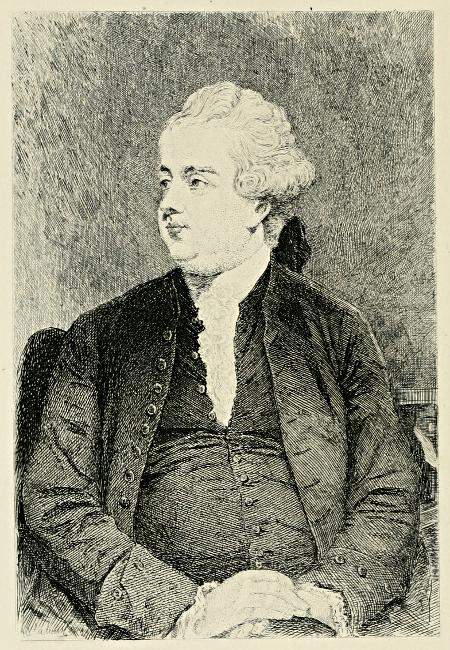
and the work was taken up a little later by Edward Gibbon, and
carried to completion in what is incontestably the greatest historical work
of modern times,—if not, indeed, the greatest of any age,—The Decline and
Fall of the Roman Empire. In this work, Gibbon not only set an epochal
standard for future historians, but he so exhaustively covered the ground
as to leave almost nothing for a successor in the same field. His work is
the more remarkable because it was produced at a time when the general
tendency was to accept the writings of the ancients in a much less critical
spirit than that to which they have been more recently subjected. Gibbon,
however, vaulted at once to the critical heights. Indeed, he went a step
beyond most critics of more recent generations, in that he insisted on applying
to the traditions and superstitions of all ancient nations the same critical
standards. Most of Gibbon’s contemporaries and a large proportion of his
successors, until very recent times, while looking askance at the traditions
of Greece and Rome, have wished to adjudge Hebrew traditions by a different
standard. It has been a curious illustration of the illogicality of even
critical minds, that the very critics who have inveighed against the credulity
of the ages which could accept the myths of Greece and Rome as historical,
should have inveighed also against the mind which had the breadth of view
to see that all ancient myths and traditions must be weighed in the same
historical balance. Only in our own day have considerable numbers of
critics attained the plane of historical impartiality which Gibbon had reached
a century and a quarter ago, but in most other regards his example found a
readier following.
EARLY DAYS OF THE EASTERN EMPIRE (395-565 A.D.)
The Roman Empire, permanently divided at the death of Theodosius (395) into an
eastern and a western section does not, nevertheless, lose its unity as an organisation.
The period of disintegration has set in, and the extinction of the western section in
476 is an event in this disintegration rather than the “fall” of an empire. It was
not until 800, the year of Charlemagne’s accession, that there were really two
empires, and that the term “Eastern Empire” may properly be applied. But for
convenience we call the history of Arcadius and his successors that of the Eastern
Roman Empire.
A.D.
395 Arcadius, co-regent, and elder son of Theodosius, continues to reign at Constantinople.
The Huns ravage Asia Minor, and the Visigoths, under Alaric, rise in
Mœsia and Thrace. At the death of Rufinus, the eunuch Eutropius becomes chief
adviser of the emperor, supported by Gainas.
398 Alaric becomes governor of Eastern Illyricum.
399 Death of Eutropius.
401 Death of Gainas. The emperor comes entirely under the influence of his dissolute
wife, Eudoxia.
408 Theodosius II succeeds his father. He is but seven years of age and is controlled by
his sister Pulcheria. Alaric moves upon Rome.
410 Death of Alaric.
421 Theodosius marries Athenais (Eudocia). War breaks out with Persia.
425 Organisation of the University of Constantinople.
438 Publication of the Theodosian Code.
439 Genseric takes Carthage.
441 War with Persia. War with the Huns and Vandals continues.
442 Invasion of Thrace and Macedonia by Attila.
447 Peace of Anatolius made with the Huns.
450 Death of Theodosius. Marcian is raised to the throne by Pulcheria, whom he marries.
He makes a wise ruler and resists payment of tribute to the Huns.
457 The Theodosian dynasty comes to an end with Marcian. The choice of the emperor
rests with the army, and the general Aspar brings about the election of Leo I, a
native of Thrace.
465 Great fire at Constantinople.
468 With the co-operation of Anthemius, Leo plans a great expedition against Genseric in
Africa, but it fails through treachery of Aspar, who is executed, 469.
474 Leo I dies, leaving empire to his grandson Leo II. The latter dies the same year and
Zeno, his father, reigns, but Basiliscus at once drives him out and rules for twenty
months, when Zeno recovers the throne.
476 With the resignation of Romulus Augustulus the western division is definitely detached
from the empire.
478-481 The Ostrogoths invade the Balkan peninsula.
483 Promulgation of the Henoticon.
488 Zeno induces Theodoric and the Ostrogoths to leave Illyricum and attack Rome.
491 At death of Zeno, Anastasius I is proclaimed emperor, through influence of the
empress Ariadne, who marries him.
491-496 The Isaurian War instigated by the supporters of Longinus results favourably for
Anastasius.
499 The Bulgarians invade Thrace.
502-505 Unsuccessful war with Persians, who take several provinces.
507 The “Long Wall” of Thrace is built to keep out the Goths.
514 Revolt of Vitalianus.
518 Death of Anastasius; Justin I, an illiterate Illyrian peasant, obtains the emperorship
through the army. With him the empire enters on a new era. He prepares his
nephew Justinian to succeed him..
527 Justinian created augustus.
528 Justin dies; Justinian I, “the great,” sole monarch. He is the chief figure of his
time. His wife is the empress Theodora. He begins active warfare at once against
the Arians, Jews, and pagans. Belisarius appointed commander-in-chief in the East.
529 First edition of the Justinian Code published.
530 Belisarius defeats the Persians at Dara.
531 Chosroes ascends the Persian throne.
532 Peace made with Persia. Insurrections break out in Constantinople. St. Sophia
burned. Belisarius quells the riots.
533 Belisarius begins a campaign against the Vandals in Africa. The Pandects published.
534 Belisarius captures the Vandal king Gelimer and destroys his kingdom, and for this is
made sole consul.
535-540 Belisarius in Italy and Sicily against the Ostrogoths. He makes himself master
of Rome and other cities.
540 Recall of Belisarius. Persian invasion of Syria.
542 Repulse of the Persians. Belisarius degraded by Theodora on his return from the
campaign. The great plague.
543 Totila, king of the Goths, captures Naples.
544 Belisarius proceeds to Italy against Totila.
545 Five years’ peace with Persia. Totila besieges Rome. Belisarius has not sufficient
forces to resist him.
546 Capture of Rome by Totila.
547 Romans recover Rome.
548 Totila retakes Rome. Belisarius returns to Constantinople. Death of Theodora.
Conspiracy against Justinian.
549 The imperial armies occupy the lands of the Lazi.
550 Slavonians and Huns invade the empire.
551 Battle of Sinigaglia. The Goths lose Sicily.
552 The eunuch Narses arrives in Italy as commander-in-chief. Recovers Rome. Defeat
and death of Totila.
553 End of the Ostrogothic War.
554-557 Terrible earthquakes visit Constantinople and other cities.
558 Belisarius repels the invading Huns under Zabergan.
562 Fifty years’ peace with Persia. Narses continues his victorious career in Italy.
565 Death of Justinian.
FROM JUSTIN II TO THE DEPOSITION OF JUSTINIAN II (565-695 A.D.)
565 Justin II succeeds Justinian I. He determines to change Justinian’s unpopular
system and refuses payment to an embassy of Avars, which is the cause of serious
depredations in the provinces.
567 The Gepid kingdom overthrown by Lombards and Avars.
568 Lombard invasion of Italy.
571 Birth of Mohammed.
572 War breaks out with the Persians. They make several important conquests, and
574 Justin, realising his inability to govern, makes Tiberius, the captain of the guard,
cæsar.
575 Peace with Persia.
576 Battle of Melitene. The Romans reach the Caspian Sea.
578 Justin dies. Tiberius emperor.
581 The imperial army led by Maurice defeats the Persians at Constantina.
582 Maurice elected emperor. Death of Tiberius.
584 Treaty with the Avars, whose depredations have become very serious.
586 Roman victory at Solachon.
589 Persian victory at Martyropolis. Slavonic colonies begin to settle in the Peloponnesus.
590 Maurice crowns his son Theodosius at Easter. Rebellion of Vaharan of Persia, who
deposes Hormisdas or Hormuz.
591 Maurice puts Chosroes II on the Persian throne. He proceeds against the Avar
invasion of Thrace.
602 Rebellion in the army. Phocas, the centurion, made emperor. Maurice put to death.
603 War with Persia breaks out.
604 Treaty of peace with the Avars.
606-608 Disastrous invasion of Asia Minor by the Persians. They advance to Chalcedon.
609 Revolts in Africa and Alexandria.
610 Heraclius, son of the governor of Africa, accomplishes the overthrow and death of
Phocas.
614 The Persian War continues. Damascus captured.
615 Jerusalem taken by the Persians.
616 Persian invasion of Egypt.
617 Occupation of Chalcedon by the Persians. Heraclius contemplates moving to Carthage.
620 Peace made with Avars who have attempted to seize the emperor.
622 Heraclius takes command in person of the Persian War.
622-628 The war is vigorously conducted. Campaigns in Cappadocia, Pontus, Armenia,
Cilicia, and Assyria, ending
628 with treaty of peace with Siroes.
629 Heraclius restores the holy cross to Jerusalem.
632 Death of Mohammed.
633 The Mohammedan conquests begin. The imperial cities fall before them in the
following order: Bosra (634), Damascus (635), Emesa, Heliopolis, Antioch, Chalcis,
Berœa, Edessa (636), Jerusalem (637).
638 Constantine, the king’s son, fails in an attempt to recover Syria. Mesopotamia lost
to the Mohammedans.
639 Amru invades Egypt.
641 Death of Heraclius. Death of Constantine III, after three months’ reign. Another
son of Heraclius, by Martina, Heracleonas, whom Heraclius appointed to reign
conjointly with Constantine, reigns alone for five months and then is banished.
His brother David is appointed emperor under the name of Tiberius. His fate is
unknown. Constans II, son of Constantine, becomes emperor. Alexandria taken
by the Mohammedans.
647 Mohammedans drive the Romans out of Africa.
648 The Type of Constans published.
649 Mohammedans invade Cyprus.
650 They take Aradus.
652 Armenia falls into their hands.
654 They capture Rhodes.
655 They defeat Constans in the great naval battle off Mount Phœnix in Lycia. Pope
Martin is banished to the Chersonesus.
658 Campaign of Constans against the Slavs. Peace made with the Mohammedans.
661 Constans leaves Constantinople and spends winter at Athens.
662-663 Great Mohammedan invasion of Asia Minor.
663 Constans in Rome.
668 Mohammedans advance to Chalcedon and hold Amorium for a short time. Assassination
of Constans at Syracuse. His son Constantine (IV) Pogonatus succeeds.
669 Mohammedans invade Sicily and carry off 180,000 prisoners from Africa.
670 Foundation of Kairwan, near Carthage.
673-677 Mohammedans besiege Constantinople. The Romans use the newly invented
Greek fire against them.
678 Peace concluded with the Mohammedans.
679 Bulgarian War and foundation of the Bulgarian kingdom.
681 Constantine deprives his brothers Heraclius and Tiberius of the imperial title. The
troops of the Orient had demanded that they, too, should receive the crown, and
thus the Trinity in heaven might be represented on earth.
685 Justinian II succeeds his father. The caliph and emperor make peace.
687 Transference of the Mardaites from Lebanon to Thrace and Asia Minor.
689-690 Successful expedition of Justinian against the Bulgarians and Slavs. The Greeks
are forced to emigrate from Cyprus; two hundred thousand Slavs transported to
Asia Minor.
692 Battle of Sebastopolis. Symbatius revolts. Mohammedan subjection of Armenia.
THE TWENTY YEARS’ ANARCHY (695-716 A.D.)
695 In consequence of his cruelties the general Leontius deposes Justinian, cuts off his nose,
and banishes him to the Chersonesus. Leontius emperor.
697 Revolt of Lazica. Great Mohammedan invasion of Asia Minor. Hassan proceeds
against Africa with success. Carthage taken.
698 The Mohammedans retake Carthage. Leontius dethroned. Aspimar becomes emperor
as Tiberius III. The Mohammedans continue to ravage the empire.
705 Justinian II, now named Rhinotmetus, from his nasal mutilation, recovers the
throne.
709 Tyana falls before the Mohammedans in their ravages on the Bosporus.
710 Great cruelty shown to Ravenna and the Chersonesus by the emperor.
711 Justinian overthrown by Bardanes, who becomes emperor under the name of Philippicus.
In his reign the Mohammedans invade Spain (711) and the Bulgarians
ravage Thrace (712). The Mohammedans take Antioch in Pisidia.
713 Philippicus dethroned and his eyes put out. Artemius his secretary is raised to the
emperorship as Anastasius II. He tries honestly to bring about reforms, and sends
an embassy to Damascus to arrange a peace with the Mohammedans.
715 The army determines to depose Anastasius, and chooses an obscure person, Theodosius
III, who unwillingly assumes the purple.
716 The Mohammedans again invade Asia Minor and besiege Amorium. Leo III the
Isaurian relieves the town, makes a truce with the besiegers, and is proclaimed
emperor by the army.
THE ISAURIAN DYNASTY AND SUCCEEDING KINGS (716-820 A.D.)
717 Mohammedans besiege Pergamus. They begin the siege of Constantinople, which is
raised the following year.
726 The dispute over image-worship arises. Publication of the first iconoclastic decree.
The great iconoclastic schism begins, immersing the empire in many calamities and
revolts, leading to the final separation of the Greek and Latin churches.
The Mohammedans invade Cappadocia.
727-728 Revolts in Italy and Greece.
734 Mohammedan invasion of Asia Minor.
739 Battle of Acronum.
740 Constantine (V) Copronymus succeeds his father.
742 Defeat of the rebel Artavasdes, who has obtained possession of Constantinople.
744-747 The Great Plague devastates the empire.
746 Mohammedan invasion of Cyprus.
750 Fall of the Omayyad dynasty. Two rival Saracen powers are formed. Ravenna
taken by the Lombards.
751 Capture of Melitene and Theodosipolis by Constantine.
753 Invasion of Italy by Pepin. Council of Constantinople favours iconoclasm.
755 Invasion of Thrace by the Bulgarians. Pepin continues invasion of Italy.
757 The Bulgarians driven back to their own territory with great slaughter.
760-765 Constantine invades Bulgaria. Victory of Anchialus, 762.
766 Wreck of the Roman fleet at the mouth of the Danube. Edicts against image-worship
extended and vigorously enforced.
773-774 Campaigns against the Bulgarians. Victory of Lithosoria. Peace made with the
Bulgarian monarch, which Constantine breaks.
775 Leo IV, son of Constantine, succeeds him. He is a zealous iconoclast. He marries the
empress Irene.
778 Successful campaign against the Bulgarians.
780 Capture of Semaluos by Harun-ar-Rashid. Death of Leo. Irene becomes regent for
the ten-year-old Constantine VI.
781 Revolt of Elpidius in Sicily.
782 The Mohammedans under Harun-ar-Rashid invade Asia Minor.
787 Council of Nicæa sanctions image-worship.
788 The Bulgarians gain a victory at the Strymon.
789 The Arabs invade Rumania.
790 Constantine assumes control of the government. Irene is unwilling to relinquish
power and a struggle between the two begins.
791 The emperor conducts a campaign against the Bulgarians.
792 A conspiracy formed against Constantine by his uncles is suppressed and severely
punished. Irene’s dignity restored. Second campaign against the Bulgarians.
795 Constantine divorces his wife Maria and marries Theodota.
796 Third Bulgarian campaign of Constantine.
797 Irene, taking advantage of Constantine’s unpopularity on account of his treatment of
Maria, imprisons him and has his eyes put out. She now reigns alone. Conspiracy
to place one of Constantine V’s sons on the throne.
798 Peace made with the Mohammedans.
800 Revival of the western division of the empire by the coronation of Charlemagne.
There are now two distinct empires.
802 Conspiracy against and deposition of Irene. Nicephorus I, the treasurer, chosen
emperor. He maintains political order but is a hard fiscal oppressor.
803 Death of Irene in exile. Bardanes, the general, proclaims himself emperor, but
receiving no support, negotiates for his own pardon. Treaty with Charlemagne,
regulating confines of the two empires.
806 Humiliating peace with Harun-ar-Rashid.
808 Unsuccessful attempt of Arsaber to obtain throne.
809 Death of Harun-ar-Rashid reopens the struggle with the Mohammedans.
810 Treaty of peace with Charlemagne, who unsuccessfully tries to make the Venetians and
their allies tributary to him.
811 The emperor at war with the Mohammedans and Bulgarians. Death of Nicephorus
in an attack by the Bulgarians. His son Stauracius succeeds. He is unable to
hold out against the unpopularity of his father’s fiscal severity. After two months’
reign, a revolution places Michael (I) Rhangabe on the throne. The Mohammedans,
owing to civil strife, do not trouble the empire, but the Bulgarians continue
their attacks, with such success that
813 Michael is deposed, and the general Leo (V) the Armenian is saluted as emperor.
Michael retires to a monastery. The Bulgarians approach the walls of Constantinople.
814 Annihilation of the Bulgarian army by Leo, at Mesembria. Thirty years’ truce concluded.
Leo pursues a variable policy in regard to image-worship.
820 Leo assassinated in a conspiracy in favour of Michael (II) the Stammerer, who
takes the throne.
THE AMORIAN DYNASTY (820-867 A.D.)
821 Rebellion of Thomas, a claimant of the throne. He is crowned at Antioch, and lays
siege to Constantinople.
822 The Bulgarians, taking advantage of civil discord, invade the empire. Thomas
delivered up to Michael, and hanged.
823 The Mohammedans capture Crete.
827 Mohammedan conquest of Sicily begun. It is not completed until 878.
829 Theophilus succeeds his father. He is a zealous iconoclast.
831 A Mohammedan invasion of long duration begins.
832 Brilliant victory of Theophilus in Charsiana. The Mohammedans capture Heraclea.
836 Theophilus destroys Zapetra.
838 Mohammedan victory at Dasymon. Amorium is captured.
842 Death of Theophilus, due to chagrin at Mohammedan successes. His son Michael
(III) Porphyrogenitus, or the Drunkard, succeeds at the age of four, with his
mother Theodora as regent. Image-worship restored at Council of Constantinople.
End of the Iconoclastic controversy. Slavonic insurrection in the Peloponnesus suppressed.
Failure of an attempt to conquer the Abasges, and to recover Crete. War
with the Mohammedans continues.
845 Truce with the Mohammedans.
847 Conversion of the Khazars to Christianity. The Bulgarians follow their example a few
years later.
848 Revolt of the Paulicians, who join the Arabs.
854 Theodora retires to private life.
856 Bardas, her brother, becomes cæsar. Photius elected patriarch in place of the deposed
Ignatius.
858 A great war with the Arabs begins. Omar lays Pontus waste. Successful campaign
of Leo, the commander-in-chief, who is finally captured by the Mohammedans.
860 Michael badly defeated near Melitene.
862 Omar invades Cappadocia, Pontus, and Cilicia.
863 Battle of Amasia. Great victory of Petronas, the emperor’s uncle. Death of Omar.
The end of trouble with the Mohammedans for some years.
865 First appearance of the Russians in the empire. They attack Constantinople, but are
driven off.
866 Michael kills Bardas with the aid of Basil the Macedonian, who becomes cæsar.
867 Assassination of Michael at the instigation of Basil, who takes the throne. Basil
removes Photius and restores Ignatius.
THE BASILIAN DYNASTY (867-1057 A.D.)
871 The Paulicians attacked and reduced to obedience.
872 Basil takes the field against the Mohammedans.
875-876 Victories of Basil in Cilicia.
877 Death of Ignatius. Photius regains the patriarchate.
881 Basil plans to drive the Mohammedans out of Sicily and Italy. Cyprus recovered and
held for eleven years.
885 Nicephorus Phocas expels the Mohammedans from Italy. They still hold Sicily.
Accusation against Leo, the emperor’s son, by Santabaren, in which the former
narrowly escapes death.
886 Death of Basil, who is wounded while hunting. His son, Leo (VI) the Philosopher,
succeeds. He has Santabaren’s eyes put out, and banishes him. Photius deposed.
887-888 Arabs invade Asia Minor, and attempt to regain Italy. They give up the attempt
on the latter country in 891.
Stylianus, Leo’s father-in-law and prime minister, by his treatment of Bulgarian merchants,
precipitates a war with Bulgaria. This country wins several victories, and
893 Leo makes a treaty of peace.
895 Conspiracy of Samonas against the emperor. Further Arab invasions of Sicily.
904 The Arabs capture Thessalonica with a fleet. The last remains of the senate’s
authority destroyed by a constitution of Leo. Second Russian expedition to Constantinople.
911 Mohammedan naval victory off Samos. Death of Leo. His infant son, Constantine
(VII) Porphyrogenitus, and his brother Alexander rule together.
912 Death of Alexander. He nominates, before dying, a regency of six members, exclusive
of the patriarch, to act during Constantine’s minority. Attempt of Constantine
Ducas to gain the throne suppressed by John Eladas, one of the regents. Zoe
Carbonopsina, mother of Constantine, admitted to supreme power by the regency.
913-914 Simeon, king of Bulgaria, invades the empire with no positive results.
917 The Patzinaks defeat Leo Phocas at Achelous, which causes Romanus Lecapenus to
intrigue for the throne.
919 Constantine marries Romanus’ daughter Helena. Romanus (I) Lecapenus crowned
emperor as colleague to Constantine.
920 Christopher, son of Romanus, is raised to the imperial dignity.
921 The war with the Bulgarians assumes serious proportions; further increased
923 by an alliance between King Simeon of Bulgaria and the Mohammedans.
926 A temporary end is put to the troubles with the Bulgarians and Arabs by an interview
between Romanus and Simeon.
927 Peter, Simeon’s successor, enters Byzantine territory, demanding war or the hand of
the emperor’s granddaughter. Romanus agrees to the latter alternative.
928 Romanus makes his sons, Stephanus and Constantine VIII, associate emperors.
There are now five emperors.
931 Death of Christopher.
934-940 Period of complete peace in the empire, except for petty warfare with Lombard
princes. Constantine VII plans to regain the sole power.
941 A Russian fleet of ten thousand galleys appears before Constantinople. Romans drive
them off with small force.
944 Stephanus and Constantine VIII at instigation of Constantine VII banish their father
to Prota. Constantine VII then regains full power, and banishes Stephanus and
Constantine VIII likewise to Prota, 945.
During the remainder of Constantine’s reign the war with the Mohammedans is prosecuted
with great vigour, especially when Nicephorus Phocas succeeds in assembling
a large army. Many conspiracies against Constantine by the deposed emperors.
959 Death of Constantine, the result of poison administered by his son Romanus II, who
becomes emperor.
961 Brilliant conquest of Crete by Nicephorus. The Mohammedans expelled after occupation
of 150 years.
962 Nicephorus attacks Aleppo, but is unable to take the citadel.
963 Death of Romanus, which has been attributed to poison administered by the empress
Theophano. Nicephorus (II) Phocas marries Theophano and obtains the throne.
His chief aim is to break the Mohammedan power.
964-965 Conquest of Tarsus by the Byzantines. Nicephorus recalled to Constantinople by
troubles with Bulgarians and Hungarians. To repel them he makes alliance with
Sviatoslaff, prince of Kieff, which causes a bloody war with the Russians.
965 Embassy of Liutprand to Constantinople. The emperor imprisons him.
968 Nicephorus returns to Asia Minor and recovers Antioch, 328 years in the Mohammedan
power. He prepares to attack Baghdad.
969 Joannes Zimisces, the general, and Theophano conspire against Nicephorus, who is
assassinated. Joannes (I) Zimisces takes the throne. He associates with him the
young sons of Romanus II, Basil II, and Constantine IX, who were nominal rulers
during reign of Nicephorus. The brother of Nicephorus, Leo, and his son Bardas
Phocas make unsuccessful attempts to invite rebellion and regain the throne. They
are banished.
970 Sviatoslaff conquers Bulgaria and invades Thrace. Philippopolis taken and inhabitants
massacred.
971 Joannes proceeds against the Russians. Capture of Presthlava and King Boris of Bulgaria.
Siege and capture of Dorystolon. Peace with the Russians. Bulgaria again
a part of the empire and Boris a pensioner of the Byzantine court. The Mohammedan
wars carried on.
972 Marriage of Otto the Great and Theophano, daughter of Romanus II.
973 Imperial victory at Nisibis. Defeat at Amida.
974 Joannes takes command of the Mohammedan War.
975 Many victories but futile siege of Tripolis. Antioch shuts out the imperial force.
976 Death of Joannes Zimisces, probably by poison. Basil II head of affairs with his
brother for colleague. He is one of the greatest of the Eastern emperors.
Beginning of Period of Greatest Splendour of the Empire
979 Defeat of Sclerus by Bardas Phocas, the general, after a desperate revolt to capture the
throne. The Bulgarians begin a long struggle to regain their independence.
982 On death of Otto, Basil consolidates his authority in southern Italy.
989 Death of Bardas Phocas, who for two years has been in revolt against the emperor.
Sclerus, conspiring for the second time against the throne, dies.
991 Southern Iberia ceded to the empire by King David.
995 Campaign of Basil in Syria. Aleppo taken. Unsuccessful attack on Tripolis.
996 Great defeat of King Samuel of Bulgaria at the Sperchius.
1002 Samuel invades Thrace, takes Hadrianopolis, but is driven off. The war now proceeds
for some years in desultory fashion.
1014 Basil resumes the Bulgarian War in earnest. Great victory under Nicephorus Xiphias
at Zetunium. Basil puts out the eyes of 15,000 prisoners. Death of Samuel.
The emperor’s cruelty engenders a last effort in the Bulgarians, but by 1018 the
destruction of the kingdom is complete. Gibbon calls this the most important
triumph of Roman arms since the time of Belisarius.
1022 Victory of Basil over a coalition of Armenian princes. They sue for peace.
1025 Basil prepares to expel Mohammedans from Sicily, but dies. His brother Constantine
IX becomes sole emperor.
1027 Attack by the Patzinaks and Mohammedans repulsed.
1028 Constantine on his death-bed appoints Romanus (III) Argyrus his successor, makes
him divorce his wife, and marry his daughter Zoe.
1030 Romanus defeated by the Mohammedans at Azaz and takes refuge in Antioch. He
becomes the prey of melancholy, and Zoe takes the reins of government.
1031 Mohammedan pirates ravage Illyricum and Corfu. They are driven off by the people
of Ragusa.
1032 Conspiracy and death of Constantine Diogenes.
1033 Capture of Edessa by the imperial fleet.
1034 Death of Romanus, probably by slow poison administered by Zoe, who now causes
her paramour, Michael (IV) the Paphlagonian, to be proclaimed emperor, and
marries him the day of her husband’s death. Earthquake at Jerusalem lasting
forty days. Great famine throughout the empire.
1037 The Mohammedans attack the empire on all sides. They capture Edessa. The
Patzinaks invade Thrace.
1038 The Mohammedans regain Edessa, by a stratagem that is the origin of the Tale of
Ali Baba and the Forty Thieves.
1039 The imperial force and the Normans attack the Mohammedans in Sicily. Messina
(Messana) and Syracuse taken.
1040 A fresh Mohammedan army from Africa utterly defeated in Sicily. The Norman
power begins to get the control in the island. The Bulgarians attempt to recover
independence. They invade Thrace and Macedonia.
1041 Michael drives them back and brings the country again to Byzantine rule. Death of
Michael. Zoe attempts to rule alone, but finds herself unequal to the task. She
adopts her husband’s nephew, Michael (V) Calaphates, and makes him emperor.
He expels Zoe. At his imprudent acts the people rise in rebellion.
1042 After a fierce battle between the people of Constantinople and the adherents of
Michael, the latter and his uncle flee. Zoe and her sister Theodora are proclaimed
co-empresses. Zoe has the eyes of Michael and his uncle put out. Jealous
of her sister, Zoe marries Constantine (X) Monomachus. Rebellion of Maniaces,
brother of Constantine’s mistress Sclerena. He is murdered in the midst of
his camp.
1043 Invasion of the Russians; driven back after a defeat by Catacalon.
1045 Successful war with Cacicus, vassal king of Armenia and Iberia, ending in destruction
of his kingdom.
1047 Rebellion of Tornicius.
1048 The Patzinaks invade the empire with a large army. Attack of the Seljuk Turks
under Toghril. Indecisive battle of Capetron.
1050 Toghril retires to Persia. Death of Zoe.
1052 Second invasion of Toghril.
1053 The Patzinaks driven back to their own territory.
1054 The great schism between the Greek and Roman churches begins. Death of Michael.
Theodora reigns alone.
1056 Death of Theodora, after appointing Michael (VI) Stratioticus her successor.
Attempt of Theodosius Monomachus to seize throne.
1057 Battle of Hades. Defeat of Michael by Isaac Comnenus and Catacalon.
DECLINE AND FALL OF THE BYZANTINE GOVERNMENT (1057-1204 A.D.)
1057 Isaac (I) Comnenus proclaimed emperor. Michael retires to a monastery. The
emperor introduces a system of great economy into all branches of the government.
1059 Invasion of the northern frontier by Hungarians and Patzinaks. Treaty of peace concluded.
Isaac, after a severe illness, resigns crown into the hands of Constantine
(XI) Ducas. Through motives of economy the latter materially reduces the size
of the army.
1060-1064 Toghril Beg and Alp Arslan invade the empire from Mesopotamia. Ani captured,
1064.
1064 The Uzes, a nomad Turkish tribe, invade from the north. They are driven back by
outbreak of the plague.
1067 Death of Constantine. The imperial title conferred on his young sons, Michael (VII)
Ducas Parapinaces Andronicus, and Constantine (XII) Ducas. The empress
Eudocia is regent. She marries Romanus (IV) Diogenes, who is proclaimed as
emperor. Great ravage of the Turks. Massacre of Cæsarea.
1068-1069 Successful campaign of Romanus against the Turks.
1070 Manuel Comnenus takes command against the Turks. Alp Arslan captures Manzicert.
Romanus returns to the command.
1071 Byzantine expedition to Sicily defeated by Normans. Surrender of Bari. End of the
imperial authority in Italy. Romanus taken prisoner by Alp Arslan at Manzicert.
Restored to liberty and makes a treaty of peace. Refused admittance to Constantinople.
Michael VII regains power reigning conjointly with Constantine XII.
Romanus blinded, dies of his wounds.
1072 Alp Arslan, unable to obtain payment of Romanus’ ransom, invades empire. He
finally conquers the Byzantine part of Asia Minor, giving it to Suleiman to rule.
1074 Rebellion of Ursel. Treaty with the Turks.
1076 The Turks take possession of Jerusalem.
1078 Bryennius attempts to gain the throne. After a severe struggle Michael abdicates in
favour of Nicephorus (III) Botaniates.
1081 Nicephorus, after a constant struggle with many aspirants, is dethroned by Alexius
(I) Comnenus after the capture and sack of Constantinople. Many pretenders are
put down. Treaty of peace with Suleiman. Defeat of Alexius by Robert Guiscard.
1084 Defeat of Bohemond, the Norman leader. Relief of Larissa.
1085 Alexius recovers Dyrrhachium from the Normans.
1087-1099 Patzinak war ending in imperial victory at Levounion.
1092 Tzachas, emir of Smyrna, assumes title of emperor.
1093 Murder of Tzachas at instigation of Alexius.
1096 The first crusaders appear at Constantinople.
1097-1098 With the help of the crusaders, Alexius regains Nicæa, Antioch, and the whole
of Asia Minor.
1103-1108 War of Alexius with Bohemond, prince of Antioch.
1110-1116 War against the Turks in Asia Minor, ending in many Turkish losses, enabling
Alexius to make treaty of peace.
1111 Hostilities of Alexius with Tancred and the crusaders.
1118 Death of Alexius. Joannes Comnenus, his son, succeeds. Failure of conspiracy of
Anna Comnena and Nicephorus Bryennius to place latter on throne.
1119 Joannes takes Laodicea and
1120 Sozopolis in campaigns against the Turks.
1122 Great victory of Joannes over the Patzinaks in Macedonia.
1124 Joannes drives back the Servians who have seized Belgrade and Branitzova. He now
proceeds again against the Turks of Iconium and holds Castamonia and Gangra for
a short time.
1131 Campaign against Livo of Cilicia, whose dominions
1137 are united to the empire.
1138 Joannes proceeds against Raymond of Antioch, who refuses to recognise him for his
liege-lord. Raymond apologises and helps Joannes in a successful campaign against
the Turks in Syria.
1141 Joannes defeats the sultan of Iconium.
1142 He sets out for Cilicia to conquer all the Latin principalities taken from the empire, but
1143 dies as the result of a wound received while hunting. His son Manuel (I) Comnenus
succeeds.
1144 Raymond, prince of Antioch, compelled to renew bonds of vassalage.
1145 Manuel invades Isauria and concludes treaty of peace with Turks.
1147 Manuel promises to aid the Second Crusade, but gives secret information of it to the
Turks.
1148 War with Roger of Sicily, who attempts to invade Greece. Manuel quickly repels an
invasion of Patzinaks, and with the help of Venice proceeds against the Normans
at Corfu.
1149 Fortress at Corfu taken. Roger invites the Hungarians and Servians to attack from
the north.
1152 Imperial repulse in Cilicia, but great successes in Italy.
1153 Peace made with King Geisa of Hungary.
1153-1155 The Norman war turns against the empire. Many defeats. Maius, the Sicilian
admiral, lands at Constantinople.
1155 Peace made with William of Sicily, Roger’s successor. Punishment of Reynolf of
Antioch, successor of Raymond, and his reduction to vassalage.
1157 Renewal of war with sultan of Iconium. Peace made.
1161 War breaks out with Stephen III of Hungary.
1163 Short interval of peace in Hungarian War.
1168 Battle of Zeugmin. Great imperial victory. End of Hungarian War. Manuel joins
with Almeric of Jerusalem in an attack on Egypt.
1171 Failure of attack through jealousy of Almeric. War with Venice over, Manuel
attacks the Lombards. After an unprofitable contest
1174 peace made with Venice.
1176 Renewal of war with Kilidj-Arslan, sultan of Iconium. Crushing defeat of Manuel
near Myriocephalus. Dishonourable peace made by Manuel.
1177 Manuel breaks peace. Imperial victory on the Mæander. Honourable peace.
1180 Death of Manuel. His son, Alexius (II) Comnenus, succeeds, under guardianship
of mother, Maria of Antioch.
1183 Andronicus (I) Comnenus usurps the throne after inducing Alexius to have his
mother put to death, and then killing him. Marries Alexius’ widow, Agnes,
daughter of Louis VII of France.
1184 Isaac, sent to Cyprus to govern by the emperor, causes rebellion by his misgovernment,
which entirely separates the island from the empire.
1185 Silician invasion at instigation of Greek fugitives. William II destroys Thessalonica,
but is induced to desist from attack on Constantinople. The lieutenant,
Hagiochristophorites, incites rebellion at Constantinople against Isaac. The people
take Isaac’s part and proclaim him emperor. Death of Andronicus at hands of
mob. Isaac (II) Angelus emperor. Victory at Demerize over Silician invaders.
1186 Rebellion of the Bulgarians and Wallachians owing to unjust taxation.
1187 Defeat of rebels by Joannes Cantacuzenus. Alexius Branas given command of army.
He takes advantage of victories to proclaim himself emperor and appears before
Constantinople, but is defeated and killed by Isaac’s brother-in-law, Conrad of
Montferrat. William II of Sicily gives up his conquests in Greece.
1188 Wallachian successes lead to formation of independent kingdom.
1189 Emperor Frederick I of Germany appears with 150,000 crusaders. The terrified Isaac
offers to make alliance with Saladin, but the latter declines.
Theodore Mancaphas proclaims himself emperor. He is pardoned, and gives up claim.
Careers of the “False Alexius” and other pretenders.
1191 Capture of Cyprus by Richard I of England. It is lost forever to the empire.
1194 Isaac recognises the Wallachian kingdom.
1195 Isaac deposed by the nobles, and his brother Alexius (III) Angelus-Comnenus
“the tyrant” made emperor. Alexius has Isaac’s eyes put out, and imprisons him in
a Constantinople dungeon. Alexius’ extravagant conduct completes the destruction
of the financial mechanism of the Roman Empire. Great disorder and anarchy
throughout the empire.
1197 Peace purchased from Mueddin, sultan of Angora.
1198 War with the sultan of Iconium.
1199 Rebellion of Chryses, the Wallachian officer. Alexius makes peace, leaving him in
possession of several towns.
1200 Ivan the Bulgarian attempts to found independent monarchy in Thrace and Macedonia.
1202 Alexius, son of Isaac II, escaping to Italy, brings about treaty between Venetians and
crusaders to replace Isaac and himself on the throne.
1203 Siege of Constantinople. Flight of Alexius III to Italy. Crusaders occupy the city.
Isaac III and Alexius (IV) Angelus on the throne. Great fire in Constantinople.
Constant trouble between Alexius and the crusaders, in consequence of which
1204 Alexius (V) Ducas “Murzuphlus,” a party leader, seizes the throne. Murder of
Alexius IV. Isaac dies of grief. Alexius finds it impossible to hold out against the
crusaders. Capture and sack of Constantinople by crusaders and Venetians. Treaty
of partition. End of true Byzantine Empire. The Latin Empire of Romania
founded with Baldwin, count of Flanders. The Greek Empire continues at Nicæa.
THE LATIN EMPIRE OF ROMANIA (1204-1261 A.D.)
1204 Baldwin I elected emperor. His dominions consist only of Constantinople and Thrace,
for the rest of the empire is divided among the Flemish, French, and Venetian
leaders.
1205 Joannice of Bulgaria revolts, and obtains possession of Hadrianopolis. Capture of
Baldwin in siege of town. He dies in captivity. His brother Henry I succeeds.
1206 Treaty with David Comnenus, brother of the emperor of Trebizond, in the interest of
the latter.
1207 Death of Joannice. Henry marries his daughter, and thus effects peace with Bulgaria.
Treaty with Theodore Lascaris, emperor of Nicæa.
1209 Parliament of Ravenika (ancient Chalcidice) summoned by Henry to determine definitely
the feudal relations of all subjects of the empire.
1214 War between Henry and Theodore. Defeat of Henry in Bithynia. Siege of Pemanene.
Peace, ceding to Theodore all territory east of Sardis and Nicæa.
1215 A mock union between the Greek and Roman churches in Henry’s dominions.
1216 Death of Henry during expedition against Theodore, the despot of Epirus. Pierre
de Courtenai, then in France, chosen emperor. He falls into the hands of Theodore
of Epirus on his way to Constantinople, and dies in captivity, 1219.
1221 His second son, Robert de Courtenai, after a delay of two years, is made emperor.
1222 Theodore of Epirus takes possession of the Lombard kingdom of Thessalonica. Defeat
of Robert at Serres.
1223-1224 Robert invades Nicæa with many losses. Revolt of the Greeks in Hadrianopolis.
Theodore of Epirus takes the city.
1228 Death of Robert. His young brother, Baldwin II, succeeds. Jean de Brienne,
titular king of Jerusalem, elected guardian and colleague. The empire is attacked
by Joannes Vatatzes of Nicæa and John Asan, king of Bulgaria.
1233 Jean de Brienne routed in Bithynia.
1234 Alliance between Vatatzes and Asan to attack Constantinople. They ravage the whole
Latin Empire.
1236 Danger to Constantinople averted by help from the Venetians and Geoffrey of
Achaia.
1237 Death of Jean de Brienne. The Bulgarian king abandons Nicæa and makes alliance
with Latins. Baldwin visits western Europe to obtain help. Louis IX of France
gives pecuniary assistance.
1240 Baldwin with his new army attacks Nicæa and obtains some advantage.
1243 Baldwin makes alliance with Seljuk Turks, but in spite of this is compelled to
1245 revisit western Europe for assistance.
1259 On the accession of Michael Palæologus, the Nicæan Empire attacks the Latin
Empire.
1261 Recovery of Constantinople by the Greeks of Nicæa. End of the Latin Empire of
Romania. Although driven from their dominions, the descendants of Baldwin II
are known in eastern Europe as titular emperors until 1383 when, with the death
of James de Baux, the family of Baldwin became extinct.
THE GREEK EMPERORS AT NICÆA (1204-1261 A.D.)
1204 After the capture of Constantinople Theodore Lascaris, leader of the anti-Latin party,
flees to Bithynia, and makes himself master of the city of Nicæa.
1206 Theodore (I) Lascaris crowned emperor by the Greek patriarch. His title is
contested by several princes, among them Alexius Comnenus, reigning as emperor
of Trebizond. David Comnenus, the latter’s brother, proceeds against him, but is
badly defeated on the Sangarius.
1210 Alexius, father-in-law of Theodore, claims throne, supported by the sultan of Iconium.
The latter slain in battle, Alexius falls into Theodore’s hand, and is put into a
monastery.
1214 War with Henry of Romania. Peace defining limits of empire.
1214-1222 Years of peace.
1222 Death of Theodore. His son-in-law, Joannes (III) Ducas Vatatzes, succeeds.
Theodore Angelus, despot of Epirus and Ætolia, assumes title of emperor of
Thessalonica.
1224 Victory of Pemanene over Robert, the Latin emperor.
1225 Peace with the Latins. Conspiracy of Nestongos.
1233 Defeat of the Latins by Joannes in Bithynia. Naval campaign to obtain sovereignty
of the sea. The Greek fleets driven back to Asia by the Venetian, Marino Sanuti.
1234 Alliance of Joannes Vatatzes and Asan of Bulgaria against Baldwin II. Vatatzes
reduces the empire of Thessalonica to a despotat (despotat of Epirus).
1236 Attack of the allies on Constantinople unsuccessful.
1237 Asan breaks the alliance as Constantinople is about to be attacked the second time.
1241 On the death of John Asan of Bulgaria, Vatatzes begins to assert his supremacy over
the emperor of Thessalonica.
1242 Joannes Comnenus, the Thessalonian emperor, reduced to rank of despot by Vatatzes.
Alliance with the sultan of Iconium to resist threatened invasion of Mongols who
have already destroyed the Seljuk empire.
1245 Joannes Vatatzes reconquers Byzantine dominions in Thrace from the infant king
Michael of Bulgaria.
1246 Vatatzes unites despotat of Epirus to the empire.
1251-1253 War with Michael II, despot of Epirus, ending in a peace ceding some Thracian
territory to Vatatzes.
1254 Death of Joannes Vatatzes. His son Theodore (II) Lascaris succeeds.
1255-1256 War with Bulgaria resulting in slight concessions to Theodore.
1257 War with Michael of Epirus conducted by Michael Palæologus, with unfavourable
results.
1258 Death of Theodore. Succeeded by his young son Joannes (IV) Lascaris. The
prime minister Muzalon and the patriarch Arsenius are regents.
1259 Michael (VIII) Palæologus proclaimed emperor as the result of a successful conspiracy.
Muzalon murdered. The emperor goes to war with Michael of Epirus
and puts him to flight. Battle of Pelagonia. Capture of William Villehardouin,
prince of Achaia.
1261 The general Strategopulus captures Constantinople. Fall of the Latin Empire.
Michael removes the seat of empire thither.
THE PALÆOLOGUS DYNASTY AT CONSTANTINOPLE (1261-1453 A.D.)
1261 Michael imprisons Joannes IV and has his eyes put out. For this Arsenius excommunicates
Michael. Important commercial treaty with the Genoese renewed after
hostilities in 1275. Pope Urban IV frees Villehardouin from his promises to
Michael on his release. Warfare results.
1263 Urban IV mediates between Michael and Villehardouin.
1264 Peace between the emperor and Michael of Epirus.
1265 Deposition of Arsenius causing the Arsenite schism.
1269 Charles of Anjou, aided by Joannes of Thessaly and Michael of Epirus, takes up arms
against the emperor to restore Baldwin II.
1271 Great defeat of the imperial forces at Demetriades (Volo). Constantinople in danger.
Michael proposes union of Greek and Latin churches as a means of saving his throne.
1274 Union of churches effected at council of Lyons. It is opposed by a large faction in the
Greek church. It was never really completed, and falls to pieces at Michael’s death.
1280 The Seljuk Turks take Nyssa.
1281 Treaty of Orvietto between the pope, Naples, and Venice to conquer the Greek Empire
for Philip, son of Baldwin II. The plan is frustrated by the Sicilian Vespers.
1282 Death of Michael in an expedition against Joannes Ducas of Thessaly. He is a conspicuous
example of the misuse of despotic power. His son Andronicus (II)
Palæologus succeeds. Ecclesiastical troubles compel the emperor to neglect military
matters for a time.
1290 Unsuccessful attack upon Nicephorus of Epirus.
1295 Michael IX, son of Andronicus, receives the imperial title from his father.
1301 Foundation of Ottoman Empire by Osman, who attacks the Greek Empire. Disgraceful
defeat of Greeks commanded by Michael, near Nicomedia. The command
given to a Tatar chief. The Ottomans gradually conquer all the Byzantine possessions
in Asia.
1303 The Catalan Grand Company, engaged by Michael to help fight the Turks, and headed
by Roger de Flor, lands in Constantinople.
1304 Relief of Philadelphia by Roger. He conceives the idea of forming a principality in
the East.
1305 Roger de Flor visits Constantinople to demand pay for his men.
1306 Turks retake Philadelphia. Plan of Ferdinand of Majorca to conquer a kingdom in
the Greek Empire.
1307 Roger de Flor created cæsar. He sets out for Asia but is assassinated. The company
breaks its ties with Michael, and sets out to conquer territory for itself. Battle of
Apros. The company takes possession of several districts. Excommunication
of Andronicus by Clement V.
1310 The company and their Turkish auxiliaries enter service of the duke of Athens.
Conquest of Rhodes by knights of St. John.
1311 Battle of the Cephisus and victory of the Catalan Grand Company over the duke of
Athens pave way for the conquest of Attica. The Turkish auxiliaries return home.
1315 Victory of Philes Palæologus over Turks at Bizya.
1320 The emperor Michael dies.
1321 Beginning of civil war by partisans of the emperor’s grandson Andronicus led by
Cantacuzenus and Synadenus.
1322 Peace of Epibates concludes civil war.
1325 Andronicus compelled to bestow imperial crown on his grandson Andronicus (III)
Palæologus; the two reign together.
1327 Andronicus II brings charges against Andronicus III. Civil war breaks out again.
1328 Synadenus overcomes garrison of Constantinople. Abdication of Andronicus II
puts an end to civil war, but the court remains full of intrigue.
1329 Imperial defeat at Pelekanon by the Ottoman Orkhan.
1330 Surrender of Nicæa to Orkhan.
1330-1337 Ottoman invasions of the European provinces.
1334-1337 Expedition of Andronicus into Epirus.
1337 The Mongols cross the Danube and ravage northern district. Anne regent for Nicephorus
II, despot of Epirus, turns the despotat over to Andronicus.
1338 Surrender of Nicomedia to Orkhan.
1339 Revolt in the despotat of Epirus put down.
1341 Death of Andronicus. His young son Joannes (V) Palæologus succeeds with
Empress Anne of Savoy as regent. Rebellion of the prime minister Joannes (VI)
Cantacuzenus, who is proclaimed emperor and guardian of Joannes. He often
calls himself Joannes V. Apocauchus and Joannes Apri intrigue against Cantacuzenus.
A long civil struggle commences.
1342 Stephen Dushan of Servia allies himself with rebels and invades empire.
1343 Cantacuzenus makes alliance with Turks. The war continues with violence.
1344 Cantacuzenus takes Gratianopolis and makes treaties with Servia and Bulgaria.
1345 Murder of Apocauchus. Vicinity of Constantinople devastated.
1346 Defection of Orkhan from Anne’s cause leads to triumph of Cantacuzenus. Earthquake
at Constantinople destroys portion of St. Sophia.
1347 Treaty of Cantacuzenus with Anne recognises right of former to rule for ten years.
The Black Death rages.
1350 Cantacuzenus uses money sent by Russians to rebuild St. Sophia to pay Ottoman
mercenaries.
1351 Joannes V takes up arms against Cantacuzenus.
1352 Peace with Genoa after three years’ war. Cantacuzenus hires Turkish mercenaries to
fight Bulgarians and Servians.
1353 Cantacuzenus proclaims his son Matthæus emperor, and a deadly strife between him
and the Palæologus family ensues.
1354 Cantacuzenus dethroned. Joannes V sole emperor. Matthæus Cantacuzenus continues
civil war.
1357 Matthæus Cantacuzenus delivered to Joannes by his captors the Servians and made
to renounce all rights to the throne.
1361 The Ottoman Turks under Murad I take Hadrianopolis. This seals the fate of the
Greek Empire.
1363 The Ottomans take Philippopolis and Serres. Defeat of Louis of Hungary.
1369-1370 Joannes visits Rome to obtain help for his falling empire, but is unsuccessful.
On way home is arrested for debt in Venice and released with money raised by his
son, Manuel.
1375 Andronicus, Joannes’ eldest son, conspires against him while the emperor is absent on
a visit to Murad. He is aided by Saugdi, eldest son of Murad. Murad hastens to
Europe and quells rebellion. Both Andronicus and Saugdi have their eyes put out.
1377 Andronicus escapes from prison, imprisons his father, and confers title on his own son.
1381 Joannes rescued by Venetians under Carlo Zeno. Concludes treaty with Andronicus,
recognising his and his son’s rights to the title. Treaty with Murad in which
Joannes acknowledges himself the vassal of the Ottoman Empire.
1384 Manuel, second son of Joannes, proclaimed emperor and crowned.
1389 Battle of Kossova. Great Ottoman victory over the Servians. Assassination of Murad.
Bajazet succeeds, renews treaty with Joannes, and puts Manuel at head of Greek
troops in Ottoman army.
1390 Ottomans capture Philadelphia the last independent Greek community in Asia
Minor.
1391 Death of Joannes. Manuel (II) Palæologus sole emperor. He hastens to Constantinople,
fearing his brother will seize the crown.
1396 Great victory of Bajazet at Nicopolis. He now determines to proceed against Constantinople.
Manuel visits France for help.
1398 Marshal Boucicault arrives at Constantinople with his fleet. The Tatar conqueror,
Timur, distracts Bajazet’s attention from the empire.
1399 Joannes of Selymbria, son of Andronicus, enters Constantinople and is proclaimed
emperor. Manuel visits European courts for help.
1402 Manuel returns home, his mission unsuccessful. Battle of Angora. Crushing defeat
of Bajazet by Timur.
1403 Treaty of Suleiman and Manuel, the former yielding up territory in Macedonia and
Thessaly.
1410 Musa, Suleiman’s brother, after the latter’s death, reconquers territory ceded by Suleiman
to Manuel.
1412 Musa begins a feeble siege of Constantinople, but is soon distracted by civil troubles.
1413-1421 During reign of Muhammed I, the Greek Empire enjoys uninterrupted peace.
Manuel employs time in reorganising administration and consolidating his power.
1419 Manuel makes his son, Joannes (VII) Palæologus, co-emperor.
1422 Murad II besieges Constantinople to punish Manuel for his intrigues. He is obliged
to raise siege in order to proceed against his brother, Mustapha.
1423 Manuel assumes monastic habit, taking name of Matthew. Joannes sole emperor.
The empire is now reduced to the city of Constantinople and vicinity, Thessalonica,
and a part of the Peloponnesus. The finances are exhausted through payment of
tribute to the Turks. The empire enters its final stage of lethargy.
1430 Murad II conquers Thessalonica. The Genoese of Galata attack Constantinople on
account of trade dispute in Black Sea.
1431 Terrible epidemic in Constantinople.
1439 Joannes and the Greek patriarch attend council of Florence and ratify union of the
Greek and Roman church. The pope promises to aid the empire, but forgets agreement
to send fleet to Constantinople.
1440 On return of the emperor, the bishop of Ephesus succeeds in confining the union only
to the palace. The emperor’s brother Demetrius attempts to gain throne, but fails.
1447 Murad marches against the emperor’s brother Constantine, who is ruling over the
Peloponnesus. Corinth and Patras taken. Treaty with Constantine, who pays
tribute.
1448 Death of Joannes. His brother Constantine (XIII) Palæologus or Dragazes,
despot of Sparta, succeeds.
1449 Muhammed II succeeds Murad II. His chief ambition is the conquest of Constantinople,
and he at once prepares for it. Builds a fort on the Bosporus.
1452 Joannes appeals to Pope Nicholas V for aid. Cardinal Isidore and a small body of
auxiliaries are sent.
1453 Siege and capture of Constantinople by Muhammed II. Death of Constantine in
battle. Muhammed enters his new capital. End of the Eastern Empire.
THE EMPIRE OF TREBIZOND (1204-1461 A.D.)
Isaac Angelus, as soon as he is placed on the throne by the exasperated mob that slew
the tyrannical Andronicus I (1185), has the eyes of Manuel Comnenus, the murdered
emperor’s eldest son, put out. Manuel dies under the operation, leaving two sons,
Alexius and David. They live in obscurity in Constantinople until the crusaders
besiege the capital (1203), when they escape to the coast of Colchis. Alexius gathers
around him a small force and
1204 about the time of the fall of Constantinople enters Trebizond, the ancient Trapezus,
on the Black Sea, having been proclaimed “emperor of the Romans.” He calls
himself Alexius (I) Grand-Comnenus, to distinguish himself from the family of
Alexius Angelus-Comnenus. The weakness of the expelled house of Angelus permits
Alexius to found his empire and begin a career of conquest. In the course of
a few months the whole country from the Phasis to the Thermodon is his. David
Comnenus adds the coast from Sinope to Heraclea to the new empire.
1206 Defeat of David on the Sangarius, by Theodore (I) Lascaris. Alexius badly beaten at
Amisus by the sultan of Iconium or Rum in league with Theodore. David makes
treaty with the emperor Henry of Romania, in the interest of his possessions.
1214 Theodore I attempts to reunite David’s territory to the empire of Nicæa. Death of
David in defence of Sinope, besieged and captured by the Turks. Pontus assailed
by the Turks. Colchis by the Georgians.
1216 Alexius compelled to declare himself a vassal of the sultan of Iconium.
1222 Death of Alexius. His son-in-law, Andronicus (I) Ghidus, succeeds, Joannes the
eldest son being passed over.
1224 Treaty with Ala ad-Din, sultan of Iconium. Hayton, Turkish governor of Sinope, seizes
a Trebizontine ship. Andronicus attacks Sinope; Ala ad-Din breaks treaty and
attacks Trebizond. Andronicus drives him off and by a treaty frees himself from
vassalage.
1226 Andronicus acknowledges himself vassal of Gela ad-Din, shah of Khwarizm.
1230 On defeat of Gela ad-Din by the Mongols, Andronicus renews vassalage to Iconium.
The Iberian provinces of Trebizond unite with the new Iberian kingdom where
King David still retains his independence against the Turks.
1235 Death of Andronicus. His brother-in-law, Joannes (I) Auxuchus, succeeds.
1238 Death of Joannes. His brother, Manuel (I) the Great Captain, succeeds. There is
little information about the events of his reign, but he was a vassal of the Seljuks;
and, after their defeat, in 1244, at Kusadac of the Mongol khan, Octar.
1263 Andronicus II succeeds his father.
1266 George succeeds his brother. The power of the Mongols and Seljuks in Asia Minor
declines, and George frees himself from them. He attempts to conquer more territory
but in
1280 is deserted by his nobles on an expedition and captured by the Turkomans. Joannes
III succeeds. He is invited by a party in Constantinople, disgusted at Michael
VIII’s union with the Latin church, to place himself at the head of the orthodox
Christians and of the Greek Empire; but Joannes fears to do this.
1281 Michael sends George Acropolita, the historian, on a mission to Joannes to induce him
to lay aside title of emperor of the Romans or accept matrimonial alliance with his
family. It is unsuccessful. An insurrection at Trebizond deprives Joannes of
his power, but he soon recovers it.
1282 Joannes agrees to marry Michael’s daughter Eudocia. The ceremony is performed at
Constantinople, and Joannes gives up title “emperor of the Romans,” taking that
of “emperor of all the East, Iberia, and Peratea.” David of Iberia makes an
unsuccessful attack on Trebizond. George released by Turkomans, but fails in
an attempt to regain throne.
1285 Joannes’ sister, Theodora, assembles an army and mounts throne, but Joannes soon
recovers it and drives her from it. Pope Nicholas IV invites Joannes to assist in
crusade to recover Ptolemais, but affairs at home prevent his doing so.
1297 Death of Joannes. His son Alexius II succeeds at age of fifteen. He soon frees
himself from his guardian, Andronicus II of Constantinople.
1302 Alexius repels a Turkoman invasion in a great battle near Kerasunt.
1310 After many trade disputes with the Genoese establishments on the Black Sea, Genoa
demands a favourable treaty with Alexius, which he refuses. The enraged Genoese
burn a portion of Trebizond, but fear of the Venetians compels them to agree to
trading on the old terms.
1314 Sinopian pirates set fire to Trebizond and much damage is done.
1330 Death of Alexius. His eldest son, Andronicus III, succeeds. A period of anarchy
and civil war begins. Andronicus supposed to have put two brothers to death.
Another brother and an uncle flee to Constantinople.
1332 Death of Andronicus. Accession of his young son, Manuel II, with everyone in
power attempting to gain the direction of affairs. Taking advantage of the condition
of affairs the Turkomans invade the empire, which is in great danger, and
Basil, the fugitive son of Alexius II, is invited to become emperor. Manuel
deposed. Basil proves a profligate monarch, and marries his mistress in spite of
the fact that he has a wife. The power becomes decentralised.
1340 Death of Basil. His lawful wife, Irene Palæologina, daughter of the Byzantine
emperor, is placed on the throne by her adherents. Civil war breaks out.
1341 Anna Anachoulu, daughter of Alexius II, is placed by the Comnenian party on the
throne. Irene deposed. Michael, second son of Joannes II, claims throne. He is
imprisoned, but a party forms around his son, Joannes.
1342 Joannes III gains throne from Anna. She is strangled.
1344 Disgusted with Joannes’ conduct the young nobles release his father, Michael, from
prison and make him emperor. Michael confines Joannes in a monastery, and
afterwards sends him to Hadrianopolis. He tries to improve the condition of
affairs and decrease the power of the nobles, but is not strong enough for the task.
1347 The Great Plague (Black Death) rages in Trebizond. The Turkomans ravage the
empire up to the walls of the capital.
1348 Turks capture Kerasunt. Genoese men of war attack Trebizond. The Greeks massacre
the Franks for revenge.
1349 Michael makes peace with Genoese, ceding them fortress of Leontokastron. Civil
riots break out. Michael dethroned and Alexius III, son of Basil, and his mistress,
Irene of Trebizond, are brought from Constantinople to occupy the throne. The
rebellions of the aristocracy continue.
1355 The rebels headed by the grand duke Nicetas appear with a fleet before Trebizond.
Alexius drives them off. He begins to consolidate his power, but the Turkomans
gradually seize territory from the empire until there is only a narrow strip of sea-coast
left.
1380 Alexius quarrels with Megollo Lescari, a Genoese merchant, who fits out galleys to
ravage the Black Sea. Alexius submits and confirms trade privileges of the Genoese.
1390 Death of Alexius. His son Manuel III succeeds.
1400 Manuel sends troops to the army of Timur, but does not himself take part in the battle
of Angora (1402).
1405 After Timur’s death Manuel delivers empire from tribute to the Mongols.
1417 Death of Manuel. His son Alexius IV succeeds. After the retreat of the Mongols
the empire is overrun by the two great Turkoman hordes of the Black and White
Sheep. Kara Yusuf, chief of the Black Horde, compels Alexis to send a daughter
to marry his son, and exacts tribute.
1420 Death of Kara Yusuf—the emperor ceases to pay tribute to the Black Horde.
1426 Rebellion of Alexius’ son Calo-Joannes, who has been raised to imperial dignity. The
nobles rescue the emperor. Alexius confers rights of heir apparent and imperial dignity
on his second son Alexander, who dies soon afterwards.
1442 First attack of Ottoman Turks on Trebizond is repulsed.
1446 Second rebellion of Calo-Joannes. He murders Alexius and succeeds as Joannes IV.
He is hated for his crimes.
1449 The sheikh of Ertebil fails in an attempt to capture Trebizond. Joannes forms plan
to expel Ottomans from Asia Minor and Muhammed II forced to invade the empire.
Joannes compelled to become vassal of Muhammed and pay tribute.
1458 Death of Joannes as he is forming a great league against the Ottomans. A four-year-old
son is set aside in favour of his brother David who continues Joannes’ work on
the league.
1461 Siege and capture of Trebizond by Muhammed II. End of the empire of Trebizond.
David retires to Mavronaros which he receives in exchange for his empire, and a few
years later is put to death at Constantinople for refusing to join the Moslem faith.
THE KINGDOM OF SALONICA (1204-1222 A.D.)
1204 In the division of the Byzantine Empire among the crusaders, Boniface, marquis of
Montferrat, commander-in-chief, receives a feudatory kingdom in Asia, but not liking
to be so far from his Italian domains, he exchanges it for the province of Macedonia
with Thessalonica for his capital. He calls it the kingdom of Salonica. He
also believes himself entitled to Crete, and exchanges it with the Venetians for portions
of Thessaly. Boniface would like to maintain an independent realm, but
Baldwin I of Romania promptly compels him to do homage.
1204-1207 Boniface defeats attempts of the Greeks to recover his kingdom. He marches
into the Peloponnesus and lays siege to Corinth and Argos, but is recalled by a rebellion
in Thessalonica.
1207 Death of Boniface in a skirmish with the Bulgarians. Demetrius his son two years
old succeeds with the queen, Margaret, as regent.
The kingdom is protected against the prince of Epirus and the king of Bulgaria by the
Romanian emperor, until after the death of Pierre de Courtenai.
1222 While Demetrius is still completing his education in Italy, Theodore, prince of Epirus,
conquers the kingdom and is crowned emperor of Thessalonica. Demetrius makes
unsuccessful attempts to recover his kingdom. The title is held by the descendants
of Demetrius until William marquis of Montferrat cedes it to the Byzantine emperor
in 1284.
1266 Baldwin II, then titular emperor of Romania, granted the kingdom of Salonica to the
house of Burgundy, where it remained until Eudes IV sold it to Philip of Tarentum,
titular emperor of Romania in 1320.
THE DESPOTAT OF EPIRUS AND EMPIRE OF THESSALONICA (1204-1469 A.D.)
1204 After the conquest of Constantinople, Michael I, a natural son of Constantine
Angelus and uncle of Isaac II and Alexius III, escapes into Epirus, marries a native
lady, and establishes a government in the territory west of the Pindus Mountains.
His capital is at Joannina. It is a typical Byzantine state, totally different from the
Frankish feudatory governments. Michael and his descendants all take name of
Angelus Comnenus Ducas. He is an able military leader, and extends his principality
over all Epirus, Acarnania, Ætolia, and a part of Macedonia and Thessaly.
He is virtually independent, but acknowledges Theodore Lascaris I as the lawful
emperor of the East.
1214 Assassination of Michael by one of his slaves. His brother Theodore succeeds, having
sworn fidelity to the throne of Nicæa. He at once begins to extend his dominions.
1217 Theodore captures the Latin emperor, Pierre de Courtenai, who is on his way to Constantinople.
1222 Theodore drives the Lombards out of Salonica, and is crowned emperor of Thessalonica.
The Empire of Thessalonica
1224 Theodore takes Hadrianopolis. His empire now extends from the Adriatic to the
Black Sea. He plans attack on Constantinople, but becomes involved in war with
John Asan of Bulgaria.
1230 John Asan takes Theodore prisoner and puts out his eyes. Theodore’s brother
Manuel assumes imperial title.
1232 John Asan marries Theodore’s daughter and releases him. Theodore returns to
Thessalonica and forms party strong enough to drive Manuel out. Theodore’s
blindness prevents him from reigning, so his son Joannes takes the title. Manuel
escapes to Nicæa and returns with aid from Joannes Vatatzes, but Theodore persuades
him and his brother Constantine to aid in defending the empire against Nicæa.
1234 Vatatzes takes Thessalonica. Joannes compelled to give up imperial dignity and
assume rank of despot.
The Despotat of Epirus
1244 Demetrius succeeds his brother Joannes.
1246 Joannes Vatatzes, owing to disputes, drives Demetrius from office and unites Thessalonica
to the Greek Empire. A natural son of Michael I, Michael is, however, in
possession of a portion of the despotat and the blind Theodore of another. Joannes
Vatatzes makes Michael II despot under promise of absolute fidelity, but Theodore,
1251-1255 by his intrigues, involves Michael in war with Vatatzes.
1255 Michael delivers up Theodore and makes peace with Vatatzes. Michael is expelled
from his dominions, but recovers the southern portion and rules there.
1267 Death of Michael. Nicephorus, his son, receives title and marries daughter of
Theodore Lascaris II. He extends his territory in Acarnania and Ætolia.
1290 Nicephorus attacked by Andronicus II and the Genoese, but he repels them with
help of the prince of Achaia and the count of Cephalonia.
1293 Death of Nicephorus. His son Thomas succeeds.
1318 Murder of Thomas by his nephew, Thomas II, the count of Cephalonia, who is murdered
by his wife Anne, who is guardian of her son, Nicephorus II, twelve years
old, when in
1337 Andronicus III invades the country. Anne turns the despotat over to him. Nicephorus
killed, 1358, in a battle with the Albanians while attempting to recover the
despotat.
The Wallachian Princes of Thessaly
1259 Joannes Ducas I, natural son of the despot Michael II, marries daughter of the Wallachian
chief in Thessaly. He founds an independent government, fighting with or
against Epirus or Constantinople, as suits his interests.
1290 Succeeded by his son, name not known.
1300 Joannes Ducas (II) succeeds under guardianship of Guy II, duke of Athens, his cousin.
1308 On death of Joannes, his possessions are divided among the frontier states.
The Servian Despots of Epirus
1367 Thomas Prelubos recognised by Stephen Dushan as prince of Joannina or Arta.
1385 Assassination of Prelubos on account of his cruelties. His widow marries Esau
Buondelmonte, who wars with the Albanians until captured in 1399.
The Tocco Family in Epirus (Despotat of Romania)
1400 Charles Tocco, grandson of Leonardo Tocco, who was invested with Cephalonia by
Robert of Tarentum, titular emperor of Romania, invades Epirus about 1390, and
finally conquers enough territory to declare himself despot of Romania.
1429 Charles II succeeds his uncle.
1431 The Turks capture Joannina and Ætolia.
1433 Charles becomes a citizen of Venice in order to obtain the protection of that republic.
1452 Leonard succeeds his father.
1469 The Turks drive Leonard from the throne.
THE DUCHY OF ATHENS (1205-1456 A.D.)
The House of de la Roche
Between the kingdom of Salonica and the Peloponnesus lie several feudal states
apportioned among the crusaders. Of these the duchy of Athens is the most important.
1205 Otto de la Roche, a Burgundian noble, takes possession of Athens. He is master
of all Attica and Bœotia, but does homage to Boniface of Salonica.
1207 On death of Boniface Thebes is taken from Otto and added to Salonica, but is
returned later by Henry of Romania.
1225 Otto prefers to return to his fief in France and resigns in favour of his nephew, Guy I.
1264 John succeeds his father. He assists Joannes Ducas against the Byzantine army and
forms a close alliance with him later on. John captured in the battle of Oreus by
the forces of Michael VIII and is released without payment of ransom.
1275 John succeeded by his brother, William I.
1280 William assumes the government of Achaia during minority of Isabella Villehardouin.
1290 Death of William. His son, Guy II, succeeds.
1293 Guy is invited to administer the dominions of the despot of Wallachia, his ward.
Anna, widow of Nicephorus of Epirus, prepares to attack him, but withdraws
through fear.
1304 Guy on his marriage to Maud of Hainault receives a fief in the Morea, but claims the
whole principality of Achaia.
1308 Death of Guy before he can force his claim. His cousin, Walter de Brienne,
succeeds.
The House of Brienne
The despots of Epirus and Wallachia threaten invasion. Walter makes alliance with
Catalan Grand Company for defence and
1310 Walter defeats his enemies, but the Catalans refuse to quit the land.
1311 The Catalans defeat Walter at the battle of Cephisus. The Frankish power falls in
northern Greece; the house of Brienne still holds fiefs in Nauplia and Argos.
The Catalan Grand Company
Roger Deslau appointed duke of Athens. His dominions are extended north and
west.
The House of Aragon, Duke of Athens and Neopatras
1326 On death of Roger, Manfred, son of Frederick II of Sicily, is invested with the duchy,
which becomes an appanage of the house of Aragon.
1330 William, Manfred’s brother, succeeds.
1331 The son of Walter de Brienne makes unsuccessful attempt to regain duchy.
1338 John, brother of William and Manfred, succeeds.
1348 Frederick, marquis of Randazzo, son of John, succeeds. He never visits Athens.
1355 Frederick III, king of Sicily, succeeds the marquis of Randazzo.
1377 Maria, daughter of Frederick III, succeeds to the duchy.
1386 Conquest of Athens by Nerio Acciajuoli, governor of Corinth, in a war concerning the
countess of Salona and her heritage.
The House of Acciajuoli
1394 Nerio I confirmed in the duchy by King Ladislaus of Naples. Nerio taken prisoner
by Navarrese troops and purchases his liberty. Death of Nerio; his natural son,
Antonio, succeeds. Bajazet recognises his authority. Athens enjoys a tranquil rule
of forty years.
1435 Nerio II, grand-nephew of Nerio I, succeeds on death of Antonio. The administration
comes into hands of his brother, Antonio, while Nerio is in western Europe.
1443 Nerio pays tribute to the despot of Morea.
1450 Nerio joins forces with Muhammed II and becomes Ottoman vassal.
1453 Infant son of Nerio succeeds on his father’s death with his mother as regent.
1455 Muhammed orders duchy conferred on Franco, nephew of Nerio II.
1456 Muhammed finding the Athenians disgusted with Franco annexes duchy to the Ottoman
Empire.
There are other feudal states north of the isthmus of Corinth, ruled by the lords of
Budonitza, Salona, and Negropont, but details of their history are lacking. Like
Athens they are finally merged in the Ottoman Empire.
THE PRINCIPALITY OF ACHAIA (1205-1460 A.D.)
1205-1208 Guillaume de Champlitte, receiving territory in the Peloponnesus as his share of
the Byzantine Empire, is joined by Geoffrey Villehardouin, nephew of the chronicler,
and conquering about half the peninsula within three years organises a strong feudal
government. Geoffrey is his most important feudal vassal, and receives the fief of
Kalamata.
1210 Guillaume returns to France leaving his relative Hugh in charge, but the latter dying,
Geoffrey is elected in his place. Geoffrey possesses himself of the principality.
He strengthens it in every possible way.
1218 Geoffrey II succeeds his father.
1219-1222 Serious quarrel of Geoffrey with the pope. The ban of excommunication is
finally removed.
1246 Death of Geoffrey. His brother Guillaume Villehardouin succeeds. He proposes to
complete conquest of Peloponnesus.
1247 Conquest of Nauplia with help of Venetians of Modon.
1248 Conquest of Monemvasia. Before the end of the year the entire Peloponnesus is under
Frankish domination.
1259 Guillaume assists his father-in-law Michael II of Epirus in his war against Michael
VIII of Constantinople. Battle of Pelagonia, and capture of Guillaume, by Michael
VIII.
1261 Guillaume released by ceding Monemvasia, Misithra, and Maina, three strong cities, to
Michael VIII.
Pope Urban IV releases Guillaume from promise not to wage war on Michael. Warfare
results in the Morea.
1263 Urban IV mediates between Michael and Guillaume.
1267 The principality becomes a dependency of the kingdom of Naples, having been that of
the Romanian emperors.
1277 Death of Guillaume. His daughter Isabella succeeds.
1278 Death of Isabella’s husband Philip of Anjou. Guillaume de la Roche, duke of Athens,
governs for ten years.
1291 Isabella marries Florenz of Hainault.
1297 Death of Florenz and end of last prosperous period of the principality. The suzerainty
of Achaia has been transferred to Philip of Tarentum.
1301 Isabella marries Philip of Savoy.
1304 Isabella and Philip leave Greece in consequence of disputes with their vassals and
with Philip of Tarentum.
1311 Death of Isabella in Italy. Her daughter Maud of Hainault, widow of Guy II of
Athens, succeeds.
1313 Maud marries Louis of Burgundy.
1315 Maud and Louis leave for Greece. Ferdinand of Majorca claims principality and sets
out to take it.
1316 Death of Ferdinand in battle with Louis.
1317 Death of Louis. The house of Anjou try to marry Maud to Count John of Gravina,
but finds she has already married Hugh de la Pallisse. King of Naples declares this
marriage null, and Maud is compelled to go through ceremony with John. She is
then imprisoned and dies about 1324. Philip of Tarentum takes title of prince.
1332 Robert, titular emperor of Romania, succeeds his father Philip as prince, while his
mother Catherine of Valois becomes suzerain. John of Gravina still disputes the
principality. The Achæan barons fail in attempt to transfer their fealty to Constantinople
and to Don Jayme II of Majorca.
1346 At death of Catherine de Valois, Robert becomes suzerain of Achaia as well as prince.
1364 Death of Robert, leaving principality to his widow Mary of Bourbon, the suzerainty
devolving on Philip III titular emperor of Romania. Mary establishes herself in
Greece, but is unable to hold the position.
1373 James de Baux becomes suzerain.
1387 Mary retires to Italy. She is last sovereign to rule over the whole of the principality.
Achaia falls into a state of anarchy. The country is ravaged by the Seljuk and
Ottoman Turks; the strategi and despots of the Palæologus family established by
the emperor of Constantinople in the Morean territory that was the price of William
Villehardouin’s ransom, gradually reconquer the Peloponnesus from the French
feudal lords. About 1425, Murad II sets about ruining the Byzantine possessions in
the Peloponnesus. After this the Ottoman power in the land steadily increases.
In 1458 Muhammed II visits the Peloponnesus, and it is finally conquered by him
in 1460, except some cities still in the hands of the Venetians. For world-historic
interest, perhaps the most important feature of the feudal states in Greece is thus
stated by Finlay: “The Franks ruled the greater part of the Peloponnesus for two
centuries, and the feudal system which they introduced was maintained in full vigour
for sufficient time to admit of its effects on civilised communities living under the
simpler system of personal rights, traced out in the Roman law, being fully developed.
The result was that the Franks were demoralised, the Greeks impoverished,
and Greece ruined.”
THE VENETIAN ACQUISITIONS (1207-1566 A.D.)
In the partition of the Byzantine Empire, the republic of Venice receives about three-eighths
of the whole empire of Romania; but her resources not being adequate to
conquer this amount of territory, she makes no effort to take a considerable portion
of her share. We have seen how a portion of Thessaly was exchanged with Boniface
of Montferrat, and a considerable amount of land falls into the hands of the
other adventurers. Venice pursues the policy, allowing her barons personally to
conquer certain territories, on condition that they be held as fiefs of the republic.
Thus the Dandolo and Viaro families take Gallipoli and the island of Andros; the
Ghisi seize Tinos, Scyros, Mycone, and other islands. Ceos falls to the Justiniani
and Michicle, Lemnos to the Navigajosa, Astypalia to the Quirini. The twelve
islands of the Archipelago forming the Byzantine theme of the Ægean Sea are taken
by Mark Sanduno. He invades Naxos about 1207. The Sanduno and Della Carceri
rule the islands, vassals of Romania and Venice—uneventful rules in which a fierce
Seljuk invasion of Naxos in 1330 is perhaps the most important event—until 1381
when through conspiracy the Crispo family seizes the duchy. In the treaty between
Muhammed II and Venice after the capture of Constantinople, the dukes of the
Archipelago act as subjects of Venice. When the republic and the Ottoman Empire
engage in hostilities, the duke of the Archipelago is compelled to become a
vassal of the Sublime Porte, 1537. In 1566, on complaint of the Greek residents,
the sultan Selim II seizes the duchy and adds it to his empire, and the last fief
of the Romanian Empire is extinguished.
The Emperor Theodosius I died in Mediolanum
on the 17th of January, 395, after a long illness. A
few months before this he had defeated at Frigidus,
in the pass of the Julian Alps, Eugenius, the second
pretender to lay claim to the throne during his reign. The pious monarch
met his death in a different manner from his young co-rulers, Gratian and
Valentinian II, but as had many of his predecessors. No murderous steel of
mercenary aspirants put an end to his life, but surrounded by faithful friends
and followers, and attended by the venerable Bishop Ambrose, his great soul
departed from a body long worn out with trouble and anxiety and the many
struggles of an almost incessant war. He was not old when he died, for
having been born in 346 he had not yet reached the age of fifty, and so,
according to the prospect of longevity, it had been thought that he would
have a much longer reign.
There had never been a more prosperous time for the Roman world than
just then; for, after the defeat of Eugenius, the whole of the Roman Empire
had once more passed under the undivided control of one man. Theodosius
with his two-sided policy—openly to welcome the Germans pressing into his
country, if they agreed to keep peace and friendship, or strongly to oppose
their hostile advances—would have been well able to withstand the overcrowding
of the west by the tribes persecuted by the Huns for many years
longer; but the death of so powerful an enemy, who was greatly feared even
by the barbarians, was the signal for an internal rising as well as for an
external revolt.
In the midst of all this trouble and distress the ruler now died, leaving
the kingdom to his two sons Arcadius and Honorius, the former but a youth,
the latter a child of eleven years. With regard to the dividing of the empire,
that was all settled, at least as far as Arcadius was concerned, for it was
certainly not on his death-bed that the careful Theodosius had first considered
the matter. The eastern half, formerly ruled by the father, was left to
Arcadius as the elder son; whilst before the murder of Valentinian II a part of
the Occident was probably intended to be divided between him (Valentinian)
and Honorius.
[395 A.D.]
The Western Empire consisted of Britain as far as the frontier wall of
Hadrian, of Gaul, of Germany up to the limes transrhenanus, of Spain, of Italy,
of the western part of the province of Illyricum which embraced Noricum,
Pannonia, and Dalmatia, and of which the boundary stretched southeastwards
from the mouth of the Scodra (Scutari) over the Bosnian Mountains,
along the Drinus (Drina) to the Savus (Save), and of the entire north coast
of Africa from the Atlantic Ocean to the Barca plain. The eastern half
bequeathed to Arcadius included the Balkan peninsula, bound on the north
by the Danube, Asia Minor, the Tauric peninsula (Crimea), Syria, Palestine,
Egypt, Lower Libya, and the Pentapolis.
A mere glance on the map shows that the area of the western half by far
exceeded that of the east. Indeed, Honorius’ realm spread over about one
and one half times the area of that of his brother Arcadius. The productiveness
and fertility of the individual quarters of the Occident also exceeded
that of the Orient; Britain, the farthest link of the Western Roman Empire,
brought, according to Strabo’s report, tin from the Cornwall peninsula, corn
and splendid cattle from the flat southeast; from the hills of the west and
north, gold, silver, and ore. The Gauls were renowned pig and sheep breeders,
Italy supplied cloth and pickled meats, whilst the flat north and east produced
such quantities of grain that at the end of the fourth century the inhabitants
of Rome could well have dispensed with the corn sent from Africa
and had their wheat brought from Gaul. Spain, although not successful in
the cultivation of grain, was amply compensated by the splendid wines which
it produced; the rivers yielded gold dust, the mountains silver, copper, and
iron, and the sea a wealth of fish.
Africa, owing to the fertility which for centuries filled the granaries of
Rome, was so thickly populated that in the fourth century there were 123
bishops’ sees in Numidia, and 170 in the consular province of Africa, compared
with which Tripolis on the borders of the Sahara was far behind.
Italy was and is still to a far greater extent a land of agriculture than
Greece.
The Eastern Empire on the other hand shows at first glance a remarkable
lack of flat land and a great number of mountains. The Balkan peninsula,
for instance, is almost entirely composed of chains of mountains which cross
and recross in such a manner as to render exploration very difficult; even
up to the present day little is known of the country. Owing to the mountainous
character of the Balkan peninsula only a portion of the ground (of
which to-day 30 per cent. is unproductive in Turkey, but in Greece quite
58.9 per cent.) could be cultivated. The expansive north was so favourable
to the cultivation of corn, especially in the valleys near the rivers, that
Thrace once enjoyed the distinction of producing the finest and heaviest
wheat for exportation to Greece; whilst in Greece itself only Thessaly and
Bœotia were noted for their agricultural soil, the remaining districts being
best suited to pasture land for cattle.
Furthermore, in Asia Minor and on the east coast of the Mediterranean
but a part of the land repays the trouble of cultivation, for it is only the
western valleys of the rivers emptying themselves into the Ægean Sea and
the northern border of the Black Sea which yield good harvests of wine, oil,
and corn; for the Mediterranean coast, with the exception of the rich district
of Adana, offers no specially productive ground.
The eastern portion of the Roman Empire, though certainly far behind the
west not only in size but also in its products, enjoyed in other ways many
advantages denied to the Occident. On account of the vastness of the
Western Empire the various cities and places of importance were widely
scattered and separated from the chief centre by great distances, which
arrangement was undoubtedly advantageous to discontented legions and
ambitious officers desirous of revolting against the lawful head of the state.
The wide expanse to the northwest, however, occasioned a fatal lengthening
of the eastern border line guarded by the easily crossed Rhine and Danube.
The Orient, on the contrary, had its sole coast-line bound by the Mediterranean,
a much navigated and frequented sea. No city or town was
separated from the others by long stretches of land, for the sea enabled
the troops from one garrison to reach another in a few days. The Danube
was a weak defence against the barbarians marching from the north, and
the natural highway of Baku would not lead invaders into the valley
of a river opening into Asia Minor, but straight into Armenia, which being
full of chasms and ravines, was easy to defend. Even in the case of an
invasion from the north the whole of the East, excepting Egypt, would offer
but wild uninhabited country to the enemy.
It was not only the sameness of climate and the consequent similarity
of products which bound the various divisions of the East closer together
than were those of the West, but it was rather the one spiritual teaching and
the equable advancement of education which placed the Orient before the
Occident. This latter dominion had two great works of civilisation before
it—to instil religious knowledge into the minds of the inhabitants of the
northwestern provinces, and to introduce Catholic Christianity, as yet unknown
to them. The East on the other hand consisted entirely of pure
Greeks or of those who had long learned not only to speak but to think in
Greek from their ancestors who, seven centuries before, had accompanied
Alexander in his glorious triumphal march to the Hydaspes. The whole
populace had long since been turned from the Arian belief, so that any differences
in the interpretation of a dogma were now taken up and carefully
thought over by all, rich and poor, from north to south alike.
In the Occident, however, there was a strong pagan party at court
which had only been outwardly overthrown by the downfall of Eugenius,
and needed but a favourable opportunity to reproclaim polytheism, even
though it were at the cost of their patriotism.
Ambrose states that Theodosius, when on his death-bed, was far more
concerned about the sanctity of the church than the welfare of the state,
for he little thought that the two portions of his empire would be separated
and become as two worlds with totally different histories. He died in
the firm belief that his sons and descendants would never lose sight of the
value and importance of unity, and that each would make his own the
perils of the other.
By reason of this the two dominions remained united, at least to all outward
appearances, for many centuries. All laws and regulations of both
were without exception headed by the names of the two rulers, and they
were all drawn up in Latin up to the time of Justinian; the year was then
as now named after the two consuls, one of whom was appointed by each
division.
In Europe north of the Danube the country was being constantly invaded,
and consequently the neighbouring provinces, such as Scythia, Mœsia
Secunda, Dacia Ripensis, and Mœsia Prima, had numerous troops which
were under the command of duces. Thirty-one regiments of cavalry, thirty-nine
auxiliaries, a portion of which consisted of well-trained scouts (exploratores),
thirty-two legiones riparenses, three of them being exploratores, and
three detachments of sailors (nauclerii) were quartered in the numerous
fortresses situated either right on the banks of the Danube or as close as
possible, especially in Noviodunum, Durostorum, Viminacium, Cebrum, and
Margus. The whole of the active military forces consisted, as far as infantry
is concerned, of seventy legions, which, all told, would present an army
of 420,000 men and thus exceed the Turkish peace army of 151,129 (in war
758,000 men) which occupied that territory in 1885.
As the frontiers of the country were so well protected it may be supposed,
though there is but scanty information on the subject, that there
was also a strong navy. The fleet served to protect military transports and
the grain ships, and helped in the transmission of troops and baggage.
The Eastern as well as the Western Empire had a fleet on the Rhine and
on the Danube controlled by those governing the army in that quarter, but
the positions of the stations cannot be given with certainty.
Arms for the entire forces by land and by sea were manufactured in
enormous state factories, the post of a workman being an hereditary one, like
that of a decurio. Everything was under the direct supervision of the
magister officiorum. In the Orient Damascus forged shields and other
weapons, and Antioch shields and mail for horse and man. In Odessa
shields and necessaries for fitting out the ships were manufactured, and in
Irenopolis (Cilicia) spears and lances. The diocese of Pontus in Cæsarea
(Cappadocia) supplied mail and shields; in Asia there was only one manufactory
for weapons and that was in Sardis, whilst in Thrace for the same
purpose there were many buildings.
The capital of the Eastern dominions, now separated forever from the
Western, was Constantinople, the city which had hitherto stood second to
Rome. It would be impossible even to compare its history and existence
with that of Rome, yet, owing to its excellent position, it was superior. It
would have been the greatest possible mistake for Constantine the Great to
have chosen either Sardica, Thessalonica, the territory of Ilium or Chalcedon,
between which places he hesitated some time, to be the new Rome of the
East, for however richly nature may have endowed them all, to elect any one
would have seemed but the satisfying of a princely caprice; as Constantinople
on the straits of the Bosporus was then and always will be the one
natural city commanding the whole of the Balkan peninsula, Asia Minor,
and the numerous seas and rivers uniting at this spot.
Where is such another city on the main sea to be found on which nature’s
favours have been so profusely showered? It is from here that the way
leads by Thessalonica and Dyrrhachium to the Occident; by Philippopolis,
Hadrianopolis, Sardica, and along the Morava into the heart of Europe; on the
other side one goes across country over the plains of Asia Minor to the great
metropolis of Antioch, to Babylon, and yet further on straight to the spices,
pearls, and precious stones of rich India. By sea the way is open to the rich
corn districts on the coast of Pontus, eastward to Trebizond, the Phasis,
and still further in this direction is Tiflis with the Caspian Sea and central
Asia; southward to the flourishing Grecian colonies on the west coast of Asia
Minor and past Rhodes to the valuable land of Egypt; and lastly southwards
to the island world in the Ægean Sea, Athens, and away to the west of the
Mediterranean. Constantinople was specially suited to the carrying on of
such a gigantic shipping trade, since, in the deeply indented “Golden Horn,”
it possessed one of the most beautiful and best sheltered harbours that may
be found the world over.
For the maintenance of the inhabitants the sea was richly supplied with
fish, and millions of tunny fish passed yearly through the sea of Marmora,
which when caught were salted and smoked. Although in the course of
years this wealth of fish began to diminish, a number of the people could and
do still earn their livelihood by fishing; for besides this special species quantities
of sword-fish, anchovies, etc., are caught. The land provided hares,
swine, and pheasants, splendid quail and partridges, and the generally mild
climate was favourable to the growth of nourishing figs.
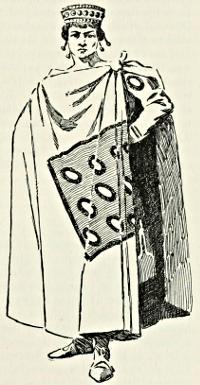
Byzantine Emperor
(Based on Mongez)
Although the environs of Thrace had in earlier days supplied sufficient
wheat to supply the wants of the people, the increase of population now
demanded more food, and Pontian and Egyptian
corn were introduced into the country.
Unfortunately this city, otherwise so perfect,
was frequently disturbed by earthquakes,
sometimes accompanied by great
upheavals of the sea; but in spite of the
unsafe foundations of the buildings, especially
of the larger and more important ones,
the emperors did not hesitate to enrich the
city, rebuilt by Constantine the Great in
330, with imposing edifices. As Constantine
himself, with a perennial passion for
building, had endeavoured to cover the land
for about fifteen furlongs around the city
with edifices of every possible kind, the
succeeding emperors were not to be thought
lacking; and so, up to the time when the
two empires were separated, the residences
of the emperors on the seven hills in the
fourteen departments were, according to
models of Rome, of no mean pretensions.
In the first division, which took in the
east points of the neck of land washed by
the Golden Horn and the Bosporus, was the
great imperial palace, which included, besides
the private residence of the emperor, with the
throne room and the apartment made entirely
of porphyry in which the princes and princesses
were born, the houses of all the chief
people in office at court, extensive laundries,
and a host of most beautiful halls, courts,
and gardens. Other palaces were attached,
as the one inhabited by Theodosius’ daughter Placidia, and there were also
fifteen private baths supplied by the warm springs of Arcadia; and through
the chalœ, with its surrounding piazza and gilded roofed entrance, the
way led to the second division, in which stood the “great church” built
by Constantine and rebuilt later by Justinian as St. Sophia, and the residences
of the senators, all carried out in the best style with the costliest
marble. The inartistic Constantine had had the statues of the Rhodian
Zeus and the Athene of Lindos taken from their original standing places
and put in front of these buildings. Lastly came the Baths of Zeuxippus
in the Grove of Zeus, sufficiently immense to enable two thousand men to
bathe there daily.b
The number and importance of the Gothic forces in the Roman armies
during the reign of Theodosius had enabled several of their commanders
to attain the highest rank; and among these officers, Alaric was the most
distinguished by his future greatness.
The death of Theodosius threw the administration of the Eastern Empire
into the hands of Rufinus, the minister of Arcadius; and that of the
Western, into those of Stilicho, the guardian of Honorius. The discordant
elements which composed the Roman Empire began to reveal all their incongruities
under these two ministers. Rufinus was a civilian from Gaul; and,
from his Roman habits and feelings and western prejudices, disagreeable to the
Greeks. Stilicho was of barbarian descent, and consequently equally unacceptable
to the aristocracy of Rome; but he was an able and popular soldier, and
had served with distinction both in the East and in the West. As Stilicho
was the husband of Serena, the niece and adopted daughter of Theodosius
the Great, his alliance with the imperial family gave him an unusual influence
in the administration. The two ministers hated one another with all
the violence of aspiring ambition; and, unrestrained by any feeling of patriotism,
each was more intent on ruining his rival than on serving the state.
The greater number of the officers in the Roman service, both civil and
military, were equally inclined to sacrifice every public duty for the gratification
of their avarice or ambition.
At this time Alaric, partly from disgust at not receiving all the preferment
which he expected, and partly in the hope of compelling the government
of the Eastern Empire to agree to his terms, quitted the imperial
service and retired towards the frontiers, where he assembled a force sufficiently
large to enable him to act independently of all authority. Availing
himself of the disputes between the ministers of the two emperors, and perhaps
instigated by Rufinus or Stilicho to aid their intrigues, he established
himself in the provinces to the south of the Danube. In the year 395 he
advanced to the walls of Constantinople; but the movement was evidently
a feint, as he must have known his inability to attack a large and populous
city defended by a powerful garrison, and which even in ordinary times
received the greater part of its supplies by sea. After this demonstration,
Alaric marched into Thrace and Macedonia, and extended his ravages into
Thessaly. Rufinus has been accused of assisting Alaric’s invasion, and his
negotiations with him while in the vicinity of Constantinople authorise the
suspicion. When the Goth found the northern provinces exhausted, he
resolved to invade Greece and Peloponnesus, which had long enjoyed profound
tranquillity. The cowardly behaviour of Antiochus the proconsul of
Achaia, and of Gerontius the commander of the Roman troops, both friends of
Rufinus, was considered a confirmation of his treachery. Thermopylæ was left
unguarded, and Alaric entered Greece without encountering any resistance.
The ravages committed by Alaric’s army have been described in fearful
terms; villages and towns were burned, the men were murdered, and the
women and children carried away to be sold as slaves by the Goths. But
even this invasion affords proofs that Greece had recovered from the desolate
condition in which it had been seen by Pausanias. The walls of Thebes
had been rebuilt, and it was in such a state of defence that Alaric could
not venture to besiege it, but hurried forward to Athens. He concluded
a treaty with the civil and military authorities, which enabled him to enter
that city without opposition; his success was probably assisted by treacherous
arrangements with Rufinus, and by the treaty with the municipal
authorities, which secured the town from being plundered by the Gothic
soldiers; for he appears to have really occupied Athens rather as a federate
leader than as a foreign conqueror.
The tale recorded by Zosimuse of the Christian Alaric having been induced
by the apparition of the goddess Minerva to spare Athens, is refuted
by the direct testimony of other writers, who mention the capitulation of
the city. The fact that the depredations of Alaric hardly exceeded the
ordinary license of a rebellious general, is, at the same time, perfectly established.
The public buildings and monuments of ancient splendour suffered
no wanton destruction from his visit; but there can be no doubt that Alaric
and his troops levied heavy contributions on the city and its inhabitants.
Athens evidently owed its good treatment to the condition of its population,
and perhaps to the strength of its walls, which imposed some respect on the
Goths; for the rest of Attica did not escape the usual fate of the districts
through which the barbarians marched. The town of Eleusis, and the great
temple of Ceres, were plundered and then destroyed. Whether this work
of devastation was caused by the Christian monks who attended the Gothic
host, and excited their bigoted Arian votaries to avenge the cause of religion
on the temples of the pagans at Eleusis, because they had been compelled to
spare the shrines at Athens, or whether it was the accidental effect of the
eager desire of plunder or of the wanton love of destruction among a disorderly
body of troops, is not very material. Bigoted monks, avaricious
officers, and disorderly soldiers were numerous in Alaric’s band.
Gerontius, who had abandoned the pass of Thermopylæ, took no measures
to defend the Isthmus of Corinth, or the difficult passes of Mount Geranion,
so that Alaric marched unopposed into the Peloponnesus, and, in a short
time, captured every city in it without meeting with any resistance. Corinth,
Argos, and Sparta, were all plundered by the Goths. The security in
which Greece had long remained, and the policy of the government, which
discouraged their independent institutions, had conspired to leave the province
without protection, and the people without arms. The facility which
Alaric met with in effecting his conquest, and his views, which were directed
to obtain an establishment in the empire as an imperial officer or feudatory
governor, rendered the conduct of his army not that of avowed enemies.
Yet it often happened that they laid waste everything in the line of their
march, burned villages, and massacred the inhabitants.
Alaric passed the winter in the Peloponnesus without encountering any
opposition from the people; yet many of the Greek cities still kept a body
of municipal police, which might surely have taken the field, had the imperial
officers performed their duty and endeavoured to organise a regular resistance
in the country districts. The moderation of the Goth, and the treason of
the Roman governor, seem both attested by this circumstance. The government
of the Eastern Empire had fallen into such disorder at the commencement
of the reign of Arcadius, that even after Rufinus had been assassinated
by the army the new ministers of the empire gave themselves very little
concern about the fate of Greece.
Honorius had a more able, active, and ambitious minister in Stilicho, and
he determined to punish the Goths for their audacity in daring to establish
themselves in the empire without the imperial authority. Stilicho had
attempted to save Thessaly in the preceding year, but had been compelled
to return to Italy, after he had reached Thessalonica, by an express order of
the emperor Arcadius, or rather of his minister Rufinus. In the spring of
the year 396, he assembled a fleet at Ravenna, and transported his army
directly to Corinth, which the Goths do not appear to have garrisoned, and
where, probably, the Roman governor still resided. Stilicho’s army, aided
by the inhabitants, soon cleared the open country of the Gothic bands, and
Alaric drew together the remains of his diminished army in the elevated
plain of Mount Pholoe, which has since served as a point of retreat for the
northern invaders of Greece. Stilicho contented
himself with occupying the passes with his army;
but his carelessness, or the relaxed discipline of
his troops, soon afforded the watchful Alaric an
opportunity of escaping with his army, of carrying
off all the plunder which they had collected, and,
by forced marches, of gaining the Isthmus of
Corinth.
[395-396 A.D.]
Alaric succeeded in conducting his army into
Epirus, where he disposed his forces to govern
and plunder that province, as he had expected to
rule Peloponnesus. Stilicho was supposed to have
winked at his proceedings, in order to render his
own services indispensable by leaving a dangerous
enemy in the heart of the Eastern Empire; but
the truth appears to be that Alaric availed himself
so ably of the jealousy with which the court of
Constantinople viewed the proceedings of Stilicho,
as to negotiate a treaty, by which he was received
into the Roman service, and that he really entered
Epirus as a general of Arcadius. Stilicho was
again ordered to retire from the Eastern Empire,
and he obeyed rather than commence a civil war
by pursuing Alaric. The conduct of the Gothic
troops in Epirus was, perhaps, quite as orderly as
that of the Roman legionaries; so that Alaric was
probably welcomed as a protector when he obtained
the appointment of commander-in-chief of
the imperial forces in eastern Illyricum, which he
held for four years. During this time he prepared
his troops to seek his fortune in the Western Empire. The military commanders,
whether Roman or barbarian, were equally indifferent to the fate of
the people whom they were employed to defend; and the Greeks appear to
have suffered equal oppression from the armies of Stilicho and Alaric.
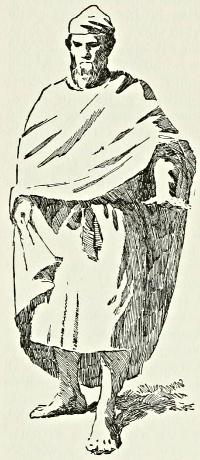
Byzantine Peasant
The condition of the European Greeks underwent a great change for the
worse, in consequence of this unfortunate plundering expedition of the Goths.
The destruction of their property and the loss of their slaves were so great,
that the evil could only have been slowly repaired under the best government
and perfect security of their possessions. In the miserable condition to which
the Eastern Empire was reduced, this was hopeless; and a long period elapsed
before the mass of the population of Greece again attained the prosperous
condition in which Alaric had found it; nor were some of the cities which
he destroyed ever rebuilt. The ruin of roads, aqueducts, cisterns, and public
buildings, erected by the accumulation of capital in prosperous and enterprising
ages, was a loss which could never be repaired by a diminished and
impoverished population.
History generally preserves but few traces of the devastations which affect
only the people; but the sudden misery inflicted on Greece was so great,
when contrasted with her previous tranquillity, that testimonies of her sufferings
are to be found in the laws of the empire. Her condition excited
the compassion of the government during the reign of Theodosius II. There
exists a law which exempts the cities of Illyricum from the charge of contributing
towards the expenses of the public spectacles at Constantinople,
in consequence of the sufferings which the ravages of the Goths and the
oppressive administration of Alaric had inflicted on the inhabitants. There
is another law which proves that many estates were without owners, in
consequence of the depopulation caused by the Gothic invasions; and a third
law relieves Greece from two-thirds of the ordinary contributions to government,
in consequence of the poverty to which the inhabitants were reduced.
This unfortunate period is as remarkable for the devastations committed
by the Huns in Asia as for those of the Goths in Europe, and marks the
commencement of the rapid decrease of the Greek race and of the decline of
Greek civilisation throughout the empire. While Alaric was laying waste
the provinces of European Greece, an army of Huns from the banks of the
Tanais penetrated through Armenia into Cappadocia, and extended their
ravages over Syria, Cilicia, and Mesopotamia. Antioch, at last, resisted their
assaults and arrested their progress; but they took many Greek cities of
importance, and inflicted an incalculable injury on the population of the
provinces which they entered. In a few months they retreated to their
seats on the Palus Mæotis, having contributed much to accelerate the ruin
of the richest and most populous portion of the civilised world.c
[396-399 A.D.]
The first events of the reign of Arcadius and Honorius are so intimately
connected that the rebellion of the Goths and the fall of Rufinus have already
claimed a place in the history of the West.
Eutropius, one of the principal eunuchs of the palace of Constantinople,
succeeded the haughty minister whose ruin he had accomplished, and whose
vices he soon imitated. Every order of the state bowed to the new favourite;
and their tame and obsequious submission encouraged him to insult the laws
and, what is still more difficult and dangerous, the manners of his country.
Under the weakest of the predecessors of Arcadius, the reign of the eunuchs
had been secret and almost invisible. They insinuated themselves into the
confidence of the prince; but their ostensible functions were confined to the
menial service of the wardrobe and imperial bedchamber.
Now in the senate, the capital, and the provinces, the statues of Eutropius
were erected in brass or marble, decorated with the symbols of his civil and
military virtues, and inscribed with the pompous title of the third founder of
Constantinople. He was promoted to the rank of patrician, which began to
signify, in a popular and even legal acceptation, the father of the emperor;
and the last year of the fourth century was polluted by the consulship of a
eunuch and a slave.
The bold and vigorous mind of Rufinus seems to have been actuated by a
more sanguinary and revengeful spirit; but the avarice of the eunuch was
not less insatiate than that of the prefect. As long as he despoiled the
oppressors, who had enriched themselves with the plunder of the people,
Eutropius might gratify his covetous disposition without much envy or
injustice; but the progress of his rapine soon invaded the wealth which had
been acquired by lawful inheritance or laudable industry.
Among the generals and consuls of the East, Abundantius had reason to
dread the first effects of the resentment of Eutropius. He had been guilty
of the unpardonable crime of introducing that abject slave to the palace of
Constantinople; and some degree of praise must be allowed to a powerful
and ungrateful favourite who was satisfied with the disgrace of his benefactor.
Abundantius was stripped of his ample fortunes by an imperial rescript,
and banished to Pityus, on the Euxine, the last frontier of the Roman world,
where he subsisted by the precarious mercy of the barbarians, till he could
obtain, after the fall of Eutropius, a milder exile at Sidon in Phœnicia.
The destruction of Timasius required a more serious and regular mode
of attack. That great officer, the master-general of the armies of Theodosius,
had signalised his valour by a decisive victory which he obtained over
the Goths of Thessaly; but he was too prone, after the example of his sovereign,
to enjoy the luxury of peace and to abandon his confidence to wicked
and designing flatterers. Timasius had despised the public clamour, by promoting
an infamous dependent to the command of a cohort; and he deserved
to feel the ingratitude of Bargus, who was secretly instigated by the favourite
to accuse his patron of a treasonable conspiracy.
The general was arraigned before the tribunal of Arcadius himself; and
the principal eunuch stood by the side of the throne to suggest the questions
and answers of his sovereign. But as this form of trial might be deemed
partial and arbitrary, the further inquiry into the crimes of Timasius was
delegated to Saturninus and Procopius; the former of consular rank, the
latter still respected as the father-in-law of the emperor Valens. The appearances
of a fair and legal proceeding were maintained by the blunt
honesty of Procopius; and he yielded with reluctance to the obsequious
dexterity of his colleague, who pronounced a sentence of condemnation
against the unfortunate Timasius. His immense riches were confiscated, in
the name of the emperor and for the benefit of the favourite; and he was
doomed to perpetual exile at Oasis, a solitary spot in the midst of the sandy
deserts of Libya (399).
The public hatred and the despair of individuals, continually threatened,
or seemed to threaten, the personal safety of Eutropius, as well as of the numerous
adherents who were attached to his fortune and had been promoted
by his venal favour. For their mutual defence, he contrived the safeguard
of a law, which violated every principle of humanity and justice.
(1) It is enacted, in the name and by the authority of Arcadius, that all
those who shall conspire, either with subjects or with strangers, against the
lives of any of the persons whom the emperor considers as the members of
his own body, shall be punished with death and confiscation.
(2) This extreme severity might, perhaps, be justified, had it been only
directed to secure the representatives of the sovereign from any actual violence
in the execution of their office. But the whole body of imperial dependents
claimed a privilege, or rather impunity, which screened them, in the loosest
moments of their lives, from the hasty, perhaps the justifiable, resentment
of their fellow-citizens; and, by a strange perversion of the laws, the same
degree of guilt and punishment was applied to a private quarrel and to a
deliberate conspiracy against the emperor and the empire. The edict of
Arcadius most positively and most absurdly declares that, in such cases of
treason, thoughts and actions ought to be punished with equal severity; that
the knowledge of a mischievous intention, unless it be instantly revealed,
becomes equally criminal with the intention itself; and that those rash men
who shall presume to solicit the pardon of traitors, shall themselves be
branded with public and perpetual infamy.
(3) “With regard to the sons of the traitors,” continues the emperor,
“although they ought to share the punishment, since they will probably imitate
the guilt, of their parents, yet, by the special effect of our imperial lenity,
we grant them their lives; but, at the same time, we declare them incapable
of inheriting, either on the father’s or on the mother’s side, or of receiving
any gift or legacy from the testament either of kinsmen or of strangers.
Stigmatised with hereditary infamy, excluded from the hopes of honours or
fortune, let them endure the pangs of poverty and contempt, till they shall
consider life as a calamity, and death as a comfort and relief.” In such
words, so well adapted to insult the feelings of mankind, did the emperor,
or rather his favourite eunuch, applaud the moderation of a law which transferred
the same unjust and inhuman penalties to the children of all those
who had seconded or who had not disclosed these fictitious conspiracies.
Some of the noblest regulations of Roman jurisprudence have been suffered
to expire; but this edict, a convenient and forcible engine of ministerial
tyranny, was carefully inserted in the codes of Theodosius and Justinian;
and the same maxims have been revived in modern ages to protect the electors
of Germany and the cardinals of the church of Rome.
[399-400 A.D.]
Yet the sanguinary laws which spread terror among a disarmed and dispirited
people were of too weak a texture to restrain the bold enterprise of
Tribigild the Ostrogoth. The colony of that warlike nation, which had been
planted by Theodosius in one of the most fertile districts of Phrygia, impatiently
compared the slow returns of laborious husbandry with the successful
rapine and liberal rewards of Alaric; and their leader resented, as a personal
affront, his own ungracious reception in the palace of Constantinople.
A soft and wealthy province, in the heart of the empire, was astonished
by the sound of war; and the faithful vassal who had been disregarded or
oppressed was again respected as soon as he resumed the hostile character of
a barbarian. The vineyards and fruitful fields, between the rapid Marsyas
and the winding Mæander, were consumed with fire; the decayed walls of
the city crumbled into dust at the first stroke of an enemy; the trembling
inhabitants escaped from a bloody massacre to the shores of the Hellespont;
and a considerable part of Asia Minor was desolated by the rebellion of Tribigild.
His rapid progress was checked by the resistance of the peasants of
Pamphylia; and the Ostrogoths, attacked in a narrow pass, between the city
of Selgæ, a deep morass, and the craggy cliffs of Mount Taurus, were defeated
with the loss of their bravest troops. But the spirit of their chief was not
daunted by misfortune; and his army was continually recruited by swarms
of barbarians and outlaws, who were desirous of exercising the profession of
robbery under the more honourable names of war and conquest. The rumours
of the success of Tribigild might for some time be suppressed by fear or
disguised by flattery; yet they gradually alarmed both the court and the
capital.
The approach of danger and the obstinacy of Tribigild, who refused all
terms of accommodation, compelled Eutropius to summon a council of war.
After claiming for himself the privilege of a veteran soldier, the eunuch intrusted
the guard of Thrace and the Hellespont to Gainas the Goth, and
the command of the Asiatic army to his favourite Leo; two generals who
differently, but effectually, promoted the cause of the rebels. Leo, who from
the bulk of his body and the dulness of his mind was surnamed the Ajax
of the East, had deserted his original trade of a woolcomber to exercise, with
much less skill and success, the military profession; and his uncertain operations
were capriciously framed and executed, with an ignorance of real difficulties
and a timorous neglect of every favourable opportunity. The rashness
of the Ostrogoths had drawn them into a disadvantageous position between
the rivers Melas and Eurymedon, where they were almost besieged by the
peasants of Pamphylia; but the arrival of an imperial army, instead of completing
their destruction, afforded the means of safety and victory. Tribigild
surprised the unguarded camp of the Romans in the darkness of the night;
seduced the faith of the greater part of the barbarian auxiliaries, and dissipated,
without much effort, the troops which had been corrupted by the
relaxation of discipline and the luxury of the capital.
The bold satirist, who has indulged his discontent by the partial and
passionate censure of the Christian emperors, violates the dignity rather
than the truth of history by comparing the son of Theodosius to one of
those harmless and simple animals who scarcely feel that they are the property
of their shepherd. Two passions, however, fear and conjugal affection,
awakened the languid soul of Arcadius; he was terrified by the threats of a
victorious barbarian; and he yielded to the tender eloquence of his wife,
Eudoxia, who, with a flood of artificial tears, presenting her infant children
to their father, implored his justice for some real or imaginary insult which
she imputed to the audacious eunuch. The emperor’s hand was directed to
sign the condemnation of Eutropius; the magic spell, which during four
years had bound the prince and the people, was instantly dissolved; and
the acclamations that so lately hailed the merit and fortune of the favourite,
were converted into the clamours of the soldiers and people, who reproached
his crimes and pressed his immediate execution.
In this hour of distress and despair his only refuge was in the sanctuary
of the church, whose privileges he had wisely or profanely attempted to circumscribe;
and the most eloquent of the saints, John Chrysostom, enjoyed
the triumph of protecting a prostrate minister, whose choice had raised him
to the ecclesiastical throne of Constantinople. The archbishop, ascending the
pulpit of the cathedral, that he might be distinctly seen and heard by an
innumerable crowd of either sex and of every age, pronounced a seasonable
and pathetic discourse on the forgiveness of injuries and the instability of
human greatness. The agonies of the pale and affrighted wretch who lay
grovelling under the table of the altar, exhibited a solemn and instructive
spectacle; and the orator, who was afterwards accused of insulting the misfortunes
of Eutropius, laboured to excite the contempt that he might assuage
the fury of the people. The powers of humanity, of superstition, and of
eloquence prevailed. The empress Eudoxia was restrained, by her own
prejudices or by those of her subjects, from violating the sanctuary of the
church; and Eutropius was tempted to capitulate, by the milder arts of persuasion
and by an oath that his life should be spared.
Careless of the dignity of their sovereign, the new ministers of the palace
immediately published an edict to declare that his late favourite had disgraced
the names of consul and patrician, to abolish his statues, to confiscate
his wealth, and to inflict a perpetual exile in the island of Cyprus. A despicable
and decrepit eunuch could no longer alarm the fears of his enemies;
nor was he capable of enjoying what yet remained—the comforts of peace, of
solitude, and of a happy climate. But their implacable revenge still envied
him the last moments of a miserable life, and Eutropius had no sooner
touched the shores of Cyprus than he was hastily recalled. The vain hope
of eluding by a change of place the obligation of an oath, engaged the empress
to transfer the scene of his trial and execution from Constantinople to
the adjacent suburb of Chalcedon. The consul Aurelian pronounced the
sentence; and the motives of that sentence
expose the jurisprudence of a despotic government.
The crimes which Eutropius
had committed against the people might
have justified his death, but he was found
guilty of harnessing to his chariot the sacred
animals which, from their breed or
colour, were reserved for the use of the
emperor alone.
While this domestic revolution was
transacted, Gainas openly revolted from
his allegiance; united his forces, at Thyatira
in Lydia, with those of Tribigild;
and still maintained his superior ascendant
over the rebellious leader of the Ostrogoths.
The confederate armies advanced,
without resistance, to the straits of the
Hellespont and the Bosporus; and Arcadius
was instructed to prevent the loss
of his Asiatic dominions by resigning his
authority and his person to the faith of
the barbarians. The church of the holy
martyr Euphemia, situate on a lofty eminence
near Chalcedon, was chosen for the
place of the interview. Gainas bowed
with reverence at the feet of the emperor,
whilst he required the sacrifice of Aurelian
and Saturninus, two ministers of consular
rank; and their naked necks were exposed
by the haughty rebel to the edge of the
sword, till he condescended to grant them
a precarious and disgraceful respite. The Goths, according to the terms of
the agreement, were immediately transported from Asia into Europe; and
their victorious chief, who accepted the title of master-general of the Roman
armies, soon filled Constantinople with his troops and distributed among his
dependents the honours and rewards of the empire.
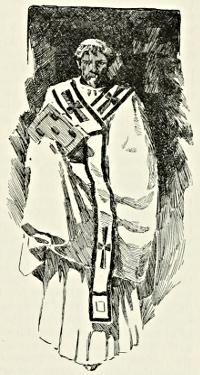
Byzantine Priest
In his early youth, Gainas had passed the Danube as a suppliant and a
fugitive; his elevation had been the work of valour and fortune, and his
indiscreet or perfidious conduct was the cause of his rapid downfall. Notwithstanding
the vigorous opposition of the archbishop, he importunately
claimed for his Arian sectaries the possession of a peculiar church; and the
pride of the Catholics was offended by the public toleration of heresy. [The
Emperor, at Gainas’ demand, melted the plate of the church of the Apostles.]
[400-401 A.D.]
Every quarter of Constantinople was filled with tumult and disorder;
and the barbarians gazed with such ardour on the rich shops of the jewellers
and the tables of the bankers, which were covered with gold and silver, that
it was judged prudent to remove those dangerous temptations from their
sight. They resented the injurious precaution; and some alarming attempts
were made, during the night, to attack and destroy with fire the imperial
palace. In this state of mutual and suspicious hostility, the guards and the
people of Constantinople shut the gates and rose in arms to prevent or to
punish the conspiracy of the Goths. During the absence of Gainas, his troops
were surprised and oppressed; seven thousand barbarians perished in this
bloody massacre. In the fury of the pursuit the Catholics uncovered the
roof, and continued to throw down flaming logs of wood, till they overwhelmed
their adversaries, who had retreated to the church or conventicle
of the Arians. Gainas was either innocent of the design or too confident of
his success; he was astonished by the intelligence that the flower of his
army had been ingloriously destroyed, that he himself was declared a public
enemy, and that his countryman, Fravitta, a brave and loyal confederate,
had assumed the management of the war by sea and land.
The enterprises of the rebel against the cities of Thrace were encountered
by a firm and well-ordered defence; his hungry soldiers were soon
reduced to the grass that grew on the margin of the fortifications; and Gainas,
who vainly regretted the wealth and luxury of Asia, embraced a desperate
resolution of forcing the passage of the Hellespont. He was destitute of
vessels; but the woods of the Chersonesus afforded material for rafts, and
his intrepid barbarians did not refuse to trust themselves to the waves. But
Fravitta attentively watched the progress of their undertaking. As soon as
they had gained the middle of the stream, the Roman galleys, impelled by
the full force of oars, of the current, and of a favourable wind, rushed forwards
in compact order and with irresistible weight; and the Hellespont
was covered with the fragments of the Gothic shipwreck.
After the destruction of his hopes and the loss of many thousands of his
bravest soldiers, Gainas, who could no longer aspire to govern or to subdue
the Romans, determined to resume the independence of a savage life. A
light and active body of barbarian horse, disengaged from their infantry and
baggage, might perform in eight or ten days a march of three hundred miles
from the Hellespont to the Danube. This design was secretly communicated
to the national troops, who devoted themselves to the fortunes of their leader;
and before the signal of departure was given, a great number of provincial
auxiliaries whom he suspected of an attachment to their native country, were
perfidiously massacred.
But a formidable ally appeared in arms to vindicate the majesty of the
empire, and to guard the peace and liberty of Scythia. The superior forces
of Uldin, king of the Huns, opposed the progress of Gainas; a hostile and
ruined country prohibited his retreat; he disdained to capitulate, and after
repeatedly attempting to cut his way through the ranks of the enemy, he
was slain, with his desperate followers, in the field of battle. Eleven days
after the naval victory of the Hellespont, the head of Gainas, the inestimable
gift of the conqueror, was received at Constantinople with the most liberal
expressions of gratitude; and the public deliverance was celebrated by festivals
and illuminations. The triumphs of Arcadius became the subject of epic
poems; and the monarch, no longer oppressed by any hostile terrors, resigned
himself to the mild and absolute dominion of his wife, the fair and artful Eudoxia,
who has sullied her fame by the persecution of St. John Chrysostom.
[398-403 A.D.]
Born of a noble and opulent family in the capital of Syria, Chrysostom
had been educated by the care of a tender mother, under the tuition of the
most skilful masters. His piety soon disposed him to renounce the lucrative
and honourable profession of the law, and to bury himself in the adjacent
desert, where he subdued the lusts of the flesh by an austere penance of six
years. His infirmities compelled him to return to the society of mankind,
but in the midst of his family and afterwards on the archiepiscopal throne
Chrysostom still persevered in the practice of the monastic virtues. The
ample revenues which his predecessors had consumed in pomp and luxury he
diligently applied to the establishment of hospitals; and the multitudes who
were supported by his charity preferred the eloquent and edifying discourses
of their archbishop to the amusements of the theatre or the circus.
The pastoral labours of the archbishop of Constantinople provoked and
gradually united against him two sorts of enemies—the aspiring clergy who
envied his success, and the obstinate sinners who were offended by his
reproofs. [Chrysostom’s sermons from the pulpit of St. Sophia on the degeneracy
of the Christians had their severest application in court circles where
there was a large share of guilt to be divided among a relatively small number
of criminals.] The secret resentment of the court encouraged the discontent
of the clergy and monks of Constantinople, who were too hastily
reformed by the fervent zeal of their archbishop. He had condemned from
the pulpit the domestic females of the clergy of Constantinople, who, under
the name of servants or sisters, afforded a perpetual occasion either of sin
or of scandal.
The silent and solitary ascetics who had secluded themselves from the
world were entitled to the warmest approbation of Chrysostom; but he
despised and stigmatised, as the disgrace of their holy profession, the crowd
of degenerate monks who, from some unworthy motives of pleasure or profit,
so frequently infested the streets of the capital. To the voice of persuasion
the archbishop was obliged to add the terrors of authority; and his ardour
in the exercise of ecclesiastical jurisdiction was not always exempt from passion;
nor was it always guided by prudence. Chrysostom was naturally of a
choleric disposition. Although he struggled, according to the precepts of the
gospel, to love his private enemies, he indulged himself in the privilege of
hating the enemies of God and of the church; and his sentiments were sometimes
delivered with too much energy of countenance and expression.
Conscious of the purity of his intentions, and perhaps of the superiority
of his genius, the archbishop of Constantinople extended the jurisdiction of
the imperial city, that he might enlarge the sphere of his pastoral labours;
and the conduct which the profane imputed to an ambitious motive appeared
to Chrysostom himself in the light of a sacred and indispensable duty. In
his visitation through the Asiatic provinces, he deposed thirteen bishops
of Lydia and Phrygia; and indiscreetly declared that a deep corruption of
simony and licentiousness had infected the whole episcopal order. If those
bishops were innocent, such a rash and unjust condemnation must excite a
well-grounded discontent. If they were guilty, the numerous associates of
their guilt would soon discover that their own safety depended on the ruin
of the archbishop, whom they studied to represent as the tyrant of the
Eastern church.
This ecclesiastical conspiracy was managed by Theophilus, archbishop
of Alexandria, an active and ambitious prelate, who displayed the fruits of
rapine in monuments of ostentation. His national dislike to the rising greatness
of a city which degraded him from the second to the third rank in the
Christian world, was exasperated by some personal disputes with Chrysostom
himself. By the private invitation of the empress, Theophilus landed at Constantinople
with a stout body of Egyptian mariners to encounter the populace,
and a train of dependent bishops to secure, by their voices, the majority
of a synod.
[403-404 A.D.]
The synod was convened in the suburb of Chalcedon, surnamed the Oak,
where Rufinus had erected a stately church and monastery; and their proceedings
were continued during fourteen days or sessions. A bishop and
a deacon accused the archbishop of Constantinople; but the frivolous or
improbable nature of the forty-seven articles which they presented against
him may justly be considered as a fair and unexceptionable panegyric.
Four successive summons were signified to Chrysostom; but he still refused
to trust either his person or his reputation in the hands of his implacable
enemies, who, prudently declining the examination of any particular charges,
condemned his contumacious disobedience and hastily pronounced a sentence
of deposition. The synod of the Oak immediately addressed the emperor
to ratify and execute their judgment, and charitably insinuated that the
penalties of treason might be inflicted on the audacious preacher, who had
reviled, under the name of Jezebel, the empress Eudoxia herself. The
archbishop was rudely arrested, and conducted through the city by one of
the imperial messengers, who landed him, after a short navigation, near the
entrance of the Euxine; but two days later he was gloriously recalled.
The first astonishment of his faithful people had been mute and passive;
they suddenly rose with unanimous and irresistible fury. Theophilus
escaped; but the promiscuous crowd of monks and Egyptian mariners was
slaughtered without pity in the streets of Constantinople. A seasonable
earthquake justified the interposition of heaven; the torrent of sedition
rolled forwards to the gates of the palace; and the empress, agitated by
fear or remorse, threw herself at the feet of Arcadius and confessed that the
public safety could be purchased only by the restoration of Chrysostom.
The short interval of a perfidious truce was employed to concert more
effectual measures for the disgrace and ruin of the archbishop. A numerous
council of the Eastern prelates, who were guided from a distance by the
advice of Theophilus, confirmed the validity, without examining the justice,
of the former sentence; and a detachment of barbarian troops was introduced
into the city, to suppress the emotions of the people. On the vigil of
Easter, the solemn administration of baptism was rudely interrupted by the
soldiers, who alarmed the modesty of the naked catechumens, and violated
by their presence the awful mysteries of the Christian worship. Arsacius
occupied the church of St. Sophia and the archiepiscopal throne. The
Catholics retreated to the baths of Constantine, and afterwards to the fields;
where they were still pursued and insulted by the guards, the bishops, and
the magistrates. The fatal day of the second and final exile of Chrysostom
was marked by the conflagration of the cathedral, of the senate house, and
of the adjacent buildings; and this calamity was imputed, without proof
but not without probability, to the despair of a persecuted faction.
Instead of listening to his humble prayer that he might be permitted to
reside at Cyzicus or Nicomedia, the inflexible empress assigned for his exile
the remote and desolate town of Cucusus, among the ridges of Mount Taurus
in the Lesser Armenia. A secret hope was entertained that the archbishop
might perish in a difficult and dangerous march of seventy days, in the heat
of summer, through the provinces of Asia Minor, where he was continually
threatened by the hostile attacks of the Isaurians and the more implacable
fury of the monks. Yet Chrysostom arrived in safety at the place of his
confinement; and the three years which he spent at Cucusus, and the
neighbouring town of Arabissus, were the last and most glorious of his life.
His character was consecrated by absence and persecution; the faults of his
administration were no longer remembered, but every tongue repeated the
praises of his genius and virtue; and the respectful attention of the Christian
world was fixed on a desert spot among the mountains of Taurus.
[404-408 A.D.]
From that solitude the archbishop, his active mind invigorated by misfortunes,
maintained a strict and frequent correspondence with the most distant
provinces; exhorted the separate congregation of his faithful adherents to persevere
in their allegiance; urged the destruction of the temples of Phœnicia,
and the extirpation of heresy in the isle of Cyprus; extended his pastoral
care to the missions of Persia and Scythia; negotiated, by his ambassadors,
with the Roman pontiff and the emperor Honorius; and boldly appealed from
a partial synod to the supreme tribunal of a free and general council. The
mind of the illustrious exile was still independent; but his captive body was
exposed to the revenge of the oppressors, who continued to abuse the name
and authority of Arcadius. An order was despatched for the instant removal
of Chrysostom to the extreme desert of Pityus; and his guards so faithfully
obeyed their cruel instructions that, before he reached the sea-coast of the
Euxine, he expired at Comana, in Pontus, in the sixtieth year of his age.
The succeeding generation acknowledged his innocence and merit. The
archbishops of the East, who might blush that their predecessors had been
the enemies of Chrysostom, were gradually disposed, by the firmness of the
Roman pontiff, to restore the honours of that venerable name. At the pious
solicitation of the clergy and people of Constantinople, his relics, thirty years
after his death, were transported from their obscure sepulchre to the royal
city. The emperor Theodosius advanced to receive them as far as Chalcedon;
and falling prostrate on the coffin implored, in the name of his guilty
parents, Arcadius and Eudoxia, the forgiveness of the injured saint. Yet
a reasonable doubt may be entertained whether any stain of hereditary
guilt could be derived from Arcadius to his successor. Eudoxia was a
young and beautiful woman, who indulged her passions and despised her
husband; Count John enjoyed, at least, the confidence of the empress;
and the public named him as the real father of Theodosius the Younger.
The birth of a son was accepted, however, by the pious husband as an
event the most fortunate and honourable to himself, to his family, and to the
Eastern world. In less than four years afterwards, Eudoxia, in the bloom
of youth, was destroyed by the consequence of a miscarriage (404), and in
four more years (May, 408), after a reign (if we may abuse that word) of
thirteen years, three months and fifteen days, Arcadius expired in the palace
of Constantinople. It is impossible to delineate his character; since in a
period very copiously furnished with historical materials, it has not been
possible to remark one action that properly belongs to the son of the great
Theodosius.d
[408-444 A.D.]
Arcadius was succeeded by his son Theodosius, who at the time of his
father’s death was a mere child. The Roman world was deeply interested
in the education of its master. A regular course of study and exercise was
judiciously instituted, of the military exercises of riding and shooting with
the bow; of the liberal studies of grammar, rhetoric, and philosophy; the
most skilful masters of the East ambitiously solicited the attention of their
royal pupil, and several noble youths were introduced into the palace, to
animate his diligence by the emulation of friendship. Pulcheria alone discharged
the important task of instructing her brother in the arts of government;
but her precepts may countenance some suspicion of the extent of her
capacity or of the purity of her intentions.[1]
But Theodosius was never excited to support the weight and glory of an
illustrious name; and instead of aspiring to imitate his ancestors, he degenerated
(if we may presume to measure the degrees of incapacity) below the
weakness of his father and his uncle. Arcadius and Honorius had been
assisted by the guardian care of a parent whose lessons were enforced by his
authority and example. But the unfortunate prince who is born in the
purple must remain a stranger to the voice of truth; and the son of Arcadius
was condemned to pass his perpetual infancy encompassed only by a
servile train of women and eunuchs. The ample leisure which he acquired
by neglecting the essential duties of his high office, was filled by idle amusements
and unprofitable studies. Hunting was the only active pursuit that
could tempt him beyond the limits of the palace; but he most assiduously
laboured in the mechanic occupations of painting and carving; and the elegance
with which he transcribed religious books entitled the Roman emperor
to the singular epithet of Calligraphes, or a fair writer.
Separated from the world by an impenetrable veil, Theodosius trusted
the persons whom he loved; he loved those who were accustomed to amuse
and flatter his indolence, and as he never perused the papers that were presented
for the royal signature, acts of injustice the most repugnant to his
character were frequently perpetrated in his name. The emperor himself
was chaste, temperate, liberal, and merciful; but these qualities, which can
only deserve the name of virtues when they are supported by courage and
regulated by discretion, were seldom beneficial and they sometimes proved
mischievous to mankind. His mind, enervated by a royal education, was
oppressed and degraded by abject superstition; he fasted, he sang psalms,
he blindly accepted the miracles and doctrines with which his faith was
continually nourished. He devoutly worshipped the dead and living saints
of the Catholic church.
The story of a fair and virtuous maiden exalted from a private condition
to the imperial throne might be deemed an incredible romance, if such a
romance had not been verified in the marriage of Theodosius. The celebrated
Athenais was educated by her father Leontius in the religion and
sciences of the Greeks; and so advantageous was the opinion which the
Athenian philosopher entertained of his contemporaries, that he divided his
patrimony between his two sons, bequeathing to his daughter a small legacy
of one hundred pieces of gold, in the lively confidence that her beauty and
merit would be a sufficient portion. The jealousy and avarice of her brothers
soon compelled Athenais to seek a refuge at Constantinople; and, with some
hopes either of justice or favour, to throw herself at the feet of Pulcheria.
That sagacious princess listened to her eloquent complaint; and secretly destined
the daughter of the philosopher Leontius for the future wife of the
emperor of the East, who had now attained the twentieth year of his age.
Athenais, who was easily persuaded to renounce the errors of paganism,
received at her baptism the Christian name of Eudocia; but the cautious
Pulcheria withheld the title of Augusta till the wife of Theodosius had
approved her fruitfulness by the birth of a daughter, who espoused, fifteen
years afterwards, the emperor of the West. The brothers of Eudocia obeyed,
with some anxiety, her imperial summons; but as she could easily forgive
their fortunate unkindness, she indulged the tenderness, or perhaps the
vanity, of a sister, by promoting them to the rank of consuls and prefects.
In the luxury of the palace she still cultivated those ingenuous arts which
had contributed to her greatness; and wisely dedicated her talents to the
honour of religion and of her husband. Eudocia composed a poetical paraphrase
of the first eight books of the Old Testament, and of the prophecies
of Daniel and Zachariah; a cento of the verses of Homer, applied to the life
and miracles of Christ, the legend of St. Cyprian, and a panegyric on the
Persian victories of Theodosius; and her writings, which were applauded
by a servile and superstitious age, have not been disdained by the candour
of impartial criticism.
[420-460 A.D.]
The fondness of the emperor was not abated by time and possession; and
Eudocia, after the marriage of her daughter, was permitted to discharge her
grateful vows by a solemn pilgrimage to Jerusalem. Her ostentatious progress
through the East may seem inconsistent with the spirit of Christian
humility. But this pilgrimage was the fatal term of the glories of Eudocia.
Satiated with empty pomp, and unmindful perhaps of her obligations to
Pulcheria, she ambitiously aspired to the government of the Eastern Empire;
the palace was distracted by female discord, but the victory was at
last decided by the superior ascendant of the sister of Theodosius.
As soon as the empress perceived that the affection of Theodosius was
irretrievably lost, she requested the permission of retiring to the distant
solitude of Jerusalem. She obtained her request; but the jealousy of Theodosius,
or the vindictive spirit of Pulcheria, pursued her in her last retreat.
The remainder of the life of Eudocia, about sixteen years, was spent in exile
and devotion; and the approach of age, the death of Theodosius, the misfortunes
of her only daughter, who was led a captive from Rome to Carthage,
and the society of the holy monks of Palestine, insensibly confirmed
the religious temper of her mind. After a full experience of the vicissitudes
of human life, the daughter of the philosopher Leontius expired at
Jerusalem, in the sixty-seventh year of her age; protesting with her dying
breath that she had never transgressed the bounds of innocence and friendship
(460).[2]
The gentle mind of Theodosius was never inflamed by the ambition of
conquest or military renown, and the slight alarm of a Persian war scarcely
interrupted the tranquillity of the East. The motives of this war were just
and honourable. In the last year of the reign of Jezdegerd, the Persian
king, a bishop, who aspired to the crown of martyrdom, destroyed one of
the fire-temples of Susa. His zeal and obstinacy were revenged on his
brethren: the Magi excited a cruel persecution; and the intolerant zeal of
Jezdegerd was imitated by his son Varanes, or Bahram, who soon afterwards
ascended the throne. Some Christian fugitives, who escaped to the Roman
frontier, were sternly demanded and generously refused; and the refusal,
aggravated by commercial disputes, soon kindled a war between the rival
monarchies. The mountains of Armenia and the plains of Mesopotamia
were filled with hostile armies; but the operations of two successive campaigns
were not productive of any decisive events.
A truce of one hundred years was solemnly ratified, and although the
revolution of Armenia might threaten the public tranquillity, the essential
conditions of the treaty were respected near fourscore years by the successors
of Constantine and Artaxerxes.b
Before taking up the subject of the coming of the Huns the following
extract from J. B. Bury’s History of the Later Roman Empire will enable
the reader to understand how it was that the barbaric invasions had such
different effects on the Eastern and Western divisions of the Empire.a
“When we read the chronicles of the reign of Theodosius II, we at first
receive the impression that it was a period of few important events, though
set with curious stories. The invasions of Attila and the general council
of Ephesus are the only facts which seem to stand out prominently in the
chronicles, while they are full of stories and interesting traits which attract
the imagination, such as the life of Athenais, the martyrdom of Hypatia,
the monastic life of the imperial votaries Pulcheria and her sisters, the
story of the waking of the seven sleepers—the young saints who in the
reign of Decius had fallen asleep in a cave. But on further study we come
to the conclusion that it was a period of capital importance,—a period in
which the empire was passing a vital crisis.
“To an unprejudiced observer in the reign of Arcadius it might have
seemed that the empire in its eastern parts was doomed to a speedy decline.
One possessed of the insight of Synesius might have thought it impossible that
it could last for eight hundred years more when he considered the threatening
masses of barbarians who environed it, the corruptions and divisions of the
imperial court, the oppression of the subjects, and all the evils which Synesius
actually pointed out. For with the beginning of the fifth century a
critical time approached for the whole empire. At the end of the same century
we find that while the western half had been found wanting in the day
of its trial, the eastern half had passed the crisis and all the dangers successfully;
we find strong and prudent emperors ruling at New Rome, disposed
to alleviate the burdens of the subjects, and in the court a different
atmosphere from that of the days of Arcadius.
“Now the significance of the reign of Theodosius II is that it was the
transition from the court of Arcadius to the court of the steady reforming
emperors in the latter half of the century, and it partook of both characters.
This double-sidedness is its peculiarity. Theodosius was weak, like his
father, but he was not so weak, and he seems to have profited more by his
education. The senate struggles with effect against irresponsible officialism,
and although we hear that there was venality and corruption in the days
of Pulcheria, a great improvement is in progress. In the chronicles we do
not hear much about the senate, everything is attributed to Pulcheria or
Theodosius; but the words of Socrates that the emperor was much beloved
‘by the senate and people’ are significant, and there is no doubt that the
much-lauded wisdom of Pulcheria’s regency consisted in the wisdom of the
senate which she supported. And although towards the close of the reign
eunuchs had power, the ground gained by the senate was not lost; the spirit
of its administration and the lines of its policy were followed by the succeeding
emperors, and it guided the state safely through a most momentous
period which proved fatal to the integrity of the western provinces.
“The two most important acts of Theodosius were the foundation of a
university at Constantinople and the compilation of the code called after his
name. The inauguration of the university was an important measure for
Byzantine life, and indicates the enlightenment of Theodosius’ reign. It
was intended to supersede the university of Athens, the headquarters of
paganism, and thereby to further the cause of Christianity.
“In the year 429 Theodosius determined to form a collection of all the
constitutions issued by the ‘renowned Constantine, the divine emperors
who succeeded him, and ourselves.’ The new code was to be drawn up on
the model of the Gregorian and Hermogenian codes, and the execution of
the work was entrusted to a commission of nine persons, among whom was
Apelles, professor of law at the new university. In 438 the work was completed
and published.”e
[175-375 A.D.]
The question of the race affinities of the Huns has been the occasion for
a great deal of controversy. By various writers they have been connected
with the Mongols, the Turks, the Ugrians, etc., but as yet no agreement has
been reached that has placed this question on a safe basis.a
The history of the Huns is generally commenced with the narratives of
Ammianus Marcellinus and Jordanes; but they were known in Europe at
an earlier date. Ptolemy (175-182 A.D.) mentions the Chunni between the
Bastarnæ and Roxolani, and places them on the Dnieper; but Schafarik
suggests that this may be an interpolated passage; see the Slavische Alterthümer,
1-322. Dionysius Periegetes, about 200 A.D., names them among
the borderers of the Caspian, in this order: Scyths, Huns, Caspiani, Albani.
[375-451 A.D.]
It was in 374 or 375 that the Huns made their first really important advance
into Europe. Jordanes tells us their leader was named Balamir, or, as
some of the Mss. make it, Balamber; see Thierry, History of Attila and His
Successors, p. 617. Ammianus tells us that the Huns, being excited by an
unrestrainable desire of plundering the possessions of others, went on
ravaging and slaughtering all the nations in their neighbourhood, till they
reached the Alani. Having attacked and defeated them, they enlisted
them in their service, and then proceeded to invade the empire of the
Ostrogoths, or Grutungs, ruled over by Hermanric. Having been beaten in
two encounters with them, Hermanric committed suicide. His son, Withimir,
continued the struggle; but was also defeated and killed in battle, and the
Ostrogoths became subject to the Huns. The latter now marched on towards
the Dniester, on which lived the Visigoths or Thervings. Athanaric, the
king of the latter, took great precautions, but was nevertheless surprised
by the Huns, who forded the river in the night, fell suddenly upon his camp,
and utterly defeated him. He now attempted to raise a line of fortifications
between the Pruth and the Danube, behind which to take shelter; but was
abandoned by the greater portion of his subjects, who, under the command
of Alavivus, crossed the Danube, and by permission of the emperor Valens
settled in Thrace.
The Huns now occupied the country vacated by the Goths; they succeeded
in fact to the empire of Hermanric, and apparently subjected the
various nations over which he ruled. They did not disturb the Roman world
by their invasions for fifty years, but contented themselves with overpowering
the various tribes who lived north of the Danube, in Sarmatia and Germany.
Many of them, in fact, entered the service of the Romans. Thus, in 405
one Huldin, a king of the Huns, assisted Honorius in his struggle against the
Visigoths of Radagaisus.
During the regency of Placidia, sixty thousand Huns were in the Roman
service, according to Thierry. Meanwhile, although they did not attack
Rome directly, the Huns were gradually forcing the tribes of Germany, the
Suevi, the Vandals, the Alans, etc., across the Rhine, and gradually pushing
themselves along the valley of the Danube. In 407, they appeared under
their chief, Octar, in the valley of the Rhine, and fought with the Burgundians
on the Main; [see Thierry]. This Octar was the brother of
Mundzuk, the father of Attila; there were two other brothers, Abarre and
Ruas, who divided between them the greater part of the Hunnic tribes.
The latter became a notable sovereign, and has lost a reputation, as
so many others have, by having a more fortunate successor. He was the
friend of Aëtius. The emperor Theodosius the Second paid him an annual
stipend of 350 pounds of gold, and created him a Roman general. This
good feeling was disturbed by the Romans having given refuge to certain
revolted Hunnic tribes, the Annuldsuri, Ithimari, Tonosuri, and Boisi
(according to Priscus, cited by Thierry), the same confederacy that, as I
have already mentioned from Jordanes was the first to cross the Mæotis.
This quarrel led to the sending of envoys who arrived after the death of
Ruas, and were received by his nephews, Attila and Bleda.
In 448, Attila conquered the Akatziri Unni, says Priscus, another Hunnic
confederacy on the Pontus, which afterwards revived under the name of
Khazars. Having destroyed their chiefs, except one named Kuridakh, he
placed his son Ellah in authority over them. He then proceeded to subdue
the various Slavic and Germanic tribes that still remained independent,
extending his conquests to the Battick. There followed the long and generally
victorious struggle which he carried on against Rome, and which concluded
with the terrible fight on the Catalaunian fieldsc [Châlons, in which
Theodoric I king of the Visigoths was slain].
They never shelter themselves under roofed houses, but avoid them as
people ordinarily avoid sepulchres, as things not fitted for common use. Nor
is there even to be found among them a cabin thatched with reeds: but they
wander about, roaming over the mountains and the woods, and accustom
themselves to bear frost and hunger and thirst from their very cradles.
And even when abroad they never enter a house unless under the compulsion
of extreme necessity; nor, indeed, do they think people under roofs as
safe as others.
They wear linen clothes, or else garments made of the skins of field-mice;
nor do they wear a different dress out of doors from that which they wear at
home; but after a tunic is once put round their necks, however it becomes
worn, it is never taken off or changed till, from long decay, it becomes actually
so ragged as to fall to pieces.
They cover their heads with round caps, and their shaggy legs with the
skins of kids; their shoes are not made on any lasts, but are so unshapely as
to hinder them from walking with a free gait. And for this reason they are
not well suited to infantry battles, but are nearly always on horseback, their
horses being ill shaped, but hardy; and sometimes they even sit upon them
like women if they want to do anything more conveniently. There is not a
person in the whole nation who cannot remain on his horse day and night.
On horseback they buy and sell, they take their meat and drink, and there
they recline on the narrow neck of their steed, and yield to sleep so deep
as to indulge in every variety of dream.
And when any deliberation is to take place on any weighty matter, they
all hold their common council on horseback. They are not under the authority
of a king, but are contented with the irregular government of their
nobles, and under their lead they force their way through all obstacles.
Sometimes when provoked, they fight; and when they go into battle,
they form in a solid body, and utter all kinds of terrific yells. They are very
quick in their operations, of exceeding speed, and fond of surprising their
enemies. With a view to this, they suddenly disperse, then reunite, and
again, after having inflicted vast loss upon the enemy, scatter themselves
over the whole plain in irregular formations; always avoiding a fort or an
entrenchment.
And in one respect you may pronounce them the most formidable of all
warriors, for when at a distance they use missiles of various kinds tipped
with sharpened bones instead of the usual points of javelins, and these bones
are admirably fastened into the shaft of the javelin or arrow; but when they
are at close quarters they fight with the sword, without any regard for their
own safety; and often while their antagonists are warding off their blows
they entangle them with twisted cords, so that, their hands being fettered,
they lose all power of either riding or walking.
None of them plough, or even touch a plough-handle; for they have no
settled abode, but are homeless and lawless, perpetually wandering with their
wagons, which they make their homes; in fact they seem to be people always
in flight. Their wives live in these wagons, and there weave their miserable
garments; and here too they sleep with their husbands, and bring up
their children till they reach the age of puberty; nor, if asked, can any
one of them tell you where he was born, as he was conceived in one place,
born in another at a great distance, and brought up in another still more
remote.d
[375-434 A.D.]
The Western world was oppressed by the Goths and Vandals, who fled
before the Huns; but the achievements of the Huns themselves were not
adequate to their power and prosperity. Their victorious hordes had spread
from the Volga to the Danube, but the public force was exhausted by the
discord of independent chieftains; their valour was idly consumed in obscure
and predatory excursions; and they often degraded their national dignity
by condescending, for the hopes of spoil, to enlist under the banners of their
fugitive enemies. In the reign of Attila, the Huns again became the terror
of the world; and we shall now describe the character and actions of that
formidable barbarian, who alternately insulted and invaded the East and the
West, and urged the rapid downfall of the Roman Empire.
In the tide of emigration which impetuously rolled from the confines of
China to those of Germany, the most powerful and populous tribes may commonly
be found on the verge of the Roman provinces. The accumulated
weight was sustained for a while by artificial barriers; and the easy condescension
of the emperors invited, without satisfying, the insolent demands
of the barbarians, who had acquired an eager appetite for the luxuries of
civilised life. The Hungarians, who ambitiously insert the name of Attila
among their native kings, may affirm with truth that the hordes which were
subject to his uncle Roas (Ruas) or Rugilas had formed their encampments
within the limits of modern Hungary, in a fertile country which liberally
supplied the wants of a nation of hunters and shepherds.
In this advantageous situation, Rugilas and his valiant brothers, who
continually added to their power and reputation, commanded the alternative
of peace or war with the two empires. His alliance with the Romans of the
West was cemented by his personal friendship for the great Aëtius, who was
always secure of finding, in the barbarian camp, a hospitable reception and a
powerful support. At his solicitation, and in the name of Joannes the usurper,
sixty thousand Huns advanced to the confines of Italy; their march and their
retreat were alike expensive to the state; and the grateful policy of Aëtius
abandoned the possession of Pannonia to his faithful confederates.
The Romans of the East were not less apprehensive of the arms of
Rugilas, which threatened the provinces, or even the capital. Some ecclesiastical
historians have destroyed the barbarians with lightning and pestilence;
but Theodosius was reduced to the more humble expedient of
stipulating an annual payment of 350 pounds of gold, and of disguising this
dishonourable tribute by the title of general, which the king of the Huns
condescended to accept. The public tranquillity was frequently interrupted
by the fierce impatience of the barbarians and the perfidious intrigues of
the Byzantine court. Four dependent nations, among whom we may distinguish
the Bavarians, disclaimed the sovereignty of the Huns; and their
revolt was encouraged and protected by a Roman alliance, till the just
claims and formidable power of Rugilas were effectually urged by the voice
of Eslaw his ambassador. Peace was the unanimous wish of the senate.
Their decree was ratified by the emperor; and two ambassadors were
named, Plinthas, a general of Scythian extraction but of consular rank, and
the quæstor Epigenes, a wise and experienced statesman, who was recommended
to that office by his ambitious colleague.
[434-444 A.D.]
The death of Rugilas suspended the progress of the treaty. His two
nephews, Attila and Bleda, who succeeded to the throne of their uncle, consented
to a personal interview with the ambassadors of Constantinople; but
as they proudly refused to dismount, the business was transacted on horseback,
in a spacious plain near the city of Margus, in the upper Mœsia.
The kings of the Huns assumed the solid benefits as well as the vain honours
of the negotiation. They dictated the conditions of peace, and each condition
was an insult to the majesty of the empire. Besides the freedom of a
safe and plentiful market on the banks of the Danube, they required that
the annual contribution should be augmented from 350 to 700 pounds of
gold; that a fine or ransom of eight pieces of gold should be paid
for every Roman captive who had escaped from his barbarian master; that
the emperor should renounce all treaties and engagements with the enemies
of the Huns; and that all the fugitives
who had taken refuge in the court or
provinces of Theodosius should be delivered
to the justice of their offended
sovereign. This justice was rigorously
inflicted on some unfortunate youths of
a royal race. They were crucified on the
territories of the empire, by the command
of Attila; and as soon as the king of
the Huns had impressed the Romans
with the terror of his name, he indulged
them in a short and arbitrary respite,
whilst he subdued the rebellious or independent
nations of Scythia and Germany.
Attila, the son of Mundzuk, deduced
his noble, perhaps his regal descent from
the ancient Huns, who had formerly contended
with the monarchs of China. His
features, according to the observation of
a Gothic historian, bore the stamp of his
national origin, and the portrait of Attila
exhibits the genuine deformity of a modern
Kalmuck; a large head, a swarthy
complexion, small deep-seated eyes, a flat
nose, a few hairs in the place of a beard,
broad shoulders, and a short square body,
of nervous strength though of a disproportioned
form. The haughty step and
demeanour of the king of the Huns expressed
the consciousness of his superiority
above the rest of mankind; and he had a custom of fiercely rolling his
eyes, as if he wished to enjoy the terror which he inspired. Yet this savage
hero was not inaccessible to pity; his suppliant enemies might confide in the
assurance of peace or pardon, and Attila was considered by his subjects as a
just and indulgent master. He delighted in war; but after he had ascended
the throne in a mature age, his head, rather than his hand, achieved the conquest
of the north; and the fame of an adventurous soldier was usefully
exchanged for that of a prudent and successful general.
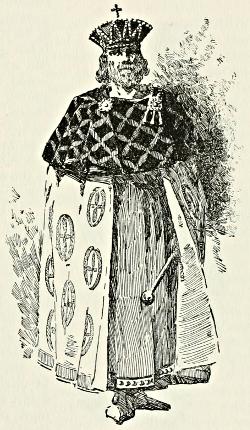
Costume of a Byzantine Emperor
The effects of personal valour are so inconsiderable, except in poetry or
romance, that victory, even among barbarians, must depend on the degree
of skill with which the passions of the multitude are combined and guided for
the service of a single man. The Scythian conquerors, Attila and Jenghiz,
surpassed their rude countrymen in art rather than in courage; and it may
be observed that the monarchies, both of the Huns and of the Mongols, were
erected by their founders on the basis of popular superstition. The miraculous
conception which fraud and credulity ascribed to the virgin mother
of Jenghiz, raised him above the level of human nature; and the naked
prophet, who, in the name of the Deity, invested him with the empire of the
earth, pointed the valour of the Mongols with irresistible enthusiasm. The
religious arts of Attila were not less skilfully adapted to the character of
his age and country.
It was natural enough that the Scythians should adore, with peculiar
devotion, the god of war; but as they were incapable of forming either an
abstract idea or a corporeal representation, they
worshipped their tutelar deity under the symbol
of an iron scimitar. One of the shepherds of the
Huns perceived that a heifer, who was grazing,
had wounded herself in the foot, and curiously followed
the track of the blood till he discovered,
among the long grass, the point of an ancient
sword, which he dug out of the ground and presented
to Attila. That magnanimous, or rather
that artful prince accepted with pious gratitude
this celestial favour; and, as the rightful possessor
of the sword of Mars, asserted his divine and indefeasible
claim to the dominion of the earth.
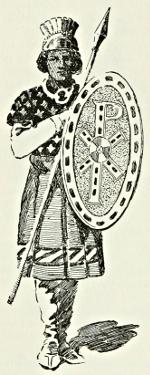
Byzantine Imperial Guard
If the rites of Scythia were practised on this
solemn occasion, a lofty altar, or rather pile of
fagots, three hundred yards in length and in
breadth, was raised in a spacious plain; and the
sword of Mars was placed erect on the summit
of this rustic altar, which was annually consecrated
by the blood of sheep, horses, and of the hundredth
captive. Whether human sacrifices formed any
part of the worship of Attila, or whether he propitiated
the god of war with the victims which
he continually offered in the field of battle, the
favourite of Mars soon acquired a sacred character,
which rendered his conquests more easy and
more permanent; and the barbarian princes confessed,
in the language of devotion or flattery, that
they could not presume to gaze with a steady eye
on the divine majesty of the king of the Huns.
His brother Bleda, who reigned over a considerable
part of the nation, was compelled to resign his sceptre and his life. Yet even
this cruel act was attributed to a supernatural impulse; and the vigour with
which Attila wielded the sword of Mars convinced the world that it had been
reserved alone for his invincible arm. But the extent of his empire affords
the only remaining evidence of the number and importance of his victories;
and the Scythian monarch, however ignorant of the value of science and
philosophy, might perhaps lament that his illiterate subjects were destitute
of the art which could perpetuate the memory of his exploits.
If a line of separation were drawn between the civilised and the savage
climates of the globe, between the inhabitants of cities who cultivated the
earth and the hunters and shepherds who dwelt in tents, Attila might aspire
to the title of supreme and sole monarch of the barbarians. He alone,
among the conquerors of ancient and modern times, united the two mighty
kingdoms of Germany and Scythia; and those vague appellations, when
they are applied to his reign, may be understood with an ample latitude.
Thuringia, which stretched beyond its actual limits as far as the Danube,
was in the number of his provinces; he interposed, with the weight of a
powerful neighbour, in the domestic affairs of the Franks; and one of his
lieutenants chastised, and almost exterminated, the Burgundians of the
Rhine. He subdued the islands of the ocean, the kingdoms of Scandinavia,
encompassed and divided by the waters of the Baltic; and the Huns might
derive a tribute of furs from that northern region which has been protected
from all other conquerors by the severity of the climate and the courage of
the natives.
Towards the east it is difficult to circumscribe the dominion of Attila
over the Scythian deserts; yet we may be assured that he reigned on the
banks of the Volga; that the king of the Huns was dreaded, not only as a
warrior, but as a magician; that he insulted and vanquished the khan of
the formidable Geougen; and that he sent ambassadors to negotiate an
equal alliance with the empire of China. In the proud review of the
nations who acknowledged the sovereignty of Attila and who never entertained,
during his lifetime, the thought of a revolt, the Gepidæ and the
Ostrogoths were distinguished by their numbers, their bravery, and the personal
merit of their chiefs.
The ambassadors of the Huns might awaken the attention of Theodosius
by reminding him that they were his neighbours, both in Europe and
Asia; since they touched the Danube on one hand, and reached with
the other as far as the Tanais. In the reign of his father Arcadius, a band
of adventurous Huns had ravaged the provinces of the East; from whence
they brought away rich spoils and innumerable captives. They advanced, by
a secret path, along the shores of the Caspian Sea; traversed the snowy
mountains of Armenia; passed the Tigris, the Euphrates, and the Halys; recruited
their weary cavalry with the generous breed of Cappadocian horses;
occupied the hilly country of Cilicia, and disturbed the festal songs and dances
of the citizens of Antioch. Egypt trembled at their approach; and the monks
and pilgrims of the Holy Land prepared to escape their fury by a speedy
embarkation. The memory of this invasion was still recent in the minds of
the Orientals. The subjects of Attila might execute, with superior forces,
the design which these adventurers had so boldly attempted; and it soon
became the subject of anxious conjecture whether the tempest would fall on
the dominions of Rome or of Persia.
Some of the great vassals of the king of the Huns, who were themselves
in the rank of powerful princes, had been sent to ratify an alliance and
society of arms with the emperor, or rather with the general, of the West.
They related, during their residence at Rome, the circumstances of an
expedition which they had lately made into the East. After passing a desert
and a morass, supposed by the Romans to be the lake Mæotis, they penetrated
through the mountains, and arrived at the end of fifteen days’ march
on the confines of Media, where they advanced as far as the unknown cities
of Basic and Cursic. They encountered the Persian army in the plains of
Media; and the air, according to their own expression, was darkened by a
cloud of arrows. But the Huns were obliged to retire before the numbers
of the enemy. Their laborious retreat was effected by a different road; they
lost the greatest part of their booty; and at length returned to the royal camp,
with some knowledge of the country and an impatient desire for revenge.
[441-447 A.D.]
In the free conversation of the imperial ambassadors, who discussed at
the court of Attila the character and designs of their formidable enemy, the
ministers of Constantinople expressed their hope that his strength might be
diverted and employed in a long and doubtful contest with the princes of the
house of Sassan. The more sagacious Italians admonished their Eastern
brethren of the folly and danger of such a hope, and convinced them that
the Medes and Persians were incapable of resisting the arms of the Huns;
and that the easy and important acquisition would exalt the pride as well as
power of the conqueror. Instead of contenting himself with a moderate
contribution and a military title, which equalled him only to the generals of
Theodosius, Attila would proceed to impose a disgraceful and intolerable
yoke on the necks of the prostrate and captive Romans, who would then be
encompassed on all sides by the empire of the Huns.
While the powers of Europe and Asia were solicitous to avert the impending
danger, the alliance of Attila maintained the Vandals in the possession
of Africa. An enterprise had been concerted between the courts of
Ravenna and Constantinople for the recovery of that valuable province;
and the ports of Sicily were already filled with the military and naval forces
of Theodosius. But the subtle Genseric, who spread his negotiations round
the world, prevented their designs, by exciting the king of the Huns to invade
the Eastern Empire; and a trifling incident soon became the motive, or
pretence, of a destructive war.
Under the faith of the treaty of Margus, a free market was held on the
northern side of the Danube, which was protected by a Roman fortress, surnamed
Constantia. A troop of barbarians violated the commercial security;
killed or dispersed the unsuspecting traders, and levelled the fortress with the
ground. The Huns justified this outrage as an act of reprisal; alleged that
the bishop of Margus had entered their territories, to discover and steal a
secret treasure of their kings; and sternly demanded the guilty prelate, the
sacrilegious spoil, and the fugitive subjects who had escaped from the justice
of Attila. The refusal of the Byzantine court was the signal of war; and
the Mœsians at first applauded the generous firmness of their sovereign.
But they were soon intimidated by the destruction of Viminiacum and the
adjacent towns; and the people was persuaded to adopt the convenient
maxim that a private citizen, however innocent or respectable, may be
justly sacrificed to the safety of his country. The bishop of Margus, who
did not possess the spirit of a martyr, resolved to prevent the designs which
he suspected. He boldly treated with the princes of the Huns; secured, by
solemn oaths, his pardon and reward; posted a numerous detachment of
barbarians in silent ambush on the banks of the Danube; and, at the
appointed hour, opened with his own hand the gates of his episcopal city.
This advantage, which had been obtained by treachery, served as a prelude
to more honourable and decisive victories.
The Illyrian frontier was covered by a line of castles and fortresses; and
though the greatest part of them consisted only of a single tower, with a small
garrison, they were commonly sufficient to repel, or to intercept, the inroads
of an enemy, who was ignorant of the art and impatient of the delay of a
regular siege. But these slight obstacles were instantly swept away by the
inundation of the Huns. They destroyed, with fire and sword, the populous
cities of Sirmium and Singidunum, of Ratiaria and Marcianopolis, of Naissus
and Sardica; where every circumstance of the discipline of the people and
the construction of the buildings had been gradually adapted to the sole
purpose of defence. The whole breadth of Europe, as it extends above five
hundred miles from the Euxine to the Adriatic, was at once invaded, and
occupied, and desolated, by the myriads of barbarians whom Attila led into
the field. The public danger and distress could not, however, provoke
Theodosius to interrupt his amusements and devotion, or to appear in person
at the head of the Roman legions. But the troops which had been sent
against Genseric were hastily recalled from Sicily, the garrisons on the side
of Persia were exhausted; and a military force was collected in Europe,
formidable by their arms and numbers, if the generals had understood the
science of command and their soldiers the duty of obedience. The armies
of the Eastern Empire were vanquished in three successive engagements; and
the progress of Attila may be traced by the fields of battle. The two former,
on the banks of the Utus and under the walls of Marcianopolis, were fought
in the extensive plains between the Danube and Mount Hæmus. [In the
latter battle Arnegisclus, the Roman commander, was slain.]
[447-448 A.D.]
As the Romans were pressed by a victorious enemy, they gradually, and
unskilfully, retired towards the Chersonesus of Thrace; and that narrow
peninsula, the last extremity of the land, was marked by their third and
irreparable defeat. By the destruction of this army Attila acquired the
indisputable possession of the field. From the Hellespont to Thermopylæ and
the suburbs of Constantinople, he ravaged, without resistance and without
mercy, the provinces of Thrace and Macedonia. Heraclea and Hadrianopolis
might perhaps escape this dreadful irruption of the Huns; but the words
the most expressive of total extirpation and erasure are applied to the
calamities which they inflicted on seventy cities of the Eastern Empire.
Theodosius, his court, and the unwarlike people, were protected by the walls
of Constantinople; but those walls had been shaken by a recent earthquake,
and the fall of fifty-eight towers had opened a large and tremendous breach.
The damage indeed was speedily repaired; but this accident was aggravated
by a superstitious fear that heaven itself had delivered the imperial city to
the shepherds of Scythia, who were strangers to the laws, the language, and
the religion of the Romans.
In all their invasions of the civilised empires of the south, the Scythian
shepherds have been uniformly actuated by a savage and destructive spirit.
The laws of war, that restrain the exercise of national rapine and murder, are
founded on two principles of substantial interest—the knowledge of the permanent
benefits which may be obtained by a moderate use of conquest, and
a just apprehension, lest the desolation which we inflict on the enemy’s
country may be retaliated on our own. But these considerations of hope
and fear are almost unknown in the pastoral state of nations. The Huns of
Attila may, without injustice, be compared to the Moguls and Tatars,
before their primitive manners were changed by religion and luxury; and
the evidence of oriental history may reflect some light on the short and
imperfect annals of Rome.
After the Mongols had subdued the northern provinces of China, it was
seriously proposed, not in the hour of victory and passion but in calm, deliberate
council, to exterminate all the inhabitants of that populous country,
that the vacant land might be converted to the pasture of cattle. The firmness
of a Chinese mandarin, who insinuated some principles of rational policy
into the mind of Jenghiz, diverted him from the execution of this horrid
design. But in the cities of Asia, which yielded to the Mongols, the inhuman
abuse of the rights of war was exercised with a regular form of discipline,
which may, with equal reason though not with equal authority, be imputed
to the victorious Huns.
The three great capitals of Khorasan, Maru, Neisabur, and Herat were
destroyed by the armies of Jenghiz; and the exact account which was taken
of the slain amounted to 4,347,000 persons. Timur, or Tamerlane, was educated
in a less barbarous age, and in the profession of the Mohammedan
religion; yet, if Attila equalled the hostile ravages of Tamerlane, either the
Tatar or the Hun might deserve the epithet of the Scourge of God.
It may be affirmed with bolder assurance that the Huns depopulated the
provinces of the empire, by the number of Roman subjects whom they led
away into captivity. In the hands of a wise legislator, such an industrious
colony might have contributed to diffuse through the deserts of Scythia the
rudiments of the useful and ornamental arts; but these captives, who had been
taken in war, were accidentally dispersed among the hordes that obeyed the
empire of Attila. The estimate of their respective value was formed by
the simple judgment of unenlightened and unprejudiced barbarians. Perhaps
they might not understand the merit of a theologian, profoundly skilled
in the controversies of the Trinity and the Incarnation; yet they respected
the ministers of every religion, and the active zeal of the Christian missionaries,
without approaching the person or the palace of the monarch, successfully
laboured in the propagation of the gospel.
The pastoral tribes, who were ignorant of the distinction of landed property,
must have disregarded the use, as well as the abuse, of civil jurisprudence;
and the skill of an eloquent lawyer could excite only their contempt
or their abhorrence. The perpetual intercourse of the Huns and the Goths
had communicated the familiar knowledge of the two national dialects; and
the barbarians were ambitious of conversing in Latin, the military idiom
even of the Eastern Empire. But they disdained the language and the
sciences of the Greeks; and the vain sophist, or grave philosopher, who had
enjoyed the flattering applause of the schools, was mortified to find that his
robust servant was a captive of more value and importance than himself.
The mechanic arts were encouraged and esteemed, as they tended to satisfy
the wants of the Huns.
An architect in the service of Onegesius, one of the favourites of Attila,
was employed to construct a bath; but this work was a rare example of
private luxury; and the trades of the smith, the carpenter, the armourer,
were much more adapted to supply the wandering people with the useful instruments
of peace and war. But the merit of the physician was received
with universal favour and respect; the barbarians, who despised death,
might be apprehensive of disease; and the haughty conqueror trembled in
the presence of a captive to whom he ascribed, perhaps, an imaginary power
of prolonging or preserving his life. The Huns might be provoked to insult
the misery of their slaves, over whom they exercised a despotic command; but
their manners were not susceptible of a refined system of oppression, and
the efforts of courage and diligence were often recompensed by the gift of
freedom.
The timid or selfish policy of the western Romans had abandoned the
Eastern Empire to the Huns. The loss of armies and the want of discipline
or virtue were not supplied by the personal character of the monarch.
Theodosius might still affect the style as well as the title of Invincible
Augustus; but he was reduced to solicit the clemency of Attila, who imperiously
dictated these harsh and humiliating conditions of peace.
(1) The emperor of the East resigned, by an express or tacit convention,
an extensive and important territory which stretched along the southern
banks of the Danube, from Singidunum or Belgrade as far as Novæ, in the
diocese of Thrace. The breadth was defined by the vague computation of
fifteen days’ journey; but from the proposal of Attila to remove the situation
of the national market, it soon appeared that he comprehended the ruined
city of Naissus within the limits of his dominions.
(2) The king of the Huns required, and obtained, that his tribute or
subsidy should be augmented from seven hundred pounds of gold to the
annual sum of twenty-one hundred; and he stipulated the immediate payment
of six thousand pounds of gold to defray the expenses, or to expiate
the guilt, of the war. One might imagine that such a demand, which scarcely
equalled the measure of private wealth, would have been readily discharged
by the opulent Empire of the East; and the public distress affords a remarkable
proof of the impoverished or at least of the disorderly state of the
finances. A large proportion of the taxes, extorted from the people, was
detained and intercepted in their passage through the foulest channels to
the treasury of Constantinople. The revenue was dissipated by Theodosius
and his favourites in wasteful and profuse luxury; which was disguised by
the names of imperial magnificence or Christian charity. The immediate
supplies had been exhausted by the unforeseen necessity of military preparations.
A personal contribution, rigorously but capriciously imposed on the
members of the senatorian order, was the only expedient that could disarm,
without loss of time, the impatient avarice of Attila; and the poverty of the
nobles compelled them to adopt the scandalous resource of exposing to public
auction the jewels of their wives and the hereditary ornaments of their
palaces.
The king of the Huns appears to have established, as a principle of national
jurisprudence, that he could never lose the property which he had once acquired,
in the persons who had yielded either a voluntary or reluctant submission to
his authority. From this principle he concluded, and the conclusions of
Attila were irrevocable laws, that the Huns who had been taken prisoners in
war should be released without delay and without ransom; that every
Roman captive who had presumed to escape should purchase his right to
freedom at the price of twelve pieces of gold; and that all the barbarians
who had deserted the standard of Attila should be restored, without any
promise or stipulation of pardon. In the execution of this cruel and ignominious
treaty, the imperial officers were forced to massacre several loyal and
noble deserters, who refused to devote themselves to certain death; and the
Romans forfeited all reasonable claims to the friendship of any Scythian people,
by this public confession that they were destitute either of faith or power
to protect the suppliant who had embraced the throne of Theodosius.
The firmness of a single town, so obscure that, except on this occasion, it
has never been mentioned by any historian or geographer, exposed the disgrace
of the emperor and empire. Azimus, or Azimuntium, a small city of
Thrace on the Illyrian borders, had been distinguished by the martial spirit
of its youth, the skill and reputation of the leaders whom they had chosen,
and their daring exploits against the innumerable host of the barbarians.
Instead of tamely expecting their approach, the Azimuntines attacked, in
frequent and successful sallies, the troops of the Huns, who gradually declined
the dangerous neighbourhood; rescued from their hands the spoil and the
captives, and recruited their domestic force by the voluntary association of
fugitives and deserters.
After the conclusion of the treaty, Attila still menaced the empire with
implacable war unless the Azimuntines were persuaded or compelled to comply
with the conditions which their sovereign had accepted. The ministers
of Theodosius confessed with shame and with truth that they no longer
possessed any authority over a society of men who so bravely asserted
their natural independence; and the king of the Huns condescended to
negotiate an equal exchange with the citizens of Azimus. They demanded
the restitution of some shepherds, who, with their cattle, had been accidentally
surprised. A strict, though fruitless, inquiry was allowed; but the
Huns were obliged to swear that they did not detain any prisoners belonging
to the city, before they could recover two surviving countrymen whom the
Azimuntines had reserved as pledges for the safety of their lost companions.
Attila, on his side, was satisfied, and deceived, by their solemn asseveration
that the rest of the captives had been put to the sword, and that it
was their constant practice immediately to dismiss the Romans and the
deserters, who had obtained the security of the public faith. This prudent
and officious dissimulation may be condemned or excused by the casuists as
they incline to the rigid decree of St. Augustine or to the milder sentiment
of St. Jerome and St. Chrysostom; but every soldier, every statesman, must
acknowledge that if the race of the Azimuntines had been encouraged and
multiplied, the barbarians would have ceased to trample on the majesty of
the empire.
It would have been strange, indeed, if Theodosius had purchased by the
loss of honour a secure and solid tranquillity; or if his tameness had not
invited the repetition of injuries. The Byzantine court was insulted by
five or six successive embassies, and the ministers of Attila were uniformly
instructed to press the tardy or imperfect execution of the last treaty; to
produce the names of fugitives and deserters, who were still protected by
the empire; and to declare, with seeming moderation, that unless their
sovereign obtained complete and immediate satisfaction, it would be impossible
for him, were it even his wish, to check the resentment of his warlike
tribes.
Besides the motives of pride and interest which might prompt the king
of the Huns to continue this train of negotiation, he was influenced by the
less honourable view of enriching his favourites at the expense of his enemies.
The imperial treasury was exhausted to procure the friendly offices
of the ambassadors and their principal attendants, whose favourable report
might conduce to the maintenance of peace. The barbarian monarch was
flattered by the liberal reception of his ministers; he computed with pleasure
the value and splendour of their gifts, rigorously exacted the performance
of every promise which would contribute to their private emolument, and
treated as an important business of state the marriage of his secretary Constantius.
That Gallic adventurer, who was recommended by Aëtius to the
king of the Huns, had engaged his service to the ministers of Constantinople
for the stipulated reward of a wealthy and noble wife; and the
daughter of Count Saturninus was chosen to discharge the obligations of
her country. The reluctance of the victim, some domestic troubles, and
the unjust confiscation of her fortune, cooled the ardour of her interested
lover; but he still demanded, in the name of Attila, an equivalent alliance;
and, after many ambiguous delays and excuses, the Byzantine court was
compelled to sacrifice to this insolent stranger the widow of Armatius, whose
birth, opulence, and beauty placed her in the most illustrious rank of the
Roman matrons.
For these importunate and oppressive embassies, Attila claimed a suitable
return; he weighed, with suspicious pride, the character and station
of the imperial envoys; but he condescended to promise that he would
advance as far as Sardica, to receive any ministers who had been invested
with the consular dignity. The council of Theodosius eluded this proposal
by representing the desolate and ruined condition of Sardica; and even ventured
to insinuate that every officer of the army or household was qualified
to treat with the most powerful princes of Scythia. Maximin, a respectable
courtier, whose abilities had been long exercised in civil and military employments,
accepted with reluctance the troublesome, and perhaps dangerous,
commission of reconciling the angry spirit of the king of the Huns.
His friend, the historian Priscus, embraced the opportunity of observing
the barbarian hero in the peaceful and domestic scenes of life; but the
secret of the embassy, a fatal and guilty secret, was intrusted only to the
interpreter Vigilius. The two last ambassadors of the Huns, Orestes a
noble subject of the Pannonian province, and Edecon a valiant chieftain
of the tribe of the Scyrri, returned at the same time from Constantinople to
the royal camp. Their obscure names were afterwards illustrated by the
extraordinary fortune and the contrast of their sons;
the two servants of Attila became the fathers of the
last Roman emperor of the West and of the first barbarian
king of Italy.
The ambassadors, who were followed by a numerous
train of men and horses, made their first halt at Sardica
at the distance of 350 miles, or thirteen days’ journey
from Constantinople. As the remains of Sardica were
still included within the limits of the empire, it was
incumbent on the Romans to exercise the duties of
hospitality. They provided, with the assistance of the
provincials, a sufficient number of sheep and oxen; and
invited the Huns to a splendid or at least a plentiful
supper. But the harmony of the entertainment was
soon disturbed by mutual prejudice and indiscretion.
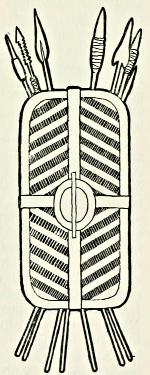
Weapons of the Huns
The greatness of the emperor and the empire was
warmly maintained by their ministers; the Huns with
equal ardour asserted the superiority of their victorious
monarch. The dispute was inflamed by the rash and
unseasonable flattery of Vigilius, who passionately rejected
the comparison of a mere mortal with the divine
Theodosius; and it was with extreme difficulty that
Maximin and Priscus were able to divert the conversation,
or to soothe the angry minds of the barbarians.
When they rose from table, the imperial ambassador
presented Edecon and Orestes with rich gifts of silk
robes and Indian pearls, which they thankfully accepted.
Yet Orestes could not forbear insinuating that he had not always been treated
with such respect and liberality; and the offensive distinction which was
implied, between his civil office and the hereditary rank of his colleague,
seems to have made Edecon a doubtful friend and Orestes an irreconcilable
enemy.
After this entertainment, they travelled about one hundred miles from
Sardica to Naissus. That flourishing city, which had given birth to the
great Constantine, was levelled with the ground; the inhabitants were
destroyed or dispersed; and the appearance of some sick persons, who were
still permitted to exist among the ruins of the churches, served only to
increase the horror of the prospect. The surface of the country was
covered with the bones of the slain; and the ambassadors, who directed
their course to the northwest, were obliged to pass the hills of modern
Servia, before they descended into the flat and marshy grounds which are
terminated by the Danube.
When Attila first gave audience to the Roman ambassadors on the banks
of the Danube, his tent was encompassed with a formidable guard. The
monarch himself was seated in a wooden chair. His stern countenance,
angry gestures, and impatient tone astonished the firmness of Maximin; but
Vigilius had more reason to tremble, since he distinctly understood the
menace that, if Attila did not respect the law of nations, he would nail the
deceitful interpreter to a cross and leave his body to the vultures. The
Romans, both of the East and of the West, were twice invited to the banquets
where Attila feasted with the princes and nobles of Scythia. Maximin
and his colleagues were stopped on the threshold till they had made a devout
libation to the health and prosperity of the king of the Huns, and were
conducted after this ceremony to their respective seats in a spacious hall.
Before they retired they enjoyed an opportunity of observing the manners
of the nation in their convivial amusements. In the midst of intemperate
riots, Attila alone, without a change of countenance, maintained his steadfast
and inflexible gravity, which was never relaxed, except on the entrance of
Irnac, the youngest of his sons; he embraced the boy with a smile of paternal
tenderness, gently pinched him by the cheek, and betrayed a partial
affection which was justified by the assurance of his prophets that Irnac
would be the future support of his family and empire.
Two days afterwards the ambassadors received a second invitation;
and they had reason to praise the politeness as well as the hospitality of
Attila. The king of the Huns held a long and familiar conversation with
Maximin; but his civility was interrupted by rude expressions and haughty
reproaches; and he was provoked, by a motive of interest, to support with
unbecoming zeal the private claims of his secretary, Constantius. “The
emperor,” said Attila, “has long promised him a rich wife; Constantius
must not be disappointed; nor should a Roman emperor deserve the name
of liar.” On the third day the ambassadors were dismissed; the freedom
of several captives was granted, for a moderate ransom, to their pressing
entreaties; and, besides the royal presents, they were permitted to accept
from each of the Scythian nobles the honourable and useful gift of a horse.
Maximin returned by the same road to Constantinople; and, though he was
involved in an accidental dispute with Beric, the new ambassador of Attila,
he flattered himself that he had contributed, by the laborious journey, to
confirm the peace and alliance of the two nations.
[448-449 A.D.]
But the Roman ambassador was ignorant of the treacherous design
which had been concealed under the mask of the public faith. The surprise
and satisfaction of Edecon, when he contemplated the splendour of
Constantinople, had encouraged the interpreter Vigilius to procure for him a
secret interview with the eunuch Chrysaphius, who governed the emperor
and the empire. After some previous conversation and a mutual oath of
secrecy, the eunuch, who had not from his own feelings or experience imbibed
any exalted notions of ministerial virtue, ventured to propose the
death of Attila, as an important service by which Edecon might deserve a
liberal share of the wealth and luxury which he admired. The ambassador
of the Huns listened to the tempting offer; and professed, with apparent
zeal, his ability as well as readiness to execute the bloody deed; the design
was communicated to the master of the offices, and the devout Theodosius
consented to the assassination of his invincible enemy. But this perfidious
conspiracy was defeated by the dissimulation or repentance of Edecon; and,
though he might exaggerate his inward abhorrence for the treason which he
seemed to approve, he dexterously assumed the merit of an early and voluntary
confession.
If we now review the embassy of Maximin, and the behaviour of Attila,
we must applaud the barbarian, who respected the laws of hospitality and
generously entertained and dismissed the minister of a prince who had conspired
against his life. But the rashness of Vigilius will appear still more
extraordinary, since he returned, conscious of his guilt and danger, to the
royal camp, accompanied by his son and carrying with him a weighty purse
of gold, which the favourite eunuch had furnished to satisfy the demands
of Edecon, and to corrupt the fidelity of the guards. The interpreter was
instantly seized and dragged before the tribunal of Attila, where he asserted
his innocence with specious firmness, till the threat of inflicting instant death
on his son extorted from him a sincere discovery of the criminal transaction.
Under the name of ransom or confiscation, the rapacious king of the
Huns accepted two hundred pounds of gold for the life of a traitor whom
he disdained to punish. He pointed his just indignation against a nobler
object. His ambassadors, Eslaw and Orestes, were immediately despatched
to Constantinople, with a peremptory instruction which it was much safer
for them to execute than to disobey. They boldly entered the imperial
presence, with the fatal purse hanging down from the neck of Orestes, who
interrogated the eunuch Chrysaphius, as he stood beside the throne, whether
he recognised the evidence of his guilt. But the office of reproof was reserved
for the superior dignity of his colleague Eslaw, who gravely addressed
the emperor of the East in the following words: “Theodosius is the son of
an illustrious and respectable parent; Attila likewise is descended from a
noble race; and he has supported, by his actions, the dignity which he inherited
from his father Mundzuk. But Theodosius has forfeited his paternal
honours, and, by consenting to pay tribute, has degraded himself to the
condition of a slave. It is, therefore, just that he should reverence the man
whom fortune and merit have placed above him; instead of attempting,
like a wicked slave, clandestinely to conspire against his master.”
[449-450 A.D.]
The son of Arcadius, who was accustomed only to the voice of flattery,
heard with astonishment the severe language of truth; he blushed and
trembled; nor did he presume directly to refuse the head of Chrysaphius,
which Eslaw and Orestes were instructed to demand. A solemn embassy,
armed with full powers and magnificent gifts, was hastily sent to deprecate
the wrath of Attila; and his pride was gratified by the choice of Nomius and
Anatolius, two ministers of consular or patrician rank, of whom the one was
great treasurer, and the other was master-general of the armies of the East.
He condescended to meet these ambassadors on the banks of the river
Drenco; and though he at first affected a stern and haughty demeanour, his
anger was insensibly mollified by their eloquence and liberality. He condescended
to pardon the emperor, the eunuch, and the interpreter; bound
himself by an oath to observe the conditions of peace; released a great number
of captives; abandoned the fugitives and deserters to their fate; and
resigned a large territory to the south of the Danube, which he had already
exhausted of its wealth and inhabitants. But this treaty was purchased at
an expense which might have supported a vigorous and successful war;
and the subjects of Theodosius were compelled to redeem the safety of a
worthless favourite by oppressive taxes, which they would more cheerfully
have paid for his destruction.
The emperor Theodosius did not long survive the most humiliating circumstance
of an inglorious life. As he was riding or hunting in the neighbourhood
of Constantinople, he was thrown from his horse into the river
Lycus; his spine was injured by the fall; and he expired some days
afterwards, in the fiftieth year of his age, and the forty-third of his reign.
His sister Pulcheria, whose authority had been controlled both in civil
and ecclesiastical affairs by the pernicious influence of the eunuchs, was
unanimously proclaimed empress of the East; and the Romans, for the first
time, submitted to a female reign. No sooner had Pulcheria ascended the
throne, than she indulged her own and the public resentment by an act of
popular justice. Without any legal trial, the eunuch Chrysaphius was executed
before the gates of the city; and the immense riches which had been
accumulated by the rapacious favourite served only to hasten and to justify
his punishment.
Amidst the general acclamation of the clergy and people, the empress
did not forget the prejudice and disadvantage to which her sex was exposed;
and she wisely resolved to prevent their murmurs by the choice of a colleague
who would always respect the superior rank and virgin chastity of his wife.
She gave her hand to Marcian, a senator, about sixty years of age; and the
nominal husband of Pulcheria was solemnly invested with the imperial
purple. The zeal which he displayed for the orthodox creed, as it was established
by the council of Chalcedon, would alone have inspired the grateful
eloquence of the Catholics. But the behaviour of Marcian in a private life,
and afterwards on the throne, may support a more rational belief that he
was qualified to restore and invigorate an empire, which had been almost
dissolved by the successive weakness of two hereditary monarchs.
He was born in Thrace, and educated to the profession of arms; but
Marcian’s youth had been severely exercised by poverty and misfortune,
since his only resource, when he first arrived at Constantinople, consisted
in two hundred pieces of gold, which he had borrowed of a friend. He
passed nineteen years in the domestic and military service of Aspar and his
son Ardaburius; followed those powerful generals to the Persian and African
wars; and obtained, by their influence, the honourable rank of tribune and
senator. His mild disposition and useful talents, without alarming the jealousy,
recommended Marcian to the esteem and favour of his patrons; he
had seen, perhaps he had felt, the abuses of a venal and oppressive administration,
and his own example gave weight and energy to the laws which he
promulgated for the reformation of manners.
[453-468 A.D.]
After Pulcheria’s death, he gave his people the example of the religious
worship that was due to the memory of the imperial saint. Attentive to the
prosperity of his own dominions, Marcian seemed to behold with indifference
the misfortunes of Rome; and the obstinate refusal of a brave and active
prince to draw his sword against the Vandals was ascribed to a secret
promise, which had formerly been exacted from him when he was a captive
in the power of Genseric.
The death of Marcian, after a reign of seven years, would have exposed
the East to the danger of a popular election, if the superior weight of a
single family had not been able to incline the balance in favour of the candidate
whose interest they supported. The patrician Aspar might have
placed the diadem on his own head, if he would have subscribed the Nicene
Creed. During three generations, the armies of the East were successively
commanded by his father, by himself, and by his son Ardaburius; his barbarian
guards formed a military force that overawed the palace and the
capital; and the liberal distribution of his immense treasures rendered
Aspar as popular as he was powerful. He recommended the obscure name
of Leo of Thrace, a military tribune and the principal steward of his household.
His nomination was unanimously ratified by the senate; and the servant
of Aspar received the imperial crown from the hands of the patriarch
or bishop, who was permitted to express, by this unusual ceremony, the suffrage
of the Deity (457).
This emperor, the first of the name of Leo, has been distinguished by the
title of “the great” from a succession of princes, who gradually fixed, in
the opinion of the Greeks, a very humble standard of heroic or at least of
royal perfection. Yet the temperate firmness with which Leo resisted the
oppression of his benefactor showed that he was conscious of his duty and of
his prerogative. When Leo had delivered himself from that ignominious
servitude, he listened to the complaints of the Italians; resolved to extirpate
the tyranny of the Vandals, and declared his alliance with Marcian’s son-in-law
Anthemius, whom he solemnly invested with the diadem and purple of
the West.
In all his public declarations the emperor Leo assumes the authority and
professes the affection of a father, for his son Anthemius with whom he had
divided the administration of the universe. The situation and perhaps the
character of Leo dissuaded him from exposing his person to the toils and
dangers of an African war. But the powers of the Eastern Empire were
strenuously exerted to deliver Italy and the Mediterranean from the Vandals;
and Genseric, who had so long oppressed both the land and sea, was
threatened from every side with a formidable invasion. The campaign
was opened by a bold and successful enterprise of the prefect Heraclius.
The expense of the naval armament, which Leo sent against the Vandals,
has been distinctly ascertained; and the curious and instructive account displays
the wealth of the declining empire. The royal demesnes, or private
patrimony of the prince, supplied seventeen thousand pounds of gold; forty-seven
thousand pounds of gold and seven hundred thousand of silver were
levied and paid into the treasury by the prætorian prefects. But the cities
were reduced to extreme poverty; and the diligent calculation of fines and
forfeitures, as a valuable object of the revenue, does not suggest the idea of
a just or merciful administration.
The whole expense, by whatsoever means it was defrayed, of the African
campaign amounted to the sum of 130,000 pounds of gold [about £5,200,000
or $26,000,000], at a time when the value of money appears, from the comparative
price of corn, to have been somewhat higher than in the present
age. The fleet that sailed from Constantinople to Carthage consisted
of 1113 ships, and the number of soldiers and mariners exceeded 100,000
men. Basiliscus, the brother of the empress Verina, was entrusted with this
important command. His sister, the wife of Leo, had exaggerated the merit
of his former exploits against the Scythians. But the discovery of his guilt,
or incapacity, was reserved for the African War; and his friends could only
save his military reputation by asserting that he had conspired with Aspar
to spare Genseric, and to betray the last hope of the Western Empire.
[468-491 A.D.]
He returned to Constantinople with the loss of more than half of his fleet
and army, and sheltered his guilty head in the sanctuary of St. Sophia, till
his sister, by her tears and entreaties, could obtain his pardon from the indignant
emperor. Leo confirmed and dishonoured his reign by the perfidious
murder of Aspar and his sons, who too rigorously exacted the debt of gratitude
and obedience. The inheritance of Leo and of the East was peaceably
devolved on his infant grandson, Leo II, the son of his daughter Ariadne; and
her Isaurian husband, the fortunate Trascalisseus, exchanged that barbarous
sound for the Grecian appellation of Zeno. After the decease of the elder
Leo, he approached with unnatural respect the throne of his son, humbly
received as a gift the second rank in the empire, and soon excited the public
suspicion on the sudden and premature death of his young colleague, whose
life could no longer promote the success of his ambition. But the palace of
Constantinople was ruled by female influence, and agitated by female passions;
and Verina, the widow of Leo, claiming his empire as her own, pronounced
a sentence of deposition against the worthless and ungrateful
servant on whom she alone had bestowed the sceptre of the East.
As soon as she sounded a revolt in the ears of Zeno, he fled with
precipitation into the mountains of Isauria, and her brother Basiliscus,
already infamous by his African expedition, was unanimously proclaimed
by the servile senate. But the reign of the usurper was short and turbulent.
Basiliscus presumed to assassinate the lover of his sister; he dared to
offend the lover of his wife, the vain and insolent Harmatius, who, in the
midst of Asiatic luxury, affected the dress, the demeanour, and the surname
of Achilles. By the conspiracy of the malcontents, Zeno was recalled from
exile; and the armies, the capital, the person of Basiliscus, were betrayed;
and his whole family was condemned to the long agony of cold and hunger
by the inhuman conqueror who wanted courage to encounter or to forgive
his enemies. [It was after Zeno’s return to the throne that Theodoric, the
Ostrogothic king, left Illyricum with his people to invade Italy (488). This
event will be fully described in Chapter I of the “Western Empire.”]
The haughty spirit of Verina was still incapable of submission or repose.
She provoked the enmity of a favourite general, embraced his cause as soon
as he was disgraced, created a new emperor in Syria and Egypt, raised an
army of seventy thousand men, and persisted to the last moment of her life
in a fruitless rebellion, which, according to the fashion of the age, had been
predicted by Christian hermits and pagan magicians. While the East was
afflicted by the passions of Verina, her daughter Ariadne was distinguished
by the female virtues of mildness and fidelity; she followed her husband in
his exile, and after his restoration she implored his clemency in favour of her
mother. On the decease of Zeno, Ariadne, the daughter, the mother, and
the widow of an emperor, gave her hand and the imperial title to Anastasius,
an aged domestic of the palace, who survived his elevation above twenty-seven
years, and whose character is attested by the acclamation of the people:
“Reign as you have lived!”b
[491-518 A.D.]
Anastasius’ accession was not undisputed. Zeno’s brother Longinus
claimed the throne and with his brother Isaurians fought for it. A five
years’ war beginning in 491 was the result. Constantinople furnished the
scene for several bloody riots, especially when, after a decisive victory of the
troops at Colyæum in 493, Anastasius issued an edict expelling the Isaurians
from the capital. The adherents of the banished nation kept up desultory
fighting until in 496 Longinus and his brother were taken. The Isaurian
War was the temporary ruin of Asia Minor, and the Persian monarch Kobad
found it no difficult task to seize Martyropolis, Amida, and other Armenian
strongholds in 503. The cause of this hostile act is a matter of dispute;
it may have been that the emperor refused a payment promised by Leo, or
Anastasius may have declined to grant Kobad a loan he wished to raise. The
consequence of this war might have been most serious for the empire had
not the Huns invaded Persia at this critical moment. Kobad was now anxious
to sue for peace, the more so since the new Roman general Celer was fast
undoing the mistakes of his predecessor, Hypatius. The treaty was signed
in 505. The next few years are marked chiefly with the revolt of Vitalian,
the Goth. In 514 he attempted to seize the throne, but Anastasius brought
him to terms with the office of magister militum of Thrace, and a present of
money.a
Justin I is said to have been an illiterate Illyrian peasant, who, with two
other peasants of the same village, deserted for the profession of arms the
more useful employment of husbandmen or shepherds. On foot, with a
scanty provision of biscuit in their knapsacks, the three youths followed the
high road to Constantinople, and were soon enrolled, for their strength and
stature, among the guards of the emperor Leo.
Under the two succeeding reigns, the fortunate peasant emerged to wealth
and honours; and his escape from some dangers which threatened his life
was afterwards ascribed to the guardian angel who watches over the fate of
kings. His long and laudable service in the Isaurian and Persian wars would
not have preserved from oblivion the name of Justin; yet they might warrant
the military promotion which in the course of fifty years he gradually obtained—the
rank of tribune, of count, and of general, the dignity of senator,
and the command of the guards, who obeyed him as their chief at the important
crisis when the emperor Anastasius was removed from the world. The
powerful kinsmen, whom he had raised and enriched, were excluded from
the throne; and the eunuch Amantius, who reigned in the palace, had secretly
resolved to fix the diadem on the head of the most obsequious of his creatures.
A liberal donative, to conciliate the suffrage of the guards, was entrusted for
that purpose in the hands of their commander. But these weighty arguments
were treacherously employed by Justin in his own favour; and as no competitor
presumed to appear, the Dacian peasant was invested with the purple,
by the unanimous consent of the soldiers, who knew him to be brave and
gentle, of the clergy and people, who believed him to be orthodox, and of
the provincials, who yielded a blind and implicit submission to the will of
the capital.
[518-527 A.D.]
The elder Justin, as he is distinguished from another emperor of the same
family and name, ascended the Byzantine throne at the age of sixty-eight
years; and, had he been left to his own guidance, every moment of a nine
years’ reign must have exposed to his subjects the impropriety of their choice.
His ignorance was similar to that of Theodoric; and it is remarkable that in
an age not destitute of learning two contemporary monarchs had never been
instructed in the knowledge of the alphabet. But the genius of Justin was
far inferior to that of the Gothic king; the experience of a soldier had not
qualified him for the government of an empire, and, though personally brave,
the consciousness of his own weakness was naturally attended with doubt,
distrust, and political apprehension. But the official business of the state
was diligently and faithfully transacted by the quæstor Proclus, and the
aged emperor adopted the talents and ambition of his nephew Justinian, an
aspiring youth whom his uncle had drawn from the rustic solitude of Dacia,
and educated at Constantinople, as the heir of his private fortune and at
length of the Eastern Empire.
Since the eunuch Amantius had been defrauded of his money, it became
necessary to deprive him of his life. The task was easily accomplished by
the charge of a real or fictitious conspiracy; and the judges were informed,
as an accumulation of guilt, that he was secretly addicted to the Manichæan
heresy. Amantius lost his head; three of his companions, the first domestics
of the palace, were punished either with death or exile; and their unfortunate
candidate for the purple was cast into a deep dungeon, overwhelmed
with stones, and ignominiously thrown, without burial, into the sea.
The ruin of Vitalian was a work of more difficulty and danger. That
Gothic chief had rendered himself popular by the civil war which he boldly
waged against Anastasius for the defence of the orthodox faith, and, after
the conclusion of an advantageous treaty, he still remained in the neighbourhood
of Constantinople, at the head of a formidable and victorious army
of barbarians. By the frail security of oaths, he was tempted to relinquish
this advantageous situation, and to trust his person within the walls of a
city whose inhabitants, particularly the blue faction, were artfully incensed
against him by the remembrance even of his pious hostilities. The emperor
and his nephew embraced him as the faithful and worthy champion of the
church and state, and gratefully adorned their favourite with the titles of
consul general; but in the seventh month of his consulship, Vitalian was
stabbed with seventeen wounds at the royal banquet; and Justinian, who
inherited the spoil, was accused as the assassin of a spiritual brother, to
whom he had recently pledged his faith in the participation of the Christian
mysteries.
After the fall of his rival, he was promoted, without any claim of military
service, to the office of master-general of the eastern armies, whom
it was his duty to lead into the field against the public enemy. But, in
the pursuit of fame, Justinian might have lost his present dominion over the
age and weakness of his uncle; and instead of acquiring by Scythian or
Persian trophies the applause of his countrymen, the prudent warrior solicited
their favour in the churches, the circus, and the senate of Constantinople.
The Catholics were attached to the nephew of Justin, who, between the
Nestorian and Eutychian heresies, trod the narrow path of inflexible and
intolerant orthodoxy.
In the first days of the new reign, he prompted and gratified the popular
enthusiasm against the memory of the deceased emperor. After a schism
of thirty-four years, he reconciled the proud and angry spirit of the Roman
pontiff, and spread among the Latins a favourable report of his pious respect
for the apostolic see. The thrones of the East were filled with Catholic
bishops devoted to his interests, the clergy and the monks were gained by
his liberality, and the people were taught to pray for their future sovereign,
the hope and pillar of the true religion. The magnificence of Justinian
was displayed in the superior pomp of his public spectacles, an object not
less sacred and important in the eyes of the multitude than the creed of
Nicæa or Chalcedon; the expense of his consulship was esteemed at 288,000
pieces of gold; twenty lions and thirty leopards were produced at the same
time in the amphitheatre, and a numerous train of horses, with their rich
trappings, was bestowed as an extraordinary gift on the victorious charioteers
of the circus.
While he indulged the people of Constantinople, and received the addresses
of foreign kings, the nephew of Justin assiduously cultivated the friendship of
the senate. That venerable name seemed to qualify its members to declare the
sense of the nation, and to regulate the succession of the imperial throne;
the feeble Anastasius had permitted the vigour of government to degenerate
into the form or substance of an aristocracy; and the military officers who
had obtained the senatorial rank were followed by their domestic guards, a
band of veterans whose arms or acclamations might fix in a tumultuous moment
the diadem of the East. The treasures of the state were lavished to
procure the voices of the senators; and their unanimous wish, that he would
be pleased to adopt Justinian for his colleague, was communicated to the
emperor. But this request, which too clearly admonished him of his
approaching end, was unwelcome to the jealous temper of an aged monarch,
desirous to retain the power which he was incapable of exercising; and
Justin, holding his purple with both his hands, advised them to prefer, since
an election was so profitable, some older candidate.
[527 A.D.]
Notwithstanding this reproach, the senate proceeded to decorate Justinian
with the royal epithet of nobilissimus; and their decree was ratified by the
affection or the fears of his uncle. After some time the languor of mind and
body to which he was reduced by an incurable wound in his thigh, indispensably
required the aid of a guardian. He summoned the patriarch and senators;
and in their presence solemnly placed the diadem on the head of his
nephew, who was conducted from the palace to the circus, and saluted by
the loud and joyful applause of the people. The life of Justin was prolonged
about four months, but from the instant of this ceremony he was
considered as dead to the empire, which acknowledged Justinian, in the
forty-fifth year of his age, for the lawful sovereign of the East.b
In the exercise of supreme power, the first act of Justinian was to divide
it with the woman whom he loved, the famous Theodora, whose strange elevation
cannot be applauded as the triumph of female virtue. Under the reign
of Anastasius, the care of the wild beasts maintained by the green faction at
Constantinople was entrusted to Acacius, a native of the isle of Cyprus,
who, from his employment, was surnamed the master of the bears. This
honourable office was given after his death to another candidate, notwithstanding
the diligence of his widow, who had already provided a husband
and a successor.
[525-527 A.D.]
Acacius had left three daughters, Comito, Theodora, and Anastasia, the
eldest of whom did not then exceed the age of seven years. On a solemn festival,
these helpless orphans were sent by their distressed and indignant mother,
in the garb of suppliants, into the midst of the theatre; the green faction received
them with contempt, the blues with compassion; and this difference,
which sunk deep into the mind of Theodora, was felt long afterwards in the
administration of the empire. As they improved in age and beauty, the three
sisters were successively devoted to the public and private pleasures of the
Byzantine people; and Theodora, after following Comito on the stage, in
the dress of a slave, with a stool on her head, was at length permitted to
exercise her independent talents. She neither danced, nor sang, nor played
on the flute; her skill was confined to the pantomime arts; she excelled in
buffoon characters, and as often as the comedian swelled her cheeks and
complained with a ridiculous tone and gesture of the blows that were inflicted,
the whole theatre of Constantinople resounded with laughter and
applause. The beauty of Theodora was the subject of more flattering praise
and the source of more exquisite delight. Her features were delicate and
regular; her complexion, though somewhat pale, was tinged with a natural
colour; every sensation was instantly expressed by the vivacity of her eyes;
her easy motions displayed the graces of a small but elegant figure.
[The question of the beauty of Theodora has been a subject for much
discussion. “A contemporary,” says Bury,l “said it was impossible for mere
man to describe her comeliness in words, or to imitate it by art”; but he
adds that we cannot judge how far this remark was due to the enthusiasm
of adulation. He admits, however, that she was doubtless beautiful, although
somewhat short in stature and of pale complexion.]
In the most abject state of her fortune and reputation, some vision, either
of sleep or of fancy, had whispered to Theodora the pleasing assurance that
she was destined to become the spouse of a potent monarch. Conscious of
her approaching greatness, she returned from Paphlagonia to Constantinople;
assumed, like a skilful actress, a more decent character; relieved her
poverty by the laudable industry of spinning wool; and affected a life of
chastity and solitude in a small house, which she afterwards changed into a
magnificent temple. Her beauty, assisted by art or accident, soon attracted,
captivated, and fixed the patrician Justinian, who already reigned with
absolute sway under the name of his uncle. Perhaps she contrived to enhance
the value of a gift which she had so often lavished on the meanest of
mankind; perhaps she inflamed, at first by modest delays and at last by
sensual allurements, the desires of a lover who from nature or devotion was
addicted to long vigils and abstemious diet. When his first transports had
subsided, she still maintained the same ascendant over his mind, by the
more solid merit of temper and understanding. Justinian delighted to
ennoble and enrich the object of his affection; the treasures of the East
were poured at her feet, and the nephew of Justin was determined, perhaps
by religious scruples, to bestow on his concubine the sacred and legal character
of a wife. But the laws of Rome expressly prohibited the marriage of
a senator with any female who had been dishonoured by a servile origin or
theatrical profession; the empress, a barbarian of rustic manners but of irreproachable
virtue, refused to accept a prostitute for her niece.
[527-548 A.D.]
These obstacles were removed by the inflexible constancy of Justinian.
He patiently expected the death of the empress; he despised the tears of
his mother, who soon sank under the weight of her affliction; and a law was
promulgated in the name of the emperor Justin, which abolished the rigid
jurisprudence of antiquity. A glorious repentance (the words of the edict)
was left open for the unhappy females who had prostituted their persons on
the theatre, and they were permitted to contract a legal union with the most
illustrious of the Romans. This indulgence was speedily followed by the
solemn nuptials of Justinian and Theodora; her dignity was gradually
exalted with that of her lover; and, as soon as Justin had invested his
nephew with the purple, the patriarch of Constantinople placed the diadem
on the heads of the emperor and empress of the East. But the usual honours
which the severity of Roman manners had allowed to the wives of princes
could not satisfy either the ambition of Theodora or the fondness of Justinian.
He seated her on the throne as an equal and independent colleague in
the sovereignty of the empire, and an oath of allegiance was imposed on the
governors of the provinces in the joint names of Justinian and Theodora.
The eastern world fell prostrate before the genius and fortune of the
daughter of Acacius.
Her private hours were devoted to the prudent as well as grateful care
of her beauty, the luxury of the bath and table, and the long slumber of the
evening and the morning. Her secret apartments were occupied by the
favourite women and eunuchs, whose interests and passions she indulged at
the expense of justice; the most illustrious personages of the state were
crowded into a dark and sultry antechamber, and when at last, after tedious
attendance, they were admitted to kiss the feet of Theodora, they experienced,
as her humour might suggest, the silent arrogance of an empress
or the capricious levity of a comedian. Her rapacious avarice to accumulate
an immense treasure may be excused by the apprehension of her husband’s
death, which could leave no alternative between ruin and the throne; and
fear as well as ambition might exasperate Theodora against two generals
who, during a malady of the emperor, had rashly declared that they were
not disposed to acquiesce in the choice of the capital.
But the reproach of cruelty, so repugnant even to her softer vices, has
left an indelible stain on the memory of Theodora. Her numerous spies
observed, and zealously reported, every action, or word, or look injurious to
their royal mistress. Whomsoever they accused were cast into her peculiar
prisons, inaccessible to the inquiries of justice; and it was rumoured that the
torture of the rack, or scourge, had been inflicted in the presence of a female
tyrant, insensible to the voice of prayer or of pity. Some of these unhappy
victims perished in deep unwholesome dungeons, while others were permitted,
after the loss of their limbs, their reason, or their fortune, to appear in the
world the living monuments of her vengeance, which was commonly extended
to the children of those whom she had suspected or injured. The senator or
bishop whose death or exile Theodora had pronounced, was delivered to a
trusty messenger, and his diligence was quickened by a message from her
own mouth: “If you fail in the execution of my commands, I swear by
Him who liveth forever, that your skin shall be flayed from your body.”
If the creed of Theodora had not been tainted with heresy, her exemplary
devotion might have atoned, in the opinion of her contemporaries,
for pride, avarice, and cruelty. But if she employed her influence to assuage
the intolerant fury of the emperor, the present age will allow some merit
to her religion, and much indulgence to her speculative errors. The name
of Theodora was introduced, with equal honour, in all the pious and charitable
foundations of Justinian; and the most benevolent institution of his
reign may be ascribed to the sympathy of the empress for her less fortunate
sisters. A palace, on the Asiatic side of the Bosporus, was converted into a
stately and spacious monastery, and a liberal maintenance was assigned to
five hundred women, who had been collected from the streets and brothels
of Constantinople. In this safe and holy retreat they were devoted to perpetual
confinement; and the despair of some, who threw themselves headlong
into the sea, was lost in the gratitude of the penitents, who had been
delivered from sin and misery by their generous benefactress. The prudence
of Theodora is celebrated by Justinian himself; and his laws are attributed to
the sage counsels of his most reverend wife, whom he had received as the gift
of the Deity. Her courage was displayed amidst the tumult of the people
and the terrors of the court. Her chastity, from the moment of her union
with Justinian, is founded on the silence of her implacable enemies.
The wishes and prayers of Theodora could never obtain the blessing of
a lawful son, and she buried an infant daughter, the sole offspring of her
marriage. Notwithstanding this disappointment, her dominion was permanent
and absolute; she preserved, by art or merit, the affections of Justinian;
and their seeming dissensions were always fatal to the courtiers who
believed them to be sincere. Perhaps her health had been impaired by the
licentiousness of her youth; but it was always delicate, and she was directed
by her physicians to use the Pythian warm baths. In this journey, the
empress was followed by the prætorian prefect, the great treasurer, several
counts and patricians, and a splendid train of four thousand attendants.
The highways were repaired at her approach, a palace was erected for her
reception; and as she passed through Bithynia, she distributed liberal alms
to the churches, the monasteries, and the hospitals, that they might implore
heaven for the restoration of her health. At length, in the twenty-fourth
year of her marriage, and the twenty-second of her reign, she was consumed
by a cancer; and the irreparable loss was deplored by her husband, who, in
the room of a theatrical prostitute, might have selected the purest and most
noble virgin of the East.
A material difference may be observed in the games of antiquity; the
most eminent of the Greeks were actors, the Romans were merely spectators.
The Olympic stadium was open to wealth, merit, and ambition; and if the
candidates could depend on their personal skill and activity they might pursue
the footsteps of Diomede and Menelaus, and conduct their own horses in
the rapid career. Ten, twenty, forty chariots were allowed to start at the
same instant; a crown of leaves was the reward of the victor, and his fame,
with that of his family and country,
was chanted in lyric strains more
durable than monuments of brass
and marble. But a senator, or even
a citizen, conscious of his dignity,
would have blushed to expose his
person or his horses in the circus of
Rome. The games were exhibited
at the expense of the republic, the
magistrates, or the emperors; but
the reins were abandoned to servile
hands; and if the profits of a favourite
charioteer sometimes exceeded
those of an advocate, they must be
considered as the effects of popular
extravagance and the high wages of
a disgraceful profession. The race,
in its first institution, was a simple
contest of two chariots, whose drivers
were distinguished by white and
red liveries; two additional colours,
a light green and a cerulean blue,
were afterwards introduced; and as
the races were repeated twenty-five
times, one hundred chariots contributed
in the same day to the pomp of the circus. The four factions soon
acquired a legal establishment, and a mysterious origin, and their fanciful
colours were derived from the various appearances of nature in the four seasons
of the year; the red dog-star of summer, the snows of winter, the deep
shades of autumn, and the cheerful verdure of the spring.
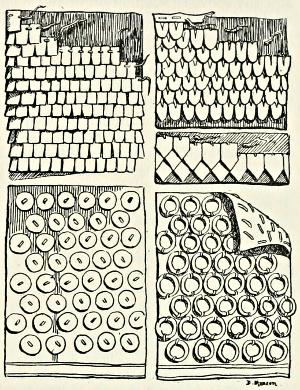
Coats of Mail, very early Period
Another interpretation preferred the elements to the seasons, and the
struggle of the green and blue was supposed to represent the conflict of the
earth and sea. Their respective victories announced either a plentiful harvest
or a prosperous navigation, and the hostility of the husbandmen and
mariners was somewhat less absurd than the blind ardour of the Roman
people, who devoted their lives and fortunes to the colour which they had
espoused. Such folly was disdained and indulged by the wisest princes;
but the names of Caligula, Nero, Vitellius, Verus, Commodus, Caracalla,
and Elagabalus were enrolled in the blue or green factions of the circus;
they frequented their stables, applauded their favourites, chastised their
antagonists, and deserved the esteem of the populace by the natural or
affected imitation of their manners. The bloody and tumultuous contest
continued to disturb the public festivity, till the last age of the spectacles of
Rome; and Theodoric, from a motive of justice or affection, interposed his
authority to protect the greens against the violence of a consul and a patrician,
who were passionately addicted to the blue faction of the circus.
Constantinople adopted the follies, though not the virtues, of ancient
Rome; and the same factions which had agitated the circus raged with
redoubled fury in the hippodrome. Under the reign of Anastasius, this popular
frenzy was inflamed by religious zeal; and the greens, who had treacherously
concealed stones and daggers under baskets of fruit, massacred,
at a solemn festival, three thousand of their blue adversaries. From the
capital this pestilence was diffused into the provinces and cities of the East,
and the sportive distinction of two colours produced two strong and irreconcilable
factions, which shook the foundations of a feeble government. The
popular dissensions, founded on the most serious interest or holy pretence,
have scarcely equalled the obstinacy of this wanton discord, which invaded
the peace of families, divided friends and brothers, and tempted the female
sex, though seldom seen in the circus, to espouse the inclinations of their
lovers or to contradict the wishes of their husbands.
Every law, either human or divine, was trampled under foot, and as long
as the party was successful, its deluded followers appeared careless of private
distress or public calamity. The license, without the freedom, of democracy
was revived at Antioch and Constantinople, and the support of a faction
became necessary to every candidate for civil or ecclesiastical honours.
A secret attachment to the family or sect of Anastasius was imputed to
the greens; the blues were zealously devoted to the cause of orthodoxy and
Justinian, and their grateful patron protected, above five years, the disorders
of a faction whose seasonable tumults overawed the palace, the senate, and
the capitals of the East. Insolent with royal favour, the blues affected to
strike terror by a peculiar and barbaric dress—the long hair of the Huns,
their close sleeves and ample garments, a lofty step, and a sonorous voice.
In the day they concealed their two-edged poniards, but in the night they
boldly assembled in arms, and in numerous bands, prepared for every act of
violence and rapine. Their adversaries of the green faction, or even inoffensive
citizens, were stripped and often murdered by these nocturnal robbers,
and it became dangerous to wear any gold buttons or girdles, or to
appear at a late hour in the streets of a peaceful capital. A daring spirit,
rising with impunity, proceeded to violate the safeguard of private houses;
and fire was employed to facilitate the attack or to conceal the crimes of
those factious rioters. No place was safe or sacred from their depredations;
to gratify either avarice or revenge, they profusely spilt the blood of the
innocent; churches and altars were polluted by atrocious murders; and it
was the boast of the assassins that their dexterity could always inflict a
mortal wound with a single stroke of their dagger.
The dissolute youth of Constantinople adopted the blue livery of disorder;
the laws were silent, and the bonds of society were relaxed; creditors were
compelled to resign their obligations, judges to reverse their sentence,
masters to enfranchise their slaves, fathers to supply the extravagance of
their children; noble matrons were prostituted to the lust of their servants;
beautiful boys were torn from the arms of their parents; and wives, unless
they preferred a voluntary death, were ravished in the presence of their husbands.
The despair of the greens, who were persecuted by their enemies
and deserted by the magistrate, assumed the privilege of defence, perhaps of
retaliation; but those who survived the combat were dragged to execution,
and the unhappy fugitives, escaping to woods and caverns, preyed without
mercy on the society from whence they were expelled. Those ministers of
justice who had courage to punish the crimes and to brave the resentment
of the blues, became the victims of their indiscreet zeal; a prefect of Constantinople
fled for refuge to the holy sepulchre; a count of the East was
ignominiously whipped, and a governor of Cilicia was hanged, by the order
of Theodora, on the tomb of two assassins whom he had condemned for the
murder of his groom and a daring attack upon his own life.
An aspiring candidate may be tempted to build his greatness on the public
confusion, but it is the interest as well as duty of a sovereign to maintain
the authority of the laws. The first edict of Justinian, which was often
repeated and sometimes executed, announced his firm resolution to support
the innocent, and to chastise the guilty, of every denomination and colour.
Yet the balance of justice was still inclined in favour of the blue faction, by
the secret affection, the habits, and the fears of the emperor; his equity, after
an apparent struggle, submitted, without reluctance, to the implacable passions
of Theodora, and the empress never forgot, or forgave, the injuries of the
comedian. At the accession of the younger Justin, the proclamation of
equal and rigorous justice indirectly condemned the partiality of the former
reigns. “Ye blues, Justinian is no more! ye greens, he is still alive!”
[532 A.D.]
A sedition, which almost laid Constantinople in ashes, was excited by the
mutual hatred and momentary reconciliation of the two factions. In the
fifth year of his reign, Justinian celebrated the festival of the ides of January:
the games were incessantly disturbed by the clamorous discontent of
the greens; till the twenty-second race, the emperor maintained his silent
gravity; at length yielding to his impatience, he condescended to hold, in
abrupt sentences and by the voice of a crier, the most singular dialogue that
ever passed between a prince and his subjects.
The first complaints were respectful and modest; they accused the subordinate
ministers of oppression, and proclaimed their wishes for the long
life and victory of the emperor. “Be patient and attentive, ye insolent
railers,” exclaimed Justinian; “be mute, ye Jews, Samaritans, and Manichæans!”
The greens still attempt to awaken his compassion. “We are
poor, we are innocent, we are injured, we dare not pass through the streets:
a general persecution is exercised against our name and colour. Let us die,
O emperor! but let us die by your command, and for your service!” But
the repetition of partial and passionate invectives degraded, in their eyes,
the majesty of the purple; they renounced allegiance to the prince who
refused justice to his people; lamented that the father of Justinian had been
born; and branded his son with the opprobrious names of homicide, an ass,
and a perjured tyrant. “Do you despise your lives?” cried the indignant
monarch. The blues rose with fury from their seats; their hostile clamours
thundered in the hippodrome; and their adversaries, deserting the unequal
contest, spread terror and despair through the streets of Constantinople.
A military force, which had been despatched to the aid of the civil magistrate,
was fiercely encountered by an armed multitude, whose numbers and
boldness continually increased; and the Heruli, the wildest barbarians in
the service of the empire, overturned the priests and their relics, which, from
a pious motive, had been rashly interposed to separate the bloody conflict.
The tumult was exasperated by this sacrilege; the people fought with enthusiasm
in the cause of God; the women from the roofs and windows showered
stones on the heads of the soldiers, who darted firebrands against the houses;
and the various flames, which had been kindled by the hands of citizens and
strangers, spread without control over the face of the city. The conflagration
involved the cathedral of St. Sophia, the baths of Zeuxippus, a part of
the palace from the first entrance to the altar of Mars, and the long portico
from the palace to the forum of Constantine; a large hospital, with the sick
patients, was consumed; many churches and stately edifices were destroyed,
and an immense treasure of gold and silver was either melted or lost. From
such scenes of horror and distress, the wise and wealthy citizens escaped over
the Bosporus to the Asiatic side; and, during five days, Constantinople
was abandoned to the factions, whose watchword, Nika (vanquish), has given
a name to this memorable sedition.
As long as the factions were divided, the triumphant blues and desponding
greens appeared to behold with the same indifference the disorders of
the state. They agreed to censure the corrupt management of justice and the
finance; and the two responsible ministers, the artful Tribonian and the rapacious
Joannes of Cappadocia, were loudly arraigned as the authors of the
public misery. The peaceful murmurs of the people would have been disregarded;
they were heard with respect when the city was in flames; the
quæstor and the prefect were instantly removed, and their offices were filled
by two senators of blameless integrity. After this popular concession, Justinian
proceeded to the hippodrome to confess his own errors, and to accept
the repentance of his grateful subjects; but they distrusted his assurances,
though solemnly pronounced in the presence of the holy Gospels; and the
emperor, alarmed by their distrust, retreated with precipitation to the strong
fortress of the palace.
The obstinacy of the tumult was now imputed to a secret and ambitious
conspiracy, and a suspicion was entertained that the insurgents, more especially
the green faction, had been supplied with arms and money by Hypatius
and Pompeius, two patricians, who could neither forget with honour nor remember
with safety, that they were the nephews of the emperor Anastasius.
Capriciously trusted, disgraced, and pardoned by the jealous levity of the
monarch, they had appeared as loyal servants before the throne; and during
five days of the tumult they were detained as important hostages; till at
length, the fears of Justinian prevailing over his prudence, he viewed the
two brothers in the light of spies, perhaps of assassins, and sternly commanded
them to depart from the palace.
After a fruitless representation that obedience might lead to involuntary
treason, they retired to their houses, and in the morning of the sixth day
Hypatius was surrounded and seized by the people, who, regardless of his
virtuous resistance and the tears of his wife, transported their favourite to
the forum of Constantine, and, instead of a diadem, placed a rich collar on
his head. If the usurper, who afterwards pleaded the merit of his delay,
had complied with the advice of his senate and urged the fury of the multitude,
their first irresistible effort might have oppressed or expelled his trembling
competitor. The Byzantine palace enjoyed a free communication with
the sea; vessels lay ready at the garden stairs; and a secret resolution was
already formed to convey the emperor with his family and treasures to a
safe retreat, at some distance from the capital.
Justinian was lost, if the prostitute whom he raised from the theatre had
not renounced the timidity as well as the virtues of her sex. In the midst
of a council, where Belisarius was present, Theodora alone displayed the
spirit of a hero; and she alone, without apprehending his future hatred,
could save the emperor from the imminent danger and his unworthy fears.
“If flight,” said the consort of Justinian, “were the only means of safety,
yet I should disdain to fly. Death is the condition of our birth; but they
who have reigned should never survive the loss of dignity and dominion.
I implore heaven that I may never be seen, not a day, without my diadem and
purple; that I may no longer behold the light, when I cease to be saluted
with the name of queen. If you resolve, O Cæsar! to fly, you have treasures;
behold the sea, you have ships; but tremble lest the desire of life
should expose you to wretched exile and ignominious death. For my own
part, I adhere to the maxim of antiquity, that the throne is a glorious
sepulchre.”
The firmness of a woman restored the courage to deliberate and act, and
courage soon discovers the resources of the most desperate situation. It
was an easy and a decisive measure to revive the animosity of the factions.
The blues were astonished at their own guilt
and folly, that a trifling injury should provoke
them to conspire with their implacable enemies
against a gracious and liberal benefactor;
they again proclaimed the majesty of Justinian,
and the greens, with their upstart emperor,
were left alone in the hippodrome. The fidelity
of the guards was doubtful; but the military
force of Justinian consisted in three
thousand veterans, who had been trained to
valour and discipline in the Persian and Illyrian
wars.
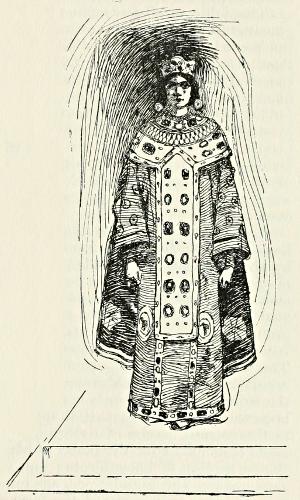
A Byzantine Costume
Under the command of Belisarius and Mundus,
they silently marched in two divisions from
the palace, forced their obscure way through
narrow passages, expiring flames, and falling
edifices, and burst open at the same moment
the two opposite gates of the hippodrome.
In this narrow space, the disorderly and affrighted
crowd was incapable of resisting on
either side a firm and regular attack; the blues
signalised the fury of their repentance; and it
is computed that above thirty thousand persons
were slain in the merciless and promiscuous
carnage of the day.[3] Hypatius was dragged
from his throne, and conducted with his
brother Pompeius to the feet of the emperor;
they implored his clemency;
but their crime was manifest, their
innocence uncertain, and Justinian
had been too much terrified to forgive.
The next morning the two
nephews of Anastasius, with eighteen illustrious accomplices of patrician or
consular rank were privately executed by the soldiers; their bodies were
thrown into the sea, their palaces razed, and their fortunes confiscated. The
hippodrome itself was condemned during several years to a mournful silence;
with the restoration of the games the same disorders revived, and the blue
and green factions continued to afflict the reign of Justinian, and to disturb
the tranquillity of the Eastern Empire, which still embraced the nations
beyond the Adriatic and as far as the frontiers of Ethiopia and Persia.
[527-565 A.D.]
Justinian reigned over sixty-four provinces and 935 cities, his dominions
were blessed by nature with the advantages of soil, situation, and climate;
and the improvements of human art had been perpetually diffused along the
coast of the Mediterranean and the banks of the Nile, from ancient Troy to
the Egyptian Thebes. Abraham had been relieved by the well-known plenty
of Egypt; the same country, a small and populous tract, was still capable of
exporting each year 260,000 quarters of wheat for the use of Constantinople;
and the capital of Justinian was supplied with the manufactures of Sidon,
fifteen centuries after they had been celebrated in the poems of Homer.
The subjects of Justinian were dissatisfied with the times and with the
government. Europe was overrun by the barbarians, and Asia by the monks;
the poverty of the West discouraged the trade and manufactures of the
East; the produce of labour was consumed by the unprofitable servants of
the church, the state, and the army, and a rapid decrease was felt in the
fixed and circulating capitals which constitute the national wealth. The
public distress had been alleviated by the economy of Anastasius, and that
prudent emperor accumulated an immense treasure, while he delivered his
people from the most odious or oppressive taxes. His example was neglected,
and his treasure was abused, by the nephew of Justin. The riches
of Justinian were speedily exhausted by alms and buildings, by ambitious
wars, and ignominious treaties. His revenues were found inadequate to his
expenses.
Every art was tried to extort from the people the gold and silver which
he scattered with a lavish hand from Persia to France; his reign was marked
by the vicissitudes, or rather by the combat, of rapaciousness and avarice,
of splendour and poverty; he lived with the reputation of hidden treasures,
and bequeathed to his successor the payment of his debts. Such a character
has been justly accused by the voice of the people and of posterity; but
public discontent is credulous, private malice is bold; and a lover of truth
will peruse with a suspicious eye the instructive anecdotes of Procopius.e
The secret historian represents only the vices of Justinian, and those vices
are darkened by his malevolent pencil. Ambiguous actions are imputed to
the worst motives, error is confounded with guilt, accident with design, and
laws with abuses; the partial injustice of a moment is dexterously applied
as the general maxim of a reign of thirty-two years. The emperor alone is
made responsible for the faults of his officers, the disorders of the times, and
the corruption of his subjects; and even the calamities of nature, plagues,
earthquakes, and inundations, are imputed to the prince of the demons, who
had mischievously assumed the form of Justinian.
After this precaution, we shall briefly relate the anecdotes of avarice and
rapine, under the following heads: (1) Justinian was so profuse that he
could not be liberal. The civil and military officers, when they were admitted
into the service of the palace, obtained a humble rank and a moderate stipend;
they ascended by seniority to a station of affluence and repose; the annual
pensions, of which the most honourable class was abolished by Justinian,
amounted to four hundred thousand pounds; and this domestic economy was
deplored by the venal or indigent courtiers as the last outrage on the majesty
of the empire. The posts, the salaries of physicians, and the nocturnal illuminations,
were objects of more general concern; and the cities might justly
complain that he usurped the municipal revenues which had been appropriated
to these useful institutions. Even the soldiers were injured; and
such was the decay of military spirit that they were injured with impunity.
The emperor refused, at the return of each fifth year, the customary donative
of five pieces of gold, reduced his veterans to beg their bread, and suffered
unpaid armies to melt away in the wars of Italy and Persia.
(2) The humanity of his predecessors had always remitted, in some auspicious
circumstance of their reign, the arrears of public tribute; and they
dexterously assumed the merit of resigning those claims which it was impracticable
to enforce. “Justinian, in the space of thirty-two years, has never
granted a similar indulgence; and many of his subjects have renounced the
possession of those lands whose value is insufficient to satisfy the demands of
the treasury. To the cities which had suffered by hostile inroads, Anastasius
promised a general exemption of seven years; the provinces of Justinian
have been ravaged by the Persians and Arabs, the Huns and Slavonians;
but his vain and ridiculous dispensation of a single year has been confined to
those places which were actually taken by the enemy.” Such is the language
of the secret historian, who expressly denies that any indulgence was granted
to Palestine after the revolt of the Samaritans; a false and odious charge,
confuted by the authentic record, which attests a relief of thirteen centenaries
of gold (£52,000 or $260,000) obtained for that desolate province by the
intercession of St. Sabas.
(3) Procopius has not condescended to explain the system of taxation,
which fell like a hail-storm upon the land, like a devouring pestilence on its
inhabitants; but we should become the accomplices of his malignity, if we
imputed to Justinian alone the ancient, though rigorous principle, that a whole
district should be condemned to sustain the partial loss of the persons or property
of individuals. The annona, or supply of corn for the use of the army
and capital, was a grievous and arbitrary exaction, which exceeded, perhaps
in a tenfold proportion, the ability of the farmer; and his distress was aggravated
by the partial injustice of weights and measures, and the expense and
labour of distant carriage. In a time of scarcity, an extraordinary requisition
was made to the adjacent provinces of Thrace, Bithynia, and Phrygia; but
the proprietors, after a wearisome journey and a perilous navigation, received
so inadequate a compensation that they would have chosen the alternative of
delivering both the corn and price at the doors of their granaries. These
precautions might indicate a tender solicitude for the welfare of the capital;
yet Constantinople did not escape the rapacious despotism of Justinian.
Till his reign, the straits of the Bosporus and Hellespont were open to the
freedom of trade, and nothing was prohibited except the exportation of arms
for the service of the barbarians. At each of these gates of the city a prætor
was stationed, the minister of imperial avarice; heavy customs were imposed
on the vessels and their merchandise; the oppression was retaliated on the
helpless consumer; the poor were afflicted by the artificial scarcity and
exorbitant price of the market; and a people, accustomed to depend on the
liberality of their prince, might sometimes complain of the deficiency of water
and bread. The aërial tribute, without a name, a law, or a definite object,
was an annual gift of £120,000 or $600,000, which the emperor accepted from
his prætorian prefect; and the means of payment were abandoned to the
discretion of that powerful magistrate.
(4) Even such a tax was less intolerable than the privilege of monopolies,
which checked the fair competition of industry, and, for the sake of a
small and dishonest gain, imposed an arbitrary burden on the wants and
luxury of the subject. “As soon,” says Procopius,e “as the exclusive
sale of silk was usurped by the imperial treasurer, a whole people, the
manufacturers of Tyre and Berytus, was reduced to extreme misery, and
either perished with hunger, or fled to the hostile dominions of Persia.” A
province might suffer by the decay of its manufactures; but in this example
Procopius has partially overlooked the inestimable benefit which the empire
received from Justinian’s introduction of silk-culture. His addition of one-seventh
to the ordinary price of copper money may be interpreted with the
same candour; and the alteration, which might be wise, appears to have
been innocent; since he neither alloyed the purity nor enhanced the value
of the gold coin, the legal measure of public and private payments.
(5) The ample jurisdiction, required by the farmers of the revenue to accomplish
their engagements, might be placed in an odious light, as if they had
purchased from the emperor the lives and fortunes of their fellow-citizens.
And a more direct sale of honours and offices was transacted in the palace,
with the permission, or at least with the connivance, of Justinian and Theodora.
The claims of merit, even those of favour, were disregarded; and it
was almost reasonable to expect that the bold adventurer, who had undertaken
the trade of a magistrate, should find a rich compensation for infamy,
labour, danger, the debts which he had contracted, and the heavy interest
which he paid. A sense of the disgrace and mischief of this venal practice
at length awakened the slumbering virtue of Justinian; and he attempted,
by the sanction of oaths and penalties, to guard the integrity of his government:
but at the end of a year of perjury, his rigorous edict was suspended,
and corruption licentiously abused her triumph over the impotence of the
laws.
(6) The testament of Eulalius, count of the domestics, declared the emperor
his sole heir, on condition, however, that he should discharge his debts and
legacies, allow to his three daughters a decent maintenance, and bestow each
of them in marriage, with a portion of ten pounds of gold. But the splendid
fortune of Eulalius had been consumed by fire; and the inventory of
his goods did not exceed the trifling sum of 564 pieces of gold. A similar
instance in Grecian history admonished the emperor of the honourable part
prescribed for his imitation. He checked the selfish murmurs of the treasury,
applauded the confidence of his friend, discharged the legacies and debts,
educated the three virgins under the eye of the empress Theodora, and
doubled the marriage portion which had satisfied the tenderness of their
father. The humanity of a prince (for princes cannot be generous) is entitled
to some praise; yet even in this act of virtue we may discover the inveterate
custom of supplanting the legal or natural heirs, which Procopius
imputes to the reign of Justinian. His charge is supported by eminent
names and scandalous examples; neither widows nor orphans were spared;
and the art of soliciting, or extorting, or supposing testaments, was beneficially
practised by the agents of the palace. This base and mischievous
tyranny invades the security of private life; and the monarch who has indulged
an appetite for gain, will soon be tempted to anticipate the moment
of succession, to interpret wealth as an evidence of guilt, and to proceed
from the claim of inheritance to the power of confiscation.
(7) Among the forms of rapine, a philosopher may be permitted to name
the conversion of pagan or heretical riches to the use of the faithful; but in
the time of Justinian this holy plunder was condemned by the sectaries alone,
who became the victims of his orthodox avarice.
Dishonour might be ultimately reflected on the character of Justinian;
but much of the guilt, and still more of the profit, was intercepted by the
ministers, who were seldom promoted for their virtues, and not always
selected for their talents. The merits of Tribonian the quæstor will hereafter
be weighed in the reformation of the Roman law; but the economy of
the East was subordinate to the prætorian prefect, and Procopiusf has justified
his anecdotes by the portrait which he exposes in his public history of
the notorious vices of Joannes of Cappadocia.
The corruption of his heart was equal to the vigour of his understanding.
Although he was suspected of magic and pagan superstition, he appeared
insensible to the fear of God or the reproaches of man; and his aspiring
fortune was raised on the death of thousands, the poverty of millions, the
ruin of cities, and the desolation of provinces. From the dawn of light to
the moment of dinner he assiduously
laboured to enrich his master
and himself at the expense of
the Roman world; the remainder
of the day was spent in sensual
and obscene pleasures, and
the silent hours of the night
were interrupted by the perpetual
dread of the justice of an
assassin. His abilities, perhaps
his vices, recommended him to
the lasting friendship of Justinian;
the emperor yielded with
reluctance to the fury of the
people; his victory was displayed
by the immediate restoration
of their enemy; and they
felt above ten years, under his
oppressive administration, that
he was stimulated by revenge,
rather than instructed by misfortune. Their murmurs served only to fortify
the resolution of Justinian; but the prefect, in the insolence of favour, provoked
the resentment of Theodora, disdained a power before which every
knee was bent, and attempted to sow the seeds of discord between the emperor
and his beloved consort.
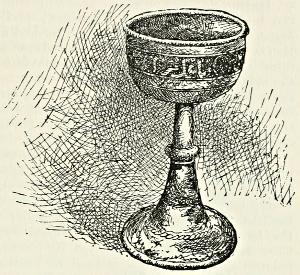
A Byzantine Goblet
Even Theodora herself was constrained to dissemble, to wait a favourable
moment, and by an artful conspiracy, to render Joannes of Cappadocia the
accomplice of his own destruction. At a time when Belisarius, unless he
had been a hero, must have shown himself a rebel, his wife Antonina, who
enjoyed the secret confidence of the empress, communicated his feigned
discontent to Euphemia, the daughter of the prefect; the credulous virgin
imparted to her father the dangerous project, and Joannes, who might have
known the value of oaths and promises, was tempted to accept a nocturnal,
and almost treasonable, interview with the wife of Belisarius. An ambuscade
of guards and eunuchs had been posted by the command of Theodora; they
rushed with drawn swords to seize or to punish the guilty minister; he
was saved by the fidelity of his attendants; but, instead of appealing to a
gracious sovereign, who had privately warned him of his danger, he pusillanimously
fled to the sanctuary of the church.
The favourite of Justinian was sacrificed to conjugal tenderness or
domestic tranquillity; the conversion of a prefect into a priest extinguished
his ambitious hopes, but the friendship of the emperor alleviated his disgrace,
and he retained, in the mild exile of Cyzicus, an ample portion of
his riches. Such imperfect revenge could not satisfy the unrelenting hatred
of Theodora; the murder of his old enemy, the bishop of Cyzicus, afforded
a decent pretence; and Joannes of Cappadocia, whose actions had deserved a
thousand deaths, was at last condemned for a crime of which he was innocent.
A great minister, who had been invested with the honours of consul
and patrician, was ignominiously scourged like the vilest of malefactors; a
tattered cloak was the sole remnant of his fortunes; he was transported in
a bark to the place of his banishment at Antinopolis in Upper Egypt, and the
prefect of the East begged his bread through the cities which had trembled
at his name.
During an exile of seven years, his life was protected and threatened by
the ingenious cruelty of Theodora; and when her death permitted the
emperor to recall a servant whom he had abandoned with regret, the ambition
of Joannes of Cappadocia was reduced to the humble duties of the sacerdotal
profession. His successors convinced the subjects of Justinian that
the arts of oppression might still be improved by experience and industry;
the frauds of a Syrian banker were introduced into the administration of the
finances; and the example of the prefect was diligently copied by the quæstor,
the public and private treasurer, the governors of provinces, and the principal
magistrates of the Eastern Empire.
The edifices of Justinian were cemented with the blood and treasure of
his people; but those stately structures appeared to announce the prosperity
of the empire, and actually displayed the skill of their architects. Both the
theory and practice of the arts, which depend on mathematical science and
mechanical power, were cultivated under the patronage of the emperors;
the fame of Archimedes was rivalled by Proclus and Anthemius; and if
their miracles had been related by intelligent spectators, they might now
enlarge the speculations instead of exciting the distrust of philosophers.
A tradition has prevailed that the Roman fleet was reduced to ashes in the
port of Syracuse by the burning-glasses of Archimedes; and it is asserted
that a similar expedient was employed by Proclus to destroy the Gothic
vessels in the harbour of Constantinople, and to protect his benefactor
Anastasius against the bold enterprise of Vitalian. A machine was fixed
on the walls of the city, consisting of an hexagon mirror of polished brass,
with many smaller and movable polygons to receive and reflect the rays
of the meridian sun; and a consuming flame was darted to the distance,
perhaps, of two hundred feet.
The truth of these two extraordinary facts is invalidated by the silence
of the most authentic historians; and the use of burning-glasses was never
adopted in the attack or defence of places. Yet the admirable experiments
of a French philosopher [Buffon] have demonstrated the possibility of such
a mirror; and, since it is possible, we are more disposed to attribute the art
to the greatest mathematicians of antiquity, than to give the merit of the
fiction to the idle fancy of a monk or a sophist. According to another
story [told by John Malalash], Proclus applied sulphur to the destruction of
the Gothic fleet; in a modern imagination, the name of sulphur is instantly
connected with the suspicion of gunpowder, and that suspicion is propagated
by the secret arts of his disciple Anthemius.
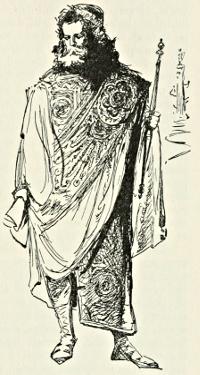
A Byzantine Noble
The fame of Metrodorus the grammarian, and of Anthemius the mathematician
and architect, reached the ears of the emperor Justinian, who invited
them to Constantinople; and while the one instructed the rising generation
in the schools of eloquence, the other filled the capital and provinces with
more lasting monuments of his art. In a trifling dispute, relative to the
walls or windows of their contiguous houses, he had been vanquished by the
eloquence of his neighbour Zeno; but the orator was defeated in his turn
by the master of mechanics, whose malicious, though harmless, stratagems
are darkly represented by the ignorance of Agathias. In a lower room,
Anthemius arranged several vessels or cauldrons of water, each of them covered
by the wide bottom of a leathern tube,
which rose to a narrow top, and was artificially
conveyed among the joists and rafters
of the adjacent building. A fire was
kindled beneath the cauldron; the steam
of the boiling water ascended through the
tubes; the house was shaken by the efforts
of imprisoned air, and its trembling inhabitants
might wonder that the city was unconscious
of the earthquake which they
had felt.
At another time the friends of Zeno,
as they sat at table, were dazzled by the
intolerable light which flashed in their eyes
from the reflecting mirrors of Anthemius;
they were astonished by the noise which
he produced from the collision of certain
minute and sonorous particles; and the
orator declared in tragic style to the senate,
that a mere mortal must yield to the power
of an antagonist who shook the earth with
the trident of Neptune, and imitated the
thunder and lightning of Jove himself.
The genius of Anthemius and his colleague
Isidore the Milesian was excited and employed
by a prince whose taste for architecture
had degenerated into a mischievous
and costly passion. His favourite architects
submitted their designs and difficulties
to Justinian, and discreetly confessed
how much their laborious meditations were
surpassed by the intuitive knowledge or celestial inspiration of an emperor
whose views were always directed to the benefit of his people, the glory of
his reign, and the salvation of his soul.
[532-538 A.D.]
The principal church, which was dedicated by the founder of Constantinople
to St. Sophia, or the eternal Wisdom, had been twice destroyed by
fire; after the exile of John Chrysostom, and during the Nika of the blue
and green factions. No sooner did the tumult subside than the Christian
populace deplored their sacrilegious rashness; but they might have rejoiced
in the calamity, had they foreseen the glory of the new temple which, at the
end of forty days, was strenuously undertaken by the piety of Justinian.
The ruins were cleared away, a more spacious plan was described, and,
as it required the consent of some proprietors of ground, they obtained
the most exorbitant terms from the eager desires and timorous conscience of
the monarch. Anthemius formed the design, and his genius directed the
hands of ten thousand workmen, whose payment in pieces of fine silver was
never delayed beyond the evening. The emperor himself, clad in a linen
tunic, surveyed each day their rapid progress, and encouraged their diligence
by his familiarity, his zeal, and his rewards.
The new cathedral of St. Sophia was consecrated by the patriarch, five
years, eleven months, and ten days from the first foundation; and in the
midst of the solemn festival, Justinian exclaimed with devout vanity, “Glory
be to God, who hath thought me worthy to accomplish so great a work; I
have vanquished thee, O Solomon!” But the pride of the Roman Solomon,
before twenty years had elapsed, was humbled by an earthquake, which overthrew
the eastern part of the dome. Its splendour was again restored by
the perseverance of the same prince; and, in the thirty-sixth year of his
reign, Justinian celebrated the second dedication of a temple, which remains,
after twelve centuries, a stately monument of his fame. The architecture
of St. Sophia, which is now converted into the principal mosque, has been
imitated by the Turkish sultans, and that venerable pile continues to excite
the fond admiration of the Greeks, and the more rational curiosity of European
travellers. The eye of the spectator is disappointed by an irregular
prospect of half domes and shelving roofs; the western front, the principal
approach, is destitute of simplicity and magnificence; and the scale of
dimensions has been much surpassed by several of the Latin cathedrals.
But the architect, who first erected an aërial cupola, is entitled to the praise
of bold design and skilful execution.
The altar itself, a name which insensibly became familiar to Christian
ears, was placed in the eastern recess, artificially built in the form of a demicylinder;
and this sanctuary communicated by several doors with the sacristy,
the vestry, the baptistery, and the contiguous buildings, subservient either to
the pomp of worship or the private use of the ecclesiastical ministers. The
memory of past calamities inspired Justinian with a wise resolution, that no
wood, except for the doors, should be admitted into the new edifice; and
the choice of the materials was applied to the strength, the lightness, or
the splendour of the respective parts. The solid piles which sustained the
cupola were composed of huge blocks of freestone, hewn into squares and
triangles, fortified by circles of iron, and firmly cemented by the infusion of
lead and quicklime; but the weight of the cupola was diminished by the
levity of its substance, which consists either of pumice-stone, that floats in
the water, or of bricks from the isle of Rhodes, five times less ponderous than
the ordinary sort. The whole frame of the edifice was constructed of brick;
but those base materials were concealed by a crust of marble; and the inside
of St. Sophia, the cupola, the two larger and the six smaller semi-domes,
the walls, the hundred columns, and the pavement, delight even the eyes of
barbarians with a rich and variegated picture.
A poet, who beheld the primitive lustre of St. Sophia, enumerates the
colours, the shades, and the spots of ten or twelve marbles, jaspers, and porphyries,
which nature had profusely diversified, and which were blended and
contrasted as it were by a skilful painter. The triumph of Christ was
adorned with the last spoils of paganism; but the greater part of these
costly stones was extracted from the quarries of Asia Minor, the isles and
continent of Greece, Egypt, Africa, and Gaul. Eight columns of porphyry,
which Aurelian had placed in the temple of the sun, were offered by the piety
of a Roman matron; eight others, of green marble, were presented by the
ambitious zeal of the magistrates of Ephesus: both are admirable by their
size and beauty; but every order of architecture disclaims their fantastic
capitals.
A variety of ornaments and figures was curiously expressed in mosaic;
and the images of Christ, of the Virgin, of saints, and of angels, which have
been defaced by Turkish fanaticism, were dangerously exposed to the superstition
of the Greeks. According to the sanctity of each object the precious
metals were distributed in thin leaves or in solid masses. The balustrade of
the choir, the capitals of the pillars, the ornaments of the doors and galleries,
were of gilt bronze; the spectator was dazzled by the glittering aspect of the
cupola; the sanctuary contained forty thousand pounds’ weight of silver;
and the holy vases and vestments of the altar were of the purest gold, enriched
with inestimable gems. Before the structure of the church had risen
two cubits above the ground, 45,200 pounds were already consumed; and
the whole expense amounted to 320,000 pounds; each reader, according to
the measure of his belief, may estimate their value either in gold or silver;
but the sum of £1,000,000, or $5,000,000, is the result of the lowest computation.
A magnificent temple is a laudable monument of national taste and
religion, and the enthusiast who entered the dome of St. Sophia might be
tempted to suppose that it was the residence, or even the workmanship, of
the Deity. Yet how dull is the artifice, how insignificant is the labour, if it
be compared with the formation of the vilest insect that crawls upon the
surface of the temple!
[527-565 A.D.]
So minute a description of an edifice which time has respected may attest
the truth and excuse the relation of the innumerable works, both in the capital
and provinces, which Justinian constructed on a smaller scale and less
durable foundations.[4] In Constantinople alone, and the adjacent suburbs,
he dedicated twenty-five churches to the honour of Christ, the Virgin, and
the saints; most of these churches were decorated with marble and gold;
and their various situation was skilfully chosen in a populous square, or a
pleasant grove; on the margin of the seashore, or on some lofty eminence
which overlooked the continents of Europe and Asia.
The Virgin of Jerusalem might exult in the temple erected by her imperial
votary on a most ungrateful spot, which afforded neither ground nor
materials to the architect. A level was formed, by raising part of a deep
valley to the height of the mountain. The stones of a neighbouring quarry
were hewn into regular forms; each block was fixed on a peculiar carriage,
drawn by forty of the strongest oxen, and the roads were widened for the
passage of such enormous weights. Lebanon furnished her loftiest cedars
for the timbers of the church; and the seasonable discovery of a vein of red
marble supplied its beautiful columns, two of which, the supporters of the
exterior portico, were esteemed the largest in the world.
The pious munificence of the emperor was diffused over the Holy Land:
and if reason should condemn the monasteries of both sexes which were built
or restored by Justinian, yet charity must applaud the wells which he sank,
and the hospitals which he founded, for the relief of the weary pilgrims.
The schismatical temper of Egypt was ill entitled to the royal bounty; but
in Syria and Africa some remedies were applied to the disasters of wars and
earthquakes, and both Carthage and Antioch, emerging from their ruins,
might revere the name of their gracious benefactor.
Almost every saint in the calendar acquired the honours of a temple;
almost every city of the empire obtained the solid advantages of bridges,
hospitals, and aqueducts; but the severe liberality of the monarch disdained
to indulge his subjects in the popular luxury of baths and theatres. While
Justinian laboured for the public service, he was not unmindful of his own
dignity and ease. The Byzantine palace, which had been damaged by the
conflagration, was restored with new magnificence; and some notion may be
conceived of the whole edifice by the vestibule, or hall, which, from the
doors perhaps, or the roof, was surnamed chalce, or the brazen. The dome
of a spacious quadrangle was supported by massy pillars; the pavement and
walls were encrusted with many-coloured marbles—the emerald green of
Laconia, the fiery red and the white Phrygian stone, intersected with veins
of a sea-green hue; the mosaic paintings of the dome and sides represented
the glories of the African and Italian triumphs.
On the Asiatic shore of the Propontis, at a small distance to the east of
Chalcedon, the costly palace and gardens of Heræum were prepared for the
summer residence of Justinian, and more especially of Theodora. The poets
of the age have celebrated the rare alliance of nature and art, the harmony
of the nymphs of the groves, the fountains, and the waves; yet the crowd of
attendants who followed the court complained of their inconvenient lodgings,
and the nymphs were too often alarmed by the famous Porphyrio, a whale of
ten cubits in breadth and thirty in length, who was stranded at the mouth
of the river Sangaris, after he had infested more than half a century the seas
of Constantinople.
The fortifications of Europe and Asia were multiplied by Justinian; but
the repetition of those timid and fruitless precautions exposes to a philosophic
eye the debility of the empire. From Belgrade to the Euxine, from the conflux
of the Save to the mouth of the Danube, a chain of above fourscore
fortified places was extended along the banks of the great river. Single
watch-towers were changed into spacious citadels; vacant walls, which the
engineers contracted or enlarged according to the nature of the ground, were
filled with colonies or garrisons; a strong fortress defended the ruins of
Trajan’s bridge, and several military stations affected to spread beyond the
Danube the pride of the Roman name. But that name was divested of its
terrors; the barbarians, in their annual inroads, passed and contemptuously
repassed before these useless bulwarks; and the inhabitants of the frontier,
instead of reposing under the shadow of the general defence, were compelled
to guard, with incessant vigilance, their separate habitations.
The solitude of ancient cities was replenished; the new foundations of
Justinian acquired, perhaps too hastily, the epithets of impregnable and
populous; and the auspicious place of his own nativity attracted the grateful
reverence of the vainest of princes. Under the name of Justiniana Prima,
the obscure village of Tauresium became the seat of an archbishop and a prefect,
whose jurisdiction extended over seven warlike provinces of Illyricum,
and the corrupt appellation of Giustendil still indicates, about twenty miles
to the south of Sophia, the residence of a Turkish sanjak. For the use of
the emperor’s countrymen, a cathedral, a palace, and an aqueduct were
speedily constructed; the public and private edifices were adapted to the
greatness of a royal city; and the strength of the walls resisted, during
the lifetime of Justinian, the unskilful assaults of the Huns and Slavonians.
Their progress was sometimes retarded, and their hopes of rapine were disappointed,
by the innumerable castles which, in the provinces of Dacia,
Epirus, Thessaly, Macedonia, and Thrace, appear to cover the whole face
of the country. Six hundred of these forts were built or repaired by the
emperor: but it seems reasonable to believe that the far greater part
consisted only of a stone or brick tower, in the midst of a square or circular
area, which was surrounded by a wall and ditch, and afforded in a moment
of danger some protection to the peasants and cattle of the neighbouring
villages.
Yet these military works, which exhausted the public treasure, could not
remove the just apprehensions of Justinian and his European subjects. The
warm baths of Anchialus in Thrace were rendered as safe as they were salutary;
but the rich pastures of Thessalonica were foraged by the Scythian
cavalry; the delicious vale of Tempe, three hundred miles from the Danube,
was continually alarmed by the sound of war; and no unfortified spot, however
distant or solitary, could securely enjoy the blessings of peace. The
straits of Thermopylæ which seemed to protect, but which had so often
betrayed, the safety of Greece, were diligently strengthened by the labours
of Justinian. From the edge of the seashore, through the forest and valleys,
and as far as the summit of the Thessalian Mountains, a strong wall was continued,
which occupied every practicable entrance. Instead of a hasty crowd
of peasants, a garrison of two thousand soldiers was stationed along the rampart;
granaries of corn and reservoirs of water were provided for their use;
and by a precaution that inspired the cowardice which it foresaw, convenient
fortresses were erected for their retreat. The walls of Corinth, overthrown
by an earthquake, and the mouldering bulwarks of Athens and Platæa, were
carefully restored; the barbarians were discouraged by the prospect of
successive and painful sieges; and the naked cities of Peloponnesus were
covered by the fortifications of the Isthmus of Corinth.
At the extremity of Europe, another peninsula, the Thracian Chersonesus,
runs three days’ journey into the sea, to form, with the adjacent shores
of Asia, the straits of the Hellespont. The intervals between eleven populous
towns were filled by lofty woods, fair pastures, and arable lands; and
the isthmus, of thirty-seven stadia or furlongs, had been fortified by a Spartan
general nine hundred years before the reign of Justinian. In an age of
freedom and valour, the slightest rampart may prevent a surprise; and Procopius
appears insensible of the superiority of ancient times, while he praises
the solid construction and double parapet of a wall whose long arms
stretched on either side into the sea, but whose strength was deemed
insufficient to guard the Chersonesus, if each city, and particularly Gallipoli
and Sestos, had not been secured by their peculiar fortifications.
The long wall, as it was emphatically styled, was a work as disgraceful
in the object as it was respectable in the execution. The riches of a capital
diffuse themselves over the neighbouring country, and the territory of Constantinople,
a paradise of nature, was adorned with the luxurious gardens
and villas of the senators and opulent citizens. But their wealth served
only to attract the bold and rapacious barbarians; the noblest of the
Romans, in the bosom of peaceful indolence, were led away into Scythian
captivity, and their sovereign might view, from his palace, the hostile flames
which were insolently spread to the gates of the imperial city. At the distance
only of forty miles, Anastasius was constrained to establish a last
frontier; his long wall, of sixty miles from the Propontis to the Euxine,
proclaimed the impotence of his arms; and as the danger became more
imminent, new fortifications were added by the indefatigable prudence of
Justinian.
Asia Minor, after the submission of the Isaurians, remained without enemies
and without fortifications. Those bold savages, who had disdained to
be the subjects of Gallienus, persisted 230 years in a life of independence
and rapine. The most successful princes respected the strength of the
mountains and the despair of the natives; their fierce spirit was sometimes
soothed with gifts, and sometimes restrained by terror; and a military
count, with three legions, fixed his permanent and ignominious station
in the heart of the Roman provinces.
If we extend our view from the tropic to the mouth of the Tanais, we
may observe on one hand the precautions of Justinian to curb the savages
of Ethiopia, and on the other the long walls which he constructed in
Crimea for the protection of his friendly Goths, a colony of three thousand
shepherds and warriors. From that peninsula to Trebizond, the eastern
curve of the Euxine was secured by forts, by alliance, or by religion; and
the possession of Lazica, the Colchos of ancient, the Mingrelia of modern
geography, soon became the object of an important war. Trebizond, in after
times the seat of a romantic empire, was indebted to the liberality of
Justinian for a church, an aqueduct, and a castle, whose ditches are hewn
in the solid rock. From that maritime city, a frontier line of five hundred
miles may be drawn to the fortress of Circesium, the last Roman station on
the Euphrates.
Among the Roman cities beyond the Euphrates, we distinguish two
recent foundations, which were named from Theodosius and the relics of
the martyrs, and two capitals, Amida and Edessa, which are celebrated in
the history of every age. Their strength was proportioned, by Justinian,
to the danger of their situation. A ditch and palisade might be sufficient to
resist the artless force of the cavalry of Scythia; but more elaborate works
were required to sustain a regular siege against the arms and treasures of the
great king. His skilful engineers understood the methods of conducting
deep mines, and of raising platforms to the level of the rampart; he shook
the strongest battlements with his military engines, and sometimes advanced
to the assault with a line of movable turrets on the backs of elephants. In
the great cities of the East the disadvantage of space, perhaps of position,
was compensated by the zeal of the people, who seconded the garrison in the
defence of their country and religion; and the fabulous promise of the Son
of God, that Edessa should never be taken, filled the citizens with valiant
confidence and chilled the besiegers with doubt and dismay.
The subordinate towns of Armenia and Mesopotamia were diligently
strengthened, and the posts which appeared to have any command of ground
or water were occupied by numerous forts, substantially built of stone or
more hastily erected with the obvious materials of earth and brick. The eye
of Justinian investigated every spot; and his cruel precautions might attract
the war into some lonely vale, whose peaceful natives, connected by trade
and marriage, were ignorant of national discord and the quarrels of princes.
Westward of the Euphrates, a sandy desert extends above six hundred miles
to the Red Sea. Nature had interposed a vacant solitude between the
ambition of two rival empires; the Arabians, till Mohammed arose, were
formidable only as robbers, and in the proud security of peace the fortifications
of Syria were neglected on the most vulnerable side.
[529-541 A.D.]
Justinian suppressed the schools of Athens and the consulship of Rome,
which had given so many sages and heroes to mankind. Both these institutions
had long since degenerated from their
primitive glory; yet some reproach may be
justly inflicted on the avarice and jealousy of
a prince by whose hands such venerable ruins
were destroyed.
The schools of Athens were protected by
the wisest and most virtuous of the Roman
princes. The library which Hadrian founded
was placed in a portico, adorned with pictures,
statues, and a roof of alabaster, and supported
by one hundred columns of Phrygian marble.
The public salaries were assigned by the generous
spirit of the Antonines; and each professor,
of politics, of rhetoric, of the platonic,
the peripatetic, the stoic, and the epicurean
philosophy, received an annual stipend of
ten thousand drachmæ [more than £300, or
$1500]. After the death of Marcus these
liberal donations, and the privileges attached
to the thrones of science, were abolished and
revived, diminished and enlarged; but some
vestige of royal bounty may be found under
the successors of Constantine, and their arbitrary
choice of an unworthy candidate might
tempt the philosophers of Athens to regret the
days of independence and poverty. It is remarkable
that the impartial favour of the
Antonines was bestowed on the four adverse sects of philosophy, which
they considered as equally useful, or at least as equally innocent.
The Gothic arms were less fatal to the schools of Athens than the establishment
of a new religion, whose ministers superseded the exercise of reason,
resolved every question by an article of faith, and condemned the infidel or
sceptic to eternal flames. In many a volume of laborious controversy they
exposed the weakness of the understanding and the corruption of the heart,
insulted human nature in the sages of antiquity, and proscribed the spirit of
philosophical inquiry, so repugnant to the doctrine or at least to the temper
of an humble believer. The surviving sect of the platonists, whom Plato
would have blushed to acknowledge, extravagantly mingled a sublime theory
with the practice of superstition and magic; and as they remained alone in
the midst of a Christian world, they indulged a secret rancour against the
government of the church and the state, whose severity was still suspended
over their heads.
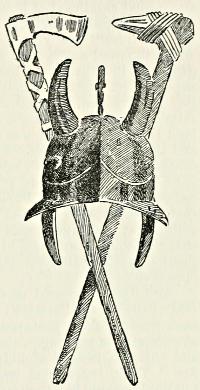
Gothic Weapons and Helmet
About a century after the reign of Julian, Proclus was permitted to teach
in the philosophic chair of the academy; and such was his industry that he
frequently, in the same day, pronounced five lessons and composed seven
hundred lines. His sagacious mind explored the deepest questions of morals
and metaphysics, and he ventured to urge eighteen arguments against the
Christian doctrine of the creation of the world. But, in the intervals of
study, he personally conversed with Pan, Æsculapius, and Minerva, in whose
mysteries he was secretly initiated, and whose prostrate statues he adored in
the devout persuasion that the philosopher, who is a citizen of the universe,
should be the priest of its various deities. An eclipse of the sun announced
his approaching end; and his life, with that of his scholar Isidore, compiled
by two of their most learned disciples, exhibits a deplorable picture of
the second childhood of human reason.
[527-565 A.D.]
Yet the golden chain, as it was fondly styled, of the Platonic succession,
continued forty-four years from the death of Proclus to the edict of Justinian,
which imposed a perpetual silence on the schools of Athens, and excited the
grief and indignation of the few remaining votaries of Grecian science and
superstition. Seven friends and philosophers, Diogenes and Hermias, Eulalius
and Priscian, Damascius, Isidore, and Simplicius, who dissented from the
religion of their sovereign, embraced the resolution of seeking in a foreign
land the freedom which was denied in their native country. They had heard,
and they credulously believed, that the republic of Plato was realised in the
despotic government of Persia, and that a patriot king reigned over the happiest
and most virtuous of nations. They were soon astonished by the
natural discovery that Persia resembled the other countries of the globe;
that Chosroes, who affected the name of a philosopher, was vain, cruel, and
ambitious; that bigotry and a spirit of intolerance prevailed among the Magi;
that the nobles were haughty, the courtiers servile, and the magistrates unjust;
that the guilty sometimes escaped, and that the innocent were often
oppressed.
The disappointment of the philosophers provoked them to overlook the
real virtues of the Persians; and they were scandalised, more deeply perhaps
than became their profession, with the plurality of wives and concubines,
the incestuous marriages, and the custom of exposing dead bodies to the dogs
and vultures, instead of hiding them in the earth or consuming them with
fire. Their repentance was expressed by a precipitate return, and they
loudly declared that they had rather die on the borders of the empire, than
enjoy the wealth and favour of the barbarian. From this journey, however,
they derived a benefit which reflects the purest lustre on the character of
Chosroes. He required that the seven sages, who had visited the court of
Persia, should be exempted from the penal laws which Justinian enacted
against his pagan subjects; and this privilege, expressly stipulated in a
treaty of peace, was guarded by the vigilance of a powerful mediator.[5]
Simplicius and his companions ended their lives in peace and obscurity;
and as they left no disciples, they terminate the long list of Grecian philosophers,
who may be justly praised, notwithstanding their defects, as the wisest
and most virtuous of their contemporaries. The writings of Simplicius are
now extant. His physical and metaphysical commentaries on Aristotle have
passed away with the fashion of the times; but his moral interpretation
of Epictetus is preserved in the library of nations as a classic book,
most excellently adapted to direct the will, to purify the heart, and to confirm
the understanding, by a just confidence in the nature both of God and
man.
[541 A.D.]
About the same time that Pythagoras first invented the appellation of
philosopher, liberty and the consulship were founded at Rome by the elder
Brutus. The first magistrates of the republic had been chosen by the people
to exercise, in the senate and in the camp, the powers of peace and war which
were afterwards translated to the emperors. But the tradition of ancient
dignity was long revered by the Romans and barbarians. The Gothic historian
Jordanesi applauds the consulship of Theodoric as the height of all
temporal glory;[6] the king of Italy himself congratulates those annual favourites
of fortune, who without the cares enjoyed the splendour of the throne;
and at the end of a thousand years two consuls were created by the sovereigns
of Rome and Constantinople, for the sole purpose of giving a date to the year
and a festival to the people. But the expenses of this festival, in which the
wealthy and the vain aspired to surpass their predecessors, insensibly arose
to the enormous sum of £80,000 [$400,000]; the wisest senators declined a
useless honour, which involved the certain ruin of their families; and to this
reluctance we should impute the frequent chasms in the last age of the
consular fasti.
The predecessors of Justinian had assisted from the public treasures the
dignity of the less opulent candidates; the avarice of that prince preferred
the cheaper and more convenient method of advice and regulation. Seven
processions or spectacles was the number to which his edict confined the
horse and chariot races, the athletic sports, the music and pantomimes of
the theatre, and the hunting of wild beasts; and small pieces of silver were
discreetly substituted for the gold medals which had always excited tumult
and drunkenness when they were scattered with a profuse hand among the populace.
Notwithstanding these precautions and his own example, the succession
of consuls finally ceased in the thirteenth year of Justinian, whose despotic
temper might be gratified by the silent extinction of a title which admonished
the Romans of their ancient freedom.
[523-533 A.D.]
When Justinian ascended the throne, about fifty years after the fall of
the Western Empire, the kingdoms of the Goths and Vandals had obtained
a solid, and, as it might seem, a legal establishment, both in Europe and
Africa. The titles which Roman victories had inscribed were erased with
equal justice by the sword of the barbarians; and their successful rapine
derived a more venerable sanction from time, from treaties, and from the
oaths of fidelity, already repeated by a second or third generation of obedient
subjects.
After Rome herself had been stripped of the imperial purple, the princes
of Constantinople assumed the sole and sacred sceptre of the monarchy;
demanded, as their rightful inheritance, the provinces which had been subdued
by the consuls or possessed by the Cæsars; and feebly aspired to
deliver their faithful subjects of the West from the usurpation of heretics
and barbarians. The execution of this splendid design was in some degree
reserved for Justinian. During the first five years of his reign, he reluctantly
waged a costly and unprofitable war against Persia; till his pride submitted
to his ambition, and he purchased, at the price of £440,000 [$2,200,000],
the benefit of a precarious truce which, in the language of both nations, was
dignified with the appellation of “the endless peace.” The safety of the East
enabled the emperor to employ his forces against the Vandals; and the
internal state of Africa afforded an honourable motive and promised a powerful
support to the Roman arms.
According to the testament of the founder, the African kingdom had
lineally descended to Hilderic, the eldest of the Vandal princes. A mild
disposition inclined the son of a tyrant, the grandson of a conqueror, to prefer
the counsels of clemency and peace; and his accession was marked by the
salutary edict which restored two hundred bishops to their churches, and
allowed the free profession of the Athanasian Creed. But the Catholics
accepted, with cold and transient gratitude, a favour so inadequate to their
pretensions, and the virtues of Hilderic offended the prejudices of his
countrymen. The Arian clergy presumed to insinuate that he had renounced
the faith, and the soldiers more loudly complained that he had degenerated
from the courage of his ancestors. His ambassadors were suspected of a
secret and disgraceful negotiation in the Byzantine court; and his general,
the Achilles, as he was named, of the Vandals, lost a battle against the naked
and disorderly Moors.
The public discontent was exasperated by Gelimer, whose age, descent,
and military fame gave him an apparent title to the succession. He assumed,
with the consent of the nation, the reins of government; and his unfortunate
sovereign sank without a struggle from the throne to a dungeon, where he
was strictly guarded, with a faithful counsellor and his unpopular nephew,
the Achilles of the Vandals. But the indulgence which Hilderic had shown
to his Catholic subjects had powerfully recommended him to the favour of
Justinian, who, for the benefit of his own sect, could acknowledge the use
and justice of religious toleration; their alliance, while the nephew of Justin
remained in a private station, was cemented by the mutual exchange of
gifts and letters, and the emperor Justinian asserted the cause of royalty
and friendship.
In two successive embassies, he admonished the usurper to repent of his
treason, or to abstain at least from any further violence, which might provoke
the displeasure of God and of the Romans; to reverence the laws of
kindred and succession, and to suffer an infirm old man peaceably to end his
days, either on the throne of Carthage or in the palace of Constantinople.
The passions or even the prudence of Gelimer compelled him to reject these
requests, which were urged in the haughty tone of menace and command;
and he justified his ambition in a language rarely spoken in the Byzantine
court, by alleging the right of a free people to remove or punish their chief
magistrate, who had failed in execution of the kingly office. After this
fruitless expostulation, the captive monarch was more rigorously treated,
his nephew was deprived of his eyes, and the cruel Vandal, confident in his
strength and distance, derided the vain threats and slow preparations of
the emperor of the East. Justinian resolved to deliver or revenge his friend,
Gelimer to maintain his usurpation; and the war was preceded, according to
the practice of civilised nations, by the most solemn protestations that each
party was sincerely desirous of peace.
The report of an African war was grateful only to the vain and idle
populace of Constantinople, whose poverty exempted them from tribute and
whose cowardice was seldom exposed to military service. But the wiser
citizens, who judged of the future by the past, revolved in their memory the
immense loss, both of men and money, which the empire had sustained in
the expedition of Basiliscus. The troops, which after five laborious campaigns
had been recalled from the Persian frontier, dreaded the sea, the
climate, and the arms, of an unknown enemy.
The forces of the Vandals were diminished by discord and suspicion;
the Roman armies were animated by the spirit of Belisarius, one of those
heroic names which are familiar to every age and to every nation.
The Africanus of New Rome was born, and perhaps educated, among the
Thracian peasants,[7] without any of those advantages which had formed the
virtues of the elder and younger Scipio—a noble origin, liberal studies, and
the emulation of a free state. The
silence of a loquacious secretary may
be admitted to prove that the youth
of Belisarius could not afford any subject
of praise; he served, most assuredly
with valour and reputation,
among the private guards of Justinian;
and when his patron became emperor,
the domestic was promoted to military
command. After a bold inroad into
Pers-Armenia, in which his glory was
shared by a colleague and his progress
was checked by an enemy, Belisarius
repaired to the important station of
Dara, where he first accepted the
service of Procopius,f the faithful companion
and diligent historian of his
exploits.
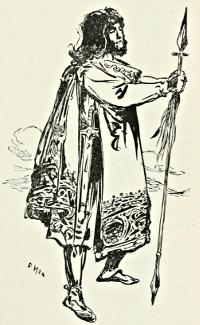
A Vandal Chief
Peace relieved him from the guard
of the eastern frontier, and his conduct
in the sedition of Constantinople
amply discharged his obligations to
the emperor. When the African war
became the topic of popular discourse
and secret deliberation, each of the
Roman generals was apprehensive,
rather than ambitious, of the dangerous
honour; but as soon as Justinian had
declared his preference of superior
merit, their envy was rekindled by the
unanimous applause which was given to the choice of Belisarius. The temper
of the Byzantine court may encourage a suspicion that the hero was
darkly assisted by the intrigues of his wife, the fair and subtle Antonina, who
alternately enjoyed the confidence and incurred the hatred of the empress
Theodora. The birth of Antonina was ignoble; she descended from a family
of charioteers; and her chastity has been stained with the foulest reproach.
Yet she reigned with long and absolute power over the mind of her illustrious
husband; and if Antonina disdained the merit of conjugal fidelity, she
expressed a manly friendship to Belisarius, whom she accompanied with
undaunted resolution in all the hardships and dangers of a military life.
[533-534 A.D.]
The preparations for the African war were not unworthy of the last contest
between Rome and Carthage. The pride and flower of the army consisted
of the guards of Belisarius, who, according to the pernicious indulgence of the
times, devoted themselves by a particular oath of fidelity to the service of
their patrons. Their strength and stature, for which they had been curiously
selected, the goodness of their horses and armour, and the assiduous
practice of all the exercises of war, enabled them to act whatever their courage
might prompt; and their courage was exalted by the social honour of
their rank, and the personal ambition of favour and fortune.
Five hundred transports, navigated by twenty thousand mariners of
Egypt, Cilicia, and Ionia, were collected in the harbour of Constantinople.
The smallest of these vessels may be computed at thirty, the largest at five
hundred tons; and the fair average will supply an allowance, liberal but not
profuse, of about one hundred thousand tons, for the reception of thirty-five
thousand soldiers and sailors, of five thousand horses, of arms, engines,
and military stores, and of a sufficient stock of water and provisions for a
voyage perhaps of three months. The proud galleys, which in former ages
swept the Mediterranean with so many hundred oars, had long since disappeared;
and the fleet of Justinian was escorted only by ninety-two light
brigantines, covered from the missile weapons of the enemy and rowed by
two thousand of the brave and robust youth of Constantinople. Twenty-two
generals are named, most of whom were afterwards distinguished in the
wars of Africa and Italy; but the supreme command, both by land and sea,
was delegated to Belisarius alone, with a boundless power of acting according
to his discretion, as if the emperor himself were present. The separation of
the naval and military professions is at once the effect and the cause of the
modern improvements in the science of navigation and maritime war.
If Gelimer had been informed of the approach of the enemy, he must
have delayed the conquest of Sardinia for the immediate defence of his
person and kingdom.
A detachment of 5000 soldiers and 120 galleys would have joined the
remaining forces of the Vandals; and the descendant of Genseric might have
surprised and oppressed a fleet of deep-laden transports, incapable of action,
and of light brigantines, that seemed only qualified for flight. Belisarius
had secretly trembled when he overheard his soldiers, in the passage, emboldening
each other to confess their apprehensions; if they were once on shore,
they hoped to maintain the honour of their arms; but if they should be
attacked at sea, they did not blush to acknowledge that they wanted courage
to contend at the same time with the winds, the waves, and the barbarians.
The knowledge of their sentiments decided Belisarius to seize the first opportunity
of landing them on the coast of Africa, and he prudently rejected, in
a council of war, the proposal of sailing with the fleet and army into the
port of Carthage.
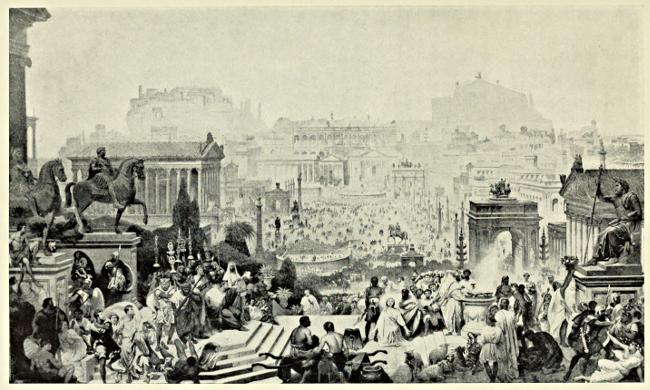
THE ROMAN FORUM
Three months after their departure from Constantinople, the men and
horses, the arms and military stores, were safely disembarked, and five soldiers
were left as a guard on board each of the ships, which were disposed in the
form of a semicircle. The remainder of the troops occupied a camp on
the sea shore, which they fortified according to ancient discipline with a ditch
and rampart; and the discovery of a source of fresh water, while it allayed
the thirst, excited the superstitious confidence, of the Romans. The next
morning, some of the neighbouring gardens were pillaged; and Belisarius,
after chastising the offenders, embraced the slight occasion, but the decisive
moment, of inculcating the maxims of justice, moderation, and genuine
policy. “When I first accepted the commission of subduing Africa, I
depended much less,” said the general, “on the numbers, or even the
bravery, of my troops, than upon the friendly disposition of the natives
and their immortal hatred to the Vandals. You alone can deprive me of
this hope; if you continue to extort by rapine what might be purchased for
a little money, such acts of violence will reconcile these implacable enemies,
and unite them in a just and holy league against the invaders of their
country.”
These exhortations were enforced by a rigid discipline, of which the soldiers
themselves soon felt and praised the salutary effects. The inhabitants,
instead of deserting their houses or hiding their corn, supplied the Romans
with a fair and liberal market; the civil officers of the province continued
to exercise their functions in the name of Justinian; and the clergy, from
motives of conscience and interest, assiduously laboured to promote the
cause of a Catholic emperor.
Belisarius advanced without opposition as far as Grasse, a palace of the
Vandal kings, at the distance of fifty miles from Carthage. The near
approach of the Romans to Carthage filled the mind of Gelimer with anxiety
and terror. He prudently wished to protract the war till his brother,
with his veteran troops, should return from the conquest of Sardinia; and
he now lamented the rash policy of his ancestors, who, by destroying the
fortifications of Africa, had left him only the dangerous resource of risking
a battle in the neighbourhood of his capital. The Vandal conquerors,
from their original number of 50,000, were multiplied, without including
their women and children, to 160,000 fighting men; and such forces, animated
with valour and union, might have crushed at their first landing
the feeble and exhausted bands of the Roman general. But the friends of the
captive king were more inclined to accept the invitations than to resist
the progress of Belisarius; and many a proud barbarian disguised his aversion
to war under the more specious name of his hatred to the usurper. Yet
the authority and promises of Gelimer collected a formidable army, and his
plans were concerted with some degree of military skill.
An order was despatched to his brother Ammatas, to collect all the
forces of Carthage and to encounter the van of the Roman army at the distance
of ten miles from the city; his nephew Gibamund, with two thousand
horse, was destined to attack their left, when the monarch himself, who
silently followed, should charge their rear, in a situation which excluded
them from the aid or even the view of their fleet. But the rashness of
Ammatas was fatal to himself and his country. He anticipated the hour of
the attack, outstripped his tardy followers, and was pierced with a mortal
wound, after he had slain with his own hand twelve of his boldest antagonists.
His Vandals fled to Carthage; the highway, almost ten miles, was
strewed with dead bodies; and it seemed incredible that such multitudes
could be slaughtered by the swords of three hundred Romans. The nephew
of Gelimer was defeated, after a slight combat, by the six hundred Massagetæ;
they did not equal the third part of his numbers, but each Scythian
was fired by the example of his chief, who gloriously exercised the privilege
of his family by riding foremost and alone to shoot the first arrow against
the enemy.
In the meanwhile Gelimer himself, ignorant of the event and misguided
by the windings of the hills, inadvertently passed the Roman army and
reached the scene of action where Ammatas had fallen. He wept the fate
of his brother and of Carthage, charged with irresistible fury the advancing
squadrons, and might have pursued and perhaps decided the victory if he
had not wasted those inestimable moments in the discharge of a vain though
pious duty to the dead.[8]
While his spirit was broken by this mournful office, he heard the trumpet
of Belisarius, who, leaving Antonina and his infantry in the camp, pressed
forward with his guards and the remainder of the cavalry to rally his flying
troops and to restore the fortune of the day. Much room could not be
found in this disorderly battle for the talents of a general; but the king fled
before the hero; and the Vandals, accustomed only to a Moorish enemy,
were incapable of withstanding the arms and discipline of the Romans.[9]
Gelimer retired with hasty steps towards the desert of Numidia; but he had
soon the consolation of learning that his private orders for the execution of
Hilderic and his captive friends had been faithfully obeyed. The tyrant’s
revenge was useful only to his enemies. The death of a lawful prince excited
the compassion of his people; his life might have perplexed the victorious
Romans; and the lieutenant of Justinian, by a crime of which he was innocent,
was relieved from the painful alternative of forfeiting his honour or
relinquishing his conquests.
Belisarius was soon satisfied that he might confide, without danger, in the
peaceful and friendly aspect of the capital. Carthage blazed with innumerable
torches, the signals of the public joy; the chain was removed that
guarded the entrance of the port; the gates were thrown open, and the people,
with acclamations of gratitude, hailed and invited their Roman deliverers.
The defeat of the Vandals and the freedom of Africa were announced
to the city on the eve of St. Cyprian, when the churches were already adorned
and illuminated for the festival of the martyr, whom three centuries of
superstition had almost raised to a local deity. The Arians, conscious that
their reign had expired, resigned the temple to the Catholics, who rescued
their saint from profane hands, performed the holy rites, and loudly proclaimed
the creed of Athanasius and Justinian. One awful hour reversed
the fortunes of the contending parties.
The suppliant Vandals, who had so lately indulged the vices of conquerors,
sought a humble refuge in the sanctuary of the church; while the
merchants of the East were delivered from the deepest dungeon of the palace
by their affrighted keeper, who implored the protection of his captives, and
showed them, through an aperture in the wall, the sails of a Roman fleet.
But the imperial fleet, advancing with a fair wind, steered through the narrow
entrance of the Goletta, and occupied, in the deep and capacious lake
of Tunis, a secure station about five miles from the capital. No sooner was
Belisarius informed of their arrival than he despatched orders that the greatest
part of the mariners should be immediately landed to join the triumph
and to swell the apparent numbers of the Romans. Before he allowed them
to enter the gates of Carthage, he exhorted them, in a discourse worthy of
himself and the occasion, not to disgrace the glory of their arms; and to
remember that the Vandals had been the tyrants, but that they were the
deliverers of the Africans, who must now be respected as the voluntary and
affectionate subjects of their common sovereign.
The Romans marched through the streets in close ranks, prepared for
battle if an enemy had appeared; the strict order maintained by the general
imprinted on their minds the duty of obedience; and in an age in which
custom and impunity almost sanctified the abuse of conquest, the genius of
one man repressed the passions of a victorious army. The voice of menace
and complaint was silent; the trade of Carthage
was not interrupted; while Africa
changed her master and her government,
the shops continued open and busy; and the
soldiers, after sufficient guards had been
posted, modestly departed to the houses
which were allotted for their reception.
Belisarius fixed his residence in the palace.
He seated himself on the throne of Genseric;
accepted and distributed the barbaric
spoil; granted their lives to the suppliant
Vandals; and laboured to repair the damage
which the suburb of Mandracium had
sustained in the preceding night.
The fortifications of Carthage had alone
been exempted from the general proscription;
but in the reign of ninety-five years they
were suffered to decay by the thoughtless
and indolent Vandals. A wiser conqueror
restored with incredible despatch the walls
and ditches of the city. His liberality
encouraged the workmen; the soldiers, the
mariners, and the citizens vied with each
other in the salutary labour; and Gelimer, who had feared to trust his
person in an open town, beheld with astonishment and despair the rising
strength of an impregnable fortress.
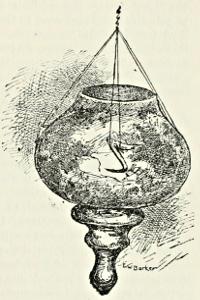
Byzantine Oil Vase
That unfortunate monarch, after the loss of his capital, applied himself
to collect the remains of an army scattered, rather than destroyed, by the
preceding battle; and the hopes of pillage attracted some Moorish bands to
the standard of Gelimer. He encamped in the fields of Bulla, four days’
journey from Carthage; insulted the capital, which he deprived of the use
of an aqueduct; proposed a high reward for the head of every Roman;
affected to spare the persons and property of his African subjects, and
secretly negotiated with the Arian sectaries and the confederate Huns.
Under these circumstances, the conquest of Sardinia served only to aggravate
his distress; he reflected with the deepest anguish that he had wasted, in
that useless enterprise, five thousand of his bravest troops; and he read, with
grief and shame, the victorious letters of his brother Zano, who expressed a
sanguine confidence that the king, after the example of their ancestors, had
already chastised the rashness of the Roman invader. “Alas! my brother,”
replied Gelimer, “heaven has declared against our unhappy nation. While
you have subdued Sardinia, we have lost Africa. No sooner did Belisarius
appear with a handful of soldiers, than courage and prosperity deserted the
cause of the Vandals. Your nephew Gibamund, your brother Ammatas,
have been betrayed to death by the cowardice of their followers. Our
horses, our ships, Carthage itself, and all Africa, are in the power of the
enemy. Yet the Vandals still prefer an ignominious repose, at the expense
of their wives and children, their wealth and liberty. Nothing now remains
except the field of Bulla and the hope of your valour. Abandon Sardinia;
fly to our relief; restore our empire, or perish by our side.” On the receipt
of this epistle, Zano imparted his grief to the principal Vandals; but the
intelligence was prudently concealed from the natives of the island.
The troops embarked in 120 galleys at the port of Cagliari, cast anchor
the third day on the confines of Mauretania, and hastily pursued their march
to join the royal standard in the camp of Bulla. Mournful was the interview.
The two brothers embraced, they wept in silence; no questions were asked
of the Sardinian victory, no inquiries were made of the African misfortunes;
they saw before their eyes the whole extent of their calamities, and the
absence of their wives and children afforded a melancholy proof that either
death or captivity had been their lot.
The languid spirit of the Vandals was at length awakened and united by
the entreaties of their king, the example of Zano, and the instant danger
which threatened their monarchy and religion. The military strength of
the nation advanced to battle; and such was the rapid increase that, before
their army reached Tricameron, about twenty miles from Carthage, they
might boast, perhaps with some exaggeration, that they surpassed in a tenfold
proportion the diminutive powers of the Romans. But these powers
were under the command of Belisarius; and as he was conscious of their
superior merit, he permitted the barbarians to surprise him at an unseasonable
hour. The Romans were instantly under arms. A rivulet covered their
front; the cavalry formed the first line, which Belisarius supported in the
centre, at the head of five hundred guards; the infantry, at some distance,
was posted in the second line; and the vigilance of the general watched the
separate station and ambiguous faith of the Massagetæ, who secretly reserved
their aid for the conquerors.
Zano, with the troops which had followed him to the conquest of Sardinia,
was placed in the centre; and the throne of Genseric might have stood, if
the multitude of Vandals had imitated their intrepid resolution. Casting
away their lances and missile weapons, they drew their swords, and expected
the charge. The Roman cavalry thrice passed the rivulet, they were thrice
repulsed; and the conflict was firmly maintained till Zano fell, and the standard
of Belisarius was displayed. Gelimer retreated to his camp; the Huns
joined the pursuit, and the victors despoiled the bodies of the slain. Yet no
more than fifty Romans and eight hundred Vandals were found on the field
of battle; so inconsiderable was the carnage of a day which extinguished
a nation and transferred the empire of Africa.
In the evening Belisarius led his infantry to the attack of the camp;
and the pusillanimous flight of Gelimer exposed the vanity of his recent
declarations that to the vanquished death was a relief, life a burden, and
infamy the only object of terror. His departure was secret; but as soon as
the Vandals discovered that their king had deserted them, they hastily dispersed,
anxious only for their personal safety and careless of every object
that is dear or valuable to mankind. The Romans entered the camp
without resistance, and the wildest scenes of disorder were veiled in the
darkness and confusion of the night. Every barbarian who met their
swords was inhumanly massacred; their widows and daughters, as rich heirs
or beautiful concubines, were embraced by the licentious soldiers; and avarice
itself was almost satiated with the treasures of gold and silver, the accumulated
fruits of conquests or economy in a long period of prosperity and peace.
In this frantic search the troops, even of Belisarius, forgot their caution and
respect. Intoxicated with lust and rapine, they explored in small parties, or
alone, the adjacent fields, the woods, the rocks, and the caverns, that might
possibly conceal any desirable prize; laden with booty, they deserted their
ranks, and wandered, without a guide, on the high-road to Carthage; and if
the flying enemies had dared to return, very few of the conquerors would
have escaped.
Deeply sensible of the disgrace and danger, Belisarius passed an apprehensive
night on the field of victory; at the dawn of day he planted his
standard on a hill, recalled his guards and veterans, and gradually restored
the modesty and obedience of the camp. It was equally the concern of the
Roman general to subdue the hostile and to save the prostrate barbarian;
and the suppliant Vandals, who could be found only in churches, were protected
by his authority, disarmed, and separately confined, that they might
neither disturb the public peace nor become the victims of popular revenge.
After despatching a light detachment to tread the footsteps of Gelimer, he
advanced with his whole army about ten days’ march, as far as Hippo Regius,
which no longer possessed the relics of St. Augustine. The season, and the
certain intelligence that the Vandal had fled to the inaccessible country of
the Moors, determined Belisarius to relinquish the vain pursuit and to fix
his winter quarters at Carthage. From thence he despatched his principal
lieutenant to inform the emperor that, in the space of three months, he had
achieved the conquest of Africa.
Belisarius spoke the language of truth. The surviving Vandals yielded,
without resistance, their arms and their freedom; the neighbourhood of Carthage
submitted to his presence, and the more distant provinces were successively
subdued by the report of his victory. Tripolis was confirmed in
her voluntary allegiance; Sardinia and Corsica surrendered to an officer
who carried, instead of a sword, the head of the valiant Zano; and the isles
of Majorca, Minorca, and Yvica consented to remain a humble appendage
of the African kingdom. Cæsarea, a royal city, which in looser geography
may be confounded with the modern Algiers, was situate thirty days’ march
to the westward of Carthage; by land, the road was infested by the Moors;
but the sea was open, and the Romans were now masters of the sea.
An active and discreet tribune sailed as far as the straits, where he occupied
Septem or Ceuta, which rises opposite to Gibraltar on the African coast;
that remote place was afterwards adorned and fortified by Justinian; and he
seems to have indulged the vain ambition of extending his empire to the
columns of Hercules. He received the messengers of victory at the time
when he was preparing to publish the pandects of the Roman law; and the
devout or jealous emperor celebrated the divine goodness, and confessed, in
silence, the merit of his successful general. Impatient to abolish the temporal
and spiritual tyranny of the Vandals, he proceeded without delay to the
full establishment of the Catholic church. Her jurisdiction, wealth, and immunities,
perhaps the most essential part of episcopal religion, were restored
and amplified with a liberal hand; the Arian worship was suppressed; the
Donatist meetings were proscribed, and the synod of Carthage, by the voice
of 217 bishops, applauded the just measure of pious retaliation.
On such an occasion, it may not be presumed that many orthodox prelates
were absent; but the comparative smallness of their number, which in
ancient councils had been twice or even thrice multiplied, most clearly indicates
the decay both of the church and state. While Justinian approved
himself the defender of the faith, he entertained an ambitious hope that his
victorious lieutenant would speedily enlarge the narrow limits of his dominion
to the space which they occupied before the invasion of the Moors and Vandals;
and Belisarius was instructed to establish five dukes or commanders in
the convenient stations of Tripolis, Leptis, Cirta, Cæsarea, and Sardinia, and
to compute the military force of palatines or borderers that might be sufficient
for the defence of Africa. The kingdom of the Vandals was not unworthy
of the presence of a prætorian prefect; and four consulars, three presidents,
were appointed to administer the seven provinces under his civil jurisdiction.
After the departure of Belisarius, who acted by a high and special commission,
no ordinary provision was made for a master-general of the forces; but
the office of prætorian prefect was entrusted to a soldier; the civil and military
powers were united, according to the practice of Justinian, in the chief
governor; and the representative of the emperor in Africa, as well as in
Italy, was soon distinguished by the appellation of exarch.
Yet the conquest of Africa was imperfect till her former sovereign was
delivered, either alive or dead, into the hands of the Romans. Doubtful of
the event, Gelimer had given secret orders that a part of his treasure should
be transported to Spain, where he hoped to find a secure refuge at the court
of the king of the Visigoths. But these intentions were disappointed by
accident, treachery, and the indefatigable pursuit of his enemies; when the
royal captive accosted his conqueror, he burst into a fit of laughter. The
crowd might naturally believe that extreme grief had deprived Gelimer of
his senses; but in this mournful state, unseasonable mirth insinuated to more
intelligent observers that the vain and transitory scenes of human greatness
are unworthy of a serious thought.
Their contempt was soon justified by a new example of a vulgar truth—that
flattery adheres to power, and envy to superior merit. The chiefs of
the Roman army presumed to think themselves the rivals of a hero. Their
private despatches maliciously affirmed that the conqueror of Africa, strong
in his reputation and the public love, conspired to seat himself on the throne
of the Vandals. Justinian listened with too patient an ear; and his silence
was the result of jealousy rather than of confidence. An honourable alternative,
of remaining in the province or of returning to the capital, was
indeed submitted to the discretion of Belisarius; but he wisely concluded,
from intercepted letters and the knowledge of his sovereign’s temper, that
he must either resign his head, erect his standard, or confound his enemies
by his presence and submission. Innocence and courage decided his choice;
his guards, captives, and treasures were diligently embarked, and so prosperous
was the navigation that his arrival at Constantinople preceded any
certain account of his departure from the port of Carthage. Such unsuspecting
loyalty removed the apprehensions of Justinian; envy was silenced
and inflamed by the public gratitude; and the third Africanus obtained the
honours of a triumph, a ceremony which the city of Constantine had never
seen and which ancient Rome, since the reign of Tiberius, had reserved for
the auspicious arms of the Cæsars.
[534-535 A.D.]
The glorious procession entered the gate of the Hippodrome, was saluted
by the acclamations of the senate and people, and halted before the throne
where Justinian and Theodora were seated to receive the homage of the
captive monarch and the victorious hero. They both performed the customary
adoration; and, falling prostrate on the ground, respectfully touched
the footstool of a prince who had not unsheathed his sword and of a prostitute
who had danced on the theatre; some gentle violence was used to bend
the stubborn spirit of the grandson of Genseric, and, however trained to
servitude, the genius of Belisarius must have secretly rebelled. He was
immediately declared consul for the ensuing year, and the day of his
inauguration resembled the pomp of a second triumph; his curule chair
was borne aloft on the shoulders of captive Vandals; and the spoils of war,
gold cups, and rich girdles, were profusely scattered among the populace.[10]
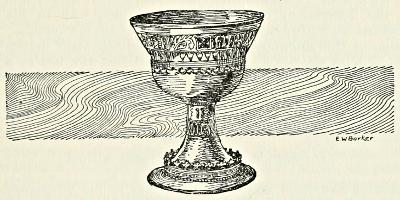
Byzantine Silver Cup
But the purest reward of Belisarius was in the faithful execution of a
treaty for which his honour had been pledged to the king of the Vandals.
The religious scruples of Gelimer, who adhered to the Arian heresy, were
incompatible with the dignity of senator or patrician; but he received from
the emperor an ample estate in the province of Galatia, where the abdicated
monarch retired with his family and friends, to a life of peace, of affluence,
and perhaps of content. The daughters of Hilderic were entertained with
the respectful tenderness due to their age and misfortune; and Justinian
and Theodora accepted the honour of educating and enriching the female
descendants of the great Theodosius.
The bravest of the Vandal youth were distributed into five squadrons of
cavalry, which adopted the name of their benefactor and supported in the
Persian wars the glory of their ancestors. But these rare exceptions, the
reward of birth or valour, are insufficient to explain the fate of a nation
whose numbers, before a short and bloodless war, amounted to more than
six hundred thousand persons. After the exile of their king and nobles,
the servile crowd might purchase their safety by abjuring their character,
religion, and language; and their degenerate posterity would be insensibly
mingled with the common herd of African subjects. Yet even in the
present age, and in the heart of the Moorish tribes, a curious traveller has
discovered the white complexion and long flaxen hair of a northern race;
and it was formerly believed that the boldest of the Vandals fled beyond
the power, or even the knowledge, of the Romans, to enjoy their solitary
freedom on the shores of the Atlantic ocean. Africa had been their empire,
it became their prison; nor could they entertain a hope, or even a wish, of
returning to the banks of the Elbe, where their brethren, of a spirit less
adventurous, still wandered in their native forests.
It was impossible for cowards to surmount the barriers of unknown seas
and hostile barbarians; it was impossible for brave men to expose their
nakedness and defeat before the eyes of their countrymen, to describe the
kingdoms which they had lost, and to claim a share of the humble inheritance,
which, in a happier hour, they had almost unanimously renounced.
In the country between the Elbe and the Oder, several populous villages of
Lusatia are inhabited by the Vandals: they still preserve their language,
their customs, and the purity of their blood; support, with some impatience,
the Saxon or Prussian yoke; and serve with secret and voluntary
allegiance the descendant of their ancient kings, who in his garb and
present fortune is confounded with the meanest of his vassals. The name
and situation of this unhappy people might indicate their descent from one
common stock with the conquerors of Africa. But the use of a Slavonian
dialect more clearly represents them as the last remnant of the new colonies,
who succeeded to the genuine Vandals, already scattered or destroyed in
the age of Procopius.
[439-534 A.D.]
If Belisarius had been tempted to hesitate in his allegiance, he might
have urged, even against the emperor himself, the indispensable duty of
saving Africa from an enemy more barbarous than the Vandals. The origin
of the Moors is involved in darkness; they were ignorant of the use of
letters. Their limits cannot be precisely defined: a boundless continent
was open to the Libyan shepherds; the change of seasons and pastures regulated
their motions; and their rude huts and slender furniture were transported
with the same ease as their arms, their families, and their cattle,
which consisted of sheep, oxen, and camels. During the vigour of the
Roman power, they observed a respectful distance from Carthage and the
sea shore; under the feeble reign of the Vandals, they invaded the cities
of Numidia, occupied the sea coast from Tingis (Tangier) to Cæsarea, and
pitched their camps, with impunity, in the fertile province of Byzacium.
The formidable strength and artful conduct of Belisarius secured the
neutrality of the Moorish princes, whose vanity aspired to receive, in the
emperor’s name, the ensigns of their regal dignity. They were astonished
by the rapid event, and trembled in the presence of their conqueror. But
his approaching departure soon relieved the apprehensions of a savage and
superstitious people; the number of their wives allowed them to disregard
the safety of their infant hostages; and when the Roman general hoisted
sail in the port of Carthage, he heard the cries, and almost beheld the flames,
of the desolated province. Yet he persisted in his resolution; and leaving
only a part of his guards to reinforce the feeble garrisons, he entrusted
the command of Africa to the eunuch Solomon, who proved himself not unworthy
to be the successor of Belisarius.
[534-535 A.D.]
In the first invasion, some detachments, with two officers of merit, were
surprised and intercepted; but Solomon speedily assembled his troops,
marched from Carthage into the heart of the country, and in two great
battles destroyed sixty thousand of the barbarians. The Moors depended
on their multitude, their swiftness, and their inaccessible mountains; and the
aspect and smell of their camels are said to have produced some confusion
in the Roman cavalry. But as soon as they were commanded to dismount,
they derided this contemptible obstacle; as soon as the columns ascended
the hills, the naked and disorderly crowd was dazzled by glittering arms
and regular evolutions; and the menace of their female prophets was repeatedly
fulfilled, that the Moors should be discomfited by a beardless antagonist.
The victorious eunuch advanced thirteen days’ journey from Carthage,
to besiege Mount Aurasius, the citadel and at the same time the garden of
Numidia. That range of hills, a branch of the great Atlas, contains, within
a circumference of 120 miles, a rare variety of soil and climate; the intermediate
valleys and elevated plains abound with rich pastures, perpetual
streams, and fruits of a delicious taste and uncommon magnitude. This fair
solitude is decorated with the ruins of Lambesa, a Roman city, once the seat
of a legion, and the residence of forty thousand inhabitants.
The Ionic temple of Æsculapius is encompassed with Moorish huts; and
the cattle now graze in the midst of an amphitheatre, under the shade of
Corinthian columns. A sharp perpendicular rock rises above the level of
the mountain, where the African princes deposited their wives and treasure;
and a proverb is familiar to the Arabs, that the man may eat fire who dares
to attack the craggy cliffs and inhospitable natives of Mount Aurasius. This
hardy enterprise was twice attempted by the eunuch Solomon. From the
first, he retreated with some disgrace; and in the second, his patience and
provisions were almost exhausted; and he must again have retired, if he
had not yielded to the impetuous courage of his troops, who audaciously
scaled, to the astonishment of the Moors, the mountain, the hostile camp,
and the summit of the Geminian rock. A citadel was erected to secure this
important conquest, and to remind the barbarians of their defeat; and as
Solomon pursued his march to the west, the long-lost province of Mauretanian
Sitifi was again annexed to the Roman Empire. The Moorish War
continued several years after the departure of Belisarius; but the laurels
which he resigned to a faithful lieutenant may be justly ascribed to his own
triumph.
The experience of past faults, which may sometimes correct the mature
age of an individual, is seldom profitable to the successive generations of
mankind. The nations of antiquity, careless of each other’s safety, were
separately vanquished and enslaved by the Romans. This awful lesson
might have instructed the barbarians of the West to oppose, with timely
counsels and confederate arms, the unbounded ambition of Justinian. Yet
the same error was repeated, the same consequences were felt; and the Goths
both of Italy and Spain, insensible of their approaching danger, beheld with
indifference, and even with joy, the rapid downfall of the Vandals.
After the failure of the royal line, Theudes, a valiant and powerful chief,
ascended, in 531, the throne of Spain, which he had formerly administered in
the name of Theodoric and his infant grandson. Under his command the
Visigoths besieged the fortress of Ceuta on the African coast; but while they
spent the sabbath day in peace and devotion, the pious security of their
camp was invaded by a sally from the town; and the king himself, with
some difficulty and danger, escaped from the hands of a sacrilegious enemy.
It was not long before his pride and resentment were gratified by a suppliant
embassy from the unfortunate Gelimer, who implored in his distress the aid
of the Spanish monarch. But, instead of sacrificing these unworthy passions
to the dictates of generosity and prudence, Theudes amused the ambassadors,
till he was secretly informed of the loss of Carthage, and then dismissed
them with obscure and contemptuous advice, to seek in their native country
a true knowledge of the state of the Vandals.
[535-625 A.D.]
The long continuance of the Italian War delayed the punishment of the
Visigoths; and the eyes of Theudes were closed before they tasted the fruits
of his mistaken policy. After his death, the sceptre of Spain was disputed
by a civil war. The weaker candidate solicited the protection of Justinian;
and ambitiously subscribed a treaty of alliance, which deeply wounded
the independence and happiness of his country. Several cities, both on the
ocean and the Mediterranean, were ceded to the Roman troops, who afterwards
refused to evacuate those pledges, as it should seem, either of safety
or payment; and as they were fortified by perpetual supplies from Africa,
they maintained their impregnable stations, for the mischievous purpose of
inflaming the civil and religious factions of the barbarians. Seventy years
elapsed before this painful thorn could be extirpated from the bosom of the
monarchy; and as long as the emperors retained any share of these remote
and useless possessions, their vanity might number Spain in the list of their
provinces, and the successors of Alaric in the rank of their vassals.b
[527-565 A.D.]
During the time Justinian’s generals were changing the state of Europe
and destroying some of the nations which had dismembered the Western
Empire, circumstances beyond the control of that international system of
policy, of which the sovereigns of Constantinople and Persia were the arbiters,
produced a general movement in the population of central Asia. The
whole human race was thrown into a state of convulsive agitation, from the
frontiers of China to the shores of the Atlantic. This agitation destroyed
many of the existing governments, and exterminated several powerful
nations; while, at the same time, it laid the foundation of the power of new
states and nations, some of which have maintained their existence to the
present times.
The Eastern Empire bore no inconsiderable part in raising this mighty
storm in the West and in quelling its violence in the East, in exterminating
the Goths and Vandals, and in arresting the progress of the Avars and
Turks. Yet the number and composition of the Roman armies have often
been treated by historians as weak and contemptible. It is impossible, in
this sketch, to attempt any examination of the whole military establishment
of the Roman Empire during Justinian’s reign; but in noticing the
influence exercised by the military system on the Greek population, it is
necessary to make a few general observations. The army consisted of two
distinct classes—the regular troops, and the mercenaries. The regular
troops were composed both of native subjects of the Roman Empire, raised
by conscription, and of barbarians, who had been allowed to occupy lands
within the emperor’s dominions and to retain their own usages on the
condition of furnishing a fixed number of recruits for the army. The Roman
government still clung to the great law of the empire, that the portion of
its subjects which paid the land tax could not be allowed to escape that burden
by entering the army. The proprietors of the land were responsible
for the tribute; the cultivators of the soil, both slaves and serfs, secured
the amount of the public revenues; neither could be permitted to forego
their fiscal obligations for their military duties.
For some centuries it had been more economical to purchase the service
of the barbarians than to employ native troops; and perhaps, if the oppressive
system of the imperial administration had not impaired the resources of
the state and diminished the population by consuming the capital of the
people, this might have long continued to be the case. Native troops were
always drawn from the mountainous districts, which paid a scanty tribute,
and in which the population found difficulty in procuring subsistence. The
invasions of the barbarians, likewise, threw numbers of the peasantry of the
provinces to the south of the Danube out of employment, and many of these
entered the army. A supply of recruits was likewise obtained from the idle
and needy population of the towns. The most active and intelligent soldiers
were placed in the cavalry—a force that was drilled with the greatest care,
subjected to the most exact discipline, and sustained the glory of the Roman
arms in the field of battle. As the higher and middle classes in the provinces
had, for ages, been excluded from the military profession, and the army
had been at last composed chiefly of the rudest and most ignorant peasants,
of enfranchised slaves, and naturalised barbarians, military service was
viewed with aversion; and the greatest repugnance arose among the civilians
to become soldiers. In the meantime, the depopulation of the empire
daily increased the difficulty of raising the number of recruits required for
a service which embraced an immense extent of territory and entailed a
great destruction of human life.
The troops of the line, particularly the infantry, had deteriorated considerably
in Justinian’s time; but the artillery and engineer departments
were not much inferior, in science and efficiency, to what they had been in
the best days of the empire. Military resources, not military knowledge,
had diminished. The same arsenals continued to exist; mere mechanical
skill had been uninterruptedly exercised; and the constant demand which
had existed for military mechanicians, armourers, and engineers had never
allowed the theoretical instruction of this class to be neglected, nor their
practical skill to decline from want of employment. This fact requires to
be borne in mind.
The mercenaries formed the most valued and brilliant portion of the
army; and it was the fashion of the day to copy and admire the dress and
manners of the barbarian cavalry. The empire was now surrounded by
numbers of petty princes who, though they had seized possession of provinces
once belonging to the Romans, by force, and had often engaged in war with
the emperor, still acknowledged a certain degree of dependence on the
Roman power. Some of them, as the kings of the Heruli and the Gepidæ,
and the king of Colchis, held their regal rank by a regular investiture from
Justinian. These princes, and the kings of the Lombards, Huns, Saracens,
and Moors, all received regular subsidies. Some of them furnished a number
of their best warriors, who entered the Roman service and served in
separate bands, under their own leaders and with their national weapons,
but subjected to the regular organisation and discipline of the Roman armies,
though not to the Roman system of military exercises and manœuvres.
Some of these corps of barbarians were also formed of volunteers, who were
attracted by the high pay which they received and the license with which
they were allowed to behave.
The superiority of these troops arose from natural causes. The northern
nations who invaded the empire consisted of a population trained from
infancy to warlike exercises, and following no profession but that of arms.
Their lands were cultivated by the labour of their slaves, or by that of the
Roman subjects who still survived in the provinces they had occupied; but
their only pecuniary resources arose from the plunder of their neighbours
or the subsidies of the Roman emperors. Their habits of life, the celerity
of their movements, and the excellence of their armour rendered them the
choicest troops of the age; and their most active
warriors were generally engaged to serve in the
imperial forces. The emperors preferred armies
composed of a number of motley bands of mercenary
foreigners, attached to their own persons by high
pay, and commanded by chiefs who could never
pretend to political rank and who had much to lose
and little to gain by rebellion; for experience proved
that they perilled their throne by entrusting the command
of a national army to a native general, who,
from a popular soldier, might become a dangerous
rival. Though the barbarian mercenaries in the
service of Rome generally proved far more efficient
troops than their free countrymen, yet they were on
the whole unequal to the native Roman cavalry of
Justinian’s army, the cataphracti, sheathed in complete
steel on the Persian model, and armed with
the Grecian spear, who were still the best troops in
a field of battle, and were the real type of the
chivalry of the Middle Ages.
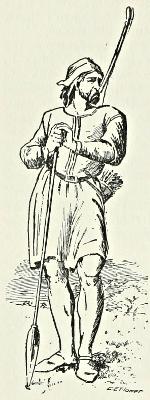
A Goth
Justinian weakened the Roman army in several
ways by his measures of reform. His anxiety to
reduce its expenditure induced him to diminish the
establishment of camels, horses, and chariots, which
attended the troops for transporting the military
machines and baggage. This train had been previously
very large, as it was calculated to save the
peasantry from any danger of having their labours
interrupted, or their cattle seized, under the pretext
of being required for transport. Numerous abuses
were introduced by diminishing the pay of the troops, and by neglecting to
pay them with regularity and to furnish them with proper food and clothing.
At the same time, the efficiency of the army in the field was more seriously
injured by continuing the policy adopted by Anastasius, of restricting the
power of the generals; a policy however which, it must be confessed, was
not unnecessary in order to avoid greater evils. This is evident from the
numerous rebellions in Justinian’s reign, and the absolute want of any
national or patriotic feeling in the majority of the Roman officers.
Large armies were at times composed of a number of corps, each commanded
by its own officer, over whom the nominal commander-in-chief had
little or no authority; and it is to this circumstance that the unfortunate
results of some of the Gothic and Persian campaigns are to be attributed,
and not to any inferiority of the Roman troops. Even Belisarius himself,
though he gave many proofs of attachment to Justinian’s throne, was watched
with the greatest jealousy. He was treated with constant distrust, and his
officers were at times encouraged to dispute his measures, and never punished
for disobeying his orders. The fact is that Belisarius might, if so
disposed, have assumed the purple, and perhaps dethroned his master. Narses
was the only general who was implicitly trusted and steadily supported; but
Narses was an aged eunuch, and could never have become emperor.
The imperial military forces consisted of 150,000 men;[11] and though the
extent of the frontier which these troops were compelled to guard was very
great, and lay open to the incursions of many active hostile tribes, still
Justinian was able to assemble some admirably appointed armies for his
foreign expeditions. The armament which accompanied Belisarius to Africa
consisted of ten thousand infantry, five thousand cavalry, and twenty thousand
sailors. Belisarius must have had about thirty thousand troops under
his command in Italy before the taking of Ravenna. Germanus, when he
arrived in Africa, found that only one-third of the Roman troops about Carthage
had remained faithful, and the rebels under Stozas amounted to eight
thousand men. As there were still troops in Numidia which had not joined
the deserters, the whole Roman force in Africa cannot have been less than
fifteen thousand. Narses, in the year 551, when the empire began to show
evident proofs of the bad effects of Justinian’s government, could assemble
thirty thousand chosen troops, an army which defeated the veterans of Totila
and destroyed the fierce bands of Franks and Alamanni which hoped to
wrest Italy from the Romans. The character of the Roman troops, in
spite of all that modern writers have said to depreciate them, still stood
so high that Totila, the warlike monarch of the Goths, strove to induce
them to join his standard by offers of high pay. No army had yet proved
itself equal to the Roman on the field of battle; and their exploits in
Spain, Africa, Colchis, and Mesopotamia, proved their excellence; though
the defeats which they sustained, both from the Persians and on the Danube,
reveal the fact that their enemies were improving in military science, and
watching every opportunity of availing themselves of any neglect of the
Roman government in maintaining the efficiency of the army.
Numerous examples could be cited of almost incredible disorder in the
armies, originating generally in the misconduct of the imperial government.
Belisarius attempted, but found it impossible, to enforce strict discipline,[12]
when the soldiers were unpaid and the officers authorised to act independently
of his orders. Two thousand Heruli ventured to quit his standard in
Italy, and, after marching round the Adriatic, were pardoned by Justinian
and again engaged in the imperial service. Procopius mentions repeatedly
that the conduct of the unpaid and unpunished troops ruined the provinces;
and in Africa, no less than three Roman officers, Stozas, Maximin, and Gontharis,
attempted to render themselves independent, and were supported by
large bodies of troops. The Greeks were the only portion of the population
who were considered as sincerely attached to the imperial government, or at
least who would readily defend it against every enemy; and accordingly
Gontharis, when he wished to secure Carthage, ordered all the Greeks to be
murdered without distinction. The Greeks were, however, from their position
and rank in society as burgesses or taxpayers, almost entirely excluded
from the army, and though they furnished the greater part of the sailors for
the fleet, they were generally an unwarlike population. Witiges, the Gothic
king, calls the Roman army of Belisarius an army of Greeks, a band of
pirates, actors, and mountebanks.
One of the most unfortunate measures of Justinian was the disbanding all
the provincial militia. This is incidentally mentioned in the Secret History
of Procopius, who informs us that Thermopylæ had been previously guarded
by two thousand of this militia; but that this corps was dissolved, and a
garrison of regular troops placed in Greece. As a general measure it was
probably dictated by a plan of financial reform, and not by any fear of popular
insurrection; but its effects were extremely injurious to the empire in the
declining state of society, and in the increasing disorganisation of the central
power; and though it may possibly have prevented some provinces from
recovering their independence by their own arms, it prepared the way for the
easy conquests of the Avars and Arabs. Justinian was desirous of centralising
all power, and rendering all public burdens uniform and systematic; and
had adopted the opinion that it was cheaper to defend the empire by walls
and fortresses than by a movable army. The practice of moving the troops
with great celerity to defend the frontiers had induced the officers to abandon
the ancient practice of fortifying a regular camp; and at last even the
art of encamping was neglected. The barbarians, however, could always
move with greater rapidity than the regular troops of the empire.
To secure the frontiers, Justinian adopted a plan of constructing extensive
lines supported by innumerable forts and castles, in which he placed garrisons,
in order that they might be ready to sally out on the invading bands.
These lines extended from the Adriatic to the Black Sea, and were further
strengthened by the long wall of Anastasius, which covered Constantinople
by walls protecting the Thracian Chersonesus and the peninsula of Pallene,
and by fortifications at Thermopylæ, and at the Isthmus of Corinth, which
were all carefully repaired. At all these posts permanent garrisons were
maintained. The eulogy of Procopius on the public edifices of Justinian
seems almost irreconcilable with the events of the latter years of his reign;
for Zabergan, king of the Huns, penetrated through breaches he found unrepaired
in the long wall, and advanced almost to the very suburbs of Constantinople.
Another instance of the declining state of military tactics may be mentioned,
as it must have originated in the army itself, and not in consequence
of any arrangements of the government. The combined manœuvres of the
divisions of the regiments had been so neglected that the bugle-calls once
used had fallen into desuetude, and were unknown to the soldiers. The
motley recruits, of dissimilar habits, could not acquire with the requisite
rapidity a perception of the delicacy of the ancient music, and the Roman
infantry no longer moved
“In perfect phalanx, to the Dorian mood,
Of flutes and soft recorders.”
It happened, during the siege of Auximum in Italy, that Belisarius was
placed in difficulty from the want of an instantaneous means of communicating
orders to the troops engaged in skirmishing with the Goths. On this
occasion it was suggested to him by Procopius, his secretary and the historian
of his wars, to replace the forgotten bugle-calls by making use of the brazen
trumpet of the cavalry to sound a charge, and of the infantry bugle to summon
a retreat.
Foreigners were preferred by the emperors as the occupants of the highest
military commands; and the confidence with which the barbarian chiefs were
honoured by the court enabled many to reach the highest rank in the army.
Narses, the most distinguished military leader after Belisarius, was a Pers-Armenian
captive. Peter, who commanded against the Persians in the campaign
of 528, was also a Pers-Armenian. Pharas, who besieged Gelimer in
Mount Pappua, was a Herulian. Mundus, who commanded in Illyria and
Dalmatia, was a Gepid prince. Chilbud, who, after several victories, perished
with his army in defending the frontiers against the Slavonians, was of
northern descent, as may be inferred from his name. Solomon, who governed
Africa with great courage and ability, was a eunuch from Dara. Artaban
was an Armenian prince. Johannes Troglita the patrician, the hero of the
poem of Corippus called the Johannid, is also supposed to have been an
Armenian. Yet the empire might still have furnished excellent officers, as
well as valiant troops; for the Isaurians and Thracians continued to distinguish
themselves in every field of battle, and were equal in courage to the
fiercest of the barbarians.
It became the fashion in the army to imitate the manners and habits of
the barbarians; their headlong personal courage became the most admired
quality, even in the highest rank; and nothing tended more to hasten the
decay of the military art. The officers in the Roman armies became more
intent on distinguishing themselves for personal exploits than for exact
order and strict discipline in their corps. Even Belisarius himself appears
at times to have forgotten the duties of a general in his eagerness to exhibit
his personal valour on his bay charger; though he may, on such occasions,
have considered that the necessity of keeping up the spirits of his army was
a sufficient apology for his rashness. Unquestionably the army, as a military
establishment, had declined in excellence ere Justinian ascended the
throne, and his reign tended to sink it much lower; yet it is probable that
it was never more remarkable for the enterprising valour of its officers or
for their personal skill in the use of their weapons. The death of numbers
of the highest rank, in battles and skirmishes in which they rashly engaged,
proves this fact. There was, however, one important feature of ancient
tactics still preserved in the Roman armies, which gave them a decided
superiority over their enemies. They had still the confidence in their discipline
and skill to form their ranks, and encounter their opponents in line;
the bravest of their enemies, whether on the banks of the Danube or the
Tigris, only ventured to charge them, or receive their attack, in close
masses.d
The empire of the Ostrogoths, though established on principles of a just
administration by the wisdom of the great Theodoric, soon began to suffer
as complete a national demoralisation as that of the Vandals, though the
Goths themselves, from being more civilised and living more directly under
the restraint of laws which protected the property of their Roman subjects,
had not become individually so corrupted by the possession of wealth.
The conquest of Italy[13] had not produced any very great revolution in the
state of the country. The Romans had long been accustomed to be defended
in name, but in fact to be ruled, by the commanders of the mercenary
troops in the emperor’s service. The Goths, even after the conquest,
allowed them to retain two-thirds of their landed estates, with all their
movable property; and as they had really been as completely excluded from
military service under their own emperors, their social condition underwent
but little change. Policy induced Theodoric to treat the inhabitants of
Italy with mildness. The permanent maintenance of his conquests required
a considerable revenue, and that revenue could only be supplied by the
industry and civilisation of his Italian subjects. His sagacity told him
that it was wiser to tax the Romans than to plunder them, and that it was
necessary, in order to secure the fruits of a regular system of taxation, to
leave them in the possession of those laws and privileges which enabled
them to defend their civilisation.
[535-537 A.D.]
The kingdom which the great Theodoric left to his grandson Athalaric,
under the guardianship of his daughter Amalasuntha, embraced not only
Italy, Sicily, and a portion of the south of France; it also included Dalmatia,
a part of Illyricum, Pannonia, Noricum, and Rætia. In these extensive
dominions, the Gothic race formed but a small part of the population; and
yet the Goths, from the privileges which they enjoyed, were everywhere
regarded with jealousy by the bulk of the inhabitants. Dissensions arose in
the royal family; Athalaric died young; Amalasuntha was murdered by
Theodatus, his successor; and as she had been in constant communication
with the court of Constantinople, this crime afforded Justinian a decent pretext
for interfering in the affairs of the Goths. To prepare the way for the
reconquest of Italy, Belisarius was sent to attack Sicily, which he invaded
with an army of 7500 men, in the year 535, and subjected without difficulty.
During the same campaign, Dalmatia was conquered by the imperial arms,
recovered by the Goths, but again reconquered by Justinian’s troops. A
rebellion of the troops in Africa arrested, for a while, the progress of Belisarius,
and compelled him to visit Carthage; but he returned to Sicily in a
short time, and crossing over to Rhegium marched directly to Neapolis.
As he proceeded, he was everywhere welcomed by the inhabitants, who were
then almost universally Greeks; even the Gothic commander in the south of
Italy favoured the progress of the Roman general.
The city of Neapolis made a vigorous defence; but after a siege of three
weeks it was taken by introducing into the place a body of troops through
the passage of an ancient aqueduct. The conduct of Belisarius, after the
capture of the city, was dictated by policy, and displayed very little humanity.
As the inhabitants had shown some disposition to assist the Gothic
garrison in defending the city, and as such conduct would have greatly
increased the difficulty of his campaign in Italy, in order to intimidate
the population of other cities he appears to have winked at the pillage of the
town, to have tolerated the massacre of many of the citizens in the churches,
where they had sought an asylum, and to have overlooked a sedition of the
lowest populace, in which the leaders of the Gothic party were assassinated.
From Neapolis, Belisarius marched forward to Rome.
Only sixty years had elapsed since Rome had been conquered by Odoacer;
and during this period its population, the ecclesiastical and civil authority
of its bishop who was the highest dignitary of the Christian world,
and the influence of its senate which still continued to be in the eyes of mankind
the most honourable political body in existence, enabled it to preserve
a species of independent civic constitution. Theodoric had availed himself
of this municipal government to smooth away many of the difficulties which
presented themselves in the administration of Italy. The Goths, however,
in leaving the Romans in possession of their own civil laws and institutions,
had not diminished their aversion to a foreign yoke; yet as they
possessed no distinct feelings of nationality apart from their connection
with the imperial domination and their religious orthodoxy, they never
aspired to independence, and were content to turn their eyes towards the
emperor of the East as their legitimate sovereign. Belisarius, therefore,
entered the Eternal City rather as a friend than as a conqueror; but he had
hardly entered it before he perceived that it would be necessary to take
every precaution to defend his conquest against the new Gothic king Witiges.
He immediately repaired the walls of Rome, strengthened them with a breastwork,
collected large stores of provisions, and prepared to sustain a siege.
The Gothic war forms an important epoch in the history of the city of
Rome; for within the space of sixteen years it changed masters five times,
and suffered three severe sieges. Its population was almost destroyed; its
public buildings and its walls must have undergone many changes, according
to the exigencies of the various measures required for its defence.
It has, consequently, been too generally assumed that the existing walls
indicate the exact position of the walls of Aurelian. This period is also
memorable for the ruin of many monuments of ancient art, which the generals
of Justinian destroyed without compunction.[14]
[537-540 A.D.]
Witiges laid siege to Rome with an army said by Procopiusd to have
amounted to 150,000 men; yet this army was insufficient to invest the whole
circuit of the city. The Gothic king distributed his troops in seven fortified
camps; six were formed to surround the city, and the seventh was placed
to protect the Milvian bridge. Five camps covered the space from the Prænestine
to the Flaminian gates, and the remaining camp was formed beyond
the Tiber, in the plain below the Vatican. By these arrangements the
Goths only commanded about half the circuit of Rome, and the roads to
Naples and to the ports at the mouth of the Tiber remained open. The
Roman infantry was now the weakest part of a Roman army. Even in the
defence of a fortified city it was subordinate to the cavalry, and the military
superiority of the Roman arms was sustained by mercenary horsemen. It is
strange to find the tactics of the Middle Ages described by Procopius in
classic Greek.
In spite of the prudent arrangements adopted by Belisarius to insure supplies
of provisions from his recent conquests in Sicily and Africa, Rome suffered
very severely from famine during the siege; but the Gothic army was
compelled to undergo equal hardships, and suffered far greater losses from
disease. The communications of the garrison with the coast were for a time
interrupted, but at last a body of five thousand fresh troops and an abundant
supply of provisions, despatched by Justinian to the assistance of Belisarius,
entered Rome. Shortly after the arrival of this reinforcement, the Goths
found themselves constrained to abandon the siege, in which they had persevered
for a year. Justinian again augmented his army in Italy, by sending
over seven thousand troops under the command of the eunuch Narses, a
man whose military talents were in no way inferior to those of Belisarius,
and whose name occupies an equally important place in the history of Italy.
The emperor, guided by the prudent jealousy which dictated the strictest
control over all the powerful generals of the empire, had conferred on Narses
an independent authority over his own division, and that general, presuming
too far on his knowledge of Justinian’s feelings, ventured to throw serious
obstacles in the way of Belisarius. The dissensions of the two generals
delayed the progress of the Roman arms. The Goths availed themselves of
the opportunity to continue the war with vigour; they succeeded in reconquering
Mediolanum, which had admitted a Roman garrison, and sacked the
city, which was second only to Rome in wealth and population. They massacred
the whole male population, and behaved with such cruelty that three
hundred thousand persons were said to have perished—a number which
probably only indicates the whole population of Mediolanum at this period.
Witiges, finding his resources inadequate to check the conquests of Belisarius,
solicited the aid of the Franks, and despatched an embassy to Chosroes
to excite the jealousy of the Persian monarch. The Franks, under
Theodebert, entered Italy, but they were soon compelled to retire; and Belisarius,
being placed at the head of the whole army by the recall of Narses,
soon terminated the war. Ravenna, the Gothic capital, was invested; but
the siege was more remarkable for the negotiations which were carried on
during its progress than for the military operations. The Goths, with the
consent of Witiges, made Belisarius the singular offer of acknowledging him
as the emperor of the West, on condition of his joining his forces to theirs,
permitting them to retain their position and property in Italy, and thus
ensuring them the possession of their nationality and their peculiar laws.
Perhaps neither the state of the mercenary army which he commanded
nor the condition of the Gothic nation rendered the project very feasible.
It is certain that Belisarius only listened to it, in order to hasten the surrender
of Ravenna and secure the person of Witiges without further bloodshed.
Italy submitted to Justinian, and the few Goths who still maintained
their independence beyond the Po pressed Belisarius in vain to declare himself
emperor. But even without these solicitations, his power had awakened
the fears of his sovereign, and he was recalled, though with honour, from his
command in Italy. He returned to Constantinople leading Witiges captive,
as he had formerly appeared conducting Gelimer.
Great as the talents of Belisarius really were, and sound as his judgment
appears to have been, still it must be confessed that his name occupies a
more prominent place in history than his merits are entitled to claim. The
accident that his conquest put an end to two powerful monarchies, of his
having led captive to Constantinople the representatives of the dreaded Genseric
and the great Theodoric, joined with the circumstance that he enjoyed
the singular good fortune of having his exploits recorded in the classic
language of Procopius, the last historian of the Greeks, have rendered a
brilliant career more brilliant from the medium through which it is seen.
At the same time the tale of his blindness and poverty has extended a sympathy
with his misfortunes into circles which would have remained indifferent
to the real events of his history, and made his name an expression for
heroic greatness reduced to abject misery by royal ingratitude.
But Belisarius, though he refused the Gothic throne and the empire of
the West, did not despise nor neglect wealth; he accumulated riches which
could not have been acquired by any commander-in-chief amidst the wars
and famines of the period, without rendering the military and civil administration
subservient to his pecuniary profit. On his return from Italy he
lived at Constantinople in almost regal splendour, and maintained a body of
seven thousand cavalry attached to his household.
In an empire where confiscation was an ordinary financial resource, and
under a sovereign whose situation rendered jealousy only common prudence,
it is not surprising that the wealth of Belisarius excited the imperial cupidity,
and induced Justinian to seize great part of it. His fortune was twice
reduced by confiscations. The behaviour of the general under his misfortunes,
and the lamentable picture of his depression which Procopius has
drawn, when he lost a portion of his wealth on his first disgrace, does not
tend to elevate his character. At a later period, his wealth was again confiscated
on an accusation of treason, and on this occasion it is said that he
was deprived of his sight, and reduced to such a state of destitution that he
begged his bread in a public square, soliciting charity with the exclamation,
“Give Belisarius an obolus!” But ancient historians were ignorant of this
fable, which has been rejected by every modern authority in Byzantine
history. Justinian, on calm reflection, disbelieved the treason imputed to a
man who, in his younger days, had refused to ascend a throne; or else he
pardoned what he supposed to be the error of a general to whose services he
was so deeply indebted; and Belisarius, reinstated in some part of his fortune,
died in possession of wealth and honour.
[540-544 A.D.]
Belisarius had hardly quitted Italy when the Goths reassembled their
forces. They were accustomed to rule, and nourished in the profession of
arms. Justinian sent a civilian, Alexander the logothete, to govern Italy,
hoping that his financial arrangements would render the new conquest
a source of revenue to the imperial treasury.[15]
The fiscal administration of the new governor
soon excited great discontent. He diminished
the number of the Roman troops, and put a stop
to those profits which a state of war usually
affords the military; while at the same time
he abolished the pensions and privileges which
formed no inconsiderable portion of the revenue
of the higher classes, and which had never
been entirely suppressed during the Gothic
domination. Alexander may have acted in
some cases with undue severity in enforcing
these measures; but it is evident, from their
nature, that he must have received express
orders to put an end to what Justinian considered
the lavish expenditure of Belisarius.
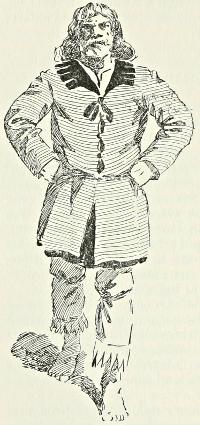
A Goth of Quality
(After Hottenroth)
A part of the Goths in the north of Italy
retained their independence after the surrender
of Witiges. They raised Hildebald to the
throne, which he occupied about a year when
he was murdered by one of his own guards.
The tribe of Rugii then raised Eraric their
leader to the throne; but on his entering into
negotiations with the Romans he was murdered,
after a reign of only five months. Totila was
then elected king of the Goths, and had he not
been opposed to the greatest men whom the
declining age of the Roman Empire produced,
he would probably have succeeded in restoring
the Gothic monarchy in Italy. His successes
endeared him to his countrymen, while the justice
of his administration contrasted with the rapacity of Justinian’s government,
and gained him the respect and submission of the native provincials.
He was on the point of commencing the siege of Rome, when Belisarius, who
after his departure from Ravenna had been employed in the Persian War,
was sent back to Italy to recover the ground already lost.
[544-547 A.D.]
The imperial forces were completely destitute of that unity and military
organisation which constitute a number of different corps into one army.
The various bodies of troops were commanded by officers completely independent
of one another, and obedient only to Belisarius as commander-in-chief.
Justinian, acting on his usual maxims of jealousy, and distrusting Belisarius
more than formerly, had retained the greater part of his body-guard and
all his veteran followers at Constantinople; so that he now appeared in
Italy unaccompanied by a staff of scientific officers and a body of veteran
troops on whose experience and discipline he could rely for implicit obedience
to his orders. The heterogeneous elements of which his army was composed
made all combined operations impracticable, and his position was rendered
still more disadvantageous by the change that had taken place in that of
his enemy. Totila was now able to command every sacrifice on the part
of his followers, for the Goths, taught by their misfortunes and deprived
of their wealth, felt the importance of union and discipline, and paid the
strictest attention to the orders of their sovereign. The Gothic king laid
siege to Rome, and Belisarius established himself in Porto, at the mouth of
the Tiber; but all his endeavours to relieve the besieged city proved unsuccessful,
and Totila compelled it to surrender under his eye and in spite of
all his exertions.
The national and religious feelings of the orthodox Romans rendered
them the irreconcilable enemies of the Arian Goths. Totila soon perceived
that it would not be in his power to defend Rome against a scientific enemy
and a hostile population, in consequence of the great extent of the fortifications,
and the impossibility of dislodging the imperial troops from the forts
at the mouth of the Tiber. But he also perceived that the Eastern emperors
would be unable to maintain a footing in central Italy without the support of
the Roman population, whose industrial, commercial, aristocratic, and ecclesiastical
influence was concentrated in the city population of Rome. He
therefore determined to destroy the Eternal City, and if policy authorise
kings on great occasions to trample on the precepts of humanity, the king of
the Goths might claim a right to destroy the race of the Romans. Even the
statesman may still doubt whether the decision of Totila, if it had been carried
into execution in the most merciless manner, would not have purified
the moral atmosphere of Italian society.
He commenced the destruction of the walls; but either the difficulty of
completing his project or the feelings of humanity which were inseparable
from his enlightened ambition induced him to listen to the representations
of Belisarius, who conjured him to abandon his barbarous scheme of devastation.
Totila, nevertheless, did everything in his power to depopulate Rome;
he compelled the inhabitants to retire into the Campania, and forced the senators
to abandon their native city. It is to this emigration that the utter extinction
of the old Roman race and civic government must be attributed; for
when Belisarius, and at a later period Totila himself, attempted to repeople
Rome, they laid the foundations of a new society, which connects itself rather
with the history of the Middle Ages than with that of preceding times.
Belisarius entered the city after the departure of the Goths; and as he
found it deserted, he had the greatest difficulty in putting it in a state
of defence. But though Belisarius was enabled, by his military skill, to
defend Rome against the attacks of Totila, he was unable to make any head
against the Gothic army in the open field; and after vainly endeavouring
to bring back victory to the Roman standards in Italy, he received permission
to resign the command and return to Constantinople. His want of
success must be attributed solely to the inadequacy of the means placed at
his disposal for encountering an active and able sovereign like Totila. The
unpopularity of his second administration in Italy arose from the neglect of
Justinian in paying the troops, and the necessity which that irregularity
imposed on their commander of levying heavy contributions on the Italians,
while it rendered the task of enforcing strict discipline, and of protecting
the property of the people from the ill-paid soldiery, quite impracticable.
Justice, however, requires that we should not omit to mention that Belisarius,
though he returned to Constantinople with diminished glory, did not
neglect his pecuniary interests, and came back without any diminution of
his wealth.
[547-553 A.D.]
As soon as Totila was freed from the restraint imposed on his movements
by the fear of Belisarius, he quickly recovered Rome; and the loss
of Italy appeared inevitable, when Justinian decided on making a new effort
to retain it. As it was necessary to send a large army against the Goths,
and invest the commander-in-chief with great powers, it is not probable that
Justinian would have trusted any other of his generals more than Belisarius
had he not fortunately possessed an able officer, the eunuch Narses, who
could never rebel with the hope of placing the imperial crown on his own
head. The assurance of his fidelity gave Narses great influence in the
interior of the palace, and secured him a support which would never have
been conceded to any other general. His military talents, and his freedom
from the reproach of avarice or peculation, augmented his personal influence,
and his diligence and liberality soon assembled a powerful army. The
choicest mercenary troops—Huns, Herulians, Armenians, and Lombards—marched
under his standard with the veteran Roman soldiers. The first
object of Narses after his arrival in Italy was to force the Goths to risk a
general engagement, trusting to the excellence of his troops and to his own
skill in the employment of their superior discipline.
The rival armies met at Tagina (Tadinum) near Nuceria (Nocera), and
the victory of Narses was complete.[16] Totila and six thousand Goths perished,
and Rome again fell under the dominion of Justinian. At the solicitation
of the Goths, an army of Franks and Germans was permitted by Theobald,
king of Austrasia, to enter Italy for the purpose of making a diversion in
their favour. Bucelin, the leader of this army, was met by Narses on the
banks of the Casilinus, near Capua. The forces of the Franks consisted of
thirty thousand men, those of the Romans did not exceed eighteen thousand;
but the victory of Narses was so complete that but few of the former escaped.
The remaining Goths elected another king, Theias, who perished with his
army near the banks of the Sarnus (Sarno). His death put an end to the
kingdom of the Ostrogoths, and allowed Narses to turn his whole attention
to the civil government of his conquests, and to establish security of property
and a strict administration of justice. He appears to have been a man
singularly well adapted to his situation, possessing the highest military
talents, combined with a perfect knowledge of the civil and financial administration;
and he was consequently able to estimate with exactness the sum
which he could levy on the province and remit to Constantinople, without
arresting the gradual improvement of the country. His fiscal government
was, nevertheless, regarded by the Italians as extremely severe, and he
was unpopular with the inhabitants of Rome.
[535-625 A.D.]
The existence of a numerous Roman population in Spain, connected with
the Eastern Empire by the memory of ancient ties, by active commercial
relations, and by a strong orthodox feeling against the Arian Visigoths,
enabled Justinian to avail himself of these advantages in the same manner
as he had done in Africa and Italy. The king Theudes had attempted to
make a diversion in Africa by besieging Ceuta, in order to call off the attention
of Justinian from Italy. His attack was unsuccessful, but the circumstances
were not favourable at the time for Justinian’s attempting to revenge
the injury. Dissensions in the country soon after enabled the emperor to
take part in a civil war, and he seized the pretext of sending a fleet and
troops to support the claims of a rebel chief, in order to secure the possession
of a large portion of the south of Spain. The rebel Athanagild, having
been elected king of the Visigoths, vainly endeavoured to drive the Romans
out of the provinces which they had occupied. Subsequent victories extended
the conquests of Justinian from the mouth of the Tagus, Ebora, and
Corduba, along the coast of the ocean and of the Mediterranean, almost as
far as Valentia; and at times the relations of the Romans with the Catholic
population of the interior enabled them to carry their arms almost into the
centre of Spain. The Eastern Empire retained possession of these distant
conquests for about sixty years.b
Our estimate of personal merit is relative to the common faculties of
mankind. The aspiring efforts of genius or virtue, either in active or
speculative life, are measured not so much by their real elevation as by the
height to which they ascend above the level of their age or country; and
the same stature, which in a people of giants would pass unnoticed, must
appear conspicuous in a race of pigmies. Leonidas and his three hundred
companions devoted their lives at Thermopylæ; but the education of the
infant, the boy, and the man had prepared, and almost insured, this memorable
sacrifice; and each Spartan would approve, rather than admire, an act
of duty of which himself and eight thousand of his fellow-citizens were
equally capable.
The great Pompey might inscribe on his trophies that he had defeated in
battle two millions of enemies, and reduced fifteen hundred cities from the
lake Mæotis to the Red Sea; but the fortune of Rome flew before his eagles;
the nations were oppressed by their own fears, and the invincible legions
which he commanded had been formed by the habits of conquest and the
discipline of ages. In this view, the character of Belisarius may be deservedly
placed above the heroes of the ancient republic. His imperfections
flowed from the contagion of the times; his virtues were his own, the
free gift of nature or reflection; he raised himself without a master or a
rival; and so inadequate were the arms committed to his hand that his sole
advantage was derived from the pride and presumption of his adversaries.
Under his command, the subjects of Justinian often deserved to be called
Romans; but the unwarlike appellation of Greeks was imposed as a term of
reproach by the haughty Goths, who affected to blush that they must dispute
the kingdom of Italy with a nation of tragedians, pantomimes, and pirates.
The climate of Asia has indeed been found less congenial than that of
Europe to military spirit; those populous countries were enervated by
luxury, despotism, and superstition, and the monks were more expensive
and more numerous than the soldiers of the East. The regular force of the
empire had once amounted to 645,000 men: it was reduced, in the time of
Justinian, to 150,000; and this number, large as it may seem, was thinly
scattered over the sea and land—in Spain and Italy, in Africa and Egypt,
on the banks of the Danube, the coast of Euxine, and the frontiers of Persia.
The citizen was exhausted, yet the soldier was unpaid; his poverty was
mischievously soothed by the privilege of rapine and indolence; and the
tardy payments were detained and intercepted by the fraud of those agents
who usurp, without courage or danger, the emoluments of war. Public
and private distress recruited the armies of the state; but in the field,
and still more in the presence of the enemy, their numbers were always
defective.
The want of national spirit was supplied by the precarious faith and disorderly
service of barbarian mercenaries. Even military honour, which has
often survived the loss of virtue and freedom, was almost totally extinct.
The generals, who were multiplied beyond the example of former times,
laboured only to prevent the success, or to sully the reputation, of their colleagues;
and they had been taught by experience that, if merit sometimes
provoked the jealousy, error or even guilt would obtain the indulgence of a
gracious emperor.
In such an age the triumphs of Belisarius, and afterwards of Narses, shine
with incomparable lustre; but they are encompassed with the darkest shades
of disgrace and calamity.[17]
[100-550 A.D.]
Even the Gothic victories of Belisarius were prejudicial to the state,
since they abolished the important barrier of the upper Danube, which had
been so faithfully guarded by Theodoric and his daughter. For the defence
of Italy, the Goths evacuated Pannonia and Noricum, which they left in a
peaceful and flourishing condition; the sovereignty was claimed by the
emperor of the Romans, the actual possession was abandoned to the boldness
of the first invader. On the opposite banks of the Danube, the plains
of upper Hungary and the Transylvanian hills were possessed, since the
death of Attila, by the tribes of the Gepidæ, who respected the Gothic arms
and despised not indeed the gold of the Romans but the secret motive of
their annual subsidies.
The vacant fortifications of the river were instantly occupied by these
barbarians; their standards were planted on the walls of Sirmium and Belgrade;
and the ironical tone of their apology aggravated this insult on the
majesty of the empire. “So extensive, O Cæsar, are your dominions, so
numerous are your cities, that you are continually seeking for nations to
whom, either in peace or war, you may relinquish these useless possessions.
The Gepidæ are your brave and faithful allies; and if they have anticipated
your gifts, they have shown a just confidence in your bounty.” Their presumption
was excused by the mode of revenge which Justinian embraced.
Instead of asserting the rights of a sovereign for the protection of his subjects,
the emperor invited a strange people to invade and possess the Roman
provinces between the Danube and the Alps; and the ambition of the
Gepidæ was checked by the rising power and fame of the Lombards.
This corrupt appellation has been diffused in the thirteenth century by
the merchants and bankers, the Italian posterity of these savage warriors:
but the original name of Langobards is expressive
only of the peculiar length and fashion of
their beards.[18] About the time of Augustus
and Trajan, a ray of historic light breaks on
the darkness of their antiquities, and they are
discovered, for the first time, between the Elbe
and the Oder. Fierce beyond the example of
the Germans, they delighted to propagate the
tremendous belief that their heads were formed
like the heads of dogs, and that they drank the
blood of their enemies whom they vanquished
in battle. The smallness of their numbers was
recruited by the adoption of their bravest
slaves; and alone, amidst their powerful neighbours,
they defended by arms their high-spirited
independence.
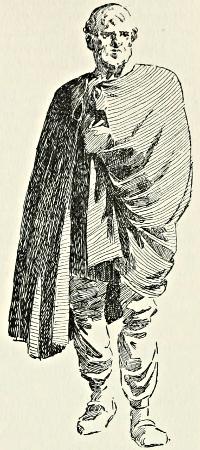
A Gothic Chief
In the tempest of the north, which overwhelmed
so many names and nations, this little
bark of the Lombards still floated on the surface.
They gradually descended towards the
south and the Danube, and at the end of four
hundred years[19] they again appear with their
ancient valour and renown. Their manners
were not less ferocious. The assassination of
a royal guest was executed in the presence and
by the command of the king’s daughter, who
had been provoked by some words of insult
and disappointed by his diminutive stature;[20]
and a tribute, the price of blood, was imposed
on the Lombards by his brother the king of
the Heruli. Adversity revived a sense of moderation and justice, and the
insolence of conquest was chastised by the signal defeat and irreparable dispersion
of the Heruli, who were seated in the southern provinces of Poland.[21]
The victories of the Lombards recommended them to the friendship of
the emperors; and at the solicitation of Justinian they passed the Danube
to reduce, according to their treaty, the cities of Noricum and the fortresses
of Pannonia. But the spirit of rapine soon tempted them beyond these
ample limits; they wandered along the coast of the Adriatic as far as
Dyrrhachium, and presumed, with familiar rudeness, to enter the towns and
houses of their Roman allies, and to seize the captives who had escaped
from their audacious hands. These acts of hostility, the sallies, as it might
be pretended, of some loose adventurers, were disowned by the nation and
excused by the emperor; but the arms of the Lombards were more seriously
engaged by a contest of thirty years, which was terminated only by the
extirpation of the Gepidæ.
[550-554 A.D.]
The hostile nations often pleaded their cause before the throne of Constantinople;
and the crafty Justinian, to whom the barbarians were almost
equally odious, pronounced a partial and ambiguous sentence, and dexterously
protracted the war by slow and ineffectual succours. Their strength
was formidable, since the Lombards, who sent into the field several myriads
of soldiers, still claimed, as the weaker side, the protection of the Romans.
Their spirit was intrepid, yet such is the uncertainty of courage that the two
armies were suddenly struck with a panic; they fled from each other, and
the rival kings remained with their guards in the midst of an empty plain.
A short truce was obtained, but their mutual resentment again kindled;
and the remembrance of their shame rendered the next encounter more
desperate and bloody. Forty thousand of the barbarians perished in the
decisive battle[22] which broke the power of the Gepidæ, transferred the fears
and wishes of Justinian, and first displayed the character of Alboin, the
youthful prince of the Lombards and the future conqueror of Italy.
[100-540 A.D.]
The wild people who dwelt or wandered in the plains of Russia, Lithuania,
and Poland might be reduced, in the age of Justinian, under the two
great families of the Bulgarians and the Slavonians. According to the
Greek writers, the former, who touched the Euxine and the lake of Mæotis,
derived from the Huns their name or descent; and it is needless to renew
the simple and well-known picture of Tatar manners. They were bold
and dexterous archers, who drank the milk and feasted on the flesh of their
indefatigable horses; whose flocks and herds followed, or rather guided,
the motions of their roving camps; to whose inroads no country was remote
or impervious, and who were practised in flight, though incapable of fear.
The nation was divided into two powerful and hostile tribes, who pursued
each other with fraternal hatred. They eagerly disputed the friendship
or rather the gifts of the emperor; and the distinction which nature had
fixed between the faithful dog and the rapacious wolf was applied by an ambassador
who received only verbal instructions from the mouth of his illiterate
prince. The Bulgarians, of whatsoever species, were equally attracted by
Roman wealth; they assumed a vague dominion over the Slavonian name,
and their rapid marches could only be stopped by the Baltic Sea, or the
extreme cold and poverty of the north. But the same race of Slavonians
appears to have maintained, in every age, the possession of the same countries.
Their numerous tribes, however distant or adverse, used one common
language (it was harsh and irregular), and were known by the resemblance
of their form, which deviated from the swarthy Tatar and approached without
attaining the lofty stature and fair complexion of the German.
Forty-six hundred villages were scattered over the provinces of Russia
and Poland, and their huts were hastily built of rough timber, in a country
deficient both in stone and iron. Erected, or rather concealed, in the depth
of forests, on the banks of rivers or the edge of morasses, we may, not perhaps
without flattery, compare them to the architecture of the beaver; which
they resembled in a double issue to the land and water for the escape of
the savage inhabitant—an animal less cleanly, less diligent, and less social
than that marvellous quadruped. The fertility of the soil, rather than the
labour of the natives, supplied the rustic plenty of the Slavonians. Their
sheep and horned cattle were large and numerous, and the fields which they
sowed with millet and panic, afforded, in the place of bread, a coarse and
less nutritive food. The incessant rapine of their neighbours compelled
them to bury this treasure in the earth; but on the appearance of a stranger
it was freely imparted, by a people whose unfavourable character is qualified
by the epithets of chaste, patient, and hospitable. As their supreme
god, they adored an invisible master of the thunder. The rivers and the
nymphs obtained their subordinate honours, and the popular worship was
expressed in vows and sacrifice.
The Slavonians disdained to obey a despot, a prince, or even a magistrate;
but their experience was too narrow, their passions too headstrong,
to compose a system of equal law or general defence. Some voluntary
respect was yielded to age and valour; but each tribe or village existed as a
separate republic, and all must be persuaded where none could be compelled.
They fought on foot, almost naked, and, except an unwieldy shield, without
any defensive armour; their weapons of offence were a bow, a quiver of
small poisoned arrows, and a long rope, which they dexterously threw from
a distance, and entangled their enemy in a running noose. In the field the
Slavonian infantry were dangerous by their speed, agility, and hardiness:
they swam, they dived, they remained under water, drawing their breath
through a hollow cane; and a river or lake was often the scene of their
unsuspected ambuscade. But these were the achievements of spies and
stragglers; the military art was unknown to the Slavonians; their name
was obscure, and their conquests were inglorious.
[540-565 A.D.]
The level country of Moldavia and Wallachia was occupied by the Antes
(or Antai), a Slavonian tribe, which swelled the titles of Justinian with an
epithet of conquest. Against the Antes he erected the fortifications of the
lower Danube; and laboured to secure the alliance of a people seated in
the direct channel of northern inundation, an interval of two hundred miles
between the mountains of Transylvania and the Euxine Sea. But the Antes
wanted power and inclination to stem the fury of the torrent; and the light-armed
Slavonians, from a hundred tribes, pursued with almost equal speed
the footsteps of the Bulgarian horse.[23] The payment of one piece of gold for
each soldier procured a safe and easy retreat through the country of the
Gepidæ, who commanded the passage of the upper Danube.
The hopes or fears of the barbarians, their intestine union or discord, the
accident of a frozen or shallow stream, the prospect of harvest or vintage,
the prosperity or distress of the Romans—were the causes which produced the
uniform repetition of annual visits, tedious in the narrative and destructive
in the event. The same year, and possibly the same month, in which Ravenna
surrendered was marked by an invasion of the Huns or Bulgarians,[24] so dreadful
that it almost effaced the memory of their past inroads. They spread
from the suburbs of Constantinople to the Ionian Gulf, destroyed thirty-two
cities or castles, erased Potidæa which Athens had built and Philip had
besieged, and repassed the Danube, dragging at their horses’ heels
120,000 of the subjects of Justinian. In a subsequent inroad they pierced
the wall of the Thracian Chersonesus, extirpated the habitations and the
inhabitants, boldly traversed the Hellespont, and returned to their companions,
laden with the spoils of Asia. Another party, which seemed a
multitude in the eyes of the Romans, penetrated without opposition from
the straits of Thermopylæ to the Isthmus of Corinth;
and the last ruin of Greece has appeared an
object too minute for the attention of history.
The works which the emperor raised for the protection
but at the expense of his subjects served
only to disclose the weakness of some neglected
part; and the walls, which by flattery had been
deemed impregnable, were either deserted by the
garrison or scaled by the barbarians. Three thousand
Slavonians, who insolently divided themselves
into two bands, discovered the weakness and misery
of a triumphant reign. They passed the Danube
and the Hebrus, vanquished the Roman generals
who dared to oppose their progress, and plundered
with impunity the cities of Illyricum and Thrace,
each of which had arms and numbers to overwhelm
their contemptible assailants.
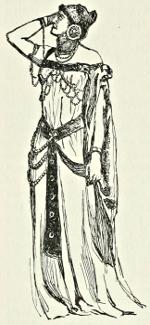
A Byzantine Costume
Whatever praise the boldness of the Slavonians
may deserve, it is sullied by the wanton and deliberate
cruelty which they are accused of exercising
on their prisoners. Without distinction of rank, or
age, or sex, the captives were impaled or flayed alive,
or suspended between four posts and beaten with
clubs till they expired, or enclosed in some spacious
building and left to perish in the flames with the
spoil and cattle which might impede the march of
these savage victors. Perhaps a more impartial narrative
would reduce the number, and qualify the
nature, of these horrid acts; and they might sometimes be excused by the
cruel laws of retaliation. In the siege of Topirus, whose obstinate defence
had enraged the Slavonians, they massacred fifteen thousand males;[25] but
they spared the women and children. The most valuable captives were
always reserved for labour or ransom; the servitude was not rigorous, and
the terms of their deliverance were speedy and moderate. But the subject
or the historian of Justinian exhaled his just indignation in the language of
complaint and reproach; and Procopius has confidently affirmed that, in a
reign of thirty-two years, each annual inroad of the barbarians consumed two
hundred thousand of the inhabitants of the Roman Empire. The entire
population of Turkish Europe, which nearly corresponds with the provinces
of Justinian, would perhaps be incapable of supplying six millions of persons,
the result of this incredible estimate.
In the midst of these obscure calamities, Europe felt the shock of a revolution,
which first revealed to the world the name and nation of the Turks.c
[545-557 A.D.]
Since that period the Turks have always continued to occupy a memorable
place in the history of mankind, as the destroyers of ancient civilisation.
In their progress towards the West, they were preceded by the Avars, a
people whose arrival in Europe produced the greatest alarm, whose dominion
was soon widely extended, but whose complete extermination, or amalgamation
with their subjects, leaves the history of their race a problem never likely
to receive a very satisfactory solution. The Avars are supposed to have
been a portion of the inhabitants of a powerful Asiatic empire which figures
in the annals of China as ruling a great part of the centre of Asia, and extending
to the Gulf of Corea. The great empire of the Avars was overthrown
by a rebellion of their Turkish subjects, and the noblest caste soon
became lost to history amidst the revolutions of the Chinese Empire.
The original seats of the Turks were in the country round the great chain
of Mount Altai. As subjects of the Avars, they had been distinguished by
their skill in working and tempering iron; their industry had procured them
wealth, and wealth had inspired them with the desire for independence.
After throwing off the yoke of the Avars, they waged war with that people,
and compelled the military strength of the nation to fly before them in two
separate bodies. One of these divisions fell back on China; the other advanced
into western Asia, and at last entered Europe. The Turks engaged
in a career of conquest, and in a few years their dominions extended from
the Volga and the Caspian Sea to the shores of the ocean, or the Sea of
Japan, and from the banks of the Oxus (Gihon) to the deserts of Siberia.
The western army of the Avars, increased by many tribes who feared the
Turkish government, advanced into Europe as a nation of conquerors, and
not as a band of fugitives. The mass of this army is supposed to have been
composed of people of the Turkish race, because those who afterwards bore
the Avar name in Europe seem to have belonged to that family. It must
not, however, be forgotten, that the mighty army of Avar emigrants might
easily, in a few generations, lose all national peculiarities, and forget its
native language, amidst the greater number of its Hunnish subjects, even if
we should suppose the two races to have been originally derived from different
stocks. The Avars, however, are sometimes styled Turks, even by
the earliest historians. The use of the appellation Turk, in an extended
sense, including the Mongol race, is found in Theophylactus Simocatta,m a
writer possessing considerable knowledge of the affairs of eastern Asia, and
who speaks of the inhabitants of the flourishing kingdom of Taugus as Turks.
This application of the term appears to have arisen from the circumstance,
that the part of China to which he alluded was subject at the time to a
foreign, or, in his phrase, a Turkish dynasty.
The Avars soon conquered all the countries as far as the banks of the
Danube, and before Justinian’s death they were firmly established on the
borders of Pannonia.b
They had followed the well-known road of the Volga, cherished the error
of the nations who confounded them with the original Avars, and spread the
terror of that false though famous appellation, which had not, however, saved
its lawful proprietors from the yoke of the Turks. After a long and victorious
march, the new Avars arrived at the foot of Mount Caucasus, in the country
of the Alans and Circassians, where they first heard of the splendour and
weakness of the Roman Empire. They humbly requested their confederate,
the prince of the Alans, to lead them to this source of riches; and their
ambassador, with the permission of the governor of Lazica, was transported
by the Euxine Sea to Constantinople. The whole city was poured forth to
behold with curiosity and terror the aspect of a strange people; their long
hair, which hung in tresses down their backs, was gracefully bound with
ribbons, but the rest of their habit appeared to imitate the fashion of the
Huns. When they were admitted to the audience of Justinian, Candish, the
first of the ambassadors, addressed the Roman emperor in these terms: “You
see before you, O mighty prince, the representatives of the strongest and
most populous of nations, the invincible, the irresistible Avars. We are willing
to devote ourselves to your service, we are able to vanquish and destroy
all the enemies who now disturb your repose. But we expect, as the price of
our alliance, as the reward of our valour, precious gifts, annual subsidies,
and fruitful possessions.”
[557-565 A.D.]
At the time of this embassy Justinian had reigned above thirty, he had
lived above seventy-five years; his mind, as well as his body, was feeble
and languid; and the conqueror of Africa and Italy, careless of the permanent
interest of his people, aspired only to end his days in the bosom
even of inglorious peace. In a studied oration, he imparted to the senate his
resolution to dissemble the insult and to purchase the friendship of the Avars;
and the whole senate, like the mandarins of China, applauded the incomparable
wisdom and foresight of their sovereign. The instruments of luxury
were immediately prepared to captivate the barbarians; silken garments,
soft and splendid beds, and chains and collars encrusted with gold. The
ambassadors, content with such liberal reception, departed from Constantinople,
and Valentin, one of the emperor’s guards, was sent with a similar
character to their camp at the foot of Mount Caucasus. As their destruction
or their success must be alike advantageous to the empire, he persuaded
them to invade the enemies of Rome; and they were easily tempted, by
gifts and promises, to gratify their ruling inclinations. These fugitives, who
fled before the Turkish arms, passed the Tanais and Borysthenes, and boldly
advanced into the heart of Poland and Germany, violating the law of nations
and abusing the rights of victory.
Before ten years had elapsed, their camps were seated on the Danube and
the Elbe, many Bulgarian and Slavonian names were obliterated from the
earth, and the remainder of their tribes are found, as tributaries and vassals,
under the standard of the Avars. The chagan, the peculiar title of their
king, still affected to cultivate the friendship of the emperor; and Justinian
entertained some thoughts of fixing them in Pannonia, to balance the prevailing
power of the Lombards. But the virtue or treachery of an Avar
betrayed the secret enmity and ambitious designs of their countrymen;
and they loudly complained of the timid, though jealous, policy of detaining
their ambassadors, and denying the arms which they had been allowed to
purchase in the capital of the empire.
Perhaps the apparent change in the dispositions of the emperors may be
ascribed to the embassy which was received from the conquerors of the
Avars. The immense distance, which eluded their arms, could not extinguish
their resentment; the Turkish ambassadors pursued the footsteps of
the vanquished to the Jaik, the Volga, Mount Caucasus, the Euxine, and
Constantinople, and at length appeared before the successor of Constantine,
to request that he would not espouse the cause of rebels and fugitives.
The emperor renounced, or seemed to renounce, the fugitive Avars, but he
accepted the alliance of the Turks; and the ratification of the treaty was
carried by a Roman minister to the foot of Mount Altai. Under the successors
of Justinian, the friendship of the two nations was cultivated by
frequent and cordial intercourse.c
[400-527 A.D.]
The Asiatic frontier of the Roman Empire was less favourable for attack
than defence. The range of the Caucasus was occupied, as it still is, by a
cluster of small nations of various languages, strongly attached to their
independence, which the nature of their country enabled them to maintain
amidst the wars and conflicting negotiations of the Romans, Persians, and
Huns, by whom they were surrounded. The kingdom of Colchis (Mingrelia)
was in permanent alliance with the Romans, and the sovereign received
a regular investiture from the emperor. The Tzans, who inhabited the
mountains about the sources of the Phasis, enjoyed a subsidiary alliance
with Justinian until their plundering expeditions within the precincts of the
empire induced him to garrison their country. Iberia, to the east of
Colchis, the modern Georgia, formed an independent kingdom under the
protection of Persia.
Armenia, as an independent kingdom, had long formed a slight counterpoise
between the Roman and Persian empires. In the reign of Theodosius
II it had been partitioned by its powerful neighbours; and about the year
429, it had lost the shadow of independence which it had been allowed to
retain. The greater part of Armenia had fallen to the share of the Persians;
but as the people were Christians, and possessed their own church and literature,
they had maintained their nationality uninjured after the loss of their
political government. The western or Roman part of Armenia was bounded
by the mountains in which the Araxes, the Boas, and the Euphrates take
their rise; and it was defended against Persia by the fortress of Theodosiopolis
(Erzerum), situated on the very frontier of Pers-Armenia. From
Theodosiopolis the empire was bounded by ranges of mountains which cross
the Euphrates and extend to the river Nymphæus, and here the city of
Martyropolis, the capital of Roman Armenia, east of the Euphrates, was
situated. From the junction of the Nymphæus with the Tigris the frontier
again followed the mountains to Dara, and from thence it proceeded to the
Chaboras and the fortress of Circesium.
The Arabs or Saracens, who inhabited the district between Circesium and
Idumæa, were divided into two kingdoms: that of Ghassan, towards Syria,
maintained an alliance with the Romans; and that of Hira, to the east, enjoyed
the protection of Persia. Palmyra, which had fallen into ruins after
the time of Theodosius II, was repaired and garrisoned; and the country
between the gulfs of Ailath and Suez, forming a province called the Third
Palestine, was protected by a fortress constructed at the foot of Mount Sinai,
and occupied by a strong body of troops.
Such a frontier, though it presented great difficulties in the way of invading
Persia, afforded admirable means for protecting the empire; and accordingly
it had very rarely indeed happened that a Persian army had ever
penetrated into a Roman province. It was reserved for Justinian’s reign to
behold the Persians break through the defensive line, and contribute to the
ruin of the wealth and the destruction of the civilisation of some of the most
flourishing and enlightened portions of the Eastern Empire. The wars which
Justinian carried on with Persia reflect little glory on his reign; but the
celebrated name of his rival, the great Chosroes Nushirvan, has rendered his
misfortunes and misconduct venial in the eyes of historians.
The Persian and Roman empires were at this time nearly equal in power
and civilisation; both were ruled by princes whose reigns form national
epochs, yet history affords ample evidence that the brilliant exploits of both
these sovereigns were effected by a wasteful expenditure of the national resources
and by a consumption of the lives and capital of their subjects which
proved irreparable. Neither empire was ever able to regain its former state
of prosperity, nor could society recover the shock which it had received.
The governments were too demoralised to venture on political reforms, and
the people too ignorant and too feeble to attempt a national revolution.
The governments of declining countries often give but slight signs of
their weaknesses and approaching dissolution as long as the ordinary relations
of war and peace require to be maintained only with habitual friends
or enemies, though the slightest exertion, created by extraordinary circumstances,
may cause the political fabric to fall to pieces. The armies of the
Eastern Empire and of Persia had, by long acquaintance with the military
force of one another, found the means of balancing any peculiar advantage
of their enemy by a modification of tactics, or by an improvement in military
discipline, which neutralised its effect. War between the two states
was consequently carried on according to a regular routine of service, and was
continued during a succession of campaigns in which much blood and treasure
were expended, and much glory gained, with very little change in the relative
military power, and none in the frontiers, of the two empires.
[527-532 A.D.]
The avarice of Justinian, or his inconstant plans, often induced him to
leave the eastern frontier of the empire very inadequately garrisoned; and
this frontier presented an extent of country against which a Persian army,
concentrated behind the Tigris, could choose its point of attack. The option
of carrying the war into Syria, Mesopotamia, Armenia, or Colchis generally
lay with the Persians; and Chosroes attempted to penetrate into the empire
by every portion of this frontier during his long wars. The Roman army,
in spite of the change which had taken place in its arms and organisation,
still retained its superiority.b
The first war with the Persians had followed close upon Justinian’s
accession. He had sent Belisarius to build a fortress near Nisibis in 528;
the Persians under Prince Xerxes invaded Mesopotamia and defeated the
Romans with heavy loss. The next year was devoted to raids by both sides,
but in 530 Belisarius, then only twenty-five, won a victory at Daras. “This
being,” says Procopius,d “the first defeat suffered by the Persians for a long
time.” The next year, however, at Callinicum, Belisarius was badly defeated,
and while Procopius, his secretary, says he fought bravely, Johannes
Malalasn accuses him of cowardice. At any rate he was recalled, and his
successor Mundus won some glory. Then the old King Kobad died and
his famous son Chosroes I came to the Persian throne.a
[532-562 A.D.]
And now the war in which Justinian had found the empire engaged on
his succession was terminated by a peace called “the Everlasting Peace,”
which the Romans purchased by the payment of eleven thousand pounds of
gold to Chosroes. The Persian monarch required peace to regulate the
affairs of his own kingdom; and the calculation of Justinian that the sum
which he paid to Persia was much less than the expense of continuing the
war, though correct, was injudicious, as it really conveyed an admission of
inferiority and weakness. Justinian’s object had been to place the great
body of his military forces at liberty,
in order to direct his exclusive attention
to recovering the lost provinces of
the Western Empire. Had he availed
himself of peace with Persia to diminish
the burdens on his subjects, and
consolidate the defence of the empire
instead of extending its frontiers, he
might perhaps have re-established the
Roman power. As soon as Chosroes
heard of the conquests of Justinian in
Africa, Sicily, and Italy, his jealousy
induced him to renew the war. The
solicitations of an embassy sent by Witiges
are said to have had some effect in
determining him to take up arms.
In 540 Chosroes invaded Syria with
a powerful army, and laid siege to Antioch,
the second city of the empire in
population and wealth. He offered to
raise the siege on receiving payment of
one thousand pounds’ weight of gold,
but this small sum was refused. Antioch
was taken by storm, its buildings
were committed to the flames, and its
inhabitants were carried away captive
and settled as colonists in Persia. Hierapolis,
Berœa (Aleppo), Apamea, and
Chalcis escaped this fate by paying the
ransom demanded from each. To save Syria from utter destruction, Belisarius
was sent to take the command of an army assembled for its defence,
but he was ill supported, and his success was by no means brilliant. The
fact that he saved Syria from utter devastation, nevertheless, rendered his
campaign of 543 by no means unimportant for the empire.b
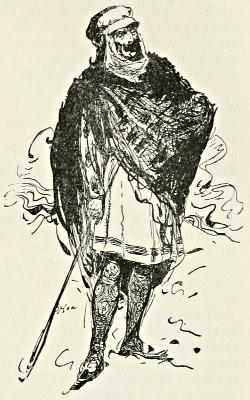
A Persian Noble
(Based on Bardon)
In 545 a truce for five years was signed, Justinian paying two thousand
pounds of gold. In 549 the Romans yielded to the appeal of the Lazi and
sent troops to aid them to shake off the Persian yoke. After various sieges,
a new truce was concluded in 551, the Romans paying twenty-six hundred
pounds of gold. Hostilities went on, none the less, with a result, as Burye
notes, that the Persians failed of their design to gain access to the Euxine,
and “that on the waters of the sea the Romans were to remain without
rivals.” The Romans had, however, to pay, as usual, the price.a The war
had been carried on for twenty years, but during the latter period of its
duration military operations had been confined to Colchis. It was terminated
in 562 by a truce for fifty years, which effected little change in the
frontiers of the empire. The most remarkable clause of this treaty of peace
imposed on Justinian the disgraceful obligation of paying Chosroes an annual
subsidy of thirty thousand pieces of gold [£18,750 or $93,750]; and he
was compelled immediately to advance the sum of 210,000 pounds, for seven
years. The sum, it is true, was not very great, but the condition of the
Roman Empire was sadly changed, when it became necessary to purchase
peace from all its neighbours with gold, and with gold to find mercenary
troops to carry on its wars. The moment, therefore, a supply of gold failed
in the imperial treasury, the safety of the Roman power was compromised.
The weakness of the Roman Empire, and the necessity of finding allies in
the East, in order to secure a share of the lucrative commerce of which Persia
had long possessed a monopoly, induced Justinian to keep up friendly
communications with the king of Ethiopia (Abyssinia). Elesboas, who then
occupied the Ethiopian throne, was a prince of great power, and a steady
ally of the Romans. The wars of this Christian monarch in Arabia are
related by the historians of the empire; and Justinian endeavoured, by this
means, to transfer the silk trade with India from Persia to the route by
the Red Sea.
The attempt failed from the great length of the sea voyage, and the difficulties
of adjusting the intermediate commerce of the countries on this line
of communication; but still the trade of the Red Sea was so great that the
king of Ethiopia, in the reign of Justin, was able to collect a fleet of seven
hundred native vessels, and six hundred Roman and Persian merchantmen,
which he employed to transport his troops into Arabia.b
[535-545 A.D.]
The review of the nations from the Danube to the Nile has exposed on
every side the weakness of the Romans; and our wonder is reasonably
excited that they should presume to enlarge an empire, whose ancient limits
they were incapable of defending. But the wars, the conquests, and the
triumphs of Justinian are the feeble and pernicious efforts of old age, which
exhaust the remains of strength and accelerate the decay of the powers of
life. He exulted in the glorious act of restoring Africa and Italy to the
republic; but the calamities which followed the departure of Belisarius
betrayed the impotence of the conqueror and accomplished the ruin of those
unfortunate countries.
From his new acquisitions, Justinian expected that his avarice, as well
as pride, should be richly gratified. A rapacious minister of the finances
closely pursued the footsteps of Belisarius; and as the old registers of
tribute had been burned by the Vandals, he indulged his fancy in a liberal
calculation and arbitrary assessment of the wealth of Africa. The increase
of taxes, which were drawn away by a distant sovereign, and a general resumption
of the patrimony or crown lands soon dispelled the intoxication of
the public joy; but the emperor was insensible to the modest complaints
of the people, till he was awakened and alarmed by the clamours of military
discontent. Many of the Roman soldiers had married the widows and
daughters of the Vandals. As their own, by the double right of conquest
and inheritance, they claimed the estates which Genseric had assigned to
his victorious troops. They heard with disdain the cold and selfish representations
of their officers that the liberality of Justinian had raised them
from a savage or servile condition; that they were already enriched by the
spoils of Africa, the treasure, the slaves, and the movables of the vanquished
barbarians; and that the ancient and lawful patrimony of the emperors would
be applied only to the support of that government on which their own safety
and reward must ultimately depend.
The mutiny was secretly inflamed by a thousand soldiers, for the most
part Heruli, who had imbibed the doctrines and were instigated by the
clergy of the Arian sect; and the cause of perjury and rebellion was sanctified
by the dispensing powers of fanaticism. The Arians deplored the ruin
of their church, triumphant above a century in Africa; and they were justly
provoked by the laws of the conqueror, which interdicted the baptism of
their children and the exercise of all religious worship. Of the Vandals
chosen by Belisarius, the far greater part, in the honours of the eastern
service, forgot their country and religion. But a generous band of four
hundred obliged the mariners, when they were in sight of the isle of Lesbos,
to alter their course; they touched on Peloponnesus, ran ashore on a desert
coast of Africa, and boldly erected on Mount Aurasius the standard of
independence and revolt.
While the troops of the province disclaimed the commands of their
superiors, a conspiracy was formed at Carthage against the life of Solomon,
who filled with honour the place of Belisarius; and the Arians had piously
resolved to sacrifice the tyrant at the foot of the altar, during the awful
mysteries of the festival of Easter. Fear or remorse restrained the daggers
of the assassins, but the patience of Solomon emboldened their discontent;
and at the end of ten days a furious sedition was kindled in the circus,
which desolated Africa above ten years. The pillage of the city and the
indiscriminate slaughter of its inhabitants were suspended only by darkness,
sleep, and intoxication; the governor, with seven companions, among whom
was the historian Procopius, escaped to Sicily. Two-thirds of the army were
involved in the guilt of treason; and eight thousand insurgents, assembling
in the fields of Bulla, elected Stozas for their chief, a private soldier who
possessed, in a superior degree, the virtues of a rebel. Under the mask of
freedom, his eloquence could lead, or at least impel, the passions of his
equals. He raised himself to a level with Belisarius and the nephew of the
emperor, by daring to encounter them in the field; and the victorious
generals were compelled to acknowledge that Stozas deserved a purer cause
and a more legitimate command. Vanquished in battle, he dexterously employed
the arts of negotiation; a Roman army was seduced from their allegiance,
and the chiefs, who had trusted to his faithless promise, were murdered
by his order in a church of Numidia.
When every resource, either of force or perfidy, was exhausted, Stozas
with some desperate Vandals retired to the wilds of Mauretania, obtained
the daughter of a barbarian prince, and eluded the pursuit of his enemies
by the report of his death. The personal weight of Belisarius, the rank, the
spirit, and the temper of Germanus, the emperor’s nephew, and the vigour
and success of the second administration of the eunuch Solomon, restored the
modesty of the camp, and maintained, for a while, the tranquillity of Africa.
But the vices of the Byzantine court were felt in that distant province; the
troops complained that they were neither paid nor relieved; and as soon as
the public disorders were sufficiently mature, Stozas was again alive, in arms,
and at the gates of Carthage. He fell in a single combat, but he smiled
in the agonies of death, when he was informed that his own javelin had
reached the heart of his antagonist.
[545-558 A.D.]
The example of Stozas, and the assurance that a fortunate soldier had
been the first king, encouraged the ambition of Gontharis, and he promised
by a private treaty to divide Africa with the Moors, if, with their dangerous
aid, he should ascend the throne of Carthage. The feeble Areobindus, unskilled
in the affairs of peace and war, was raised by his marriage with the
niece of Justinian to the office of exarch. He was suddenly oppressed by a
sedition of the guards; and his abject supplications, which provoked the contempt,
could not move the pity, of the inexorable tyrant. After a reign of
thirty days, Gontharis himself was stabbed at a banquet, by the hand of
Artaban; and it is singular enough that an Armenian prince, of the royal
family of Arsaces, should re-establish at Carthage the authority of the Roman
Empire. In the conspiracy which unsheathed the dagger of Brutus against
the life of Cæsar, every circumstance is curious and important to the eyes of
posterity; but the guilt or merit of these loyal or rebellious assassins could
interest only the contemporaries of Procopius, who, by their hopes and fears,
their friendship or resentment, were
personally engaged in the revolutions
of Africa.
That country was rapidly sinking
into the state of barbarism, from
whence it had been raised by the
Phœnician colonies and Roman laws;
and every step of intestine discord
was marked by some deplorable victory
of savage man over civilised
society. The Moors, though ignorant
of justice, were impatient of
oppression; their vagrant life and
boundless wilderness disappointed
the arms and eluded the chains of
a conqueror, and experience had
shown that neither oaths nor obligations
could secure the fidelity of their
attachment. The victory of Mount
Aurasius had awed them into momentary
submission; but if they respected the character of Solomon, they
hated and despised the pride and luxury of his two nephews, Cyrus and
Sergius, on whom their uncle had imprudently bestowed the provincial
governments of Tripolis and Pentapolis.
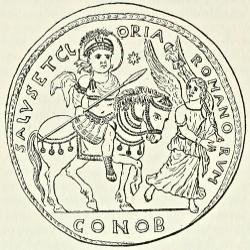
Gold Medallion of Justinian
[558-559 A.D.]
A Moorish tribe encamped under the walls of Leptis, to renew their alliance,
and receive from the governor the customary gifts. Fourscore of their
deputies were introduced as friends into the city; but, on the dark suspicion
of a conspiracy, they were massacred at the table of Sergius; and the clamour
of arms and revenge was re-echoed through the valleys of Mount Atlas,
from both the Syrtes to the Atlantic Ocean. A personal injury, the unjust
execution or murder of his brother, rendered Antalas the enemy of the Romans.
The defeat of the Vandals had formerly signalised his valour; the
rudiments of justice and prudence were still more conspicuous in a Moor;
and while he laid Hadrumetum in ashes, he calmly admonished the emperor
that the peace of Africa might be secured by the recall of Solomon and his
unworthy nephews. The exarch led forth his troops from Carthage; but at
the distance of six days’ journey, in the neighbourhood of Tebeste,[26] he was
astonished by the superior numbers and fierce aspect of the barbarians. He
proposed a treaty, solicited a reconciliation, and offered to bind himself by
the most solemn oaths. “By what oaths can he bind himself?” interrupted
the indignant Moors. “Will he swear by the Gospels, the divine books of the
Christians? It was on those books that the faith of his nephew Sergius was
pledged to eighty of our innocent and unfortunate brethren. Before we
trust them a second time, let us try their efficacy in the chastisement of perjury,
and the vindication of their own honour.” Their honour was vindicated
in the field of Tebeste, by the death of Solomon and the total loss of his
army.
The arrival of fresh troops and more skilful commanders[27] soon checked
the insolence of the Moors; seventeen of their princes were slain in the same
battle; and the doubtful and transient submission of their tribes was celebrated
with lavish applause by the people of Constantinople. Successive
inroads had reduced the province of Africa to one-third of the measure of
Italy; yet the Roman emperors continued to reign above a century over
Carthage and the fruitful coast of the Mediterranean. But the victories and
the losses of Justinian were alike pernicious to mankind; and such was the
desolation of Africa that in many parts a stranger might wander whole days
without meeting the face either of a friend or an enemy.
The nation of the Vandals had disappeared; they once amounted to
160,000 warriors, without including the children, the women, or the slaves.
Their numbers were infinitely surpassed by the number of the Moorish families
extirpated in a relentless war; and the same destruction was retaliated
on the Romans and their allies, who perished by the climate, their mutual
quarrels, and the rage of the barbarians. When Procopius first landed, he
admired the populousness of the cities and country, strenuously exercised in
the labours of commerce and agriculture. In less than twenty years, that
busy scene was converted into a silent solitude; the wealthy citizens escaped
to Sicily and Constantinople; and the secret historian has confidently
affirmed that five millions of Africans were consumed by the wars and government
of the emperor Justinian.
[559-563 A.D.]
The repose of the aged Belisarius was crowned by a last victory which
saved the emperor and the capital. The barbarians who annually visited the
provinces of Europe were less discouraged by some accidental defeat than
they were excited by the double hope of spoil and of subsidy.
In the thirty-second winter of Justinian’s reign, the Danube was deeply
frozen; Zabergan led the cavalry of the Cotrigur (or Cotugur) Huns, and
his standard was followed by a promiscuous multitude. The savage chief
passed, without opposition, the river and the mountains, spread his troops
over Macedonia and Thrace, and advanced with no more than seven thousand
horse to the long walls which should have defended the territory of
Constantinople. But the works of man are impotent against the assaults
of nature; a recent earthquake had shaken the foundations of the wall, and
the forces of the empire were employed on the distant frontiers of Italy,
Africa, and Persia. The seven schools, or companies of the guards or domestic
troops, had been augmented to the number of fifty-five hundred men,
whose ordinary station was in the peaceful cities of Asia. But the places
of the brave Armenians were insensibly supplied by lazy citizens, who purchased
an exemption from the duties of civil life, without being exposed
to the dangers of military service. Of such soldiers, few could be tempted to
sally from the gates; and none could be persuaded to remain in the field
unless they wanted strength and speed to escape from the Cotrigurs.
The report of the fugitives exaggerated the numbers and fierceness of an
enemy who had polluted holy virgins and abandoned new-born infants to
the dogs and vultures;[28] a crowd of rustics, imploring food and protection,
increased the consternation of the city, and the tents of Zabergan were
pitched at the distance of twenty miles, on the banks of a small river which
encircles Melanthias, and afterwards falls into the Propontis. Justinian
trembled; and those who had only seen the emperor in his old age, were
pleased to suppose that he had lost the alacrity and vigour of his youth.
By his command, the vessels of gold and silver were removed from the
churches in the neighbourhood and even the suburbs of Constantinople;
the ramparts were lined with trembling spectators; the golden gate was
crowded with useless generals and tribunes, and the senate shared the fatigues
and the apprehensions of the populace.
But the eyes of the prince and people were directed to a feeble veteran,
who was compelled by the public danger to resume the armour in which he
had entered Carthage and defended Rome. The horses of the royal stables,
of private citizens, and even of the circus, were hastily collected; the emulation
of the old and young was roused by the name of Belisarius, and his
first encampment was in the presence of a victorious enemy. His prudence,
and the labour of the friendly peasants, secured with a ditch and rampart
the repose of the night; innumerable fires and clouds of dust were artfully
contrived to magnify the opinion of his strength; his soldiers suddenly
passed from despondency to presumption, and while ten thousand voices
demanded the battle, Belisarius dissembled his knowledge that in the hour
of trial he must depend on the firmness of three hundred veterans.
The next morning the Cotrigur cavalry advanced to the charge. But
they heard the shouts of multitudes, they beheld the arms and discipline of
the front; they were assaulted on the flanks by two ambuscades which rose
from the woods; their foremost warriors fell by the hand of the aged hero
and his guards; and the swiftness of their evolutions was rendered useless
by the close attack and rapid pursuit of the Romans. In this action (so
speedy was their flight) the Cotrigur Huns lost only four hundred horse;
but Constantinople was saved; and Zabergan, who felt the hand of a master,
withdrew to a respectful distance. But his friends were numerous in the
councils of the emperor, and Belisarius obeyed with reluctance the commands
of envy and Justinian, which forbade him to achieve the deliverance of his
country.
On his return to the city, the people, still conscious of their danger,
accompanied his triumph with acclamations of joy and gratitude, which were
imputed as a crime to the victorious general. But when he entered the
palace the courtiers were silent, and the emperor, after a cold and thankless
embrace, dismissed him to mingle with the train of slaves. Yet so deep was
the impression of his glory on the minds of men that Justinian, in the
seventy-seventh year of his age, was encouraged to advance near forty miles
from the capital, and to inspect in person the restoration of the long wall.
The Cotrigurs wasted the summer in the plains of Thrace; but they were
inclined to peace by the failure of their rash attempts on Greece and the
Chersonesus. A menace of killing their prisoners quickened the payment
of heavy ransoms; and the departure of Zabergan was hastened by the
report that double-prowed vessels were built on the Danube to intercept his
passage. The danger was soon forgotten; and a vain question, whether
their sovereign had shown more wisdom or weakness, amused the idleness
of the city.
[563-565 A.D.]
About two years after the last victory of Belisarius, the emperor returned
from a Thracian journey of health, or business, or devotion. Justinian was
afflicted by a pain in his head; and his private entry countenanced the
rumour of his death. Before the third hour of the day, the bakers’ shops
were plundered of their bread, the houses were shut, and every citizen, with
hope or terror, prepared for the impending tumult. The senators themselves,
fearful and suspicious, were convened at the ninth hour; and the
prefect received their commands to visit every quarter of the city, and proclaim
a general illumination for the recovery of the emperor’s health. The
ferment subsided, but every accident betrayed the impotence of the government
and the factious temper of the people; the guards were disposed to
mutiny as often as their quarters were changed or their pay was withheld;
the frequent calamities of fires and earthquakes afforded the opportunities
of disorder; the disputes of the blues and greens, of the orthodox and heretics,
degenerated into bloody battles; and in the presence of the Persian
ambassador, Justinian blushed for himself and for his subjects.
Capricious pardon and arbitrary punishment embittered the irksomeness
and discontent of a long reign; a conspiracy was formed in the palace; and
unless we are deceived by the names of Marcellus and Sergius, the most
virtuous and the most profligate of the courtiers were associated in the same
designs. They had fixed the time of the execution; their rank gave them
access to the royal banquet; and their black slaves were stationed in the
vestibule and porticoes, to announce the death of the tyrant and to excite
a sedition in the capital. But the indiscretion of an accomplice saved
the poor remnant of the days of Justinian. The conspirators were detected
and seized, with daggers hidden under their garments; Marcellus died by
his own hand, and Sergius was dragged from the sanctuary. Pressed by
remorse, or tempted by the hopes of safety, he accused two officers of the
household of Belisarius; and torture forced them to declare that they had
acted according to the secret instructions of their patron.
Posterity will not hastily believe that a hero who, in the vigour of life,
had disdained the fairest offers of ambition and revenge, would stoop to the
murder of his prince whom he could not long expect to survive. His followers
were impatient to fly; but flight must have been supported by rebellion,
and he had lived enough for nature and for glory. Belisarius appeared
before the council with less fear than indignation. After forty years’ service,
the emperor had prejudged his guilt; and injustice was sanctified by the
presence and authority of the patriarch. The life of Belisarius was graciously
spared; but his fortunes were sequestered, and from December to
July he was guarded as a prisoner in his own palace. At length his innocence
was acknowledged; his freedom and honours were restored; and death,
which might be hastened by resentment and grief, removed him from the
world about eight months after his deliverance (March, 565).
The name of Belisarius can never die; but instead of the funeral, the
monuments, the statues so justly due to his memory, it appears that his
treasure, the spoils of the Goths and Vandals, were immediately confiscated
by the emperor. Some decent portion was reserved, however, for the use
of his widow; and as Antonina had much to repent, she devoted the last
remains of her life and fortune to the foundation of a convent. Such is the
simple and genuine narrative of the fall of Belisarius and the ingratitude of
Justinian. That he was deprived of his eyes, and reduced by envy to beg
his bread—“Give a penny to Belisarius the general!”—is a fiction of later
times, which has obtained credit, or rather favour, as a strange example of
the vicissitudes of fortune.
A Byzantine Castle
[527-565 A.D.]
If the emperor could rejoice in the death of Belisarius, he enjoyed the
base satisfaction only eight months, the last period of a reign of thirty-eight
and a life of eighty-three years. It would be difficult to trace the character
of a prince who is not the most conspicuous object of his own times; but
the confessions of an enemy may be received as the safest evidence of his
virtues. The resemblance of Justinian to the bust of Domitian is maliciously
urged; with the acknowledgment, however, of a well-proportioned
figure, a ruddy complexion, and a pleasing countenance.
The emperor was easy of access, patient of hearing, courteous and affable
in discourse, and a master of the angry passions which rage with such destructive
violence in the breast of a despot. Procopiusp praises his temper, to
reproach him with calm and deliberate cruelty; but in the conspiracies
which attacked his authority and person, a more candid judge will approve
the justice, or admire the clemency, of Justinian. He excelled in the private
virtues of chastity and temperance; but the impartial love of beauty would
have been less mischievous than his conjugal tenderness for Theodora, and
his abstemious diet was regulated not by the prudence of a philosopher but
the superstition of a monk. His repasts were short and frugal; on solemn
fasts he contented himself with water and vegetables; and such was his
strength, as well as fervour, that he frequently passed two days and as many
nights without tasting any food. The measure of his sleep was not less rigorous;
after the repose of a single hour, the body was awakened by the soul,
and, to the astonishment of his chamberlains, Justinian walked or studied
till the morning light. Such restless application prolonged his time for
the acquisition of knowledge and the despatch of business; and he might
seriously deserve the reproach of confounding, by minute and preposterous
diligence, the general order of his administration.
The emperor professed himself a musician and architect, a poet and
philosopher, a lawyer and theologian; and if he failed in the enterprise of
reconciling the Christian sects, the review of the Roman jurisprudence is a
noble monument of his spirit and industry. In the government of the
empire, he was less wise or less successful. The age was unfortunate; the
people was oppressed and discontented; Theodora abused her power; a succession
of bad ministers disgraced his judgment; and Justinian was neither
beloved in his life nor regretted at his death. The love of fame was deeply
implanted in his breast, but he condescended to the poor ambition of titles,
honours, and contemporary praise; and while he laboured to fix the admiration,
he forfeited the esteem and affection of the Romans.
The design of the African and Italian wars was boldly conceived and
executed; and his penetration discovered the talents of Belisarius in the
camp, of Narses in the palace. But the name of the emperor is eclipsed by
the names of his victorious generals; and Belisarius still lives, to upbraid
the envy and ingratitude of his sovereign. The partial favour of mankind
applauds the genius of a conqueror who leads and directs his subjects in the
exercise of arms.
The characters of Philip II and of Justinian are distinguished by the cold
ambition which delights in war and declines the dangers of the field. Yet a
colossal statue of bronze represented the emperor on horseback preparing
to march against the Persians in the habit and armour of Achilles. In the
great square before the church of St. Sophia, this monument was raised on a
brass column and a stone pedestal of seven steps; and the pillar of Theodosius,
which weighed seventy-four hundred pounds of silver, was removed
from the same place by the avarice and vanity of Justinian. Future princes
were more just or indulgent to his memory; the elder Andronicus, in the
beginning of the fourteenth century, repaired and beautified his equestrian
statue; since the fall of the empire it has been melted into cannon by the
victorious Turks.
The vain titles of the victories of Justinian are crumbled into dust; but
the name of the legislator is inscribed on a fair and everlasting monument.
Under his reign, and by his care, the civil jurisprudence was digested in
the immortal works of the Code, the Pandects, and the Institutions: the public
reason of the Romans has been silently or studiously transfused into the
domestic institutions of Europe, and the laws of Justinian still command
the respect or obedience of independent nations. Wise or fortunate is the
prince who connects his own reputation with the honour and interest of
a perpetual order of men. The defence of their founder is the first cause
which in every age had exercised the zeal and industry of the civilians.
They piously commemorate his virtues, dissemble or deny his failings, and
fiercely chastise the guilt or folly of the rebels who presume to sully the
majesty of the purple. The idolatry of love has provoked, as it usually
happens, the rancour of opposition; the character of Justinian has been
exposed to the blind vehemence of flattery and invective, and the injustice
of a sect (the anti-Tribonians) has refused all praise and merit to the prince,
his ministers, and his laws.
When Justinian ascended the throne, the reformation of the Roman
jurisprudence was an arduous but indispensable task. In the space of ten
centuries, the infinite variety of laws and legal opinions had filled many
thousand volumes, which no fortune could purchase and no capacity could
digest. Books could not easily be found; and the judges, poor in the midst
of riches, were reduced to the exercise of their illiterate discretion. The subjects
of the Greek provinces were ignorant of the language that disposed
of their lives and properties; and the barbarous dialect of the Latins was
imperfectly studied in the academies of Berytus and Constantinople. As
an Illyrian soldier, that idiom was familiar to the infancy of Justinian; his
youth had been instructed by the lessons of jurisprudence, and his imperial
choice selected the most learned civilians of the East to labour with their
sovereign in the work of reformation. The theory of professors was assisted
by the practice of advocates and the experience of magistrates; and the
whole undertaking was animated by the spirit of Tribonian. This extraordinary
man, the object of so much praise and censure, was a native of Side
in Pamphilia; and his genius, like that of Bacon, embraced, as his own, all
the business and knowledge of the age.
In the first year of his reign, Justinian directed the faithful Tribonian,
and nine learned associates, to revise the ordinances of his predecessors, as
they were contained, since the time of Hadrian, in the Gregorian, Hermogenian,
and Theodosian codes; to purge the errors and contradictions, to
retrench whatever was obsolete or superfluous, and to select the wise and
salutary laws best adapted to the practice of the tribunals and the use of his
subjects. The work was accomplished in fourteen months; and the twelve
books or tables, which the new decemvirs produced, might be designed
to imitate the labours of their Roman predecessors. The new Code of Justinian
was honoured with his name, and confirmed by his royal signature;
authentic transcripts were multiplied by the pens of notaries and scribes.
A more arduous operation was still behind—to extract the spirit of jurisprudence
from the decisions and conjectures, the questions and disputes, of
the Roman civilians. Seventeen lawyers, with Tribonian at their head, were
appointed by the emperor to exercise an absolute jurisdiction over the works
of their predecessors. If they had obeyed his commands in ten years, Justinian
would have been satisfied with their diligence; and the rapid composition
of the Digest of Pandects, in three years, will deserve praise or censure,
according to the merit of the execution. From the library of Tribonian,
they chose forty, the most eminent civilians of former times; two thousand
treatises were comprised in an abridgment of fifty books; and it has been
carefully recorded that three millions of lines or sentences were reduced, in
this abstract, to the moderate number of 150,000. The edition of this great
work was delayed a month after that of the Institutions; and it seemed reasonable
that the elements should precede the digest of the Roman law. As
soon as the emperor had approved their labours, he ratified, by his legislative
power, the speculations of these private citizens: their commentaries on the
twelve tables, the perpetual edict, the laws of the people, and the decrees
of the senate, succeeded to the authority of the text; and the text was
abandoned, as a useless, though venerable, relic of antiquity. The Code, the
Pandects, and the Institutions were declared to be the legitimate system of
civil jurisprudence; they alone were admitted in the tribunals, and they
alone were taught in the academies of Rome, Constantinople, and Berytus.
Justinian addressed to the senate and provinces his eternal oracles; and his
pride, under the mask of piety, ascribed the consummation of this great design
to the support and inspiration of the Deity.
Since the emperor declined the fame and envy of original composition,
we can only require at his hands method, choice, and fidelity, the humble,
though indispensable, virtues of a compiler. Among the various combinations
of ideas, it is difficult to assign any reasonable preference; but as the order
of Justinian is different in his three works, it is possible that all may be
wrong; and it is certain that two cannot be right. In the selection of
ancient laws, he seems to have viewed his predecessors without jealousy,
and with equal regard: the series could not ascend above the reign of
Hadrian, and the narrow distinction of paganism and Christianity, introduced
by the superstition of Theodosius, had been abolished by the consent
of mankind. But the jurisprudence of the Pandects is circumscribed within
a period of a hundred years, from the perpetual edict to the death of Severus
Alexander: the civilians who lived under the first Cæsars are seldom permitted
to speak, and only three names can be attributed to the age of the
republic. The favourite of Justinian (it has been fiercely urged) was fearful
of encountering the light of freedom and the gravity of Roman sages.
Tribonian condemned to oblivion the genuine and native wisdom of Cato,
the Scævolas, and Sulpicius; while he invoked spirits more congenial to
his own, the Syrians, Greeks, and Africans, who flocked to the imperial
court to study Latin as a foreign tongue, and jurisprudence as a lucrative
profession. But the ministers of Justinian were instructed to labour,
not for the curiosity of antiquarians, but for the immediate benefit of his
subjects. It was their duty to select the useful and practicable parts of the
Roman law; and the writings of the old republicans, however curious or
excellent, were no longer suited to the new system of manners, religion,
and government. Perhaps, if the preceptors and friends of Cicero were still
alive, our candour would acknowledge that, except in purity of language,
their intrinsic merit was excelled by the school of Papinian and Ulpian.
The science of the laws is the slow growth of time and experience, and the
advantage both of method and materials is naturally assumed by the most
recent authors. The civilians of the reign of the Antonines had studied
the works of their predecessors: their philosophic spirit had mitigated the
rigour of antiquity, simplified the forms of proceeding, and emerged from
the jealousy and prejudice of the rival sects. The choice of the authorities
that compose the Pandects depended on the judgment of Tribonian; but
the power of his sovereign could not absolve him from the sacred obligations
of truth and fidelity. As the legislator of the empire, Justinian might
repeal the acts of the Antonines, or condemn as seditious the free principles
which were maintained by the last of the Roman lawyers. But the existence
of past facts is placed beyond the reach of despotism; and the emperor
was guilty of fraud and forgery when he corrupted the integrity of their
text, inscribed with their venerable names the words and ideas of his servile
reign, and suppressed by the hand of power the pure and authentic
copies of their sentiments. The changes and interpolations of Tribonian
and his colleagues are excused by the pretence of uniformity: but their
cares have been insufficient, and the antinomies, or contradictions, of the
Code and Pandects still exercise the patience and subtlety of modern
civilians.
But the emperor was unable to fix his own inconstancy; and while he
boasted of renewing the exchange of Diomede, of transmuting brass into
gold, he discovered the necessity of purifying his gold from the mixture of
baser alloy. Six years had not elapsed from the publication of the Code,
before he condemned the imperfect attempt by a new and more accurate
edition of the same work, which he enriched with two hundred of his own
laws, and fifty decisions of the darkest and most intricate points of jurisprudence.
Every year, or according to Procopius each day, of his long reign,
was marked by some legal innovation. Many of his acts were rescinded by
himself; many were rejected by his successors; many have been obliterated
by time; but the number of sixteen edicts, and one hundred and sixty-eight
novels has been admitted into the authentic body of the civil jurisprudence.
In the opinion of a philosopher superior to the prejudices of his profession,
these incessant, and for the most part trifling, alterations, can be only explained
by the venal spirit of a prince who sold without shame his judgments
and his laws.
Monarchs seldom condescend to become the preceptors of their subjects;
and some praise is due to Justinian, by whose command an ample system
was reduced to a short and elementary treatise. Among the various institutes
of the Roman law, those of Caius were the most popular in the East
and West; and their use may be considered as an evidence of their merit.
They were selected by the imperial delegates, Tribonian, Theophilus, and
Dorotheus; and the freedom and purity of the Antonines was encrusted with
the coarser materials of a degenerate age. The same volume which introduced
the youth of Rome, Constantinople, and Berytus to the gradual study
of the Code and Pandects, is still precious to the historian, the philosopher,
and the magistrate. The Institutions of Justinian are divided into four books:
they proceed, with no contemptible method, from Persons to Things, and
from Things to Actions; and the article of Private Wrongs is terminated
by the principles of Criminal Law.c
The faults or merits of Justinian’s system of laws belong to the lawyers
entrusted with the execution of his project, but the honour of having commanded
this work may be ascribed to the emperor alone. It is to be regretted
that the position of an absolute sovereign is so liable to temptation from
passing events, that Justinian himself could not refrain from injuring the
surest monument of his fame, by later enactments, which mark too clearly
that they emanated either from his own increasing avarice, or from weakness
in yielding to the passions of his wife or courtiers.
It could not be expected that his political sagacity should have devised
the means of securing the rights of his subjects against the arbitrary exercise
of his own power; but he might have consecrated the great principle of
equity, that legislation can never act as a retrospective decision; and he
might have ordered his magistrates to adopt the oath of the Egyptian
judges, who swore, when they entered an office, that they would never depart
from the principles of equity (law), and that if the sovereign ordered
them to do wrong, they would not obey. Justinian, however, was too much
of a despot, and too little of a statesman, to proclaim the law, even while
retaining the legislative power in his person, to be superior to the executive
branch of the government.
But in maintaining that the laws of Justinian might have been rendered
more perfect, and have been framed to confer greater benefits on mankind,
it is not to be denied that the work is one of the most remarkable monuments
of human wisdom; and we should remember with gratitude, that for thirteen
hundred years the Pandects served as the magazine or source of legal lore,
and constitution of civil rights, to the Christian world, both in the East and in
the West; and if it has now become an instrument of administrative tyranny
in the continental monarchies of Europe, the fault is in the nations who refuse
to follow out the principles of equity logically in regulating the dispensation
of justice, and do not raise the law above the sovereign, nor render
every minister and public servant amenable to the regular tribunals for every
act he may commit in the exercise of his official duty, like the humblest
citizen.
The government of Justinian’s empire was Roman, its official language
was Latin. Oriental habits and usages, as well as time and despotic power,
had indeed introduced modifications in the old forms; but it would be an
error to consider the imperial administration as having assumed a Greek
character. The accident of the Greek language having become the ordinary
dialect in use at court, and of the church in the Eastern Empire being deeply
tinctured with Greek feelings, is apt to create an impression that the Eastern
Empire had lost something of its Roman pride, in order to adopt a Greek
character. The circumstance that its enemies often reproached it with being
Greek, is a proof that the imputation was viewed as an insult. As the
administration was entirely Roman, the laws of Justinian—the Code, the
Pandects, and the Institutions—were published in Latin, though many of
the later edicts (novels) were published in Greek. Nothing can illustrate
in a stronger manner the artificial and anti-national position of the Eastern
Roman Empire than this fact, that the Latin language was used in the promulgation
of a system of laws for an empire, the language of whose church
and literature was Greek. Latin was preserved in official business, and in
public ceremonials, from feelings of pride connected with the ancient renown
of the Romans and the dignity of the Roman Empire. So strong is the hold
which antiquated custom maintains over the minds of men, that even a professed
reformer, like Justinian, could not break through so irrational an
usage as the publication of his laws in a language incomprehensible to most
of those for whose use they were framed.
The laws and legislation of Justinian throw only an indistinct and vague
light on the state of the Greek population. They were drawn entirely from
Roman sources, calculated for a Roman state of society, and occupied with
Roman forms and institutions. Justinian was so anxious to preserve them
in all their purity that he adopted two measures to secure them from alteration.
The copyists were commanded to refrain from any abridgment, and
the commentators were ordered to follow the literal sense of the laws. All
schools of law were likewise forbidden, except those of Constantinople, Rome,
and Berytus, a regulation which must have been adopted to guard the Roman
law from being corrupted by falling into the hands of Greek teachers, and
becoming confounded with the customary law of the various Greek provinces.
This restriction, and the importance attached to it by the emperor,
prove that the Roman law was now the universal rule of conduct in the
empire.
Justinian took every measure which prudence could dictate to secure the
best and purest legal instruction and administration for the Roman tribunals;
but only a small number of students could study in the licensed schools, and
Rome, one of these schools, was, at the time of the publication of the law, in
the hands of the Goths. It is therefore not surprising that a rapid decline
in the knowledge of Roman law commenced very shortly after the promulgation
of Justinian’s legislation.
Justinian’s laws were soon translated into Greek without the emperor’s
requiring that these paraphrases should be literal; and Greek commentaries
of an explanatory nature were published. His novels were subsequently
published in Greek when the case required it; but it is evident that any
remains of Greek laws and customs were rapidly yielding to the superior
system of Roman legislation, perfected as this was by the judicious labours
of Justinian’s councillors. Some modifications were made in the jurisdiction
of the judges and municipal magistrates at this time; and we must admit
the testimony of Procopius as a proof that Justinian sold judicial offices,
though the vagueness of the accusation does not afford us the means of ascertaining
under what pretext the change in the earlier system was adopted.
It is perhaps impossible to determine what share of authority the Greek
municipal magistrates retained in the administration of justice and police,
after the reforms effected by Justinian in their financial affairs, and the
seizure of a large part of their local revenues. The existence of Greek corporations
in Italy shows that they possessed an acknowledged existence in
the Roman Empire.b
The sixth century may be called the age of Justinian. He may be
likened to a colossal Janus bestriding the way of passage between the ancient
and mediæval worlds. On the one side his face was turned towards the
past. His ideal, we are told, was to restore the proud aspect of the old
Roman Empire, and this was chiefly realised by the conquests in Italy, Africa,
and Spain. The great juristic works executed at the beginning of his reign
breathe to some degree the spirit of ancient Rome. Moreover he represents
the last stage in the evolution of the Roman imperium; in him was fulfilled
its ultimate absolutism.
In four departments Justinian has won an immortal name: in warfare,
in law, in architecture, and in church history. Standing on the shore of the
mediæval or modern period, he cast into the waters of the future great stones
which created immense circles. His military achievements decided the course
of the history of Italy, and affected the development of western Europe; his
legal works are inextricably woven into the web of European civilisation;
his St. Sophia is one of the greatest monuments of the world, one of the
visible signs of the continuity of history, a standing protest against the usurpation
of the Turk; and his ecclesiastical authority influenced the distant
future of Christendom.e
[565-574 A.D.]
During the last years of Justinian, his infirm mind was devoted to
heavenly contemplation, and he neglected the business of the lower world.
His subjects were impatient of the long continuance of his life and reign;
yet all who were capable of reflection apprehended the moment of his death,
which might involve the capital in tumult and the empire in civil war.
Seven nephews of the childish monarch, the sons or grandsons of his brother
and sister, had been educated in the splendour of a princely fortune; they
had been shown in high commands to the provinces and armies; their characters
were known, their followers were zealous, and as the jealousy of age
postponed the declaration of a successor, they might expect with equal hopes
the inheritance of their uncle. He expired in his palace after a reign of
thirty-eight years; and the decisive opportunity was embraced by the friends
of Justin, the son of Vigilantia.
At the hour of midnight, his domestics were awakened by an importunate
crowd, who thundered at his door, and obtained admittance by
revealing themselves to be the principal members of the senate. These welcome
deputies announced the recent and momentous secret of the emperor’s
decease; reported, or perhaps invented, his dying choice of the best beloved
and the most deserving of his nephews, and conjured Justin to prevent the
disorders of the multitude, if they should perceive, with the return of light,
that they were left without a master. After composing his countenance to
surprise, sorrow, and decent modesty, Justin, by the advice of his wife
Sophia, submitted to the authority of the senate. He was conducted with
speed and silence to the palace; the guards saluted their new sovereign, and
the martial and religious rites of his coronation were diligently accomplished.
By the hands of the proper officers he was invested with the imperial garments,
the red buskins, white tunic, and purple robe. A fortunate soldier,
whom he instantly promoted to the rank of tribune, encircled his neck with
a military collar; four robust youths exalted him on a shield; he stood firm
and erect to receive the adoration of his subjects, and their choice was sanctified
by the benediction of the patriarch, who imposed the diadem on the
head of an orthodox prince.
The Hippodrome was already filled with innumerable multitudes; and
no sooner did the emperor appear on his throne than the voices of the blue
and green factions were confounded in the same loyal acclamations. In
the speeches which Justin addressed to the senate and people, he promised
to correct the abuses which had disgraced the age of his predecessor, displayed
the maxims of a just and beneficent government, and declared that,
on the approaching calends of January, he would revive, in his own person,
the name and liberality of a Roman consul. The immediate discharge of
his uncle’s debts exhibited a solid pledge of his faith and generosity; a train
of porters laden with bags of gold advanced into the midst of the Hippodrome,
and the hopeless creditors of Justinian accepted this equitable payment
as a voluntary gift. Before the end of three years his example was
imitated and surpassed by the empress Sophia, who delivered many indigent
citizens from the weight of debt and usury; an act of benevolence the best
entitled to gratitude, since it relieves the most intolerable distress, but in
which the bounty of a prince is the most liable to be abused by the claims of
prodigality and fraud.
On the seventh day of his reign Justin gave audience to the ambassadors
of the Avars, and the scene was decorated to impress the barbarians with
astonishment, veneration, and terror. The late emperor had cultivated, declared
Targetius, the chief of the embassy, with annual and costly gifts,
the friendship of a grateful monarch, and the enemies of Rome had respected
the allies of the Avars. The same prudence would instruct the
nephew of Justinian to imitate the liberality of his uncle, and to purchase
the blessings of peace from an invincible people, who delighted and excelled
in the exercise of war. The reply of the emperor was delivered in the
same strain of haughty defiance, and he derived his confidence from the God
of the Christians, the ancient glory of Rome, and the recent triumphs of
Justinian. “The empire,” said he, “abounds with men and horses, and
arms sufficient to defend our frontiers and to chastise the barbarians. You
offer aid, you threaten hostilities; we despise your enmity and your aid.
The conquerors of the Avars solicit our alliance; shall we dread their
fugitives and exiles? The bounty of our uncle was granted to your misery,
to your humble prayers. From us you shall receive a more important
obligation, the knowledge of your own weakness. Retire from our presence;
the lives of ambassadors are safe; and if you return to implore our
pardon, perhaps you will taste of our benevolence.”[29]
On the report of his ambassadors, the chagan was awed by the apparent
firmness of a Roman emperor, of whose character and resources he was
ignorant. Instead of executing his threats against the Eastern Empire, he
marched into the poor and savage countries of Germany, which were subject
to the dominion of the Franks. After two doubtful battles, he consented to
retire; and the Austrasian king relieved the distress of his camp with an
immediate supply of corn and cattle. Such repeated disappointments had
chilled the spirit of the Avars; and their power would have dissolved away
in the Sarmatian desert, if the alliance of Alboin, king of the Lombards, had
not given a new object to their arms, and a lasting settlement to their
wearied fortunes.
The annals of the second Justin are marked with disgrace abroad and
misery at home. In the West the Roman Empire was afflicted by the loss of
Italy, the desolation of Africa, and the conquests of the Persians. Injustice
prevailed both in the capital and the provinces; the rich trembled for their
property, the poor for their safety, the ordinary magistrates were ignorant
or venal, the occasional remedies appear to have been arbitrary and violent,
and the complaints of the people could no longer be silenced by the splendid
names of a legislator and a conqueror.
The opinion which imputes to the prince all the calamities of his times
may be countenanced by the historian as a serious truth or a salutary prejudice.
Yet a candid suspicion will arise that the sentiments of Justin were
pure and benevolent, and that he might have filled his station without
reproach if the faculties of his mind had not been impaired by disease, which
deprived the emperor of the use of his feet and confined him to the palace, a
stranger to the complaints of the people and the vices of the government.
The tardy knowledge of his own impotence determined him to lay down
the weight of the diadem; and in the choice of a worthy substitute, he
showed some symptoms of a discerning and even magnanimous spirit.
The only son of Justin and Sophia died in his infancy; their daughter
Arabia was the wife of Baduarius, superintendent of the palace, and afterwards
commander of the Italian armies, who vainly aspired to confirm the
rights of marriage by those of adoption. While the empire appeared an
object of desire, Justin was accustomed to behold with jealousy and hatred
his brothers and cousins, the rivals of his hopes; nor could he depend on the
gratitude of those who would accept the purple as a restitution, rather than
a gift. Of these competitors, one had been removed by exile, and afterwards
by death; and the emperor himself had inflicted such cruel insults on
another, that he must either dread his resentment or despise his patience.
This domestic animosity was refined into a generous resolution of seeking a
successor, not in his family, but in the republic; and the artful Sophia recommended
Tiberius, his faithful captain of the guards, whose virtues and fortune
the emperor might cherish as the fruit of his judicious choice.
[574-578 A.D.]
The ceremony of his elevation to the rank of cæsar, or augustus, was
performed in the portico of the palace, in the presence of the patriarch and
the senate. Justin collected the remaining strength of his mind and body;
but the popular belief that his speech was inspired by the Deity betrays a
very humble opinion both of the man and of the times: “You behold,”
said the emperor, “the ensigns of supreme power. You are about to receive
them not from my hand, but from the hand of God. Honour them, and
from them you will derive honour. Respect the empress your mother; you
are now her son; before, you were her servant. Delight not in blood;
abstain from revenge; avoid those actions by which I have incurred the
public hatred; and consult the experience, rather than the example, of your
predecessor. As a man, I have sinned; as a sinner, even in this life, I have
been severely punished; but these servants,” and he pointed to his ministers,
“who have abused my confidence, and inflamed my passions, will appear
with me before the tribunal of Christ. I have been dazzled by the splendour
of the diadem; be thou wise and modest; remember what you have
been, remember what you are. You see around us your slaves and your
children; with the authority, assume the tenderness, of a parent. Love
your people like yourself; cultivate the affections, maintain the discipline
of the army; protect the fortunes of the rich, relieve the necessities of the
poor.”[30]
The assembly, in silence and in tears, applauded the counsels and sympathised
with the repentance of their prince: the patriarch rehearsed the
prayers of the church; Tiberius received the diadem on his knees, and
Justin, who in his abdication appeared most worthy to reign, addressed the
new monarch in the following words: “If you consent, I live; if you command,
I die; may the God of heaven and earth infuse into your heart whatever
I have neglected or forgotten.” The four last years of the emperor
Justin were passed in tranquil obscurity; his conscience was no longer
tormented by the remembrance of those duties which he was incapable of
discharging, and his choice was justified by the filial reverence and gratitude
of Tiberius.b
The reigns of Justinian and Justin mark a significant turning-point in
history. As early as the reign of Justinian the official fiction, by which
Latin was assumed to be the language of the empire, had shown signs of
breaking down; from this time forward it steadily yields ground to Greek.
The Lombard and Syrian annalists were not slow to mark the change; they
indicate it by heading the list of “Greek” emperors with the name of
Maurice.h
Johannes of Ephesusd quotes a satire pasted up by some wit reflecting
the opinion of the time in a manner unflattering to Justin:
“Build, build aloft thy pillar,
And raise it vast and high;
Then mount and stand upon it,
Soaring proudly in the sky:
Eastward, south and north and westward,
Wherever thou shalt gaze,
Nought thou’lt see but desolations,
The work of thy own days.”
[578-582 A.D.]
Among the virtues of Tiberius, his beauty (he was one of the tallest and
most comely of the Romans) might introduce him to the favour of Sophia;
and the widow of Justin was persuaded that she should preserve her station
and influence under the reign of a second and more youthful husband. But
if the ambitious candidate had been tempted to flatter and dissemble, it was
no longer in his power to fulfil her expectations or his own promise. The
factions of the Hippodrome demanded, with some impatience, the name of
their new empress; both the people and Sophia were astonished by the proclamation
of Anastasia, the secret, though lawful, wife of the emperor Tiberius.[31]
Whatever could alleviate the disappointment of Sophia, imperial honours, a
stately palace, a numerous household, was liberally bestowed by the piety of
her adopted son; on solemn occasions he attended and consulted the widow
of his benefactor; but her ambition disdained the vain semblance of royalty,
and the respectful appellation of mother served to exasperate, rather than
appease, the rage of an injured woman. While she accepted, and repaid
with a courtly smile, the fair expressions of regard and confidence, a secret
alliance was concluded between the dowager empress and her ancient enemies;
and Justinian, the son of Germanus, was employed as the instrument
of her revenge.
On the first intelligence of her designs Tiberius returned to Constantinople,
and the conspiracy was suppressed by his presence and firmness.
From the pomp and honours which she had abused, Sophia was reduced to a
modest allowance; Tiberius dismissed her train, intercepted her correspondence,
and committed to a faithful guard the custody of her person. But the
services of Justinian were not considered by that excellent prince as an
aggravation of his offences; after a mild reproof, his treason and ingratitude
were forgiven; and it was commonly believed that the emperor entertained
some thoughts of contracting a double alliance with the rival of his
throne.
Byzantine Spur and Bit
With the odious name of Tiberius, he assumed the more popular appellation
of Constantine, and imitated the purer virtues of the Antonines. After
recording the vice or folly of so many Roman princes, it is pleasing to repose,
for a moment, on a character conspicuous by the qualities of humanity, justice,
temperance, and fortitude; to contemplate a sovereign affable in his
palace, pious in the church, impartial on the seat of judgment, and victorious,
at least by his generals, in the Persian War. The most glorious trophy of
his victory consisted in a multitude of captives whom Tiberius entertained,
redeemed, and dismissed to their native homes with the charitable spirit
of a Christian hero. The merits or misfortunes of his subjects had a dearer
claim on him, and he measured his bounty not so much by their expectations
as by his own dignity. This maxim, however dangerous in a trustee of the
public wealth, was balanced by a principle of humanity and justice which
taught him to abhor the gold extracted from the tears of the people.
The wise and equitable laws of Tiberius excited the praise and regret of
succeeding times.[32] Constantinople believed that the emperor had discovered
a treasure; but his genuine treasure consisted in the practice of liberal economy,
and the contempt of all vain and superfluous expense. The Romans
of the East would have been happy if the best gift of Heaven, a patriot
king, had been confirmed as a proper and permanent blessing. But in less
than four years after the death of Justin, his worthy successor sank into
a mortal disease, which left him only sufficient time to restore the diadem,
according to the tenure by which he held it, to the most deserving of his
fellow-citizens. He selected Maurice from the crowd, a judgment more precious
than the purple itself. The patriarch and senate were summoned to the
bed of the dying prince; he bestowed his daughter and the empire; and his
last advice was solemnly delivered by the voice of the quæstor. Tiberius
expressed his hope that the virtues of his son and successor would erect the
noblest mausoleum to his memory.
[582-602 A.D.]
The emperor Maurice derived his origin from ancient Rome, but his
immediate parents were settled at Arabissus in Cappadocia, and their singular
felicity preserved them alive to behold and partake the fortune of their august
son. The youth of Maurice was spent in the profession of arms; Tiberius
promoted him to the command of a new and favourite legion of twelve
thousand confederates; his valour and conduct were signalised in the Persian
War; and he returned to Constantinople to accept, as his just reward,
the inheritance of the empire. Maurice ascended the throne at the mature
age of forty-three years; and he reigned above twenty years over the East
and over himself; expelling from his mind the wild democracy of passions,
and establishing (according to the quaint expression of Evagrius) a perfect
aristocracy of reason and virtue.
Some suspicion will degrade the testimony of a subject, though he protests
that his secret praise should never reach the ear of his sovereign, and
some failings seem to place the character of Maurice below the purer merit
of his predecessor. His cold and reserved demeanour might be imputed to
arrogance; his justice was not always exempt from cruelty, nor his clemency
from weakness; and his rigid economy too often exposed him to the reproach
of avarice. But the rational wishes of an absolute monarch must
tend to the happiness of his people; Maurice was endowed with sense and
courage to promote that happiness, and his administration was directed by
the principles and example of Tiberius. The pusillanimity of the Greeks
had introduced so complete a separation between the offices of king and of
general, that a private soldier, who had deserved and obtained the purple,
seldom or never appeared at the head of his armies. Yet the emperor
Maurice enjoyed the glory of restoring the Persian monarch to his throne;
his lieutenants waged a doubtful war against the Avars of the Danube; and
he cast an eye of pity, of ineffectual pity, on the abject and distressful state
of his Italian provinces.
From Italy the emperors were incessantly tormented by tales of misery
and demands of succour, which extorted the humiliating confession of their
own weakness. The expiring dignity of Rome was only marked by the
freedom and energy of her complaints. “If you are incapable,” she said,
“of delivering us from the sword of the Lombards, save us at least from the
calamity of famine.” Tiberius forgave the reproach, and relieved the distress;
a supply of corn was transported from Egypt to the Tiber; and the
Roman people, invoking the name not of Camillus but of St. Peter, repulsed
the barbarians from their walls. But the relief was accidental, the danger
was perpetual and pressing; and the clergy and senate, collecting the remains
of their ancient opulence, a sum of three thousand pounds of gold,
despatched the patrician Pamphronius to lay their gifts and their complaints
at the foot of the Byzantine throne. The attention of the court and the
forces of the East were diverted by the Persian War; but the justice of
Tiberius applied the subsidy to the defence of the city; and he dismissed
the patrician with his best advice, either to bribe the Lombard chiefs or to
purchase the aid of the kings of France.
The arts of negotiation, unknown to the simple greatness of the senate
and the cæsars, were assiduously cultivated by the Byzantine princes; and
the memorials of their perpetual embassies repeat, with the same uniform prolixity,
the language of falsehood and declamation, the insolence of the barbarians,
and the servile temper of the tributary Greeks.
[572-576 A.D.]
In the useless altercations that precede and justify the quarrels of princes,
the Greeks and the barbarians accused each other of violating the peace which
had been concluded between the two empires about four years before the
death of Justinian. The sovereign of Persia and India aspired to reduce
under his obedience the province of Yemen or Arabia Felix—the distant
land of myrrh and frankincense, which had escaped, rather than opposed, the
conquerors of the East. After the defeat of Abrahah under the walls of
Mecca, the discord of his sons and brothers gave an easy entrance to the Persians;
they chased the strangers of Abyssinia beyond the Red Sea, and a
native prince of the ancient Homerites was restored to the throne as the
vassal or viceroy of the great Nushirvan. But the nephew of Justinian declared
his resolution to avenge the injuries of his Christian ally the prince
of Abyssinia, as they suggested a decent pretence to discontinue the annual
tribute, which was poorly disguised by the name of pension. The churches
of Pers-Armenia were oppressed by the intolerant spirit of the magi; they
secretly invoked the protector of the Christians, and after the pious murder
of their satraps, the rebels were avowed and supported as the brethren and
subjects of the Roman emperor. The complaints of Nushirvan were disregarded
by the Byzantine court; Justin yielded to the importunities of the
Turks, who offered an alliance against the common enemy; and the Persian
monarchy was threatened at the same instant by the united forces of Europe,
of Ethiopia, and of Scythia.
At the age of fourscore, the sovereign of the East would perhaps have
chosen the peaceful enjoyment of his glory and greatness; but as soon as
war became inevitable, he took the field with the alacrity of youth, whilst the
aggressor trembled in the palace of Constantinople. Nushirvan, or Chosroes,
conducted in person the siege of Dara; and although that important fortress
had been left destitute of troops and magazines, the valour of the inhabitants
resisted above five months the archers, the elephants, and the military engines
of the Great King.
[576-589 A.D.]
In the meanwhile his general Adarman advanced from Babylon, traversed
the desert, passed the Euphrates, insulted the suburbs of Antioch, reduced to
ashes the city of Apamea, and laid the spoils of Syria at the feet of his master,
whose perseverance, in the midst of winter, at length subverted the bulwark
of the East. But these losses, which astonished the provinces and the court,
produced a salutary effect in the repentance and abdication of the emperor
Justin; a new spirit arose in the Byzantine councils; and a truce of three
years was obtained by the prudence of Tiberius. That seasonable interval
was employed in the preparations of war; and the voice of rumour proclaimed
to the world that, from the distant countries of the Alps and the
Rhine, from Scythia, Mœsia, Pannonia, Illyricum, and Isauria, the strength
of the imperial cavalry was reinforced with 150,000 soldiers. Yet the king
of Persia, without fear or without faith, resolved to prevent the attack of the
enemy, again passed the Euphrates, and dismissing the ambassadors of Tiberius,
arrogantly commanded them to await his arrival at Cæsarea, the metropolis
of the Cappadocian provinces.
The two armies encountered each other in the battle of Melitene; the
barbarians, who darkened the air with a cloud of arrows, prolonged their
line and extended their wings across the plain; while the Romans, in deep
and solid bodies, expected to prevail in closer action by the weight of their
swords and lances. A Scythian chief, who commanded their right wing,
suddenly turned the flank of the enemy, attacked their rear-guard in the
presence of Chosroes, penetrated to the midst of the camp, pillaged the royal
tent, profaned the eternal fire, loaded a train of camels with the spoils of
Asia, cut his way through the Persian host, and returned with songs of victory
to his friends, who had consumed the day in single combats or ineffectual
skirmishes. The darkness of the night, and the separation of the
Romans, afforded the Persian monarch an opportunity of revenge; and one
of their camps was swept away by a rapid and impetuous assault. But the
review of his loss and the consciousness of his danger determined Chosroes
to a speedy retreat; he burned, in his passage, the vacant town of Melitene,
and, without consulting the safety of his troops, boldly swam the Euphrates
on the back of an elephant. After this unsuccessful campaign, the want of
magazines, and perhaps some inroad of the Turks, obliged him to disband or
divide his forces; the Romans were left masters of the field, and their general
Justinian, advancing to the relief of the Pers-Armenian rebels, erected his
standard on the banks of the Araxes.
The great Pompey had formerly halted within three days’ march of the
Caspian; that inland sea was explored for the first time by a hostile fleet,
and seventy thousand captives were transplanted from Hyrcania to the isle
of Cyprus. On the return of spring, Justinian descended into the fertile
plains of Assyria, the flames of war approached the residence of Nushirvan,
the indignant monarch sank into the grave, and his last edict restrained his
successors from exposing their person in a battle against the Romans. Yet
the memory of this transient affront was lost in the glories of a long reign;
and his formidable enemies, after indulging their dream of conquest, again
solicited a short respite from the calamities of war.
The throne of Chosroes Nushirvan was filled by Hormuz, or Hormisdas,
the eldest or most favoured of his sons (579). In every word and in every
action the son of Nushirvan degenerated from the virtues of his father. His
avarice defrauded the troops; his jealous caprice degraded the satraps; the
palace, the tribunals, the waters of the Tigris were stained with the blood
of the innocent, and the tyrant exulted in the sufferings and execution of
thirteen thousand victims. As the excuse of his cruelty, he sometimes condescended
to observe that the fears of the Persians would be productive of
hatred, and that their hatred must terminate in rebellion; but he forgot
that his own guilt and folly had inspired the sentiments which he deplored,
and prepared the event which he so justly apprehended. Exasperated by
long and hopeless oppression, the provinces of Babylon, Susa, and Carmania
erected the standard of revolt; and the princes of Arabia, India, and Scythia
refused the customary tribute to the unworthy successor of Nushirvan. The
arms of the Romans, in slow sieges and frequent inroads, afflicted the frontiers
of Mesopotamia and Assyria; one of their generals professed himself
the disciple of Scipio, and the soldiers were animated by a miraculous
image of Christ, whose mild aspect should never have been displayed in the
front of battle. At the same time the eastern provinces of Persia were invaded
by the great khan, who passed the Oxus at the head of three or four
hundred thousand Turks. The imprudent Hormuz accepted their perfidious
and formidable aid; the cities of Khorasan or Bactriana were commanded to
open their gates; the march of the barbarians towards the mountains of
Hyrcania revealed the correspondence of the Turkish and Roman arms;
and their union must have subverted the throne of the house of Sassan.
Persia had been lost by a king; it was saved by a hero. While the
nation trembled, while Hormuz disguised his terror by the name of suspicion,
and his servants concealed their disloyalty under the mask of fear, Bahram
alone displayed his undaunted courage and apparent fidelity; and as
soon as he found that no more than twelve thousand soldiers would follow
him against the enemy, he prudently declared that to this fatal number
heaven had reserved the honours of the triumph. The steep and narrow
descent of the Pule Rudbar, or Hyrcanian rock, is the only pass through
which an army can penetrate into the territory of Rei and the plains of
Media. From the commanding heights, a band of resolute men might overwhelm
with stones and darts the myriads of the Turkish host; their emperor
and his son were transpierced with arrows, and the fugitives were left, without
council or provisions, to the revenge of an injured people.
[589-590 A.D.]
The patriotism of the Persian general was stimulated by his affection for
the city of his forefathers; in the hour of victory every peasant became a
soldier, and every soldier a hero; and their ardour was kindled by the gorgeous
spectacles of beds, and thrones, and tables of massy gold, the spoils of
Asia, and the luxury of the hostile camp. A prince of a less malignant
temper could not easily have forgiven his benefactor, and the secret hatred
of Hormuz was envenomed by a malicious report that Bahram had privately
retained the most precious fruits of his Turkish victory. But the
approach of a Roman army on the side of the Araxes compelled the implacable
tyrant to smile and to applaud; and the toils of Bahram were rewarded
with the permission of encountering a new enemy, by their skill and discipline
more formidable than a Scythian multitude.

Byzantine Coloured Glass Bracelets
Elated by his recent success, he despatched a herald with a bold defiance
to the camp of the Romans, requesting them to fix a day of battle, and to
choose whether they would pass the river themselves or allow a free passage
to the arms of the Great King. The lieutenant of the emperor Maurice preferred
the safer alternative, and this local circumstance, which would have
enhanced the victory of the Persians, rendered their defeat more bloody
and their escape more difficult. But the loss of his subjects and the danger
of his kingdom were overbalanced in the mind of Hormuz by the disgrace of
his personal enemy; and no sooner had Bahram collected and reviewed
his forces, than he received from a royal messenger the insulting gift of a
distaff, a spinning-wheel, and a complete suit of female apparel. Obedient
to the will of his sovereign, he showed himself to the soldiers in this unworthy
disguise; they resented his ignominy and their own; a shout of rebellion
ran through their ranks, and the general accepted their oath of fidelity and
vows of revenge. A second messenger, who had been commanded to bring
the rebel in chains, was trampled under the feet of an elephant, and manifestoes
were diligently circulated, exhorting the Persians to assert their freedom
against an odious and contemptible tyrant. The defection was rapid
and universal; his loyal slaves were sacrificed to the public fury, and the troops
deserted to the standard of Bahram.
[590-591 A.D.]
As the passes were faithfully guarded, Hormuz could only compute the
number of his enemies by the testimony of a guilty conscience and the daily
defection of those who, in the hour of his distress, avenged their wrongs or
forgot their obligations. He proudly displayed the ensigns of royalty; but
the city and palace of Modain had already escaped from the hand of the
tyrant. Among the victims of his cruelty, Bindoes, a Sassanian prince, had
been cast into a dungeon; his fetters were broken by the zeal and courage
of a brother; and he stood before the king at the head of those trusty guards
who had been chosen as the ministers of his confinement, and perhaps of his
death. Alarmed by the hasty intrusion and bold reproaches of the captive,
Hormuz looked round, but in vain, for advice or assistance; discovered that
his strength consisted in the obedience of others, and patiently yielded to
the single arm of Bindoes, who dragged him from the throne to the same
dungeon in which he himself had been so lately confined.
Chosroes, the eldest of the sons of Hormuz, escaped from the city.
Attended only by his concubines, and a troop of thirty guards, he secretly
departed from the capital, followed the banks of the Euphrates, traversed
the desert, and halted at the distance of ten miles from Circesium. About the
third watch of the night the Roman prefect was informed of his approach,
and he introduced the royal stranger to the fortress at the dawn of day.
From thence the king of Persia was conducted to the more honourable residence
of Hierapolis; and Maurice dissembled his pride and displayed his
benevolence, at the reception of the letters and ambassadors of the grandson
of Nushirvan. They humbly represented the vicissitudes of fortune and
the common interest of princes, exaggerated the ingratitude of Bahram, the
agent of the evil principle, and urged, with specious argument, that it was
for the advantage of the Romans themselves to support the two monarchies
which balance the world, the two great luminaries by whose salutary influence
it is vivified and adorned. The anxiety of Chosroes was soon relieved
by the assurance that the emperor had espoused the cause of justice and
royalty; but Maurice prudently declined the expense and delay of his useless
visit to Constantinople.
In the name of his generous benefactor, a rich diadem was presented to
the fugitive prince, with an inestimable gift of jewels and gold; a powerful
army was assembled on the frontiers of Syria and Armenia, under the command
of the valiant and faithful Narses, and this general, of his own nation
and his own choice, was directed to pass the Tigris and never to sheath his
sword till he had restored Chosroes to the throne of his ancestors. After
the junction of the imperial troops, which Bahram vainly struggled to
prevent, the contest was decided by two battles on the banks of the Zab
and the confines of Media. The Romans, with the faithful subjects of Persia,
amounted to sixty thousand, while the whole force of the usurper did not
exceed forty thousand men; the two generals signalised their valour and
ability, but the victory was finally determined by the prevalence of numbers
and discipline. With the remnant of a broken army, Bahram fled towards
the eastern provinces of the Oxus; the enmity of Persia reconciled him to
the Turks; but his days were shortened by poison, perhaps the most incurable
of poisons—the stings of remorse and despair and the bitter remembrance
of lost glory. Yet the modern Persians still commemorate the exploits of
Bahram; and some excellent laws have prolonged the duration of his troubled
and transitory reign.
The restoration of Chosroes was celebrated with feasts and executions;
and the music of the royal banquet was often disturbed by the groans of
dying or mutilated criminals. A band of a thousand Romans, who continued
to guard the person of Chosroes, proclaimed his confidence in the
fidelity of the strangers; his growing strength enabled him to dismiss this
unpopular aid, but he steadily professed the same gratitude and reverence to
his adopted father; and till the death of Maurice the peace and alliance of
the two empires were faithfully maintained. Yet the mercenary friendship
of the Roman prince had been purchased with costly and important
gifts; the strong cities of Martyropolis and Dara were restored, and
the Pers-Armenians became the willing subjects of an empire whose eastern
limit was extended, beyond the example of former times, as far as the banks
of the Araxes and the neighbourhood of the Caspian. A pious hope was
indulged that the church, as well as the state, might triumph in this revolution;
but if Chosroes had sincerely listened to the Christian bishops, the
impression was erased by the zeal and eloquence of the magi; if he was
armed with philosophic indifference, he accommodated his belief, or rather
his professions, to the various circumstances of an exile and a sovereign.
[570-602 A.D.]
While the majesty of the Roman name was revived in the East, the prospect
of Europe is less pleasing and less glorious. By the departure of the
Lombards and the ruin of the Gepidæ, the balance of power was destroyed
on the Danube; and the Avars spread their permanent dominion from the foot
of the Alps to the sea coast of the Euxine. The reign of Baian is the brightest
era of their monarchy; their chagan, who occupied the rustic palace of
Attila, appears to have imitated his character and policy; but as the same
scenes were repeated in a smaller circle, a minute representation of the copy
would be devoid of the greatness and novelty of the original. The pride
of the second Justin, of Tiberius and Maurice, was humbled by a proud barbarian,
more prompt to inflict than exposed to suffer the injuries of war;
and as often as Asia was threatened by the Persian arms, Europe was oppressed
by the dangerous inroads or costly friendship of the Avars.
When the Roman envoys approached the presence of the chagan, they
were commanded to wait at the door of his tent till, at the end perhaps of
ten or twelve days, he condescended to admit them. If the substance or the
style of their message was offensive to his ear, he insulted, with real or
affected fury, their own dignity and that of their prince; their baggage was
plundered, and their lives were only saved by the promise of a richer present
and a more respectful address. But his sacred ambassadors enjoyed and
abused an unbounded license in the midst of Constantinople; they urged,
with importunate clamours, the increase of tribute or the restitution of
captives and deserters; and the majesty of the empire was almost equally
degraded by a base compliance, or by the false and fearful excuses with
which they eluded such insolent demands.
In the language of a barbarian without guile, the prince of the Avars
affected to complain of the insincerity of the Greeks; yet he was not inferior
to the most civilised nations in the refinements of dissimulation and perfidy.
As the successor of the Lombards, the chagan asserted his claim to the
important city of Sirmium, the ancient bulwark of the Illyrian provinces.
The plains of lower Hungary were covered with the Avar horse, and a fleet
of large boats was built in the Hercynian wood, to descend the Danube
and to transport into the Savus the materials of a bridge. But as the strong
garrison of Singidunum, which commanded the conflux of the two rivers,
might have stopped their passage and baffled his designs, he dispelled their
apprehensions by a solemn oath that his views were not hostile to the empire.
He swore by his sword, the symbol of the god of war, that he did not, as the
enemy of Rome, construct a bridge upon the Savus. “If I violate my oath,”
pursued the intrepid Baian, “may I myself, and the last of my nation, perish
by the sword; may the heavens and fire, the deity of the heavens, fall upon
our heads! may the forests and mountains bury us in their ruins! and the
Savus returning, against the laws of nature, to his source, overwhelm us in
his angry waters!”
After this barbarous imprecation, he calmly inquired what oath was
most sacred and venerable among the Christians, what guilt of perjury it
was most dangerous to incur. The bishop of Singidunum presented the Gospel,
which the chagan received with devout reverence. “I swear,” said he,
“by the God who has spoken in this holy book, that I have neither falsehood
on my tongue nor treachery in my heart.” As soon as he rose from
his knees, he accelerated the labour of the bridge, and despatched an envoy
to proclaim what he no longer wished to conceal. “Inform the emperor,”
said the perfidious Baian, “that Sirmium is invested on every side. Advise
his prudence to withdraw the citizens and their effects, and to resign a city
which it is now impossible to relieve or defend.”
Without the hope of relief, the defence of Sirmium was prolonged above
three years; the walls were still untouched; but famine was enclosed within
the walls, till a merciful capitulation allowed the escape of the naked and
hungry inhabitants. Singidunum, at the distance of fifty miles, experienced
a more cruel fate; the buildings were razed, and the vanquished people was
condemned to servitude and exile. Yet the ruins of Sirmium are no longer
visible; the advantageous situation of Singidunum soon attracted a new
colony of Slavonians, and the conflux of the Savus and Danube is still
guarded by the fortifications of Belgrade, or the White City, so often and so
obstinately disputed by the Christian and Turkish arms. From Belgrade to
the walls of Constantinople, a line may be measured of six hundred miles;
that line was marked with flames and with blood; the horses of the Avars
were alternately bathed in the Euxine and the Adriatic; and the Roman
pontiff, alarmed by the approach of a more savage enemy, was reduced to
cherish the Lombards as the protectors of Italy. The despair of a captive,
whom his country refused to ransom, disclosed to the Avars the invention
and practice of military engines; but in the first attempts, they were rudely
framed and awkwardly managed; and the resistance of Diocletianopolis and
Berœa, of Philippopolis and Hadrianopolis, soon exhausted the skill and
patience of the besiegers.
The warfare of Baian was that of a Tatar; yet his mind was susceptible
of a humane and generous sentiment: he spared Anchialus, whose salutary
waters had restored the health of the best beloved of his wives; and
the Romans confessed that their starving army was fed and dismissed by the
liberality of a foe. His empire extended over Hungary, Poland, and Prussia,
from the mouth of the Danube to that of the Oder; and his new subjects
were divided and transplanted by the jealous policy of the conqueror. The
eastern regions of Germany, which had been left vacant by the emigration
of the Vandals, were replenished with Slavonian colonists; the same tribes
are discovered in the neighbourhood of the Adriatic and of the Baltic, and
with the name of Baian himself the Illyrian cities of Neisse and Lissa are
again found in the heart of Silesia. In the disposition both of his troops
and provinces the chagan exposed the vassals, whose lives he disregarded,
to the first assault; and the swords of the enemy were blunted before they
encountered the native valour of the Avars.
[592-594 A.D.]
The Persian alliance restored the troops of the East to the defence of
Europe; and Maurice, who had supported for ten years the insolence of
the chagan, declared his resolution to march in person against the barbarians.
In the space of two centuries, none of the successors of Theodosius
had appeared in the field; their lives were supinely spent in the palace of
Constantinople, and the Greeks could no longer understand that the name
of emperor, in its primitive sense, denoted the chief of the armies of the
republic. The martial ardour of Maurice was opposed by the grave flattery
of the senate, the timid superstition of the patriarch, and the tears of the
empress Constantina; and they all conjured him to devolve on some meaner
general the fatigues and perils of a Scythian campaign.
A Byzantine Sacred Vessel
Deaf to their advice and entreaty, the emperor boldly advanced seven
miles from the capital; the sacred ensign of the cross was displayed in the
front, and Maurice reviewed, with conscious pride, the arms and numbers
of the veterans who had fought and conquered beyond the Tigris. Anchialus
saw the last term of his progress by sea and land. He solicited, without success,
a miraculous answer to his nocturnal prayers; his mind was confounded
by the death of a favourite horse, the encounter of a wild boar, a storm of
wind and rain, and the birth of a monstrous child; and he forgot that the
best of omens is to unsheathe our sword in the defence of our country. Under
the pretence of receiving the ambassadors of Persia, the emperor returned to
Constantinople, exchanged the thoughts of war for those of devotion, and
disappointed the public hope by his absence and the choice of his lieutenants.
The blind partiality of fraternal love might excuse the promotion of his
brother Peter, who fled with equal disgrace from the barbarians, from
his own soldiers, and from the inhabitants of a Roman city. That city, if we
may credit the resemblance of name and character, was the famous Azimuntium,
which had alone repelled the tempest of Attila. The example of her
warlike youth was propagated to succeeding generations; and they obtained,
from the first or second Justin, an honourable privilege, that their valour
should be always reserved for the defence of their native country. The
brother of Maurice attempted to violate this privilege, and to mingle a
patriot band with the mercenaries of his camp; they retired to the church.
He was not awed by the sanctity of the place; the people rose in their cause,
the ramparts were manned; and Peter proved himself a coward.
[594-600 A.D.]
The military fame of Comentiolus is the object of satire or comedy
rather than of serious history, since he was even deficient in the vile and
vulgar qualification of personal courage. His solemn councils, strange evolutions,
and secret orders always supplied an apology for flight or delay.
If he marched against the enemy, the pleasant valleys of Mount Hæmus
opposed an insuperable barrier; but in his retreat he explored with fearless
curiosity the most difficult and obsolete paths, which had almost escaped
the memory of the oldest native. The only blood which he lost was drawn,
in a real or affected malady, by the lancet of a surgeon; and his health,
which felt with exquisite sensibility the approach of the barbarians, was
uniformly restored by the repose and safety of the winter season. A prince
who could promote and support this unworthy favourite must derive no
glory from the accidental merit of his colleague Priscus. In five successive
battles, which seem to have been conducted with skill and resolution, 17,200
barbarians were made prisoners; near sixty thousand, with four sons of the
chagan, were slain. The Roman general surprised a peaceful district of
Gepidæ, who slept under the protection of the Avars; and his last trophies
were erected on the banks of the Danube and the Theiss. Since the death
of Trajan, the arms of the empire had not penetrated so deeply into the old
Dacia; yet the success of Priscus was transient and barren, and he was
soon recalled, by the apprehension that Baian, with dauntless spirit and
recruited forces, was preparing to avenge his defeat under the walls of
Constantinople.
The theory of war was not more familiar to the camps of Cæsar and Trajan
than to those of Justinian and Maurice. The iron of Tuscany or Pontus
still received the keenest temper from the skill of the Byzantine workmen.
The magazines were plentifully stored with every species of offensive and
defensive arms. In the construction and use of ships, engines, and fortifications,
the barbarians admired the superior ingenuity of a people whom they
so often vanquished in the field. The science of tactics, the order, evolutions,
and stratagems of antiquity, were transcribed and studied in the books
of the Greeks and Romans. But the solitude or degeneracy of the provinces
could no longer supply a race of men to handle those weapons, to guard
those walls, to navigate those ships, and to reduce the theory of war into
bold and successful practice.
The genius of Belisarius and Narses had been formed without a master,
and expired without a disciple. Neither honour, nor patriotism, nor generous
superstition, could animate the lifeless bodies of slaves and strangers,
who had succeeded to the honours of the legions. It was in the camp alone
that the emperor should have exercised a despotic command; it was only
in the camps that his authority was disobeyed and insulted; he appeased
and inflamed with gold the licentiousness of the troops; but their vices
were inherent, their victories were accidental, and their costly maintenance
exhausted the substance of a state which they were unable to defend. After
a long and pernicious indulgence, the cure of this inveterate evil was undertaken
by Maurice; but the rash attempt, which drew destruction on his
own head, tended only to aggravate the disease. A reformer should be
exempt from the suspicion of interest, and he must possess the confidence
and esteem of those whom he proposes to reclaim. The troops of Maurice
might listen to the voice of a victorious leader; they disdained the admonitions
of statesmen and sophists; and when they received an edict which
deducted from their pay the price of their arms and clothing, they execrated
the avarice of a prince insensible of the dangers and fatigues from which he
had escaped.
The camps both of Asia and Europe were agitated with frequent and
furious seditions; the enraged soldiers of Edessa pursued, with reproaches,
with threats, with wounds, their trembling generals; they overturned the
statues of the emperor, cast stones against the miraculous image of Christ,
and either rejected the yoke of all civil and military laws or instituted a
dangerous model of voluntary subordination. The monarch, always distant
and often deceived, was incapable of yielding or persisting according to the
exigence of the moment. But the fear of a general revolt induced him too
readily to accept any act of valour or any expression of loyalty as an atonement
for the popular offence; the new reform was abolished as hastily as it
had been announced, and the troops, instead of punishment and restraint,
were agreeably surprised by a gracious proclamation of immunities and
rewards. But the soldiers accepted without gratitude the tardy and reluctant
gifts of the emperor; their insolence was elated by the discovery of his
weakness and their own strength, and their mutual hatred was inflamed
beyond the desire of forgiveness or the hope of reconciliation.
The historians of the times adopt the vulgar suspicion that Maurice
conspired to destroy the troops whom he had laboured to reform; the misconduct
and favour of Comentiolus are imputed to this malevolent design;
and every age must condemn the inhumanity or avarice of a prince who, by
the trifling ransom of six thousand pieces of gold, might have prevented
the massacre of twelve thousand prisoners in the hands of the chagan.[33]
In the just fervour of indignation, an order was signified to the army of the
Danube that they should spare the magazines of the province, and establish
their winter quarters in the hostile country of the Avars. The measure
of their grievances was full; they pronounced Maurice unworthy to reign,
expelled or slaughtered his faithful adherents, and, under the command of
Phocas, a simple centurion, returned by hasty marches to the neighbourhood
of Constantinople.
[600-602 A.D.]
After a long series of legal successions, the military disorders of the third
century were again revived; yet such was the novelty of the enterprise that
the insurgents were awed by their own rashness. They hesitated to invest
their favourite with the vacant purple; and while they rejected all treaty
with Maurice himself, they held a friendly correspondence with his son
Theodosius, and with Germanus, the father-in-law of the royal youth. So
obscure had been the former condition of Phocas that the emperor was ignorant
of the name and character of his rival; but as soon as he learned that
the centurion, though bold in sedition, was timid in the face of danger,
“Alas!” cried the desponding prince, “if he is a coward, he will surely be
a murderer.”
Yet if Constantinople had been firm and faithful, the murderer might
have spent his fury against the walls; and the rebel army would have
been gradually consumed or reconciled by the prudence of the emperor. In
the games of the circus, which he repeated with unusual pomp, Maurice
disguised, with smiles of confidence, the anxiety of his heart, condescended
to solicit the applause of the factions, and flattered their pride by accepting
from their respective tribunes a list of nine hundred blues and fifteen
hundred greens, whom he affected to esteem as the solid pillars of his
throne. Their treacherous or languid support betrayed his weakness
and hastened his fall; the green faction were the secret accomplices of
the rebels, and the blues recommended lenity and moderation in a contest
with their Roman brethren.
The rigid and parsimonious virtues of Maurice had long since alienated
the hearts of his subjects; as he walked barefoot in a religious procession,
he was rudely assaulted with stones, and his guards were compelled to
present their iron maces in the defence of his person. A fanatic monk ran
through the streets with a drawn sword, denouncing
against him the wrath and the sentence of God;
and a vile plebeian, who represented his countenance
and apparel, was seated on an ass and pursued
by the imprecations of the multitude.
The emperor suspected the popularity of Germanus
with the soldiers and citizens; he feared, he
threatened, but he delayed to strike; the patrician
fled to the sanctuary of the church; the people rose
in his defence, the walls were deserted by the
guards, and the lawless city was abandoned to the
flames and rapine of a nocturnal tumult. In a
small bark the unfortunate Maurice, with his wife
and nine children, escaped to the Asiatic shore; but
the violence of the wind compelled him to land at
the church of St. Autonomus, near Chalcedon, from
whence he despatched Theodosius, his eldest son,
to implore the gratitude and friendship of the Persian
monarch. For himself he refused to fly; his
body was tortured with sciatic pains, his mind was
enfeebled by superstition; he patiently awaited the
event of the revolution, and addressed a fervent and
public prayer to the Almighty, that the punishment
of his sins might be inflicted in this world rather
than in a future life.
A Byzantine Officer
After the abdication of Maurice, the two factions
disputed the choice of an emperor; but the
favourite of the blues was rejected by the jealousy
of their antagonists, and Germanus himself was
hurried along by the crowds, who rushed to the
palace of Hebdomon, seven miles from the city, to adore the majesty of
Phocas the centurion. A modest wish of resigning the purple to the rank
and merit of Germanus was opposed by his resolution, more obstinate and
equally sincere; the senate and clergy obeyed his summons; and as soon
as the patriarch was assured of his orthodox belief, he consecrated the
successful usurper in the church of St. John the Baptist. On the third
day, amidst the acclamations of a thoughtless people, Phocas made his
public entry in a chariot drawn by four white horses; the revolt of the
troops was rewarded by a lavish donative, and the new sovereign, after
visiting the palace, beheld from his throne the games of the Hippodrome.
In a dispute of precedency between the two factions, his partial judgment
inclined in favour of the greens. “Remember that Maurice is still alive,”
resounded from the opposite side; and the indiscreet clamour of the blues
admonished and stimulated the cruelty of the tyrant. The ministers of
death were despatched to Chalcedon; they dragged the emperor from his
sanctuary; and the five sons of Maurice were successively murdered before
the eyes of their agonising parent. At each stroke, which he felt in his
heart, he found strength to rehearse a pious ejaculation: “Thou art just,
O Lord! and thy judgments are righteous.” And such, in the last moments,
was his rigid attachment to truth and justice, that he revealed to the soldiers
the pious falsehood of a nurse who presented her own child in the place of a
royal infant.
The tragic scene was finally closed by the execution of the emperor himself,
in the twentieth year of his reign and the sixty-third of his age (602). The
bodies of the father and his five sons were cast into the sea, their heads were
exposed at Constantinople to the insults or pity of the multitude; and it
was not till some signs of putrefaction had appeared that Phocas connived
at the private burial of these venerable remains. In that grave the faults
and errors of Maurice were kindly interred. His fate alone was remembered;
and at the end of twenty years, in the recital of the history of Theophylact,
the mournful tale was interrupted by the tears of the audience.
[602-610 A.D.]
Such tears must have flowed in secret, and such compassion would have
been criminal, under the reign of Phocas, who was peaceably acknowledged
in the provinces of the East and West. The images of the emperor and his
wife, Leontia, were exposed in the Lateran to the veneration of the clergy
and senate of Rome, and afterwards deposited in the palace of the Cæsars,
between those of Constantine and Theodosius. As a subject and a Christian,
it was the duty of Gregory to acquiesce in the established government;
but the joyful applause with which he salutes the fortune of the assassin
has sullied with indelible disgrace the character of the saint.
The successor of the Apostles might have inculcated with decent firmness
the guilt of blood and the necessity of repentance; he is content to celebrate
the deliverance of the people and the fall of the oppressor; to rejoice
that the piety and benignity of Phocas have been raised by providence to
the imperial throne; to pray that his hands may be strengthened against all
his enemies; and to express a wish, perhaps a prophecy, that, after a long
and triumphant reign, he may be transferred from a temporal to an everlasting
kingdom. We have already traced the steps of a revolution so pleasing,
in Gregory’s opinion, both to heaven and earth; and Phocas does not appear
less hateful in the exercise than in the acquisition of power. The pencil of
an impartial historian has delineated the portrait of a monster—his diminutive
and deformed person, the closeness of his shaggy eyebrows, his red hair,
his beardless chin, and his cheek disfigured and discoloured by a formidable
scar. Ignorant of letters, of laws, and even of arms, he indulged in the
supreme rank a more ample privilege of lust and drunkenness, and his brutal
pleasures were either injurious to his subjects or disgraceful to himself.
Without assuming the office of a prince, he renounced the profession of a
soldier; and the reign of Phocas afflicted Europe with ignominious peace
and Asia with desolating war. His savage temper was inflamed by passion,
hardened by fear, exasperated by resistance or reproach.
The flight of Theodosius to the Persian court had been intercepted by a
rapid pursuit or a deceitful message; he was beheaded at Nicæa, and the last
hours of the young prince were soothed by the comforts of religion and
the consciousness of innocence. Yet this phantom disturbed the repose of the
usurper; a whisper was circulated through the East that the son of Maurice
was still alive; the people expected their avenger, and the widow and
daughters of the late emperor would have adopted as their son and brother
the vilest of mankind. In the massacre of the imperial family, the mercy,
or rather the discretion, of Phocas had spared these unhappy females, and
they were decently confined to a private house. But the spirit of the
empress Constantina, still mindful of her father, her husband, and her sons,
aspired to freedom and revenge. At the dead of night, she escaped to the
sanctuary of St. Sophia; but her tears, and the gold of her associate Germanus,
were insufficient to provoke an insurrection. Her life was forfeited
to revenge, and even to justice: but the patriarch obtained and pledged an
oath for her safety; a monastery was allotted for her prison, and the widow
of Maurice accepted and abused the lenity of his assassin.
The discovery or the suspicion of a second conspiracy dissolved the
engagements and rekindled the fury of Phocas. A matron who commanded
the respect and pity of mankind, the daughter, wife, and mother of emperors,
was tortured like the vilest malefactor, to force a confession of her
designs and associates; and the empress Constantina, with her three innocent
daughters, was beheaded at Chalcedon, on the same ground which had
been stained with the blood of her husband and five sons. After such an
example, it would be superfluous to enumerate the names and sufferings of
meaner victims. Their condemnation was seldom preceded by the forms
of trial, and their punishment was embittered by the refinements of cruelty:
their eyes were pierced, their tongues were torn from the root, the hands and
feet were amputated; some expired under the lash, others in the flames, others
again were transfixed with arrows; and a simple speedy death was mercy which
they could rarely obtain. The Hippodrome, the sacred asylum of the pleasures
and the liberty of the Romans, was polluted with heads and limbs and mangled
bodies; and the companions of Phocas were the most sensible that neither his
favour, nor their services, could protect them from a tyrant, the worthy rival
of the Caligulas and Domitians of the first age of the empire.
A daughter of Phocas, his only child, was given in marriage to the patrician
Crispus, and the royal images of the bride and bridegroom were indiscreetly
placed in the circus by the side of the emperor. The father
must desire that his posterity should inherit the fruit of his crimes, but the
monarch was offended by this premature and popular association: the tribunes
of the green faction, who accused the officious error of their sculptors, were
condemned to instant death: their lives were granted to the prayers of the
people; but Crispus might reasonably doubt whether a jealous usurper could
forget and pardon his involuntary competition. The green faction was alienated
by the ingratitude of Phocas and the loss of their privileges; every
province of the empire was ripe for rebellion; and Heraclius, exarch of Africa,
persisted above two years in refusing all tribute and obedience to the centurion
who disgraced the throne of Constantinople.
By the secret emissaries of Crispus and the senate, the independent exarch
was solicited to save and to govern his country; but his ambition was
chilled by age, and he resigned the dangerous enterprise to his son Heraclius,
and to Nicetas, the son of Gregory, his friend and lieutenant. The
powers of Africa were armed by the two adventurous youths; they agreed
that the one should navigate the fleet from Carthage to Constantinople,
that the other should lead an army through Egypt and Asia, and that
the imperial purple should be the reward of diligence and success. A faint
rumour of their undertaking was conveyed to the ears of Phocas, and the
wife and mother of the younger Heraclius were secured as the hostages of
his faith: but the treacherous art of Crispus extenuated the distant peril,
the means of defence were neglected or delayed, and the tyrant supinely
slept till the African navy cast anchor in the Hellespont. Their standard
was joined at Abydos by the fugitives and exiles who thirsted for revenge;
the ships of Heraclius, whose lofty masts were adorned with the holy symbols
of religion, steered their triumphant course through the Propontis; and
Phocas beheld from the windows of the palace his approaching and inevitable
fate. The green faction was tempted by gifts and promises to oppose a feeble
and fruitless resistance to the landing of the Africans; but the people,
and even the guards, were determined by the well-timed defection of Crispus;
and the tyrant was seized by a private enemy, who boldly invaded the solitude
of the palace. Stripped of the diadem and purple, clothed in a vile
habit, and loaded with chains, he was transported in a small boat to the imperial
galley of Heraclius, who reproached him with the crimes of his abominable
reign. “Wilt thou govern better?” were the last words of the despair
of Phocas. After suffering each variety of insult and torture, his head was
severed from his body, the mangled trunk was cast into the flames, and
the same treatment was inflicted on the statues of the vain usurper and the
seditious banner of the green faction (610 A.D.).
The voice of the clergy, the senate, and the people, invited Heraclius to
ascend the throne which he had purified from guilt and ignominy; after
some graceful hesitation, he yielded to their entreaties. His coronation was
accompanied by that of his wife Eudocia; and their posterity, till the fourth
generation, continued to reign over the Empire of the East. The voyage of
Heraclius had been easy and prosperous, the tedious march of Nicetas was
not accomplished before the decision of the contest; but he submitted
without a murmur to the fortune of his friend, and his laudable intentions
were rewarded with an equestrian statue and a daughter of the emperor.
It was more difficult to trust the fidelity of Crispus, whose recent services
were recompensed by the command of the Cappadocian army. His arrogance
soon provoked, and seemed to excuse, the ingratitude of his new sovereign.
In the presence of the senate, the son-in-law of Phocas was condemned to
embrace the monastic life; and the sentence was justified by the weighty
observation of Heraclius that the man who had betrayed his father could never
be faithful to his friend.
Even after his death, the republic was afflicted by the crimes of Phocas,
which armed with a pious cause the most formidable of her enemies.
According to the friendly and equal forms of the Byzantine and Persian
courts, he announced his exaltation to the throne; and his ambassador
Lilius, who had presented him with the heads of Maurice and his sons, was
the best qualified to describe the circumstances of the tragic scene. However
it might be varnished by fiction or sophistry, Chosroes turned with
horror from the assassin, imprisoned the pretended envoy, disclaimed the
usurper, and declared himself the avenger of his father and benefactor.
The sentiments of grief and resentment, which humanity would feel and
honour would dictate, promoted, on this occasion, the interest of the Persian
king; and his interest was powerfully magnified by the national and religious
prejudices of the magi and satraps. In a strain of artful adulation
which assumed the language of freedom, they presumed to censure the
excess of his gratitude and friendship for the Greeks—a nation with whom
it was dangerous to conclude either peace or alliance; whose superstition
was devoid of truth and justice, and who must be incapable of any virtue,
since they could perpetrate the most atrocious of crimes—the impious
murder of their sovereign. For the crime of an ambitious centurion, the
nation which he oppressed was chastised with the calamities of war; and the
same calamities, at the end of twenty years, were retaliated and redoubled
on the heads of the Persians. The general who had restored Chosroes to
the throne, still commanded in the East; and the name of Narses was the
formidable sound with which the Assyrian mothers were accustomed to
terrify their infants.
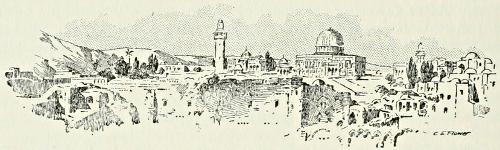
Jerusalem
But the hero could not depend on the faith of a tyrant; and the tyrant
was conscious how little he deserved the obedience of a hero. Narses was
removed from his military command; he reared an independent standard at
Hierapolis in Syria: he was betrayed by fallacious promises, and burned
alive in the market-place of Constantinople. Deprived of the only chief
whom they could fear or esteem, the bands which he had led to victory were
twice broken by the cavalry, trampled by the elephants, and pierced by the
arrows of the barbarians; and a great number of the captives were beheaded
on the field of battle by the sentence of the victor, who might justly condemn
these seditious mercenaries as the authors or accomplices of the death
of Maurice. Under the reign of Phocas, the fortifications of Merdin, Dara,
Amida, and Edessa were successively besieged, reduced, and destroyed by
the Persian monarch; he passed the Euphrates, occupied the Syrian cities,
Hierapolis, Chalcis, and Berœa or Aleppo, and soon encompassed the walls
of Antioch with his irresistible arms. The rapid tide of success discloses
the decay of the empire, the incapacity of Phocas, and the disaffection of his
subjects; and Chosroes provided a decent apology for their submission or
revolt, by an impostor who attended his camp as the son of Maurice and the
lawful heir of the monarchy.
The first intelligence from the East which Heraclius received, was that of
the loss of Antioch; but the aged metropolis, so often overturned by earthquakes
and pillaged by the enemy, could supply but a small and languid stream
of treasure and blood. The Persians were equally successful and more fortunate
in the sack of Cæsarea, the capital of Cappadocia.
After the reduction of Galilee, and the region beyond the Jordan, whose
resistance appears to have delayed the fate of the capital, Jerusalem itself
was taken by assault. The sepulchre of Christ, and the stately churches of
Helena and Constantine, were consumed, or at least damaged, by the flames;
the devout offerings of three hundred years were rifled in one sacrilegious
day; the patriarch Zachariah and the True Cross were transported into
Persia; and the massacre of ninety thousand Christians is imputed to the
Jews and Arabs who swelled the disorder of the Persian march. The fugitives
of Palestine were entertained at Alexandria by the charity of Joannes
the archbishop, who is distinguished among a crowd of saints by the epithet
of alms-giver; and the revenues
of the church, with a treasure of
three hundred thousand pounds,
were restored to the true proprietors,
the poor of every country
and every denomination.
[615-617 A.D.]
But Egypt itself, the only
province which had been exempt,
since the time of Diocletian, from
foreign and domestic war, was
again subdued by the successors
of Cyrus. Pelusium, the key of
that impervious country, was surprised
by the cavalry of the Persians;
they passed, with impunity,
the innumerable channels of the
Delta, and explored the long valley
of the Nile, from the pyramids
of Memphis to the confines of
Ethiopia. Alexandria might have
been relieved by a naval force,
but the archbishop and the prefect
embarked for Cyprus; and
Chosroes entered the second city
of the empire, which still preserved
a wealthy remnant of
industry and commerce. His
western trophy was erected, not
on the walls of Carthage, but in
the neighbourhood of Tripoli;
the Greek colonies of Cyrene
were finally extirpated; and the
conqueror, treading in the footsteps of Alexander, returned in triumph
through the sands of the Libyan desert. In the same campaign, another
army advanced from the Euphrates to the Thracian Bosporus; Chalcedon
surrendered after a long siege, and a Persian camp was maintained above ten
years in the presence of Constantinople. The sea coast of Pontus, the city
of Ancyra, and the isle of Rhodes, are enumerated among the last conquests
of the great king; and if Chosroes had possessed any maritime power, his
boundless ambition would have spread slavery and desolation over the provinces
of Europe.
A Byzantine Priest
From the long-disputed banks of the Tigris and Euphrates, the reign of
the grandson of Nushirvan was suddenly extended to the Hellespont and
the Nile, the ancient limits of the Persian monarchy. But the provinces,
which had been fashioned by the habits of six hundred years to the virtues
and vices of the Roman government, supported with reluctance the yoke of
the barbarians. The idea of a republic was kept alive by the institutions,
or at least by the writings, of the Greeks and Romans, and the subjects of
Heraclius had been educated to pronounce the words of liberty and law.
But it has always been the pride and policy of oriental princes to display
the titles and attributes of their omnipotence; to upbraid a nation of slaves
with their true name and abject condition, and to enforce, by cruel and insolent
threats, the rigour of their absolute commands.
The Christians of the East were scandalised by the worship of fire and
the impious doctrine of the two principles; the magi were not less intolerant
than the bishops, and the martyrdom of some native Persians, who had deserted
the religion of Zoroaster, was conceived to be the prelude of a fierce
and general persecution. By the oppressive laws of Justinian, the adversaries
of the church were made the enemies of the state; the alliance of the
Jews, Nestorians, and Jacobites had contributed to the success of Chosroes,
and his partial favour to the sectaries provoked the hatred and fears of the
Catholic clergy. Conscious of their fear and hatred, the Persian conqueror
governed his new subjects with an iron sceptre; and as if he suspected the
stability of his dominion, he exhausted their wealth by exorbitant tributes
and licentious rapine, despoiled or demolished the temples of the East, and
transported to his hereditary realms the gold, the silver, the precious marbles,
the arts, and the artists of the Asiatic cities.
While the Persian monarch contemplated the wonders of his art and
power, he received an epistle from an obscure citizen of Mecca, inviting him
to acknowledge Mohammed as the apostle of God. He rejected the invitation,
and tore the epistle. “It is thus,” exclaimed the Arabian prophet,
“that God will tear the kingdom, and reject the supplications of Chosroes.”
Placed on the verge of the two great empires of the East, Mohammed observed
with secret joy the progress of their mutual destruction; and in the
midst of the Persian triumphs, he ventured to foretell that, before many years
should elapse, victory would again return to the banners of the Romans.
[618 A.D.]
At the time when this prediction is said to have been delivered, no
prophecy could be more distant from its accomplishment, since the first
twelve years of Heraclius announced the approaching dissolution of the empire.
If the motives of Chosroes had been pure and honourable, he must
have ended the quarrel with the death of Phocas, and he would have embraced,
as his best ally, the fortunate African who had so generously avenged
the injuries of his benefactor Maurice. The prosecution of the war revealed
the true character of the barbarian; and the suppliant embassies of Heraclius
to beseech his clemency that he would spare the innocent, accept a tribute,
and give peace to the world, were rejected with contemptuous silence or
insolent menace. Syria, Egypt, and the provinces of Asia were subdued by
the Persian arms, while Europe, from the confines of Istria to the long wall
of Thrace, was oppressed by the Avars, unsatiated with the blood and rapine
of the Italian War.
By these implacable enemies, Heraclius, on either side, was insulted and
besieged: and the Roman Empire was reduced to the walls of Constantinople,
with the remnant of Greece, Italy, and Africa, and some maritime cities,
from Tyre to Trebizond, of the Asiatic coast. After the loss of Egypt, the
capital was afflicted with famine and pestilence; and the emperor, incapable
of resistance and hopeless of relief, had resolved to transfer his person
and government to the more secure residence of Carthage. His ships were
already laden with the treasures of the palace; but his flight was arrested by
the patriarch, who armed the powers of religion in the defence of his country,
led Heraclius to the altar of St. Sophia, and extorted a solemn oath, that he
would live and die with the people whom God had entrusted to his care.
The chagan was encamped in the plains of Thrace; but he dissembled
his perfidious designs, and solicited an interview with the emperor near the
town of Heraclea. Their reconciliation was celebrated with equestrian
games; the senate and people in their gayest apparel resorted to the festival
of peace; and the Avars beheld, with envy and desire, the spectacle of Roman
luxury. On a sudden the Hippodrome was encompassed by the Scythian
cavalry, who had pressed their secret and nocturnal march: the tremendous
sound of the chagan’s whip gave the signal of the assault; and Heraclius,
wrapping his diadem round his arm, was saved with extreme hazard by
the fleetness of his horse. So rapid was the pursuit, that the Avars almost
entered the golden gate of Constantinople with the flying crowds; but the
plunder of the suburbs rewarded their treason, and they transported beyond
the Danube 270,000 captives. On the shore of Chalcedon, the emperor held a
safer conference with a more honourable foe, who, before Heraclius descended
from his galley, saluted with reverence and pity the majesty of the purple.
The friendly offer of Sain, the Persian general, to conduct an embassy
to the presence of the Great King, was accepted with the warmest gratitude,
and the prayer for pardon and peace was humbly presented by the prætorian
prefect, the prefect of the city, and one of the first ecclesiastics of the patriarchal
church. But the lieutenant of Chosroes had fatally mistaken the
intentions of his master. “It was not an embassy,” said the tyrant of Asia,
“it was the person of Heraclius, bound in chains, that he should have brought
to the foot of my throne. I will never give peace to the emperor of Rome
till he has abjured his crucified God, and embraced the worship of the sun.”
Sain was flayed alive, according to the inhuman practice of his country; and
the separate and rigorous confinement of the ambassadors violated the law
of nations, and the faith of an express stipulation. Yet the experience of six
years at length persuaded the Persian monarch to renounce the conquest of
Constantinople, and to specify the annual tribute or ransom of the Roman
Empire: a thousand talents of gold, a thousand talents of silver, a thousand
silk robes, a thousand horses, and a thousand virgins. Heraclius subscribed
these ignominious terms; but the time and space which he obtained to collect
such treasure from the poverty of the East was industriously employed in
the preparations of a bold and desperate attack.
[616-622 A.D.]
Of the characters conspicuous in history, that of Heraclius is one of the
most extraordinary and inconsistent. In the first and the last years of a long
reign, the emperor appears to be the slave of sloth, of pleasure, or of superstition,
the careless and impotent spectator of the public calamities. But
the languid mists of the morning and evening are separated by the brightness
of the meridian sun: the Arcadius of the palace arose the Cæsar of the
camp; and the honour of Rome and Heraclius was gloriously retrieved by
the exploits and trophies of six adventurous campaigns.
It was the duty of the Byzantine historians to have revealed the causes
of his slumber and vigilance. At this distance we can only conjecture, that
he was endowed with more personal courage than political resolution; that
he was detained by the charms, and perhaps the arts, of his niece Martina,
with whom, after the death of Eudocia, he contracted an incestuous marriage;
and that he yielded to the base advice of the counsellors, who
urged as a fundamental law that the life of the emperor should never be
exposed in the field. Perhaps he was awakened by the last insolent demand
of the Persian conqueror; but at the moment when Heraclius assumed the
spirit of a hero, the only hopes of the Romans were drawn from the vicissitudes
of fortune which might threaten the proud prosperity of Chosroes,
and must be favourable to those who had attained the lowest period of depression.
To provide for the expenses of war was the first care of the emperor;
and for the purpose of collecting the tribute, he was allowed to solicit the
benevolence of the Eastern provinces. But the revenue no longer flowed in
the usual channels; the credit of an arbitrary prince is annihilated by his
power; and the courage of Heraclius was first displayed in daring to borrow
the consecrated wealth of churches, under the solemn vow of restoring, with
usury, whatever he had been compelled to employ in the service of religion
and of the empire. The clergy themselves appear to have sympathised with
the public distress, and the discreet patriarch of Alexandria, without admitting
the precedent of sacrilege, assisted his sovereign by the miraculous or
seasonable revelation of a secret treasure.[34] Of the soldiers who had conspired
with Phocas, only two were found to have survived the stroke of time and
of the barbarians; the loss, even of these seditious veterans, was imperfectly
supplied by the new levies of Heraclius, and the gold of the sanctuary united,
in the same camp, the names, and arms, and languages, of the East and West.
He would have been content with the neutrality of the Avars; and his
friendly entreaty, that the chagan would act, not as the enemy but as the
guardian of the empire, was accompanied with a more persuasive donative of
two hundred thousand pieces of gold. Two days after the festival of Easter,
the emperor, exchanging his purple for the simple garb of a penitent and
warrior, gave the signal of his departure. To the faith of the people Heraclius
recommended his children; the civil and military powers were vested
in the most deserving hands, and the discretion of the patriarch and senate
was authorised to save or surrender the city, if they should be oppressed in
his absence by the superior forces of the enemy.
The neighbouring heights of Chalcedon were covered with tents and
arms: but if the new levies of Heraclius had been rashly led to the attack,
the victory of the Persians in the sight of Constantinople might have been
the last day of the Roman Empire. As imprudent would it have been to
advance into the provinces of Asia, leaving their innumerable cavalry to intercept
his convoys, and continually to hang on the lassitude and disorder
of his rear. But the Greeks were still masters of the sea; a fleet of galleys,
transports, and store-ships was assembled in the harbour; the barbarians
consented to embark; a steady wind carried them through the Hellespont;
the western and southern coast of Asia Minor lay on their left hand; the
spirit of their chief was first displayed in a storm; and even the eunuchs of
his train were excited to suffer and to work by the example of their master.
He landed his troops on the confines of Syria and Cilicia, in the Gulf of Scanderoon,
where the coast suddenly turns to the south; and his discernment
was expressed in the choice of this important post.
[622-623 A.D.]
From all sides, the scattered garrisons of the maritime cities and the
mountains might repair with speed and safety to his imperial standard. The
natural fortifications of Cilicia protected, and even concealed, the camp of
Heraclius, which was pitched near Issus, on the same ground where Alexander
had vanquished the host of Darius. The angle which the emperor
occupied was deeply indented into a vast semicircle of the Asiatic, Armenian,
and Syrian provinces; and to whatsoever point of the circumference
he should direct his attack, it was easy for him to dissemble his own motions,
and to prevent those of the enemy. In the camp of Issus, the Roman general
reformed the sloth and disorder of the veterans, and educated the new
recruits in the knowledge and practice of military virtue. Unfolding the
miraculous image of Christ, he urged them to revenge the holy altars which
had been profaned by the worshippers of fire; addressing them by the
endearing appellations of sons and brethren, he deplored the public and private
wrongs of the republic. The subjects of a monarch were persuaded
that they fought in the cause of freedom; and a similar enthusiasm was
communicated to the foreign mercenaries, who must have viewed with equal
indifference the interest of Rome and of Persia.
Heraclius himself, with the skill and patience of a centurion, inculcated
the lessons of the school of tactics, and the soldiers were assiduously trained
in the use of their weapons, and the exercises and evolutions of the field.
The cavalry and infantry, in light or heavy armour, were divided into two
parties; the trumpets were fixed in the centre, and their signals directed the
march, the charge, the retreat, or pursuit; the direct or oblique order, the
deep or extended phalanx; to represent in fictitious combat the operations
of genuine war. Whatever hardship the emperor imposed on the troops,
he inflicted with equal severity on himself; their labour, their diet, their
sleep, were measured by the inflexible rules of discipline; and, without
despising the enemy, they were taught to repose an implicit confidence in
their own valour and the wisdom of their leader.
Cilicia was soon encompassed with the Persian arms; but their cavalry
hesitated to enter the defiles of Mount Taurus, till they were circumvented
by the evolutions of Heraclius, who insensibly gained their rear, whilst he
appeared to present his front in order of battle. By a false motion, which
seemed to threaten Armenia, he drew them, against their wishes, to a general
action. They were tempted by the artful disorder of his camp; but
when they advanced to combat, the ground, the sun, and the expectation of
both armies were unpropitious to the barbarians; the Romans successfully
repeated their tactics in a field of battle, and the event of the day[35] declared
to the world, that the Persians were not invincible, and that a hero was
invested with the purple.
Strong in victory and fame, Heraclius boldly ascended the heights of
Mount Taurus, directed his march through the plains of Cappadocia, and
established his troops for the winter season in safe and plentiful quarters
on the banks of the river Halys. His soul was superior to the vanity of
entertaining Constantinople with an imperfect triumph: but the presence
of the emperor was indispensably required to sooth the restless and rapacious
spirit of the Avars.
[623-625 A.D.]
Since the days of Scipio and Hannibal, no bolder enterprise has been
attempted than that which Heraclius achieved for the deliverance of the
empire. He permitted the Persians to oppress for a while the provinces, and
to insult with impunity the capital of the East; while the Roman emperor
explored his perilous way through the Black Sea and the mountains of
Armenia, penetrated into the heart of Persia, and recalled the armies of the
Great King to the defence of their bleeding country. With a select band of
five thousand soldiers, Heraclius sailed from Constantinople to Trebizond;
assembled his forces which had wintered in the Pontic regions; and from
the mouth of the Phasis to the Caspian Sea, encouraged his subjects and
allies to march with the successor of Constantine under the faithful and
victorious banner of the cross.
When the legions of Lucullus and Pompey first passed the Euphrates,
they blushed at their easy victory over the natives of Armenia. But the
long experience of war had hardened the minds and bodies of that effeminate
people; their zeal and bravery were approved in the service of a declining
empire; they abhorred and feared the usurpation of the house of Sassan,
and the memory of persecution envenomed their pious hatred of the enemies
of Christ. The limits of Armenia, as it had been ceded to the emperor
Maurice, extended as far the Araxes; the river submitted to the indignity
of a bridge; and Heraclius, in the footsteps of Mark Antony, advanced
towards the city of Tauris or Gandzaca, the ancient and modern capital of
one of the provinces of Media. At the head of forty thousand men, Chosroes
himself had returned from some distant expedition to oppose the progress of
the Roman arms; but he retreated on the approach of Heraclius, declining
the generous alternative of peace or battle.
The rapid conquests of Heraclius were suspended only by the winter
season; a motive of prudence or superstition determined his retreat into the
province of Albania, along the shores of the Caspian; and his tents were
most probably pitched in the plains of Mogan, the favourite encampment of
oriental princes. In the course of this successful inroad, he signalised the
zeal and revenge of a Christian emperor: at his command, the soldiers extinguished
the fire and destroyed the temples of the magi; the statues of
Chosroes, who aspired to divine honours, were abandoned to the flames; and
the ruin of Thebarma or Ormia, which had given birth to Zoroaster himself,
made some atonement for the injuries of the Holy Sepulchre. A purer spirit
of religion was shown in the relief and deliverance of fifty thousand captives.
Heraclius was rewarded by their tears and grateful acclamations; but this
wise measure, which spread the fame of his benevolence, diffused the murmurs
of the Persians against the pride and obstinacy of their own sovereign.
Amidst the glories of the succeeding campaigns, Heraclius is almost lost
to our eyes, and to those of the Byzantine historians. From the spacious
and fruitful plains of Albania, the emperor appears to follow the chain of
Hyrcanian Mountains, to descend into the province of Media or Irak, and to
carry his victorious arms as far as the royal cities of Casbin and Ispahan,[36] which
had never been approached by a Roman conqueror. Alarmed by the danger
of his kingdom, the powers of Chosroes were already recalled from the Nile
and the Bosporus, and three formidable armies surrounded, in a distant and
hostile land, the camp of the emperor. The Colchian allies prepared to
desert his standard; and the fears of the bravest veterans were expressed,
rather than concealed, by their desponding silence. “Be not terrified,” said
the intrepid Heraclius, “by the multitude of your foes. With the aid of
heaven, one Roman may triumph over a thousand barbarians. But if we
devote our lives for the salvation of our brethren, we shall obtain the crown
of martyrdom, and our immortal reward will be liberally paid by God and
posterity.”[37] These magnanimous sentiments were supported by the vigour
of his actions. He repelled the threefold attack of the Persians, improved
the divisions of their chiefs, and by a well-concerted train of marches, retreats,
and successful actions, finally chased them from the field into the
fortified cities of Media and Assyria.
[625-626 A.D.]
In the severity of the winter season, Shahr Barz (or Sarbaraza) deemed
himself secure in the walls of Salban; he was surprised by the activity of
Heraclius, who divided his troops and performed a laborious march in the
silence of the night. The flat roofs of the houses were defended with useless
valour against the darts and torches of the Romans: the satraps and nobles
of Persia, with their wives and children, and the flower of their martial youth,
were either slain or made prisoners. The general escaped by a precipitate
flight, but his golden armour was the prize of the conqueror; and the soldiers
of Heraclius enjoyed the wealth and repose which they had so nobly
deserved.
On the return of spring, the emperor traversed in seven days the mountains
of Kurdistan, and passed without resistance the rapid stream of the
Tigris. Oppressed by the weight of their spoils and captives, the Roman
army halted under the walls of Amida; and Heraclius informed the senate
of Constantinople of his safety and success, which they had already felt by
the retreat of the besiegers. The bridges of the Euphrates were destroyed
by the Persians; but as soon as the emperor had discovered a ford, they
hastily retired to defend the banks of the Sarus, in Cilicia. That river, an
impetuous torrent, was about three hundred feet broad; the bridge was fortified
with strong turrets, and the banks were lined with barbarian archers.
After a bloody conflict, which continued till the evening, the Romans prevailed
in the assault, and a Persian of gigantic size was slain and thrown
into the Sarus by the hand of the emperor himself. The enemies were dispersed
and dismayed; Heraclius pursued his march to Sebaste in Cappadocia;
and at the expiration of three years, the same coast of the Euxine applauded
his return from a long and victorious expedition.
Instead of skirmishing on the frontier, the two monarchs who disputed
the empire of the East aimed their desperate strokes at the heart of their
rival. The military force of Persia was wasted by the marches and combats
of twenty years, and many of the veterans, who had survived the perils
of the sword and the climate, were still detained in the fortresses of Egypt
and Syria. But the revenge and ambition of Chosroes exhausted his kingdom;
and the new levies of subjects, strangers, and slaves were divided into
three formidable bodies. The first army of fifty thousand men, illustrious
by the ornament and title of the golden spears, was destined to march against
Heraclius; the second was stationed to prevent his junction with the troops
of his brother Theodorus; and the third was commanded to besiege Constantinople,
and to second the operations of the chagan, with whom the
Persian king had ratified a treaty of alliance and partition.
Shahr Barz, the general of the third army, penetrated through the provinces
of Asia to the well-known camp of Chalcedon, and amused himself
with the destruction of the sacred and profane buildings of the Asiatic suburbs,
while he impatiently waited the arrival of his Scythian friends on the
opposite side of the Bosporus. On the 29th of June, thirty thousand barbarians,
the vanguard of the Avars, forced the long wall, and drove into the
capital a promiscuous crowd
of peasants, citizens, and soldiers.
Fourscore thousand of
his native subjects, and of the
vassal tribes of Gepidæ, Russians,
Bulgarians, and Slavonians
advanced under the
standard of the chagan; a
month was spent in marches
and negotiations, but the whole
city was invested on the 31st
of July, from the suburbs of
Pera and Galata to the Blachernæ
and seven towers; and
the inhabitants descried with
terror the flaming signals of the
European and Asiatic shores.
Trophy of Roman Arms and Ensign
In the meanwhile the magistrates
of Constantinople repeatedly
strove to purchase
the retreat of the chagan; but
their deputies were rejected
and insulted; and he suffered
the patricians to stand before
his throne, while the Persian
envoys, in silk robes, were
seated by his side. “You see,”
said the haughty barbarian,
“the proofs of my perfect
union with the Great King;
and his lieutenant is ready to
send into my camp a select band of three thousand warriors. Presume no
longer to tempt your master with a partial and inadequate ransom: your
wealth and your city are the only presents worthy of my acceptance. For
yourselves, I shall permit you to depart, each with an undergarment and a
shirt; and, at my entreaty, my friend Shahr Barz will not refuse a passage
through his lines. Your absent prince, even now a captive or fugitive, has
left Constantinople to its fate; nor can you escape the arms of the Avars
and Persians, unless you could soar into the air like birds, unless like fishes
you could dive into the waves.”
During ten successive days, the capital was assaulted by the Avars, who
had made some progress in the science of attack; they advanced to sap
or batter the wall, under the cover of the impenetrable tortoise; their engines
discharged a perpetual volley of stones and darts; and twelve lofty towers
of wood exalted the combatants to the height of the neighbouring ramparts.
But the senate and people were animated by the spirit of Heraclius, who had
detached to their relief a body of twelve thousand cuirassiers; the powers of
fire and mechanics were used with superior art and success in the defence
of Constantinople; and the galleys, with two and three ranks of oars, commanded
the Bosporus, and rendered the Persians the idle spectators of the
defeat of their allies. The Avars were repulsed; a fleet of Slavonian
canoes was destroyed in the harbour; the vassals of the chagan threatened to
desert, his provisions were exhausted, and after burning his engines, he gave
the signal of a slow and formidable retreat. The devotion of the Romans
ascribed this signal deliverance to the Virgin Mary; but the mother of
Christ would surely have condemned their inhuman murder of the Persian
envoys, who were entitled to the rights of humanity, if they were not protected
by the laws of nations.
[626-627 A.D.]
After the division of his army, Heraclius prudently retired to the banks
of the Phasis, from whence he maintained a defensive war against the fifty
thousand gold spears of Persia. His anxiety was relieved by the deliverance
of Constantinople; his hopes were confirmed by a victory of his brother
Theodorus; and to the hostile league of Chosroes with the Avars, the
Roman emperor opposed the useful and honourable alliance of the Turks. At
his liberal invitation, the horde of Khazars transported their tents from the
plains of the Volga to the mountains of Georgia; Heraclius received them
in the neighbourhood of Tiflis, and the khan with his nobles dismounted
from their horses, if we may credit the Greeks, and fell prostrate on the
ground, to adore the purple of the cæsar. Such voluntary homage and
important aid were entitled to the warmest acknowledgments; and the
emperor, taking off his own diadem, placed it on the head of the Turkish
prince, whom he saluted with a tender embrace and the appellation of son.
After a sumptuous banquet he presented Ziebel with the plate and ornaments,
the gold, the gems, and the silk, which had been used at the imperial
table, and, with his own hand, distributed rich jewels and earrings to his
new allies.
In a secret interview he produced the portrait of his daughter Eudocia,
condescended to flatter the barbarian with the promise of a fair and august
bride, obtained an immediate succour of forty thousand horse, and negotiated
a strong diversion of the Turkish arms on the side of the Oxus. The
Persians, in their turn, retreated with precipitation; in the camp of Edessa,
Heraclius reviewed an army of seventy thousand Romans and strangers;
and some months were successfully employed in the recovery of the cities of
Syria, Mesopotamia, and Armenia, whose fortifications had been imperfectly
restored. Shahr Barz still maintained the important station of Chalcedon;
but the jealousy of Chosroes, or the artifice of Heraclius, soon alienated the
mind of that powerful satrap from the service of his king and country. A
messenger was intercepted with a real or fictitious mandate to the cadarigan,
or second in command, directing him to send, without delay, to the throne,
the head of a guilty or unfortunate general. The despatches were transmitted
to Shahr Barz himself; and as soon as he read the sentence of his own death,
he dexterously inserted the names of four hundred officers, assembled a military
council, and asked the cadarigan whether he was prepared to execute
the commands of their tyrant? The Persians unanimously declared that
Chosroes had forfeited the sceptre; a separate treaty was concluded with the
government of Constantinople; and if some considerations of honour or
policy restrained Shahr Barz from joining the standard of Heraclius, the emperor
was assured that he might prosecute, without interruption, his designs
of victory and peace.
Deprived of his firmest support, and doubtful of the fidelity of his subjects,
the greatness of Chosroes was still conspicuous in its ruins. The
number of five hundred thousand may be interpreted as an oriental metaphor,
to describe the men and arms, the horses and elephants, that covered
Media and Assyria against the invasion of Heraclius. Yet the Romans
boldly advanced from the Araxes to the Tigris, and the timid prudence of
Rhazates was content to follow them by forced marches through a desolate
country, till he received a peremptory mandate to risk the fate of Persia in
a decisive battle. Eastward of the Tigris, at the end of the bridge of Mosul,
the great Nineveh had formerly been erected; the city, and even the ruins
of the city, had long since disappeared: the vacant space afforded a spacious
field for the operations of the two armies. But these operations are neglected
by the Byzantine historians, and, like the authors of epic poetry and
romance, they ascribe the victory, not to the military conduct, but to the
personal valour of their favourite hero.
On this memorable day, Heraclius, on his horse Phallus,[38] surpassed the
bravest of his warriors; his lip was pierced with a spear, the steed was
wounded in the thigh, but he carried his master safe and victorious through
the triple phalanx of the barbarians. In the heat of the action, three valiant
chiefs were successively slain by the sword and lance of the emperor; among
these was Rhazates himself; he fell like a soldier, but the sight of his head
scattered grief and despair through the fainting ranks of the Persians. His
armour of pure and massy gold, the shield of 120 plates, the sword and belt,
the saddle and cuirass, adorned the triumph of Heraclius; and if he had not
been faithful to Christ and his mother, the champion of Rome might have
offered the fourth opime spoils to the Jupiter of the Capitol. In the battle
of Nineveh, which was fiercely fought from daybreak to the eleventh hour,
twenty-eight standards, besides those which might be broken or torn, were
taken from the Persians; the greatest part of their army was cut in pieces,
and the victors, concealing their own loss, passed the night on the field.
They acknowledged, that on this occasion it was less difficult to kill than to
discomfit the soldiers of Chosroes; amidst the bodies of their friends, no
more than two bow-shot from the enemy, the remnant of the Persian cavalry
stood firm till the seventh hour of the night; about the eighth hour they
retired to their unrifled camp, collected their baggage, and dispersed on all
sides, from the want of orders rather than of resolution.
The diligence of Heraclius was not less admirable in the use of victory; by
a march of forty-eight miles in four-and-twenty hours, his vanguard occupied
the bridges of the great and the lesser Zab; and the cities and palaces of
Assyria were open for the first time to the Romans. By a just gradation
of magnificent scenes, they penetrated to the royal seat of Dastagherd, and
though much of the treasure had been removed, and much had been expended,
the remaining wealth appears to have exceeded their hopes, and
even to have satiated their avarice. Whatever could not be easily transported,
they consumed with fire, that Chosroes might feel the anguish of
those wounds which he had so often inflicted on the provinces of the empire;
and justice might allow the excuse, if the desolation had been confined to the
works of regal luxury, if national hatred, military license, and religious zeal,
had not wasted with equal rage the habitations and the temples of the guiltless
subject.
[627-628 A.D.]
The recovery of three hundred Roman standards, and the deliverance of
the numerous captives of Edessa and Alexandria, reflect a purer glory on the
arms of Heraclius. From the palace of Dastagherd he pursued his march
within a few miles of Modain or Ctesiphon, till he was stopped on the banks
of the Arba, by the difficulty of the passage, the rigour of the season, and
perhaps the fame of an impregnable capital. The return of the emperor is
marked by the modern name of the city of Sherhzur; he fortunately passed
Mount Zara before the snow, which fell incessantly thirty-four days; and
the citizens of Ganzaca, or Tauris, were compelled to entertain his soldiers
and their horses with an hospitable reception.
When the ambition of Chosroes was reduced to the defence of his hereditary
kingdom, the love of glory, or even the sense of shame, should have
urged him to meet his rival in the field. In the battle of Nineveh, his courage
might have taught the Persians to vanquish, or he might have fallen
with honour by the lance of a Roman emperor. The successor of Cyrus
chose rather, at a secure distance, to expect the event, to assemble the relics
of the defeat, and to retire by measured steps before the march of Heraclius,
till he beheld with a sigh the once-loved mansions of Dastagherd. Both his
friends and enemies were persuaded that it was the intention of Chosroes to
bury himself under the ruins of the city and palace; and as both might
have been equally adverse to his flight, the monarch of Asia, with Sira and
three concubines, escaped through a hole in the wall nine days before the
arrival of the Romans. The slow and stately procession in which he showed
himself to the prostrate crowd was changed to a rapid and secret journey;
and the first evening he lodged in the cottage of a peasant, whose humble
door would scarcely give admittance to the Great King. His superstition
was subdued by fear: on the third day he entered with joy the fortifications
of Ctesiphon; yet he still doubted of his safety till he had opposed the
river Tigris to the pursuit of the Romans.
It was still in the power of Chosroes to obtain a reasonable peace; and
he was repeatedly pressed by the messengers of Heraclius to spare the blood
of his subjects, and to relieve a humane conqueror from the painful duty of
carrying fire and sword through the fairest countries of Asia. But the pride
of the Persian had not yet sunk to the level of his fortune; he derived a
momentary confidence from the retreat of the emperor; he wept with impotent
rage over the ruins of his Assyrian palaces, and disregarded too long
the rising murmurs of the nation, who complained that their lives and fortunes
were sacrificed to the obstinacy of an old man. That unhappy old
man was himself tortured with the sharpest pains, both of mind and body;
and, in the consciousness of his approaching end, he resolved to fix the tiara
on the head of Merdaza, the most favoured of his sons. But the will of
Chosroes was no longer revered, and Siroes, who gloried in the rank and
merit of his mother Sira, had conspired with the malcontents to assert and
anticipate the rights of primogeniture. Twenty-two satraps, they styled
themselves patriots, were tempted by the wealth and honours of a new reign;
to the soldiers, the heir of Chosroes promised an increase of pay; to the
Christians, the free exercise of their religion; to the captives, liberty and
rewards; and to the nation, instant peace and the reduction of taxes.
It was determined by the conspirators that Siroes, with the ensigns of
royalty, should appear in the camp; and if the enterprise should fail, his
escape was contrived to the imperial court. But the new monarch was
saluted with unanimous acclamations; the flight of Chosroes (yet where
could he have fled?) was rudely arrested, eighteen sons were massacred
before his face, and he was thrown into a dungeon, where he expired on the
fifth day. The Greeks and modern Persians minutely described how Chosroes
was insulted, and famished, and tortured, by the command of an inhuman
son, who so far surpassed the example of his father; but at the time
of his death, what tongue would relate the story of the parricide—what eye
could penetrate into the tower of darkness? According to the faith and
mercy of his Christian enemies, he sank without hope into a still deeper
abyss; and it will not be denied that tyrants of every age and sect are the
best entitled to such infernal abodes. The glory of the house of Sassan
ended with the life of Chosroes; his unnatural son enjoyed only eight months
the fruit of his crimes; and in the space of four years the regal title was
assumed by nine candidates, who disputed with the sword or dagger the
fragments of an exhausted monarchy. Every province, and each city of
Persia, was the scene of independence, of discord, and of blood; and the
state of anarchy prevailed about eight years longer, till the factions were
silenced and united under the common yoke of the Arabian caliphs.
As soon as the mountains became passable, the emperor received the welcome
news of the success of the conspiracy, the death of Chosroes, and the
elevation of his eldest son to the throne of Persia. The authors of the revolution,
eager to display their merits in the court or camp of Tauris, preceded
the ambassadors of Siroes, who delivered the letters of their master to
his brother the emperor of the Romans. In the language of the usurpers
of every age, he imputes his own crimes to the Deity, and, without degrading
his equal majesty, he offers to reconcile the long discord of the two
nations, by a treaty of peace and alliance more durable than brass or iron.
The conditions of the treaty were easily defined and faithfully executed.
In the recovery of the standards and prisoners which had fallen into the
hands of the Persians, the emperor imitated the example of Augustus: their
care of the national dignity was celebrated by the poets of the times, but
the decay of genius may be measured by the distance between Horace and
George of Pisidia; the subjects and brethren of Heraclius were redeemed
from persecution, slavery, and exile; but instead of the Roman eagles, the
true wood of the holy cross was restored to the importunate demands of
the successor of Constantine. The victor was not ambitious of enlarging the
weakness of the empire; the son of Chosroes abandoned without regret
the conquests of his father; the Persians who evacuated the cities of Syria
and Egypt were honourably conducted to the frontier, and a war which had
wounded the vitals of the two monarchies, produced no change in their
external and relative situation. The return of Heraclius from Tauris to
Constantinople was a perpetual triumph; and after the exploits of six
glorious campaigns, he peaceably enjoyed the sabbath of his toils. After a
long impatience, the senate, the clergy, and the people, went forth to meet
their hero, with tears and acclamations, with olive-branches and innumerable
lamps; he entered the capital in a chariot drawn by four elephants;
and as soon as the emperor could disengage himself from the tumult of
public joy, he tasted more genuine satisfaction in the embraces of his mother
and his son.
[628-629 A.D.]
The succeeding year was illustrated by a triumph of a very different
kind, the restitution of the true cross to the Holy Sepulchre. Heraclius
performed in person the pilgrimage of Jerusalem, the identity of the relic
was verified by the discreet patriarch, and this august ceremony has been
commemorated by the annual festival of the exaltation of the cross. Before
the emperor presumed to tread the consecrated ground, he was instructed to
strip himself of the diadem and purple, the pomp and vanity of the world:
but in the judgment of his clergy, the persecution of the Jews was more
easily reconciled with the precepts of the Gospel. He again ascended his
throne to receive the congratulations of the ambassadors of France and
India: and the fame of Moses, Alexander, and Hercules was eclipsed, in the
popular estimation, by the superior merit and glory of the great Heraclius.
Yet the deliverer of the East was indigent and feeble. Of the Persian
spoils, the most valuable portion had been expended in the war, distributed
to the soldiers, or buried, by an unlucky tempest, in the waves of the
Euxine.
The conscience of the emperor was oppressed by the obligation of restoring
the wealth of the clergy, which he had borrowed for their own defence;
a perpetual fund was required to satisfy these inexorable creditors; the
provinces, already wasted by the arms and avarice of the Persians, were
compelled to a second payment of the same taxes; and the arrears of a
simple citizen, the treasurer of Damascus, were commuted to a fine of one
hundred thousand pieces of gold. The loss of two hundred thousand
soldiers who had fallen by the sword, was of less fatal importance than the
decay of arts, agriculture, and population, in this long and destructive war:
and although a victorious army had been formed under the standard of
Heraclius, the unnatural effort appears to have exhausted rather than exercised
their strength. While the emperor triumphed at Constantinople or
Jerusalem, an obscure town on the confines of Syria was pillaged by the
Saracens, and they cut in pieces some troops who advanced to its relief: an
ordinary and trifling occurrence, had it not been the prelude of a mighty
revolution. These robbers were the apostles of Mohammed; their fanatic
valour had emerged from the desert; and in the last eight years of his
reign Heraclius lost to the Arabs the same provinces which he had rescued
from the Persians.b
“Everyone who reads the history of Heraclius,” says Bury,b “is met by
the problems: how did the great hero of the last Persian War spend the first
ten years of his reign; and why did he relapse into lethargy after his final
triumph?”
Many explanations have been attempted to account for the actions of this
man, who first built up an empire, and then allowed it to crumble under his
feet. Bury’s explanation is the assumption that his will was naturally weak
and his sensibilities strong, and that for a time he was raised above himself,
as it were, by an inspired enthusiasm. When in later years this cloak of enthusiasm
was withdrawn, the weakness of his true character was laid bare.a
[610-641 A.D.]
The reign of Heraclius is one of the most remarkable epochs, both in the
history of the empire and in the annals of mankind. It warded off the almost
inevitable destruction of the Roman government for another century; it laid
the foundation of that policy which prolonged the existence of the imperial
power at Constantinople under a new modification, as the Byzantine monarchy;
and it was contemporary with the commencement of the great moral
change in the condition of the people which transformed the language and
manners of the ancient world into those of modern nations. The Eastern
Empire was indebted to the talents of Heraclius for its escape from those
ages of barbarism which, for many centuries, prevailed in all western Europe.
No period of society could offer a field for instructive study more likely to
present practical results to the highly civilised political communities of modern
Europe; yet there is no time of which the existing memorials of the constitution
and frame of society are so imperfect and unsatisfactory.
It was perhaps a misfortune for mankind that Heraclius was by birth a
Roman rather than a Greek, as his views were from that accident directed
to the maintenance of the imperial dominion, without any reference to the
national organisation of his people. His civilisation, like that of a large portion
of the ruling class in the Eastern Empire, was too far removed from
the state of ignorance into which the mass of the population had fallen, for the
one to be influenced by the feelings of the other, or for both to act together
with the energy conferred by unity of purpose in a variety of ranks. Heraclius,
being by birth and family connections an African noble, must have
regarded himself as of pure Roman blood, superior to all national prejudices,
and bound by duty and policy to repress the domineering spirit of the Greek
aristocracy in the state, and of the Greek hierarchy in the church.
Language and manners began to give to national feelings almost as
much power in forming men into distinct societies as political arrangements.
The influence of the clergy followed the divisions established by language,
rather than the political organisation adopted by the government: and as
the clergy now formed the most popular and the ablest portion of society,
the church exerted more influence over the minds of the people than the
civil administration and the imperial power, even though the emperor was
the acknowledged sovereign and master of the patriarchs and the pope.
It is necessary to observe here, that the established church of the empire
had ceased to be the universal Christian church. The Greeks had
rendered themselves the depositaries of its power and influence; they had
already corrupted Christianity into the Greek church; and other nations
were rapidly forming separate ecclesiastical societies to supply their own
spiritual wants. The Armenians, Syrians, and Egyptians were induced by
national aversion to the ecclesiastical tyranny of the Greeks, as well as
by spiritual preference of the doctrines of Nestorius and Eutyches, to oppose
the established church. At the time Heraclius ascended the throne,
these national and religious feelings already exercised their power of modifying
the operations of the Roman government, and of enabling mankind
to advance one step towards the establishment of individual liberty and
intellectual independence.
In order fully to comprehend the lamentable state of weakness to which
the empire was reduced, it will be necessary to take a cursory view of the
condition of the different provinces. The continual ravages of the barbarians
who occupied the country beyond the Danube had extended as far
as the southern shores of the Peloponnesus. The agricultural population
was almost exterminated, except where it was protected by the immediate
vicinity of fortified towns, or secured by the fastnesses of the mountains.
The inhabitants of all the countries between the Archipelago and the Adriatic
had been greatly diminished, and fertile provinces remained everywhere
desolate, ready to receive new occupants. As great part of these countries
yielded very little revenue to the government, they were considered by the
court of Constantinople as of hardly any value, except in so far as they
covered the capital from hostile attacks, or commanded the commercial
routes to the west of Europe. At this time the Indian and Chinese trade
had in part been forced round the north of the Caspian Sea, in consequence
of the Persian conquests in Syria and Egypt, and the disturbed state of
the country immediately to the east of Persia. The rich produce transported
by the caravans, which reached the northern shores of the Black
Sea, was then transported to Constantinople, and from thence distributed
through western Europe.
Under these circumstances, Thessalonica and Dyrrhachium became points
of great consequence to the empire, and were successfully defended by the
emperor amidst all his calamities. These two cities commanded the extremities
of the usual road between Constantinople and Ravenna, and connected
the towns on the Archipelago with the Adriatic and with Rome.
The open country was abandoned to the Avars and Slavonians, who were
allowed to effect permanent settlements even to the south of the Via
Egnatia; but none of these settlements were suffered to interfere with the
lines of communication, without which the imperial influence in Italy would
have been soon annihilated, and the trade of the West lost to the Greeks.
The ambition of the barbarians was inclined to dare any attempt to encroach
on the wealth of the Eastern Empire, and they tried to establish a system of
maritime depredations in the Archipelago; but Heraclius was able to frustrate
their schemes, though it is probable that he owed his success more
to the exertions of the mercantile population of the Greek cities than to
the exploits of his own troops.
National distinctions and religious interests tended to divide the population,
and to balance political power, much more in Italy than in the other
countries of Europe. The influence of the church in protecting the people,
the weakness of the Lombard sovereigns, from the small numerical strength
of the Lombard population, and the oppressive fiscal government of the
Roman exarchs, gave the Italians the means of creating a national existence,
amidst the conflicts of their masters. Yet so imperfect was the unity of
interests, or so great were the difficulties of communication between the
people of various parts of Italy, that the imperial authority not only defended
its own dominions with success against foreign enemies, but also
repressed with ease the ambitious or patriotic attempts of the popes to
acquire political power, and punished equally the seditions of the people
and the rebellions of the chiefs, who, like Joannes Compsa of Neapolis and
the exarch Eleutherinus, aspired at independence.
Africa alone, of all the provinces of the empire, continued to use the
Latin language in ordinary life; and its inhabitants regarded themselves,
with some reason, as the purest descendants of the Romans. After the victories
of Johannes the Patrician, it had enjoyed a long period of tranquillity,
and its prosperity was undisturbed by any spirit of nationality adverse to
the supremacy of the empire, or by schismatic opinions hostile to the church.
The barbarous tribes to the south were feeble enemies, and no foreign state
possessed a naval force capable of troubling its repose or interrupting its
commerce. Under the able and fortunate administration of Heraclius and
Gregoras, the father and uncle of the emperor, Africa formed the most
flourishing portion of the empire. Its prosperous condition, and the wars
raging in other countries, threw great part of the commerce of the Mediterranean
into the hands of the Africans. Wealth and population increased to
such a degree that the naval expedition of the emperor Heraclius, and the
army of his cousin Nicetas, were fitted out from the resources of Africa
alone. Another strong proof of the prosperity of the province, of its
importance to the empire, and of its attachment to the interests of the Heraclian
family is afforded by the resolution which the emperor adopted, in the
ninth year of his reign, of transferring the imperial residence from Constantinople
to Carthage.
In Constantinople an immense body of idle inhabitants had been collected,
a mass that had long formed a burden on the state, and acquired a right to a
portion of its resources. A numerous nobility, and a permanent imperial
household, conceived that they formed a portion of the Roman government
from the prominent part which they acted in the ceremonial that connected
the emperor with the people. Thus, the great natural advantages of the
geographical position of the capital were neutralised by moral and political
causes; while the desolate state of the European provinces, and the vicinity
of the northern frontier, began to expose it to frequent sieges. As a fortress
and place of arms, it might still have formed the bulwark of the empire
in Europe; but while it remained the capital, its immense unproductive
population required that too large a part of the resources of the state should
be devoted to supplying it with provisions, to guarding against the factions
and the seditions of its populace, and to maintaining in it a powerful garrison.
The luxury of the Roman court had, during ages of unbounded wealth and
unlimited power, assembled round the emperor an infinity of courtly offices,
and caused an enormous expenditure, which it was extremely dangerous to
suppress and impossible to continue.
A Saracenic Metal Casket
No national feelings or particular line of policy connected Heraclius with
Constantinople, and his frequent absence during the active years of his life
indicates that, as long as his personal energy and health allowed him to
direct the public administration, he considered the constant residence of the
emperor in that city injurious to the general interests of the state. On the
other hand, Carthage was, at this time, peculiarly a Roman city; and in actual
wealth, in the numbers of its independent citizens, and in the activity of its
whole population, was probably inferior to no city in the empire. It is not
surprising, therefore, that Heraclius, when compelled to suppress the public
distributions of bread in the capital, to retrench the expenditure of his court
and make many reforms in his civil government, should have wished to place
the imperial treasury and his own resources in a place of greater security,
before he engaged in his desperate struggle with Persia. The wish, therefore,
to make Carthage the capital of the Roman Empire may, with far greater
probability, be connected with the gallant project of his eastern campaigns,
than with the cowardly or selfish motives attributed to him by the Byzantine
writers. Carthage offered military resources for recovering possession of
Egypt and Syria, of which we can only now estimate the extent by taking
into consideration the expedition that placed Heraclius himself on the throne.
Many reasons connected with the constitution of the civil government of the
empire might likewise be adduced as tending to influence the preference.
Egypt, from its wonderful natural resources and its numerous and industrious
population, had long been the most valuable province of the empire.
It poured a very great portion of its gross produce into the imperial treasury;
for its agricultural population, being destitute of all political power and
influence, were compelled to pay, not only taxes, but a tribute, which was
viewed as a rent for the soil, to the Roman government. At this time, however,
the wealth of Egypt was on the decline. The circumstances which
had driven the trade of India to the north, had caused a great decrease in
the demand for the grain of Egypt on the shores of the Red Sea, and for its
manufactures in Arabia and Ethiopia. The canal between the Nile and the
Red Sea, whose existence is intimately connected with the prosperity of
these countries, had been neglected during the government of Phocas.
A large portion of the Greek population of Alexandria had been ruined,
because an end had been put to the public distributions of grain, and poverty
had invaded the fertile land of Egypt. Joannes the Almsgiver, who was
patriarch and imperial prefect in the reign of Heraclius, did everything in
his power to alleviate this misery. He established hospitals, and devoted
the revenues of his see to charity; but he was an enemy to heresy, and consequently
he was hardly looked on as a friend by the native population.
National feelings, religious opinions, and local interests, had always nourished,
in the minds of the native Egyptians, a deep-rooted hatred of the
Roman administration and of the Greek church; and this feeling of hostility
only became more concentrated after the union of the offices of prefect and
patriarch by Justinian. A complete line of separation existed between
the Greek colony of Alexandria and the native population, who, during the
decline of the Greeks and Jews of Alexandria, intruded themselves into
political business, and gained some degree of official importance. The
cause of the emperor was now connected with the commercial interests of
the Greek and Melchite parties, but these ruling classes were regarded by
the agricultural population of the rest of the province as interlopers on their
sacred Jacobite soil. Joannes the Almsgiver, though a Greek patriarch and
an imperial prefect, was not perfectly free from the charge of heresy, nor,
perhaps, of employing the revenues under his control with more attention
to charity than to public utility.
The exigencies of Heraclius were so great that he sent his cousin the
patrician Nicetas to Egypt, in order to seize the immense wealth which the
patriarch Joannes was said to possess. In the following year the Persians
invaded the province; and the patrician and patriarch, unable to defend
even the city of Alexandria, fled to Cyprus, while the enemy was allowed
to subdue the valley of the Nile to the borders of Libya and Ethiopia,
without meeting any opposition from the imperial forces, and apparently
with the good wishes of the Egyptians. The plunder obtained from public
property and slaves was immense; and as the power of the Greeks was
annihilated, the native Egyptians availed themselves of the opportunity to
acquire a dominant influence in the administration of their country.
For ten years the province owned allegiance to Persia, though it enjoyed
a certain degree of doubtful independence under the immediate government
of a native intendant-general of the land revenues named Mokaukas, who
subsequently, at the time of the Saracen conquest, acted a conspicuous part
in the history of his country. During the Persian supremacy, he became so
influential in the administration that he is styled by several writers the
prince of Egypt. Mokaukas, under the Roman government, had conformed
to the established church, in order to hold an official situation, but
he was, like most of his countrymen, at heart a monophysite, and consequently
inclined to oppose the imperial administration, both from religious
and political motives. Yet it appears that a portion of the monophysite
clergy steadily refused to submit to the Persian government; and Benjamin
their patriarch retired from his residence at Alexandria when that city fell
into the hands of the Persians, and did not return until Heraclius had
recovered possession of Egypt.
Mokaukas established himself in the city of Babylon, or Misr, which
had grown up, on the decline of Memphis, to be the native capital of the
province and the chief city in the interior. The moment appears to have
been extremely favourable for the establishment of an independent state by
the monophysite Egyptians, since, amidst the conflicts of the Persian and
Roman empires, the immense revenues and supplies of grain formerly paid
to the emperor might have been devoted to the defence of the country. But
the native population appears, from the conduct of the patriarch Benjamin,
not to have been united in its views; and probably the agricultural classes,
though numerous, living in abundance, and firm in their monophysite tenets,
had not the knowledge necessary to aspire at national independence, the
strength of character required to achieve it, or the command of the precious
metals necessary to purchase the service of mercenary troops and provide
the materials of war. They had been so long deprived of arms and of all
political rights, that they had probably adopted the opinion prevalent among
the subjects of all despotic governments, that public functionaries are invariably
knaves, and that the oppression of the native is more grievous than
the yoke of a stranger. The moral defects of the people could certainly, at
this favourable conjuncture, alone have prevented the establishment of an
independent Egyptian and Jacobite state.
It is said that about this time a prophecy was current, which declared
that the Roman Empire would be overthrown by a circumcised people.
This report may have been spread by the Jews, in order to excite their own
ardour and assist their projects of rebellion; but the prophecy was saved
from oblivion by the subsequent conquests of the Saracens, which could
never have been foreseen by its authors. The conduct of the Jews excited
the bigotry, as it may have awakened the fears, of the imperial government,
and both Phocas and Heraclius attempted to exterminate the Jewish religion
and if possible to put an end to the national existence. Heraclius not only
practised every species of cruelty himself to effect this object within the
bounds of his own dominions, but he even made the forced conversion or
banishment of the Jews a prominent feature in his diplomacy. He consoled
himself for the loss of most of the Roman possessions in Spain, by inducing
Sisibut to insert an article in the treaty of peace concluded in 614, engaging
the Gothic monarch to force baptism on the Jews; and he considered that,
even though he failed in persuading the Franks to co-operate with him
against the Avars, in the year 620, he had rendered the empire and Christianity
some service by inducing Dagobert to join in the project of exterminating
the unfortunate Jews.
Asia Minor had become the chief seat of the Roman power in the time
of Heraclius, and the only portion in which the majority of the population
was attached to the imperial government and to the Greek church. Before
the reign of Phocas, it had escaped any extensive devastation, so that it still
retained much of its ancient wealth and splendour; and the social life of the
people was still modelled on the institutions and usages of preceding ages.
A considerable internal trade was carried on; and the great roads, being
kept in a tolerable state of repair, served as arteries for the circulation of
commerce and civilisation. That it had, nevertheless, suffered very severely
in the general decline caused by over-taxation, and by reduced commerce,
neglected agriculture, and diminished population, is attested by the magnificent
ruins of cities which had already fallen to decay, and which never again
recovered their ancient prosperity.
The power of the central administration over its immediate officers was
almost as completely destroyed in Asia Minor as in the more distant provinces
of the empire. A remarkable proof of this general disorganisation of
the government is found in the history of the early years of the reign of
Heraclius; and one deserving particular attention from its illustrating both
his personal character and the state of the empire. Crispus, the son-in-law
of Phocas, had materially assisted Heraclius in obtaining the throne; and
as a recompense, he was charged with the administration of Cappadocia, one
of the richest provinces of the empire, along with the chief command of the
troops in his government. Crispus, a man of influence, and of a daring,
heedless character, soon ventured to act, not only with independence, but
even with insolence, towards the emperor. He neglected the defence of his
province; and when Heraclius visited Cæsarea to examine into its state and
prepare the means of carrying on the war against Persia in person, he displayed
a spirit of insubordination and an assumption of importance which
amounted to treason. Heraclius, who possessed the means of restraining his
fiery temperament, visited the too-powerful officer in his bed, which he kept
under a slight or affected illness, and persuaded him to visit Constantinople.
On his appearance in the senate, he was arrested, and compelled to become
a monk. His authority and position rendered it absolutely necessary for
Heraclius to punish his presumption, before he could advance with safety
against the Persians.
Many less important personages, in various parts of the empire, acted with
equal independence, without the emperor’s considering that it was either
necessary to observe, or prudent to punish, their ambition. The decline of
the power of the central government, the increasing ignorance of the people,
the augmented difficulties in the way of communication, and the general
insecurity of property and life, effected extensive changes in the state of
society, and threw political influence into the hands of the local governors,
the municipal and provincial chiefs, and the whole body of the clergy.
Heraclius appears to have formed the plan of establishing a permanent
barrier in Europe against the encroachments of the Avars and Slavonians.
For the furtherance of this project, it was evident that he could derive no
assistance from the inhabitants of the provinces to the south of the Danube.
The imperial armies, too, which in the time of Maurice had waged an active
war in Illyricum and Thrace and frequently invaded the territories of the
Avars, had melted away during the disorders of the reign of Phocas. The
loss was irreparable; for in Europe no agricultural population remained to
supply the recruits required to form a new army.
The only feasible plan for circumscribing the ravages of the northern
enemies of the empire which presented itself, was the establishment of
powerful colonies of tribes hostile to the Avars and their eastern Slavonian
allies, in the deserted provinces of Dalmatia and Illyricum. To accomplish
this object Heraclius induced the Serbs, or western Slavonians, who occupied
the country about the Carpathian Mountains and who had successfully
opposed the extension of the Avar empire in that direction, to abandon their
ancient seats, and move down to the south into the provinces between the
Adriatic and the Danube. The Roman and Greek population of these provinces
had been driven towards the sea coast by the continual incursions of
the northern tribes, and the desolate plains of the interior had been occupied
by a few Slavonian subjects and vassals of the Avars. The most important
of the western Slavonian tribes who moved southward at the invitation of
Heraclius were the Servians and Croatians, who settled in the countries still
peopled by their descendants. Their original settlements were formed in
consequence of friendly arrangements, and, doubtless, under the sanction of
an express treaty; for the Slavonian people of Illyricum and Dalmatia long
regarded themselves as bound to pay a certain degree of territorial allegiance
to the Eastern Empire.
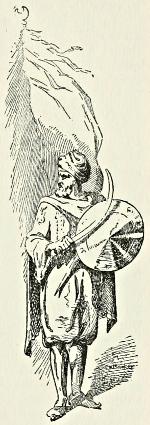
A Saracen
The measures of Heraclius were carried into execution with skill and
vigour. From the borders of Istria to the territory of Dyrrhachium, the
whole country was occupied by a variety of tribes of Servian or western
Slavonic origin, hostile to the Avars. These colonies, unlike the earlier
invaders of the empire, were composed of agricultural communities; and
to the facility which this circumstance afforded them
of adopting into their political system any remnant
of the old Slavonic population of their conquests, it
seems just to attribute the permanency and prosperity
of their settlements. Unlike the military races of
Goths, Huns, and Avars, who had preceded them, the
Servian nations increased and flourished in the lands
which they had colonised; and by the absorption of
every relic of the ancient population, they formed
political communities and independent states, which
offered a firm barrier to the Avars and other hostile
nations.
The fame of Heraclius would have rivalled that of
Alexander, Hannibal, or Cæsar, had he expired at
Jerusalem, after the successful termination of the
Persian War. He had established peace throughout
the empire, restored the strength of the Roman government,
revived the power of Christianity in the
East, and replanted the holy cross on Mount Calvary.
His glory admitted of no addition. Unfortunately,
the succeeding years of his reign have, in the general
opinion, tarnished his fame. Yet these years were
devoted to many arduous labours; and it is to the
wisdom with which he restored the strength of his
government during this time of peace that we must
attribute the energy of the Asiatic Greeks who arrested
the great tide of Mohammedan conquest at the foot
of Mount Taurus. Though the military glory of
Heraclius was obscured by the brilliant victories
of the Saracens, still his civil administration ought
to receive its meed of praise, when we compare the resistance made by
the empire which he reorganised with the facility which the followers of
Mohammed found in extending their conquests over every other land from
India to Spain.
The policy of Heraclius was directed to the establishment of a bond of
union, which should connect all the provinces of his empire into one body,
and he hoped to replace the want of national unity by identity of religious
belief. The church was far more closely connected with the people than
any other institution, and the emperor, as political head of the church,
hoped to direct a well-organised body of churchmen. But Heraclius engaged
in the impracticable task of imposing a rule of faith on his subjects,
without assuming the office, or claiming the authority of a prophet or a
saint. His measures, consequently, like all ecclesiastical and religious
reforms which are adopted solely from political motives, only produced
additional discussions and difficulties. In the year 630, he propounded the
doctrine that in Christ, after the union of the two natures, there was but
one will and one operation. Without gaining over any great body of the
schismatics whom he wished to restore to the communion of the established
church by his new rule of faith, he was himself generally stigmatised as a
heretic. The epithet Monothelite was applied to him and to his doctrine,
to show that neither was orthodox.
In the hope of putting an end to the disputes which he had rashly
awakened, he again, in 639, attempted to legislate for the church, and published
his celebrated Ecthesis, which, though it attempts to remedy the
effects of his prior proceedings, by forbidding all controversy on the question
of the single or double operation of the will in Christ, nevertheless
includes a declaration in favour of unity. The bishop of Rome, already
aspiring after an increase of his spiritual authority, though perhaps not yet
contemplating the possibility of perfect independence, entered actively into
the opposition excited by the publication of the Ecthesis, and was supported
by a considerable party in the Eastern church, while he directed the proceedings
of the whole of the Western clergy.
On a careful consideration of the religious position of the empire, it cannot
appear surprising that Heraclius should have endeavoured to reunite
the Nestorians, Eutychians, and Jacobites to the established church, particularly
when we remember how closely the influence of the church was connected
with the administration of the state, and how completely religious
passions replaced national feelings in these secondary ages of Christianity.
The union was an indispensable step to the re-establishment of the imperial
power in the provinces of Egypt, Syria, Mesopotamia, and Armenia; and it
must not be overlooked that the theological speculations and ecclesiastical
reforms of Heraclius were approved of by the wisest councillors whom he
had been able to select to aid him in the government of the empire. The
state of society required some strong remedy, and Heraclius only erred in
adopting the plan which had always been pursued by absolute monarchs,
namely, that of making the sovereign’s opinion the rule of conduct for his
subjects. We can hardly suppose that Heraclius would have succeeded better,
had he assumed the character or deserved the veneration due to a saint.
The marked difference which existed between the higher and educated
classes in the East, and the ignorant and superstitious populace, rendered
it next to impossible that any line of conduct could secure the judgment of
the learned, and awaken the fanaticism of the people. As a further apology
for Heraclius it may be noticed that his acknowledged power over the orthodox
clergy was much greater than that which was possessed by the Byzantine
emperors at a later period, or that which was admitted by the Latin
church after its separation. In spite of all the advantages which he possessed,
his attempt ended in a most signal failure; yet no experience could
ever induce his successors to avoid his error. His effort to strengthen his
power by establishing a principle of unity, aggravated all the evils which he
intended to cure; for while the monophysites and the Greeks were as little
disposed to unite as ever, the authority of the Eastern church, as a body,
was weakened by the creation of a new schism, and the incipient divisions
between the Greeks and the Latins, assuming a national character, began
to prepare the way for the separation of the two churches.
While Heraclius was endeavouring to restore the strength of the empire
in the East, and enforce unity of religious views,—the pursuit of which has
ever been one of the greatest errors of the human mind,—Mohammed, by a
juster application of the aspiration of mankind after unity, had succeeded in
uniting Arabia into one state and in persuading it to adopt one religion.
The force of this new empire of the Saracens was directed against those
provinces of the Roman Empire which Heraclius had been anxiously endeavouring
to reunite in spirit to his government. The difficulties of their
administration had compelled the emperor to fix his residence for some years
in Syria, and he was well aware of the uncertainty of their allegiance, before
the Saracens commenced their invasion. The successes of the Mohammedan
arms, and the retreat of the emperor, carrying off with him the holy cross
from Jerusalem, have induced historians to suppose that his latter years
were spent in sloth, and marked by weakness. His health, however, was in
so precarious a state that he could no longer direct the operations of his
army in person; at times, indeed, he was incapable of all bodily exertion.
Yet the resistance which the Saracens encountered in Syria was very different
from the ease with which it had yielded to the Persians at the commencement
of the emperor’s reign, and attests that his administration had
not been without fruit.
Many of his reforms could only have been effected after the conclusion
of the Persian War, when he recovered possession of Syria and Egypt. He
seems indeed never to have omitted an opportunity of strengthening his
position; and when a chief of the Huns or Bulgarians threw off his allegiance
to the Avars, Heraclius is recorded to have immediately availed himself
of the opportunity to form an alliance, in order to circumscribe the
power of his dangerous northern enemy. Unfortunately, few traces can be
gleaned from the Byzantine writers of the precise acts by which he effected
his reforms; and the most remarkable facts, illustrating the political history
of the time, must be collected from incidental notices, preserved in the
treatise of the emperor Constantine Porphyrogenitus, concerning the administration
of the empire, written for the instruction of his son Romanus.
[633-640 A.D.]
In the year 633 the Mohammedans invaded Syria, where their progress
was rapid, although Heraclius himself was in the neighbourhood. The imperial
troops made considerable effort to support the military renown of the
Roman armies, but were almost universally unsuccessful. The emperor
intrusted the command of the army to his brother Theodore, who had distinguished
himself in the Persian wars. Vartan, who commanded after Theodore,
had also distinguished himself in the last glorious campaign in Persia. [As
we have already said] the health of Heraclius prevented his taking the field
in person, and the absence of all moral checks in the Roman administration,
and the total want of patriotism in the officers and troops at this period,
rendered the personal influence of the emperor necessary at the head of his
armies in order to preserve due subordination, and enforce union among the
leading men of the empire.
Towards the end of the year 633, the troops of Abu Bekr laid siege to
Bostra, a strong frontier town of Syria, which was surrendered early in the
following year by the treachery of its governor. During the campaign of
634 the Roman armies were defeated at Adjnadin, in the south of Palestine,
and at a bloody and decisive battle on the banks of the river Yermouk, in
which it is said that the imperial troops were commanded by the emperor’s
brother Theodore. Theodore was replaced by Vartan, but the rebellion of
Vartan’s army and another defeat terminated this general’s career. In the
third year of the war the Saracens gained possession of Damascus by capitulation,
and they guaranteed to the inhabitants the full exercise of their
municipal privileges, allowed them to use their local mint, and left the
orthodox in possession of the great church of St. John. About the same
time, Heraclius quitted Edessa and returned to Constantinople, carrying
with him the holy cross which he had recovered from the Persians, and
deposited at Jerusalem with great solemnity only six years before, but which
he now considered it necessary to remove into Europe for greater safety.
His son, Heraclius Constantine, who had received the imperial title when
an infant, remained in Syria to supply his place and direct the military
operations for the defence of the province. Wherever the imperial garrison
was not sufficient to overawe the inhabitants, the native Syrians sought to
make any arrangement with the Arabs which would insure their towns from
plunder, feeling satisfied that the Arab authorities could not use their power
with greater rapacity and cruelty than the imperial officers. The Romans
still retained some hope of reconquering Syria, until the loss of another
decisive battle in the year 636 compelled them to abandon the province.
In the following year, 637 A.D., the Arabs advanced to Jerusalem, and the
surrender of the Holy City was marked by arrangements between the patriarch
Sophronius and the caliph Omar. The facility with which the Greek
patriarch of Jerusalem, Sophronius, at this time, and the patriarch of Constantinople,
Gennaddius, at the time of the conquest of the Byzantine
Empire by Muhammed II (1453 A.D.), became the ministers of their
Mohammedan conquerors, shows the slight hold which national feelings
retained over the minds of the orthodox Greek clergy. Heraclius concentrated
an army at Amida (Diarbekr) in the year 638, which made a bold
attempt to regain possession of the north of Syria. Emesa was besieged;
but the Saracens soon assembled an overwhelming force; the Romans were
defeated, the conquest of Syria was completed.
The Arab conquest not only put an end to the political power of the
Romans, which had lasted seven hundred years, but it also soon rooted out
every trace of the Greek civilisation introduced by the conquests of Alexander
the Great, and which had flourished in the country for upwards of nine
centuries. The year after Syria was subdued, Mesopotamia was invaded,
and proved an easy conquest.
As soon as the Arabs had completed the conquest of Syria, they invaded
Egypt. The emperor Heraclius sent an Armenian governor, Manuel, with
a body of troops, to defend the province. The fortune of the Arabs again
prevailed, and the Roman army was defeated. If the accounts of historians
can be relied on, it would seem that the population of Egypt had suffered
less from the vicious administration of the Roman Empire, and from the
Persian invasion, than any other part of their dominions; for about the time
of its conquest by the Romans it contained seven millions and a half, exclusive
of Alexandria, and its population was now estimated at six millions.
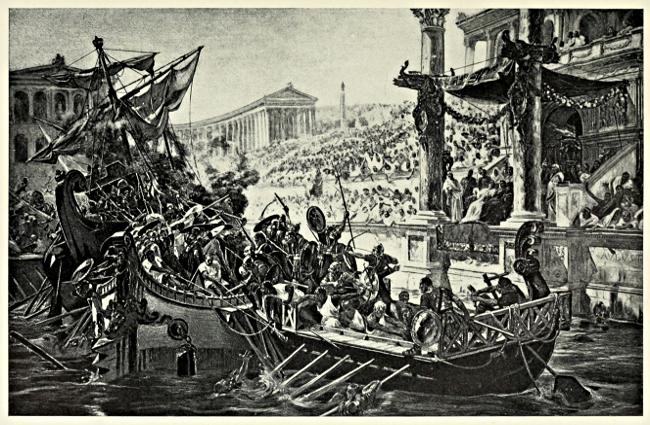
COMBAT OF ROMAN GALLEYS
A year after Amru had completed the conquest of Egypt, he had established
the water communication between the Nile and the Red Sea: and, by
sending large supplies of grain by the canal to Suez, he was able to relieve the
inhabitants of Mecca, who were suffering from famine. After more than one
interruption from neglect, the policy of the caliphs of Baghdad allowed it to
fall into decay, and it was filled up by Almansor, 762-767 A.D.
[640-646 A.D.]
As soon as the Arabs had settled the affairs of the native population, they
laid siege to Alexandria. This city made a vigorous defence, and Heraclius
exerted himself to succour it; but, though it held out for several months, it
was at last taken by the Arabs, for the troubles which occurred at Constantinople
after the death of Heraclius prevented the Roman government from
sending reinforcements to the garrison. The confidence of the Saracens
induced them to leave a feeble corps for its defence after they had taken it;
and the Roman troops, watching an opportunity for renewing the war, recovered
the city, and massacred the Mohammedans, but were soon compelled
to retire to their ships, and make their escape. In less than five years (646
A.D.), a Roman army, sent by the emperor Constans under the command of
Manuel, again recovered possession of Alexandria, by the assistance of the
Greek inhabitants who had remained in the place; but the Mohammedans
soon appeared before the city, and, with the assistance of the Egyptians,
compelled the imperial troops to abandon their conquest.[39] The walls of
Alexandria were thrown down, the Greek population driven out, and the
commercial importance of the city destroyed. Thus perished one of the
most remarkable colonies of the Greek nation, and one of the most renowned
seats of that Greek civilisation of which Alexander the Great had laid the
foundations in the East, after having flourished in the highest degree of prosperity
for nearly a thousand years.
The conquest of Cyrenaīca followed the subjugation of Egypt as an
immediate consequence. The Greeks are said to have planted their first
colonies in this country 631 years before the Christian era, and twelve centuries
of uninterrupted possession appeared to have constituted them the
perpetual tenants of the soil; but the Arabs were very different masters
from the Romans, and under their domination the Greek race soon became
extinct in Africa. It is not necessary here to follow the Saracens in their
farther conquests westward. In a short time both Latin and Greek civilisation
was exterminated on the southern shores of the Mediterranean.
Though Heraclius failed in gaining over the Syrians and Egyptians, yet
he succeeded completely in reuniting the Greeks of Asia Minor to his government,
and in attaching them to the empire. His success may be estimated
from the failure of the Saracens in their attacks on the population
of this province. The moment the Mohammedan armies were compelled to
rely on their military skill and religious enthusiasm, and were unable to
derive any profit from the hostile feeling of the inhabitants to the imperial
government, their career of conquest was checked; and almost a century
before Charles Martel stopped their progress in the west of Europe, the
Greeks had arrested their conquests in the East, by the steady resistance
which they offered in Asia Minor.
The difficulties of Heraclius were very great. The Roman armies were
still composed of a rebellious soldiery collected from many discordant nations;
and the only leaders whom the emperor could venture to trust with
important military commands, were his immediate relations, like his brother
Theodore and his son Heraclius Constantine, or soldiers of fortune who
could not aspire at the imperial dignity. The apostasy and treachery of a
considerable number of the Roman officers in Syria warranted Heraclius in
regarding the defence of that province as utterly hopeless; but the meagre
historians of his reign can hardly be received as conclusive authorities, to
prove that on his retreat he displayed an unseemly despair, or a criminal indifference.
The fact that he carried the holy cross, which he had restored
to Jerusalem, along with him to Constantinople, attests that he had lost all
expectation of defending the Holy City; but his exclamation of “Farewell,
Syria!” was doubtless uttered in the bitterness of his heart, on seeing a
great part of the labours of his life for the restoration of the Roman Empire
utterly vain.
The disease which had long undermined his constitution finally put an
end to his life about five years after his return to Constantinople. He
died in March, 641, after one of the most remarkable reigns recorded in history,
chequered by the greatest successes and reverses, during which the
social condition of mankind underwent a considerable change, and the germs
of modern society began to sprout; yet there is, unfortunately, no period of
man’s annals covered with greater obscurity.
[641-668 A.D.]
After the death of Heraclius, the short reigns of his sons, Constantine III,
or Heraclius Constantine, and Heracleonas, were disturbed by court intrigues
and the disorders which naturally result from the want of a settled law of
succession. In such conjunctures the people and the courtiers learn alike to
traffic in sedition. Before the termination of the year in which Heraclius
died, his grandson Constans II mounted the imperial throne at the age of
eleven, in consequence of the death of his father Constantine, and the
dethronement of his uncle Heracleonas.[40] An oration made by the young
prince to the senate after his accession, in which he invoked the aid of that
body, and spoke of their power in terms of reverence, warrants the conclusion
that the aristocracy had again recovered its influence over the imperial
administration; and that, though the emperor’s authority was still held to
be absolute by the constitution of the empire, it was really controlled by the
influence of the persons holding ministerial offices.[41]
Constans grew up to be a man of considerable abilities and of an energetic
character, but possessed of violent passions, and destitute of all the
amiable feelings of humanity. The early part of his reign, during which
the imperial ministers were controlled by the selfish aristocracy, was marked
by the loss of several portions of the empire. The Lombards extended their
conquests in Italy from the maritime Alps to the frontiers of Tuscany; and
the exarch of Ravenna was defeated with considerable loss near Mutina;
but still they were unable to make any serious impression on the exarchate.
Armenia was compelled to pay tribute to the Saracens. Cyprus was rendered
tributary to the caliph, though the amount of the tribute imposed was
only seventy-two hundred pieces of gold—half of what it had previously
paid to the emperor. This trifling sum can have hardly amounted to the
moiety of the surplus usually paid into the imperial treasury after all
the expenses of the local government were defrayed, and cannot have borne
any relation to the amount of taxation levied by the Roman emperors.
[641-653 A.D.]
As soon as Constans was old enough to assume the direction of public
business, the two great objects of his policy were the establishment of the
absolute power of the emperor over the orthodox church, and the recovery
of the lost provinces of the empire. With the view of obtaining and securing
a perfect control over the ecclesiastical affairs of his dominions, he published
an edict, called the Type, in the year 648, when he was only eighteen
years old. It was prepared by Paul the patriarch of Constantinople and was
intended to terminate the disputes produced by the Ecthesis of Heraclius.
All parties were commanded by the Type to observe a profound silence on
the previous quarrels concerning the operation
of the will in Christ. Liberty of
conscience was an idea almost unknown
to any but the Mohammedans, so that
Constans never thought of appealing to any
such right; and no party in the Christian
church was inclined to waive its orthodox
authority of enforcing its own opinions
upon others.
The Latin church, led by the bishop of
Rome, was always ready to oppose the
Greek clergy, who enjoyed the favour of
the imperial court, and this jealousy engaged
the pope in violent opposition to
the Type. But the bishop of Rome was
not then so powerful as the popes became
at a subsequent period, so that he durst
not attempt directly to question the
authority of the emperor in regulating
such matters. Perhaps it appeared to him
hardly prudent to rouse the passions of a
young prince of eighteen, who might prove
not very bigoted in his attachment to any
party, as, indeed, the provisions of the
Type seemed to indicate.
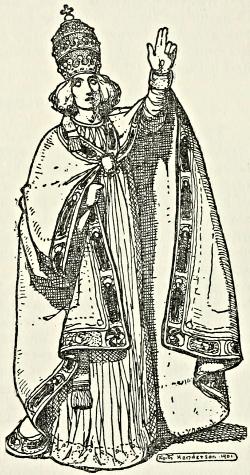
Robes of a Pope of the Seventh
Century
The pope Theodore therefore directed
the whole of his ecclesiastical fury against
the patriarch of Constantinople, whom
he excommunicated with circumstances of
singular and impressive violence. He
descended with his clergy into the dark
tomb of St. Peter in the Vatican, now
under the centre of the dome in the vault of the great cathedral of
Christendom, consecrated the sacred cup, and, having dipped his pen in the
blood of Christ, signed an act of excommunication, condemning a brother
bishop to the pains of hell. To this indecent proceeding Paul the patriarch
replied by persuading the emperor to persecute the clergy who adhered to
the pope’s opinion, in a more regular and legal manner, by depriving them
of their temporalities, and condemning them to banishment.
The pope was supported by nearly the whole body of the Latin clergy,
and even by a considerable party in the East; yet, when Martin, the successor
of Theodore, ventured to anathematise the Ecthesis and the Type, he
was seized by order of Constans, conveyed to Constantinople, tried, and condemned
on a charge of having supported the rebellion of the exarch Olympius,
and of having remitted money to the Saracens. The emperor, at the
intercession of the patriarch Paul, commuted his punishment to exile, and
the pope died in banishment at Cherson in Tauris. Though Constans did
not succeed in inculcating his doctrines on the clergy, he completely succeeded
in enforcing public obedience to his decrees in the church, and the
fullest acknowledgment of his supreme power over the persons of the clergy.
These disputes between the heads of the ecclesiastical administration of the
Greek and Latin churches afforded an excellent pretext for extending the
breach, which had its real origin in national feelings and clerical interests,
and was only widened by the difficult and not very intelligible distinctions
of monothelitism. Constans himself, by his vigour and personal activity in
this struggle, incurred the bitter hatred of a large portion of the clergy, and
his conduct has been unquestionably the object of much misrepresentation
and calumny.
[650-658 A.D.]
The attention of Constans to ecclesiastical affairs induced him to visit
Armenia, where his attempts to unite the people to his government by regulating
the affairs of their church, were as unsuccessful as his religious interference
elsewhere. Dissensions were increased; one of the imperial officers
of high rank rebelled; and the Saracens availed themselves of this state of
things to invade both Armenia and Cappadocia, and succeeded in rendering
several districts tributary. The increasing power of Moawyah, the Arab
general, induced him to form a project for the conquest of Constantinople,
and he began to fit out a great naval expedition at Tripolis in Syria. A
daring enterprise of two brothers, Christian inhabitants of the place, rendered
the expedition abortive. These two Tripolitans and their partisans broke
open the prisons in which the Roman captives were confined, and placing
themselves at the head of an armed band which they had hastily formed,
seized the city, slew the governor, and burned the fleet.
A second armament was at length prepared by the energy of Moawyah,
and as it was reported to be directed against Constantinople, the emperor
Constans took upon himself the command of his own fleet. He met the
Saracen expedition off Mount Phœnix in Lycia and attacked it with great
vigour. Twenty thousand Romans are said to have perished in the battle;
and the emperor himself owed his safety to the valour of one of the Tripolitan
brothers, whose gallant defence of the imperial galley enabled the emperor
to escape before its valiant defender was slain and the vessel fell into
the hands of the Saracens. The emperor retired to Constantinople, but the
hostile fleet had suffered too much to attempt any further operations, and
the expedition was abandoned for that year. The death of Othman, and the
pretensions of Moawyah (or Muaviah) to the caliphate, withdrew the attention
of the Arabs from the empire for a short time, and Constans turned his forces
against the Slavonians, in order to deliver the European provinces from their
ravages. They were totally defeated, numbers were carried off as slaves,
and many were compelled to submit to the imperial authority. No certain
grounds exist for determining whether this expedition was directed against
the Slavonians who had established themselves between the Danube and
Mount Hæmus, or against those who had settled in Macedonia. The name
of no town is mentioned in the accounts of the campaign.
[658-665 A.D.]
When the affairs of the European provinces, in the vicinity of the capital,
were tranquillised, Constans again prepared to engage the Arabs; and
Moawyah, having need of all the forces he could command for his contest
with Ali, the son-in-law of Mohammed, consented to make peace, on terms
which contrast curiously with the perpetual defeats which Constans is always
represented by the orthodox historians of the empire to have suffered. The
Saracens engaged to confine their forces within Syria and Mesopotamia, and
Moawyah consented to pay Constans, for the cessation of hostilities, the sum
of a thousand pieces of silver, and to furnish him with a slave and a horse
for every day during which the peace should continue (659 A.D.).
During the subsequent year, Constans condemned to death his brother
Theodosius, whom he had compelled to enter the priesthood. The cause
of this crime, or the pretext for it, is not mentioned. From this brother’s
hand, the emperor had often received the sacrament; and the fratricide is
supposed to have rendered a residence at Constantinople insupportable to
the conscience of the criminal, who was reported nightly to behold the spectre
of his brother offering him the consecrated cup, filled with human blood,
and exclaiming, “Drink, brother!” Certain it is that, two years after his
brother’s death, Constans quitted his capital, with the intention of never
returning; and he was only prevented, by an insurrection of the people,
from carrying off the empress and his children. He meditated the reconquest
of Italy from the Lombards, and proposed rendering Rome again the
seat of empire. On his way to Italy the emperor stopped at Athens, where
he assembled a considerable body of troops. This casual mention of Athens
by Latin writers affords strong evidence of the tranquil, flourishing, and populous
condition of the city and country around. The Slavonian colonies in
Greece must, at this time, have owned perfect allegiance to the imperial
power, or Constans would certainly have employed his army in reducing
them to subjection. From Athens, the emperor sailed to Italy; he landed
with his forces at Tarentum, and attempted to take Beneventum, the chief
seat of the Lombard power in the south of Italy. His troops were twice
defeated, and he then abandoned all his projects of conquest.
The emperor himself repaired to Rome. His visit lasted only a fortnight.
According to the writers who describe the event, he consecrated twelve days
to religious ceremonies and processions, and the remaining two he devoted
to plundering the wealth of the church. His personal acquaintance with
the affairs of Italy and the state of Rome, soon convinced him that the Eternal
City was ill adapted for the capital of the empire, and he quitted it for
Sicily, where he fixed on Syracuse for his future residence. Grimwald, the
able monarch of the Lombards, and his son Romwald, the duke of Beneventum,
continued the war in Italy with vigour. Brundusium and Tarentum
were captured, and the Romans expelled from Calabria, so that Otranto
and Gallipoli were the only towns on the eastern coast of which Constans
retained possession.
[665-668 A.D.]
When residing in Sicily Constans directed his attention to the state of
Africa. His measures are not detailed with precision, but were evidently
distinguished by the usual energy and caprice which marked his whole conduct.
He recovered possession of Carthage, and of several cities which the
Arabs had rendered tributary; but he displeased the inhabitants of the province,
by compelling them to pay to himself the same amount of tribute as
they had agreed by treaty to pay to the Saracens; and as Constans could not
expel the Saracen forces from the province, the amount of the public taxes
of the Africans was thus often doubled, since both parties were able to
levy the contributions which they demanded. Moawyah sent an army from
Syria, and Constans one from Sicily, to decide who should become sole master
of the country. A battle was fought near Tripolis; and though the army
of Constans consisted of thirty thousand men, it was completely defeated.
Yet the victorious army of the Saracens was unable to take the small town
of Geloula (Usula), until the accidental fall of a portion of the ramparts laid
it open to their assault; and this trifling conquest was followed by no farther
success. In the East, the empire was exposed to greater danger, yet the
enemies of Constans were eventually unsuccessful in their projects. In consequence
of the rebellion of the Armenian troops, whose commander, Sapor,
assumed the title of emperor, the Saracens made a successful incursion into
Asia Minor, captured the city of Amorium, in Phrygia, and placed in it a
garrison of five thousand men; but the imperial general appointed by Constans
soon drove out this powerful garrison, and recovered the place.
It appears, therefore, that in spite of all the defeats which Constans is
reported to have suffered, the empire underwent no very sensible diminution
of its territory during his reign, and he certainly left its military forces in a
more efficient condition than he found them. He was assassinated in a bath
at Syracuse, by an officer of his own household, in the year 668, at the age
of thirty-eight, after a reign of twenty-seven years. The fact of his having
been murdered by one of his own household, joined to the capricious violence
that marked many of his public acts, warrants the supposition that his character
was of the unamiable and unsteady nature, which rendered the accusation
of fratricide, so readily believed by his contemporaries, by no means
impossible. It must, however, be admitted, that the occurrences of his reign
afford irrefragable testimony that his heretical opinions have induced orthodox
historians to give an erroneous colouring to many circumstances, since
the undoubted results do not correspond with their descriptions of the passing
events.
Constantine IV, called Pogonatus, or the Bearded, has been regarded by
posterity with a high degree of favour. Yet his merit seems to have consisted
in his superior orthodoxy, rather than in his superior talents as emperor.
The concessions which he made to the see of Rome, and the moderation that
he displayed in all ecclesiastical affairs, placed his conduct in strong contrast
with the stern energy with which his father had enforced the subjection of
the orthodox ecclesiastics to the civil power, and gained for him the praise
of the priesthood, whose eulogies have exerted no inconsiderable influence
on all historians. Constantine, however, was certainly an intelligent and
just prince; he did not possess the stubborn determination and talents of his
father, and was destitute also of his violent passions and imprudent character.
[668-681 A.D.]
As soon as Constantine was informed of the murder of his father, and
that a rebel had assumed the purple in Sicily, he hastened thither in person
to avenge his death, and extinguish the rebellion. To satisfy his vengeance,
the patrician Justinian, a man of high character, compromised in the rebellion,
was treated with great severity, and his son Germanus with a degree of inhumanity
that would have been recorded by the clergy against Constans as an
instance of the grossest barbarity. The return of the emperor to Constantinople
was signalised by a singular sedition of the troops in Asia Minor.
They marched towards the capital, and having encamped on the Asiatic
shores of the Bosporus, demanded that Constantine should admit his two
brothers, on whom he had conferred the rank of augustus, to an equal share
in the public administration, in order that the Holy Trinity in heaven, which
governs the spiritual world, might be represented by a human trinity, to
govern the political empire of the Christians. The very proposal is a proof
of the complete supremacy of the civil over the ecclesiastical authority, in
the eyes of the people, and the strongest evidence, that in the public opinion
of the age the emperor was regarded as the head of the church. Such reasoning
as the rebels used could be rebutted by no arguments, and Constantine
had energy enough to hang the leaders of the sedition, and sufficient moderation
not to molest his brothers. But several years later, either from
increased suspicions or from some intrigues on their part, he deprived them
of the rank of augustus, and condemned them to have their noses cut off
(681 A.D.). Theophanesd says that the brothers of Constantine IV lost their
noses in 669, but were not deprived of the imperial title until 681.
[672-678 A.D.]
The great object of the imperial policy at this period was to oppose the
progress of the Mohammedans. Constans had succeeded in arresting their
conquests, but Constantine soon found that they would give the empire no
rest unless he could secure it by his
victories. He had hardly quitted
Sicily to return to Constantinople,
before an Arab expedition from
Alexandria invaded the island and
stormed the city of Syracuse, and,
after plundering the treasures accumulated
by Constans, immediately
abandoned the place. In Africa the
war was continued with various
success, but the Christians were not
long left without any succours from
Constantine, while Moawyah supplied
the Saracens with strong
reinforcements. In spite of the
courage and enthusiasm of the Mohammedans,
the native Christian population maintained their ground with
firmness, and carried on the war with such vigour that in the year 676 a
native African leader, who commanded the united forces of the Romans and
Berbers, captured the newly founded city of Kairowan, which at a subsequent
period became renowned as the capital of the Fatimite caliphs.
Saracenic metal work Brazier
The ambition of the caliph Moawyah induced him to aspire at the conquest
of the Roman Empire; and the military organisation of the Arabian
power, which enabled the caliph to direct the whole resources of his dominions
to any single object of conquest, seemed to promise success to the enterprise.
A powerful expedition was sent to besiege Constantinople. The time
required for the preparation of such an armament did not enable the Saracens
to arrive at the Bosporus without passing a winter on the coast of Asia
Minor; and on their arrival in the spring of the year 672, they found that the
emperor had made every preparation for defence. Their forces, however,
were so numerous that they were sufficient to invest Constantinople by sea
and land. The troops occupied the whole of the land side of the triangle
on which the city is constructed, while the fleet effectually blockaded the
port.
The Saracens failed in all their assaults, both by sea and land; but the Romans,
instead of celebrating their own valour and discipline, attributed their
success principally to the use of the Greek fire, which was invented shortly
before this siege, and was first used on this occasion. The military art had
declined during the preceding century, as rapidly as every other branch of
national culture; and the resources of the mighty empire of the Arabs were
so limited by the ignorance and bad administration of its rulers, that the
caliph was unable to maintain his forces before Constantinople during the
winter. The Saracen army was nevertheless enabled to collect sufficient
supplies at Cyzicus to make that place a winter station, while their powerful
fleet commanded the Hellespont and secured their communications with
Syria. When spring returned, the fleet again transported the army to encamp
under the walls of Constantinople. This strange mode of besieging
cities, unattempted since the times the Dorians had invaded Peloponnesus,
was continued for seven years; but in this warfare the Saracens suffered far
more severely than the Romans, and were at last compelled to abandon their
enterprise.
The land forces tried to effect their retreat through Asia Minor, but were
entirely cut off in the attempt; and a tempest destroyed the greater part of
their fleet off the coast of Pamphylia. During the time that this great body
of his forces was employed against Constantinople, Moawyah sent a division
of his troops to invade Crete, which had been visited by a Saracen army in
651. The island was now compelled to pay tribute, but the inhabitants
were treated with great mildness, as it was the policy of the caliph at this
time to conciliate the good opinion of the Christians by his liberal government,
in order to pave the way for future conquests. Moawyah carried his
religious tolerance so far as to rebuild the church of Edessa at the intercession
of his Christian subjects.
The destruction of the Saracen expedition against Constantinople, and
the advantage which the mountaineers of Lebanon had contrived to take of
the absence of the Arab troops, by carrying their incursions into the plains
of Syria, convinced Moawyah of the necessity of peace. The hardy mountaineers
of Lebanon, called Mardaites, had been increased in numbers, and
supplied with wealth, in consequence of the retreat into their country of a
mass of native Syrians who had fled before the Arabs. They consisted
chiefly of melchites and monothelites, and on that account they had adhered
to the cause of the Roman Empire when the monophysites joined the Saracens.
Their Syrian origin renders it probable that they were ancestors of
the Maronites, though the desire of some Maronite historians to show that
their countrymen were always perfectly orthodox has perplexed a question
which of itself was by no means of easy solution. The political state of the
empire required peace; and the orthodox Constantine did not feel personally
inclined to run any risk in order to protect the monothelite mardaites.
Peace was concluded between the emperor and the caliph in the year 678,
Moawyah consenting to pay the Romans annually three thousand pounds
of gold, fifty slaves, and fifty Arabian horses. It appears strange that a
prince, possessing the power and resources at the command of Moawyah,
should submit to these conditions; but the fact proves that policy, not pride,
was the rule of the caliph’s conduct, and that the advancement of his real
power, and of the spiritual interests of the Mohammedan religion, were of
more consequence in his eyes than any notions of earthly dignity.
[678-711 A.D.]
In the same year in which Moawyah had been induced to purchase peace
by consenting to pay tribute to the Roman emperor, the foundations of the
Bulgarian monarchy were laid, and the emperor Constantine himself was
compelled to become tributary to a small horde of Bulgarians. One of the
usual emigrations which take place amongst barbarous nations had induced
Asparuch, a Bulgarian chief, to seize the low country about the mouth of the
Danube; his power and activity obliged the emperor Constantine to take
the field against these Bulgarians in person. The expedition was so ill conducted
that it ended in the complete defeat of the Roman army, and the
Bulgarians subdued all the country between the Danube and Mount Hæmus,
compelling a district inhabited by a body of Slavonians, called the seven
tribes, to become their tributaries. These Slavonians had once been formidable
to the empire, but their power had been broken by the emperor
Constans. Asparuch established himself in the town of Varna, near the
ancient Odessus, and laid the foundation of the Bulgarian monarchy, a kingdom
long engaged in hostilities with the emperors of Constantinople, and
whose power tended greatly to accelerate the decline of the Greeks and
reduce the numbers of their race in Europe.
The event, however, which exercised the most favourable influence on the
internal condition of the empire during the reign of Constantine Pogonatus,
was the assembly of the sixth general council of the church at Constantinople.
This council was held under circumstances peculiarly favourable to candid
discussion. The ecclesiastical power was not yet too strong to set both
reason and the civil authorities at defiance. Its decisions were adverse to
the monothelites; and the orthodox doctrine of two natures and two wills
in Christ was received by the common consent of the Greek and Latin parties
as the true rule of faith of the Christian church. Religious discussion had
now taken a strong hold on public opinion, and as the majority of the Greek
population had never adopted the opinions of the monothelites, the decisions
of the sixth general council contributed powerfully to promote the union of
the Greeks with the imperial administration.
Justinian II succeeded his father Constantine at the age of sixteen, and
though so very young, he immediately assumed the personal direction of the
government. He was by no means destitute of talents, but his cruel and
presumptuous character rendered him incapable of learning to perform the
duties of his situation with justice. He turned his arms against the
Saracens though the caliph Abdul-Malik offered to make additional concessions
in order to induce the emperor to renew the treaty of peace which had
been concluded with his father. Justinian sent a powerful army into
Armenia under Leontius. All the provinces which had shown any disposition
to favour the Saracens were laid waste, and the army carried off an
immense booty, and drove away a great part of the inhabitants as slaves.
The caliph being engaged in a struggle for the Caliphate with powerful
rivals, and disturbed by rebels even in his own Syrian dominions, arrested
the progress of the Roman arms by purchasing peace on terms far more favourable
to the empire than those of the treaty between Constantine and Moawyah.
Justinian, at the commencement of his reign, made a successful expedition
into the country occupied by the Slavonians in Macedonia, who were
now closely allied with the Bulgarian principality beyond Mount Hæmus.
This people, emboldened by their increased force, had pushed their plundering
excursions as far as the Propontis. The imperial army was completely
successful, and both the Slavonians and their Bulgarian allies were defeated.
In order to repeople the fertile shores of the Hellespont about Abydos, Justinian
transplanted a number of the Slavonian families into the province of
Opsicum. This colony was so numerous and powerful that it furnished a
considerable contingent to the imperial armies.
[689-692 A.D.]
The peace with the Saracens was not of long duration. Justinian refused
to receive the first gold pieces coined by Abdul-Malik, which bore the
legend, “God is the Lord.” The tribute had previously been paid in money
from the municipal mints of Syria; and Justinian imagined that the new
Arabian coinage was an attack on the Holy Trinity. He led his army in person
against the Saracens,
and a battle
took place near Sebastopolis,
on the
coast of Cilicia, in
which he was entirely
defeated, in
consequence of the
treason of the leader
of his Slavonian
troops. Justinian
fled from the field
of battle, and on his
way to the capital
he revenged himself
on the Slavonians
who had remained
faithful to his standard
for the desertion
of their countrymen.
The Slavonians in
his service were put
to death, and he even
ordered the wives
and children of those
who had joined the
Saracens to be murdered. The deserters were established by the Saracens on
the coast of Syria, and in the island of Cyprus; and under the government
of the caliph they were more prosperous than under that of the Roman emperor.
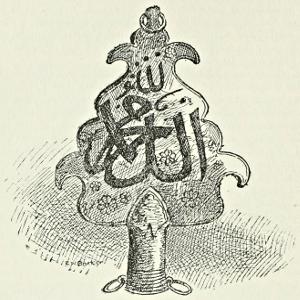
Part of a Saracen Standard
It was during this war that the Saracens inflicted the first great badge
of civil degradation on the Christian population of their dominions. Abdul-Malik
established the haratch, or Christian capitation tax, in order to raise
money to carry on the war with Justinian. This unfortunate mode of taxing
the Christian subjects of the caliph, in a different manner from the Mohammedans,
completely separated the two classes, and reduced the Christians to
the rank of serfs of the state, whose most prominent political relation with
the Mussulman community was that of furnishing money to the government.
The decline of the Christian population throughout the dominions of the
caliphs was the consequence of this ill-judged measure, which has probably
tended more to the depopulation of the East than all the tyranny and military
violence of the Mohammedan armies.
[692-695 A.D.]
The restless spirit of Justinian naturally plunged into the ecclesiastical
controversies which divided the church. He assembled a general council
called usually in Trullo, from the hall of its meeting having been covered
with a dome. The proceedings of this council, as might have been expected
from those of an assembly controlled by such a spirit as that of the emperor,
tended only to increase the growing differences between the Greek and
Latin parties in the church. Of 102 canons sanctioned by this council,
the pope finally rejected six, as adverse to the usages of the Latins. And
thus an additional cause of separation was permanently created between
the Greeks and Latins, and the measures of the church, as well as the
political arrangements of the times, and the social feelings of the people,
all tended to render union impossible.
A taste for building is a common fancy of sovereigns who possess the
absolute disposal of large funds without any feeling of their duty as trustees
for the benefit of the people whom they govern. Even in the midst of the
greatest public distress, the treasury of nations, on the very verge of ruin
and bankruptcy, must contain large sums of money drawn from the annual
taxation. This treasure, when placed at the irresponsible disposal of princes
who affect magnificence, is frequently employed in useless and ornamental
building; and this fashion has been so general with despots, that the princes
who have been most distinguished for their love of building, have not unfrequently
been the worst and most oppressive sovereigns. It is always a
delicate and difficult task for a sovereign to estimate the amount which a
nation can wisely afford to expend on ornamental architecture; and from
his position he is seldom qualified to judge correctly on what buildings
ornament ought to be employed in order to make art accord with the taste
and feelings of the people. Public opinion affords the only criterion for the
formation of a sound judgment on this department of public administration;
for, when princes possessing a taste for building are not compelled to consult
the wants and wishes of their subjects in the construction of national
edifices they are apt, by their wild projects and lavish expenditure, to create
evils far greater than any which could result from an exhibition of bad taste
alone.
In an evil hour the love of building took possession of Justinian’s mind.
His lavish expenditure soon obliged him to make his financial administration
more rigorous, and general discontent quickly pervaded the capital. The
religious and superstitious feelings of the population were severely wounded
by the emperor’s eagerness to destroy a church of the Virgin, in order to
embellish the vicinity of his palace with a splendid fountain. Justinian’s
own scruples required to be soothed by a religious ceremony, but the patriarch
for some time refused to officiate, alleging that the church had no
prayers to desecrate holy buildings. The emperor, however, was the head
of the church and the master of the bishops, whom he could remove from
office, so that the patriarch did not long dare to refuse obedience to his
orders. It is said, however, that the patriarch showed very clearly his dissatisfaction
by repairing to the spot and authorising the destruction of the
church by an ecclesiastical ceremony, to which he added these words, “to
God, who suffers all things, be rendered glory, now and forever. Amen.”
The ceremony was sufficient to satisfy the conscience of the emperor, who
perhaps neither heard nor heeded the words of the patriarch. The public
discontent was loudly expressed, and Justinian soon perceived that the fury
of the populace threatened a rebellion in Constantinople. To avert the
danger, he took every measure which unscrupulous cruelty could suggest;
but, as generally happens in periods of general discontent and excitement,
the storm burst in an unexpected quarter, and the hatred of Justinian left
him suddenly without support. Leontius, one of the ablest generals of the
empire, whose exploits have been already mentioned, had been thrown into
prison, but was at this time ordered to assume the government of the province
of Hellas. He considered the nomination as a mere pretext to remove
him from the capital, in order to put him to death at a distance without
any trial.
On the eve of his departure, Leontius placed himself at the head of a
sedition; Justinian was seized, and his ministers were murdered by the
populace with the most savage cruelty. Leontius was proclaimed emperor,
but he spared the life of his dethroned predecessor for the sake of the benefits
which he had received from Constantine Pogonatus. He ordered Justinian’s
nose to be cut off, and exiled him to Cherson. From this mutilation
the dethroned emperor received the insulting nickname of Rhinotmetus,
or “docknose,” by which he is distinguished in Byzantine history.
[695-698 A.D.]
The government of Leontius was characterised by the unsteadiness
which not unfrequently marks the administration of the ablest sovereigns
who obtain their thrones by accidental circumstances rather than by systematic
combinations. The most important event of his reign was the final
loss of Africa, which led to his dethronement. The indefatigable caliph
Abdul-Malik despatched a powerful expedition into Africa under Hassan;
the province was soon conquered, and Carthage was captured after a feeble
resistance. An expedition sent by Leontius to relieve the province arrived
too late to save Carthage, but the commander-in-chief forced the entrance
into the port, recovered possession of the city, and drove the Arabs from
most of the fortified towns on the coast. The Arabs constantly received new
reinforcements, which the Roman general demanded from Leontius in vain.
At last the Arabs assembled a fleet, and the Romans, being defeated in a
naval engagement, were compelled to abandon Carthage, which the Arabs
utterly destroyed,—having too often experienced the superiority of the
Romans, both in naval affairs and in the art of war, to venture on retaining
populous and fortified cities on the sea coast. This curious fact affords
strong proof of the great superiority of the Roman commerce and naval
resources, and equally powerful evidence of the shameful disorder in the
civil and military administration of the empire, which rendered these advantages
useless, and allowed the imperial fleets to be defeated by the naval
forces collected by the Arabs from among their Egyptian and Syrian subjects.
At the same time it is evident that the naval victories of the Arabs
could never have been gained unless a powerful party of the Christians had
been induced, by their feelings of hostility to the Roman Empire, to afford
them a willing support; for there were as yet neither shipbuilders nor
sailors among the Mussulmans.
The Roman expedition, on its retreat from Carthage, stopped in the
Island of Crete, where a sedition broke out among the troops, in which their
general was killed. Apsimar, the commander of the Cibyraiot troops, was
declared emperor by the name of Tiberius. The fleet proceeded directly to
Constantinople, which offered no resistance. Leontius was taken prisoner,
his nose cut off, and his person confined in a monastery. Tiberius Apsimar
governed the empire with prudence, and his brother Heraclius commanded
the Roman armies with success. The imperial troops penetrated into Syria;
a victory was gained over the Arabs at Samosata, but the ravages committed
by the Romans in this invasion surpassed the greatest cruelties ever inflicted
by the Arabs; for two hundred thousand Saracens are said to have perished
during the campaign. Armenia was alternately invaded and laid
waste by the Romans and the Saracens, as the various turns of war favoured
the hostile parties, and as the changing interests of the Armenian population
induced them to aid the emperor or the caliph. But while Tiberius
was occupied in the duties of government, and living without any fear of a
domestic enemy, he was suddenly surprised in his capital by Justinian, who
appeared before Constantinople at the head of a Bulgarian army (705).
[698-711 A.D.]
Ten years of exile had been spent by the banished emperor in vain
attempts to obtain power. His violent proceedings made him everywhere
detested, but he possessed the daring enterprise and the ferocious cruelty
necessary for a chief of banditti, joined to a singular confidence in the value
of his hereditary claim to the imperial throne; so that no undertaking
appeared to him hopeless. After quarrelling with the inhabitants of Cherson,
and with his brother-in-law, the king of the Khazars, he succeeded, by
a desperate exertion of courage, in reaching the country of the Bulgarians.
Terbelis, their sovereign, agreed to assist him in recovering his throne, and
they marched immediately with a Bulgarian army to the walls of Constantinople.
Three days after their arrival, they succeeded in entering the
capital during the night. Ten years of adversity had increased the natural
ferocity of Justinian’s disposition; and a desire of vengeance seems henceforward
to have been the chief motive of his actions.
The population of Constantinople had now sunk to the same degree of
barbarism as the nations surrounding them, and in cruelty they were worthy
subjects of their emperor. Justinian gratified them by celebrating his restoration
with splendid chariot races in the circus. He sat on an elevated
throne, with his feet resting on the necks of the dethroned emperors,
Leontius and Tiberius, who were stretched on the platform below, while
the Greek populace around shouted the words of the psalmist, “Thou shalt
tread down the asp and the basilisk, thou shalt trample on the lion and
the dragon.” The dethroned emperors and Heraclius, who had so well
sustained the glory of the Roman arms against the Saracens, were afterwards
hung from the battlements of Constantinople. Justinian’s whole
soul was occupied with plans of vengeance. Though the conquest of Tyana
laid open Asia Minor to the incursions of the Saracens, instead of opposing
them, he directed his disposable forces to punish the cities of Ravenna and
Cherson, because they had incurred his personal hatred. Both the proscribed
cities had rejoiced at his dethronement; they were both taken and treated with
savage cruelty. The Greek city of Cherson, though the seat of a flourishing
commerce, and inhabited by a numerous population, was condemned to utter
destruction. Justinian ordered all the buildings to be razed with the ground,
and every soul within its walls to be put to death; but the troops sent to
execute these barbarous orders revolted, and proclaimed an Armenian, called
Bardanes, emperor, under the name of Philippicus. Seizing the fleet, they
sailed directly to Constantinople.
Justinian was encamped with an army in Asia Minor when Philippicus
arrived, and took possession of the capital without encountering any resistance.
He was immediately deserted by his whole army, for the troops
were as little pleased with his conduct since his restoration, as was every
other class of his subjects; but his ferocity and courage never failed him,
and his rage was unbounded when he found himself abandoned by every
one. He was seized and executed, without having it in his power to offer
the slightest resistance. His son Tiberius, though only six years of age,
was torn from the altar of a church, to which he had been conducted for
safety, and cruelly massacred; and thus the race of Heraclius was extinguished,
after the family had governed the Roman Empire for exactly a
century (610 to 711 A.D.).
[711-717 A.D.]
During the interval of six years which elapsed from the death of Justinian
II to the accession of Leo the Isaurian, the imperial throne was occupied
by three sovereigns. Their history is only remarkable as proving the
inherent strength of the Roman body politic, which could survive such continual
revolutions, even in the state of weakness to which it was reduced.
Philippicus was a luxurious and extravagant prince, who thought only of
enjoying the situation which he had accidentally obtained. He was soon
dethroned by a band of conspirators, who carried him off from the palace
while in a fit of drunkenness, and after putting out his eyes, left him helpless
in the middle of the hippodrome. The reign of Philippicus would hardly
deserve notice, had he not increased the confusion into which the empire had
fallen, and exposed the total want of character and conscience among the
Greek clergy, by re-establishing the monothelite doctrines in a general council
of the Eastern bishops.
As the conspirators who had dethroned Philippicus had not formed any
plan for choosing his successor, the first secretary of state was elected
emperor by a public assembly held in the great church of St. Sophia, under
the name of Anastasius II. He immediately re-established the orthodox
faith, and his character is consequently the subject of eulogy with the historians
of his reign. The Saracens, whose power was continually increasing,
were at this time preparing a great expedition at Alexandria, in order
to attack Constantinople. Anastasius sent a fleet with the troops of the
theme Opsicium, to destroy the magazines of timber collected on the coast
of Phœnicia for the purpose of assisting the preparations at Alexandria.
The Roman armament was commanded by a deacon of St. Sophia, who
also held the office of grand treasurer of the empire. The nomination of a
member of the clergy to command the army gave great dissatisfaction to the
troops, who were not yet so deeply tinctured with ecclesiastical ideas and
manners, as the aristocracy of the empire. A sedition took place while
the army lay at Rhodes; Joannes the Deacon was slain, and the expedition
quitted the port in order to return to the capital. The soldiers on their
way landed at Adramyttium, and finding there a collector of the revenues
of a popular character, they declared him emperor, under the name of
Theodosius III.
The new emperor was compelled unwillingly to follow the army. For
six months, Constantinople was closely besieged, and the emperor Anastasius,
who had retired to Nicæa, was defeated in a general engagement. The
capital was at last taken by the rebels, who were so deeply sensible of their
real interests, that they maintained strict discipline, and Anastasius, whose
weakness gave little confidence to his followers, consented to resign the
empire to Theodosius, and to retire into a monastery, that he might secure
an amnesty to all his friends. Theodosius was distinguished by many good
qualities, but on the throne he proved a perfect cipher, and his reign is only
remarkable as affording a pretext for the assumption of the imperial dignity
by Leo III, called the Isaurian. This able and enterprising officer, perceiving
that the critical times rendered the empire the prize of any man
who had talents to seize, and power to defend it, placed himself at the
head of the troops in Asia Minor, assumed the title of emperor, and soon
compelled Theodosius to quit the throne and become a priest.
During the period which elapsed between the death of Heraclius and the
accession of Leo, the few remains of Roman principles of administration
which had lingered in the imperial court, were gradually extinguished.
The long-cherished hope of restoring the ancient power and glory of the
Roman Empire expired, and even the aristocracy, which always clings the last
to antiquated forms and ideas, no longer dwelt with confidence on the memory
of former days. The conviction that the empire had undergone a great
moral and political change, which severed the future irrevocably from the
past, though it was probably not fully understood, was at least felt and
acted on both by the people and the government. The sad fact that the
splendid light of civilisation which had illuminated the ancient world had
now become as obscure at Constantinople as at Rome, Antioch, Alexandria,
and Carthage was too evident to be longer doubted; the very twilight of
antiquity had faded into darkness. It is rather, however, the province
of the antiquary than of the historian to collect all the traces of this truth
scattered over the records of the seventh century.
The disorganisation of the Roman government at this period, and the
want of any influence over the court by the Greek nation, are visible in the
choice of the persons who occupied the imperial throne after the extinction
of the family of Heraclius. They were selected by accident, and several
were of foreign origin, who did not even look upon themselves as either
Greeks or Romans. Philippicus was an Armenian, and Leo III, whose
reign opens a new era in Eastern history, was an Isaurian. On the throne
he proved that he was destitute of any attachment to Roman political
institutions, and any respect for the Greek ecclesiastical establishment. It
was by the force of his talents, and by his able direction of the state and of
the army, that he succeeded in securing his family on the Byzantine throne;
for he unquestionably placed himself in direct hostility to the feelings and
opinions of his Greek and Roman subjects, and transmitted to his successors
a contest between the imperial power and the Greek nation concerning
picture worship, in which the very existence of Greek nationality, civilisation,
and religion, became at last compromised. From the commencement
of the iconoclastic contest, the history of the Greeks assumes a new aspect.
Their civilisation, and their connection with the Byzantine Empire, become
linked with the policy and fortunes of the Eastern church, and ecclesiastical
affairs obtain a supremacy over all social and political considerations in
their minds.
The geographical extent of the empire at the time of its transition from
the Roman to the Byzantine Empire affords evidence of the influence which
the territorial changes produced by the Saracen conquests exercised in
conferring political importance on the Greek race. The frontier towards
the Saracens of Syria commenced at Mopsuestia in Cilicia, the last fortress
of the Arab power. It ran along the chains of mounts Amanus and Taurus
to the mountainous district to the north of Edessa and Nisibis, called, after
the time of Justinian, the Fourth Armenia, of which Martyropolis was the
capital. It then followed nearly the ancient limits of the empire until it
reached the Black Sea, a short distance to the east of Trebizond. On the
northern shores of the Euxine, Cherson was now the only city that acknowledged
the supremacy of the empire, retaining at the same time all its wealth
and commerce, with the municipal privileges of a free city. In Europe,
Mount Hæmus formed the barrier against the Bulgarians, while the mountainous
ranges which bound Macedonia to the northwest, and encircle the
territory of Dyrrhachium, were regarded as the limits of the free Slavonian
states. It is true that large bodies of Slavonians had penetrated to the
south of this line, and lived in Greece and Peloponnesus, but not in
the same independent condition with reference to the imperial administration
as their northern brethren of the Servian family.
Istria, Venice, and the cities on the Dalmatian coast, still acknowledged
the supremacy of the empire, though their distant position, their commercial
connections, and their religious feelings, were all tending towards a final
separation. In the centre of Italy, the exarchate of Ravenna still held
Rome in subjection, but the people of Italy were entirely alienated from
the political administration, which was now regarded by them as purely
Greek, and the Italians, with Rome before their eyes, could hardly admit
the pretensions of the Greeks to be regarded as the legitimate representatives
of the Roman Empire. The loss of northern and central Italy was
consequently an event in constant danger of occurring; it would have
required an able and energetic and just government to have repressed the
national feelings of the Italians, and conciliated their allegiance. The condition
of the population of the south of Italy and of Sicily was very different.
There the majority of the inhabitants were Greeks in language and manners;
but at this time the cities of Gæta (Caieta), Naples (Neapolis), Amalfi, and
Sorrento (Surrentum), the district of Otranto, and the peninsula to the south
of the ancient Sybaris, now called Calabria, were the only parts which remained
under the Byzantine government. Sicily, though it had begun to
suffer from the incursions of the Saracens, was still populous and wealthy.
Sardinia, the last possession of the Greeks to the westward of Italy, was
conquered by the Saracens about this time (711 A.D.).c
With the accession of Leo the Isaurian to the throne of Constantinople
a new era opens in the history of the Eastern Empire. The progress of
society had been deliberately opposed by imperial legislation. The legislators
of the empire were persuaded that each order and profession of its citizens
should be fixed by hereditary succession, and an attempt had been made
to divide the population into castes. But the political laws not only impoverished
but depopulated the empire, and threatened the dissolution of the
very elements of society. Under their operation the Western Empire became
the prey of the smaller northern nations, and the Eastern Empire was on the
verge of being overrun by the Saracen invaders.a
Leo III mounted the throne, and under his government the empire not
only ceased to decline, but even began to regain much of its early vigour.
Reformed modifications of the old Roman authority developed new energy
in the empire. Great political reforms, and still greater changes in the condition
of the people, mark the eighth century as an epoch of transition.
When Leo III was proclaimed emperor, it seemed as if no human power
could save Constantinople from falling as Rome had fallen. The Saracens
considered the sovereignty of every land in which any remains of Roman
civilisation survived, as within their grasp. Leo, an Isaurian,[42] and an iconoclast,
consequently a foreigner and a heretic, ascended the throne of Constantine,
and arrested the victorious career of the Mohammedans. He then
reorganised the whole administration so completely in accordance with the
new exigencies of Eastern society, that the reformed empire outlived for
many centuries every government contemporary with its establishment.
The Eastern Roman Empire, thus reformed, is called by modern historians
the Byzantine Empire; and the term is well devised to mark the
changes effected in the government, after the extinction of the last traces of
the military monarchy of ancient Rome. The social condition of the inhabitants
of the Eastern Empire had already undergone a considerable change
during the century which elapsed from the accession of Heraclius to that of
Leo.
This change created a new phase in the Roman Empire. The gradual
progress of this change has led some writers to date the commencement of
the Byzantine Empire as early as the reigns of Zeno and Anastasius, and
others to descend so late as the times of Maurice and Heraclius.[43] But as the
Byzantine Empire was only a continuation of the Roman government under
a reformed system, it seems most correct to date its commencement from the
period when the new social and political modifications produced a visible
effect on the fate of the Eastern Empire. This period is marked by the
accession of Leo the Isaurian.
The administrative system of Rome, as modified by Constantine, continued
in operation, though subjected to frequent reforms, until Constantinople
was stormed by the crusaders, and the Greek church enslaved by papal
domination. The general council of Nicæa, and the dedication of the imperial
city, with their concomitant legislative, administrative, and judicial institutions,
engendered a succession of political measures, whose direct relations
were uninterrupted until terminated by foreign conquest. The government
of Great Britain has undergone greater changes during the last three centuries
than that of the Eastern Empire during the nine centuries which elapsed
from the foundation of Constantinople in 330, to its conquest in 1204.
Yet Leo III has strong claims to be regarded as the first of a new series
of emperors. He was the founder of a dynasty, the saviour of Constantinople,
and the reformer of the church and state. He was the first Christian
sovereign who arrested the torrent of Mohammedan conquest; he improved
the condition of his subjects; he attempted to purify their religion from the
superstitious reminiscences of Hellenism, with which it was still debased,
and to stop the development of a quasi-idolatry in the orthodox church.
Nothing can prove more decidedly the right of his empire to assume a new
name than the contrast presented by the condition of its inhabitants to that
of the subjects of the preceding dynasty. Under the successors of Heraclius,
the Roman Empire presents the spectacle of a declining society, and its
thinly peopled provinces were exposed to the intrusion of foreign colonists
and hostile invaders. But, under Leo, society offers an aspect of improvement
and prosperity; the old population revives from its lethargy, and soon
increases, both in number and strength, to such a degree as to drive back all
intruders on its territories. In the records of human civilisation, Leo the
Isaurian must always occupy a high position, as a type of what the central
power in a state can effect even in a declining empire.
Thus after the accession of Leo III, a new condition of society is apparent;
and though many old political evils continued to exist, it becomes evident
that a greater degree of personal liberty, as well as greater security for
property, was henceforth guaranteed to the mass of the inhabitants of the
empire. Indeed, no other government of which history has preserved the
records, unless it be that of China, has secured equal advantages to its subjects
for so long a period. The empires of the caliphs and of Charlemagne,
though historians have celebrated their praises loudly, cannot, in their best
days, compete with the administration organised by Leo on this point; and
both sank into ruin while the Byzantine Empire continued to flourish in full
vigour. It must be confessed that eminent historians present a totally different
picture of Byzantine history to their readers. Voltaire speaks of it
as a worthless repertory of declamation and miracles, disgraceful to the
human mind. Even the sagacious Gibbon,g after enumerating with just
pride the extent of his labours, adds: “From these considerations, I should
have abandoned without regret the Greek slaves and their servile historians,
had I not reflected that the fate of the Byzantine monarchy is passively
connected with the most splendid and important revolutions which have
changed the state of the world.”
The history of the Byzantine Empire divides itself into three periods,
strongly marked by distinct characteristics.
The first period commences with the reign of Leo III in 716, and terminates
with that of Michael III in 867. It comprises the whole history of
the predominance of the iconoclasts in the established church, and of the
reaction which reinstated the orthodox in power. It opens with the efforts
by which Leo and the people of the empire saved the Roman law and the
Christian religion from the conquering Saracens. It embraces a long and
violent struggle between the government and the people, the emperors seeking
to increase the central power by annihilating every local franchise, and
even the right of private opinion, among their subjects. The contest concerning
image worship, from the prevalence of ecclesiastical ideas, became
the expression of this struggle. Its object was as much to consolidate the
supremacy of the imperial authority, as to purify the practice of the church.
The emperors wished to constitute themselves the fountains of ecclesiastical
as completely as of civil legislation.
The long and bloody wars of this period, and the vehement character of
the sovereigns who filled the throne, attract the attention of those who love
to dwell on the romantic facts of history. Unfortunately, the biographical
sketches and individual characters of the heroes of these ages lie concealed
in the dullest chronicles. But the true historical feature of this memorable
period is the aspect of a declining empire, saved by the moral vigour developed
in society, and of the central authority struggling to restore national
prosperity. Never was such a succession of able sovereigns seen following
one another on any other throne. The stern iconoclast, Leo the Isaurian,
opens the line as the second founder of the Eastern Empire. His son, the
fiery Constantine, who was said to prefer the odour of the stable to the perfumes
of his palaces, replanted the Christian standards on the banks of the
Euphrates. Irene, the beautiful Athenian, presents a strange combination
of talent, heartlessness, and orthodoxy. The finance minister, Nicephorus,
perishes on the field of battle like an old Roman. The Armenian Leo falls
at the altar of his private chapel, murdered as he is singing psalms with his
deep voice, before day-dawn. Michael the Amorian, who stammered Greek
with his native Phrygian accent, became the founder of an imperial dynasty,
destined to be extinguished by a Slavonian groom. The accomplished Theophilus
lived in an age of romance, both in action and literature. His son,
Michael, the last of the Amorian family, was the only contemptible prince
of this period, and he was certainly the
most despicable buffoon that ever occupied
a throne.
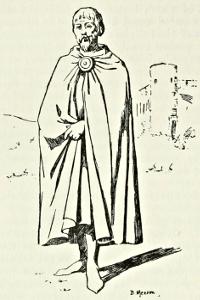
A Byzantine Peasant
The second period commences with
the reign of Basil I in 867, and terminates
with the deposition of Michael VI
in 1057. During two centuries the imperial
sceptre was retained by members
of the Basilian family, or held by those
who shared their throne as guardians
or husbands. At this time the Byzantine
Empire attained its highest pitch
of external power and internal prosperity.
The Saracens were pursued into
the plains of Syria. Antioch and Edessa
were reunited to the empire. The Bulgarian
monarchy was conquered, and
the Danube became again the northern
frontier. The Slavonians in Greece
were almost exterminated. Byzantine
commerce filled the whole Mediterranean,
and legitimated the claim of the
emperor of Constantinople to the title
of “autocrat of the Mediterranean Sea.”
But the real glory of this period consists
in the power of the law. Respect for
the administration of justice pervaded
society more generally than it had ever done at any preceding period of the
history of the world—a fact which seems to have been completely overlooked
by some of our greatest historians, though it is all-important in the
history of human civilisation.
The third period extends from the accession of Isaac I (Comnenus) in
1057, to the conquest of the Byzantine Empire by the crusaders, in 1204.
This is the true period of decline and fall of the Eastern Empire. It commenced
by a rebellion of the great nobles of Asia, who effected an internal
revolution in the Byzantine Empire by wrenching the administration out
of the hands of well-trained officials, and destroying the responsibility
created by a systematic procedure. A despotism supported by personal
influence soon ruined the scientific fabric which had previously upheld the
imperial power. The people were ground to the earth by a fiscal rapacity,
over which the splendour of the house of Comnenus throws a thin veil.
The wealth of the empire was dissipated, its prosperity destroyed, the administration
of justice corrupted, and the central authority lost all control
over the population, when a band of 20,000 adventurers, masked as crusaders,
put an end to the Roman Empire of the East.
When Leo was raised to the throne, the empire was threatened with
immediate ruin. Six emperors had been dethroned within the space of
twenty-one years. Of these, four perished by the hand of the public
executioner, one died in obscurity, after being deprived of sight, and the
other was only allowed to end his days peacefully in a monastery because
Leo felt the imperial sceptre firmly fixed in his own grasp. Every army
assembled to encounter the Saracens had broken out into rebellion. The
Bulgarians and Slavonians wasted Europe up to the walls of Constantinople;
the Saracens ravaged the whole of Asia Minor to the shores of the
Bosporus.
Amorium was the principal city of the theme Anatolicum. The caliph
Suleiman had sent his brother, Moslemah, with a numerous army, to complete
the conquest of the Roman Empire, which appeared to be an enterprise
of no extraordinary difficulty, and Amorium was besieged by the Saracens.
Leo, who commanded the Byzantine troops, required some time to concert
the operations by which he hoped to raise the siege. To gain the necessary
delay, he opened negotiations with the invaders, and, under the pretext
of hastening the conclusion of the treaty, he visited the Saracen general
engaged in the siege with an escort of only five hundred horse. The Saracens
were invited to suspend their attacks until the decision of Moslemah,
who was at the head of another division of the Mohammedan army, could
be known.
In an interview which took place with the bishop and principal inhabitants
of Amorium, relating to the proffered terms, Leo contrived to exhort
them to continue their defence, and assured them of speedy succour. The
besiegers, nevertheless, pressed forward their approaches. Leo, after his
interview with the Amorians, proposed that the Saracen general should
accompany him to the headquarters of Moslemah. The Saracen readily
agreed to an arrangement which would enable him to deliver so important
a hostage to the commander-in-chief. The wary Isaurian, who well
knew that he would be closely watched, had made his plan of escape. On
reaching a narrow defile, from which a cross-road led to the advanced posts
of his own army, Leo suddenly drew his sabre and attacked the Saracens
about his person; while his guards, who were prepared for the signal, easily
opened a way through the two thousand hostile cavalry of the escort, and all
reached the Byzantine camp in safety. Leo’s subsequent military dispositions
and diplomatic negotiations induced the enemy to raise the siege of
Amorium, and the grateful inhabitants united with the army in saluting him
emperor of the Romans. But in his arrangements with Moslemah, he is
accused by his enemies of having agreed to conditions which facilitated the
further progress of the Mohammedans, in order to secure his own march to
Constantinople. On this march he was met by the son of Theodosius III,
whom he defeated. Theodosius resigned his crown, and retired into a monastery;[44]
while Leo made his triumphal entry into the capital by the Golden
Gate, and was crowned by the patriarch in the church of Sophia on the 25th
of March, 717.
The position of Leo continued to be one of extreme difficulty. The
caliph Suleiman, who had seen one private adventurer succeed the other
in quick succession on the imperial throne, deemed the moment favourable
for the final conquest of the Christians; and, reinforcing his brother’s army,
he ordered him to lay siege to Constantinople. The Saracen Empire had
now reached its greatest extent. From the banks of the Sihun and the
Indus to the shores of the Atlantic in Mauretania and Spain, the orders
of Suleiman were implicitly obeyed. The recent conquests of Spain in
the West, and of Fergana, Kashgar, and Sind in the East, had animated
the confidence of the Mohammedans to such a degree that no enterprise
appeared difficult. The army Moslemah led against Constantinople was
the best-appointed that had ever attacked the Christians; it consisted of
eighty thousand warriors. The caliph announced his intention of taking
the field in person with additional forces, should the capital of the Christians
offer a protracted resistance to the arms of Islam. The whole expedition is
said to have employed 180,000 men; and the number does not appear to be
greatly exaggerated, if it be supposed to include the sailors of the fleet and
the reinforcements which reached the camp before Constantinople.
[717-718 A.D.]
Moslemah, after capturing Pergamus, marched to Abydos, where he was
joined by the Saracen fleet. He then transported his army across the Hellespont,
and, marching along the shore of the Propontis, invested Leo in
his capital both by land and sea.[45] The strong walls of Constantinople, the
engines of defence with which Roman and Greek art had covered the ramparts,
and the skill of the Byzantine engineers, rendered every attempt to
carry the place by assault hopeless, so that the Saracens were compelled
to trust to the effect of a strict blockade for gaining possession of the city.
They surrounded their camp with a deep ditch, and strengthened it with a
strong dike. Moslemah then sent out large detachments to collect forage
and destroy the provisions which might otherwise find their way into the
besieged city. The presence of an active enemy and a populous city required
constant vigilance on the part of a great portion of his land forces.
The Saracen fleet consisted of eighteen hundred vessels of war and transports.
In order to form the blockade, it was divided into two squadrons;
one was stationed on the Asiatic coast, in the ports of Eutropius and Anthimus,
to prevent supplies arriving from the Archipelago; the other occupied
the base in the European shore of the Bosporus above the point of Galata, in
order to cut off all communication with the Black Sea and the cities of Cherson
and Trebizond. The first naval engagement took place as the fleet was
taking up its position within the Bosporus. The current, rendered impetuous
by a change of wind, threw the heavy ships and transports into confusion.
The besieged directed some fire-ships against the crowded vessels,
and succeeded in burning several, and driving others on shore under the walls
of Constantinople. The Saracen admiral, Suleiman, confident in the number
of his remaining ships of war, resolved to avenge his partial defeat by a complete
victory. He placed one hundred chosen Arabs, in complete armour,
in each of his best vessels, and, advancing to the walls of Constantinople,
made a vigorous attempt to enter the place by assault, as it was entered long
after by Doge Dandolo. Leo was well prepared to repulse the attack, and,
under his experienced guidance, the Arabs were completely defeated. A number
of the Saracen ships were burned by the Greek fire which the besieged
launched from their walls. After this defeat, Suleiman withdrew the European
squadron of his fleet into the Sosthenian bay.
The besiegers encamped before Constantinople on the 15th of August,
717. The caliph Suleiman[46] died before he was able to send any reinforcements
to his brother. The winter proved unusually severe. The country all round
Constantinople remained covered with deep snow for many weeks. The
greater part of the horses and camels in the camp of Moslemah perished;
numbers of the best soldiers, accustomed to the mild winters of Syria, died
from having neglected to take the requisite precautions against a northern
climate. The difficulty of procuring food ruined the discipline of the troops.
These misfortunes were increased by the untimely death of the admiral, Suleiman.
In the meantime, Leo and the inhabitants of Constantinople, having
made the necessary preparations for a long siege, passed the winter in security.
A fleet, fitted out at Alexandria, brought supplies to Moslemah in the
spring. Four hundred transports, escorted by men-of-war, sailed past Constantinople,
and, entering the Bosporus, took up their station at Kalos Agros.
Another fleet, almost equally numerous, arrived soon after from Africa, and
anchored in the bays on the Bithynian coast. These positions rendered the
current a protection against the fire-ships of the garrison of Constantinople.
The crews of the new transports were in great part composed of Christians,
and the weak condition of Moslemah’s army filled them with fear. Many
conspired to desert. Seizing the boats of their respective vessels during the
night, numbers escaped to Constantinople, where they informed the emperor
of the exact disposition of the whole Saracen force. Leo lost no time in taking
advantage of the enemy’s embarrassments. Fire-ships were sent with a
favourable wind among the transports, while ships of war, furnished with
engines for throwing Greek fire, increased the confusion. This bold attack
was successful, and a part of the naval force of the Saracens was destroyed.
Some ships fell a prey to the flames, some were driven on shore, and some
were captured by the Byzantine squadron.
The blockade was now at an end, for Moslemah’s troops were dying from
want, while the besieged were living in plenty; but the Saracen obstinately
persisted in maintaining possession of his camp in Europe. It was not until
his foraging parties were repeatedly cut off, and all the beasts of burden were
consumed as food, that he consented to allow the standard of the prophet to
retreat before the Christians. The remains of his army were embarked in
the relics of the fleet, and on the 15th of August, 718, Moslemah raised the
siege, after ruining one of the finest armies the Saracens ever assembled, by
obstinately persisting in a hopeless undertaking. The troops were landed
at Proconnesus, and marched back to Damascus, through Asia Minor; but
the fleet encountered a violent storm in passing through the Archipelago.
The dispersed ships were pursued by the Greeks of the islands, and so many
were lost or captured that only five of the Syrian squadron returned home.
[718-739 A.D.]
Few military details concerning Leo’s defence of Constantinople have
been preserved, but there can be no doubt that it was one of the most brilliant
exploits of a warlike age.
The vanity of Gallic writers has magnified the success of Charles Martel
over a plundering expedition of the Spanish Arabs into a marvellous victory,
and attributed the deliverance of Europe from the Saracen yoke to the valour
of the Franks. A veil has been thrown over the talents and courage of Leo,
a soldier of fortune, just seated on the imperial throne, who defeated the
long-planned schemes of conquest of the caliphs Welid and Suleiman. It is
unfortunate that we have no Isaurian literature.n
The world-historical importance of this event cannot be too highly
esteemed. The Arabian onslaught had reached its climax. Byzantium, and
its emperor who had thrown it off, had rescued Christianity and Western
civilisation. Still to-day in the Acathistus-hymn the orthodox church thanks
the three great heroes Heraclius, Constantine IV, and Leo III for the rescues
from the Avara, the Persian, and the Arab dangers.d
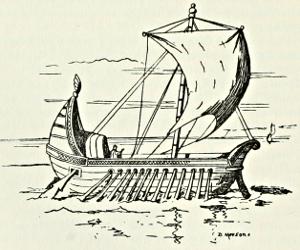
An Eighth Century Galley
The catastrophe of Moslemah’s army, and the state of the caliphate during
the reigns of Omar II and Yazid II, relieved the empire from all immediate
danger, and Leo was enabled to pursue his schemes for reorganising
the army and defending his dominions against future invasions. The war
was languidly carried on for some years, and the Saracens were gradually
expelled from most of their conquests beyond Mount Taurus. In the year
726, Leo was embarrassed by seditions and rebellions, caused by his decrees
against image-worship. Hisham seized the opportunity, and sent two
powerful armies to invade the empire. Cæsarea was taken by Moslemah;
while another army, under Moawyah, pushing forward, laid siege to Nicæa.
Leo was well pleased to see the Saracens consume their resources in attacking
a distant fortress; but though they were repulsed before Nicæa, they
retreated without serious loss, carrying off immense plunder. The plundering
excursions of the Arabs were frequently renewed by land and sea. In
one of these expeditions, the celebrated Sid-al-Battal carried off an individual
who was set up by the Saracens as a pretender to the Byzantine throne,
under the pretext that he was Tiberius, the son of Justinian II. Two sons
of the caliph appeared more than once at the head of the invading armies.
In the year 739 the Saracen forces poured into Asia Minor in immense numbers,
with all their early
energy. Leo, who had
taken the command of the
Byzantine army, accompanied
by his son Constantine,
marched to meet
Sid-al-Battal, whose great
fame rendered him the
most dangerous enemy.
A battle took place at
Acroinon, in the Anatolic
theme, in which the Saracens
were totally defeated.
The valiant Sid, the most
renowned champion of Islamism,
perished on the
field; but the fame of his
exploits has filled many
volumes of Moslem romance,
and furnished
some of the tales that have adorned the memory of the Cid of Spain, three
hundred years after the victory of Leo. The Western Christians have robbed
the Byzantine Empire of its glory in every way. After this defeat the Saracen
power ceased to be formidable to the empire, until the energy of the
caliphate was revived by the vigorous administration of the Abbassides, who
succeeded the Omayyads in 750.
Leo’s victories over the Mohammedans were an indispensable step to the
establishment of his personal authority. But the measures of administrative
wisdom which rendered his reign a new era in Roman history, are its most
important feature in the annals of the human race.
[726-729 A.D.]
The whole policy of Leo’s reign has been estimated by his ecclesiastical
reforms. These have been severely judged by all historians, and they
appear to have encountered a violent opposition from a large portion of his
subjects. The general dissatisfaction has preserved sufficient authentic information
to allow of a candid examination of the merits and errors of his
policy.
Leo commenced his ecclesiastical reforms in the year 726, by an edict
ordering all pictures in churches to be placed so high as to prevent the people
from kissing them,[47] and prohibiting prostration before these symbols, or any
act of public worship being addressed to them. Against this moderate edict
of the emperor, the patriarch Germanus and the pope Gregory II made
strong representations. The despotic principles of Leo’s administration, and
the severe measures of centralisation which he enforced as the means of
reorganising the public service, created many additional enemies to his government,
as is hereafter more fully shown.
The rebellion of the inhabitants of Greece, which occurred in the year
727, seems to have originated in a dissatisfaction with the fiscal and administrative
reforms of Leo, to which local circumstances, unnoticed by historians,
gave peculiar violence, and which the edict against image-worship fanned
into a flame. The unanimity of all classes, and the violence of the popular
zeal in favour of their local privileges and superstitions, suggested the hope
of dethroning Leo, and placing a Greek on the throne of Constantinople. A
naval expedition, composed of the imperial fleet in the Cyclades, and attended
by an army from the continent, was fitted out to attack the capital. Agallianus,
who commanded the imperial forces stationed to watch the Slavonians
settled in Greece, was placed at the head of the army destined to assail the
conqueror of the Saracens. The name of the new emperor was Cosmas. In
the month of April the Greek fleet appeared before Constantinople. It soon
appeared that the Greeks, confiding in the goodness of their cause, had
greatly overrated their own valour and strength, or strangely overlooked
the resources of the iconoclasts. Leo met the fleet as it approached his
capital, and completely defeated it. Agallianus, with the spirit of a hero,
when he saw the utter ruin of the enterprise, plunged fully armed into the
sea rather than surrender. Cosmas was taken prisoner, with another leader,
and immediately beheaded. Leo, however, treated the mass of the prisoners
with mildness.
The opposition Leo encountered only confirmed him in his persuasion
that it was indispensably necessary to increase the power of the central government
in the provinces. As he was sincerely attached to the opinions of
the iconoclasts, he was led to connect his ecclesiastical reforms with his political
measures, and to pursue both with additional zeal. In order to secure
the active support of all the officers of the administration, and exclude all
image-worshippers from power, he convoked an assembly, called a silentium,
consisting of the senators and the highest functionaries in the church and
state. In this solemn manner it was decreed that images were to be removed
from all the churches throughout the empire.
[729-751 A.D.]
Gregory II sent Leo strong representations against his first edicts on the
subject of image-worship, and after the silentium he repeated these representations,
and entered on a more decided course of opposition to the emperor’s
ecclesiastical reforms, being then convinced that there was no hope of Leo
abandoning his heretical opinions. It seems that Italy, like the rest of the
empire, had escaped in some degree from the oppressive burden of imperial
taxation during the anarchy that preceded Leo’s election. But the defeat
of the Saracens before Constantinople had been followed by the re-establishment
of the fiscal system. To overcome the opposition now made to the
financial and ecclesiastical reforms, the exarch Paul was ordered to march to
Rome and support Marinus, the duke, who found himself unable to contend
against the papal influence.
The whole of central Italy burst into rebellion at this demonstration
against its civil and religious interests. The exarch was compelled to shut
himself up in Ravenna; for the cities of Italy, instead of obeying the imperial
officers, elected magistrates of their own, on whom they conferred, in some
cases, the title of duke. Assemblies were held, and the project of electing
an emperor of the West was adopted; but the unfortunate result of the
rebellion of Greece damped the courage of the Italians; and though a rebel,
named Tiberius Petasius, really assumed the purple in Tuscany, he was
easily defeated and slain by Eutychius, who succeeded Paul as exarch of
Ravenna. Liutprand, king of the Lombards, taking advantage of these dissensions,
invaded the imperial territory, and gained possession of Ravenna;
but Gregory, who saw the necessity of saving the country from the Lombards
and from anarchy, wrote to Ursus the duke of Venice, one of his
warm partisans, and persuaded him to join Eutychius. The Lombards were
defeated by the Byzantine troops, Ravenna was recovered, and Eutychius
entered Rome with a victorious army. Gregory died in 731. Though he
excited the Italian cities to resist the imperial power, and approved of the
measures they adopted for stopping the remittance of their taxes to Constantinople,
he does not appear to have adopted any measures for declaring
Rome independent.
From 733 A.D., the city of Rome enjoyed political independence under
the guidance and protection of the popes; but the officers of the Byzantine
emperors were allowed to reside in the city, justice was publicly administered
by Byzantine judges, and the supremacy of the Eastern Empire was still
recognised. So completely, however, had Gregory III thrown off his allegiance,
that he entered into negotiations with Charles Martel, in order to
induce that powerful prince to take an active part in the affairs of Italy.
The pope was now a much more powerful personage than the exarch of
Ravenna, for the cities of central Italy, which had assumed the control of
their local government, entrusted the conduct of their external political relations
to the care of Gregory, who thus held the balance of power between
the Eastern emperor and the Lombard king. In the year 742, while Constantine
V, the son of Leo, was engaged with a civil war, the Lombards
were on the eve of conquering Ravenna, but Pope Zacharias threw the whole
of the Latin influence into the Byzantine scale, and enabled the exarch to
maintain his position until the year 751, when Aistulf, king of the Lombards,
captured Ravenna. The exarch retired to Naples, and the authority
of the Byzantine emperors in central Italy ended.n
Leo III died in 741.[48] He was succeeded by his son Constantine V, called
Copronymus, whom he had crowned emperor in the year 720, and married
to Irene, the daughter of the khan of the Khazars, thirteen years later.
Before proceeding with the later reigns, we must pause to consider that
great and bloody controversy which brought Christianity into contempt as
idolatrous before the Mohammedans, and split the church, or rather split
the laity from the church. It was the laity which was non-idolatrous; it
was the church that clung to the sanctity and active power of images and
even of relics. The subject is considered at more length under the history
of the papacy, but cannot be omitted here, since it had its rise in that
enlightened and fearless Leo Isauricus, who dared to be consistent even to
the point of barbarity.a
[717-723 A.D.]
Since the twelfth year of the Hegira (634 A.D.) the hand of Ishmael had
lain heavily on the world, nevertheless the rod of the taskmaster had in
certain respects been useful to the Byzantine Empire, especially in the interior.
Senseless despotism, careless dissimulation, and utter incompetence
could not assert themselves for long on the throne. This resulted in a
succession of brave soldiers ascending the throne—Byzantine autocrats
since the time of Islam had on an average really been stronger than their
predecessors—and in the reigning families rapidly detaching themselves.
When one or the other dynasty tended to the Merovingian type, it only lasted
for a short time. Amongst the families which under Islam wore the crown of
Byzantium, the one founded by Leo Isauricus (717-741) occupied a prominent
position; after Justinian it was second in the order of Byzantine dynasties.
Leo Isauricus, a man of humble birth, who rose from the rank of a common
soldier to that of a general, and his son Constantine V on whom party
feeling bestowed the opprobrious nickname of Copronymus, were brave men,
but they reduced the church and the people to servitude as their predecessors
had done, and perhaps even more ruthlessly, as is proved by their iconoclastic
proceedings. Certainly in the beginning of the agitation now in question,
they were not wanting in a motive which appeared just, and perhaps was
so for a time. In consequence of the terrible oppression exercised by the
government authorities, and the spiritual stagnation which generally arises
from this source, the Byzantine nation had grown accustomed to superficiality
in religion and, as a consequence, to a worship of images which reached a
point at which Christianity seemed about to sink back into Hellenism.
On this important matter, which was frequently a source of great danger
in the course of the century, Pope Gregory I established an unalterable rule.
Bishop Serenus of Massilia (Marseilles), having observed that many of his
parishioners worshipped the images which had been brought into the cathedral,
cast them out and destroyed them. Gregory I commended the zeal with
which Serenus had forbidden divine honours to be paid to the work of human
hands, but at the same time censured him for having destroyed the images.
He also referred to the reason given by other Fathers before him, and by
Paulinus of Nola in particular; he writes, “the churches are decorated with
images so that those who do not know the alphabet may see represented on
the wall that which they cannot read in the Scriptures.”
This is the rule of the Catholic church—the places of worship must be
decorated and these decorations respected. Woe betide him who lays hands
on them. But the image must not be mistaken for that which it represents,
it must not be treated as a thing divine. But according to reliable proofs still
extant, the Greeks of the eighth and ninth centuries did not confine themselves
within these limits; they became iconodules, as the majority of them
remain to this day.
[723-729 A.D.]
The abuse just referred to aroused the calculating ambition of a very
powerful and hostile neighbour, according to the chronicler Theophanes.
The caliph Yazid II, son of Abdul-Malik (720-724), successor to Omar II,
issued a decree that all images should be forcibly removed
from the Christian churches of his empire.
This occurred in 723, three years before Leo Isauricus
first prohibited the use of them. Up to that time
the Moslem ruler had not interfered in the worship
of his Christian subjects, who had enjoyed without
molestation the same privileges as the Jews. The
conduct of Yazid, on the contrary, gave rise to the
idea that henceforth the caliphs would treat iconolatry
as idolatry, and that those who adhered to the practice
would fall under his displeasure, whether within or
beyond the dominions of the caliphate. The above
command therefore contained a hidden declaration of
war against the Byzantine Empire.
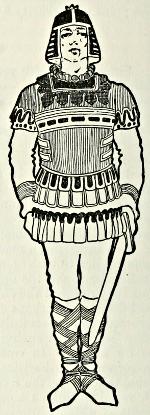
Captain of Mercenary
Troops, Byzantine Empire
Such was the state of affairs when Leo Isauricus
determined to take the lead and to wrest from the
hereditary enemy of the Byzantine crown the weapons
which he wished to use against it. In 726 he issued
his first decree against images; it was moderate in
tone, prostration before them being alone prohibited.
A few bishops, partisans of Leo, began to remove the
images from their churches. When this became known
the people rebelled, but Leo subdued them by force.
After this, under Leo and under his son Constantine
Copronymus (741-775), blow after blow was
dealt. In 729 Leo summoned a conclave and invited
the patriarch Germanus, a man who had almost
reached the extreme limit of human age, to attend.
A law was submitted ordering that the images should
be removed from all churches and the painted walls
whitewashed. When required to ratify it, the patriarch
declared he would rather resign his office. He
was taken at his word, exiled to a neighbouring state, and the vacant see was
conferred on the priest Anastasius, a willing tool. All bishops of the realm
were obliged to submit to the new law; the few who resisted were deposed.
Presently no sacred images were to be seen in the churches or in any
other places. Over the iron gates of the imperial palace was a beautiful
image of Christ, reputed to perform miracles, which was specially revered.
The emperor ordered its removal. Blood was shed in the execution of this
order. When a soldier at Leo’s command mounted on the castle gate, and
was about to deal the first blow at the image,[49] a crowd of furious women
flung themselves upon him, and pulled down the ladder on which he was
standing. The soldier fell to the ground and was immediately murdered by
the mob. Thereupon the rioters rushed to the archbishop’s residence, bent
on destroying it, and on stoning the patriarch Anastasius; but the latter fled
to the imperial palace. Meanwhile Leo had taken the necessary precautions:
the body-guard rushed out and attacked the insurgents; those who resisted
were killed or taken prisoners. Leo had gained the victory, and until his
death in 741, no one dared to disturb the public peace.
[741-842 A.D.]
After Leo’s death, conspiracies broke out against Constantine, his
successor. These he defeated though with difficulty, and his discovery
that a party in the church, the Byzantine monks, were
defending the ancient custom with invincible obstinacy
and thus supporting his adversaries, changed his struggle
against iconolatry into ceaseless strife with the monasteries
and all other typical forms of Christianity,
and with the church itself and its mysteries.
Events such as occurred at the time of the
Reformation and in the eighteenth century now
took place. The magistrates received orders to
suppress all monasteries, many were demolished,
others were converted into stables for the cavalry
and camps for the infantry; the few that remained
were not allowed to receive novices. The expelled
monks had to lay aside their distinctive garb and
dress like other people; the emperor compelled
some to marry, nor did he spare them the weapon
of ridicule. On one occasion he caused a number
of monks, each leading a nun by the hand, to
march up and down the hippodrome, where they
were met by the jeers of the multitude.
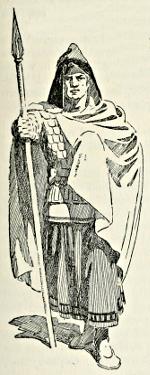
Chief of Barbarian Mercenaries,
Byzantine Empire
Under the influence of such proceedings a
peculiar spirit developed in the court, which was
composed not only of soldiers and officials but also
of the wealthy and pleasure-loving classes, a spirit
which we can only compare to the freemasonry of
a later day, or to the Bavarian illuminati of the
eighteenth century.
The throne was everything, the church apparently
nothing. For the second time the popedom of the Cæsars had reached
a climax, not, as in the days of Justinian, under the form of piety, but under
that of enlightenment. The Greek bishops patiently bore their yoke, there
were no more monks, the glory of the empire dazzled the world, for Constantine
was a fortunate ruler and a soldier crowned with glory, having overcome
the Saracens and the Bulgarians, the enemies of the empire, in many battles.
During his long reign there arose a race who were acquainted with cloisters
and monks only by hearsay, and had experience of nothing but freemasonry and
illuminati.
Nevertheless, after having asserted its authority for half a century, the
iconoclastic party succumbed and finally disappeared without leaving a trace.
Two causes were mainly instrumental in bringing about this remarkable
conclusion. First, the influence of the head of Christendom. In 726 and
729, when Leo proceeded to take steps against the icons, he had been vigorously
opposed by Pope Gregory II (715-731). Gregory’s successors continued
the opposition and, when the house of Isauricus obstinately refused
justice, a breach ensued with Byzantium. The discovery that in spite of all
display of violence the Byzantine court must end by yielding, as soon as the
Eastern church or even part of it sided in earnest with the see of St. Peter,
first made in the dogmatic disputes of the fourth and fifth centuries, once
more stood revealed.
Now for the second cause. Amongst the Byzantines there arose a great
man, capable of gathering all elements favourable to the cause of ecclesiastical
liberty, hitherto dispersed over the whole of the Eastern Empire, into
one centre, and thus bringing them into practical touch with Rome. This
was Theodore, abbot of the monastery of Studion, in Constantinople. With
the exception of a brief victory, embittered by that unworthy woman, the
empress Irene, under whose dominion it took place (789-802), and in which
the adherents of iconolatry, or rather the defenders of ecclesiastical independence,
were unable to exert any political influence, the life of Theodore
was spent in a perpetual struggle, in which he displayed incomparable stoicism
and the highest ability. He died in 826.
The cause which he had espoused with all the strength of a great soul,
triumphed after his death and through the seed which he had sown. In one
respect its triumph was complete, in another, partial only. On the 19th of
February, 842, the patriarch Methodius of Constantinople set the final seal
on the right of images in places of worship, by the institution of the feast of
Orthodoxy. With the icons, unfortunately, the deplorable abuse already
mentioned returned. Meanwhile it must be noted that in the course of the
contest the Frankish church had repeatedly and energetically upheld the
principles laid down by Pope Gregory I with regard to church discipline.
Opposition to the power which the emperor exercised on the subject of
images, was only part of the plan which Theodore Studita pursued; the
church and the people were also to be protected from the tyranny of the
throne. The empress Irene, no doubt at the instigation of the party of
Theodore, without whose support she would never have maintained her
power, remitted some of the most oppressive taxes; and the emperor Nicephorus,
by whom Irene was overthrown in 802, and who, although out of
fear of Irene’s legislation he tolerated the images, evidently trod from the
first in the steps of Leo Isauricus and his son Constantine Copronymus,
forthwith restored the full weight of the old taxation.l
In a long reign of thirty-four years, the son and successor of Leo, Constantine
V, surnamed Copronymus, attacked with less temperate zeal the
images or idols of the church. Their votaries have exhausted the bitterness
of religious gall, in their portrait of this spotted panther, this antichrist,
this flying dragon of the serpent’s seed, who surpassed the vices of Elagabalus
and Nero. His reign was a long butchery of whatever was most
noble, or holy, or innocent in his empire. In person the emperor assisted at
the execution of his victims, surveyed their agonies, listened to their groans,
and indulged, without satiating, his appetite for blood; a plate of noses was
accepted as a grateful offering, and his domestics were often scourged or
mutilated by the royal hand. His surname was derived from his pollution
of his baptismal font. The infant might be excused; but the manly pleasures
of Copronymus degraded him below the level of a brute.
In his religion, the iconoclast was a heretic, a Jew, a Mohammedan, a
pagan, and an atheist; and his belief of an invisible power could be discovered
only in his magic rites, human victims, and nocturnal sacrifices to
Venus and the demons of antiquity. His life was stained with the most
opposite vices, and the ulcers which covered his body anticipated before
his death the sentiment of hell torture. Of these accusations, which we have
so patiently copied, a part is refuted by its own absurdity; and in the
private anecdotes of the life of princes, the lie is more easy as the detection
is more difficult. Without adopting the pernicious maxim, that where much
is alleged, something must be true, we can however discern, that Constantine V
was dissolute and cruel. Calumny is more prone to exaggerate than to
invent; and her licentious tongue is checked in some measure by the experience
of the age and country to which she appeals. Of the bishops and
monks, the generals and magistrates, who are said to have suffered under
his reign, the numbers are recorded, the names were conspicuous, the execution
was public, the mutilation visible and permanent.
[741-775 A.D.]
The Catholics hated the person and government of Copronymus; but
even their hatred is a proof of their oppression. They dissemble the provocations
which might excuse or justify his rigour; but even these provocations
must gradually inflame his resentment, and harden his temper in the
use or the abuse of despotism. Yet the character of the fifth Constantine
was not devoid of merit, nor did his government always deserve the curses
or the contempt of the Greeks. From the confession of his enemies, we
are informed of the restoration of an ancient aqueduct, of the redemption
of twenty-five hundred captives, of the uncommon plenty of the times, and of
the new colonies with which he repeopled Constantinople and the Thracian
cities. They reluctantly praise his activity and courage; he was on horseback
in the field at the head of his legions; and although the fortune of his
arms was various, he triumphed by sea and land, on the Euphrates and the
Danube, in civil[50] and barbarian war. Heretical praise must be cast into
the scale, to counterbalance the weight of orthodox invective. The iconoclasts
revered the virtues of the prince; forty years after his death, they still
prayed before the tomb of the saint. A miraculous vision was propagated
by fanaticism or fraud; and the Christian hero appeared on a milk-white
steed, brandishing his lance against the pagans of Bulgaria: “An absurd
fable,” says the Catholic historian, “since Copronymus is chained with the
demons in the abyss of hell.”g
Constantine had no sooner found himself firmly established on the throne
than he devoted his attention to completing the organisation of the empire
traced out by his father. The constant attacks of the Saracens and Bulgarians
called him frequently to the head of his armies, for the state of society
rendered it dangerous to entrust large forces to the command of a subject.
In the Byzantine Empire few individuals had any scruple in violating the
political constitution of their country, if by so doing they could increase
their own power.
The incursions of the Saracens first required to be repressed. The empire
of the caliphs was already distracted by the civil wars which preceded
the fall of the Omayyad dynasty. Constantine took advantage of these
troubles. He reconquered Germanicia and Doliche, and occupied for a time
a considerable part of Commagene. The Saracens attempted to indemnify
themselves for these losses by the conquest of Cyprus. This island appears
to have been reconquered by Leo III, for it had been abandoned to the
Mohammedans by Justinian II. The fleet of the caliph sailed from Alexandria,
and landed an army at the port of Cerameia; but the fleet of the Cibyraiot
theme arrived in time to blockade the enemy’s ships, and of a thousand
Mohammedan vessels three only escaped (748 A.D.). The war was continued.
The Saracens invaded the empire almost every summer, but these incursions
led to no permanent conquests. The mildness and tolerant government of
the emperor of Romania (for that name began now to be applied to the part
of Asia Minor belonging to the Byzantine Empire) was so celebrated in the
East, in spite of his persecution of the image-worshippers at Constantinople,
that many Christians escaped by sea from the dominions of the caliph
Almansur to settle in those of Constantine.
The vicinity of the Bulgarians to Constantinople rendered them more
dangerous enemies than the Saracens, though their power was much inferior.
To resist their incursions, Constantine gradually repaired all the fortifications
of the towns on the northern frontier, and then commenced fortifying
the passes, until the Bulgarians found their predatory incursions attended
with loss instead of gain. The king [Kormisos] invaded the empire with a
powerful army. The Bulgarians carried their ravages up to the long wall;
but though they derived assistance from the numerous Slavonian colonies
settled in Thrace, they were defeated, and driven back into their own territory
with great slaughter (757 A.D.).[51]
Constantine was always ready to carry the war into their territory. The
difficulties of his enterprise were great, and he suffered several defeats; but
his military talents and persevering energy prevented the Bulgarians from
profiting by any partial success they obtained, and he soon regained the
superiority. In the campaigns of 760, 763, and 765, Constantine marched
far into Bulgaria, and carried off immense booty. In the year 766 he
intended to complete the conquest of the country by opening the campaign
at the commencement of spring. His fleet, which consisted of twenty-six
hundred vessels, in which he had embarked a considerable body of infantry
in order to enter the Danube, was assailed by one of those furious storms
that often sweep the Euxine. The force which the emperor expected would
soon render him master of Bulgaria was suddenly ruined. The shores of
the Black Sea were covered with the wrecks of his ships and the bodies
of his soldiers. Constantine immediately abandoned all thought of continuing
the campaign, and employed his whole army in alleviating the calamity
to the survivors, and in securing Christian burial and funeral honours to the
dead. A truce was concluded with the enemy, and the Roman army beheld
the emperor as eager to employ their services in the cause of humanity and
religion, as he had ever been to lead them to the field of glory and conquest.
His conduct on this occasion gained him as much popularity with the people
of Constantinople as with the troops.
In the year 774 he again assembled an army of eighty thousand men,
accompanied by a fleet of two thousand transports, and invaded Bulgaria.
The Bulgarian monarch [Telerig] concluded a treaty of peace—which, however,
was broken as soon as Constantine returned to his capital. But the
emperor was not unprepared, and the moment he heard that the enemy had
laid siege to Verzetia, one of the fortresses he had constructed to defend
the frontier, he quitted Constantinople in the month of October, and, falling
suddenly on the besiegers, routed their army with great slaughter. The following
year his army was again ready to take the field; but as Constantine
was on his way to join it he was attacked by a mortal illness, which compelled
him to retrace his steps. Having embarked at Selymbria, in order to
reach Constantinople with as little fatigue as possible, he died on board the
vessel at the castle of Strongyle, just as he reached the walls of his capital,
on the 23rd of September (775).
The long war with the Bulgarians had been carried on rather with the
object of securing tranquillity to the northern provinces of the empire, than
from any desire of a barren conquest. The necessity of reducing the Slavonian
colonies in Thrace and Macedonia to complete obedience to the central
administration, and of secluding them from all political communication with
one another, or with their countrymen in Bulgaria, Servia, and Dalmatia,
imposed on the emperor the necessity of maintaining strong bodies of troops,
and suggested the policy of forming a line of Greek towns and Asiatic
colonies along the northern frontier of the empire. When this was done,
Constantine began to root out the brigandage, which had greatly extended
itself during the anarchy which preceded his father’s election, and which Leo
had never been able to exterminate. Numerous bands lived by plunder,
in a state of independence, within the bounds of the empire. They were
called Skamars. Constantine rooted out these bands. A celebrated chief of
the Skamars was publicly executed at Constantinople with the greatest barbarity,
his living body being dissected by surgeons after the amputation of
his hands and feet.
The habitual barbarity of legal punishments in the Byzantine Empire can
hardly relieve the memory of Constantine from the reproach of cruelty, which
this punishment proves he was ready to employ against the enemies of his
authority, whether brigands or image-worshippers. His error, therefore,
was not only passing laws against liberty of conscience—which was a fault
in accordance with the spirit of the age—but in carrying these laws into
execution with a cruelty offensive to human feelings. Yet on many occasions
Constantine gave proofs of humanity, as well as of a desire to protect his
subjects. The Slavonians on the coast of Thrace, having fitted out some
piratical vessels, carried off many of the inhabitants of Tenedos, Imbros, and
Samothrace, to sell them as slaves. The emperor on this occasion ransomed
twenty-five hundred of his subjects, preferring to lower his own dignity by
paying tribute to the pirates, rather than allow those who looked to him
for protection to pine away their lives in hopeless misery. No other act
of his reign shows so much real greatness of mind as this. He also concluded
the convention with the Saracens for an exchange of prisoners, which has
been already mentioned—one of the earliest examples of the exchanges
between the Mohammedans and the Christians, which afterwards became
frequent on the Byzantine frontiers. Man was exchanged for man, woman for
woman, and child for child. These conventions tended to save the lives of
innumerable prisoners, and rendered the future wars between the Saracens
and the Romans less barbarous.
Constantine was active in his internal administration, and his schemes for
improving the condition of the inhabitants of his empire were carried out
on a far more gigantic scale than modern governments have considered practicable.
One of his plans for reviving agriculture in uncultivated districts
was by re-peopling them with colonies of emigrants, to whom he secured
favourable conditions and efficient protection. As usual under such circumstances,
we find years of famine and plenty alternating in close succession.
Yet the bitterest enemy of Constantine, the abbot Theophanes, confesses
that his reign was one of general abundance. It is true, he reproaches him
with loading the husbandmen with taxes; but he also accuses him of being
a new Midas, who made gold so common that it became cheap. The abbot’s
political economy, it must be confessed, is not so orthodox as his calumny.
The time and attention of Constantine, during his whole reign, were principally
engaged in military occupations. In the eyes of his contemporaries
he was judged by his military conduct. His strategic abilities and indefatigable
activity were the most striking characteristics of his administration.
His campaigns, his financial measures, and the abundance they created, were
known to all; but his ecclesiastical policy affected comparatively few. Yet
by that policy his reign has been exclusively judged and condemned in
modern times. The grounds of the condemnation are unjust. He has not,
like his father, the merit of having saved an empire from ruin; but he
may claim the honour of perfecting the reforms planned by his father, and
of re-establishing the military power of the Roman Empire on a basis that
perpetuated Byzantine supremacy for several centuries. Hitherto historians
have treated the events of his reign as an accidental assemblage of facts; but
surely, if he is to be rendered responsible for the persecution of the image-worshippers,
in which he took comparatively little part, he deserves credit
for his military successes and prosperous administration, since these were
the result of his constant personal occupation. The history of his ecclesiastical
measures, however, really possesses a deep interest, for they reflect with
accuracy the feelings and ideas of millions of his subjects, as well as of the
emperor.
[754-775 A.D.]
When his power was consolidated, he steadily pursued his father’s plans
for centralising the ecclesiastical administration of the empire. To prepare
for the final decision of the question, which probably, in his mind, related as
much to the right of the emperor to govern the church, as to the question
whether pictures were to be worshipped or not, he ordered the metropolitans
and archbishops to hold provincial synods, in order to discipline the people
for the execution of the edicts he proposed to carry in a general council of
the Eastern church.
This general council was convoked at Constantinople in the year 754.
It was attended by 338 bishops, forming the most numerous assembly of the
Christian clergy which had ever been collected together for ecclesiastical
legislation.
Neither the pope nor the patriarchs of Antioch, Alexandria, and Jerusalem
sent representatives to this council, which was solely composed of the
Byzantine clergy, so that it had no right to assume the rank of an ecumenical
council. Its decisions were all against image-worship, which it declared
to be contrary to Scripture. It proclaimed the use of images and pictures
in churches to be a pagan and anti-Christian practice, the abolition of which
was necessary to avoid leading Christians into temptation. Even the use
of the crucifix was condemned, on the ground that the only true symbol of
the incarnation was the bread and wine which Christ had commanded to be
received for the remission of sins.
In its opposition to the worship of pictures, the council was led into the
display of some animosity against painting itself; and every attempt at
embodying sacred subjects by what it styled the dead and accursed art,
foolishly invented by the pagans, was strongly condemned. The common
people were thus deprived of a source of ideas, which, though liable to abuse,
tended in general to civilise their minds, and might awaken noble thoughts
and religious aspirations. We may fully agree with the iconoclasts in the
religious importance of not worshipping images, and not allowing the people
to prostrate themselves on the pavements of churches before pictures of saints,
whether said to be painted by human artists or miraculous agency; while at
the same time we think that the walls of the vestibules or porticoes of sacred
edifices may with propriety be adorned with pictures representing those
sacred subjects most likely to awaken feelings of Christian charity. It is
by embodying and ennobling the expression of feelings common to all mankind,
that modern artists can alone unite in their works that combination of
truth with the glow of creative imagination which gives a divine stamp to
many pagan works.
There is nothing in the circle of human affairs so democratic as art. The
council of 754, however, deemed that it was necessary to sacrifice art to the
purity of religion. “The godless art of painting” was proscribed. All
who manufactured crucifixes or sacred paintings for worship, in public or
private, whether laymen or monks, were ordered to be excommunicated by
the church and punished by the state. At the same time, in order to guard
against the indiscriminate destruction of sacred buildings and shrines possessing
valuable ornaments and rich plate and jewels, by iconoclastic zeal, or
under its pretext, the council commanded that no alteration was to be made
in existing churches, without the special permission of the patriarch and the
emperor—a regulation bearing strong marks of the fiscal rapacity of the
central treasury of the Roman Empire. The bigotry of the age was displayed
in the anathema which this council pronounced against three of the most
distinguished and virtuous advocates of image-worship, Germanus, the
patriarch of Constantinople, George of Cyprus, and John Damascenus, the
last of the fathers of the Greek church. The acts of this council, however,
are only known from the garbled portions preserved by its enemies in the
acts of the second council of Nicæa and the hostile historians.n
[775-797 A.D.]
Leo IV, the son of the fifth, and the father of the sixth Constantine,
was of a feeble constitution both of mind and body, and the principal care
of his reign was the settlement of the succession. The association of the
young Constantine was urged by the officious zeal of his subjects; and the
emperor, conscious of his decay, complied, after a prudent hesitation, with
their unanimous wishes. The royal infant, at the age of five years, was
crowned with his mother Irene; and the national consent was ratified by
every circumstance of pomp and solemnity that could dazzle the eyes, or
bind the conscience, of the Greeks. An oath of fidelity was administered
in the palace, the church, and the hippodrome, to the several orders of the
state, who adjured the holy names of the son and mother of God.
The first to swear, and the first to violate their oath, were the five sons
of Copronymus by a second marriage; and the story of these princes is
singular and tragic. The right of primogeniture excluded them from the
throne; the injustice of their elder brother defrauded them of a legacy of
about £2,000,000 [$10,000,000]; some vain titles were not deemed a sufficient
compensation for wealth and power; and they repeatedly conspired against
their nephew, before and after the death of his father (780). The first
attempt was pardoned; for the second offence they were condemned to the
ecclesiastical state; and for the third treason, Nicephorus, the eldest and
most guilty, was deprived of his eyes, and his four brothers, Christopher,
Nicetas, Anthemeus, and Eudoxas, were punished, as a milder sentence, by
the amputation of their tongues.
For himself, the emperor had chosen a barbarian wife, the daughter of
the khan of the Khazars; but in the marriage of his heir, he preferred an
Athenian virgin, an orphan, seventeen years old, whose sole fortune must
have consisted in her personal accomplishments. The nuptials of Leo and
Irene were celebrated with royal pomp; she soon acquired the love and confidence
of a feeble husband, and in his testament he declared the empress
guardian of the Roman world, and of their son Constantine VI, who was no
more than ten years of age. During his childhood Irene most ably and
assiduously discharged, in her public administration, the duties of a faithful
mother; and her zeal in the restoration of images has deserved the name
and honours of a saint, which she still occupies in the Greek calendar. But
the emperor attained the maturity of youth; the maternal yoke became
more grievous; and he listened to the favourites of his own age, who shared
his pleasures and were ambitious of sharing his power. Their reasons convinced
him of his right, their praises of his ability to reign; and he consented
to reward the services of Irene by a perpetual banishment to the isle of
Sicily. But her vigilance and penetration easily disconcerted their rash projects;
a similar, or more severe, punishment was retaliated on themselves
and their advisers; and Irene inflicted on the ungrateful prince the chastisement
of a boy. After this contest the mother and the son were at the head
of two domestic factions; and instead of mild influence and voluntary
obedience, she held in chains a captive and an enemy. The empress was
overthrown by the abuse of victory; the oath of fidelity which she exacted
to herself alone, was pronounced with reluctant murmurs; and the bold refusal
of the Armenian guards encouraged a free and general declaration that
Constantine VI was the lawful emperor of the Romans. In this character
he ascended his hereditary throne, and dismissed Irene to a life of solitude
and repose.
A powerful conspiracy was formed for the restoration of Irene; and the
secret, though widely diffused, was faithfully kept above eight months, till
the emperor, suspicious of his danger, escaped from Constantinople, with
the design of appealing to the provinces and armies. By this hasty flight, the
empress was left on the brink of the precipice; yet before she implored
the mercy of her son, Irene addressed a private epistle to the friends whom she
had placed about his person, with a menace that unless they accomplished,
she would reveal, their treason. Their fear rendered them intrepid; they
seized the emperor on the Asiatic shore, and he was transported to the porphyry
apartment of the palace where he had first seen the light. In the
mind of Irene, ambition had stifled every sentiment of humanity and nature;
and it was decreed in her bloody council that Constantine should be rendered
incapable of the throne. The blind son of Irene survived many years,
oppressed by the court, and forgotten by the world; the Isaurian dynasty
was silently extinguished; and the memory of Constantine was recalled only
by the nuptials of his daughter Euphrosyne with the emperor Michael II.g
The empress was known to favour image-worship. The national vanity
of the Greeks and the religious feelings of the orthodox required the sanction
of a constitutional public authority before the laws against image-worship
could be openly repealed. The Byzantine Empire had at this time an
ecclesiastical though not a political constitution. The will of the sovereign
was alone insufficient to change an organic law, forming part of the ecclesiastical
administration of the empire. It was necessary to convoke a general
council to legalise image-worship; and to render such a council a fit instrument
for the proposed revolution, much arrangement was necessary. No
person was ever endued with greater talents for removing opposition and
conciliating personal support than the empress. The patriarch Paul, a decided
iconoclast, was induced to resign, and declare that he repented of his
hostility to image-worship, because it had cut off the church of Constantinople
from communion with the rest of the Christian world. This declaration
pointed out the necessity of holding a general council in order to re-establish
that communion.
The crisis required a new patriarch of stainless character, great ability,
and perfect acquaintance with the party connections and individual characters
of the leading bishops. No person could be selected from among the
dignitaries of the church who had been generally appointed by iconoclast
emperors. The choice of Irene fell on a civilian—Tarasius, the chief secretary
of the imperial cabinet,—a man of noble birth, considerable popularity,
and a high reputation for learning and probity.
The iconoclasts were still strong in the capital, and the opposition of the
soldiery was excited by the determination of Tarasius to re-establish image-worship.
They openly declared that they would not allow a council of the
church to be held, nor permit the ecclesiastics of their party to be unjustly
treated by the court. More than one tumult warned the empress that no
council could be held at Constantinople. It required nearly three years to
smooth the way for the meeting of the council, which was at length held at
Nicæa in September, 787. Three hundred and sixty-seven members attended,
of whom, however, not a few were abbots and monks, who assumed the title of
confessors from having been ejected from their monasteries by the decrees
of the iconoclast sovereigns. The secretary of the two commissioners who
represented the imperial authority was Nicephorus the historian, subsequently
patriarch of Constantinople. His sketch of the history of the empire, from
the years 602 to 770, is a valuable work, and indicates that he was a man of
judgment whenever his perceptions were not obscured by theological and
ecclesiastical prejudices. Two other eminent Byzantine writers were also
present. George, called Syncellus, from the office he held under the patriarch
Tarasius. He has left us a chronological work which has preserved the
knowledge of many important facts recorded by no other ancient authority.
Theophanes, the friend and companion of the Syncellus, has continued this
work; and his chronography of Roman and Byzantine history, with all its
faults, forms the best picture of the condition of the empire that we possess
for a long period. Theophanes enjoyed the honour of becoming, at a later
day, a confessor in the cause of image-worship. He was exiled from a
monastery which he had founded, and died in the island of Samothrace,
in 817 A.D.
[754-787 A.D.]
The second council of Nicæa had no better title than the iconoclast council
of Constantinople to be regarded as a general council of the church. The
pope Adrian, indeed, sent deputies from the Latin church; but the churches
of Jerusalem, Alexandria, and Antioch, whose patriarchs were groaning under
the government of the caliphs, did not dare to communicate with foreign
authorities.
The second council of Nicæa authorised the worship of images as an
orthodox practice. Forged passages, pretending to be extracts from the
earlier fathers, and genuine quotations from the modern, were cited in favour
of the practice. Simony was already a prevailing evil in the Greek church.
Many of the bishops had purchased their sees, and most of these naturally
preferred doing violence to their opinions rather than lose their revenues.
From this cause, unanimity was easily obtained by court influence. The
council decided, that not only was the cross an object of reverence, but also
that the images of Christ, and the pictures of the Virgin Mary—of angels,
saints, and holy men, whether painted in colours, or worked in embroidery
in sacred ornaments, or formed in mosaic in the walls of churches—were all
lawful objects of worship. At the same time, in order to guard against the
accusation of idolatry, it was declared that the worship of an image, which
is merely a sign of reverence, must not be confounded with the adoration
due only to God. The council of Constantinople held in 754 was declared
heretical, and all who maintained its doctrines, and condemned the use of
images, were anathematised. The patriarchs Anastasius, Constantinus, and
Nicetas were especially doomed to eternal condemnation.
The pope adopted the decrees of this council, but he refused to confirm
them officially, because the empress delayed restoring the estates of St. Peter’s
patrimony. In the countries of western Europe which had formed parts of
the Western Empire, the superstitions of the image-worshippers were viewed
with as much dissatisfaction as the fanaticism of the iconoclasts; and the
council of Nicæa was as much condemned as that of Constantinople by a
large body of enlightened ecclesiastics. The public mind in the West was
almost as much divided as in the East; and if a general council of the Latin
church had been assembled, its unbiassed decisions would probably have been
at variance with those supported by the pope and the council of Nicæa.
Charlemagne published a refutation of the doctrines of this council on the
subject of image-worship. His work, called the Caroline Books, consists of
four parts, and was certainly composed under his immediate personal superintendence,
though he was doubtless incapable of writing it himself.
The dark night of mediæval ignorance and local prejudices had not yet
settled on the West; nor had feudal anarchy confined the ideas and wants
of society to the narrow sphere of provincial interests. The aspect of public
opinion alarmed Pope Adrian, whose interests required that the relations
of the West and East should not become friendly. His position, however,
rendered him more suspicious of Constantine and Irene, in spite of their
orthodoxy, than of Charlemagne, with all his heterodox ideas. The Frank
monarch, though he differed in ecclesiastical opinions, was sure to be a
political protector. The pope consequently laboured to foment the jealousy
that reigned between the Frank and Byzantine governments concerning
Italy, where the commercial relations of the Greeks still counterbalanced
the military influence of the Franks. His calumnies must have sunk deep
into the public mind, and tended to impress on western nations that aversion
to the Greeks, which was subsequently increased by mercantile jealousy
and religious strife.
[797-802 A.D.]
The extinction of the last traces of the supremacy
of the Eastern Empire at Rome was
the most gratifying result of their machinations
to the popes. On Christmas Day, 800 A.D.,
Charlemagne revived the existence of the Western
Empire, and received the imperial
crown from Pope Leo III
in the church of St. Peter. Hitherto
the Frank monarch had acknowledged
a titular supremacy in
the Eastern Empire, and had borne
the title of patrician of the Roman
Empire, as a mark of dignity conferred
on him by the emperors of
Constantinople; but he now raised
himself to an equality with the emperors
of the East, by assuming the
title of emperor of the West.n
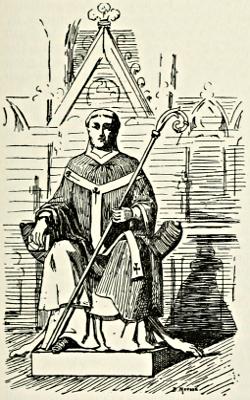
Robes of an Archbishop, Eighth Century
On earth, the crimes of Irene
were left five years unpunished;
her reign was crowned with external
splendour;[52] and if she could silence
the voice of conscience, she neither
heard nor regarded the reproaches
of mankind. The Roman world
bowed to the government of a female;
and as she moved through the
streets of Constantinople, the reins
of four milk-white steeds were held
by as many patricians, who marched
on foot before the golden chariot of their queen. But these patricians were
for the most part eunuchs; raised, enriched, entrusted with the first dignities
of the empire, they basely conspired against their benefactress; the great
treasurer Nicephorus was secretly invested with the purple; her successor
was introduced into the palace, and crowned at St. Sophia by the venal
patriarch. In their first interview, she recapitulated with dignity the revolutions
of her life, gently accused the perfidy of Nicephorus, insinuated that
he owed his life to her unsuspicious clemency, and, for the throne and treasures
which she resigned, solicited a decent and honourable retreat. His
avarice refused this modest compensation; and in her exile on the isle of
Lesbos, the empress earned a scanty subsistence by the labours of her distaff.
[802-813 A.D.]
Many tyrants have reigned undoubtedly more criminal than Nicephorus,
but none perhaps have more deeply incurred the universal abhorrence of
their people. His character was stained with the three odious vices of
hypocrisy, ingratitude, and avarice; his want of virtue was not redeemed
by any superior talents, nor his want of talents by any pleasing qualifications.
Unskilful and unfortunate in war, Nicephorus was vanquished by
the Saracens, and slain by the Bulgarians; and the advantage of his death
overbalanced, in the public opinion, the destruction of a Roman army. His
son and heir Stauracius escaped from the field with a mortal wound: yet
six months of an expiring life were sufficient to refute his indecent, though
popular, declaration, that he would in all things avoid the example of his
father.
On the near prospect of his decease, Michael, the great master of the
palace, and the husband of his sister Procopia, was named by every person
of the palace and city, except by his envious brother. Tenacious of a sceptre
now falling from his hand, he conspired against the life of his successor,
and cherished the idea of changing to a democracy the Roman Empire.
But these rash projects served only to inflame the zeal of the people, and to
remove the scruples of the candidate: Michael I accepted the purple, and
before he sank into the grave, the son of Nicephorus implored the clemency
of his new sovereign. Had Michael in an age of peace ascended an hereditary
throne, he might have reigned and died the father of his people: but
his mild virtues were adapted to the shade of private life, nor was he capable
of controlling the ambition of his equals, or of resisting the arms of the
victorious Bulgarians. While his want of ability and success exposed him
to the contempt of the soldiers, the masculine spirit of his wife Procopia
awakened their indignation.
Even the Greeks of the ninth century were provoked by the insolence of
a female who, in the front of the standards, presumed to direct their discipline
and animate their valour; and their licentious clamours advised the
new Semiramis to reverence the majesty of a Roman camp. After an unsuccessful
campaign, the emperor left, in their winter quarters of Thrace,
a disaffected army under the command of his enemies; and their artful
eloquence persuaded the soldiers to break the dominion of the eunuchs,
to degrade the husband of Procopia, and to assert the right of a military
election. They marched towards the capital; yet the clergy, the senate,
and the people of Constantinople adhered to the cause of Michael; and the
troops and treasures of Asia might have protracted the mischiefs of civil
war. But his humanity (by the ambitious it will be termed his weakness)
protested, that not a drop of Christian blood should be shed in his quarrel,
and his messengers presented the conquerors with the keys of the city and
the palace. They were disarmed by his innocence and submission; his life
and his eyes were spared; and the imperial monk enjoyed the comforts of
solitude and religion above thirty-two years after he had been stripped of the
purple and separated from his wife.
[813-820 A.D.]
A rebel in the time of Nicephorus, the famous and unfortunate Bardanes,
had once the curiosity to consult an Asiatic prophet, who after prognosticating
his fall, announced the fortunes of his three principal officers, Leo the
Armenian, Michael the Phrygian, and Thomas the Cappadocian, the successive
reigns of the two former, the fruitless and fatal enterprise of the third.
This prediction was verified, or rather was produced, by the event. Ten
years afterwards, when the Thracian camp rejected the husband of Procopia,
the crown was presented to the same Leo, the first in military rank and
the secret author of the mutiny. As he affected to hesitate—“with this
sword,” said his companion Michael, “I will open the gates of Constantinople
to your imperial sway; or instantly plunge it into your bosom, if you
obstinately resist the just desires of your fellow-soldiers.” The compliance
of the Armenian was rewarded with the empire, and he reigned seven years
and a half under the name of Leo V.g
Six days after his coronation, the Bulgarian king, Crumn, assailed
Constantinople; a plot to assassinate the Bulgarian failed, but ample revenge
was taken in the widespread pillage and the carrying off to Bulgaria of fifty
thousand prisoners. Crumn died while preparing a new invasion; Leo
destroyed his army at Mesembria and ravaged Bulgaria (814).a
Educated in a camp, and ignorant both of laws and letters, he introduced
into his civil government the rigour and even cruelty of military discipline;
but if his severity was sometimes dangerous to the innocent, it was always
formidable to the guilty. His religious inconstancy was taxed by the epithet
of chameleon, but the Catholics have acknowledged, by the voice of a saint and
confessors, that the life of the iconoclast[53] was useful to the republic. The zeal
of his companion Michael was repaid with riches, honours, and military command;
and his subordinate talents were beneficially employed in the public
service. Yet the Phrygian was dissatisfied at receiving as a favour a scanty
portion of the imperial prize, which he had bestowed on his equal; and his
discontent, which sometimes evaporated in a hasty discourse, at length
assumed a more threatening and hostile aspect against a prince whom he
represented as a cruel tyrant. That tyrant, however, repeatedly detected,
warned, and dismissed the old companion of his arms, till fear and resentment
prevailed over gratitude; and Michael, after a scrutiny into his actions
and designs, was convicted of treasons, and sentenced to be burned alive in the
furnace of the private baths. The devout humanity of the empress Theophano
was fatal to her husband and family. A solemn day, the twenty-fifth
of December, had been fixed for the execution; she urged that the anniversary
of the Saviour’s birth would be profaned by this inhuman spectacle,
and Leo consented with reluctance to a decent respite.
On the great festivals, a chosen band of priests and chanters was admitted
into the palace by a private gate, to sing matins in the chapel; and Leo,
who regulated with the same strictness the discipline of the choir and of the
camp, was seldom absent from these early devotions. In the ecclesiastical
habit, but with swords under their robes, the conspirators mingled with the
procession, lurked in the angles of the chapel, and expected, as the signal of
murder, the intonation of the first psalm by the emperor himself. The
imperfect light, and the uniformity of dress, might have favoured his escape,
while their assault was pointed against a harmless priest; but they soon
discovered their mistake, and encompassed on all sides the royal victim.
Without a weapon and without a friend, he grasped a weighty cross, and
stood at bay against the hunters of his life; but as he asked for mercy,—“This
is the hour, not of mercy, but of vengeance,” was the inexorable reply.
The stroke of a well-aimed sword separated from his body the right arm and
the cross, and Leo the Armenian was slain at the foot of the altar.
[820-829 A.D.]
A memorable reverse of fortune was displayed in Michael II, who, from
a defect in his speech, was surnamed the Stammerer. He was snatched from
the fiery furnace to the sovereignty of an empire; and as in the tumult a
smith could not readily be found, the fetters remained on his legs several
hours after he was seated on the throne of the Cæsars. The royal blood,
which had been the price of his elevation, was unprofitably spent; in the
purple he retained the ignoble vices of his origin; and Michael lost his
provinces with as supine indifference as if they had been the inheritance of
his fathers.[54] His title was disputed by Thomas, the last of the military
triumvirate, who transported into Europe fourscore thousand barbarians
from the banks of the Tigris and the shores of the Caspian. He formed the
siege of Constantinople; but the capital was defended with spiritual and
carnal weapons; a Bulgarian king assaulted the camp of the Orientals, and
Thomas had the misfortune, or the weakness, to fall alive into the power of
the conqueror. The hands and feet of the rebel were amputated; he was
placed on an ass, and, amidst the insults of the people, was led through the
streets, which he sprinkled with his blood. After the death of his first wife,
the emperor, at the request of the senate, drew from her monastery Euphrosyne,
the daughter of Constantine VI. Her august birth might justify a
stipulation in the marriage contract that her children should equally share
the empire with their elder brother. But the nuptials of Michael and
Euphrosyne were barren; and she was content with the title of mother of
Theophilus, his son and successor.
[829-854 A.D.]
The character of Theophilus is a rare example in which religious zeal has
allowed, and perhaps magnified, the virtues of a heretic and a persecutor.
His valour was often felt by the enemies, and his justice by the subjects, of
the monarchy; but the valour of Theophilus was rash and fruitless, and
his justice arbitrary and cruel. He displayed the banner of the cross against
the Saracens; but his five expeditions were concluded by a signal overthrow
(838); Amorium, the native city of his ancestors, was levelled with
the ground, and from his military toils, he derived only the surname of the
Unfortunate. The wisdom of a sovereign is comprised in the institution of
laws and the choice of magistrates, and while he seems without action, his
civil government revolves round his centre with the silence and order of
the planetary system. But the justice of Theophilus was fashioned on the
model of the oriental despots, who, in personal and irregular acts of authority,
consult the reason or passion of the moment, without measuring the
sentence by the law, or the penalty by the offence. For some venial offences,
some defect of equity or vigilance, the principal ministers, a prefect, a
quæstor, a captain of the guards, were banished, or mutilated, or scalded
with boiling pitch, or burned alive in the hippodrome; and as these dreadful
examples might be the effects of error or caprice, they must have alienated
from his service the best and wisest of the citizens.
Theophilus might inflict a tardy vengeance on the assassins of Leo and
the saviours of his father; but he enjoyed the fruits of their crime; and
his jealous tyranny sacrificed a brother and a prince to the future safety of his
life. A Persian of the race of the Sassanidæ died in poverty and exile at
Constantinople, leaving an only son, the issue of a plebeian marriage. At
the age of twelve years, the royal birth of Theophobus was revealed, and his
merit was not unworthy of his birth. He was educated in the Byzantine
palace, a Christian and a soldier; advanced with rapid steps in the career of
fortune and glory; received the hand of the emperor’s sister; and was promoted
to the command of thirty thousand Persians, who, like his father, had
fled from the Mohammedan conquerors.
These troops, doubly infected with mercenary and fanatic vices, were
desirous of revolting against their benefactor, and erecting the standard of
their native king: but the loyal Theophobus rejected their offers, disconcerted
their schemes, and escaped from their hands to the camp or palace of
his royal brother. A generous confidence might have secured a faithful and
able guardian for his wife and his infant son, to whom Theophilus, in the
flower of his age, was compelled to leave the inheritance of the empire. But
his jealousy was exasperated by envy and disease: he feared the dangerous
virtues which might either support or oppress their infancy and weakness;
and the dying emperor demanded the head of the Persian prince. With
savage delight he recognised the familiar features of his brother: “Thou art
no longer Theophobus,” he said; and sinking on his couch, he added with a
faltering voice, “Soon, too soon, I shall be no more Theophilus!”
Yet his last choice entrusted his wife Theodora with the guardianship of
the empire and her son Michael, who was left an orphan in the fifth year of
his age. The restoration of images, and the final extirpation of the Iconoclasts,[55]
has endeared her name to the devotion of the Greeks; but in the
fervour of religious zeal, Theodora entertained a grateful regard for the
memory and salvation of her husband. After thirteen years of a prudent
and frugal administration, she perceived the decline of her influence; but
the second Irene imitated only the virtues of her predecessor. Instead of
conspiring against the life or government of her son, she retired, without a
struggle, though not without a murmur, to the solitude of private life, deploring
the ingratitude, the vices, and the inevitable ruin of the worthless
youth.
[854-867 A.D.]
Among the successors of Nero and Elagabalus, we have not hitherto
found the imitation of their vices, the character of a Roman prince who considered
pleasure as the object of life, and virtue as the enemy of pleasure.
Whatever might have been the maternal care of Theodora in the education
of Michael III, her unfortunate son was a king before he was a man. If
the ambitious mother laboured to check the progress of reason, she could
not cool the ebullition of passion; and her selfish policy was justly repaid
by the contempt and ingratitude of the headstrong youth. At the age of
eighteen he rejected her authority, without feeling his own incapacity to
govern the empire and himself. With Theodora, all gravity and wisdom
retired from the court: their place was supplied by the alternate dominion
of vice and folly; and it was impossible, without forfeiting the public
esteem, to acquire or preserve the favour of the emperor. The millions of
gold and silver which had been accumulated for the service of the state,
were lavished on the vilest of men, who flattered his passions and shared his
pleasures; and in a reign of thirteen years, the richest of sovereigns was
compelled to strip the palace and the churches of their precious furniture.
Like Nero, he delighted in the amusements of the theatre, and sighed to be
surpassed in the accomplishments in which he should have blushed to excel.
Yet the studies of Nero in music and poetry betrayed some symptoms of a
liberal taste; the more ignoble arts of the son of Theophilus were confined
to the chariot race of the hippodrome.
But the most extraordinary feature in the character of Michael is the
profane mockery of the religion of his country. The superstition of the
Greeks might indeed excite the smile of a philosopher; but his smile would
have been rational and temperate, and he must have condemned the ignorant
folly of a youth who insulted the objects of public veneration. A buffoon
of the court was invested in the robes of the patriarch; his twelve metropolitans,
among whom the emperor was ranked, assumed their ecclesiastical
garments; they used or abused the sacred vessels of the altar; and, in their
bacchanalian feasts, the holy communion was administered in a nauseous
compound of vinegar and mustard. Nor were these impious spectacles concealed
from the eyes of the city. On the day of a solemn festival, the
emperor, and his bishops or buffoons, rode on asses through the streets,
encountered the true patriarch at the head of his clergy, and, by their licentious
shouts and obscene gestures, disordered the gravity of the Christian
procession.[56] The devotion of Michael appeared only in some offence to
reason or piety; he received his theatrical crowns from the statue of the
Virgin; and an imperial tomb was violated for the sake of burning the
bones of Constantine the Iconoclast. By this extravagant conduct the son of
Theophilus became as contemptible as he was odious; every citizen was
impatient for the deliverance of his country; and even the favourites of the
moment were apprehensive that a caprice might snatch away what a caprice
had bestowed. In the thirtieth year of his age, and in the hour of intoxication
and sleep, Michael III was murdered in his chamber by the founder of
a new dynasty, whom the emperor had raised to an equality of rank and
power.g
It was in his reign that Photius was illegally made Patriarch and such a
dissension created that the Roman pope was appealed to, as is described in
the next volume under the Papacy. In 865 also the Russians made a raid
on Constantinople. This was their first appearance to the civilized world,
and though they were driven off, they made a deep impression by their
savagery.a
The Arsacides, the rivals of Rome, possessed
the sceptre of the East near four hundred years,
a younger branch of these Parthian kings continued
to reign in Armenia; and their royal
descendants survived the partition and servitude
of that ancient monarchy. Two of these,
Artabanus and Chlienes, escaped or retired
to the court of Leo I, his bounty
seated them in a safe and hospitable exile,
in the provinces of Macedonia; Hadrianopolis
was their final settlement.
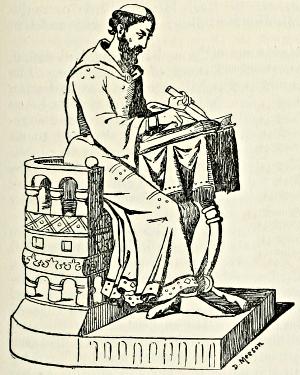
A Scholar of the Ninth Century
[835-886 A.D.]
During several generations they maintained
the dignity of their birth; and their
Roman patriotism rejected the tempting
offers of the Persian and Arabian powers,
who recalled them to their native country.
But their splendour was insensibly clouded
by time and poverty; and the
father of Basil was reduced to a
small farm, which he cultivated
with his own hands; yet he scorned
to disgrace the blood of the Arsacides
by a plebeian alliance; his
wife, a widow of Hadrianopolis,
was pleased to count among her ancestors
the great Constantine; and
their royal infant was connected by some dark affinity of lineage or country
with the Macedonian Alexander. No sooner was he born than the cradle
of Basil, his family, and his city, were swept away by an inundation of
the Bulgarians; he was educated a slave in a foreign land; and in this
severe discipline he acquired the hardiness of body and flexibility of mind
which promoted his future elevation. In the age of youth or manhood
he shared the deliverance of the Roman captives, who generously broke
their fetters, marched through Bulgaria to the shores of the Euxine, defeated
two armies of barbarians, embarked in the ships which had been
stationed for their reception, and returned to Constantinople, from whence
they were distributed to their respective homes. But the freedom of
Basil was naked and destitute; his farm was ruined by the calamities of
war. After his father’s death, his manual labour or service could no longer
support a family of orphans; and he resolved to seek a more conspicuous
theatre, in which every virtue and every vice may lead to the paths of
greatness.
The first night of his arrival at Constantinople, without friends or money,
the weary pilgrim slept on the steps of the church of St. Diomede; he was
fed by the casual hospitality of a monk, and was introduced to the service of
a cousin and namesake of the emperor Theophilus, who, though himself
of a diminutive person, was always followed by a train of tall and handsome
domestics. Basil attended his patron to the government of Peloponnesus;
eclipsed, by his personal merit, the birth and dignity of Theophilus, and
formed a useful connection with a wealthy and charitable matron of Patras.
Her spiritual or carnal love embraced the young adventurer, whom she
adopted as her son. Danielis presented him with thirty slaves; and the
produce of her bounty was expended in the support of his brothers, and
the purchase of some large estates in Macedonia. His gratitude or ambition
still attached him to the service of Theophilus; and a lucky accident
recommended him to the notice of the court.
A famous wrestler, in the train of the Bulgarian ambassadors, had defied,
at the royal banquet, the boldest and most robust of the Greeks. The
strength of Basil was praised; he accepted the challenge, and the barbarian
champion was overthrown at the first onset. A beautiful but vicious horse
was condemned to be hamstrung; it was subdued by the dexterity and courage
of the servant of Theophilus; and his conqueror was promoted to an
honourable rank in the imperial stables. But it was impossible to obtain
the confidence of Michael without complying with his vices; and his new
favourite, the great chamberlain of the palace, was raised and supported by
a disgraceful marriage with a royal concubine, and the dishonour of his sister
who succeeded to her place.
The public administration had been abandoned to the cæsar Bardas, the
brother and enemy of Theodora; but the arts of female influence persuaded
Michael to hate and to fear his uncle; he was drawn from Constantinople,
under the pretext of a Cretan expedition, and stabbed in the tent of audience,
by the sword of the chamberlain and in the presence of the emperor.
About a month after this execution, Basil was invested with the title of
Augustus and the government of the empire. He supported this unequal
association till his influence was fortified by popular esteem. His life was
endangered by the caprice of the emperor; and his dignity was profaned by
a second colleague, who had rowed in the galleys. Yet the murder of his
benefactor must be condemned as an act of ingratitude and treason; and
the churches which he dedicated to the name of St. Michael were a poor
and puerile expiation of his guilt.
But the most solid praise of Basil is drawn from the comparison of a
ruined and a flourishing monarchy, that which he wrested from the dissolute
Michael, and that which he bequeathed to the Macedonian dynasty.[57] The
evils which had been sanctified by time and example were corrected by his
master-hand; and he revived, if not the national spirit, at least the order
and majesty of the Roman Empire. His application was indefatigable, his
temper cool, his understanding vigorous and decisive; and in his practice he
observed that rare and salutary moderation, which pursues each virtue at an
equal distance between the opposite vices. His military service had been
confined to the palace; nor was the emperor endowed with the spirit or the
talents of a warrior. Yet under his reign the Roman arms were again formidable
to the barbarians.[58] As soon as he had formed a new army by discipline
and exercise, he appeared in person on the banks of the Euphrates,
curbed the pride of the Saracens, and suppressed the dangerous though just
revolt of the Manichæans.[59]
[867-886 A.D.]
But his principal merit was in the civil administration of the finances and
of the laws. To replenish an exhausted treasury, it was proposed to resume
the lavish and ill-placed gifts of his predecessor; his prudence abated one
moiety of the restitution, and a sum of £1,200,000 [$6,000,000] was instantly
procured to answer the most pressing demands, and to allow some
space for the mature operations of economy. Among the various schemes
for the improvement of the revenue, a new mode was suggested of capitation,
or tribute, which would have too much depended on the arbitrary discretion
of the assessors. A sufficient list of honest and able agents was
instantly produced by the minister; but, on the more careful scrutiny of
Basil himself, only two could be found who might be safely entrusted with
such dangerous powers; and they justified his esteem by declining his confidence.
But the serious and successful diligence of the emperor established
by degrees an equitable balance of property and payment, of receipt and
expenditure; a peculiar fund was appropriated to each service; and a public
method secured the interest of the prince and the property of the people.
After reforming the luxury, he assigned two patrimonial estates to supply
the decent plenty of the imperial table; the contributions of the subject
were reserved for his defence; and the residue was employed in the embellishment
of the capital and provinces.
In the character of a judge he was assiduous and impartial, desirous to
save, but not afraid to strike; the oppressors of the people were severely
chastised, but his personal foes, whom it might be unsafe to pardon, were
condemned, after the loss of their eyes, to a life of solitude and repentance.
The change of language and manners demanded a revision of the obsolete
jurisprudence of Justinian. The voluminous body of his Institutes, Pandects,
Code, and Novels was digested under forty titles, in the Greek idiom;
and the Basilica,[60] which were improved and completed by his son and grandson,
must be referred to the genius of the original founder of their race. This
glorious reign was terminated by an accident in the chase. A furious stag
entangled his horns in the belt of Basil, and raised him from his horse; he was
rescued by an attendant, who cut the belt and slew the animal; but the fall
or the fever exhausted the strength of the aged monarch, and he expired in
the palace amidst the tears of his family and people. If he struck off the head
of the faithful servant for presuming to draw his sword against his sovereign,
the pride of despotism, which had lain dormant in his life, revived in the
last moments of despair, when he no longer wanted or valued the opinion
of mankind.
Of the four sons of the emperor, Constantine died before his father, whose
grief and credulity were amused by a flattering impostor and a vain apparition.[61]
Stephen, the youngest, was content with the honours of a patriarch
and a saint; both Leo and Alexander alike were invested with the purple,
but the powers of government were solely exercised by the elder brother.g
[886-911 A.D.]
The Saracen War continued during his reign; the chief evils suffered
being the loss of the second city of the empire, Thessalonica, which was
taken after a bitter siege, 904, and sacked with great ruthlessness. Over
twenty thousand of the inhabitants, escaping death, were sold into slavery.
The Romans also suffered naval defeat in 912. The Bulgarians in 893 had
forced a shameful peace on Leo.a
The name of Leo VI has been dignified with the title of philosopher, and
the union of the prince and the sage, of the active and speculative virtues,
would indeed constitute the perfection of human nature. But the claims of
Leo are far short of this ideal excellence.
If we still inquire the reason of his sage appellation, it can only be replied
that the son of Basil was less ignorant than the greater part of his contemporaries
in church and state; that his education had been directed by the
learned Photius; and that several books of profane and ecclesiastical science
were composed by the pen, or in the name, of the imperial philosopher. But
the reputation of his philosophy and religion was overthrown by a domestic
vice, the repetition of his nuptials.
In the beginning of his reign Leo himself had abolished the state of concubines,
and condemned, without annulling, third marriages; but his patriotism
and love soon compelled him to violate his own laws and to incur the
penance which in a similar case he had imposed on his subjects. In his first
three alliances, his nuptial bed was unfruitful; the emperor required a female
companion and the empire a legitimate heir. The beautiful Zoe was introduced
into the palace as a concubine; and after a trial of her fecundity and
the birth of Constantine, her lover declared his intention of legitimating the
mother and the child by the celebration of his fourth nuptials. But the
patriarch Nicholas refused his blessing; the imperial baptism of the young
prince was obtained by a promise of separation, and the contumacious husband
of Zoe was excluded from the communion of the faithful. Neither the
fear of exile, nor the desertion of his brethren, nor the authority of the Latin
church, nor the danger of failure or doubt in the succession to the empire,
could bend the spirit of the inflexible monk. After the death of Leo, he was
recalled from exile to the civil and ecclesiastical administration; and the
edict of union which was promulgated in the name of Constantine condemned
the future scandal of fourth marriages, and left a tacit imputation
on his own birth.
In the Greek language purple and porphyry are the same word; and as the
colours of nature are invariable, we may learn that a dark deep red was the
Tyrian dye which stained the purple of the ancients. An apartment of
the Byzantine palace was lined with porphyry; it was reserved for the use
of the pregnant empresses; and the royal birth of their children was expressed
by the appellation of porphyrogenite, or born in the purple. Several
of the Roman princes had been blessed with an heir; but this peculiar surname
was first applied to Constantine VII. His life and titular reign were
of equal duration; but of fifty-four years, six had elapsed before his father’s
death; and the son of Leo was ever the voluntary or reluctant subject of
those who oppressed his weakness or abused his confidence. His uncle Alexander,
who had long been invested with the title of Augustus, was the first
colleague and governor of the young prince; but in a rapid career of vice
and folly, the brother of Leo already emulated the reputation of Michael; and
when he was extinguished by a timely death, he entertained a project of
castrating his nephew, and leaving the empire to a worthless favourite.
[919-944 A.D.]
The succeeding years of the minority of Constantine were occupied by
his mother Zoe, and a succession or council of seven regents,[62] who pursued
their interest, gratified their passions, abandoned the republic, supplanted
each other, and finally vanished in the presence of a soldier. From an obscure
origin, Romanus Lecapenus had raised himself to the command of the
naval armies; and in the anarchy of the times, had deserved, or at least had
obtained, the national esteem. With a victorious and affectionate fleet,[63] he
sailed from the mouth of the Danube into the harbour of Constantinople,
and was hailed as the deliverer of the people, and the guardian of the prince.
His supreme office was at first defined by the new appellation of father of
the emperor; but Romanus soon disdained the subordinate powers of a minister,
and assumed with the titles of Cæsar and Augustus the full independence
of royalty, which he held near five-and-twenty years. His three sons,
Christopher, Stephanus, and Constantine VIII, were adorned with the same
honours, and the lawful emperor was degraded from the first to the fifth rank
in this college of princes. Yet, in the preservation of his life and crown, he
might still applaud his own fortune and the clemency of the usurper.
The examples of ancient and modern history would have excused the
ambition of Romanus; the powers and the laws of the empire were in his
hand; the spurious birth of Constantine would have justified his exclusion;
and the grave or the monastery was open to receive the son of the concubine.
But Lecapenus does not appear to have possessed either the virtues
or the vices of a tyrant. The studious temper and retirement of Constantine
disarmed the jealousy of power: his books and music, his pen and
his pencil, were a constant source of amusement; and, if he could improve
a scanty allowance by the sale of his pictures, if their price was not enhanced
by the name of the artist, he was endowed with a personal talent, which
few princes could employ in the hour of adversity.
The fall of Romanus was occasioned by his own vices and those of his
children. After the decease of Christopher, his eldest son, the two surviving
brothers quarrelled with each other, and conspired against their father. At
the hour of noon, when all strangers were regularly excluded from the
palace, they entered his apartment with an armed force, and conveyed him,
in the habit of a monk, to a small island in the Propontis, which was peopled
by a religious community. The rumour of this domestic revolution excited
a tumult in the city; but Porphyrogenitus alone, the true and lawful emperor,
was the object of the public care; and the sons of Lecapenus were
taught, by tardy experience, that they had achieved a guilty and perilous
enterprise for the benefit of their rival. Their sister Helena, the wife of
Constantine, revealed, or supposed, their treacherous design of assassinating
her husband at the royal banquet. His loyal adherents were alarmed; and
the two usurpers were prevented, seized, degraded from the purple, and
embarked for the same island and monastery where their father had been so
lately confined. Old Romanus met them on the beach with a sarcastic smile,
and, after a just reproach of their folly and ingratitude, presented his imperial
colleagues with an equal share of his water and vegetable diet.
[944-963 A.D.]
In the fortieth year of his reign, Constantine VII obtained the possession
of the Eastern world, which he ruled, or seemed to rule, near fifteen
years. But he was devoid of that energy of character which could emerge
into a life of action and glory; and the studies which had amused and dignified
his leisure were incompatible with the serious duties of a sovereign.
The emperor neglected the practice to instruct his son Romanus in the
theory of government; while he indulged the habits of intemperance and
sloth, he dropped the reins of the administration into the hands of Helena
his wife; and, in the shifting scene of her favour and caprice, each minister
was regretted in the promotion of a more worthless successor. Yet the birth
and misfortunes of Constantine had endeared him to the Greeks; they excused
his failings; they respected his learning, his innocence and charity,
his love of justice; and the ceremony of his funeral was mourned with the
unfeigned tears of his subjects (959). The body, according to ancient custom,
lay in state in the vestibule of the palace; and the civil and military
officers, the patricians, the senate, and the clergy, approached in due order
to adore and kiss the inanimate corpse of their sovereign. Before the procession
moved towards the imperial sepulchre, a herald proclaimed this
awful admonition: “Arise, O king of the world, and obey the summons of
the King of kings!”
The death of Constantine was imputed to poison; and his son Romanus,
who derived that name from his maternal grandfather, ascended the throne
of Constantinople. A prince, who, at the age of twenty, could be suspected
of anticipating his inheritance, must have been already lost in the
public esteem; yet Romanus was rather weak than wicked; and the largest
share of the guilt was transferred to his wife, Theophano, a woman of base
origin, masculine spirit, and flagitious manners. The sense of personal glory
and public happiness, the true pleasures of royalty, were unknown to the
son of Constantine; and while the two brothers, Nicephorus and Leo, triumphed
over the Saracens, the hours which the emperor owed to his people
were consumed in strenuous idleness.
In strength and beauty he was conspicuous above his equals; tall and
straight as a young cypress, his complexion was fair and florid, his eyes
sparkling, his shoulders broad, his nose long and aquiline. Yet even these
perfections were insufficient to fix the love of Theophano; and, after a reign
of four years, Theophano mingled for her husband the same deadly draught
which she was thought to have composed for his father.
By his marriage with this impious woman, Romanus the Younger left two
sons, Basil II and Constantine IX, and two daughters, Theophano and Anne.
The elder sister was given to Otto II emperor of the West; the younger
became the wife of Vladimir, grand duke and apostle of Russia, and, by the
marriage of her granddaughter with Henry I, king of France, the blood of
the Macedonians, and perhaps of the Arsacides, still flows in the veins of the
Bourbon line.
After the death of her husband the empress aspired to reign in the name
of her sons, the elder of whom was five, and the younger only two years of
age; but she soon felt the instability of a throne which was supported by a
female who could not be esteemed, and two infants who could not be feared.
Theophano looked around for a protector, and threw herself into the arms of
the bravest soldier; her heart was capacious; but the deformity of the new
favourite rendered it more than probable that interest was the motive and
excuse of her love.
[963-969 A.D.]
Nicephorus Phocas united, in the popular opinion, the double merit of a
hero and saint. In the former character, his qualifications were genuine and
splendid: the descendant of a race illustrious by their military exploits, he
had displayed in every station and in every province the courage of a soldier
and the conduct of a chief; and Nicephorus was crowned with recent
laurels, from the important conquest of the isle of Crete. His religion was
of a more ambiguous cast; and his hair-cloth, his fasts, his pious idiom, and
his wish to retire from the business of the world, were a convenient mask
for his dark and dangerous ambition. Yet he imposed on a holy patriarch,
by whose influence, and by a decree of the senate, he was entrusted, during
the minority of the young princes, with the absolute and independent command
of the oriental armies. As soon as he had secured the leaders and the
troops, he boldly marched to Constantinople, trampled on his enemies,
avowed his correspondence with the empress, and, without degrading her
sons, assumed, with the title of Augustus, the pre-eminence of rank and the
plenitude of power. But his marriage with Theophano was refused by
the same patriarch who had placed the crown on his head; by his second
nuptials he incurred a year of canonical penance; a bar of spiritual affinity
was opposed to their celebration; and some evasion and perjury were required
to silence the scruples of the clergy and people. The popularity
of the emperor was lost in the purple; in a reign of six years he provoked
the hatred of strangers and subjects, and the hypocrisy and avarice of the
first Nicephorus were revived in his successor. In the use of his patrimony,
the generous temper of Nicephorus had been proved, and the revenue was
strictly applied to the service of the state; each spring the emperor marched
in person against the Saracens, and every Roman might compute the employment
of his taxes in triumphs, conquests, and the security of the Eastern
barrier.g
The darling object of Nicephorus was to break the power of the Saracens,
and extend the frontiers of the empire in Syria and Mesopotamia. In the
spring of 964, he assembled an army against Tarsus, which was the fortress
that covered the Syrian frontier. Next year (965), Nicephorus again formed
the siege of Tarsus with an army of forty thousand men. The place was
inadequately supplied with provisions; and though the inhabitants were a
warlike race, who had long carried on incursions into the Byzantine territory,
they were compelled to abandon their native city, and retire into Syria,
carrying with them only their personal clothing. A rich cross, which the
Saracens had taken when they destroyed the Byzantine army under Stypiotes
in the year 877, was recovered and placed in the church of St. Sophia at
Constantinople. The bronze gates of Tarsus and Mopsuestia, which were
of rich workmanship, were also removed and placed by Nicephorus in the
new citadel he had constructed to defend the palace. In the same year
Cyprus was reconquered by an expedition under the command of the patrician
Nicetas.
[965-968 A.D.]
For two years the emperor was occupied at Constantinople by the civil
administration of the empire, by a threatened invasion of the Hungarians,
and by disputes with the king of Bulgaria; but in 968 he again resumed
the command of the army in the East. Early in spring he marched past
Antioch at the head of eighty thousand men, and without stopping to besiege
that city, he rendered himself master of the fortified places in its neighbourhood,
in order to cut it off from all relief from the caliph of Baghdad. He
then pushed forward his conquests; Laodicea, Hierapolis, Aleppo, Arca, and
Emesa were taken, and Tripolis and Damascus paid tribute to save their
territory from being laid waste. In this campaign many relics were surrendered
by the Mohammedans. In consequence of the approach of winter,
the emperor led his army into winter quarters, and deferred forming the
siege of Antioch until the ensuing spring. He left the patrician Burtzes in
a fort on the Black Mountain, with orders to watch the city and prevent the
inhabitants from collecting provisions and military stores. The remainder
of the army, under the command of Peter, was stationed in Cilicia. As he
was anxious to reserve to himself the glory of restoring Antioch to the
empire, he ordered his lieutenants not to attack the city during his absence.
But one of the spies employed by Burtzes brought him the measure of the
height of a tower which it was easy to approach, and the temptation to take
the place by surprise was not to be resisted. Accordingly, on a dark winter
night while there was a heavy fall of snow, Burtzes placed himself at
the head of three hundred chosen men, and gained possession of two of the
towers of Antioch. He immediately sent off a courier to Peter, requesting
him to advance and take possession of the city; but Peter, from fear of the
emperor’s jealousy, delayed moving to the assistance of Burtzes for three
days. During this interval, however, Burtzes defended himself against
the repeated attacks of the whole population, though with great difficulty.
The Byzantine army at length arrived, and Antioch was annexed to the
empire after having remained 328 years in the power of the Saracens. The
emperor Nicephorus, instead of rewarding Burtzes for his energy, dismissed
both him and Peter from their commands.
The Fatimite caliph Moëz reigned at Kairowan, and was already contemplating
the conquest of Egypt. Nicephorus not only refused to pay him the
tribute of eleven thousand gold byzants, stipulated by Romanus I, but even
sent an expedition to wrest Sicily from the Saracens. The chief command
was entrusted to Nicetas, who had conquered Cyprus; and the army, consisting
chiefly of cavalry, was more particularly placed under the orders of
Manuel Phocas, the emperor’s cousin, a daring officer. The troops were
landed on the eastern coast, and Manuel rashly advanced, until he was surrounded
by the enemy and slain. Nicetas also had made so little preparation
to defend his position that his camp was stormed and he himself taken prisoner
and sent to Africa.
[965-969 A.D.]
The affairs of Italy were, as usual, embroiled by local causes. Otto, the
emperor of the West, appeared at the head of an army in Apulia, and having
secured the assistance of Pandulf, prince of Beneventum, called Ironhead,
carried on the war with frequent vicissitudes of fortune. Ironhead was
taken prisoner by the Byzantine general, and sent captive to Constantinople.
But the tyrannical conduct of the Byzantine officials lost all that was gained
by the superior discipline of the troops, and favoured the progress of the
German arms. Society had fallen into such a state of isolation that men
were more eager to obtain immunity from all taxation than protection for
industry and property, and the advantages of the Byzantine administration
ceased to be appreciated.
The European provinces of the empire were threatened with invasion both
by the Hungarians and Bulgarians. In 966 Nicephorus was apprised of the
intention of the Hungarians, and he solicited the assistance of Peter, king of
Bulgaria, to prevent their passing the Danube. Peter refused, for he had
been compelled to conclude a treaty of peace with the Hungarians, who
had invaded Bulgaria a short time before. It is even said that Peter took
advantage of the difficulty in which Nicephorus appeared to be placed, by
the numerous wars that occupied his troops, to demand payment of the tribute
Romanus I had promised to Simeon. Nicephorus, in order to punish the
insolence of one whom he regarded as his inferior, sent Calocyres, the son of
the governor of Cherson, as ambassador to Russia, to invite Sviatoslaff, the
Varangian prince of Kieff, to invade Bulgaria, and entrusted him with a sum
of fifteen hundred pounds’ weight of gold, to pay the expenses of the expedition.
Calocyres proved a traitor: he formed an alliance with Sviatoslaff,
proclaimed himself emperor, and involved the empire in a bloody war with
the Russians.
With all his defects, Nicephorus was one of the most virtuous men and
conscientious sovereigns that ever occupied the throne of Constantinople.
Though born of one of the noblest and wealthiest families of the Eastern
Empire, and sure of obtaining the highest offices at a proud and luxurious
court, he chose a life of hardship in pursuit of military glory; and a contemporary
historian, Leo Diaconus,o who wrote after his family had been
ruined by proscription and his name had become odious, observes, that no one
had ever seen him indulge in revelry or debauchery even in his youth.n
Among the warriors who promoted his elevation, and served under his
standard, a noble and valiant Armenian had deserved and obtained the most
eminent rewards. The stature of Joannes Zimisces was below the ordinary
standard; but this diminutive body was endowed with strength, beauty, and
the soul of a hero. By the jealousy of the emperor’s brother, he was degraded
from the office of general of the East, to that of director of the posts, and
his murmurs were chastised with disgrace and exile. But Zimisces was
ranked among the numerous lovers of the empress. On her intercession he
was permitted to reside at Chalcedon, in the neighbourhood of the capital;
her bounty was repaid in his clandestine and amorous visits to the palace;
and Theophano consented with alacrity to the death of an ugly and penurious
husband. Some bold and trusty conspirators were concealed in her most
private chambers; in the darkness of a winter night Zimisces, with his principal
companions, embarked in a small boat, traversed the Bosporus, landed
at the palace stairs, and silently ascended a ladder of ropes, which was cast
down by the female attendants. Neither his own suspicions, nor the warnings
of his friends, nor the tardy aid of his brother Leo, nor the fortress
which he had erected in the palace, could protect Nicephorus from a domestic
foe, at whose voice every door was opened to the assassins. As he slept on
a bearskin on the ground, he was roused by their noisy intrusion, and thirty
daggers glittered before his eyes.
It is doubtful whether Zimisces imbrued his hands in the blood of his
sovereign; but he enjoyed the inhuman spectacle of revenge. The murder
was protracted by insult and cruelty; and as soon as the head of Nicephorus
was shown from the window, the tumult was hushed, and the Armenian was
emperor of the East. On the day of his coronation, he was stopped on the
threshold of St. Sophia by the intrepid patriarch; who charged his conscience
with the deed of treason and blood; and required, as a sign of repentance,
that he should separate himself from his more criminal associate. This sally
of apostolical zeal was not offensive to the prince, since he could neither love
nor trust a woman who had repeatedly violated the most sacred obligations;
and Theophano, instead of sharing his imperial fortune, was dismissed with
ignominy from his bed and palace.
In their last interview, she displayed a frantic and impotent rage; accused
the ingratitude of her lover; assaulted with words and blows her son Basil,
as he stood silent and submissive in the presence of a superior colleague; and
avowed her own prostitution in proclaiming the illegitimacy of his birth.
The public indignation was appeased by her exile and the punishment of the
meaner accomplices; the death of an unpopular prince was forgiven; and
the guilt of Zimisces was forgotten in the splendour of his virtues. Perhaps
his profusion was less useful to the state than the avarice of Nicephorus;
but his gentle and generous behaviour delighted all who approached his
person; and it was only in the paths of victory that he trod in the footsteps
of his predecessor. The greatest part of his reign was employed in the camp
and the field. His personal valour and activity were signalised on the Danube
and the Tigris, the ancient boundaries of the Roman world; and by his
double triumph over the Russians and the Saracens, he deserved the titles of
saviour of the empire and conqueror of the East.g
The Russian war was the great event of the reign of Joannes Zimisces.
The military fame of the Byzantine emperor, who was unquestionably the
ablest general of his time, the greatness of the Russian nation, whose power
now overshadows Europe, the scene of the contest, destined in our day to be
again the battle-field of Russian armies, and the political interest which
attaches to the first attempt of a Russian prince to march by land to Constantinople,
all combine to give a practical as well as a romantic interest
to this war.
The first Russian naval expedition against Constantinople in 865 would
probably have been followed by a series of plundering excursions, like those
carried on by the Danes and Normans on the coasts of England and France,
had not the Turkish tribe called the Patzinaks rendered themselves masters of
the lower course of the Dnieper, and become instruments in the hands of the
emperors to arrest the activity of the bold Varangians. The northern rulers
of Kieff were the same rude warriors that infested England and France, but
the Russian people was then in a more advanced state of society than the mass
of the population in Britain and Gaul. The majority of the Russians were
freemen; the majority of the inhabitants of Britain and Gaul were serfs.
After the defeat in 865, the Russians induced their rulers to send envoys
to Constantinople to renew commercial intercourse, and invite Christian
missionaries to visit their country; and no inconsiderable portion of the people
embraced Christianity, though the Christian religion continued long after
better known to the Russian merchants than to the Varangian warriors.
The commercial relations of the Russians with Cherson and Constantinople
were now carried on directly, and numbers of Russian traders took up their
residence in these cities. The first commercial treaty between the Russians
of Kieff and the Byzantine Empire was concluded in the reign of Basil I.
The intercourse increased from that time. In the year 902, seven hundred
Russians are mentioned as serving on board the Byzantine fleet with high
pay; in 935, seven Russian vessels, with 415 men, formed part of a Byzantine
expedition to Italy; and in 949, six Russian vessels, with 629 men, were
engaged in the unsuccessful expedition of Gongyles against Crete. In 966,
a corps of Russians accompanied the unfortunate expedition of Nicetas to
Sicily. There can be no doubt that these were all Varangians, familiar, like
the Danes and Normans in the West, with the dangers of the sea, and not
native Russians, whose services on board the fleet could have been of little
value to the masters of Greece.
[907-944 A.D.]
But to return to the history of the Byzantine wars with the Russians.
In the year 907, Oleg, who was regent of Kieff during the minority of Igor
the son of Ruric, assembled an army of Varangians, Slavonians, and Croatians,
and, collecting two thousand vessels or boats of the kind then used on
the northern shore of the Euxine, advanced to attack Constantinople. The
exploits of this army, which pretended to aspire at the conquest of Tzaragrad,
or the City of the Cæsars, were confined to plundering the country
round Constantinople; and it is not improbable that the expedition was
undertaken to obtain indemnity for some commercial losses sustained by
imperial negligence, monopoly, or oppression. The subjects of the emperor
were murdered, and the Russians amused themselves with torturing their
captives in the most barbarous manner. At length Leo purchased their
retreat by the payment of a large sum of money. Such is the account transmitted
to us by the Russian monk Nestor, for no Byzantine writer notices
the expedition, which was doubtless nothing more than a plundering incursion,
in which the city of Constantinople was not exposed to any danger.
These hostilities were terminated by a commercial treaty in 912, and its conditions
are recorded in detail by Nestor.
In the year 941, Igor made an attack on Constantinople, impelled either
by the spirit of adventure, which was the charm of existence among all the
tribes of Northmen, or else roused to revenge by some violation of the treaty
of 912. The Russian flotilla, consisting of innumerable small vessels, made
its appearance in the Bosporus while the Byzantine fleet was absent in the
Archipelago. Igor landed at different places on the coast of Thrace and
Bithynia, ravaging and plundering the country; the inhabitants were treated
with incredible cruelty; some were crucified, others were burned alive, the
Greek priests were killed by driving nails into their heads, and the churches
were destroyed. Only fifteen ships remained at Constantinople, but these
were soon fitted up with additional tubes for shooting Greek fire. This
force, trifling as it was in number, gave the Byzantines an immediate superiority
at sea, and the patrician Theophanes sailed out of the port to attack
the Russians. Igor, seeing the small number of the enemy’s ships, surrounded
them on all sides, and endeavoured to carry them by boarding; but
the Greek fire became only so much more available against boats and men
crowded together, and the attack was repulsed with fearful loss. In the
meantime, some of the Russians who landed in Bithynia were defeated by
Bardas Phocas and Joannes Curcuas, and those who escaped from the naval
defeat were pursued and slaughtered on the coast of Thrace without mercy.
The emperor Romanus ordered all the prisoners brought to Constantinople
to be beheaded. Theophanes overtook the fugitive ships in the month of
September, and the relics of the expedition were destroyed, Igor effecting
his escape with only a few boats. The Russian chronicle of Nestor says that,
in the year 944, Igor, assisted by other Varangians, and by the Patzinaks,
prepared a second expedition, but that the inhabitants of Cherson so alarmed
the emperor Romanus by their reports of its magnitude, that he sent ambassadors,
who met Igor at the mouth of the Danube, and sued for peace on
terms to which Igor and his boyards consented. This is probably merely a
salve applied to the vanity of the people of Kieff by their chronicler; but it
is certain that a treaty of peace was concluded between the emperors of
Constantinople and the princes of Kieff in the year 945.
[944-970 A.D.]
The cruelty of the Varangian prince Igor, after his return to Russia,
caused him to be murdered by his rebellious subjects.[64] Olga, his widow,
became regent for their son Sviatoslaff. She embraced the Christian religion,
and visited Constantinople in 957, where she was baptized. The
emperor Constantine Porphyrogenitus has left us an account of the ceremony
of her reception at the Byzantine court. A Russian monk has preserved
the commercial treaties of the empire; a Byzantine emperor records
the pageantry that amused a Russian princess. The high position occupied
by the court of Kieff in the tenth century is also attested by the style with
which it was addressed by the court of Constantinople. The golden bulls of
the Roman emperor of the East, addressed to the prince of Russia, were
ornamented with a pendent seal equal in size to a double solidus, like those
addressed to the kings of France.
[970-971 A.D.]
We have seen that the emperor Nicephorus II sent the patrician Calocyres
to excite Sviatoslaff to invade Bulgaria, and that the Byzantine ambassador
proved a traitor, and assumed the purple. Sviatoslaff soon invaded
Bulgaria at the head of a powerful army, which the gold brought by Calocyres
assisted him to equip, and defeated the Bulgarian army in a great
battle, 968 A.D. Peter, king of Bulgaria, died shortly after, and the country
was involved in civil broils; taking advantage of which, Sviatoslaff took
Presthlava the capital, and rendered himself master of the whole kingdom.
Nicephorus now formed an alliance with the Bulgarians, and was preparing
to defend them against the Russians, when Sviatoslaff was compelled to
return home, in order to defend his capital against the Patzinaks. Nicephorus
assisted Boris and Romanus, the sons of Peter, to recover Bulgaria, and
concluded an offensive and defensive alliance with Boris, who occupied the
throne. After the assassination of Nicephorus, Sviatoslaff returned to invade
Bulgaria with an army of sixty thousand men, and his enterprise assumed the
character of one of those great invasions which had torn whole provinces from
the Western Empire. His army was increased by a treaty with the Patzinaks
and an alliance with the Hungarians, so that they began to dream of the conquest
of Constantinople, and hoped to transfer the empire of the East from
the Romans of Byzantium to the Russians. It was fortunate for the Byzantine
Empire that it was ruled by a soldier who knew how to profit by its superiority
in tactics and discipline. The Russian was not ignorant of strategy,
and having secured his flank by his alliance with the Hungarians, he entered
Thrace by the western passes of Mount Hæmus, then the most frequented
road between Germany and Constantinople, and that by which the Hungarians
were in the habit of making their plundering incursions into the empire.
Joannes Zimisces was occupied in the East when Sviatoslaff completed the
second conquest of Bulgaria and passed Mount Hæmus, expecting to subdue
Thrace during the emperor’s absence with equal ease, 970 A.D. The empire
was still suffering from famine. Sviatoslaff took Philippopolis, and murdered
twenty thousand of the inhabitants. An embassy sent by Zimisces
was dismissed with a demand of tribute, and the Russian army advanced to
Arcadiopolis, where one division was defeated by Bardas Sclerus, and the
remainder retired again behind Mount Hæmus.
In the following spring, 971, the emperor Joannes took the field at the head
of an army of fifteen thousand infantry and thirteen thousand cavalry, besides
a body-guard of chosen troops called the Immortals, and a powerful
battery of field and siege engines.[65] A fleet of three hundred galleys, attended
by many smaller vessels, was despatched to enter the Danube and cut off the
communications of the Russians with their own country.[66]
The emperor Joannes marched from Hadrianopolis just before Easter, when
it was not expected that a Byzantine emperor would take the field. He knew
that the passes on the great eastern road had been left unguarded by the Russians,
and he led his army through all the defiles of Mount Hæmus without
encountering any difficulty. The
Russian troops stationed at Presthlava,
who ought to have guarded the
passes, marched out to meet the
emperor when they heard he had
entered Bulgaria. Their whole army
consisted of infantry, but the soldiers
were covered with chain armour,
and accustomed to resist the light
cavalry of the Patzinaks and other
Turkish tribes.[67] They proved, however,
no match for the heavy-armed
lancers of the imperial army; and,
after a vigorous resistance, were completely
routed by Joannes Zimisces,
leaving eighty-five hundred men on
the field of battle. On the following
day Presthlava was taken by escalade,
and a body of seven thousand Russians
and Bulgarians, who attempted
to defend the royal palace, which
was fortified as a citadel, were put
to the sword after a gallant defence. Sphengelos, who commanded this
division of the Russian force, and the traitor Calocyres, succeeded in escaping
to Dorystolon, where Sviatoslaff had concentrated the rest of the army;
but Boris, king of Bulgaria, with all his family, was taken prisoner in his
capital.
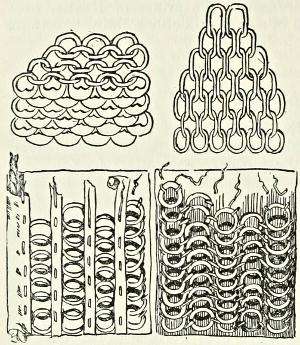
Types of early Chain Armour.
The emperor, after celebrating Easter in Presthlava, advanced by Pliscova
and Dinea to Dorystolon, where Sviatoslaff still hoped for victory,
though his position was becoming daily more dangerous. The Byzantine
fleet entered the Danube and took up its station opposite the city, cutting
off all the communications of the Russians by water, at the same time that
the emperor encamped before the walls and blockaded them by land. Zimisces,
knowing he had to deal with a desperate enemy, fortified his camp with
a ditch and rampart according to the old Roman model, which was traditionally
preserved by the Byzantine engineers. The Russians enclosed
within the walls of Dorystolon were more numerous than their besiegers, and
Sviatoslaff hoped to be able to open his communications with the surrounding
country, by bringing on a general engagement in the plain before all the
defences of the enemy’s camp were completed. He expected to defeat the
attacks of the Byzantine cavalry by forming his men in squares, and, as
the Russian soldiers were covered by long shields that reached to their feet,
he expected to be able, by advancing his squares like moving towers, to clear
the plain of the enemy. But while the Byzantine legions met the Russians
in front, the heavy-armed cavalry assailed them with their long spears in
flank, and the archers and slingers under cover watched coolly to transfix
every man where an opening allowed their missiles to penetrate. The battle
nevertheless lasted all day, but in the evening the Russians were compelled,
in spite of their desperate valour, to retire into Dorystolon without having
effected anything.
The infantry of the north now began to feel its inferiority to the veteran
cavalry of Asia sheathed in plate armour, and disciplined by long campaigns
against the Saracens. Sviatoslaff, however, continued to defend himself by
a series of battles rather than sorties, in which he made desperate efforts to
break through the ranks of the besiegers in vain, until at length it became
evident that he must either conclude peace, die on the field of battle, or be
starved to death in Dorystolon. Before resigning himself to his fate, he
made a last effort to cut his way through the Byzantine army; and on this
occasion the Russians fought with such desperation that contemporaries
ascribed the victory of the Byzantine troops, not to the superior tactics of the
emperor, nor to the discipline of a veteran army, but to the personal assistance
of St. Theodore, who found it necessary to lead the charge of the Roman
lancers, and shiver a spear with the Russians himself, before their phalanx
could be broken. The victory was complete, and Sviatoslaff sent ambassadors
to the emperor to offer terms of peace.
The siege of Dorystolon had now lasted more than two months, and the
Russian army, though reduced by repeated losses, still amounted to twenty-two
thousand men. The valour and contempt of death which the Varangians
had displayed in the contest, convinced the emperor that it would cause the
loss of many brave veterans to insist on their laying down their arms; he
was therefore willing to come to terms, and peace was concluded on condition
that Sviatoslaff should yield up Dorystolon, with all the plunder, slaves, and
prisoners in possession of the Russians, and engage to swear perpetual amity
with the empire, and never to invade either the territory of Cherson or the
kingdom of Bulgaria; while, on the other hand, the emperor Joannes engaged
to allow the Russians to descend the Danube in their boats, to supply
them with two medimni of wheat for each surviving soldier to enable them to
return home without dispersing to plunder for their subsistence, and to renew
the old commercial treaties between Kieff and Constantinople, July, 971.
After the treaty was concluded, Sviatoslaff desired to have a personal
interview with his conqueror. Joannes rode down to the bank of the
Danube clad in splendid armour, and accompanied by a brilliant suite of
guards on horseback. The short figure of the emperor was no disadvantage
where he was distinguished by the beauty of his charger and the splendour
of his arms, while his fair countenance, light hair, and piercing blue eyes
fixed the attention of all on his bold and good-humoured face, which contrasted
well with the dark, sombre visages of his attendants. Sviatoslaff
arrived by water in a boat, which he steered himself by an oar. His dress
was white, differing in no way from that of those under him, except in
being cleaner. Sitting in the stern of his boat, he conversed for a short time
with the emperor, who remained on horseback close to the beach. The appearance
of the bold Varangian excited much curiosity, and is thus described
by a historian who was intimate with many of those who were present at the
interview: The Russian was of the middle stature, well formed, with strong
neck and broad chest. His eyes were blue, his eyebrows thick, his nose flat,
and his beard shaved, but his upper lip was shaded with long and thick
mustaches. The hair of his head was cropped close, except two long locks
which hung down on each side of his face, and were thus worn as a mark of
his Scandinavian race. In his ears he wore golden earrings.
Sviatoslaff immediately quitted Dorystolon, but he was obliged to winter
on the shores of the Euxine, and famine thinned his ranks. In spring he
attempted to force his way through the territory of the Patzinaks with his
diminished army. He was defeated, and perished near the cataracts of the
Dnieper. Kour, prince of the Patzinaks, became the possessor of his skull,
which he shaped into a drinking-cup, and adorned with the moral maxim,
doubtless not less suitable to his own skull, had it fallen into the hands of
others, “He who covets the property of others, oft loses his own.” We have
already had occasion to record that the skull of the Byzantine emperor,
Nicephorus I, had ornamented the festivals of a Bulgarian king; that of a
Russian sovereign now figured in the tents of a Turkish tribe.
[971-988 A.D.]
The results of the campaign were as advantageous to the Byzantine Empire
as they were glorious to the emperor Joannes. Bulgaria was conquered, a
strong garrison established in Dorystolon, and the Danube once more became
the frontier of the Roman Empire. The peace with the Russians was uninterrupted
until about the year 988, when, from some unknown cause of quarrel,
Vladimir the son of Sviatoslaff attacked and gained possession of Cherson
by cutting off the water.
The Greek city of Cherson, situated on the extreme verge of ancient
civilisation, escaped for ages from the impoverishment and demoralisation
into which the Hellenic race was precipitated by the Roman system of concentrating
all power in the capital of the empire. Cherson was governed
for centuries by its own elective magistrates, and it was not until towards
the middle of the ninth century that the emperor Theophilus destroyed its
independence. When Vladimir the sovereign of Russia attacked it in 988,
it was betrayed into his hands by a priest, who informed him how to cut
off the water. The great object of ambition of all the princes of the East,
from the time of Heraclius to that of the last Comnenus of Trebizond, was
to form matrimonial alliances with the imperial family. Vladimir obtained
the hand of Anne, the sister of the emperors Basil II and Constantine IX,
and was baptized and married in the church of the Panaghia at Cherson.
To soothe the vanity of the empire, he pretended to retain possession of his
conquest as the dowry of his wife. Many of the priests who converted the
Russians to Christianity, and many of the artists who adorned the earliest
Russian churches with paintings and mosaics, were natives of Cherson. The
church raised Vladimir to the rank of a saint; the Russians conferred on
him the title of “the great.”
Joannes Zimisces, having terminated the Russian War, compelled Boris to
resign the crown of Bulgaria, and accept the title of “magister,” as a pensioner
of the Byzantine court. The frontier of the Eastern Empire was
once more extended to the Danube.
[972-975 A.D.]
The Saracen War had been carried on vigorously on the frontiers of
Syria, while the emperor Joannes was occupied with the Russian campaign.
The continued successes of the Byzantine arms had so alarmed the Mohammedan
princes, that an extensive confederacy was formed to recover Antioch,
and the command of the army of the caliph was entrusted to Zoher, the
lieutenant of the Fatimites in Egypt. The imperial army was led by the
patrician Nicolaus, a man of great military skill, who had been a eunuch
in the household of Joannes Zimisces; and he defeated the Saracens in a
pitched battle, and saved Antioch for a time. But in the following year
(973) the conquest of Nisibis filled the city of Baghdad with such consternation,
that a levy of all Mussulmans was ordered to march against the
Christians. The Byzantine troops in Mesopotamia were commanded by an
Armenian named Temelek Melchi, who was completely routed near Amida.
He was himself taken prisoner, and died after a year’s confinement.
With all his talents as a general, Joannes does not appear to have possessed
the same control over the general administration as Nicephorus; and
many of the cities conquered by his predecessor, in which the majority of the
inhabitants were Mohammedans, succeeded in throwing off the Byzantine
yoke. Even Antioch declared itself independent. A great effort became
necessary to regain the ground that had been lost; and, to make this, Joannes
Zimisces took the command of the Byzantine army in person in the year
974. He marched in one campaign from Mount Taurus to the banks of the
Tigris, and from the banks of the Tigris back into Syria, as far as Mount
Lebanon, carrying his victorious arms, according to the vaunting inaccuracy
of the Byzantine geographical nomenclature, into Palestine. His last campaign,
in the following year, was the most brilliant of his exploits. In
Mesopotamia he regained possession of Amida and Martyropolis; but these
cities contained so few Christian inhabitants that he was obliged to leave
the administration in the hands of Saracen emirs, who were charged with
the collection of the tribute and taxes. Nisibis he found deserted, and from
it he marched by Edessa to Hierapolis or Membig, where he captured many
valuable relics, among which the shoes of Jesus, and the hair of John the
Baptist, are especially enumerated. From Hierapolis Joannes marched to
Apamea, Emesa, and Baalbec, without meeting any serious opposition. The
emir of Damascus sent valuable presents, and agreed to pay an annual tribute
to escape a visit.
The emperor then crossed Mount Lebanon, storming the fortress of
Borzo, which commanded the pass, and, descending to the sea-coast, laid
siege to Berytus, which soon surrendered, and in which he found an image
of the crucifixion that he deemed worthy of being sent to Constantinople.
From Berytus he marched northward to Tripolis, which he besieged in vain
for forty days. The valour of the garrison and the strength of the fortifications
compelled him to raise the siege; but his retreat was ascribed to fear
of a comet, which illuminated the sky with a strange brilliancy. As it was
now September, he wished to place his worn-out troops in winter quarters
in Antioch; but the inhabitants shut the gates against him. To punish
them for their revolt, he had the folly to ravage their territory, and cut
down their fruit trees; forgetting, in his barbarous and impolitic revenge,
that he was ruining his own empire. Burtzes was left to reconquer Antioch
for the second time; which, however, he did not effect until after the death
of the emperor Joannes.
[975-976 A.D.]
The army was then placed in winter quarters on the frontiers of Cilicia,
and the emperor hastened to return to Constantinople. On the journey, as
he passed the fertile plains of Longias and Dryze, in the vicinity of Anazarba
and Podandus, he saw them covered with flocks and herds, with well-fortified
farmyards, but no smiling villages. He inquired with wonder to
whom the country belonged, in which pasturage was conducted on so grand
a scale; and he learned that the greater part of the province had been
acquired by the president Basilios in donations from himself and his predecessor,
Nicephorus. Amazed at the enormous accumulation of property in
the hands of one individual, he exclaimed, “Alas! the wealth of the empire
is wasted, the strength of the armies is exhausted, and the Roman emperors
toil like mercenaries, to add to the riches of an insatiable eunuch!” This
speech was reported to the president. He considered that he had raised
both Nicephorus and Joannes to the throne; his interest now required that
it should return to its rightful master, and that the young Basil should enjoy
his heritage. The emperor Joannes stopped on his way to Constantinople
at the palace of Romanus, a grandson of Romanus I; and it is said he there
drank of a poisoned cup presented to him by a servant gained by the president.
Certain it is that Joannes Zimisces reached the capital in a dying
state, and expired on the 10th of January, 976, at the age of fifty-one.e
“The period of greatest Byzantine power,” says Gelzer,f “is reached in
the reigns of Nicephorus II (963-969), Joannes Zimisces (969-976), and
Basil Bulgaroctonus (976-1025).” Finlaye also calls it the “Period of
Conquest and Military Glory.” That the glory was understood at the time
is evident from the enthusiastic outbursts of the anonymous continuator of
Georgius Monachus.g Of Nicephorus Phocas he says, “Then Phocas flashed
like lightning and stormed against the enemies of the Romans. He ravaged,
burned, and led into captivity the cities and lands of the barbarians.
Myriads of foreign lands he smote, and broadened the realm and the might
of the Romans. The Arabs trembled, the Armenians and Syrians shook,
the Saracens were scared and the Turks took flight; and the Romans seized
their strongholds and provinces, and Phocas’ name was fearful to all.” Of
Zimisces the same chronicler is equally enthusiastic: “And the nations
were in great fright before Zimisces’ fury. And he spread the realm of the
Romans abroad; the Saracens and Armenians fled; the Persians shook and
from all sides brought him gifts; they begged him for mercy and peace. He
led even to Edessa and to the river Euphrates; and the earth was full of the
tents of the Romans. Syrians and Phœnicians were trampled by the Roman
steeds. He fetched home mighty victories, and the sword of Christ mowed
like a scythe.”
And yet in Zimisces, Gelzer sees a retrogression of empire and an expansion
of feudalism; more and more he sees that the old Roman military and
civil state takes on a military and aristocratic physiognomy. After his
death the movement continued with usury.a
The premature death of Zimisces was a loss, rather than a benefit, to the
sons of Romanus II. Their want of experience detained them twelve years
longer the obscure and voluntary pupils of a minister, who extended his
reign by persuading them to indulge the pleasures of youth, and to disdain
the labours of government. In this silken web, the weakness of
Constantine was forever entangled; but his elder brother felt the impulse of
genius and the desire of action; he frowned, and the minister was no more.
Basil was the acknowledged sovereign of Constantinople and the provinces
of Europe; but Asia was oppressed by two veteran generals, Phocas and
Sclerus, who, alternately friends and enemies, subjects and rebels, maintained
their independence, and laboured to emulate the example of successful
usurpation.
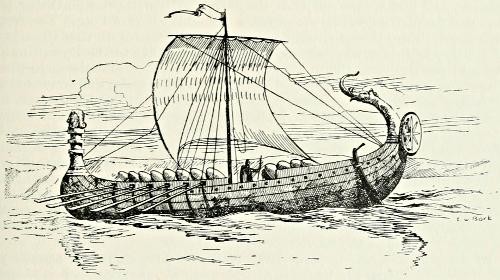
War Galley, Eighth and Ninth Centuries
Against these domestic enemies, the son of Romanus first drew his sword,
and they trembled in the presence of a lawful and high-spirited prince.
The first, in the front of battle, was thrown from his horse by the stroke
of poison, or an arrow; the second, who had been twice loaded with chains,
and twice invested with the purple, was desirous of ending in peace the
small remainder of his days. As the aged suppliant approached the throne,
with dim eyes and faltering steps, leaning on his two attendants, the
emperor exclaimed, in the insolence of youth and power: “And is this
the man who has so long been the object of our terror?” After he had
confirmed his own authority and the peace of the empire, the trophies of
Nicephorus and Zimisces would not suffer their royal pupil to sleep in the
palace. His long and frequent expeditions against the Saracens were
rather glorious than useful to the empire; but the final destruction of
the kingdom of Bulgaria appears, since the time of Belisarius, the most
important triumph of the Roman arms.h
[976-981 A.D.]
The reign of Basil II is the culminating point of Byzantine greatness.
The eagles of Constantinople flew during his life, in a long career of victory,
from the banks of the Danube to those of the Euphrates, and from the mountains
of Armenia to the shores of Italy. Basil’s indomitable courage, terrific
cruelty, indifference to art and literature, and religious superstition, all combine
to render him a true type of his empire and age. The great object of
his policy was to consolidate the unity of the administration in Europe by
the complete subjection of the Bulgarians and Slavonians, whom similarity
of language had almost blended into one nation, and had completely united
in hostility to the imperial government.
Four sons of a Bulgarian noble of the highest rank had commenced a
revolutionary movement in Bulgaria against the royal family, after the death
of Peter and the first victories of the Russians. In order to put an end to
these troubles, Nicephorus II had, on the retreat of Sviatoslaff, replaced
Boris, the son of Peter, on the throne of Bulgaria; and when the Russians
returned, Boris submitted to their domination. Shortly after the death of
Joannes I (Zimisces), the Bulgarian leaders again roused the people to a
struggle for independence. Boris, who escaped from Constantinople to
attempt recovering his paternal throne, was accidentally slain, and the four
brothers again became the chiefs of the nation. In a short time three perished,
and Samuel, who alone remained, assumed the title of king. The forces
of the empire were occupied with the rebellion of Sclerus, so that the vigour
and military talents of Samuel succeeded both in expelling the Byzantine authorities
from Bulgaria, and in rousing the Slavonians of Macedonia to throw
off the Byzantine yoke. Samuel then invaded Thessaly, and extended his
plundering excursions over those parts of Greece and the Peloponnesus still
inhabited by the Hellenic race. He carried away the inhabitants of Larissa
in order to people the town of Prespa, which he then proposed to make his
capital, with intelligent artisans and manufacturers; and, in order to attach
them to their new residence by ties of old superstition, he removed to Prespa
the body of their protecting martyr, St. Achilles, who some pretended had
been a Roman soldier, and others a Greek archbishop. Samuel showed himself,
both in ability and courage, a rival worthy of Basil; and the empire
of the East seemed for some time in danger of being transferred from the
Byzantine Romans to the Slavonian Bulgarians.
[981-1001 A.D.]
In the year 981, the emperor Basil made his first campaign against the
new Bulgarian monarchy in person. His plan of operations was to secure
the great western passes through Mount Hæmus, on the road from Philippopolis
to Sardica, and by the conquest of the latter city he hoped to cut
off the communication between the Bulgarians north of Mount Hæmus and
the Slavonians in Macedonia. But his military inexperience, and the relaxed
discipline of the army, caused this well-conceived plan to fail. Sardica
was besieged in vain for twenty days. The negligence of the officers
and the disobedience of the soldiers caused several foraging parties to be
cut off; the besieged burned the engines of the besiegers in a victorious
sortie, and the emperor felt the necessity of commencing his retreat. As
his army was passing the defiles of Hæmus, it was assailed by the troops
Samuel had collected to watch his operations, and completely routed. The
baggage and military chest, the emperor’s plate and tents, all fell into the
hands of the Bulgarian king, and Basil himself escaped with some difficulty
to Philippopolis, where he collected the relics of the fugitives. Leo Diaconus,b
the Byzantine historian, who accompanied the expedition as one of the
clergy of the imperial chapel, and was fortunate enough to escape the pursuit,
has left a short but authentic notice of this first disastrous campaign
of Basil, the slayer of the Bulgarians, in his Historia.[68]
The reorganisation of his army, the regulation of the internal administration
of the empire, the rebellion of Phocas, and the wars in Italy and
on the Asiatic frontier, prevented Basil from attacking Samuel in person
for many years. Still a part of the imperial forces carried on this war,
and Samuel soon perceived that he was unable to resist the Byzantine generals
in the plains of Bulgaria, where the heavy cavalry, military engines,
and superior discipline of the imperial armies could all be employed to
advantage. He resolved, therefore, to transfer the seat of the Bulgarian
government to a more inaccessible position, at Achrida. Here, therefore,
Samuel established the capital of the Bulgaro-Slavonian kingdom he founded.
The dominions of Samuel soon became as extensive as the European
portion of the dominions of Basil. The possessions of the two monarchs
ran into one another in a very irregular form, and both were inhabited by a
variety of races, in different states of civilisation, bound together by few
sympathies, and no common attachment to national institutions. Samuel
was master of almost the whole of ancient Bulgaria, the emperor retaining
possession of little more than the fortress of Dorystolon, the forts at the
mouth of the Danube, and the passes of Mount Hæmus. But the strength
of the Bulgarian king lay in his possessions in the upper part of Macedonia,
in Epirus, and the southern part of Illyricum, in the chain of Pindus, and in
mountains that overlook the northern and western slopes of the great plains
of Thessalonica and Thessaly. He was indefatigable in forming a large military
force, and employing it constantly in ravaging the plain of Thessaly,
and attacking the Greek cities.
In 996 he marched rapidly through Thessaly, Bœotia, and Attica, into
the Peloponnesus; but the towns everywhere shut their gates, and prepared
for a long defence, so that he could effect nothing beyond plundering and
laying waste the open country. In the meantime, the emperor sent Nicephorus
Uranus, with all the force he should be able to collect, in pursuit of
Samuel. Uranus entered Thessaly, and pushed rapidly southward to the
banks of the Sperchius, where he found Samuel encamped on the other side,
hastening home with the plunder of Greece. In the night the people showed
Uranus a ford, by which he passed the river and surprised the Bulgarians
in their camp. Samuel and his son Gabriel escaped with the greatest difficulty.
The Bulgarian army was completely annihilated, and all the plunder
and slaves made during the expedition fell into the hands of Uranus, in the
year 996 A.D. This great defeat paralysed the military operations of Samuel
for some time.
Basil at length arranged the external relations of the empire in such
a way that he was able to assemble a large army for the military operations
against the kingdom of Achrida, which he determined to conduct in person.
The Slavonians now formed the most numerous part of the population of
the country between the Danube, the Ægean, and the Adriatic, and they
were in possession of the line of mountains that runs from Dyrrhachium, in a
variety of chains, to the vicinity of Constantinople. Basil saw many signs
that the whole Slavonic race in these countries was united in opposition to
the Byzantine government, so that the existence of his empire demanded the
conquest of the Bulgaro-Slavonian kingdom which Samuel had founded.
To this arduous task he devoted himself with his usual energy.
In the year 1000, his generals were ordered to enter Bulgaria by the
eastern passes of Mount Hæmus; and in this campaign they took the cities
of greater and lesser Presthlava and Pliscova, the ancient capitals of Bulgaria.
In the following year, the emperor took upon himself the direction of
the army destined to act against Samuel. Fixing his headquarters at Thessalonica,
he recovered possession of the fortresses of Vodena, Berœa, and
Servia.
[1001-1014 A.D.]
In the following campaign (1002), the emperor changed the field of
operations, and, marching from Philippopolis through the western passes
of Mount Hæmus, occupied the whole line of road as far as the Danube, and
cut Samuel off from all communication with the plains of Bulgaria. Samuel
formed a bold enterprise, which he hoped would compel Basil to raise the
siege of Widdin, or, at all events, enable him to inflict a deep wound on the
empire. By a long march into the heart of the empire, Samuel rendered
himself master of great booty. His success prevented his returning as
rapidly as he had advanced, but he succeeded in passing the garrison of
Philippopolis and crossing the Strymon and the Wardar in safety, when
Basil suddenly overtook him at the head of the Byzantine army. Samuel
was encamped under the walls of Scupi; Basil crossed the river, stormed
the Bulgarian camp, captured the military chest and stores, and recovered
the plunder of Hadrianopolis. He had thus the satisfaction of avenging the
defeat he had suffered from Samuel, one-and-twenty years before, in the
passes of Mount Hæmus.
[1014-1019 A.D.]
In the year 1014, Basil considered everything ready for a final effort to
complete the subjection of the Slavonian population of the mountainous districts
round the upper valley of the Strymon. The emperor is said to have
taken fifteen thousand prisoners, and, that he might revenge the sufferings
of his subjects from the ravages of the Bulgarians and Slavonians, he gratified
his own cruelty by an act of vengeance, which has most justly entailed
infamy on his name. His frightful inhumanity has forced history to turn
with disgust from his conduct, and almost buried the records of his military
achievements in oblivion. On this occasion he ordered the eyes of all his
prisoners to be put out, leaving a single eye to the leader of every hundred,
and in this condition he sent the wretched captives forth to seek their king
or perish on the way. When they approached Achrida, a rumour that the
prisoners had been released induced Samuel to go out to meet them. On
learning the full extent of the calamity, he fell senseless to the ground, overpowered
with rage and grief, and died two days after. He is said to have
murdered his own brother to secure possession of his throne, so that his
heart was broken by the first touch of humanity it ever felt.[69]
The cruelty of Basil awakened an energetic resistance on the part of the
Slavonians and Bulgarians, and Gabriel Radomir, the brave son of Samuel,
was enabled to offer unexpected obstacles to the progress of the Byzantine
armies.
Gabriel, the king of Achrida, though brave, alienated the favour of his
subjects by his imprudence, and his cousin, John Ladislas, whose life he had
saved in youth, was base enough to become his murderer, in order to gain
possession of the throne. Ladislas, in order to gain time, both for strengthening
himself on the throne and resisting the Byzantine invasion, sent
ambassadors to Basil with favourable offers of peace; but the emperor, satisfied
that the struggle between the Slavonians and Greeks could only be
terminated by the conquest of one, rejected all terms but absolute submission,
and pushed on his operations with his usual vigour. After laying waste all
the country round Ostrovos and Moliskos that was peopled by Slavonians,
and repairing the fortifications of Berœa which had fallen to decay, he
captured Setaina, where Samuel had formed great magazines of wheat.
These magazines were kept well filled by Ladislas, so that Basil became
master of so great a store that he divided it among his troops. At last the
king of Achrida approached the emperor at the head of a considerable army,
and a part of the imperial troops was drawn into an ambuscade. The
emperor happened to be himself with the advanced division of the army.
He instantly mounted his horse and led the troops about him to the scene of
action, sending orders for all the other divisions to hasten forward to support
him. His sudden appearance at the head of a strong body of the heavy-armed
lancers of the Byzantine army, the fury of his charge, the terror his
very name inspired, and the cry, “The emperor is upon us!” soon spread
confusion through the Bulgarian ranks, and decisively changed the fortune
of the day (1018).
Ladislas, whose affairs were becoming desperate, made an attempt to
restore his credit by laying siege to Dyrrhachium. Its possession would
have enabled him to open communications with the enemies of Basil in Italy,
and even with the Saracens of Sicily and Africa, but he was slain soon after
the commencement of the siege. The Bulgarian leaders gave up all hope of
resistance. The emperor continued to advance by Scupi, Stypeia, and
Prosakon, and on reaching Achrida he was received rather as the lawful
sovereign than as a foreign conqueror. He immediately took possession of
all the treasures Samuel had amassed; the gold alone amounted to one hundred
centners (this sum is not quite equal to $480,000 or $2,400,000), and
with this he paid all the arrears due to his troops, and rewarded them with a
donative for their long and gallant service in this arduous war. Almost the
whole of the royal family of Achrida submitted, and received the most
generous treatment. Three sons of Ladislas, who escaped to Mount Tmorus,
and attempted to prolong the contest, were soon captured. The noble Bulgarians
hastened to make their submission, and many were honoured with
rank at the imperial court.
Nothing, indeed, proves more decidedly the absence of all Greek nationality
in the Byzantine administration at this period, than the facility with
which all foreigners obtained favour at the court of Constantinople; nor can
anything be more conclusive of the fact that the centralisation of power in
the person of the emperor, as completed by the Basilian dynasty, had now
destroyed the administrative centralisation of the old Roman imperial system,
for we have proofs that a considerable Greek population still occupied the
cities of Thrace and Macedonia, though Greek feelings had little influence
on the government.
After passing the winter in his new conquests, Basil made a progress
through Greece. At Zetunium he visited the field of battle where the
power of Samuel had been first broken by the victory of Nicephorus Uranus,
and found the ground still strewed with the bones of the slain. The
wall that defended the pass of Thermopylæ retained its ancient name,
Scelos; and its masonry, which dated from Hellenic days, excited the emperor’s
admiration. At last Basil arrived within the walls of Athens, and he
was the only emperor who for several ages honoured that city with a visit.
Many magnificent structures in the town, and the whole of the temples in
the Acropolis, had then hardly suffered any rude touches from the hand of
time. If the original splendour of the external painting and gilding which
had once adorned the Parthenon of Pericles had faded, the mural paintings
of saints, martyrs, emperors, and empresses, that covered the interior of the
cella, gave a new interest to the church of the Virgin, into which it had been
transformed. The mind of Basil, though insensible to Hellenic literature,
was deeply sensible of religious impressions, and the glorious combination of
the variety of beauty in art and nature that he saw in the Acropolis touched
his stern soul. He testified his feelings by splendid gifts to the city, and
rich dedications at the shrine of the Virgin in the Parthenon.
From Greece the emperor returned to Constantinople, where he indulged
himself in the pomp of a triumph, making his entry into his capital by the
Golden Gate, and listening with satisfaction to the cries of the populace, who
applauded his cruelty by saluting him with the title of “The Slayer of the
Bulgarians” [Bulgaroctonus].e
[1019-1028 A.D.]
Yet his subjects detested the rapacious and rigid avarice of Basil; and
in the imperfect narrative of his exploits, we can only discern the courage,
patience, and ferociousness of a soldier. After the first license of his youth,
Basil II devoted his life, in the palace and the camp, to the penance of a
hermit, wore the monastic habit under his robes and armour, observed a vow
of continence, and imposed on his appetites a perpetual abstinence from
wine and flesh. In the sixty-eighth year of his age, his martial spirit urged
him to embark in person for a holy war against the Saracens of Sicily; he was
prevented by death, and Basil, surnamed “the slayer of the Bulgarians,”
was dismissed from the world with the blessings of the clergy and the curses
of the people. After his decease, in 1025, his brother Constantine IX enjoyed,
about three years, the power, or rather the pleasures, of royalty; and his
only care was the settlement of the succession. He had enjoyed sixty-six
years the title of Augustus; and the reign of the two brothers is the longest,
and most obscure, of the Byzantine history.
[1028-1042 A.D.]
A lineal succession of five emperors, in a period of 160 years, had attached
the loyalty of the Greeks to the Macedonian dynasty, which had
been thrice respected by the usurpers of their power. After the death of
Constantine IX, the last male of the royal race, a new and broken scene
presents itself, and the accumulated years of twelve emperors do not equal
the space of his single reign. Constantine had only three daughters. When
their marriage was discussed in the council of their dying father, the cold or
pious Theodora refused to give an heir to the empire, but her sister Zoe
presented herself a willing victim at the altar. Romanus Argyrus, a patrician
of a graceful person and fair reputation, was chosen for her husband,
and, on his declining that honour, was informed that blindness or death was
the second alternative. The motive of his reluctance was conjugal affection;
but his faithful wife sacrificed her own happiness to his safety and
greatness; and her entrance into a monastery removed the only bar to the
imperial nuptials.
After the decease of Constantine, the sceptre devolved to Romanus III;
but his labours at home and abroad[70] were equally feeble and fruitless; and
the mature age, the forty-eight years of Zoe, was less favourable to the
hopes of pregnancy than to the indulgence of pleasure. Her favourite
chamberlain was a handsome Paphlagonian of the name of Michael, whose
first trade had been that of a money-changer; and Romanus, either from
gratitude or equity, connived at their criminal intercourse, or accepted a
slight assurance of their innocence. But Zoe soon justified the Roman
maxim, that every adulteress is capable of poisoning her husband; and the
death of Romanus was instantly followed by the scandalous marriage and
elevation of Michael IV.
The expectations of Zoe were, however, disappointed; instead of a vigorous
and grateful lover, she had placed in her bed a miserable wretch
whose health and reason were impaired by epileptic fits, and whose conscience
was tormented by despair and remorse. The most skilful physicians
of the mind and body were summoned to his aid; and his hopes
were aroused by frequent pilgrimages to the baths, and to the tombs of
the most popular saints; the monks applauded his penance, and, except
restitution (but to whom should he have restored?) Michael sought every
method of expiating his guilt. While he groaned and prayed in sackcloth
and ashes, his brother, the eunuch Joannes, smiled at his remorse, and enjoyed
the harvest of a crime of which himself was the secret and most guilty
author. His administration[71] was only the art of satiating his avarice, and
Zoe became a captive in the palace of her fathers and in the hands of her
slaves. When he perceived the irretrievable decline of his brother’s health,
he introduced his nephew, another Michael, who derived the surname of
Calaphates from his father’s occupation in the careening of vessels; at the
command of the eunuch, Zoe adopted for her son the son of a mechanic;
and this fictitious heir was invested with the title and purple of the Cæsars,
in the presence of the senate and clergy.
So feeble was the character of Zoe, that she was oppressed by the liberty
and power which she recovered by the death of the Paphlagonian; and
at the end of four days, she placed the crown on the head of Michael V who
had protested, with tears and oaths, that he should ever reign the first and
most obedient of her subjects. The only act of his short reign was his base
ingratitude to his benefactors, the eunuch and the empress. The disgrace
of the former was pleasing to the public; but the murmurs, and at length
the clamours, of Constantinople deplored the exile of Zoe, the daughter of
so many emperors; her vices were forgotten, and Michael was taught that
there is a period in which the patience of the tamest slaves rises into fury
and revenge. The citizens of every degree assembled in a formidable
tumult which lasted three days; they besieged the palace, forced the gates,
recalled their mothers—Zoe from her prison, Theodora from her monastery,
and condemned the son of Calaphates to the loss of his eyes or of his life.
For the first time the Greeks beheld with surprise the two royal sisters
seated on the same throne, presiding in the senate, and giving audience to
the ambassadors of the nations. But this singular union subsisted no more
than two months; the two sovereigns, their tempers, interests, and adherents,
were secretly hostile to each other; and as Theodora was still adverse
to marriage, the indefatigable Zoe, at the age of sixty, consented, for the
public good, to sustain the embraces of a third husband, and the censures of
the Greek church. His name and number were Constantine X and the
epithet of Monomachus,[72] the single combatant, must have been expressive of
his valour and victory in some public or private quarrel.[73] But his health
was broken by the tortures of the gout, and his dissolute reign was spent in
the alternative of sickness and pleasure. A fair and noble widow had accompanied
Constantine in his exile to the isle of Lesbos, and Sclerena gloried in
the appellation of his mistress. After his marriage and elevation, she was
invested with the title and pomp of Augusta, and occupied a contiguous
apartment in the palace. The lawful consort (such was the delicacy or corruption
of Zoe) consented to this strange and scandalous partition; and the
emperor appeared in public between his wife and his concubine.h
[1042-1053 A.D.]
In looking back from modern times at the history of the Byzantine Empire,
the separation of the Greek and Latin churches appears the most
important event in the reign of Constantine X; but its prominence is
owing, on the one hand, to the circumstance that a closer connection began
shortly after to exist between the Eastern and Western nations; and on the
other, to the decline in the power of the Byzantine Empire, which gave ecclesiastical
affairs greater importance than they would otherwise have merited.
Had the successors of Constantine X continued to possess the power and
resources of the successors of Leo III or Basil I, the schism would never
have acquired the political importance it actually attained; for as it related
to points of opinion on secondary questions, and details of ecclesiastical
practice, the people would have abandoned the subject to the clergy and the
church, as one not affecting the welfare of Christians, nor the interest of
Christianity. The emperor Basil II, who was bigoted as well as pious, had
still good sense to view the question as a political rather than a religious one.
He knew that it would be impossible to reunite the two churches; he
saw the disposition of the Greek clergy to commence a quarrel, to avoid
which he endeavoured to negotiate the amicable separation of the Byzantine
ecclesiastical establishment from the papal supremacy. He proposed that
the pope should be honoured as the first Christian bishop in rank, but that he
should receive a pecuniary indemnity, and admit the right of the Eastern
church to govern its own affairs according to its own constitution and local
usages, and acknowledge the patriarch of Constantinople as its head. This
plan, reasonable as it might appear to statesmen, had little chance of success.
The claim of the bishop of Rome to be the agent of the theocracy which
ruled the Christian church, was too generally admitted to allow any limits to
be put to his authority. The propositions of Basil II were rejected, but the
open rupture with Rome did not take place until 1053, when it was caused
by the violent and unjust conduct of the Greek patriarch, Michael Cerularius.
He ordered all the Latin churches in the Byzantine Empire, in which
mass was celebrated according to the rites of the Western church, to be
closed; and, in conjunction with Leo, bishop of Achrida, the patriarch of
Bulgaria, addressed a controversial letter to the bishop of Trani, which
revived all the old disputes with the papal church, adding the question about
the use of unleavened bread in the holy communion.
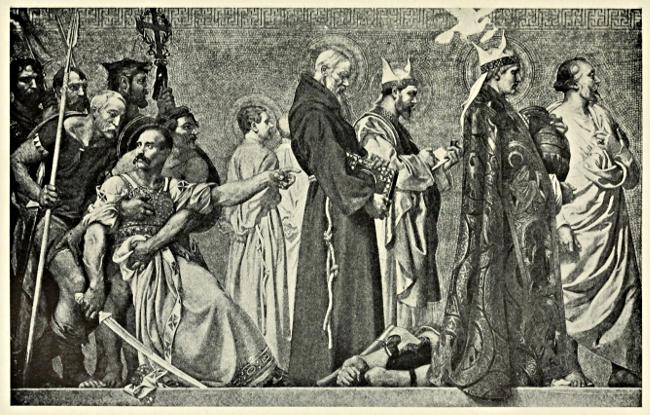
THE TRIUMPH OF CLOVIS
(AT THE PANTHEON, PARIS)
The people on both sides, who understood little of the points contested
by the clergy, adopted the simple rule, that it was their duty to hate the
members of the other church; and the Greeks, having their nationality condensed
in their ecclesiastical establishment, far exceeded the Western nations
in ecclesiastical bigotry, for the people in the western nations of Europe
were often not very friendly to papal pretensions. The extreme bigotry of
the Greeks soon tended to make the people of the Byzantine Empire averse
to all intercourse with the Latins, as equals, and they assumed a superiority
over nations rapidly advancing in activity, wealth, power, and intelligence,
merely because they deemed them heretics. The separation of the two
churches proved, consequently, more injurious to the Greeks, in their stationary
condition of society, than to the Western Christians, who were eagerly
pressing forward in many paths of social improvement.
[1053-1056 A.D.]
The empress Zoe died in the year 1050, at the age of seventy. Constantine
X survived to the year 1054. When the emperor felt his end approaching,
he ordered himself, according to the superstitious fashion of the time,
to be transported to the monastery of Mangana, which he had constructed.
His ministers, and especially his prime-minister, Joannes the logothetes, and
president of the senate, urged him to name Nicephorus Bryennius, who commanded
the Macedonian troops, his successor. The forms of the imperial
constitution rendered it necessary that the sovereign should be crowned in
Constantinople, and a courier was despatched to summon Bryennius to the
capital. But as soon as Theodora heard of this attempt of her brother-in-law
to deprive her of the throne she had been compelled to cede to him, she
hastened to the imperial palace, convoked the senate, ordered the guards to
be drawn out, and, presenting herself as the lawful empress, was proclaimed
sovereign of the empire with universal acclamations. The news of this event
embittered the last moments of the dying voluptuary, who hated Theodora
for the respect her conduct inspired.e
In her name, and by the influence of four eunuchs, the Eastern world was
peaceably governed about nineteen months; and as they wished to prolong
their dominion, they persuaded the aged princess to nominate for her successor
Michael VI. The surname of Stratioticus declares his military profession;
but the crazy and decrepit veteran could only see with the eyes
and execute with the hands of his ministers. Whilst he ascended the
throne, Theodora sank into the grave—the last of the Macedonian or Basilian
dynasty. We have hastily reviewed, and gladly dismiss, this shameful and
destructive period of twenty-eight years, in which the Greeks, degraded
below the common level of servitude, were transferred like a herd of cattle
by the choice or caprice of two impotent females.
From this night of slavery, a ray of freedom, or at least of spirit, begins
to emerge; the Greeks either preserved or revived the use of surnames,
which perpetuate the fame of hereditary virtue; and we now discern the
rise, succession, and alliance, of the last dynasties of Constantinople and
Trebizond. The Comneni, who upheld for a while the fate of the sinking
empire, assumed the honour of a Roman origin; but the family had long
since been transported from Italy to Asia. Their patrimonial estate was
situate in the district of Castamona, in the neighbourhood of the Euxine; and
one of their chiefs, who had already entered the paths of ambition, revisited
with affection, perhaps with regret, the modest though honourable dwelling
of his fathers.
[1057-1059 A.D.]
The first of their line was the illustrious Manuel, who, in the reign of
the second Basil, contributed by war and treaty to appease the troubles
of the East: he left, in a tender age, two sons, Isaac and Joannes, whom,
with the consciousness of desert, he bequeathed to the gratitude and favour
of his sovereign. The noble youths were carefully trained in the learning of
the monastery, the arts of the palace, and the exercises of the camp; and from
the domestic service of the guards, they were rapidly promoted to the command
of provinces and armies. Their fraternal union doubled the force
and reputation of the Comneni, and their ancient nobility was illustrated
by the marriage of the two brothers with a captive princess of Bulgaria,
and the daughter of a patrician, who had obtained the name of Charon from
the number of enemies whom he had sent to the infernal shades. The
soldiers had served with reluctant loyalty a series of effeminate masters;
the elevation of Michael VI was a personal insult to the more deserving
generals; and their discontent was inflamed by the parsimony of the emperor
and the insolence of the eunuchs. They secretly assembled in the
sanctuary of St. Sophia, and the votes of the military synod would have
been unanimous in favour of the old and valiant Catacalon, if the patriotism
or modesty of the veteran had not suggested the importance of birth as
well as merit in the choice of a sovereign. Isaac Comnenus was approved by
general consent, and the associates separated without delay to meet in the
plains of Phrygia at the head of their respective squadrons and detachments.
The cause of Michael was defended in a single battle by the mercenaries
of the imperial guard, who were aliens to the public interest, and animated
only by a principle of honour and gratitude. After their defeat, the fears
of the emperor solicited a treaty, which was almost accepted by the moderation
of the Comnenian. But the former was betrayed by his ambassadors,
and the latter was prevented by his friends. The solitary Michael
submitted to the voice of the people; the patriarch annulled their oath of
allegiance; and as he shaved the head of the royal monk, congratulated
his beneficial exchange of temporal royalty for the kingdom of heaven; an
exchange, however, which the priest, on his own account, would probably
have declined.
[1059-1067 A.D.]
By the hands of the same patriarch, Isaac Comnenus was solemnly
crowned; the sword, which he inscribed on his coins, might be an offensive
symbol, if it implied his title by conquest; but this sword would have been
drawn against the foreign and domestic enemies of the state.[74] The decline
of his health and vigour suspended the operation of active virtue;[75] and the
prospect of approaching death determined him to interpose some moments
between life and eternity. But instead of leaving the empire as the marriage
portion of his daughter, his reason and inclination concurred in the preference
of his brother Joannes, a soldier, a patriot, and the father of five sons, the
future pillars of an hereditary succession. His first modest reluctance might
be the natural dictates of discretion and tenderness, but his obstinate and
successful perseverance, however it may dazzle with the show of virtue, must
be censured as a criminal desertion of his duty, and a rare offence against
his family and country. The purple which he had refused was accepted
by Constantine Ducas, a friend of the Comnenian house, and whose noble
birth was adorned with the experience and reputation of civil policy. In
the monastic habit, Isaac recovered his health, and survived two years his
voluntary abdication. At the command of his abbot, he observed the rule
of St. Basil, and executed the most servile offices of the convent; but his
latent vanity was gratified by the frequent and respectful visits of the reigning
monarch, who revered in his person a benefactor and a saint.
If Constantine XI were indeed the subject most worthy of empire, we
must pity the debasement of the age and nation in which he was chosen.
In the labour of puerile declamations he sought, without obtaining, the crown
of eloquence, more precious, in his opinion, than that of Rome; and, in the
subordinate functions of a judge, he forgot the duties of a sovereign and a
warrior. Ducas was anxious only to secure, even at the expense of the republic,
the power and prosperity of his children. His three sons, Michael VII,
Andronicus I, and Constantine XII, were invested, at a tender age, with the
equal title of Augustus; and the succession was speedily opened by their
father’s death. His widow, Eudocia, was entrusted with the administration.
Before the end of seven months, the wants of Eudocia, or those of the state,
called aloud for the male virtues of a soldier; and her heart had already
chosen Romanus Diogenes, whom she raised from the scaffold to the throne.
The discovery of a treasonable attempt had exposed him to the severity of
the laws; his beauty and valour absolved him in the eyes of the empress,
and Romanus, from a mild exile, was recalled on the second day to the command
of the oriental armies. Her royal choice was yet unknown to the
public, and the promise which would have betrayed her falsehood and levity
was stolen by a dexterous emissary from the ambition of the patriarch.
Xiphilin at first alleged the sanctity of oaths and the sacred nature of a
trust; but a whisper that his brother was the future emperor relaxed his
scruples, and forced him to confess that the public safety was the supreme
law. He resigned the important paper; and when his hopes were confounded
by the nomination of Romanus, he could no longer regain his
security, retract his declarations, nor oppose the second nuptials of the
empress. Yet a murmur was heard in the palace; and the barbarian guards
had raised their battle-axes in the cause of the house of Ducas, till the young
princes were soothed by the tears of their mother and the assurances of the
fidelity of their guardian, who filled the throne with dignity and honour.
[1067-1070 A.D.]
The false or genuine magnanimity of Mahmud the Ghaznavide was not
imitated by Alp Arslan; and he attacked without scruple the Greek empress
Eudocia and her children.[76] His alarming progress compelled her to give herself
and her sceptre to the hand of a soldier; and Romanus Diogenes had been
invested with the imperial purple. His patriotism, and perhaps his pride,
urged him from Constantinople within two months after his accession; and
the next campaign he most scandalously took the field during the holy festival
of Easter. In the palace, Diogenes was no more than the husband of
Eudocia; in the camp he was the emperor of the Romans, and he sustained
that character with feeble resources and invincible courage. By his spirit
and success, the soldiers were taught to act, the subjects to hope, and the
enemies to fear. The Turks had penetrated into the heart of Phrygia; but
the sultan himself had resigned to his emirs the prosecution of the war; and
their numerous detachments were scattered over Asia in the security of conquest.
Laden with spoil and careless of discipline, they were separately
surprised and defeated by the Greeks; the activity of the emperor seemed to
multiply his presence; and while they heard of
his expedition to Antioch, the enemy felt his
sword on the hills of Trebizond.
In three laborious campaigns[77] the Turks
were driven beyond the Euphrates; in the
fourth and last, Romanus undertook the deliverance
of Armenia. The desolation of the land
obliged him to transport a supply of two months’
provisions; and he marched forwards to the
siege of Manzicert, an important fortress in the
midway between the modern cities of Erzerum
and Van. His army amounted, at the least, to
one hundred thousand men. The troops of
Constantinople were reinforced by the disorderly
multitudes of Phrygia and Cappadocia;
but the real strength was composed of the subjects
and allies of Europe, the legions of Macedonia,
and the squadrons of Bulgaria; the Uzi,
a Moldavian horde, who were themselves of the
Turkish race, and above all, the mercenary and
adventurous bands of French and Normans.
Their lances were commanded by the valiant
Ursel of Baliol, the kinsman or father of the
Scottish kings, and were allowed to excel in
the exercise of arms, or, according to the Greek
style, in the practice of the Pyrrhic dance.
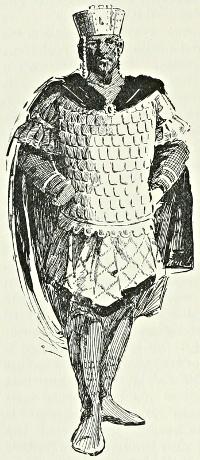
Byzantine Emperor in the
Costume of a General
[1071 A.D.]
On the report of this bold invasion, which
threatened his hereditary dominions, Alp Arslan
flew to the scene of action at the head of forty
thousand horse. His rapid and skilful evolutions
distressed and dismayed the superior numbers
of the Greeks; and in the defeat of Basilacius, one of their principal
generals, he displayed the first example of his valour and clemency. The
imprudence of the emperor had separated his forces after the reduction of
Manzicert. It was in vain that he attempted to recall the mercenary
Franks; they refused to obey his summons; he disdained to await their
return; the desertion of the Uzi filled his mind with anxiety and suspicion;
and against the most salutary advice he rushed forwards to speedy and
decisive action.
Had he listened to the fair proposals of the sultan, Romanus might have
secured a retreat, perhaps a peace; but in these overtures he supposed the
fear or weakness of the enemy, and his answer was conceived in the tone of
insult and defiance. “If the barbarian wishes for peace, let him evacuate
the ground which he occupies for the encampment of the Romans, and surrender
his city and palace of Rei as a pledge of his sincerity.” Alp Arslan
smiled at the vanity of the demand, but he wept the death of so many faithful
Moslems; and, after a devout prayer, proclaimed a free permission to all
who were desirous of retiring from the field. With his own hands he tied
up his horse’s tail, exchanged his bow and arrows for a mace and scimitar,
clothed himself in a white garment, perfumed his body with musk, and
declared that if he were vanquished, that spot should be the place of his
burial.
The sultan himself had affected to cast away his missile weapons; but
his hopes of victory were placed in the arrows of the Turkish cavalry, whose
squadrons were loosely distributed in the form of a crescent. Instead of the
successive lines and reserves of the Grecian tactics, Romanus led his army in
a single and solid phalanx, and pressed with vigour and impatience the artful
and yielding resistance of the barbarians. In this desultory and fruitless
combat he wasted the greater part of a summer’s day, till prudence and
fatigue compelled him to return to his camp. But a retreat is always perilous
in the face of an active foe; and no sooner had the standard been turned
to the rear, than the phalanx was broken by the base cowardice, or the baser
jealousy, of Andronicus, a rival prince, who disgraced his birth and the purple
of the cæsars. The Turkish squadrons poured a cloud of arrows on this
moment of confusion and lassitude; and the horns of their formidable crescent
was closed in the rear of the Greeks. In the destruction of the army
and pillage of the camp, it would be needless to mention the number of slain
or captives. The Byzantine writers deplore the loss of an inestimable pearl;
they forget to mention that in this fatal day the Asiatic provinces of Rome
were irretrievably sacrificed.
As long as a hope survived, Romanus attempted to rally and save the
relics of his army. When the centre, the imperial station, was left naked on
all sides and encompassed by the victorious Turks, he still, with desperate
courage, maintained the fight till the close of day, at the head of the brave
and faithful subjects who adhered to his standard. They fell around him;
his horse was slain; the emperor was wounded; yet he stood alone and
intrepid, till he was oppressed and bound by the strength of multitudes.
The glory of this illustrious prize was disputed by a slave and a soldier; a
slave who had seen him on the throne of Constantinople, and a soldier whose
extreme deformity had been excused on the promise of some signal service.
Despoiled of his arms, his jewels, and his purple, Romanus spent a dreary
and perilous night on the field of battle, amidst a disorderly crowd of the
meaner barbarians.
In the morning the royal captive was presented to Alp Arslan, who
doubted of his fortune, till the identity of the person was ascertained by the
report of his ambassadors, and by the more pathetic evidence of Basilacius,
who embraced with tears the feet of his unhappy sovereign. The successor
of Constantine, in a plebeian habit, was led into the Turkish divan, and commanded
to kiss the ground before the lord of Asia. He reluctantly obeyed;
and Alp Arslan, starting from his throne, is said to have planted his foot on
the neck of the Roman emperor. But the fact is doubtful; and if, in this
moment of insolence, the sultan complied with a national custom, the rest of
his conduct has extorted the praise of his bigoted foes, and may afford a
lesson to the most civilised ages. He instantly raised the royal captive from
the ground; and thrice clasping his hand with tender sympathy, assured
him that his life and dignity should be inviolate in the hands of a prince
who had learned to respect the majesty of his equals and the vicissitudes
of fortune. From the divan, Romanus was conducted to an adjacent tent,
where he was served with pomp and reverence by the officers of the sultan,
who, twice each day, seated him in the place of honour at his own table.
In a free and familiar conversation of eight days, not a word, not a look, of
insult escaped from the conqueror; but he severely censured the unworthy
subjects who had deserted their valiant prince in the hour of danger, and
gently admonished his antagonist of some errors which he had committed in
the management of the war. In the preliminaries of negotiation, Alp
Arslan asked him what treatment he expected to receive, and the calm indifference
of the emperor displays the freedom of his mind. “If you are
cruel,” he said, “you will take my life; if you listen to pride, you will drag
me at your chariot wheels; if you consult your interest you will accept a
ransom, and restore me to my country.” “And what,” continued the sultan,
“would have been your own behaviour, had fortune smiled on your arms?”
The reply of the Greek betrays a sentiment which prudence, and even gratitude,
should have taught him to suppress. “Had I vanquished,” he fiercely
said, “I would have inflicted on thy body many a stripe.”
The Turkish conqueror smiled at the insolence of his captive; observed
that the Christian law inculcated the love of enemies and forgiveness of
injuries; and nobly declared that he would not imitate an example which
he condemned. After mature deliberation, Alp Arslan dictated the terms
of liberty and peace—a ransom of a million, an annual tribute of 360,000
pieces of gold, the marriage of the royal children, and the deliverance of all
the Moslems who were in the power of the Greeks. Romanus, with a sigh,
subscribed this treaty, so disgraceful to the majesty of the empire; he was
immediately invested with a Turkish robe of honour; his nobles and patricians
were restored to their sovereign; and the sultan, after a courteous
embrace, dismissed him with rich presents and a military guard. No sooner
did he reach the confines of the empire, than he was informed that the
palace and provinces had disclaimed their allegiance to a captive; a sum of
two hundred thousand pieces was painfully collected; and the fallen monarch
transmitted this part of his ransom, with a sad confession of his impotence
and disgrace.
In the treaty of peace, it does not appear that Alp Arslan extorted any
province or city from the captive emperor; and his revenge was satisfied
with the trophies of his victory and the spoils of Anatolia, from Antioch to
the Black Sea. The fairest part of Asia was subject to his laws; twelve
hundred princes, or the sons of princes, stood before his throne; and two
hundred thousand soldiers marched under his banners. The sultan disdained
to pursue the fugitive Greeks; but he meditated the more glorious
conquest of Turkestan, the original seat of the house of Seljuk.
[While the Turks were getting control of Asia Minor the Byzantine
Empire lost its last hold on Italy. Robert Guiscard had taken, one after
another, the cities of the empire, and in 1068 laid siege to Bari. Romanus
sent a fleet under Gosselin, but Guiscard’s brother Roger defeated him.
Bari capitulated in April, 1071, and the direct authority of the Roman Empire
in Italy was gone forever.]
[1071-1081 A.D.]
The defeat and captivity of Romanus IV inflicted a deadly wound on
the Byzantine monarchy of the East; and after he was released from the
chains of the sultan, he vainly sought his wife and subjects. His wife had
been thrust into a monastery, and the subjects of Romanus had embraced
the rigid maxim of the civil law, that a prisoner in the hands of the enemy
is deprived, as by the stroke of death, of all public and private rights of a
citizen. In the general consternation, the cæsar Joannes asserted the indefeasible
right of his three nephews. Constantinople listened to his voice,
and the Turkish captive was proclaimed in the capital, and received on the
frontier, as an enemy of the republic. Romanus was not more fortunate in
domestic than in foreign war: the loss of two battles compelled him to yield,
on the assurance of fair and honourable treatment; but his enemies were
devoid of faith or humanity, and, after the cruel extinction of his sight, his
wounds were left to bleed and corrupt, till in a few days he was relieved
from a state of misery.
Under the triple reign of the house of Ducas, the two younger brothers
were reduced to the vain honours of the purple; but the eldest, the pusillanimous
Michael, was incapable of sustaining the Roman sceptre; and his
surname of Parapinaces denotes the reproach which he shared with an avaricious
favourite, who enhanced the price, and diminished the measure, of
wheat. In the school of Psellus, and after the example of his mother, the
son of Eudocia made some proficiency in philosophy and rhetoric; but his
character was degraded, rather than ennobled, by the virtues of a monk and
the learning of a sophist.
Strong in the contempt of their sovereign and their own esteem, two generals,
at the head of the European and Asiatic legions, assumed the purple
at Hadrianopolis and Nicæa. Their revolt was in the same month; they
bore the same name of Nicephorus; but the two candidates were distinguished
by the surnames of Bryennius and Botaniates: the former in the
maturity of wisdom and courage, the latter conspicuous only by the memory
of his past exploits. While Botaniates advanced with cautious and dilatory
steps, his active competitor stood in arms before the gates of Constantinople.
The name of Bryennius was illustrious; his cause was popular; but his
licentious troops could not be restrained from burning and pillaging a suburb;
and the people, who would have hailed the rebel, rejected and repulsed
the incendiary of his country. This change of the public opinion was favourable
to Botaniates, who at length, with an army of Turks, approached the
shores of Chalcedon.
A formal invitation, in the name of the patriarch, the synod, and the
senate, was circulated through the streets of Constantinople; and the general
assembly, in the dome of St. Sophia, debated with order and calmness
on the choice of their sovereign. The guards of Michael would have dispersed
this unarmed multitude; but the feeble emperor, applauding his own
moderation and clemency, resigned the ensigns of royalty, and was rewarded
with the monastic habit and the title of archbishop of Ephesus. He left a
son, a Constantine, born and educated in the purple; and a daughter of the
house of Ducas illustrated the blood, and confirmed the succession, of the Comnenian
dynasty.
Joannes Comnenus, the brother of the emperor Isaac, survived in peace and
dignity his generous refusal of the sceptre. By his wife Anne, a woman
of masculine spirit and policy, he left eight children; the three daughters
multiplied the Comnenian alliances with the noblest Greeks; of the five
sons, Manuel was stopped by a premature death; Isaac and Alexius restored
the imperial greatness of their house, which was enjoyed without toil or
danger by the two younger brethren, Adrian and Nicephorus. Alexius, the
third and most illustrious of the brothers, was endowed by nature with the
choicest gifts both of mind and body; they were cultivated by a liberal
education, and exercised in the school of obedience and adversity. The
youth was dismissed from the perils of the Turkish War,[78] by the paternal
care of the emperor Romanus; but the mother of the Comneni, with her
aspiring race, was accused of treason, and banished, by the sons of Ducas, to
an island in the Propontis. The two brothers soon emerged into favour and
action, fought by each other’s side against the rebels and barbarians, and
adhered to the emperor Michael, till he was deserted by the world and by
himself.
In his first interview with Botaniates, “Prince,” said Alexius, with a
noble frankness, “my duty rendered me your enemy; the decrees of God
and of the people have made me your subject. Judge of my future loyalty
by my past opposition.” The successor of Michael entertained him with
esteem and confidence; his valour was employed against three rebels, who
disturbed the peace of the empire, or at least of the emperors. Ursel,
Bryennius, and Basilacius were formidable by their numerous forces and
military fame: they were successively vanquished in the field, and led in
chains to the foot of the throne; and whatever treatment they might receive
from a timid and cruel court, they applauded the clemency, as well as the
courage, of their conqueror. But the loyalty of the Comneni was soon tainted
by fear and suspicion; nor is it easy to settle between a subject and a despot
the debt of gratitude, which the former is tempted to claim by a revolt,
and the latter to discharge by an executioner. The refusal of Alexius to
march against a fourth rebel, the husband of his sister, destroyed the merit
or memory of his past services; the favourites of Botaniates provoked the
ambition which they apprehended and accused; and the retreat of the two
brothers might be justified by the defence of their life or liberty.
The women of the family were deposited in a sanctuary, respected by
tyrants; the men, mounted on horseback, sallied from the city, and erected
the standard of civil war. The soldiers, who had been gradually assembled
in the capital and the neighbourhood, were devoted to the cause of a victorious
and injured leader; the ties of common interest and domestic alliance
secured the attachment of the house of Ducas; and the generous dispute of
the Comneni was terminated by the decisive resolution of Isaac, who was the
first to invest his younger brother with the name and ensigns of royalty.
They returned to Constantinople, to threaten rather than besiege that impregnable
fortress; but the fidelity of the guards was corrupted; a gate was
surprised, and the fleet was occupied by the active courage of George Palæologus,
who fought against his father, without foreseeing that he laboured
for his posterity. Alexius ascended the throne; and his aged competitor
disappeared in a monastery. An army of various nations was gratified with
the pillage of the city; but the public disorders were expiated by the tears
and fasts of the Comneni, who submitted to every penance.
The life of the emperor Alexius has been delineated by a favourite
daughter, who was inspired by a tender regard for his person, and a laudable
zeal to perpetuate his virtues. Conscious of the just suspicion of her
readers, the princess Anna Comnenai repeatedly protests, that, besides her
personal knowledge, she had searched the discourse and writings of the most
respectable veterans; that, after an interval of thirty years, forgotten by,
and forgetful of, the world, her mournful solitude was inaccessible to hope
and fear; and that truth, the naked, perfect
truth, was more dear and sacred than the memory
of her parent. Yet, instead of the simplicity
of style and narrative which wins our
belief, an elaborate affectation of rhetoric and
science betrays in every page the vanity of
a female author. The genuine character
of Alexius is lost in a vague constellation of
virtues; and the perpetual strain of panegyric
and apology awakens our jealousy, to
question the veracity of the historian and
the merit of the hero. We cannot, however,
refuse her judicious and important
remark, that the disorders of the times were
the misfortune and the glory of Alexius;
and that every calamity which can afflict a
declining empire was accumulated on his
reign by the justice of heaven and the vices
of his predecessors.
[1081-1084 A.D.]
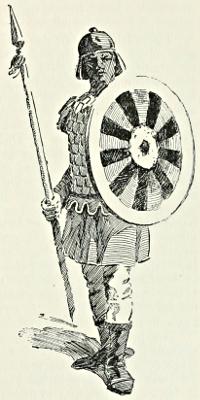
A Byzantine Soldier
In the East, the victorious Turks had
spread from Persia to the Hellespont the
reign of the Koran and the crescent; the
West was invaded by the adventurous valour
of the Normans; and, in the moments of
peace, the Danube poured forth new swarms,
who had gained in the science of war what
they had lost in the ferociousness of manners.
The sea was not less hostile than the land; and while the frontiers were
assaulted by an open enemy, the palace was distracted with secret treason
and conspiracy.h
One of the earliest acts of the reign of Alexius was to conclude a treaty
of peace with the Seljuk emir Suleiman, who acted in Asia Minor as if he
were completely independent of the grand sultan Malekshah. The treachery
of Nicephorus Melissenos had placed Suleiman in possession of Nicæa, and
his troops occupied several posts on the shores of the Bosporus and the Sea
of Marmora; while Alexius, who required the whole forces of the empire to
resist the invasion of Robert Guiscard, was compelled to purchase peace at
any price. Under such circumstances, it was only to be expected that the
immediate neighbourhood of Constantinople could be kept free from the
Turks, and accordingly the boundaries of the Roman Empire in Asia Minor
were by this treaty reduced to very narrow limits. The country immediately
opposite the capital, as far as the mouth of the river Sangarius and
the head of the Gulf of Nicomedia, was evacuated by the Turks, as well as
the coasts of the Sea of Marmora, from the little stream called Draco, which
falls into the Gulf of Nicomedia, westward to the city of Prusias. Already
the mountains of the Turkish territory were visible from the palace of Alexius
and the dome of St. Sophia; but the Crusades were destined to repel
the Mohammedan invasion from the shores of Europe for several centuries.
The spirit of enterprise and conquest which, when placed under the guidance
of religious enthusiasm, carried the bravest warriors of western Europe
as crusaders to the East, had, in the preceding generation, under the direction
of civil wisdom, produced the conquest of England and southern Italy
by the Normans. These conquests had raised their military reputation and
self-confidence to the highest pitch; and Robert Guiscard, who was lord of
dominions in Italy far superior in wealth to the duchy of Normandy, hoped
to eclipse the exploits of Duke William in England by conquering the
Byzantine Empire. But as he knew that he must expect a more prolonged
resistance than England had offered to its conqueror, he sought a pretext
for commencing the war which would conceal his own object, and have a
tendency to induce a party in the country to take up arms against the
government he was anxious to overthrow. His daughter Helena had been
betrothed to Constantine Ducas, the son of Michael VII, and was still so
young that she was residing in the imperial palace at Constantinople, to
receive her education, when Michael was dethroned. Nicephorus III sent
the child to a convent, and Robert her father stood forward as the champion
of Michael’s right to recover the throne from which he had been expelled.
Under the cover of this pretext, the Norman expected to render himself
master of Constantinople, or at all events to gain possession of the rich provinces
on the eastern shore of the Adriatic.
The preparations of Robert Guiscard were far advanced when Alexius
ascended the throne. To inflame the zeal of his troops, he persuaded Pope
Gregory VII that a Greek monk, who had assumed the character of Michael
VII, was really the dethroned emperor, and thus induced the pope to approve
of his expedition, and to grant absolution to all the invaders of the Byzantine
Empire, as if they had been about to commence a holy war. The soldiers
were impressed with a deep conviction of the justice of their cause
and were inflamed with hopes of plunder and glory.
In the month of June, 1081, Robert Guiscard sailed from Brindisi with a
well-appointed fleet of a hundred and fifty ships, carrying an army of thirty
thousand chosen troops. His first operation was to render himself master of
the rich island of Corcyra (Corfu), which then yielded an annual revenue
of fifteen hundred pounds’ weight of gold to the Byzantine government. He
then seized the ports of Butrinto, Avlona, and Kanino, on the mainland, and
laid siege to the important city of Dyrrhachium, the strongest fortress on
the eastern coast of the Adriatic, and the capital of Byzantine Illyria. It
was fortunate for the empire that George Palæologus, one of its bravest
officers, had entered the place before Robert commenced the siege.
The interests of Venice bound them to the cause of the Byzantine government
at this time. They were alarmed lest their lucrative trade with
Greece and the Levant should be placed at the mercy of the rapacious
Normans, in case Robert Guiscard should succeed in gaining possession
of the entrance to the Adriatic. They plunged, therefore, into the war
without hesitation or reserve.
The doge Dominic Sylvio sailed from Venice with a powerful fleet to
attack the Normans before the emperor Alexius could collect his army and
march to the relief of Dyrrhachium. The Norman fleet, which was commanded
by Bohemund, the illustrious son of Robert Guiscard, suffered a
complete defeat, and the communications of the invading army with Italy
were cut off. This difficulty only excited Robert to press the siege with
additional vigour. He employed every device then known for the attack of
towns. The military proceedings of Alexius, when he reached the neighbourhood
of Dyrrhachium, were very injudicious. The battle which took
place was as disgraceful to the Byzantine arms as to the emperor’s judgment.
In the month of February, 1082, a Venetian, who guarded one of the
towers, betrayed the city to Robert, who had previously put his army into
winter quarters at Glabinitza and Joanina, in order to escape the severe
cold of the winter farther north. Alexius collected the remains of the
Byzantine army at Deavolis, and repaired himself to Thessalonica, where
he passed the winter collecting a second army, which he was enabled to do,
as he had replenished his military chest from the church plate of the richest
cathedrals and monasteries in his dominions. The affairs of Italy, before
the opening of the second campaign, fortunately compelled Robert Guiscard
to quit Illyria, and leave his son Bohemund in command of the Norman
army.
In the spring of 1083, Alexius had collected an army so powerful that
he again marched forward to attack the Normans. In order to break the
terrible charge of their cavalry, which no Byzantine horse could resist, the
emperor placed a number of chariots before his own troops, armed with
barbed poles extending in front like a line of lances, and in these chariots he
stationed a strong body of heavy-armed infantry. Bohemund, however,
on reconnoitring this strange unwieldy measure of defence, broke up his
line of cavalry into two columns, and leaving the centre of the Byzantine
army with the chariots unassailed, fell with fury on the extremity of the
two wings. The resistance was short, and the emperor Alexius again fled.
Alexius, having procured a subsidiary force of seven thousand light
cavalry from Suleiman and the sultan of Nicæa, again took the field in the
spring of 1084. He formed his army into two divisions, and advanced to
engage the Normans before Larissa. His preparation for a battle was on
this occasion made with considerable skill. Bohemund, seeing that he was
in danger of being cut off from his resources, retreated to Kastoria. As
soon as the Norman army was cut off from plunder, and without any hope
of making further conquests, it began to display a mutinous spirit; and
Bohemund was compelled to return to Italy, to obtain supplies of money
and fresh troops. Brienne, the constable of Apulia, who commanded in
his absence, found himself compelled to surrender Kastoria to the emperor
Alexius, and to engage not to bear arms again against the Byzantine Empire.
While Bohemund was carrying on the war against the emperor of the
East, Robert Guiscard had driven the emperor of the West out of Rome;
and after vanquishing Henry IV, he had plundered the Eternal City like
another Genseric. He was now ready to resume his schemes of ambition in
the East. Collecting a powerful fleet to carry over his victorious army into
Epirus, he raised the siege of Corfu (Corcyra), which was invested by the
combined naval forces of the Byzantine Empire and the Venetian Republic.
The united fleets were completely defeated in a great naval battle, in which,
according to Anna Comnena,i they lost thirteen thousand men. But in the
month of July, 1085, Robert died in the island of Cephallenia, and with
him perished all the Norman projects of conquest in the Byzantine Empire.
Dyrrhachium was recovered by Alexius with the assistance of the Venetian
and Amalphitan merchants established in the place, and the services of the
Venetians in this war were rewarded by many commercial privileges which
were conferred on them by a golden bull.e
[1084-1118 A.D.]
The Norman War was scarcely finished when the Patzinaks invaded the
empire (1086). This war lasted five years, until, in fact, Alexius concluded
a treaty with the Komans, allies of the Patzinaks, and then dealt the latter
a crushing blow at Levounion in 1091. Minor wars with Servia and Dalmatia
do not deserve mention, but the progress of the Seljuk Turks continued
to hasten the decline of the empire. They dared everything, and in
1092 Tzachas, emir of Smyrna, assumed the title of emperor. He was put
down, but retained sufficient strength to besiege Abydos in 1093. But
Alexius accomplished his murder the same year. The relations of Alexius
and the First Crusade will be fully treated in the account of the Holy Wars.
The ancient enmity of Alexius and Bohemund was rekindled when the latter
entered into his principality of Antioch. The war lasted from 1103 to 1108,
or until Bohemund’s death. The last years of Alexius’ reign were occupied
with hostilities with the crusaders and again with the Seljuk Turks. The
latter sustained a succession of heavy losses, and in 1116 were glad to make
peace. This was the end of Alexius’ military career.a
In the tempest of the Crusades Alexius steered the imperial vessel with
dexterity and courage. At the head of his armies, he was bold in action,
skilful in stratagem, patient of fatigue, ready to improve his advantages,
and rising from his defeats with inexhaustible vigour.
In his intercourse with the Latins, Alexius was patient and artful; his
discerning eye pervaded the new system of an unknown world; and we shall
hereafter describe the superior policy with which he balanced the interests
and passions of the champions of the First Crusade. In a long reign of
thirty-seven years, he subdued and pardoned the envy of his equals; the
laws of public and private order were restored; the arts of wealth and
science were cultivated; the limits of the empire were enlarged in Europe
and Asia; and the Comnenian sceptre was transmitted to his children of the
third and fourth generation.
Anna is a faithful witness that his happiness was destroyed, and his
health was broken, by the cares of a public life; the patience of Constantinople
was fatigued by the length and severity of his reign; and before
Alexius expired, he had lost the love and reverence of his subjects. The
clergy could not forgive his application of the sacred riches to the defence of
the state; but they applauded his theological learning and ardent zeal for
the orthodox faith, which he defended with his tongue, his pen, and his
sword. His character was degraded by the superstition of the Greeks; and
the same inconsistent principle of human nature enjoined the emperor to
found a hospital for the poor and infirm, and to direct the execution of a
heretic, who was burned alive in the square of St. Sophia.
In his last hours, when he was pressed by his wife Irene to alter the succession,
he raised his head, and breathed a pious ejaculation on the vanity of
this world. The indignant reply of the empress may be inscribed as an
epitaph on his tomb—“You die, as you have lived—a hypocrite!” (1118).
[1118-1143 A.D.]
It was the wish of Irene to supplant the eldest of her surviving sons, in
favour of her daughter, the princess Anna, whose philosophy would not have
refused the weight of a diadem. But the order of male succession was asserted
by the friends of their country; the lawful heir drew the royal signet
from the finger of his insensible or unconscious father, and the empire obeyed
the master of the palace. Anna Comnena was stimulated by ambition and
revenge to conspire against the life of her brother; and when the design was
prevented by the fears or scruples of her husband, she passionately exclaimed,
that nature had mistaken the two sexes, and had endowed Bryennius with
the soul of a woman.
The two sons of Alexius, Joannes and Isaac, maintained the fraternal concord,
the hereditary virtue of their race; and the younger brother was content
with the title of Sebastocrator, which approached the dignity, without sharing
the power, of the emperor. In the same person, the claims of primogeniture
and merit were fortunately united; his swarthy complexion, harsh
features, and diminutive stature, had suggested the ironical surname of
Calo-Joannes, or John the Handsome, which his grateful subjects more seriously
applied to the beauties of his mind.
After the discovery of her treason, the life and fortune of Anna were
justly forfeited to the laws. Her life was spared by the clemency of the emperor;
but he visited the pomp and treasures of her palace, and bestowed
the rich confiscation on the most deserving of his friends. That respectable
friend, Axuch, a slave of Turkish extraction, presumed to decline the gift,
and to intercede for the criminal; his generous master applauded and imitated
the virtue of his favourite, and the reproach or complaint of an injured
brother was the only chastisement of the guilty princess. After this example
of clemency, the remainder of his reign was never disturbed by conspiracy
or rebellion; feared by his nobles, beloved by his people, Joannes was
never reduced to the painful necessity of punishing, or even of pardoning, his
personal enemies.
During his government of twenty-five years, the penalty of death was
abolished in the Roman Empire, a law of mercy most delightful to the humane
theorist, but of which the practice, in a large and vicious community,
is seldom consistent with the public safety. Severe to himself, indulgent to
others, chaste, frugal, abstemious, the philosophic Marcus would not have
disdained the artless virtues of his successor, derived from his heart, and not
borrowed from the schools. He despised and moderated the stately magnificence
of the Byzantine court, so oppressive to the people, so contemptible
to the eye of reason. Under such a prince, innocence had nothing to fear,
and merit had everything to hope; and without assuming the tyrannic office
of a censor, he introduced a gradual though visible reformation in the public
and private manners of Constantinople. The only defect of this accomplished
character was the frailty of noble minds—the love of arms and military
glory. Yet the frequent expeditions of John the Handsome may be
justified, at least in their principle, by the necessity of repelling the Turks
from the Hellespont and the Bosporus. The sultan of the Iconium was confined
to his capital, the barbarians were driven to the mountains, and the
maritime provinces of Asia enjoyed the transient blessings of their deliverance.
From Constantinople to Antioch and Aleppo, he repeatedly marched
at the head of a victorious army, and in the sieges and battles of this holy
war his Latin allies were astonished by the superior spirit and prowess of a
Greek. As he began to indulge the ambitious hope of restoring the ancient
limits of the empire, as he revolved in his mind, the Euphrates and the
Tigris, the dominion of Syria, and the conquest of Jerusalem, the thread of
his life and of the public felicity was broken by a singular accident. He
hunted the wild boar in the valley of Anazarbus, and had fixed his javelin
in the body of the furious animal; but, in the struggle, a poisoned arrow
dropped from his quiver, and a slight wound in his hand, which produced a
mortification, was fatal to the best and greatest of the Comnenian princes.
[1143-1180 A.D.]
A premature death had swept away the two eldest sons of John the
Handsome; of the two survivors, Isaac and Manuel, his judgment or affection
preferred the younger; and the choice of their dying prince was ratified
by the soldiers, who had applauded the valour of his favourite in the
Turkish War. The faithful Axuch hastened to the capital, secured the
person of Isaac in honourable confinement, and purchased with a gift of two
hundred pounds of silver the leading ecclesiastics of St. Sophia, who possessed
a decisive voice in the consecration of an emperor. With his veteran
and affectionate troops, Manuel soon visited Constantinople; his brother acquiesced
in the title of Sebastocrator; his subjects admired the lofty stature
and martial graces of their new sovereign, and listened with credulity to the
flattering promise, that he blended the wisdom of age with the activity and
vigour of youth. By the experience of his government, they were taught,
that he emulated the spirit, and shared the talents, of his father, whose social
virtues were buried in the grave. A reign of thirty-seven years is filled by
a perpetual though various warfare against the Turks, the Christians, and
the hordes of the wilderness beyond the Danube. The arms of Manuel were
exercised on Mount Taurus, in the plains of Hungary, on the coast of Italy
and Egypt, and on the seas of Sicily and Greece; the influence of his negotiations
extended from Jerusalem to Rome and Russia; and the Byzantine
monarchy, for a while, became an object of respect or terror to the powers of
Asia and Europe.
Educated in the silk and purple of the East, Manuel possessed the iron
temper of a soldier, which cannot easily be paralleled, except in the lives
of Richard I of England, and of Charles XII of Sweden. Such was his
strength and exercise in arms, that Raymond, surnamed the Hercules of
Antioch, was incapable of wielding the lance and buckler of the Greek
emperor. In a famous tournament, he entered the lists on a fiery courser,
and overturned in his first career two of the stoutest of the Italian knights.
The first in the charge, the last in the retreat, his friends and his enemies
alike trembled, the former for his safety and the latter for their own. After
posting an ambuscade in a wood, he rode forwards in search of some perilous
adventure, accompanied only by his brother and the faithful Axuch, who
refused to desert their sovereign. Eighteen horsemen, after a short combat,
fled before them; but the numbers of the enemy increased; the march of
the reinforcement was tardy and fearful, and Manuel, without receiving a
wound, cut his way through a squadron of five hundred Turks. In a battle
against the Hungarians, impatient of the slowness of his troops, he snatched
a standard from the head of the column, and was the first, almost alone, who
passed a bridge that separated him from the enemy. In the same country,
after transporting his army beyond the Save, he sent back the boats with an
order, under pain of death, to their commander, that he should leave him to
conquer or die on that hostile land. In the siege of Corfu, towing after
him a captive galley, the emperor stood aloft on the poop, opposing against
the volleys of darts and stones a large buckler and a flowing sail; nor could
he have escaped inevitable death, had not the Sicilian admiral enjoined his
archers to respect the person of a hero. In one day, he is said to have slain
above forty of the barbarians with his own hand; he returned to the camp,
dragging along four Turkish prisoners, whom he had tied to the rings of his
saddle; he was ever the foremost to provoke or to accept a single combat;
and the gigantic champions, who encountered his arm, were transpierced by
the lance, or cut asunder by the sword, of the invincible Manuel. The story
of his exploits, which appear as a model or copy of the romances of chivalry,
may induce a reasonable suspicion of the veracity of the Greeks; yet we
may observe, that, in the long series of their annals, Manuel is the only
prince who has been the subject of similar exaggeration. With the valour of
a soldier, he did not unite the skill or prudence of a general; his victories
were not productive of any permanent or useful conquest; and his Turkish
laurels were blasted in his last unfortunate campaign, in which he lost his
army in the mountains of Pisidia, and owed his deliverance to the generosity
of the sultan.
But the most singular feature in the character of Manuel, is the contrast
and vicissitude of labour and sloth, of hardiness and effeminacy. In war he
seemed ignorant of peace; in peace he appeared incapable of war. In the
field he slept in the sun or in the snow, tired in the longest marches the
strength of his men and horses, and shared with a smile the abstinence or
diet of the camp. No sooner did he return to Constantinople, than he resigned
himself to the arts and pleasures of a life of luxury; the expense of
his dress, his table, and his palace, surpassed the measure of his predecessors,
and whole summer days were idly wasted in the delicious isles of the Propontis,
in the incestuous love of his niece Theodora. The double cost of a
warlike and dissolute prince exhausted the revenue, and multiplied the taxes;
and Manuel, in the distress of his last Turkish campaign, endured a bitter
reproach from the mouth of a desperate soldier. As he quenched his thirst,
he complained that the water of a fountain was mingled with Christian blood.
“It is not the first time,” exclaimed a voice from the crowd, “that you
have drunk, O emperor! the blood of your Christian subjects.”
Manuel Comnenus was twice married; to the virtuous Bertha or Irene of
Germany, and to the beauteous Maria, a French or Latin princess of Antioch.
The only daughter of his first wife was destined for Bela, a Hungarian prince,
who was educated at Constantinople, under the name of Alexius; and the
consummation of their nuptials might have transferred the Roman sceptre
to a race of free and warlike barbarians. But as soon as Maria of Antioch
had given a son and heir to the empire, the presumptive rights of Bela were
abolished, and he was deprived of his promised bride; but the Hungarian
prince resumed his name and the kingdom of his fathers, and displayed such
virtues as might excite the regret and envy of the Greeks. The son of Maria
was named Alexius; and at the age of ten years, he ascended the Byzantine
throne, after his father’s decease had closed the glories of the Comnenian
line.
The fraternal concord of the two sons of the great Alexius had been sometimes
clouded by an opposition of interest and passion. By ambition, Isaac
the Sebastocrator was excited to flight and rebellion, from whence he was
reclaimed by the firmness and clemency of John the Handsome. The errors
of Isaac, the father of the emperors of Trebizond, were short and venial; but
Joannes, the elder of his sons, renounced forever his religion. Provoked by a
real or imaginary insult of his uncle, he escaped from the Roman to the
Turkish camp; his apostacy was rewarded with the Sultan’s daughter, the
title of Chelebi, or noble, and the inheritance of a princely estate; and in
the fifteenth century Muhammed II boasted of his imperial descent from the
Comnenian family.
Andronicus, the younger brother of Joannes, son of Isaac, and grandson of
Alexius Comnenus, is one of the most conspicuous characters of the age; and
his genuine adventures might form the subject of a very singular romance.
To justify the choice of three ladies of royal birth, it must be observed, that
their fortunate lover was cast in the best proportions of strength and beauty;
and that the want of the softer graces was supplied by a manly countenance,
a lofty stature, athletic muscles, and the air and deportment of a soldier.
The preservation, in his old age, of health and vigour, was the reward of
temperance and exercise. A piece of bread and a draught of water was
often his sole and evening repast; and if he tasted of a wild boar, or a stag,
which he had roasted with his own hands, it was the well-earned fruit of a
laborious chase. Dexterous in arms, he was ignorant of fear; his persuasive
eloquence could bend to every situation and character of life; his style,
though not his practice, was fashioned by the example of St. Paul: and,
in every deed of mischief, he had a heart to resolve, a head to contrive, and
a hand to execute.
In his youth, after the death of the emperor Joannes, he followed the
retreat of the Roman army; but in the march through Asia Minor, design
or accident tempted him to wander in the mountains; the hunter was
encompassed by the Turkish huntsmen, and he remained some time a
reluctant or willing captive in the power of the Sultan. His virtues and
vices recommended him to the favour of his cousin; he shared the perils
and the pleasures of Manuel; and while the emperor lived in public incest
with his niece Theodora, the affections of her sister Eudocia were seduced
and enjoyed by Andronicus. Above the decencies of her sex and rank, she
gloried in the name of his concubine; and both the palace and the camp could
witness that she slept or watched in the arms of her lover. She accompanied
him to his military command of Cilicia, the first scene of his valour and
imprudence. He pressed, with active ardour, the siege of Mopsuestia; the
day was employed in the boldest attacks, but the night was wasted in song
and dance, and a band of Greek comedians formed the choicest part of his
retinue.
Andronicus was surprised by the sally of a vigilant foe; but while his
troops fled in disorder, his invincible lance transpierced the thickest ranks
of the Armenians. On his return to the imperial camp in Macedonia, he
was received by Manuel with public smiles and a private reproof; but the
duchies of Naissus, Braniseba, and Kastoria were the reward or consolation
of the unsuccessful general. Eudocia still attended his motions; at midnight,
their tent was suddenly attacked by her angry brothers, impatient to
expiate her infamy in his blood; his daring spirit refused her advice, and
the disguise of a female habit; and, boldly starting from his couch, he drew
his sword, and cut his way through the numerous assassins. It was here
that he first betrayed his ingratitude and treachery; he engaged in a
treasonable correspondence with the king of Hungary and the German emperor,
approached the royal tent at a suspicious hour with a drawn sword, and
under the mask of a Latin soldier, avowed an intention of revenge against
a mortal foe; and imprudently praised the fleetness of his horse as an instrument
of flight and safety. The monarch dissembled his suspicions; but, after
the close of the campaign, Andronicus was arrested, and strictly confined in
a tower of the palace of Constantinople.
In this prison he was left above twelve years, a most painful restraint,
from which the thirst of action and pleasure perpetually urged him to escape.
Alone and pensive, he perceived some broken bricks
in a corner of the chamber, and gradually widened
the passage, till he had explored a dark and forgotten
recess. Into this hole he conveyed himself
and the remains of his provisions, replacing the
bricks in their former positions, and erasing with
care the footsteps of his retreat. At the hour of
the customary visit, his guards were amazed with
the silence and solitude of the prison, and reported,
with shame and fear, his incomprehensible flight.
The gates of the palace and city were instantly
shut: the strictest orders were despatched into the
provinces for the recovery of the fugitive; and his
wife, on the suspicion of a pious act, was basely
imprisoned in the same tower. At the dead of
night she beheld a spectre: she recognised her husband;
they shared their provisions; and a son was
the fruit of the stolen interviews; which alleviated
the tediousness of their confinement. In the custody
of a woman, the vigilance of the keepers was
insensibly relaxed; and the captive had accomplished
his real escape, when he was discovered, brought
back to Constantinople, and loaded with a double
chain.
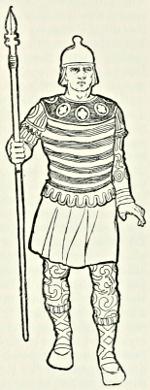
A Byzantine Soldier
At length he found the moment and the means of
his deliverance. A boy, his domestic servant, intoxicated
the guards, and obtained in wax the impression
of the keys. By the diligence of his friends,
a similar key, with a bundle of ropes, was introduced
into the prison, in the bottom of a hogshead. Andronicus
employed, with industry and courage, the instruments of his safety,
unlocked the doors, descended from the tower, concealed himself all day
among the bushes, and without difficulty scaled in the night the garden-wall
of the palace.
A boat was stationed for his reception; he visited his own house, embraced
his children, cast away his chain, mounted a fleet horse, and directed
his rapid course towards the banks of the Danube. At Anchialus in Thrace
an intrepid friend supplied him with horses and money; he passed the river,
traversed with speed the desert of Moldavia and the Carpathian hills, and
had almost reached the town of Haliez, in Polish Russia, when he was intercepted
by a party of Wallachians, who resolved to convey their important
captive to Constantinople.
His presence of mind again extricated him from this danger. Under the
pretence of sickness, he dismounted in the night, and was allowed to step
aside from the troop; he planted in the ground his long staff; clothed it
with his cap and upper garment; and, stealing into the wood, left a phantom
to amuse, for some time, the eyes of the Wallachians. From Halicz he
was honourably conducted to Kieff, the residence of the great duke; the
subtle Greek soon obtained the esteem and confidence of Yaroslaff; his
character could assume the manners of every climate; and the barbarians
applauded his strength and courage in the chase of the elks and bears of the
forest. In this northern region he deserved the forgiveness of Manuel, who
solicited the Russian prince to join his arms in the invasion of Hungary.
The influence of Andronicus achieved this important service; his private
treaty was signed with a promise of fidelity on one side, and of oblivion on
the other; and he marched, at the head of the Russian cavalry, from the
Borysthenes to the Danube. In his resentment, Manuel had ever sympathised
with the martial and dissolute character of his cousin; and his
free pardon was sealed in the assault of Zemlin, in which he was second, and
second only, to the valour of the emperor.
He was removed from the royal presence by an honourable banishment,
a second command of the Cilician frontier, with the absolute disposal of the
revenues of Cyprus. In this station, the Armenians again exercised his
courage, and exposed his negligence; and the same rebel, who baffled all
his operations, was unhorsed and almost slain by the vigour of his lance.
But Andronicus soon discovered a more easy and pleasing conquest, the
beautiful Philippa, sister of the empress Maria, and daughter of Raymond of
Poitou, the Latin prince of Antioch. For her sake he deserted his station,
and wasted the summer in balls and tournaments; to his love she sacrificed
her innocence, her reputation, and the offer of an advantageous marriage.
But the resentment of Manuel for this domestic affront interrupted his
pleasures. The emperor still thirsted for revenge; and his subjects and
allies of the Syrian frontier were repeatedly pressed to seize the person, and
put out the eyes, of the fugitive. In Palestine he was no longer safe; but
the tender Theodora revealed his danger and accompanied his flight. After
a long circuit round the Caspian Sea and the mountains of Georgia, he finally
settled among the Turks of Asia Minor, the hereditary enemies of his country.
The sultan of Colonia afforded a hospitable retreat to Andronicus, his
mistress, and his band of outlaws; the debt of gratitude was paid by frequent
inroads in the Roman province of Trebizond, and he seldom returned
without an ample harvest of spoil and of Christian captives.
His vigilance had eluded or repelled the open and secret persecution of
the emperor; but he was at length ensnared by the captivity of his female
companion. The governor of Trebizond succeeded in his attempt to surprise
the person of Theodora; the queen of Jerusalem and her two children
were sent to Constantinople, and their loss embittered the tedious solitude
of banishment. The fugitive implored and obtained a final pardon, with
leave to throw himself at the feet of his sovereign, who was satisfied with
the submission of this haughty spirit. Prostrate on the ground, he deplored
with tears and groans the guilt of his past rebellion; nor would he presume
to arise unless some faithful subject would drag him to the foot of the throne.
This extraordinary penance excited the wonder and pity of the assembly;
his sins were forgiven by the church and state; but the just suspicion of
Manuel fixed his residence at a distance from the court, at Œnoe, a town
of Pontus, surrounded with rich vineyards, and situate on the coast of the
Euxine. The death of Manuel, and the disorders of the minority, soon
opened the fairest field to his ambition.
[1180-1183 A.D.]
The emperor was a boy of twelve or fourteen years of age, without vigour,
or wisdom, or experience; his mother, the empress Mary, abandoned her
person and government to a favourite of the Comnenian name; and his
sister, another Mary, whose husband, an Italian, was decorated with the title
of Cæsar, excited a conspiracy, and at length an insurrection, against her
odious stepmother. The provinces were forgotten, the capital was in flames,
and a century of peace and order was overthrown in the vice and weakness
of a few months. A civil war was kindled in Constantinople; the two factions
fought a bloody battle in the square of the palace, and the rebels sustained
a regular siege in the cathedral of St. Sophia. The patriarch laboured
with honest zeal to heal the wounds of the republic, the most respectable
patriots called aloud for a guardian and avenger, and every tongue repeated
the praise of the talents and even the virtues of Andronicus. In his march
from Œnoe to Constantinople, his slender train insensibly swelled to a crowd
and an army; his professions of religion and loyalty were mistaken for the
language of his heart; and the simplicity of a foreign dress, which showed
to advantage his majestic stature, displayed a lively image of his poverty and
exile. All opposition sank before him; he reached the straits of the Thracian
Bosporus; the Byzantine navy sailed from the harbour to receive and
transport the saviour of the empire; the torrent was loud and irresistible,
and the insects who had basked in the sunshine of royal favour disappeared
at the blast of the storm. It was the first care of Andronicus to occupy the
palace, to salute the emperor, to confine his mother, to punish her minister,
and to restore the public order and tranquillity. He then visited the sepulchre
of Manuel; the spectators were ordered to stand aloof, but, as he bowed
in the attitude of prayer, they heard a murmur of triumph and revenge.
“I no longer fear thee, my old enemy, who hast driven me a vagabond
to every climate of the earth. Thou art safely deposited under a sevenfold
dome, from whence thou canst never arise till the signal of the last trumpet.
It is now my turn, and speedily will I trample on thy ashes and thy posterity.”
From his subsequent tyranny we may impute such feelings to the
man and the moment. But it is not extremely probable that he gave an
articulate sound to his secret thoughts. In the first months of his administration,
his designs were veiled by a fair semblance of hypocrisy, which
could delude only the eyes of the multitude: the coronation of Alexius was
performed with due solemnity, and his perfidious guardian, holding in his
hands the body and blood of Christ, most fervently declared, that he lived,
and was ready to die, for the service of his beloved pupil. After blackening
her reputation, and inflaming against her the passions of the multitude,
the tyrant accused and tried the empress for a treasonable correspondence
with the king of Hungary. His own son, a youth of honour and humanity,
avowed his abhorrence of this flagitious act, and three of the judges had the
merit of preferring their conscience to their safety; but the obsequious
tribunal, without requiring any proof, or hearing any defence, condemned the
widow of Manuel, and her unfortunate son subscribed the sentence of her
death. Maria was strangled, her corpse was buried in the sea, and her memory
was wounded by the insult most offensive to female vanity, a false and
ugly representation of her beauteous form. The fate of her son was not
long deferred: he was strangled with a bowstring, and the tyrant, insensible
to pity or remorse, after surveying the body of the innocent youth, struck it
rudely with his foot.
[1183-1185 A.D.]
The Roman sceptre, the reward of his crimes, was held by Andronicus
about three years and a half, as guardian, then sovereign of the empire.
His government exhibited a singular contrast of vice and virtue. When he
listened to his passions he was the scourge, when he consulted his reason,
the father, of his people. In the exercise of private justice, he was equitable
and rigorous; a shameful and pernicious venality was abolished, and the
offices were filled with the most deserving candidates by a prince who had
sense to choose, and severity to punish. He prohibited the inhuman practice
of pillaging the goods and persons of shipwrecked mariners; the provinces,
so long the objects of oppression or neglect, revived in prosperity and
plenty; and millions applauded the distant blessings of his reign, while he
was cursed by the witnesses of his daily cruelties. The ancient proverb,
that blood-thirsty is the man who returns from banishment to power, had
been applied with too much truth to Marius and Tiberius; and was now
verified for the third time in the life of Andronicus. His memory was
stored with a black list of the enemies and rivals who had traduced his
merit, opposed his greatness, or insulted his misfortunes; and the only
comfort of his exile was the sacred hope and promise of revenge. The
necessary extinction of the young emperor and his mother imposed the fatal
obligation of extirpating the friends, who hated, and might punish, the assassin;
and the repetition of murder rendered him less willing, and less
able, to forgive.
The noblest of the Greeks, more especially those who, by descent or
alliance, might dispute the Comnenian inheritance, escaped from the monster’s
den; Nicæa or Prusa, Sicily or Cyprus, were their places of refuge;
and as their flight was already criminal, they aggravated their offence
by an open revolt, and the imperial title. Yet Andronicus resisted the
daggers and swords of his most formidable enemies; Nicæa and Prusa
were reduced and chastised; the Sicilians were content with the sack of
Thessalonica; and the distance of Cyprus was not more propitious to the
rebel than to the tyrant. His throne was subverted by a rival without
merit, and a people without arms. Isaac Angelus, a descendant in the
female line from the great Alexius, was marked as a victim, by the prudence
or superstition of the emperor. In a moment of despair, Angelus
defended his life and liberty, slew the executioner, and fled to the church
of St. Sophia. The sanctuary was insensibly filled with a curious and
mournful crowd, who, in his fate, prognosticated their own. But their
lamentations were soon turned to curses, and their curses to threats: they
dared to ask, “Why do we fear? why do we obey? we are many, and he
is one; our patience is the only bond of our slavery.” With the dawn of
day the city burst into a general sedition, the prisons were thrown open,
the coldest and most servile were roused to the defence of their country,
and Isaac, the second of the name, was raised from the sanctuary to the
throne.
Unconscious of his danger, the tyrant was absent, withdrawn from the
toils of state, in the delicious islands of the Propontis. When fear had
ceased, obedience was no more; the imperial galley was pursued and taken
by an armed brigantine, and the tyrant was dragged to the presence of
Isaac Angelus, loaded with fetters, and a long chain round his neck. His
eloquence, and the tears of his female companions, pleaded in vain for his
life; but, instead of the decencies of a legal execution, the new monarch
abandoned the criminal to the numerous sufferers whom he had deprived
of a father, a husband, or a friend. His teeth and hair, an eye and hand,
were torn from him, as a poor compensation for their loss; and a short
respite was allowed, that he might feel the bitterness of death. Astride on
a camel, without any danger of a rescue, he was carried through the city,
and the basest of the populace rejoiced to trample on the fallen majesty of
their prince. After a thousand blows and outrages, Andronicus was hung
by the feet between two pillars that supported the statues of a wolf and a
sow; and every hand that could reach the public enemy inflicted on his
body some mark of ingenious or brutal cruelty, till two friendly Italians,
plunging their swords into his body, released him from all human punishment.
In this long and painful agony, “Lord, have mercy upon me!” and
“Why will you bruise a broken reed?” were the only words that escaped
from his mouth. Our hatred for the tyrant is lost in pity for the man; nor
can we blame his pusillanimous resignation, since a Greek Christian was no
longer master of his life.
A Saracen Brass Vessel
[1185-1204 A.D.]
The branches that sprang from the Comnenian trunk had insensibly
withered; and the male line was continued only in the posterity of Andronicus
himself, who, in the public confusion, usurped the sovereignty of Trebizond,
so obscure in history, and so famous in romance. A private citizen
of Philadelphia, Constantine Angelus, had emerged to wealth and honours
by his marriage with a daughter of the emperor Alexius. His son Andronicus
is conspicuous only by his cowardice. His grandson Isaac punished
and succeeded the tyrant; but he was dethroned by his own vices and the
ambition of his brother, and their discord introduced the Latins to the conquest
of Constantinople, the first great period in the fall of the Eastern
Empire.
[641-1204 A.D.]
If we compute the number and duration of the reigns, it will be found
that a period of six hundred years is filled by sixty emperors, including in the
Augustan list some female sovereigns; and deducting some usurpers who
were never acknowledged in the capital, and some princes who did not live
to possess their inheritance. The average proportion will allow ten years
for each emperor, far below the chronological rule of Sir Isaac Newton,
who, from the experience of more recent and regular monarchies, defined
about eighteen or twenty years as the term of an ordinary reign. The
Byzantine Empire was most tranquil and prosperous when it could acquiesce
in hereditary succession; five dynasties, the Heraclian, Isaurian, Amorian,
Basilian, and Comnenian families, enjoyed and transmitted the royal patrimony
during their respective series of five, four, three, six, and four generations;
several princes number the years of their reign with those of their
infancy; and Constantine VII and his two grandsons occupy the space of
an entire century. But in the intervals of the Byzantine dynasties, the succession
is rapid and broken, and the name of a successful candidate is speedily
erased by a more fortunate competitor.
Many were the paths that led to the summit of royalty; the fabric of
rebellion was overthrown by the stroke of conspiracy, or undermined by the
silent arts of intrigue; the favourites of the soldiers or people, of the senate
or clergy, of the women and eunuchs, were alternately clothed with the purple;
the means of their elevation were base, and their end was often contemptible
or tragic. A being of the nature of man, endowed with the same
faculties, but with a longer measure of existence, would cast down a smile
of pity and contempt on the crimes and follies of human ambition, so eager,
in a narrow span, to grasp at a precarious and short-lived enjoyment.
It is thus that the experience of history exalts and enlarges the horizon
of our intellectual view. In a composition of some days, in a perusal of
some hours, six hundred years have rolled away, and the duration of a life
or reign is contracted to a fleeting moment; the grave is ever beside the
throne; the success of a criminal is almost instantly followed by the loss
of his prize; and our immortal reason survives and disdains the sixty phantoms
of kings who have passed before our eyes, and faintly dwell in our
remembrance.
The observation that in every age and climate, ambition has prevailed
with the same commanding energy, may abate the surprise of a philosopher;
but while he condemns the vanity, he may search the motive, of this universal
desire to obtain and hold the sceptre of dominion. To the greater part
of the Byzantine series, we cannot reasonably ascribe the love of fame and of
mankind. The virtue of Joannes Comnenus alone was beneficent and pure;
the most illustrious of the princes, who precede or follow that respectable
name, have trod with some dexterity and vigour the crooked and bloody
paths of a selfish policy; in scrutinising the imperfect characters of Leo the
Isaurian, Basil I, and Alexius Comnenus, of Theophilus, the second Basil, and
Manuel Comnenus, our esteem and censure are almost equally balanced; and
the remainder of the imperial crowd could only desire and expect to be forgotten
by posterity.
Was personal happiness the aim and object of their ambition? I shall not
descant on the vulgar topics of the misery of kings; but I may surely observe,
that their condition, of all others, is the most pregnant with fear, and the
least susceptible of hope. For the opposite passions, a larger scope was allowed
in the revolutions of antiquity, than in the smooth and solid temper of
the modern world, which cannot easily repeat either the triumph of Alexander
or the fall of Darius. But the peculiar infelicity of the Byzantine princes
exposed them to domestic perils, without affording any lively promise
of foreign conquest. From the pinnacle of greatness, Andronicus was precipitated
by a death more cruel and shameful than that of the vilest malefactor;
but the most glorious of his predecessors had much more to dread
from their subjects than to hope from their enemies. The army was licentious
without spirit, the nation turbulent without freedom; the barbarians
of the East and West pressed on the monarchy, and the loss of the provinces
was terminated by the final servitude of the capital.
The entire series of Roman emperors, from the first of the Cæsars to the
last of the Constantines, extends above fifteen hundred years: and the term
of dominion, unbroken by foreign conquest, surpasses the measure of the
ancient monarchies; the Assyrians, or Medes, the successors of Cyrus, or
those of Alexander.
[1185-1202 A.D.]
Isaac slept on the throne, and was awakened only by the sound of pleasure;
his vacant hours were amused by comedians and buffoons, and even to
these buffoons the emperor was an object of contempt; his feasts and buildings
exceeded the examples of royal luxury; the number of his eunuchs and
domestics amounted to twenty thousand; and a daily sum of four thousand
pounds of silver would swell to four millions sterling the annual expense of
his household and table. His poverty was relieved by oppression; and the
public discontent was inflamed by equal abuses in the collection and the
application of the revenue. While the Greeks numbered the days of their
servitude, a flattering prophet whom he rewarded with the dignity of patriarch,
assured him of a long and victorious reign of thirty-two years, during
which he should extend his sway to Mount Lebanon, and his conquests beyond
the Euphrates. But his only step towards the accomplishment of the
prediction was a splendid and scandalous embassy to Saladin, to demand the
restitution of the Holy Sepulchre, and to propose an offensive and defensive
league with the enemy of the Christian name. In these unworthy hands, of
Isaac and his brother, the remains of the Greek Empire crumbled into dust.
The island of Cyprus, whose name excites the ideas of elegance and pleasure,
was usurped by his namesake, a Comnenian prince; and by a strange concatenation
of events, the sword of the English Richard bestowed that kingdom
on the house of Lusignan, a rich compensation for the loss of Jerusalem.
The honour of the monarchy, and the safety of the capital, were deeply
wounded by the revolt of the Bulgarians and Wallachians. Several candidates
for the purple successively rose and fell under the empire of Isaac; a
general who had repelled the fleets of Sicily was driven to revolt and ruin
by the ingratitude of the prince; and his luxurious repose was disturbed by
secret conspiracies and popular insurrections. The emperor was saved by
accident, or the merit of his servants; he was at length oppressed by an
ambitious brother, who, for the hope of a precarious diadem, forgot the obligations
of nature, of loyalty, and of friendship. While Isaac in the Thracian
valleys pursued the idle and solitary pleasures of the chase, his brother,
Alexius Angelus, was invested with the purple, by the unanimous suffrage
of the camp; the capital and the clergy subscribed to their choice; and the
vanity of the new sovereign rejected the name of his fathers for the lofty
and royal appellation of the Comnenian race. On the despicable character
of Isaac we have exhausted the language of contempt; and can only add,
that in a reign of eight years, the baser Alexius was supported by the masculine
vices of his wife Euphrosyne.
[1202-1203 A.D.]
The first intelligence of his fall was conveyed to the late emperor by the
hostile aspect and pursuit of the guards, no longer his own; he fled before
them above fifty miles, as far as Stagira in Macedonia; but the fugitive,
without an object or a follower, was arrested, brought back to Constantinople,
deprived of his eyes, and confined in a lonesome tower, on a scanty
allowance of bread and water. At the moment of the revolution, his son
Alexius, whom he educated in the hope of empire, was twelve years of age.
He was spared by the usurper, and reduced to attend his triumph both in
peace and war; but as the army was encamped on the sea shore, an Italian
vessel facilitated the escape of the royal youth; and, in the disguise of a
common sailor, he eluded the search of his enemies, passed the Hellespont,
and found a secure refuge in the isle of Sicily. After saluting the threshold
of the Apostles, and imploring the protection of Pope Innocent III,
Alexius accepted the kind invitation of his sister Irene, the wife of Philip of
Swabia, king of the Romans. But in his
passage through Italy, he heard that the
flower of western chivalry was assembled at
Venice for the deliverance of the Holy Land;
and a ray of hope was kindled in his bosom,
that their invincible swords might be employed
in his father’s restoration.
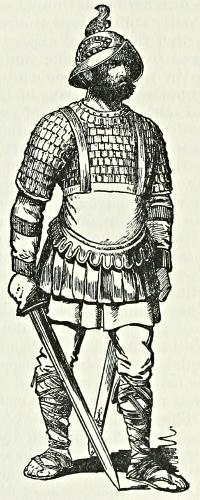
A Frank Soldier
He promised, in his own and his father’s
name, that as soon as they should be seated
on the throne of Constantinople, they would
terminate the long schism of the Greeks, and
submit themselves and their people to the
lawful supremacy of the Roman church. He
engaged to recompense the labours and
merits of the crusaders, by the immediate
payment of two hundred thousand marks
of silver; to accompany them in person to
Egypt; or, if it should be judged more
advantageous, to maintain, during a year,
ten thousand men, and, during his life, five
hundred knights, for the service of the Holy
Land. These tempting conditions were
accepted by the republic of Venice; and the
eloquence of the doge and marquis persuaded
the counts of Flanders, Blois, and St. Pol,
with eight barons of France, to join in the
glorious enterprise.
The departure of the fleet and army was
vigorously pressed by the Venetians, whose
zeal for the service of the royal youth concealed
a just resentment to his nation and family. They were mortified by
the recent preference which had been given to Pisa, the rival of their trade;
they had a long arrear of debt and injury to liquidate with the Byzantine
court; and Dandolo might not discourage the popular tale, that he had been
deprived of his eyes by the emperor Manuel, who perfidiously violated the
sanctity of an ambassador. A similar armament, for ages, had not ridden
the Adriatic; it was composed of 120 flat-bottomed vessels or palanders for
the horses; 240 transports filled with men and arms; 70 store-ships laden
with provisions; and 50 stout galleys, well prepared for the encounter of
an enemy.
At Durazzo, the confederates first landed on the territories of the Greek
Empire; the isle of Corfu afforded a station and repose; they doubled without
accident the perilous cape of Malea, the southern point of Peloponnesus
or the Morea; made a descent in the islands of Negropont and
Andros; and cast anchor at Abydos on the Asiatic side of the Hellespont.
These preludes of conquest were easy and bloodless; the Greeks of the
provinces, without patriotism or courage, were crushed by an irresistible
force; the presence of the lawful heir might justify their obedience; and
it was rewarded by the modesty and discipline of the Latins.
The tower of Galata, in the suburb of Pera, was attacked and stormed by
the French, while the Venetians assumed the more difficult task of forcing
the boom, or chain, that was stretched from that tower to the Byzantine
shore. After some fruitless attempts, their intrepid perseverance prevailed;
twenty ships of war, the relics of the Grecian navy, were either sunk or
taken; the enormous and massy links of iron were cut asunder by the shears,
or broken by the weight, of the galleys; and the Venetian fleet, safe and
triumphant, rode at anchor in the port of Constantinople. By these daring
achievements, a remnant of twenty thousand Latins solicited the license of
besieging a capital which contained above four hundred thousand inhabitants,
able, though not willing, to bear arms in the defence of their country.
Such an account would indeed suppose a population of near two millions;
but whatever abatement may be required in the numbers of the Greeks,
the belief of those numbers will equally exalt the fearless spirit of their
assailants.
The trembling usurper was supported by Theodore Lascaris, his son-in-law,
a valiant youth, who aspired to save and to rule his country; the
Greeks, regardless of that country, were awakened to the defence of their
religion; but their firmest hope was in the strength and spirit of the Varangian
guards, of the Danes and English, as they are named in the writers of
the times. After ten days’ incessant labour, the ground was levelled, the
ditch filled, the approaches of the besiegers were regularly made, and 250
engines of assault exercised their various powers to clear the rampart, to
batter the walls, and to sap the foundations. On the first appearance of a
breach, the scaling-ladders were applied, the numbers that defended the
vantage ground repulsed and oppressed the adventurous Latins; but they
admired the resolution of fifteen knights and sergeants, who had gained the
ascent, and maintained their perilous station till they were precipitated or
made prisoners by the imperial guards.
On the side of the harbour, the naval attack was more successfully conducted
by the Venetians; and that industrious people employed every resource
that was known and practised before the invention of gunpowder.
A double line, three bow-shots in front, was formed by the galleys and ships;
and the swift motion of the former was supported by the weight and loftiness
of the latter, whose decks, and poops, and turret were the platforms
of military engines, that discharged their shot over the heads of the first
line. The soldiers, who leaped from the galleys on shore, immediately
planted and ascended their scaling-ladders, while the large ships, advancing
more slowly into the intervals, and lowering a drawbridge, opened a way
through the air from their masts to the rampart. In the midst of the conflict,
the doge, a venerable and conspicuous form, stood aloft in complete
armour on the prow of his galley. The great standard of St. Mark was
displayed before him; his threats, promises, and exhortations urged the
diligence of the rowers; his vessel was the first that struck; and Dandolo
was the first warrior on the shore.
The nations admired the magnanimity of the blind old man, without
reflecting that his age and infirmities diminished the price of life, and enhanced
the value of immortal glory. On a sudden, by an invisible hand
(for the standard-bearer was probably slain), the banner of the republic
was fixed on the rampart; twenty-five towers were rapidly occupied; and,
by the cruel expedient of fire, the Greeks were driven from the adjacent
quarter. The doge had despatched the intelligence of his success, when he
was checked by the danger of his confederates. Nobly declaring that he
would rather die with the pilgrims than gain a victory by their destruction,
Dandolo relinquished his advantage, recalled his troops, and hastened to the
scene of action. He found the six weary diminutive battles of the French
encompassed by sixty squadrons of the Greek cavalry, the least of which
was more numerous than the largest of their divisions.
Shame and despair had provoked Alexius to the last effort of a general
sally; but he was awed by the firm order and manly aspect of the Latins;
and, after skirmishing at a distance, withdrew his troops in the close of the
evening. The silence or tumult of the night exasperated his fears; and the
timid usurper, collecting a treasure of ten thousand pounds of gold, basely
deserted his wife, his people, and his fortune, threw himself into a bark,
stole through the Bosporus, and landed in shameful safety in an obscure
harbour of Thrace. As soon as they were apprised of his flight, the Greek
nobles sought pardon and peace in the dungeon where the blind Isaac expected
each hour the visit of the executioner. Again saved and exalted by
the vicissitudes of fortune, the captive, in his imperial robes, was replaced
on the throne, and surrounded with prostrate slaves, whose real terror and
affected joy he was incapable of discerning. At the dawn of day, hostilities
were suspended; and the Latin chiefs were surprised by a message from the
lawful and reigning emperor, who was impatient to embrace his son, and to
reward his generous deliverers.
[1203-1204 A.D.]
But these generous deliverers were unwilling to release their hostage
till they had obtained from his father the payment, or at least the promise,
of their recompense. The father of young Alexius inquired with some
anxiety into the nature of his stipulations. The submission of the Eastern
Empire to the Pope, the succour of the Holy Land, and a present contribution
of two hundred thousand marks of silver—“These conditions are
weighty,” was his prudent reply; “they are hard to accept, and difficult to
perform. But no conditions can exceed the measure of your services and
deserts.”
After this satisfactory assurance, the barons mounted on horseback,
and introduced the heir of Constantinople to the city and palace. His
youth and marvellous adventures engaged every heart in his favour, and
Alexius was solemnly crowned with his father in the dome of St. Sophia. At
the price of sixteen hundred pounds of gold, he prevailed on the marquis of
Montferrat to lead him with an army round the provinces of Europe; to
establish his authority, and pursue his uncle, while Constantinople was awed
by the presence of Baldwin, and his confederates of France and Flanders.
The expedition was successful. The blind old emperor exulted in the success
of his arms, and listened to the predictions of his flatterers, that the
same Providence which had raised him from the dungeon to the throne,
would heal his gout, restore his sight, and watch over the long prosperity of
his reign.
By the recent invasion, the Greeks were awakened from a dream of nine
centuries; from the vain presumption that the capital of the Roman Empire
was impregnable to foreign arms. The strangers of the West had violated
the city, and bestowed the sceptre of Constantine; their imperial clients
soon became as unpopular as themselves; the well-known vices of Isaac were
rendered still more contemptible by his infirmities, and the young Alexius
was hated as an apostate, who had renounced the manners and religion of his
country. His secret covenant with the Latins was divulged or suspected;
the people, and especially the clergy, were devoutly attached to their faith
and superstition; and every convent, and every shop, resounded with the
danger of the church and the tyranny of the pope. An empty treasury could
ill supply the demands of regal luxury and foreign extortion; the Greeks
refused to avert, by a general tax, the impending evils of servitude and
pillage; the oppression of the rich excited a more dangerous and personal
resentment; and if the emperor melted the plate, and despoiled the
images, of the sanctuary, he seemed to justify the complaints of heresy and
sacrilege.
Alexius hesitated between gratitude and patriotism, between the fear of
his subjects and of his allies. By his feeble and fluctuating conduct he
lost the esteem and confidence of both; and while he invited the marquis of
Montferrat to occupy the palace, he suffered the nobles to conspire, and the
people to arm, for the deliverance of their country. Regardless of his painful
situation, the Latin chiefs repeated their demands, resented his delays,
suspected his intentions, and exacted a decisive answer of peace or war.
In the eyes of both nations Alexius was false and contemptible; the
base and spurious race of the Angeli was rejected with clamorous disdain;
and the people of Constantinople encompassed the senate, to demand at
their hands a more worthy emperor. To every senator, conspicuous by his
birth or dignity, they successively presented the purple; by each senator
the deadly garment was repulsed; the contest lasted three days; and we
may learn from the historian Nicetas, one of the members of the assembly,
that fear and weakness were the guardians of their loyalty. A phantom,
who vanished in oblivion, was forcibly proclaimed by the crowd; but the
author of the tumult, and the leader of the war, was a prince of the house
of Ducas; and his common appellation of Alexius must be discriminated by
the epithet of Murtzuphlus, which in the vulgar idiom expressed the close
junction of his black and shaggy eyebrows.
At once a patriot and a courtier, the perfidious Murtzuphlus, who was
not destitute of cunning and courage, opposed the Latins both in speech
and action, inflamed the passions and prejudices of the Greeks, and insinuated
himself into the favour and confidence of Alexius, who trusted him
with the office of great chamberlain, and tinged his buskins with the colours
of royalty. At the dead of night he rushed into the bedchamber with an
affrighted aspect, exclaiming, that the palace was attacked by the people
and betrayed by the guards. Starting from his couch, the unsuspecting
prince threw himself into the arms of his enemy, who had contrived his
escape by a private staircase. But that staircase terminated in a prison;
Alexius was seized, stripped, and loaded with chains; and, after tasting
some days the bitterness of death, he was poisoned, or strangled, or beaten
with clubs, at the command and in the presence of the tyrant. The emperor,
Isaac Angelus, soon followed his son to the grave, and Murtzuphlus, perhaps,
might spare the superfluous crime of hastening the extinction of impotence
and blindness.
[1204 A.D.]
The death of the emperors, and the usurpation of Murtzuphlus, had changed
the nature of the quarrel. It was no longer the disagreement of allies who
over-valued their services, or neglected their obligations; the French and
Venetians forgot their complaints against Alexius, dropped a tear on the
untimely fate of their companion, and swore revenge against the perfidious
nation who had crowned his assassin. Near three months, without excepting
the holy season of Lent, were consumed in skirmishes and preparations before
the Latins were ready or resolved for a general assault.
In more than a hundred places the assault was urged, and the defence
was sustained, till the superiority of ground and numbers finally prevailed,
and the Latin trumpets sounded a retreat. On the ensuing days, the attack
was renewed with equal vigour, and a similar event. In the third assault,
two ships were linked together to double their strength; a strong north
wind drove them on the shore; the bishops of Troyes[79] and Soissons[80] led the
van; and the auspicious names of the Pilgrim and the Paradise resounded
along the line. The episcopal banners were displayed on the walls; a hundred
marks of silver had been promised to the first adventurers; and if their
reward was intercepted by death, their names have been immortalised by
fame. Four towers were scaled, three gates were burst open, and the French
knights, who might tremble on the waves, felt themselves invincible on
horseback on the solid ground. Shall we relate that the thousands who
guarded the emperor’s person fled on the approach, and before the lance,
of a single warrior? Their ignominious flight is attested by their countryman
Nicetasj—an army of phantoms marched with the French hero, and he
was magnified to a giant in the eyes of the Greeks. The Latins entered the
city under the banners of their leaders; the streets and gates opened for
their passage; and either design or accident kindled a third conflagration,
which consumed in a few hours the measure of three of the largest cities of
France.
Constantinople had been taken by storm; and no restraints, except those
of religion and humanity, were imposed on the conquerors by the laws of
war. Boniface, marquis of Montferrat, still acted as their general; and the
Greeks, who revered his name as that of their future sovereign, were heard
to exclaim in a lamentable tone, “Holy marquis-king, have mercy upon us!”
His prudence or compassion opened the gates of the city to the fugitives;
and he exhorted the soldiers of the cross to spare the lives of their fellow-Christians.
The streams of blood that flow down the pages of Nicetas
may be reduced to the slaughter of two thousand of his unresisting countrymen;
and the greater part was massacred, not by the strangers, but by the
Latins, who had been driven from the city, and who exercised the revenge of
a triumphant faction. Yet of these exiles some were less mindful of injuries
than of benefits; and Nicetas himself was indebted for his safety to the generosity
of a Venetian merchant.
Pope Innocent III accuses the pilgrims of respecting, in their lust,
neither age, nor sex, nor religious profession; and bitterly laments that the
deeds of darkness, fornication, adultery, and incest were perpetrated in open
day; and that noble matrons and holy nuns were polluted by the grooms
and peasants of the Catholic camp. It is indeed probable that the license of
victory prompted and covered a multitude of sins; but it is certain, that the
capital of the East contained a stock of venal or willing beauty sufficient to
satiate the desires of twenty thousand pilgrims; and female prisoners were
no longer subject to the right or abuse of domestic slavery. The marquis
of Montferrat was the patron of discipline and decency; the count of Flanders
was the mirror of chastity; they had forbidden, under pain of death,
the rape of married women, or virgins, or nuns; and the proclamation was
sometimes invoked by the vanquished and respected by the victors. Their
cruelty and lust were moderated by the authority of the chiefs and feelings
of the soldiers; for we are no longer describing an irruption of the
northern savages; and, however ferocious they might still appear, time,
policy, and religion had civilised
the manners of the
French, and still more of the
Italians. But a free scope
was allowed to their avarice,
which was glutted, even in
the holy week, by the pillage
of Constantinople.
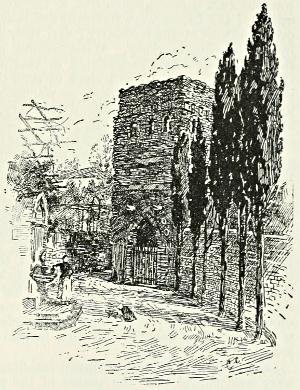
Ruins of a Saracen Tower
The right of victory, unshackled
by any promise or
treaty, had confiscated the
public and private wealth of
the Greeks; and every hand,
according to its size and
strength, might lawfully execute
the sentence and seize
the forfeiture. A portable
and universal standard of
exchange was found in the
coined and uncoined metals
of gold and silver, which
each captor at home or abroad
might convert into the possessions
most suitable to his temper
and situation. Of the
treasures which trade and
luxury had accumulated, the
silks, velvets, furs, the gems,
spices, and rich movables,
were the most precious, as
they could not be procured for money, in the ruder countries of Europe.
An order of rapine was instituted; nor was the share of each individual
abandoned to industry or chance. Under the tremendous penalties of
perjury, excommunication, and death, the Latins were bound to deliver
their plunder into the common stock; three churches were selected for
the deposit and distribution of the spoil; a single share was allotted to a
foot-soldier; two for a sergeant on horseback; four to a knight; and larger
proportions according to the rank and merit of the barons and princes. For
violating this sacred engagement, a knight belonging to the count of St. Pol
was hanged with his shield and coat of arms round his neck; his example
might render similar offenders more artful and discreet; but avarice was
more powerful than fear; and it is generally believed that the secret far
exceeded the acknowledged plunder. Yet the magnitude of the prize surpassed
the largest scale of experience or expectation. After the whole had
been equally divided between the French and Venetians, fifty thousand
marks were deducted to satisfy the debts of the former and the demands of
the latter. The residue of the French amounted to four hundred thousand
marks of silver [about £800,000 or $4,000,000].
In this great revolution we enjoy the singular felicity of comparing the
narratives of Villehardouin and Nicetas, the opposite feelings of the marshal
of Champagne and the Byzantine senator. At the first view it should seem
that the wealth of Constantinople was only transferred from one nation to
another; and that the loss and sorrow of the Greeks are exactly balanced
by the joy and advantage of the Latins. But in the miserable account of
war, the gain is never equivalent to the loss, the pleasure to the pain; the
smiles of the Latins were transient and fallacious; the Greeks forever wept
over the ruins of their country; and their real calamities were aggravated
by sacrilege and mockery. What benefits accrued to the conquerors from
the three fires which annihilated so vast a portion of the buildings and
riches of the city? What a stock of such things, as could neither be used
nor transported, was maliciously or wantonly destroyed! How much treasure
was idly wasted in gaming, debauchery, and riot! And what precious
objects were bartered for a vile price by the impatience or ignorance of the
soldiers, whose reward was stolen by the base industry of the last of the Greeks!
These alone, who had nothing to lose, might derive some profit from the
revolution; but the misery of the upper ranks of society is strongly painted
in the personal adventures of Nicetas himself. His stately palace had been
reduced to ashes in the second conflagration; and the senator, with his
family and friends, found an obscure shelter in another house which he possessed
near the church of St. Sophia. It was the door of this mean habitation
that his friend the Venetian guarded in the disguise of a soldier, till
Nicetas could save, by a precipitate flight, the relics of his fortune and the
chastity of his daughter. In a cold wintry season, these fugitives, nursed in
the lap of prosperity, departed on foot; his wife was with child; the desertion
of their slaves compelled them to carry their baggage on their own
shoulders; and their women, whom they placed in the centre, were exhorted
to conceal their beauty with dirt, instead of adorning it with paint and
jewels.
Every step was exposed to insult and danger; the threats of the strangers
were less painful than the taunts of the plebeians, with whom they were
now levelled; nor did the exiles breathe in safety till their mournful
pilgrimage was concluded at Selymbria, above forty miles from the capital.
On their way they overtook the patriarch, without attendance, and almost
without apparel, riding on an ass, and reduced to a state of apostolic
poverty, which, had it been voluntary, might perhaps have been meritorious.
In the meanwhile, his desolate churches were profaned by the
licentiousness and party zeal of the Latins. After stripping the gems
and pearls, they converted the chalices into drinking cups; their tables,
on which they gamed and feasted, were covered with the pictures of Christ
and the saints; and they trampled under foot the most venerable objects
of the Christian worship. In the cathedral of St. Sophia, the ample veil of
the sanctuary was rent asunder for the sake of the golden fringe; and the
altar, a monument of art and riches, was broken in pieces and shared among
the captors.
Their mules and horses were laden with the wrought silver and gilt
carvings which they tore down from the doors and pulpit; and if the
beasts stumbled under the burden, they were stabbed by their impatient
drivers, and the holy pavement streamed with their impure blood. A
prostitute was seated on the throne of the patriarch; and that daughter
of Belial, as she is styled, sang and danced in the church, to ridicule the
hymns and processions of the Orientals. Nor were the repositories of the
royal dead secure from violation; in the church of the Apostles, the tombs
of the emperors were rifled; and it is said, that after six centuries the
corpse of Justinian was found without any sign of decay or putrefaction.
In the streets the French and Flemings clothed themselves and their horses
in painted robes and flowing head-dresses of linen; and the coarse intemperance
of their feasts insulted the splendid sobriety of the East. To
expose the arms of a people of scribes and scholars, they affected to display
a pen, an inkhorn, and a sheet of paper, without discerning that the instruments
of science and valour were useless in the hands of the modern Greeks.
Their reputation and their language encouraged them, however, to despise
the ignorance, and to overlook the progress of the Latins. In the love of
the arts, the national difference was still more obvious and real; the Greeks
preserved with reverence the works of their ancestors, which they could not
imitate; and, in the destruction of the statues of Constantinople, we are
provoked to join in the complaints and invectives of the Byzantine historian.
The brass statues were broken and melted by the unfeeling avarice of the crusaders;
the cost and labour were consumed in a moment; the soul of genius
evaporated in smoke; and the remnant of base metal was coined into money
for the payment of the troops. Bronze is not the most durable of monuments;
from the marble forms of Phidias and Praxiteles, the Latins might
turn aside with stupid contempt; but unless they were crushed by some
accidental injury, those useless stones stood secure on their pedestals. The
most enlightened of the strangers, above the gross and sensual pursuits of
their countrymen, more piously exercised the right of conquest in the search
and seizure of the relics of the saints.h
After the festival of Easter, the crusaders shared the captured riches;
the fourth part of the spoil was set aside for him who should be chosen emperor,
and the rest was divided among the French and the Venetians. The
French crusaders, who had conquered Zara, to the sole advantage of the
Venetians, were not the less called upon to pay the fifty thousand silver
marks they owed to the republic; the amount was deducted beforehand
from the portion of the booty that belonged to them. In the division that
was made among the warriors of Lombardy, Germany, and France, each
knight had a part equal to that of two horsemen, and every horseman one
equal to that of two foot-soldiers. All the plunder of the Greeks yielded[81]
only 400,000 silver marks; but although this sum far exceeded the revenues
of all the kingdoms of the West, it did not by any means represent the value
of the riches accumulated in Byzantium. If the princes and barons, upon
making themselves masters of the city, had been satisfied with imposing a
tribute upon the inhabitants, they might have received a much larger sum.
When they had shared the plunder, the crusaders gave way to the most
extravagant joy, without perceiving that they had committed a great fault
in exhausting a country which was about to become their own; they did not
reflect that the ruin of the conquered might one day bring on that of the
conquerors, and that they might become as poor as the Greeks they had just
despoiled. Without regrets, as without foresight, hoping everything from
their own good swords, they set about electing a leader who should reign
over a people in mourning and a desolated city. The imperial purple had
still the same splendour in their eyes, and the throne, though shaken by
their arms, was still the object of their ambition.
[1204 A.D.]
Six electors were chosen from among the Venetian nobles, and six others
from among the French ecclesiastics, to give a master to Constantinople;
the twelve electors assembled in the palace of Bukoleon, and swore, upon
the Gospel, to crown only merit and virtue.
Three of the principal leaders of the Crusade had equal claims to the
suffrages of the electors. If the purple was to be the reward of experience,
of ability in council, and of services rendered to the cause of the Latins,
Henry Dandolo, who had been the moving spirit, the very soul of the enterprise,
certainly had the first claim to it. The marquis of Montferrat, likewise,
had titles worthy of great consideration; the Latins had chosen him
for their leader, and the Greeks already acknowledged him as their master.
His bravery, proved in a thousand fights, promised a firm and generous support
to a throne that must rise from amidst ruins. His prudence and moderation
might give the Latins and the people of Greece reason to hope that,
when once raised to empire, he would repair the evils of war. The claims
of Baldwin to the imperial crown were not less cogent than those of his
concurrents. The count of Flanders was related to the most powerful monarchs
of the West, and was descended, in the female line, from Charlemagne.
He was much beloved by his soldiers, whose dangers he was always ready to
share; he had deservedly obtained the esteem of the Greeks, who, even
amidst the disorders of conquest, celebrated him as the champion of chastity
and honour. Baldwin was the protector of the weak, the friend of the poor;
he loved justice, and had no dread of truth.
The electors at first turned their attention towards the venerable Dandolo;
but the republicans of Venice trembled at the idea of seeing an emperor
among their fellow-citizens: “What shall we not have to dread,” said
they, “from a Venetian, become master of Greece, and of part of the East?
Shall we be subject to his laws, or will he remain subject to the laws of our
country? Under his reign, and under that of his successors, who will assure
us that Venice, the Queen of the Seas, will not become one of the cities of
this empire?” The Venetians, whilst speaking thus, bestowed just eulogiums
upon the virtue and character of Dandolo; they added, that their
doge, who was approaching the end of a life filled with great actions, had
nothing left him but to finish his days with glory, and that he himself would
find it more glorious to be the head of a victorious republic, than the sovereign
of a conquered nation. “What Roman,” cried they, “would have been
willing to lay down the title of citizen of Rome, to become king of Carthage?”
On terminating their speeches, the Venetians conjured the assembly to
elect an emperor from among the other leaders of the army. After this, the
choice of the electors could only be directed towards the count of Flanders
and the marquis of Montferrat. To prevent the effects of a fatal discord,
it was judged best to decree, at once, that the prince that should gain the
suffrages for the imperial throne, should yield to the other, under the condition
of fealty and homage, the property of the island of Candia, and all the
lands of the empire situated on the other side of the Bosporus. After this
decision the assembly turned their whole attention to the election of an emperor.
Their choice was for a long time uncertain. The marquis of Montferrat
at first appeared to have the majority of the suffrages; but the
Venetians were fearful of seeing upon the throne of Constantinople a prince
who had any possessions in the neighbourhood of their territories. The
interests and jealousies of policy, and, without doubt, also wisdom and
equity, at length united all voices in favour of the count of Flanders.
The crusaders, assembled before the palace of Bukoleon, awaited with
impatience the decision of the electors. At the hour of midnight, the bishop
of Soissons came forward under the vestibule, and pronounced, in a loud
voice, these words: “This hour of the night, which witnessed the birth of
a Saviour of the world, gives birth to a new empire, under the protection
of the Omnipotent. You have for emperor, Baldwin, count of Flanders
and Hainault.” Loud cries of joy arose from among the Venetians and the
French. The people of Constantinople, who had so often changed masters,
received, without repugnance, the new one just given to them, and mingled
their acclamations with those of the Latins. Baldwin was elevated upon a
buckler, and borne in triumph to the church of St. Sophia. The marquis of
Montferrat followed in the train of his rival; the generous submission,
of which he presented an example, was much admired by his companions in
arms, and his presence drew scarcely less attention than the warlike pomp
that surrounded the new emperor.
The ceremony of the coronation was postponed till the fourth Sunday
after Easter. In the meantime the marriage of the marquis of Montferrat
with Margaret of Hungary, the widow of Isaac, was celebrated with much
splendour. Constantinople beheld within its walls the festivities and spectacles
of the West, and, for the first time, the Greeks heard in their churches
the prayers and hymns of the Latins. On the day appointed for the coronation
of the emperor, Baldwin repaired to St. Sophia, accompanied by the
barons and the clergy. Whilst divine service was being performed, the emperor
ascended a throne of gold, and received the purple from the hands
of the pope’s legate, who performed the functions of patriarch. Two knights
carried before him the laticlavici tunica of the Roman consuls, and the imperial
sword, once again in the hands of warriors and heroes. The head of
the clergy, standing before the altar, pronounced, in the Greek language,
these words: “He is worthy of reigning;” and all persons present repeated
in chorus, “He is worthy! he is worthy!” The crusaders shouting their
boisterous acclamations, the knights clad in armour, the crowd of miserable
Greeks, the sanctuary despoiled of its ancient ornaments, and decked with
foreign pomp, presented altogether a spectacle solemn and melancholy—all
the evils of war amidst the trophies of victory. Surrounded by the ruins
of an empire, reflective spectators could not fail to remark among the ceremonies
of this day, that in which, according to the custom of the Greeks,
were presented to Baldwin a little vase filled with dust and bones, and a
lock of lighted flax, as symbols of the shortness of life and the nothingness
of human grandeur.
Before the ceremony of his coronation, the new emperor distributed the
principal dignities of the empire among his companions in arms. Villehardouin,
marshal of Champagne, obtained the title of marshal of Romania;
the count de St. Pol, the dignity of constable; the charges of master of the
wardrobe, great cupbearer and butler, were given to Canon de Bethune,
Macaire de St. Ménéhoult, and Miles de Brabant. The doge of Venice
created despot or prince of Romania, had the right of wearing purple buskins,
a privilege, among the Greeks, reserved for members of the imperial family.
Henry Dandolo represented the republic of Venice at Constantinople; half
the city was under his dominion and recognised his laws; he raised himself,
by the dignity of his character as well as by his exploits, above all the
princes and all the nobles of the court of Baldwin; he alone was exempt
from paying fealty and homage to the emperor for the lands he was to
possess.
The barons began to be impatient to share the cities and provinces of the
empire. In a council composed of twelve of the patricians of Venice and
twelve French knights, all the conquered lands were divided between the
two nations. Bithynia, Romania or Thrace, Thessalonica, all Greece from
Thermopylæ to Cape Sunium, with the larger isles of the Archipelago, fell
to the share and under the dominion of the French. The Venetians obtained
the Cyclades and the Sporades in the Archipelago; the isles and the oriental
coast of the Adriatic Gulf; the coasts of the Propontis and the Euxine Sea;
the banks of the Hebrus and the Vardas; the cities of Cypsedes, Didymatica,
and Hadrianopolis; the maritime countries of Thessalonica, etc. Such was
at first the distribution of the territories of the empire. But circumstances
that could not be foreseen, the diversity of interests, the rivalries of ambition,
all the chances of fortune and of war, soon produced great changes in
this division of dominions. History would in vain endeavour to follow the
conquerors into the provinces allotted to them; it would be more easy to mark
the banks of an overflowing torrent, or to trace the path of the storm, than
to fix the state of the uncertain and transitory possessions of the conquerors
of Byzantium.
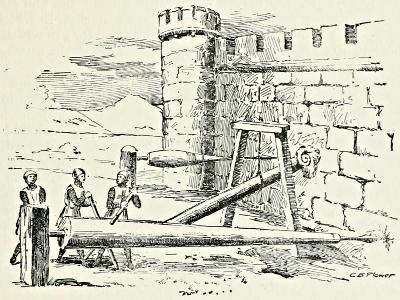
Methods of attacking a Wall, Eleventh Century
(From an old print)
The lands situated beyond the Bosporus were erected into a kingdom,
and, with the island of Candia, given to the marquis of Montferrat. Boniface
exchanged them for the province of Thessalonica, and sold the island of
Candia to the republic of Venice for thirty pounds weight of gold. The
provinces of Asia were abandoned to the count of Blois, who assumed the
title of duke of Nicæa and Bithynia. In the distribution of the cities and
lands of the empire, every one of the lords and barons had obtained domains
proportionate with the rank and services of the new possessor. When they
heard speak of so many countries of which they scarcely knew the names,
the warriors of the West were astonished at their conquests, and believed that
the greater part of the universe was promised to their ambition. In the
intoxication of their joy, they declared themselves masters of all the provinces
that had formed the empire of Constantine. They cast lots for the
countries of the Medes and Parthians, and the kingdoms that were under
the domination of the Turks and Saracens. With the money which arose
from the plunder of the capital, the conquerors purchased the provinces of
the empire; they sold, they played at dice, for whole cities and their inhabitants.
Constantinople was during several days a market, in which seas and
their islands, nations and their wealth, were trafficked for; in which the Roman
world was put up to sale, and found purchasers among the obscure crowd of
the crusaders.
Whilst the barons were thus distributing cities and kingdoms, the ambition
of the Latin clergy was by no means idle, but was busy in invading the
property of the Greek church. The leaders of the Crusade had agreed
among themselves that if the emperor of Constantinople should be chosen
from the French, the patriarch should be a Venetian. According to this
convention, which had preceded the conquest, Thomas Morosini was elevated
to the chair of St. Sophia; priests and Latin bishops were, at the same time,
sent into the other conquered cities, and took possession of the wealth and the
privileges of the Greek clergy. Thus the Romish worship associated itself
with the victories of the crusaders, and made its empire acknowledged
wherever the banners of the conquerors floated.
After his coronation, Baldwin wrote to the pope, to announce to him the
extraordinary victories by which it had pleased God to crown the zeal of the
soldiers of the cross. The new emperor, who assumed the title of knight of
the holy see, recalled to the mind of the sovereign pontiff the perfidies and
the long revolt of the Greeks. “We have brought under your laws,” said
he, “that city, which, in hatred for the holy see, would scarcely hear the
name of the prince of the apostles, and did not afford a single church to him
who received from the Lord the supremacy over all churches.” Baldwin, in
his letter, invited the vicar of Jesus Christ to imitate the example of his predecessors,
John, Agapetus, and Leo, who visited in person the church of
Byzantium.
The marquis of Montferrat at the same time addressed a letter to the
sovereign pontiff, in which he protested his humble obedience to all the decisions
of the holy see. The doge of Venice, who till that time had braved
with so much haughtiness the threats and thunders of the church, acknowledged
the sovereign authority of the pope, and joined his protestations with
those of Baldwin and Boniface. To disarm the anger of Innocent, they
represented to him that the conquest of Constantinople had prepared the
deliverance of Jerusalem, and boasted of the wealth of a country which the
crusaders had at length brought under the laws of the holy see. In all
their letters to the pope or the faithful of the West, the conquerors of Byzantium
spoke of the Greek empire as of a new land of promise, which awaited
the servants of God and the soldiers of Christ.
Innocent had been for a long time irritated by the disobedience of the
crusaders; in his reply, he reproached with bitterness the victorious army
of the Latins for having preferred the riches of the earth to those of heaven;
he reprimanded the leaders for having exposed to the outrages of the soldiers
and followers of the army, the honour of matrons and maidens, and virgins
consecrated to the Lord; for having ruined Constantinople, plundered both
great and small, violated the sanctuary, and put forth a sacrilegious hand
upon the treasures of the churches. Notwithstanding this outward show of
anger, the pope approved the election of Baldwin, who took the title of
knight of the holy see, and consented to recognise an empire to which
he was to give laws.
The greater part of the defenders of the Holy Land, who had experienced
nothing but the evils of war, became desirous of partaking of the glory and
the good fortune of the French and Venetians, and the king of Jerusalem
was left almost alone at Ptolemais, without means of making the truce he had
entered into with the infidels respected. Baldwin warmly welcomed the
defenders of the Holy Land; but the joy he experienced at their arrival was
much troubled by the intelligence of the death of his wife, Marguerite of
Flanders. This princess had embarked in the fleet of John de Nesle, in
the belief that she should meet her husband in Palestine; sinking under the
fatigue of a long voyage, and perhaps the pains of disappointment, she fell
sick at Ptolemais, and died at the moment she learned that Baldwin had
been crowned emperor of Constantinople. The vessel destined to convey
the new empress to the shores of the Bosporus only brought back her mortal
remains. Baldwin, amidst his knights, wept for the loss of a princess he
had loved tenderly.
The emperor and his barons, with all the succours they had received from
the East, had scarcely twenty thousand men to defend their conquests and
restrain the people of the capital and the provinces. The sultan of Iconium
and the king of the Bulgarians had long threatened to invade the lands contiguous
to their states, and they thought that the dissensions and subsequent
fall of the Greek empire presented a favourable opportunity for the outbreak
of their jealousy and ambition. The nations of Greece were conquered without
being subdued. As in the disorder which accompanied the conquest of
Byzantium, no other right had been acknowledged but that of force and the
sword; all the Greeks, who had still arms in their hands, were desirous of
forming a principality or a kingdom. On all sides new states and empires
sprang up from the bosom of the ruins, and already threatened that which
the crusaders had so recently established.
A grandson of Andronicus founded in a Greek province of Asia Minor
the principality of Trebizond; Leo Sgurre, master of the little city of Napoli,
had extended his dominions by injustice and violence; and, to employ a
comparison offered by Nicetas, he had grown greater, like the torrent that
swells in the storm and is enlarged by the waters of the tempest. A barbarous
conqueror, a fierce and cruel tyrant, he reigned, or rather he spread
terror, over Argos and the Isthmus of Corinth. Michael-Angelus Comnenus,
employing the arms of treachery, gained the kingdom of Epirus, and subdued
to his laws a wild and warlike people. Theodore Lascaris, who, like Æneas,
had fled from his burning country, collected some troops in Bithynia, and
caused himself to be proclaimed emperor at Nicæa, whence his family was destined
at a future day to return in triumph to Constantinople.
If despair had imparted any degree of courage to the two fugitive emperors,
they might have obtained a share of their own spoils, and preserved a
remnant of power; but they had not profited by the lessons of misfortune.
Murtzuphlus, who had completed all the crimes begun by Alexius, did not
hesitate to place himself in the power of his unfortunate rival, whose daughter
he had married; the wicked sometimes take upon themselves the duty of punishing
one another. Alexius, after having loaded Murtzuphlus with caresses,
inveigled him into his house, and caused his eyes to be put out. In this
condition, Murtzuphlus, abandoned by his followers, for whom he was now
nothing but an object of disgust, went to conceal his existence and his misery
in Asia; but on his road he fell into the hands of the Latins. Being led to
Constantinople, and condemned to expiate his crimes by an ignominious death,
he was precipitated from the top of a column raised by the emperor Theodosius
in the Place of Taurus. The multitude of Greeks that had offered the
purple to Murtzuphlus were present at his tragical end, and appeared terrified
at a punishment that was much more new to them than the crimes for which
it was inflicted.
The perfidy and cruelty of Alexius did not remain long unpunished; the
usurper was obliged to wander from city to city, and not unfrequently to
conceal the imperial purple under the garb of a mendicant. For a considerable
time he only owed his safety to the contempt in which he was held by
the conquerors. After having long strayed about in a state of destitution,
he was given up to the marquis of Montferrat, who sent him a prisoner into
Italy; escaping thence, he again passed into Asia, and found an asylum with
the sultan of Iconium. Alexius could not be satisfied to live in peace in his
retreat, but joined the Turks in an attack upon his son-in-law Lascaris, whom
he could not pardon for having saved a wreck of the empire, and reigning
over Bithynia. As the Turks were beaten, the fugitive prince fell at length
into the hands of the emperor of Nicæa, who compelled him to retire to a
monastery, where he died, forgotten by both Greeks and Latins.
Thus four emperors were immolated to ambition and vengeance—a deplorable
spectacle, and most worthy of pity! Amidst the convulsions and fall
of an empire, we behold princes of the same family quarrelling for a phantom
of authority, snatch from each other by turns both the sceptre and life, surpass
the populace in fury, and leave them no crime, no parricide, to commit.
Whilst the Greek princes were thus making war against each other,
and quarrelling for the wrecks of the empire, the French counts and barons
quitted the capital to go and take possession of the cities and provinces that
had fallen to their share. Many of them were obliged to conquer, sword in
hand, the lands that had been assigned to them. The marquis of Montferrat
set out on his march to visit the kingdom of Thessalonica, and receive the
homage of his new subjects. The emperor Baldwin, followed by his brother
Henry of Hainault, and a great number of knights, made a progress through
Thrace and Romania, and everywhere on his passage, was saluted by the
noisy acclamations of a people always more skilful in flattering their conquerors
than in combating their enemies. When he arrived at Hadrianopolis,
where he was received in triumph, the new emperor announced his intention
of pursuing his march as far as Thessalonica. This unexpected resolution
surprised the marquis of Montferrat, who entertained the desire of going
alone to his own kingdom. Boniface promised to be faithful to the emperor,
to be always ready to employ his forces against the enemies of the empire;
but he feared the presence of Baldwin’s army in his cities, already exhausted
by war.
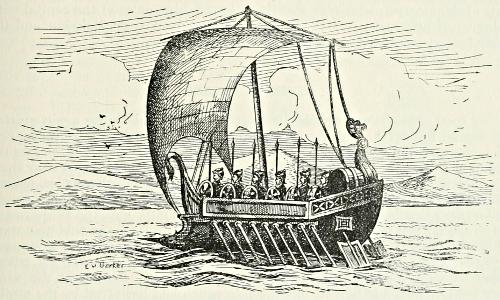
War Galley of the Eleventh Century
(From an old print)
A serious quarrel broke out between the two princes. The marquis of
Montferrat accused the emperor of wishing to get possession of his states;
Baldwin fancied he could perceive in the resistance of Boniface the secret
design of denying the sovereignty of the head of the empire. Both loved
justice, and were not wanting in moderation; but now one had become king
of Thessalonica and the other emperor of Constantinople, they had courtiers
who endeavoured to exasperate their quarrel and inflame their animosity.
In spite of all the representations of the marquis of Montferrat, Baldwin
led his army into the kingdom of Thessalonica. Boniface considered this
obstinacy of the emperor as a flagrant outrage, and swore to take vengeance
with his sword. Impelled by passion, he departed suddenly with several
knights who had declared in his favour, and got possession of Didymatica, a
city belonging to the emperor.
The marquis of Montferrat took with him his wife, Mary of Hungary,
the widow of Isaac; and the presence of this princess, with the hopes of
keeping up the division among the Latins, drew many Greeks to the banner
of Boniface. He declared to them that he fought for their cause, and clothed
in the imperial purple a young prince, the son of Isaac and Mary of Hungary.
Dragging in his train this phantom of an emperor, around whom the
principal inhabitants from all parts of Romania rallied, he resumed the road
to Hadrianopolis, and made preparations for besieging that city. Boniface,
daily becoming more irritated, would listen to neither the counsels nor the
prayers of his companions in arms; and discord was about to cause the blood
of the Latins to flow, if the doge of Venice, the count of Blois, and the barons
that remained at Constantinople, had not earnestly employed their authority
and credit to prevent the misfortunes with which the new empire was
threatened. The marquis of Montferrat promised to submit his quarrel
with Baldwin to the judgment of the counts and barons.
In the meanwhile Baldwin had taken possession of Thessalonica. As
soon as he heard of the hostilities of the marquis of Montferrat, he hastily
marched back to Hadrianopolis. He was brooding over projects of vengeance,
and threatening to repel force by force, and oppose war to war, when he met
the deputies.
He promised to lay down his arms, and repair to Constantinople, to
adjust the quarrel between him and the marquis of Montferrat. The marquis
of Montferrat, who very shortly followed him, entered the capital with
a degree of mistrust; but the welcome he received from Baldwin and the
other leaders completely appeased all his resentments.
[1204-1205 A.D.]
As soon as peace was re-established, the knights and barons again quitted
the capital to pass through the provinces, and subdue such as were refractory.
The count of Blois, who had obtained Bithynia, sent his knights across the
Bosporus; the troops of the crusaders gained several advantages over those
of Lascaris. Penamenia, Lopada, Nicomedia, and some other cities, opened
their gates to the conquerors, after a feeble resistance. The Latins brought
under their dominion all the coasts of the Propontis and the Bosporus, as
far as the ancient Æolis. Henry of Hainault was not idle in this new war:
whilst the warriors of the count of Blois were pushing their conquests
towards Nicæa he led his men-at-arms into Phrygia, unfurled his triumphant
banners in the plains where Troy once stood, fought at the same
time both Greeks and Turks, in the fields which had been trod by the armies
of Xerxes and Alexander, and took possession of all the country that extends
from the Hellespont to Mount Ida.
At the same time the marquis of Montferrat, now the peaceable master
of Thessalonica, undertook the conquest of Greece. He advanced into
Thessaly, passed the chain of mountains of Olympus and Ossa, and took
possession of Larissa. Boniface and his knights, without fear and without
danger, passed through the narrow straits of Thermopylæ, and penetrated
into Bœotia and Attica. They put to flight Leo Sgurre, who was the
scourge of a vast province; and their exploits might have reminded the
Greeks of those heroes of the early ages who travelled about the world
fighting monsters and subduing tyrants. As all the Greeks, for so long a
time oppressed, sighed for a change, the heroes of the Crusades were everywhere
received as liberators. Whilst Boniface was becoming possessed of
the beautiful countries of Greece, Geoffrey de Villehardouin, nephew of the
marshal of Champagne, established the authority of the Latins in the Peloponnesus.
After having driven the troops of Michael Comnenus to the
mountains of Epirus, he occupied, without fighting, Coronea and Patras, and
met with no resistance except in the canton of Lacedæmonia. The conquered
lands and cities were given to the barons, who rendered fealty and
homage to the king of Thessalonica and the emperor of Constantinople.
Greece then beheld lords of Argos and Corinth, grand sieurs of Thebes,
dukes of Athens, and princes of Achaia. French knights dictated laws in
the city of Agamemnon, in the city of Minerva, in the country of Lycurgus,
and in that of Epaminondas. Strange destiny of the warriors of this Crusade,
who had quitted the West to conquer the city and lands of Jesus
Christ, and whom fortune had conducted into places filled with the remembrances
of the gods of Homer and the glory of profane antiquity!
The crusaders were not allowed to felicitate themselves long upon their
conquests. Possessors of an empire much more difficult to be preserved
than invaded, they had not the ability to master fortune, which soon took
from them all that victory had bestowed. They exercised their power with
violence, and conciliated neither their subjects nor their neighbours. Joannice
[Johannitsa, John, Kalojan, or Calo-John], king of the Bulgarians, had
sent an ambassador to Baldwin, with offers of friendship; Baldwin replied
with much haughtiness, and threatened to
compel Joannice to descend from his usurped
throne. When despoiling the Greeks of their
property, the crusaders shut out from themselves
every source of prosperity, and reduced
men, to whom they left nothing but life, to
despair. To fill up the measure of their imprudence,
they received into their armies the
Greeks, whom they loaded with contempt,
and who became their implacable enemies.
Not content with reigning over cities, they
were desirous of subjugating hearts to their
will, and awakened fanaticism. Unjust persecutions
exasperated the minds of the Greek
priests, who declaimed with vehemence against
tyranny, and who, reduced to misery, were listened
to as oracles and revered as martyrs.
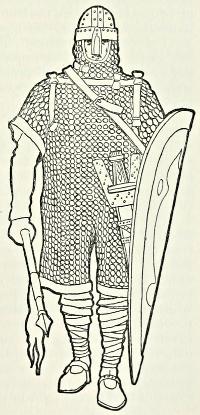
Coat of Mail of the Eleventh
Century
In their despair, the conquered people resolved
to have recourse to arms; and, looking
around them to find enemies for the crusaders,
they implored the alliance and protection of
the king of the Bulgarians. There was formed
a widely-extended conspiracy, into which all
entered to whom slavery was no longer tolerable.
All at once the storm burst forth by
the massacre of the Latins; a war-cry arose
from Mount Hæmus to the Hellespont; the
crusaders, dispersed in the various cities and
countries, were surprised by a furious and pitiless
enemy. The Venetians and French, who
guarded Hadrianopolis and Didymatica, were
not able to resist the multitude of the Greeks; some were slaughtered in
the streets; others retired in disorder, and, in their flight, beheld with
grief their banners torn down from the towers, and replaced by the standards
of the Bulgarians. The roads were covered with fugitive warriors,
who found no asylum in a country which lately trembled at the fame of
their arms.
Every city besieged by the Greeks was ignorant of the fate of the other
cities confided to the defence of the Latins; communications were interrupted;
in the provinces sinister rumours prevailed, which represented the
capital in flames, all the cities given up to pillage, and all the armies of the
Franks dispersed or annihilated. When the report of these disasters reached
Constantinople, Baldwin assembled the counts and barons. The crusaders
who were engaged in warlike expeditions on the other side of the Bosporus
received orders to abandon their conquests, and to return immediately
to the standards of the main army. Baldwin waited for them several days,
but as he was impatient to begin the war, and wished to astonish the enemy
by the promptitude of his proceedings, he set out at the head of the knights
that remained in the capital, and, five days after his departure, appeared
before the walls of Hadrianopolis.
The leaders of the crusade, accustomed to brave all obstacles, were never
checked nor restrained by the small number of their own soldiers, nor the
multitude of their enemies. The capital of Thrace, surrounded by impregnable
ramparts, was defended by a hundred thousand Greeks, in whom thirst
of vengeance supplied the want of courage. Baldwin mustered scarcely eight
thousand men around his banners. The doge of Venice soon arrived with
eight thousand Venetians. The Latin fugitives came from all parts to join
this small army. The crusaders pitched their tents, and prepared to lay
siege to the city. Their preparations proceeded but slowly, and provisions
were beginning to fail them, when the report reached them of the march of
the king of the Bulgarians. Joannice, the leader of a barbarous people, himself
more barbarous than his subjects, was advancing with a formidable
army. He concealed his ambitious projects and his desire for vengeance
under an appearance of religious zeal, and caused a standard of St. Peter,
which he had received from the pope, to be borne before him. This new ally
of the Greeks boasted of being a leader of a holy enterprise, and threatened
to exterminate the Franks, whom he accused of having assumed the cross for
the purpose of ravaging the provinces and pillaging the cities of Christians.
The king of the Bulgarians was preceded in his march by a numerous
troop of Wallachians and Comans, whom the hopes of pillage had drawn
from the mountains and forests near the banks of the Danube and Borysthenes.
The Comans, more ferocious than the nations of Mount Hæmus,
drank, it was said, the blood of their captives, and sacrificed Christians on
the altars of their idols. Like the warriors of Scythia, accustomed to fight
whilst flying, the Wallachian horsemen received orders from Joannice to
provoke the enemy, even in their camp, and to endeavour to draw the heavy
cavalry of the Franks into an ambuscade. The barons were aware of this
danger, and forbade the crusaders to quit their tents, or go beyond their
entrenchments. But such was the character of the French warriors, that
prudence, in their eyes, deprived valour of all its lustre, and it appeared disgraceful
to shun the fight in the presence and amidst the scoffs of an enemy.
[1205 A.D.]
Scarcely had the barbarians appeared near the camp, when the sight of
them made even the leaders themselves forget the orders they had issued only
the night before. The emperor and the count of Blois flew to meet the
enemy, put them to flight, and pursued them with ardour for the space of
two leagues. But all at once the barbarians rallied, and in their turn charged
the Christians. The latter, who believed they had gained a victory, were
obliged to defend themselves in a country with which they were unacquainted.
Their squadrons, exhausted by fatigue, were surprised and surrounded
by the army of Joannice; pressed on all sides, they made useless
efforts to recover their line of battle, but had no power either to fly, or resist
the barbarians. The count of Blois fell, covered with wounds, and his faithful
squire died by his side.
The emperor Baldwin still disputed the victory; the bravest of his
knights and barons followed him into the mêlée, and a horrible carnage
marked their progress through the ranks of the barbarians. Peter, bishop
of Bethlehem, Stephen count of Perche, Renaud de Montmirail, Mathieu de
Valencourt, Robert de Ronçai, and a crowd of lords and valiant warriors,
lost their lives in defending their sovereign. Baldwin remained almost
alone on the field of battle, and still continued fighting bravely; but at
length, overpowered by numbers, he fell into the hands of the Bulgarians,
who loaded him with chains. The wreck of the army retired in the greatest
disorder, and only owed their safety to the prudent bravery of the doge of
Venice and the marshal of Champagne, who had been left to guard the camp.
In the night that followed the battle, the crusaders raised the siege of
Hadrianopolis, and retook the route to the capital, amidst a thousand dangers.
The Bulgarians and the Comans, proud of their victory, pursued without
intermission the army they had conquered; this army, which had lost half
of its numbers, was in great want of provisions, and had great difficulty in
dragging along the wounded and the baggage. The crusaders were plunged
in a melancholy silence, their despair was evident in their actions and on
their countenances. At Rodosto they met Henry of Hainault, and several
other knights, who were on their way from the provinces of Asia, to join
the army of Hadrianopolis. The retreating leaders related with tears their
defeat and the captivity of Baldwin. All the Franks were seized with grief
and terror, on learning they had no longer an emperor. The Greeks that
inhabited the capital applauded in secret the triumph of the Bulgarians, and
their ill-concealed joy still further increased the alarms of the Latins. A
great number of knights, overcome by so many reverses, saw no safety but
in flight, and embarked hastily on board some Venetian vessels.
In the meantime, Joannice continued his pursuit of the conquered army.
The Greeks, united with the Bulgarians, took possession of all the provinces,
and left the Latins no repose. Among the disasters of which contemporary
history has left us a deplorable account, we must not forget the massacre
of twenty thousand Armenians. This numerous colony had left the banks
of the Euphrates, and established themselves in the province of Natolia.
After the conquest of Constantinople, they declared for the Latins, and
when the latter experienced their reverses, finding themselves menaced and
pursued by the Greeks, they crossed the Bosporus, and followed Henry of
Hainault, who was marching towards Hadrianopolis. The Armenians took
with them their flocks and their families; they drew, in carriages, all that
they possessed that was most valuable, and had great difficulty, on their
march across the mountains of Thrace, in keeping up with the army of the
crusaders. These unfortunate people were surprised by the barbarians,
and, to a man, perished beneath the swords of a pitiless conqueror.
The Franks wept at the defeat and destruction of the Armenians, without
being able to avenge them; they had nothing but enemies throughout
the vast provinces of the empire. Beyond the Bosporus, they only preserved
the castle of Peges; on the European side, only Rodosto and Selymbria.
Their conquests in ancient Greece were not yet threatened by the
Bulgarians; but these distant possessions only served to divide their forces.
Henry of Hainault, who took the title of regent, performed prodigies of
valour in endeavouring to retake some of the cities of Thrace; and lost, in
various combats, a great number of the warriors that remained under his
banners.
The bishop of Soissons and some other crusaders, invested with the
confidence of their unfortunate companions in arms, were sent into Italy,
France, and the county of Flanders, to solicit the assistance of the knights
and barons; but the succour they hoped for could only arrive slowly, and
the enemy continued to make rapid progress. The army of the Bulgarians,
like a violent tempest, advanced on all sides; it desolated the shores of the
Hellespont, extended its ravages into the kingdom of Thessalonica, repassed
Mount Hæmus, and returned, more numerous and more formidable than
ever, to the banks of the Hebrus. The Latin empire had no other defenders
but a few warriors divided among the various cities and fortresses, and
every day war and desertion diminished the numbers and strength of the
unfortunate conquerors of Byzantium. Five hundred knights, picked warriors
of the army of the crusaders, were attacked before the walls of Rusium,
and cut to pieces by a countless multitude of Bulgarians and Comans.[82]
This defeat was not less fatal than the battle of Hadrianopolis; the hordes of
Mount Hæmus and the Borysthenes carried terror everywhere. On their
passage, the country was in flames, and the cities afforded neither refuge
nor means of defence. The land was covered with soldiers, who slaughtered
all who came in their way; the sea was covered with pirates, who threatened
every coast with their brigandage. Constantinople expected every day to see
the standards of the victorious Joannice beneath its walls, and only owed its
safety to the excess of evils that desolated all the provinces of the empire.
The king of the Bulgarians did not spare his allies any more than
his enemies; he burned and demolished all the cities that fell into his
hands. He ruined the inhabitants, dragged them in his train like captives,
and made them undergo, in addition to the calamities of war, all the outrages
of a jealous and barbarous tyranny. The Greeks, who had solicited
his assistance, were at last reduced to implore the aid of the Latins against
the implacable fury of their allies. The crusaders accepted with joy the
alliance with the Greeks, whom they never ought to have repulsed, and re-entered
into Hadrianopolis. Didymatica, and most of the cities of Romania,
shook off the intolerable yoke of the Bulgarians, and submitted to the Latins.
The Greeks, whom Joannice had urged on to despair, showed some bravery,
and became useful auxiliaries to the Latins; and the new empire might
have hoped for a return of days of prosperity and glory, if so many calamities
could possibly have been repaired by a few transient successes. But all
the provinces were strewed with ruins, and the cities and countries were
without inhabitants. The hordes of Mount Hæmus, whether victorious or
conquered, still continued their predatory habits. They easily recovered
from their losses; the losses of the Franks became every day more irreparable.
The leader of the Bulgarians sought out everywhere the foes of the
new empire; and, being abandoned by the Greeks of Romania, he formed
an alliance with Lascaris, the implacable enemy of the Latins.
The pope in vain exhorted the nations of France and Italy to take up
arms for the assistance of the conquerors of Byzantium; he could not awaken
their enthusiasm for a cause that presented to its defenders nothing but
certain evils, and dangers without glory.
[1205-1206 A.D.]
Amidst the perils that continued to multiply, the crusaders remained
perfectly ignorant of the fate of Baldwin; sometimes it was said that he
had broken his bonds, and had been seen wandering in the forests of Servia;
sometimes that he had died of grief in prison; sometimes that he had been
massacred in the midst of a banquet by the king of the Bulgarians; that his
mutilated members had been cast out upon the rocks, and that his skull,
encased in gold, served as a cup for his barbarous conqueror. Among the
romantic accounts that were circulated concerning Baldwin, we must not
omit the following: The emperor was kept close prisoner at Terenova, where
the wife of Joannice became desperately in love with him, and proposed to
him to escape with her. Baldwin rejected this proposal, and the wife of
Joannice, irritated by his disdain and refusal, accused him to her husband
of having entertained an adulterous passion. The barbarous Joannice caused
his unfortunate captive to be massacred at a banquet, and his body was cast
on to the rocks, a prey to vultures and wild beasts. But people could not
be convinced that he was dead. A hermit had retired to the forest of Glançon,
on the Hainault side, and the people of the neighbourhood became persuaded
that this hermit was Count Baldwin. The solitary at first answered
with frankness, and refused the homage they wished to render. They persisted,
and at length he was induced to play a part, and gave himself out for
Baldwin. At first he had a great many partisans; but the king of France,
Louis VIII, having invited him to his court, he was confounded by the questions
that were put to him: he took to flight, and was arrested in Burgundy
by Erard de Chastenai, a Burgundian gentleman, whose family still exists.
Jane, countess of Flanders, caused the impostor to be hung in the great
square of Lisle.e Several messengers, sent by Henry of Hainault, travelled
through the cities of Bulgaria to learn the fate of Baldwin; but returned to
Constantinople, without having been able to ascertain anything. A year
after the battle of Hadrianopolis, the pope, at the solicitation of the crusaders,
conjured Joannice to restore to the Latins of Byzantium the head of
their new empire. The king of the Bulgarians contented himself with
replying, that Baldwin had paid the tribute of nature, and that his deliverance
was no longer in the power of mortals.[83] This answer destroyed all
hopes of again seeing the imprisoned monarch, and the Latins no longer
entertained a doubt of the death of their emperor.
Henry of Hainault received the deplorable heritage of his brother with
tears and deep regret, and succeeded to the empire amidst general mourning
and sorrow. To complete their misfortunes, the Latins had to weep for the
loss of Dandolo, who finished his glorious career at Constantinople, and
whose last look must have perceived the rapid decline of an empire he had
founded. The greater part of the crusaders had either perished in battle or
returned to the west.d
[1206-1207 A.D.]
In all civilised hostility a treaty is established for the exchange of ransom
of prisoners; and if their captivity be prolonged, their condition is known,
and they are treated according to their rank with humanity or honour. But
the savage Bulgarian was a stranger to the laws of war; his prisons were
involved in darkness and silence; and above a year elapsed before the
Latins could be assured of the death of Baldwin, before his brother, the
regent Henry, would consent to assume the title of emperor. His moderation
was applauded by the Greeks as an act of rare and inimitable virtue.
Their light and perfidious ambition was eager to seize or anticipate the
moment of a vacancy, while a law of succession, the guardian both of the
prince and people, was gradually defined and confirmed in the hereditary
monarchies of Europe.
In the support of the Eastern Empire, Henry was gradually left without
an associate, as the heroes of the Crusades retired from the world or from
the war. The doge of Venice, the venerable Dandolo, in the fullness of
years and glory, sank into the grave. The marquis of Montferrat was
slowly recalled from the Peloponnesian War to the revenge of Baldwin
and the defence of Thessalonica. Some nice disputes of feudal homage and
service were reconciled in a personal interview between the emperor and the
king: they were firmly united by mutual esteem, and the common danger;
and their alliance was sealed by the nuptials of Henry with the daughter of
the Italian prince. He soon deplored the loss of his friend and father.
At the persuasion of some faithful Greeks, Boniface made a bold and
successful inroad among the hills of Rhodope; the Bulgarians fled on his
approach, they assembled to harass his retreat. On the intelligence that
his rear was attacked, without waiting for any defensive armour, he leaped
on horseback, couched his lance, and drove the enemies before him; but in
the rash pursuit he was pierced with a mortal wound; and the head of the
king of Thessalonica was presented to Joannice, who enjoyed the honours,
without the merit, of victory. It is here, at this melancholy event, that the
pen or the voice of Geoffrey de Villehardouin seems to drop or to expire;
and if he still exercised his military office of marshal of Romania, his subsequent
exploits are buried in oblivion.[84]
The character of Henry was not unequal to his arduous situation: in
the siege of Constantinople, and beyond the Hellespont, he had deserved
the fame of a valiant knight and skilful commander; and his courage was
tempered with a degree of prudence and mildness unknown to his impetuous
brother. In the double war against the Greeks of Asia and the Bulgarians
of Europe, he was ever the foremost on shipboard or on horseback; and
though he cautiously provided for the success of his arms, the drooping
Latins were often roused by his example to save and to second their fearless
emperor. But such efforts, and some supplies of men and money from
France, were of less avail than the errors, the cruelty, and death of their
most formidable adversary. When the despair of the Greek subjects invited
Joannice as their deliverer, they hoped that he would protect their liberty
and adopt their laws; they were soon taught to compare the degrees of
national ferocity, and to execrate the savage conqueror who no longer dissembled
his intention of dispeopling Thrace, of demolishing the cities, and
of transplanting the inhabitants beyond the Danube. Many towns and
villages of Thrace were already evacuated; a heap of ruins marked the
place of Philippopolis, and a similar calamity was expected at Demotica and
Hadrianopolis, by the first authors of the revolt. They raised a cry of grief
and repentance to the throne of Henry; the emperor alone had the magnanimity
to forgive and trust them. No more than four hundred knights,
with their sergeants and archers, could be assembled under his banner;
and with this slender force he fought and repulsed the Bulgarian, who,
besides his infantry, was at the head of forty thousand horse. In this expedition,
Henry felt the difference between a hostile and a friendly country;
the remaining cities were preserved by his arms, and the savage, with shame
and loss, was compelled to relinquish his prey.
The siege of Thessalonica was the last of the evils which Joannice
inflicted or suffered; he was stabbed during the night in his tent; and the
general, perhaps the assassin, who found him weltering in his blood, ascribed
the blow with general applause to the lance of St. Demetrius.
[1207-1216 A.D.]
After several victories, the prudence of Henry concluded an honourable
peace with the successor of the tyrant, and with the Greek princes of Nicæa
and Epirus. If he ceded some doubtful limits, an ample kingdom was
reserved for himself and his feudatories; and his reign, which lasted only
ten years, afforded a short interval of prosperity and peace. Far above the
narrow policy of Baldwin and Boniface, he freely entrusted to the Greeks
the most important offices of the state and army; and this liberality of sentiment
and practice was the more seasonable,
as the princes of Nicæa and Epirus
had already learned to seduce and employ
the mercenary valour of the Latins. It
was the aim of Henry to unite and reward
his deserving subjects of every nation and
language; but he appeared less solicitous
to accomplish the impracticable union of
the two churches.
Helmet of the Tenth and Eleventh
Centuries
Pelagius, the pope’s legate, who acted
as the sovereign of Constantinople, had
interdicted the worship of the Greeks, and
sternly imposed the payment of tithes, the
double procession of the Holy Ghost, and a
blind obedience to the Roman pontiff. As
the weaker party, they pleaded the duties
of conscience, and implored the rights of
toleration: “Our bodies,” they said, “are
Cæsar’s, but our souls belong only to God.”
The persecution was checked by the firmness
of the emperor; and if we can believe
that the same prince was poisoned by the
Greeks themselves, we must entertain a
contemptible idea of the sense of gratitude
in mankind. His valour was a vulgar attribute,
which he shared with ten thousand
knights; but Henry possessed the superior courage to oppose, in a superstitious
age, the pride and avarice of the clergy. In the cathedral of St. Sophia
he presumed to place his throne on the right hand of the patriarch; and
this presumption excited the sharpest censure of Pope Innocent III. By a
salutary edict, one of the first examples of the laws of mortmain, he prohibited
the alienation of fiefs; many of the Latins, desirous of returning to
Europe, resigned their estates to the church for a spiritual or temporal reward;
these holy lands were immediately discharged from military service,
and a colony of soldiers would have been gradually transformed into a college
of priests.
The virtuous Henry died at Thessalonica (1216), in the defence of that
kingdom, and of an infant, the son of his friend Boniface. In the first two
emperors of Constantinople the male line of the counts of Flanders was
extinct.f
[1216-1228 A.D.]
Baldwin and Henry had a sister named Yolande, married to Pierre de
Courtenai, count of Auxerre. This latter was elected emperor. He was
then in France, and hastened to raise an army. He visited Honorius III at
Rome, embarked for Durazzo, and from there followed the Egnatian road.
Attacked by the Epirots in the gorges of Elbassan, his army was destroyed;
the papal legate perished; the emperor was taken, and doubtless died in
captivity.
He had left in the West ten children, of whom the eldest was Philippe
of Namur. The empress, his wife, had come by sea to Constantinople, where
a little son was born, afterwards to be Baldwin II. She took the regency
for Philippe of Namur, renewed the treaties with the emperor of Nicæa,
made him marry her stepdaughter, and died in 1219. Philippe of Namur
having refused to leave his Meuse comté, his younger brother, Robert, was
thereupon elected.
His reign marked the rapid decline of the empire. All the chiefs of the
First Crusade—Baldwin, Henry of Flanders, Boniface de Montferrat, Louis
de Blois, Dandolo, and Villehardouin—were dead. The number of Latin
warriors diminished unceasingly by combats or by returning to the West, and
were not recruited by new arrivals. Robert had one of his sisters married
to King Andrew of Hungary, one to Geoffrey of Achaia, and a third to the
emperor of Nicæa. One of his nieces married John Asan II of Bulgaria; he
himself was about to marry a daughter of Lascaris. But these family alliances
gave him neither power nor security.
The despot of Epirus, Theodore, who never ceased taking land from the
Latins, took advantage of the Thessalonican king being gone to seek help
in the West to surprise his capital and finish conquering his provinces
(1222). So perished the Lombard kingdom of Thessalonica.
In Nicæa, Joannes Vatatzes, successor to Lascaris, renewed war against
the French, inflicted on them a bloody defeat at Pemanene (1224), and conquered
nearly all Thrace. The Greeks had now two emperors, without
counting the one at Trebizond, for the despot of Epirus had got himself
crowned by the archbishop of Okhrida in Thessalonica. The forces of
these two emperors, henceforth enemies, marched each on its own road to
Hadrianopolis. The town at first yielded to the Nicæan troops, then drove
them away and opened their gates to those of Epirus. Robert could not
even interfere in the struggle, and nothing remained but to see which of the
two Greek armies would be the first to enter Byzantium. In his own court
a bloody drama showed how little respected and how weak was sovereign
power. Robert was very much in love with a young Neuville lady, already
engaged to a Burgundian cavalier; and the mother consented to get the
first engagement broken off. The rejected cavalier gathered his relatives
and friends and forced a way into the palace by night. He cut off the
nose and lips of the young girl, and threw her mother into the Bosporus.
Robert could obtain no redress from his barons for this cruel insult. He
went to seek help in the West and died on the journey (1228).c
[1228-1237 A.D.]
It was only in the age of chivalry that valour could ascend from a private
station to the thrones of Jerusalem and Constantinople. The titular kingdom
of Jerusalem had devolved to Mary, the daughter of Isabella and Conrad
of Montferrat, and the granddaughter of Almeric or Amaury. She was
given to Jean de Brienne, of a noble family in Champagne, by the public
voice and the judgment of Philippe Auguste, who named him as the most
worthy champion of the Holy Land. In the Fifth Crusade, he led a hundred
thousand Latins to the conquest of Egypt; by him the siege of Damietta
was achieved, and the subsequent failure was justly ascribed to the
pride and avarice of the legate. After the marriage of his daughter with
Frederick II, he was provoked by the emperor’s ingratitude to accept the
command of the army of the church; and though advanced in life, and
despoiled of royalty, the sword and spirit of Jean de Brienne were still
ready for the service of Christendom.
In the seven years of his brother’s reign, Baldwin de Courtenai had not
emerged from a state of childhood, and the barons of Romania felt the
strong necessity of placing the sceptre in the hands of a man and a hero.
The veteran king of Jerusalem might have disdained the name and office
of regent; they agreed to invest him for life with the title and prerogatives
of emperor, on the sole condition that Baldwin should marry his second
daughter, and succeed at a mature age to the throne of Constantinople.
The expectation, both of the Greeks and Latins, was kindled by the renown,
the choice, and the presence of John de Brienne; and they admired his
martial aspect, his green and vigorous age of more than fourscore years,
and his size and stature, which surpassed the common measure of mankind.
But avarice and the love of ease appear to have chilled the love of enterprise;
his troops were disbanded, and two years rolled away without action
or honour, till he was awakened by the dangerous alliance of Vatatzes,
emperor of Nicæa, and of Asan, king of Bulgaria. They besieged Constantinople
by sea and land, with an army of one hundred thousand men, and
a fleet of three hundred ships of war; while the entire force of the Latin
emperor was reduced to 160 knights, and a small addition of sergeants and
archers. Instead of defending the city, the hero made a sally at the head
of his cavalry; and of forty-eight squadrons of the enemy, no more than
three escaped from the edge of his invincible sword. Fired by his example,
the infantry and the citizens boarded the vessels that anchored close to the
walls; and twenty-five were dragged in triumph into the harbour of Constantinople.
At the summons of the emperor, the vassals and allies armed
in her defence, broke through every obstacle that opposed their passage;
and, in the succeeding year, obtained a second victory over the same enemies.
By the rude poets of the age, Jean de Brienne is compared to Hector,
Roland, and Judas Maccabæus; but their credit and his glory receive
some abatement from the silence of the Greeks. The empire was soon deprived
of the last of her champions; and the dying monarch was ambitious
to enter paradise in the habit of a Franciscan friar (1237).
[1237-1261 A.D.]
In the double victory of Jean de Brienne we cannot discover the name
or exploits of his pupil Baldwin, who had attained the age of military
service, and who succeeded to the imperial dignity on the decease of his
adoptive father. The royal youth was employed on a commission more
suitable to his temper; he was sent to visit the western courts of the pope
more especially, and of the king of France; to excite their pity by the view
of his innocence and distress; and to obtain some supplies of men or money
for the relief of the sinking empire. He thrice repeated these mendicant
visits, in which he seemed to prolong his stay, and postpone his return; of
the five-and-twenty years of his reign, a greater number were spent abroad
than at home, and in no place did the emperor deem himself less free and
secure than in his native country and his capital.
By such shameful or ruinous expedients he returned to Romania with an
army of thirty thousand soldiers, whose numbers were doubled in the apprehension
of the Greeks. But the troops and treasures of France melted away
in his unskilful hands; and the throne of the Latin emperor was protected
by a dishonourable alliance with the Turks and Komans. To secure the
former, he consented to bestow his niece on the unbelieving sultan of Cogni.
To please the latter, he complied with their pagan rites; a dog was sacrificed
between the two armies and the contracting parties tasted each other’s blood,
as a pledge of their fidelity. In the palace, or prison, of Constantinople
the successor of Augustus demolished the vacant houses for winter fuel, and
stripped the lead from the churches for the daily expense of his family.
Some usurious loans were dealt with a scanty hand by the merchants of
Italy; and Philippe, his son and heir, was pawned at Venice as the security
of a debt. Thirst, hunger, and nakedness are positive evils; but wealth is
relative, and a prince who would be rich in a private station may be exposed
by the increase of his wants to all the anxiety and bitterness of poverty.
But in this abject distress, the emperor and empire were still possessed
of an ideal treasure, which drew its fantastic value from the superstition of
the Christian world. The merit of the true cross was somewhat impaired
by its frequent division; and a long captivity among the infidels might shed
some suspicion on the fragments that were produced in the East and West.
But another relic of the Passion was preserved in the imperial chapel of
Constantinople; and the crown of thorns which had been placed on the
head of Christ was equally precious and authentic. It had formerly been
the practice of the Egyptian debtors to deposit, as a security, the mummies
of their parents; and both their honour and their religion were bound for
the redemption of the pledge. In the same manner, and in the absence of
the emperor, the barons of Romania borrowed the sum of 13,134 pieces of
gold [£7000 or $35,000] on the credit of the holy crown.
The success of this transaction tempted the Latin emperor to offer, with
the same generosity, the remaining furniture of his chapel—a large and
authentic portion of the true cross; the baby linen of the Son of God; the
lance, the sponge, and the chain of his Passion; the rod of Moses; and part
of the skull of St. John the Baptist. For the reception of these spiritual
treasures, twenty thousand marks were expended by St. Louis on a stately
foundation, the holy chapel of Paris, on which the muse of Boileau has
bestowed a comic immortality. The truth of such remote and ancient
relics, which cannot be proved by any human testimony, must be admitted
by those who believe in the miracles which they have performed.
[1237-1261 A.D.]
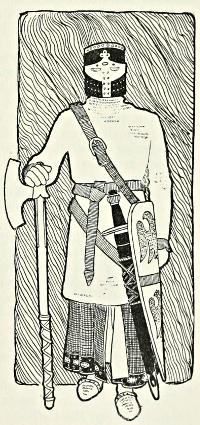
A Thirteenth Century
Crusader
The Latins of Constantinople were on all sides encompassed and pressed:
their sole hope, the last delay of their ruin, was in the division of their Greek
and Bulgarian enemies; and of this hope they were deprived by the superior
arms and policy of Vatatzes, emperor of Nicæa. From the Propontis to the
rocky coast of Pamphylia, Asia was peaceful and prosperous under his reign;
and the events of every campaign extended his influence in Europe. The
strong cities of the hills of Macedonia and Thrace were rescued from the
Bulgarians; and their kingdom was circumscribed by its present and proper
limits, along the southern banks of the Danube.
The sole emperor of the Romans could
no longer brook that a lord of Epirus, a Comnenian
prince of the West, should presume to
dispute or share the honours of the purple;
and the humble Demetrius changed the colour
of his buskins, and accepted with gratitude
the appellation of despot. His own subjects
were exasperated by his baseness and incapacity;
they implored the protection of their
supreme lord.
After some resistance, the kingdom of Thessalonica
was united to the empire of Nicæa;
and Vatatzes reigned without a competitor
from the Turkish borders to the Adriatic Gulf.
The princes of Europe honoured his merits and
power; and had he subscribed an orthodox
creed, it should seem that the pope would
have abandoned, without reluctance, the Latin
throne of Constantinople. But the death of
Vatatzes, the short and busy reign of Theodore,
his son, and the helpless infancy of his
grandson John, suspended the restoration of
the Greeks.
The young prince was oppressed by the ambition
of his guardian and colleague, Michael
Palæologus, who displayed the virtues and
vices that belong to the founder of a new
dynasty. The emperor Baldwin had flattered
himself that he might recover some provinces
or cities by an impotent negotiation. His ambassadors
were dismissed from Nicæa with
mockery and contempt. The captivity of Villehardouin, prince of Achaia,
deprived the Latins of the most active and powerful vassal of their expiring
monarchy. The republics of Venice and Genoa disputed, in the first of their
naval wars, the command of the sea and the commerce of the East. Pride
and interest attached the Venetians to the defence of Constantinople; their
rivals were tempted to promote the designs of her enemies, and the alliance
of the Genoese with the schismatic conqueror provoked the indignation of
the Latin church.
[1261 A.D.]
Intent in this great object, the emperor Michael visited in person and
strengthened the troops and fortifications of Thrace. The remains of the
Latins were driven from their last possessions; he assaulted without success
the suburb of Galata; and corresponded with a perfidious baron, who proved
unwilling or unable to open the gates of the metropolis. The next spring
his favourite general, Alexius Strategopulus, whom he had decorated with
the title of Cæsar, passed the Hellespont with eight hundred horse and some
infantry, on a secret expedition. The weakness of Constantinople, and the
distress and terror of the Latins, were familiar to the observation of the volunteers;
and they represented the present moment as the most propitious
to surprise and conquest. A rash youth, the new governor of the Venetian
colony, had sailed away with thirty galleys, and the best of the French
knights, on a wild expedition to Daphnusia, a town on the Black Sea, at the
distance of forty leagues; and the remaining Latins were without strength
or suspicion. They were informed that Alexius had passed the Hellespont;
but their apprehensions were lulled by the smallness of his original numbers,
and their imprudence had not watched the subsequent increase of his army.
If he left his main body to second and support his operations, he might
advance unperceived in the night with the chosen detachment. No sooner
had Alexius passed the threshold of the Golden Gate, than he trembled at
his own rashness; he paused, he deliberated, till the desperate volunteers
urged him forward, by the assurance that in retreat lay the greatest and
most inevitable danger. Whilst the cæsar kept his regulars in firm array,
the commons dispersed themselves on all sides; an alarm was sounded, and
the threats of fire and pillage compelled the citizens to a decisive resolution.
The Greeks of Constantinople remembered their native sovereigns; the
Genoese merchants their recent alliance and Venetian foes; every quarter
was in arms; and the air resounded with a general acclamation of “Long
life and victory to Michael and Joannes, the august emperors of the Romans!”
Their rival, Baldwin, was awakened by the sound; but the most pressing
danger could not prompt him to draw his sword in the defence of a city
which he deserted, perhaps, with more pleasure than regret. Constantinople
was irrecoverably lost; but the Latin emperor and the principal families
embarked on board the Venetian galleys and steered for the isle of Eubœa,
and afterwards for Italy, where the royal fugitive was entertained by the
pope and the Sicilian king with a mixture of contempt and pity.
From the loss of Constantinople to his death, he consumed thirteen
years, soliciting the Catholic powers to join in his restoration; the lesson
had been familiar to his youth, nor was his last exile more indigent or
shameful than his three former pilgrimages to the courts of Europe. His
son Philippe was the heir of an ideal empire; and the pretensions of his
daughter Catharine were transported by her marriage to Charles of Valois,
the brother of Philippe le Bel, king of France. The house of Courtenai
was represented in the female line by successive alliances, till the title of
emperor of Constantinople, too bulky and sonorous for a private name, modestly
expired in silence and oblivion.f
The crusaders had been able to destroy the Byzantine monarchy but
were not able to reconstruct it with profit to themselves. They had to
combat not only with the Greeks, but all the various people they had helped
to emancipate. In fact, their domination only served to awake and fortify
Greek patriotism. “They did great good in Byzantium, both to Hellenism
and religion; social distinctions were abolished” (Sathas)—if not abolished,
at any rate modified.
In the countries that the Latins held longest, as in the Morea, a certain
fusion took place between conquerors and conquered. Nicetas, Acropolitas,
Pachymeres gave the name of gasmuli to the creole issue of the two races.
The French dynasties of Athens and the Morea tended to Hellenism; the
princes learned the language of their subjects. Greek stratiota and French
cavaliers were treated as on equal footing; they respected the pronoiai of
the Hellenic cities as privileged and exempt from the Latin communities.
There was a great logothete and a proto officer of Achaia as there had been
a grand steward (seneschal) of Romania. In the French schools the Greeks
learned afresh the meaning of civic liberty and the dignity of a warrior-landowner.c
It will be necessary now to cast a glance back at the rise of that Greek
power which had recovered itself thus effectually after the retirement in 1204
of Theodore Lascaris and his founding of a kingdom in Nicæa.a
[1222-1259 A.D.]
The loss of Constantinople in 1204 had restored a momentary vigour to
the Greeks. From their palaces, the princes and nobles were driven into
the field; and the fragments of the falling monarchy were grasped by the
hands of the most vigorous or the most skilful candidates. In the long and
barren pages of the Byzantine annals, it would not be an easy task to equal
the two characters of Theodore Lascaris and Joannes Ducas Vatatzes, who
had replanted and upheld the Roman standard in Nicæa in Bithynia. The
difference of their virtues was happily suited to the diversity of their situation.
In his first efforts, the fugitive Lascaris commanded only three cities
and two thousand soldiers; his reign was the season of generous and active
despair; in every military operation he staked his life and crown; and his
enemies, of the Hellespont and the Mæander, were surprised by his celerity
and subdued by his boldness.
A victorious reign of eighteen years expanded the principality of Nicæa
to the magnitude of an empire. The throne of his successor and son-in-law
Vatatzes was founded on a more solid basis, a larger scope, and more plentiful
resources; and it was the temper, as well as the interest, of Vatatzes to
calculate the risk, to expect the moment, and to insure the success of his
ambitious designs. In the decline of the Latins we have briefly exposed
the progress of the Greeks, the prudent and gradual advances of a conqueror
who, in a reign of thirty-three years, rescued the provinces from national
and foreign usurpers, till he pressed on all sides the imperial city—a leafless
and sapless trunk, which must fall at the first stroke of the axe.
But his interior and peaceful administration is still more deserving of
notice and praise. The calamities of the times had wasted the numbers and
the substance of the Greeks; the motives and the means of agriculture were
extirpated; and the most fertile lands were left without cultivation or
inhabitants. A portion of this vacant property was occupied and improved
by the command and for the benefit of the emperor; a powerful hand and a
vigilant eye supplied and surpassed, by a skilful management, the minute
diligence of a private farmer. The royal domain became the garden and
granary of Asia; and, without impoverishing the people, the sovereign
acquired a fund of innocent and productive wealth. His first wife was
Irene, the daughter of Theodore Lascaris, a woman more illustrious by her
personal merit, the milder virtues of her sex, than by the blood of the Angeli
and Comneni that flowed in her veins and transmitted the inheritance of
the empire. After her death he was contracted to Anne, or Constance, a
natural daughter of the emperor Frederick II; but as the bride had not
attained the years of puberty, Vatatzes placed in his solitary bed an Italian
damsel of her train, and his amorous weakness bestowed on the concubine
the honours, though not the title, of lawful empress. The slaves of the
Latins, without law or peace, applauded the happiness of their brethren who
had resumed their national freedom; and Vatatzes employed the laudable
policy of convincing the Greeks of every dominion that it was their interest
to be enrolled in the number of his subjects.
A strong shade of degeneracy is visible between Joannes Vatatzes and
his son Theodore. Yet the character of Theodore was not devoid of energy;
he had been educated in the school of his father, in the exercise of war and
hunting. Constantinople was yet spared; but in the three years of a short
reign he thrice led his armies into the heart of Bulgaria. His virtues were
sullied by a choleric and suspicious temper. The cruelty of the emperor
was exasperated by the pangs of sickness, the approach of a premature end,
and the suspicion of poison and magic. The lives and fortunes, the eyes
and limbs, of his kinsmen and nobles were sacrificed to each sally of passion.
In his last hours the emperor testified a wish to forgive and be forgiven, a
just anxiety for the fate of Joannes, his son and successor, who, at the age
of eight years, was condemned to the dangers of a long minority. His last
choice entrusted the office of guardian to the sanctity of the patriarch Arsenius,
and to the courage of George Muzalon, the great domestic, who was
equally distinguished by the royal favour and the public hatred. The holy
rites were interrupted by a sedition of the guards. Muzalon, his brothers,
and his adherents were massacred at the foot of the altar; and the absent
patriarch was associated with a new colleague, with Michael Palæologus, the
most illustrious in birth and merit of the Greek nobles.
As early as the middle of the eleventh century, the noble race of the
Palæologi stands high and conspicuous in the Byzantine history. It was
the valiant George Palæologus who placed the father of the Comneni on the
throne; and his kinsmen, or descendants, continue in each generation to lead
the armies and councils of the state. In his early youth Michael was promoted
to the office of constable, or commander of the French mercenaries;
the private expense of a day never exceeded three pieces of gold; but his
ambition was rapacious and profuse, and his gifts were doubled by the
graces of his conversation and manners. The love of the soldiers and
people excited the jealousy of the court; and Michael thrice escaped from
the dangers in which he was involved by his own imprudence or that of his
friends.
[1251-1258 A.D.]
Under the reign of Justice and Vatatzes, a dispute arose between two
officers, one of whom accused the other of maintaining the hereditary right
of the Palæologi. The cause was decided, according to the new jurisprudence
of the Latins, by single combat: the defendant was overthrown; but
he persisted in declaring that himself alone was guilty, and that he had
uttered these rash or treasonable speeches without the approbation or
knowledge of his patron.
Yet a cloud of suspicion hung over the innocence of the constable; he
was still pursued by the whispers of malevolence; and a subtle courtier, the
archbishop of Philadelphia, urged him to accept the judgment of God in the
fiery proof of the ordeal. Three days before the trial, the patient’s arm was
enclosed in a bag and secured by the royal signet; and it was incumbent on
him to bear a red-hot ball of iron three times from the altar to the rails of
the sanctuary, without artifice and without injury.
Palæologus eluded the dangerous experiment with sense and pleasantry.
“I am a soldier,” said he, “and will boldly enter the lists with my accusers;
but a layman, a sinner like myself, is not endowed with the gift of miracles.
Your piety, most holy prelate, may deserve the interposition of heaven, and
from your hands I will receive the fiery globe, the pledge of my innocence.”
The archbishop started; the emperor smiled; and the absolution or pardon
of Michael was approved by new rewards and new services.
In the succeeding reign, as he held the government of Nicæa, he was
secretly informed that the mind of the absent prince was poisoned with jealousy,
and that death or blindness would be his final reward. Instead of
awaiting the return and sentence of Theodore, the constable with some followers
escaped from the city and the empire; and though he was plundered
by the Turkomans of the desert, he found a hospitable refuge in the court of
the sultan. In the ambiguous state of an exile, Michael reconciled the duties
of gratitude and loyalty; drawing his sword against the Tatars, admonishing
the garrisons of the Roman limit, and promoting by his influence the
restoration of peace, in which his pardon and recall were honourably included.
While he guarded the West against the despot of Epirus, Michael was
again suspected and condemned to the palace; and such were his loyalty
and weakness that he submitted to be led in chains above six hundred miles
from Durazzo to Nicæa. The civility of the messenger alleviated his disgrace;
the emperor’s sickness dispelled his danger; and the last breath of
Theodore which recommended his infant son, at once acknowledged the innocence
and the power of Palæologus.
[1258-1261 A.D.]
But his innocence had been too unworthily treated, and his power was
too strongly felt, to curb an aspiring subject in the fair field that was opened
to his ambition. In the council after the death of Theodore, he was the
first to pronounce and the last to violate the oath of allegiance to Muzalon;
and so dexterous was his conduct that he reaped the benefit without incurring
the guilt, or at least the reproach, of the subsequent massacre. In the
choice of a regent, he balanced the interests and passions of the candidates,
turning their envy and hatred from himself against each other; and forced
every competitor to own that, after his own claims, those of Palæologus were
best entitled to the preference.
Under the title of grand duke, he accepted or assumed during a long
minority the active powers of government; the patriarch was a venerable
name; and the factious nobles were seduced or oppressed by the ascendant
of his genius. The fruits of the economy of Vatatzes were deposited in a
strong castle on the banks of the Hermus, in the custody of the faithful Varangians;
the constable retained his command or influence over the foreign
troops. He employed the guards to possess the treasure, and the treasure to
corrupt the guards; and whatsoever might be the abuse of the public money,
his character was above suspicion of private avarice. By himself, or by his
emissaries, he strove to persuade every rank of subjects that their own prosperity
would rise in just proportion to the establishment of his authority.
The weight of taxes was suspended, the perpetual theme of popular complaint;
and he prohibited the trials by the ordeal and judicial combat. For
the interest of the prince and people, without any selfish views for himself
or his family, the great duke consented to guard and instruct the son of
Theodore. It was afterwards agreed that Joannes and Michael should be
proclaimed as joint emperors, and raised on the buckler; but that the pre-eminence
should be reserved for the birthright of the former.
Twelfth Century Candlestick
Palæologus was content; but on the day of the coronation, and in the
cathedral of Nicæa, his zealous adherents most vehemently urged the just
priority of his age and merit. The unseasonable dispute was eluded by postponing
to a more convenient opportunity
the coronation of Joannes Lascaris; and he
walked with a slight diadem in the train
of his guardian, who alone received the
imperial crown from the hands of the
patriarch. A full harvest of honours and
employments was distributed among his
friends by the grateful Palæologus. In his
own family he created a despot and two
sebastocrators; Alexius Strategopulus was
decorated with the title of cæsar, and that
veteran commander soon repaid the obligation
by restoring Constantinople, as we have
seen, to the Greek emperor.
[1261-1282 A.D.]
It was in the second year of his reign,
while he resided in the palace and gardens
of Nymphæum, near Smyrna, that the first
messenger arrived at the dead of night;
and the stupendous intelligence was imparted
to Michael, after he had been gently
waked by the tender precaution of his sister Eulogia. The man was unknown
or obscure: he produced no letters from the victorious cæsar; nor
could it easily be credited, after the defeat of Vatatzes and the recent
failure of Palæologus himself, that the capital had been surprised by a detachment
of eight hundred soldiers. As an hostage, the doubtful author
was confined with the assurance of death or an ample recompense; and the
court was left some hours in the anxiety of hope and fear, till the messengers
of Alexius arrived with the authentic intelligence, and displayed the
trophies of the conquest—the sword and sceptre, the buskins and bonnet,
of the usurper Baldwin, which he had dropped in his precipitate flight.[85]
So eager was the impatience of the prince and people, that Michael made
his triumphal entry into Constantinople only twenty days after the expulsion
of the Latins. The Golden Gate was thrown open at his approach; the
devout conqueror dismounted from his horse, and a miraculous image of Mary
the Conductress was borne before him, that the divine Virgin in person might
appear to conduct him to the temple of her Son, the cathedral of St. Sophia.
But after the first transport of devotion and pride, he sighed at the dreary
prospect of solitude and ruin. The palace was defiled with smoke and dirt
and the gross intemperance of the Franks; whole streets had been consumed
by fire, or were decayed by the injuries of time; the sacred and profane edifices
were stripped of their ornaments; and, as if they were conscious of their
approaching exile, the industry of the Latins had been confined to the work
of pillage and destruction. Trade had expired under the pressure of anarchy
and distress, and the numbers of inhabitants had decreased with the opulence
of the city.b
Michael VIII was eager to efface the mark of foreign domination from
the capital of the empire, and to repair the injuries of time; but his plans
were injudicious, and his success extremely limited. He aspired to be the
second founder of the city of Constantinople, as well as of the Eastern
Roman Empire. The nobility of his dominions were invited to inhabit
the capital by the gift of places and pensions; traders were attracted by
monopolies and privileges. The wealth that ought to have been expended
in restoring communications between the dispersed and dissevered portions
of the Greek nation, in repairing roads and bridges, was wasted in building
palaces and adorning churches in the capital, where they were no longer
required for a diminished and impoverished population. Crowds of imperial
princes and princesses, despots and cæsars, officers of state and courtiers,
consumed the revenues which ought to have covered the frontier with
impregnable fortresses, and maintained a disciplined standing army and a
well-exercised fleet. Yet, while lavishing the public revenues to gratify
his pride and acquire popularity, he sacrificed the general interests of the
middle classes to a selfish and rapacious fiscal policy.
All the property within the walls of Constantinople, whether it belonged
to Greeks or Latins, was adjudged to the imperial government by the right
of conquest; but their ancient possessions were restored to the great
families whose power he feared, and to those individuals whose services
he wished to secure. Sites for building were then leased to the citizens
for a fixed rent; yet the Greek government was so despotic, and Michael
was so arbitrary in his administration, that twelve years later he pretended
that the concessions he had granted to private individuals were merely acts
of personal favour, and he demanded the payment of the rent for the past
twelve years, the collection of which he enforced with much severity.
Michael used other frauds to bring the property of his subjects into the
public treasury, or to deprive them of a portion of the money justly due to
them by the state. Under the pretext of changing the type of the gold
coinage, and commemorating the recovery of Constantinople by impressing
an image of its walls on the bezants, he debased the standard of the mint,
and issued coins containing only fifteen parts of gold and nine of alloy.
While on one hand he rendered property insecure and impoverished
his subjects, he was striving by other arrangements to increase the Greek
population of the capital, in order to counterbalance the wealth and influence
of foreign traders. Numbers were drawn from the islands of the Archipelago,
and a colony of Tzaconians or Laconians from Monemvasia and
the neighbouring districts were settled in the capital, which supplied the
imperial fleet with its best sailors. But war, not commerce, was the object
of Michael’s care; and while he was endeavouring to increase the means
of recruiting his army and navy, he allowed the Genoese to profit by his
political errors, and render themselves masters of the commerce of the
Black Sea, and of great part of the carrying trade of the Greek Empire.
In the meantime, the fortifications of Constantinople were repaired; and
when Charles of Anjou threatened to invade the East, a second line of
wall was added to the fortifications on the land side, and the defences
already existing towards the sea were strengthened.
Michael VIII fulfilled all the stipulations of the treaty he had concluded
with the Genoese. The public property of the republic of Venice was
confiscated, and the Genoese were put in possession of the palace previously
occupied by the bailly of the Venetians. The turbulent conduct of his
allies had already created dissatisfaction in the mind of Michael, when their
defeat by the Venetians before Monemvasia, and the fall of Baccanegra,
who had concluded the treaty of Nymphæum in 1261 by placing a party
adverse to the Greek alliance in power, induced him to doubt the fidelity of
their services, and he dismissed sixty Genoese galleys which he had taken
into his pay. Charles of Anjou soon after effected the conquest of the
kingdom of Naples, and the Genoese government became more anxious to
cultivate his friendship than that of the Greek emperor.
The character and conduct of Michael VIII typifies the spirit of Greek
society from the recovery of Constantinople to the fall of the empire. It
displays a strange ignorance of the value of frankness and honesty in public
business, a constant suspicion of every friend, restless intrigues to
deceive every ally, and a wavering policy to conciliate every powerful
enemy. The consequence of this suspicion, plotting, and weakness, was
that very soon no one trusted either the emperor or the Greeks. The
invasion of Italy by Charles of Anjou, and the pretensions of the pope to
dispose of crowns, alarmed both Venice and Michael, and induced them
to forget all former grounds of hostility, and conclude a closer alliance than
the Greek emperor had concluded with Genoa, with which he now declared
war. This treaty is dated in June, 1265, about a month before Charles
of Anjou received the crown of the Two Sicilies from the pope in the
Lateran. The stipulations are remarkable both in a political and commercial
light. The emperor engaged to expel the Genoese from Constantinople,
and not to conclude peace with them except in concert with the republic.
The Venetians engaged to hire their galleys to the emperor to serve even
against the pope, the king of France, and Charles of Anjou, as well as
against the republics of Genoa, Pisa, and Ancona, and any prince or
community that might attack the Greek Empire.
At length, in the year 1275, the emperor Michael formed a new alliance
with the Genoese; but, in order to prevent their making the streets of Constantinople
again the scene of their disorders, he obliged them to establish
their factory at Heraclea, on the Propontis. Some years later they were
allowed to transfer their settlement to Galata, forming a colony which soon
deprived the Greeks of part of their trade in the Black Sea.
The morbid ambition of Michael Palæologus was not satisfied until he
was sole emperor. In defiance, therefore, of the repeated oaths by which he
had sworn to respect the rights of his ward, his colleague, and his sovereign
he availed himself of the first favourable moment to dethrone the unfortunate
boy who had been left neglected at Nicæa. On Christmas Day,
1261, the agents of Michael deprived Joannes IV of his sight, though he had
not attained the age of ten, and he was declared to have forfeited the throne.
The cruel and perjured emperor then ordered him to be immured in the fort
of Dacybiza, where he remained neglected, and almost forgotten, for eight-and-twenty
years, when his solitude was broken in upon by Andronicus, the
bigoted son of the hypocritical Michael. The conscience of the bigot was
uneasy on account of his father’s crimes, of which he was enjoying the fruit;
so by a few kind words he easily induced his imprisoned victim to make
what was falsely termed a voluntary cession of all his rights to the imperial
crown. The evil consequences of this crime were deeply felt in the empire;
for the clergy, the nobility, and the people, had all participated in the system
of corruption and peculation by which Michael VIII had smoothed the way
for his usurpation. The violation of every sentiment of honour, patriotism,
and virtue was so iniquitous that the public character of the Greek nation
was degraded by its obsequiousness on this occasion; and the feelings of the
people in the provinces of the east, as well as in western Europe, avenged
the misfortunes of Joannes. Michael Palæologus had hitherto been regarded
as a bold, frank, and generous prince; he henceforward showed himself a
timid, hypocritical, and cruel tyrant.
The patriarch Arsenius, who was one of the guardians of the dethroned
emperor, considered himself bound to protest against the injustice and
perjury of Michael. He convoked an assembly of the prelates resident in
Constantinople, and proposed that the reigning emperor should be excommunicated
by the synod; but too many of the clergy had been participators in the
intrigues of Michael, and were enjoying the rewards of their subserviency,
for such a measure to meet with any support. Arsenius, therefore, on his
own authority as patriarch, interdicted Michael from all religious rites; but
he did not venture to pronounce the usual form of words, which deprived
him of the prayers of the orthodox. The Greek church, under the Palæologi,
was tainted with the same spirit of half measures and base tergiversation
which marks the imperial administration. The emperor accepted the modified
censure of the church as just, and hypocritically requested that his penance
might be assigned. By obtaining his dispensation in this manner, he expected
that public opinion would render the church an accessary after the fact,
while he secured to himself an additional guarantee for the enjoyment of the
fruits of his crime. Confident in his power, he punished with cruelty all who
ventured to express publicly their compassion for their dethroned emperor.
Though the family of Vatatzes had been unpopular among the nobility,
it was beloved by the Asiatic Greeks, and especially by the mountaineers of
Bithynia. The people in the vicinity of Nicæa took up arms to avenge
Joannes IV, and their insurrection was suppressed with great difficulty. A
blind boy, who was found wandering in the neighbourhood, was supposed to
be their legitimate sovereign, the victim of Michael’s treachery. The warlike
peasantry flew to arms, and rendered themselves masters of the forts
and mountain passes. The advance of the imperial troops sent to suppress
the revolt was impeded by those famous archers who had previously formed
one of the most effective bodies in the emperor’s army. Every ravine was
contested, and every advantage dearly purchased. The imperial troops at
last subdued the country by adopting the policy by which the Turks extended
their conquests. The habitations were destroyed, and the forests
were burned down, so that the native population had no means of obtaining
subsistence, while the soldiers of Michael became masters of the country,
under the cover of their widespread conflagrations. The resources of this
flourishing province were ruined, and its population was so diminished that,
when the Ottoman Turks attacked the empire, the renowned archers of
Bithynia and the mountain militia had ceased to exist.
The change which is visible in the condition of the Asiatic provinces of
the empire towards the end of the reign of Michael VIII must be attentively
observed. When he mounted the throne, the power of the Seljuk empire
was so broken by the conquests of the Moguls, and the energy of the Greek
population was so great, in consequence of the
wise government of Joannes III and Theodore
II, that the Greeks under the Turkish dominion
seemed on the eve of
regaining their independence. Azeddin
Kaikus II, sultan of
Iconium, was an exile;
his brother Rokneddin
ruled only a small
part of the Seljuk empire of Rum; for Hulaku, the brother
of the great khans Mangku and Kublai, possessed the greater
part of Asia Minor, and many Turkish tribes lived in a state
of independence. The cruelty and rapacity of Michael’s government,
and the venality and extortion which he tolerated among the
imperial officers and administrators, arrested the progress of the Greek
nation, and prepared the way for its rapid decline. The jealousy which
Michael showed of all marks of national independence, and the fear he
entertained of opposition, are strong characteristics of his policy. So rapacious
was the imperial treasury that the historian Pachymeres, though a
courtier, believed that the emperor Michael systematically weakened the
power of the Greek population from his fear of rebellion. The consequence
was that the whole country beyond the Sangarius, and the mountains which
give rise to the Rhyndacus and Macestus, were occupied by the Turks, who
were often invited by the inhabitants to take possession of the small towns.
A Twelfth Century Cross-bow
As the reign of Michael VIII advanced, the encroachments of the nomad
Turks became more daring. Joannes Palæologus, who had for some time
restrained their incursions, was by his brother’s jealousy deprived of all military
command; and Andronicus, the emperor’s eldest son, was sent to the
frontier as commander-in-chief. In the year 1280 the incapacity of the
young prince threw all the imperial provinces open to invasion. Nestongus,
who commanded in the city of Nyssa, was defeated and taken prisoner.
Nyssa was taken, and the Turks then laid siege to Tralles, which had been
recently rebuilt and repeopled. The Turks at last formed a breach in the
walls by sapping, and then carried the city by storm. The inhabitants who
escaped the massacre were reduced to slavery.
About the same time Michael VIII usurped his place on the throne of
the Greek Empire, a small Turkish tribe made its first appearance in the
Seljuk empire. Othman, who gave his name to this new band of immigrants,
is said to have been born in the year 1258, and his father, Ertogrul, entered
the Seljuk empire as the chief of only four hundred families; yet Orkhan,
the son of Othman, laid the foundations of the institutions and power of the
Ottoman empire. No nation ever increased so rapidly from such small beginnings,
and no government ever constituted itself with greater sagacity
than the Ottoman; but no force or prudence could have enabled this small
tribe of nomads to rise with such rapidity to power, had it not been that the
emperor Michael and the Greek nation were paralysed by political and moral
corruption, and both left behind them descendants equally weak and worthless.
When history records that Michael Palæologus recovered possession
of Constantinople by accident, it ought also to proclaim that, by his deliberate
policy, he prepared the way for the ruin of the Greek race and the conquest
of Constantinople by the Ottoman Turks. There is no other instance
in history of a nation so numerous, so wealthy, and so civilised, as the
Greeks were in the fourteenth century, having been permanently subdued
by an enemy so inferior in political and military resources. The circumstance
becomes the more disgraceful, as its explanation must be sought in
social and moral causes.
[1261-1271 A.D.]
The rebellion of his subjects in Asia made Michael anxious to secure
peace in Europe. In order to counterbalance the successes of the despot of
Epirus, and dispose him to conclude a treaty, Michael resolved to release the
Prince of Achaia, who had been taken prisoner at the battle of Pelagonia in
1259. William Villehardouin, prince of Achaia, was freed, by the destruction
of the Latin Empire of Romania, from those feudal ties which connected
him with the throne of Baldwin II. To obtain his liberty, he consented to
become a vassal of the Greek Empire, and he re-established the imperial
power in the Peloponnesus, by delivering up to Michael the fortresses of
Monemvasia, Misithra, and Maina. On swearing fidelity to Michael VIII
he was released from captivity, after having remained a prisoner for three
years. The pope, however, was so much alarmed at this example of a Catholic
prince becoming a vassal of the Greek emperor, that as soon as the
Prince of Achaia was firmly settled in his principality, his holiness absolved
him from all his oaths and obligations to the Greek emperor. Pope Urban
IV even went so far as to proclaim a crusade against Michael, and to invite
St. Louis to take the command; but the king of France, who was much
more deeply imbued with the Christian spirit than the pope, declined the
office. The crusade ended in a partisan warfare between the prince of
Achaia and the governors Michael had placed in the fortresses of which he
had gained possession in the Peloponnesus.
The conquest of Naples by Charles of Anjou threatened the Greek Empire
with a new invasion. Under the auspices of Clement IV a treaty was concluded
between the dethroned emperor Baldwin, Charles of Anjou, and
William, prince of Achaia, by which Baldwin ceded to Charles the suzerainty
of Achaia, and the prince agreed to transfer his allegiance from the titular
emperor to the king of Naples, who had already obtained the absolute sovereignty
of Corfu, and of the cities of Epirus, given by the despot Michael II
as dowry to his daughter, who married Manfred, king of Sicily. In return,
Charles of Anjou engaged to furnish Baldwin with a force of two thousand
knights and their followers, to enable him to invade the Greek Empire.
This treaty was concluded at Viterbo on the 27th of May, 1267. Its stipulations
alarmed Michael Palæologus, who had already involved himself in
ecclesiastical quarrels with his subjects; and in order to delay an attack on
Constantinople, he sent an embassy to Pope Clement IV, proposing measures
for effecting a union of the Greek and Latin churches. On this occasion
Michael was relieved from fear by Conradin’s invasion of the kingdom of
Naples, which enabled him to conclude a truce with the prince of Achaia.
He then neglected his overtures to the pope, and turned all his attention to
fitting out a fleet, which he manned with gasmuli, Tzaconians, and Greeks
of the Archipelago. The insincere negotiations of Michael for a union with
the Roman church were often renewed under the pressure of fear of invasion
from abroad, and dread of insurrection at home. The weakness caused by
the opposition of the Greek clergy and people to his authority, encouraged
the enterprises of his foreign enemies, while the entangled web of his diplomacy,
taking a new form at every change of his personal interests, at last
involved him so inextricably in its meshes that he had no means of concealing
his bad faith, cruelty, and hypocrisy.
[1271-1282 A.D.]
In the year 1271 the treachery of Andronicus Tarchaniotes, the emperor’s
nephew, reanimated the war in Thessaly. Having invited the Tatars to
invade the empire from the north, he abandoned Mount Hæmus, of which he
was governor, to their ravages, and fled to Joannes Ducas, prince of the Vlakhs,
his father-in-law, whom he persuaded to invade Thessaly. The emperor sent
his brother, Joannes Palæologus, with an army of forty thousand men and
a fleet of sixty-three galleys, to re-establish the imperial supremacy. Joannes
Ducas was besieged in his capital, Neopatras, and the place was reduced to
the last extremity, when the prince passed through the hostile camp in the
disguise of a groom, to seek assistance from his Latin allies. Leading a
horse by the bridle he walked along, crying out that his master had lost
another horse, and would reward the finder. When he reached the plain of
the Sperchius he mounted his horse, and gained the territory of the Frankish
marquis of Boudonitza. The duke of Athens furnished him with a band
of three hundred knights, and he returned to Neopatras with such celerity
that he surprised the imperial camp, and completely dispersed the army.
Joannes Palæologus escaped to Demetriades (Volo), where his fleet was stationed.
A squadron composed of Venetian ships, and galleys of the duke of
Naxos and of the barons of Negropont, was watching the imperial fleet. On
hearing of the total defeat of the army they attacked the admiral Alexius
Philanthropenus in the port, and were on the point of carrying the whole
Greek fleet by boarding, when Joannes Palæologus reached the scene of action
with a part of the fugitive troops. He immediately conveyed a large body
of soldiers to the ships, and reanimated the sailors. The Latins were compelled
to retire with the loss of some of their own ships, but they succeeded
in carrying off several of the Greek galleys.
In the following year the imperial fleet, under the command of Zacharia,
the Genoese seigneur of Thasos, defeated the Franks near Oreus in Eubœa
and took Jean de la Roche, duke of Athens, prisoner. But, on the other
hand, Joannes Ducas again routed the army in Thessaly, and by his activity
and military skill rendered himself the most redoubted enemy of Michael;
so that, when the majority of the Greek population declared openly against
the emperor’s project for a union with the Latin church, the prince of
Wallachian Thessaly became the champion of the orthodox church, and
assembled a synod which excommunicated Michael VIII (1277).
In the year 1278 Charles of Anjou would in all probability have besieged
Constantinople, had he not been prevented by the express commands of his
suzerain, Pope Nicholas III, who was gained over by Michael’s submission
to expect the immediate union of the Greek with the papal church. But
the elevation of Martin IV to the see of Rome changed its policy. The
emperor Michael was excommunicated, and, to render the excommunication
more insulting, he was reproached with persecuting the Greeks who consistently
abstained from his own delusive compliances. Michael revenged himself
by ceasing to pray for the pope in the Eastern churches.
A league was now formed between the pope, the king of Naples, and the
republic of Venice, for the conquest of the Greek Empire, and a treaty was
signed at Orvieto on the 3rd of July, 1281. The danger was serious. Charles
of Anjou promised to furnish eight thousand cavalry, and the Venetians
engaged to arm forty galleys, in order to commence operations in the spring
of 1283. In the meantime a body of troops, under the command of Solimon
Rossi, was despatched to occupy Dyrrhachium and assist the Albanians, who
had recently revolted against Michael. This expedition proved unsuccessful;
Rossi was taken prisoner while besieging Belgrade (Berat), and the Neapolitans
and Albanians were completely defeated. But the Greek emperor
could only intrigue to avert the great storm with which he was threatened
by the treaty of Orvieto, and in the end he was saved by the deeds of others.
The Sicilian Vespers delivered the Greeks from all further fear of Charles
of Anjou and of a French invasion, and Michael was able to smile at the
impotent rage of Martin IV, and despise his excommunications.
The vicinity of the Bulgarians, joined to their national power and influence
over the numbers of their countrymen settled in the Greek Empire,
gave Michael some uneasiness at the commencement of his reign. Constantine,
king of Bulgaria, had married a sister of the dethroned emperor Joannes
IV, and he was induced, by the feelings of his wife, by the intrigues of the
fugitive sultan of Iconium, and by the hopes of assistance from the Mogul
emperor, Hulaku, to attack the Greek Empire. Michael took the field
against the Bulgarians, and in the year 1265 drove them beyond Mount
Hæmus. A treaty which the emperor concluded with a powerful Tatar
chief named Nogay, and civil dissension among the Bulgarians, relieved
Michael from all serious danger on his northern frontier during the remainder
of his reign. The affairs of Servia, also, gave the emperor very little
trouble.
The period of Greek history embraced in the present chapter of this
work, extending through the century and a half during which the empire of
Constantinople was ruled with despotic sway by the dynasty of Palæologus,
is the most degrading portion of the national annals. Literary taste, political
honesty, patriotic feeling, military honour, civil liberty, and judicial
purity, seem all to have abandoned the Greek race, and public opinion would
in all probability have had no existence—it would certainly have found no
mode of expression—had not the Greek church placed itself in opposition
to the imperial government, and awakened in the breasts of the Greek
people a spirit of partisanship on ecclesiastical questions which prepared
the way for the open expression of the popular will, if not for the actual
formation of public opinion. The church was converted into an arena
where political and social discontent of every kind arrayed their forces under
the banners of orthodoxy, heresy, or schism, as accident or passion might
determine.
The anxiety of the emperor Michael VIII to be relieved from the ecclesiastical
censures pronounced by the patriarch Arsenius against him, for his
treachery to his pupil and sovereign Joannes IV, was the commencement of
his disputes with the Greek church, and of his negotiations with the popes.
Michael solicited the patriarch to impose some penance on him which might
expiate his crime, but Arsenius could suggest nothing but reparation. The
emperor considered this tantamount to a sentence of dethronement, and he
determined to depose Arsenius. Arsenius was deposed, and exiled to Proconnesus.
Germanus, the bishop of Hadrianopolis, a mild and learned
prelate, was named his successor.
Even in his banishment Arsenius was considered to be the lawful patriarch
by the majority of the orthodox, and he was visited by thousands who were
anxious to hear his words and receive his blessing. The emperor was eager
to punish him, but his popularity rendered it dangerous to attempt doing so
in an arbitrary way. A conspiracy was
discovered against the emperor’s life, and
some of the accused, when put to the torture,
declared that Arsenius was implicated
in the plot. The examination of
the affair was remitted to a synod, which
gratified the emperor by excommunicating
Arsenius without waiting for his conviction.
Germanus interceded for his predecessor.
Arsenius was absolved from the
accusation, and a pension of three hundred
bezants was allowed him for his subsistence,
granted from the privy purse of the
empress; for it was believed that Arsenius
would accept nothing from the excommunicated
emperor.
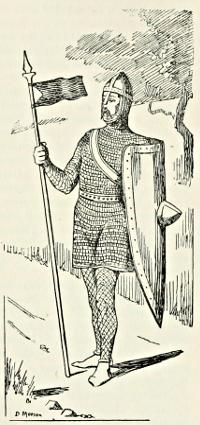
Twelfth Century Knight, in Coat
of Mail
The courtiers of Michael were as active
in their intrigues as the emperor. A party
in the church declared that the election
of Germanus was invalid, for he had been
removed from the see of Hadrianopolis in
violation of the canon which prohibits the
translation of a bishop from one see to
another. The emperor’s confessor, Joseph,
pronounced that the new patriarch could
not grant a legal absolution to the emperor
in consequence of this defect in his title
to the patriarchal throne. Germanus soon
perceived that both Michael and Joseph
were encouraging opposition to his authority.
He immediately resigned, and
Joseph was named his successor. The emperor
received his absolution as a matter
of course. The ceremony was performed
at the gates of St. Sophia’s. Michael, nearly at the patriarch’s feet, made
his confession, and implored pardon. The patriarch read the form of
absolution. This form was repeated by every bishop in succession, and the
emperor knelt before each in turn and received his pardon. He was then
admitted into the church, and partook of the Holy Communion. By this
idle and pompous ceremony the Greeks believed that their church could
pardon perjury and legitimatise usurpation.
About this time the treaty of Viterbo drew the attention of Michael
from the schism of the Arsenites to foreign policy, and his grand object being
to detach the pope from the alliance with Charles of Anjou, he began to
form intrigues, by means of which he hoped to delude the pope into the persuasion
that he was anxious and able to establish papal supremacy in the
Greek church; while, on the other hand, he expected to cheat the Eastern
clergy into making those concessions which he considered necessary for the
success of his plans, on the ground that their compliance was a mere matter
of diplomacy. Gregory X knew that it would be easier to effect the union
of the Greek and Latin churches by the instrumentality of a Greek emperor
than of a foreign conqueror. He therefore prohibited Charles of Anjou,
who held the crown of Naples as his vassal, from invading the empire; but
he forced Michael, by fear of invasion, to assemble a synod at Constantinople,
in which, by cruelty and violence, the emperor succeeded in obtaining
an acknowledgment of the papal supremacy. The severest persecution was
necessary to compel the Greeks to sign the articles of union, and many families
emigrated to Wallachian Thessaly and to the empire of Trebizond. The
union of the Greek and Latin churches was completed in the year 1274 at
the Council of Lyons.[86]
[1274-1280 A.D.]
When the news of this submission reached Constantinople there was a
general expression of indignation. The patriarch Joseph, who opposed the
union, was deposed, and Veccus, an ecclesiastic of eminence, who had
recently become a convert to the Latin creed, was named in his place.
The schisms in the Greek church were now multiplied, for Joseph became
the head of a new party. Veccus, however, assembled a synod, and excommunicated
those members of the Greek clergy who refused to recognise the
pope as the head of the church of Christ. Nicephorus, despot of Epirus,
and his brother, Joannes Ducas, prince of Wallachia, protected the orthodox.
Both were excommunicated; and the emperor sent an army against Joannes
Ducas, whose position in Thessaly threatened the tranquillity of Macedonia;
but the imperial officers and troops showed no activity in a cause which they
considered treason to their religion, and many of the emperor’s own relations
deserted.
By a series of intrigues, tergiversation, meanness, and cruelty, Michael
succeeded in gaining his immediate object. Nicholas III, who ascended the
papal throne in 1277, formally refused Charles of Anjou permission to invade
the Greek Empire, and sent four nuncios to Constantinople to complete the
union of the churches. The papal instructions are curious as an exposition
of the political views of the court of Rome, and display astute diplomacy,
acting at the suggestions of grasping ambition, but blinded by ecclesiastical
bigotry. The first object was to induce all the dignitaries of the Greek
church to sign the Roman formulary of doctrine, and to persuade them
to accept absolution for having lived separate from the Roman communion;
the second, to prevail on the emperor to receive a cardinal legate at
Constantinople.
Before the arrival of the pope’s ambassadors, the arbitrary conduct of
Michael had involved him in a quarrel with his new patriarch, Veccus, whom
he was on the point of deposing. All Michael’s talents for intrigue were
called into requisition, to prevent the Greek clergy from breaking out into
open rebellion during the stay of the pope’s ambassadors, and conceal the
state of his relations with Veccus, who stood high at the court of Rome.
Bribes, cajolery, and meanness on his part, and selfishness and subserviency
on the part of the Eastern clergy, enabled him to succeed. But the death
of Nicholas III in 1280 rendered his intrigues unavailable. Martin IV, a
Frenchman, devoted to the interests of Charles of Anjou, became pope.
He openly displayed his hatred of the Greeks, and excommunicated Michael
as a hypocrite, who concealed his heresy. While Martin IV openly negotiated
the treaty of Orvieto, Michael secretly aided the conspiracy of Procida.
[1281-1282 A.D.]
The condition of the Greek emperor was almost desperate. He was
universally detested for his exactions and persecutions, and a numerous
and bigoted party was ready to make any foreign attack the signal for a
domestic revolution. The storm was about to burst on Michael’s head, when
the fearful tragedy of the Sicilian Vespers broke the power of Charles of
Anjou.
Michael then quitted his capital to punish Joannes Ducas, whom he considered
almost as a rival; but death arrested his progress at Pachomion,
near Lysimachia in Thrace, on the 11th of December, 1282, after a reign of
twenty-four years. He was a type of the Constantinopolitan Greek nobles
and officials in the empire he re-established and transmitted to his descendants.
He was selfish, hypocritical, able, and accomplished; an inborn liar,
vain, meddling, ambitious, cruel, and rapacious. He is renowned in history
as the restorer of the Eastern Empire; he ought to be execrated as the corrupter
of the Greek race, for his reign affords a signal example of the extent
to which a nation may be degraded by the misconduct of its sovereign, when
it entrusts him with despotic power.
[1282-1301 A.D.]
Andronicus II ascended the throne at the age of twenty-four, having been
born about the time his father received the imperial crown at Nicæa. He had
most of the defects of his father’s character, without his personal dignity
and military talents. In youth he was destitute of vigour, in old age of prudence.
His administration was marked by the same habits of cunning and
falsehood which had distinguished his father’s conduct; and the consequence
was that, towards the end of his long reign, he was as generally despised as
his father had been hated. In his private character he was arbitrary, peevish,
and religious; in his public administration despotic, fond of meddling,
industrious, and inconsequent.
Andronicus, eager to efface the stain of his own sinful compliance with
the union of the churches, allowed the body of his father to be deprived of
the usual funeral honours and public prayers. The empress, Michael’s
widow, was compelled to abjure the union, and to approve of the indignities
to his memory, before her own name was inserted in the public prayers for
the imperial family. The patriarch Veccus was forced to resign, and his
predecessor Joseph was reinstated on the patriarchal throne.
The bigotry of Andronicus induced him to sanction the establishment of
a tribunal consisting chiefly of monks, which was empowered to fix the
penance to be performed by those who desired to obtain absolution from a
general sentence of excommunication, launched against all who had communicated
with the Latin church. As nearly the whole population of the
empire had fallen under this sentence of excommunication, the power of the
tribunal was unlimited. The rich were mulcted according to the sensibility
of their conscience and the malice of their enemies, while ecclesiastics obnoxious
to the bigots were suspended from the exercise of their functions.[87]
During the earlier years of the reign of Andronicus the power of the
Turks excited no alarm. The garrisons in the frontier fortresses were reduced,
the number of the legions was diminished, and many of the ships kept
ready for service by Michael VIII were laid up in the arsenal. Andronicus
required all the money he could divert from the military and naval services
for the court and the church. The officers could only gain advancement by
becoming courtiers; the soldiers could only avoid neglect by becoming monks.
The army of Andronicus consisted principally of Alans, Gasmuls, Turks,
Turkopuls, and refugee Cretans. The Alans received double the pay of the
best native troops. The armies with which the emperors of Nicæa had defeated
the Turkish Sultans, the Latin emperors, the kings of Bulgaria, and
the French knights of Achaia and Athens were now disbanded and neglected.
The state maxim of imperial Rome that no man who paid the land tax should
be allowed to bear arms, was again revived, and mercenaries and Turks
plundered the Greek Empire, as the Goths and Huns had plundered the
Roman.
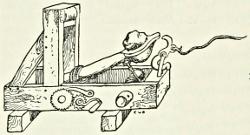
A Twelfth Century Catapult
The Greek Empire of Constantinople, at the accession of Andronicus II,
embraced the whole coast of Asia Minor, from the mouth of the Sangarius
to the Rhodian Peræa; but the nomad tribes who lived under the Seljuk
dominion were daily pushing their incursions further and
further into the Greek territories. In the year 1296, the
regular army of the empire
continued to maintain a decided
superiority in the field
over any force the Turks could
bring into action; but the carelessness of the
emperor, who left the troops in Asia without
pay, caused this neglected army to break out
into rebellion. The Turkish mercenaries in
its ranks plundered the Greek landlords;
the Cretans sold their services to the highest
bidder. Alexius Philanthropenus, who had
successfully resisted the Seljuk tribes, was proclaimed emperor by his rebellious
troops, but allowed himself to be taken prisoner, and was deprived of
sight. His successor, Joannes Tarchaniotes vainly attempted to reform the
abuses, which rendered the army more oppressive to the emperor’s subjects
than dangerous to his enemies. The anarchy that prevailed in the civil,
military, and ecclesiastical administration, rendered him powerless, and he
was compelled to abandon the undertaking.
In the year 1301, Michael, the eldest son of Andronicus, who had
received the imperial title from his father in 1295, took the command of
the army in Asia; and about the same time a body of veteran warriors entered
the imperial service, who, under an able general, would have secured
victory to the Greeks. Andronicus allowed a colony of Alans to settle in
his dominion, and about eight thousand, who had served in the Tatar wars
beyond the Danube, were enrolled in the Byzantine service. After a short
term of service, they mutinied, deserted the camp and marched to the Hellespont,
plundering the Greek inhabitants of the country they passed through.
The young emperor then broke up his own camp, and, abandoning his headquarters
at Magnesia on the Hermus, retired to Pergamus, leaving the
Turkish tribes to extend their plundering expeditions as far as Adramyttium,
Lampsacus, and Cyzicus.
[1301-1303 A.D.]
About the same time the Venetians and Genoese, who were carrying on
war, were so emboldened by the weakness of the Greek Empire and the
neglected state of its marine that they pursued their hostilities in the port
of Constantinople, while private vessels plundered the islands of the Propontis
within sight of the palace of Andronicus, and compelled him to ransom
the captive inhabitants by parading them before the walls of the capital,
suspended from the rigging of their ships.
Rapid conquests were now made by the Seljuk emirs and a destructive
warfare against the Greek race was carried on by the nomad tribes, who were
more anxious to exterminate the agricultural population than to subdue
them. The Greeks were everywhere in despair. In the empire of Trebizond,
matters were not much better than in the empire of Constantinople. But it
was in the provinces between Nicomedia and Smyrna, along the Propontis
and the Ægean, that the greatest confusion reigned. The roads to the coast
were covered with fugitives from the interior, endeavouring to save their
property and families. Thousands were left to perish from want, and
thousands died from suffering. Whole provinces were deserted by their
inhabitants, and became pasture lands for hordes of Turkomans. In the
course of a single generation, the Greek race and language disappeared from
countries in which it had been spoken for two thousand years, and Turkish
colonies took possession of Æolis and Ionia. Andronicus II witnessed these
dreadful calamities with feelings benumbed by piety; even the extermination
of the orthodox failed to animate his energy.
After twelve years of preparation, Othman ventured to attack the regular
army of the Greek Empire, in the year 1301. The action took place at
Baphæon, near Nicomedia. Pachymeres estimates the number of the imperial
troops commanded by Muzalon at only two thousand, while the forces of
Othman consisted of five thousand. The Greek infantry fled, and their
misconduct was attributed to the dissatisfaction caused by the manner in
which they had been deprived of their horses. The Alans fought bravely
and covered the retreat to Nicomedia. Othman now laid waste the whole
of Bithynia, from Nicomedia to Lopadion. The suburbs of the town on the
Asiatic shores of the Bosporus were burned by the Ottomans, whose foraging
parties were sometimes visible from the towers of the imperial palace
in Constantinople.
The disgraceful retreat of his son Michael to Peges, induced Andronicus
to change the military governors in Asia, instead of teaching him the necessity
of reforming the military system. The command of Nicomedia was
entrusted to a Tatar chief who had recently embraced Christianity; and by
the marriage of this Tatar’s daughter with Suleiman, a Turkish emir, peace
was restored to a small district and a barrier was formed against the incursions
of Othman. But the unemployed Turkish troops transferred their
services to other leaders, and carried on their incursions in more distant
provinces. This preference of a Tatar general indicates a deep-rooted distrust
of the courage and fidelity of the Greek nobles, as well as contempt for
their military skill; and, indeed, a factious spirit, directed to personal interest,
could alone have caused the insensibility to national honour which
made the nobles and the troops submit tamely to the insults they received
from their emperor. Well might the brave old Spaniard Muntaner declare
that God had stricken the Greek race with his curse, for every one could
trample them down.
A new crisis in the fate of the Byzantine Empire suddenly presented
itself by the arrival of an army of Spaniards, composed chiefly of Catalans
and men of Aragon; but this race of strangers, hitherto unknown in the
East, soon disappeared from the scene. They came and departed as if they
were under the guidance of the destroying angel. In daring courage, steady
discipline, and military skill, they were not surpassed by any Greek or
Roman army. Their warlike deeds entitled them to rank as a host of
heroes; their individual acts made them appear a band of demons. They
had proved invincible on every field of battle. They had broken the lances
of the chivalry of France in many a well-fought action; and they were firmly
convinced that no troops on earth could encounter their shock. Guided by a
sovereign like Leo III, or like Basil II, they might have conquered the Seljuk
Turks, strangled the Ottoman power in its cradle, and carried the double-headed
eagle of Byzantium victorious to the foot of Mount Taurus, and to
the banks of the Danube, but Andronicus could neither make use of their
valour, nor secure their obedience. His own senseless intrigues roused their
hostile feelings; and after they had made every tribe in the Seljuk empire
tremble for a moment, they turned on the Greek Empire, where they carried
on their inhuman ravages with a degree of cruelty and rapacity which history
cannot attempt to portray. They laid both the empire and the Greek nation
prostrate in the dust, bleeding with wounds from which they never recovered.
The Catalan Grand Company—for that is the name by which this
Spanish army is known in the Eastern history—consisted of troops formed
in the twenty years’ war that followed the Sicilian Vespers.c
[1303-1307 A.D.]
After the peace of Sicily many thousands of Genoese, Catalans, etc., who
had fought by sea and land under the standard of Anjou or Aragon, were
blended into one nation by the resemblance of their manners and interest.
They heard that the Greek provinces of Asia were invaded by the Turks;
they resolved to share the harvest of pay and plunder, and Frederick king
of Sicily most liberally contributed the means of their departure. In a warfare
of twenty years, a ship or a camp was become their country; arms
were their sole profession and property; valour was the only virtue which
they knew; their women had imbibed the fearless temper of their lovers and
husbands; it was reported that, with a stroke of their broad-swords, the
Catalans could cleave a horseman and a horse; and the report itself was a
powerful weapon.
Roger de Flor was the most popular of their chiefs; and his personal
merit overshadowed the dignity of his prouder rivals of Aragon. The offspring
of a marriage between a German gentleman of the court of Frederick
the Second and a damsel of Brindisi, Roger was successively a templar, an
apostate, a pirate, and at length the richest and most powerful admiral of
the Mediterranean. He sailed from Messina (Messana) to Constantinople,
with eighteen galleys, four great ships, and eight thousand adventurers;
and his previous treaty was faithfully accomplished by Andronicus the
elder, who accepted with joy and terror this formidable succour. A palace
was allotted for his reception, and a niece of the emperor was given in marriage
to the valiant stranger, who was immediately created great duke or
admiral of Romania. After a decent repose, he transported his troops over
the Propontis, and boldly led them against the Turks; in two bloody battles
thirty thousand of the Moslems were slain; he raised the siege of Philadelphia,
and deserved the name of the deliverer of Asia.
But after a short season of prosperity, the cloud of slavery and ruin
again burst on that unhappy province. The inhabitants escaped (says a
Greek historian) from the smoke into the flames; and the hostility of the
Turks was less pernicious than the friendship of the Catalans. The lives and
fortunes which they had rescued, they considered as their own; the willing
or reluctant maid was saved from the race of circumcision for the embraces
of a Christian soldier; the exaction of fines and supplies was enforced by
licentious rapine and arbitrary executions; and, on the resistance of Magnesia,
the great duke besieged a city of the Roman Empire. These disorders
he excused by the wrongs and passions of a victorious army; nor would his
own authority or person have been safe had he dared to punish his faithful
followers, who were defrauded of the just and covenanted price of their
services.
The threats and complaints of Andronicus disclosed the nakedness of the
empire. His golden bull had invited no more than five hundred horse and a
thousand foot soldiers; yet the crowds of volunteers, who migrated to the
East, had been enlisted and fed by his spontaneous bounty. While his bravest
allies were content with three byzants, or pieces of gold, for their monthly
pay, an ounce or even two ounces of gold were assigned to the Catalans,
whose annual pension would thus amount to near £100 [$500]; one of their
chiefs had modestly rated at three hundred thousand crowns the value of his
future merits; and above a million had been issued from the treasury for the
maintenance of these costly mercenaries. A cruel tax had been imposed
on the corn of the husbandman; one-third was retrenched from the salaries
of the public officers; and the standard of the coin was so shamefully debased
that of the four-and-twenty parts only five were of pure gold.
At the summons of the emperor, Roger evacuated a province which no
longer supplied the materials of rapine; but he refused to disperse his troops;
and while his style was respectful, his conduct was independent and hostile.
The grand duke of Romania condescended to accept the title and ornaments
of cæsar; but he rejected the new proposal of the government of Asia with
a subsidy of corn and money, on condition that he should reduce his troops
to the harmless number of three thousand men. Assassination is the last
resource of cowards. The cæsar was tempted to visit the royal residence of
Hadrianopolis; in the apartment, and before the eyes of the empress, he
was stabbed by the Alan guards (1307).
The loss of their leader intimidated the crowd of adventurers, who
hoisted the sails of flight and were soon scattered round the coasts of the
Mediterranean. But a veteran band of fifteen hundred Catalans, or French,
stood firm in the strong fortress of Gallipoli on the Hellespont, displayed
the banners of Aragon, and offered to revenge and justify their chief by an
equal combat of ten or a hundred warriors. Instead of accepting this bold
defiance, the emperor Michael, the son and colleague of Andronicus, resolved
to oppress them with the weight of multitudes; every nerve was strained to
form an army of thirteen thousand horse and thirty thousand foot, and the
Propontis was covered with the ships of the Greeks and Genoese. In two
battles by sea and land, these mighty forces were encountered and overthrown
by the despair and discipline of the Catalans; the young emperor fled to the
palace; and an insufficient guard of light horse was left for the protection of
the open country.
Victory renewed the hopes and numbers of the adventurers; every nation
was blended under the name and standard of the Grand Company; and three
thousand Turkish proselytes deserted from the imperial service to join this
military association. In the possession of Gallipoli the Catalans intercepted
the trade of Constantinople and the Black Sea, while they spread their devastations
on either side of the Hellespont over the confines of Europe and
Asia. To prevent their approach, the greatest part of the Byzantine territory
was laid waste by the Greeks themselves; the peasants and their cattle
retired into the city: and myriads of sheep and oxen, for which neither
place nor food could be procured, were unprofitably slaughtered on the same
day. Four times the emperor Andronicus sued for peace, and four times he
was inflexibly repulsed, till the want of provisions and the discord of the chiefs
compelled the Catalans to evacuate the banks of the Hellespont and the neighbourhood
of the capital. After their separation from the Turks, the remains
of the great company pursued their march through Macedonia and Thessaly,
to seek a new establishment in the heart of Greece.b
At this point we may take a glance briefly at the history of Athens,
which fell into the hands of the Catalans.a
[1204-1311 A.D.]
In the partition of the empire in 1204 the principality of Athens and Thebes
had been assigned to Otto de la Roche, a noble warrior of Burgundy, with
the title of “great duke,” which the Latins understood in their own sense,
and the Greeks more foolishly derived from the age of Constantine. Otto
followed the standard of the marquis of Montferrat; the ample state which
he acquired by a miracle of conduct or fortune was peaceably inherited by
his son and two grandsons, till the family, though not the nation, was
changed, by the marriage of an heiress into the elder branch of the house of
Brienne.
[1311-1456 A.D.]
The son of that marriage, Walter de Brienne, succeeded to the duchy of
Athens; and with the aid of some Catalan mercenaries, whom he invested
with fiefs, he successively reduced above thirty castles of the vassal or
neighbouring lords.
But when informed of the approach and ambition of the great company,
he collected a force of seven hundred knights, sixty-four hundred horse, and
eight thousand foot, and boldly met them on the banks of the river Cephisus
in Bœotia, March 15, 1311. The Catalans amounted to no more than thirty-five
hundred horse, and four thousand foot; but the deficiency of numbers
was compensated by stratagem and order. They formed round their camp
an artificial inundation; the duke and his knights advanced without fear
or precaution on the verdant meadow; their horses plunged into the bog;
and he was cut in pieces, with the greatest part of the French cavalry.
His family and nation were expelled; and his son Walter de Brienne, the
titular duke of Athens, the tyrant of Florence, and the constable of France,
lost his life in the field of Poitiers.
Attica and Bœotia were the rewards of the victorious Catalans; they
married the widows and daughters of the slain; and during fourteen years
the great company was the terror of the Grecian states. Their factions
drove them to acknowledge the sovereignty of the house of Aragon; and,
during the remainder of the fourteenth century, Athens, as a government or
an appanage, was successively bestowed by the kings of Sicily. After the
French and Catalans, the third dynasty was that of the Acciajuoli, a family
plebeian at Florence, potent at Naples, and sovereign in Greece. Athens,
which they embellished with new buildings, became the capital of a state
that extended over Thebes, Argos, Corinth, Delphi, and a part of Thessaly;
and their reign was finally determined by Muhammed II, who strangled the
last duke and educated his sons in the discipline and religion of the seraglio.b
To return now to the affairs of the Byzantine emperors.
[1311-1320 A.D.]
The Turkish auxiliaries returned home after the battle of Cephisus,
1311, in order to enjoy the wealth they had amassed in the expedition.
The emperor Andronicus allowed them to pass through the empire unmolested,
on condition that they refrain from every act of pillage, and they
reached the shore of the Hellespont, escorted by a corps of three thousand
Greek cavalry. The imperial government could never act either with honesty
or boldness. A plot was framed to disarm the Turks as they were
waiting for vessels to transport them over to Asia; but the Greeks were
now so universally distrusted that their plots had little chance of succeeding,
for everybody suspected their treachery and watched their proceedings.
The Turks learned their danger, surprised a neighbouring fort, and commenced
plundering the country. The emperor Michael attacked them
with the Greek army, but defeat was his invariable companion. Khalil,
the Turkish general, was a soldier formed in the severe discipline of the
Catalan camp; his superior generalship and the perfect tactics of his troops
gained a complete victory. The camp, baggage, and imperial crown of
Michael became the spoil of the conquerors. Khalil gleaned the remains
of the Catalan ravages.
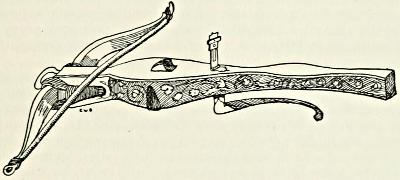
Thirteenth Century Cross-bow
Philes Palæologus, a man remarkable for his virtue, afflicted by the
sufferings of his fellow-countrymen, solicited the emperor for permission to
serve against the Turks. Andronicus, though he placed more confidence
in his piety than in the military operations he proposed, conferred on him
the office of protostrator and authorised him to levy an army. The success
of Philes proves that the ruin of the empire was caused by the folly of
Andronicus and the corruption of the government. Philes enrolled only
veteran Greek soldiers, and selected officers of experience, without reference
to birth and court favour. Constant exercise and strict discipline soon
restored the spirit of the Byzantine army, and Philes led his men to encounter
a plundering expedition of the Turks in the vicinity of Bizya, commanded
by Khalil in person. A bloody battle ensued, for the Turks were
too much accustomed to vanquish the Greeks to yield without a desperate
contest. Philes, however, remained master of the field, and followed up his
success with such vigour that he soon besieged the Turks in their fortified
camp, while the Byzantine fleet, aided by eight Genoese galleys, blockaded
them by sea. After a fierce struggle, the camp was taken; the greater
part of the Turks were slain by the Greeks: the remainder were sold as
slaves by the Genoese. The affair occurred in the year 1315. It may be
considered as the last scene of the Catalan expedition, so that for twelve
years the greater part of the Greek Empire of Constantinople had been
plundered and devastated by the Catalan Grand Company and its Turkish
auxiliaries.
Other enemies had taken advantage of the weakness of the empire during
this calamitous period. The Seljuk Turks had almost completed the
conquest of Asia Minor; the Ottomans had extended their possessions on
the southern shores of the Propontis; the Genoese arrogated to themselves
the possession of several cities and islands, and various chiefs seized
different towns that were left without garrisons to defend them, and lived
in a state of piratical independence. Every bond of society appeared to be
dissolved in the countries inhabited by the Greek race, and every stranger,
whether Mussulman or Christian, thought himself strong enough to subdue
the Greeks.
The most important conquest of the time, however, was that of Rhodes,
by the Knights Hospitaller of St. John of Jerusalem, both from its durability
and from the renown of the conquerors. Andronicus sent an army
to raise the siege; but his troops were defeated, and the knights took the
city of Rhodes on the 15th of August, 1310. As sovereigns of this beautiful
island they were long the bulwark of Christian Europe against the Turkish
power; and the memory of the chivalrous youth who, for successive ages,
found an early tomb at this verge of the Christian world, will long shed
a romantic colouring on the history of Rhodes. They sustained the declining
glory of a state of society that was hastening to become a vision of the
past; they were the heroes of a class of which the Norse sea-kings had been
the demigods. The little realm they governed as an independent state
consisted of Rhodes, with the neighbouring islands of Cos, Calymnos, Syme,
Leros, Nisyros, Telos, and Chalce; on the opposite continent they possessed
the classic city of Halicarnassus, and several strong forts, of which the picturesque
ruins still overhang the sea.
The emperor Andronicus II displayed the same want of sound judgment
and right feeling in his private that he did in his public conduct, and
his latter days were embittered by family disputes caused by his own folly
and injustice. His second wife, Irene of Montferrat, persecuted him with
demands to dismember the empire, in order to form appanages for her children.
Andronicus resisted her solicitations at the expense of a quarrel, and
Irene long lived separated from him at Thessalonica. The emperor Michael
allowed his father to control the arrangements of his family and regulate
his private actions. Michael’s eldest son was named Andronicus. He
was the third emperor of the name who occupied the Byzantine throne,
but he is known in history generally as Andronicus the Younger. When
a child, he was an especial favourite with his grandfather, who directed
his education. That education was undoubtedly a mixture of unwise indulgence
and capricious restraint. The young Andronicus grew up a dissipated
youth, and his debauched habits produced a terrible tragedy in his
family. He was informed that his favourite mistress admitted another
lover, and he employed bravos to waylay his rival. It happened that on
that very night his own brother Manuel hastened quickly to the lady’s
house, where he expected to find Andronicus. The assassins mistook the
despot for the lover, and Manuel was murdered on the spot. The dreadful
news reached their father Michael at Thessalonica, where he was residing
in a declining state of health. Anguish soon terminated his life (1320).
[1320-1321 A.D.]
The young Andronicus was now heir-apparent to the empire, if the
expression be admissible in a state without a fixed order of hereditary succession.
But the murder of Manuel changed the affection of the old
emperor into implacable hatred, and it was generally thought that the
reigning sovereign had the power of naming his successor. The emperor
Michael VIII had introduced the custom that a new oath of allegiance
should be taken, whenever a change occurred in the order of succession.
When Michael, the son of Andronicus II, died, the new oath was administered
in the name of Andronicus II alone, and did not contain that of
Andronicus III, who was the direct heir. It also contained a clause promising
implicit obedience to whomsoever he might declare emperor. These
circumstances indicated that he intended to exclude his grandson from the
throne; nor was he long in selecting a favourite on whom it was supposed
he intended to confer the imperial title. The choice was marked by the
singular perverseness which characterised many of his most important acts.
He had compelled his second son Constantine to marry the daughter of his
favourite minister, Muzalon. The incidents of this union were both ridiculous
and disgraceful. The lady had been destined to be the bride of Theodore,
the emperor’s brother, when it was discovered that she had already
indulged in illicit intercourse with one of her relatives, and would have
presented the imperial family very prematurely with an intruder. Theodore
broke off the match; but the emperor, moved by his attachment to the
father, and by the penitence of the fair sinner, subsequently compelled his
own son Constantine to marry her. The young prince thought himself
entitled to have a bastard as well as his wife. The youth was named
Michael Catharus, and became so great a favourite with his grandfather,
the emperor Andronicus, that he showed a disposition to adopt him as the
heir to the empire, but the representations of his ministers prevented this
act of folly.
[1321-1332 A.D.]
The government of the old emperor was now generally unpopular; and
as he was suspected of being anxious to prevent his grandson Andronicus
from succeeding to the throne, the cause of the prince was made the rallying-point
of the discontented. The most distinguished partisans of Andronicus
the Younger were Cantacuzenus the historian, a man of the highest rank,
of extensive connections among the Byzantine aristocracy, of great wealth,
ability, and military as well as literary accomplishments, but devoured by
ambition, and overflowing with cunning and self-conceit; Synadenus, a man
of equal rank and talent; and Sir Janni, a man of superior boldness and
ability, but with a want of fixed principles and steady conduct that gave
him the character of a political adventurer. With these it is necessary to
mention Apocaucus, who was the ablest administrator and financier of the
party. The intrigues of the partisans of the young prince did not escape
the attention of the emperor’s ministers, who would, doubtless, have maintained
order by arresting the most dangerous, had not Andronicus been
more anxious to punish his grandson, by depriving him of all chance of
succeeding to the empire, than to prevent a rebellion. He now resolved to
bring the prince to a public trial; and on Palm Sunday, 1321, the young
Andronicus was unexpectedly summoned to the palace of Blachernæ. His
partisans comprehended that the crisis of their own fate, as well as that of the
prince, must be decided before sunset. Cantacuzenus and Synadenus accordingly
assembled their followers, and filled the palace with a force that so
completely intimidated both the judges and the emperor that the prince was
pardoned, and a feigned reconciliation took place between the grandfather
and the grandson.
Andronicus II resolved to remove Cantacuzenus and Synadenus from his
grandson’s society, for he justly considered them as the authors of the plots
against his government. Cantacuzenus was named governor of Thessaly,
and Synadenus was sent to Prilapos. These officers collected as many
troops as they were able under the
pretence of repairing to their
posts; and when their levies were
completed they marched to Hadrianopolis,
where the young Andronicus
joined them and raised
the standard of rebellion.
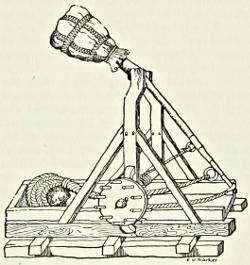
A Fourteenth Century Catapult
The prince was popular; he
gained the people by proclaiming
that the province of Thrace was
exempt from some of the most
onerous taxes, and his mercenaries
enabled him to advance against
Constantinople. But his soldiers,
who cared little for political questions,
pillaged the inhabitants
wherever they passed; bands of
robbers began to lay waste the villages
which had escaped destruction
from the Catalans and the
Turks, and the collectors of the
public revenue, availing themselves
of these disorders, embezzled the money in their hands. Cantacuzenus says
that the young Andronicus was averse to march against his grandfather, fearing
lest his army should storm Constantinople. In order, therefore, to prevent
his grandfather from being dethroned, he wrote secretly to the old emperor
to advise that measures might be concerted to turn aside the first ardour of
his own troops. A treaty was concluded at Rhegium, where the prince had
established his headquarters, by which the rights of Andronicus the Younger
to the succession of the empire were recognised, and he was invested with
the government of Thrace from Selymbria to Christopolis as his appanage.
This peace was of very short duration. The exactions of the prince’s
troops, and the intrigues of Sir Janni and the emperor induced several cities
of Thrace to desert the party of the young Andronicus. Heraclea received
an imperial garrison, and the prince, finding that his cause was losing ground,
assembled his army and laid siege to the city in November, 1321. His troops
had clamoured for the renewal of the war during the summer; they were
averse to keep the field in winter, so that, when the attack on Heraclea was
defeated, the prince marched up to the walls of Constantinople. He had
now few partisans in the capital, and he was soon compelled to retire into
winter quarters at Didymoteichos. A new treaty of peace was concluded at
Epibates in July, 1322, which removed some of the causes of dissatisfaction
to both parties.
On the 2nd of February, 1325, Andronicus the Younger received the imperial
crown. This may be considered a proof that the ministers of the
emperor had persuaded him to stifle all his resentment, and lay aside his
schemes for excluding his grandson from the throne. But in the following
year the two emperors allowed the city of Prusa to be taken by the Ottoman
Turks, without either making an effort to relieve it. This fact seemed to
prove that neither could allow his best officers and troops to succour this
important city, lest his colleague should take advantage of their absence.
Intrigues followed intrigues.
The civil war was renewed under circumstances extremely unfavourable
to the old emperor, whose conduct rendered it inevitable. The people were
universally disgusted with his despotism and injustice, and the young Andronicus
seems to have expected that they would have immediately admitted
him into Constantinople. Finding that this could not be effected, he hastened
into Macedonia in the midst of winter, leaving the protostrator Synadenus
to blockade the capital. Liberal promises of reduced taxation, and
the assurance that all arrears due to the imperial treasury should be cancelled,
insured his entry into most of the towns, and rendered his march a
triumph. Thessalonica, Edessa, Castoria, Berœa, Pelagonia, Achrida, and
Deabolis, opened their gates. The krall [king] of Servia, who consulted his
own interest, refused to assist the officers of the reigning emperor, and took
advantage of the confusion to gain possession of the frontier fortress of
Prosacon. Strumbitza and Melenicon were the only strong places that
remained in the possession of the partisans of Andronicus II.
While these events happened, Synadenus gained a complete victory over
the garrison of Constantinople, on its making an attempt to raise the blockade.
When the news of this victory reached Andronicus, he hastened to
the army before the walls of the capital. Treasonable assistance was soon
secured, and on the night of Monday, May 23rd, 1328, a party of soldiers
scaled the walls; the garrison joined in proclaiming Andronicus III; the
gates were thrown open, and the young emperor marched directly to the
imperial palace to assure his grandfather that, though he had ceased to
govern, he would be treated with all the honour due to a sovereign prince.
Two years after the taking of Constantinople, Andronicus III was attacked
by a serious illness, and his ministers feared lest his grandfather might again
recover the throne. To prevent the possibility of this event, Synadenus
compelled the old man to become a monk, and to sign a declaration that he
would never again mount the throne, nor pretend to dispose of the empire
in case of his grandson’s death. Andronicus II had already lost the use of
his eyes, and this, his last public act, was signed with two crosses, one in red
ink as emperor and another in black as a humble monk. The patriarch
Isaiah sent to congratulate him on his change of life: the petulant old man
regarded this message as an insult, and sent back some violent and probably
not unjust reproaches to the head of the church. His name continued to
be mentioned in the public prayers as the most religious and most Christian
basileus, the monk Antony. One evening, after a literary party at which
his daughter Simonida was present, he was suddenly seized with an illness
which soon terminated his life. He expired on the 13th day of February,
1332, in the seventy-fourth year of his age.
[1332-1352 A.D.]
Andronicus II was a man who, with few personal vices, possessed many
of the worst qualities of a sovereign. He had capacity enough to direct the
whole civil and ecclesiastical business of the empire, but was destitute of the
judgment necessary to direct it well. He rarely took a right step, and never
at the proper time; so that his petulant pride and pedantic despotism proved
more ruinous to the empire than the worst vices of many of his predecessors.
His ecclesiastical bigotry especially served as an instrument of providence
for effecting the ruin and degradation of the orthodox Eastern church, and
of the Greek race. That the Greeks allowed themselves to be so long misled
and oppressed by so worthless and weak a sovereign, may perhaps be accepted
as a proof that the nation was sunk in selfishness and bigotry like the
emperor.c
Andronicus III, now absolute monarch, showed great bravery against the
Turks, but he could not stay their progress in Anatolia, nor prevent their
descents on Europe. Neither could he complete the conquest of Epirus nor
live at peace with his neighbours on the peninsula.
He died in 1341, leaving his son, Joannes V (Palæologus), a minor, under
the regency of his wife, Anne of Savoy. The lord chamberlain, Cantacuzenus,
affected at first to protect them, but his protégés soon found him too
powerful. They got up scandals about him, imprisoned his relatives, allowed
the houses of his partisans to be destroyed. These latter forced him to take
the crown under the title of Joannes VI. Civil war again broke out in the
empire. Cantacuzenus allied himself with Stephen, krall of Servia, and with
Omur Beg, the Seljuk emir of Ionia. Anne of Savoy asked help from the
latter’s rival, Orkhan, sultan of the Ottomans.
Intrigue alternated with massacre. Cantacuzenus contrived to gain over
this same Orkhan by giving him his daughter Theodora. On both sides the
infidels were authorised to carry off Byzantine subjects, and the ports and
vessels of the empire were placed at their disposal to enable them to transport
their captives into Asia. The foreigners took advantage of the general
anarchy to oppress the provinces and towns. The krall of Servia conquered
Macedonia as far as Pheræ, and called himself czar of the Greeks and Servians.
The Genoese retook Chios, which Andronicus III had seized from
them, and blockaded Constantinople, defended by other Italians, under
Facciolati.
The latter, whilst the empress was giving a banquet to her partisans,
opened the Golden Gate to Cantacuzenus. Anne was obliged to come to an
agreement. It was arranged that Cantacuzenus should be emperor first, but
only for ten years; that is, until Joannes V attained his twenty-first year.
The partisans of neither side were satisfied with this transaction.
So feeble was the empire that the Genoese ventured to impose their own
will in the very capital. Cantacuzenus had tried to reconstruct an Hellenic
navy, and attempted to bring a little life into the port of Byzantium by lowering
the port dues. The Genoese considered this injurious to their Galatian
colony. They massacred the crew of a Grecian ship, and exacted that a
large territory adjoining Galata should be ceded to them. A war followed,
which lasted four years (1348-1352). To fight the Genoese the Greeks had
called in Venetian and Catalan fleets. A bloody naval battle was fought
under the very walls of the town, and the Greeks were victorious. Cantacuzenus
had to capitulate (May 6, 1352) and give them all they demanded.
Civil war also soon recommenced. The whole country was horribly ravaged.
An Ottoman army under Suleiman (Solyman), son of Orkhan and in
Cantacuzenus’ pay, carried off the inhabitants by thousands. Joannes V
was despoiled of his authority and private domains; in the room of the fallen
prince, Matthias, son of Joannes VI, was associated with his father and
crowned emperor at St. Sophia (1354). Then, in 1355, with the concurrence
of Francesco Gattilusio and other Genoese, Palæologus surprised and
entered Constantinople. He had to negotiate.
Joannes V and Joannes VI continued to live in the palace with equal
authority. Matthias was to keep the crown for life, as well as Hadrianopolis.
Lesbos had ceded its full sovereignty to Gattilusio (1355).
Joannes VI did not feel at all secure. Perhaps he felt remorse for having
brought so many evils on the empire; perhaps he had a fit of religious
fervour and contempt for worldly things, but at any rate he donned the
monkish garb and retired into the convent of Mangana (1355). He only
came out to join his prayers to the threats of Joannes V in order to make
Matthias lay aside the purple (1357).
By the abdication to which he had forced his son, the legitimate order of
succession resumed its course in the house of Palæologus. Unhappily, the
Greek Empire of the fourteenth century was not strong enough to stand
the shocks of civil war. Irreparable losses in men, money, and territory
were inflicted on her. Genoa and Venice were driving their talons deeper
and deeper into her enfeebled body. The Greek Morea, and even Thessalonica,
had grown used to doing as they would. Finally, the different parties
had shown the Ottomans methods which they were not likely to forget.[88]
[1343-1391 A.D.]
Latin Europe alone could have saved the Greek Empire, but in the fourteenth
century she was worn out by wars with nation after nation, by the
antagonism between the Roman pope and the Avignon pope, and even
between council and council. When a sovereign pontiff appeared authorised
to speak in the name of Europe, he imposed, as the first condition to an
uncertain union, the recognition of his supremacy by the Eastern church.
It would take too long to recall all the crusading projects which were
raised in the papal court of Avignon, and in that of the French kings from
Philippe le Bel to Philippe VI of Valois. Under Benedict XII, a fleet was
placed under the orders of the legate Henry, patriarch in partibus of Constantinople.
Smyrna was taken from the Ionian emir, Omur Beg (1343). Fifty-two
pirate ships were destroyed by the Christian fleet in sight of Athos (1344).
In 1366 Amadeus VI of Savoy, uncle of Joannes V, appeared in Byzantine
waters. He took Gallipoli and Sozopolis from the Turks, repulsed an
invasion of the Bulgarians, took from them Mesembria and Varna, and dictated
a peace. In 1390, Louis II of Clermont, duke of Bourbon, landed at
Tunis, Africa (Mehadia), but failed in the assault.
Thus in the West the crusading spirit was not yet extinct. Many of
these crusades inspired little love for the Grecian Empire. Among the
numerous projects presented to the popes and western sovereigns, there was
one urging that the conquest of Byzantium was an indispensable preliminary
to delivering the Holy Land.
Joannes V Palæologus hoped, although this formidable Western sword
was in so many hands, to turn it against the enemies of the empire. So
pressing was the danger, that the head of the orthodox church had to consent
to go and kneel at Rome before Pope Urban V (1369). Unfortunately
the resources of the pope had been exhausted by the last enterprise. At
Venice Joannes V had to borrow, at high interest, enough money to continue
his journey. After a fruitless tour in the south of France, as Joannes
V was passing through Venice, quite unable to repay the loan, he was imprisoned
at the request of his creditors. Thus the sacred person of the heir
of Constantine the Great was kept in pledge by Venetian usurers.
[1369-1391 A.D.]
Joannes V had two sons, between whom he had divided his dominions
beforehand. The elder, Andronicus, had been associated with the emperor;
the second, Manuel, was governor of Thessaly. The emperor first addressed
himself to the elder, begging him to collect funds for his ransom. Andronicus
coldly replied that the treasury was empty. In truth, he was in no
hurry to hasten the return of his father and colleague. Manuel had more
pity. He mortgaged his lands and sent the money.
When Joannes returned to Constantinople he rewarded the two sons
according to their deserts. Andronicus he disgraced, and associated Manuel
with him in the empire. Abandoned by all his supporters, he consented to
pay tribute to Murad I in 1381. Then, under the weight of crushing necessities,
he had to sustain a further humiliation. Besides the tribute, he promised
Murad to furnish a military contingent, and to give him one of his sons
as hostage.
The Greek Empire now found itself in exactly the same position with
regard to the Turks as the Russian princes were in relation to the khans of
the Golden Horde. Like the princes of Moscow, Tver, and Ryazan, the basileus
only existed by submitting to humiliations; like them, he had to cringe
to the horde. His situation was worse than theirs; the khan only asked from
the Russian kniazes tribute, obedience, and a military contingent. What
more could he find to tempt his avarice in poverty-stricken Russia? The
relations of the sultan and the basileus were not the same. The one could not
pardon the other for perpetuating his memory in a city that was to be the
capital of the new empire. The exactions were therefore more severe,
the humiliations more cruelly calculated, the desire for spoliation was inextinguishable.
Joannes V ended his miserable life in 1391, and his son Manuel
succeeded him.
Of all the Palæologi, Manuel was the most cultivated and the most generous.
He only felt the more shame at the degradation of the times. Perhaps
he may best be compared with the Russian prince, Alexander Nevski.e
The emperor Manuel was at Brusa[89] when he heard of his father’s death.
He was generally esteemed, being neither destitute of talent nor personal
courage, while his disposition was mild and conciliatory. Before Bajazet was
informed of the death of Joannes V the new emperor had made his escape, and
reached Constantinople in safety; but the sultan treated him as a rebellious
vassal in consequence of his secret departure. Joannes Palæologus, the son
of Andronicus, who had succeeded his father in the appanage of Selymbria,
was encouraged to claim the empire in virtue of the treaty of 1381, by
which the succession had been secured to his father and himself. A body of
Turkish troops was instructed to ravage the Greek territory up to the very
walls of Constantinople; but other matters calling for Bajazet’s care, he
accepted the submission of Manuel, and the Greek emperor again appeared
as a vassal at the Sublime Porte.
The ambition of Bajazet was unbounded, and his love of war was inflamed
by an inordinate confidence in his own military talents, and in the power of
the Ottoman army. He despised the Christians, and considered it his first
duty to reduce them to the condition of subjects, if not of slaves. The position
of Manuel was therefore as dangerous as it was degrading; for although
the spectacle of a Roman emperor standing as a suppliant before his throne
soothed the pride of Bajazet, it was apparent that his vanity would readily
yield to his ambition, if an opportunity presented of gaining Constantinople.
[1395-1399 A.D.]
For several years Bajazet was employed consolidating his dominions both
in Europe and Asia, and he was compelled to watch the movements of the
western powers, which threatened him with a new crusade. At last, when
Sigismund, king of Hungary, was about to invade the Ottoman dominions, the
sultan convoked an assembly of the Christian princes who were then his vassals,
in order to prevent their combining to assist the invaders. Manuel, the
Greek emperor, Joannes, despot of Selymbria, Theodore, despot of the Peloponnesus,
Stephen, king of Servia, Constantine Dragazes, the son of Tzarco,
prince of the valley of the Vardar, and several Greek, Servian, Bulgarian,
and Albanian chiefs of less importance, who were already independent,
appeared in the Ottoman camp at Serres. Circumstances induced the
emperor Manuel and the despot Theodore to believe that their correspondence
with the pope was known to the sultan, and that their lives were in
danger. They both fled, and gained their own states in safety. Joannes of
Selymbria remained to profit by the flight of his uncles; but Bajazet could
only attend to the Hungarian war. His brilliant victory at Nicopolis in
1396 taught all Europe that the discipline of the janizaries was more than a
match for the valour of the chivalry of France, and left him at liberty to
punish the Greek princes for their desertion. He immediately turned his
arms against the despot Theodore, and marched in person into Thessaly.
The bishop of Phocis was the first traitor who joined the Mussulmans, and
urged them to conquer Greece. The Wallachians of Thessaly and the widow
of the count of Galona submitted to the terms imposed on them; and the
sultan, seeing that no resistance would be offered to his troops by the Greeks
in the Peloponnesus, turned back to Thrace. His generals, Yakub and
Evrenus, took Corinth and Argos; while Theodore shut himself up within
the walls of Misithra, and contemplated the ruin of his subjects without
making an effort to save them. The Ottoman army, after ravaging great
part of the peninsula, retired, carrying away immense booty and thirty
thousand prisoners, whom they sold as slaves.
As Bajazet was not master of a sufficient naval force to attempt blockading
Constantinople, he resolved to undermine the power of Manuel in such
a way as would be least likely to awaken the jealousy of the commercial
republics of Italy. He fanned the flames of family discord, which shed their
lurid light on the records of the house of Palæologus by acknowledging
Joannes, despot of Selymbria, as the lawful emperor of Constantinople and
supplying him with a Turkish army to blockade Manuel by land.
The emperor Manuel, as soon as he saw that war with Bajazet was inevitable,
had sent an ambassador to solicit assistance from Charles VI king of
France. The marshal de Boucicault, who had already served with distinction
in the East, and had been taken prisoner by Bajazet at Nicopolis, was
appointed to command the forces which Charles VI sent to assist the Greek
emperor. Boucicault sailed from Aigues-Mortes, and after some delay
effected his junction with a fleet composed of eight Genoese, eight Venetian,
two Rhodian galleys, and one of Mytilene, and proceeded to Constantinople,
where he arrived in 1398. The arrival of Boucicault and his little army,
which consisted of six hundred men-at-arms, without horses, six hundred
infantry soldiers, and one thousand archers and cross-bowmen, revived the
courage of the Greeks. The Genoese and Venetians were well acquainted
with the Ottoman coast, and all under the direction of Constantinople carried
on a succession of plundering incursions along the Asiatic coast, from
the gulfs of Nicomedia and Mudania to the shores of the Black Sea. It was
evident that this system of warfare could not long uphold the empire, and
Boucicault, finding the Greeks incapable of making any exertions in their
own defence, advised Manuel to seek assistance from the western nations.
This advice would have in all probability arrived too late, had not the Ottoman
power at this moment been threatened by the great Tatar conqueror,
Timur. The sultan was therefore as much inclined to conclude a temporary
peace as the emperor. The pretensions of Joannes of Selymbria were the only
obstacle, and Manuel overcame this difficulty by a generous resolution. He
opened communications with his nephew, whom he easily convinced that,
if he entered Constantinople with Turkish troops, his reign would prove
of short duration. He then offered to receive Joannes as his colleague, and
invest him with the government, while he himself visited western Europe.
The marshal Boucicault guaranteed these arrangements, and a French force
remained in the capital to protect the interests of Manuel during his absence.
On the 4th of December, 1399, Joannes entered Constantinople, and was
proclaimed emperor, and on the 10th, Manuel quitted his capital with Boucicault
to present himself as a suppliant at the European courts.
[1399-1410 A.D.]
Manuel II gained very little by his mendicant pilgrimage to Italy,
France, and England. Some valuable presents were bestowed upon him by
Visconti, the magnificent duke of Milan, and Charles VI of France granted
him a pension of thirty thousand crowns; but he was compelled to return to
Constantinople at the end of two years, with a little money and a few volunteers
collected from people poorer and not more numerous than the Greeks.
He learned on his way home that his enemy Bajazet had been defeated by
Timur at Angora, and that the Ottoman Empire was utterly ruined. On
reaching Constantinople he deprived his nephew Joannes, who had ruled
during his absence, of the imperial title, and banished him to Lemnos.
Joannes had already placed the Greek Empire in a state of vassalage to the
Tatar conqueror; Manuel ratified the treaty, and paid to Timur the tribute
which he had formerly paid to Bajazet. Rarely has the world seen a more
total defeat than that sustained by the Ottoman army. Bajazet died a captive
in the hands of Timur.
Rarely has so great a victory produced so little effect on the fate of the
vanquished. For a moment, indeed, the Ottoman power was humbled, and
an opening formed for the revival of the Greek Empire; but no energy remained
in the political organisation of the Hellenic race beyond the confined
sphere of local and individual interests; while the institutions of Orkhan,
surviving the defeats and civil wars of the Ottomans, soon restored power
to their central government, and rendered the sultan again the arbiter of the
fate of Greece.
The civil wars among the sons of Bajazet had no small influence in prolonging
the existence of the Greek Empire. The Ottoman historians reckon
an interregnum of ten years after the battle of Angora, during which four
of the sons of Bajazet contended for the sovereignty. Suleiman, Isa, and
Mousa successively perished, and the youngest of the family, Muhammed I,
at last reunited all his father’s dominions, and was regarded as his legitimate
successor and the fifth sultan of the Ottomans, including Osman, the
founder of the dynasty.
After the battle of Angora, Suleiman sought safety in Constantinople,
where he concluded a treaty with the emperor Manuel in the year 1403, by
which he yielded up Thessalonica, the valley of the Strymon, Thessaly, and the
coast of the Black Sea, as far as Varna, to the Greeks. Joannes of Selymbria
was recalled from Lemnos, and established at Thessalonica with the
title of emperor; but the control of the government was vested by Manuel
in the hands of Demetrius Leontaris, a Byzantine noble. In return for the
cession of these provinces, the emperor furnished Suleiman with money to
collect an army and to establish his authority over the remainder of the
Ottoman dominions in Europe.
[1410-1421 A.D.]
But the debauchery of Suleiman at last induced the janizaries to join
Mousa, and Suleiman was slain in attempting to escape to Constantinople,
1410 A.D. The close alliance which had existed between Suleiman and
Manuel induced Mousa to turn his arms against the Greek Empire. He
reconquered all the towns in Macedonia and Thessaly which his brother had
ceded to Manuel, with the exception of Thessalonica and Zeitounion. Mousa
then laid siege to Constantinople; but his operations were paralysed by the
destruction of a naval armament he had fitted out. The emperor had
strengthened the imperial fleet, the command of which he had entrusted
to his natural brother, named also Manuel,
a man of courage and military talents.
The admiral gained a complete victory
over the Ottoman fleet; but his brilliant
success excited the jealousy of his imperial
brother. On returning to receive the
thanks of his country, he was thrown into
prison on an accusation of treason, and
remained a prisoner during the life of his
brother. The siege of Constantinople was
merely a succession of skirmishes under its
walls, in which several Greek nobles were
slain; and the attention of Mousa was
soon exclusively occupied by the attacks
of his brother Muhammed.
Mousa rendered his government as unpopular
by his severity as Suleiman by his
debauchery, and many of the Ottoman officers
in Europe invited Muhammed to seize
the throne. The emperor Manuel agreed
to furnish transports to convey the Asiatic
troops over the Bosporus; but he refused
to admit them into Constantinople, though
he allowed them to form their camp under
its walls. The first operations of Muhammed
were unsuccessful: but at last he
forced Mousa to retire to Hadrianopolis,
who, in the end, was deserted by all his
followers and slain, 1413 A.D. Little more
than ten years had elapsed from the day
that Muhammed, then a mere youth, fled
from the field of Angora with only one
faithful companion, until he reunited under
his sway nearly all the extensive dominions
which had been ruled by his father. Timur had not perceived the fact that,
the tribute of Christian children being the keystone on which the whole fabric
of the Ottoman power rested, its resources were really much greater in Europe
than in Asia.
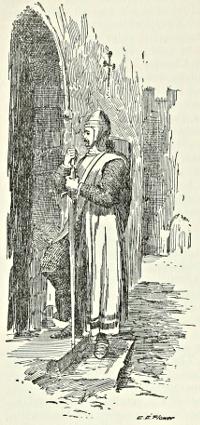
A Fourteenth Century Knight
The Greek Empire enjoyed an uninterrupted peace during the reign of
Muhammed I, which lasted until the year 1421; and Manuel devoted his
attention during this period to restoring some order in the public administration,
and to re-establishing the sway of the central authority in the
distant provinces of the empire. After completing his reforms in the civil,
financial, military, and ecclesiastical departments of Constantinople, he
found it necessary to visit the provinces in person, in order to reduce the
local power of the Greek archons within reasonable bounds. He quitted
Constantinople in the month of July, 1413, and commenced his operations
by reducing the island of Thasos, the citadel of which resisted his little
army for two months. The emperor then visited Thessalonica, where it
appears that he remained more than a year. His nephew Joannes, who was
governor of the city, assumed the monastic habit; but whether he was
compelled by the emperor to adopt this step, in order to allow the new
reforms to be carried into execution, is uncertain. The despot Andronicus,
the emperor’s second son, was appointed governor of Thessalonica. After
his father’s death he sold the city to the Venetians for the sum of fifty
thousand sequins.
In March, 1415, Manuel visited the Peloponnesus. The Roman Empire
of the East had shrunk to such pitiful dimensions that the Byzantine province,
which comprised only about three-quarters of that peninsula, was now
its most extensive province. The first care of the emperor was to strengthen
the means of defending this territory by fortifying the Isthmus of Corinth.
He then directed his attention to reforming the abuses which the feudal
tyranny of the Franks and the unprincipled fiscal extortions of the Greek
archons had introduced into the administration. These abuses were rapidly
exterminating the Greek agricultural population, and making way for the
immigration of a ruder class of Albanian labourers.
When we compare the reforms of Manuel with the legislation of Orkhan,
we are astonished at the great intellectual superiority displayed by the Ottomans
at this period. The Greek emperor adopted only a few temporary
devices to arrest the progress of social putrefaction in a diseased society.
His own talents and the energies of his people were incompetent to make
any bold efforts for extirpating the sources of the evil, and for infusing a
spirit of honesty and patriotism into Greek society. Yet the fact that Greek
society as well as the imperial government was rapidly decaying was generally
acknowledged. The despot Theodore, Manuel’s brother, who died
about the year 1407, had felt the task of undertaking the regeneration of
Greece so hopeless, and had found the difficulty of governing the Peloponnesians
so great, that he attempted to sell his province to the knights of
Rhodes, after he had introduced numerous colonies of Albanians to fill up
the void caused by the decrease of the native population.
From a satirist of the time, we learn that while the emperor Manuel was
occupied in diminishing the power and checking the abuses of the archons
of the Peloponnesus and of the Constantinopolitan officials, many of the
courtiers in his household made a traffic of creating new corruptions in the
administration by selling imperial decrees and golden bulls. The character
of the native Greeks he declares to be equally bad. He says: “They are
formed of three parts: their tongue speaks one thing, their mind meditates
another, and their actions accord with neither.” There can be no good
administration among an utterly demoralised people. When the emperor
returned to Constantinople, he carried with him some of the most turbulent
and intriguing of the Peloponnesian chiefs, who had, previous to his arrival,
contrived to appropriate the greater part of the taxes levied on the people to
their own use. Indeed the most important result of Manuel’s visit was the
introduction of such a degree of order in the provincial administration, that
a fixed sum could be regularly remitted to the imperial treasury at Constantinople.
His son Theodore remained as his viceroy at Misithra.
[1421-1431 A.D.]
The death of Sultan Muhammed I in 1421 involved the empire in a contest
with his son, Murad II. The self-conceit of the Greeks persuaded them
that they could guide the progress of the Ottomans by their superiority in
diplomacy. No experience could teach them that rhetoric and scholastic
learning are feeble arms against military discipline and national courage.
A pretender to the Ottoman throne resided at Constantinople, named
Mustapha, who asserted that he was a son of Bajazet. He was now
acknowledged as lawful sultan, and Manuel concluded with him a treaty,
by which Mustapha promised to restore Gallipoli, the Chalcidice of Macedonia,
and the maritime cities on the Black Sea, while the emperor engaged
to furnish money and military stores. He was abandoned by his followers,
taken prisoner by Murad II, and hanged, in order to convince the world that
he was an impostor.
Murad resolved to punish Manuel for his intrigues. The emperor was
now weakened by age, and the direction of public affairs was in a great
measure entrusted to his son Joannes, who endeavoured to appease the sultan
with abject apologies. Murad gave the imperial ambassadors no answer
until his preparations were completed. He then marched forward and
formed the siege of Constantinople, establishing his own headquarters at
the church of the Fountain, and commencing his lines of circumvallation in
the month of June, 1422. His lines extended from the Golden Gate to the
Wooden Gate; two movable towers were built to assist the storming of the
wall, and cannon were employed by the Ottomans for the first time. This
early artillery, however, was so ill-constructed and ill-served that it produced
little effect. A thousand of the bravest janizaries fell before the
walls; while the Greeks, fighting under cover of their battlements, lost only
130 killed and wounded. Murad II did not renew his attack on Constantinople,
and the last act of Manuel’s reign was to sign a treaty of peace, by
which Murad left the empire in possession of a few cities in Thrace, of Thessalonica,
and a few forts near the mouths of the Strymon, Mount Athos,
Zeitounion, and some places in Thessaly. Manuel also engaged to pay the
sultan an annual tribute of three hundred thousand aspers.
Manuel adopted the monastic habit two years before his death, and took
the name of Matthew, but he continued to give his advice on public affairs.
He died in July, 1425, at the age of seventy-seven, after a reign of thirty-four
years.
Joannes VII found the Eastern Roman Empire reduced to the city of Constantinople,
a few neighbouring towns, Thessalonica, and a part of the Peloponnesus.
His reign of twenty-three years passed in almost uninterrupted
peace; yet this long period of tranquillity was productive of no improvement.
As far as the revenues both of the government and of the nation
were concerned, the emperor and the people alike consumed, before the
expiration of each year, all that the year had produced.
The diminution of the Greek population contrasted strangely with the
rapid increase of the Ottomans, while their decline in wealth and industry
offered a still more unfavourable point of comparison with the Genoese
colony of Galata. The trade of the Greeks had passed into the hands of the
Italians; the power of the Byzantine emperors was transferred to the Ottoman
sultans. The loss of personal dignity and courage followed the loss of
national honour and power. Plague and pestilence, as often happens, came
as attendants on neglected police, bad government, and social disorder. In
the year 1431 a contagious disease of fearful mortality decimated the population
of Constantinople; and it was the ninth return of pestilence since the
great plague of 1347. Nations, however, are rarely sensible of their own
degradation, and at this time the Greeks looked on the Latins with contempt
as well as hatred; they despised the western Europeans as heretics, and the
Turks as barbarians. Court processions, religious ceremonies, and national
vanity amused and consoled them as they hastened along the path of
degradation and ruin.
All the fortified posts had been destroyed by Murad II when he besieged
Constantinople, and the country, as far as Selymbria, was inhabited only by
a few Greeks engaged in agriculture, who dwelt in open villages. The
Greek empire ended at Selymbria. The frontier territory of the Ottomans
was a similar scene of devastation, the land being tilled by a few Christian
peasants for their Turkish masters.
[1430-1440 A.D.]
The conquest of Thessalonica by Sultan Murad in 1430, the quarrels of
the despots Theodore, Constantine, and Thomas in the Peloponnesus, and
the insolence of the Genoese of Galata, who attacked Constantinople on
account of some disputes relating to the Black Sea trade, warned the emperor
Joannes VII that, unless he could secure some efficient military aid from
strangers, the Ottoman power would soon overwhelm the Greek Empire.
The pope was the only sovereign who possessed sufficient power and influence
to obtain effectual aid for the Eastern Empire: but there was no
probability that he would exert that influence, unless the emperor Joannes
consented to the union of the Greek and Latin churches, and recognised the
papal supremacy. In this critical conjuncture the statesmen and ecclesiastics
of rank at Constantinople decided that the political exigencies of their situation
authorised their truckling even with the doctrines of their church.
In the year 1438 the emperor Joannes and the Greek patriarch made their
appearance at the council of Ferrara. In the following year the council was
transferred to Florence, where, after long discussions, the Greek emperor
and all the members of the clergy who had attended the council, with the
exception of the bishop of Ephesus, adopted the doctrines of the Roman
church concerning the procession of the Holy Ghost, the addition to the
Nicene Creed, the nature of purgatory, the condition of the soul after its
separation from the body until the day of judgment, the use of unleavened
bread in the sacrament of the Lord’s Supper, and the papal supremacy. The
union of the two churches was solemnly ratified in the magnificent cathedral
of Florence on the 6th of July, 1439, when the Greeks abjured their ancient
faith in a vaster edifice and under a loftier dome than that of their own
much-vaunted temple of St. Sophia.
The emperor Joannes derived none of the advantages he had expected
from the simulated union of the churches. Pope Eugenius, it is true, supplied
him liberally with money, but his holiness forgot his promise to send
a fleet to defend Constantinople.
On his return Joannes found his subjects indignant at the manner in which
the honour and doctrines of the Greek church had been sacrificed in an unsuccessful
diplomatic speculation. The bishops who had obsequiously signed
the articles of union at Florence, now sought popularity by deserting the
emperor, and making a parade of their repentance, lamenting their wickedness
in falling off for a time from the pure doctrine of the orthodox church.
The only permanent result of this abortive attempt at Christian union was
to increase the bigotry of the orthodox, and to furnish the Latins with just
grounds for condemning the perfidious dealings and bad faith of the Greeks.
In both ways it assisted the progress of the Ottoman power.
[1440-1448 A.D.]
The emperor Joannes, seeing public affairs in this hopeless state, thought
only of keeping on good terms with the sultan. His brother Demetrius,
however, who had accompanied him to Florence, shared his apostasy, and
partaken of the papal bounty, now basely attempted to take advantage of
the popular dissatisfaction with the union. He claimed the throne as being
the first child of Manuel who was a Porphyrogenitus, but he trusted to gain
his ends by the aid of Turkish troops rather than by the merits of his title
or the preference of the Greeks. Collecting a large force composed of the
Turkish nomads, who were ready to join any standard that offered them an
opportunity of plundering and enslaving the Christians, Demetrius marched
to besiege his brother in Constantinople. Sultan Murad took no direct part
in the contest, but he allowed Demetrius to enrol Turkish troops without
opposition, and viewed with satisfaction a rebellion which tended to weaken
the empire. When called upon to choose between the two brothers, the
Greek people acknowledged the superiority of the reigning emperor. Demetrius,
after plundering the suburbs of Constantinople, saw his army melt
away, and was happy to find that his brother’s moderation and love of peace
was so great that he was allowed to retain his principality at Mesembria with
the title of despot.
The deeds of Joannes (Janos) Hunyady might have awakened the Greeks
from their lethargy, had any warlike spirit survived in the nation. The victory
of the Hungarian army at the pass of Isladi, and a war with the sultan of
Karamania, threatened the Ottoman Empire with serious danger; but the
victory of Varna re-established the glory of the sultan’s arms. Neither the
successes of the Hungarians nor the presence of a papal force in the Hellespont,
which at last made its appearance under the command of Cardinal
Gondolmieri, could induce Emperor Joannes to unite his cause with that of
the western powers. He had obtained too many proofs of the instability
and imprudence of their counsels. The moment he heard of the great victory
of Sultan Murad at Varna, he sent an embassy to congratulate his
suzerain, and solicit a renewal of their alliance, which the sultan immediately
granted. Joannes even contrived to avoid taking part in the war carried
on against the sultan by his brother Constantine in Greece, and succeeded in
preserving uninterrupted peace until his death in 1448. During his inglorious
reign of twenty-three years he never forgot that he was a vassal of
the Ottoman Empire. He proved precisely the temporising manager of the
state that circumstances required; and his pliancy averted, during his lifetime,
the calamities which were ready to overwhelm the Greek Empire.
Constantine XIII, the last of the Greek emperors, was residing in his despotat
at Sparta when his brother Joannes VII died. As he had been recently
engaged in hostilities with the sultan, it was doubtful whether Murad would
acknowledge him as emperor, and Demetrius availed himself of these doubts to
make another attempt to occupy the throne. The deficiency of truth, honour,
and patriotism among the Greek aristocracy during the last century of the
Eastern Empire is almost without a parallel in history; but Demetrius was
too well known and too generally despised to find a large party even in that
worthless aristocracy disposed to espouse his cause, while Constantine, on
the other hand, was known to possess both candour and energy, and was respected
by all except the most bigoted among the orthodox Greeks.
[1451 A.D.]
Sultan Murad II died in February, 1451, after a prosperous reign of
thirty years, and was succeeded by his son Muhammed II, who was only
twenty-one years old. Muhammed II was a man of great ambition and
great talents; he united with extraordinary activity and courage a degree
of judgment rare in his high station, and still rarer at his early age.
The conquest of Constantinople was the first object of his ambition. It
was by nature the capital of his dominions, and as long as it remained in the
hands of the Greeks the Ottoman Empire lay open to the invasions of the
western Christians. Having concluded a truce for three years with John
Hunyady, the young sultan crossed
over into Asia to suppress the hostile
proceedings of Ibrahim, the sultan of
Karamania.
Constantine, who appears to have
formed a very erroneous idea of the
talents and character of Muhammed,
took this opportunity of insulting him
in the most sensitive manner by sending
an embassy to demand an augmentation
of the pension of three hundred
thousand aspers, which the Ottoman
court had accorded to the Greek for
the maintenance of Orkhan, the grandson
of Suleiman. The ambassadors
were instructed to insinuate that, if
the demand were not granted, Orkhan
might be allowed to lay claim to the
Ottoman throne.
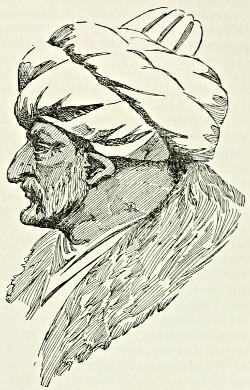
Mohammed II
(From a medallion in the Royal Muenz Cabinet, Berlin)
Such an insult was not likely to
be ever forgotten by a haughty and
ambitious prince. The wary young
sultan, however, dismissed the ambassadors
with courtesy. But as soon as
his Asiatic campaign was finished, he
ordered the imperial agents to be expelled
from the territory in the valley
of the Strymon which had been assigned
for the maintenance of Orkhan, and stopped all further payments.
Shortly after, without informing Constantine of his intention, he constructed
a fortress on the Greek territory at the narrowest part of the Bosporus,
opposite a fort which had been constructed by Bajazet I on the Asiatic shore.
The distance between the two forts is about three-quarters of a mile, and a
rapid current flows between. The sultan had made every preparation for
completing the work with extraordinary celerity. An ample supply of materials
had been collected before his object was known, and as soon as the
plan of the fortress was marked out, a thousand masons and two thousand
labourers worked incessantly to complete the walls.
Constantine had good reason to consider the construction of this fortress
on his territory, within five miles of his capital, and commanding its approach
from the Black Sea, as an infraction of the treaty between the two
empires, but he was too weak to resent this signal revenge for his own
recent threats. He complained of the hostile invasion of the Greek territory,
but Muhammed treated his reclamations with contempt, observing that
the ground on which the fortress was built, having been purchased and paid
for, was Turkish property, and the emperor of Constantinople, being a vassal
of the Porte, had no right to dispute the will of the sultan.
The first open resistance was offered by some Greeks, who endeavoured
to prevent Muhammed’s engineers from carrying off the marble columns
from a church. These pious Christians were cut to pieces by the Ottoman
troops. As the work advanced the sultan’s aggressions increased.
His soldiers were allowed to plunder; quarrels ensued in which blood was
shed, and then the Turks attacked the Greeks who were getting in the
harvest, and slew the reapers. Constantine in alarm closed the gates of
Constantinople, cut off all communications between the Greeks and the
Ottomans, and sent another embassy to the sultan to ask redress. Muhammed
replied by a formal declaration of war.
[1451-1452 A.D.]
Both parties now began to prepare for the mortal contest. The siege
of Constantinople was to be the great event of the coming year. The
sultan, in order to prevent the emperor’s brothers in the Peloponnesus from
sending any succours to the capital, ordered Tourakhan, the pasha of Thessaly,
to invade the peninsula. He himself took up his residence at Hadrianopolis,
to collect warlike stores and siege artillery. Constantine, on his
part, made every preparation in his power for vigorous defence. He formed
large magazines of provisions, collected military stores, and enrolled all the
soldiers he could muster among the Greek population of Constantinople.
But the inhabitants of that city were either unable or unwilling to furnish
recruits in proportion to their numbers. Bred up in peaceful occupation,
they probably possessed neither the activity nor the habitual exercise which
was required to move with ease under the weighty armour then in use.
So few were found disposed to fight for their country, that not more
than six thousand Greek troops appeared under arms during the whole
siege. The numerical weakness of the Greek army rendered it incapable
of defending so large a city as Constantinople, even with all the advantage
to be derived from strong fortifications. The emperor was, therefore, anxious
to obtain the assistance of the warlike citizens of the Italian republics,
where good officers and experienced troops were then numerous. As he
had no money to engage mercenaries, he could only hope to succeed by
papal influence. An embassy was sent to Pope Nicholas V, begging immediate
aid, and declaring the emperor’s readiness to complete the union
of the churches in any way the pope should direct. Nicholas despatched
Cardinal Isidore, the metropolitan of Kieff, who had joined the Latin church,
as his legate. Isidore had represented the Russian church at the council of
Florence; but on his return to Russia he was imprisoned as an apostate,
and with difficulty escaped to Italy. He was by birth a Greek; and being
a man of learning and conciliatory manners, it was expected that he would
be favourably received at Constantinople.
The cardinal arrived at Constantinople in November, 1452. He was
accompanied by a small body of chosen troops, and brought some pecuniary
aid, which he employed in repairing the most dilapidated part of the fortifications.
Both the emperor and the cardinal deceived themselves in supposing
that the dangers to which the Greek nation and the Christian church
were exposed would induce the orthodox to yield something of their ecclesiastical
forms and phrases. It was evident that foreign aid could alone save
Constantinople, and it was absurd to imagine that the Latins would fight
for those that treated them as heretics, and who would not fight for themselves.
The crisis, therefore, compelled the Greeks to choose between union
with the church of Rome or submission to the Ottoman power. They had
to decide whether the preservation of the Greek Empire was worth the
ecclesiastical sacrifices they were called upon to make in order to preserve
their national independence.
[1452-1453 A.D.]
In the meantime, the emperor Constantine celebrated his union with the
papal church, in the cathedral of St. Sophia, on the 12th of December, 1452.
The court and the great body of the dignified clergy ratified the act by
their presence; but the monks and the people repudiated the connection.
In their opinion, the church of St. Sophia was polluted by the ceremony,
and from that day it was deserted by the orthodox. The historian Ducas
declares that they looked upon it as a haunt of demons, and no better than a
pagan shrine. The monks, the nuns, and the populace publicly proclaimed
their detestation of the union; and their opposition was inflamed by the
bigotry of an ambitious pedant, who, under the name of Georgius Scholarius,
acted as a warm partisan of the union at the council of Florence, and under
the ecclesiastical name of Gennadius is known in history as the subservient
patriarch of Sultan Muhammed II. On returning from Italy, he made a
great parade of his repentance for complying with the unionists at Florence.
He shut himself up in the monastery of Pantocrator, where he assumed
the monastic habit, and the name of Gennadius, under which he consummated
the union between the Greek church and the Ottoman administration.
At the present crisis he stepped forward as the leader of the most bigoted
party, and excited his followers to the most furious opposition to measures
which he had once advocated as salutary to the church, and indispensable
for the preservation of the state. The unionists were now accused of sacrificing
true religion to the delusions of human policy, of insulting God to
serve the pope, and of preferring the interests of their bodies to the care of
their souls. In place of exhorting their countrymen to aid the emperor, who
was straining every nerve to defend their country—in place of infusing into
their minds the spirit of patriotism and religion, these teachers of the people
were incessantly inveighing against the wickedness of the unionists and the
apostasy of the emperor.
So completely did their bigotry extinguish every feeling of patriotism
that the grand duke Notaras declared he would rather see Constantinople
subjected to the turban of the sultan than to the tiara of the pope. His
wish was gratified; but, in dying, he must have felt how fearfully he had
erred in comparing the effects of papal arrogance with the cruelty of Mohammedan
tyranny. The emperor Constantine, who felt the importance of the
approaching contest, showed great prudence and moderation in his difficult
position. The spirit of Christian charity calmed his temper, and his determination
not to survive the empire gave a deliberate coolness to his military
conduct. Though his Greek subjects often raised seditions, and reviled him
in the streets, the emperor took no notice of their behaviour. To induce the
orthodox to fight for their country, by having a leader of their own party,
he left the grand duke Notaras in office; yet he well knew that this bigot
would never act cordially with the Latin auxiliaries, who were the best
troops in the city; and the emperor had some reason to distrust the patriotism
of Notaras, seeing that he hoarded his immense wealth, instead of
expending a portion of it for his country.
The fortifications were not found to be in a good state of repair. Two
monks, who had been entrusted with a large sum for the purpose of repairing
them, had executed their duty in an insufficient, and, it was generally said,
in a fraudulent manner. The extreme dishonesty that prevailed among the
Greek officials explains the selection of monks as treasurers for military
objects; and it must lessen our surprise at finding men of their religious
professions sharing in the general avarice, or tolerating the habitual peculation
of others.
Cannon were beginning to be used in sieges, but stone balls were used in
the larger pieces of artillery; and the larger the gun, the greater was the
effect it was expected to produce. Even in Constantinople there were some
artillery too large to be of much use, as the land wall had not been constructed
to admit of their recoil, and the ramparts were so weak as to be
shaken by their concussion. Constantine had also only a moderate supply
of gunpowder. The machines of a past epoch in military science, but to
the use of which the Greeks adhered with their conservative prejudices, were
brought from the storehouses, and planted on the walls beside the modern
artillery. Johann Grant, a German officer, who arrived with Justiniani, was
the most experienced artilleryman and military engineer in the place.
A considerable number of Italians hastened to Constantinople as soon as
they heard of its danger, eager to defend so important a depot of eastern
commerce. The spirit of enterprise and the love of military renown had
become as much a characteristic of the merchant nobles of the commercial
republics as they had been, in a preceding age, distinctions of the barons in
feudal monarchies. All the nations who then traded with Constantinople
furnished contingents to defend its walls.
A short time before the siege commenced, John Justiniani arrived with
two Genoese galleys and three hundred chosen troops, and the emperor
valued his services so highly that he was appointed general of the guard.
The resident bailo of the Venetians furnished three large galleasses and a
body of troops for the defence of the port. The consul of the Catalans, with
his countrymen and the Aragonese, undertook the defence of the great palace
of Bukoleon and the port of Kontoskalion. The cardinal Isidore, with the
papal troops, defended the Kynegesion, and the angle of the city at the head
of the port down to St. Demetrius. The importance of the aid which was
afforded by the Latins is proved by the fact that, of twelve military divisions
into which Constantine divided the fortifications, the commands of only two
were trusted to the exclusive direction of Greek officers. In the others,
Greeks shared the command with foreigners, or else foreigners alone conducted
the defence.
When all Constantine’s preparations for defence were completed, he found
himself obliged to man a line of wall on the land side of about five miles in
length, every point of which was exposed to a direct attack. The remainder
of the wall towards the port and the Propontis exceeded nine miles in extent,
and his whole garrison hardly amounted to nine thousand men. His fleet
consisted of only twenty galleys and three Venetian galleasses, but the entry
of the port was closed by a chain, the end of which, on the side of Galata,
was secured in a strong fort of which the Greeks kept possession. During
the winter the emperor sent out his fleet to ravage the coast of the Propontis
as far as Cyzicus, and the spirit of the Greeks was roused by the booty they
made in these expeditions.
Muhammed II spent the winter at Hadrianopolis, preparing everything
necessary for commencing the siege with vigour. His whole mind was
absorbed by the glory of conquering the Roman Empire, and gaining
possession of Constantinople, which for more than 1150 years had been the
capital of the East. While the fever of ambition inflamed his soul, his cooler
judgment also warned him that the Ottoman power rested on a perilous basis
as long as Constantinople, the true capital of his empire, remained in the
hands of others. Muhammed could easily assemble a sufficient number of
troops for his enterprise, but it required all his activity and power to collect
the requisite supplies of provisions and stores for the immense military and
naval force he had ordered to assemble, and to prepare the artillery and ammunition
necessary to insure success. Early and late, in his court and in
his cabinet, the young sultan could talk of nothing but the approaching siege.
With the writing-reed and a scroll of paper in his hand, he was often seen
tracing plans of the fortifications of Constantinople and marking out positions
for his own batteries. Every question relating to the extent and locality of
the various magazines to be constructed in order to maintain the troops was
discussed in his presence; he himself distributed the troops in their respective
divisions and regulated the order of their march; he issued the orders
relating to the equipment of the fleet, and discussed the various methods
proposed for breaching, mining, and scaling the walls. His enthusiasm was
the impulse of a hero, but the immense superiority of his force would have
secured him the victory with any ordinary degree of perseverance.
The Ottomans were already familiar with the use of cannon. Murad II
had employed them when he besieged Constantinople in 1422; but Muhammed
now resolved on forming a more powerful battering-train than had previously
existed. Neither the Greeks nor the Turks possessed the art of casting
large guns. Both were obliged to employ foreigners. An experienced
artilleryman and founder, named Urban, by birth a Wallachian, carried into
execution the sultan’s wishes. He had passed some time in the Greek service;
but even the moderate pay he was allowed by the emperor having
fallen in arrear, he resigned his place and transferred his services to the sultan,
who knew better how to value warlike knowledge. He now gave
Muhammed proof of his skill by casting the largest cannon which had ever
been fabricated. He had already placed one of extraordinary size in the new
castle of the Bosporus, which carried a ball across the straits. The gun
destined for the siege of Constantinople far exceeded in size this monster,
and the diameter of its mouth must have been nearly two feet and a half.
Other cannon of great size, whose balls of stone weighed 150 pounds, were
also cast, as well as many guns of smaller calibre. All these, together with
a number of ballists and other ancient engines still employed in sieges,
were mounted on carriages in order to transport them to Constantinople.
The conveyance of this formidable train of artillery, and of the immense
quantity of ammunition required for its service, was by no means a trifling
operation.[90]
[1453 A.D.]
The first division of the Ottoman army moved from Hadrianopolis in the
month of February, 1453. In the meantime a numerous corps of pioneers
worked constantly at the road, in order to prepare it for the passage of the
long train of artillery and baggage wagons. Temporary bridges, capable
of being taken to pieces, were erected by the engineers over every ravine
and watercourse, and the materials for the siege advanced steadily, though
slowly, to their destination. The extreme difficulty of moving the monster
cannon with its immense balls retarded the sultan’s progress, and it was the
beginning of April before the whole battering-train reached Constantinople,
though the distance from Hadrianopolis is barely a hundred miles. The division
of the army under Karadja Pasha had already reduced Mesembria,
Anchialus, Bizya, and the castle of St. Stephanus. Selymbria alone defended
itself, and the fortifications were so strong that Muhammed ordered it to be
closely blockaded, and left its fate to be determined by that of the capital.
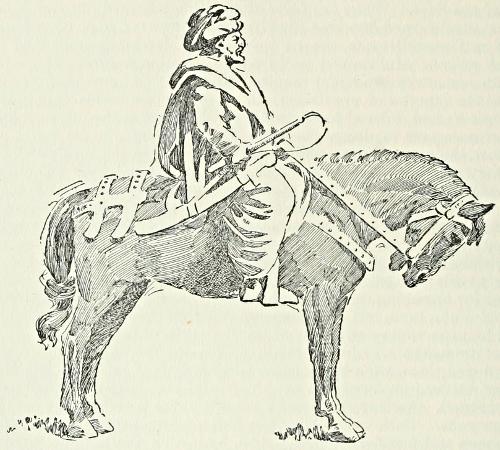
Muhammed II
(From a medallion in the Royal Muenz Cabinet, Berlin)
On the 6th of April, Sultan Muhammed II encamped on the slope of the
hill facing the quarter of Blachernæ, a little beyond the ground occupied by
the crusaders in 1203, and immediately ordered the construction of lines,
extending from the head of the port to the shore of the Propontis. These
lines were formed of a mound of earth, and they served both to restrain the
sorties of the besieged, and to cover the troops from the fire of the enemy’s
artillery and missiles. The batteries were then formed; the principal were
erected against the gate Charsiasæ, in the quarter of Blachernæ, and against
the gate of St. Romanus, near the centre of the city wall. It was toward
this last gate that the fire of the monster gun was directed and the chief
attack was made.
The land-forces of the Turks probably amounted to about seventy
thousand men of all arms and qualities; but the real strength of the
army lay in the corps of janizaries, then the best infantry in Europe, and
their number did not exceed twelve thousand.[91] At the same time, twenty
thousand cavalry, mounted on the finest horses of the Turkoman breed,
and hardened by long service, were ready to fight either on horseback or
on foot under the eye of their young sultan. The fleet which had been
collected along the Asiatic coast, from the ports of the Black Sea to
those of the Ægean, brought additional supplies of men, provisions, and
military stores. It consisted of 320 vessels of various sizes and forms.
The greater part were only half-decked coasters, and even the largest were
far inferior in size to the galleys and galleasses of the Greeks and Italians.
The fortifications of Constantinople towards the sea afford great facilities for
attack. Even though they were partly ruined by time, and weakened by
careless reparations, they still offered a formidable resistance to the imperfect
science of the engineers in Muhammed’s army.c
Of the triangle which composes the figure of Constantinople, the two sides
along the sea were made inaccessible to an enemy; the Propontis by nature,
and the harbour by art. Between the two waters the basis of the triangle,
the land side, was protected by a double wall, and a deep ditch of the depth
of one hundred feet. Against this line of fortification, which Phrantzes, an
eye-witness, prolongs to the measure of six miles, the Ottomans directed
their principal attack; and the emperor, after distributing the service and
command of the most perilous stations, undertook the defence of the external
wall. In the first days of the siege, the Greek soldiers descended into the
ditch or sallied into the field; but they soon discovered that, in the proportion
of their numbers, one Christian was of more value than twenty Turks;
and, after these bold preludes, they were prudently content to maintain their
rampart with their missile weapons. Nor should this prudence be accused of
pusillanimity. The nation was indeed pusillanimous and base; but the last
Constantine deserves the name of a hero; his noble band of volunteers was
inspired with Roman virtue; and the foreign auxiliaries supported the honour
of the western chivalry.
Each day added to the science of the Christians; but their inadequate
stock of gunpowder was wasted in the operations of each day. Their ordnance
was not powerful, either in size or number; and if they possessed some
heavy cannon, they feared to plant them on the walls, lest the aged structure
should be shaken and overthrown by the explosion.
The great cannon of Muhammed has been separately noticed; an important
and visible object in the history of the times; but that enormous engine
was flanked by two fellows almost of equal magnitude; the long order of the
Turkish artillery was pointed against the walls; fourteen batteries thundered
at once on the most accessible places; and of one of these it is ambiguously
expressed, that it was mounted with 130 guns, or that it discharged 130 bullets.
Yet, in the power and activity of the sultan, we may discern the infancy of the
new science. Under a master who counted the moments, the great cannon
could be loaded and fired no more than seven times in one day. The heated
metal unfortunately burst: several workmen were destroyed; and the skill of
an artist was admired who bethought himself of preventing the danger and
the accident, by pouring oil, after each explosion, into the mouth of the cannon.
The first random shots were productive of more sound than effect; and
it was by the advice of a Christian, that the engineers were taught to level
their aim against the two opposite sides of the salient angles of a bastion.
However imperfect, the weight and repetition of the fire made some impression
on the walls; and the Turks, pushing their approaches to the edge of
the ditch, attempted to fill the enormous chasm, and to build a road to the
assault. After a long and bloody conflict, the web that had been woven in
the day was still unravelled in the night. The next resource of Muhammed
was the practice of mines; but the soil was rocky; in every attempt, he was
stopped and undermined by the Christian engineers; nor had the art been
yet invented of replenishing those subterraneous passages with gunpowder,
and blowing whole towers and cities into the air.
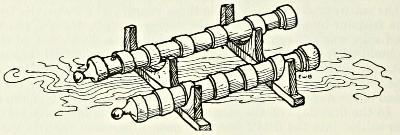
Fifteenth Century Cannon
(After De Montfaucon)
A circumstance that distinguishes the siege of Constantinople, is the
reunion of the ancient and modern artillery. The cannon were intermingled
with the mechanical engines for casting stones and darts; the bullet
and the battering-ram were directed against the same walls; nor had the
discovery of gunpowder superseded the use of the liquid and unextinguishable
fire. A wooden turret of the largest size was advanced on rollers; the
tower of St. Romanus was at length overturned; after a severe struggle,
the Turks were repulsed from the breach, and interrupted by darkness. Of
this pause of action, this interval of hope, each moment was improved by the
activity of the emperor and Justiniani, who passed the night on the spot, and
urged the labours which involved the safety of the church and city. At the
dawn of day, the impatient sultan perceived, with astonishment and grief,
that his wooden turret had been reduced to ashes; the ditch was cleared
and restored; and the tower of St. Romanus was again strong and entire.
He deplored the failure of his design; and uttered a profane exclamation,
that the word of the thirty-seven thousand prophets should not have compelled
him to believe that such a work, in so short a time, could have been
accomplished by the infidels.
In the first apprehension of a siege, Constantine had negotiated, in the
isles of the Archipelago, the Morea, and Sicily, the most indispensable supplies.
Five great ships, equipped for merchandise and war, sailed from the
harbour of Chios. One of these ships bore the imperial flag; the remaining
four belonged to the Genoese; and they were laden with wheat and barley,
with wine, oil, and vegetables, and above all, with soldiers and mariners, for
the service of the capital. The Turkish fleet at the entrance of the Bosporus,
was stretched from shore to shore, in the form of a crescent, to intercept
these bold auxiliaries. The reader who has present to his mind the geographical
picture of Constantinople, will conceive and admire the greatness of
the spectacle.
The five Christian ships continued to advance with joyful shouts, and a
full press both of sails and oars, against a hostile fleet of three hundred vessels;
and the rampart, the camp, the coasts of Europe and Asia, were lined
with innumerable spectators, who anxiously awaited the event of this momentous
succour. At the first view that event could not appear doubtful; the
superiority of the Moslems was beyond all measure or account; and, in a
calm, their numbers and valour must inevitably have prevailed. But their
hasty and imperfect navy had been created, not by the genius of the people,
but by the will of the sultan; in the height of their prosperity, the Turks
have acknowledged that if God had given them the earth, he had left the
sea to the infidels; and a series of defeats, a rapid progress of decay, has
established the truth of their modest confession. In this conflict, the imperial
vessel, which had been almost overpowered, was rescued by the Genoese;
but the Turks, in a distant and closer attack, were twice repulsed with considerable
loss.
Muhammed himself sat on horseback on the beach to encourage their
valour by his voice and presence, by the promise of reward, and by fear
more potent than the fear of the enemy. The passions of his soul, and even
the gestures of his body, seemed to imitate the actions of the combatants; and,
as if he had been the lord of nature, he spurred his horse with a fearless
and impotent effort into the sea. His loud reproaches, and the clamours of the
camp, urged the Ottomans to a third attack, more fatal and bloody than
the two former; and we must repeat, though we cannot credit, the evidence of
Phrantzes, who affirms from their own mouth that they lost above twelve
thousand men in the slaughter of the day. The Christian squadron, triumphant
and unhurt, steered along the Bosporus, and securely anchored
within the chain of the harbour.
The reduction of the city appeared to be hopeless, unless a double attack
could be made from the harbour as well as from the land; but the harbour
was inaccessible; an impenetrable chain was now defended by eight large
ships, more than twenty of a smaller size, with several galleys and sloops;
and instead of forcing this barrier, the Turks might apprehend a naval
sally, and a second encounter in the open sea.
In this perplexity, the genius of Muhammed conceived and executed a plan
of a bold and marvellous cast, of transporting by land his lighter vessels and
military stores from the Bosporus into the higher part of the harbour. The
distance is about ten miles; the ground is uneven, and was overspread with
thickets; and, as the road must be opened behind the suburb of Galata, their
free passage or total destruction must depend on the option of the Genoese.
But these selfish merchants were ambitious of the favour of being the last
devoured; and the deficiency of art was supplied by the strength of obedient
myriads. A level way was covered with a broad platform of strong and
solid planks; and to render them more slippery and smooth, they were anointed
with the fat of sheep and oxen. Fourscore light galleys and brigantines of
fifty and thirty oars were disembarked on the Bosporus shore; arranged
successively on rollers; and drawn forward by the power of men and pulleys.
Two guides or pilots were stationed at the helm and the prow of each vessel;
the sails were unfurled to the winds; and the labour was cheered by song and
acclamation. In the course of a single night, this Turkish fleet painfully
climbed the hill, steered over the plain, and was launched from the declivity
into the shallow waters of the harbour, far above the molestation of the
deeper vessels of the Greeks. The real importance of this operation was
magnified by the consternation and confidence which it inspired; but the notorious,
unquestionable fact was displayed before the eyes, and is recorded
by the pens, of the two nations. A similar stratagem had been repeatedly
practised by the ancients.
As soon as Muhammed had occupied the upper harbour with a fleet and
army, he constructed, in the narrowest part, a bridge or rather mole of
fifty cubits in breadth, and one hundred in length; it was formed of casks
and hogsheads, joined with rafters linked with iron and covered with a
solid floor. On this floating battery he planted one of his largest cannon,
while the fourscore galleys, with troops and scaling-ladders, approached
the most accessible side, which had formerly been stormed by the Latin
conquerors. His vigilance prevented the approach of the Greek ships; their
foremost galliots were sunk or taken; forty youths, the bravest of Italy and
Greece, were inhumanly massacred at his command; nor could the emperor’s
grief be assuaged by the just though cruel retaliation, of exposing from the
walls the heads of 260 Mussulman captives.
After a siege of forty days, the fate of Constantinople could no longer
be averted. The diminutive garrison was exhausted by a double attack;
the fortifications which had stood for ages against hostile violence, were
dismantled on all sides by the Ottoman cannon; many breaches were
opened; and near the gate of St. Romanus, four towers had been levelled
with the ground. For the payment of his feeble and mutinous troops,
Constantine was compelled to despoil the churches, with the promise of a
fourfold restitution; and his sacrilege offered a new reproach to the enemies
of the union. A spirit of discord impaired the remnant of the Christian
strength; the Genoese and Venetian auxiliaries asserted the pre-eminence of
their respective service; and Justiniani and the grand duke, whose ambition
was not extinguished by the common danger, accused each other of
treachery and cowardice.
During the siege of Constantinople, the words of peace and capitulation
had been sometimes pronounced; and several embassies had passed between
the camp and the city. The Greek emperor was humbled by adversity; and
would have yielded to any terms compatible with religion and royalty.
The Turkish sultan was desirous of sparing the blood of his soldiers; still
more desirous of securing for his own use the Byzantine treasures; and he
accomplished a sacred duty in presenting to the gabours the choice of
circumcision, of tribute, or of death. The avarice of Muhammed might
have been satisfied with an annual sum of one hundred thousand ducats;
but his ambition grasped the capital of the East; to the prince he offered a
rich equivalent, to the people a free toleration, or a safe departure; but
after some fruitless treaty, he declared his resolution of finding either a
throne, or a grave, under the walls of Constantinople.
A sense of honour, and the fear of universal reproach, forbade Palæologus
to resign the city into the hands of the Ottomans; and he determined to
abide the last extremities of war. Several days were employed by the
sultan in the preparations of the assault; and a respite was granted by
his favourite science of astrology, which had fixed on the 29th of May as the
fortunate and fatal hour. On the evening of the 27th he issued his final
orders. A crowd of dervishes visited the tents, to instil the desire of
martyrdom, and the assurance of spending an immortal youth amidst the
rivers and gardens of paradise and in the embraces of the black-eyed
virgins. Yet Muhammed principally trusted to the efficacy of temporal
and visible rewards. A double pay was promised to the victorious troops;
“The city and the buildings,” said Muhammed, “are mine; but I resign to
your valour the captives and the spoil, the treasures of gold and beauty;
be rich and be happy. Many are the provinces of my empire: the intrepid
soldier who first ascends the walls of Constantinople, shall be rewarded with
the government of the fairest and most wealthy; and my gratitude shall
accumulate his honours and fortunes above the measure of his own hopes.”
Such various and potent motives diffused among the Turks a general
ardour, regardless of life, and impatient for action; the camp re-echoed
with the Moslem shouts of “God is God, there is but one God, and
Mohammed is the apostle of God;” and the sea and land, from Galata to
the Seven Towers, were illuminated by the blaze of their nocturnal fires.
Far different was the state of the Christians; who, with loud and impotent
complaints, deplored the guilt, or the punishment, of their sins. The
celestial image of the virgin had been exposed in solemn procession; but
their divine patroness was deaf to their entreaties; they accused the obstinacy
of the emperor for refusing a timely surrender; anticipated the horrors
of their fate; and sighed for the repose and security of Turkish servitude.
The noblest of the Greeks, and the bravest of the allies, were summoned to
the palace, to prepare them, on the evening of the twenty-eighth, for the
duties and dangers of the general assault. The last speech of Palæologus
was the funeral oration of the Roman Empire: he promised, he conjured,
and he vainly attempted to infuse the hope which was extinguished in his
own mind. In this world all was comfortless and gloomy; and neither
the Gospel nor the church have proposed any conspicuous recompense to the
heroes who fall in the service of their country. But the example of
their prince, and the confinement of a siege, had armed these warriors with
the courage of despair; and the pathetic scene is described by the feelings of
the historian Phrantzes,f who was himself present at this mournful assembly.
They wept, they embraced; regardless of their families and fortunes, they
devoted their lives; and each commander, departing to his station, maintained
all night a vigilant and anxious watch on the rampart. The emperor,
and some faithful companions, entered the dome of St. Sophia, which in a
few hours was to be converted into a mosque, and devoutly received, with
tears and prayers, the sacrament of the holy communion. He reposed some
moments in the palace, which resounded with cries and lamentations; solicited
the pardon of all whom he might have injured; and mounted on horseback
to visit the guards, and explore the motions of the enemy. The distress
and fall of the last Constantine are more glorious than the long prosperity
of the Byzantine cæsars.
In the confusion of darkness, an assault may sometimes succeed; but
in this great and general attack, the military judgment and astrological
knowledge of Muhammed advised him to expect the morning, the memorable
29th of May, in the fourteen hundred and fifty-third year of the Christian
era. The preceding night had been strenuously employed. Under pain of
death, silence was enjoined; but the physical laws of motion and sound are
not obedient to discipline or fear; each individual might suppress his voice
and measure his footsteps; but the march and labour of thousands must inevitably
produce a strange confusion of dissonant clamours, which reached the
ears of the watchmen of the towers. At daybreak, without the customary
signal of the morning gun, the Turks assaulted the city by sea and land; and
the similitude of a twined or twisted thread has been applied to the closeness
and continuity of their line of attack.
The foremost ranks consisted of the refuse of the host, a voluntary
crowd, who fought without order or command; of the feebleness of age
or childhood, of peasants and vagrants, and of all who had joined the camp
in the blind hope of plunder and martyrdom. The common impulse drove
them onwards to the wall: the most audacious to climb were instantly precipitated;
and not a dart, not a bullet, of the Christians was idly wasted on
the accumulated throng. But their strength and ammunition were exhausted
in this laborious defence; the ditch was filled with the bodies of the slain;
they supported the footsteps of their companions; and of this devoted vanguard,
the death was more serviceable than the life.
Under their respective pashas and sanjaks, the troops of Anatolia and
Romania were successively led to the charge; their progress was various
and doubtful; but, after a conflict of two hours, the Greeks still maintained
and improved their advantage. In that fatal moment, the janizaries arose,
fresh, vigorous, and invincible. The sultan himself on horseback, with an
iron mace in his hand, was the spectator and judge of their valour; he was
surrounded by ten thousand of his domestic troops, whom he reserved for
the decisive occasion; and the tide of battle was directed and impelled by
his voice and eye. His numerous ministers of justice were posted behind
the line, to urge, to restrain, and to punish; and if danger was in the front,
shame and inevitable death were in the rear of the fugitives. The cries of
fear and of pain were drowned in the martial music of drums, trumpets,
and attaballs; and experience has proved that the mechanical operation of
sounds, by quickening the circulation of the blood and spirits, will act on
the human machine more forcibly than the eloquence of reason and honour.
From the lines, the galleys, and the bridge, the Ottoman artillery thundered
on all sides; and the camp and city, the Greeks and the Turks, were involved
in a cloud of smoke, which could only be dispelled by the final deliverance or
destruction of the Roman Empire.
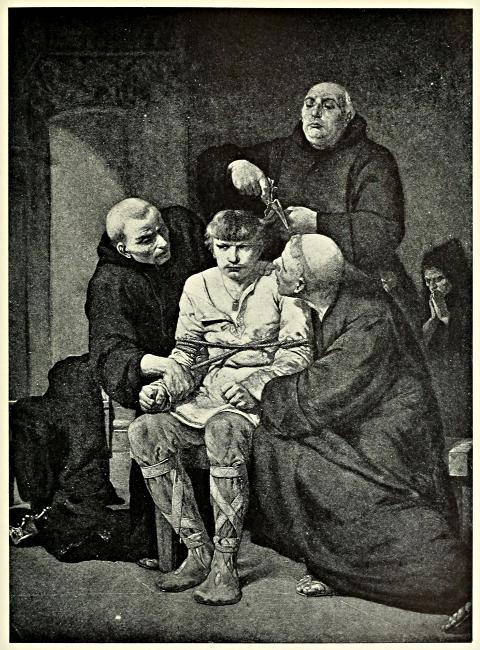
THE LAST MEROVINGIAN KING: CHILDERIC THE STUPID
The immediate loss of Constantinople may be ascribed to the bullet, or
arrow, which pierced the gauntlet of John Justiniani. The sight of his
blood, and the exquisite pain, appalled the courage of the chief, whose arms
and counsels were the firmest rampart of the city. As he withdrew from his
station in quest of a surgeon, his flight was perceived and stopped by the indefatigable
emperor: “Your wound,” explained Palæologus, “is slight; the
danger is pressing; your presence is necessary; and whither will you retire?”
“I will retire,” said the trembling Genoese, “by the same road which God
has opened to the Turks;” and at these words he hastily passed through one
of the breaches of the inner wall. By this pusillanimous act, he stained the
honours of a military life; and the few days which he survived in Galata,
or the isle of Chios, were embittered by his own and the public reproach.[92]
His example was imitated by the greatest part of the Latin auxiliaries; and
the defence began to slacken when the attack was pressed with redoubled
vigour. The number of the Ottomans was fifty, perhaps a hundred, times
superior to that of the Christians; the double walls were reduced by the
cannon to a heap of ruins; in a circuit of several miles, some places must be
found more easy of access, or
more feebly guarded; and if
the besiegers could penetrate
in a single point, the whole
city was irrecoverably lost.
The first who deserved the
sultan’s reward was Hassan
the janizary, of gigantic stature
and strength. With his
scimitar in one hand, and
his buckler in the other, he
ascended the outward fortification;
of the thirty janizaries
who were emulous of his
valour, eighteen perished in
the bold adventure. Hassan
and his twelve companions had
reached the summit; the giant
was precipitated from the rampart;
he rose on one knee, and
was again oppressed by a shower of darts and stones. But his success had
proved that the achievement was possible; the walls and towers were instantly
covered with a swarm of Turks; and the Greeks, now driven from the vantage
ground, were overwhelmed by increasing multitudes.
Fifteenth Century Cannon
(After De Montfaucon)
Amidst these multitudes, the emperor, who accomplished all the duties
of a general and a soldier, was long seen, and finally lost. The nobles, who
fought round his person sustained, till their last breath, the honourable
names of Palæologus and Cantacuzenus; his mournful exclamation was
heard, “Cannot there be found a Christian to cut off my head?” and his
last fear was that of falling alive into the hands of the infidels. The prudent
despair of Constantine cast away the purple; amidst the tumult he
fell by an unknown hand, and his body was buried under a mountain of
the slain.
After his death, resistance and order were no more; the Greeks fled
towards the city; and many were pressed and stifled in the narrow pass of
the gate of St. Romanus. The victorious Turks rushed through the breaches
of the inner wall; and as they advanced into the streets they were soon
joined by their brethren, who had forced the gate Phenar on the side of the
harbour. In the first heat of the pursuit, about two thousand Christians
were put to the sword; but avarice soon prevailed over cruelty; and the
victors acknowledged that they should immediately have given quarter, if
the valour of the emperor and his chosen bands had not prepared them for a
similar opposition in every part of the capital.
It was thus, after a siege of fifty-three days, that Constantinople, which
had defied the power of Chosroes, the chagan, and the caliphs, was irretrievably
subdued by the arms of Muhammed II. Her empire only had been
subverted by the Latins; her religion was trampled in the dust by the
Moslem conquerors.
On the assurance of the public calamity, the houses and convents were
instantly deserted; and the trembling inhabitants flocked together in the
streets, like a herd of timid animals, as if accumulated weakness could be
productive of strength, or in the vain hope, that, amid the crowd, each individual
might be safe and invisible. From every part of the capital they
flowed into the church of St. Sophia; in the space of an hour, the sanctuary,
the choir, the nave, the upper and lower galleries, were filled with the multitudes
of fathers and husbands, of women and children, of priests, monks,
and religious virgins; the doors were barred on the inside, and they sought
protection from the sacred dome, which they had so lately abhorred as a profane
and polluted edifice. Their confidence was founded on the prophecy
of an enthusiast or impostor, that one day the Turks would enter Constantinople,
and pursue the Romans as far as the column of Constantine, in the
square before St. Sophia; but that this would be the term of their calamities;
that an angel would descend from heaven, with a sword in his hand,
and would deliver the empire, with that celestial weapon, to a poor man
seated at the foot of the column. “Take this sword,” would he say, “and
avenge the people of the Lord.” At these animating words the Turks would
instantly fly, and the victorious Romans would drive them from the West, and
from all Anatolia, as far as the frontiers of Persia. It is on this occasion, that
Ducas,g with some fancy and much truth, upbraids the discord and obstinacy
of the Greeks. “Had that angel appeared,” exclaims the historian, “had
he offered to exterminate your foes if you would consent to the union of the
church, even then, in that fatal moment, you would have rejected your
safety, or have deceived your God.”
While they expected the descent of the tardy angel, the doors were
broken with axes; and, as the Turks encountered no resistance, their bloodless
hands were employed in selecting and securing the multitude of their
prisoners. Youth, beauty, and the appearance of wealth attracted their
choice; and the right of property was decided among themselves by a prior
seizure, by personal strength, and by the authority of command. In the
space of an hour, the male captives were bound with cords, the females with
their veils and girdles. The senators were linked with their slaves; the
prelates with the porters of the church; and young men of a plebeian class
with noble maids, whose faces had been invisible to the sun and their nearest
kindred. In this common captivity the ranks of society were confounded;
the ties of nature were cut asunder: and the inexorable soldier was careless
of the father’s groans, the tears of the mother, and the lamentations of the
children. The loudest in their wailings were the nuns, who were torn from
the altar with naked bosoms, outstretched hands, and dishevelled hair; and
we should piously believe that few could be tempted to prefer the vigils of
the harem to those of the monastery.
Of these unfortunate Greeks, of these domestic animals, whole strings
were rudely driven through the streets; and as the conquerors were eager
to return for more prey, their trembling pace was quickened with menaces
and blows. At the same hour, a similar rapine was exercised in all the
churches and monasteries, in all the palaces and habitations of the capital;
nor could any place, however sacred or sequestered, protect the persons or
the property of the Greeks. Above sixty thousand of this devoted people
were transported from the city to the camp and fleet; exchanged or sold,
according to the caprice or interest of their masters, and dispersed in remote
servitude through the provinces of the Ottoman Empire. Among these we
may notice some remarkable characters. The historian Phrantzes, first
chamberlain and principal secretary, was involved, with his family, in the
common lot. After suffering, for months, the hardships of slavery, he recovered
his freedom; in the ensuing winter he ventured to Hadrianopolis, and
ransomed his wife from the mir bashi, or master of horse; but his two children,
in the flower of youth and beauty, had been seized for the use of Muhammed
himself. The daughter of Phrantzes died in the seraglio, perhaps
a virgin; his son, in the fifteenth year of his age, preferred death to infamy,
and was stabbed by the hand of the royal lover.
The pride or cruelty of Muhammed would have been most sensibly gratified
by the capture of a Roman legate; but the dexterity of Cardinal Isidore
eluded the search, and he escaped from Galata in a plebeian habit. The
chain and entrance of the outward harbour was still occupied by the Italian
ships of merchandise and war. They had signalised their valour in the
siege; they embraced the moment of retreat, while the Turkish mariners
were dissipated in the pillage of the city. When they hoisted sail, the
beach was covered with a suppliant and lamentable crowd; but the means
of transportation were scanty; the Venetians and Genoese selected their
countrymen; and, notwithstanding the fairest promises of the sultan, the
inhabitants of Galata evacuated their houses, and embarked with their most
precious effects.
In the fall and the sack of great cities, an historian is condemned to
repeat the tale of uniform calamity; the same effects must be produced by
the same passions; and when those passions may be indulged without control,
small, alas! is the difference between civilised and savage man. Amidst
the vague exclamations of bigotry and hatred, the Turks are not accused of
a wanton or immoderate effusion of Christian blood; but according to their
maxims (the maxims of antiquity) the lives of the vanquished were forfeited;
and the legitimate reward of the conqueror was derived from the
service, the sale, or the ransom of his captives of both sexes. The wealth
of Constantinople had been granted by the sultan to his victorious troops;
and the rapine of an hour is more productive than the industry of years.
But as no regular division was attempted of the spoil, the respective shares
were not determined by merit; and the rewards of valour were stolen away
by the followers of the camp, who had declined the toil and danger of the
battle. The narrative of their depredations could not afford either amusement
or instruction; the total amount, in the last poverty of the empire, has
been valued at four millions of ducats; and of this sum, a small part was the
property of the Venetians, the Genoese, the Florentines, and the merchants
of Ancona. Of these foreigners, the stock was improved in quick and perpetual
circulation; but the riches of the Greeks were displayed in idle ostentation,
or deeply buried in treasures of ingots and old coin, lest it should be
demanded at their hands for the defence of their country.
The profanation and plunder of the monasteries and churches excited
the most tragic complaints. The dome of St. Sophia itself, the earthly
heaven, the second firmament, the vehicle of the cherubim, the throne of the
glory of God, was despoiled of the oblations of ages; and the gold and
silver, the pearls and jewels, the vases and sacerdotal ornaments, were most
wickedly converted to the service of mankind. After the divine images had
been stripped of all that could be valuable to a profane eye, the canvas, or
the wood, was torn, or broken, or burned, or trod under foot, or applied, in the
stables or the kitchen, to the vilest uses.
The example of sacrilege was imitated, however, from the Latin conquerors
of Constantinople; and the treatment which Christ, the Virgin, and
the saints had sustained from the guilty Catholic, might be inflicted by the
zealous Mussulman on the monuments of idolatry. Perhaps instead of joining
the public clamour, a philosopher will observe that in the decline of the
arts the workmanship could not be more valuable than the work, and that a
fresh supply of visions and miracles would speedily be renewed by the craft
of the priest and the credulity of the people. He will more seriously deplore
the loss of the Byzantine libraries, which were destroyed or scattered
in the general confusion; 120,000 manuscripts are said to have disappeared;
ten volumes might be purchased for a single ducat; and the same ignominious
price, too high perhaps for a shelf of theology, included the whole
works of Aristotle and Homer, the noblest productions of the science and
literature of ancient Greece. We may reflect, with pleasure, that an
inestimable portion of our classic treasures was safely deposited in Italy;
and that the mechanics of a German town had invented an art which derides
the havoc of time and barbarism.
From the first hour of the memorable 29th of May, disorder and rapine
prevailed in Constantinople, till the eighth hour of the same day; when the
sultan himself passed in triumph through the gate of St. Romanus. He
was attended by his vizirs, pashas, and guards, each of whom (says a Byzantine
historian) was robust as Hercules, dexterous as Apollo, and equal in
battle to any ten of the race of ordinary mortals. The conqueror gazed with
satisfaction and wonder on the strange though splendid appearance of the
domes and palaces, so dissimilar from the style of oriental architecture. In
the Hippodrome, or atmeidan, his eye was attracted by the twisted column of
the three serpents; and, as a trial of his strength, he shattered with his iron
mace, or battle-axe, the under-jaw of one of these monsters, which in the
eyes of the Turks were the idols or talismans of the city.
At the principal door of St. Sophia, he alighted from his horse, and
entered the dome; and such was his jealous regard for that monument of his
glory, that on observing a zealous Mussulman in the act of breaking the
marble pavement, he admonished him, with his scimitar, that if the spoil and
captives were granted to the soldiers, the public and private buildings had
been reserved for the prince. By his command the metropolis of the Eastern
church was transformed into a mosque; the rich and portable instruments
of superstition had been removed; the crosses were thrown down; and the
walls, which were covered with images and mosaics, were washed and purified,
and restored to a state of naked simplicity.
On the same day, or on the ensuing Friday, the muezzin or crier, ascended
the most lofty turret, and proclaimed the ezan, or public invitation in the
name of God and his prophet; the imam preached; and Muhammed II performed
the namaz of prayer and thanksgiving on the great altar, where the
Christian mysteries had so lately been celebrated before the last of the
cæsars. From St. Sophia he proceeded to the august but desolate mansion
of a hundred successors of the great Constantine; but which, in a few hours,
had been stripped of the pomp of royalty. A melancholy reflection on the
vicissitudes of human greatness forced itself on his mind; and he repeated
an elegant distich of Persian poetry: “The spider hath woven his web in
the imperial palace; and the owl hath sung her watch-song on the towers
of Afrasiab.”
Yet his mind was not satisfied; nor did the victory seem complete, till he
was informed of the fate of Constantine—whether he had escaped, or been
made prisoner, or had fallen in the battle. Two janizaries claimed the honour
and reward of his death; the body, under a heap of slain, was discovered
by the golden eagles embroidered on his shoes; the Greeks acknowledged
with tears the head of their late emperor; and, after exposing the bloody
trophy, Muhammed bestowed on his rival the honours of a decent funeral.
Clemency was extended to the principal officers of state, of whom several
were ransomed at his expense; and during some days he declared himself
the friend and father of the vanquished people. But the scene was soon
changed; and before his departure the Hippodrome streamed with the blood
of his noblest captives. His perfidious cruelty is execrated by the Christians;
they adorn with the colours of heroic martyrdom the execution of the
grand duke and his two sons; and his death is ascribed to the generous
refusal of delivering his children to the tyrant’s lust. Yet a Byzantine historian
has dropped an unguarded word of conspiracy, deliverance, and Italian
succour; such treason may be glorious, but the rebel who bravely ventures,
has justly forfeited his life; nor should we blame a conqueror for destroying
the enemies whom he can no longer trust. On the 18th of June the
victorious sultan returned to Hadrianopolis; and smiled at the base and hollow
embassies of the Christian princes, who viewed their approaching ruin in
the fall of the Eastern Empire.
Constantinople had been left naked and desolate, without a prince or a
people. But she could not be despoiled of the incomparable situation which
marks her for the metropolis of a great empire; and the genius of the place
will ever triumph over the accidents of time and fortune. Brusa and Hadrianopolis,
the ancient seats of the Ottomans, sank into provincial towns; and
Muhammed established his own residence, and that of his successors, on the
same commanding spot which had been chosen by Constantine. The fortifications
of Galata, which might afford a shelter to the Latins, were prudently
destroyed; but the damage of the Turkish cannon was soon repaired. As
the entire property of the soil and buildings, whether public or private, or
profane or sacred, was now transferred to the conqueror, he first separated a
space of eight furlongs from the point of the triangle for the establishment
of his seraglio or palace. In the new character of a mosque, the cathedral
of St. Sophia was endowed with an ample revenue, crowned with lofty minarets,
and surrounded with groves and fountains, for the devotion and refreshment
of the Moslems. The same model was imitated in the jami or royal
mosques; and the first of these were built, by Muhammed himself, on the ruins
of the church of the holy apostles and the tombs of the Greek emperors.
Constantinople no longer appertains to the Roman historian; nor shall
we enumerate the civil and religious edifices that were profaned or erected
by its Turkish masters; the population was speedily renewed; and before
the end of September, five thousand families of Anatolia and Romania had
obeyed the royal mandate, which enjoined them, under pain of death, to
occupy their new habitations in the capital. The throne of Muhammed was
guarded by the numbers and fidelity of his Moslem subjects; but his rational
policy aspired to collect the remnant of the Greeks; and they returned in
crowds as soon as they were assured of their lives, their liberties, and the
free exercise of their religion. In the election and investiture of a patriarch,
the ceremonial of the Byzantine court was revived and imitated. With a
mixture of satisfaction and horror, they beheld the sultan on his throne;
who delivered into the hands of Gennadius the crosier or pastoral staff, the
symbol of his ecclesiastical office; who conducted the patriarch to the gate
of the seraglio, presented him with a horse richly caparisoned, and directed
the vizirs and pashas to lead him to the palace which had been allotted for
his residence. The churches of Constantinople were shared between the two
religions, their limits were marked; and, till it was infringed by Selim, the
grandson of Muhammed, the Greeks enjoyed above sixty years the benefit of
this equal partition.[93]
[1453-1481 A.D.]
The final extinction of the last two dynasties which have reigned in Constantinople
terminates the decline and fall of the Roman Empire in the East.
The despots of the Morea,[94] Demetrius and Thomas, the two surviving brothers
of the name of Palæologus, were astonished by the death of the emperor
Constantine, and the ruin of the monarchy. Hopeless of defence, they prepared,
with the noble Greeks who adhered to their fortune, to seek a refuge
in Italy, beyond the reach of the Ottoman thunder. Their first apprehensions
were dispelled by the victorious sultan, who contented himself with a
tribute of twelve thousand ducats; and while his ambition explored the
continent and the islands in search of prey, he indulged the Morea in a
respite of seven years. But this respite was a period of grief, discord, and
misery. The hexamilion, the rampart of the isthmus, so often raised and so
often subverted, could not long be defended by three hundred Italian
archers; the keys of Corinth were seized by the Turks; they returned
from their summer excursions with a train of captives and spoil; and
the complaints of the injured Greeks were heard with indifference and
disdain. The Albanians, a vagrant tribe of shepherds and robbers, filled
the peninsula with rapine and murder; the two despots implored the dangerous
and humiliating aid of a neighbouring pasha; and when he had
quelled the revolt, his lessons inculcated the rule of their future conduct.
Neither the ties of blood, nor the oaths which they repeatedly pledged
in the communion and before the altar, nor the stronger pressure of necessity,
could reconcile or suspend their domestic quarrels. They ravaged each
other’s patrimony with fire and sword; the alms and succours of the West
were consumed in civil hostility; and their power was only exerted in
savage and arbitrary executions. The distress and revenge of the weaker
rival invoked their supreme lord; and, in the season of maturity and revenge,
Muhammed declared himself the friend of Demetrius, and marched
into the Morea with an irresistible force. When he had taken possession
of Sparta, “You are too weak,” said the sultan, “to control this turbulent
province; I will take your daughter to my bed; and you shall pass the
remainder of your life in security and honour.”
Demetrius sighed and obeyed; surrendered his daughter and his castles;
followed to Hadrianopolis his sovereign and son, and received for his own maintenance,
and that of his followers, a city in Thrace, and the adjacent isles of
Imbros, Lemnos, and Samothrace. He was joined the next year by a companion
of misfortune, the last of the Comnenian race, who, after the taking
of Constantinople by the Latins, had founded a new empire on the coast
of the Black Sea. In the progress of his Anatolian conquests Muhammed
invested with a fleet and army the capital of David, who presumed to style
himself emperor of Trebizond; and the negotiation was comprised in a short
and peremptory question,“Will you secure your life and treasures by resigning
your kingdom; or would you rather forfeit your kingdom, your treasures,
and your life?” The feeble Comnenus was subdued by his own fears, and
the example of a Mussulman neighbour, the prince of Sinope; who, on a
similar summons, had yielded a fortified city with four hundred cannon and
ten or twelve thousand soldiers. The capitulation of Trebizond was faithfully
performed; and the emperor with his family was transported to a
castle in Romania; but on a slight suspicion of corresponding with the
Persian king, David and the whole Comnenian race were sacrificed to the
jealousy or avarice of the conqueror.
Nor could the name of father long protect the unfortunate Demetrius
from exile and confiscation; his abject submission moved the pity and contempt
of the sultan; his followers were transplanted to Constantinople;
and his poverty was alleviated by a pension of fifty thousand aspers, till a
monastic habit and a tardy death released Palæologus from an earthly master.
It is not easy to pronounce whether the servitude of Demetrius, or the
exile of his brother Thomas, be the most inglorious. On the conquest of
the Morea, the despot escaped to Corfu, and from thence to Italy, with some
naked adherents; his name, his sufferings, and the head of the apostle St.
Andrew entitled him to the hospitality of the Vatican; and his misery was
prolonged by a pension of six thousand ducats from the pope and cardinals.
His two sons, Andrew and Manuel, were educated in Italy; but the eldest,
contemptible to his enemies and burdensome to his friends, was degraded by
the baseness of his life and marriage. A title was his sole inheritance; and
that inheritance he successively sold to the kings of France and Aragon.
During his transient prosperity, Charles VIII was ambitious of joining the
empire of the East with the kingdom of Naples; in a public festival, he
assumed the appellation and the purple of augustus; the Greeks rejoiced, and
the Ottoman already trembled at the approach of the French chivalry.
Manuel Palæologus, the second son, was tempted to revisit his native country;
his return might be grateful, and could not be dangerous, to the Porte;
he was maintained at Constantinople in safety and ease; and an honourable
train of Christians and Moslems attended him to the grave. If there be
some animals of so generous a nature that they refuse to propagate in a
domestic state, the last of the imperial race must be ascribed to an inferior
kind; he accepted from the sultan’s liberality two beautiful females; and
his surviving son was lost in the habit and religion of a Turkish slave.
The importance of Constantinople was felt and magnified in its loss;
the pontificate of Nicholas V, however peaceful and prosperous, was dishonoured
by the fall of the Eastern Empire; and the grief and terror of the
Latins revived, or seemed to revive, the old enthusiasm of the Crusades.
Had the union of the Christians corresponded with their bravery; had every
country, from Sweden to Naples, supplied a just proportion of cavalry and
infantry, of men and money, it is indeed probable that Constantinople would
have been delivered, and that the Turks might have been chased beyond the
Hellespont or the Euphrates. But the secretary of the emperor, who composed
every epistle, and attended every meeting, Æneas Sylvius, a statesman
and orator, describes from his own experience the repugnant state and spirit
of Christendom. “It is a body,” says he, “without a head; a republic without
laws or magistrates. The pope and the emperor may shine as lofty titles,
as splendid images; but they are unable to command, and none are willing
to obey; every state has a separate prince, and every prince has a separate
interest. What eloquence could unite so many discordant and hostile powers
under the same standard? Could they be assembled in arms, who would
dare to assume the office of general? What order could be maintained what
military discipline? Who would undertake to feed such an enormous
multitude? Who would understand their various languages, or direct their
stranger and incompatible manners? What mortal could reconcile the
English with the French, Genoa with Aragon, the Germans with the natives
of Hungary and Bohemia? If a small number enlisted in the holy war,
they must be overthrown by the infidels; if many, by their own weight and
confusion.”
Yet the same Æneas, when he was raised to the papal throne, under
the name of Pius II, devoted his life to the prosecution of the Turkish
War. In the council of Mantua, he excited some sparks of a false or feeble
enthusiasm; but when the pontiff appeared at Ancona, to embark in person
with the troops, engagements vanished in excuses; a precise day was adjourned
to an indefinite term; and his effective army consisted of some
German pilgrims, whom he was obliged to disband with indulgences and
alms.
Regardless of futurity, his successors and the powers of Italy were involved
in the schemes of present and domestic ambition; and the distance
or proximity of each object determined, in their eyes, its apparent magnitude.
A more enlarged view of their interest would have taught them to
maintain a defensive and naval war against the common enemy; and the
support of Scanderbeg (Iskander Bey) and his brave Albanians might have
prevented the subsequent invasion of the kingdom of Naples. The siege and
sack of Otranto by the Turks diffused a general consternation; and Pope
Sixtus was preparing to fly beyond the Alps, when the storm was instantly
dispelled by the death of Muhammed II, in the fifty-first year of his age.
His lofty genius aspired to the conquest of Italy: he was possessed of a
strong city and a capacious harbour; and the same reign might have been
decorated with the trophies of the new and the ancient Rome.d
[The letter a is reserved for Editorial Matter.]
b Albert Gueldenpenning, Geschichte des Oströmischen
Reichs.
c George Finlay, Greece under the Romans.
d Edward Gibbon, The History of the Decline and Fall
of the Roman Empire.
e Count Zosimus, The History of Count Zosimus.
b Edward Gibbon, op. cit.
c Henry H. Howorth, “The Westerly Drifting of Nomads”
in Journal of Anthropological Institute, Vol. V.
d Ammianus Marcellinus, The Roman History of Ammianus
Marcellinus (translated from the Latin by C. D. Yonge).
e J. B. Bury, A History of the Later Roman Empire.
b Edward Gibbon, op. cit.
c Agathias, Ἀγαθίου Σχολαστικοῦ Μυριναίου Ἱστορίων
E.
d George Finlay, op. cit.
e Procopius, Ἀνέκδοτα (Historia Arcana).
f Procopius, Ἱστορία (Books of the Wars).
g Procopius, Κτίσματα (The Edifices of Justinian).
h Joannes Malalas, Χρονογραφία.
i Jordanes (Jornandes), De Getarum origine
et rebus gestis.
j Magnus Aurelius Cassiodorus, Variorum (Epistolarum)
Libri XII.
k Joseph von Hammer-Purgstall, Geschichte des
Osmanischen Reiches.
l J. B. Bury op. cit.
m L. von Ranke, Weltgeschichte.
n Ammianus Marcellinus, op. cit.
b George Finlay, op. cit.
c Edward Gibbon, op. cit.
d Procopius, Gothic War, op. cit.
e J. B. Bury, op. cit.
f E. A. Freeman, General Sketch of European History.
g Thos. Hodgkin, Italy and her Invaders.
h Isidorus Hispalensis, Historia Gothorum.
i Paulus Diaconus, Historia Langobardorum.
j Johann Kaspar Zeuss, Die Deutschen und die
Nachbarstämme.
k Jordanes, De Regnorum ac temporum successione.
l Robt. Roesler, Romänischen Studien.
m Theophylactus Simocatta, Ἱστορία οἰκουμένη.
n Joannes Malalas, op. cit.
o Agathias, op. cit.
p Procopius, op. cit.
b E. Gibbon, op. cit.
c Flavius Cresconius Corippus, Corippi Africani
Grammatici fragmentum carminis in laudem … De laudibus Justini Augusti
Minoris.
d John of Ephesus, The Third Book of the
Ecclesiastical History (edited by W. Cureton).
e Theophylactus Simocatta, op. cit.
f Theophanes of Byzantium, ἱστορικῶν λόγοι δέκα.
g J.B. Bury, op. cit.
h H. Gelzer, Abriss der byzantinischen
Kaisergeschichte (in Karl Krumbacher’s Gesch. der byzantinischen
Litteratur).
i G. Finlay, op. cit.
j Baronius, Annales Ecclesiastici.
b J. B. Bury, op. cit.
c G. Finlay, op. cit.
d Theophanes, op. cit.
b G. F. Hertzberg, Geschichte der Byzantiner und des
Osmanischen Reichs.
c K. Schenk, in Byzantinische Zeitschrift.
d H. Gelzer, op. cit.
e F. H. Clinton, Fasti Romani.
f F. J. Saulcy, Essai de classification des suites
monétaires byzantines.
g E. Gibbon, op. cit.
h J. B. Bury, op. cit.
i G. Finlay, op. cit.
j Theophanes, op. cit.
k Nicephorus Patriarcha, Ἱστορία σύντομος.
l Aug. Fr. Gfrörer, Byzantinische Geschichte.
m Karl Joseph von Hefele, Konciliengeschichte.
n George Finlay, History of the Byzantine and the
Greek Empires from 716-1453.
o Leo Diaconus, Historia.
b Leo Diaconus, op. cit.
c Georgius Cedrenus, Σύνοψις ἱστορίων (Compendium
Historiarum ab Orbe Condita ad Isaacum Comnenum).
d Joannes Zonaras, Χρονίκον (Annales).
e G. Finlay, op. cit.
f H. Gelzer, op. cit.
g Georgius Monachus, Χρονίκον Βίου τῶν νεῶν
Βασιλεῶν.
h Edward Gibbon, op. cit.
i Anna Comnena, Ἀλεξίας.
j Nicetas Acominatus, Ἱστορία.
b Geoffrey de Villehardouin, Histoire de la conquête
de Constantinople.
c Ernest Lavisse and Alfred Rambaud, Histoire
générale du IVe siècle à nos jours.
d J. F. Michaud, History of the Crusades (translated
from the French by W. Robson).
e C. Du F. Duc Cange, Histoire de l’empire de
Constantinople sous les empereurs français.
f Edward Gibbon, op. cit.
g George Finlay, The History of Greece from its
Conquest by the Crusaders to its Conquest by the Turks, and of the Empire
of Trebizond.
b Edward Gibbon, op. cit.
c George Finlay, History of the Byzantine and the
Greek Empires from 716-1453.
d Georgius Pachymeres, Historia Byzantina.
e Ernest Lavisse and Alfred Rambaud, op. cit.
f H. Gelzer, op. cit.
b G. F. Hertzberg, op. cit.
c George Finlay, op. cit.
d Edward Gibbon, op. cit.
e H. Gelzer, op. cit.
f Georgios Phranzes, Χρονίκον.
g Ducas, Historia Byzantina.
[For a further list of works on the Later Roman Empire in the East, see
the General Bibliography of Roman History in Volume VI.]