Professor Hirschfeld has pointed out that there is a general misconception
as to the true meaning of later Roman history and that the time of
the Roman Empire is, in reality, by no means exclusively a period of decline.
In point of fact, there were long periods of imperial history when the glory of
Rome, as measured by its seeming material prosperity, by the splendour
of its conquests, and the wide range of its domination, was at its height.
But two prominent factors, among others, have served to befog the view in
considering this period. In the first place, the fact that the form of government
is held to have changed from the republican to the monarchial system
with the accession of Augustus, has led to a prejudice for or against the age
on the part of a good share of writers who have considered the subject. In
the second place the invasion of Christianity during the decline of the
empire has introduced a feature even more prejudicial to candid discussion.
Yet, broadly considered, neither of these elements should have had much
weight for the historian. In the modern sense of the word the Roman commonwealth
was never a democracy. From first to last, a chief share of its
population consisted of slaves and of the residents of subject states. There
was, indeed, a semblance of representative government; but this, it must be
remembered, was continued under the empire. Indeed, it cannot be too
often pointed out that the accession to power of Augustus and his immediate
successors did not nominally imply a marked change of government. We
shall have occasion to point out again and again that the “emperor” was
not a royal ruler in the modern sense of the word. The very fact that the
right of hereditary succession was never recognised,—such succession being
accomplished rather by subterfuge than as a legal usage,—in itself shows a
sharp line of demarcation between the alleged royal houses of the Roman
Empire and the rulers of actual monarchies. In a word, the Roman Empire
occupied an altogether anomalous position, and the power which the imperator
gradually usurped, through which he came finally to have all the influence
of a royal despot, was attained through such gradual and subtle advances that
contemporary observers scarcely realised the transition through which they
were passing. We shall see that the senate still holds its nominal power,
and that year by year for centuries to come, consuls are elected as the nominal
government leaders.
Nevertheless, it is commonly held that posterity has made no mistake in
fixing upon the date of the accession of Augustus as a turning-point in the
history of the Roman commonwealth. However fully the old forms may
have been held to, it is only now that the people in effect submit to a permanent
dictator. The office of dictator, as such, had indeed been abolished
on the motion of Mark Antony; but the cæsars managed, under cover of
old names and with the ostensible observance of old laws, to usurp dictatorial
power. There was an actual, even if not a nominal, change of government.
This change of government, however, did not coincide with any sudden
decline in Roman power. On the contrary, as just intimated, the Roman
influence under the early cæsars reached out to its widest influence and
attained its maximum importance. Certainly, the epochs which by common
consent are known as the golden and the silver ages of Roman literature—the
time, that is to say, of Augustus and his immediate successors—cannot
well be thought of as periods of great national degeneration. And again
the time of the five good emperors has by common consent of the historians
been looked on as among the happiest periods of Roman history. In a word
the first two centuries of Roman imperial history are by no means to be considered
as constituting an epoch of steady decline. That a decline set in
after the death of Marcus Aurelius, some causes of which were operative
much earlier, is, however, equally little in question. Looking over the whole
sweep of later Roman history it seems difficult to avoid the conclusion that
the empire was doomed almost from the day of its inception, notwithstanding
its early period of power. But when one attempts to point out the elements
that were operative as causes of this seemingly predestined overthrow, one
enters at once upon dangerous and debatable ground. At the very outset,
as already intimated, the prejudices of the historian are enlisted pro or con
by the question of the influence of Christianity as a factor in accelerating or
retarding the decay of Rome’s greatness.
Critics have never tired of hurling diatribes at Gibbon, because his
studies led him to the conclusion that Christianity was a detrimental force
in its bearing on the Roman Empire. Yet many more recent authorities
have been led to the same conclusion, and it is difficult to say why this estimate
need cause umbrage to anyone, whatever his religious prejudices. The
Roman commonwealth was a body politic which, following the course of all
human institutions, must sooner or later have been overthrown. In the
broader view it does not seem greatly to matter whether or not Christianity
contributed to this result. That the Christians were an inharmonious element
in the state can hardly be in question. As such, they cannot well be
supposed to have contributed to communal progress. But there were obvious
sources of disruption which seem so much more important that one may
well be excused for doubting whether the influence of the early Christians
in this connection was more than infinitesimal for good or evil. Without
attempting a comprehensive view of the subject—which, indeed, would be quite
impossible within present spacial limits—it is sufficient to point out such pervading
influences as the prevalence of slavery, the growing wealth of the
few and the almost universal pauperism of the many fostered by the paternal
government, and the decrease of population, particularly among the best
classes, as abnormal elements in a body politic, the influence of which sooner
or later must make themselves felt disastrously.
Perhaps as important as any of these internal elements of dissolution was
that ever-present and ever-developing external menace, the growing power
of the barbarian nations. The position of any nation in the historical scale
always depends largely upon the relative positions of its neighbour states.
Rome early subjugated the other Italian states and then in turn, Sicily, Carthage,
and Greece. She held a dominating influence over the nations of the
Orient; or, at least, if they held their ground on their own territory, she
made it impossible for them to think of invading Europe. Meantime, at the
north and west there were no civilised nations to enter into competition with
her, much less to dispute her supremacy. For some centuries the peoples of
northern Europe could be regarded by Rome only as more or less productive
barbarians, interesting solely in proportion as they were sufficiently productive
to be worth robbing. But as time went on these northern peoples learned
rapidly through contact with the civilisation of Rome. They were, in fact,
people who were far removed from barbarism in the modern acceptance of the
term. It is possible (the question is still in doubt) that they were of common
stock with the Romans; and if their residence in a relatively inhospitable
clime had retarded their progress towards advanced civilisation, it had
not taken from them the racial potentialities of rapid development under
more favourable influences; while, at the same time, the very harshness of
their environment had developed in them a vigour of constitution, a tenacity
of purpose, and a fearless audacity of mind that were to make them presently
most dangerous rivals. It was during the later days of the commonwealth
and the earlier days of the empire that these rugged northern peoples were
receiving their lessons in Roman civilisation—that is to say, in the art of
war, with its attendant sequels of pillage and plundering.[2] Those were hard
lessons which the legions of the cæsars gave to the peoples of the north, but
their recipients proved apt pupils. Even in the time of Augustus a German
host in the Teutoberg Forest retaliated upon the hosts of Varus in a manner
that must have brought Rome to a startling realisation of hitherto unsuspected
possibilities of disaster.
It has been pointed out that the one hope for the regeneration of Rome
under these conditions lay in the possibility of incorporating the various
ethnic elements of its wide territories into one harmonious whole. In other
words, could Rome in the early day have seen the desirability—as here and
there a far-sighted statesman did perhaps see—of granting Roman citizenship
to the large-bodied and fertile-minded races of the north, removing thus
a prominent barrier to racial intermingling, the result might have been something
quite different. We have noted again and again that it is the mixed
races that build the great civilisations and crowd forward on the road of
human progress. The Roman of the early day had the blood of many races
in his veins, but twenty-five or thirty generations of rather close inbreeding
had produced a race which eminently needed new blood from without. Yet
the whole theory of Roman citizenship set its face against the introduction
of this revivifying element. The new blood made itself felt presently, to
be sure, and the armies came to be recruited from the provinces. After a
time it came to pass that the leaders—the emperors even—were no longer
Romans in the old sense of the word. They came from Spain, from Illyricum,
and from Asia Minor. Finally the tide of influence swept so strongly
in the direction of Illyricum that the seat of Roman influence was transferred
to the East, and the Roman Empire entered a new phase of existence. The
regeneration was effected, in a measure, by the civilisation of the new Rome
in the East; but this was the development of an offspring state rather than
the regeneration of the old commonwealth itself. Then in the West the
northern barbarians, grown stronger and stronger, came down at last in
successive hordes and made themselves masters of Italy, including Rome
itself. With their coming and their final conquests the history of old Rome
as a world empire terminates.
It is the sweep of events of the five hundred years from the accession of
Augustus the first emperor to the overthrow of Romulus Augustulus the
last emperor that we have to follow in the present volume. Let us consider
in a few words the sources that have preserved the record of this most interesting
sequence of events.
Reference has already been made to the importance of the monumental
inscriptions. For the imperial history these assumed proportions not at all
matched by the earlier periods. It was customary for the emperors to issue
edicts that were widely copied throughout the provinces, and, owing to
the relative recency of these inscriptions a great number of them have been
preserved.
As a rule, these inscriptions have only incidental importance in the way of
fixing dates or establishing details as to the economic history. On the other
hand, such a tablet as the Monumentum Ancyranum gives important information
as to the life of Augustus, and such pictorial presentations as occur
on the columns of Trajan and Marcus Aurelius are of the utmost importance
in reproducing the life-history of the period. For mere matters of
chronology—having also wider implications on occasion—the large series of
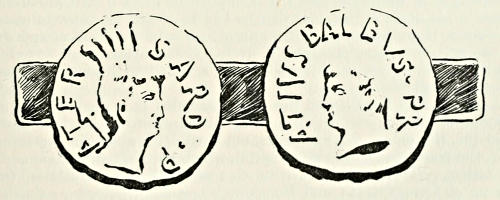
coins and medals is of inestimable importance. Without these various inscriptions,
as has been said, many details of imperial history now perfectly
established must have remained insoluble.
Nevertheless, after giving full credit to the inscriptions as sources of
history, the fact remains that for most of the important incidents that go to
make up the story, and for practically all the picturesque details of political
history, the manuscripts are still our chief sources. The authors whose works
have come down to us are relatively few in number, and may be briefly listed
here in a few words. For the earliest imperial period we have the master
historian Tacitus, the biographer Suetonius, the courtier Velleius Paterculus,
and the statesman Dion Cassius. As auxiliary sources the writings of
Martial, Valerius Maximus, Pliny, and the Jewish Wars of Josephus are to be
mentioned. For the middle period of imperial history Dion Cassius and
Herodian, supplemented by Aurelius Victor and the other epitomators, and by
the so-called Augustan histories or biographies, are our chief sources. After
they fail us, Zosimus and Ammianus Marcellinus have the field practically
to themselves, gaps in their work being supplied, as before, by the outline
histories. Details as to these writers will be furnished, as usual, in our
general bibliography.

29. Temple of Janus closed for the third time. 28. Senate reduced in
numbers. 27. Octavian lays down his powers; is given the proconsular imperium
for ten years, and made commander-in-chief of all the forces with the
right of levying troops, and making war and peace. He receives the title
of Augustus. Provinces divided into senatorial (where no army was required)
and imperial where troops were maintained. 23. Proconsular imperium
conferred on Augustus with possession of the tribunicia potestas.
20. War against the Parthian king, Phraates. Tigranes reinstated in his
kingdom of Armenia. 19. Cantabri and Astures (in Spain) subdued.
15. Rætia and Noricum subjugated by Drusus and Tiberius and included
among the Roman provinces. 12-9. Campaigns of Drusus in Germany and
subjugation of Pannonia by Tiberius. 4 B.C. Birth of Jesus. 4 A.D. Augustus
adopts his stepson Tiberius. 9. Illyricum, having rebelled, is reduced
by Tiberius. Arminius, the chief of the Cherusci, a German tribe, annihilates
a Roman army under Quintilius Varus. 14. Tiberius, emperor. Germanicus,
nephew of Tiberius, quells the revolted legions on the Rhine and
makes war on the German tribe of the Marsi. 15. Germanicus invades
Germany a second time and captures the wife of Arminius (Hermann).
16. Battle of the Campus Idistavisus. Arminius defeated by Germanicus.
17. Recall and death of Germanicus. 23. Prætorian cohorts collected into
one camp outside Rome on the suggestion of Sejanus, who now exercises
great influence over Tiberius. 31. Sejanus put to death with many of
his friends. 37. Caligula succeeds Tiberius. 41. Murder of Caligula. Claudius
succeeds. 42. Mauretania becomes a Roman province. 43-47. Britain
subdued by Plautius and Vespasian. 43. Lycia becomes a province. 44. Judea
becomes a province. 54. Claudius poisoned by his wife Agrippina and succeeded
by her son Nero. 55. Nero poisons his step-brother Britannicus.
58. Domitius Corbulo sent against the Parthians and Armenians. 59. Agrippina
murdered by Nero’s orders. 61. Suetonius Paulinus represses the
revolt of Boadicea in Britain. 62. Nero murders his wife Octavia. 63. Parthians
and Armenians renew the war. The Parthians finally sue for peace.
The king of Armenia acknowledges his vassalage to Rome. 64. Destruction
of great part of Rome by fire, said to have been started by Nero’s command,
but attributed by him to the Jews and Christians. First persecution of
the Christians. 65. Piso conspires against Nero. The plot is discovered.
66. First Jewish War. Vespasian sent to conduct it. 68. Gaul and Spain
revolt against Nero, who commits suicide.

68. Galba, Otho, and Vitellius succeed each other as emperors. 69. Vespasian,
the first Flavian emperor, proclaimed by the soldiers. Vitellius put
to death. The aristocratic body purified and replenished. Official worship
restored. Public works executed. Reforms in the army and the finances,
and the administration generally. Batavian revolt under Claudius Civilis.
70. Fall of Jerusalem. Batavian revolt quelled by Cerealis. 71. Cerealis
becomes governor of Britain. 78. Agricola begins his campaigns in Britain.
79. Titus, the second Flavian emperor. Pompeii and Herculaneum destroyed
by an eruption of Vesuvius. 80. Agricola reaches the Solway Firth.
81. Domitian, the third Flavian emperor. 83. War with the Chatti. 84. Caledonians
under Galgacus defeated by Agricola, who completes the conquest of
Britain. 86. Dacian invasion of Mœsia. 87. Dacians defeat a Roman army.
90. Peace with the Dacians. 93. Antonius Saturninus, governor of upper
Germany, revolts. The rebellion is put down and his papers are destroyed.
Domitian executes the supposed accomplices of Saturninus and begins a series
of cruelties. Philosophers expelled from Rome. Persecutions of Jews and
Christians. 96. Nerva succeeds on the murder of Domitian, and introduces a
policy of mildness. 98. Trajan, emperor. 101-102. Dacians attacked and overthrown
by Trajan. 106. Dacians finally subdued by Trajan. Their country
becomes a Roman province. 114. Parthian War undertaken to prevent the
Parthian king from securing the Armenian crown to his family. 116. Parthian
War ends with the incorporation of Armenia, Mesopotamia, and Assyria
amongst the Roman provinces. Trajan dies on his return. Many public
works were executed in this reign. 117. Hadrian, emperor. He abandons
Trajan’s recent conquests. 118. Mœsia invaded by the Sarmatians and
Roxolani. Hadrian concludes peace with the Roxolani. The Sarmatian
War continues for a long time. 120-127. Hadrian makes a tour through
the provinces. 121. Hadrian’s wall built in Britain. 132. Edictum perpetuum,
or compilation of the edictal laws of the prætors. 132-135. Second
Jewish War, beginning with the revolt of Simon Bar Kosiba. Many
buildings were erected in Hadrian’s reign. 138. Antoninus Pius, emperor.
He promotes the internal prosperity of the empire, and protects it against
foreign attacks. 139. British revolt suppressed by Lollius Urbicus. Wall
of Antoninus (Graham’s Dyke) built. 161. Marcus Aurelius and Lucius
Verus, joint emperors. 162-165. Parthian War. It terminates in the restoration
of Armenia to its lawful sovereign and the cession of Mesopotamia to
Rome. 163. Christian persecution. 166. A barbarian coalition of the
Marcomanni and other tribes threatens the empire. Both emperors take
the field against them. 169. Lucius Verus dies. 174. Victory over the
Quadi. Miracle of the Thundering Legion. 175. Avidius Cassius proclaims
himself emperor, and makes himself master of all Asia within Mount Taurus.
He is assassinated. 178. War with the Marcomanni renewed.

180. Commodus. Peace concluded with the barbarians. 183. Lucilla,
Commodus’ sister, conspires against him. In punishing this conspiracy he
begins his career of cruelty. 193. Pertinax made emperor on the murder
of Commodus. He attempts to restore discipline and is murdered in his
turn. Didius Julianus buys the empire of the prætorians. The legions in
Syria, Illyricum, and Britain each proclaim a rival emperor. L. Septimius
Severus marches on Rome. Murder of Julianus. Severus recognised in
Rome. 194. Battle of Issus. Severus defeats his rival Pescennius Niger.
196. Byzantium taken by Severus. Clodius Albinus made emperor by the
army in Gaul. 197. Battle of Lugdunum. Clodius defeated. 198. Parthian
War. 202. Christian persecution. 208. Caledonia overrun by Severus,
who loses many of his men. 210. Wall of Severus in Britain completed.
211. Caracalla, emperor. Alexandrians massacred. 212. Geta, co-ruler and
brother of Caracalla, murdered by him. Wars in Dacia and on the Rhine.
217. Macrinus, emperor. 218. Elagabalus (Heliogabalus) made emperor by
the soldiers. Defeat and execution of Macrinus. Julia Mæsa and Julia
Soæmias, grandmother and mother of Elagabalus, rule. 222. Severus Alexander,
emperor. 231. Persian War. 235. Maximinus Thrax, emperor.
236. Invasion of Germany. 237. Gordianus I and II proclaimed emperors
in Africa. Defeat and death of the Gordiani. 238. Pupienus Maximus,
Cælius Balbinus, and Gordianus III. Maximinus Thrax, Pupienus, and Balbinus
killed. 242. Sapor, king of Persia, defeated by Gordianus III.
244. Philip, the Arabian, murders and succeeds Gordianus. 249. Decius
made emperor by the Mœsian and Pannonian legions. Battle of Verona.
Philip defeated and slain. 250. Christian persecution. Bishops of Rome,
Antioch, and Jerusalem martyred. Battle of Abricium. Decius defeated
and slain by the Goths. 251. Gallus and Hostilianus, emperors. 252. Pestilence
throughout the greater part of the empire. This lasted fifteen years.
253. Æmilianus, emperor. 254. Valerianus, emperor. The Goths and Burgundians
invade Mœsia and Pannonia. The Franks appear in Gaul.
259. Sapor invades Syria and takes Antioch. Valerian drives him back
but is captured and enslaved. 260. Gallienus, Valerian’s son and co-ruler,
sole emperor. Ingenuus and Regalianus proclaimed emperors. Odenathus
of Palmyra drives the Persians back. 261. Macrianus, Valens,
and Calpurnius Piso proclaimed emperors. 262. Aureolus proclaimed emperor.
The Persians capture Antioch. 264. Odenathus declared Augustus.
265. Postumus repels the Gauls. 267. Death of Odenathus, succeeded
by his wife Zenobia. Death of Postumus. Tetricus assumes the empire
in Gaul. Age of the Thirty Tyrants. 268. Gallienus slain by the machinations
of Aureolus. Claudius II, emperor. 269. Battle of Naissus in
Dardania. Claudius defeats the Goths with great slaughter. Zenobia
invades Egypt.

270. Aurelian, called Restitutor Orbis, becomes emperor. He defeats the
Goths and makes peace with them. Alamanni invade Umbria and are
defeated by Aurelian in three engagements. 273. Palmyra and its queen
Zenobia taken by Aurelian. Egypt revolts and is subdued. 274. Tetricus,
who had maintained himself as emperor in Gaul, Britain, and Spain, defeated
at Châlons. 275. Tacitus, emperor. 276. Probus and Florian, emperors.
They clear Gaul of its German invaders and pursue them across the
Rhine. 282. Carus, emperor. Sarmatians defeated. Persian expedition.
284. Diocletian, emperor. He makes Nicomedia in Bithynia his capital.
285. Maximian, joint emperor for administration of the West. 293. Constantius
Chlorus and Galerius named cæsars. 296. Constantius recovers
Britain. Revolt of Egypt suppressed by Diocletian. Battle of Carrhæ.
Galerius defeated by the Persians. 297. Galerius defeats the Persians and
makes a treaty securing Mesopotamia to the Romans. 298. Constantius
defeats the Alamanni at Langres. 303. Christian persecution. 305. Abdication
of Diocletian and Maximian. Constantius and Galerius, emperors.
306. Constantine the Great succeeds his father Constantius in the rule of
Spain, Gaul, and Britain. Maxentius emperor at Rome. Maximian resumes
the purple. Licinius made emperor. 310. Maximian executed by Constantine.
312. Defeat and death of Maxentius. 313. Edict of Milan issued by
Licinius and Constantine, inaugurating religious toleration. 314. War between
Licinius and Constantine. 323. Battles of Hadrianopolis and Chalcedon.
Defeat of Licinius. 324. Licinius executed. Constantine sole ruler.
325. First general council at Nicæa. 330. Byzantium, or Constantinople,
becomes the capital of the empire. 337. Constantine II, Constans, and Constantius
II divide the empire. 340. Battle of Aquileia between Constantine
II and Constans. Death of Constantine II. His dominions fall to Constans.
350. Death of Constans. Revolt of Magnentius. 353. Constantius
II sole emperor. 357. Battle of Argentoratum (Strasburg); Julian
defeats the Alamanni. 361. Julian, “the Apostate,” emperor. 362. Edict
granting general toleration. 363. Persian War. Julian is victorious at
Ctesiphon, and in other battles, but is at last obliged to retreat and is killed.
Jovian emperor. He makes peace with the Persians, resigning five districts
beyond the Tigris. He places Christianity on an equality with other
religions. 364. Valentinianus I and Valens, emperors. 367. Gratianus emperor
for the West. 374. War with the Quadi. 375. Valentinian II reigns conjointly
with Gratian on the death of Valentinian I. 376. Huns and Alans
attack the eastern Goths. Valens permits the Goths to settle in Thrace.
378. Goths threaten Constantinople. Battle of Hadrianopolis. Goths defeat
the Romans with great slaughter. Death of Valens. 379. Theodosius
the Great, emperor of the East. 380. Theodosius becomes a Christian. He
successfully continues the war against the Goths and makes a treaty with
them which is followed by their establishment in Thrace, Phrygia, and
Lydia, and the enrolment of large numbers in the army of the Eastern Empire.
383. Clemens Maximus revolts against Gratian, who is captured and
put to death. 387. Maximus makes himself master of Italy. Theodosius
restores Valentinian II, and puts Maximus to death. 390. Massacre of the
inhabitants of Thessalonica by order of Theodosius in revenge for the murder
of officials. 392. Valentinian II murdered. Eugenius emperor of the West.
394. Theodosius defeats Eugenius and becomes the last emperor of the whole
Roman world. 395. Death of Theodosius. Arcadius becomes emperor of
the East and Honorius of the West.

395. At death of Theodosius the division of the empire becomes permanent.
Honorius, aged eleven, rules over the western portion, with Stilicho
as regent. Alaric ravages Thrace. Stilicho proceeds against him. 396. Second
expedition of Stilicho. Alaric escapes into Epirus, and Stilicho returns
to Italy. 397. Revolt of Gildo in Africa, causing scarcity of food in Rome.
He is defeated, and kills himself the following year. 403. Battle of Pollentia
ends invasion of Italy by Alaric, begun the previous year. Retreat of Alaric.
405. Radagaisus with an army of 200,000, composed of Celts, Germans, Sarmatians,
and Gauls, invades Italy. Successfully opposed by Stilicho. Capture
and death of Radagaisus. His army destroyed. 406. The Vandals enter Gaul.
407. Revolt of the army in Britain. Constantine declared emperor; makes
himself master of the whole of Gaul as far as the Alps. 408. Murder of
Stilicho. Alaric besieges Rome, but retires on payment of money. 409. Alaric,
besieging Rome, has Attalus proclaimed emperor. Revolt of Gerontius
in Spain; he proclaims Maximus emperor. Vandals invade Spain. 410. Alaric
takes Rome and plunders it. Death of Alaric. Succeeded by Atawulf.
411. War between the usurpers, Constantine and Gerontius. Constantius
leads the imperial forces against the two rebels. Death of Constantine
and Gerontius. 412. Jovinus proclaimed emperor in Gaul. Peace between
Honorius and Atawulf. 413. Atawulf slays Jovinus. Heraclianus
invades Italy, but is slain. 415. Death of Atawulf in Spain. Succeeded
by Wallia, who, the following year, makes peace with Honorius.
418. Subjection of Spain by the Goths after two years’ war. Death of
Wallia. Succeeded by Theodoric I. Aquitania ceded to the Goths.
419. The Suevi and Vandals war in Spain. 421. Constantius declared
augustus, but he is not accepted. 423. Death of Honorius. 424. John
or Joannes seizes the western division. 425. Valentinian III, nephew of
Honorius, declared augustus. Defeat and death of the usurper Joannes.
Attack on the Goths in Gaul. 428. War in Gaul continued. The Vandal
king, Gunderic, dies, and Genseric succeeds. 429. Genseric crosses into
Africa, on invitation of Boniface, who has been several years in revolt.
431. War of Boniface with Vandals ended with capture of Hippo. The
Vandals are masters of a large part of Africa. 432. War between Boniface
and Aëtius. Death of Boniface. 434. Attila becomes king of the
Huns. It is said that Honoria, sister of Valentinian, in disgrace at court,
invites him to attack Italy. 435. Peace with Genseric. War with the
Burgundians and Goths in Gaul. 436. Theodoric besieges Narbo. 437. The
war in Gaul continues. Valentinian marries daughter of Theodosius II.
439. Theodoric defeats Litorius at Tolosa. Peace with the Goths. 440. Genseric
invades Sicily. 444. Attila murders his brother, Bleda, and succeeds to
the full authority. 446. The Vandals devastate Roman dominions in Spain.
The Britons ask aid against the Saxons. 448. The Suevi ravage Roman
dominions in Spain. 451. Attila invades Gaul. He is defeated at Châlons
by Aëtius and Theodoric. Death of Theodoric, who is succeeded by his son,
Torismond. 452. Attila invades Italy. Siege and capture of Aquileia.
Attila retires to Gaul. Death of Torismond, succeeded by Theodoric II.
Leo, bishop of Rome, goes as ambassador to Attila. 453. Death of Attila.
His army is scattered. 455. Murder of Valentinian by Petronius Maximus.
Maximus declared emperor. He marries the widow of Valentinian, who calls
Genseric to her aid. Murder of Maximus as he is preparing to fly from the
Vandal. Avitus proclaimed emperor in Gaul by Theodoric II. He is recognised
by Marcian at Constantinople. 457. Majorian made emperor by Ricimer,
who, the previous year, has deposed Avitus. 458. Majorian proceeds
against the Vandals and Gauls. 459. Peace between Majorian and Theodoric
II, who has been defeated. 460. Roman fleet destroyed by Genseric at Carthagena.
Peace between Majorian and Genseric. 461. Deposition and
murder of Majorian by Ricimer. Elevation of Severus. 462. Vandals
ravage Italy. 463. Theodoric II attempts to gain possession of Gaul. Is
defeated, but rules over a large portion of Spain. 465. Death of Severus.
No emperor is appointed, Ricimer keeping power in his own hands. 466. Murder
of Theodoric II by his brother, Euric, who succeeds him. 467. Anthemius
appointed emperor by Leo of Constantinople, at Ricimer’s request. 470. Euric
takes Arelate and Massilia, and defeats the Britons. Execution of the patrician
Romanus, who aspires to the empire. 472. War between Ricimer and
Anthemius. Ricimer declares Olybrius emperor, and puts Anthemius to death.
Death of Ricimer. Death of Olybrius. 473. Glycerius proclaimed emperor.
The Ostrogoths prepare to invade the empire. 474. Leo sends Julius Nepos
to reign in the West. Glycerius deposed. Euric occupies Arverna. Peace
between Euric and Nepos. 475. Orestes drives out Nepos and proclaims
his own son, Romulus Augustulus, emperor. 476. Odoacer invades Italy.
Romulus Augustulus deposed, and Odoacer acknowledged king of Italy.
The Byzantine Emperor Zeno confers the title of patrician upon Odoacer,
who rules a nominal vicar. “There was thus,” says Bryce, “legally no
extinction of the Western Empire at all, but only a reunion of East and
West.”
When Augustus entered upon secure possession of absolute power, the
Roman Empire included the fairest and most famous lands on the face of
the globe and all the civilised peoples of the ancient world found a place in
its ample bosom. It extended from the ocean on the west to the Euphrates,
from the Danube and the Rhine to the cataracts of the Nile and the deserts
of Africa and Arabia. And although, in the first decades of imperial rule, a
few tribes within its huge circumference had not completely assimilated the
system of Roman civilisation and law; although in the Alps and Pyrenees,
on the lower Danube and in the inaccessible gorges of the Taurus some
warlike races retained their savage freedom and did not stoop their necks to
the rods and axes of Rome, the mighty mistress of the world—they offered
but a futile defiance, better fitted to assert and exercise the martial vigour
of the legions than to inspire the masters of the world with dread or set
bounds to their dominion.
The wars which Augustus or his legates waged in the Cantabrian Mountains
of northwestern Spain, in the Alps and the wooded hills of Dalmatia,
merely served to consolidate the empire and strengthen its frontiers, and gave
the imperial ruler an opportunity of renewing the martial feats and triumphs
of the republic. The Spanish mountaineers were transplanted to the plains
and constrained to conduct themselves peaceably. Deprived of their savage
liberty, they accustomed themselves to agriculture and social life; and the
Spanish cities, endowed with privileges and connected by highroads, soon
became seats of Roman culture and spheres of active influence in trade and
commerce. The products of the soil, the largess of the sea, the fruits of
industry—oil and wine, honey and wax, wool and salt fish—were exported
in large quantities from the ports of Spain and filled the seaboard cities with
wealth. The fierce and predatory tribes of the Alpine range, from Savoy and
Piedmont to Istria, were again and again smitten with the edge of the sword
and forced to submit; the newly founded military colony of Augusta Prætoria
(Aosta), in the country of the Salassians and at the junction of the Graian
and Pennine Alps, served thenceforward as a bulwark to the Roman possessions
in northwest Italy, after the stubbornness of the hardy mountaineers
had been broken by the carrying off of such men as were capable of bearing
arms to the slave market at Eporedia (Ivrea).
[15 B.C.-7 A.D.]
In the year 15 B.C. the free races of Rætia, Vindelicia, and Noricum were
conquered, from the Lake of Constance and the Valley of the Inn to the
Adriatic; and Tiberius led his legions from Gaul to the sources of the Rhine,
there to join hands with Drusus, the vigorous youth for whom was reserved
the honour of “ushering in the last hour of the liberty of the mountains,”
and who was then advancing from the south. A single campaign sufficed to
destroy forevermore the freedom of these disconnected tribes, who had no
national ties to unite them into a political entity. A trophy on the southern
slope of the mountain rampart proclaimed to posterity that under the leadership
and auspices of Augustus four-and-forty nations, all mentioned by
name, had been vanquished and subjugated by the sword of Rome. The transportation
of the most vigorous elements of the population to foreign parts,
the construction of Alpine roads, the erection of fortresses and castella, and the
founding of military colonies (amongst which Augusta Vindelicorum, the present
Augsburg, and Regina Castra, the modern Ratisbon, quickly took the first
rank), secured these conquests and won fresh territory for the dominion of
Rome; so that in a short time all the land between the Danube and the Alps
was included in the provincial dominions of the Roman Empire.
At the same time the great stretch of country from Istria to Macedonia
and from the Adriatic to the Save was won for the empire; what had hitherto
been the maritime province of Illyricum was not only augmented by the
addition of the territory of the Iapydes (Iapodes) and Dalmatians, but a
station and magazine was established on the lower Danube by the conquest
of the Pannonian town of Siscia at the confluence of the Colapis (Kulpa) and
Save. In vain did the Iapydes defend their capital with the courage of desperation;
the emperor himself, though wounded in the thigh and in both
arms, prosecuted the attack until all men capable of bearing arms had fallen
in the fray, and the women, old men, and children had perished either in
the flames of the burning town or by their own hands. In a very short time
strong fortified lines were drawn through Pannonia and Mœsia to the southern
bank of the river, and presently a continuous chain of fortresses under the
charge of six legions prepared the way for the acquisition of fresh provinces,
and warded off the raids of the northern barbarians.
The Thracian principalities south of the Hæmus sank into a more and
more dependent position. In the reign of Tiberius, Cotys, a gentle and amiable
prince, was murdered by his cruel uncle Rhescuporis. The widow
appealed to Rome, whereupon the perpetrator of the crime was deposed by a
decree of the senate, and the country divided between the sons of the two
kings. Under these circumstances the sovereignty of Rome struck ever
deeper root, till at length the last shadow of liberty and independence vanished
and the whole of Thrace was gathered into the ample bosom of the
world-empire.
The attempts at revolt made by the Pannonians and Dalmatians in the
years 12 and 11 B.C. were savagely suppressed by Agrippa, and after his
death by his successor Tiberius. The deportation of the men capable of
bearing arms into slavery and the disarmament of the remainder re-established
quiet and submission for a long while. But the love of liberty was
not quelled in this warlike race. Infuriated by the extortions of Rome,
who—in the words of one of their leaders—sent “not shepherds and dogs,
but wolves, to tend the flocks,” and at the enlistment of their gallant sons
for service in foreign parts, the Dalmatians and Pannonians again drew the
sword in the year 6 A.D. to free themselves from the burdens of taxation
and military service.
The rebellion spread rapidly through the whole country; enterprising
leaders, two of whom bore the name of Bato, marched upon the Roman fortresses
of Sirmium and Salona, ravaging the land as they went, while others
harassed Macedonia with a large army. A bold troop of armed men threatened
to invade Italy by way of Tergeste (Trieste); a disquieting agitation
was abroad among the fierce Dalmatian and Sarmatian horsemen of the
grassy steppes beyond the Danube; Roman traders were robbed and murdered.
The alarm which took possession of the capital at these woeful
tidings, and the military activity aroused throughout all Italy, sufficiently
prove that Rome did not underestimate the danger that menaced her from
the East. Discharged veterans were again enrolled in the legions, a slave
tax was imposed to defray the cost of the war, peace was concluded with
Marboduus, the prince of the Marcomanni, whom the Romans were on the
point of attacking.
This devastating war, according to Suetonius the most terrible since
the Punic Wars, lasted for three years [7-9 A.D.]. Tiberius and his nephew
Germanicus, the son of Drusus, marched through the length and breadth of
Dalmatia and Pannonia—now tempting the fortune of war, now treading
the paths of treachery, and fostering discord by negotiations. After many
sanguinary battles Bato came to terms with the Romans for the surrender
of the impregnable mountain stronghold of Anderium, not far from Salona,
and went with his family to Ravenna, where Tiberius granted him a liberal
allowance to the end of his days, in recompense for his desertion of his
country’s cause.
The fortress of Arduba, built on a steep height and protected by a turbulent
river, held out longer; the most determined of the insurgents had
thrown themselves into it, together with a large number of deserters. But
its hour at length drew nigh. After the flower of the garrison, having made
a sortie, had fallen in a sanguinary fight at close quarters, the survivors set
fire to their homes and, with their wives and children, sought death in the
flames or in the foaming torrent. The other towns then surrendered at discretion,
and mute obedience settled once more on all the land between the
Adriatic and the lower Danube. But the country was waste and inhabitants
were few in the blood-sodden fields. The great river from source to
mouth soon formed the northern boundary of the empire. The Thracian
principalities were merged into the province of Mœsia.
[30 B.C.-14 A.D.]
In Asiatic countries, too, there were many conflicts to be endured, many
complications to be unravelled, before the states and nations west of the
Euphrates bowed in awe and submission to the supremacy of Rome. The
order of things established by Pompey had indeed remained valid in law
down to the days of Augustus, but great changes had taken place in
the various states in consequence of the civil wars. The republicans Brutus
and Cassius, no less than the triumvirs Antony and Octavian, had requited
the friendly or hostile sentiments of princes, towns, and provinces with rewards
or penalties, had given or taken away privileges and dominion, had
bestowed or withdrawn their countenance according to merit or liking.
When Augustus appeared in the East, ten years after the battle of Actium,
native kingdoms, temporal principalities and hierarchies, free cities, and
other territorial divisions, occupying a more or less dependent position
towards Rome and bound to render her military service, still existed, as in
former times, side by side with the four Roman provinces of Asia, Bithynia,
Cilicia, and Syria. Many of these were deprived of their previous status on
various pretexts, and swallowed up in the congeries of Roman provinces.
Thus, after the death of that able factionary Amyntas, the general and successor
of Deiotarus, Augustus created the province of Galatia out of the major
part of his possessions, adding to it first Lycaonia, and later, after the death
of Deiotarus Philadelphus, the grandson of the famous Galatian king, the
inland region of Paphlagonia. The Pontic kingdom, together with Lesser
Armenia, Colchis, and the seaboard towns of Pharnacia and Trapezus, were
ruled under favour of Antony and Octavian, by the brave and prudent Polemon
as the “friend and ally of the Roman people,” and to these dominions
he added the kingdom of the Bosporus, the heritage of his wife Dynamis.
After his death, his widow Pythodoris bestowed her hand upon King
Archelaus of Cappadocia, who likewise owed his kingdom to the favour of
Antony and Octavian and to his devotion to Rome.
By this means the two kingdoms were united, and formed an excellent
barrier against the eastern barbarians. But this new creation was not destined
to last. Lesser Armenia and Cappadocia were merged into the province
of Cappadocia as early as the reign of Tiberius, after Archelaus had died at
Rome of fear at the charges brought against him in the senate by the emperor,
whose displeasure he had incurred, and the hieratic principality of
Comana was added to the same province. Under the rule of Rome the ancient
cities rose to great wealth and magnificence, especially Nicomedia in Bithynia
and Cæsarea in Cappadocia. Dioscurias and the myth-haunted region about
the Phasis became the centre of a far-reaching commercial activity, the market
of the world. There Roman merchants bought wool and furs from northern
lands, and precious stones, seric (silken) garments, and luxuries from the
far East.
Augustus and his successors endeavoured in like manner to unite the disjointed
provinces of southern Asia Minor and to range them under the Roman
provincial system. The confederacy of Lycia maintained its existence and
liberty for some decades longer as a “ruin of antique times,” and Antony
and Octavian exerted themselves to the best of their ability to stanch the
wounds which Brutus had inflicted. But the confederacy, its prosperity
shattered and its bonds loosened by internal discords, was so far past recovery
that its conversion into a Roman province in the reign of Claudius
seemed a boon. The province of Cilicia was augmented by the addition of
Pisidia and the island of Cyprus. A Roman garrison was set to guard the
“Cilician Gates” leading to Syria, and Augustus committed to some native
dependent princes the work of conquering the robber tribes which dwelt in
savage freedom in the mountains and gorges of the Taurus and Amanus.
These were not incorporated into the actual dominions of Rome till the reign
of Vespasian.
After the battle of Actium, Syria with her subordinate provinces reverted
to her old position, which had been temporarily disturbed by the Parthian
invasions and the donations of Antony to Cleopatra and her children. Four
legions provided for internal tranquillity and security against the neighbour
races to the south and east. The northern mountain region of Commagene,
with the town of Samosata, the last relic of the Seleucid empire, remained in
possession of an independent prince for some time longer, and at his death it
was annexed to the province of Syria. A like fate befell the district of
Judea, which the Romans had long treated with peculiar favour, for the Julian
family was at all times well disposed towards the Jews. After the death
of King Herod, who had contrived to gain and retain the favour and
confidence of the emperor and Agrippa, his son-in-law and general, by
flatteries, presents, and services, the kingdom of Judea, convulsed by party
hatreds and dissensions, was also merged, as we have seen, into the Roman
world-empire. As a Roman province it was put under the rule of a procurator,
who, though nominally under the control of the governor of Syria
at Antioch, exercised most of the prerogatives that pertained to proconsuls
and proprætors in other countries, in particular the power of inflicting capital
punishment. Judea was nevertheless for a long while the “spoiled darling
of Rome”; the people of God remained in possession of their faith, their
laws, and their nationality; they were exempted from military service and
enjoyed many rights and privileges in all countries.
The procurator (agent) for Judea resided at Cæsarea, the new port which
Herod had founded, and which rose rapidly to commercial prosperity under
Roman rule. Many foreigners settled there under the protection of the
Roman garrison, which had its headquarters in the seat of government.
The governor was subject in all military matters to the proconsul of Syria,
in so far that the latter was bound to come to his assistance in war if
appealed to. The inconsiderable garrison at Cæsarea and the small force
encamped at Jerusalem were only just sufficient to maintain tranquillity and
order in time of peace. At festivals,
when great crowds gathered together in
Jerusalem, the governor himself went to
the Holy City with an army, and “probably
disposed of a good deal of business
in the supreme judicature and other
matters which had been deferred till
then.” He then resided in the prætorium,
near the Antonia. He gave
judgment from a lofty judgment seat
set up in a portico adorned with beautiful
marble. The trials took place in
an inner court. The army had another
camp in Samaria.
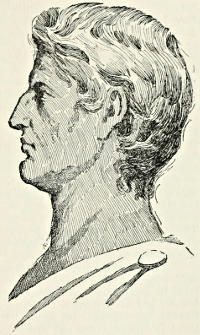
Augustus
(From a cameo)
Though the Jewish nation had more
liberty to manage its domestic concerns
under Roman rule than under the
Herods, it found small relief from the
burden of taxes and customs. The Romans
exacted a property tax (a poll tax
and ground rate), a duty on houses,
market produce, and many other imposts.
The temple tax, on the other
hand (assessed at two drachmæ), was
regarded as a voluntary rate and collected
by priestly officials, the Romans
not concerning themselves about it. A
general census which Augustus caused
to be made by P. Sulpicius Quirinus,
knight and proconsul, after he had taken
possession of the country (about 10 A.D.),
with a view to finding out how much the country could annually yield to
the revenue in proportion to its population, the acreage under cultivation,
and other circumstances, was the first thing that gave deep offence to the
orthodox among the Jews.
The small dominions which Augustus and his family left to be administered
as vassal states by the Herod family—such as the northeastern district
with the old town of Paneas, first ruled by the upright and able Herod
Philip, who expanded Paneas into the great city of Cæsarea (Philippi); and
Galilee and Perea, the heritage of the subtle and greedy tetrarch Antipas,
(commonly called Herod) the fulsome flatterer of the Romans, and founder
of the cities of Sepphoris (Diocæsarea) and Tiberias—were merged into
the Roman world-empire some decades later by the failure of heirs to the
subject dynasty. On a journey to Jerusalem the last-named prince, Antipas,
the Herod of the Gospels, became enamoured of Herodias, the beautiful
wife of his half-brother Philip, herself a member of the Herod family, and
prevailed upon her to leave her husband and bestow her hand upon himself.
This criminal marriage bore evil fruit for the tetrarch. His former wife
fled to her father, the Arab prince of Petra, and urged him on to make war
upon her faithless husband, who allowed himself to be led in all things by
Herodias, and heeded the sullen disaffection of his people as little as the
open rebukes of the preacher of repentance, John the Baptist. In the reign
of Caligula, Antipas was deprived of his kingdom on the indictment of his
cousin and brother-in-law Herod Agrippa, and banished with his wife, Herodias,
to Gaul, where they both died. Under the emperor Claudius, however,
Herod Agrippa, grandson of Herod the Great, who had been brought up at
Rome, again gained dominion over Judea and Samaria, and maintained his
authority for three years (41-44). An adventurer and soldier of fortune,
and a favourite and flatterer of the Cæsars by turns, he was smitten with
a horrible disease while looking on at the games in the circus, shortly after a
persecution of the Christians, and succumbed to it in a few days.
The deserts in the southeast of the province of Syria were inhabited by
free Arab tribes, which from the earliest times had led a roving and predatory
life. Augustus acted as Pompey had done before him; he concluded a
treaty and alliance with Malchus of Petra, the Nabatæan prince and successor
to Aretas, and with the chieftain Iamblichus of Emesa, whose father,
another Iamblichus, had been executed by Antony, guaranteeing to them the
possession of their paternal inheritance on condition that they should ward
off the predatory incursions of the sons of the desert. An attempt made by
Ælius Gallus, governor of Egypt, to subjugate Arabia Felix in the year 24
ended miserably. The glare of the sun and the perils of the climate soon
scared the invaders away and protected the natives from the Roman swords.
The general of the Nabatæan prince, who had conducted the desert campaign,
paid for his supposed treason with his life; but the disloyalty of the servant
was not laid to his master’s charge.
Rome had still an affair of honour to settle with the Parthians; the day
of Carrhæ was not yet requited and the blood of Crassus and his comrades
cried for vengeance. Augustus nevertheless cherished no desire to expose
himself and his legions to the darts of the iron horsemen. In this instance
fortune again proved his ally. Parthia and Armenia, which at that time
stood in intimate relations with one another, were distracted with quarrels
over the succession. Tigranes, son of the unhappy Artavasdes, appealed for
Roman aid against Artaxias, the nominee of the Parthian king. Tiberius
invaded Armenia with an army, and bestowed the throne on the protégé of
Rome, Artaxias having been slain by the natives at the general’s coming
(20 B.C.). This catastrophe filled the Parthian king with apprehensions that
the Romans might declare for the pretender Tiridates, and procure for himself
a like fate with Artaxias. He therefore complied with the demands of
Augustus and restored the Roman ensigns and the prisoners who had been
detained in the far East ever since the disaster of Carrhæ. The emperor
celebrated the restoration of the eagles by a sacrificial feast, as if it had been
a victory, and dedicated a temple to Mars the Avenger.
But Armenia attained to no lasting tranquillity; at one time it was dominated
by Roman influence, at another the Parthians gained the upper hand;
kings were installed and exiled, quarrels for the throne and party feuds
filled the land. Under Nero, the Parthian king Vologeses I set his brother
Tiridates on the throne of Armenia, and thus fanned the embers of war between
the Romans and Parthians to a blaze.
The perfidious Armenians themselves supplied occasions of strife by invoking
the aid of Rome on the one hand to save themselves from falling completely
under the sway of their eastern neighbour, and favouring the Parthians
on the other, lest they should be oppressed by Rome. In local situation and
similarity of manners they were, as Tacitus observes, more closely akin
to the Parthians, with whom they intermarried freely; and were inclined to
servitude by reason of their ignorance of liberty. At this time Domitius
Corbulo won great renown and revived the terror of the Roman arms, even
under the vilest of the emperors. Having restored discipline among the
legions, he victoriously invaded the mountain country, took its principal
towns, Artaxata and Tigranocerta, and set up a certain Tigranes as a Roman
claimant to the throne and a rival to the Parthian pretender (58 B.C.).
Tigranes and his successor, a scion of the Herod family, held their ground
for five years by the aid of Rome; then the Parthians regained the ascendency
and again bestowed the throne on their own candidate Tiridates,
Cæsennius Pætus, Corbulo’s successor, being powerless to prevent this revolution.
But when Corbulo himself advanced once more into Armenia with
his army the Parthians despaired of being able to hold their own in defiance
of Rome. They therefore effected a compromise. In an interview with
Corbulo, Tiridates consented to lay down his royal fillet before the emperor’s
image and to receive it back from his hand at Rome. From that time forward
the peace of the Eastern provinces long remained undisturbed.
In the province of Asia little alteration was made in the existing state
of things, the privileges of certain cities were increased or curtailed according
to the position they had taken up during the civil wars, and restrictions
were imposed on the right of sanctuary of the Ephesian Diana, which had
made the city a harbourage for criminals. The fresh vigour which Augustus
infused into the disordered commonwealth produced a splendid aftermath
of prosperity in the ancient seats of civilisation. Under the sway of order,
that “bounteous daughter of heaven,” the peaceful arts rose to fresh glory,
and in the first century of the empire the province of Asia contained five
hundred populous cities. From the Greek islands the Romans imported
articles of luxury and sensuous enjoyment; Parian and Phrygian marbles
for their gorgeous buildings; the wine of Chios, the sea fish of Rhodes, and
the game of Asia Minor for their epicurean banquets. Ephesus and Apamea
were the marts and emporiums for the produce and artistic productions of
the East. Thence the Roman merchant brought his fine Babylonian tissues,
his Arabian and Persian incense and ointments, his robes of Tyrian purple.
In the island of Cos were made the fine female garments which displayed
rather than concealed the limbs, the “Coan robes” against which Seneca so
vehemently inveighs.
The provinces of Achaia and Macedonia underwent no great change;
they had both long since grown accustomed to the Roman rule, and though
the former (which embraced the territory of ancient Greece up to the Cambunian
and Ceraunian mountains and the islands of the Ægean Sea) had
not, like the latter, renounced all interest in political life, but had sided
with one party or the other in the wars of the Roman despots, the Romans
of those days were too ardent admirers of Greek culture to visit the transgressions
of individuals upon the mother of humane studies as Sulla had
done. Cæsar, Antony, and Augustus forgot with equal magnanimity the
support which Pompey and Brutus had found amongst the fickle Hellenes,
and requited their misdeeds with benefits. Augustus, however, tempered
the full flood of favour which Antony had outpoured upon Athens, by
emancipating the island of Samos, where he had several times made a long
stay. But great as was the consideration extended to Hellas, her vital force
was broken; she had lost the capacity of rising to healthy political life.
Augustus devoted the closest attention to his adoptive father’s Celtic
conquests and his own acquisitions on the Nile. The wide region of Gaul,
on the far side of the Alps, received its first stable provincial organisation at
his hands. Cæsar, its conqueror, had not had time to secure and consolidate
what his sword had won by a permanent organisation; the old system
of local divisions was still in force, taxation was unequal and arbitrary.
Augustus put an end to this lax condition of things; in an assembly of the
most distinguished chiefs and elders at Narbo he defined afresh the divisions
of the country, and at the same time undertook a census of the inhabitants
and their landed property, with a view to a more equitable distribution of
the public burdens.
Three new provinces were added to the old provincial territory, which last
bore from that time forth the name of Narbonensian Gaul. They were Aquitania,
from the Pyrenees and Cevennes to the Loire; Gallia Lugdunensis, between
the Loire, Seine, and Marne, and extending to Lugdunum on the east; and
Belgica, the great northern tract, in which the Sequani and Helvetii were
also included. The new towns of the Rhone—Vienna, Lugdunum, Augustodunum
(Autun), and Burdigala (Bordeaux)—soon vied with the old
province in wealth, commercial activity, and culture, with Massilia, Nemausus,
Arelate, and Narbo. Lugdunum (Lyons), whither the military roads
led from every side, rose to great importance. At the point where the
Araris (Saone) mingles with the Rhodanus the Gallic tribes erected a magnificent
memorial and temple to the emperor Augustus, and the anniversary of
its dedication was thenceforth kept as a national holiday, with musical and
gymnastic entertainments.
In the north, Augusta Trevirorum (Trèves) became the centre of Roman
civilisation; under the benediction of peace agriculture, industry, and prosperity
arose on all sides. The country on the left bank of the Rhine, inhabited
for the most part by German tribes, was placed under a separate military
administration under the name of Upper and Lower Germania. To guard
the Rhenish frontier from the warlike Germans, strong permanent camps
and bulwarks were erected along the river, and the army of occupation
was gradually raised to eight legions. Then began the building of cities on
the banks of the beautiful frontier river. Cologne was specially favoured by
exemption from taxes and other privileges.
Augustus devoted the same care and circumspection to the ordering of
his possessions beyond the Mediterranean. The territory of Carthage and
the kingdom of Numidia, formerly divided into two proconsulates, were now
united to form the province of “Africa.” This was bordered on the west
by the independent kingdom of Mauretania, which Augustus after some
hesitation bestowed upon Juba, a loyal and devoted subject prince, till the
time came for its incorporation into the world-empire in the reign of Claudius.
To the east of the great Syrtis the fertile region of Cyrene stretched
right to the borders of Egypt, and was combined with Crete to form a second
province.
If Augustus left these two provinces to be administered by the senate,
he kept his own grasp all the more firmly upon the province of Egypt, which
extended from the oasis of the desert to the Arabian Gulf, and from the river
delta to the rocky mountains of Syene. A military advanced post in Ethiopia
was withdrawn at a later time, for it was no part of Augustus’ scheme
to enlarge the borders of the empire. The emperor regarded Egypt as his
own special domain and watched over it jealously. No senator was allowed
to travel through the country without his express permission; the administration
and the supreme command of a very considerable army of occupation
were in the hands of a trustworthy man who possessed his full confidence.
The care which Augustus bestowed upon agriculture, irrigation, and trade
was well repaid by the fertility of the country and its advantageous situation.
In the first period of Roman dominion Egypt attained a height of
prosperity which threw the years of the Pharaohs and Ptolemies into the
shade.
Egypt not only became the granary of the hungry populace of the capital,
but its fine garments of linen and cotton were highly prized commodities,
even as they had been in the remote past; while the passion for scribbling
which possessed the Romans made the papyrus leaf an important article of
export. Moreover Alexandria was the emporium and mart for both Indian
and Arabian wares, for delicate fabrics of cotton, from the ordinary calico to
the most valuable tissues which constituted the costliest dress of Roman
women and were even the chosen wear of effeminate men. These last were
called Seric robes, and were made from a product of the silkworm, the
genesis and local habitation of which was shrouded in mysterious obscurity
all through antique times.
More than a hundred Roman merchantmen sailed yearly from the Red
Sea to the west coast of India and the Persian Gulf, to procure in their
native places the treasures of the tropics and the costly wares of eastern
lands and seas—spices and drugs, incense and myrrh, odorous ointments
and dyestuffs, ivory, precious stones, pearls, and other articles of luxury—to
sell at a great profit in Rome and Baiæ and the splendid seats of the
nobility. The Seric (Chinese), Indian, and Arabian commodities which
annually found their way through Alexandria to Italy are said to have
amounted in value to over £1,440,000 or $7,200,000. But this great prosperity
redounded less to the advantage of the natives than of the ruling
race.
The oppressive system of taxation introduced by the Ptolemies was still
in force, and became so intolerable in course of time that the people repeatedly
had desperate recourse to violent remedies, thus merely increasing
their own misery and helping the province forward on the road to poverty,
decay, and desolation. The succeeding emperors were constantly under the
necessity of carrying on campaigns in the Nile region, on account of the mischief
done by the bucoles or cattle-herds, those numerous robber bands
which dwelt in the impenetrable reed-swamps on the middle arm of the Nile,
keeping their women and children safe on small barges and themselves
undertaking hostile raids on the neighbouring districts, in defiance of all
forms of civil order.
In all this regulation and organisation we can plainly trace the plan of a
sagacious ruler, who intended to put an end to the lax conditions that prevailed
under the republic, with its exactions and arbitrary dealings, to check
offences against property, and to mould the state into a durable monarchical
form. What Cæsar had begun in times of violent agitation and party
strife, his more fortunate successor accomplished on a magnificent scale under
more peaceful circumstances. Protected from oppression and ill treatment
by laws and ordinances, the provinces rose to renewed prosperity; many of
them like Gaul, Spain, and the Alpine tribes now entered for the first time
upon a political and civilised existence worthy of the name.
The Hellenic states could not struggle to the height of their former
greatness under the iron hand of Rome, but the fault lay chiefly in the
weakness they had brought upon themselves before the days of Roman
supremacy by their suicidal fury. Their part in history was played out,
and they slowly perished of the wounds inflicted by their own hands. “It
was beyond the power of Rome to renew the youth and creative energy of
intellect in the Greek races,” says Hœck, “but what she had to give she
gave. She preserved Anterior Asia from the worst of fates, that of falling
a prey to the eastern barbarians; she saved the aftermath of Hellenic culture,
and procured for this nation, as for others, a pleasant private life in the
evening of its ancient historic existence.”
By judicious regulation and admirable administration the monarchy
healed the wounds which the free commonwealth had inflicted upon the
subject countries. “The time was gone by when the right of the victor
brought an endless train of the vanquished to the capital and when Rome took
for her own the most glorious works of foreign art, the creations of a nobler age
and race.” The requisitions and imposts were not small, the land tax and
property tax, the poll tax and other subsidies, levied from the provincials in
the senatorial provinces by quæstors for the ærarium or state treasury, in the
Cæsarian provinces by procurators for the imperial privy purse and military
exchequer. Under the empire as under the republic the mines and the
port and frontier duties were claimed by the government. And the obligation
of military service was occasionally burdensome. Yet all these drawbacks
were far more than counterbalanced by the state of order and equity
which Augustus endeavoured to establish in all parts. The proconsuls and
procurators were appointed either by the absolute authority of the emperor
or with the concurrence of the senate, were responsible to the former for
their conduct in office, and had fixed salaries and allowances for equipment
and travelling expenses.
The orderly business departments opposed a barrier against encroachments
and arbitrary dealings on the part of governors or their legates and
minor officers, and provided the appeal to the imperial tribunal as a protective
measure. The civil and military supremacy of the emperor kept provincial
officials within bounds. It became customary to commute payments
in kind (tenths of grain, fifths of the vintage and oil harvest) into payments
in money based on average prices and a moderate estimate; the burden
of military service and taxation was mitigated by means of the exemption
accorded to particular districts and communities, by security from devastating
wars and hostile incursions, and by the fact that the leading positions
and military honours were open to all.
Augustus laid the foundation of the great system of roads, which connected
the provinces with one another and with imperial Rome. Military
roads, the construction and extent of which fill us with admiration to this
day, gave facilities for traffic in all directions. They were adorned with
milestones, all of which took their start from the golden milestone which
Augustus himself had set up in the midst of the Forum, and provided with
stations (mutationes) and hostelries (mansiones), the former for changes of
couriers or horses and conveyances,—for the military roads were also used
for the state post organised by the emperor,—the latter for accommodation
at night. Means of transit by water were also increased, and distance
ceased to form a gulf of separation. Armies could move with great rapidity
from any part of the empire to any destination, and the emperor’s commands
could be transmitted to the remotest regions. Daily journals carried the
news of what occurred at Rome in the briefest possible time to all quarters
of the world; Rome was the centre of the empire and the heart of the
body politic.
The careful scheme of colonisation which Augustus undertook after the
example of Cæsar and carried out on an immense scale, and which was also
pursued by succeeding emperors, contributed above all things to disseminate
Roman culture, speech, and jurisprudence, and to impress a uniform character
upon the whole of the great empire. The results of imperial colonisation
were in the highest degree beneficial. For while in barbarous lands
they sowed in virgin soil the seeds of a noble civilisation and a workable
system of law and political organisation, they infused fresh vigour into old
and moribund civilisations and furnished them with stable political and
judicial institutions; thus supplying the men of the toga who were dispersed
all over the whole empire with a centre and fulcrum for their commercial
and industrial activity. At the same time they offered the emperor
the most satisfactory means of providing for his discharged legionaries and
establishing settlements of impoverished Romans and Italians.
To add a greater attraction to this emigration beyond sea the colonies
were as a rule endowed with the full rights of Roman citizenship, and rendered
capable of a free and dignified political existence. They were exempted
from the jurisdiction of the local governor, they elected their own
town council and magistrates in common assembly, their suits were decided
according to Roman law, and in short the colony was a Rome in miniature,
a daughter plantation, where the language, religion, customs, and social
habits of the mother city grew up in wholesome soil, and the various elements
of the population united under the ægis of equality of political and
civil rights to form a single municipal community.
If the foreign element preponderated in any provincial town, or if, for
other reasons, it was undesirable or impracticable to rank it among Roman
colonial cities, it was admitted to the status of a municipium. These latter
possessed the rights of Roman citizenship and were assigned to a tribus like
the colonies, but they differed from them in their municipal and magisterial
system and sought justice according to their local laws and legal formulæ
and not according to Roman institutions. They were free cities in which
few Romans lived, if any. As a rule their constitution was based on that
of the Italian municipal organisation. In every province there were municipia
of this character, and in organising them local tradition was treated
with the utmost consideration. They promoted the civilisation of the natives,
disposed them favourably towards Roman institutions, and familiarised
them with Roman life.
Everywhere imperial Rome was sedulous to transmit to the provinces
the organisation, constitution, and legal system which had been perfected in
Italy through the course of centuries, and to gain over the various communities
by granting them a privileged position before the law, exempting
them from the jurisdiction of the local governor, or lightening the burden
of taxation. In Spain, Gaul, and other less civilised countries she endeavoured
to bind the several communities to their allegiance to Rome by enrolling
them among the municipia, or exempting them from the land tax by
the bestowal of the jus Italicum, or by admitting them under the “Latin
law” which insured to the communal magistrates the honorary freedom of
the dominant city and conferred on such communities the rights of ownership
over the soil, freedom of commerce and autonomous municipal administration.
On the other hand, the Greek cities in Hellas, which prized highly
the glorious names of liberty and autonomy even after they had long become
empty sounds, were won over by being elevated to the rank of “free
cities,” a distinction flattering to their national vanity, which privileged
them to manage their own municipal affairs, to elect their own magistrates,
and to maintain their national laws and judicial procedure, while it
relieved them of the burden of maintaining garrisons and having soldiers
billeted upon them and secured to them the right of coinage and the ownership
of the soil.
Thus were the provinces compassed about with a network of varying
conditions, which linked them to Rome by every kind of tie. Even if the
old policy of “divide et impera” lay at the bottom of this diversity of legal
status, better conditions being held out as the reward of loyalty, devotion,
and service to the supreme government, as a means of attaching the influential
and ambitious to the Roman interest, yet this provincial organisation
was a logical outcome of the political and juridical system developed under
the republic.
The Roman government did not aim at uniformity or centralisation.
Augustus and his immediate successors merely transferred to their provincial
dominions the typical organisation evolved by the senate for the races and
communities of Italy, and the relations of the various communities with
Rome were ordered according to their conduct and loyalty by contracts and
concessions. Every grade of political rank was represented, from the full
rights of Roman citizenship in the colonies and municipia to the Italian and
Latin law of the emancipated communes and the status of the subject cities,
which last were under the jurisdiction of the local governor in all public
affairs, whether administrative or judicial. Even these retained a shadow
of self-government and independence in the right of electing their civic
magistrates, subject to certain restrictions, in the unhindered continuance
of religious and communal associations, and the ownership of municipal
property.
Thus in all parts of the provinces we come upon evidences of revived
prosperity, a well-ordered state of things in legal matters, and a society
animated by interests of commerce, industry, and art. Where writers are
mute, the splendid monuments of architecture, the remains of temples and
public halls, theatres and amphitheatres, baths and aqueducts, bear witness
with no uncertain voice.
It was otherwise in the capital and in Italy. Here also the monarchy
succeeded to the heritage of the republic, but found a condition of social
disorder past remedy. Agrarian distress and conflict, which had been at
work since the days of the Gracchi, consumed the vigour, prosperity, and
vital spirits of the races of middle and lower Italy. The civil wars with
their proscriptions and confiscations, the settlement of brutalised soldiers,
unfit for agriculture and the labours of peace, in the most beautiful and
fertile regions, the cultivation of the fields by hordes of slaves, and the
absorption of large districts into private estates or latifundia, had almost annihilated
the free peasant class of earlier times and had filled the peninsula
with an alien population, bound to the soil by no ties of affection or association,
linked by no natural piety to the paternal roof or the inherited acres.
The honest, industrious, and thrifty peasantry of primitive times had
vanished, the ownership of the soil had passed, in part, into the hands of the
rich, who transformed the arable land into parks and gardens, groves and
fish-ponds, for the adornment of their country-seats, or who, from greed of
gain, used them as pasture for their flocks and herds, or as vineyards and
olive gardens, with a view to the trade in wool, wine, or oil; in part, they
had been assigned to veterans as a recompense for military service. In the
places where free peasant families had led a quiet life in numerous villages
and homesteads, and had cultivated their cornfields with assiduous industry,
might now be seen the dungeon-like lodgings of purchased slaves or the half-ruinous
dwellings of foreign legionaries, who reluctantly and sullenly
applied themselves to unfamiliar labours and cares.
To add to the general wretchedness, numerous robber bands infested the
country, and constituted a danger to liberty, life, and property. In the fair
and fruitful valley of the Po alone, but recently incorporated into the Roman
body politic, prosperity and security prevailed
amidst settled conditions, and trade and industry
flourished in populous cities.
Patavium, Cremona, Placentia,
and Parma provided Italy with
woollen cloth and carpets, and supplied
the army with salt meat.
The state of things in the capital was
no more satisfactory. More than half of
the inhabitants—estimated at this time at about
two millions—belonged to the slave class, and were
dispersed in the houses and villas of the wealthy,
where they performed the various offices indispensable
in a great household. These included not
merely the tasks and services which fall to the
share of domestics and menials among ourselves,
but such functions as in modern times are left to
artisans; such as the making of clothes, the preparation
of food-stuffs, building, and the manufacture
of household utensils. This multitude of
slaves ministered to the luxury and ease of the
senatorial or knightly families. The number of
the latter can at no time have amounted to more
than ten thousand, and many of them, in all likelihood,
did not possess much more than the fortune
required by law—1,200,000 sesterces [£6,912 or
$34,560] for a senator, and the third part of this
sum for a member of the knightly class.
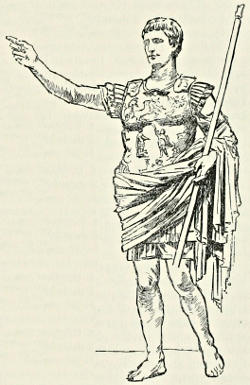
Statue of Augustus in the Vatican
The whole body of the population then remaining
(some 1,200,000 souls) consisted of the
free inhabitants of the metropolis, most of whom
lived from hand to mouth without any definite means of support. Of these
a large proportion were aliens and freedmen. Almost the only occupations
open to them were retail trading and traffic in the necessaries of daily life,
or posts as subordinate clerks and officials; for most trades and manufactures
were carried on by slaves for their masters’ profit, while wholesale
trade and financial affairs were almost entirely in the hands of knights and
revenue farmers, who frequently took up their abode in the large provincial
cities for this purpose. Consequently, great as were the riches which
poured into the metropolis every year from all quarters under heaven, there
was no well-to-do middle class, the groundwork of every healthy political
society; the influx of wealth only increased the luxuries and enjoyments
of the aristocratic class, the gulf between the senatorial and knightly nobility
and the populace of the capital was nowhere bridged over, nor was
there any transition or compromise between the palaces of ostentatious and
gormandising luxury and the hovels of the poverty-stricken and starving
masses.
The dying republic had suffered under this incongruity, and whatever
efforts Augustus might make to mitigate the evil, it was too deep-seated to
be radically cured. The number of citizens who had to be maintained by
regular donations of provisions from the public storehouses and by charitable
gifts amounted to half a million, and yet this aid was but an inadequate
makeshift; many of those disqualified to receive it were in no better
case. There were thousands of free Romans who had no shelter but the
public halls and colonnades of the temples, whose hopes were set upon the luck
of the next minute, whose cares did not extend beyond the coming morrow.
The distress was the less capable of remedy because, under the most
galling circumstances, the free Roman cherished the proud consciousness
that he was a member of the ruling race, and was withheld by his innate
pride of nationality and hereditary prejudice from the humble tasks which
furnished the alien, the freedman, and the slave with a tolerable livelihood
and occasionally with wealth. He felt it less disgraceful to starve or live
upon alms and gifts than to labour with his hands; he scorned the physical
toils of agriculture and handicraft, and the trouble of serving another; but
he had no scruples about begging for his living, and regarded the distributions
of corn and the popular entertainments as no more than his due.
The free beggar looked haughtily upon the bedizened slave, whose alms he
took as he would have taken the fruit of the woodland tree or the draught
from a spring. The easy life of the capital attracted needy and indolent
persons from all parts of Italy to Rome, the city swarmed with beggars and
vagrants, with idlers and proletarians, who all claimed their maintenance
from the state.
Augustus, like Cæsar before him, strove to remedy these evils to the
best of his power. To reduce the hungry rabble in the capital he devised
methods of emigration to the colonies and established settlements on property
purchased out of the public funds; he restricted the number of recipients
of corn by a careful scrutiny of the material circumstances of the
applicants and by the exclusion of all aliens, non-citizens, and abusers of
the public bounty. But all these restrictions were palliatives merely; the
sources of misery were not stopped. The provisioning of the capital with
cheap corn was one of the most onerous duties of the government. That he
might more directly control the regular supply from the “grain provinces”
of Sicily, Africa, and Egypt, Augustus caused the office of “cereal prefect,”
which Pompey had once held, to be conferred upon himself, and then
appointed a permanent bureau to manage and superintend the importation of
corn, the markets, and the public storehouses from which the indigent populace
monthly drew their fixed allowance on presentation of a counter. In
times of scarcity and want, such as not unfrequently occurred, the distributions
were made on a larger scale, and every joyful or propitious event was
a welcome opportunity for the emperor to purchase the favour of the populace
with gifts and pecuniary donations.
Augustus devoted the same attention to other parts of the Italian
peninsula. He endeavoured to recover waste districts for agriculture and
industry by establishing settlements, and made use of rewards and privileges
as inducements and incitements to energy. He cleared the country of
robber bands by squadrons and armed watchmen, protected the coast towns
from pirates, and by a careful examination of slave-tenements (ergastula)
set at liberty all freeborn persons who had been kidnapped and sold into
slavery by these roving gangs. With the establishment of the monarchy,
Italy, like the provinces, entered upon a new life, and there also the restoration
of security and order brought vigour and prosperity into being. The
twenty-eight colonies which Augustus peopled, partly with veterans, and
partly with Roman and Italian settlers of the poorer class, were furnished
with a suitable legal and political status. Their municipal constitution was
modelled on that of Rome, and served in its turn as a model for the other
municipia and prefectures of the peninsula. Beside their local rights of
citizenship they all possessed the civitas or freedom of Rome; they all had
the right of electing their officers and chief magistrates (decuriones) in the
assembly of the people, the autonomous administration of communal property,
freedom of worship according to their hereditary ritual and solemnities,
and their own judicature according to Roman law; and any burgess removing
to Rome ranked in all things on the same footing as the old freemen of
the capital. The differences of legal status which at first prevailed gradually
disappeared under the empire; all provincial towns occupied the same
relative position towards the capital, and approximated to each other by
degrees in their individual organisation and administration.
Everywhere we come upon a college of decuriones or civic magistrates,—composed
of a greater or lesser number of members elected from among the
wealthiest citizens or supplemented from the government departments of the
city,—which gradually absorbed all authority and constituted the supreme
governing body of the municipium, under the presidency of two or four chief
magistrates (duumviri or quatuorviri). In the prefecture cities the control
of the administration and judicature was vested in a prefect annually appointed
by Rome, under whom a number of elective municipal officers managed
the current affairs of the city. The magistracies of all provincial towns
were modelled, both as to titles and departments, upon those of the capital.
The heads of the decuriones exercised jointly the functions of consuls and
prætors, and were attended in public by lictors with fasces; the public revenue
and expenditure was controlled by quæstors, ædiles superintended the
markets and retail trades and were responsible for the town police; censors
kept the lists of burgesses and the census records. In questions of criminal
law, however, the decisive sentence was usually pronounced at Rome.
The imperial court of appeal was the court of highest instance for the
whole empire. In upper Italy, which Cæsar had been the first to transfer
from the position of a province to that of an integral part of the Roman
state and jurisdiction, the administration of justice in civil affairs—left
in older municipalities to the municipal courts—was subject to considerable
restriction.
The rigid rule of the monarchy and the exact organisation and strict
supervision of the municipal authorities obviated the danger of revolts and
serious disturbances among the populace, and Italy (the capital and its
vicinity only excepted) was clear of garrisons. The naval forces stationed
at Ravenna and Misenum served to protect the coast and maritime towns,
and in the hour of danger a sufficient army could always be summoned from
Dalmatia and Pannonia. The imperial guard of prætorians (of which three
cohorts consisting of one thousand men apiece were quartered in Rome, and
the other six in the neighbouring towns) was mainly composed of Italians.
It shared with a German and Batavian troop of horse the duty of guarding
the palace and the sacred person of the monarch.
It is in the nature of every monarchical system of government to bring
all conditions into congruity, to smooth over the diversities which prevail
among its subjects, and to impress the stamp of uniformity upon the whole
state. This was the case in the organisation of both provinces and municipalities,
for in spite of modifications of legal status they were all cut upon
the same pattern and organised according to definite classes. The same
thing took place in financial affairs and taxation. During the republican
period Rome and Italy had enjoyed a privileged position, and foreign countries
had been exploited for the advantage of the dominant race. The principate,
on the contrary, endeavoured to bring about an equalisation of duties
and contributions as well as of privileges. The customs dues, which formerly
applied only to subject countries, were extended to Italy under the monarchy,
part of the proceeds being allotted to the public revenue and part to the
Italian municipalities; the property tax, from which Italy had been exempt
in the later days of the republic, was likewise introduced throughout the
empire on the basis of the census or rating of property; an excise duty was
levied for the fiscus (imperial privy purse) upon all articles imported into
Italy for sale, amounting to one per cent. of the price, and two or even four
per cent. in the case of slaves; the twentieth part of every inheritance which
did not fall by right to the next of kin had to be paid into the military treasury,
and a tax was imposed on the manumission of slaves.
If the revenues of the state were increased by these means under the
empire the improvement was mainly due to sounder financial administration,
to the abolition of revenue farming for the regular land tax and property
tax in subject countries, and to the strict control exercised over the
tax-gatherers; and according to Gibbon’s estimate the annual revenue secured
must have amounted to at least fifteen to twenty million pounds
sterling [$75,000,000 to $100,000,000]. Even if five million pounds were
spent on the army and navy, if the distributions of corn to the poor of the
city swallowed a few millions more, and the salaries of the imperial officials
in Rome and the provinces and the police expenditure disposed of no
inconsiderable sum, the surplus was none the less sufficient to provide for
the erection of magnificent buildings, to cover the empire with a network of
highroads, to satisfy the popular love of spectacles by gorgeous entertainments,
and to rejoice the hearts of citizens and soldiers with gifts and feasts.
The public buildings and pleasure grounds, the splendid private houses
and villas, with which the republic had begun to adorn the capital and its
environs, grew from year to year, and became ever vaster and more elaborate.
The Forum of Augustus, with the temple of Mars the Avenger, the
sanctuary of Jupiter Tonans on the lower slope of the Capitoline Hill, the
white marble temple of Apollo on the Palatine, the temple of Quirinus on
the Quirinal Hill, and others of the same character, were among the most
splendid edifices in the city. Magnificent colonnades perpetuated the
names of the wife, sister, and grandsons of Augustus; the number of temples
restored by him is estimated at eighty-two.
The imperator’s example was imitated by his wealthy and powerful
friends; Agrippa, whose services to the health and cleanliness of the city in
the construction of the huge vaulted sewers (cloaca) have already been
mentioned, perpetuated his name by a succession of magnificent gardens for
the use and embellishment of Rome. He had two new aqueducts constructed,
and he repaired the older ones that had fallen into decay; so that
no town in the world had such an abundant supply of pure spring-water as
ancient Rome, an advantage which the city enjoys to this day. He completed
and adorned the Septa Julia which Cæsar had begun on the Field of Mars,
for public assemblies and entertainments, and surrounded the space with
three colossal and splendid edifices—the portico of Neptune, the Baths,
and the Pantheon, the magnificent circular building in honour of Jupiter
the Avenger and of Venus and Mars, the ancestors of the Julian family.
Beams of bronze supported the domed roof with its gilded tiles, the walls
and floor were lined and paved with marble. Even now
the church of S. Maria Rotunda is among the most remarkable
buildings of the city. The Diribitorium—the most
spacious building ever constructed under
one roof—where the populace received
their corn allowance and voting tablets and
the soldiery their pay, was the work of
Agrippa.
Such was the constitution of the world-wide
empire over which Augustus ruled as
an absolute monarch with unlimited powers
for forty-four years after the day of Actium.
The frontier provinces were protected by
standing armies, the members of which,
collected from all countries and nationalities,
had forsworn their native land and
national spirit, and obeyed no orders but
those of their military lord; the coasts
were guarded by a well-manned fleet. On
the Rhine eight legions (each consisting
of 6100 foot and 726 horse) quartered in
permanent camps, formed a strong bulwark
against the Germans and kept Gaul under
control; Spain was garrisoned by three
legions; two were quartered in Africa,
and an equal number watched over the
safety of Egypt. Four legions maintained
the supremacy of Rome in Syria and on
the Euphrates; the Danubian provinces
were guarded by six legions distributed
through Mœsia, Pannonia, and Dalmatia.
The eastern frontier being thus sufficiently
protected by an army of occupation of
50,000 men, the banks of the Danube by
a similar force of 70,000, and the Rhine district by 100,000; the fleets
stationed in the harbours of Misenum, Ravenna, Forum Julii (Fréjus) and
elsewhere kept the islands and maritime states under control and insured
protection and security for commerce and traffic.
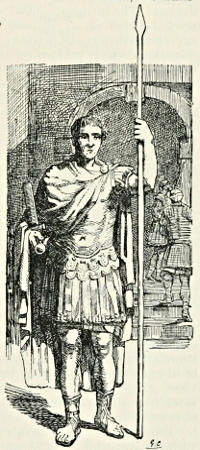
Roman Emperor in the Dress of a General
(Based on De Montfaucon)
A regular system of tolls and taxes brought the public revenue into
good condition and filled the ærarium and fiscus; a vigilant police force and
fire brigade, which Augustus distributed through the fourteen divisions of
the capital, maintained tranquillity and order, protected life and property
from evil-disposed and malicious persons, and curbed the outbreak of savage
passions. Huge aqueducts, solidly constructed roads, stately buildings,
temples and halls, aroused the admiration of contemporaries as of posterity.
On the Field of Mars there arose a new and splendid city, composed of temples
and halls, of public buildings for government purposes and for the
amusements of the people, which excelled the glory of the City of the Seven
Hills, “unique in character, unsurpassed in ancient or modern times,” so
that Augustus could boast that he had found a city of brick and should
leave a city of marble. In the provinces the improved government and
administration of justice bred a condition of wealth and outward prosperity.
But with all these advantages imperial Rome suffered from grave moral
defects. The love of liberty, the common patriotic sentiment, the vigour, and
martial virtue of the republican period, were gone; in ease, tranquillity,
and enervating pleasure, the arm of the citizen grew feeble, and the self-respect
and manly pride of earlier days degenerated into servility and grovelling
adulation. The city swarmed with foreign soldiers of fortune and with
enriched freedmen. The old seats of culture in the East sent forth not
scholars and artists only, but ministers of luxury, gluttony, and voluptuousness.
Together with a few wholesome elements, all the evils and defects of
human society flowed together here and preyed upon the scanty remnant
of the old Roman morality and virtue. Rome became the meeting place of
all nations on the face of the earth. Interest in public affairs grew steadily
feebler since the offices and dignities had become empty honours void of
power. The senators had often to be constrained by penalties to attend the
sessions of the senate, although the latter had been reduced to two principal
meetings a month; the office of ædile was shunned as a burden until the
state took it upon itself to defray the cost of the public entertainments;
candidates for the tribunate had often to be put forward by the emperor.
The citizens were not ashamed to enrol themselves in the list of paupers
and to share in the public distributions of corn and alms; nay, rather than
apply themselves to any honest calling, many Romans, especially of the
knightly class, preferred to take service for board and wages with the purveyors
of gladiatorial combats, and to hazard their lives in a brutal popular
amusement which gained ground steadily from that time forward, exercising
an effect all the more demoralising on the minds of men, and rousing and
stimulating their licentious instincts all the more keenly because the verdict
of life or death was given by the humour of the crowd, at whose signal the
victor spared or transfixed his prostrate opponent; a right of appeal even
more inhuman than the old custom that the duel should end with the death
of one of the combatants.
The degeneration of morals and the decay of domestic virtue kept pace
with the passion for brutal spectacles. Strenuously as the emperor strove
to raise the standard of family life and to curb immoderate expenditure on
dress and food and the growing license of women by sumptuary and moral
edicts, to enforce legal marriage and the procreation of legitimate offspring
as a duty and honour by legal ordinances and curtailment of privileges, to
render divorce difficult and to check the rampant vice of adultery, the state
of indolent celibacy and the excesses of both sexes in connection with it
spread more and more, in the upper classes out of liking for a licentious life
and forbidden pleasures, in the lower from poverty and laziness. The corruption
of morals, checked but ineffectually by Augustus, made rapid strides
after his death; above all, when the rulers themselves tore away the veil
which still shrouded shameful living under the first principate. But even
Augustus could never disclaim his origin from Venus Aphrodite, the ancestress
of the family of Julius.b
[30 B.C.]
The day of Egyptian independence was over as a matter of course.
Cæsar needed the country, with its corn and its riches, for his scheme of
reorganisation.
The city of Rome capitulated to the grain fleet of the Nile and sold
her ancient liberty for a supply of daily bread, and the price at least was
paid her. By the Cæsar Egypt had been conquered and under the rule
of the Cæsar she remained, like all countries which Cæsar was the first to
unite with the Roman Empire.
It is obvious that a conquered province cannot at once be placed on
exactly the same footing as older parts of the empire; a transition period
is almost always necessary; but Egypt never took quite the same position
as other subject countries. Before the partition of the empire into senatorial
and imperial provinces was effected, Egypt had come to occupy a unique
position with regard to the emperor; and after the partition the ties which
bound it to him became even closer. Among the imperial provinces there
was none more intimately related to the emperor than this, which surpassed
all others in importance. Egypt was of much the same consequence to the
Roman Empire as India is to the England of to-day.
The wise yet strict government of a foreign power may be a blessing to
any country in comparison with the tyranny and extravagance of its native
sultans; but the foreign rulers profit even more by it, and are therefore
always striving to keep the rich country, with a population ignorant alike
of war and politics, in a state of political tutelage, to perpetuate the gulf
between the dominant and subject races, and to render all interference on
the part of rivals impossible. In a word, they keep their most important
province as the apple of their eye.
Nature and history assuredly conspired to give the country an exceptional
position. Without being an island it possessed the advantages of an
insular position; for it was bounded on two sides by the sea and on the
other two by the desert or barbarous tribes whose raids and predatory incursions
might incommode the province but could never become a menace to
the existence of the empire. Thus the Egyptians could hardly be drawn
into the political broils of the continent so long as they confined themselves
within their natural frontiers; and for this reason the third Ptolemy Euergetes
acted wisely when of his own free will he restored his conquests to
Seleucus king of Syria. His military situation had nothing to lose by such
a step, for Egypt proper was easy to defend and difficult to attack, and was
accessible to a land force only by way of Pelusium. On the other hand any
power that established itself in the country found there such an abundance
of resources as was offered by hardly any other country of ancient times.
The fecundity of Egypt has passed into a proverb; even in a season of
moderate harvests great quantities of corn could be exported every year,
and after the country had been conquered by the Romans the grain tribute
of Egypt was absolutely necessary for the sustenance of the capital. Whoever
held Egypt could procure a famine in Rome and Italy at his pleasure;
and for that reason pretenders of later times always secured Egypt first and
then Italy. The wealth of the country was increased by commerce and
trade, and it was therefore densely populated, even more so than at the
present day.
The abundant resources of the fertile valley of the Nile were united
and almost doubled by a homogeneous and strictly centralised administrative
body; Egypt was ruled by a scribbling bureaucracy of a kind up to that
time unknown to the ancient world; and its inhabitants, though wholly unaccustomed
to arms by long disuse, were none the less hard to rule. A
great proportion of the fertile land was the private property of the prince,
as it has been down to our own times; but this very proprietorship, coupled
with the excitable temper of the populace of a great city like Alexandria,
placed great obstacles in the way of regular government, and would have
rendered it absolutely impossible had not a military been quartered in the
country in sufficient strength to maintain order. The presence of several
legions in Egypt was in itself enough to give the Cæsar reason for excluding
senatorial government; and the Cæsars always strove with jealous care to
keep men of the senatorial class away from Egypt, because the consequences
of an attempt at rebellion there might well have been most serious.
Cæsar the dictator had in his time been confronted with the question as
to whether he should permit the continuance of the independence of Egypt,
already forfeit in fact; and the motive that finally made him decide in its
favour (apart from his love for Cleopatra) was that the most formidable
rival to Rome there would be her own representative. The reasons that led
the dictator to maintain the political existence of Egypt likewise induced his
son to maintain the old state of things under certain limitations. As a ruler
and organiser the latter is distinguished by his regard for historic continuity.
[30 B.C.-14 A.D.]
Now in Egypt, with its fertile soil and dense population, a strong monarchic
government is in a manner prescribed by the character and history of the
country; as is demonstrated by the whole course of its development from
the earliest beginnings of human civilisation down to the present day.
Cæsar therefore desired to make no more alteration in the peculiar and intricate
conditions of Egypt than was absolutely necessary, and to leave the rest
as it was. The Cæsar merely stepped into the place of the kings of the
Ptolemaic dynasty, and thus brought Egypt into connection with Rome by a
kind of personal union.
The most important change was that the sovereign no longer resided at
Alexandria but at Rome, and that the great offices of the Egyptian court,
the chief master of the ceremonies, the grand master of the household, and the
chief forester, were not filled by fresh appointments; though the scholars
of the famous Museum of Alexandria enjoyed the same patronage and
encouragement as before. At the head of this richly endowed institution
was a priest, formerly appointed by the king and in future to be
appointed by the Cæsar. The latter regarded himself as in every respect
the successor of the Ptolemies, and caused the Egyptian priests to do him
honour with the very ceremonial that had grown up under his predecessors.
It is true that the Roman emperors did not habitually reside in Alexandria,
but their viceroys had to assist at all the religious rites in which the Ptolemies
had formerly taken part, for the new ruler was wise enough to introduce
no alteration whatever in matters of religion. The ancient gods of
Egypt, which had survived the dominion of the Greeks, continued to exist
as before, in peaceful association with the gods of Greece. The Egyptian
gods were naturally wroth at the fall of the monarchy; their statues turned
a gloomy gaze upon their worshippers, Apis bellowed hideously and even
shed tears. But Cæsar was not disconcerted; he did indeed decline in his
own person to visit the Apis of Memphis on his journey through Egypt, but
he did not put the least hindrance in the way of his worship by the Egyptians,
still less did he dream of starting a propaganda in Egypt on behalf of
the state religion of Rome.
The position of the various classes of the population also remained what
it had become in the course of historic development. The native Egyptians,
the original lords of the soil, remained in the subjection to which they had
been reduced by the conquests of the Persians and Macedonians; they constituted
the population of the country districts and country towns, and had
neither political organisation nor political rights. The foreign conqueror
naturally had no inducement to give the vanquished rights that had been
denied them by their own kings. Egypt was to be a province absolutely
dependent upon himself, and that would have been impossible if the Roman
element in Egypt had grown so strong and had so far intermingled with the
natives that the sovereign was forced to take it into account. The Egyptian
proper was therefore on principle precluded from acquiring the rights of
Roman citizenship. For example, an Egyptian of ancient days could no
more act on a Roman jury than a Bedouin could nowadays be elected to the
English parliament. In later times this prohibition was occasionally evaded
by first conferring the freedom of Alexandria upon the native and then
admitting him to Roman citizenship as an Alexandrian. On the other hand
the material condition of the Egyptian population improved under the judicious
rule of the Cæsars.
The mechanism of government, administration, and taxation had been
admirably organised through centuries of practice; it naturally discharged
its functions as well under the new sovereign as under the old, and consequently
became the type of the technics of imperial administration. In this
respect the republic had left the empire much to do. The Romans were the
first to appoint officers in the level land who had more to do than collect
the taxes. Their epistrateges of upper, lower, and middle Egypt, their nomarchs
and ethnarchs, had of course only a circumscribed sphere of action, but
they saw to the maintenance of law and order and probably decided simple
lawsuits among the natives.
Among the Egyptians, unlike the Hellenes, we find a simple division into
nomes instead of a municipal organisation; and like many provincial cities
under the Roman Empire, these nomes were allowed to strike their own coins,
though only with a Greek superscription. A collective organisation was,
however, denied to the natives. In the latter days of Augustus the various
provinces of the Roman Empire had diets of their own, invested with very
modest political rights; Egypt alone never had a provincial diet, in token
that it was not really a province at all but was regarded as a great demesne
of the sovereign.
Next above the Egyptians was the Græco-Macedonian population, which
was practically if not entirely concentrated in Alexandria, and was separated
from the natives by a great gulf. As members of the same race as
the Egyptian kings the Greeks of Alexandria enjoyed political rights and
communal autonomy; and these they retained in the main under the
Romans. In like manner their language remained the official language of
Egypt under the empire, Roman officials addressed Greeks and Egyptians in
Greek; only in the Latin garrison of Alexandria, Latin was naturally predominant.
The Greeks of Alexandria possessed their own municipal officers, their
high priest, chief magistrate, town-clerk, and chief of police; but on the
other hand a genuine town council was denied them. The few other Greek
cities in Egypt were similarly organised.
The whole province, with its population of Egyptians, Greeks, and
Romans, was committed by the Cæsar to a viceroy, who, though belonging
only to the knightly class, ranked on an equality with the senatorial proconsuls
in virtue of his position as the confidant and representative of the
emperor, and surpassed them in authority in virtue of his command over
the legions, although he lacked the insignia of this authority. C. Cornelius
Gallus, famous as a poet and proven as a general and personal enemy of
Antonius, was the first to be made viceroy of the new province; and on the
whole he justified the confidence reposed in him by his master, for he succeeded
in repressing with great vigour some local attempts at rebellion
among the inhabitants of Heroöpolis and the Thebaid.
His subordinates, like himself, were men of no rank higher than knighthood
and were the personal servants of Cæsar; the mechanism of government
remained the same as had been perfected under the Ptolemies, only
from this time forward the Greeks were superseded by the Romans. Among
the higher offices were those of chief magistrate, administrator of the chest
of the dominion of Egypt, prefect of Alexandria, or of certain districts in
the capital; and one procurator fari Alexandriæ was certainly chosen from
among the ranks of freedmen.
The taxes were no less high than before, but Cæsar saw to it that Egypt
was placed in a position to pay her taxes every year. He had all the Nile
canals, which had got choked or dried up under previous rulers, thoroughly
cleansed and repaired by his soldiers; he completed the canal system where
it required completion; and the beneficial results of these necessary measures
were very soon apparent. The famous statue of the Nile is surrounded by
sixteen putti, as a symbol that the river must rise sixteen cubits if Egypt is
to hope for an abundant harvest; if it only rises half that height it means
dearth and famine in the land. But after the restoration of the canal system
under Augustus a rise of twelve cubits indicated a good harvest as early
as the governorship of Petronius, and if the rise was only eight, it did not
necessarily mean a bad one. In one of the latter years of Augustus the
Nile must have risen to an extraordinary height, if we may trust the mutilated
records of the Nilometer at Elephantine—probably twenty-four cubits.

Roman Catapult
The soldiers of Augustus were also employed in making roads and constructing
cisterns at various places. Coptos is the point to which most of
the roads which connect the Nile Valley with the Red Sea converge. Here
an interesting inscription has recently been discovered, dating probably from
the last years of the reign of Augustus, and bearing a long list of the names
of the soldiers who had made cisterns at various points along these roads
and laid out a fortified camp where they met.
The Indian trade rose rapidly to prosperity under Augustus. As early
as the time when Strabo journeyed through Egypt he saw at the most
diverse spots signs that the country was beginning to recover from the
ruinous consequences of the system of government pursued by the last
Ptolemies. In the latter years of Cleopatra’s reign barely twenty ships had
ventured to put out from the Red Sea; under the rule of Augustus there
was a stately fleet of Indiamen, which engaged in the African and Indian
trade with great success, and brought in a substantial profit to the Egyptian
government, which not only exacted import duties but afterwards charged a
considerable export duty upon Indian goods. But it is hardly possible to
estimate, even approximately, the revenue which Augustus drew from his
newly acquired province.c
An explanation should be given of the general principles which were
followed by the Romans in the administration of subject lands. The consecutive
pursuit of these principles secured the result that provinces
originally disparate in every particular, through the influence of Roman
administration, were made into a single whole which was not only externally
symmetrical but also internally harmonious—a whole in which the various
nationalities with their political, civil, and social idiosyncrasies more or less
disappear.
The word “provincia” is much older than those conquests outside Italy
which we have hitherto designated with the name of provinces; it requires
particular explanation. So long as the kingdom existed in Rome, the king
was the sole exerciser of the imperium, that is to say, of unlimited military
and judicial power. But with the beginning of the republic it was transferred
to two consuls, from 367 B.C. it was in the hands of one prætor, from
247 B.C. in the hands of a second prætor; it therefore became necessary to
define the limits of a power that was practically unbounded and was the
appanage to each of these officials, to establish a definite sphere of action for
each of them, the official designation of which is “provincia.” By provincia
then we understand the area of activity specially assigned by law or by a
senatus consultum or also by lot or accord to a consul or prætor, the area
within which he exercises his imperium. In this sense we say consulibus
Ligures provincia decernitur, and in this sense we call the office of the
prætor urbanus provincia urbana and that of the prætor peregrinus provincia
peregrina. No provincia is assigned to offices which do not possess imperium,
for where there is mention of the provinces of the quæstors the provinces of
the consul or of the prætor are meant to whom the quæstor acts as a subordinate
official.
After the occupation of Sicily and Sardinia in the year 227 B.C. four
prætors were appointed instead of two and the imperium was also geographically
so marked out that in the newly defined districts two prætors
received military and judicial powers, that is to say the old consular imperium,
simultaneously, this moreover being shared by the remaining prætors
and later on by the proconsuls and proprætors. From this time
forward provincia becomes the designation for a governorship across seas
and means first, in the abstract sense, command in a country outside
Italy, secondly, in a concrete sense, the country subjected to the governor
itself.
All provincial land is however distinguished from Italic land by the
fact that it is subject to tribute, that is pays either vectigal or tributum;
for at all events from the time of the Gracchi it is a recognised political
maxim that property in a provincial dependency has passed to the Roman
people, the original owners retaining only a right of user; so that the
province is a prædium populi Romani whose revenues pour into the state
exchequer. Accordingly one may define the province as an administered
district of the Roman Empire, geographically marked out, committed to the
control of a permanent higher official and subject to taxation. The obligation
to pay taxes is so important a feature in the conception of the province
that the historians, in treating of every country actually subordinated and
made subject to taxes by the Romans, include it with the provinces, even if
it was not yet incorporated in the Roman system of administration; and the
dynasties in Cilicia and Syria although not directly subject to governors, are
regarded as an integral part of the empire on account of their obligation to
pay duty.
The organisation of the province at the time of the republic was directed
upon instruction from the senate by the victorious general himself with the
subsidiary aid of a commission of ten senators appointed by the senate for
this object. The fundamental law of the province thus established (lex
provinciæ) determined the character of the administration from that time
forward, laws affecting private relations being adopted partly through
Roman laws and partly through the edicts of the governor. The duties of
the commission were concerned with the following points: First, there was
a fresh parcelling out of the whole province into definite districts of administration
with one of the larger towns, where such were available, for a centre;
of such town dioceses there were about sixty-eight in Sicily, sixty-four
in the three Gauls, forty-four in Asia, eleven in the Ora Pontica, the
part of Bithynia that became a province in 63 B.C., six in Pontus Polemoniacus,
twenty-three in Lycia, seventeen in Syria, five in Cyrene. The
magistrates and the senate of these towns, although appointed for the
affairs of their commune, are at the same time of use to the government
in taking over the gathering in of taxes in the district assigned to them.
For the purposes of jurisdiction the territorial divisions according to towns
are reunited to form larger parishes of jurisdiction conventus, διοικήσεις, in
the chief places of which the governor goes through the regular days of
jurisdiction (assizes). Finally the religious festivals, associations in which
the inhabitants of the provinces unite from time to time, take place in
the favoured towns to which we allude. In provinces that were poor in
towns instead of town dioceses we have country circuits. Here a policy
was observed of breaking asunder the original connections of one people
with another, so far as was found necessary, by dissolution of the existing
state unities and by an arbitrary division and grouping of neighbourhoods;
in some cases it was even found well to abolish the commercium
between the single states, which had the effect of making it more difficult
for the provincials to alienate their real estate and caused Roman landholders
to emigrate into the province and concentrate in their hands
large landed estates. Favoured towns had their area widened by the
incorporation of towns and spots which thereby lost their separate existence;
in this way the communes entrusted to the Romans were raised
and enlarged and the rebellions completely annihilated. Mountainous and
desert lands which yielded nothing valuable and were difficult to administer
were left in the midst of the province under their native despots until, often
after a long time, it was held safe to place these parts, too, directly under
the governor.
The boundaries of the territories once established, the next step was
to regulate their political and financial position. Towns conquered by force
of arms were destroyed, their lands included in Roman domains and leased
out to men of private enterprise by the censors at Rome in exchange for a
proportion of the produce raised. Where royal domains were found, as in
Syracuse, Macedonia, Pergamus, Bithynia, and Cyrene, they were taken
possession of as ager publicus Romani in the same way, and their working
population was united into village communities in the manner used for
the district of Capua after 211 B.C. Such communes, on the other hand,
as had submitted by surrender without offering extreme resistance certainly
yielded to the unbounded power of the victor (as was embodied in the terms
of surrender), town and country, men, women and children, rivers, ports,
and their holy possessions; but as a rule the citizens and their families
were allowed to remain in possession of their liberty and their private fortunes
and to the town was left its territory and its town rights. In return
for this on all the farm lands whether of private persons or of the town was
laid a natural impost (vectigal) or else a hard and fast tax (tributum, stipendium)
and where advantageous, also a Roman toll (portorium).
This then is the class of civitates vectigales or stipendiariæ in which the
majority of provincial towns are to be reckoned, and which are to be contrasted
with a small number of particularly privileged communities, those
for instance who had been guaranteed their freedom on the score of earlier
alliances or well-attested fidelity, and secondly those which the Romans
themselves had constituted as Roman colonies or municipia. Altogether
then there are three main divisions of communities included within the
provinces: towns with free native constitutions, towns substantially subject,
and towns with Roman constitutions.d
The higher career of an officer (militia equestris) was open to every
Roman citizen possessed of the rank and fortune of a knight or senator. All
young knights were not bound to serve, but every man who was ambitious of
public career had to fulfil the obligations of military service for five years;
after which he was given the command of a cohort or served as a military
tribune. Hitherto there had been no separation between military and civil
office as far as the upper classes were concerned, and it was the emperor’s
intention that there should be none henceforth, otherwise the aristocracy
would have almost given up going into the army. We cannot tell with
certainty how these young aristocrats who entered the army as officers
acquired the necessary technical knowledge, or whether they had to undergo
any kind of apprenticeship.
The senator was excluded from the army on principle; the knight on
the contrary was bound to render military service if he hoped to serve the
state in peace or war. His promotion was, of course, in the emperor’s
hands. In the time of the republic the people did not make all the appointments,
but they had twenty-four posts to dispose of; in the reign of
Augustus these tribuni militum a populo were still elected by the people, but
this emperor, who had deprived the senate of all means of influencing the
army, also took from the people their practically obsolete privilege of electing
officers, and about the time of his death the title of tribunus militum
a populo ceases to appear in inscriptions.
In republican times the supreme command in war had been one of the
official duties of the elective magistrates; but under the empire it became
the duty and privilege of the imperator, who was represented by his legates
in the several divisions of the army. Under Augustus each legion had a
legatus legionis, so called to distinguish him from the governors of the
imperial provinces (legati provinciæ). The officers of the imperial army were
divided according to their social rank in the senatorial and knightly classes.
Many peculiarities of the army system of Augustus lose much of their
singularity in the eyes of the modern observer by a comparison with corresponding
conditions at the present time. The English army is the only
contemporary force which can be compared with the Roman army under the
empire.
In both nations the first duty of the army is not to defend the country,
which is secured from the danger of invasion by its isolated situation, but
to keep the provinces under control. Accordingly the country of the ruling
race, Italy in the one case, England and Scotland in the other, has only
insignificant garrisons of professional soldiers, who hardly suffice to supplement
the police at need; while the bulk of the army is scattered all over the
globe, wherever the interests of the ruling race appear to be imperilled.
The troops are nowhere stationed in larger numbers than is absolutely necessary,
because as a matter of fact their numbers are totally inadequate, and
every serious incident shows that the aims of the state bear no proportion to
its military resources.
The parallel is peculiarly apt in the non-enforcement of universal military
service and the consequent lack of a sufficient reserve. The latter
would be too heavy a financial burden for the state, as it has to treat its
mercenary troops with consideration and grant them large donations of
money. The England of to-day pays the bounty money on enlistment;
imperial Rome bestowed considerable sums of money on her soldiers on their
discharge.
The Roman soldiers were employed on peaceful tasks which were but
remotely connected with the military uses of an army, in the same way as
English soldiers nowadays. It has already been mentioned that Augustus
had roads, canals, cisterns, and public buildings constructed by his legions.
The demands made upon the English army in this respect do not go quite
so far, but in the island of Corfu any one who drives from the capital to
Palæocastrizza may see a bronze tablet let into the face of the rock to perpetuate
the memory of the English regiment which constructed this difficult
bit of road.
Led by young aristocrats more or less ignorant of the service when they
enter it, both the Roman and English armies have generally attained the objects
set before them and made up for the lack of organisation by the energy
and capacity of their members.
As the Romans induced subject communities and states to furnish them
with auxiliary troops, so England has enlisted Indian regiments officered by
Englishmen, which are recruited only from among the warlike races such as
the brave mountaineers of the Himalayas, the effeminate inhabitants of
Bengal being scarcely represented amongst the Sepoys. This is in exact
accordance with the principles on which Augustus acted in the formation of
his auxiliary troops. Of course the military resources of those princes who
still retained a show of independence were likewise at the disposal of the
ruling power if the imperial troops had to be spared or were not sufficient to
quell local disturbances.c
The permanent institution of the emperor’s proconsular authority naturally
led to the perpetuation of the military establishment, or in modern
phrase the standing army of the empire. Originally the legions had been
raised for special services, and disbanded at the conclusion of each campaign.
When the wars of the republic came to be waged at a greater distance from
the city, and against the regular armies of Greek or Asiatic potentates, the
proconsular levies were enrolled for the whole period of the contest in hand.
In ancient times Rome secured every petty conquest by planting in the
centre of each conquered territory a colony of her own citizens; but when
her enemies became more numerous and her frontiers more extensive, it was
necessary to maintain her communications in every quarter by military posts,
and the establishment of permanent garrisons. The troops once enlisted for
the war could no longer be discharged on the restoration of peace. The
return of their imperator to the enjoyment of his laurels in the city only
brought another imperator, whose laurels were yet to be acquired, to the
legions of the Rhone and the Euphrates. The great armies of the provinces
were transferred, with the plate and furniture of the prætorium, the baggage
and materials of the camp, from each proconsul to his successor.
The legions came to be distinguished by numbers, indicating the order of
enlistment in the eastern or western division of the empire respectively, or
by special designations of honour, such as the martia, or the victrix. With
their names or numbers the particular history of each was duly recorded,
and some of them became noted perhaps for a peculiar character and physiognomy
of their own. The principle of permanence thus established to his
hand, Augustus carried it out systematically, and extended it from the
provinces to Rome itself. He instituted a special service for the protection
of his own person, in imitation of the select battalion which kept watch
round the imperator’s tent. These prætorian guards were gratified with
double pay, amounting to two denarii daily, and the prospect of discharge
at the end of twelve years, while the term of service for the legionaries was
fixed at sixteen. They were recruited from Latium, Etruria, Umbria, and
the old Roman colonies of central Italy exclusively. They were regarded
accordingly as a force peculiarly national, nor when reminded of this distinction
were they insensible of the compliment. But the emperor did not
entrust his security to these Italian troops only. Besides the prætorian
cohorts he kept about his person a corps of picked veterans from the legions,
a few hundred in number, together with a battalion of German foot soldiers
and a squadron of Batavian horse. Cæsar had employed these barbarians,
distinguished for their personal strength and courage, on the wings of his
own armies, and his successor may have placed this confidence in them on
account of their tried fidelity. In addition, however, to these household
troops, the whole number of which did not exceed five or six thousand,
Augustus first introduced a regular garrison into the city, consisting of four
cohorts of fifteen hundred men each, which were also levied exclusively in
Italy. He established no permanent camp or fortress to overawe the capital.
The soldiers were billeted on the inhabitants or lodged in the public edifices;
they were always at hand to repress tumults and preserve the peace of the
city, when the stores of grain ran low and the prevalence of tempests on
the coast menaced it with prolonged scarcity. But the ordinary police of
the streets was maintained by an urban guard, named vigiles or the watch,
seven hundred of whom sufficed for the service. The whole armed force of
every description employed in the city might amount to twelve or fifteen
thousand men.
Augustus disbanded the unruly multitudes who had crowded into the
service of the great military chieftains of the civil wars. He strained every
nerve to gorge them with the largesses for which alone they would forego
the periodical plunder of unoffending cities, in which their leaders had been
compelled to indulge them. But while they were reposing upon their
estates, or rioting with their profuse gratuities, he speedily remodelled his
military establishment, and equipped a force of twenty-five legions for the
defence of the empire. He fixed a reasonable scale of pay for every armed
man in his service, from the rank and file of the cohorts to the “lieutenant
of the emperor with proconsular rank.” The proconsular armies were maintained
and paid by the machinery of the proconsular government in the
provinces; so that the emperor, without being ostensibly the paymaster of
the legions, did in fact, through his lieutenants, hold the purse upon which
they depended. We have seen how incompetent we are to state the salary
of the provincial governor; nor can we estimate the pay of the various
grades of officers. We only know that the simple legionary received one denarius
daily, a sum which may equal eightpence half-penny of English money.
A part of this sum was stopped for his arms, implements, and accoutrements;
but he retained perhaps a larger proportion of it than the pocket money of
the British private, and the simple luxuries of the wine shop were cheap and
accessible. Marriage was strongly discouraged, and generally forbidden in
the Roman ranks, and the soldier’s allowance was perhaps chiefly expended
in averting the blows of the centurion’s vine-staff, and buying occasional
exemption from the fatigues of drill and camp duty. If we are justified in
drawing an inference from the proportion observed in a military largess
in the time of Cæsar, we may conjecture that the centurion received double,
and the tribunes four times, the pay of the legionary.
The full complement of each of the twenty-five legions was 6100 foot,
and 726 horse; and this continued with occasional variations, to be the
strength of the legion for a period of four hundred years. The cohorts were
ten in number; and the first, to which the defence of the eagle and the
emperor’s image was consigned, was nearly double the strength of the
others. These brigades became permanently attached to their distant quarters:
in later times the same three legions occupied the province of Britain
for two or more centuries. They were recruited ordinarily from the countries
beyond Italy; in the first instance, from the Roman citizens in the
provinces. But even while the rights of citizenship were extended, this
restriction was gradually relaxed; and instead of being the requisite qualification
for admission to the ranks, the freedom of the city was often bestowed
on the veteran upon his discharge. Numerous battalions of auxiliaries, differently
arrayed and equipped from the legionaries themselves, continued
to be levied throughout the most warlike dependencies of the empire, and
attached to each legionary division. It is generally computed that this force
equalled in number that of the legions themselves, and thus we arrive at a
total of 340,000 men, for the entire armies of the Roman Empire, exclusive
of the battalions maintained in Rome itself.
Augustus may be regarded as the founder of the naval power of the great
military republic. She had exerted indeed her accustomed vigour on more
than one occasion in equipping powerful fleets, in transporting military armaments,
and sweeping marauders from the seas; but the establishment of
a permanent maritime force, as one arm of the imperial government, was
reserved for the same hand which was destined to fix the peace of the empire
on a firm and lasting basis. While the influence of Rome extended over every
creek and harbour of the Mediterranean, she had no rival to fear on the more
distant coasts of the Atlantic Ocean or the Indian Ocean. But experience
had shown that the germ of a great naval power still continued to exist in
the inveterate habits of piracy, fostered throughout the inland seas by centuries
of political commotion. The Cilician corsairs had distressed the commerce
and insulted the officers of the republic; the armaments of Sextus
had taken a bolder flight and menaced even the city with famine; a conjuncture
might not be distant when the commander of these predatory
flotillas would dispute the empire itself with the imperator of the Roman
armies. Augustus provided against the hazard of such an encounter by
equipping three powerful fleets. One of these he stationed at Ravenna on
the upper, a second at Misenum on the lower sea, a third at Forum Julii
(Fréjus) on the coast of Gaul. The two former squadrons amounted to 250
galleys each, the third to about half that number. Besides these armaments
he posted a smaller flotilla on the Euxine, and established naval stations on
the great frontier rivers, the Euphrates, the Danube, and the Rhine.e

Roman Ship with Scaling Ladder, for attacking a Sea Wall
It was only to be expected that the victor of Actium should not neglect
the fleet, to which he owed everything, to the same extent as the republic
had done; and as matter of fact he made a permanent navy the counterpart
of his standing army. Up to that time Rome had only fitted out a fleet, or
caused her allies to fit it out, for some definite purpose, and had dismissed
it at the conclusion of the war. Augustus realised that a change must be
made in this respect now that the whole coast of the Mediterranean was
Roman and the sea had become the centre of the empire.
His first care was to construct the requisite naval ports. The Adriatic
coast of Italy is not rich in harbours, even leaving naval ports out of the
question. Brundusium was too much of a trading mart to come into consideration
as a possible naval station for the empire; while Ravenna, farther
to the north, near the delta of the Po, appeared to answer the end
the emperor had in view. The place was easy to defend on account of the
marshes about it; the harbour, though none of the best, was capable of
improvement; and by means of the imperial canal (Fossa Augusta) Augustus
secured a communication between his new naval station and the southern
mouth of the Po. This was an advantage as far as the provisioning of the
forces was concerned, for the produce of the fertile basin of the Po could
thus be shipped direct to Ravenna; on the other hand it probably accelerated
the silting up of the harbour. The whole scheme seems to have been
put in hand shortly after the battle of Actium, for we meet with what
appears to be a reference to these works in the writings of Valgius Rufus in
the first years of the empire.
During the civil wars the fleet had used the Julian harbour on the west
coast of Italy, but its inconvenient entrance and deficient anchorage unfitted
it for a regular naval station. It was therefore abandoned in favour of the
neighbouring harbour of Misenum, which surpassed even that of Ravenna
in importance.
From both stations small bodies of men used to be detached to Rome to
protect the emperor and the capital. The marines naturally did not find
much to do at Rome; when the emperor arranged a sea fight (naumachia) he
counted, of course, upon their co-operation, at other times they were deputed
to spread the awnings at the entertainments given to the people.
Of less importance and probably of briefer duration was a similar work
of Augustus on the coast of Gaul. Forum Julii (Fréjus) was raised by
him to the rank of a naval station soon after the battle of Actium, and
may have attained a certain degree of importance during the Cantabrian
War; in the latter days of the empire we find no mention of any such naval
port.
In Spain itself Augustus thought that he could dispense with a naval
station on the Mediterranean coast, and he never dreamed of commanding
the ocean. A naval base in the vicinity of Lisbon would have materially contributed
to the conquest of the Asturians and Cantabrians, but only on
condition that the Roman warships had been adapted to ocean navigation.
The oared galleys of ancient days would hardly have proved seaworthy in the
Atlantic. In the Spanish War a Roman fleet occasionally appears in the Bay
of Biscay, but it was probably composed of transports from the neighbouring
harbours of Gaul. Under Drusus and Germanicus the Rhine flotilla
occasionally ventured out into the North Sea, but its constant mishaps soon
frightened it out of risking farther hazards.
The emperor devoted some attention to his Mediterranean fleet, but far
less than he bestowed on the army. In his summary Augustus makes frequent
mention of his legions, while he rarely mentions the fleet to which he
owed the victory of Actium. The army stood in quite a different relation to the
princeps than was occupied by the navy. In the Monumentum Ancyranum
the emperor invariably speaks of his navy: it is never styled the navy of the
Roman people. The legions, on the contrary, belonged, in theory at least, to
the state. The crews of the fleet and their officers were the personal servants
of the princeps. The sailors, up to the grade of captain of a trireme, were
slaves or freedmen, and were reckoned in law as belonging to the household
of the emperor; and even the naval prefects, though free men, were not of
Roman birth. Such were A. Castricius Myrio, and Sext. Aulienus, who
worked his way up from the ranks to be a centurion and was then promoted
to the rank of knight. An admiral of the imperial fleet (præfectus classis)
ranked on the same footing with the imperial tax-collectors; a fact which
speaks volumes for the position of the navy which had made Augustus an
absolute monarch.
Augustus seems to have neglected the navy, especially in the latter years
of his reign, from motives of economy. In the war with the Dalmatian
rebels we hear nothing of the intervention of the Ravenna fleet when Bato
was harassing the Adriatic shores as far as to Apollonia. The fact that the
fleet at Misenum was in an equally melancholy state is proved by the insecurity
of Sardinian waters, which was so great that no senator dared to land
on the island; and it had to be administered by the emperor’s officers instead
of by a regular governor.c
Next to the Greeks and Romans, the German people are the most important
branch of the Indo-Germanic race; for in mediæval and modern times
they exercised the same influence on humanity and its civilisation as the
Græco-Latin branch did in antiquity.
The name “German,” by which they are designated in the writings of
the Romans, cannot be satisfactorily explained with regard to its derivation
and significance. Formerly it was thought to be derived partly from the old
German word ger—that is, spear—partly from wehre (defence) and partly
from the word wirre (disorder), which passed into the French language under
the form of guerre, so that on the whole it had much the same signification
as warrior; but all these derivations are so opposed to the etymological
laws of the language, that they are no longer admitted by any German philologists.
Some learned men have tried to connect the name “German”
with the old German word erman, hermann, irman, irmin, the true meaning of
which can no longer be ascertained; others were of opinion that it was not a
native name at all, but given to the Germans by the Romans; for in the
Latin language there is a word germanus, which means brother or countryman,
which could, it has been thought, be so twisted and turned about that
it received the sense of a Roman designation of the German people. Again
it was thought to be derived from a Celtic word which designated the Germans
as “criers,” on account of the terrifying war cry with which they
entered into battle. Scholars do not agree as to the derivation of the name
Deutsch which first appeared in the tenth century after Christ, although that
it is of Germanic origin is beyond doubt. According to the one conjecture
it is derived from the old German word diutan, that is, to point out or
to explain, and signifies those who speak the same language; according to
another, the Gothic word thiuda, that is, people, is the true root of the word
Deutsch, and originally this had the signification of “people of the same
nation.”
The term Teuton which is often used in poetry instead of the word
Deutsch, was only the name of an individual tribe, and this practice has its
origin in the fact that the ancient Romans sometimes applied the name of
Teuton to the other German races.
From the earliest times which are open to research, the German peoples
already consisted of two principal races—the Scandinavian or northerners,
and the true Germans in the strict sense of the word. From the earliest
times the former had lived beyond the Baltic, and the latter on the mainland
of central Europe. The two races are still distinguishable from each other
by their various dialects, those of the peoples of each branch being more
closely allied to one another, than to those of the other branch.
Each race was divided into many different tribes, which the Romans designated
by special names; the distinction between them was not maintained,
but in consequence of the migrations which they undertook during the time
of the Roman Empire, the individual nations became separated and by new
union formed new nations.
In this manner arose the Alamanni, Franks, Hessians, Thuringians, Bavarians,
and others. One of the three races, the Goths, disappeared entirely in
these national movements; towards the end of the period of antiquity they
went for the most part to Spain and upper Italy, intermingled with the non-Germanic
races there, and in consequence assumed Roman characteristics.
Only a very few Germanic people such as the Frisians have remained in
their original seats. Therefore it will be more to the purpose to describe
the locality of the peoples named when they are mentioned individually in
the course of the narrative. In the olden times the frontiers of the German
land were the Vistula, the Danube, the North Sea, and the Baltic. Of the
external conditions, the character and morals of the Germanic peoples, detailed
accounts are given in the works of the Roman historians, of which the
following are the most worthy of attention. With regard to their physique
the Germans especially astonished the Romans, in that they were very tall
and had blue eyes and reddish golden hair. They were also famed for their
great physical strength and the endurance with which they were able to bear
all exertions and privations, hunger and great cold, although they stood heat
badly.
The land was only cultivated in places, the greater part being covered
by forests and marshes. The dwellings were isolated so that there were no
villages or towns, but each person lived in the centre of his fields. The
occupations of the Germans were agriculture, cattle raising, hunting, and
war. The two former were carried on by slaves or serfs, who either did
the work as menials or were apportioned certain fields which they managed
and for which they paid their masters a fixed yearly tribute of corn, cattle,
and linen. When he was not at war or hunting, the warrior passed the
time in lounging, eating, drinking, and playing; for like all fighting and
at the same time uncivilised nations they loved the change from the exertion
of strife and hunting to complete inactivity. Banquets and orgies
were their favourite entertainments, but nevertheless their food and drink
was very simple. As a rule the former consisted of wild fruit, meat, and milk,
the latter of a kind of barley beer; only some of the nations living on the
frontier had wine which they bought from their neighbours.
The Germans loved drinking to excess. The Roman historian Tacitus
says: “To drink night and day continuously is no shame for them, and if
one would accede to their desires in this, they would be more easily conquered
by this vice than by arms.” It is said that they were so passionately
devoted to dice playing that often when all was lost the German staked his
own personal liberty. Their clothing was very simple and coarse—a kind
of mantle which simply consisted of the fur of some animal killed in hunting
was for the most part the only bodily covering.
Their weapons formed the principal adornment of the men and were
therefore worn at all assemblies. Young men were not allowed to wear
them until the national assembly had declared them fit to do so. A shield
and a spear were the principal weapons for fighting at close quarters as well
as at a distance; on the other hand a coat of mail and a helmet were only
very seldom assumed by the Germans. For a man to leave his shield behind
him in battle, was with them, as with the Spartans, a terrible disgrace, and
resulted in the warrior to whom this had happened being excluded from the
national assembly and public sacrifices; many avoided this indignity by
committing suicide. In war some of the Germans were mounted, although
their chief strength lay in their infantry.
The Romans praise the ancient Germans for all those moral qualities
which are characteristic of every brave nation in a half-civilised condition,
such as bravery and hospitality. The Germans seem to have early distinguished
themselves from other nations by three merits: polygamy was never
one of their customs; they set a high value on the virtue of chastity; they
distinguished themselves by their fidelity and devotion towards those whom
they had chosen as leaders.
The high position which women occupied amongst them as compared
with other barbarians was also characteristic. The wife was not treated as a
slave; and amongst all German nations, maidens were considered better
hostages for a treaty than men, as in the former case they considered themselves
more bound to keep their word. The female sex was very highly
honoured; many women—as, for example, the Veleda living in Vespasian’s
time—played the part of alrunas, that is to say omniscients or prophetesses,
an important rôle, and these prophetesses exercised a great influence over the
counsels and decisions of their people.
The administration was not exactly democratic, except among the Frisians;
even in the times when the people and every individual still took part in the
government, we often find traces of the later free monarchy. The Germans
had elected leaders in war and a chief appointed for life, who in peace had
to manage their affairs with limited authority. All the freemen constituted
the national assembly, which deliberated on and decided all general questions,
determined on the life or death of a criminal, and selected the presidents
for the tribunals of the individual cantons.
The national assemblies were held on certain days either at the new or
the full moon; with the Frank nation generally only once a year and that in
March and, later on, in May. There were certain nobles who, as a rule,
though not always, were chosen in preference to others, and who deliberated
on and decided the less important affairs among themselves; whether they
obtained this position on account of their birth or their personal distinction
must remain undecided.
The king was chosen from among them and was not the lord, as is usual
with the leaders of warlike semi-barbarous races, but the representative of
his tribe, and was therefore not only chosen for his bravery but for his distinction.
The army consisted of all the freemen. Besides this so-called
heerbann (militia), at times when no war was being carried on by the whole
tribe, individual bodies of troops were formed, who attached themselves to a
brave leader for some special undertakings. They constituted his following,
and fought under his leadership for fame and booty. The greater the following
of a noble, the greater the influence which he held in the national
assembly.
Justice was carried out by a chosen judge who was called “graf” (count),
from the word grau—grey, i.e., the eldest, and who had a number of householders
as assistants. Punishments were considered as compensations, and
decided according to that principle; even murder was atoned for by the
judge deciding the damages to be paid to the relations of the person slain.
The Romans only give us very superficial information concerning the
religion of the ancient Germans. That they acknowledged many gods is
about all we can determine with certainty. If, as is generally done, the
legends of the ancient Scandinavians written in the Middle Ages are added
to the Roman reports, two detailed accounts are obtained concerning the
gods and myths of the Germans; but it is very doubtful if the older inhabitants
of Germany proper, who alone are spoken of in the Roman histories,
had one and the same faith and worship as the Scandinavians.
According to the usual theory, the principal god of the Germans was
Woden or Odin; as the god ruling over all, the “All-father”; and as the
founder of the German race he was called Tuisko. Next to him came his
elder sons, the god of thunder, Thonar or Thor, whose memory is still preserved
in the word Thursday, and the god of war, Tyr or Tir from whose
name the word Tuesday is derived. Woden’s wife and the goddess of marriage
was Freia, to whom Friday was dedicated. Another wife of Woden
was Hertha, or the goddess of the earth. Besides these the Scandinavians
honoured the god of poetry, Bragi; Balder, the hero of the gods distinguished
for his beauty; the goddess of youth, Iduna; the Norns or goddesses
of fate and other divinities.
The Scandinavians had just as many poetical myths concerning the life
and fate of the gods as the ancient Greeks. Besides the gods, they believed
in two unseen worlds of giants and dwarfs. They also believed in immortality,
and depicted the life after death in their own fashion. For example,
they thought that those who fell in battle lived in the palace of Valhalla with
Woden, and spent their time fighting, hunting, and drinking, and at their
banquets were attended by the Valkyries, or goddesses of battle, who spun
the web of the battle with terrible songs.
The Romans tell us more about the worship and the priests of the Germans
living in Germany than about their gods. The German priests were
held in great respect, but they did not form a special class like the Druids
or the priests of the Gauls. Their singers, like those of the Gauls, were not
priests but poets and singers of battle songs. The Germans had no images
of their gods, and they did not honour them in temples but in sacred
groves in which the priests offered up sacrifices for the people. Among
the victims there were captive foes. The will of the gods and the future
were interpreted in different manners, preferably by the neighing of sacred
white horses which were kept in the groves of the gods.
If we turn back from this general observation of the Germanic nations
to their wars with Augustus, we find the Romans in hostile contact with
them on the Rhine and the Danube. Since the time of Cæsar some German
tribes—of which the Ubii in the region of Cologne and the Vangiones, Tribocci,
and Nemetes between Schlettstadt and Oppenheim, were the most
important—had settled on the left bank of the Rhine and had begun to
adopt Roman customs.b
Augustus had no liking for war; he was wont to say that laurels were
beautiful but barren, and it was his glory and pride that during his reign
the Temple of Janus at Rome was repeatedly closed, and that the Parthians
voluntarily restored the ensigns and prisoners captured from the army of
Crassus. His mind was not set on the augmentation and extension of the
empire but upon the founding and consolidation of monarchical institutions,
his wars in Spain and the Alpine regions were undertaken for the purpose
of protecting and safeguarding the frontiers of the empire, and the war in
Dalmatia and Pannonia was purely defensive. On the Rhine alone he indulged
in schemes of conquest; there Cæsar’s Gallic campaigns were to be
continued, and the martial honours of the Julian race and name enhanced.
[16-11 B.C.]
As long as Gaul was not completely tranquillised, and stubborn tribes
defended their hereditary liberties in the Alpine valleys, the Germans were
treated with consideration. The imperator Augustus even confided the
safety of his person and of the Capitol to a German troop of horse, as
the divine Julius had done before him, and Vipsanius Agrippa settled the
Ubii, who were hard pressed by the Suevi, on the left bank of the Rhine
and founded the “Agrippine Colony,” the parent city of Cologne. Even
the attack made by the eastern dwellers on the lower Rhine on the camp of
M. Lollius, who had made an inroad into their territory because they had
seized and crucified some Roman spies, went unpunished. But when the
new division of Gaul into provinces had been accomplished, and the Alpine
districts had been reduced to submission to the sway of Rome, Drusus
the gallant and daring stepson of Augustus conceived the project of extending
the borders of the empire beyond the Rhine and advancing further
along the road which the great Cæsar had trodden.
After providing for the protection of the river by strongly fortifying
the ancient confederate towns from Basel (Augusta Rauracorum) to Cologne
(Colonia Agrippina)—to wit, Strasburg (Argentoratum), Speyer, Worms,
Mainz, Bonn, etc., and creating fresh bulwarks and points d’appui both for
defence and attack by founding the “Old Camp” (Castra Vetera) where
Xanten now stands, and other castella, he next attempted to secure the
northern districts. He induced the Batavians, who inhabited the marshy
lowlands from the Rhine and Vaal to the North Sea, and their neighbours on
the east, the Frisians, who occupied the seacoast as far as the Ems, to enter
into friendship and alliance with the Romans; and then, by constructing a
navigable canal which bears the name of “Drusus-Furt” to this day, he
connected the lower course of the Rhine by means of the Yssel with the
inland lake of Flevo, which at that time communicated with the sea by a
navigable river of the same name, but which has since been widened out by
the floods into an open bay, the Zuyder Zee. He then sailed into the German
ocean with the fleet built on the Rhine, and, skirting the Frisian coast,
came to the mouth of the Ems, where the legions fought some skirmishes
with the Bructeri and Chauci. The fleet was here exposed to a great
danger, for the ebb of the tide drew the waters of the channel away from
the ships and left them high and dry. They were only saved from destruction
by the aid of the Frisians who had accompanied the Romans by land
with an army. When the incoming tide floated the ships once more Drusus
returned to Batavia.
The hardihood of the enterprise, unsuccessful as it was, seems to have
alarmed the Germans. The tribes between the Rhine and Weser therefore
entered into an alliance for the defence of their country against the
enemy who menaced it. The Chatti refused to join this league, and their
neighbours the Sugambri consequently went to war with them, just as
Drusus, who had spent the winter in Rome, reappeared on the Rhine and
crossed the boundary stream at the “Old Standing Camp” (at Xanten).
He subjugated the Usipetes, and having made a bridge over the Lupia
(Lippe), he traversed unopposed the country of the Sigambri, which was
denuded of its fighting men, and attacked the Cherusci on the left bank of
the Weser. Scarcity of provisions and the approach of winter forced him,
however, to retreat. On his return march the Germans attacked him
fiercely on all sides. Pent in a narrow gorge and hard beset, he and his
army would have been irretrievably lost had not the Germans, thinking
the enemy already vanquished, ventured upon the final massacre with
savage eagerness and without any order or method. The victory of which
they thought themselves certain
passed over to Roman strategy.
The Germans were beaten and had
to look on while the Romans built
the castellum of Aliso which they
garrisoned and used as a point
d’appui for later undertakings. The
emperor refused the title of imperator,
by which the army hailed
their general, but granted his victorious
son an ovation and triumphal
honours.

Drusus
(From a bronze in the Louvre Museum)
[11-9 B.C.]
To secure a strong base for his
campaigns of conquest Drusus, after
a personal interview with his imperial
father, had great fortifications constructed
the next year on the German
river. The banks of the Rhine were
lined with more than fifty castella,
of which the most important, situated
opposite the standing camp of
Mogontiacum (Mainz), grew into a
town in course of time; Bonn was
connected by a bridge with the right
bank of the royal stream, the high
angle between the Rhine, the Main,
and the Lahn was guarded by a series
of lines on the Taunus which still
proclaim their first framer in their
name of “Drususgraben.” They formed the basis of that great frontier
rampart which in later days divided Roman territory from free Germania.
After these preparations Drusus undertook his third campaign against
middle Germany. Assisted by the warlike Nervii and other Gallic auxiliaries
and allied with the Frisians, who supplied him with necessaries, the
bold leader advanced northeastwards along the right bank of the Main,
defeated the Chatti in a sanguinary pitched battle, penetrated across the
Werra and through the Hercynian forest (Thüringerwald) into the country
of the Cherusci, and reached the western bank of the Elbe, passing through
tracts which no Roman had ever trod, to tribes which had never heard the
Roman name. Dion repeats a legend of how, when Drusus was preparing to
cross this distant stream, he was met by a woman of superhuman stature,
who addressed him in Latin, saying: “Whither, O Drusus, thou insatiable
one? It is not allotted to thee by fate to see all this; turn back, already
thou standest at the term of thy life and of thy deeds!” He hastened back
on account of the approach of winter, but he was never to see the Rhine
again. He died on the way back; of sickness according to some, according
to others from the results of a fracture of the leg caused by the fall of his
horse. He died in the thirtieth year of his age, in the arms of his brother
Tiberius, who had hastened to meet him. His body was borne with great
pomp and mourning through Gaul and Italy to Rome, where it was committed
to a funeral pyre on the Field of Mars and the ashes interred in the imperial
vault. An altar in the neighbourhood of the Lippe, a statue in military
attire, together with an empty sepulchral monument at Mainz (the remains
of which are said still to be preserved in the “Eichelstein”) around which
the legions every year celebrated the anniversary of his death with funeral
games, and a triumphal arch on the Appian way, were intended to preserve
for all time the memory of the brave and beloved prince who was the first of all
the Romans to press forward to the Elbe. The title of “Germanicus” Conqueror
of the Germans, which Augustus had bestowed upon him, passed over
to his son.
[9 B.C.-5 A.D.]
The place of the heroic Drusus was taken by his brother Tiberius. The
latter, in accordance with his character, chose the paths of cunning, treachery,
and prudent negotiation, and by these means gained more than his knightly
brother had won by force of arms. It was through his agency that the
German tribes, including even the Sugambri who had at first refused, sent a
number of distinguished chiefs with proposals of peace to the emperor when
he was staying in Gaul. In defiance of honour and justice they were arrested
and carried in custody to Gallic cities, where they took their own lives. By
this perfidious deed the Romans gained their end. Tiberius took advantage
of the consternation of the Germans to lead his legions straight over the
Rhine. At variance among themselves and deprived of their chiefs and
leaders, the German tribes could offer no permanent resistance to the invader.
Victoriously the general traversed the devastated districts, and by the might
of his legions and the terror of the Roman name succeeded in making the
inhabitants bow amazed and hopeless to superior might (though not till after
forty thousand of them, Sugambri for the most part, had been carried away
and settled on the left side of the beautiful river). A Roman governorship
was then established between Rhine and Weser.
The events of the next few years are shrouded in obscurity. The
triumph that Tiberius celebrated for his German victory was likewise the
beginning of the imperial displeasure which kept him for seven years at
Rhodes. During this period rumour is silent on German affairs; one campaign
only is mentioned, that of Domitius Ahenobarbus, a haughty, arrogant,
and overbearing man. He crossed the Elbe, the eastern bank of which he
adorned with an altar to Augustus; assigned dwelling-places in south Germany,
between the Main and Danube, to the German tribe of the Hermunduri;
and began the construction of the “long bridges,” those causeways of
piles between the Rhine and Weser, which were to facilitate the junction
of the legions across the bogs and marshes which abounded in that insecure
ground. Both Domitius and his successor Vinicius won triumphal honours
by their exploits, but we have no information concerning the particulars of
their achievements. The fact that Augustus expressly forbade the crossing
of the Elbe would seem to indicate that up to that time such enterprises had
been unsuccessful.
At Rome it was resolved to have recourse to the old and tried methods
of craft, subornation, and treachery, instead of to the force of arms; and
that master of guile, Tiberius, accordingly betook himself to the Rhine,
accompanied by the servile flatterer, Velleius Paterculus, at that time leader
of the cavalry. In pompous bombast the latter vaunts the exploits of his
hero, that he may at the same time gather some of the beams of this glory
about his own head. In two campaigns the tribes between Weser and
Elbe were subjugated, the gigantic Chauci, and the Longobards “savage
with more than German savagery,” and the fleet meanwhile sailed along the
coast of the North Sea and joined hands with the land forces.
[5-9 A.D.]
But in spite of these vaunted achievements Roman dominion struck no
root in those parts; their ancient freedom suffered but a temporary eclipse
and quickly returned when once the legions were withdrawn. The adroit
prince was all the more successful in binding the tribes between the Rhine
and Weser to Rome. The strength of the army,—which had permanent
bases at Xanten and Aliso,—and the arts of subornation, cunning, and
treachery, which Tiberius employed with masterly skill, did not fail of effect
upon the divided and contentious Germans. Roman influence established
itself more and more strongly, especially when Sentius Saturninus, an upright
and able man who combined the austerity of a strict commander with
the genial manners of a consummate statesman, occupied the post of Roman
governor. He was able to win over the simple and primitive people to
appreciate the manners and advantages of civilised life by displaying
to them in an attractive form “the superiority of Roman ways and arts.”
The Germans began to “realise their own rudeness,” and to take pleasure
in “a world of strict order, rigid law, and manifold arts and enjoyments.”
The standing camps of the army became markets where foreign merchants
offered the wares of the south for sale, where the children of nature made
the acquaintance of the charm and sweetness of a wealthy civilisation. A
brisk traffic familiarised the natives with Roman speech and manners,
Roman law met with increasing recognition and regard, German youths
already fought in the Roman ranks and prided themselves on their foreign
weapons and their rights as Roman citizens. The characteristics of German
nationality would have been gravely compromised if the Romans had succeeded
in extending their dominion across the Rhine and the Danube, if
the German princes, such as Arminius and Marboduus, whom they enticed
into their service had remained loyal and devoted to them. But they had
now to learn that the love of liberty and the fatherland was not yet extinct.
Marboduus, chief of the Marcomanni, a powerful tribe belonging to the
Suevian confederation, which was entrusted with the charge of the frontier
southwards from the Main, was sprung of a noble race and possessed a
strong frame and a bold spirit. As a young man he had won the favour
of Augustus during a two years’ stay in Rome, and had so thoroughly
assimilated foreign culture “that the Romans could scarcely recognise the
barbarian in him.” About the time that Drusus bore the Roman eagles
to the Elbe Marboduus returned to his native land, well versed in Roman
strategy and politics.
At the head of his own people he conceived the bold plan of leading the
Marcomanni away from their settlements on the Rhine in the perilous neighbourhood
of Rome, and winning a safe home for them farther east. By force
or treaty he gained possession of the mountain-girt land of the Boii (Bojenheim
or Bohemia), and made this “mighty stronghold of nature” the centre
of a tribal confederacy which was to be extended to the northern bank of the
Danube, and to impose a limit on the expansion of the world-empire of Rome.
With a valiant army practised in Roman tactics at his disposal, and surrounded,
like the imperator, with a bodyguard, Marboduus was able in a few
years to make the Marcomannian league a power in the land, and to inspire
the Romans with justifiable apprehension. For however the wary and prudent
prince might at first demonstrate in his outward behaviour his friendship
and devotion to Rome, whatever facilities for access to his country and
traffic with his people he might give to the Roman merchants and traders,
yet his self-confidence grew with the consciousness of power, and from his
bearing and determined tone it was manifest that he was aware of the position
he held. His kingdom soon became the refuge of all the persecuted and
disaffected.
At Rome it was felt impossible to look on passively at the growing
power of the Marcomannian state on the Danube. A simultaneous attack
from east and west was to work its destruction. While Tiberius was assembling
a large force at Carnuntum to proceed up-stream, Sentius Saturninus
was to advance from the country of the Chatti by way of the Hercynian
forest. This well-concerted scheme was, however, destined never to be
executed. The revolt of the Pannonian tribes obliged Tiberius to lead his
legions to the lower Danube, and Augustus hastened to keep the Marcomannian
chieftain fast among his mountains by a peace on favourable terms, lest
he should increase the impending danger on the Adriatic by
joining the enemy. We have already spoken of the terrible
war by which the country along the lower Danube was at
once conquered and reduced to a desert. When Germanicus
brought to Rome the news of the victorious issue of the three
years’ conflict, a mood of unbounded jubilation took possession
of the capital. The people vied with one another in
celebrating these triumphant achievements with festal banquets
and monuments. But the holiday was quickly transformed
into a day of mourning, the thanksgivings into anxious
prayers, when the terrible news of the disasters in Germany
smote upon the bustle of the city like a bolt from the blue.c
[9 A.D.]
It has already been mentioned that, in the years 4 and
5 A.D., Tiberius had achieved some successes in northwest
Germany. According to Velleius these successes consisted
in the subjugation of the Caninefates, Hattuarii, and Bructeri,
and in the voluntary submission of the Chauci and,
more especially, of the Cherusci. It has also been observed
that, from what Velleius says we can form no clear conception
of the relations between these tribes and Rome, though
from the different terms which he employs in speaking of
the two groups it seems probable that the Cherusci and a part of the tribe
of the Chauci occupied the position of allies, and had pledged themselves
to act as auxiliaries. Strabo also says τὰ τρία τάγματα παραστονδηθέντα
ἀπώέτο ἐξ ἐνέδρας.

Early German Weapons
The warlike tastes of the Germans may have facilitated their acceptance
of such a position, for large bodies of them often entered the service of
belligerent nations in the train of young and martial leaders of noble birth.
Possibly the relation was similar to that which subsisted between the Swiss
and the French at the end of the Middle Ages. Certain it is that Arminius
had served in the Roman armies at the head of his countrymen, and, like his
brother, had won distinction in several campaigns. The Bructeri, on the
other hand, must have been to a certain extent in subjection, and thus have
had painful experiences of the Roman art of government, in its system of
taxation as well as in judicial procedure and recruiting. Varus in particular
(as is evident from the whole description of his government given by
Velleius and Dion) was over hasty in his attempts at “romanising” the
Germans during the summer he spent in their territory at the head of his
army. If (as Dion says and we may well assume) a strong party, in which
the nobles formed a prominent element, had in the first instance submitted
reluctantly to Roman domination, their exasperation now spread to a wider
circle and the effects of Varus’ ill-judged measures extended beyond their
borders to the Cherusci, their neighbours on the east.
The Romans had probably come in large numbers into the territory of
the latter tribe also, and had practically treated their allies as subjects,
assuming a peremptory tone towards them and perhaps even indulging in
acts of violence. It is also possible that they had established
advanced posts there before the year 9. Their own experience
and the fate of the Bructeri must have taught the
Cherusci, especially those of high rank, what fate was in
store for them, and have incited them to take the resolution
of annihilating Roman dominion in Germany. Hence it
appears that the nobles of the Bructeri and Cherusci arrived
at an understanding to the effect that Varus should be induced
by the friendly reception accorded to him by the heads
of the Cheruscan nobility when he came amongst the Bructeri
to pitch his summer camp among the Cherusci, farther
on in the interior of Germany than usual and nearer to the
Weser. When he had been lulled into absolute security by
the peaceful behaviour of the inhabitants and by amicable
intercourse with the nobles, the revolt against Rome was to
be set on foot and the Roman army annihilated. Whether
they at the same time conceived the plan of allowing a remote
tribe to commence the rebellion, so as to oblige Varus
to go in one particular direction to subdue it, we cannot tell,
but Arminius, who was minutely acquainted with the strategy
of the Romans, must certainly have been aware—as is shown
by the tactics he employed in the year 15—that they could
not be successfully attacked in camp, but only on the march
over difficult ground. It is also possible that the original
design was to choose the return march of the Romans to the
Rhine, but that the conspirators found it impossible to wait
so long after once the Roman party, with Segestes at its head,
had received some vague information concerning their intentions;
and they were therefore constrained to have recourse to some other
means in order to induce Varus to break up his summer camp earlier than he
had intended. But the question is of no great consequence.

Early German Weapons
In any case the scheme was successful, for Varus abandoned himself to
reckless unconcern, deceived less by the peaceful submission of the people
and by intercourse with the nobles, whom he frequently welcomed at his
table, than by the fact that suitors positively crowded to demand justice of
him. There is probably some connection between the endeavours of the
princes to convince him that the Germans acquiesced voluntarily in the Roman
order and the fact that they asked him for troops to maintain general tranquillity.
Thus it came about that he rudely rebuffed those who, suspecting
treachery behind the German show of amity, advised him to be on his guard,
and that in spite of frequent warnings on the part of Segestes, moreover, he
detached small divisions of his troops to convoy the transport. Presently
the news came that a remote tribe or province had risen against the Romans.
This had been done at the instigation of the conspirators, in order that Varus
might proceed from his camp in a particular direction.
It would be of the highest importance if we could gather from our authorities
an approximate idea of who the rebels were or where they dwelt; as it
is, we are left to conjecture. We have seen which tribes besides the Cherusci
were subdued by Tiberius: the Caninefates, Hattuarii, Bructeri, and
Chauci. The first two need not be considered, as they lived too near to the
Rhine and were thus too completely within the sphere of Roman dominion.
There then remain only the Bructeri and Chauci; and as the latter tribe
was subsequently in possession of an eagle belonging to one of the legions
of Varus, and therefore must
have taken part in the battle,
the ἄπωθεν οἰκοῦντες of Dion
would seem more appropriate
to them than to the Bructeri.
But it does not greatly matter
in favour of which we decide.
One of the two tribes
that dwelt to the southwest of
the Cherusci (the Marsi and
Chatti) may certainly be left
out of account; for the last-named,
as has already been
explained, were in no way dependent
upon Rome. Of the
Marsi we may conclude that
they took part in the struggle,
as they too captured an eagle,
but we do not hear that they
had been subject to Rome, and
if they had retired into the interior
of Germany to preserve
their liberties they would not
have been attacked by Tiberius
in the years 4 and 5; for
his attention at that time was
evidently fixed upon the northwest.
And it is plain that Varus
made no attempt at a wider
extension of Roman dominion.
It is just possible that it may
have been a Cheruscan tribe in the northwest or southwest; but it is on
the whole more likely that the revolt was started by a people who occupied
a dependent position towards Rome. It would therefore be in the interest
of Arminius to display the loyalty of his own tribe. But, whatever the race
that revolted, the day of departure from camp was fixed.
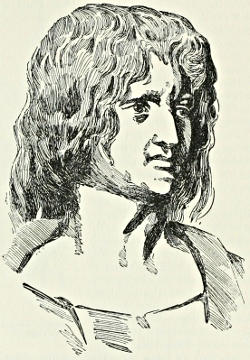
Arminius
To avoid rousing the suspicions of Varus the princes proposed to assist
him and promised to join him with their forces along his line of march, which
was exactly determined by the situation of the rebellious province and agreed
upon between him and the Cheruscan princes. The conspirators had thus a
pretext for issuing their own summons to arms without giving umbrage to
the Romans dispersed throughout the country at military stations, and it
is even possible that they induced Varus to send forth the command to all
quarters. They themselves stayed with him, not only to sustain him in his
unconcern, but also to watch him and to be at hand if the plot should happen
to be betrayed to him by the Roman party. For this was no imaginary
danger.
The evening before the start, while Varus was entertaining the princes
of the Cherusci at his table, Segestes came forward and openly charged
Arminius and his adherents with conspiracy, demanding the arrest of Arminius
and the ringleaders of the plot, and offering to be put in fetters himself
as a proof of the truth of his accusation. Varus turned a deaf ear to
these disclosures, probably because the notorious enmity between Segestes
and Arminius made him doubt the good faith of the accuser, and the start
took place next morning.
The conspirators now took leave of Varus on the pretext of putting
themselves at the head of their forces and bringing them to join him;
but in reality these forces were already stationed in readiness along the
route which Varus would have to take. In addition to this, word must
have been sent even to the Marsi and Chauci to hasten with their levies
to a particular point. Orders were then given for a general massacre of the
isolated Roman garrisons.
It has frequently been observed that the revolt cannot have been represented
to Varus as very serious; otherwise the carelessness of his dispositions
on the march is absolutely incomprehensible. The crowd of women
and children who were in the camp and accompanied the army proves either
that he intended to pitch his summer camp for a longer or shorter period in
the rebellious province after he had subdued it, or that if he meant to send
them back to the Rhine their return would not involve a very circuitous
journey.
Meanwhile the long array, marching in imperfect order and hampered by
enormous quantities of baggage, had got entangled in difficult paths that led
uphill and downhill through the thick forest, and while they were engaged
in toilsomely improving the road by felling trees, making bridges, etc.,
very wet weather set in with a storm so violent that branches were torn
from the huge trees and hurled down upon the marching men beneath.
The ground became slippery, and the difficulty of getting along amidst the
roots and trunks of trees was doubled; and in this precarious plight the army
found itself suddenly assailed on all sides by Germans. At this juncture,
when he realised the treachery of the Germans, Varus can hardly have come
to any other resolution than to escape from a tract of country so dangerous
by taking the shortest road to the Rhine, where he would be able to deploy
his forces and checkmate the enemy.
It has been asserted that he could most easily have accomplished this
by returning to his summer camp, from which a properly constructed
military road must certainly have led to his winter quarters on the Rhine.
But who can tell whether Varus did not reflect that to go back by the
way he had come would involve too great hardship and loss, while a diversion
of his line of march to the river might be effected with no greater
danger and might even offer his army a more easily attainable condition of
safety? Nor need we lose sight of the possibility that he arrived at a
wrong decision.
Thus the march was continued with heavy loss, the straggling order
avenging itself by making organised resistance impossible. Nevertheless,
the army pitched its camp as best it could in the evening; though it must
have been hard to find a suitable spot in the wooded hill-country. Here they
decided to burn or abandon their useless baggage and to carry nothing with
them but what was absolutely necessary; and so proceeded on their march
in better order next day.
They came to a clearing where it was evident that they could keep the
enemy at a respectful distance; but the road presently led into the forest
again, and the Germans were about them immediately, inflicting sanguinary
losses. The Romans defended themselves, but the narrowness of a defile
into which the army got so cramped that it could not deploy, while on the
other hand a charge of mingled horse and foot miscarried through the crowding
of both arms in the dense forest. To add to their distress the rain and
tempest set in anew; they could barely keep their feet, to say nothing of
pressing forwards, and the drenched weapons of the Romans could not be employed
to advantage against a light-armed foe equally swift to retreat or to
attack. Moreover, the numbers of the enemy increased, for those who had
hitherto cautiously held back now flocked to secure a share of the spoils;
and if the Marsi were not already included in the compact we may suppose
that they appeared at this juncture and captured the eagle which was afterwards
found in their possession.
The case was desperate, and Varus had not courage to die in battle rather
than by his own hand. The report of his death crippled the last remains of
vigorous resistance in his army, though they did not neglect to bury his body
at once. Whether the cavalry under Numonius Vala now attempted to flee
or whether they had already fled we cannot tell; neither do we know whether
the legates were still alive or had already fallen. At the last the two camp
prefects seem to have taken command, L. Eggius first, and afterwards, when
he had fallen in a last desperate attempt to break through, Ceionius. It was
the latter who presently entered into negotiations with the Germans for the
surrender of what was left of the army.
Velleiuse states that Ceionius entered into negotiations after the greater
part of the army had perished in the fight. When he had submitted there
ensued the scenes of vengeance reported by Florus.f These do not here concern
us, but it is a matter of greater interest that there was only one of the
Roman castella in Germany which the Germans were unable to take. This
was Aliso, whither some fugitives succeeded in escaping. Here the primipilar
C. Cæditus assumed the chief command, and defended it in the hope
of relief until hunger forced the garrison to an attempt at flight in which the
strongest at least were successful.d
Terrible was the vengeance which the Germans took for the wrong done
to their liberties. Many distinguished Romans, colonels and captains, bled
on the altars of the gods; attorneys and judges were put to death by torture;
the heads of many of the fallen were affixed as trophies to the trees round
the battle-field; and those who escaped with life found themselves condemned
to dishonourable slavery. “Many a Roman of knightly or senatorial
birth grew old as a hind or shepherd to some German peasant.”
Vengeance did not even respect the dead. The corpse of Varus, which
his soldiers had piously buried, was torn from its grave and the severed head
sent as a trophy to Marboduus, who subsequently delivered it up to the
emperor at Rome. So perished miserably this splendid army of nearly fifty
thousand men. Well might Augustus bewail himself at the news of the
disaster in the Teutoburg forest and cry aloud in his despair: “Varus, give
me back my legions!” Many families of long descent had to mourn the loss
of kinsmen or connections. The feasts and games stopped, the German bodyguard
was dismissed to the islands, Rome, usually so noisy, was still and
dumb. Sentinels patrolled the streets at night, vows to the gods and recruiting
on a great scale gave evidence of the dread that was in men’s hearts.
They feared that the terrible days of the Cimbrians and Teutons might come
again.
[9-14 A.D.]
The conquest of the Roman castella between the Rhine and the Visurgis
followed close on the heels of the defeat of Varus. Aliso held out longest;
thither the Romans had carried their women and children and there the
scattered and fugitive remnants of the army had taken refuge. When their
provisions came to an end the besieged tried to slip through the sentries of
the besiegers under cover of a stormy night. But only the armed men succeeded
in cutting their way through to the Rhine, the greater number of the
helpless fell into the hands of the victors and shared the fate of other prisoners,
and the fortress of Aliso was destroyed. Asprenas, who was guarding
the bank of the Rhine with his two legions lest the revolt should spread
to the excitable Gauls, was powerless to lay the tempest. Thus was Roman
supremacy broken down on the right bank of the Rhine.
The dwellers on the north coast, the Chauci, Frisii, and some other
tribes, alone adhered to the alliance with Rome. Tiberius, who had hastened
up with his freshly enlisted troops, confined his efforts to the strengthening
and safeguarding of the Rhine frontier and to watching over Gaul, and
deferred to the future his revenge for the tarnished glory of the Roman
arms. He did, indeed, cross the Rhine next year to show the Germans that
the might of Rome was still unbroken; but he did not go far from the river
bank, and the strict discipline which he observed and the hard camp life
which he imposed on the legions and enforced by his own example, bore
witness that the Romans were alive to the danger that menaced their dominion
from the Germans and had learned a lesson from bitter experience.
However much Velleiuse may vaunt his hero, when the commander left the
Rhine in the year 12 to celebrate at Rome his triumph over pacified Germany,
he could boast of no achievement which obliterated the disgrace inflicted in
the Teutoburg forest. This was left for his nephew Germanicus, the gallant
son of Drusus, on whom the governorship of Gaul and the supreme command
over all the military forces on the Rhine was conferred after the withdrawal
of Tiberius. [Tiberius had, nevertheless, proved himself an able commander.]
About the time that Augustus departed this life at Nola, Germanicus was
startled by the news that a mutiny had broken out among the soldiers at
the “Old Camp” (Vetera). The change of monarchs and the mourning
feasts which were the consequence had interrupted military exercises, discipline
had grown slack, and the minds of the soldiery were filled and inflamed
with all sorts of hopes and desires. Hence threatening agitations and mutinies
took place almost simultaneously among the Pannonian and German
legions. Germanicus hurried to the lower Rhine from Gaul, where he had
been busy with the taxation, to find there a refractory army which had
cast away all bonds of obedience and discipline, which complained of its
long and arduous service, demanded higher pay and presents of money,
offered the sovereignty to him with boisterous clamour, and maltreated at
the altars the emissaries of the senate who brought the news of the change
of government. The commander-in-chief succeeded in restoring quiet and
order, though with great difficulty, and not until a schism had arisen among
the rioters themselves and the ringleaders and most audacious spirits had
been hideously murdered by their fellow soldiers.
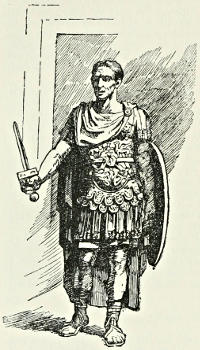
Roman Emperor in the Dress of a General
(After De Montfaucon)
The Illyrian revolt was put down by Drusus, the emperor’s son. To
expiate the crimes they had committed the German legions demanded to be
led against the enemy; they believed that there was no way of appeasing the
spirits of their murdered brothers in
arms but by covering their own guilty
breasts with honourable wounds. And
Germanicus willingly gratified their
lust of battle by a campaign in the regions
beyond the Rhine.
Germanicus was one of the last
heroic figures of decadent Rome. He
was in the prime of life and combined
all physical and mental excellencies
with the virtues of a valiant warrior.
Noble in figure and bearing, versed in
the highest Greek culture of the age,
famed as an orator and as a poet, and
endowed with admirable qualities of
mind and heart, he was the darling
of the legions and the people. They
honoured in him the son of Drusus,
whose noble likeness he was; the
husband of the admirable Agrippina,
granddaughter of Augustus, who had
borne him a number of blooming children;
the descendant of the triumvir
Antony, whose daughter his mother
Octavia had been. And if his achievements
in Pannonia and Dalmatia had
gained him the confidence and devotion
of his comrades at arms, the kindliness
of his nature and an address
in which affability was mingled with
dignity and majesty won him the
hearts of all men. When he went in
disguise, as Tacitus tells, through the
lines of the camp to spy out the temper
of the army, he heard enthusiastic praise of himself from every tent, and
when he came to the city he was always surrounded by a throng of friends
and dependents of all ranks. Tiberius had adopted him in deference to the
wishes of Augustus, but the talents and excellencies of the youthful hero
inspired the gloomy soul of the emperor with envy and suspicion. [So at
least Tacitus assures us. But possibly that writer’s tendency to invent, or
make partisan use of evil motives, may have falsified the facts. Some historians
believe that Tiberius trusted Germanicus to the end.]
The people had expected that Drusus would restore political liberty, and
they cherished similar hopes of his son. The revolt of the Ubii had its
deepest root in the belief of the legions that Germanicus would not tolerate
the rule of another, and no matter how many proofs of loyalty and devotion
the latter might give, they were not enough to exorcise the phantoms in his
uncle’s distrustful soul. He seemed perpetually to hear the address of the
legions to their beloved general: “If Germanicus desired supreme power,
they were at his disposal”; and in his nephew’s kindly and liberal nature
he could see nothing but an intention to smooth his path to sovereignty.
Germanicus undertook his campaign against the country beyond the
Rhine under favourable circumstances. After their victory over Varus the
Germans had abandoned themselves to careless security, their tribal confederacy
grew lax, their chieftains quarrelled. Segestes, full of rancour and
envy against Arminius of old, was even more wroth with the Cheruscan
prince now that the latter had abducted his daughter Thusnelda and had
taken the willing girl to wife.
Victories of Germanicus
The first campaign, which Germanicus with his legions and auxiliaries
began in the autumn of the same year, was consequently crowned with success.
On a star-lit night he attacked the Marsi as they were celebrating a
religious solemnity with joyous banquets, and having craftily surrounded
them massacred them without pity, destroyed a sanctuary which they held
in high reverence, and wasted their territory for ten miles with fire and
sword. Enraged at this treacherous attack, the Bructeri, Tubantes, and
Usipetes flew to arms and vigorously attacked the retreating Romans. But
thanks to admirable leading and wary valour they reached their winter quarters
on the Rhine without serious loss. Next year Germanicus invaded the
land of the Chatti from Mogontiacum, burned Mattium their capital, and
wasted the country. He then rescued Segestes, who, being besieged by Arminius,
had appealed to the Romans for succour, carried Thusnelda (whom
her perfidious father had snatched away from her husband and delivered
over to the enemy) into captivity, and sent the son of Segestes, Segimund
by name—who, though a priest of the Ubii, had once torn the sacred fillet
and fought for freedom at his country’s call in the Teutoburg forest—under
a strong escort to Gaul. Thusnelda, inspired by the spirit of her
husband rather than of her father, followed the victor, not humbled to tears,
not with entreaties, but with a proud look, her hands folded on her breast,
thinking of the son she bore beneath her heart and who should be born to
servitude.
[15 A.D.]
Full of rage and fury at this domestic disgrace, Arminius flew through
the territory of the Cherusci and summoned all the people to revenge
upon the Romans, who were not ashamed to wage war by treachery and
against helpless women. He succeeded in combining the Cherusci and several
neighbouring tribes into a great armed confederacy, and induced his uncle
Inguiomer, who ruled over the region near the Teutoburg forest, to join the
league. Germanicus met this new danger with courage and discretion.
While he himself with four legions went down the dyke of Drusus and
the Flevo Lacus by ship as his father Drusus had once done, and sailed
along the coast, his legate Cæcina marched through the country of the
Bructeri, and Pedo, leader of the cavalry, through that of the Frisians.
The three divisions of the army reunited on the banks of the Ems and, reinforced
by the conquered Chauci, marched, bearing hideous devastation with
them, towards the Luppia, where they visited the battle-field in the Teutoburg
forest and paid the last honours to the bones of the fallen.
Gruesome Relics in Teutoburg Forest
When the army came into the vicinity of the Teutoburg forest, says
Tacitus, a longing came over Cæsar to pay the last duties to the fallen
warriors and their general; the whole army, mindful of their friends and
kindred, of the disasters of war and the lot of mankind, was seized with
tenderness and compassion. After Cæcina had been sent forward to spy
out the ravines of the forest and to lay bridges and causeways across the
swampy bogland and treacherous fields, the whole army entered the place of
mourning, terrible alike to sight and memory.
The camps of Varus were still standing; by the contracted wall of circumvallation
it could be seen that they had sheltered but the remnant of
the army. The bones of the fallen were bleaching on the battle-field, here
in heaps, there scattered, according as an attempt had been made at flight
or resistance; among the human bodies lay broken weapons and the skeletons
of horses; hollow skulls stared down from the tree trunks; and in the
groves close at hand could be seen the altars at which the tribunes and centurions
had been slaughtered to the gods. Some who had escaped from the
fight or from captivity pointed out the places where the legates had fallen,
where Varus had received his first wound and where he had thrust the
sword into his breast; where Arminius had addressed the multitude, where
the prisoners had been strung up, where the eagles had been taken and
flouted.
The army, filled with mingled grief and wrath, buried the bones of the
three legions six years after their defeat, and no man knew whose remains
he was covering with earth, whether those of a brother or a stranger. Cæsar
himself laid the first sod of a tumulus, the last gift to the departed, a witness
of sympathetic grief to those present. Tiberius, however, disapproved
of the interment of the bodies, either thinking that the soldiers would be
cast down and discouraged by the terrible sight, or suspecting that in this
act the general was courting the favour of the army and of the people.
The Return March
After a skirmish with Arminius, in which the Roman cavalry suffered
great loss in the swampy bottom of the wood, Germanicus set out on his
return march. While he himself with his legions sailed from the mouth of
the Amisia along the coast the way he had come, accompanied by the crippled
cavalry on land, Cæcina, an experienced warrior who had seen forty
campaigns, marched with the bulk of the army on the left of the Luppia
towards the Rhine over the long causeway which Domitius had once laid
across the bog land.
This plan of operations brought the Romans into great straits. The
causeway of piles was interrupted in many places, and the forty cohorts
which Cæcina led over the slippery ground, hemmed in by impassable
ravines and morasses, surrounded by the Germans and distraught by constant
attacks, were in danger of succumbing to the fate of Varus. Exhausted
and covered with wounds in the unequal struggle by day, they were
alarmed and terrified at night by the wild war songs of the enemy encamped
on the higher ground; imagination presented to their overwrought minds
the hideous images of death which they had seen in the Teutoburg forest.
In his dreams Cæcina saw the bloody figure of Quintilius Varus rise from
the marsh and beckon him. They had lost their baggage in two days of
fruitless fighting, and with exhausted strength saw certain destruction
staring them in the face.
Then the Germans in the insolence of triumph and the wary Cæcina in
his superior military skill wrought them an unexpected deliverance. A
premature assault upon the hostile camp, attempted by the Germans against
the advice of Arminius and at the instigation of Inguiomer, was driven back
by a sudden charge of the Romans. Inguiomer left the field severely wounded
and the Germans withdrew into
the mountains in disorder, pursued
by the enemy. Cæcina then
led his legions rapidly to the
Rhine. But rumours of disaster
had outstripped them; men believed
that the army was already
annihilated, and in imagination
saw the enemy rushing upon
themselves. They were in the
act of making preparations to
destroy the bridges about Vetera
when Agrippina hurried thither
and prevented the cowardly deed.
And when the army arrived this
heroic woman, standing like a
general at the head of the bridge,
welcomed it with friendly greetings,
nursed the wounded, and
bestowed gifts on those who had
been plundered.
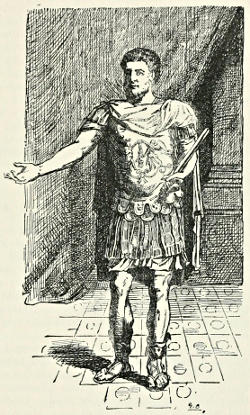
A Roman Emperor
(After De Montfaucon)
Germanicus arrived soon after
with his troops, likewise preceded
by rumours of disaster. And in
truth they too had passed through
great dangers. Owing to the shallowness
of the water only two
legions could be put on board;
the legate Vitellius was to lead the
rest along the margin of the sea.
But this latter body was overtaken
by the tide, which rose
breast-high around the soldiers
and put an end to all order;
waves and eddies carried men and
beasts away; draught cattle, baggage, and corpses drifted hither and thither
in the water. They escaped destruction narrowly and with heavy loss. Germanicus
and Agrippina exerted themselves to the utmost to make them forget
their sorrows and hardships by condescension and kindly encouragement, by
attention and rewards; and Gaul, Spain, and Italy vied with one another in
the effort to make good their losses in arms, horses, and money.
Moved rather by apprehension at the growing love and devotion of the
legions for their general and his family than by annoyance at the mishaps
of the German expedition, the emperor resolved to recall Germanicus from
the Rhine and despatch him to the East. This circumstance made the
general all the more anxious to bring to a glorious issue the war in Germany
which he regarded himself as bound in honour to terminate. A fleet of
a thousand ships, with flat bottoms adapted for the ebb and flow, well
manned and abundantly provisioned, was collected in the Batavian islands.
In these he voyaged with eight legions to the mouth of the Amisia and then
marched by land to the Visurgis, on whose right bank the Germans were
posted under the command of Arminius.
A brother of the Cheruscan chieftain was serving in the Roman army and
had been rewarded for his military services in Pannonia and for the loss of
an eye with pay and badges of honour. Arminius asked and obtained an interview
with him; but warmly as he exhorted him in his own name and their
mother’s to take the part of their beloved country and to fight for their hereditary
freedom and native gods, his words recoiled without effect from the
breast of the misguided and degenerate man. If the Visurgis had not
flowed between these dissimilar brothers they would have come to blows.
Thus even in the earliest times Germany exhibits the spectacle of fraternal
strife and national disunion.
Next day Germanicus led his army across the river. The Batavian
cavalry, which preceded the main body, was enticed by a feint of flight
on the part of the Cherusci into a plain encircled by wooded heights, where
the majority of them, including their gallant leader Cariobald, succumbed
to the blows of the enemy. Soon afterwards battle took place in a plain
called by Tacitus Idistavisus, that stretched from the Visurgis to the range
of hills that bordered it.
Battling with Arminius
Before the fight began both leaders endeavoured to inflame the ardour
of their warriors, Germanicus trying to rid his men of their dread of the
unequal combat on wooded ground and of the lofty stature and savage
looks of their adversaries, and insisting on the superiority of their armour
over the wretched weapons of the other side—their shields of wood and
wickerwork, their short spears and sticks hardened in the fire; Arminius
reminding the Germans of former victories, and then asking whether any
choice was left to them save to maintain their freedom or die before slavery
overtook them.
But bravely as the Germans advanced to the fray, victory favoured the
tactics of the legions directed by the military genius and resolute generalship
of Cæsar Germanicus. In vain Arminius strove to rally the fight
by bold rushes and cheers, the Cheruscan column was shattered against
the advance of the auxiliary troops, Gauls, Ræti, and Vindelici; wounded
and with his face disfigured with blood to evade recognition, the German
prince escaped to the mountains by the strength of his war horse. Inguiomer
also saved himself by the same artifice and the fleetness of his
steed. The rest were cut down. Many who attempted to swim across
the Visurgis met their death from the missiles of the enemy, the violence
of the stream, the hurrying crowd behind them or the yielding bank in
front. Some who hid themselves in the tops and branches of lofty oaks
were shot by the archers or killed by the felling of the trees. The slaughter
lasted far on into the night, for two miles the ground was strewn thick
with corpses. The Romans hailed Germanicus as imperator and erected
on the battle-field a stately trophy with the names of the conquered tribes
upon it.
The Germans had succumbed before the superior might of Rome, but
their spirit was unbroken; the erection of the trophy on their territory and
soil inflamed them with wrath and vengeance. High and low, young
and old, flew to arms and, led by Inguiomer and the wounded Arminius,
set upon the Roman army. Thus a second battle took place a few days
later two miles to the east of the scene of the first, near a wide dam which
the Angrivarii had thrown up as a barrier against the Cherusci.
It was a terrible battle. The Germans, sheltered by the rampart, offered
a desperate resistance, and when they were at length forced to give ground
by the slingers and archers, they ranged themselves afresh in a wood, where
they had a swamp in their rear, and the struggle was renewed with unabated
vehemence until night separated the combatants. The Germans
were at a disadvantage on account of the cramped space and their sorry
armour; “their unhelmeted heads, their unprotected breasts, were exposed
to the sword thrusts of the mailed Roman soldiers.” They nevertheless
fought with marvellous valour. Inguiomer flew to and fro in the ranks,
exhorting them to stand fast; Germanicus also took off his helmet that
he might be recognised of all men and spurred on his troops with orders to
cut down all assailants.
The Roman victory was not decisive, although a stately trophy proclaimed
that the legions of the emperor Tiberius had conquered the tribes
between the Rhine and Albis. That same summer Germanicus led his army
back without making any provision for maintaining his mastery of the
country. Some legions reached the Rhine by land, the general himself
marched with the rest to the Amisia to re-embark there. But the fleet
had scarcely reached the open sea when a violent tempest arose, lashing
the waves to fury. The ships, driven far out to sea, were dashed upon
rocks and cliffs or cast away on hidden shoals. Horses, beasts of burden,
baggage, and even weapons, were cast overboard to lighten the ships and
keep them afloat. Many went to the bottom, others were wrecked on remote
islands where the soldiers sustained life in uninhabited regions upon
the flesh of horses washed up by the sea. Germanicus’ ship was driven
on the coast of the Chauci. There he stood day and night upon a jutting
crag, and watched in dismay the tumult of nature, laying the blame of
this horrible mishap upon himself. His comrades could hardly restrain
him from seeking death in the breakers.
At length the wind went down and the sailors succeeded, by the help
of such oars as were left and outstretched garments for sails, in getting the
less damaged of the ships into the mouth of the Rhine. Of those who were
driven out to sea and shipwrecked many were picked up by boats sent
out in search of them, many more were ransomed from German and British
tribes. [Germanicus himself looked after the destitute men and contributed
to their wants from his purse.] Those who reached home told marvellous
tales of eddies and whirlpools, or sea monsters and two-natured beasts, conjured
up by their own terror and distress.
To neutralise the bad impression likely to be produced on the Germans
and the neighbouring Gauls by the news of these mishaps and to show that
the dominion of Rome on the Rhine was still unimpaired, Germanicus undertook
the same autumn another campaign beyond the Rhine. Silius his legate
invaded the land of the Chatti while he himself marched with a great army
of horse and foot against the Marsi. The only spoil which the Romans
reaped from this unworthy incursion was one of the eagles lost in the defeat
of Varus. A banished prince of the latter tribe, who had come as a fugitive
to the Romans, betrayed to them the spot where it had been buried in a grove.
Germanicus is also said to have recovered one in his first campaign.
[16-18 A.D.]
This was the end of the Roman war in North Germany. In the midst of
great schemes for a fresh campaign against the Germans, which the emperor’s
brave son regarded as the glorious task of his life, he was recalled by a letter
from Tiberius to the effect there had been enough of success and disaster;
and he was to come home for the triumph the emperor had designed in
acknowledgment of his exploits. Now that the honour of the Roman arms
had been vindicated and enough done for Rome’s vengeance, the Cherusci
and the other rebellious tribes of Germany might be safely left to their own
dissensions. In vain did Germanicus beg the emperor to grant him but one
year more, promising that by then he would bring the war to a glorious end.
The answer came that he was to return to assume the consulate; if it were
necessary to continue the war his brother Drusus might win laurels and the
fame of a commander on the Rhine.
Germanicus obeyed. In the following year he celebrated at Rome his
triumph over the German tribes, in which the ensigns and weapons which
had been captured or recovered were carried through the gaily decorated
streets of the city, together with pictures of rivers, mountains, and battles
in Germany. In front of the gorgeous triumphal car in which the stately
imperator sat enthroned, surrounded by his five blooming children, marched
many men, women, and children of high rank, captive and in fetters. Among
them was Thusnelda, the wife of Arminius, and her son Thumelicus, whom
she had borne in captivity. Both died in slavery in a foreign land. From
the obscure hint given by Tacitus that the son of Arminius grew up at
Ravenna and was reserved for a shameful fate, modern inquirers and poets
have concluded that the boy was brought up as a gladiator. According to
Strabo, Segimund, the brother of Thusnelda, and his cousin Sisithacus, with
his princely consort Rhamis, were of the train in the chains of slavery. But
Segestes stood in a place of honour and looked down upon the holiday of the
Romans and the misery of his children. It was his reward for betraying
his country.
The spirit of internecine discord to which Tiberius had handed the
Romans over soon came to light. The Low German league of the Cherusci
in the northwest engaged in a war with the league of the Marcomanni in
the southeast. It may be that Arminius, proud of his achievements, aimed
at the military command of the whole nation and thus come into conflict with
Marboduus the wary and ambitious Marcomannian prince, who had maintained
a neutral attitude throughout the war of the Romans and Germans.
The chieftains seem to have favoured Marboduus, the tribes Arminius; at
least we find Inguiomer, uncle of Arminius, on the side of the Marcomanni,
while on the other hand the Langobardi and Senones settled on the banks of
the Albis were in league with Arminius. In the third year after the withdrawal
of Germanicus the quarrel between the two confederacies came to a
sanguinary decision. The battle was probably fought on the Sala, and ended
in the retreat of Marboduus to Boihemum (Bohemia).
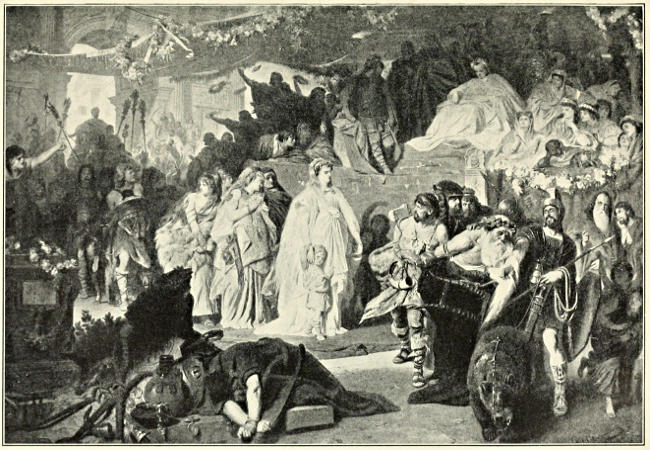
THUSNELDA AT THE TRIUMPH OF GERMANICUS
Of the later history we know nothing, though we can gather from
subsequent events that the schism continued to exist, that German blood
was shed to no purpose by German hands, and that the weakness bred of
discord gave the Romans an opportunity of harassing the country of the
Germans again from the south. Marboduus, enfeebled by attacks from
without and desertions within, turned to Tiberius for help, but the latter
preferred to foster the dissensions and to let the stately political fabric Marboduus
had built up perish of its own disorganisation. The German duke
was induced to cross the Danube and appeal for the assistance of the Cæsar
Drusus, who had a standing camp farther down the stream. The latter
delayed him so long with promises and negotiations that the German army,
seduced by factionaries and agitators, deserted its commander, and left him
no choice but self-inflicted death or surrender to the Romans. He chose to
live rather than to perish gloriously. He was carried to Ravenna, where he
lived for eighteen years on the allowance granted him by the hereditary
enemy of his country. Colonies of soldiers were settled in Moravia.
A like fate befell Catualda, prince of the Gothi, who had been the principal
agent of the fall of Marboduus, but was driven away by the Hermunduri
when he attempted to take his place. The Romans harboured the fugitive,
who fled to their protection, and assigned him a residence at Forum Julii
in Gaul.
[18-19 A.D.]
The soldiers of Marboduus who were settled in Moravia had Vannius set
over them as king by the Romans. Popular with the people at first, he
enriched his kingdom by plunder and tribute; but presently, weakened by
a hostile party in his own land, succumbed to the attacks of his enemies the
Hermunduri and Lygii (in Silesia). Defeated after honourable fight in a
pitched battle, he fled wounded to the Romans, who assigned dwelling-places
to him and his following in Pannonia. His two nephews, who had been the
prime agents of his fall, shared his abandoned kingdom and secured Roman
protection by faithful loyalty and devotion to the ruling race. Thus by
artifice and stratagem and by the dissensions of her enemies, Rome gained
more than by the force of arms.
Arminius met his end about the same time. We have no information
concerning the death of the hero beyond the brief words with which Tacitusg
concludes the second book of his Annals: “Arminius, striving after royal
power after the withdrawal of the Romans and the banishment of Marboduus,
had his fellow countrymen’s love of liberty against him; and while, attacked
in arms, he was fighting with varying fortune, he fell by the treachery of his
kinsmen. Incontestably he was the deliverer of Germany. He did not,
like other kings and commanders, fight the Roman nation in its weakness,
but at the period of its greatest strength. Not invariably fortunate in
battle, he remained unconquered in war. He had accomplished thirty-seven
years of life and twelve of military command. He is still sung of by the
barbarian tribes. To the annals of the Greeks he is unknown, for they
admire nothing that is not their own; among the Romans also he is not
sufficiently honoured, for we extol the old and disregard the new.” A
splendid tribute from an alien but noble pen, which honoured virtue and
greatness of soul even in an enemy.c
“Then battles o’er the world shall cease,
Harsh times shall mellow into peace:
Then Vesta, Faith, Quirinus, joined
With brother Remus rule mankind:
Grim iron bolt and massy bar
Shall close the dreadful gates of War.”—Virgil.
[30 B.C.-14 A.D.]
Peace was the price for which Rome consented to the supremacy of
Augustus; his successors, too, really followed a policy of peace. There
was not a complete absence of conquests either in the reign of Augustus or
of those who came after him, as for instance Trajan. But these predatory
wars were chiefly directed to the defence and protection of the older possessions.
If we compare the conquests of the republic in five centuries with
those of the empire in four we shall clearly see how the republic hastened
from one conquest to another, while the object of the empire was to preserve
and fortify itself. “Empire is peace”—this watchword, so often abused,
was truly expressive of the work of Augustus in battles both at home and
abroad.
Cæsar had made war of necessity. His was not the nature of the warrior
prince; on the contrary it was as the prince of peace that he loved to be
celebrated. When the civil war had come to an end the army was considerably
reduced and the superfluous legions were simply discharged. Cæsar had
often suffered, and others had suffered more than he, from the insolence and
unbridled passions of an army which felt itself master of the situation; the
termination of the civil wars was to put an end to all this. From henceforward
he no more addressed his troops as comrades but simply as soldiers,
and allowed the princes of his house to use no other manner of address.
The bodyguard of foreign mercenaries hitherto maintained by him was discharged
and replaced by home troops.
The joy at the termination of the civil wars was universal and in nearly
every case genuine. Exceptional circumstances and wars at home as well
as abroad had gone to make up the history of the past twenty years; during
this time a generation had grown up whose only knowledge of lasting peace
was derived from hearsay, as if from the all but silent notes of some legend
sung in a better day now long past. Those who within the last decade had
saved or won anything were eager to rejoice in it. All panted for peace,
with no less sincerity than exhausted Europe after the wars between 1790
and 1815, and all were ready to greet as lord of the world the victor who
should restore this golden age.
This general yearning for peace found expression in the shutting of the
doors of Janus, which was decreed by the senate in order to give a visible
proof that the period of war was at an end (Æneid VII, 607):
“Two gates there stand of War—’twas so
Our fathers named them long ago—
The war god’s terrors round them spread
An atmosphere of sacred dread.
A hundred bolts the entrance guard,
And Janus there keeps watch and ward.”
Any one who chanced to be in France when the Prussian War closed and
heard the bells ringing out peace from the church towers will not easily
underrate the impressiveness of this symbolism.
Cæsar indeed attached all the greater importance to the decree of the
senate ordering the doors of Janus to be shut, in that the senate had rarely
gone to such lengths. Two centuries had passed since the last occasion in
which the temple of Janus was closed. When the First Punic War with all
its losses and changing fortunes had finally been concluded to the advantage
of Rome, exhausted as she was, she had yet joyfully permitted the performance
of these ancient ceremonies which were supposed to date back to King
Numa. To this precedent the senate had recourse when in 29 B.C. it
ordered the closing of the temple of Janus. The proceeding would have
been most impressive had the threefold triumph been terminated with this
symbol of peace. This, however, was not in the power of the senate to grant,
for its decree had probably been passed at the beginning of the year; there
was danger in delay, for the sudden outbreak of a border war or a rebellion
might make its performance impossible.
To be accurate we must admit that there was not an absolute cessation
of warfare; for the Romans had still to contend with the natives on the
German border and in Spain at a time like this in which all resistance had
to be broken. But little account was made of such trifles, so great was the
promise expected from the impression that the closing of the temple of Janus
would create.
Even Cicero, so tell the later accounts at all events, seems to have recognised
in the young Caius Octavius, who had been born during his consulate,
the man who would put an end to the civil wars; later on, when the Sicilian
war had been concluded, a statue was reared to Cæsar with an inscription to
him as prince of peace; now at last after the battle of Actium the dream
was to turn into reality. What was so yearningly hoped for was pointed
out in the premonitions of the gods; even the trophies of victory turned
into weapons for peace. Bees made their nests in the trophies taken at the
battle of Actium (Anthol. Palat. VI, 236):
“Here brazen beaks, the galley’s harness, lie,
Trophies of Actium’s famed victory,
But bees have built within the hollow arms,
With honey filled, and blithe with buzzing swarms;
Emblem of Cæsar’s sway, that, calm and wise,
Culls fruits of peace from arms of enemies.”
The whole world was refreshed, and breathed as if a great load had
been lifted from its shoulders. The Asiatic towns in particular offered
thanks to the peace-bringer in their inflated hyperbolical fashion which was
nevertheless genuine and heartfelt. Halicarnassus celebrated him as “father
of the fatherland,” and as “saviour of the whole race of man, whose wisdom
has not only satisfied but also exceeded the prayers of all; for peace reigns
over land and water, and the states flourish in righteousness, harmony, and
well-being. All the good waxes full ripe and turns to fruit.” In a decree
of the town Apamea we read that Cæsar was born for the salvation of the
whole world; so his birthday may rightly be termed the beginning of life
and of existence.
We may see how general and how hearty was the rejoicing over the
restoration of peace throughout the world from the fact that Pax and Irene
now became names not only of slaves and freedmen of the imperial house,
but also of members of other distinguished families. From the agnomen
Pax was even formed a surname Paxsæus.
Trade and industry revived and prosperity increased from the time when
the armed peace and the civil wars had come to an end. The whole earth
in all its compass experienced once more, after long distress, the blessings of
enduring peace, and did honour to the prince of peace, conveying thanks
for this new fortune by the erection of temples and altars to the glory of the
imperial peace. On the Greek and Latin coins of this period too we see
the goddess of peace; in Asia Minor for example on the coins of Cos and
Nicomedia. Even the veterans of the emperor stamped on their colonial
coins PA—CIS with the picture of the goddess of peace bearing the
features of Livia or Julia. On other coins the emperor is celebrated both
as prince of peace and of liberty; the later ones speak even of an eternal
peace. One of the Spanish veteran colonies introduced even the name of
Pax Julia; on their coins we see enthroned a fully draped female figure
holding a horn of plenty in her left hand and a herald’s staff in her right.
This official worship of peace was continued throughout the whole reign
of the emperor. One of the greatest honours devised by the senate and
accepted by the emperor was the state-directed dedication of an altar of
peace in the year 13 B.C. To-day we may still see on fine reliefs of the time
of Augustus the group of peoples, in garments of ceremony and crowned with
laurels, confronting the ruler on his return home. These provide us with the
best picture of the national scenes in the streets of the capital when men
were expecting the triple triumph of Cæsar.
“To thy blest altar, Peace, our song must tend
This day, the second ere the month will end;
Come, crowned with laurels from the Actian Bay,
And mildly deign here to prolong thy stay.
Without a foe we for no triumphs care,
Thou to our chiefs more glorious art than war.”
Altogether there is a striking resemblance between these two rulers and
their times, although Napoleon III cannot be compared with Augustus so
far as their offices are concerned. On their first appearance on the scene
both were underrated by their opponents and laughed at on account of their
youth or their lack of understanding: Cicero joked about “the boy”;
Victor Hugo mocked at Napoleon the little. Both lived in periods when
their nation was stirred to the innermost depths by civil war and revolution,
in the confusion of which practically all landed property had changed
owners; in Italy through the proscriptions of the triumvirs and the distribution
of land to the veterans, in France through the confiscation of the
property of the clergy, through the sale of estates of the nobility, combined
with the mismanagement of the assignats in the first revolution, while there
was fear of fresh changes through some future social revolution.
The man who offered present occupiers guarantees for their occupation
and against the return of the previous confusion was honoured as the saviour
of society; upon him the nation poured its thanks for the economic revival
of the country and for increasing well-being during a long succession of
peaceful years.
Upon this firm basis was reared the throne of the new rulers, neither of
whom claimed to be a legitimate monarch. Both had with more or less right
acquired a dictatorial power which they understood how to wield throughout
many years, until at length a moment came when they made up their
minds to a partial renunciation of authority. This was the critical moment
that decided the fate of the rulers and their work, for everything depended
on the choice of the moment and the extent of the concessions. Here the
penetrating vision and the statesmanlike ability of Augustus are seen to
surpassing advantage, while Napoleon, who only made up his mind after
long hesitation, took his hand from the tiller reluctantly, only to see very
speedily with what scant success his ship battled against the overpowering
torrent and was driven helplessly nearer and nearer the destruction that
threatened it.
The rule of Augustus as well as that of Napoleon III was a tyranny in
the good sense of the word; neither the one nor the other lacked the drop of
democratic oil with which the ruler was anointed. Both wanted to be assured
that their high place was secure only because of its necessity to the state.
Again and again Augustus restored his power (to all appearances at least)
to the senate, to receive it again, but only for a definite number of years; and
even in the case of Napoleon III, it was a polite official fiction that his power
had been delegated to him by the nation in the first year of his reign and was
even in his last year confirmed by a plebiscite.
If they challenged a crisis of this kind, both held the reins of government
firmly in their hands, nor did any one seriously believe that they would have
allowed this power to be wrested from them by a vote unfavourable to them.
That the Roman senate and the French people were repeatedly confronted
with this crisis, shows clearly what value those rulers attached to this right.
Both rulers had thrust aside the higher classes of society which had hitherto
guided the state in its course, in order to derive their support from the broad
masses of the lower classes and the army. The immense presents made by
Augustus to his soldiers and to the population of his chief town prove that
in the well-being and content of this very class he rightly recognised the real
support of his institutions. In similar fashion Napoleon III took pre-eminent
care for the material welfare of France, which reached an unprecedented level
under his rule.
Neither ruler confined his liberality to what was absolutely necessary;
they also lent support to art and science in remarkable ways. Architecture
is an art for monarchs, and architecture was the art of Augustus and of
Napoleon III. Modern Paris is really the work of Napoleon III, and so,
too, it was the boast of Augustus that he had taken over Rome a city of
bricks but had left it a city of marble. In the literary efforts of their times
both rulers took at least the share of dilettanti. Each of them, in order to
neglect no part of his inheritance, not only collected the literary relics of his
uncle but also defended in writing his actions as emperor. Without mentioning
the smaller literary essays of either, we may note that Augustus sought
to defend himself in his memoirs, while Napoleon III in his history of Julius
Cæsar sought far less to write the history of Cæsar than to defend the principle
of Cæsarism.
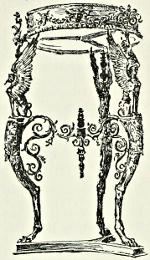
A Roman Tripod
The worship of the uncle to whose popularity they owed the crown—in
the one case the worship of the dictator, in the other that of Napoleon I—impresses
its character on the reign of both rulers. In particular, the
military glory of these two great generals was
exploited by their nephews in a variety of
ways. Neither Augustus nor Napoleon III
were really soldiers; but they needed for their
rule a powerful effective army, which they
would have found far greater difficulty in
bending to their ends had they not had the
memories of a great past to help them. Both
succeeded in creating a fighting army, the
pride of the nation, which they knew how to
use when it was really necessary, but without
taking any real pleasure in fighting and hazard,
such as was felt by Julius Cæsar and Napoleon
I. The successes they loved best were not
those won in war but those due to threats of
war and to diplomacy. The war against the
Parthians, the hereditary foes of Rome, was
certainly a portion of the legacy left by the
dictator; but Augustus hesitated long before
beginning this really dangerous war, until
good fortune played the lost standards into his
hands. Military honour was hereby satisfied
and the noisy rejoicing of his fellow-soldiers
now relieved him of the duty of making war upon the redoubtable enemy.
In the same way Napoleon III loved to increase his reputation in Europe
and in his army by conducting wars which, even if they ended badly, could
not shake his throne nor France itself. A war over the boundaries of the
Rhine was as popular in France as a Parthian war under Augustus, but also
as dangerous. For this reason Napoleon III made several attempts to attain
the fruits of such a war by peaceable means and only proceeded to a declaration
of war when he had convinced himself that there was no prospect of
success in such attempts.
In a word, then as now the statesman succeeded the general, the prince
of peace the warrior prince, nor did the former despise military glory; only
he preferred to decorate himself with the laurels plucked from his uncle’s
wreath. Augustus, no less than Napoleon III, reckoned it as of the very
essence of the services he did to the world that he had put an end to the
period of warfare at home and abroad. Just as Napoleon III, in the character
of saviour of society, pronounced the dictum,“L’Empire c’est la paix,” so
Augustus caused himself to be celebrated as the restorer of order and liberty,
whose privilege it was thrice to shut the doors of Janus and to inaugurate a
new era of things.
Neither was a man of genius, both were practical and astute to no common
degree; they were cool political calculators who had early learned to conduct
their own policies and to judge all circumstances from the practical point of
view. If they sought an end they did not shrink from the means to accomplish
it; as a parallel to the misdeeds of the triumvirs we have every right
to quote the measures under Napoleon III by which the president was raised
to an emperor. Later in their career both avoided acts of violence as far as
possible, and in the face of outspoken public opinion, the symptoms of which
they studied zealously, both made concessions even in the teeth of their own
better convictions, for they were astute enough to know that their supremacy
could not depend on might alone.
Possessed as they were of power they sought also to conciliate and fortify
the conservative elements of the state. Those who bore old and famous
names were treated with just such a preference in the bestowal of external
honours by Augustus as in later times by Napoleon, whose endeavour was
to adorn his new imperial nobility with the fairest names of old feudal France.
As he succeeded in reconciling the old nobility to some extent with the
new order of things, so Napoleon understood how to conclude peace with the
church, a peace which he bought and preserved at considerable cost. In a
similar way Augustus, who took upon himself the dignity of a high priest,
attempted to reanimate national traditions and the religion of the past and
to reorganise the priesthoods.
The similarity of the two rulers is obvious and has been frequently referred
to. That it should until now have been less recognised than it ought,
is, perhaps, due to the fact that the characters of the two were after all fundamentally
different. One might almost say the similarity lay in the circumstances
of the times, the dissimilarity in the characters of the persons; and
the more we harp on the former the clearer appears the latter. Napoleon
remained all his life what Augustus never was, a dreamer and a conspirator.
According to the version of De Tocqueville, Napoleon knew no hard and fast
boundary between dreaming and thinking; this may have been the result of
his moping youth with its conspiracies, his imprisonment, and his fantastic
designs which never were realised but by the most extraordinary strokes of
luck. Augustus, on the other hand, never had time to devote to dreamy
imaginings. When he was still almost a boy, he had thrown himself on his
own initiative into the struggle of parties, and from the beginning he had to
summon all the powers of his mind to aid him in the struggle against opponents
maturer than himself; so it is that later when power was his he never
dreamed but always thought. Moreover, Augustus was never a conspirator.
He obtained power early and wielded it recklessly. He both loathed and
found superfluous that covert toying with designs and intrigues which
shunned the public eye until they suddenly burst into publicity with éclat,
such as Napoleon loved.
Augustus enjoyed the great advantage of still being teachable when he
came into the actual possession of power, and of being formed into a statesman
by the circumstances themselves; Napoleon, on the other hand, was
much older when he came to the throne; in his best years he was forging
schemes to attain an apparently unattainable goal. He was laughed at as
a nurser of fancies until he became emperor; small wonder then that the
emperor’s plans remained fanciful and singular and that, as a ruler, he lacked
the gift which distinguished Augustus in so high a degree—the gift of judging
soberly what was attainable, or what was necessary. As emperor, Napoleon
could never quite forget the adventurous designs of his youth. Place
at the disposal of such a man the whole machinery of power in modern
France, and perhaps he will be able to carry out plans that a careful observer
would pronounce to be impossible of execution, but the reaction is bound to
come, and it did not fail to do so here.
It is true that there were greater difficulties in reorganising France than
Augustus encountered, so that the position of Augustus was more favourable
and more secure. In spite of his confident address Napoleon felt his weakness,
and upon him lay the burden of justifying himself by success that was
externally visible; his object was to surprise and to dazzle his people, or at
the very least to keep them occupied, and he was thus misled into taking
many a false and many a critical step which a true statesman, like Augustus,
would have at once condemned.
But all his internal mistakes and difficulties were not enough to upset the
second empire. The catastrophe was brought about by Napoleon having an
enemy from outside, an enemy far more formidable than those outside enemies
who might have declared war upon Augustus. Napoleon fully realised the
danger that threatened him from this quarter; yet he was helplessly engulfed
in the whirlpool that was destined to swallow him and his work with him.
From the point of view of the world’s history, then, Augustus appears as
a far greater figure than Napoleon III. Antiquity spoke, we speak yet to-day,
of the Age of Augustus with reason, and this is an honour that weighs
more than the name of Great; a man gives his name to his time only when
he has really stamped that time with his image, opening up new roads, not
only to his own nation but to the history of his time. Such an honour then
implies permanent achievement in the widest sense; no impartial historian,
then, will ever speak of the Age of Napoleon III.
The French Empire was shattered while its founder was yet alive, and
when it fell, its inner hollowness, its rotten foundations, lay exposed, so that
the whole appeared no more than an adventurous episode in the history of
France. The work of Augustus, on the other hand, was indispensable to
the world’s history; it outlived its founder, and lasted with some modification
to the end of antiquity. Succeeding generations saw in Augustus the
ideal prince, and hailed each newly chosen emperor with the invocation:
“Be thou happier than Augustus, better than Trajan.”
Of all the empires of later times Great Britain is the only one that can
really be compared with the Roman Empire, for its constitution has been developed
in quite a different way from that of continental states, and has preserved
a much greater diversity by reason of that conservative spirit which
the English share with the Romans. True, in our own century much has
changed; for the old aristocratic England has become democratised; many
a resemblance of England to the Roman Empire, which even to-day may
be detected, appears in a much clearer light if we cast our glance back to the
conditions of the seventeenth and eighteenth centuries.
This is the case, for instance, with the position of parliament. As the
ancient state recognised in theory a diarchia of the emperor and the senate,
so, too, the English parliament at the close of the seventeenth century ranged
itself, at least for all practical purposes, on the side of the sovereign power;
and it was only a jealous watchfulness lest the power of the chief ruler
might become too great, that saved the English parliament from the fate of the
Roman senate. The critical battle between the two constitutional powers was
fought at the end of the seventeenth century, when William of Orange, like
Augustus in ancient Rome before him, made an attempt to dovetail a standing
army into the frame of the constitution. But the English parliament
resisted every attempt in this direction with stubborn obstinacy. Moreover
the powerful nobility at home, and the energetic merchants and officials spread
all over the world, correspond in the England of to-day to the aristocrats, the
merchants and the officials of ancient Rome, just as great wealth on the
one side is conditional with great poverty on the other.
The latifundia of ancient Italy may in dimensions have
been about equal to the gross landed estates of the English
aristocracy, but with slaves to work them in antiquity they
had a far more desolating effect, even though we must
admit that owing to the villas and parks laid out for the
great in England, a portion of the free peasantry are
thrust out of their plot of ground and England has had
to turn for the means of life, etc., to the foreigner.
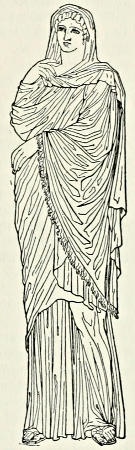
Roman Matron
(From a statue in the Capitol)
Also the difference of political rights between the full
citizen with full rights and the slave without any rights
at all was as marked in England a hundred years ago as it
was in Rome. The relations between the Roman and the
Latin citizens might then have justly borne comparison
with the conflicting elements furnished by Englishmen
and Scotchmen, which to-day are ever growing less and
less; but even to-day the Irish on the one hand, with
their reluctance to obey, and the English colonies on the
other, with their successful diffusion of the English language
and English national feeling abroad, reflect most
faithfully the picture of ancient Rome.
But above all, England belongs to the few modern
states which still possess provinces in the antique sense of
the word. The constitution of modern India, with its
multiform variety, is the only one of our time that may
be set side by side with the constitution of the subject
territories of the Romans. In India, as in the latter,
the contrasts—religious, ethnographical, and social—are
great and very often immediate; by the side of an old
and highly developed civilisation we find the simplest
conditions of mountain or fisher folk, over whose heads
a history of a thousand years has passed without leaving
a trace. Again, the political situation of single portions of the country is
as multiform as possible: Ceylon, for example, with its separate administration
and its separate rights, forms a part of England, while the main
continent is only directly or indirectly governed by English officials; its
constitution, as in the ancient Roman Empire, defies juristic or political definition
in a variety of ways. Only one portion of the country is directly
subject to its foreign conquerors; in all the others has been preserved—often
to the good luck of the nation—a remnant of the earlier national
independence.
As in ancient Rome, England to-day allows the existence of native princes,
great and small, who lighten for her the burden of rule and administration;
and she permits them to tyrannise over their subjects and extort treasure
from them if they fail in their duty to the empire, just as did the sultans
of previous centuries. The real power is, for all this, in the hands of the
English resident who is set to watch over them. If the evils of local misrule
become too great, or the times are ripe for annexation, a stroke of the
pen is enough to do away with the whole majesty of a local prince. England
is not wont to meet with serious resistance in such a case, any more than did
the Romans when they declared that any particular one of their tributary
princes had ceased to reign.
Again, the position of the ruling nation in the very midst of the ruled is,
in modern times, just what it was in the days of antiquity. The man who
goes to India, whether as a merchant, an official, or a soldier, does so with
the fixed intention of returning home as soon as his financial position allows
of his doing so. Considering the immense disparity in numbers between
rulers and ruled, the power of the single officials and people in command
must naturally be very considerable. The viceroy of India may well be
compared with a Roman proconsul; the range of his power is great, but
by a time limit it is sought to forestall an abuse of it. Even after the
reforms of Augustus, the means of control were inadequate in ancient times,
just as they were in England a century ago. To-day it may be taken as the
rule for the higher class of English officials to return home from India with
clean hands.
Whether this parallel between the Roman Empire of antiquity and the
England of to-day is to the credit of the latter or a subject for reproach,
whether it will endure, or whether the modern conditions will develop on
similar lines, are questions into which we have not here to inquire; it is
enough to have indicated the parallel phenomena in the two great empires.b
The sanguinary civil wars with their appalling catastrophes had crippled
the might of Rome; the staunchest and most faithful champions of republican
principles lay mouldering on the coast of Thapsus or the plain of Philippi;
the free state that had erstwhile been called into being by the elder Brutus
had passed away—the reality on the day of Pharsalia, the ideal through the
desperate deed of the younger Brutus.
The struggle between democracy and monarchy had come to an end,
political passions were silenced, the existing generation yearned for peace
and quiet; the aristocrats that they might take their fill of the pleasures and
enjoyments placed at their command by ample means, by culture, art, and
learning, the multitude that they might pass the fleeting hours in comfortable
leisure, remote from political agitations and warlike toils, their desires limited
to the “bread and games” (panem et circenses) which the ruling powers
were sedulous to provide for them in liberal measure.
Under these circumstances it was not difficult for the adroit Octavian—who
combined great ability and capacity for rule with gentleness, moderation,
and perseverance, and was able to disguise his fiery ambition and pride
of place under the homely manners of a plain citizen and a show of submission
to law and traditional custom—to enter fully upon the heritage of the
great Cæsar and convert the republic into a monarchy. But Octavian,
warned by the tragic end of his adoptive father, went very cautiously and
circumspectly to work. Instead of assuming all at once the fullness of royal
power and dignity with which Cæsar had been invested at the time of his
death, his son followed his example in the gradual absorption of a divided
authority, and thus retraced the slow and circuitous route which led, with
pauses and intervals, to absolute dominion. He so far yielded to the antiquated
prejudices of the people as to abstain from calling himself “king,”
he indignantly refused to be addressed by the title of “lord,” and would not
even accept the perpetual dictatorship. Nor did he try like Cæsar to gain
the insignia of royalty by indirect means; he retained the republican names,
forms, and magistracies, and was himself styled “Cæsar.” But he so contrived
that by degrees all offices and powers were conferred upon him by
the senate and the people, and thus concealed a monarchy under the veil of the
republic. He prized the substance, not the appearance, of power. He willingly
resigned the pomp of rule so long as he might rule indeed.
To preserve the figment of free election and voluntary delegation of power,
and to allow weaklings and obstinate republicans to blind themselves to the true
state of affairs, Octavian from time to time went through the farce of a
voluntary resignation of the supreme power and a reconferment of it by the
senate, a sham which passed on to his immediate successors. It was first
gone through in the case of the important office of Imperator, originally a
temporary appointment, which Cæsar had charged with new meaning as the
symbol of absolute military authority. This title, which Octavian had long
borne in the fullness of meaning imparted to it by his imperial uncle, was
conferred upon him for life by the senate in the year 27, after a dissembling
speech in which he declared that he was willing to resign his high office into
the hands of the senate and retire into private life. He was then appointed
to the supreme command of all the military forces of the empire for the term
of his natural life and to the office of supreme governor of the provinces
which was associated with it. The limitation which he imposed upon himself
by promising that he would only undertake to hold this high office for
ten years and exercise proconsular sway only over those provinces in which
the presence of legionaries was required to maintain order and tranquillity,
and would leave the others, which were accustomed to render obedience and
were not menaced by enemies from without, to be governed by the senate,
was a mere blind; for in ten years it was certain that his absolute rule would
have struck such deep root that there could be no further question of dismissal
or resignation, and—since no province whether near or far from the
capital could altogether dispense with garrisons, and all officers and subordinate
commanders were under the commander-in-chief—all governorships were
under the control of the imperial proconsul.
Thus the entire dominion of Rome was “encompassed with the net of his
military authority”; all victories and conquests were ascribed to Cæsar, and
he alone henceforth was entitled to Triumphs. It was therefore nothing but
a form when some time later the senate, now completely disarmed, delegated
to the imperator its proconsular power in the senatorial provinces also
for the term of his natural life, and subjected all consuls to his authority.
The complaisant senators at the same time conferred upon Octavian the title of
“Augustus” or “consecrated” which he bore thenceforward. By virtue of
the imperium the emperor commanded through his deputies some twenty-three
or twenty-five legions dispersed over the whole empire; at Rome his
person was guarded by nine cohorts of bodyguards (the prætorian guards)
whose loyalty and devotion were enhanced by double pay and liberal gifts of
money on their discharge, some of them being lodged in one wing of his
palace and others quartered upon the citizens in Rome and the neighbourhood.
Contrary to law and traditional usage he was allowed to wear military
attire and sword, the symbols of dominion, within the walls of the city; and
the laurel bushes in front of his dwelling and the oaken garland on the
gable proclaimed the fortunate conqueror of his enemies and the magnanimous
deliverer of the citizens.
The senate itself had already been reduced to a position of dependence.
Cæsar had treated the fathers of the city with scant consideration; he and
the triumvirs after him had filled the curia with their own creatures, regardless
of dignity, rank, or merit. This body had consequently sunk low in the
respect and confidence of the people. Augustus endeavoured to rescue it
from degradation and contempt and to give fresh consequence to its members.
By virtue of the censorial power vested in himself as “master of
morals” (præfectus morum) he undertook, in concert with his colleague
Agrippa, a purification of the senate. Nearly two hundred senators were as
considerately as possible induced to withdraw and were replaced by worthy
men devoted to the new order. He then had the title of princeps senatus
bestowed upon himself, and by that means got the direction of the debates
and voting entirely into his own hands or those of his representative.
The end Augustus had in view in this process of purification, which was
subsequently several times repeated, was to raise the senate, whose numbers
were now limited to six hundred, into the representative body of the nation
and, by extending its functions and reorganising its share in the legislation,
government, and administration of justice, to rule the nation through it;
to raise himself from being the head of the senate to being the head of the
people, and, by sharing with them the sovereign prerogatives, to delegate to
them a part of the responsibility. The right of electing officials was left to
the comitia centuriata and comitia tributa, but as the magistrates had simply
to carry out the emperor’s orders their position was a subordinate one and
their functions were limited; and it was consequently a mere simplification
of the political organisation, when in process of time the popular assemblies
were degraded into a mockery [they had long been little more than that]
and the officials were appointed directly by the emperor or the senate.
Without any outside co-operation Augustus had already committed
the charge of Rome and of Italy to trustworthy hands by furnishing the
prefect of the city with extensive powers and appointing him his delegate
and representative, and by instituting, in the prefecture of the prætorium,
a military command over the troops stationed in Rome and Italy. These
two life appointments bore in themselves the germ of the future military
despotism and most seriously infringed the outward character of the free
state, which Augustus maintained in everything else. At the same time he
had himself empowered to fill up the ranks of the patricians, grievously
thinned in the civil wars, by the admission of fresh members; a privilege
the exercise of which made the nobility of ancient Rome entirely dependent
upon the emperor and obscured the lustre of birth.
He nevertheless treated tradition and ancient custom with great reverence.
He endeavoured by acts of favour to win over to his side such of the
great families as had survived the stormy days of the recent period, he
revived their family cults and obsolete religious observances, and where
there was need he enabled them to live in a manner befitting their station
by liberal subsidies. He was anxious to glorify his new throne with the
lustre of the olden days that still clung about the old name.
But it was not only the patrician class which Augustus endeavoured to
preserve; the ancient class distinctions among the citizens were respected
as far as possible. The senators, raised in public esteem by the expulsion
of unworthy members, wore even under the principate the broad purple hem
as a mark of their rank; they had special seats reserved for them in the
theatres, and received from Augustus the privilege that the crimes of
senators could only be judged by the senate itself. They could contract
legal marriages with none but freeborn persons. In like manner the
knightly class was purged of unworthy elements
and maintained as a distinct order with a fixed
income and recognised privileges. As in republican
times, the younger members served as a
guarda nobile, being mounted on chargers provided
by the state in the field and in the gorgeous
processions on civic festivals. The knights
were eligible for all curule offices and military
appointments, so that the order became the nursery
for the military and civil service as well as
for the senate. Augustus chose his provincial
procurators and tax-collectors by preference from
among them. The emperor endeavoured to preserve
even the free burgesses from the admixture
of alien elements as far as possible, and to this
end imposed restrictions and limitations on the
manumission of slaves.
Roman Door-knocker
As commander-in-chief of all the military
forces, and head of the senate, Augustus was
master and ruler of the state; but one important
element of the power which Cæsar had wielded
was still lacking—the tribunician authority.
This also was conferred upon him for life by the
senate and people in the year 23, in the general
rejoicings at his recovery from an illness, and
because he had appointed L. Sestius, the friend
and comrade of M. Brutus, to a share in the consulate.
The office of tribune bore a sacred character
in the eyes of the Romans. The most glorious
deeds of the nation as a whole in the palmy days of the republic were
associated with the tribunate of the people; the plebs regarded it as the
palladium of their liberties and legal status; from the days of Coriolanus
down to the civil war between Cæsar and Pompey, the broils of political
factions had raged around this magistracy of the people. Its solemn bestowal
upon Augustus therefore supplied him with a religious consecration;
by this alone a sacred and indissoluble bond was knit between the people
and the supreme head of the state; the prince (princeps) was recognised
as the protector of the people, and the magistracy of the popular community
was transferred to its ruler. The rights of protection and intercession inherent
in the tribunate were then expanded into an imperial prerogative of
appeal and pardon and extended to the whole empire. In civil and criminal
cases alike, an appeal to the emperor’s judgment-seat might be made from
all tribunals and all parts of the empire, and thus the highest judicial authority
in the whole sphere of government was committed into the hands of
Augustus. The clemency and humanity for which he was famous caused
these appeals to the imperial court to exceed all measure. Special courts of
appeal had soon to be erected in the city and in the provinces, in the one
case under the presidency of the prefect of the city, in the other under special
consular authorities to whom the emperor delegated his judicial supremacy.
By this means not only was an imperial court of appeal, such as Cæsar had
attempted to introduce, established throughout the empire as the supreme
tribunal, which gradually drew before itself all important suits after judgment
had been pronounced in the prætorian or senatorial courts, but a far-reaching
prerogative of mercy became a recognised attribute of the imperator’s
power, a prerogative that could pour forth its cornucopia upon free and
unfree, citizen and provincial. “Every temple, every shrine of the emperor
in Italy or the provinces was a sheltering asylum, his statues and portraits
became wonder-working images of deliverance, which paralysed the arm of
justice or revenge.”
At the altars of the emperor even slaves found protection against harshness
or inhumanity on the part of their masters. Augustus so highly prized
the bestowal of this protective office of Tribune of the people, that he even
had the day (27th of June, 23 B.C.) recorded on coins and monuments as the
beginning of his reign. Three years later the imperial power received its
consummation in the grant of the consular authority to Augustus for the
term of his life, with the right to nominate his colleagues or representatives
and to propose them for election, and with an extension of the right of issuing
legal ordinances (edicts). From that time forward he took his seat in the
senate upon a curule chair placed at a higher level between the two consuls.
By these means all political power was concentrated in his person, and
when, soon after, the office of pontifex maximus fell vacant by the death of
Lepidus, Augustus had this dignity also conferred upon himself, and thus
combined the authority of high priest with supreme political power. In
virtue of this office the care of the state religion and public worship, the interrogation
of the oracular books and the interpretation of their utterances,
the appointments to priestly offices and even the choice of vestals, devolved
upon the emperor. And as through the fulness of his consular and imperatorial
power he exercised the highest judicial authority over the army and
in all cases affecting the safety of the state, so as supreme pontifex he had
the right of deciding upon all violations of religion and transgressions of the
priesthood.
This union of the hierarchic with the temporal power completed the skilfully
constructed edifice of the principate. By this means the whole executive
and judicial authority in matters spiritual and temporal, human and
divine, was placed in the hands of the emperor, and if for a while the people
retained the show of legislative power it was a mere shadow of the ancient
sovereignty of the people, since the legal tradition which gave magisterial
edicts the force of law during the magistrate’s tenure of office reduced every
other kind of legislative authority to an empty form when all official power
was centred in a person who held office for life.
The imperial decrees were legally valid throughout the empire. They
formed the nucleus and basis of the “constitution” which in process of time
ranked on an equality with the comitial laws. The wise moderation of
Augustus—which induced him to ask the opinion or approval of the senate
in all decrees concerning peace and war and withheld him from exercising
the power of life and death which he possessed over senators and citizens in
an offensive manner, and led him to treat traditional forms with reverential
observance—conduced greatly to the establishment and preservation of the
legislative authority of the emperor.
“Thus,” says Hoeck,d “the constitution of the young empire was a monarchy
in which the rights of sovereignty were shared between the nation
and its head.
“No law or election could be carried through in opposition to the express
will of the emperor, because he could invalidate by his tribunician veto
every assertion of magisterial or popular authority; on the other hand,
according to law, his will was not sufficient to ensure the acceptance of a
candidate or of a statute, since the emperor had no right to command either
the senate or the people. Nevertheless this reciprocal limitation and supplementation
of the supreme political authority existed in theory only, not in fact.
For where the legal competence of the emperor came to an end its place was
taken by a power of which the constitution took no cognisance, but which
held all political affairs in the embrace of its mighty arm. This was the effective
sovereignty of Augustus, outflanking and controlling all other authority,
which broke down the bulwarks erected against absolute government and
opened the way for the despotism of his successors. The senate was composed
of his creatures, the populace was won over by bread and games, the
army attached to him by booty and presents; and thus he had in the curia
an obedient instrument of his schemes; the comitia were the echo of his will,
and the legions gladly fulfilled the commands he gave. The senate and
people might enjoy meanwhile the ancient forms of a free state; they were
but vain shadows when the supreme head was minded to accomplish his
win.”e
The sustenance of Rome with which the emperors charged themselves
may be regarded in the light of compensation for the political rights of
which the imperial government robbed the Romans. The emperor was not
the war-lord of the Roman Empire who, as such, felt this duty incumbent
upon him; he was rather the most powerful person in the capital, who exerted
himself to win the favour of its populace, as the prominent personages of
republican times had done.
The custom of occasional distributions by Romans and aliens was a very
old one, and had existed ever since the lower classes gained an influence in
politics through the elections; but these distributions of corn did not become
the rule until the first century B.C., and they became a political danger when
they attracted the poverty-stricken rabble of the whole of Italy to Rome, to
be maintained there by the state. At the time of Julius Cæsar, in the year
46, there were more than three hundred thousand recipients of corn at
Rome, though they were presently reduced to half that number by improved
organisation and by the founding of colonies beyond sea by the dictator.
This number was not to be exceeded; only the gaps which occurred in the
course of nature were to be filled up.
But in the civil wars after Cæsar’s death the old abuses had crept in
again, and about the time of the birth of Christ the number had already
risen to two hundred thousand. Augustus was by no means blind to the
evil; he really wished to abolish the regular distributions of corn altogether,
for, besides costing enormous sums every year, they demoralised the people
and undermined the prospects of agriculture in Italy. On this subject the
emperor writes that he had made an attempt to abolish the public distributions
of grains in perpetuity, but had not dared to carry it through, as he
knew for certain that after his time it would be re-established by the ambition
of others. Moreover, he soon realised that he could not let this most
effective means of ensuring popularity in the capital pass out of his hands,
nor suffer private individuals to gain a formidable following in this fashion.
Later he tried to strike the just mean, and to meet both the complaints of
the farmers and corn dealers and the wishes of the populace. The question
involved was the regular distribution of corn to the mob and the adoption
of exceptional measures, when the price of grain in the capital had risen to
an unnatural or intolerable figure. No man who wished to be the first in
Rome could afford to shirk this costly obligation. If so strict an economist
as Augustus was prepared to bear the enormous cost of these metropolitan
distributions we need ask for no surer proof that he regarded them as
necessary.
Pauperising the Masses
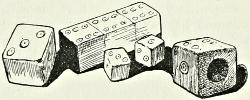
Roman Dice
In the year 44 Cæsar, as dictator, had delegated the charge of the supply
of corn for the capital to two cereal ædiles appointed for the purpose; but
even they proved unequal to the gigantic task imposed upon them. Recourse
was therefore had to extraordinary
commissioners, who bore the title of
curatores. A later emperor, Tiberius,
at the commencement of his official
career had an admirable opportunity
of making himself popular in Rome
when he undertook the cereal quæstorship
at Ostia in 23. But the very next
year a grievous famine again prevailed in Rome, and, as in the old days of
Pompey, extraordinary measures seemed imperatively called for. All eyes
were turned to the emperor, the only man who, by his money resources and
the Egyptian tribute of grain, was in a position to deal with the scarcity.
He was offered absolute dictatorial authority coupled with the responsibility
of provisioning the capital. He accepted the latter only, and his measures
were so vigorous and effectual that in a few days the price of corn fell to its
usual level.
The emperor exercised his official functions through two senatorial representatives.
A new magistracy was erected consisting of two curatores
who had discharged the duties of the prætorship and thus were already
members of the senate. They received an accession both as to numbers and
dignity; after 18 we find four curatores, later six, and in the last years,
6 and 7; they were required to be of consular rank. It is in the highest
degree probable that younger officials acted with or under these curatores
at the extraordinary distributions.
At length, after these tentative experiments, Augustus in his last years
took heart to attempt a definite solution of this important problem. Out
of consideration for the senate he had up to that time employed senatorial
representatives in the provisioning of the capital which he had undertaken
at his own expense. They were now superseded by imperial servants.
The præfecti annonæ were of knightly rank and really regarded
this important office as a profession. C. Turranius, who had previously
governed Egypt, devoted himself to this task, to which he had been called
by the confidence of Augustus, with such zeal that dismissal was to him
equivalent to death, and Caligula reinvested him with his accustomed functions,
which he continued to discharge almost up to the ninetieth year of
his age.
From this time forward the cereal prefects were amongst the most important
of imperial officers, since the tranquillity of the capital depended on the
due discharge of their functions. They commanded an army of subordinate
officials and servants, for the imperial grain fleets which brought corn, oil,
etc., from the provinces to Ostia and Puteoli were under their management.
In both these places they had extensive storehouses with a great staff of
accountants, clerks, and cashiers; then another great army of storehouse
managers, workmen employed in measuring the corn and carrying the sacks,
of waggoners, and lastly, of watermen who brought the corn to Rome, where
it was deposited for the most part in the Sempronian horrea which dated back
to the time of the Gracchi, or in the newly erected Agrippian, Lollian, Galbian,
and other horrea. The distribution took place every month in the Minucian
portico on the Field of Mars. Here there were forty-five doorways
(ostia) for distribution, and the people had to prove their right to receive the
corn by means of counters marked with the
number of the particular doorway and the
day of the month.

Roman Jackstones
An attempt which the emperor made to
have the corn distributed every four months
instead of every month met with scant approval
and was soon abandoned. The Roman
populace had grown thoroughly accustomed
to the notion that its maintenance was the
business of the state and would have liked
nothing better than to have the emperor give
them drink as well as food. Whenever wine grew dear they addressed complaints
to him. But Augustus calmly replied that since the aqueducts of
Agrippa had been completed no one in Rome need suffer thirst. Augustus
had organised the maintenance of Rome on a large and liberal scale, but
that which had formerly been a free-will offering became in his reign an
eleemosynary institution.
Besides these regular monthly distributions there were special distributions
in money and in kind on extraordinary occasions, which exhibit the
emperor’s magnificent liberality. He has left the record of them in the Monumentum
Ancyranum.e “To the Roman people, man by man, I caused three
hundred sesterces to be paid in accordance with the testament of my father;
in my own name I gave four hundred sesterces out of the spoils of war in my
fifth consulate; and again in my tenth consulate I caused provisions to the
value of four hundred sesterces per man to be distributed man by man out
of my own means; and in my eleventh consulate I made twelve distributions
of grain which I had purchased with my private means; and in my
twelfth year of office as tribune I for the third time made a gift of four
hundred sesterces man by man. These distributions were never made to
less than 250,000 persons.
“In my eighteenth year of my office as tribune and my twelfth consulate
I presented sixty denarii to 320,000 persons of the population of the capital
man by man. In my thirteenth year of consular office I distributed sixty
denarii apiece to the people who received the state corn, amounting to something
over two hundred thousand persons.”
Taking these gifts in connection with similar expenses for lands and
rewards for the veterans, for the imperial contributions to the state treasury
and the provision of the military revenue, the colossal sum of six hundred
million denarii mentioned in the appendix to the Monumentum Ancyranum
as given by Augustus to the Roman citizens does not seem at all exaggerated;
and as these distributions were spread over a period of not quite
sixty years, we must assign to each year a sum of not less than ten million
denarii.
These sums, though dispensed of the imperial bounty, were taken by the
people as their right in exchange for their lost liberty. Augustus was well
aware that hunger is wont to be one of the mightiest, if not the mightiest, of
revolutionary forces.
Games; Gladiatorial Contests
In the matter of subsistence the southerner is more modest in his demands
than northern nations are; in the matter of excitement and amusement he
makes greater claims. These Augustus also provided for liberally. The
large scale and elaborate arrangement of the Roman games was in part the
outcome of the simple idea of giving the people a compensation for their lack
of influence in politics and of diverting their attention. In most cases where
a nation is weary of politics it concentrates its attention upon private life,
and the great ones of the theatre thrust statesmen and party leaders into the
background. The emperor’s shows excelled everything that had ever been
before in frequency, variety, and splendour; and so great was the interest
taken in them by all classes that at great festivals and games the emperor
was obliged to post sentinels to guard the vacant city from robbers and
housebreakers.
The Actian games, celebrated at Rome every four years, were particularly
magnificent. The first time (28) Augustus and Agrippa themselves managed
the festivities and offered the populace spectacles of the most varied
character. First a race ridden by boys and men of the highest families;
then gymnastic contests in a wooden stadium which the emperor had caused
to be set up on the Field of Mars; while at the end prisoners of war were
forced to exhibit to the people the spectacle of a mortal combat of gladiators.
In later times the highest priestly colleges in Rome took charge of these
games in rotation.
In his detailed narrative Augustus assigns the first place to the combats
of gladiators, which he exhibited sometimes in his own name and sometimes
in the names of his sons and grandsons; and in eight battles of this sort
some ten thousand gladiators were engaged. Women were not absolutely excluded
from among the spectators, but they were only allowed to watch the
bloodshed from the topmost places. Augustus also abrogated the inhuman
custom that none but the victors might leave the arena alive.
He endeavoured to check the excessive fondness for these cruel sports by
forbidding officials to give gladiatorial shows instead of the usual theatrical
or circus performances when they entered upon office, as had been done, for
example, by the ædiles of the plebs in the year 42. Certain members of the
aristocracy who were notorious for their bloodthirsty tastes, like Domitius
Ahenobarbus, were first privately admonished, and, when that proved of no
avail, their cruel gladiatorial fights were prohibited by an imperial edict.
Large troops of gladiators constituted a grave menace to the public peace,
as had been proved, not only by the Gladiators’ War, but in the case of the
gladiators of Decimus Brutus and M. Antonius. Accordingly in the year
22 an edict appeared to the effect that combats of gladiators were only to
be arranged with the permission of the senate and not oftener than twice
a year, and at the same time the number of contesting pairs
was limited to sixty. Of course this did not diminish the
popularity of these combats nor the interest
of the populace in the combatants. It was
an event when two veterans, each of whom
had often conquered and slain his opponent,
were at last pitted against each other for the
decisive combat, or when a well-known gladiator
had fought his way through and proceeded
to hang up his victorious weapons in
the temple of Hercules.
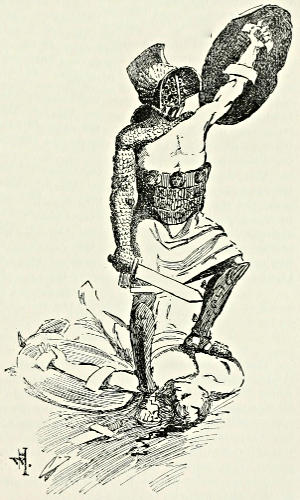
Roman Gladiator
In later days the emperor Tiberius scorned
to make himself popular by these means.
But as the passion of the people for gladiatorial
exhibitions did not wane they became
a matter of private speculation. A freedman
of small means erected a wooden amphitheatre
for his shows at Fidenæ, but it was
so badly built that it collapsed beneath
the crowds of spectators who had flocked
thither, most of them from Rome. After
this accident the senate decreed
that no one should give
such performances unless he
could prove that he was possessed
of a certain fortune.
Wrestling matches of the
sort so popular among the
Greeks were not altogether
unknown, but were only arranged
three times by Augustus
in the course of his long
reign. Wooden stages were
erected on the Field of Mars,
and the most famous athletes
were invited to Rome. Glycon
of Pergamus, whose unconquered fist was celebrated not by his epitaph
alone but also by Horace, was probably of the number.
The emperor followed these contests with peculiar interest. The Greeks
had perfected boxing according to all the rules of the science; in Italy, on
the other hand, it had retained more of its indigenous character. Augustus
was in the habit of occasionally allowing the champions of the two nations to
measure their strength against one another, but personally he was on the
side of the Latin boxers, whether more or less schooled. When a harmless
street fight broke out in any part of Rome, the emperor used to delight in
the mighty blows which his countrymen dealt.
The emperor strove, though without lasting success, to keep women
aloof from the brutal boxing matches. If the populace wanted to see
boxers he yielded to their wishes, but he appointed the early morning hours
for the contest and forbade women to go to the theatre before ten o’clock in
the morning.
More popular still were the wild-beast hunts, of which Augustus arranged
six-and-twenty, in which thirty-five hundred African lions and other wild
animals were slain. Great was the difficulty of capturing and transporting
these rare and dangerous animals; but greater still, it may be, the amount of
care and money expended on the elaboration of the scenery. The Spaniards
regard their bull-fights as a direct continuation of the wild-beast shows of
antiquity; the splendour of the mise en scène has survived to modern days,
but the demands made by an ancient public in the matter of decoration and
machinery were incomparably greater. In most cases gladiators were
obliged to fight the dangerous animals, but occasionally criminals fell victims
to them. Strabo, for example, saw the dreaded robber chieftain, Selurus,
“the son of Etna,” hurled from a lofty scaffold that suddenly collapsed
beneath him into the arena at Rome, where he fell straight into the lion’s
cage that had been placed below.
The bloody battles of the gladiators on land found a counterpart in a
tremendous sea fight which Augustus, following the example of the dictator,
arranged quite close to Rome in the year 2. He caused a lake to be dug
in the plain between the slopes of Janiculum and the bank of the Tiber,
eighteen hundred feet long by twelve hundred wide, on which thirty large
warships and many smaller ones, manned by three thousand (or possibly six
thousand) gladiators, represented a sea fight of the time of the Persian wars.
Ovid describes the gorgeous spectacle as an eye-witness:
“Then when Cæsar of late showed forth to the people
Ships of Persia and Athens, a type of the terrible sea fight,
Hither came youths from the two seas and hither came maidens,
And to the capital flocked all that dwelt in the earth.”
The lake was not supplied with water from the neighbouring Tiber, but
Augustus built a special aqueduct (Aqua Augusta Alsietina) which brought
water from the Alsietine and Sabatine lakes (Lago di Martignano and L. de
Bracciano) to the Janiculum. The Romans were so spoiled by the beautiful
spring-water of their aqueducts that Augustus never thought of carrying
the water of these two lakes right across to the city on the other bank of
the river, but the work was so substantial that it outlasted its original purpose.
The emperor allowed the possessors of fields and gardens in the
vicinity to make use of the water, which was not to be compared with that
of the other aqueducts in the city.
The lake formed the centre of a little wood which the emperor presented
to the Roman people in the name of his grandsons Lucius and Caius. Although
he never arranged another sea fight on this lake, it was not filled up
but was used by other emperors for maritime spectacles, in accordance with
its original purpose.
Races and Theatricals
The ordinary performances in the theatre and circus, such as officials
were required to arrange when they took office, were arranged by Augustus
four times in his own name and twenty-three times in the names of other persons.
Races in the circus, in particular, had been in vogue from very old
times and enjoyed a high degree of popularity. It is true that the enthusiasm
of the people did not reach the culminating point till the latter days
of the empire, but the germ and rudiment was there even in republican
times, and the age of Augustus did its fair share towards developing it.
Epitaphs were not yet composed on the victors, like the τοὺς σοὺς ἀγῶνας
αἰὼν λαλησει of subsequent centuries, but the interest and enthusiasm were
spreading to wider circles. The prizes which rewarded the winners of the
various races were valuable, and an exact record was kept of the first, second,
and third prizes carried off by a famous charioteer in different years. There
were originally only two parties in the circus, the whites and the reds, but
the greens and the blues appear to have been added by the time of Augustus;
or so it seems probable from inscriptions which, though they bear no
date, yet form part of a large find of this period.
Even private individuals (e.g., a relative of the famous jurist Ateius
Capito) were beginning to keep racing stables with a numerous staff. His
slaves and freedmen formed a life-insurance association in which Vipsanius
Agrippa also insured his servants of the same class. The Trojan riding
matches which the sons of aristocratic families, including that of the emperor,
repeatedly exhibited under Augustus have already been mentioned.
Theatrical performances are mentioned in the emperor’s enumeration, but
recede very much into the background as being quite commonplace; they
were mainly the affair of newly elected officials, but Augustus himself had
plays acted in all sorts of places—the Forum, the Amphitheatre, and even
on temporary stages in the streets and squares of the capital, in every language
spoken in Rome, Latin and Greek being of course the chief. Every
play-giver desired to offer the populace something quite unique. The dictator
had even allowed a Roman knight to appear on the stage, and his son
followed his example until it was interdicted by a decree of the senate.
Augustus purposely abstained from increasing the number of ordinary
and regular festivals to any great extent. The Secular games, of which we
shall speak presently, naturally do not come under this head, as do the district
games, associated with the new subdivision of the capital. We have
already mentioned the games commemorative of the victory of Actium;
the martial games were added later in commemoration of the solemn dedication
of the magnificent temple of Mars in 2 B.C.
To the innovations of the empire also belong the votive games for the return
of the emperor from Gaul and Spain in the years 13 B.C. and 7 B.C.; also
votive games for the welfare of Augustus which were arranged every four
years by the great colleges of priests in compliance with a decree of the senate.
The example of Rome soon found imitators in the capitals of the
provinces; sometimes it was the emperor himself who instituted games
there, sometimes prominent citizens who had received or hoped to receive
some post of honour. The number of games held in honour of Augustus
was very great, especially in the Greek cities. In Naples the imperial
games were celebrated in the same fashion as the Olympic games, in commemoration
of the visit of Augustus in the year 14 A.D.
Even as in the life of the individual there are often moments when he
remembers with grief and yearning the golden days of childhood, so in the
development of nations there are periods when the best minds of the nation
dream of a past golden age, in which both the crime and the progress which
have come to pass in the course of historical development were unknown.
The farther the nation is from a primitive condition and the more strongly
its members feel the drawbacks of civilisation, the brighter are the colours
in which they paint the innocent joys of an earlier state of things to which
violence and rapine were as yet strangers.
The generation which had grown to manhood during the civil wars had
of necessity accustomed itself to horrors which are spared to those who grow
up in times of order. All the more vividly did they dream of a happy and
primitive age in the distant past; for none feels a greater enthusiasm for
peace than those who have had to endure the evils of war.
Since the battle of Actium the civil wars were happily at an end; for
nearly half a generation Rome had enjoyed the blessings of peace and the
new constitution which Augustus had given her. The emperor had often
announced his resolve to retire into private life, but had always allowed
himself to be persuaded not to carry it out because the welfare of the state
forbade it; he alone seemed to guarantee peace and safety, his rule seemed
inseparable from domestic tranquillity, and the man who desired the one
could not but desire the other. The emperor strove to keep this single
idea in fresh variations constantly in mind among the Romans, and those
honours pleased him best which gave public expression to this feeling. The
senate, on the emperor’s return had dedicated the altar of the imperial peace.
The poets, each after his fashion, sang the praises of peace and order:
“Fealty, peace itself, and honour, and the ancient
Moral awe, the long-forgotten virtue,
Now dares to return, it approaches, its horn
Full of blessing.”
There was, however, a danger that the rising generation might soon
come to accept the benefits of peace as a matter of course, without definitely
realising to whom they owed these blessings, and it was therefore desirable
to keep in remembrance among the emperor’s contemporaries the difference
between the unquiet past and the blissful present, and to give official recognition
to the fact that the period of civil war was over and that a century
of peace and prosperity had taken its place.
Such turning-points imply an invitation to take a backward glance and
to reckon the sum of development up to this point. So had a poet done at
the end of the previous century:
“How fair, O man, with thy palm-branches
Standest thou in the century’s decline,” etc.
The Rome of the period was also to take a backward glance.
As the senate had solemnly marked the end of the wars by closing the
temple of Janus, so Augustus desired to mark the end of the period of
reorganisation and reconstitution by an imposing symbolical act. Even
the ordinary Roman census was not a mere counting up of the people; it
was a reconstitution of the ranks of Roman citizenship, and if this tedious
and toilsome preparatory labour were to attain legal validity, it must find its
ratification and consummation in a final act in which the whole nation should
be purified with the most solemn religious rites and commended to the propitious
gods for the future. Similarly Augustus had been at work since the
year 29 on a reorganisation of Rome, which was finally declared complete
in the year 17 by a mighty lustrum, the Secular Festival.
The idea, and probably the name, of the seculum is not Roman but
Etruscan; at least, up to the present time no one has succeeded in discovering
any plausible Roman etymology for the word. The seculum is probably
of Etruscan origin, like the other elements of chronology among the
Romans. This devout nation, which understood as no other did how to
inquire into and interpret the will of the gods, fancied that it had learned
that the deity did not merely declare to men the ordinary divisions of time
into months and years by the path and the varying appearance of moon and
sun, but that apart from these there were longer periods in the life of nations
which the gods had appointed, and of
which they revealed the beginning and the
end to the generations of men by manifest
tokens. Such a period is that in which
one generation dies out and a new one
arises, and it therefore extends from the
birth to the death of a man who may be
taken as the representative of his generation.
When the last man died who was
born at the beginning of the first seculum,
then the second began; and, as the duration
of human life seldom exceeds the hundredth
year, a new seculum commonly
commenced at the end of this period. It
did not, however, of necessity last for exactly
a hundred years; on the contrary,
there had been one of 123 years in length,
another of 118, etc.; but the Etruscans
reckoned their seculum approximately at
100 years. When therefore the miraculous
signs ensued, mortals realised that in the
counsels of the gods the end was at hand,
and hastened to propitiate the omens by
sacrifices and games. In misfortune, men
learned to take special heed of the omens
of the gods, for they longed for the opportunity
of concluding the unfavourable
period and beginning a new one, free from
ill-fortune and evil presage.
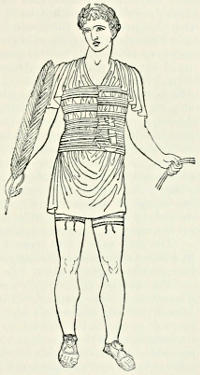
Statue of a Victorious Driver in the Games of the Circus
(In the Vatican)
This grand wisdom of the Etruscans,
which looked beyond the limits of human
life, made a profound impression on their pupils, the Romans, and was
transferred to Rome with the rest of the augural discipline. The family of
the Valerii is said to have been the one to introduce this cult into Rome,
for themselves alone in the first instance, and not as yet in the name of the
state. One of the ancestors of this family, it was said, had come to Rome
from his home in the land of the Sabines to propitiate the evil omens which
disturbed him there. He came down the Tiber with his sick children till
he reached the vicinity of Rome, and there, where the Field of Mars is
narrowest, near the bank of the Tiber, was formerly a spot noted for volcanic
phenomena, hot springs, and subterranean fire—the so-called Tarentum.
The sick children were cured by the water of the neighbouring spring, and
twenty feet below the surface of the ground the father found a primitive
altar to the infernal gods, to whom he gave thanks for the miraculous cure
by sacrifices, games, and lectisternia. A descendant of his is said to have
been one P. Valerius Publicola, who, as consul in the first year of the
republic (509) repeated these games of his family cult in the name and for
the welfare of the state of Rome. It was essential to the secular theory
of later generations that so important an epoch as the end of the monarchy
and the beginning of the republic should have been marked by public
secular games.
The next secular games were also said to have been celebrated by another
Valerius, who was consul in the year 449, after the fall of the decemvirs;
and about a hundred years later the third secular games had to be celebrated,
which, according to the records of the quindecemviri, was again
done by a consul of the house of the Valerii in the year 346, though no one
else knows anything about such a celebration and it was not counted in the
series of republican secular games. For according to Valerius Antias, the
third secular games were celebrated in the year 249, at the time of the First
Punic War; and the fourth—whether they were held in the year 149 or
146—mark the end of that memorable period. For a theory had taken
shape among Roman antiquaries and historical students, of whose number
was even a man of the erudition of Varro, that the seculum must always
be a hundred years long, and for the sake of this theory the games, which
on contemporary authority were held in the year 146, were put three years
earlier. A hundred years later Varro’s authority on all such matters was
at its zenith, and it sufficed to fix the next celebration for the year 49.
“But instead of the celebration came the end; for this was the year at the
beginning of which Cæsar crossed the Rubicon, and with that began the
mortal agony of the republic. What commenced was not a new seculum
for the republic, but a new order of things.” (Mommsen in Die Nation, 1891.)
The civil wars which ensued and seemed to develop one out of another
in endless sequence, might, perhaps, have stifled the hope of peace in Italy,
but not the longing for it. An iron age had dawned instead of the golden.
The dictator did in truth seem to succeed in exorcising the demons of
discord and discontent. But this hope proved illusory on the ides of
March. Soon afterwards the star of the Julii was seen at Rome, and
seemed, as was at first hoped, to be the long-desired divine token that was
to inaugurate a better time. An Etruscan haruspex proclaimed to the
assembled people that the ninth seculum (according to the Etruscans) was
coming to an end and the tenth beginning.
But the augur died immediately after; a sign that his words were not
indeed false but premature, according to the will of the gods. Nowhere did
any likelihood of permanent amelioration present itself, but the yearning
remained and hardly ever found stronger expression than in the wretched
years that followed the murder of Cæsar. It was strengthened by Sibylline
oracles, which were privately circulated and kept faith in the happy future
alive. Since the oracle could not lie, it was, perhaps, nothing but miscalculations
and vain hopes of men, in the year 49, which had anticipated too
soon the dawn of a new age; and perhaps the seculum should be reckoned
at 110 years and not 100—it takes but little to revive hope. In the
year 43 no less a person than Varro announced to the anxious world
of his day that this was the correct estimate; 440 years after the first
celebration the fourth Roman seculum was declining to its close, and then
a new birth would usher in the new age. But Rome still hoped in vain.
Misery increased, and with it the excitement spread into the widest circles.
In the year 40 Asinius Pollio was consul, a man of honourable character
and highly educated, who endeavoured to avoid the arbitrary usurpations
of other rulers. In the circumstances of the time, not the boldest imagination
ventured to dream that he might bring back the golden age. But
Asinius was at that time expecting the birth of a son; perhaps this son
was destined by fate to do so; and a contemporary poet greets the coming
deliverer with the most ardent longings. In later days Virgil, with better
reasons, fixed his hopes and desires upon the emperor.
The opportunity of holding secular games in the latter half of the last
century before Christ had thus passed by unused, and it was a very difficult
matter to prove that Augustus was entitled to hold such a celebration. This
hard and thankless task fell to the share of the famous jurist Ateius Capito,
who acquitted himself skilfully enough to make the will of his master possible
in theory. The chronology of Roman history has suffered violence at
many hands before and after the time of Ateius Capito, but hardly ever more
than at the time of the secular games of Augustus.
A comet, so readily connected by the popular imagination with the end
of the world, appears to have decided the old question as to the turning-point
of the longed-for cosmic period. It might indeed seem as though the gods
themselves had declared their will; for at the beginning of the year 17
an extraordinarily bright comet was visible at Rome, with a long tail pointing
from south to north. This was of course the star of the Julian gens,
which Rome had not seen since the terrible year of 44. That which
the youthful Cæsar had then undertaken with almost superhuman courage
for the sake of avenging his father was now finished, and the age of
strife was over. At that time the red glow of the comet had portended
blood and civil wars; the second appearance of the Julian star, after the
expiation of the crime, was a sign that the beginning of the new age was
close at hand.
The memoirs of the emperor show what great stress he laid upon the appearance
of the star of the year 44, and the coins of the empire struck
soon after 17 testify to the impression made upon him and his contemporaries
by the supposed return of the star of the Julian gens. It was greeted
as the long-desired and manifest divine sign of the end of the iron age and
the commencement of the golden.
Hence we see that the appearance of the star only gave the decision in
the last resort. That which had long been in the air, that which was perhaps
already beginning to evaporate, suddenly condensed into tangible shape
under the influence of this divine manifestation; Augustus resolved not to
let the moment pass unused, but to celebrate the long-expected fifth secular
games, which were associated with the hope of a new birth for Rome.b
With the formation of the monarchy coincides a second revival of Roman
literature, which can only be partly attributed to the new administration, as the
leaders were born under the republic and grew up amidst the struggles for
the monarchy. This period does not differ so much from the literature of
the period of free government as might seem at first sight. For that peculiarly
characteristic penetration by the Greek spirit which extended even to
that manifestation of it which was least worthy of imitation, namely the
Alexandrian, had been already in existence, and the refined elaboration of
the language for poetical purposes, its charm and lightness, its beauty and
merit, are already perceptible in the time of Terence, though in a very different
fashion.
The great revolution which was taking place before their eyes had a far
less disastrous effect on the poets of this time than might have been expected,
and if the lamentations of the civil war are heard everywhere, it is,
nevertheless, rather the ideas of universal peace and the greatness of the
Roman power which determine the pervading key-note. It is true that if
we look for the originality, power, and simplicity which are so irresistible
in Greek literature, we shall be very much disappointed; for they are no
more to be found in the literary creations than in the political. And for
these defects the number of productions can offer no amends. The thought
of writing for a large public, the entire Latin West, must have had an inspiring
effect on an author, as it of course decided the whole conception and
direction of literary compositions; the provinces took a more and more active
share in them; on the other hand, in this field a kind of substitute was
offered for the lack of political activity; it was a matter of course that
authorship was harmless and accommodated itself to the ruling system, or
else entered into a dangerous opposition to it. Partisan writing existed
during the active political struggles of Rome even under the republic; but
now sunshine and light were too unequally divided, and the frankness
which was forbidden during the lifetime of the rulers indemnified itself
after their death by bitterness and calumny.
The really higher styles of poetry, such as drama and epic, entirely died
out. It was not as if this had been caused by the change in the government,
for even in the time of the republic little originality or creative
power had been shown in these directions. All that was now produced was
borrowed entirely from the past. Rhetoric, metrics, and careful diction
were all that could be added to it, and a beautiful, refined, and elegant form
became the criterion according to which the age judged both literary and
artistic productions. It was to such matters as these that the attention of
the judges who decided concerning the admission of the poets into the
national library was mainly directed.
We have no adequate information regarding the dramatic poetry of the
Augustan period, for everything which won the applause of contemporaries
has been lost. What has been preserved to us from this period, namely the
tragedies handed down to us under the name of Seneca, has all the faults
which a depraved taste brings with it; sensational plots and scenes based on
sensual and sentimental emotions; figures without life, but of many words
and speeches; a treatment without knowledge of dramatic technicalities; and
yet withal a harmony of words and verses, highly polished versification and
diction, and the whole magnificent apparatus belonging to the schools of
rhetoric in periods, antitheses, similes, and plays upon words. It is decidedly
to the credit of the lower classes if they turned away from these
dramas, leaving them to the lifeless declamatory exercises of the so-called
educated classes, and in so far as the taste for the drama still existed, preferred
to amuse themselves with a simpler entertainment and the familiar
pieces of the older poets, which had long ceased to be sufficiently refined and
elegant for people of cultivation.
Nor did the epic produce anything really great. Virgil (P. Vergilius
Maro, born on the 15th of October, 70 B.C., died the 22nd of September, 19
B.C.) did indeed make an attempt to create a national epic in the Æneid. But
it is no more genuine than its fundamental idea of connecting the founder of
the new empire with the father of Italian civilisation. Virgil studied under
the Alexandrians and all that was to be learned he learned. He created
the language and the verse structure which remained the standard for
many centuries, so long as and wherever Latin poetry was cultivated. The
form is throughout noble, and the poet was thoroughly acquainted with
Homer and the Greek epic poets, nor is it without taste that he, as a man
of learning, has drawn on this treasure; his ideas are pure and noble and
he had learned to know his country and the legends of his forefathers better
than many before or any after him, so that a certain national colouring is to
be found in his work. But there was one thing which he did not possess;
the creative genius which divines rightly in the choice of subject and
arranges and treats its material with a light but master hand; as the subject
was ill-chosen, so the poet never felt any hearty enthusiasm for it;
everything has been thought out and very coldly and soberly thought out;
beautiful pictures and striking comparisons are indeed presented; but they
are sentimental and studied, and often look strange in their setting.
In the first place the hero is no hero, and the Roman patricians of even
the time of the Scipios would have been revolted by this weakling who is
feeble and sentimental like the poet himself, and not much more than a
puppet in the hands of his divine mother. Such a weak figure gives no
opportunity for strength in the treatment, which is accordingly languid, and
the twelve cantos are spun out with monotonous tedium, so that to every
one acquainted with Homer the reading of them is a mere task to be got
through somehow. And if, from the standpoint of learning, the language
and verses seem irreproachable, classical, and even worthy of imitation, all
pleasure in them is lost by the fact that we are continually aware of the
trouble and labour which they cost the poet.
It is characteristic of the times that Virgil possessed a canonical consideration
with high and low, and poets and prose writers vied with one
another to steal from him. From this fact we may guess the rest, and the
loss in this field which has been recorded can have been no great one.
But how rapidly literature declined at the end of the period is clearly
shown by the epic of M. Annæus Lucanus, the Pharsalia. This poem was
produced in the reign of Nero, and it is difficult to decide whether the choice
of subject or his treatment of it deserves the greater censure. The hero of
the poem is Pompey, the Pompey of the civil wars, a figure so little poetical
that a more unfortunate selection could scarcely have been made; with the
utmost poetical license even without any anxiety to keep to the facts there
was nothing to be made of the subject. That the civil wars in themselves
might be capable of being made the subject of an epic is indisputable; it is
equally indisputable that this could be done only by a poetic talent of the
first order. But even Lucan could do it in his way, though he is no poet
but a scholar of the school of the rhetoricians and the Stoa. As in the
school of rhetorics the energy of the scholar signalised and exhausted itself
in individual feats of ingenuity, so the poem is divided into a number of
scenes without much connection, but distinguished by a soaring imagination,
sounding verses, and pompous tirades, and of course with many learned
accessories, without which neither a great nor a small poem was conceivable
in that period. Besides this haste, uneasiness, and want of discretion
are everywhere apparent, and these, too, belong to the time. On the whole
it may be said that this poetry is a true reflection of the society in which it
originated, and if we had epics by Seneca they might probably resemble
those of his nephew. Of such models there could not fail to be imitations;
the attempts even extended to the schools, and the editing of the Iliad may
well have been the work of industrious scholars, who knew something of
Greek and had learned to imitate their Virgil.
Virgil had already directed his attention to the didactic poem, and the
Georgics are in their way his best creation. Didactic poetry is not approached
with the same expectation as in the case of the higher kinds of
poetry, and it is scarcely possible to draw the line between instruction and
amusement. When the existence of this monstrosity has once been justified
it must be allowed a certain amount of free play. Virgil had here the great
advantage of dealing with a subject in which he was really interested and
into whose treatment he put his whole heart. A deep feeling for nature
and really genuine human sympathy with the subject, which are precisely
what is nowhere to be perceived in the Æneid, occasionally break forth in
the poem on agriculture. An artificial shepherd’s life, much like the idyls
of the eighteenth century, is delineated in the Eclogues, and its unreality is
only surpassed by Calpurnius, an imitator of the age of Nero.
Whilst the didactic poem proper received no further attention worth
noting during this period, the elegy was successfully dealt with. In Albius
Tibullus (54-19 B.C.) it even acquired a characteristic, one might almost
say more national form than is the case with its other representatives.
In his elegies, Tibullus is as essentially free from the Greek influence as
is conceivable in an age which was steeped in Hellenism; he treated the few
themes, which are to be found in his poems, entirely from the human standpoint,
and it is only by this means that he tries to affect the reader. The
sameness which is easily produced in such works—love and sentimental
sorrows are constantly recurring—he has successfully avoided by an extraordinary
elegance and charm of treatment. The reader willingly follows
the dreamy thought of the poet without blaming him for having led
him rather into a world of dreams than into one of living and strong feeling.
The productions of S. Propertius (49-15 B.C.) are already much inferior.
He also had true feeling, and the thoughts which it awakened in him are
for the greater part not borrowed from his models. But it is overloaded
with the learned accessories of Alexandrian learning, and the deep feelings
of the poet are unduly thrust into the background by blatant mythological
embellishments.
Far more splendid and brilliant is the talent of Ovid (P. Ovidius Naso,
43 B.C.-17 A.D.) who cultivated a wonderful borderland between didactic
and elegiac poetry. But all his poems have one trait in common, although
the Metamorphoses and Fasti may differ from the amatory poems, the Tristia
and the Heroides; they, for the first time, display in a more and more
decided fashion the arts of the schools of the rhetoricians.
Ovid was a talented poet, to whom verses and thoughts came rapidly
and without difficulty, but he was entirely wanting in depth of feeling.
Even the poems, which came most from his heart, those laments which he
sang in his banishment at inhospitable Tomi, scarcely arouse true sympathy,
for the intrinsic unreality from which the poetry of Ovid suffers even here
forces itself upon the reader. He recognised the conditions of the new
monarchy unreservedly, and no poet is so well qualified as he to give us a
picture of the views and manner of thought of the circle which surrounded
the imperial house. Sensuality and pleasure are the scarlet threads which
run through the Ovidian poems, and the pain which tortures him in banishment
is entirely the effect of being shut out from the luxurious way of life
which prevailed in those circles whose conversations and intrigues were the
very life of his poetry.
The satire also, that most characteristic production of the national spirit
of Rome, was now cultivated in a fashion partly original by Horace (Q. Horatius
Flaccus, born on the 8th of December, 65 B.C., died on the 27th of November,
6 B.C.). Deep feeling or an effective comprehension of the times,
its weaknesses and duties, would be sought for in vain, for the salons of the
Augustan period no longer possessed these qualities, and it is a picture of the
conversations of the salons that has been bequeathed to us in the Horatian
satires. Some gossip of a higher or lower order, for the most part in a
seemly though piquant form which seldom becomes real malice, forms the
subject-matter of all the poems which have come down to us. The poet
rises to a higher level in the didactic epistles, of which those of the second
book, with their exhortations to the study of Greek models and their tasteful
and striking æsthetic reflections, belong to the chief productions of the time;
and in ripeness and clearness of judgment, careful polish and clear arrangement,
they leave all others far behind them. Greatly inferior to the satires
are the partly satirical Epodes, in which the personal element is too prominent,
and in which the poet betrays great want of self-restraint and taste.
After Horace, the satire, such as he conceived it, found no imitator; the
period which followed brought with it too many conflicts to allow mildness
and tolerance to find a place. The preaching of morals is carried into the
domain of poetry; A. Persius Flaccus, the only representative of this class
of writing, gives us a very poor idea of the age if it really regarded him as a
satirist; but we are scarcely justified in drawing this conclusion, since at the
most he met with approbation only from the ranks of the opposition. It is
the same taste, which Lucan represents, transferred to the satire; the arrogance
and self-sufficiency of an adept belonging to a circle of noble stoics,
who had scarcely got beyond the scholar’s bench, hollow pathos, rhetorical
ornamentation, versified expoundings of the stoic popular morality. Persius
lacked practically all the attributes of a poet. A mediocre performance which
might be reckoned as a satire was the Translation into the Society of Gourds
of the deified Claudius (Divi Claudius Apokolokyntosis), a petty, revengeful
pamphlet against the unfortunate prince, prepared moreover after his
death. The dazzling wit with which the poet strikes at gods and men might
have elicited approval in his own day; but the reader’s uppermost feeling
will always be that this satire sprang from miserable cowardice and perfidious
flattery.
The only really intellectual work of a satirical character that this period
produced was the satires of Petronius, written in the reign of Nero. No
other work so clearly bears the stamp of its time. At least the poor philosophy,
which most of the poets have collected from their philosophical compendiums
and their rhetorical exercises, has no part in this work, although
the laboured and superficial culture of the time clings to its author throughout.
The source of his wisdom is life. To him, man is the crown of creation,
and he has studied him in all phases and degrees; what exists beside man
has only interest for him inasmuch as it can serve to beautify human life and
make it agreeable. Happiness and enjoyment are the watchword of the
whole work, not in the coarsely material sense such as it is embodied in Trimalchio
and his fellows, but a life which, while it is seasoned with all material
joys, is also ennobled by all the contributions of art and cultivation. A rich
and varied experience of life gives this work its great value; the age is
reflected even to the most minute niceties of its language. Inventive power,
description of detail, humour, and a fine irony, as well as an uncommonly
skilful treatment, secure for some parts of these satires the praise of a master
work; and if the frivolous and lascivious tone did not always bring us back
to the court of Nero and the doings of the time, we might think that in
this we had before us a model of the best age. Especially characteristic is
the fine understanding of Greek art and culture, and the enthusiasm for
Latin poetry, which expresses itself partly by means of a peculiar skill in
versification and brilliancy of colouring, partly in bitter mockery of the
affectations of contemporary poets and their dull, spiritless, and senseless
exaggerations. The poet always preserves elegance and purity of language;
when he goes out of his way to attain it, his good taste preserves him from
errors, and that same taste also disclosed to him the cause and effect of the
decline of rhetoric.
Only one quality is wanting in Petronius; like the Casanova literature of
our own and the preceding century, his work has no moral purpose. Æsop’s
fables were now also put into Latin, for Phædrus, often without a complete
understanding of the original, in somewhat clumsy verses and with feeble
wit, arranged the Greek fables for school and home use amongst the Romans.
The satirical point of the different pieces is now almost entirely incomprehensible
to us in our ignorance of conditions in the city of Rome.
The lyric proper was far the most popular form of poetry under the
empire; for every one thought himself called upon to write songs and occasional
verses. We gain some notion of this style of poetry from Horace.
In his poems he chronicles the political measures of Augustus as well as the
love affairs and social doings of himself and his friends. But whilst in the
accounts of the latter it is frequently impossible to decide how much is fact,
how much poetry, and, at times, imitation of his Greek models,—since so
little true life beats through them,—in the former there is something at least
which is in harmony with its subject. The poet has a firm and strong feeling
for the greatness and honour of Rome, if perhaps he does not always see
it in the true light; this gives some of his poems a colouring of truth and of
a deep, sincere feeling.
Dependence on the Greeks of the best age could scarcely have been
greater; in diction and versification he is most careful; but that subtle
relation between the language and the sense, which was indispensable in
the Greek models, has been abandoned; tricks of versification have determined
the form and expression more frequently than poetic impulse and
spontaneous feeling.
But that all poetic creation and feeling were not entirely wanting to
the age is shown by the numerous small poetic productions found on tombstones.
Here true human feeling still revealed itself, and found an expression
which speaks to the heart and is often deeply affecting. It is the same
with the smaller poems in the Latin anthology; of course the ideas are not
great and imposing any more than were the occasions which gave rise to
them. But this much may be gathered from them, that the language of
poetry could still appeal to the heart, and purity and correctness were still
adhered to. Of the spread of poetic activity we can scarcely form too vast
an idea; the study of poetry was now an essential part of education, and
since Asinius Pollio had introduced the custom of public readings, there
was an audience for every individual aspirant. And if the decline of the
art of poetry was to be brought about, this impulse would have effected it
more surely than the principate whose influence on the decline of the art
may be only too easily and willingly overestimated.
With the empire there came a change in the writing of history, inasmuch
as freedom of thought and judgment was limited by the despotic rule,
and the door was flung open to flattery and calumny; and in individual
reigns it might have been dangerous to relate the history of the republic or
of former emperors. But these circumstances alone cannot explain the
insignificance of historical writing any more than the removal of the centre
of politics to the imperial cabinet.
The Romans have really never possessed histories in the true sense of
the term, and consequently there was at this period no room for any considerable
damage to that species of composition. T. Livius (59 B.C.-17 A.D.)
affords distinct evidence of this. In his own time he received unqualified
admiration and in subsequent ages his name sheltered itself behind that of
history; in the later days of the empire his prestige continually increased,
and finally almost the only works in Latin dealing with the period of the
republic and the triumvirate, and the beginnings of the Augustan era, are
transcripts and excerpts from his writings. Augustus offered no exception
to the opinion of the day; although he called him a Pompeian, he not
only granted him all conceivable freedom, but on all occasions testified his
personal esteem for him. And yet Livy is no historian. He undertook the
formidable task of writing a complete history of the Roman state up to his
time, but in consequence of its formidable compass the work was necessarily
unsuccessful, as older works were often wanting, and Livy had not the
ability to turn the existing material to account.
Every Roman historian had great difficulties to encounter with regard
to the period of antiquity, and this extended more or less to the time of
Sulla. Down to a certain period, patriotism required adherence to a traditional
form which could not stand investigation; for other epochs the Greeks,
especially Polybius, had formed a conception which had acquired a canonical
value. Only critical judgment and a general scheme of treatment on a
grand scale could have been effective; but Livy was not the man for this.
To him history was another name for the arranging of annalistic reports
which he put together; the most obvious contradictions were rejected, and a
certain system introduced into the chronology and adhered to as far as
might be without too great scrupulousness; where he had older authors
of merit, such as Polybius, to draw upon, his work was benefited; where
this was not the case, he did not scruple to combine accounts essentially
contradictory. He considered his principal office to be delineation, not
arrangement, investigation, and criticism, and the rhetorical elaboration
made up, in the eyes of the reader, for the want of exactness and a definite
conception.f
It was in the schools of rhetoric, we may believe, that Livy learned that
indifference to historical accuracy, that sacrifice of the substance to the form
of truth, which has cast so fatal a shade over the lustre of his immortal
work. As a friend of the ancient oligarchy, and an aristocrat in prejudices
and temper, it seems improbable that he would have carried his Roman
history down to his own times, had he not submitted to throw a veil over
his sentiments, and made his book such as Augustus himself might sanction
for the perusal of his subjects. The emperor, indeed, is said to have called
him a Pompeian, and to have complained of the colours in which he portrayed
the men of the opposite side; but this could only have been in
jest; the favour in which he was held by the courtiers of the empire,
and his being suffered to assist the studies of the young prince, Claudius
Germanicus, show that he was not seriously regarded as a disaffected politician.
The scorn which Livy heaps on the tribunes and demagogues, and his
ignorant contempt for the plebs, evince the leaning of his mind to the side
of the nobility. But these are obviously the views of the rhetorician rather
than of the historian; and Augustus, tribune and demagogue as he was,
could distinguish between the hollow commonplaces of a perverted education
and the stern judgment of a genuine conviction. The loss of all the latter
portions of this extensive work must be deplored for the number of facts
it has swept into oblivion; but the facts would have been valuable rather
from the inferences which modern science might deduce from them, than
from the light in which the author would himself have placed them. Livy,
taking the pen in middle life, and continuing to pour forth his volumes
in interminable succession, perhaps to the end of his long career,—for
born in the year 59 B.C., he died in 17 A.D.,—left it still apparently unfinished,
at the close of his hundred and forty-second book, and with the
demise of Drusus Germanicus.[4] It may be conjectured that the latter portions
of the work were overtaken by the garrulity of old age, and were
suffered to fall into oblivion from their want of political or literary value.
It is in the earlier books, however, that the spirit of Livy found the
sphere most congenial to it; the first and third decades, containing the early
history of the kings and consuls, and again the grand epic of the war with
Hannibal, have always retained their pre-eminence in general esteem as
the noblest specimens of narration. The greatest minds of Rome at this
period seemed to have kindled with inspiration from the genius of the
founder of the empire; and of these Livy at least appears to have conceived
unconsciously the idea of attaching his countrymen to the early
records of their city, by encircling it with a halo of poetical associations.
The imagination of the Romans of that age was inflamed by the conservative
reaction which sought to throw a bridge over the chaos of the last century,
and revive the sense of national continuity.
The thanks the race of Romulus owed to Livy, for making them acquainted
with their ancestors and proud of their descent, were akin to those
which Englishmen acknowledge to the historical dramas of Shakspeare. He
took the dry chronicles, in which alone their first affairs were written, drew
forth from them the poetic life of half-forgotten traditions, and clothed it
again in forms of ideal beauty. His narrative, glowing in all the colours
of imagination and fancy, is just as faithful to its authorities as the dramatised
histories of the English bard to theirs; indeed, the myths of Romulus
and Tarquin cannot lie farther from the truth of facts than the tragedies
of Lear and Cymbeline; and when he begins to tread the domain of sober
history, his painted Hannibals and Scipios approach as nearly to the men
themselves as the Richards and Henrys of our own mighty master.
The charms of Livy’s style became the happy conjunction of circumstances
under which he wrote, and combined with it to give him that
pre-eminence among Roman historians which he never afterwards lost.
Events and characters of deepest interest became immutably fixed in the lines
in which he had represented them. Henceforth every Roman received from
Livy his first youthful impressions of his country’s career, which thus became
graven forever in the mind of the nation. It was in vain that the inaccuracy
of these relations, and in many cases their direct falsehood, were pointed out
by the votaries of truth, or by jealous and unsuccessful rivals; henceforth it
was treason to the majesty of Rome to doubt that Porsenna was driven in
confusion from her walls, or that the spoils of the Capitol were wrested again
from the triumphant legions of Brennus.g
Such are the estimates placed upon the work of Livy by those who view
him from the coldly analytical standpoint of the technical historian. But
we must not leave the greatest writer of Latin prose without seeking a more
sympathetic interpretation of his influence. Let us turn to the estimate of
one who was himself an historian kindred in spirit to Livy—one who approached
history from the standpoint of the artist and humanitarian,—M.
Taine. Here is his estimate of
There are three ways of representing character [says Taine]: the author
may stop to think and compose a portrait, in a philosophical style, as Thucydides
does; one may paint people by their actions, a method followed by
Tacitus and the poets; or he may portray them by exposing their opinions
in speeches; this is Livy’s and the orator’s talent.
The finest of all his portraits is that of the Roman people. Each speech,
each oratorical narrative revises and perfects it, and it is easily seen that Livy
has not taken it from the ancient authors but that it is entirely his own. In
the combat of Horatius Cocles, what pride and what vigour! It is not likely
that the Romans in one year had become such unruly republicans. But how
well the fable is hidden under a noble passion! Throwing towards the
chiefs of the Etruscans savage and threatening glances, sometimes provoking
them one after another, sometimes insulting them collectively.“Slaves of
insolent kings, forgetting your own liberty, you come to attack that of
others!” If this passage is theatrical, it is grand, and eloquence nobly
adorns “the beginning of this liberty.”
Dionysius makes Mucius an ingenious Greek, who terrifies good Porsenna
and saves himself by a stratagem with a double result. In Livy
Mucius is a hero. “Seized by the guards and brought before the king’s
court, even then, in the midst of such dangers, he was more to be feared
than to be frightened. ‘I am a Roman citizen,’ he said, ‘I am called C.
Mucius, enemy. I wished to kill an enemy, and I am as ready to die as to
kill. A Roman can dare all and suffer all. I am but the first to bring
against thee their courage; behind me is a long train of men who seek the
same honour. Prepare thyself if thou wilt, for the struggle. At each hour,
thou wilt fight for life and thou wilt have a dagger and an enemy in the
vestibule of thy palace. We young men declare this kind of war against
thee. Fear neither army nor combat, this affair is between each of us and
thee alone.’
“The king, at the same time excited by anger and terrified by fear, ordered
him to be surrounded by flames, if he did not at once explain these ambiguous
threats of conspiracy. ‘Look,’ said Mucius, ‘in order to understand
what a small thing the body is to those who behold a great glory.’ He put
his hand in a brasier lighted for the sacrifice, and left it there, as if unconscious
of the pain.” In Dionysius, Clœlia asks the guards permission to
bathe, requests them to withdraw a little whilst she disrobes herself, and
then quietly crosses the Tiber. In reading the inventions of clever poltroonery,
one respects Livy for having written as a Roman.
It is pride and not interest which makes the Roman people revolt against
a master. See in what manner Cincinnatus judges tyranny. Does Livy
forget that he lived under Augustus? When Melius was stretched out on
the market-place, “He has been justly killed,” says the dictator; “a man
should not be treated as a citizen, who, born of a free people, in the centre
of privileges and laws, conceived the hope of ruling, knowing that kings had
been driven from that city; that the same year, the king’s nephews, sons of
the consul who liberated the country, being denounced for having plotted to
re-establish kings, had been beheaded with an axe by their father; and that
the Consul Tarquinus Collatinus, in hatred of his very name, had been
obliged to leave his magistracy to go into exile.”
All these arguments are derived from the dignity of the Roman people,
issue of the gods, exultant master-elect of the world, whose high self-esteem
is its dominating passion. This people kills a tyrant, not in the cause of
justice, but in order that it may become a tyrant itself for love of empire. This
need of commanding is so natural to the Romans that it seems to them to be
a divine right. When the Latins, who for over two hundred years made up
half of the army and achieved half the victories, claimed the equal rights
they deserved, the Roman people were as indignant as if it were sacrilege.
The consul frankly says that if the Roman senators were mad enough to obey a
man of Setia, he would come, sword in hand, into the senate, and that he would
kill every Latin he saw in the curia with his own hand. Then turning towards
Jupiter’s statue, he cries: “Listen to these crimes, Jupiter, hear them, Right
and Justice! Foreign consuls, a foreign senate, inaugurated in Jupiter’s
temple, thyself captive and oppressed, that is what thou wouldst see.”
This sublime insolence proves that these men had souls worthy of kings.
A government like a man has its own personality. One feels in the orations
of Demosthenes the generous indignation and eloquent pain of an artistic
and philosophical people, which appeals to the gods and to men against brutal
strength, envelops itself in its own glory before falling. The decrees of the
Roman senate are the verdicts of a judge who overwhelms the heart by his
imperious hardness before crushing the enemy with his armies.
When Popilius, tracing a circle around the king of Syria, ordered him
to answer him before stepping over it, he did nothing very extraordinary.
All the Romans treated foreigners as subjects.
From this public and private pride, born with the foundation of Rome,
nourished by a succession of victories and by habitual domination, there
resulted a particular kind of courage. The Romans do not fight through an
outburst of bravery and of imagination, as the Athenians, or for the need of
action and activity like the barbarians, but by maxims of pride and obstinacy.
Their defeats are admirable. At Lake Trasimenus, battalions of soldiers
charge through the victorious army by which they are surrounded. At
Cannæ, ranged in a circle, fifty thousand men die to the last man, those in
front ceaselessly falling and those behind taking their place.
The Romans fight for honour and duty, incapable of yielding, because the
heart of men revolts against the slightest approach and appearance of pardon,
because humiliation is worse than ruin, because it is better to lose everything
than to yield an inch. That is why Rome becomes prouder in reverse and
only consents to treat in order to pardon, why she will only suffer around her
protégés, suppliants, and subjects, and “carries her empire as far as the
earth and her courage as high as the sky.” Pride renders one calm. The
man who aims at being worthy remains serious, and the Romans without
emotion or enthusiasm accomplished the greatest results. Pride sanctifies
the fatherland because the citizen gets from it glory and ascendency, without
which he cannot exist. Pride sacrifices the family because it considers
as weakness the affections on which it is founded.
Livy shows in his speeches how simple, quiet, and deliberate self-sacrifice
is in Rome. Q. Fabius presided over the comitia; the first hundred nominate
his nephew Otacilius consul. He stops the voting and coldly says,
“We have tried thee, Otacilius, in lesser posts, and thou certainly hast done
nothing which justifies us giving thee more important ones. For three
reasons did we equip the fleet you commanded this year; in order to lay the
African coast, in order to protect the shores of Italy, and above all that no
reinforcements, food, or money be sent through from Carthage to Hannibal.
Name Otacilius consul, if he has rendered to the state—I don’t say all
these services, but a single one. It matters more to thee, Otacilius, than
to any one else that a burden under which you would be crushed be not
laid on your shoulders. Herald, recall to the vote the century of the young
men of Anio.” As Otacilius cries out with rage that Fabius himself
wishes to remain in the consulship and throws himself upon him, the consul
orders the lictors to approach, and he informs Otacilius that, not having
entered the city, his arms and arrows have been carried on in advance.
Fabius is so sure of his disinterestedness that he does not fear appearing
ambitious and tyrannical, and the people judging the same, at once elect him
consul.
The son of Manlius has fought against his father’s orders. He appears
with his spoil. Without saying a word to him, the father turns away and
orders the army to be assembled, and at once the following sentence, “Since
without respect for consular authority or paternal majesty, T. Manlius, thou
hast against orders, outside the ranks, fought the enemy, and destroyed, as
far as was in thy power, military discipline, upon which until to-day Roman
deeds have always stood; since thou hast forced me to forget either the
republic or myself and mine, let us rather bear the penalty of the crime
ourselves than that the republic pay so heavily for our fault. We shall be
a sad but salutary example to coming generations. Without doubt, a father’s
natural love and that proof of courage deceived by empty glory move me
in thy favour. But since it is necessary by thy death to sanction the orders
of the consuls or by thy pardon forever to nullify them, I do not think if there
runs a drop of our blood in thy veins, that thou willst refuse to restore by
thy punishment military discipline, which has been overthrown by thy error.
Go, lictor, tie him to the stake.”
This argument, which ends like a thunderbolt, is terrible because it is
so sudden. Judge by this example to what an extent Roman zeal was carried.
In the soul of the magistrate there seemed to exist a permanent
tribunal which was ever ready to deliver judgment. They had no need
to raise themselves above their own level in order to attain self-denial; it
came naturally to them. In the same way the savages of America tranquilly
offered up their limbs for torture and by education, temperament,
habit, and nature mocked at what the martyrs with all their exaltation
dared hardly face.
The soothsayer having declared that the victorious army must lose its
general, Manlius and his brother general without any signs of emotion, summon
their officers on the eve of battle and agree that there, where they saw
the army give way, one or the other should sacrifice himself.
By pride of citizenship, Livy brings out the fine sides of this character;
by precision of oratory, he reveals the characteristic features, for he is
obliged to arrange his subject to suit his audience and to touch Roman passions
by Roman arguments. Consider in Camillus’ discourse, that religion
which is really but a doctrine, so minutely and carefully following the consecrated
form, so attached to outward rites, observing not the spirit but the
letter which alone prevents the people from emigrating to Veii. As it is
political and local it attaches the government and the citizen to the soil.
“We have a town founded according to omens and augurs in which there
is not a corner where the gods and their worship are not to be found. Our
solemn sacrifices take place on certain days. Will you forsake, Romans,
all these private and public gods? How little your actions resemble that
of the young M. C. Fabius whom the enemy watched with as much admiration
as you, when, amongst the Gallic javelins, coming down from the
citadel he offered up on the Quirinal the solemn sacrifice of the house of
Fabia. The vestals can only have one abode, one from which nothing can
eject them except the surrender of the town. Jupiter’s flamen cannot spend
one night outside Rome without crime. Would you make these Roman
priests Veientine priests, and would you abandon vestal virgins? Oh,
Vesta! And the flamen living in another country, shall he every night
commit an impious act which the republic must atone for with him? Here
is the Capitol, where a human head was once found, when the soothsayers
said that here would be the head of the world and the seat of the empire.
Here are Vesta’s sacred fire, the shields fallen from heaven, and, if you stay
here, the gods all-merciful.”
One sees that the love of country is as much religious as it is political;
the gods live on the soil and are Romans; what must be the strength of this
sentiment which unites all others! In our days they are separate. The
town we live in, the religion we follow, and the country to which we belong
make up three distinct worlds, often unfriendly to each other. Amongst
the ancients, there was but one, the city. The family was sacrificed to it;
it made one with religion; the soul and thought of man were absorbed in
his country; and from every point of view, the citizen alone was visible.
Let us try in a few words to sum up the philosophy of the epoch as it is
given by our contemporaries. We are not leaving Livy behind us by showing
how his work has been perfected. “Great queen,” said Bossuet, before
Henrietta Maria’s tomb, “I gratify your tenderest desires in praising this
great monarch, and your heart, dust though it is, awakes to hear me.” Livy
would not listen with indifference to the modern philosophers who explain,
perfect, and complete the history of his country. To act with a personal
interest in view, and consequently to organise the means of so doing is the
dominant trait in the history and genius of Rome. Therefore its spirit is
that of calculating reflection rather than of poetical invention and philosophical
speculation, and its character consists of a reasoned will, not of feelings
or affections.
From this arises that never-ending struggle with the unfruitfulness of a
naturally sterile land, that contempt for him who loses his patrimony, the
fame of him who increases it, economy, frugality, greed, avarice, the spirit
of chicanery, all the virtues and all the vices which generate and preserve
wealth, the tendency to regard property as a sacred trust, and the boundary
of a field as a limitation of divine origin, the protection of lands and credit
by severe laws, legal deeds drawn up in minute and inviolable forms—in a
word, every institution calculated for the protection of acquired property.
In other countries the natural family, established on the basis of a common
origin, is ruled by the affections; but the Roman family, absolutely
civil, founded on a community of obedience and of rites, is only the chattel
and the property of the father, governed according to his will, subordinate
to the state, ever bequeathed by law in the presence of the state, a kind of
province in the hands of the father which supplies soldiers for the public
benefit.
Made up of different races, united by violence, the work of force and will,
and not of relationship and nature, the Roman state contained two organised
bodies, struggling regularly and legally, not through passion, but through
interest, and united under the best devised and organised constitution that
has ever been known. By the state’s systematic and methodical mode of
conquest for the sole object of preserving and exploiting, military art was
carried to the highest possible point, and political skill and administrative
talent united to bring together by force the whole of the then known world
into an empire organised by one dominant city.
Roman policy consisted in turning the conquered nations into Roman
soldiers, and foreign princes and magistrates into Roman ministers, thus
strengthening the controlling power at the least possible expense. Military
art consisted in subjecting the bravest and strongest soldiers to the strictest
obedience, that is to say, in obtaining the greatest amount of strength from
the vast forces at command. All her wisdom was exerted to increase her
power and to spare herself. An institution of will, a machine for conquest,
a matter of organisation, the state occupied all thought, absorbed all love,
and claimed submission in every act and institution.
The sway of personal interest and national egoism produces a contempt
for humanity. The human species, when unconquered, is looked upon as
material for conquest, conquered it is a prey to be made use of and abused.
Slaves are trampled upon with atrocious cruelty, entire nations are destroyed,
vanquished kings are led in triumph and put to death.
The gods are abstractions, and utterly without poetry, such as calm
reflection discerns in the humblest agricultural or domestic operations,
scourges adored through fear, foreign gods received into the temple through
interested motives as vanquished foes were received into the city, and subject
to the Jupiter of the Capitol as nations were to Rome. The priests
were laymen divided into classes, and officiated only under the authority of the
senate, which regulated all expiatory ceremonies and alone, with the people,
could make innovations. Worship consisted of minute ceremonies, scrupulously
observed because all poetical and philosophical spirit which is the
interpreter of symbols, was wanting; dull, unilluminated reason attaching
itself only to the letter. The senate used religion as a political machine, and
like all else it was but an instrument of government.
In the world of art we find nothing indigenous, except family memoirs,
written in the interests of a race, dry chronicles drawn up for public use,
rituals, account books, collections of laws, books of moral sayings, memoranda
of political satires—in short, government documents, maxims of conduct,
and political essays.
Everything else is foreign, imported, or conquered. The theatre originating
in Etruria and in Greece was simply imitated and then forsaken for
bear fights which later became processions, magnificent in weapons and ornaments,
parades of triumph and war. Monuments of art were pillaged in
Greece, and in Cicero’s time were still despised; while in poetry, there
was no original fiction, no invention of characters. The only things in
which the national genius rivals the imitation of foreign models are oratory,—the
arm of the forum,—satire,—versified pleading and instruction
in morals,—and history, the record of political facts, which, however,
is at Rome only a collection of memoirs or an exercise in oratory; and
all these things are concerned with the practical and with government.
If Rome possessed poets, it was solely when her particular genius gave
way before a new movement. The only entertainments she invented were
triumphs and games in the circus, where victory was continued by the
humiliation and death of the vanquished, where the spectator was the conqueror
and assassin.
All scientific writings were translations. There were compilers such as
Varro and Pliny, imitators such as Cicero and Lucretius; some small
advance was made in agriculture, rhetoric, medicine, and architecture—all
applied sciences. In the place of metaphysics, the clumsy physics of
Epicurus and of the stoics were copied. The practical side of philosophy
was alone studied, moral philosophy, and that with a purely practical object.
The only strictly Roman science is jurisprudence, and that is altogether
practical and political. It is, moreover, so long as it remains Roman, but
a collection of dry formulæ, a mere manual for lawyers and not a branch of
science.
From the character of Roman genius springs its history. The family
and religion being subordinate to the state, art and science being null, or
entirely practical, and the state having no other object than to conquer and
to organise what it had conquered, Roman history is the history of conquest
and its effects.
The middle class was either ruined, or perished during the progress of
this great war. From the time of the Gracchi, besides a population of poor
people and freed slaves, there remained only a wealthy class, wielding great
power by reason of their immense riches, their command of great armies,
their control of taxation, and of the destinies of the commonwealth in general.
At first united but afterwards divided, at the end of a century’s
struggle one of these classes emerged victorious. Thus power, founded by
sheer force, passed to the armies, the embodiment of force. In the meanwhile,
the universe, depopulated and ruined by conquest, by civil wars, by
the pillage of the proconsuls, by the demands of the imperial treasury, supplied
no more soldiers. With the fall of militarism, an oriental despotism,
characterised by a cunning administration, was founded. Through war and
its results, conquerors and conquered, nations and liberties, had all perished.
Nothing remained in force but a system of effete institutions under the
caprice of a ruler who was often hardly a man.
The ancient institution of the family disappeared under the influence of
Grecian ideas and oriental customs. The judicial dicta of lawyers and
prætors conflicted with the authority of the husband and father; civil
family ties became dissolved in excess of pleasures and love of conquest.
In spite of the laws of Augustus, marriages decreased, and were only
excuses for adultery and divorce. Mysticism, poverty, the discouragement
of the curials, added despair to the effects of debauchery and created a contempt
for life.
By these changes in domestic life and under the influence of foreign
philosophers, the Roman idea of property changed. First of all in the
hands of the father (mancipium), possessions next became a family inheritance
(dominium), and ended by belonging entirely to the individual (proprietas).
Though benefited in theory, in practice property ceased to exist,
because according to the law the emperor was master over it, because the
treasury took its fruits, because taxation, tyranny, ignorance, and a growing
depopulation rendered it sterile or reduced it to nought.
The ancient religion assimilated with the religions of Greece and the
East, disappeared in the pantheon of the gods enlarged by dead emperors,
and there remained of it only official pomp and an excuse for persecutions.
The jealousy of despots, the degradation of servitude, the loss of all interests
and of all hope, the abuse of pleasures, the downfall of Greece and of
the East, extinguished all that was yet known of art and science. The
jurisconsults alone laid down a code of laws, the last result of the spirit of
organisation.
Thus, conquest, the fruit of Roman genius, destroyed both the genius
of peoples, and the peoples themselves; leaving behind it because it was
a system, a system of institutions on a dead foundation. But in this debasement
of every force and of every earthly hope, man took refuge within
himself. Helped by oriental mysticism, he discovered in a new religion a
new world.
This is what the modern philosophers have added to Livy. The criticism
commenced by him, renewed by Beaufort, nearly perfected by Niebuhr, and
the philosophy hidden under his eloquence, which was turned by Machiavelli
into a practical channel and is still imperfect in Montesquieu, become each
day more exact and more profound. The corrections thus made honour
those by whom they are made without lowering those who suffer them.
The first authors are the fathers of science, and Livy alone has done more
for Roman history than all those who have desired to set him right.i
Roman Compass
(In the British Museum)
Octavian divorced his first two wives, the daughter of Publ. Servilius,
to whom he had been married at eighteen, and Clodia, daughter of Antony’s
wife Fulvia by her first husband P. Clodius the triumvir, after a short period
of wedded life; and a year after she had borne him a daughter, Julia by
name, he put away his third wife Scribonia, being captivated by the charms
of Livia, the wife of Ti. Claudius Nero, who came into his house as his fourth
wife with the consent of her former husband. Her two sons, Tiberius (born
42 B.C.) and Drusus, whom she brought into the world three months after
her union with Augustus, were brought up in the house of their father Cl.
Nero, but were received by Augustus into his own house on the death of the
former, who had appointed him their guardian.
The person who had the likeliest prospect of the succession seemed to
be M. Marcellus, the son of the emperor’s sister Octavia by her first marriage.
He was treated with the utmost distinction by Augustus, who loaded
him with honours in quick succession and married him at an early age to his
daughter Julia, to the great mortification of the haughty and ambitious
Livia, who, having borne no children to her imperial spouse, desired to
secure the first place after the monarch and the reversion of the throne for
her sons Tiberius and Drusus.
[21 B.C.-2 A.D.]
A second rival to the youthful Marcellus arose in the person of his own
brother-in-law Agrippa, the famous general to whom Augustus chiefly owed
his victories over Sext. Pompeius and Antony, and whom he himself had
encouraged to cherish the most daring hopes by high distinctions and proofs
of favour. When the enmity between Agrippa and Marcellus grew too
plainly manifest, the emperor despatched the former to Asia under pretext of
an honourable mission. But Agrippa, looking upon this as a kind of banishment,
ruled the province through his legate, while he himself remained at
Lesbos, his gaze riveted upon Rome. Fate intervened to save Augustus
from painful experience of the affronted pride of an ambitious man. Marcellus
died in the year 23, universally lamented by the Roman people, whose
darling he was. It was shrewdly suspected that he had fallen a victim to
the rancour and intrigues of Livia, who, by birth a member of the Claudian
family, had inherited all the pride and jealous ambition of their old patrician
blood. Augustus, dismayed by the disturbances at Rome in the year 22, and
the evidences of a conspiracy against his life which then came to light, made
haste to be reconciled with Agrippa, and, by marrying him to Julia, assured
him of the first place after his own and the prospect of the succession.
Octavia, the emperor’s sister, moved by envy and jealousy of Livia, gladly
agreed to Agrippa’s divorce from her daughter Marcella, that so she might
thwart the ambitious schemes of the emperor’s consort. A few years later
Agrippa journeyed to the East, accompanied by Julia, to set in order the
complications and struggles for the throne which had arisen in various districts
from the Bosporus to Syria. His presence was a blessing to the
Asiatic provinces and dependent states; he reconciled the wrangling members
of the empire by admonitions and commands, and perpetuated the name of
his wife by founding on the site of the ancient and ruinous seaport of Berytus
the colony of Julia Felix, which was provided with a garrison of two legions
and became the centre of Roman dominion in Syria. As Agrippa was returning
to Italy after a stay of some years in the East, he succumbed to sickness
in the fifty-first year of his age. He died in Campania in 12 B.C.
Augustus rendered the highest honours to the man to whom he owed so
much, and who had devoted himself as fully to the welfare of the state as to
the cause of his imperial friend. He had the body interred with the most
solemn obsequies in the imperial vault, himself delivering the funeral oration,
and not only made over the baths and gardens of Agrippa to the city
of Rome according to the wishes of the deceased, but distributed considerable
donations of money among the people in his name.
Livia now conceived fresh hopes for her sons. By her intrigues she succeeded
in procuring the divorce of Tiberius, her first-born, who was at that
time thirty years of age, from his wife, and his marriage with the emperor’s
widowed daughter, who had borne three sons to Agrippa—Caius, Lucius, and
Agrippa, and two daughters, Julia and Agrippina. Augustus with difficulty
suppressed his dislike of his ambitious, overbearing, and sullen stepson.
Within a very few years the circle of friends which Augustus had gathered
about him had been sadly thinned by death. Agrippa, Octavia, Drusus,
and Mæcenas had sunk into the tomb within the space of four years (from
12 to 8 B.C.). Thus with declining age the emperor fixed his affections all
the more exclusively upon his two grandsons, Caius and Lucius, the children
of his daughter Julia and his friend Agrippa. He admitted them by adoption
into the Julian family, conferred the title of Cæsar upon them, and had
them brought up under his own eye; he even devoted part of his own leisure
to their instruction and education. They were his usual companions at
table, and were treated with such distinction that all men regarded them as
the future heirs of the empire. The populace and the senate vied with each
other in offering homage and adulation to the imperial grandsons of Augustus,
and they were loaded with fresh honours and dignities every year.
But this brilliant position was fated to be the ruin of the young princes.
It not only filled their own hearts with presumption and self-conceit; Livia
and Tiberius turned eyes of envy and hatred upon the favoured pair. When
Augustus, who was not blind to their sentiments, attempted to remove his
stepson from the capital by giving him the honourable task of conducting a
campaign in Armenia, the latter declined the proffered honour out of mortified
pride, and begged leave to spend some years in learned leisure in the
island of Rhodes. The leave was granted, and extended even beyond his
desires. For seven years he stayed in the Greek island; busy with philosophical
and mathematical studies, and observing the constellations in the
night hours under the guidance of Thrasyllus, to draw auguries for the
future from their position. His absence was at first associated with demonstrations
of honour, through the splendour of the tribunician office which
Augustus had conferred on him before his departure; but in course of time
it assumed more and more the character of an exile, and Julia took advantage
of it to increase her father’s aversion for the husband she abhorred.
Frivolous, vain, and wanton, the emperor’s daughter had caused him
many a heartache by the levity of her conduct and her fondness for amusement;
but she had always been able to propitiate his wrath and regain her
ascendency by her amiability, her talent for witty and delightful conversation,
her culture, and her art of delicate flattery. He shut his eyes when
she violated the outward propriety and decorum which he endeavoured to
diffuse over the private life of the imperial family, or when she showed herself
in public surrounded by a swarm of aristocratic young men of lax
morals. If he were annoyed at some too wanton attire of hers, she would
presently appear in the decorous garb of a Roman matron and enliven her
father by some jesting observation. The circle of blooming grandchildren
with which she had surrounded his throne, and by which she seemed to have
ensured his line in the possession of the monarchy, inclined him to judge
her leniently and to make allowances for her.
But Livia’s intriguing temper found ways and means to destroy this bond
and to extinguish in the father’s heart the long-cherished belief in his daughter’s
innocence. She contrived to arouse in him the dark suspicion that
Julia was not only disgracing the honour of the imperial house by a licentious
way of life, but that she and her lovers had actually conceived hostile
designs against his person and the security of the empire. For by this alone
can we explain the harsh measures adopted by Augustus, who had his daughter
suddenly banished without trial to the little island of Pandataria off the
Campanian coast, and informed the senate that through shameless wantonness
she had so far erred as to make the Forum and tribune the scene of nocturnal
orgies and the witness of her gallantries. Her accomplices, real or
supposed, who were for the most part opponents of Tiberius, shared the same
fate of exile, or suffered the penalty of death, like the gifted and cultured
son of the triumvir, Julus Antonius, eminent both as a statesman and a
soldier. The sympathy and compassion of the people accompanied the emperor’s
daughter (then thirty-eight years of age) into her place of punishment.
Her guilt and transgression were her portion in the life of a
degenerate age and city steeped in pleasures and vices, her penance was the
outcome of the envy and malignity of an intriguing stepmother.
Her life in exile, which was voluntarily shared by her mother Scribonia,
was rich in deeds of benevolence and charity. She died at Rhegium soon
after her father, full of sorrows and weary of life. The gifted and eloquent
Sempronius Gracchus, who had enjoyed her favour and love in happier days
and had consequently been banished to the African island of Cercina, died
about the same time by the hands of assassins sent by Tiberius to despatch
him; showing himself by his fortitude in death not unworthy of the Sempronian
name which in his life he had brought to shame.
[1 B.C.-9 A.D.]
With the banishment of Julia commenced that series of misfortunes
which ended by leaving the house of Augustus desolate and inflicted deep
wounds upon his paternal heart. In that same year her eldest son, the
eighteen-year-old Caius Cæsar, undertook a campaign in Asia at the head of
a considerable army, in order to reduce to submission the Armenians—who
had revolted from the dominion of Rome by the help of the Parthians—and
to chastise the refractory Arab tribes. Armed with authority of the
proconsular imperium over all the provinces of the east, so that absolute
power in matters military and civil rested in his hands and all local governors
were subject to his commands, the youthful commander-in-chief
crossed to Egypt by way of Samos, accompanied by M. Lollius and other
experienced and learned men whom Augustus had placed about him as counsellors.
Tiberius, who visited his stepson during his stay on the island, was
able to draw from the coolness of his reception the conclusion that his own
star was on the decline and that Caius Cæsar was universally recognised and
honoured as the heir to the empire. From Egypt the expedition passed
through Palestine to Syria. All men bowed before the imperial youth who
seemed destined to inherit the empire of the world, and vied with one another
in proffering homage, courting favour, and bringing gifts. Access to the
youthful imperator was purchased of Lollius at a high price.
The enemies of Rome were struck with awe at this display of might and
majesty. The Nabatæans of Petra voluntarily returned to their previous
position of dependence, and in a personal interview with the Roman commander-in-chief
on an island in the Euphrates, Phraates, king of Parthia,
concluded a peace on terms dictated by this mighty ruler and evacuated
Armenia, which was then quickly conquered by the legions after a faint
resistance, and was again numbered among Roman dependencies.
Caius Cæsar then made ready to return home. Feeble of body and
greatly distressed by a wound received at the siege of the town of Artagera
on the Euphrates, he had no desire for more of the hardships and perils of
war; he longed for enjoyment and tranquillity rather than for honour and
military reputation. Both were denied him. Death overtook him at Lycia
on his homeward way. Before he died he received the mournful tidings
that his younger brother Lucius Cæsar had suddenly fallen a victim to sickness
eighteen months earlier, at Massilia, on an expedition into Spain.
With the death of the two Cæsars the hopes of Tiberius blossomed anew.
Hence it is not improbable that they died of poison, administered at the
criminal instigations of Livia. Even contemporaries nourished this suspicion.
The passionate nature of the empress, who shrank from no crime
however heinous, was well known, as was also the revengeful and spiteful
temper of her eldest son, who had returned to Rome shortly before the
death of Caius, and now did all he could to step into the vacant place. The
mother’s intrigues and the son’s flattering arts of dissimulation did actually
succeed to some extent in overcoming the emperor’s aversion to his stepson.
He received him into favour and graciously acceded to Livia’s proud hopes
and desires by adopting him and admitting him into the Julian family.
Julia, the granddaughter of Augustus, who resembled her mother in beauty,
in wit, as well as in levity and voluptuousness, and the younger Agrippa
(styled Postumus, because Julia had brought him into the world after the
death of her husband), a turbulent youth of haughty and intractable disposition,
rude manners, and violent passions, were no formidable rivals to the
artful Livia and her malevolent son.
When Agrippa’s outbreaks of fury were carried so far that neither the
emperor nor the empress were spared by them, the latter contrived that the
thoughtless and ungovernable youth, though adopted by Augustus at the same
time as Tiberius, should be kept under military supervision in the little island
of Planasia; where Tiberius had put him out of the way in the first year of
his reign by assassins despatched for the purpose, alleging instruction left
by the deceased emperor as his excuse. The younger Julia was banished
on the pretext of an illicit amour with Decius Silanus, to a desolate island in
the neighbourhood of Apulia, and compelled to pass the rest of her days—twenty
long years—in exile.
[9-14 A.D.]
Fortune, which had stood by Augustus faithfully throughout his public
career and had led him by many thorny paths to the summit of earthly
glory, deserted him in his private life and in his domestic circle. Hatred
and envy, fanned by female passions, ranged his court in two hostile factions,
which employed against each other all the weapons of intrigue and
all the arts of treachery and dissimulation, and scared peace and harmony
away from the apartments of the imperial palace.
Livia’s ambitious and passionate temper was so notorious that she was
actually suspected of having cut her husband’s days short by poison, lest he
should restore his grandson Agrippa, to whom he had been reconciled in
his island exile a little while before with tears and passionate embraces,
to his rights and honours. She was alone with the emperor when death overtook
him on a journey, at Nola in Lower Italy, in the seventy-sixth year of his
age; and by carefully guarding the house and spreading false reports she
concealed the fact of his decease until her son, who for several years had
been associated with his adoptive father as coadjutor in the empire, could
be summoned from Illyricum. Then the world was startled by the double
announcement that Augustus was dead and that Tiberius had assumed the
reins of power.
The gorgeous obsequies of his predecessor were the new emperor’s first
business. Escorted by the whole body of knights and senators, and accompanied
by women, bodyguards, and an innumerable multitude, the corpse
was borne to the Field of Mars and there committed to the flames. When
the ashes had been collected and interred in the imperial vault the deceased
was exalted to a place among the gods by a decree of the senate, and a
temple and ritual were assigned to him. Livia, known as Julia Livia since
her adoption into the Julian family, was to preside as high priestess over the
new college of priests devoted to the deified monarch. She died in the year
29 A.D., at the advanced age of 86.b
It is extremely difficult to estimate the character of this celebrated
woman. Expression has been given above to various intimations which if
justified reveal her in the worst possible light. But it must not be forgotten
that evil-minded gossips were very busy in the early days of the
empire, and that intrigues and sinister motives of a doubtful character
darken the pages of Tacitus, our chief authority. Indeed it is no exaggeration
to say that Tacitus excels in the invention or the partisan use of bad motives,
and his great dramatic and satirical powers give peculiar force to this
unfair weapon. Tacitus can be relied on for facts which were publicly
known or recorded at the time, but he is far from impartial. It may be,
then, that an impartial estimate might soften somewhat the harsh judgment
which, thanks to Tacitus, most writers have not hesitated to pass upon Livia.
With this qualified estimate let us turn from Livia to consider the character
of her famous husband.a
We are indebted to C. Suetonius Tranquillus, who lived at Rome about
the close of the first century A.D., for most that we know of the personal
characteristics of Augustus, and of his immediate successors. Thanks to him,
we are enabled to gain a personal acquaintance, as it were, with the Cæsars;
which is very unusual with the great characters of antiquity in general. The
biographies of Plutarch and of Cornelius Nepos are about the only other extensive
repositories of information concerning the character of celebrities as
men rather than as mere historical personalities. We turn now to Suetonius’
estimate of Augustus:
Augustus was slow in forming friendships, but when once they were contracted,
he maintained them with great constancy; not only rewarding very
handsomely the virtues and good services of his friends, but bearing likewise
with their faults and vices, provided that they were of a venial kind. For
amongst all his friends, we scarcely find any who fell into disgrace with him,
except Salvidienus Rufus, whom he raised to the consulship, and Cornelius
Gallus whom he made governor of Egypt, both of them men of the lowest
extraction. One of these, being engaged in a design to excite a rebellion, he
delivered up to the senate, that he might be condemned; and the other, on
account of his ungrateful and malicious temper, he dismissed from his family
and the provinces under his government. But when Gallus, by the threats
of his accusers, and the votes of the senate against him, was driven to the
desperate extremity of laying violent hands upon himself, he commended
indeed the attachment of the senate, that had expressed so much indignation
on his account; but he shed tears, and lamented his unhappy condition, “that
I alone,” said he, “cannot be permitted to be angry with my friends to such
a degree as I think proper.” The rest of his friends continued during their
whole lives to make a distinguished figure in their several orders, both in
power and estate, notwithstanding some occasional incidents of a disagreeable
nature. For to say nothing of others, he would sometimes complain of
impatience in Agrippa, and of loquacity in Mæcenas: the former, from a
suspicion of a coolness in Augustus towards him, and because Marcellus
received greater marks of favour, having withdrawn himself from all concern
in the government, and retired to Mytilene; and the latter having confidentially
imparted to his wife Terentia the discovery of Murena’s conspiracy.
He likewise expected from his friends, both living and dying, a mutual proof
of their benevolence. For though he was far from coveting their estates (as
he never would accept of any legacy left him by a stranger), yet he examined
their last sentiments of him, expressed in their wills, with an anxious attention;
not being able to conceal his chagrin, if they made but a slight, or no
very honourable mention of him, nor his joy on the other hand, if they expressed
a grateful sense of his favours and a hearty affection for him. And
what was left him by such as had children, he used to restore to the latter,
either immediately, or if they were under age, upon the day of their assuming
the manly habit, or of their marriage, with interest.
As a patron and master, his behaviour in general was mild and conciliating;
but when occasion required it, he could be severe. He employed many
of his freedmen in considerable posts about him, as Licinius, Enceladus, and
others. And when his slave Cosmus had reflected bitterly upon him, he resented
the injury no further than by putting him in fetters. When his steward
Diomedes, as they were walking together, left him exposed to a wild
boar, which came suddenly upon them, he chose rather to charge him with
cowardice than any ill design, and turned an incident of no small hazard to
his person into a jest, because it had proceeded from no treachery. Proculus,
who was one of his greatest favourites amongst all his freedmen, he put to
death, for maintaining a criminal commerce with other men’s wives. He
broke the legs of his secretary Thallus, for taking a bribe of five hundred
denarii to discover the contents of a letter of his. And his son Caius’ tutor,
and other attendants, upon the occasion of his sickness and death behaving
with great insolence, and committing acts of rapaciousness, he tied great
weights about their necks and threw them into a river.
In his youth he lay under the infamy of various aspersions. Sextus
Pompeius reproached him as an effeminate fellow; and M. Antony, that he
had earned his adoption from his uncle by prostitution. L. Antony likewise
upbraids him with the same; and that he had, for a gratification of three
hundred thousand sesterces, submitted to A. Hirtius in the same way, in
Spain; adding, that he used to singe his legs with the flame of nutshells, to
make the hair become softer.
That he was guilty of various acts of adultery is not denied even by his
friends; but they allege in excuse for it that he engaged in those intrigues
not from lewdness but policy, to discover more easily the designs of his
enemies by their wives.
With respect to the charge of prostitution, he very easily refuted it by
the chastity of his life, at the very time when the imputation was made, as
well as ever after. His conduct likewise gave the lie to that of a luxurious
extravagance in his furniture, when, upon the taking of Alexandria,
he reserved for himself nothing of all the furniture of the palace but a cup
of porcelain; and soon after melted down all the golden vessels, even such
as were intended for common use. But he never could discountenance the
imputation of lewdness with women; being, as they say, in the latter part
of his life, much addicted to the deflowering of virgins, who were procured
for him from all parts, even by his own wife. To the remarks concerning
his gaming he paid not the smallest regard; but played frankly and openly
for his diversion, even when he was advanced in years; and not only in the
month of December, but at other times, and upon all days, whether festivals
or not. This evidently appears from a letter under his own hand, in which
he says, “I supped, my dear Tiberius, with the same company. We had
besides Vinicius, and Silvius the father. We gamed like old fellows at
supper, both yesterday and to-day. And as any one threw upon the tali[5]
aces or sixes, he put down for every talus a denarius; all which was gained
by him who threw a Venus.”
In another letter he says: “We had, my dear Tiberius, a pleasant time
of it during the festival of Minerva: for we played every day, and kept the
gaming board warm. Your brother uttered many exclamations at a desperate
run of ill fortune; but recovering by degrees, and unexpectedly, he in
the end lost not much. I lost twenty thousand sesterces for my part; but
then I was profusely generous in my play, as I commonly am; for had I
insisted upon the stakes which I declined, or kept what I gave away, I should
have won above fifty thousand. But this I like better; for my generosity
will raise me to celestial glory.” In a letter to his daughter, he writes thus:
“I have sent you 250 denarii, which I gave to every one of my guests; in case
they were inclined at supper to divert themselves with the tali, or at the
game of even or odd.”
In other parts of his life, it is certain that he conducted himself with
great discretion, and was free from all suspicion of any vice. He lived
at first near the Roman Forum, above the Ringmaker’s Stairs, in a house
which had once been occupied by Calvus the orator. He afterwards moved
to the Palatine, where he resided in a small house belonging to Hortensius,
no way remarkable either in respect of accommodation or ornament; the
piazzas being but small, the pillars of Alban stone, and the rooms without
anything of marble or fine paving. He continued to use the same bed
chamber, both winter and summer, during forty years; for though he was
sensible that the city did not agree well with his health, he nevertheless
resided constantly in it through the winter.
If at any time he wished to be perfectly retired, and secure from interruption,
he shut himself up in an apartment in the top of his house, which
he called Syracuse, or Τεχνοφυον, or he went to some seat belonging to his
freedmen near the city. But when he was indisposed, he commonly took
up his residence in Mæcenas’ house. Of all the places of retirement from
the city, he chiefly frequented those upon the seacoast, and the islands of
Campania, or the towns near the city, as Lanuvium, Præneste, and Tibur,
where he often used to sit for the administration of justice, in the porticos
of Hercules’ temple. He had a particular aversion to large and sumptuous
palaces; and some that had been raised at a vast expense by his granddaughter
Julia he levelled with the ground. Those of his own, which were
far from being spacious, he adorned not so much with statues and pictures
as with walks and groves, and things which were curious either for their
antiquity or rarity; such as at Capreæ, the huge limbs of sea monsters
and wild beasts, which some affect to call the bones of giants and the
arms of old heroes.
His frugality in the furniture of his house appears even at this day,
from some beds and tables still extant; most of which are scarcely fit for any
genteel private family. It is reported that he never lay upon a bed, but such
as was low and meanly furnished. He seldom wore any garment but what
was made by the hands of his wife, sister, daughter, and granddaughters.
His togas were neither scanty nor full; nor the clavus of his tunic either
remarkably broad or narrow. His shoes were a little higher than common,
to make him appear taller than he was. He had always clothes and shoes,
proper to go abroad in, ready by him in his bed chamber, for any sudden
occasion.
At his table, which was always plentiful and elegant, he constantly entertained
company; but was very scrupulous in the choice of them. Valerius
Messalla informs us that he never admitted any freedman to his table,
except Menas, after he had betrayed to him Pompey’s fleet, but not until
he had promoted him to the state of the freeborn. He writes himself that he
invited to his table a person in whose country house he lodged, that had formerly
been a spy to him. He often would come late to table, and withdraw
soon, so that the company began supper before his coming in and continued at
table after his departure. His entertainments consisted of three dishes, or
at most only six. But if the expense was moderate, the complaisance with
which he treated his company was extraordinary. For such as were silent,
or talked low, he excited to bear a part in the common conversation; and
ordered in music and stage-players and dancers from the circus, and very
often itinerant declaimers, to enliven the company.
Festivals and solemn days of joy he usually celebrated in a very expensive
manner, but sometimes only in a jocular manner. In the Saturnalia,
or at any other time when the fancy took him, he would distribute
to his company clothes, gold, and silver; sometimes coins of all sorts, even
of the ancient kings of Rome and of other nations; sometimes nothing but
hair-cloth, sponges, peels, and pincers, and other things of that kind, with
obscure and ambiguous inscriptions upon them. He used likewise to sell
tickets of things of very unequal value, and pictures with the back sides
turned towards the company at table; and so, by the unknown quality of
the lot, disappoint or gratify the expectation of the purchasers. This sort
of traffic went round the whole company, everyone being obliged to buy
something, and to run the chance of loss or gain with the rest.
He was a man of a little stomach (for I must not omit even this article),
and commonly used a plain diet. He was particularly fond of coarse bread,
small fishes, cheese made of cow’s milk, and green figs of that kind that
comes twice a year. He
would eat before supper,
at any time, and in any
place, when he had an appetite.

Roman General wearing the Paludamentum
He was naturally extremely
sparing in the use
of wine. Cornelius Nepos
says that he used to drink
only three times at supper
in the camp at Mutina;
and when he indulged himself
the most, he never exceeded
a pint, or if he did,
he threw it up again. Of
all wines, he gave the preference
to the Rhætic, but
scarcely ever drank any in
the daytime. Instead of
drinking, he used to take a
piece of bread dipped in
cold water, or a slice of cucumber,
or some leaves of
lettuce, or a green sharp
juicy apple.
After a little food at
noon, he used to take a
nap with his clothes and
shoes on, his feet covered,
and his hand held before
his eyes. After supper he
commonly withdrew to a couch in his study, where he continued late, until
he had put down in his diary all or most of the remaining transactions of
the day, which he had not before registered. He would then go to bed,
but never slept above seven hours at most, and that not without interruption;
for he would wake three or four times in that space. If he could not
again fall asleep, as sometimes happened, he would call for some person to
read or tell stories to him, until sleep supervened, which was usually protracted
till after daybreak. He never would lie awake in the dark without
somebody to sit by him. Very early rising was apt to disagree with him.
On which account, if religious or social duty obliged him to get up early,
that he might guard as much as possible against the inconvenience resulting
from it, he used to lodge in some apartment belonging to any of his domestics
that was nearest the place at which he was to give his attendance. If
at any time a fit of drowsiness seized him in passing along the streets, he
would order the chair to be set down, until he had taken a little sleep.
In person he was handsome and graceful, through all the stages of his
life. But he was careless of dress; and so little attentive to the adjustment
of his hair, that he usually had it done in great haste, by several barbers at
a time. He would sometimes clip, and sometimes shave his beard; and
during the operation would be either reading or writing. His countenance,
either when he spoke or held his tongue, was so calm and serene, that a
Gaul of the first rank declared amongst his friends that he was so much
mollified by it, as to be restrained from throwing him down a precipice, in
his passage over the Alps, upon being admitted to approach him, under the
pretext of speaking with him. His eyes were clear and bright; and he was
willing it should be thought that there was something of a divine vigour in
them. He was likewise not a little pleased to see people, upon his looking
steadfastly at them, lower their countenances, as if the sun shone in their
eyes. But in his old age, he saw very imperfectly with his left eye. His
teeth were thin set, small and rough, his hair a little curled, and inclining
to a yellow colour. His eyebrows met; his ears were small, and he had an
aquiline nose. His complexion was betwixt brown and fair; his stature
but low; though Julius Marathus his freedman says he was five feet and
nine inches in height. This however was so much concealed by the just
proportion of his limbs, that it was only perceivable upon comparison with
some taller person standing by him.
From early youth he devoted himself with great diligence and application
to the study of eloquence, and the other liberal arts. In the war of Mutina,
notwithstanding the weighty affairs in which he was engaged, he is said to
have read, written, and declaimed every day. He never addressed the senate,
people, or soldiery but in a premeditated speech, though he was not destitute
of the talent of speaking extempore. And lest his memory should fail
him, as well as to prevent the loss of time in getting his speeches by heart,
he resolved to read them all. In his intercourse with individuals, and even
with his wife Livia, upon a subject of importance, he had all he would say
down in writing, lest, if he spoke extempore, he should say more or less than
was proper. He delivered himself in a sweet and peculiar tone, in which he
was diligently instructed by a master. But when he had a cold, he sometimes
made use of a crier for the delivery of his speeches to the people.c
In his literary qualifications, without at all rivalling the attainments of
Cæsar, he was on a level with most Romans of distinction of his time; and
it is said that both in speaking and writing his style was eminent for its
perfect plainness and propriety. His speeches on any public occasion were
composed beforehand, and recited from memory; nay, so careful was he not
to commit himself by any inconsiderate expression, that even when discussing
any important subject with his own wife, he wrote down what he had
to say, and read it before her. Like his uncle, he was strongly tinged
with superstition; he was very much afraid of thunder and lightning, and
always carried about with him a sealskin, as a charm against its power; notwithstanding
which, in any severe storm, he was accustomed to hide himself
in a chamber in the centre of his house, to be as much out of the way of it
as possible; add to which, he was a great observer of dreams, and of lucky
and unlucky days.d
He neither slighted his own dreams, nor those of other people relating
to himself. At the battle of Philippi, though he had resolved not to stir out
of his tent, on account of being indisposed, yet, upon the occasion of a dream
which a friend of his had, he altered his resolution; and it was fortunate for
him that he did so; for the camp was taken, and his couch, upon a supposition
of his being in it, was pierced in several parts, and cut to pieces. He
had many frivolous silly dreams during the spring; but in the other parts
of the year, his dreams were less frequent and more significative. Upon
his frequently visiting a temple in the Capitol, which he had dedicated to
Thundering Jove, he dreamed that Jupiter Capitolinus complained that his
worshippers were taken from him, and that upon this he replied he had only
given him the Thunderer for his porter. He therefore immediately hung
the ceiling of the temple round with little bells; because such commonly
hung at the gates of great houses. Upon occasion of a dream too, he always,
on a certain day of the year, begged an alms of the people, reaching out his
hand to receive the dole with which they presented him.
Some signs and omens he regarded as infallible. If in the morning his
shoe was put on wrong, or the left instead of the right, that was with him a
dismal presage. If, upon his setting out on a long journey by sea or land,
there happened to fall a mizzling rain he held it to be a good sign of a speedy
and happy return. He was much affected likewise with anything out of
the common course of nature. A palm tree, which chanced to grow up
betwixt some stones in the pavement before his house, he transplanted into
a court where the household gods were placed, and took all possible care to
make it thrive.
His death and his subsequent deification were said to have been intimated
by divers manifest prodigies. As he was finishing the census amidst
a great crowd of people in the Field of Mars, an eagle flew about him several
times, and then directed its course to a neighbouring temple, where it sat
down upon the name of Agrippa, and at the first letter. Upon observing this,
he ordered Tiberius to put up the vows, which it is usual to make on such
occasions, for the succeeding lustrum. For he declared he would not meddle
with what it was probable he should never accomplish, though the tables
were ready drawn for it. About that same time, the first letter of his name,
in an inscription upon a statue of him, was struck out by lightning; which
was interpreted as a presage that he would live only a hundred days longer:
which number the letter C stands for, and that he would be placed amongst
the gods; as Æsar, which is the remaining part of the word Cæsar, signifies,
in the Tuscan language, a god. Being therefore about despatching Tiberius
to Illyricum, and designing to go with him as far as Beneventum, but being
detained by several persons who applied to him upon account of causes they
had depending, he cried out, which was afterwards regarded as an omen of
his death, “Not all the business that can occur shall detain me at Rome one
moment longer”; and setting out upon his journey, he went as far as Astura;
whence, contrary to his custom, he put to sea in the night time, upon the
occasion of a favourable wind.
His sickness was occasioned by diarrhoea; notwithstanding which, he
went round the coast of Campania and the adjacent islands, and spent four
days in that of Capreæ; where he gave himself up entirely to his ease; behaving,
at the same time, to those about him with the utmost good nature and
complaisance. As he happened to sail by the Bay of Puteoli, the passengers
and mariners aboard a ship of Alexandria just then arrived, clad all in white,
with crowns upon their heads, loaded him with praises and joyful acclamations,
crying out, “By you we live, by you we sail, by you enjoy our liberty and
our fortunes.” At which being greatly pleased, he distributed to each of
his friends that attended him forty gold pieces, requiring from them an assurance
by oath not to employ the sum given them any other way than in the
purchase of Alexandrian goods. And during several days after, he distributed
togæ and pallia, upon condition that the Romans should use the Grecian,
and the Grecians the Roman dress and language. He likewise constantly
attended to see the boys perform their exercises, according to an ancient
custom still continued at Capreæ. He gave them likewise an entertainment
in his presence, and not only permitted but required from them the utmost
freedom in jesting, and scrambling for fruit, victuals, and other things which
he threw amongst them. In a word, he indulged himself in all the ways of
amusement he could contrive. Soon after, passing over to Naples, though
at that time greatly disordered by the frequent returns of his disease, he
continued a spectator to the end of some solemn games which were performed
every five years in honour of him, and came with Tiberius to the place intended.
But on his return, his disorder increasing, he stopped at Nola, sent
for Tiberius back again, and had a long discourse with him in private; after
which he gave no further attention to business of any importance.
Upon the day of his death, he now and then inquired if there was any
disturbance in the town about him; and calling for a mirror, he ordered his
hair to be combed, and his falling cheeks to be adjusted. Then asking his
friends that were admitted into the room, “Do ye think that I have acted
my part in life well?” he immediately subjoined,
Ἐι δὲ παν ἔχει καλως, τῳ παιγνίῳ
Δότε κρότον, καὶ πάντες ὑμεῖς μετὰ χαρας κτυπήσατε.
“If all be right, with joy your voices raise
In loud applauses to the actor’s praise.”
After which, having dismissed them all, whilst he was inquiring of some
that were just come from Rome, concerning Drusus’ daughter who was in a
bad state of health, he expired amidst the kisses of Livia, and with these
words: “Livia, live mindful of our marriage, and farewell!” dying a very
easy death, and such as he himself had always wished for. For as often as
he heard that any person had died quickly and without pain, he wished for
himself and his friends the like ευθανασια (an easy death), for that was the
word he made use of. He discovered but one symptom before his death of
his being delirious, which was this: he was all on a sudden much frightened,
and complained that he was carried away by forty men. But this was rather
a presage, than any delirium; for precisely that number of soldiers carried
out his corpse.
He expired [Suetonius continues] in the same room in which his father
Octavius had died, when the two Sextuses, Pompeius and Apuleius, were consuls,
upon the fourteenth of the calends of September [Aug. 19 A.D., 14 according
to the revised calendar], at the ninth hour of the day, wanting only
five-and-thirty days of seventy-six years of age. His remains were carried
by the magistrates of the municipia[6] and colonies, from Nola to Bovillæ, and
in the night time because of the season of the year. During the intervals, the
body lay in some court, or great temple, of each town. At Bovillæ it was
met by the equestrian order who carried it to the city, and deposited it in
the porch of his own house. The senate proceeded with so much zeal in the
arrangement of his funeral, and paying honour to his memory, that, amongst
several other proposals, some were for having the funeral procession made
through the triumphal gate, preceded by the image of Victory, which is in
the senate house, and the children of the first quality, of both sexes, singing
the funeral ditty. Others moved that on the day of the funeral they should
lay aside their gold rings, and wear rings of iron; and others, that his bones
should be collected by the priests of the superior orders. One likewise proposed
to transfer the name of Augustus to September, because he was born in
the latter, but died in the former. Another moved that the whole period of
time, from his birth to his death, should be called the Augustan age, and be
inserted in the calendar under that title. But at last it was judged proper
to be moderate in the honours to be paid to his memory. Two funeral
orations were pronounced in his praise, one before the temple of Julius, by
Tiberius; and the other before the rostra, under the old shops, by Drusus,
Tiberius’ son. The body was then carried upon the shoulders of senators
into the Field of Mars, and there burned. A man of prætorian rank affirmed
upon oath that he saw his spirit ascend into heaven. The most distinguished
persons of the equestrian order, bare-footed, and with their tunics loose, gathered
up his relics, and deposited them in the mausoleum, which had been
built in his sixth consulship, betwixt the Flaminian way and the bank of the
Tiber, at which time likewise he gave the woods and walks about it for the
use of the people.
He had made a will a year and four months before his death, upon the
third of the nones of April, in the consulship of Lucius Plancus and C.
Silius. It consisted of two skins of parchment, written partly in his hand,
and partly by his freedmen Polybius and Hilarion. It had been committed
to the custody of the vestal virgins, by whom it was now produced, with
three other volumes, all sealed up as well as the will, which were every one
read in the senate. He appointed for his first heirs, Tiberius for two thirds
of his estate, and Livia for the other third, whom he likewise desired to
assume his name. The heirs substituted in their room, in case of death,
were Drusus, Tiberius’ son, for a third part, and Germanicus with his three
sons for the rest. Next to them were his relations and several of his
friends.
He left in legacies to the Roman people 40,000,000 sesterces; to the
tribes 3,500,000; to the guards 1000 each man; to the city battalions 500;
and to the soldiers in the legions 300 each; which several sums he ordered
to be paid immediately after his death. For he had taken care that the
money should be ready in his exchequer. For the rest he ordered different
times of payment. In some of his bequests he went as far as 20,000 sesterces,
for the payment of which he allowed a twelvemonth; alleging for
this procrastination the scantiness of his estate; and declaring that not more
than 150,000,000 sesterces would come to his heirs: notwithstanding that
during the twenty preceding years, he had received in legacies from his
friends, the sum of 1,400,000,000; almost the whole of which, with his two
paternal estates, and others that had been left him, he expended upon the
public.
He left order that the two Julias, his daughter and granddaughter,
should not be buried in his sepulchre. With regard to the three volumes
before mentioned, in one of them he gave orders about his funeral; another
contained a narrative of his actions, which he intended should be inscribed
on brass plates, and placed before his mausoleum; in the third he had drawn
up a concise account of the state of the empire; as to the number of soldiers
in pay, what money there was in the treasury, exchequer, and arrears of taxes;
to which are added the names of the freedmen and slaves, from whom the
several accounts might be taken.c
It will be observed that Suetonius makes reference to brass plates, which
Augustus had had inscribed with a narrative of his actions, to be placed
before his mausoleum. It would appear that this biographical inscription,
or a kindred one, was widely copied on tablets placed in the various temples
dedicated to Augustus all over the empire. Fragments of this duplicate
inscription from various ruins have been preserved, but by far the most complete
one is that which was discovered in the sixteenth century, on a marble
slab in the wall of the temple at Ancyra (the modern Angora) in Asia
Minor; which, owing to the place of its discovery, is known as the Monumentum
Ancyranum. This inscription, to which reference has already been made,
supplies many important data as to the life of Augustus. It has a peculiar
interest, because, as has been said, it is virtually autobiographical. In addition
to the facts that it tabulates, it therefore gives interesting glimpses into
the character of its author.a
In a well-known passage of this inscription Augustus reviews his political
career. In this review he does not begin with his adoption by Julius Cæsar,
but he starts from the fact that in his nineteenth year he raised an army
and saved the state on his own initiative and by his own resources. As an
emperor upon whom old age was creeping, he looked back at the single
landmarks of his rising career and saw the turning-point which decided his
later destiny in this acquisition of an army of his own; according to him
his political significance begins with the moment in which he became the
head of an army.
This right of exercising authority over the army, and indeed sole, undisputed
authority, Cæsar had wanted to be sure of preserving at any cost for
the future; this was the fundamental notion of his whole system, if that can
be called a system which was indeed only a practice. The republic, too,
could not do without its commanders, but it only left them for a year, or at
the most a year and a half, in office. The innovation of the emperor’s time
consisted in this, that the sole commander actually kept his power for a lifetime,
held it simultaneously with other powerful offices, and even dared to
exercise it in the capital itself.
In order to maintain his army, he had been permanently invested with
control of the important boundary provinces and with the permanent garrisons
of the legions; as also with the right to supervise the other provinces,
which were of course bound to supply their quota to the imperial army.
The new ruler then had to have a domestic power which he could exercise
uncontrolled; he found it in the legions and the provinces, which, from
beginning to end, remained the sure foundation of the principatus. The
good will of the senate and of the people, who had formerly conducted the
government, was now but of second or third rate consideration to the princeps;
both senate and people were conquered and had to a large extent
lost their importance in the civil wars. In spite of this, every senator who
frankly recognised the new régime, and provided necessary assurances in
other ways, had been raised to the highest honours and treated, at least
externally, on an equal footing by the ruler.
As we have seen, Augustus preferred the modest title of Princeps,
although it could not be reckoned amongst official titles and only implied
the first man of the senate and of the citizens. As the ruler’s rank as a
citizen found expression in this title, so Augustus chose the title of Imperator
to indicate his military standing. Both were selected with much ingenuity
to promote the intentions of the new ruler. They were meant to cover
a new thing with an old name; for this reason he pitched upon words in no
way foreign to former times, which had remained totally unstamped and
were soon employed exclusively in the modern sense. This it was to which
the ruler attached quite particular weight, and this characterises the man no
less than his administration.
He let himself be guided by the senate in the year 29 B.C. as imperator,
but not in the sense in which so many victorious generals for centuries past
had been greeted for the period between the day of victory and the triumph,
after which the army was disbanded. What these generals had enjoyed for
a short period young Cæsar had wished to possess for a lifetime: that is,
the military supremacy of the Roman Empire. That is why this title in the
new monarchical sense comes, not at the end, but at the commencement of
the full name in the place of the citizen forename which was set aside.
Rightly was the conferring of this name, even by the ancients, regarded
as the beginning of monarchy; rightly have the Middle Ages, rightly have
the thinkers of to-day, described the successors of the Roman ruler as
emperors. With this title Augustus wished to mark the transition from the
ancient to the modern spirit; for his achieved work lies essentially in this,
that he dovetailed into the constitution the notion of a permanent commander-in-chief
and a permanent army, such as had hitherto been unknown
to the republic.
The practical position of the princeps must always be clearly distinguished
from the theoretical. The new office of commander-in-chief for the
whole Roman Empire was analogous to the office of a republican proconsul
in a single province, who administered his country, commanded his troops,
with a possible right to supervise the neighbouring districts. In the year
23 B.C., by way of addition, Augustus, who in the course of his long reign
was always more and more occupied in obscuring the unconstitutional
elements of his new position, had caused to be conferred upon him a regular
proconsular imperium, so as to be sure that the exercise of his authority
should also meet with recognition in the senatorial provinces.
Although Cæsar was then pre-eminently an imperator, we should do him
an injustice were we to describe his achievement as a military despotism.
He was personally far too little a soldier and too much a statesman for this
form of government, even to suit his own taste. The army was there only
to make it possible for him in all important questions to carry out his will;
as a rule he kept within those constitutional limits which he himself had
reconstructed.
Whereas formerly the Absolutist development of the empire was assumed
without any further inquiry into its origin, we owe it to Mommsen to have
fixed his gaze on the difference between the times and to have hit the note
of the constitutional scheme in his systematic presentation, which is certainly
more important for the conception of Augustus than for his practical
illustration of it. Mommsen talks of the “juristic construction of the principatus,”
very rightly dwelling on the point that “Augustus’ principate is
not a boundless authority, but a measured magistracy within republican
forms.” The right of legislating remained, in theory at least, the same as
in republican times. Co-operation was secured to the ruler through his
official power as a consul or later as a tribune.
Besides this, like every magistrate of former times, he could announce his
will to the people by edicts and acts; and that these expressions received
great consideration in view of his position and personal authority need
scarcely be said, especially from the time when senators and officials were
sworn on every New Year’s Day, not only to the laws themselves, but also to
the Acta Cæsaris. It does not follow from this in any way that the princeps
was superior to the laws; we must be careful not to import the views of the
Greek of a later period into the judicial views of a regent like Augustus.
Practically, of course, he found for the most part a means of carrying out his
will in a given case: but the emperor never expressed such a doctrine as a
fundamental principle of jurisprudence. On the contrary the emperor was
not empowered even to suspend the prevailing law; under Augustus at any
rate this remained the privilege of the senate. He recognised it, too, without
opposition; for instance, in not publishing a gift to the people before he
had requested and received permission from the senate.
It was then a constitution full of contradictions, capable of interpretation
only by means of compromise, this constitution substituted by the new ruler
for the old republic, in order, beneath the garb of republican form, to make
the exercise of monarchical power possible. Whether the student of systems
called it a republic or a monarchy troubled him little, although until
his death he himself clung to the fiction (and with a certain degree of truth)
that he had restored the ancient and legitimate constitution of the
state.[7]e
A most extraordinary man, then, was this foremost citizen of the new
Roman state. But nothing about him is more extraordinary than the view
regarding him that has been entertained by posterity. He has been almost
uniformly regarded as not a man of the very first capacity,—as an opportunist
rather than a creative leader. He held the world under the sway of
his will for almost half a century, and was never so autocratic in his power,
so securely fixed in his position, as at the hour of his death. He found
Rome brick and left it marble; he found the Roman state an inchoate, wavering
commonwealth, and left it a peerless empire. Yet the world has
denied him the title of “great”; is disposed to deny him even the possession
of genius.
Perhaps a partial explanation lies in the fact that we demand always a
certain theatrical quality in a man of genius. It has been suggested by an
eminent historian (Professor Sloane) that a great man has usually a capacity
for inordinate wickedness, as well as for consummate greatness. Alexander
loses control of himself on occasion, and in his frenzy kills his friend.
Hannibal spends his whole life under the spell of a sworn hatred. Cæsar
stops at nothing to attain his selfish ends. In modern times your Frederick,
your Napoleon, is not called great because of any moral quality. Public
taste seems to demand a rounded character in its favoured heroes: it likes
the piquant flavour of immorality. In every direction your hero must be
measured by other standards than ordinary mortals.
But the life of Augustus is keyed to the tone of a passionless moderation.
He is all judgment, no emotion. Between the courses at dinner he listlessly
plays games that he may not be annoyed by the persiflage of the jesters who
are there to amuse his guests. And he plays the game of life in the same
fashion. One cannot imagine him excited, enthusiastic, angry even. He
might, indeed, commit a crime, but it would be a carefully measured crime,
dictated by policy: not a crime of passion. Even in his liaisons, it was
said of him that his chief ambition was to learn the real sentiment of those
about him through their wives, rather than merely to gratify a personal
appetite.
But it must not be forgotten that Augustus, had he not been such a
man as this, could not have accomplished the work he did. Had he been
full of enthusiasms he would have antagonised too many people; would have
made too many powerful enemies; would have invited the fate that befell
the man of genius whose nephew he was, and by whose good example he
profited. Yet, after all, the measure of capacity is success, and it seems a
grudging estimate which withholds the title of “great” from the man who
changed the entire complexion of the civilised world and put his stamp
indelibly upon the centuries.
But whether genius or not in the ordinary acceptance of that loosely
applied and somewhat ambiguous word, there is one regard in which Augustus
need fear comparison with no leader of any age: in practical statecraft,
judged by its result, he has no superior. In a pre-eminent degree he was
able to isolate himself from his environment; to visualise the political situation;
to see his fellow-men through the clear medium of expediency, undistorted
by any aberration of passion or of prejudice. To the theatrical
quality of personal vanity, from which Cæsar was by no means free, Augustus
was an entire stranger. Because he was master of his own ambition, he
came to be master of the world. If because of his placid logicality, posterity
has been disposed to speak slightingly of his genius, the same quality won
him at least an unchallenged position as the most consummate master of
practical politics.a
Tiberius came of that ambitious Claudian family which had enjoyed
twenty-eight consulates, five dictatorships, seven censorships, and as many
triumphs. The marriage of his mother Livia with Octavius, and his adoption
by Cæsar, had given him entrance into the house of Cæsar. All commissions
with which he was charged by his adoptive father were carried out
with activity and intelligence, and, at the time of the war with Marbod, he
saved the empire in a dangerous crisis. Since the death of Agrippa, no
general had been able to command such brilliant service. He had fought in
Spain and in the Alps, governed Gaul, given a king to Armenia, subdued
the Pannonians, conquered the Germans, transported forty-six thousand
barbarians into Belgium and resettled the empire after the defeat of Varus.
Such was the man to whom the death of Augustus gave the throne.[8]
Respect for Augustus had kept ambitions silent, but Tiberius found himself
surrounded by republicans and more than this by candidates for the throne.
Moreover the soldiers had already understood that on them rested the
security both of emperor and empire, and, as there were no more civil wars to
enrich them, successions to the throne must take their place. Three Pannonian
legions revolted, demanding one denarius per day, discharge after sixteen
years, and a fixed sum to be paid in camp on the day they became veterans.
Tiberius sent Drusus, his son, and Sejanus, his prætorian prefect, to them
at the head of some of the forces remaining in Italy. An eclipse of the
moon helped to make the mutineers return to their duty.
On the Rhine there was a dangerous revolt. There were there seven
legions, divided into two camps, making the same demands. Four legions
killed their centurions. Germanicus, nephew of Tiberius, hastened to them.[9]
The rebels offered him the empire, but he refused. In his vexation he had
drawn his sword as if to kill himself. “Strike, then,” cried the angry men;
his friends snatched the sword from him. To appease this dangerous sedition,
he, acting on an imaginary letter from Tiberius, granted everything, and
doubled the legacy of Augustus. Gallic tribute, all the general’s money,
and that of his friends had to be put together to pay all this.
EXPEDITIONS OF GERMANICUS; VICTORY OF IDISTAVISUS
[14-19 A.D.]
It became necessary to give these restless spirits something to do, so
their general led them against the enemy. In the country of the Marsi a
space of fifty miles was put to fire and sword. In the following spring
Germanicus passed the Rhine again, hoping to profit by the quarrels of
Arminius and Segestes—the one belonging to the national, the other to
the Roman party. He was only able to deliver Segestes, who was besieged
by his rival. The wife of the conqueror of Varus was taken captive.
The last Roman ravages and the complaints of Arminius exasperated the
Cherusci and a new league was formed. Germanicus went as far as the
Teutoburg forest to fight them. Whitening bones marked the spot where
the three legions had perished, and the soldiers buried the mutilated remains
which had waited six years for this last honour. However, the Germans
were nowhere to be found. Tired of pursuing an enemy who was not to be
caught, Germanicus stopped. He regained Ems and embarked on the fleet
which had brought him, whilst Cæcina regained the Rhine by the route of
the “long bridges.” Arminius had preceded him there, and the disaster
of Varus was on the point of being renewed, had not Cæcina happily been an
experienced captain. He gained a strong position where the Romans were
encamped and managed to reopen the Rhine route. Germanicus, surprised
by equinoctial gales, had himself been in danger, and a number of his vessels
had perished.
The barbarians having become singularly bold, a new expedition became
necessary. A thousand warships transported eight legions to the shores
of the Weser. The Germani ventured to await the Roman army on the
plain of Idistavisus. Discipline led them on; but a second action was a
second massacre. Varus was avenged. The victors returned to Gaul, half
by land, the others by sea. A tempest destroyed or dispersed some of their
vessels. On hearing this news, Germany trembled and rose, but Germanicus
dealt repeated blows, and the astounded barbarians allowed the legions to
regain their winter quarters.
There Germanicus found letters from Tiberius recalling him for a second
consulship and a triumph. The legions were doubtless, in the emperor’s eyes,
rather too much devoted to their leader. Germanicus obeyed and returned.
EARLY YEARS OF SUCCESSFUL GOVERNMENT BY TIBERIUS
Tiberius governed mildly and with wisdom, refusing temples offered,
and discouraging, as a man who knew their value, base flatteries from the
senate. His life was that of a rich private person; his manner, if not
affable, at least polite. He rose to meet the consuls, consulted the senate in
everything, and accepted the lessons which a dying liberty sometimes dared
to offer. He never drew back from “a liberality which had an honourable
motive.” Yet he was strictly economical with regard to finance, and if he
took less trouble than Augustus to please the people with continual shows,
he was careful to guard against famine. One year wheat was very dear.
He did as we should do to-day, keeping the bread at low prices for the
people at the merchants’ expense. Without yielding to his soldiers he kept
them under austere discipline, although he had need of them.
With regard to the provinces, he continued the policy of Augustus.
If he dare not absent himself from Rome to visit them, having neither a
Mæcenas nor an Agrippa on whom to rely in his absence, he at least sent
them able governors, avoided an increase of taxes, and relieved the misery
where it was greatest. Twelve Asiatic towns, ruined by earthquake, were
exempted from taxation for five years. Sardis, even worse off, received
from him ten million sesterces. Tiberius practised the advice he gave to his
provincial governors: “A good shepherd shears his sheep but does not flay
them.”
Thus the empire was wisely governed; but under this mild discipline
the nobles grew bolder. A plot was formed, but, being discovered in time,
was frustrated, and Libo, its author, killed himself. At home, Tiberius
had domestic troubles. Livia, accustomed to deference from her husband,
insisted on being listened to. Agrippina, Germanicus’ wife and granddaughter
of Augustus, boldly defied the mother of Tiberius, and would not
admit that the wife of Drusus had equal rights with herself. These feminine
rivalries divided the court and gave birth to hatreds which were embittered
by courtiers.
Tiberius had recalled Germanicus from the borders of the Rhine as much
to take him away from his legions as to leave himself free to follow on that
frontier the prudent policy of Augustus. He allowed Germanicus to enter
Rome in triumph, and shared with him the consulship for the following year.
Just then the Parthians became hostile. They had driven away Vonones,
the king imposed on them by Rome, and replaced him by the Arsacid Artabanus:
the two rivals seemed in danger of commencing open hostilities.
Moreover, Commagene and Cilicia, now some time without kings, were full
of trouble. Syria and Judea claimed a diminution of taxes; “Germanicus
alone,” said Tiberius, “can with his wisdom calm these eastern agitations.”
A senatorial decree gave the young prince powers once held by Agrippa
and Caius Cæsar; that is, the government of the provinces beyond the sea,
with supreme authority over all the governors. As for Drusus, the son of
Tiberius, he set out for Pannonia, so as to watch over the movements of the
Suevi.
The task of Drusus was the most simple. He had only to promote or
instigate internal dissensions in Germany. Two powerful leagues had
been formed. In the north that of the Cherusci under Arminius and his
uncle Inguiomer; in the south the Marcomanni under Marbod. War
broke out between them. The action was a bloody one; Marbod, being conquered,
implored shelter in the empire. He was assigned a residence at
Ravenna. The power of the Marcomanni was destroyed; that of the Cherusci
did not survive Arminius, who was killed by his own family just as he
was about, it is said, to make himself king. The silent intrigues of the
Romans certainly had something to do with events which delivered them
from two redoubtable foes.
[17-20 A.D.]
In the East, Germanicus had equal successes. Everywhere he had given
justice and peace as the watchword of the new government. In Armenia,
he gave the crown to Zenon, son of the king of Pontus and a faithful
vassal of the empire. This prince had long since adopted Armenian customs.
Germanicus had made a wise choice and the whole nation applauded.
Cappadocia, whose old king had just died in Rome, was, like Commagene,
reduced to a province. In Syria, Germanicus concluded an alliance with
Artabanus, who only asked for the removal of his rival. In Thrace, one of
the two kings had killed the other. The assassin was sent to Alexandria
and, later on, put to death.
A more serious affair had begun the preceding year [17 A.D.] in Africa.
A Numidian, Tacfarinas, a deserter from the legions, had collected and disciplined
some troops and persuaded the Musulanii and Moors to rise. The
proconsul defeated him, and for this vigorous act, which gave security to
a fertile country, he received the distinction of a triumph.
DEATH OF GERMANICUS (19 A.D.); EXTERNAL AFFAIRS
At this prosperous moment Germanicus died, poisoned, it has been
alleged, by order of Tiberius. Yet could a man such as he, thoughtful,
serious, calculating, have committed such a senseless crime? The death of
his adopted son took away no rival. He knew him to be incapable of treason
and his death deprived him of a necessary support. The mystery is still
unsolved. The perpetrator of the crime was, it is said, Piso, a patrician
of a violent disposition, who had obtained the governorship of Syria during
the time that Germanicus was in the East. It was on his return from
a journey in Egypt, undertaken without permission and in defiance of
Tiberius, that Germanicus found that the arrangements he had adopted had
been interfered with by Piso.
Lively quarrels took place between them, and the insubordinate governor,
rather than yield, preferred to quit the province. The news that Germanicus
was seriously ill stopped him at Antioch. The prince becoming better,
Piso opposed the celebration of any fêtes in honour of the event, and went
on to Seleucia, where the report of an alarming relapse made him stop
again. Amongst Agrippina’s attendants there was mention of poisoning,
and emissaries from Piso who had come to report on the progress of the
malady, could show, it was said, by whose hand the blow had been struck.
Germanicus died. His body was burnt in the Forum at Antioch, and Agrippina,
having piously gathered the ashes, landed at Brundusium, carrying
the burial urn herself, and followed by an immense crowd, all plunged in
heart-breaking sorrow.
Piso received the news of Germanicus’ death with unseemly joy, and
immediately set off to return to his province. The legate and the senators
throughout Syria had conferred the governorship on one of themselves.
Piso did not recoil before the prospect of civil war. Tiberius would not
pardon him. Forced to embark, he returned to Italy, where accusers
awaited him. These wanted the emperor alone to judge his cause. Now,
had the emperor feared possible revelations he would have accepted, but he
sent the accusers back to the senate. He presided at the trial, and the
accused, says Tacitus, looked at him fearfully as he sat there pitiless, calm,
impassive, and impenetrable. This portrait of Tiberius is the most faithful
Tacitus has left.
Piso killed himself in his own house. The emperor rewarded the three
friends of Germanicus who had come as accusers, and asked for Nero, the
eldest of Germanicus’ sons, the honour of the quæstorship five years before
the regulation age, and married him to a daughter of Drusus. Later on he
begged the same favour for the second son of Germanicus.
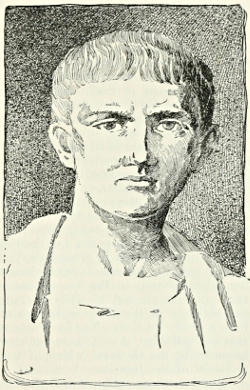
Tiberius
(From a bust in the Vatican)
[20-24 A.D.]
This long drama ended, Tiberius returned to the cares of government.
There were complaints of the too great severity of the Papia-Poppæan law.
He named fifteen commissioners to mitigate its demands. Some wanted to
extend his power with regard to the choice of governors; this he refused.
The limits of sanctuary were restricted, because this had caused much disorder
in provincial towns. Informers
were also discouraged. One
of them denounced the senator
Lentulus. Tiberius rose and said
he considered himself no longer
worthy to live if Lentulus was his
enemy. In the provinces, he maintained
good administration by skilful
choice and severity towards
prevaricating officials. In Gaul
there was a beginning of revolt.
Florus tried to provoke a rising of
the Belgæ, but being beaten and
hemmed in in the wood of Arduenna,
he killed himself. The pretext
urged for this rising was the
burden of the tribute. The Æduan,
Sacrovir, caused still more
alarm, by raising forty thousand
men and taking Augustodunum.
Two of the Rhine legions fell on
these badly armed troops and horribly
massacred them.
Tacfarinas had also reappeared
in Africa. Encouraged by a first
success, he ventured to attack
Thala, but was repulsed with loss.
Then he changed his tactics, divided
his troops into small bands
and carried on a guerilla warfare.
The emperor sent Blæsus, Sejanus’
uncle, to deal with this indefatigable
foe, and thanks to his activity, Tacfarinas was again forced to
flee, leaving his brother in the enemy’s hands.b
[It was not until two years later, 24 A.D., that Rome was finally rid of
this troublesome foe. By that time Tacfarinas had collected another large
force. P. Dolabella, the Roman governor, attacked it, and in his decisive
victory the Numidian leader was slain. Ptolemy, king of Mauretania, was
Dolabella’s ally.]
[14-19 A.D.]
Tiberius ruled the provinces on the whole in a Roman spirit, maintaining
the dignity of the empire for the most part intact from the centre to the
frontiers. The stability of the system, however rotten and decayed at heart,
might still be measured by the strength and solidity of its outworks. At no
period did the bulwarks of the Roman power appear more secure and unassailable.
The efforts of Drusus and his son to overpower the Germani on
their own soil had been stupendous; they had wielded forces equal at least
to those with which Cæsar had added Gaul to the empire, and yet had not
permanently advanced the eagles in any direction. But, on the other hand,
it was soon found that the Germani were only formidable under the pressure
of an attack. When the assault relaxed, the power they had concentrated
in resistance crumbled readily away. With the death of Arminius all combined
hostility to Rome ceased among them and meanwhile the arts and
manners of the south advanced incessantly among them.
At the same time the long respite from military exactions allowed the
pursuits of ease and luxury to fructify within the limits of the provinces.
Gaul was no longer drained from year to year by the forced requisitions of
men and horses, of arms and stores, which had fed the exhausting campaigns
of Germanicus. Her ancient cities decked themselves with splendid edifices,
with schools and theatres, aqueducts and temples. The camps on the Rhine
and Danube were gradually transformed into commercial stations, and became
emporiums of traffic with the north of Europe, where the fur and
amber of the Hercynian forests and the Baltic coast were exchanged for
wine and oil or gold and silver, those instruments of luxury which nature
was supposed, in mercy or in anger, to have denied to the German barbarians.
Such a state of affairs allowed the emperor to persist in his favourite
plan of leaving the provincial governors for years unchanged at their posts.
Each succeeding proconsul was no longer in a fever of haste to aggrandise
himself by the plunder or renown of a foray beyond the frontiers. The
administration of the provinces became a matter of ordinary routine; it lost
its principal charms in the eyes of the senators, who could at last with difficulty
be induced to exchange the brilliant pleasures of the capital, with all
its mortifications and perils, for the dull honours of a distant government.
Nor can I discover in general the justice of accusing Tiberius of neglecting
the safety of his remote possessions, which seem, on the contrary, to have
flourished securely in the armed peace of his august empire. In Gaul the
revolt of Sacrovir and his Belgian confederates was effectually suppressed;
the outbreak of the Frisians, though at some cost of blood, seems to have
been speedily quelled. Nor have we any distinct confirmation of the assertion
of Suetonius, that Tiberius suffered the province to be ravaged with
impunity by the Germani, which, if true, can apply only to some transient
violation of the frontiers.
Nor does the assertion of Tiberius’ indifference seem to be better founded
with regard to Mœsia. Tacitus steps frequently aside from his domestic
narrative to record the affairs of this region and the exploits of the emperor’s
lieutenants; while Appian makes special mention of the conquest of Mœsia
under Tiberius, and of the establishment of provincial government in this
quarter by his hand.[10] Sabinus, Pandus, and Labeo seem to have held the
command there successively during the first half of this principate, and
these men at least were not allowed to indulge in indolence, for their exertions
and victories are a theme to which the historian repeatedly refers.
But the emptiness of these charges can be more clearly shown in the case
of the dependent kingdom of Armenia, which, according to the same authority,
Tiberius suffered to be seized by the Parthians, and wrested from the
patronage of the empire. It appears, on the contrary, from the particular
recital of Tacitus, that the bold occupation of this kingdom by Artabanus
was immediately resented by the emperor with the energy of a younger man.
Not only were the wild mountaineers of the Caucasus, the Iberians and
Albanians, invited to descend upon the intruders; not only were the sons
of Phraates released from their long detention at Rome, and directed to present
themselves on their native soil, and claim the allegiance of their father’s
subjects; but a Roman general, L. Vitellius, a man of distinguished valour
and experience, was deputed to lead the forces of Asia and Syria against the
enemy; and while it was hoped that a vigorous demonstration would suffice
to hurl him back from the territory in dispute, instructions were not withheld,
it would appear, to push on if necessary, and smite the Parthians with
the strong hand of the empire. But these combinations proved speedily
successful. Artabanus, already detested by many of his most powerful subjects,
was compelled to descend from his throne, and take refuge in the far wilds
of Hyrcania; while Tiridates, the son of Phraates, was accepted in his room
[35 A.D.]. The Roman army, which had crossed the Euphrates, returned
victorious without striking a blow, though, by a subsequent revolution, Artabanus
was not long afterwards restored, and admitted, upon giving the
required hostages, to the friendship of his lordly rivals [36 A.D.].
[4 B.C.-37 A.D.]
If Tiberius refrained from aggrandising his empire by fresh conquests,
he was not the less intent on consolidating the unwieldy mass by the gradual
incorporation of the dependent kingdoms enclosed within its limits. The
contests between two rival brothers, Cotys and Rhescuporis, in Thrace, gave
him a pretext for placing the fairest part of that country under the control
of a Roman officer, thus preparing the way for its ultimate annexation. On
the death of Archelaus, king of Cappadocia, in the year 17, his country was
declared a Roman province, and subjected to the rule of an imperial procurator.
At the same period the frontier kingdom of Commagene was
added to the dominions of the republic under the government of a prætor.
Syria, the great stronghold of the Roman power in the East, was still skirted
by several tributary kingdoms or ethnarchies, such as Chalcis, Emesa,
Damascus, and Abilene; but the dependency of Judea, the wealthiest and
proudest of all these vassal states, was wrested in the reign of Augustus
from the dynasty to which it had been entrusted, and was still subjected by
his successor to the control of the proconsul at Antioch.
Herod the Great, on his death-bed, had sent his seal, together with an
ample present, to Augustus, in token of the entire dependence upon Rome in
which he held his dominions [4 B.C.]. This act of vassalage procured him, perhaps,
the ratification of the disposition he had made of his territories between
Archelaus, Herod Antipas, and Philippus. To the first was allotted the kingdom
of Judea, including Samaria and Idumæa, but with the loss of the cities
of Gaza, Gadara, and Hippus, which were now annexed to the government of
Syria. To the second fell the districts of Galilee to the west, and Peræa to the
east of the Jordan; while the Trachonitis, Auranitis, and Gaulonitis formed
with Ituræa the tetrarchy of Philip, extending northward to the desert borders
of Damascus. But the rival kinsmen were not satisfied with this division.
Archelaus and Antipas repaired to Rome to plead against one another; but
while they were urging their suits before the tribunal of the senate, the provisional
government which the Romans had established in Judea was suddenly
attacked on all sides by bodies of armed insurgents. Their leaders, however,
were not men of rank or commanding influence, and the revolt was in no sense
a national movement. It was speedily crushed by Varus, then proconsul of
Syria, the same who ten years afterwards perished so miserably in Germany,
and punished with the atrocious severity too commonly employed in such cases.
Archelaus, confirmed in his sovereignty, continued to reign under these
lamentable auspices in Judea. His subjects, still mindful of the sons of their
beloved Mariamne, never regarded him with favour; and it has been mentioned
how they complained to Augustus of his tyranny, and obtained his
removal from the throne. He was finally sent into exile at Vienne in Gaul.
The fall of Archelaus left the throne of Judea and Samaria without a
direct claimant, and the emperor took the opportunity of attaching them to
the Roman dominions. This acquisition was placed under the general
administration of the proconsul of Syria, but governed more directly by an
imperial procurator, who took up his abode at Cæsarea Philippi. Of the
character of the new government we find no complaints even in the Jewish
writers whose accounts of this period have been preserved to us.
Both Augustus and his successor appear to have instructed their officers
to observe the same respect for the peculiar habits and prejudices of the Jews
which had reflected such lustre in their eyes upon the magnanimous Agrippa;
whatever may have been the ordinary severities of Roman domination, it
was not till the arrival of Pontius Pilate, about the middle of the reign of
Tiberius, that any special cause of grievance was inflicted upon them. They
complained that the new procurator commenced his career with a grave and
wanton insult. He entered Jerusalem with standards flying, upon which,
according to the usage of the time, the image of the emperor was displayed.
The old religious feeling of the Jews against the representation of the
human figure was roused to vehement indignation; they remonstrated with
the procurator, nor would they listen to his excuse that the Romans had their
customs as well as the Jews, and that the removal of the emperor’s portrait
from his ensigns by an officer of his own might be regarded as a crime against
the imperial majesty. But if Tiberius was merely the creature of the delators
in his own capital, in the provinces he retained his good sense and independence.
Perhaps it was by a special authorisation from him that Pilate
consented to withdraw the obnoxious images. Nevertheless, the Jews, under
the guidance of their priests, continued to watch every act of his administration
with inveterate jealousy, and when he ventured to apply a portion of
the temple revenues to the construction of an aqueduct for the supply of
their city, broke out into violence which provoked him to severe measures
of repression.
It is probable that mutual exasperation led to further riots, followed by
sanguinary punishments; the government of Pilate was charged with cruelty
and exaction, and at last the provincials addressed themselves to Vitellius,
the governor of Syria. Nor were their expectations disappointed. The
proconsul required his procurator to quit the province, and submit himself
to the pleasure of the offended emperor. Tiberius, indeed, was already dead
before his arrival, but his successor attended without delay to the representations
of his lieutenant, and Pilate was dismissed with ignominy to Vienna.
From the confidence with which Tiberius was appealed to on a matter of
such remote concern, it would seem that the vigilance of his control was not
generally relaxed even in the last moments of his life.
While Judea and Samaria were thus annexed to the Roman province,
Galilee and the outlying regions of Peræa and Ituræa were still suffered to
remain under their native rulers; and the dominions of the great Herod became
once more united transiently under a single sceptre at no distant period.
If, however, we consider the condition of the Jewish provincials under the
Roman fasces, we shall find reason to believe that it was far from intolerable,
and presented probably a change for the better from the tyranny of their
own regal dynasties.
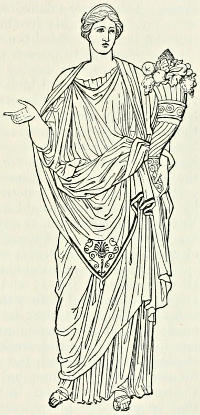
Roman Empress
(From a statue in the Capitol)
Doubtless the national feeling, as far as it extended, was outraged in its
cherished prepossessions by the substitution of a foreign for a native domination.
The nobles and the priests, who preserved and reflected this sentiment,
and who suffered in consideration under foreign sway, fostered the prejudices
of the people to the utmost of their power, excited their discontent,
fanned the flame of sedition, and then betrayed their unfortunate clients to
the sword of relentless executioners. It may be admitted that the fiscal
exactions of the procurator were more uniformly rigid than those of Herod,
whose remission of a large portion of his people’s
taxes had gained him favour in the
midst of his atrocities. Yet the amount of
freedom and security enjoyed by the Jews
under a Quirinus and a Pilate shows the
general leniency of the Roman government
at this period, and may induce us to believe
that the yoke of the conquerors was on the
whole a happy exchange for their subjects.
The warm descriptions of provincial felicity
by the Jewish authority Philo, may be coloured
to suit a purpose, and it may be impossible to
produce any distinct facts to support this
general conjecture. Yet indications are not
wanting in the writings of the Evangelists,
which contain, abstracted from their religious
significance, the most interesting record in
existence of the social condition of antiquity,—for
they alone of all our ancient documents
are the productions of men of the people,—to
show that the mass of the population of
Judea was contented and comparatively happy
under the rule of the Roman procurator.
Such is the impression received from the
representations of common life in the scriptures
of the New Testament. The instances
they allege of cruelty and injustice are drawn
from the conduct of the Jews towards one
another, rather than of the foreigner towards
the native. The scribe and the Pharisee are
held up to odium or contempt, not the minister
of police or the instrument of government. The Romans are regarded in them
as the protectors of the people against their domestic tyrants. The duty of
paying them tribute is urged as the proper price of the tranquillity they
maintain; their fiscal officers are spoken of with forbearance; their soldiers
are cited as examples of thoughtful toleration; the vice of the provincial
ruler is indifference and unbelief rather than wanton violence; and the tribunal
of the emperor himself is appealed to as the last resort of injured
innocence. The freedom of movement enjoyed by the subjects of Rome, the
permission so fully allowed them of passing, from frontier to frontier, of
assembling together for social and religious objects, of flocking in crowds at
the call of popular leaders, all indicate a state of personal liberty which
might be envied throughout Europe at the present day.f
INTERNAL GOVERNMENT
During the earlier years of Tiberius’ sway, his administration was happy
for the state. Even Tacitusd draws a brilliant picture of it: “Public matters
and the more serious of those relating to private persons were determined
by the senate. In the distribution of honours, he took birth, military service,
and civil talent into consideration, so that it would have been difficult to
have made a better choice. As to laws, if one excepts that of majesty, good
use was made of them. For his private affairs the prince chose most eminent
men, some unknown to him except by reputation, and the greater part grew
old in service. He took care that the provinces were not burdened with
taxes. The prince’s domains in Italy were not much extended. His slaves
were not insolent, his freedmen not many. Had he disputes with private
persons, the law decided the matter.”b
His plan was to possess the reality of power without exciting hatred or
envy by the useless display of the show of it. He therefore rejected the
titles that were offered him, such as that of Imperator, as a prænomen, and
that of Father of his Country; even that of Augustus, though hereditary,
he would only use in his letters to kings and dynasts; above all he rejected
that of Master (Dominus); he would only be called Cæsar, or First of the
Senate. This last (which we shall henceforth term Prince) was his favourite
title; he used to say, “I am the Master of my slaves, the Imperator of
the soldiers, and the Prince of the rest.” He would not allow anything
peculiar to be done in honour of his birthday, nor suffer any one to swear by
his fortune; neither would he permit the senate to swear to his acts on New
Year’s Day, or temples, or any other divine honours, to be decreed him. He
was affable and easy of approach; he took no notice of libels and evil reports
of which he was the object, while he repelled flattery of every kind.
To the senate and the magistrates he preserved (at least in appearance)
all their pristine dignity and power. Every matter, great or small, public
or private, was laid before the senate. The debates were apparently free,
and the prince was often in the minority. He always entered the senate
house without any attendants, like an ordinary senator; he reproved consulars
in the command of armies for writing to him instead of the senate; he
treated the consuls with the utmost respect, rising to them and making way
for them. Ambassadors and deputies were directed to apply to them as in
the time of the republic. It was only by his tribunician right of interceding
that he exercised his power in the senate. He used also to take his seat
with the magistrates as they were administering justice, and by his presence
and authority gave a check to the influence of the great in protecting the
accused; by which conduct of his, while justice gained, liberty, it was
observed, suffered.
The public morals and the tranquillity of the city were also attended to.
A limit was set to the expenses of plays and public shows, and to the salaries
of the players, to whom the senators and knights were forbidden to show
marks of respect, by visiting them or attending them in public. Profligacy
had become so bold and shameless, that ladies were known to have entered
themselves in the list of professed courtesans in order to escape the penalties
of the law, and young men of family to have voluntarily submitted to the
mark of infamy in order to appear with safety on the stage or the arena;
both these infamous classes were now subjected to the penalty of exile.
Astrologers and fortune-tellers were expelled the city; the rites and ceremonies
of the Egyptian and Judaic religions were suppressed. Guards were
placed throughout Italy to prevent highway robbery; and those refuges of
villainy of all kinds, the sanctuaries, were regulated in Greece and Asia.
Yet people were not deceived by all this apparent regard for liberty and
justice; for they saw, as they thought, from the very commencement, the
germs of tyranny, especially in the renewal of the law of treason (majestas).
In the time of the republic there was a law under this name, by which any
one who had diminished the greatness (majestas) of the Roman people by
betraying an army, exciting the plebs to sedition, or acting wrongly in command,
was subject to punishment. It applied to actions alone; but Sulla
extended it to speeches, and Augustus to writings against not merely the
state, but private individuals, on the occasion of Cassius Severus having
libelled several illustrious persons of both sexes. Tiberius, who was angered
by anonymous verses made on himself, directed the prætor, when consulted
by him on the subject, to give judgment on the law of treason. As this
law extended to words as well as actions, it opened a wide field for mischief,
and gave birth to the vile brood of delators or public informers answering
to the sycophants, those pests of Athens in the days of her democratic despotism.
This evil commenced almost with the reign of Tiberius, in whose
second year two knights, Falonius and Rubrius, were accused, the one of
associating a player of infamous character with the worshippers of Augustus,
and of having sold with his gardens a statue of that prince, the other of having
sworn falsely by his divinity. Tiberius however would not allow these
absurd charges to be entertained. Soon after Granius Marcellus, the prætor
of Bithynia, was charged with treason by his quæstor, Cæpio Crispinus, for
having spoken evil of Tiberius, having placed his own statue on a higher
site than that of the Cæsars, and having cut the head of Augustus off a
statue to make room for that of Tiberius. This last charge exasperated
Tiberius, who declared that he would vote himself on the matter; but a
bold expression used by Cn. Piso brought him to reason, and Marcellus was
acquitted.
After the death of Germanicus, Tiberius acted with less restraint; for
his son Drusus did not possess the qualities suited to gain popularity, and
thus to control him. In fact, except his affection for his noble adoptive
brother, there was nothing in the character of Drusus to esteem. He was
addicted to intemperance, devoted to the sports of the amphitheatre, and of
so cruel a temper, that a peculiarly sharp kind of sword was named from
him drusian. Tiberius made him his colleague in the consulate, and then
obtained for him the tribunician power (22); but Drusus was fated to no
long enjoyment of the dignity and power thus conferred on him. A fatal
change was also to take place in the conduct and government of Tiberius
himself, of which we must now trace the origin.
Seius Strabo, who had been made one of the prefects of the prætorian
cohorts by Augustus, had a son, who, having been adopted by one of the
Ælian family, was named in the usual manner L. Ælius Sejanus. This
young man, who was born at Vulsinii in Tuscany, was at first attached to
the service of Caius Cæsar, after whose death he devoted himself to Tiberius;
and such was his consummate art, that this wily prince, dark and
mysterious to all others, was open and unreserved to him. Sejanus equalled
his master in the power of concealing his thoughts and designs; he was daring
and ambitious, and he possessed the requisite qualities for attaining the
eminence to which he aspired; for though proud he could play the flatterer;
he could and did assume a modest exterior, and he had vigilance and industry,
and a body capable of enduring any fatigue.
[14-24 A.D.]
When Drusus was sent to quell the mutiny of the Pannonian legions,
Sejanus, whom Tiberius had made colleague with his father Strabo in the
command of the prætorians, accompanied him as his governor and director.
Strabo was afterwards sent out to Egypt, and Sejanus was continued in the
sole command of the guards; he then represented to Tiberius how much
better it would be to have them collected into one camp instead of being
dispersed through the city and towns, as they would be less liable to be
corrupted, would be more orderly, and of greater efficiency if any insurrection
should occur. A fortified camp was therefore formed for them near the
Viminal Gate, and Sejanus then began to court the men, and he appointed
those on whom he could rely to be tribunes and centurions. While thus
securing the guards, he was equally assiduous to gain partisans in the senate,
and honours and provinces only came to those who had acquired his favour
by obsequiousness. In all these projects he was unwittingly aided by Tiberius,
who used publicly to style him “the associate of his labours,” and even
allowed his statues to be placed and worshipped in temples and theatres, and
among the ensigns of the legions.
Sejanus had in fact formed the daring project of destroying Tiberius and
his family, and seizing the supreme power. As besides Tiberius and Drusus,
who had two sons, there were a brother and three sons of Germanicus living,
he resolved, as the safer course, to remove them gradually by art and treachery.
He began with Drusus, against whom he had a personal spite, as that
violent youth had one time publicly given him a blow in the face. In order
to effect his purpose, he seduced his wife Livia or Livilla, the sister of Germanicus;
and then, by holding out to her the prospect of a share in the
imperial power, he induced her to engage in the plan for the murder of her
husband. Her physician Eudemus was also taken into the plot, but it was
some time before the associates could finally determine what mode to adopt.
At length a slow poison was fixed on, which was administered to Drusus by
a eunuch named Lygdus, and he died apparently of disease (23). Tiberius,
who while his son was lying dead, had entered the senate house and addressed
the members with his usual composure, pronounced the funeral oration
himself, and then turned to business for consolation.
So far all had succeeded with Sejanus, and death carried off the younger
son of Drusus soon after his father; but Nero and Drusus, the two elder
sons of Germanicus, were now growing up, and the chastity of their mother
and the fidelity of those about them put poison out of the question. He
therefore adopted another course; and taking advantage of the high spirit
of Agrippina, and working on the jealousy of her which Augusta was known
to entertain, he managed so that both she and Livia should labour to prejudice
Tiberius against Agrippina by talking of the pride which she took in
her progeny, and the ambitious designs which she entertained. At the same
time he induced some of those about her to stimulate her haughty spirit by
their treacherous language. He further proposed to deprive her of support
by destroying those persons of influence who were attached to her family,
or the memory of her husband. With this view he selected for his first
victims C. Silius and Titius Sabinus, the friends of Germanicus, and Silius’
wife, Sosia Galla, to whom Agrippina was strongly attached, and who was
therefore an object of dislike to Tiberius. Omitting however Sabinus for
the present, he caused the consul Visellius Varro to accuse Silius of treason
for having dissembled his knowledge of the designs of Sacrovir, having disgraced
his victory by his avarice, and countenanced the acts of his wife.
Having vainly asked for a delay till his accuser should go out of office, and
seeing that Tiberius was determinedly hostile to him, Silius avoided a condemnation
by a voluntary death. His wife was banished; a portion of his
property was confiscated, but the remainder was left to his children.
[24-25 A.D.]
Urged by his own ambition, and by the importunity of Livia, Sejanus
had soon (25) the boldness to present a petition to Tiberius, praying to be
chosen by him for her husband. Tiberius took no offence; his reply was
kind, only stating the difficulties of the matter with respect to Sejanus himself,
but at the same time expressing the warmest friendship for and confidence
in him. Sejanus however was suspicious, and he began to reflect that
while Tiberius remained at Rome, many occasions might present themselves
to those who desired to undermine him in the mind of that jealous prince;
whereas, could he induce him to quit the city, all access to him would be
only through himself, all letters would be conveyed by soldiers who were
under his orders, and gradually, as the prince advanced in years, all the
affairs of the state would pass into his hands. He therefore, by contrasting
the noise and turbulence of Rome with the solitude and tranquillity of the
country, gradually sought to bend him to his purpose, which he effected in
the following year.
During this time the deadly charge of treason was brought against various
persons. The most remarkable case was that of A. Cremutius Cordus,
the historian. He had made a free remark on the conduct of Sejanus, and
accordingly two of that favourite’s clients were directed to accuse him of
treason, for having in his history called Cassius the last of the Romans.
Cremutius, when before the senate, observing the sternness of Tiberius’
countenance, took at once the resolution of abandoning life, and therefore
spoke as follows:
“Fathers, my words are accused, so guiltless am I of acts; but not
even these are against the prince or the prince’s parent, whom the law of
treason embraces. I am said to have praised Brutus and Cassius, whose
deeds, while several have written, no one has mentioned without honour.
Titus Livius, who is pre-eminent for eloquence and fidelity, extolled Pompeius
with such praises, that Augustus used to call him a Pompeian; nor was
that any hindrance of their friendship. He nowhere calls Scipio, Afranius,
this very Cassius, this Brutus, robbers and parricides, which names are now
given them; he often speaks of them as distinguished men. The writings
of Asinius Pollio transmit an illustrious record of them; Messala Corvinus
used to call Cassius his general; and both of them flourished in wealth and
honours. To the book of Marcus Cicero, which extolled Cato to the skies,
what did the dictator Cæsar but reply in a written speech as if before
judges? The letters of Antonius, the speeches of Brutus, contain imputations
on Augustus which are false, and written with great bitterness. The
verses of Bibaculus and Catullus, which are full of abuse of the Cæsars, are
read; nay, the divine Julius himself, the divine Augustus himself, both
bore with them and let them remain; I cannot well say whether more
through moderation or wisdom; for what are despised go out of mind; if
you are angry with them their truth seems to be acknowledged. I speak
not of the Greeks, among whom not only liberty but license was unpunished;
or if any one did take notice, he avenged himself on words by words. But
there was the greatest freedom, and no reproach, when speaking of those
whom death had removed from enmity or favour. Do I, in the cause of
civil war, inflame the people by my harangues while Brutus and Cassius are
in arms, and occupying the plains of Philippi? Or do they, who are now
dead these seventy years, as they are known by their images, which the
conqueror did not destroy, retain in like manner their share of memory in
literary works? Posterity allots his meed to every one; nor, should a condemnation
fall on me, will there be wanting those who will remember not
only Brutus and Cassius, but also me.”
[25-27 A.D.]
Having thus spoken, Cordus left the senate house, and returning to his
own abode starved himself to death. The senate decreed that the copies of
his work should be collected and burned by the ædiles; but some were saved
by his daughter Marcia, and were republished in the succeeding reign.

Roman Lamp
At length (26) Tiberius quitted Rome and went into Campania, under
the pretext of dedicating a temple to Jupiter at Capua, and one to Augustus
at Nola; but with the secret intention of never returning to the city.
Various causes, all perhaps true, are assigned for this resolution. The suggestions
of Sejanus were not without effect; he was grown thin, and
stooped; he was quite bald, and his face was full of blotches and ulcers,
to which he was obliged to have plasters constantly applied; and he may
therefore have sought, on this account, to retire from the public view. It is
further said that he wished to escape from the authority of his mother, who
seemed to consider herself entitled to share the power which he had obtained
through her exertions. [But whatever the exact motive that actuated
Tiberius, his withdrawal constituted a virtual desertion of the capital, since
he never returned.]
He was accompanied only by one senator, Cocceius Nerva, who was
deeply skilled in the laws, by Sejanus and another knight, and by some persons,
chiefly Greeks, who were versed in literature. A few days after he
set out an accident occurred, which was near being fatal to him, but proved
fortunate for Sejanus. As at one of his country-seats near Fundi, named
the Caverns (Speluncæ), he was, for the sake of the coolness, dining in one
of the natural caverns, whence the villa derived its appellation, a great
quantity of the stones, which formed its roof, fell down and crushed some of
the attendants to death. Sejanus threw himself over Tiberius to protect
him with his own body, and was found in that position by the soldiers who
came to their relief. This apparent proof of generous self-devotion raised
him higher than ever in the estimation of the prince.
While Tiberius was rambling from place to place in Campania (27), a
dreadful calamity occurred at Fidenæ, in consequence of the fall of a temporary
amphitheatre erected by a freedman named Atilius for giving a show
of gladiators; the number of the killed and maimed is said to have been
fifty thousand.[11] The conduct of the nobility at Rome on this melancholy
occasion showed that all virtue had not departed from them; they threw
open their houses for the sufferers, and supplied them with medical attendance
and remedies; so that, as the great historian observes, the city wore
the appearance of the Rome of the olden time, when after battles the
wounded were thus humanely treated. This calamity was immediately followed
by a tremendous fire on the Cælian Hill; but Tiberius alleviated the
evil by giving the inhabitants the amount of their losses in money.
Having dedicated the temples, and rambled for some time through the
towns of Campania, Tiberius finally fixed on the islet of Capreæ [the modern
Capri] in the Bay of Naples as his permanent abode. This isle, which lay
at the short distance of three miles from the promontory of Surrentum, was
accessible only in one place; it enjoyed a mild temperature, and commanded
a most magnificent view of the bay of Naples and the lovely region which
encompassed it.[12] But the delicious retreat was speedily converted by the
aged prince into a den of infamy, such as has never perhaps found its equal;
his vicious practices, however, were covered by the veil of secrecy, for he
still lay under some restraint.
[27-29 A.D.]
When Tiberius left Rome, Sejanus renewed his machinations against
Agrippina and her children and friends. He directed his first efforts
against her eldest son Nero, whom he surrounded with spies; and as this
youth was married to a daughter of Livia, his wife was instructed by her
abandoned mother to note and report all his most secret words and actions.
Sejanus kept a faithful register of all he could learn in these various ways,
and regularly transmitted it to Tiberius. He also drew to his side Nero’s
younger brother Drusus, a youth of a fiery turbulent temper, and who
hated him because he was his mother’s favourite. It was however Sejanus’
intention to destroy him also when he should have served his purpose
against Nero.
At this time also he made his final and fatal attack on Titius Sabinus,
whose crime was his attachment to the family of Germanicus. The bait of
the consulate, of which Sejanus alone could dispose, induced four men of
prætorian dignity to conspire his ruin. The plan proposed was that one
of them, named Latinius Latiaris, who had some knowledge of Sabinus,
should draw him into conversation, out of which a charge of treason might
be manufactured. The plot succeeded; Latiaris, by praising the constancy
of Sabinus in friendship, led him gradually on to speak as he thought of
Sejanus, and even of Tiberius. At length, under pretence of having something
of great importance to reveal, he brought him into a chamber where
the other three were concealed between the ceiling and the roof. A charge
of treason was therefore speedily concocted and forwarded to Tiberius, from
whom a letter came on New Year’s Day (28), plainly intimating to the senate
his desire of vengeance. This sufficed for that obsequious body, and Sabinus
was dragged forth and executed without delay.
In his letter of thanks to the senate, Tiberius talked of the danger he
was in, and of the plots of his enemies, evidently alluding to Agrippina and
Nero. These unfortunate persons lost their only remaining refuge the following
year (29) by the death of the prince’s mother, Julia Augusta,[13] whose
influence over her son, and regard for her own descendants, had held Sejanus
in restraint. This soon appeared by the arrival of a letter from Tiberius,
accusing Nero of unnatural practices, and speaking of the arrogance of Agrippina;
but while the senate were in debate, the people surrounded the house,
carrying the images of Agrippina and Nero, and crying out that the letter
was forged, and the prince deceived. Nothing therefore was done on that
day, and Sejanus took the opportunity of irritating the mind of Tiberius,
who wrote again to the senate; but as in the letter he forbade their proceeding
to extremes, they passed a decree, declaring themselves prepared to
avenge the prince, were they not hindered by himself.
[29-31 A.D.]
Most unfortunately the admirable narrative of Tacitus fails us at this
point; and for the space of more than two years, and those the most important
of the reign of Tiberius, we are obliged to derive our knowledge of
events from the far inferior notices of Dion Cassius and Suetonius. We
are therefore unable to display the arts by which Sejanus effected the ruin
of Agrippina and her children, and can only learn that she was relegated to
the isle of Pandataria, where, while she gave vent to her indignation, her
eye was struck out by a centurion; and that Nero was placed in the isle of
Pontia, and forced to terminate his own life. The further fate of Agrippina
and Drusus we shall have to relate.
Sejanus now revelled in the enjoyment of power; every one feared him,
every one courted and flattered him. “In a word,” says Dion,[o] “he seemed
to be emperor, Tiberius merely the ruler of an island”; for while the latter
dwelt in solitude and apparently unthought of, the doors of the former were
thronged every morning with saluting crowds, and the first men of Rome
attended him on his way to the senate. His pride and insolence, as is always
the case with those who rise otherwise than by merit, kept pace with his
power, and men hated while they feared and flattered him.e
Let us cite an instance of this fulsome flattery from the pages of the contemporary
chronicler, Velleius Paterculus, a Roman who had served nine
years as a soldier in Germany, and who had been military tribune and afterwards
quæstor and prætor. The panegyric with which Velleius closes his
Epitome of Roman History eulogises Sejanus along with the emperor himself,
and his mother. This eulogium is worth transcribing at length as it illustrates
the contrast between contemporary estimates—be they candid or
hypocritical—and the judgment of posterity.a
VELLEIUS PATERCULUS EULOGISES TIBERIUS
[14-37 A.D.]
“It is seldom,” says Velleius, “that men who have arrived at eminence,
have not had powerful coadjutors in steering the course of their fortunes;
thus the two Scipios had the two Lælii, whom they set in every respect on a
level with themselves; thus the emperor Augustus had Marcus Agrippa,
and after him Statilius Taurus. The newness of these men’s families proved
no obstruction to their attainment of many consulships and triumphs, and
of sacerdotal offices in great numbers. For great affairs demand great
co-operators (in small matters, the smallness of assistance does not mar the
proceedings), and it is for the interest of the public, that what is necessary
for business should be eminent in dignity, and that usefulness should be
fortified with influence. In conformity with these examples, Tiberius Cæsar
has had, and still has, Ælius Sejanus, a most excellent coadjutor in all the
toils of government, a man whose father was chief of the equestrian order,
and who, on his mother’s side is connected with some of the most illustrious
and ancient families, ennobled by high preferments; who has brothers,
cousins, and an uncle, of consular rank; who is remarkable for fidelity in
the discharge of his duties, and for ability to endure fatigue, the constitution
of his body corresponding with the vigour of his mind; a man of pleasing
gravity, and of unaffected cheerfulness; appearing, in the despatch of business,
like a man quite at ease; assuming nothing to himself, and hence
receiving every honour; always deeming himself inferior to other men’s
estimation of him; calm in looks and conversation, but in mind indefatigably
vigilant.
“In esteem for Sejanus’ virtues, the judgment of the public has long
vied with that of the prince. Nor is it at all new with the senate and
people of Rome, to consider the most meritorious as the most noble. The
men of old, before the First Punic War, three hundred years ago, exalted
to the summit of dignity T. Coruncanius, a man of no family, bestowing
on him, besides other honours, the office of chief pontiff; they promoted
Spurius Carvilius, a man of equestrian birth, and afterwards Marcus Cato,
another new man (not a native citizen, but born at Tusculum), as well as
Mummius Achaicus, to consulships, censorships, and triumphs. And they
who considered Caius Marius, a man of the most obscure origin, as unquestionably
the first in the Roman nation, before his sixth consulship; who had
so high an esteem for Marcus Tullius, that he could obtain, almost by his
sole recommendation, the highest offices for whomsoever he chose; and who
refused nothing to Asinius Pollio, which men of the noblest birth had to
obtain with infinite labour, were certainly of opinion that he who possessed
the greatest virtues was entitled to the greatest honours. The natural imitation
of other men’s examples led Cæsar to make trial of Sejanus, and occasioned
Sejanus to bear a share of the burdens of the prince; and induced
the senate and people of Rome cheerfully to call to the guardianship of their
safety him whom they saw best qualified for the charge.
“Having exhibited a general view of the administration of Tiberius
Cæsar, let us now enumerate a few particulars respecting it. With what
wisdom did he bring to Rome Rhescuporis, the murderer of Cotys, his own
brother’s son, and partner in the kingdom, employing in that affair the services
of Pomponius Flaccus, a man of consular rank, naturally inclined to
all that is honourable, and by pure virtue always meriting fame, but never
eagerly pursuing it! With what solemnity as a senator and a judge, not
as a prince, does he hear causes in person! With what precepts did he
form the mind of his Germanicus, and train him in the rudiments of war in
his own camp, so that he afterwards hailed him the conqueror of Germany!
What honours did he heap on him in his youth, the magnificence of his
triumph corresponding to the grandeur of his exploits! How often has he
honoured the people with donations! How readily has he, when he could
do it with the sanction of the senate, supplied senators with property
suitable to their rank, neither encouraging extravagance, nor suffering honourable
poverty to be stripped of dignity! In what an honourable style
did he send his Germanicus to the transmarine provinces! With what
energy, employing Drusus as a minister and coadjutor in his plans, did he
force Marboduus, who was clinging to the soil of the kingdom which he
had possessed, to come forth, like a serpent concealed in the earth (let me
speak without offence to his majesty), by the salutary charms of his counsels!
How honourably, yet how far from negligently, does he keep watch
over him! How formidable a war, excited by the Gallic chief Sacrovir
and Julius Florus, did he suppress, and with such amazing expedition and
energy, that the Roman people learned that they were conquerors, before they
knew that they were at war, and the news of victory outstripped the news
of the danger! The African war too, perilous as it was, and daily increasing
in strength, was quickly terminated under his auspices and direction.

Roman Tripod
“What structures has he erected in his own name, and those of his
family! With what dutiful munificence, even exceeding belief, is he building
a temple to his father! With how laudable a generosity of disposition
is he repairing even the buildings of Cneius Pompey that were consumed
by fire! Whatever has been at any time conspicuously great, he regards as
his own, and under his protection. With what liberality has he at all times,
and particularly at the recent fire on the Cælian Mount, repaired the losses
of people of all conditions out of his own
property! With what perfect ease to the
public does he manage the raising of troops,
a business of constant and extreme apprehension,
without the consternation attendant
on a levy! If either nature allows us, or the
humility of man may take upon itself, to make
a modest complaint of such things to the gods,
what has he deserved that, in the first place,
Drusus Libo should form his execrable plots;
and, in the next, that Silius and Piso should
follow his example, one of whom he raised to
dignity, the other he promoted? That I may
pass to greater matters (though he accounted
even these very great), what has he deserved,
that he should lose his sons in their youth, or
his grandson by Drusus? But we have only
spoken of causes for sorrow, we must now
come to occasions of shame. With what
violent griefs, Marcus Vinicius, has he felt
his mind tortured in the last three years!
How long has his heart been consumed with
affliction, and, what is most unhappy, such as
he was obliged to conceal, while he was compelled
to grieve, and to feel indignation and
shame, at the conduct of his daughter-in-law
and his grandson! And the sorrows of this period have been aggravated
by the loss of his most excellent mother, a woman who resembled the gods
more than human beings; and whose power no man ever felt but in the relief
of distress or the conferring of honour.
“Let our book be concluded with a prayer. O Jupiter Capitolinus, O
Jupiter Stator! O Mars Gradivus, author of the Roman home! O Vesta,
guardian of the eternal fire! O all ye deities who have exalted the present
magnitude of the Roman Empire to a position of supremacy over the world,
guard, preserve, and protect, I entreat and conjure you, in the name of the
commonwealth, our present state, our present peace (our present prince)!
And when he shall have completed a long course on earth, grant him successors
to the remotest ages, and such as shall have abilities to support the
empire of the world as powerfully as we have seen him support it!”g
These words of the fawning courtier require no comment, unless it be to
note that such are often the materials from which the historian is supposed
to extract truthful estimates of men and events. Fortunately, in the present
instance, the more trustworthy accounts of Tacitus and Suetonius have also
come down to us—the former, however, not quite intact.
THE FALL OF SEJANUS
[31 A.D.]
Sejanus had thus ruled for more than three years at Rome with power
nearly absolute, when (31) Tiberius made him his colleague in the consulate—an
honour observed to be fatal to every one who had enjoyed it. In fact
the jealous tyrant, who had been fully informed of all his actions and designs,[14]
had secretly resolved on his death; but fear, on account of Sejanus’ influence
with the guards, and his uncertainty of how the people might stand affected,
prevented him from proceeding openly against him. He therefore had
recourse to artifice, in which he so much delighted. At one time he would
write to the senate, and describe himself as so ill that his recovery was nearly
hopeless; again that he was in perfect health, and was about to return to
Rome. He would now praise Sejanus to the skies, and then speak most disparagingly
of him; he would honour some and disgrace others of his friends
solely as such. In this way both Sejanus himself and all others were kept
in a state of the utmost uncertainty. Tiberius further bestowed priesthoods
on Sejanus and his son, and proposed to marry his daughter to Drusus, the
son of Claudius, the brother of Germanicus; yet at the same time, when
Sejanus asked permission to go to Campania, he desired him to remain where
he was, as he himself would be coming to Rome immediately.
All this tended to keep Sejanus in a state of great perturbation; and this
was increased by the circumstance of Tiberius, when appointing the young
Caius to a priesthood, having not merely praised him, but spoken of him in
some sort as his successor in the monarchy. He would have proceeded at
once to action, were it not that the joy manifested by the people on this
occasion proved to him that he had only the soldiers to rely on, and he hesitated
to act with them alone. Tiberius then showed favour to some of those
to whom Sejanus was hostile. The senators easily saw whither all this
tended, and their neglect of Sejanus was now pretty openly displayed.
Tiberius, having thus made trial of the senate and the people, and finding
he could rely on both, resolved to strike the long-meditated blow. In order
to take his victim more completely unawares, he gave out that it was his
intention to confer on him the tribunician power. Meantime he gave to
Nævius Sertorius Macro a secret commission to take the command of the
guards, made him the bearer of a letter to the senate, and instructed him
fully how to act. Macro entered Rome at night, and communicated his instructions
to the consul, C. Memmius Regulus (for his colleague was a creature
of Sejanus), and to Græcinus Laco, the commander of the watchmen,
and arranged with them the plan of action. Early in the morning he went
up to the temple of the Palatine Apollo, where the senate was to sit that
day, and meeting Sejanus, and finding him disturbed at Tiberius having sent
him no message, he whispered him that he had the grant of the tribunician
power for him. Sejanus then went in highly elated; and Macro, showing his
commission to the guards on duty, and telling them that he had letters promising
them a largess, sent them down to their camp, and put the watchmen
about the temple in their stead. He then entered the temple, and having
delivered the letter to the consuls, immediately went out again, and leaving
Laco to watch the progress of events there, hastened down to the camp lest
there should be a mutiny of the guards.
The letter was long and ambiguous; it contained nothing direct against
Sejanus, but first treated of something else, then came to a little complaint
of him, then to some other matter, then it returned to him again, and so on;
it concluded by saying that two senators, who were most devoted to Sejanus,
ought to be punished, and himself be cast into prison; for though Tiberius
wished most ardently to have him executed, he did not venture to order his
death, fearing a rebellion. He even implored them in the letter to send one
of the consuls with a guard to conduct him, now an old man and desolate,
into their presence. We are further told that such were his apprehensions,
that he had given orders, in case of a tumult, to release his grandson Drusus,
who was in chains at Rome, and put him at the head of those who remained
faithful to his family; and that he took his station on a lofty rock, watching
for the signals that were to be made, having ships ready to carry him to some
of the legions in case anything adverse should occur.
His precautions, however, were needless. Before the letter was read, the
senators, expecting to hear nothing but the praises of Sejanus and the grant
of the tribunician power, were loud in testifying their zeal towards him;
but as the reading proceeded their conduct sensibly altered; their looks
were no longer the same; even some of those who were sitting near him
rose and left their seats; the prætors and tribunes closed round him lest he
should rush out and try to raise the guards, as he certainly would have done
had not the letter been composed with such consummate artifice. He was in
fact so thunderstruck, that it was not till the consul had called him the third
time that he was able to reply. All then joined in reviling and insulting
him; he was conducted to the prison by the consul and the other magistrates.
As he passed along the populace poured curses and abuse on him; they
cast down his statues, cut the heads off of them, and dragged them about
the streets. The senate seeing this disposition of the people, and finding
that the guards remained quiet, met in the afternoon in the temple of Concord,
close to the prison, and condemned him to death. He was executed
without delay; his lifeless body was flung down the Gemonian steps, and for
three days it was exposed to every insult from the populace; it was then
cast into the Tiber. His children also were put to death; his little daughter,
who was to have been the bride of the prince’s grand nephew, was so
young and innocent, that as they carried her to prison she kept asking what
she had done, and whither they were dragging her, adding that she would do
so no more, and that she might be whipped if naughty. Nay, by one of
those odious refinements of barbarity which trample on justice and humanity
while adhering to the letter of the law, because it was a thing unheard of for
a virgin to be capitally punished, the executioner was made to deflower the
child before he strangled her. Apicata, the divorced wife of Sejanus, on
hearing of the death of her children, and seeing afterwards their lifeless
bodies on the steps, went home; and having written to Tiberius a full
account of the true manner of the death of Drusus and of the guilt of Livilla,
put an end to herself. In consequence of this discovery Livilla, and all who
were concerned in that murder, were put to death.
The rage of the populace was also vented on the friends of Sejanus, and
many of them were slaughtered. The prætorian guards, too, enraged at
being suspected and at the watchmen being preferred to them, began to burn
and plunder houses. The senators were in a state of the utmost perturbation,
some trembling on account of their having paid court to Sejanus, others, who
had been accusers or witnesses, from not knowing how their conduct might
be taken. All however conspired in heaping insult on the memory of the
fallen favourite.
[31-33 A.D.]
Tiberius, now free from all apprehension, gave loose to his vengeance.
From his island-retreat he issued his orders, and the prison was filled with
the friends and creatures of Sejanus; the baleful pack of informers was
unkennelled, and their victims of both sexes were hunted to death. Some
were executed in prison; others were flung from the Capitol; the lifeless
remains were exposed to every kind of indignity, and then cast into the
river. Most however chose a voluntary death; for they thus not only
escaped insult and pain, but preserved their property for their children.
In the following year (32) Tiberius ventured to leave his island, and sail
up the Tiber as far as Cæsar’s gardens; but suddenly, no one knew why, he
retreated again to his solitude, whence by letters he directed the course of
cruelty at Rome. The commencement of one was so remarkable that historians
have thought it deserving of a place in their works; it ran thus: “What
I shall write to you, P. C., or how I shall write, or what I shall not write
at this time, may the gods and goddesses destroy me worse, than I daily feel
myself perishing, if I know.” A knight named M. Terentius at this time,
when accused of the new crime of Sejanus’ friendship, had the courage to
adopt a novel course of defence. He boldly acknowledged the charge, but
justified his conduct by saying that he had only followed the example of the
prince, whom it was their duty to imitate. The senate acquitted him and
punished his accusers with exile or death, and Tiberius expressed himself
well pleased at the decision. But in the succeeding year (33) his cruelty,
joined with avarice (a vice new to him), broke out with redoubled violence.
Tired of murdering in detail, he ordered a general massacre of all who lay in
prison on account of their connection with Sejanus. Without distinction of
age, sex, or rank, they were slaughtered; their friends dared not to approach,
or even be seen to shed tears; and as their putrefying remains floated along
the Tiber, no one might venture to touch or to burn them.
The deaths of his grandson Drusus, and his daughter-in-law Agrippina,
were added to the atrocities of this year. The former perished by the famine
to which he was destined, after he had sustained life till the ninth day by eating
the stuffing of his bed. The tyrant then had the shamelessness to cause
to be read in the senate the diary which had been kept of everything the
unhappy youth had said or done for a course of years, and of the indignities
which he had endured from the slaves and guards who were set about him.
Agrippina had cherished hopes of meeting with justice after the fall of
Sejanus; but finding them frustrated, she resolved to starve herself to death.
Tiberius, when informed, ordered food to be forced down her throat, but she
finally accomplished her purpose; he then endeavoured to defame her memory
by charging her with unchastity. As her death occurred on the same
day as that of Sejanus two years before, he directed it to be noted, and he
took to himself as a merit that he had not caused her to be strangled or cast
down the Gemonian steps. The obsequious senate returned him thanks for
his clemency, and decreed that on the 18th of October, the day of both their
deaths, an offering in gold should be made to Jupiter.
The Cæsarian family was now reduced to Claudius the brother and Caius
the son of Germanicus, and his three daughters, Agrippina, Drusilla, and
Livilla, (whom Tiberius had given in marriage respectively to Cn. Domitius,
L. Cassius, and M. Vinicius,) and Tiberius and Julia the children of Drusus,
which last had been married to her cousin Nero, and now was given in marriage
to Rubellius Blandus.
[33-37 A.D.]
From his very outset in life, Tiberius had been obliged more or less to
conceal his natural character. Augustus, Germanicus, Drusus, his mother,
had successively been a check on him; and even Sejanus, though the agent
of his cruelty, had been the cause of his lusts being restrained. But now all
barriers were removed; for Caius was so abject a slave to him, that he
modelled himself on his character and his words, only seeking to conceal his
own vices. He therefore now at length gave free course to all his vicious
propensities, and it almost chills the blood to read the details of the horrid
practices in which he indulged amidst the rocks of Capreæ. Meantime
there was no relaxation of his cruelty; Macro was as bad as Sejanus, only
more covertly; there was no lack of delators, and men of rank perished
daily.e
TACITUS DESCRIBES THE LAST DAYS OF TIBERIUS
[37 A.D.]
At Rome, meanwhile, were sown the seeds that were destined to yield a
harvest of blood after the decease of Tiberius. Lælius Balbus had charged
Acutia, sometime the wife of Publius Vitellius, with high treason; and, as
the senate was, after her condemnation, decreeing a reward to the accuser,
Junius Otho, tribune of the people, interposed his veto; hence their mutual
hate, and afterwards the exile of Otho. Then Albucilla, infamous for her
many amours, who had been married to Satrius Secundus, the man who
revealed the conspiracy of Sejanus, was impeached of impiety towards the
prince. In the charge were involved, as her accomplices and her adulterers,
Cneius Domitius, Vibius Marsus, and Lucius Arruntius. Domitius was of
noble descent. Marsus, too, was distinguished by the ancient dignities of
his house, and his own fame for learning. The minutes, however, transmitted
to the senate, imported, “that in the examination of the witnesses,
and torture of the slaves, Macro had presided;” and as no letter came from
the emperor against the accused, it was suspected, that, while he was ill, and
perhaps without his privity, the accusations were in great measure forged,
in consequence of the notorious enmity of Macro to Arruntius.
Domitius therefore by preparing for his defence, and Marsus by seeming
determined to starve himself to death, protracted their lives. Arruntius,
to the importunity of his friends, urging him to try delays and evasions,
answered that the same measures were not honourable to all men alike:
he had lived long enough; his only regret was, that exposed on all sides to
derision and peril, he had submitted to bear thus far an old age loaded with
anxieties; long obnoxious to the malice of Sejanus, now of Macro, always
of some minion of power; not because he was guilty of any crime, but
because he was intolerant of the grossest iniquities. Grant that the few
and last days of Tiberius could be got over, yet how could he escape all that
he would have to endure under the youth who threatened to succeed him?
When the mind of Tiberius, a man of consummate experience, underwent
such a convulsion and transformation from the potent influence of imperial
power, was it likely that Caligula, who had scarce outgrown his childhood,
ignorant of everything, or nursed and trained up in the worst, would follow
a course more righteous under the guidance of Macro; the same Macro, who,
as the more expert villain, having been selected for the task of crushing
Sejanus, had brought the commonwealth to a state of wretchedness the most
abject, by his numerous atrocities? He had now before him, he said, a
prospect of slavery still more embittered; and therefore it was that he withdrew
at once from the horrors which had been enacted, and those that
impended.
While pouring forth these warnings with the intense emotion of a
prophet, he opened his veins. That Arruntius was wise in resorting to
suicide the following events will testify. Albucilla, after inflicting an ineffectual
wound upon herself, was by order of the senate dragged to prison.
As to the ministers of her lusts, it was decreed, “that Carsidius Sacerdos, of
prætorian rank, should be banished to an island; Pontius Fregellanus expelled
the senate; and that upon Lælius Balbus the same penalty be inflicted.” The
senators gave the latter judgment with feelings of joy, as he was accounted a
man of turbulent eloquence, and zealous in his efforts against the innocent.
About the same time, Sextus Papinius, of a consular family, chose a sudden
and frightful end, by throwing himself down from an eminence. The
cause was ascribed to his mother, who, after many repulses, had, by fondling
and excitement, brought him into a situation from which he could escape by
death only. She was therefore accused in the senate; and, though she embraced
the knees of the fathers, and pleaded “the natural tenderness of a
mother’s grief, and the greater weakness of a woman’s spirit under such a
calamity,” with other motives of pity in the same doleful strain, she was banished
from Rome for ten years, till her younger son was past the slippery
period of youth.[15]
As for Tiberius, his body was now wasted and his strength exhausted,
but his dissimulation did not fail him. He exhibited the same inflexibility
of mind, the same energy in his looks and discourse; and even sometimes by
affected vivacity tried to hide his decaying strength, though too manifest to
be concealed. And after much shifting of places, he settled at length at the
promontory of Misenum, in a villa which Lucullus once owned. There it
was discovered that his end was approaching, in the following manner: In
his train was a physician, named Charicles, noted in his profession, not indeed
to prescribe for the prince in cases of indisposition, but that he might
have some one to consult if he thought proper. Charicles, as if he were departing
to attend to his own affairs, and taking hold of his hand under pretence of
taking leave, felt his pulse. But he did not escape detection, for he instantly
ordered the entertainment to be renewed; whether incensed, and therefore the
more concealing his displeasure, is uncertain; but at table he continued beyond
his wont, as if to do honour to his friend on his departure. Charicles,
however, assured Macro that life was ebbing fast, and could not outlast two
days. Hence the whole court was in a bustle with consultations, and expresses
were despatched to the generals and armies. On the seventeenth, before
the calends of April, he was believed to have finished his mortal career,
having ceased to breathe; and Caligula, in the midst of a great throng of
persons, paying their congratulations, was already going forth to make a solemn
entrance on the sovereignty, when suddenly a notice came, “that Tiberius
had recovered his sight and voice, and had called for some persons to
give him food to restore him.” The consternation was universal; the concourse
about Caligula dispersed in all directions, every man affecting sorrow
or feigning ignorance; he himself stood fixed in silence—fallen from
the highest hopes, he now expected the worst. Macro, undismayed, ordered
the old man to be smothered with a quantity of clothes, and the doorway
to be cleared. Thus expired Tiberius, in the seventy-eighth year of his age.d
This story of the last moments of Tiberius is questioned by Merivale,f
who comments on the fact that Tacitus, writing long after the event, gives
no authority for his version of the affair as just quoted, and says: On the
other hand, a contemporary of the event seems to describe the old man’s
death as simply natural. “Feeling himself sinking,” said Seneca,l “Tiberius
took off his ring, and held it for a little while, as if about to present it to
some one as an instrument of authority; but he soon replaced it on his finger,
and lay for a time without motion. Then suddenly he called for his
attendants, and when no one answered, raised himself from his bed with failing
strength, and immediately fell lifeless beside it. This account was
distorted by others into the denial of necessary sustenance, and actual death
by exhaustion, while some did not scruple to affirm that Caius had caused
the sick man to be poisoned.”
SUETONIUS CHARACTERISES TIBERIUS
Tiberius was in his person large and robust, of a stature somewhat above
the common size, broad in the shoulders and chest, and in his other parts
proportionable. He used his left hand more readily than his right; and his
joints were so strong that he would bore a fresh sound apple through with
his finger, and would wound the head of a boy, or even a young man, with a
fillip. He was of a fair complexion, and had his hair so long behind that
it covered his neck, which was observed to be a mark of distinction affected
by the family. He had a handsome face, but often full of pimples. His
eyes, which were large, had a wonderful faculty of seeing in the night time,
and in the dark, but for a short time only, and immediately after awaking
from sleep; for they soon grew dim again. He walked with his neck stiff
and unmoved, commonly with a frowning countenance, being for the most
part silent; when he spoke to those about him it was very slowly, and generally
accompanied by an effeminate motion of his fingers. All those things
being disagreeable, and expressive of arrogance, Augustus remarked in him,
and often endeavoured to excuse to the senate and people, assuring them
that “they were natural defects, which proceeded from no viciousness of
mind.” He enjoyed a good state of health, and without any interruption,
almost during the whole time of his government; though, from the thirtieth
year of his age he managed himself in respect of his health according to his
own discretion, without any medical assistance.
In regard to the gods, and matters of religion, he discovered much indifference;
being greatly addicted to astrology, and full of a persuasion that
all things were governed by fate. Yet he was extremely afraid of lightning,
and in cloudy weather always wore a laurel crown on his head; because an
opinion prevails among many, that the leaf of that tree is never touched by
the lightning.
He applied himself with great diligence to the liberal arts, both Greek
and Latin. In his Latin style, he affected to imitate Messalla Corvinus, a
respectable old man, whose company he had much frequented in his youth.
But he rendered his style obscure by excess of affectation and niceness; so
that he was thought to talk better extempore, than in a premeditated discourse.
He composed likewise a lyric ode, under the title of A Lamentation
upon the Death of L. Cæsar, as also some Greek poems in imitation of
Euphorion, Rhianus, and Parthenius. These poets he greatly admired, and
set up their works and statues in the public libraries, amongst the eminent
authors of antiquity. On this account, most of the learned men of the
time vied with each other in publishing observations upon them, which they
addressed to him. What he chiefly attended to was the knowledge of the
fabulous history; and this he prosecuted with a zeal that might justly be
deemed ridiculous. For he used to try the grammarians, a class of people
which I have already observed he much affected, with such questions as
these: “Who was Hecuba’s mother? What had been Achilles’ name
amongst the young women? What song were the Sirens used to sing?”
And the first day that he entered the senate house, after the death of Augustus,
as if he intended to pay a respect both to the memory of his father
and the gods, in imitation of Minos upon the death of his son, he made an
offering of frankincense and wine, but without any music.
Though he was ready and conversant with the Greek tongue, yet he did
not use it everywhere, but chiefly declined it in the senate house; insomuch
that having occasion to use the word monopolium (monopoly), he first begged
pardon for being obliged to trouble the house with a foreign word. And
when in a decree of the senate, the word emblema (emblem) was read, he
advised to have it changed, and that a Latin word should be substituted in
its room; or if no proper one could be found, to express the thing in a circumlocutory
manner. A soldier who was examined, as a witness upon a
trial, in Greek, he would not allow to make any answer but in Latin.
The people rejoiced so much at his death, that, upon the first news of it,
they ran up and down the city, some crying out, “Away with Tiberius into
the Tiber”; others exclaiming, “May the earth, the common mother of
mankind, and the infernal gods, allow no place for the dead, but amongst
the wicked.” Others threatened his body with the hook and the scalæ
gemoniæ, their indignation at his former cruelty being increased by a recent
instance of the same kind. It had been provided by an act of the senate,
that the punishment of persons condemned to die should always be deferred
until the tenth day after the sentence. Now it happened that the day on
which the news of Tiberius’ death arrived, was the time fixed by law for the
execution of some persons that had been sentenced to die. These poor creatures
implored the protection of all about them; but because Caius was not in
town, and there was none else to whom application could be made in their
behalf, the men who were charged with the care of their execution, from a
dread of offending against that law, strangled them, and threw them down
the scalæ gemoniæ. This excited in the minds of the people a still greater
abhorrence of the tyrant’s memory, since his cruelty subsisted even after his
death. As soon as his corpse began to move from Misenum, many cried
out for its being carried to Atella, and broiled there in the amphitheatre.
It was however brought to Rome, and burned with the usual ceremony.c
MERIVALE’S ESTIMATE OF TIBERIUS
Cæsar, the high-handed usurper, met an usurper’s death, by open violence
in the light of day. Augustus, after fifty years of the mildest and most
equitable rule the times admitted, sank at last by a slow and painless decay
into the arms of those dearest to him, amidst the respectful sympathies of an
admiring people. The end of Tiberius, whether consummated by treachery
or not, was shrouded in gloom and obscurity; the chamber of mortality was
agitated to the last by the intrigues and fears of the dying man and his
survivors. The fellow-countrymen of the detested tyrant seem to have
deemed it fitting that one whose life was to them an enigma should perish
by a mysterious death. It seems preferable to represent him as a man whose
character was sufficiently transparent, the apparent inconsistencies in whose
conduct, often exaggerated and misrepresented, may generally be explained
by the nature of his position, and the political illusions with which he was
required to encircle himself. It is the character of the age in which he was
placed, an age of rapid though silent transition, rather than of the man himself,
which invests him with an historical interest. This
is the point to which it will be well to direct our attention,
before letting the curtain drop upon the personage with
whom the forms of the republic perished, and the despotism
of the Cæsars finally dropped its mask.
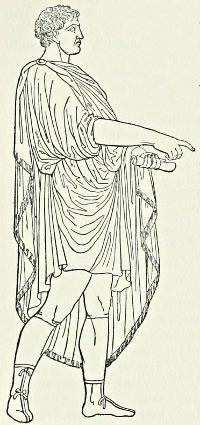
Emperor in Military Tunic
(From Trajan’s Column)
The practice of delation, so rapidly developed under
the rule of Tiberius, introduced a new principle into the
government of his day, and marked it with features of its
own. It is hardly possible to overrate the
effects of this practice upon the general complexion
of the Roman polity, nor is it easy to
exaggerate the horror with which it came to
be regarded. It was an attempt to reconcile
the despotism of the monarch with the forms of a
republic; to strengthen the sovereign power by
weakening its subjects; to govern the people by
dividing them, by destroying their means of combination
among themselves, by generating among them
habits of mutual distrust and fear, and finally plunging
them into a state of political imbecility. It has
been asserted that this system was in fact the product
of peculiar circumstances rather than the creation of
a deliberate will; nevertheless the chief of the state
was made, not unnaturally, to bear the whole responsibility
of it, and the disgust of the nobler spirits
of Rome at the tyranny of spies and informers was
turned against the prince himself, in whose interest
at least, if not at whose instigation, their enormities
were for the most part perpetrated.
If we examine the authorities for the history of
the reign we have been reviewing, we shall find that
those who were nearest to the times themselves
have generally treated Tiberius with the greatest indulgence. Velleius
Paterculus indeed, and Valerius Maximus, his contemporaries and subjects,
must be regarded as mere courtly panegyrists; but the adulation of the one,
though it jars on ears accustomed to the dignified self-respect of the earlier
Romans, is not more high-flown in language and sentiment than what our own
writers have addressed to the Georges, and even the Charleses and Jameses,
of the English monarchy; while that of the other is chiefly offensive from
the connection in which it stands with the lessons of virtue and patriotism
which his book was specially designed to illustrate. The elder Seneca, the
master of a school of rhetoric, to which science his writings are devoted,
makes no mention of the emperor under whom he wrote; but his son, better
known as the statesman and philosopher, though he was under the temptation
of contrasting the austere and aged tyrant with the gay young prince to
whom he was himself attached, speaks of him with considerable moderation,
and ascribes the worst of his deeds to Sejanus and the delators rather than
to his own evil disposition.
In the pages of Philoi and Josephus,h the government of Tiberius is represented
as mild and equitable; it is not till we come to Suetonius and Tacitus,
in the third generation, that his enormities are blazoned in the colours so
painfully familiar to us.[16] It will suffice here to remark that both these later
writers belong to a period of strong reaction against the Cæsarian despotism,
when the senate was permitted to raise its venerable head and assume a show,
at least, of its old imperial prerogatives; when the secret police of Rome was
abolished, delation firmly repressed, freedom of speech proclaimed by the
voice of the emperor himself, and the birthright of the Roman citizen respectfully
restored to him. There ensued a strong revulsion of feeling, not against
monarchy, which had then become an accepted institution, but against the
corruptions which had turned it into tyranny; and Tiberius, as the reputed
founder of the system of delation, bore the odium of all the crimes of all the
tyrants who had succeeded him. Tacitus admits that the affairs of Tiberius
were misrepresented during his power by fear, and after his death by spite;
yet we cannot doubt that Tacitus himself often yields to the bias of his
detractors, while Suetonius is at best indifferent to the truth. After all, a
sober discretion must suspend its belief regarding many of the circumstances
above recorded, and acknowledge that it is only through a treacherous and
distorting haze that we have scanned the features of this ill-omened principate.
THE CHARACTER OF THE TIMES
[25-37 A.D.]
Nevertheless, the terror which prevailed in the last years of Tiberius, to
whomsoever it is chiefly to be ascribed, exercised a baleful influence over
society at Rome, and shows by effects which are still discoverable that it has
been but little exaggerated. It has left permanent traces of itself in the
manifest decline and almost total extinction of literature under its pressure.
The Roman writers addressed only a small class in the capital; to be popularly
known in the provinces, to be read generally throughout the Roman
world, was a privilege reserved for few, and anticipated perhaps rarely by
any. Even in the capital the poet and historian composed their works for a
circle of a few thousand knights and senators, for the friends and families of
their own few hundreds of acquaintances, whom they invited to encourage their
efforts by attending their recitations. The paralysis which benumbed the
energies of the Roman nobility at this crisis of terror and despair, extended
naturally to the organs of their sentiments and opinions. Not history and
philosophy only suffered an eclipse, but poetry also, which under Augustus
had been the true expression of the national feelings, became mute
when the feelings themselves could no longer be trusted with utterance.
Cremutius was subjected to persecution for pronouncing that Brutus and
Cassius were the last of the Romans. A tragedian was accused, and if
accused, we may presume, perhaps, that he was condemned for speaking evil
of the king of men, Agamemnon; and various authors were assailed, and
their writings sentenced to proscription, to whose recitations the last princeps
had himself listened with indulgence.
The poems which were tolerated were generally the most trifling, and
perhaps licentious in character. The sly irony of the fable, a style of composition
adopted by slaves, and imitated from the servile Orientals, seems
not unsuitable to these perilous times. The name of Phædrus belongs in all
probability to the Tiberian period, but it is curious that no later writer for
four centuries should have cared to notice him. Similar or worse has been
the fate of a more serious writer, Manilius, the author of an elaborate poem
on astronomy and its spurious sister astrology, a theme of some danger
under the circumstances of the times, but which he has treated with irreproachable
discretion; it is owing, perhaps, to the disgrace under which the
forbidden science fell that this innocent work lapsed into entire oblivion,
and has escaped the mention of any writer of antiquity.
The deep gloom which settled upon the face of higher society at Rome during
the reign of Tiberius was heightened by its contrast with the frivolous
dissipation of the populace, who, though deprived of the glitter of a brilliant
court, and surrounded by signs of mourning and humiliation among their
natural leaders, not the less abandoned themselves to the sensual enjoyments
which alone they relished, and rejoiced in their utter indifference to
political principles, to parties, and to men. When Sejanus fell, they clamoured
with exultation over the body of the traitor; nevertheless, had the
goddess Nursia, says the moralist, but favoured her Etruscan votary; had
but the false intriguer circumvented the guileless old man, on the instant
they would have been heard proclaiming Sejanus a Cæsar and an Augustus.
In the one class was abandonment of public life, shame, despair, and suicide;
the intolerable evils of the time drove men not to religious consolations, but
to a restless inquiry into the future, or a vain attempt to lull the sense of the
present in philosophic apathy: the other rushed headlong, hour by hour, to
the baths, shows, and largesses, or shouted at the heels of the idol of the
moment, or sighed and perhaps murmured at his loss, and speedily resigned
itself to oblivion of the fitful emotion of the day.
We must be careful notwithstanding to observe that both the shame and
the degradation were for the most part confined to the city and its vicinity,
which were oppressed by the shadow of the imperial despot.f
All Rome drew a deep breath at the great news. Macro’s adroitness and
the devotion of the Romans to the house of Germanicus induced the senate to
confer all the imperial prerogatives on the youthful Caligula. Thus began
one of the strangest and most terrible episodes in the history of Rome. The
dangerous defects and the baleful forces inherent in the system created by
the first two emperors were fated to come to light with amazing rapidity in the
course of this young Cæsar’s reign; a reign which it is difficult for the historian
to consider critically, because one result of the wrath and contempt most
justly evoked by his scandalous misrule has been that of many of his sanguinary
and foolish deeds no record except a deliberate caricature has come down to us.
The fervid enthusiasm with which the capital hailed the son of Germanicus
seemed at first justified by the manner in which Caligula exercised the
authority which had now devolved upon him.
Impelled by nervous haste and violent passion in all things, whether
good or evil, and relying on neither minister nor favourite, he displayed a
restless energy of the type natural to a man of but moderate ability who is
wholly deficient in administrative training and incapable of exact thought.
His delight at the enthusiastic acclamations of the Roman people inspired
this singularly organised being with the best of resolutions; he fully intended
to make the Romans happy.
Thus he bore himself at first with modesty and good sense, especially in
his dealings with the senate. His liberality to the populace and the soldiers,
his pious reverence towards the dead, no less than his consideration for the
living members of his house, and the pardon of all persons accused of offences
of majestas, together with various liberal ordinances, all conspired to produce
a strong impression in his favour. But what most roused the enthusiasm
of all classes was that, casting aside the niggardly economy of the emperor
Tiberius, he shared freely with them all in the festive humour of “games”
of every kind.
For eight months he ruled in this fashion, and at the end of that time
his unbridled excesses brought on a dangerous malady, from which he recovered
much to the hurt of the Roman Empire and his own reputation. Previous
to this time he had lived as in a state of perpetual mental intoxication,
brought to a climax probably by the fulsome expressions of popular concern
during his illness. Whether the latter really had an ill effect upon his mental
faculties or not, the madness of which he thenceforth gave manifest
proofs is of a different type; a type to which critical students of the history
of imperial Rome have given the name of megalomania or Cæsarian madness,
and we meet with it in others besides Caligula.
A man in this condition—sane enough to realise that as long as the
material basis of his power, the loyalty of the soldiery and the masses, is
unshaken, he will meet with no opposition in the gratification of his maddest
whims—may at any moment conceive the idea of testing the validity of his
omnipotence in any direction. It is a mere chance whether this display of
power is directed towards great or even reasonable ends, or whether it issues
in deeds of crime and horror. This is more particularly the case when the
monarch in question is the victim of shattered nerves, the child of caprice,
and the toy of every passing impulse.
The premonitory signs of the evil to come manifested themselves soon
after the beginning of the year 38. Caligula, who chiefly delighted in the
company of charioteers, stage-players, and buffoons, began to make a wanton
exhibition of his despotic power, thus abruptly breaking with the astute
policy of his predecessors. And it was a despotism which ignored the precepts
of ancient Roman decorum, which, in sexual relations, overstepped all
bounds of law and modesty, nay, even of common decency. To the wearisome
admonitions of Macro, who exhorted him to act with some degree of
discretion, he replied by forcing both the general and his wife to commit
suicide.
Presently, however, the monarch having spent the vast riches of Tiberius
in the space of nine or ten months, and being possessed with a mania for
building as well as with a passion for games, became aware of a very perceptible
limit to his omnipotence. To relieve himself of his financial embarrassments,
he had recourse to the most sanguinary as well as to the pettiest
and most infamous measures. Capital charges, most of which were decided
before the emperor’s own tribunal, became more and more numerous, partly
to satisfy Caligula’s growing lust of blood, partly to fill his coffers with the
proceeds of confiscation. Trials for offences of majestas were revived as a
matter of course (39 A.D.).
The money thus acquired was squandered again and again on objects that
could only be called colossal whims. Of these the most notorious was the
construction of the ephemeral bridge of boats between Puteoli and Baiæ,
across which he caused a substantial highway to be made, with aqueducts
and posting stations, after the model of the Appian way, for the sole purpose
of crossing it, surrounded by his guards, in the character of triumphator,
and celebrating this chaining of the ocean by a gorgeous banquet.
His administration of imperial affairs was characterised by the same
whimsical caprice. Having restored for no good purpose the kingdom of
Commagene, he bestowed upon his friend and contemporary, M. Julius
Agrippa (or Herod Agrippa, born 11 B.C.), grandson of Herod the Great,
the greater part of his grandfather’s dominions, most of which had been
annexed to Syria under Augustus and Tiberius. On the other hand, he
summoned Ptolemy, king of Mauretania (from 23 B.C. onwards), to Rome in
the year 40, and there put him out of the way for the sake of his wealth.
Tradition represents all the scenes of Caligula’s visit to Gaul in a light
absolutely grotesque. [Some details from Suetonius will be introduced
presently.] The shout of triumph after a sortie across the Rhine in which
some of his Germanic guards were brought back as sham prisoners, strikes
the reader as wholly comic, but we note with indignation that at Lyons
Caligula continued the disgraceful system of making money by capital sentences
and criminal charges against persons of rank, and recruited his finances
by putting interesting and ancient articles from the palace of the Cæsars at
Rome up to public auction.
The collection of an army, estimated at some 250,000 men, in the ports of
the Morini on the Channel with a view to the conquest of Britain remained
nothing but an empty demonstration. It may have induced the British
chiefs to avert the danger by a formal act of homage and valuable presents;
but tradition represents Caligula as concluding this bloodless expedition with
a piece of buffoonery, and after bestowing costly gifts on the soldiers, commanding
them to pick up shells on the shore as “spoils won from the ocean.”
When he returned to Rome, late in the summer of the year 40, his humour
assumed a more and more sinister character. He regarded his own person
as divine, though he loved to appear with the attributes of the various gods
and goddesses of the Græco-Roman Pantheon; and he now instituted a college
of priests in his own honour, and while heaping ignominy on the most
revered of ancient images of the gods, commanded that he himself should
be worshipped in temples set apart for the purpose throughout the provinces.
In this attempt he met with serious resistance only from the orthodox
Jews. When P. Petronius, legate of Syria, received orders to set up a colossal
gilded statue of the emperor in the Holy of Holies at Jerusalem, the wrath
of the Jews rose to such a pitch that nothing but the sudden death of Caligula
prevented the outbreak of grave trouble throughout Judea. By this
time the tyrant’s popularity was declining even among the masses at Rome,
whom he had pampered with games and presents; for he had lately begun
to impose on the citizens of the capital a series of burdensome taxes, which
were exacted with the utmost rigour. Nevertheless his fate did not overtake
him till his conduct gave deep offence to several of the officers of the
prætorian guard. Then Cassius Chærea, tribune of a prætorian cohort,
headed a conspiracy, and aided by Cornelius Sabinus and others slew the
emperor in a corridor of the palace on the 24th of January, 41 B.C.m
SUETONIUS DESCRIBES CALIGULA
For details of his brief but appalling career we cannot do better than go
to the fountain head—Suetonius. There is no other important ancient
source for this reign except Dion Cassiusj; and modern research can only
interpret and criticise, without adding to the original records.a
He assumed a variety of titles, such as “Dutiful, the Son of the Camp,
the Father of the Armies, and the Greatest and the Best Cæsar.” Upon
hearing some kings, who came to the city to pay their respects to him, contending
amongst themselves at supper, about the nobleness of their birth, he
exclaimed, “Let there be but one prince, one king.” He was strongly inclined
to take a crown immediately, and to turn the imperial dignity into
the form of a kingdom; but being told that he far exceeded the grandeur
of kings and princes, he began to arrogate to himself a divine majesty.
He ordered all the images of the gods, that were famous either for their
beauty or the veneration paid them, amongst which was that of Jupiter
Olympius, to be brought from Greece, that he might take the heads off, and
put on his own. He carried on a part of the Palatine as far as the Forum;
and the temple of Castor and Pollux being converted into a kind of porch to
his house, he would often stand betwixt the two brothers, and so present
himself to be worshipped by all votaries, some of whom saluted him by the
name of Jupiter Latiaris. He ordered likewise a temple and priests, and the
most choice victims for his own godhead. In his temple stood an image of
gold, exactly of the same size as himself, and which was every day dressed
up in the same sort of garment as that which he used. The most opulent persons
in the city offered themselves as candidates for the honour of being his
priests, and purchased it successively at an immense price. The victims were
flamingoes, peacocks, bustards, numidicæ, turkey-hens, and pheasant-hens,
each sacrificed on their respective days. In the night he used constantly to
invite the moon, when full, to his embraces. In the daytime he talked in
private to Jupiter Capitolinus, one while whispering to him, and another turning
his ear to him; sometimes he would talk aloud, and in railing language.
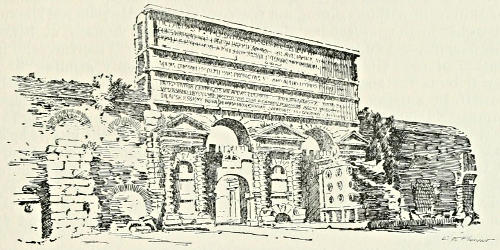
The Claudian Aqueduct
(Begun by Caligula; finished by Claudius)
He was unwilling to be thought or called the grandson of Agrippa, because
of the obscurity of his birth; and he was offended if any one, either in prose
or verse, ranked him amongst the Cæsars. He said his mother was the fruit
of an incestuous commerce, maintained by Augustus with his daughter Julia.
And not content with this vile reflection upon the memory of Augustus, he
forbade his victories at Actium, and upon the coast of Sicily, to be celebrated
as usual; affirming that they had been of the most pernicious and fatal consequence
to the Roman people. He called his grandmother Livia Augusta
“Ulysses in a woman’s dress,” and had the indecency to reflect upon her in a
letter to the senate, as of mean birth, and descended, by the mother’s side,
from a grandfather who was only a member of the council of state at Fundi;
whereas it is certain, from authentic documents, that Aufidius Lingo held
public offices at Rome.
His grandmother Antonia desiring a private conference with him, he
denied the request, unless Macro, commander of the guards, might be present.
By affronts of this kind, and ill usage, he was the occasion of her death; but,
as some think, not without giving her a dose of poison. He paid not the smallest
respect to her memory after her death; and gratified himself at beholding,
from his parlour, her funeral pile on fire. His brother Tiberius, who had no
expectation of any violence, he despatched, by suddenly sending to him a
military tribune for that purpose. He forced Silanus his father-in-law to
kill himself, by cutting his throat with a razor. The pretext he alleged for
these murders was, that the latter had not followed him upon putting to sea in
stormy weather, but stayed behind with the view of seizing the city, if he should
have been lost in the voyage. The other, he said, smelt of an antidote, which
he had taken to prevent his being poisoned by him; whereas Silanus was
only afraid of being seasick, and of the trouble of the voyage; and Tiberius
had only made use of a medicine for a habitual cough, which was constantly
increasing upon him. As to his successor Claudius, he only saved him to
make sport with.
He lived in the habit of incest with all his sisters; when one of them,
Drusilla, was married to Cassius Longinus, a man of consular rank, he took
her from him, and kept her openly as his wife. In a fit of sickness, he by his
will appointed her heiress of his estate, and the empire likewise. After her
death, he ordered a public mourning for her; during which it was capital for
any person to laugh, use the bath, or sup with parents, wife, or children.
Being inconsolable under his affliction, he went hastily, and in the night-time,
from the city, going through Campania to Syracuse; and then suddenly
he returned without shaving his beard, or trimming his hair all that time.
Nor did he ever after, in matters of the greatest importance, not even in the
assemblies of the people and soldiers, swear any otherwise, than “By the
divinity of Drusilla.”
He never but once in his life concerned himself with military affairs, and
then not deliberately, but in his journey to Mevania, to see the grove and
river of Clitumnus. Being put in mind of recruiting his company of Batavians,
which he had about him, he resolved upon an expedition into Germany.
Immediately he drew together several legions and auxiliary forces from all
quarters, and made everywhere new levies with the utmost rigour. Laying
in provisions of all kinds, beyond what had ever been done upon the like
occasion, he set out on his march; and pursued it with so much haste and
hurry sometimes, that the guards were obliged, contrary to custom, to lay
their standards upon the backs of horses or mules, and so follow him. At
other times, he would march with such slowness and delicacy, that he
would be carried in a chair by eight men; ordering the roads to be swept
by the people of the neighbouring towns, and sprinkled with water to lay
the dust.
Upon arriving in the camp, to show himself an active general, and severe
disciplinarian, he cashiered the lieutenant-generals that came up late with
the auxiliary forces from different parts. In reviewing the army, he took
their companies from most of the centurions of the first rank, who had now
served their legal time in the wars, and from some but a few days before
their time would have expired; alleging against them their great age and
infirmity; and railing at the covetous disposition of the rest of them, he
reduced the premiums due to such as had served out their time to the
sum of six thousand sesterces. Though he only received the submission of
Adminius, the son of Cinobelinus a British prince, who being forced from
his native country by his father, came over
to him with a small body of troops; yet, as
if the whole island had been surrendered to
him, he despatched magnificent letters to
Rome upon the occasion, ordering the bearers
to proceed in their chaise directly up to the
Forum and the senate house, and not to deliver
the letters but to the consuls in the temple of
Mars, and in the presence of a full assembly
of the senators.
Roman Soldier’s Method of fording
a River, carrying his Arms and Clothing on his Shield
Soon after this, there being a general tranquillity,
he ordered a few Germani of his
guard to be carried over and concealed on the
other side of the Rhine, and word to be
brought him after dinner, in a great hurry,
that an enemy was advancing. This being
accordingly done, he immediately posted away
with his friends, and a party of the horse-guards,
into the adjoining wood, where lopping
the branches of some trees, and dressing them
up in the manner of trophies, he returned by
torchlight, upbraiding those who did not
follow him, with timorousness and cowardice;
but presented the companions and sharers of
his victory with a new kind of crown, and
under a new name, with the representation of
the sun, moon, and stars upon them, which he
called exploratoriæ. Again, some hostages
were by his order taken out of a school, and
privately sent off; upon notice of which he
immediately rose from table, pursued them
with the horse, as if they had run away, and coming up with them, brought
them back in chains; proceeding to an extravagant pitch of ostentation
likewise in this military comedy. Upon again sitting down to table, when
some came to acquaint him that the army was all come in, he ordered them
to sit down as they were in their coats of mail, animating them in the words
of a well-known verse of Virgil.
In the meantime, he reprimanded the senate and people of Rome by a very
severe proclamation, “for revelling and frequenting the diversions of the
circus and theatre, and enjoying themselves in their country-houses, whilst
their emperor was fighting, and exposing his person to the greatest dangers.”
At last, as if resolved to make an end of the war at once, drawing up his
army upon the shore of the ocean, with his ballistæ and other engines of war,
whilst nobody could imagine what he intended to do, on a sudden he commanded
them to gather up the sea shells, and fill their helmets, and the laps
of their coats with them, calling them, “the spoils of the ocean due to the
Capitol and the Palatine.” As a monument of his success, he raised a high
tower, upon which he ordered lights to be put in the night-time, for the
direction of ships at sea; and then promising the soldiers a donative of a
hundred denarii a man, as if he had surpassed the most eminent examples of
generosity, “Go your ways,” said he, “and be merry; go and be rich.”
Upon his applying himself to make preparations for his triumph, besides
prisoners and those who had deserted from the barbarians, he picked out the
men of greatest stature in all Gaul, such as he said were fittest for a triumph,
with some of the most considerable persons in the province, and reserved
them to grace the solemnity; obliging them not only to dye their hair of a
yellowish colour, and let it grow long, but to learn the German language,
and assume the names commonly used in that country. He ordered likewise
the galley in which he had entered the ocean, to be carried a great part of
the way to Rome by land, and wrote to the collectors of his revenue in the
city, “to make proper preparations for a triumph against his arrival, at as
small expense as possible; but such a one, however, as had never been seen
before, since they had full power and authority to seize the estates of all
men whatever.”
In person, Caligula was tall, of a pale complexion, ill shaped, his neck and
legs very slender, his eyes and temples hollow, his forehead broad and grim,
his hair thin, and about the crown quite decayed. The other parts of his
body were much covered with hair. On this account, it was reckoned a
capital crime for any person to look down from above, as he was passing by,
or so much as to name a goat. His countenance, which was naturally
hideous and frightful, he purposely rendered more so, forming it by a glass
into the most horrible contortions. He was crazy both in body and mind,
being subject when a boy to the falling sickness. When he arrived at the
age of manhood, he would endure fatigue tolerably well, yet so that
occasionally he was liable to a faintness, during which he remained incapable
of any effort, even for his own preservation. He was not insensible of
the disorder of his mind, and sometimes had thoughts of retiring to purge
his brain. It was believed that his wife Cæsonia had administered to him a
love-potion which threw him into a frenzy. What most of all disordered
him was want of sleep, for he seldom had more than three or four hours’
rest in a night; and even then he slept not soundly, but disturbed by
strange dreams; fancying one time that the ocean spoke to him. Being
therefore often weary with lying awake so great a part of the night, he
would one while sit upon the bed, and another while walk in the longest
porticos about his house, and now and then invoke and look out for the
approach of day.
In his clothes, shoes, and other parts of his dress, he neither followed
the usage of his country, his sex, nor indeed any fashion suitable to a
human creature. He would often appear abroad dressed in an embroidered
coat set with jewels, in a tunic with sleeves, and with bracelets upon his
arms; sometimes all in silks and habited like a woman; at other times in the
crepidæ or buskins; sometimes in a sort of shoes used by the meaner soldiers,
or those of women, and commonly with a golden beard fixed to his chin,
holding in his hand a thunderbolt, a trident, or a caduceus, marks of distinction
belonging to the Gods only. Sometimes too he appeared in the
dress of Venus. He wore very commonly the triumphal dress, even before
his expedition, and sometimes the breast-plate of Alexander the Great, taken
out of the vault where his body lay.
In respect of the liberal sciences, he was little conversant in philology,
but applied himself with assiduity to the study of eloquence, being indeed in
point of enunciation sufficiently elegant and ready; and these qualities
appeared most conspicuous when he happened to be in a passion. In speaking,
his action was vehement, and his voice so strong that he was heard at a
great distance. When he was about to harangue, he threatened “the sword
of his lucubration.” He so much despised a soft smooth style that he said
Seneca, who was then much admired, “wrote only boyish declamations,” and
that “his language was nothing else but sand without lime.” When
pleaders were successful in a cause, he often wrote answers to their speeches;
and would exercise himself in composing accusations or vindications of eminent
persons that were impeached before the senate; and according to his
success he would exasperate or assuage the situation of the party by his vote
in the house; inviting the equestrian order, by proclamation, to hear him.
He likewise applied himself with alacrity to the practice of several other
arts, as fencing, riding the chariot, singing, and dancing. In the first of
these, he practised with the weapons used in fighting; and drove the chariot
in circuses built in several places. He was so extremely fond of singing
and dancing that he could not refrain in the theatre from singing with the
tragedians, and imitating the gestures of the actors, either in the way of
approbation or correction. A pervigilium which he had ordered the day
upon which he was slain was thought to be intended for no other reason
than to take the opportunity afforded by the licentiousness of such a season
to make his first appearance upon the stage. Sometimes he danced likewise
in the night. Sending once, in the second watch of the night, for three men
of consular rank, who were under great apprehensions from the message, he
placed them by the stage, and then all of a sudden came bursting out, with
a loud noise of flutes and Scabella, dressed in a pella and tunic reaching
down to his heels. Having danced out a song, he retired. Yet he who had
acquired such dexterity in other exercises, could never swim.
Those for whom he once conceived a regard he favoured even to madness.
He used to kiss Mnester, the pantomimic, publicly in the theatre;
and if any person made the least noise while he was dancing, he would
order him to be dragged out of his seat and scourged him with his own
hand. A Roman knight once making some bustle, he sent him, by a centurion,
an order to go forthwith down to Ostia, and carry a letter from
him to King Ptolemy in Mauretania. The letter was comprised in these
words: “Do neither good nor harm to the bearer.” He made some gladiators
captains of his German guards. He took from the gladiators called
Mirmillones some of their arms. One Columbus coming off with victory
in a combat, but being slightly wounded, he ordered some poison to be
infused into the wound, which he thence called Columbinum. For thus it
certainly was put down with his own hand amongst other poisons. He
was so extravagantly fond of the party of charioteers that rode in green,
that he supped and lodged for some time constantly in the stable where
their horses were kept. At a certain revel he made a present of two
millions of sesterces to one Cythicus a driver of a chariot. The day before
the Circensian games, he used by his soldiers to enjoin silence in the neighbourhood,
that the repose of his horse Incitatus might not be disturbed.
For this favourite animal, besides a marble stable, an ivory manger, scarlet
body clothes, and a bracelet of jewels, he appointed a house, with a retinue
of slaves, and fine furniture, for the reception of such as were invited in the
horse’s name to sup with him. It is even said that he designed to have
made him consul.c
Such is the picture of this lunatic as Suetonius vividly paints it. For
four years the world bore his furious madness without by sedition protesting
against such a saturnalia of power. “How I wish,” said the monster,“that
the Roman people had only one head, so I could strike it off at a blow.” The
senate, however, grew tired of finding him victims, and finally, as already
mentioned, a prætorian tribune, Chærea, strangled him.
Chærea was a republican. He and his friends thought that, after such
a prince, monarchical government had been sufficiently judged by experience.
The occasion now seemed favourable for the senate to resume the power.
It did so, and for three days deemed a republic assured. But this was
reckoning without either soldiers or people.
At the time of Caligula’s murder, Claudius, his uncle, who was with
him, had hidden in an obscure corner. A soldier found and showed him
to his comrades. Claudius begged for life. “Be our emperor,” they answered,
and as he trembled and could not walk, they carried him to their
camp, where he regained sufficient courage to harangue the troops, promising
them money (donativum). It was the price of an empire he paid, an
unfortunate innovation which amongst the soldiers had passed into law.
The senators, abandoned little by little, themselves hastened to greet
the new master. Chærea was sentenced to death. “Do you know how to
kill?” he asked the soldier charged to execute him. “Your sword is not
well ground perhaps. That which I used for Caligula would be better.”
Claudius, brother to Germanicus and grandson to Livia, through his father
Drusus the first, was then fifty years old. During his youth he had been continually
ill, and in the royal household every one had neglected the poor child,
not daring to show him either to the people or the soldiers. At last his
existence was almost forgotten and at forty-six he was not even a senator.
He consoled himself by study and writing a history of the Etruscans and
Carthaginians. Caligula, who named him consul, brought him a little more
into prominence; the soldiers’ whim did the rest. They gave him the empire,
but could not do away with the effects of his upbringing, that timidity,
irresolution, and want of self-dependence which resulted most disastrously,
so that he often did evil with the very best intentions. In his reign the real
rulers were his wife, Messallina, whose name is one with all debauchery and
even with most repulsive coarseness, and his freedmen Polybius, Narcissus,
and Pallas. [At least they exercised an undue influence over him.]
Claudius began well. He revoked the acts of Caligula, had the Augustan
laws sworn to, and recalled the banished. Naturally kind-hearted, he
easily adopted the manners that had contributed to the popularity of the first
emperor. He visited his sick friends, consulting the consuls and the senate
as if he were quite dependent on their favour. He liked to act as judge
and often did it very well. Unfortunately, his undignified bearing, his
shaking head, stammering and often ridiculous speech made him of very
little account. He re-established the censorship and often exercised it himself,
but rather with the tastes of an antiquarian loving old customs than
with a sense of the real needs of the empire.
In spite of these oddities and weaknesses, this prince, without regarding
the examples of infamy and crime given by his surroundings, can hardly be
counted among the worst emperors. The freedmen whom long power had
not yet spoiled sought to justify their influence by good service, and we find
what we should hardly have expected—namely, several wise measures with
regard to slaves in the interior; against too greedy advocates, usurers, and
those banished from the provinces who flocked to Rome, etc. Moreover,
there were useful works: an aqueduct, a port at Ostia, an attempt to drain
Lake Fucinus, etc. In the provinces a liberal administration and a firm
foreign policy were crowned by success.
Augustus had wished to constitute a Roman minority in the midst of the
submissive nations which would prove a support to the government. But
it was to govern always in Rome’s interests. A futile effort, because he
was aiming at nothing less than arresting the course of the world, as if
the emperors could have continued an
aristocracy against which they had
contended in the battles of Pharsalia,
Thapsus, and Philippi. In his will
Augustus had advised a careful guarding
of civic privilege, and in the short
space of thirty-four months, the number
of citizens had nearly doubled.
Tiberius aided much in this increase.
Claudius also contributed largely, because
he made the law of continuous
extension and progressive assimilation,
which had made the fortune of the republic,
a rule of policy. He personally
asked that the nobles of Gallia
Comata, who had long been citizens,
should also assume Roman dignities
and have a seat in the senate.
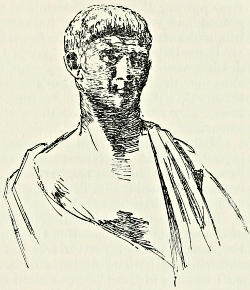
The Emperor Claudius
(From a bust in the Vatican)
Only one religious provincial sect
was persecuted under Claudius—that
of the Druids, because their priests refused
the peace offered by Augustus
on condition of their uniting their gods
to the Olympian deities. Claudius tried, therefore, to abolish their worship,
and punished with death both priests and their adherents.b
In the interior parts of Britain, the natives, under the command of Caractacus,
maintained an obstinate resistance, and little progress was made by
the Roman arms, until Ostorius Scapula was sent over to prosecute the war.
He penetrated into the country of the Silures, a warlike tribe who inhabited
the banks of the Severn; and having defeated Caractacus in a great battle,
made him prisoner, and sent him to Rome (50 A.D.). The fame of the
British prince had by this time spread over the provinces of Gaul and Italy;
and upon his arrival in the Roman capital, the people flocked from all
quarters to behold him. The ceremonial of his entrance was conducted with
great solemnity. On a plain adjoining to the Roman camp, the prætorian
troops were drawn up in martial array; the emperor and his court took their
station in the front of the lines, and behind them was ranged the whole body
of the people. The procession commenced with the different trophies which
had been taken from the Britons during the progress of the war. Next
followed the brothers of the vanquished prince, with his wife and daughter,
in chains, expressing by their supplicating looks and gestures the fears with
which they were actuated. But not so Caractacus himself. With a manly
gait and an undaunted countenance, he marched up to the tribunal, where
the emperor was seated, and addressed him in the following terms:
“If to my birth, and distinguished rank, I had added the virtues of moderation,
Rome had beheld me rather as a friend than a captive; and you
would not have rejected an alliance with a prince descended from illustrious
ancestors, and governing many nations. The reverse of my fortune to you
is glorious, and to me humiliating. I had arms, and men, and horses; I
possessed extraordinary riches; and can it be any wonder that I was unwilling
to lose them? Because Rome aspires to universal dominion, must men
therefore implicitly resign themselves to subjection? I opposed for a long
time the progress of your arms, and had I acted otherwise, would either you
have had the glory of conquest, or I of a brave resistance? I am now in
your power; if you are determined to take revenge, my fate will soon be forgotten,
and you will derive no honour from the transaction. Preserve my
life, and I shall remain to the latest ages a monument of your clemency.”
Immediately upon this speech, Claudius granted him his liberty, as he
did likewise to the other royal captives. They all returned their thanks, in
a manner the most grateful to the emperor; and as soon as their chains were
taken off, walking towards Agrippina, who sat upon a bench at a little distance,
they repeated to her the same fervent declarations of gratitude and
esteem.
History has preserved no account of Caractacus after this period; but it
is probable that he returned in a short time to his own country, where his
former valour, and the magnanimity which he had displayed at Rome, would
continue to render him illustrious through life, even amidst the irretrievable
ruin of his fortunes.c
In Germany a successful expedition had restored to the Romans the last
of the eagles of Varus. But Claudius, practising on this side Tiberian politics,
busied himself particularly in taking up a strong position on the Rhine
and winning barbarian chiefs to the interests of Rome. He succeeded so
well that in 47 the Cherusci came to him, asking for a king. Corbulo, the
greatest general of this time, wanted to carry out the plans of the first
Drusus against the Germans. He subdued the Frisians and attacked the
Chauci. Claudius stayed his advance. “Happy were the old Roman consuls!”
said the ambitious general as he obeyed. In order at least to occupy
his soldiers he had a canal dug from the Meuse to the Rhine, another leader
made his men open the mines. Everywhere these useful works were now
demanded from the troops.
On the Danube peace was undisturbed. In Thrace various troubles made
Claudius intervene and reduce the country to a province. In the Bosporus,
a king deposed by him took arms, was conquered, and gave himself up. In the
East the emperor had the glory of reconquering Armenia and giving a king
to the Parthians. Unfortunately these successes did not continue; the Roman
candidate to the throne of the Arsacidæ was overthrown and for some time
Vologeses kept the Armenian crown on the head of his brother Tiridates.
Lycia made bad use of her liberty, so Claudius took it away, and the
Jewish king, Agrippa, dying in 44, he united Palestine to the government
of Syria. In Africa, Suetonius Paulinus and Geta subdued the Moors, whose
country formed two provinces—the Mauretania Cæsariensis and Mauretania
Tingitana.
The emperor now lacked neither military nor political glory. Mauretania
and the half of Britain were conquered; the Germans coerced, the
Bosporus reduced to obedience; Thrace, Lycia, and Judea made provinces,
and the Parthian troubles long since smoothed over. Within the empire there
was growing prosperity; the army was well disciplined and its activity was
directed to the public welfare under the direction of generals grown old in
command. Certainly, results everywhere were sufficient to gratify the pride
of a prince. It is with regret that we have to turn to Rome to see nobles
whose only occupation was conspiracy or base flattery—and to that imperial
palace which was disgraced by a weak prince and his immoral wife, the
shameless Messallina.b The misdeeds of the latter will now claim our
attention. Let Tacitus draw her portrait:
THE MISDEEDS OF MESSALLINA DESCRIBED BY TACITUS
The facility of ordinary adulteries having produced satiety, Messallina
broke forth into unheard-of excesses; when even Silius, her paramour, whether
impelled by some fatal infatuation, or judging that the dangers hanging over
him were only to be averted by boldly confronting them, urged that all
disguises should now be renounced, for matters, he said, were gone too far
for them to wait for the death of the emperor; blameless counsels were for
the innocent, but in glaring guilt safety must be sought in reckless daring.
They were backed by accomplices who dreaded the same doom. As for himself,
he was single, childless, ready to marry her, and to adopt Britannicus: to
Messallina would still remain her present power; with the addition of security,
if they anticipated Claudius; who, as he was unguarded against the
approaches of stratagem, so was he headstrong and impetuous when provoked
to anger. These suggestions were but coldly received by Messallina;
from no love to her husband; but lest Silius, when he had gained the
sovereignty, should scorn his adulteress; and the treason, which in his present
perilous predicament he approved, would then be estimated according to its real
desert. She, however, coveted the name of matrimony, from the greatness
of the infamy attaching to it; which, with those who are prodigal of fame,
forms the crowning gratification of depraved appetite. Nor stayed she
longer than till Claudius went to Ostia, to assist at a sacrifice; when she
celebrated her nuptials with Silius, with all the usual solemnities.
I am aware [Tacitus continues] that it will appear fabulous that any
human beings should have exhibited such recklessness of consequences; and
that, in a city where everything was known and talked of, any one, much
more a consul elect, should have met the emperor’s wife, on a stated day, in
the presence of persons called in, to seal the deeds, as for the purpose of
procreation, and that she should have heard the words of the augurs,
entered the house of the husband, sacrificed to the gods, sat down among
the guests at the nuptial banquet, exchanged kisses and embraces, and in fine
passed the night in unrestrained conjugal intercourse. But I would not
dress up my narrative with fictions to give it an air of marvel, rather than
relate what has been stated to me or written by my seniors.
The consequence was that the domestic circle of the prince was horror-struck;
especially those who had the chief sway, and who dreaded the
result, if the state of things should be changed, no longer confined themselves
to secret communications, but exclaimed with undisguised indignation
that while the emperor’s bedchamber was made the theatre for a stage-player
to dance upon, a reproach was indeed incurred, but the immediate
dissolution of the state was not now threatened: a young man of noble
rank, of fascinating person, mental vigour, and just entering upon the consulship,
was addressing himself to higher objects; nor was it any enigma
what remained to be done after such a marriage. It is true, when they
reflected on the stupidity of Claudius, his blind attachment to his wife, and
the many lives sacrificed to her fury, they were unable to divest themselves
of apprehensions; again, even the passive spirit of the emperor revived
their confidence; that, if they could first possess him with the horrid blackness
of her crimes, she might be despatched without trial. But the danger
turned upon this—that she might make a defence; and that even if she confessed
her guilt, the emperor might be deaf to that evidence also.
But first it was deliberated by Callistus, whom, in relating the assassination
of Caligula, I have already mentioned; by Narcissus, who plotted the
murder of Appius; and by Pallas, then the reigning favourite, whether,
feigning ignorance of all other circumstances, they should compel Messallina
to break off her amour with Silius by secret menaces; but they afterwards
abandoned this project from fear lest they should themselves be dragged to
execution as culprits. Pallas was faint hearted; and Callistus, a courtier in
the last reign also, had learned by experience that power was secured more
effectually by wary measures than by daring counsels. Narcissus persisted;
with this difference only, that he took care not to let fall a word by which
she might know beforehand the charge against her or her accuser; and
watching all occasions, while the emperor lingered at Ostia, he prevailed
with two courtesans, who were the chief mistresses of Claudius, to
undertake the task of laying the matter before him, by means of presents
and promises, and by representing to them in attractive colours that by the
fall of his wife their own influence would be increased.
Calpurnia therefore, for that was the name of the courtesan, upon the first
occasion of privacy, falling at the emperor’s feet, exclaimed, that Messallina
had married Silius; and at the same time asked Cleopatra, who purposely
attended to attest it, whether she had not found it to be true. Claudius,
upon a confirmation from Cleopatra, ordered Narcissus to be called. He,
when he came, begged pardon for his past conduct in having concealed from
the prince her adulteries while they were limited to the Vectii and Plautii;
nor meant he now, he said, to charge Silius with adulteries; nor urge that
he should restore the house, the slaves, and the other decorations of imperial
fortune: the adulterer might still enjoy these; let him only break the
nuptial tables, and restore the emperor’s wife. “Know you, Cæsar, that you
are in a state of divorce? In the face of the people, and senate, and soldiery,
Messallina has espoused Silius; and unless you act with despatch, her husband
is master of Rome.”
He then sent for his most confidential friends, particularly for Turranius,
superintendent of the stores; next for Lusius Geta, captain of the prætorian
guards; and inquired of them. As they avouched it, the rest beset him with
clamorous importunities, that he should forthwith proceed to the camp, secure
the prætorian cohorts, and consult his preservation before his revenge.
It is certain that Claudius was so confounded and panic-stricken that he was
incessantly asking whether he were still emperor—whether Silius was still
a private man.
As to Messallina, she never wallowed in greater voluptuousness; it was
then the middle of autumn, and in her house she exhibited a representation
of the vintage; the wine-presses were plied, the wine vats flowed, and round
them danced women begirt with skins, like Bacchanalians at their sacrifices,
or under the maddening inspiration of their deity. She herself, with her hair
loose and flowing, waved a thyrsus; by her side Silius, crowned with ivy,
and wearing buskins, tossed
his head about; while around
them danced the wanton choir
in obstreperous revelry. It is
reported that Vectius Valens,
having in a frolic climbed to
an exceeding high tree, when
asked what he saw, answered,
“A terrible storm from Ostia.”
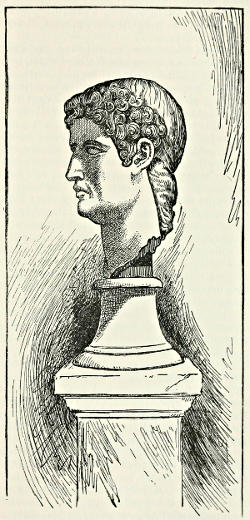
Messallina
(From a portrait bust)
It was now no longer
vague rumour; but messengers
poured in on all sides with
tidings that Claudius, apprised
of all, had approached,
bent upon instant vengeance.
They separated; Messallina
betook herself to the gardens
of Lucullus, and Silius, to dissemble
his fear, resumed the
offices of the Forum. As the
rest were slipping off different
ways, the centurions came up
with them and bound them,
some in the street, others in
lurking-places, according as
each was found. Messallina,
however, though in her distress
incapable of deliberation,
formed the bold resolution of
meeting her husband, and presenting
herself to his view—an
expedient which had often
proved her protection. She
likewise ordered that Britannicus
and Octavia should go
forth and embrace their father;
and besought Vibidia, the oldest
vestal, to intercede with the
chief pontiff, and earnestly importune
his clemency. She
herself meanwhile traversed
on foot the whole extent of the
city, attended only by three
persons (so suddenly had her
whole train forsaken her), and
then, in a cart employed to carry out dirt from the gardens, took the road to
Ostia, unpitied by anyone, as the deformity of her crimes overpowered
every feeling of the kind.
Claudius was in a state of no less trepidation; for he could not implicitly
rely on Geta, the captain of his guards—an equally fickle instrument of fraud
or honesty. Narcissus therefore, in concert with those who entertained the
same mistrust, assured the emperor, that there was no other expedient to
preserve him than the transferring the command of his guards to one of his
freedmen, for that day only; and offered himself to undertake it. And,
that Lucius Vitellius and Publius Largus Cæcina might not on his way to
the city prevail with Claudius to relent, he desired to have a seat in the same
vehicle, and took it.
It was afterwards currently reported that, while the emperor was giving
expression to the opposite feelings which agitated his breast, at one time inveighing
against the atrocities of his wife, and then at length recurring to
the recollection of conjugal intercourse and the tender age of his children,
Vitellius uttered nothing but “Oh! the villainy! Oh! the treason!” Narcissus
indeed pressed him to discard all ambiguity of expression, and let them
know his real sentiments; but he did not therefore prevail upon him to give
any other than indecisive answers, and such as would admit of any interpretation
which might be put upon them; and his example was followed by
Largus Cæcina. And now Messallina was in sight, and importunately called
on the emperor “to hear the mother of Octavia and Britannicus,” when her
accuser drowned her cries with the story of Silius and the marriage, and
delivered at the same time to Claudius a memorial reciting all her whoredoms;
to divert him from beholding her. Soon after, as the emperor was
entering Rome, it was attempted to present to him his children by her; but
Narcissus ordered them to be taken away. He could not, however, prevent
Vibidia from insisting, with earnest remonstrances, that he would not
deliver his wife to destruction without a hearing; so that Narcissus was
obliged to assure her that the prince would hear Messallina, who should have
full opportunity of clearing herself; and advised the vestal to retire and
attend the solemnities of her goddess.
The silence of Claudius, while all this was going on, was matter of astonishment.
Vitellius seemed like one who was not in the secret: the freedman
controlled everything; by his command, the house of the adulterer was
opened, and the emperor escorted thither, where the first thing he showed
him was the statue of Silius, the father, in the porch, though it had been
decreed to be demolished by the senate; then that all the articles belonging
to the Neros and Drusi had now become the price of dishonour. Thus incensed,
and breaking forth into menaces, he led him direct to the camp, where
the soldiers being already assembled, by the direction of Narcissus, he made
them a short speech; for shame prevented his giving utterance to his indignation,
though he had just cause for it.
The soldiers then clamoured unremittingly and importunately that the
culprits should be tried and punished. Silius was placed before the tribunal;
he made no defence, he sought no delay, but begged only to be despatched
immediately. Illustrious Roman knights also, with similar firmness of mind,
were eager for a speedy death. He therefore commanded Titius Proculus,
assigned by Silius as a guard to Messallina; Vectius Valens, who confessed
his guilt, and offered to discover others, Pompeius Ubicus and Saufellus
Trogus, as accomplices, to be all dragged to execution. On Decius Calpurnianus
too, præfect of the watch; Sulpicius Rufus, comptroller of the games;
and Juncus Vergilianus, the senator, the same punishment was inflicted.
Mnester alone caused some hesitation. He tore off his clothes and called
upon the emperor to behold upon his body the impressions of the lash; to
remember his own commands, obliging him to submit to the pleasure of
Messallina without reserve: others had been tempted to the iniquity by great
presents or aspiring hopes; but his offence was forced upon him. Nor would
any man have sooner perished had Silius gained the sovereignty. These
considerations affected Claudius, and strongly inclined him to mercy; but
his freedmen overruled him. They urged that after so many illustrious sacrifices,
he should by no means think of saving a player; that in a crime of
such enormity, it mattered not whether he had committed it from choice or
necessity. As little effect had the defence even of Traulus Montanus, a
youth of signal modesty and remarkably handsome, summoned by Messallina
to her bed without any solicitation on his part, and in one night cast off;
such was the wantonness with which her passion was alike surfeited and inflamed.
The lives of Suilius Cæsoninus and Plautius Lateranus were spared;
of the last, on account of the noble exploits of his uncle: the other was protected
by his vices, as one who, in the late abominable society, had prostituted
himself like a woman.
Meanwhile Messallina was in the gardens of Lucullus, still striving to
prolong her life, and composing supplications to the prince, sometimes in the
language of hope, at others giving vent to rage and resentment, so indomitable
was her insolence even under the immediate prospect of death. And
had not Narcissus hastened her assassination, the doom which he had prepared
for her would have recoiled upon himself. For Claudius, upon his
return home, experienced a mitigation of his wrath, from the effects of a
sumptuous repast; and as soon as he became warm with wine, he ordered
them “to go and acquaint the miserable woman (for this was the appellation
which he is said to have used) that to-morrow she should attend and
plead her cause.” These words indicated that his resentment was abating,
his wonted affection returning; besides, if they delayed, the effect of
the following night, and the reminiscences which the conjugal chamber
might awaken in Claudius, were matter for alarm. Narcissus therefore
rushed forth, and directed the tribune and centurions then attending upon
duty to despatch the execution, for such, he said, was the emperor’s command.
With them he sent Euodus of the freedmen, as a watch upon
them, and to see his orders strictly fulfilled. Euodus flew before them to
the gardens, and found her lying along upon the earth; her mother, Lepida,
sitting by her side—who during her prosperity had not lived in harmony
with her, but, in this her extreme necessity, was overcome by compassion
for her, and now persuaded her not to wait for the executioner: “the course
of her life was run, and her only object now should be to die becomingly.”
But a mind sunk and corrupted by debauchery retained no sense of honour;
she was giving way to bootless tears and lamentations when from the shock
of the approaching party the door flew open: the tribune stood in silence
before her; but the freedman upbraided her with many and insolent reproaches,
characteristic of the slave.
Then for the first time she became deeply sensible of her condition, and
laying hold of the steel, applied it first to her throat, then to her breast, with
trembling and irresolute hand, when the tribune ran her through. Her
corpse was granted to her mother. Tidings were then carried to Claudius
that Messallina was no more, without distinguishing whether by her own
or another’s hand; neither did he inquire, but called for a cup of wine, and
proceeded in the usual ceremonies of the feast. Nor did he, indeed, during
the following days, manifest any symptom of disgust or joy, of resentment
or sorrow, nor, in short, of any human affection; not when he beheld the
accusers of his wife exulting at her death, not when he looked upon her
mourning children. The senate aided in effacing her from his memory, by
decreeing that from all public and private places her name should be rased,
and her images removed. To Narcissus were decreed the decorations of
the quæstorship; a very small reward indeed, considering his towering elevation;
for he was more influential than Pallas and Callistus.d
THE INTRIGUES OF AGRIPPINA
[48-49 A.D.]
The freedmen now had the task of selecting another wife for their feeble
prince, who was not capable of leading a single life, and who was sure to be
governed by the successful candidate. The principal women in Rome were
ambitious for the honour of sharing the bed of the imperial idiot, but the
claims of all were forced to yield to those of Lollia Paulina, the former wife
of Caligula, Julia Agrippina the daughter of Germanicus, and Ælia Petina,
Claudius’ own divorced wife. The first was patronised by Callistus, the
second by Pallas, the last by Narcissus. Agrippina, however, in consequence
of her frequent access to her uncle, easily triumphed over her rivals;
the only difficulty that presented itself was that of a marriage between
uncle and niece being contrary to Roman manners, and being even regarded
as incestuous. This difficulty, however, the compliant L. Vitellius, who
was then censor, undertook to remove. He addressed the senate, stating
the necessity of a domestic partner to a prince who had on him such weighty
public cares. He then launched forth in praise of Agrippina; as to the
objection of the nearness of kindred, such unions he said were practised
among other nations, and at one time first-cousins did not use to marry,
while now they did so commonly. The servile assembly outran the speaker
in zeal; they rushed out of the house, and a promiscuous rabble collected,
shouting that such was the wish of the Roman people. Claudius repaired
to the senate house, and caused a decree to be made legalising marriages
between uncles and nieces, and he then formally espoused Agrippina. Yet
such was the light in which the incestuous union was viewed that, corrupt
as the Roman character was become, only two persons were found to follow
the imperial example.
Agrippina also proposed to unite her son Domitius with Octavia the
daughter of Claudius; but here there was a difficulty also, for Octavia was
betrothed to L. Silanus. Again, however, she found a ready tool in the base
Vitellius, to whose son Julia Calvina, the sister of Silanus, had been married.
As the brother and sister indulged their affection imprudently, though
not improperly, the worthy censor took the occasion to make a charge of
incest against Silanus, and to strike him out of the list of senators. Claudius
then broke off the match, and Silanus put an end to himself on the very day
of Agrippina’s marriage. His sister was banished, and Claudius ordered
some ancient rites expiatory of incest to be performed, unconscious of the
application of them which would be made to himself.
The woman, who had now obtained the government of Claudius and the
Roman Empire, was of a very different character from the abandoned Messallina.
The latter had nothing noble about her, she was the mere bondslave
of lust, and cruel and avaricious only for its gratification; but Agrippina
was a woman of superior mind, though utterly devoid of principle. In her,
lust was subservient to ambition; it was the desire of power or the fear of
death, and not wantonness, that made her submit to the incestuous embraces
of her brutal brother Caligula, and to be prostituted to the companions of
his vices. It was ambition and parental love that made her now form an
incestuous union with her uncle. To neither of her husbands, Cn. Domitius
or Crispus Passienus, does she appear to have been voluntarily unfaithful.
The bed of Claudius was, however, not fated to be unpolluted; for as a
means of advancing her views, Agrippina formed an illicit connection with
Pallas.
[49-54 A.D.]
The great object of Agrippina was to exclude Britannicus, and obtain
the succession for her own son Nero Domitius, now a boy of twelve years of
age. She therefore caused Octavia to be betrothed to him, and she had the
philosopher Seneca recalled from Corsica, whither he had been exiled by the
arts of Messallina, and committed to him the education of her son, that he
might be fitted for empire. In the following year Claudius, yielding to her
influence, adopted him.
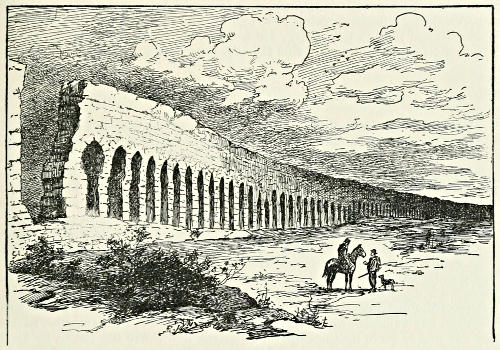
Ruins of the Aqueduct of Claudius
In order to bring Nero forward, Agrippina caused him to assume the
virile toga before the usual age, and the servile senate desired of Claudius
that he might be consul at the age of twenty, and meantime be elect with
proconsular power without the city. A donative was given to the soldiers,
and a congiary (congiarium) to the people in his name. At the Circensian
games, given to gain the people, Nero appeared in the triumphal habit;
Britannicus in a simple prætexta. Every one who showed any attachment
to this poor youth was removed on one pretence or another, and he was surrounded
with the creatures of Agrippina. Finally, as the two commanders
of the guards were supposed to be attached to the interests of the children
of Messallina, she persuaded Claudius that their discipline would be much
improved if they were placed under one commander. Accordingly those
officers were removed, and the command was given to Burrus Afranius, a
man of high character for probity and of great military reputation, and who
knew to whom he was indebted for his elevation.
The pride and haughtiness of Agrippina far transcended anything that
Rome had as yet witnessed in a woman. When the British prince Caractacus
and his family, whom P. Ostorius had sent captives to the emperor,
were led before him as he sat on his tribunal in the plain under the prætorian
camp, with all the troops drawn out, Agrippina appeared seated on
another tribunal, as the partner of his power. And again, when the letting
off of the Fucine Lake was celebrated with a naval combat, she presided with
him, habited in a military cloak of cloth of gold.
Agrippina at length grew weary of delay, or fearful of discovery. Narcissus,
who saw at what she was aiming, appeared resolved to exert all his
influence in favour of Britannicus; and Claudius himself, one day when he
was drunk, was heard to say that it was his fate to bear with the infamy of
his wives and then to punish it. He had also begun to show peculiar marks
of affection for Britannicus. She therefore resolved to act without delay.e
TACITUS DESCRIBES THE MURDER OF CLAUDIUS
[54 A.D.]
Claudius was attacked with illness, and for the recovery of his health had
recourse to the soft air and salubrious waters of Sinuessa. It was then that
Agrippina, long since bent upon the impious deed, and eagerly seizing the
present occasion, well furnished too as she was with wicked agents, deliberated
upon the nature of the poison she would use: whether, if it were sudden
and instantaneous in its operation, the desperate achievement would not be
brought to light; if she chose materials slow and consuming in their operation,
whether Claudius, when his end approached, and perhaps having discovered
the treachery, would not resume his affection for his son. Something
of a subtle nature was resolved upon, “such as would disorder his brain
and require time to kill.” An experienced artist in such preparations was
chosen, her name Locusta; lately condemned for poisoning, and long reserved
as one of the instruments of ambition. By this woman’s skill the poison was
prepared; to administer it was assigned to Halotus, one of the eunuchs, whose
office it was to serve up the emperor’s repasts, and prove the viands by tasting
them.
In fact, all the particulars of this transaction were soon afterwards so
thoroughly known that the writers of those times are able to recount how
the poison was poured into a dish of mushrooms, of which he was particularly
fond; but whether it was that his senses were stupefied, or from the wine he
had drunk, the effect of the poison was not immediately perceived; at the
same time a relaxation of the intestines seemed to have been of service to
him. Agrippina therefore became dismayed; but as her life was at stake,
she thought little of the odium of her present proceedings, and called in the
aid of Xenophon the physician, whom she had already implicated in her guilty
purposes. It is believed that he, as if he purposed to assist Claudius in his
efforts to vomit, put down his throat a feather besmeared with deadly poison;
not unaware that in desperate villainies the attempt without the deed is perilous,
while to ensure the reward they must be done effectually at once.
The senate was in the meantime assembled, and the consuls and pontiffs
were offering vows for the recovery of the emperor, when, already dead, he
was covered with clothes and warm applications, to hide it till matters were
arranged for securing the empire to Nero. First there was Agrippina, who,
feigning to be overpowered with grief and anxiously seeking for consolation,
clasped Britannicus in her arms, called him “the very model of his father,”
and by various artifices withheld him from leaving the chamber. She likewise
detained Antonia and Octavia, his sisters, and had closely guarded all the
approaches to the palace: from time to time too she gave out that the prince
was on the mend, that the soldiery might entertain hopes till the auspicious
moment, predicted by the calculations of the astrologers, should arrive.
At last, on the thirteenth day of October, at noon, the gates of the palace
were suddenly thrown open, and Nero, accompanied by Burrus, went forth to
the cohort, which, according to the custom of the army, was keeping watch.
There, upon a signal made by the præfect, he was received with shouts of
joy, and instantly put into a litter. It was reported that there were some
who hesitated, looking back anxiously, and frequently asking where Britannicus
was, but as no one came forward to oppose it, they embraced the
choice which was offered them. Thus Nero was borne to the camp,
where, after a speech suitable to the exigency, and the promise of a largess
equal to that of the late emperor his father, he was saluted emperor. The
voice of the soldiers was followed by the decrees of the senate; nor was
there any hesitation in the several provinces. To Claudius were decreed
divine honours, and his funeral obsequies were solemnised with the same
pomp as those of the deified Augustus; Agrippina emulating the magnificence
of her great-grandmother Livia. His will, however, was not rehearsed, lest
the preference of the son of his wife to his own son might excite the minds
of the people by its injustice and baseness.d
THE CHARACTER OF CLAUDIUS
We meet with more than one instance in the imperial history of the
parents suffering for the sins of their children. We have already seen how
much reason there is to believe that the hatred of the Romans to Tiberius
disposed them readily to accept any calumny against Livia. Tiberius himself
was hated the more for the crimes of his successor Caius; and there is
ground to surmise that much of the odium which has attached to Claudius
is reflected from the horror with which Nero came afterwards to be regarded.
Thus did the Romans avenge themselves on the authors of the principle of
hereditary succession so long unknown to their polity, and known at last so
disadvantageously.
Of Claudius, at least, a feeling of compassion, if not of justice, may
incline us to pronounce with more indulgence than has usually been accorded
to him. He was an imitator, as we have seen, of Augustus, but only as the
silver age might parody the golden; for the manners he sought to revive,
and the sentiments he pretended to regenerate, had not been blighted by the
passing tempest of civil war, but were naturally decaying from the over-ripeness
of age. Nevertheless, it was honourable to admire a noble model;
there was some generosity even in the attempt to rival the third founder of
the state. Nor, in fact, does any period of Roman history exhibit more outward
signs of vigorous and successful administration: none was more fertile
in victories or produced more gallant commanders or excellent soldiers;
domestic affairs were prosperously conducted; the laborious industry of the
emperor himself tired out all his ministers and assistants. The senate
recovered some portion of its authority, and, with authority, of courage and
energy.
Claudius secured respect for letters, in an age of show and sensuality, by
his personal devotion to them. From some of the worst vices of his age and
class he was remarkably exempt. His gluttony, if we must believe the
stories told of it, was countenanced at least by many high examples; his
cruelty, or rather his callous insensibility, was the result of the perverted
training which made human suffering a sport to the master of a single slave,
as well as to the emperor on the throne; and it was never aggravated at
least by wanton caprice or ungovernable passion. The contempt which has
been thrown upon his character and understanding has been generated, in a
great degree, by the systematic fabrications of which he has been made the
victim. Though flattered with a lip-worship which seems to our notions
incredible, Claudius appears to have risen personally above its intoxicating
vapours; we know that, in one instance at least, the fulsome adulation of a
man, the most remarkable of his age for eloquence and reputed wisdom,
failed to turn the course whether of his justice or his anger.
THE LIVING CLAUDIUS EULOGISED BY SENECA
The circumstances of this adulation, and of its disappointment, it is due
to the memory of Claudius to detail. We have no distinct account of the
cause of Seneca’s banishment, which is ascribed, by little better than a guess,
to the machinations of Messallina against the friends and adherents of Julia.
However this may be, we have seen with what impatience the philosopher
bore it. On the occasion of the death of a brother of Polybius, he addressed
a treatise from his place of exile to the still powerful freedman, such as was
styled a “consolation,” in which he set forth all the arguments which wit
and friendship could suggest to alleviate his affliction and fortify his wisdom.
After assuring him of the solemn truth that all men are mortal, and reminding
him that this world itself, with all that it contains, is subject to the common
law of dissolution; that man is born to sorrow; that the dead can have no
pleasure in his grief; that his grief at the best is futile and unprofitable;
he diverts him with another topic which is meant to be still more effectual.
“The emperor,” he says, “is divine, and those who are blessed by employment
in his service, and have him ever before their eyes, can retain no idle interest
in human things; their happy souls neither fear nor sorrow can enter; the
divinity is with them and around them. Me,” he declares, “this god has not
overthrown; rather he has supported when others supplanted me; he still
suffers me to remain for a monument of his providence and compassion.
Whether my cause be really good or bad, his justice will at last pronounce
it good, or his clemency will so regard it. Meanwhile, it is my comfort to
behold his pardons travelling through the world; even from the corner
where I am cast away his mercy has called forth many an exile before me.
One day the eyes of his compassion will alight on me also. Truly those
thunderbolts are just which the thunderstricken have themselves learned
to adore. May the immortals long indulge him to the world! May he rival
the deeds of Augustus and exceed his years! While still resident among us,
may death never cross his threshold! Distant be the day, and reserved
for the tears of our grandchildren, when his divine progenitors demand
him for the heavens which are his own.”
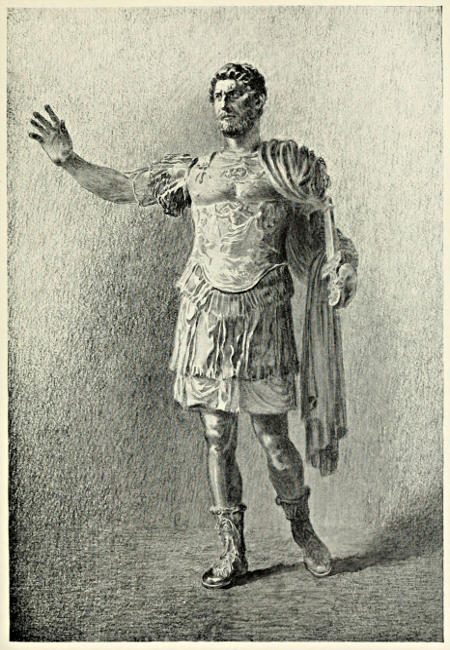
HADRIAN
(FROM THE STATUE IN THE BRITISH MUSEUM)
Such were the phrases, sonorous and unctuously polished, which Polybius
was doubtless expected to recite in the ears of the imperial pedant.
Standing high as he still did in the favour of Claudius and Messallina, he
had the means, and was perhaps not without the will, to recommend them
with all his interest, and intercede in the flatterer’s behalf. Yet Claudius,
it would seem, remained wholly unmoved by a worship more vehement than
Ovid’s, and enhanced still more by the unquestioned reputation of its
author. Whatever had been the motives of his sentence against Seneca,
it was not by flattery that he could be swayed to reverse it. Surely, as
far as we are competent to judge, we must think the better both of his
firmness and his sense. Shortly afterwards Polybius was himself subverted
by the caprice of Messallina; Messallina in her turn was overthrown by
Agrippina; and it was not till the sister of Julia had gained the ascendant
that Seneca obtained at her instance the grace he had vainly solicited
through the good offices of the freedman.
THE DEAD CLAUDIUS SATIRISED BY SENECA
But however little Claudius may have relied on the sincerity of this
brilliant phrase-monger, he could scarce have anticipated the revulsion of
sentiment to which so ardent a worshipper
would not blush to give utterance
on his demise. It was natural of
course that the returned exile should
attach himself to his benefactress;
from her hands he had received his
honours, by her he was treated with
a confidence which flattered him. No
doubt he was among the foremost of
the courtiers who deserted the setting
to adore the rising luminary. Yet
few, perhaps, could believe that no
sooner should Claudius be dead, ere
yet the accents of official flattery had
died away which proclaimed him
entered upon the divine career of his
ancestors, than the worshipper of the
living emperor should turn his deification
into ridicule, and blast his name
with a slander of unparalleled ferocity.
There is no more curious fragment of
antiquity than the Vision of Judgment
which Seneca has left us on the death
and deification of Claudius.
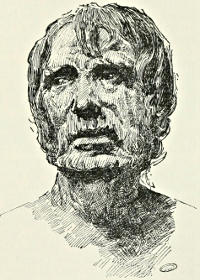
“Seneca”
(From a bust in the Naples Museum)
The traveller who has visited modern
Rome in the autumn season has
remarked the numbers of unwieldy and bloated gourds which sun their
speckled bellies before the doors, to form a favourite condiment to the food
of the poorer classes. When Claudius expired in the month of October,
his soul, according to the satirist, long lodged in the inflated emptiness of
his own swollen carcass, migrated by an easy transition into a kindred
pumpkin. The senate declared that he had become a god; but Seneca
knew that he was only transformed into a gourd. The senate decreed
his divinity, Seneca translated it into pumpkinity; and proceeded to give
a burlesque account of what may be supposed to have happened in heaven
on the appearance of the new aspirant to celestial honours. A tall gray-haired
figure has arrived halting at the gates of Olympus; he mops and
mows, and shakes his palsied head, and when asked whence he comes
and what is his business, mutters an uncouth jargon in reply which none can
understand. Jupiter sends Hercules to interrogate the creature, for Hercules
is a travelled god, and knows many languages; but Hercules himself,
bold and valiant as he is, shudders at the sight of a strange unearthly
monster, with the hoarse inarticulate moanings of a seal or sea-calf. He
fancied that he saw his thirteenth labour before him. Presently, on a
nearer view, he discovers that it is a sort of man. Accordingly he takes
courage to address him with a verse from Homer, the common interpreter
of gods and men; and Claudius, rejoicing at the sound of Greek, and
auguring that his own histories will be understood in heaven, replies with
an apt quotation.
To pass over various incidents which are next related, and the gibes
of the satirist on the Gaulish origin of Claudius, and his zeal in lavishing
the franchise on Gauls and other barbarians, we find the gods assembled
in conclave to deliberate on the pretensions of their unexpected visitor.
Certain of the deities rise in their places, and express themselves with
divers exquisite reasons in his favour; and his admission is about to be
carried with acclamation, when Augustus starts to his feet (for the first
time, as he calls them all to witness, since he became a god himself—for
Augustus in heaven is reserved and silent, and keeps strictly to his own
affairs), and recounts the crimes and horrors of his grandchild’s career.
He mentions the murder of his father-in-law Silanus, and his two sons-in-law
Silanus and Pompeius, and the father-in-law of his daughter, and
the mother-in-law of the same, of his wife Messallina, and of others more
than can be named.
The gods are struck with amazement and indignation. Claudius is repelled
from the threshold of Olympus, and led by Mercury to the shades
below. As he passes along the Via Sacra he witnesses the pageant of his
own obsequies, and then first apprehends the fact of his decease. He hears
the funeral dirge in which his actions are celebrated in most grandiloquent
sing-song, descending at last to the abruptest bathos. But the satirist can
strike a higher note; the advent of the ghost to the infernal regions is described
with a sublime irony. “Claudius is come!” shout the spirits of the
dead, and at once a vast multitude assemble around him, exclaiming, with
the chant of the priests of Apis, “We have found him, we have found him;
rejoice and be glad!”[17] Among them was Silius the consul and Junius the
prætor and Traulus and Trogus and Cotta, Vectius, and Fabius, Roman
knights, whom Narcissus had done to death. Then came the freedmen Polybius
and Myron, Harpocras, Amphæus, and Pheronactes, whom Claudius
had despatched to hell before him, that he might have his ministers below.
Next advanced Catonius and Rufus, the prefects, and his friends Lusius and
Pedo, and Lupus and Celer, consulars, and finally a number of his own kindred,
his wife and cousins and son-in-law. “Friends everywhere!” simpered
the fool; “pray how came you all here?” “How came we here?” thundered
Pompeius Pedo: “who sent us here but thou, O murderer of all thy friends?”
And thereupon the newcomer is hurried away before the judgment seat of
Æacus. An old boon companion offers to plead for him; Æacus, most just
of men, forbids, and condemns the criminal, one side only heard. “As
he hath done,” he exclaims, “so shall he be done by.” The shades are
astounded at the novelty of the judgment; to Claudius it seems rather unjust
than novel. Then the nature of his punishment is considered. Some would
relieve Tantalus or Ixion from their torments and make the imperial culprit
take their place; but no, that would still leave him the hope of being himself
in the course of ages relieved. His pains must be never ending, still
beginning; eternal trifler and bungler that he was, he shall play for ever and
ever with a bottomless dice-box.
Such was the scorn which might be flung upon the head of a national
divinity, even though he were the adoptive father of the ruler of the state;
nor perhaps was the new and upstart deity much more cavalierly treated
than might sometimes be the lot of the established denizens of Olympus. It is
true that Nero at a later period thought fit to degrade his parent from these
excessive honours, and even demolished the unfinished works of his temple
on the Cælian Hill; but there is no reason to suppose that Seneca reserved
his spite until this catastrophe, or that the prince evinced any marks of displeasure
at the unrestrained laughter with which doubtless his satire was
greeted.
While the memory of the deceased emperor was thus ruthlessly torn in
pieces, the writer had been careful to exalt in terms the most extravagant
the anticipated glories of his successor; and the vain, thoughtless heir perceived
not that the mockery of his sire was the deepest of insults to himself.
Of the figure, accomplishments, and character of Nero we shall speak more
particularly hereafter; enough that he was young, that he was not ungraceful
in appearance, that he had some talents, and, above all, the talent of exhibiting
them.
With such qualifications the new occupant of a throne could never want
for flatterers. To sing them, the sage of the rugged countenance mounts
gaily on the wings of poetry, and sports in lines of mellifluous mellowness,
such as might grace the erotic lyre of the most callow votary of the Muses.
At last, he says, in mercy to his wretchedness, the life-thread of the stolid
Claudius had been severed by the fatal shears. But Lachesis, at that
moment, had taken in her hands another skein of dazzling whiteness, and
as it glided nimbly through her fingers, the common wool of life was changed
into a precious tissue—a golden age untwined from the spindle. The
sisters ply their work in gladness, and glory in their blessed task; and far,
far away stretches the glittering thread, beyond the years of Nestor and
Tithonus. Phœbus stands by their side, and sings to them as they spin—Phœbus
the god of song and the god of prophecy. “Stay not, oh stay not,
gentle sisters; he shall transcend the limits of human life; he shall be like
me in face, like me in beauty; neither in song nor in eloquence behind me.
He shall restore a blissful age to wearied men, and break again the long
silence of the Laws. Yes, as when Lucifer drives the stars before him,
and morning dissipates the clouds, the bright sun gazes on the world, and
starts his chariot on its daily race,—so Cæsar breaks upon the earth; such
is the Nero whom Rome now beholds—beams his bright countenance with
tempered rays, and glistens his fair neck beneath its floating curls.”f
[54-59 A.D.]
Brought up in a corrupt court, in the midst of his mother’s guilty
intrigues, Nero soon saw himself surrounded by flatterers apt at eulogising
all his follies and excusing all his crimes. He did not lack understanding
and knew what was right, but no care was taken to check his vicious inclinations
or his vanity with regard to his musical skill. Yet for a long time
after his death the first five years of his reign were lauded (quinquennium
Neronis) as the happiest of the empire. He did, in fact, reduce taxation in
the provinces, contend against luxury, and assist poor senators with money,
and bid fair to take Augustus as his model. “Oh, that I had never learned
to write!” he said one day when a death-warrant was given him to sign.
Another time when the senate was addressing thanks to him he said,
“Wait till I deserve them.” Seneca and Burrus tried, and for some time
with success, to restrain the stormy passions of their pupil, but Agrippina’s
ambition made them break violently forth.
This imperious woman thought she was going to reign in her son’s name,
and desired to be present at senatorial deliberations. She was much chagrined
at having to content herself with listening behind a curtain.
One day when Nero was giving audience to some Armenian ambassadors
she advanced to take her place beside him and receive homage. But the
prince went to meet her and prevented what the Romans even then would
have regarded as an affront, the intervention of a woman in public affairs.
Leagued with the freedman Pallas, she hoped that nothing would take place
in the palace without her; but Seneca and Burrus, although her creatures,
were resolved to hinder the domination which had degraded Claudius. Unfortunately,
the two ministers, in spite of the austerity of their lives and
teaching, found no other way to combat her influence than by fostering the
prince’s passions. They allowed a number of young women and dissolute
men to gather round the prince. Among the former Agrippina soon found
a rival in the freedwoman Acte. She then changed her tone and manner,
but caresses were of no more avail than anger; and the two ministers, in
order to show her that her power was gone, disgraced the freedman Pallas.
Then Agrippina broke out into open threats. She would reveal the
whole truth, take Britannicus to the prætorians, and return to its rightful
occupant the throne she had bestowed on an ungrateful son. Nero forestalled
her. On the first day of his reign he had put to death a member of
the imperial family, Silanus by name; the death of his adopted brother
cost him no more. Britannicus, who was only fourteen years old, was poisoned
at a banquet at Nero’s own table. Agrippina, alarmed by this precocious
cruelty, sought defenders for herself. She sounded the soldiers, and
paid graceful attentions to their leaders. Nero, no longer keeping within
bounds, assigned her a dwelling beyond the palace and scarcely ever saw
her. He even listened to an accusation against her and forced her to answer
questions from Seneca and Burrus. She did so, but haughtily, and spoke
harshly to her son, which did not help her to regain the authority she had lost.
Having got rid of Agrippina, the two ministers governed for some years
with moderation and justice. Several condemnations taught the provincial
governors that their conduct was observed; several taxes were abolished
or reduced. Nero demanded that they should all be repealed. Unfortunately
love of pleasure now possessed him. Dissolute friends, vulgar liaisons,
a fatal taste for the theatre, corrupted him from day to day. Seneca practised
his good maxims too little for them to influence the young emperor. Rome
learned with astonishment that her prince ran about the streets at night disguised
as a slave, entering taverns and beating belated folk at the risk of
striking one stronger than himself. A senator once returned his blows, and
had the imprudence next day to apologise. Nero, remembering the inviolability
belonging to his office of tribune, had him put to death. In the day
he went to the theatre, giving trouble to the custodians, encouraging applause
and hissing, exciting tumult, and taking pleasure in seeing the sovereign
people break the benches and engage in fights in which he himself joined,
throwing missiles at a venture from his elevated seat.
The virtuous sister of Britannicus could not be a fit wife for this royal
débauché. He carried off Poppæa Sabina from her husband Otho. Poppæa’s
ambition found an obstacle in Octavia, and one even stronger in Agrippina,
who was not distressed by her son’s criminal conduct, but was much averse
from seeing him under any influence but her own.
Irritated by her reproaches, Nero at last went so far as to give orders for
her death. Anicetus, commander of the fleet at Misenum, formed a plot to
assassinate the empress. On the pretext of a reconciliation she was invited
to go to Baiæ, and was put on a vessel so built as to part asunder when out
at sea. Agrippina saved herself by swimming and reached the neighbouring
coast, where she took refuge in her villa at the Lucrine Lake. Nero
caused her to be stabbed, and proclaimed that she had killed herself after a
freedman sent by her had been caught in an attempt to kill him (59 A.D.).
Such was the fate of this woman, a granddaughter of Augustus, and sister,
wife, and mother, to three emperors. But revengeful furies pursued the
parricide in spite of the congratulations which Burrus was base enough to
offer him in the name of the soldiers and the thanks rendered to the gods
in all parts of the city at Seneca’s suggestion. He sought to stifle his
remorse by plunging into gross and insensate debauchery. His most unworthy
follies date from this time. The Romans blushed to see him driving
a chariot in the arena and mounting the stage to sing and play the lyre.
We may imagine he stifled his conscience, but not that he found rest. In
Greece, he dared not enter the Eleusinian temple of which the herald’s voice
bid the impious and parricides avaunt.b
During the last two proconsulates the prefecture of Syria had acquired
its greater extension. On the death of Herod Agrippa in 44, his kingdom
of Judea had been definitively annexed to the empire, and was subjected,
as once before, to an imperial procurator, who, while he derived his fiscal and
civil authority directly from the emperor, and acted in a manner as his viceroy,
was nevertheless placed under the military control of the proconsul.
Under court protection some of the Judean procurators, especially the infamous
Felix, the brother of Pallas, and his partner in the favour of Claudius,
had indulged in every excess, till the spirit of revolt already roused by the
threats of Caligula broke out in fierce but desultory acts of violence. These
indeed had been repressed with the sternness of Rome, not unmingled with
some features of barbarity peculiar to the East. Nevertheless the government
had resented the tyranny of its own officers, which had caused this
dangerous insubordination, and Quadratus, the proconsul, had himself condemned
from his tribunal the indiscretion of the procurator Cumanus.
While, however, the authority of the Syrian proconsul was thus extended
over the region of Palestine in the south, a portion of his northern dependencies
was taken from him, and erected for a time into a separate prefecture.
CORBULO AND THE EAST
[54-60 A.D.]
In the year 54 the brave Domitius Corbulo, recalled from his German
command, was deputed to maintain the majesty of the empire in the face of
the Parthians, and defend Armenia from the intrigues or violence with
which they continued to menace it. The forces of Rome in the East were
now divided between Quadratus and Corbulo. To the proconsul of Syria
were left two legions with their auxiliaries, to the new commander were
assigned the other two, while the frontier tributaries were ordered to serve
in either camp, as the policy of the empire should require. While such was
the distribution of the troops, the territory itself was divided by the line of
the Taurus; Cappadocia, together with Galatia, was entrusted to Corbulo,
and constituted a separate province. Here he raised the levies he required
to replace the lazy veterans who had vitiated the Syrian legions; and here,
having further strengthened himself from the German camps, this stern
reviver of discipline prepared his men, amidst the rocks and snows, to penetrate
the fastnesses of Armenia, and dislodge the Parthians from the gorges
of Ararat and Elburz. Tiridates, the Parthian pretender to the throne of
Armenia, in vain opposed him with arms and treachery.
The Romans advanced to the walls of Artaxata, which they stormed and
burned, an exploit the glory of which was usurped by Nero himself, the
senate voting supplications in his honour, and consecrating day after day to
the celebration of his victory, till Cassius ventured to demand a limit to such
ruinous profusion. The war however was still prolonged through a second
and a third campaign: the Hyrcanians on the banks of the Caspian and Aral—so
far-reaching was the machinery put in motion by Corbulo—were
encouraged to divert the Parthians from assisting Tiridates; and communications
were held with them by the route of the Red Sea and the deserts
of Baluchistan. At last the Armenian Tigranes, long retained in custody
at Rome, was placed by the proconsul on the throne of his ancestors. Some
portions of his patrimony, however, were now attached to the sovereignties
of Pontus and Cappadocia; a Roman force was left in garrison at Tigranocerta,
to support his precarious power; and on the death of Quadratus, Corbulo,
having achieved the most brilliant successes in the East of any Roman
since Pompey, claimed the whole province of Syria, and the entire administration
of affairs on the Parthian frontier, as his legitimate reward.
[60-66 A.D.]
The union of these vast regions once more under a single ruler, so contrary,
as it would appear, to the emperor’s natural policy, was extorted
perhaps from the fears of Nero, not indeed by actual threats but by the
formidable attitude of his general. An emperor, still a youth, who had seen
no service himself, and had only caught at the shadows of military renown
cast on him by his lieutenants, may have felt misgivings at the greatness of
the real chiefs of his legions. It was from this jealousy, perhaps, that the
career of conquest in Britain was so suddenly checked after the victory of
Suetonius. The position indeed of Corbulo, the successor of Agrippa and
Germanicus, might seem beyond the emperor’s reach. It could only be
balanced by creating similar positions in other quarters, and the empire was,
in fact, at this moment virtually divided among three or four great commanders,
any one of whom was leader of more numerous forces than could
be mustered to oppose him at the seat of government. Nero was well aware
of his danger; but he had not the courage to insist, on this occasion, on the
division of Syria into two prefectures. He took, as we shall see, a baser precaution,
and already perhaps contemplated the assassination of the lieutenant
whom he dared not control.
It was from Corbulo himself that the proposal came for at least a temporary
division. That gallant general, a man of antique devotion to military
principles, had no views of personal aggrandisement. When the Parthians,
again collecting their forces, made a simultaneous attack on both Armenia
and Syria, Corbulo declared that the double war required the presence of two
chiefs of equal authority. He desired that the province beyond the Taurus
should again be made a separate government. Assuming in person the
defence of the Syrian frontier with three legions, he transferred Cappadocia
and Galatia, with an equal force, to Cæsennius Pætus, who repaid his generosity
by reflecting on the presumed slowness of his operations. But Pætus
was as incapable as he was vain. Having advanced into Armenia, he was
shut up in one of its cities with two legions, by a superior force, constrained
to implore aid from Corbulo, and at last, when the distance and difficulty of
the way precluded the possibility of succour, to capitulate ignominiously.
Vologeses, king of Parthia, refrained from proceeding to extremities, and
treating the humbled foe as his ancestor had treated Crassus. He pretended
to desire only a fair arrangement of the points in dispute between the rival
empires: and Pætus, having promised that pending this settlement the
legions should be withdrawn from Armenia, was suffered, though not without
grievous indignities, to march out of his captured stronghold, and retire
in haste within the frontiers. Arrived there, Corbulo treated him with scornful
forbearance; but the emperor recalled him from his post, and the combined
forces of the province were once more entrusted to the only man capable
of retrieving the disaster.
Corbulo penetrated into the heart of Armenia by the road which Lucullus
had formerly opened; but the enemy declined to encounter him. Even
on the spot of his ally’s recent triumphs, Tiridates bowed to the demands of
the proconsul, and consented to lay his diadem at the feet of the emperor’s
image, and go to Rome to receive it back from his hand. The claims of the
puppet Tigranes were eventually set aside, and while Tiridates did homage
for his kingdom to Nero, he was suffered to place himself really under the
protection of Vologeses.
THE ROMAN PROVINCE OF BRITAIN
[61 A.D.]
The limits of the Roman occupation at the close of the reign of Claudius
were much unsettled. The southern part of the island from the Stour to
the Exe and Severn formed a compact and organised province, from which
only the realm of Cogidubnus, retaining still the character of a dependent
sovereignty, is to be subtracted. Beyond the Stour, again, the territory
of the Iceni constituted another extraneous dependency. The government
of the province was administered from Camulodunum, as its capital; and
the whole country was overawed by the martial attitude of the Conquering
Colony there established. Already, perhaps, the city of Londinium, though
distinguished by no such honourable title, excelled it as a place of commercial
resort. The broad estuary of the Thames, confronting the waters of the
Scheldt and Maas, was favourably placed for the exchange of British against
Gaulish and German products; and the hill on which the city stood, facing
the southern sun and well adapted for defence, is placed precisely at the
spot where first the river can be crossed conveniently. Swept east and west
by the tidal stream, and traversed north and south by the continuous British
roads, Londinium supplied the whole island with the luxuries of another
zone, just as Massilia had supplied Gaul. Hither led the ways which penetrated
Britain from the ports in the Channel, from Lymne, Richborough,
and Dover. From hence they diverged again to Camulodunum northeast,
and to Verulamium northwest, at the intersection of the chief national lines
of communication.
While the proprætor, who was governor-in-chief of the province, was
occupied on the frontier in military operations, the finances were administered
by a procurator; and whatever extortions he might countenance, so
slight was the apprehension of any formidable resistance to them that not
only the towns, now frequented by thousands of Roman traders, were left
unfortified, but the province itself was suffered to remain almost entirely
denuded of soldiers. The legions now permanently quartered in Britain
were four. Of these the Second, the same which under the command
of Vespasian had recently commanded the southwest, was now perhaps stationed
in the forts on the Severn and Avon, or advanced to the encampment
on the Usk, whence sprang the famous city of Caerleon, the camp of the
Legion. The Ninth was placed in guard over the Iceni, whose fidelity was
not beyond suspicion. We may conjecture that its headquarters were established
as far north as the Wash, where it might dislocate any combinations
these people should attempt to form with their unsteady neighbours the
Brigantes. The Twentieth would be required to confront the Brigantes
also on their western frontier, and to them we may assign the position on
the Deva or Dee, from which the ancient city of Chester has derived its
name, its site, and the foundations, at least, of its venerable fortifications.
There still remained another legion, the Fourteenth; but neither was this
held in reserve in the interior of the province. The necessities of border
warfare required its active operations among the Welsh mountains, which
it penetrated step by step, and gradually worked its way towards the last
asylum of the Druids in Mona, or Anglesea.
The Gallic priesthood, proscribed in their own country, would naturally
fly for refuge to Britain: proscribed in Britain, wherever the power of Rome
extended, they retreated, inch by inch, and withdrew from the massive
shrines which still attest their influence on the southern plains, to the sacred
recesses of the little island, surrounded by boiling tides and clothed with
impenetrable thickets. In this gloomy lair, secure apparently, though shorn
of might and dignity, they still persisted in the practice of their unholy
superstition. They strove perhaps, like the trembling priests of Mexico, to
appease the gods, who seemed to avert from them their faces, with more
horrid sacrifices than ever. Here they retained their places of assembly,
their schools, and their oracles; here was the asylum of the fugitives; here
was the sacred grove, the abode of the awful deity, which in the stillest
noon of night or day the priest himself scarce ventured to enter, lest he
should rush unwitting into the presence of its lord.
Didius had been satisfied with retaining the Roman acquisitions, and had
made no attempt to extend them; and his successor, Veranius, had contented
himself with some trifling incursions into the country of the Silures. The
death of Veranius prevented, perhaps, more important operations. But he
had exercised rigorous discipline in the camp, and Suetonius Paullinus, who
next took the command, found the legions well equipped and well disposed,
and the stations connected by military roads across the whole breadth of the
island. The rumours of the city marked out this man as a rival to the gallant
Corbulo, and great successes were expected from the measures which he
would be prompt in adopting. Leaving the Second legion on the Usk to
keep the Silures in check, and the Twentieth on the Dee to watch the
Brigantes, he joined the quarters of the Fourteenth, now pushed as far as
Segontium on the Menai straits. He prepared a number of rafts or boats
for the passage of the infantry; the stream at low water was perhaps nearly
fordable for cavalry, and the trusty Batavians on his wings were accustomed
to swim by the side of their horses, clinging by the mane or bridle, across
the waters, not less wide and rapid, of their native Rhine. Still the traject
must have been perilous enough, even if unopposed. But now the farther
bank was thronged with the Britons in dense array, while between their
ranks the women, clad in black and with hair dishevelled, rushed about
like furies with flaming torches, and behind them were seen the Druids
raising their hands to heaven, imprecating curses on the daring invaders.
The Romans were so dismayed at the sight that, as they came to land,
they at first stood motionless to be struck down by every assailant. But this
panic lasted only for a moment. Recalled by the cries of their chiefs to a
sense of discipline, of duty, of danger, they closed their ranks, advanced their
standards, struck, broke, and trampled on the foe before them, and applied
his own torches to his machines and wagons. The rout was complete; the
fugitives, flung back by the sea, had no further place of retreat. The island
was seamed with Roman entrenchments, the groves cut down or burned, and
every trace speedily abolished of the foul rites by which Hesus had been
propitiated or the wall of Taranis consulted.
From this moment the Druids disappear from the page of history; they
were exterminated, we may believe, upon their own altars; for Suetonius
took no half measures. But whatever were his further designs for the final
pacification of the province, they were interrupted by the sudden outbreak
of a revolt in his rear. The Iceni, as has been said, had submitted, after
their great overthrow, to the yoke of the invaders: their king, Prasutagus,
had been allowed indeed to retain his nominal sovereignty; but he was
placed under the control of Roman officials; his people were required to
contribute to the Roman treasury: their communities were incited to a
profuse expenditure to which their resources were unequal; while the
exactions imposed on them were so heavy that they were compelled to borrow
largely, and entangle themselves in the meshes of the Roman money lenders.
The great capitalists of the city, wealthy courtiers, and prosperous freedmen,
advanced the sums they called for at exorbitant interest; from year to year
they found themselves less able to meet their obligations, and mortgaged
property and person to their unrelenting creditors. Among the immediate
causes of the insurrection which followed, is mentioned the sudden calling in
by Seneca, the richest of philosophers, of the large investments he had made,
which he seemed in danger of losing altogether.
But the oppression of the Romans was not confined to these transactions.
Prasutagus, in the hope of propitiating the provincial government to his
family, had bequeathed his dominions to the republic. He expected perhaps
that his wife and his children, who were also females, if not allowed to
exercise even a nominal sovereignty after him, would at least be treated in
consequence with the respect due to their rank, and secured in the enjoyment
of ample means and consideration. This was the fairest lot that
remained to the families of the dependent chieftains, and the Romans had
not often grudged it them. But an insolent official, placed in charge of
these new acquisitions after the death of Prasutagus, forgot in their instance
what was due to the birth and even the sex of the wretched princesses.
He suspected them perhaps of secreting a portion of their patrimony, and
did not scruple to employ stripes to recover it from the mother, while he
surrendered her tender children to even worse indignities.
The War with Boadicea, Queen of the Iceni
Boadicea, the widowed queen of the Iceni, was a woman of masculine
spirit. Far from succumbing under the cruelty of her tyrants and hiding
the shame of her family, she went forth into the public places, exhibited the
scars of her wounds and the fainting forms of her abused daughters, and
adjured her people to take a desperate revenge. The Iceni were stung to
frenzy at their sovereign’s wrongs, at their own humiliation. The danger,
the madness, of the attempt was considered by none for a moment. They
rose as one man; there was no power at hand to control them; the Roman
officials fled, or, if arrested, were slaughtered; and a vast multitude, armed
and unarmed, rolled southward to overwhelm and extirpate the intruders.
To the Colne, to the Thames, to the sea, the country lay entirely open. The
legions were all removed to a distance, the towns were unenclosed, the
Roman traders settled in them were untrained to arms. Even the Claudian
colony was undefended. The procurator, Catus Decianus, was at the moment
absent, and being pressed for succour, could send no more than two hundred
soldiers for its protection. Little reliance could be placed on the
strength of a few worn-out veterans: the natives, however specious their
assurances, were not unjustly distrusted, for they too, like the Iceni, had
suffered their share of insolence and ill-treatment. The great temple of
Claudius was a standing monument of their humiliation; for its foundation
their estates had been confiscated, for its support their tribute was required,
and they regarded the native chiefs who had been enrolled in its service as
victims or traitors.
Whatever alarm they might feel at the indiscriminate fury of the hordes
descending upon them, they smiled grimly at the panic which more justly
seized the Romans. The guilty objects of national vengeance discovered
the direst prodigies in every event around them. The wailings of their
women, the neighing of their horses, were interpreted as evil omens. Their
theatre was said to have resounded with uncouth noises; the buildings of
the colony had been seen inversely reflected in the waters of their estuary;
and on the ebbing of the tide ghastly remains of human bodies had been discovered
in the ooze. Above all, the statue of Victory, erected to face the
enemies of the republic, had turned its back to the advancing barbarians and
fallen prostrate before them. When the colonists proposed to throw up
hasty entrenchments they were dissuaded from the work, or impeded in it
by the natives, who persisted in declaring that they had no cause for fear;
it was not till the Iceni were actually in sight, and the treachery of the
Trinobantes no longer doubtful, that they retreated tumultuously within the
precincts of the temple, and strengthened its slender defences to support a
sudden attack till succour could arrive. But the impetuosity of the assault
overcame all resistance. The stronghold was stormed on the second day,
and all who had sought refuge in it, armed and unarmed, given up to
slaughter.
Meanwhile the report of this fearful movement had travelled far and wide
through the country. It reached Petilius Cerealis, the commander of the
Ninth legion, which we suppose to have been stationed near the Wash, and he
broke up promptly from his camp to hang on the rear of the insurgents. It
reached the Twentieth legion at Deva, which awaited the orders of Suetonius
himself, as soon as he should learn on the banks of the Menai the perils
in which the province was involved. The proprætor withdrew the Fourteenth
legion from the smoking groves of Mona, and urged it with redoubled
speed along the highway of Watling street, picking out the best troops
from the Twentieth as he rushed by, and summoning the Second from Isca
to join him in the south. But Pænius Postumus, who commanded this latter
division, neglected to obey his orders, and crouched in terror behind his fortifications.
The Iceni turned boldly upon Cerealis, who was hanging close
upon their heels, and routed his wearied battalions with great slaughter.
The infantry of the Ninth legion was cut to pieces, and the cavalry alone
escaped within their entrenchments. But the barbarians had not skill nor
patience to conduct the siege of a Roman camp. They left the squadron
of Cerealis unmolested, nor did they attempt to force the scattered posts of
the Romans around them. After giving Camulodunum to the flames, they
dispersed throughout the country, plundering and destroying.
Suetonius, unappalled by the frightful accounts which thronged upon
him, held on his course steadfastly with his single legion, broke through the
scattered bands of the enemy, and reached Londinium without a check.
This place was crowded with Roman residents, crowded still more at this
moment with fugitives from the country towns and villas: but it was undefended
by walls, its population of traders was untrained to arms, and Suetonius
sternly determined to leave it, with all the wealth of the province
which it harboured, to the barbarians, rather than sacrifice his soldiers in a
vain attempt to save it. The policy of the Roman commander was to secure
his communications with Gaul: but he was resolved not to abandon the
country, nor surrender the detachments hemmed in at various points by the
general rising of the Britons.
The precise direction of his movements we can only conjecture. Had he
retired to the southern bank of the Thames, he would probably have defended
the passage of that river; or had the Britons crossed it unresisted, the historians
would not have failed to signalise so important a success. But the
situation of Camulodunum, enclosed in its old British lines, and backed by
the sea, would offer him a secure retreat where he might defy attack and
await reinforcements; and the insurgents, after their recent triumphs, had
abandoned their first conquests to wreak their fury upon other seats of
Roman civilisation. While, therefore, the Iceni sacked and burned first
Verulamium, and next Londinium, Suetonius probably made a flank march
towards Camulodunum, and kept ahead of their pursuit, till he could choose
his own position to await their attack. In a valley between undulating
hills, with woods in the rear and the ramparts of the British oppidum not
far perhaps on his right flank, he had every advantage for marshalling his
slender forces; and these were increased in number more than in strength
by the fugitives capable of bearing arms, whom he had allowed to cling to
his fortunes. Ten thousand resolute men drew their swords for the Roman
Empire in Britain. The natives, many times their number, spread far and
wide over the open plain before them; but the narrow front of the Romans
could be assailed by only few battalions at once, and the wagons, which conveyed
their accumulated booty and bore their wives and children, thronged
the rear and cut off almost the possibility of retreat.
But flushed with victory, impatient for the slaughter, animated with
desperate resolution to die or conquer, the Britons cast no look or thought
behind them. Boadicea herself drove from rank to rank, from nation to
nation, with her daughters beside her, attesting the outrage she had endured,
the vengeance she had already taken, proclaiming the gallant deeds of the
queens before her, under whom British warriors had so often triumphed,
denouncing as intolerable the yoke of Roman insolence, and declaring that
whatever the men might determine, the women would now be free or perish.
The harangue of Suetonius, on the other hand, was blunt and sarcastic. He
told his men not to mind the multitudes before them, nor the noise they
made; there were more women among them than men; as for their own
numbers, let them remember that in all battles a few good swordsmen really
did the work; the half-armed and dastard crowds before them would break
and fly when they saw again the prowess of the Roman primipiles.
Thus encouraged, the legionaries could with difficulty be restrained to
await the onset; and as soon as the assailants had exhausted their missiles,
bore down upon them in the wedge-shaped column which had so often
broken Greeks, Gauls, and Carthaginians. The auxiliaries followed with no
less impetuosity. The horsemen, lance in hand, pierced through the ranks
which still kept their ground. But a single charge was enough. The
Britons were in a moment shattered and routed. In another moment, the
Romans had reached the long circumvallation of wagons, among which
the fugitives were scrambling in dismay, slew the cattle and the women
without remorse, and traced with a line of corpses and carcasses the limits
of the British position. We may believe that the massacre was enormous.
The Romans declared that eighty thousand of their enemies perished, while
of their own force they lost only four hundred slain, and about as many
wounded. Boadicea put an end to her life by poison; we could have wished
to hear that the brave barbarian had fallen on a Roman pike. Suetonius had
won the greatest victory of the imperial history; to complete his triumph,
the coward, Postumus, who had shrunk from his assistance, threw himself, in
shame and mortification, on his own sword.
By this utter defeat the British insurrection was paralysed. Throughout
the remainder of the season the Romans kept the field; they received
reinforcements from the German camps, and their scattered cohorts were
gradually brought together in a force which overawed all resistance. The
revolted districts were chastised with fire and sword, and the systematic
devastation inflicted upon them, suffering as they already were from the
neglect of tillage during the brief intoxication of their success, produced a
famine which swept off the seeds of future insurrections. On both sides
a fearful amount of destruction had been committed. Amidst the overthrow
of the great cities of southern Britain, not less than seventy thousand
Roman colonists had perished. The work of twenty years was in a
moment undone. Far and wide every vestige of Roman civilisation was
trodden into the soil. At this day the workmen who dig through the
foundations of the Norman and the Saxon London, strike beneath them
upon the traces of a double Roman city, between which lies a mass of charred
and broken rubbish, attesting the conflagration of the terrible Boadicea.
Britain again a Peaceful Province
The temper of Suetonius, as may be supposed from what has been
already recorded of him, was stern and unbending, even beyond the ordinary
type of his nation. No other officer, perhaps, in the Roman armies
could have so turned disaster into victory, and recovered a province at a
blow; but it was not in his character to soothe the conquered, to conciliate
angry passions, to restore the charm of moral superiority. Classicianus,
who succeeded Catus as procurator, complained of him to the emperor, as
wishing to protract hostilities against the exasperated Britons, when every
end might be obtained by conciliation.
A freedman of the court, named Polycletus, was sent on the delicate
mission, to judge between the civil and the military chief, and to take the
measures most fitting for securing peace and obedience. Polycletus brought
with him a large force from Italy and Gaul, and was no less surprised perhaps
than the legions he commanded, to see himself at the head of a Roman
army. Even the barbarians, we are told, derided the victorious warriors
who bowed in submission to the orders of a bondman. But Polycletus could
make himself obeyed at least, if not respected. The loss of a few vessels on
the coast furnished him with a pretext for removing Suetonius from his
command, and transferring it to a consular, Petronius Turpilianus, whose
temper and policy inclined equally to peace.
From the lenity of this proprætor the happiest consequences evidently
ensued. The southern Britons acquiesced in the dominion of Rome, while
the northern were awed into deference to her superior influence. Her manners,
her arts, her commerce, penetrated far into regions yet unconquered
by the sword. Her establishments at Londinium, Verulamium, and Camulodunum
rose again from their ashes. Never was the peaceful enterprise of
her citizens more vigorous and elastic than at this period. The luxuries of
Italy and the provinces, rapidly increasing, required the extension to the
utmost of all her resources. Manufactures and commerce were pushed forward
with unexampled activity.
The products of Britain, rude as they were, consisting of raw materials
chiefly, were demanded with an insatiable appetite by the cities of Gaul and
Germany, and exchanged for arts and letters, which at least decked her
servitude with silken fetters. The best of the Roman commanders,—and
there were some, we may believe, among them both thoughtful and humane,—while
they acknowledged they had no right to conquer, yet believed that
their conquests were a blessing. The best of the native chiefs—and some
too of them may have wished for the real happiness of their countrymen,—acknowledged,
perhaps, that while freedom is the noblest instrument of
virtue, it only degrades the vicious to the lowest depths of barbarism.e
BURRUS AND SENECA
[59-62 A.D.]
In Rome meanwhile the public evils grew daily more oppressive, and the
means of redress were decreasing. It was now that Burrus died (62 A.D.),
whether by poison or disease is uncertain; that it was disease was inferred
from the fact that, his throat gradually swelling internally and the passage
being closed up, he ceased to breathe. Many asserted that, by the order of
Nero, under colour of applying a remedy, his palate was anointed with a
poisonous drug, and that Burrus, having discovered the treachery, when the
prince came to visit him, turned his face and eyes another way, and to his
repeated inquiries about his health, made
no other answer than this: “I am well.”
At Rome the sense of his loss was deep
and lasting, as well from the memory of
his virtue as from the spiritless simplicity
of one of his successors, and the flaming
enormities and adulteries of the other.
For Nero had created two captains of the
prætorian guards—namely, Fenius Rufus
for his popularity, in consequence of his
administration of the public stores without
deriving any profit from it; and Sophonius
Tigellinus, purely from partiality to
the inveterate lewdness and infamy of the
man; and their influence was according
to their known manner of life. Tigellinus
held greater sway over the mind of Nero,
and was admitted to share in his most
secret debaucheries; Rufus flourished in
the good opinion of the people and soldiery,
which he found a denial to him
with the emperor.

Nero
(From a bust in the Louvre Museum)
The death of Burrus made an inroad
upon the influence of Seneca; as good
counsels had no longer the same force now
that one of the champions of virtue was
removed; and Nero naturally inclined to
follow the more depraved, who assailed
Seneca with various imputations: that he
had already accumulated enormous wealth,
far surpassing the measure of a citizen, and was still increasing it; that he
was alienating from the emperor and diverting to himself the affections of
the citizens; that he sought to outdo the prince in the elegance of his gardens
and the splendour of his villas. They laid to his charge also that he
claimed a monopoly in the glory of eloquence; and that after Nero conceived
a passion for versifying, he had employed himself in it with unusual
assiduity; for, to the recreations of the prince he was an open enemy—disparaged
his vigour in the managing of horses, ridiculed his vocal powers
whenever he sang; with what view did he endeavour to effect that in the
whole republic nothing should go down which was not the product of his
ingenuity? Surely Nero was past weakness of childhood, and arrived at the
prime of youth; he ought now to discard his pedagogue, furnished as he
was with instructors the most accomplished, even his own ancestors.
Seneca was not unapprised of the efforts of his calumniators, as they were
disclosed to him by such as retained some concern for the interests of virtue;
and as the emperor manifested daily more shyness towards him, he besought
an opportunity of speaking to him, and having obtained it, thus began: “This
is the fourteenth year, Cæsar, since I was summoned to train you for your high
destiny; and the eighth since your advancement to the empire. During
the intervening period, you have showered such honours and riches upon me,
that nothing is wanting to complete my felicity but the capacity to use them
with moderation. I shall quote great examples, such as are adapted, not to
my station and fortune, but to yours. Augustus, from whom you are the
fourth in descent, granted to Marcus Agrippa leave to retreat to Mytilene,
and to Caius Mæcenas he allowed, even in Rome itself, a retirement as complete
as in any foreign country; the former his companion in the wars,
the other long harassed at Rome with manifold occupations and public cares;
both received rewards ample indeed, but proportioned to their services. For
myself, what other claims upon your munificence have I been able to advance,
except my literary attainments, nursed, so to speak, in the shades of retirement,
and which have been rendered famous, because I am believed to have
assisted your early years in the acquisition of learning; a glorious reward
for such a service! But you encompassed me with boundless favours, unnumbered
riches; so that when I ruminate upon my situation, as I often do, I
say to myself, Can it be that I, the son of a knight, the native of a province,
am ranked among the chief men of Rome? Has my upstart name acquired
splendour among the nobles of the land, and men who glory in a long line of
honoured ancestors? Where then is that philosophic spirit which professed
to be satisfied with scanty supplies? Is it employed in adorning such gardens
as these, in pacing majestically through these suburban retreats? Does
it abound in estates so extensive as these, and in such immense sums put out
at interest? One plea only occurs to my thoughts; that it becomes not me
to oppose your bounties.
“But both of us have now filled up our measure; you, of all that the
bounty of a prince could confer upon his friend; I, of all that a friend could
accept from the bounty of his prince. Every addition can only furnish fresh
materials for envy, which, indeed, like all other earthly things, lies prostrate
beneath your towering greatness, but weighs heavily on me; I require assistance.
Thus, in the same manner as, were I weary and faint with the toils
of warfare or a journey, I should implore indulgence, so in this journey of
life, old as I am, and unequal even to the lightest cares, since I am unable
longer to sustain the weight of my own riches, I seek protection. Order
your own stewards to undertake the direction of my fortune, and to annex
it to your own; nor shall I by this plunge myself into poverty; but having
surrendered those things by whose splendour I am exposed to the
assaults of envy, all the time which is set apart for the care of gardens and
villas I shall apply once more to the cultivation of my mind. To you vigour
remains more than enough, and the possession of imperial power established
during so many years. We, your friends, who are more advanced in years,
may take our turn of repose. This, too, will redound to your glory, that you
had elevated to the highest posts those who could put up with a humble
condition.”
To this speech, Nero replied much in this manner: “That I am able
thus on the moment to combat your studied reasonings, is the first benefit
which I acknowledge to have derived from you, who have taught me not only
to speak on subjects previously considered, but also to deliver my sentiments
extemporaneously. It is true, my direct ancestor Augustus allowed
Agrippa and Mæcenas to pass their time in retirement after their toils, but
at that period of life when his authority protected him, whatever was the
extent or nature of the concession he made to them; but nevertheless he
divested neither of them of the rewards he had conferred upon them. They
had earned them in war and civil perils; for in these the earlier days of
Augustus were occupied; nor would your sword or your hands have been
wanting had I been engaged in military affairs. But what my existing circumstances
required you rendered; you nursed my childhood and directed
my youth by your moral lessons, your counsel, and your precepts; and the
favours you have bestowed on me, will never perish while life remains.
Those you have received from me, your gardens, capital, and country seats,
are liable to the accidents of fortune; and though they may appear of great
extent, yet many men, by no means equal to you in accomplishments, have
enjoyed more. I am ashamed to instance freedmen, who in point of riches
cut a greater figure than you; and when I consider this, I see occasion to
blush that a man who holds the highest place in my esteem, does not as yet
transcend all others in the gifts of fortune.
“But while you have attained maturity of years, and have yet vigour
enough for business and the enjoyment of the fruits of your toils, I am only
performing the early stages of the imperial career; unless perhaps you deem
less of yourself than Vitellius, who was thrice consul; and think that I
should fall short of Claudius. But my liberality is unable to make up to
you a fortune equal to that which Volusius amassed during years of parsimony.
If in any respect I deviate from the right path, owing to the proneness
to error natural to youth, you should rather recall my wandering steps,
and guide that strength which you have adorned, by more intense efforts to
assist me. It is not your moderation, if you give back your wealth, nor your
retirement, if you forsake your prince, on which the tongues of all men will
be employed; but my rapaciousness, and the dread of my cruelty. But suppose
your self-command should form the great theme of public applause;
still it will reflect no honour upon the character of a wise man, to reap a
harvest of glory to himself from a proceeding by which he brings infamy
upon his friend.” To these words he added kisses and embraces; framed
as he was by nature, and trained by habit, to veil his rancour under the guise
of hollow compliments. Seneca presented his thanks; the universal close of
conferences with a sovereign; he changed, however, the methods of his
former state of power, put a stop to the conflux of visitors, avoided a train
of attendants, and seldom appeared in the streets of the city; pretending
that his health was in an unfavourable state, or that he was detained at home
by philosophical pursuits.
OCTAVIA PUT TO DEATH
[62-64 A.D.]
Nero, having received the decree of the senate, and perceiving that all
his villainies passed for acts of exemplary merit, rudely repudiated his wife,
Octavia, alleging “that she was barren,” and then espoused Poppæa. This
woman, who had been long the concubine of Nero, and, as her adulterer and
her husband, exercising absolute sway over him, suborned one of Octavia’s
domestics to accuse her of an amour with a slave. Eucerus, a native of Alexandria,
a skilful flute-player, was marked out as the object of the charge;
her maids were examined upon the rack, and though some of them, overcome
by the intensity of the torture, made false admissions, the major part
persisted in vindicating the purity of their mistress. She was however put
away in the first instance under the specious formality of a legal divorce,
and the house of Burrus, with the estate of Plautus, ill-omened gift, were
assigned to her; soon after she was banished into Campania, and a guard
of soldiers placed over her. This led to frequent and undisguised complaints
among the populace, who are comparatively unrestrained by prudential
motives, and from the mediocrity of their circumstances are exposed
to fewer dangers. They had an effect upon Nero, who in consequence recalled
Octavia from banishment, but without the slightest misgiving at his
atrocious villainy.
Forthwith the people went up to the Capitol in transport, and at length
poured forth unfeigned thanks to the gods. They threw down the statues
of Poppæa, carried those of Octavia upon their shoulders, wreathed them
with garlands, and placed them on the Forum and the temples. They even
went to offer the tribute of their applause to the prince; the prince was made
the object of their grateful adoration. And now they were filling the palace
with their crowd and clamour, when parties of soldiers were sent out, who
by beating them and threatening them with the sword, terrified and dispersed
them. Whatever was overthrown during the tumult was restored, and the
tokens of honour to Poppæa replaced. This woman, ever prone to atrocities
from the impulse of hatred, and now stimulated by her fears also, lest either
a more violent outbreak of popular violence should take place, or Nero should
succumb to the inclination of the people, threw herself at his knees, and said
therewith, “her circumstances were not in that state that she should contend
about her marriage with him, though that object was dearer to her than life;
but her very life was placed in imminent jeopardy by the dependents and
slaves of Octavia, who calling themselves the people of Rome, had dared to
commit acts in time of peace which were seldom produced by war. But
those arms were taken up against the prince; they only wanted a leader,
and a civil commotion once excited, they would soon find one. Octavia has
only to leave Campania and come into the city; when at her nod, in her absence,
such tumults were raised. But if this were not the object, what crime
had she committed? Whom had she offended? Was it because she was about
to give a genuine offspring to the family of the Cæsars, that the Roman people
chose that the spawn of an Egyptian flute-player should be palmed upon the
imperial eminence? To sum up all, if that step was essential to the public
weal, he should call home his mistress voluntarily rather than by compulsion,
or consult his safety by a righteous retribution. The first commotion had
subsided under moderate applications, but if they should despair of Octavia’s
being the wife of Nero, they would give her another husband.”
This artfully compound speech, adapted to excite fear and rage, at once
produced the desired effect, and terrified while it inflamed the imperial
hearer; but a suspicion resting only on the evidence of a slave, and
neutralised by the asseverations of the tortured maids, was not strong
enough for this purpose. It was therefore resolved that some person should
be found who would confess the guilty commerce, and who might also be
plausibly charged with the crime of rebellion. Anicetus was judged a
fitting instrument for this purpose; the same who had accomplished the
murder of his mother, and, as I have related, commanded the fleet at Misenum;
whom the emperor, after that horrid service, held in light esteem,
but afterwards in extraordinary detestation; for the ministers of nefarious
deeds seem in the eyes of their employers as living reproaches of their
iniquity. Him therefore Nero summoned; and told him that he alone
had saved the life of the prince from the dark devices of his mother; an
opportunity for a service of no less magnitude now presented itself by relieving
him from a wife who was his mortal enemy, nor was there need
of force or arms; he had only to admit adultery with Octavia. He promised
rewards, which he said must indeed be kept a secret for the present,
but of great value, and also a delightful retreat; but threatened him with
death, if he declined the task. Anicetus, from an inherent perversity of
principle, and a facility in crime produced by the horrible transactions in
which he had been already engaged, even exceeded his orders in lying, and
made confession of the adultery to the friends of the prince, whom he had
summoned as a council. He was then banished to Sardinia, where he
lived in exile, but not in poverty, and where he died a natural death.
Now Nero in an edict stated that Octavia, in hopes of engaging the
fleet in her conspiracy, had corrupted Anicetus the admiral. And forgetting
that he had just before accused her of barrenness, he added, that in
guilty consciousness of her lust, she had produced abortion, and that all
these were clearly proved to him. And he confined her in the island
Pandataria. Never was there any exile who touched the hearts of the
beholders with deeper compassion; some there were who still remembered
to have seen Agrippina banished by Tiberius; the more recent sufferings
of Julia were likewise recalled to mind, confined there by Claudius: but
they had experienced some happiness, and the recollection of their former
splendour proved some alleviation of their present horrors. To Octavia,
in the first place, the day of her nuptials was in place of a funeral day,
being brought under a roof where she encountered nothing but memorials
of woe; her father cut off by poison, and soon afterwards her brother;
then a handmaid more influential than her mistress; Poppæa wedded to
her husband, only to bring destruction on his lawful wife—and lastly, a
crime laid to her charge more intolerable than death in any shape.
And this young lady, in her twentieth year, thrown among centurions
and common soldiers, and already bereft of life under the presage of impending
woes, did not, however, as yet enjoy the repose of death. After
an interval of a few days she was ordered to die, when she protested,“she
was now a widow, and only the emperor’s sister”; appealed to the Germanici,
the common relatives of Nero and herself; and lastly invoked the
name of Agrippina, observing, “that had she lived, her marriage-state
would have been made wretched, but she would not have been doomed to
destruction.” She was then tied fast with bonds, and her veins opened in
every joint; and her death was accelerated by the vapour of a bath, heated
to the highest point. A deed of still more atrocious brutality was added;
her head was cut off and conveyed to the city for Poppæa to see it. Offerings
at the temples were decreed by the fathers on account of these events;
a circumstance which I have recorded in order that that all those who shall
read the calamities of those times, as they are delivered by me or any other
authors, may conclude by anticipation, that as often as a banishment or a
murder was perpetrated by the prince’s orders, so often thanks were rendered
to the gods; and those acts which in former times were resorted to
to distinguish prosperous occurrences, were now made the tokens of public
disasters. Still I will not suppress the mention of any decree of the
senate which is marked by unheard-of adulation, or the extremity of abject
servility.
Nero himself, to make it believed that he enjoyed himself nowhere so
much as at Rome, caused banquets to be prepared in the public places, and
used the whole city as his house. Remarkable above all others for the display
of luxury and the noise it made in the world was the feast given by
Tigellinus, which, (says Suetonius), I will describe by way of specimen,
that I may not have to repeat the instances of similar prodigality. For this
purpose, he built, in the lake of Agrippa, a raft which supported the banquet,
which was drawn to and fro by other vessels, the vessels were striped
with gold and ivory, and rowed by bands of pathics, who were ranged according
to their age, and accomplishments in the science of debauchery.
He had procured fowl and venison from remote
regions, with sea-fish even from the
ocean; upon the margin of the lake were
erected brothels, filled with ladies of distinction;
over against them naked harlots were
exposed to view; now, were beheld obscene
gestures and motions; and as soon as darkness
came on, all the neighbouring groves and
circumjacent dwellings resounded with music,
and glared with lights. Nero wallowed in all
sorts of defilements, lawful and unlawful, and
seemed to leave no atrocity which could add
to his pollution, till a few days afterwards he
married, as a woman, one of this contaminated
herd, named Pythagoras, with all the solemnities
of wedlock. The Roman emperor put
on the nuptial veil; the augurs, the portion,
the bridal bed, the nuptial torches, were all
seen; in fine, everything exposed to view
which, even in a female, is covered by the
night.
THE GREAT FIRE AT ROME; PERSECUTION
OF THE CHRISTIANS
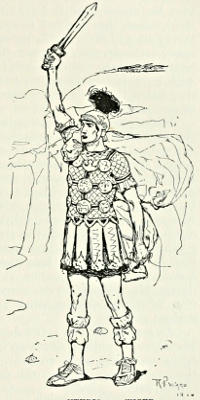
A Centurion Officer
[64 A.D.]
There followed a dreadful disaster; whether
fortuitously, or by the wicked contrivance of
the prince, is not determined, for both are
asserted by historians; but of all the calamities
which ever befell this city from the rage
of fire, this was the most terrible and severe. It broke out in that part of
the Circus which is contiguous to mounts Palatine and Cælius; where, by
reason of shops in which were kept such goods as minister aliment to fire,
the moment it commenced it acquired strength, and being accelerated by the
wind, it spread at once through the whole extent of the Circus; for neither
were the houses secured by enclosures, nor the temples environed with walls,
nor was there any other obstacle to intercept its progress; but the flame,
spreading every way impetuously, invaded first the lower regions of the city,
then mounted to the higher; then again ravaging the lower, it baffled every
effort to extinguish it, by the rapidity of its destructive course, and from the
liability of the city to conflagration, in consequence of the narrow and intricate
alleys, and the irregularity of the streets in ancient Rome. Add to this,
the wailings of terrified women, the infirm condition of the aged, and the
helplessness of childhood; such as strove to provide for themselves, and
those who laboured to assist others; these dragging the feeble, those waiting
for them; some hurrying, others lingering; altogether created a scene of
universal confusion and embarrassment. And while they looked back upon
the danger in their rear, they often found themselves beset before, and on
their sides; or if they escaped into the quarters adjoining, these too were
already seized by the devouring flames; even the parts which they believed
remote and exempt, were found to be in the same distress. At last, not knowing
what to shun, or where to seek sanctuary, they crowded the streets, and
lay along in the open fields. Some, from the loss of their whole substance,
even the means of their daily sustenance, others, from affection for their relatives,
whom they had not been able to snatch from the flames, suffered themselves
to perish in them, though they had opportunity to escape. Neither
dared any man offer to check the fire; so repeated were the menaces of many
who forbade to extinguish it; and because others openly threw firebrands,
with loud declarations that “they had one who authorised them”; whether
they did it that they might plunder with the less restraint, or in consequence
of orders given.
Nero, who was at that juncture sojourning at Antium, did not return to
the city till the fire approached that quarter of his house which connected
the palace with the gardens of Mæcenas; nor could it, however, be prevented
from devouring the house and palace, and everything around. But
for the relief of the people, thus destitute, and driven from their dwellings,
he opened the Field of Mars and the monumental edifices erected by Agrippa,
and even his own gardens. He likewise reared temporary houses for the
reception of the forlorn multitude, and from Ostia and the neighbouring
cities, were brought up the river household necessaries; and the price of
grain was reduced to three sesterces the measure. All which proceedings,
though of a popular character, were thrown away, because a rumour had
become universally current, that “at the very time when the city was in
flames, Nero, going on the stage of his private theatre, sang, ‘The Destruction
of Troy,’ assimilating the present disaster to that catastrophe of
ancient times.”
At length, on the sixth day, the conflagration was stayed at the foot of
Esquiline, by pulling down an immense quantity of buildings, so that an open
space, and, as it were, void air, might check the raging element by breaking
the continuity. But ere the consternation had subsided, the fire broke out
afresh, with no little violence, but in regions more spacious, and therefore
with less destruction of human life; but more extensive havoc was made of
the temples, and the porticoes dedicated to amusement. This conflagration,
too, was the subject of more censorious remark, as it arose in the Æmilian
possessions of Tigellinus; and Nero seemed to aim at the glory of building
a new city, and calling it by his own name; for, of the fourteen sections
into which Rome is divided, four were still standing entire, three were
levelled with the ground, and in the seven others there remained only here
and there a few remnants of houses, shattered and half consumed.
Nero appropriated to his own purposes the ruins of his city, and founded
upon them a palace [the “Golden House”] in which the old-fashioned, and,
in those luxurious times, common ornaments of gold and precious stones,
were not so much the objects of attraction as lands and lakes; in one part,
woods like vast preserves; in another part, open spaces and expansive
prospects. The projectors and superintendents of this plan were Severus
and Celer, men of such ingenuity and daring enterprise as to attempt to
conquer by art the obstacles of nature, and fool away the treasures of the
prince; they had even undertaken to sink a navigable canal from the lake
Avernus to the mouth of the Tiber, over an arid shore, or through opposing
mountains: nor indeed does there occur anything of a humid nature for
supplying water, except the Pontine marshes; the rest is either craggy
rock or a parched soil; and had it even been possible to break through these
obstructions, the toil had been intolerable, and disproportioned to the
object. Nero, however, who longed to achieve things that exceeded credibility,
exerted all his might to perforate the mountains adjoining to Avernus:
and to this day there remain traces of his abortive project.
But the rest of the old site not occupied by his palace was laid out,
not as after the Gallic fire, without discrimination and regularity, but with
the lines of streets measured out, broad spaces left for transit, the height of
the buildings limited, open areas left, and porticoes added to protect the
front of the clustered dwellings. These porticoes Nero engaged to rear at
his own expense, and then to deliver to each proprietor the areas about them
cleared. He moreover proposed rewards proportioned to every man’s rank
and private substance, and fixed a day within which, if their houses, single
or clustered, were finished, they should receive them. He appointed the
marshes of Ostia for a receptacle of the rubbish, and that the vessels which
had conveyed grain up the Tiber should return laden with rubbish; that the
buildings themselves should be raised to a certain portion of their height
without beams, and arched with stone from the quarries of Gabii or Alba,
that stone being proof against fire; that over the water springs, which had
been improperly intercepted by private individuals, overseers should be placed,
to provide for their flowing in greater abundance, and in a greater number of
places, for the supply of the public; that every housekeeper should have in
his yard means for extinguishing fire; neither should there be party walls,
but every house should be enclosed by its own walls. These regulations,
which were favourably received, in consideration of their utility, were also a
source of beauty to the new city; yet some there were who believed that the
ancient form was more conducive to health, as from the narrowness of the
streets, and the height of the buildings the rays of the sun were more
excluded; whereas now, the spacious breadth of the streets, without any
shade to protect it, was more intensely heated in warm weather.
Such were the provisions made by human counsels. The gods were next
addressed with expiations; and recourse had to the Sibyl’s books. By
admonition from them, to Vulcan, Ceres, and Proserpine supplicatory sacrifices
were made, and Juno was propitiated by the matrons, first in the Capitol,
then upon the nearest shore, where, by water drawn from the sea, the temple
and image of the goddess were besprinkled; and the ceremony of placing
the goddess in her sacred chair, and her vigil, were celebrated by ladies who
had husbands. But not all the relief that could come from man, not all
the bounties that the prince could bestow, nor all the atonements
which could be presented to the gods, availed to relieve Nero from the
infamy of being believed to have ordered the conflagration. Hence, to
suppress the rumour, he falsely charged with the guilt, and punished with
the most exquisite tortures, the Christians, who were hated for their
enormities. Accordingly, first those were seized who confessed they were
Christians; next, on their information, a vast multitude were convicted, not
so much on the charge of burning the city, as of hating the human race.
And in their deaths they were also made the subjects of sport, for they were
covered with the hides of wild beasts, and worried to death by dogs, or nailed
to crosses, or set fire to, and when day declined, burned to serve for nocturnal
lights. Nero offered his own gardens for that spectacle, and exhibited a
Circensian game, indiscriminately mingling with the common people in the
habit of a charioteer, or else standing in his chariot. Whence a feeling of
compassion arose towards the sufferers, because they seemed not to be cut off
for the public good, but victims to the ferocity of one man.c
In order to compensate for his prodigality in games and spectacles; to
cover the expense of his purposeless edifices, above all, of his golden house;
of his festivals, one of which cost four million sesterces for perfume alone;
his extravagance in furniture and in clothes, of which he wore new ones
each day, his distributions of bread, meat, game, clothes, money, and even
precious stones, among the populace in return for their applause for his
verses and singing; finally, I say, to compensate for all this wild expenditure,
he multiplied proscriptions and sentences which carried with them the
confiscation of property. Even office became a source of revenue, for he
only bestowed it on condition that he should have a share in the profits.
The provinces were thus again pillaged. It was not for this they had so
loudly saluted the establishment of the empire, and they came within a
measurable distance of its dissolution in the last years of this reign.b
CONSPIRACY MET BY CRUELTY AND PERSECUTION
[65 A.D.]
Men, however, were grown weary of being the objects of the tyrannic
caprice of a profligate youth; and a widely extended conspiracy to remove
him and give the supreme power to C. Piso, a nobleman of many popular
qualities, was organised (65). Men of all ranks, civil and military, were
engaged in it,—senators, knights, tribunes, and centurions,—some, as is
usual, on public, some on private grounds. While they were yet undecided
where it were best to fall on Nero, a courtesan named Epicharis, who had a
knowledge (it is not known how obtained) of the plot, wearied of their indecision,
attempted to gain over the officers of the fleet at Misenum. She
made the first trial of an officer named Volusius Proculus, who had been one
of the agents in the murder of Agrippina, and who complained of the ill return
he had met with, and menaced revenge. She communicated to him the fact
of there being a conspiracy, and proposed to him to join in it; but Proculus,
hoping to gain a reward by this new service, went and gave information to
Nero. Epicharis was seized; but as she had mentioned no names, and Proculus
had no witnesses, nothing could be made of the matter. She was, however,
kept in prison.
The conspirators became alarmed; and lest they should be betrayed, they
resolved to delay acting no longer, but to fall on the tyrant at the Circensian
games. The plan arranged was that Plautius Lateranus, the consul-elect, a
man of great courage and bodily strength, should sue to the emperor for
relief to his family affairs, and in so doing should grasp his knees and throw
him down, and that then the officers should despatch him with their swords.
Meantime Piso should be waiting at the adjacent temple of Ceres; and when
Nero was no more, the prefect Fenius Rufus and others should come and
convey him to the camp.
Notwithstanding the number and variety of persons engaged in the plot,
the secret had been kept with wonderful fidelity. Accident, however, revealed
it as it was on the very eve of execution. Among the conspirators was a
senator named Flavius Scevinus, who, though dissolved in luxury, was one
of the most eager. He had insisted on having the first part in the assassination,
for which purpose he had provided a dagger taken from a temple. The
night before the attack was to be made he gave this dagger to one of his
freedmen, named Milichus, to grind and sharpen. He at the same time sealed
his will, giving freedom to some, gifts to others of his slaves. He supped
more luxuriously than usual, and though he affected great cheerfulness, it
was manifest from his air that he had something of importance on his mind.
He also directed his freedman to prepare bandages for wounds. The freedman,
who was either already in the secret, or had his suspicions now excited,
consulted with his wife, and at her impulsion set off at daylight and revealed
his suspicions to Epaphroditus, one of Nero’s freedmen, by whom he was
conducted to the emperor. On his information Scevinus was arrested; but
he gave a plausible explanation of everything but the bandages, which he
positively denied. He might have escaped were it not that Milichus’ wife
suggested that Antonius Natalis had conversed a great deal with him in secret
of late, and that they were both intimate with Piso. Natalis was then sent
for; and as he and Scevinus did not agree in their accounts of the conversation
which they had, they were menaced with torture. Natalis’ courage gave
way; he named Piso and Seneca. Scevinus, either through weakness or
thinking that all was known, named several others, among whom were Annæus
Lucanus the poet, the nephew of Seneca, Tullius Senecio, and Afranius
Quinctianus. These at first denied everything. At length, on the promise
of pardon, they discovered some of their nearest friends, Lucan even naming
his own mother Atilla.
Nero now called to mind the information of Proculus, and he ordered
Epicharis to be put to the torture. But no pain could overcome the constancy
of the heroic woman; and next day, as from her weak state she was carried
in a chair to undergo the torture anew, she contrived to fasten her belt to the
arched back of the chair, and thus to strangle herself.
When the discovery was first made, some of the bolder spirits urged Piso
to hasten to the camp or to ascend the rostra, and endeavour to excite the
soldiers or the people to rise against Nero. But he had not energy for such
a course, and he lingered at home till his house was surrounded by soldiers.
He then opened his veins, leaving a will filled, for the sake of his wife, a
profligate woman, with the grossest adulation of Nero. Lateranus died like
a hero, with profound silence; and though the tribune who presided at the
execution was one of the conspirators, he never reproached him.
But the object of Nero’s most deadly enmity was Seneca. All that was
against this illustrious man was that Natalis said that Piso had one time sent
him to Seneca, who was ill, to see how he was, and to complain of his not
admitting him, and that Seneca replied that it was for the good of neither
that they should meet frequently, but that his health depended on Piso’s
safety. The tribune Granius Silvanus (also one of the conspirators) was
sent to Seneca, who was now at his villa four miles from Rome, to examine
him respecting the conversation with Natalis. He found him at table with
his wife, Pompeia Paulina, and two of his friends. Seneca’s account agreed
with that of Natalis; his meaning, he said, had been perfectly innocent.
When the tribune made his report to Nero and his privy council—Poppæa
and Tigellinus—he was asked if Seneca meditated a voluntary death. On
his reply that he showed no signs of fear or perturbation, he was ordered to
go back and bid him die. Silvanus, it is said, called on Fenius on his way
and asked him if he should obey the orders; but Fenius, with that want
of spirit which was the ruin of them all, bade him obey. Silvanus when he
arrived sent in a centurion with the fatal mandate.
Seneca calmly called for his will, but the centurion would not suffer him
to have it. He then told his friends that as he could not express his sense
of their merits in the way that he wished, he would leave them the image of
his life, to which, if they attended, they would obtain the fame of virtue and
of constancy in friendship. He checked their tears, showing that nothing
had occurred but what was to have been expected. Then embracing his wife,
he began to console and fortify her, but she declared her resolution to die
with him. Not displeased at her generous devotion, and happy that one so
dear to him should not remain exposed to injury and misfortune, he gave a
ready consent, and the veins in the arms of both were opened. As Seneca, on
account of his age, bled slowly, he caused those of his legs and thighs to be
opened also; and as he suffered very much, he persuaded his wife to go into
another room; and then calling for amanuenses, he dictated a discourse which
was afterward published. Finding himself going very slowly, he asked his
friend the physician, Statius Annæus, for the hemlock juice which he had
provided, and took it, but it had no effect. He finally went into a warm bath,
sprinkling as he entered it the servants who were about him, and saying, “I
pour this liquor to Jove the Liberator.” The heat caused the blood to flow
freely, and his sufferings at length terminated. His body was burned without
any ceremony, according to the directions which he had given when at
the height of his prosperity.
Paulina did not die at this time; for Nero, who had no enmity against
her and wished to avoid the imputation of gratuitous cruelty, sent orders to
have her saved. She survived her husband a few years, her face and skin
remaining of a deadly paleness in consequence of her great loss of blood.
The military men did not remain undiscovered. Fenius Rufus died like
a coward; the tribunes and centurions, like soldiers. When one of them
named Subrius Flavius was asked by Nero what caused him to forget his
military oath: “I hated you,” said he, “and there was none of the soldiers
more faithful while you deserved to be loved. I began to hate you when
you became the murderer of your mother and wife, a chariot-driver, a
player, and an incendiary.” Nothing in the whole affair cut Nero to the
soul like this reply of the gallant soldier.
The consul Vestinus was not implicated by any in the conspiracy; but
Nero hated him; and as he was sitting at dinner with his friends, some
soldiers entered to say that their tribune wanted him. He arose, went into
a chamber, had his veins opened, entered a warm bath, and died. Lucan
when ordered to die had his veins also opened; when he felt his extremities
growing cold, he called to mind some verses of his Pharsalia which were
applicable to his case, and died repeating them. Senecio Quinctianus and
Scevinus and many others died; several were banished. Natalis, Milichus,
and others were rewarded; offerings, thanksgivings, and so forth were voted
in abundance by the senate.
This obsequious body, however, sought to avert the disgrace of the lord
of the Roman world appearing on the stage at the approaching Quinquennial
games, by offering him the victory of song and the crown of eloquence. But
Nero said that there needed not the power nor the influence of the senate,
that he feared not his rivals, and relied on the equity of the judges. He
therefore sang on the stage, and when the people pressed him to display all
his acquirements, he came forth in the theatre, strictly conforming to all the
rules of his art, not sitting down when weary, wiping his face in his robe,
neither spitting nor blowing his nose, and finally with bended knee and
moving his hand, waited in counterfeit terror for the sentence of the judges.
At the end of the games, he in a fit of anger gave Poppæa, who was
pregnant, a kick in the stomach, which caused her death. Instead of burning
her body, as was now the general custom, he had it embalmed with the
most costly spices and deposited in the monument of the Julian family. He
himself pronounced the funeral oration, in which he praised her for her
beauty, and for being the mother of a divine infant.
The remainder of the year was marked by the death or exile of several
illustrious persons, and by a pestilence which carried off great numbers of
all ranks and ages. “Of the knights and senators,” observes Tacitus, “the
deaths were less to be lamented; they anticipated, as it were, by the common
fate the cruelty of the prince.”
[66 A.D.]
The first deaths of the succeeding year (66) were those of P. Anteius,
whose crime was his wealth and the friendship of Agrippina; Ostorius
Scapula, who had distinguished himself in Britain; Annæus Mella, the
father of Lucan; Anicius Cerealis, Rufius Crispinus, and others. They all
died in the same manner, by opening their veins. The most remarkable
death was that of C. Petronius, a man whose elegance and taste in luxury
had recommended him to the special favour of Nero, who regarding him as
his “arbiter of elegance,” valued only that of which Petronius approved. The
envy of Tigellinus being thus excited, he bribed one of Petronius’ slaves to
charge his master with being the friend of Scevinus. His death followed, of
course; the mode of it however was peculiar. He caused his veins to be
opened, then closed, then opened again, and so on. He meantime went on
conversing with his friends, not, like a Socrates or a Seneca, on the immortality
of the soul or the opinions of the wise, but listening to light and wanton
verses. He rewarded some of his slaves, he had others flogged, he dined,
he slept; he made, in short, his compulsive death as like a natural one as possible.
He did not, like others, pay court to Nero or Tigellinus or the men
in power, in his will, but he wrote an account of the vices and crimes of the
prince and court under the names of flagitious men and women, and sent it
sealed up to the emperor. He broke his seal-ring, lest it might be used to
the destruction of innocent persons.
“After the slaughter of so many illustrious men,” says Tacitus, “Nero at
length sought to destroy virtue itself by killing Thraseas Pætus and Bareas
Soranus.” The former, a man of primitive Roman virtue, was hated by him
not merely for his worth, but because he had on various occasions given
public proof of his disapproval of his acts. Such were his going out of the
senate house when the decrees were made on account of the murder of Agrippina,
and his absence from the deification and funeral of Poppæa. Further
than his virtue, we know of no cause of enmity that Nero could have against
Soranus.
The accusers of Thraseas were Capito Cossutianus, whom he had made
his enemy by supporting the Cilician deputies who came to accuse him of
extortion, and Marcellus Eprius, a profligate man of eloquence. A Roman
knight named Ostorius Sabinus appeared as the accuser of Soranus. The
time selected for the destruction of these eminent men was that of the
arrival of the Parthian prince Tiridates, who was coming to Rome to receive
the diadem of Armenia, either in hopes that the domestic crime would be
shrouded by the foreign glory, or, more probably, to give the Oriental an
idea of the imperial power. Thraseas received an order not to appear
among those who went to meet the king; he wrote to Nero, requiring to
know with what he was charged, and asserting his ability to clear himself if
he got an opportunity. Nero in reply said that he would convoke the senate.
Thraseas then consulted with his friends, whether he would go to the senate
house, or expect his doom at home. Opinions were as usual divided; he
however did not go to the senate.
Next morning the temple in which the senate sat was surrounded with
soldiery. Cossutianus and Eprius appeared as the accusers of Thraseas, his
son-in-law Helvidius Priscus, Paconius Agrippinus, and Curtius Montanus.
The general charge against them was passive rather than active disloyalty,
Thraseas being held forth as the seducer and encourager of the others.
Ostorius then came forward and accused Soranus, who was present, of friendship
with Rubellius Plautus and of mal-conduct in the government of Asia.
He added that Servilia, the daughter of the accused, had given money to
fortune-tellers. Servilia was summoned. She owned the truth, that she
had sold her ornaments and given the money to the soothsayers, but for no
impious purpose, only to learn if her father would escape. Witnesses were
then called, and among them, to the indignation of every virtuous man,
appeared P. Egnatius, the client and friend of Soranus, and a professor of
the stoic philosophy, who now had sold himself to destroy his benefactor by
false testimony.
The accused were all condemned, of course; Thraseas, Soranus, and Servilia
to death, the others to exile. Of the circumstances of the end of
Soranus and his daughter, we are not informed. Thraseas having prevented
his wife Arria from following the example of her mother of the same
name, by entreating her not to deprive their daughter of her only remaining
support, caused his veins to be opened in the usual manner; and as the blood
spouted forth, he said to the quæstor who was present, “Let us pour out to
Jove the Liberator. Regard this, young man. May the gods avert the
omen; but you have been born in times when it is expedient to fortify the
mind by examples of constancy.” He died after suffering much pain.f
Suetonius has left us an interesting picture of the personality of the perverted
being who was the cause of all this suffering.
PERSONAL CHARACTERISTICS OF NERO, ACCORDING TO SUETONIUS
[54-68 A.D.]
In stature Nero was a little below the common size; his body spotted,
and of a disagreeable appearance; his hair inclined to yellow; his countenance
fair, rather than handsome; his eyes gray and dull, his neck fat, his
belly prominent, legs very slender, but his constitution healthful. For,
though extravagantly luxurious in his way of living, he had, in the course of
fourteen years, only three fits of sickness, which were so slight, that he
neither forbore the use of wine, nor made any alteration in his usual diet.
In his dress, and the care of his person, he was so indecent, that he had his
hair cut in rings one above another; and when he was in Achaia, let it grow
long behind; and appeared abroad for the most part in the dress which he
used at table, with a handkerchief about his neck, his coat loose upon him,
and without shoes.
He was entered, when a boy, in almost all the liberal sciences; but his
mother diverted him from the study of philosophy, as unsuitable to one who
was to be an emperor; and his master Seneca discouraged him from reading
the old orators, that he might keep him the longer in admiration of himself.
He was much addicted to poetry, and composed verses both with pleasure
and ease: nor did he, as some think, publish those of other authors for his
own. I have had in my hands some little pocket-books of his, with some
well-known verses, all of his own writing, and written in such a manner, that
it was very evident from the blotting and interlining, that they had not been
transcribed from a copy, nor dictated by
another, but written by the composer
of them.
He had likewise a great taste for
painting, and moulding of images, but
of all things an extravagant desire of
popular applause, being a rival of every
man who was upon any account admired
by the people. It was the general belief,
that, after the prizes he won by
his performances upon the stage, he
would the next lustrum have entered
amongst the wrestlers at the Olympic
games. For he was continually practising
in that way; nor did he attend
in Greece that kind of solemnity any
otherwise, than as the judges used to
do, sitting upon the ground in the Stadium.
And if a pair of wrestlers happened
to get without the limits assigned
them, he would with his own hands
bring them back into their proper place.
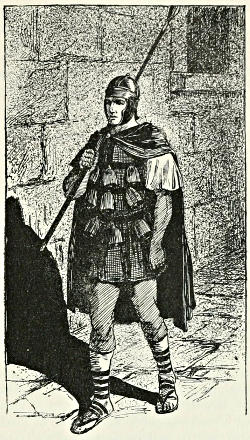
A Night Watchman of Rome, showing the
Bells worn on his Jacket
Towards the end of his life, he made
a public vow, that if he continued in
the peaceable enjoyment of the empire,
he would, in the games which he intended
to give for his success against
the insurgents, appear upon the stage,
to manage the water-organ, as also to
play upon the flutes and bagpipe, and
upon the day concluding those diversions,
would act his part in a play, and
dance to the story of Turnus in Virgil. And there are some who say, that
he put to death the player Paris as a dangerous rival.
He had an invincible desire, but capriciously directed, of rendering himself
famous through all succeeding ages. He therefore took from several
things and places their former appellations, and gave them new names
derived from his own. He called the month of April, too, Neroneus, and
had a design to change the name of Rome into that of Neropolis.
He thought there was no other use of riches and money than to squander
them away profusely; regarding all those as sordid wretches who kept their
expenses within due bounds; and extolling those as truly noble and generous
souls, who lavished away and wasted all before them. He never wore
the same garment twice. He would game for four hundred thousand sesterces
for every spot that came up upon the tali. He used to fish with a
golden net, drawn by silken cords of the finest scarlet colour. It is said that
he never travelled with less than a thousand carts attending him with his
baggage: the mules being all shod with silver, and their drivers dressed in
scarlet clothes of the finest wool; and a numerous train of footmen, and Africans,
with bracelets on their arms, and mounted upon horses in splendid
trappings.
He was a despiser of all religious worship, except that of the Syrian
goddess; but at last he regarded her so little that he spurned her, being
now engaged in another superstition, in which he invariably persisted. For
having received from some obscure plebeian a little image of a girl, as a
preservative against plots, and discovering a conspiracy immediately after,
he constantly worshipped, and with three sacrifices a day, his imaginary protectress,
as the greatest amongst the gods. He was likewise desirous to
have it thought that he had from the information of that deity a knowledge
of future events. A few months before he died, he offered several sacrifices,
to consult the entrails of the victims; but could never obtain any favourable
intimations from them.d
MERIVALE’S ESTIMATE OF NERO AND HIS TIMES
The youth who at the age of seventeen years had been called to govern
the civilised world, is represented in his busts and medals as handsome in
countenance, but, as Suetonius remarks, without grace or winningness of
expression. His hair was not the bright auburn of Apollo, the delight of
the Romans, to which it was so often likened, but yellowish or sandy; his
figure, though of middle stature, was ill-proportioned, the neck was thick
and sensual, the stomach prominent, the legs slender. His skin, it is added,
was blotched or pimpled; but this, it may be supposed, was the effect of
intemperance in his later years; his eyes were dark gray or greenish, and
their sight defective, which may account perhaps for the scowl which seems
to mark their expression. His health, notwithstanding his excesses, continued
good to the end, and it was only from anxious concern for his voice
that he wrapped his throat in kerchiefs, like a confirmed valetudinarian. In
his dress there was a mixture of slovenliness and finery; in the arrangement
of his cherished locks he was exceedingly careful, piling them in tiers above
the crown, and letting them fall from thence over the shoulders, a fashion
which was reputed not less indecent, or at least effeminate, than the looseness
of his cincture, the bareness of his feet, and the lightness of the chamber-robe
in which he did not scruple to appear in public.
We may trace perhaps to the character of his master, and to the kind of
education he was likely to receive from him, the ardent love of admiration,
ill-directed as it was, which distinguished the pupil of Seneca. To this constant
anxiety to compete with rivals, and triumph over them, however trifling
the objects on which it was exercised, may be ascribed the indifference Nero
evidently felt to the title of divinity, which in his inordinate vanity he might
have been expected to claim. He wanted to be admired as the first among
men, not to be adored as a god. He could not be Apollo, and contend at the
same time for the prize of the Pythian games; he could not be Hercules, and
carry off the chaplet at Nemea; he could not be Jupiter, and gain the victory
at the great contest of Olympia—distinctions on which his soul was bent
from an early period of his career, and which, as we shall see, he lived eventually
to achieve. His courtiers might, if they pleased, pronounce his likeness
to these or any other divinities; but to make him actually divine was to rob
him of the honours he so vehemently affected. The poets might predict his
apotheosis after death, and doubtless the verses in which Lucan, at that time
his friend and companion, challenged him to choose what godship he would
assume in heaven, and where he would fix his throne, imploring him to take
his seat in the middle of the universe, lest if he leaned ever so little from the
centre the world should be thrown by his august weight from its eternal balance—such
verses were doubtless accepted as a fitting tribute to the germ
of a divine existence hereafter to blossom into flower. But the ardour with
which Nero aspired to distinctions among mortal men was itself a guarantee
against his usurping the character of the impassive godhead, which can neither
enjoy a triumph nor suffer a disgrace.
Nor again, though described by Tacitus as lusting after the incredible, had
Nero the same passion as Caligula for realising apparent impossibilities to prove
his superhuman power. He was not impelled in a career of marvels by restless
and aimless pride. Once removed from the sphere of theatrical shows
and contests, he had no higher notion of his position than as enabling him
to accumulate, to multiply, or to enlarge the commonest objects of luxury.
He never travelled, it is asserted, with less than a thousand carriages in his
train. His banquets were those of the noble debauchees of the day on a still
vaster scale of expense; in the height of his extravagance, he would equip
his actors with masks or wands covered with genuine pearls; he would stake
four hundred thousand sesterces on a single cast of the dice; he bathed in
unguents, and stimulated his friends to expend four millions on the perfumes
alone of a single supper. His presents to favourites were sums of money
many times greater than had ever been given to favourites before; his buildings
were colonnades longer, halls wider, towers higher, than had been raised
by his predecessors. His projected canal from Puteoli to Rome would only
have been the longest of canals; the attempt he latterly made to cut through
the isthmus of Corinth was only a repetition of previous attempts, neither
better planned, nor more steadfastly persevered in.
In his schemes there was nothing new or original. Nero was devoid of the
imagination which throws an air of wild grandeur over the character of
Caligula. The notion that he burned Rome on purpose to have an opportunity
of rebuilding it more magnificently would have been more applicable, as it
seems to me, to his predecessor than to him. But within the paltry sphere
of his degraded taste he claimed to be pre-eminent. As a mime or player he
was not satisfied with any single class of parts, or any one department of
exhibition. After rivalling Apollo in song and the Sun in charioteering,
he aspired to display the courage and vigour of Hercules, and a lion was
duly prepared, drugged or fed to stupor, to be strangled in his arms, or
brained with a stroke of his club. He acted, he sang, he played, he danced.
He insisted on representing men and heroes, gods and even goddesses. To
affect the woman indeed, in dress, voice, and gesture, was a transformation
in which he took a childish pleasure, restrained by no sense of dignity or
decency. He adopted his superstitions, as well as his garb and habits, from
Syria, from his Parthian and Armenian guests, or from the diviners and
necromancers of the credulous East. To the art of magic he devoted wealth,
energy, natural abilities, in short, all his resources; but Nature, says Pliny,
was too strong for him. His failure to divine the future, or raise the spirits
of the dead, was noted by the wise as a signal demonstration of the futility
of magical pretensions. For none of the accustomed divinities of Rome did
he evince any respect, nor for places consecrated by the national religion;
but he reverenced the Syrian Astarte, till in a fit of vexation he renounced
her protection, and insulted her image. At last his sole object of veneration
was a little figure of a girl, which he always wore as a talisman about him,
affecting to learn from it the secrets of futurity.
Such were the miserable interests of this infatuated creature, the victim
of licentious indulgence, a child prematurely stunted both in mind and
body, surrounded on the throne not by generals and statesmen, but by
troops of slaves or freedmen, by players and dancers lost to all sense of
decency themselves, and seeking only their advancement at the expense of
their master and of mankind; surrendered by loose women to still more
despicable minions, and ruled by the most cruel and profligate of ministers.
Helius and Tigellinus, Doryphorus and Sporus, are among the most hateful
names of the imperial history; into the abominations of their career it
would be pollution merely to look. No wonder that, when encircled by so
loathsome a crew he saw the proud citizens prostrate at his feet, he could
exclaim that no prince before him had known the extent of his power. But
though at their patron’s command statues and arches might rise in honour
of these infamous companions, it may be said for the credit of the people,
that they received much less of lip-worship than their predecessors, Sejanus,
Pallas, and Narcissus.
There seems indeed to have risen, at least in the later years of this
principate, a marked separation between the court and the nobility; the
senators shrank from the presence of a man who so openly degraded his
name and lineage; they fled the contact of his dissolute associates; they
entered into widespread conspiracies against him, to which they had never
been provoked by the tyranny of his predecessors; and they had the merit
of incurring his petulant displeasure, with many a threat to extinguish their
order altogether, and give the provinces to his knights and freedmen. “I
hate you, Cæsar,” exclaimed the most refined of his flatterers, “because you
are a senator.” Accordingly this emperor, notwithstanding the pomp and
splendour of his shows and public appearances, seems to have been left for
the most part to the mercenary attendance of his personal favourites, protected
only by a troop of spies and informers, and the vilest portion of the
pampered populace, from the general detestation of respectable citizens.[18]
The cruelties of Nero’s later years were the more fearful, perhaps, from
their apparent caprice. He had no politic object, such as may be ascribed
to Tiberius—of policy indeed he was incapable. Except that his murders
were commonly prompted by need or fear, and therefore fell oftenest on the
rich and powerful, it can hardly be said that one class suffered from them
more terribly than another.
Undoubtedly, however, the senate furnished the longest list of victims
to the tyrant’s barbarity. The greatest and noblest were the most exposed
to the prince’s evil eye, which lighted upon them equally at public ceremonials
and private receptions, and marked them for immolation at every
fresh burst of ill-humour. The proscriptions to which this body was subjected
under the four Claudian Cæsars reduced its numbers considerably,
more, indeed, it may be imagined, than was replaced by the ordinary sources
of replenishment. Claudius, among his other reforms, sought to restore the
balance by a special measure, and such was probably the object of his revision
of the senate, the last of the kind we read of; but the decline must
have been accelerated under Nero, without check or counteraction. Nero,
reckless equally of the past and future, felt no anxiety to maintain the
numbers of that historic assembly; and the various causes, besides the emperor’s
tyranny, which were always at work to extinguish the oldest families,
must have acted with terrible force on the effete branches of the ancient aristocracy.
But if its numbers were reduced, no less were its employments
also diminished.
Under the lax discipline of Nero and of Tigellinus appointments to
office abroad would be the prize of interest and favour, guided neither by
routine nor by discretion; at home the boards and commissions established
by Augustus would fall into disuse. Pensions and sinecures, though such
corruptions are not known to us at Rome by name, would doubtless abound,
but of real business there would be less and less. Intrigue and peculation
would flourish in a soil protected from the air of public opinion, and the
strong hand of central control.
The passive endurance which marked the conduct of the senate under
the imperial persecutions seems to bespeak a consciousness of its own guilt
towards the state, and it compounded for its monopoly of unquestioned
abuses by bowing to the yoke of a jealous and domineering master. We
discover in Seneca no reliance on the senate. He never speaks of it as a
living guardian of the virtues of Roman society. And yet, notwithstanding
this abandonment of its high prerogative, it still exercised a moral
power. Its mere title could awaken associations which thrilled from pulse
to pulse. It was still regarded by the men of ancient name and blood as the
true head or heart of the empire, rather than the upstart Claudius or Domitius,
who might wear the purple and wield the sword. To the men of words
and phrases the emperor was still an accident,—the senate was an eternal
fact,—at a time when rhetoric might make revolutions, though it could not
regenerate society. To them it was still the symbol of liberty, at a time
when liberty and Cæsar were regarded as two gladiators sword in hand,
pitted against each other in mortal combat. This venerable image of its
ancient majesty was preserved to it by the proscriptions themselves by
which it suffered; for as often as a murdered Scribonius or Pompeius was
replaced in the chairs of office by a Rubellius, a Lollius, or a Vitellius, the
principle of its vitality was in fact invigorated by the infusion of new
plebeian blood.
As fast indeed as the tyrant’s exigencies required the confiscation of the
great estates of nobles, and the overthrow of great families, his caprice
and favour were elevating new men from the inferior orders to succeed to
their distinctions, and to rival them in their vast possessions. Nero never
kept his money. All he robbed, all he extorted, was squandered as abruptly
as it was acquired, and shrewd Roman money-makers were always waiting
upon his necessities, and sweeping the properties of his victims into their
stores for a small part of their value in specie. Of the vast sums amassed
by the freedmen of Claudius and his successors some records have been
preserved to us; but the freedmen were a class peculiarly obnoxious to remark,
and it is probable that knights and senators were at the same time,
and by similar compliances, raising fortunes not less enormous, who have
escaped the designating finger of history. Though the grinding processes
to which the colossal properties of the nobles were subjected must on the
whole have broken down the average amount of their revenues far below
the rate at which it figured under the republic and the first Cæsars, we
must not suppose that the current set all in one direction, or that the age
of Claudius and Nero was not also a period of great private accumulations.
The wealth of individuals and of the upper ranks at Rome generally reached
perhaps its greatest height at this culminating epoch.
Descending, however, from the high places of the Roman world, we find
beneath them a commonalty suffering also a social revolution, undergoing a
rapid transition, and presenting the elements of two rival classes, or even
hostile camps, in the bosom of the city. The clients and retainers of the
old nobility, whether freed or freeborn, still formed the pith and marrow
of the commonwealth; still leaning their humble tenements against the
great lords’ mansions, still respecting them as their patrons and advisers,
still attending their levees, and waiting for the daily complement of the
sportula at their doors, they regarded them as the real chiefs of the state,
and held them equals of Cæsar himself. The death or exile of their august
protector might strike them with surprise and indignation; but when they
looked around and counted their numbers, they felt their own insignificance,
and quailed beneath the blow in silence. They saw that there was growing up
beside them a vast class of patronless proletaries, the scum of the streets and
lanes, slaves, freedmen, foreigners, men of base trades and infamous employments,
or of ruined fortunes, who, having none but Cæsar himself to depend
on, threw the weight of their numbers in his scale, and earned his doles and
entertainments by lavish caresses, and deeds corresponding to their promises.
These have been called the lazzaroni of ancient Rome; in idleness,
indeed, and mendicancy they deserve the title; but they were the paupers
of a world-wide empire, and the crumbs on which they fed fell from the
tables of kings and princes. The wealth of millions of subjects was lavished
on these mendicant masters. For days together, on the oft-recurring
occasion of an imperial festival, valuables of all kinds were thrown pell-mell
among them, rare and costly birds were lavished upon them by thousands,
provisions of every kind, costly robes, gold and silver, pearls and
jewels, pictures, slaves and horses, and even tamed wild beasts. At last, in
the progress of this wild profusion, ships, houses, and estates were bestowed
by lottery on these waiters upon Cæsar’s providence.
This extravagance was retained without relaxation throughout Nero’s
reign; had he paused in it for a moment the days of his power would have
been few. The rumour that he was about to quit Rome for the East
caused murmurs of discontent, and forced him to consult the gods, and
pretend to be deterred by signs of their displeasure from carrying his design
into effect. When at last, as we shall see, he actually visited Greece,
he left behind him a confidential minister, to keep the stream of his liberality
flowing, at whatever cost and by whatever measures of spoliation. Absent
or present, he flung to these pampered supporters a portion of every confiscated
fortune; the emperor and his people hunted together, and the division
of the prey was made apparently to the satisfaction of both equally. Capricious
as were the blows he dealt around him, this class alone he took care
never to offend, and even the charge of firing the city fell lightly on the
ears of the almost houseless multitude, whose losses at least had been fully
compensated by plunder. The clients of the condemned nobles were kept
effectually in check by this hungry crowd, yelling over every carcass with
the prospect of a feast. Nero, in the height of his tyranny and alarm, had
no need to increase the number of his prætorians; the lazzaroni of Rome
were a bodyguard surrounding him in every public place, and watching the
entrances and exits at his palace gates.
Such were the chief distinctions of class at this period among the Roman
people, the so-called lords of mankind, and beyond them lay the great world
of the provincials, their subjects. But if these were subjects in name, they
were now become in fact the true Roman people; they alone retained real
freedom of action within the limits of the empire; they were allowed to
labour, and they enjoyed the bulk at least of the fruits of industry; they
rarely saw the hateful presence of the emperor, and knew only by report the
loathsome character of his courtiers and their orgies. And if sometimes
the thunderbolt might fall among them, it struck only the highest eminences;
the multitude was safe as it was innocent. The extortion of the proconsul
in the province was not to be compared in wantonness or severity with the
reckless pillage of the emperor in the capital, nearer home. The petulance
of a proconsul’s wife was hardly tolerated abroad, while at home the prince’s
worst atrocities were stimulated by female cupidity. The taxation of the
subject, if heavier in some respects than that
of the citizen, was at least tolerably regular;
the extraordinary demands which Nero made
towards the rebuilding of Rome were an exception
to the routine of fiscal imposts. But,
above all, the provincials had changed place
with their masters in being now the armed
force of the empire.
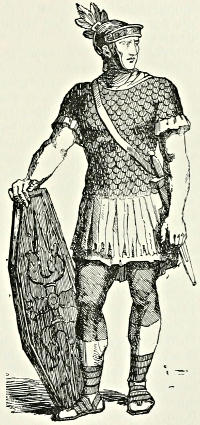
Roman Cavalryman
The citizen had almost ceased to wield the
sword. Even the prætorians were recruited
from Italy, not from Rome herself; and among
them thousands were doubtless foreign born,
the offscourings of the provinces, who had
thrown themselves on the shores of Italy to
seek their fortunes in a sphere abandoned by
the indolence of their masters. The prætorian,
like the proletary of the city, was highly
cherished by the emperor. He had his rights
and privileges which raised him above every
other military conscript. While the legionary
served at ten asses a day for thirty or
forty years, exposed to the risks of war, fatigue,
and climate, nor regained his liberty
and safety till age had blanched his hair and
stiffened his limbs, the prætorian lived quietly
at Rome under the lax discipline of a stative
camp; he enjoyed double pay, and claimed
dismissal after sixteen years’ service. He had
his regular dole of corn, his occasional largess,
his extraordinary donative whenever an opportunity
had occurred to prove his fidelity.
Tiberius, on the fall of Sejanus, had given him 1000 asses; Claudius had paid
for the purple with a sum of 150,000,000 of sesterces; Nero had followed
these examples, and established them as the rule of the succession; on the
overthrow of Piso’s conspiracy he had requited his prætorians with 2000
sesterces apiece. Thus caressed, the favoured cohorts of the guard
became the firmest support of the prince, their creature, and under the
sway of military traditions, from which even they were not exempt, regarded
their oath of allegiance with strict fidelity. This fidelity, indeed,
they considered due to the imperator himself rather than to the senate and
people, whom they equally despised; they were satisfied with the power of
making the Cæsars, and as yet were far from conceiving in their minds the
idea of unmaking them again.
But far different was the case with the legions in the provinces. The
legionary was still less Roman than the prætorian. If to a great extent
the recruits for the frontier camps were still levied from the class which
possessed the nominal franchise of the city, yet these citizens were themselves,
for the most part, new-enfranchised provincials; they had received
Latin or Roman rights as a boon from the emperor, or perhaps purchased
them for the sake of their fiscal immunities. Romans in blood or even
Italians the legionaries no longer were. They were supported by ample
levies of auxiliaries, avowedly of foreign extraction, generally transferred
from their homes to a camp at a far distant station; Silures and Brigantes
to the Danube; Tungri and Suevi to the borders of Wales; Iberians to the
Euphrates; Numidians to the Rhine. Amidst the clang of dissonant languages
that resounded through the camp the Latin was the least heard and
understood.
Yet the word of command was still Roman, and the chief officers were
Roman also; the affections of this soldiery, long estranged from the emperor
and the senate, were attached to the tribune and the legatus; and the
murmurs of the nobles at home, which moved the sympathy of their kinsmen
on the frontier, met a deep response in the devotion of these sons of the
eagles to their accustomed leaders. The vast distance of the great camps
of the empire from one another, and the frequent change of their officers,
together with the motives of jealousy which the emperors nourished
between them, helped to prevent these legions from joining in a common
cause when disaffection menaced an outbreak in any particular quarter.
They made some partial attempts to supplant the prætorians by carrying
one of their own chiefs to power; but every endeavour of the kind had been
hitherto baffled by the want of concert among them. More success was to
attend the efforts in the near future.
In the year 63 A.D., Nero, we are told, was preparing to visit the East
in person. Some indeed asserted that his object was only to behold the
wonders of Egypt, and the interest of the citizens was just then directed
towards that mysterious region by the discoveries of an exploring party,
which had recently ascended the Nile nine hundred miles above Syene.
Others believed that he had no intention of proceeding beyond Greece; but
it seems probable that his views were really more extensive, and that he contemplated
throwing himself into the quarters of the Syrian legions, and
checking by his presence the ambition of the proconsul, perhaps seizing an
opportunity to overthrow him. But, whatever Nero’s project may have
been, it was frustrated, as we have seen, by the occurrence of the fire at
Rome. The affairs of the next three years have been already related: the
conspiracies which were concerted against the emperor at home, his redoubled
efforts to secure the favour of the populace, and his cruel precaution
of destroying every man of eminence who might become the centre of fresh
machinations to his prejudice. In the year 66 he at last found leisure to
execute his scheme of travel, so far, at least, as to visit Greece; where he
presented himself at the public spectacles, and gratified his passion for dancing
and singing before promiscuous assemblages, with still less reserve than
at home. All the states which held musical contests had hastened, even before
his arrival, to humour him with the offer of their prizes, and Nero had
received their envoys with the highest honours, and invited them to his
table. When one of them begged him to give a specimen of his singing, and
his skill was rapturously applauded, he declared that the Greeks alone had
ears, and alone deserved the honour of hearing him.
NERO IN GREECE
[66-68 A.D.]
Nero remained in Greece to the beginning of the year 68. He was attended
by courtiers and court-followers of all descriptions, and many, it was
affirmed, of the chief nobility were invited to accompany him, that he might
slay them more securely at a distance from the city. However this may be,
the ministers of his luxury and panders to his vices formed the most conspicuous
portion of his escort; for he seems to have prosecuted his enormities
among the despised Greeks more shamelessly than ever. The great
ambition of the imperator, now following in the track of Mummius, Flamininus,
Agrippa, and Augustus, was to gain the distinction of a Periodonicus,
or victor in the whole circle of the games; for in compliment to him, the
contests which recurred in successive years at Olympia, Nemea, Delphi, and
Corinth were all to be enacted during his residence in the country. Nor
was this the only irregularity admitted. At Olympia he demanded a musical
contest, such as had never been practised there before; at the isthmus he
contended in tragedy and comedy, which also was contrary to the local
usage. The exertions of Nero were not confined to playing, singing, and
acting. He presented himself also as a charioteer, nor was he ashamed
to receive the prize even when he had fallen with car and horses to the
ground. Wherever he went he challenged the most famous artists to contend
with him, and extorted every prize from every competitor. A Roman
consular enacted the part of herald, and proclaimed in the astonished ears of
Greece, “Nero the Emperor is Victor, and he crowns the People of Rome,
and the World which is his own.”
The flattery of the Greeks deserved substantial acknowledgment, and
Nero was prepared to make a sacrifice for the purpose. He negotiated an
exchange of provinces for the senate, resigning the imperial prison-house of
Sardinia, and receiving in its place the prefecture of Achaia. He then proclaimed,
in the Forum at Corinth, the freedom and immunity of the province,
while he awarded to his judges the honour of Roman citizenship, together
with large presents in money. Another project ascribed to him, magnificent
and useful in itself, may have had no other object in his mind than to render
him famous in history; in almost any other human being we should look for
some worthier motive for it. This was the cutting of the isthmus of Corinth,
a measure often before proposed and attempted but never achieved.
The work was commenced, convicts were condemned to labour upon it,
and among them the learned stoic Musonius Rufus, removed from Gyarus,
whither he had been banished as an accomplice in Piso’s conspiracy, was
seen by another philosopher handling the spade and pick-axe. But men of
science from Egypt assured the emperor that, if the work were effected, the
waters of the Corinthian Gulf, being higher than the Saronic, would submerge
the island of Ægina, and after Nero’s departure the design was promptly
abandoned. The Romans regarded its frustration as a judgment perhaps
on his unnatural pride. In commencing the work with a sacrifice, it had
been remarked, as an instance of the hatred he bore the senate, that he had
prayed simply that it might turn out well for the emperor and the people
of Rome.
It is not impossible, however, that there may have been a politic motive
in this visit to Greece, such as has been suggested for the expedition of
Caius into Gaul. Fresh disturbances had broken out in Judea; the cruelties
of Gessius Florus had excited a sedition, which Cestius Gallus advanced
to Jerusalem from Antioch to repress. But here he had encountered
the people in arms, and had been suddenly overpowered and slain. The
Jews were elated with success and hopeless of pardon; it was soon evident
that the great war which must decide the fate of their country, and with it
of the Roman Empire in the East, so often threatened, so long delayed, had
commenced. But Corbulo was almost on the spot; his legions were mighty,
his name still mightier; such forces under such a leader might be trusted to
do the work of Rome thoroughly in any quarter. Nevertheless the jealousy
of the wretched prince prevailed over all concern for the interests of his
country. He trembled at the increase of influence this new war might bring
to his formidable proconsul. This was the moment he chose for repairing
in person to the threshold of his province, and summoning the man he feared
to attend upon him in Greece. At the same time he ordered Vespasian,
who had already distinguished himself in the British war, but had acquired
as yet no dangerous pre-eminence, to take command of the forces destined
for Palestine. Corbulo must have known that he was superseded; he must
have felt his summons as a disgrace; he must have apprehended personal
danger. Yet had he known that every step he took westward was bringing
him straight to his doom, such was his fidelity as a soldier that he would
have obeyed without hesitation. No sooner had he arrived at Cenchreæ, the
port of Corinth, than he was met by emissaries from Nero bearing him the
order to despatch himself. Without murmur, he plunged a sword into his
heart, exclaiming as he struck the blow, “Rightly served!” [67 A.D.].
Nor was the gallant Corbulo the tyrant’s only victim. At the same time
he summoned two brothers, Rufus and Proculus, of the great Scribonian
house, who commanded in the two Germanies, to meet him in Greece, under
pretence of conferring with them on state affairs. The summons was in fact
a recall, and the pretence which accompanied it could hardly have deceived
them; yet they too obeyed with the same alacrity as Corbulo, and fell, perhaps
not unwittingly, into the same snare. Some specific charges were laid
against them; but no opportunity was given them of meeting them, nor
were they allowed to see the emperor. They killed themselves in despair.
Although, during his sojourn in Greece, Nero traversed the province in
every direction, it was observed that he refrained from visiting either Athens
or Sparta. With respect to the city of Lycurgus it was affirmed merely that
he kept aloof from it lest the austerity of its usages should prove irksome to
him; but he dared not enter the abode of the Erinyes, from dread of their
vengeance on his crimes. Another account said that he was deterred from
initiation into the mysteries of Eleusis, which was denied, under direst imprecations,
to the impious and impure. Of these awful legends of Grecian
antiquity but a faint and confused echo resounded in Italy. To the Latin
or the Sabine it little mattered whether the murderer shrank from Athens or
Eleusis, whether it was the avenging Furies or the pure goddess of the mysteries
before whom he trembled to appear. Give but freedom to the people,
they said, to declare what they really think, and who so base as to hesitate
between Seneca and Nero—Nero, who more than once deserved the
sack, the serpent, and the ape, the instruments of death for parricide. True,
Orestes by divine command had slain his mother; but he at least avenged
the death of a father—Nero had assisted at the slaughter of Claudius;
Orestes spared at least his wife and sister—Nero had murdered both; Orestes
had not poisoned a kinsman—Nero had mingled aconite for many:
above all, Orestes had never sung upon the stage, nor chanted, like Nero, the
fall of Ilium. This it seems was the crown and climax of his crimes, the
last and worst of the indignities he heaped on Rome; this was the deed for
which the sword of the avenger was most fitly drawn. “For such,” exclaims
Juvenal, “forsooth, were the acts, such were the arts of our high-born
prince, proud to degrade himself on a foreign stage, and earn the paltry
chaplets of the Grecian games. Let him lay before the image of Domitius
the mantle of Thyestes, the mask of Antigone or Melanippe; let him hang
his votive lyre on the marble statue of Augustus.”
Beneath this veil of rhetoric lies a truth which it is the province of history
to remark. The Romans, from age to age, viewed their own times in
a very different light from that in which they have appeared to posterity.
The notion of Juvenal that the acting and singing
of Nero were in fact his most flagrant enormities
was felt no doubt, even in his own day, as a wild
exaggeration; nevertheless it points to the principle,
then still in vigour, of the practical religion of
antiquity, the principle of faith in its social traditions.
With cruelty and oppression the Romans
were so familiar that Nero’s atrocities in this respect,
so harrowing to our feelings, made little impression
upon them; but his desecration of their
national manners, his abandonment of the mos
majorum, the usage of his ancestors, startled them
like impiety or sacrilege. They were not aware
how far they had really drifted from the habits of
antiquity, how much of foreign poison they had
admitted into their veins. Theoretically they still
held in sanctimonious horror the customs of the
stranger; foreign usages might be innocent, nay,
laudable, in their own place, but to introduce them
into Rome was a monstrous sin, a sin, not against
the gods in whom they no longer believed, but
against the nation, in which they believed more
intensely perhaps than ever. The state or nation
was itself gradually assuming in their eyes the personality
of a distinct divinity, in which all other divinities were absorbed;
the Hellenism which Nero vaunted was apostasy from the goddess Roma.

Roman Bronze Kettle
The Greeks on the other hand would regard, we may suppose, with more
indulgence the caprices of their imperial visitor; they were accustomed to
flatter, and in this instance there was some excuse for flattering a humour so
flattering to themselves. The miserable vices he paraded before them were
too like their own, at least in their period of corruption, to elicit strong
moral reprobation. Nevertheless, if we may credit our accounts, he found
more effectual means of disgusting them. The imperial tyranny was always
pursued, as by its shadow, by profuse and fatal expenditure. It seemed unable
to move without the attendance of a crowd of harpies, ever demanding
their prey with maw insatiable. Every day required fresh plunder; every
day proscriptions and confiscations revealed the prince’s necessities, and if
these for a moment slackened for want of victims, his hands were laid on the
monuments of art, on every object on which money could be raised throughout
the devoted land. The temples as well as the dwellings and the forums
of Greece were ransacked again for the costliest and most cherished treasures,
to be sold by auction to the highest bidder, or redeemed at exorbitant
prices by their unhappy owners. Greece was powerless to resist, and her
murmurs were drowned in the acclamations of the hired applauders; but she
felt her wrongs deeply, and the pretended boon of freedom, accompanied by a
precarious immunity, was regarded perhaps as an insult rather than a favour.
Rome at least, it might be hoped, would breathe again during the absence
of her hateful tormentor. But this, we are assured, was as far from her as
ever. Her condition had become even more miserable. The emperor had
given the government of Italy to a freedman named Helius, and this minion
exercised cruelty and rapine at his own caprice, not even deigning to ask
the prince’s pleasure beforehand on the executions and confiscations he commanded.
Yet Helius was not unfaithful to his master’s interests. On the
first symptoms of danger from discontent in the city or the provinces, for such
symptoms began at last to threaten, he urged him to hasten back to the seat
of government, and it was Nero’s obstinacy alone that postponed his return
for some months. “You admonish me, you entreat me,” replied the infatuated
wretch, “to present myself again at Rome; nay, but you should rather dissuade
me from returning, until I have reaped my full harvest of laurels.”
This harvest was not yet gathered in, and the cries of the keeper of the
city, already trembling for the fate of the empire, were disregarded, while
there yet remained a stadium to be trodden, or a chaplet to be won, in Greece.
At the commencement, however, of the year 68 the aspect of affairs had become
still more serious. Plots for the subversion of the government were
believed to be rife in the armies of the West. The heads of administration
at Rome knew not whom of their officers in Gaul or Spain to trust. Deep
gloom had settled down on the upper classes in the capital; the temper of
the populace itself, so long the stay of Nero’s tyranny, was uncertain. Helius
again urged him to hasten his return. He crossed over to Greece to confer
with him in person. He repeated his instances with increasing fervour. At
last, when there seemed no more of fame or booty to be wrung from Greece,
Nero deigned to take ship, though the season of navigation had not yet commenced,
and urged his prow through stormy seas to the haven of Puteoli.
NERO’S RETURN TO ITALY AND TRIUMPHAL ENTRY INTO ROME
At Delphi he had consulted the oracle about his future fortunes, and had
been warned, we are told, against the seventy-third year, a response which
seemed to the youth of thirty to portend a great length of days, but was
found in the sequel to have another and a fatal signification. Fortified,
however, by this delusion, he had returned to Italy with little anxiety, and
when some of the precious objects that followed in his train were lost by
shipwreck, he vaunted in the plenitude of his self-assurance that the fishes
themselves would restore them. After losing and again recovering both
Britain and Armenia, his confidence in his good fortune had become, it is
said, unbounded. It was at Naples, he remembered, that he had commenced
his long course of artistic victories. Now arrived at the height of his glory,
he determined to celebrate his successes by a triumphal entry into the Campanian
capital, with a team of milk-white horses. The walls were broken
down to admit the chariot of the Hieronicus, and the same extravagance
was repeated when he entered Antium, his native place, and the Albanum,
his favourite residence, and once more, when he presented himself before
Rome. He drove in pomp through the city, in the chariot in which Augustus
had triumphed, with the flutist Diodorus by his side, arrayed in a purple
robe, and a mantle blazing with golden stars, wearing on his head the Olympian
coronal, and waving the Pythian in his hand. He was preceded by a
long train of attendants bearing aloft his other chaplets and the titles of all
his victories; he was followed by his five thousand augustani, with loud
and measured acclamations, as the soldiers who shared his glory. The procession
passed through the Circus, some arches of which were demolished to
admit it, and thence to the Velabrum and the Forum, skirting the base of
the Palatine to the Porta Mugionis, the chief ascent to the hill and the temple
of Apollo on its summit. The sacrifice of victims, the flinging of odours,
and every other accompaniment of a military triumph, were duly observed
in this mock solemnity; the statues of the emperor were decked with
crowns and lyres; the citizens hailed their hero with the titles of Nero-Apollo
and Nero-Hercules, invoking his divine voice, and pronouncing all
who heard it blessed. The affair was concluded by the striking of medals,
on which Nero was represented, to the shame and horror of all genuine
patriots, in the garb of a flute-player.
DISCONTENT IN THE PROVINCES
[68 A.D.]
But the hour of retribution was at hand. Notwithstanding the servile
flattery of the senate, and the triumphs and supplications it had decreed,
Nero felt uneasy at the murmurs no longer stifled, and the undissembled
gloom which now surrounded him in his capital, and withdrew himself from
Rome to the freer air of Campania. Meanwhile the discontent repressed in
the city was finding vent in the provinces, and the camps, thronged as they
were with kinsmen of the mocked and injured senators, were brooding over
projects of revenge. Among the most distinguished of the officers who at
this time held commands and enjoyed the confidence of their soldiers, was
Servius Sulpicius Galba, who for several years had governed the Hither
Spain. Connected with the first families of Rome, and descended from many
heroes of the camp and Forum, this man stood high in public regard, and
in the admiration of the emperors themselves, for his courage, his skill, and
his austerity. He had deserved well of Caligula for the vigour with which,
at a critical moment, he drew up the reins of discipline in the Rhenish camps;
still better of Claudius for refusing the offer of his own soldiers to raise him
to empire on Caligula’s death. He had held command in Aquitania, and was
for two years proconsul of Africa; he had received the triumphal ornaments,
and had been admitted to the priestly colleges of the Titii, the Quindecemvirs,
and the Augustales. Full of years and honours, he had retired from
public employment through the first half of Nero’s principate, till summoned
to preside over the Tarraconensis. He exercised his powers with vigilance
and a harshness which perhaps was salutary, until the emperor’s growing
jealousy warned him to shroud his reputation under the veil of indolence or
even neglect, and thus he escaped the fate of Corbulo, and lived to avenge
it. Galba was in his seventy-third year. In his childhood he had been
brought, it was reported, with others of the young nobility, to salute the
aged Augustus; and the emperor, taking him playfully by the cheek, had
said, “And thou too, child, shalt one day taste our empire.” Tiberius, it
was added, had learned from the diviners the splendid destiny that awaited
his old age, but had remarked complacently that to himself it could not
matter. Nero, it seems, whom these prognostications touched more nearly,
either forgot, or was lulled to false security about them.
Early in the winter of 68, while Nero was still absent in Greece, Galba
received overtures from C. Julius Vindex, prefect of the Farther Gaul, for
a simultaneous rising. Vindex was himself a Gallico-Roman, scion of a royal
house in Aquitania, adopted into the imperial gens; but while he imbibed
the pride of a Roman, he retained the impetuous spirit of his ancestors; and
the enormities of Nero, aggravated no doubt in his esteem by his exactions
in Gaul itself, roused his determination to overthrow him without a view to
personal aggrandisement. The time indeed was yet far distant when a foreigner
could even conceive the idea of gaining the purple. But he fixed his
eyes on Galba, as the ablest of the class from which fortune could make an
emperor, and it was with vexation that he found the old chief too cautious
to be driven headlong into a revolt, the event of which might seem so doubtful.
Galba indeed had good reason to hesitate. Nero set a price on the head
of Vindex, whose designs were speedily revealed to him, and though the
forces of the Gaulish province were disposed to follow their chief, the more
powerful legions of lower Germany, under Virginius Rufus, were in full
march against them. The armies met at Vesontio, and there Vindex and Virginius,
at a private interview, agreed to conspire together, but their troops
could come to no such understanding; the Virginians attacked the soldiers
of Vindex, and almost cut them to pieces. Vindex thereupon, with the
haste and levity of his race, threw himself on his sword, and the rebellion
seemed for a moment to be crushed.
GALBA IS SALUTED IMPERATOR BY HIS SOLDIERS
But Galba had become alarmed for his own safety. He had received
communications from a rebel, all whose acts were well known to the government.
He had been urged to proclaim himself emperor, and no refusal
on his part could efface the crime of having been judged worthy of such
a distinction. Indeed, so at least he pretended, he had already intercepted
orders from Nero to take his life, and a plot for his assassination was opportunely
detected among a company of slaves presented him by a freedman of
the emperor. Thus impelled to provide for his own safety, he called his
troops together, and setting before them the images of the tyrant’s noblest
victims, harangued them on the state of public affairs. The soldiers saluted
him as imperator, but he would only allow himself to be styled Legatus of the
senate and the people. He proceeded, however, at once to prorogue all civil
business, and provide for immediate war by raising forces, both legionary
and auxiliary, from the youth of the province. At the same time he convened
the notables of the country, to give perhaps a civil colour to his military
enterprise. The Gallic and Germanic legions, now reunited, after the
death of Vindex, had offered to raise Virginius to the purple; they conjured
him to assume the title of imperator, and inscribed on his busts the names of
Cæsar and Augustus. But he steadily refused the honours thrust upon him,
erased the obnoxious letters, and at length persuaded his admirers to leave
the decision of affairs to the authorities at home. He entered, however, into
communication with Galba, who had now, it seems, determined on the attempt,
and the news was bruited far and wide that Gaul and Spain had revolted,
and that the empire had passed irrevocably from the monster Nero.
At once it appeared how many pretenders to power might exist in the
bosom of the provincial camps. The fatal secret of the empire, that a prince
might be created elsewhere than at Rome, so long undiscovered, so alien, as
was supposed, from the sentiments of the age, was revealed in more than one
quarter. Not in Gaul and Spain only, but in Africa and lower Germany,
the legions were ready to make an emperor of their own chief. Clodius
Macer in the one, Fonteius Capito in the other, were proclaimed by the
soldiers. At the same time Salvius Otho, Nero’s ancient favourite, who was
weary of his long oblivion on the shores of the Atlantic, declared himself a
supporter of Galba, and lent him his own slaves and plate, to swell his retinue
and increase his resources. The civil wars had again
begun.
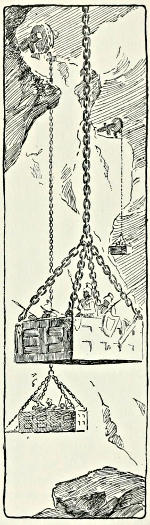
Roman Method of Attack from above
Such was the march of disaffection, the first anticipations
of which had been revealed to Helius before
the end of 66, and had induced him to urge the
emperor, first by letter and afterwards in person, to
hasten home. Nero, as we have seen, could not be
persuaded to regard them seriously, or postpone to
their consideration his paltry gratifications and amusements.
After his return to Rome he had again quitted
it for Naples in March, 68, and it was on the 19th
of that month, the anniversary of Agrippina’s murder,
while presiding at a gymnastic exhibition, that he
received the news of the revolt of Vindex. Still he
treated the announcement with contempt, and even
expressed satisfaction at the prospect of new confiscations.
He witnessed the contests with unabated
interest, and retired from them to a banquet. Interrupted
by fresh and more alarming despatches, he
resented them with petulant ill-humour; for eight
days he would neither issue orders nor be spoken to
on the subject. Finally arrived a manifesto from
Vindex himself, which moved him to send a message
to the senate, requiring it to denounce the rebel as a
public enemy; but he excused himself from appearing
in person, alleging a cold or sore throat, which
he must nurse for the conservation of his voice. Nothing
so much incensed him as Vindex calling him Ahenobarbus
instead of Nero, and disparaging his skill in
singing. “Had they ever heard a better performer?”
he asked peevishly of all around him. He now hurried
trembling to Rome; but he was reassured, we are
told, on the way by noticing a sculpture which represented
a Gallic soldier dragged headlong by a Roman
knight. Accordingly, with his usual levity, instead
of consulting in full senate, or haranguing on the
state of affairs in the Forum, he held a hasty conversation
with a few only of his nobles, and passed the day in explaining
to them a new water-organ, on which he proposed, he said, “with Vindex’s
good leave,” to perform in public. He completed and dedicated a temple to
Poppæa: once more he celebrated the games of the circus, once more he
played and sang, and drove the chariot. But it was for the last time. Vindex
had fallen, but Galba, it was now announced, had raised the standard of
revolt. The rebel’s property in Rome was immediately confiscated, to which
he replied by selling under the spear the emperor’s estates in Spain. The
hour of retribution, long delayed, was now swiftly advancing; courier after
courier was dashing through the gates, bringing news of the defection of
generals and legions. The revolt of Virginius was no longer doubtful. At
this intelligence the puny tyrant fainted; coming to himself he tore his robes
and smote his head, with pusillanimous wailings. To the consolations of his
nurse he replied, with the cries of an infant, “never was such ill-fortune as
his; other Cæsars had fallen by the sword, he alone must lose the empire
still living.” At last he recollected himself sufficiently to summon troops from
Illyricum for the defence of Italy; but these, it was found, were in correspondence
with the enemy. Another resource, which served only to show
to what straits he was driven, was to land sailors from the fleet at Ostia,
and form them into a legion. Then he invoked the pampered populace to
arise in his behalf, and dressed up courtesans
and dancers as Amazons to attend his march;
next moment he exclaimed that he would take
ship for Alexandria, and there earn subsistence
by singing in the streets. Again he launched
into invectives against the magistrates abroad,
threatening to recall and disgrace them throughout
his dominions; the provinces he would give
up to pillage, he would slay every Gaul in the
city, he would massacre the senate, he would
let loose the lions on the populace, he would lay
Rome in ashes. Finally, the tyrant’s vein exhausted,
he proposed in woman’s mood to meet
the rebels unarmed, trusting in his beauty, his
tears, and the persuasive tones of his voice, to
win them to obedience.
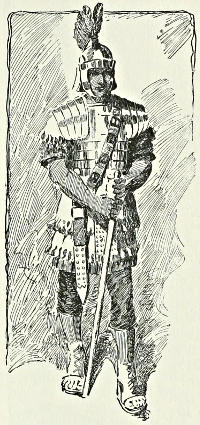
A Centurion Officer
Meanwhile the excitement among the knights
and senators at the prospect of deliverance kept
pace with the progress of revolt abroad. Portents
were occurring at their doors. Blood
rained on the Alban Mount; the gates of the
Julian sepulchre burst open of their own accord.
The Hundred Days of Nero were drawing
rapidly to a close. He had landed in Italy
about the end of February, and now at the beginning
of June his cause had already become
hopeless. Galba, though steadfast in his resolution,
had not yet set his troops in motion;
nevertheless, Nero was no longer safe in the
city. The people, at first indifferent, were now
clamouring against him; for there was a dearth of provisions, and a vessel,
just arrived from Alexandria, was found, to their disgust, to bear not grain,
but fine sand for the wrestlers in the amphitheatre. The prætorians had been
seduced by their prefect Nymphidius, to whom the camp was abandoned by
the flight of Tigellinus. Nero was left without advisers; the senators stood
aloof; of Helius, lately so powerful and energetic, we hear nothing. Terrified
by dreams, stung by ridicule or desertion, when his last hope of succour
was announced to have deceived him the wretched tyrant started from his
couch at supper, upset the tables, and dashed his choicest vessels to the
ground; then taking poison from Locusta and placing it in a golden casket,
he crossed from the palace to the Servilian gardens, and sent his trustiest
freedmen to secure a galley at Ostia. He conjured some tribunes and centurions,
with a handful of guards, to join his flight; but all refused, and
one blunter than the rest exclaimed tauntingly, “Is it then so hard to die?”
THE DEATH OF NERO
At last at midnight, finding that even the sentinels had left their posts,
he sent or rushed himself to assemble his attendants. Every door was
closed; he knocked, but no answer came. Returning to his chamber, he
found the slaves fled, the furniture pillaged, the case of poison removed.
Not a guard, not a gladiator, was at hand, to pierce his throat. “I have
neither friend nor foe,” he exclaimed. He would have thrown himself into
the Tiber, but his courage failed him. He must have time, he said, and repose
to collect his spirits for suicide, and his freedman Phaon at last offered
him his villa in the suburbs, four miles from the city. In undress and bare-footed,
throwing a rough cloak over his shoulders, and a kerchief across
his face, he glided through the doors, mounted a horse, and, attended by
Sporus and three others, passed the city gates with the dawn of the summer
morning. The Nomentane road led him beneath the wall of the prætorians,
whom he might hear uttering curses against him, and pledging vows
to Galba; and the early travellers from the country asked him, as they
met, “What news of Nero?” or remarked to one another, “These men are
pursuing the tyrant.” Thunder and lightning, and a shock of earthquake,
added horror to the moment. Nero’s horse started at a dead body on the
roadside, the kerchief fell from his face, and a prætorian passing by recognised
and saluted him.
At the fourth milestone the party quitted the highway, alighted from
their horses, and scrambled on foot through a cane-brake, laying their own
cloaks to tread on, to the rear of the promised villa. Phaon now desired
Nero to crouch in a sand-pit hard by, while he contrived to open the drain
from the bathroom, and so admit him unperceived; but he vowed he would
not go alive, as he said, underground, and remained trembling beneath the
wall. Taking water from a puddle in his hand, “This,” he said, “is the famous
Drink of Nero.” At last a hole was made, through which he crept on all
fours into a narrow chamber of the house, and there threw himself on a
pallet. The coarse bread that was offered him he could not eat, but swallowed
a little tepid water. Still he lingered, his companions urging him to
seek refuge, without delay, from the insults about to be heaped on him. He
ordered them to dig a grave, and lay down himself to give the measure; he
desired them to collect bits of marble to decorate his sepulchre, and prepare
water to cleanse and wood to burn his corpse, sighing meanwhile, and muttering,
“What an artist to perish!”
Presently a slave of Phaon’s brought papers from Rome, which Nero
snatched from him, and read that the senate had proclaimed him an enemy,
and decreed his death, in the ancient fashion. He asked what that was; and
was informed that the culprit was stripped, his head placed in a fork,
and his body smitten with the stick till death. Terrified at this announcement,
he took two daggers from his bosom, tried their edge one after the
other, and again laid them down, alleging that the moment was not yet
arrived. Then he called on Sporus to commence his funeral lamentations;
then he implored some of the party to set him the example; once and again
he reproached himself with his own timidity. “Fie! Nero, fie!” he muttered
in Greek, “courage, man! come, rouse thee!” Suddenly was heard the trampling
of horsemen, sent to seize the culprit alive. Then at last, with a
verse of Homer hastily ejaculated, “Sound of swift-footed steeds strikes
on my ears,” he placed a weapon to his breast, and the slave Epaphroditus
drove it home.
The blow was scarcely struck, when the centurion rushed in, and, thrusting
his cloak against the wound, pretended he was come to help him. The
dying wretch could only murmur, “Too late,” and, “Is this your fidelity?”
and expired with a horrid stare on his countenance. He had adjured his
attendants to burn his body, and not let the foe bear off his head, and this
was now allowed him; the corpse was consumed with haste and imperfectly,
but at least without mutilation.
Nero perished on the 9th of June, 68 A.D., at the age of thirty years and
six months, in the fourteenth year of his principate. The child borne him by
Poppæa had died in infancy, and a subsequent marriage with Statilia Messallina
had proved unfruitful. The stock of the Julii, refreshed in vain by
grafts from the Octavii, the Claudii, and the Domitii, had been reduced to
his single person, and with Nero the adoptive race of the great dictator was
extinguished. The first of the Cæsars had married four times, the second
thrice, the third twice, the fourth thrice again, the fifth six times, and lastly,
the sixth thrice also. Of these repeated unions, a large number had borne
offspring, yet no descendants of them survived. A few had lived to old age,
many reached maturity, some were cut off by early sickness, the end of
others was premature and mysterious; but a large proportion were victims
of domestic jealousy and politic assassination.
With Nero we bid farewell to the Cæsars, at the same time we bid farewell
to the state of things which the Cæsars created and maintained. We
turn over a page in Roman history. On the verge of a new epoch we would
treat with grave respect even the monster with whom the old epoch closes;
we may think it well that the corpse even of Nero was unmutilated; that he
was buried decently in the Domitian gardens on the Pincian; that though
the people evinced a thoughtless triumph at his death, as if it promised
them a freedom which they could neither use nor understand, some unknown
hands were found to strew flowers on his sepulchre, and the rival king of
Parthia adjured the senate to do honour to his memory.
Undoubtedly the Romans regarded with peculiar feeling the death of
the last of the Cæsars. Nero was cut off in early youth; he perished in
obscurity; he was entombed in a private sepulchre, with no manifestation
of national concern, such as had thrown a gleam of interest over the least
regretted of his predecessors. Yet these circumstances would not have
sufficed to impart a deep mystery to the event, without the predisposition of
the people to imagine that the dynasty which had ruled them for four generations
could not suddenly pass away, finally and irrevocably. The idea
that Nero still survived, and the expectation of his return to power, continued
long to linger among them. More than one pretender arose to claim
his empire, and twenty years later a false Nero was protected by the Parthians,
among whom he had taken refuge, and only surrendered to the repeated
and vehement demands of the Roman government. This popular
anticipation was the foundation, perhaps, of the common persuasion of the
Christians, that he should revisit the earth in the character of Antichrist;
and possibly that Jerusalem itself would be the scene.e
The fall of Nero and the accession of Galba form an important epoch in
the history of the Roman Empire; for to the misfortune of a form of government,
on which everything depended on the ruler, his court, and the
bodyguard and guard of the emperor, a fresh evil was now added, namely
that the army became accustomed to mutiny, and obtained a decisive influence
on the choice of the emperor. Certainly Galba did not accept the title
of emperor, until it was legally assigned to him by a deputation of the senate;
but the example of mutiny had been given, the army had in reality,
and the senate, only in form, decided as to who should occupy the throne,
and the fate of the empire was from henceforth made more and more dependent
on the troops and their leaders.
At first however it appeared fortunate, that after the weak-minded libertines,
who for some time had been at the head of the states, the government
should fall into the hands of a veteran warrior who possessed the love and
confidence of his soldiers, and hated every kind of indulgence and excess;
but any advantages which might have arisen from this were outweighed
by the great age of the emperor and the weakness consequent on
it. Galba’s weakness was first perceived when he, who at the time of
Nero’s death was still in Gaul, had returned to Rome; he was awaited with
real eagerness.
Before the arrival of Galba, Nymphidius, who had accelerated the fall of
Nero, acted as absolute ruler. He prevented Tigellinus from participating
in the command of the prætorians, tried in every way to gain over the people,
saw the entire senate in his antechamber, and mixed himself up with all
the dealings of the latter with Galba. It then occurred to him that he
might trace his descent from Cæsar and thereby establish his claim to the
throne. But to his terror, he heard, from a messenger whom he had sent
to Galba, that Titus Vinius, one of Galba’s legates, held absolute sway over
the emperor, that he had named Cornelius Laco prefect of the prætorians,
instead of him, and that his rule would therefore be at an end as soon as
Galba entered Rome. He therefore resolved to venture to extremes and to
make the prætorians proclaim him emperor; they were turned against him
by one of his officers, and killed him as soon as he appeared in their camp.
As soon as Galba arrived in Rome, he had all the friends of Nymphidius
put to death. These and a few other executions, added to Galba’s dependence
on Vinius, prepossessed no one in favour of the new ruler. It was
still more unfortunate that he had to refuse the guard sums of money promised
in his name by Nymphidius, and that on his entry into Rome he saw
himself obliged to have another troop of soldiers cut down, who had gone
against him and made violent demands. Galba was determined to adopt a
new course of government; but in this he overlooked the fact, that an
utterly corrupt people cannot be transformed at once, or lost morality
recalled by commands. With exaggerated severity and with a parsimony
which would have been despicable even in a private individual, he attempted
to reduce a town accustomed to imperial prodigality to its former simplicity,
discipline, and order, and thereby not only embittered the feelings of all, but
also made himself ridiculous.
[68-69 A.D.]
He was indolent and enfeebled by age [he was over seventy-two years
old] and depended on three favourites, who committed all sorts of severities
in his name and tried to make money by selling privileges and favours.
These favourites were Vinius, Laco, and Galba’s freedman, Icelus. For this
reason, from the beginning, everything pointed to a short duration of his
rulership, and dissatisfaction not only seized hold of the great mass in
Rome, who, as everywhere, loved pleasure and amusement more than virtue
or their country, but also of the different armies of the kingdom. A few
months after his accession the legions rose in upper Germany, and demanded
from the senate the appointment of a younger and more vigorous emperor.
Galba tried to stay the storm by immediately naming a young man of good
family and irreproachable character, Piso Licinianus, as his co-regent and successor.
Unfortunately, when presenting Piso to the troops, he omitted, out
of economy, to give presents to the soldiers, as had been the custom on such
occasions since the accession of Claudius; and in his speech to the assembled
army he publicly avowed that the troops in Germany had refused him obedience.
This made the soldiers dissatisfied, and he thereby robbed himself of
the advantages that Piso’s nomination might otherwise have brought him.
Otho, who had gone to Rome with Galba, seized the opportunity of Galba’s
mistake to place himself on the throne. He had long solicited the
favour of the soldiers and people, had given away entire estates to individuals,
had, when Galba dined with him, given money to the emperor’s escort,
and Galba had overlooked all this, because one of his favourites, Vinius,
whose daughter Otho wished to marry, had come to a secret understanding
with the latter. Otho instituted a formal conspiracy, corrupted the soldiers
by gifts and promises, and had himself proclaimed emperor in a camp of the
prætorians, a few days after Piso’s appointment. He left the camp at
the head of the soldiers who had chosen him, entered the town, killed
Galba and his co-regent, and was acknowledged emperor by the people and
senate. This took place on the 15th of January of the year 69, when Galba
had only reigned seven months and a few days.
The new emperor only maintained his rule for three months. All the
provinces and armies swore allegiance to him after Galba’s death, only the
legions of the Rhine and Upper Germany denied him obedience. They had
already rebelled against Galba, and proclaimed the leader of the troops on
the lower Rhine, Aulus Vitellius, emperor, as they had not been recompensed
by Galba for the support they had given him against Nero. This
rival, although other legions declared for him, would not in himself have
been dangerous to Otho, as he had become so enervated by self-indulgence
that he was wanting in activity and energy as well as in decision; but in
Fabius Valens and Aulus Cæcina, he possessed two able generals, who placed
themselves at the head of the legions in his stead.
With the rebellious troops they crossed the Alps into upper Italy and fell
upon Otho, who had hastily collected as many soldiers as possible and led
them against the enemy. At first the generals of Vitellius were the losers
in a few small engagements, as mutual jealousy induced them to act separately,
but as soon as they concentrated themselves they were far superior to
their adversaries. Otho ought, therefore, to have done everything to delay
the crisis until the reinforcements which he was expecting from the provinces
of the Danube had arrived. He nevertheless did the reverse, and throughout
the entire war showed himself a worthy comrade of Nero.
He had been the husband of the notorious Poppæa Sabina; had formerly
participated with his imperial friend in all kinds of pleasures, and had indulged
in so much dissipation that he had not only fallen deeply into debt,
but had also become enervated and incapable of any exertion. This had
already become apparent in the rebellion against Galba; for he had lost all
courage at the moment of action, and would have given the whole thing
up had not his fellow-conspirators compelled him to persist in his designs.
Besides he was no general. His troops, which for the greater part consisted
of prætorians and soldiers of Nero, clung to him with devotion, and were
eager to fight, but they did not trust their officers and would no longer
take orders from them. This determined him to bring the fight to a speedy
end, as he felt that at any moment he might be deserted by his own people.
In spite of this, as he had not been present in the earlier smaller fights, so
now he took no personal share in the great battle which was to decide his
own fate.
In the vicinity of Cremona, Cæcina and Valens fell on Otho’s army. It
was beaten, suffered considerable loss, and then the greater part went over to
the enemy. Otho’s cause was, nevertheless, by no means lost; for the prætorians
adhered steadfastly to him, the legions of the provinces of the
Danube were already on the march, and the entire East as well as Africa
was open to him. Only he was too indolent and effeminate to be able to
face continuous exertions and hardships, and from the example of his beaten
army he saw how ephemeral the devotion of his soldiers had been. So he
lost courage, and decided, in spite of the remonstrances and requests of his
friends, to put an end to his life. He stabbed himself to the heart with
a firmness rarely found in a voluptuary, and by this action won for himself
the reputation with posterity of having purchased the peace of his country
with his own life.
Historians have therefore praised him above his deserts, and placed words
in his mouth which stand in opposition to his life and principles. For instance,
he is reported to have said to his friends and relatives who wished to
restrain him from suicide: “Others have gained fame by governing well;
my fame, on the contrary, is to consist in my giving up the government of
the empire, rather than ruin it by my ambition.” Those who recall the
fact that Otho throughout his life lived and acted according to the maxims
of a Nero, will know how to divest this story of all that gives his death the
appearance of a grand and noble act; for although it cannot be denied that
Otho thereby put an end to the civil war, and died in peace and quietness,
nevertheless he was not guided by courage or love of country, but by indolence
and despair.
How little the sacrifice of his life cost a Roman at this period, and why
Otho’s death must be regarded in quite another light from that in which a
similar deed would be looked upon nowadays, is apparent from the fact that
some of his soldiers killed themselves at his funeral pile, not from fear of
the future, but that they might follow the glorious example of their leader.
After Otho’s death, the Roman senate not only recognised Vitellius as
emperor, but determined publicly to thank the Germanic army for having
appointed him. Whilst his generals were fighting for his dominion, Vitellius
remained in Gaul, and after the victory made no haste to take possession
of the empire; he first enjoyed a period of repose at Lyons, and then stopped
at Cremona and Bologna to hold
revels and to see the gladiatorial
displays. It was only in
July (69), three months after
Otho’s death, that he entered
Rome.
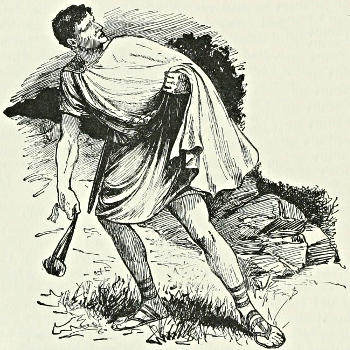
A Roman Slinger
With his accession, all the
crimes and prodigalities of the
government of a Caligula, a
Claudius, and a Nero were repeated,
although he was wanting
neither in culture nor in better
qualities. He had only attained
to consideration by his
vices, and won over
the soldiers in Germany
by his familiar
bearing. A dull,
slack, and withal cruel
disposition, a greediness
which amounted
to voraciousness, and
a prodigality in which
he even surpassed
Nero, were the soul of
his existence and government. Only thinking of pleasure and idle repose,
even on the march to Rome, he allowed his army to rob and plunder at will,
and permitted all kinds of excesses and insubordination. In Rome, freedmen,
comedians, and revellers were his most cherished companions, and he
who knew how to prepare the most voluptuous feast, rose in his favour.
In order to obtain money for his prodigalities, like Caligula and Nero,
he committed all sorts of inhuman cruelties. For example: he freed himself
from debt by having his creditors killed, and when one of them, condemned
to death, sought to obtain favour by making the emperor a legacy, but unfortunately
gave him a co-heir, Vitellius had the latter as well as the former
put out of the way, and took the wealth of both. His revelries and prodigalities
surpassed all realisation.
By the use of emetics he was enabled to take daily from three to four principal
meals. Once, for untold gold, he had marvellous dishes prepared from
the tongues of the rarest birds and other costly delicacies, and at the celebration
of his entry into Rome he took part in a banquet at his brother’s
house in which no less than two thousand rare fish and seven thousand birds
were served up. He gormandised so shamefully that, during the short time
of his reign, he is said to have squandered no less than nine hundred million
sesterces, and, as an historian of antiquity asserts, the Roman Empire would
finally have become too poor to defray the expenses of the emperor’s table.
Fortunately for the kingdom this did not come to pass; for Vitellius was
overthrown by his troops eight months after his accession.
This second mutiny of the army within the course of a year started in
the legions who had come from the Danube to help Otho against Vitellius.
When on the way they heard of Otho’s death, they determined to choose a
new emperor, and some of them, who shortly before had served under the
valiant Titus Flavius Vespasian, directed the choice to their former general
who was then commanding in Syria. Scarcely had the news reached the
East, when first the governor of Egypt, then Mucianus [Roman governor of
Syria and general of four legions,] and afterwards Vespasian himself, recognised
this choice. One after another all the remaining armies declared for
Vespasian. Valens and Cæcina, the principal instruments in the elevation of
Vitellius, soon detached themselves from the latter, and only the soldiers of
the Germanic army, to whom Vitellius owed the throne, remained true to
their emperor. It was therefore no great effort to overthrow the indolent
libertine. Before Vespasian had embarked his troops, his opponent was
dethroned and deprived of his life.
The legions of the Danube under one of their generals, Antonius Primus,
broke into Italy; at Cremona they beat the troops of Vitellius and then
marched against the capital, which alone seemed resolved to defend the tyrant.
Antonius Primus wished to spare the town. Vitellius himself was too cowardly
to try to offer any powerful resistance, and as by chance a brother of
Vespasian, Flavius Sabinus, was town prefect of Rome, it was easy to negotiate
matters. The result was an agreement by which Vitellius agreed to
abdicate in a very ignominious fashion. Only the soldiers of the emperor
and all those who had taken part in his universal revels, would hear nothing
of an abdication of Vitellius, and without further ceremony laid hands on
Sabinus, to whom a great number of the senate, the knights, and the town-guard
had already sworn allegiance, on behalf of his brother. Sabinus, with
a small number of attendants, was obliged to take to flight, and retired to
the Capitol. His adversaries stormed it, took Sabinus prisoner, killed his
followers, and intentionally or by chance occasioned a fire, by which the
temple of the Capitoline Jupiter, the most sacred building in Rome, was
reduced to ashes, and some of the historical records preserved there were
destroyed.
In vain did Vitellius, by earnest entreaty, try to restrain the soldiers
from murdering Sabinus; he was killed in a terrible manner, whilst Domitian,
one of Vespasian’s sons, who had just fled to the Capitol, to the
misfortune of the empire escaped the wrath of the enemy. The rude
soldiers of Vitellius conducted themselves on this occasion with the same
savagery as the troops of Antonius Primus had shown a few weeks before,
when after their victory they had burned down the town of Cremona and
had ill treated its inhabitants in the most shocking manner. Vitellius was
quite innocent of what took place in Rome, for he would gladly have submitted
to any terms by which he might have saved his life. With this
object, immediately after the murder of Sabinus, he sent ambassadors to
Antonius Primus, and that his representations and requests might make
the more impression, he sent the vestal virgins with them.
But Antonius Primus refused any further negotiations, defeated the populace
and the soldiers of Vitellius in a bloody fight, which took place partly
before the walls and partly in the streets of the town, and had the entire
body of the conquered ruthlessly massacred. On this occasion the deep
moral depravity of the Roman people showed itself in a revolting manner.
The populace watched the fierce struggle between the two barbarian armies
as coldly as though the usual gladiatorial displays had been taking place
before them; they applauded first one side and then the other, fetched those
who fled from their victorious enemy out of their hiding places, and gave
them up to their adversaries to be killed.
No one was disturbed in his usual pleasures by the fight for the empire;
the baths, the taverns, and other public resorts were filled with revellers and
pleasure seekers, as at any other time, and, as the historian Tacitus affirms,
Rome presented the hideous spectacle of a town whose inhabitants had
abandoned themselves at once to all the horrors of civil war and all the
vices of a decadent nation. Vitellius died as he had lived.d Seeing the city
conquered, he was conveyed in a litter, by a private way at the back of the
palace, to his wife’s house on Mount Aventine, with intent, if he could lie
concealed during the day, to fly for refuge to his brother and the cohorts
at Tarracina. Straightway, from his inherent fickleness, and the natural
effects of fright, since, as he dreaded everything, whatever course he adopted
was the least satisfactory, he returned to his palace, and found it empty and
desolate; even his meanest slaves having made their escape, or shunning the
presence of their master. The solitude and silence of the scene alarmed
him; he opened the doors of the apartments, and was horror-struck to see
all void and empty. Exhausted with this agonising state of doubt and perplexity,
and concealing himself in a wretched hiding place, he was dragged
forth by Placidus, the tribune of a cohort. With his hands tied behind him,
and his garment torn, he was conducted, a revolting spectacle, through crowds
insulting his distress, without a friend to shed a tear over his misfortunes.
The unseemliness of his end banished all sympathy. Whether one of the
Germanic soldiers who met him intended for him the stroke he made, and if
he did, whether from rage or to rescue him the quicker from the mockery
to which he was exposed; or whether he aimed at the tribune, is uncertain;
he cut off the ear of the tribune, and was immediately despatched.[19]
Vitellius was pushed along, and with swords pointed at his throat, forced
to raise his head, and expose his countenance to insults: one while they
made him look at his statues tumbling to the ground; frequently to the
rostrum, or the spot where Galba perished, and lastly they drove him to
Gemoniæ, where the body of Flavius Sabinus had been thrown. One expression
of his was heard, that spoke a spirit not utterly fallen, when to a
tribune who had insulted him in his misery he observed, that nevertheless he
had been his emperor. He died soon after [Dec. 21] under repeated wounds.
The populace, with the same perversity of judgment that had prompted them
to honour him while living, assailed him with indignities when dead.
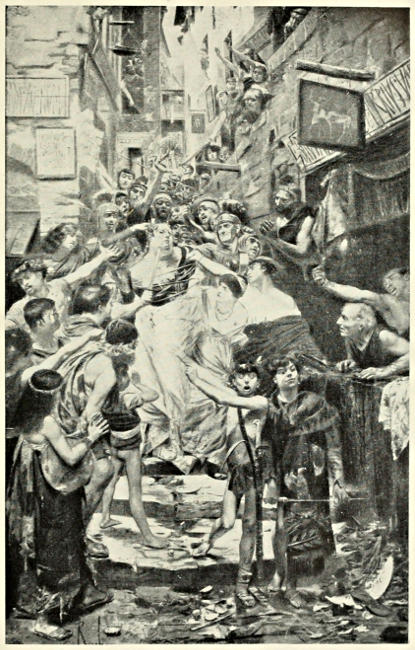
THE DEATH OF VITELLIUS
He was born at Luceria. He had completed his fifty-fourth year. He
rose to the consulship, to pontifical dignities, and a name and rank amongst
the most eminent citizens, without any personal merit; but obtained all
from the splendid reputation of his father. The men who conferred the
imperial dignity upon him did not so much as know him. By impotence
and sloth he gained the affections of the army, to a degree in which few have
attained them by worthy means. Frankness and generosity, however, he
possessed; qualities which, unless duly regulated, become the occasions of
ruin. He imagined that friendships could be cemented, not by a uniform
course of virtue, but by profuse liberality, and therefore earned them rather
than cultivated them. Doubtless the interest of the commonwealth required
the fall of Vitellius; but those who betrayed Vitellius to Vespasian can
claim no merit for their perfidy, since they had broken faith with Galba.
The day now verged rapidly towards sunset, and on account of the consternation
of the magistrates and senators who secreted themselves by withdrawing
from the city or in the several houses of their clients, the senate
could not be convened. When all apprehension of hostile violence had subsided
Domitian came forth to the generals of his party, was unanimously
saluted with the title of Cæsar, and escorted by a numerous body of soldiers,
armed as they were, to his father’s house.i
Mucianus, who arrived in Rome the day after the murder of Vitellius,
took over the government in the name of Vespasian.d Mucianus has been
styled (by Duruyn) “the Mæcenas and the Agrippa of the new Augustus.”
In subsequent years he was treated almost as an equal by the emperor. He
at once took active measures to restore order, and he succeeded so well that
everything was peaceful when Vespasian himself finally entered Rome.a In
Vespasian, for the first time since the death of Augustus, the Roman Empire
again received a worthy and able ruler. He was a man who not only, like
Galba, hated flattery and joined integrity with experience in warfare, but
whose understanding and force of character were equal to the circumstances
of the hour.d
[69-70 A.D.]
Vespasian was declared emperor, by the unanimous consent both of the
senate and the army, and dignified with all those titles which now followed
rather the power than the merit of those who were appointed to govern.
Messengers were despatched to him in Egypt, desiring his return, and testifying
the utmost desire for his government. But the winter being dangerous
for sailing, he deferred his voyage to a more convenient season. Perhaps,
also, the dissensions in other parts of the empire retarded his return to Rome;
for Claudius Civilis, in Lower Germany, excited his countrymen to revolt,
and destroyed the Roman garrisons which were placed in different parts of
that province. Yet, to give his rebellion an air of justice, he caused his army
to swear allegiance to Vespasian, until he found himself in a condition to
throw off the mask. When he thought himself sufficiently powerful, he disclaimed
all submission to the Roman government, and having overcome one
or two of the lieutenants of the empire, and being joined by such of the
Romans as refused obedience to the new emperor, he boldly advanced to
give Cerealis, Vespasian’s general, battle. In the beginning of this engagement
he seemed successful, breaking the Roman legions, and putting their
cavalry to flight. But at length Cerealis, by his conduct, turned the fate of
the day, and not only routed the enemy, but took and destroyed their camp.
This engagement, however, was not decisive; several others ensued with
doubtful success. An accommodation, at length, determined what arms
could not effect. Civilis obtained peace for his countrymen, and pardon for
himself; for the Roman Empire was, at this time, so torn by its own divisions,
that the barbarous nations around made incursions with impunity, and
were sure of obtaining peace, whenever they thought proper to demand it.
During the time of these commotions in Germany, the Sarmatians, a barbarous
nation to the northeast of the empire, suddenly passed the river Ister,
and marching into the Roman dominions with celerity and fury, destroyed
several garrisons, and an army under the command of Fonteius Agrippa.
However, they were driven back with some slaughter by Rubrius Gallus,
Vespasian’s lieutenant, into their native forests; where several attempts
were made to confine them, by garrisons and forts placed along the confines
of their country. But these hardy nations, having once found their way
into the empire, never after desisted from invading it at every opportunity,
till at length they overran and destroyed the glory of Rome.
Vespasian continued some months at Alexandria in Egypt.b The sober-minded
Tacitus, most accurate and most trustworthy of Roman historians,
relates some incidents of this story of Vespasian in Egypt which are worth
repeating, if for nothing else, to illustrate the gap between the writing of
sober history in that day and in our own.a
VESPASIAN PERFORMS MIRACLES AND SEES A VISION, ACCORDING TO
TACITUS
[70 A.D.]
During the months when Vespasian was waiting at Alexandria for the
periodical season of the summer winds, and a safe navigation [says Tacitus],
many miracles occurred, by which the favour of heaven and a sort of bias in
the powers above towards Vespasian were manifested. One of the common
people of Alexandria, known to have a disease in his eyes, embraced the knees
of the emperor, importuning with groans a remedy for his blindness. In this
he acted in compliance with the admonition of the god Serapis, whom that
nation, devoted to superstition, honours above all other gods; and he prayed
the emperor that he would deign to sprinkle his cheeks and the balls of his
eyes with the secretion of his mouth. Another, who was diseased in the
hand, at the instance of the same god, entreated that he might be pressed by
the foot and sole of Cæsar. Vespasian at first ridiculed the request, and
treated it with contempt; but when they persisted, at one time he dreaded
the imputation of weakness, at another he was led to hope for success, by
the supplications of the men themselves, and the encouragements of his flatterers.
Lastly, he ordered that the opinion of physicians should be taken, as
to whether a blindness and lameness of these kinds could be got the better of
by human power. The physicians stated various points—that in the one
the power of vision was not wholly destroyed, and that it would be restored
if the obstacle was removed; in the other, that the joints which had become
diseased might be renovated, if a healing power were applied; such peradventure
was the pleasure of the gods, and the emperor was chosen to perform
their will. To sum up all, that the glory of accomplishing the cure would
be Cæsar’s, the ridicule of its failure would rest upon the sufferers. Accordingly,
under an impression that everything was within the power of his
fortune, and that after what had occurred nothing was incredible, with a
cheerful countenance himself, and while the multitude that stood by waited
the event in all the confidence of anticipated success, Vespasian executed
what was required of him. Immediately the hand was restored to its functions,
and the light of day shone again to the blind. Persons who were
present even now attest the truth of both these transactions, when there is
nothing to be gained by falsehood.
After this, Vespasian conceived a deeper desire to visit the sanctuary of
Serapis, in order to consult the god about affairs of the empire. He ordered
all persons to be excluded from the temple; and lo, when he entered, and
his thoughts were fixed on the deity, he perceived behind him a man of
principal note among the Egyptians, named Basilides, whom, at that moment,
he knew to be detained by illness at a distance of several days’ journey from
Alexandria. Vespasian inquired of the priests whether Basilides that day
had entered the temple. He asked of others whom he met whether he was
seen in the city. At length, from messengers whom he despatched on horseback,
he received certain intelligence, that Basilides was at that instant of
time eighty miles distant from Alexandria. He then concluded that it was
a divine vision, and deduced the import of the response from the name of
Basilides.i
VESPASIAN RETURNS TO ROME
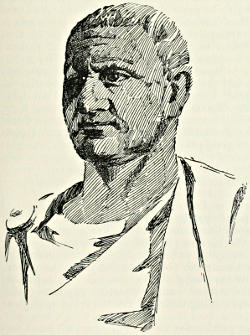
Vespasian
(From a bust in the Vatican)
Leaving Titus to prosecute
the Jewish War, Vespasian set
out for Rome. His enthusiastic
reception there is described by
Josephus, who says: “All men
that were in Italy showed their
respects to him in their minds,
before he came thither, as if he
were already come, as esteeming
the very expectation they
had of him to be his real presence
on account of the great
desires they had to see him,
and because the good will they
bore him was entirely free and
unconstrained; for it was a desirable
thing to the senate, who
well remembered the calamities
they had undergone in the late
changes of their governors, to
receive a governor who was
adorned with the gravity of old
age, and with the highest skill
in the actions of war, whose
advancement would be, as they
knew, for nothing else but the
preservation of those that were
to be governed.
“Moreover, the people had
been so harassed by their civil
miseries that they were still more earnest for his coming immediately, as supposing
they should then be firmly delivered from their calamities, and believed
they should then recover their secure tranquillity and prosperity. And for the
soldiery, they had the principal regard to him, for they were chiefly apprised
of his great exploits in war; and since they had experienced the want of skill
and want of courage in other commanders, they were very desirous to be
freed from that great shame they had undergone by their means and heartily
wished to receive such a prince as might be a security and an ornament to
them; and as this good will to Vespasian was universal, those that enjoyed
any remarkable dignities could not have patience enough to stay in Rome,
but made haste to meet him at a very great distance from it. Nay, indeed,
none of the rest could endure the delay of seeing him, but did all pour out of
the city in such crowds, and were so universally possessed with the opinion
that it was easier and better for them to go out than to stay there, that this
was the very first time that the city joyfully perceived itself almost empty
of its citizens; for those that stayed within were fewer than those that
went out. But as soon as the news was come that he was hard by, and those
that had met him at first related with what good humour he received every
one that came to him, then it was that the whole multitude that had
remained in the city, with their wives and children, came into the road, and
waited for him there; and for those whom he passed by, they made all sorts
of acclamations on account of the joy they had to see him, and the pleasantness
of his countenance, and styled him their benefactor and saviour, and
the only person who was worthy to be ruler of the city of Rome. And now
the city was like a temple, full of garlands and sweet odours; nor was it
easy for him to come to the royal palace for the multitude of people that
stood about him, where yet at last he performed his sacrifices of thanksgivings
to his household gods, for his safe return to the city. The multitude
did also betake themselves to feasting; which feasts and drink-offerings
they celebrated by their tribes, and their families, and their neighbourhoods,
and still prayed the gods to grant that Vespasian, his sons, and all their
posterity, might continue in the Roman government for a very long time,
and that his dominion might be preserved from all opposition. And this
was the manner in which Rome so joyfully received Vespasian, and thence
grew immediately into a state of great prosperity.”l
TITUS CONTINUES THE JEWISH WAR
[70-71 A.D.]
In the meantime, Titus carried on the war against the Jews with vigour.[20]
This obstinate and infatuated people had long resolved to resist the Roman
power, vainly hoping to find protection from heaven. Their own historian
represents them as arrived at the highest pitch of iniquity, while famines,
earthquakes, and prodigies all conspired to forewarn their approaching ruin.
Nor was it sufficient that heaven and earth seemed combined against them;
they had the most bitter dissensions among themselves, and were split into
two parties, that robbed and destroyed each other with impunity; still
pillaging, and, at the same time, boasting their zeal for the religion of their
ancestors.
At the head of one of those parties was an incendiary whose name was
John. This fanatic affected sovereign power, and filled the whole city of
Jerusalem, and all the towns around, with tumult and pillage. In a short
time a new faction arose, headed by one Simon, who, gathering together
multitudes of robbers and murderers who had fled to the mountains, attacked
many cities and towns, and reduced all Idumæa into his power. Jerusalem,
at length, became the theatre in which these two demagogues began to
exercise their mutual animosity: John was possessed of the temple, while
Simon was admitted into the city, both equally enraged against each other;
while slaughter and devastation followed their pretensions. Thus did a
city, formerly celebrated for peace and unity, become the seat of tumult
and confusion.
It was in this miserable situation that Titus came to sit down before it
with his conquering army, and began his operations within about six furlongs
of the place. It was at the feast of the Passover, when the place was
filled with an infinite multitude of people, who had come from all parts to
celebrate that great solemnity, that Titus undertook to besiege it. His
presence produced a temporary reconciliation between the contending factions
within; so that they unanimously resolved to oppose the common enemy
first, and then decide their domestic quarrels at a more convenient season.
Their first sally, which was made with much fury and resolution, put the
Romans into great disorder, and obliged them to abandon their camp and
fly to the mountains. However, rallying immediately after, the Jews were
forced back into the city; while Titus, in person, showed surprising instances
of valour and conduct.
These advantages over the Romans only renewed in the besieged their
desires of private vengeance. A tumult ensued in the temple, in which several
of both parties were slain; and in this manner, upon every remission
from without, the factions of John and Simon violently raged against each
other within, agreeing only in their resolution to defend the city against the
Romans.
Jerusalem was strongly fortified by three walls on every side, except
where it was fenced by deep valleys. Titus began by battering down the
outward wall, which, after much fatigue and danger, he effected; all the
time showing the greatest clemency to the Jews, and offering them repeated
assurances of pardon. But this infatuated people refused his proffered kindness
with contempt, and imputed his humanity to his fears. Five days after
the commencement of the siege Titus broke through the second wall; and
though driven back by the besieged, he recovered his ground, and made
preparations for battering the third wall, which was their last defence. But
first he sent Josephus, their countryman, into the city, to exhort them to
yield, who, using all his eloquence to persuade them, was only reviled with
scoffs and reproaches. The siege was now, therefore, carried on with greater
vigour than before; several batteries for engines were raised, which were
no sooner built than destroyed by the enemy. At length it was resolved in
council to surround the whole city with a trench, and thus prevent all relief
and succours from abroad. This, which was quickly executed, seemed no way
to intimidate the Jews. Though famine, and pestilence, its necessary attendant,
began now to make the most horrid ravages within the walls, yet this
desperate people still resolved to hold out. Though obliged to live upon
the most scanty and unwholesome food, though a bushel of corn was sold for
six hundred crowns, and the holes and the sewers were ransacked for carcasses
that had long since grown putrid, yet they were not to be moved.
The famine raged at last to such an excess, that a woman of distinction in
the city boiled her own child to eat it; which horrid account coming to the
ears of Titus, he declared that he would bury so abominable a crime in the
ruins of their state. He now, therefore, cut down all the woods within a
considerable distance of the city, and causing more batteries to be raised, he at
length battered down the wall, and in five days entered the citadel by force.
Thus reduced to the very verge of ruin, the remaining Jews still deceived
themselves with absurd and false expectations, while many false prophets
deluded the multitude, declaring they should soon have assistance from God.
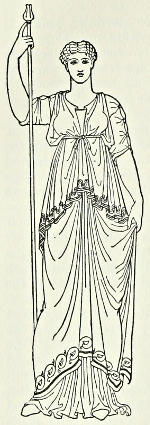
A Roman Empress
(After Hope)
The heat of the battle was now, therefore, gathered round the inner wall
of the temple, while the defendants desperately combated from the top.
Titus was willing to save this beautiful structure, but
a soldier casting a brand into some adjacent buildings,
the fire communicated to the temple, and, notwithstanding
the utmost endeavours on both sides, the
whole edifice was quickly consumed. The sight of the
temple in ruins effectually served to damp the ardour
of the Jews. They now began to perceive that heaven
had forsaken them, while their cries and lamentations
echoed from the adjacent mountains. Even those who
were almost expiring lifted up their dying eyes to bewail
the loss of their temple, which they valued more
than life itself. The most resolute, however, still endeavoured
to defend the upper and stronger part of
the city, named Zion; but Titus, with his battering
engines, soon made himself entire master of the place.
John and Simon were taken from the vaults where
they had concealed themselves; the former was condemned
to perpetual imprisonment, and the latter
reserved to grace the conqueror’s triumph. The greatest
part of the populace were put to the sword, and
the city was entirely rased by the plough; so that,
according to our Saviour’s prophecy, not one stone
remained upon another. Thus, after a siege of six
months, this noble city was totally destroyed, having
flourished, under the peculiar protection of heaven,
about two thousand years. The numbers who perished
in this siege, according to Josephus, amounted to above
a million of souls, and the captives to almost a hundred
thousand. The temporal state of the Jews ended
with their city; while the wretched survivors were
banished, sold, and dispersed into all parts of the world.
Upon the taking of Jerusalem, his soldiers would have crowned Titus as
conqueror, but he modestly refused the honour, alleging that he was only
an instrument in the hand of heaven, that manifestly declared its wrath
against the Jews. At Rome, however, all men’s mouths were filled with
the praises of the conqueror, who had not only shown himself an excellent
general, but a courageous combatant.b
Let Josephus describe for us the return of Titus, and the magnificent triumph
that he celebrated with his father.
JOSEPHUS DESCRIBES THE RETURN OF TITUS, AND THE TRIUMPH
[70 A.D.]
Titus took the journey he intended into Egypt, and passed over the
desert very suddenly, and came to Alexandria, and took up a resolution to
go to Rome by sea. And as he was accompanied by two legions, he sent
each of them again to the places whence they had before come; the fifth he
sent to Mysia; and the fifteenth to Pannonia. As for the leaders of the
captives, Simon and John, with the other seven hundred men, whom he had
selected out of the rest as being eminently tall and handsome of body, he
gave order that they should be soon carried to Italy, as resolving to produce
them in his triumph. So when he had had a prosperous voyage to his mind,
the city of Rome behaved itself in his reception, and their meeting him at a
distance, as it did in the case of his father.
But what made the most splendid appearance in Titus’ opinion was
when his father met him, and received him; but still the multitude of the
citizens conceived the greatest joy when they saw them all three together,[21]
as they did at this time; nor were many days overpast when they determined
to have but one triumph, that should be common to both of them, on
account of the glorious exploits they had performed, although the senate had
decreed each of them a separate triumph by himself. So when notice had
been given beforehand of the day appointed for this pompous solemnity to
be made, on account of their victories, not one of the immense multitude
was left in the city, but everybody went out so far as to gain only a station
where they might stand, and left only such a passage as was necessary for
those that were to be seen to go along it.
Now all the soldiery marched out beforehand by companies, and in their
several ranks, under their several commanders, in the night time, and were
about the gates, not of the upper palaces, but those near the temple of Isis;
for there it was that the emperors had rested the foregoing night. And as
soon as ever it was day, Vespasian and Titus came out crowned with laurel,
and clothed in those ancient purple habits which were proper to their
family, and then went as far as Octavian’s Walks; for there it was that the
senate, and the principal rulers, and those that had been recorded as of
the equestrian order, waited for them.
Now a tribunal had been erected before the cloisters, and ivory chairs
had been set upon it, when they came and sat down upon them. Whereupon
the soldiery made an acclamation of joy to them immediately, and all
gave them attestations of their valour; while they were themselves without
their arms, and only in their silken garments, and crowned with laurel. Then
Vespasian accepted of these shouts of theirs; but while they were still disposed
to go on in such acclamations, he gave them a signal of silence. And
when everybody entirely held their peace, he stood up, and covering the
greatest part of his head with his cloak, he put up the accustomed solemn
prayers; the like prayers did Titus put up also; after which prayers Vespasian
made a short speech to all the people, and then sent away the soldiers
to a dinner prepared for them by the emperors. Then did he retire to that
gate which was called the Gate of the Pomp, because pompous shows do always
go through that gate; there it was that they tasted some food, and when they
had put on their triumphal garments, and had offered sacrifices to the gods
that were placed at the gate, they sent the triumph forward, and marched
through the theatres, that they might be the more easily seen by the
multitude.
It is impossible to describe the multitude of the shows as they deserve,
and the magnificence of them all; such indeed as a man could not easily
think of as performed either by the labour of workmen, or the variety of
riches, or the rarities of nature. For almost all such curiosities as the most
happy men ever get by piecemeal were here heaped one upon another, and
those both admirable and costly in their nature; and all brought together
on that day demonstrated the vastness of the dominions of the Romans; for
there was here to be seen a mighty quantity of silver, and gold, and ivory,
contrived into all sorts of things, and did not appear as carried along in
pompous show only, but, as a man may say, running along like a river.
Some parts were composed of the rarest purple hangings, and so carried
along; and others accurately represented to the life what was embroidered
by the arts of the Babylonians. There were also precious stones that were
transparent, some set in crowns of gold, and some in other ouches, as the
workmen pleased; and of these such a vast number were brought, that we
could not but thence learn how vainly we imagined any of them to be rarities.
The images of the gods were also carried, being as well wonderful for
their largeness, as made very artificially, and with great skill of the workmen;
nor were any of these images of any other than very costly materials;
and many species of animals were brought, every one in their own natural
ornaments. The men also who brought every one of these shows were great
multitudes, and adorned with purple garments, all over interwoven with
gold; those that were chosen for carrying these pompous shows having
also about them such magnificent ornaments as were both extraordinary and
surprising. Besides these, one might see that even the great number of
captives was not unadorned, while the variety that was in their garments,
and their fine texture, concealed from the sight the deformity of their
bodies.
But what afforded the greatest surprise of all was the structure of the
pageants that were borne along; for indeed he that met them could not but
be afraid that the bearers would not be able firmly enough to support them,
such was their magnitude; for many of them were so made that they were
on three or even four stories, one above another. The magnificence also of
their structure afforded one both pleasure and surprise; for upon many of
them were laid carpets of gold. There was also wrought gold and ivory
fastened about them all; and many resemblances of the war, and those in
several ways, and variety of contrivances, affording a most lively portraiture
of itself. For there was to be seen a happy country laid waste, and entire
squadrons of enemies slain; while some of them ran away, and some were
carried into captivity; with walls of great altitude and magnitude overthrown,
and ruined by machines; with the strongest fortifications taken,
and the walls of most populous cities upon the tops of hills seized on, and
an army pouring itself within the walls; as also every place full of slaughter,
and supplications of the enemies, when they were no longer able to lift up
their hands in way of opposition. Fire also sent upon temples was here
represented, and houses overthrown and falling upon their owners; rivers
also, after they came out of a large and melancholy desert, ran down, not
into a land cultivated, nor as drink for men or for cattle, but through a
land still on fire upon every side; for the Jews related that such a thing
they had undergone during this war.
Now the workmanship of these representations was so magnificent and
lively in the construction of the things, that it exhibited what had been
done to such as did not see it, as if they had been there really present. On
the top of every one of these pageants was placed the commander of the city
that was taken, and the manner wherein he was taken. Moreover, there followed
those pageants a great number of ships; and for the other spoils, they
were carried in great plenty. But for those that were taken in the temple
of Jerusalem, they made the greatest figure of them all; that is the golden
table, of the weight of many talents; the candlestick also, that was made
of gold, though its construction were now changed from that which we
made use of: for its middle shaft was fixed upon a basis, and the small
branches were produced out of it to a great length, having the likeness of
a trident in their position, and had every one a socket made of brass for a
lamp at the tops of them. These lamps were in number seven, and represented
the dignity of the number seven among the
Jews; and, the last of all the spoils, was carried the
Law of the Jews.
Roman Tripod Candelabrum
After these spoils passed by a great many men,
carrying the images of Victory, whose structure was
entirely either of ivory, or of gold. After which Vespasian
marched in the first place, and Titus followed
him; Domitian also rode along with them, and made a
glorious appearance, and rode on a horse that was worthy
of admiration.
The last part of this pompous show was at the temple
of Jupiter Capitolinus, whither when they were
come, they stood still; for it was the Romans’ ancient
custom to stay till somebody brought the news that
the general of the enemy was slain. This general was
Simon, the son of Giora, who had then been led in this
triumph among the captives; a rope had also been put
upon his head, and he had been drawn into a proper
place in the Forum, and had withal been tormented by
those that drew him along; and the law of the Romans
required that malefactors condemned to die should be
slain there. Accordingly, when it was related that
there was an end of him, and all the people had set up
a shout for joy, they then began to offer those sacrifices
which they had consecrated, in the prayers used in such
solemnities; which when they had finished, they went
away to the palace.
And as for some of the spectators, the emperors
entertained them at their own feast; and for all the
rest there were noble preparations made for their feasting
at home; for this was a festal day to the city of
Rome, as celebrated for the victory obtained by their
army over their enemies, for the end that was now put
to their civil miseries, and for the commencement of
their hopes of future prosperity and happiness.
[71 A.D.]
After these triumphs were over, and after the affairs
of the Romans were settled on the surest foundations,
Vespasian resolved to build a temple to Peace, which
he finished in so short a time, and in so glorious a
manner, as was beyond all human expectation and opinion. For he having
now by providence a vast quantity of wealth, besides what he had formerly
gained in his other exploits, he had this temple adorned with pictures and
statues; for in this temple were collected and deposited all such rarities as
men aforetime used to wander all over the habitable world to see, when they
had a desire to see them one after another. He also laid up therein, as ensigns
of his glory, those golden vessels and instruments that were taken out
of the Jewish temple. But still he gave order that they should lay up their
law, and the purple veils of the holy place, in the royal palace itself, and
keep them there.l
THE EMPIRE IN PEACE
[69-79 A.D.]
Vespasian, having thus given security and peace to the empire, resolved
to correct numberless abuses which had grown up under the tyranny of his
predecessors. To effect this with greater ease, he joined Titus with him in
the consulship and tribunitial power; and, in some measure admitted him
a partner in all the highest offices of the state. He began with restraining
the licentiousness of the army, and forcing them back to their pristine discipline.
Some military messengers desiring money to buy shoes, he ordered
them for the future to perform their journeys barefoot. He was not less
strict with regard to the senators and the knights. He turned out such as
were a disgrace to their station, and supplied their places with the most
worthy men he could find. He abridged the processes that had been carried
to an unreasonable length in the courts of justice. He took care to
rebuild such parts of the city as had suffered in the late commotions; particularly
the Capitol, which had been lately burned, and which he now restored
to more than former magnificence.
The other ruinous cities in the empire also shared his paternal care; he
improved such as were declining, adorned others, and built many anew. In
such acts as these he passed a long reign of clemency and moderation;
so that it is said no man suffered by an unjust or a severe decree during
his administration.b
The care of rebuilding the Capitol [says Tacitus] he committed to Lucius
Vestinus, a man of equestrian rank, but in credit and dignity among the first
men in Rome. The soothsayers, who were convened by him, advised that
the ruins of the former shrine should be removed to the marshes, and a temple
raised on the old foundation; for the gods would not permit a change of
the ancient form. On the eleventh day before the calends of July, the sky
being remarkably serene, the whole space devoted to the sacred structure was
encompassed with chaplets and garlands. Such of the soldiers as had names
of auspicious import entered within the enclosure, with branches from trees
emblematical of good fortune. Then the vestal virgins in procession, with a
band of boys and girls whose parents, male and female, were still living,
sprinkled the whole place with water drawn from living fountains and rivers.
Helvidius Priscus, the prætor, preceded by Plautius Ælianus, the pontiff,
after purifying the area by sacrificing a swine, a sheep, and a bull, and
replacing the entrails upon the turf, invoked Jupiter, Juno, and Minerva,
and the tutelar deities of the empire, praying that they would prosper the
undertaking, and, with divine power, carry to perfection a work begun by
the piety of man; and then Helvidius laid his hand upon the wreaths that
bound the foundation stone and were twined about the cords. At the same
time, the magistrates, the priests, the senators, the knights, and a number of
citizens, with simultaneous efforts, prompted by zeal and exultation, haled the
ponderous stone along. Contributions of gold and silver, and pieces of other
metals, the first that were taken from the mines, that had never been melted in
the furnace, but in their native state, were thrown upon the foundations on
all hands. The soothsayers enjoined that neither stone nor gold which had
been applied to other uses should profane the building. Additional height
was given to the edifice; this was the only variation conceded by religion;
and in point of magnificence it was considered to be inferior to the former
temple.i
Vespasian also began the construction of the great amphitheatre which,
under the name of the Colosseum, became the wonder of subsequent generations,
and which is still sufficiently preserved to excite the admiration of
every tourist. But this gigantic structure—seating about eighty-five thousand
people—was not completed until the reign of Vespasian’s successor,
Titus.
BANISHMENT AND DEATH OF HELVIDIUS
In his conduct of both private and public affairs, Vespasian appears to
have acted with temperate judgment.a There are, however, two transactions
which, it must be acknowledged, have left a stain upon his memory. The
first was the death of Helvidius Priscus; the other, the heartless treatment
of Epponina, wife of Sabinus. Helvidius, excellent man, fell a sacrifice to his
enemies, and, perhaps, to his own intemperate conduct. Initiated early in
the doctrines of the stoic school, and confirmed in the pride of virtue by the
example of Pætus Thrasea, his father-in-law, he saw the arts by which Vespasian,
notwithstanding the rigour of his nature, courted popularity; and
did not scruple to say that liberty was more in danger from the artifices of
the new family, than from the vices of former emperors. In the senate he
spoke his mind with unbounded freedom.
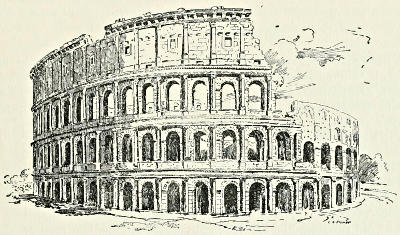
The Colosseum
Vespasian bore his opposition to the measures of government with
patience and silent dignity. He knew the virtues of the man, and retained
a due esteem for the memory of Thrasea. Willing, on that account, to live
on terms with Helvidius, he advised him to be, for the future, a silent
senator. The pride of a stoic spurned at the advice. Passive obedience
was so repugnant to his principles that he stood more firm in opposition.
Mucianus and Eprius Marcellus, who were the favourite ministers of the
emperor, were his enemies; and it is probable that, by their advice,
Vespasian was at length induced to let the proceedings of the senate take
their course. Helvidius was arraigned by the fathers, and ordered into
custody. He was soon after banished, and, in consequence of an order
despatched from Rome, put to death. It is said that Vespasian relented,
and sent a special messenger to respite execution; but the blow was struck.
Helvidius was, beyond all question, a determined republican. His own
imprudence provoked his fate; and this, perhaps, is what Tacitus had in
contemplation when he places the moderation of Agricola in contrast to the
violent spirit of others, who rush on certain destruction, without being by
their death of service to the public.
The case of Epponina was an instance of extreme rigour, or rather cruelty.
She was the wife of Julius Sabinus, a leading chief among the Lingones.
This man, Tacitus has told us, had the vanity to derive his pedigree from
Julius Cæsar, who, he said, during his wars in Gaul, was struck with the
beauty of his grandmother, and alleviated the toils of the campaign in her
embraces. Ambitious, bold, and enterprising, he kindled the flame of rebellion
among his countrymen, and, having resolved to shake off the Roman yoke,
marched at the head of a numerous army into the territory of the Sequani,
a people in alliance with Rome. This was 69 A.D. He hazarded a battle,
and was defeated with great slaughter. His rash-levied numbers were
either cut to pieces or put to flight. He himself escaped the general carnage.
He fled for shelter to an obscure cottage; and, in order to propagate
a report that he destroyed himself, set fire to his lurking-place.
SABINUS AND EPPONINA
By what artful stratagems he was able to conceal himself in caves and
dens, and, by the assistance of the faithful Epponina, to prolong his life for
nine years afterwards, cannot now be known from Tacitus. The account
which the great historian promised has perished with the narrative of
Vespasian’s reign. Plutarch relates the story as a proof of conjugal
fidelity. From that writer the following particulars may be gleaned:
Two faithful freedmen attended Sabinus to his cavern; one of them,
Martialis by name, returned to Epponina with a feigned account of her
husband’s death. His body, she was made to believe, was consumed in the
flames. In the vehemence of her grief she gave credit to the story. In a
few days she received intelligence by the same messenger that her husband
was safe in his lurking-place. She continued during the rest of the day to
act all the exteriors of grief, with joy at her heart, but suppressed with
care. In the dead of night she visited Sabinus. Before the dawn of day
she returned to her own house, and, for the space of seven months, repeated
her clandestine visits, supplying her husband’s wants, and softening all his
cares. At the end of that time she conceived hopes of obtaining a free
pardon; and having disguised her husband in such a manner as to render a
detection impossible, she accompanied him on a long and painful journey to
Rome. Finding there that she had been deceived with visionary schemes,
she marched back with Sabinus, and lived with him in his den for nine
years longer.
In the year 79 A.D. they were both discovered, and in chains conveyed
to Rome. Vespasian forgot his usual clemency. Sabinus was condemned,
and hurried to execution. Epponina was determined not to survive her
husband. She changed her supplicating tone, and, with a spirit unconquered
even in ruin, addressed Vespasian: “Death,” she said, “has no
terror for me. I have lived happier under ground, than you upon your
throne. Bid your assassins strike their blow; with joy I leave a world in
which you can play the tyrant.”
She was ordered for execution. Plutarch concludes with saying that
during Vespasian’s reign there was nothing to match the horror of this
atrocious deed; for which the vengeance of the gods fell upon Vespasian,
and, in a short time after, wrought the extirpation of his whole family.j
THE CHARACTER AND END OF VESPASIAN
[69-79 A.D.]
These, however, would seem to have been altogether exceptional instances
of cruelty. Anecdotes illustrating the opposite character are not wanting.
Thus: He caused the daughter of Vitellius, his avowed enemy, to be married
into a noble family; and he himself provided her a suitable fortune. One
of Nero’s servants coming to entreat pardon for having once rudely thrust
him out of the palace, and insulting him when in office, Vespasian only took
his revenge by serving him just in the same manner. When any plots or
conspiracies were formed against him, he disdained to punish the guilty, saying
that they deserved rather his contempt for their ignorance than his
resentment, as they seemed to envy him a dignity of which he daily experienced
the uneasiness. When he was seriously advised to beware of Mettius
Pomposianus, against whom there was strong cause of suspicion, he raised
him to the dignity of consul, adding that the time would come when he
must be sensible of so great a benefit.
His liberality in the encouragement of arts and learning was not less than
his clemency. He settled a constant salary of a hundred thousand sesterces
upon the teachers of rhetoric. He was particularly favourable to Josephus,
the Jewish historian. Quintilian, the orator, and Pliny, the naturalist, flourished
in his reign, and were highly esteemed by him. He was no less an
encourager of all other excellencies in art, and invited the greatest masters
and artificers from all parts of the world, making them considerable presents
as he found occasion.
Yet all his numerous acts of generosity and magnificence could not preserve
his character from the imputation of rapacity and avarice. He revived
many obsolete methods of taxation, and even bought and sold commodities
himself, in order to increase his fortune. He is charged with advancing the
most avaricious governors to the provinces, in order to share their plunder
on their return to Rome. He descended to some very unusual and dishonourable
imposts. But the avarice of princes is generally a virtue when their
own expenses are but few. The exchequer, when Vespasian came to the
throne, was so much exhausted that he informed the senate that it would require
a supply of 40,000,000,000, sesterces [£300,000,000 or $1,500,000,000]
to re-establish the commonwealth. This necessity must naturally produce
more numerous and heavy taxations than the empire had hitherto experienced;
but while the provinces were thus obliged to contribute to the support
of his power, he took every precaution to provide for their safety, so
that we find but two insurrections in his reign.
In the fourth year of his reign Antiochus, king of Commagene, holding a
private correspondence with the Parthians, the declared enemies of Rome,
was taken prisoner in Cilicia, by Pætus the governor, and sent bound to
Rome. But Vespasian generously prevented all ill-treatment towards him,
by giving him a residence at Lacedæmon and allowing him a revenue suitable
to his dignity.
About the same time also, the Alani, a barbarous people, who lived along
the river Tanaïs, abandoned their barren wilds and invaded the kingdom of
Media. From thence passing like a torrent into Armenia, after great ravages,
they overthrew Tiridates, the king of that country, with prodigious
slaughter. Titus was at length sent to chastise their insolence, and relieve a
king that was in alliance with Rome. However, the barbarians retired at the
approach of the Roman army, laden with plunder, being in some measure compelled
to wait a more favourable opportunity of renewing their irruptions.
But these incursions were as a transient storm, the effects of which were
soon repaired by the emperor’s moderation and assiduity. We are told that
he new-formed and established a thousand nations, which had scarcely before
amounted to two hundred. No provinces in the empire lay out of his view
and protection. He had, during his whole reign, a particular regard to Britain;
his generals, Petilius Cerealis and Julius Frontinus, brought the greatest
part of the island into subjection (70 A.D.), and Agricola, who succeeded
soon after (78 A.D.), completed what they had begun.
Such long and uninterrupted success no way increased this emperor’s
vanity. He ever seemed averse to those swelling titles which the senate and
people were constantly offering him. When the king of Parthia, in one of
his letters, styled himself king of kings, Vespasian in his answer only called
himself simply Flavius Vespasian. He was so far from attempting to hide
the meanness of his original that he frequently mentioned it in company;
and when some flatterers were for deriving his pedigree from Hercules, he
despised and derided the meanness of their adulation. In this manner having
reigned ten years, loved by his subjects and deserving their affection, he
was surprised with an indisposition at Campania. Removing from thence to
the city, and afterwards to a country-seat near Rome, he was there taken
with a flux, which brought him to the last extremity. However, perceiving
his end approaching, and as he was just going to expire, he cried out that
an emperor ought to die standing; wherefore, raising himself upon his feet,
he expired in the hands of those that sustained him. (79 A.D.)
“He was a man,” says Pliny,g “in whom power made no alteration, except
in giving him the opportunity of doing good equal to his will.” He was the
second Roman emperor that died an unquestionably natural death; and he
was peaceably succeeded by Titus his son.b
A CLASSICAL ESTIMATE OF VESPASIAN
The only thing deservedly blamable in Vespasian’s character [says Suetonius]
was his love of money. For not satisfied with reviving the imposts
which had been dropped under Galba, he imposed new taxes burdensome to
the subjects, augmented the tribute of the provinces, and doubled that of
some. He likewise openly practised a sort of traffic which would have
been scandalous even in a person below the dignity of an emperor, buying
great quantities of goods, for the purpose of retailing them again to advantage.
Nay, he made no scruple of selling the great offices of state to the
candidates, and pardons likewise to persons under prosecution, as well the
innocent as the guilty. It is believed that he advanced all the most rapacious
amongst the procurators to higher offices, with the view of squeezing
them after they had acquired great riches. He was commonly said, “to
have made use of them as sponges,” because he did, as one may say, wet
them when dry and squeeze them when wet. Some say that he was naturally
extremely covetous, and that he was upbraided with it by an old herdsman
of his, who, upon the emperor’s refusing to enfranchise him gratis, which at
his advancement he humbly petitioned for, cried out that the fox changed
his hair, but not his nature. There are some, on the other hand, of opinion
that he was urged to his rapacious proceedings by necessity, and the extreme
poverty of the treasury and exchequer, of which he publicly took notice in
the beginning of his reign; declaring that no less than forty thousand
millions of sesterces was necessary for the support of the government.
This is the more likely to be true of him, because he applied to the best
purposes what he procured by bad means.
His liberality to all ranks of people was particularly eminent. He made
up to several senators the estate required by law to qualify them for that
dignity, relieving likewise such men of consular rank as were poor, with a
yearly allowance of five hundred thousand sesterces; and rebuilt, in a better
manner than before, several cities in different parts of the empire, which
had been much damaged by earthquakes or fires.
He was a great encourager of learning and learned men. He first appointed
the Latin and Greek professors of rhetoric the yearly stipend of a
hundred thousand sesterces each out of the exchequer. He was likewise
extremely generous to such as excelled in poetry, or even the mechanic arts,
and particularly to one that brushed up the picture of Venus at Cos, and
another who repaired the Colossus. A mechanic offering to convey some
huge pillars into the capital at a small expense, he rewarded him very handsomely
for his invention, but would not accept of his service, saying, “You
must allow me to take care of the poor people.”
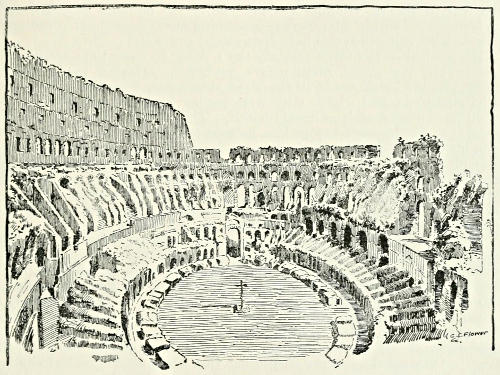
Interior of the Colosseum
In the games celebrated at the revival of the stage in Marcellus’ theatre,
he restored the old musical entertainments. He gave Apollinaris the tragedian
four hundred thousand sesterces; Terpnus and Diodorus the harpers
two hundred thousand; to some a hundred thousand; and the least he gave
to any of the performers was forty thousand, besides many golden crowns.
He had company constantly at his table, and entertained them in a plentiful
manner, on purpose to help the shambles. As in the Saturnalia he made
presents to the men at his table to carry away with them; so did he to the
women upon the calends of March; notwithstanding which he could not
wipe off the infamy of his former covetousness. The Alexandrians called
him constantly Cybiosactes; a name which had been given to one of their
kings who was sordidly covetous. Nay, at his funeral, Favo the archmimic,
representing his person, and imitating, as usual, his behaviour both in speech
and gesture, asked aloud of the procurators, how much his funeral pomp
would cost. And being answered “ten millions of sesterces,” he cried out,
that give him but a hundred thousand sesterces, and they might throw
his body into the Tiber, if they would.
Personality of Vespasian
He was broad set, strong limbed, and had the countenance of a person
who was straining. On this account, one of the buffoons at court, upon
the emperor’s desiring him “to say something merry upon him,” facetiously
answered, “I will, when you have done easing yourself.”
His method of life was commonly this: After he came to be emperor, he
used to rise very early, often before daybreak. Having read over his
letters, and the breviaries of all the offices about court, he ordered his friends
to be admitted; and whilst they were paying him their compliments, he
would put on his shoes and dress himself. Then, after the despatch of such
business as was brought before him, he rode out in his chaise or chair; and,
upon his return, laid himself down upon his couch to sleep, accompanied by
some of his concubines, of whom he had taken a great number into his
service upon the death of Cænis. After rising from his couch, he entered the
bath, and then went to supper. They say he never was more easy or obliging
than at that time; and therefore those about him always seized that
opportunity, when they had any favour to request of him.
He chiefly affected wit upon his own shameful means of raising money, to
wipe off the odium by means of a little jocularity. One of his ministers, who was
much in his favour, requesting of him a stewardship for some person, under
pretence of being his brother; he put off the affair, but sent for the person
who was the candidate, and having squeezed out of him as much money as
he had agreed to give his solicitor, he appointed him immediately to the place.
The minister soon after renewing his application, “You must,” said he,
“make a brother of somebody else; for he whom you took for yours is really
mine.” Once upon a journey suspecting that his mule driver had alighted
to shoe his mules, only to give time and opportunity to one that had a
lawsuit depending to speak to him, he asked him how much he had for
shoeing, and would have a share of the profit. Some deputies having
come to acquaint him that a large statue, which would cost a vast sum, was
ordered to be erected for him at the public charge, he bade them erect it
immediately, showing them his hand hollowed, and saying there was a
base ready for it.[22]
Even when Vespasian was under the apprehensions and danger of death,
he would not forbear his jests. For when, amongst other prodigies, the
mausoleum of the Cæsars flew open on a sudden, and a blazing star appeared
in the heavens, one of the prodigies, he said, concerned Julia Calvina, who
was of the family of Augustus; and the other, the king of the Parthians,
who wore his hair long. And when his distemper first seized him,“I suppose,”
said he, “I am going to be a god.”
[79-81 A.D.]
Titus, who had the same cognomen with his father, was [says Suetonius]
the darling and delight of mankind, (so much did he possess of happy endowments,
to conciliate the favour of all; and what is extremely difficult
indeed, after he came to be emperor; for before that period, even during
the reign of his father, he lay under the displeasure and censure of the
public). He was born upon the third of the calends of January, in the
year remarkable for the death of Caligula, near the Septizonium, in a mean
house, and a small dark chamber.
He was educated at court with Britannicus, instructed in the same parts
of literature, and under the same masters with him. During this time, they
say, that a physiognomist, being brought by Narcissus, the freedman of
Claudius, to inspect Britannicus, positively affirmed that he would never
come to be emperor, but that Titus, who stood by, would. They were so
familiar, that Titus being next him at table, is thought to have tasted of the
fatal potion which put an end to Britannicus’ life, and to have contracted
from it a distemper which remained with him a long time. The remembrance
of all these circumstances being fresh in his mind, he erected a golden
statue of him in the palace, dedicated to him another on horseback, of ivory,
and attended it in the Circensian procession.
He was, when a boy, remarkable for fine accomplishments both of body
and mind; and as he advanced in years, they became still more conspicuous.
He had a graceful person, combining an equal mixture of majesty and sweetness;
was very strong, though not tall, and somewhat big-bellied. He was
endowed with an excellent memory, and a capacity for all the arts of peace
and war; was a perfect master in the use of arms, and in riding the great
horse; very ready in the Latin and Greek tongues, as well in verse as prose;
and such was the facility he possessed in both, that he would harangue and
versify extempore. Nor was he unacquainted with music, but would both sing
and play upon the harp very finely, and with judgment. I have likewise
been informed by many, that he was remarkably quick in the writing of
shorthand, would in merriment and jest engage with his secretaries in the
imitation of any hands he saw, and often say, “that he was admirably qualified
for forgery.”
Upon the expiration of his quæstorship, he was made commander of a
legion, and took the two strong cities of Tarichea and Gamala in Judea;
and in a battle having his horse slain under him, he mounted another,
whose rider he was engaged with, and killed.
Soon after, when Galba came to be emperor, he was despatched away to
congratulate him upon the occasion, and turned the eyes of all people upon
him, wherever he came, it being the general opinion amongst them, that the
emperor had sent for him with a design to adopt him for his son. But finding
all things again in confusion, he turned back upon the road; and going
to consult the oracle of Venus at Paphos about his voyage, he received assurances
of obtaining the empire for himself. In this prediction he was soon
after confirmed; and being left to finish the reduction of Judea, in the last
assault upon Jerusalem, he slew seven of the men that defended it, with just
so many arrows, and took it upon his daughter’s birthday. Upon this occasion,
the soldiers expressed so much joy and fondness for him, that, in their
congratulation of him, they unanimously saluted him by the title of emperor;
and, upon his quitting the province soon after, would needs have
detained him, earnestly begging of him, and that not without threats, “either
to stay, or to take them all with him.” This incident gave rise to a suspicion
of his being engaged in a design to rebel against his father, and claim
for himself the government of the East; and the suspicion increased, when,
on his way to Alexandria, he wore a diadem at the consecration of the ox
Apis at Memphis; which though he did only in compliance with an ancient
religious usage of the country, yet there were some who put a bad construction
upon it. Making therefore what haste he could into Italy, he arrived
first at Rhegium, and sailing thence in a merchant ship to Puteoli, went to
Rome with all possible expedition. Presenting himself unexpectedly to his
father, he said, by way
of reflection upon the
rashness of the reports
raised against him, “I
am come, father, I am
come.”

Titus
(From a bust in the Vatican)
From that time he
constantly acted as partner
with his father in
the government, and indeed
as guardian of it.
He triumphed with his
father, bore jointly with
him the office of censor;
and was, besides, his
colleague not only in
the tribunitian authority,
but seven consulships.
Taking upon
himself the care and inspection
of all offices, he
dictated letters, wrote
proclamations in his
father’s name, and pronounced
his speeches in
the senate, in room of
the quæstor. He likewise
took upon him the
command of the guard,
which before that time
had never been held by
any but a Roman knight, and behaved with great haughtiness and violence,
taking off without scruple or delay all those of whom he was most jealous,
after he had secretly engaged people to disperse themselves in the theatres
and camp, and demand them as it were by general consent to be delivered
up to punishment. Amongst these he invited to supper A. Cæcina, a man
of consular rank, whom he ordered to be stabbed at his departure, immediately
after he had got out of the room. To this act he was provoked by
an imminent danger; for he had discovered a writing under the hand of
Cæcina, containing an account of a plot carried on amongst the soldiery.
By this means, though he provided indeed for the future security of his
family, yet for the present he so much incurred the hatred of the people,
that scarcely ever anyone came to the empire with a more odious character,
or was more universally disliked.
Besides his cruelty, he lay under the suspicion of luxury, because he
would continue his revels until midnight with the most riotous of his acquaintance.
Nor was he less suspected of excessive lewdness, because of the
swarms of favourites and eunuchs about him, and his well-known intrigue
with Queen Berenice, to whom he was likewise reported to have promised
marriage. He was supposed, besides, to be of a rapacious disposition; for
it is certain, that, in causes which came before his father, he used to offer
his interest to sale, and take bribes. In short, people openly declared an
unfavourable opinion of him, and said he would prove another Nero. This
prejudice however turned out in the end to his advantage, and enhanced his
praises not a little, because he was found to possess no vicious propensities,
but on the contrary the noblest virtues. His entertainments were pleasant
rather than extravagant; and he chose such a set of friends, as the following
princes acquiesced in as necessary for them and the government. He sent
away Berenice from the city immediately, much against both their inclinations.
Some of his old favourites, though such adepts in dancing that they
bore an uncontrollable sway upon the stage, he was so far from treating with
any extraordinary kindness, that he would not so much as see them in any
public assembly of the people. He violated no private property; and if ever
man refrained from injustice, he did; nay he would not accept of the allowable
and customary contributions. Yet he was inferior to none of the princes
before him, in point of generosity. Having opened his amphitheatre, and
built some warm baths close by it with great expedition, he entertained the
people with a most magnificent public diversion. He likewise exhibited a
naval fight in the old naumachia, besides a combat of gladiators; and in one
day brought into the theatre five thousand wild beasts of all kinds.
He was by nature extremely benevolent. For whereas the emperors after
Tiberius, according to the example he had set them, would not admit the
grants made by former princes to be valid, unless they received their own
sanction, he confirmed them all by one general proclamation, without waiting
until he should be addressed upon the subject. Of all who expressed a desire
of any favour, it was his constant practice to send none away without hopes.
And when his ministers insinuated to him, as if he promised more than he
could perform, he replied, “Nobody ought to go away sad from an audience
of his prince.” Once at supper, reflecting that he had done nothing for any
that day, he broke out into that memorable and justly admired saying,
“Friends, I have lost a day.”
He treated in particular the whole body of the people upon all occasions
with so much complaisance, that, upon promising them an entertainment of
gladiators, he declared, “He should manage it, not according to his own
fancy, but that of the spectators,” and did accordingly. He denied them
nothing, and very frankly encouraged them to ask what they pleased. Being
a favourer of the gladiators called Thraces, he would, as such, frequently
indulge a freedom with the people both in his words and gestures, but
always with the least violation either of his imperial dignity or justice. To
omit no occasion of acquiring popularity, he would let the common people
be admitted into his bath, even when he made use of it himself. There
happened in his reign some dreadful accidents, as an eruption of Mount
Vesuvius in Campania, and a fire in Rome which continued during three
days and three nights, besides a plague, such as was scarcely ever known
before. Amidst these dismal calamities, he not only discovered all the concern
that might be expected from a prince, but a paternal affection for his
people; one while comforting them by his proclamations, and another while
assisting them as much as was in his power. He chose by lot, from amongst
the men of consular rank, commissioners for the relief of Campania.
The estates of those who had perished by the eruption of Vesuvius, and
who had left no heirs, he applied to the repair of such cities as had been
damaged by that accident. In respect of the public buildings destroyed in
the fire of the city, he declared that nobody should be a loser by them but
himself. Accordingly, he applied all the ornaments of his palaces to the
decoration of the temples, and purposes of public utility, and appointed
several men of the equestrian order to superintend the work. For the relief
of the people during the plague, he employed, in the way of sacrifice and
medicine, all means both human and divine. Amongst the calamities of the
times, were informers, and those who employed them; a tribe of miscreants
who had grown up under the license of former reigns. These he frequently
ordered to be lashed or well cudgeled in the Forum, and then, after he had
obliged them to pass through the amphitheatre as a public spectacle, commanded
them to be sold for slaves, or else banished them into some rocky
islands. And to discourage the like practices for the future, amongst other
things, he forbade anyone to be proceeded against upon several laws for the
same fact, and that the condition of persons deceased should, after a certain
number of years, be exempt from all inquiry.
Having avowed that he accepted the office of high priest for the purpose
of preserving his hands undefiled, he faithfully adhered to his promise. For
after that time he was neither directly nor indirectly concerned in the death
of any person, though he sometimes was sufficiently provoked. He swore
that he “would perish himself, rather than prove the destruction of any
man.” Two men of patrician quality being convicted of aspiring to the
empire, he only advised them to desist, saying, that sovereign power was
disposed of by fate, and promised them, that, if they had anything else
to desire of him, he would gratify them. Upon this incident, he immediately
sent messengers to the mother of one of them, that was at a great distance,
and concerned about her son, to satisfy her that he was safe. Nay he not
only invited them to sup with him, but next day, at a show of gladiators,
purposely placed them close by him; and when the arms of the combatants
were presented to him, he handed them to the two associates. It is said
likewise, that upon being informed of their nativities, he assured them,
that some great calamity would sometime befall them, but from another
hand, not his. Though his brother was perpetually plotting against him,
almost openly spiriting up the armies to rebellion, and contriving to leave
the court with the view of putting himself at their head, yet he could not
endure to put him to death. So far was he from entertaining such a sentiment,
that he would not so much as banish him the court, nor treat him with
less respect than before. But from his first accession to the empire, he constantly
declared him his partner in it, and that he should be his successor;
begging of him sometimes in private with tears, to make him a return of
the like affection.c
THE DESTRUCTION OF POMPEII AND HERCULANEUM
[79 A.D.]
The reign of this excellent prince was marked by a series of public
calamities. He had reigned only two months when a tremendous volcanic
eruption, the first on record, from Mount Vesuvius spread dismay through
Italy. This mountain had hitherto formed the most beautiful feature in
the landscape of Campania, being clad with vines and other agreeable trees
and plants. Earthquakes had of late years been of frequent occurrence;
but on the 24th of August the summit of the mountain sent forth a volume
of flame, stones, and ashes which spread devastation far and wide. The sky
to the extent of many leagues was enveloped in the gloom of night; the
fine dust, it was asserted, was wafted even to Egypt and Syria; and at Rome
it rendered the sun invisible for many days. Men and beasts, birds and
fishes perished alike. The adjoining towns of Pompeii and Herculaneum
were overwhelmed by the earthquake which attended the eruption, and
their inhabitants destroyed. Among those who lost their lives on this
occasion was Pliny, the great naturalist. He commanded the fleet at
Misenum, and his curiosity leading him to proceed to Stabiæ to view this
convulsion of nature more closely, he was suffocated by the pestilential air.e
Dion Cassius has left us a vivid picture of the memorable eruption
of Vesuvius: “The events which occurred in Campania,” he says, “were
calculated to arouse both fear and wonder; there, just as autumn was
approaching, a great fire suddenly broke out. Mount Vesuvius is near the
sea of Naples and contains a vast reservoir of fire. In former times the
whole mountain was of the same height and the fire came from its very
centre; for this is the only spot which is in combustion; the whole of the
outside is, even to this day, exempt from fire. For this reason, since these
portions still remain intact while those of the centre crumbled away and
fell into dust, the surrounding peaks preserve their former elevation; while
on another side the whole of the part ignited, having been worn away by
time, has fallen in, leaving a cavity which, to compare small things with
great, gives to the mountain the general appearance of an amphitheatre.
On the top are trees and vines in great number, whilst the crater is the
prey of fire and exhales smoke by day and flame by night, so that it might
be supposed perfumes of every kind were being constantly burned within.
This phenomenon is manifested sometimes with more, sometimes with less
intensity; at times even cinders are thrown out when some great mass has
fallen in and stones fly about, driven by the violence of the wind. Noises
and rumblings proceed from the mountain, and it must be observed that
the apertures of the crater, which are some distance apart, are narrow and
hidden.
“Such is Vesuvius, and these manifestations are repeated nearly every
year. But the prodigies which occurred in earlier days, though to those
who gave them continued attention they appeared more than ordinary, may,
even if we take them all together, be regarded as trivial in comparison with
the occurrences of this period. This is what actually happened. Men,
numerous and huge, of a height exceeding that of any human being and
such as the giants are depicted, were seen to wander day and night, now
on the mountain, now in the surrounding district and in the towns, and
sometimes even walking in the air. Then suddenly there came winds and
violent tremblings of the ground, so that the whole plain shuddered and the
crests of the mountains leaped. At the same time noises arose, some subterranean,
resembling thunder, others, coming from the ground, were like
bellowings; the sea roared, and the sky, in echo, answered to its roarings.
After this a fearful crash, like mountains hurtling against one another,
suddenly made itself heard; then first stones were thrown out with such
force that they reached the summit of the mountain; then huge flames and
thick smoke which darkened the air and entirely hid the sun as in an
eclipse.
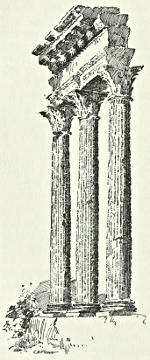
Columns of the Temple of Jupiter, Rome
“Night succeeded to day and darkness to light; some fancied that the
giants were reawakening to life, for many phantoms in their likeness were
seen in the smoke and moreover a noise of trumpets was heard; others
thought that the whole world was about to be swallowed up in chaos or
in fire. Therefore some fled from their houses into the streets; others from
the streets into their houses, from the sea to the land and from the land to
the sea, devoured by fear and feeling that anything at a distance was safer
than their present condition. At the same time a prodigious quantity of
cinders was thrown up and filled the earth, the sea, and the air; other
scourges also descended indiscriminately upon mankind, on the country and
on the herds, destroyed the fishes and the birds, and moreover engulfed two
whole cities, Herculaneum and Pompeii, with all the people who chanced to
be seated in the theatre. Finally there was so much dust that some of it
penetrated as far as Africa, Syria, Egypt, and
even Rome itself; darkening the air above that
city and covering the sun. There it gave rise
to a great panic which lasted several days, for
none knew what had happened and none could
guess what it was; men fancied that everything
had been reversed, that the sun was about to
disappear into the earth and the earth to be shot
up into the sky.
[79-80 A.D.]
“For the moment these ashes did no great
harm to the Romans (it was later on that they
engendered a terrible contagious sickness), but
the year following, another fire, starting above
ground, devoured a great part of Rome while
Titus was absent visiting the scene of the disasters
in Campania. The temples of Serapis and
Isis, the Septa, the temple of Neptune, the baths
of Agrippa, the Pantheon, the Diribitorium, the
theatre of Balbus, the scena of Pompey’s theatre,
the Porticus Octaviæ, with the library, the temple
of Jupiter Capitolinus, with the adjacent
temples, were the prey of the flames. True is
it that this misfortune was due less to men than
to the gods; for from what I have said all may
judge of the other losses. Titus sent two consulars
into Campania to establish colonies there and
gave the inhabitants, besides other sums, those
which fell in from citizens dying without heirs;
but he received none either from individuals,
or towns, or kings, in spite of many gifts and
promises on the part of many of them; however
this did not prevent his re-establishing
everything from his own resources.”f
It will be observed that Dion writes from the standpoint of a Roman,
and with only incidental reference to the loss of Pompeii and Herculaneum,
which cities evidently had no very great contemporary importance. Yet, as
has been pointed out, the burial of these cities resulted in the preservation
of a mass of documents which, brought to light some eighteen centuries
later, furnishes such testimony to the manners and customs of the time as
is presented by no other evidence extant.
PLINY’S ACCOUNT OF THE ERUPTION
[79 A.D.]
Further details of the disaster at Pompeii are given by Pliny the
Youngerg in two letters written to Tacitus, with the intention of furnishing
that historian with correct materials relative to the event.a He says:
It appears that many and frequent shocks of earthquake had been felt
for some days previously; but as these were phenomena by no means
uncommon in Campania, extraordinary alarm was not excited by that
circumstance, until, about one o’clock in the afternoon of the 24th of
August, a vast and singular cloud was seen to elevate itself in the atmosphere.
From what mountain it proceeded was not readily discernible at
Misenum, where Pliny the elder (at that time) held the command of the
Roman fleet. This cloud continued arising in an uniform column of smoke,
which varied in brightness, and was dark and spotted, as it was more or less
impregnated with earth and cinders. Having attained an immense elevation,
expanding itself, it spread out horizontally, in form like the branches
of the pine, and precipitated the burning materials with which it was charged
upon the many beautiful but ill-fated towns which stood thick upon this
delightful coast. The extraordinary phenomenon now excited the curiosity
of Pliny, who ordered a vessel to be prepared for the purpose of proceeding
to a nearer inspection; but meeting some of the fugitives, and
learning its destructive effects, his curiosity was changed to commiseration
for the distressed, to whose succour he immediately hastened.
On approaching Retina, the cinders falling hotter as well as in greater
quantity, mixed with pumice-stone, with black and broken pieces of burning
rock; the retreat and agitation of the sea driven backwards by the convulsive
motion of the earth, together with the disrupted fragments hurled from
the mountain on the shore, threatened destruction to anything which
attempted to advance. Pliny therefore ordered the ship to be steered towards
Stabiæ, where he found the alarm so great, that his friend Pomponianus had
already conveyed his more portable property on board a vessel. The historian,
less apprehensive, after partaking of a meal with his friend, went to
bed; but was, however, soon obliged to remove, as, had he remained much
longer, it was feared the falling cinders would have prevented the possibility
of forcing a way out of the room. Still the town had not yet been materially
affected, nor had the ravages of this great operation of nature reached
Misenum; but suddenly broad refulgent expanses of fire burst from every
part of Vesuvius, and, shining with redoubled splendour through the gloom
of night which had come on, glared over a scene, now accompanied by the
increased horrors of a continued earthquake, which shaking the edifices
from their foundations, and precipitating their roofs upon the heads of the
affrighted beings who had thought to find shelter in them, threatened
universal desolation.
Driven from their homes, which no longer afforded security, the unfortunate
inhabitants sought refuge in the fields and open places, covering their
heads with pillows, to protect themselves from the increasing fall of stones
and volcanic matter, which accumulated in such quantity, as to render it
difficult to withdraw the feet from the mass, after remaining still some
minutes; but the continuance of internal convulsion still persecuted them;
their chariots agitated to and fro, even propped with stones, were not to
be kept steady; while, although now day elsewhere, yet here most intense
darkness was rendered more appalling by the fitful gleams of torches, at
intervals obscured by the transient blaze of lightning.
Multitudes now crowded towards the beach, as the sea, it was imagined,
would afford certain means of retreat; but the boisterous agitation of that
element, alternately rolling on the shore, and thrown back by the convulsive
motion of the earth, leaving the marine animals upon the land it retreated
from, precluded every possibility of escape.
At length, preceded by a strong sulphurous stench, a black and dreadful
cloud, skirted on every side by forked lightning, burst into a train of
fire and igneous vapour, descended over the surface of the ocean, and covered
the whole bay of the crater, from the island of Capreæ to the promontory of
Misenum with its noxious exhalations; while the thick smoke, accompanied
by a slighter shower of ashes, rolled like a torrent among the miserable and
affrighted fugitives, who, in the utmost consternation, increased their
danger by pressing forward in crowds, without an object, amidst darkness
and desolation; now were heard the shrieks of women, screams of children,
clamours of men, all accusing their fate, and imploring death, the deliverance
they feared, with outstretched hands to the gods, whom many thought
about to be involved, together with themselves, in the last eternal night.
Three days and nights were thus endured in all the anguish of suspense
and uncertainty; many were doubtless stifled by the mephitic vapour;
others spent with the toil of forcing their way through deep and almost
impassable roads, sank down to rise no more; while those who escaped,
spread the alarm, with all the circumstances of aggravation and horror
which their imaginations, under the influence of fear, suggested. At length
a gleam of light appeared, not of day, but fire; which, passing, was succeeded
by an intense darkness, with so heavy a shower of ashes, that it
became necessary to keep the feet in motion to avoid being fixed and buried
by the accumulation. On the fourth day the darkness by degrees began to
clear away, the real day appeared, the sun shining forth sickly as in an
eclipse; but all nature, to the weakened eyes, seemed changed; for towns
and fields had disappeared under one expanse of white ashes, or were doubtfully
marked, like the more prominent objects, after an alpine fall of snow.
If such be the description of this most tremendous visitation, as it affected
Stabiæ and Misenum, comparatively distant from the source of the calamity,
what must have been the situation of the unfortunate inhabitants of Pompeii,
so near, of Herculaneum, within its focus? Must we not conclude that, at
the latter place at least, most of those not overwhelmed by the torrents of
stony mud which preceded others of flaming lava, burying their city sixty
feet under the new surface, were overtaken by the showers of volcanic matter
in the field, or drowned in attempting to escape by sea, their last but hopeless
resource, since it appears to have received them to scarcely less certain
destruction?
[79-80 A.D.]
The emperor Titus, whose great and good qualities here found every opportunity
for their display, immediately hastened to this scene of affliction;
appointed curatores, persons of consular dignity, to set up the ruined buildings,
and take charge of the effects of those who perished without heirs, for
the benefit of the surviving sufferers; to whom he remitted all taxes, and
afforded that relief the nature of their circumstances required; personally
encouraging the desponding, and alleviating the miseries of the sufferers,
until a calamity of an equally melancholy description recalled him to the
capital, where [as we have just been told by Dion Cassius] a most destructive
fire laying waste nearly half the city, and raging three days without
intermission, was succeeded by a pestilence, which for some time is said to
have carried off ten thousand persons daily.h
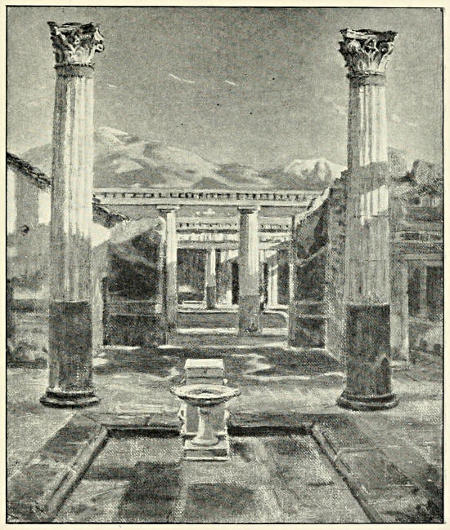
THE RUINS OF POMPEII
AGRICOLA IN BRITAIN
[79 A.D.]
It was in the time of Vespasian and Titus that the famous Agricola campaigned
in Britain. In his first summer there (78), he led his forces into
the country of the Ordovices, in whose mountain passes the war of independence
still lingered, drove the Britons across the Menai straits, and pursued
them into Anglesea, as Suetonius had done before him, by boldly crossing the
boiling current in the face of the enemy. The summer of 79 saw him advance
northward into the territory of the Brigantes, and complete the organisation
of the district, lately reduced, between the Humber and Tyne. Struck perhaps
with the natural defences of the line from the Tyne to the Solway,
where the island seems to have been broken, as it were, in the middle and
soldered unevenly together, he drew a chain of forts from sea to sea, to protect
the reclaimed subjects of the southern valleys from the untamed barbarians
who roamed the Cheviots and the Pentlands.
To penetrate the stormy wilds of Caledonia, and track to their fastnesses
the hordes of savages, the Ottadini, Horesti, and Mæatæ, who flitted among
them, was an enterprise which promised no plunder and little glory. The
legions of Rome, with their expensive equipments, could not hope even to
support themselves on the bleak mountain sides, unclaimed by men and
abandoned by nature. His camps on the Tyne and Irthing were the magazines
from which Agricola’s supplies must wholly be drawn; the ordinary
term of a provincial prefecture was inadequate to a long, a distant, and an
aimless adventure. But Vespasian had yielded to the ardour of his favourite
lieutenant; ample means were furnished, and ample time was allowed. In the
third year of his command (80) Agricola pushed forward along the eastern
coast, and making good with roads and fortresses every inch of his progress,
reached, perhaps, the Firth of Forth. He had here reached the point
where the two seas are divided by an isthmus less than forty miles in breadth.
Here he repeated the operations of the preceding winter, planting his camps
and stations from hill to hill, and securing a new belt of territory, ninety
miles across, for Roman occupation. The natives, scared at his presence and
fleeing before him, were thus thrust, in the language of Tacitus, as it were
into another island. For a moment the empire seemed to have found its
northern limit. Agricola rested through the next summer, occupied in the
organisation of his conquests, and employed his fifth year (82) also in
strengthening his position between the two isthmuses, and reducing the
furthest corners of the province, whence the existence of a new realm was
betrayed to him. The grassy plains of teeming Hibernia offered a fairer
prey than the gray mountains which frowned upon his fresh entrenchments,
and all their wealth, he was assured, might be secured by the valour of a
single legion. But other counsels prevailed; Agricola turned from the
Mull of Galloway, and Ireland was left to her fogs and feuds for eleven
more centuries.k
THE DEATH OF TITUS
[79-81 A.D.]
Meanwhile [says Suetonius], Titus was taken off by an untimely death,
more to the loss of mankind than himself. At the close of the public diversions
with which he entertained the people, he wept bitterly before them all,
and then went away for the country of the Sabines, very melancholy, because
a victim, when about to be sacrificed, had made its escape, and loud thunder
had been heard during a serene state of the atmosphere. At the first stage
on the road, he was seized with a fever, and being carried thence in a sedan,
they say that he put by the curtains, and looked up to heaven, complaining
heavily, that his life was taken from him, though he had done nothing to
deserve it; for there was no action of his that he had occasion to repent
of, but one. What that was, he neither intimated himself, nor is it easy
for any to conjecture. Some imagine that he alluded to the unlawful familiarity
which he had formerly had with his brother’s wife. But Domitia
solemnly denied it with an oath; which she would never have done, had
there been any truth in the report; nay, she would certainly have boasted
of it, as she was forward
enough to do in regard to
all her shameful intrigues.
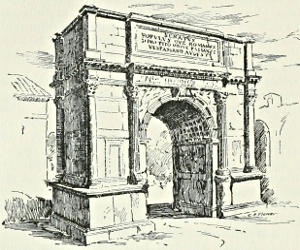
Arch of Titus, Rome
He died in the same
villa where his father had
done before him, upon the
ides of September; two
years, two months, and
twenty days after he had
succeeded his father; and
in the one and fortieth year
of his age. As soon as the
news of his death was published,
all people mourned
for him, as for the loss of
some near relation. The
senate, before they could
be summoned by proclamation,
drew together, and
locking the doors of their
house at first, but afterwards opening them, gave him such thanks, and
heaped upon him such praises now he was dead, as they never had done
whilst he was alive and present amongst them.c
The reigns of Vespasian and Titus were marked by two important circumstances.
The monarchical form of government, for the first time since
the reign of Augustus, showed itself conducive to the culture, morals,
outward well-being, and comforts of life. Besides this, the great unity of
the Roman Empire, as one state, had its beginning under these emperors,
or in other words, from that time forward, little by little, the provinces
ceased to be subordinate parts of the body politic, in which until now, with
the exception of a few towns and individuals, only the inhabitants of Italy
had been citizens, and all others subjects. The latter change was not
only maintained after the death of Titus, but spread itself later over all
the empire. On the other hand, the benefits conferred on the empire by the
personal character of Vespasian and Titus were only temporary; for the
prevalent weakness, and instability of opinion, and the lack of a definite
and firmly established constitution, made every bad ruler exercise a great
personal influence, and his example had a stronger effect on the life and
morals of the people than his administration. It would have been impossible
even for the best ruler to introduce a better organisation among a
people, the great majority of whom had already sunk too low, and who
flattered and served every tyrant and every vice, in order to enjoy themselves
undisturbed. This was shown immediately after the death of Titus,
under the reign of his brother Domitian.d
[81-96 A.D.]
Ere Titus had breathed his last, Domitian caused every one to abandon
him, and mounting his horse rode to the prætorian camp, and caused himself
to be saluted emperor by the soldiers. Like most bad emperors, Domitian
commenced his reign with popular actions, and a portion of his good qualities
adhered to him for some time.[23] Such were his liberality (for no man
was freer from avarice) and the strictness with which he looked after the
administration of justice, both at Rome and in the provinces. His passion
for building was extreme; not content with restoring the Capitol, the Pantheon,
and other edifices injured or destroyed by the late conflagration, he
built or repaired several others; and on all, old and new alike, he inscribed
his own name, without noticing the original founder.
Domitian was of a moody, melancholy temper, and he loved to indulge in
solitude. His chief occupation when thus alone, we are told, was to catch
flies, and pierce them with a sharp writing-style; hence Vibius Crispus,
being asked one day if there was any one within with Cæsar, replied, “No,
not so much as a fly.” Among the better actions of the early years of this
prince, may be noticed the following. He strictly forbade the abominable
practice of making eunuchs, for which he deserves praise; though it was
said that his motive was not so much a love of justice as a desire to depreciate
the memory of his brother, who had a partiality for these wretched beings.
Domitian also at this time punished three vestals who had broken their vows
of chastity; but instead of burying them alive, he allowed them to choose
their mode of death.
In the hope of acquiring military glory, he undertook (83) an expedition
to Germany, under the pretence of chastising the Chatti. But he merely
crossed the Rhine, pillaged the friendly tribes and returned to celebrate the
triumph which the senate had decreed him. While, however, he was thus
triumphing for imaginary conquests, real ones continued to be achieved in
Britain by Cn. Julius Agricola, to whom, as we have seen, Vespasian and
Titus had committed the affairs of that island (78). He had conquered the
country as far as the firths of Clyde and Forth, and (83) defeated the Caledonians
in a great battle at the foot of the Grampians. Domitian, though
inwardly grieved, affected great joy at the success of Agricola; he caused
triumphal honours, a statue, and so forth to be decreed him by the senate,
and gave out that he intended appointing him to the government of Syria;
but when Agricola returned to Rome, after having fully established the
Roman power in Britain, Domitian received him with coldness, and never
employed him again.
The country on the left bank of the lower Danube, the modern Transylvania,
Wallachia, Moldavia was at this time inhabited by a portion of the
Sarmatian or Slavonian race named the Dacians, and remarkable for their
valour. The extension of the Roman frontier to the Danube in the time of
Augustus, had caused occasional collisions with this martial race; but no
war of any magnitude occurred till the present reign. The prince of the
Dacians at this time, named Decebalus, was one of those energetic characters
often to be found among barbarous tribes, to whom nature has given all the
elements of greatness, but fortune has assigned a narrow and inglorious stage
for their exhibition. It was probably the desire of military glory and of
plunder, rather than fear of the avarice of Domitian, the only cause assigned,
that made Decebalus at this time (86) set at nought the treaties subsisting
with the Romans, and lead his martial hordes over the Danube. The troops
that opposed them were routed and cut to pieces; the garrisons and castles
were taken, and apprehensions were entertained for the winter quarters of
the legions. The danger seemed so imminent, that the general wish was
manifested for the conduct of the war being committed to Agricola; and
the imperial freedmen, some from good, others from evil motives, urged their
master to compliance. But his jealousy of that illustrious man was invincible,
and he resolved to superintend the war in person.
Domitian proceeded to Illyricum, where he was met by Dacian deputies
with proposals of peace, on condition of a capitation tax of two oboles a
head being paid to Decebalus. The emperor forthwith ordered Cornelius
Fuscus, the governor of Illyricum, to lead his army over the Danube, and
chastise the insolent barbarians. Fuscus passed the river by a bridge of
boats; he gained some advantages over the enemy, but his army was finally
defeated and himself slain. Domitian, who had returned to Rome, hastened
back to the seat of war; but instead of heading his troops, he stopped in a
town of Mœsia, where he gave himself up to his usual pleasures, leaving the
conduct of the war to his generals, who, though they met with some reverses,
were in general successful; and Decebalus was reduced to the necessity of
suing for peace. Domitian refused to grant it; but shortly after, having
sustained a defeat from the Marcomans whom he wished to punish for not
having assisted him against the Dacians, he sent to offer peace to Decebalus.
The Dacian was not in a condition to refuse it, but he would seem to have
dictated the terms; and in effect an annual tribute was henceforth paid to
him by the Roman emperor. Domitian, however, triumphed for the Dacians
and Marcomans, though he paid tribute to the former, and had been defeated
by the latter.
During the Dacian War (88), L. Antonius, who commanded in Upper
Germany, having been grossly insulted by the emperor, formed an alliance
with the Alamanni, and caused himself to be proclaimed emperor. But
L. Maximus marched against him, and the Alamanni, having been prevented
from coming to his aid by the rising of the Rhine, he was defeated and slain.
Maximus wisely and humanely burned all his papers, but that did not
prevent the tyrant from putting many persons to death as concerned in the
revolt.
A war against the Sarmatians, who had cut to pieces a Roman legion, is
placed by the chronologists in the year 93. Domitian conducted it in person,
after his usual manner; but instead of triumphing, he contented himself with
suspending a laurel crown in the Capitol. This is the last foreign transaction
of his reign.e
Domitian’s principal faults were an immoderate pride, boundless prodigality,
and a childish desire to distinguish himself. His appearance, his
voice, and, in short, his whole bearing betrayed a proud and despotic nature.
By his unrestrained prodigalities he was drawn into avarice and rapacity,
and his fear of intrigues made him cruel. Spoilt by indulgences in early
youth, as emperor he gave way to an unbridled taste for public amusements,
cruel sports, gladiatorial games, chariot races, and a foolish passion
for building. These extravagances entailed a continual lack of money,
which drove him to oppression and cruelty. At the last, he hated and
avoided mankind as Tiberius had done and became insane like Caligula.
He was not wanting in intellectual abilities; as a young man he had made
very good verses, had composed a poem on the conquest of Jerusalem, and
had written a better translation of the poem of Aratus on the stars, than
Cicero and Germanicus. As soon as he succeeded to the throne, he considered
it beneath his dignity to occupy himself with intellectual things;
from thenceforth he only studied the records and journals of Tiberius, and
left the composition of his letters, ordinances, and speeches almost entirely
to others.
The first part of his reign was better than might have been expected
from his character. In its early years he showed no avarice, but was
inclined to be generous and magnanimous. He issued some excellent
ordinances, checked the malpractices of complainants and calumniators, as
well as the publication of lampoons, punished partisan judges with great
severity, and kept the officials in order with such energy, that none of them
dared to neglect their duties either in Rome or the provinces; and as the
historian Suetonius puts it, somewhat too strongly, the magistrates were
never more just or incorruptible than in his reign. For this reason, Domitian
was from the beginning hated by the senate, which was composed for
the most part of high public officials, especially as he showed himself in
every respect far less favourably disposed towards the aristocracy than Vespasian
and Titus.
When Domitian observed how few friends he had in the senate and upper
classes, he tried to win the populace by rich donations, public entertainments,
and brilliant revels, and granted the soldiers such a considerable rise in their
pay, that he himself soon saw the impossibility of meeting the great expense
so incurred. He increased the pay by one-fourth, and, since the finances of
the state could not suffice for such an expenditure, he tried to have recourse
to a diminution of the number of the troops; but had to give up the idea,
for fear of disturbances, mutinies in the army, and the exposure of the
frontier to the attacks of the barbarians. Domitian had not much to fear
from the hatred of the senate; for though Vespasian had cast out its unworthy
members and replaced them by men from the most distinguished
families of the whole empire, it was no better under Domitian than it had
been before.[24]
The great corruption of the Roman Empire of that time is manifest from
the fact that the changes instituted in the highest government departments
by the best among the emperors, were only of service so long as a good and
powerful ruler was at the head of the government. The very senate, which
Vespasian had tried to purify, submitted under Domitian to every whim of
the tyrant. It is impossible to say which was the greater, the effrontery of
the emperor or the baseness of the highest court of the empire. Under two
worthy successors of Domitian, the same senators again proved themselves
reasonable and dignified, not because the spirit of the times had changed or
that they themselves had become better, but because the man who was at
the head of the state powerfully influenced the senate by his character, and
so infused a better spirit into it.
It would be as wearisome for the historian as for the reader to enumerate
the prodigalities, eccentricities, and cruelties to which Domitian abandoned
himself more completely the longer he reigned. In his vanity he
declared himself a god like Caligula, caused sacrifices to be offered to him,
and introduced the custom of being styled “Our lord and god” in all public
ordinances and documents. He squandered immense sums on building,
instituted the most magnificent public games, and, like Tiberius and
Nero, was slave to all sorts of excesses. In order to obtain the money he
required, he caused many rich people to be robbed of their goods or executed
on every kind of pretext. Not avarice alone, but suspicion and
fear drove him to acts of despotism and cruelty.d Little by little he
gained, it was alleged, an actual taste for tormenting his victims. It was
said that he took delight in being present at the torture and execution of
prisoners, and that by a refinement of cruelty, he often showed himself most
friendly towards those persons whose death he contemplated. But allowance
must be made in all this for the exaggeration of scandal-mongers.
That he was severe in stamping out all opposition, however, is not to be
questioned.a His hatred of the senators was inflamed by the discovery that
many of them shared in the conspiracy of Saturninus, a rebellious governor
of northern Germany. From that time to the end of his reign he was a
terror to the nobility, as well as to the stoics, whose teachings glorified
conspiracy and “tyrannicide.”m
The citizens being defenceless, the senate without authority, the soldiers
as partial to Domitian as they had once been to Nero, and no one except his
confidants and servants daring to approach him, the tyrant would probably
never have been overthrown had he not, like Caligula, made those around
him fearful for their lives. His own wife, Domitia, conspired with some of
those persons who had to write down or execute his cruel orders to destroy
him. Chance once placed in the hands of Domitia a list of the condemned
on which the suspicious tyrant had written her name. On the same list were
the names of the two prefects of the guard, Norbanus and Petronius, and of
Parthenius, Domitian’s most trusted chamberlain, and it was therefore easy
for Domitia to bring about a conspiracy against her husband. To carry it
out was more difficult, for Domitian possessed great bodily strength, and in
his suspicion had taken all sorts of precautions against such attempts. The
tyrant was surprised in his sleeping apartment, and slain after a desperate
resistance. The guards were so enraged at the murder of Domitian that his
successor, Nerva, could not protect the conspirators from their anger, and
they were cut to pieces by the soldiers after their execution had been in
vain demanded of the new emperor.
After Domitian’s death the senate gave full vent to its hatred of the
tyrant. The statue of the murdered emperor was immediately destroyed
by its orders, his triumphal arches overthrown, and his name effaced from
all public monuments. The government was handed over to the old senator
Cocceius Nerva, whom the conspirators had immediately proclaimed
emperor on Domitian’s death. It is most characteristic of those times that
Nerva was said to be raised to the throne, not so much on account of his
services to the state, but because, under Domitian, some astrologers had
said that the horoscope of this man pointed to his becoming emperor at some
future time.[25] It was universally believed that a celebrated philosopher,
Apollonius of Tyana, to whom supernatural powers were ascribed, witnessed
the murder of Domitian in the spirit at Ephesus at the same time
that it took place, and publicly announced it to the people.d
Other superstitions concerning the death of Domitian, together with
an account of the personal characteristics and habits of living of the emperor,
and of the manner of his taking off, are given by Suetonius; this
biography being the concluding one in the famous work we have so frequently
quoted.a
SUETONIUS ON THE DEATH AND CHARACTER OF DOMITIAN
With respect to the contrivance and execution of Domitian’s death, [he
says] the common account is this. The conspirators being in some doubt
when and where they should attack him, whether while he was in the bath,
or at supper, Stephanus, a steward of Domitilla’s, then under a prosecution
for defrauding his mistress, offered them his advice and assistance; and
wrapping up his left arm, as if it was hurt, in wool and bandages for some
days, to prevent suspicion, at the very hour appointed for the execution of
the plot, he made use of this further stratagem. He pretended to make a
discovery of a plot, and being for that reason admitted, he presented to the
emperor a writing, which whilst the latter was reading with the appearance
of one astonished, he stabbed him in the groin. But Domitian making resistance,
Clodianus, one of his chamberlains, Maximus a freedman of Parthenius’,
Saturius a superintendent of his bedchamber, with some gladiators, fell upon
him, and stabbed him in seven places. A boy that had the charge of the
Lares in his bedchamber, then in attendance as usual, when the transaction
was over, gave this further account of it; that he was ordered by Domitian,
upon receiving his first wound, to reach him a dagger which lay under his bolster,
and call in his servants; but that he found nothing at the head of the bed,
excepting the hilt of a poniard, and that all the doors were secured; that the
emperor in the meantime got hold of Stephanus, and throwing him upon the
ground, struggled a long time with him; one while endeavouring to wrench
his sword from him, another while, though his fingers were miserably mangled,
to pull out his eyes. He was slain upon the 18th of the calends of
September, in the forty-fifth year of his age, and the fifteenth of his reign.
His corpse was carried out upon a common bier by the public bearers, and
buried by his nurse Phyllis, on an estate which had belonged to him by the
Latin way, not far from Rome. But his remains were afterwards privately
conveyed into the temple of the Flavian family, and mixed with the ashes
of Julia, Titus’ daughter, whom the same woman had likewise nursed.
He was of a tall stature, a modest countenance, and very ruddy; had large
eyes, but dim-sighted. His person was graceful, and in his youth completely
such, excepting only that his toes were bent somewhat inward. He was at
last disfigured by baldness, a fat belly, and the slenderness of his legs, which
were reduced by a long illness. He was so sensible how much the modesty
of his countenance recommended him, that he once made this boast to the
senate, “Thus far you have approved of my disposition and countenance
too.” He was so much concerned at his baldness, that he took it as an
affront upon himself, if any other person was upbraided with it, either in
jest or earnest.
He was so incapable of bearing fatigue, that he scarcely ever walked
about the city. In his expeditions and on a march, he seldom made use of a
horse, riding generally in a chair. He had no inclination for the exercise
of arms, but was fond of the bow. Many have seen him kill a hundred wild
beasts, of various kinds, at his seat near Alba, and strike his arrows into their
heads with such dexterity, that he would, at two discharges of his bow, plant
as it were a pair of horns upon them. He would sometimes direct his arrows
against the hand of a boy standing at a distance, and expanded as a mark for
him, with such exactness, that they all passed betwixt his fingers without
hurting him.
In the beginning of his reign, he laid aside the study of the liberal sciences,
though he took care to restore, at a vast expense, the libraries which had been
burned down, by collecting copies from all parts, and sending scribes to Alexandria,
either to copy or correct from the repository of books at that place.
Yet he never applied himself to the reading of history or poetry, or to exercise
his pen for his own improvement. He read nothing but the commentaries
and acts of Tiberius Cæsar. His letters, speeches, and proclamations
were all drawn up for him by others, though he would talk speciously, and
sometimes express himself in sentiments worthy of notice. “I could wish,”
said he once, “that I was but as handsome as Mettius fancies himself to be.”
And the head of one whose hair was part yellow and part gray, he said “was
snow sprinkled with mead.”
He said “the condition of princes was very miserable, who were never
credited in the discovery of a plot, until they were murdered.” When he
had no business, he diverted himself at play, even upon days that were not
festivals, and in the morning. He entered the bath by noon, and made a
plentiful dinner, insomuch that he seldom ate more at supper than a Matian
apple, to which he added a small draught of wine, out of a round-bellied jug
which he used. He gave frequent and splendid entertainments, but commonly
in a hurry, for he never protracted them beyond sunset and had no
drinking repast after. For, until bed-time, he did nothing else but walk by
himself in private.
The people bore his death with much unconcern, but the soldiery with
great indignation, and immediately endeavoured to have him ranked amongst
the gods. Though ready to revenge his death, however, they wanted some
person to head them; but this they effected soon after, by resolutely demanding
the punishment of all those that had been concerned in his assassination.
On the other hand, the senate was so overjoyed, that they assembled in all
haste, and in a full house reviled his memory in the most bitter terms; ordering
ladders to be brought in, and his shields and images to be pulled down
before their eyes, and dashed in pieces upon the spot against the ground;
passing at the same time a decree to obliterate his titles everywhere, and
abolish all memory of him forever. A few months before he was slain, a
crow spoke in the Capitol these words, “All things will be well.” Upon
this prodigy, some person put the following construction:
“Nuper Tarpeio quæ sedit culmine cornix,
‘Est bene,’ non potuit dicere; dixit, ‘Erit.’”
“The crow, which late on Tarpey one might see,
Could not say, all was well, but said, ’twill be.”
They say likewise that Domitian dreamed he had a golden hump grow out of
the back of his neck, which he considered as a certain sign of happy days
for the empire after him. Such an auspicious change [concludes Suetonius]
shortly after happened, by the justice and moderation of the following
emperors.c
A RETROSPECTIVE GLANCE OVER THE GOVERNMENT OF THE FIRST
CENTURY OF EMPIRE
[30 B.C.-96 A.D.]
In more senses than one the fall of the last of the Flavians marks the
termination of an epoch. As Suetonius intimates, the empire was about to
enter upon a period of better days. The century and a quarter through
which it had just passed had been one of stress and disaster. Of the eleven
emperors whose lives compassed the period, eight met with violent deaths.
Under these conditions there must have been a feeling of uncertainty, of the
instability of human affairs and human life, permeating the very air. It was
pre-eminently a time when might made right, and except for the relatively
brief periods when the good emperors Vespasian and Titus were in power,
there was scarcely a time when any day might not logically enough be expected
to bring forth a revolution. It required but a dagger thrust or the
administration of a poisoned morsel of food to close a reign or a dynasty.
And whether Nemesis came a few years earlier or a few years later was largely
a matter of chance, and in most cases a matter of no great moment; since
the new ruler was almost certain to be as bad as the last.
As we consider this story of despotic reigns and tragic endings, the first
thought that comes to the mind is, Why was such a state of things tolerated?
Having put down such a man as Tiberius, why did the Romans submit, even
for a moment, to the rule of a Caligula? When such a character as Claudius
had been removed from the scene, why should the stage be reset for a Nero?
The answer is not hard to find. It is inherent in the anomalous political
condition of the empire and the still more anomalous position of its ruler.
The real fact is that the empire was no empire at all in the modern sense;
from which it follows that the emperors had no such nominal position as the
name of the title which we give them conveys to modern ears.
True our modern word “emperor” is the lineal descendant of the word
“imperator”; just as “kaiser” and “czar” are the lineal descendants of the
word “cæsar.” But modern usage has greatly modified the significance of
these words; and in dealing with the history of the early Roman Empire it
must constantly be borne in mind that Cæsar was originally only the family
name of the great dictator and the first five imperators, having at first no
greater significance than any other patronymic; and that the word “imperator”
meant and originally implied nothing more than general or commander-in-chief
of the army.
It will be recalled that Augustus—shrewd, practical politician that he
was—ardently deprecated the use of any word implying “lord” or “master”
in connection with his name. He was the imperator of the army, the princeps
or leader of the senate, and the high pontiff (pontifex maximus) of church
and state. The practical powers which were either previously associated
with these offices or were gradually clustered about them by the genius of
Augustus, gave that astute leader all the power in fact that any modern
emperor possesses. But while exercising such truly imperial functions,
Augustus remained in theory an ordinary citizen, all his offices subject to
the mandate of the people. He lived unostentatiously; conducted himself
with the utmost deference towards his fellow-citizens; kept his actions for
the most part strictly within the letter of the law—albeit himself promulgating
the laws; and went through, even for the fifth time, the form of being
appointed to his high office for a period of ten years.
He gained a hold on the affections of the people, as well as a dominating
influence over their affairs. They rejoiced to do him honour, conferring on
him not only the titles and dignities already mentioned, but the specific
title of Augustus, in addition. Yet it must not be for a moment forgotten
that no one of these titles conveyed to the mind of the Roman people the
impression that would have been conveyed by the word “king.” Had
Augustus even in his very heyday of power dared to assume that title, it
may well be doubted whether he would not have met the fate of his illustrious
uncle.
And if this was true of Augustus, it was equally true of his successors in
the first century. To be sure, they succeeded to power much as one king
succeeds another. Augustus chose Tiberius as his successor, and Tiberius
assumed the reins of power quite unopposed. But it must be noted that in
several cases, as in that of Tiberius and again when Nero succeeded Claudius,
the artful machinations employed to keep secret the death of the imperator
until his chosen successor could take steps to fortify himself with army and
senate, implied in themselves the somewhat doubtful character of the title
to succession.
In point of fact, there was no legal title to succession whatever. Until
the form of a choice by the senate had been gone through with, the new
imperator had no official status. There was no question of the divine right
of succession. Indeed, how little the majesty that doth hedge a king availed
to sanctify the persons of the early imperators, is sufficiently evidenced in the
record of their tragic endings. Regicide is not unknown, to be sure, even
in the most stable monarchies; but where eight rulers out of eleven successive
ones meet violent deaths, it is evident that the alleged royal power has
hardly the semblance of sanctity.
Meanwhile, the nominal form of government of the Roman people remained
the same as under the commonwealth. Ostensibly, the senate was
still supreme. Consuls were elected year by year, as before; and how widely
the imperial office differed from its modern counterpart is well evidenced by
the fact that the emperor was from time to time chosen consul, sharing the
dignity then with a fellow-citizen, who, theoretically, was his official equal.
If such was the nominal position of the emperor, what then was the real
secret of his actual power? It rested, not on the tradition of kingship, but
on the simple basis of military leadership. “Imperator,” as has been said,
implied “commander of the legions”; and he who controlled the legions,
controlled the Roman Empire. That was the whole secret. There is nothing
occult or mysterious in it all. Rome’s position as mistress of the world
depended solely upon her army; therefore, the man who controlled that army
was master of the world. Hence it followed that when the army chose an
imperator,[26] be it a youthful Otho or a senescent Galba, the senate had no
option but to ratify that choice with its approving ballot. If, as happened
after Nero’s death, the army chanced not to be a unit in its choice, different
legions bringing forward each a candidate, the senate must indeed make a
decision, as for example, between Vitellius and Vespasian, but it was the
arbitrament of arms that ratified the selection. That the senate preferred
Vespasian to Vitellius would have signified little in the final result, had not
the army of the Flavians proved the stronger.
In a word then, this Roman Empire of the first century, whatever its
nominal status, is a veritable military despotism: it is not merely the imperator
who is dependent upon the legions; the very nation itself is no less
dependent. The bounds of the empire extend from the Euphrates to the
westernmost promontory of Spain and from Egypt to Britain. About this
territory, embracing the major part of the civilised world, is drawn an
impregnable cordon of soldiers. Twenty-five legions make up this chevaux-de-frise
of steel in the day of Tiberius. Eight legions are stationed along
the Rhine; three legions in Pannonia and two in Mœsia along the Danube;
four legions are marshalled in Syria, two in Egypt, and one along the Mediterranean
coast of Africa. Of the remaining five, two are in Dalmatia
and three in Spain. Almost four hundred thousand men make up these
legions. Under the successors of Augustus, Britain is invaded, and made,
like all the other frontiers, a camping-ground for armies. A glance at the
map will show how this great barrier of soldiers circles the mighty empire.
Remove that barrier and the empire of Rome would shrink in a day from its
world-wide boundaries to the little peninsula of Italy, perhaps even to the
narrow confines of the city of Rome itself.
And why should it not be removed? What boots it to the citizen of
Rome that his name should be a word of terror to the uttermost nations of
the ancient world? What matters it more than in name that Spain and
Gaul and Pannonia and Syria and Egypt acknowledge the sway of the
city on the Tiber? The reply is that it matters everything; for these
outlying provinces supply the life-blood of the empire. From these wide
dominions all roads, as the saying has it, lead to Rome; and every road is
worn deep with the weight of tribute. The legions that we have seen distributed
all about the wide frontier were not placed there primarily to fight,
but to exact tribute as the price of peace. Fight they did, to be sure; in
one region or another they were always fighting. But this warfare was kept
up primarily by the enemies of the state; Rome herself would seldom have
taken the aggressive, had the people along her frontier chosen to submit to
her exactions. She demanded only money or its equivalent; granted that,
she was the friend and protector of all peoples within her domain.[27]
And sooner or later most of these peoples found that it was better to pay
tribute peacefully than to fight and be plundered. Here and there an
obstinate people like the Jews held out for a time, but the almost uniform
result was that ultimately the might of the legions prevailed; and then there
followed indiscriminate pillage of everything worth taking, to glorify the
inevitable triumph of the Roman leader. The description of the treasures
that delighted the eyes of the people of Rome when Titus and Vespasian
triumphed after the destruction of Jerusalem, is but a sample of what
occurred again and again in evidence of the prowess of Roman arms.
In the end, then, the provinces came to submit to the inevitable, however
sullenly, and they poured their wealth into the hands of Rome’s censors to
be passed on to the imperator, who deposited such portion as he chose into
the official coffers of the city. In the time of Augustus it is estimated that
the yearly tribute from the provinces amounted to from fifteen to twenty
millions of pounds (seventy-five to one hundred million dollars). This was
tribute proper, the literal price of peace. Nor was this all. Rome was the
centre of trade for all these provinces—the world emporium where the
merchant of Spain might barter with the merchant of Syria, and where
the produce of Gaul and Pannonia might be exchanged for the produce
of Egypt. All articles from whatever quarter were subject to import
duty; and all transactions of the market had to pay a percentage for
excise.
When all this is borne in mind it will appear how the imperator—at
once the commander of the legions and the keeper of the public purse—was
able to dictate the laws, controlling not merely the property, but the
lives of his fellow-citizens; for the power of gold was no less—perhaps no
greater—in antiquity than in our own day. We have seen what practical
use the imperator made of this trenchant weapon. We have seen how the
masses were pauperised; some hundreds of thousands of Roman citizens
receiving bread without price. The largesses of Augustus are only comprehensible
when one has fully grasped the position of the imperator as
mulctor of nations. So long as all the productive nations of the world
poured their earnings without equivalent into the imperial treasury, so long
the citizen of Rome might live in idle luxury, taking no thought for a
morrow, the needs of which were sure to be supplied by a paternal government.
Not merely sustenance but amusement is supplied. Augustus
sacrifices five thousand beasts in a single series of games; a band of elephants
competes with an army of gladiators. Even a naval combat is
arranged on an artificial lake near the city. And in the later day this
phase of practical politics is developed to even larger proportions. Vespasian
and Titus construct an amphitheatre—the famous Colosseum—which
seats eighty-five thousand spectators; and on a single occasion
Titus rejoices the people with a series of combats lasting through a hundred
days.
It is good to live in Imperial Rome—place of inexhaustible bounty, of
unceasing entertainment. There is no need to work, for slaves by tens of
thousands conduct all menial affairs. Indeed, there is no business for the
free man but pleasure—the bath, the banquet, the theatre, and the gladiatorial
games. Rome is a glorious city in this day. With her renovated
Forum, her new Capitol, her triumphal arches, her stupendous Colosseum,
she is a city of marvels. To her contemporary citizens it seems that she
is on a pinnacle of power and glory from which time itself cannot shake her.
Looking back from the standpoint of later knowledge it is easy to moralise,
easy to understand that decay was eating out the heart of the nation, easy
to realise that all this mock civilisation rested above the crater of a volcano.
But we may well believe that very few contemporary citizens had the prevision
to match our modern thought.
And, indeed, it must in fairness be admitted that the shield has another
side. However unstable the form of government, there is something in
material prosperity which up to a certain stage, makes for intellectual eminence
as well. And so in this first century of the Roman Empire there
was no dearth of great men. The golden age of literature was the time of
Augustus; the silver age was the time of his immediate successors. The
poets and philosophers have left us such names as Valerius Maximus, Asinius
Pollio, Seneca, Lucan, Valerius Flaccus, Martial, Quintilian, and Statius.
History and science were never more fully represented than in the day of
Paterculus, Mela, Quintus Curtius, Florus, Pliny, Josephus, Suetonius, and
Tacitus. A time which produced such men as these was not wholly bad.
Unfortunately no future century of Roman history will be able to show us
such another list.a
Until philosophers are kings, and the princes of this world have the
spirit and power of philosophy, and political greatness and wisdom meet
in one, cities will never cease from ill—no, nor the human race, as I
believe—and then only will our state have a possibility of life, and see
the light of day. The truth is, that the state in which the rulers are
most reluctant to govern is best and most quietly governed, and the state
in which they are most willing is the worst.—Plato.
[96-98 A.D.]
The new emperor, who reigned less than two years (96-98), distinguished
himself as much by his mild and clement spirit, as his predecessor had done
by the opposite temper. He made it his principal task to concentrate the
whole government in the hands of the senate. He could not accomplish
this because it was necessary that the ruler should combine the qualities of
a capable and dreaded general, and Nerva’s reign shows how imperative it
was for the ruler of the empire to be a soldier and leader. Nerva himself
was only too soon convinced of the fact. The prætorians and the Roman
populace, dissatisfied with the government of an old and serious-minded
man, provoked disturbances throughout the whole of the first year; they
were specially irritated because Nerva, in order to recoup the revenue, restricted
the public games and sold the costly vessels and collections which
Domitian’s love of splendour had induced him to make.
Nerva soon saw that he was menaced with Galba’s fate, that he was defied
and his office held in contempt. He therefore determined, like Galba, to
adopt an energetic man who stood high in public esteem as co-regent, and
was far happier in his choice than Galba had been. When anarchy had
reached its zenith in the capital, the emperor surprised the Roman people
by naming a successor, chosen not from the senate, but from the army, and
one who possessed the love of the soldiers in the highest degree. Ulpius
Trajan, on whom his choice fell, was then at the head of the legions of the
lower Rhine, and had not only distinguished himself by glorious deeds in
war, but in Rome had once been greeted by the people almost as a god on
account of his kingly form and heroic appearance. With the nomination of
Trajan the disturbances promptly ceased, and the proud prætorians submitted
without a murmur when the new co-regent ordered them to join him in
Germany and attached them to other legions there.f
Dion Cassius tells the story of Trajan’s accession as follows:
“Nerva, seeing that he was despised on account of his advanced age,
ascended to the Capitol and said in a loud voice: ‘May the thing be fortunate
and well-pleasing to the senate, and the Roman people as well as to
myself! I adopt M. Ulpius Trajan.’ After which he declared him Cæsar
in the senate and wrote to him with his own hand (Trajan was commanding
in Germany):
“‘May the Danubians expiate my tears under the stroke of thy darts.’
“Thus Trajan became Cæsar, and afterwards emperor, though Nerva
had relatives. But Nerva did not place his kindred before the good of the
state; although Trajan was a Spaniard and not an Italian or even the son
of an Italian, he was nevertheless adopted in spite of this, for to that day no
foreigner had been emperor of the Romans; Nerva thought that it was a
man’s merit, and not his country which was the important question. He
died after this adoption, having reigned one year, four months, and nine
days; he had lived sixty-five years, ten months, and ten days.
“Trajan before attaining to the empire had had the following dream:
It seemed to him that an old man clothed in the pretexta and adorned with
a crown, in the fashion in which the senate is represented, marked his seal
on him with a ring on the left side of the neck and then on the right. When
he had become emperor he wrote to the senate with his own hand, saying
amongst other things that he would not put to death nor brand as infamous
any worthy man; and these promises he confirmed with an oath both at the
time and subsequently. Having sent for Ælianus and the prætorian guards
who had risen against Nerva, as if with the intention of making use of them,
he rid himself of them. He had no sooner reached Rome than he made
several regulations for the reformation of the state and in favour of worthy
men, whom he treated with so much consideration that he granted funds to
the cities of Italy for the education of the children whose benefactor he
became. The first time that his wife Plotina entered the palace, having
reached the top of the steps and turning towards the temple, she said, ‘Such
as I enter, so I would depart.’ Throughout his reign she conducted herself
in such a manner that no reproach could be made against her.”g
[98-101 A.D.]
By birth, as just noted, Trajan was a Spaniard, although his father had
filled the office of consul in Rome. Not more than fifty years earlier it
would have been intolerable to the Romans to obey a foreigner; but in Trajan’s
time a man’s birthplace was no longer taken into consideration. So
greatly had opinions and circumstances altered in consequence of the growing
amalgamation of the empire into a single state.
Nerva died in the year after the appointment of his co-regent (Jan., 98).
The latter, who at the time of his accession was in the prime of life, and
reigned from 98-117, possessed all the qualities which the spirit of the times,
the existing state of things, and the welfare of the empire required of a
ruler. As a ruler he only committed a single error, he tried to extend the
borders of the empire by conquest, and thus led the Romans once more along
a path which they had abandoned since the time of Augustus, to the great
benefit of the state. Trajan combined a lofty spirit with all the best qualities
of a soldier. He had received a military training, and had spent the
greater part of his previous life in camp; he was therefore lacking in conventional
culture, the hardships of military service had given him health and
strength, while a simple and hardy life had preserved the firmness and uprightness
of his mind. By his unvarying regard for law and justice, for
equality and civil virtue, for ancient custom, and for the reputation of
the highest office in the state, no less than by his choice of subordinates
and friends (amongst whom were two of the best writers of those days,
Pliny the Younger and Tacitus) Trajan showed how little culture and learning
was necessary, where such qualities existed, to enable a man worthily to
take his place at the head of the empire.
His administration was exemplary, he scorned the arbitrary exercise of
power, he let the law take its course, kept the departments of legislation and
administration apart, and protected the provinces with a powerful hand
against the oppression of officials. At his court he organised all things as
they had been under Vespasian and Titus. Inspired by a ridiculous pride,
Domitian had re-introduced the rigid court ceremonial of the time of Claudius
and Nero; Trajan banished all ostentation and constraint from his environment
and mode of life. He treated the nobles, his daily companions,
as friends, returned their visits, expected them to come uninvited to his
table, and granted free access to his person to every citizen who wished to
present a petition.
In his interest in science and education, and in architecture, military
roads, harbours, and other works of public utility, Trajan not only followed
in the footsteps of Vespasian, but he did a great deal more than the latter.
For instance, he opened a public library, which was called the Ulpian, after
his own name, and remained the most important in the city of Rome during
the whole of ancient times.
THE FIRST DACIAN WAR
[101-103 A.D.]
Nothing in the course of Trajan’s reign was of such great and far-reaching
consequence as his unfortunate and erroneous idea of defending the
empire by fresh conquests, and purifying morals by the revival of military
ambition. From early youth he had been trained as a soldier and general;
in his campaigns he had become acquainted with many lands and nations;
he was equal to all the hardships of military service, and as emperor liked
to share them with his soldiers; seldom mounting his horse on the march,
but going on foot like his men.
Three years after his accession he began his wars of conquest, the scene
of the first being Dacia on the lower Danube. As emperor he never
thought of attempts on Lower Germany, although he had acted there as
governor and general for ten years. The countries of the lower Danube,
and after them the East, seemed to him better suited to prove to the world
his capacity as a general. In Moldavia and Wallachia some immigrants of
Thracian descent, amongst whom the Dacians were the most important, had
leagued themselves together, some decades before, and with their combined
forces had attacked Roman Thrace. At the time when Vitellius and Vespasian
were disputing the throne, they had been repulsed by the troops of the
latter, on their way into upper Italy, by Thrace and Mœsia, and Fonteius
Agrippa, Vespasian’s general and vice-gerent, had established a number of
fortified camps on the Danube as a bulwark against them.
Under Domitian the tribes belonging to the Dacian league, with Decebalus
at their head, again invaded the Roman Empire. They destroyed
some fortresses, repulsed the Roman troops on several occasions, and wrought
fearful havoc. Domitian himself twice marched to the Danube, but his
troops were defeated in most engagements. Suspicious as he was, he dared
not entrust a capable man with the command of a considerable army,
although immediately after the recall of Agricola from Britain he had a
general who was in every respect qualified for such a struggle. The Dacians
therefore not only remained unpunished, but continued their devastations,
and Decebalus actually offered the Roman emperor terms of peace on
condition that he should be paid a sum of money annually. Domitian
agreed to these shameful terms, and the degenerate senate of Rome granted
him the honours of a triumph as conqueror of the Dacians.
Trajan pretermitted the payment of tribute, and the Dacians again
invaded Roman territory. He therefore betook himself to the Danube in
person, in order to undertake the conduct of the war against them (101).
He crossed the river, avenged the havoc wrought by the Dacians by far
worse devastations in their own land, and defeated the troops of the enemy
wherever they opposed him. In the third year of the war (103) the king
of the barbarians was compelled to submit and accept the terms of peace
dictated by Trajan.f
Xiphilinush has preserved for us, from the works of Dion Cassius,
some interesting details of this campaign, with incidental sidelights on Trajan’s
character. Trajan was led to undertake the campaign, he tells us,
because he “bore in mind the conduct of the Dacians, was distressed at the
tribute which they received every year, and perceived that their pride increased
with their numbers. Decebalus was seized with terror at the news
of his march; and indeed he knew well enough that it was not the Romans
but Domitian whom he had previously conquered and that now he would
have to fight against the Romans, and against the emperor, Trajan. For
Trajan was distinguished in the highest degree by his justice, his courage,
and the simplicity of his manners. He had a strong body, (he was forty-two
years old when he succeeded to the empire; so that he supported all
fatigues as well as anyone,) and he had a vigorous mind, so that he was
exempt both from the impetuosity of youth and from the slowness of age.
Far from envying or belittling anyone he honoured all worthy men and
raised them to high positions; for he neither dreaded nor hated any one of
them. He gave no credit to calumnies and was in no way the slave of
anger. He abstained alike from laying his hands on the property of others
and from unjust murders.
“He spent much on war, much also on the works of peace; but the most
numerous and necessary items of expenditure had for their object the repair
of roads, harbours, and public buildings, while for none of these works did he
ever shed blood. There was naturally such vastness in his conceptions and
in his thoughts that having caused the Circus to be raised from its ruins and
rendered finer and more magnificent than before, he set up an inscription
stating that he had rebuilt it so that it might contain the Roman people.
“He desired to make himself beloved by his conduct rather than to receive
honours. He brought mildness into his relations with the people and
dignity into his bearing towards the senate; he was beloved by all and
dreaded only by enemies. He took part in the hunts of the citizens, in their
festivals, their labours and their schemes, as well as in their amusements;
often he would even take the fourth seat in their litters, and he did not fear
to enter their houses without a guard. Without being perfect in the science
of eloquence he knew its methods and put them in practice. There was
nothing in which he did not excel. If he loved war he contented himself
with winning successes, crushing an implacable foe and increasing his own
states. For under him it never happened, as it so often does in similar
circumstances, that the soldiers gave rein to pride and insolence, so great
was his firmness in command. Thus it was without reason that Decebalus
feared him.
Trajan Dictates Terms to Decebalus
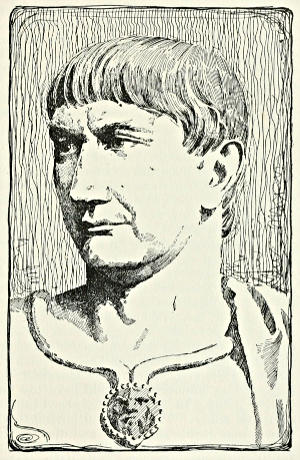
Trajan
(From a bust in the Capitol)
[103 A.D.]
“During Trajan’s expedition against the Dacians, when he was near
Tapes where the barbarians were encamped, a large mushroom was brought
to him, on which it was written in Latin characters that the other allies and
the Burii conjured Trajan
to turn back and conclude a
peace. Nevertheless he delivered
a battle, in which he
had a great number of his
men wounded and made
great carnage amongst the
enemy; when the bandages
gave out, he did not spare,
it is said, his own clothing,
but tore it in pieces; moreover
he caused an altar to
be raised in honour of his
soldiers who had been slain
in the battle, and had funeral
sacrifices offered to them
every year. As he was endeavouring
to reach the
heights, carrying one hill
after another and in face of
a thousand perils, he came to
the residence of the Dacian
kings, whilst Lucius, who
had attacked from another
side, made a great slaughter
and took a great number of
prisoners. Whereupon Decebalus
sent the emperor an
embassy composed of the
chiefs of the Dacians and
making petition to him
through them, showed himself
disposed to treat with
them under no matter what
conditions.
“He was required to deliver up the machines, and the engines, to surrender
the deserters, to demolish his fortifications, to evacuate the territories he
had conquered and besides this to regard all those who were enemies or
friends to the Romans as his own; in spite of himself he consented to these
conditions, after having gone himself to Trajan, falling on the ground before
him and worshipping him. Decebalus’ ambassadors were introduced to the
senate, where, having laid down their arms they clasped their hands in the
fashion of captives, pronounced certain words and certain prayers and thus
agreed to the peace and resumed their arms. Trajan celebrated his triumph
and was surnamed Dacicus; he gave combats of gladiators in the theatre
(for he took pleasure in these combats), and caused the actors to reappear
at the theatre (for he loved one of them, Pylades), while none the less in his
character of a soldier he continued to watch over other business and to administer
justice; sometimes in the Forum of Augustus, sometimes under
the Porticus Livia, and often in other places as well, he gave judgment
from his tribunal. But when he was informed that Decebalus was contravening
several articles of the treaty, that he was laying up stores of arms,
receiving deserters and raising fortresses, that he was sending embassies to
his neighbours, and ravaging the countries of those who had previously
taken part against him and had seized on lands belonging to the Iazyges,
lands which Trajan afterwards refused to restore to them when they demanded
them of him again; then the senate for the second time declared
Decebalus to be the enemy of Rome and Trajan; also the second time,
undertook to make war against them in person and not through other
generals.
“Decebalus failed to win the victory by force, but he almost succeeded
in killing Trajan by craft and treason; he sent deserters to him in Mœsia,
who were charged to assassinate him, knowing that at that time, in consideration
of the necessities of the war, he received all who wished to speak to
him without distinction. But they could not accomplish this, as one of them
was arrested on suspicion and under the torture confessed the whole plot.
“Longinus, who commanded a detachment of the Roman army, and whose
valour had been proved during the war, having suffered himself, at the invitation
of Decebalus, to be drawn into an interview with him, under pretext
that the latter would make his submission, Decebalus seized the Roman and
publicly interrogated him on the plans of Trajan; and when Longinus refused
to reveal anything, he retained him under a guard. Decebalus then
(sent an embassy to Trajan to demand that he should abandon the country
as far as the Ister, and that he should be reimbursed for all the expenses of
the war) on condition of restoring Longinus. Trajan having given an undecided
answer, the terms of which were intended to show that his esteem for
Longinus was neither small nor great, so that he might neither lose him nor
pay too dearly for his ransom, Decebalus hesitated considering what he should
do; and Longinus, for whom (his freedman) had meantime procured poison,
(promised the king to reconcile him with Trajan, for he feared that if he
suspected his intention he would have him more closely guarded; then he
wrote a petition to Trajan, and charged the freedman to carry it in order to
secure its safety. The freedman, having therefore departed, Longinus) took
(the poison during the night) and died. (This being done), Decebalus demanded
the freedman of Trajan, promising to give in exchange the body of
Longinus and ten captives, and he also sent him the centurion taken with Longinus
in the hope that he would succeed in his design; from this centurion
Trajan learned all that had happened to Longinus. Nevertheless he did not
send him back nor did he restore the freedman, judging this man’s life of more
importance to the dignity of the empire than the burial of Longinus.”g
It is the modern verdict that in the conclusion of peace as well as after
it, the Roman emperor abused the right of conquest. He retained possession
of a part of the land of Dacia, established a Roman garrison on the rapids of
the Danube, between Orsowa and Gladowitza, which at a later day bore the
name of the “Iron Gates,” and threatened to seize the mountain country
of southwestern Transylvania. This naturally enraged the Dacians and their
king. Decebalus was by no means a mere barbarian; he had allied himself
with the Parthian king, the principal enemy of the Romans in the far East,
and had enlisted in his service many men who had served in the Roman
army and who organised his troops after the Roman fashion. He had also
brought a number of skilled workmen, partly by force and partly by money
payments, from the neighbouring Roman province to his own country, to
use their services in making instruments of peace and war.
THE SECOND DACIAN WAR
[103-113 A.D.]
According to his treaty with Trajan, he should have sent all such persons
back; and Trajan was all the more ready to make this circumstance the pretext
for another war, since Decebalus had attempted to ally himself with
some of the neighbouring tribes. The emperor began the second Dacian
war by building a stone bridge over the Danube, and thus manifested his
intention of extending the dominion of Rome beyond the river. This bridge
was erected three hours’ journey below the aforementioned gates, close to
the town of Czernetz at the present day. It was thirty-five hundred paces
long and provided with entrenchments at either end. The ruins of it are
still to be seen at low water.
The war in what is now Wallachia, the country to which Trajan gained
access by this bridge, offered many difficulties to the Roman army on account
of its many morasses, its heavy clay soil, and the large and rapid
rivers which traverse it. He therefore led his troops with great caution;
he made roads, diverted the course of rivers, and hunted the Dacian king
from forest to forest, and from swamp to swamp. At length Decebalus felt
himself unable to hold his own against the Romans, and slew himself in
order not to fall into the hands of the enemy. Trajan made a Roman province
of the conquered land, and determined to establish as many colonies as
possible in it, and to tame his barbarian subjects by culture. (106 A.D.)
In the uncultivated but fertile plains of Wallachia, he settled a large
number of colonists from all parts of the Roman Empire, founded many
towns and villages, and made Roman culture so acceptable that Latin became
the dominant language of the country. By these means, however, he
provoked the barbarous tribes who then occupied Poland and Russia to continual
predatory attacks. Thrace and Mœsia, now Rumelia, Bulgaria, and
Servia, which lay to the south of the Danube, gained most; they were
protected from the barbarians by the new province beyond the Danube.
A number of new towns were founded there, and from that time they
continued to flourish.
The conquest of the Dacians and the attention it attracted throughout
the Roman Empire seemed to have affected the emperor’s hitherto modest
disposition, which had led him to devote himself to affairs of law and government;
for the manner in which he celebrated his victory in Rome, as well
as the oriental campaign which he subsequently undertook, were not in
keeping with the character of wise moderation and the absence of excessive
prodigality, which might have been expected of him, under the circumstances.
When he returned to Rome, he celebrated his victory by magnificent
architectural works and brilliant festivities. He erected a monument commemorative
of his victory, which still exists, the celebrated Trajan column, 110
feet in height [to which we shall refer more at length presently]. (113 A.D.)
Besides several buildings in Rome, he built triumphal arches at Beneventum
and other places, and made a road through the Pontine marshes
which combined the excellence and strength of the old military roads with
the conveniences of his own time. These undertakings were made in the
old Roman spirit, and did him as much honour as the many bridges and
canals which he built in different parts of the empire or the great military
road which extended from the Black Sea to the west coast. On the other
hand the feasts which he arranged in celebration of his victory recalled the
foolish prodigality of Caligula and Domitian, and added not a little to the
deterioration of morals. For 123 consecutive days he gave the people public
games and other revels, in which no less than ten thousand gladiators
took part, and eleven thousand wild animals were killed; so that one of the
best emperors did most to promote the unnatural and inhuman pleasures of
the degenerate inhabitants of Rome.
The Dacian conquest was not the sole triumph of Roman arms at this period.
In 106 Cornelius Palma, governor of Syria, attacked the troublesome tribes
inhabiting the ill-defined region between Damascus and the Red Sea. There
was one short but severe campaign, and Arabia Petræa was added to the Roman
province. The great caravan routes from the Euphrates to the Red Sea were
now safe.
ORIENTAL CAMPAIGNS AND DEATH OF TRAJAN
[106-117 A.D.]
Trajan’s oriental campaign was directed against the Parthians. Since
the time of Augustus, this people had suffered perpetually from quarrels over
the succession to the throne, and had often come into hostile contact with the
Romans, because both nations looked upon the kingdom of Armenia as
a dependency of theirs. The turbulent character of the Armenians and
the continual dissensions among the members of their ruling family made the
intervention of the two neighbouring states to some extent necessary. In
the frequent wars of the Romans and Parthians, no general had ever distinguished
himself as much as Domitius Corbulo, who had been sent by
Nero to Armenia so as to protect the inhabitants of this land against the
tyranny of their own king, no less than against the superior power of the
Parthians. He banished the Parthian prince Tiridates I, who had set himself
up as ruler of Armenia, and occupied the whole of the country.
Nero bestowed the government of Armenia on a descendant of the
Herod family, who then lived in Rome and had adopted the pagan religion.
For a whole year the latter was unable to maintain his ground against the
turbulent Armenians and Parthians, and Corbulo himself advised the emperor
to restore the banished Parthian prince on condition that he should go
to Rome, and do homage as a Roman vassal. To this Tiridates consented;
he received the kingdom of Armenia as a Roman fief, and peace was restored
for a time. After his death, the former scenes were repeated; the throne
of Armenia again became the subject of quarrels between various princes,
and the Parthians again intervened in the affairs of the country.
In Trajan’s time a protégé of Parthia, Exedares by name, was seated on
the throne of Armenia, and the Parthian king, Chosroes, supported him with
an army quartered in the country. Trajan would not acknowledge this
king of Armenia; but as a matter of fact he cared far less for the restoration
of Roman ascendency in Armenia than for the chance of winning glory
as conqueror of the Parthians. In 106 he went to Asia with a large army.
On the way he received an embassy from the Parthian king, who had disturbances
in his own country to contend with, and who, for this reason,
made friendly advances to the Roman emperor. Trajan would have nothing
to say to his proposals, by reason of his greed of fame, although Chosroes
had removed Exedares from the throne of Armenia and placed in his stead
a Parthian prince, Parthamasiris, who was willing to do homage to the
Romans. Trajan banished the new ruler of Armenia without much trouble,
for the Parthians, engaged in internecine quarrels, could not support him.
The emperor therefore turned Armenia into a Roman province, and subjected
the petty dynasties between the Black Sea and the Caspian. Their
loyalty lasted no longer than the time the Roman army was at hand. The
subsequent enterprises of Trajan on his
first expedition to the East are not known
to us in detail; we only know for certain
that he marched from Armenia to
Mesopotamia, took some cities on the
middle Euphrates and Tigris and supported
the king of Parthia against his
rebellious subjects.
Some time after, most probably in the
year 114, Trajan undertook his second
Parthian campaign, on which he spent
about three years, till 117. He conquered
the famous Greek city of Seleucia,
on the Tigris, and Ctesiphon, the
Parthian capital, made Assyria into a
Roman province, and advanced as far as
Arabia, where some years before the
empty desire of fame had induced him
to make conquests, through one of his
generals, which were as quickly lost as
won. He then pushed on to the coasts
of the Persian Gulf. If we may believe
the coins and fabulous histories of that
time, he even projected an Indian campaign,
and caused a fleet to be built for
the purpose. This statement, like other
ridiculous exaggerations, is based on
flattery and the circumstance that the
Persian Gulf was confounded with the
Indian Ocean.
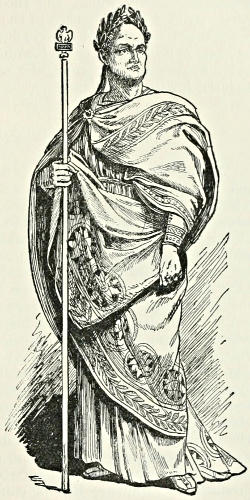
A Roman Emperor
According to one of the coins, Trajan
gave the Parthians a new king, but
this bestowal of the royal office meant
no more than that he proclaimed one of the many pretenders in Ctesiphon
king; a sufficient reason for the Parthians not to acknowledge the latter as
their ruler. Trajan himself reaped the fruits of an inconsiderate desire of
conquest, which was most prejudicial to the Roman Empire. Whilst he was
at Shatt-el-Arab, all the tribes and cities in his rear revolted, and he perceived
too late that the oriental nations were not so easy to subdue or to hold
in allegiance as the Dacians.
The Jews also rebelled, both in Palestine and in the cities of Syria, Egypt,
and other countries, because like the Christians they were incessantly harassed
and persecuted. Trajan was forced to send troops against them, and at the
same time renew the war against Assyria, Seleucia, Edessa and other rebellious
countries and cities. He fell sick in consequence of the hardships of
an unsuccessful campaign, which he had undertaken in Arabia. In order to
abandon the fruitless undertaking without detriment to his reputation, he
made the senate recall him to Rome under a fictitious pretext. He handed
over the army to his general Hadrian, whom he had appointed governor of
Syria, and went to Cilicia intending to sail thence to Italy. Before he could
embark, death overtook him.f
In estimating the character of Trajan, we no longer have the guidance
of Suetonius. The only important classical writings recording the deeds of
this emperor are the somewhat fragmentary excerpts from Dion Cassius as
preserved by Xiphilinus, and the panegyric of the younger Pliny. The
latter, written and delivered in the year in which Pliny was consul, has been
pronounced, “a piece of courtly flattery for which the only excuse which can
be made is the cringing and fawning manner of the times.” Pliny’s letters
and despatches to Trajan on the other hand are full of interest as valuable
material for the historian.a
THE CORRESPONDENCE OF PLINY AND TRAJAN
[104-117 A.D.]
The despatch respecting the Christians, written from Bithynia, A.D. 104,
and the emperor’s answer, are well worthy of transcription; both because
reference is so often made to them, and because they throw light upon the
marvellous and rapid propagation of the Gospel; the manners of the early
Christians; the treatment of which their constancy exposed them, even
under favourable circumstances; and the severe jealousy with which even a
governor of mild and gentle temper thought it his duty to regard them.
Pliny’sj letter to Trajan ran thus: “It is my constant practice to refer to
you all subjects on which I entertain doubt. For who is better able
to direct my hesitation or to instruct my ignorance? I have never been
present at the trials of Christians, and therefore I do not know in what
way, or to what extent, it is usual to question or to punish them. I have
also felt no small difficulty in deciding whether age should make any difference,
or whether those of the tenderest and those of mature years should be
treated alike; whether pardon should be accorded to repentance, or whether,
where a man has once been a Christian, recantation should profit him;
whether, if the name of Christian does not imply criminality, still the crimes
peculiarly belonging to the name should be punished. Meanwhile, in the
case of those against whom informations have been laid before me, I have
pursued the following line of conduct. I have put to them, personally,
the question whether they were Christians. If they confessed, I interrogated
them a second and third time, and threatened them with punishment.
If they still persevered, I ordered their commitment; for I had no doubt
whatever, that whatever they confessed, at any rate dogged and inflexible
obstinacy deserved to be punished. There were others who displayed similar
madness; but, as they were Roman citizens, I ordered them to be sent back
to the city. Soon persecution itself, as is generally the case, caused the
crime to spread, and it appeared in new forms.
“An anonymous information was laid against a large number of persons,
but they deny that they are, or ever have been, Christians. As they invoked
the gods, repeating the form after me, and offered prayers, together with
incense and wine, to your image, which I had ordered to be brought, together
with those of the deities, and besides cursed Christ, whilst those who are true
Christians, it is said, cannot be compelled to do any one of these things, I
thought it right to set them at liberty. Others, when accused by an informer,
confessed that they were Christians, and soon after denied the fact; they
said they had been, but had ceased to be, some three, some more, not a few
even twenty years previously. All these worshipped your image and those
of the gods, and cursed Christ. But they affirmed that the sum-total of
their fault or their error was, that they were accustomed to assemble on a
fixed day before dawn, and sing an antiphonal hymn to Christ as God; that
they bound themselves by an oath, not to the commission of any wickedness,
but to abstain from theft, robbery, and adultery; never to break a promise,
or to deny a deposit when it was demanded back. When these ceremonies
were concluded, it was their custom to depart, and again assemble together
to take food harmlessly and in common. That after my proclamation, in
which, in obedience to your command, I had forbidden associations, they had
desisted from this practice. For these reasons, I the more thought it necessary
to investigate the real truth, by putting to the torture two maidens,
who were called deaconesses; but I discovered nothing but a perverse and
excessive superstition.
“I have therefore deferred taking cognizance of the matter until I had
consulted you. For it seemed to me a case requiring advice, especially on
account of the number of those in peril. For many of every age, sex, and
rank, are and will continue to be called in question. The infection in fact
has spread not only through the cities, but also through the villages and
open country; but it seems that its progress can be arrested. At any rate,
it is clear that the temples which were almost deserted begin to be frequented;
and solemn sacrifices, which had been long intermitted, are again
performed, and victims are being sold everywhere, for which up to this time
a purchaser could rarely be found. It is therefore easy to conceive that
crowds might be reclaimed if an opportunity for repentance were given.”
To this letter Trajan replied:
“In sifting the cases of those who have been indicted on the charge of
Christianity, you have adopted, my dear Secundus, the right course of proceeding;
for no certain rule can be laid down which will meet all cases.
They must not be sought after, but if they are informed against and convicted,
they must be punished; with this proviso, however, that if anyone
denies that he is a Christian, and proves the point by offering prayers to our
deities, notwithstanding the suspicions under which he has laboured, he shall
be pardoned on his repentance. On no account should any anonymous
charge be attended to, for it would be the worst possible precedent, and is
inconsistent with the habits of our times.”i
Nothing perhaps could better illustrate the judicial and tolerant temper
of Trajan’s mind than this letter in reference to a class of people whom the
emperor could not possibly have contemplated without prejudice.
TRAJAN’S COLUMN
If literary remains dealing with history of the time of Trajan are meagre,
amends are made for the deficit by the sculptures and bas-reliefs that ornament
the Column of Trajan previously mentioned, which still stands in an
excellent state of preservation amidst the ruins of a forum. This column
of marble, now weathered to a bronze-like hue, is covered throughout its
entire height by a spiral column of figures representing all manner of military
operations. More than twenty-five hundred human figures are said to
be depicted, and all of these are executed with lifelike fidelity. The bas-reliefs
represent the expeditions of Trajan against the Dacians.a The
column is thus described by Burn:
[103 A.D.]
“The bas-relief” representing the first campaign against the Dacians
begins at the base by a representation of the banks of the Save, down which
the Roman army passed, and shows military storehouses, piles of wood,
stacks of hay, and wooden huts. Then follow forts with soldiers on guard,
and boats carrying barrels of provisions. The river god Danube then
appears and looks on with astonishment at the bridge of boats over which
the Roman army is passing. The baggage of the soldiers on the march, tied
to the top of the vallum or palisade which they carry, and the different military
standards, are very distinctly shown. Many of the men are without
covering on their heads, but some wear lions’ skins. The emperor and his
staff are then introduced. He is sitting upon a suggestus or platform, and
Lucius, the prætorian prefect, sits beside him. The suovetaurilia, a grand
sacrificial celebration, is the next scene, with priests in the cinctus gabinus
and trumpeters. After this the emperor is seen making a speech to the army,
and a little farther on the building of a stone encampment enclosing huts is
being carried on with great vigour, and bridges are being thrown across a
river, over which cavalry are passing.
“A battle seems then to take place, and the heads of two enemies are
being brought to the emperor. The Dacian army with the dragon ensign
and the Dacian cap, the symbol of superior rank, seen upon the statues of
the Dacian prisoners on the Arch of Constantine, appears. Jupiter gives
the victory to the Romans, the Dacian camp is burned, and the Dacians fly.
Numerous representations of forts, boats, different kinds of troops, skirmishes,
and sieges follow, ending with the surrender of Decebalus and the
return of Trajan to Rome, where a great festival is celebrated. The arrival
at Rome, and the crowd of Romans going to meet the great conqueror, are
very vividly drawn. An immense number of bulls for sacrifice, altars,
camilli, and half-naked popæ are introduced into the triumphal rejoicings,
and the first campaign ends with the figure of Trajan offering incense on
the altar of Jupiter Capitolinus.
[113 A.D.]
“A somewhat similar series of scenes are represented in the sculptures
which depict the second campaign. Perhaps the most interesting is that of
the great bridge over the Danube, made of wood supported on stone piers,
the foundations of which may still be seen in the bed of the river. Apollodorus,
the architect of the Forum, designed this immense work, which
crossed the Danube at a spot where it is not less than 1300 yards wide, near
the village of Gieli. A permanent road into Dacia and secure communications
with his basis of operations having thus been secured, Trajan gradually
advanced from post to post, driving the Dacians into the mountainous parts
of the country. The sculptures represent a number of skirmishes and
assaults upon fortified places, but no regular pitched battle. At last the
ghastly spectacle of the head and hands of Decebalus is exhibited on a
board by two soldiers in front of the Prætorium. This disgusting scene is
followed by a representation of the storming of the last strongholds of the
enemy in the mountains, and a mournful procession of fugitives carrying
away their goods and driving their cattle into exile forms the close of the
sculptured history of the Dacian campaigns of Trajan.
“In these curious bas-reliefs,” Burn continues, “we have a treasury of
information on the religion, the military science, the habits and dress of the
Romans of the empire far more valuable than ten thousand pages of descriptive
writing. The lover of Roman antiquities will learn more by studying
Fabretti’s engravings of these reliefs, or the casts at the French Academy at
Rome, and at the Kensington Museum, than by much book-labour. The
descriptions of Livy and Polybius, Cæsar and Tacitus, receive life and
movement and interest as we look at the actual figures (oculis subjecta
fidelibus) of the general and his staff; the Prætorian guards marked by
their belts over the left shoulder; the fierce-looking standard-bearers and
centurions with their heads covered by lions’ skins, the shaggy manes of
which stream down their backs; the rank and file carrying enormous stakes;
the master masons, sappers, and pioneers, with their axes and crowbars; the
lancers, heavy and light cavalry, and royal chargers; the Sarmatian horsemen
clothed, both riders and steeds, in complete scale armour, and the
Moorish cavalry, riding without
reins.
“Bridges are constructed,
Roman causeways laid, forts attacked
with all kinds of military
engines; the charge of cavalry,
the rout and confusion of a defeated
army, are all most vividly
depicted. Trajan in person
traverses the ranks on foot, or
mounts the suggestus and harangues
his men, or receives with
simple dignity the submission of
the enemy, or marches with all
the pomp of a Roman procession
under the triumphal arch. The
soldier-like simplicity of the
great military emperor is strikingly
portrayed. There is no
silken tent, or richly decorated
chariot, or throne, or canopy of
state to be seen. His colonel of
the guards sits beside him, as an
equal, on the suggestus. In the
midst of a battle the emperor
tears up his robe to bind the
wounds of his soldiers; he is
present everywhere, wearing a
sword and fighting in person.
Nothing could be more illustrative of the state of Roman affairs in that iron
age, when again, as in the olden times, a rough and unlettered warrior, fresh
from the camp, swayed the destinies of the empire.”k
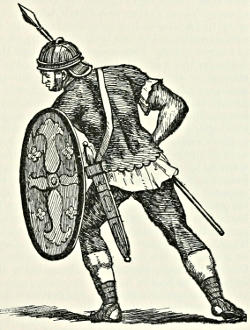
A Soldier
(From Trajan’s Column)
This Column of Trajan originally stood surrounded by buildings forming
a court only about forty feet square, the intention being apparently that the
figures should be viewed from the surrounding structures. Notwithstanding
this the sculptures are progressively larger toward the top, the perspective
effect when looking from below being obvious in the artist’s mind.
To-day the column stands in lonely grandeur in Trajan’s Forum; discoloured
and weather-worn, but otherwise little altered from the original state except
at the very top, where, incongruously enough, a statue of St. Peter now
takes the place of the colossal figure of Trajan himself which once occupied
the pedestal. Sixtus V placed the effigy of the Christian there, the pagan
image having been taken away some time in the early Middle Ages. The
substitution was a characteristic act of piety, which could have been permitted
only by an equally characteristic lack of humour. But quite regardless
of its incongruous apex, the column remains as the most important
historical document relating to military customs of classical antiquity that
has come down to us.a
[117-118 A.D.]
Hadrian was by descent a Spaniard, and of the same city where Trajan
was born. He was nephew to Trajan, and married to Sabina, his grand-niece.
When Trajan was adopted by Nerva, Hadrian was a tribune of the
army in Mœsia, and sent by the troops to congratulate the emperor on his
advancement. But his brother-in-law, who desired to have an opportunity
of congratulating Trajan himself, supplied Hadrian with a carriage that broke
down on the way. Hadrian, however, was resolved to lose no time, so the
story goes, and performed the rest of the journey on foot. This assiduity
was very pleasing. But the emperor was believed to dislike Hadrian for
several reasons. He was expensive, and involved in debt. He was, besides,
inconstant, capricious, and apt to envy another’s reputation. These faults,
in Trajan’s opinion, could not be compensated either by Hadrian’s learning
or his talents. His great skill in the Greek and Latin languages, his intimate
acquaintance with the laws of his country and the philosophy of the times,
were no inducements to Trajan, who, being bred himself a soldier, desired to
have a military man to succeed him. For this reason it was that the dying
emperor would by no means appoint a successor; fearful, perhaps, of injuring
his great reputation, by adopting a person that was unworthy. His death,
therefore, was concealed for some time by Plotina, his wife, till Hadrian had
sounded the inclinations of the army, and found them firm in his interests.
They then produced a forged instrument, importing that Hadrian was adopted
to succeed in the empire. By this artifice he was elected by all orders of
the state, though absent from Rome, being then at Antioch, as general of the
forces in the East.[28]
Upon Hadrian’s election, his first care was to write to the senate, excusing
himself for assuming the empire without their previous approbation;
imputing it to the hasty zeal of the army, who rightly judged that the senate
ought not long to remain without a head. He then began to pursue a course
quite opposite to that of his predecessor, taking every method of declining
war, and promoting the arts of peace. He was quite satisfied with preserving
the ancient limits of the empire, with the Euphrates as the boundary.
Having thus settled the affairs of the East, and leaving Severus governor
of Syria, he took his journey by land to Rome, sending the ashes of Trajan
thither by sea. Upon his approach to the city, he was informed that a magnificent
triumph was preparing for him; but this he modestly declined, desiring
that those honours might be paid to Trajan’s memory which they had
designed for him. In consequence of this command, a most superb triumph
was decreed, in which Trajan’s statue was carried as the principal figure
in the procession, it being remarked that he was the only man that ever
triumphed after he was dead.
THE VARIED ENDOWMENTS OF HADRIAN
It was not an easy task to appear with any lustre after an emperor so
loved and admired as Trajan; and yet the merits of his successor seemed, in
some measure, to console the people for their loss. Hadrian was one of the
most remarkable of the Roman emperors for the variety of his endowments.
He was highly skilful in all the exercises both of body and mind. He composed
with great beauty, both in prose and verse; he pleaded at the bar, and
was one of the best orators of his time. He was deeply versed in the mathematics,
and no less skilful in physic. In drawing and painting, he was equal
to the greatest masters; an excellent musician, and sang to admiration.
Besides these qualifications, he had an astonishing memory; he knew the
names of all his soldiers, though ever so long absent. He could dictate to
one, confer with another, and write himself, all at the same time. He was
remarkably expert in military discipline; he was strong and very skilful in
arms, both on horseback and on foot, and frequently with his own hand killed
wild boars, and even lions, in hunting.
His moral virtues were not less than his accomplishments. Upon his first
exaltation, he forgave an infinite number of debts due to the exchequer,
remitting the large arrears to which the provinces were liable, and burning
the bonds and registers of them in the public Forum. He refused to take the
confiscated estates of condemned persons into his private coffers, but ordered
them to be placed in the public treasury. His moderation and clemency
appeared by pardoning the injuries which he had received when he was yet
but a private man. One day meeting a person who had formerly been his
most inveterate enemy, “My good friend,” cried he, “you have escaped, for
I am made emperor.” He had so great a veneration for the senate, and was
so careful of not introducing unworthy persons into it, that he told the captain
of his guard, when he made him senator, that he had no honours in his
gift equal to what he then bestowed. He was affable to his friends, and
gentle to persons of meaner stations; he relieved their wants, and visited
them in sickness; it being his constant maxim, that he was an emperor, not
for his own good, but for the benefit of mankind.
These were his virtues, which were contrasted by a strange mixture of
vices; or, to say the truth, the wanted strength of mind to preserve his general
rectitude of character without deviation. Thus he is represented as
proud and vainglorious, envious and detractive, hasty and revengeful, inquisitive
into other men’s affairs, and often induced by sycophants to acts of
cruelty and injustice. He permitted the revival of the persecution against
the Christians, and showed many instances of a bad disposition, which it was
the whole study of his life to correct or to conceal.
But whatever Hadrian might have been as to his private character, his
conduct as an emperor appears most admirable, as all his public transactions
seem dictated by the soundest policy and the most disinterested wisdom. He
was scarce settled on the throne, when several of the northern barbarians,
the Alans, the Sarmatians, and the Dacians, began to make devastations on
the empire. These hardy nations, who now found the way to conquer, by
issuing from their forests, and then retiring upon the approach of a superior
force opposing them, began to be truly formidable to Rome. Hadrian had
thoughts of contracting the limits of the empire, by giving up some of the
most remote and the least defensible provinces; but in this he was overruled
by his friends, who wrongly imagined that an extensive frontier would
tend to intimidate an invading enemy. But though he complied with their
remonstrances, he broke down the bridge over the Danube, which his predecessor
had built, sensible that the same passage which was open to him, was
equally convenient to the incursions of his barbarous neighbours.
While he was employed in compelling these nations to submission, a conspiracy
was discovered, carried on among four persons of consular dignity at
home. These had agreed to kill him, either while he was offering sacrifice,
or while he was hunting. Their designs, however, were timely discovered,
and the conspirators put to death by order of the senate. Hadrian took
great pains to clear himself from the imputation of having had any hand in
their execution; he had sworn upon his advancement, to put no senator to
death, and he now declared that the delinquents died without his permission.
But in order entirely to suppress the murmurs of the people upon this head,
he distributed large sums of money among them, and called off their attention
from this act of severity to magnificent shows, and the various diversions of
the amphitheatre.
HADRIAN’S TOURS
[118-129 A.D.]
Having stayed a short time at Rome, so as to see that all things were
regulated and established for the safety of the public, he prepared to visit
and take a view of his whole empire. It was one of his maxims, that an
emperor ought to imitate the sun, which diffuses warmth and vigour over
all parts of the earth. He therefore took with him a splendid court and a
considerable force, and entered the province of Gaul, where he numbered all
the inhabitants. From Gaul he went into Germany, from thence to Holland,
and then passed over into Britain. There, reforming many abuses, and
reconciling the natives to the Romans, for the better security of the southern
parts of the kingdom he built a wall of wood and earth, extending from the
river Eden in Cumberland to the Tyne in Northumberland, to prevent the
incursions of the Picts, and the other barbarous nations to the north. From
Britain, returning through Gaul, he directed his journey to Spain, where he
was received with great joy, as being a native of that country. There,
wintering in the city of Tarraco, he called a meeting of the deputies from
all the provinces, and ordained many things for the benefit of the nation.
Happening, while he was in Spain, to walk in his garden, one of the servants
of the house ran furiously at him, with a drawn sword, to kill him; but the
emperor warding off the blow, and closing with him, quickly disarmed him;
then delivering him to his guards, he ordered that he might have a physician
to bleed him, considering the poor creature (which in fact he was) as a
madman. From Spain he returned to Rome.b
In April of 129 Hadrian undertook another long journey to the eastern
provinces of the empire, from which he did not return to take up his residence
on the Tiber until the year 134. In 129 he again made a long stay in Athens,
where he celebrated the consummation of a great work which had been awaiting
completion from times out of mind, and was now intended to minister
to the worship of Zeus, the glory of Athens, and the vanity of the great
Philhellenic emperor.
Of the many magnificent buildings which he erected for the adornment
of his favourite city, hardly anything is left except the ruins of the most
splendid of them all. Southeast of the acropolis there still stand some huge
columns of the Olympieum, begun long since by the Pisistratidæ and now
finished by Hadrian. It was a gigantic temple of Olympian Zeus, occupying
an area of fifty-nine thousand square feet. It was consecrated in the
autumn of 129, and one and the same priest presided there over the worship
of the Olympian Zeus and of the Philhellene emperor.
[129-130 A.D.]
Hadrian also laid out a fashionable residential quarter for Roman villas
on the southeast of the city, towards the Ilissus, which was adorned with a
stately gateway on the original boundary of ancient Athens, not far from the
peribolus of the Olympieum. His new Panhellenium, a temple to the
Panhellenic Zeus, was intended to serve as a centre for the new national
festival of the Panhellenia, instituted by him, and celebrated for the first time
in the autumn of the year 129; a festival in which the Greeks of the mother-country
and the colonies were equally entitled to take part. Thus he hoped
to substitute for the Delphic amphictyony, which had passed into the limbo
of shades, a fresh incentive to Greek patriotism and religious sentiment,
and to restore to Athens something of the lustre of her old commanding
position.
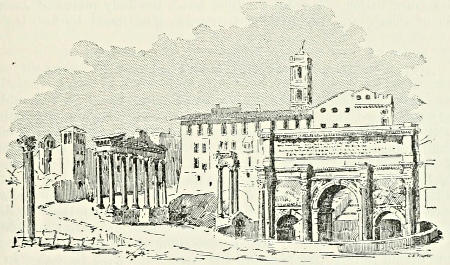
Ruins of the Forum
The emperor left Athens in March or April, 130, and proceeded to
Alexandria, a city which combined all the elements which charmed him as
a sovereign and an accomplished man of the world—the restless activity of
a vast commercial centre, the motley mixture of the most varied and sharply
defined national types in the empire, and lastly, the abundance of scientific
material and the high standard of learning, both in studies purely Greek and
in the applied and exact sciences. The only drawback was the Alexandrine
propensity to ill-natured witticisms, which were apt to verge upon shameless
insolence and to which even the person of the emperor was by no means
sacred.
When Hadrian’s favourite, Antinous, was drowned in the Nile at Besa
(probably on October 30, 130), having sought death of his own free will,
according to the story then generally received, in order to save the emperor,
whose life (so it was said) could only be preserved by the voluntary
sacrifice of another—Hadrian endeavoured to find comfort by instituting a
new form of worship, that of his lost minion. The art and feeling of the
antique world proved willing instruments of the emperor’s will, and Antinous
was immortalised in numerous statues, more particularly in Greece.
On the other hand, two of Hadrian’s administrative measures provoked
another fearful outbreak of Jewish fury in Palestine.
[131-138 A.D.]
The founding of the new colony of Ælia Capitolina on the ruins of
Jerusalem and an imperial edict, really directed against the objectionable
custom of mutilation, and only construed by a mistake as referring to the
Jewish rite of circumcision, brought about a terrible Jewish revolt (at the
end of 131), which was vigorously seconded by the Jews of the Dispersion.
The rising, disregarded at first by the Romans, and directed with the utmost
energy by a priest, Eleazer of Modin, and a warlike freebooter, Simon
Bar Cocheba[29] (i.e., son of a star) by name, resulted in a troublesome war,
waged with horrible cruelty on both sides, in which victory only fell to
the Roman arms after the experienced legate Sextus Julius Severus, came
from Britain to take over the command. It was not decided by a pitched
battle; as before, one stronghold after another had to be reduced, the last
being Baeth-ter, not far from Jerusalem (135 A.D.). Thenceforth and for
long after the silence of the grave settled upon Judea, or Syria Palestina,
as it was now called. No Jews might tread the holy places of Jerusalem
on pain of death, and the little country was garrisoned by two legions.
HADRIAN AS BUILDER AND ADMINISTRATIVE REFORMER
Hadrian came back to take up his residence at Rome in 134, and there
zealously took up the architectural labours of which imposing remains are
left to the present day. He had already adorned the heart of the old city
with the temple of Venus and Rome, which was dedicated on the twenty-first
of April, 128, and some vast undertakings were brought to a conclusion
in 135, 136, and the following years. We have a memorial of him to this
day in the huge mausoleum, which was diverted from its purpose as a quiet
sepulchre to become the citadel of the City of the Seven Hills during the
stormy times of the Middle Ages and later centuries. On the right bank
of the Tiber Hadrian built a new mausoleum, where not only he and the
members of his family but many of his successors were buried. In order
to connect this edifice (now known as the Castle of St. Angelo) with the
left bank of the river, he built the splendid Ælian bridge (now Ponte St.
Angelo) of blocks of travertin stone. Lastly, the ruins of his Tiburtine
villa, covering a circuit of about eight miles, can still be traced.
Hadrian’s successors had every reason to regard with the utmost reverence
the many administrative reforms made by him in the course of his
long and prosperous reign. Though he did not pursue his predecessor’s
policy of conquest, he used every means to maintain the strength and efficiency
of the army; above all, he did not govern it by decrees issued from
the palace, but constantly appeared in the camps in person, and examined all
things with the eye of an expert. Military appointments were made solely
on consideration of personal capacity and genuine merit, and various arrangements
were made to augment the fighting power of the army, all of
which stood the test of practice. Hadrian’s army system, and more particularly
the drill introduced by him, proved so excellent that Hadrian’s
regulations formed the basis of military organisation as late as the time of
Constantine. The change which took place in strategy, for instance, after
the introduction of his reforms is of the highest importance. Trajan had
resorted to the ancient Roman practice with telling effect.
But the scientific study of military tactics which had come into existence
in connection with Greek studies after the middle of the first century B.C.
and much costly experience won in conflict with barbarian frontier tribes
in Europe and with the horsemen of Asia had led to changes in the old
battle array. The cavalry were taught to practise all the strategic movements
of the Parthian, Armenian, Sarmatian, and Celtic hordes. In order
to spare the valuable infantry of the legions as much as possible, auxiliary
troops were more and more largely used in the first line, and an order of
battle was introduced which combined the advantages of retaining the system
of reserve divisions, promising speedier victory over hordes of gallant
barbarians, and making the struggle less deadly to the Romans. The practice
of early antique times—that of drawing up the men in serried ranks,
or “phalanxes,” was again systematically resorted to. The van of the
legion was no longer divided by vacant intervals. The “phalanx” of
the legion was eight men deep. By a skilful combination of the various
weapons in use, the soldiers of the first four files were armed with the pilum,
the four behind them with spears. A ninth file consisted of auxiliaries
aimed with arrows. The place of the cavalry and artillery was on the wings
and rear of the phalanx. Further still to the rear was a reserve of picked
troops, ready to help at every point where help was needed.
Hadrian’s labours in the field of civil administration were even more considerable.
As a financier he was the best economist since Tiberius, and once
more showed what results a sound financial policy and wise economy could
create from the vast resources of the empire, both in the sphere of production
and in that of artistic and monumental creation. At the same time he displayed
great skill in introducing reforms into every department of finance,
removing numerous harsh regulations, and in organising the affairs of the
free peasants and tenant farmers on the imperial and fiscal domains in Africa
on more humane and economical principles. He increased the revenue of
the public treasury by undertaking the direct management of many imperial
estates, instead of farming out the returns.
Nor was he less active in the sphere of jurisprudence. By his command
all the prætorian edicts, which till then had been arranged in chronological
order only, were collected into a systematic compilation in 131-132 B.C. by the
eminent jurist Salvius Julianus. In connection with this work Hadrian
caused the senate to issue a decree [Edictum Perpetuum] ordaining that no
magistrate in office should henceforth add fresh clauses to the edict, but that
necessary additions should be deduced by analogy from the materials already
existing or made by imperial “constitutions.” Hadrian’s decisions in
points concerning slavery are of interest, as showing his humane disposition.
Prominent among these was the abolition of the cruel and cowardly system
which enacted that where the master of a house was found murdered all the
slaves of the household should be put to death. After Hadrian’s time only
those slaves were examined who might be supposed to have had a hand in
the murder.
The monarchical tendency of the Roman diarchy and the levelling effect
of the empire became more and more distinctly marked under Hadrian. He
did more than any emperor before him to place the provincials on an equal
footing with the Roman citizens of Italy. Moreover, by conferring the jus
Latinum on many cities, he paved the way for the extension of the rights of
Roman citizenship to the whole empire.
In Italy he appointed a number of juridici, with powers to deal with
bequests in trust, with the appointment of guardians, and with disputes
concerning the eligibility of candidates for the decurionate. The power to
deal with these questions was withdrawn, not from the municipal authorities,
but (except in specially important cases) from the law-courts of the capital,
before which suits of this sort had hitherto been carried. Rome and its
environs—comprising an area of 100 Roman miles, or 150 kilometres, within
the competency of the chief of police—of course remained under the jurisdiction
of the tribunals of the capital. But, on the other hand, the growing
power of the imperial officials in matters of criminal law becomes steadily
more apparent, and the competency of the chief of police and the prefect of
the guard is extended at the expense of the old courts of law. These
two officers represent the emperor more and more in the administration of
criminal law in Italy. Their departments were subsequently made separate,
possibly after the reign of Marcus Aurelius, certainly after that of Severus.
Rome and a space of 150 kilometres round it were under the jurisdiction of
the chief of police, Italy beyond these limits under that of the prefects of the
guard. The latter officers took on more and more of the character of representative
organs of the personal intervention of the emperor and thus were
bound to be eminent jurisconsults.
Another significant change introduced by Hadrian was to give stability
and definite form to the old institution of the consilium, which consisted of
friends and advisers convened by the emperors to assist in their decisions at
law. From this time forward the members of the imperial consilium appear
as councillors duly appointed, with official titles and salaries, who were
probably appointed by the emperor after consultation with the senate.
The business of the new council was jurisprudence in the widest sense of
the word, and it was therefore intended to consist in the main of professional
jurists and the prefects of the guard, together with the chief officers of the
court. Another reform introduced by Hadrian into the administration at
the same time was the rule that all the three great offices at court should be
occupied by members of the equestrian order. The procurator a rationibus,
or controller of the public treasury, who was really financial minister, now
took the first place among the procurators both in rank and salary, and
by degrees the inferior posts in the financial department were converted
into regular offices and filled by knights. The imperial council was divided
into a Greek and a Latin department under separate chiefs. Finally, the
department of petitions and grievances was put into the hands of officials
of knightly birth.m
PERSONAL TRAITS AND LAST DAYS OF HADRIAN
Hadrian is said to have taken great delight in disputing among the
learned men and the philosophers who attended him; nor were they less
careful in granting him that superiority he seemed so eagerly to affect.
Favorinus, a man of great reputation at court for philosophy, happening
one day to dispute with him upon some philosophical subject, acknowledged
himself to be overcome. His friends blamed him for thus giving up the
argument, when he might easily have pursued it with success. “How,”
replied Favorinus, who was probably a better courtier than philosopher,
“would you have me contend with a man who is master of thirty legions?”
Hadrian was so fond of literary fame, that we are told he wrote his own life,
and afterwards gave it to his servants to publish under their names. But
whatever might have been his weakness in aiming at universal reputation,
he was in no part of his reign remiss in attending to the duties of his exalted
station. He ordered the knights and senators never to appear in public, but
in the proper habits of their orders. He forbade masters to kill their slaves,
as had been before allowed; but ordained that they should be tried by the
laws enacted against capital offences. A law so just, had he done nothing
more, deserved to have insured his reputation with posterity, and to have
made him dear to mankind. He still further extended the lenity of the laws
to those unhappy men, who had been long thought too mean for justice. If
a master was found killed in his house, he would not allow all his slaves to be
put to the torture, as formerly, but only such as might have perceived or
prevented the murder.
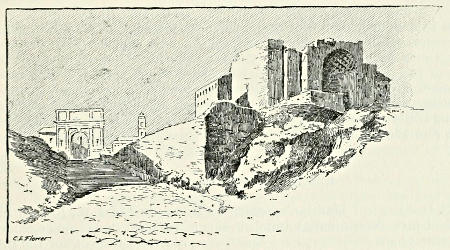
Ruins of the Temple of Venus, Rome
In such cares he consumed the greatest part of his time; but, at last
finding the duties of his station daily increasing, and his own strength proportionally
upon the decline, he resolved upon adopting a successor, whose
merits might deserve, and whose courage secure, his exaltation. After many
deliberations, he made choice of Lucius Commodus, whose bodily infirmities
rendered him unfit for a trust of such importance. Of this, after some
time, Hadrian seemed sensible, declaring, that he repented of having chosen
so feeble a successor, saying that he had leaned against a mouldering wall.
However, Commodus soon after dying, the emperor immediately adopted
Titus Antoninus, afterwards surnamed the Pius; but previously obliged
him to adopt two others, namely, Marcus Aurelius and Lucius Verus, all
of whom afterwards succeeded in the empire.
While he was thus careful in appointing a successor, his bodily infirmities
daily increased; and at length his pains becoming insupportable, he
vehemently desired that some of his attendants should despatch him. Antoninus,
however, would by no means permit any of his domestics to be guilty
of so great an impiety, but used all the arts in his power to reconcile the
emperor to sustain life. At one time he produced a woman, who pretended
that she was warned in a dream that he should recover his health;
at another, a man was brought from Pannonia, who gave him the same
assurances. Nevertheless, Hadrian’s pains increased day by day. He
frequently cried out, “How miserable a thing it is to seek death, and not
to find it!” He engaged one Mastor, partly by threats and partly by
entreaties, to promise to despatch him; but Mastor, instead of obeying,
consulted his own safety by flight; so that he who was master of the lives of
millions, was not able to dispose of his own. In this deplorable exigence,
he resolved on going to Baiæ, where the tortures of his diseases increasing,
they affected his understanding, so that he gave orders that several persons
should be put to death; which Antoninus, according to his usual wisdom,
never meant to obey. Continuing, for some time, in these excruciating circumstances,
the emperor was at last resolved to observe no regimen, often
saying, that kings died merely by the multitude of their physicians. This
conduct served to hasten that death he seemed so ardently to desire, and it
was probably joy upon its approach which dictated the celebrated stanzas
which are so well known, in repeating which he expired.
Animula, vagula, blandula,
Hospes, comesque corporis,
Quæ, nunc abibis in loca?
Pallidula, rigida, nudula,
Nec, ut soles, dabis jocos?
In this manner died Hadrian, in the sixty-second year of his age, after a
prosperous reign of twenty-one years and eleven months. His private character
seems to be a mixture of virtues and vices;[30] but, as a prince, perhaps
none of his predecessors showed more wisdom, or such laudable assiduity.
He was the first emperor who reduced the laws of the empire into one standing
code. Government received the greatest stability from his counsels, and
a tranquillity more lasting than could be expected from such fierce neighbours
abroad, and such a degenerate race of citizens at home.b
RENAN’S ESTIMATE OF HADRIAN
[134-138 A.D.]
At the time of Hadrian’s return to Rome, in 134 A.D., Roman civilisation
had just exterminated Judaism, one of its most dangerous enemies, and
was triumphant. Everywhere there was peace and respect for the different
nations; the barbarians were apparently subjected, the mildest forms of government
had been introduced and were practised. Trajan had been quite
right in his belief that men can be governed and at the same time treated
with consideration. The idea of the state as not only tutelary but beneficent
was taking deep root. Hadrian’s private conduct might be much
blamed, his character was becoming perverted as his health gave way; but
the people did not notice it. Unprecedented splendour and comfort surrounded
everything like a brilliant aureole, disguising the weak parts of the
social organisation. Truth to say, these weak parts were susceptible of
correction. Progress was welcomed in everything. The stoic philosophy
penetrated legislation, introducing the idea of the rights of man, of civil
equality, of uniformity in the provincial administration. The privileges of
the Roman aristocracy were disappearing day by day. The leaders of society
believed in progress and toiled in its cause. They were philosophers, philanthropists
wishing without utopianism to bring the freest possible application
of reason into human affairs.
Hadrian enjoyed life and he had the right to do so. His inquisitive and
active mind gave birth to all kinds of fancies; and his taste was not good
enough to prevent him making mistakes. At the foot of the mountains of
Tibur he built a villa which resembled an album of his travels, a sort of
panorama of fame. It might have been described as the noisy, tawdry
fair of a dying nation. Everything was to be found there; imitation Egyptian,
imitation Greek, the Lyceum, the Academy, the Prytaneum, the Pœcile,
Canopus, the Alpheus, the valley of Tempe, the Elysian fields, Tartarus;
temples, libraries, theatres; a hippodrome, a naumachy, a gymnasium, baths,—strange
but attractive spot. For it is the last place where enjoyment was
to be found, where clever men fell asleep to the empty sound of the “miserly
Acheron.”[31]
Hadrian as Patron of the Arts
At Rome, the one thought of the fantastic emperor was that senseless
tomb, that immense mausoleum, where Babylon was put to shame, and which,
stripped of its treasures, became the citadel of papal Rome. His buildings
covered the world. The Athenæums he founded, the encouragement he
gave to letters and the fine arts, the liberties he accorded to professors, rejoiced
the hearts of all cultivated people. Unfortunately, superstition, caprice,
and cruelty mastered him more and more as his physical strength decreased.
He had built himself an Elysium to disbelieve in, a hell to laugh at, a philosopher’s
hall in which to jeer at the philosophers, a Canopus in order to expose
the impostures of the priests and to remind himself of the mad festivals of
Egypt, which had so greatly amused him. Now everything seemed hollow
and empty; nothing interested him any longer. Perhaps some of the martyrdoms
which took place during his reign and for which it is not easy to
assign a motive may be attributed to the disorders and caprices of his last
months.
Telesphorus was then the head of the Church of Rome; he died confessing
Christ and was numbered amongst the most glorious martyrs of
the faith. The death of the dilettante Cæsar was sad and undignified, for
he was animated by no really elevated moral sentiment. The world, nevertheless,
lost in him a mighty pillar. The Jews alone triumphed in the agony
of his last moments.
He cared sincerely for civilisation, and perfectly understood its possibilities
in his day. Ancient art and literature end with him. He was the
last emperor to believe in glory, as Ælius Verus was the last man who knew
how to appreciate the refinements of pleasure. Human affairs are so frivolous
that brilliancy and pomp must be allowed a part in them. No world will
hold together without these. Louis XIV knew this, and men have lived
and still live by the light of his copper-gilt sun. Hadrian, in his own way,
marks a climax, after which a rapid decline begins. Certainly, from a moral
standpoint, Antoninus and Marcus Aurelius far surpass him; but under them
the world becomes sad, loses its gaiety, puts on a cowl, becomes Christian,
while superstition increases.
The art of Hadrian, although it is cankered, still adheres to principles;
it is a skilful and learned art; then decadence sets in with irresistible force.
Ancient society realises that all is vanity, and on the day when this discovery
is made death is not far off. The two accomplished sages who are to reign
next are each in their several ways ascetics. Lucius Verus and Faustina
are to be the outcast survivors of ancient fashion.d
[138-161 A.D.]
The ancestors of Antoninus originally came from Nemausus (Nîmes);
after settling at Rome, they had filled the highest offices there. Antoninus
himself, distinguished by Hadrian, had received from that prince the government
of a portion of Italy, later on, the proconsulship of Asia, and had
finally been adopted by him on condition that he, in his turn, should adopt
Marcus Aurelius and Lucius, the son of Ælius Verus. During his reign of
twenty-three years (138-161) the empire enjoyed great tranquillity, due as
much to his virtues as to his moderation, and to
the able government of his predecessor, who had
temporarily removed the causes of disorder.
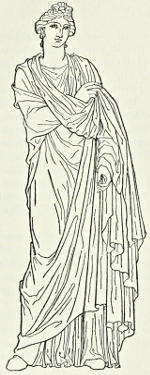
Faustina, wife of Antoninus Pius
(From a statue in the Vatican)
His renown extended so far that the princes of
India, of Bactriana, and Hyrcania chose him to arbitrate
in their quarrels; his grateful contemporaries
gave him the beautiful title of “Father of the
Human Race.” He never appointed any but experienced
and upright men to public offices, and
permitted them to hold their posts for life when
he could not replace them by others more able.
A wise economy in financial administration gave
him the means of establishing useful institutions,
as, for example, two asylums where orphan girls
were educated under the protection of the Empress
Faustina, and the appointments for learned
professors that he established not only in Rome,
as Vespasian had done, but in the large towns of
the provinces.
He was able, also, to succour towns which had
been stricken by any plague, such as Rome, Antioch,
Narbonne, and Rhodes, when devastated by
fire or earthquake. The wealth of a prince, he
used to say, is public felicity. He, himself, lived
simply, accessible to all, and ready to render justice
to all complaints. Two conspiracies against
him were discovered; the two instigators alone
perished. An Apology for Christianity, composed
by Justin, the philosopher, and presented to the
emperor, procured toleration and protection for
the Christians, who were already numerous in Rome
and the provinces.
Antoninus engaged in no war, and did not even visit the provinces, which
were too peaceful and well governed to render his presence necessary. His
lieutenants, however, engaged in some battles, against the Moors in Africa,
and against the Alani and the Quadi on the Danube. The Lazæ and the
Armenians accepted the kings he installed. The Jews gave some trouble,
and the Britons attempted to destroy the wall of Hadrian.
An act that clearly shows the moderation of Antoninus is related by
Appian. At that time deputies came to Rome from the barbarians, with a
request to be received as subjects of the empire. This was refused them.
Such had been the policy of Augustus and Hadrian, and it had had sufficiently
good results in the well-being of a hundred millions of men to justify Antoninus
in following it. But peace also brought forgetfulness of the martial
valour of old. The legions, idle behind the ramparts of their camp, no longer
knew how to handle weapons, nor endure fatigue; and all the severity of
Avidius Cassius was required to root out the effeminacy of the soldiers,
particularly those in Syria, to wean them from indulgence in “baths and
the dangerous pleasures of Daphne, to tear from their heads the flowers with
which they crowned themselves at their feasts.”c
In the beginning of his reign, he made it his particular study to promote
only the most deserving to employments; he moderated many imposts and
tributes, and commanded that all should be levied without partiality or
oppression. His liberality was such, that he even parted with all his own
private fortune, in relieving the distresses of the necessitous. Against which,
when Faustina, the empress, seemed to remonstrate, he reprehended her folly,
alleging, that as soon as he was possessed of the empire, he quitted all private
interests; and having nothing of his own, all properly belonged to the public.
He acted differently from his predecessors with regard to travelling, and
seldom left Rome, saying, that he was unwilling to burden his subjects with
ostentatious and unnecessary expenses. By this frugal conduct, he was the
better enabled to suppress all the insurrections that happened during his reign,
either in Britain, in Dacia, or in Germany. Thus he was at once reverenced
and loved by mankind, being accounted rather a patron and a father to his
subjects, than a master and commander. Ambassadors were sent to him from
the remotest parts of Hyrcania, Bactria, and India, all offering him their
alliance and friendship; some desiring him to appoint them a king, whom
they seemed proud to obey. He showed not less paternal care towards the
oppressed Christians; in whose favour he declared, that if any should proceed
to disturb them, merely upon account of their religion, that such should
undergo the same punishment which was intended against the accused.
This clemency was attended with no less affability than freedom; but,
at the same time, he was upon his guard, that his indulgence to his friends
should not tempt them into insolence or oppression. He therefore took
care that his courtiers should not sell their favours, nor take any gratuity
from their suitors. In the time of a great famine in Rome, he provided for
the wants of the people, and maintained vast numbers with bread and wine
all the time of its continuance. When any of his subjects attempted to
inflame him with a passion for military glory, he would answer, that he
more desired the preservation of one subject, than the destruction of a
thousand enemies.
He was an eminent rewarder of learned men, to whom he gave large
pensions and great honours, drawing them from all parts of the world.
Among the rest he sent for Apollonius, the famous stoic philosopher, to instruct
his adopted son, Marcus Aurelius, whom he had previously married to
his daughter. Apollonius being arrived at Rome, the emperor desired his
attendance; but the other arrogantly answered, that it was the scholar’s
duty to wait upon the master, and not the master’s upon the scholar. To
this reply Antoninus only returned, with a smile, that it was surprising
how Apollonius, who made no difficulty of coming from Greece to Rome,
should think it so hard to walk from one part of Rome to another;
and immediately sent Marcus Aurelius to him. While the good emperor
was thus employed in making mankind happy, in directing their conduct
by his own example, or reproving their follies with the keenness of rebuke,
he was seized with a violent fever at Lorium, a pleasure house at some
distance from Rome; where, finding himself sensibly decaying, he ordered
his friends and principal officers to attend him. In their presence, he
confirmed the adoption of Marcus Aurelius, without once naming Lucius
Verus, who had been joined by Hadrian with him in the succession; then
commanding the golden statue of Fortune, which was always in the
chamber of the emperors, to be removed to that of his successor, he expired
in the seventy-fifth year of his age, after a prosperous reign of twenty-two
years and almost eight months.b
RENAN’S CHARACTERISATION OF ANTONINUS
Antoninus was a St. Louis in kindness and goodness, with far more judgment
and a broader mind. He is the most perfect sovereign who has ever
reigned.[32] He was even superior to Marcus Aurelius, since he cannot be
accused of weakness. To enumerate his good qualities would be to enumerate
the good qualities which may belong to an accomplished man. All
men hailed in him an incarnation of the mythical Numa Pompilius. He
was the most constitutional of sovereigns, besides being simple and economical,
occupied with good works and labours of public utility, a stranger
to excess, no great talker, and free from all intellectual affectation. Through
him philosophy became a genuine force; the philosophers were everywhere
liberally pensioned. He was himself surrounded by ascetics and the general
direction of the education of Marcus Aurelius was his work.
Thus the world seemed to have reached an ideal state; wisdom reigned;
the world was governed for twenty-three years by a father; affectation and
false taste in literature died out; simplicity ruled; public instruction was
the object of earnest attention. The improvement was general; excellent
laws were passed, especially in favour of slaves; the relief of suffering became
a universal care. The preachers of moral philosophy were even more
successful than Dion Chrysostomus; the desire to win frivolous applause
was the peril they had to avoid. In the place of the cruel Roman aristocracy
a provincial aristocracy was springing up composed of honest people,
whose aim was the general good.
The similarity of these aspirations with those of Christianity was striking.
But a great difference separated the two schools and was to make
them enemies. By reason of its hope of an approaching end of the world,
its ill-concealed wish for the downfall of the ancient social order, Christianity,
in the midst of the beneficent empire of the Antonines, was a subverter
which had to be battled with. The Christian, always pessimistic and inexhaustible
in lugubrious prophecies, far from aiding rational progress held
it in contempt. Nearly all the Catholic teachers regarded war between
the empire and the church as necessary, as the last act of the struggle
between God and Satan; they boldly affirmed that persecution would last to
the end of all things. The idea of a Christian empire, although it sometimes
occurred to them, appeared a contradiction and an impossibility.
Whilst the world was beginning to live again, the Jews and the Christians
insisted more than ever on wishing its last hour to approach. Already
the imposter Baruch had exhausted himself in vague announcements. The
Judeo-Christian sibyl all this time did not cease to thunder. The ever-increasing
splendour of Rome was a scandalous outrage to the divine truth,
to the prophets, to the saints. They also devoted themselves to boldly denying
the prosperity of the century. All natural scourges, which continued to
be fairly numerous, were held up as signs of implacable wrath. The past
and present earthquakes in Asia were taken advantage of to inspire the most
gloomy terrors. These calamities, according to the fanatics, had only one
cause—the destruction of the Temple at Jerusalem. Rome, the courtesan,
had given herself up to a thousand lovers who had intoxicated her; she was
to become a slave in her turn. Italy, bleeding from civil wars, would become
a den of wild beasts. The new prophets employed nearly the same figures
to describe the downfall of Rome as the seer of sixty-nine to depict his
melancholy fury.
It is difficult for any society not to answer such attacks. The sibylline
books containing them, attributed to the pretended Hystaspes and announcing
the destruction of the empire, were condemned by the Roman authorities,
and those who possessed or read them were amenable to the death penalty.
Anxious searching into the future was a crime during the imperial epoch;
and indeed under this useless curiosity there was nearly always hidden a
desire for revolution and incitement to assassination. Doubtless, it would
have been more worthy of the wise emperor who introduced so many humane
reforms to despise unrestrained and aimless fantasies and to repeal those
harsh laws which Roman despotism made to weigh so heavily on liberty of
worship and liberty of association; but evidently the idea occurred to none
of those about him, any more than it did to those about Marcus Aurelius.
Only the free thinker can be absolutely tolerant, and Antoninus observed
and scrupulously maintained the ceremonies of the Roman religion. The
policy of his predecessors in this respect had been unswerving. They had
seen in the Christians a secret and anti-social sect, which was dreaming of
the overthrow of the empire; and, like all those attached to the ancient
Roman principles, they thought it necessary to suppress it. Special edicts
were not needed for this; the laws against cœtus illiciti and illicita collegia
were numerous. The Christians came under the action of these laws in the
most regular manner. It must be observed, firstly, that the true spirit of
liberty as it is understood to-day, was then not comprehended, and that
Christianity, when it was in power, did not practise it any better than the
pagan emperors; secondly, that the repeal of the law against illegal societies
would probably have been the ruin of the empire, which rested on the essential
principle that the state must admit into itself no society which differed
from it. The principle was bad, according to our ideas; it is at least certain
that it was the cornerstone of the Roman constitution.
The people would have thought the foundations of the empire shattered if
there had been any relaxation of the repressive laws which they held to be
essential to the soundness of the state. The Christians appeared to understand
this. Far from bearing any ill will to Antoninus personally, they rather
regarded him as having lightened their burden. A fact which does infinite
honour to this sovereign is that the principal advocate of Christianity dared
confidently to address him for the purpose of obtaining the rectification of a
legal position which he rightly thought unjust and unseemly in such a happy
reign. Others went further, and doubtless during the first years of Marcus
Aurelius various rescripts were fabricated purporting to be addressed under
the name Antoninus to the Larissians, to the Thessalonians, to the Athenians,
to all the Greeks, and to the states of Asia; rescripts so favourable to the
Church that if Antoninus had really countersigned them he would have
been very inconsistent in not becoming a Christian. These documents only
prove one thing—namely, the opinion the Christians had preserved of the
worthy emperor.
Antoninus showed himself no less friendly towards the Jews now that
they no longer threatened the empire. The laws forbidding circumcision,
which had been the result of the revolt of Bar Kosiba, were repealed so far
as they were vexatious. The Jew could freely circumcise his sons, but if he
practised the operation on a non-Jew he was severely punished. As to civil
jurisdiction within the community, it appears only to have been accorded to
the Israelites later. Such was the severity of the established legal order,
such was the popular effervescence against Christians, that even during this
reign there were unhappily many martyrs. Polycarp and Justin are the most
illustrious; they were not the only ones. Asia Minor was stained with the
blood of many judicial murders, all occasioned by revolts; we shall see Montanism
born like a hallucination from this intoxication of martyrdom.
In Rome the book of the pseudo Hermas will appear as if from a bath
of blood. The absorbing idea of martyrdom, with questions respecting
renegades or those who had shown any weakness, fill the entire book. On
every page Justin describes the Christians as victims who only wait for death;
their name alone, as in the time of Pliny, is a crime. “Jews and pagans
persecute us on all sides; they deprive us of our property, and only allow us
to live when they cannot do otherwise. They behead us, crucify us, throw
us to the beasts, torment us with chains, with fire, with the most horrible
tortures. But the more they make us suffer, the more the numbers of the
faithful increase. The vinedresser prunes his vine to make it grow again, he
removes those branches which have borne fruit so that others stronger and more
fruitful shall grow; the same thing happens to God’s people, who are like a
fertile vine, planted by his hand and by that of our Saviour Jesus Christ.”d
[161-163 A.D.]
Marcus Aurelius, though left sole successor to the throne, took Lucius
Verus as his associate and equal in governing the state. The two emperors
had scarce been settled on the throne when the empire seemed attacked on
every side from the barbarous nations by which it was surrounded. The
Chatti invaded Germany and Rætia, ravaging all with fire and sword; but
were, after some time, repelled by Victorinus. The Britons likewise
revolted, but were repressed by Califurnius. But the Parthians, under
their king Vologeses, made an irruption still more dreadful than either of
the former, destroying the Roman legions in Armenia; then entering Syria,
and driving out the Roman governor, and filling the whole country with
terror and confusion. In order to stop the progress of this barbarous irruption,
Verus himself went in person, being accompanied by Aurelius part of
the way, who did all in his power, both by giving him advice and proper
attendants, to correct or restrain his vices.
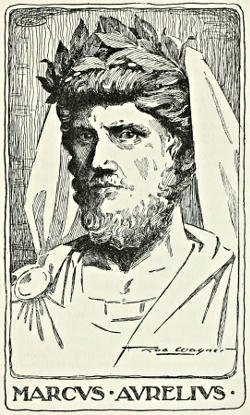
MARCVS AVRELIVS
However, these precautions were fruitless; Verus soon grew weary of
all restraint; he neglected every admonition; and, thoughtless of the
urgency of his expedition, plunged himself into every kind of debauchery.
These excesses brought on a violent fever on his journey, which his constitution
was sufficiently strong to get over, but nothing could correct his vicious
inclinations. Upon his entering Antioch, he resolved to give an indulgence
to every appetite, without attending to the fatigues of war. There, in one
of its suburbs, which was called Daphne, which, from the sweetness of the
air, the beauty of its groves, the richness of its gardens, and the freshness of
its fountains, seemed formed for pleasure, he rioted in excesses unknown
even to the voluptuous Greeks, leaving all the glory of the field to his
lieutenants, who were sent to repress the enemy. These, however, fought
with great success: Statius Priscus took Artaxata; Cassius put Vologeses
to flight, took Seleucia, plundered and burned Babylon and Ctesiphon, and
demolished the magnificent palace of the kings of Parthia. In a course of
four years, during which the war continued, the Romans entered far into the
Parthian country, and entirely
subdued it; but upon their return
their army was wasted to
less than half its former number
by pestilence and famine. However,
this was no impediment to
the vanity of Verus, who resolved
to enjoy the honours of a
triumph so hardly earned by
others. Wherefore, having appointed
a king over the Armenians,
and finding the Parthians
entirely subdued, he assumed the
titles of Armenicus and Parthicus;
and then returned to Rome
to partake of a triumph with
Aurelius, which was accordingly
solemnised with great pomp and
splendour.
[163-166 A.D.]
During the course of this expedition,
which continued for
some years, Aurelius was sedulously
intent upon distributing
justice and happiness to his subjects
at home. He first applied
himself to the regulation of public
affairs, and to the correction
of such faults as he found in the
laws and policy of the state. In
this endeavour he showed a singular
respect for the senate, often
permitting them to determine
without appeal; so that the commonwealth seemed in a manner once more
revived under his equitable administration. Besides, such was his application
to business that he often employed ten days together upon the same
subject, maturely considering it on all sides, and seldom departing from the
senate house till, night coming on, the assembly was dismissed by the consul.
But while thus gloriously occupied, he was daily mortified with accounts of
the enormities of his colleague, being repeatedly assured of his vanity, lewdness,
and extravagance. However, feigning himself ignorant of these excesses,
he judged marriage to be the best method of reclaiming him; and
therefore sent him his daughter Lucilla, a woman of great beauty, whom
Verus married at Antioch. But even this was found ineffectual: Lucilla
proved of a disposition very unlike her father; and instead of correcting her
husband’s extravagances, only contributed to inflame them. Yet Aurelius
still hoped that, upon the return of Verus to Rome, his presence would keep
him in awe, and that happiness would at length be restored to the state. But
in this also he was disappointed. His return only seemed fatal to the empire;
for his army carried back the plague from Parthia, and disseminated
the infection into all the provinces through which it passed.
THE PLAGUE AND THE DEATH OF VERUS
[166-169 A.D.]
Nothing could exceed the miserable state of the empire shortly after the
return of Verus. In this horrid picture was represented an emperor, unawed
by example or the calamities surrounding him, giving way to unexampled
debaucheries; a raging pestilence spreading terror and desolation through
all the parts of the western world; earthquakes, famines, and inundations,
such as had never before happened; the products of the earth, throughout
all Italy, devoured by locusts; all the barbarous nations surrounding the
empire, the Germans, the Sarmatians, the Quadi, and Marcomanni, taking
advantage of its various calamities, and making their eruptions even into
Italy itself. The priests did all they could to put a stop to the miseries of
the state, by attempting to appease the gods, vowing and offering numberless
sacrifices, celebrating all the sacred rites that had ever been known in Rome,
and exhibiting the solemnity called Lectisternia seven days together. To
crown the whole, these enthusiasts, not satisfied with the impending calamities,
made new ones, by ascribing the distresses of the state to the impieties
of the Christians alone; so that a violent persecution was soon raging in all
parts of the empire, in which Justin Martyr, St. Polycarp bishop of Smyrna,
and an infinite number of others suffered martyrdom.
In this scene of universal tumult, desolation, and distress, there was
nothing left but the virtues and the wisdom of one man alone to restore
tranquillity and bring back happiness to the empire. Aurelius began his
endeavours by marching against the Marcomanni and Quadi, taking Verus
with him, who reluctantly left the sensual delights of Rome for the fatigues
of a camp. They came up with the Marcomanni near the city of Aquileia,
and after a furious engagement routed their whole army; then pursuing
them across the Alps, overcame them in several contests and at last, entirely
defeating them, returned into Italy without any considerable loss. As the
winter was far advanced, Verus was determined upon going from Aquileia to
Rome, in which journey he was seized with an apoplexy which put an end
to his life, being thirty-nine years old, having reigned in conjunction with
Aurelius nine. Suspicion, which ever attends the fate of princes, did not
fail to ascribe his death to different causes.b Some reports implicated the
empress Faustina as having poisoned him; others named Lucilla, the wife of
Verus, who was said to be jealous of her husband’s sister, Fabia. But all these
rumours lack authenticity; and so, for that matter, do the reports on which
the usual estimates of the life of Verus are based. Doubtless his vices were
exaggerated.a
BORDER WARS
[169-174 A.D.]
Aurelius, who had hitherto felt the fatigues of governing not only an empire
but an emperor, being now left to himself began to act with great diligence
and more vigour than ever. His first care was to marry his daughter Lucilla
once more, to Claudius Pompeianus, a man of moderate fortune and humble
station, but eminent for his honesty, courage, and wisdom. He then left
Rome to finish the war against the Marcomanni, who, joining with the Quadi,
the Sarmatians, the Vandals, and other barbarous nations, renewed hostilities
with unusual rage and devastation. They had some time before attacked
Vindex, prefect of the prætorian bands, and in a general battle near the
Danube destroyed no less than twenty thousand of his men. They even
pursued the Romans as far as Aquileia, and would have taken the city, had
not the emperor led his troops in person to oppose them. Aurelius, having
repulsed the enemy, continued his endeavours to repress them from future
inroads. He spent in this laborious undertaking no less than five years,
harassing these barbarous nations, supporting the most dreadful fatigues,
and supplying, by the excess of his courage, the defects of a delicate constitution.
The stoic philosophy, in which he was bred, had taught him simplicity
of living, which served as an example to the whole army. The
common soldier could not murmur at any hardships he was put upon, when
he saw the emperor himself every hour undergoing greater austerities with
cheerful resignation. By this conduct Aurelius so wearied out the enemy
with repeated attacks, that he at last constrained them to accept of such
terms of peace as he thought fit to impose, and thus returned in triumph
to Rome.
Upon the emperor’s return to Rome, he began his usual endeavours to
benefit mankind by a further reformation of the internal policy of the state.
He ordered that no inquiry should be made after the fortune of deceased
persons who had been dead five years. He moderated the public expenses,
and lessened the number of shows and sports which were exhibited in the
amphitheatre. He particularly took the poor under his protection; he found
such pleasure in relieving their wants that he considered his ability to supply
the dictates of his compassion as one of the greatest happinesses of his
life. He laboured incessantly to restrain the luxuries of the great, he
prohibited the use of chariots and litters to persons of inferior station, and
endeavoured by all means to correct the lewdness and disorders of women.
But his good endeavours were soon interrupted by a renewal of the former
wars. The barbarians no sooner perceived his army withdrawn, than they
took up arms once more, and renewed their ravages with greater fury than
before. They had now drawn over to their side all the nations from Illyricum
to the farthest parts of Gaul. Aurelius, therefore, again saw himself
surrounded with difficulties; his army had before been wasted by the plague
and frequent engagements, and his treasures entirely exhausted. In order
to remedy these inconveniences, he increased his forces by enlisting slaves,
gladiators, and the banditti of Dalmatia.
To raise money, he sold all the movables belonging to the empire and
all the rich furniture which had been deposited in the cabinets of Hadrian.
This sale, which continued for two months, produced so considerable a sum as
to defray all the expenses of the war. His next effort was to march forwards,
and cross the Danube by a bridge of boats.b
Dion Cassiuse tells some most surprising stories about the campaign that
followed; and the picturesqueness of this narrative is heightened by the
emendations added to it by Xiphilinus,h to whose excerpts we owe the preservation
of the account. It is worth while to quote these authors at some
length, as their story well illustrates the character of the material on which
our reconstruction of the history of this period must rest.a
“After having fought several important battles,” says Dion, “and
exposed himself to many dangers, Marcus Antoninus (Marcus Aurelius)
subjugated the Marcomanni and the Iazyges; he also carried on a great war
against the people called Quadi, in which, against his expectations, he was
victorious, or rather victory was bestowed upon him by a god. Indeed it
was divine interposition that saved the Romans from the dangers they were
in during this combat. Surrounded by the Quadi, who had all the advantage
of position, the Romans defended themselves valiantly with their
shields; presently the barbarians ceased hostilities in the hope that heat
and thirst would deliver their adversaries into their hands without the
trouble of further fighting; and took possession of all the places around
which they fortified to prevent the enemy from finding water, for the Quadi
were far superior in numbers. Now while the Romans, unable either to
offer combat or retreat and reduced to the last extremity by wounds, fatigue,
heat, and thirst, were standing helplessly at their posts, clouds suddenly
assembled in great number and rain descended in floods—certainly not
without divine intervention, since an Egyptian mage, Arnulphis, who was
with Marcus Antoninus, is said to have invoked several genii, principally
the aërial Mercury, by enchantment, and thanks to them had brought down
rain.”e
“This,” Xiphilinus comments, “is what Dion relates regarding this
matter; but he seems, whether voluntarily or involuntarily, to practise
deception. I incline to the belief that he does so voluntarily. And why
not, as a matter of fact? He knew that there existed a legion called the
Thundering Legion, which name was given it for no other reason than for
what came to pass in this war. To this legion was due the preservation of
the Roman army and the loss of that of the barbarians, and not to the mage
Arnulphis. Marcus Antoninus had a legion composed of soldiers from
Melitene, who all professed Christianity. During the battle the chief of
the prætorians had sought out Marcus Antoninus, who was in great perplexity
at the turn events were taking, fearing sorely for the safety of the
army, and represented to him, it is said, that there was nothing the people
called Christians could not obtain by their prayers, and that among his
forces was a troop composed wholly of followers of that religion. Rejoiced
at this news Marcus Antoninus demanded of these soldiers that they should
pray to their god, who, granting their petition on the instant, sent lightning
among the enemy and consoled the Romans with rain. Struck by this wonderful
success the emperor honoured the Christians in an edict and named
their legion the Thundering. It is even asserted that a letter exists by
Marcus Antoninus on this subject. The pagans well know that the company
was called the Thunderers, having attested the fact themselves, but they
reveal nothing of the occasion on which the legion received the name.
“Dion adds that when the rain began to fall every soldier lifted his head
toward heaven to receive the water in his mouth; that afterwards some held
out their shields and others their helmets to catch the water, and many gave
their horses to drink. Being set upon at once by the barbarians they drank
and fought on the same spot, and several, being wounded, swallowed blood
mingled with the water in their helmets. All being occupied in drinking,
they would doubtless have been seriously incommoded by this attack had
not heavy hail and numerous thunderbolts thrown consternation into the
ranks of the enemy. Fire and water could be seen to mingle as they left
the heavens; some upon whom they fell drank and were refreshed, but many
were burned and perished. The fire did not reach the Romans, but if it did
by chance touch one of them it was immediately extinguished; in the same
manner the rain, instead of comforting the barbarians, seemed merely to
excite, like oil, the fire with which they were being consumed, and all soaked
with water as they were they constantly sought more. Some barbarians
inflicted wounds upon themselves as though their blood had power to extinguish
flames, while many rushed over to the side of the Romans, hoping that
there the water might be salutary to them. Marcus Antoninus had compassion
on them, and for the seventh time he was proclaimed emperor by the
soldiers. Although not usually accepting this title until it had been
bestowed upon him by the senate, he made no demur on this occasion, holding
that the honour came from a god, and wrote to that effect to the senate.
As for Faustina, the title bestowed on her was Mother of the Camp.”h
Notwithstanding this victory, the war continued for some months longer;
but, after many violent conflicts, the barbarians sent to sue for peace. The
emperor imposed conditions upon them, more or less severe, as he found them
more or less disposed to revolt; being actually resolved to divide their territories
into provinces, and subject them to the Roman Empire. However, a
fresh rebellion called him to the defence of his dominions at home.
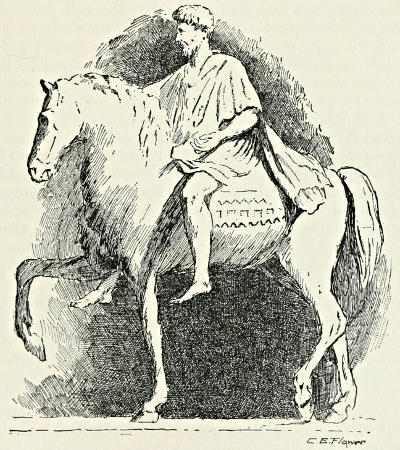
Statue of Marcus Aurelius in the Capitol
THE REVOLT OF AVIDIUS
[174-175 A.D.]
Avidius Cassius was one of the emperor’s favourite generals, and had been
chiefly instrumental in obtaining the Roman successes in Parthia. His principal
merit seemed to consist in his restoring the old discipline and in pretending
a violent regard for the commonwealth in its ancient form. But, in
fact, all his seeming regard for freedom was only to seize upon the liberties
of his country for his own aggrandisement. Wherefore, finding his soldiers
(for he was left with an army in the East) willing to support his pretensions,
he proclaimed himself emperor in Syria. One of his chief artifices to procure
popularity was his giving out that he was descended from the famous Cassius,
who had conspired against Cæsar; and like him he pretended that his aims
were for the re-establishment of the commonwealth of Rome. He also caused
it to be rumoured that Aurelius was dead, and he affected to show the greatest
respect for his memory. By these pretences, he united a large body of
men under his command, and in a short time brought all the countries from
Syria to Mount Taurus under his subjection. These prosperous beginnings
served to increase the emperor’s activity, but not his apprehensions. He prepared
to oppose him without any marks of uneasiness for the event; telling
his soldiers that he could freely yield up his empire to Avidius, if it should
be judged conducive to the public good; for, as to his own part, the only
fruits he had from exaltation were incessant labour and fatigue.
“I am ready,” cried he, “to meet Avidius before the senate, and before
you; and to yield him up the empire, without the effusion of blood, or striking
a blow, if it shall be thought good for the people. But Avidius will
never submit to such a tribunal; he who has been faithless to his benefactor
can never rely upon any man’s professions. He will not even, in case of
being worsted, rely upon me. And yet, my fellow-soldiers, my only fear is,
and I speak it with the greatest sincerity, lest he should put an end to his
own life; or lest some, thinking to do me a service, should hasten his death,
the greatest hope that I have is to prove that I can pardon the most outrageous
offences; to make him my friend, even in spite of his reluctance;
and to show the world that civil wars themselves can come to a happy issue.”
In the meantime Avidius, who well knew that desperate undertakings must
have a speedy execution, endeavoured to draw over Greece to his assistance;
but the love which all mankind bore the good emperor frustrated his expectations;
he was unable to bring over a single city to espouse his interests.
This repulse seemed to turn the scale of his former fortunes. His officers
and soldiers began now to regard him with contempt; so that they at last
slew him, in less than four months after their first revolt. His head was
brought to the emperor, who received it with regret, and ordered it an
honourable interment. The rest of the conspirators were treated with great
lenity; some few of them were banished, but recalled soon after. This
clemency was admired by some, and condemned by others; but the emperor
little regarded the murmurs or the applause of the multitude; guided only
by the goodness of his own disposition, he did what to him seemed right,
content and happy in self-approbation. When some took the liberty of
blaming his conduct, telling him that Avidius would not have been so generous
had he been conqueror, the emperor replied in this sublime manner:
“I never served the gods so ill, or reigned so irregularly, as to fear Avidius
could ever be conqueror.”
AN IMPERIAL TOUR AND A TRIUMPH
[175-177 A.D.]
Though Avidius was no more, yet Aurelius was sensible that he had still
some enemies remaining, whom he was willing to win over. He therefore
took a journey into the East, where, in all places, he at once charmed them
with his affability, raised their admiration by his clemency, instructed them by
precept, and improved them by his example. The better to prevent such
revolts for the future, he ordained that as Avidius was a native of the country
in which he rebelled, no person, for the time to come, should command
in the place where he was born. In this journey the empress Faustina was
unexpectedly seized with a violent distemper, and died. She was a woman
whose wanton life gave great scandal to the dignity of her station; however,
her passive husband either could not or at least affected not to see her enormities,
but willingly admitted the ill-deserved honours which the senate
importunately decreed to her memory.
On his way to Rome he visited Athens, where he conferred many honours
on the inhabitants, and established professors in all the sciences, with munificent
salaries for their ease. Upon landing in Italy he quitted his soldier’s
habit, as also did all his army, and made his entry into Rome in the gown
which was worn in peace. As he had been absent almost eight years, he
distributed to each citizen eight pieces of gold, and remitted all the debts
due to the treasury for sixty years past. At the same time he nominated
his son Commodus to succeed him in the empire, and made him a partner in
his triumphal entry at the close of 176.b
At this time the senate erected an equestrian statue of Marcus, of which
Merivale speaks in the following eloquent terms:
“Of all the Cæsars whose names are enshrined in the page of history, or
whose features are preserved to us in the repositories of art, one alone seems
still to haunt the eternal city in the place and the posture most familiar to
him in life. In the equestrian statue of Marcus Aurelius, which crowns the
platform of the Campidoglio, imperial Rome lives again. Of all her consecrated
sights it is to this that the classical pilgrim should most devoutly repair;
this of all the monuments of Roman antiquity most justly challenges his veneration.
For in this figure we behold an emperor, of all the line the noblest
and the dearest, such as he actually appeared; we realise in one august exemplar
the character and image of the rulers of the world. We stand here
face to face with a representative of the Scipios and Cæsars, with a model of
the heroes of Tacitus and Livy. Our other Romans are effigies of the closet
and the museum; this alone is a man of the streets, the Forum, and the Capitol.
Such special prominence is well reserved, amidst the wreck of ages,
for him whom historians combine to honour as the worthiest of the Roman
people.”l
Besides this, a group of monuments expressive of their homage was
erected in the Via Lata (a part of the Flaminian way) on the Field of
Mars. The dedicatory inscription and some bas-reliefs have come down to
us from a triumphal arch which was not destroyed until the year 1662; the
most important of them being some bas-reliefs representing the apotheosis
of Faustina. The marble column of Marcus Aurelius, in what is now the
Piazza Colonna, is still standing. It measures 29.55 metres in height, inclusive
of the base, capital, plinth and abacus, and consists of twenty-eight
blocks. A spiral staircase of 190 steps go up in the interior, and the abacus
was originally surmounted by a bronze statue of the emperor. Round the
shaft, as in Trajan’s column, runs a spiral band of reliefs, containing twenty
rows of figures one above the other, and representing the wars of the Romans
against the tribes of the Danube. In design and execution, however, these
sculptures, which were not finished until the reign of the emperor’s successor,
fall far short of the excellence of the earlier work. The representation
of motion is often exaggerated, the outlines and draperies are harsh
and clumsy, and the profile of the relief is coarser than in Trajan’s column.
The statue was probably carried off by the Byzantine emperor, Constans
II, in the year 663 A.D. The column was struck by lightning in 1589,
and was restored by Pope Sixtus V, and surmounted by a statue of Paul the
apostle in gilded bronze. A temple of Marcus Aurelius probably stood to
the west of it, on what is now Monte Citorio.
[177-180 A.D.]
After his return to Rome Marcus Aurelius was once more at leisure to
prosecute zealously the affairs of peace, for which he had so great a liking.
The administration was admirable, its only defect being that the mildness
of the emperor’s disposition inclined him to laxity in dealing with the governors
of the senatorial provinces. Apart from certain other matters (such
as the matter of the Italian magistrates and the judicial powers of the high
imperial officials at Rome), the care of the alimentary institution was the
object of his peculiar interest. It is not improbable (though open to question)
that at this time he placed this institution under the charge of a
consular alimentary prefect specially appointed. The work hitherto done
by the district prefects was handed over to the Italian magistrates, and the
curators of the highways were commissioned, on the one hand, to guard
against exactions on the part of customs officials, and on the other, to superintend
the Italian grain markets and arrange for the supply and sale of corn.
The serious financial straits in which the empire was involved during
the critical years of the war on the Danube were not without their effect
on the alimentary institution. The emperor had already allowed the weight
of the gold piece to fall to 7.3 gr. and the proportion of alloy in the denarius
to rise to 25 per cent.; and he seems now to have found it necessary
to call in from the landowners the capital set aside for the support of the
institution and to divert the interest to the public treasury; a precedent
which was hereafter to prove very injurious. Nevertheless Marcus Aurelius
was so able an economist that no later than the year 176 he was able to
relieve the burdens of the nation by the remission of all debts and arrears
due to the public treasury (for a period of forty-six years). Meanwhile
the population of the capital was gratified by repeated donations of money
and corn during the lean years.
The emperor endeavoured to modify the sanguinary character of the
gladiatorial shows by requiring the combatants to have buttons on their
foils, and the appointment of a prætor tutelaris was a proof of his special
care for interests of minors. Moreover, while following the levelling policy
of his two predecessors in the extension of Latin and Roman citizenship
to all parts of the empire, he was careful to lay the foundation of a more
accurate knowledge of the statistics of his dominions.m
“Amid these records of gentleness and forbearance,” says Miss Zimmern,
“it seems strange to read that Marcus Aurelius permitted a cruel persecution
of the Christians. Among the victims of this reign were Justin Martyr
and Polycarp, and numbers suffered in a general persecution of the churches
at Lyons and Vienna. It must not, however, be forgotten that the persecution
was political rather than religious. Of the true teaching of Christianity
Marcus Aurelius knew little and cared less; but its followers, in refusing to
acknowledge a religion which included the emperors among its deities, became
rebels against the existing order of things, and therein culpable.”n
The well-meant labours of Aurelius were interrupted by grievous calamities.
In Asia, earthquakes were a veritable scourge; and the year 178 in
particular was marked by frightful destruction on the Ionian coasts, especially
at Samos, Chios, Miletus, and the magnificent city of Smyrna. Liberal
assistance was sent to the last-named place at the entreaty of P. Ælius
Aristides (born 117 or 129) of Adriani in Bithynia.
But the emperor’s gravest anxieties were for the future. The hand of
death had lain heavy on his family, nor was the heir-presumptive to the
throne a son likely to rejoice his father’s heart. Marcus Lucius Ælius
Aurelius Commodus Antoninus was born at Lanuvium on August 31, 161,
and invested with the title of Cæsar on October 12, 166. But the boy was
ill-endowed by nature, and the efforts of his father, and of the other able
men about him (such as Cornelius Fronto, and Galen, the famous physician,
who had lived in Rome from 169 onwards as his physician in ordinary, and
died about 200 A.D.) were unsuccessful in fitting him for the duties of his
high station. Commodus, though by no means free from evil tendencies,
was not exactly vicious, but he was stupid, timid, lacking in initiative, and
therefore likely to be swayed by his immediate surroundings. This was not
the kind of man the empire needed at this juncture. Nevertheless, Marcus
Aurelius could not summon up resolution enough to exclude him from the
succession. On the contrary, Commodus was invested with tribunician
authority in the year 177, and in order to secure his succession he was called
upon, thus early, to take his place at his father’s side as augustus.
LAST CAMPAIGNS AND DEATH OF AURELIUS
The whole imperial power was only too soon to pass into the hands of
this sinister being. The middle Danube, where Pertinax had been in command
and had been succeeded, on his appointment to the governorship of
Mœsia, by the two Quintilii, was the centre of constant disorders. The
German tribes were inflamed afresh by the exaction of the hard conditions
of peace, and by the year 177 the flames of war had burst forth again. In
178 Marcus Aurelius was once more forced to take the field in person. He
therefore married his son to Crispina, daughter of the consular Caius Bruttius
Præsens (if, indeed, the marriage had not taken place in the previous
year), and set forth with him to the Danube on the fifth of August.
The Danube provinces were at this time very strongly fortified, and the
river was extremely well guarded as far as Ratisbon on the west. Its waters
were navigated by a powerful fleet divided into squadrons corresponding to
the three principal harbours of Laureacum, Arelape Comagenæ, and Carnuntum.
The emperor had raised two legions to occupy Noricum and
Rætia. In Noricum the central point of the military frontier was at Laureacum,
and the highway of the Danube had now been completed. The
valleys and roads leading to the Danube were no less strongly fortified than
those which led to the Rhine. Above Laureacum the forts of Lentia (on
the Schlossberg of Linz) and Joviacum (Schlögen near Haibach) commanded
the surrounding country, and below the central fortress the great road to
Vindobona was guarded by the castellum of Lacus Felicis (of which the
wall may still be seen at Oehling on the Url), which was capable of accommodating
three cohorts, by Elegium (on the crags of Wallsee), and by the
fortified camp of Arelape at the mouth of the Erlaf. Beyond these came the
castle of Namare on the crags of Melk, the castella of Trigisamum (Traismauer),
Faviana (Mautern), and Comagenæ (Tulln), and lastly of Citium
(Zeiselmauer), at the foot of the forest of Vindobona. The next section of
the Pannonian Danube was even more thoroughly protected. Vindobona
was flanked by several forts, and close to this strong fortress was Carnuntum,
its main bulwark, a mighty quadrangle close upon the steep bank of
the river, raised far aloft above the torrent stream and looking across its
turbid waves and green islands to the boundless stretches of the Marchfeld.
The passage of the Danube was guarded by a barbican (at Stopfenreut).
Of this fresh war on the Danube few records have come down to us.
From the outset it was more successful than the former campaign. One of
the most brilliant episodes was a great victory gained over the Germans,
after fearful carnage, at the end of the year 179, by Tarruntenus Paternus, a
notable jurist and scientific tactician, who was now in command as præfectus
prætorio. Fortune seemed to smile ever more brightly on the Roman arms,
when, as the evil genius of the empire would have it, the admirable emperor
died of the plague in the camp at Vindobona, rightly appreciated and deeply
mourned in death; deified and vainly desired as the fortunes of the declining
empire became more and more gloomily overcast.m
“It seemed,” said the sympathetic Goldsmith,b “as if the whole glory and
prosperity of the Roman Empire died with Aurelius. From thenceforward
we are to behold a train of emperors either vicious or impotent, either wilfully
guilty or unable to assert the dignity of their station. We are to behold
an empire, grown too great, sinking by its own weight, surrounded by
barbarous and successful enemies without and torn by ambitious and cruel
factions within; the principles of the times wholly corrupted; philosophy
attempting to regulate the minds of men without the aid of religion; and
the warmth of patriotism entirely evaporated, by being diffused in too wide
a circle.” But a certain allowance must be made for eulogistic exaggeration
in such an estimate as this. It must never be forgotten that a great empire
changes slowly. All was not well with the empire before Marcus Aurelius,
and all was not ill with it afterwards.a
The despondency which had seized on the gentle emperor’s spirits is
strongly marked in the circumstances of his last hours. While anticipating
his own decease with satisfaction, and even with eagerness, he regarded
himself as only a fellow-traveller on the common road of life with all around
him, and took leave of his friends as one who was but just preceding them.
If he regarded the condition of public affairs, the prospect of his son succeeding
him was not such as to console him; for he could not hide from
himself that Commodus was vicious, cruel, and illiterate. The indulgence
he had shown to his consort’s irregularities might be pardoned by the state,
to which they were of little moment; but his weakness in leaving to his
graceless offspring the command of a world-wide empire must reflect more
strongly on his memory.
He may have judged, indeed, that the danger to the state from a bad
prince was less than the danger from a disputed succession, especially in the
face of the disasters accumulating around it. On his death-bed he warned
his son not to underrate the peril from the barbarians, who, if at the moment
worsted and discouraged, would soon revive, and return again to the assault
with increasing vigour. And so he left the laws of inheritance, as now ordinarily
received, to take their course, indicating his will that Commodus
should succeed him by the simple form of recommending him to the care of
his officers and to the favour of the immortal gods. On the seventh day of
his illness he admitted none but his unworthy son to his chamber, and after
a few words dismissed him, covered his head for sleep, and passed away
alone and untended.
Born on the 20th of April, 121, and dying on the 17th of March, 180, he
had almost completed his fifty-ninth year. His career had been divided
into three nearly equal portions: the first, to his association in the empire
with Antoninus; the second, to his accession to complete sovereignty; the
third, from thence to his decease. The first was the season of his general
education, the second that of his training for empire, in the last he exercised
power uncontrolled. In each he had acquitted himself well, in each he had
gained himself love and admiration; but the earlier periods were eminently
prosperous and happy; the crowning period was a time of trial, of peril,
fatigue, distress, and apprehension.
MERIVALE COMPARES AURELIUS AND ALFRED THE GREAT
Historical parallels between men of different times and circumstances
are very apt to mislead us, yet I cannot refrain from indicating the comparison,
which might be drawn with unusual precision, between the wise, the
virtuous, the much-suffering Aurelius, and England’s great and good king
Alfred. Both arrived early and unexpectedly to power; both found their
people harassed by the attacks of importunate enemies; they assumed with
firmness the attitude of resistance and defence, and gained many victories
in the field, though neither could fail to acknowledge the unequal conditions
of the struggle. Both found themselves at the head of a weak and degenerate
society whose hour of dissolution had well-nigh struck. Nevertheless,
they contended manfully in its behalf, and strove to infuse their
own gallant spirit into a people little worthy of their championship.
But Aurelius and Alfred were not warriors only. They were men of
letters by natural predilection and early habit; they were legislators, administrators,
and philosophers, with this difference, that the first came at
the end of a long course of civilised government, the second almost at its
beginning; the first at the mournful close of one period of mental speculation,
the second at the fresh and hopeful commencement of another. The
one strove to elevate the character of his subjects by the example of his own
scrupulous self-examination; the other by precepts of obedience to an external
revelation. But both were, from their early days, weak in body, and
little fit to cope with the appalling fatigues of their position; both, if I mistake
not, were sick at heart, and felt that their task was beyond their power,
and quitted life prematurely, with little reluctance.
In one respect, however, their lot was different. The fortunes of the
people of the English Alfred, after a brief and distant period of obscuration,
have ever increased in power and brightness, like the sun ascending
to its meridian. The decline of which Aurelius was the melancholy witness
was irremediable and final, and his pale solitary star was the last apparent
in the Roman firmament.l
GIBBON’S ESTIMATE OF MARCUS AURELIUS, AND OF THE AGE OF THE
ANTONINES
[161-180 A.D.]
The virtue of Marcus Aurelius Antoninus was of a severe and laborious
kind. It was the well-earned harvest of many a learned conference, of many a
patient lecture, and many a midnight lucubration. At the age of twelve years
he embraced the rigid system of the stoics, which taught him to submit his
body to his mind, his passions to reason; to consider virtue as the only good,
vice as the only evil, all things external as things indifferent. His meditations,
composed in the tumult of a camp, are still extant; and he even condescended
to give lessons of philosophy, in a more public manner than was
perhaps consistent with the modesty of a sage or the dignity of an emperor.
But his life was the noblest commentary on the precepts of Zeno. He was
severe to himself, indulgent to the imperfections of others, just and beneficent
to all mankind. He regretted that Avidius Cassius, who excited a
rebellion in Syria, had disappointed him by a voluntary death of the pleasure
of converting an enemy into a friend; and he justified the sincerity of
that sentiment by moderating the zeal of the senate against the adherents
of the traitor. War he detested, as the disgrace and calamity of human
nature; but when the necessity of a just defence called upon him to take up
arms, he readily exposed his person to eight winter campaigns on the frozen
banks of the Danube, the severity of which was at last fatal to the weakness
of his constitution. His memory was revered by a grateful posterity; and,
above a century after his death, many persons preserved the image of Marcus
Antoninus among those of their household gods.
If a man were called upon to fix the period in the history of the world during
which the condition of the human race was most happy and prosperous, he
would, without hesitation, name that which lapsed from the death of Domitian
to the accession of Commodus.[33] The vast extent of the Roman Empire
was governed by absolute power, under the guidance of virtue and wisdom.
The armies were restrained by the firm but gentle hand of four successive
emperors, whose characters and authority commanded involuntary respect.
The forms of the civil administration were carefully preserved by Nerva,
Trajan, Hadrian, and the Antonines, who delighted in the image of liberty,
and were pleased with considering themselves as the accountable ministers
of the laws. Such princes deserved the honour of restoring the republic, had
the Romans of their day been capable of enjoying a rational freedom.
The labours of these monarchs were overpaid by the immense reward
that inseparably waited on their success; by the honest pride of virtue, and
by the exquisite delight of beholding the general happiness of which they
were the authors. A just but melancholy reflection embittered, however,
the noblest of human enjoyments. They must often have recollected the
instability of a happiness which depended on the character of a single man.
The fatal moment was perhaps approaching when some licentious youth, or
some jealous tyrant, would abuse, to the destruction, that absolute power
which they had exerted for the benefit of their people. The ideal restraints
of the senate and the laws might serve to display the virtues, but could
never correct the vices, of the emperor. The military force was a blind
and irresistible instrument of oppression; and the corruption of Roman
manners would always supply flatterers eager to applaud, and ministers prepared
to serve, the fear or the avarice, the lust or the cruelty, of their
masters.e
Bull prepared for Sacrifice
If Marcus Aurelius could not save the world, who shall save it?—Renan.
To whoever knows anything of human intelligence it is evident that a
revolution of consciences is outside and above the duties and the power of a
government. In their quality of high priest, the Cæsars desired two contradictory
things—to maintain the national cult, and to make Rome the city
of the gods, or a kind of universal pantheon. This was the only reform and
the only religious unity of which they could conceive. Thus, little by little,
all the gods of the conquered nations came to be honoured at the Capitol.
In spite of their distrust of Asiatic cults, which were always connected with
confraternities that gave them offence, the Cæsars had their hands forced by
popular superstitions, and all the divinities of Asia and of Egypt took their
places side by side with the Greek and Roman gods.
This was certainly the unity the genius of Rome sought in everything;
but it was a coarse, factitious, material unity, whose least defect was that all
the polytheistic religions were disfigured and neutralised by one another,
without satisfying the religious sentiment of the people or the intellect of
the higher classes from henceforth too enlightened to accept a too evident
polytheism. Where was the faith, the sincerity of adoration, and the life of
the soul in this patched-up religion? And did this, the worst kind of unity
that Roman policy voluntarily admitted, put an end to the fatal separation
between philosophers and people, between the head and the heart of society?
Strange blindness of those who give all to politics! The emperors, without
knowing it and without wishing it, ended by discrediting the ancient national
belief by this confusion of all religions, and yet what efforts did they
not make to animate and purify it?
We hardly believe in the faith of the cæsars; but we can understand
that they wished to preserve the ancient worship as a part of public order.
Thus we see Augustus (although he amused himself, in the most scandalous
orgies, by making a mock of the twelve great gods) devoutly rebuilding the
temples, celebrating religion and piety by the agency of Horace the epicurean,
honouring the vestals and the priests, burning thousands of apocryphal sibylline
books, and severely repressing the usurpations of the Judaic and Egyptian
worships, which were forbidden the city of Rome. Tiberius amused the senate
during long sittings by the examination and consecration of the privileges
of the ancient sanctuaries. Claudius complained bitterly that the arts of
Etruria had fallen into disuse owing to the indifference of the patricians, and
endeavoured to revive superannuated studies for which he had a historian’s
and an archæologist’s passion. Domitian complied with the cruel requirements
of the old faith by burying unfortunate vestals alive. All showed themselves
zealous defenders of the gods and the empire, and there was reason to be
thankful when, recalling the words of Tiberius, that it is for the gods alone
to avenge their injuries, they refrained from sacrificing those they feared to
the sacrosanct majesty of their deified predecessors; or abstained from
making themselves persecutors of the new faith, which embodied the principle
of the moral and religious unity they vainly sought for.
But their conduct did not show either sincere faith, or hypocrisy, or
weakness and infirmity of mind; it was purely political. They were convinced
that the people needed a religion. Then, what religion was preferable
to the one of which the senate had so cleverly availed itself, and which had
presided over the birth and growth of the Eternal City? But, as if the gods
were not yet sufficiently discredited, they were obliged to share their sacred
honours with the vilest and most execrable of mortals. The apotheosis of
the cæsars was the last insult inflicted on the masters of Olympus. In truth
it deceived neither the servile worshippers nor those destined to be worshipped.
Seneca and Juvenal were doubtless not the only ones to laugh at
men like Claudius, whom some poor wretch had degraded to the rank of the
gods, and we may suppose that the other emperors would have had the good
sense to admit, with Tiberius, that they were but mortal men, not at all
anxious to enjoy their false divinity the other side of the grave.
But these scandalous consecrations had the drawback of confirming the
impious belief of the votaries of Evemerus, who, as it appears, were very
numerous at Rome, even from the time of the first of the Scipios. On seeing,
as Lucan says, the civil wars giving peers to the inhabitants of heaven, and
Rome tricking out shades with thunderbolts and shooting stars and swearing
by the shadows in the temples of the god, what could men think, but that
Jupiter and his fellows had the same title to our adoration as Caligula and
Tiberius? Claudius, the learned but imbecile pupil of Titus Livius, was
perhaps the only Roman who was devoted to the gods of the empire. Politics
saw in religion nothing but fraudulous inventions to deceive and coerce
the people; the philosophers either professed atheism or, having formed
higher and purer beliefs for themselves, turned the ancient superstitions into
ridicule; the ignorant took refuge with the charlatans and foreign divinities.
Stoicism, according to its doctrines, was rather favourable than hostile to
the revolution represented by the empire, but the proud and free sentiments
it developed in the soul were necessarily contrary to tyranny, which the
worst cæsars confounded with the rights of power; to that exaggeration of
obedience, to that servility to which their subjects were too much inclined
and of which they were only too eager to make a false duty or an infamous
merit. The philosophers were therefore odious to all that surrounded and
was subservient to the early cæsars.
Their accusers flung vehement eloquence against them and persecuted in
them what they called the mimics of Brutus and Cato. The centurions
delighted in turning their wisdom to ridicule, whilst waiting to cut their
throats by order of their masters. Nero, Vespasian, and Domitian did them
the honour of driving them from Rome and from Italy. Agrippinus,
Rusticus, Thraseas, Helvidius Priscus, Seneca, Dion, Epictetus, and many
others expiated by exile or by death the glorious crime of not consenting to
slavery, and of displeasing imbecile tyrants, who aimed at stifling even the
conscience of the human species.
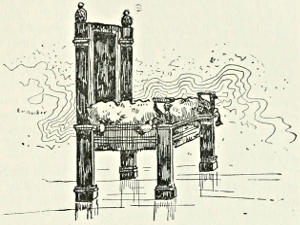
Roman Chair of State
Stoicism flourished in this struggle between intellect and brute force.
It became an ardent and vigorous faith, a kind of religion of great souls
with its followers and martyrs. This transformation is noticeable even in
the provinces, where there was less cause to murmur against the savage
tyranny of the emperors
than to rejoice at the benefits
of the empire and of
the Roman peace. It was
because there also the people
felt that they were
dependent, that these honours,
these dignities, these
appearances of liberty,
given to the conquered by
policy as a consolation for
their servitude, were but
a vain show made to amuse
fools, and that an archon
or other native magistrate
was of very little importance
beside the Roman
procurator or even his
centurion. Thrown back upon themselves, by violence or the lack of
interests, the souls of mankind studied the inner life more earnestly, and
the essential qualities of its virtue and greatness.
Hence the new characteristics of stoicism—the preaching tone which
took the place of philosophical discussion, a science of life unknown until
then, and a peculiar art of disentangling the most obscure sophisms of vice
and weakness, but above all a stern tenderness for humanity. The philosopher
is no longer a logician who makes dissertations, nor a fine speaker
aiming at applause. He is a master who teaches, a public censor charged
with the care of consciences; God’s witness, who owes men nothing but truth,
or, if you prefer, a physician whose duty is to touch boldly the sick or
healthy parts of the soul, in order to cure or to strengthen it. Deep and
subtle arguments must not be expected from these philosophers, but affectionate
or severe counsels, remonstrances, exhortations, and earnest entreaties
for conversion to virtue and the law of God. Listen to Epictetusf and
judge whether it is a philosopher or a believer and director of consciences
who speaks: “My friend, you would become a philosopher? Begin with
exercising yourself at home and in silence, spend time in observing your
inclinations and your faults. To begin with, give your whole care to
remaining unknown. Philosophise for a period only for yourself and not
for others. Fruit ripens little by little; you are also a divine plant. If
you blossom before your time, the winter will wither you. If you believe
yourself somebody, you will only be a madman amongst madmen. You will
be killed by the cold, or rather you are already dead even to the roots. Let
yourself then ripen little by little, according to nature. Why hasten?
You cannot yet endure the air. Give the root time to develop and the
buds time to open one after the other; then your nature will bear fruit of
itself.”
“Labour then,” he says in another place, “to cure, to change yourself; do
not delay until to-morrow. If you say, to-morrow I will pay heed to myself,
know it is as if you should say, to-day I will be base, shameless, cowardly,
angry, cruel, and envious. Observe the evil you allow yourself by this
guilty indulgence. But if it is a good thing for you to be converted and
to watch attentively over your actions and your will, how much more so
it is to start to-day! If it is useful to-morrow, to-day it is far more so.
For by starting to-day, to-morrow you will already be stronger, and will
not be tempted to put off to a third day.” This is the general tone of the
philosophy of this period. Penetrating and familiar in Epictetus, it is more
pompous and vague in the ex-rhetorician Dion Chrysostom,g more incisive,
vehement, and varied in Seneca,h more elevated and touching in Marcus
Aurelius. But with all of these we encounter pressing exhortations or lively
remonstrances, and as might be expected the remonstrance prevails. They
believed, in fact, that we are never, whatever our virtue, beyond the state of
convalescence, and that those who wish to be healthy and well, as Musonius
Rufus said, must live and behave toward themselves as if they were continually
striving to be cured. They also wished that men should quit their school
sad and discontented with themselves.
While the philosopher addresses these reprimands and exhortations to
others in order to convert them, he continually makes reference to himself,
and his words have often a familiarity and passion resembling feeling and
confession. Horace, Seneca, Epictetus, Euphrates, habitually practised a
genuine examination of their conscience, and the Meditations of Marcus
Aureliusi are simply a monologue, in which the wise emperor has set down
his hopes and discouragements; he continually speaks to console, to exhort,
to rouse, to reproach, or to approve himself. But as if the stoic who had
imagined an ideal too great and sublime had the bitter feeling that he could
not attain it, without ceasing he complains of himself and of his want of
heart. “O my soul!” he cries, “when wilt thou be good and simple, and
always the same? When wilt thou have tender good will to all men?
When wilt thou be rich enough of thyself to want for nothing? When, resigned
to thy condition, wilt thou take pleasure in all that is, persuaded that
thou hast in thyself all that thou needest, that all is well with thee, that
there is nothing that does not come to thee from the gods and that all that it
has pleased them to ordain or that they shall ordain can be but good for thee
and in general for the preservation of the world? When wilt thou have
prepared thyself to live with the gods and with man in such a manner that
thou mayst never complain of them and that they may no longer have anything
to blame in thine actions?”
Epictetus and Marcus Aurelius have a rough and familiar vividness in
their speech which shows with what energy of conviction and of faith their
souls were filled. Seneca, for whom stoicism was more a matter for imagination
and for wit, appears to have a less persuasive eloquence, because he is
himself less persuaded; but he has an incontestable superiority in the censure
of manners as well as in the extent and variety of his experience. There is
no vice, weakness, or eccentricity that he has not found out, and even amongst
our great French moralists I know of no shrewder or more profound observer
of the human heart.
But the severe reproof of vice is not everything; the philosopher is only
in truth “the messenger of God” to men when he knows how to console,
encourage, and support them in times of depression and of faltering, and by
generous and sympathetic pity to reawaken in their hearts the nearly extinguished
sense of their own dignity and strength. “Oh!” exclaims Seneca,
“this is not the time to amuse one’s self with many words. Philosopher, those
who summon you to go to them are the helpless and the miserable. You
should carry help to the shipwrecked, the captives, the beggars, and the sick,
to those whose heads are already on the block. You have promised this.
To all the fine speeches you can utter, the afflicted and distressed answer but
one thing: Help us! All stretch out their hands towards you; it is from
you that they implore help for their life lost or on the verge of being lost.
All their hope and resource is in you. They implore you to rescue them
from the abyss towards which they are struggling and to throw the salutary
light of truth before their erring footsteps.” Suffering and tears had in fact
instructed these masters in human life, and the sad lessons of experience,
without lessening the pride of their courage, inspired them with that compassion
for the misery of others which had perhaps at first been wanting to
the stoic philanthropy:
“Non ignara mali, miseris succurrere disco.”
Stoicism did not stop at the theory of universal justice or the equality of
men and of the unity of our kind; it added to it that of universal charity.
I shall not say that the stoics of the empire made innovations on this point,
nor that they introduced into the doctrine new ideas or even simply original
developments, which transformed philosophy by extending it. I do not
believe it, and I have found nothing in Seneca or in Epictetus, either in the
principles or in the results, that I have not already found in the early stoicism.
But it is probable that ideas took a more practical form, that theories gave
place to precepts and to rules for conduct; that, whilst getting free from the
severe and logical machinery of discussion and taking the more effective form
of eloquence, the morality became more popular and efficacious; and finally
by force of constant repetition in the schools of the philosophers, in the
basilicas of the orators, in the libraries where literary meetings were held,
in the gymnasia where the sophists made their displays, and even in the
public places of the large towns, where the cynics delivered the finest maxims
in the midst of their coarse but often striking invectives, it ended by
storming men’s intellects and taking entire possession of them.
And it should be noticed that this morality is not at the struggling,
reasoning stage, like a truth which is feeling its way and is not sure of itself,
nor does it hover on the surface like those borrowed ideas that come from no
one knows where and which are welcomed from time to time with curiosity,
but which always remain strangers or passing novelties; it dominates and
takes hold of the intellect with that firm, full, constant, insensible, and
unquestionable possession which characterises the inveterate supremacy of
habit. Seneca, Epictetus, Marcus Aurelius, and Plutarch could not think or
speak otherwise than as they did because the philanthropic ideas of stoicism
have become an integral and essential part of their nature, or, to use an
expression belonging to Marcus Aurelius, because these ideas are from henceforth
for every intellect the air they are accustomed to breathe and which
nourishes them.
According to the constant doctrine of the Stoa, it is impossible not to perceive
that the author of all things made us for one another and put into our
hearts the instinct of humanity. This principle had passed from the discussions
of the philosophers into the declamations of the orators, into the verses
of the poets, into the spirit of all the writers. “Is there a better sentiment
than compassion,” says Quintilian, “a sentiment which has a deeper origin
in the venerable and sacred principles of nature? God, the author of mortal
beings, wishes us to help one another mutually, and in helping one another we
are guaranteed against the fickleness of fortune. It is not love nor charity,
it is a foreseeing and, I venture to say, a religious fear of the misfortunes
which may overtake us. In the want and hunger of others it is himself
that each of us pities. To help the unfortunate is to deserve well of things
human. What! if I had fed a stranger for the sake of this universal fraternity
which unites all mortals under the common father of nature, would
it not have been a good action to have saved a soul about to perish, had pity
on humanity, and thrown, as it were, a propitiatory offering to fortune while
adoring the divinity in the thought of our common lot? Humanity has been
in all ages and amongst all nations the greatest and most sacred mystery.”
Juvenal expresses the same thing in a more vivid and more touching manner.
“Nature, by giving us tears, avows that she has bestowed feeling hearts on
men; tears are the best part of our conscience.
“Nature makes us weep over the misfortunes of an afflicted friend, at the
sad countenance of an accused prisoner, at the dangers of a ward who is
the victim of a guardian’s frauds. It is by her ordinance that we lament
when we meet the coffin of a virgin carried off in the flower of her youth, in
seeing a little child shut in under the sod of the grave. Where is the good
man, the religious man, who sees the ills of others as if they were strangers
to him? This is what separates us from the herd of speechless animals; thus
we possess a saintly nature and we alone are capable of divine things, having
received from heaven conscience denied to the brutes whose faces are turned
earthward. At the origin of the world, the common author of all beings
gave to animals only life, whilst we were given a reasonable soul, in order
that mutual affection should teach us to give and to expect from others
assistance and help.”
To all appearance we are far indeed from Chrysippus and Zeno, but on
the contrary entirely imbued with stoicism. I shall continue to repeat with
Seneca and Montesquieu that there never existed a doctrine which, beneath
the most rigid austerity, was more benevolent and more humane. It banished,
I know, the weaknesses and the vain convulsions of pity, but never did a stoic
deny that those sympathetic instincts by which we suffer for the woes of
others and which move us to relieve them are good and natural; it was never
forbidden to follow reasonably these first instincts of our nature and to practise
all the deeds and even all the refinements of compassion and of humanity.
If we knew how to despise false blessings, said stoicism, we should not be
continually at odds with one another, and aversion, unjust contempt, slander,
calumny, anger, hatred, vengeance would no longer have a place in our hearts.
The blessings we covet, being small and poor, cannot be acquired by one save
at the expense of another. But real blessings can belong to one and all at
the same time, and the more we divide them with our fellows the more fully
and securely do we possess them. Then our real nature which is sociability
can develop without any obstacle, and instead of the ferocious passions which
divide us, tolerance, indulgence, and love, which reconcile and unite us with
one another, are seen to appear.b
Such were the doctrines that held sway when the new faith from the Old
Orient invaded the Roman world. Some aspects of that new faith in its
relations to the Roman environment must now claim our attention.

The Pantheon
If we seriously consider the purity of the Christian religion, the sanctity
of its moral precepts, and the innocent, as well as austere, lives of the
greater number of those who, during the first ages, embraced the faith of the
gospel, we should naturally suppose that so benevolent a doctrine would
have been received with due reverence, even by the unbelieving world; that
the learned and the polite, however they might deride the miracles, would
have esteemed the virtues of the new sect; and that the magistrates, instead
of persecuting, would have protected an order of men who yielded the most
passive obedience to the laws, though they declined the active cares of war
and government. If, on
the other hand, we recollect
the universal toleration
of polytheism, as it
was invariably maintained
by the faith of the people,
the incredulity of philosophers,
and the policy
of the Roman senate and
emperors, we are at a loss
to discover what new
offence the Christians
had committed, what new
provocation could exasperate
the mild indifference
of antiquity, and
what new motives could
urge the Roman princes,
who beheld without concern
a thousand forms
of religion subsisting in
peace under their gentle sway, to inflict a severe punishment on any part of
their subjects, who had chosen for themselves a singular but an inoffensive
mode of faith and worship.
The religious policy of the ancient world seems to have assumed a more
stern and intolerant character, to oppose the progress of Christianity. About
fourscore years after the death of Christ, his innocent disciples were punished
with death by the sentence of a proconsul of the most amiable and philosophic
character, and according to the laws of an emperor distinguished by
the wisdom and justice of his general administration. The apologies which
were repeatedly addressed to the successors of Trajan are filled with the
most pathetic complaints that the Christians, who obeyed the dictates and
solicited the liberty of conscience, were alone among all the subjects of the
Roman Empire excluded from the common benefits of their auspicious government.
The deaths of a few eminent martyrs have been recorded with
care; and from the time that Christianity was invested with the supreme
power, the governors of the Church have been no less diligently employed
in displaying the cruelty than in imitating the conduct of their pagan
adversaries.
The sectaries of a persecuted religion, depressed by fear, animated with
resentment, and perhaps heated by enthusiasm, are seldom in a proper temper
of mind calmly to investigate or candidly to appreciate the motives of
their enemies, which often escape the impartial and discerning view even
of those who are placed at a secure distance from the flames of persecution.[34]
A reason has been assigned for the conduct of the emperors towards the
primitive Christians, which may appear the more specious and probable as
it is drawn from the acknowledged genius of polytheism. It has already
been observed that the religious concord of the world was principally supported
by the implicit assent and reverence which the nations of antiquity
expressed for their respective traditions and ceremonies. It might, therefore,
be expected that they would unite with indignation against any sect of people
which should separate itself from the communion of mankind, and, claiming
the exclusive possession of divine knowledge, should disdain every form of
worship except its own as impious and idolatrous. The rights of toleration
were held by mutual indulgence; they were justly forfeited by a refusal of
the accustomed tribute. As the payment of this tribute was inflexibly
refused by the Jews, and by them alone, the consideration of the treatment
which they experienced from the Roman magistrates will serve to explain
how far these speculations are justified by facts; and will lead us to discover
the true causes of the persecution of Christianity.
Without repeating what has been already mentioned of the reverence
of the Roman princes and governors for the temple of Jerusalem, we shall
only observe that the destruction of the temple and city was accompanied
and followed by every circumstance that could exasperate the minds of the
conquerors, and authorise religious persecution by the most specious arguments
of political justice and the public safety. From the reign of Nero to
that of Antoninus Pius, the Jews discovered a fierce impatience of the
dominion of Rome, which repeatedly broke out in the most furious massacres
and insurrections. Humanity is shocked at the recital of the horrid cruelties
which they committed in the cities of Egypt, of Cyprus, and of Cyrene,
where they dwelt in treacherous friendship with the unsuspecting natives;[35]
and we are tempted to applaud the severe retaliation which was exercised
by the arms of the legions against a race of fanatics, whose dire and credulous
superstition seemed to render them the implacable enemies, not only of
the Roman government, but of human kind. The enthusiasm of the Jews
was supported by the opinion that it was unlawful for them to pay taxes to
an idolatrous master; and by the flattering promise which they derived from
their ancient oracles that a conquering Messiah would soon arise, destined
to break their fetters and to invest the favourites of heaven with the empire
of the earth. It was by announcing himself as their long-expected deliverer,
and by calling on all the descendants of Abraham to assert the hope of
Israel, that the famous Bar Kosiba collected a formidable army, with which
he resisted during two years the power of the emperor Hadrian.
Notwithstanding these repeated provocations, the resentment of the
Roman princes expired after the victory; nor were their apprehensions continued
beyond the period of war and danger. By the general indulgence
of polytheism, and by the mild temper of Antoninus Pius, the Jews were
restored to their ancient privileges, and once more obtained the permission
to circumcise their children, with the easy restraint that they should
never confer on any foreign proselyte that distinguishing mark of the Hebrew
race. The numerous remains of that people, though they were still
excluded from the precincts of Jerusalem, were permitted to form and to
maintain considerable establishments, both in Italy and in the provinces,
to acquire the freedom of Rome, to enjoy municipal honours, and to obtain
at the same time an exemption from the burdensome and expensive offices
of society. The moderation or the contempt of the Romans gave a legal
sanction to the form of ecclesiastical police which was instituted by the vanquished
sect. The patriarch, who had fixed his residence at Tiberias, was
empowered to appoint his subordinate ministers and apostles, to exercise
a domestic jurisdiction, and to receive from his dispersed brethren an annual
contribution. New synagogues were frequently erected in the principal
cities of the empire; and the sabbaths, the fasts, and the festivals, which
were either commanded by the Mosaic law or enjoined by the traditions of
the rabbis, were celebrated in the most solemn and public manner. Such
gentle treatment insensibly assuaged the stern temper of the Jews. Awakened
from their dream of prophecy and conquest, they assumed the behaviour
of peaceable and industrious subjects. Their irreconcilable hatred of mankind,
instead of flaming out in acts of blood and violence, evaporated in
less dangerous gratifications. They embraced every opportunity of over-reaching
the idolaters in trade; and they pronounced secret and ambiguous
imprecations against the haughty kingdom of Edom.
Since the Jews, who rejected with abhorrence the deities adored by their
sovereign and by their fellow subjects, enjoyed however the free exercise
of their unsocial religion, there must have existed some other cause which
exposed the disciples of Christ to those severities from which the posterity
of Abraham was exempt. The difference between them is simple and obvious;
but, according to the sentiments of antiquity, it was of the highest
importance. The Jews were a nation; the Christians were a sect; and,
if it was natural for every community to respect the sacred institutions of
their neighbours, it was incumbent on them to persevere in those of their
ancestors. The voice of oracles, the precepts of philosophers, and the
authority of the laws, unanimously enforced this national obligation. By
their lofty claim of superior sanctity, the Jews might provoke the polytheists
to consider them as an odious and impure race. By disdaining the
intercourse of other nations, they might deserve their contempt. The laws
of Moses might be for the most part frivolous or absurd; yet, since they had
been received during many ages by a large society, his followers were justified
by the example of mankind; and it was universally acknowledged that
they had a right to practise what it would have been criminal in them to
neglect. But this principle, which protected the Jewish synagogue, afforded
not any favour or security to the primitive Church. By embracing the faith
of the gospel, the Christians incurred the supposed guilt of an unnatural
and unpardonable offence. They dissolved the sacred ties of custom and
education, violated the religious institutions of their country, and presumptuously
despised whatever their fathers had believed as true or had reverenced
as sacred. Nor was this apostasy (if we may use the expression)
merely of a partial or local kind; since the pious deserter who withdrew
himself from the temples of Egypt or Syria would equally disdain to seek
an asylum in those of Athens or Carthage. Every Christian rejected with
contempt the superstitions of his family, his city, and his province. The
whole body of Christians unanimously refused to hold any communion with
the gods of Rome, of the empire, and of mankind. It was in vain that the
oppressed believer asserted the inalienable rights of conscience and private
judgment. Though his situation might excite the pity, his arguments could
never reach the understanding, either of the philosophic or of the believing
part of the pagan world. To their apprehensions, it was no less a matter
of surprise that any individuals should entertain scruples against complying
with the established mode of worship than if they had conceived a sudden
abhorrence to the manners, the dress, or the language of their native
country.

Bowl used in Religious Services
The surprise of the pagans was soon succeeded by resentment; and the
most pious of men were exposed to the unjust but dangerous imputations of
impiety. Malice and prejudice concurred in representing the Christians as
a society of atheists, who, by the most daring attack on the religious constitution
of the empire, had merited the severest animadversion of the civil
magistrate. They had separated themselves (they gloried in the confession)
from every mode of superstition which was received in any part of the globe
by the various temper of polytheism; but it was not altogether so evident
what deity, or what form of worship, they had substituted for the gods and
temples of antiquity. The pure and sublime idea which they entertained
of the Supreme Being escaped the gross conception of the pagan multitude,
who were at a loss to discover a spiritual and solitary God, that was neither
represented under any corporeal figure or visible symbol, nor was adored
with the accustomed pomp of libations and festivals, of altars and sacrifices.
The sages of Greece and Rome, who had elevated their minds to the contemplation
of the existence and attributes of the First Cause, were induced
by reason or by vanity to reserve for themselves and their chosen disciples the
privilege of this philosophical devotion. They were far from admitting
the prejudices of mankind as the standard of truth, but they considered
them as flowing from the original disposition of human nature; and they
supposed that any popular mode of faith and worship which presumed to
disclaim the assistance of the senses would, in proportion as it receded
from superstition, find itself incapable of restraining the wanderings of the
fancy and the visions of fanaticism. The glance which men of wit and
learning condescended to cast on the Christian revelation served only to
confirm their hasty opinion, and to persuade them that the principle, which
they might have revered, of the divine unity, was defaced by the wild enthusiasm
and annihilated by the airy speculations of the new sectaries.
The author of a celebrated dialogue which has been attributed to Lucian,
whilst he affects to treat the mysterious subject of the Trinity in a style of
ridicule and contempt, betrays his own ignorance of the weakness of human
reason and of the inscrutable nature of the divine perfections.
It might appear less surprising that the founder of Christianity should not
only be revered by his disciples as a sage and a prophet, but that he should
be adored as a god. The polytheists were disposed to adopt every article
of faith which seemed to offer any resemblance, however distant or imperfect,
with the popular mythology; and the legends of Bacchus, of Hercules,
and of Æsculapius, had, in some measure, prepared their imagination
for the appearance of the son of God under a human form. But they were
astonished that the Christians should abandon the temples of those ancient
heroes who, in the infancy of the world, had invented arts, instituted laws,
and vanquished the tyrants or monsters who infested the earth, in order
to choose for the exclusive object of their religious worship an obscure
teacher, who, in a recent age, and among a barbarous people, had fallen a
sacrifice either to the malice of his own countrymen or to the jealousy of
the Roman government. The pagan multitude, reserving their gratitude
for temporal benefits alone, rejected the inestimable present of life and
immortality which was offered to mankind by Jesus of Nazareth. His mild
constancy in the midst of cruel and voluntary sufferings, his universal
benevolence, and the sublime simplicity of his actions and character, were
insufficient, in the opinion of those carnal men, to compensate for the want
of fame, of empire, and of success; and, whilst they refused to acknowledge
his stupendous triumph over the powers of darkness and of the grave, they
misrepresented, or they insulted, the equivocal birth, wandering life, and
ignominious death, of the divine author of Christianity.
The personal guilt which every Christian had contracted in thus preferring
his private sentiment to the national religion, was aggravated in
a very high degree by the number and union of the criminals. It is well
known, and has been already observed, that Roman policy viewed with
the utmost jealousy and distrust any association among its subjects; and
that the privileges of private corporations, though formed for the most
harmless or beneficial purposes, were bestowed with a very sparing hand.
The religious assemblies of the Christians who had separated themselves
from the public worship appeared of a much less innocent nature: they
were illegal in their principle, and in their consequences might become
dangerous; nor were the emperors conscious that they violated the laws
of justice when, for the peace of society, they prohibited those secret and
sometimes nocturnal meetings. The pious disobedience of the Christians
made their conduct, or perhaps their designs, appear in a much more serious
and criminal light; and the Roman princes, who might perhaps have
suffered themselves to be disarmed by a ready submission, deeming their
honour concerned in the execution of their commands, sometimes attempted,
by rigorous punishments, to subdue this independent spirit, which boldly
acknowledged an authority superior to that of the magistrate. The extent
and duration of this spiritual conspiracy seemed to render it every day
more deserving of his animadversion. We have already seen that the
active and successful zeal of the Christians had insensibly diffused them
through every province, and almost every city, of the empire. The new
converts seemed to renounce their family and country, that they might
connect themselves in an indissoluble band of union with a peculiar society
which everywhere assumed a different character from the rest of mankind.
Their gloomy and austere aspect, their abhorrence of the common business
and pleasures of life, and their frequent predictions of impending calamities,
inspired the pagans with the apprehension of some danger which would
arise from the new sect, the more alarming as it was the more obscure.
Whatever (says Plinyj) may be the principle of their conduct, their inflexible
obstinacy appeared deserving of punishment.
The precautions with which the disciples of Christ performed the offices
of religion were at first dictated by fear and necessity; but they were continued
from choice. By imitating the awful secrecy which reigned in
the Eleusinian mysteries, the Christians had flattered themselves that they
should render their sacred institutions more respectable in the eyes of the
pagan world. But the event, as it often happens to the operations of
subtle policy, deceived their wishes and their expectations. It was concluded
that they only concealed what they would have blushed to disclose.
Their mistaken prudence afforded an opportunity for malice to invent and
for suspicious credulity to believe the horrid tales which described the
Christians as the most wicked of human kind, who practised in their dark
recesses every abomination that a depraved fancy could suggest, and who
solicited the favour of their unknown god by the sacrifice of every moral
virtue. There were many who pretended to confess or to relate the ceremonies
of this abhorred society. It was asserted that a new-born infant,
entirely covered over with flour, was presented, like some mystic symbol
of initiation, to the knife of the proselyte, who unknowingly inflicted many
a secret and mortal wound on the innocent victim of his error; that as
soon as the cruel deed was perpetrated, the sectaries drank up the blood,
greedily tore asunder the quivering members, and pledged themselves to
eternal secrecy by a mutual consciousness of guilt. It was as confidently
affirmed that this inhuman sacrifice was succeeded by a suitable entertainment,
in which intemperance served as a provocative to brutal lust; till,
at the appointed moment, the lights were suddenly extinguished, shame
was banished, nature was forgotten; and, as accident might direct, the
darkness of the night was polluted by the incestuous commerce of sisters
and brothers, of sons and of mothers.
But the perusal of the ancient apologies was sufficient to remove even the
slightest suspicion from the mind of a candid adversary. The Christians,
with the intrepid security of innocence, appeal from the voice of rumour to
the equity of the magistrates. They acknowledge that if any proof can be
produced of the crimes which calumny has imputed to them, they are worthy
of the most severe punishment. They provoke the punishment, and they
challenge the proof. At the same time they urge, with equal truth and
propriety, that the charge is not less devoid of probability than it is destitute
of evidence; they ask whether anyone can seriously believe that the
pure and holy precepts of the gospel, which so frequently restrained the use
of the most lawful enjoyments, should inculcate the practice of the most
abominable crimes; that a large society should resolve to dishonour itself in
the eyes of its own members; and that a great number of persons of either
sex, and every age and character, insensible to the fear of death or infamy,
should consent to violate those principles which nature and education had
imprinted most deeply in their minds. Nothing, it should seem, could
weaken the force or destroy the effect of so unanswerable a justification,
unless it were the injudicious conduct of the apologists themselves, who
betrayed the common cause of religion to gratify their devout hatred to the
domestic enemies of the Church. It was sometimes faintly insinuated, and
sometimes boldly asserted, that the same bloody sacrifices and the same
incestuous festivals, which were so falsely ascribed to the orthodox believers,
were in reality celebrated by the Marcionites, by the Carpocratians, and by
several other sects of the Gnostics, who, notwithstanding they might deviate
into the paths of heresy, were still actuated by the sentiments of men and
still governed by the precepts of Christianity. Accusations of a similar
kind were retorted upon the Church by the schismatics who had departed
from its communion; and it was confessed on all sides that the most scandalous
licentiousness of manners prevailed among great numbers of those who affected
the name of Christians. A pagan magistrate, who possessed neither leisure
nor abilities to discern the almost imperceptible line which divides the
orthodox faith from heretical depravity, might easily have imagined that
their mutual animosity had extorted the discovery of their common guilt.
It was fortunate for the repose, or at least for the reputation, of the first
Christians, that the magistrates sometimes proceeded with more temper and
moderation than is usually consistent with religious zeal; and that they
reported, as the impartial result of their judicial inquiry, that the sectaries,
who had deserted the established worship, appeared to them sincere in their
professions, and blameless in their manners; however they might incur, by
their absurd and excessive superstition, the censure of the laws.
History, which undertakes to record the transactions of the past for the
instruction of future ages, would ill deserve the honourable office, if she
condescended to plead the cause of tyrants, or to justify the maxims of persecution.
It must, however, be acknowledged that the conduct of the
emperors who appeared the least favourable to the primitive church is by no
means so criminal as that of modern sovereigns, who have employed the
arm of violence and terror against the religious opinions of any part of
their subjects. From their reflections, or even from their own feelings, a
Charles V or a Louis XIV might have acquired a just knowledge of the
rights of conscience, of the obligation of faith, and of the innocence of error.
But the princes and magistrates of ancient Rome were strangers to those
principles which inspired and authorised the inflexible obstinacy of the
Christians in the cause of truth; nor could they themselves discover in
their own breasts any motive which would have prompted them to refuse
a legal, and as it were a natural, submission to the sacred institutions of
their country. The same reason which contributes to alleviate the guilt,
must have tended to abate the rigour of their persecutions. As they were
actuated, not by the furious zeal of bigots but by the temperate policy of
legislators, contempt must often have relaxed and humanity must frequently
have suspended the execution of those laws which they enacted against the
humble and obscure followers of Christ. From the general view of their
character and motives, we might naturally conclude: (1) that a considerable
time elapsed before they considered the new sectaries as an object deserving
of the attention of government; (2) that in the conviction of any of their
subjects who were accused of so very singular a crime, they proceeded with
caution and reluctance; (3) that they were moderate in the use of punishments;
and (4) that the afflicted church enjoyed many intervals of peace
and tranquillity. Notwithstanding the careless indifference which the most
copious and the most minute of pagan writers have shown to the affairs of
the Christians, it may still be in our power to confirm each of these probable
suppositions by the evidence of authentic facts.
By the wise dispensation of providence, a mysterious veil was cast
over the infancy of the church, which, till the faith of the Christians was
matured and their numbers were multiplied, served to protect them not
from the malice, but even from the knowledge, of the pagan world. The
slow and gradual abolition of the Mosaic ceremonies afforded a safe and
innocent disguise to the more early proselytes of the gospel. As they were
by far the greater part of the race of Abraham, they were distinguished by
the peculiar mark of circumcision, offered up their devotions in the temple
of Jerusalem till its final destruction, and received both the law and the
prophets as the genuine inspirations of the Deity. The Gentile converts,
who by a spiritual adoption had been associated to the hope of Israel, were
likewise confounded under the garb and appearance of the Jews; and as the
polytheists paid less regard to articles of faith than to the external worship,
the new sect, which carefully concealed or faintly announced its future
greatness and ambition, was permitted to shelter itself under the general
toleration which was granted to an ancient and celebrated people in the
Roman Empire. It was not long, perhaps, before the Jews themselves,
animated with a fiercer zeal and a more jealous faith, perceived the gradual
separation of their Nazarene brethren from the doctrine of the synagogue;
and they would gladly have extinguished the dangerous heresy in the blood
of its adherents. But the decrees of heaven had already disarmed their
malice; and though they might sometimes exert the licentious privilege of
sedition, they no longer possessed the administration of criminal justice;
nor did they find it easy to infuse into the calm breast of a Roman magistrate
the rancour of their own zeal and prejudice. The provincial governors
declared themselves ready to listen to any accusation that might affect the
public safety; but as soon as they were informed that it was a question not
of facts but of words, a dispute relating only to the interpretation of the
Jewish laws and prophecies, they deemed it unworthy of the majesty of
Rome seriously to discuss the obscure differences which might arise among
a barbarous and superstitious people. The innocence of the first Christians
was protected by ignorance and contempt; and the tribunal of the pagan
magistrate often proved their most assured refuge against the fury of the
synagogue. If, indeed, we were disposed to adopt the traditions of a too
credulous antiquity, we might relate the distant peregrination, the wonderful
achievements, and the various deaths, of the twelve Apostles; but a more
accurate inquiry will induce us to doubt whether any of those persons who
had been witnesses to the miracles of Christ were permitted, beyond the
limits of Palestine, to seal with their blood the truth of their testimony.
From the ordinary term of human life, it may very naturally be presumed
that most of them were deceased before the discontent of the Jews broke
out into that furious war, which was terminated only by the ruin of
Jerusalem.
During a long period, from the death of Christ to that memorable
Jewish rebellion, we cannot discover any traces of Roman intolerance, unless
they are to be found in the sudden, the transient, but the cruel persecution
which was exercised by Nero against the Christians of the capital,
thirty-five years after the former and only two years before the latter of
those great events. The character of the philosophic historian, to whom we
are principally indebted for the knowledge of this singular transaction,
would alone be sufficient to recommend it to our most attentive consideration.

Roman Sarcophagus
We have seen that in the tenth year of the reign of Nero, Rome was
afflicted by a fire which raged beyond the memory or example of former ages.
The monuments of Grecian art and of Roman virtue, the trophies of the
Punic and Gallic wars, the most holy temples and the most splendid palaces
were involved in one common destruction. Of the fourteen regions or quarters
into which Rome was divided, four only subsisted entire, three were
levelled with the ground, and the remaining seven, which had experienced
the fury of the flames, displayed a melancholy prospect of ruin and desolation.
The vigilance of government appears not to have neglected any of the precautions
which might alleviate the sense of so dreadful a calamity. The
imperial gardens were thrown open to the distressed multitude, temporary
buildings were erected for their accommodation, and a plentiful supply of
corn and provisions was distributed at a very moderate price. The most
generous policy seemed to have dictated the edicts which regulated the
disposition of the streets and the construction of private houses; and as
usually happens in an age of prosperity, the conflagration of Rome, in the
course of a few years, produced a new city, more regular and more beautiful
than the former. But all the prudence and humanity affected by Nero on
this occasion were insufficient to preserve him from the popular suspicion.
Every crime might be imputed to the assassin of his wife and mother; nor
could the prince who prostituted his person and dignity in the theatre be
deemed incapable of the most extravagant folly. The voice of rumour
accused the emperor as the incendiary of his own capital; and as the most
incredible stories are the best adapted to the genius of an enraged people, it
was gravely reported, and firmly believed, that Nero, enjoying the calamity
which he had occasioned, amused himself with singing to his lyre the destruction
of ancient Troy. To divert a suspicion which the power of despotism
was unable to suppress, the emperor resolved to substitute in his own place
some fictitious criminals.
“With this view,” continues Tacitus,k “he inflicted the most exquisite
tortures on those men who, under the vulgar appellation of Christians, were
already branded with deserved infamy. They derived their name and origin
from Christ, who, in the reign of Tiberius, had suffered death by the sentence
of the procurator Pontius Pilate. For a while this dire superstition was
checked; but it again burst forth, and not only spread itself over Judea,
the first seat of this mischievous sect, but was even introduced into Rome, the
common asylum which receives and protects whatever is impure, whatever is
atrocious. The confessions of those who were seized discovered a great
multitude of their accomplices, and they were all convicted, not so much for
the crime of setting fire to the city, as for their hatred of human kind. They
died in torments, and their torments were imbittered by insult and derision.
Some were nailed on crosses; others sewn up in the skins of wild beasts and
exposed to the fury of dogs; others again, smeared over with combustible
materials, were used as torches to illuminate the darkness of the night.
The gardens of Nero were destined for the melancholy spectacle, which was
accompanied with a horse race, and honoured with the presence of the emperor,
who mingled with the populace in the dress and attitude of a charioteer.
The guilt of the Christians deserved indeed the most exemplary punishment;
but the public abhorrence was changed into commiseration, from the opinion
that those unhappy wretches were sacrificed not so much to the public welfare
as to the cruelty of a jealous tyrant.”
Those who survey with a curious eye the revolutions of mankind may
observe that the gardens and circus of Nero on the Vatican, which were
polluted with the blood of the first Christians, have been rendered still
more famous by the triumph and by the abuse of the persecuted religion.
On the same spot a temple, which far surpasses the ancient glories of the
Capitol, has been since erected by the Christian pontiffs; who, deriving
their claim of universal dominion from a humble fisherman of Galilee, have
succeeded to the throne of the cæsars, given laws to the barbarian conquerors
of Rome, and extended their spiritual jurisdiction from the coast of
the Baltic to the shores of the Pacific Ocean.
But it would be improper to dismiss this account of Nero’s persecution,
till we have made some observations that may serve to remove the
difficulties with which it is perplexed, and to throw some light on the subsequent
history of the church.
(1) The most sceptical criticism is obliged to respect the truth of this
extraordinary fact and the integrity of this celebrated passage of Tacitus.
The former is confirmed by the diligent and accurate Suetonius, who mentions
the punishment which Nero inflicted on the Christians, a sect of men who
had embraced a new and criminal superstition. The latter may be proved
by the consent of the most ancient manuscripts; by the inimitable character
of the style of Tacitus; by his reputation, which guarded his text from the
interpolations of pious fraud; and by the purport of his narration, which
accused the first Christians of the most atrocious crimes, without insinuating
that they possessed any miraculous or even magical powers above the rest of
mankind.
(2) Notwithstanding it is probable that Tacitus was born some years
before the fire of Rome, he could derive only from reading and conversation
the knowledge of an event which happened during his infancy. Before he
gave himself to the public, he calmly waited till his genius had attained its
full maturity; and he was more than forty years of age when a grateful regard
for the memory of the virtuous Agricola extorted from him the most early
of those historical compositions which will delight and instruct the most distant
posterity. After making a trial of his strength in the life of Agricola
and the description of Germany, he conceived, and at length executed, a most
arduous work—the history of Rome, in thirty books, from the fall of Nero
to the accession of Nerva. The administration of Nerva introduced an age
of justice and prosperity, which Tacitus had destined for the occupation of
his old age; but when he took a nearer view of his subject, judging, perhaps,
that it was a more honourable or a less invidious office to record the vices
of past tyrants than to celebrate the virtues of a reigning monarch, he chose
rather to relate, under the form of annals, the actions of the four immediate
successors of Augustus. To collect, to dispose, and to adorn a series of
fourscore years in an immortal work, every sentence of which is pregnant
with the deepest observations and the most lively images, was an undertaking
sufficient to exercise the genius of Tacitus himself during the greater part
of his life. In the last years of the reign of Trajan, whilst the victorious
monarch extended the power of Rome beyond its ancient limits, the historian
was describing, in the second and fourth books of his annals, the tyranny
of Tiberius; and the emperor Hadrian must have succeeded to the throne
before Tacitus, in the regular prosecution of his work, could relate the fire
of the capital and the cruelty of Nero towards the unfortunate Christians.
At the distance of sixty years, it was the duty of the annalist to adopt the
narratives of contemporaries; but it was natural for the philosopher to
indulge himself in the description of the origin, the progress, and the character
of the new sect, not so much according to the knowledge or prejudices
of the age of Nero, as according to those of the time of Hadrian.
(3) Tacitus very frequently trusts to the curiosity or reflection of his
readers to supply those intermediate circumstances and ideas which, in his
extreme conciseness, he has thought proper to suppress. We may, therefore,
presume to imagine some probable cause which could direct the cruelty of
Nero against the Christians of Rome, whose obscurity, as well as innocence,
should have shielded them from his indignation, and even from his notice.
The Jews, who were numerous in the capital, and oppressed in their own country,
were a much fitter object for the suspicions of the emperor and of the
people; nor did it seem unlikely that a vanquished nation, who already discovered
their abhorrence of the Roman yoke, might have recourse to the most
atrocious means of gratifying their implacable revenge. But the Jews possessed
very powerful advocates in the palace, and even in the heart of the
tyrant—his wife and mistress, the beautiful Poppæa, and a favourite player
of the race of Abraham, who had already employed their intercession in behalf
of the obnoxious people. In their room it was necessary to offer some
other victims; and it might easily be suggested that, although the genuine
followers of Moses were innocent of the fire of Rome, there had arisen among
them a new and pernicious sect of Galilæans, which was capable of the most
horrid crimes. Under the appellation of Galilæans, two distinctions of men
were confounded, the most opposite to each other in their manners and principles;
the disciples who had embraced the faith of Jesus of Nazareth, and the
zealots who had followed the standard of Judas the Gaulonite. The former
were the friends, the latter were the enemies, of human kind; and the only
resemblance between them consisted in the same inflexible constancy which,
in the defence of their cause, rendered them insensible of death and tortures.
The followers of Judas, who impelled their countrymen into rebellion, were
soon buried under the ruins of Jerusalem; whilst those of Jesus, known by
the more celebrated name of Christians, diffused themselves over the Roman
Empire. How natural was it for Tacitus, in the time of Hadrian, to appropriate
to the Christians the guilt and the sufferings which he might, with far
greater truth and justice, have attributed to a sect whose odious memory was
almost extinguished!
(4) Whatever opinion may be entertained of this conjecture (for it is no
more than a conjecture), it is evident that the effect, as well as the cause, of
Nero’s persecution was confined to the walls of Rome; that the religious
tenets of the Galilæans, or Christians, were never made a subject of punishment,
or even of inquiry; and that, as the idea of their sufferings was for a
long time connected with the idea of cruelty and injustice, the moderation
of succeeding princes inclined them to spare a sect oppressed by a tyrant
whose rage had been usually directed against virtue and innocence.c
Thus the massacre of the year 64 is not, strictly speaking, a religious
persecution, although, in the opinion of the pagans, there remained a
stain on the Christians. Their name came out of the darkness in an inauspicious
manner. It remained linked with a great public disaster, and
perhaps with a terrible crime in which authority pretended to trace their
influence. The second traditional persecution took place in the last year of
the reign of Domitian. We have seen to what it has been reduced. There
is no trace of any edict, no explicit evidence in profane or ecclesiastical literature,
until the middle of the second century. Several passages must be
subtly combined to draw the inference of actions brought against many
of the Christians, and we are reduced to suppositions to decide the cause.
The accusation of impiety appears, but it cannot be said whether this charge
is of a religious character; and it seems doubtful.
It is under the reign of Trajan that the persecution of Christianity is
really inaugurated. A thick cloud hovers over this new crime, however,
and over the proceedings which are to follow. Pliny does not know where
to find the proof of the crime. Trajan, in his reply, points to the statute
law. The Christians, from this time, are beyond the reach of the law.
However, if there are no complaints and no accusers come forward, the
authorities will leave them in peace. If they are impeached in the court of
justice they will be condemned unless they forswear themselves. This
equivocal law regulated the position of the Christians under the rule of the
first three successors of Trajan. Neither Hadrian, Antoninus Pius, nor
Marcus Aurelius softened or aggravated it.
Under the rule of these princes, the best, most just, and most humane
the empire ever knew, the condemnations of the Christians are more frequent.
It is because the Christians are more numerous, and here and there
bolder, doubtless, and more imprudent; it is also because there is a new
actor on the stage, an anonymous actor, passionate, capricious, easily irritated,
and formidable in anger—the crowd, whose injunctions and whose
cries for death sometimes take the place of that accuser required by the
edict of Trajan. Or in public calamities it is on the Christians that the
wrath of the crowd falls. A terrible fate overtakes their conventicles and
sacred rites. They hide themselves and avoid all feasts, they smile when
others weep, and seem sad in times of prosperity.
Neither their altars, the name, nor the symbol of their god is known.
Blood is shed at their nocturnal meetings. Children are sacrificed, devoured
by the initiated, and there are scenes of unspeakable debauchery. This is
what is said, and in certain circumstances the least spark is sufficient to
kindle the fury of the multitude assembled in the amphitheatres or the
circus. Will the magistrates contend with the rioters? Will they take up
the cause of men legally outside the common law? The voice of the public
speaks, and they obey. This, together with certain enmities and private
grudges, is, doubtless, the explanation of the sentences pronounced in Rome,
and especially in the provinces, under the Antonines. This is what would
seem to have taken place in Smyrna in the year 155, and at Lyons in 177.
The crowd is the accuser.
It is the crowd that singles
out the Christians and sentences
them to death, and
it is only occasionally that
the sentence which it has
pronounced is not fulfilled.
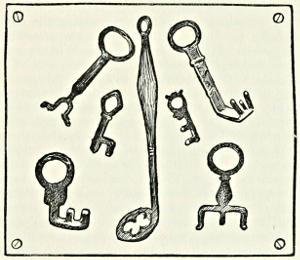
Roman Door Keys, in the British Museum
Three rescripts have
been drawn up which Hadrian,
Antoninus, and Marcus
Aurelius successively
are said to have made out
in favour of the Christians,
and from one to the other
of these edicts there is, as
it were, a crescendo of kindness
and toleration. The
first of these princes forbids
the legates to condemn the
Christians to satisfy the
clamouring of the people.
The last, Marcus Aurelius, testifies to the power of the Christians, whose
kindness he has experienced and whom he fears to see turned against him,
and grants them full liberty of worship. In our opinion these edicts are
manifestly apocryphal, although it is perhaps true that the emperors, supreme
guardians of the law, saw with displeasure the violent caprices of popular
brutality take the place of legal measures, and violate, as it were, the majesty
of Roman justice; and they may have written in this sense to their agents.
Hadrian especially, the most vigilant guardian of order in the provincial
administration, may have done this.
But the sentences pronounced against the Christians under the rule of
the Antonines, and the numerous defences in which the apologists, even at
this moment, make an appeal to the justice of the emperors, claiming common
law for the Christians, prove clearly that the law which condemned
them on account of their profession of faith had not been repealed.
The Antonines invariably made kind and humane princes, lovers of justice,
sparing of the lives of their subjects. Marcus Aurelius, in particular,
went too far in his complaisance and goodness of heart. The principle of the
stoical philosophy he had embraced, and which he was proud to follow, taught
the inviolability of liberty in private life, and far from advising the persecution
of opinions, it must rather have taught respect for them.
On the other hand, in spite of a visible tendency on the part of the
authorities at this time to restore or to strengthen the old Roman discipline,
in spite of the alliance entered upon between philosophy and the popular
religion, multifarious worships flourished freely throughout the empire.
The emperors, whose official devoutness has nothing exclusive, are admitted,
like Hadrian, into the alien churches; or, like Marcus Aurelius, do not fear
to make an appeal in urgent cases to all known religions. Amongst the
philosophers, some, regarding such matters with contempt, state that the
diversity matters but little provided that the heavenly sentiment is in
the soul; others, incredulous and sceptical like Lucian, scoff with impunity
at all the gods and religious symbols, sparing none. There is nothing in
the empire resembling a state religion; it would even be difficult to say
precisely which is the religion of the majority of the citizens.
Polytheism means diversity and confusion. There is no common formulary,
or catechism, nothing resembling the doctrinal teaching of a fixed and
definite theology. All the gods are accounted good, and the newest seem
to possess extraordinary virtues. Whence comes it that Christianity alone
is excluded from universal toleration and is legally without the rights of
the law? Whilst striving to answer this question, there is the risk of defining
and exaggerating ideas which hovered vaguely in the minds of the
princes and statesmen of that time, and of reducing dim notions to too fixed
formulas. The Christians in the second century are usually taxed with
atheism and impiety. It is certain that the apologists have fair play in
replying to this imputation, and answer it triumphantly. The fact however
remains that Christianity was the absolute negation of all the symbols of
pagan naturalism, that it condemned and repudiated without exception all
the gods and all worships, and aspired to destroy and replace them. Lucian,
it is true, was not more respectful to the various prevailing superstitions,
but Lucian’s invectives were an individual piece of wit. He did not attempt
to raise altar against altar, he did not do the work of destruction in view of
propaganda. He did not work against the institutions in the name of a
new community. He remained faithful to the old philosophical tradition.
His burst of laughter was as the last hostile note uttered by philosophy,
before disarming and offering a hand to the popular religion.
The Christian objectors, also bitter, were far more in earnest and more
formidable. Their attacks amounted to a general assault, and cloaked a
manifestly subversive design. They did not scoff for the mere sake of
scoffing, but to overthrow and to make a distinct place for their own community,
establishing it on new foundations. Authority respects the individual
conscience, and grants it the greatest license, but the general conscience
is what is called conspiracy.
There is here no room for doubt. Impiety and atheism are in fact not
purely religious names, in the modern sense, but political imputations.
Religions in the empire are matters of state, or rather religion and the
state form only one commonwealth, of which the emperor is the head.
Lucian was free to be impious or atheistical. No inference is to be drawn
from this, however, though he may here and there have either imitators or
disciples.
But the Christian is not an individual unit, his name is legion; he is
a member of an association, a party which cannot be confounded with a
philosophical school. He belongs to an organised body which has its members
everywhere; which possesses a distinctive language, rallying signs, a
hierarchy, and a common purse maintained by voluntary contributions;
which holds clandestine meetings, celebrates nocturnal rites of which popular
imagination is afraid, and possesses certain means of operation at a distance
by means of delegates or circulars. And what an organisation it is! Its
members in Gaul have communication with Rome, and with the cities of
Asia and Phrygia. It covers the entire empire with an invisible network.
Philosophy, the daughter of curiosity and the work of the brain, divides;
Christian belief unites.
Do not these associates, these collegiati of a new species, whose secret
designs and whose nearest hopes are unknown, but are in any case manifestly
in accordance with hatred of the morals, the customs, and the institutions of
the empire, form the beginning of a state within a state? Are they not a
menace to the public class, that which at all times is reported inseparable
from the preservation of existing institutions? These are enemies; the more
so that community of faith, hatred of the state, and the bond of a common
fear in the presence of danger and of proscription holds them together.
Pertinax, on attaining to the imperial dignity, gave this for the first
watchword: “Let us fight”—a virile watchword, and one suited also to the
reign of Marcus Aurelius. In fact, on the frontiers the barbarians are
hastening to arm. Of the thirty legions of which he has the disposal, the
emperor is forced to muster twenty with numerous auxiliaries to drive them
beyond the Danube, and hold them in awe. During this time, other peaceful
barbarians, as they are called, profess contempt for their country, enervate
their minds by an unnerving mysticism, detaching themselves from
masculine duties and the rough obligations of civil and military life, and by
their attacks and their counsels noiselessly lay the mine which will engulf
the fortunes of Rome.
They respect, they say, the established powers, and offer up prayers to
their gods on behalf of the emperor; but they are heard to say that marriage
is a corruption, and a Christian slave dares to reply to the judge that Christ
has freed him, and amongst the foundations on which the state and society,
decency, family ties, and religion rest, there is not one institution which
finds favour in their sight.
The state has need of the devotion of all. It is a critical moment. A
war, which all good citizens must consider as a holy war, is added to the
scourge which devastates the empire. The stake is, perhaps, civilisation
itself. The Christians are reluctant to serve the country at home or abroad.
They wish to be neither soldiers nor magistrates. They glory in being
citizens of heaven. They wrap themselves up in meditation, controversy,
and the exercises of their piety. The community is threatened. In every
town they have made for themselves a city of their own choosing, a society
separate and apart, of which, they say, God himself is the founder, which
they call their church, and to which they dedicate all their attention and
their zeal. The service of their church is the sole thing which moves them.
The duties it imposes are, in their eyes, the only essential and necessary
duties.
The prince, their country, the public good, civilisation, Roman splendour,
are to them merely resounding names or vain idols. The church is their
country, their city, and their camp. This doubtless is the meaning of the
accusation, “enemies of the public,” which is applied to the Christians.
Doubtless neither the princes nor the magistrates saw it in precisely that
light. The Christian prophets foretold the end of the world in the year 195.
They did not foresee Constantine and Theodosius, the old religion persecuted
in its turn, and forced to hide from the revenge of the Christians, the
apologists returned, Libanius imploring in the name of art that the temples
and statues of the gods might be spared, and Simmachus in the name of
Roman splendour asking mercy for the threatened altar of victory.
The danger was neither so urgent nor so clear in the second century.
Melito of Sardis was wont to say with the gravity of conviction that the
power and splendour of the empire had augmented with Christianity.
Others, with equal sincerity, protested that the Christians did not think of
agitating the state, that they had never been found amongst those who
stirred up seditious and military revolutions; that, on the contrary, they
kept themselves aloof from all parties, and rendered unto Cæsar that which
was his due—neither adoration nor incense, but civil submission and obedience.
Several times since the destruction of their temple in the year 70,
the Jews had risen in arms to shake off the Roman despotism, to save
or avenge their independence. The Christians could not be reproached
with any revolt; it is true that, sprung from every race, and for the greater
part from pagan families, they had no nationality to vindicate or re-establish.
None of them, moreover, had asserted a mission to revolutionise society.
Saving the spiritual jurisdiction, they freely abandoned all other matters,
or held them of small account. During the first two centuries despised,
maltreated, spat upon, under the ban of opinion and of the law, and often
put to death, they were everywhere seen to be patient and resigned, speaking
less of the world than of heaven, and full of confidence in a master who
does no wrong and who can repair injustice.
Thus no precise explanation can be advanced to account for their being
styled public enemies. They were the seeds of a new society; one of their
doctors stated that their presence deferred the terrestrial judgment and
preserved the empire from ruin and corruption.
The true and philosophical significance of the persecutions is thus the
defence of the empire and its institutions, threatened by a new and incomprehensible
spirit. The emperors during the second century did not see
this public danger clearly; they felt it instinctively, and on its account they
strove to fortify or to awaken religion and patriotism.d
In the first century of the empire the political circumstances of the world
were in a deplorable condition. Power was entirely concentrated in Rome
and the legions, and there the most shameful and degrading scenes occurred.
The Roman aristocracy which had conquered the world, and which, in fact,
alone had a share in the government under the rule of the Cæsars, gave
themselves up to saturnalian crimes of the most unbridled kind ever witnessed.
Cæsar and Augustus, when instituting the imperial office, had clearly
discerned the needs of their times. The world was politically so corrupt
that no other form of government would have been possible. Since Rome
had conquered numberless provinces, the ancient constitution, founded on
the privileges of the patrician families, who were a species of obstinate and
malevolent Tories, could no longer continue. But Augustus in leaving the
future to chance had entirely neglected his political duty. Without legitimate
heirs, without laws of election, without proper rules of adoption,
without constitutional limits, Cæsarism was like an enormous weight on the
deck of a ship without ballast. The most terrible upheavals were inevitable.
Three times in one century, under Caligula, under Nero, and under Domitian,
the greatest power that has ever existed fell into the hands of execrable
or extravagant men. The results were seen in horrors which have hardly
been surpassed by the monsters of Mongolian dynasties.[36] In the fatal succession
of rulers, we are almost reduced to making excuses for Tiberius, who
was wholly wicked only towards the end of his life, or Claudius, who was
only eccentric, wanting in judgment, and surrounded by evil counsellors.
The most shameful ignominies of the empire, such as the apotheosis of the
emperor and his deification when still living, came from the East and more
particularly from Egypt, which was then the most corrupt country in the
world. The true Roman spirit still existed. Human nobility was far from
being extinct. There was still great traditional pride in some families, who
came into power with Nerva, who rendered the age of the Antonines glorious.
An epoch during which such absolutely virtuous people lived as, for example,
Quintilian, Pliny the Younger, and Tacitus [are reputed to have been],
is not an epoch of which one need despair. Outward debauchery did not
touch the great foundation of honesty and sobriety which still existed in
good Roman society; a few families were still models of good conduct, of
devotion to duty, of concord and solid virtue. Admirable wives and admirable
sisters were still to be found in the houses of the patricians. Was there
ever a more touching fate than that of the chaste and youthful Octavia,
daughter of Claudius and wife of Nero, who remained pure in the midst of
all this infamy, and was put to death at twenty-two years of age, without
ever having known happiness? Women who in inscriptions are called
castissimæ, univiræ are not rare. Wives accompany their husbands into
exile, others share their heroic death. The old Roman simplicity was not
entirely lost, children were wisely and carefully educated. The most aristocratic
women were known to work in wool; the vanities of the toilet were
almost unknown in the best families.

Roman Kitchen Utensils
(In the British Museum)
Those excellent statesmen who under Trajan seemed to spring from the
ground were not the product of the moment. They had been in office
during the preceding reigns, only they had had but little influence, being kept
in the background by the freedmen and infamous favourites of the emperor.
Men of the greatest merit thus occupied high places under Nero. The framework
was good, and the rise of the bad emperors to power, although disastrous,
did not suffice to change the general order of things and the principles
of the state. The empire, far from being decadent, was in all the vigour of
a most robust youth. The decadence was to come two hundred years later,
and strange to say under far less wicked emperors.
Politically the situation was analogous to that of France, which since the
Revolution has never enjoyed a direct succession of its ruling powers, and
can pass through perilous fortunes without hopelessly damaging its internal
organisation and national force. We naturally compare the first century
of the empire to the eighteenth century, an epoch absolutely corrupt if we
judge from the collections of anecdotes belonging to the times, and during
which certain families nevertheless maintained their austere customs.
Philosophy made alliance with the honest Roman families and offered a
noble resistance. The school of stoics produced such grand characters as
Cremutius Cordus, Thrasea, Helvidius Priscus, Annæus Cornutus, Musonius
Rufus—all admirable upholders of aristocratic virtue. The rigidity and
exaggeration of this school were due to the horrible cruelty of the government
of the cæsars. The one idea of a man of real worth was to accustom himself to
pain and to prepare for death. Lucan with bad taste, and Persius with superior
talent, expressed the highest sentiments of a great spirit. Seneca the philosopher,
Pliny the Elder, and Papirius Fabianus kept up a high standard of
learning and philosophy. All were not corrupted; there were some shining
lights; but too often their only alternative was death. The ignoble portion
of humanity from time to time got the upper hand. The spirit of frenzy
and of cruelty then burst forth and turned Rome into a veritable hell.
The government, which in Rome was so uncertain, was far better in the
provinces, and the shocks which disturbed the capital were hardly felt there.
In spite of its faults the Roman administration was far superior to the
monarchies and republics which had disappeared through conquest. The
reign of sovereign municipalities had passed away many centuries before.
The small states had been killed by their egotism, their jealousy, their ignorance,
and their disregard of private rights. The old Grecian life, made up
of struggles entirely external, no longer satisfied the people. It had been
charming in its day; but that brilliant Olympus, a democracy of demi-gods,
having lost its freshness, had become hard, unfeeling, vain, superficial, for
lack of sincerity and real uprightness. This was the cause which resulted in
the Macedonian domination, followed by Roman rule.
The evils of excessive centralization were yet unknown to the empire. Up
to the time of Diocletian the towns and provinces were allowed great liberty.
In Palestine, Syria, Asia Minor, Lower Armenia, and Thrace there were independent
kingdoms under the protection of Rome. These kingdoms only
became sources of danger from the time of Caligula onwards, because the
great and far-sighted policy which Augustus had traced with regard to them
had not been carried out. The free towns—and they were numerous—governed
themselves according to their own laws; they had legislative
power and administered justice as in a self-governing country; until the
third century, municipal decrees were promulgated with the formula,
“the senate and the people.” Theatres served not only for scenic pleasures,
they were everywhere centres of agitation and public opinion. The favour
of the Romans towards the human race was the theme of some adulatory orations
which were not, however, devoid of all sincerity. The doctrine of the
“Roman peace,” the idea of a great democracy organised under the protection
of Rome, was the basis of all thought. A Greek orator displayed vast
learning in proving that the glory of Rome ought to be regarded by all the
branches of the Hellenic race as a sort of common inheritance. As far as
Syria, Asia Minor, and Egypt are concerned, it may be said that the Roman
conquest did not destroy a single liberty. Those countries were either
indifferent to political life or had never known it.
In spite of the exactions of the governors and the acts of violence inseparable
from absolute government, the world, in many ways, had never been so
happy. An administration coming from a centre far away was such an
advantage, that even the pillage of the prætors of the latter end of the republic
did not succeed in rendering it odious. Moreover, the lex Julia
had greatly limited the field of abuses and extortion. Excepting under Nero,
the follies or the cruelty of the emperor did not go beyond the Roman aristocracy
and the immediate surroundings of the prince. Never had those
who wished to leave politics alone lived in greater peace. The republic of
ancient times, where everyone was forced into party quarrels, was not pleasant
to live in; supersession and exile were too frequent.
Now it seemed as if the times were ripe for wide propagandism, superior
to the quarrels of little towns, to the rivalries of dynasties. Attempts against
liberty owed their origin to the independence which still remained to the
provinces and communities, rather than to the Roman administration. In
those conquered countries where political needs had not existed for several
centuries, and where the people were deprived only of the power of tearing each
other to pieces by continual warfare, the empire was an era of prosperity and
welfare until then unknown and, we may add without paradox, of liberty.
On the one hand the freedom of trade, and industry, and that personal liberty
of which the Greek had no idea, became possible. On the other hand
the freedom which consists in liberty of opinion could only be benefited
by the new régime.
This liberty always gains in dealing with kings and princes more than in
dealing with a jealous and narrow-minded middle class. The Greek republics
had no such liberty of opinion. The Greeks achieved great things without
it, thanks to the unequalled power of their genius, but for all that, Athens
was actually under an inquisition. The inquisitor was the archon, the holy
office was the royal portico where charges of impiety were tried. Accusations
of this nature were very frequent—it was the favourite theme of Attic
orators. Not only philosophical offences, such as denying God or providence,
but the slightest offence against the municipal doctrines, preaching a strange
religion, the most puerile omissions of the scrupulous laws pertaining to the
mysteries, were crimes punished with death. The gods whom Aristophanes
scoffed at on the stage could sometimes slay. They slew Socrates, they all
but slew Alcibiades; Anaxagoras, Protagoras, Theodorus the atheist, Diagoras
of Melos, Prodicus of Ceos, Stilpo, Aristotle, Theophrastus, Aspasia,
Euripides, were more or less seriously threatened.
Liberty of thought was, in fact, the fruit of the kingdoms which sprang
from the Macedonian conquest. Attalus and Ptolemy were the first to give
to thinkers a liberty which none of the old republics had ever offered them.
The Roman Empire continued on the same lines. There existed, under the
empire, more than one severe law against philosophers, but that was on account
of their meddling in politics. One might look in vain, in the collection of
Roman laws previous to Constantine, for a passage against liberty of thought,
or in the history of the emperors for a lawsuit about abstract doctrines.
Not a scholar was disturbed. Men who would have been burned in the
Middle Ages, such as Galen, Lucian, Plotinus, lived peacefully, protected by
the law.
The empire inaugurated a period of liberty, in the sense that it abolished
absolute government in families, towns, and tribes, and replaced or modified
such governments by that of the state. Absolute power is even more vexatious
than usual when it exercises its power in a narrower circle. The ancient
republics and feudalism tyrannised over the individual more than the state
has ever done. Granted that the Roman Empire, at certain epochs, cruelly
persecuted Christianity, at least it did not kill it. The republics would have
made it quite impossible; Judaism, if it had not felt the pressure of Roman
authority, would have sufficed to crush it. It was the Roman magistrates
who prevented the Pharisees from destroying Christianity.
A broad idea of universal brotherhood, the outcome for the most part of
stoicism, and a kind of general sentiment of humanity were the fruit of the
less narrow form of government, and of the less circumscribed education to
which the individual was subjected. A new era and new worlds were
dreamed of. The public wealth was great, and, in spite of the imperfections
of the economic doctrines of the times, comfort was widespread. Manners
were not what they are often imagined to be. In Rome, certainly, vice
vaunted itself with revolting cynicism. Theatres, above all, had introduced
horrible depravity; certain countries, such as Egypt, had also fallen to the
lowest depths. But in the greater number of the provinces there existed a
middle class, amongst whom kindness, conjugal fidelity, domestic virtue, and
uprightness were sufficiently common.
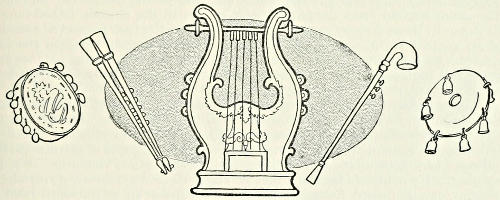
Roman Musical Instruments
Does there exist a more charming and ideal picture of family life in the
world of the honest middle class of small towns than that described by Plutarch?
What good nature, what peaceful habits, what chaste and amiable
simplicity! Chæronea was certainly not the only town where life was so
pure and innocent. There still remained in the general customs, even beyond
Rome, something cruel, either as a relic of ancient habits, everywhere
equally sanguinary, or through the special influence of Roman austerity.
But there was improvement in that respect. What sweet and pure sentiment,
what an impression of melancholy tenderness there is in the writings
of Virgil and of Tibullus! The world was taking shape and losing its ancient
rigour, acquiring freedom and moral sensibility. Principles of humanity
spread everywhere; equality and abstract ideas of the rights of man were
loudly preached by stoicism. Woman, thanks to the system of dowries
under Roman law, became more and more her own mistress; rules as to the
treatment of slaves were made—Seneca dined with his. Slaves were no longer
necessarily the grotesque and evil beings who were introduced into Latin
plays to be laughed at, and of whom Cato urges that they should be treated
as beasts of burden. Times had changed. The slave was his master’s moral
equal, and admittedly capable of virtue and fidelity, of which he gave proof.
Prejudice concerning nobility of birth was diminishing.
Humane and just laws were passed even under the worst emperors. Tiberius
was an able financier; he founded a system of land tenure on a sound
basis. Nero introduced into the system of taxation, until then iniquitous
and barbarous, improvements which might shame even the present day. The
progress made in legislation was considerable, although the death penalty
was much too common. Love for the poor, charity, and universal sympathy
were accounted virtues.
The theatre was one of the scandals which gave the greatest offence to
virtuous people, and one of the first causes to excite the antipathy of Jews
and Judaisers of all kinds against the profane civilisation of the time. These
gigantic cauldrons seemed to them sewers in which all the vices simmered.
Whilst the front rows were applauding, scenes of the greatest repulsiveness
and horror were often taking place on the upper benches. In the provinces
gladiatorial combats were only established with difficulty. The Hellenic
countries, at least, disapproved of them, and kept for the most part to the
ancient Greek exercises. In the East, cruel games always preserved a
marked stamp of their Roman origin. The Athenians, wishing to rival the
Corinthians, having one day discussed the subject of imitating their barbarous
games, a philosopher got up and proposed that first of all the altar of
Pity should be overthrown. The horror of the theatre, the stadium, the
gymnasium, that is of all public places which were the essential elements
of a Greek or Roman town, was thus one of the deepest sentiments of the
Christians, and one of those which had the greatest results.
Ancient civilisation was of a public kind; everything took place in the
open air, before the assembled citizens; in opposition to ours, where life is
private and secluded within the precincts of the home. The theatre had
succeeded the agora and the Forum. The anathema hurled against the
theatres reflected upon the whole of society. A deep rivalry was established
between the church, on the one hand, and the public games on the other.
The slave, hunted from the games, took refuge in the church. One cannot
sit down in these gloomy arenas, which are always the best preserved remains
of an ancient town, without seeing in spirit the struggle between the two
classes; here, the poor honest man, seated in the last row, hiding his face and
going out indignant, there a philosopher getting up suddenly and reproaching
the crowd with its depravity.
These instances were rare in the first century. Nevertheless protestations
began to be heard, and the theatre fell into disrepute. The legislation
and administration of the empire was still in a state of chaos. The central
despotism, municipal and provincial liberty, the caprice of governors, the
outrages of independent communities, jostled each other violently. But religious
liberty gained in these conflicts. The perfected autocratic government
which was established from the time of Trajan was to be far more fatal to
the newly born religion than the state of disorder, fertile in surprises, and
the absence of a regular police which characterised the time of the cæsars.
The institutions for public relief, founded on the principle that the state
has paternal duties towards its subjects, only developed to any great degree
from the time of Nerva and Trajan onwards. A few instances of it are
however found during the first century. There already existed asylums
for children, organised distributions of food to the needy, fixed prices for
bread with indemnities to the bakers, precautions for provisioning, premiums
and insurance for ship-owners, bread bonuses, which permitted the purchase
of corn at a reduced rate. All the emperors, without exception, showed
the greatest solicitude for these questions, minor ones, perhaps, but such as
at certain epochs took precedence of all others. In remote antiquity, it
might be said, the world needed no charity. The world was then young
and vigorous, almshouses were useless. The good and simple Homeric
ethics, according to which the guest and the beggar come from Jupiter, are
the ethics of a robust and gay adolescence.
Greece, in her classical age, enunciated the most exquisite maxims of
pity, of beneficence, of humanity, without a latent thought of social anxiety
or of melancholy. Man in that epoch was still healthy and happy, evil
could not be realised. With respect to mutual assistance the Greeks were
far in advance of the Romans. No liberal and benevolent disposition came
from that cruel aristocracy which exercised such oppressive sway during the
republic. At the time of which we are writing the colossal fortunes of the
aristocracy, luxury, the concentration of population in certain places, and
especially the hardness of heart peculiar to the Roman and his aversion to
pity, resulted in the birth of “pauperism.” The kindness shown by certain
emperors towards the riff-raff of Rome only aggravated the danger.
Bribery and the tesseræ frumentariæ not only encouraged the vice of idleness,
but brought no remedy to misery. In this particular, as in many others,
the East was really superior to the Western world. The Jews had true
charitable institutions. The temple of Egypt seemed to have possessed alms-boxes.
The college of monks and nuns of the Serapeum of Memphis was
also, in a manner, a charitable institution. The terrible crisis through which
mankind was passing in the capital of Europe was little felt in remote
lands, where everyday life had remained more simple. The reproach of
having poisoned the earth, the comparison of Rome to a courtesan who has
poured out to the world the wine of her immorality, was true in many
ways. The provinces were better than Rome, or rather the impure elements
from all parts, accumulating in Rome as in a sink, had formed an infectious
spot where the old Roman virtues were stifled and where good seed
germinated slowly.b
But it is the life of the capital itself that must chiefly claim our attention
here. Let us turn from the glowing generalities of Renan to a more specific
consideration of some important phases of the everyday life of the people in
the great centre to which all roads were said to lead.
In the early days of the empire, Rome was in the crisis of that transitional
state which most great capitals have experienced, when a rapid increase in
their population and in the transactions of daily life has begun to outstrip the
extension of their means of accommodation. The increase of numbers must
necessarily multiply the operations of industry, which cross and recross each
other in the streets of a great city; and though neither the commerce nor
manufactures of Rome were conducted on the scale to which our ideas are
accustomed, the retail traffic which passed from hand to hand, and the ordinary
affairs of business and pleasure, must have caused an ever increasing stir
and circulation among the vast assemblage of human beings collected within
its walls. The uninterrupted progress of building operations, and the extension
of the suburbs simultaneously with the restoration of the city, must have
kept every avenue constantly thronged with wagons and vehicles of all sorts,
engaged in the transport of the cumbrous materials employed therein; the
crush of these heavy-laden machines, and the portentous swinging of the
long beams they carried round the corners of the narrow streets, are mentioned
among the worst nuisances and even terrors of the citizen’s daily
walk.
Neither of the rival institutions of the shop and the bazaar had been
developed to any great extent in ancient Rome. A vast number of trades
was exercised there by itinerant vendors. The street cries, which have
almost ceased within our own memory in London, were rife in the city of the
cæsars. The incessant din of these discordant sounds is complained of as
making existence intolerable to the poor gentleman who is compelled to reside
in the midst of them. The streets were not contrived, nor was it possible
generally to adapt them, for the passage of the well-attended litters and
cumbrous carriages of the wealthy, which began to traverse them with the
pomp and circumstance of our own aristocratic vehicles of a century since;[37]
while the police of the city seems never to have contemplated the removal of
the most obvious causes of crowd and obstruction, in the exhibition of gymnastic
and gladiatorial spectacles, of conjurors’ tricks and the buffoonery
of the lowest class of stage-players, in the centre of the most frequented
thoroughfares.
The noble never crossed his threshold without a numerous train of
clients and retainers; the lower people congregated at the corners of the
streets to hear the gossip of the day and discuss the merits of racers and
dancers; the slaves hovered over the steam of the open cookshops, or
loitered, on their masters’ errands, to gaze on the rude drawings or pore
over the placards on the walls. The last century had filled the imperial
capital with multitudes of foreigners, attracted from curiosity as much as
from motives of business to the renowned emporium of the wonders of the
world, who added to the number of idlers and loungers in the streets of
Rome; men of strange costumes and figures and, when they spoke, of speech
still stranger, who, while they gazed around them with awe and admiration,
became themselves each a centre of remark to a crowd of wondering citizens.
The marked though casual manner in which the throng of the streets is
noticed by the Roman writers, shows, in the strongest way, how ordinary
a feature it was of life in the city.
The streets, or rather the narrow and winding alleys, of Rome were
miserably inadequate to the circulation of the people who thus moved along
or thronged them; for the vici were no better than lanes or alleys, and
there were only two viæ, or paved ways, fit for the transport of heavy
carriages, the Sacra and the Nova, in the central parts of the city. The
three interior hills, the Palatine, the Aventine, and the Capitoline, were
sore impediments to traffic; for no carriages could pass over them, and it
may be doubted whether they were even thoroughfares for foot passengers.
The occurrence, not unusual, of a fire or an inundation, or the casual fall of
a house, must have choked the circulation of the life-blood of the city. The
first, indeed, and the last of these, were accidents to which every place of
human resort is liable; but the inundations of Rome were a marked and
peculiar feature of her ancient existence.
Augustus, with far-seeing economic sagacity, was anxious to employ all
men of rank and breeding in practical business, while at the same time
he proposed to them his own example as a follower both of the Muses and
the Graces. The Roman noble rose ordinarily at daybreak, and received
at his levée the crowd of clients and retainers who had thronged the steps
before his yet closed door from the hours of darkness. A few words of
greeting were expected on either side, and then, as the sun mounted the
eastern sky, he descended from his elevated mansion into the Forum. He
might walk surrounded by the still lingering crowd, or he might be carried
in a litter; but to ride in a wheeled vehicle on such occasions was no Roman
fashion.[38] Once arrived in the Forum, he was quickly immersed in the
business of the day. He presided as a judge in one of the basilicas, or he
appeared himself before the judges as an advocate, a witness, or a suitor.
He transacted his private affairs with his banker or notary; he perused
the public journal of yesterday, and inquired how his friend’s cause had
sped before the tribunal of the prætor. At every step he crossed the path
of some of the notables of his own class, and the news of the day and interests
of the hour were discussed between them with dignified politeness.
Such were the morning occupations of a dies fastus, or working day:
the holy day had its appropriate occupation in attendance upon the temple
services, in offering a prayer for the safety of the emperor and people, in
sprinkling frankincense on the altar, and, on occasions of special devotion,
appeasing the gods with a sacrifice. But all transactions of business, secular
or divine, ceased at once when the voice of the herald on the steps of the
Hostilian Curia proclaimed that the shadow of the sun had passed the line
on the pavement before him, which marked the hour of midday. Every door
was now closed; every citizen, at least in summer, plunged into the dark
recesses of his sleeping chamber for the enjoyment of his meridian slumber.
The midday siesta terminated, generally speaking, the affairs of the day,
and every man was now released from duty and free to devote himself, on
rising again, to relaxation or amusement till the return of night. If the
senate had been used sometimes to prolong or renew its sittings, there was
a rule that after the tenth hour, or four o’clock, no new business could be
brought under its notice, and we are told of Asinius Pollio that he would
not even open a letter after that hour.

Roman Wrestlers
Meanwhile Rome had risen again to amuse and recreate itself, and the
grave man of business had his amusements as well as the idler of the Forum.
The exercises of the Field of Mars were the relaxation of the soldiers of the
republic; and when the urban populace had withdrawn itself from military
service, the traditions of the Campus were still cherished by the upper ranks,
and the practice of its mimic war confined, perhaps, exclusively to them.
The swimming, running, riding, and javelin-throwing of this public ground
became under the emperors a fashion of the nobility: the populace had no
taste for such labours, and witnessed perhaps with some surprise the toils to
which men voluntarily devoted themselves who possessed slaves to relieve
them from the most ordinary exertions of the day. But the young competitors
in these athletic contests were not without a throng of spectators; the
porticoes which bordered the field were crowded with the elder people and
the women, who shunned the heat of the declining sun; many a private
dwelling looked upon it from the opposite side of the river, which was
esteemed on that account a desirable place of residence. Augustus had
promised his favour to every revival of the gallant customs of antiquity, and
all the Roman world that lived in his smiles hastened to the scene of these
ancient amusements to gratify the emperor, if not to amuse themselves.
The ancients, it was said, had made choice of the Field of Mars for the
scene of their mimic warfare for the convenience of the stream of the Tiber,
in which the weary combatants might wash off the sweat and dust, and
return to their companions in the full glow of recruited health and vigour.
But the youth of Rome in more refined days were not satisfied with these
genial ablutions. They resorted to warm and vapour-baths, to the use of
perfumes to enhance the luxury of refreshment.

Roman Bath Implements
The Romans had, indeed, a universal and extraordinary fondness for the
bath, which degenerated in their immoderate use of it into a voluptuous
and enervating luxury. The houses of the opulent were always furnished
with chambers for this purpose; they had their warm and cold baths as
well as their steam apparatus, and the application of oil and perfumes was
equally universal among them. From the earliest times there were perhaps
places of more general resort, where the plebeian paid a trifling sum
for the enjoyment of this luxury; and among other ways of courting popular
favour was that of subsidising the owners of these common baths, and
giving the people the free use of them for one or more days. Agrippa
carried this mode of popular bribery to excess. Besides the erection of
lesser baths to the number of 170, he was the first to construct public
establishments of the kind, or thermæ, in which the citizens might assemble
in large numbers, and combine the pleasure of purification with the exercise
of gymnastic sports; while at the same time their tastes might be cultivated
by the contemplation of paintings and sculptures, and by listening to
song and music.
The Roman, however, had his peculiar notion of personal dignity, and
it was not without a feeling of uneasiness that he stripped himself in public
below the waist, however accustomed he might be to exhibit his chest
and shoulders in the performance of his manly exercises. The baths of
Mæcenas and Agrippa remained without rivals for more than one generation,
though they were ultimately supplanted by imperial constructions on a
far more extensive scale. In the time of Augustus the resort of women to
the public baths was forbidden, if indeed such an indecorum had yet been
imagined. At a later period, whatever might be the absence of costume
among the men, the women at least were partially covered. An ingenious
writer has remarked on the effect produced on the spirits by the action of
air and water upon the naked body. The unusual lightness and coolness,
the disembarrassment of the limbs, the elasticity of the circulation, combine
to stimulate the sensibility of the nervous system. Hence the thermæ
of the great city resounded with the shouts and laughter of the bathers,
who, when emerged from the water and resigned to the manipulations of
the barbers and perfumers, gazed with voluptuous languor on the brilliant
decorations of the halls around them, or listened with charmed ears to the
singers and musicians, and even to the poets who presumed upon their
helplessness to recite to them their choicest compositions.
The bath was a preparation for the cæna or supper, which deserves to be
described as a national institution; it had from the first its prescriptions and
traditions, its laws and usages; it was sanctified by religious observances,
and its whole system of etiquette was held as binding as if it had had a religious
significance. Under the protection of the gods to whom they poured
their libations, friends met together for the recreation equally of mind and
body. If the conversation flagged, it was relieved by the aid of minstrels,
who recited the gallant deeds of the national heroes; but in the best days of
the republic the guests of the noble Roman were men of speech not less than
of deeds, men instructed in all the knowledge of their times, and there was
more room to fear lest their converse should degenerate into the argumentative
and didactic than languish from the want of matter or interest.
It is probable, however, that the table talk of the higher classes at Rome
was peculiarly terse and epigrammatic. Many specimens have been preserved
to us of the dry, sententious style which they seem to have cultivated;
their remarks on life and manners were commonly conveyed in solemn or
caustic aphorisms, and they condemned as undignified and Greekish any
superfluous abundance in the use of words. The graceful and flowing
conversations of Cicero’s dialogues were imitated from Athenian writings,
rather than drawn after the types of actual life around him. “People at
supper,” said Varro, himself not the least sententious of his nation, “should
neither be loquacious nor mute; eloquence is for the Forum, silence for the
bed chamber.” Another rule of the same master of etiquette, that the number
of the guests should not exceed nine, the number of the Muses, nor fall short
of three, the number of the Graces, was dictated by a sense of the decorous
proprieties of the Roman banquet, which the love of ostentation and pride
of wealth were now constantly violating.
Luxury and the appetite for excitement were engaged in multiplying
occasions of more than ordinary festivity, on which the most rigid of the
sumptuary laws allowed a wider license to the expenses of the table. On
such high days the numbers of the guests were limited neither by law nor
custom; the entertainer, the master or father, as he was called, of the supper,
was required to abdicate the ordinary functions of host, and, according
to the Greek custom, a king of the wine or arbiter of the drinking, was
chosen from among themselves by lot, or for his convivial qualities, by the
bacchanalian crew around him.
Our own more polished but not unmanly taste must look with amazement
and even disgust at the convivial excesses of the Romans at this period, such
as they have themselves represented them to us. Their luxury was a coarse
and low imitation of Greek voluptuousness; and for nothing perhaps did the
Greeks more despise their rude conquerors than for the manifest failure of
their attempts at imitating the vices of their betters.
The Romans vied with one another in the cost rather than the elegance
of their banquets, and accumulated with absurd pride the rarest and most
expensive viands on their boards, to excite the admiration of their parasites,
not to gratify their palates. Cleopatra’s famous conceit, in dissolving the
pearl in vinegar, may have been the fine satire of an elegant Grecian upon
the tasteless extravagance of her barbarian lover. Antony, indeed, though
he degraded himself to the manners of a gladiator, was a man of noble birth,
and might have imbibed purer tastes at the tables of the men of his own class;
but the establishment of the imperial régime thrust into the high places of
society a number of low-born upstarts, the sons of the speculators and contractors
of the preceding generation, who knew not how to dispense with
grace the unbounded wealth their sires had accumulated.

Roman Dinner-table
(After De Montfaucon)
Augustus would fain have restrained these excesses, which shamed the
dignified reserve which he wished to characterise the imperial court; he
exerted himself by counsel and example, as well as by formal enactments, to
educate his people in the simpler tastes of the older time, refined but not yet
enervated by the infusion of Hellenic culture.[39] His laws, indeed, shared the
fate of the sumptuary regulations of his predecessors, and soon passed from
neglect into oblivion. His example was too austere, perhaps, to be generally
followed even by the most sedulous of his own courtiers. He ate but little,
and was content with the simplest fare: his bread was of the second quality,
at a time when the best was far less fine than ours; and he was satisfied with
dining on a few small fishes, curds or cheese, figs and dates, taken at any
hour when he had an appetite rather than at regular and formal meals. He
was careful, however, to keep a moderately furnished table for his associates,
at which he commonly appeared himself, though he was often the last to
arrive, and the first to retire from it.
The ordinary arrangement of a Roman supper consisted of three low
couches, disposed, horse-shoe fashion, before a low table, at which the attendant
slaves could minister without incommoding the recumbent guests.
Upon each couch three persons reclined, a mode which had been introduced
from Greece, where it had been in use for centuries, though not from heroic
times. The Egyptians and Persians sat at meat; so, till the Greeks corrupted
them, did also the Jews; the poetical traditions of Hellas represented the
gods as sitting at their celestial banquets. The Macedonians also, down to
the time of Alexander, are said to have adopted the more ordinary practice;
and such was the custom at Rome till a late period. When the men first
allowed themselves the indulgence of reclining, they required boys and women
to maintain an erect posture, from notions of delicacy; but in the time of
Augustus no such distinction was observed, and the inferiority of the weaker
sex was only marked by setting them together on one of the side couches,
the place of honour being always in the centre.
Reclined on stuffed and cushioned sofas, leaning on the left elbow, the
neck and right arm bare and his sandals removed, the Roman abandoned
himself, after the exhaustion of the palæstra and the bath, to all the luxury of
languor. His slaves relieved him from every effort, however trifling; they
carved for him,[40] filled his cup for him, supplied every dish for him with such
fragmentary viands as he could raise to his mouth with his fingers only, and
poured water upon his hands at every remove. Men of genius and learning
might amuse themselves with conversation alone; those for whom this
resource was insufficient had many other means of entertainment to resort to.
Music and dancing were performed before them; actors and clowns exhibited
in their presence; dwarfs and hunchbacks were introduced to make sport for
them; Augustus himself sometimes escaped from these miserable vulgarities
by playing at dice between the courses; but the stale wit and practical
humour, with which in many houses the banquet seems to have been seasoned,
give us a lower idea of the manners of the Roman gentlemen than any
perhaps of these trifling pastimes. The vulgarity, however, of the revellers
of Rome was far less shocking than their indecency, and nothing perhaps
contributed more to break down the sense of dignity and self-respect, the
last safeguard of pagan virtue, than the easy familiarity engendered by
their attitude at meals.
Some persons, indeed, men no doubt of peculiar assurance and conceit,
ventured to startle the voluptuous languor of the supper-table by repeating
their own compositions to the captive guests. But for the most part the
last sentiments of expiring liberty revolted against this intolerable oppression.
The Romans compounded for the inviolate sanctity of their convivial
hours by surrendering to the inevitable enemy a solid portion of the day.
They resigned themselves to the task of listening as part of the business of
the morning.c
Banquets of a more pretentious order played a very important part in
the life of the Romans of all classes. Anniversaries, religious festivals, the
necessity also that those who belonged to the same college should treat common
affairs together, or simply the desire of spending life more enjoyably,
had multiplied them during the empire to an unlimited degree. Men of
distinction especially sought at them the pleasure of conversing freely with
their friends. During the endless and capricious conversations politics were
not forgotten. What was said after dinner, when the heat of festivity had
animated the guests and loosened their tongues was not always favourable
to the imperial government. It was during one of these repasts that the
prætor Antistius read those insulting verses concerning Nero which led to
his banishment. As has just been said, however, the banquet-hall was
not the place usually chosen for reading verses or other compositions.
Freer scope for this and for the public promulgation of serious ideas in
general was found in the so-called “circles.”
It is not so easy to know what was meant by the circles. To form an exact
idea of them, the habits of the ancient nations must be taken into account.
In those delightful climates people do not remain shut up all day at home; on
the contrary, the day is generally spent out of doors. The inhabitants of
Rome when they were not at the theatre or the circus walked about looking
at the perpetual sights the Eternal City offered to the curious of all nations.
They went about the streets, they stopped in the public squares, seated themselves
when they were tired, on the benches and exedræ, with which the
public places were supplied. These groups of idlers, gathered together to
look at something or to talk, were called circuli. They collected especially
in the Campus Martius and in the Forum, around the quacks selling their
remedies, the showmen with their rare or performing animals and those who
performed feats of strength. Sometimes a miserable poet, unhappy at having
no readers, took advantage of these groups to venture to spout his verses
to the assembly. Very often they were gathered together only to listen to
those people who posed as persons of importance, and professed to be well
informed. There were a great number of such in Rome, and at times of
crisis, in those moments of anxiety and expectation when men are anxious
to hear what they tremble to know, they acquired much credit. After
having listened to them, everybody gave his opinion. Blame or praise was
gravely meted out to the generals, plans of campaign were made, and treaties
of peace discussed. Towards the end of the republic and during the beginning
of the empire these street politicians assembled together at the foot of
the tribune reserved for speeches, which won them the name of subrostrani.
Thence were spread gloomy rumours which alarmed Rome. It was said that
the Parthians had invaded Armenia, that the Germani had crossed the Rhine,
and the crowd that listened to this sinister news did not always spare the
emperor and his ministers, who were not taking strong enough measures for
the protection of the frontiers. The emperor had consequently taken steps
to have these bold speakers watched. He sent disguised soldiers who mingled
in these groups, and reported to their chiefs what they had heard.
These open-air discussions which the spies of the prince could hear,
were thus not without danger. Those who did not care to run the risk of
being ruined took care to say nothing there; they only spoke out in company
in which they thought themselves safe. Besides, opportunities for
speaking were not wanting. I do not doubt that there existed in Rome at
that time something similar to what is nowadays called society, that is to
say, meetings of people, usually unknown to each other, of different origin
and fortune, who have no affairs to discuss, no common interests to debate,
and who in collecting only seek the pleasure of being together. What is for
us the peculiar characteristic of society, that the women freely associate with
the men, was often found at Rome also. It was not forbidden to the women
to appear at the banquets, even when strangers to the family were invited,
and Cornelius Nepos tells us that nobody was astonished to see a Roman taking
his wife with him when he went to dine out, a thing which would have
greatly shocked the Greeks. Thus repasts were already social assemblies,
but it may be safely asserted that there were many others although accounts
of them have not reached us. I even believe that as early as the first century,
the habit of living together had sometimes given rise to a certain gallantry
between the two sexes, hitherto unknown in ancient society, and which
at moments might resemble the customs of our seventeenth century. Here
is the portrait which Martial sketches, of a dandy of his time: “A dandy is
a man whose hair is nicely parted, who breathes perfumes, who hums between
his teeth songs from Spain and Egypt, and knows how to beat time with his
hairless arms; he does not leave the chairs of the ladies during the whole
day, he has always something to whisper in their ears, knows all the scandal
of Rome, will tell you the name of the woman with whom so-and-so is in love,
whose society another person frequents, and knows by heart the genealogy of
the horse Hirpinus.” It seems to me this dandy is not very different from
Molière’s marquis, and like him he has the habit of not “leaving the chairs
of the ladies.” There were some people at Rome whose assiduity took them
far; and Tacitus tells us of a consul, a clever man, and a terrible banterer
as well, who owed his political rank to the influence of women.
When men are alone together they discuss and discourse; in presence of
ladies they are forced to converse. Seneca described wonderfully well these
society conversations where everything was treated and nothing thoroughly
discussed, and where one subject followed another so easily. In a few hours
the conversation of these clever people wandered far from the starting-point.
They talked doubtless much of themselves and other people. The habit of
living together encouraged a taste for studying each other, and everyone’s
passions and characteristics became thoroughly known. In that immense
town, which might easily, as Lucan says, have contained the whole world,
where so many bitter battles were waged daily to conquer power and wealth,
subjects of study were not wanting to these worldly moralists. They collected
amusing anecdotes of well-known people and came in the evening to
relate them to their friends. Literature was also an absorbing topic. The
whole of Roman society liked and cultivated it. As a rule Romans were
orators by occupation; poets simply as a means of distraction. A little poetry
flourished in those days which has not lived until our time; it did not deserve
to live, being merely written to charm the elegant society of those days. As
in the time of the Abbé Delille, games of dice or chess, fishing and swimming,
dancing and music, the art of ordering a dinner or receiving guests, were all
sung in verse. However agreeable this poetry might be, it could not always
charm, and new subjects had constantly to be thought of to animate the conversation.
It was thus that, when literature and scandal had been thoroughly
exhausted, politics followed in the natural course.
It is quite conceivable that much raillery was indulged in by these clever
people who above everything did not wish to appear fools, and would not
take seriously all the comedies that were being played in the senate. Reserved
and sharp lookers-on, little disposed towards any kind of enthusiasm,
they must have smiled at the excessive flattery with which the prince was
overwhelmed, and the deification of the dead or living emperor must have
left them quite unmoved. Society generally develops a leaning towards
irony; to know how to lash a neighbour agreeably is doubtless a very
estimable quality, and probably it was valued still more when this neighbour
was an emperor. A dangerous game it must have been, and raillery
aimed so high might have cost dear, but danger was not a sufficient reason for
stopping a joke when it was clever and appreciated. “I cannot be sorry,”
said Seneca, “for those people who would rather lose their heads than a
clever saying.” In this charming but frivolous society, nobody would miss
uttering a clever repartee, even at the risk of losing his head. All had to
compensate themselves for the restraint they had gone through in the senate,
where they were forced to have smiling faces and to second the praises which
were showered upon the prince by his friends. They always left dissatisfied
with themselves and with others, their hearts filled with rage that must find
vent. They expressed themselves freely directly they were sure of being
amongst friends whom they could trust. In these secret meetings they above
all liked to communicate news “which could not be spoken of or listened to
without danger.”
Rome was then overrun by those bearers of news which newspapers and
telegraphy have done away with. We met some just now in the clubs; they
were still more numerous in society gatherings. They knew everything
that was being talked of in the army and in the provinces, and gave the most
precise information on whatever happened. When an important personage
died, they related all the circumstances of his death, they said without hesitation
who had held the dagger or poured out the poison. Such a number
of wicked rumours had never circulated in Rome as since the right of free
speech had been denied the people. The authorities in trying to find those
who spread the rumours only gave them more credit than they deserved.
Besides it is in nature with difficulty to believe what is openly told and to
accept without a word what is whispered in the ear. Thus all measures
taken by the government were used against itself. Everything became
known; everything was believed; reasons were found for everything; and
the most natural reasons were not those most readily believed; to be listened
to it was necessary to imagine strange and improbable explanations for
everything.

Roman Netting Needles
(In the British Museum)
This opposition took many different forms and changed according to circumstances.
Sometimes it was very much on the surface, at others it was
hidden in the shade, but bold or timid, visible or hidden, it never died out,
and it was this suppleness and obstinacy which composed its strength. Sometimes
it dared to reveal itself to all through the medium of a pamphlet; one
of those satirical testaments, for example, which it was the fashion to invent
for important personages, in which the dead said exactly what they thought
of the living. Sometimes it took the form of malicious verses which were
whispered around, and after having travelled through every rank of this
discontented population ended by being written, by an unknown hand, on
the walls of the Forum. “Tiberius disdains wine,” they said, “now that he
thirsts for blood; he drinks blood to-day as formerly he drank wine.” If
this audacity seemed too risky, they fell back on malicious allusions which
were easily grasped by wide-awake minds. When these allusions were
followed up and punished, a few furtive words were exchanged by friends at
meeting. If it became impossible to speak at all there was an eloquence in the
people’s silence, which showed what they were thinking of, and means were
found to render even silence seditious.
Public lectures or readings became the fashion about the middle of the
reign of Augustus—they were introduced by Pollio. They attained rapid
success, which is not to be wondered at, taking into account the occupations
and tastes of the people of that period. Literature was much liked, and if
we believe Horace, nearly everyone cherished a belief in his ability to write.
It is never customary to keep one’s writings for one’s self, seeming sin not to
let them be known to the public. Unfortunately in antiquity books could
not be so easily propagated as to-day. Those of celebrated writers spread
quickly enough and went far, but the others ran the risk of remaining in
obscurity. Thus the authors, to escape this sad destiny and to make themselves
known in some manner, thought of reading their words in public,
thereby saving their works from the death which threatened them. If these
authors were poor they went where crowds were likely to gather, to the Forum,
under the porticoes, in the public baths; they even stopped the passers-by and
spouted their poetry to them at the risk of being hissed or torn to pieces, if the
people were not in a humour to listen to them. If rich they invited their
clients and friends to dinner, treated them well, and took advantage of their
gratitude to cause themselves to be listened to and admired. Horace tells us
the amusing story of a terrible creditor who gathered together his insolvent
victims on the day of reckoning to read to them the very dull works he had
written; they had to come or pay. In order to obtain leniency the unfortunate
guests had to bend their backs as resigned victims and applaud.
Pollio was not poor enough to have to resort to the public places nor
foolish enough to be satisfied with bought praise. He wished particularly
to have his tragedies and tales become known. This vain person who had
helped Cæsar and Octavius to the first place was not satisfied with the second,
and expected to obtain in literature the importance and place that he had
failed to get in politics. This gave him the idea of choosing a room in a
house, of arranging it like a theatre, that is, with an orchestra and galleries,
and inviting by tickets people whom he knew or wished to know, to come
to hear his works read. Soon others followed his example, and it was soon
the fashion to do nothing else in Rome during the months of April and
August but to assemble in these lecture rooms.
It is easy to form an idea of the sentiments brought by the guests to
these literary festivals. Auditors and lecturers belonged, as a rule, to the
best society, and shared in all the hates and prejudices of the upper class.
Opposition, as it may be supposed, flourished in these public lectures. It
was here that one could speak, when speech was not forbidden; here that
Titinius Capito, after the death of Domitian, read the story of his victims.
It was a duty to come and listen. “It seemed,” says Pliny, “that we were
listening to the melancholy praises of the victims who had not been given
funeral honours.” Under the harsh rulers caution was naturally necessary,
yet nevertheless a way was found to speak. In the darkest times of the reign
of Nero, Curiatius Maternus, the poet, dared to read a poem full of disagreeable
allusions to the emperor. He continued, under Vespasian, his little war
of epigrams. “He read one day of Cato, and forgot himself,” says Tacitus,
“to think only of his hero.” Applause was not wanting to the bold tirades
of the poet; the next day the whole of Rome spoke about his audacity and
the dangers to which it would expose him.
The tragedies of Curiatius Maternus are lost, but those of Seneca remain,
and give us an idea of what was allowed to be said in the lecture rooms.
These works are second rate, and could be judged very severely if considered
in the light of plays for the theatre, or if compared to the works of Sophocles
and Euripides. It must be remembered, however, that they were not written
for the stage, being destined for public reading. They are drawing-room
tragedy, hence must not be treated as tragedy for the theatre. This order
of play may seem unworthy or false; it can be severely condemned; it is a
distinct order, nevertheless, and is not subject to the rules that govern others;
also, having a different public, certain defects are necessary to enable it to
please. Seneca, who was eager to succeed, submitted to these conditions
willingly. His aim was to flatter the tastes of his audience, and he knew
that he could interest them only by speaking of their times and their friends;
he did this openly and without hesitation; it might be said from the way he
expressed himself that he wished them to see for themselves that the present
interested him more than the past; that he was always thinking of Rome
even when speaking of Argos or of Thebes. This is why political allusions
are so frequent in his works.e
It must not be supposed, however, that the author in Rome depended
solely upon verbal utterance for the circulation of his ideas. Nothing could
be further from the fact. The publishing no less than the writing of books
was a recognised form of business and one that apparently flourished.
Notwithstanding the entire loss of all the books produced in Rome in the
early days, we are supplied with tolerably full information as to the making
and use of books there during the later period of the republic, and throughout
the empire.
The private library discovered at Herculaneum gives a perfectly clear
idea of the way in which the books were kept in an ordinary house. This
library contained seventeen hundred books. It was so small a room, however,
that all its shelves could be reached from its centre. The books themselves,
consisting of rolls, were contained in round cases called capsæ, and we have
the further evidence of various statues and pictures, as well as written descriptions,
to prove that this was the usual method of caring for manuscripts.
The books of this period were always in rolls, never folded after the
modern method. This applies not merely to papyrus books, but to the parchment
ones also. Generally the strip of papyrus or parchment was inserted
at one end into a slit in a reed or cane about which the manuscript was rolled
as written. Usually a corresponding cane was supplied at the other end after
the book was completed, so that the book could be rolled either way, thus
greatly facilitating the reading. Presumably the book as ordinarily kept
ready for use would be rolled on the lower reed, so that anyone unrolling it
began at once with the first column, the columns being arranged transversely.
A tag or label was usually attached to the manuscript, and these tags are
represented in the paintings on the walls of Pompeii as projecting from the
cases in which the books are stored. The length of a papyrus or parchment
strip varied indefinitely, but it appears to have been usual to write an entire
book of any given work on a single strip. The relatively short books into
which most classical works were divided facilitated this method; or perhaps
it became customary to divide works into small books for the convenience
of the scribe, rather than because of any logicality in the method itself.
It appears that in the later Roman times it was quite the fashion to have
a library in every ordinary house, and some of these libraries attained very
respectable proportions. Thus it is said that the grammarian Epaphroditus
had a library of thirty thousand volumes, and that Sammanicus Serenus had
one of sixty-two thousand volumes. The fact that Augustus confiscated
two thousand copies of the pseudo-sibylline oracles testifies to the wide
prevalence of the reading, or at least the book-buying, habit. No doubt this
distinction between the buying and the reading of books should be clearly
drawn in the case of the Romans as elsewhere. Still, it will not do to
draw too sweeping conclusions from the sneers of Seneca and Cicero, which
are so often quoted as implying that the Romans bought books as ornaments,
rather than for their contents. Doubtless the reproach was true then
as now of a large number of purchasers; still, the making and the selling
of books must always imply the existence of a taste for books, and such a
fashion could never have come into vogue unless a very large number of
people were actually book readers. In point of fact, the book business in
Rome assumed proportions that seem almost incredible. Book stores were
numerous in the more frequented parts of the city, and, as far as one can
learn, the trade flourished quite in the modern fashion. Within the shop
the rolls were ranged on shelves for the inspection of the would-be purchaser,
and outside on pillars were advertised the names of the authors
represented.
Naturally enough, when private libraries were the fashion there were
numerous public libraries as well. According to Publius Victor, there were
no fewer than twenty-nine of these public libraries in Rome. Asinius Pollio,
the friend of Cæsar, and the famous patron of literature of his time, who
died in the year 6 B.C., was credited with being the founder of the first public
library, although there is a tradition that Orielus Paullus, the conqueror
of Macedonia, brought back with him to Rome a large collection of books in
168 B.C. Be that as it may, there probably was no very great taste for
reading in Rome at that early period, and it was not until the time of
Augustus that public libraries began to assume real importance.
Augustus himself, carrying out the intention of Julius Cæsar, founded
two public libraries, one called the Octavian, and the other the Palatine.
From that time the founding of public libraries became a fashion with the
emperors, Tiberius, Vespasian, Domitian, and Trajan successively adding to
the number, the most famous collection of all being the Ulpian library of
Trajan. No available data have come down to us as to the exact size of
these libraries, but the respectable proportions of some of the private collections
make it a safe inference that some, at least, of these public libraries must
have contained hundreds of thousands of books, since we can hardly suppose
that a private library would be allowed to outrival the imperial collections.
When one reflects on this prevalence of books, the very natural query
arises as to how they were produced, and the answer throws a vivid light on
the social conditions in Rome. The enormous output of books, almost rivalling
the productions of the modern press, was possible solely because of the
great number of slaves in Rome. Book-making was a profession, but it was
a profession apparently followed almost exclusively by slaves, who were
known as librarii. These educated slaves were usually Greeks, and a large
publishing house, of which there were several in Rome, would keep a great
number of them for purposes both of making the materials for books, and
of transcribing the books themselves.
It is known that shorthand was practised extensively in Rome, and it has
been supposed that a very large number of the current books were written
in this abbreviated hand. This supposition, however, appears more than
doubtful, for it is hardly to be supposed that the general public took the
trouble to learn the Tironian system, by which name the shorthand script was
known; Tiron, the secretary of Cicero, being commonly, though no doubt
incorrectly, credited with its invention. As to the latter point, there are
various references in the Greek classical authors to the practice of shorthand
in ancient times. It is said even that Xenophon took down the lectures of
Socrates in this way, and whether or not that statement is true, the existence
of the rumour is in itself evidence of the prevalence of the custom from an
early day. Very probably Tiron developed a modified and greatly improved
system of shorthand writing, and doubtless this became popular, since lexicons
were written interpreting the Tironian script in terms of ordinary
Latin. But, as has been said, all this does not make it probable that the
average reader understood the script, and it seems much more likely that
the popular authors were represented in the ordinary script, subject, however,
to numerous abbreviations. The writers who were most in vogue in
imperial Rome are said to have been Ovid, Propertius, and Martial among
the satirists; Homer, Virgil, and Horace among the poets; and Cicero, Livy,
and Pliny among prose writers. It is alleged that the works of most of
these were in every private collection. Of all this great store of literary
treasures not a single line has been preserved in the original manuscript,
save only a few rolls from the library at Herculaneum, and most of these are
charred and damaged beyond recognition.
Thanks to the use of slave labour, it would appear that the Roman publisher
was able, not merely to put out large editions of books, but to sell
these at a very reasonable price. According to a statement of Martial himself,
a very good copy of the first book of his epigrams could be purchased
for five denarii. This presumably must refer to the cheapest edition, probably
a papyrus roll, though no definite data as to the relative cost of papyrus
and parchment are available. Naturally, there were more expensive editions
put out for those who could afford them. It was customary, for example, to
tint the back of the parchment roll with purple; at a later day the inscribed
part itself was sometimes tinted with the same colour, and this custom also
may have prevailed as early as the Roman time. Certain books were illustrated
with pictures, as appears from a remark of Pliny; but this practice
was undoubtedly very exceptional. It may not have been unusual, however,
to ornament or emphasise portions of the manuscript by using red ink, for
the ink wells illustrated in the paintings of Pompeii are often shown to be
double, and the presumable object of this was to facilitate the use of ink of
two colours.
The pen employed by the Roman scribe was made of a reed and known
as a calamus. It was sharpened and split, not unlike a modern quill pen.
The question has been raised many times as to whether the Romans did not
employ the quill pen itself. Certain pictures seem to suggest that the quill
pen was used not merely by the Romans, but by the Egyptians as well.
There seems little ground for this supposition, however, and the first specific
reference to a quill pen was in the writings of Isidorus, who died in 636 A.D.
This proves that the use of quills had begun not later than the seventh
century, but it is extremely doubtful whether the Romans employed them,
though the quill seems so obvious a substitute for the reed that its non-employment
causes wonder. But the history of all simple inventions shows
how fallacious would be any argument drawn from this obvious inference.
Incidentally it may be noted that the reed pen held its own against the quill
for some centuries after the invention of the latter. Even in the late Middle
Ages the reed was still employed for particular kinds of writing in preference
to the quill, and no doubt a certain number of people for generations continued
to prefer the reed, just as there are people now who prefer a quill
pen to the steel pens that were perfected in 1830. Every desk in the reading
room at the British Museum to-day is supplied with a quill as well as a
steel pen; and a fair proportion of the readers there seem to prefer the
former.
It would not do to leave the subject of Roman books without at least incidental
mention of the tablets which were in universal use. These were probably
not employed in writing books for the market, but it is quite probable
that many authors used them in making the first drafts of their books. The
so-called wax tablet was really made of wood, quite in the form of a modern
child’s slate, the wax to receive the writing being put upon the portion that
corresponds to the slate proper. These tablets were usually bound together
in twos or threes, and only the inner surfaces were employed to receive the
writing, the outer surface being reserved for a title in the case of business
documents, or for the address when the tablet was used as a letter. When
used as business records or in correspondence, the tablets were bound together
with a cord, upon which a seal was placed. It was quite the rule for
a Roman citizen to carry a tablet about with him for the purpose of making
notes. The implement used in writing was a pointed metal needle known
as the stylus. It was almost dagger-like in proportions, and was sometimes
used as a weapon. It was said that Cæsar once transfixed the arm of Cassius
with his stylus in a fit of anger in the senate chamber itself. The other
end of the stylus was curved or flattened, and was used to erase the writing
on the tablet for corrections or to prepare the surface for a new inscription.j
Turning from the practicalities of literature to a yet more important
phase of everyday life, let us witness
The solemn ritual of marriage was based on the virginity of the bride,
and so appeared in a curtailed version when a widow married again, which,
even in later times, was regarded as somewhat shocking and in the earliest
period of antiquity was of rare occurrence.
Particular care was taken in choosing the wedding-day, because certain
times of the year were, from a religious point of view, ill adapted for the
wedding ceremony, particularly the whole month of May and the first half
of June. For the Lemuria and the sacrifice of the Argei fall in May, and
in the beginning of June come the dies religiosi, devoted to the holiness of
Vesta, which come to a close on the 15th of June with the purification of
the temple of Vesta. Other days to be avoided were the dies parentales
(from the 13th to the 21st of February), the first half of March, the three
days on which the Nether World was open (mundus patet on the 24th of
August, the 5th of October, and the 8th of November), all dies religiosi,
the calends, the nones, and the ides. But solemn marriages were not
conducted on festival days chiefly because, in early times at all events, the
participators in the marriage were hindered by the festival. Widows on the
other hand did not exclude such days from their selection.
All that we are told of the decoration of the bride is again concerned
with virgins. On the day before marriage the girl laid aside her virginal
attire (toga prætexta), sacrificing it with her toys to the gods and perhaps
originally to the Lares of her father’s house. As was the custom for a
youth before taking the toga, she was invested (ominis causa) with a new
garment suitable to her new condition before going to sleep, a tunica recta
or regilla, and upon her head was placed a red hair net. The bridal dress
itself was a tunica recta, that is to say a garment woven according to ancient
custom with vertical, not horizontal, threads, held together with a woollen
girdle (cingulum) that was bound with a nodus herculeus; instead of the
hair net she was provided with a red scarf (flammeum) with which she veiled
her head (nubit, obnubit); its red colour only distinguished it from those
scarfs which all women wore when they went out. Her hair was arranged
in sex crines, that is, plaits or locks held together not with a comb but with
a crisping pin bent at the end (hasta cælibaris) and separated by ribbons.
Beneath the scarf on her head she wore a wreath of flowers gathered by
herself, and at a later period the bridegroom himself also wears a wreath.
The ceremony of the marriage day falls into three parts: the handing
over of the bride, her home taking, and her reception into the husband’s
house; with regard to the disposition of the separate customs appertaining
to these three acts we are to some extent left to conjecture.
The solemnisation of marriage began with auspicia, which were usually
taken by proper auspices in the silence of early morning, just as at the
sponsalia it was sought to inquire into the will of the gods by an omen
before sunrise. In the earliest times the flight of birds was observed, this
kind of divination being later on replaced in private life (as it already
existed in public) by the easier process of causing a haruspica to examine
entrails. But the sacrifice made with a view of consulting the gods, the
performers of which have also been called auspices, must not be confounded
with the main sacrifice, for it took place before the handing over of the
bride. The sacrificial animal was probably a sheep, the skin of which was
afterwards used for the confarreatio.
On the assembly of the guests the auspices entered to announce the
result of their investigation. After this only is the marriage contract
completed, and even in later times before ten witnesses such as were
accustomed to be present at the ancient confarreatio; the bride and bridegroom
then declare their consent to the wedding, and where there is a confarreatio
the former declares her will to enter into the manus and thereby
the family of her husband, originally announcing also her readiness to exchange
her own name for that of her husband in the formula quando tu
Caius ego Caia. After this declaration the bridal pair are brought together
by a married woman (pronuba) and take each other’s hands (dextras jungunt),
upon which, at the confarreatio, in accordance with the most ancient Roman
sacrificial custom, a bloodless sacrifice is brought consisting of fruits and a
panis farreus. It was dedicated to Jupiter and so was probably performed
by the flamen Dialis present; he pronounced the forms of prayer in which
the gods of wedlock, especially Juno, and the rustic deities Tellus, Picumnus,
and Pilumnus were invoked. During the sacrifice the bridal pair sat
upon two chairs joined together, over which the skin of the sheep that had
been slain was stretched; at the prayer they wandered round the altar from
right to left; a camillus lent his services, bearing a cumerum in which mola
salsa and other requisites of the sacrifice were received.
Whether at the confarreatio there was an animal sacrifice besides the
sacrifice of grain, or not, we do not know; Ulpian seems to assume that
there was. In later times the sacrifice of corn fell into desuetude, but for
the rest the old ritual was maintained as far as possible, so that for instance
there was always a prayer delivered, if not by a priest, by an auspex nuptiarum
and addressed to other gods. Also in these later times the celebration
of marriage centred round the sacrifice of a calf or even of a pig, and the
newly wedded pair set out this sacrifice themselves, not always in the house
but sometimes before a public temple. Not only have we express witnesses
to testify to this, but also pictorial representations in which partly the temple
is sketched and partly the sacrifice in process of performance, which would
have no sense if the sacrifice took place in the house. So it comes that sacrifice
of animals could only be conducted in the house, as in the temple,
under certain conditions, whereas it was quite common on the sacrificial
altars erected especially for private sacrifice in front of the temples. The
witnesses having expressed their congratulations (feliciter) in a shout of
approval, the sacrifice was followed by the cena, which, like all earlier portions
of the celebration, was usually held in the house of the bride’s father.
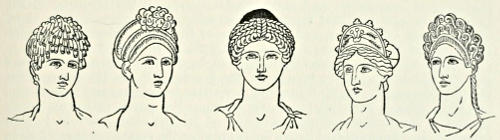
Head-dresses
The guests having risen from this at fall of night, the deductio begins.
The bride is taken from the arms of her mother and conducted in solemn
procession to the new house, the procession including not only the guests
but also the interested public. Flute-players and torch-bearers lead the
way, the procession sings a fescennine song and echoes the cry talasse; the
boys bid the bridegroom strew walnuts as he is now taking leave of the
games of childhood. The bride is accompanied by three pueri patrimi et
matrimi, one of them bearing a torch in front, the other two leading the
bride; after her are borne distaff and spinning-wheel. The bridegroom’s
torch is not, like the others, made of fine resin, but of white thorn (Spina
alba), which is sacred to Ceres and a charm against witchery; it is captured
by the guests and carried away by violence. The procession having reached
the new house, the bride anoints the door-posts with fat or oil and binds
them with woollen fillets; then she is borne over the threshold of the house
and received in the atrium by her husband into the common possession of fire
and water; that is to say, she is made a partner in domestic life and the service
of the gods. In the atrium, her future living room, opposite the door,
the lectus genialis is made ready by the pronuba; here she prays to the gods
of the new home for a happy marriage. On the day after the wedding she
receives relations at the feast of repotia as a matron and presents her first
sacrifice to the gods of the house.f
The restoration of the temples of Juno by Augustus and his consort
indicated the interest the new government felt in the institution of marriage.
Neither the history nor literature of Rome can be understood without clear
ideas upon this branch of her social economy. All nations have agreed in
investing marriage with a religious sanction; but religion and policy were
closely connected through every phase of the social life of the Romans, and
in none more closely than in this. Marriage they regarded as an institution
hallowed by the national divinities for the propagation of the Roman race,
the special favourite of the gods. Its object was not to chasten the affections
and purify the appetites of man, but to replenish the curies and centuries, to
maintain the service of the national temples, recruit the legions and establish
Roman garrisons in conquered lands. The marriage therefore of Caius and
Caia, of a Roman with a Roman, was a far higher and holier matter, in the
view of their priests and legislators, than the union of a Roman with a foreigner,
of aliens with aliens, or of slaves with slaves. Even the legitimate
union of the sexes among the citizens was regulated by descending scale of
confarreation, coemption, and mere cohabitation; and the offspring of the
former only were qualified for the highest religious functions, such as those
of the flamen of Jupiter, and apparently of the vestal virgins, on which
the safety of the state was deemed most strictly to depend.
These jealous regulations were fostered in the first instance by a grave
political necessity; but the increase of the power of Rome, the enlargement
of her resources, the multiplication of her allies, her clients and dependents,
had long relaxed her vigilance in maintaining the purity of her children’s
descent. The dictates of nature, reinforced by the observation of foreign
examples, had long rebelled in this matter against the tyrannical prescriptions
of a barbarous antiquity. After the eastern conquests of the republic it
became impossible to maintain the race in its state of social isolation. In his
winter quarters at Athens, Samos, or Ephesus, the rude husbandman of Alba
or the Volscian hills was dazzled by the fascinations of women whose accomplishments
fatally eclipsed the homely virtues of the Latin and Sabine matrons.
To form legitimate connections with these foreign charmers was
forbidden him by the harsh institutions of a Servius or Numa; while his
ideas were so narrowed and debased by bad laws, that he never dreamt of
raising his own countrywomen by education to the level of their superior
attractions. Gravely impressing upon his wife and daughters that to sing
and dance, to cultivate the knowledge of languages, to exercise the taste and
understanding, was the business of the hired courtesan, it was to the courtesan
that he repaired himself for the solace of his own lighter hours. The
hetæræ of Greece had been driven to the voluptuous courts of Asia by the
impoverishment, and perhaps the declining refinement, of their native entertainers.
They were now invited to the great western capital of wealth and
luxury, where they shared with viler objects the admiration of the Roman
nobles, and imparted perhaps a shade of sentiment and delicacy to their most
sensual carouses. The unnatural restrictions of the law formed a decent
excuse for this class of unions, which were often productive of mutual regard,
and were hallowed at least at the shrine of public opinion.
Such fortunate cases were, however, at the best, only exceptional. For
the most part, the Grecian mistress of the proconsul or imperator, the object
of a transient appetite, sought to indemnify herself by venal rapacity for
actual contempt and anticipated desertion. The influence of these seductive
intriguers poisoned the springs of justice before the provincial tribunals.
At an earlier period a brutal general could order a criminal to be beheaded
at his supper table, to exhibit to his paramour the spectacle of death; at a
later, the luxurious governor of a province allowed his freedwoman to negotiate
with his subjects for the price of their rights and privileges, or carried
her at his side in his progress through Italy itself. The frantic declamations
of Cicero against the licentiousness of Verres and Antony in this respect
were a fruitless and, it must be admitted, a hollow attempt to play upon an
extinct religious sentiment.
The results of this vicious indulgence were more depraving than the vice
itself. The unmarried Roman, thus cohabiting with a freedwoman or slave,
became the father of a bastard brood, against whom the gates of the city were
shut. His pride was wounded in the tenderest part; his loyalty to the commonwealth
was shaken. He chose rather to abandon the wretched offspring
of his amours, than to breed them up as a reproach to himself, and see them
sink below the rank in which their father was born.
In the absence of all true religious feeling, the possession of children
was the surest pledge to the state of the public morality of her citizens.
By the renunciation of marriage, which it became the fashion to avow and
boast, public confidence was shaken to its centre. On the other hand, the
women themselves, insulted by the neglect of the other sex, and exasperated
at the inferiority of their position, revenged themselves by holding the
institution of legitimate marriage with almost equal aversion. They were
indignant at the servitude to which it bound them, the state of dependence
and legal incapacity in which it kept them; for it left them without
rights, and without the enjoyment of their own property; it reduced them
to the status of mere children, or rather transferred them from the power
of their parent to that of their husband. They continued through life, in
spite of the mockery of respect with which the laws surrounded them, things
rather than persons; things that could be sold, transferred backwards and
forwards, from one master to another, for the sake of their dowry or even their
powers of child-bearing. For the smallest fault they might be placed on
trial before their husbands, or if one were more than usually considerate in
judging upon his own case, before a council of their relations. They might be
beaten with rods, even to death itself, for adultery or any other heinous
crime; while they might suffer divorce from the merest caprice, and simply
for the alleged departure of their youth or beauty.
The latter centuries of the Roman commonwealth are filled with the
domestic struggles occasioned by the obstinacy with which political restrictions
were maintained upon the most sensitive of the social relations.
Beginning with wild and romantic legends, the account of these troubles
becomes in the end an important feature in history. As early as the year
330 B.C., it is said, a great number of Roman matrons attempted the lives of
their husbands by poison. They were dragged before the tribunals, probably
domestic, and adjudged to death. As many as 170 are said to have
suffered. In the following century, after the promulgation of the Oppian
law, which forbade women to keep more than half an ounce of gold, to wear
robes of various colours, and to ride in the carpentum, they formed a new
conspiracy—such at least was the story—not to destroy their husbands,
but to refuse conversation with them and frustrate their hopes of progeny.
This was followed at the distance of half a century by the lex Voconia,
“the most unjust of laws,” in the judgment of the Christian Augustine,
which excluded women from the right of inheriting. Of these laws,
however, the first was speedily abrogated, the other was evaded, and, by underhand
and circuitous means, women came to receive inheritances, to the great
scandal, as afterward appeared, of the reformers under the empire. But
the continued quarrel of the sexes was exaggerated by mutual jealousy, and
at the outbreak of the Catilinarian conspiracy, it was currently reported
among the men that the traitors obtained money for their enterprise from
a multitude of matrons, who longed for a bloody revolution to exterminate
their husbands.
In the primitive ages the state had not only regulated the forms of
marriage, but had undertaken to enforce it. Among the duties of the
censors was that of levying fines upon the citizen who persisted in remaining
single to the detriment of the public weal. The censure of Camillus
and Postumius, 403 B.C., was celebrated for the patriotic vigour with which
this inquisition was made. In process of time the milder method of encouraging
marriage by rewards was introduced, the earliest mention of which,
perhaps, is in a speech of Scipio, censor in the year 199 B.C. At this time it
appears, certain immunities were already granted to the fathers of legitimate,
and even of adopted, children, which last the censor denounced as an abuse.
But neither rewards nor penalties proved effectual to check the increasing
tendency to celibacy, and at the period of the Gracchi an alarm was sounded
that the old Roman race was becoming rapidly extinguished. The censor of
the year 131 B.C., Metellus Macedonicus, expounded the evil to the senate in
a speech which seems to have been among the most curious productions of
antiquity. “Could we exist without wives at all,” it began, “doubtless we
should all rid ourselves of the plague they are to us; since, however, nature
has decreed that we cannot dispense with the infliction, it is best to bear it
manfully, and rather look to the permanent conservation of the state than
to our own transient satisfaction.” It is still more curious, perhaps, that
above a hundred years afterwards Augustus should have ventured to recite
in the polished senate of his own generation the cynical invective of a ruder
age. But, so it was, that when the legislation of Julius Cæsar was found
ineffectual for controlling the still growing evil, it was reinforced by his
successor with an enhancement both of penalties and rewards, and the bitter
measure recommended by the arguments and even the language of the
ancient censor.
The importance attached by the emperor to this fruitless legislation appears
from his turning his efforts in this direction from the first year of his return
to Rome. When he took the census with Agrippa in 28 B.C., he insisted
on carrying into execution the regulations of the dictator, which had been
neglected during the interval of anarchy, and were destined speedily to fall
into similar neglect again. Upon this one point the master of the Romans
could make no impression upon the dogged disobedience of his subjects.
Both the men and the women preferred the loose terms of union upon which
they had consented to cohabit to the harsh provisions of antiquity. They
despised rewards, and penalties they audaciously defied. Eleven years later
Augustus caused the senate to pass a new law of increased stringency, by
which the marriage of citizens of competent age was positively required.
Three years grace was allowed for making a choice and settling preliminaries;
but when the allotted interval was expired, it was found expedient to prolong
it for two years more; from time to time a further respite seems to have
been conceded, and we find the emperor still struggling almost to the close
of his life to impose this intolerable restraint upon the liberty or licence of
the times.
The consent of the fathers themselves, subservient as they generally were,
was given with murmurs of reluctance, the more so, perhaps, as they alone
were excepted from the indulgence, which was now prudently extended to
every lower order of citizens, of permission to form a legitimate marriage
with a freed woman. The measure was received indeed with outward deference,
but an inward determination to evade or overthrow it. Even the poets,
who were instructed to sing its praises, renounced the obligation to fulfil its
conditions; while others, whose voices were generally tuned to accents of
adulation, exulted openly in its relaxation or postponement.
The nature of the penalties and rewards assigned by this law shows that
the views of Augustus were for the most part confined to the rehabilitation
of marriage in the higher classes, and the restoration of the purest blood of
Rome. On the one hand, celibacy was punished by incapacity to receive
bequests, and even the married man who happened to be childless was
regarded with suspicion, and mulcted of one-half of every legacy. On the
other, the father of a family enjoyed a place
of distinction in the theatres, and preference
in competition for public office. He was relieved
from the responsibilities of a tutor or a
judex, and, as by the earlier measure of the
dictator, was excused from a portion of the public
burdens, if father of three children at Rome,
of four in Italy, or of five in the provinces.
Of the two consuls, precedence was given, not
to the senior in age, according to ancient usage,
but to the husband and the father of the most
numerous offspring. It is clear that such provisions
as these could have had little application
to the great mass of the citizens, who lived
on the favour of their noble patrons or the
bounty of the treasury, and bred up a horde of
paupers to eat into the vitals of the state.
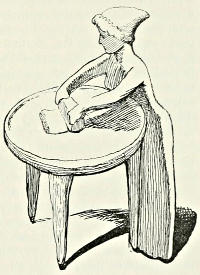
Roman Terra-cotta Toy
(Naples Museum)
The perverse subjects of this domestic legislation
seem at first to have sought to evade it
by entering into contracts of marriage which
they afterwards omitted to fulfil. It was
necessary to enact new provisions to meet this
subterfuge. The facility allowed by the ancient usage to divorce formed
another obvious means of escape; but again did the vigilant reformer interfere
by appointing the observation of onerous forms for the legal separation
of married parties. When a divorce had actually taken place, the parties
fell again under the provisions of the marriage law, and were required to
find themselves fresh consorts within a specified interval. Another mode
of driving the reluctant citizens within the marriage pale was the infliction
of penalties and disgrace upon unchastity beyond it; while now, for the
first time, adultery, which had been left to be punished by the domestic
tribunal as a private injury, was branded as a crime against the general well-being,
and subjected to the animadversion of the state. But Augustus was
not satisfied with directing his thunders against the guilty; he sought to
anticipate criminality by imposing fresh restraints upon the licentious manners
of the age. After the example of his predecessors in the censorship,
he fixed a scale of expense for the luxuries of the table, and pretended to
regulate the taste of the women for personal ornaments. At the gladiatorial
shows, from which they could no longer be excluded, he assigned different
places for the two sexes, removing the women to the hinder rows, the least
favourable either for seeing or being seen, and altogether forbade them to
attend the exhibitions of wrestling and boxing.c
If the Roman custom in relation to marriage and the position of women
generally is decidedly to be preferred to that of the Greeks, it cannot be
denied that the reverse was the case as regards the relations of children, as the
arbitrary power which the father had over them in Rome was a flagrant
injustice: the freedom of an individual was thus limited in a most unjust
manner, and the child held in an unnatural dependence on his father. The
great mistake consisted in the Roman father considering the power which
Nature imposes as a duty on the elders, of guiding and protecting a child
during infancy, as extending over his freedom, involving his life and death,
and continuing during his entire existence. The Grecian law differed in
two respects from the Roman: first, that the father’s power ceased with the
son’s independence, and this he attained either by arriving at a certain
period of life, or by marriage, or by being entered on the list of citizens.
Secondly, the Grecian father had merely the right of terminating the
relation between child and parent, by banishing him from his house, or
disinheriting him, without daring to injure either his liberty or life.
The patria potestas of the Romans was in theory indeed very different
from absolute possession (dominium), but in reality it approached very near
to it, especially in ancient times; only the latter extended over things, the
former over persons. Consequently this potestas gave the father the right
over the life and liberty of his child. This law, said to be as early as
Romulus, but at any rate very ancient, was revived in all its severity in the
Twelve Tables. The unnatural part of this decree was somewhat modified,
in that the right of life and death belonged in fact to that of discipline and
punishment, which was permitted by the state to the pater familias, and as
the father could not act on his own judgment, but must, conformably to
custom, summon a family council. This judgment is mentioned by Valerius
Maximus,k where he says of T. Manlius Torquatus, ne consilio quidem necessariorum
indigere se credidit, as his son had been accused by the Macedonians
on account of extortion. The father sat in judgment for three days, hearing
witnesses and so on, and at last banished his son from his presence, whereupon
he killed himself.
Other examples are related, of sentence being passed on sons by their
fathers, without mention of the family council, and probably because the
official position of the father rendered such aid unnecessary, as in the harsh
judgment of Brutus and T. Manlius Imperiosus. In capital offences, too,
the father could by himself inflict punishment, as it is deemed more proper
that he should himself condemn his son, than that he should come himself as
his accuser. Valerius Maximus relates two instances of a father’s judgment
in the time of Augustus. In the latter case the father condemned the son
for parricide, letting him off with exile only. A solemn family council also
preceded, to which the emperor was invited; there the kindness of the father
openly prevailed, and whilst he made use of his right, he protected his son
from the punishment which he would have found in the public court of
justice. The second case proves the harshness and misuse to which this
right could be applied. But after all, not one case of absolute death is mentioned,
but only of cruel punishment. If a misuse of the patria potestas
occurred in earlier times, the censor could resent it. Orosius even speaks of
a public indictment; in later days the emperor saw to it, as it is related
of Trajan and Hadrian. In the two-hundredth year of the empire this
power was taken away from the father by law.
Although the right of sale undeniably existed, and was recognised by
the Twelve Tables, no recorded instance of it exists; and we may therefore
suppose that it was early abolished, and used only as a form in the emancipatio.
Numa even seems to have limited this right, according to Dionysius.
In the form of emancipatio, the father had the right to sell the son three
times; after the third time he did not again come into the patria potestas.
From the patria potestas must be entirely separated the right with which
we frequently meet in antiquity, of killing or exposing new-born children.
In Rome it did not exist to so great an extent as elsewhere. Romulus is
said to have interdicted sons and first-born daughters from being killed.
On the other hand, it seems to have been commanded that the deformed
should be put to death. That the exposure and murder of the new-born
was not infrequent, even in the most important families, many instances
show.
The son remained in the father’s power until his death, unless either of
them had suffered a capitis diminutio. The patria potestas ceased if the son
became a flamen dialis. Other dignities made no difference. In the case of
a daughter it ceased when she entered into marriage with manus, or became
a vestal virgin. If a father wished to renounce the patria potestas over his
son, it must be done either by adoption (by which he passed into another
potestas) or by the formality of emancipation.l
Created by nature or transferred by adoption, the paternal authority
could be replaced, at the death of the father of the family, by guardianship
(tutela) for the protection of children (tutela impuberum, pupillaris)
and women (tutela muliebris), or it could even be revived after it had expired
under the name of trusteeship (cura), for the protection of persons of full
age but recognised as incapable of managing for themselves.
Jurisprudence concerning guardianship and trusteeship was first of all
dominated by the principles of the ancient gentilitious law as sanctioned by
the Twelve Tables.
At the death of a father the feminine portion of a family—the widow
and grown-up but unmarried daughters, were looked upon as sui juris
in the sense that they could administer their own property, but as they
could not bring actions (except in the case of the vestals), they needed
for all legal acts which concerned them, the authority (auctoritas) of a
guardian. The sons reached the age of puberty at fourteen; under that age
they required a guardian. If the family had a new head over fourteen years
old, he was the guardian of all those under age and of all the females of the
family; in the contrary case the guardian came from outside the family.
The law of the Twelve Tables did not allow those interested the
choice of their guardian; the legitimate guardian was the nearest relation
(agnat) of the deceased, or, in default, one of the members of the gens. It
was exactly the same for the trusteeship which came into operation when a
citizen sui juris was recognised as mad, or decreed by the interdictum of
the prætor to be in the position of a maniac on account of prodigality. The
trustee had the most unlimited powers over the person and property of the
person so decreed.
The lawyers laboured to make the guardianship of the young secure and
effective, to suppress the guardianship of women and to abolish the interference
of the gentilitious customs in favour of natural relationship.
A first step had already been taken in the time of the Twelve Tables—the
father of the family was permitted to choose and appoint by will the
guardian of his children. The legitimate guardian according to the gentilitious
law was called upon to replace the testamentary guardian in case the
latter refused to undertake the guardianship. Later the law Atilia, about
190 B.C., empowered the prætor urbanus or the college of the tribunes of the
plebs to nominate a guardian (tutor atilianus) in default of a legitimate or
testamentary guardian in case the latter refused to undertake the guardianship.
The custom was even introduced at this epoch of leaving to the
widows, by will, the choice of their guardian (tutor optivus), either allowing
them to change them once or twice (optio angusta), or as many times as
it pleased them (optio plena). Women could even escape effective guardianship—especially
with the object of acquiring the right to make wills—by
tricks of procedure. For this purpose they made use of fiduciary co-emption.
Co-emption substituted the co-emptionator for the guardian. The man who
thus acquired the rights of a husband ceded the woman to a third person by
mancipation. The latter emancipated the woman whose guardian he remained
in form (tutor fiduciarius). This procedure was well known in the
time of Cicero. It must be added that it was not applied in such an easy
fashion when the guardian was the tutor legitimus of gentilitious law; the
latter could not be forced to give his consent to the fictitious marriage
which began the work of deliverance.
Thus it was against the legitimate guardianship that the legists directed
their efforts. Augustus released from ordinary guardianship all women having
three children, and freed women who were mothers of four children. Claudius
absolutely suppressed gentilitious guardianship for women. It was only kept
up for children. There remained only ordinary guardianship to be annihilated.
Hadrian rendered fiduciary co-emptions unnecessary by giving women
the right of making wills with the consent of their guardians, and Antoninus
in certain cases recognised the legality of wills made without this sanction.
As women had already received the right of administration of their property,
guardianship was from that time almost objectless as far as they were concerned.
It disappeared of itself. The movement of emancipation continued;
from the time of Diocletian women began to acquire the right of guardianship
over their own children.
As to the guardianship of young boys the legists had tried to extend, not
the liberty of the wards, but the responsibility of the guardians. They even
thought good to extend the guardianship under another name beyond the
age fixed by the ancient law, which declared male children to have attained
puberty at the age of fourteen. From the commencement of the second century
before Christ, a law Plætoria created a state of minority from fourteen
to twenty-five; for fear the minors should be “circumvented,” it decreed
that the loans agreed to by them should only be legal if they had been witnessed
by a trustee named by the prætor. Marcus Aurelius made it a duty
of the magistrates to give permanent trustees to all minors who requested
them, and it was to the latter’s interest to do so, because otherwise they
could not appeal to the law. The trusteeship of minors had, in spite of distinctions,
a singular resemblance to that of madmen and persons interdicted,
and to the guardianship of children. And, from the time of Constantine, it
was much the same as the other kinds. There was however one difference;
this was that the interdicted persons were reduced to a passive condition,
and a ward was only allowed to act with authorisation of the guardian,
whilst the minor could contract debts without the consent of his trustee.
Jurisprudence here became confused by its precautions; it hesitated
between respect for individual liberty and the far more potent anxiety to
safeguard the material interests of the family.g
It will be understood that the respect for individual liberty here referred
to has reference only to a relatively small portion of the community. The
larger number of the inhabitants of Rome had no individual liberty; nor,
indeed, any other right that commanded respect. In a word, the mass of
the population was made up of slaves; therefore, even a casual glance at the
manners and customs of Roman society cannot disregard this unfortunate class.
The slaves in a large Roman house sprang from two different origins:
either they had been bought or they were born in the house of a slave
father and a slave mother. These latter were called vernæ, and were more
esteemed than the others. It is to them that their masters refer in the
inscriptions with the greatest respect and tenderness. They were supposed
to be attached to the family in which they had been born. Besides, they
had not been branded by the humiliation of a public sale, and this meant a
great deal. The bought slave had appeared in the market-place, his feet
marked with white and a label round his neck, on which his merits and
defects were inscribed; he had been set on a platform and had been made to
jump, turn a somersault, walk, run, laugh, and talk. The slave born in the
house had at least escaped this ignominious ordeal. It was as though his
dignity as a man had been less entirely lost, and as though he must be more
capable of noble feeling. The man himself was so proud of this title of
verna that in some instances it was retained even after liberation, and the
freedman caused it to be inscribed on his tomb.
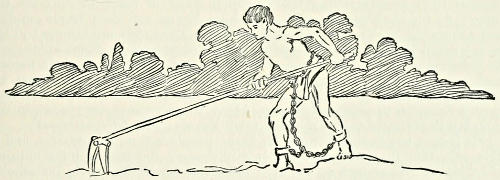
Roman Slave working in the Fields
The number of slaves which these two sources of servitude, birth and purchase,
introduced into Rome must have been very considerable. The Syrian
or Numidian whom the steward of a great noble had bought in the street of
the Subura or near the temple of Castor, for the purpose of making use
of him as runner or cook, was sure, on entering the palace of his new master,
to find himself in a numerous company. The moralists complain that
in the great houses the servitors were counted by thousands, and here they
cannot be accused of exaggerating. Tacitus and Pliny say the same. In
a satire by Petronius, Trimalchio, who does not know the tenth part of the
slaves he possesses, is informed every morning of the number of them born
during the night on his domain. This is not, as might be supposed, an
imaginary scene, and history confirms the fable. Seneca tells us nearly the
same thing of one of Pompey’s freedmen. Even this freedman had legions
of slaves; and according to the custom of good generals who keep a reckoning
of the number of their soldiers, a secretary was ordered to inform him
every day of the changes that birth, sales, or death had made in this army
since the day before.
At the present time wealth is more equally distributed, life has become
more simple, and we have some difficulty in forming a conception of the
households of the great nobles of ancient Rome. Let us imagine one of
those rich patricians or knights who possessed four or five thousand slaves,
like that Cæcilius of whom Pliny the Elder speaks. This multitude, crowded
together in the palaces or scattered amongst the farms, belong to different
nations and speak different tongues. Besides, each nation has its specialty.
Greece furnishes chiefly grammarians and scholars; the Asiatics are musicians
or cooks; from Egypt come the beautiful children whose chatter
amuses their masters; the Africans run in front of the litter to clear the
way. As for the Germans, with their huge bodies and their heads perched
none knows where (caput necio ubi impositum), their only use is to get killed
in the arena for the greater diversion of the Roman people. Some order must
be established in this confusion: they are classed according to their nation,
and are known by the colour of their skin (per nationes et colores) or,
which is oftener the case, they are divided into groups of ten, or decuries,
with a decurion to command them. Above the decurions are placed, in the
country the farmers (villici), in the town the stewards (dispensatores).
It is easy to see that to feed all these people was no easy matter, and it
is a rule that in a well-regulated establishment the master buys nothing
outside, but has enough on his own estates to supply his whole household.
His domains supply him with every kind of commodity, his town houses
contain workmen of every trade. To guard against failure of supplies he
lays up stores of every kind in huge storehouses, whose riches he does not
always know. It is related that during the time when, as at the present
day, the theatre sought to attract the crowd by the brilliancy of the mise-en-scène,
a manager who had to provide dresses for a large number of the chorus,
and did not want to go to this expense, went to Lucullus and asked him to
lend him one hundred tunics. “A hundred tunics,” answered the rich
Roman, “where do you expect me to find them? Nevertheless I will see.”
The next day he sent five thousand. The management of these huge fortunes
must have given a great deal of trouble, and consequently the master
often excused himself from attending to it. Given up entirely to pleasure,
he left all his affairs in the hands of stewards, who robbed him. When he
consented to manage his business himself the laborious task was not without
profit. It has been said with reason that if the Roman nobles had for
many centuries a keen political sense, and if they showed themselves capable
of ruling the world, this was because each one could undergo in his own
domains an apprenticeship in the art of governing. The working of these
vast estates, the millions of sesterces to be handled, the nations of slaves to
be managed, rendered the great nobles administrators and financiers from
their youth up.
It is the rule that everyone imitates those above him, and it is the custom
for the inferior classes to follow as much as possible the examples set them
by the aristocracy. We have seen that the nobles of Rome displayed their
wealth by the number of their slaves; the middle class did likewise. Perhaps,
even, this great number of servitors is still more striking in a modest
house, so little does it seem to correspond with the owner’s means. Marcus
Scaurus, who afterwards became a great personage, began by being very poor.
He said in his memoirs that his father only left him thirty-seven thousand
sesterces [£296 or $1,480], and ten slaves. Certainly at the present day no
one who possessed only £296 in the world would have ten servants. The
poet Horace was not very rich either: he lived on the liberality of Mæcenas,
who gave him ease rather than riches. And yet he tells us that when
he returned home in the evening he had three slaves ready to serve his dinner.
He gives us the bill of fare of this dinner; there are leeks, chick peas,
and a few cakes. It would seem that three waiters are a great many for such
a poor dinner, and that the repast is not in keeping with the service.
And though the expense was small, it is impossible that the great number
of superfluous slaves could have failed to be a general nuisance. Why did
people have them? Why did the middle classes impose upon themselves a
burden which weighed heavily on the rich? The answer is easy—they desired
to make a show. Everybody wished to dazzle the eyes by an imposing
retinue. The great personages, when they went to the Forum, trailed after
them a whole army of clients and friends. They required hundreds of servitors
or of freedmen whenever they left Rome. This is why they had to
turn their country or town houses into veritable barracks.
Under Nero the prefect of Rome, Pedanius Secundus, having been assassinated
by one of his slaves, all those that had that night slept under his roof
were arrested as accomplices. There were four hundred of them. The man
who walked out alone had to defy prejudice, as Horace did. A magistrate
who went out with only five servants, was pointed at in the streets. The
people had even begun to measure their esteem for a man according to the
number of servants who accompanied him. An advocate was not considered
eloquent if he did not have at least eight servitors behind his litter. When
he was not rich enough to buy them he hired them, this being the only way
by which he could get causes to plead and be listened to when he spoke.
Women also made use of them to attract public attention. Juvenal says
that Ogulnia took good care not to go to the theatre alone; who would
have turned round to look at her? She hired female attendants and a fair-haired
damsel, to whom she pretended to give frequent orders. She carried
display to such an extent that she was always accompanied by a respectable
nurse and some female friends of good appearance. In this way Ogulnia
was sure to create a sensation wherever she went.
Thus the slaves were very useful out of doors; they accompanied their
masters, created a good opinion of him, and contributed to his importance;
but what was to be done with them in the house? There were too many for
occupation to be found for all in an ordinary household, and in order to
give them something to do each had his particular office. “I use my slaves,”
said a Greek, “like my limbs, one for each thing.” From this arose the extreme
division of labour in ancient houses; it was never carried farther than
at Rome. There were slaves to open the door to a visitor, others to bring
him in, others to lift up before him the heavy draperies, and others to announce
him. There were some to carry the dishes to the table, others to
carve, some to taste them before the guests, and others to offer them. “These
unhappy creatures,” says Seneca, “live only to carve the poultry well.”
Each portion of a woman’s toilet was given to a different slave.
The slave who had charge of the clothes was not the same as the one who
looked after the jewels or the purple. There were special artists for hairdressing
and for perfuming. The tomb has even been discovered of an unhappy
man whose sole function in life was to paint the aged Livia. Thus
the master as soon as he returns home finds a crowd of servitors who are on
the lookout for his wants and anticipate his orders. “I sit down,” says a
character in a comedy, “my slaves run up to me and take off my shoes,
others hasten to arrange the couches and to prepare the repasts. They all
take as much trouble as possible.” What is the result? That by force of
being surrounded and waited upon the master contracts the habit of doing
absolutely nothing. All these people who gather around him, and to whom
he is so grateful, render him the worst service possible; they take from him
the necessity of doing anything for himself. The Roman of the early days
of the republic, who had hardly more than one personal servant and who
waited upon himself, was active and energetic; he conquered the world.
The Roman of the empire, continually surrounded by a troop of slaves, became
cowardly, effeminate, and a dreamer. Of all the furniture in his house,
his couch is the one he is most ready to use. He lies down to sleep, to eat,
to read, and to think. His servants divide amongst themselves all the functions
of life, and all is minutely calculated to give him nothing to do. But
this regularity which he admires so much is full of danger. Physical activity
cannot be relaxed without moral activity suffering as well, and he who ceases
to act ends by ceasing to have any will. This race of men who had given
up exercising their bodies and keeping themselves in condition, also allowed
their souls to become enervated. It is therefore a true saying that the large
number of slaves which the Romans kept up contributed in no small measure
to render themselves the slaves of the cæsars.
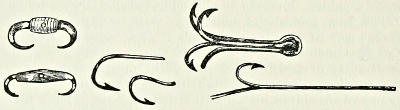
Roman Fish Hooks
(In the British Museum)
Let us suppose the newly purchased slave thrown amidst the multitude of
servants that fills the Roman house; his first thought is naturally for his new
master. He tries anxiously to know him, that he will see what he may expect
from him, and how he will be treated. Let us do like him, and let us
ask first of all to what treatment he will be subjected, and what will be the
relations between master and slave. The answer to this question is not
easy; the lot of the slave may be conceived of in different ways, and, for
instance, it entirely changes its aspect according to whether we study it from
the laws or from the facts. Until the days of the Antonines, the law in
relation to him is terribly hard. It abandons him wholly to his master,
whose property he is as much as a field or a flock of sheep. He has the
right to use him or abuse him according to his fancy. He is free to inflict
upon him all kinds of insults and dishonour; he can beat and kill him. We
are therefore forced to admit that according to the laws there has never been
a worse condition than that of a Roman slave; but it must be remembered
that human institutions never do all the good or harm of which they are capable.
In public morals and in the general feeling there exist obstacles which
cannot be surmounted. Laws may be excellent or detestable; man, who is
little capable of perfection and who is instinctively averse to barbarism, corrects
their exaggeration in practice; as a rule he only carries them out in so
far as they are not opposed to the mediocrity of his nature. We are therefore
liable to mistake, if we judge the social condition of a nation according
to its legislation. The first thing to discover is in what manner it was
actually applied. There is reason to think that in Rome, even at the time
when manners were most barbaric, the terrible rights that the law gave
to the masters were rarely taken advantage of. Cato might say that it is
wise to sell a slave when he is old and can be of no further use; custom
might allow him to be abandoned without mercy when he was ill and left in
the island of the Tiber near the temple of Æsculapius, in order that he
might recover or die without any expense; but it is probable that, in generous
souls, nature has always revolted against such cowardly desertion. There
are several reasons for thinking that even in Cato’s time the slave was as a
rule humanely treated, that he lived on familiar terms with his master, and
that he nearly always grew old in his master’s house. After the battle of
Cannæ, Rome having no more soldiers did not hesitate to arm eight thousand
slaves. They fought bravely side by side with the legions, and deserved
their liberty. Would they have exposed themselves to die for masters whom
they detested?
All slaves, however, were not treated alike, and distinctions must be
made between them. They were as a rule less well treated in the country
than in the town. The agriculturists, in describing the stock of a farm and
the instruments of cultivation, have no hesitation in classing the slave in the
same category with the oxen. In reality the master does not make much
difference between him and the cattle. At night he is shut up in a species
of stables or underground prisons (ergastula), with narrow windows, at such
a distance above ground that he cannot reach them with his hand. During
the day, if he is to work alone, irons are put on his feet in case the fresh air
and open field should suggest to him the idea of escape. This is certainly
rigorous treatment, and nevertheless the slave seems to support it with no
great difficulty. A comic author makes him say, “When one’s work is
in a distant field, where the master rarely comes, one is not a servitor but
master.”
When a day of festival comes round and work is suspended, he celebrates
it with such noisy joy that “those in the neighbourhood can hardly
support his outbursts of delight.” It would have been difficult to imagine—seeing
him after the harvest or the vintage, amusing himself with such good
will, laughing and singing at the games of the cross-ways (compitalia) or
jumping gaily over the straw fires at the Palilia—that he was so harshly
treated the rest of the year. What proves that on the whole this lot was
not thought so wretched is that the town slave sometimes envied his country
brother. Horace had at Rome a slave of an unstable disposition who asked
his master as a favour to send him to his Sabine farm. It is true he soon
repented this.
As a rule the slave was sent to the fields only as a punishment when
he had given dissatisfaction. It is certain that he was better treated and
happier in town. Placed near his master he might have to suffer more
from his caprice, but he also reaped advantage from it. He had the best
chance of obtaining his liberty and making his fortune. There were some
whose situations were even brilliant and envied, namely the imperial slaves.
To belong to Cæsar’s household was to be somebody, and the great lords
who esteemed themselves happy to be known by the porter of Sejanus
bought the good graces of the stewards of Tiberius by presents and degrading
acts. Even before being liberated these slaves often filled real public
offices; they were officers of the mint, the finances, and the commissariat of
Rome. They had also a sense of their own importance. They were proud
and insolent and thought they were under an obligation to see that the
dignity of the emperor was respected in their own persons. After these
we should naturally place the slaves belonging to the towns, the temples,
and the different civil and religious bodies. When authority is thus divided
and when nobody takes the entire burden, not only is the servitor not under
control but in reality it is he who dominates. Thus the slaves of this class
appear as a rule to be rich and contented with their lot. Some there are
who make large donations to the societies which have bought them, giving
themselves the piquant pleasure of being the benefactors of their masters.
Nor are those belonging to some great houses much to be pitied. If
they attain high functions in the establishment they make good profit.
Sometimes the steward of a rich man found the position so lucrative
that he preferred to remain a slave, rather than give it up. The most
fortunate were those who happened to fall to a master who prided himself
upon being humane and enlightened, who cultivated literature and
practised the lessons of the philosophers. Pliny the Younger treated his
dependents with the greatest kindness. Not only did he forbid irons to
be put on them when they were tilling his fields, but he did not allow
them to be crowded together in narrow cells or dark prisons. In his house
at Laurentum the accommodation was so good that he could put guests
there. He looked after them whenever they were ill, he allowed them to
make wills and leave their small possessions to their friends; his humanity
went so far that he wept at losing them. In the service of a rich and wise
man like Pliny the slave is not really very unhappy. It is when he is
with humbler people that his lot is harder. As he shares the fortune of
the house, with the poor he is of course poor, and he may chance to fall
into the hands of a master in very wretched circumstances. Everybody,
even the workmen and soldiers, had slaves in those days. Even the peasant
of the Moretum whose worldly wealth consists of a little garden, and who
gets up so early to prepare his dish of garlic, cheese, and salt, is not alone
in his hut; he has for maidservant a negress, whom the poet describes
to us with such striking realism: “Her hair is woolly, her lips thick, her
skin black; her body badly made, her legs lank, and nature has given her
a foot which spreads at ease” (spatiosa prodiga planta). In the poor houses
little money was made and life was hard.
The only compensation the slave had in his miserable life was that he
lived near his master, that he was more familiarly treated; that, being
obliged to help him in his sufferings and share his hard lot, he was looked
upon less as a slave than a kinsman. Moreover, it must be noted that, in
Rome as in the East to-day, he always formed part of the family. In modern
times master and servants, being both free and united by a temporary contract
on conditions already agreed upon between them, live apart from one
another, although under the same roof. They are two jealous individualities
who keep a watch on each other and are very determined to maintain their
respective rights. At Rome the slave had no rights; he was not a citizen
and hardly a man. His dignity did not prevent him from wholly abandoning
himself to the man to whom he belonged and becoming one with him.
There was thus more intimacy and less reserve in their bearing towards
each other. There remain many tombs erected by masters in memory of
their servitors. They often bear the expression of the most tender feelings;
not only is homage paid to their good service, they are also thanked for
their affection. In return it must be remembered that they were treated
with kindness,“like sons of the house,” and some significant words are even
ascribed to them: “Servitude, thou hast never been too heavy for me.” On
the tomb of a centurion of the fourth legion, which was erected by his freedmen,
are these words: “I never married, and I possessed children,” and the
slaves’ answer, “Thanks and farewell.”
What strikes us most of all in studying Roman society is that most of
the vices which devoured it and caused its ruin were due to slavery. We
have seen that it favoured the corruption of the higher classes, that in accustoming
a man to rely continually on the activity of others it paralysed his
strength and enfeebled his will. It is also responsible for having nourished
a contempt of human life. Cruelty may be learned. Perhaps it is naturally
repugnant to mankind, but it feeds on example. It may be said that
the houses of many of the rich were public schools of inhumanity. The
slave long suffered from it and the master also ended by being its victim.
If under the cæsars the crowd saw the deaths of so many illustrious people
with great indifference, was it not because tortures and death were no
new things to them, and because, when they had become used to seeing manhood
no longer respected in the slave, they were less moved to anger at seeing
it outraged in the noble? Another graver reproach which can be made
against slavery is that it created that miserable populace of the time of the
empire which disgusts us so much in the narratives of Tacitus. Its baseness
and cowardice are no longer astonishing when we remember its origin.
It was the outcome of slavery; slavery formed it, and naturally it was
formed for slavery. Not only did its moral degradation and political indifference
render the tyranny of the cæsars possible, but the recollection of the
injustice it had suffered must have nourished in it those feelings of bitterness
and hostility which exposed society to perils little dreamed of.
If there was no servile war in Italy after Spartacus, it is none the less
true that slavery kept up a kind of perpetual conspiracy against the public
safety. Above all it was the most determined enemy of that spirit of conservatism
and tradition which had been the strength of the Roman race. The
slaves did not spring from the soil of Rome, their recollections and affections
were elsewhere, and when they became citizens they did not hesitate to welcome
foreign customs and to introduce them into the city. Whilst the
statesmen and leading men wore themselves out in trying to preserve what
remained of the ancient spirit and the old customs, down below, amongst
those classes of the populace which were constantly being recruited from
slavery, there was a continual working to destroy it. It was thus that,
thanks to this secret and powerful influence, new religions easily spread
throughout the empire.
At the time nobody seems to have perceived the amount of the evil, and
as its extent was not realised only partial remedies were proposed. Efforts,
often successful, were made to render the slaves’ lot less hard. They were
given some security against their masters; the philosophers proclaimed, and
all recognised with them, that these were men; lawyers even inscribed in the
codes that slavery was contrary to nature. It seems as if this principle,
had it been followed out in all its consequences, must have eventually led
to the abolition of slavery; but when would the day for it have come, or
would it have come at all, if the ancient world had continued? It may well
be doubted, in view of the slowness with which progress is accomplished and
the frequent recurrence of causeless reactions. Even in the most enlightened
times, when opinion seems to give the strongest impulse towards liberal
measures, it may chance on a sudden that power, obeying other instincts,
again becomes cruel or severe, or that it hovers between severity and indulgence,
unable to decide which course to pursue.
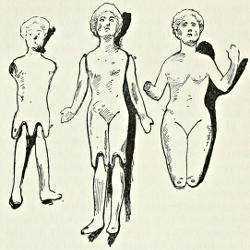
Roman Dolls
(From the British Museum)
It is under Augustus, just when manners are becoming milder and humanity
seems to triumph, that a senatus-consultum ordains that when a master
has been assassinated by a servant,
all those who slept under his roof
that night, innocent or guilty, shall
be put to death. It is no less a
matter of surprise that under Constantine,
in Christian times, the
laws, which since the Antonines had
become much more humane, all at
once revert to the ancient severities
against slaves. These sudden relapses
made them lose in a moment
all the ground that they had gained
during centuries, and all had to be
begun again. Let us add that the
measures taken to protect slaves
were not always so efficacious as
might be expected. Humane laws
were hardly ever carried out except
by well-disposed men, who were
themselves inclined to humanity.
Others found ways to evade the
laws. Authority, always averse to
interfering with the family and restraining
the sacred power of the master, generally shut its eyes, and thus
abuses, practically beyond the reach of the law, became general.
What is most remarkable of all is that no ancient writer ever expressed,
either as a far-away hope, or as a fugitive wish, or as an improbable
hypothesis, the idea that slavery might one day be abolished. Whether
favourable to slavery or not, no one so much as imagined that it could cease
to be. Those even who complain of it with bitterness, who count up the
dangers that it occasions and the annoyances to which it gives rise, those
who say with Seneca: “How many starving animals, whose voracity we
have to gratify! What expense to clothe them! What anxiety to watch
all those rapacious hands! What pleasure is there in being waited upon by
people who murmur against us and detest us?”—even they did not seem to
think that some day these people might be dispensed with. The institution
was so ancient, and had so entered into the habits of the nation, that life
could not be imagined without it. Men who thought slavery indispensable
were not inclined, even when they knew it to be unjust, to take much
trouble to abolish it. It was one of those radical reforms that one is
scarcely justified in expecting in the ordinary course of events, and we may
say that such a complete change, which no one either desired or foresaw,
could only be accomplished by one of those revolutions which renovate the
world.h
Let us turn from this depressing picture of the one labouring class in
Rome to the complementary theme of games and recreations.
Nothing is more enlightening to the understanding both of the peculiarities
of the individual and of the character of a nation, than to observe the
free motion which begins where work leaves off. Professional activity is
illustrated more or less in the same fashion all the world over, and it is forced
into a more or less perfect uniformity, for it always follows the same aim.
Recreation, on the other hand, opens the door to play, in which spontaneous
inclination embodies its expression. As the traveller will note with particular
attention the games and entertainments in which a nation spends its
leisure, so the student of antiquity is prompted to direct his gaze to this side
of life. But on no question are the sources of information so reticent, so far
as the Romans are concerned, as on the question before us.
If we take as our basis the description which the ancients themselves give
us of the activity peculiar to the Romans and their rooted disinclination for
the Greek far niente (otium Græcum), the dignified motion and bearing
(gravitas) that was so little fitted for gaiety that even Cicero says that only
a man drunk or mad can dance; if we bear in mind the foreign nature of the
apparatus which, at all events in the time of the emperors, was engaged for
the carrying on of games and festivals—the actors, mimes, pantomimes,
athletes, gladiators who were employed for amusement, paid and despised,—we
shall be inclined to infer that the Romans had altogether little talent
for a spirited enjoyment of life and for national rejoicing.
But one piece of general information at least has been unequivocally
handed down to us, and this is the fact that they took an early and religious
pleasure in dancing, in studying, and in games. At the pompa circensis in
the ludi magni, which were celebrated between the 4th and the 19th of September,
two detachments of dancers were employed; first those bearing arms
in three choruses of men, youths, and boys, all in red tunics with bronze
girdles, equipped with swords, lances, and crested helmets, then the comic
dancers in sheepskins. Similarly dancing was a part of the ritual of the
salii and of the arvales long before it became fashionable with the youths
of distinction. Music, too, is acceptable to the gods, and not only in foreign
rites, but it is a necessary ingredient in Roman ritual for which the old
college of the tubicines and the tibinices provided. Music was indispensable
in all festal celebrations, triumphs, funeral processions; and at the feast of
Pales (on the 21st of April) the whole town was a blare of wind instruments,
cymbals, and kettledrums. Songs and mimic representations were
not missing either in the ceremonial of worship, or at home, or on the occasion
of popular rejoicing, as we may see from the songs of the salii and of
the arvales, from the songs of praise during meals, from the fescennini,
saturæ, and atellanæ, as well as from the comic interludes at the Saturnalia,
at the Floralia, at the Megalesia, at triumphs, and at funeral processions.
True, these beginnings of an original Roman national poetry never
reached their perfect development, because they submitted to the influence
of Greek literature, so much admired by the educated classes; but, on the
other hand, they resisted this influence so strenuously that Augustus still
continued to make fescennini, and the four masked types are still unchanged
to-day in the Italian commedia dell’ arte. We may assume the same to have
been generally the case with the games of amusement. What was specially
Greek in them was absorbed by the higher orders chiefly; what was really
national is still to be traced more or less in the Italy of to-day. So the well-known
game mora, in which two players hold out a number of fingers at the
same moment and let their adversary guess how many they were, is found
certainly with the Greeks, but is of extreme antiquity in Italy, where it is
described by the expression micare digitis, and was used on grave occasions,
and particularly on the occasion of business transactions, as a kind of lottery
(sors). On the whole, the information on Roman games is uncommonly
scanty, and it is vain to attempt to imagine a definite picture of the entertainments
at the Matronalia, the Vinalia, and the Saturnalia.
Ovid once describes the festival of Anna Perenna that was celebrated
on a heath on the Via Flaminia, but there is nothing characteristic in the
whole description; people eat, drink, dance, and sing, but what they sing
are not national songs. “Cantant,” says Ovid, “cantant quidquid didicere
theatris.” What we hear of games in Rome is all Greek or is reckoned as
such at least; even the old game of jumping upon full leather bottles that
were oiled, and trying, it would appear, to stand on one’s head upon them,
is mentioned by Virgil as Attic, and in fact identical with the Greek
ἀσκωλιάξειν. Under these circumstances we must not attempt to prove the
existence of any form of national rejoicing peculiar to the Romans, and must
confine ourselves to gathering together those games which, although customary
in Greece also, are frequently mentioned in Rome. On the one hand, we
have children’s and young men’s games; on the other, games of hazard and
board games.
The game of ball, which is known to all antiquity, is certainly a game for
young men, but owing to the healthy movement which it affords, and which
Galen quite particularly recommends in a singular pamphlet on the little
ball, it was also a recreation for elder persons as useful as it was agreeable.
In Rome and Italy generally ball was played, both on the Campus Martius,
where the younger Cato himself might have been seen taking part in the
game, and in the sphæristeria especially laid out for the purpose in the baths
and villas. Among the players of ball were Mucius Scævola, Cæsar, the
emperor Augustus, Mæcenas, the old Spurinna the friend of Pliny, the emperor
Alexander Severus; and there were people who spent their whole
time in this amusement.
During the empire five kinds of balls were employed, one small, one
middle-sized, one large, one very large, one full of air. Perhaps these five
kinds correspond to the Latin expressions pila, trigon or pila trigonalis, pila
paganica, harpastum, perhaps identical with pila arenaria, and follis. The
ordinary ball was stuffed with hair and sewn with bright or at all events
coloured patches; the paganica, the name of which indicates a game between
people en masse, in which the whole village (pagus) in the country took
part, was a large ball stuffed with feathers; the follis, which was first discovered
in the time of Pompey, was the largest and was full of air (κενή); of
the harpastum we know nothing further than that it was a small hard ball.
The different kinds of games may be determined first by the nature of the
throw and secondly by the number of people engaged in the games. First
the ball may be thrown up and caught by the thrower himself or by another—this
is the Greek οὐρανία; secondly the ball may pass between two or more
players (datatim ludere), the object being skill in throwing (διδόναι), dare,
ittere, jactare, in catching (λαμβάνειν, δέχεσθαι, facere, excipere), and in
throwing back (remittere, repercutere). Finally the ball may be bounced violently
on the ground or against the wall, so that it rebounds and may be repeatedly
slapped with the hand. In this game, which is the Greek ἀποῤῥαξις
and the Latin expulsim ludere, the number of bounces are counted, and if
several play, the winner is he who can keep it up longest without letting the
ball fall. The true significance of the word pilicrepus is certainly to be found
from this game, as elsewhere the ball makes no especial kind of noise. According
to this, apart from the
height of the throw, we may
indicate all the methods of
playing ball by the formulæ of
datatim, reptim, expulsim ludere.
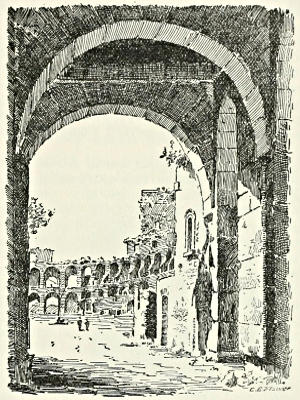
Entrance to the Colosseum
So far as the number of
players is concerned, first of all
there was the single game in
which one played alone with
one, or also with two and three
balls, keeping them in perpetual
motion as he sat or walked.
From this juggler’s game was
derived the art of Ursus Togatus,
who, proud of his steadiness,
first used glass balls. Then
there was the double game in
which two played and threw the
ball to each other, and then one
of the most popular games,
which was played before the
bath and very frequently in the
Campus Martius, was the trigon,
in which three players took
part. It is often mentioned
but never described. The stations
of the three players were
at the three corners of an equilateral
triangle; but the ball
did not travel simply from one player to another; it was thrown at one of
them arbitrarily, so that he had to rid himself of two balls at the same time,
a process which involved the use of both hands, and not only the catching of
the two balls but their discharge at one of the other players. Besides the
players themselves, three persons were necessary for the trigon to pick up the
balls, and three others to keep the score.
The games for players en masse (sphæromachiæ) were particularly interesting
to the Romans. There were three kinds, ἡ ἐπίσκυρος or ἐπίκοινος
τὸ φενίνδα, and τὸ ἁρπαστόν. We are only partially informed of the difference
between them; according to the latest investigation however the following
may be assumed to be probably correct particulars. In the ἐπίσκυρος,
the players divide into sides of equal numbers which are separated by a line
marked in stones (σκῦρος): they also had a limit at the back of them beyond
which they were not allowed to go. The ball is placed on the σκῦρος. One
of the sides, whichever is the first to capture the placed ball, throws off as far
as possible; the other side remains where it is caught and in turn throws it
back. The object is to throw the ball with such force that the opposite side
are driven back, and to drive them right back to the boundaries of the court,
in which case they have lost the game.
In the second game, the φενίνδα, two sides are also engaged. The man
who throws off challenges a definite person on the opposing side to catch the
ball, but then throws it in quite another direction, in which case it has to be
caught by someone else. If it falls to the ground, the side which failed to
catch it has lost. We know least of all about the harpastum, but the ball
seems to have been thrown up in the air so that the thrower himself is in a
position to catch it again. In order to stop this all the players scrum up, and
while they are struggling for the ball upset one another to the accompaniment
of a tremendous noise. Finally, the game described by Cinnamus the
Byzantine, which Meineke and after him Grasberger have identified with
the harpastum, has nothing whatever to do with it. It was quite a particular
game for the imperial family, was played on horseback, and the ball was hit
with a racket, none of these features being characteristic of the harpastum.f
The Roman Theatre and Amphitheatre
Roman Lamp
If the Roman people was ill accommodated in its streets, it might derive
compensation in the vast constructions which were erected for its amusement,
the ample walks and gardens
devoted to its recreation, and the area
which was sedulously preserved for its
exercise in the Campus Martius, and
the circuses of Romulus and Flaminius.
The theatre of Pompey, the first fabricated
of stone for permanent use, was
rivalled by that of Balbus, and Augustus
dedicated a third to the pleasures of the
citizens under the title of the theatre of
Marcellus. From the enormous size of
these celebrated edifices, it is clear that
the idea of reserving them for dramatic
performances entered but little into the
views of their builders. The Roman
theatre was an institution very different from ours, where a select audience
pay their price of admission to a private spectacle on a large scale. They were
the houses of the Roman people, to which every citizen claimed the right of
entrance; for they were given to him for his own by their munificent founders,
and the performances which took place in them were provided gratuitously
by the magistrates. The first object, therefore, was to seat the greatest number
of people possible; and when that was accomplished, the question followed of
how they should be safely and conveniently entertained.
An assemblage of thirty thousand spectators, gathering excitement from
the consciousness of their own multitude, could not sit tamely under the
blaze of an Italian sun, tempered only by an awning, in the steam and dust
of their own creating, which streams of perfumed waters were required to
allay, to hear the formal dialogue of the ancient tragedy declaimed by human
puppets from brass-lipped masques, staggering on the stilted cothurnus.
Whatever might be the case with the Greeks, it was impossible, at least for
the plainer Romans, so to abstract their imaginations from the ungraceful
realities thus placed before them as to behold in them a symbolic adumbration
of the heroic and the divine. For the charms, however, both of music
and dancing, which are also considered pleasures of the imagination, they
appear to have had a genuine though perhaps a rude taste. Their dramatic
representations, accordingly, were mostly conducted in pantomime;
this form at least of the drama was that which most flourished among them,
and produced men of genius, inventors, and creators in their own line.
Some of the most famous of the mimic actors were themselves Romans;
but the ancient prejudice against the exercise of histrionic art by citizens was
never perhaps wholly overcome. Accordingly Greek names figure more conspicuously
than Roman in the roll of actors on the Roman stage; and two of
these, Bathyllus and Pylades, divided between them, under the mild autocracy
of Augustus, the dearest sympathies and favours of the masters of the
world. The rivalry of these two competitors for public applause, or rather
of their admirers and adherents, broke out in tumultuous disorders, which
engaged at last the interference of the emperor himself. “It is better for
your government,” said one of them to him, when required to desist from a
professional emulation which imperilled the tranquillity of the city—“it is
better that the citizens should quarrel about a Pylades and a Bathyllus than
about a Pompey and a Cæsar.”
But whatever claims pantomime might have as a legitimate child of the
drama, the Roman stage was invaded by another class of exhibitions, for which
no such pretensions could be advanced. The vast proportions of the theatre
invited a grander display of scenic effects than could be supplied by the
chaste simplicity of the Greek chorus, in which the priests or virgins,
whatever their number might be, could only present so many repetitions
of a single type. The finer sentiment of the upper classes was overpowered
by the vulgar multitude, who demanded with noisy violence the gratification
of their coarse and rude tastes. Processions swept before their eyes of
horses and chariots, of wild and unfamiliar animals; the long show of a
triumph wound its way across the stage; the spoils of captured cities,
and the figures of the cities themselves were represented in painting or
sculpture; the boards were occupied in every interval of more serious
entertainment by crowds of rope-dancers, conjurers, boxers, clowns, and
posture-makers, men who walked on their hands, or stood on their heads,
or let themselves be whirled aloft by machinery, or suspended upon wires,
or who danced on stilts, or exhibited feats of skill with cups and balls.
But these degenerate spectacles were not the lowest degradation to which
the theatres were subjected. They were polluted with the grossest indecencies;
and the luxury of the stage, as the Romans delicately phrased it,
drew down the loudest indignation of the reformers of a later age. Hitherto
at least legislators and moralists had been content with branding with civil
infamy the instruments of the people’s licentious pleasures; but the pretext
even for this was rather the supposed baseness of exhibiting one’s person
for money than the iniquity of the performances themselves. The legitimate
drama, which was still an exercise of skill among the Romans, was
relegated, perhaps, to the smaller theatres of wood, which were erected year
by year for temporary use. There were also certain private theatres, in
which knights and senators could exercise their genius for singing and
acting without incurring the stigma of public representation.
The appetite for grandeur and magnificence, developed so rapidly among
the Romans by the pride of opulence and power, was stimulated by the
furious rivalry of the great nobles. The bold and ingenious tribune, Curio,
whose talents found a more fatal arena in the contests of the civil wars, was
perhaps the first to imagine the form of the double hemicycle, which he
executed with an immense wooden structure and a vast mechanical apparatus,
by which two theatres, after doing their legitimate duty to the drama,
could be wheeled front to front, and combined into a single amphitheatre
for gladiatorial spectacles. There can be no doubt that this extraordinary
edifice was adapted to contain many thousands of spectators; and there are
few perhaps, even of our own engineers, who build tubular bridges and
suspend acres of iron network over our heads, who would not shrink from
the problem of moving the population of a great city upon a single pair of
pivots.
The amphitheatre of Julius Cæsar in the Campus was of wood also, and
this, as well as its predecessors, seems to have been taken down after serving
the purpose of the day. It remained for Statilius Taurus, the legate of
Augustus, to construct the first edifice of this character in stone, and to
bequeath to future ages the original model of the magnificent structures
which bear that name, some of which still attest the grandeur of the empire
in her provinces; but the most amazing specimen of which, and indeed
the noblest existing monument of all ancient architecture, is the glorious
Colosseum at Rome.
Like most of the splendid buildings of this period, the amphitheatre
of Taurus was erected in the Campus Martius, the interior of the city not
admitting of the dedication of so large a space to the purpose; though it
was rumoured indeed that Augustus had purposed to crown the series of
his public works by an edifice of this nature, in the centre of his capital, to
be attached perhaps to his forum. While the amphitheatre, however, was
a novel invention, the circus, to which it was in a manner supplementary,
was one of the most ancient institutions of the city. The founder himself
had convened his subjects in the Murcian valley, beneath his cabin on the
Palatine, to celebrate games of riding, hunting, and charioteering.
The enclosure in which these shows were annually exhibited was an
oblong, curved at the farther end, above six hundred yards in length, but
comparatively narrow. The seats which ranged round the two larger sides
and extremity of this area (which derived its name of arena from the sand
with which it was strewed) were originally cut for the most part out of the
rising ground and turfed; less rude accommodation was afterwards supplied
by wooden scaffoldings, but the whole space was eventually surrounded
by masonry and decorated with all the forms and members of
Roman architecture.
The arena was adapted for chariot racing by a partition, a dwarf wall,
surmounted with various emblematic devices, which ran along the middle
and terminated at either end in goals or ornamented pillars, round which
the contending cars were driven a stated number of times. The eye of the
spectator, from his position aloft, was carried over this spinal ridge, and he
obtained a complete view of the contest, which thus passed and repassed,
amidst clouds of dust and roars of sympathising excitement, before his feet.
The Romans had from the first an intense delight in these races; and many
of the most graphic passages of their poets describe the ardour of the horses,
the emulation of their drivers, and the tumultuous enthusiasm of the
spectators.
These contests maintained their interest from the cradle to the very grave
of the Roman people. The circus of Constantinople, under the Greek designation
of Hippodrome, was copied from the pattern of the Roman; and the
factions, which divided the favour of the tribes almost from the beginning
of the empire, continued to agitate the city of Theodosius and Justinian.
The citizens were never satiated with this spectacle, and could sit without
flagging through a hundred heats, which the liberality of the exhibiter sometimes
provided for them. But the races were more commonly varied with
contests of other kinds. All the varieties of the Greek pancratium, such as
boxing, wrestling, and running, were exhibited in the circus; gladiators
fought one another with naked swords, sometimes in single combat, sometimes
in opposing bands.
The immense size of the arena, unfavourable for the exhibition of the
duel, was turned to advantage for the display of vast multitudes of wild
animals, which were let loose in it to be transfixed with spears and arrows.
This practice seems to date from the sixth century, when victorious generals
first returned to Rome from the far regions of the teeming East, to ingratiate
themselves with the populace by showing them the strange monsters
of unknown continents, lions and elephants, giraffes and hippopotami. As
in other things, the rivalry of the nobles soon displayed itself in the number
of these creatures they produced for massacre; and the favour of the citizens
appears to have followed with constancy the champion who treated it
with the largest effusion of blood. The circus was too spacious for the eye
to gloat upon the expression of conflicting passions, and watch the last ebbings
of life; but the amphitheatre brought the greatest possible number of
spectators within easy distance of the dead and dying, and fostered the passion
for the sight of blood, which continued for centuries to vie in interest
with the harmless excitement of the race.
The idea of the theatre is representation and illusion, and the stage is, as
it were, magic ground, over which the imagination may glance without
restraint and wander at will from Thebes to Athens, from the present to the
past or future. But in the amphitheatre all is reality. The citizen, seated
face to face with his fellow-citizens, could not for a moment forget either his
country or his times. The spectacles here presented to him made no appeal
to the discursive faculties; they brought before his senses, in all the hardness
of actuality, the consummation of those efforts of strength, skill, and
dexterity in the use of arms to which much of his own time and thoughts
were necessarily directed.
The exhibition of gladiatorial combats, which generally preceded the
departure of a general upon a foreign campaign, was part of the soldier’s
training (and every citizen was regarded as a soldier), from which he received
the last finish of his education, and was taught to regard wounds and
death as the natural incidents of his calling. These were probably the most
ancient of the military spectacles. The combats of wild beasts, and of men
with beasts, were a corruption of the noble science of war which the gladiatorial
contests were supposed to teach; they were a concession to the
prurient appetite for excitement, engendered by an indulgence which, however
natural in a rude and barbarous age, was actually hardening and degrading.
The interest these exercises at first naturally excited degenerated into
a mere passion for the sight of death; and as the imagination can never be
wholly inactive in the face of the barest realities, the Romans learned to feast
their thoughts on the deepest mystery of humanity, and to pry with insatiate
curiosity into the secrets of the last moments of existence. In proportion
as they lost their faith in a future life, they became more restlessly inquisitive
into the conditions of the present.
The eagerness with which the great mass of the citizens crowded to witness
these bloody shows, on every occasion of their exhibition, became one
of the most striking features of Roman society, and none of their customs
has, accordingly, attracted more of the notice of the ancient writers who
profess to describe the manners of their times. By them they are often represented
as an idle and frivolous recreation, unworthy of the great nation of
kings; nor do we find the excuse officially offered for the combats of gladiators,
as a means of cherishing courage and fostering the ruder virtues of
antiquity, generally put forward as their apology by private moralists. Men
of reflection, who were far
themselves from sharing the
vulgar delight in these
horrid spectacles (and it
should be noticed that no
Roman author speaks of
them with favour, or gloats
with interest on their abominations),
acquiesced without
an effort in the belief that
it was necessary to amuse
the multitude, and was better
to gratify them with any
indulgence they craved for
than to risk the more fearful consequences of thwarting and controlling
them. The blood thus shed on the arena was the price they calculated on
paying for the safety and tranquillity of the realm.

Roman Weights
In theory, at least, the men who were thus thrust forth to engage the
wild beasts were condemned criminals; but it was often necessary to resort
to the expedient of hiring volunteers to furnish the numbers required, and
this seems to prove that the advantage was generally on the side of the
human combatant. The gladiators, although their profession might be
traced by antiquarians to the combats of armed slaves around the pyre of
their master, ending in their mutual destruction in his honour, were devoted
to no certain death. They were generally slaves purchased for the purpose,
but not unfrequently free men hired with liberal wages; and they were in
either case too costly articles to be thrown away with indifference. They
were entitled to their discharge after a few years’ service, and their profession
was regarded in many respects as a public service, conducted under
fixed regulations. Under the emperors, indeed, express laws were required
to moderate the ardour even of knights and senators to descend into the
arena, where they delighted to exhibit their courage and address in the face
of danger. Such was the ferocity engendered by the habitual use of arms,
so soothing to the swordsman’s vanity the consciousness of skill and valour,
so stimulating to his pride the thunders of applause from a hundred thousand
admirers, that the practice of mortal combat, however unsophisticated
nature may blench at its horrors, was actually the source perhaps of more
pleasure than pain to the Roman prize-fighters. If the companions of Spartacus
revolted and slew their trainers and masters, we may set against this
instance of despair and hostility the signal devotion of the gladiators of
Antonius, who cut their way through so many obstacles in a fruitless effort
to succour him. But the effect of such exhibitions upon the spectators
themselves was wholly evil; for while they utterly failed in supplying the
bastard courage for which they were said to be designed, they destroyed
the nerve of sympathy for suffering which distinguishes the human from the
brute creation.c
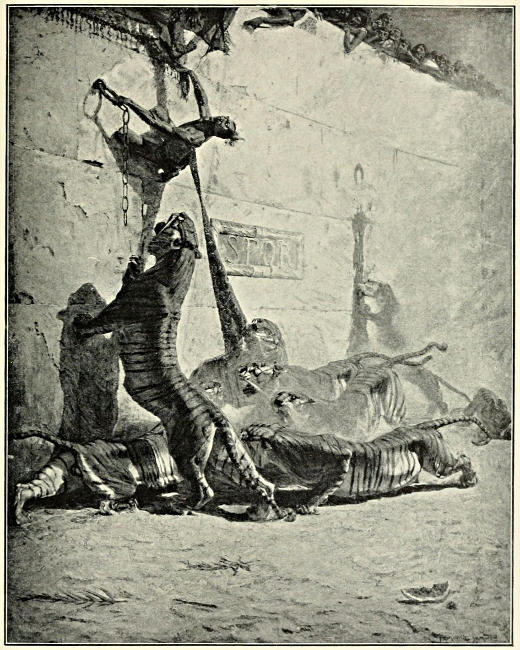
TO THE TIGERS
The gladiatorial combats were, above all things else, the distinctive characteristics
of Rome. Rome, in her fallen days, without virtue, without faith,
without trust in her gods or in herself, loved, believed in, deified one idol
still—Homicide. The butcheries of the amphitheatre exerted a charm
upon the minds of men, for which literature, art, philosophy, religion, and
the simple enjoyments of domestic life were flung aside. Existence became
a frightful phantasmagoria—an alternation of debauch and blood.
The practice itself can be traced back to one of the darkest superstitions
of the human mind. It originated in the barbarous instinct of the savage
to sacrifice his victim upon the tomb of the dead as a satisfaction, and
perhaps as an attendant upon the departed spirit. The example, from
whatever source derived, was first set to the Roman people by Marcus and
Decimus Brutus, who matched together gladiators in the Forum Boarium,
for the purpose of casting unprecedented éclat upon the obsequies of their
father, 264 B.C. The seed fell upon fruitful ground, for it soon grew and
ripened into a harvest more destructive than the dragon’s teeth of Grecian
fable. The wealth and ingenuity of the Roman aristocracy were taxed to
the uttermost to content the populace and provide food for the indiscriminate
slaughter of the circus, where brute fought with brute and man with
man, or where the skill and weapons of the latter were matched against
the strength and ferocity of the first. In one day Pompey poured six hundred
lions into the arena. Augustus delighted the multitude with the sight
of four hundred and twenty panthers. Twenty elephants, Pliny tells us,
contended against a band of six hundred Gætulian captives. The games
given by Trajan lasted for more than one hundred and twenty days. Ten
thousand gladiators descended to combat, and more than ten thousand beasts
were slain. Titus, that “delight of the human race,” had upwards of five
thousand animals slaughtered in a single day. Every corner of the earth
was ransacked for some strange creature whose appearance was hailed with
frantic applause by the spectators. We hear of camelopards, white elephants,
and the rhinoceros. Scaurus produced upon the stage a hippopotamus and
five crocodiles. Game of the nobler sorts became scarce. The Roman populace
was as indignant with those who in any way damaged its supplies, as
the country sportsman is with a poacher or with the unlucky culprit who has
made away with a fox. In the time of Theodosius it was forbidden by law
to destroy a Gætulian lion, even in self-defence.
But the death-agonies of the wild animals of the desert were too tame a
spectacle to satisfy the Roman thirst for blood. It was when man strove
with man, and when all that human strength and skill, increased by elaborate
training and taxed to the uttermost, could do, was put forth before
their unrelenting eyes, that the transport of their sanguinary enthusiasm
was at its height. It is impossible to describe the aspect of the amphitheatre
at such a time. The audience became frantic with excitement; they
rose from their seats; they yelled; they shouted their applause, as one blow
more ghastly than another was dealt by lance, or sword, or dagger, and the
life-blood spouted forth. “Hoc habet”—“he has it, he has it!”—was
the cry which burst from ten thousand throats, and was re-echoed, not only
by a debased and brutalised populace, but by the lips of royalty, by purple-clad
senators and knights, by noble matrons, and even by those consecrated
maids whose presence elsewhere saved the criminal from his fate, but whose
function here it was to consign the suppliant to his doom by reversing
the thumb upon his appeal for mercy. His blood was soon licked up by
the thirsty sand, or concealed beneath the sawdust sprinkled over it by the
ready attendant; his body dragged hastily from the stage by an iron hook,
and flung into a gory pit; his existence forgotten, and his place supplied by
another and yet another victim, as the untiring work of death went on.
And we must remember that these things were not done casually, or
under the influence of some strange fit of popular frenzy. They were done
purposely, systematically, and calmly; they formed the staple amusement,
I had almost said the normal employment, of a whole people, whose one
audible cry was for “panem et circenses”—“bread and blood.” Neither
were they fostered by the brutalised habits and associations which surround
the cockpit or the prize-ring. When men were “butchered to make a Roman
holiday,” it was among all the delicate appliances of the most refined sensualism.
An awning, gorgeous with purple and gold, excluded the rays of
the midday sun; sweet strains of music floated in the air, drowning the
cries of death; the odour of Syrian perfumes overpowered the scent of
blood; the eye was feasted by the most brilliant scenic decoration, and
amused by elaborate machinery; and, as a crowning degradation to the
whole, the Paphian chamber of the courtesan arose beside the bloody den
into which were flung the mangled bodies of men and brutes.
Such things seem impossible to those who live beneath a civilisation
which Christianity has influenced, however imperfectly, by its presence.
And indeed it needs much—the concurrent testimony of poet, historian,
and philosopher; the ruins of a hundred amphitheatres before our eyes;
the frescoes of the Museo Borbonico; the very programmes of the performance,
which something higher than accident has preserved; the incidental
witness of an inspired apostle—it needs all this to convince us of the
truth. But they are true, undisputed facts of history, and facts which carry
with them no obscure intimation of the reasons which worked the fall of
the imperial city. They prove that she deserved to fall, and by the hands
of those in whose persons she had outraged humanity. It was not a poet
remarkable for overstraining the religious sentiment of divine retribution,
who wrote:
“Shall he expire,
And unavenged! Arise, ye Goths! and glut your ire.”
The gladiator, whether directly a captive or a refractory slave, was generally
the child of those races who wreaked, in after times, a bloody vengeance
upon the city of blood. And if her own degenerate sons, freedman,
knight, or senator, nay, even her degraded daughters, descended into the
arena and combated by his side, this could only bespeak her more entire
debasement and unfitness to direct the destinies of the world.i
The day of the death of Marcus Aurelius may be taken as the decisive
moment in which the ruin of the old civilisation was determined.
Now after the great effort of reason in high places, after Nerva,
Trajan, Hadrian, Antoninus, Marcus Aurelius, the reign of evil begins
again, and is worse than ever. Farewell to goodness, farewell to reason!
Now, all hail, folly! All hail, absurdity! All hail to the Syrian and
his questionable gods! Genuine physicians have been able to do nothing;
the sick man is more sick than ever: send for the charlatans.—Renan.
[161-183 A.D.]
We come now to a time of obvious decline. Even in the golden epoch
the nation was probably static rather than progressive, notwithstanding the
glory that surrounds the great names of its emperors. But now the deterioration
is too rapid and too marked to be questioned. The period has
no importance except as a transition time from the great days of the empire
to the days of its degradation. Nevertheless, the events of this transition
age marshal themselves before the eye in one of the most striking panoramas
in all history. These events group themselves into a few strange scenes.
The first shows us a philosopher’s son given over to the lowest forms of vice;
demeaning himself in the arena; associating with gladiators and slaves; and
finally coming to an ignominious death at the hands of his wife and freedmen,
who kill him that their own lives may be saved.
The second scene shows us, in sharp contrast to the ignoble son of the
philosopher, the noble son of a slave assuming the purple. Pertinax passes
across the stage as a good old man, well-meaning, but incompetent to stem
the tide of the times. He meets what may be called the normal imperial
fate—assassination; and the historic stage is cleared for one of the strangest
spectacles that it has yet witnessed—the auction of an empire. This, to be
sure, is not the first time that money has made its power felt in the disposal
of the imperial office. It has long been the custom for a new emperor to
make “presents” to the soldiers. But now the affair is reduced to the frank
terms of sale and purchase.
In due course the man who has thus bargained for an empire pays the
penalty of his ambition; then a turmoil ensues between the rival aspirants
to the succession, which ends, naturally enough, with the death of all but
one; he, Septimius Severus by name, gives to the empire a moment of relative
tranquillity; and at last presents a spectacle hardly less strange than all
the others,—the spectacle of a Roman emperor dying a natural death. We
shall not see the like again for many a reign.
Following Severus come his two sons, Caracalla and Geta. The former
plays well the part of heartless despot; he kills his brother and slaughters
a host of helpless subjects in the East; and then, to emphasise a paradox,
grants the bauble of Roman citizenship to all subjects of the empire. In
due course he meets the imperial death, and is succeeded by Macrinus, who,
slain at once, is followed by Elagabalus. This degenerate youth typifies
his era; sinks to depths of debauchery which horrify even the Roman conscience;
introduces new forms of worship from the East; wins the title of
Sardanapalus; and, finally, slaughtered, his body thrown into the Tiber,
is nicknamed Tiberinus, in mocking remembrance of his ignoble death and
yet more ignoble life.
And now, at last, a ray of light pierces the gloom, and with the coming
of Alexander Severus there is a brief recrudescence of the days when Rome
was something more than the battle-ground of mercenaries and the court of
voluptuaries. Yet, in the end, even this good emperor meets the fate of all
the rest. Truly, the time is out of joint.
Let us take up now in more detailed presentation—yet still as briefly as
historical completeness will permit—the story of these strange events, beginning
with the reign of that renegade Commodus, who owed his position on
the throne to the parental affection rather than the philosophic judgment of
the best of emperors.a
Marcus Aurelius was succeeded by his son, usually known as Commodus,
whose full name was Marcus Lucius Ælius Aurelius Commodus
Antoninus. This unworthy scion of a glorious house was born at Lanuvium
on the 31st of August, 161, and proclaimed cæsar on the 12th of
October, 166. In the year 177 the tribunician authority was bestowed on
Commodus and he was summoned to take his place as “augustus” by his
father’s side.
Three years later, on the 17th of March, 180, Aurelius died, and Commodus,
who was at that time less than nineteen years of age, assumed the
reins of government without difficulty. But he was not the man to rise to
the occasion and reap the advantage of his father’s victories. He made a
peace with the Germani, which might pass for honourable, but was far from
furnishing a satisfactory safeguard for the interests of Rome. The principal
conditions were the same that Marcus Aurelius had imposed upon the
enemy five or six years before, but Commodus yielded up all the strongholds
which the Romans had established in the heart of the enemy’s country.
The lustre of the Roman arms was restored for the time, it is true, and the
old and new commanders, trained in the school of the Parthian and German
wars, guarded the frontiers of the empire at all points. But the change for
the worse soon manifested itself in the internal policy of the empire.b
At Rome, for the space of about three years, all was tranquillity; for
Commodus, whose natural character, as we are assured, was weak and timid
rather than wicked, allowed himself to be directed by the able and upright
men to whom his father had recommended him. His hours were devoted to
luxury and indulgence, till at length (183) an event occurred which revealed
the latent cruelty of his nature.
[183-186 A.D.]
After the death of L. Verus, Marcus had given his daughter Lucilla in
marriage to Pompeianus, a most respectable senator; and after the death of
her mother he allowed her all the honours of an empress, which her brother
also continued to her. But on the marriage of Commodus with a lady
named Crispina, Lucilla was obliged to yield precedence to the reigning
empress. Her haughty spirit deemed this an indignity, and she resolved on
revenge. Fearing to entrust her design to her noble-minded husband, she
first communicated it to Quadratus, a wealthy young nobleman, with whom
she carried on an adulterous intercourse; she also engaged in the plot
Claudius Pompeianus, another of her paramours, who was betrothed to her
daughter; some senators also were aware of it. As Commodus was entering
the amphitheatre through a dusky passage, Pompeianus, who was lying
in wait, drew his sword and cried, “The senate sends thee this.” But
the words prevented the execution of his design, and he was seized by the
guards. He, Quadratus, and some others were executed; Lucilla was for
the present confined in the isle of Capreæ, but she was erelong put to death,
and a similar fate soon befell her rival Crispina on account of adultery. In
her place Commodus took a freedwoman named Marcia, who had been the
concubine of Quadratus, and to whom he gave all the honours of an empress,
except that of having fire borne before her.
CRUELTIES AND DEATH OF COMMODUS
[186-189 A.D.]
The unwise exclamation of Pompeianus sank deep in the mind of Commodus;
he learned to regard the senate as his deadly enemies, and many of
its most illustrious members were put to death on various pretexts. His
only reliance was now on the guards, and the prætorian prefects soon became
as important as in former times. The prefects now were Tarruntenus Paternus
and Perennis, but the arts of the latter caused the former to be removed
and put to death, and the whole power of the state fell into his hands, for
the timid Commodus no longer ventured to appear in public. The prefect
removed all he dreaded by false accusations, and he amassed wealth by the
confiscation of the properties of the nobility. His son was in command of
the Illyrian legions, and he now aspired to the empire. But he had offended
the army of Britain—the army that in 184 had won brilliant success,—and
they deputed (186) fifteen hundred of their number to accuse him to Commodus
of designs on the empire. They were supported by the secret influence
of the freedman Cleander, and Perennis was given up to their vengeance.
Himself, his wife, his sister, and two of his children were massacred; his
eldest son was recalled and murdered on the way to Rome.
The character of Perennis is doubtful, but that of Cleander who succeeded
to his power was one of pure evil. Cleander, a Phrygian by birth,
had been brought to Rome as a slave and sold in the public market. He
was purchased for the palace, and placed about the person of Commodus,
with whom he speedily ingratiated himself; and when the prince became
emperor he made Cleander his chamberlain. The power of the freedman,
when Perennis was removed, became absolute; avarice, the passion of a
vulgar mind, was his guiding principle. All the honours and all the posts
of the empire were put to sale; pardons for any crime were to be had for
money; and in the short space of three years the wealth of Cleander exceeded
that of the Pallas and Narcissus of the early days of the empire.
A conspiracy of an extraordinary nature occurred not long
after the death of Perennis. A great number of men who had
deserted from the armies put themselves under the command
of a common soldier named Maternus; they were joined by
slaves whom they freed from their bonds, and they ravaged
for some time with impunity the provinces of Gaul and Spain.
At length (187) when Maternus found the governors preparing
to act with vigour against him, he resolved to make
a desperate effort and be emperor or perish. He
directed his followers to disperse and repair
secretly to Rome, where he proposed
that they should assume the dress
of the guards, and fall on
the emperor during the
license of the festival of
the Megalesia. All succeeded
to his wishes; they
repaired safely to Rome,
but some of them out of
envy betrayed the secret,
and Maternus and some
others were taken and
executed.
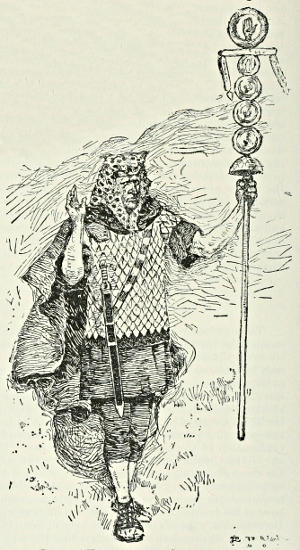
Peculiar Head-dress of a Standard-bearer
[189-193 A.D.]
The power of Cleander
was now at its height; by
gifts to Commodus and
his mistresses he maintained
his influence at
court, and by the erection
of baths and other public
edifices he sought to ingratiate
himself with the
people. He had also the
command of the guards,
for whom he had for some
time caused prætorian prefects
to be made and unmade
at his will. He at
length divided the office
between himself and two
others, but he did not
assume the title. As an
instance of the way in
which he disposed of offices,
we find in one year (189) no less than five-and-twenty consuls.
What the ultimate views of Cleander may have been is unknown, for he
shared the usual fate of aspiring freedmen. Rome was visited at this time
by a direful pestilence, and the emperor on account of it resided out of the
city. The pestilence was as usual attended by famine, and this visitation of
heaven was by the people laid to the charge of the odious favourite. As
they were one day (189) viewing the horse races in the circus, a party of
children entered, headed by a fierce-looking girl, and began to exclaim against
Cleander. The people joined in the cries, and then rising rushed to where
Commodus was residing in the suburbs, demanding the death of Cleander.
But the favourite instantly ordered the prætorian cavalry to charge them,
and they were driven back to the city with the loss of many lives. When,
however, the cavalry entered the streets they were assailed by missiles from
the roofs of the houses, and the people being joined by the urban cohorts
rallied and drove them back to the palace, where Commodus still lay in total
ignorance of all that had occurred, for fear of Cleander had kept all silent.
But now Marcia, or as others said the emperor’s sister Fadilla, seeing the
danger so imminent, rushed into his presence and informed him of the truth.
Without a moment’s hesitation he ordered Cleander and his son to be put to
death. The people placed the head of Cleander on a pole and dragged his
body through the streets, and when they had massacred some of his creatures
the tumult ceased.
The cruelty of Commodus displayed itself more and more every day, and
several men of rank became its victims.c Thus, after many years of tranquillity,
the upper classes of Roman society again found themselves in the
intolerable position of going in perpetual fear of death. Once more Rome
witnessed the spectacle of a wicked lad on the throne of the Cæsars, falling
a victim to the “madness of empire,” trampling the dignity of his great
office underfoot in furious lust of pleasure of every sort, and, in pompous
dull-wittedness, playing the part of a sanguinary practical joker and a foolish
spendthrift.b At the same time his lust was unbounded; three hundred
beautiful women and as many boys of all ages and countries filled his
seraglio, and he abstained from no kind of infamy. He delighted also to
exhibit proofs of his skill as a marksman, and he assumed the title and
attributes of the hero Hercules. For some time, like Nero, he confined his
displays to the interior of his residences, but at length the senate and people
were permitted to witness his skill in the amphitheatre. A gallery ran round
it for the safety and convenience of the emperor, from which he discharged
his darts and arrows with unerring aim at the larger and fiercer animals,
while he ventured into the arena to destroy the deer and other timid creatures.
A hundred lions were at once let loose, and each fell by a single wound; an
irritated panther had just seized a man, a dart was flung by the emperor and
the beast fell dead, while the man remained uninjured. With crescent-headed
arrows he cut off the heads of ostriches as they ran at full speed.
But his greatest delight was to combat as a gladiator. He appeared in
the character of a secutor: he caused to be recorded 735 victories which he
had gained, and he received each time an immense stipend out of the gladiatorial
fund. Instead of Hercules he now styled himself Paulus, after a
celebrated secutor, and caused it to be inscribed on his statues. He also
took up his abode in the residence of the gladiators.
At length the tyrant met the fate he merited. It was his design to put
to death the two consuls-elect for the year 193, and on New Year’s Day to
proceed from the gladiators’ school in his gladiatorial habit and enter on the
consulate. On the preceding day he communicated his design to Marcia, who
tried in vain to dissuade him from it. Q. Æmilius Lætus, the prætorian
prefect, and the chamberlain, Eclectus, also reasoned with him, but to as
little purpose. He testified much wrath, and uttered some menaces. Knowing
that the threats of the tyrant were the sure precursors of death, they
saw their only hopes of safety lay in anticipation; they took their resolution
on the moment;[41] and when Commodus came from the bath, Marcia, as was
her usual practice, handed him a bowl (in which she had now infused a
strong poison), to quench his thirst.
He drank the liquor off, and then laid himself down to sleep. The
attendants were all sent away. The conspirators were expecting the effect
of the poison when the emperor began to vomit profusely. Fearing now that
the poison would not take effect, they brought in a vigorous wrestler named
Narcissus; and induced by the promise of a large reward, he laid hold on and
strangled the emperor.[42]
[193 A.D.]
The conspirators had, it is probable, already fixed on the person who
should succeed to the empire, and their choice was one calculated to do them
credit. It was P. Helvius Pertinax, the prefect of the city, a man now
advanced in years, who had with an unblemished character, though born in
a humble rank, passed through all the civil and military gradations of the
state. Pertinax was the son of a freedman who was engaged in the manufacture
of charcoal at Alba Pompeia in the Apennines. He commenced life
as a man of letters, but finding the literary profession unprofitable, he
entered the army as a centurion, and his career of advancement was rapid.
It was yet night when Lætus and Eclectus proceeded with some soldiers to
the house of Pertinax. When informed of their arrival he ordered them
to be brought to his chamber, and then, without rising, told them that he had
long expected every night to be his last, and bade them execute their office;
for he was certain that Commodus had sent them to put him to death. But
they informed him that the tyrant himself was no more, and that they were
come to offer him the empire. He hesitated to give credit to them, but having
sent one on whom he could depend, and ascertained that Commodus was
dead, he consented to accept the proffered dignity. Though it was not yet
day they all repaired to the prætorian camp, and Lætus, having assembled
the soldiers, told them that Commodus was suddenly dead of apoplexy, and
that he had brought them his successor, a man whose merits were known to
them all. Pertinax then addressed them, promising a large donative. The
soldiers swore fidelity to the emperor.
Before dawn the senate was summoned to the temple of Concord, whither
Pertinax had proceeded from the camp. He told them what had occurred,
and, noticing his age and his humble extraction, pointed out divers senators
as more worthy of the empire than himself. But they would not listen to
his excuses, and they decreed him all the imperial titles. Then giving
loose to their rage against the fallen tyrant, they termed him parricide, gladiator,
the enemy of the gods and of his country, and decreed that his statues
should be cast down, his titles be erased, and his body dragged with the
hook through the streets. But Pertinax respected too much the memory of
Marcus to suffer the remains of his son to be thus treated, and they were by
his order placed in the tomb of Hadrian.
Pertinax was cheerfully acknowledged by all the armies. Like Vespasian,
he was simple and modest in his dress and mode of life, and he lived on
terms of intimacy with the respectable members of the senate. He resigned
his private property to his wife and son, but would not suffer the senate to
bestow on them any titles. He regulated the finances with the greatest care,
remitting oppressive taxes and cancelling unjust claims. He sold by auction
all the late tyrant’s instruments of luxury, and obliged his favourites to disgorge
a portion of their plunder. He granted the waste lands in Italy and
elsewhere for a term of years rent free to those who would undertake to
improve them.
The reforming hand of the emperor was extended to all departments of
the state; and men looked for a return of the age of the Antonines. But
the soldiers dreaded the restoration of the ancient discipline; and Lætus,
who found that he did not enjoy the power he had expected, secretly fomented
their discontent. So early as the 3d of January they had seized a senator
named Triarius Maternus, intending to make him emperor, but he escaped
from them and fled to Pertinax for protection. Some time after, while the
emperor was on the sea coast attending to the supply of corn, they prepared
to raise Sosius Falco, then consul, to the empire; but Pertinax came suddenly
to Rome, and having complained of Falco to the senate, they were
about to proclaim him a public enemy, when the emperor cried that no senator
should suffer death while he reigned; and Falco was thus suffered to
escape punishment.
Some expressions which Pertinax used on this occasion irritated the soldiers;
and Lætus, to exasperate them still more, put several of them to death,
as if by his orders. Accordingly on the twenty-eighth of March a general
mutiny broke out in the camp, and two or three hundred of the most desperate
proceeded with drawn swords to the palace. No one opposed their
entrance. Pertinax, when informed of their approach, advanced to meet
them. He addressed them, reminding them of his own innocence and of the
obligation of their oath. They were silent for a few moments; at length a
Tungrian soldier struck him with his sword, crying, “The soldiers send thee
this.” They all then fell on him, and cutting off his head set it on a lance
and carried it to the camp. Eclectus, faithful to the last, perished with the
emperor; Lætus had fled in disguise at the approach of the mutineers. The
reign of the virtuous Pertinax had lasted only eighty-six days; he was in
the sixty-seventh year of his age.
The mutineers on their return to the camp found there Sulpicianus, the
prefect of the city, the late emperor’s father-in-law, who had been sent thither
to try to appease the mutiny. The bloody proof which they bore of the
empire’s being vacant excited when it should have extinguished his ambition,
and he forthwith began to treat for the dangerous prize. Immediately
some of the soldiers ran and ascending the ramparts cried out aloud that
the empire was for sale, and would be given to the highest bidder. The news
reached the ears of Didius Julianus, a wealthy and luxurious senator, as he
sat at table; and urged by his wife and daughter and his parasites, he rose
and hastened to the camp. The military auctioneers stood on the wall,
one bidder within, the other without. Sulpicianus had gone as high as five
thousand denarii a man, when his rival at one bidding rose to 6250. This
spirited offer carried it; the soldiers also had a secret dread that Sulpicianus,
if emperor, might avenge the death of his son-in-law. The gates were thrown
open, and Julian was admitted and saluted emperor; but the soldiers had
the generosity to stipulate for the safety of his rival.
From the camp Julian, escorted by the soldiers, proceeded to the senate
house. He was there received with affected joy, and the usual titles and
honours were decreed him; but the people stood aloof and in silence, and
those who were more distant uttered loud curses on him. When Julian came
to the palace, the first object that met his eyes was the corpse of his predecessor;
he ordered it to be buried, and then it is said sat down and passed
the greater part of the night at a luxurious banquet, and playing at dice.
In the morning the senate repaired to him with their feigned compliments;
but the people still were gloomy, and when he went down to the senate
house and was about to offer incense to the Janus before the doors, they cried
out that he was a parricide and had stolen the empire. He promised them
money, but they would have none of it; and at length he ordered the soldiers
to fall on them, and several were killed and wounded. Still they ceased
not to revile him and the soldiers, and to call on the other armies, especially
that of Pescennius Niger, to come to their aid.
The principal armies were that of Syria commanded by Niger; that of
Pannonia under Septimius Severus, and that of Britain under Clodius Albinus,
each composed of three legions, with its suitable number of auxiliaries.
C. Pescennius Niger was a native of Aquinum, of a simple equestrian
family. He entered the army as a centurion, and rose almost solely by
merit till he attained the lucrative government of Syria. As an officer Niger
was a rigorous maintainer of discipline; as a governor he was just, but mild
and indulgent, and he succeeded in gaining alike the affections of the soldiers
and the subjects. In his private life he was chaste and temperate.
L. Septimius Severus was born at Leptis in Africa. He received a learned
education, and devoted himself to the bar, and M. Aurelius made him advocate
of the Fisc. He acted as civil governor of several provinces, and had
occasionally a military command, but had seen little or no actual service.
After his consulate, Commodus, through the influence of Lætus, gave him
the command of the Pannonian legions, as reported in the Augustan History.
D. Clodius Albinus was also an African. He was born at Hadrumetum,
of an honourable family, which derived its origin from the Postumii and
Ceionii of Rome. He entered the army early, and rose through all the gradations
of the service, being highly esteemed by M. Aurelius. He commanded
in Bithynia, at the time of the revolt of Cassius, and kept his legions in
their duty. Commodus gave him the command in Gaul and in Britain, and
designed him for his successor. Albinus was a strict and even severe officer.
He was fond of agriculture, on which subject he wrote some books. He was
charged with private vices, but probably without reason.
When the intelligence of the murder of Pertinax and the sale of the
empire to Julian reached the armies of Syria and Pannonia, their generals
saw the prospect of empire open to them as the avengers of the emperor
whom they had acknowledged. Each of them assembled his troops and
expatiated on the atrocity of the deed which had been perpetrated at Rome,
and each was saluted Augustus by his army and the subjects. But while
Niger, seeing all the provinces and allied princes of Asia unanimous in his
favour, and therefore indulging in confidence, remained inactive at Antioch,
Severus resolved to push on for the capital, and possess himself of that seat
of empire. Having secured the adherence of the army of Gaul, he wrote a
most friendly letter to Albinus, giving him the title of cæsar, and adopting
him as his son; by which he made sure of his neutrality, if not of his co-operation.
He then advanced by rapid marches for Rome. Day and night
he appeared in full armour, and surrounded by a guard of six hundred chosen
men, who never laid aside their corslets. Resistance was nowhere offered;
all hailed him as the avenger of Pertinax.
The wretched Julian was filled with dismay when he heard of the approach
of the formidable Pannonian army. He made the senate declare
Severus a public enemy; he distributed large sums of money to the prætorians
to induce them to prepare to defend him; but these dissolute troops
were vigorous only for evil, and they could not resume the discipline they
had lost; the marines summoned from Misenum were still more inefficient;
and an attempt at training elephants for war in the oriental manner only
excited derision. Julian also caused an entrenchment to be run in front of
the city, and he secured the palace with strong doors and bars, as if that
could be maintained when all else was lost. He put to death Marcia, Lætus,
and all concerned in the murder of Commodus, probably with a view to
the favour of the soldiery.
Severus meantime had reached Ravenna and secured the fleet. Julian,
having made some fruitless attempts on his life, caused the senate to declare
him his associate in the empire. But Severus now disdained such divided
power; he had written to the prætorians, assuring safety to all but the actual
assassins of Pertinax, and they had accepted the conditions. The consul,
Silius Messalla, assembled the senate, and it was resolved to put Julian to
death and give the empire to Severus. When those charged with the mandate
for his death came to Julian, his only words were, “What evil have I
done? Whom have I slain?” He was then killed by a common soldier,
after a reign of only sixty-six days.
[193-194 A.D.]
Severus was met at Interamna (Terni), in Umbria, seventy miles from
Rome, by deputies from the senate. He received them with favour, and still
continued to advance. As he drew nigh to Rome he commanded the execution
of the murderers of Pertinax, and he sent orders to the remaining prætorians
to leave their arms in their camp and come to meet him, dressed as
they were wont when attending the emperors on solemn occasions. They
obeyed, and Severus received them in the plain before his camp, and addressed
them from a tribunal, reproaching them with the murder of Pertinax and
the sale of the empire to Julian. He would spare their lives, he said, but
he would leave them nothing save their tunics, and death should be the fate
of any of them who ever came within a hundred miles of the capital. While
he was speaking his soldiers had imperceptibly surrounded them; resistance
was vain, and they quietly yielded up their swords and their rich habiliments,
and mournfully retired. A detachment had meantime taken possession
of their camp, to obviate the effects of their despair.
Severus entered the city at the head of his army. The senate and people
met him with all the marks of joy and festivity. He ascended the Capitol
and worshipped; he then visited the other temples, and at length proceeded
to the palace. In the morning he met the senate, to whom he made a
speech full of the fairest promises, assuring them that Marcus should be his
model and swearing that he would put no senator to death unless condemned
by themselves—an oath which he kept but indifferently. The
usual titles and powers had been already decreed him; among these was
the title of Pertinax, of which prince he affected to be the avenger, and the
ceremony of whose deification he performed with the greatest magnificence
and solemnity. He distributed large sums of money among the soldiers and
people; he regulated the supply of provisions, and he examined into the conduct
of several governors of provinces,
and punished those who
were proved guilty of oppression.

Septimius Severus
(From a bust in the Capitoline Museum)
Severus restored the prætorian
guards on a new model, and
raised them to four times their
original number. Augustus had
admitted none but Italians into
this body; the youth of Spain,
Noricum, and Macedonia had
gradually been suffered to enlist
in it; but Severus threw it open
to all, selecting the ablest and
most faithful soldiers from the
legions for the higher pay and
more easy life of the guardsmen.
[194-197 A.D.]
After a stay of only thirty
days in Rome, Severus set out for
the war against Niger, who was
master of all Asia and held the
strong city of Byzantium in Europe.
The preparations on both
sides occupied some time; at
length Severus took the field, and
leaving part of his troops to carry
on the siege of Byzantium, he
sent the main body of his army,
under his generals, over the Hellespont.
Æmilianus, the proconsul
of Asia, gave them battle
(194) near Cyzicus, but was defeated.
He fled to Cyzicus, and thence to another unnamed town, where
he was seized and put to death. Niger in person afterwards engaged the
Severian general, Candidus, between Nicæa and Cius. The contest was long
and arduous, but victory declared for the European army, and Niger, leaving
troops to guard the passes of Mount Taurus, hastened to Antioch to raise
men and money. The elements, however, favoured Severus; heavy falls of
rain and snow destroyed the defences constructed by Niger, and his troops
were obliged to abandon the passes and leave Cilicia open to the enemy.
Niger made his final stand at the Cilician Gates, as the pass from Cilicia
into Syria at the head of the Bay of Issus was named, a place famous for the
defeat of Darius by Alexander the Great. The troops of Niger were more
numerous, but they were mostly raw levies, yet they fought with constancy;
but the elements, we are told, again favoured the Severians, a storm of rain
and thunder came over the sea and blew full in the faces of the Nigrians,
and they fled with the loss of twenty thousand men. Niger hastened to
Antioch, and thence, on the approach of the enemy, he fled to the Euphrates,
in order to seek refuge with the Parthians; but he had hardly quitted the
town when he was seized, and his head was cut off and sent to Severus.
CONQUESTS OF SEVERUS
This emperor, who had been in none of the preceding actions, now
appeared. He put to death all the senators who had borne arms for Niger;
he banished some, and seized the property of others. He put numbers of
inferior rank to death, and he treated severely Antioch and some other
towns. He then (195) led his army over the Euphrates, and his generals
employed this and a part of the following year in reducing the various tribes
and princes of Mesopotamia. While he was thus engaged (196), he received
the joyful intelligence of the surrender of Byzantium, which, strong by
situation and fortifications, had held out for nearly three years against the
valour and skill of the besieging army, and was only subdued at last by
famine. The magistrates and soldiers were all put to death; the property
of the inhabitants was sold; the walls and the public edifices were demolished;
Byzantium was deprived of its title of city, and subjected as a village
to the jurisdiction of Perinthus.
It is said that Severus was meditating an invasion of Parthia, but his
thoughts were more fixed on securing the succession to his children by
removing Albinus. Suitably to his character, he resolved to proceed by
treachery rather than by force. He wrote to Albinus in the most affectionate
terms, as to his dearest brother; but the bearers of the letter were instructed
to ask a private audience, as having matters of greater importance to communicate,
and then to assassinate him. The suspicions of Albinus, however,
being awaked, he put them to the torture, and extracted the truth. He saw
that he had no alternative, that he must be emperor or nothing, and he
therefore declared himself Augustus and passed with his army over to Gaul.
Severus returned with all possible speed from the East, and advanced in
person into Gaul against his rival. He crossed the Alps in the depth of
winter, and after some minor engagements a decisive battle was fought on
the 19th of February, 197, in the neighbourhood of Lyons. The united
number of the combatants was 150,000 men; the battle was long and dubious,
the left wing on each side was routed, but Severus, who now fought for
the first time, brought up the prætorians to the support of his beaten troops,
and though he received a wound and was driven back, he rallied them once
more, and being supported by the cavalry, under his general, Lætus, he
defeated and pursued the enemy to Lyons. The loss on both sides was considerable;
Albinus slew himself, and his head was cut off and brought to his
ungenerous enemy, who meanly insulted it; his wife and children were at
first spared, but they were soon after put to death, and their bodies cast
into the Rhine.
The city of Lyons was pillaged and burned; the chief supporters of Albinus,
both men and women, Romans and provincials, were put to death, and
their properties confiscated. Having spent some time in regulating the
affairs of Gaul and Britain, Severus returned to Rome, breathing vengeance
against the senate, for he knew that that body was in general more inclined
to Albinus than himself, and he had found, among his rival’s papers, the
letters of several individual senators. The very day after his arrival he
addressed them, commending the stern policy of Sulla, Marius, and Augustus,
and blaming the mildness of Pompey and Cæsar, which proved their ruin.
He spoke in terms of praise of Commodus, saying that the senate had no
right to dishonour him, as many of themselves lived worse than he had done.
He spoke severely of those who had written letters or sent presents to Albinus.
Of these he pardoned five-and-thirty, but he put to death nine-and-twenty,
among whom was Sulpicianus, the father-in-law of Pertinax. These,
however, were not the only victims; the whole family of Niger, and several
other illustrious persons perished. The properties of all were confiscated;
[wherefore the usual charge of avarice was brought against Severus.]
[197-202 A.D.]
After a short stay at Rome Severus set out again for the East; for the
Parthians, taking advantage of his absence, had invaded Mesopotamia, and
laid siege to Nisibis. They retired, however, when they heard of his approach,
and Severus, having passed the winter in Syria making preparations
for the war, crossed the Tigris the following summer (198) and laid siege to
Ctesiphon. The Roman soldiers suffered greatly for want of supplies, and
were reduced to feed on roots and herbage, which produced dysenteries, but
the emperor persevered, and the city at length was taken. All the full-grown
males were massacred, and the women and children, to the number of
one hundred thousand, were sold for slaves. As want of supplies did not
permit the Romans to remain beyond the Tigris, they returned to Mesopotamia,
and on his way to Syria (199) Severus laid siege to the redoubtable
Atræ, but he was forced to retire, with a great loss both of men and machines.
He renewed the attack some time after (it is uncertain in what year) but
with as little success, being obliged to retire with loss and disgrace from
before the impregnable fortress.
Severus remained in the East till the year 202. He spent a part of that
time in Egypt, where he took great pleasure in examining the pyramids and
the other curiosities of that country. He at length returned to Rome, to
celebrate the marriage of his elder son.
The family of Severus consisted of his wife and two sons. The empress,
named Julia Domna, was a native of Emesa in Syria, whom Severus, who
was addicted to astrology, is said to have espoused because she had a royal
nativity. She was a woman of great beauty, sense, and spirit, and a cultivator
of literature and philosophy. The elder son was at first named Bassianus;
but his father, at the time of the war against Albinus, created him cæsar, by
the name of Aurelius Antoninus;[43] and he was subsequently nicknamed Caracalla,
which, to avoid confusion, is the name employed by modern historians.
In the year 198 Severus created him augustus, and made him his associate
in the empire. The name of the emperor’s younger son was Geta, and he
also was styled Antoninus.
The bride selected for Caracalla was Plautilla, the daughter of Plautianus,
the prætorian prefect. This man was a second Sejanus, and it is very
remarkable that two emperors of such superior mental powers as Tiberius
and Severus should have been so completely under the influence of their
ministers. Plautianus, like his master, was an African by birth; he was of
mean extraction, and he seems to have early attached himself to the fortune
of his aspiring countryman, whose favour and confidence he won in an extraordinary
degree; and when Severus attained the empire, the power of
Plautianus grew to such a height, that he, the historian observes, was, as it
were, emperor, and Severus captain of the guards. Persons like Plautianus,
when elevated, rarely bear their faculties meekly. He was therefore proud,
cruel, and avaricious; he was the chief cause of so many persons of rank and
fortune being put to death, in order that he might gain their properties.
He seized whatever took his fancy, whether sacred or profane, and he thus
amassed such wealth that it was commonly said he was richer than Severus
and his sons. Such was his pride that no one dared approach him without
his permission; and when he appeared in public criers preceded him,
ordering that no one should stop and gaze at him, but turn aside and look
down. He would not allow his wife to visit or to receive visits, not even
excepting the empress. As his power was so great, he was of course the
object of universal adulation. The senators and soldiers swore by his
fortune, and his statues were set up in all parts of the empire. He was in
effect more dreaded and more honoured than the emperor himself.
[202-208 A.D.]
Such power is, however, unstable in its very nature, and the marriage of
his daughter with the son of the emperor caused the downfall of Plautianus.
The wedding was celebrated with the utmost magnificence; the dower of
the bride, we are told, would have portioned fifty princesses. [But the usual
allowances must be made for exaggerations of the gossipers. Some of the tales
related by Dion Cassiuse are not worthy of repetition even, though perhaps
told in good faith. Doubtless all details as to the death of Plautianus must
be heard with reservations.] Plautilla was haughty like himself; and Caracalla,
who had been forced to marry her, hated father and daughter alike, and
resolved on their destruction. He induced one Saturninus and two other
centurions to declare that Plautianus had ordered them and seven of their
comrades to murder Severus and his son. A written order to this effect was
forged and shown to the emperor, who forthwith summoned Plautianus to his
presence. He came suspecting nothing; he was admitted, but his followers
were excluded. Severus, however, addressed him in a mild tone, and asked
him why he had meditated killing him. Plautianus was expressing his surprise
and commencing his defence, when Caracalla sprang forward, tore his
sword from him, struck him with his fist, and would have slain him with his own
hand but for the interference of his father. He then made some of his
attendants despatch him, and sent his head to the empress and Plautilla, a
joyful sight to the one, a mournful spectacle to the other. Plautilla and
her brother Plautius were sent to the isle of Lipara, where they lived in
poverty and misery for the remainder of the reign of Severus, and their
murder was one of the first acts of Caracalla when emperor.
Severus now remained in Italy for a space of four years, actively engaged
in the administration of justice, the regulation of the finances, and the
correction of all kinds of abuses. He conferred the important post of
prætorian prefect on Papinian, the most renowned of jurisconsults; and as
it was now a part of this officer’s duty to try civil causes, Papinian appointed
as his assessors Paulus and Ulpian—names nearly as distinguished as his
own.
[208-211 A.D.]
In the year 208, Severus, though far advanced in years and a martyr to
the gout, set out for Britain, where the northern tribes had for some time
been making their usual incursions into the Roman part of the island.
Various motives are assigned for this resolution; the most probable is that
he wished to remove his sons from the luxury of Rome, and to restore the
relaxed discipline of the legions. He entered the wild country north of
the Roman wall, cut down the woods, and passed the marshes, and succeeded
in penetrating to the extremity of the island, though with a loss, it
is said, of fifty thousand men; for the barbarians, who would never venture
to give him battle, hung on his flanks and rear, formed numerous ambuscades,
and cut off all stragglers. In order to check their future incursions,
he repaired and strengthened the mound or wall which Hadrian had constructed
from the shore of Solway Firth to the mouth of the Tyne.
Severus had associated his second son Geta in the empire the year he
came to Britain. But the two brothers hated each other mortally, and
Caracalla made little secret of his resolution to reign alone. This abandoned
youth, it is said, even attempted to kill his father in the very sight
of the Roman legions and the barbarian enemies; for as the emperor was
riding one day to receive the arms of the Caledonians, Caracalla drew his
sword to stab him in the back; those who were about them cried out, and
Severus, on turning round, saw the drawn sword in the hand of his son.
He said nothing at the time, but when he returned he called Caracalla with
Papinian and the chamberlain Castor to him in private, and causing a sword
to be laid before him, rebuked his son, and then told him if he desired his
death to slay him with his own hand, or to order Papinian the prefect to do
it, who of course would obey him as he was emperor. Caracalla showed
no signs of remorse; and though Severus had often blamed M. Aurelius for
subordinating his public duty to his private affections in the case of Commodus,
he himself exhibited even more culpable weakness.
Severus was once more about to take the field against the barbarians,
who had renewed their ravages (211), when a severe fit of the gout carried
him off at York (Eboracum), in the sixty-sixth year of his age and the
eighteenth of his reign.
Though this emperor had passed the greater part of his life in civil
rather than military employments, it is remarkable that his government
relied more on the arms of the soldiery than that of any of his predecessors.
We have seen the important changes which he made in the prætorian guards,
whom he also seems to have been the first to employ on foreign service.
Hitherto the legions of the frontiers had maintained something of the
appearance of those of the republic, but Severus allowed them to have their
wives and families in their camps, and to wear gold rings like the knights.
He also increased their pay and accustomed them to donatives. His dying
counsel to his sons, “Be united, enrich the soldiers, despise all others,”
revealed his principles of despotic government.c In judging Severus, however,
it is necessary to recall that the entire period through which we are
now passing—up to the time of Diocletian—is in a sense an epoch of
revolution, the contending forces being the senate, the emperor, the populace
of Rome, the prætorians, and the legions. The weakness and brutality of
Commodus precipitated the revolution. The prætorians not only trampled
upon the senate and the residents of the capital, but also asserted the right to
make and to unmake emperors. This was the first stage of the revolution.
In the second stage, beginning with Septimius Severus, the legions, jealous
of the pampered guard, fought against it, against the senate, and against
one another. This civil war, after rendering the prætorians helpless and
depriving the senate of its last remnant of authority, decided that the
sovereign should be a general, the choice of the soldiers who protected
the empire. Thus far the result of the revolution was in a great degree
just and beneficent. It is to be noted that Severus was the anti-senatorial
candidate for the imperial office,—hence his unfavourable treatment at the
hands of the historian. Though harsh in the punishment of political offences,
Severus was in other respects a great and admirable ruler. The fact that
the three great jurists, Papirian, Ulpian, and Paulus co-operated with him
speaks volumes in his favour. He strengthened the empire, encouraged
education, and made his reign an epoch in wise legislation.a
[211-212 A.D.]
In spite of the efforts of Caracalla to the contrary, the army proclaimed
the two sons of Severus joint-emperors. The Caledonian war was abandoned,
and the emperors returned to Rome to celebrate the obsequies of
their father. On the way Caracalla made various attempts on the life
of his brother, but Geta was protected by the soldiery, of whom he was the
favourite. The brothers adopted every precaution against each other on
the road, and at Rome they divided the palace, securing all the approaches
to their several portions. The court, the camp, the senate, and the people
were divided in their affections to the brothers, neither of whom was in
reality deserving of the attachment of any man of worth; but Geta had a
certain degree of mildness and humanity, of affability and of devotion to
literature, which gave him the advantage over his more ferocious brother,
and gained him the affection of their mother Julia.
[212-216 A.D.]
As there seemed no probability of concord between the brothers, a
division of the empire was proposed and arranged, by which Caracalla was
to retain the European portion, while Geta was to rule in Asia and Egypt,
residing at Antioch or Alexandria. This arrangement, it is said, was
defeated by the tears and entreaties of Julia; and Caracalla, bent on reigning
alone, then resolved on the murder of his brother. At his desire (212)
Julia invited her two sons to a meeting in her apartments. Geta came suspecting
no danger; suddenly some centurions, whom Caracalla had placed
in concealment, rushed out and fell on him. He threw himself on his
mother’s bosom for protection, but her efforts to save him were vain; she
herself received a wound in the arm, and was covered with the blood of her
murdered son. When the deed was done Caracalla hastened to the camp,
crying all the way that a plot had been laid for his life. He flung himself
down before the standards in the camp chapel to return thanks for his
preservation; and then addressed the soldiers, assuring them that he was
one of themselves, and depended on them alone. He promised to raise their
pay one half, and to distribute among them all the treasures accumulated by
his father. Such arguments could not fail of convincing, and he was readily
proclaimed sole emperor. He thence proceeded to the camp at the Alban
Mount, where he found more difficulty, as the soldiers there were much
attached to Geta; but by dint of promises he gained them also to acknowledge
him.
Followed by the soldiers, Caracalla then proceeded to the senate house;
he had a cuirass under his robe, and he brought some of his military followers
into the house. He justified his conduct by the example of Romulus and
others; but he spoke of Geta with regret, and gave him a magnificent funeral,
and placed him among the gods.
The unhappy empress dared not lament the death of her son; she was
even obliged to wear an aspect of joy for the safety of the emperor, who
all through his reign continued to treat her with respect, and to give her a
share in the affairs of state. But on all the other friends and favourers of
Geta, both civil and military, he let his vengeance fall without restraint, and
the number of those who perished on this account is estimated at twenty
thousand. Among these the most regretted was the great Papinian. Caracalla,
it is said, wished him to compose an apology for the murder of Geta,
but he replied with virtuous intrepidity that it was not so easy to excuse a
parricide as to commit it. A soldier cut off his head with an axe, and Caracalla
rebuked him for not having used a sword. Fadilla, the surviving
daughter of M. Aurelius, was put to death for having lamented Geta. Helvius
Pertinax, son of the emperor, Thrasea Priscus, a descendant of the great
lover of liberty, and many other persons of rank and virtue were involved in
the common ruin. To such an extent it is said did Caracalla carry his hatred
to his brother that the comic poets no longer ventured to employ the name
of Geta in their plays.
Like Commodus, the emperor devoted most of his time to the circus and
amphitheatre. In order to defray his enormous expenses he increased the
taxes and confiscated all the properties he could lay hold on. When his
mother one day blamed him for bestowing such enormous sums on the soldiers,
and said that he would soon have no source of revenue remaining, he laid his
hand on his sword, and said, in the true spirit of despotism, “Never fear,
mother; while we have this we shall not want for money.”
One of the acts of Caracalla at this time was to confer the rights of citizenship,
of which the old republicans had been so chary, on all the subjects
of the empire.
His restless temper soon urged him to seek for glory in a contest with
the Germans. He marched to the Rhine and obtained (by purchase as it
would seem) some advantages over the confederacy of the Alamanni, whose
name now first appears in history. He henceforth wonderfully affected the
Germans, even wearing a blond periwig to resemble them; and he placed a
number of them about him as guards. It is thought that it was on the occasion
of his return to Rome from Gaul after this war (214) that he distributed
among the people the long Gallic coats named caracals, whence he derived
the appellation by which he is usually known. After his German war, he
marched to the Danube (215), visited the province of Dacia, and had some
skirmishes with the neighbouring barbarians. He then passed over to Asia
with the intention of making war on the Parthians, and spent the winter at
Nicomedia.
As he professed an especial regard for the memory of Achilles, he visited
the remains of Ilium, offered sacrifices at the tomb of the hero, led his troops
in arms round it, and erected a brazen statue on its summit. One of his
freedmen happening to die, or being poisoned by him for the purpose, he
acted over again the Homeric funeral of Patroclus, pouring, like Achilles,
wine to the winds to induce them to inflame the pyre, and cutting off the
hair, with which nature had furnished him most scantily, to cast into the
flames. In thus honouring Achilles, he sought to follow the example of
Alexander the Great, a prince of whom his admiration was such that he
erected statues of him everywhere; and he formed a phalanx of sixteen
thousand Macedonians armed as in the time of that prince, whom he styled
the Eastern Augustus. He even persecuted the peripatetic philosophers, because
Aristotle was accused of being concerned in the death of his royal pupil.
[216-217 A.D.]
In the spring (216) Caracalla set out for Antioch. The Parthians
averted a war by the surrender of two persons whom he demanded. By
treachery he made himself master of the persons of the king of Armenia and
his sons, and of the prince of Edessa; but the Armenians defeated the troops
which he sent against them under Theocritus, a common player, whom he
had raised to the dignity of prætorian prefect. He then proceeded to
Alexandria with the secret resolve of taking a bloody vengeance on the inhabitants
for their railleries and witticisms against him on the occasion
of the murder of his brother. When he approached the city the people
came forth to meet him with all the marks of joy and respect, and he received
them graciously, and entered the town. Then pretending a design
of forming a phalanx in honour of Alexander, he directed all the youth to
appear in the plain without the walls. When they had done as required, he
went through them as it were to inspect them; and then retiring to the
temple of Serapis, he gave the signal to his soldiers to fall on them and
massacre them. The slaughter was dreadful both within and without the
walls, for no age or rank was spared. Trenches were dug, and the dead and
dying were flung into them in order to conceal the extent of the massacre.
He deprived the city of all its privileges, and its total ruin was only averted
by his death.
After this slaughter of his helpless subjects, Caracalla returned to Antioch,
and in order to have a pretext for making war on the Parthians he sent
to Artabanus their king, demanding his daughter in marriage. The Parthian
monarch having refused this strange suit, Caracalla invaded and ravaged his
territories; and having taken Arbela, where were the royal tombs, he opened
them and scattered the bones of the monarchs which were deposited within
them. He then took up his winter quarters in Edessa.
In the spring (217) both sides were engaged in active preparation for
war; when a conspiracy in his own army terminated the life and reign of
the Roman emperor. Of the two prætorian prefects, the one, Adventus, was
a mere soldier, the other, Macrinus, was a civilian well versed in the laws.
The rough and brutal Caracalla often ridiculed him on this account, and
even menaced his life; and Macrinus, having got sure information that his
destruction was designed, resolved to anticipate the tyrant. He accordingly
communicated his designs to some of the officers of the guards, among whom
was one Martial, whom Caracalla had mortally offended by refusing him the
post of centurion, or, as others say, by putting his brother to death. Accordingly
on the 8th of April, 217, as the emperor was riding from Edessa to
Carrhæ in order to worship at the temple of the Moon, and had retired and
alighted for a private occasion, Martial ran up as if called, and stabbed him
in the throat. The emperor fell down dead. Martial mounted his horse
and fled; but he was shot by a Scythian archer of the guard.
[217-218 A.D.]
When the news of the murder of the emperor was divulged, Macrinus
was the first to hasten to the spot, and to deplore his death. As Caracalla
had left no heir, the army was uncertain whom to proclaim emperor in his
stead, and the empire was for four days without a chief. Meantime the officers
who were in the interests of Macrinus used all their influence with their
men, and on the fourth day he was saluted emperor. He accepted the office
with feigned reluctance, and he distributed, according to custom, large sums
of money among the soldiers. Adventus was the bearer of the ashes of
Caracalla to Rome, where they were deposited in the tomb of the Antonines;
and Macrinus and the senate were obliged to yield to the instances of the
soldiers, and place the monster among the gods. The senate received with
joy the letter in which Macrinus announced his elevation to the empire, and
they decreed him all the usual titles and honours.
While these changes were taking place in the Roman Empire, Artabanus
had passed the Tigris with a large army. Macrinus having in vain proposed
terms of accommodation, led out his legions, and some fighting took place in
the neighbourhood of Nisibis, in which the advantage was on the side of the
Parthians; but as they now began to feel the want of supplies, and were
anxious to return home, they readily listened to the renewed proposals of
the Roman emperor, and a peace was concluded. Macrinus then led his
troops back to Antioch for the winter.
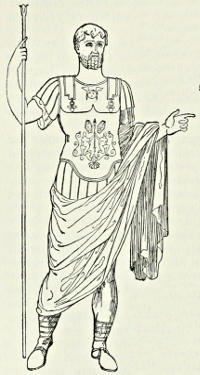
Roman General
(From a vase)
Macrinus, as we have already observed, was not a military man. He was
a native of Cæsarea in Africa (Algiers), of humble origin, and he was
indebted for his elevation to his countryman Plautianus. He was a man of
an amiable disposition, and a sincere lover of justice.
He therefore turned his attention chiefly to civil
regulations, and he made some necessary reforms
and excellent laws; but he was timid by nature, and
in his anxiety to serve and advance his friends, he
did not sufficiently consider their fitness for the employments
which he bestowed on them. He committed
a great and irreparable fault in not
setting out for Rome at once, and in keeping
the army all together in Syria; and he
further commenced too soon a necessary,
but imprudent attempt at bringing back
the discipline of the legions to what it had
been under Severus; for though he applied
it only to recruits and did not interfere
with the old soldiers, these last apprehended
that the reform would at length
reach themselves, and they became highly
discontented. This feeling of the soldiers
was soon taken advantage of, and a rival
set up to Macrinus.
The empress Julia was at Antioch at the time of
the murder of Caracalla. Macrinus wrote to her in
very obliging terms; but in the first transports of her
grief at the death of her son or the loss of her power,
she had given herself several blows on the breast, and
thus irritated a cancer with which she was afflicted,
and her death ensued. Her sister, named Mæsa, who
had lived at court during the last two reigns and
had acquired immense wealth, retired by order of
Macrinus to her native town of Emesa. She had two daughters named
Soæmias and Mamæa, each of whom was a widow with an only son; that
of the former was named Bassianus; he was now a handsome youth of
seventeen years of age, and the influence of his family had procured for
him the lucrative priesthood of the Sun, who was worshipped at Emesa
under the title of Elagabalus. The Roman troops who were encamped near
the town used to frequent the temple, and they greatly admired the comely
young priest, whom they knew to be a cousin of their lamented Caracalla.
The artful Mæsa resolved to take advantage of that feeling, and she made
no scruple to sacrifice the reputation of her daughters to the hopes of empire:
she therefore declared (what was perhaps true) that Caracalla used
to cohabit with her daughters in the palace, and that Bassianus was in
reality his son. Her assertion, backed with large sums of money and lavish
promises of more, found easy acceptance with the soldiers. On the night
of the 15th of May, 218, she and her daughter and grandson, and the rest
of her family, conducted by their eunuch Gannys, a man of great talent,
stole out of the city and proceeded to the camp, where they were joyfully
received; and Bassianus was proclaimed emperor by the title of M. Aurelius
Antoninus. The camp was immediately put into a state of defence against a
siege; and numbers of the other soldiers hastened to sustain the cause of the
son of Caracalla.
Macrinus sent the prætorian prefect Ulpius Julianus against the rebels.
This officer was successful in his first attack on their camp; but having
neglected to push his advantage, he gave the enemy time for tampering with
his troops, a part of whom abandoned him; and he was taken and slain.
Macrinus had meantime advanced as far as Apamea, where he declared his
son Diadumenianus, a boy of only ten years of age, Augustus, and took
this opportunity of promising a large gratuity to the army; he also wrote
against Bassianus to the senate and governors of provinces. But instead of
advancing rapidly against the rebels, he fell back to Antioch, whither they
speedily followed him, and he was forced to give them battle near that town.
The troops of Bassianus were ably disposed by the eunuch Gannys, who now
in arms for the first time in his life showed the talents of a general. But
the prætorians on the side of Macrinus fought with such determined valour
that the rebels were on the point of flying, when Mæsa and Soæmias rushed
out and stopped them; and Bassianus, sword in hand, led them on to the
combat. Still the prætorians gave not way, and victory would have declared
for Macrinus had he not shamefully fled in the midst of the battle. His
troops when assured of his flight declared for Bassianus.
Macrinus fled in disguise, and never stopped till he came to Chalcedon,
where he was taken and put to death, and his innocent son shared his fate.
His reign had lasted only fourteen months.c
[218-222 A.D.]
Bassianus now hastened to assert his claim to the succession. He was entirely
successful; ascending the throne under title of M. Aurelius Antoninus
Elagabalus, or, as the Latins called him, Heliogabalus. Dion Cassiuse (as
preserved by Xiphilinusi) has left us a picturesque account of the accession
and brief reign of this effeminate youth, whose name has become a proverb
for sensuality of the most degenerate type. We turn to his account, making
such omissions as the restrictions of modern taste demand;—the classical
writers, as we have had occasion to note heretofore, adjudged the limits
between frankness and prudery by standards quite different from ours.
This narrative of Dion Cassius has the unique interest of being the account
of an exact contemporary. The author was a member of the Roman senate,
at the time of Elagabalus’ accession. The following year he was governor
of Pergamus and Smyrna. “He had conversed with Macrinus after his elevation,
and yet was in the senate when the letters of Macrinus were read on
the elevation of Elagabalus” (Clintong).
Here, then, is the story of Rome’s most degenerate emperor, as told by
this contemporary witness. The account is the most authoritative one that
has come down to us; but it will be observed that allowance must be made
for current superstitions in parts of the narrative.a
DION CASSIUS ON THE ACCESSION AND REIGN OF ELAGABALUS
Avitus [Elagabalus], who is called pseudo Antoninus, or the Assyrian,
or, again, Sardanapalus or Tiberinus (the last name having been bestowed
upon him after his body was cast into the Tiber), made his entry next day
[after the defeat of Macrinus] into Antioch, having promised five hundred
drachmæ to the soldiers if they refrained from pillaging the city, as they
greatly desired to do. This sum he of course exacted from the inhabitants.
He likewise wrote a letter to Rome, in which, among other matters befitting
the occasion, he heaped invectives upon Macrinus for the obscurity of his
origin and his conspiracy against Antoninus, and made lavish promises, not
only to the soldiers but to the senate and populace (pretending to act in all
things after the example of Augustus, whose age he compared with his own,
and of Marcus Antoninus); and, in allusion to the censures passed upon him
by Macrinus, he added, “He took upon himself to censure my youth, he who
nominated his six-year-old son emperor.”
Such was his message to the senate. To that assembly and to the legions
he despatched an account of what had taken place among the soldiers, together
with the letter written by Macrinus to Maximus, in order further to
inflame their hatred of Macrinus and their attachment to his own person.
In his letter to the senate and his address to the people he styled himself
emperor, Cæsar, the son of Antoninus, the grandson of Severus, the pious,
the fortunate, Augustus, proconsul, prince invested with tribunician authority.
He is also reported to have said, “Let them give me no titles
which have to do with war; in ‘the pious’ and ‘the fortunate’ I have
enough.”
A number of persons having, in both a public and a private capacity,
committed offences in word and deed against him and against Caracalla, he
declared that he would punish no man whatever; nor did he punish any, although
in the rest of his conduct he carried debauchery, injustice, and cruelty
to such lengths that certain customs wholly unknown at Rome were practised
there as having come down from our forefathers, and that crimes committed
in single instances by other men and in other places there flourished freely for
the three years and nine months of his reign, reckoning from the battle which
put him in possession of the sovereign power.
In Syria he shed the blood of Nestor and of Fabius Agrippinus, governor
of the province, and of the chief of the knights who had been about Macrinus,
and at Rome he acted likewise towards those who had been most
strongly attached to the cause of the late monarch; in Arabia he slew Picas
Cærianus, to whom the government of that country had been committed, for
not having immediately come over to his side; in Cyprus, Claudius Attalus,
a former governor of Thrace, who had been expelled from the senate by
Severus at the time of the war with Niger, restored to his honours by Tarantus,[44]
and placed by fate at the head of the province of Cyprus, merely
because he had given offence to Comazon. For while the latter was serving
in Thrace Attalus had placed him among the oarsmen as a punishment for
dereliction of duty.
Thus the pseudo Antoninus put Attalus to death,—though he had written
concerning him to the senate saying that he had recalled him to Rome,
whence he had been banished by Macrinus, together with Julius Asper,—and
Sulla, a former governor of Cappadocia, because he was involved in
certain intrigues and because, having been summoned to Rome, he had gone
before some Celtic soldiers on their way home from Bithynia, where they
had passed the winter, and had stirred up some disorders. Such were the
motives from which these two personages perished, no word thereof being
sent to the senate. As for Seius Carus, the grandson of Fuscianus, a former
prefect of Rome, the reason was that he was rich and noble, and a man of
ability; the pretext, that he had incited the soldiers of the Alban legion to
mutiny.
The monarch being his only accuser, the trial of Seius was held in the
palace, where he was slain. Valerianus Pætus was put to death because he
had caused portraits of himself to be made in gold as ornaments for his mistresses.
This action brought upon him the charge of intending to go into
Cappadocia, a province bordering on his native land (for he was a Galatian)
to stir up a rebellion, and having for this purpose made gold pieces bearing
his own image.
Besides these, Silius Messalla and Pomponius Bassus were put to death by
the senate on a charge of having disapproved of the emperor’s conduct, as
he said. He did not hesitate to write to the senate, which he styled the
examiner of his life and the censor of what took place in the palace: “As
for the proofs of their conspiracy, I have not sent them, for it would be idle
to read them, since the men are already dead.” Messalla had frequently
expressed his opinions forcibly in the senate, for which reason the emperor
had commanded his attendance in Syria, as though he were indispensable to
him, but really lest he should cause an opinion different to his own to prevail
in that assembly; as for Bassus, he had a beautiful wife of noble birth
(a granddaughter of Claudius Severus and of Marcus Antoninus); whom
Elagabalus himself wedded, not permitting her (such was the terror with
which he inspired her) to weep for her husband’s unhappy fate. We shall
presently hear of espousals in which he played the part of bridegroom and
bride, for he gave himself out as man or woman indifferently, and behaved
with the utmost shamelessness in either character.
The murder of Gannys, who had paved the way for the rebellion, had
brought him to the camp and procured him the victory over Macrinus—of
Gannys, his foster-father and guardian, which he committed in Nicomedia,
caused him to be regarded from the very beginning of his reign as the most
impious of men. Gannys lived an effeminate life and loved to receive presents,
but, far from doing injury to any man, he conferred many benefits upon
numbers of persons; and, what was still more important, he was zealously
devoted to his sovereign and enjoyed the favour of Mæsa and Soæmias.
But this was not the reason why the emperor put him to death. His real
motive was that Gannys obliged him to observe the rules of temperance and
wisdom. The monarch, with his own hand, dealt Gannys the first wound,
since none of the soldiers dared to begin the attack. In such wise did matters
go.
Thus much we have said of the blood that was shed. As for the things
done by Elagabalus contrary to the customs of our forefathers, they were
matters of small account and did no great harm; unless, indeed, it be that
he introduced innovations contrary to our usage, by assuming of his own
accord, as I have said, titles of office, substituting himself for Macrinus in
the consulate without being elected, and so forth.
He wedded Cornelia Paula, desiring, as he said, to become a father
quickly; he, who was not so much as a man. At the celebration of these
nuptials, not the senate and the knights alone, but even the wives of the
senators received liberal presents. There was a banquet for the populace
which cost 150 drachmæ, and one for the soldiers which cost more than 100.
He also gave gladiatorial shows, at which he was present clad in the toga
prætexta, and he appeared in the same garb at the votive games. He likewise
caused a great number of wild beasts to be slaughtered, among the rest
an elephant and fifty-one tigers, a larger number than had ever been exhibited
at one time. Afterwards, having put away Paula under the pretext
that she had a blemish on her body, he wedded
Aquilia Severa, in open violation of the laws,
for with flagrant impiety he defiled a woman
who was a vestal. He was bold enough to say,
“I have done it that of myself, the pontifex
maximus, and of her, the vestalis maxima,
divine children may be born”; nor did he hesitate
to boast of these sacrilegious acts, for
which he should have been first scourged with
rods in the Forum and then cast into prison
and put to death. Nevertheless he did not
keep Severa long, but took another wife, and
then another and another, after which he went
back to her.
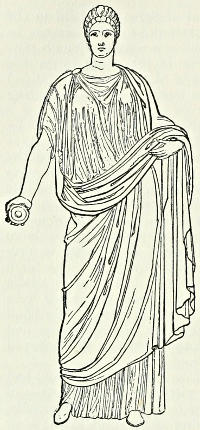
A Roman Matron
(From the Capitol)
Among his most flagrant violations of the
law was the worship of the god Elagabalus, not
only by reason of the introduction of a foreign
divinity into Rome and the granting of new
and gorgeous honours to such a divinity, but
by reason of the superiority which the emperor
gave him over Jupiter; and the priesthood of
Elagabalus which he caused to be bestowed
upon himself, by reason of his circumcision and
abstinence from pork (as though this abstinence
made the worship of this god purer), and also
by reason of the barbarous vestments worn by
Syrian priests, in which he was often to be
seen, a fact which had much to do with his
surname of the Assyrian.
As the height of absurdity he bestowed a
wife upon Elagabalus, as though the god had
need of a wife and children. Moreover, since this wife ought not to be
poor or of humble birth, he chose the Urania of Carthage, had the goddess
brought from thence, established her in the palace, and exacted wedding
gifts for her from all the subjects of his empire, as he had done for his own
wives.
Nevertheless this Sardanapalus, who must needs unite the gods by regular
marriages, himself led the most irregular of lives. He married several wives,
and had relations with many other women with whom he formed no legal tie.
Such was his conduct to all who had to do with him; yet this did not
prevent him from playing the part of a bride to a favourite, by name
Hierocles, on whom he wished to bestow the title of cæsar, himself being
called imperatrix. Being opposed by his grandmother in this design, he
broke out into threats against her, and by his shameful conduct no less than
for other reasons incurred the hatred of the soldiery. These extravagances
were the cause of his ruin.
He was destined soon to receive the due reward of his infamy. By the
things he did and suffered to be done he brought upon himself the hatred of
the people and of the soldiers, the main prop of his throne, and was finally
assassinated by them in his own camp. The thing came to pass on this
fashion. He had brought his cousin Bassianus into the senate, and, taking
his place beside Mæsa and Soæmias, he adopted him as his son; he boasted
of his good fortune in having become all at once the father of such a child,
as though he himself were already far more advanced in years, and he declared
that he had no need of any other son, since his house was henceforth safe from
extinction. Elagabalus himself had commanded him to take this course and
to bestow on his cousin the name of Alexander. For my own part I am convinced
that these occurrences were actually the work of a god, not because
of the emperor’s words but because of the saying that one Alexander, from
Emesa, would succeed him, and also because of what took place in Upper
Mysia and in Thrace.
Shortly before this time a genius appeared, I know not how, in the
countries about the Ister, claiming to be the celebrated Alexander of Macedon,
and bearing the form and all the equipments of that prince. Starting thence
he traversed Mœsia and Thrace after the manner of Bacchus, accompanied by
four hundred men, armed with thyrsi and wearing goatskins. They did no
harm, and, as those who then dwelt in Thrace are convinced, everything was
supplied them, both lodging and provisions, at the expense of the cities; for
no one dared oppose him either by word or deed, neither chief, nor soldier,
nor procurator, nor provincial governor; and in open daylight, as he had
announced, he advanced in procession as far as Byzantium. Thence, returning
upon his footsteps, he crossed over into Chalcedon, and there, having performed
certain sacrifices by night and buried a wooden horse in the ground, he disappeared.
These facts I learned in Asia, as I have said, before anything
was done at Rome with regard to Bassianus.
As long as Sardanapalus loved his cousin he himself remained alive, but
when he began to suspect all men and learned that popular favour was turning
towards Alexander, he changed his purpose and did all he could to get rid of
him. He was not only unsuccessful in an attempt to destroy him, but came near
to perishing himself, for Alexander was jealously guarded by his mother, his
grandmother, and the soldiery. The prætorian guards, becoming aware of
his intentions, stirred up a fearful riot, which did not cease until Sardanapalus,
coming into the camp with Alexander, appealed to them with urgent entreaties,
yielded up, under compulsion, the companions of his debaucheries whose
death they demanded, only pleading piteously in favour of Hierocles, and
finally succeeded in mollifying them.
Afterwards, having again laid snares for Alexander, and having gone with
the latter to the camp to appease a tumult which had been excited among the
prætorians by this attempt, he perceived that they were watching him with
intent to put him to death, and strove to flee while his mother and
Alexander’s, more openly at strife than before, were endeavouring to excite
the soldiers. He tried to escape by hiding in a chest, but was caught and
slain at the age of eighteen. His mother perished with him. Their heads
were cut off and their bodies stripped of their ornaments and dragged
through the streets of the city; then that of the woman was cast forth unburied,
and that of Sardanapalus thrown into the Tiber. The god Elagabalus
was banished from Rome.e The administration has not suffered greatly
through Elagabalus, for while he abandoned himself to his sensual worship,
he left the government in the hands of his prudent grandmother Mæsa.a
[222-232 A.D.]
Both the senate and the army joyfully concurred in the elevation of
Alexander Severus; and the former body, lest any competitor should
appear, hastened to confer on him all the imperial titles and powers. On
account of his youth and his extremely amiable disposition he was entirely
directed by his grandmother and mother, but Mæsa dying soon after his
accession, the sole direction of her son fell to Mamæa. [The statues and
coins of this woman show that she was a pagan, though the contrary has
been inferred from the correspondence with Origen.] Nevertheless in her
guidance of public affairs she exhibited a spirit of wisdom, justice, and moderation
such as had not appeared in any preceding empress. Her enemies
laid to her charge the love of power and the love of money, and blamed her
son for deferring too much to her; but their accusations are vague, and no
act of cruelty caused by avarice stains the annals of this reign.
The first care of Mamæa was to form a wise and upright council for her
son. Sixteen of the most respectable of the senate, with the learned Ulpian,
the prætorian prefect, at their head, composed this council, and nothing was
ever done without their consent and approbation. A general system of
reformation was commenced and steadily pursued. All the absurd acts of
the late tyrant were reversed. His god was sent back to Emesa; the
statues of the other deities were restored to their temples; the ministers
of his vices and pleasures were sold or banished, some of the worst were
drowned; the unworthy persons whom he had placed in public situations
were dismissed, and men of knowledge and probity put in their places.
Mamæa used the utmost care to keep away from her son all those persons
by whom his morals might be corrupted, and in order to have his time fully
occupied she induced him to devote the greater part of each day to the
administration of justice, where none but the wise and good would be his
associates. The good seed fortunately fell into a kindly soil. Alexander
was naturally disposed to every virtue, and all his efforts were directed to
the promotion of the welfare of the empire over which he ruled.
The first ten years of the reign of this prince were passed at Rome and
devoted to civil occupations. His daily course of life has been thus transmitted
to us. He usually rose early and entered his private chapel (lararium),
in which he had caused to be placed the images of those who had
been teachers and benefactors of the human race, among whom he included
the divine founder of the Christian religion. Having performed his devotions
he took some kind of exercise, and then applied himself for some hours
to public business with his council. He then read for some time, his favourite
works being the Republics of Plato and Cicero, and the verses of Horace,
and the Life of Alexander the Great, whom he greatly admired. Gymnastic
exercises, in which he excelled, succeeded. He then was anointed and
bathed, and took a light breakfast, usually of bread, milk, and eggs. In the
afternoon he was attended by his secretaries, and he heard his letters read
and signed the answers to them. The business of the day being concluded,
his friends in general were admitted, and a frugal and simple dinner
followed, at which the conversation was mostly of a serious instructive
nature, or some literary work was read out to the emperor and his
guests.
The dress of Alexander was plain and simple, his manners were free
from all pride and haughtiness; he lived with the senators on a footing
of friendly equality, like Augustus, Vespasian, and the wiser and better
emperors. He was liberal and generous to all orders of the people, and he
took an especial pleasure in assisting those persons of good family who had
fallen into poverty without reproach. Among the virtues of Alexander was
the somewhat rare one in that age of chastity. His mother early caused him
to espouse a lady of noble birth named Memnia, whom however he afterwards
divorced and even banished to Africa. The accounts of this affair differ
greatly. According to one, the father of the empress formed a conspiracy
against his son-in-law, which being discovered, he was put to death and his
daughter divorced. Others say that as Alexander showed great respect for
his father-in-law, Mamæa’s jealousy was excited, and she caused him to be
slain and his daughter to be divorced or banished. It appears that Alexander
soon married again.
We have already observed that a portion of the civil jurisdiction had
fallen to the prætorian prefects. This imposed a necessity that one of them
should be a civilian, and Mamæa had therefore caused this dignity to be conferred
on Ulpian. From the love of law and order which distinguished this
prefect, he naturally sought to bring back discipline in the prætorian camp;
the consequence was that repeated attempts were made on his life, and the
emperor more than once found it necessary to cast his purple over him to
save him from the fury of the soldiers. At length (228) they fell on him
in the night; he escaped from them to the palace, but they pursued and
slaughtered him in the presence of the emperor and his mother.
Some slight actions on the German and Moorish frontiers were the only
occupation given to the Roman arms during the early years of the reign of
Alexander, but in the year 232 so powerful an enemy menaced the oriental
provinces of the empire, that the presence of the emperor became absolutely
requisite in the East.
The Parthians, whom we have had such frequent occasion to mention,
are said to have been a Scythian (i.e., Turkish) people of the north of Persia,
who, taking advantage of the declining power of the Macedonian kings of
Syria, cast off their yoke (250 B.C.), and then gradually made themselves
masters of the whole of Persia. Their dominion had now lasted for five
hundred years, and their power had from the usual causes, such as family
dissensions, contested successions, and such like, been long on the decline;
and in the fourth year of Alexander Severus (226) a native Persian, named
Artaxerxes (Ardashir), who pretended to be of the ancient royal line but
who is said to have been of humble birth and a mere soldier of fortune,
raised a rebellion against the Parthian king, Artabanus. Fortune favoured
the rebel, and Artabanus was defeated and slain. Artaxerxes then assumed
the tiara, and his line, which existed till the Mohammedan conquest, was
named the Sassanian, from the name of his father.
[232-235 A.D.]
Affecting to be the descendant of the ancient Achæmenians, Artaxerxes
sought to restore Persia to its condition under those princes. The Magian or
Light religion resumed the rank from which it had fallen under the sway of
the Parthians, and flourished in its pristine glory. As the dominions of the
house of Cyrus had extended to the coasts of the Ægean Sea, Artaxerxes
ordered the Romans to quit Asia, and when his mandate was unheeded he led
his troops over the Tigris. But his ill fortune induced him to attack the
invincible Atræ, and he was forced to retire with loss and disgrace. He
then turned his arms against the Medes and some other of the more northern
tribes, and when he had reduced them he again invaded Mesopotamia (232).
Alexander now resolved to take the command of his troops in person. He
left Rome, followed by the tears and prayers of the people, and proceeded
through Illyricum to the East. On his march the strictest discipline was
maintained, while every attention was paid to the wants of the soldiers and
care taken that they should be abundantly supplied with clothes and arms.
The emperor himself used the same fare as the men, and he caused his tent
to be thrown open when he was at his meals that they might perceive his
mode of life.
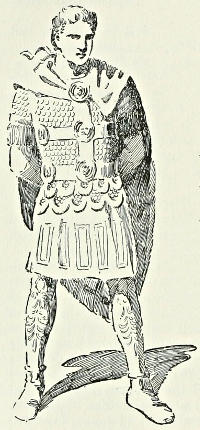
Centurion in Street Costume showing the Way his Medals
were worn
Alexander halted at Antioch to make preparations for the war; meantime
he sent an embassy with proposals of peace to Artaxerxes. The
Persian in return sent four hundred of his most stately men splendidly
clothed and armed to order the Romans to quit Asia; and if we can believe
Herodian (for the circumstance is almost incredible),
Alexander was so regardless of the laws of nations as
to seize and strip them, and send them prisoners to
Phrygia. It is also said that while he was at Antioch,
finding that some of the soldiers frequented the
Paphian grove of Daphne, he cast them into prison;
and that when a mutiny broke out in the legion to
which they belonged, he ascended his tribunal, had
the prisoners brought before him, and addressed
their comrades, who stood around in arms, dwelling
on the necessity of maintaining discipline. But
when his arguments proved of no effect, and they
even menaced him with their arms, he cried out, in
imitation of Cæsar, “Quirites, depart, and lay down
your arms.” The legion obeyed, and the men, no
longer soldiers, took up their abode in the houses
of the town instead of the camp. After a month
the emperor was prevailed on to pardon them, but
he punished their tribunes with death; and this
legion was henceforth equally distinguished by
valour and fidelity.
In imitation of Alexander the Great, the
emperor formed six of his legions into a phalanx
of thirty thousand men, to whom he gave
higher pay. He also had, like that conqueror,
bodies of men distinguished by gold-adorned
and silver-adorned shields—chrysoaspids and
argyroaspids.
The details of the war cannot be learned
with any certainty. One historian says that
Alexander made three divisions of his army;
one of which was to enter Media through Armenia, another Persia at the junction
of the Tigris and Euphrates, while the emperor was in person to lead the
third through Mesopotamia, and all were to join in the enemy’s country; but
that, owing to the timidity of Alexander, who loitered on the way, the second
division was cut to pieces, and the first nearly all perished while retreating
through Armenia in the winter. This account labours under many difficulties;
for the emperor certainly triumphed on his return to Rome; and in
his speech to the senate on that occasion he asserted that of 700 war
elephants which were in the enemy’s array he had killed 200, and taken
300; of 1000 scythed chariots he had taken 200; and of 120,000 heavy-armed
horsemen he had slain 10,000, besides taking a great number of
prisoners.c Notwithstanding this report to the senate, the Romans were
probably beaten in this war, though the Persians likewise suffered great loss.
The latter made no further attempts on Mesopotamia for some years.a
The Germans had taken advantage of the absence of the emperor and the
greater part of the troops in the East, to pass the Rhine and ravage Gaul.
Alexander therefore, leaving sufficient garrisons in Syria, led home the
Illyrian and other legions, and having celebrated a triumph for the Persian
War at Rome, where he was received with the most abundant demonstrations
of joy, he departed with a large army for the defence of Gaul. The
Germans retired at his approach; he advanced to the Rhine and took up his
winter quarters in the neighbourhood of Mogontiacum (Mainz), with the
intention of opening the campaign beyond the river in the spring (235).
The narratives of the events of this reign are so very discordant that we
cannot hope often to arrive at the real truth. In no part are they more at
variance than in their account of the circumstances of the emperor’s death.
We can only collect that, whether from his efforts to restore discipline, from
the intrigues of Maximin, an ambitious officer who had the charge of disciplining
the young troops, or from some other cause, a general discontent
prevailed in the army, and that Alexander was assassinated in his tent, either
by his own guards or by a party sent for the purpose by Maximin, and that
his mother and several of his friends perished with him. The troops forthwith
proclaimed Maximin emperor, and the senate and people of Rome,
deeply lamenting the fate of the virtuous Alexander, were forced to acquiesce
in the choice of the army.
Alexander had reigned thirteen years. Even the historian least partial
to him acknowledges that towards his subjects his conduct was blameless, and
that no bloodshed or unjust condemnations stain the annals of his reign.
His fault seems to have been a certain degree of effeminacy and weakness,
the consequence probably of his Syrian origin, which led to his extreme submission
to his mother, against whom the charges of avarice and meanness
are not perhaps wholly unfounded.[45]
Dion Cassius, whose history ends with this reign, gives the following
view of the numbers and disposition of the legions, at this period. Of the
twenty-five which were formed by Augustus, only nineteen remained, the
rest having been broken or distributed through the others; but the emperors,
from Nero to Severus inclusive, had formed thirteen new ones, and
the whole now amounted to thirty-two legions. Of these, three were in
Britain, one in Upper and two in Lower Germany, one in Italy, one in Spain,
one in Numidia, one in Arabia, two in Palestine, one in Phœnicia, two in
Syria, two in Mesopotamia, two in Cappadocia, two in Lower and one in
Upper Mœsia, two in Dacia, and four in Pannonia, one in Noricum, and one
in Rætia. He does not tell us where the two remaining ones were quartered,
neither does he give the number of men in a legion at this time, but it is
conjectured to have been five thousand.c
RENAN’S CHARACTERISATION OF THE PERIOD
[180-235 A.D.]
On principles less disastrous than those of unbridled military despotism,
the empire might have survived the ruin of the Roman spirit in the death of
Marcus Aurelius, might have given peace to Christianity a century earlier
and have avoided the streams of blood shed to no purpose by Decius and
Diocletian. The part of the Roman aristocracy was played out; after
having worn folly threadbare in the first century, it had worn virtue threadbare
in the second. But the hidden forces of the great Mediterranean
confederacy were not exhausted. Thus, after the downfall of the political
edifice founded on the sovereignty of the family of Augustus, a provincial
dynasty, that of the Flavians, was found to restore the empire, even as after
the downfall of the edifice built up by the adoptions of the Roman aristocracy,
there were found provincials, Orientals and Syrians, to restore the great
association in which all men found peace and profit. Septimius Severus did,
without moral grandeur but not without glory, what Vespasian had done.
It is true that the representatives of this new dynasty are not to be
compared to the great emperors of the second century. Even Alexander
Severus, who equals Antoninus and Marcus in kindliness, is very inferior
to them in intelligence and greatness of soul. The principles of the government
are detestable; men outbid one another for the favour of the legions;
a price is set on mutiny; none approaches the soldier except with purse in
hand. Military despotism never took a more shameless form; but military
despotism can be long-lived.
Side by side with hideous spectacles, under the Syrian emperors, what
reforms do we find! What progress in legislation! What a day was that
when, under Caracalla, all free men dwelling within the empire attained
equal rights!
We must not exaggerate the advantages offered by such equality; yet
in politics words are never wholly void of meaning. Many excellent things
had been inherited. The philosophers of the school of Marcus Aurelius had
disappeared, but their place was taken by the masters of jurisprudence.
Papinian, Ulpian, Paul, Gaius, Modestinus, Florentinus, Marcian, during
years of execrable evil, created masterpieces and actually brought the law
of the future into being. The Syrian emperors, though far inferior to
Trajan and to the Antonines as far as political traditions are concerned,
inasmuch as they were not Romans and had none of the Roman prejudices,
often give proof of an openness of mind which would have been impossible
to the great emperors of the second century, all of whom were intensely
conservative. They permitted and even encouraged colleges or syndicates.
They went to extreme lengths in this matter, and they would have organised
the trade guilds as castes with a distinctive garb. They flung the doors of
the empire wide open. One of them, that noble and pathetic figure Alexander
Severus, the son of Mamæa, almost equalled in his plebeian goodness
the patrician virtues of the great age; the loftiest ideas pale before the
honest effusions of his heart.
It was in religion above all that these Syrian emperors inaugurated a
liberality of mind and a tolerance unknown before.[46] The Syrian women of
Emesa, Julia Domna, Julia Mæsa, Julia Mamæa, Julia Soæmias, beautiful,
intelligent, venturous to the point of utopianism, are hampered by no tradition
or conventionality. They dared to do what no Roman woman had ever
done; they entered the senate, took part in its deliberations, and practically
governed the empire, dreaming of Semiramis and Nitocris. It was
a thing that such a woman as Faustina would not have done for all her
frivolity; she would have been checked by tact, by the sense of absurdity,
by the rules of good Roman society. The Syrian women hesitated at
nothing. They had a senate of women, which enacted every sort of absurdity.
The Roman religion seemed to them cold and meaningless. They
had no family reasons for attachment to it, and being more in harmony,
imaginatively, with Christianity than with Italian paganism, they delighted
in the tales of the travels of gods upon the earth. Philostratus enchanted
them with his Apollonius; perhaps they had a secret leaning towards Christianity.
During this time the last noble ladies of the older society, such as the
elderly daughter of Marcus Aurelius, honoured by all men and put to death
by Caracalla, lived in obscurity, looking on at an orgy which formed so
strange a contrast to the memories of their youth.
The provinces, and those of the East more particularly, which were far
more active and enlightened than those of the West, gained a decided ascendency.
Elagabalus was certainly a madman, but nevertheless his chimerical
idea of a central monotheistic religion, established in Rome and absorbing
all others, shows that the narrow circle of Antonine conceptions had been
to a great extent broken through. Mamæa and Alexander Severus were to
go further; whilst the jurisconsults continued to transcribe their old and
ferocious maxims against liberty of conscience with the calmness of habit,
the Syrian emperor and his mother studied Christianity, and manifested
sympathy with it. Not content with granting security to the Christians,
Alexander, with touching eclecticism, introduced the name of Jesus among
his household gods. Peace seemed made, not, as under Constantine, by the
abasement of one party, but by a generous reconciliation. In all this there
was certainly a daring attempt at reform, inferior in rationality to that of
the Antonines, but more likely to succeed because it was much more popular
and took the provinces and the East more into account.
In such a democratic work, people with no ancestors, such as these
Africans and Syrians, had more chance of success than rigid men of irreproachable
bearing, like the aristocratic emperors. But the innate viciousness
of the imperial system revealed itself for the tenth time. Alexander
Severus was assassinated by the soldiers on the 19th of March, 235. It was
clear that the army would tolerate none but tyrants. The empire had fallen
successively from the Roman aristocracy to provincial officers, now it passed
to subordinate officers and military assassins. Whereas, until the time of
Commodus, the murdered emperors are intolerable monsters, it is now the
good emperor, the man who desires to restore some kind of discipline and
represses the crimes of the army, who is inevitably marked for death.j Still,
it cannot be denied that there was need of strong, able commanders on the
eve of the barbarian invasions. With all his virtues, Alexander was a
weakling, unfit to rule at such a time. With his death the military revolution
entered upon a third stage. It became more than ever necessary to
strengthen the imperial office, because, it having been decided that the emperor
should be a soldier, the choice of the soldiers, rival claimants of the
office were threatening, by their civil strife, to break up the Roman world
into a multitude of warring states.a
“Now begins the inferno of half a century (235-284), in which all
philosophy, all civil order, all delicacy founders; with power put up to
auction, the soldiery masters of everything; with sometimes ten tyrants
at once; with the barbarian entering through all the breaches of a
shattered world; with Athens destroying her ancient monuments, to
girdle herself with ill-built walls as a protection against the Goths. If
anything can show the intrinsic necessity of the Roman Empire, it is
the fact that it was not wholly put out of joint by this anarchy and
retained breath enough to revive under the vigorous action of Diocletian,
and to endure for two centuries more. In every class the decadence
is terrible. In fifty years the art of sculpture is forgotten. Latin
literature comes to an end. It is as if a vampire brooded over society,
drinking its life-blood.”—Renan.
Bad matters become worse in the period we are now entering. Old evils
remain, and new ones are added. The rule of the soldiers is absolute, and
as before, money affords the only channel to the suffrage of these rulers of
the empire. As before, there is an incessant scramble after the honours and
emoluments of the imperial office; as before, successful and unsuccessful
aspirants alike place themselves on the sure road to an early death, so soon
as they attempt to grasp the purple.
In the half century we are now entering, some seventeen emperors who
may be styled legitimate holders of the title, pass in rapid succession before
the view; and with only one or two doubtful exceptions they all meet a tragic
end. Some reign for a few weeks or months, some for a few years; some
are young, some are old; but neither the tender years of a Gordian nor the
senility of a Tacitus can give protection from the imperial fate.
All this indeed is but a repetition of what we have seen in the half century
just gone. There is no sudden transition, no marked revolution. And yet
the time upon which we are entering has in other respects a character that
is peculiarly its own. It marks a condition towards which the empire has
been steadily tending; a condition that is the logical, the necessary outcome
of the antecedent conditions we have studied. The essence of this new
condition is found in the de-romanisation of the empire. From now on the
rulers of Rome, with rare exceptions, are no longer Romans in the old sense
of the word. Caracalla, to be sure, gave Roman citizenship to all free
men in the empire, which list, it may be noted, included vast numbers of
persons who had once been slaves. But the sweep of the imperial stylus,
while it may make the Gaul and the Goth, the Dalmatian and the Dacian,
the Syrian and the Arab, each and all Romans in the official sense, is impotent
to change the racial traits of this heterogeneous company. The man
from the provinces, who has never been within a thousand miles of Rome,
may count himself a Roman citizen, may even glory in the name, but beyond
peradventure his closest interests lie with his own kith and kin, with his own
race, as against those others of his fellow-citizens who live in far-distant
lands, and have habits, customs, and languages different from his own.
In the present connection this natural instinct comes to have much importance.
It becomes increasingly evident that we no longer have a strongly
centralised government. In the first instance nearly all the emperors are
themselves men from the provinces. A great city is seldom the birthplace of
the great men of any epoch. It has been said that Rome never produced a
poet, and the briefest analysis of her great names will show that few men
indeed whom posterity remembers were born within the confines of the city
itself. But in the early day the great Romans were, for the most part, born
in Italy, if not at the capital. In the first century, indeed, importance attaches,
as we have seen, to a good many adoptive Romans who were born in Asia
Minor, and to others who came from Spain—such men as the Senecas, Lucan,
and Quintilian. In the second century of the empire, it will be recalled, two
of the greatest emperors, Trajan and Hadrian, were Spaniards. But these
are exceptional instances.
Now, however, we are entering upon a period when the Roman emperor,
almost as a matter of course, is not an Italian. Maximin is a Thracian
peasant, Philip is an Arab, Decius comes from Pannonia, Æmilianus is said
to be a Moor; Claudius, Probus, Carus, and Carinus come from various
regions of Illyricum. Some of these provincials visit Rome whenever a lull
in the border warfares will permit. Philip the Arab, for example, makes
Rome his headquarters; and by an odd freak of fortune it is this man of
alien blood who is on the throne when Rome comes, in the year 248, to her
one thousandth anniversary: it is he who conducts the magnificent secular
games that mark the millennium.
There are rulers too, like Aurelian, who take an interest in the more
intimate economical affairs of the empire, and who strenuously apply their
energies to a reform of the currency, the debasement of which is one of the
most significant features of the time. Aurelian fixes an honest value for the
gold and silver coins, takes from the senate and from all cities but Alexandria
the right of coinage, striving thus to fix more firmly the position of
the seat of empire as the financial centre, and to give stability to the
economic system. But his best efforts lead to mutiny in the present, and
fall far short of hoped-for results in the future. Moreover, even an Aurelian,
whatever his regard for Rome, finds his time chiefly occupied with the warlike
affairs of the outlying provinces. He must dash from Syria to Egypt,
from Egypt to Gaul; one revolt is not put down before another begins.
And in this day it is no easy matter to transport an army from one part of
the bulky empire to another.
Then again, there are emperors who scorn the capital; Maximin, for
example, who for a time transfers the seat of empire to distant Pannonia.
It is a strange spectacle when Italian citizens are brought from their residences
in Rome to have punishment—punishment, be it understood, not
justice—meted out to them in a province on the Danube. Few other
emperors go quite to such extremes as this; but more and more as time goes
on we feel that the interests of the empire are everywhere except in Rome.
After the time of Claudius, who occupies the throne just as the empire is
rounding out its third century, it is almost a foregone conclusion that Illyricum
will supply the empire with its rulers. The significance of this fact is
at once evident, if we recall that Illyricum is that territory north of Greece
including Macedonia, Thrace, and Mœsia, which a future emperor will fix
on as the seat of New Rome—Constantinople.
The decentralisation of the empire, of which these are significant marks,
is still more strikingly manifested in the ever increasing number of rival
claimants to the purple. Again and again it happens that the soldiers in
different portions of the empire raise different chiefs to nominal imperial
power. At one time, while Gallienus is the legitimate holder of the title,
there are spurious emperors in Illyricum, Gaul, Greece, Egypt,—everywhere.
The time comes to be known as the epoch of the Thirty Tyrants. Doubtless
there were not thirty of these rival emperors; but there may have been
fifteen or twenty—just how many no one knows or need greatly care to
know.
And while internal dissensions are thus weakening the empire, an even
greater danger threatens it from without. The peoples whom we have come
to speak of rather loosely as barbarian hordes—Franks, Alamanni, Goths—are
piercing through the cordon of steel which is the sole safeguard of the
empire. The Persians contest the eastern border. They capture a Roman
emperor, Valerian, and carry him off to ignominious servitude. The
Goths sweep down to the Bosporus, invade Asia Minor, and coast along
the shores of Greece. The Alamanni invade Italy, and come almost to
Rome itself. For the time being these hordes are repelled. A pest from
Egypt carries off the Goths by thousands and renders their motley array of
warriors powerless. The arms of Aurelian drive back the Alamanni. For
the moment the imperial seat is secure. But so dreadful appears this new
threat of the old northern enemies that now, just at the close of the third
century of empire, a wall is built about the imperial city. A few generations
back that far-outlying wall of steel was all-sufficient; now a narrow
circle of stone must safeguard the capital, as in the days of long ago, when
Rome had not yet conquered Italy.
This fact alone sufficiently characterises the time. When the proud city,
whose subject territories are bounded by the Euphrates and the Atlantic,
acknowledges the fear of an enemy at her very portals, the beginning of the
end is at hand. The Roman Empire at the close of its third century is no
longer dreaming of more distant conquests; it is struggling for life itself.
Some salient features of this struggle will now claim our attention.a
[235-237 A.D.]
Maximin was originally a Thracian peasant, of enormous size and strength;
his stature, we are told, “exceeded eight feet; his wife’s bracelet made him a
thumb-ring; he could draw a loaded wagon, break a horse’s leg with a kick,
and crumble sandstones in his hands”; he often, it is added, “ate forty pounds
of meat in the day, and washed them down with seven gallons of wine.”
Hence he was named Hercules, Antæus, and Milo of Croton. He became
known to the emperor Severus on the occasion of his celebrating the birthday
of his son Geta one time in Thrace. The young barbarian approached
him, and in broken Latin craved permission to wrestle with some of the
strongest of the camp followers; he vanquished sixteen of them, and received
as many prizes, and was admitted into the service. A couple of days after,
Severus seeing him exulting at his good fortune, spoke to a tribune about
him, and Maximin perceiving that he was the object of the emperor’s discourse
began to run on foot by his horse; Severus to try his speed put his
horse to the gallop, but the young soldier kept up with him till the aged
emperor was tired. Severus asked him if he felt inclined to wrestle after his
running: he replied in the affirmative, and overthrew seven of the strongest
soldiers. He rose rapidly in the service under Severus and his son; he
retired to his native village when Macrinus seized the empire; he disdained
to serve Elagabalus, but the accession of Alexander induced him to return
to Rome. He received the command of a legion, was made a senator, and
the emperor even had thoughts of giving his sister in marriage to the son of
the Thracian peasant.
The first care of Maximin when raised to the empire was to dismiss from
their employments all who were in the council or family of his predecessor,
and several were put to death as conspirators. He speedily displayed the
native ferocity of his temper; for when, having completed a bridge of boats
over the Rhine commenced by Alexander, he was preparing to pass over into
Germany, a conspiracy headed by one Magnus, a consular, was discovered,
the plan of which was to loose the further end of the bridge when Maximin
had passed over, and thus to leave him in the hands of the Germani, and
meantime Magnus was to be proclaimed emperor. On this occasion he massacred
upwards of four thousand persons, without any form of trial whatever;
and he was accused of having invented the conspiracy with this design.
A revolt of the eastern archers, which occurred a few days after, being
quelled, Maximin led his army into Germany. As no large force opposed
him, he wasted and burned the country through an extent of four hundred
miles. Occasional skirmishes took place in the woods and marshes, which
gave Maximin opportunities of displaying his personal prowess; and he
caused pictures of his victories to be painted, which he sent to Rome to be
placed at the door of the senate house.
Maximin employed the two first years of his reign in wars against the
Germans and the Sarmatians. His winter residence was Sirmium in Pannonia,
and he never condescended to visit Italy. But his absence was no
benefit; for Italy and all parts of the empire groaned alike beneath his merciless
tyranny. The vile race of delators once more came into life; men of all
ranks were dragged from every part of the empire to Pannonia, where some
were sewed up in the skins of animals, others were exposed to wild beasts,
others beaten to death with clubs, and the properties of all were confiscated.
This had been the usual course of the preceding despotism, and the people
in general therefore took little heed of it; but Maximin stretched his rapacious
hands to the corporate funds of the cities of the empire, which were
destined for the support or the amusement of the people; and he seized on
the treasures of the temples, and stripped the public edifices of their ornaments.
The spirit of disaffection thus excited was general, and even his
soldiers were wearied of his severity and cruelty.
[237-238 A.D.]
The whole empire was now therefore ripe for revolt; the rapacity of the
procurator of Africa caused it to break out in that province (237). This
officer, who was worthy of his master, had condemned two young men of
rank to pay such sums as would have quite ruined them. In despair, they
assembled the peasantry on their estates, and having gained over part of the
soldiers, they one night surprised the procurator and slew him and those
who defended him. Knowing that they had no safety but in a general revolt,
they resolved to offer the empire to M. Antonius Gordianus, the governor
of the province, an illustrious senator of the venerable age of eighty
years. They came to him as he was resting after giving audience in the
morning, and flinging the purple of a standard over him hailed him as
Augustus. Gordian declined the proffered dignity, but when he reflected
that Maximin would never pardon a man who had been proclaimed emperor,
he deemed it the safer course to run the hazard of the contest, and he consented
to accept the empire, making his son his colleague. He then proceeded
to Carthage, whence he wrote to the senate and people, and his friends
at Rome, notifying his elevation to the empire.

The Campagna
The intelligence was received with the greatest joy at Rome. The two
Gordians were declared Augusti; and Maximin and his son, whom he had
associated with him in the empire, and their friends, public enemies, and rewards
were promised to those who would kill them; but the decree was
ordered to be kept secret till all the necessary preparations should have been
made. Soon after it was given out that Maximin was slain. The edicts of
the Gordians were then published, their images and letters were carried into
the prætorian camp, and forthwith the people rose in fury, cast down and
broke the images of Maximin, fell on and massacred his officers and the informers;
and many seized this pretext for getting rid of their creditors and
their private enemies. Murder and pillage prevailed through the city. The
senate meantime having advanced too far to recede, wrote a circular to all
the governors of provinces, and appointed twenty of their body to put Italy
into a state of defence.
Maximin was preparing to cross the Danube against the Sarmatians when
he heard of what had taken place at Rome. His rage and fury passed all
bounds. He menaced the whole of the senate with bonds or death, and
promised their properties, and those of the Africans, to his soldiers; but
finding that they did not show all the alacrity he had expected, he began to
fear for his power. His spirits, however, soon rose when tidings came that
his rivals were no more; for Capelianus, governor of Mauretania, being
ordered by the Gordians to quit that province, marched against Carthage
at the head of a body of legionaries and Moors. The younger Gordian gave
him battle, and was defeated and slain, and his father on hearing the
melancholy tidings strangled himself. Capelianus pillaged Carthage and
the other towns, and exercised all the rights of a conqueror (237).
When the fatal tidings reached Rome the consternation was great, but
the senate, seeing they could not now recede, chose as emperors in the place
of the Gordians M. Clodius Pupienus Maximus and D. Cælius Balbinus, the
former to conduct the military, the latter the civil affairs of the state. To
satisfy the people, a grandson of the elder Gordian, a boy of twelve years of
age, was associated with them as cæsar.
The new emperors were elected about the beginning of July, and Pupienus
forthwith left Rome to oppose Maximin. The remainder of the year was
spent on both sides in making preparations for the war, and in the following
spring (238) Maximin put his troops in motion for Italy. He passed the
Alps unopposed, but found the gates of Aquileia closed against him. His
offers of pardon being rejected, he laid siege to the town; it was defended
with the obstinacy of despair. Ill success augmented the innate ferocity of
Maximin; he put to death several of his officers; these executions irritated
the soldiers, who were besides suffering all kinds of privations, and discontent
became general. As Maximin was reposing one day at noon in his tent,
a party of the Alban soldiers approached it with the intention of killing him.
They were joined by his guards, and when he awoke and came forth with his
son they would not listen to him, but killed them both on the spot, and cut off
their heads. Maximin’s principal ministers shared his fate. His reign had
lasted only three years.
[238-248 A.D.]
The joy at Rome was extreme when the news of the death of Maximin
arrived. Pupienus, who was at Ravenna, hastened to Aquileia, and received
the submission of the army. He distributed money to the legions, and then
sending them back to their usual quarters returned to Rome with the prætorians
and a part of the army of the Rhine, in which he could confide. He
and his colleagues entered the city in a kind of triumph.
The administration of Pupienus and Balbinus was of the best kind, and
the senate and people congratulated themselves on the choice they had made.
But the prætorians were far from being contented; they felt as if robbed of
their right of appointing an emperor; and they were annoyed at the German
troops being retained in the city, as arguing a distrust of themselves. Unfortunately,
too, there prevailed a secret jealousy between the two emperors,
and it is probable that concord would not long have subsisted between them
under any circumstances.
The prætorians, having to no purpose sought a pretext for getting rid of
the emperors, at length took advantage of the celebration of the Capitoline
games, at which almost everyone was present, and the emperors remained
nearly alone in the palace. They proceeded thither in fury. Pupienus,
when aware of their approach, proposed to send for the Germani, but Balbinus,
fearing that it was meant to employ them against himself, refused his
consent. Meantime the prætorians arrived, forced the entrance, seized the
two aged emperors, tore their garments, treated them with every kind of
indignity, and were dragging them to their camp, till hearing that the Germans
were coming to their aid, they killed them and left their bodies lying
in the street. They carried the young Gordian with them to their camp,
where they proclaimed him emperor, and the senate, the people, and the
provinces readily acquiesced in his elevation.
The youthful emperor was the object of general affection; the soldiers
called him their child, the senate their son, the people their delight. He
was of a lively and agreeable temper; and he was zealous in the acquisition
of knowledge, in order that he might not be deceived by those about him.
In the first years, however, of his reign public affairs were indifferently
managed. His mother, who was not a Mamæa, allowed her eunuchs and
freedmen to sell all the great offices of the state (perhaps she shared in their
gains), and in consequence many improper appointments were made. But
the marriage of the young emperor (241) brought about a thorough reformation.
He espoused the daughter of Misitheus, a man distinguished in the
cultivation of letters, and he made his father-in-law his prætorian prefect,
and guided himself by his counsels. Misitheus, who was a man of virtue
and talent as well as of learning, discharged the duties of his office in the
ablest manner.
A Persian war soon called the emperor to the East (242). Sapor (Shapur),
the son and successor of Artaxerxes, had invaded Mesopotamia, taken
Nisibis, Carrhæ, and other towns, and menaced Antioch. But the able conduct
of Misitheus, when the emperor arrived in Syria, speedily assured victory
to the Roman arms; the towns were all recovered, and the Persian
monarch was obliged to repass the Tigris. Unfortunately for Gordian and
the empire, Misitheus died in the following year (243), to the great regret
of the whole army, by whom he was both beloved and feared. The office of
prætorian prefect was given to M. Julius Philippus, who is accused, though
apparently without reason, of having caused the death of his predecessor.
Now, however, having in effect the command of the army, Philip aspired to
the empire. He spoke disparagingly of the youth of Gordian; he contrived,
by diverting the supplies, to cause the army to be in want, and then laid the
blame on the emperor. At length (244), after a victory gained over the
Persians on the banks of the Chaboras, he led the troops into a country where
no provisions could be procured: a mutiny in consequence ensued, in which
the emperor was slain, and Philip was proclaimed in his place. Gordian
was only nineteen years of age when he met his untimely fate; he had
reigned five years and eight months. The soldiers raised him a tomb on
the spot, and the senate placed him among the gods.
The adventurer who had now attained the imperial purple was an Arab
by birth, and it is even pretended a Christian in religion. He probably
entered the Roman service in his youth, and gradually rose to rank in the
army.
Being anxious to proceed to Rome, Philip lost no time in concluding a
treaty with Sapor. He then, after a short stay at Antioch, set out for Italy.
At Rome he used every means to conciliate the senators by liberality and
kindness, and he never mentioned the late emperor but in terms of respect.
To gain the affections of the people, he formed a reservoir to supply with
water the part of the city beyond the Tiber.
[248-250 A.D.]
In the fifth year of his reign (248), Rome having then attained her one
thousandth year, Philip, in conjunction with his son, now associated with
him in the empire, celebrated with great magnificence the secular games.
These had been already solemnised by Augustus, by Claudius, by Domitian,
and Severus, and Rome now witnessed them for the last time.

A Roman Helmet
Philip would appear to have acted unwisely in committing extensive
commands to his own relations; for in Syria, where his brother Priscus, and
in Mœsia, where his father-in-law Severianus commanded, rival emperors
were proclaimed. The Syrian rebel was named Jotapianus; the Mœsian
was a centurion, named P. Carvilius
Marinus. Philip, it is said, in alarm,
called on the senate to support him or
to accept his resignation (249); but
while the other senators maintained
silence, Decius, a man of rank and
talent, reassured him, speaking slightingly
of the rebels, and asserting that
they could not stand against him.
His prediction proved correct, for they
both were shortly after slain. Philip
then obliged Decius, much, it is said,
against his inclination, to take the command
of the Mœsian and Pannonian
legions. But when Decius reached the
army, the soldiers insisted on investing
him with the purple. He wrote to the
emperor assuring him of his fidelity;
but Philip would not trust to his declarations, and leaving his son at Rome with
a part of the prætorians, he put himself at the head of his troops to chastise
him. The armies met near Verona; Philip was defeated and slain, and when
the news reached Rome, the prætorians slew his son and proclaimed Decius.
Decius was born at Bubalia, a town near Sirmium in Pannonia. He was
either forty-eight or fifty-eight years of age, it is uncertain which, when
he was proclaimed emperor; and from the imperfect accounts which we have
of his reign he would seem to have been a man of considerable ability. His
reign was, however, brief and unquiet. It had hardly commenced when he
had to go in person to quell an insurrection in Gaul, and all the rest of it
was occupied in war with the Goths.
[250-253 A.D.]
This people, whose original seat seems to have been the Scandinavian
peninsula, had at an early period crossed the Baltic, and settled on its southern
coast. They had gradually advanced southwards, and they now had
reached the Euxine. In the time of Alexander Severus they had made
inroads into Dacia; and in that of Philip they ravaged both that province
and Mœsia. In the first year of Decius (250) the Gothic king Cniva passed the
Danube at the head of seventy thousand warriors, and laid siege to the town of
Eustesium (Novi); being repelled by the Roman general Gallus, he advanced
against Nicopolis, whence he was driven by the emperor or his son (it is
uncertain which) with a loss of thirty thousand men. Undismayed by his
reverses he crossed Mount Hæmus, in the hope of surprising Philippopolis;
Decius followed him, but his camp at Berœa was surprised by the Goths and
his troops were cut to pieces. Philippopolis stood a siege of some duration;
but it was taken, and the greater part of its inhabitants were massacred.
The Goths now spread their ravages into Macedonia, the governor of which,
Philip’s brother Priscus, assumed the purple under their protection.
It seems most probable that it was the younger Decius who met with
these reverses, for the emperor must have been at Rome, as we find that on
his leaving it (251) to direct the Gothic war, a person named Julius Valens
was declared emperor, to the great joy of the people. He was, however,
killed shortly after. Decius, who was worthy of empire, was meantime
amidst the cares of war engaged in the visionary project of restoring the long-departed
public virtue which had once ennobled Rome. With this view he
proposed to revive the office of censor, and the choice of the person being left
to the senate they unanimously voted it (October 27), to P. Licinius Valerianus
as being the man most worthy of it. The decree was transmitted to the
emperor, who was in Thrace; he read it aloud in a large assembly, and
exhorted Valerian, who was present, to accept the proffered dignity. Valerian
would fain excuse himself. We know not if the emperor was satisfied with
his excuses, but from the turn which public affairs took the censorship was
never exercised.
Decius was successful against the Goths, who offered to surrender their
booty and prisoners if allowed to repass the Danube; but the emperor, who
was resolved to strike such a blow as would daunt the barbarians and make
them henceforth respect the Roman arms, refused all terms. The Goths
therefore gave him battle in a place where a part of their front was covered
by a morass. The younger Decius was slain by an arrow in the beginning
of the action; but the emperor crying out that the loss of one soldier did not
signify, led on his troops. In the attempt to cross the morass they were
pierced by the arrows of the enemy, or swallowed up in the mire, and the
body of the emperor was never found.
The senate, it is said, but more probably the army, conferred the vacant
purple on Gallus, the governor of Mœsia. He adopted Hostilianus, the
remaining son of Decius, and gave him the title of Augustus; but this youth
dying soon after of the plague, Gallus associated his own son Volusianus in
the empire. Unable probably to resist the victorious Goths, Gallus agreed
that they should depart with their booty and prisoners, and even consented
to pay them annually a large sum of gold. He then set out for Rome, where
he remained for the rest of his reign, ruling with great mildness and equity.
[253-256 A.D.]
The Goths and their allies, heedless of treaties, again (253) poured over
the Danube; but Æmilianus, the governor of Mœsia, gave them a signal
defeat, and his victorious troops forthwith proclaimed him emperor. Without
a moment’s delay he put them in motion for Rome. Gallus advanced to
engage him; the troops came in sight of each other at Interamna (Terni),
and those of Gallus seeing themselves the weaker, and gained by the promises
of Æmilianus, murdered the emperor and his son, and passed over to the side
of the rebel.
Æmilianus is said to have been a Moor by birth. Of his previous history
nothing is known. He wrote to the senate to say that they should have the
whole civil administration, and that he would be no more than their general,
and that assembly readily acquiesced in his elevation.
But Valerian had been sent by Gallus to fetch the legions of Gaul and
Germany to his aid; and these troops, as soon as they heard of his death,
proclaimed their general emperor. He led them into Italy; and the troops
of Æmilianus, which were encamped at Spoletium (Spoleto), fearing the
strength and number of the advancing army, murdered their emperor to
obviate a conflict. The reign of Æmilianus had not lasted four months.
Valerian is said to have been sixty years of age when thus raised to the
empire. Feeling the infirmities of age, or in imitation of the practice of so
many preceding emperors, he associated
with him his son Gallienus, a young
man devoid neither of courage nor
ability, but immoderately addicted to
pleasure.

Weapons and Helmet of the Gauls
Had the Roman Empire been in
the condition in which it was left by
Augustus, Valerian might have emulated
that emperor, and have displayed
his virtues and beneficence in promoting
the happiness of his subjects. But
a great change had taken place in the
condition of Rome; her legions no
longer inspired their ancient terror;
her northern and eastern provinces
were exposed to the ravages of those
who had formerly cowered before her
eagles. Valerian could therefore only
exhibit his wisdom in the selection of
his generals; and it is to be observed
that his choice never fell on an unworthy
subject.
The enemies by whom the empire
was assailed at this period were the
Franks, the Alamanni, the Goths, and
the Persians. As the scanty notices
of these times do not enable us to
arrange events chronologically, we will
give a separate view of the wars with each of these peoples during the
reigns of Valerian and his son.
[256-262 A.D.]
We have already observed the proneness of the Germanic tribes to form
confederations. The Chauci, Cherusci, Chatti, and some adjoining states,
had lately, it would seem, entered into one of these political unions under
the name of Franks—i.e., freemen. Their strength and number now causing
uneasiness for Gaul, the young emperor Gallienus was sent to that
country; but the chief military command was conferred on Postumus, a man
of considerable ability. The arms of the legions were successful in various
encounters; but they were finally unable to prevent the passage of an army
of the Franks through Gaul, whence surmounting the barrier of the Pyrenees
they poured down into the now unwarlike Spain. The rich city of Tarraco
was taken and sacked; the whole country was devastated, and the Franks,
then seizing the vessels which they found in the ports, embarked to ravage
Africa. We know not what was their ultimate fate; they were probably,
however, destroyed in detail by the Roman troops and the provincials.
A portion of the great Suevian confederation had formed a new combination
under the name of Alamanni—i.e., all men, on account of the variety of
tribes which composed it. Like the Suevi, their forces were chiefly composed
of cavalry, with active footmen mingled with them; and they always proved
a formidable foe. While Gallienus was in Gaul a body of them entered Italy,
penetrated as far as Ravenna, and their advanced troops came nearly within
sight of Rome. The senate drew out the prætorian guards, and added
to them a portion of the populace to oppose them; and the barbarians, finding
themselves greatly outnumbered, hastened to get beyond the Danube
with their plunder. Gallienus it is said was so much alarmed at the spirit
and energy shown by the senate on this occasion, that he issued an edict
interdicting all military employments to the senators, and even prohibiting
their access to the camps of the legions. It is added that the luxurious
nobles viewed this indignity as a favour rather than an insult.
Gallienus is also said to have overcome a large army of Alamanni in the
vicinity of Mediolanum.[47] He afterwards espoused Pipa, daughter of the
king of the Marcomanni (one of the confederates), to whom he gave a territory
in Pannonia, as a means of averting the hostilities of the barbarians.
The Goths were now masters of the northern coast of the Euxine, and
finding their attacks on the northern provinces generally repelled with vigour,
they resolved to direct their efforts against more unwarlike districts.
Collecting a quantity of the vessels used for navigating the Euxine, they
embarked (258) and crossed that sea. They made their first attempt on
the frontier town of Pityus, which was long ably defended against them;
but they at length succeeded in reducing it. They thence sailed to the
wealthy city of Trapezus (Trebizond); and though it was defended by a
numerous garrison, they effected an entrance during the night. The
cowardly garrison fled without making any resistance; the inhabitants were
massacred in great numbers; the booty and number of captives were immense,
and the victors having ravaged the province of Pontus embarked there on
board of the ships which they found in the harbours, and returned to their
settlement in the Tauric Chersonesus.
The next expedition of the Goths was directed to the Bosporus (261).
They took and plundered Chalcedon and Nicomedia, Nicæa, Apamea, Prusa,
and other cities of Bithynia. The accidental swelling of the little river
Rhyndacus saved the town of Cyzicus from pillage.
The third expedition of the Goths was on a larger scale (262). Their
fleet consisted of five hundred vessels of all sizes. They sailed along the
Bosporus and Propontis; took and plundered Cyzicus; passed the Hellespont,
and entered the Ægean. They directed their course to the Piræus;
Athens could offer no resistance; the Goths ravaged Greece with impunity,
and advanced to the shores of the Adriatic. Gallienus roused himself from
his pleasures and appeared in arms. A Herulian chief with his men was
induced to enter the Roman service; the Goths, weakened by this defection,
broke up; a part forced their way to the Danube overland; the rest embarked
and, pillaging and burning the temple of Diana at Ephesus on their
way, returned to the Euxine.
Sapor of Persia had been long engaged in war with Chosroes king of
Armenia, a prince of the house of Arsaces. Unable to reduce the brave
Armenian, he caused him to be assassinated; and Armenia then received
the Persian yoke. Elated with his success, Sapor invaded the Roman territory,
took Nisibis and Carrhæ, and spread his ravages over Mesopotamia.
Valerian, alarmed for the safety of the Eastern provinces, proceeded thither
in person (259). The events of the war which ensued have not reached us.
All that we know with certainty is that Valerian was finally defeated and
made a captive (260). The circumstances of his capture were somewhat
similar to those of the taking of Crassus. His army, by ignorance or treachery,
got into a position where neither discipline nor courage could avail,
being without supplies and suffering from disease. The soldiers clamoured
for a capitulation; Sapor detained the deputies that were sent to him, and
led his troops up to the camp; and Valerian was obliged to consent to a
conference, at which he was made a prisoner.
Valerian ended his days a captive in Persia. We are told that Sapor
treated him with every kind of indignity; that he led him about in chains
clad in his imperial purple; that when the haughty Persian would mount
his horse, the captive emperor was made to go on his hands and knees to
serve as his horse-block; and that when death at length released him from
his sufferings, his skin was stripped off, tanned and stuffed, and placed in one
of the most celebrated temples of Persia. The sufferings of Valerian are,
however, probably of the same kind with the tortures of Regulus and the
iron cage of Bajazet—gross exaggerations of some degree of ill treatment or
of necessary precaution.
[260-262 A.D.]
The captivity of Valerian was lamented by all but his son, who felt himself
relieved by it from the restraint imposed on him by his father’s virtue.
He even affected to act the philosopher on the occasion, saying in imitation
of Xenophon, “I knew that my father was mortal”; but he never made any
attempt to procure his liberty, and he abandoned himself without restraint
to sensual indulgence.
The reign of Gallienus is termed the time of the Thirty Tyrants. This
word [in its present sense deviating slightly from old Greek usage], merely
signified prince, or rather usurper—that is, one who claims the supreme
power already held by another. The tyrants of this time were in general
men of excellent character, who had been placed in the command of armies by
Valerian, and were invested with the purple by their soldiers often against their
will. The number of these usurpers who rose and fell in succession did not
exceed eighteen or nineteen, but some very fanciful analogy led to a comparison
of them with the Thirty of Athens, and in the Augustan History an effort
is made, by including women and children, to raise them to that number.
The East, Illyricum, Gaul, Greece, and Egypt were the places in which
these tyrants appeared. We will notice them in order.
After the defeat of Valerian, Sapor conferred the title of emperor on a
person named Cyriades, the son of a citizen of Antioch. This vassal forthwith
conducted the Persian troops to the pillage of his native city, and so
rapid and so secret was their march that they surprised the Antiochians
while engaged at the theatre. The massacre and devastation usual in the
East ensued. The Persian monarch then poured his troops into Cilicia, took
and plundered Tarsus and other towns; then crossing Mount Taurus, he
laid siege to Cæsarea in Cappadocia, a city with four hundred thousand
inhabitants. It was stoutly defended for some time, but treachery at length
delivered it into the hands of the Persians, and massacre and pillage followed.
Sapor now spread his ravages on all sides; but the Roman troops
having rallied under the command of Ser. Anicius Balista, who had been
prætorian prefect, checked his career, and as he was retiring towards his own
states he found himself assailed by an unexpected enemy.
Soon after the defeat and capture of Valerian, a train of camels laden
with presents entered the camp of Sapor. They were accompanied by a
letter from Odenathus, a wealthy citizen of Palmyra (the ancient Tadmor),
containing an assurance that he had never acted against the Persians.
Sapor, enraged at such insolence (as he deemed it), tore the letter, flung the
gifts into the river, and declared that he would exterminate the insolent
writer and his family unless he came before his throne with his hands bound
behind his back. Odenathus at once resolved to join the Romans; he collected
a force chiefly composed of the Bedouins, or Arabs of the desert, over
whom he had great influence. He hovered about the Persian army, and
attacking it at the passage of the Euphrates, carried off much treasure and
some of the women of the Great King, who was forced to seek safety in a
precipitate retreat. Odenathus made himself master of all Mesopotamia,
and he even passed the Tigris and made an attempt on Ctesiphon (261).
Gallienus gave him the title of his general of the East, and Odenathus himself
took soon after that of king of Palmyra.
THE THIRTY TYRANTS
[260-268 A.D.]
The Roman troops in the East meantime, being resolved not to submit to
Gallienus, were deliberating on whom they would bestow the purple. Acting
under the advice of Balista, they fixed on the prætorian prefect, M. Fulvius
Macrianus, a man of great military talents and, what was perhaps of
more importance in their eyes, extremely wealthy. Macrianus conferred the
office of prætorian prefect on Balista, and leaving with him his younger son
and a part of the army to defend the East, he put himself at the head of
forty-five thousand men, and taking with him his elder son, set out for
Europe (261). On the borders of Illyricum he was encountered by
M. Acilius Aureolus, the governor (or as some say the tyrant) of that
province, and in the battle which ensued, himself and his son were slain,
and his troops surrendered. After the death of Macrianus, Balista assumed
the purple, but he was slain by order of Odenathus, whom Gallienus (264),
with the full consent of the senate and people of Rome, had made his associate
in the empire, giving him the titles of cæsar, augustus, and all the
other tokens of sovereignty.
Ti. Cestius Æmilianus, who commanded in Egypt, assumed the purple
in that province (262), in consequence it is said of a sedition in the most
turbulent city of Alexandria; but he was defeated the following year, taken
prisoner, and sent to Gallienus, who caused him to be strangled.
It was in Gaul that the usurpers had most success. As soon as Gallienus
left that country (260), the general M. Cassianus Latinius Postumus was proclaimed
emperor, and his authority appears to have been acknowledged in
both Spain and Britain. He is described as a man of most noble and upright
character; he administered justice impartially, and he defended the frontier
against the Germans with valour and success. Possessed of the affections of
the people, he easily maintained himself against all the efforts of Gallienus;
but he was slain at last (267) in a mutiny of his own soldiers, to whom he had
refused the plunder of the city of Mogontiacum, in which a rival emperor had
appeared. Postumus had associated with himself in the empire Victorinus, the
son of a lady named Aurelia Victoria, who was called the Mother of the Camp,
and who had such influence with the troops, we know not how acquired, but
probably by her wealth, as to be able to give the purple to whom she pleased.
Victorinus being slain by a man whose wife he had violated, a simple
armourer, named Marius, wore the purple for two days, at the end of which he
was murdered; and Victoria then caused a senator named C. Pivesus Tetricus
to be proclaimed emperor, who maintained his power for some years.
At the time when Macrianus claimed the empire, P. Valerius Valens, the
governor of Greece, finding that that usurper, who was resolved on his destruction,
had sent L. Calpurnius Piso against him, assumed the purple in
his own defence. Piso, being forced to retire into Thessaly, caused himself
to be proclaimed emperor there; but few joined him, and he was slain by a
party of soldiers sent against him by Valens, who was himself shortly after
put to death by his own troops. Both Valens and Piso were men of high
character, especially the latter, to whom the senate decreed divine honours,
and respecting whom Valens himself said that he would not be able to
account to the gods below for having ordered Piso, though his enemy, to be
slain, a man whose like the Roman Republic did not then possess.
C. Annius Trebellianus declared himself independent in Isauria, and
T. Cornelius Celsus was proclaimed emperor in Africa; but both speedily
perished (265). Among the calamities of this reign was an insurrection of
the slaves in Sicily, similar to those in the time of the republic.
While his empire was thus torn asunder, Gallienus thought only of indulgence,
and the loss of a province only gave him occasion for a joke.
When Egypt revolted, “Well,” said he, “cannot we do without Egyptian
linen?” So when Gaul was lost, he asked if the republic could not be
secure without cloaks from Arras. He was content to retain Italy, satisfied
with a nominal sovereignty over the rest of the empire; and whenever this
seat of dominion was menaced, he exhibited in its defence the vigour and
personal courage which he really possessed.
Gaul and Illyricum were the quarters from which Italy had most to
apprehend. Gallienus therefore headed his troops against Postumus, and
when D. Lælius Ingenuus revolted in Pannonia, he marched against him,
defeated and slew him, and made the most cruel use of his victory to deter
others (260). Q. Nonius Regalianus, who afterwards revolted in the same
country, was slain by his own soldiers (263); but when Aureolus was induced
to assume the purple (267) the Illyrian legions advanced and made themselves
masters of Mediolanum (the modern Milan). Gallienus, shaking off
sloth, appeared at the head of his troops; the hostile armies encountered on
the banks of the Addua, and Aureolus was defeated, wounded, and forced to
shut himself up in Mediolanum. During the siege a conspiracy was formed
against the emperor by some of the principal officers of his army, and one
night as he was sitting at table a report was spread that Aureolus had made a
sally. Gallienus instantly threw himself on horseback to hasten to the point of
danger, and in the dark he received a mortal wound from an unknown hand.
We now enter on a series of emperors of a new order. Born nearly all
in humble stations, and natives of the province of Illyricum, they rose by
merit through the gradations of military service, attained the empire in
general without crime, maintained its dignity, and checked or punished the
inroads of the barbarians. This series commences with the death of Gallienus
and terminates with that of Licinius, embracing a period of somewhat
more than half a century, and marked, as we shall find, by most important
changes in the Roman Empire. [Thus the military revolution now begins
to bear good fruit.]
[268-270 A.D.]
The murmurs of the soldiers on the death of Gallienus were easily stilled
by the promise of a donative of twenty pieces of gold a man. To justify
themselves in the eyes of the world, the conspirators resolved to bestow the
empire on one who should form an advantageous contrast to its late unworthy
possessor, and they fixed on M. Aurelius Claudius, who commanded a division
of the army at Ticinum (modern Pavia). The soldiers, the senate, and
the people alike approved their choice, and Claudius assumed the purple with
universal approbation.
This excellent man, in whose praise writers of all parties are agreed, was
a native of Illyricum, born apparently in humble circumstances. His merit
raised him through the inferior gradations of the army; he attracted the
notice of the emperor Decius, and the discerning Valerian made him general
of the Illyrian frontier, with an assurance of the consulate.
Aureolus was soon obliged to surrender, and he was put to death by the
soldiers. An army of Alamanni, coming perhaps to his aid, was then, it is
said, defeated by Claudius near Verona. After his victory the emperor proceeded
to Rome, where during the remainder of the year he devoted his time
and thoughts to the reformation of abuses in the state. Among other just
and prudent regulations, he directed that the properties confiscated by Gallienus
should be restored to their original owners. A woman, it is said,
came on this occasion to the emperor and claimed her land, which she said
had been given to Claudius, the commander of the cavalry. This officer
was the emperor himself, and he replied that the emperor Claudius must
restore what he took when he was a private man and less bound to obey the
laws.
The following year (269) the Goths and their allies embarked, we are
told, to the number of 320,000 warriors, with their wives, children, and
slaves, in two or, as some say, six thousand vessels, and directed their course
to the Bosporus. In passing that narrow channel the number of their vessels
and the rapidity of the current caused them to suffer considerable loss.
Their attempts on Byzantium and Cyzicus having failed, they proceeded
along the northern coast of the Ægean, and laid siege to the cities of Cassandrea
and Thessalonica. While thus engaged they learned that the
emperor was on his march to oppose them, and breaking up they advanced
into the interior, wasting and plundering the country on their way. Near
the town of Naisus, in Dardania, they encountered the Roman legions.
The battle was long and bloody, and the Romans were at one time on the
verge of defeat; but the skill of Claudius turned the beam, and the Goths
were finally routed with a loss of fifty thousand men. During the remainder
of the year numerous desultory actions occurred, in which the Goths sustained
great losses; and being finally hemmed in on all sides by the Roman troops,
they were forced to seek refuge in Mount Hæmus, and pass the winter
amidst its snows. Famine and pestilence alike preyed on them, and when
on the return of spring (270) the emperor took the field against them, they
were obliged to surrender at discretion. A portion of their youth were enrolled
in the imperial troops; vast numbers both of men and women were
reduced to slavery; on some lands were bestowed in the provinces; few
returned to their seats on the Euxine.
The pestilence which had afflicted the Goths proved also fatal to the
emperor. He was attacked and carried off by it at Sirmium in the fifty-seventh
year of his age. In the presence of his principal officers he named,
it is said, Aurelian, one of his generals, as the fittest person to succeed him;
but his brother Quintilius, when he heard of his death, assumed the purple
at Aquileia, and was acknowledged by the senate. Hearing, however, that
Aurelian was on his march against him, he gave up all hopes of success, and
opening his veins died after a reign of seventeen days.
Aurelian, like his able predecessor, was a man of humble birth. His
father is said to have been a small farmer, and his mother a priestess of the
Sun, in a village near Sirmium. He entered the army as a common soldier,
and rose through the successive gradations of the service to the rank of
general of a frontier. He was adopted in the presence of Valerian (some
said at his request) by Ulpius Crinitus, a senator of the same family with the
emperor Trajan, who gave him his daughter in marriage, and Valerian bestowed
on him the office of consul. In the Gothic War Claudius had committed
to him the command of the cavalry.
Immediately on his election Aurelian hastened to Rome, whence he was
speedily recalled to Pannonia by the intelligence of an irruption of the Goths.
A great battle was fought, which was terminated by night without any decisive
advantage on either side. Next day the Goths retired over the river
and sent proposals of peace, which was cheerfully accorded, and for many
years no hostilities of any account occurred between the Goths and Romans.
But while Aurelian was thus occupied in Pannonia, the Alamanni, with a force
of forty thousand horse and eighty thousand foot, had passed the Alps and
spread their ravages to the Po. Instead of following them into Italy,
Aurelian, learning that they were on their return home with their booty,
marched along the Danube to intercept their retreat, and attacking them
unawares, he reduced them to such straits that they sent to sue for peace.
The emperor received the envoys at the head of his legions, surrounded
by his principal officers. After a silence of some moments they spoke by their
interpreter, saying that it was the desire of peace and not the fear of war
that had brought them thither. They spoke of the uncertainty of war, and
enlarged on the number of their forces. As a condition of peace they
required the usual presents, and the same annual payments in silver and
gold that they had had before the war. Aurelian replied in a long speech,
the sum of which was that nothing short of unconditional surrender would
be accepted. The envoys returning to their countrymen reported the ill
success of their embassy, and forthwith the army turned back and re-entered
Italy. Aurelian followed and came up with them at Placentia. The Alamanni,
who had stationed themselves in the woods, fell suddenly on the
legions in the dusk of the evening, and nothing but the firmness and
skill of the emperor saved the Romans from a total overthrow. A second battle
was fought near Fanum in Umbria, on the spot where Hannibal’s brother
Hasdrubal was defeated and slain five hundred years before. The Alamanni
were totally routed, and a concluding victory at Ticinum delivered Italy from
their ravages. Aurelian pursued the barbarians beyond the Alps, and then
turned to Pannonia, which the Vandals had invaded. He engaged and defeated
them (271). They sent to sue for peace, and he referred the matter
to his soldiers, who loudly expressed their desire for an accommodation. The
Vandals gave the children of their two kings and of their principal nobles for
hostages, and Aurelian took two thousand of them into his service.
AURELIAN WALLS ROME AND INVADES THE EAST
[267-271 A.D.]
There had been some seditions at Rome during the time of the Alamannian
War, and Aurelian on his return to the capital acted with great severity,
and even cruelty, in punishing those engaged in them. He is accused of having
put to death senators of high rank on the slightest evidence, and for the
most trifling offences. Aware, too, that neither Alps nor Apennines could
now check the barbarians, he resolved to put Rome into a posture to stand a
siege, and he commenced the erection of massive walls around it, which, when
completed by his successors, formed a circuit of twenty-one miles, and yielded
a striking proof of the declining strength of the empire.
Aurelian, victorious against the barbarians, had still two rivals to subdue
before he could be regarded as perfect master of the empire. Tetricus was
acknowledged in Gaul, Spain, and Britain; Zenobia, the widow of Odenathus,
ruled the East. It is uncertain against which he first turned his arms, but as
the greater number of writers give the priority to the Syrian War, we will
here follow their example.
Odenathus and his eldest son Herod were treacherously slain by his nephew
Mæonius; but Zenobia, the widow of the murdered prince, speedily punished
the traitor, and then held the government in the name of her remaining sons.
This extraordinary woman claimed a descent from the Ptolemies of Egypt.
In her person she displayed the beauty of the East, being of a clear dark complexion,
with pearly white teeth and brilliant black eyes. Her voice was
strong and harmonious; she spoke the Greek, Syrian, and Egyptian languages,
and understood the Latin. She was fond of study, but at the same
time she loved vigorous exercises; and she accompanied her husband to the
chase of the lion, the panther, and the other wild beasts of the wood and
desert, and by her counsels and her vigour of mind she greatly contributed
to his success in war. To these manly qualities was united a chastity rarely
to be found in the East. Viewing the union of the sexes as the appointed
means of continuing the species, Zenobia would admit the embraces of her
husband only in order to have offspring. She was temperate and sober, yet
when needful she could quaff wine with her generals, and even vanquish in
the combats of the table the wine-loving Persians and Armenians. As a
sovereign Zenobia was severe or clement as the occasion required; she was
frugal of her treasure beyond what was ordinary with a woman, but when her
affairs called for liberality no one dispensed them more freely.
After the death of Odenathus, which occurred in the year 267, Zenobia
styled her three sons Augusti, but she held the government in her own
hands; she bore the title of Queen of the East, wore royal robes and the
diadem, caused herself to be adored in the oriental fashion, and put the years
of her reign on her coins. She defeated an army sent against her by Gallienus;
she made herself mistress of Egypt, and her rule extended northwards
as far as the confines of Bithynia.
Aurelian on passing over to Asia reduced to order the province of Bithynia.
The city of Tyana in Cappadocia resisted him, but the treachery of
one of its inhabitants put it into his hands. He pardoned the people, and
he abandoned the traitor to the just indignation of the soldiers. On the
banks of the Orontes he encountered the troops of the Queen of the East.c
Let us turn to Zosimus for an account of what then took place:
ZOSIMUS DESCRIBES THE DEFEAT OF ZENOBIA
[271-273 A.D.]
Aurelian observing that the Palmyrenian cavalry placed great confidence
in their armour, which was very strong and secure, and that they were much
better horsemen than his soldiers, he planted his infantry by themselves on
the other side the Orontes. He charged the cavalry not to engage immediately
with the vigorous cavalry of the Palmyrenians, but to wait for their
attack, and then, pretending to fly, to continue so doing until they had
wearied both the men and their horses through excess of heat and the weight
of their armour; so that they could pursue them no longer. This project
succeeded, and as soon as the cavalry of the emperor saw their enemy tired
and their horses scarcely able to stand under them, or themselves to move,
they drew up the reins of their horses, and, wheeling round, charged them,
and trod them under foot as they fell from their horses. By which means
the slaughter was promiscuous, some falling by the sword and others by their
own and the enemy’s horses.
After this defeat, the remains of the enemy fled into Antioch. Labdas, the
general of Zenobia, fearing that the Antiochians on hearing of it should
mutiny, chose a man resembling the emperor, and clothing him in a dress
such as Aurelian was accustomed to wear, led him through the city as if he
had taken the emperor prisoner. By this contrivance he imposed on the Antiochians,
stole out of the city by night, and took with him Zenobia with the
remainder of the army to Emesa. In the meantime the emperor was intent
on his affairs, and as soon as it was day called the foot soldiers around him,
intending to attack the defeated enemy on both sides; but, hearing of the
escape of Zenobia, he entered Antioch, where he was joyfully received by
the citizens. Finding that many had left the city, under apprehensions that
they should suffer for having espoused the party of Zenobia, he published
edicts in every place to recall them, and told them that such events had happened
more through necessity than of his own inclination. When this was
known to the fugitives they returned in crowds and were kindly received by
the emperor, who, having arranged affairs in that city, proceeded to Emesa.
Finding that a party of the Palmyrenians had got possession of a hill
above the suburbs of Daphne, thinking that its steepness would enable them
to obstruct the enemy’s passage, he commanded his soldiers to march with
their bucklers so near to each other, and in so compact a form, as to keep
off any darts and stones that might be thrown at them. This being observed,
as soon as they ascended the hill, being in all points equal to their adversaries,
they put them to flight in such disorder that some of them were dashed in
pieces from the precipices, and others slaughtered in the pursuit by those
that were on the hill and those that were mounting it. Having gained the
victory, they marched on with great satisfaction at the success of the emperor,
who was liberally entertained at Apamea, Larissa, and Arethusa. Finding
the Palmyrenian army drawn up before Emesa, amounting to seventy thousand
men, consisting of Palmyrenians and their allies, he opposed to them the
Dalmatian cavalry, the Mœsians and Pannonians, and the Celtic legions of
Noricum and Rætia, and besides these the choicest of the imperial regiment
selected man by man, the Mauretanian horse, the Tyanæans, the Mesopotamians,
the Syrians, the Phœnicians, and the Palestinians, all men of acknowledged
valour; the Palestinians besides other arms wielding clubs and
staves.
At the commencement of the engagement the Roman cavalry receded,
lest the Palmyrenians, who exceeded them in number and were better horsemen,
should by some stratagem surround the Roman army. But the Palmyrenian
cavalry pursued them so fiercely, though their ranks were broken, that
the event was quite contrary to the expectation of the Roman cavalry. For
they were pursued by an enemy much their superior in strength, and therefore
most of them fell. The foot had to bear the brunt of the action. Observing
that the Palmyrenians had broken their ranks when the horse commenced
their pursuit, they wheeled about, and attacked them while they were scattered
and out of order. Upon which many were killed, because the one side fought
with the usual weapons, while those of Palestine brought clubs and staves
against coats of mail made of iron and brass. The Palmyrenians therefore
ran away with the utmost precipitation, and in their flight trod each other
to pieces, as if the enemy did not make sufficient slaughter; the field was
filled with dead men and horses, whilst the few that could escape took refuge
in the city.
Zenobia was not a little disturbed by this defeat, and therefore consulted
on what measures to adopt. It was the opinion of all her friends that it
would be prudent to relinquish all pretensions to Emesa, because the Emesenians
were disaffected towards her and friendly to the Romans. They advised
her to remain within Palmyra, and when they were in security in that strong
city, they would deliberate at leisure on their important affairs. This was
no sooner proposed than done, with the concurrence of the whole assembly.
Aurelian, upon hearing of the flight of Zenobia, entered Emesa, where he
was cordially welcomed by the citizens, and found a treasure which Zenobia
could not carry along with her. He then marched immediately to Palmyra,
which he invested on every side, while his troops were supplied with provisions
of every kind by the neighbouring country.
THE FALL OF PALMYRA
[273 A.D.]
Meantime [continues Zosimus] the Palmyrenians only derided the Romans,
as if they thought it impossible for them to take the city; and one man spoke
in very indecent terms of the emperor’s own person. Upon this, a Persian who
stood by the emperor said, “If you will allow me, sir, you shall see me kill
that insolent soldier,” to which the emperor consented, and the Persian,
placing himself behind some other men that he might not be seen, shot at
the man while in the act of looking over the battlements, and hit him whilst
still uttering his insulting language, so that he fell down from the wall before
the soldiers and the emperor. The besieged however still held out, in hopes
that the enemy would withdraw for want of provisions, and persisted in their
resolution, until they were themselves without necessaries. They then called
a council, in which it was determined to fly to the Euphrates, and request
aid of the Persians against the Romans. Having thus determined, they set
Zenobia on a female camel, which is the swiftest of that kind of animals, and
much more swift than horses, and conveyed her out of the city.
Aurelian was much displeased at the escape of Zenobia; and therefore
exerted all his industry to send out horsemen in pursuit of her. They succeeded
in taking her, as she was crossing the Euphrates in a boat, and brought
her to Aurelian. Though much pleased at this sight, yet being of an
ambitious disposition, he became uneasy at the reflection that in future ages
it would not redound to his honour to have conquered a woman. Meantime
some of the Palmyrenians, that were shut up in the town, resolved to expose
themselves courageously, and to hazard their being made captives in defence
of their city. While others on the contrary employed humble and submissive
gestures from the walls, and entreated pardon for what was past. The
emperor accepting these tokens, and commanding them to fear nothing, they
poured out of the town with presents and sacrifices in their hands. Aurelian
paid due respect to the holy things, received their gifts, and sent them
away without injury.
But having made himself master of the city, with all the treasure it contained,
he returned to Emesa, where he brought Zenobia and her accomplices
to a judiciary trial. Zenobia coming into court pleaded strongly in excuse
of herself, and produced many persons, who had seduced her as a simple
woman, and among the rest Longinus, whose writings are highly beneficial
to all lovers of learning. Being found guilty of the crimes laid to his charge,
he received from the emperor sentence of death, which he bore with so
much courage as to console his friends, who were much concerned at his
misfortunes. Several besides Longinus suffered upon the accusation of
Zenobia.
I cannot here omit to mention [Zosimus continues] what happened
before the ruin of Palmyra, though I profess only to write a transient history.
For as Polybius informs us by what means the Romans in a short
space of time attained a vast empire, it is my purpose to show, on the other
hand, that by their ill management in as short a time they lost it. But I
am now speaking of the Palmyrenians who, having as I related acquired a
large portion of the Roman Empire, were warned by several declarations
from the gods of the overthrow which they afterwards sustained. For example,
at Seleucia in Cilicia there was a temple of Apollo (called there
Sarpedonius) and in that temple an oracle. It is reported of this deity
that he used to give to those that were infested with locusts a species of
birds, called seleuciades, which used to hover about his temple, and would
send them along with any that desired it; that these birds would fly amongst
the locusts, catch them in their mouths, and in a moment destroy a vast
number of them, thus delivering the people from the mischief they produced.
This I ascribe to the felicity of that age; our own generation has not merited
such kindness from heaven.[48] The Palmyrenians, having consulted this oracle,
to learn if they should ever gain the empire of the East, received this answer:
“Accursed race! avoid my sacred fane,
Whose treach’rous deeds the angry gods disdain.”
And some persons inquiring there concerning the success of the expedition
of Aurelian against the Palmyrenians, the gods told them,
“One falcon many doves commands, whose end
On his destructive pounces must depend.”
Another story was likewise much circulated of the Palmyrenians. Between
Heliopolis and Byblus is a place called Aphaca, where is a temple dedicated
to Venus Aphacitis, and near it a pond resembling an artificial cistern.
Here is frequently seen, near the temple and in the adjacent places, a fire in
the air, resembling a lamp, of a round figure, which has appeared even in
our time, as often as people have assembled there on particular days. Whoever
resorted hither, brought to the pond some offering for the goddess,
either in gold, silver, linen, silk, or anything of like value. If she accepted
it, the cloth sunk to the bottom, like substances of greater weight; but if
rejected, they would float on the water; and not only cloth and such substances,
but even gold, silver, or any other of those materials which usually
sink. For an experiment of this miracle, the Palmyrenians, in the year before
their overthrow, assembled on a festival, and threw into the pond several
presents of gold, silver, and cloth, in honour of the goddess, all of which sank
to the bottom. In the following year, at the same festival, they were all seen
floating on the surface; by which the goddess foretold what would happen.
In this manner was the regard of heaven shown to the Romans, so long as
they kept up their sacred rites. But it is my lot to speak of these times,
wherein the Roman Empire degenerated to a species of barbarity, and fell
to decay.d
AURELIAN QUELLS REVOLTS; ATTEMPTS REFORMS; IS MURDERED
[273-274 A.D.]
Aurelian had passed the Bosporus on his return to Rome when intelligence
reached him that the Palmyrenians had risen on and massacred the small
garrison he had left in their city. He instantly retraced his steps, arrived at
Antioch before it was known that he had set out, hastened to Palmyra, took
the city, and massacred men, women, and children, citizens and peasants,
without distinction. As he was on his way back to Europe, news came that
Egypt had revolted and made a wealthy merchant named Firmus emperor,
and that the export of corn to Rome had been stopped. The indefatigable
Aurelian soon appeared on the banks of the Nile, defeated the usurper, and
took and put him to death.
The overthrow of Tetricus left Aurelian without a rival. Tetricus, it is
said, was so wearied with the state of thraldom in which he was held by
his mutinous troops, that he secretly wrote to Aurelian to come to his deliverance.
When the emperor entered Gaul, Tetricus found it necessary to
affect the alacrity of one determined to conquer or die; but when the armies
encountered in the territory of the Catalauni on the plains of Châlons, he
betrayed his troops, and deserted in the very commencement of the battle.
His legions fought, notwithstanding, with desperation, and perished nearly
to a man.
Victorious over all his rivals and all the enemies of Rome, Aurelian celebrated
a triumph with unusual magnificence. Wild beasts of various kinds,
troops of gladiators, and bands of captives of many nations opened the procession.
Tetricus and his son walked, clad in the Gallic habit; Zenobia also
moved on foot covered with jewels and bound with golden chains, which were
borne up by slaves. The splendid cars of Odenathus and Zenobia, and one
the gift of the Persian king to the emperor, preceded the chariot drawn by
four stags, once the car of a Gothic king, in which Aurelian himself rode.
The senate, the people, the army, horse and foot, succeeded; and it was late
in the day when the monarch reached the Capitol.
The view of a Roman senator led in triumph in the person of Tetricus
(an act of which there was no example), cast a gloom over the minds of the
senators. The insult, if intended for such, ended however with the procession.
Aurelian made him governor of the southern part of Italy, and
honoured him with his friendship. He also bestowed on the Palmyrenian
queen an estate at Tibur, where she lived many years, and her daughters
matched into some of the noblest Roman families.
[274-275 A.D.]
The improvement of the city by useful public works, the establishment of
daily distributions of bread and pork to the people, and the burning of all
accounts of moneys due to the treasury, were measures calculated to gain
Aurelian the popular favour. But a reformation of the coinage became the
cause or pretext of an insurrection, the quelling of which cost him the lives
of seven thousand of his veteran soldiers. [Aurelian had attempted to put
the depreciated currency on a sound basis. He restored the aurene to its
normal weight of one-fiftieth of a pound, made the imperial gold piece the
standard, and took from the senate, and from all cities except Alexandria, the
right of coinage.] The senators must have been implicated in the insurrection,
for Aurelian’s vengeance fell heavily on the whole body of the nobility.
Numbers of them were cast into prison, and several were executed.
Aurelian quitted Rome once more for the East, in order to carry on war
against the Persians. On the road in Thrace, having detected his private
secretary Mnestheus in some act of extortion, he menaced him with his anger.
Aware that he never threatened in vain, Mnestheus saw that himself or the
emperor must die; he therefore, imitating Aurelian’s writing, drew up a list
containing his own name and those of the principal officers of the army as
marked out for death. He showed this bloody list to those who were named
in it, advising them to anticipate the emperor’s cruelty. Without further
inquiry they resolved on his murder, and falling on him between Byzantium
and Heraclea, they despatched him with their swords.
[275-276 A.D.]
After the death of the emperor Aurelian a scene without example presented
itself—an amicable strife between the senate and the army, each wishing the
other to appoint an emperor, and the empire without a head and without a
tumult for the greater part of a year. It originated in the following manner.
The assassins of Aurelian speedily discovered their error, and Mnestheus
expiated his treason with his life. The soldiers, who lamented the emperor,
would not raise to his place any of those concerned in his death, however
innocently, and they wrote to the senate requesting them to appoint
his successor. The senate, though gratified by the deference shown to them
by the army, deemed it prudent to decline the invidious honour. The
legions again pressed them, and eight months passed away in the friendly
contest. At length (September 28) the consul assembled the senate
and laying before them the perilous condition of the empire, called on
Tacitus the first of the senate to give his opinion. But ere he could speak
he was saluted emperor and augustus from all parts of the house, and after
having in vain represented his unfitness for the office on account of his
advanced age, he was obliged to yield to their wishes and accept the purple.
The prætorian guards willingly acquiesced in the choice of the senate; and
when Tacitus proceeded to the camp in Thrace, the soldiers, true to their
engagement, submitted willingly to his authority.
Tacitus was now seventy-five years old. He was one of those men who
were perhaps less rare at Rome than we generally imagine, who in the possession
of a splendid fortune spent a life dignified by the honours of the
state in the cultivation of philosophy and elegant literature. He claimed a
descent from the historian of his name, whose works formed his constant
study, and after his accession to the empire he directed that ten copies of
them should be annually made and placed in the public libraries.
Viewing himself only as the minister of the laws and the senate, Tacitus
sought to raise that body to its former consideration, by restoring the privileges
of which it had been deprived. Once more it began to appoint magistrates,
to hear appeals, and to give validity to the imperial edicts. But
this was merely a glimpse of sunshine irradiating the decline of its greatness.
In history there is no return, and the real power of the once mighty
Roman senate had departed forever.
Aurelian had engaged a body of the Alani, a Sarmatian tribe who dwelt
about Lake Mæotis, for the war against Persia. On the death of that
emperor, and the suspension of the war, they ravaged the provinces south
of the Euxine to indemnify themselves for their disappointment. Tacitus
on taking the command of the army offered to make good to them the engagements
contracted by his predecessor. A good number of them accepted
the terms and retired, and he led the legions against the remainder, and
speedily reduced them. As these military operations fell in the winter, the
emperor’s constitution, enervated by age and the relaxing clime of southern
Italy, proved unequal to them. His mind was also harassed by the factions
which broke out in the camp and even reached his tent, and he sank under
mental and corporeal suffering at Tyana on the 22nd of April, 276, after a
brief reign of six months and twenty days.[49]
[276-279 A.D.]
On the death of Tacitus his brother Florianus claimed the empire as if
fallen to him by inheritance, and the legions yielded him their obedience;
but the army of the East obliged their general, Probus, to assume the
purple, and a civil war commenced. The constitution of the European
troops soon, however, began to give way under the heat of the sun of Asia;
sickness spread among them, desertions became numerous, and when at
Tarsus in Cilicia the army of Probus came to give them battle, they averted
the contest by proclaiming Probus, and putting their emperor to death after
a reign of less than three months.
Probus was another of those Illyrians who, born in a humble station,
attained the empire by their merit, and honoured it by their virtues. He
entered the army young, and speedily became distinguished for his courage
and his probity. His merit did not escape the discerning eye of Valerian,
who made him a tribune, though under the usual age; gave him the command
of a body of auxiliary troops, and recommended him strongly to Gallienus,
by whom and by the succeeding emperors he was greatly esteemed,
and trusted with important commands. Aurelian rated him very highly,
and is even thought to have destined him for his successor.
After the death of Florianus, Probus wrote to the senate, apologising for
having accepted the empire from the hands of the soldiery, but assuring
them that he would submit himself to their pleasure. A decree was unanimously
passed investing him with all the imperial titles and powers. In
return Probus continued to the senate the right of hearing appeals, appointing
magistrates, and of giving force to his edicts by their decrees.
Tacitus had punished severely some of those concerned in the murder
of Aurelian; Probus sought out and punished the remainder, but with
less rigour. He exhibited no enmity toward those who had supported
Florianus.
The Germans had taken advantage of the interregnum which succeeded
the death of Aurelian to make a formidable irruption into Gaul, where they
made themselves masters of not less than seventy cities, and were in possession
of nearly the whole of the country. Probus, however, as soon as his affairs
permitted (277), entered Gaul at the head of a numerous and well-appointed
army. He gave the Germans several defeats, and forced them to repass the
Rhine with a loss, it is said, of four hundred thousand men.[50] He pursued
them over that river, and nine of their kings were obliged to come in person
to sue for peace. The terms which the emperor imposed were the restoration
of all their booty, the annual delivery of a large quantity of corn and cattle,
and sixteen thousand men to recruit the Roman armies. These Probus distributed
in parties of fifty and sixty throughout the legions, for it was his
wise maxim that the aid derived from the barbarians should be felt, not seen.
He also placed colonies of the Germans and other tribes in Britain, and some
of the other provinces. He had further, it is said, conceived the idea of
making the conquered Germans renounce the use of arms and trust for their
defence to those of the Romans; but on considering the number of troops
it would require he gave it up, contenting himself with making them retire
behind the Nicer (Neckar) and Albis (Elbe), with building forts and towns
in the country between these rivers and the Rhine, and running a wall two
hundred miles in length from the Rhine to the Danube as a defence to Italy
and the provinces against the Alamanni.
[278-281 A.D.]
After the conquest of the Germans the emperor led his troops into Rætia
and Illyricum, where the terror of his name and his arms daunted the Goths
and Sarmatians, and gave security to the provinces. He then (279) passed
over to Asia, subdued the brigands of Isauria, expelled them from their fastnesses
in the mountains, in which he settled some of his veterans, under the
condition that they should send their sons when eighteen years of age to
the army, in order that they might not be induced by the natural advantages
of the country to take to a life of freebooting, and prove as dangerous
as their predecessors. Proceeding through Syria he entered Egypt and
reduced the people named Blemyes,[51] who had taken the cities of Coptos
and Ptolemais. He concluded a peace with the king of Persia, and on his
return through Thrace he bestowed lands on a body of two hundred thousand
Bastarnæ, and on some of the Gepidæ, Vandals, and other tribes. He
triumphed for the Germans and Blemyes on his return to Rome.
A prince so just and upright, and at the same time so warlike as Probus,
might have been expected to have no competitors for empire; yet even he
had to take the field against rival emperors. The first of these was Saturninus,
whom he himself had made general of the East, a man of both talent
and virtue, and for whom he had a most cordial esteem. But the light-minded
and turbulent people of Alexandria, on occasion of his entry into
their city, saluted him augustus; and though he rejected the title and retired
to Palestine, he yet, not reflecting on the generous nature of Probus,
deemed that he could no longer live in a private station. He therefore
assumed the purple, saying with tears to his friends that the republic had
lost a useful man, and that his own ruin and that of many others was inevitable.
Probus tried in vain to induce him to trust to his clemency. A
part of his troops joined those sent against him by the emperor; he was
besieged in the castle of Apamea, and taken and slain.
After the defeat of Saturninus, two officers, named Proculus and Bonosus,
assumed the purple in Germany. They were both men of ability, and the
emperor found it necessary to take the field against them in person. Proculus
being defeated fled for succour to the Franks, by whom he was betrayed,
and he fell in battle against the imperial troops. Bonosus held out for some
time, but having received a decisive overthrow, he hanged himself. As he
had been remarkable for his drinking powers, one who saw him hanging
cried, “There hangs a jar, not a man.” Probus treated the families of both
with great humanity.c
THE ISAURIAN ROBBERS
[278-283 A.D.]
In the year 278 the Isaurian marauders were reduced to submission.
Zosimus gives us an account of the incident that led up to the capture of
their city of Crymna. “There was an Isaurian named Lydius,” he says,
“who had been a robber from his youth, and with a gang like himself had
committed depredations throughout Pamphylia and Lycia. This gang being
attacked by the soldiers, Lydius, not being able to oppose the whole Roman
army, retreated to a place in Lycia called Crymna, which stands on a precipice
and is secured on one side by large and deep ditches. Finding many
who had fled there for refuge, and observing that the Romans were very
intent on the siege and that they bore the fatigue of it with great resolution,
he pulled down the houses, and making the ground fit for tillage, sowed
corn for the maintenance of those that were in the town. But the number
being so great that they were in need of much more provisions, he turned
out of the place all that were of no service, both male and female.
“The enemy, perceiving his design, forced them back again, on which
Lydius threw them headlong into the trenches that surrounded the walls,
where they died. Having done this, he constructed a mine from the town
beyond the enemy’s camp, through which he sent persons to steal cattle and
other provisions. By these means he provided for the besieged a considerable
time, until the affair was discovered to the enemy by a woman.
Lydius, however, still did not despond, but gradually retrenched his men in
their wine, and gave them a smaller allowance of corn. But this not answering
the end, he was at length driven to such straits that he killed all that
were in the town, except a few of his adherents sufficient as he thought to
defend it, and some women, whom he ordered to be in common among them
all. But when he had resolved to persevere against all dangers, there happened
at length this accident. There was with him in the town a man who
was expert in making engines, and in using them with such dexterity that
when Lydius ordered him to shoot a dart at any of the enemy, he never
missed his aim. It happened that Lydius had ordered him to hit a particular
person, whom either accidentally or on purpose he missed, for which he
stripped and scourged him severely, and moreover threatened him with
death.
“The man was so exasperated on account of the blows he had received,
and so affrighted at the menaces, that he took an opportunity to steal out of
the town; and falling in with some soldiers to whom he gave an account
of his actions and sufferings, he showed them an aperture in the wall
through which Lydius used to inspect all that was done in their camp, and
promised them to shoot him as he was looking through it in his usual
manner. The commander of the expedition on this took the man into
favour, who, having planted his engine, and placed some men before him
that he might not be discovered by the enemy, took aim at Lydius as he
looked through the aperture, and with a dart shot him and gave him a
mortal wound. He had no sooner received this wound than he became still
more strict with some of his own men. Having enjoined them upon oath
never to surrender the place, he expired with much struggling.”d
Notwithstanding the admonition of the dying chief, the city capitulated
presently to Probus. In the same year the Blemyes of Nubia were expelled
from Upper Egypt. And, as the wars on the Rhine had been followed by
the settlement of numbers of captive Germani in Gaul and Britain, so in the
year 279 large bodies of Bastarnæ, a Germanic tribe which was giving ground
before the advancing Goths, were transplanted to Mœsia and Thrace, with a
view to the romanisation of those provinces.
But gradually the disgust of the soldiers at the laborious tasks to which
they were set, such as agriculture, the draining of swamps, and the laying
out of vineyards, objects which the excellent emperor pursued with the utmost
zeal, grew to be a menace to his personal safety. As early as the summer of
282, mutinous troops in Rætia and Noricum had forced M. Aurelius Carus,
a Dalmatian general and a native of Narona, who had always been on friendly
terms with Probus, to come forward as a rival emperor; and in the October
of the same year Probus himself was slain by his own soldiers, in a revolt
that broke out suddenly, after the fashion common in this century, among
the men employed in digging a canal at Sirmium.
[282-285 A.D.]
Carus, the new emperor, an old man of stern temper, set about the war
with Persia in earnest. The elder of his sons, the cæsar M. Aurelius
Carinus, managed the affairs of Rome and Gaul, and the emperor, accompanied
by M. Aurelius Numerianus, the other cæsar, set out before the end
of 282 for Asia, where he gained some considerable successes. Favoured by
the internecine disorders of the Persian Empire, he first brought Armenia
once more under the dominion of Rome, in the year 283; and then proceeded
to reconquer Mesopotamia. At length Ctesiphon itself fell into the hands
of the Romans. But the army had no desire to follow the emperor into the
interior of Iran, and Carus perished, apparently by a conspiracy among the
officers of high rank, in December, 283. His son Numerianus fell ill during
the retreat of the army to the Bosporus (284); and when, at the beginning
of September, one part of the force reached Chalcedon and the other
Perinthus, the soldiers discovered that the young emperor, who had accompanied
the latter body, was dead. His father-in-law, Arrius Aper, prætorian
prefect, who then tried to win the people for himself, was arrested on a
strong suspicion of having murdered him.
Meanwhile the officers at Chalcedon, taking into consideration the profligate
and disgraceful conduct of the youthful cæsar, Carinus, at Rome, proclaimed
Diocles, the commander of the imperial bodyguard, emperor on
September 17th, 284.
This general, who was at that time thirty-nine years of age, was born in 245,
at Doclea or Dioclea, near Scodra, in Dalmatia, of humble parents. He owed
his promotion to his extraordinary ability and exceptional intellectual gifts.
Though addicted, like all his comrades, to the superstition of the age, he was
superior to them all in administrative capacity, as in penetration, discretion,
and resolution. Having slain Aper before his tribunal—whether from
motives purely superstitious or, as the pessimistic criticism of our day would
have it, as an accomplice in his own designs, he took up the dynastic war
against Carinus, under the name of Aurelius Valerius Diocletianus. It
ended in favour of Diocletian, after a somewhat protracted struggle, by a
battle on the lower Margus (Morava), in which, while the fortune of the day
hung yet undecided, an officer whose wife had been seduced by the Roman
débauché, struck Carinus down in the thick of the fray (summer of 285).b
“Diocletian inaugurated … the period of the Partnership Emperors.
Himself borne to power by something not very unlike a
mutiny of the troops on the Persian frontier, he nevertheless represented
and gave voice to the passionate longing of the world that the
age of mutinies might cease. With this intention he remodelled
the internal constitution of the state and moulded it into a bureaucracy
so strong, so stable, so wisely organised, that it subsisted
virtually the same for more than a thousand years, and by its endurance
prolonged for many ages the duration of the Byzantine Empire.”—Hodgkin, Italy and her Invaders.
[286-293 A.D.]
From what we know of Diocletian, he had aspired to the throne long
before his accession, and maintained the power he had won by military force.
Soon after the death of Carinus, he appointed his colleague Maximian as
cæsar or assistant in the government (286), either because the latter had
been initiated into his ambitious plans, or perhaps because Diocletian, on
account of the almost uninterrupted war carried on in the remote parts of
the kingdom, saw the necessity of a divided rule and of a second seat
of government in the neighbourhood of the threatened provinces. Maximian,
whom the emperor shortly afterwards invested with the title of
augustus and charged with the government of the West of the empire,
generally lived in Augusta Trevirorum (Trèves) or in the town of Arelate
(Arles) in the south of France; whilst Diocletian raised Nicomedia in
Bithynia to be the capital of the East, and, as often as circumstances allowed,
took up his residence there.
Maximian was, like Diocletian, a good general and a brave soldier, but
differed from him essentially in his want of education and refinement. As
he felt the superiority of Diocletian and was led by him, the results of a
divided government were not very perceptible in the first years. At first
Diocletian was principally engaged in war with the Persians, who had again
invaded the kingdom; Maximian found sufficient occupation for his martial
activity in Gaul and Britain. In the first-named country, Maximian had at
the very beginning to suppress a terrible insurrection of the peasants,
occasioned by the internal condition of the province. In Gaul, even in
Cæsar’s time, the same oppressive conditions existed amongst the inhabitants,
which afterwards were to be found in all the states of Europe during
the Middle Ages, and these conditions became still more burdensome under
the Roman Empire.
The entire nation was split up into three classes: a landed nobility
which had usurped the government; a clergy who formed a caste and
compelled the poor to contribute to their maintenance and comfort; and the
townspeople and peasants who, as the two other classes managed to avoid
public burdens, had to meet all the expenses of the administration unaided
and were also exposed to the harshest despotism and exaction. Want and
misery finally drove the peasants to despair, and under the name of Bagaudæ,
or banditti, they began an insurrection which may be placed on a level with
the most terrible peasant wars which find a place in history. They assembled
and gathered round them all manner of slaves and rabble, and roamed about
in great hordes, ravaging and plundering. Soon all the roads were unsafe,
commerce ceased, and even the large towns were destroyed or pillaged by
the enraged hordes. Maximian had to wage a regular war with the
Bagaudæ, and cut down whole troops of them. In this manner he restored
peace, but only for a short time; for the cause of the misery of the unfortunate
peasants was not removed, and the insurrection and devastations of
the Bagaudæ lasted until the fall of the Roman dominion in Gaul.
Maximian had to hasten the suppression of internal disturbances for he
needed his army to fight the barbarians. At that time the Franks and
Saxons, who lived on the North Sea, and had learned shipbuilding from the
Romans, began their piratical expeditions into Gaul and Britain, whilst their
predatory excursions continued on land. In order to meet this new evil,
Maximian prepared a fleet for the guarding of the channel, and gave it
into the hands of a capable seaman, the Netherlander Carausius. The latter
made use of the command entrusted to him to make friends for himself in
Britain by means of the booty seized from the barbarians, to excite the
troops there to rebellion and set up himself as emperor. Maximian marched
against him, failed in his enterprise, and had to concede to the usurper the
title he had assumed, as well as the government of Britain (289). Carausius
remained in undisturbed possession of the island, until one of his generals,
Allectus, murdered him and seized the government (293).
[292-297 A.D.]
The situation of the empire in the East was also very critical. Diocletian
not only had to make war against the Persians but also to fight the people
of the Danube; and as in Britain, a usurper also arose in Egypt, Achilleus
by name. This state of affairs compelled the emperor Diocletian to alter the
entire organisation of the empire (292). He consulted his colleague Maximian
about this important step, but in taking it showed not the slightest
regard for the Roman senate, which he never thought worthy of attention.
In his new organisation, Diocletian endeavoured to further the prompt introduction
of necessary measures and thereby to anticipate all disturbances and
insurrections, and carried still further the division of the imperial power
begun at the appointment of Maximian. But as he was not in the least
inclined to lessen his own authority, he only appointed as his co-rulers men
on whose respect and obedience he could rely.
The change which he undertook to introduce into the government of the
empire was therefore entirely based on his personal relations with his
co-rulers. For this reason alone it could not possibly have been of any
duration, even if it had not stood in direct opposition to the prejudices of the
Romans [which latter, indeed, now had but slight influence]. The newly
chosen co-rulers were the generals Galerius and Constantius Chlorus. They
received the title of Cæsar, and were thus in outward rank both subordinate
to the two augusti, Diocletian and Maximian. Constantius was assigned
to Maximian and received the government of Spain, Gaul, and
Britain, whilst Maximian took Italy and Africa under his immediate superintendence;
Galerius was entrusted with the administration of Thrace,
Illyricum, and Greece and appointed to be coadjutor to Diocletian, who
retained the East for himself. Each of the four regents had therefore his
appointed provinces to govern, and his appointed boundaries to defend; yet
each could deal with the affairs of government and lead the troops in the
provinces of the others; also the commands of either of the four emperors
held good in all provinces, and generally all four regents were considered
as one.
Four courts, four imperial armies, and a fourfold military government
were necessarily very oppressive for the empire. Unfortunately, in consequence
of this new organisation, the number of officials was also considerably
increased and the divisions of the provinces multiplied, so that not only
the entire administration proceeded with much delay and difficulty, but
for the first time its despotic character was much felt even in the smallest
districts and towns. All this must have been the more oppressive, as Diocletian
permanently introduced Eastern forms of government. Until his time
the outward appearance of the emperor, his position with regard to the nation
and the court, had only had a passing air of orientalism, but with Diocletian
this character of the government was firmly established for all time to come.
The ordering of the court and the official hierarchy were, so to speak, established
by law, the relations between the classes from thenceforth formed, as
it were, the soul of the state, and the head of the empire was outwardly
separated from the nation by a great gulf. From Diocletian the white bandeau
or diadem, borrowed from the East, became the distinctive sign of the
ruler, whilst formerly the purple raiment had been the sole sign. Diocletian
and his next successor, besides this, introduced the remaining oriental regal
ornaments. [The emperor Aurelian had, indeed, set them the example here.]
Now came the gloomy period when honour and consideration, power and
influence, were entirely dependent on the court, when the services rendered
to the person of the emperor were considered before all other services, when
all patriotism and all effort for the general good disappeared. As is the case
in the East up to the present time, everything became the ruler’s property,
the court and the officials consumed all private wealth, and soon none
could attain to distinctions and wealth but the servants of the court and
the officials.
Out of the four regents, three were equally brave, but equally harsh and
cruel; Constantius Chlorus alone was of a milder disposition, and distinguished
by birth, education, and culture. The latter was now commissioned
to reunite Britain with the empire. He did not find the task easy, and was
only able to accomplish it after some years. Besides this, Constantius, as
well as the three other emperors, had to fight against barbarians and insurgents.
A war with Persia was most honourable for the Roman Empire; like
nearly all Parthian wars since Nero’s time, it was caused by the succession
to the Armenian throne. Diocletian had placed a Roman protégé in Armenia
as king. The latter banished the Persian king Narses I, and the result
was a war (294), the conduct of which Diocletian and Galerius undertook
together. The latter, by his carelessness, brought on himself a terrible defeat
in the same region where Crassus had once been annihilated. He afterwards
obliterated the disgrace by a brilliant victory, and obliged the Persians to
make a peace, by which they not only relinquished several provinces on the
Tigris but for the first time had to renounce all claim to Mesopotamia. Diocletian
secured the newly acquired lands of the eastern border by erecting
considerable fortifications. He now stood at the height of his fortune.[52]
Meanwhile Maximian had subdued the warlike Quinquegentiani which had
been spreading terror in Africa.
[297-303 A.D.]
Soon after the end of the Persian War, Diocletian ordered a persecution
of the Christians (303), the harshness of which would be incomprehensible
in such a sagacious ruler if we did not know, from other actions, how jealously
he watched his authority. Every act of disobedience, every attempt
at rebellion, he punished with inexorable severity and cruelty, often in a
paroxysm of rage giving orders which had the most fatal results. For instance,
in Egypt, after the defeat of the usurper Achilleus, he exterminated
all the latter’s adherents and destroyed entire towns, the inhabitants of
which had shown themselves insubordinate. When a certain Eugenius had
set himself up as emperor in Syria, he caused the inhabitants of Antioch to
expiate this presumption by suffering revolting cruelties, although they had
helped to suppress the insurrection and had killed the rebel.
Diocletian’s persecution of the Christians at first only struck at the
Christians in the army. Latterly, whenever they had to witness a heathen
sacrifice they had fastened the sign of the cross to their helmets, so as to
prevent the raising of the devil, which, according to their belief, took
place at the inspection of the entrails of the victim; they thereby roused
the anger of one of the high priests, and he incited the emperor against
them. Nevertheless Diocletian did not yet determine on cruel measures, as
he was wise and thoughtful enough to perceive that the new sect could not
be rooted out, on account of its wide diffusion, and that to persecute it would
occasion dangerous disturbances throughout the kingdom. On this account
he would not have determined on a general persecution had not Galerius,
who was passionately attached to the mystical fantasies of the Phrygian worship,
drawn him into it by every sort of intrigue. Even then his orders
were directed less against the persons of the Christians than against their
religion and against the acknowledgment of their congregation as a body.
The Christians were to fill no public offices, and not to seek justice before
the tribunals; their churches were to be closed or pulled down, crosses and
pictures of Christ were not allowed. This ordinance was publicly posted
up in Nicomedia, where Diocletian and Galerius were. A man of great
distinction among the Christians tore it down in full daylight with loud
mockery, and it was only then that Diocletian, who, as soon as he thought
his imperial dignity touched, became terribly cruel, gave free scope to a
cruel persecution of individuals. His rage was further increased by a fire in
the imperial palace, which, as it seems not unjustly, was attributed to the
Christians. The execution of the imperial orders was left to the soldiers
and the populace, and a number of Christians suffered death. These extreme
measures were restricted to the East, to Africa, and to the south of Europe.
[303-306 A.D.]
Soon after the beginning of this persecution Diocletian fell ill, and his
illness, which lasted almost a year, became so dangerous that the news of
his death was repeatedly spread. When he recovered, traces of a weakening
of intellect often showed themselves, and made it impossible for him to continue
to conduct the business of administration. Therefore in May, 305,
he laid down the government, and at the same time Maximian did likewise,
Galerius having previously extorted from him a promise to abdicate.
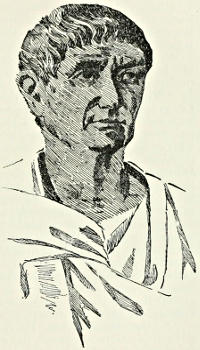
Diocletian
(From a bust in the Vatican)
The two cæsars, Galerius and Constantius Chlorus, were then acclaimed
as emperors. The former immediately named two new cæsars without
consulting his co-rulers, but in so doing
paid no heed to either Maximian’s son
Maxentius, or the son of Constantius,
afterwards the emperor Constantine the
Great. It is probable that his own father
did not deem the former worthy to
ascend the throne; the latter had already
distinguished himself in the field, and
possessed the favour of Diocletian, but he
was also friendly towards the Christians,
and seemed dangerous to Galerius. The
new cæsars were rough officers, undistinguished
by any superiority of merit.
One of them, Severus, received the government
of Africa and Italy; the other,
Maximinus, was invested with Syria and
Egypt.
Diocletian and Maximian, in abdicating,
secured themselves in the possession
of considerable property and peculiar
revenues. Maximian could not accustom
himself to the tranquillity of private life
and seized the first opportunity to resume
the purple. Diocletian on the contrary
returned to his own country, Dalmatia,
and lived there until his death (313) as a
private person at Salona. On his property
in the vicinity of the present Spalatro,
he occupied himself with gardening and
with the erection of enormous buildings,
the remains of which show us that architecture
had entirely lost its noble character, and that attempts were made to
supply the place of the taste of the olden times by elaboration and splendour.
Constantius Chlorus, whose health had long been failing, died a year
after the abdication of Diocletian (306). Before his death he had earnestly
commended his son Constantine to the army, and as soon as Constantius
was dead it proclaimed his son emperor. Galerius was at first in great
anxiety, but was satisfied when Constantine agreed to content himself
with the title of Cæsar, granting Severus, as the elder man, the honours of
an augustus or emperor. Constantine was the son of Helena, a woman of
humble origin. Constantius had divorced her by command of the emperors
Diocletian and Maximian in 292, in order to marry Theodora.
[306-307 A.D.]
In the autumn of the same year, the relations of the rulers of the empire
again changed. Galerius and Severus, by their oppressive measures, had
roused the anger of the citizens and soldiers of Rome. They rebelled and
proclaimed Maxentius, the son of Maximian, emperor.b
Zosimus declares that Maxentius incited the rebellion, moved thereto
by jealousy of Constantine, a quite plausible supposition. “When Constantine’s
effigy according to custom was exhibited at Rome,” he says, “Maxentius,
the son of Maximian, could not endure the sight of Constantine’s good fortune,
who was the son of a harlot, while himself, who was the son of so great an
emperor, remained at home in indolence, and his father’s empire was enjoyed
by others. He therefore associated with himself in the enterprise Marcellianus
and Marcellus, two military tribunes, and Lucianus, who distributed
the swine’s flesh with which the people of Rome were provided by the
treasury, and the court-guards called prætoriani. By them he was promoted
to the imperial throne, having promised liberally to reward all that assisted
him in it. For this purpose they first murdered Abellius, because he, being
prefect of the city, opposed their enterprise.
“When Galerius learned this,” Zosimus continues, “he sent Severus
Cæsar against Maxentius with an army. But while he advanced from Milan
with several legions of Moors, Maxentius corrupted his troops with money,
and even the prefect of the court, Anullinus, and thereby conquered him
with great ease. On which Severus fled to Ravenna, which is a strong and
populous city, provided with necessaries sufficient for himself and soldiers.
When Maximian[53] knew this, he was doubtless greatly concerned for his
son Maxentius, and therefore, leaving Lucania where he then was, he went
to Ravenna. Finding that Severus could not by any means be forced out of
this city, it being well fortified and stored with provisions, he deluded him
with false oaths, and persuaded him to go to Rome. But on his way thither,
coming to a place called the Three Tabernæ, he was taken by a stratagem of
Maxentius. [Hoping to save his life, he renounced the dignity of emperor;
notwithstanding which he was] immediately executed. Galerius could not
patiently endure these injuries done to Severus, and therefore resolved to go
from the east to Rome, and to punish Maxentius as he deserved. On his
arrival in Italy, he found the soldiers about him so treacherous, that he
returned into the east without fighting a battle.”d
On the retreat from Italy, after this unsuccessful foray, Galerius
allowed his army to commit the most horrible outrages and thereby gained
the deadly hatred of all the inhabitants of the peninsula. Meanwhile,
Maximian had gone to Gaul to ally himself with Constantine against Galerius.
He married his daughter Fausta to the young cæsar and invested
him with the title of Augustus, but did not attain his special object, as
Constantine did not consider it wise to allow himself to be drawn into open
war with Galerius. Soon after this, Maximian quarrelled with his own son,
again tried without success to win over Constantine, and then formed the
strange resolve to betake himself to Galerius.
The latter had long thought of naming his old friend and comrade,
Licinius, as augustus, and had just dragged Diocletian from his retirement
and induced him to journey to Pannonia, to help celebrate the promotion of
Licinius in the most brilliant manner. He also made use of Maximian’s
unexpected appearance, and so Licinius was proclaimed augustus in the
presence of three emperors (307).
[307-311 A.D.]
As Maximian found no help in Galerius, he immediately afterwards resigned
the purple for the second time. From Pannonia he returned to his
son-in-law in Gaul, who received him in a friendly manner, and during
his absence on a campaign against the Germans intrusted him with a share
in the government. Maximian, who was manifestly suffering from senility,
formed the ridiculous idea of using this opportunity to overthrow his son-in-law
and forcibly supersede him, although naturally neither the country of
Gaul, now almost entirely Christian, nor the troops of Constantine, can have
been in the least disposed to prefer him to their former master. When
Maximian really made this foolish attempt, he was easily vanquished by
Constantine and taken prisoner. Two years later, when he had made an
attempt on the life of Constantine, the latter had him strangled (310).
Of the six emperors, Maximian, Galerius, Maximin, Maxentius, Constantine,
and Licinius, only one had thus passed away; but another had already
arisen in Africa and had established himself in possession of the government.
This was Alexander, a wretched old man who had himself proclaimed emperor
by the troops. He maintained his position for three years, and was
then in 311 overthrown and killed by Maxentius, who sent a skilled general
and a picked army against him. Galerius died at about the same time.
Maximin and Licinius divided his dominions among them. Now only four
emperors ruled the empire: Maximin, Licinius, Maxentius, and Constantine;
but there was no thought of friendly relations among them.
It remained therefore for the one among them who possessed the most
ability, strength, and skill to overthrow the others and to gain undivided
sway. This could only be successfully effected by Constantine, whose
dignified, judicious, and moderate demeanour deserves our greatest admiration.
The crucial point, that which must finally determine the issue of the
struggle between the emperors, was the relation of each individual ruler to the
Christians. In all parts of the realm the latter formed a very considerable
number, they were very closely united amongst themselves, their hierarchies
and synods had remained unweakened; whilst not only had the old system of
government long been undermined, but also the adherents to the old religion
had been divided by a crowd of different opinions and views, and were neither
held together by an inward nor an external hierarchical union. Whoever
therefore had the Christians in the empire on his side must sooner or later
carry the victory over his co-rulers.
Galerius perceived this shortly before his death, and had therefore issued
an edict in his own name and those of his colleagues, by which the persecution
of the Christians ordered by Diocletian was arrested, and the bloody
strife so often begun between the state and the church forever ended (311).
Even Maxentius seems to have felt it; for he had scarcely become master in
Rome before he assured the Christians of toleration. But his entire conduct
towards them contradicted the mild terms of the edict; the Christians could
rely on him just as little as the pagans.
[311-313 A.D.]
Of the other emperors, only Constantine seemed to be sincerely attached
to the Christians. For a long time he remained a pagan, but continually
showed himself friendly towards the Christians; and they were powerfully
supported by the most influential ladies of the court. These were his wife
Fausta, her mother Eutropia, but especially the mother of Constantine,
Helena, who became celebrated by her great zeal for the teaching of the
cross. Besides the good will of the Christians, Constantine had the great
advantage that from the beginning he alone exhibited a care for law and
order, whilst all his fellow-emperors showed only military violence and despotic
will. Moreover he alone seemed to be satisfied with his share of
the empire; the three other emperors, on the contrary, sought with utter
recklessness to extend their provinces at the expense of their co-rulers.
The first whom the sagacious Constantine defeated was Maxentius, who
from his speedy victory over Alexander had manifestly conceived too high
an idea of his power, and in his arrogance decided to attack Constantine.
That he was not in the least to be compared to him and that it was foolhardy
to seek a quarrel with him, is shown by one glance at the lives of the two
emperors. Maxentius had never found himself at the head of an army in
real warfare; he had continually enjoyed his pleasures in idle tranquillity,
and on account of his tyranny and cruelty he was loved by no one, save by
his guards and a small number of other troops whom he enriched by robbing
the citizens. Constantine’s life, on the contrary, had been one of constant
exertion and discipline. He had served with distinction, first under Diocletian,
and then under his father Constantius, and had afterwards long contended
against the Frankish peoples on the Rhine. The result of the war
between the two emperors could not therefore be doubtful.b
Zosimus gives an interesting account of the struggle, with certain embellishments
that do not detract from the accuracy of his main narrative.
“Constantine,” he tells us, “had raised an army amongst the barbarians,
Germans, and Celts, whom he had conquered, and likewise drawn a force
out of Britain, amounting in the whole to ninety thousand foot and eight
thousand horse. He marched from the Alps into Italy, passing those towns
that surrendered without doing them any damage, but taking by storm
those which resisted. While he was making this progress, Maxentius had
collected a much stronger army, consisting of eighty thousand Romans and
Italians, all the Tuscans on the sea coast, forty thousand men from Carthage,
besides what the Sicilians sent him; his whole force amounting to one
hundred and seventy thousand foot and eighteen thousand horse.
“Both being thus prepared, Maxentius threw a bridge over the Tiber
[the Milvian bridge], which was not of one entire piece but divided into
two parts, the centre of the bridge being made to fasten with irons, which
might be drawn out upon occasion. He gave orders to the workmen that,
as soon as they saw the army of Constantine upon the juncture of the bridge,
they should draw out the iron fastenings, that the enemy who stood upon it
might fall into the river.
“Constantine, advancing with his army to Rome, encamped in a field
before the city, which was broad and therefore convenient for cavalry.
Maxentius in the meantime shut himself up within the walls and sacrificed to
the gods, and, moreover, consulted the Sibylline oracles concerning the event
of the war. Finding a prediction that, whoever designed any harm to the
Romans should die a miserable death, he applied it to himself, because he
withstood those that came against Rome, and wished to take it. His application
indeed proved just. For when Maxentius drew out his army before
the city, and was marching over the bridge that he himself had constructed,
an infinite number of owls flew down and covered the wall.
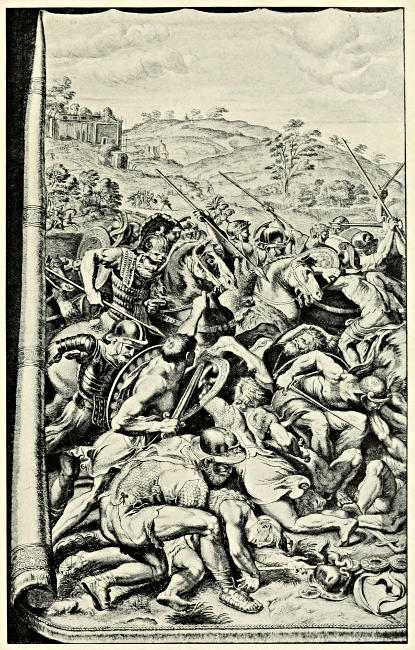
CONSTANTINE’S DEFEAT OF MAXENTIUS
(FROM A CARTOON BY RAPHAEL)
“When Constantine saw this, he ordered his men to stand to their arms.
And the two armies being drawn up opposite to each other, Constantine
sent his cavalry against that of the enemy, whom they charged with such impetuosity
that they threw them into disorder. The signal being given to the
infantry, they likewise marched in good order towards the enemy. A furious
battle having commenced, the Romans themselves, and their foreign allies,
were unwilling to risk their lives, as they wished for deliverance from the
bitter tyranny with which they were burdened, though the other troops
were slain in great numbers, being either trod to death by the horse or
killed by the foot.
“As long as the cavalry kept their ground, Maxentius retained some
hopes, but when they gave way, he fled with the rest over the bridge into
the city. The beams not being strong enough to bear so great a weight,
they broke, and Maxentius, with the others, was carried with the stream
down the river. [The date of the battle was October 27, 313.]
“When the news of this victory was reported in the city,” Zosimus
concludes, “none dared to show any joy for what had happened, because
many thought it was an unfounded report. But when the head of Maxentius
was brought upon a spear, their fear and dejection were changed to joy
and pleasure. On this occasion Constantine punished very few, and they
were only some few of the nearest friends of Maxentius, but he abolished
the prætorian troops, and destroyed the fortress in which they used to
reside.”d
Before the decisive battle, Constantine had tried to win over the enthusiasm
of the Christians in his own and his adversaries’ army to his cause, and
therefore the sign of the cross was made the principal ensign of the Roman
army. The report was spread that a shining cross with this inscription,
“By this sign thou shalt conquer,” had appeared to him in the sky, and that
in the following night, Christ himself had commanded him in a dream to
make the sign of the cross his standard against the enemy. On the day
before the battle, the cross and the monogram of the redeemer appeared on
the imperial standard, which from thenceforth bore the name of Labarum;
and afterwards Constantine publicly announced that he had seen the cross in
the sky, and had conquered his enemy by the direct aid of God.
After his victory over Maxentius the character of Constantine changed,
and his subsequent proceedings often stand in opposition to the principles
which he publicly acknowledged. He went over to Christianity, although
in prudent fashion, not formally nor irrevocably, and for this the Christian
priests permitted and forgave him everything. The miserable senate, which
for a long time had ceased to be a governmental institution and to be consulted
in affairs of state, declared him the first of the three emperors of the
realm, and in this manner he passed naturally to the idea of undivided sway.
Although he made the cross the imperial standard, he took part in the heathen
sacrifices, allowed himself to consult soothsayers, and bore the title of a high
priest of the old religion as before. Moreover he postponed the rite of
baptism until his death-bed, that he might pass, according to the teaching
of the priests at his court, into the next life washed clean from all sin.
From Rome Constantine went to Milan,[54] where he met Licinius and gave
him his sister Constantia in marriage. Then he went to his province of
Gaul, to repulse the German tribes which had again invaded the country;
but Licinius hastened to meet the emperor Maximin, who was trying to
wrest from him his share of the empire, and had already seized the towns
of Byzantium and Heraclea, or Perinthus.
To the south of Hadrianopolis there was a decisive battle between the
two emperors. Licinius won it, and tradition has also attributed his victory
to a divine miracle, although the victor was in no way inclined towards
Christianity. It is said that an angel appeared to Licinius and taught him
a prayer, which on his awakening he immediately caused to be written out
and distributed to the soldiers. This prayer was sung before the beginning
of the battle and helped them to victory (313). Maximin fled; on the way
he took poison, which brought on a severe illness of which he died after great
tortures. With terrible harshness and cruelty Licinius proceeded against
the relations and friends of Maximin. They were all put to death without
mercy and the widow and daughter of Diocletian, as well as the sons
of Galerius and Severus, perished as sacrifices to the wanton brutality of
Licinius.b
[314 A.D.]
The Roman world was now divided between Constantine and Licinius,
the former of whom was master of the West, and the latter of the East. It
might perhaps have been expected that the conquerors, fatigued with civil
war and connected by a private as well as a public alliance, would have renounced,
or at least would have suspended, any further designs of ambition;
and yet a year had scarcely elapsed after the death of Maximin, before the victorious
emperors turned their arms against each other. The genius, the success,
and the aspiring temper of Constantine may seem to mark him out as
the aggressor; but the perfidious character of Licinius justifies the most
unfavourable suspicions, and by the faint light which history reflects on this
transaction, we may discover a conspiracy fomented by his arts against the
authority of his colleague.[55]
Constantine had lately given his sister Anastasia in marriage to Bassianus,
a man of a considerable family and fortune, and had elevated his
new kinsman to the rank of cæsar. According to the system of government
instituted by Diocletian, Italy and perhaps Africa were designed for
his departments in the empire. But the performance of the promised favour
was either attended with so much delay, or accompanied with so many unequal
conditions, that the fidelity of Bassianus was alienated rather than
secured by the honourable distinction which he had obtained. His nomination
had been ratified by the consent of Licinius; and that artful prince, by
the means of his emissaries, soon contrived to enter into a secret and dangerous
correspondence with the new cæsar, to irritate his discontent, and to
urge him to the rash enterprise of extorting by violence what he might in
vain solicit from the justice of Constantine. But the vigilant emperor discovered
the conspiracy before it was ripe for execution; and after solemnly
renouncing the alliance of Bassianus, despoiled him of the purple, and inflicted
the deserved punishment on his treason and ingratitude. The haughty
refusal of Licinius, when he was required to deliver up the criminals who
had taken refuge in his dominions, confirmed the suspicions already entertained
of his perfidy; and the indignities offered at Æmona, on the frontiers
of Italy, to the statues of Constantine, became the signal of discord between
the two princes.
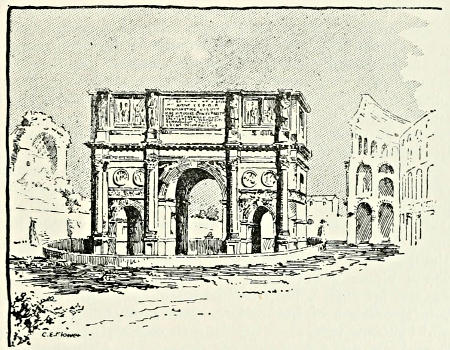
Arch of Constantine, Rome
The first battle was fought near Cibalis, a city of Pannonia, situated on
the river Savus, about fifty miles from Sirmium. From the inconsiderable
forces which in this important contest two such powerful monarchs brought
into the field, it may be inferred that the one was suddenly provoked, and
that the other was unexpectedly surprised. The emperor of the West had
only twenty thousand, and the sovereign of the East no more than five-and-thirty
thousand men. The inferiority of number was, however, compensated
by the advantage of the ground. Constantine had taken post in a
defile about half a mile in breadth, between a steep hill and a deep morass,
and in that situation he steadily expected and repulsed the first attack of
the enemy. He pursued his success, and advanced into the plain. But the
veteran legions of Illyricum rallied under the standard of a leader who had
been trained to arms in the school of Probus and Diocletian. The missile
weapons on both sides were soon exhausted; the two armies, with equal
valour, rushed to a closer engagement of swords and spears, and the doubtful
contest had already lasted from the dawn of the day to a late hour of
the evening, when the right wing, which Constantine led in person, made
a vigorous and decisive charge. The judicious retreat of Licinius saved the
remainder of his troops from a total defeat; but when he computed his loss,
which amounted to more than twenty thousand men, he thought it unsafe
to pass the night in the presence of an active and victorious enemy. Abandoning
his camp and magazines, he marched away with secrecy and diligence
at the head of the greatest part of his cavalry, and was soon removed beyond
the danger of a pursuit. His diligence preserved his wife, his son, and his
treasures, which he had deposited at Sirmium.[56] Licinius passed through
that city, and breaking down the bridge on the Savus, hastened to collect
a new army in Dacia and Thrace. In his flight he bestowed the precarious
title of Cæsar on Valens, his general of the Illyrian frontier.[57]
The plain of Mardia in Thrace was the theatre of a second battle, no less
obstinate and bloody than the former. The troops on both sides displayed
the same valour and discipline; and the victory was once more decided by the
superior abilities of Constantine.c Licinius drew up his army [says Zosimus]
in order of battle, extending from a mountain which is above the town
two hundred stadia, as far as the junction of another river with the Hebrus;
thus the armies continued opposite to each other for several days. Constantine,
observing where the river was least broad, concerted this plan. He
ordered his men to bring trees from the mountain, and to tie ropes around
them, as if he intended to throw a bridge over the river for the passage of
his army. By this stratagem he deluded the enemy, and, ascending a hill
on which were thick woods sufficient to conceal any that were in them, he
planted there five thousand archers and eight hundred horse. Having done
this, he crossed the Hebrus at the narrowest place, and so surprised the enemy
that many fled with all their speed, while others, who were amazed at his
unexpected approach, were struck with wonder at his coming over so suddenly.
In the meantime, the rest of his army crossed the river in security,
and a great slaughter commenced. Nearly thirty thousand fell; and about
sunset Constantine took their camp, while Licinius, with all the forces he
could muster, hastened through Thrace to his ships.d
The loss of two battles reduced the fierce spirit of Licinius to sue for
peace. His ambassador Mistrianus was admitted to the audience of Constantine;
he expatiated on the common topics of moderation and humanity, which
are so familiar to the eloquence of the vanquished; represented, in the most
insinuating language, that the event of the war was still doubtful, whilst its
inevitable calamities were alike pernicious to both the contending parties;
and declared, that he was authorised to propose a lasting and honourable
peace in the name of the two emperors, his masters. Constantine received
the mention of Valens with indignation and contempt.
“It was not for such a purpose,” he sternly replied, “that we have advanced
from the shores of the western ocean in an uninterrupted course of
combats and victories, that, after rejecting an ungrateful kinsman, we should
accept for our colleague a contemptible slave. The abdication of Valens is
the first article of the treaty.” It was necessary to accept this humiliating
condition; the unhappy Valens, after a few days’ reign, was deprived of the
purple and of his life. As soon as this obstacle was removed, the tranquillity
of the Roman world was easily restored. The successive defeats of Licinius
had ruined his forces, but they had displayed his courage and abilities. His
situation was almost desperate, but the efforts of despair are sometimes formidable;
and the good sense of Constantine preferred a great and certain
advantage to a third trial of the chance of arms. He consented to leave his
rival, or, as he again styled Licinius, his friend and brother, in the possession
of Thrace, Asia Minor, Syria, and Egypt; but the provinces of Pannonia,
Dalmatia, Dacia, Macedonia, and Greece were yielded to the Western Empire;
and the dominions of Constantine now extended from the confines of
Caledonia to the extremity of Peloponnesus. It was stipulated by the same
treaty that three royal youths, the sons of the emperors, should be called to
the hopes of the succession. Crispus and the young Constantine were soon
afterwards declared cæsars in the West, while the younger Licinius was
invested with the same dignity in the East. In this double proportion of
honours, the conqueror asserted the superiority of his arms and power.
[314-322 A.D.]
The reconciliation of Constantine and Licinius, though it was embittered
by resentment and jealousy, by the remembrance of recent injuries, and by
the apprehension of future dangers, maintained however above eight years the
tranquillity of the Roman world. As a very regular series of the imperial
laws commences about this period, it would not be difficult to transcribe the
civil regulations which employed the leisure of Constantine. But the most
important of his institutions are intimately connected with the new system
of policy and religion, which was not perfectly established till the last and
peaceful years of his reign. There are many of his laws which, as they concern
the rights and property of individuals and the practice of the bar, are
more properly referred to the private than to the public jurisprudence of the
empire; and he published many edicts of so local and temporary a nature
that they would ill deserve the notice of a general history.
Two laws may be selected from the crowd—the one for its importance,
the other for its singularity; the former for its remarkable benevolence, and
the latter for its excessive severity. (1) The horrid practice, so familiar
to the ancients, of exposing or murdering their new-born infants, was become
every day more frequent in the provinces, and especially in Italy. It was
the effect of distress; and the distress was principally occasioned by the
intolerable burden of taxes, and by the vexatious as well as cruel prosecutions
of the officers of the revenue against their insolvent debtors. The less
opulent or less industrious part of mankind, instead of rejoicing in an increase
of family, deemed it an act of paternal tenderness to release their
children from the impending miseries of a life which they themselves were
unable to support. The humanity of Constantine, moved perhaps by some
recent and extraordinary instances of despair, engaged him to address an
edict to all the cities of Italy, and afterwards of Africa, directing immediate
and sufficient relief to be given to those parents who should produce before
the magistrates the children whom their own poverty would not allow them
to educate. But the promise was too liberal, and the provision too vague, to
effect any general or permanent benefit. The law, though it may merit
some praise, served rather to display than to alleviate the public distress.
It still remains an authentic monument to contradict and confound those
venal orators who were too well satisfied with their own situation to discover
either vice or misery under the government of a generous sovereign.
(2) The laws of Constantine against rapes were dictated with small indulgence
for the most amiable weaknesses of human nature; since the description
of that crime was applied not only to the brutal violence which compelled,
but even to the gentle seduction which might persuade an unmarried
woman, under the age of twenty-five, to leave the house of her parents. The
successful ravisher was punished with death; and, as if simple death was
inadequate to the enormity of his guilt, he was either burned alive or torn in
pieces by wild beasts in the amphitheatre. The virgin’s declaration that
she had been carried away with her own consent, instead of saving her lover,
exposed her to share his fate. The duty of a public prosecution was intrusted
to the parents of the guilty or unfortunate maid; and if the sentiments
of nature prevailed on them to dissemble the injury, and to repair by a
subsequent marriage the honour of their family, they were themselves punished
by exile and confiscation. The slaves, whether male or female, who
were convicted of having been accessory to the rape or seduction, were burned
alive, or put to death by the ingenious torture of pouring down their throats
a quantity of melted lead.
As the crime was of a public kind, the accusation was permitted even to
strangers. The commencement of the action was not limited to any term of
years, and the consequences of the sentence were extended to the innocent
offspring of such an irregular union. But whenever the offence inspires less
horror than the punishment, the rigour of penal law is obliged to give way
to the common feelings of mankind. The most odious parts of this edict
were softened or repealed in the subsequent reigns; and even Constantine
himself very frequently alleviated, by partial acts of mercy, the stern temper
of his general institutions. Such, indeed, was the singular humour of that
emperor, who showed himself as indulgent and even remiss in the execution
of his laws, as he was severe and even cruel in the enacting of them. It is
scarcely possible to observe a more decisive symptom of weakness, either in
the character of the prince or in the constitution of the government.
The civil administration was sometimes interrupted by the military
defence of the empire. Crispus, a youth of the most amiable character,
who had received with the title of Cæsar the command of the Rhine, distinguished
himself by his conduct in several victories over the Franks and
Alamanni, and taught the barbarians of that frontier to dread the eldest
son of Constantine and the grandson of Constantius. The emperor himself
had assumed the more difficult and important province of the Danube. The
Goths, who in the time of Claudius and Aurelian had felt the weight of the
Roman arms, respected the power of the empire, even in the midst of its
intestine divisions. But the strength of that warlike nation was now
restored by a peace of near fifty years; a new generation had arisen, who
no longer remembered the misfortunes of ancient days: the Sarmatians of
the lake Mæotis followed the Gothic standard, either as subjects or as allies,
and their united force was poured upon the countries of Illyricum. Campona,
Margus, and Bononia[58] appear to have been the scenes of several memorable
sieges and battles; and though Constantine encountered a very
obstinate resistance, he prevailed at length in the contest, and the Goths
were compelled to purchase an ignominious retreat, by restoring the booty
and prisoners they had taken. Nor was this advantage sufficient to satisfy
the indignation of the emperor. He resolved to chastise, as well as to
repulse, the insolent barbarians who had dared to invade the territories of
Rome.
At the head of his legions he passed over the Danube, after repairing the
bridge which had been constructed by Trajan, penetrated into the strongest
recesses of Dacia, and when he had inflicted a severe revenge, condescended
to give peace to the suppliant Goths on condition that, as often as they were
required, they should supply his armies with a body of forty thousand soldiers.
Exploits like these were no doubt honourable to Constantine, and beneficial
to the state; but it may surely be questioned, whether they can justify the
exaggerated assertion of Eusebius that all Scythia, as far as the extremity
of the north, divided as it was into so many names and nations of the most
various and savage manners, had been added by his victorious arms to the
Roman Empire.
[323 A.D.]
In this exalted state of glory it was impossible that Constantine should
any longer endure a partner in the empire. Confiding in the superiority of
his genius and military power, he determined, without any previous injury,
to exert them for the destruction of Licinius, whose advanced age and
unpopular vices seemed to offer a very easy conquest. But the old emperor,
awakened by the approaching danger, deceived the expectations of his
friends, as well as of his enemies. Calling forth that spirit and those
abilities by which he had deserved the friendship of Galerius and the imperial
purple, he prepared himself for the contest, collected the forces of the
East, and soon filled the plains of Hadrianopolis with his troops, and the straits
of the Hellespont with his fleet. The army consisted
of 150,000 foot and 15,000 horse; and as the
cavalry was drawn, for the most part, from Phrygia
and Cappadocia, we may conceive a more favourable
opinion of the beauty of the horses than of the
courage and dexterity of their riders. The fleet
was composed of 350 galleys of three ranks of oars.
A hundred and thirty of these were furnished by
Egypt and the adjacent coast of Africa. A hundred
and ten sailed from the ports of Phœnicia and
the isle of Cyprus; and the maritime countries of
Bithynia, Ionia, and Caria were likewise obliged
to provide 110 galleys. The troops of Constantine
were ordered to rendezvous at Thessalonica; they
amounted to above 120,000 horse and foot. The
emperor was satisfied with their martial appearance,
and his army contained more soldiers, though fewer
men, than that of his eastern competitor.
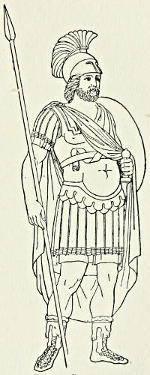
Roman General
(From the Arch of Constantine)
The legions of Constantine were levied in the
warlike provinces of Europe; action had confirmed
their discipline, victory had elevated their hopes,
and there were among them a great number of
veterans who, after seventeen glorious campaigns
under the same leader, prepared themselves to
deserve an honourable dismission by a last effort of
their valour. But the naval preparations of Constantine
were in every respect much inferior to
those of Licinius. The maritime cities of Greece
sent their respective quotas of men and ships to
the celebrated harbour of Piræus, and their
united forces consisted of no more than two hundred
small vessels—a very feeble armament, if it is compared with those
formidable fleets which were equipped and maintained by the republic of
Athens during the Peloponnesian War. Since Italy was no longer the seat
of government, the naval establishments of Misenum and Ravenna had been
gradually neglected; and as the shipping and mariners of the empire were
supported by commerce rather than by war, it was natural that they should
the most abound in the industrious provinces of Egypt and Asia. It is only
surprising that the eastern emperor, who possessed so great a superiority at
sea, should have neglected the opportunity of carrying an offensive war into
the centre of his rival’s dominions.
Instead of embracing such an active resolution, which might have changed
the whole face of the war, the prudent Licinius expected the approach of his
rival in a camp near Hadrianopolis, which he had fortified with an anxious care
that betrayed his apprehension of the event. Constantine directed his march
from Thessalonica towards that part of Thrace, till he found himself stopped
by the broad and rapid stream of the Hebrus, and discovered the numerous
army of Licinius, which filled the steep ascent of the hill, from the river to
the city of Hadrianopolis. Many days were spent in doubtful and distant skirmishes;
but at length the obstacles of the passages and of the attack were
removed by the intrepid conduct of Constantine. In this place we might
relate a wonderful exploit of Constantine, which, though it can scarcely be
paralleled either in poetry or romance, is celebrated, not by a venal orator
devoted to his fortune, but by an historian, the partial enemy of his fame.
We are assured that the valiant emperor threw himself into the river Hebrus,
accompanied only by twelve horsemen, and that by the effort or terror of his
invincible arm he broke, slaughtered, and put to flight a host of a hundred
and fifty thousand men.
The credulity of Zosimus prevailed so strongly over his passion that,
among the events of the memorable battle of Hadrianopolis, he seems to have
selected and embellished not the most important but the most marvellous.
The valour and danger of Constantine are attested by a slight wound, which
he received in the thigh; but it may be discovered, even from an imperfect
narration, and perhaps a corrupted text, that the victory was obtained no less
by the conduct of the general than by the courage of the hero; that a body
of five thousand archers marched round to occupy a thick wood in the rear
of the enemy, whose attention was diverted by the construction of a bridge,
and that Licinius, perplexed by so many artful evolutions, was reluctantly
drawn from his advantageous post to combat on equal ground in the plain.
The contest was no longer equal. His confused multitude of new levies was
easily vanquished by the experienced veterans of the West. Thirty-four
thousand men are reported to have been slain. The fortified camp of Licinius
was taken by assault the evening of the battle; the greater part of the
fugitives, who had retired to the mountains, surrendered themselves the next
day to the discretion of the conqueror; and his rival, who could no longer
keep the field, confined himself within the walls of Byzantium.
Constantine besieges Byzantium
[323-324 A.D.]
The siege of Byzantium, which was immediately undertaken by Constantine,
was attended with great labour and uncertainty. In the late
civil wars, the fortifications of that place, so justly considered as the key
of Europe and Asia, had been repaired and strengthened; and as long
as Licinius remained master of the sea, the garrison was much less exposed
to the danger of famine than the army of the besiegers. The naval
commanders of Constantine were summoned to his camp, and received his
positive orders to force the passage of the Hellespont, as the fleet of Licinius,
instead of seeking and destroying their feeble enemy, continued inactive
in those narrow straits where its superiority of numbers was of little use
or advantage. Crispus, the emperor’s eldest son, was intrusted with the execution
of this daring enterprise, which he performed with so much courage
and success that he deserved the esteem, and most probably excited the
jealousy, of his father. The engagement lasted two days; and in the evening
of the first, the contending fleets, after a considerable and mutual
loss, retired to their respective harbours of Europe and Asia. The second
day, about noon, a strong south wind sprang up, which carried the vessels
of Crispus against the enemy; and as the casual advantage was improved
by his skilful intrepidity, he soon obtained a complete victory. A hundred
and thirty vessels were destroyed, five thousand men were slain, and Amandus,
the admiral of the Asiatic fleet, escaped with the utmost difficulty to
the shores of Chalcedon. As soon as the Hellespont was open, a plentiful
convoy of provisions flowed into the camp of Constantine, who had already
advanced the operations of the siege. He constructed artificial mounds of
earth of an equal height with the ramparts of Byzantium. The lofty towers
which were erected on that foundation galled the besieged with large stones
and darts from the military engines, and the battering-rams had shaken the
walls in several places. If Licinius persisted much longer in the defence, he
exposed himself to be involved in the ruin of the place. Before he was surrounded
he prudently removed his person and treasures to Chalcedon, in
Asia; and as he was always desirous of associating companions to the hopes
and dangers of his fortune, he now bestowed the title of Cæsar on Martinianus,
who exercised one of the most important offices of the empire.
Such were still the resources, and such the abilities of Licinius, that,
after so many successive defeats, he collected in Bithynia a new army of
fifty or sixty thousand men, while the activity of Constantine was employed
in the siege of Byzantium. The vigilant emperor did not, however, neglect
the last struggles of his antagonist. A considerable part of his
victorious army was transported over the Bosporus in small vessels, and
the decisive engagement was fought soon after the landing, on the heights
of Chrysopolis, or, as it is now called, Scutari. The troops of Licinius,
though they were lately raised, ill armed, and worse disciplined, made head
against their conquerors with fruitless but desperate valour, till a total
defeat, and the slaughter of five-and-twenty thousand men, irretrievably
determined the fate of their leader. He retired to Nicomedia, rather with
the view of gaining some time for negotiation than with the hope of any
effectual defence. Constantia, his wife and the sister of Constantine, interceded
with her brother in favour of her husband, and obtained from
his policy rather than from his compassion a solemn promise, confirmed
by an oath, that after the sacrifice of Martinianus and the resignation of
the purple, Licinius himself should be permitted to pass the remainder
of his life in peace and affluence. The behaviour of Constantia, and her
relation to the contending parties, naturally recall the remembrance of that
virtuous matron who was the sister of Augustus, and the wife of Antony.
But the temper of mankind was altered; and it was no longer esteemed
infamous for a Roman to survive his honour and independence. Licinius
solicited and accepted the pardon of his offences, laid himself and his purple
at the feet of his lord and master, was raised from the ground with insulting
pity, was admitted the same day to the imperial banquet, and soon
afterward was sent away to Thessalonica, which had been chosen for the
place of his confinement.
His confinement was soon terminated by death; and it is doubtful
whether a tumult of the soldiers, or a decree of the senate, was suggested as
a motive for his execution. According to the rules of tyranny he was
accused of forming a conspiracy, and of holding a treasonable correspondence
with the barbarians; but as he was never convicted either by his own
conduct or by any legal evidence, we may perhaps be allowed, from his
weakness, to presume his innocence.
The memory of Licinius was branded with infamy, his statues were
thrown down, and by a hasty edict, of such mischievous tendency that it
was almost immediately corrected, all his laws and all the judicial proceedings
of his reign were at once abolished. By this victory of Constantine,
the Roman world was again united under the authority of one emperor,
thirty-seven years after Diocletian had divided his power and provinces
with his associate Maximian.
[323-330 A.D.]
The successive steps of the elevation of Constantine, from his first assuming
the purple at York to the resignation of Licinius at Nicomedia, have
been related with some minuteness and precision, not only as the events are
in themselves both interesting and important, but still more as they contributed
to the decline of the empire by the expense of blood and treasure, and
by the perpetual increase as well of the taxes as of the military establishment.
The foundation of Constantinople and the establishment of the
Christian religion were the immediate and memorable consequences of this
revolution.
But the prospect of beauty, of safety, and of wealth, united in a single
spot, was sufficient to justify the choice of Constantine. But as some decent
mixture of prodigy and fable has, in every age, been supposed to reflect a
becoming majesty on the origin of great cities, the emperor was desirous of
ascribing his resolution not so much to the uncertain counsels of human
policy as to the infallible and eternal decrees of divine wisdom. In one of
his laws he has been careful to instruct posterity that, in obedience to the
commands of God, he laid the everlasting foundations of Constantinople;
and though he has not condescended to relate in what manner the celestial
inspiration was communicated to his mind, the defect of his modest silence
has been liberally supplied by the ingenuity of succeeding writers, who
describe the nocturnal vision which appeared to the fancy of Constantine,
as he slept within the walls of Byzantium. The tutelar genius of the city,
a venerable matron sinking under the weight of years and infirmities, was
suddenly transformed into a blooming maid, whom his own hands adorned
with all the symbols of imperial greatness. The monarch awoke, interpreted
the auspicious omen and obeyed, without hesitation, the will of
heaven. The day which gave birth to a city or colony was celebrated by
the Romans with such ceremonies as had been ordained by a generous superstition;
and though Constantine might omit some rites which savoured too
strongly of their pagan origin, yet he was anxious to leave a deep impression
of hope and respect on the minds of the spectators. On foot, with a
lance in his hand, the emperor himself led the solemn procession, and directed
the line which was traced as the boundary of the destined capital; till the
growing circumference was observed with astonishment by the assistants,
who at length ventured to observe that he had already exceeded the most
ample measure of a great city. “I shall still advance,” replied Constantine,
“till he, the invisible guide, who marches before me, thinks proper to stop.”
Without presuming to investigate the nature or motives of this extraordinary
conductor, we shall content ourselves with the more humble task of
describing the extent and limits of Constantinople.
In the actual state of the city, the palace and gardens of the seraglio
occupy the eastern promontory, the first of the seven hills, and cover about
150 acres of our own measure. The seat of Turkish jealousy and despotism
is erected on the foundations of a Grecian republic; but it may be supposed
that the Byzantines were tempted by the conveniency of the harbour to extend
their habitations on that side beyond the modern limits of the seraglio.
The new walls of Constantine stretched from the port to the Propontis
across the enlarged breadth of the triangle, at the distance of fifteen stadia
from the ancient fortification; and with the city of Byzantium they enclosed
five of the seven hills which, to the eyes of those who approach Constantinople,
appear to rise above each other in beautiful order. About a century
after the death of the founder, the new buildings, extending on one side up
the harbour and on the other along the Propontis, already covered the narrow
ridge of the sixth, and the broad summit of the seventh hill. The necessity
of protecting those suburbs from the incessant
inroads of the barbarians engaged the younger
Theodosius to surround his capital with an adequate
and permanent enclosure of walls. From the
eastern promontory to the golden gate, the extreme
length of Constantinople was about three Roman
miles; the circumference measured between ten
and eleven; and the surface might be computed as
equal to about two thousand English acres.

A Plebeian
(Based on Vecellio)
It is impossible to justify the vain and credulous
exaggerations of modern travellers, who sometimes
stretch the limits of Constantinople over the adjacent
villages of the European, and even of the
Asiatic coast. But the suburbs of Pera and Galata,
though situate beyond the harbour, may deserve to
be considered as a part of the city, and this addition
may perhaps authorise the measure of a Byzantine
historian, who assigns sixteen Greek (about fourteen
Roman) miles for the circumference of his
native city. Such an extent may seem not unworthy
of an imperial residence. Yet Constantinople must
yield to Babylon and Thebes, to ancient Rome, to
London, and even to Paris.
The master of the Roman world, who aspired to
erect an eternal monument of the glories of his
reign, could employ in the prosecution of that great
work the wealth, the labour, and all that yet remained
of the genius of obedient millions. Some
estimate may be formed of the expense bestowed
with imperial liberality on the foundation of Constantinople,
by the allowance of about £2,500,000 [$12,500,000] for the
construction of the walls, the porticoes, and the aqueducts. The forests that
overshadowed the shores of the Euxine, and the celebrated quarries of white
marble in the little island of Proconnesus, supplied an inexhaustible stock of
materials ready to be conveyed, by the convenience of a short water-carriage,
to the harbour of Byzantium. A multitude of labourers and artificers urged
the conclusion of the work with incessant toil; but the impatience of Constantine
soon discovered that, in the decline of the arts, the skill as well as
numbers of his architects bore a very unequal proportion to the greatness of
his designs. The magistrates of the most distant provinces were therefore
directed to institute schools, to appoint professors, and by the hopes of rewards
and privileges to engage in the study and practice of architecture a sufficient
number of ingenious youths who had received a liberal education. The
buildings of the new city were executed by such artificers as the reign of
Constantine could afford; but they were decorated by the hands of the most
celebrated masters of the age of Pericles and Alexander. To revive the
genius of Phidias and Lysippus surpassed indeed the power of a Roman
emperor; but the immortal productions which they had bequeathed to posterity
were exposed without defence to the rapacious vanity of a despot. By
his commands the cities of Greece and Asia were despoiled of their most
valuable ornaments. The trophies of memorable wars, the objects of religious
veneration, the most finished statues of the gods and heroes, of the sages and
poets, of ancient times, contributed to the splendid triumph of Constantinople;
and gave occasion to the remark of the historian Cedrenus, who observes with
much enthusiasm that nothing seemed wanting except the souls of the illustrious
men whom those admirable monuments were intended to represent.
But it is not in the city of Constantine, nor in the declining period of an
empire, when the human mind was depressed by civil and religious slavery,
that we should seek for the souls of Homer and of Demosthenes.
During the siege of Byzantium, the conqueror had pitched his tent on
the commanding eminence of the second hill. To perpetuate the memory
of his success, he chose the same advantageous position for the principal
forum, which appears to have been of a circular, or rather elliptical form.
The two opposite entrances formed triumphal arches; the porticoes, which
enclosed it on every side, were filled with statues; and the centre of the
forum was occupied by a lofty column, of which a mutilated fragment is now
degraded by the appellation of “the burnt pillar.” This column was erected
on a pedestal of white marble twenty feet high, and was composed of ten
pieces of porphyry, each of which measured about ten feet in height and
about thirty-three in circumference. On the summit of the pillar, above
120 feet from the ground, stood the colossal statue of Apollo. It was of
bronze, had been transported either from Athens or from a town of Phrygia,
and was supposed to be the work of Phidias. The artist had represented
the god of day, or, as it was afterwards interpreted, the emperor Constantine
himself, with a sceptre in his right hand, the globe of the world in his
left, and a crown of rays glittering on his head. The Circus, or Hippodrome,
was a stately building, about four hundred paces in length and one
hundred in breadth. The space between the two metæ, or goals, was filled
with statues and obelisks; and we may still remark a very singular fragment
of antiquity—the bodies of three serpents, twisted into one pillar of
brass. Their triple heads had once supported the golden tripod which,
after the defeat of Xerxes, was consecrated in the temple of Delphi by the
victorious Greeks. The beauty of the Hippodrome has been long since
defaced by the rude hands of the Turkish conquerors; but under the similar
appellation of Atmeidan, it still serves a place of exercise for their horses.
From the throne, whence the emperor viewed the Circensian games,
a winding staircase descended to the palace—a magnificent edifice, which
scarcely yielded to the residence of Rome itself, and which, together
with the dependent courts, gardens, and porticoes, covered a considerable
extent of ground upon the banks of the Propontis, between the Hippodrome
and the church of St. Sophia. We might likewise celebrate the
baths, which still retained the name of Zeuxippus after they had been
enriched, by the munificence of Constantine, with lofty columns, various
marbles, and above threescore statues of bronze. But we should deviate
from the design of this history if we attempted minutely to describe the
different buildings or quarters of the city. It may be sufficient to observe
that whatever could adorn the dignity of a great capital, or contribute to
the benefit or pleasure of its numerous inhabitants, was contained within the
walls of Constantinople. A particular description, composed about a century
after its foundation, enumerates a capitol or school of learning, a
circus, two theatres, eight public and 153 private baths, fifty-two porticoes,
five granaries, eight aqueducts or reservoirs of water, four spacious halls
for the meetings of the senate or courts of justice, fourteen churches, fourteen
palaces, and 4388 houses which, for their size or beauty, deserved to
be distinguished from the multitude of plebeian habitations.
The populousness of this favoured city was the next and most serious
object of the attention of its founder. In the dark ages which succeeded
the translation of the empire, the remote and the immediate consequences of
that memorable event were strangely confounded by the vanity of the
Greeks and the credulity of the Latins. It was asserted and believed that
all the noble families of Rome, the senate, and the equestrian order, with
their innumerable attendants, had followed their emperor to the banks of
the Propontis; that a spurious race of strangers and plebeians was left to
possess the solitude of the ancient capital, and that the lands of Italy, long
since converted into gardens, were at once deprived of cultivation and
inhabitants. In the course of this history such exaggerations will be
reduced to their just value. Yet, since the growth of Constantinople cannot
be ascribed to the general increase of mankind and of industry, it
must be admitted that this artificial colony was raised at the expense
of the ancient cities of the empire. Many opulent senators of Rome
and of the eastern provinces were probably invited by Constantine to
adopt for their country the fortunate spot which he had chosen for his
own residence. The invitations of a master are scarcely to be distinguished
from commands; and the liberality of the emperor obtained a ready and
cheerful obedience. He bestowed on his favourites the palaces which he
had built in the several quarters of the city, assigned them lands and pensions
for the support of their dignity, and alienated the demesnes of Pontus
and Asia to grant the hereditary estates by the easy tenure of maintaining
a house in the capital. But these encouragements and obligations soon
became superfluous, and were gradually abolished. Wherever the seat of
government is fixed, a considerable part of the public revenue will be
expended by the prince himself, by his ministers, by the officers of justice,
and by the domestics of the palace. The most wealthy of the provincials
will be attracted by the powerful motives of interest and duty, of amusement
and curiosity. A third and more numerous class of inhabitants will
insensibly be formed, of servants, of artificers, and of merchants, who derive
their subsistence from their own labour, and from the wants or luxury of
the superior ranks. In less than a century Constantinople disputed with
Rome itself the pre-eminence of riches and numbers. New piles of buildings,
crowded together with too little regard to health or convenience,
scarcely allowed the intervals of narrow streets for the perpetual throng of
men, of horses, and of carriages. The allotted space of ground was insufficient
to contain the increasing people; and the additional foundations, which, on
either side, were advanced into the sea, might alone have composed a very
considerable city.
The frequent and regular distributions of wine and oil, of corn or bread,
of money or provisions, had almost exempted the poorest citizens of Rome
from the necessity of labour. The magnificence of the first Cæsars was in
some measure imitated by the founder of Constantinople; but his liberality,
however it might excite the applause of the people, has incurred the censure
of posterity. A nation of legislators and conquerors might assert its claim to
the harvest of Africa, which had been purchased with its blood; and it was
artfully contrived by Augustus that in the enjoyment of plenty the Romans
should lose the memory of freedom. But the prodigality of Constantine
could not be excused by any consideration either of public or private interest;
and the annual tribute of corn imposed upon Egypt for the benefit of his
new capital was applied to feed a lazy and indolent populace, at the expense
of the husbandmen of an industrious province. Some other regulations of
this emperor are less liable to blame, but they are less deserving of notice.
He divided Constantinople into fourteen regions or quarters, dignified the
public council with the appellation of senate, communicated to the citizens
the privileges of Italy, and bestowed on the rising city the title of Colony, the
first and most favoured daughter of ancient Rome. The venerable parent still
maintained the legal and acknowledged supremacy, which was due to her age,
to her dignity, and to the remembrance of her former greatness.
As Constantine urged the process of the work with the impatience of a
lover, the walls, the porticoes, and the principal edifices were completed in
a few years, or, according to another account, in a few months; but this
extraordinary diligence should excite less admiration, since many of the buildings
were finished in so hasty and imperfect a manner that, under the succeeding
reign, they were preserved with difficulty from impending ruin.
But while they displayed the vigour and freshness of youth, the founder
prepared to celebrate the dedication of his city. The games and largesses
which crowned the pomp of this memorable festival may easily be supposed;
but there is one circumstance of a more singular and permanent nature,
which ought not entirely to be overlooked. As often as the birthday of the
city returned, the statue of Constantine, framed by his order, of gilt wood,
and bearing in his right hand a small image of the genius of the place, was
erected on a triumphal car. The guards, carrying white tapers, and clothed
in their richest apparel, accompanied the solemn procession as it moved
through the Hippodrome. When it was opposite to the throne of the reigning
emperor, he rose from his seat, and with a grateful reverence adored the
memory of his predecessor. At the festival of dedication an edict, engraved
on a column of marble, bestowed the title of Second or New Rome on the
city of Constantine. But the name of Constantinople has prevailed over
that honourable epithet, and after the revolution of fifteen centuries still
perpetuates the fame of the author.
The character of the prince who removed the seat of empire, and introduced
such important changes into the civil and religious constitution of his
country, has fixed the attention and divided the opinions of mankind. By
the grateful zeal of the Christians, the deliverer of the church has been decorated
with every attribute of a hero, even of a saint; while the discontent
of the vanquished party has compared Constantine to the most abhorred
of those tyrants who by their vice and weakness, dishonoured the imperial
purple.
The same passions have in some degree been perpetuated to succeeding
generations, and the character of Constantine is considered, even in the present
age, as an object either of satire or of panegyric. By the impartial
union of those defects which are confessed by his warmest admirers, and of
those virtues which are acknowledged by his most implacable enemies, we
might hope to delineate a just portrait of that extraordinary man, which the
truth and candour of history should adopt without a blush. But it would
soon appear that the vain attempt to blend such discordant colours, and to
reconcile such inconsistent qualities, must produce a figure monstrous rather
than human, unless it is viewed in its proper and distinct lights by a careful
separation of the different periods of the reign of Constantine.
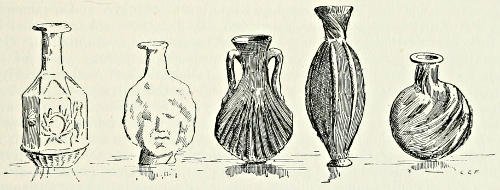
Roman Glassware
The person, as well as the mind, of Constantine had been enriched by
nature with her choicest endowments. His stature was lofty, his countenance
majestic, his deportment graceful; his strength and activity were displayed
in every manly exercise, and from his earliest youth to a very advanced
season of life he preserved the vigour of his constitution by a strict adherence
to the domestic virtues of chastity and temperance. He delighted in
the social intercourse of familiar conversation; and though he might sometimes
indulge his disposition to raillery with less reserve than was required
by the severe dignity of his station, the courtesy and liberality of his manners
gained the hearts of all who approached him. The sincerity of his friendship
has been suspected; yet he showed, on some occasions, that he was not incapable
of a warm and lasting attachment. The disadvantage of a deficient
education had not prevented him from forming a just estimate of the value
of learning; and the arts and sciences derived some encouragement from the
munificent protection of Constantine. In the despatch of business, his diligence
was indefatigable; and the active powers of his mind were almost continually
exercised in reading, writing, or meditating, in giving audience to
ambassadors, and in examining the complaints of his subjects. Even those
who censured the propriety of his measures were compelled to acknowledge
that he possessed magnanimity to conceive and patience to execute the most
arduous designs, without being checked either by the prejudices of education
or by the clamours of the multitude. In the field, he infused his own intrepid
spirit into the troops, whom he conducted with the talents of a consummate
general; and to his abilities, rather than to his fortune, we may ascribe the
signal victories which he obtained over the foreign and domestic foes of
the republic.
He loved glory, as the reward, perhaps even as the motive, of his labours.
The boundless ambition which, from the moment of his accepting
the purple at York, appears as the ruling passion of his soul, may be justified
by the dangers of his own situation, by the character of his rivals, by the
consciousness of superior merit, and by the prospect that his success would
enable him to restore peace and order to the distracted empire. In his civil
wars against Maxentius and Licinius, he had engaged on his side the inclinations
of the people, who compared the undissembled vices of those tyrants
with the spirit of wisdom and justice which seemed to direct the general
tenor of the administration of Constantine.
Had Constantine fallen on the banks of the Tiber, or even in the plains
of Hadrianopolis, such is the character which, with few exceptions, he might
have transmitted to posterity. But the conclusion of his reign (according
to the moderate and indeed tender sentence of a writer of the same age)
degraded him from the rank which he had acquired among the most deserving
of the Roman princes. In the life of Augustus, we behold the tyrant of
the republic converted, almost by imperceptible degrees, into the father of
his country and of human kind. In that of Constantine we may contemplate
a hero who had so long inspired his subjects with love and his enemies
with terror degenerating into a cruel and dissolute monarch, corrupted by
his fortune, or raised by conquest above the necessity of dissimulation. The
general peace which he maintained during the last fourteen years of his
reign was a period of apparent splendour rather than of real prosperity;
and the old age of Constantine was disgraced by the opposite yet reconcilable
vices of rapaciousness and prodigality. The accumulated treasures
found in the palaces of Maxentius and Licinius were lavishly consumed;
the various innovations introduced by the conqueror were attended with an
increasing expense; the cost of his buildings, his court, and his festivals
required an immediate and plentiful supply; and the oppression of the
people was the only fund which could support the magnificence of the sovereign.
His unworthy favourites, enriched by the boundless liberality of their
master, usurped with impunity the privilege of rapine and corruption.
A secret but universal decay was felt in every part of the public administration;
the emperor himself, though he still retained the obedience, gradually
lost the esteem of his subjects. The dress and manners which, towards
the decline of life, he chose to affect, served only to degrade him in the eyes
of mankind. The Asiatic pomp, which had been adopted by the pride of
Diocletian, assumed an air of softness and effeminacy in the person of Constantine.
He is represented with false hair of various colours, laboriously
arranged by the skilful artists of the times; a diadem of a new and more expensive
fashion; a profusion of gems and pearls, of collars and bracelets, and
a variegated flowing robe of silk, most curiously embroidered with flowers of
gold. In such apparel, scarcely to be excused by the youth and folly of Elagabalus,
we are at a loss to discover the wisdom of an aged monarch and the
simplicity of a Roman veteran. A mind thus relaxed by prosperity and
indulgence was incapable of rising to that magnanimity which disdains suspicion
and dares to forgive. The deaths of Maximian and Licinius may perhaps
be justified by the maxims of policy as they are taught in the schools
of tyrants; but an impartial narrative of the executions, or rather murders,
which sullied the declining age of Constantine, will suggest to our most candid
thoughts the idea of a prince who could sacrifice without reluctance the
laws of justice and the feelings of nature to the dictates either of his passions
or of his interest.
The same fortune which so invariably followed the standard of Constantine
seemed to secure the hopes and comforts of his domestic life. Those
among his predecessors who had enjoyed the longest and most prosperous
reigns, Augustus, Trajan, and Diocletian, had been disappointed of posterity;
and the frequent revolutions had never allowed sufficient time for any imperial
family to grow up and multiply under the shade of the purple. But the
royalty of the Flavian line, which had been first ennobled by the Gothic
Claudius, descended through several generations; and Constantine himself
derived from his royal father the hereditary honours which he transmitted
to his children. The emperor had been twice married. Minervina, the
obscure but lawful object of his youthful attachment, had left him only
one son, who was called Crispus. By Fausta, the daughter of Maximian, he
had three daughters and three sons, known by the kindred names of Constantine,
Constantius, and Constans. The unambitious brothers of the great
Constantine, Julius Constantius, Dalmatius, and Hannibalianus, were permitted
to enjoy the most honourable rank and the most affluent fortune that
could be consistent with a private station. The youngest of the three lived
without a name, and died without posterity. His two elder brothers obtained
in marriage the daughters of wealthy senators, and propagated new branches
of the imperial race. Gallus and Julian afterwards became the most illustrious
of the children of Julius Constantius, the patrician. The two sons
of Dalmatius, who had been decorated with the vain title of censor, were
named Dalmatius and Hannibalianus. The two sisters of the great Constantine,
Anastasia and Eutropia, were bestowed on Optatus and Nepotianus,
two senators of noble birth and of consular dignity. His third sister, Constantia,
was distinguished by her pre-eminence of greatness and of misery.
She remained the widow of the vanquished Licinius; and it was by her
entreaties that an innocent boy, the offspring of their marriage, preserved
for some time his life, the title of Cæsar, and a precarious hope of the succession.
Besides the females and the allies of the Flavian house, ten or twelve
males, to whom the language of modern courts would apply the title of
princes of the blood, seemed, according to the order of their birth, to be
destined either to inherit or to support the throne of Constantine. But
in less than thirty years, this numerous and increasing family was reduced to
the persons of Constantius and Julian, who alone had survived a series of
crimes and calamities such as the tragic poets have deplored in the devoted
lines of Pelops and of Cadmus.
[323-326 A.D.]
Crispus, the eldest son of Constantine, and the presumptive heir of the
empire, is represented by impartial historians as an amiable and accomplished
youth. The care of his education, or at least of his studies, was intrusted
to Lactantius, the most eloquent of the Christians; a preceptor admirably
qualified to form the taste and to excite the virtues of his illustrious disciple.
At the age of seventeen Crispus was invested with the title of
Cæsar and the administration of the Gallic provinces, where the inroads
of the Germans gave him an early occasion of signalising his military
prowess. In the civil war which broke out soon afterwards the father and
son divided their powers; the latter displayed great valour in forcing the
straits of the Hellespont, despite the superior fleet of Licinius. This naval
victory contributed to determine the event of the war; and the names of
Constantine and of Crispus were united in the joyful acclamations of their
eastern subjects, who loudly proclaimed that the world had been subdued,
and was now governed by an emperor endowed with every virtue; and by
his illustrious son, a prince beloved of heaven, and the lively image of his
father’s perfections. The public favour, which seldom accompanies old age,
diffused its lustre over the youth of Crispus. He deserved the esteem and
he engaged the affections of the court, the army, and the people. The
experienced merit of a reigning monarch is acknowledged by his subjects
with reluctance, and frequently denied with partial and discontented murmurs;
while, from the opening virtues of his successor, they fondly conceive
the most unbounded hopes of private as well as public felicity.
This dangerous popularity soon excited the attention of Constantine,
who, both as a father and as a king, was impatient of an equal. Instead of
attempting to secure the allegiance of his son by the generous ties of confidence
and gratitude, he resolved to prevent the mischiefs which might be
apprehended from dissatisfied ambition. Crispus soon had reason to complain
that while his infant brother Constantius was sent, with the title of
Cæsar, to reign over his peculiar department of the Gallic provinces, he, a
prince of mature years, who had performed such recent and signal services,
instead of being raised to the superior rank of augustus, was confined almost
a prisoner to his father’s court; and exposed, without power or defence, to
every calumny which the malice of his enemies could suggest. Under such
painful circumstances, the royal youth might not always be able to compose
his behaviour or suppress his discontent; and we may be assured that he
was encompassed by a train of indiscreet or perfidious followers, who assiduously
studied to inflame and who were perhaps instructed to betray the
unguarded warmth of his resentment. An edict of Constantine, published
about this time, manifestly indicates his real or affected suspicions that a
secret conspiracy had been formed against his person and government. By
all the allurements of honours and rewards, he invites informers of every
degree to accuse without exception his magistrates or ministers, his friends
or his most intimate favourites, protesting with a solemn asseveration that
he himself will listen to the charge, that he himself will revenge his injuries;
and concluding with a prayer, which discovers some apprehension of danger,
that the providence of the supreme Being may still continue to protect the
safety of the emperor and of the empire.
The informers who complied with so liberal an invitation were sufficiently
versed in the arts of courts to select the friends and adherents of
Crispus as the guilty persons; nor is there any reason to distrust the veracity
of the emperor, who had promised an ample measure of revenge and
punishment. The policy of Constantine maintained, however, the same
appearances of regard and confidence towards a son whom he began to consider
as his most irreconcilable enemy. Medals were struck with the customary
vows for the long and auspicious reign of the young cæsar; and as
the people, who were not admitted into the secrets of the palace, still loved
his virtues and respected his dignity, a poet, who solicits his recall from exile,
adores with equal devotion the majesty of the father and that of the son.
[326 A.D.]
The time was now arrived for celebrating the august ceremony of the
twentieth year of the reign of Constantine; and the emperor, for that purpose,
removed his court from Nicomedia to Rome, where the most splendid
preparations had been made for his reception. Every eye and every tongue
affected to express its sense of the general happiness, and the veil of ceremony
and dissimulation was drawn for a while over the darkest designs of
revenge and murder. In the midst of the festival, the unfortunate Crispus
was apprehended by order of the emperor, who laid aside the tenderness of
a father, without assuming the equity of a judge. The examination was
short and private; and, as it was thought decent to conceal the fate of the
young prince from the eyes of the Roman people, he was sent under a strong
guard to Pola, in Istria, where soon afterwards he was put to death, either
by the hand of the executioner, or by the more gentle operation of poison.
The cæsar Licinius, a youth of amiable manners, was involved in the ruin
of Crispus; the stern jealousy of Constantine was unmoved by the prayers
and tears of his favourite sister, pleading for the life of a son whose rank was
his only crime, and whose loss she did not long survive. The story of these
unhappy princes, the nature and evidence of their guilt, the forms of their
trial, and the circumstances of their death were buried in mysterious obscurity;
and the courtly bishop who has celebrated in an elaborate work the
virtues and piety of his hero observes a prudent silence on the subject of these
tragic events. Such haughty contempt for the opinion of mankind, whilst it
imprints an indelible stain on the memory of Constantine, must remind us of
the very different behaviour of one of the greatest monarchs of a later age.
The czar Peter, in the full possession of despotic power, submitted to the
judgment of Russia, of Europe, and of posterity the reasons which had compelled
him to subscribe the condemnation of a criminal, or at least of a degenerate
son.

Roman Spoons and Ladles
The innocence of Crispus was so universally acknowledged that the
modern Greeks, who adore the memory of their founder, are reduced to
palliate the guilt of parricide, which the common feelings of human nature
forbade them to justify. They pretend that, as soon as the afflicted father
discovered the falsehood of the accusation by which his credulity had been
so fatally misled, he published to the world his repentance and remorse;
that he mourned forty days, during which he abstained from the use of the
bath and all the ordinary comforts of life; and that, for the lasting instruction
of posterity, he erected a golden statue of Crispus, with this memorable
inscription: “To my son, whom I unjustly condemned.” A tale so moral
and so interesting would deserve to be supported by less exceptional
authority; but if we consult the more ancient and authentic writers, they
will inform us that the repentance of Constantine was manifested only in
acts of blood and revenge; and that he atoned for the murder of an innocent
son by the execution, perhaps, of a guilty wife. They ascribe the
misfortunes of Crispus to the arts of his stepmother Fausta, whose implacable
hatred, or whose disappointed love, renewed in the palace of Constantine the
ancient tragedy of Hippolytus and of Phædra. Like the daughter of Minos,
the daughter of Maximian accused her son-in-law of an incestuous attempt
on the chastity of his father’s wife; and easily obtained, from the jealousy
of the emperor, a sentence of death against a young prince whom she considered
with reason as the most formidable rival of her own children. But
Helena, the aged mother of Constantine, lamented and revenged the
untimely fate of her grandson Crispus; nor was it long before a real or
pretended discovery was made that Fausta herself entertained a criminal
connection with a slave belonging to the imperial stables. Her condemnation
and punishment were the instant consequences of the charge; and the
adulteress was suffocated by the steam of a bath, which for that purpose
had been heated to an extraordinary degree. By some it will perhaps be
thought that the remembrance of a conjugal union of twenty years, and the
honour of their common offspring, the destined heirs of the throne, might
have softened the obdurate heart of Constantine, and persuaded him to
suffer his wife, however guilty she might appear, to expiate her offences in
a solitary prison. But it seems a superfluous labour to weigh the
propriety, unless we could ascertain the truth, of this singular event;
which is attended with some circumstances of doubt and perplexity.
[326-335 A.D.]
Those who have attacked and those who have defended the character of
Constantine, have alike disregarded two very remarkable passages of two orations
pronounced under the succeeding reign. The former celebrates the
virtues, the beauty, and the fortune of the empress Fausta, the daughter,
wife, sister, and mother of so many princes. The latter asserts, in explicit
terms, that the mother of the younger Constantine, who was slain three years
after his father’s death, survived to weep over the fate of her son. Notwithstanding
the positive testimony of several writers of the pagan as well as of
the Christian religion, there may still remain some reason to believe, or at
least to suspect, that Fausta escaped the blind and suspicious cruelty of her
husband. The deaths of a son and of a nephew, with the execution of a
great number of respectable, and perhaps innocent friends, who were involved
in their fall, may be sufficient, however, to justify the discontent of the
Roman people, and to explain the satirical verses affixed to the palace gate,
comparing the splendid and bloody reigns of Constantine and Nero.
By the death of Crispus, the inheritance of the empire seemed to devolve
on the three sons of Fausta, who have been already mentioned under the
names of Constantine, of Constantius, and of Constans. These young princes
were successively invested with the title of Cæsar; and the dates of their
promotion may be referred to the tenth, the twentieth, and the thirtieth years
of the reign of their father. This conduct, though it tended to multiply the
future masters of the Roman world, might be excused by the partiality of
paternal affection; but it is not easy to understand the motives of the emperor
when he endangered the safety both of his family and of his people,
by the unnecessary elevation of his two nephews, Dalmatius and Hannibalianus.
The former was raised, by the title of Cæsar, to an equality with
his cousins. In favour of the latter, Constantine invented the new and singular
appellation of “nobilissimus”; to which he annexed the flattering
distinction of a robe of purple and gold. But of the whole series of Roman
princes in any age of the empire, Hannibalianus alone was distinguished
by the title of king, a name which the subjects of Tiberius would have
detested as the profane and cruel insult of capricious tyranny. The use of
such a title, even as it appears under the reign of Constantine, is a strange
and unconnected fact, which can scarcely be admitted on the joint authority
of imperial medals and contemporary writers.
The whole empire was deeply interested in the education of these five
youths, the acknowledged successors of Constantine. The exercises of the
body prepared them for the fatigues of war and the duties of active life.
Those who occasionally mention the education or talents of Constantius
allow that he excelled in the gymnastic arts of leaping and running; that
he was a dexterous archer, a skilful horseman, and a master of all the different
weapons used in the service either of the cavalry or of the infantry. The
same assiduous cultivation was bestowed, though not perhaps with equal success,
to improve the minds of the other sons and the nephews of Constantine.
The most celebrated professors of the Christian faith, of the Grecian philosophy,
and of the Roman jurisprudence were invited by the liberality of the
emperor, who reserved for himself the important task of instructing the royal
youths in the science of government and the knowledge of mankind. But
the genius of Constantine himself had been formed by adversity and experience.
In the free intercourse of private life and amidst the dangers of the
court of Galerius, he had learned to command his own passions, to encounter
those of his equals, and to depend for his present safety and future greatness
on the prudence and firmness of his conduct. His destined successors had
the misfortune of being born and educated in the imperial purple. Incessantly
surrounded by a train of flatterers, they passed their youth in the
enjoyment of luxury and the expectation of a throne; nor would the dignity
of their rank permit them to descend from that elevated station from whence
the various characters of human nature appear to wear a smooth and uniform
aspect.
The indulgence of Constantine admitted them, at a very tender age,
to share the administration of the empire; and they studied the art of
reigning at the expense of the people intrusted to their care. The younger
Constantine was appointed to hold his court in Gaul; and his brother Constantius
exchanged that department, the ancient patrimony of their father,
for the more opulent, but less martial, countries of the east. Italy, the
western Illyricum, and Africa were accustomed to revere Constans, the
third of his sons, as the representative of the great Constantine. He fixed
Dalmatius on the Gothic frontier, to which he annexed the government of
Thrace, Macedonia, and Greece. The city of Cæsarea was chosen for the
residence of Hannibalianus; and the provinces of Pontus, Cappadocia, and
the lesser Armenia were destined to form the extent of his new kingdom.
For each of these princes a suitable establishment was provided. A just proportion
of guards, of legions, and of auxiliaries was allotted for their respective
dignity and defence. The ministers and generals who were placed
about their persons were such as Constantine could trust to assist, and even
to control, these youthful sovereigns in the exercise of their delegated power.
As they advanced in years and experience the limits of their authority were
insensibly enlarged: but the emperor always reserved for himself the title
of Augustus; and while he showed the cæsars to the armies and provinces,
he maintained every part of the empire in equal obedience to its supreme
head. The tranquillity of the last fourteen years of his reign was scarcely
interrupted by the contemptible insurrection of a camel-driver in the island
of Cyprus, or by the active part which the policy of Constantine engaged
him to assume in the wars of the Goths and Sarmatians.
[332-337 A.D.]
Among the different branches of the human race, the Sarmatians form a
very remarkable shade, as they seem to unite the manners of the Asiatic
barbarians with the figure and complexion of the ancient inhabitants of
Europe. According to the various accidents of peace and war, of alliance
or conquest, the Sarmatians were sometimes confined to the banks of the
Tanaïs; and they sometimes spread themselves over the immense plains
which lie between the Vistula and the Volga. The care of their numerous
flocks and herds, the pursuit of game, and the exercise of war, or rather of
rapine, directed the vagrant motions of the Sarmatians. The movable
camps or cities, the ordinary residence of their wives and children, consisted
only of large wagons drawn by oxen, and covered in the form of tents.
The military strength of the nation was composed of cavalry; and the custom
of the warriors, to lead in their hand one or two spare horses, enabled
them to advance and to retreat with a rapid diligence, which surprised the
security and eluded the pursuit of a distant enemy. Their poverty of iron
prompted their rude industry to invent a sort of cuirass, which was capable
of resisting a sword or javelin, though it was formed only of horses’ hoofs,
cut into thin and polished slices, carefully laid over each other in the manner
of scales or feathers, and strongly sewed upon an undergarment of
coarse linen. The offensive arms of the Sarmatians were short daggers,
long lances, and a weighty bow with a quiver of arrows. They were reduced
to the necessity of employing fish bones for the points of their weapons; but
the custom of dipping them in a venomous liquor, that poisoned the wounds
which they inflicted, is alone sufficient to prove the most savage manners;
since a people impressed with a sense of humanity would have abhorred so
cruel a practice, and a nation skilled in the arts of war would have disdained
so impotent a resource. Whenever these barbarians issued from their
deserts in quest of prey, their shaggy beards, uncombed locks, the furs with
which they were covered from head to foot, and their fierce countenances,
which seemed to express the innate cruelty of their minds, inspired the
more civilised provincials of Rome with horror and dismay.
The tender Ovid, after a youth spent in the enjoyment of fame and luxury,
was condemned to a hopeless exile on the frozen banks of the Danube,
where he was exposed, almost without defence, to the fury of these monsters
of the desert, with whose stern spirits he feared that his gentle shade might
hereafter be confounded. In his pathetic but sometimes unmanly lamentations,
he describes in the most lively colours the dress and manners, the arms
and inroads, of the Getæ and Sarmatians, who were associated for the purposes
of destruction; and from the accounts of history there is some reason
to believe that these Sarmatians were the Iazyges, one of the most numerous
and warlike tribes of the nation. The allurements of plenty engaged
them to seek a permanent establishment on the frontiers of the empire.
Soon after the reign of Augustus, they obliged the Dacians, who subsisted by
fishing on the banks of the river Theiss or Tibiscus, to retire into the hilly
country, and to abandon to the victorious Sarmatians the fertile plains of
Upper Hungary, which are bounded by the course of the Danube and the
semicircular enclosure of the Carpathian Mountains. In this advantageous
position they watched or suspended the moment of attack, as they were provoked
by injuries or appeased by presents; they gradually acquired the
skill of using more dangerous weapons; and although the Sarmatians did
not illustrate their name by any memorable exploits, they occasionally
assisted their eastern and western neighbours, the Goths and the Germans,
with a formidable body of cavalry. They lived under the irregular aristocracy
of their chieftains; but after they had received into their bosom the
fugitive Vandals, who yielded to the pressure of the Gothic power, they seem
to have chosen a king from that nation, and from the
illustrious race of the Astingi, who had formerly
dwelt on the shores of the Northern Ocean.
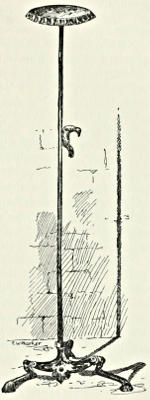
Roman Candelabrum
This motive of enmity must have inflamed the
subjects of contention which perpetually arise on the
confines of warlike and independent nations. The
Vandal princes were stimulated by fear and revenge;
the Gothic kings aspired to extend their dominion
from the Euxine to the frontiers of Germany; and the
waters of the Marus, a small river which falls into
the Theiss, were stained with the blood of the contending
barbarians. After some experience of the
superior strength and number of their adversaries,
the Sarmatians implored the protection of the Roman
monarch, who beheld with pleasure the discord of the
nations but who was justly alarmed by the progress
of the Gothic arms. As soon as Constantine had
declared himself in favour of the weaker party, the
haughty Araric, king of the Goths, instead of expecting
the attack of the legions, boldly passed the
Danube, and spread terror and devastation through
the province of Mœsia. To oppose the inroad of this
destroying host, the aged emperor took the field in
person; but on this occasion either his conduct or
his fortune betrayed the glory which he had acquired
in so many foreign and domestic wars. He had the
mortification of seeing his troops fly before an inconsiderable
detachment of the barbarians, who pursued
them to the edge of their fortified camp and obliged
him to consult his safety by a precipitate and ignominious
retreat. The event of a second and more successful action retrieved
the honour of the Roman name; and the powers of art and discipline prevailed,
after an obstinate contest, over the efforts of irregular valour. The
broken army of the Goths abandoned the field of battle, the wasted province,
and the passage of the Danube; and although the eldest of the sons of Constantine
was permitted to supply the place of his father, the merit of the
victory, which diffused universal joy, was ascribed to the auspicious counsels
of the emperor himself.
He contributed at least to improve this advantage by his negotiations
with the free and warlike people of Chersonesus, whose capital, situated on
the western coast of the Tauric or Crimæan peninsula, still retained some
vestiges of a Grecian colony, and was governed by a perpetual magistrate,
assisted by a council of senators, emphatically styled the fathers of the city.
The Chersonites were animated against the Goths by the memory of the wars
which, in the preceding century, they had maintained with unequal forces
against the invaders of their country. They were connected with the Romans
by the mutual benefits of commerce, as they were supplied from the provinces
of Asia with corn and manufactures, which they purchased with their own
productions, salt, wax, and hides. Obedient to the requisition of Constantine,
they prepared, under the conduct of their magistrate Diogenes, a considerable
army, of which the principal strength consisted in crossbows and military
chariots. The speedy march and intrepid attack of the Chersonites, by
diverting the attention of the Goths, assisted the operations of the imperial
generals.
The Goths, vanquished on every side, were driven into the mountains,
where in the course of a severe campaign about a hundred thousand
were computed to have perished by cold and hunger. Peace was at length
granted to their humble supplications; the eldest son of Araric was accepted
as the most valuable hostage; and Constantine endeavoured to convince
their chiefs, by a liberal distribution of honours and rewards, how far the
friendship of the Romans was preferable to their enmity. In the expressions
of his gratitude towards the faithful Chersonites, the emperor was still more
magnificent. The pride of the nation was gratified by the splendid and
almost royal decorations bestowed on their magistrate and his successors. A
perpetual exemption from all duties was stipulated for their vessels which
traded to the ports of the Black Sea. A regular subsidy was promised
of iron, corn, oil, and every supply which could be useful either in peace or
war. But it was thought that the Sarmatians were sufficiently rewarded by
their deliverance from impending ruin; and the emperor, perhaps with too
strict an economy, deducted some part of the expenses of the war from the
customary gratifications which were allowed to that turbulent nation.
Exasperated by this apparent neglect the Sarmatians soon forgot, with the
levity of barbarians, the services which they had so lately received, and the
dangers which still threatened their safety. Their inroads on the territory of
the empire provoked the indignation of Constantine to leave them to their fate,
and he no longer opposed the ambition of Geberic, a renowned warrior, who
had recently ascended the Gothic throne. Wisumar, the Vandal king, whilst
alone and unassisted he defended his dominions with undaunted courage,
was vanquished and slain in a decisive battle, which swept away the flower
of the Sarmatian youth. The remainder of the nation embraced the desperate
expedient of arming their slaves, a hardy race of hunters and herdsmen, by
whose tumultuary aid they revenged their defeat and expelled the invader
from their confines. But they soon discovered that they had exchanged a
foreign for a domestic enemy, more dangerous and more implacable. Enraged
by their former servitude, elated by their present glory, the slaves,
under the name of Limigantes, claimed and usurped the possession of the
country which they had saved. Their masters, unable to withstand the ungoverned
fury of the populace, preferred the hardships of exile to the tyranny
of their servants. Some of the fugitive Sarmatians solicited a less ignominious
dependence under the hostile standard of the Goths. A more
numerous band retired beyond the Carpathian Mountains, among the Quadi,
their German allies, and were easily admitted to share a superfluous waste
of uncultivated land. But the far greater part of the distressed nation
turned their eyes towards the fruitful provinces of Rome. Imploring the
protection and forgiveness of the emperor, they solemnly promised, as subjects
in peace and as soldiers in war, the most inviolable fidelity to the empire
which should graciously receive them into its bosom. According to the
maxims adopted by Probus and his successors, the offers of this barbarian
colony were eagerly accepted; and a competent portion of lands in the
provinces of Pannonia, Thrace, Macedonia, and Italy were immediately
assigned for the habitation and subsistence of three hundred thousand
Sarmatians.
[337 A.D.]
By chastising the pride of the Goths, and by accepting the homage of a
suppliant nation, Constantine asserted the majesty of the Roman Empire; and
the ambassadors of Ethiopia, Persia, and the most remote countries of India
congratulated the peace and prosperity of his government. If he reckoned
among the favours of fortune the death of his eldest son, of his nephew, and
perhaps of his wife, he enjoyed an uninterrupted flow of private as well as
public felicity, till the thirtieth year of his reign; a period which none of
his predecessors, since Augustus, had been permitted to celebrate. Constantine
survived that solemn festival about ten months; and, at the mature
age of sixty-four, after a short illness, he ended his memorable life at the
palace of Aquyrion, in the suburbs of Nicomedia, whither he had retired for
the benefit of the air and with the hope of recruiting his exhausted strength
by the use of the warm baths. The excessive demonstrations of grief, or at
least of mourning, surpassed whatever had been practised on any former
occasion. Notwithstanding the claims of the senate and people of ancient
Rome, the corpse of the deceased emperor, according to his last request, was
transported to the city which was destined to preserve the name and memory
of its founder. The body of Constantine, adorned with the vain symbols
of greatness, the purple and diadem, was deposited on a golden bed in
one of the apartments of the palace, which for that purpose had been splendidly
furnished and illuminated. The forms of the court were strictly
maintained. Every day, at the appointed hours, the principal officers of
the state, the army, and the household, approaching the person of their sovereign
with bended knees and a composed countenance, offered their respectful
homage as seriously as if he had been still alive. From motives of policy
this theatrical representation was for some time continued; nor could flattery
neglect the opportunity of remarking that Constantine alone, by the peculiar
indulgence of heaven, had reigned after his death.c
[337-338 A.D.]
The voice of the dying emperor had recommended the care of his funeral
to the piety of Constantius; and that prince, by the vicinity of his eastern
station, could easily prevent the diligence of his brothers, who resided in
their distant governments of Italy and Gaul. As soon as he had taken possession
of the palace of Constantinople, his first care was to remove the apprehensions
of his kinsmen by a solemn oath which he pledged for their security.
His next employment was to find some specious pretence which might release
his conscience from the obligation of an imprudent promise. The arts of fraud
were made subservient to the designs of cruelty, and a manifest forgery was
attested by a person of the most sacred character. From the hands of the
bishop of Nicomedia Constantius received a fatal scroll, affirmed to be the
genuine testament of his father; in which the emperor expressed his suspicions
that he had been poisoned by his brothers, and conjured his sons to
revenge his death, and to consult their own safety, by the punishment of the
guilty. Whatever reasons might have been alleged by these unfortunate
princes to defend their life and honour against so incredible an accusation,
they were silenced by the furious clamours of the soldiers, who declared
themselves at once their enemies, their judges, and their executioners. The
spirit and even the forms of legal proceedings were repeatedly violated in a
promiscuous massacre, which involved the two uncles of Constantius, seven of
his cousins, of whom Dalmatius and Hannibalianus were the most illustrious,
the patrician Optatus, who had married a sister of the late emperor, and the
prefect Ablavius, whose power and riches had inspired him with some hopes
of obtaining the purple. If it were necessary to aggravate the horrors of
this bloody scene, we might add that Constantius himself had espoused the
daughter of his uncle Julius, and that he had bestowed his sister in marriage
on his cousin Hannibalianus. Of so numerous a family, Gallus and Julian
alone, the two youngest children of Julius Constantius, were saved from
the hands of the assassins, till their rage, satiated with slaughter, had in
some measure subsided.
The massacre of the Flavian race was succeeded by a new division of the
provinces; which was ratified in a personal interview of the three brothers.
Constantine, the eldest of the cæsars, obtained, with a certain pre-eminence
of rank, the possession of the new capital, which bore his own name and that
of his father. Thrace and the countries of the East were allotted for the
patrimony of Constantius; and Constans was acknowledged as the lawful
sovereign of Italy, Africa, and the western Illyricum. The armies submitted
to their hereditary right, and they condescended, after some delay, to accept
from the Roman senate the title of Augustus. When they first assumed the
reins of government, the eldest of these princes was twenty-one, the second
twenty, and the third only seventeen years of age.
[338-350 A.D.]
While the martial nations of Europe followed the standards of his brothers,
Constantius, at the head of the effeminate troops of Asia, was left to sustain
the weight of the Persian War. At the decease of Constantine, the throne
of the East was filled by Sapor, son of Hormuz or Hormisdas, and grandson
of Narses, who, after the victory of Galerius, had humbly confessed the superiority
of the Roman power. Although Sapor was in the thirtieth year of
his long reign, he was still in the vigour of youth, as the date of his accession,
by a very strange fatality, had preceded that of his birth. The wife of
Hormuz remained pregnant at the time of her husband’s death; and the
uncertainty of the sex, as well as of the event, excited the ambitious hopes
of the princes of the house of Sassan. The apprehensions of civil war were
at length removed by the positive assurance of the magi that the widow of
Hormuz had conceived and would safely produce a son. Obedient to the
voice of superstition, the Persians prepared, without delay, the ceremony of
his coronation. A royal bed, on which the queen lay in state, was exhibited
in the midst of the palace; the diadem was placed on the spot which might
be supposed to conceal the future heir of Artaxerxes, and the prostrate satraps
adored the majesty of their invisible and insensible sovereign.
If any credit can be given to this marvellous tale, which seems however
to be countenanced by the manners of the people and by the extraordinary
duration of his reign, we must admire not only the fortune but the genius of
Sapor. In the soft sequestrated education of a Persian harem, the royal youth
could discover the importance of exercising the vigour of his mind and body;
and by his personal merit deserved a throne, on which he had been seated
while he was yet unconscious of the duties and temptations of absolute
power. His minority was exposed to the almost inevitable calamities of
domestic discord; his capital was surprised and plundered by Thair, a powerful
king of Yemen, or Arabia; and the majesty of the royal family was degraded
by the captivity of a princess, the sister of the deceased king. But
as soon as Sapor attained the age of manhood, the presumptuous Thair, his
nation, and his country fell beneath the first effort of the young warrior, who
used his victory with so judicious a mixture of rigour and clemency that he
obtained from the fears and gratitude of the Arabs the title of dhoulacnaf, or
protector of the nation.
The ambition of the Persian, to whom his enemies ascribe the virtues of
a soldier and a statesman, was animated by the desire of revenging the disgrace
of his fathers and of wresting from the hands of the Romans the five
provinces beyond the Tigris. The military fame of Constantine and the
real or apparent strength of his government suspended the attack; and
while the hostile conduct of Sapor provoked the resentment his artful negotiations
amused the patience of the imperial court. The death of Constantine
was the signal of war, and the actual condition of the Syrian and
Armenian frontier seemed to encourage the Persians by the prospect of a
rich spoil and an easy conquest. The example of the massacres of the
palace diffused a spirit of licentiousness and sedition among the troops of
the East, who were no longer restrained by the habits of obedience to a
veteran commander. By the prudence of Constantius, who from the interview
with his brothers in Pannonia immediately hastened to the banks of
the Euphrates, the legions were gradually restored to a sense of duty; but
the season of anarchy had permitted Sapor to form the siege of Nisibis, and
to occupy several of the most important fortresses of Mesopotamia.
During the long period of the reign of Constantius, the provinces of the
East were afflicted by the calamities of the Persian War. The irregular
incursions of the light troops alternately spread terror and devastation
beyond the Tigris and beyond the Euphrates, from the gates of Ctesiphon
to those of Antioch; and this active service was performed by the Arabs of
the desert, who were divided in their interests and affections, some of their
independent chiefs being enlisted in the party of Sapor, whilst others had
engaged their doubtful fidelity to the emperor. The more grave and important
operations of the war were conducted with equal vigour, and the armies
of Rome and Persia encountered each other in nine bloody fields, in two of
which Constantius himself commanded in person. The event of the day
was most commonly averse to the Romans, but in the battle of Singara their
imprudent valour had almost achieved a signal and decisive victory. The
stationary troops of Singara retired on the approach of Sapor, who passed
the Tigris over three bridges and occupied near the village of Hilleh an
advantageous camp, which, by the labour of his numerous pioneers, he surrounded
in one day with a deep ditch and a lofty rampart. His formidable
host, when it was drawn out in order of battle, covered the banks of the river,
the adjacent heights, and the whole extent of a plain of above twelve miles
which separated the two armies.
Both were alike impatient for a trial of strength; but the barbarians,
after a slight resistance, fled in disorder, unable to resist or desirous to
weary the strength of the heavy legions, who, fainting with heat and thirst,
pursued them across the plain and cut in pieces a line of cavalry clothed
in complete armour which had been posted before the gates of the camp
to protect their retreat (348).
Constantius, hurried along in the pursuit, attempted, without effect, to
restrain the ardour of his troops by representing to them the dangers of the
approaching night and the certainty of completing their success with the return
of day. They, depending much more on their own valour than on the
experience or the abilities of their chief, silenced by their clamours his timid
remonstrances; and rushing with fury to the charge, filled up the ditch, broke
down the rampart, and dispersed themselves through the tents to recruit their
exhausted strength and to enjoy the rich harvest of their labours. But the
prudent Sapor had watched the moment of victory. His army, of which
the greater part securely posted on the heights had been spectators of the
action, advanced in silence and under the shadow of the night; and his Persian
archers, guided by the illumination of the camp, poured a shower of
arrows on the disarmed and licentious crowd. The sincerity of history declares
that the Romans were vanquished with a dreadful slaughter, and that
the flying remnant of the legions was exposed to the most intolerable
hardships.
Whatever advantages might attend the arms of Sapor in the field, though
nine repeated victories diffused among the nations the fame of his valour and
conduct, he could not hope to succeed in the execution of his designs while
the fortified towns of Mesopotamia, and above all the strong and ancient
city of Nisibis, remained in the possession of the Romans. This large city
was situated about two days’ journey from the Tigris, in the midst of a fertile
plain at the foot of Mt. Masius. In the space of twelve years, Nisibis, which
since the time of Lucullus had been deservedly esteemed the bulwark of the
East, sustained three memorable sieges against the power of Sapor; and the
disappointed monarch, after urging his attacks above sixty, eighty, and a
hundred days, was thrice repulsed with loss and ignominy.
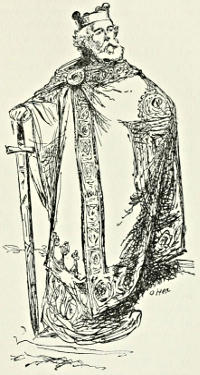
A Roman Emperor
After the partition of the empire, three years had scarcely elapsed before
the sons of Constantine seemed impatient to convince mankind that they
were incapable of contenting themselves with the dominions which they were
unqualified to govern. The eldest of those princes soon complained that he
was defrauded of his just proportion of the spoils of their murdered kinsmen;
and though he might yield to the superior guilt and merit of Constantius,
he exacted from Constans the cession of the African provinces, as
an equivalent for the rich countries of Macedonia
and Greece, which his brother had
acquired by the death of Dalmatius. The
want of sincerity which Constantine experienced
in a tedious and fruitless negotiation
exasperated the fierceness of his temper;
and he eagerly listened to those favourites
who suggested to him that his honour, as
well as his interest, was concerned in the
prosecution of the quarrel. At the head of
a tumultuary band, suited for rapine rather
than for conquest, he suddenly broke into
the dominions of Constans, by way of the
Julian Alps, and the country round Aquileia
felt the first effects of his resentment.
The measures of Constans, who then resided
in Dacia, were directed with more
prudence and ability. On the news of his
brother’s invasion, he detached a select and
disciplined body of his Illyrian troops, proposing
to follow them in person with the
remainder of his forces. But the conduct
of his lieutenants soon terminated the unnatural
contest. By the artful appearances
of flight Constantine was betrayed into an
ambuscade, which had been concealed in a
wood, where the rash youth, with a few
attendants, was surprised, surrounded,
and slain. His body, after it had been
found in the obscure stream of the Alsa,
obtained the honours of an imperial sepulchre; but his provinces transferred
their allegiance to the conqueror, who, refusing to admit his elder brother
Constantius to any share in these new acquisitions, maintained the undisputed
possession of more than two-thirds of the Roman Empire (340).
[350-351 A.D.]
The fate of Constans himself was delayed about ten years longer, and
the revenge of his brother’s death was reserved for the more ignoble hand of
a domestic traitor. The pernicious tendency of the system introduced by
Constantine was displayed in the feeble administration of his sons, who,
by their vices and weakness, soon lost the esteem and affections of their
people. The pride assumed by Constans, from the unmerited success of his
arms, was rendered more contemptible by his want of abilities and application.
His fond partiality towards some German captives, distinguished
only by the charms of youth, was an object of scandal to the people; and
Magnentius, an ambitious soldier, who was himself of barbarian extraction,
was encouraged by the public discontent to assert the honour of the Roman
name. The chosen bands of Jovians and Herculians, who acknowledged
Magnentius as their leader, maintained the most respectable and important
station in the imperial camp. The friendship of Marcellinus, count of the
sacred largesses, supplied with a liberal hand the means of seduction. The
soldiers were convinced by the most specious arguments, that the republic
summoned them to break the bonds of hereditary servitude; and by the
choice of an active and vigilant prince, to reward the same virtues which
had raised the ancestors of the degenerate Constans from a private condition
to the throne of the world.
As soon as the conspiracy was in readiness for execution, Marcellinus,
under the pretence of celebrating his son’s birthday, gave a splendid entertainment
to the illustrious and honourable persons of the court of Gaul,
which then resided in the city of Augustodunum. The intemperance of the
feast was protracted till a very late hour of the night; and the unsuspecting
guests were tempted to indulge themselves in a dangerous and guilty freedom
of conversation. On a sudden the doors were thrown open, and Magnentius,
who had retired for a few moments, returned into the apartment
invested with the diadem and purple. The conspirators instantly saluted
him with the titles of Augustus and emperor. The surprise, the terror, the
intoxication, the ambitious hopes, and the mutual ignorance of the rest of
the assembly, prompted them to join their voices to the general acclamation.
The guards hastened to take the oath of fidelity, the gates of the town were
shut, and before the dawn of day, Magnentius became master of the troops
and treasure of the city of Augustodunum. By his secrecy and diligence he
entertained some hopes of surprising the person of Constans, who was pursuing
in the adjacent forest his favourite amusement of hunting, or perhaps
some pleasures of a more private and criminal nature. The rapid progress
of fame allowed him, however, an instant for flight, though the desertion of
his soldiers and subjects deprived him of the power of resistance. Before
he could reach a seaport in Spain, where he intended to embark, he was
overtaken near Helena, at the foot of the Pyrenees, by a party of light cavalry,
whose chief, regardless of the sanctity of a temple, executed his commission
by the murder of the son of Constantine (350).
As soon as the death of Constans had decided this easy but important
revolution, the example of the court of Autun was imitated by the provinces
of the West. The authority of Magnentius was acknowledged through the
whole extent of the two great prefectures of Gaul and Italy; and the usurper
prepared, by every act of oppression, to collect a treasure, which might discharge
the obligation of an immense donative, and supply the expenses of a
civil war.
[351-352 A.D.]
The intelligence of these important events, which so deeply affected the
honour and safety of the imperial house, recalled the arms of Constantius
from the inglorious prosecution of the Persian War. He recommended the
care of the East to his lieutenants, and afterwards to his cousin Gallus, whom
he raised from a prison to a throne; and marched towards Europe, with a
mind agitated by the conflict of hope and fear, of grief and indignation.
The city of Mursa, or Essek, celebrated in modern times for a bridge of
boats five miles in length over the river Drave and the adjacent morasses,
has been always considered as a place of importance in the wars of Hungary.
Magnentius, directing his march towards Mursa, set fire to the gates, and by
a sudden assault had almost scaled the walls of the town. The vigilance of
the garrison extinguished the flames, the approach of Constantius left him
no time to continue the operations of the siege, and the emperor soon removed
the only obstacle that could embarrass his motions by forcing a body of
troops which had taken post in an adjoining amphitheatre. The field of
battle round Mursa was a naked and level plain; on this ground the army
of Constantius formed, with the Drave on their right, while their left, either
from the nature of their disposition or from the superiority of their cavalry,
extended far beyond the right flank of Magnentius. The troops on both
sides remained under arms in anxious expectation during the greater part
of the morning; and the son of Constantine, after animating his soldiers by
an eloquent speech, retired into a church at some distance from the field of
battle and committed to his generals the conduct of this decisive day. They
deserved his confidence by the valour and military skill which they exerted.
They wisely began the action upon the left; and, advancing their whole
wing of cavalry in an oblique line, they suddenly wheeled it on the right
flank of the enemy, which was unprepared to resist the impetuosity of their
charge. But the Romans of the West soon rallied by the habits of discipline,
and the barbarians of Germany supported the renown of their national
bravery. The engagement soon became general, was maintained with various
and singular turns of fortune, and scarcely ended with the darkness
of the night. The signal victory which Constantius obtained is attributed to
the arms of his cavalry.
His cuirassiers are described as so many massy statues of steel, glittering
with their scaly armour, and breaking with their ponderous lances the firm
array of the Gallic legions. As soon as the legions gave way, the lighter
and more active squadrons of the second line rode sword in hand into the
intervals, and completed the disorder. In the meanwhile the huge bodies
of the Germans were exposed, almost naked, to the dexterity of the oriental
archers; and whole troops of those barbarians were urged by anguish and
despair to precipitate themselves into the broad and rapid stream of the
Drave. The number of the slain was computed at fifty-four thousand men
and the slaughter of the conquerors was more considerable than that of the
vanquished, a circumstance which proves the obstinacy of the contest, and
justifies the observation of an ancient writer, that the forces of the empire
were consumed in the fatal battle of Mursa by the loss of a veteran army
sufficient to defend the frontiers or to add new triumphs to the glory of
Rome. Notwithstanding the invectives of a servile orator, there is not the
least reason to believe that the tyrant deserted his own standard in the beginning
of the engagement. He seems to have displayed the virtues of a
general and of a soldier till the day was irrecoverably lost and his camp in
the possession of the enemy. Magnentius then consulted his safety, and,
throwing away the imperial ornaments, escaped with some difficulty from
the pursuit of the light horse, who incessantly followed his rapid flight
from the banks of the Drave to the foot of the Julian Alps.
The detachments, however, which were ordered either to press or to
intercept the flight of Magnentius, conducted themselves with the usual
imprudence of success; and allowed him, in the plains of Ticinium, an
opportunity of turning on his pursuers, and of gratifying his despair, by
the carnage of a useless victory.
The pride of Magnentius was reduced by repeated misfortunes to sue,
and to sue in vain, for peace. He first despatched a senator, in whose
abilities he confided, and afterwards several bishops, whose holy character
might obtain a more favourable audience, with the offer of resigning the
purple, and the promise of devoting the remainder of his life to the service
of the emperor. But Constantius, though he granted fair terms of pardon
and reconciliation to all who abandoned the standard of rebellion, avowed
his inflexible resolution to inflict a just punishment on the crimes of an
assassin, whom he prepared to overwhelm on every side by the effort of his
victorious arms. An imperial fleet acquired the easy possession of Africa
and Spain, confirmed the wavering faith of the Moorish nations, and landed
a considerable force, which passed the Pyrenees, and advanced towards
Lyons, the last and fatal station of Magnentius. The temper of the
tyrant, which was never inclined to clemency, was urged by distress to
exercise every act of oppression which could extort an immediate supply
from the cities of Gaul. Their patience was at length exhausted; and
Trèves, the seat of prætorian government, gave the signal of revolt, by
shutting her gates against Decentius, who had been raised by his brother
to the rank either of cæsar or of augustus. From Trèves, Decentius was
obliged to retire to Sens, where he was soon surrounded by an army of
Germans, whom the pernicious arts of Constantius had introduced into the
civil dissensions of Rome. In the meantime, the imperial troops forced
the passages of the Cottian Alps, and in the bloody combat of Mount Seleucus,
irrevocably fixed the title of rebels on the party of Magnentius.
He was unable to bring another army in the field, the fidelity of his
guards was corrupted, and when he appeared in public to animate them by
his exhortations, he was saluted with the unanimous shout of “Long live
the emperor Constantius!” The tyrant, who perceived that they were preparing
to deserve pardon and rewards by the sacrifice of the most obnoxious
criminal, prevented their design by falling on his sword—a death more easy
and more honourable than he could hope to obtain from the hands of an
enemy, whose revenge would have been coloured with the specious pretence
of justice and fraternal piety. The example of suicide was imitated by
Decentius, who strangled himself on the news of his brother’s death. The
author of the conspiracy, Marcellinus, had long since disappeared in the
battle of Mursa, and the public tranquillity was confirmed by the execution
of the surviving leaders of a guilty and unsuccessful faction.
A severe inquisition was extended over all who, either from choice or
from compulsion, had been involved in the cause of rebellion. Paul, surnamed
Catena, from his superior skill in the judicial exercise of tyranny,
was sent to explore the latent remains of the conspiracy in the remote province
of Britain. The honest indignation expressed by Martin, vice-prefect
of the island, was interpreted as an evidence of his own guilt; and the governor
was urged to the necessity of turning against his breast the sword
with which he had been provoked to wound the imperial minister. The
most innocent subjects of the West were exposed to exile and confiscation,
to death and torture; and, as the timid are always cruel, the mind of Constantius
was inaccessible to mercy.
[337-353 A.D.]
The divided provinces of the empire were again united by the victory of
Constantius; but as that feeble prince was destitute of personal merit, either
in peace or war; as he feared his generals, and distrusted his ministers; the
triumph of his arms served only to establish the reign of the eunuchs over
the Roman world. Those unhappy beings, the ancient production of oriental
jealousy and despotism, were introduced into Greece and Rome by the contagion
of Asiatic luxury. Their progress was rapid; and the eunuchs, who,
in the time of Augustus, had been abhorred, as the monstrous retinue of an
Egyptian queen, were gradually admitted into the families of matrons, of
senators, and of the emperors themselves. Restrained by the severe edicts
of Domitian and Nerva, cherished by the pride of Diocletian, reduced to an
humble station by the prudence of Constantine, they multiplied in the palaces
of his degenerate sons, and insensibly acquired the knowledge, and at length
the direction, of the secret councils of Constantius.
The aversion and contempt which mankind has so uniformly entertained
for that imperfect species appears to have degraded their character, and to
have rendered them almost as incapable as they were supposed to be, of conceiving
any generous sentiment or of performing any worthy action. But
the eunuchs were skilled in the arts of flattery and intrigue; and they alternately
governed the mind of Constantius by his fears, his indolence, and his
vanity. Whilst he viewed in a deceitful mirror the fair appearance of public
prosperity, he supinely permitted them to intercept the complaints of the
injured provinces, to accumulate immense treasures by the sale of justice and
of honours; to disgrace the most important dignities, by the promotion of
those who had purchased at their hands the power of oppression, and to gratify
their resentment against the few independent spirits who arrogantly
refused to solicit the protection of slaves. Of these slaves the most distinguished
was the chamberlain Eusebius, who ruled the monarch and the
palace with such absolute sway, that Constantius, according to the sarcasm of
an impartial historian, possessed some credit with his haughty favourite. By
his artful suggestions, the emperor was persuaded to subscribe the condemnation
of the unfortunate Gallus, and to add a new crime to the long list of
unnatural murders which pollute the honour of the house of Constantine.
When the two nephews of Constantine, Gallus and Julian, were saved
from the fury of the soldiers, the former was about twelve, and the latter
about six years of age; and as the eldest was thought to be of a sickly constitution,
they obtained with the less difficulty a precarious and dependent
life from the affected pity of Constantius, who was sensible that the execution
of these helpless orphans would have been esteemed, by all mankind, an
act of the most deliberate cruelty. Different cities of Ionia and Bithynia
were assigned for the places of their exile and education; but as soon as
their growing years excited the jealousy of the emperor, he judged it more
prudent to secure those unhappy youths in the strong castle of Macellum,
near Cæsarea.
The treatment which they experienced during a six years’ confinement
was partly such as they could hope from a careful guardian, and partly
such as they might dread from a suspicious tyrant. Their prison was an
ancient palace, the residence of the kings of Cappadocia; the situation was
pleasant, the building stately, the enclosure spacious. They pursued their
studies and practised their exercises under the tuition of the most skilful
masters, and the numerous household appointed to attend, or rather to guard,
the nephews of Constantine was not unworthy the dignity of their birth.
But they could not disguise to themselves that they were deprived of fortune,
of freedom, and of safety; secluded from the society of all whom they could
trust or esteem, and condemned to pass their melancholy hours in the company
of slaves, devoted to the commands of a tyrant, who had already injured
them beyond the hope of reconciliation. At length, however, the emergencies
of the state compelled the emperor, or rather his eunuchs, to invest
Gallus, in the twenty-fifth year of his age, with the title of Cæsar, and to
cement this political connection by his marriage with the princess Constantina.
After a formal interview, in which the two princes mutually engaged
their faith never to undertake anything to the prejudice of each other, they
repaired without delay to their respective stations. Constantius continued
his march towards the west, and Gallus fixed his residence at Antioch, from
whence, with a delegated authority, he administered the five great dioceses
of the eastern prefecture. In this fortunate change the new cæsar was not
unmindful of his brother Julian, who obtained the honours of his rank, the
appearances of liberty, and the restitution of an ample patrimony.
The writers the most indulgent to the memory of Gallus, and even Julian
himself, though he wished to cast a veil over the frailties of his brother, are
obliged to confess that the cæsar was incapable of reigning. Transported
from a prison to a throne, he possessed neither genius, nor application, nor
docility, to compensate for the want of knowledge and experience. A temper
naturally morose and violent, instead of being corrected, was soured by
solitude and adversity; the remembrance of what he had endured disposed
him to retaliation rather than to sympathy; and the ungoverned sallies of
his rage were often fatal to those who approached his person, or were subject
to his power.
Constantina, his wife, has been described, not as a woman, but as one
of the infernal furies, tormented with an insatiate thirst for human blood.
Instead of employing her influence to insinuate the mild counsels of prudence
and humanity, she exasperated the fierce passions of her husband;
and as she retained the vanity, though she had renounced the gentleness, of
her sex, a pearl necklace was esteemed an equivalent price for the murder of
an innocent and virtuous nobleman.[59] The cruelty of Gallus was sometimes
displayed in the undissembled violence of popular or military executions; and
was sometimes disguised by the abuse of law, and the forms of judicial proceedings.
The private houses of Antioch, and the places of public resort,
were besieged by spies and informers; and the cæsar himself, concealed in
a plebeian habit, very frequently condescended to assume that odious character.
Every apartment of the palace was adorned with the instruments of
death and torture, and a general consternation was diffused through the
capital of Syria. The prince of the East, as if he had been conscious how
much he had to fear, and how little he deserved to reign, selected for the
objects of his resentment, the provincials accused of some imaginary treason,
and his own courtiers, whom with more reason he suspected of incensing, by
their secret correspondence, the timid and suspicious mind of Constantius.
But he forgot that he was depriving himself of his only support, the affection
of the people; whilst he furnished the malice of his enemies with the arms
of truth, and afforded the emperor the fairest pretence of exacting the forfeit
of his purple, and of his life.
As long as the civil war suspended the fate of the Roman world, Constantius
dissembled his knowledge of the weak and cruel administration to which his
choice had subjected the East; and the discovery of some assassins secretly despatched
to Antioch by the tyrant of Gaul, was employed to convince the public
that the emperor and the cæsar were united by the same interest and pursued
by the same enemies. But when the victory was decided in favour of Constantius,
his dependent colleague became less useful and less formidable. Every
circumstance of his conduct was severely and suspiciously examined; and
it was privately resolved, either to deprive Gallus of the purple, or at least
to remove him from the indolent luxury of Asia to the hardships and dangers
of a German war. The death of Theophilus, consular of the province
of Syria, who in a time of scarcity had been massacred by the people of
Antioch, with the connivance, and almost at the instigation, of Gallus, was
justly resented, not only as an act of wanton cruelty, but as a dangerous
insult on the supreme majesty of Constantius. Two ministers of illustrious
rank, Domitian, the oriental prefect, and Montius, quæstor of the palace,
were empowered by a special commission to visit and reform the state of the
East. They were instructed to behave towards Gallus with moderation and
respect, and, by the gentlest arts of persuasion, to engage him to comply
with the invitation of his brother and colleague. The rashness of the prefect
disappointed these prudent
measures, and hastened
his own ruin, as well as that
of his enemy.

Roman Knives
(In the British Museum)
On his arrival at Antioch,
Domitian passed disdainfully
before the gates of
the palace, and alleging a
slight pretence of indisposition,
continued several days
in sullen retirement to prepare
an inflammatory memorial
which he transmitted to
the imperial court. Yielding
at length to the pressing
solicitations of Gallus, the prefect condescended to take his seat in council,
but his first step was to signify a concise and haughty mandate, importing that
the cæsar should immediately repair to Italy, and threatening that he himself
would punish his delay or hesitation by suspending the usual allowance
of his household. The nephew and daughter of Constantine, who could ill
brook the insolence of a subject, expressed their resentment by instantly
delivering Domitian to the custody of a guard. The quarrel still admitted
of some terms of accommodation. They were rendered impracticable by the
imprudent behaviour of Montius, a statesman, whose art and experience were
frequently betrayed by the levity of his disposition. The quæstor reproached
Gallus in haughty language, that a prince who was scarcely authorised to
remove a municipal magistrate should presume to imprison a prætorian prefect;
convoked a meeting of the civil and military officers; and required
them, in the name of their sovereign, to defend the person and dignity of his
representatives.
By this rash declaration of war, Gallus was provoked to embrace the
most desperate councils. He ordered his guards to stand to their arms,
assembled the populace of Antioch, and recommended to their zeal the care
of his safety and revenge. His commands were too fatally obeyed. They
rudely seized the prefect and the quæstor, and tying their legs together with
ropes, they dragged them through the streets of the city, inflicted a thousand
insults and a thousand wounds on these unhappy victims, and at last precipitated
their mangled and lifeless bodies into the stream of the Orontes.
[354 A.D.]
After such a deed, whatever might have been the designs of Gallus, it
was only in a field of battle that he could assert his innocence with any hope
of success. But the mind of that prince was formed of an equal mixture of
violence and weakness. Instead of assuming the title of Augustus, instead
of employing in his defence the troops and treasures of the East, he suffered
himself to be deceived by the affected tranquillity of Constantius, who, leaving
him the vain pageantry of a court, imperceptibly recalled the veteran
legions from the provinces of Asia. But as it still appeared dangerous to
arrest Gallus in his capital, the slow and safer arts of dissimulation were
practised with success. The frequent and pressing epistles of Constantius
were filled with professions of confidence and friendship; exhorting the cæsar
to discharge the duties of his high station, to relieve his colleague from a
part of the public cares, and to assist the West by his presence, his counsels,
and his arms. After so many reciprocal injuries, Gallus had reason to
fear and to distrust. But he had neglected the opportunities of flight and of
resistance; he was seduced by the flattering assurances of the tribune Scudilo,
who, under the semblance of a rough soldier, disguised the most artful
insinuation; and he depended on the credit of his wife Constantina, till the
unseasonable death of that princess completed the ruin in which he had been
involved by her impetuous passions.
After a long delay, the reluctant cæsar set forward on his journey to the
imperial court. From Antioch to Hadrianopolis, he traversed the wide extent
of his dominions with a numerous and stately train; and as he laboured to
conceal his apprehension from the world, and perhaps from himself, he entertained
the people of Constantinople with an exhibition of the games of the
circus. The progress of the journey might, however, have warned him of
the impending danger. In all the principal cities he was met by ministers
of confidence, commissioned to seize the offices of government, to observe his
motions, and to prevent the hasty sallies of his despair. The persons despatched
to secure the provinces which he left behind, passed him with cold
salutations, or affected disdain; and the troops, whose station lay along the
public road, were studiously removed on his approach, lest they might be
tempted to offer their swords for the service of a civil war. After Gallus had
been permitted to repose himself a few days at Hadrianopolis, he received a
mandate, expressed in the most haughty and absolute style, that his splendid
retinue should halt in that city, while the cæsar himself, with only ten post-carriages,
should hasten to the imperial residence at Mediolanum. In this
rapid journey, the profound respect which was due to the brother and colleague
of Constantius, was insensibly changed into rude familiarity; and Gallus,
discovering in the countenances of the attendants, that they already considered
themselves as his guards, and might soon be employed as his executioners,
began to accuse his fatal rashness, and to recollect with terror and
remorse the conduct by which he had provoked his fate. The dissimulation
which had hitherto been preserved, was laid aside at Petovio in Pannonia.
He was conducted to a palace in the suburbs, where the general Barbatio,
with a select band of soldiers, who could neither be moved by pity, nor corrupted
by rewards, expected the arrival of his illustrious victim.
In the evening he was arrested, ignominiously stripped of the ensigns
of cæsar, and hurried away to Pola in Istria, a sequestered prison which had
been so recently polluted with royal blood. The horror which he felt was
soon increased by the appearance of his implacable enemy the eunuch
Eusebius, who, with the assistance of a notary and a tribune, proceeded to
interrogate him concerning the administration of the East. The cæsar sank
under the weight of shame and guilt, confessed all the criminal actions, and
all the treasonable designs, with which he was charged; and by imputing
them to the advice of his wife, exasperated the indignation of Constantius,
who reviewed with partial prejudice the minutes of the examination.
The emperor was convinced that his own safety was incompatible with
the life of his cousin; the sentence of death was signed, despatched, and executed;
and the nephew of Constantine, with his hands tied behind his back,
was beheaded in prison like the vilest malefactor. Those who are inclined
to palliate the cruelties of Constantius, assert that he soon relented, and
endeavoured to recall the bloody mandate; but that the second messenger
intrusted with the reprieve was detained by the eunuchs, who dreaded the
unforgiving temper of Gallus, and were desirous of reuniting to their empire
the wealthy provinces of the East.
[354-356 A.D.]
Besides the reigning emperor, Julian alone survived, of all the numerous
posterity of Constantius Chlorus. The misfortune of his royal birth involved
him in the disgrace of Gallus. From his retirement in the happy
country of Ionia he was conveyed under a strong guard to the court of
Mediolanum, where he languished above seven months in continual apprehension
of suffering the same ignominious death, which was daily inflicted,
almost before his eyes, on the friends and adherents of his persecuted family.
His looks, his gestures, his silence, were scrutinised with malignant curiosity,
and he was perpetually assaulted by enemies whom he had never offended,
and by arts to which he was a stranger. But in the school of adversity,
Julian insensibly acquired the virtues of firmness and discretion. He defended
his honour, as well as his life, against the ensnaring subtleties of the
eunuchs, who endeavoured to extort some declaration of his sentiments; and
whilst he cautiously suppressed his grief and resentment, he nobly disdained
to flatter the tyrant, by any seeming approbation of his brother’s murder.
Julian most devoutly ascribes his miraculous deliverance to the protection
of the gods, who had exempted his innocence from the sentence of destruction
pronounced by their justice against the impious house of Constantine.
As the most effectual instrument of their providence, he gratefully acknowledges
the steady and generous friendship of the empress Eusebia, a woman
of beauty and merit, who, by the ascendant which she had gained over the
mind of her husband, counterbalanced in some measure the powerful conspiracy
of the eunuchs. By the intercession of his patroness, Julian was
admitted into the imperial presence; he pleaded his cause with a decent
freedom, he was heard with favour; and, notwithstanding the efforts of his
enemies, who urged the danger of sparing an avenger of the blood of Gallus,
the milder sentiment of Eusebia prevailed in the council. But the effects
of a second interview were dreaded by the eunuchs; and Julian was advised
to withdraw for a while into the neighbourhood of Mediolanum, till the
emperor thought proper to assign the city of Athens for the place of his
honourable exile.
Whilst his hours were passed in studious retirement, the empress, resolute
to achieve the generous design which she had undertaken, was not
unmindful of the care of his fortune. After an obstinate, though secret
struggle, the opposition of the favourite eunuchs submitted to the ascendency
of the empress; and it was resolved that Julian, after celebrating his
nuptials with Helena, sister of Constantius, should be appointed, with the
title of Cæsar, to reign over the countries beyond the Alps.
Although the order which recalled him to court was probably accompanied
by some intimation of his approaching greatness, he appeals to the
people of Athens to witness his tears of undissembled sorrow, when he was
reluctantly torn away from his beloved retirement.
The emperors of the age of Constantine no longer deigned to consult
with the senate in the choice of a colleague, but they were anxious that their
nomination should be ratified by the consent of the army. On this solemn
occasion, the guards, with the other troops whose stations were in the neighbourhood
of Mediolanum, appeared under arms; and Constantius ascended
his lofty tribunal, holding by the hand his cousin Julian, who entered the
same day on the twenty-fifth year of his age. In a studied speech, conceived
and delivered with dignity, the emperor represented the various dangers
which threatened the prosperity of the republic, the necessity of naming a
cæsar for the administration of the West, and his own intention, if it was
agreeable to their wishes, of rewarding with the honours of the purple the
promising virtues of the nephew of Constantine.
The two princes returned to the palace in the same chariot; and during
the slow procession, Julian repeated to himself a verse of his favourite
Homer, which he might equally apply to his fortune and to his fears. The
twenty-four days which the cæsar spent at Mediolanum after his investiture,
and the first months of his Gallic reign, were devoted to a splendid but
severe captivity; nor could the acquisition of honour compensate for the
loss of freedom.
The protection of the Rhætian frontier, and the persecution of the western
church, detained Constantius in Italy above eighteen months after the
departure of Julian. Before the emperor returned into the East, he indulged
his pride and curiosity in a visit to the ancient capital.
The satisfaction which Constantius had received from this journey excited
him to the generous emulation of bestowing on the Romans some memorial of
his own gratitude and munificence. His first idea was to imitate the equestrian
and colossal statue which he had seen in the forum of Trajan; but when
he had maturely weighed the difficulties of the execution, he chose rather to
embellish the capital by the gift of an Egyptian obelisk.
The departure of Constantius from Rome was hastened by the alarming
intelligence of the distress and danger of the Illyrian provinces. The distractions
of civil war, and the irreparable loss which the Roman legions had
sustained in the battle of Mursa, exposed those countries, almost without
defence, to the light cavalry of the barbarians; and particularly to the inroads
of the Quadi, a fierce and powerful nation, who seem to have exchanged
the institutions of Germany for the arms and military arts of their Sarmatian
allies. The garrisons of the frontier were insufficient to check their progress;
and the indolent monarch was at length compelled to assemble, from
the extremities of his dominions, the flower of the Palatine troops, to take
the field in person, and to employ a whole campaign, with the preceding
autumn and the ensuing spring, in the serious prosecution of the war. The
emperor passed the Danube on a bridge of boats, cut in pieces all that
encountered his march, penetrated into the heart of the country of the Quadi,
and severely retaliated the calamities which they had inflicted on the Roman
province. The dismayed barbarians were soon reduced to sue for peace;
they offered the restitution of his captive subjects, as an atonement for the
past, and the noblest hostages as a pledge of their future conduct. While
Constantius gave laws to the barbarians beyond the Danube, he distinguished
with specious compassion the Sarmatian exiles, who had been expelled from
their native country by the rebellion of their slaves, and who formed a very
considerable accession to the power of the Quadi. The emperor, embracing
a generous but artful system of policy, released the Sarmatians from the
bands of this humiliating dependence, and restored them, by a separate
treaty, to the dignity of a nation united under the government of a king,
the friend and ally of the republic. He declared his resolution of asserting
the justice of their cause, and of securing the peace of the provinces by the
extirpation, or at least the banishment, of the Limigantes, whose manners
were still infected with the vices of their servile origin; and the final combat
was only terminated by the extinction of the name and nation of the
Limigantes. The free Sarmatians were reinstated in the possession of their
ancient seats; and although Constantius distrusted the levity of their character,
he entertained some hopes that a sense of gratitude might influence
their future conduct.
[355-356 A.D.]
While the Roman emperor and the Persian monarch, at the distance of
three thousand miles, defended their extreme limits against the barbarians
of the Danube and of the Oxus, their intermediate frontier experienced the
vicissitudes of a languid war, and a precarious truce. Two of the eastern
ministers of Constantius, the prætorian prefect Musonian, whose abilities
were disgraced by the want of truth and integrity, and Cassian, duke of
Mesopotamia, a hardy and veteran soldier, opened a secret negotiation with
the satrap Tamsapor. These overtures of peace, translated into the servile
and flattering language of Asia, were transmitted to the camp of the Great
King; who resolved to signify, by an ambassador, the terms which he was
inclined to grant to the suppliant Romans. Narses, whom he invested with
that character, was honourably received in his passage through Antioch and
Constantinople; he reached Sirmium after a long journey, and at his first
audience, respectfully unfolded the silken veil which covered the haughty
epistle of his sovereign. A few days after the departure of Narses, three
ambassadors were sent to the court of Sapor, who was already returned from
the Scythian expedition to his ordinary residence of Ctesiphon. The ambassadors
of Rome retired without success, and a second embassy of a still more
honourable rank was detained in strict confinement, and threatened either
with death or exile.
The military historian, Ammianus, who was himself despatched to observe
the army of the Persians as they were preparing to construct a bridge of boats
over the Tigris, beheld from an eminence the plain of Assyria, as far as the
edge of the horizon, covered with men, with horses, and with arms. Sapor
appeared in the front, conspicuous by the splendour of his purple. The Roman
deserter, who in some measure guided the councils of Sapor, had prudently
advised that instead of wasting the summer in tedious and difficult sieges, he
should march directly to the Euphrates, and press forwards without delay to
seize the feeble and wealthy metropolis of Syria. But the Persians were no
sooner advanced into the plains of Mesopotamia than they discovered that
every precaution had been used which could retard their progress or defeat
their design. Their skilful guide, changing his plan of operations, then conducted
the army by a longer circuit, but through a fertile territory, towards
the head of the Euphrates, where the infant river is reduced to a shallow and
accessible stream. Sapor overlooked, with prudent disdain, the strength of
Nisibis; but as he passed under the walls of Amida, he resolved to try whether
the majesty of his presence would not awe the garrison into immediate submission.
The sacrilegious insult of a random dart, which glanced against
the royal tiara, convinced him of his error; and the indignant monarch listened
with impatience to the advice of his ministers, who conjured him not to
sacrifice the success of his ambition to the gratification of his resentment.
The following day Grumbates advanced towards the gates with a select body
of troops, and required the instant surrender of the city as the only atonement
which could be accepted for such an act of rashness and insolence. His proposals
were answered by a general discharge, and his only son, a beautiful
and valiant youth, was pierced through the heart by a javelin shot from one
of the ballistæ.
The ancient city of Amid, or Amida, was provided with an arsenal of
military engines, and the ordinary garrison had been reinforced to the amount
of seven legions, when the place was invested by the arms of Sapor. In one of
the fiercest of his repeated assaults, Amida was betrayed by the treachery
of a deserter, who indicated to the barbarians a secret and neglected staircase
scooped out of the rock that hangs over the stream of the Tigris. The
soldiers, the citizens, their wives, their children, all who had not time to
escape through the opposite gate, were involved by the conquerors in a
promiscuous massacre.
But the ruin of Amida was the safety of the Roman provinces. As soon
as the first transports of victory had subsided, Sapor was at leisure to reflect
that to chastise a disobedient city, he had lost the flower of his troops, and
the most favourable season for conquest. Thirty thousand of his veterans
had fallen under the walls of Amida, during the continuance of a siege which
lasted seventy-three days; and the disappointed monarch returned to his
capital with affected triumph and secret mortification. Instead of aspiring in
the ensuing spring to the conquest of the East, he was obliged to content
himself with the reduction of two fortified cities of Mesopotamia, Singara,
and Bezabde. Five Roman legions, of the diminutive size to which they
had been reduced in the age of Constantine, were made prisoners, and sent
into remote captivity on the extreme confines of Persia. After dismantling
the walls of Singara, the conqueror abandoned that solitary and sequestered
place; but he carefully restored the fortifications of Bezabde, and fixed in that
important post a garrison or colony of veterans, amply supplied with every
means of defence, and animated by high sentiments of honour and fidelity.
The defence of the East against the arms of Sapor required, and would
have exercised, the abilities of the most consummate general; and it seemed
fortunate for the state, that it was the actual province of the brave Ursicinus,
who alone deserved the confidence of the soldiers and people. In the hour
of danger, Ursicinus was removed from his station by the intrigues of the
eunuchs; and the military command of the East was bestowed, by the same
influence, on Sabinian, a wealthy and subtle veteran, who had attained the
infirmities, without acquiring the experience, of age. By a second order,
which issued from the same jealous and inconstant counsels, Ursicinus was
again despatched to the frontier of Mesopotamia, and condemned to sustain
the labours of a war, the honours of which had been transferred to his
unworthy rival. Sabinian fixed his indolent station under the walls of
Edessa, and whenever Ursicinus recommended any vigorous plan of operations
to relieve the distress of Amida, the timid and envious commander
alleged that he was restrained by his positive orders from endangering the
safety of the troops. Amida was at length taken; its bravest defenders,
who had escaped the sword of the barbarians, died in the Roman camp by
the hand of the executioner; and Ursicinus himself, after supporting the
disgrace of a partial inquiry, was punished for the misconduct of Sabinian by
the loss of his military rank. After Constantius had subdued or pacified the
barbarians of the Danube, he proceeded by slow marches into the East; and
after he had wept over the smoking ruins of Amida, he formed with a powerful
army the siege of Bezabde. The walls were shaken by the reiterated
efforts of the most enormous of the battering-rams; the town was reduced
to the last extremity; but it was still defended by the patient and intrepid
valour of the garrison, till the approach of the rainy season obliged the emperor
to raise the siege, and ingloriously to retreat into his winter quarters
at Antioch. The pride of Constantius, and the ingenuity of his courtiers,
were at a loss to discover any materials for panegyric in the events of the
Persian War; while the glory of his cousin Julian, to whose military command
he had intrusted the provinces of Gaul, was proclaimed to the world
in the concise narrative of his exploits.
[356-357 A.D.]
In the blind fury of civil discord, Constantius had abandoned to the
barbarians of Germany the countries of Gaul, which still acknowledged the
authority of his rival. A numerous swarm of Franks and Alamanni were
invited to cross the Rhine by presents and promises, by the hopes of spoil,
and by a perpetual grant of all the territories which they might subdue.
Julian had been sent to Gaul immediately after he had received the purple
at Mediolanum, with a feeble retinue of 360 soldiers. At Vienna, where he
passed a painful and anxious winter in the hands of those ministers to whom
Constantius had intrusted the direction of his conduct, the cæsar was informed
of the siege and deliverance of Augustodunum. That large and ancient city,
protected only by a ruined wall and pusillanimous garrison, was saved by the
generous resolution of a few veterans, who resumed their arms for the defence
of their country. In his march from Augustodunum, through the
heart of the Gallic provinces, Julian embraced with ardour the earliest opportunity
of signalising his courage. At the head of a small body of archers
and heavy cavalry, he preferred the shorter but the more dangerous of two
roads; and sometimes eluding, and sometimes resisting, the attacks of the barbarians,
he arrived with honour and safety at the Roman camp near Rheims.
The aspect of their young prince revived the drooping spirit of the soldiers,
and they marched from Rheims in search of the enemy with a confidence
which had almost proved fatal to them. The Alamanni, familiarised to the
knowledge of the country, secretly collected their scattered forces, and seizing
the opportunity of a dark and rainy day, poured with unexpected fury
on the rear-guard of the Romans. Before the inevitable disorder could be
remedied, two legions were destroyed; and Julian was taught by experience,
that caution and vigilance are the most important lessons of the art of war.
In a second and more successful action, he recovered and established his
military fame; but as the agility of the barbarians saved them from the
pursuit, his victory was neither bloody nor decisive. He advanced, however,
to the banks of the Rhine, surveyed the ruins of Cologne,[60] convinced
himself of the difficulties of the war, and retreated on the approach of
winter, discontented with the court, with his army, and with his own success.
The power of the enemy was yet unbroken, and the cæsar had no
sooner separated his troops, and fixed his own quarters at Sens, in the centre
of Gaul, than he was surrounded and besieged by a numerous host of Germans.
Reduced in this extremity to the resources of his own mind, he displayed
a prudent intrepidity, which compensated for all the deficiencies of
the place and garrison; and the barbarians, at the end of thirty days, were
obliged to retire with disappointed rage.
The conscious pride of Julian, who was indebted only to his sword for
this signal deliverance, was embittered by the reflection that he was abandoned,
betrayed, and perhaps devoted to destruction, by those who were
bound to assist him by every tie of honour and fidelity. Marcellus, master-general
of the cavalry in Gaul, interpreting too strictly the jealous orders
of the court, beheld with supine indifference the distress of Julian, and had
restrained the troops under his command from marching to the relief of
Sens. If the cæsar had dissembled in silence so dangerous an insult, his
person and authority would have been exposed to the contempt of the
world; and if an action so criminal had been suffered to pass with impunity,
the emperor would have confirmed the suspicions which received a very
specious colour from his past conduct towards the princes of the Flavian
family. Marcellus was recalled and gently dismissed from his office. In
his room Severus was appointed general of the cavalry; an experienced
soldier, of approved courage and fidelity, who could advise with respect and
execute with zeal and who submitted, without reluctance, to the supreme
command which Julian, by the interest of his patroness Eusebia, at length
obtained over the armies of Gaul.
A very judicious plan of operations was adopted for the approaching campaign.
Julian himself, at the head of the remains of the veteran bands and
of some new levies, boldly penetrated into the centre of the German cantonments
and carefully re-established the fortifications of Saverne[61] in an
advantageous post, which would either check the incursions or intercept the
retreat of the enemy. At the same time Barbatio, general of the infantry,
advanced from Mediolanum with an army of thirty thousand men, and
passing the mountains, prepared to throw a bridge over the Rhine near
Basilia. It was reasonable to expect that the Alamanni, pressed on either
side by the Roman arms, would soon be forced to evacuate the provinces of
Gaul, and to hasten to the defence of their native country. But the hopes
of the campaign were defeated by the incapacity, or the envy, or the secret
instructions, of Barbatio, who acted as if he had been the enemy of the
cæsar, and the secret ally of the barbarians. The negligence with which he
permitted a troop of pillagers freely to pass, and to return almost before the
gates of his camp, may be imputed to his want of abilities; but the treasonable
act of burning a number of boats, and a superfluous stock of provisions,
which would have been of the most essential service to the army of Gaul,
was an evidence of his hostile and criminal intentions. The Germans
despised an enemy who appeared destitute either of power or of inclination
to offend them; and the ignominious retreat of Barbatio deprived Julian of
the expected support, and left him to extricate himself from a hazardous
situation, where he could neither remain with safety, nor retire with honour.
[357-358 A.D.]
As soon as they were delivered from the fears of invasion, the Alamanni
prepared to chastise the Roman youth, who presumed to dispute the
possession of that country, which they claimed as their own by the right
of conquest and of treaties. They employed three days and as many
nights, in transporting over the Rhine their military powers. The fierce
Chnodomar, shaking the ponderous javelin which he had victoriously wielded
against the brother of Magnentius, led the van of the barbarians, and moderated
by his experience the martial ardour which his example inspired.
He was followed by six other kings, by ten princes of regal extraction, by
a long train of high-spirited nobles, and by thirty-five thousand of the
bravest warriors of the tribes of Germany. The confidence derived from
the view of their own strength was increased by the intelligence which they
received from a deserter, that the cæsar, with a feeble army of thirteen
thousand men, occupied a post about one-and-twenty miles from their camp
of Strasburg.
With this inadequate force, Julian resolved to encounter the barbarian
host; and the chance of a general action was preferred to the tedious and
uncertain operation of separately engaging the dispersed parties of the Alamanni.
The Romans marched in close order, and in two columns, the cavalry
on the right, the infantry on the left; and the day was so far spent when
they appeared in sight of the enemy, that Julian was desirous of deferring
the battle till the next morning, and of allowing his troops to recruit their
exhausted strength by the necessary refreshments of sleep and food. Yielding,
however, with some reluctance to the clamours of the soldiers, and even
to the opinion of his council, he exhorted them to justify by their valour the
eager impatience, which, in case of a defeat, would be universally branded
with the epithets of rashness and presumption. The trumpets sounded, the
military shout was heard through the field, and the two armies rushed with
equal fury to the charge. The cæsar, who conducted in person his right
wing, depended on the dexterity of his archers and the weight of his cuirassiers.
But his ranks were instantly broken by an irregular mixture of light
horse and of light infantry, and he had the mortification of beholding the
flight of six hundred of his most renowned cuirassiers. The fugitives were
stopped and rallied by the presence and authority of Julian, who, careless
of his own safety, threw himself before them, and, urging every motive of
shame and honour, led them back against the victorious enemy. The conflict
between the two lines of infantry was obstinate and bloody. The Germans
possessed the superiority of strength and stature, the Romans that of
discipline and temper; and as the barbarians, who served under the standard
of the empire, united the respective advantages of both parties, their
strenuous efforts, guided by a skilful leader, at length determined the event
of the day.
The Romans lost four tribunes and 243 soldiers in this memorable
battle of Strasburg, which was so glorious to the cæsar and so salutary
to the afflicted provinces of Gaul. Six thousand of the Alamanni were
slain in the field, without including those who were drowned in the Rhine,
or transfixed with darts while they attempted to swim across the river.
Chnodomar himself was surrounded and taken prisoner, with three of his
brave companions who had devoted themselves to follow in life or death the
fate of their chieftain. Julian received him with military pomp in the council
of his officers; and expressing a generous pity for the fallen state, dissembled
his inward contempt for the abject humiliation of his captive. Instead of
exhibiting the vanquished king of the Alamanni, as a grateful spectacle to
the cities of Gaul, he respectfully laid at the feet of the emperor this splendid
trophy of his victory. Chnodomar experienced an honourable treatment,
but the impatient barbarian could not long survive his defeat, his confinement,
and his exile.
After Julian had repulsed the Alamanni from the provinces of the upper
Rhine, he turned his arms against the Franks, who were seated nearer to
the ocean on the confines of Gaul and Germany; and who, from their
numbers, and still more from their intrepid valour, had ever been esteemed
the most formidable of the barbarians. Although they were strongly actuated
by the allurements of rapine, they professed a disinterested love of
war, which they considered as the supreme honour and felicity of human
nature; and their minds and bodies were so completely hardened by perpetual
action, that, according to the lively expression of an orator, the snows
of winter were as pleasant to them as the flowers of spring. In the month of
December which followed the battle of Strasburg, Julian attacked a body
of six hundred Franks, who had thrown themselves into two castles on the
Mosa. In that severe season they sustained, with inflexible constancy, a
siege of fifty-four days; till at length, exhausted by hunger, and satisfied
that the vigilance of the enemy in breaking the ice of the river left them no
hopes of escape, the Franks consented, for the first time, to dispense with
the ancient law, which commanded them to conquer or to die.
The cæsar at once sent his captives to the court of Constantius, who,
accepting them as a valuable present, rejoiced in the opportunity of adding
so many heroes to the choicest troops of his domestic guards. The obstinate
resistance of this handful of Franks apprised Julian of the difficulties of
the expedition which he meditated for the ensuing spring, against the whole
body of the nation. His rapid diligence surprised and astonished the
active barbarians. Ordering his soldiers to provide themselves with biscuit
for twenty days, he suddenly pitched his camp near Tongres, while the
enemy still supposed him in his winter quarters at Paris, expecting the slow
arrival of his convoys from Aquitania. Without allowing the Franks to
unite or deliberate, he skilfully spread his legions from Cologne to the ocean;
and by the terror as well as by the success of his arms, soon reduced the
suppliant tribes to implore the clemency and to obey the commands of their
conqueror. The Chamavians submissively retired to their former habitations
beyond the Rhine, but the Salians were permitted to possess their
new establishment of Toxandria as the subjects and auxiliaries of the Roman
Empire. The treaty was ratified by solemn oaths, and perpetual inspectors
were appointed to reside among the Franks with the authority of enforcing
the strict observance of the conditions. An incident is related, interesting
enough in itself and by no means repugnant to the character of Julian, who
ingeniously contrived both the plot and the catastrophe of the tragedy.
When the Chamavians sued for peace, he required the son of their king as
the only hostage on whom he could rely. A mournful silence, interrupted
by tears and groans, declared the sad perplexity of the barbarians; and their
aged chief lamented in pathetic language that his private loss was now
embittered by a sense of the public calamity. While the Chamavians lay
prostrate at the foot of his throne, the royal captive, whom they believed to
have been slain, unexpectedly appeared before their eyes; and as soon as the
tumult of joy was hushed into attention, the cæsar addressed the assembly
in the following terms: “Behold the son, the prince whom you wept. You
had lost him by your fault. God and the Romans have restored him to
you. I shall still preserve and educate the youth, rather as a monument
of my own virtue than as a pledge of your sincerity. Should you presume to
violate the faith which you have sworn,
the arms of the republic will avenge the
perfidy not on the innocent but on the
guilty.” The barbarians withdrew from
his presence, impressed with the warmest
sentiments of gratitude and admiration.
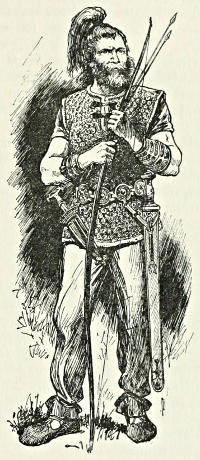
A German Archer
[358-359 A.D.]
It was not enough for Julian to have
delivered the provinces of Gaul from the
barbarians of Germany. He aspired to
emulate the glory of the first and most
illustrious of the emperors, after whose
example he composed his own commentaries
of the Gallic War. Cæsar has related
with conscious pride the manner
in which he twice passed the Rhine.
Julian could boast that before he assumed
the title of Augustus, he had carried
the Roman eagles beyond that great
river in three successful expeditions.
The consternation of the Germans after
the battle of Strasburg encouraged him
to the first attempt, and the reluctance
of the troops soon yielded to the persuasive
eloquence of a leader who shared
the fatigues and dangers which he imposed
on the meanest of the soldiers.
The villages on either side of the Mœnus
(Main), which were plentifully stored
with corn and cattle, felt the ravages of an invading army. The principal
houses, constructed with some imitation of Roman elegance, were consumed
by the flames; and the cæsar boldly advanced about ten miles, till his progress
was stopped by a dark and impenetrable forest, undermined by subterraneous
passages, which threatened, with secret snares and ambush, every
step of the assailants.
The ground was already covered with snow; and Julian, after repairing
an ancient castle which had been erected by Trajan, granted a truce of
ten months to the submissive barbarians. At the expiration of the truce
Julian undertook a second expedition beyond the Rhine to humble the pride
of Surmar and Hortaire, two of the kings of the Alamanni, who had been
present at the battle of Strasburg. They promised to restore all the Roman
captives who yet remained alive; and as the cæsar had procured an exact
account from the cities and villages of Gaul of the inhabitants whom they
had lost, he detected every attempt to deceive him with a degree of readiness
and accuracy which almost established the belief of his supernatural
knowledge.
His third expedition was still more splendid and important than the two
former. The Germans had collected their military powers and moved along
the opposite banks of the river with a design of destroying the bridge
and of preventing the passage of the Romans. But this judicious plan of
defence was disconcerted by a skilful diversion. Three hundred light-armed
and active soldiers were detached in forty small boats, to fall down
the stream in silence, and to land at some distance from the posts of the
enemy. They executed their orders with so much boldness and celerity
that they had almost surprised the barbarian chiefs, who returned in the
fearless confidence of intoxication from one of their nocturnal festivals.
Without repeating the uniform and disgusting tale of slaughter and devastation,
it is sufficient to observe that Julian dictated his own conditions of
peace to six of the haughtiest kings of the Alamanni, three of whom were
permitted to view the severe discipline and martial pomp of a Roman camp.
Followed by twenty thousand captives, whom he had rescued from the chains
of the barbarians, the cæsar repassed the Rhine, after terminating a war, the
success of which has been compared to the ancient glories of the Punic and
Cimbric victories.
[359-360 A.D.]
As soon as the valour and conduct of Julian had secured an interval
of peace, he applied himself to a work more congenial to his humane and
philosophic temper. The cities of Gaul, which had suffered from the inroads
of the barbarians, he diligently repaired; and seven important posts,
between Mogontiacum and the mouth of the Rhine, are mentioned, as having
been rebuilt and fortified by order of Julian. The vanquished Germans
had submitted to the just but humiliating condition of preparing and conveying
the necessary materials. The active zeal of Julian urged the prosecution
of the work, and such was the spirit which he diffused among the troops that
the auxiliaries themselves, waiving their exemption from any duties of fatigue,
contended in the most servile labours with the diligence of the Roman soldiers.
It was incumbent on the cæsar to provide for the subsistence, as well as for
the safety, of the inhabitants and of the garrisons. The desertion of the
former, and the mutiny of the latter, must have been the fatal and inevitable
consequences of famine. The tillage of the provinces of Gaul had been interrupted
by the calamities of war; but the scanty harvests of the continent
were supplied, by his paternal care, from the plenty of the adjacent island.
Six hundred large barks, framed in the forest of the Ardennes, made several
voyages to the coast of Britain; and, returning laden with corn, sailed up
the Rhine, and distributed their cargoes to the several towns and fortresses
along the banks of the river. The arms of Julian had restored a free and
secure navigation, which Constantius had offered to purchase at the expense
of his dignity, and of a tributary present of two thousand pounds of silver.
The emperor parsimoniously refused to his soldiers the sums which he granted
with a lavish and trembling hand to the barbarians. The dexterity, as
well as the firmness, of Julian was put to a severe trial, when he took the
field with a discontented army which had already served two campaigns
without receiving any regular pay or any extraordinary donative.
A tender regard for the peace and happiness of his subjects was the ruling
principle which directed, or seemed to direct, the administration of
Julian. He devoted the leisure of his winter quarters to the offices of civil
government; and affected to assume, with more pleasure, the character of a
magistrate, than that of a general. Before he took the field, he devolved on
the provincial governors most of the public and private causes which had
been referred to his tribunal; but, on his return, he carefully revised their
proceedings, mitigated the rigour of the law, and pronounced a second judgment
on the judges themselves. Superior to the last temptation of virtuous
minds, and indiscreet and intemperate zeal for justice, he restrained with
calmness and dignity the warmth of an advocate who prosecuted, for extortion,
the president of the Narbonnese province. “Who will ever be found
guilty,” exclaimed the vehement Delphidius, “if it be enough to deny?”
“And who,” replied Julian, “will ever be innocent, if it be sufficient to
affirm?”
In the general administration of peace and war the interest of the sovereign
is commonly the same as that of his people; but Constantius would
have thought himself deeply injured if the virtues of Julian had defrauded
him of any part of the tribute which he extorted from an oppressed and
exhausted country. The prince who was invested with the ensigns of royalty
might sometimes presume to correct the rapacious insolence of his inferior
agents; to expose their corrupt arts, and to introduce an equal and easier
mode of collection. But the management of the finances was more safely
entrusted to Florentius, prætorian prefect of Gaul, an effeminate tyrant, incapable
of pity or remorse; and the haughty minister complained of the
most decent and gentle opposition, while Julian himself was rather inclined
to censure the weakness of his own behaviour. The cæsar had rejected
with abhorrence a mandate for the levy of an extraordinary tax, a new
superindiction, which the prefect had offered for his signature; and the faithful
picture of the public misery, by which he had been obliged to justify his
refusal, offended the court of Constantius.
We may enjoy reading of the sentiments of Julian, as he expresses them
with warmth and freedom, in a letter to one of his most intimate friends.
After stating his own conduct, he proceeds in the following terms: “Was
it possible for the disciple of Plato and Aristotle to act otherwise than
I have done? Could I abandon the unhappy subjects entrusted to my care?
Was I not called upon to defend them from the repeated injuries of these
unfeeling robbers? A tribune who deserts his post is punished with death,
and deprived of the honours of burial. With what justice could I pronounce
his sentence, if, in the hour of danger, I myself neglected a duty far more
sacred and far more important? God has placed me in this elevated post—His
providence will guard and support me. Should I be condemned to
suffer, I shall derive comfort from the testimony of a pure and upright conscience.
Would to heaven that I still possessed a counsellor like Sallust!
If they think proper to send me a successor, I shall submit without reluctance;
and had much rather improve the short opportunity of doing good,
than enjoy a long and lasting impunity of evil.” The precarious and dependent
situation of Julian displayed his virtues and concealed his defects.
The young hero, who supported in Gaul the throne of Constantius, was not
permitted to reform the vices of the government; but he had courage to
alleviate or to pity the distress of the people. Unless he had been able to
revive the martial spirit of the Romans, or to introduce the arts of industry
and refinement among their savage enemies, he could not entertain any
rational hopes of securing the public tranquillity either by the peace or conquest
of Germany. Yet the victories of Julian suspended for a short time
the inroads of the barbarians, and delayed the ruin of the Western Empire.
His salutary influence restored the cities of Gaul, which had been so long
exposed to the evils of civil discord, barbarian war, and domestic tyranny;
and the spirit of industry was revived with the hope of enjoyment. Agriculture,
manufactures, and commerce again flourished under the protection
of the laws; and the curiæ, or civil corporations, were again filled with useful
and respectable members; the youth were no longer apprehensive of
marriage, and married persons were no longer apprehensive of posterity;
the public and private festivals were celebrated with customary pomp, and
the frequent and secure intercourse of the provinces displayed the image of
national prosperity. A mind like that of Julian must have felt the general
happiness of which he was the author, but he viewed with peculiar satisfaction
and complacency the city of Paris, the seat of his winter residence and
the object even of his partial affection. That splendid capital, which now
embraces an ample territory on either side of the Seine, was originally confined
to the small island in the midst of the river, from whence the inhabitants
derived a supply of pure water. The river bathed the foot of the walls, and
the town was accessible only by two wooden bridges.
A forest overspread the northern side of the Seine, but on the south, the
ground, which now bears the name of the university, was covered with houses
and adorned with a palace and amphitheatre, baths, an aqueduct, and a Field
of Mars for the exercise of the Roman troops. The severity of the climate
was tempered by the neighbourhood of the ocean; and with some precautions,
which experience had taught, the vine and fig tree were successfully cultivated.
But, in remarkable winters, the Seine was deeply frozen; and the
huge pieces of ice that floated down the stream, might be compared, by an
Asiatic, to the blocks of white marble which were extracted from the quarries
of Phrygia. The licentiousness and corruption of Antioch recalled to the
memory of Julian the severe and simple manners of his beloved Lutetia,
where the amusements of the theatre were unknown or despised. He indignantly
contrasted the effeminate Syrians with the brave and honest simplicity
of the Gauls, and almost forgave the intemperance, which was the
only stain of the Celtic character. If Julian could now revisit the capital
of France, he might converse with men of science and genius, capable of
understanding and of instructing a disciple of the Greeks; he might excuse
the lively and graceful follies of a nation, whose martial spirit has never been
enervated by the indulgence of luxury, and he must applaud the perfection
of that inestimable art, which softens and refines and embellishes the intercourse
of social life.
While the Romans languished under the ignominious tyranny of eunuchs
and bishops, the praises of Julian were repeated with transport in every part
of the empire, except in the palace of Constantius. The barbarians of Germany
had felt, and still dreaded, the arms of the young cæsar; his soldiers
were the companions of his victory; the grateful provincials enjoyed the
blessings of his reign; but the favourites, who had opposed his elevation,
were offended by his virtues; and they justly considered the friend of the
people as the enemy of the court. As long as the fame of Julian was doubtful,
the buffoons of the palace, who were skilled in the language of satire,
tried the efficacy of those arts which they had so often practised with success.
They easily discovered that his simplicity was not exempt from affectation;
the ridiculous epithets of a hairy savage, of an ape invested with the purple,
were applied to the dress and person of the philosophic warrior; and his
modest despatches were stigmatised as the vain and elaborate fictions of a
loquacious Greek, a speculative soldier, who had studied the art of war
amidst the groves of the academy. The voice of malicious folly was at
length silenced by the shouts of victory; the conqueror of the Franks and
Alamanni could no longer be painted as an object of contempt; and the
monarch himself was meanly ambitious of stealing from his lieutenant the
honourable reward of his labours. In the letters crowned with laurel, which,
according to ancient custom, were addressed to the provinces, the name of
Julian was omitted. Constantius had made his dispositions in person; he had
signalised his valour in the foremost ranks; his military conduct had secured
the victory; and the captive king of the barbarians was presented to him on
the field of battle, from which he was at that time distant about forty days’
journey. So extravagant a fable was incapable, however, of deceiving the
public credulity, or even of satisfying the pride of the emperor himself.
Secretly conscious that the applause and favour of the Romans accompanied
the rising fortunes of Julian, his discontented mind was prepared to receive
the subtle poison of those artful sycophants, who coloured their mischievous
designs with the fairest appearances of truth and candour. Instead of depreciating
the merits of Julian, they acknowledged, and even exaggerated,
his popular fame, superior talents, and important services. But they darkly
insinuated that the virtues of the cæsar might instantly be converted into
the most dangerous crimes, if the inconstant multitude should prefer their
inclinations to their duty; or if the general of a victorious army should be
tempted from his allegiance by the hopes of revenge, and independent
greatness.
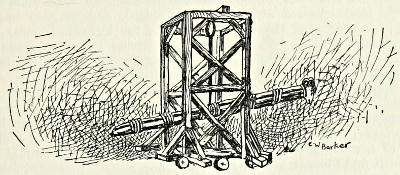
Roman Light Battering-ram
[360 A.D.]
The apparent tranquillity of Gaul, and the imminent danger of the eastern
provinces, offered a specious pretence for the design which was artfully concerted
by the imperial ministers. They resolved to disarm the cæsar; to
recall those faithful troops who guarded his person and dignity; and to
employ, in a distant war against the Persian monarch, the hardy veterans
who had vanquished, on the banks of the Rhine, the fiercest nations of
Germany. While Julian used the laborious hours of his winter quarters at
Paris in the administration of power, which, in his hands, was the exercise
of virtue, he was surprised by the hasty arrival of a tribune and a notary,
with positive orders from the emperor which they were directed to execute,
and he was commanded not to oppose. Constantius signified his pleasure,
that four entire legions, the Celtæ and Petulants, the Heruli, and the Batavians,
should be separated from the standard of Julian, under which they had
acquired their fame and discipline; that in each of the remaining bands
three hundred of the bravest youths should be selected; and that this numerous
detachment, the strength of the Gallic army, should instantly begin
their march, and exert their utmost diligence to arrive, before the opening
of the campaign, on the frontiers of Persia. The cæsar foresaw and lamented
the consequences of this fatal mandate. Most of the auxiliaries, who engaged
their voluntary service, had stipulated that they should never be obliged to
pass the Alps. The public faith of Rome and the personal honour of Julian
had been pledged for the observance of this condition. Such an act of treachery
and oppression would destroy the confidence and excite the resentment
of the independent warriors of Germany, who considered truth as the noblest
of their virtues, and freedom as the most valuable of their possessions. The
legionaries, who enjoyed the titles and privileges of Romans, were enlisted
for the general defence of the republic; but those mercenary troops heard
with cold indifference the antiquated names of the republic and of Rome.
Attached, either from birth or long habit, to the climate and manners of Gaul,
they loved and admired Julian; they despised, and perhaps hated, the
emperor; they dreaded the laborious march, the Persian arrows, and the
burning deserts of Asia. They claimed as their own the country which they
had saved; and excused their want of spirit, by pleading the sacred and
more immediate duty of protecting their families and friends.
The apprehensions of the Gauls were derived from the knowledge of the
inevitable danger. As soon as the provinces were exhausted of their military
strength, the Germans would violate a treaty which had been imposed
on their fears; and, notwithstanding the abilities and valour of Julian, the
general of a nominal army, to whom the public calamities would be imputed,
must find himself, after a vain resistance, either a prisoner in the camp
of the barbarians, or a criminal in the palace of Constantius. If Julian complied
with the orders which he had received, he would subscribe to his own
destruction, and that of a people who deserved his affection. But a positive
refusal was an act of rebellion, and a declaration of war. The inexorable
jealousy of the emperor, the peremptory, and perhaps insidious, nature of
his commands, left not any room for a fair apology or candid interpretation;
and the dependent station of the cæsar scarcely allowed him to pause or to
deliberate. Solitude increased the perplexity of Julian; he could no longer
apply to the faithful counsels of Sallust, who had been removed from his
office by the judicious malice of the eunuchs. Unable to resist, unwilling to
comply, Julian expressed, in the most serious terms, his wish, and even his
intention of resigning the purple, which he could not preserve with honour,
but which he could not abdicate with safety.
After a painful conflict, Julian was compelled to acknowledge that
obedience was the virtue of the most eminent subject; and that the sovereign
alone was entitled to judge of the public welfare. He issued the
necessary orders for carrying into execution the commands of Constantius;
a part of the troops began their march for the Alps; and the detachments
from the several garrisons moved towards their respective places of
assembly. They advanced with difficulty through the trembling and
affrighted crowds of provincials, who attempted to excite their pity by
silent despair, or loud lamentations; while the wives of the soldiers,
holding their infants in their arms, accused the desertion of their husbands,
in the mixed language of grief, of tenderness, and of indignation. This scene
of general distress afflicted the humanity of the cæsar; he granted a sufficient
number of post-wagons to transport the wives and families of the
soldiers, endeavoured to alleviate the hardships which he was constrained to
inflict, and increased, by the most laudable arts, his own popularity, and the
discontent of the exiled troops.
As soon as the approach of the troops was announced, the cæsar went
out to meet them, and ascended his tribunal, which had been erected in a
plain before the gates of the city. After distinguishing the officers and
soldiers who by their rank or merit deserved a peculiar attention, Julian
addressed himself in a studied oration to the surrounding multitude; he
celebrated their exploits with grateful applause; encouraged them to accept,
with alacrity, the honour of serving under the eye of a powerful and
liberal monarch; and admonished them, that the commands of the augustus
required an instant and cheerful obedience. The soldiers, who were apprehensive
of offending their general by an indecent clamour, or of belying
their sentiments by false and venal acclamations, maintained an obstinate
silence, and, after a short pause, were dismissed to their quarters. The
principal officers were entertained by the cæsar, who professed, in the
warmest language of friendship, his desire and his inability to reward,
according to their deserts, the brave companions of his victories. They
retired from the feast full of grief and perplexity; and lamented the
hardship of their fate, which tore them from their beloved general and
their native country.
The only expedient which could prevent their separation was boldly agitated
and approved; the popular resentment was insensibly moulded into a
regular conspiracy; their just reasons of complaint were heightened by passion,
and their passions were inflamed by wine; as on the eve of their departure
the troops were indulged in licentious festivity. At the hour of midnight,
the impetuous multitude, with swords, and bows, and torches in their hands,
rushed into the suburbs; encompassed the palace, and careless of future
dangers, pronounced the fatal and irrevocable words, Julian Augustus!
The prince, whose anxious suspense was interrupted by their disorderly
acclamations, secured the doors against their intrusion; and, as long as it
was in his power, secluded his person and dignity from the accidents of a
nocturnal tumult. At the dawn of day, the soldiers, whose zeal was irritated
by opposition, forcibly entered the palace, seized, with respectful
violence, the object of their choice, guarded Julian with drawn swords
through the streets of Paris, placed him on the tribunal, and with repeated
shouts saluted him as their emperor. Prudence as well as loyalty inculcated
the propriety of resisting their treasonable designs, and of preparing, for his
oppressed virtue, the excuse of violence.
Addressing himself by turns to the multitude and to individuals, he implored
their mercy, and expressed his indignation; conjured them not to
sully the fame of their immortal victories; and ventured to promise, that if
they would immediately return to their allegiance, he would undertake to
obtain from the emperor, not only a free and gracious pardon, but even the
revocation of the orders which had excited their resentment. But the soldiers,
who were conscious of their guilt, chose rather to depend on the gratitude
of Julian, than on the clemency of the emperor. Their zeal was insensibly
turned into impatience, and their impatience into rage. The inflexible cæsar
sustained, till the third hour of the day, their prayers, their reproaches, and
their menaces; nor did he yield, till he had been repeatedly assured, that if
he wished to live, he must consent to reign. He was exalted on a shield in
the presence, and amidst the unanimous acclamations, of the troops; a rich
military collar, which was offered by chance, supplied the want of a diadem;
the ceremony was concluded by the promise of a moderate donative; and the
new emperor, overwhelmed with real or affected grief, retired into the most
secret recesses of his apartment.
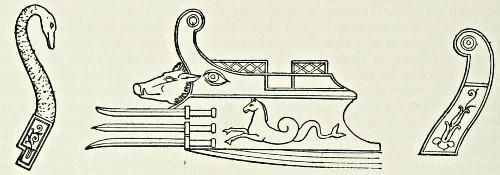
Prows of Roman War Galleys
To moderate the zeal of his party, to protect the persons of his enemies,
to defeat and to despise the secret enterprises which were formed against his
life and dignity, were the cares which employed the first days of the reign
of the new emperor. Although he was firmly resolved to maintain the
station which he had assumed, he was still desirous of saving his country
from the calamities of civil war, of declining a contest with the superior
forces of Constantius, and of preserving his own character from the reproach
of perfidy and ingratitude. Adorned with the ensigns of military and imperial
pomp, Julian showed himself in the Field of Mars to the soldiers, who
glowed with ardent enthusiasm in the cause of their pupil, their leader, and
their friend. He recapitulated their victories, lamented their sufferings,
applauded their resolution, animated their hopes, and checked their impetuosity;
nor did he dismiss the assembly, till he had obtained a solemn promise
from the troops that if the emperor of the East would subscribe an equitable
treaty, they would renounce any views of conquest, and satisfy themselves
with the tranquil possession of the Gallic provinces. On this foundation he
composed, in his own name, and in that of the army, a specious and moderate
epistle, which was delivered to Pentadius, his master of the offices, and to
his chamberlain Eutherius; two ambassadors whom he appointed to receive
the answer, and observe the dispositions of Constantius. This epistle is
inscribed with the modest appellation of Cæsar; but Julian solicits, in a
peremptory, though respectful manner, the confirmation of the title of Augustus.
He acknowledges the irregularity of his own election; while he justifies
in some measure the resentment and violence of the troops which had
extorted his reluctant consent. He allows the supremacy of his brother Constantius;
and engages to send him an annual present of Spanish horses, to
recruit his army with a select number of barbarian youths, and to accept
from his choice a prætorian prefect of approved discretion and fidelity. But
he reserves for himself the nomination of his other civil and military officers,
with the troops, the revenue, and the sovereignty, of the provinces beyond
the Alps. He admonishes the emperor to consult the dictates of justice; to
distrust the arts of those venal flatterers who subsist only by the discord of
princes; and to embrace the offer of a fair and honourable treaty, equally
advantageous to the republic and to the house of Constantine. In this negotiation,
Julian claimed no more than he already possessed.
The negotiations of peace were accompanied and supported by the most
vigorous preparations for war. The army, which Julian held in readiness for
immediate action, was recruited and augmented by the disorders of the times.
The cruel persecutions of the faction of Magnentius had filled Gaul with
numerous bands of outlaws and robbers. They cheerfully accepted the offer
of a general pardon from a prince whom they could trust, submitted to the
restraints of military discipline, and retained only their implacable hatred to
the person and government of Constantius. As soon as the season of the
year permitted Julian to take the field, he appeared at the head of his legions;
threw a bridge over the Rhine in the neighbourhood of Cleves; and prepared
to chastise the perfidy of the Attuarii, a tribe of Franks, who presumed that
they might ravage, with impunity, the frontiers of a divided empire. The
difficulty, as well as glory, of this enterprise, consisted in a laborious march;
and Julian had conquered, as soon as he could penetrate into a country which
former princes had considered as inaccessible.
[360-361 A.D.]
The ambassadors of Julian had been instructed to execute with the
utmost diligence, their important commission. But in their passage through
Italy and Illyricum, they were detained by the tedious and affected delays
of the provincial governors; they were conducted by slow journeys from
Constantinople to Cæsarea in Cappadocia; and when at length they were
admitted to the presence of Constantius, they found that he had already conceived
from the despatches of his own officers, the most unfavourable opinion
of the conduct of Julian, and of the Gallic army. The letters were heard
with impatience; the trembling messengers were dismissed with indignation
and contempt; and the looks, the gestures, the furious language of the
monarch, expressed the disorder of his soul. The domestic connection which
might have reconciled the brother and the husband of Helena, was recently
dissolved by the death of that princess, whose pregnancy had been several
times fruitless, and was at last fatal to herself. The empress Eusebia had
preserved to the last moment of her life, the warm and even jealous affection
which she had conceived for Julian; and her mild influence might have
moderated the resentment of a prince, who, since her death, was abandoned
to his own passions, and to the arts of his eunuchs.
But the terror of a foreign invasion obliged him to suspend the punishment
of a private enemy; he continued his march towards Persia, and thought
it sufficient to signify the conditions which might entitle Julian and his guilty
followers to the clemency of their offended sovereign. He required that the
presumptuous cæsar should expressly renounce the appellation and rank of
augustus, which he had accepted from the rebels; that he should descend
to his former station of a limited and dependent minister; that he should
vest the powers of the state and army in the hands of those officers who were
appointed by the imperial court; and that he should trust his safety to the
assurances of pardon which were announced by Epictetus, a Gallic bishop,
and one of the Arian favourites of Constantius. Several months were ineffectually
consumed in a treaty which was negotiated at the distance of
three thousand miles between Paris and Antioch; and as soon as Julian
perceived that his moderate and respectful behaviour served only to irritate
the pride of an implacable adversary, he boldly resolved to commit his life
and fortune to the chance of a civil war. He gave a public and military
audience to the quæstor Leonas; the haughty epistle of Constantius was
read to the attentive multitude; and Julian protested with the most flattering
deference, that he was ready to resign the title of Augustus, if he could
obtain the consent of those whom he acknowledged as the authors of his
elevation. The faint proposal was impetuously silenced; and the acclamations
of “Julian Augustus, continue to reign, by the authority of the army,
of the people, of the republic, which you have saved,” thundered at once from
every part of the field, and terrified the pale ambassador of Constantius.
The situation of Julian required a vigorous and immediate resolution.
He had discovered, from intercepted letters, that his adversary, sacrificing
the interest of the state to that of the monarch, had again excited the barbarians
to invade the provinces of the West.
The hopes of Julian depended much less on the number of his troops,
than on the celerity of his motions. In the execution of a daring enterprise,
he availed himself of every precaution, as far as prudence could suggest;
and where prudence could no longer accompany his steps, he trusted the
event to valour and to fortune. In the neighbourhood of Bâle he assembled
and divided his army. One body, which consisted of ten thousand men,
was directed under the command of Nevitta, general of the cavalry, to advance
through the midland parts of Rætia and Noricum. A similar division
of troops, under the orders of Jovius and Jovinus, prepared to follow the
oblique course of the highways, through the Alps, and the northern confines
of Italy. The instructions to the generals were conceived with energy
and precision; to hasten their march in close and compact columns, which,
according to the disposition of the ground, might readily be changed into
any order of battle; to secure themselves against the surprises of the night
by strong posts and vigilant guards; to prevent resistance by their unexpected
arrival; to elude examination by their sudden departure; to spread
the opinion of their strength, and the terror of his name; and to join their
sovereign under the walls of Sirmium.
For himself, Julian had reserved a more difficult part. He selected three
thousand active volunteers, resolved, like their leader, to cast behind them
every hope of a retreat; at the head of this band, he fearlessly plunged into
the recesses of the Marcian or Black Forest, which conceals the sources of the
Danube, and for many days, the fate of Julian was unknown to the world.
The secrecy of his march, his diligence and vigour, surmounted every obstacle;
he forced his way over mountains and morasses, occupied the bridges,
or swam the rivers, pursued his direct course, without reflecting whether he
traversed the territory of the Romans or of the barbarians, and emerged,
between Castra Regina (Ratisbon) and Vindobona (Vienna) at the place
where he designed to embark his troops on the Danube. By a stratagem, he
seized a fleet of light brigantines, as it lay at anchor; secured a supply of
coarse provisions, sufficient to satisfy the indelicate, but voracious, appetite
of a Gallic army; and boldly committed himself to the stream of the Danube.
The labours of his mariners, who plied their oars with incessant diligence,
and the steady continuance of a favourable wind, carried his fleet above seven
hundred miles in eleven days, and he had already disembarked his troops at
Bononia, only nineteen miles from Sirmium, before his enemies could receive
any certain intelligence that he had left the banks of the Rhine. In the
course of this long and rapid navigation, the mind of Julian was fixed on the
object of his enterprise; and though he accepted the deputation of some
cities, which hastened to claim the merit of an early submission, he passed
before the hostile stations, which were placed along the river, without indulging
the temptation of signalising a useless and ill-timed valour.

Sandals worn by Officers
The banks of the Danube were crowded with spectators, who gazed on
the military pomp, anticipated the importance of the event, and diffused
through the adjacent country the fame of a young hero, who advanced with
more than mortal speed at the head of the innumerable forces of the West.
Lucilian, who, with the rank of general of the cavalry, commanded the
military powers of Illyricum, was alarmed and perplexed by the doubtful
reports, which he could neither reject nor believe. He had taken some slow
and irresolute measures for the purpose of collecting his troops, when he was
surprised by Dagalaiphus, an active officer, whom Julian, as soon as he landed
at Bononia, had pushed forward with some light infantry. The captive general,
uncertain of his life or death, was hastily thrown upon a horse, and
conducted to the presence of Julian, who kindly raised him from the ground
and dispelled the terror and amazement which seemed to stupefy his faculties.
But Lucilian had no sooner recovered his spirits, than he betrayed his
want of discretion, by presuming to admonish his conqueror, that he had
rashly ventured, with a handful of men, to expose his person in the midst of
his enemies. “Reserve for your master Constantius these timid remonstrances,”
replied Julian, with a smile of contempt; “when I gave you my
purple to kiss, I received you not as a counsellor, but as a suppliant.”
Conscious that success alone could justify his attempt, and that boldness
only could command success, he advanced at the head of three thousand
soldiers to attack the strongest and most populous city of the Illyrian provinces.
As he entered the long suburb of Sirmium, he was received by the
joyful acclamations of the army and people; who, crowned with flowers and
holding lighted tapers in their hands, conducted their acknowledged sovereign
to his imperial residence. Two days were devoted to the public joy,
which was celebrated by the games of the circus; but, early on the morning
of the third day, Julian marched to occupy the narrow pass of Succi, in the
defiles of Mount Hæmus; which, almost in the midway between Sirmium
and Constantinople, separates the provinces of Thrace and Dacia, by an
abrupt descent towards the former, and a gentle declivity on the side of
the latter. The defence of this important post was entrusted to the brave
Nevitta; who, as well as the generals of the Italian division, successfully
executed the plan of the march and junction which their master had so ably
conceived.
From his palace, or, more properly, from his headquarters, of Sirmium
and Naissus, he distributed to the principal cities of the empire a laboured
apology for his own conduct; published the secret despatches of Constantius;
and solicited the judgment of mankind between two competitors, the one of
whom had expelled, and the other had invited the barbarians. Julian, whose
mind was deeply wounded by the reproach of ingratitude, aspired to maintain,
by argument as well as by arms, the superior merits of his cause; and
to excel, not only in the arts of war, but in those of composition. His
epistle to the senate and people of Athens seems to have been dictated by
an elegant enthusiasm, which prompted him to submit his actions and his
motives to the degenerate Athenians of his own times, with the same humble
deference, as if he had been pleading in the days of Aristides, before the
tribunal of the Areopagus. His application to the senate of Rome, which
was still permitted to bestow the titles of imperial power, was agreeable to
the forms of the expiring republic. An assembly was summoned by Tertullus,
prefect of the city; the epistle of Julian was read; and as he appeared
to be master of Italy, his claims were admitted without a dissenting voice.
His oblique censure of the innovations of Constantine, and his passionate
invective against the vices of Constantius, were heard with less satisfaction;
and the senate, as if Julian had been present, unanimously exclaimed:
“Respect, we beseech you, the author of your own fortune,” an artful
expression, which, according to the chance of war, might be differently
explained, as a manly reproof of the ingratitude of the usurper, or as a flattering
confession, that a single act of such benefit to the state ought to atone
for all the failings of Constantius.
The intelligence of the march and rapid progress of Julian was speedily
transmitted to his rival, who, by the retreat of Sapor, had obtained some
respite from the Persian War. Disguising the anguish of his soul under
the semblance of contempt, Constantius professed his intention of returning
into Europe, and of giving chase to Julian; for he never spoke of his military
expedition in any other light than that of a hunting party. In the
camp of Hierapolis, in Syria, he communicated this design to his army;
slightly mentioned the guilt and rashness of the cæsar; and ventured to
assure them, that if the mutineers of Gaul presumed to meet them in the
field, they would be unable to sustain the fire of their eyes, and the irresistible
weight of their shout of onset. The speech of the emperor was received
with military applause, and Theodotus, the president of the council of Hierapolis,
requested, with tears of adulation, that his city might be adorned with
the head of the vanquished rebel. A chosen detachment was despatched away
in post wagons, to secure, if it were yet possible, the pass of Succi; the recruits,
the horses, the arms, and the magazines which had been prepared against Sapor,
were appropriated to the service of the civil war; and the domestic victories
of Constantius inspired his partisans with the most sanguine assurances of
success. The notary Gaudentius had occupied in his name the provinces of
Africa; the subsistence of Rome was intercepted; and the distress of Julian
was increased, by an unexpected event, which might have been productive
of fatal consequences. Julian had received the submission of two legions
and a cohort of archers, who were stationed at Sirmium; but he suspected,
with reason, the fidelity of those troops which had been distinguished by the
emperor; and it was thought expedient, under the pretence of the exposed
state of the Gallic frontier, to dismiss them from the most important scene
of action. They advanced, with reluctance, as far as the confines of Italy;
but, as they dreaded the length of the way, and the savage fierceness of the
Germans, they resolved, by the instigation of one of their tribunes, to halt
at Aquileia, and to erect the banners of Constantius on the walls of that
impregnable city. The vigilance of Julian perceived at once the extent of
the mischief, and the necessity of applying an immediate remedy. By his
order, Jovinus led back a part of the army into Italy; and the siege of
Aquileia was formed with diligence, and prosecuted with vigour. But the
legionaries, who seemed to have rejected the yoke of discipline, conducted
the defence of the place with skill and perseverance; invited the rest of Italy
to imitate the example of their courage and loyalty; and threatened the
retreat of Julian, if he should be forced to yield to the superior numbers of
the armies of the East.
But the humanity of Julian was preserved from the cruel alternative,
which he pathetically laments, of destroying, or of being himself destroyed;
and the seasonable death of Constantius delivered the Roman Empire from
the calamities of civil war. The approach of winter could not detain the
monarch at Antioch; and his favourites durst not oppose his impatient desire
of revenge. A slight fever, which was perhaps occasioned by the agitation
of his spirits, was increased by the fatigues of the journey; and Constantius
was obliged to halt at the little town of Mopsucrene, twelve miles beyond
Tarsus, where he expired, after a short illness, in the forty-fifth year of his
age, and the twenty-fourth of his reign. His genuine character was composed
of pride and weakness, of superstition and cruelty. The long abuse
of power rendered him a considerable object in the eyes of his contemporaries;
but as personal merit can alone deserve the notice of posterity, the last
of the sons of Constantine may be dismissed from the world with the remark,
that he inherited the defects, without the abilities, of his father.
Before Constantius expired, he is said to have named Julian for his successor;
nor does it seem improbable, that his anxious concern for the fate
of a young and tender wife, whom he left with child, may have prevailed, in
his last moments, over the harsher passions of hatred and revenge. Eusebius
and his guilty associates made a faint attempt to prolong the reign of the
eunuchs, by the election of another emperor; but their intrigues were rejected
with disdain by an army which now abhorred the thought of civil discord;
and two officers of rank were instantly despatched, to assure Julian,
that every sword in the empire would be drawn for his service. The military
designs of that prince, who had formed three different attacks against
Thrace, were prevented by this fortunate event. Without shedding the
blood of his fellow-citizens he escaped the dangers of a doubtful conflict, and
acquired the advantages of a complete victory. Impatient to visit the place
of his birth, and the new capital of the empire, he advanced from Naissus
through the mountains of Hæmus and the cities of Thrace. When he reached
Heraclea, at the distance of sixty miles, all Constantinople was poured forth
to receive him; and he made his triumphal entry amidst the dutiful acclamations
of the soldiers, the people, and the senate. An innumerable multitude
pressed around him with eager respect, and were perhaps disappointed,
when they beheld the small stature, and simple garb, of a hero whose
unexperienced youth had vanquished the barbarians of Germany, and who had
now traversed, in a successful career, the whole continent of Europe, from
the shores of the Atlantic to those of the Bosporus. A few days afterward,
when the remains of the deceased emperor were landed in the harbour,
the subjects of Julian applauded the real or affected humanity of their
sovereign. On foot, without his diadem, and clothed in a mourning habit,
he accompanied the funeral as far as the church of the Holy Apostles, where
the body was deposited; and if these marks of respect may be interpreted
as a selfish tribute to the birth and dignity of his imperial kinsman, the tears
of Julian professed to the world, that he had forgotten the injuries, and
remembered only the obligations, which he had received from Constantius.
As soon as the legions of Aquileia were assured of the death of the emperor,
they opened the gates of the city, and, by the sacrifice of their guilty leaders,
obtained an easy pardon from the prudence or lenity of Julian; who, in the
thirty-second year of his age, acquired the undisputed possession of the
Roman Empire.b
The love of justice and the correct sense of the duties of a ruler which
Julian had displayed when a cæsar in Gaul, did not desert him on the
imperial throne in Constantinople; and had it not been for one fatal circumstance,
he might have been the object of general applause and admiration.
But Julian had renounced the religion of the empire and adopted
that of ancient Greece, which he entertained the chimerical idea of restoring
to its primitive importance; and in the pursuit of this object he did not
attend sufficiently to the principles of justice and equity. From his change
of faith he has been styled the Apostate, unjustly as appears to us, for of his
sincerity there can be no doubt; and however we may lament for, pity, or
even despise those who change from conviction, we are not justified in
condemning or reviling them.
Gallus and Julian after the massacre of their relatives had been committed
to the charge of Eusebius, the bishop of Nicomedia. They were
instructed in the articles of faith and practice then prevalent, with all of
which they complied without any hesitation; and Julian it was remembered
had publicly read the Holy Scriptures in the church of that city. But while
the rude, sullen Gallus became a steady and bigoted believer, the milder and
more philosophic and studious Julian took a distaste to the religion in which
he was instructed. He had been made familiar with the great writers of
ancient Hellas by his tutor the eunuch Mardonius; and the admiration he
felt for the works of Homer and other eminent poets, the veneration for
antiquity, and the brilliant colours with which the ancient poetic Olympus
stood invested, as contrasted with the grovelling superstition with which he
was surrounded; and the noble spirit and glorious deeds of the believers in
the ancient creed, compared with the base arts and paltry actions of the men
of his own time—all combined to operate on the mind of the young prince,
and he became a believer in the theology of Homer and Hesiod. But it was
not the charming poetic creed of the early and best days of Hellas that
Julian adopted, it was the absurd, contemptible mysticism of the Neo-Platonists;
and as in his Christianity he neglected the beautiful simplicity of
the Gospel, confounding it with the intricate metaphysics and abject superstition
which then prevailed in the church; so in his paganism he lost the
poetic creed of the old times in the tasteless, unsubstantial vagaries and
allegories of the school of Alexandria. In fact, he had not that original
vigour of intellect which would have emancipated him from the spirit of the
age. Superstition was the prevailing sentiment, and the philosophic emperor
was in his way as deeply immersed in it as the most grovelling ascetic.
According to the emperor’s own account, he was a Christian till he
reached his twentieth year. He then, after being instructed by various
sophists, was by the archimage Maximus secretly initiated at Ephesus with
all those ceremonies which imposture and superstition had imported from
Asia and incorporated with the mythic faith of Hellas. During his short
abode some years after at Athens, Julian was solemnly initiated in the
mysteries of Eleusis. Still he was to outward appearance a Christian, and
the empress Eusebia had not probably a shade of doubt respecting the faith
of her distinguished protégé. In Gaul he appears to have still dissembled,
and to have openly assisted at the Christian worship, while in his closet he
offered his homage to the Sun and Hermes. When he assumed the imperial
dignity he disdained all further concealment of his sentiments and boldly
proclaimed himself a votary of the ancient gods.
Julian was by nature just and humane; he was also a philosopher and
statesman enough to know that persecution, if it does not go the full length
of extermination, adds strength and numbers and energy to the persecuted
and irritated party. He therefore, instead of imitating Diocletian,
proclaimed a general toleration. The pagans were directed to open their
temples and offer victims as heretofore; the contending sects of Christians
were commanded to abstain from harassing and tormenting each other.
The Catholic prelates and clergy, whom the Arian Constantius had banished,
were accordingly restored to their sees and churches.e
[361-362 A.D.]
As soon as Sapor was informed that the throne of Constantius was filled
by a prince of a very different character, he condescended to make some
artful, or perhaps sincere, overtures towards a negotiation of peace. But
the pride of the Persian monarch was astonished by the firmness of Julian,
who sternly declared that he would never consent to hold a peaceful conference
among the flames and ruins of the cities of Mesopotamia; and who
added, with a smile of contempt, that it was needless to treat by ambassadors,
as he himself had determined to visit speedily the court of Persia.
The impatience of the emperor urged the diligence of the military preparations.
The generals were named; a formidable army was destined for this
important service; and Julian, marching from Constantinople through the
provinces of Asia Minor, arrived at Antioch about eight months after the
death of his predecessor. His ardent desire to march into the heart of Persia
was checked by the indispensable duty of regulating the state of the
empire; by his zeal to revive the worship of the gods; and by the advice of
his wisest friends, who represented the necessity of allowing the salutary
interval of winter quarters, to restore the exhausted strength of the legions
of Gaul, and the discipline and spirit of the eastern troops. Julian was
persuaded to fix, till the ensuing spring, his residence at Antioch, among
a people maliciously disposed to deride the haste, and to censure the delays,
of their sovereign.
If Julian had flattered himself, that his personal connection with the
capital of the East would be productive of mutual satisfaction to the prince
and people, he made a very false estimate of his own character, and of the
manners of Antioch. The warmth of the climate disposed the natives to
the most intemperate enjoyment of tranquillity and opulence; and the lively
licentiousness of the Greeks was blended with the hereditary softness of the
Syrians. Fashion was the only law, pleasure the only pursuit, and the splendour
of dress and furniture was the only distinction of the citizens of Antioch.
The arts of luxury were honoured; the serious and manly virtues
were the subject of ridicule; and the contempt for female modesty and
reverend age, announced the universal corruption of the capital of the East.
The love of spectacles was the taste, or rather passion, of the Syrians: the
most skilful artists were procured from the adjacent cities; a considerable
share of the revenue was devoted to the public amusements; and the magnificence
of the games of the theatre and circus was considered as the happiness
and as the glory of Antioch. The rustic manners of a prince who
disdained such glory, and was insensible of such happiness, soon disgusted
the delicacy of his subjects; and the effeminate Orientals could neither imitate
nor admire the severe simplicity which Julian always maintained, and
sometimes affected. The days of festivity, consecrated by ancient custom
to the honour of the gods, were the only occasions on which Julian relaxed
his philosophic severity; and those festivals were the only days in which
the Syrians of Antioch could reject the allurements of pleasure. The majority
of the people supported the glory of the Christian name, which had been
first invented by their ancestors; they contented themselves with disobeying
the moral precepts, but they were scrupulously attached to the speculative
doctrines of their religion. The church of Antioch was distracted by heresy
and schism; but the Arians and the Athanasians, the followers of Meletius
and those of Paulinus, were actuated by the same pious hatred of their common
adversary.
The martial impatience of Julian urged him to take the field in the beginning
of the spring; and he dismissed, with contempt and reproach, the senate
of Antioch, who accompanied the emperor beyond the limits of their own
territory, to which he was resolved never to return.
[362-363 A.D.]
As the warlike emperor, instead of Constantius, had chosen Alexander for
his model, he advanced without delay to Carrhæ, a very ancient city of Mesopotamia,
at the distance of fourscore miles from Hierapolis. The temple of
the Moon attracted the devotion of Julian; but the halt of a few days was
principally employed in completing the immense preparations of the Persian
War. The secret of the expedition had hitherto remained in his own breast;
but as Carrhæ is the point of separation of the two great roads, he could no
longer conceal, whether it was his design to attack the dominions of Sapor
on the side of the Tigris, or on that of the Euphrates. The emperor detached
an army of thirty thousand men, under the command of his kinsman Procopius,
and of Sebastian, who had been duke of Egypt. They were ordered to
direct their march towards Nisibis, and to secure the frontier from the desultory
incursions of the enemy, before they attempted the passage of the Tigris.
Their subsequent operations were left to the discretion of the generals; but
Julian expected, that after wasting with fire and sword the fertile districts of
Media and Adiabene, they might arrive under the walls of Ctesiphon about
the same time that he himself, advancing with equal steps along the banks of
the Euphrates, should besiege the capital of the Persian monarchy. The success
of this well-concerted plan depended, in a great measure, on the powerful
and ready assistance of the king of Armenia, who, without exposing the
safety of his own dominions, might detach an army of four thousand horse,
and twenty thousand foot, to the assistance of the Romans. But the feeble
Arsaces Tiranus, king of Armenia, had degenerated still more shamefully
than his father Chosroes, from the manly virtues of the great Tiridates;
and as the pusillanimous monarch was averse to any enterprise of danger
and glory, he could disguise his timid indolence by the more decent excuses
of religion and gratitude.
The military dispositions of Julian were skilfully contrived to deceive
the spies, and to divert the attention of Sapor. The legions appeared to
direct their march towards Nisibis and the Tigris. On a sudden they
wheeled to the right; traversed the level and naked plain of Carrhæ; and
reached, on the third day, the banks of the Euphrates, where the strong town
of Nicephorium, or Callinicum, had been founded by the Macedonian kings.
From thence the emperor pursued his march, above ninety miles, along the
winding stream of the Euphrates, till, at length, about one month after his
departure from Antioch, he discovered the towers of Circesium, the extreme
limit of the Roman dominions. The river Chaboras falls into the Euphrates
at Circesium, and as soon as the trumpet gave the signal of march, the Romans
passed the little stream which separated two mighty and hostile empires.
[363 A.D.]
Two cities of Assyria presumed to resist the arms of a Roman emperor;
and they both paid the severe penalty of their rashness. At the distance of
fifty miles from the royal residence of Ctesiphon, Perisabor, or Anbar, held
the second rank in the province: a city, large, populous, and well-fortified,
surrounded with a double wall, almost encompassed by a branch of the
Euphrates, and defended by the valour of a numerous garrison. The exhortations
of Hormisdas were repulsed with contempt; and the ears of the
Persian prince were wounded by a just reproach, that, unmindful of his
royal birth, he conducted an army of strangers against his king and country.
The Assyrians maintained their loyalty by a skilful, as well as vigorous,
defence; till the lucky stroke of a battering-ram having opened a large
breach, by shattering one of the angles of the wall, they hastily retired into
the fortifications of the interior citadel. The soldiers of Julian rushed
impetuously into the town, and after the full gratification of every military
appetite, Perisabor was reduced to ashes; and the engines which assaulted
the citadel were planted on the ruins of the smoking houses. The contest
was continued by an incessant and mutual discharge of missile weapons;
and the superiority which the Romans might derive from the mechanical
powers of their ballistæ and catapultæ was counterbalanced by the advantage
of the ground on the side of the besieged. But as soon as an helepolis
had been constructed, which could engage on equal terms with the loftiest
ramparts, the tremendous aspect of a moving turret, that would leave no
hope of resistance or of mercy, terrified the defenders of the citadel into an
humble submission; and the place was surrendered only two days after
Julian first appeared under the walls of Perisabor. Twenty-five hundred
persons, of both sexes, the feeble remnant of a flourishing people, were permitted
to retire; the plentiful magazines of corn, of arms, and of splendid
furniture were partly distributed among the troops, and partly reserved for
the public service; the useless stores were destroyed by fire, or thrown into
the stream of the Euphrates; and the fate of Amida was revenged by the
total ruin of Perisabor.
The city, or rather the fortress, of Maogamalcha, which was defended by
sixteen large towers, a deep ditch, and two strong and solid walls of brick
and bitumen, appears to have been constructed at the distance of eleven
miles, as the safeguard of the capital of Persia. The emperor, apprehensive
of leaving such an important fortress in his rear, immediately formed the
siege of Maogamalcha; and the Roman army was distributed for that purpose
into three divisions. Victor, at the head of the cavalry, and of a
detachment of heavy-armed foot, was ordered to clear the country, as far as
the banks of the Tigris, and the suburbs of Ctesiphon. The conduct of the
attack was assumed by Julian himself, who seemed to place his whole
dependence in the military engines which he erected against the walls, while
he secretly contrived a more efficacious method of introducing his troops
into the heart of the city. Under the direction of Nevitta and Dagalaiphus,
the trenches were opened at a considerable distance, and gradually prolonged
as far as the edge of the ditch. The ditch was speedily filled with earth;
and, by the incessant labour of the troops, a mine was carried under the
foundations of the walls, and sustained, at sufficient intervals, by props of
timber. Three chosen cohorts, advancing in a single file, silently explored
the dark and dangerous passage, till their intrepid leader whispered back
the intelligence, that he was ready to issue from his confinement into the
streets of the hostile city. Julian checked their ardour, that he might
insure their success; and immediately diverted the attention of the garrison
by the tumult and clamour of a general assault. The Persians, who,
from their walls, contemptuously beheld the progress of an impotent attack,
celebrated, with songs of triumph, the glory of Sapor; and ventured to
assure the emperor, that he might ascend the starry mansion of Ormuzd,
before he could hope to take the impregnable city of Maogamalcha. The
city was already taken. History has recorded the name of a private soldier,
the first who ascended from the mine into a deserted tower. The
passage was widened by his companions, who pressed forward with impatient
valour. Fifteen hundred enemies were already in the midst of the
city. The astonished garrison abandoned the walls, and their only hope
of safety; the gates were instantly burst open; and the revenge of the
soldier, unless it were suspended by lust or avarice, was satiated by an
undistinguishing massacre. The governor, who had yielded on a promise
of mercy, was burned alive a few days afterwards, on a charge of having
uttered some disrespectful words against the honour of Prince Hormisdas.
The fortifications were razed to the ground; and not a vestige was left to
indicate that the city of Maogamalcha had ever existed.
The successful valour of Julian had triumphed over all the obstacles that
opposed his march to the gates of Ctesiphon. But the reduction, or even the
siege, of the capital of Persia, was still at a distance; nor can the military
conduct of the emperor be clearly apprehended, without a knowledge of the
country which was the theatre of his bold and skilful operations. Twenty
miles to the south of Baghdad, and on the eastern bank of the Tigris, the
curiosity of travellers has observed some ruins of the palaces of Ctesiphon,
which, in the time of Julian, was a great and populous city. The name
and glory of the adjacent Seleucia were forever extinguished; and the only
remaining quarter of that Greek colony had resumed, with the Assyrian
language and manners, the primitive appellation of Coche.
Coche was situated on the western side of the Tigris; but it was naturally
considered as a suburb of Ctesiphon, being supposedly connected with it by a
permanent bridge of boats. The united parts contributed to form the common
epithet of Al Modain, “the cities,” which the Orientals have bestowed
on the winter residence of the Sassanids; and the whole circumference of the
Persian capital was strongly fortified by the waters of the river, by lofty walls,
and by impracticable morasses. Near the ruins of Seleucia the camp of
Julian was fixed, and secured by a ditch and rampart against the sallies of the
numerous and enterprising garrison of Coche. In this fruitful and pleasant
country the Romans were plentifully supplied with water and forage; and
several forts which might have embarrassed the motions of the army submitted,
after some resistance, to the efforts of their valour. The fleet passed from
the Euphrates into an artificial derivation of that river, which pours a copious
and navigable stream into the Tigris, at a small distance below the great city.
If they had followed this royal canal, which bore the name of Nahar-Malcha,
the intermediate situation of Coche would have separated the fleet and army
of Julian; and the rash attempt of steering against the current of the Tigris,
and forcing their way through the midst of a hostile capital, must have been
attended with the total destruction of the Roman navy. The prudence of the
emperor foresaw the danger, and provided the remedy. As he had minutely
studied the operations of Trajan in the same country, he soon recollected that
his warlike predecessor had dug a new and navigable canal, which, leaving
Coche on the right hand, conveyed the waters of the Nahar-Malcha into the
river Tigris, at some distance above the cities. From the information of the
peasants Julian ascertained the vestiges of this ancient work, which were
almost obliterated by design or accident. By the indefatigable labour of the
soldiers, a broad and deep channel was speedily prepared for the reception of
the Euphrates. A strong dike was constructed to interrupt the ordinary current
of the Nahar-Malcha: a flood of waters rushed impetuously into their new
bed; and the Roman fleet, steering their triumphant course into the Tigris,
derided the vain and ineffectual barriers which the Persians of Ctesiphon had
erected to oppose their passage.
As it became necessary to transport the Roman army over the Tigris,
another labour presented itself, of less toil, but of more danger, than the
preceding expedition. The stream was broad and rapid; the ascent steep
and difficult; and the entrenchments, which had been formed on the ridge
of the opposite bank, were lined with a numerous army of heavy cuirassiers,
dexterous archers, and huge elephants, which (according to the extravagant
hyperbole of Libanius) could trample, with the same ease, a field of corn or
a legion of Romans. In the presence of such an enemy, the construction
of a bridge was impracticable; and the intrepid prince, who instantly
seized the only possible expedient, concealed his design till the moment of
execution from the knowledge of the barbarians, of his own troops, and
even of his generals themselves. Under the specious pretence of examining
the state of the magazines, fourscore vessels were gradually unladen; and
a select detachment, apparently destined for some secret expedition, was
ordered to stand to their arms on the first signal. Julian disguised the
silent anxiety of his own mind with smiles of confidence and joy; and
amused the hostile nations with the spectacle of military games, which he
insultingly celebrated under the walls of Coche. The day was consecrated
to pleasure; but, as soon as the hour of supper was past, the emperor summoned
his generals to his tent, and acquainted them that he had fixed that
night for the passage of the Tigris. They stood in silent and respectful
astonishment; but, when the venerable Sallust assumed the privilege of his
age and experience, the rest of the chiefs supported with freedom the weight
of his prudent remonstrances.
Julian however contented himself with observing that conquest and
safety depended on the attempt; that, instead of diminishing, the number
of their enemies would certainly be increased, by successive reinforcements;
and that a longer delay would neither contract the breadth of the stream nor
level the height of the bank. The signal was instantly given and obeyed:
the most impatient of the legionaries leaped into five vessels that lay nearest
to the bank; and as they plied their oars with intrepid diligence, they were
lost, after a few moments, in the darkness of the night. A flame arose on the
opposite side, and Julian, who too clearly understood that his foremost vessels,
in attempting to land, had been fired by the enemy, dexterously converted
their extreme danger into a presage of victory. “Our fellow-soldiers,” he
eagerly exclaimed, “are already masters of the bank; see, they make the appointed
signal. Let us hasten to emulate and assist their courage.” The
united and rapid motion of a great fleet broke the violence of the current,
and they reached the eastern shore of the Tigris with sufficient speed to extinguish
the flames and rescue their adventurous companions. The difficulties
of a steep and lofty ascent were increased by the weight of armour and
the darkness of the night. A shower of stones, darts, and fire was incessantly
discharged on the heads of the assailants, who, after an arduous struggle,
climbed the bank and stood victorious upon the rampart.
As soon as they were possessed of a more equal field, Julian, who, with
his light infantry, had led the attack, darted through the ranks a skilful and
experienced eye; his bravest soldiers, according to the precepts of Homer,
were distributed in the front and rear; and all the trumpets of the imperial
army sounded to battle. The Romans, after sending up a military shout,
advanced in measured steps to the animating notes of martial music, launched
their formidable javelins, and rushed forwards with drawn swords, to deprive
the barbarians, by a closer onset, of the advantage of their missile weapons.
The whole engagement lasted above twelve hours; till the gradual retreat
of the Persians was changed into a disorderly flight, of which the shameful
example was given by the principal leader, and the Surenas himself. They
were pursued to the gates of Ctesiphon; and the conquerors might have
entered the dismayed city if their general, Victor, who was dangerously
wounded with an arrow, had not conjured them to desist from a rash attempt,
which must be fatal if it were not successful. On their side, the Romans
acknowledged the loss of only seventy-five men; while they affirmed that
the barbarians had left on the field of battle twenty-five hundred, or
even six thousand, of their bravest soldiers. The spoil was such as might
be expected from the riches and luxury of an oriental camp: large quantities
of silver and gold, splendid arms and trappings, and beds and tables of
massy silver. The victorious emperor distributed, as the rewards of valour,
some honourable gifts, civic, and mural, and naval crowns; which he, and
perhaps he alone, esteemed more precious than the wealth of Asia. A
solemn sacrifice was offered to the god of war, but the appearances of the
victims threatened the most inauspicious events; and Julian soon discovered,
by less ambiguous signs, that he had now reached the term of his
prosperity.
On the second day after the battle, the domestic guards, the Jovians and
Herculians, and the remaining troops, which composed near two-thirds of
the whole army, were securely wafted over the Tigris. While the Persians
beheld from Ctesiphon the desolation of the adjacent country, Julian cast
many an anxious look towards the north, in full expectation that, as he himself
had victoriously penetrated to the capital of Sapor, the march and
junction of his lieutenants, Sebastian and Procopius, would be executed with
the same courage and diligence. His expectations were disappointed by
the treachery of the Armenian king, who permitted, and most probably
directed, the desertion of his auxiliary troops from the camp of the Romans;
and by the dissensions of the two generals, who were incapable of forming
or executing any plan for the public service. When the emperor had relinquished
the hope of this important reinforcement, he condescended to hold
a council of war, and approved, after a full debate, the sentiment of those
generals who dissuaded him from the siege of Ctesiphon as being a fruitless and
pernicious undertaking. It is not easy for us to conceive by what arts of
fortification a city thrice besieged and taken by the predecessors of Julian
could be rendered impregnable against an army of sixty thousand Romans,
commanded by a brave and experienced general, and abundantly supplied
with ships, provisions, battering engines, and military stores. But we may
rest assured, from the love of glory and contempt of danger which formed
the character of Julian, that he was not discouraged by any trivial or imaginary
obstacles. At the very time when he declined the siege of Ctesiphon,
he rejected, with obstinacy and disdain, the most flattering offers of a negotiation
of peace.
Sapor, who had been so long accustomed to the negligence and tardy
ostentation of Constantius, was surprised by the intrepid diligence of his
successor. As far as the confines of India and Scythia, the satraps of the
distant provinces were ordered to assemble their troops, and to march, without
delay, to the assistance of their monarch. But their preparations were
dilatory, their motions slow; and before Sapor could lead an army into the
field, he received the melancholy intelligence of the devastation of Assyria,
the ruin of his palaces, and the slaughter of his bravest troops, who defended
the passage of the Tigris. The pride of royalty was humbled in the dust;
he took his repasts on the ground; and the disorder of his hair expressed
the grief and anxiety of his mind. Perhaps he would not have refused to
purchase, with one-half of his kingdom, the safety of the remainder; and
he would have gladly subscribed himself, in a treaty of peace, the faithful
and dependent ally of the Roman conqueror. Under the pretence of private
business, a minister of rank and confidence was despatched secretly to
embrace the knees of Hormisdas, and to request, in the language of a suppliant,
that he might be introduced into the presence of the emperor. The
Sassanian prince, whether he listened to the voice of pride or humanity,
whether he consulted the sentiments of his birth or the duties of his situation,
was equally inclined to promote a salutary measure which would terminate
the calamities of Persia and secure the triumph of Rome. He was
astonished by the inflexible firmness of a hero who remembered, most unfortunately
for himself and for his country, that Alexander had uniformly
rejected the propositions of Darius. But as Julian was sensible that the
hope of a safe and honourable peace might cool the ardour of his troops, he
earnestly requested that Hormisdas would privately dismiss the minister of
Sapor, and conceal this dangerous temptation from the knowledge of the
camp.
The honour, as well as interest, of Julian forbade him to consume his
time under the impregnable walls of Ctesiphon; and as often as he defied
the barbarians who defended the city to meet him on the open plain, they
prudently replied that, if he desired to exercise his valour, he might seek the
army of the Great King. He felt the insult, and he accepted the advice.
Instead of confining his servile march to the banks of the Euphrates and
Tigris, he resolved to imitate the adventurous spirit of Alexander, and boldly
to advance into the inland provinces, till he forced his rival to contend with
him, perhaps in the plains of Arbela, for the empire of Asia. The magnanimity
of Julian was applauded and betrayed by the arts of a noble Persian,
who, in the cause of his country, had generously submitted to act a part full
of danger, of falsehood, and of shame. With a train of faithful followers,
he deserted to the imperial camp, exposed, in a specious tale, the injuries
which he had sustained; exaggerated the cruelty of Sapor, the discontent of
the people, and the weakness of the monarchy; and confidently offered himself
as the hostage and guide of the Roman march. The most rational
grounds of suspicion were urged, without effect, by the wisdom and experience
of Hormisdas; and the credulous Julian, receiving the traitor into his
bosom, was persuaded to issue a hasty order which, in the opinion of mankind,
appeared to arraign his prudence and to endanger his safety.
He destroyed in a single hour the whole navy, which had been transported
above five hundred miles, at such expense of toil, of treasure, and of
blood. Twelve or, at the most, twenty-two small vessels were saved, to
accompany on carriages the march of the army, and to form occasional
bridges for the passage of the rivers. A supply of twenty days’ provisions
was reserved for the use of the soldiers; and the rest of the magazines, with
a fleet of eleven hundred vessels which rode at anchor in the Tigris, were
abandoned to the flames, by the absolute command of the emperor. The
Christian bishops, Gregory and Augustine, insult the madness of the apostate,
who executed, with his own hands, the sentence of divine justice.
Their authority, of less weight, perhaps, in a military question, is confirmed
by the cool judgment of an experienced soldier, who was himself spectator
of the conflagration, and who could not disapprove the reluctant murmurs of
the troops.
Yet there are not wanting some specious and perhaps solid reasons
which might appear to justify the resolution of Julian. The navigation of
the Euphrates never ascended above Babylon, nor that of the Tigris above
Opis. The distance of the last-mentioned city from the Roman camp was
not very considerable; and Julian must soon have renounced the vain and
impracticable attempt of forcing upwards a great fleet against the stream of
a rapid river, which in several places was embarrassed by natural or artificial
cataracts. The power of sails and oars was insufficient; it became necessary
to tow the ships against the current of the river; the strength of twenty
thousand soldiers was exhausted in this tedious and servile labour; and if
the Romans continued to march along the banks of the Tigris, they could
only expect to return home without achieving any enterprise worthy of the
genius or fortune of their leader. If, on the contrary, it was advisable to
advance into the inland country, the destruction of the fleet and magazines
was the only measure which could save that valuable prize from the hands of
the numerous and active troops which might suddenly be poured from the
gates of Ctesiphon. Had the arms of Julian been victorious, we should now
admire the conduct as well as the courage of a hero who, by depriving his
soldiers of the hopes of a retreat, left them only the alternative of death or
conquest.
The cumbersome train of artillery and wagons, which retards the operations
of a modern army, was in a great measure unknown in the camps of the
Romans. Yet, in every age, the subsistence of sixty thousand men must
have been one of the most important cares of a prudent general; and that
subsistence could only be drawn from his own or from the enemy’s country.
Had it been possible for Julian to maintain a bridge of communication on
the Tigris, and to preserve the conquered places of Assyria, a desolated
province could not afford any large or regular supplies, in a season of the
year when the lands were covered by the inundation of the Euphrates and
the unwholesome air was darkened with swarms of innumerable insects.
The appearance of the hostile country was far more inviting. The extensive
region lying between the river Tigris and the mountains of Media was
filled with villages and towns; and the fertile soil, for the most part, was in
a very improved state of cultivation. Julian might expect that a conqueror
who possessed the two forcible instruments of persuasion, steel and gold,
would easily procure a plentiful subsistence from the fears or avarice of the
natives. But on the approach of the Romans this rich and smiling prospect
was instantly blasted. Wherever they moved, the inhabitants deserted
the open villages and took shelter in the fortified towns; the cattle were
driven away; the grass and ripe corn were consumed with fire; and as soon
as the flames had subsided which interrupted the march of Julian, he beheld
the melancholy face of a smoking and naked desert. This desperate and
effectual method of defence can only be executed by the enthusiasm of a
people who prefer their independence to their property; or by the rigour of
an arbitrary government which consults the public safety, without submitting
to their inclinations the liberty of choice. On the present occasion, the
zeal and obedience of the Persians seconded the commands of Sapor; and
the emperor was soon reduced to the scanty stock of provisions, which continually
wasted in his hands. Before they were entirely consumed, he might
still have reached the wealthy and unwarlike cities of Ecbatana or Susa, by
the effort of a rapid and well-directed march; but he was deprived of this last
resource by his ignorance of the roads and by the perfidy of his guides.
The Romans wandered several days in the country east of Baghdad;
the Persian deserter, who had artfully led them into the snare, escaped
from their resentment; and his followers, as soon as they were put to the
torture, confessed the secret of the conspiracy. The visionary conquests of
Hyrcania and India, which had so long amused, now tormented the mind
of Julian. Conscious that his own imprudence was the cause of the public
distress, he anxiously balanced the hopes of safety or success, without obtaining
a satisfactory answer either from gods or men. At length, as the only
practicable measure, he embraced the resolution of directing his steps towards
the banks of the Tigris, with the design of saving the army by a hasty march
to the confines of Gordyene, a fertile and friendly province, which acknowledged
the sovereignty of Rome. The desponding troops obeyed the signal
of retreat, only seventy days after they had passed the Chaboras with the
sanguine expectation of subverting the throne of Persia.
As long as the Romans seemed to advance into the country, their march
was observed and insulted from a distance by several bodies of Persian
cavalry; who, showing themselves sometimes in loose, and sometimes in
closer order, faintly skirmished with the advanced guards. These detachments
were however supported by a much greater force; and the heads of
the columns were no sooner pointed towards the Tigris, than a cloud of dust
arose on the plain. The Romans, who now aspired only to the permission
of a safe and speedy retreat, endeavoured to persuade themselves that this
formidable appearance was occasioned by a troop of wild asses, or perhaps
by the approach of some friendly Arabs. They halted, pitched their tents,
fortified their camp, passed the whole night in continual alarms; and discovered
at the dawn of day that they were surrounded by an army of Persians.
This army, which might be considered only as the van of the barbarians, was
soon followed by the main body of cuirassiers, archers, and elephants, commanded
by Nermanes, a general of rank and reputation. He was accompanied
by two of the king’s sons, and many of the principal satraps; and fame and
expectation exaggerated the strength of the remaining powers, which slowly
advanced under the conduct of Sapor himself. As the Romans continued their
march, their long array, which was forced to bend, or divide, according to
the varieties of the ground, afforded frequent and favourable opportunities
to their vigilant enemies. The Persians repeatedly charged with fury, they
were repeatedly repulsed with firmness; and the action at Maronga, which
almost deserved the name of a battle, was marked by a considerable loss of
satraps and elephants, perhaps of equal value in the eyes of their monarch.
These splendid advantages were not obtained without considerable
slaughter on the Roman side; several officers of distinction were either
killed or wounded; the emperor himself, who, on all occasions of danger,
inspired and guided the valour of his troops, was obliged to expose his person
and exert his abilities. The weight of offensive and defensive arms, which
still constituted the strength and safety of the Romans, disabled them from
making any long or effectual pursuit; and as the horsemen of the East were
trained to dart their javelins and shoot their arrows at full speed, and in
every possible direction, the cavalry of Persia was never more formidable than
in the moment of a rapid and disorderly flight. But the most certain and
irreparable loss of the Romans was that of time. The hardy veterans, accustomed
to the cold climate of Gaul and Germany, fainted under the sultry
heat of an Assyrian summer; their vigour was exhausted by the incessant
repetition of march and combat; and the progress of the army was suspended
by the precautions of a slow and dangerous retreat, in the presence of an
active enemy. Every day, every hour, as the supply diminished, the value
and price of subsistence increased in the Roman camp. Julian, who always
contented himself with such food as a hungry soldier would have disdained,
distributed, for the use of the troops, the provisions of the imperial household,
and whatever could be spared from the sumpter-horses of the tribunes
and generals. But this feeble relief served only to aggravate the sense of
the public distress; and the Romans began to entertain the most gloomy
apprehensions that before they could reach the frontiers of the empire they
should all perish, either by famine or by the sword of the barbarians.b
In the early hours of the 26th of June the army advanced and was
immediately followed by the Persians, who marched on the wings, on
the hilly ground at either side of the way, watching to seize a favourable
opportunity for attack. This soon offered itself, for whilst Julian had
ridden a little in advance, unarmed, to reconnoitre, he was suddenly informed
that the army had been attacked in the rear. He went there immediately
to render assistance, seizing a shield, but in his haste forgetting to
put on the coat of mail which he had taken off on account of its weight and
the oppressive heat. No sooner had he reached the rear than the news came
that the army was also engaged with the enemy in the van. The emperor
was promptly on the spot, and the Roman light infantry, encouraged by
his splendid example, succeeded in repulsing the Persians.
The Romans immediately started in pursuit, the emperor himself
giving the signal, and, transported with ardour and eager desire for
combat, himself taking part in it. Unarmed as he was, and without any
thought of himself, he was carried away in the throng of the fugitives. He
no longer heard the warning cries of his companions, who had been parted
from him in the general confusion; evil fate had already overtaken him, for
the spear of a horseman, coming suddenly from an unknown quarter, grazed
his arm and pierced his ribs, where it remained. He tried to extract it with
his right hand, but it was useless; he only wounded his fingers with the
sharp iron. He then fell from his horse, but was soon brought into camp.
Meanwhile the fighting continued; the Romans, amongst whom the news
of the fall of the emperor had soon spread, advanced, full of rage and without
thought of their own safety, on the Persians who were again closing their ranks.
A protracted struggle ensued and the air was filled with the cries of the dying,
the neighing of horses, and the whir of arrows. At last night put an end to
the bloodshed. The loss on both sides was considerable.
Let us return to the emperor. He lay dying in his tent, surrounded by
his faithful followers, who could not suppress their anguish. He tried to
console them by long speeches, in which he alluded to the honourable death
granted him by favour of the gods; death was made easy to him, since
he had nothing to repent of in the actions of his life, for he had always considered
the happiness and welfare of his subjects as the object of his government,
and had had them in view in all his undertakings.
He would not express any desire as to his successor, lest he should pass
over anyone worthy. Who does not recall the death of Alexander, his
great model? All that he desired was the best possible ruler for the empire.
After thus speaking in a tranquil tone, the emperor gave some directions
concerning his private property; he also inquired for the chancellor Anatolius,
whose absence he had noticed. When he heard from Sallust that he
was dead, he lamented him bitterly, he who shortly before had considered
his own death as a favour of the gods. He soon recovered himself and
reproached those around him who had burst into tears, as he considered it
unseemly to lament a prince who was so soon to become united to the gods.
He then engaged in conversation with the philosophers, Maximus and Priscus,
on the immortal destiny of the soul. This continual conversation was
not favourable to his condition, for the wound suddenly began to bleed
again, his breath became laboured, and after taking a drink of fresh water,
he expired quietly about midnight.
Such was the end of the last emperor of the house of Constantine, on
whom the pagans had set such great hopes, at the early age of barely
thirty-two years, and after a reign of barely twenty months.c
Three or four hours of the night had not passed away without some
secret cabals; and when the election of an emperor was proposed, the spirit
of faction began to agitate the assembly. Victor and Arinthæus collected
the remains of the court of Constantius; the friends of Julian attached themselves
to the Gallic chiefs, Dagalaiphus and Nevitta; and the most fatal
consequences might be apprehended from the discord of two factions, so
opposite in their character and interest, in their maxims of government, and
perhaps in their religious principles. The superior virtues of Sallust could
alone reconcile their divisions, and unite their suffrages; and the venerable
prefect would immediately have been declared the successor of Julian if he
himself, with sincere and modest firmness, had not alleged his age and
infirmities, so unequal to the weight of the diadem.
The generals, perplexed by his refusal, showed a disposition to adopt the
salutary advice of an inferior officer, that they should act as they would have
acted in the absence of the emperor; that they should exert their abilities
to extricate the army from the present distress; and, if they were fortunate
enough to reach the confines of Mesopotamia, they should proceed with
united and deliberate counsels in the election of a lawful sovereign. While
they debated, a few voices saluted Jovian, who was no more than first of the
domestics, with the names of emperor and augustus. The tumultuary
acclamation was instantly repeated by the guards who surrounded the tent,
and passed, in a few minutes, to the extremities of the line. The new prince,
astonished with his own fortune, was hastily invested with the imperial
ornaments, and received an oath of fidelity from the generals, whose favour
and protection he so lately solicited. The strongest recommendation of
Jovian was the merit of his father, Count Varronian, who enjoyed in honourable
retirement the fruit of his long services. In the obscure freedom of a
private station, the son indulged his taste for wine and women; yet he supported,
with credit, the character of a Christian and a soldier. Without
being conspicuous for any of the ambitious qualifications which excite the
admiration and envy of mankind, the comely person of Jovian, his cheerful
temper and familiar wit, had gained the affection of his fellow-soldiers; and
the generals of both parties acquiesced in a popular election, which had not
been conducted by the arts of their enemies. The pride of this unexpected
elevation was moderated by the just apprehension that the same day might
terminate the life and reign of the new emperor. The pressing voice of
necessity was obeyed without delay; and the first orders issued by Jovian,
a few hours after his predecessor had expired, were to prosecute a march,
which could alone extricate the Romans from their actual distress.
The welcome news of the death of Julian, which a deserter revealed to
the camp of Sapor, inspired the desponding monarch with a sudden confidence
of victory. He immediately detached the royal cavalry, perhaps the ten
thousand Immortals, to second and support the pursuit; and discharged the
whole weight of his united forces on the rear-guard of the Romans. The
rear-guard was thrown into disorder; the renowned legions, which derived
their titles from Diocletian and his warlike colleague, were broken and
trampled down by the elephants; and three tribunes lost their lives in
attempting to stop the flight of their soldiers. The battle was at length
restored by the persevering valour of the Romans; the Persians were
repulsed with a great slaughter of men and elephants; and the army, after
marching and fighting a long summer’s day, arrived, in the evening, at
Samara on the banks of the Tigris, about one hundred miles above Ctesiphon.
On the ensuing day, the barbarians, instead of harassing the march, attacked
the camp of Jovian, which had been seated in a deep and sequestered valley.
From the hills, the archers of Persia insulted and annoyed the weary legionaries,
and a body of cavalry, which had penetrated with desperate courage
through the prætorian gate, was cut in pieces, after a doubtful conflict, near
the imperial tent. In the succeeding night the camp at Carche was protected
by the lofty dikes of the river; and the Roman army, though incessantly
exposed to the vexatious pursuit of the Saracens, pitched their tents
near the city of Dura, four days after the death of Julian. The Tigris was
still on their left; their hopes and provisions were almost consumed; and
the impatient soldiers who had fondly persuaded themselves that the frontiers
of the empire were not far distant, requested their new sovereign, that they
might be permitted to hazard the passage of the river. With the assistance
of his wisest officers, Jovian endeavoured to check their rashness, by representing
that if they possessed sufficient skill and vigour to stem the torrent
of a deep and rapid stream, they would only deliver themselves naked and
defenceless to the barbarians who had occupied the opposite banks.
Yielding at length to their clamorous importunities, he consented that
five hundred Gauls and Germans, accustomed from their infancy to the
waters of the Rhine and Danube, should attempt the bold adventure, which
might serve either as an encouragement, or as a warning, for the rest of the
army. In the silence of the night they swam the Tigris, surprised an
unguarded post of the enemy, and displayed at the dawn of day the signal of
their resolution and fortune. The success of this trial disposed the emperor
to listen to the promises of his architects, who proposed to construct a floating
bridge of the inflated skins of sheep, oxen, and goats, covered with a floor
of earth and fascines. Two important days were spent in the ineffectual
labour; and the Romans, who already endured the miseries of famine, cast a
look of despair on the Tigris, and upon the barbarians, whose numbers and
obstinacy increased with the distress of the imperial army.
In this hopeless situation, the fainting spirits of the Romans were revived
by the sound of peace. The transient presumption of Sapor had vanished:
he observed with serious concern, that in the repetition of doubtful combats,
he had lost his most faithful and intrepid nobles, his bravest troops, and the
greatest part of his train of elephants; and the experienced monarch feared
to provoke the resistance of despair, the vicissitudes of fortune, and the
unexhausted powers of the Roman Empire; which might soon advance to
relieve, or to revenge, the successor of Julian. The Surenas himself, accompanied
by another satrap, appeared in the camp of Jovian; and declared that
the clemency of his sovereign was not averse to signify the conditions on
which he would consent to spare and to dismiss the cæsar, with the relics of
his captive army. The hopes of safety subdued the firmness of the Romans;
the emperor was compelled, by the advice of his council, and the cries of his
soldiers, to embrace the offer of peace; and the prefect Sallust was immediately
sent, with the general Arinthæus, to understand the pleasure of the
Great King. The crafty Persian delayed, under various pretences, the conclusion
of the agreement; started difficulties, required explanations, suggested
expedients, receded from his concessions, increased his demands, and
wasted four days in the arts of negotiation, till he had consumed the stock
of provisions which yet remained in the camp of the Romans. Had Jovian
been capable of executing a bold and prudent measure, he would have continued
his march with unremitting diligence; the progress of the treaty
would have suspended the attacks of the barbarians; and, before the expiration
of the fourth day, he might have safely reached the fruitful province
of Gordyene, at the distance of only one hundred miles. The irresolute
emperor, instead of breaking through the toils of the enemy, expected his
fate with patient resignation; and accepted the humiliating conditions of
peace, which it was no longer in his power to refuse.
As the price of his disgraceful concessions, the emperor might perhaps
have stipulated, that the camp of the hungry Romans should be plentifully
supplied; and that they should be permitted to pass the Tigris on the
bridge which was constructed by the hands of the Persians. But if Jovian
presumed to solicit those equitable terms, they were sternly refused by the
haughty tyrant of the East whose clemency had pardoned the invaders of
his country. The Saracens sometimes intercepted the stragglers of the
march; but the generals and troops of Sapor respected the cessation of
arms, and Jovian was suffered to explore the most convenient place for the
passage of the river.b
“But when the trumpets openly gave the signal for crossing the river,”
says Ammianus, “it was dreadful to see with what ardour every individual
hastened to rush into this danger, preferring himself to all his comrades in
the desire of avoiding the many dangers and distresses behind him. Some
tried to guide the beasts who were swimming about at random, with hurdles
hurriedly put together; others, seated on bladders, and others, being driven
by necessity to all kinds of expedients, sought to pass through the opposing
waves by crossing them obliquely. The emperor himself with a few others
crossed over in the small boats, which we said were saved when the fleet
was burnt, and then sent the same vessels backwards and forwards till our
whole body was brought across. And at length all of us, except such as
were drowned, reached the opposite bank of the river, being saved amid our
difficulties by the favour of the Supreme Deity.”d
As soon as the Romans had landed on the western bank, they were
delivered from the hostile pursuit of the barbarians; but, in a laborious
march of two hundred miles over the plains of Mesopotamia, they endured
the last extremities of thirst and hunger. At Thilsaphata, the emperor most
graciously received the generals of Mesopotamia; and the remains of a once
flourishing army at length reposed themselves under the walls of Nisibis.
The messengers of Jovian had proclaimed, in the language of flattery, his
election, his treaty, and his return; and the new prince had taken the most
effectual measures to secure the allegiance of the armies and provinces of
Europe, by placing the military command in the hands of those officers who,
from motives of interest or inclination, would firmly support the cause of
their benefactor.
The minds of the people were filled with astonishment and grief, with
indignation and terror, when they were informed that the unworthy successor
of Julian relinquished the five provinces which had been acquired
by the victory of Galerius, and shamefully surrendered to the barbarians
the important city of Nisibis, the firmest bulwark of the provinces of the
East. The deep and dangerous question, how far the public faith should be
observed, when it becomes incompatible with the public safety, was freely
agitated in popular conversation; and some hopes were entertained, that
the emperor would redeem his pusillanimous behaviour by a splendid act of
patriotic perfidy. The inflexible spirit of the Roman senate had always disclaimed
the unequal conditions which were extorted from the distress of her
captive armies; and, if it were necessary to satisfy the national honour by
delivering the guilty general into the hands of the barbarians, the greatest
part of the subjects of Jovian would have cheerfully acquiesced in the
precedent of ancient times.
But the emperor, whatever might be the limits of his constitutional
authority, was the absolute master of the laws and arms of the state; and
the same motives which had forced him to subscribe, now pressed him to
execute, the treaty of peace. He was impatient to secure an empire at the
expense of a few provinces; and the respectable names of religion and
honour concealed the personal fears and ambition of Jovian. Notwithstanding
the dutiful solicitations of the inhabitants, decency, as well as prudence,
forbade the emperor to lodge in the palace of Nisibis; but the next morning
after his arrival, Bineses, the ambassador of Persia, entered the place, displayed
from the citadel the standard of the Great King, and proclaimed, in
his name, the cruel alternative of exile or servitude. The principal citizens
of Nisibis, who till that fatal moment had confided in the protection of their
sovereign, threw themselves at his feet. They conjured him not to abandon,
or at least not to deliver, a faithful colony to the rage of a barbarian
tyrant, exasperated by the three successive defeats which he had experienced
under the walls of Nisibis. They still possessed arms and courage to repel
the invaders of their country; they requested only the permission of using
them in their own defence; and as soon as they had asserted their independence,
they should implore the favour of being again admitted into the ranks
of his subjects. Their arguments, their eloquence, their tears, were ineffectual.
Jovian alleged, with some confusion, the sanctity of oaths; and, as
the reluctance with which he accepted the present of a crown of gold convinced
the citizens of their hopeless condition, the advocate Sylvanus was
provoked to exclaim, “O emperor! may you thus be crowned by all the
cities of your dominions!”
Jovian, who in a few weeks had easily learned to assume the habits
of a prince, was displeased with freedom and offended with truth; and
as he reasonably supposed that the discontent of the people might incline
them to submit to the Persian government, he published an edict, under
pain of death, that they should leave the city within the term of three days.
The savage insensibility of Jovian appears to have aggravated the hardships
of these unhappy fugitives. They were seated, however, in a new-built
quarter of Amida; and that rising city, with the reinforcement of a very
considerable colony, soon recovered its former splendour, and became the
capital of Mesopotamia. Similar orders were despatched by the emperor for
the evacuation of Singara and the castle of the Moors; and for the restitution
of the five provinces beyond the Tigris. Sapor enjoyed the glory and
the fruits of his victory; and this ignominious peace has justly been considered
as a memorable era in the decline and fall of the Roman Empire.
After Jovian had performed those engagements, which the voice of his
people might have tempted him to violate, he hastened away from the scene
of his disgrace, and proceeded with his whole court to enjoy the luxury
of Antioch.b
Ammianus has left us a terse description of the personal traits of the
emperor. “Jovian,” he says, “was slow in his movements, of a cheerful
countenance, with blue eyes, very tall, so much so that it was long before
any of the royal robes could be found to fit him. He was anxious to imitate
Constantius, often occupying himself with serious business till after midday,
and being fond of jesting with his friends in public. He was given to the
study of the Christian law, sometimes doing it marked honour; he was
tolerably learned in it, very well inclined to its professors, and disposed to
promote them to be judges, as was seen in some of his appointments. He
was fond of eating and addicted to wine and women.”d
Jovian was educated in the profession of Christianity; and as he marched
from Nisibis to Antioch, the banner of the cross, the Labarum of Constantine,
which was again displayed at the head of the legions, announced to the people
the faith of their new emperor. As soon as he ascended the throne, he
transmitted a circular epistle to all the governors of provinces; in which
he confessed the divine truth, and secured the legal establishment, of the
Christian religion. The insidious edicts of Julian were abolished; the
ecclesiastical immunities were restored and enlarged; and Jovian condescended
to lament, that the distress of the times obliged him to diminish
the measure of charitable contributions. The Christians were unanimous
in the loud and sincere applause which they bestowed on the pious successor
of Julian. But they were still ignorant what creed, or what synod,
he would choose for the standard of orthodoxy; and the peace of the
church immediately revived those eager disputes which had been suspended
during the season of persecution. The episcopal leaders of the contending
sects, convinced from experience how much their fate would depend on
the earliest impressions that were made on the mind of an untutored soldier,
hastened to the court of Edessa, or Antioch. The highways of the
East were crowded with Homoöusian, and Arian, and semi-Arian, and Eunomian
bishops, who struggled to outstrip each other in the holy race; the
apartments of the palace resounded with their clamours; and the ears of
their prince were assaulted, and perhaps astonished, by the singular mixture
of metaphysical argument and passionate invective. The moderation of
Jovian, who recommended concord and charity, and referred the disputants
to the sentence of a future council, was interpreted as a symptom of indifference;
but his attachment to the Nicene creed was at length discovered
and declared, by the reverence which he expressed for the celestial virtues
of the great Athanasius. The intrepid veteran of the faith, at the age
of seventy, had issued from his retreat on the first intelligence of the
tyrant’s death. The acclamations of the people seated him once more on
the archiepiscopal throne; and he wisely accepted, or anticipated, the invitation
of Jovian. Before his departure from Antioch, he assured Jovian
that his orthodox devotion would be rewarded by a long and peaceful reign.
Athanasius had reason to hope, that he should be allowed either the merit of
a successful prediction, or the excuse of a grateful, though ineffectual, prayer.
The slightest force, when it is applied to assist and guide the natural
descent of its object, operates with irresistible weight; and Jovian had the
good fortune to embrace the religious opinions which were supported by
the spirit of the times, and the zeal and numbers of the most powerful
sect. Under his reign, Christianity obtained an easy and lasting victory;
and as soon as the smile of royal patronage was withdrawn, the genius of
paganism, which had been fondly raised and cherished by the arts of
Julian, sank irrecoverably in the dust.
[363-364 A.D.]
In the space of seven months, the Roman troops, who were now returned
to Antioch, had performed a march of fifteen hundred miles; in which they
had endured all the hardships of war, of famine, and of climate. Notwithstanding
their services, their fatigues, and the approach of winter, the timid
and impatient Jovian allowed only, to the men and horses, a respite of six
weeks. The emperor could not sustain the indiscreet and malicious raillery
of the people of Antioch. He was impatient to possess the palace of Constantinople;
and to prevent the ambition of some competitor, who might
occupy the vacant allegiance of Europe. But he soon received the grateful
intelligence, that his authority was acknowledged from the Thracian Bosporus
to the Atlantic Ocean. By the first letters which the emperor had
despatched from the camp of Mesopotamia, he had delegated the military
command of Gaul and Illyricum to Malarich, a brave and faithful officer of
the nation of the Franks; and to his father-in-law Count Lucillian, who had
formerly distinguished his courage and conduct in the defence of Nisibis.
Malarich had declined an office to which he thought himself unequal; and
Lucillian was massacred at Remi [Rheims], in an accidental mutiny of the
Batavian cohorts. But the moderation of Jovinus, master-general of the
cavalry, who forgave the intention of his disgrace, soon appeased the tumult,
and confirmed the uncertain minds of the soldiers. The oath of fidelity was
administered, and taken with loyal acclamations; and the deputies of the
western armies saluted their new sovereign as he descended from Mount
Taurus to the city of Tyana, in Cappadocia. From Tyana he continued his
hasty march to Ancyra, capital of the province of Galatia; where Jovian
assumed, with his infant son, the name and ensigns of the consulship.
Dadastana, an obscure town, almost at an equal distance between Ancyra
and Nicæa, was marked for the fatal term of his journey and his life. After
indulging himself with a plentiful, perhaps an intemperate, supper, he retired
to rest; and the next morning the emperor Jovian was found dead
in his bed.
The cause of the sudden death of Jovian was variously understood.
By some it was ascribed to the consequences of an indigestion, occasioned
either by the quantity of the wine, or the quality of the mushrooms, which
he had swallowed in the evening. According to others, he was suffocated
in his sleep by the vapour of charcoal, which extracted from the walls of
the apartment the unwholesome moisture of the fresh plaster. The body
of Jovian was sent to Constantinople, to be interred with his predecessors’;
and the sad procession was met on the road by his wife Charito, the daughter
of Count Lucillian; who still wept the recent death of her father, and was
hastening to dry her tears in the embraces of an imperial husband. Her
disappointment and grief were embittered by the anxiety of maternal tenderness.
Six weeks before the death of Jovian, his infant son had been placed
in the curule chair, adorned with the title of Nobilissimus, and the vain ensigns
of the consulship. Unconscious of his fortune, the royal youth, who,
from his grandfather, assumed the name of Varronian, was reminded only by
the jealousy of the government, that he was the son of an emperor. Sixteen
years afterwards he was still alive, but he had already been deprived of an
eye; and his afflicted mother expected, every hour, that the innocent victim
would be torn from her arms, to appease with his blood the suspicions of the
reigning prince.
After the death of Jovian, the throne of the Roman world remained ten
days without a master. The ministers and generals still continued to meet
in council; to exercise their respective functions; to maintain the public
order; and peaceably to conduct the army to the city of Nicæa in Bithynia,
which was chosen for the place of the election. In a solemn assembly of
the civil and military powers of the empire, the diadem was again unanimously
offered to the prefect Sallust. He enjoyed the glory of a second
refusal; and when the virtues of the father were alleged in favour of his
son, the prefect, with the firmness of a disinterested patriot, declared to
the electors, that the feeble age of the one, and the inexperienced youth of
the other, were equally incapable of the laborious duties of government.
Several candidates were proposed; and, after weighing the objections of
character or situation, they were successively rejected; but as soon as the
name of Valentinian was pronounced, the merit of that officer united the
suffrages of the whole assembly, and obtained the sincere approbation of
Sallust himself.
Valentinian was the son of Count Gratian, who was a native of Cibalis
in Pannonia, and who, from an obscure condition, had raised himself, by
matchless strength and dexterity, to the military commands of Africa
and Britain; from which he retired with an ample fortune and suspicious
integrity. The rank and services of Gratian contributed, however, to
smooth the first steps of the promotion of his son, and afforded him an early
opportunity of displaying those solid and useful qualifications, which raised
his character above the ordinary level of his fellow-soldiers.
The person of Valentinian was tall, graceful, and majestic. His manly
countenance, marked with the impressions of sense and spirit, inspired his
friends with awe, and his enemies with fear; and, to second the efforts of his
undaunted courage, the son of Gratian had inherited the advantages of a
strong and healthy constitution. By the habits of chastity and temperance,
which restrain the appetites and invigorate the faculties, Valentinian preserved
his own and the public esteem. The avocations of a military life
had diverted his youth from the elegant pursuits of literature; he was
ignorant of the Greek language, and the arts of rhetoric; but as the mind
of the orator was never disconcerted by timid perplexity, he was able, as
often as the occasion prompted him, to deliver his decided sentiments with
bold and ready elocution. The laws of martial discipline were the only
laws that he had studied; and he was soon distinguished by the laborious
diligence and inflexible severity with which he discharged and enforced the
duties of the camp. In the time of Julian he provoked the danger of disgrace
by the contempt which he publicly expressed for the reigning
religion; and it should seem from his subsequent conduct that the indiscreet
and unseasonable freedom of Valentinian was the effect of military
spirit, rather than of Christian zeal. He was pardoned, however, and still
employed by a prince who esteemed his merit; and in the various events of
the Persian War, he improved the reputation which he had already acquired
on the banks of the Rhine. The celerity and success with which he executed
an important commission recommended him to the favour of Jovian,
and to the honourable command of the second school, or company, of targeteers,
of the domestic guards. In the march from Antioch, he had
reached his quarters at Ancyra, when he was unexpectedly summoned,
without guilt, and without intrigue, to assume, in the forty-third year of
his age, the absolute government of the Roman Empire.
The invitation of the ministers and generals at Nicæa was of little moment,
unless it were confirmed by the voice of the army. The aged Sallust, who
had long observed the irregular fluctuations of popular assemblies, proposed,
under pain of death, that none of those persons, whose rank in the service
might excite a party in their favour, should appear in public on the day
of the inauguration. Yet such was the prevalence of ancient superstition,
that a whole day was voluntarily added to this dangerous interval, because
it happened to be the intercalation of the bissextile. At length, when the
hour was supposed to be propitious, Valentinian showed himself from a
lofty tribunal; the judicious choice was applauded; and the new prince
solemnly invested with the diadem and the purple amidst the acclamations of
the troops, who were disposed in martial order round the tribunal. But
when he stretched forth his hand to address the armed multitude, a busy
whisper was accidentally started in the ranks, and insensibly swelled into a
loud and imperious clamour, that he should name, without delay, a colleague
in the empire.
The intrepid calmness of Valentinian at last obtained silence, and commanded
respect; and he thus addressed the assembly: “A few minutes
since it was in your power, fellow-soldiers, to have left me in the obscurity
of a private station. Judging, from the testimony of my past life, that I
deserved to reign, you have placed me on the throne. It is now my duty to
consult the safety and interest of the republic. The weight of the universe
is undoubtedly too great for the hands of a feeble mortal. I am conscious
of the limits of my abilities, and the uncertainty of my life; and far from
declining, I am anxious to solicit, the assistance of a worthy colleague. But,
where discord may be fatal, the choice of a faithful friend requires mature
and serious deliberation. That deliberation shall be my care. Let your
conduct be dutiful and consistent. Retire to your quarters, refresh your
minds and bodies; and expect the accustomed donative on the accession of
the new emperor.”
The astonished troops, with a mixture of pride, of satisfaction, and of
terror, confessed the voice of their master. Their angry clamours subsided
into silent reverence; and Valentinian, encompassed with the eagles of the
legions, and the various banners of the cavalry and infantry, was conducted,
in warlike pomp, to the palace of Nicæa. As he was sensible, however, of the
importance of preventing some rash declaration of the soldiers, he consulted
the assembly of the chiefs; and their real sentiments were concisely expressed
by the generous freedom of Dagalaiphus. “Most excellent prince,” said that
officer, “if you consider only your family, you have a brother; if you love
the republic, look round for the most deserving of the Romans.”
The emperor, who suppressed his displeasure, without altering his intention,
slowly proceeded from Nicæa to Nicomedia and Constantinople. In
one of the suburbs of that capital, thirty days after his own elevation, he
bestowed the title of Augustus on his brother Valens; and as the boldest
patriots were convinced that their opposition, without being serviceable to
their country, would be fatal to themselves, the declaration of his absolute
will was received with silent submission. Valens was now in the thirty-sixth
year of his age; but his abilities had never been exercised in any employment,
military or civil, and his character had not inspired the world with
any sanguine expectations. He possessed, however, one quality, which recommended
him to Valentinian, and preserved the domestic peace of the empire:
a devout and grateful attachment to his benefactor, whose superiority of
genius, as well as of authority, Valens humbly and cheerfully acknowledged
in every action of his life.
Before Valentinian divided the provinces, he reformed the administration
of the empire. All ranks of subjects, who had been injured or oppressed
under the reign of Julian, were invited to support their public accusations.
The silence of mankind attested the spotless integrity of the prefect Sallust;
and his own pressing solicitations that he might be permitted to retire from
the business of the state were rejected by Valentinian with the most honourable
expressions of friendship and esteem. But among the favourites of the
late emperor, there were many who had abused his credulity or superstition,
and who could no longer hope to be protected either by favour or justice.[62]
The greater part of the ministers of the palace, and the governors of the
provinces, were removed from their respective stations; yet the eminent
merit of some officers was distinguished from the obnoxious crowd; and,
notwithstanding the opposite clamours of zeal and resentment, the whole
proceedings of this delicate inquiry appear to have been conducted with a
reasonable share of wisdom and moderation. The festivity of a new reign
received a short and suspicious interruption from the sudden illness of the
two princes; but as soon as their health was restored, they left Constantinople
in the beginning of the spring. In the castle or palace of Mediana,
only three miles from Naissus, they executed the solemn and final division of
the Roman Empire. Valentinian bestowed on his brother the rich prefecture
of the East, from the lower Danube to the confines of Persia; whilst he reserved
for his immediate government the warlike prefectures of Illyricum,
Italy, and Gaul, from the extremity of Greece to the Caledonian rampart; and
from the rampart of Caledonia to the foot of Mount Atlas. The provincial
administration remained on its former basis; but a double supply of generals
and magistrates was required for two councils and two courts: the
division was made with a just regard to their peculiar merit and situation,
and seven master-generals were soon created, either of the cavalry or infantry.
When this important business had been amicably transacted, Valentinian
and Valens embraced for the last time. The emperor of the West
established his temporary residence at Mediolanum; and the emperor of the
East returned to Constantinople, to assume the dominion of fifty provinces,
of whose language he was totally ignorant.b
[363-369 A.D.]
When Julian had gone, the barbarians, repulsed for a while, had once more
turned towards the Roman provinces. The Alamanni and Burgundians
crossed the upper Rhine, the Quadi and Sarmatians the Danube. The
Franks had come out of their cantonments on the lower Rhine, and Saxon
pirates again swarmed on the seas. In Britain the Picts and Scots had
come down from their mountains. In Africa a Moorish chief, Firmus, had
revolted. It seemed as if the whole barbarian world had risen to assail a
falling and humiliated empire. Valentinian had the courage necessary to
face the danger; able generals, Jovin, Sebastian, above all Theodosius,
helped in this difficult task. In the year 365 he established himself in
Paris that he might keep a closer watch over the barbarians, degraded the
corps which had allowed their standards to be seized, and, feeling more sure
of his troops after this revival of ancient discipline, he marched against the
Alamanni, whom he defeated near Catelauni (Châlons) (366).
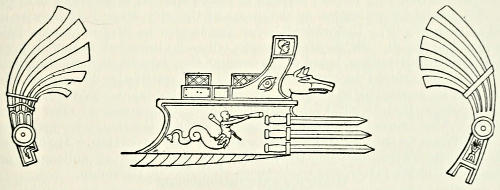
Prows of Roman War Galleys
Two years later, one of their kings, Randon, surprised Mogontiacum when
en fête and took much booty and many captives. Similar expeditions were
on foot, and the whole Alamannic league was astir. The emperor resumed
the policy of Diocletian, Tiberius, and Augustus, and sowed division among
the barbarians. The Burgundians, who had already attained to a certain
degree of civilisation, were gained over and opposed to the Alamanni. He
himself crossed the Rhine with a numerous army and conquered the rebellious
tribes near Solicinium[63] (368). He employed part of the following year
in raising the fortifications which guarded the river passages, and on the
Neckar, near Mannheim, began works to which he wished to attach great
importance. To make the barbarians understand that the empire intended
to resume its aggressive position towards them, he entered the great valley
of the Mœnus (Main), which flows through the heart of Germany. Macrianus,
the Alamannic king, was alarmed and sued for peace, and Valentinian
returned in triumph to Augusta Trevirorum (Trèves) with his son Gratian.
The poet Ausonius of Burdigala (Bordeaux), the young prince’s tutor, and
Symmachus, the last orator of Rome, celebrated these exploits which gave
security to Gaul.
During these operations on the Rhine those “kings of the sea,” the Saxons,
had been chased from the shores they had been accustomed to pillage, and
the count Theodosius, the father of the future emperor, had acquired in
Britain a renown almost equal among his contemporaries to that of Agricola;
but he had not a Tacitus for son-in-law. He saved the Britons from pillage
by the Picts, re-established the Roman dominion, which had been nearly
driven from the island, and consolidated it by a wise administration. Some
time after, he brought the same talents into Africa. The exactions of the
last governors and their cruelties towards the Donatists had excited such
great disaffection that Firmus the Moor had been able to conquer a large
part of the country. Theodosius suppressed the revolt, and, after the death
of Valentinian, restored peace to the province; but, becoming involved in
some obscure intrigue, in spite of his innocence and his services, he was
beheaded at Carthage.
In the internal government of the provinces Valentinian was hard and
often cruel. He had hardly any other punishment for crimes save death.
And if we are to credit a not very reliable story, he had lodged in his palace
two immense bears, which tore criminals to pieces before his eyes. In religious
matters he followed the principles of tolerance, with regard to all religions,
although he himself belonged to the orthodox church. The magicians
alone, who were then rapidly increasing in number, were diligently hunted
down. Wise laws against the exposing of children, for the management of
schools, the retaining of paid doctors in Rome and the establishment in provincial
towns of protectors or defensors of the city, show that he was not
only a man of war. Unfortunately for the empire he died in an expedition
against the Quadi. When these people, whom he intended to punish for an
incursion into Illyricum, heard of his coming, they sent him a humble embassy
to which he refused to listen. When he had pitilessly devastated their
country, he consented to receive their deputies, but spoke to them with so
much passion that he burst a blood vessel, and some moments after expired
(375). The successor of Valentinian was his son Gratian, who had borne
the title of Augustus since 367, and was now only seventeen. He accepted
his brother Valentinian II, then only four years old, as colleague, and
abandoned in his favour the prefectures of Italy and Illyricum.
[366-375 A.D.]
During these events there reigned in the East a suspicious and weak
prince, Valens, who had had to suppress the revolt of Procopius, cousin to
Julian. That usurper being detected in treason was beheaded (366); but
Valens, far from imitating the prudent reserve of his brother, disturbed the
whole Orient by a cruel persecution directed against the magicians and
those who consulted them, and also by his partiality for the Arians. The
faithful of the orthodox church were once more disturbed, the bishops
driven from their sees, and an Arian placed on the archiepiscopal throne at
Constantinople. Still worse sufferings would have been inflicted on the
Church if the gravity of the political events which filled this reign had left
Valens sufficient leisure to respond to all the demands of the heretic leaders.
Sapor had expelled the kings of Armenia and Iberia. Valens restored them
and forced the Great King to agree to a treaty with the empire. This was
a success, but unfortunately a frightful catastrophe was preparing on the
Thracian border.
Procopius, when he revolted, had taken into his pay a corps of three thousand
Visigoths. When the usurper was overthrown Valens endeavoured to
punish the barbarians for the help they had furnished. A three years’ war
ended in a treaty by which the barbarians were sent beyond the Danube, the
subsidies which the empire had paid them were suppressed, and two frontier
towns given in exchange. Athanaric, one of the principal leaders of the
western Goths or Visigoths who lived to the north of the lower Danube,
accepted this convention for his people. Bishop Ulfilas had just converted a
number of the Goths to Arianism. He had compiled a translation of the
Gospels in their tongue, the first written monument of their language. The
manuscript is preserved at Upsala. Ulfilas had first to make an alphabet,
which he borrowed in great part from that of the Greeks. Arianism was
therefore to return with the barbarians during the invasion.
To that invasion we are approaching, after having seen it constantly threatening
for nearly two hundred years. The people who brought it about were
strangers to the Germanic race, being tribes of Huns belonging to the Mongolian
race, as far as can be judged from the description which ancient writers
have left us of the features and customs of these ferocious hordes. The Huns
were nomads and scarcely recognised social ties. The tribes in their expeditions
followed particular leaders, who sometimes, however, united for common
enterprises. Attila, one of them, is apparently the first who contrived to
make the entire nation recognise his authority.
All the Huns were horsemen, and knew no other dwellings than their
tents or huts. As greedy and cruel as those Mongols of the Middle Ages
who killed five or six million men under Jenghiz Khan, they ravaged gold
and silver—not for use, because that they did not understand, but simply
to possess it. Following their vagabond instincts, and in order to augment
these useless treasures, they undertook disastrous expeditions against civilised
peoples. Their incursions, so rapid and unlooked for, spread more terror
than those of any other barbarous people of the time, for wherever they
passed they destroyed, merely for the pleasure of destroying. Attila, their
great chief, boasted later that grass would not spring again where his horse
had passed. There was a legend that they were born in the desert of demons
and witches, and their cruelty towards women, whom even the Germans in
their ravages respected, seemed to confirm this unclean origin.
[375-378 A.D.]
Where they first lived and what led them to migrate towards the west,
is unknown, but it seems to be established that, at the time when the Scandinavian
and German tribes began to stir, the nomadic hordes of western
Asia furled their tents and advanced on the west. Their march, many
times interrupted and by long intervals, owing to the obstinate resistance of
certain tribes, resumed its course when the obstacle had been overcome or
they had attracted to them the peoples who had stopped their way. This
is what happened in the time of Valens. The Huns crossed the Urals and
subjugated the Alans who lived between the Volga and the Black Sea. A
part of these people fled beyond the Caucasus, where their descendants
still live; the rest followed the conquerors, who, spreading over the vast
plains of Sarmatia, found themselves confronted by the great kingdom of
the Goths.
That great German nation, which had gradually descended from the
mouth of the Oder, on the Danube and Pontus Euxinus, had long remained
divided under a great number of chiefs. But Hermanric had united the
greater part of his tribes and founded a powerful state, the kingdom of the
Ostrogoths or eastern Goths, which extended from the Baltic to the Black
Sea, and a number of peoples had submitted to him. This kingdom barred
the whole continent and, had it not already been in full course of dissolution,
would no doubt have stopped the invasion.
When the aged Hermanric learned of the enemy’s approach, he made great
preparations, despite his 110 years. But the vassal tribes showed little zeal
for such a formidable war. Two chiefs of the Roxolani, whose sister he had
caused to be trampled to death under his horse’s hoofs because her husband
refused to arm for him, tried to assassinate him. Other chiefs also refused
obedience and the old king in desperation fell upon his sword. His successor
Whithimer was vanquished and killed. He left an infant son who was
saved by Alatheus and Saphrax, two Gothic warriors who had served for a
long time in the Roman armies. Leaving the bulk of the nation to make
submission to the conquerors, they, with the royal child, gained the interior
of the country by skilful marches and escaped the pursuit of the Huns, now
occupied in fighting a new enemy. Athanaric, a chief of the western Goths,
had advanced as far as the Danastris (Dniester) to defend the passage; their
cavalry crossed the river during the night and attacked him in the rear.
There was nothing for it but to retreat as far as the Pyretus (Pruth).
There Athanaric wanted to raise fortifications from the Carpathians to the
sea and might thus have arrested the Huns, but his discouraged people
preferred going to beg an asylum in the territories of the empire. The brave
chief himself refused such a disgrace, or did not venture to trust to the
hospitality of Valens, and fled to the mountains with a few faithful warriors
(375).
When the emperor was told that what remained of the Gothic nation was
now suppliant to him, his flattered pride made him forget his prudence, and
he opened the empire to this multitude, which still numbered two hundred
thousand fighting men. The only condition imposed was that they should lay
down their arms and give some of their children as hostages, who were sent to
the small towns of Asia Minor. The barbarians submitted to anything. But
when the imperial officers saw them disarmed they would sell them no provisions
except at the highest prices. All their money was first exhausted, then
their slaves, and afterwards their children, whom they sold. When they had
nothing more they were reduced to taking by force what was refused to them,
and went marauding through the country. They had not given up all their
arms and they manufactured more. Alatheus and Saphrax, who, about the
same time, forced the Danube passage and came with their comrades to join
them, augmented both their numbers and their confidence. All Thrace was
given up to pillage. Even Huns and Alans ran to share in the prey.
Valens collected his forces to fight them and also invoked the aid of his
nephew. Gratian promised help, but a young Alamannian of his guard, away
on leave among his own people, having spoken of these preparations, the Alamanni
thought it a favourable opportunity to attack the denuded frontiers
and their movement made it necessary to keep back the troops destined for
Valens. Yet every day added to the peril of this prince. All the barbarians
settled in the Danubian provinces, all the Germanic captives whom the emperors
had transported there, hastened to join their brethren. For a whole
year the legions vainly tried to stay the devastation. At last, in 378, Valens
arrived with a part of the army of the East. Gratian was also on the march;
but Valens wanted to prevent the concentration of the barbarians in a single
body and advanced against them.c
The Goths had proposed to occupy the defiles on the road from Constantinople
to Hadrianopolis, but the march of the imperial troops was conducted
with so much skill and celerity, that they reached the latter place unimpeded
and secured themselves in a strong camp beneath its walls. A council
was held to decide on future operations.e
[378 A.D.]
On the ninth of August, a day which has deserved to be marked among
the most inauspicious of the Roman calendar, the emperor Valens, leaving
under a strong guard his baggage and military treasure, marched from
Hadrianopolis to attack the Goths, who were encamped about twelve miles
from the city. By some mistake of the orders, or some ignorance of the
ground, the right wing or column of cavalry arrived in sight of the enemy
whilst the left was still at
a considerable distance;
the soldiers were compelled,
in the sultry heat
of summer, to precipitate
their pace; and the line
of battle was formed with
tedious confusion and irregular
delay. The Gothic
cavalry had been detached
to forage in the adjacent
country; and Fritigern
still continued to practise
his customary arts. He
despatched messengers of
peace, made proposals,
required hostages, and
wasted the hours, till the
Romans, exposed without
shelter to the burning
rays of the sun, were exhausted
by thirst, hunger,
and intolerable fatigue.
The emperor was persuaded
to send an ambassador
to the Gothic camp;
the zeal of Richomer, who
alone had courage to accept
the dangerous commission,
was applauded.

A Gothic Warrior
(After Hothmoth)
The count of the domestics,
adorned with the
splendid ensigns of his
dignity, had proceeded
some way in the space
between the two armies, when he was suddenly recalled by the alarm of
battle. The hasty and imprudent attack was made by Bacurius the Iberian,
who commanded a body of archers and targeteers; and as they advanced
with rashness, they retreated with loss and disgrace. In the same moment
the flying squadrons of Alatheus and Saphrax, whose return was anxiously
expected by the general of the Goths, descended like a whirlwind from the
hills, swept across the plain, and added new terrors to the tumultuous but
irresistible charge of the barbarian host. The event of the battle of Hadrianopolis,
so fatal to Valens and to the empire, may be described in a few
words; the Roman cavalry fled; the infantry was abandoned, surrounded,
and cut in pieces. The most skilful evolutions, the firmest courage, are
scarcely sufficient to extricate a body of foot, encompassed on an open plain
by superior numbers of horse; but the troops of Valens, oppressed by the
weight of the enemy and their own fears, were crowded into a narrow space,
where it was impossible for them to extend their ranks, or even to use with
effect their swords and javelins.
In the midst of tumult, slaughter, and dismay, the emperor, deserted
by his guards, and wounded, as it was supposed, with an arrow, sought protection
among the lancearii and the mattiarii, who still maintained their
ground with some appearance of order and firmness. His faithful generals,
Trajan and Victor, who perceived his danger, loudly exclaimed that all was
lost unless the person of the emperor could be saved. Some troops, animated
by their exhortation, advanced to his relief; they found only a bloody spot,
covered with a heap of broken arms and mangled bodies, without being able
to discover their unfortunate prince, either among the living or the dead.
Their search could not indeed be successful, if there is any truth in the circumstances
with which some historians have related the death of the emperor.
By the care of his attendants, Valens was removed from the field of battle
to a neighbouring cottage, where they attempted to dress his wound, and to
provide for his future safety. But his humble retreat was instantly surrounded
by the enemy; they tried to force the door; they were provoked
by a discharge of arrows from the roof, till at length, impatient of delay,
they set fire to a pile of dry fagots, and consumed the cottage with the Roman
emperor and his train. Valens perished in the flames; and a youth who
dropped from the window alone escaped, to attest the melancholy tale and
to inform the Goths of the inestimable prize which they had lost by their
own rashness. A great number of brave and distinguished officers perished
in the battle of Hadrianopolis, which equalled in the actual loss, and far
surpassed in the fatal consequences, the misfortune which Rome had
formerly sustained in the fields of Cannæ.
The pride of the Goths was elated by this memorable victory; but their
avarice was disappointed by the mortifying discovery that the richest part
of the imperial spoil had been within the walls of Hadrianopolis. They
hastened to possess the reward of their valour; but they were encountered
by the remains of a vanquished army, with an intrepid resolution which
was the effect of their despair and the only hope of their safety. The
walls of the city, and the ramparts of the adjacent camp, were lined with
military engines, that threw stones of an enormous weight, and astonished
the ignorant barbarians by the noise and velocity, still more than by the
real effects, of the discharge. The soldiers, the citizens, the provincials, the
domestics of the palace were united in the danger and in the defence;
the furious assault of the Goths was repulsed; their secret arts of treachery
and treason were discovered; and, after an obstinate conflict of many hours,
they retired to their tents; convinced, by experience, that it would be far
more advisable to observe the treaty which their sagacious leader had tacitly
stipulated with the fortifications of great and populous cities. After the
hasty and impolitic massacre of three hundred deserters, an act of justice
extremely useful to the discipline of the Roman armies, the Goths indignantly
raised the siege of Hadrianopolis. The scene of war and tumult was
instantly converted into a silent solitude: the multitude suddenly disappeared;
the secret paths of the woods and mountains were marked with
the footsteps of the trembling fugitives, who sought a refuge in the distant
cities of Illyricum and Macedonia; and the faithful officers of the
household and the treasury cautiously proceeded in search of the emperor,
of whose death they were still ignorant. The tide of the Gothic inundation
rolled from the walls of Hadrianopolis to the suburbs of Constantinople.
The barbarians were surprised with the splendid appearance of the capital
of the East, the height and extent of the walls, the myriads of wealthy
and affrighted citizens who crowded the ramparts, the various prospect of
the sea and land. While they gazed with hopeless desire on the inaccessible
beauties of Constantinople, a sally was made from one of the gates by a
party of Saracens, who had been fortunately engaged in the service of
Valens. The cavalry of Scythia was forced to yield to the admirable swiftness
and spirit of the Arabian horses; their riders were skilled in the evolutions
of irregular war, and the northern barbarians were astonished and
dismayed by the inhuman ferocity of the barbarians of the south. A Gothic
soldier was slain by the dagger of an Arab; and the hairy, naked savage,
applying his lips to the wound, expressed a horrid delight while he sucked
the blood of his vanquished enemy. The army of the Goths, laden with the
spoils of the wealthy suburbs and the adjacent territory, slowly moved from
the Bosporus to the mountains which form the western boundary of Thrace.
The important pass of Succi was betrayed by the fear, or the misconduct,
of Maurus; and the barbarians, who no longer had any resistance to apprehend
from the scattered and vanquished troops of the east, spread themselves
over the face of a fertile and cultivated country, as far as the confines
of Italy and the Adriatic Sea.b
[378-382 A.D.]
Gratian, more fortunate, at the same time defeated the Alamanni near
Colmar. But the Eastern Empire was without a head. Gratian could not
think of adding this heavy crown to that which he already wore, and to help
him in the difficult task of repairing the great catastrophe under which the
nation groaned, he cast his eyes on Theodosius, son of the valiant count
Theodosius.
After his father’s unhappy end Theodosius had retired to Spain, his
native country. Gratian recalled him, and on the Jan. 19, 379, gave him
the title of Augustus and the two prefectures of the East and of Illyricum.
Theodosius set to work bravely. Asia was quiet, thanks to an atrocious
measure. All the Goths sent as hostages into the provinces had been convoked
on the same day in the chief cities to receive gifts in money and land.
But troops awaited them there; taken by surprise and defenceless, they had
been massacred. In Thrace their brothers and fathers were avenging them.
Theodosius had to reform an army, and, above all, to raise the courage
of the soldiers. He succeeded in so doing by giving them the opportunity of
fighting a great many small battles wherein he was careful to insure their
success. These were the old tactics of Fabius Cunctator against Hannibal;
and in this case they were even more successful. He allowed no stronghold
to fall into the hands of the enemy, whose numbers he diminished by provoking
desertions, so that, without gaining a great victory, he brought the
Goths to treat.
[382-388 A.D.]
Fritigern, the conqueror of Hadrianopolis, was dead; the gallant Athanaric,
his successor, had allowed himself to be allured to Constantinople, and
there, dazzled by the brilliance of the gorgeous court, he persuaded his
people to accept the emperor’s offers (October, 382). Theodosius, as a matter
of fact, gave them what they wanted. He settled them in Thrace and Mœsia,
with the charge of defending the passage of the Danube. Forty thousand
warriors of the Goths were enrolled among the imperial troops.
This was really to deliver the empire into their hands; for these Goths—remaining
a national body under their national leaders, with a military
organisation of their own—soon felt the instincts of pillage and the need
of adventure reawaken in them. A few years more, and they would take
Rome after ravaging Greece and Italy, and the war they would thus carry
to the very heart of the empire would level the barriers over which this
flood of invasion was destined to pass.
For the time being, however, Theodosius had put an end to a deplorable
situation, and the empire, believing itself saved, showed its gratitude.
Those sad events of which the West was the scene, and which would lead to
a reunion of the whole empire of Augustus under his authority, for a while
increased his renown. The church, above all, delivered by him from
Arianism, looked upon him as a second Constantine, and the epithet of
“the great” has remained joined to the name of the last master of the
Roman world.
Gratian, active, intelligent, and brave, was nevertheless overthrown by a
usurper. Passionately fond of hunting, he forgot his princely duties, and
was now usually seen surrounded by Alan archers. This preference irritated
the soldiers, and the British legions proclaimed their chief, Maximus,
one of the able comrades of Count Theodosius, emperor. Maximus immediately
marched into Gaul. Gratian, abandoned by his troops, tried to reach
the Alps, but, being overtaken near Lyons, he was put to death (August 25,
383). For this expedition Maximus had withdrawn the legions from
Britain. The island, left defenceless, was soon desolated by the inroads of
the Picts and Scots, and by the invasions of Saxons and Frisians.
Theodosius would gladly have avenged his benefactor, but tranquillity
was not yet restored in the East, and a civil war might have lost all. He
recognised the usurper as master of the Gallic prefecture on condition that he
should leave that of Italy to the young Valentinian II (385). The latter’s
mother, Justina, in her zeal for Arianism, sought to propagate heresy in her
son’s provinces, which were by no means favourably disposed towards it. At
Mediolanum the opposition was very strong. She tried to overcome it by
threatening to exile Saint Ambrose, the archbishop, but the people repulsed her
barbarian guards. Maximus thought the occasion favourable. He crossed
the Alps, and Valentinian II fled (387) to Theodosius at Thessalonica.
This prince had already declared himself strongly opposed to the Arians.
As early as the year 380 he had received baptism, had promulgated edicts
in favour of orthodoxy, and expelled Damophilus, patriarch of Constantinople,
from his see, which was given to Gregory of Nazianzus. A council
which met in Constantinople (381) condemned the heresy afresh and confirmed
the Nicene creed. Justina owed her misfortunes to her zeal for
Arianism, but Theodosius had married her daughter, the beautiful Galla, so
the empress, despite her imprudence, could count on the support of her son-in-law.
He hesitated, however, for nearly a year until he learned that Maximus
by his harshness had stirred up all the Italians against him.
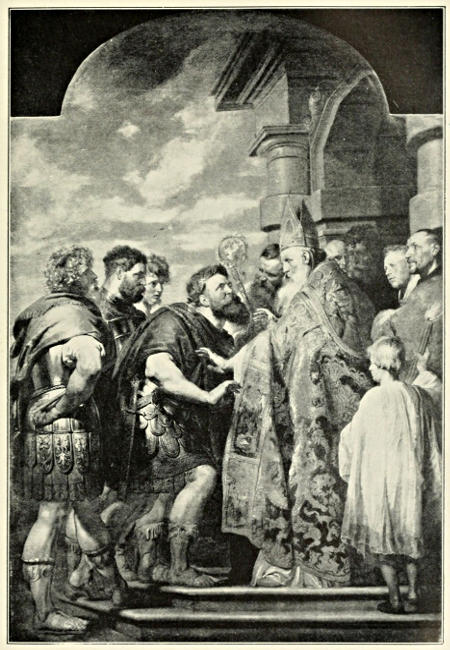
THEODOSIUS FORBIDDEN THE TEMPLE BY SAINT AMBROSE
[388-395 A.D.]
Theodosius entered Pannonia in the year 388, and made a diversion in
Gaul by means of the Saxons and Franks. Maximus used the same weapons
against him and tampered with the fidelity of his barbaric troops. Dangerous
defections would have ensued had he not anticipated them by severe
measures. The usurper, vanquished on the banks of the Save, was given
up by his own soldiers and put to death in Aquileia. Theodosius kept no
part of his conquest, but gave it up to Valentinian. To confirm the young
prince’s power and extirpate both heresy and the last remains of paganism
which yet lingered in the Western provinces, he stayed three years in his
brother-in-law’s province. On his departure he gave him as chief minister
Arbogast the Frank, who had just delivered Gaul from the Germans,
and filled all offices, civil and military, with barbarians. Valentinian did
not long endure this guardianship; he wished to deprive the count of all his
offices. “I hold my charge from Theodosius,” answered Arbogast before the
whole court, “he alone can take it from me.” Valentinian, in a violent
rage, threw himself upon Arbogast, sword in hand. Some days after he
was found dead (May 15, 392).
The Palatine, Rome
Arbogast could not hope that Theodosius would leave this murder unpunished.
Not daring to proclaim himself emperor, he threw the purple
robe on the shoulders of an imperial secretary, the rhetorician Eugenius.
Theodosius, the avenger of orthodoxy, had the Catholic clergy on his side.
Arbogast and Eugenius tried to rally to their cause all that were left of the
pagans. This conduct raised the Christian population against them. A
single battle, near Aquileia, put an end to this rule. Eugenius, being taken
prisoner, was put to death; Arbogast slew himself (394). This time the
victor retained his conquests.
This victory redoubled Theodosius’ zeal for orthodoxy. He forbade,
under severe penalties, the worship of the gods, who, driven from the towns,
took refuge amongst the country people (pagani), and he deprived heretics
not only of all claim to honours but of the right of disposing of their property.
On the other hand, numerous and wise regulations showed the monarch’s
constant preoccupation with remedies for some of the evils which were
harassing this moribund social order. He could not succeed, for the ills
were incurable, but at least he did honour to the last days of the empire by
displaying such virtue on the throne as subjects rarely had been called upon
to reverence. We have seen his disinterestedness and his gratitude to his
benefactor’s family; let us add that peace always reigned in his numerous
family—that if he retained courtiers he also had friends.
Before his death (January 17, 395) he divided the empire between his two
sons Arcadius and Honorius; an irrevocable separation which still endures
in the different religion and civilisation of these two halves of the ancient
world.
One great act does Theodosius honour. The people of Thessalonica had
killed the governor and several imperial officers in a sedition. Under similar
circumstances Theodosius had pardoned the people of Antioch (387). This
time he fell into a violent rage and gave orders which cost the lives of seven
thousand persons. This massacre excited a feeling of horror throughout
the empire. When, some time after, Theodosius presented himself at the
doors of Milan cathedral, St. Ambrose had the courage to stop him. Before
all the crowd he reproached him for his crime, forbidding him to enter or
approach the Holy Table. Theodosius accepted the public penance which
the bishop imposed upon him in the name of God and outraged humanity.
For eight months he never crossed the threshold of the church.c
The orator, who may be silent without danger, may praise without difficulty
and without reluctance; and posterity will confess that the character
of Theodosius might furnish the subject of a sincere and ample panegyric.
The wisdom of his laws and the success of his arms rendered his administration
respectable in the eyes both of his subjects and of his enemies. He
loved and practised the virtues of domestic life, which seldom hold their
residence in the palaces of kings. Theodosius was chaste and temperate;
he enjoyed, without excess, the sensual and social pleasures of the table;
and the warmth of his amorous passions was never diverted from their
lawful objects. The proud titles of imperial greatness were adorned by the
tender names of a faithful husband, an indulgent father; his uncle was
raised, by his affectionate esteem, to the rank of a second parent. Theodosius
embraced, as his own, the children of his brother and sister; and the
expressions of his regard were extended to the most distant and obscure
branches of his numerous kindred. His familiar friends were judiciously
selected from among those persons who, in the equal intercourse of private
life, had appeared before his eyes without a mask. The consciousness of personal
and superior merit enabled him to despise the accidental distinction of
the purple; and he proved, by his conduct, that he had forgotten all the
injuries, while he most gratefully remembered all the favours and services,
which he had received before he ascended the throne of the Roman Empire.
The serious or lively tone of his conversation was adapted to the age,
the rank, or the character of subjects whom he admitted into his society;
and the affability of his manners displayed the image of his mind. Theodosius
respected the simplicity of the good and virtuous; every art, every
talent, of a useful or even of an innocent nature, was rewarded by his
judicious liberality; and, except the heretics, whom he persecuted with implacable
hatred, the diffusive circle of his benevolence was circumscribed
only by the limits of the human race. The government of a mighty empire
may assuredly suffice to occupy the time and the abilities of a mortal; yet
the diligent prince, without aspiring to the unsuitable reputation of profound
learning, always reserved some moments of his leisure for the instructive
amusement of reading. History, which enlarged his experience, was his
favourite study. The annals of Rome, in the long period of eleven hundred
years, presented him with a various and splendid picture of human life; and
it has been particularly observed that whenever he perused the cruel acts of
Cinna, of Marius, or of Sulla, he warmly expressed his generous detestation
of those enemies of humanity and freedom. His disinterested opinion of
past events was usefully applied as the rule of his own actions; and Theodosius
has deserved the singular commendation, that his virtues always
seemed to expand with his fortune. The season of his prosperity was that of
his moderation; and his clemency appeared the most conspicuous after the
danger and success of the civil war. The Moorish guards of the tyrant had
been massacred in the first heat of the victory, and a small number of the
most obnoxious criminals suffered the punishment of the law. But the emperor
showed himself much more attentive to relieve the innocent than to
chastise the guilty. The oppressed subjects of the West, who would have
deemed themselves happy in the restoration of their lands, were astonished to
receive a sum of money equivalent to their losses; and the liberality of the
conqueror supported the aged mother and educated the orphan daughters
of Maximus. A character thus accomplished might almost excuse the extravagant
supposition of the orator Pacatus that if the elder Brutus could
be permitted to revisit the earth, the stern republican would abjure, at the
feet of Theodosius, his hatred of kings; and ingenuously confess that such
a monarch was the most faithful guardian of the happiness and dignity of
the Roman people.
Yet the piercing eye of the founder of the republic must have discerned
two essential imperfections, which might perhaps have abated his recent love
of despotism. The virtuous mind of Theodosius was often relaxed by indolence,
and it was sometimes inflamed by passion. In the pursuit of an important
object, his active courage was capable of the most vigorous exertions;
but, as soon as the design was accomplished or the danger was surmounted,
the hero sunk into inglorious repose; and, forgetful that the time of a prince
is the property of his people, resigned himself to the enjoyment of the innocent
but trifling pleasures of a luxurious court. The natural disposition of
Theodosius was hasty and choleric; and, in a station where none could
resist and few would dissuade the fatal consequence of his resentment, the
humane monarch was justly alarmed by the consciousness of his infirmity
and of his power. It was the constant study of his life to suppress or regulate
the intemperate sallies of passion; and the success of his efforts enhanced
the merit of his clemency. But the painful virtue which claims the
merit of victory is exposed to the danger of defeat; and the reign of a wise
and merciful prince was polluted by an act of cruelty which would stain the
annals of Nero or Domitian. Within the space of three years, the inconsistent
historian of Theodosius must relate the generous pardon of the citizens
of Antioch and the inhuman massacre of the people of Thessalonica.
[387 A.D.]
The lively impatience of the inhabitants of Antioch was never satisfied
with their own situation, or with the character and conduct of their successive
sovereigns. The Arian subjects of Theodosius deplored the loss of their
churches; and, as three rival bishops disputed the throne of Antioch, the
sentence which decided their pretensions excited the murmurs of the two unsuccessful
congregations. The exigencies of the Gothic War, and the inevitable
expense that accompanied the conclusion of the peace, had constrained
the emperor to aggravate the weight of the public impositions; and the provinces
of Asia, as they had not been involved in the distress were the less
inclined to contribute to the relief of Europe. The auspicious period
now approached of the tenth year of his reign; a festival more grateful to
the soldiers, who received a liberal donative, than to the subjects, whose
voluntary offerings had been long since converted into an extraordinary and
oppressive burden. The edicts of taxation interrupted the repose and pleasures
of Antioch; and the tribunal of the magistrate was besieged by a suppliant
crowd, who, in pathetic but at first in respectful language, solicited
the redress of their grievances. They were gradually incensed by the pride
of their haughty rulers, who treated their complaints as a criminal resistance;
their satirical wit degenerated into sharp and angry invectives; and, from
the subordinate powers of government, the invectives of the people insensibly
rose to attack the sacred character of the emperor himself.
Roman Arms
Their fury, provoked by a feeble opposition, discharged itself on the
images of the imperial family, erected, as objects of public veneration, in
the most conspicuous places of the city. The statues of Theodosius, of his
father, of his wife Flaccilla, of his two sons Arcadius and
Honorius, were insolently thrown down from their pedestals,
broken in pieces, or dragged with contempt through
the streets; and the indignities which were offered to the
representations of imperial majesty sufficiently declared
the impious and treasonable wishes of the populace. The
tumult was almost immediately suppressed by the arrival
of a body of archers; and Antioch had leisure to reflect
on the nature and consequences of her crime. According
to the duty of his office, the governor of the province despatched
a faithful narrative of the whole transaction; while
the trembling citizens entrusted the confession of their crime
and the assurances of their repentance to the zeal of Flavian
their bishop, and to the eloquence of the senator Hilarius,
the friend and most probably the disciple of Libanius, whose
genius, on this melancholy occasion, was not useless to his
country. But the two capitals, Antioch and Constantinople,
were separated by the distance of eight hundred miles; and,
notwithstanding the diligence of the imperial posts, the
guilty city was severely punished by a long and dreadful
interval of suspense. Every rumour agitated the hopes
and fears of the Antiochians, and they heard with terror
that their sovereign, exasperated by the insult which had
been offered to his own statues, and more especially to
those of his beloved wife, had resolved to level with the
ground the offending city; and to massacre, without distinction
of age or sex, the criminal inhabitants, many of
whom were actually driven, by their apprehensions, to seek
a refuge in the mountains of Syria and the adjacent desert.
At length, twenty-four days after the sedition, the general
Hellebicus, and Cæsarius, master of the offices, declared the will of the emperor
and the sentence of Antioch. That proud capital was degraded from
the rank of a city; and the metropolis of the East, stripped of its lands, its
privileges, and its revenues, was subjected, under the humiliating denomination
of a village, to the jurisdiction of Laodicea.
The baths, the circus, and the theatres were shut; and, that every source
of plenty and pleasure might at the same time be intercepted, the distribution
of corn was abolished, by the severe instructions of Theodosius. His
commissioners then proceeded to inquire into the guilt of individuals; of
those who had perpetrated, and of those who had not prevented, the destruction
of the sacred statues. The tribunal of Hellebicus and Cæsarius, encompassed
with armed soldiers, was erected in the midst of the Forum. The
noblest and most wealthy of the citizens of Antioch, appeared before them
in chains; the examination was assisted by the use of torture, and their
sentence was pronounced or suspended according to the judgment of these
extraordinary magistrates. The houses of the criminals were exposed to
sale, their wives and children were suddenly reduced from affluence and
luxury to the most abject distress; and a bloody execution was expected to
conclude the horrors of a day, which the preacher of Antioch, the eloquent
Chrysostom, has represented as a lively image of the last and universal judgment
of the world. But the ministers of Theodosius performed, with reluctance,
the cruel task which had been assigned them; they dropped a gentle
tear over the calamities of the people; and they listened with reverence to
the pressing solicitations of the monks and hermits, who descended in swarms
from the mountains. Hellebicus and Cæsarius were persuaded to suspend
the execution of their sentence; and it was agreed that the former should
remain at Antioch, while the latter returned, with all possible speed, to
Constantinople, and presumed once more to consult the will of his sovereign.
The resentment of Theodosius had already subsided; the deputies of the
people, both the bishop and the orator, had obtained a favourable audience;
and the reproaches of the emperor were the complaints of injured friendship,
rather than the stern menaces of pride and power. A free and general
pardon was granted to the city and citizens of Antioch; the prison-doors
were thrown open; the senators who despaired of their lives recovered the
possession of their houses and estates; and the capital of the East was
restored to the enjoyment of her ancient dignity and splendour. Theodosius
condescended to praise the senate of Constantinople, who had generously
interceded for their distressed brethren; he rewarded the eloquence of
Hilarius with the government of Palestine, and dismissed the bishop of Antioch
with the warmest expressions of his respect and gratitude. A thousand
new statues arose to the clemency of Theodosius; the applause of
his subjects was ratified by the approbation of his own heart; and the
emperor confessed that, if the exercise of justice is the most important duty,
the indulgence of mercy is the most exquisite pleasure of a sovereign.
[387-390 A.D.]
The sedition of Thessalonica is ascribed to a more shameful cause, and
was productive of much more dreadful consequences. That great city, the
metropolis of all the Illyrian provinces, had been protected from the dangers
of the Gothic war by strong fortifications and a numerous garrison. Botheric,
the general of those troops, and, as it should seem from his name, a barbarian,
had among his slaves a beautiful boy, who excited the impure desires of one
of the charioteers of the circus. The insolent and brutal lover was thrown
into prison by the order of Botheric; and he sternly rejected the importunate
clamours of the multitude, who, on the day of the public games, lamented
the absence of their favourite, and considered the skill of a charioteer as an
object of more importance than his virtue. The resentment of the people
was imbittered by some previous disputes; and, as the strength of the
garrison had been drawn away for the service of the Italian War, the feeble
remnant, whose numbers were reduced by desertion, could not save the
unhappy general from their licentious fury. Botheric, and several of his
principal officers, were inhumanly murdered: their mangled bodies were
dragged about the streets; and the emperor, who then resided at Mediolanum,
was surprised by the intelligence of the audacious and wanton cruelty of the
people of Thessalonica. The sentence of a dispassionate judge would have
inflicted a severe punishment on the authors of the crime; and the merit of
Botheric might contribute to exasperate the grief and indignation of his
master. The fiery and choleric temper of Theodosius was impatient of the
dilatory forms of a judicial inquiry; and he hastily resolved that the blood
of his lieutenant should be expiated by the blood of the guilty people.
Yet his mind still fluctuated between the counsels of clemency and of
revenge; the zeal of the bishops had almost extorted from the reluctant
emperor the promise of a general pardon; his passion was again inflamed by
the flattering suggestions of his minister, Rufinus; and, after Theodosius
had despatched the messengers of death, he attempted, too late, to prevent
the execution of his orders. The punishment of a Roman city was blindly
committed to the undistinguishing sword of the barbarians; and the hostile
preparations were concerted with the dark and perfidious artifice of an illegal
conspiracy. The people of Thessalonica were treacherously invited, in the
name of their sovereign, to the games of the circus; and such was their
insatiate avidity for those amusements that every consideration of fear, or
suspicion, was disregarded by the numerous spectators. As soon as the
assembly was complete, the soldiers, who had been secretly posted round
the circus, received the signal, not of the races but of a general massacre.
The promiscuous carnage continued three hours, without discrimination of
strangers or natives, of age or sex, of innocence or guilt; the most moderate
accounts state the number of the slain at seven thousand; and it is affirmed
by some writers that more than fifteen thousand victims were sacrificed to
the manes of Botheric. A foreign merchant, who had probably no concern
in his murder, offered his own life, and all his wealth, to supply the place of
one of his two sons; but, while the father hesitated with equal tenderness,
while he was doubtful to choose and unwilling to condemn, the soldiers
determined his suspense by plunging their daggers at the same moment into
the breasts of the defenceless youths. The apology of the assassins that
they were obliged to produce the prescribed number of heads, serves only to
increase, by an appearance of order and design, the horrors of the massacre,
which was executed by the commands of Theodosius. The guilt of the emperor
is aggravated by his long and frequent residence at Thessalonica. The
situation of the unfortunate city, the aspect of the streets and buildings,
the dress and faces of the inhabitants, were familiar, and even present to his
imagination; and Theodosius possessed a quick and lively sense of the existence
of the people whom he destroyed.
The respectful attachment of the emperor for the orthodox clergy had
disposed him to love and admire the character of Ambrose, who united all
the episcopal virtues in the most eminent degree. The friends and ministers
of Theodosius imitated the example of their sovereign; and he observed,
with more surprise than displeasure, that all his secret counsels were
immediately communicated to the archbishop, who acted from the laudable
persuasion that every measure of civil government may have some connection
with the glory of God and the interests of the true religion. The
monks and populace of Callinicum, an obscure town on the frontier of
Persia, excited by their own fanaticism and by that of their bishop, had
tumultuously burned a conventicle of the Valentinians and a synagogue
of the Jews.
The seditious prelate was condemned, by the magistrate of the province,
either to rebuild the synagogue or to repay the damage; this moderate
sentence was confirmed by the emperor. But it was not confirmed by the
archbishop of Milan. He dictated an epistle of censure and reproach, more
suitable, perhaps, if the emperor had received the mark of circumcision and
renounced the faith of his baptism. Ambrose considers the toleration of the
Jewish, as the persecution of the Christian, religion; boldly declares that
he himself, and every true believer, would eagerly dispute with the bishop
of Callinicum the merit of the deed, and the crown of martyrdom; and
laments in the most pathetic terms that the execution of the sentence
would be fatal to the fame and salvation of Theodosius. As this private
admonition did not produce an immediate effect, the archbishop, from his
pulpit, publicly addressed the emperor on his throne; nor would he consent
to offer the oblation of the altar, till he had obtained from Theodosius a
solemn and positive declaration, which secured the impunity of the bishop
and monks of Callinicum. The recantation of Theodosius was sincere; and
during the term of his residence at Milan his affection for Ambrose was
continually increased by the habits of pious and familiar conversation.
When Ambrose was informed of the massacre of Thessalonica, his mind
was filled with horror and anguish. He retired into the country to indulge
his grief, and to avoid the presence of Theodosius. But as the archbishop
was satisfied that a timid silence would render him the accomplice of his
guilt, he represented, in a private letter, the enormity of the crime; which
could only be effaced by the tears of penitence. The episcopal vigour of
Ambrose was tempered by prudence; and he contented himself with signifying
an indirect sort of excommunication, by the assurance that he had been
warned in a vision not to offer the oblation in the name or in the presence
of Theodosius; and by the advice that he would confine himself to the use
of prayer, without presuming to approach the altar of Christ, or to receive
the Holy Eucharist with those hands that were still polluted with the blood
of an innocent people. The emperor was deeply affected by his own reproaches
and by those of his spiritual father; and, after he had bewailed the
mischievous and irreparable consequences of his rash fury, he proceeded,
in the accustomed manner, to perform his devotions in the great church of
Milan.
He was stopped in the porch by the archbishop, who, in the tone and
language of an ambassador of heaven, declared to his sovereign that private
contrition was not sufficient to atone for a public fault, or to appease the
justice of the offended Deity. Theodosius humbly represented that, if he
had contracted the guilt of homicide, David, the man after God’s own heart,
had been guilty, not only of murder but of adultery. “You have imitated
David in his crime, imitate then his repentance,” was the reply of the
undaunted Ambrose. The rigorous conditions of peace and pardon were accepted;
and the public penance of the emperor Theodosius has been recorded
as one of the most honourable events in the annals of the Church. According
to the mildest rules of ecclesiastical discipline, which were established in
the fourth century, the crime of homicide was expiated by the penitence of
twenty years; and as it was impossible, in the period of human life, to purge
the accumulated guilt of the massacre of Thessalonica, the murderer should
have been excluded from the Holy Communion till the hour of his death.
But the archbishop, consulting the maxims of religious policy, granted some
indulgence to the rank of his illustrious penitent, who humbled in the dust
the pride of the diadem; and the public edification might be admitted as a
weighty reason to abridge the duration of his punishment. It was sufficient
that the emperor of the Romans, stripped of the ensigns of royalty, should
appear in a mournful and suppliant posture; and that, in the midst of the
church of Milan, he should humbly solicit, with sighs and tears, the pardon
of his sins.
[390-395 A.D.]
After the defeat and death of the tyrant of Gaul, the Roman world was
in the possession of Theodosius. He derived from the choice of Gratian his
honourable title to the provinces of the East: he had acquired the West by
the right of conquest; and the three years which he spent in Italy were
usefully employed to restore the authority of the laws and to correct the
abuses which had prevailed with impunity under the usurpation of Maximus
and the minority of Valentinian. The name of Valentinian was regularly
inserted in the public acts; but the tender age and doubtful faith
of the son of Justina appeared to require the prudent care of an orthodox
guardian; and his specious ambition might have excluded the unfortunate
youth, without a struggle, and almost without a murmur, from the administration,
and even from the inheritance, of the empire. If Theodosius had
consulted the rigid maxims of interest and policy, his conduct would have
been justified by his friends; but the generosity of his behaviour on this
memorable occasion has extorted the applause of his most inveterate enemies.
He seated Valentinian on the throne of Milan; and, without stipulating any
present or future advantages, restored him to the absolute dominion of all
the provinces from which he had been driven by the arms of Maximus. To
the restitution of his ample patrimony, Theodosius added the free and generous
gift of the countries beyond the Alps, which his successful valour had
recovered from the assassin of Gratian. Satisfied with the glory which he
had acquired, by revenging the death of his benefactor and delivering the
West from the yoke of tyranny, the emperor returned from Milan to Constantinople;
and, in the peaceful possession of the East, insensibly relapsed
into his former habits of luxury and indolence. Theodosius discharged
his obligation to the brother, he indulged his conjugal tenderness to the
sister of Valentinian; and posterity, which admires the pure and singular
glory of his elevation, must applaud his unrivalled generosity in the use of
victory.b
[395-397 A.D.]
The genius of Rome expired with Theodosius, the last of the successors
of Augustus and Constantine who appeared in the field at the head of their
armies, and whose authority was universally acknowledged throughout the
whole extent of the empire. The memory of his virtues still continued,
however, to protect the feeble and inexperienced youth of his two sons.
After the death of their father, Arcadius and Honorius were saluted, by the
unanimous consent of mankind, as the lawful emperors of the East and of
the West; and the oath of fidelity was eagerly taken by every order of the
state—the senates of old and new Rome, the clergy, the magistrates, the
soldiers, and the people. Arcadius, who then was about eighteen years of
age, was born in Spain, in the humble habitation of a private family. But
he received a princely education in the palace of Constantinople; and his
inglorious life was spent in that peaceful and splendid seat of royalty, from
whence he appeared to reign over the provinces of Thrace, Asia Minor,
Syria, and Egypt, from the lower Danube to the confines of Persia and
Ethiopia. His younger brother, Honorius, assumed, in the eleventh year
of his age, the nominal government of Italy, Africa, Gaul, Spain, and
Britain; and the troops, which guarded the frontiers of his kingdom, were
opposed on one side to the Caledonians, and on the other to the Moors.
The great and martial prefecture of Illyricum was divided between the two
princes; the defence and possession of the provinces of Noricum, Pannonia,
and Dalmatia still belonged to the Western Empire;[64] but the two large
dioceses of Dacia and Macedonia, which Gratian had intrusted to the valour
of Theodosius, were forever united to the empire of the East. The boundary
in Europe was not very different from the line which now separates the
Germans and the Turks; and the respective advantages of territory, riches,
populousness, and military strength, were fairly balanced and compensated.
The hereditary sceptre of the sons of Theodosius appeared to be the gift of
nature and of their father; the generals and ministers had been accustomed
to adore the majesty of the royal infants. The gradual discovery of the
weakness of Arcadius and Honorius, and the repeated calamities of their reign,
were not sufficient to obliterate the deep and early impressions of loyalty.
Theodosius had tarnished the glory of his reign by the elevation of Rufinus;
an odious favourite, who, in an age of civil and religious faction, has
deserved, from every party, the imputation of every crime. The strong impulse
of ambition and avarice had urged Rufinus to abandon his native country,
an obscure corner of Gaul, to advance his fortune in the capital of the
East: the talent of bold and ready elocution qualified him to succeed in the
lucrative profession of the law; and his success in that profession was a
regular step to the most honourable and important employments of the state.
He was raised by just degrees to the station of master of the offices. In the
exercise of his various functions, so essentially connected with the whole system
of civil government, he acquired the confidence of a monarch who soon
discovered his diligence and capacity in business, and who long remained
ignorant of the pride, the malice, and the covetousness of his disposition.
The character of Theodosius imposed on his minister the task of hypocrisy,
which disguised, and sometimes restrained, the abuse of power; and
Rufinus was apprehensive of disturbing the indolent slumber of a prince
still capable of exerting the abilities and the virtue which had raised him to
the throne. But the absence, and soon afterwards the death, of the emperor
confirmed the absolute authority of Rufinus over the person and dominions
of Arcadius; a feeble youth, whom the imperious prefect considered as his
pupil rather than his sovereign. Regardless of the public opinion, he indulged
his passions without remorse and without resistance; and his malignant
and rapacious spirit rejected every passion that might have contributed
to his own glory or the happiness of the people. His avarice, which seems to
have prevailed in his corrupt mind over every other sentiment, attracted
the wealth of the East by the various arts of partial and general extortion:
oppressive taxes, scandalous bribery, immoderate fines, unjust confiscations,
forced or fictitious testaments, by which the tyrant despoiled of their lawful
inheritance the children of strangers or enemies; and the public sale of justice,
as well as of favour, which he instituted in the palace of Constantinople.
The ambitious candidate eagerly solicited, at the expense of the fairest
part of his patrimony, the honours and emoluments of some provincial government;
the lives and fortunes of the unhappy people were abandoned to
the most liberal purchaser; the public discontent was sometimes appeased
by the sacrifice of an unpopular criminal, whose punishment was profitable
only to the prefect of the East, his accomplice and his judge. The fate of
Lucian proclaimed to the East that the prefect, whose industry was much
abated in the despatch of ordinary business, was indefatigable in the pursuit
of revenge. Lucian, the son of the prefect Florentius, the oppressor of
Gaul and the enemy of Julian, had employed a considerable part of his
inheritance, the fruit of rapine and corruption, to purchase the friendship of
Rufinus and the high office of count of the East. But the new magistrate
imprudently departed from the maxims of the court and of the times; disgraced
his benefactor by the contrast of a virtuous and temperate administration;
and presumed to refuse an act of injustice, which might have tended
to the profit of the emperor’s uncle.
Arcadius was easily persuaded to resent the supposed insult; and the
prefect of the East resolved to execute in person the cruel vengeance which
he meditated against this ungrateful delegate of his power. He performed
with incessant speed the journey of seven or eight hundred miles from Constantinople
to Antioch, entered the capital of Syria at the dead of the night,
and spread universal consternation among a people ignorant of his design
but not ignorant of his character. The count of the fifteen provinces of the
East was dragged, like the vilest malefactor, before the arbitrary tribunal of
Rufinus. Notwithstanding the clearest evidence of his integrity, which was
not impeached even by the voice of an accuser, Lucian was condemned,
almost without a trial, to suffer a cruel and ignominious punishment. The
ministers of the tyrant, by the order and in the presence of their master,
beat him on the neck with leather thongs, armed at the extremities with
lead; and when he fainted under the violence of the pain, he was removed
in a close litter, to conceal his dying agonies from the eyes of the indignant
city. No sooner had Rufinus perpetrated this inhuman act, the sole object
of his expedition, than he returned, amidst the deep and silent curses of a
trembling people, from Antioch to Constantinople; and his diligence was
accelerated by the hope of accomplishing without delay the nuptials of his
daughter with the emperor of the East.
But Rufinus soon experienced that a prudent minister should constantly
secure his royal captive by the strong though invisible chain of habit; and
that the merit, and much more easily the favour, of the absent are obliterated
in a short time from the mind of a weak and capricious sovereign. While
the prefect satiated his revenge at Antioch, a secret conspiracy of the
favourite eunuchs, directed by the great chamberlain Eutropius, undermined
his power in the palace of Constantinople. They discovered that Arcadius
was not inclined to love the daughter of Rufinus, who had been chosen, without
his consent, for his bride; and they contrived to substitute in her place
the fair Eudoxia, the daughter of Bauto, a general of the Franks in the service
of Rome; and who was educated, since the death of her father, in the
family of the sons of Promotus.
The young emperor, whose chastity had been strictly guarded by the
pious care of his tutor Arsenius, eagerly listened to the artful and flattering
descriptions of the charms of Eudoxia: he gazed with impatient ardour
on her picture, and he understood the necessity of concealing his amorous
designs from the knowledge of a minister who was so deeply interested to
oppose the consummation of his happiness. Soon after the return of Rufinus,
the approaching ceremony of the royal nuptials was announced to the
people of Constantinople, who prepared to celebrate, with false and hollow
acclamations, the fortune of his daughter. A splendid train of eunuchs and
officers issued, in hymeneal pomp, from the gates of the palace; bearing
aloft the diadem, the robes, and the inestimable ornaments of the future
empress. The solemn procession passed through the streets of the city,
which were adorned with garlands and filled with spectators; but when it
reached the house of the sons of Promotus, the principal eunuch respectfully
entered the mansion, invested the fair Eudoxia with the imperial robes, and
conducted her in triumph to the palace and bed of Arcadius. The secrecy
and success with which this conspiracy against Rufinus had been conducted
imprinted a mark of indelible ridicule on the character of a minister who
had suffered himself to be deceived in a post where the arts of deceit and dissimulation
constitute the most distinguished merit. He considered, with a
mixture of indignation and fear, the victory of an aspiring eunuch, who had
secretly captivated the favour of his sovereign; and the disgrace of his
daughter, whose interest was inseparably connected with his own, wounded
the tenderness, or at least the pride, of Rufinus. The character of Rufinus
seemed to justify the accusations that he conspired against the person of
his sovereign to seat himself on the vacant throne, and that he had secretly
invited the Huns and the Goths to invade the provinces of the empire, and
to increase the public confusion. The subtle prefect, whose life had been
spent in the intrigues of the palace, opposed, with equal arms, the artful
measures of the eunuch Eutropius; but the timid soul of Rufinus was astonished
by the hostile approach of a more formidable rival—of the great
Stilicho, the general, or rather the master, of the empire of the West.
The celestial gift which Achilles obtained, and Alexander envied, of a
poet worthy to celebrate the actions of heroes, has been enjoyed by Stilicho,
in a much higher degree than might have been expected from the declining
state of genius and of art. The muse of Claudian, devoted to his service,
was always prepared to stigmatise his adversaries, Rufinus or Eutropius,
with eternal infamy; or to paint in the most splendid colours the victories
and virtues of a powerful benefactor. In the review of a period indifferently
supplied with authentic materials, we cannot refuse to illustrate the
annals of Honorius from the invectives or the panegyrics of a contemporary
writer; but as Claudian appears to have indulged the most ample privilege
of a poet and a courtier, some criticism will be requisite to translate the
language of fiction or exaggeration into the truth and simplicity of historic
prose. His silence concerning the family of Stilicho may be admitted as a
proof that his patron was neither able, nor desirous, to boast of a long series
of illustrious progenitors; and the slight mention of his father, an officer of
barbarian cavalry, in the service of Valens, seems to countenance the assertion,
that the general, who so long commanded the armies of Rome, was
descended from the savage and perfidious race of the Vandals. From his
earliest youth he embraced the profession of arms; his prudence and valour
were soon distinguished in the field; the horsemen and archers of the East
admired his superior dexterity; and in each degree of his military promotions
the public judgment always forestalled and approved the choice of the
sovereign. He was named by Theodosius to ratify a solemn treaty with
the monarch of Persia; he supported during that important embassy the
dignity of the Roman name; and after his return to Constantinople, his
merit was rewarded by an intimate and honourable alliance with the imperial
family. Theodosius had been prompted, by a pious motive of fraternal
affection, to adopt for his own the daughter of his brother Honorius; the
beauty and accomplishments of Serena were universally admired by the obsequious
court; and Stilicho obtained the preference over a crowd of rivals,
who ambitiously disputed the hand of the princess and the favour of her
adoptive father. The assurance that the husband of Serena would be faithful
to the throne which he was permitted to approach, engaged the emperor
to exalt the fortunes and to employ the abilities of the sagacious and intrepid
Stilicho. He rose through the successive steps of master of the horse and
count of the domestics, to the supreme rank of master-general of all
the cavalry and infantry of the Roman, or at least of the Western, Empire;
and his enemies confessed that he invariably disdained to barter for gold the
rewards of merit, or to defraud the soldiers of the pay and gratifications
which they deserved or claimed from the liberality of the state.
The virtues and victories of Stilicho deserved the hatred of Rufinus; and
the arts of calumny might have been successful, if the tender and vigilant
Serena had not protected her husband against his domestic foes, whilst he
vanquished in the field the enemies of the empire. Theodosius continued to
support an unworthy minister, to whose diligence he delegated the government
of the palace and of the East; but when he marched against the tyrant
Eugenius, he associated his faithful general to the labours and glories of the
civil war; and, in the last moments of his life, the dying monarch recommended
to Stilicho the care of his sons and of the republic. The ambition
and the abilities of Stilicho were not unequal to the important trust; and he
claimed the guardianship of the two empires, during the minority of Arcadius
and Honorius. The first measure of his administration, or rather of his reign,
displayed to the nations the vigour and activity of a spirit worthy to command.
He passed the Alps in the depth of winter; descended the stream of
the Rhine, from the fortress of Basilia (Bâle) to the marshes of Batavia;
reviewed the state of the garrisons; repressed the enterprises of the Germans;
and, after establishing along the banks a firm and honourable peace,
returned with incredible speed to the palace of Mediolanum. The person and
court of Honorius were subject to the master-general of the West; and the
armies and provinces of Europe obeyed, without hesitation, a regular authority
which was exercised in the name of their young sovereign. Two rivals
only remained to dispute the claims and to provoke the vengeance of
Stilicho. Within the limits of Africa, Gildo the Moor maintained a proud
and dangerous independence; and the minister of Constantinople asserted
his equal reign over the emperor and the empire of the East.

Roman Water Bottle
The impartiality which Stilicho affected, as the common guardian of the
royal brothers, engaged him to regulate the equal division of the arms, the
jewels, and the magnificent wardrobe and furniture of the deceased emperor.
But the most important object of the inheritance consisted of the numerous
legions, cohorts, and squadrons of Romans, or barbarians, whom the event of
the civil war had united under the standard of Theodosius. The various
multitudes of Europe and Asia, exasperated by recent animosities, were overawed
by the authority of a single man; and the rigid discipline of Stilicho
protected the lands of the citizen from the rapine of the licentious soldiers.
Anxious, however, and impatient to relieve Italy from the presence of this
formidable host, which could be useful only on the frontiers of the empire,
he listened to the just requisition of the minister of Arcadius, declared his
intention of reconducting in person the troops of the East, and dexterously
employed the rumour of a Gothic tumult to conceal his private designs of
ambition and revenge. The guilty soul of Rufinus was alarmed by the
approach of a warrior and a rival, whose enmity he deserved; he computed,
with increasing terror, the narrow space of his life and greatness; and, as the
last hope of safety, he interposed the authority of the emperor Arcadius.
Stilicho, who appears to have directed his march along the sea coast of the
Adriatic, was not far distant from the city of Thessalonica when he received
a peremptory message to recall the troops of the East, and to declare that
his nearer approach would be considered by the Byzantine court as an act of
hostility. The prompt and unexpected obedience of the general of the West
convinced the vulgar of his loyalty and moderation; and as he had already
engaged the affection of the eastern troops, he recommended to their zeal the
execution of his bloody design, which might be accomplished in his absence,
with less danger, perhaps, and with less reproach. Stilicho left the command
of the troops of the East to Gainas the Goth, on whose fidelity he
firmly relied; with an assurance, at least, that the hardy barbarian would
never be diverted from his purpose by any consideration of fear or remorse.
The soldiers were easily persuaded to punish the enemy of Stilicho and of
Rome; and such was the general hatred which Rufinus had excited, that the
fatal secret, communicated to thousands, was faithfully preserved during the
long march from Thessalonica to the gates of Constantinople. As soon as
they had resolved his death, they condescended to flatter his pride; the
ambitious prefect was seduced to believe that those powerful auxiliaries
might be tempted to place the diadem on his head; and the treasures which
he distributed with a tardy and reluctant hand were accepted by the indignant
multitude as an insult rather than as a gift. At a distance of a mile
from the capital, in the Field of Mars, before the palace of Hebdomon, the
troops halted; and the emperor as well as his minister advanced, according
to ancient custom, respectfully to salute the power which supported their
throne.
As Rufinus passed along the ranks, and disguised with studied courtesy
his innate haughtiness, the wings insensibly wheeled from the right and
left, and enclosed the devoted victim within the circle of their arms. Before
he could reflect on the danger of his situation, Gainas gave the signal of
death; a daring and forward soldier plunged his sword into the breast of
the guilty prefect, and Rufinus fell, groaned, and expired at the feet of the
affrighted emperor. If the agonies of a moment could expiate the crimes
of a whole life, or if the outrages inflicted on a breathless corpse could be the
object of pity, our humanity might perhaps be affected by the horrid circumstances
which accompanied the murder of Rufinus. His mangled body was
abandoned to the brutal fury of the populace of either sex, who hastened in
crowds from every quarter of the city, to trample on the remains of the
haughty minister, at whose frown they had so lately trembled. His right
hand was cut off and carried through the streets of Constantinople, in cruel
mockery, to extort contributions for the avaricious tyrant, whose head was
publicly exposed, borne aloft on the point of a long lance. According to the
savage maxims of the Greek republics, his innocent family would have shared
the punishment of his crimes. The wife and daughter of Rufinus were
indebted for their safety to the influence of religion. Her sanctuary protected
them from the raging madness of the people; and they were permitted
to spend the remainder of their lives in the exercise of Christian devotion, in
the peaceful retirement of Jerusalem.
Even Stilicho did not derive from the murder of his rival the fruit which
he had proposed; and though he gratified his revenge, his ambition was disappointed.
Under the name of a favourite, the weakness of Arcadius required
a master; but he naturally preferred the obsequious arts of the eunuch Eutropius,
who had obtained his domestic confidence; and the emperor contemplated,
with terror and aversion, the stern genius of a foreign warrior. Till
they were divided by the jealousy of power, the sword of Gainas and the
charms of Eudoxia supported the favour of the great chamberlain of the
palace; the perfidious Goth, who was appointed master-general of the East,
betrayed without scruple the interest of his benefactor; and the same troops
which had so lately massacred the enemy of Stilicho, were engaged to support
against him the independence of the throne of Constantinople. The life of
Stilicho was repeatedly attempted by the daggers of hired assassins; and a
decree was obtained from the senate of Constantinople to declare him an
enemy of the republic, and to confiscate his ample possessions in the provinces
of the east. At a time when the only hope of delaying the ruin of the
Roman name depended on the firm union and reciprocal aid of all the nations
to whom it had been gradually communicated, the subjects of Arcadius and
Honorius were instructed by their respective masters to view each other in
a foreign and even hostile light; to rejoice in their mutual calamities, and to
embrace, as their faithful allies, the barbarians, whom they excited to invade
the territories of their countrymen. The natives of Italy affected to despise
the servile and effeminate Greeks of Byzantium, who presumed to imitate the
dress and to usurp the dignity of Roman senators; and the Greeks had not
yet forgotten the sentiments of hatred and contempt which their polished
ancestors had so long entertained for the rude inhabitants of the west. The
prudent Stilicho, instead of persisting to force the inclinations of a prince
and people who rejected his government, wisely abandoned Arcadius to his
unworthy favourites; and his reluctance to involve the two empires in a civil
war displayed the moderation of a minister who had so often signalised his
military spirit and abilities. But if Stilicho had any longer endured the
revolt of Africa, he would have betrayed the security of the capital, and
the majesty of the western emperor, to the capricious insolence of a Moorish
rebel. Gildo, the brother of the tyrant Firmus, had preserved and obtained,
as the reward of his apparent fidelity, the immense patrimony which was forfeited
by treason; long and meritorious service in the armies of Rome raised
him to the dignity of a military count; the narrow policy of the court of
Theodosius had adopted the mischievous expedient of supporting a legal
government by the interest of a powerful family; and the brother of Firmus
was invested with the command of Africa. His ambition soon usurped the
administration of justice and of the finances without account, and without
control; and he maintained, during a reign of twelve years, the possession
of an office from which it was impossible to remove him, without the danger
of a civil war.
During those twelve years, the province of Africa groaned under the
dominion of a tyrant who seemed to unite the unfeeling temper of a stranger
with the partial resentments of domestic faction. The forms of law were
often superseded by the use of poison; and if the trembling guests who
were invited to the table of Gildo presumed to express their fears, the insolent
suspicion served only to excite his fury, and he loudly summoned the
ministers of death. Gildo alternately indulged the passions of avarice and
lust; and if his days were terrible to the rich, his nights were not less dreadful
to husbands and parents. The image of the republic was revived, after
a long interval, under the reign of Honorius. The emperor transmitted an
accurate and ample detail of the complaints of the provincials and the crimes
of Gildo, to the Roman senate; and the members of that venerable assembly
were required to pronounce the condemnation of the rebel. Their unanimous
suffrage declared him the enemy of the republic; and the decree of
the senate added a sacred and legitimate sanction to the Roman arms. The
prudence of Stilicho conceived and executed without delay the most effectual
measure for the relief of the Roman people. A large and seasonable supply
of corn, collected in the inland provinces of Gaul, was embarked on the rapid
stream of the Rhone, and transported by an easy navigation from the Rhone
to the Tiber. During the whole term of the African war, the granaries of
Rome were continually filled, her dignity was vindicated from the humiliating
dependence, and the minds of an immense people were quieted by the
calm confidence of peace and plenty.
[397-398 A.D.]
The cause of Rome and the conduct of the African war were entrusted
by Stilicho to a general, active and ardent to avenge his private injuries on
the head of the tyrant. The spirit of discord which prevailed in the house
of Nabal had excited a deadly quarrel between two of his sons, Gildo and
Mascezel. The usurper pursued with implacable rage the life of his younger
brother, whose courage and abilities he feared; and Mascezel, oppressed by
superior power, took refuge in the court of Mediolanum, where he soon
received the cruel intelligence that his two innocent and helpless children
had been murdered by their inhuman uncle. The affliction of the father was
suspended only by the desire of revenge.
The vigilant Stilicho judged it advisable
that Mascezel should attempt this arduous
adventure at the head of a chosen body
of Gallic veterans, who had lately served
under the standard of Eugenius.

Roman Lamp
Gildo was prepared to resist the invasion
with all the forces of Africa. By the
liberality of his gifts and promises, he endeavoured
to secure the doubtful allegiance
of the Roman soldiers whilst he attracted
to his standard the distant tribes of Gætulia
and Ethiopia. He proudly reviewed
an army of seventy thousand men, and
boasted, with the rash presumption which
is the forerunner of disgrace, that his numerous
cavalry would trample under their
horses’ feet the troops of Mascezel, and
involve in a cloud of burning sand the
natives of the cold regions of Gaul and Germany. As Mascezel advanced
before the front with fair offers of peace and pardon, he encountered one of
the foremost standard-bearers of the Africans, and, on his refusal to yield,
struck him on the arm with his sword. The arm, and the standard, sunk
under the weight of the blow; and the imaginary act of submission was
hastily repeated by all the standards of the line. At this signal, the disaffected
cohorts proclaimed the name of their lawful sovereign; the barbarians,
astonished by the defection of their Roman allies, dispersed, according
to their custom, in tumultuary flight; and Mascezel obtained the honours of
an easy and almost bloodless victory. The tyrant escaped from the field of
battle to the sea shore; and threw himself into a small vessel, with the hope
of reaching in safety some friendly port of the empire of the East; but the
obstinacy of the wind drove him back into the harbour of Thabraca, which
had acknowledged, with the rest of the province, the dominion of Honorius
and the authority of his lieutenant. The inhabitants, as a proof of their repentance
and loyalty, seized and confined the person of Gildo in a dungeon;
and his own despair saved him from the intolerable torture of supporting the
presence of an injured and victorious brother.
After he had finished an important war in a single winter, Mascezel was
received at the court of Mediolanum with loud applause, affected gratitude,
and secret jealousy; and his death, which perhaps was the effect of accident,
has been considered as the crime of Stilicho. In the passage of a bridge, the
Moorish prince who accompanied the master-general of the West was suddenly
thrown from his horse into the river; the officious haste of the attendants
was restrained by a cruel and perfidious smile which they observed on
the countenance of Stilicho; and while they delayed the necessary assistance,
the unfortunate Mascezel was irrecoverably drowned.
The joy of the African triumph was happily connected with the nuptials
of the emperor Honorius and of his cousin Maria, the daughter of Stilicho;
and this equal and honourable alliance seemed to invest the powerful minister
with the authority of a parent over his submissive pupil. Honorius was only
in the fourteenth year of his age; Serena, the mother of his bride, deferred
by art or persuasion the consummation of the royal nuptials; Maria died a
virgin, after she had been ten years a wife; and the chastity of the emperor
was secured by the coldness, or perhaps the debility, of his constitution. His
subjects, who attentively studied the character of their young sovereign,
discovered that Honorius was without passions, and consequently without
talents; and that his feeble and languid disposition was alike incapable
of discharging the duties of his rank, or of enjoying the pleasures of his
age. In his early youth he made some progress in the exercises of riding
and drawing the bow: but he soon relinquished these fatiguing occupations,
and the amusement of feeding poultry became the serious and daily care of
the monarch of the West, who resigned the reins of empire to the firm and
skilful hand of his guardian Stilicho.
The experience of history will countenance the suspicion that a prince
who was born in the purple received a worse education than the meanest
peasant of his dominions; and the ambitious minister suffered him to attain
the age of manhood without attempting to excite his courage or to enlighten
his understanding. The predecessors of Honorius were accustomed to animate
by their example, or at least by their presence, the valour of the legions;
and the dates of their laws attest the perpetual activity of their motions
through the provinces of the Roman world. But the son of Theodosius
passed the slumber of his life, a captive in his palace, a stranger in his
country, and the patient, almost the indifferent, spectator of the ruin of the
Western Empire, which was repeatedly attacked, and finally subverted,
by the arms of the barbarians. In the eventful history of a reign of twenty-eight
years, it will seldom be necessary to mention the name of the emperor
Honorius.
[395-403 A.D.]
If the subjects of Rome could be ignorant of their obligations to the
great Theodosius, they were too soon convinced how painfully the spirit and
abilities of their deceased emperor had supported the frail and mouldering
edifice of the republic. He died in the month of January; and before the
end of the winter of the same year the Gothic nation was in arms.
The Goths, instead of being impelled by the blind and headstrong passions
of their chiefs, were now directed by the bold and artful genius of Alaric.
That renowned leader was descended from the noble race of the Balti, which
yielded only to the royal dignity of the Amali; he had solicited the command
of the Roman armies, and the imperial court provoked him to demonstrate
the folly of their refusal and the importance of their loss. Whatever hopes
might be entertained of the conquest of Constantinople, the judicious general
soon abandoned an impracticable enterprise. In the midst of a divided court
and a discontented people, the emperor Arcadius was terrified by the aspect
of the Gothic arms: but the want of wisdom and valour was supplied by the
strength of the city; and the fortifications, both of the sea and land, might
securely brave the impotent and random darts of the barbarians. Alaric disdained
to trample any longer on the prostrate and ruined countries of Thrace
and Dacia, and he resolved to seek a plentiful harvest of fame and riches in a
province which had hitherto escaped the ravages of war.
The character of the civil and military officers, on whom Rufinus had devolved
the government of Greece, confirmed the public suspicion that he
had betrayed the ancient seat of freedom and learning to the Gothic invader.
The proconsul Antiochus was the unworthy son of a respectable father; and
Gerontius, who commanded the provincial troops, was much better qualified
to execute the oppressive orders of a tyrant than to defend with courage and
ability a country most remarkably fortified by the hand of nature. Alaric
had traversed, without resistance, the plains of Macedonia and Thessaly, as
far as the foot of Mount Œta, a steep and woody range of hills, almost
impervious to his cavalry.
The troops which had been posted to defend the straits of Thermopylæ
retired, as they were directed, without attempting to disturb the secure and
rapid passage of Alaric; and the fertile fields of Phocis and Bœotia were instantly
covered by a deluge of barbarians; who massacred the males of an age
to bear arms, and drove away the beautiful females, with the spoil and cattle,
of the flaming villages. As soon as the Athenians heard the voice of the
Gothic herald, they were easily persuaded to deliver the greatest part of their
wealth as the ransom of the city of Minerva and its inhabitants. The treaty
was ratified by solemn oaths, and observed with mutual fidelity. The
Gothic prince, with a small and select train, was admitted within the walls;
he indulged himself in the refreshment of the bath, accepted a splendid banquet
which was provided by the magistrate, and affected to show that he was
not ignorant of the manners of civilised nations. But the whole territory of
Attica, from the promontory of Sunium to the town of Megara, was blasted
by his baleful presence; and if we may use the comparison of a contemporary
philosopher, Athens itself resembled the bleeding and empty skin of a
slaughtered victim.
Corinth, Argos, Sparta, yielded without resistance to the arms of the
Goths; and the most fortunate of the inhabitants were saved, by death, from
beholding the slavery of their families and the conflagration of their cities.
The last hope of a people who could no longer depend on their arms, their
gods, or their sovereign, was placed in the powerful assistance of the general
of the West; and Stilicho, who had not been permitted to repulse, advanced
to chastise, the invaders of Greece.b
It was impossible for Stilicho to remain quiet. He hastened to anticipate
a landing in Italy, and crossed over to Peloponnesus with his troops. Alaric
retreated before him to the mountains of Arcadia, and was there closely
hemmed in, but escaped the threatening danger of destruction. He either
availed himself of a momentary negligence on the part of the Roman general,
or else the latter allowed him to escape for political reasons. The Goths
went from Peloponnesus to Illyricum, and here suddenly, to the astonishment
of the world, the Gothic king was made commander-in-chief of this border
province, and his troops declared the auxiliaries of the Eastern Roman
Empire. In taking this course it was the intention of Eutropius to make
use of the Goths against the hated Stilicho.
The Eastern Roman Empire was then in a terrible condition. Most of
the provinces had been devastated by the Goths; Alans and other barbarians
had been settled in Asia for the defence of the northern frontier, and incited
by Tribigildus, one of their princes, they devastated the lands entrusted to
their charge. Tribigildus was led to do this by the Goth Gainas, who sought
to overthrow the minister Eutropius, and for this purpose had contrived a
plot in which he had persuaded Tribigildus to join. An army sent by
Eutropius against the latter was beaten; the populace of Constantinople
raised a furious outcry against the minister on account of this defeat and of
the devastation of Asia Minor, and Gainas, who was to have marched against
Tribigildus with his Gothic troops, refused to obey unless Eutropius were
dismissed. As the latter had also quarrelled with the empress, he could no
longer avoid the threatening storm. He was dismissed and not only deprived
of his property but also of his life. He had sought refuge from his
enemies in one of the churches of the capital; in this sanctuary St. Chrysostom,
who was then patriarch of Constantinople, in vain sought to protect
him. Eutropius had to be given up, and was first banished to Cyprus, and
then executed (399).
After his fall, the empress Eudoxia carried on the government; Gainas
now openly allied himself with Tribigildus, and together they committed
such fearful ravages in Asia Minor that the government had to submit to
negotiate with them and at their request to deliver up three distinguished
officials for execution. Fortunately Tribigildus soon died. Gainas with
his hordes inflicted terrible suffering on the capital and the surrounding
country, until finally the people took courage and killed more than seven
thousand Goths. Another Goth, Fravitta, who had been for a long time
in the service of Greece, and was summoned from Asia to help against
Gainas, completely defeated him, so that the devastator had to retreat with
his armies to the neighbourhood of the Danube. Soon after this he was
killed in a war with the Huns.
Meanwhile, Stilicho held the reins of the government of the West with a
powerful hand, and distinguished himself by brilliant achievements both as
statesman and general. He vindicated the fame of the Roman arms in war
against the Franks and Alamanni, and successfully and quickly suppressed
a dangerous rebellion by which Gildo, the brother of Firmus, had made himself
master of Africa. We know too little of the private life and character
of Stilicho to determine whether he, as some writers allege, really plotted
the overthrow of the emperor Honorius, so as to place his own son on the
throne.
Directly after Gildo’s victory, Stilicho had to protect the empire from a
new danger which was threatening it from a different quarter. The title of
general of the East Roman Empire, bestowed on Alaric, had been utilised by
him to such good purpose that he had completely equipped his Goths with
arms from the arsenals in Illyricum, and now, incited by the court of Constantinople,
he broke into the Western Empire, devastating as he went (400).
As, for unknown reasons, he only pushed forward into Venetia, Stilicho had
time to arm himself. He gathered troops from all sides, and when, two years
later, Alaric again appeared (402), Stilicho alone did not lose courage, while
all Italy trembled, and the emperor fled from Mediolanum to the stronghold
of Ravenna. Stilicho conducted the war with much caution, and did not
engage in battle until he could attack under favourable circumstances. The
opportunity offered itself at the town of Pollentia in Liguria, and here, in
the spring of 403, he accepted battle.
[403-406 A.D.]
Both sides claimed the victory, but the chief advantage was undoubtedly
on the side of the Romans, who in this fight freed thousands of their imprisoned
countrymen and plundered the enemy’s baggage. But the Goths
were by no means conquered; for throughout the summer they maintained
themselves in the vicinity of the Apennines, and held the city of Rome in
constant fear. They only began to retire from Italy in the autumn; and
Stilicho let them depart with their booty, thinking it advisable to build
golden bridges for a flying enemy. Nevertheless he observed their march,
and tried to induce individual tribes who served under Alaric to leave him;
and delivered a second battle at Verona, which was more disastrous to the
king of the Goths than the battle of Pollentia, for it was with only a small
portion of his army that he reached his own country.

The Appian Way
For a few years the Goths remained quiet; but soon after their departure,
other Germans visited Italy with far worse devastations than theirs had been
(406). Radagaisus, one of the German princes who had accompanied Alaric
in his first expedition to Italy, collected to the north of the upper Danube a
number of private adventurers and whole tribes, whom he promised to lead to
Rome itself, saying he had heard of an opportunity and a way of getting there.
His expedition resembled a national migration, as women and children accompanied
the army, which according to the lowest computation amounted to two
hundred thousand men, and according to another and more probable one, to
double that number. Stilicho did not dare to oppose this flood, but rather
tried to keep it within bounds by the manner in which he divided and disposed
his troops.
[407-411 A.D.]
Watched from all sides, the barbaric hordes advanced through Lombardy
and over the Apennines to the neighbourhood of Florence. Here Stilicho,
who had followed the expedition, took possession of all the approaches to the
mountains, threw reinforcements into the towns, had his own army supplied
from the sea, and quietly awaited the result of the want which an innumerable
and disorderly crowd must soon begin to feel. Hemmed in on all sides
by the Roman troops, in a short time the barbarians suffered from famine,
disease, and every kind of misery. Stilicho destroyed a part of this great
body, but the remaining and larger portion died from want. Etruria resembled
a vast grave; the leader of the unfortunate swarm in vain tried to fight
his way through—he was captured and executed.
Alan horsemen, Huns, Goths, and other barbarians, who were among the
Roman mercenaries, here did the best service. This is especially worthy of
attention, as it shows us that the inhabitants of the most beautiful of countries,
whose predecessors had conquered all nations of the earth, had sunk so low
that they actually called in barbarians to defend them from other barbarians.
On their weakness, their love of ease and pleasure, every law of their own
government was wrecked, even when the latter sought to compel them to
military service by severe punishments. They even preferred to mutilate
themselves, as many did at this time so as to escape from serving in war,
rather than risk dangers and hardships for the sake of their country.
For the second time Stilicho had saved Italy; his merit was greater than
that of a Camillus or a Marius, as he had not, like these men, to lead a warlike
nation into battle, but had first to create his army. Besides this, his
whole life was not only a fight of civilisation with barbarism, but at the same
time the struggle of force with underhand intrigue. For this reason we can
no more weigh his private character against his political merits than we can
those of other Roman heroes, especially of Camillus and Marius. Much of
what has been made matter of reproach against him should rather be counted
to him for merit. For instance, he kept his emperor under perpetual tutelage,
but immediately after Stilicho’s death the advantage of depriving
Honorius of a personal share in the government became apparent.
It is with still greater injustice that the ruin of the prosperity of Gaul
and Spain in the period immediately following the expedition of Radagaisus
has been attributed to him as a crime. Stilicho had brought the Roman
troops from Gaul and kept them with him after the liberation of Italy, as he
intended seeking out the Goths in Illyricum. The barbarians in Germany
seized this opportunity to invade Gaul (407). The Quadi, Vandals, Suevi,
Alani, Heruli, Saxons, Burgundiones, Franks, and other barbarians broke
into the unfortunate country, wasting it as they advanced, whilst the Gepidæ,
Sarmatæ, and Huns pressed into the Danubian provinces which some of these
peoples had hitherto occupied, and settled there. Argentoratum (Strasburg),
Noviomagus (Speier), Borbetomagus (Worms), Mogontiacum, and other
towns, which until then had opposed a barrier to the barbarians, were destroyed,
and like a rushing stream the invaders poured themselves over all
parts of Gaul.
The like misfortune overtook the province of Britain, whence Stilicho
had just recalled the Roman forces. In 407 the troops of this country,
amongst whom there were only a few Roman soldiers, finding themselves
thus abandoned to their fate, proclaimed one of their number, Constantine,
emperor, and under his leadership crossed over into Gaul. Here Constantine
was universally acknowledged as ruler by the inhabitants, who stood
in much need of help. An army under the general Sarus, whom Honorius
sent against him, was beaten, and Constantine also fought the barbarians successfully.
As, owing to the gravity of the situation in Italy and Gaul,
Honorius and his ministers could not for the moment concern themselves
with Spain, Constantine considered the moment propitious to subject that
country also. The religious dissensions by which Spain as well as Africa
was then rent, and the persecutions which the Donatists and Arians had to
suffer from the orthodox Honorius and his court ecclesiastics, facilitated Constantine’s
undertaking. The Roman troops and militia were vanquished by
him and almost the whole land conquered. Unfortunately Constantine
replaced the brave national militia of the mountaineers, who until then had
defended the passes of the Pyrenees, by mercenaries of all nations, and these
shortly after made common cause with the barbarians who wandered across
the mountains from Gaul, and became their companions and guides.c
Zosimusd has said of Stilicho that, during the twenty-three years that he
commanded the army, never had he used the funds for his own profit, nor did
he resort to any dishonest means to advance the interests of his only son.
This son, however, was only twenty years old, and, although Stilicho was
faithful under Theodosius and during the first part of the reign of Honorius,
he might have later allowed himself to be corrupted in his official capacity.
Several writers have accused him of having thought to elevate his son to
the throne at the sacrifice of Honorius, his prince, his pupil, and his son-in-law,
and with this point in view to have brought about the invasion of
the barbarians which resulted in such evil to the Romans. Olympiodoruse
and Zosimus, both pagans, defend him on this point: this they did because
perhaps they would have been content to see Eucher usurp the empire and
re-establish paganism.
Zosimus does not hesitate to say that as his trust made him minister
of justice it was necessary to buy it from him either with money or with
favour; that “all the best and richest lands in the empire fell into his hands
either through fear of incurring his disfavour or in the desire to lean upon
his reputation to pillage the people; that he acquired immense riches by
despoiling the most illustrious families and ruining the provinces.” One
reads the same thing, and written in a more odious manner, in Suidas,f who
seems to have taken it from Eunape, a pagan historian of that time. Zosimus
also accuses Stilicho of amusing himself “by pleasures unworthy of him and
even criminal, just at the time when he had most need to husband all his
time.”h
Whilst these events were taking place, Italy was also a prey to the barbarians.
Stilicho had induced the Gothic king Alaric to quit the service
of the Greek Empire for that of the Latin, and had come to some secret
understanding with him, about which we are completely in the dark.
According to a highly improbable report, Stilicho wished to employ Alaric’s
Goths against his own master; according to another, which is just as unreliable,
he intended marching with the Goths against Constantinople, and
placing his son on the Greek throne. Whatever the facts may have been,
Stilicho and Alaric had come to some agreement; for just as the former
was marching against Constantine with his army, Alaric suddenly appeared
on the frontiers of Italy, complained that he had been deceived, and
demanded an indemnity. The Roman senate, which was intrusted with the
management of the affair, was extremely unwilling to grant this shameful
tribute and only consented at Stilicho’s urgent request.
[408 A.D.]
The minister’s enemies seized this opportunity to bring about his fall,
and the weak Honorius listened to the miserable persons who in their jealousy
of Stilicho worked on the emperor’s timidity to make him suspicious
of the only man who could save the empire.c
Four days after the emperor had arrived at Pavia the soldiers, incited by
Olympius, revolted. Zosimus exaggerates this sedition as much as possible.
Sozomen, in speaking of it, says that all those were killed who were believed
to be accomplices of Stilicho.
Zosimus narrates at length the sorrow of Stilicho when he heard of this
revolt, the news of which reached him at Boulogne, and how he withdrew
to Ravenna where Honorius sent two separate orders; the one for his arrest,
the other for his death. When the officer who carried them handed in the
first, Stilicho took refuge in the church. The next day he came forth and
delivered himself into the hands of the soldiers, after they had taken an oath,
in the presence of the bishop, that they had orders only to hold him as a
prisoner. The officer however having given the second order, he was beheaded
the 23rd of August, according to Zosimus. In which statement he
is upheld by history.
Eucher, sometime before the death of his father, had retired to Rome,
where he also had sought refuge in a church, and, although orders had been
given to kill him wherever he was found, respect for the place prevented the
officers from using violence until a special order arrived from the emperor
commanding them to drag him forth. He was conducted out of Rome,
probably to the emperor, who condemned him to death, whereupon he was
sent back to Rome to be executed. He was almost rescued on the way by
the troops of Alaric, who, as we shall see, overran all Italy. Eucher was
finally executed before the first siege of Rome. “Thus,” says Orosius,g “was
the emperor Honorius and the church also (which had everything to fear
from Eucher) delivered from a great peril and avenged with scarcely any
noise and by the chastisement of but a few people.”h Olympius, who took
the place of the fallen minister, from the first used his power to ruin the
empire. He filled the positions in the army and state with his creatures,
put to death all Stilicho’s family, friends, and clients, on whom he could lay
hands, tried in every way to gratify the ecclesiastics’ greed of power, and
went so far in his hypocritical piety that when Alaric threatened Rome he
appointed not the bravest and most experienced, but the most pious men as
commanders.
At a time when unity was of the first necessity, he prevailed upon the
emperor to make a number of intolerant decrees. It was not only ordained
that no Arian was to fill a public office, but the persecution of heretics on
behalf of the state was made a duty binding upon all magistrates; more than
this, Honorius even gave the investigation of heresies into the hands of the
clergy, and set up a special inquisitorial tribunal for the purpose. The
Arian Goths in the Roman army were reduced to despair by these measures,
and as, after the murder of Stilicho, the wives and children of barbarian
soldiers whom the Romans held as security for their fidelity had been put to
death, many thousands of Goths, Alans, and other foreigners belonging to
the Roman army fled to Alaric, and offered themselves to him as combatants
and guides that they might take vengeance on the Romans.c
The incapacity of a weak and distracted government may often assume
the appearance and produce the effects of a treasonable correspondence with
the public enemy. If Alaric himself had been introduced into the council of
Ravenna, he would probably have advised the same measures which were actually
pursued by the ministers of Honorius. The king of the Goths would have
conspired, perhaps with some reluctance, to destroy the formidable adversary
by whose arms, in Italy as well as in Greece, he had been twice overthrown.
Their active and interested hatred laboriously accomplished the disgrace and
ruin of the great Stilicho. The valour of Sarus, his fame in arms, and his
personal or hereditary influence over the confederate barbarians could
recommend him only to the friends of their country, who despised or
detested the worthless characters of Turpilio, Varanes, and Vigilantius. By
the pressing instances of the new favourites, these generals, unworthy as
they had shown themselves of the name of soldiers, were promoted to the
command of the cavalry, of the infantry, and of the domestic troops. The
Gothic prince would have subscribed with pleasure the edict which the fanaticism
of Olympius dictated to the simple and devout emperor.
Honorius excluded all persons adverse to the Catholic church from holding
any office in the state; obstinately rejected the service of all those who dissented
from his religion; and rashly disqualified many of his bravest and
most skilful officers, who adhered to the pagan worship or who had imbibed
the opinions of Arianism. These measures, so advantageous to an enemy,
Alaric would have approved, and might perhaps have suggested; but it may
seem doubtful whether the barbarian would have promoted his interest at
the expense of the inhuman and absurd cruelty which was perpetrated by
the direction or at least with the connivance of the imperial ministers. The
foreign auxiliaries who had been attached to the person of Stilicho
lamented his death; but the desire of revenge was checked by a natural
apprehension for the safety of their wives and children, who were detained
as hostages in the strong cities of Italy, where they had likewise deposited
their most valuable effects. At the same hour, and as if by a common signal,
the cities of Italy were polluted by the same horrid scenes of universal massacre
and pillage, which involved in promiscuous destruction the families and
fortunes of the barbarians. Exasperated by such an injury, which might
have awakened the tamest and most servile spirit, they cast a look of indignation
and hope towards the camp of Alaric, and unanimously swore to pursue
with just and implacable war the perfidious nation that had so basely
violated the laws of hospitality. By the imprudent conduct of the ministers
of Honorius, the republic lost the assistance and deserved the enmity of
thirty thousand of her bravest soldiers; and the weight of that formidable
army, which alone might have determined the event of the war, was transferred
from the scale of the Romans into that of the Goths.
[408-409 A.D.]
In the arts of negotiation, as well as in those of war, the Gothic
king maintained his superiority over an enemy whose seeming changes
proceeded from the total want of counsel and design. From his camp
on the confines of Italy, Alaric attentively observed the revolutions
of the palace, watched the progress of faction and discontent, disguised
the hostile aspect of a barbarian invader, and assumed the more popular
appearance of the friend and ally of the great Stilicho; to whose virtues,
when they were no longer formidable, he could pay a just tribute of sincere
praise and regret. The pressing invitation of the malcontents, who
urged the king of the Goths to invade Italy, was enforced by a lively sense
of his personal injuries; and he might speciously complain that the imperial
ministers still delayed and eluded the payment of the four thousand pounds
of gold which had been granted by the Roman senate, either to reward
his services or to appease his fury. His decent firmness was supported
by an artful moderation, which contributed to the success of his designs.
He required a fair and reasonable satisfaction; but he gave the strongest
assurances that as soon as he had obtained it he would immediately retire.
He refused to trust the faith of the Romans, unless Ætius and Jason, the
sons of two great officers of state, were sent as hostages to his camp; but
he offered to deliver, in exchange, several of the noblest youths of the
Gothic nation. The modesty of Alaric was interpreted by the ministers
of Ravenna as a sure evidence of his weakness and fear. They disdained
either to negotiate a treaty, or to assemble an army; and, with a rash confidence,
derived only from their ignorance of the extreme danger, irretrievably
wasted the decisive moments of peace and war.
While they expected that the barbarians would evacuate Italy, Alaric,
with bold and rapid marches, passed the Alps and the Po; hastily pillaged
the cities of Aquileia, Altinum, Concordia, and Cremona, which yielded to
his arms; increased his forces by the accession of thirty thousand auxiliaries;
and, without meeting a single enemy in the field, advanced as far as
the edge of the morass which protected the impregnable residence of the
emperor of the West. Instead of attempting the hopeless siege of Ravenna,
the prudent leader of the Goths proceeded to Ariminum, stretched his
ravages along the seacoast of the Adriatic, and meditated the conquest
of the ancient mistress of the world. An Italian hermit, whose zeal and
sanctity were respected by the barbarians themselves, encountered the victorious
monarch, and boldly denounced the indignation of heaven against
the oppressors of the earth; but the saint himself was confounded by the
solemn asseveration of Alaric that he felt a secret preternatural impulse,
which directed and even compelled his march to the gates of Rome. He
felt that his genius and his fortune were equal to the most arduous enterprises;
and the enthusiasm which he communicated to the Goths insensibly
removed the popular and almost superstitious reverence of the nations for
the majesty of the Roman name. His troops, animated by the hopes of
spoil, followed the course of the Flaminian way, occupied the unguarded
passages of the Apennines, descended into the rich plains of Umbria; and
as they lay encamped on the banks of the Clitumnus, might wantonly
slaughter and devour the milk-white oxen which had been so long reserved
for the use of Roman triumphs. A lofty situation, and a seasonable tempest
of thunder and lightning, preserved the little city of Narnia (Narni); but
the king of the Goths, despising the ignoble prey, still advanced with unabated
vigour; and after he had passed through the stately arches adorned
with the spoils of barbaric victories, he pitched his camp under the walls of
Rome.
By a skilful disposition of his numerous forces, who impatiently watched
the moment of an assault, Alaric encompassed the walls, commanded the
twelve principal gates, intercepted all communication with the adjacent
country, and vigilantly guarded the navigation of the Tiber, from which the
Romans derived the surest and most plentiful supply of provisions.
The first emotions of the nobles and of the people were those of surprise
and indignation that a vile barbarian should dare to insult the capital of the
world; but their arrogance was soon humbled by misfortune, and their unmanly
rage, instead of being directed against an enemy in arms, was meanly
exercised on a defenceless and innocent victim. Perhaps in the person of
Serena, the Romans might have respected the niece of Theodosius, the aunt,
nay even the adoptive mother, of the reigning emperor; but they abhorred
the widow of Stilicho, and they listened with credulous passion to the tale
of calumny which accused her of maintaining a secret and criminal correspondence
with the Gothic invader. Actuated or overawed by the same
popular frenzy, the senate, without requiring any evidence of her guilt, pronounced
the sentence of her death.
Serena was ignominiously strangled, and the infatuated multitude were
astonished to find that this cruel act of injustice did not immediately produce
the retreat of the barbarians and the deliverance of the city. That unfortunate
city gradually experienced the distress of scarcity, and at length the
horrid calamities of famine. The daily allowance of three pounds of bread
was reduced to one-half, to one-third, to nothing; and the price of corn still
continued to rise in a rapid and extravagant proportion. The poorer citizens,
who were unable to purchase the necessaries of life, solicited the precarious
charity of the rich; and for a while the public misery was alleviated
by the humanity of Læta, the widow of the emperor Gratian, who had fixed
her residence at Rome, and consecrated to the use of the indigent the
princely revenue which she annually received from the grateful successors
of her husband. But these private and temporary donatives were insufficient
to appease the hunger of a numerous people; and the progress of
famine invaded the marble palaces of the senators themselves. The persons
of both sexes who had been educated in the enjoyment of ease and luxury
discovered how little is requisite to supply the demands of nature; and
lavished their unavailing treasures of gold and silver to obtain the coarse
and scanty sustenance which they would formerly have rejected with disdain.
The food the most repugnant to sense or imagination, the aliments
the most unwholesome and pernicious to the constitution, were eagerly
devoured and fiercely disputed by the rage of hunger. A dark suspicion
was entertained that some desperate wretches fed on the bodies of their
fellow-creatures, whom they had secretly murdered; and even mothers (such
was the horrid conflict of the two most powerful instincts implanted by
nature in the human breast), even mothers are said to have tasted the flesh
of their slaughtered infants.
Many thousands of the inhabitants of Rome expired in their houses, or
in the streets, for want of sustenance; and as the public sepulchres without
the walls were in the power of the enemy, the stench which arose from so
many putrid and unburied carcasses infected the air; and the miseries of
famine were succeeded and aggravated by the contagion of a pestilential
disease. The assurances of speedy and effectual relief, which were repeatedly
transmitted from the court of Ravenna, supported for some time the
fainting resolution of the Romans, till at length the despair of any human
aid tempted them to accept the offers of a preternatural deliverance. Pompeianus,
prefect of the city, had been persuaded by the art or fanaticism of
some Tuscan diviners that, by the mysterious force of spells and sacrifices,
they could extract the lightning from the clouds, and point those celestial
fires against the camp of the barbarians. The important secret was communicated
to Innocent, the bishop of Rome; and the successor of St. Peter
is accused, perhaps without foundation,
of preferring the safety of the republic to
the rigid severity of the Christian worship.
But when the question was agitated
in the senate; when it was proposed, as
an essential condition, that those sacrifices
should be performed in the Capitol,
by the authority and in the presence of
the magistrates; the majority of that respectable
assembly, apprehensive either
of the divine or of the imperial displeasure,
refused to join in an act which
appeared almost equivalent to the public
restoration of paganism.

Roman Lamp
The last resource of the Romans was
in the clemency, or at least in the moderation,
of the king of the Goths. The
senate, who in this emergency assumed
the supreme powers of government, appointed
two ambassadors to negotiate
with the enemy. This important trust
was delegated to Basilius, a senator, of
Spanish extraction, and already conspicuous
in the administration of provinces;
and to Joannes, the first tribune of the
notaries, who was peculiarly qualified, by
his dexterity in business as well as by his
former intimacy with the Gothic prince.
When they were introduced into his presence,
they declared, perhaps in a more
lofty style than became their abject condition, that the Romans were resolved
to maintain their dignity, either in peace or war; and that if Alaric refused
them a fair and honourable capitulation, he might sound his trumpets and
prepare to give battle to an innumerable people, exercised in arms and animated
by despair. “The thicker the hay, the easier it is mowed,” was the
concise reply of the barbarian; and this rustic metaphor was accompanied by
a loud and insulting laugh, expressive of his contempt for the menaces of an
unwarlike populace, enervated by luxury before they were emaciated by famine.
He then condescended to fix the ransom which he would accept as the
price of his retreat from the walls of Rome: all the gold and silver in the city,
whether it were the property of the state or of individuals; all the rich and
precious movables; and all the slaves who could prove their title to the name
of barbarians. The ministers of the senate presumed to ask, in a modest and
suppliant tone: “If such, O king! are your demands, what do you intend to
leave us?” “Your lives,” replied the haughty conqueror.
They trembled and retired. Yet before they retired, a short suspension
of arms was granted, which allowed some time for a more temperate negotiation.
The stern features of Alaric were insensibly relaxed; he abated much
of the rigour of his terms; and at length consented to raise the siege on the
immediate payment of five thousand pounds of gold, of thirty thousand pounds
of silver, of four thousand robes of silk, of three thousand pieces of fine scarlet
cloth, and of three thousand pounds weight of pepper. But the public treasury
was exhausted; the annual rents of the great estates in Italy and the
provinces were intercepted by the calamities of war; the gold and gems had
been exchanged, during the famine, for the vilest sustenance; the hoards of
secret wealth were still concealed by the obstinacy of avarice; and some remains
of consecrated spoils afforded the only resource that could avert the
impending ruin of the city.
As soon as the Romans had satisfied the rapacious demands of Alaric
they were restored in some measure to the enjoyment of peace and plenty.
Several of the gates were cautiously opened; the importation of provisions
from the river, and the adjacent country, was no longer obstructed
by the Goths; the citizens resorted in crowds to the free market, which
was held during three days in the suburbs; and while the merchants
who undertook this gainful trade made a considerable profit, the future
subsistence of the city was secured by the ample magazines which were
deposited in the public and private granaries. A more regular discipline
than could have been expected was maintained in the camp of Alaric; and
the wise barbarian justified his regard for the faith of treaties by the just
severity with which he chastised a party of licentious Goths who had insulted
some Roman citizens on the road to Ostia. His army, enriched by the contributions
of the capital, slowly advanced into the fair and fruitful province
of Tuscany, where he proposed to establish his winter quarters; and the
Gothic standard became the refuge of forty thousand barbarian slaves, who
had broken their chains, and aspired, under the command of their great
deliverer, to revenge the injuries and the disgrace of their cruel servitude.
About the same time he received a more honourable reinforcement of Goths
and Huns, whom Atawulf the brother of his wife, had conducted, at his
pressing invitation, from the banks of the Danube to those of the Tiber, and
who had cut their way, with some difficulty and loss, through the superior
numbers of the imperial troops. A victorious leader, who united the daring
spirit of a barbarian with the art and discipline of a Roman general, was at
the head of a hundred thousand fighting men; and Italy pronounced with
terror and respect the formidable name of Alaric.
At the distance of fifteen centuries we may be satisfied with relating
the military exploits of the conquerors of Rome, without presuming to investigate
the motives of their political conduct.
In the midst of his apparent prosperity, Alaric was conscious perhaps
of some secret weakness, some internal defect; or perhaps the moderation
which he displayed was intended only to deceive and disarm the easy credulity
of the ministers of Honorius. The king of the Goths repeatedly declared
that it was his desire to be considered as the friend of peace and of
the Romans. Three senators, at his earnest request, were sent ambassadors
to the court of Ravenna, to solicit the exchange of hostages and the conclusion
of the treaty; and the proposals, which he more clearly expressed during
the course of the negotiations, could only inspire a doubt of his sincerity
as they might seem inadequate to the state of his fortune. The barbarian
still aspired to the rank of master-general of the armies of the West; he
stipulated an annual subsidy of corn and money; and he chose the provinces
of Dalmatia, Noricum, and Venetia, for the seat of his new kingdom, which
would have commanded the important communication between Italy and the
Danube. If these modest terms should be rejected Alaric showed a disposition
to relinquish his pecuniary demands, and even to content himself with
the possession of Noricum, an exhausted and impoverished country perpetually
exposed to the inroads of the barbarians of Germany. But the hopes
of peace were disappointed by the weak obstinacy or interested views of the
minister Olympius. Without listening to the salutary remonstrances of
the senate he dismissed their ambassadors under the conduct of a military
escort, too numerous for a retinue of honour and too feeble for an army of
defence. Six thousand Dalmatians, the flower of the imperial legions, were
ordered to march from Ravenna to Rome, through an open country, which
was occupied by the formidable myriads of the barbarians. These brave
legionaries, encompassed and betrayed, fell a sacrifice to ministerial folly;
their general Valens, with a hundred soldiers, escaped from the field of
battle; and one of the ambassadors, who could no longer claim the protection
of the law of nations, was obliged to purchase his freedom with a
ransom of thirty thousand pieces of gold. Yet Alaric, instead of resenting
this act of impotent hostility, immediately renewed his proposals of peace;
and the second embassy of the Roman senate, which derived weight and
dignity from the presence of Innocent, bishop of the city, was guarded from
the dangers of the road by a detachment of Gothic soldiers.
Olympius might have continued to insult the just resentment of a people
who loudly accused him as the author of the public calamities; but his power
was undermined by the secret intrigues of the palace. The favourite
eunuchs transferred the government of Honorius and the empire to Jovius,
the prætorian prefect; an unworthy servant, who did not atone, by the
merit of personal attachment, for the errors and misfortunes of his administration.
The exile or escape of the guilty Olympius reserved him for more
vicissitudes of fortune; he experienced the adventures of an obscure and
wandering life; he again rose to power; he fell a second time into disgrace;
his ears were cut off; he expired under the lash; and his ignominious death
afforded a grateful spectacle to the friends of Stilicho. After the removal
of Olympius, whose character was deeply tainted with religious fanaticism,
the pagans and heretics were delivered from the impolitic proscription
which excluded them from the dignities of the state. The brave Gennerid,
a soldier of barbarian origin, who still adhered to the worship of his ancestors,
had been obliged to lay aside the military belt; and though he was
repeatedly assured by the emperor himself that laws were not made for persons
of his rank or merit, he refused to accept any partial dispensation, and
persevered in honourable disgrace till he had extorted a general act of justice
from the distress of the Roman government. The conduct of Gennerid, in
the important station to which he was promoted or restored of master-general
of Dalmatia, Pannonia, Noricum, and Rætia, seemed to revive the discipline
and spirit of the republic. From a life of idleness and want, his
troops were soon habituated to severe exercise and plentiful subsistence;
and his private generosity often supplied the rewards which were denied by
the avarice or poverty of the court of Ravenna. The valour of Gennerid,
formidable to the adjacent barbarians, was the firmest bulwark of the Illyrian
frontier; and his vigilant care assisted the empire with a reinforcement of
ten thousand Huns, who arrived on the confines of Italy, attended by such
a convoy of provisions and such a numerous train of sheep and oxen as
might have been sufficient, not only for the march of an army but for the
settlement of a colony.
But the court and councils of Honorius still remained a scene of weakness
and distraction, of corruption and anarchy. Instigated by the prefect
Jovius, the guards rose in furious mutiny, and demanded the heads of two
generals and of the two principal eunuchs. The generals, under a perfidious
promise of safety, were sent on shipboard and privately executed; while the
favour of the eunuchs procured them a mild and secure exile at Mediolanum
and Constantinople. Eusebius the eunuch, and the barbarian Allobich
succeeded to the command of the bedchamber and of the guards; and the
mutual jealousy of these subordinate ministers was the cause of their mutual
destruction. By the insolent order of the count of the domestics, the great
chamberlain was shamefully beaten to death with sticks, before the eyes
of the astonished emperor; and the subsequent assassination of Allobich,
in the midst of a public procession, is the only circumstance of his life in
which Honorius discovered the faintest symptom of courage or resentment.
Yet before they fell, Eusebius and Allobich contributed their part to
the ruin of the empire by opposing the conclusion of a treaty which Jovius,
from a selfish and perhaps a criminal motive, had negotiated with Alaric,
in a personal interview under the walls of Ariminum. During the absence
of Jovius, the emperor was persuaded to assume a lofty tone of inflexible
dignity, such as neither his situation nor his character could enable him to
support; and a letter, signed with the name of Honorius, was immediately
despatched to the prætorian prefect, granting him a free permission to
dispose of the public money, but sternly refusing to prostitute the military
honours of Rome to the proud demands of a barbarian. This letter was imprudently
communicated to Alaric himself; and the Goth, who in the whole
transaction had behaved with temper and decency, expressed, in the most
outrageous language, his lively sense of the insult so wantonly offered to
his person and to his nation. The conference of Ariminum was hastily
interrupted; and the prefect Jovius, on his return to Ravenna, was compelled
to adopt, and even to encourage, the fashionable opinions of the
court. By his advice and example, the principal officers of the state and
army were obliged to swear that without listening, in any circumstances,
to any conditions of peace, they would still persevere in perpetual and
implacable war against the enemy of the republic. This rash engagement
opposed an insuperable bar to all future negotiation. The ministers had
sworn by the sacred head of the emperor himself the most inviolable of
oaths.
While the emperor and his court enjoyed, with sullen pride, the security
of the marshes and fortifications of Ravenna, they abandoned Rome, almost
without defence, to the resentment of Alaric. Yet such was the moderation
which he still preserved or affected, that, as he moved with his army along
the Flaminian way, he successively despatched the bishops of the towns of
Italy to reiterate his offers of peace, and to conjure the emperor that he
would save the city and its inhabitants from hostile fire and the sword of
the barbarians. These impending calamities were however averted, not
indeed by the wisdom of Honorius but by the prudence or humanity of the
Gothic king; who employed a milder, though not less effectual, method of
conquest. Instead of assaulting the capital, he successfully directed his
efforts against the port of Ostia, one of the boldest and most stupendous
works of Roman magnificence. The accidents to which the precarious
subsistence of the city was continually exposed in a winter navigation and
an open road had suggested to the genius of the first Cæsar the useful
design which was executed under the reign of Claudius. The artificial
moles which formed the narrow entrance advanced far into the sea, and
firmly repelled the fury of the waves; while the largest vessels securely
rode at anchor within three deep and capacious basins, which received the
northern branch of
the Tiber, about
two miles from the
ancient colony of
Ostia. The Roman
port insensibly
swelled to the size
of an episcopal city,
where the corn of
Africa was deposited
in spacious
granaries for the
use of the capital.
As soon as Alaric
was in possession
of that important
place, he summoned
the city to surrender
at discretion;
and his demands
were enforced by
the positive declaration
that a refusal,
or even a
delay, should be instantly
followed by
the destruction of
the magazines on
which the life of the Roman people depended. The clamours of that people
and the terror of famine subdued the pride of the senate; they listened without
reluctance to the proposal of placing a new emperor on the throne of the
unworthy Honorius; and the suffrage of the Gothic conqueror bestowed
the purple on Attalus, prefect of the city. The grateful monarch immediately
acknowledged his protector as master-general of the armies of the West;
Atawulf, with the rank of count of the domestics, obtained the custody of
the person of Attalus; and the two hostile nations seemed to be united in the
closest bands of friendship and alliance.
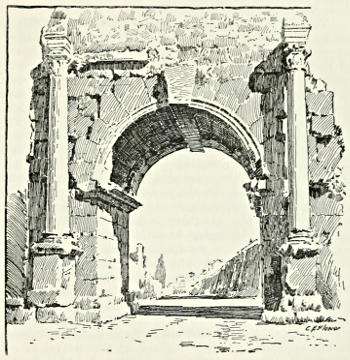
Ruins of the Triumphal Arch of Drusus
The gates of the city were thrown open, and the new emperor of the
Romans, encompassed on every side by the Gothic arms, was conducted in
tumultuous procession to the palace of Augustus and Trajan. After he
had distributed the civil and military dignities among his favourites and
followers, Attalus convened an assembly of the senate; before whom, in a
formal and florid speech, he asserted his resolution of restoring the majesty
of the republic and of uniting to the empire the provinces of Egypt and
the East, which had once acknowledged the sovereignty of Rome. Such
extravagant promises inspired every reasonable citizen with a just contempt
for the character of an unwarlike usurper, whose elevation was the deepest
and most ignominious wound which the republic had yet sustained from the
insolence of the barbarians. But the populace, with their usual levity,
applauded the change of masters. The public discontent was favourable to
the rival of Honorius; and the sectaries, oppressed by his persecuting
edicts, expected some degree of countenance, or at least of toleration, from
a prince who, in his native country of Ionia, had been educated in the
pagan superstition, and who had since received the sacrament of baptism
from the hands of an Arian bishop.
The first days of the reign of Attalus were fair and prosperous. An
officer of confidence was sent with an inconsiderable body of troops to secure
the obedience of Africa; the greatest part of Italy submitted to the terror
of the Gothic powers; the city of Bononia made a vigorous and effectual
resistance; the people of Mediolanum, dissatisfied perhaps with the absence
of Honorius, accepted, with loud acclamations, the choice of the Roman senate.
At the head of a formidable army, Alaric conducted his royal captive almost
to the gates of Ravenna; and a solemn embassy of the principal ministers,
of Jovius, the prætorian prefect, of Valens, master of the cavalry and
infantry, of the quæstor Potamius, and of Julian, the first of the notaries,
was introduced with martial pomp into the Gothic camp. In the name of
their sovereign, they consented to acknowledge the lawful election of his
competitor, and to divide the provinces of Italy and the West between the two
emperors. Their proposals were rejected with disdain; and the refusal was
aggravated by the insulting clemency of Attalus, who condescended to
promise that, if Honorius would instantly resign the purple, he should be
permitted to pass the remainder of his life in the peaceful exile of some
remote island. So desperate, indeed, did the situation of the son of Theodosius
appear to those who were the best acquainted with his strength and
resources, that Jovius and Valens, his minister and his general, betrayed
their trust, infamously deserted the sinking cause of their benefactor, and
devoted their treacherous allegiance to the service of his more fortunate
rival. Astonished by such examples of domestic treason, Honorius trembled
at the approach of every servant, at the arrival of every messenger. He
dreaded the secret enemies who might lurk in his capital, his palace, his bedchamber;
and some ships lay ready in the harbour of Ravenna to transport
the abdicated monarch to the dominions of his infant nephew, the emperor
of the East.
But there is a providence (such at least was the opinion of the historian
Procopius) that watches over innocence and folly; and the pretensions of
Honorius to its peculiar care cannot reasonably be disputed. At the
moment when his despair, incapable of any wise or manly resolution, meditated
a shameful flight, a seasonable reinforcement of four thousand veterans
unexpectedly landed in the port of Ravenna. To these valiant strangers,
whose fidelity had not been corrupted by the factions of the court, he committed
the walls and gates of the city; and the slumbers of the emperor
were no longer disturbed by the apprehension of imminent and internal
danger. The favourable intelligence which was received from Africa, suddenly
changed the opinions of men, and the state of public affairs. The
troops and officers, whom Attalus had sent into that province, were defeated
and slain; and the active zeal of Heraclian maintained his own allegiance,
and that of his people. The faithful count of Africa transmitted a large
sum of money, which fixed the attachment of the imperial guards; and his
vigilance in preventing the exportation of corn and oil, introduced famine,
tumult, and discontent into the walls of Rome.
[409-410 A.D.]
The failure of the African expedition was the source of mutual complaint
and recrimination in the party of Attalus; and the mind of his protector was
insensibly alienated from the interest of a prince, who wanted spirit to command
or docility to obey. The most imprudent measures were adopted,
without the knowledge, or against the advice, of Alaric; and the obstinate
refusal of the senate, to allow, in the embarkation, the mixture even of five
hundred Goths, betrayed a suspicious and distrustful temper, which, in their
situation, was neither generous nor prudent. The resentment of the Gothic
king was exasperated by the malicious arts of Jovius, who had been raised to
the rank of patrician, and who afterward excused his double perfidy by declaring,
without a blush, that he had only seemed to abandon the service of
Honorius, more effectually to ruin the cause of the usurper. In a large plain
near Ariminum, and in the presence of an innumerable multitude of Romans
and barbarians, the wretched Attalus was publicly despoiled of the diadem
and purple; and those ensigns of royalty were sent by Alaric, as the pledge
of peace and friendship, to the son of Theodosius.
The degradation of Attalus removed the only real obstacle to the conclusion
of the peace; and Alaric advanced within three miles of Ravenna, to
press the irresolution of the imperial ministers, whose insolence soon returned
with the return of fortune. His indignation was kindled by the report that
a rival chieftain, that Sarus, the personal enemy of Atawulf and the hereditary
foe of the house of Balti, had been received into the palace. At the head
of three hundred followers, that fearless barbarian immediately sallied from
the gates of Ravenna; surprised, and cut in pieces, a considerable body of
Goths; re-entered the city in triumph; and was permitted to insult his
adversary, by the voice of a herald, who publicly declared that the guilt
of Alaric had forever excluded him from the friendship and alliance of the
emperor.
The crime and folly of the court of Ravenna was expiated a third
time by the calamities of Rome. The king of the Goths, who no longer
dissembled his appetite for plunder and revenge, appeared in arms under
the walls of the capital; and the trembling senate, without any hope of
relief, prepared, by a desperate resistance, to delay the ruin of their country.
But they were unable to guard against the secret conspiracy of their slaves
and domestics; who, either from birth or interest, were attached to the
cause of the enemy. At the hour of midnight, the Salarian gate was silently
opened, and the inhabitants were awakened by the tremendous sound of the
Gothic trumpet. Eleven hundred and sixty-three years after the foundation
of Rome, the imperial city, which had subdued and civilised so considerable
a part of mankind, was delivered to the licentious fury of the tribes of Germany
and Scythia.
The proclamation of Alaric, when he forced his entrance into a vanquished
city, discovered some regard for the laws of humanity and religion. He
encouraged his troops boldly to seize the rewards of valour and to enrich
themselves with the spoils of a wealthy and effeminate people; but he
exhorted them, at the same time, to spare the lives of the unresisting citizens,
and to respect the churches of the apostles St. Peter and St. Paul, as
holy and inviolable sanctuaries. Amidst the horrors of a nocturnal tumult,
several of the Christian Goths displayed the fervour of a recent conversion;
and some instances of their uncommon piety and moderation are related,
and perhaps adorned, by the zeal of ecclesiastical writers.
While the barbarians roamed through the city in quest of prey, the humble
dwelling of an aged virgin, who had devoted her life to the service of the
altar, was forced open by one of the powerful Goths. He immediately
demanded, though in civil language, all the gold and silver in her possession;
and was astonished at the readiness with which she conducted him to
a splendid hoard of massy plate, of the richest materials and the most curious
workmanship. The barbarian viewed with wonder and delight this valuable
acquisition, till he was interrupted by a serious admonition, addressed to
him in the following words: “These,” said she, “are the consecrated vessels
belonging to St. Peter; if you presume to touch them, the sacrilegious deed
will remain on your conscience. For my part, I dare not keep what I am
unable to defend.” The Gothic captain, struck with reverential awe, despatched
a messenger to inform the king of the treasure which he had discovered;
and received a peremptory order from Alaric, that all the consecrated
plate and ornaments should be transported, without damage or delay, to the
church of the Apostle. From the extremity, perhaps, of the Quirinal Hill, to
the distant quarter of the Vatican, a numerous detachment of Goths, marching
in order of battle through the principal streets, protected, with glittering
arms, the long train of their devout companions, who bore aloft on their
heads the sacred vessels of gold and silver; and the martial shouts of the
barbarians were mingled with the sound of religious psalmody. From all
the adjacent houses a crowd of Christians hastened to join this edifying
procession; and a multitude of fugitives, without distinction of age or rank,
or even of sect, had the good fortune to escape to the secure and hospitable
sanctuary of the Vatican. The learned work, Concerning the City of God,
was professedly composed by St. Augustine to justify the ways of Providence
in the destruction of the Roman greatness. He celebrates, with peculiar
satisfaction, this memorable triumph of Christ; and insults his adversaries
by challenging them to produce some similar example, of a town taken by
storm, in which the fabulous gods of antiquity had been able to protect either
themselves or their deluded votaries.
In the sack of Rome some rare and extraordinary examples of barbarian
virtue have been deservedly applauded. But the holy precincts of the Vatican
and the Apostolic churches could receive a very small proportion of the
Roman people; many thousand warriors, more especially of the Huns, who
served under the standard of Alaric, were strangers to the name, or at least
to the faith, of Christ; and we may suspect, without any breach of charity or
candour, that in the hour of savage license, when every passion was inflamed
and every restraint was removed, the precepts of the gospel seldom influenced
the behaviour of the Gothic Christians. The writers the best disposed to
exaggerate their clemency, have freely confessed that a cruel slaughter was
made of the Romans; and that the streets of the city were filled with dead
bodies, which remained without burial during the general consternation.
The despair of the citizens was sometimes converted into fury; and whenever
the barbarians were provoked by opposition, they extended the promiscuous
massacre to the feeble, the innocent, and the helpless. The private
revenge of forty thousand slaves was exercised without pity or remorse; and
the ignominious lashes which they had formerly received were washed away
in the blood of the guilty or obnoxious families. The matrons and virgins
of Rome were exposed to injuries more dreadful, in the apprehension of chastity,
than death itself; and the ecclesiastical historian has selected an example
of female virtue for the admiration of future ages.
A Roman lady, of singular beauty and orthodox faith, had excited the
impatient desires of a young Goth, who, according to the sagacious remark
of Sozomen, was attached to the Arian heresy. Exasperated by her obstinate
resistance he drew his sword, and with the anger of a lover slightly
wounded her neck. The bleeding heroine still continued to brave his resentment
and to repel his love, till the ravisher desisted from his unavailing
efforts, respectfully conducted her to the sanctuary of the Vatican, and
gave six pieces of gold to the guards of the church, on condition that they
should restore her inviolate to the arms of her husband. Such instances of
courage and generosity were not extremely common. The brutal soldiers
satisfied their sensual appetites without consulting either the inclination
or the duties of their female captives; and a nice question of casuistry was
seriously agitated, whether those tender victims, who had inflexibly refused
their consent to the violation which they sustained, had lost by their misfortune
the glorious crown of virginity? There were other losses indeed of
a more substantial kind, and more general concern. It cannot be presumed
that all the barbarians were at all times capable of perpetrating such amorous
outrages; and the want of youth, or beauty, or chastity, protected the
greatest part of the Roman women from the danger of a rape. But avarice
is an insatiate and universal passion; since the enjoyment of almost every
object that can afford pleasure to the different tastes and tempers of mankind,
may be procured by the possession of wealth.

Roman Gold Bracelet
In the pillage of Rome, a just preference was given to gold and jewels,
which contain the greatest value in the smallest compass and weight; but
after these portable riches had been removed by the more diligent robbers,
the palaces of Rome were rudely stripped of their splendid and costly furniture.
The sideboards of massy plate, and the variegated wardrobes of silk
and purple, were irregularly piled in the wagons that always followed the
march of a Gothic army. The most exquisite works of art were roughly
handled, or wantonly destroyed; many a statue was melted for the sake of
the precious materials; and many a vase, in the division of the spoil, was
shivered into fragments by the stroke of a battle-axe. The acquisition of
riches served only to stimulate the avarice of the rapacious barbarians, who
proceeded by threats, by blows, and by tortures, to force from their prisoners
the confession of hidden treasure. Visible splendour and expense were
alleged as the proof of a plentiful fortune; the appearance of poverty was
imputed to a parsimonious disposition; and the obstinacy of some misers,
who endured the most cruel torments before they would discover the secret
object of their affection, was fatal to many unhappy wretches, who expired
under the lash for refusing to reveal their imaginary treasures.
The edifices of Rome, though the damage has been much exaggerated,
received some injury from the violence of the Goths. At their entrance
through the Salarian Gate they fired the adjacent houses to guide their
march, and to distract the attention of the citizens; the flames, which encountered
no obstacle in the disorder of the night, consumed many private
and public buildings; and the ruins of the palace of Sallust remained in the
age of Justinian a stately monument of the Gothic conflagration. Yet a
contemporary historian has observed that fire could scarcely consume the
enormous beams of solid brass, and that the strength of man was insufficient
to subvert the foundations of ancient structures. Some truth may possibly
be concealed in his devout assertion, that the wrath of heaven supplied the
imperfections of hostile rage; and that the proud Forum of Rome, decorated
with the statues of so many gods and heroes, was levelled in the dust by the
stroke of lightning.
Whatever might be the numbers of equestrian or plebeian rank who
perished in the massacre of Rome, it is confidently affirmed that only one
senator lost his life by the sword of the enemy. But it was not easy to
compute the multitudes who, from an honourable station and a prosperous
fortune, were suddenly reduced to the miserable condition of captives and
exiles. As the barbarians had more occasion for money than for slaves, they
fixed at a moderate price the redemption of their indigent prisoners; and the
ransom was often paid by the benevolence of their friends or the charity of
strangers. The captives who were regularly sold, either in open market or
by private contract, would have legally regained their native freedom, which
it was impossible for a citizen to lose or to alienate. But as it was soon discovered
that the vindication of their liberty would endanger their lives;
and that the Goths, unless they were tempted to sell, might be provoked to
murder their useless prisoners; the civil jurisprudence had been already
qualified by a wise regulation that they should be obliged to serve the moderate
term of five years, till they had discharged by their labour the price
of their redemption. The nations who invaded the Roman Empire had
driven before them into Italy whole troops of hungry and affrighted provincials,
less apprehensive of servitude than of famine. The calamities of
Rome and Italy dispersed the inhabitants to the most lonely, the most
secure, the most distant places of refuge. While the Gothic cavalry spread
terror and desolation along the sea coast of Campania and Tuscany, the little
island of Igilium, separated by a narrow channel from the Argentarian
promontory, repulsed or eluded their hostile attempts; and at so small a
distance from Rome great numbers of citizens were securely concealed in
the thick woods of that sequestered spot. The ample patrimonies which
many senatorian families possessed in Africa invited them, if they had time
and prudence to escape from the ruin of their country, to embrace the
shelter of that hospitable province. The Italian fugitives were dispersed
through the provinces, along the coast of Egypt and Asia, as far as
Constantinople and Jerusalem; and the village of Bethlehem, the solitary
residence of St. Jerome and his female converts, was crowded with illustrious
beggars of either sex and every age, who excited the public compassion
by the remembrance of their past fortune. This awful catastrophe of Rome
filled the astonished empire with grief and terror. So interesting a contrast
of greatness and ruin disposed the fond credulity of the people to deplore,
and even to exaggerate, the afflictions of the queen of cities. The clergy,
who applied to recent events the lofty metaphors of oriental prophecy, were
sometimes tempted to confound the destruction of the capital and the dissolution
of the globe.
There exists in human nature a strong propensity to depreciate the
advantages, and to magnify the evils, of the present times. Yet, when the
first emotions had subsided, and a fair estimate was made of the real damage,
the more learned and judicious contemporaries were forced to confess
that infant Rome had formerly received more essential injury from the
Gauls, than she had now sustained from the Goths in her declining age.
The experience of eleven centuries has enabled posterity to produce a much
more singular parallel; and to affirm with confidence that the ravages of
the barbarians, whom Alaric had led from the banks of the Danube, were
less destructive than the hostilities exercised by the troops of Charles V, a
Catholic prince, who styled himself emperor of the Romans.
The Goths evacuated the city at the end of six days, but Rome remained
above nine months in the possession of the imperialists; and every hour was
stained by some atrocious act of cruelty, lust, and rapine. The authority of
Alaric preserved some order and moderation among the ferocious multitude,
but in the later capture under Charles V, the commander, the constable of
Bourbon had gloriously fallen in the attack on the walls; and the death of
the general removed every restraint of discipline from an army which consisted
of three independent nations, the Italians, the Spaniards, and the Germans.
In the beginning of the sixteenth century, the manners of Italy
exhibited a remarkable scene of the depravity of mankind. They united
the sanguinary crimes that prevail in an unsettled state of society, with the
polished vices which spring from the abuse of art and luxury; and the loose
adventurers, who had violated every prejudice of patriotism and superstition,
to assault the palace of the Roman pontiff, must deserve to be considered as
the most profligate of the Italians. At the same era, the Spaniards were the
terror both of the Old and New World; but their high-spirited valour was
disgraced by gloomy pride, rapacious avarice, and unrelenting cruelty. Indefatigable
in the pursuit of fame and riches, they had improved, by repeated
practice, the most exquisite and effectual methods of torturing their prisoners;
many of the Castilians who pillaged Rome were familiars of the holy
inquisition; and some volunteers, perhaps, were lately returned from the conquest
of Mexico. The Germans were less corrupt than the Italians, less cruel
than the Spaniards; and the rustic or even savage aspect of those Tramontane
warriors, often disguised a simple and merciful disposition. But they
had imbibed, in the first fervour of the Reformation, the spirit as well as the
principles of Luther. It was their favourite amusement to insult or destroy
the consecrated objects of Catholic superstition: they indulged, without pity
or remorse, a devout hatred against the clergy of every denomination and
degree, who form so considerable a part of the inhabitants of modern Rome;
and their fanatic zeal might aspire to subvert the throne of Antichrist, to
purify, with blood and fire, the abominations of the spiritual Babylon.
The retreat of the victorious Goths, who evacuated Rome on the sixth
day, might be the result of prudence; but it was not surely the effect of
fear. At the head of an army, encumbered with rich and weighty spoils,
their intrepid leader advanced along the Appian Way into the southern
provinces of Italy, destroying whatever dared to oppose his passage, and
contenting himself with the plunder of the unresisting country.
[410-412 A.D.]
Whether fame, or conquest, or riches were the object of Alaric, he pursued
that object with an indefatigable ardour which could neither be quelled
by adversity nor satiated by success. No sooner had he reached the extreme
land of Italy, than he was attracted by the neighbouring prospect of a fertile
and peaceful island. Yet even the possession of Sicily he considered only as
an intermediate step to the important expedition which he already meditated
against the continent of Africa. The straits of Rhegium and Messina are
twelve miles in length, and, in the narrowest passage, about one mile and a
half broad; and the fabulous monsters of the deep, the rocks of Scylla and
the whirlpool of Charybdis, could terrify none but the most timid and unskilful
mariners. Yet as soon as the first division of the Goths had embarked,
a sudden tempest arose, which sunk or scattered many of the transports;
their courage was daunted by the terrors of a new element; and the whole
design was defeated by the premature death of Alaric, which fixed, after a
short illness, the fatal term of his conquests.
The brave Atawulf, the brother-in-law of the deceased monarch, was
unanimously elected to succeed to his throne. The character and political
system of the new king of the Goths may be best understood from his conversation
with an illustrious citizen of Narbo Martius, who afterwards, in a
pilgrimage to the Holy Land, related it to St. Jerome, in the presence of the
historian Orosius. “In the full confidence of valour and victory, I once
aspired,” said Atawulf, “to change the face of the universe; to obliterate the
name of Rome; to erect on its ruins the dominion of the Goths; and to acquire,
like Augustus, the immortal fame of the founder of a new empire. By
repeated experiments, I was gradually convinced that laws are essentially
necessary to maintain and regulate a well-constituted state; and that the
fierce untractable humour of the Goths was incapable of bearing the salutary
yoke of laws and civil government. From that moment I proposed to myself
a different object of glory and ambition; and it is now my sincere wish, that
the gratitude of future ages should acknowledge the merit of a stranger, who
employed the sword of the Goths, not to subvert, but to restore and maintain,
the prosperity of the Roman Empire.” With these pacific views, the successor
of Alaric suspended the operations of war, and seriously negotiated
with the imperial court a treaty of friendship and alliance. It was the interest
of the ministers of Honorius, who were now released from the obligation
of their extravagant oath, to deliver Italy from the intolerable weight of the
Gothic powers; and they readily accepted their service against the tyrants
and barbarians who infested the provinces beyond the Alps. Atawulf,
assuming the character of the Roman general, directed his march from the
extremity of Campania to the southern province of Gaul. His troops, either
by force or agreement, occupied the cities of Narbo Martius, Tolosa (Toulouse),
and Burdigala (Bordeaux); and though they were repulsed by Count
Bonifacius from the walls of Massilia, they soon extended their quarters from
the Mediterranean to the ocean. The oppressed provincials might exclaim,
that the miserable remnant, which the enemy had spared, was cruelly ravished
by their pretended allies; yet some specious colours were not wanting to
palliate or justify the violence of the Goths. The cities of Gaul, which they
attacked, might perhaps be considered as in a state of rebellion against the
government of Honorius; the articles of the treaty, or the secret instructions
of the court, might sometimes be alleged in favour of the seeming usurpations
of Atawulf; and the guilt of any irregular, unsuccessful act of hostility
might always be imputed, with an appearance of truth, to the ungovernable
spirit of a barbarian host, impatient of peace or discipline. The luxury of
Italy had been less effectual to soften the temper, than to relax the courage,
of the Goths; and they had imbibed the vices, without imitating the arts and
institutions, of civilised society.
[412-414 A.D.]
The professions of Atawulf were probably sincere, and his attachment to
the cause of the republic was secured by the ascendant which a Roman princess
had acquired over the heart and understanding of the barbarian king.
Placidia, the daughter of the great Theodosius, and of Galla his second wife,
had received a royal education in the palace of Constantinople. The marriage
of Atawulf and Placidia was consummated before the Goths retired
from Italy; and the solemn, perhaps the anniversary, day of their nuptials
was afterwards celebrated in the house of Ingenuus, one of the most illustrious
citizens of Narbo Martius in Gaul. The bride, attired and adorned
like a Roman empress, was placed on a throne of state; and the king of the
Goths, who assumed, on this occasion, the Roman habit, contented himself
with a less honourable seat by her side (414).
After the deliverance of Italy from the oppression of the Goths, some
secret counsellor was permitted, amidst the factions of the palace, to heal
the wounds of that afflicted country. By a wise and humane regulation, the
eight provinces which had been the most deeply injured, Campania, Tuscany,
Picenum, Samnium, Apulia, Calabria, Bruttium, and Lucania, obtained an
indulgence of five years; the ordinary tribute was reduced to one-fifth, and
even that fifth was destined to restore and support the useful institution of
the public posts. By another law the lands which had been left without inhabitants
or cultivation, were granted, with some diminution of taxes, to the
neighbours who should occupy, or the strangers who should solicit them;
and the new possessors were secured against the future claims of the fugitive
proprietors. About the same time a general amnesty was published in the
name of Honorius, to abolish the guilt and memory of all the involuntary
offences, which had been committed by his unhappy subjects during the term
of the public disorder and calamity.
A decent and respectful attention was paid to the restoration of the capital;
the citizens were encouraged to rebuild the edifices which had been destroyed
or damaged by hostile fire; and extraordinary supplies of corn were
imported from the coast of Africa. The crowds that so lately fled before the
sword of the barbarians, were soon recalled by the hopes of plenty and pleasure;
and Albinus, prefect of Rome, informed the court that in a single day he
had taken an account of the arrival of fourteen thousand strangers. In less
than seven years, the vestiges of the Gothic invasion were almost obliterated;
and the city appeared to resume its former splendour and tranquillity.
This apparent tranquillity was soon disturbed by the approach of a hostile
armament from the country which afforded the daily subsistence of the Roman
people. Heraclian, count of Africa, who, under the most difficult and distressful
circumstances, had supported with active loyalty the cause of Honorius,
was tempted, in the year of his consulship, to assume the character of a rebel
and the title of emperor. The ports of Africa were immediately filled with
the naval forces at the head of which he prepared to invade Italy; and his
fleet, when it cast anchor at the mouth of the Tiber, indeed surpassed the
fleets of Xerxes and Alexander, if all the vessels, including the royal galley
and the smallest boat, did actually amount to the incredible number of thirty-two
hundred.
Yet with such an armament, which might have subverted or restored the
greatest empire of the earth, the African usurper made a very faint and feeble
impression on the provinces of his rival. As he marched from the port, along
the road which leads to the gates of Rome, he was encountered, terrified, and
routed, by one of the imperial captains; and the lord of this mighty host,
deserting his fortune and his friends, ignominiously fled with a single ship.
When Heraclian landed in the harbour of Carthage, he found that the whole
province, disdaining such an unworthy ruler, had returned to their allegiance.
The rebel was beheaded in the ancient temple of Memory; his consulship was
abolished, and the remains of his private fortune, not exceeding the moderate
sum of four thousand pounds of gold, were granted to the brave Constantius,
who had already defended the throne which he afterwards shared with his feeble
sovereign. Honorius viewed with supine indifference the calamities of Rome
and Italy, but the rebellious attempts of Attalus and Heraclian against his
personal safety awakened for a moment the torpid instinct of his nature.
He was probably ignorant of the causes and events which preserved him
from these impending dangers; and as Italy was no longer invaded by any
foreign or domestic enemies, he peaceably existed in the palace of Ravenna,
while the tyrants beyond the Alps were repeatedly vanquished in the name,
and by the lieutenants, of the son of Theodosius.
[411-413 A.D.]
The usurpation of Constantine, who received the purple from the legions
of Britain, had been successful; and seemed to be secure. His title was acknowledged
from the wall of Antoninus to the columns of Hercules; and, in
the midst of the public disorder, he shared the dominion and the plunder of
Gaul and Spain with the tribes of barbarians, whose destructive progress was
no longer checked by the Rhine or Pyrenees. Stained with the blood of the
kinsmen of Honorius, he extorted from the court of Ravenna, with which he
secretly corresponded, the ratification of his rebellious claims. Constantine
engaged himself, by a solemn promise, to deliver Italy from the Goths;
advanced as far as the banks of the Po; and after alarming, rather than
assisting, his pusillanimous ally, hastily returned to the palace of Arles, to
celebrate, with intemperate luxury, his vain and ostentatious triumph.
But this transient prosperity was soon interrupted and destroyed by the revolt
of Count Gerontius, the bravest of his generals, who, during the absence of
his son Constans, a prince already invested with the imperial purple, had
been left to command in the provinces of Spain.
For some reason, of which we are ignorant, Gerontius, instead of assuming
the diadem, placed it on the head of his friend Maximus, who fixed his
residence at Tarraco (Tarragona), while the active count pressed forwards
through the Pyrenees, to surprise the two emperors, Constantine and Constans,
before they could prepare for their defence. The son was made prisoner
at Vienna, and immediately put to death; and the unfortunate youth had
scarcely leisure to deplore the elevation of his family, which had tempted
or compelled him sacrilegiously to desert the peaceful obscurity of the
monastic life. The father maintained a siege within the walls of Arelate
(Arles); but those walls must have yielded to the assailants, had not the
city been unexpectedly relieved by the approach of an Italian army.
The name of Honorius, the proclamation of a lawful emperor, astonished
the contending parties of the rebels. Gerontius, abandoned by his own
troops, escaped to the confines of Spain, and rescued his name from oblivion
by the Roman courage which appeared to animate the last moments of
his life. In the middle of the night, a great body of his perfidious soldiers
surrounded and attacked his house, which he had strongly barricaded. His
wife, a valiant friend of the nation of the Alani, and some faithful slaves,
were still attached to his person; and he used, with so much skill and resolution,
a large magazine of darts and arrows, that above three hundred of
the assailants lost their lives in the attempt. His slaves, when all the missile
weapons were spent, fled at the dawn of day; and Gerontius, if he had
not been restrained by conjugal tenderness, might have imitated their example;
till the soldiers, provoked by such obstinate resistance, applied fire
on all sides to the house. In this fatal extremity he complied with the
request of his barbarian friend, and cut off his head. The wife of Gerontius,
who conjured him not to abandon her to a life of misery and disgrace,
eagerly presented her neck to his sword; and the tragic scene was terminated
by the death of the count himself, who, after three ineffectual strokes,
drew a short dagger, and sheathed it in his heart.[65] The unprotected Maximus,
whom he had invested with the purple, was indebted for his life to the
contempt that was entertained of his power and abilities. The caprice of
the barbarians who ravaged Spain, once more seated this imperial phantom
on the throne; but they soon resigned him to the justice of Honorius; and
the tyrant Maximus, after he had been shown to the people of Ravenna and
of Rome, was publicly executed.
The general, Constantius was his name, who raised by his approach the
siege of Arles and dissipated the troops of Gerontius, was born a Roman; and
this remarkable distinction is strongly expressive of the decay of military
spirit among the subjects of the empire. The strength and majesty which
were conspicuous in the person of that general marked him, in the popular
opinion, as a candidate worthy of the throne, which he afterwards
ascended. In the familiar intercourse of private life, his manners were
cheerful and engaging: nor would he sometimes disdain, in the license of
convivial mirth, to vie with the pantomimes themselves in the exercises
of their ridiculous profession. But when the trumpet summoned him to
arms; when he mounted his horse, and bending down (for such was his
singular practice) almost upon the neck, fiercely rolled his large animated
eyes round the field, Constantius then struck terror into his foes, and inspired
his soldiers with the assurance of victory. He had received from the court
of Ravenna the important commission of extirpating rebellion in the provinces
of the West; and the pretended emperor Constantine, after enjoying
a short and anxious respite, was again besieged in his capital by the arms of
a more formidable enemy. Yet this interval allowed time for a successful
negotiation with the Franks and Alamanni; and his ambassador, Edobic,
soon returned, at the head of an army, to disturb the operations of the siege
of Arles.
The Roman general, instead of expecting the attack in his lines, boldly,
and perhaps wisely, resolved to pass the Rhone and to meet the barbarians.
His measures were conducted with so much skill and secrecy, that while they
engaged the infantry of Constantius in the front, they were suddenly attacked,
surrounded, and destroyed by the cavalry of his lieutenant Ulfilas, who had
silently gained an advantageous post in their rear. The remains of the army
of Edobic were preserved by flight or submission, and their leader escaped
from the field of battle to the house of a faithless friend, who too clearly
understood that the head of his obnoxious guest would be an acceptable and
lucrative present for the imperial general. On this occasion, Constantius
behaved with the magnanimity of a genuine Roman. Subduing or suppressing
every sentiment of jealousy, he publicly acknowledged the merit and services
of Ulfilas; but he turned with horror from the assassin of Edobic,
and sternly intimated his commands, that the camp should no longer be polluted
by the presence of an ungrateful wretch, who had violated the laws
of friendship and hospitality.
The usurper, who beheld from the walls of Arelate the ruin of his last
hopes, was tempted to place some confidence in so generous a conqueror.
He required a solemn promise for his security; and after receiving, by the
imposition of hands, the sacred character of a Christian presbyter, he ventured
to open the gates of the city. But he soon experienced that the principles
of honour and integrity, which might regulate the ordinary conduct of
Constantius, were superseded by the loose doctrines of political morality.
The Roman general, indeed, refused to sully his laurels with the blood of
Constantine; but the abdicated emperor and his son Julian were sent under
a strong guard into Italy; and before they reached the palace of Ravenna,
they met the ministers of death.
At a time when it was universally confessed that almost every man in the
empire was superior in personal merit to the princes whom the accident of their
birth had seated on the throne, a rapid succession of usurpers, regardless of
the fate of their predecessors, still continued to arise. This mischief was
peculiarly felt in the provinces of Spain and Gaul, where the principles of
order and obedience had been extinguished by war and rebellion. Before
Constantine resigned the purple, and in the fourth month of the siege of
Arles, intelligence was received in the imperial camp that Jovinus had
assumed the diadem at Mogontiacum, in the Upper Germany, at the instigation
of Goar, king of the Alani, and of Guntiarius, king of the Burgundians;
and that the candidate, on whom they had bestowed the empire, advanced
with a formidable host of barbarians, from the banks of the Rhine to those
of the Rhone. Every circumstance is dark and extraordinary in the short
history of the reign of Jovinus. It was natural to expect that a brave and
skilful general, at the head of a victorious army, would have asserted, in
a field of battle, the justice of the cause of Honorius.
The hasty retreat of Constantius might be justified by weighty reasons;
but he resigned, without a struggle, the possession of Gaul; and Dardanus,
the prætorian prefect, is recorded as the only magistrate who refused to yield
obedience to the usurper. When the Goths, two years after the siege of
Rome, established their quarters in Gaul, it was natural to suppose that their
inclination could be divided only between the emperor Honorius, with whom
they had formed a recent alliance, and the degraded Attalus, whom they
reserved in their camp for the occasional purpose of acting the part of a
musician or a monarch. Yet in a moment of disgust (for which it is not
easy to assign a cause or a date), Atawulf connected himself with the usurper
of Gaul; and imposed on Attalus the ignominious task of negotiating the
treaty, which ratified his own disgrace. We are again surprised to read
that, instead of considering the Gothic alliance as the firmest support of his
throne, Jovinus upbraided, in dark and ambiguous language, the officious
importunity of Attalus; that, scorning the advice of his great ally, he invested
with the purple his brother Sebastian; and that he most imprudently accepted
the service of Sarus, when that gallant chief, the soldier of Honorius,
was provoked to desert the court of a prince who knew not how to reward or
punish.
[413-415 A.D.]
Atawulf, educated among a race of warriors, who esteemed the duty
of revenge as the most precious and sacred portion of their inheritance,
advanced with a body of ten thousand Goths to encounter the hereditary
enemy of the house of Balti. He attacked Sarus at an unguarded moment,
when he was accompanied only by eighteen or twenty of his valiant followers.
United by friendship, animated by despair, but at length oppressed by
multitudes, this band of heroes deserved the esteem, without exciting the
compassion, of their enemies; and the lion was no sooner taken in the toils,
than he was instantly despatched. The death of Sarus dissolved the loose
alliance which Atawulf still maintained with the usurpers of Gaul. He
again listened to the dictates of love and prudence; and soon satisfied the
brother of Placidia, by the assurance that he would immediately transmit to
the palace of Ravenna the heads of the two tyrants, Jovinus and Sebastian.
The king of the Goths executed his promise without difficulty or delay;
the helpless brothers, unsupported by any personal merit, were abandoned
by their barbarian auxiliaries; and the short opposition of Valentia was
expiated by the ruin of one of the noblest cities of Gaul. The emperor,
chosen by the Roman senate, who had been promoted, degraded, insulted,
restored, again degraded, and again insulted, was finally abandoned to his
fate; but when the Gothic king withdrew his protection, he was restrained,
by pity or contempt, from offering any violence to the person of Attalus.
The unfortunate Attalus, who was left without subjects or allies, embarked
in one of the ports of Spain in search of some secure and solitary retreat;
but he was intercepted at sea, conducted to the presence of Honorius, led in
triumph through the streets of Rome or Ravenna, and publicly exposed to
the gazing multitude on the second step of the throne of his invincible conqueror.
The same measure of punishment with which, in the days of his
prosperity, he was accused of menacing his rival, was inflicted on Attalus
himself; he was condemned, after the amputation of two fingers, to a perpetual
exile in the isle of Lipara, where he was supplied with the decent
necessaries of life. The remainder of the reign of Honorius was undisturbed
by rebellion; and it may be observed, that in the space of five years, seven
usurpers had yielded to the fortune of a prince who was himself incapable
either of counsel or of action.
The important present of the heads of Jovinus and Sebastian had
approved the friendship of Atawulf, and restored Gaul to the obedience
of his brother Honorius. Peace was incompatible with the situation and
temper of the king of the Goths. He readily accepted the proposal of turning
his victorious arms against the barbarians of Spain; the troops of Constantius
intercepted his communication with the seaports of Gaul, and
gently pressed his march towards the Pyrenees; he passed the mountains,
and surprised, in the name of the emperor, the city of Barcino (Barcelona).
The course of his victories was soon interrupted by domestic treason. He had
imprudently received into his service one of the followers of Sarus, a barbarian
of a daring spirit but of a diminutive stature, whose secret desire of
revenging the death of his beloved patron was continually irritated by the
sarcasms of his insolent master. Atawulf was assassinated in the palace of
Barcelona; the laws of the succession were violated by a tumultuous faction;
and a stranger to the royal race, Sigeric, the brother of Sarus himself, was
seated on the Gothic throne. The first act of his reign was the inhuman
murder of the six children of Atawulf, the issue of a former marriage,
whom he tore without pity from the feeble arms of a venerable bishop.
The unfortunate Placidia, instead of the respectful compassion which she
might have excited in the most savage breasts, was treated with cruel and
wanton insult. The daughter of the emperor Theodosius, confounded
among a crowd of vulgar captives, was compelled to march on foot above
twelve miles, before the horse of a barbarian, the assassin of a husband whom
Placidia loved and lamented.
[415-418 A.D.]
But Placidia soon obtained the pleasure of revenge; and the view of her
ignominious sufferings might rouse an indignant people against the tyrant,
who was assassinated on the seventh day of his usurpation. After the death
of Sigeric, the free choice of the nation bestowed the Gothic sceptre on
Wallia, whose warlike and ambitious temper appeared in the beginning of
his reign extremely hostile to the republic. He marched in arms from Barcino
to the shores of the Atlantic Ocean, which the ancients revered and
dreaded as the boundary of the world. But when he reached the southern
promontory of Spain, and from the rock now covered by the fortress of
Gibraltar contemplated the neighbouring and fertile coast of Africa, Wallia
resumed the designs of conquest which had been interrupted by the death
of Alaric. The winds and waves again disappointed the enterprise of the
Goths; and the minds of a superstitious people were deeply affected by the
repeated disasters of storms and shipwrecks. In this disposition, the successor
of Atawulf no longer refused to listen to a Roman ambassador, whose
proposals were enforced by the real or supposed approach of a numerous
army, under the conduct of the brave Constantius. A solemn treaty was
stipulated and observed, Placidia was honourably restored to her brother, six
hundred thousand measures of wheat were delivered to the hungry Goths,
and Wallia engaged to draw his sword in the service of the empire.
A bloody war was instantly excited among the barbarians of Spain;
and the contending princes are said to have addressed their letters, their
ambassadors, and their hostages, to the throne of the Western emperor, exhorting
him to remain a tranquil spectator of their contest, the event of
which must be favourable to the Romans, by the mutual slaughter of their
common enemies. The Spanish War was obstinately supported during three
campaigns, with desperate valour and various success; and the martial
achievements of Wallia diffused through the empire the superior renown
of the Gothic hero. He exterminated the Silingi, who had irretrievably
ruined the elegant plenty of the province of Bætica. He slew in battle the
king of the Alani; and the remains of those Scythian wanderers who escaped
from the field, instead of choosing a new leader, humbly sought a refuge
under the standard of the Vandals, with whom they were ever afterwards
confounded. The Vandals themselves, and the Suevi, yielded to the efforts
of the invincible Goths. The promiscuous multitude of barbarians, whose
retreat had been intercepted, were driven into the mountains of Gallæcia;
where they still continued, in a narrow compass, and on a barren soil, to
exercise their domestic and implacable hostilities. In the pride of victory,
Wallia was faithful to his engagements; he restored his Spanish conquests
to the obedience of Honorius; and the tyranny of the imperial officers soon
reduced an oppressed people to regret the time of their barbarian servitude.
His victorious Goths, forty-three years after they had passed the Danube,
were established, according to the faith of treaties, in the possession of the
second Aquitania, a maritime province between the Garumna (Garonne) and
the Liger (Loire), under the jurisdiction of Bordeaux. The Gothic limits
were enlarged by the additional gift of some neighbouring dioceses; and the
successors of Alaric fixed their royal residence at Tolosa, which included
five populous quarters, or cities, within the spacious circuit of its walls.
About the same time, in the last years of the reign of Honorius, the Goths,
the Burgundiones, and the Franks obtained a permanent seat and dominion in
the provinces of Gaul. The liberal grant of the usurper Jovinus to his Burgundian
allies was confirmed by the lawful emperor; the lands of the First
or Upper Germany were ceded to those formidable barbarians; and they
gradually occupied, either by conquest or treaty, the two provinces which
still retain, with the titles of Duchy and of County, the national appellation
of Burgundy.
The Franks, the valiant and faithful allies of the Roman Republic, were
soon tempted to imitate the invaders whom they had so bravely resisted.
Augusta Trevirorum, the capital of Gaul, was pillaged by their lawless bands;
and the humble colony which they so long maintained in the district of
Toxandria, in Brabant, insensibly multiplied along the banks of the Meuse
and Scheldt, till their independent power filled the whole extent of the Second
or Lower Germany.
The ruin of the opulent provinces of Gaul may be dated from the establishment
of these barbarians, whose alliance was dangerous and oppressive,
and who were capriciously impelled, by interest or passion, to violate the
public peace. The odious name of conquerors was softened into the mild
and friendly appellation of the “guests” of the Romans; and the barbarians of
Gaul, more especially the Goths, repeatedly declared that they were bound
to the people by the ties of hospitality, and to the emperor by the duty of
allegiance and military service.
[409-423 A.D.]
Whilst Italy was ravaged by the Goths, and a succession of feeble tyrants
oppressed the provinces beyond the Alps, the British island separated itself
from the body of the Roman Empire. The regular forces which guarded
that remote province had been gradually withdrawn; and Britain was abandoned,
without defence, to the Saxon pirates and the savages of Ireland and
Caledonia. The Britons, reduced to this extremity, no longer relied on the
tardy and doubtful aid of a declining monarchy. They assembled in arms,
repelled the invaders, and rejoiced in the important discovery of their own
strength. Afflicted by similar calamities, and actuated by the same spirit,
the Armorican provinces (a name which comprehended the maritime countries
of Gaul, between the Seine and the Loire) resolved to imitate the
example of the neighbouring island. They expelled the Roman magistrates,
who acted under the authority of the usurper Constantine; and a free
government was established among a people who had so long been subject to
the arbitrary will of a master. The independence of Britain and Armorica
was soon confirmed by Honorius himself, the lawful emperor of the West;
and the letters, by which he committed to the new states the care of their
own safety, might be interpreted as an absolute and perpetual abdication of
the exercise and rights of sovereignty (409).b
During a long and disgraceful reign of twenty-eight years, Honorius,
emperor of the West, was separated from the friendship of his brother, and
afterwards of his nephew, who reigned over the East; and Constantinople
beheld, with apparent indifference and secret joy, the calamities of Rome.
The strange adventures of Placidia gradually renewed and cemented the
alliance of the two empires. The daughter of the great Theodosius had
been the captive and the queen of the Goths; she lost an affectionate husband,
she was dragged in chains by his insulting assassin, she tasted the
pleasure of revenge, and was exchanged in the treaty of peace, for six hundred
thousand measures of wheat.
After her return from Spain to Italy, Placidia experienced a new persecution
in the bosom of her family. She was averse to a marriage which
had been stipulated without her consent; and the brave Constantius, as a
noble reward for the tyrants whom he had vanquished, received from the
hand of Honorius himself the struggling and reluctant hand of the widow
of Atawulf. But her resistance ended with the ceremony of the nuptials;
nor did Placidia refuse to become the mother of Honoria and Valentinian
III or to assume and exercise an absolute dominion over the mind of her
grateful husband. The generous soldier, whose time had hitherto been
divided between social pleasure and military service, was taught new lessons
of avarice and ambition. He extorted the title of Augustus; and the servant
of Honorius was associated to the empire of the West. The death
of Constantius, in the seventh month of his reign, instead of diminishing,
seemed to increase the power of Placidia. On a sudden, by some base
intrigues the city of Ravenna was agitated with bloody and dangerous
tumults, which could only be appeased by the forced or voluntary retreat
of Placidia and her children.
The royal exiles landed at Constantinople, soon after the marriage of
Theodosius, during the festival of the Persian victories. They were treated
with kindness and magnificence; but as the statues of the emperor Constantius
had been rejected by the Eastern court, the title of Augusta could
not decently be allowed to his widow. Within a few months after the arrival
of Placidia, a swift messenger announced the death of Honorius, the consequence
of a dropsy; but the important secret was not divulged till the
necessary orders had been despatched for the march of a large body of
troops to the seacoast of Dalmatia. The shops and the gates of Constantinople
remained shut during seven days; and the loss of a foreign prince,
who could neither be esteemed nor regretted, was celebrated with loud and
affected demonstrations of the public grief.
[423-424 A.D.]
While the ministers of Constantinople deliberated, the vacant throne
of Honorius was usurped by the ambition of a stranger. The name of the
rebel was Joannes. He filled the confidential office of primicerius, or principal
secretary; and history has attributed to his character more virtues than
can easily be reconciled with the violation of the most sacred duty. Elated
by the submission of Italy, and the hope of an alliance with the Huns,
Joannes presumed to insult, by an embassy, the majesty of the Eastern emperor;
but when he understood that his agents had been banished, imprisoned,
and at length chased away with deserved ignominy, Joannes prepared
to assert by arms the injustice of his claims.
In such a cause, the grandson of the great Theodosius should have
marched in person; but the young emperor was easily diverted by his
physicians from so rash and hazardous a design, and the conduct of the
Italian expedition was prudently entrusted to Ardaburius and his son Aspar,
who had already signalised their valour against the Persians. It was resolved
that Ardaburius should embark with the infantry, whilst Aspar,
at the head of the cavalry, conducted Placidia and her son Valentinian
along the seacoast of the Adriatic. The march of the cavalry was performed
with such active diligence that they surprised, without resistance,
the important city of Aquileia; when the hopes of Aspar were unexpectedly
confounded by the intelligence that a storm had dispersed the imperial fleet;
and that his father, with only two galleys, was taken and carried a prisoner
into the port of Ravenna. Yet this incident, unfortunate as it might seem,
facilitated the conquest of Italy. Ardaburius employed, or abused, the courteous
freedom which he was permitted to enjoy, to revive among the
troops a sense of loyalty and gratitude; and as soon as the conspiracy was
ripe for execution, he invited by private messages and pressed the approach
of Aspar. A shepherd, whom the popular credulity transformed into an
angel, guided the Eastern cavalry, by a secret and, it was thought, an impassable
road through the morasses of the Padus (Po); the gates of Ravenna,
after a short struggle, were thrown open; and the defenceless tyrant was delivered
to the mercy, or rather to the cruelty, of the conquerors. His right
hand was first cut off; and, after he had been exposed, mounted on an ass,
to the public derision, Joannes was beheaded in the circus of Aquileia.
In a monarchy which, according to various precedents, might be considered
as elective, or hereditary, or patrimonial, it was impossible that the
intricate claims of female and collateral succession should be clearly defined;
and Theodosius, by the right of consanguinity or conquest, might
have reigned the sole legitimate emperor of the Romans. For a moment,
perhaps, his eyes were dazzled by the prospect of unbounded sway; but
his indolent temper gradually acquiesced in the dictates of sound policy.
He contented himself with the possession of the East; and wisely relinquished
the laborious task of waging a distant and doubtful war against
the barbarians beyond the Alps; or of securing the obedience of the Italians
and Africans, whose minds were alienated by the irreconcilable difference of
language and interest.
[424-427 A.D.]
Instead of listening to the voice of ambition, Theodosius resolved to
imitate the moderation of his grandfather, and to seat his cousin Valentinian
on the throne of the West. The royal infant was distinguished at Constantinople
by the title of nobilissimus: he was promoted, before his departure from
Thessalonica, to the rank and dignity of Cæsar; and, after the conquest of
Italy, the patrician Helion, by the authority of Theodosius and in the
presence of the senate, saluted Valentinian III by the name of Augustus, and
solemnly invested him with the diadem and the imperial purple. By the
agreement of the three females who governed the Roman world, the son
of Placidia was betrothed to Eudoxia, the daughter of Theodosius and
Athenais; and, as soon as the lover and his bride had attained the age of
puberty, this honourable alliance was faithfully accomplished. At the same
time, as a compensation perhaps for the expenses of the war, the western
Illyricum was detached from the Italian dominions and yielded to the
throne of Constantinople.
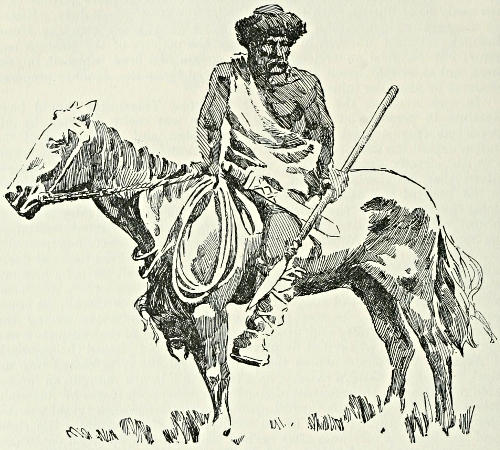
A Hun
(From a painting)
The emperor of the East acquired the useful dominion of the rich and
maritime province of Dalmatia, and the dangerous sovereignty of Pannonia
and Noricum, which had been filled and ravaged above twenty years by a
promiscuous crowd of Huns, Ostrogoths, Vandals, and Bavarians. Theodosius
and Valentinian continued to respect the obligations of their public and
domestic alliance; but the unity of the Roman government was finally dissolved.
By a positive declaration, the validity of all future laws was limited
to the dominions of their peculiar author; unless he should think proper to
communicate them, subscribed with his own hand, for the approbation of his
independent colleague.
Valentinian, when he received the title of Augustus, was no more than
six years of age; and his long minority was intrusted to the guardian care
of a mother, who might assert a female claim to the succession of the Western
Empire. Placidia envied, but she could not equal, the reputation and
virtues of the wife and sister of Theodosius, the elegant genius of Eudocia,
the wise and successful policy of Pulcheria. The mother of Valentinian
was jealous of the power which she was incapable of exercising. She
reigned twenty-five years, in the name of her son; and the character of that
unworthy emperor gradually countenanced the suspicion that Placidia had
enervated his youth by a dissolute education, and studiously diverted his
attention from every manly and honourable pursuit. Amidst the decay of
military spirit her armies were commanded by two generals, Aëtius and
Boniface, who may be deservedly named as the last of the Romans. Their
union might have supported a sinking empire; their discord was the fatal
and immediate cause of the loss of Africa. The invasion and defeat of
Attila have immortalised the fame of Aëtius; and though time has thrown
a shade over the exploits of his rival, the defence of Marseilles and the
deliverance of Africa attest the military talents of Count Boniface.
The abilities of Aëtius and Boniface might have been usefully employed
against the public enemies, in separate and important commands; but the
experience of their past conduct should have decided the real favour and
confidence of the empress Placidia. In the melancholy season of her exile
and distress, Boniface alone had maintained her cause with unshaken
fidelity; and the troops and treasures of Africa had essentially contributed
to extinguish the rebellion. The same rebellion had been supported by the
zeal and activity of Aëtius, who brought an army of sixty thousand Huns
from the Danube to the confines of Italy, for the service of the usurper. The
untimely death of Joannes compelled him to accept an advantageous treaty;
but he still continued, the subject and the soldier of Valentinian, to entertain
a secret, perhaps a treasonable correspondence with his barbarian allies,
whose retreat had been purchased by liberal gifts and more liberal promises.
But Aëtius possessed an advantage of singular moment in a female reign;
he was present; he besieged, with artful and assiduous flattery, the palace
of Ravenna; disguised his dark designs with the mask of loyalty and
friendship; and at length deceived both his mistress and his absent rival
by a subtle conspiracy which a weak woman and a brave man could not
easily suspect. He secretly persuaded Placidia to recall Boniface from the
government of Africa; he secretly advised Boniface to disobey the imperial
summons. To the one he represented the order as a sentence of death, to
the other he stated the refusal as a signal of revolt; and when the credulous
and unsuspecting count had armed the province in his defence, Aëtius
applauded his sagacity in foreseeing the rebellion which his own perfidy had
excited.
A temperate inquiry into the real motives of Boniface would have
restored a faithful servant to his duty and to the republic; but the arts of
Aëtius still continued to betray and to inflame, and the count was urged, by
persecution, to embrace the most desperate counsels. The success with
which he eluded or repelled the first attacks could not inspire a vain confidence
that, at the head of some loose, disorderly Africans, he should be able
to withstand the regular forces of the West, commanded by a rival whose
military character it was impossible for him to despise. After some hesitation,
the last struggles of prudence and loyalty, Boniface despatched a
trusty friend to the court, or rather to the camp, of Gonderic, king of the
Vandals, with the proposal of a strict alliance and the offer of an advantageous
and perpetual settlement.
[427-429 A.D.]
The experience of navigation, and perhaps the prospect of Africa,
encouraged the Vandals to accept the invitation which they received from
Count Boniface; and the death of Gonderic served only to forward and
animate the bold enterprise. In the room of a prince not conspicuous for
any superior powers of the mind or body, they acquired his bastard brother,
the terrible Genseric, a name which, in the destruction of the Roman
Empire, has deserved an equal rank with the names of Alaric and Attila.
The king of the Vandals is described to have been of a middle stature, with
a lameness in one leg, which he had contracted by an accidental fall from
his horse. His slow and cautious speech seldom declared the deep purposes
of his soul; he disdained to imitate the luxury of the vanquished, but he
indulged the sterner passions of anger and revenge.
The ambition of Genseric was without bounds and without scruples; and
the warrior could dexterously employ the dark engines of policy to solicit
the allies who might be useful to his success, or to scatter among his
enemies the seeds of hatred and contention. Almost in the moment of
his departure he was informed that Hermanric, king of the Suevi, had presumed
to ravage the Spanish territories, which he was resolved to abandon.
Impatient of the insult, Genseric pursued the hasty retreat of the Suevi as
far as Augusta Emerita (Merida); precipitated the king and his army into
the river Anas, and calmly returned to the seashore to embark his victorious
troops. The vessels which transported the Vandals over the modern straits
of Gibraltar, a channel only twelve miles in breadth, were furnished by the
Spaniards, who anxiously wished their departure, and by the African general,
who had implored their formidable assistance.
Our fancy, so long accustomed to exaggerate and multiply the martial
swarms of barbarians that seemed to issue from the north, will perhaps be
surprised by the account of the army which Genseric mustered on the coast
of Mauretania. The Vandals, who in twenty years had penetrated from the
Elbe to Mount Atlas, were united under the command of their warlike king;
and he reigned with equal authority over the Alani, who had passed, within
the term of human life, from the cold of Scythia to the excessive heat of an
African climate. The hopes of the bold enterprise had excited many brave
adventurers of the Gothic nation; and many desperate provincials were
tempted to repair their fortunes by the same means which had occasioned
their ruin.
Yet this various multitude amounted only to fifty thousand effective
men; and though Genseric artfully magnified his apparent strength by
appointing eighty chiliarchs, or commanders of thousands, the fallacious
increase of old men, of children, and of slaves would scarcely have swelled
his army to fourscore thousand persons. But his own dexterity and the
discontents of Africa soon fortified the Vandal powers by the accession of
numerous and active allies. The parts of Mauretania which border on the
great desert and the Atlantic Ocean were filled with a fierce and untractable
race of men, whose savage temper had been exasperated, rather than reclaimed,
by their dread of the Roman arms.
The wandering Moors, as they gradually ventured to approach the seashore
and the camp of the Vandals, must have viewed with terror and
astonishment the dress, the armour, the martial pride and discipline of the
unknown strangers who had landed on their coast; and the fair complexions
of the blue-eyed warriors of Germany formed a very singular contrast with
the swarthy or olive hue which is derived from the neighbourhood of the
torrid zone. After the first difficulties had in some measure been removed,
which arose from the mutual ignorance of their respective languages, the
Moors, regardless of any future consequence, embraced the alliance of the enemies
of Rome; and a crowd of naked savages rushed from the woods and
valleys of Mount Atlas, to satiate their revenge on the polished tyrants who
had injuriously expelled them from their native sovereignty of the land.
[429-430 A.D.]
The persecution of the Donatists was an event not less favourable to the
designs of Genseric. Seventeen years before he landed in Africa a public
conference was held at Carthage by the order of the magistrate. The Catholics
were satisfied that, after the invincible reasons which they had alleged,
the obstinacy of the schismatics must be inexcusable and voluntary; and the
emperor Honorius was persuaded to inflict the most rigorous penalties on a
faction which had so long abused his patience and clemency. Three hundred
bishops, with many thousands of the inferior clergy, were torn from
their churches, stripped of their ecclesiastical possessions, banished to the
islands, and proscribed by the laws, if they presumed to conceal themselves
in the provinces of Africa. By these severities, which obtained the warmest
approbation of St. Augustine, great numbers of Donatists were reconciled to
the Catholic church; but the fanatics, who still persevered in their opposition,
were provoked to madness and despair; the distracted country was
filled with tumult and bloodshed. The armed troops of Circumcellions
alternately pointed their rage against themselves or against their adversaries;
and the calendar of martyrs received on both sides a considerable
augmentation. Under these circumstances Genseric, a Christian but an
enemy of the orthodox communion, showed himself to the Donatists as a
powerful deliverer, from whom they might reasonably expect the repeal of the
odious and oppressive edicts of the Roman emperors. The conquest of Africa
was facilitated by the active zeal or the secret favour of a domestic faction;
the wanton outrages against the churches and the clergy, of which the Vandals
are accused, may be fairly imputed to the fanaticism of their allies; and
the intolerant spirit which disgraced the triumph of Christianity contributed
to the loss of the most important province of the West.
The court and the people were astonished by the strange intelligence that
a virtuous hero, after so many favours and so many services, had renounced
his allegiance and invited the barbarians to destroy the province intrusted to
his command. The friends of Boniface, who still believed that his criminal
behaviour might be excused by some honourable motive, solicited, during the
absence of Aëtius, a free conference with the count of Africa; and Darius, an
officer of high distinction, was named for the important embassy. In their
first interview at Carthage, the imaginary provocations were mutually explained;
the opposite letters of Aëtius were produced and compared, and
the fraud was easily detected. Placidia and Boniface lamented their fatal
error; and the count had sufficient magnanimity to confide in the forgiveness
of his sovereign, or to expose his head to her future resentment. His
repentance was fervent and sincere; but he soon discovered that it was no
longer in his power to restore the edifice which he had shaken to its foundations.
Carthage and the Roman garrisons returned with their general to
the allegiance of Valentinian, but the rest of Africa was still distracted with
war and faction; and the inexorable king of the Vandals, disdaining all
terms of accommodation, sternly refused to relinquish the possession of his
prey. The band of veterans who marched under the standard of Boniface
and his hasty levies of provincial troops were defeated with considerable
loss; the victorious barbarians insulted the open country; and Carthage,
Cirta, and Hippo Regius were the only cities that appeared to rise above the
general inundation.
[430-431 A.D.]
On a sudden the seven fruitful provinces, from Tingis (Tangier) to
Tripolis, were overwhelmed by the invasion of the Vandals, whose destructive
rage has perhaps been exaggerated by popular animosity, religious zeal,
and extravagant declamation. War, in its fairest form, implies a perpetual
violation of humanity and justice; and the hostilities of barbarians are inflamed
by the fierce and lawless spirit which incessantly disturbs their peaceful
and domestic society. The Vandals, where they found resistance, seldom
gave quarter; and the deaths of their valiant countrymen were expiated by
the ruin of the cities under whose walls they had fallen. Careless of the distinctions
of age, or sex, or rank, they employed every species of indignity and
torture to force from the captives a discovery of their hidden wealth. The
stern policy of Genseric justified his frequent examples of military execution.
He was not always the master of his own passions, nor of those of his followers;
and the calamities of war were aggravated by the licentiousness of
the Moors and the fanaticism of the Donatists. Yet I shall not easily be
persuaded that it was the common practice of the Vandals to extirpate the
olive and other fruit trees of a country where they intended to settle; nor
can I believe that it was a usual stratagem to slaughter great numbers of
their prisoners before the walls of a besieged city, for the sole purpose
of infecting the air and producing a pestilence of which they themselves must
have been the first victims.
The generous mind of Count Boniface was tortured by the exquisite distress
of beholding the ruin which he had occasioned, and whose rapid progress
he was unable to check. After the loss of a battle he retired into Hippo
Regius, where he was immediately besieged by an enemy who considered
him as the real bulwark of Africa. By the skill of Boniface, and perhaps by
the ignorance of the Vandals, the siege of Hippo was protracted above fourteen
months; the sea was continually open; and when the adjacent country
had been exhausted by irregular rapine, the besiegers themselves were compelled
by famine to relinquish their enterprise. The importance and danger
of Africa were deeply felt by the regent of the West. Placidia implored the
assistance of her Eastern ally; and the Italian fleet and army were reinforced
by Aspar, who sailed from Constantinople with a powerful armament.
As soon as the force of the two empires was united under the command of
Boniface, he boldly marched against the Vandals; and the loss of a second
battle irretrievably decided the fate of Africa. He embarked with the precipitation
of despair; and the people of Hippo were permitted, with their
families and effects, to occupy the vacant place of the soldiers, the greatest
part of whom were either slain or made prisoners by the Vandals. The
count, whose fatal credulity had wounded the vitals of the republic, might
enter the palace of Ravenna with some anxiety, which was soon removed by
the smiles of Placidia.
Boniface accepted with gratitude the rank of patrician and the dignity
of master-general of the Roman armies; but he must have blushed at the
sight of those medals in which he was represented with the name and attributes
of Victory. The discovery of his fraud, the displeasure of the empress,
and the distinguished favour of his rival, exasperated the haughty and
perfidious soul of Aëtius. He hastily returned from Gaul to Italy with a retinue,
or rather with an army, of barbarian followers; and such was the weakness
of the government that the two generals decided their private quarrel in a
bloody battle. Boniface was successful; but he received in the conflict a
mortal wound from the spear of his adversary, of which he expired within
a few days, in such Christian and charitable sentiments that he exhorted his
wife, a rich heiress of Spain, to accept Aëtius for her second husband. But
Aëtius could not derive any immediate advantage from the generosity of his
dying enemy; he was proclaimed a rebel by the justice of Placidia; and
though he attempted to defend some strong fortresses erected on his patrimonial
estate, the imperial power soon compelled him to retire into Pannonia,
to the tents of his faithful Huns. The republic was deprived by their mutual
discord of the service of her two most illustrious champions.[66]
[431-439 A.D.]
It might naturally be expected, after the retreat of Boniface, that the
Vandals would achieve without resistance or delay the conquest of Africa.
Eight years, however, elapsed from the evacuation of Hippo to the reduction
of Carthage. In the midst of that interval, the ambitious Genseric, in the
full tide of apparent prosperity, negotiated a treaty of peace, by which he
gave his son Hunneric for a hostage and consented to leave the Western
emperor in the undisturbed possession of the three Mauretanias.[67] The
vigilance of his enemies was relaxed by the protestations of friendship which
concealed his hostile approach; and Carthage was at length surprised by the
Vandals, 585 years after the destruction of the city and republic by the
younger Scipio.
The king of the Vandals severely reformed the vices of a voluptuous
people; and the ancient, noble, ingenuous freedom of Carthage (these
expressions of Victor are not without energy) was reduced by Genseric into
a state of ignominious servitude. After he had permitted his licentious
troops to satiate their rage and avarice, he instituted a more regular system
of rapine and oppression. An edict was promulgated, which enjoined all persons,
without fraud or delay, to deliver their gold, silver, jewels, and valuable
furniture or apparel to the royal officers; and the attempt to secrete any part
of their patrimony was inexorably punished with death and torture, as an act
of treason against the state. The lands of the proconsular province, which
formed the immediate district of Carthage, were accurately measured and
divided among the barbarians; and the conqueror reserved, for his peculiar
domain, the fertile territory of Byzacium and the adjacent parts of Numidia
and Gætulia.
It was natural enough that Genseric should hate those whom he had
injured; the nobility and senators of Carthage were exposed to his jealousy
and resentment, and all those who refused the ignominious terms, which
their honour and religion forbade them to accept, were compelled by the
Arian tyrant to embrace the condition of perpetual banishment. Rome,
Italy, and the provinces of the East were filled with a crowd of exiles, of
fugitives, and of ingenuous captives, who solicited the public compassion.
After the death of his rival Boniface, Aëtius had prudently retired to the
tents of the Huns; and he was indented to their alliance for his safety and
his restoration. Instead of the suppliant language of a guilty exile, he
solicited his pardon at the head of sixty thousand barbarians; and the
empress Placidia confessed, by a feeble resistance, that the condescension
which might have been ascribed to clemency was the effect of weakness or
fear. She delivered herself, her son Valentinian, and the Western Empire
into the hands of an insolent subject; nor could Placidia protect the son-in-law
of Boniface, the virtuous and faithful Sebastian, from the implacable
persecution which urged him from one kingdom to another, till he miserably
perished in the service of the Vandals. The fortunate Aëtius, who was
immediately promoted to the rank of patrician and thrice invested with the
honours of the consulship, assumed, with the title of master of the cavalry
and infantry, the whole military power of the state; and he is sometimes
styled, by contemporary writers, the duke, or general, of the Romans of the
West. His prudence, rather than his virtue, engaged him to leave the
grandson of Theodosius in the possession of the purple; and Valentinian
was permitted to enjoy the peace and luxury of Italy, while the patrician
appeared in the glorious light of a hero and a patriot, who supported near
twenty years the ruins of the Western Empire.
The barbarians, who had seated themselves in the western provinces, were
insensibly taught to respect the faith and valour of the patrician Aëtius. He
soothed their passions, consulted their prejudices, balanced their interests,
and checked their ambition. A seasonable treaty, which he concluded with
Genseric, protected Italy from the depredations of the Vandals; the independent
Britons implored and acknowledged his salutary aid; the imperial
authority was restored and maintained in Gaul and Spain; and he compelled
the Franks and the Suevi, whom he had vanquished in the field, to become
the useful confederates of the republic.
From a principle of interest as well as gratitude, Aëtius assiduously
cultivated the alliance of the Huns. While he resided in their tents as
a hostage, or an exile, he had familiarly conversed with Attila himself, the
nephew of his benefactor; and the two famous antagonists appear to have
been connected by a personal and military friendship, which they afterwards
confirmed by mutual gifts, frequent embassies, and the education of Carpilio,
the son of Aëtius, in the camp of Attila. By the specious professions of
gratitude and voluntary attachment, the patrician might disguise his apprehensions
of the Scythian conqueror, who pressed the two empires with his
innumerable armies. His demands were obeyed or eluded. When he claimed
the spoils of a vanquished city—some vases of gold, which had been fraudulently
embezzled—the civil and military governors of Noricum were immediately
despatched to satisfy his complaints; and it is evident, from their
conversation with Maximin and Priscus in the royal village, that the valour
and prudence of Aëtius had not saved the western Romans from the common
ignominy of tribute. Yet his dexterous policy prolonged the advantages of
a salutary peace; and a numerous army of Huns and Alani, whom he had
attached to his person, was employed in the defence of Gaul. Two colonies
of these barbarians were judiciously fixed in the territories of Valence and
Orleans, and their active cavalry secured the important passages of the
Rhone and of the Loire. These savage allies were not indeed less formidable
to the subjects than to the enemies of Rome. Their original settlement
was enforced with the licentious violence of conquest; and the province
through which they marched was exposed to all the calamities of a hostile
invasion. Strangers to the emperor or the republic, the Alani of Gaul were
devoted to the ambition of Aëtius; and though he might suspect that, in
a contest with Attila himself, they would revolt to the standard of their
national king, the patrician laboured to restrain, rather than to excite, their
zeal and resentment against the Goths, the Burgundiones, and the Franks.
[418-439 A.D.]
The kingdom established by the Visigoths, in the southern provinces of
Gaul, had gradually acquired strength and maturity; and the conduct of those
ambitious barbarians, either in peace or war, engaged the perpetual vigilance
of Aëtius. After the death of Wallia the Gothic sceptre devolved to Theodoric,
the son of the great Alaric; and his prosperous reign, of more than
thirty years, over a turbulent people may be allowed to prove that his prudence
was supported by uncommon vigour, both of mind and body. Impatient
of his narrow limits, Theodoric aspired to the possession of Arles, the wealthy
seat of government and commerce; but the city was saved by the timely
approach of Aëtius; and the Gothic king, who had raised the siege with some
loss and disgrace, was persuaded for an adequate subsidy to divert the martial
valour of his subjects in a Spanish war. Yet Theodoric still watched, and
eagerly seized the favourable moment of renewing his hostile attempts. The
Goths besieged Narbo Martius (Narbonne), while the Belgic provinces were
invaded by the Burgundiones; and the public safety was threatened on every
side by the apparent union of the enemies of Rome. On every side the
activity of Aëtius and his Scythian cavalry opposed a firm and successful
resistance. Twenty thousand Burgundiones were slain in battle, and the
remains of the nation humbly accepted a dependent seat in the mountains of
Savoy.
The walls of Narbo had been shaken by the battering engines, and the
inhabitants had endured the last extremities of famine, when Count Litorius,
approaching in silence, and directing each horseman to carry behind him two
sacks of flour, cut his way through the entrenchments of the besiegers. The
siege was immediately raised, and the more decisive victory, which is ascribed
to the personal conduct of Aëtius himself, was marked with the blood of eight
thousand Goths. But in the absence of the patrician, who was hastily summoned
to Italy by some public or private interest, Count Litorius succeeded
to the command; and his presumption soon discovered that far different
talents are required to lead a wing of cavalry or to direct the operations of
an important war. At the head of an army of Huns, he rashly advanced to
the gates of Tolosa (Toulouse), full of careless contempt for an enemy whom
misfortune had rendered both prudent and desperate.
The predictions of the augurs had inspired Litorius with the profane confidence
that he should enter the Gothic capital in triumph; and the trust
which he reposed in his pagan allies encouraged him to reject the fair conditions
of peace, which were repeatedly proposed by the bishops in the name
of Theodoric. The king of the Goths exhibited in his distress the edifying
contrast of Christian piety and moderation; nor did he lay aside his sackcloth
and ashes till he was prepared to arm for the combat. His soldiers,
animated with martial and religious enthusiasm, assaulted the camp of Litorius.
The conflict was obstinate, the slaughter was mutual. The Roman
general, after a total defeat, which could be imputed only to his unskilful
rashness, was actually led through the streets of Tolosa, not in his own,
but in a hostile triumph. [His captors in a few days put an end to his
shame and his life.]
Such a loss, in a country whose spirit and finances were long since exhausted,
could not easily be repaired; and the Goths, assuming, in their
turn, the sentiments of ambition and revenge, would have planted their victorious
standards on the banks of the Rhone, if the presence of Aëtius had
not restored strength and discipline to the Romans. The two armies expected
the signal of a decisive action; but the generals, who were conscious
of each other’s force and doubtful of their own superiority, prudently
sheathed their swords in the field of battle; and their reconciliation was
permanent and sincere. Theodoric, king of the Visigoths, appears to have
deserved the love of his subjects, the confidence of his allies, and the esteem
of mankind. His throne was surrounded by six valiant sons, who were educated
with equal care in the exercises of the barbarian camp and in those of
the Gallic schools; from the study of the Roman jurisprudence, they acquired
the theory, at least, of law and justice,
and the harmonious sense of Virgil contributed
to soften the asperity of their
native manners.

Costume of a Goth Woman
[439-450 A.D.]
The two daughters of the Gothic
king were given in marriage to the
eldest sons of the kings of the Suevi and
of the Vandals, who reigned in Spain
and Africa; but these illustrious alliances
were pregnant with guilt and
discord. The queen of the Suevi
bewailed the death of a husband, inhumanly
massacred by her brother.
The princess of the Vandals was the
victim of a jealous tyrant, whom she
called her father. The cruel Genseric
suspected that his son’s wife had conspired
to poison him; the supposed
crime was punished by the amputation
of her nose and ears, and the unhappy
daughter of Theodoric was ignominiously
returned to the court of Tolosa
in that deformed and mutilated condition.
This horrid act, which must seem
incredible to a civilised age, drew tears
from every spectator; but Theodoric
was urged, by the feelings of a parent
and a king, to revenge such irreparable
injuries.
The imperial ministers, who always cherished the discord of the barbarians,
would have supplied the Goths with arms, and ships, and treasures, for
the African War; and the cruelty of Genseric might have been fatal to himself,
if the artful Vandal had not armed in his cause the formidable power
of the Huns. His rich gifts and pressing solicitations inflamed the ambition
of Attila; and the designs of Aëtius and Theodoric were prevented by the
invasion of Gaul.
[429-450 A.D.]
The Franks, whose monarchy was still confined to the neighbourhood of
the lower Rhine, had wisely established the right of hereditary succession
in the noble family of the Merovingians. These princes were elevated on a
buckler, the symbol of military command, and the royal fashion of long hair
was the ensign of their birth and dignity. Their flaxen locks, which they
combed and dressed with singular care, hung down in flowing ringlets on
their backs and shoulders; while the rest of the nation were obliged, either
by law or custom, to shave the hinder part of their head, to comb their hair
over the forehead, and to content themselves with the ornament of two small
whiskers. The lofty stature of the Franks, and their blue eyes, denoted a
Germanic origin; their close apparel accurately expressed the figure of their
limbs; a weighty sword was suspended from a broad belt; their bodies were
protected by a large shield. And these warlike barbarians were trained,
from their earliest youth, to run, to leap, to swim; to dart the javelin or
battle-axe with unerring aim; to advance without hesitation against a superior
enemy; and to maintain, either in life or death, the invincible reputation
of their ancestors.
Clodion, the first of their long-haired kings, whose name and actions are
mentioned in authentic history, held his residence at Dispargum, a village
or fortress, whose place may be assigned between Louvain and Brussels.
From the report of his spies, the king of the Franks was informed that the
defenceless state of the second Belgic must yield, on the slightest attack, to
the valour of his subjects. He boldly penetrated through the thickets and
morasses of the Carbonarian forest, occupied Turnacum (Tournay) and Camaracum
(Cambray), the only cities which existed in the fifth century, and
extended his conquests as far as the river Samara (Somme), over a desolate
country, whose cultivation and populousness are the effects of more recent
industry (429).
While Clodion lay encamped in the plains of Artois, and celebrated with
vain and ostentatious security the marriage perhaps of his son, the nuptial
feast was interrupted by the unexpected and unwelcome presence of Aëtius,
who had passed the Samara at the head of his light cavalry. The tables,
which had been spread under the shelter of a hill, along the banks of a
pleasant stream, were rudely overturned; the Franks were oppressed before
they could recover their arms or their ranks; and their unavailing valour
was fatal only to themselves. The loaded wagons which had followed their
march afforded a rich booty; and the virgin bride, with her female attendants,
submitted to the new lovers who were imposed on them by the chance of
war. This advantage, which had been obtained by the skill and activity
of Aëtius, might reflect some disgrace on the military prudence of Clodion;
but the king of the Franks soon regained his strength and reputation, and
still maintained the possession of his Gallic kingdom from the Rhine to the
Samara.
Under his reign, and most probably from the enterprising spirit of his
subjects, the three capitals, Mogontiacum, Augusta Trevirorum, and Colonia
Agrippina, experienced the effects of hostile cruelty and avarice. The
distress of Colonia Agrippina was prolonged by the same barbarians who
evacuated the ruins of Augusta Trevirorum; and Augusta Trevirorum,
which in the space of forty years had been four times pillaged, was disposed
to lose the memory of her afflictions in the vain amusements of the circus.
The death of Clodion, after a reign of twenty years, exposed his kingdom to
the discord and ambition of his two sons. Merovæus, the younger, was persuaded
to implore the protection of Rome; he was received at the imperial
court as the ally of Valentinian, and the adopted son of the patrician Aëtius;
and dismissed to his native country, with splendid gifts and the strongest
assurances of friendship and support. During his absence, his elder brother
had solicited with equal ardour the formidable aid of Attila; and the king
of the Huns embraced an alliance which facilitated the passage of the Rhine
and justified by a specious and honourable pretence the invasion of Gaul.
When Attila declared his resolution of supporting the cause of his allies
the Vandals and the Franks, at the same time and almost in the spirit of
romantic chivalry, the savage monarch professed himself the lover and the
champion of the princess Honoria. The sister of Valentinian was educated
in the palace of Ravenna; and as her marriage might be productive of some
danger to the state, she was raised by the title of Augusta above the hopes
of the most presumptuous subject. But the fair Honoria had no sooner
attained the sixteenth year of her age than she detested the importunate
greatness which must forever exclude her from the comforts of honourable
love; in the midst of vain and unsatisfactory pomp, Honoria sighed, yielded
to the impulse of nature, and threw herself into the arms of her chamberlain
Eugenius. Her guilt and shame (such is the absurd language of imperious
man) were soon betrayed by the appearances of pregnancy; but the disgrace
of the royal family was published to the world by the imprudence of the
empress Placidia, who dismissed her daughter, after a strict and shameful
confinement, to a remote exile at Constantinople. The unhappy princess
passed twelve or fourteen years in the irksome society of the sisters of Theodosius
and their chosen virgins; to whose crown Honoria could no longer
aspire, and whose monastic assiduity of prayer, fasting, and vigils she reluctantly
imitated. Her impatience of long and hopeless celibacy urged her to
embrace a strange and desperate resolution.
The name of Attila was familiar and formidable at Constantinople; and
his frequent embassies entertained a perpetual intercourse between his camp
and the imperial palace. In the pursuit of love, or rather of revenge, the
daughter of Placidia sacrificed every duty and every pretence; and offered
to deliver her person into the arms of the barbarian, of whose language she
was ignorant, whose figure was scarcely human, and whose religion and manners
she abhorred. By the ministry of a faithful eunuch, she transmitted to
Attila a ring, the pledge of her affection; and earnestly conjured him to
claim her as a lawful spouse, to whom he had been secretly betrothed. These
indecent advances were received however with coldness and disdain; and the
king of the Huns continued to multiply the number of his wives, till his love
was awakened by the more forcible passions of ambition and avarice.
The invasion of Gaul was preceded and justified by a formal demand
of the princess Honoria, with a just and equal share of the imperial patrimony.
His predecessors, the ancient Tanjous, had often addressed, in the
same hostile and peremptory manner, the daughters of China; and the pretensions
of Attila were not less offensive to the majesty of Rome. A firm but
temperate refusal was communicated to his ambassadors. The right of female
succession, though it might derive a specious argument from the recent
examples of Placidia and Pulcheria, was strenuously denied; and the indissoluble
engagements of Honoria were opposed to the claims of her Scythian
lover. On the discovery of her connection with the king of the Huns, the
guilty princess had been sent away as an object of horror from Constantinople
to Italy. Her life was spared; but the ceremony of her marriage was
performed with some obscure and nominal husband, before she was immured
in a perpetual prison, to bewail those crimes and misfortunes which Honoria
might have escaped, had she not been born the daughter of an emperor.
A native of Gaul, and a contemporary, the learned and eloquent Sidonius,
who was afterwards bishop of Clermont, had made a promise to one of his
friends that he would compose a regular history of the war of Attila. If
the modesty of Sidonius had not discouraged him from the prosecution of
this interesting work, the historian would have related with the simplicity of
truth those memorable events to which the poet, in vague and doubtful
metaphors, has concisely alluded. The kings and nations of Germany and
Scythia, from the Volga perhaps to the Danube, obeyed the warlike summons
of Attila. From the royal village, in the plains of Hungary, his standard
moved towards the west and, after a march of seven or eight hundred
miles he reached the conflux of the Rhine and the Nicer (Neckar); where
he was joined by the Franks, who adhered to his ally, the elder of the sons of
Clodion. A troop of light barbarians, who roamed in quest of plunder, might
choose the winter for the convenience of passing the river on the ice; but
the innumerable cavalry of the Huns required such plenty of forage and provisions
as could be procured only in a milder season; the Hercynian forest
supplied materials for a bridge of boats; and the hostile myriads were
poured, with resistless violence, into the Belgic provinces.
[450-451 A.D.]
The consternation of Gaul was universal; and the various fortunes of its
cities have been adorned by tradition with martyrdoms and miracles. Tricassæ
(Troyes) was saved by the merits of St. Lupus; St. Servatius was
removed from the world, that he might not behold the ruin of Aduataca
Tungrorum (Tongres); and the prayers of St. Genevieve diverted the
march of Attila from the neighbourhood of Lutetia Parisiarum (Paris).
But as the greatest part of the Gallic cities were alike destitute of saints and
soldiers, they were besieged and stormed by the Huns, who practised, in the
example of Mettis (Metz), their customary maxims of war. They involved,
in a promiscuous massacre, the priests who served at the altar, and the infants,
who, in the hour of danger, had been providently baptised by the
bishop; the flourishing city was delivered to the flames, and a solitary
chapel of St. Stephen marked the place where it formerly stood. From the
Rhine and the Mosella (Moselle), Attila advanced into the heart of Gaul,
crossed the Sequana (Seine) at Autesiodorum (Auxerre), and, after a long
and laborious march, fixed his camp under the walls of Orleans. He was
desirous of securing his conquests by the possession of an advantageous
post, which commanded the passage of the Loire; and he depended on the secret
invitation of Sangiban, king of the Alani, who had promised to betray the
city and to revolt from the service of the empire. But this treacherous conspiracy
was detected and disappointed. Orleans had been strengthened with
recent fortifications; and the assaults of the Huns were vigorously repelled
by the faithful valour of the soldiers or citizens, who defended the place.
The pastoral diligence of Anianus, a bishop of primitive sanctity and
consummate prudence, exhausted every art of religious policy to support
their courage till the arrival of the expected succours. After an obstinate
siege, the walls were shaken by the battering-rams; the Huns had already
occupied the suburbs; and the people who were incapable of bearing arms
lay prostrate in prayer. Anianus, who anxiously counted the days and hours,
despatched a trusty messenger to observe, from the rampart, the face of the
distant country. He returned twice, without any intelligence that could
inspire hope or comfort; but in his third report he mentioned a small cloud
which he had faintly descried at the extremity of the horizon. “It is the
aid of God!” exclaimed the bishop, in a tone of pious confidence; and the
whole multitude repeated after him, “It is the aid of God!” The remote
object, on which every eye was fixed, became each moment larger and more
distinct; the Roman and Gothic banners were gradually perceived; and
a favourable wind blowing aside the dust discovered, in deep array, the
impatient squadrons of Aëtius and Theodoric, who pressed forward to the
relief of Orleans.
The facility with which Attila had penetrated into the heart of Gaul
may be ascribed to his insidious policy, as well as to the terror of his arms.
His public declarations were skilfully mitigated by his private assurances;
he alternately soothed and threatened the Romans and the Goths; and the
courts of Ravenna and Tolosa, mutually suspicious of each other’s intentions,
beheld with supine indifference the approach of their common enemy.
Aëtius was the sole guardian of the public safety; but his wisest measures
were embarrassed by a faction which, since the death of Placidia, infested
the imperial palace; the youth of Italy trembled at the sound of the
trumpet; and the barbarians, who, from fear or affection, were inclined
to the cause of Attila, awaited with doubtful and venal faith the event of
the war. The patrician passed the Alps at the head of some troops, whose
strength and numbers scarcely deserved the name of an army. But on his
arrival at Arelate, or Lugdunum he was confounded by the intelligence that
the Visigoths, refusing to embrace the defence of Gaul, had determined to
expect within their own territories the formidable invader whom they professed
to despise.
The senator Avitus, who after the honourable exercise of the prætorian
prefecture had retired to his estate in Auvergne, was persuaded to accept the
important embassy, which he executed with ability and success. He represented
to Theodoric that an ambitious conqueror, who aspired to the dominion
of the earth, could be resisted only by the firm and unanimous
alliance of the powers whom he laboured to oppress. The lively eloquence
of Avitus inflamed the Gothic warriors by the description of the injuries
which their ancestors had suffered from the Huns; whose implacable fury
still pursued them from the Danube to the foot of the Pyrenees. He strenuously
urged that it was the duty of every Christian to save from sacrilegious
violation the churches of God and the relics of the saints; that it was the
interest of every barbarian, who had acquired a settlement in Gaul, to defend
the fields and vineyards which were cultivated for his use against the desolation
of the Scythian shepherds. Theodoric yielded to the evidence of truth;
adopted the measure at once the most prudent and the most honourable, and
declared that, as the faithful ally of Aëtius and the Romans, he was ready
to expose his life and kingdom for the common safety of Gaul.
The Visigoths, who at that time were in the mature vigour of their fame
and power, obeyed with alacrity the signal of war; prepared their arms and
horses, and assembled under the standard of their aged king, who was resolved
with his two eldest sons Torismond and Theodoric, to command in person his
numerous and valiant people. The example of the Goths determined several
tribes or nations, that seemed to fluctuate between the Huns and the Romans.
The indefatigable diligence of the patrician gradually collected the troops of
Gaul and Germany, who had formerly acknowledged themselves the subjects,
or soldiers, of the republic, but who now claimed the rewards of voluntary
service and the rank of independent allies—the Læti, the Armoricans, the
Breones, the Saxons, the Burgundiones, the Sarmatians or Alani, the Ripuarians,
and the Franks who followed Meroveus as their lawful prince. Such
was the various army which, under the conduct of Aëtius and Theodoric,
advanced by rapid marches to relieve Orleans and to give battle to the innumerable
host of Attila.
On their approach, the king of the Huns immediately raised the siege,
and sounded a retreat to recall the foremost of his troops from the pillage of
a city which they had already entered. The valour of Attila was always
guided by his prudence; and as he foresaw the fatal consequences of a defeat
in the heart of Gaul, he repassed the Seine, and expected the enemy in the
plains of Châlons, whose smooth and level surface was adapted to the operations
of his Scythian cavalry. But in this tumultuary retreat the vanguard
of the Romans and their allies continually pressed, and sometimes engaged,
the troops which Attila had posted in the rear; the hostile columns, in the
darkness of the night and the perplexity of the roads, might encounter each
other without design; and the bloody conflict of the Franks and Gepids, in
which fifteen thousand barbarians were slain, was a prelude to a more general
and decisive action. The Catalaunian fields spread themselves round
Châlons,[68] and extend, according to the vague measurement of Jordanes, to
the length of 150 and the breadth of 100 miles over the whole province,
which is entitled to the appellation of a champaign country.b

Ancient Spear Heads
But before entering upon the actual encounter, we had better here refer
to some preliminary details, all the more that this battle was no less ample
in scale and complicated in details than the day of its date was famous.
Sangiban, king of the Alans, solicitous for his future, promised Attila submission
and to hand over his then residence, Aureliani (Orleans). This
treacherous move coming to the ears of Theodoric and Aëtius, they constructed
great outworks around the city, keeping the suspected Sangiban
under surveillance, and posted him and his people among their own auxiliaries.
Consequently Attila, impressed by this occurrence and distrustful
of his own strength, hesitated to join action. Yet fearing flight as he did
death, he resolved to scan the future by help of augury.
As usual the augurs pried into the entrails of a sheep, and inspected
its bones and veins as the latter showed on some scraped bones, announcing,
as a result, misfortune to the Huns. A morsel of contentment was added,
however, in the prediction that the enemy’s commander-in-chief should die
in the hour of victory, and sully his laurels. Now Attila, in his eager desire
for the death of Aëtius even at the risk of his own, and his army’s defeat,
although disturbed by the prospect held out by the augurs, yet, being
skilled in the refinements of military tactics, after some hesitation resolved
to join battle about three in the afternoon and thus obviate suspicion of
yielding by trusting to darkness in case of defeat.
The field, from a gentle slope, gradually assumed the character of a hill.
As the advantages presented by such conformation were by no means slight,
both parties made this slope their objective, the Huns with their auxiliaries
seizing upon the right flank, the Romans and Visigoths the left, leaving the
crest for future decision. The contest commences, Aëtius on the left with
his Romans, with the Visigoths as his right support, and Sangiban leader of
the Alans between—a piece of military precaution by which they doubly
flanked this rather doubtful leader, since fighting is the more probable where
flight is impossible.
The battle array of the Huns was on a different plan. Attila with his
bravest held the centre. By this arrangement he had his personal safety in
view, trusting that a stand amid the valiant of his race would insure himself,
at least as king, from imminent danger. On the flanks there deployed in
disorder multitudes of subject nations and people, chief among whom were
the Ostrogoths’ forces under the leadership of the three brothers, Walamir,
Theodomir, and Widemir, nobler than the very king himself whom they
served, since resplendent with the hereditary glories of the Amal race.
There might be seen also at the head of countless bands of the Gepidæ their
most renowned king, Ardaric, who from his all too great loyalty to Attila
was of his inner counsels. For Attila, well aware of his wisdom, prized him
and Walamir of the Ostrogoths above all the pettier royalties—Walamir,
the reticent, the affable, the guileless, and Ardaric the knightly and the
loyal. Not without reason was it that Attila trusted them to match their
Visigothic kindred.
As for the rest,—the kingly mob, if I am not irreverent,—and the
chiefs of this nation and that, retainers rather than kings, they hung on each
move of Attila’s; and did his eye beckon them, then, speechless, terrified, and
trembling they stood at call, or at least were subservient to his every order.
Yet king of kings though he was, was Attila solitary amid all, and over all
solicitous.
The battle began over the possession of the ridge already mentioned.
Leading his men on to secure this summit, Attila was in this forestalled by
Torismund and Aëtius who, striving with all their might to reach the crest,
first won it, and from their superior vantage ground easily dispersed the
Huns. When Attila beheld his troops disorganised by this occurrence, he
thought a harangue at this juncture would rally them and said:
“Victorious so often over so many nations, and masters of the world, if
to-day you flinch not, I should think myself a fool to rouse you to courage by
speech as if you were raw recruits. Consign such conduct to the juvenile
general and the untrained militia. It as little befits me to deal in commonplace
as you to listen. You are warriors, or nothing, and what to such is
more satisfying than to carve out his vengeance by the sword? Ah!
Revenge, nature’s first gift and sweetest soother of the soul! Let your feet
then be swift to the attack since ever is the attacker the bolder! Heed not
that mongrel mass of foreign speech, who but prove their fear by herding
together. Look at them! Look! how even before our first charge they
are swayed to and fro from fear; they make for hill and height; again, too
late for regret, are back for safety to the battle-field. You need no telling
as to the flimsiness of Roman defence, or how, not a wound, but a speck of
dust merely lays them low. Be your old selves, and, while they are punctiliously
peddling away at formations and shield-locking, charge with your
unflinching courage, laugh at their ‘formations.’ On against Visigoth and
down with the Alans! There lies speedy victory for us, and there the struggle
lies. Sunder the sinew and the limbs collapse; hack the bones and the
body falls!
“Huns of mine! Rouse your rage, and let your fury swell as of old!
Craftily now, and by the sword-stroke then! Some death mid the enemy let
the wounded man seek, and the scatheless fight till he sicken with the slaughter!
The child of victory the dart will not smite, but fate deals the doomed
one his death at the board. Nor did fortune deal the Hun such a roll of
victories, if not to make him blithe over this one victory the more. Who
unbared the Mœtic swamp, the secret of the centuries? Who weaponless
vanquished the weaponed? These herded outcasts dare not confront the
Hun! That this shall be my new field of victory, the long tale of my
former assures me! Yea! and first am I whose shaft shall be sped! And
doomed is he who fights not when Attila leads the fight.”
Spurred on by this dithyramb, headlong into fight they rush.
The juncture had its terrors, yet the king’s presence overcame the fear
even of the coward. It was soon a case of man to man. It was a battle,
savage, tangled, widespread, dogged. Antiquity has not its parallel. Such
deeds are told of, that he who has not been privileged to witness them,
though witnessing much that is marvellous, yet must ever lack the marvel of
this. For, to believe tradition, a brook whose feeble current rolled through
the plain already spoken of, swollen by the blood of the wounded and
enlarged not as usual by rains but by an all too rare flood, was converted
into a torrent by this sanguine contribution. Those, moreover, parched by
loss of blood, who were driven to its bank, were reduced to drinking this
gruesome draught—drinking by an enforced fate the very gushings of their
own wounds.
Then, too, King Theodoric, riding up and down his ranks in cheering
exhortation, fell from his steed and was trampled under foot by his own soldiery,
terminating his career at an advanced age. Another tale has it that
he fell by the javelin of Andagis, Attila’s lieutenant. Thus was accomplished
the prediction of Attila’s augurs, which Attila had set down to
Aëtius.
Next the Visigoths, leaving the Alans, fell on the Hunnish bands with
fury, and Attila himself were as good as dead, had not his prudence led him
to take refuge with his followers within his camp and its fortification of
wagons. Weak as was this shelter, yet there, for protection of their
lives, trooped the warriors whom but a little previously no ordinary obstacle
could withstand.
Torismond, son of Theodoric, who, with Aëtius, had seized the hill and
repelled the enemy from its summit, in the belief that he was rejoining his
men, and misled by the darkness of the night, stepped inside the wagon enclosure
of the Huns. While fighting bravely, he fell to the ground from his
wounded horse, but though rescued by his men he was persuaded to give
up further fighting. Aëtius, too, during the night’s confusion, wandered
amid the enemy. Dreading some disaster to the Goths, he persisted in his
search for the correct way, arriving at length at the allied camp, where under
the protection of shields he passed the night.
At dawn a plain is seen heaped and covered with corpses, but the Huns
do not venture to issue from their retreat, and so the confederates judge the
victory theirs. They judged, too, that it was no common disaster which had
induced the flight of Attila from the battle-field. Yet was his action not
that of one who acknowledged defeat.
He showed his usual courage, for within his camp was the clash of arms,
the brattle of the trumpet, ever threatening a sortie; as a lion might, when
hard beset by the hunters, ramp and rave at entrance to his den, without
venturing to emerge, yet nevertheless terrifying the neighbourhood by his
roaring, so did the warlike king, secure in his retreat, supply a source of fear
to his conquerors. These latter resolved to wear him out by a siege, since he
lacked provisions, and as he could from his archers placed inside the barrier
rain down showers of missiles on them should they attempt an assault by
force. It is reported, however, that the king, haughty as ever even in a situation
so desperate, had formed a pyre from saddlery, having resolved to
throw himself into its flames should the enemy force his camp, that none
might boast of having wounded him, or that the lord of so many nations
should have ever been in an enemy’s power.
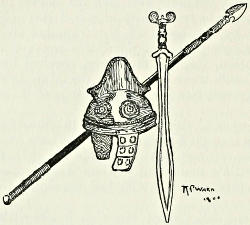
Gallic Weapons
Whilst this siege bred delay, the Visigoths busied themselves in search
for their king,—the father of Torismond,—wondering at his absence
while success had crowned their arms. When after long search they found
him, as is not infrequent among brave men, amid a dense heap of bodies,
they honoured him in song, bearing away his body under the eyes of the
enemy. Then it was possible to see crowds of Goths, with uncouth accent
that rent the air in song, render the
last and most sacred rites to the dead
while all around was war. Tears there
were, but such as a warrior merits. The
death was ours, to be sure, but even to
the Hun it was glorious, nor did Attila’s
pride feel aught but humbled to see
the Goths bear to burial with all its
trappings the body of a mighty king.
These Goths, while paying last and
merited honours to Theodoric, at the
same hour made over to his son the
royal dignity, and amid clash of arms
the brave and glorious warrior Torismond
followed the funeral rites of his
dear father as was fitting for a son.
These rites accomplished, urged by
grief through his bereavement and impelled by natural valour, Torismond
resolved to avenge the death of his father upon the remnant of the Huns.
On this point he consulted the patrician Aëtius, his senior in years and of
riper experience, and craved advice as to his action. He in his fear lest the
thorough overthrow of the Huns might leave the Roman power at the mercy
of the Goths, advised him as follows:
That he should retrace his steps to his own state, and firmly secure the
throne now vacant by his father’s death, as otherwise his brothers might seize
upon the royal treasure, and usurp the regal power over the Visigoths, in
which case was no alternative left but a laborious contest made all the more
squalid as being between relatives. Torismond listened to this advice not
as to a piece of duplicity but as if it advanced his own interests, and leaving
the Huns behind him, he returned to his district of Gaul. Thus does man’s
weakness give way to suspicion, and amid momentous events lose the opportune
hour.
In this most famous battle, waged between the bravest of races, report says
that one hundred and sixty-five thousand men fell on both sides, not to mention
fifteen thousand of the Gepids and Franks, who one night before the
general engagement meeting by chance fell by mutual assault, the Franks
siding with Romans, the Gepids with the Huns.
On Attila’s learning the departure of the Goths, he pursued such course
as is customary in abnormal circumstances. He suspected a ruse, and so for
some time longer lurked in camp. But when the enemy’s absence was conjoined
to lengthened quiet, the spirit of a victor returned to him, gaiety
gained the upper hand, and the musings of this mighty monarch resumed the
path of their ancient destiny.
Meanwhile Torismond, who had succeeded to the throne, marched into
Tolosa, and none was found to dispute his succession.d
[451-452 A.D.]
Neither the spirit, nor the forces, nor the reputation of Attila were impaired
by the failure of the Gallic expedition. In the ensuing spring, he
repeated his demand of the princess Honoria and her patrimonial treasures.
The demand was again rejected, or eluded; and the indignant lover immediately
took the field, passed the Alps, invaded Italy, and besieged Aquileia
with an innumerable host of barbarians. Those barbarians were unskilled
in the methods of conducting a regular siege, which, even among the ancients,
required some knowledge, or at least some practice, of the mechanical arts.
But the labour of many thousand provincials and captives, whose lives were
sacrificed without pity, might execute the most painful and dangerous work.
The skill of the Roman artists might be corrupted to the destruction of
their country. The walls of Aquileia were assaulted by a formidable train
of battering-rams, movable turrets, and engines, that threw stones, darts,
and fire; and the monarch of the Huns employed the forcible impulse of
hope, fear, emulation, and interest to subvert the only barrier which delayed
the conquest of Italy.
Aquileia was at that period one of the richest, the most populous, and
the strongest of the maritime cities of the Adriatic coast. The Gothic
auxiliaries, who appeared to have served under their native princes Alaric
and Antala, communicated their intrepid spirit; and the citizens still remembered
the glorious and successful resistance which their ancestors had
opposed to a fierce, inexorable barbarian who disgraced the majesty of the
Roman purple. Three months were consumed without effect in the siege of
Aquileia; till the want of provisions and the clamours of his army compelled
Attila to relinquish the enterprise, and reluctantly to issue his orders
that the troops should strike their tents the next morning, and begin their
retreat. But, as he rode round the walls, pensive, angry, and disappointed,
he observed a stork preparing to leave her nest in one of the towers, and to
fly with her infant family towards the country. He seized, with the ready
penetration of a statesman, this trifling incident which chance had offered
to superstition, and exclaimed, in a loud and cheerful tone, that such a
domestic bird, so constantly attached to human society, would never have
abandoned her ancient seats unless these towers had been devoted to impending
ruin and solitude.
The favourable omen inspired an assurance of victory; the siege was
renewed and prosecuted with fresh vigour; a large breach was made in the
part of the wall from whence the stork had taken her flight; the Huns
mounted to the assault with irresistible fury; and the succeeding generation
could scarcely discover the ruins of Aquileia. After this dreadful
chastisement, Attila pursued his march; and, as he passed, the cities of
Altinum, Concordia, and Patavium (Padua) were reduced into heaps of
stones and ashes. The inland towns, Vicentia (Vicenza), Verona, and Bergomum
(Bergamo) were exposed to the rapacious cruelty of the Huns.
Mediolanum and Ticinum submitted without resistance to the loss of their
wealth; and applauded the unusual clemency which preserved from the
flames the public as well as private buildings, and spared the lives of the
captive multitude. The popular traditions of Comum, Turin, or Modena
may justly be suspected; yet they concur with more authentic evidence to
prove that Attila spread his ravages over the rich plains of modern Lombardy,
which are divided by the Po, and bounded by the Alps and Apennine.
When he took possession of the royal palace of Mediolanum, he was surprised
and offended at the sight of a picture, which represented the Cæsars seated
on their throne and the princes of Scythia prostrate at their feet. The
revenge which Attila inflicted on this monument of Roman vanity was harmless
and ingenious. He commanded a painter to reverse the figures and the
attitudes; and the emperors were delineated, on the same canvas, approaching
in a suppliant posture to empty their bags of tributary gold before the
throne of the Scythian monarch. The spectators must have confessed the
truth and propriety of the alteration; and were perhaps tempted to apply,
on this singular occasion, the well-known fable of the dispute between the
lion and the man.
It is a saying worthy of the ferocious pride of Attila that the grass
never grew on the spot where his horse had trod. Yet the savage destroyer
undesignedly laid the foundation of a republic which revived, in the feudal
state of Europe, the art and spirit of commercial industry. The celebrated
name of Venice, or Venetia, was formerly diffused over a large and fertile
province of Italy, from the confines of Pannonia to the river Addua, and
from the Po to the Rætian and Julian Alps. Before the irruption of
the barbarians, fifty Venetian cities flourished in peace and prosperity;
Aquileia was placed in the most conspicuous station, but the ancient dignity
of Patavium was supported by agriculture and manufactures; and the
property of five hundred citizens who were entitled to the equestrian rank
must have amounted, at the strictest computation, to 1,700,000 pounds.
Many families of Aquileia, Patavium, and the adjacent towns, who fled
from the sword of the Huns, found a safe though obscure refuge in the
neighbouring islands.
At the extremity of the gulf, where the Adriatic feebly imitates the tides
of the ocean, near a hundred small islands are separated by shallow water
from the continent, and protected from the waves by several long slips of
land, which admit the entrance of vessels through some secret and narrow
channels. Till the middle of the fifth century, these remote and sequestered
spots remained without cultivation, with few inhabitants, and almost without
a name. But the manners of the Venetian fugitives, their arts and their
government, were gradually formed by their new situation; and one of the
epistles of Cassiodorus, which describes their condition about seventy years
afterwards, may be considered as the primitive monument of the republic.
[452-453 A.D.]
The Italians, who had long since renounced the exercise of arms, were
surprised, after forty years’ peace, by the approach of a formidable barbarian,
whom they abhorred as the enemy of their religion as well as of their republic.
Amidst the general consternation, Aëtius alone was incapable of fear;
but it was impossible that he should achieve, alone and unassisted, any
military exploits worthy of his former renown. The barbarians, who had
defended Gaul, refused to march to the relief of Italy; and the succours
promised by the Eastern emperor were distant and doubtful. Since Aëtius,
at the head of his domestic troops, still maintained the field, and harassed or
retarded the march of Attila, he never showed himself more truly great than
at the time when his conduct was blamed by an ignorant and ungrateful
people.
If the mind of Valentinian had been susceptible of any generous sentiments,
he would have chosen such a general for his example and his guide.
But the timid grandson of Theodosius, instead of sharing the dangers escaped
from the sound of war; and his hasty retreat from Ravenna to Rome, from
an impregnable fortress to an open capital, betrayed his secret intention of
abandoning Italy, as soon as the danger should approach his imperial person.
This shameful abdication was suspended, however, by the spirit of doubt and
delay, which commonly adheres to pusillanimous counsels and sometimes
corrects their pernicious tendency. The Western emperor, with the senate
and people of Rome, embraced the more salutary resolution of deprecating,
by a solemn and suppliant embassy, the wrath of Attila. This important
commission was accepted by Avienus, who, from his birth and riches, his
consular dignity, the numerous train of his clients,
and his personal abilities, held the first
rank in the Roman senate.

A Roman Coffer
The specious and artful character of Avienus
was admirably qualified to conduct a negotiation
either of public or private interest; his colleague
Trigetius had exercised the prætorian
prefecture of Italy; and Leo, bishop of Rome,
consented to expose his life for the safety of his
flock. The genius of Leo was exercised and
displayed in the public misfortunes; and he
has deserved the appellation of “great,” by the
successful zeal with which he laboured to establish
his opinions and his authority, under the venerable names of orthodox
faith and ecclesiastical discipline. The Roman ambassadors were introduced
to the tent of Attila, as he lay encamped at the place where the slow-winding
Mincius is lost in the foaming waves of the lake Benacus, and trampled, with
the Scythian cavalry, the farms of Catullus and Virgil. The barbarian monarch
listened with favourable, and even respectful, attention; and the deliverance
of Italy was purchased by the immense ransom, or dowry, of the
princess Honoria. The state of his army might facilitate the treaty and
hasten his retreat. Their martial spirit was relaxed by the wealth and
indolence of a warm climate.
The shepherds of the north, whose ordinary food consisted of milk and
raw flesh, indulged themselves too freely in the use of bread, of wine, and of
meat prepared and seasoned by the arts of cookery; and the progress of
disease revenged in some measure the injuries of the Italians. When Attila
declared his resolution of carrying his victorious arms to the gates of Rome,
he was admonished by his friends as well as by his enemies that Alaric had
not long survived the conquest of the Eternal City. His mind, superior to
real danger, was assaulted by imaginary terrors; nor could he escape the
influence of superstition, which had so often been subservient to his designs.
The pressing eloquence of Leo, his majestic aspect and sacerdotal robes,
excited the veneration of Attila for the spiritual father of the Christians.
The apparition of the two Apostles, St. Peter and St. Paul, who menaced
the barbarian with instant death if he rejected the prayer of their successor,
is one of the noblest legends of ecclesiastical tradition. The safety of Rome
might deserve the interposition of celestial beings; and some indulgence is
due to a fable which has been represented by the pencil of Raphael and the
chisel of Algardi.
Before the king of the Huns evacuated Italy, he threatened to return
more dreadful and more implacable, if his bride, the princess Honoria, were
not delivered to his ambassadors within the term stipulated by the treaty.
Yet, in the meantime, Attila relieved his tender anxiety by adding a beautiful
maid, whose name was Ildico, to the list of his innumerable wives. Their
marriage was celebrated with barbaric pomp and festivity, at his wooden
palace beyond the Danube; and the monarch, oppressed with wine and sleep,
retired at a late hour from the banquet to the nuptial bed. His attendants
continued to respect his pleasures or his repose the greatest part of the
ensuing day, till the unusual silence alarmed their fears and suspicions; and,
after attempting to awaken Attila by loud and repeated cries, they at length
broke into the royal apartment. They found the trembling bride sitting by
the bedside, hiding her face with her veil, and lamenting her own danger as
well as the death of the king, who had expired during the night. An artery
had suddenly burst; and as Attila lay in a supine posture, he was suffocated
by a torrent of blood, which, instead of finding a passage through the
nostrils, regurgitated into the lungs and stomach. His body was solemnly
exposed in the midst of the plain, under a silken pavilion, and the chosen
squadrons of the Huns, wheeling round in measured evolutions, chanted a
funeral song to the memory of a hero glorious in his life, invincible in his
death, the father of his people, the scourge of his enemies, and the terror of
the world. According to their national custom, the barbarians cut off a part
of their hair, gashed their faces with unseemly wounds, and bewailed their
valiant leader as he deserved, not with the tears of women but with the
blood of warriors (453).
[453-454 A.D.]
The remains of Attila were enclosed within three coffins, of gold, of silver,
and of iron, and privately buried in the night: the spoils of nations
were thrown into his grave; the captives who had opened the ground were
inhumanly massacred; and the same Huns who had indulged such excessive
grief, feasted with dissolute and intemperate mirth about the recent sepulchre
of their king. It was reported at Constantinople that, on the fortunate
night on which he expired, Marcian beheld in a dream the bow of Attila
broken asunder; and the report may be allowed to prove how seldom the
image of that formidable barbarian was absent from the mind of a Roman
emperor.
The revolution which subverted the empire of the Huns established the
fame of Attila, whose genius alone had sustained the huge and disjointed
fabric. After his death the boldest chieftains aspired to the rank of kings;
the most powerful kings refused to acknowledge a superior; and the numerous
sons whom so many various mothers bore to the deceased monarch
divided and disputed, like a private inheritance, the sovereign command of
the nations of Germany and Scythia. The bold Ardaric felt and resented
the disgrace of this servile partition; and his subjects, the warlike Gepidæ,
with the Ostrogoths, under the conduct of three valiant brothers, encouraged
their allies to vindicate the rights of freedom and royalty.
In a bloody and decisive conflict on the banks of the river Netad, in
Pannonia, the lance of the Gepidæ, the sword of the Goths, the arrows of
the Huns, the Suevic infantry, the light arms of the Heruli, and the heavy
weapons of the Alani, encountered or supported each other; and the victory
of Ardaric was accompanied with the slaughter of thirty thousand of his
enemies. Ellac, the eldest son of Attila, lost his life and crown in the memorable
battle of Netad; his early valour had raised him to the throne of the
Acatzires, a Scythian people whom he subdued, and his father, who loved
the superior merit, would have envied the death of Ellac. His brother
Dengisich, with an army of Huns, still formidable in their flight and ruin,
maintained his ground above fifteen years on the banks of the Danube.
The palace of Attila, with the old country of Dacia, from the Carpathian
hills to the Euxine, became the seat of a new power which was erected by
Ardaric, king of the Gepidæ. The Pannonian conquests, from Vindobona to
Sirmium, were occupied by the Ostrogoths; and the settlements of the tribes
who had so bravely asserted their native freedom were irregularly distributed,
according to the measure of their respective strength. Surrounded
and oppressed by the multitude of his father’s slaves, the kingdom
of Dengisich was confined to the circle of his wagons; his desperate courage
urged him to invade the Eastern Empire; he fell in battle; and his head,
ignominiously exposed in the Hippodrome, exhibited a grateful spectacle to
the people of Constantinople.
Attila had fondly or superstitiously believed that Irnac, the youngest of
his sons, was destined to perpetuate the glories of his race. The character
of that prince, who attempted to moderate the rashness of his brother Dengisich,
was more suitable to the declining condition of the Huns; and Irnac,
with his subject hordes, retired into the heart of the Lesser Scythia. They
were soon overwhelmed by a torrent of new barbarians, who followed the
same road which their own ancestors had formerly discovered. The Geougen
or Avars, whose residence is assigned by the Greek writers to the shores of
the ocean, impelled the adjacent tribes; till at length the Igours of the north,
issuing from the cold Siberian regions, which produce the most valuable
furs, spread themselves over the desert, as far as the Borysthenes and the
Caspian gates; and finally extinguished the empire of the Huns.
Such an event might contribute to the safety of the Eastern Empire,
under the reign of a prince who conciliated the friendship without forfeiting
the esteem of the barbarians. But the emperor of the West, the feeble
and dissolute Valentinian, who had reached his thirty-fifth year without attaining
the age of reason or courage, abused this apparent security to undermine
the foundations of his own throne by the murder of the patrician
Aëtius. From the instinct of a base and jealous mind, he hated the man
who was universally celebrated as the terror of the barbarians, and the support
of the republic; and his new favourite, the eunuch Heraclius, awakened
the emperor from the supine lethargy which might be disguised, during the
life of Placidia, by the excuse of filial piety. The fame of Aëtius, his wealth
and dignity, the numerous and martial train of barbarian followers, his powerful
dependents, who filled the civil offices of the state, and the hopes of his
son Gaudentius, who was already contracted to Eudoxia, the emperor’s
daughter, had raised him above the rank of a subject.
The ambitious designs of which he was secretly accused, excited the
fears, as well as the resentment, of Valentinian. Aëtius himself, supported
by the consciousness of his merit, his services, and perhaps his innocence,
seems to have maintained a haughty and indiscreet behaviour. The patrician
offended his sovereign by a hostile declaration; he aggravated the
offence, by compelling him to ratify with a solemn oath a treaty of reconciliation
and alliance; he proclaimed his suspicions; he neglected his safety;
and from a vain confidence that the enemy whom he despised was incapable
even of a manly crime, he rashly ventured his person in the palace of Rome.
Whilst he urged, perhaps with intemperate vehemence, the marriage of his
son, Valentinian, drawing his sword, the first sword he had ever drawn,
plunged it in the breast of a general who had saved his empire; his courtiers
and eunuchs ambitiously struggled to imitate their master; and Aëtius,
pierced with a hundred wounds, fell dead in the royal presence. Boethius,
the prætorian prefect, was killed at the same moment; and before the event
could be divulged, the principal friends of the patrician were summoned to
the palace and separately murdered. The horrid deed, palliated by the
specious names of justice and necessity, was immediately communicated by
the emperor to his soldiers, his subjects, and his allies.
[454-455 A.D.]
The nations who were strangers or enemies to Aëtius generously deplored
the unworthy fate of a hero; the barbarians who had been attached
to his service dissembled their grief and resentment; and the public contempt
which had been so long entertained for Valentinian, was at once converted
into deep and universal abhorrence. Such sentiments seldom pervade
the walls of a palace; yet the emperor was confounded by the honest reply
of a Roman, whose approbation he had not disdained to solicit: “I am
ignorant, sir, of your motives or provocations; I only know that you have
acted like a man who cuts off his right hand with his left.”
The luxury of Rome seems to have attracted the long and frequent visits
of Valentinian; who was consequently more despised at Rome than in any
other part of his dominions. A republican spirit was insensibly revived in
the senate, as their authority, and even their supplies, became necessary for
the support of his feeble government. The stately demeanour of an hereditary
monarch offended their pride; and the pleasures of Valentinian were
injurious to the peace and honour of noble families. The birth of the
empress Eudoxia was equal to his own, and her charms and tender affection
deserved those testimonies of love which her inconstant husband dissipated
in vague and unlawful amours.
Petronius Maximus, a wealthy senator of the Anician family, who had
been twice consul, was possessed of a chaste and beautiful wife; her obstinate
resistance served only to irritate the desires of Valentinian, and he
resolved to accomplish them either by stratagem or force. Deep gaming
was one of the vices of the court; the emperor, who by chance or contrivance
had gained from Maximus a considerable sum, uncourteously exacted
his ring as a security for the debt; and sent it by a trusty messenger to his
wife, with an order in her husband’s name that she should immediately
attend the empress Eudoxia. The unsuspecting wife of Maximus was conveyed
in her litter to the imperial palace; the emissaries of her impatient
lover conducted her to a remote and silent bedchamber; and Valentinian
violated, without remorse, the laws of hospitality. Her tears when she
returned home, her deep affliction, and her bitter reproaches against her
husband, whom she considered as the accomplice of his own shame, excited
Maximus to a just revenge; the desire of revenge was stimulated by ambition;
and he might reasonably aspire by the free suffrage of the Roman
senate to the throne of a detested and despicable rival. Valentinian, who
supposed that every human breast was devoid, like his own, of friendship
and gratitude, had imprudently admitted among his guards several domestics
and followers of Aëtius. Two of these, of barbarian race, were persuaded
to execute a sacred and honourable duty by punishing with death
the assassin of their patron; and their intrepid courage did not long expect
a favourable moment. Whilst Valentinian amused himself in the Field of
Mars with the spectacle of some military sports, they suddenly rushed upon
him with drawn weapons, despatched the guilty Heraclius, and stabbed the
emperor to the heart, without the least opposition from his numerous train,
who seemed to rejoice in the tyrant’s death.
Such was the fate of Valentinian III, the last Roman emperor of the
family of Theodosius. He faithfully imitated the hereditary weakness of
his cousin and his two uncles, without inheriting the gentleness, the purity,
the innocence, which alleviate in their characters the want of spirit and
ability. Valentinian was less excusable, since he had passions without
virtues; even his religion was questionable; and though he never deviated
into the paths of heresy, he scandalised the pious Christians by his attachment
to the profane arts of magic and divination.b
Roman Terra-cotta Figures
The Vandals were of the Low German stock and closely allied to the
Goths. We first hear of them in the time of Pliny and Tacitus as occupying
a district nearly corresponding to Brandenburg and Pomerania. From
thence, in the second century, they pressed southwards to the confines of
Bohemia, where they gave their name to the mountains now called the
Riesengebirge.
After a century of hostile and desultory operations against the Roman
Empire, having been signally defeated by Aurelian (271) they made peace
with Rome, one of the conditions being that they should supply two thousand
fœderati to the imperial army. Sixty years later they sustained a great
defeat from the Goths under their king Geberic, after which they humbly
sought and obtained permission from Constantine to settle as Roman subjects
within the province of Pannonia. Here they remained seventy years, and
during this period they probably made some advances in civilisation and
became Christians of the Arian type.
In 406, when the empire under Honorius was falling into ruin, they
crossed the Rhine and entered Gaul. Stilicho, the chief adviser of Honorius,
who was a man of Vandal extraction, was accused by his enemies of having
invited them into the empire, but this is probably a groundless calumny. In
Gaul they fought a great battle with the Franks, in which they were defeated
with the loss of two thousand men, and their king Godigisclus was slain.
In 409 his son Gunderic led them across the Pyrenees. They appear to
have settled in Spain in two detachments. One, the Asdingian Vandals,
occupied Gallæcia, the other, the Silingian, part of Bætica (Andalusia).
Twenty years of bloody and purposeless warfare with the armies of the
empire and with their fellow-barbarians, the Goths and the Suevi, followed.
The Silingian Vandals were well-nigh exterminated, but their Asdingian
brethren (with whom were now associated the remains of a Turanian people,
the Alans, who had been utterly defeated by the Goths) marched across
Spain and took possession of Andalusia.
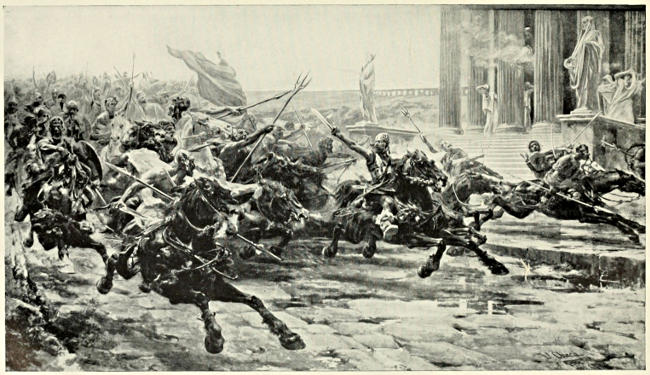
THE HUNS APPROACHING ROME
In 428 or 429 the whole nation set sail for Africa, upon an invitation
received by their king from Boniface, count of Africa, who had fallen into
disgrace with the court of Ravenna. Gunderic was now dead and supreme
power was in the hands of his bastard brother, who is generally known in
history as Genseric, though the more correct form of his name is Gaiseric.
This man, short of stature and with limping gait, but with a great natural
capacity for war and dominion, reckless of human life and unrestrained by
conscience or pity, was for fifty years the hero of the Vandal race and the
terror of Constantinople and Rome. In the month of May 428 (?) he
assembled all his people on the shore of Andalusia, and numbering the males
among them from the graybeard down to the new-born infant found them to
amount to eighty thousand souls. The passage was effected in the ships of
Boniface, who, however, soon returning to his old loyalty, besought his
new allies to depart from Africa. They, of course, refused, and Boniface
turned against them, too late, however, to repair the mischief which he had
caused. Notwithstanding his opposition the progress of the Vandals was
rapid, and by May 430 only three cities of Roman Africa—Carthage, Hippo,
and Cirta—remained untaken.
[430-455 A.D.]
The long siege of Hippo (May 430 to July 431), memorable for the last
illness and death of St. Augustine, which occurred during its progress, ended
unsuccessfully for the Vandals. At length (30th of January, 435) peace was
made between the emperor Valentinian III and Genseric. The emperor
was to retain Carthage and the small but rich proconsular province in which
it was situated, while Hippo and the other six provinces of Africa were
abandoned to the Vandal. Genseric observed this treaty no longer than
suited his purpose. On the 19th of October 439, without any declaration of
war, he suddenly attacked Carthage and took it. The Vandal occupation
of this great city, the third among the cities of the Roman Empire, lasted for
ninety-four years. Genseric seems to have counted the years of his sovereignty
from the date of its capture. Though most of the remaining years
of Genseric’s life were passed in war, plunder rather than territorial conquest
seems to have been the object of his expeditions. He made, in fact,
of Carthage a pirates’ stronghold, from whence he issued forth, like the
Barbary pirates of a later day, to attack, as he himself said, “the dwellings
of the men with whom God is angry,” leaving the question who those men
might be to the decision of the elements. Almost alone among the Teutonic
invaders of the empire, he set himself to form a powerful fleet, and was
probably for thirty years the leading maritime power in the Mediterranean.b
The revolutions of the palace, which left the Western Empire without a
defender, and without a lawful prince, dispelled the apprehensions and stimulated
the avarice of Genseric. He immediately equipped a numerous fleet
of Vandals and Moors, and cast anchor at the mouth of the Tiber, about three
months after the death of Valentinian and the elevation of Maximus to the
imperial throne.
The private life of the senator Petronius Maximus was often alleged as a
rare example of human felicity. His birth was noble and illustrious, since he
descended from the Anician family, his dignity was supported by an adequate
patrimony in land and money; and these advantages of fortune were accompanied
with liberal arts and decent manners, which adorn or imitate the
inestimable gifts of genius and virtue. The luxury of his palace and table
was hospitable and elegant. Whenever Maximus appeared in public, he was
surrounded by a train of grateful and obsequious clients; and it is possible
that, among these clients, he might deserve and possess some real friends.
His merit was rewarded by the favour of the prince and senate; he thrice
exercised the office of prætorian prefect of Italy; he was twice invested with
the consulship, and he obtained the rank of patrician.
These civil honours were not incompatible with the enjoyment of leisure
and tranquillity; his hours, according to the demands of pleasure or reason,
were accurately distributed by a water-clock; and this avarice of time may
be allowed to prove the sense which Maximus entertained of his own happiness.
The injury which he received from the emperor Valentinian appears
to excuse the most bloody revenge. Yet a philosopher might have reflected
that, if the resistance of his wife had been sincere, her chastity was still
inviolate, and that it could never be restored if she had consented to the
will of the adulterer. A patriot would have hesitated, before plunging himself
and his country into those inevitable calamities which must follow the
extinction of the royal house of Theodosius. The imprudent Maximus disregarded
these salutary considerations; he gratified his resentment and ambition,
he saw the bleeding corpse of Valentinian at his feet, and heard himself
saluted emperor by the unanimous voice of the senate and people. But the
day of his inauguration was the last day of his happiness. He was imprisoned
(such is the lively expression of Sidonius) in the palace; and, after passing
a sleepless night, he sighed that he had attained the summit of his wishes,
and aspired only to descend from the dangerous elevation. Oppressed by
the weight of the diadem, he communicated his anxious thoughts to his friend
and quæstor Fulgentius; and when he looked back with unavailing regret on
the secure pleasures of his former life, the emperor exclaimed, “O fortunate
Damocles, thy reign began and ended with the same dinner!” a well-known
allusion, which Fulgentius afterwards repeated as an instructive lesson
for princes and subjects.
[455-456 A.D.]
The reign of Maximus continued about three months. His hours, of
which he had lost the command, were disturbed by remorse, or guilt, or terror;
and his throne was shaken by the seditions of the soldiers, the people, and the
confederate barbarians. The marriage of his son Palladius with the eldest
daughter of the late emperor might tend to establish the hereditary succession
of his family; but the violence which he offered to the empress Eudoxia
could proceed only from the blind impulse of lust or revenge. His own wife,
the cause of these tragic events, had been seasonably removed by death; and
the widow of Valentinian was compelled to violate her decent mourning,
perhaps her real grief, and to submit to the embraces of a presumptuous
usurper, whom she suspected as the assassin of her deceased husband.
These suspicions were soon justified by the indiscreet confession of Maximus
himself; and he wantonly provoked the hatred of his reluctant bride,
who was still conscious that she was descended from a line of emperors.
From the East, however, Eudoxia could not hope to obtain any effectual
assistance; her father and her aunt Pulcheria were dead; her mother languished
at Jerusalem in disgrace and exile; and the sceptre of Constantinople
was in the hands of a stranger. She directed her eyes towards Carthage,
secretly implored the aid of the king of the Vandals; and persuaded Genseric
to improve the fair opportunity of disguising his rapacious designs by the
specious names of honour, justice, and compassion. Whatever abilities
Maximus might have shown in a subordinate station, he was found incapable
of administering an empire; and though he might easily have been informed of
the naval preparations which were made on the opposite shores of Africa, he
expected with supine indifference the approach of the enemy, without adopting
any measures of defence, of negotiation, or of a timely retreat.
When the Vandals disembarked at the mouth of the Tiber, the emperor
was suddenly roused from his lethargy by the clamours of a trembling and
exasperated multitude. The only hope which presented itself to his astonished
mind was that of a precipitate flight, and he exhorted the senators to
imitate the example of their prince. But no sooner did Maximus appear in the
streets than he was assaulted by a shower of stones; a Roman, or a Burgundian
soldier, claimed the honour of the first wound; his mangled body was
ignominiously cast into the Tiber; the Roman people rejoiced in the punishment
which they had inflicted on the author of the public calamities, and the
domestics of Eudoxia signalised their zeal in the service of their mistress.
On the third day after the tumult, Genseric boldly advanced from the
port of Ostia to the gates of the defenceless city. Instead of a sally of the
Roman youth, there issued from the gates an unarmed and venerable procession
of the bishop at the head of his clergy. The fearless spirit of Leo, his
authority and eloquence, again mitigated the fierceness of a barbarian conqueror;
the king of the Vandals promised to spare the unresisting multitude,
to protect the buildings from fire, and to exempt the captives from torture;
and although such orders were neither seriously given nor strictly obeyed,
the mediation of Leo was glorious to himself and in some degree beneficial
to his country. But Rome and its inhabitants were delivered to the licentiousness
of the Vandals and Moors, whose blind passions revenged the
injuries of Carthage.

Roman Pin and Bracelet
(In the British Museum)
The pillage lasted fourteen days and nights; and all that yet remained
of public or private wealth, of sacred or profane treasure, was diligently
transported to the vessels of Genseric. Among the spoils, the splendid
relics of two temples, or rather of two religions, exhibited a memorable
example of the vicissitudes of human and divine things. Since the abolition
of paganism, the Capitol had been violated and abandoned; yet the
statues of the gods and heroes were still respected, and the curious roof of
gilt bronze was reserved for the rapacious hands of Genseric. The holy
instruments of the Jewish worship, the gold table and the gold candlestick
with seven branches, originally framed according to the particular instructions
of God himself, and which were placed in the sanctuary of his temple,
had been ostentatiously displayed to the Roman people in the triumph of
Titus. They were afterwards deposited in the temple of Peace; and, at
the end of four hundred years, the spoils of Jerusalem were transferred
from Rome to Carthage, by a barbarian who derived his origin from the
shores of the Baltic. These ancient monuments might attract the notice of
curiosity, as well as of avarice.
But the Christian churches, enriched and adorned by the prevailing
superstition of the times, afforded more plentiful materials for sacrilege;
and the pious liberality of Pope Leo, who melted six silver vases, the gift of
Constantine, each of a hundred pounds’ weight, is evidence of the damage
which he attempted to repair. In the forty-five years that had elapsed
since the Gothic invasion, the pomp and luxury of Rome were in some
measure restored; and it was difficult either to escape or to satisfy the
avarice of a conqueror, who possessed leisure to collect and ships to transport
the wealth of the capital. The imperial ornaments of the palace, the
magnificent furniture and wardrobe, the sideboards of massy plate, were
accumulated with disorderly rapine; the gold and silver amounted to
several thousand talents; yet even the brass and copper were laboriously
removed.
Eudoxia herself, who advanced to meet her friend and deliverer, soon
bewailed the imprudence of her own conduct. She was rudely stripped of
her jewels; and the unfortunate empress, with her two daughters, the only
surviving remains of the great Theodosius, was compelled as a captive to
follow the haughty Vandal; who immediately hoisted sail and returned
with a prosperous navigation to the port of Carthage. Many thousand
Romans of both sexes, chosen for some useful or agreeable qualifications,
reluctantly embarked on board the fleet of Genseric; and their distress was
aggravated by the unfeeling barbarians, who, in the division of the booty,
separated the wives from their husbands and the children from their
parents. The charity of Deogratias, bishop of Carthage, was their only
consolation and support. He generously sold the gold and silver plate of
the church to purchase the freedom of some, to alleviate the slavery of
others, and to assist the wants and infirmities of a captive multitude, whose
health was impaired by the hardships which they had suffered in their
passage from Italy to Africa. By his order two spacious churches were
converted into hospitals; the sick were distributed in convenient beds, and
liberally supplied with food and medicines, and the aged prelate repeated
his visits, both in the day and night, with an assiduity that surpassed the
value of his services. Compare this scene with the field of Cannæ; and
judge between Hannibal and the successor of St. Cyprian.
The deaths of Aëtius and Valentinian had relaxed the ties which held the
barbarians of Gaul in peace and subordination. The sea coast was infested
by the Saxons; the Alamanni and the Franks advanced from the Rhine to
the Seine; and the ambition of the Goths seemed to meditate more extensive
and permanent conquests. The emperor Maximus relieved himself, by a
judicious choice, from the weight of these distant cares; he silenced the
solicitations of his friends, listened to the voice of fame, and promoted a
stranger to the general command of the forces in Gaul. Avitus, the stranger,
whose merit was so nobly rewarded, descended from a wealthy and honourable
family in the diocese of Auvergne. The convulsions of the times urged
him to embrace, with the same ardour, the civil and military professions; and
the indefatigable youth blended the studies of literature and jurisprudence
with the exercise of arms and hunting. Thirty years of his life were laudably
spent in the public service; he alternately displayed his talents in
war and negotiation; and the soldier of Aëtius, after executing the most
important embassies, was raised to the station of prætorian prefect of Gaul.
Either the merit of Avitus excited envy, or his moderation was desirous of
repose, since he calmly retired to an estate which he possessed in the neighbourhood
of Clermont. In this retreat, where Avitus amused his leisure
with books, rural sports, the practice of husbandry, and the society of his
friends, he received the imperial diploma, which constituted him master-general
of the cavalry and infantry of Gaul. He assumed the military command;
the barbarians suspended their fury; and whatever means he might
employ, whatever concessions he might be forced to make, the people enjoyed
the benefits of actual tranquillity. But the fate of Gaul depended on the
Visigoths; and the Roman general, less attentive to his dignity than to
the public interest, did not disdain to visit Tolosa in the character of an
ambassador.
He was received with courteous hospitality by Theodoric, the king of the
Goths; but while Avitus laid the foundations of a solid alliance with that
powerful nation, he was astonished by the intelligence that the emperor
Maximus was slain, and that Rome had been pillaged by the Vandals. A
vacant throne, which he might ascend without guilt or danger, tempted his
ambition; and the Visigoths were easily persuaded to support his claim by
their irresistible suffrage. They loved the person of Avitus, they respected
his virtues; and they were not insensible of the advantage, as well as honour,
of giving an emperor to the West.
The season was now approaching in which the annual assembly of the
seven provinces was held at Arelate (Arles); their deliberations might perhaps
be influenced by the presence of Theodoric and his martial brothers,
but their choice would naturally incline to the most illustrious of their
countrymen. Avitus, after a decent resistance, accepted the imperial diadem
from the representatives of Gaul; and his election was ratified by the acclamations
of the barbarians and provincials.
The formal consent of Marcian,
emperor of the East, was solicited and
obtained; but the senate, Rome, and
Italy, though humbled by their recent
calamities, submitted with a secret
murmur to the presumption of the
Gallic usurper.
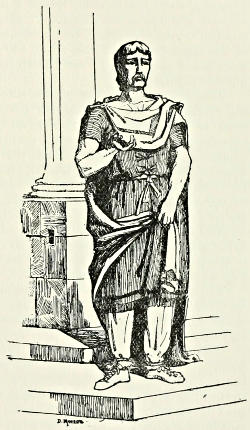
Costume of a Visigoth
Theodoric, to whom Avitus was
indebted for the purple, had acquired
the Gothic sceptre by the murder of
his elder brother Torismond; and he
justified this atrocious deed by the
design which his predecessor had
formed of violating his alliance with
the empire. Such a crime might not
be incompatible with the virtues of a
barbarian, but the manners of Theodoric
were gentle and humane; and
posterity may contemplate without
terror the original picture of a Gothic
king, whom Sidonius had intimately
observed in the hours of peace and of
social intercourse.
When the king of the Visigoths
encouraged Avitus to assume the
purple, he offered his person and his
forces as a faithful soldier of the
republic. The exploits of Theodoric
soon convinced the world that he had
not degenerated from the warlike
virtues of his ancestors. After the
establishment of the Goths in Aquitania, and the passage of the Vandals into
Africa, the Suevi, who had fixed their kingdom in Gallæcia, aspired to the
conquest of Spain and threatened to extinguish the feeble remains of the
Roman dominion. The provincials of Carthago (Cartagena), and Tarraco
(Tarragona), afflicted by a hostile invasion, represented their injuries and
their apprehensions.
Count Fronto was despatched, in the name of the emperor Avitus, with
advantageous offers of peace and alliance; and Theodoric interposed his
weighty mediation to declare that, unless his brother-in-law, the king of the
Suevi, immediately retired, he should be obliged to arm in the cause of
justice and of Rome. “Tell him,” replied the haughty Rechiarius, “that I
despise his friendship and his arms; but that I shall soon try whether he
will dare to expect my arrival under the walls of Tolosa.” Such a challenge
urged Theodoric to prevent the bold designs of his enemy; he passed
the Pyrenees at the head of the Visigoths, the Franks and Burgundians
served under his standard, and though he professed himself the dutiful servant
of Avitus, he privately stipulated for himself and his successors the
absolute possession of his Spanish conquests. The two armies, or rather the
two nations, encountered each other on the banks of the river Urbicus, about
twelve miles from Augusta Asturica (Astorga); and the decisive victory of
the Goths appeared for a while to have extirpated the name and kingdom
of the Suevi. From the field of battle Theodoric advanced to Bracara
(Braga), their metropolis, which still retained the splendid vestiges of its
ancient commerce and dignity. His entrance was not polluted with blood,
and the Goths respected the chastity of their female captives, more especially
of the consecrated virgins; but the greatest part of the clergy and people
were made slaves, and even the churches and altars were confounded in the
universal pillage.
The unfortunate king of the Suevi had escaped to one of the ports of
the ocean, but the obstinacy of the winds opposed his flight; he was delivered
to his implacable rival; and Rechiarius, who neither desired nor
expected mercy, received with manly constancy the death which he would
probably have inflicted. After this bloody sacrifice to policy and resentment,
Theodoric carried his victorious arms as far as Augusta Emerita
(Merida), the principal town of Lusitania, without meeting any resistance,
except from the miraculous powers of St. Eulalia; but he was stopped in
the full career of success, and recalled from Spain, before he could provide
for the security of his conquests. In his retreat towards the Pyrenees he
revenged his disappointment on the country through which he passed; and
in the sack of Pallantia and Augusta Asturica he showed himself a faithless
ally as well as a cruel enemy.
Whilst the king of the Visigoths fought and vanquished in the name of
Avitus, the reign of Avitus had expired, and both the honour and the interest
of Theodoric were deeply wounded by the disgrace of a friend whom he
had seated on the throne of the Western Empire.
The pressing solicitations of the senate and people persuaded the emperor
Avitus to fix his residence at Rome, and to accept the consulship
for the ensuing year. Avitus, at a time when the imperial dignity was
reduced to a pre-eminence of toil and danger, indulged himself in the pleasures
of Italian luxury; age had not extinguished his amorous inclinations,
and he is accused of insulting, with indiscreet and ungenerous raillery, the
husbands whose wives he had seduced or violated.[69] But the Romans were
not inclined either to excuse his faults or to acknowledge his virtues. The
several parts of the empire became every day more alienated from each other;
and the stranger of Gaul was the object of popular hatred and contempt.
The senate asserted their legitimate claim in the election of an emperor;
and their authority, which had been originally derived from the old constitution,
was again fortified by the actual weakness of a declining monarchy.
Yet even such a monarchy might have resisted the votes of an unarmed
senate, if their discontent had not been supported, or perhaps inflamed, by
Count Ricimer, one of the principal commanders of the barbarian troops,
who formed the military defence of Italy. The daughter of Wallia, king of
the Visigoths, was the mother of Ricimer; but he was descended, on the
father’s side, from the nation of the Suevi; his pride or patriotism might be
exasperated by the misfortunes of his countrymen, and he obeyed with
reluctance an emperor in whose elevation he had not been consulted. His
faithful and important services against the common enemy rendered him
still more formidable; and after destroying on the coast of Corsica a fleet
of Vandals, which consisted of sixty galleys, Ricimer returned in triumph
with the appellation of the Deliverer of Italy. He chose that moment to
signify to Avitus that his reign was at an end; and the feeble emperor, at
a distance from his Gothic allies, was compelled after a short and unavailing
struggle to abdicate the purple. By the clemency, however, or the contempt
of Ricimer, he was permitted to descend from the throne to the more
desirable station of bishop of Placentia; but the resentment of the senate
was still unsatisfied, and their inflexible severity pronounced the sentence
of his death. He fled towards the Alps, with the humble hope not of arming
the Visigoths in his cause but of securing his person and treasures in the
sanctuary of Julian, one of the tutelar saints of Auvergne. Disease, or
the hand of the executioner, arrested him on the road; yet his remains were
decently transported to Brivas or Brioude, in his native province, and he
reposed at the feet of his holy patron.
[456-457 A.D.]
The successor of Avitus presents the welcome discovery of a great and
heroic character, such as sometimes arises in a degenerate age, to vindicate
the honour of the human species. The emperor Majorian has deserved the
praises of his contemporaries and of posterity; and these praises may be
strongly expressed in the words of a judicious and disinterested historian:
“That he was gentle to his subjects; that he was terrible to his enemies;
and that he excelled in every virtue all of his predecessors who had reigned
over the Romans.” Such a testimony may justify at least the panegyric of
Sidonius; and we may acquiesce in the assurance that, although the obsequious
orator would have flattered, with equal zeal, the most worthless of
princes, the extraordinary merit of his object confined him, on this occasion,
within the bounds of truth. Majorian derived his name from his maternal
grandfather who, in the reign of the great Theodosius had commanded
the troops of the Illyrian frontier. He gave his daughter in marriage to the
father of Majorian, a respectable officer, who administered the revenues of
Gaul with skill and integrity; and generously preferred the friendship
of Aëtius to the tempting offers of an insidious court. His son, the future
emperor, who was educated in the profession of arms, displayed, from his
early youth, intrepid courage, premature wisdom, and unbounded liberality
in a scanty fortune. He followed the standard of Aëtius, contributed to his
success, shared, and sometimes eclipsed, his glory, and at last excited the
jealousy of the patrician, or rather of his wife, who forced him to retire from
the service. Majorian, after the death of Aëtius, was recalled and promoted,
and his intimate connection with Count Ricimer was the immediate step by
which he ascended the throne of the Western Empire. During the vacancy
that succeeded the abdication of Avitus, the ambitious barbarian whose birth
excluded him from the imperial dignity governed Italy, with the title of
patrician; resigned to his friend the conspicuous station of master-general
of the cavalry and infantry; and, after an interval of some months, consented
to the unanimous wish of the Romans, whose favour Majorian had
solicited by a recent victory over the Alamanni.
[457-461 A.D.]
The public and private actions of Majorian are very imperfectly known;
but his laws, remarkable for an original cast of thought and expression,
faithfully represent the character of a sovereign who loved his people, who
sympathised in their distress, who had studied the causes of the decline of
the empire, and who was capable of applying (as far as such reformation
was practicable) judicious and effectual remedies to the public disorders.
His regulations concerning the finances manifestly tended to remove, or at
least to mitigate, the most intolerable grievances.
(1) From the first hour of his reign, he was solicitous (these are his
own words) to relieve the weary fortunes of the provincials, oppressed by
the accumulated weight of indictions and superindictions. With this view,
he granted a universal amnesty, a final and absolute discharge of all arrears
of tribute, of all debts which, under any pretence, the fiscal officers might
demand from the people. This wise dereliction of obsolete, vexatious, and
unprofitable claims improved and purified the sources of the public revenue;
and the subject, who could now look back without despair, might labour
with hope and gratitude for himself and for his country.
(2) In the assessment and collection of taxes, Majorian restored the
ordinary jurisdiction of the provincial magistrates; and suppressed the extraordinary
commissions which had been introduced, in the name of the
emperor himself, or of the prætorian prefects. The favourite servants,
who obtained such irregular powers, were insolent in their behaviour and
arbitrary in their demands; they affected to despise the subordinate tribunals,
and they were discontented if their fees and profits did not twice
exceed the sum which they condescended to pay into the treasury. One
instance of their extortion would appear incredible, were it not authenticated
by the legislator himself. They exacted the whole payment in gold;
but they refused the current coin of the empire, and would accept only such
ancient pieces as were stamped with the names of Faustina or the Antonines.
The subject who was unprovided with these curious medals had recourse
to the expedient of compounding with their rapacious demands; or, if he
succeeded in the research, his imposition was doubled, according to the
weight and value of the money of former times.
(3) “The municipal corporation,” says the emperor, “the lesser senates
(so antiquity has justly styled them), deserve to be considered as the heart
of the cities, and the sinews of the republic. And yet so low are they now
reduced, by the injustice of magistrates and the venality of collectors, that
many of their members, renouncing their dignity and their country, have
taken refuge in distant and obscure exile.” He urges and even compels
their return to their respective cities; but he removes the grievance which
had forced them to desert the exercise of their municipal functions. They
are directed, under the authority of the provincial magistrates, to resume
their office of levying the tribute; but, instead of being made responsible
for the whole sum assessed on their district, they are only required to produce
a regular account of the payments which they have actually received,
and of the defaulters who are still indebted to the public.
(4) But Majorian was not ignorant that these corporate bodies were
too much inclined to retaliate the injustice and oppression which they had
suffered; and he therefore revives the useful office of the defenders of cities.
He exhorts the people to elect, in a full and free assembly, some man of
discretion and integrity, who would dare to assert their privileges, to represent
their grievances, to protect the poor from the tyranny of the rich, and
to inform the emperor of the abuses that were committed.
The spectator who casts a mournful view over the ruins of ancient
Rome is tempted to accuse the memory of the Goths and Vandals for the
mischief which they had neither leisure nor power, nor perhaps inclination,
to perpetrate. The tempest of war might strike some lofty turrets to the
ground; but the destruction which undermined the foundations of those
massy fabrics was prosecuted, slowly and silently, during a period of ten
centuries; and the motives of interest that afterwards operated without
shame or control were severely checked by the taste and spirit of the
emperor Majorian.
The decay of the city had gradually impaired the value of the public
works. The circus and theatres might still excite, but they seldom gratified
the desires of the people; the temples, which had escaped the zeal of the
Christians, were no longer inhabited either by gods or men; the diminished
crowds of the Romans were lost in the immense space of their baths and
porticoes; and the stately libraries and halls of justice became useless to an
indolent generation, whose repose was seldom disturbed either by study or
business. The monuments of consular or imperial greatness were no longer
revered as the immortal glory of the capital; they were only esteemed as an
inexhaustible mine of materials, cheaper and more convenient than the distant
quarry. Specious petitions were continually addressed to the easy magistrates
of Rome, which stated the want of stones or bricks for some necessary
service; the fairest forms of architecture were rudely defaced for the sake of
some paltry or pretended repairs; and the degenerate Romans, who converted
the spoil to their own emolument, demolished with sacrilegious hands the
labours of their ancestors. Majorian, who had often sighed over the desolation
of the city, applied a severe remedy to the growing evil. He reserved
to the prince and senate the sole cognisance of the extreme cases which might
justify the destruction of an ancient edifice; imposed a fine of fifty pounds
of gold [£2000 or $10,000] on every magistrate who should presume to grant
such illegal and scandalous license; and threatened to chastise the criminal
obedience of their subordinate officers by a severe whipping and the amputation
of both their hands.
In the last instance, the legislator might seem to forget the proportion
of guilt and punishment; but his zeal arose from a generous principle, and
Majorian was anxious to protect the monuments of those ages in which he
would have desired and deserved to live. The emperor conceived that it
was his interest to increase the number of his subjects, that it was his duty to
guard the purity of the marriage bed; but the means which he employed to
accomplish these salutary purposes are of an ambiguous and perhaps exceptionable
kind. The pious maids who consecrated their virginity to Christ
were restrained from taking the veil till they had reached their fortieth year.
Widows under that age were compelled to form a second alliance within the
term of five years, by the forfeiture of half their wealth to their nearest relatives
or to the state. Unequal marriages were condemned or annulled.
The punishment of confiscation and exile was deemed so inadequate to the
guilt of adultery, that if the criminal returned to Italy he might, by the
express declaration of Majorian, be slain with impunity.
While the emperor Majorian assiduously laboured to restore the happiness
and virtue of the Romans, he encountered the arms of Genseric, from
his character and situation their most formidable enemy. A fleet of Vandals
and Moors landed at the mouth of the Liris or Garigliano: but the
imperial troops surprised and attacked the disorderly barbarians, who were
encumbered with the spoils of Campania; they were chased with slaughter
to their ships, and their leader, the king’s brother-in-law, was found in the
number of the slain. Such vigilance might announce the character of the new
reign; but the strictest vigilance and the most numerous forces were insufficient
to protect the long-extended coast of Italy from the depredations of a
naval war. The public opinion had imposed a nobler and most arduous task
on the genius of Majorian. Rome expected from him alone the restitution
of Africa; and the design which he formed of attacking the Vandals in their
new settlements was the result of bold and judicious policy. If the intrepid
emperor could have infused his own spirit into the youth of Italy, if he could
have revived in the Field of Mars the manly exercises in which he had always
surpassed his equals—he might have marched against Genseric at the head
of a Roman army.
Such a reformation of national manners might be embraced by the rising
generation; but it is the misfortune of those princes who laboriously sustain
a declining monarchy that, to obtain some immediate advantage or to avert
some impending danger, they are forced to countenance and even to multiply
the most pernicious abuses. Majorian, like the weakest of his predecessors,
was reduced to the disgraceful expedient of substituting barbarian
auxiliaries in the place of his unwarlike subjects; and his superior abilities
could only be displayed in the vigour and dexterity with which he wielded
a dangerous instrument, so apt to recoil on the hand that used it.
Besides the confederates who were already engaged in the service of the
empire, the fame of his liberality and valour attracted the nations of the
Danube, the Borysthenes, and perhaps of the Tanaïs. Many thousands of
the bravest subjects of Attila, the Gepidæ, the Ostrogoths, the Rugians, the
Burgundiones, the Suevi, the Alani, assembled in the plains of Liguria; and
their formidable strength was balanced by their mutual animosities. They
passed the Alps in a severe winter. The emperor led the way on foot, and
in complete armour; sounding, with his long staff, the depth of the ice or
snow, and encouraging the Scythians, who complained of the extreme cold,
by the cheerful assurance that they should be satisfied with the heat of
Africa. The citizens of Lugdunum had presumed to shut their gates; they
soon implored and experienced the clemency of Majorian. He vanquished
Theodoric in the field; and admitted to his friendship and alliance a king
whom he had found not unworthy of his arms. The beneficial though
precarious reunion of the greatest part of Gaul and Spain was the effect of
persuasion as well as of force; and the independent Bagaudæ, who had
escaped or resisted the oppression of former reigns, were disposed to confide
in the virtues of Majorian.
His camp was filled with barbarian allies, his throne was supported by the
zeal of an affectionate people; but the emperor had foreseen that it was
impossible, without a maritime power, to achieve the conquest of Africa. In
the First Punic War, the republic had exerted such incredible diligence that,
within sixty days after the first stroke of the axe had been given in the forest,
a fleet of 160 galleys proudly rode at anchor in the sea. Under circumstances
much less favourable, Majorian equalled the spirit and perseverance of the
ancient Romans. The woods of the Apennine were felled; the arsenals and
manufactures of Ravenna and Misenum were restored; Italy and Gaul vied
with each other in liberal contributions to the public service; and the imperial
navy of three hundred large galleys, with an adequate proportion of
transports and smaller vessels, was collected in the secure and capacious
harbour of Carthago Nova (Cartagena) in Spain.
The intrepid countenance of Majorian animated his troops with a confidence
of victory; and if we might credit the historian Procopius, his courage
sometimes hurried him beyond the bounds of prudence. Anxious to
explore, with his own eyes, the state of the Vandals, he ventured after disguising
the colour of his hair to visit Carthage in the character of his own
ambassador; and Genseric was afterwards mortified by the discovery that
he had entertained and dismissed the emperor of the Romans. Such an
anecdote may be rejected as an improbable fiction; but it is a fiction which
would not have been imagined unless in the life of a hero.
Without the help of a personal interview, Genseric was sufficiently
acquainted with the genius and designs of his adversary. He practised his
customary arts of fraud and delay; but he practised them without success.
His applications for peace became each hour more submissive, and perhaps
more sincere; but the inflexible Majorian had adopted the ancient maxim
that Rome could not be safe, so long as Carthage existed in a hostile state.
The king of the Vandals distrusted the valour of his native subjects, who
were enervated by the luxury of the south; he suspected the fidelity of the
vanquished people, who abhorred him as an Arian tyrant; and the desperate
measure which he executed, of reducing Mauretania into a desert, could not
defeat the operations of the Roman emperor, who was at liberty to land his
troops on any part of the African coast.
But Genseric was saved from impending and inevitable ruin by the
treachery of some powerful subjects, envious or apprehensive of their master’s
success. Guided by their secret intelligence, he surprised the unguarded
fleet in the Bay of Cartagena; many of the ships were sunk, or taken, or
burned, and the preparations of three years were destroyed in a single day.
After this event, the behaviour of the two antagonists showed them superior
to their fortune. The Vandal, instead of being elated by this accidental victory,
immediately renewed his solicitations for peace. The emperor of the
West, who was capable of forming great designs and of supporting heavy
disappointments, consented to a treaty, or rather to a suspension of arms;
in the full assurance that before he could restore his navy he should be supplied
with provocations to justify a second war. Majorian returned to Italy,
to prosecute his labours for the public happiness; and as he was conscious of
his own integrity, he might long remain ignorant of the dark conspiracy
which threatened his throne and his life.
The recent misfortune of Cartagena sullied the glory which had dazzled
the eyes of the multitude. Almost every description of civil and military
officers were exasperated against the reformer, since they all derived some
advantage from the abuses which he endeavoured to suppress; and the patrician
Ricimer impelled the inconstant passions of the barbarians against a
prince whom he esteemed and hated. The virtues of Majorian could not
protect him from the impetuous sedition which broke out in the camp near
Tortona, at the foot of the Alps. He was compelled to abdicate the imperial
purple; five days after his abdication it was reported that he died of a dysentery,[70]
and the humble tomb which covered his remains was consecrated by
the respect and gratitude of succeeding generations. The private character
of Majorian inspired love and respect. Malicious calumny and satire excited
his indignation, or, if he himself were the object, his contempt; but he protected
the freedom of wit, and in the hours which the emperor gave to the
familiar society of his friends he could indulge his taste for pleasantry, without
degrading the majesty of his rank.c
[456-461 A.D.]
The spoliation of Rome by Genseric was only a beginning of sorrows;
for, during the sixteen years that ensued Italy remained at the mercy of her
own paid leader, Count Ricimer, by birth and family alliances a barbarian,
who defeated every attempt to re-establish legal government. After the fall
of Aëtius, Ricimer obtained the command of the Western forces and the
patrician dignity. The career of Ricimer resembled in some degree those
of Stilicho and of Aëtius; for though his delinquencies were more numerous
and of a far deeper dye than theirs, like them he possessed great military
abilities, and like them he had personal interests that could not be
reconciled with those of the “Respublica Romana.”d The prestige which
he gained by his services against the Vandal Corsairs enabled him to make
himself virtual master of Empire and emperors for almost twenty years
(456-472). The attack of Avitus upon the Suevi in Spain offended the
Suevian Ricimer; and although it was an imperial duty which Avitus performed
in withstanding the encroachments of the Suevi, the commander of
the Roman troops found the way to his undoing. For the next ten months
Ricimer ruled under the title of patrician, which was now very much akin
to that of tyrant in the Greek sense of the word or our modern political
“boss.” He chose to be maker of emperors rather than emperor himself and
thus initiated a policy which was continued to the fall of the Empire in the
West. The history of these last years is not that of the shadow emperors
who flit across the scene, powerless in themselves and in their circumstances,
but of the great leaders like Ricimer the Suevic-Goth, Orestes of Pannonia,
or Bauto the Frank.
Meantime in the East conditions prevailed that were not altogether
dissimilar. The death of Marcian, after a reign of seven years, left no
hereditary claimant to the Eastern throne.a The man of most authority
in the army was the general Aspar (magister militum per orientem), an Alan
by descent, who with his father Ardaburius had distinguished himself
thirty-five years before in suppressing the usurper John and helping Valentinian
III to his legitimate succession. Aspar’s position in the East resembled
that of Ricimer in the West. He and his three sons, being Arians
and foreigners, could not hope to sit on the imperial throne; and thus the
only course open to Aspar was to secure the elevation of one on whose
pliancy he might count. He chose Leo, a native of Dacia and an orthodox
Christian, who was steward of his own household. Thus Aspar, like
Ricimer, was a king-maker.
But when Leo assumed the purple (7th February, 457)—on which occasion
the ceremony of coronation by the Patriarch of Constantinople (then
Anatolius) was first introduced—he did not prove as amenable to influence
as Aspar had hoped; on the contrary, he took measures to reduce the resources
of Aspar’s family, which by its close relations with the army had considerable
power, and was the centre of a large faction of Arians and barbarians.
In fact Aspar, though an Alan and not a German, was the representative of
German influence in the Empire, and the danger which had threatened the
Empire in the reign of Arcadius through the power of Gainas was now
repeated. Leo however firmly resisted the aggressiveness of this influence,
and in order to neutralise the great fact which worked in Aspar’s favour,
namely that the bulk and flower of the army consisted of Germans, he
formed the plan of recruiting the line from native subjects. For this
purpose he chose the hardy race of Isaurian mountaineers, who lived almost
like an independent people, little touched by the influence of Hellenism, in
the wild regions of Mount Taurus. This is Leo’s great original work, for
which he deserves the title “Great,” more than for his orthodoxy, for which
he probably received it. He conceived an idea, whose execution, begun by
himself and carried out by his successor, counteracted that danger of German
preponderance which threatened the State throughout the fifth century.
Aspar appears to have possessed all the characteristics of an untutored
barbarian. Brave and active in war, he was idle and frivolous in peace.
During the reign of Marcian, and doubtless also in the reign of Leo, while
the Empire enjoyed rest, “he betook himself to relaxation and womanly
ease. His pleasures consisted in actors and jugglers and all stage amusements,
and spending his time on these ill-famed occupations he lost all count
of the things that make for glory.” But if he was no longer active as a
warrior, he won repute in the humbler part of an energetic citizen or
a competent policeman, for in the great fire which laid waste a large part
of Constantinople in 465 it is recorded that Aspar exerted himself unsparingly
for the public interest.
Leo had made a promise, apparently at the time of his elevation, to raise
one of Aspar’s sons to the rank of cæsar, and thereby designate him as his
successor, in spite of the fact that he was a barbarian. When he delayed to
perform this promise, Aspar is said to have seized him by his purple robe
and said, “Emperor, it is not meet that he who wears this robe should speak
falsely;” to which Leo replied, “Nor yet is it meet that he should be constrained
and driven like a slave.”j
After this extraordinary scene, it was impossible that the reconciliation
of the emperor and the patrician could be sincere; or, at least, that it could
be solid and permanent. An army of Isaurians was secretly levied and
introduced into Constantinople; and while Leo undermined the authority,
and prepared the disgrace of the family of Aspar, his mild and cautious
behaviour restrained them from any rash and desperate attempts, which
might have been fatal to themselves or their enemies. The measures of
peace and war were affected by this internal revolution. As long as Aspar
degraded the majesty of the throne, the secret correspondence of religion
and interest engaged him to favour the cause of Genseric. When Leo had
delivered himself from that ignominious servitude, he listened to the complaints
of the Italians; resolved to extirpate the tyranny of the Vandals;
and declared his alliance with Anthemius.c
[460-467 A.D.]
Even the genius and energy of Majorian is of no avail against the dictatorship
of Ricimer. But the spell of the imperial dignity was still strong,
and the commander of the army was not long in nominating another to the
purple.a
Severus, as the nominee of Ricimer, next wore the purple, and decrees
were registered in his name; but his appointment obtained no confirmation
at Constantinople, and the usurped power of Ricimer himself never extended
beyond the limits of Italy. In Gaul and in Dalmatia, the Roman governors,
Egidius and Marcellinus, continued to hold their respective provinces in trust
for the “sancta res publica,” acknowledging no emperor but Leo; and Leo
nominated both consuls. After four years of confusion and misery Severus
died; and when Ricimer, as patrician, had exercised for above a year the
power of the executive, he appears to have become satisfied that, without a
combined effort in which the naval resources of the East should be brought
to bear, the plague of Vandal descents could not be stayed. Yielding, it
would seem, to necessity, he concurred with the senate in a request to the
emperor Leo that he would name an emperor of the West (465).
In this attempt to establish closer relations with the East, the senate
appears to have acted in conformity with the original constitution of the two
empires, and at the same time to have adopted a policy that might under
other circumstances have relieved the Roman world from its besetting
danger—namely, that of a military despotism exercised by men who derived
their wealth and importance from Roman sources and yet failed to entertain
any exclusive attachment to Roman interests.
The choice of Leo fell on Anthemius, who some years previously had
served as consul, and whose hereditary influence placed him at the head of
the Eastern magnates.d The virtues of Anthemius have perhaps been magnified,
since the imperial descent, which he could only deduce from the
usurper Procopius, has been swelled into a line of emperors. But the merit
of his immediate parents, their honours, and their riches, rendered Anthemius
one of the most illustrious subjects of the East. His father, Procopius,
obtained, after his Persian embassy, the rank of general and patrician; and
the name of Anthemius was derived from his maternal grandfather, the
celebrated prefect, who protected, with so much ability and success, the
infant reign of Theodosius. The grandson of the prefect was raised above
the condition of a private subject, by his marriage with Euphemia, the
daughter of the emperor Marcian.
This splendid alliance, which might supersede the necessity of merit,
hastened the promotion of Anthemius to the successive dignities of count,
of master-general, of consul, and of patrician; and his merit or fortune
claimed the honours of a victory, which was obtained, on the banks of the
Danube, over the Huns. Without indulging an extravagant ambition, the
son-in-law of Marcian might hope to be his successor; but Anthemius supported
the disappointment with courage and patience; and his subsequent
elevation was universally approved by the public, who esteemed him worthy
to reign till he ascended the throne.
The solemn inauguration of Anthemius was followed by the nuptials
of his daughter and the patrician Ricimer; a fortunate event, which
was considered as the firmest security of the union and happiness of
the state. The wealth of two empires was on this occasion most ostentatiously
displayed: and many senators completed their ruin by an expensive
effort to disguise their poverty. All serious business was suspended during
the time of this festival; the courts of justice were shut; the streets of
Rome, the theatres, the places of public and private resort resounded with
hymeneal songs and dances; and the royal bride, clothed in silken robes,
with a crown on her head, was conducted to the palace of Ricimer,
who had changed his military dress for the habit of a consul and a
senator.c
The unprecedented task intrusted to the emperor Leo of selecting the
man with whom he was to share the administration and defence of the whole
Roman world, makes it requisite to consider his actual position. Leo had
now attained the eleventh year of his reign, which, from the first, had been
beset with difficulties. Aspar, with his barbarian satellites, overawed the
Eastern senate; and it was only by compliances savouring of duplicity that
the government could be carried on. Leo could do no more than turn to
advantage any opportunity that might arise for the extension of his influence.
When the Huns invaded Thrace, he gained a battle in which one of Attila’s
sons was slain; a success which increased his influence. By enlisting the
services of an Isaurian prince, whose barbaric name he changed to that of
the stoic Zeno, he at length obtained a counterpoise to Aspar. The Isaurian,
though no philosopher and though in his manners a barbarian, had at
his disposal a considerable array of hardy combatants, whose services Leo
secured by accepting their leader for his son-in-law. The resources of the
Eastern Empire were then freely devoted to an enterprise on the success
and failure of which the weal or woe of Italy depended.
Coins were struck representing the two emperors with joined hands, and
sanguine hopes were once more entertained that, by their combined efforts,
Africa with the command of the Mediterranean would be regained.
[467-468 A.D.]
In fitting out an armada of fabulous magnitude, the sum expended by Leo
exceeded £5,000,000 [$25,000,000]. Marcellinus, under whose government
Dalmatia had prospered and who had refused to obey Ricimer, declared his
allegiance to Anthemius, and the successes which his galleys obtained over
those of the Vandals enabled him to liberate the island of Sardinia from their
oppression. About the same time, the prefect Heraclius landed at Tripolis,
reconquered the adjacent settlements, and commenced his march to co-operate
with the main expedition in an attack on Carthage. Such were the
signs of an irresistible superiority with which the war commenced, and which
so far shook the confidence of Genseric that he protested his willingness to
submit to whatever terms the two emperors might dictate; and there appears
to be no doubt that his apprehensions were shared by his coreligionists,
Ricimer and Aspar, to whom a subversion of the Arian ascendency in Africa
would have been fatal. Fortunately for them, the chief command was given
to Basiliscus, a brother of the empress consort Verina. As Leo had no son,
Basiliscus, if Procopius is to be relied upon, already aspired to the imperial
succession, and was anxious to stand well with Aspar.
The landing took place at a small seaport about forty miles from Carthage;
and while the disembarkation of stores and other impedimenta was in progress,
envoys from Genseric arrived. Basiliscus, whether yielding to a desire
to gratify Aspar, to the allurements of Vandal gold, or to the suggestions of
his own weak judgment, lent a willing ear to their assurances. They asked
and obtained a truce of five days, during which the terms of submission
might be arranged.
The panic, which would have made the reconquest of Carthage an easy
achievement, subsided, and Genseric having time for a careful examination
took note of the crowded order in which the Roman Armada lay at anchor.
His fire-ships, the torpedoes of ancient warfare, were in readiness, supported
by galleys which, however inferior to those of the Romans in number, were
the best manned and the most efficient in existence.
At nightfall the fire-ships were so placed that they drifted on the very
centre of the unsuspecting enemy, the flames spread, and when the confusion
was at its height a bold and well-timed attack did the rest. The store-ships,
on which the army depended for subsistence, were captured or sunk; and
acts of individual heroism on the part of the Roman commander, of which
there were many, were of no avail. A hopeless resistance was for a while
maintained, but the losses were irreparable.
Basiliscus saved himself by an early flight. On arriving at Constantinople,
he took refuge in the church of St. Sophia, until he obtained a reprieve
from capital punishment through the intercession of his sister. Such was
the disastrous ending of the combined effort made for the recovery of Africa.
Its success would have consolidated the power of the two emperors; by its
failure, Ricimer and Aspar were relieved from their fears, and their arrogance
became greater than ever. Leo found it necessary to pacify Aspar by
investing his son Patricius with the dignity of cæsar, a title which conferred
on its bearer a prospective claim to the throne.
[468-473 A.D.]
To Aspar and his family, whose unpopularity was already great, the acquisition
of this dangerous honour brought no advantage, but only an increase
of hostility; for to the orthodox East Romans the idea of an Arian emperor
was insufferable. Owing to the losses incurred during the late disastrous
expedition the forces on which Aspar formerly relied were no longer at his
beck; and, rightly or wrongly, he and his son were charged with treasonable
designs against the government, over which they had long domineered, and
against the life of the emperor.
The circumstances preceding and attending their assassination are variously
and obscurely related; but no plea of state necessity can relieve the
memory of Leo from the stain of participation in the death of his benefactor.
In Italy, the reckless energy of Ricimer led to a very different result.
Having resolved to break up the alliances of the emperors, he fixed his headquarters
at Mediolanum, enlisted forces, while Anthemius, relying on the
cordial support of the senate and the bulk of the people, remained inactive
at Rome.
The Mediolanians, wishing to prevent a civil war, employed Epiphanius,
bishop of Ticinum (Pavia), as negotiator; and from the account given by
Ennodius of the bishop’s embassy, some estimate may be formed of the difficulties
that stood in the way of any attempt on the part of the West
Romans to reconstruct their dilapidated empire.
The pacific exhortations of the bishop resulted in a truce, which gave
time for Ricimer to engage the requisite number of Suevi and Burgundiones.
Having done this he threw off the mask, and making the death of Aspar his
plea, refused to acknowledge either Leo or Anthemius, proclaimed Olybrius,
an enemy of his father-in-law, emperor, and commenced his march to Rome.
When the Roman governor of Gaul brought an army to support Anthemius,
he was defeated and slain. Rome nevertheless held out bravely
until reduced by famine when, with the exception of a few streets, occupied
by his own adherents, Ricimer condemned it to be sacked. He then added
to the list of emperors whom he had put to death the name of his own father-in-law,
and died the same year (472).d
Whilst the vacant throne of Italy was abandoned to lawless barbarians,
the election of a new colleague was seriously agitated in the council of
Leo. The empress Verina, studious to promote the greatness of her own
family, had married one of her nieces to Julius Nepos, who succeeded his
uncle Marcellinus in the sovereignty of Dalmatia, a more solid possession
than the title, which he was persuaded to accept, of emperor of the West.
But the measures of the Byzantine court were so languid and irresolute
that many months elapsed after the death of Anthemius, and even of
Olybrius, before their destined successor could show himself, with a
respectable force, to his Italian subjects. During that interval, Glycerius,
an obscure soldier, was invested with the purple by his patron Gundobald;
but the Burgundionian prince was unable, or unwilling, to support his
nomination by a civil war; the pursuits of domestic ambition recalled him
beyond the Alps, and his client was permitted to exchange the Roman sceptre
for the bishopric of Salona. After extinguishing such a competitor, the
emperor Nepos was acknowledged by the senate, by the Italians, and by the
provincials of Gaul; his moral virtues, and military talents, were loudly
celebrated, and those who derived any private benefit from his government
announced, in prophetic strains, the restoration of the public felicity.
Their hopes (if such hopes had been entertained) were confounded within
the term of a single year; and the treaty of peace, which ceded Auvergne
to the Visigoths, is the only event of his short and inglorious reign.
[473-475 A.D.]
The most faithful subjects of Gaul were sacrificed by the Italian emperor
to the hope of domestic security; but his repose was soon invaded by a
furious sedition of the barbarian confederates, who, under the command
of Orestes, their general, were in full march from Rome to Ravenna.
Nepos trembled at their approach; and, instead of placing a just confidence
in the strength of Ravenna, he hastily escaped to his ships and retired to
his Dalmatian principality, on the opposite coast of the Adriatic. By this
shameful abdication he protracted his life about five years, in a very
ambiguous state between an emperor and an exile, till he was assassinated
at Salona by the ungrateful Glycerius, who was translated, perhaps as the
reward of his crime, to the archbishopric of Milan.
The nations who had asserted their independence after the death of
Attila were established, by the right of possession or conquest, in the
boundless countries to the north of the Danube, or in the Roman provinces
between the river and the Alps. But the bravest of their youth enlisted in
the army of confederates, who formed the defence and the terror of Italy;
and in this promiscuous multitude the names of the Heruli, the Scyrri, the
Alani, the Turcilingi, and the Rugi appear to have predominated.
The example of these warriors was imitated by Orestes, the son of Tatullus,
and the father of the last Roman emperor of the West. Orestes, who
has been already mentioned in this history, had never deserted his country.
His birth and fortunes rendered him one of the most illustrious subjects of
Pannonia. When that province was ceded to the Huns, he entered into the
service of Attila, his lawful sovereign, obtained the office of his secretary,
and was repeatedly sent ambassador to Constantinople, to represent the person
and signify the commands of the imperious monarch. The death of
that conqueror restored him to his freedom, and Orestes might honourably
refuse either to follow the sons of Attila into the Scythian desert, or to obey
the Ostrogoths, who had usurped the dominion of Pannonia. He preferred
the service of the Italian princes, the successors of Valentinian; and as he
possessed the qualifications of courage, industry, and experience, he advanced
with rapid steps in the military profession, till he was elevated, by the
favour of Nepos himself, to the dignities of patrician and master-general of
the troops.
These troops had been long accustomed to reverence the character and
authority of Orestes, who affected their manners, conversed with them in
their own language, and was intimately connected with their national chieftains
by long habits of familiarity and friendship. At his solicitation they
rose in arms against the obscure Greek who presumed to claim their obedience;
and when Orestes, from some secret motive, declined the purple, they
consented, with the same facility, to acknowledge his son Augustulus as the
emperor of the West. By the abdication of Nepos, Orestes had now attained
the summit of his ambitious hopes; but he soon discovered, before the end
of the first year, that the lessons of perjury and ingratitude which a rebel
must inculcate will be retorted against himself; and that the precarious
sovereign of Italy was only permitted to choose whether he would be the
slave, or the victim, of his barbarian mercenaries. The dangerous alliance
of these strangers had oppressed and insulted the last remains of Roman
freedom and dignity. At each revolution, their pay and privileges were
augmented; but their insolence increased in a still more extravagant degree.
They envied the fortune of their brethren in Gaul, Spain, and Africa, whose
victorious arms had acquired an independent and perpetual inheritance; and
they insisted on their peremptory demand that a third part of the lands of
Italy should be immediately divided among them.
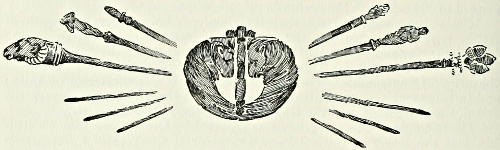
Roman Pins and Bracelet
[475-476 A.D.]
Orestes, with a spirit which, in another situation, might be entitled to
our esteem, chose rather to encounter the rage of an armed multitude than
to subscribe the ruin of an innocent people. He rejected the audacious
demand; and his refusal was favourable to the ambition of Odoacer, a
bold barbarian, who assured his fellow-soldiers that, if they dared to associate
under his command, they might soon extort the justice which had been
denied to their dutiful petitions. From all the camps and garrisons of Italy
the confederates, actuated by the same resentment and the same hopes,
impatiently flocked to the standard of this popular leader; and the unfortunate
patrician, overwhelmed by the torrent, hastily retreated to the strong
city of Ticinum, the episcopal seat of the holy Epiphanius. Ticinum was immediately
besieged, the fortifications were stormed, the town was pillaged;
and although the bishop might labour with much zeal and some success to
save the property of the church and the chastity of female captives, the
tumult could only be appeased by the execution of Orestes. His brother
Paul was slain in an action near Ravenna; and the helpless Augustulus,
who could no longer command the respect was reduced to implore the
clemency of Odoacer. That successful barbarian was the son of Edecon;
who, in some remarkable transactions, had been the colleague of Orestes
himself.
The honour of an ambassador should be exempt from suspicion; and
Edecon had listened to a conspiracy against the life of his sovereign. But
this apparent guilt was expiated by his merit or repentance; his rank was
eminent and conspicuous, he enjoyed the favour of Attila; and the troops
under his command, who guarded in their turn the royal village, consisted
of a tribe of Scyrri, his immediate and hereditary subjects. In the revolt of
the nations, they still adhered to the Huns; and more than twelve years
afterwards the name of Edecon is honourably mentioned, in their unequal
contest with the Ostrogoths; which was terminated, after two bloody battles,
by the defeat and dispersion of the Scyrri. Their gallant leader, who did not
survive this national calamity, left two sons, Onulf and Odoacer, to struggle
with adversity, and to maintain as they might, by rapine or service, the
faithful followers of their exile.
Onulf directed his steps towards Constantinople, where he sullied, by the
assassination of a generous benefactor, the fame which he had acquired in
arms. His brother Odoacer led a wandering life among the barbarians of
Noricum, with a mind and a fortune suited to the most desperate adventures;
and when he had fixed his choice, he piously visited the cell of Severinus,
the popular saint of the country, to solicit his approbation and blessing.
The lowness of the door would not admit the lofty stature of Odoacer. He
was obliged to stoop, but in that humble attitude the saint could discern
the symptoms of his future greatness; and addressing him in a prophetic
tone, “Pursue,” said he, “your design; proceed to Italy; you will soon
cast away this coarse garment of skins; and your wealth will be adequate
to the liberality of your mind.” The barbarian, whose daring spirit accepted
and ratified the prediction, was admitted into the service of the Western
Empire, and soon obtained an honourable rank in the guards. His manners
were gradually polished, his military skill was improved, and the confederates
of Italy would not have elected him for their general unless the exploits of
Odoacer had established a high opinion of his courage and capacity. Their
military acclamations saluted him with the title of king: but he abstained,
during his whole reign, from the use of the purple and diadem, lest he should
offend those princes whose subjects, by their accidental mixture, had formed
the victorious army which time and policy might insensibly unite into a great
nation.
Royalty was familiar to the barbarians, and the submissive people of Italy
was prepared to obey, without a murmur, the authority which he should condescend
to exercise as the vice-gerent of the emperor of the West. But Odoacer
had resolved to abolish that useless and expensive office; and such is the
weight of ancient prejudice that it required some boldness and penetration
to discover the extreme facility of the enterprise. The unfortunate Augustulus
was made the instrument of his own disgrace; he signified his resignation
to the senate; and that assembly, in their last act of obedience to a
Roman prince, still affected the spirit of freedom and the forms of the constitution.
An epistle was addressed, by their unanimous decree, to the
emperor Zeno, the son-in-law and successor of Leo; who had lately been
restored, after a short rebellion, to the Byzantine throne. They solemnly
disclaim the necessity, or even the wish, of continuing any longer the
imperial succession in Italy; since, in their opinion, the majesty of a sole
monarch is sufficient to pervade and protect, at the same time, both the East
and the West. In their own name, and in the name of the people, they consent
that the seat of universal empire shall be transferred from Rome to Constantinople;
and they basely renounce the right of choosing their master,
the only vestige that yet remained of the authority which had given laws to
the world. The republic—they repeat that name without a blush—might
safely confide in the civil and military virtues of Odoacer; and they humbly
request that the emperor would invest him with the title of patrician and
the administration of the diocese of Italy.
The deputies of the senate were received at Constantinople with some
marks of displeasure and indignation; and when they were admitted to the
audience of Zeno, he sternly reproached them with their treatment of
the two emperors, Anthemius and Nepos, whom the East had successively
granted to the prayers of Italy. “The first,” continued he, “you have
murdered, the second you have expelled; but the second is still alive, and
whilst he lives he is your lawful sovereign.” But the prudent Zeno soon deserted
the hopeless cause of his abdicated colleague. His vanity was gratified
by the title of sole emperor, and by the statues erected to his honour in the
several quarters of Rome; he entertained a friendly, though ambiguous,
correspondence with the patrician Odoacer; and he gratefully accepted
the imperial ensigns, the sacred ornaments of the throne and palace, which
the barbarian was not unwilling to remove from the sight of the people.
In the space of twenty years since the death of Valentinian nine emperors
had successively disappeared; and the son of Orestes, a youth recommended
only by his beauty, would be the least entitled to the notice of
posterity if his reign, which was marked by the extinction of the Roman
Empire in the West, did not leave a memorable era in the history of mankind.
The patrician Orestes had married the daughter of Count Romulus, of
Petovio in Noricum. The name of Augustus, notwithstanding the jealousy
of power, was known at Aquileia as a familiar surname; and the appellations
of the two great founders of the city and of the monarchy were
thus strangely united in the last of their successors. The son of Orestes
assumed and disgraced the names of Romulus Augustus; but the first was
corrupted into Momylus by the Greeks, and the second has been changed by
the Latins into the contemptible diminutive Augustulus. The life of this
inoffensive youth was spared by the generous clemency of Odoacer, who
fixed his annual allowance at six thousand pieces of gold, and assigned the
castle of Lucullus, in Campania, for the place of his exile or retirement.c
[150-268 A.D.]
There were two ways to Europe for the Indo-Germanic tribes,—south
and north of the Black Sea. First the Hellenic and Italic tribes came over
the sea and settled in the two countries lying near them and connected by
islands, which form the southeastern limits of one continent—Greece and
Italy.[71] The peoples in these beautiful countries quickly attained to a wonderful
state of civilisation, isolated for more than a thousand years from
northern Europe. This was the period of classical antiquity which, for its
art and literature, its statecraft and military system, unrivalled almost up to
the present day, has become the best school of later mankind.
The second way from Asia to Europe lay north of the Pontus, and was
far longer and more fraught with weariness and danger than the first; thus it
was all the more adapted to the strengthening both of body and spirit. At
the northwest corner of the Black Sea it divided into a south and a north
road. Along the former, by the Danube between the Alps and the Carpathians,
the Celts migrated; later, along the second, north of the Carpathians,
the Germanic tribes entered western Europe, and were soon followed
by the Slavonic. Rome was already at the height of its empire over the
world when the first conflict took place between the Romans and the Germanic
tribes. The contact of the two races was of course that of a rude
primitive people with the members of a civilised state. Rome at first tried
the system of gradual repulse by the attack and subjection of the Germans.
When this policy was defeated by the battle fought by Varus, she adopted
the system of frontier protection, which lasted nearly two centuries.
But the destinies of the future were being prepared in another way.
The remarkable aptitude for civilisation of the Germanic races made them
early recognise the value of that of Rome. Young nobles were educated in
the capital of the empire and trained in the army; the actual commercial
interests, the servitude of the one race in the countries of the other, brought
about a mutual relation whose most powerful lever was the Roman military
service, which thousands of Germans joined, satisfying in that way their
thirst for war and glory as well as their desire for monetary gains.
Thus Rome itself trained the officers and military leaders of its subsequent
foes and final destroyers, from whom it had already seriously suffered
in the revolt of Civilis. The first act of the “barbarian advance” opened
with the war which we call the Marcomannic.
Towards the beginning of the last half of the second century the
tribes living between the Pregel, Vistula, and Baltic—now East and West
Prussia—left their unfavoured home to seek a better one in the proximity of
the Roman frontiers. It was the great Gothic family which made this first
migration, in which it carried along with it other allied races, as the Vandals
and Burgundiones. The mass separated; the chief tribe, the Goths, went
towards the Black Sea between the Don and the Dnieper, where they only
arrived after a long time on account of the long distance and of the necessity
of fighting their way.
The secondary tribes went up the Vistula through the Carpathians to
the Danube. Beyond this stream, in the year 165, one of the unceasing
wars between the Marcomanni and the Romans was in progress. The pressure
of the new rovers from the north gave fresh weight and importance to
the pressure of the Danubian Germans. The Marcomannic War lasted
nearly fifteen years; its course was terrible, and similar to that of the Punic
War.
Marcus Aurelius, however, was greater than the danger; he became its
master. Not a foot of Roman territory was lost; on the contrary, many
thousand homeless Germans settled in the empire as new brave subjects.
There was now for half a century an apparent cessation of the process of
destruction, but only of its external manifestations, not of the internal efforts
and preparations towards this end. The Roman tithe province (agri decumates)
between the Rhine and the Danube, unprotected by any natural boundaries,
was the first field of Germanic occupation. At what date the chief
mass of Vandals and Burgundiones, together with the Lygii, migrated from
their settlements between the Oder and the Vistula to the Roman frontiers,
we have no knowledge. We first encounter them under Probus in the year
277, acting in the rear of the older frontier tribes as their allies.
For over half a century, from 211 to 268, Rome had no great emperor;
indeed, with the exception of Maximinus, 235-238, not even a warrior. He,
however, was a rude barbarian who knew only how to fight and to conquer,
not how to organise. Then began the period of decline, in which one emperor,
Decius, fell upon the battle-field, and another, Valerian, was carried
into lifelong captivity. Simultaneously there rose up in the East (about the
year 226) a new and terrible foe, the powerful Sapor, one of the Persian
Sassanidæ, by whom the rule of the Parthians was overthrown, and who
was burning to become a second Cyrus. Under Gallienus, Valerian’s son,
260-268, the misery of Rome reached its height. In expeditions of hitherto
unheard-of magnitude, the Goths during ten years overran Asia Minor and
Greece to Macedonia; the noblest and finest towns of antiquity fell in
flames.
[268-367 A.D.]
But the greatest evil of all, at least in the West, was the civil war.
Nineteen tyrants, usurpers, rose against the ruler; amongst whom, however,
two, Odenathus and his wife Zenobia, victoriously defended the empire
against the Persians. For fifteen years the West languished under tyrants,
of whom the first, Postumus, was certainly more powerful than the rightful
emperor.
There was no longer any talk of repulsing the foreign foe; the fact that
a great number of Germans were in both armies fighting for and against each
other was only a diminution of the danger. Further districts of Gaul were
being constantly annexed and won back from the barbarians, and a small
host of Franks pressed fighting into Spain, and after twelve years lost itself
in Africa. Not only the beginning of the end, but the end itself seemed to
have set in, when Rome was again saved and raised
almost to its former glory by a series of brave and
great emperors. But the true saviour of the empire
was Diocletian (285-305), the wisest if not the
bravest of these. By his state reforms he built up
the empire on a new foundation, suitable to the needs
of his time. His predecessors had rendered harmless
the most dangerous foes of the empire, the Goths—Claudius
by his glorious victory at Naissus, and
Aurelian by the cession of the large province of Dacia.
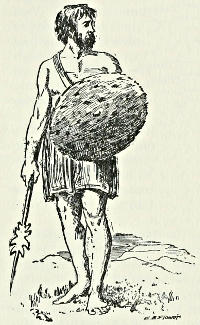
A Barbarian
The new Probus, however, had so completely
vanquished the peoples of the West with their allies,
Vandals, Burgundiones, and Lygii, that he was able
to announce to the senate: “The whole of Germania,
as far as it reaches, is subdued. Nine kings of different
peoples lie at your feet.” In the next two years,
however, the conquered people uprose once
more, and the old state of affairs seemed to be
returning, when Diocletian in the year 285
brought permanent succour.
The division of the imperial government
among those brave and able men whom he appointed
“cæsars” checked the German peril.
His successor and the completer of his work,
Constantine the Great, brought (at all events to the eastern portion of the
empire) fresh life and more than a thousand years’ duration, by establishing
his own place of residence at Constantinople. But once again, under the
reign of Constantius, weak son of a great father, the lust of war and plunder
was awakened in the barbarians of the West by the rise of a new tyrant in
Gaul, and the civil war resulting therefrom. Already the Rhenish strongholds,
amongst them Colonia Agrippina (Cologne), were in their hands when
a new preserver, the youthful Julian, came upon the scene.
He, like Cæsar, knew how to fight and conquer. The Salian Franks, who
had usurped the country between the Schelde and the Maas, Toxandria, were
taken as subjects; the Ripuarians, even the Saxon Chauci, were forced to a
submissive peace, and the Alamanni compelled, after four campaigns, to the
condition of tributaries.
[367-476 A.D.]
Valentinian I continued Julian’s work with an iron hand and will. During
this interlude of more than a century in the migration of the tribes the
victory of Christendom was effected in Rome, and also its entry amongst the
Germanic peoples in the form of Arianism, The Germans received a fresh
impetus by the incursions of the Huns, which extended from the Crimean
wall to the Loire. The western Goths, who were already in a state of
transition from barbarism to civilisation, fled before these Mongols to the
Romans. Tricked by imperial officers, wronged and deceived, they seized upon
the sword; the decisive battle at Hadrianopolis, in which the emperor Valens
fell, made them lords of the European provinces of the Eastern Empire.
The joint empire was once more saved by Theodosius, the last of the great
emperors, who contrived to appease the Goths. But when in 395 the last
and permanent division of the empire took place under Arcadius and Honorius,
the two weak sons of Theodosius, who were still in their boyhood, the
danger to western Rome flared up again, even more terrible than before.
For nearly eight hundred years the capital of the world had seen no conqueror
within its walls. Alaric the Visigoth, a fearless warrior, became
after the emperor had caused his best commander Stilicho to be put to death
the first successor of the Gallic Brennus.
But the twofold occupation of Rome by Alaric was of no more importance
as an epoch in the barbarian invasion than was the later occupation
by Genseric in the year 455. Alaric did not wish to destroy the empire,
only to rule over his people in and with it; the Vandal wished for nothing
but plunder. From the passage of the Rhine by the Vandals and Suevi, at
the beginning of the year 406, to the incursion of the Visigoths into Gaul in
412, was a far more important period in the barbaric advance. In the year
409 the first went across the Pyrenees, and in 411 permanently established
themselves in Spain. In the year 413 the Burgundiones took possession of
the country now bearing their name; in the year 419 southwestern Gaul
was at last formally ceded to the Visigoths by the emperor Honorius. This
people acknowledged a certain, though only nominal, supremacy on the part
of Rome. Rome, through its last great commander Aëtius, brought into
subjection the whole of the rest of Gaul and the greater part of Spain. Far
worse, however, was the loss it suffered at the hands of the most terrible of
all the Germanic conquerors, Genseric the king of the Vandals; who in the
year 427 deprived it of the distant and rich Africa, its granary, as well
as of the islands of the Mediterranean, and founded a piratical state which
became for him the source of enormous wealth during half a century, but
for Italy and other countries of the coast one of indescribable devastations.
One hundred and seven years had the Vandal empire stood when, after
the Germans had become greatly degenerated, it was overthrown with ease
in the year 534 by Justinian’s general, Belisarius. Only indirectly, as lever
and impelling force, had the incursions of the Huns from 375 onwards influenced
the tribal migrations, particularly the entrance of the Germans into
Gaul, Spain, and Africa.
It would seem as though the terrible Attila, that mighty scourge of God,
had determined to complete the work of destruction. But Attila’s empire
was built up on his personality; with his death it fell to pieces.
Therefore his campaigns of the years 451 and 452 in Gaul and Italy—with
the battle at Châlons, so famous in the world’s history—were only a
remarkable interlude in the great drama of race migration, and of no decisive
import in its real progress. After Attila’s death, when Valentinian III had
himself deprived the empire of its last support by the murder of Aëtius in
454, the decline of the Western Roman Empire set in, and continued during
the next twenty years.
Not external pressure, whose severest shock had been happily averted,
but the inward germ of death, the growing power of the barbarians within
the empire itself, brought this occurrence, so important in the world’s history,
to maturity. For centuries the Roman army had consisted for the most
part of foreigners, chiefly Germans. With the need the number increased,
and at the same time their self-confidence and pretensions, and consequently
the hatred of the barbarians on the part of the Romans. So long as the son
and grandson of Theodosius reigned, the great generals, by the habit of
obedience and the magic of legitimate rights, masked the inner dissensions
and the weakness of the empire. But when Nemesis had avenged the death
of Aëtius on Valentinian III by his own death in a similar manner, the internal
corruption of the state revealed itself under the growing pressure from without.
A bold adventurer of Suevian descent, the patrician Ricimer, acquired as
leader of the foreign troops the highest power in the state, and for nineteen
years raised emperors and overturned them at his pleasure. Within twenty-one
years nine ascended the throne. Even the ablest, and the one among them
of eminent talents, Majorian, succumbed to the stealthy cunning and superior
military strength of the barbarian mercenaries. Their pretensions rose higher
until they demanded a third of the territories of Italy; and in Odoacer, an
officer of the bodyguard, they found the man who procured them their desire
after he had forced the abdication, in 476, of the last emperor of Rome, an
immature youth who bore the proud names of Romulus and Augustulus.
[476-568 A.D.]
Until the year 480 the emperor Nepos, driven from Italy, reigned in Dalmatia;
Odoacer accepted from Zeno, the emperor of the East, the title of
administrator, and reigned over Italy according to the old forms.
So at least in appearance. In reality it was a Germanic kingdom which
was raised on the foundation of the Eternal City which had ruled the world
for seven centuries. We now therefore consider the year 476 as that of the
fall of Western Rome, which up till then had stood for 109 years, with short
interruptions, as a separate empire, in fact, at all events, if not in public recognition.
With its fall, and Odoacer’s elevation, the great work of expansion,
distinction, and building up anew, which we call the migration of races,
was completed. Now the ground was clear for the German colonisation on
Roman territory, already in progress at various points since the year 411.
Suevi, Vandals and Alans, Burgundiones and Visigoths, had founded new
kingdoms in Spain, Gaul, and Africa, some transitional, some of more permanent
duration, whose origin and progress were closely bound up with the
history of Western Rome. After the fall of the Western Roman Empire, the
most powerful of all the German tribes arose, the Franks under Childeric’s
son Clovis, who in the year 486 destroyed the last remnant of Roman supremacy
in western Europe—that of Syagrius over a great part of northern Gaul—by
the battle of Soissons. This outer limb, as far as it had any connection
with the main body, belonged to the empire of Eastern Rome.
Ostrogoths and Langobardi (Lombards) took part in the destruction of
Western Rome only in the second and third periods, not the first, which was
in so far an advantage that they drove out again their former conquerors
and possessors from the heart of the empire.
The moment of settlement for them came when, leaving their former
country, they prepared for colonisation on Roman territory—that is, for the
conquest of Italy; this was for the Ostrogoths in the year 488, for the
Lombards in 568.e [For it was in April of the latter year that the Lombards,
under Alboin, entered Italy. Fifteen years before Narses had dealt a
death blow to the Ostrogothic kingdom, and Italy once more became a part
of the Roman Empire. But now the exarch was left but a small district to
rule over and the peninsula passed forever from undivided Roman rule.]
[476 A.D.]
It is not to be imagined that the fall of the Roman Empire in the West
created so much stir among contemporaries as it has since done in history.
A century of constant reverse had led up to it. It was predicted by religion,
foreseen by politicians, and expected, as one might say, at a fixed date.
An inexplicable fatality hovered over Rome from its cradle. It cannot
be denied that the failure of the town of Romulus, or the decline of its
power at the end of twelve centuries, was predicted almost from its birth.
The story of the portent of the twelve vultures appearing to its founder on
the Mount Palatine, embodied this instinctive belief, fortified by all the
authority of augural science. The Tuscan soothsayers had, in effect, declared
the twelve vultures to signify twelve centuries of power, after which
the fate of Rome would be consummated.
This political faith, already strong in the brightest days of the republican
epoch, was transmitted from generation to generation, proudly when the
end was far distant; fearfully, as it drew near. Even as the historic date
of the foundation was disputed, so there was disagreement as to its end.
The soothsayers all calculated in their own way as they themselves understood
it, but all expected it.
According to the most generally received chronology, Rome had passed
the middle of the eleventh century when Alaric took and burned it. One
might almost think the augury accomplished—allowing for a difference of a
few years. After the departure of the Goths, hope revived and calculation
recommenced. After the second sack of Rome by Genseric, in the twelve
hundred and seventh year from its foundation (455 A.D.) the fatal and
definite hour was declared to have arrived. “The twelfth vulture has
finished his flight. Now, O Rome, thou knowest thy destiny,” wrote
Sidonius Apollinaris, a firm Christian, but imbued, like every Roman
subject, with the superstitious traditions of the city of the Seven Hills.
Thenceforward began the real death throes of the empire, as it passed
to barbarian masters—from Ricimer to Gundobald, from Gundobald to
Odoacer, ever growing weaker, more despised, more crushed. When names
were heard, long strange to the nomenclature of the Cæsars—names such as
Julius and Augustus, coming from the grave of history like so many spectres
announcing the last day, and that of Romulus expiring in a child—public
consternation knew no bounds. These fortuitous combinations presented
in their fantastic aspect something of the supernatural, and troubled the
strongest minds. Men bowed their heads and were silent.
The obsequies of Rome were carried out in mournful silence. We find
in contemporary historians no accent either of regret or joy, no declamations
either in prose or verse; just a few dates and a bare record of facts, that is
all. It might almost be believed that nothing of importance took place in
the year 476. Jordanes alone, a little later, sounds his barbarian trumpet
over the grave of the empire, but only to celebrate the coming of the Goths.
It is of the death of a great nation that we have here to speak. For it
is not the physical, nor the spiritual, nor certainly a merely formal political
continuance—like that of Byzantium—which determines the historical
existence of the nations, but a political independence at once material and
powerful, and containing the essentials of civilisation. And if we inquire
once again into the reason of such a death of nations, in the end we shall
not venture to assign as a cause some form of political or social organisation;
some condition of sexual morality; the invasion of Christianity (as Nietzsche
thought), and still less the cessation of mechanical inventions, as the folly
of some natural philosophers dabbling in history, has assumed: but solely
the waning of the nation’s vigour. We shall be compelled to consider not
a few of the political, social, moral, and intellectual phenomena towards
the end of the period as symptoms of this decay, as, for example, the degeneration
of Cæsarism and its hierarchy of officials, the social reaction of the
romancists of guilds and castes, the extravagant luxury, the complete torpor
of economical activity, and still more the decay of intellectual life. But all
these cannot have been the causes, but only tokens and effects of the same
disease of the innermost core.
But who shall say to what last final causes are to be referred the rotting
and crumbling of this nation which in the days of the flower of its youth and
manhood seemed to be possessed of eternal vigour. The Roman nation was
certainly not as short-lived as the Greek. If we measure the periods of
their development, one against the other, which is the only possible form
of comparison, we shall find that from the beginning of their later middle
age down to the loss of their political independence, the Greeks are granted
not quite half and the Romans almost the whole of a millennium of autonomous
history. Perhaps the compact and more continental conformation of
the Italian peninsula essentially contributed to this duration; the connecting
links between the two facts of the great longevity of the Roman people and
the broad surface and less broken outline of their country might be represented
by their far less rapid economical and especially commercial development,
and their much more phlegmatic intellectual growth, and, in the sphere
of politics, by the far wider extent of the domains of the state, which consequently
afforded a much firmer base.
But, indeed, if it is permissible to enlarge further upon these anthropogeographical
conjectures, the sea was not here able to exercise its animating,
but also agitating and therefore strength-consuming effects to the same
extent as in Hellas, although it may nevertheless have exercised sufficient
influence. The fact that on the soil of Greece there flourished an extraordinary
wealth of intellectual growth and an over-refined political civilisation,
is just as explicable as that Italy produced such a tardy, intellectual,
and at the same time such a powerful and yet carefully planned political,
organisation. Italy was, to speak in entirely hypothetical language, narrow
and washed by the sea,—but it was also sunny, and yet not too much split
up into small sections to allow of its bringing forth political institutions
which were not only sound but also really permeated with intellectual
thought, and to permit it to produce its art of government and its law. In
other words, this peninsula everywhere offered so wide a surface that it was
able to produce a state more extensive, stronger, more full of life, and, above
all, less threatened by natural separation of interests. But it was not so
continental as to permit of the formation of a despotically governed state,
stretching over a wide plain as in the vast countries of the East. The sea
had been able to exercise its invigorating effects in so far that Italy attained
a form of government, strong indeed, but also free. And if no such finely
organised intellectual culture was assigned to it, at least its political institutions
were intellectually elaborated to a singular degree. For in all essentials
they were as much the peculiar product of her otherwise less remarkable
intellectual culture as of her political civilisation.
On the other hand Italy shares equally with Greece a life-giving but also
life-shortening effect of her geographical position: a mild climate. Perhaps
its effects in accelerating her bloom but also her decay have been here somewhat
arrested by other territorial conditions, yet perhaps they too finally
succeeded in making their influence felt. Else why have Germans and
Slavs, that is to say the only civilised peoples of the north alone on the globe
maintained themselves so much longer in their strength, and why have they,
and perhaps they only, still to-day a prospect of millenniums of an equally
robust life of political and intellectual activity?h
Roman Bracelet
(In the British Museum)
Our studies of Roman history have brought us into incidental contact
with several nations of Asia Minor that from time to time have held friendly
or hostile relations with the Romans. The two most important of these, the
Parthians and the Sassanids, who successfully disputed the mastery of the
Orient with the Romans, will be given fuller individual treatment in a later
volume. But the lesser kingdoms of Pergamus, Bithynia, Pontus, and Cappadocia,
each of which had a somewhat picturesque and interesting history
when taken by itself, were hardly of sufficient importance from a world-historical
standpoint to be given individual treatment in our text. It will
be of interest, however, and will aid the reader in gaining a clear idea of
the opponents of Rome, and of the true relations of the Roman Empire to the
eastern peoples, if a brief outline of the history of each of these nations is
introduced. Such a chronological epitome of their history is given here.
B.C.
283 Philetærus, governor of the Greek fortress of Pergamus, in Mysia, revolts and founds
a small principality. Owing to the troubles incident to the Gallic invasion of
Greece and Asia Minor, he is not disturbed.
263 His nephew, Eumenes I, succeeds. His power increases, and he defeats the Seleucidæ
in a battle.
241 Attalus I succeeds. He achieves a decisive victory over the Gauls, and makes friends
with Rome. Pergamus becomes a great art centre.
197 Eumenes II succeeds. Height of splendour of the kingdom, which now covers the
greater part of western Asia Minor. Eumenes becomes the ally of Rome in her
wars against the Persians and Syrians. Building of the temple of Zeus Soter to
commemorate the great victory over the Gauls.
159 Attalus (II) Philadelphus, his brother, succeeds.
138 Attalus (III) Philometor, son of Eumenes II, succeeds.
133 Death of Attalus III, who bequeaths his kingdom to the Romans. They form it into
the province of Asia.
278 Nicomedes I assumes title of king, and maintains himself on the throne in spite of
civil discord and threatened invasion by Antiochus I. He allies himself with the
Gauls, who have invaded Asia Minor.
250 His son, Zielas, succeeds after asserting his rights against his half-brother.
228 His son, Prusias I, succeeds.
220 Prusias at war with the Byzantines in conjunction with the Romans.
216 Prusias defeats a Gallic army invited into Asia by Attalus.
207 Prusias assists Philip of Macedon in war with Romans, and invades Pergamus.
188 Prusias at war with Eumenes II of Pergamus. Hannibal lends him assistance.
180 Prusias II succeeds his father.
156 War with Pergamus. Defeat of Attalus II.
154 Peace with Pergamus.
149 Prusias slain in a revolt in favour of his son Nicomedes II, who succeeds.
131 Nicomedes assists the Romans in their war against Aristonicus.
102 He unites with Mithridates VI of Pontus in the conquest of the vacant throne of
Paphlagonia.
96 Nicomedes marries Laodice, widow of Ariarathes VI of Cappadocia, and attempts to
seize the kingdom. Rome compels him to abandon it. The senate also deprives
him of Paphlagonia.
91 Nicomedes III succeeds his father.
90 Mithridates VI of Pontus drives Nicomedes from his throne.
84 He is restored by Rome.
74 Death of Nicomedes. He bequeaths his kingdom to Rome and it becomes a province.
The dynasty of Pontine kings is reckoned from Ariobarzanes I, about the beginning
of the fourth century B.C. But both he and his son Mithridates I, and grandson,
Ariobarzanes II, are Persian satraps, and it is not until
337 that Mithridates II, son of the last satrap, makes himself independent. His rule is not
uninterrupted.
318 About this time, Antigonus I forms a plan to kill him, and he flees to Paphlagonia,
and afterwards supports Eumenes against Antigonus. He then recovers his throne
and fixes himself firmly on it.
302 Mithridates III succeeds his father. He adds part of Cappadocia and Paphlagonia
to his dominions. He allies himself with the Heracleans, and obtains help of the
Gauls to overthrow a force sent against him by Ptolemy, king of Egypt.
266 Ariobarzanes III succeeds his father.
240 Mithridates IV succeeds his father. He repels the Gauls shortly after his accession.
220 Unsuccessful attempt to capture Sinope.
190 Pharnaces I succeeds his father.
183 Capture of Sinope. The frontiers of Pontus are extended to Bithynia.
181 Pharnaces attacks Eumenes of Pergamus and Ariarathes of Cappadocia.
179 Pharnaces purchases peace, ceding all his possessions in Galatia and Paphlagonia,
excepting Sinope.
156 Mithridates (V) Euergetes succeeds his father.
154 He assists Attalus II of Pergamus against Prusias II of Bithynia.
149-146 During the Third Punic War, Mithridates makes alliance with Rome, supplying
ships and men.
131-129 Mithridates aids Rome against Aristonicus, for which he receives Phrygia.
120 Assassination of Mithridates at Sinope. Succeeded by his son Mithridates (VI)
Eupator, the Great. The Romans take Phrygia from him. In the early years of
his reign he subdues many warlike tribes, and incorporates the kingdom of Bosporus
in his dominions. He attempts to gain control of Cappadocia, and drives
Nicomedes III of Bithynia from his throne.
88 War breaks out with Rome on account of the Bithynian succession. Mithridates
overruns Asia Minor, massacring Roman citizens.
84 Mithridates makes peace with Sulla.
83 Murena invades Pontus without reason and is defeated the following year.
74 War with Rome renewed.
72 Mithridates flees to Armenia, taking refuge with his son-in-law, Tigranes.
65 Total defeat of Mithridates by Pompey.
63 Revolt of the troops. It is put down, but Mithridates orders a Gallic mercenary to kill
him. His son, Pharnaces II, who has been in revolt, succeeds him. He submits to
Pompey, who grants him the kingdom of the Bosporus.
47 Death of Pharnaces in putting down the rebellion of Asander, governor of Bosporus.
36 Antony puts Polemon I, son-in-law of Pharnaces, over a part of Pontus known as
Pontus Polemoniacus. He is succeeded about 2 B.C. by his son Polemon II, whose
mother is nominal ruler until 39 A.D., when Caligula invests Polemon with the
kingdom.
63 Polemon abdicates the throne and Pontus becomes a Roman province.
The Cappadocian dynasty dates back to the time of Alexander the Great, when
Ariarathes I maintains himself on the throne after the fall of the Persian monarchy.
322 Ariarathes captured by Perdiccas and crucified.
315 Ariarathes II, his nephew, recovers Cappadocia at death of Eumenes. He is succeeded
by his son, Ariamnes II, and he in turn by Ariarathes III (date unknown).
220 Ariarathes IV succeeds his father. He joins Antiochus the Great against the Romans,
and afterwards assists Rome against Perseus of Macedon.
163 Mithridates, afterwards called Ariarathes V, succeeds his father.
158 Ariarathes deprived of his kingdom by Orophernes (Olophernes), a creature of Demetrius
Soter, but is restored by the Romans.
154 Ariarathes assists Attalus II in his war against Prusias II.
130 Death of Ariarathes in war of the Romans against Aristonicus. His wife Laodice
kills all her children except the youngest, in order that she may rule. The people
put her to death and place her surviving child, Ariarathes VI, on the throne.
96 Ariarathes poisoned at instigation of Mithridates the Great of Pontus, whose daughter
he has married. Nicomedes II of Bithynia seizes Cappadocia, but Mithridates soon
expels him and places Ariarathes VII, son of Ariarathes VI, on the throne. This
prince goes to war with and defeats Nicomedes.
93 He quarrels with Mithridates, who stabs him during an interview. The Cappadocians
recall the late king’s brother, Ariarathes VIII, from exile and make him king.
Mithridates compels him to abandon his kingdom. The Romans now intervene and
appoint Ariobarzanes I king. He is several times expelled by Mithridates and
Tigranes of Armenia, but always recovers his throne.
63 Ariobarzanes resigns Cappadocia to his son Ariobarzanes II. He remains, like his
father, the true ally of Rome and is
42 put to death for refusing to join Brutus and Cassius. (Some writers say this was an
Ariobarzanes III, who succeeded Ariobarzanes II about 52.) Ariarathes IX,
brother of Ariobarzanes II, succeeds.
36 Antony puts him to death, and appoints Archelaus king. Although an ally of Antony,
Octavian leaves him in possession of the kingdom and even adds to it.
14 Tiberius summons Archelaus to Rome.
17 Death of Archelaus. Cappadocia becomes a Roman province.
Written Specially for the Present Work
By DR. ADOLPH HARNACK
Professor in the University of Berlin; Member of the Imperial Academy of Sciences.
During the period between the reign of Diocletian and the fall of the Western
Roman Empire, were laid the foundations of the history of the Middle
Ages; and of these the most important was the recognition of the Christian
church by the state and the privileged position thus accorded to it. This
union of state and church involved an amalgamation of their intellectual
forces, their rights and powers, and also to a certain extent of their system
of government. There arose a type of culture and literature which was
profane and Christian at one and the same time, a Roman-Christian system
of law, and an established church. An alliance was made which would have
passed for impossible down to the middle of the third century. Had Tertullian
been told that a time was coming when the emperors would be Christians
he would have stigmatised the prophecy as impious; had any man proclaimed
to Decius that in his persecuting edict he was fighting against the future
pillars of the state, he would have flouted the suggestion as absurd. Even
as late as the third century the state and church seemed to be irreconcilable
antagonists.
And yet Constantine’s resolution to recognise the church and grant her
privileges has a long and well-marked preliminary history—and that in the
case of both parties, state and church alike. If we study this preliminary
history, Constantine’s act appears in the light of the close of a historic process
of development which could not have ended otherwise than it did.
Constantine’s greatness is not impaired by this fact; he realised and accomplished
the one thing needful, and no statesman can do more.
In the following pages we shall attempt to sketch this preliminary history
of the alliance between state and church. More than a mere sketch, in
which headings take the place of detailed statements, is out of the question,
since detailed statements would involve voluminous treatment of the
subject; but anyone familiar with the historical facts will be able easily to
fill in the brief outline. Our principal task will be to show how the line of
development in the Christian church during the first three centuries tended
towards conformity with the state; and in conclusion we shall point out in
a few brief touches how the state on its part, as it developed, drew towards
the church.
The Christians of the first century felt themselves aliens in the world,
and consequently in the state likewise. They had put faith in a supernatural
message which told them that they were citizens of a heavenly kingdom,
that this world would shortly come to an end, and the new kingdom,
the visible reign of God upon earth, begin. What further interest could
they take in things temporal or in the state? Yet the state was not a mere
matter of indifference to them. Since it protected idolaters and enforced
the worship of idols, it was obviously under the influence of demons; and,
being the strongest prop of polytheism, was manifestly the chief seat of the
devil. The whole world “lieth in wickedness,” and the state no less. Between
church and state, between Christ and Belial, there could be no fellowship.
Such, for example, is the spirit in which John wrote his Revelation.
But from the very beginning this simple and confident view was traversed
in the minds of many Christians by other views which seemed no less certain:
such as (1) this same state, with the emperor at its head, punishes evil-doers
and checks injustice in countless instances; (2) this same state not unfrequently
protects Christians, the friends of God, against outbreaks of savage
hatred on the part of the godless people of the Jews: (3) by the destruction
of Jerusalem and of the temple this same state has accomplished the judgment
pronounced upon the Jewish nation by the prophets and Christ, and
wreaked vengeance upon it for Christ’s death; (4) Jesus and his Apostles
did not permit men to revolt against the state, but rather commanded them
to obey it and to submit willingly to the punishment it imposed: nay, the
Apostles actually commanded that men should pray for the emperor and the
magistrates by him appointed.
The early Christians thus occupied an anomalous position towards the
state: they judged it to be the chief seat of demons on the one hand, and on
the other “the minister of God”; they abhorred it and prayed for it; they
besought God that “this world might pass away” and prayed for the continuance
of the emperor’s sovereignty. It was as though they had been
commanded to adopt different views alternately. They must also have
watched with varying feelings the extension of the empire over the “whole
world.” When they saw, after the time of Augustus, how one ruler was reverenced
upon earth and glorified as king and saviour, nay, as Lord and God,
when they were led away to death because they would not worship his image,
how could they fail to conclude that here the mystery of sin was revealed
and Satan sat upon the throne of God? And yet, on the other hand, was
not this rule of a single monarch on earth a type of the rule of God in heaven,
the blessed conjunction of all men in one body, the victory over the divisions
and animosities of the nations?
And how about the culture of this same state, with its precepts, institutions,
and usages? At first sight it all seemed reprehensible, since it was
everywhere permeated with idolatry, and not least in philosophy and literature.
“Be ye not seduced by philosophy” was the Christian watchword;
nay, men went a step further, saying that the Christian had no need of
inquiry and learning; in his religion he possessed all things and held the
key to the riddles of the world. He was to shut up his reason in prison and
despise the lore of the heathen; he was to read the Holy Scriptures, but no
worldly books. And yet, does not this same lore teach much that religion
teaches? Was nothing but lies to be met with in Socrates, Plato, and the
poets? Nay, more, is there not a natural knowledge of God, a natural grasp
of truth, and has not every soul obtained a spark of the eternal light? Has
it not received knowledge, freedom, and immortality from God? Or are
these false doctrines? Yet if they be false, how is it possible to lead men
to God? But if they are not lies, a man must read and learn what poets
and philosophers have written, and study the inner life that he may learn to
know the soul and see what God the creator has bestowed upon it.
Thus here again we have a hesitating “yes,” side by side with an uncompromising
“no.” That which but now seemed to be the darkness that opposed
itself against the light appears in another aspect as itself a dim degree of
light—nay, as the early twilight before the rising sun. Nevertheless, during
the first two or three generations the spirit of repudiation was in the ascendant.
We can only see that hidden at the heart of things were the germs
destined to bring about a change of opinion. A religion which claims to be
not national but universal cannot permanently take up a wholly negative
attitude towards the history of the human race, nor can it persist in recognising
its own preliminary history only along the narrow line of the history
of a few prophets or a single small nation. Paul, the great Apostle of
the Gentiles, had taught that God had everywhere manifested his being and his
will, and in moments of lofty inspiration and joy had proclaimed to the little
flock of his brother converts, “All things are yours.”
In the second century of the existence of Christian communities (circa
130-230) the development of a tendency towards reconciliation with the state
and society is apparent in every direction. This I will proceed to demonstrate
as regards (1) the constitution and organisation of the communities;
(2) their life; (3) their doctrine; (4) their literature; (5) their form of
worship; and (6) their estimate of the state.
(1) As early as the year 140 most Christian communities possessed a
system of government widely different from their original organisation.
The question of how it came into being is one upon which we cannot enter
here. It appears as a combination of monarchical and collegiate government.
At the head of the community stood the bishop, with the college of presbyters—in
some cases on an equal footing with him and in others his subordinates—at
his side; the assistant and executive officers were the deacons.
The duties and rights of these clergy extended to matters of discipline,
financial administration, the care of souls and the relief of the poor, doctrine,
and public worship. The officers were elected by the community, but nevertheless
formed a superior class which, decade by decade, assumed more and
more the guardianship of the “lay people.” Thus, out of a communion in
which the “Spirit” and brotherly love alone were to bear sway, there had
arisen a legally constituted community with ordinances in many points analogous
to those of municipal administration. The community acquired property
and administered it; the officers, under the superintendence of the
bishop, cared for the needy; and, together with the oversight of discipline,
it exercised a certain amount of jurisdiction in family affairs.
But statutory organisation was not confined to the individual community;
the various communities of one province joined in closer bonds and formed a
larger confederation. Provincial synods arose, corresponding to the diet of
the provinces, met once or twice a year, and dealt with matters of common
interest under the direction of a president (the metropolitan). But even
this association did not suffice. From the very beginning Christians were
conscious of belonging to one great and holy fellowship, to one universal
brotherhood. Conceived of, in the first instance, as something ideal and
supernatural, it had nevertheless been held with strong and lively convictions,
and at this stage the attempt was made to realise it upon earth. The
outward conditions were in its favour; Christian doctrine had assumed many
forms, a large number of which appeared very questionable in the eyes of the
bishops and the majority of the church, and they consequently desired to
define their own position in contradistinction to these “pseudo-Christians.”
Hence after the end of the second century a great number of communities
in the West and East joined to form a single confederation, and presently
asserted that only those who belonged to this confederation, the one Holy
Catholic church, were real Christians. At the beginning of the third century
there was no longer only a heavenly church,—the children of God scattered
throughout the world and waiting for the revelation of the kingdom of which
they were citizens,—but a visible church extending from the Euphrates to
Spain, resting upon fixed laws and ordinances, and thus constituting a political
organisation within boundaries that coincided roughly with the frontiers
of the Roman Empire.
By this development the church approximated to the state—as its rival
in the first instance, it is true; but rivals may become friends. The decisive
factor was that Christianity had assumed definite political form.
(2) The Christian life was to be “unspotted from the world.” Most
Christians of primitive times interpreted this to mean that they should have
as little as possible to do with “the world.” Nor was this a difficult matter,
for the greater number of them were people in humble life whose conduct
was subject to little outward control if only they performed the hard work
required of them. Few of them were “in society”; and hence it was of no
consequence what religion they professed or what manner of life they led.
By degrees, however, the situation changed, and the labours of missionaries
drew men of all ranks into the church. As early as the reign of
Hadrian and Antoninus Pius, Christians were numerous in every class, even
among officials and scholars and men of rank and wealth. The question of
the attitude one should assume towards the world, which had hitherto been
a difficult problem only in individual cases, now became pressing to the
whole community. In addition to this the state police and the public
(especially the mob) took far more heed of Christianity than before. Any
man who made an open confession of Christianity exposed himself to great
danger, nay, to death itself. What was the church to do? Should she say
to the faithful: “You must confess your faith under all circumstances, and
avoid all contact, even the most superficial, with idolatry”? The consequences
were obvious: the soldier would be bound to leave his colours, for
they bore a heathen emblem; the magistrate to resign his office, for he could
not protest against the worship of the emperor; the teacher to cease to
teach, for he could not avoid mythological subjects; the tiler to abandon his
handicraft, since he could not work on the roof of a temple; the goldsmith,
the joiner, the merchant—they all ran the risk of abetting idolatry. The
austere members of the communities did actually insist that every Christian
ought to renounce his calling if it rendered him liable to the risk of the
remotest contact with idolatry. Tertullian explicitly makes this demand
in his pamphlet, De Idololatria, nor did he suffer himself to be confounded
by the retort: “We shall die of starvation.”—“Who is he that hath
promised ye shall live?”
But the great majority of Christians, and first and foremost the bishops
their leaders, decided otherwise. It was enough for a man to keep God in
his heart and to confess him when open confession was required by magisterial
authority—it was enough to refrain from actual idolatry; for the rest the
Christian might abide in any honest calling, might come, in the pursuit of it,
in contact with the externals of idolatry, and ought to conduct himself prudently
and discreetly so as neither to defile himself nor call down persecution
upon himself and others. The church everywhere adopted this attitude after
the beginning of the third century; and the state thus became the richer by
numbers of peaceable, law-abiding, and conscientious citizens, who, far from
placing difficulties in its way, were pillars of order and peace in society. The
fact that the Christians were remarkable for morality was acknowledged by
Galen, the famous physician, as early as the reign of Marcus Aurelius. Thus,
by abandoning her attitude of uncompromising repudiation of the “world,”
the church developed into a force that made for public order.
(3) There was nothing in Christian doctrine, considered on its merits,
that either was dangerous to the state or was bound to be judged dangerous
by it, except its exclusiveness. The utterances of Christians concerning
Christ their “king” might, indeed, have a revolutionary sound; but the
fact that they were harmless was soon patent to all observers. It was not
what Christianity taught but what it precluded—tolerance of other religions
and the worship of the emperors—that roused well-grounded objections.
For the rest, Christian doctrine showed a double face, so to speak, to the
Greeks and Romans. Its teaching concerning God, the world, the creation,
divine providence, immortality, and the freedom, dignity, and responsibility
of man, was both sublime and akin to the loftiest intuitions of the honoured
philosophers of old; but mixed up with it was much that sounded to them
like myth or fable, or seemed actually repulsive. Such, above all, was the
history of Christ (his birth of a virgin, miracles, crucifixion, and ascension).
Ordinary Christians laid stress upon the latter element, and hence their religion
appeared “outlandish,” absurd, and full of lies. After the time of
Hadrian, however, there arose men who expounded and brought to light the
philosophico-religious element in Christianity,—monotheism more particularly,—and
endeavoured to remove the offence excited by the history and
worship of Christ by conceiving of him as the corporeal manifestation of the
Logos, the existence and operation of which was recognised by many of the
Greeks. At the same time they endeavoured to force their opponents to
accept the facts of his history by demonstrating them to be the fulfilment of
prophecy; for that which has been prophesied is brought about by God himself,
and human criticism must keep silent in face thereof.
During the course of the second century Christian doctrine did not abandon
its peculiar character, but it assimilated more and more the ideas of Greek
philosophy and so rendered itself more intelligible. At the beginning of the
third century a great Greek philosopher testified of Origen, the most eminent
teacher of the church, that concerning God and the world he thought like a
Greek; the philosopher only deplored the intermixture of alien fables. When
this same Origen is invited to lecture upon immortality before the queen-mother
at Antioch, when another doctor of the church corresponds with an
empress upon religious questions, and the emperor Alexander Severus listens
with admiring attention to the words of Christ, we cannot but see how
“doctrine” is becoming by degrees a connecting link between Hellenism and
Christianity. Such a fact could not be devoid of consequences as regards
the relations between state and church, for no state can permanently maintain
a hostile attitude towards a spiritual movement which is held in high esteem
by large bodies of its citizens.
(4) Nor must literature be ignored in this connection. Christianity was
never altogether without literature, nay, rather, it possessed from the outset
a literary work of the highest rank in the Old Testament, of which it had
usurped possession. But its title to ownership was contested by the Jews
and the heathen, and moreover early Christians produced the impression that
they were unlettered folk. This made their claims appear singularly presumptuous
and unjustifiable. But the beginning of the second century witnessed
a change; the Christians, who at first would have nothing to do with
the scribbling art—for why should one write if the end is at hand?—began
to make use of this method.
Even in the first century brief writings, gospels, epistles, and apocalypses,
had been drawn up for the edification of the congregation, but, being regarded
as memorabilia to keep the truth in remembrance and in a measure as a gift
of the Holy Ghost, they differed in plan and style from what was known as
“literature.” Now, however, works began to be composed in which Christianity
was endued with the garment of literature. Between the years 140
and 170 the smaller Christian party which is known as the Gnostic party all
at once began to avail itself of every literary form, scientific monograph, commentary,
systematic statement, scientific dialogue, didactic epistle, polemic,
historical description, the novel, the tale, the ode, the hymn, etc. The great
church, less apt and more cautious, gave place to this development slowly
and hesitatingly. She was fully conscious of her responsibility; she was
not blind to the lurking danger—the danger, that is, of the profanation of
religion; nevertheless she gradually admitted one literary form after another,
until, at the beginning of the third century, she also had a Christian literature,
with every means of expression that Greek art and learning had created
at command. But the fact that she was thus equipped with literary forms
could not but have some bearing on the relations between state and church,
for no state can persist in regarding a movement which has taken literature
into its service as a negligible quantity. Through the medium of literature
it influences all political conditions, and in so far as the state itself is
the exponent of culture, and not merely of law and authority, such a spiritual
movement becomes a part of it by the mere fact of its literary existence.
(5) Though public worship is essentially esoteric and the private concern
of any particular religion, yet we must here take its development into
consideration. As long as Christian worship consisted only in homely
prayers, rude psalmody, and preaching, and in the simple celebration of the
sacrament of the Lord’s Supper, it differed so widely from other forms of
worship that the adversaries of Christianity did not regard it as worship at
all. A few Greeks, it is true, were impressed by this purely spiritual worship,
but the great multitude despised it. They saw no images, and consequently
concluded that the Christians were “atheists”; they saw no priests,
and felt that their worship lacked legitimate authority, solemnity, and dignity;
they saw no sacrifice, and consequently doubted its efficacy with the
Deity. Many of them held that the Christians had other religious services
which they carefully concealed from other men, and that there they exhibited
the secret “Sacra,” held wild orgies, and feasted at horrible banquets. There
were, as a matter of fact, a few small Christian communities which practised
evil rites in secret. But it is unlikely that these constituted the starting-point
of the vile aspersions cast upon all Christians; they arose rather from
the evil tendency, prevalent in all ages, to regard adherents of an alien faith
as persons of evil life and to say the worst that can be said concerning both
them and their assemblies. The populace takes every religion which differs
from its own and which it does not understand for devil worship.
This view of Christian worship underwent no great change in the second
century, but towards the end of that period the preliminary signs of change
set in, and the development of Christian worship met the change halfway.
Three great alterations were made in the services, and brought it nearer to
the comprehension of the Græco-Roman mind: (1) after circa 190 a separate
class of priests arose (under that title) in the Christian church; (2) the
Lord’s Supper was elaborated into a solemn sacrificial rite; (3) the Lord’s
Supper and certain other acts of public worship were invested with the
glamour of mysteries. By these developments, which are to be accounted
for by the unconscious influence of the world around, Christian worship
approximated to the ceremonials of the Greeks and Romans. The absence of
image worship, it is true, still marked the distinction between them, but
there was no lack of pictures of saints and symbols of holy things. Already
there began to grow up about the sacramental elements, the water of baptism,
the sign of the cross, etc., a superstition second to none of the fancies
of the heathen, and the sensuous element steadily encroached upon the
spiritual. These changes were likewise bound to exercise a certain though
indirect influence on the relations between state and church, the Christian
religion adapted itself to conditions in which it could act upon the widest
possible circle, and in the process modified the exclusiveness it had resolved
to maintain.
(6) But perhaps the point best worth noticing is the way in which, in
spite of persecution, the Christian estimate of the state grew more favourable
in the course of the second century—not indeed in the whole body, by a long
way, but among the most influential teachers. It is true that the suspicion that
the Roman Empire was the kingdom of antichrist never wholly died away,
and that it still came to the surface occasionally; but a succession of admirable
emperors—Trajan, Hadrian, Pius, and Marcus Aurelius—made a profound
impression upon Christians, and the world-wide monarchy of which
Augustus had laid the foundations bore the aspect of peace, and hence of a
fulfilment of the divine will. Justin was convinced—as was even Tertullian—that
the “good” emperors could not have been and were not unfriendly
to Christians; both believed that none but the wicked were really the adversaries
of the Christian religion, and that nothing but better information was
required to make the emperors extend toleration to their faith. It is possible
that even Luke had a dim sense of a certain solidarity between the empire
and Christianity, between Augustus and Christ; the apologists of the age
of the Antonines were more decided in their utterances, the most decided of
all being Bishop Melito of Sardis. In the Apology for Christianity which
he dedicates to Marcus Aurelius, he writes:
“This our philosophy did indeed first flourish among an alien people.
But when it began to prosper in the provinces of thy empire under the rule
of thy mighty predecessor Augustus it brought a rich blessing upon thy
empire in singular wise. For from that time forth the Roman Empire hath
ever increased in greatness and glory, whereof thou art and wilt be the desired
ruler, even as thy son also, if thou wilt protect this philosophy which began
under Augustus and hath grown with the growth of the empire, and which
thy forefathers likewise held in honour among other religions. And the
strongest proof that our religion hath arisen together with the monarchy so
happily begun and for the benefit of the same is supplied by the fact that
since the reign of Augustus the latter hath been smitten by no calamity, but
on the contrary, all things have but augmented the fame and glory thereof,
according to the desires of all men. The only emperors who, led away by
malicious men, strove to cry down our religion were Nero and Domitian, and
from their time forward calumnious falsehoods concerning the Christians
have been propagated abroad by the evil custom of the common people, who
believe all rumours without examination.”
We read these words with amazement, for they imply nothing less than
an assertion that the empire and the Christian religion are fellow-institutions.
God himself, so this bishop teaches, joined them together, for he has
brought them into being at the same time as brethren, as it were; and to
Christianity is due the greatness and glory of the monarchy! True, we
must not forget that these are the words of an apologist, and of an Asiatic
apologist to boot—and emperor worship flourished in Asia more than elsewhere;
but the fact that he should have gone so far in his bold and flattering
historical speculation is in the highest degree remarkable. “God,”
“Saviour,” “Prince of Peace,” were titles bestowed upon the emperor in
Asia, and his appearance was there spoken of as an epiphany of the Deity.
Hence Melito deduced the conclusion that a “pre-established harmony”
existed between the emperor and Christ, to whom these same titles were
applied. His “philosophy of history” was an augury of the future.
We have seen that down to the reign of the emperor Alexander Severus
the church approximated to the state along every line of development; but
in practical life the two were still remote from each other. The state firmly
upheld the opinion that it was impossible, on principle, to extend toleration
to the intolerant Christian religion—though many governors and some
emperors tolerated it tacitly; while the church was still far from taking
Melito’s idea seriously.
In the seventy years that elapsed between the death of the emperor Alexander
Severus and the rise of Constantine, the affairs of the church continued
to develop in the same direction as they had taken during the
preceding century. This I shall again proceed to prove from (1) its constitution,
(2) life, (3) doctrine, (4) literature, (5) worship, and (6) its
estimate of the state.
(1) The political organisation of the church attained its complete development,
and the result was a structure so stable, homogeneous, and comprehensive
that no other association within the empire could vie with it. While
the framework of the state grew looser and looser, and the several parts
began to exhibit symptoms of falling apart, the edifice of the church grew
steadily firmer and stronger. The bishops, as successors of the Apostles,
everywhere concentrated the power in their own hands and suppressed all
other forms of authority; the church became an episcopal church. But the
bishops were not only united among themselves by provincial synods, they
kept up an active and intimate correspondence throughout the whole empire
by means of letters and emissaries, and even at this time all matters of
importance were settled by common consent. If we take the provincial
synods as corresponding to the diets of the provinces, the organisation of
the church had advanced a step beyond the latter. As early as the second
half of the third century synods were held at Rome to which bishops came
from every part of Italy, and sixty years before the Council of Nicæa a
synod sat at Antioch to which bishops flocked from all the countries between
the Halys and the Nile. Thus the episcopal confederation which ruled the
Christian communities was a state within a state. The fact could not be
hidden from the chiefs of the state. Under Maximinus Thrax the bishops
had borne the brunt of persecution; Decius is reported to have said that he
could sooner endure a rival emperor in Rome than a Christian bishop; and
the persecutions of Gallus, Valerian, Diocletian, Galerius, and Maximinus
Daza were directed in the first instance against the bishops. Gallienus and
Aurelian addressed letters to the bishops, the former to those of Egypt, the
latter to those of Syria, and thus made it plain that they were well aware of
the authoritative position of the bishops in the churches.
More than this, Aurelian appreciated the value of the episcopate which
had Rome for its centre as a conservative and patriotic element in the state;
for when a quarrel was raging at Antioch as to the ecclesiastical party to
which the church buildings, and consequently the church property, belonged
of right, he ignored the theoretical disqualifications of the church before the
law and decided that possession was due to that party which was “in epistolary
correspondence with the bishops of Italy and the city of Rome.”
That is to say, he was already using the church to reinforce the Roman
spirit in the East. But what warrant had he to interfere? Thus much:
the disputant parties in the church had themselves applied to him to decide
their quarrel. Thus, forty years before the time of Constantine the church
had appealed to the emperor to arbitrate in a question of canon law, and the
emperor had practically acknowledged the existence of the church and its
value as a pillar of imperial authority.
If, in addition to this, we consider that the church already possessed
buildings, land, and property in every province of the empire; that the
clergy, in the large towns, at least, were very numerous and represented
a strictly organised scale of hierarchical degrees; that by their assistance the
bishops directed and superintended all the affairs of the communities in even
the most trivial details; that each community was likewise an effective
organisation for the relief of the poor; and, finally, that in many provinces
the country districts were overspread by a close network of provincial
bishoprics and parishes, we shall no longer be surprised that even the
emperor Alexander regarded the system of church government with envious
eyes.
The civil and military system of the empire was falling into decay, the
legions were permanent centres of revolution, the generals born pretenders;
but the milites Christi were everywhere united in compact squadrons, and,
though many internal dissensions might prevail amongst these troops, they
confronted the state as a single army. The state had no other alternative than
to try and destroy this army, as Decius, Valerian, Diocletian, and Maximinus
Daza would fain have done, or to enter into alliance with it, as Constantine
did. After the middle of the third century a policy of laissez-aller or weak
toleration was an impossibility. The church seems also to have been numerically
strong—though this is a point which has not been exhaustively examined
as yet. As early as the year 251 the Roman bishop Cornelius wrote:
“Besides the one bishop, there are at Rome forty-six priests, seven deacons,
seven sub-deacons, forty-two acolytes, fifty-two exorcists, lectors, and ostiarii,
and more than fifteen hundred widows and needy persons, all of whom are
maintained by the grace and goodness of the Lord.”
(2) During the last decades of the third century Christian life underwent
a virtual amalgamation with that of the world. The Christian who desired
to live a life apart from the world became a member of a distinct class, the
ascetics, or withdrew into the desert; the rest—i.e., the vast majority, had
come to terms with the world. There was no class, from senators to artisans,
in which Christians were not to be found, and in each class they fulfilled the
obligations of their station. They were, indeed, bound to eschew certain
callings (e.g., municipal appointments, which were all too closely bound up
with “idolatry,” the theatrical profession, etc.), but the admonitions and
penalties which were promulgated and denounced against the infringement
of these prohibitions show that they were not always regarded. Certain
facts, such as that, in the year 255, a Christian bishop in Spain was at the
same time a member of a pagan society and had his children interred in
the burying-ground of the said society; that a Syrian presbyter was director
of the imperial purple-dye factory at Tyre; that a metropolitan bishop of
Antioch was a ducenarius; that not a few of the clergy engaged in trade
and travelled to the annual fairs—give us a clear insight into the amalgamation
of Christian life with the life of the world. And it is very significant
that Origen, in his pamphlet against Celsus, draws a comparison
between Christian and municipal communities in order to commend the
moral advantage of the former, and merely demands an admission of their
superiority. That is, he insists on a difference of degree only, and refrains
from contrasting the Christian communities with the municipal communities,
like light with darkness.
Thus Christianity was no longer separated from the “world” in practical
life, as every persecution made abundantly plain, for at first the number
of apostates always exceeded that of confessors. The Christians only
gathered strength as the persecutions proceeded. They were practically
“exclusive” no longer, except in matters of religion in the strict sense of
the word. Why should not the state tolerate them? The malicious aspersions
on their moral character had died away into silence. Was it not
madness on the part of the government to continue to persecute people,
who were more conscientious and peaceable citizens than many others, and
did not disturb the organisation and functions of public life? If they
would not give up their exclusive faith, then the government must give
them leave to hold it—a way out of the difficulty so simple that it would
have been adopted long before the time of Constantine if the Christians, on
their part, had not stipulated for certain conditions. Their God was not
to be merely tolerated, he was to reign alone in the sphere of belief. With
the world they had already come to terms.
(3) With regard to doctrine, the astounding labours of Origen brought
the preparatory work of earlier Christian theologians to a kind of conclusion
in the East; in the West, doctrine and learning never played more than a
subordinate part. Origen worked the doctrines of Christianity up into a
religious system which was able to vie with the systems of the neo-Platonists
and give them battle upon equal terms. His schools at Alexandria and
Cæsarea were attended by even pagan young men, and continued to flourish
after his death; his pupils and their pupils occupied the episcopal sees of
the most important cities. It was no longer possible to esteem Christianity
a religion for mechanics, slaves, and old women. The Christian “mythology”
which gave so much offence was not actually altered, but it was
spiritualised by the application of the allegoric method. In this form the
majority of philosophers and men of culture found it endurable; for they
were accustomed to employ the allegoric method in the interpretation of
their own religious traditions, and to transmute base images and repulsive
tales into sublime conceptions and the history of ideas. Even the solemn
confession of Jesus Christ was so expressed by philosophical bishops that it
sounded like a brief philosophical dissertation.
Strictly speaking, there were only three points on which Christian dogma
differed essentially from the neo-Platonic which was then in the ascendant;
the former taught the creation of the world in time, the incarnation of the
Logos, and the resurrection of the flesh; the latter rejected all these three
doctrines. Nevertheless the pupils of Origen conceived of these theological
propositions in such wise that the assertion was very like a denial, and they
made common cause with the neo-Platonists in their contest with the dualistic-pessimistic
school of philosophy. Christian philosophy was in the mid-current
of the intellectual movement, and it was therefore a singular
anachronism that the state could not as yet bring itself to place those who
professed it upon the same footing as other citizens.
(4) The literature produced and read by Christians was by this time
hardly to be distinguished from literature in general. It differed only
in name; the spirit was the same, if we leave out of consideration the texts
of Scripture which the Christians interwove in their books. The legends
of Apostles and Martyrs took the place of the old stories of gods and heroes,
and adopted from the latter whatever element of fiction they could make
serve their turn. The forms of epistolary and literary correspondence had
already won full acceptance among Christians; their dedications, plots,
titles, and headings were those of pagan literature. In this last connection
we note particularly how ceremonious the “brethren” have become.
Finally, educated Christians were familiar with the whole body of profane
scholastic literature, derived their culture from it and used it for example
and quotation. The shoot of Christian literature had been grafted on the
stock of Hellenism, and the sap of it streamed through the new branch.
(5) With regard to public worship we note the following changes during
the sixty years before the time of Constantine. In the first place the ritual
became more solemn and mysterious; the prayers more studied and rhetorical;
symbols and symbolic acts were multiplied; and secondly, there was an
increased tendency to meet halfway the polytheistic leanings which swayed
the Christian masses. This is indicated, on the one hand, by the constantly
increasing importance attached to “intercessors” (angels, saints, and martyrs)
both in public worship and in private life; and, on the other, by the
“naturalisation” and differentiation of religious rites after the manner of
pagan ceremonials. An observer watching a Christian religious service
about the year 300 would hardly have realised that these Christians were
monotheists, and in words proudly professed their monotheism and spiritual
worship. Except the bloody sacrifice, they had adopted almost every part
and form of pagan ritual ceremonial; and, in fact, the bloody sacrifice was not
lacking, for the death of Christ and the celebration of the Lord’s Supper
were dealt with in materialistic fashion as bloody sacrifices. They were
fond of appealing to the Old Testament to warrant the innovations, and in
virtue of this appeal nearly the whole pagan system of worship could be
dragged into the church.
Chapels were dedicated to angels, saints, and martyrs and decorated on
their festivals; a habit grew up of sleeping in churches or chapels in the
expectation of holy dreams or miraculous cures; holydays were multiplied
and differentiated more and more; superstitious ceremonies, usually associated
with the holy cross or consecrated bread, were woven into the tenor
of ordinary life; nor were charms in the name of Jesus or of holy men, nor
even amulets wanting; wakes and banquets for the dead were celebrated;
the relics of saints were collected and adored, etc. What more was lacking
to complete the analogy with heathen cults? Was not a sagacious Roman
statesman bound to confess that this church, with the form of divine worship
it had adopted, met every religious need? And how then could he fail
to wish that the senseless state of war that prevailed between state and
church should come to an end? A monotheistic form of doctrine, combined
with a worship so diversified, so adapted to every need—no better device
could possibly be invented.
(6) In considering the church’s estimate of the state there are two points
of importance to be observed. In the first place we note that Christians
now began to profess that those emperors who had not shown active hostility
towards the church, or whose personal piety had borne a certain kindred
likeness to that of Christians, had really been Christians in secret. Bishop
Dionysius of Alexandria (about 260 A.D.) merely repeats an opinion widely
received when he states that Alexander Severus and Philip the Arab were
Christians; of Philip it was even reported that he had on one occasion done
penance at the bidding of a bishop.
Such legends are eloquent; they disclose the daring wishes of the Christians
and show that they no longer thought the empire and Christianity
incompatible. This is likewise evident from the fact that this same Dionysius
does not shrink from applying a Messianic prophecy in the Old
Testament to the emperor Valerian. Gallienus had cancelled his father’s
writ for the persecution of Christians, and Dionysius therefore applies to
him the prophecy of Isaiah, and styles him, moreover, “our sanctified emperor,
well-pleasing in God’s sight.” This is the very language which
Christian bishops used of Constantine sixty years later. Secondly, it is a
significant token of change that Origen, in his great work against Celsus, written
towards the end of his life, in the reign of the emperor Philip, expressed
the hope that by gradual advances Christianity would attain to victory in this
world. This is the exact opposite of what primitive Christians had believed
and hoped. Origen could not have put the anticipation into words, unless,
in spite of all the differences which still subsisted between state and church,
these two great powers had drawn considerably nearer to each other. At
bottom the only question was that of the removal of “misunderstandings”;
in actual fact, nothing blocked the way to the conclusion of peace except the
church’s demand not for mere toleration but for exclusive recognition.
In the foregoing pages we have shown how the church, as it developed,
drew nearer to the state; all that now remains to be done is to point out how,
in the second century, and still more in the third, the state, on its part, drew
nearer to the Christian religion and to the church. I will confine myself to
a few suggestive indications.
(1) During the imperial period the Roman state wielded no real influence
upon the religious life of the citizens of its domains, except by means of the
worship of the emperors; the other Roman cults were of local importance
only, and were perpetually being thrust into the background by alien religions.
Under these circumstances the state had made an attempt to develop
emperor worship into the actual universal religion of the empire. Sagacious
statesmen and religious politicians were, however, constrained to own that
this cult, the adoration of the secunda majestas, was not enough. The state
accordingly had recourse to the expedient of officially recognising as many
alien religions as it possibly could (indeed, it was in a manner forced to
accord them recognition), in order that these alien religions might not constitute
a barrier between it and its subjects. By this means there gradually
arose a medley and diversity of religions in the empire which was bewildering
and rendered a sound religious policy impossible.
A single, new, universal religion was the crying need of the hour. It
seemed that this need might be met in various ways. Elagabalus, Alexander
Severus, and Maximinus Daza were the emperors who tried to strike out
a fresh line before the time of Constantine. Elagabalus wished to do this
by exalting one Syrian divinity to the position of Supreme God of the empire
and giving a subordinate place to all other cults; Alexander, by endeavouring
to discover the common element in all religious doctrines and forms of
worship and uniting them in peaceful conjunction (as all, at bottom, meaning
the same thing); Maximinus Daza by making regulations for the administrative
union of all the religions and cults of a single province under one
high priest appointed by the state, and for the control of these priests by the
civil government. These were all attempts to create a new church, and an
established church to boot, and must all be regarded as preliminaries to
Constantine’s achievement.
A certain bias towards monotheism was involved in the case of Elagabalus
and Alexander; towards an oriental monotheism in the former.
Diocletian, indeed, attempted once more to make the old Roman religious
system serve the purpose; but as he had placed the political administration
and government of the empire on an entirely new basis, and introduced a
new oriental and despotic system after the dissolution of the ancient state,
his reactionary religious policy was a grave error. It was foredoomed to
utter failure—the new state could not possibly rest upon the scanty foundations
of the old cults; and Constantine, who witnessed its collapse, drew
from it the only correct inference. The new basis of the state must be a
monotheistic religion—an oriental monotheism. So much the third century
had taught.
(2) The Roman state approximated to Christianity and the church by
a steady process of levelling up from within and by its transformation from a
Roman state into a state of provinces. Caracalla bestowed the rights of Roman
citizenship on the inhabitants of all the provinces; the influence of the old
Roman aristocracy steadily declined, the state became really cosmopolitan.
But the church was cosmopolitan likewise; indeed, Christianity was at bottom
the only really universal religion. It was not bound up with Judaism, like the
religion of the Old Testament; nor with Egypt, like Isis-worship; nor
with Persia, like Mithras-worship; it had shaken itself free from all national
elements. Hence every step by which the state lost something of its exclusively
Roman character brought it nearer to the church.
(3) The legislation begun by Nerva and Trajan and continued by the
Antonines and the emperors of the first half of the third century under
the guidance of great jurists marked an enormous advance in the sphere of
law. The Stoic ideas of the “rights of man” and the leavening of law by
morality were introduced into legislation and operated by countless wholesome
ordinances. By this means the state met halfway the feeling which
prevailed in the church as a matter of principle. By the beginning of the
fourth century there were but few points in Roman civil law to which
the church (which, it must be owned, had somewhat lowered its moral
standard) could fairly take objection, and many, on the other hand, which
it hailed with joyful assent. Thus the development of Roman law must be
recognised as a preliminary step to the amalgamation of state and church.
(4) At first sight it seems as though after the middle of the third century
the state had met the church in a far more hostile spirit and had therefore
been far less capable of appreciating it than in the preceding epoch. But
although it is true that the systematic persecution of the church first began
under Decius, yet the conclusion that therefore the state cannot have appreciated
the church does not hold good in fact. Rather, the persecutions of
Decius and Valerian prove, as has been suggested before, that these emperors
realised the danger the old political system implied in the existence of the
church more clearly than their predecessors had done. They accordingly
endeavoured to extirpate the church, as Diocletian’s co-emperor did likewise.
But these attempts must be regarded as desperate and (with the exception
of the last named) short-lived experiments. During the early years of the
reign of Valerian and from 260 to 302 the church enjoyed almost absolute
peace within the empire; and, above all, the imperial government recognised
the importance of the bishops and the ecclesiastical hierarchy. This is
proved not only by the persecutory edicts, but, as has been said above, by
peaceful acts. Gallienus and Aurelian wrote letters to the bishops, and the
latter even tried by peaceful means to use their influence to strengthen
Roman dominion; nay, Maximinus Daza actually attempted to copy the
constitution of the church and to organise the pagan system of worship in
similar fashion. Under the circumstances it was much simpler to ally the
hierarchy of the church itself with the state than to make any such attempt.
That the strength of the church lay in the hierarchy the despots had long
recognised. Accordingly as soon as he had decided in favour of Christianity,
Constantine joined hands with the bishops. He not only joined hands with
them, but he honoured them and bestowed privileges upon them, for he was
anxious to secure their power for the state. His success was immediate; the
hierarchy put itself—unreservedly, we may say—at his disposal when once
he had set the cross upon his standard. Thus the state within the state was
abolished; the strongest political force then existent, to wit, the church, was
made the cornerstone of the state. Both parties, the emperor and the bishops,
were equally well pleased; history seldom has a conclusion of peace like
this to record, in which both contracting parties broke forth into rejoicings.
And both were fully justified in their rejoicing, for a thing for which a way
had been slowly made ready now had come to light; the empire gained a
strong support and the church was delivered from an undignified position,
in which she could not avail herself freely of the forces at her disposal.
The church of the fourth century not only accomplished much more than the
church of the period between 250 and 325, but she brought forth men of
greater distinction and more commanding character.
[The letter a is reserved for Editorial Matter]
b Georg Weber, Allgemeine Weltgeschichte.
c Victor Gardthausen, Augustus und seine Zeit.
d Joachim Marquardt (in collab. with Theodor Mommsen),
Römische Staatsverwaltung.
e Charles Merivale, A History of the Romans under the
Empire.
b F. C. Schlosser, Weltgeschichte für das Deutsche
Volk.
c Georg Weber, op. cit.
d Eduard Meyer, Untersuchungen über die Schlacht im
Teutoberger Walde.
e Caius Velleius Paterculus, Compendium of the
History of Rome (translated from the Latin by J. S. Watson).
f Florus, Epitome of Roman History (translated from
the Latin by J. S. Watson).
g Cornelius Tacitus, Annales.
b Victor Gardthausen, op. cit.
c Georg Weber, op. cit.
d Karl Hoeck, Römische Geschichte vom Verfall der
Republik bis zur Vollendung der Monarchie unter Constantin.
e Monumentum Ancyranum.
f Johann Heinrich Karl Friedrich Hermann Schiller,
Geschichte der römischen Kaiserzeit bis auf Theodosius den Grossen.
g Charles Merivale, op. cit.
h B. G. Niebuhr, The History of Rome (translated
from the German by J. C. Hare, C. Thirlwall, W. Smith, and L. Schmitz).
i H. Taine, Essai sur Tite Live.
b Georg Weber, op. cit.
c Caius Suetonius Tranquillus, The Lives of the
Twelve Cæsars (translated from the Latin by A. Thomson).
d Thomas Arnold, History of the Later Roman
Commonwealth.
e Victor Gardthausen, op. cit.
b Victor Duruy, Histoire Romaine jusqu’à l’invasion
des barbares.
c Caius Suetonius Tranquillus, op. cit.
d Cornelius Tacitus, op. cit.
e Thomas Keightley, The History of Rome to the End of
the Republic.
f Charles Merivale, op. cit.
g Caius Velleius Paterculus, op. cit.
h Flavius Josephus, The Works of Josephus
(translated from the Greek by William Whiston).
i Herennius Byblius Philon, Περὶ τῆς Βασιλείας.
j Dion-Cassius Cocceianus, Ῥωμαϊκή ἱστορία.
k Plinius Secundus, Historia Naturalis.
l Lucius Annæus Seneca, Apocolocyntosis.
m G. F. Hertzberg, Geschichte der Römer im
Alterthum.
n Tarver, Tiberius.
b Victor Duruy, op. cit.
c Cornelius Tacitus, op. cit.
d Caius Suetonius Tranquillus, op. cit.
e Charles Merivale, op. cit.
f Thomas Keightley, op. cit.
b Oliver Goldsmith, History of Rome.
c Caius Suetonius Tranquillus, op. cit.
d F. C. Schlosser, op. cit.
e Thomas Keightley, op. cit.
f Dion-Cassius Cocceianus, op. cit.
g Plinius, op. cit.
h William Gell (in collab. with John P. Gandy),
Pompeiana: the Topography, Edifices, and Ornaments of Pompeii.
i Cornelius Tacitus, Historiæ.
j Arthur Murphy, in the Appendix to Book V of his
translation of The Works of Cornelius Tacitus.
k Charles Merivale, op. cit.
l Flavius Josephus, op. cit.
m G. W. Botsford, A History of Rome.
n V. Duruy, op. cit.
b Oliver Goldsmith, op. cit.
c Victor Duruy, op. cit.
d J. Ernest Renan, Histoire des origines du
Christianisme.
e Edward Gibbon, The History of the Decline and Fall
of the Roman Empire.
f F. C. Schlosser, op. cit.
g Dion-Cassius Cocceianus, op. cit.
h Xiphilinus, Ἐπιτωμή τῆς Δίωνος Νικαέως ῥωμαϊκῆς
ἱστορίας.
i R. W. Brown, History of Roman Classical
Literature.
j Plinius, op. cit.
k R. Burn, Old Rome: a Handbook to the Ruins of the
City and the Campagna.
l Charles Merivale, op. cit.
m G. F. Hertzberg, op. cit.
n J. B. Bury, Student’s Roman Empire.
b Jean-François Denis, Histoire des théories et des
idées morales de l’antiquité.
c Edward Gibbon, op. cit.
d Benjamin Aube, Les Chrétiens dans l’empire romain.
e Dion-Cassius Cocceianus, op. cit.
f Epictetus, in Arrian’s Διατριβαὶ Ἐπικτὴτου and
Ἐγχειρίδιον Ἐπικτήτου.
g Cocceianus Dion Chrysostom, Δόγοι περὶ βασιλείας.
h Seneca, Opera.
i Marcus Aurelius, Μάρκου Ἀντωνίνου το αὐτοκρατορος
τῶν εἰς ἐαυτὸν Βιβλία ιβ (translated from the Greek by Jeremy Collier).
j Plinius Minor, Epistolæ.
k Cornelius Tacitus, op. cit.
b J. Ernest Renan, op. cit.
c Charles Merivale, op. cit.
d Aulus Gellius, Noctes Atticæ.
e M. L. G. Boissier, L’Opposition sous les Césars.
f Joachim Marquardt, op. cit.
g A. Bouche-Leclercq, Manuel des institutions
romaines.
h M. L. G. Boissier, La religion romaine d’Auguste
aux Antonins.
i J. Y. Sheppard, The Fall of Rome and the Rise of
New Nationalities.
j H. S. Williams, History of the Art of Writing.
k Valerius Maximus, De Factis Dictisque Memorabilibus
Libri IX.
l W. A. Becker, Gallus, oder römische Scenen aus der
Zeit Augusts.
b G. F. Hertzberg, op. cit.
c Thomas Keightley, op. cit.
d Herodianus, Ἡρωδιανοῦ τῆς μετὰ Μάρκον Βασιλείας
ἱστοριῶν βιβλὶα ὀκτώ.
e Dion-Cassius Cocceianus, op. cit.
f Augustan History (Historiæ Augustæ Scriptores).
g Henry Fynes Clinton, Fasti Romani.
h Zosimus, The History of Count Zosimus (translated
from the Greek).
i Xiphilinus, op. cit.
j J. Ernest Renan, op. cit.
b G. F. Hertzberg, op. cit.
c Thomas Keightley, op. cit.
d Zosimus, op. cit.
e Johannes Zonaras, Χρονικόν (Annales).
b F. C. Schlosser, op. cit.
c Edward Gibbon, op. cit.
d Zosimus, op. cit.
e Thomas Hodgkin, Italy and her Invaders.
b Edward Gibbon, op. cit.
c S. Reinhardt, Der Perserkrieg des Kaisers Julian.
d Ammianus Marcellinus, The Roman History of Ammianus
Marcellinus (translated from the Latin by C. D. Yonge).
e Thomas Keightley, op. cit.
b Edward Gibbon, op. cit.
c Victor Duruy, op. cit.
d Ammianus Marcellinus, op. cit.
e Thomas Keightley, op. cit.
b Edward Gibbon, op. cit.
c F. C. Schlosser, op. cit.
b Edward Gibbon, op. cit.
b Edward Gibbon, op. cit.
c Thomas Hodgkin, Italy and her Invaders.
d Jordanes, De Getarum origine et rebus gestis.
b T. Hodgkin, article “Vandals,” in the Ninth Edition
of the Encyclopædia Britannica.
c Edward Gibbon, op. cit.
d R. H. Wrightson, The Sancta Republica Romana.
e Eduard von Wietersheim, Geschichte der
Völkerwanderung.
f Amédée Thierry, Récits de l’histoire romaine au
cinquème siécle.
g T. Hodgkin, Italy and her Invaders.
h Kurt Breysig, Kulturgeschichte der Neuzeit.
[For convenience of reference, the Byzantine historians are included here, though their work has to
do chiefly with the period treated in vol. VII. Further notes on many of the Roman historians
may be found above (p. 15), and in vols. V (p. 25) and VII (p. 1)].
Ælianus, Claudius, Ποικίλη Ἱστορία, edited by Perizonius, Leyden, 1701; translated
from the Greek by A. Fleming, The Variable History of Ælian, London, 1576. (A
biographical notice of this writer has been given in vol. I, p. 295.)—Agobardus, Works,
edited by Baluze, Paris, 1666; edited by Migne, in his Patrologiæ Latine, vol. CIV, Paris,
1844-1855; edited by Chevallard, Lyons, 1869.—Ammianus Marcellinus, Rerum Gestarum
Libri XXXI, edited by Accorsi, Augsburg, 1532, 5 vols.; edited by Wagner and Erfurdt,
Leipsic, 1808, 3 vols.; English translation by C. D. Yonge, The Roman History of Ammianus
Marcellinus, London, 1862.
Ammianus Marcellinus, by birth a Syrian Greek, served many years in the imperial
bodyguards. His history covered a period of 282 years, from the accession of Nerva, 96
A.D., to the death of Valens, 378 A.D. Of its thirty-one books the last eighteen have been
preserved. These include the transactions of twenty-five years only, but they are valuable
as a source because of the author’s conscientious effort to be truthful and of his first-hand
knowledge of the events he describes.
Anastasius, see Liber Pontificalis.—Annales Alamannici (741-779), founded on
Annales Mosellani.—Annales S. Amandi (708-810), founded on Annales Mosellani.—Annales
Fuldenses, records of the monastery of Fulda.—Annales Guelferbytani, or
Wolfenbüttel Codex (741-805), founded on Annales Mosellani.—Annales Laurissenses
or Laureshamenses (741-829), composed at Lorsch.—Annales Maximiani (710-811),
founded on Annales Mosellani.—Annales Mettenses, composed at Metz or Laon about
the end of the tenth century.—Annales Mosellani (703-797), composed at the monastery
of St. Martin in Cologne.—Annales Nazariani (741-790), founded on Annales
Mosellani.—Annales Petaviani (708-799), founded on Annales Mosellani; original from
717-799.
The foregoing annals of the German monasteries possess varying historical value. They
have all been edited by Pertz, in Monumenta Germaniæ Historica, Hanover, 1819, in
progress.
Appianus Alexandrinus, Πωμαϊκὴ ἱστορία, edited by Schweighauser, Leipsic, 1785,
3 vols.; translated from the Greek by J. D(ancer),“The History of Appian of Alexandria,”
London, 1679. (See Introduction, vol. V.)—Apuleius, Lucius, Metamorphoseon seu de
Asino Aureo Libri XI, edited by Andrew, bishop of Aleria, Rome, 1469; translated from
the Latin by Thomas Tylor, London, 1822; and by Sir G. Head, The Metamorphoses of
Apuleius, London, 1851.—Augustan History, Historiæ Augustæ Scriptores (Ælius Spartianus,
Julius Capitolinus, Ælius Lampridius, Vulcatius Gallicanus, Trebellius Pollio and
Flavius Vopiscus), Milan, 1475; Venice, 1489; edited by Casarabon, Paris, 1603; by Salmasius,
Paris, 1620; by Schrevelius, Leyden, 1671; by Jordan and Eyssenhardt, Berlin, 1863.
(See also Dirksen, Paucker and Plew.)
Augustan History is the title given to a series of biographies of the Roman emperors
from Hadrian to Carinus, ostensibly written by the six authors above mentioned in the time
of Diocletian and Constantine. The most recent research tends to show that the collection,
at least, in the form in which we have it, is a compilation of the end of the fourth or
beginning of the fifth century and that the authors’ names formerly attached to it are
entirely fictitious. The authenticity of the official documents contained in it is also questioned.
It is, nevertheless, an important, for many facts almost the only, source of our
knowledge of imperial Rome.
Augustine, Saint, De Civitate Dei, Paris, 1679-1700: reprint, 1836-1838. Edited by
Strange, Cologne, 1850-1851, 2 vols.; by Dombart, Leipsic, 1877.
Cæsar, Caius Julius, Commentarii de bello Gallico; Commentarii de bello civili, Rome,
1440; edited by Jungerman, Frankfort, 1606; by C. E. Moberly, with English notes, 1871-1872;
1877; 1882 (translated by Edmunds); Cæsar’s Commentaries, on the Gallic and
Civil Wars, London, 1609 (translated by W. H. McDevitte and W. S. Bohn, London,
1857).
Julius Cæsar, who shares with Alexander and Napoleon the honours of unapproachable
military genius, was born on July 12th, B.C. 100, or according to Mommsen, in B.C. 102.
His merits and demerits as a soldier and statesman have been fully dealt with in volume V.
Here note need only be taken of his celebrated writings—the Commentaries—which relate
the history of the first seven years of the Gallic War, and the progress of the Civil War up
to the Alexandrine, and the main object of which was the justification of the author’s course
in war and in politics. The opening words of De bello Gallico are often noted as a model
of literary perspicuity, and throughout the whole work there is a rigorous exclusion of
every expression for the use of which no standard authority could be found. It is the utterance
of a man who, knowing precisely what he means to say, says it with directness and
lucidity. The Commentaries may indeed be regarded as a kind of high-class classical
journalism, written down, as we have reason to assume, from day to day from the dictation
of the chief actor in the events narrated.
Capitolinus, Julius, see Augustan History.—Cassiodorus, Senator Magnus Aurelius,
Variarum (Epistolarum) Libri XII; Libri XII De Rebus Gestis Gothorum, Augsburg,
1533; Paris, 1584; Rouen, 1679, 2 vols.
Magnus Aurelius Cassiodorus (about 480-575 A.D.), although a scion of a noble Roman
family, spent the best part of his long life in the service of the Gothic kings, and filled the
most important offices under Theodoric and his successors. In his later years, after retirement
to a monastery, he was no less active as a writer and a protector of learning. His
most important work, De Rebus Gestis Gothorum, is preserved only in the barbarous version
of Jordanes. The Variarum, a collection of letters and official documents, forms the best
source of information concerning the kingdom of the Ostrogoths in Italy.
Chronicle of Moissiac (Chronicon Moissiacense), in the Monumenta Germaniæ Historica,
Hanover, 1819-1904, in progress.
The Chronicle of Moissiac, which seems to have had its origin in Aquitaine, is of some
value for the history of southern Gaul in the early part of the ninth century.
Chronicon Cuspiniani, Basel, 1552.
These annals, an outgrowth of the consular fasti and more recently known as Fasti Vindobonenses
or Consularia Italica, are important for their accurate chronological data of the
fourth and fifth centuries.
Cicero, Marcus Tullius, Orationes (Pro Sex. Roscio Amerino), edited by Andrew, bishop
of Aleria, Rome, 1471; German translation by Klotz, Leipsic, 1835, 3 vols.; English translation
by Wm. Guthrie, London, 1806, 2 vols.; and by C. D. Yonge, London, 1851-1852,
4 vols. Cicero’s writings, though not primarily historical, furnish valuable material for the
historian.—Claudian(us), Claudius, Opera, Vincenza, 1482; Vienna, 1510; edited by Palmannus,
Antwerp, 1571; by Burmann, Amsterdam, 1760; English translation by A. Hawkins,
London, 1817, 2 vols.
Claudian was the last Latin classic poet. He was a native of Alexandria, but came to
Rome about the end of the fourth century. He enjoyed the patronage of Stilicho, who
granted him wealth and honours, but probably shared his patron’s ruin in 408. Claudian
wrote numerous panegyrical poems, three historical epics, and many occasional verses. His
epics are not without value as historical sources, as they follow the facts of history closely.
Cluverius (Cluver), Philip, Germania Antiqua, Leyden, 1616.—Cochtaens, Joannes,
Vita Theodorici regis Ostrogothorum et Italiæ, annotated by J. Peringskiöld, Stockholm,
1699.—Codex Carolinus (Letters from the Popes to Frankish Kings), edited by Philip
Jaffé in his Monumenta Carolina, Berlin, 1867.
The Codex Carolinus, Letters from the Popes to the Frankish Kings, collected by the
order of Charlemagne, is one of the most important of historical sources.
Codex Gothanus, edited by Waitz, in Monumenta Germaniæ, Historica, Scriptores
rerum Langobardicarum et Italicarum, Hanover, 1819, in progress.
Composed probably about 810, and prefixed to a manuscript of Lombard laws now in the
Ducal Library at Gotha.
Codex Theodosianus, Paris, 1686; edited by Hanel in the Corpus Juris Antejustinia
neum, vol. II, Bonn, 1842.
A compilation in the year 438, of the constitutions of the Roman emperors from Constantine
the Great to Theodosius II. It formed the basis for the Code of Justinian, and is
the great authority for the social and political history of the period. These decrees with
their appendices were officially recognised in the eastern empire, but in the west they had
force only in an abbreviated version. The original work was in sixteen books, arranged
chronologically by subjects, but at least a third of the entire work exists only in the abbreviated
form.
Dion Cassius Cocceianus, Ῥωμαϊκὴ ἱστορία; Latin translation by N. Leonicenus,
Venice, 1526; edited by Leunclavius, Frankfort, 1592; by J. A. Fabricius and H. S.
Reimarus, Hamburg, 1750-1752, 2 vols.; by Sturz, Leipsic, 1824, 8 vols.; English translation
by Manning, The History of Dion-Cassius, London, 1704, 8 vols.
Dion Cassius Cocceianus, born 155 A.D. at Nicæa, in Bithynia, was a grandson of Dion
Chrysostom. He held many official positions under different Roman emperors from Commodus
to Alexander Severus, but about 230 returned to Nicæa where he passed the remainder
of his life. His great work consists of 80 books, divided into decades. It originally
covered the whole history of Rome from the landing of Æneas in Italy down to 229 A.D.,
but unfortunately only a small portion of it has come down to us entire. We have books
36-54 complete, but of all the rest of the work only fragments and abridgments are extant.
It was compiled with great diligence and judgment, and is one of the most important
sources for the later republic and the first centuries of the empire. We have had occasion
to quote the abridgment of Xiphilinus.
Dion Chrysostomos Cocceianus, λόγοι περὶ βασιλείας, edited by D. Paravisinus, Milan,
1476; and by Reiske, Leipsic, 1784, 2 vols.
Dion Chrysostom one of the most eminent rhetoricians and sophists, was born at Prusa,
in Bithynia, about 50 A.D. His first visit to Rome was cut short by an edict of Domitian
expelling all philosophers. After extended travels through Thrace and Scythia, he returned
to Rome in the reign of Trajan, who showed him marked favour. He died at Rome about
117 A.D. Eighty of his orations are still extant, all the production of his later years. They
possess only the form of orations, being in reality essays on moral, political, and religious
subjects. They are distinguished for their refined and elegant style, being modelled upon
the best writers of classic Greece.
Dionysius Halicarnassensis, Ῥωμαϊκὴ Ἀρχαιολογία, edited by F. Sylburg, Frankfort,
1586, 2 vols.; Latin translation by L. Biragus, Treviso, 1480; translated into English from
the Greek by Edward Spelman, under the title of The Roman Antiquities of Dionysius
Halicarnassensis, London, 1758.—Duchesne, André, Historiæ Francorum scriptores coetanei
ab ipsius gentis origine ad Philippi IV tempora, Paris, 1636-1649, 5 vols.
Edictum Theodorici Regis, in Nivellius’ edition of Cassiodorus, Paris, 1579.—Eugippius,
Vita Sancti Severini, in vol. I of Kirschengeschichte Deutschlands, also in
vol. I of Auctores Antiquissimi, in the Monumenta Germaniæ Historica.
Eugippius was abbot of the monastery of St. Severinus in the sixth century. His work is
valuable as a picture of life in the Roman provinces after the barbarian invasions.
Eusebius, ἐκκλησιαστικὴ ἱστορία, edited by Valesius, with Latin translation, Paris, 1659;
edited by Dindorf, Leipsic, 1871; English translation by Hanmer, 1584; by C. F. Cruse,
New York, 1865; Χρόνικόν, edited by A. Schone, Berlin, 1866; 1875.
Eusebius, who has been called the “Father of Church History,” was born in Palestine
about 260 A.D.; died at Cæsarea in 340. He was made bishop of Cæsarea in 313, and became
one of the leaders of the Arians, and a conspicuous figure in the church in the time of Constantine.
Both his Ecclesiastical History and his Chronicle are important sources.
Eutropius, Breviarium Historiæ Romanæ, Rome, 1471; Basel, 1546-1552; edited by
Grosse, Leipsic, 1825; translated from the Latin by J. S. Watson, under the title of
Abridgement of Roman History.
Flavius Eutropius, a Latin historian of the fourth century, was a secretary of Constantine
the Great, and accompanied Julian in his Persian expedition. He wrote an abridgment of
Roman history, in ten books, from the founding of the city to the accession of Valens,
364 A.D., by whose command it was composed, and to whom it is inscribed. Its merits are
impartiality, brevity, and clearness, but it possesses little independent value.
Fabretti, Raphael, Corpus Inscriptionum Italicarum, Rome, 1699.—Fabricius, Johannes
Albert, Bibliotheca Latina, sive Notitia Auctorum Veterum Latinorum, quorumcunque
scripta ad nos pervenerunt, Hamburg, 1697, 3 vols.; Bibliotheca Latina mediæ et
infirmæ ætatis, Hamburg, 1734-1736, 5 vols.; Bibliotheca Græca, sive Notitia Scriptorum
Veterum Græcorum, quorumcunque Monumenta integra aut fragmenta edita extant, tum
plerorumque ex manuscriptis ac deperditis, Hamburg, 1705-1728, 14 vols.; edited by Harless,
1790-1809.—Florus, Lucius Annæus, Rerum Romanorum Libri IV (Epitome de Gestis
Romanorum), Paris, 1471; translated from the Latin by J. S. Watson, Epitome of Roman
History, London, 1861.
The identity of this author is unsettled. The work is of scarcely any value as a source.
Frontinus, Sextus Julius, De Aquæductibus Urbis Romæ Libri II, edited by Bucheler,
Leipsic, 1858.
Sectus Julius Frontinus was governor of Britain from 75-78 A.D. In 97 he was appointed
curator aquæum. He died about 106. Frontinus was possessed of considerable engineering
knowledge, and is the main authority upon the water system of ancient Rome.
Herodianus, or Herodian, Τῆς μετὰ Μάρκον βασιλείας ἱστοριῶν βιβλία ὀκτώ, edited by
Irmish, Leipsic, 1789-1805, 5 vols.; and by F. A. Wolf, Halle, 1792.
Born about 170 (?) A.D., died about 240 A.D.; a Greek historian, resident in Italy,
author of a Roman history for the period 180-238 A.D. (Commodus to Gordian).
Historia, Miscella, in Monumenta Germaniæ Historica, Hanover, 1819, in progress.
A compilation in three parts; the first a version of Eutropius, ascribed to Paulus Diaconus,
the second and third are credited to Landulf the Wise (eleventh century). It includes
extracts from the annalists as well as from Jordanes and Orosius.
Hormisdas, Pope, Epistolæ, in Migne’s Patrologiæ latine, vol. LXIII, Paris, 1844-1855,
221 vols.
Isidorus Hispalensis, Historia Gothorum, Paris, 1580; Rome, 1797-1803, 7 vols., Chronicon,
Turin, 1593.
Isidore, bishop of Seville, was born 560 A.D. at Carthagena, or Seville; died at the latter
city April 4, 636. He was a man of extensive scholarship and was zealously concerned for
the maintenance and spread of the learning of classical times. To this end he compiled
his Originum seu etymologiarum libri XX, a sort of encyclopædia of the sciences as known
to his day. His historical works comprise a Chronicon, or series of chronological tables,
from the creation to the year 627; Historia Gothorum, Vandalorum et Suevorum.
Jaffé, Philip, Monumenta Carolina, Berlin, 1867; Bibliotheca rerum Germanicarum,
Berlin, 1864-1873, 6 vols.; Regesta pontificum Romanorum ad annum 1198, Leipsic, 1881-1886.—Jerome,
Saint, De Viris Illustribus, s. de Scriptoribus ecclesiasticis; in Migne’s
Patrologiæ latine, Paris, 1844-1855; edited by Herding, Leipsic, 1879; Epistolæ, Basel,
1516-1520.—Jordanes (Jornandes), De Getarum origine actibusque, Augsburg, 1515;
Paris, 1679; edited by Mommsen, Berlin, 1882; De Regnorum ac temporum Successione,
edited by Grotius, Amsterdam, 1655.
Very little is known of the personal history of Jordanes except that he was a Goth,
perhaps of Alanic descent, that he was a notary and afterwards became a monk. His De
Getarum origine actibusque, largely taken from the lost history of Cassidorus, is highly
important for our knowledge of the Gothic kingdom in Italy. The other work cited above
possesses scarcely any value.
Josephus, Flavius, Περὶ τοῦ Ἰουδαϊκοῦ ἢ Ἰουδαϊκῆς ἱστορίας περὶ ἁλώσεως (History
of the Jewish War) and Ἰουδαϊκὴ ἀρχαιολογία (Jewish Antiquities), Augsburg, 1470;
Basel, 1544; edited by Hudson, Oxford, 1720; translated from the Greek by William Whiston,
The Works of Josephus, London, 1737, 2 vols. A biographical note upon this author
will be found in vol. II, p. 232.
Lambert, von Hersfeld (or Aschaffenburg), Annales, edited by Hesse, in vol. V of
Monumenta Germaniæ Historica, Scriptores, Hanover, 1819, in progress.—Lampridius,
Ælius, see Augustan History.—Libanius, Λόγοι, edited by Reiske, Altenberg, 1791-1797,
4 vols.—Livius, Titus, Annales, Rome, 1469; edited by Drakenborch, Leyden, 1738-1746,
7 vols.; English translation by Philemon Holland, History of Rome, London, 1600; English
translation, The Romaine History written in Latine, London, 1686, English translation by
D. Spillan, C. Edmunds, and W. A. McDevitte, London, 1849, 4 vols. (See vol. V, Introduction.)—Lucanus,
M. Annæus, Pharsalia, edited by Andrew, bishop of Aleria, Rome,
1469; by C. F. Weber, Leipsic, 1821-1831; by C. E. Haskins, with English notes, and introduction
by W. E. Heitland, London, 1887.
Marcellinus, Comes, Chronikon, Paris, 1696.
Marcellinus was an officer of the court of Justinian in the sixth century. His chronicle
covers the years 379-534 and deals chiefly with affairs of the Eastern Empire.
Monumentum Ancyranum. (This is the title of an inscription preserved at Ancyra,
of which the text has been published by Mommsen, 1865; and Bergk, 1873, for which see
these authors in the third section of the bibliography, pages 661, 667.) The text also
appears in the Delphin Classics, London, 1827.
Notitia dignitatum omnium, tam civilium quam militarium, in partibus orientis et
occidentis, edited by E. Bocking, Bonn, 1839-1853.
This work is an official directory and army list of the Roman Empire, compiled about
the end of the fifth century, and was preserved in a (now lost) Codex Spirensis.
Olympiodorus, Ἱστορικοὶ λόγοι, abridgment edited by Ph. Labbé, in his Eclogæ Historicorum
de Rebus Byzantinis, included in D. Hoeschelius’ Excerpta de Legationibus,
Paris, 1645.
Olympiodorus, a native of Thebes, in Egypt, lived in the fifth century. His history
which is preserved only in the abridgment of Photius was in 22 books, and dealt with the
Western Empire under Honorius from 407 to 425. It was a compilation of historical
material, rather than a history. Olympiodorus wrote a continuation of Eunapius, one
of the Byzantine historians.
Origo Gentis Longobardorum, edited by F. Bluhme, in Monumenta Germaniæ Historica,
Hanover, 1819, in progress.
The oldest document for the history of the Lombards, prefixed to the code of King
Rothari.
Orosius, Paulus, Historiarum adversus Paganos Libri VII: Vienna, 1471; edited by
Havercamp, Leyden, 1738; English translation edited by D. Barrington and J. R. Foster,
with the Anglo-Saxon, by Alfred the Great, London, 1773.
Paulus Orosius, born probably at Tarrayonce in Spain: lived in the first part of the fifth
century, A.D. At the request of the Bishop of Hippo (St. Augustine) Orosius in early manhood
compiled a history of the world, remembered partly because Alfred the Great
translated it into Anglo-Saxon.
Panegyrici Veteres latine, edited by H. J. Arntzenius, Utrecht, 1790; edited by
Bährens, Leipsic, 1874. A collection of eleven complimentary orations delivered at Rome, in
praise of different emperors. While these orations are notable examples of rhetorical skill,
they are naturally valueless for historical study, being coloured and distorted to suit the
occasion.—Paterculus, Caius Velleius, Historiæ Romanæ, ad M. Vinicium Cos. Libri II,
Basel, 1520; Leyden, 1789; (translated by J. S. Watson, London, 1861).
Caius Velleius Paterculus, born about 19 B.C.; died after 30 A.D., contemporary with
Augustus and Tiberius. The work of Paterculus, apparently the only one he ever wrote,
appears to have been written in 30 A.D. The beginning of the work is wanting, and there
is also a portion lost after the eighth chapter of the first book. It commenced apparently
with the destruction of Troy, and ended with the year 30 A.D.
Paulus Diaconus, Historia Langobardorum, edited by Lappenburg, in the Monumenta
Germaniæ Historica, Hanover, 1819, in progress.
Paulus Diaconus, “Paul the Deacon,” born about 720-725 A.D.: died at Monte Cassino,
Italy, before 800 A.D. The first important historian of the Middle Ages. His chief works
are a History of the Lombards, and a continuation of the Roman history of Eutropius.
Philostorgius, Ἐκκλησιαστική ἱστορία, abstract, edited by J. Godefroi, Geneva, 1643; by
H. Valesius, Paris, 1673.
Philostorgius was born in Borissus, Cappadocia, 358 A.D. His history of the church,
from the heresy of Arius, 300 A.D., to the accession of Valentinian III, 425 A.D., exists only
in an abstract by Photius. He possessed considerable learning but was strongly prejudiced
in favour of the Arians and Eunomians, and unsparing in abuse of their opponents.
Plinius (Minor), C. Cæcilius Secundus, Epistolæ, Venice, 1485; Amsterdam, 1734;
edited by W. Keil, Leipsic, 1853; 1873; English translation by W. Melmoth, The Letters of
Pliny the Younger, 1746; 1878.
Pliny “The Younger” (Caius Plinius Cæcilius Secundus). Born at Como, Italy, 62 A.D.;
died 113. Nephew of the elder Pliny. He was a consul in 100, and later (111 or 112)
governor of Bithynia and Pontica. He was a friend of Trajan and Tacitus. His Epistles
and a eulogy of Trajan have been preserved. The most celebrated of his letters is one to
Trajan concerning the treatment of the Christians in his province.
Plinius (Major), Secundus C., Historia Naturalis, Venice, 1469; edited by Sillig, Leipsic,
1831-1836, 5 vols.; edited by D. Detlefsen, Berlin, 1866-1873; 1882, 5 vols.; (translated
into English by Philemon Holland, London), 1601.—Polybius, Καθολικὴ, κοινη ἱστορία,
Paris, 1609; English translation by H. Shears, The History of Polybius the Megalopolitan;
containing a General Account of the Transactions of the World, and Principally of the
Roman People, during the First and Second Punick Wars, London, 1693, 2 vols.; by James
Hampton, The General History of Polybius, London, 1772, 2 vols. For notes on Polybius,
see the study of the sources, in volume V.—Possidius, Vita Augustini, Rome, 1731; 2nd
ed. Augsburg, 1768.
Possidius or Possidonius was bishop of Calama, in Africa. He gives an account of the
siege of Hippo by the Vandals in 430.
Prosper Aquitanicus, Chronicon, edited by LeBrun and Mangeant, Paris, 1711.
Prosper Aquitanicus, born in Aquitania, probably in the last decade of the fourth century.
Died at Rome, date unknown. His Chronicle is in two parts; the first, to the year 378,
is an extract from Eusebius, Jerome, and Augustine; the second, to 455, is original.
Sallustius, Caius Crispus, Bellum Catilinarum, Bellum Jugurthinum, Rome, 1470;
edited by W. W. Capes, with English notes, London, 1884; (translated into English by J. S.
Watson, The Conspiracy of Cataline; The Jugurthine War, London, 1861).—Salvianus,
of Marseilles, De Gubernatione Dei, 1530, edited by C. Halm, Berlin, 1878.
Salvianus, an accomplished ecclesiastical writer of the fifth century, was born near
Trèves, and passed the most of his life at Marseilles. His writings are mainly theological,
but are valuable for their portraiture of the life and morals of the period.
Seneca, Lucius Annæus, Opera, Naples, 1475, edited by Gronovius, Leyden, 1649-1658,
4 vols.; by Ruhkopf, Leipsic, 1797-1811, 5 vols.; English translation, The Works of
L. Annæus Seneca, both Morall and Naturall, translated by T. Lodge, D. in Physicke,
London, 1614.—Sidonius, Apollinaris (C. Sollius), Epistolarum Libri IX, Paris, 1652;
Berlin, 1887.
Sidonius was born at Lyons about 431 A.D. He became the son-in-law of the emperor
Avitus, and afterwards a favourite of Anthemius, who raised him to senatorial rank, made
him prefect of Rome, and placed his statue in the library of Trajan. In 472, though not a
priest, he was made bishop of Clermont in Auvergne. His writings afford considerable
historical information.
Solinus (Grammaticus), C. Julius Polyhistor, Venice, 1473; Salmasius, Utrecht, 1689;
English translation. The excellent and pleasant works of Julius Solinus Polyhistor, containing
the noble actions of humaine creatures, the Secretes and Providence of Nature, the
description of Countries, the manners of the People etc. etc. (translated out of Latin by
Arthur Golding, Gent.), London, 1587. (The work consists mainly of selections from the
Natural History of Pliny, the additions of the author being practically worthless.)
Sozomenos, Ecclesiastical History, edited by Valesius, Paris, 1659.
The history of Sozomenos extends from 323 to 439.
Spartianus, Ælius, see Augustan History.—Suetonius, Caius Tranquillus, Vitæ
duodecim Cæsarum, Rome, 1470; English translation by Philemon Holland, London, 1606;
English translation by A. Thompson, The Lives of the Twelve Cæsars, London, 1796; 1855.—Suidas,
Lexicon, edited by Kuster, Cambridge, 1705; by Gainsford, Oxford, 1834.
Nothing is known of Suidas’ life, but he probably lived in the tenth or eleventh century.
His Lexicon is a sort of encyclopædia of biography, literature, geography, etc. Under the
head of “Adam,” he gives a chronology which extends to the tenth century.
Symmachus, Epistolarum Libri IX, edited by Seeck, Berlin, 1883.
A. Aurelius Symmachus was a distinguished scholar and orator of the fourth century, and
a strong adherent of the ancient pagan religion of Rome. His letters furnish much minor
detail of the life of the period.
Tacitus, C., Cornelius, Annales, Agricola, Germania, Historiæ, Venice, 1470; Zurich and
Berlin, 1859-1884, 5 vols.; Agricola and Germania, edited by A. J. Church and W. J. Brodribb,
with English notes, London, 1882; Annales, edited by H. Furneaux, with English notes,
London, 1883; English translation by Greenway (Annals and Germany), London, 1598;
English translation by Saville (Histories and Agricola), London, 1598.
C. Cornelius Tacitus was born about 61 A.D., died probably after 117 A.D. Nothing is
known of Tacitus’ ancestry. He tells us in the first chapter of his history that “his
advancement was begun by Vespasian, forwarded by Titus, and carried to a far greater
height by Domitian.” His first employment is said to have been as procurator in Gaul.
Upon his return to Rome, Titus advanced him to a quæstorship, and we have Tacitus’ own
testimony that he was made prætor by Domitian. He became consul under Nerva. Little
further is known of his life, except his marriage to Julia, daughter of Agricola, whose life
he wrote. We learn from the Epistles of Pliny the Younger, the great respect and veneration
paid to Tacitus by his contemporaries, and above all by Pliny himself.
Thietmar of Merseburg, Chronicon, edited by Lappenberg, in the Monumenta Germaniæ
Historica, vol. III, Hanover, 1819 in progress; German translation by Laurent, 1849.
Thietmar of Merseburg was born July 25th, 976, died December 1, 1018. Became bishop
of Merseburg in 1009. The last four books of his chronicle comprising the reign of Henry II
(1002-1018) are especially important.
Trebellius Pollio, see Augustan History.
Valerius, Maximus, De factis dictisque memorabilibus Libri IX, Strasburg, 1470; edited
by Terrenius, Leyden, 1726; by C. Kempf, Leipsic, 1889; English translation by W. Speed,
The History of the Acts and Sayings of the Ancient Romans, London, 1678.—Valesian
Fragment (Anonymus Valesii). This title is derived from Henricus Valesius (Henri de
Valois, 1603-1767) who was the first to publish the fragmentary writings which bear this
name. They generally form an appendix to editions of Ammianus Marcelinus and have
for subject the history of Constantine the Great and that of Italy between the years 474 and
526.—Valesius (Valois, Adrien de), Gesta Francorum, seu de rebus Fransicis, Paris,
1646-1658, 3 vols.
Valesius’ history begins with the year 254 and ends with 752. It is written with care and
in elegant Latin, but is more of a commentary upon ancient writers than a history.
Victor, Sextus Aurelius, De Cæsaribus, Amsterdam, 1733; edited by Schröter, Leipsic,
1831.
Sextus Aurelius Victor, a Latin writer of the fourth century, who rose to distinction by his
literary ability. He was made governor of Pannonia by Julian, prefect of Constantinople
by Theodosius, and is perhaps the Sextus Aurelius Victor who was consul in 373.
Victor Tunnunensis, Chronicon; edited by Scaliger, in Thesaurus Tempori Eusebii,
vol. II, Amsterdam, 1658.—Victor Vitensis, Historia persecutionis Africanæ sub Genserico
et Hunnerico, in Ruinart’s Historia Persecutionis Vandalicæ, Paris, 1694; edited by Petschenig,
Vienna, 1881.—Virgilius, P., or Vergilius Maro, Opera, Rome, 1469; Venice, 1501.
Walafried Strabus, De exordiis et incrementis rerum ecclesiasticarum, in Hittorp’s
Scriptores de officiis divinis, Cologne, 1568.
Walafried Strabus was of German birth, and in 842 A.D. became abbot of Reichenau.
He died July 17, 849. A very prolific writer on both ecclesiastical and historical subjects.
Wipo, Gesta Chuonradi II, imperatoris, in Pistorius’ Scriptores Rerum Germanicarum,
Basel, 1582-1607, 3 vols.—Wittekind, Res gestæ Saxonicæ.
Agathias, Ἱστορία Ε, edited by B. Vulcanius, Leyden, 1594.
Agathias, of Myrina, in Ætolia, was born about 536 A.D., and died about 580 A.D. He
was an epigrammatist, edited a poetical anthology, and extended and repeated the history
of Procopius for the years 553 to 558, a brief but remarkable period, comprising the exploits
of Narses and Belisarius, the beginning of the wars with the Franks and with the Persians,
the rebuilding of St. Sophia, the earthquakes of 554 and 557, and the great plague of 558,
all related in a pleasant, diffuse, and impartial manner, but without much display of general
knowledge. It is the work of a man practically acquainted with the affairs of his age,
presented with poetical reminiscences, but never going below the surface. This work was
continued by Menander Protector.
Acropolita, Georgius, Χρονικὸν, edited by Theodorus Douza, with a Latin translation,
Leyden, 1614; edited by Leo Allatius, Paris, 1651 (included in the Venice reprint, 1729).
Georgius Acropolita was born at Constantinople in 1220. He studied at Nicæa under
distinguished scholars, and was employed as a diplomat under the emperor, John Vatatzes
Ducas. His history begins with the taking of Constantinople in 1204, to its delivery in
1261, the sequence of events being afterwards taken up by Pachymeres. Acropolita appears
to have prepared his history for educational purposes.
Anagnostes, Joannes, Διήγησις περί τῆς τελευταίας ἁλώσεως τῆς Θεσσαλονίκης συντεθεῖσα
πρός τινα τῶν ἀξιολόγων πολλάκις αἰτλήσαντα περὶ ταύτης, εν ἐπιτόμῳ, edited by Leo Allatius,
in his Σύμμικτα, with a Latin translation, Rome, 1653.
Anagnostes, of whose life little is known, was present at the siege of his native city,
Thessalonica, in 1430 A.D., and wrote an account of its conquest by Murad II.
Anonymous,
Ἡ βασιλὶς τῶν πόλεων πῶς Ιταλοῖς ἑάλω
Καὶ τοῖς Ῥωμαίοις ὕστερον τῶς ἀπεδὸθη πάλιν,
Ἐγράφη κατ’ ἀκρίβειαν, εἰ σὺ δὲ βούλῃ, μάθοις.
The poem, in 749 “political” verses, generally designated by quoting the first three lines,
as above, gives an account of the fall and recapture of Constantinople and other events up
to the year 1282, the author stating in the course of the poem that it was composed in 1392.
The facts as recorded are based upon Nicetas Acominatus and Georgius Acropolita, and are
related in a picturesque manner. The work has been published by Bekker, in the Abhandlungen
of the Berlin Academy, 1841, and by J. A. Buchon, in his Recherches historiques sur
la principauté française de Morée, Paris, 1845.
Attaliata, Michael, Ἱστορία ἐκτεθεῖσα παρὰ Μιχαὴλ αἰδεσιμωτάτου κριτοῦ ἐπὶ τοῦ ἱπποδρόμου
καὶ τοῦ Ἀτταλειάτου, translated into Latin by M. Freheri, Frankfort, 1596.
Michael Attaliata, a native of Attalia, served as a judge and proconsul under the emperor,
Michael Ducas, by whose command he prepared a legal digest. His history treats of
the period 1034-1079, a time notable for the fall of the Macedonian dynasty and the rise of
the family of Comnenus and Ducas, palace revolutions and feminine intrigues playing a
large part in these events.
Bryennius, Nicephorus, Ὕλη ἡιστορίας, edited by P. Poussines, Paris, 1661.
Bryennius, born at Orestias in Macedonia, in the middle of the eleventh century, was the
husband of Anna Comnena, daughter of the emperor Alexis. Distinguished for his physical
and mental gifts, Bryennius took an active part against the Crusaders. The design of his
history was to deal with the reigns of the emperors from Isaac Comnenus, and so far as it
extends,—to Michael VII Ducas,—it affords a lucid narrative, written with all the judgment
and directness of a leader and eye-witness of the times. His work was continued by
his wife.
Byzantinæ Historiæ Scriptores. Paris, 1644-1711. 42 vols.
The first collective edition of Byzantine historians, edited by Labbé, Fabrotus, Combefisius,
and others. It was republished at Venice, 1729-1733, but is now superseded by the
Bonn “Corpus,” q.v.
Cameniata, Joannes, Ἰωάννου κλερικοῦ καὶ κουβουκλεισίου τοῦ Καμενιάτου εἰς τὴν ἅλωσιν
τῆς Θεσσαλονίκης (De excidio Thessalonicensi), edited by Leo Allatius, with a Latin translation,
in his Σύμμικτα, Rome, 1653.
Joannes Cameniata, a crosier-bearer to the bishop of Thessalonica, witnessed the taking
of that city by the Arabs on July 31st, 904. Cameniata was himself carried away to Tarsus,
and while held there as a prisoner for exchange, he wrote an account of the fall of Thessalonica,
a narrative at once lively and valuable.
Candidus Isaurus, Ἱστορία, fragments as preserved by Photius and Suidas, edited by
Labbé in his Eclogæ Historicorum de Rebus Byzantinis, in D. Hoeschelius’ Excerpta de
Legationibus, Paris, 1648.
Candidus Isaurus, whose Byzantine history exists now only in fragments, was a native
of Isauria, and lived in the reign of the emperor Anastasius (491-518). His history appears
to have related to the period 407-491.
Cecaumenus Περὶ παραδρομῆς πολέμου, edited by V. Vasiljevskij, in his article “Ratschläge
und Erzählungen (Sovêty i razskazy) eines byzantinischen Magnaten des 11. Jahrhunderts,”
in the Žurnal ministerstva narodnago prosvješčenija, St. Petersburg, 1881, vols.
215-216.
Cecaumenus was a Byzantine aristocrat of the eleventh century, who late in life devoted
himself to writing a treatise, presumably in imitation of Leo Diaconus, dealing with military
tactics, morals, household economy, and an ethnological and historical account of the Byzantine
Empire from the times of Basilius II to Romanus Diogenes.
Cedrenus, Georgius, Σύνοψις ἱστοριῶν (Compendium Historiarum ab Orbe Condita ad
Isaacum Comnenum), edited by G. Xylander, Basel, 1566.
Georgius Cedrenus, a Greek monk, lived in the eleventh century, and compiled, largely
from the synopsis of Joannes Scylitzes, an historical work which extends from the creation
of the world to the year 1057 A.D. He was very deficient in historical knowledge and his
work should be used with great caution.
Chalcondyles, Laonicus (Nicolaus), Ἰστορία, edited by J. R. Baumbach, with a Latin
translation, Geneva, 1615.
Chalcondyles was a native of Athens, but little is known of his life except that during the
siege of Constantinople, in 1446, he was sent by the emperor, John VII, as an ambassador to
the Sultan. The ten books of his history deal with the Turks and the later period of the
Byzantine Empire, from 1298 to the conquest of Corinth in 1463. The author has chosen
a difficult period to describe, when Byzantine affairs were being merged in those of the
Turks, Franks, Slavs, and of the Greek despots, and Constantinople no longer formed the
chief centre about which events grouped themselves. The book is one of the most important
sources for the history of the time. The style is interesting, but the matter is not
well arranged. Extraneous observations are frequently introduced, and the author’s knowledge
of European geography is amusingly deficient. England, according to his account,
consists of three islands united under one government, with a flourishing metropolis, Λονδύνη;
her inhabitants being courageous, and her bowmen the finest in the world. Their manners
and habits, he says, were exactly like the French, and their speech had no affinity to any
other language.
Cinnamus, Joannes, Ἐπιτομὴ τῶν κατορθωμάτων τῷ μακαρ ίτῃ βασιλεῖ καί πορφυρογευνήτῳ
κυρῷ Ἰωάννῃ τῷ Κομνηνῷ και ἀφήγησις τῶν πραχθέντων τῷ ἀοιδίμῳ υἱῷ αὐτοῦ τῷ βασιλεῖ
καὶ πορφυρογεννήτῳ κυρῷ Μανουὴλ τῷ Κομνηνῷ πονηθεῖσα. Ἰοὰννῃ βασιλικῷ γραμματικῷ τῷ
Κιννάμῳ, edited by Cornelius Tollius, with a Latin translation, Utrecht, 1652.
Joannes Cinnamus lived in the twelfth century. He was engaged as an imperial notary
under Manuel Comnenus, who reigned from 1143 to 1180, and accompanied him on his many
military expeditions in Europe and Asia, the office of notary being equivalent to that of a
modern secretary of state. His history of the reign of Manuel and of his father, Colo-Joannes,
is one of the best of the Byzantine histories.
Comnena, Anna, Ἀλεξίας, Augsburg, 1610.
Anna Comnena, daughter of Alexis I Comnenus, was born 1083 A.D. Gifted by nature
with rare talent, she was instructed in every branch of science. After the accession of John,
1118, she was exiled for conspiring to place her husband upon the throne. During her
retirement she composed the biography of her father. The Alexias is history in the form of
artistic romance. The truth is embellished to suit the purpose of the author, whose aim
was to glorify the father and his daughter; but with all its defects, it is still the most
interesting and one of the most valuable products of Byzantine literature. Her work is
practically a continuation of that of her husband, Nicephorus Bryennius, already mentioned.
Comnenus and Proclus, Ἰστορία Πρελούμπου καὶ ἄλλων διαφόρων Δεσποτῶν τῶν
Ἰωαννίνων ἀπὸ τῆς ἀλώσεως αὐτῶν παρὰ τῶν Σέρβων ἕως τῆς παραδόσεως εἰς τοὺς Τούρκους,
edited by Andreas Mustoxydes, in his Ἑλληνουμνήμων (Corfu), 1843-1847; edited by
G. Destunis, with a Russian translation, St. Petersburg, 1858.
This is a fragment of an alleged history of Epirus.
Constantinus VII, Flavius Porphyrogenitus, Ἱστορικὴ διήγησις τοῦ βίου καί τῶν πράξεων
τοῦ Βασιλείου τοῦ βασιλέως (Vita Basilii), edited by Leo Allatius, in his Σύμμικτα,
with a Latin translation, Cologne, 1653.
Constantinus VII, Flavius Porphyrogenitus, only son of the emperor Leo (VI) Philosophus,
was born in 905. He reigned nominally from 911 to 959, but from 912 to 944 the Eastern
Empire was usurped by Lecapenus. In his enforced retirement he devoted himself to
scholarship, and became an assiduous writer, compiler, and patron of learning. Besides
the Life of Basilius, he wrote works dealing with imperial and provincial government, military
and naval warfare, and court ceremonial. His surname, Porphyrogenitus (“born in the
purple”), was acquired from πόρφυρα, the name of an apartment in the imperial palace in
which he was born, and hence the origin of the expression as applied to royalty.
Corippus, Flavius Cresconius, Corippi Africani fragmentum carminis in laudem imperatoris
Justini Minoris; Carmen panegyricum in laudem Anastasii quæstoris et magistri; de
laudibus Justini Augusti Minoris heroico carmine libri IV, edited by Michael Ruiz (Madrid,
1579); Antwerp, 1581; Johannis, Milan, 1820.
Flavius Cresconius Corippus, the Latin poet, left two poems which are useful in tracing
the history of his times; one, Johannis, reciting the history of the war of Johannes Patricius
against the Moors; the other, De Laudibus Justini, an extravagant panegyric of the younger
Justin (565-578 A.D.). A remarkable fact about this work is that the identity of its author
with that of the Johannis was not established until more than two centuries after its publication,
for Ruiz merely asserted that he copied the book from an ancient manuscript, of
which he gave no description. Corippus, however, having mentioned in his preface that
he had previously composed a poem on the African wars, researches brought the missing
Johannis to light in the Royal Library at Buda in 1814, the work having been wrongly catalogued.
Of the life of Corippus we know but little, except that he was born in Africa in
530 A.D. and died in 585. His works are found in best form in the Bonn “Corpus.”
Corpus scriptorum historiæ Byzantinæ, Bonn, 1828-1878, 49 vols.
This great work was commenced on the recommendation and under the superintendence
of Niebuhr, and after his death continued by the Royal Prussian Academy. The separate
volumes have been edited by Bekker, Hase, Dindorf, and other distinguished scholars.
Critobulus of Imbros, Ἱστορία, edited by C. Müller in his Fragmenta Historicorum
Græcorum, vol. V, Paris, 1870 (trans. into Hungarian by K. Szabo, in Monumenta Hungariæ
Historica, Scriptores, vol. XXII, Budapest, 1875).
Critobulus of Imbros, in about the year 1470, wrote a history of the sultan Mohammed II,
covering the period 1457-1467. Diffuse in style, and feebly imitating the manner of Greek
classic writers, the only value of Critobulus is that he represents the Greek mind at the
period when it became reconciled to the rule of the Turkish conquerors.
Dexippus, P. Herennius, fragments preserved in the Bonn “Corpus.”
Dexippus wrote three historical works, only fragments of which are extant. He was a
native of Attica, and distinguished himself in the Gothic invasion of Greece, 262 A.D. His
history was continued by Eunapius.
Ducas, Michael, Historia Byzantina, in the Paris, Venice, and Bonn corpora.
Michael Ducas, the historian, lived during the latter part of the fifteenth century. His
history embraces the period from 1391 A.D. to the capture of Lesbos in 1462, and is valuable
for judicious, prudent, and impartial statement of facts. He wrote however, in most barbarous
Greek, using quite a number of foreign phrases, and being seemingly unacquainted
with the Greek classics.
Easter Chronicle, Ἐπιτομὴ χρόνων τῶν ἀπο Ἀδὰμ τοῦ προτοπλάστου ἀνθρώπου ἕως κ’
ἔτους τῆς βασιλείας Ἡρακλείου τοῦ εὐσεβεστάτου καὶ μετὰ ὑπατείαν ἔτους ιθ’ καὶ ιη’ ἔτους τῆς
βασιλείας Ἡρακλείου νέου Κωνσταντίνου τοῦ αὑτοῦ υἱοῦ ἱνδικτίωνος γ’ (Chronicon Paschale),
edited by M. Raderi, Munich, 1615.
This is a comprehensive chronological table extending originally from the Creation to
629 A.D. It gets its name from the computation of the Easter canon upon which Christian
chronology is based. After Eusebius and Syncellus it is the most important and influential
production of Græco-Christian chronography. The compiler of the chronicle, which is
largely put together out of earlier works, was a contemporary of the emperor Heraclius
(610-641). The text, as it has been preserved, breaks off at 627 A.D.
Ephræm of Constantinople, Ἐφραιμίου χρονικοῦ Καίσαρες, edited by Angelo Mai, in
his Scriptorum veterum nova collectio, Rome, 1828.
Ephræm wrote a chronicle in iambic verse, giving Roman-Byzantine history from Julius
Cæsar to the reconquest of Constantinople in 1261.
Eunapius, Μετά Δέξιππον χρονική ἱστορία, edited by D. Hoeschel, Augsburg, 1603; by
A. Mai, in his Scriptorum veterum nova collectio, Rome, 1828.
Eunapius was born at Sardis in 347 A.D. He wrote a continuation of Dexippus, but
most of the work is lost. Eunapius exhibits pagan sympathies, admires Julian, and
gives a deal of information on the manners and customs of his age, the period covered
being 270-404.
Eustathius of Epiphaneia, Χρονική ἐπιτομή, fragments preserved in the Bonn “Corpus.”
Eustathius lived in the reign of Anastasius (491-521). His history of the world, to
502 A.D., is known only through the portions preserved by Evagrius.
Genesius, Josephus, Βασιλειῶν Βιβλία Δ.
Genesius lived in the middle of the tenth century, and wrote his Greek history by the
order of the emperor Constantine VII, Porphyrogenitus, whose literary activities have just
been mentioned. His work comprises the histories of Leo V, 813-820, Michael II, 820-829,
Theophilus, 829-842, Michael III, 842-867, and Basilius I Macedon, 867-886. The work
was first printed in the Venice “corpus.”
Georgius Monachus, Βίοι τῶν Βασιλέων, edited by G. A. Fabricius in volume VII of his
Bibliotheca Græca, Hamburg, 1705-1728, 14 vols.
Georgius Monachus (George the Monk), probably lived in the tenth century, and compiled
a chronicle which comprehends the period from 813 to 948 A.D., being a continuation
of Theophanes Isaurus.
Georgius Syncellus, Ἐκλογὴ Χρονογραφίας συνταγεῖσα ὑπὸ Γεωργίου Μοναχοῦ Συγκέλλου
γεγονότος Ταρασίου Πατριάρχου Κωνσταντινουπόλεως ἀπὸ Ἀδὰμ μέχρι Διολητιανοῦ, first
printed in the Bonn “Corpus.”
George Syncellus, Albas or Monachus, lived in the eighth and ninth centuries, and gained
his epithet as being the personal attendant or syncellus of the patriarch Tarsasius, who
died in 806. His chronicle extends from Adam to Diocletian, but was intended to proceed
to 800 A.D., Theophanes of Isaurus actually continuing it to 811. The chronicle of Syncellus
is, together with Eusebius, the most important work for a knowledge of Christian
chronography.
Glycas, Michael, Βίβλος χρονική (Annales), edited by J. Meurius, Theodori Metochitæ,
Historiæ Romanæ, etc., Leyden, 1618; Latin translation by Leunclavius, Basel, 1572.
Michael Glycas was born either at Constantinople or in Sicily, but nothing is certain
about his personality or period. His Annals, from the Creation, go down to the year 1118,
so that he must have lived after that date. He writes clearly and concisely, and displays
a knowledge of foreign languages. Meurius, in his edition, erroneously ascribed the book to
Theodorus Metochita.
Gregoras Nicephorus, Ῥωμαϊκὴ ἱστορία, edited by H. Wolf, with a Latin translation,
Basel, 1562.
Gregoras (1295-1359) led a life of literary activity which covered nearly all fields of
Byzantine learning. His history is a continuation of the work of Pachymeres, and commences
with the capture of Constantinople by the Latins in 1204 and goes down to 1359.
Hankius, Martin, De Byzantinarum rerum scriptoribus Græcis, Leipsic, 1677.—Hesychius
of Miletus, Opuscula, edited by Junius, with a Latin version, Antwerp, 1572; by
Meursius, Leyden, 1613; by J. C. Orellius, Leipsic, 1820.
Hesychius, called the Illustrious, was born at Miletus, and lived in the times of the
emperors Anastasius I, Justin I, and Justinian II. Accounts of his personality are vague,
but he is known to be the author of the following works: Ἱστορία Ῥωμαϊκή τε καὶ παντοδαπή,
or Χρονικὴ ἱστορία, a synopsis of world history, from the time of Belus, the alleged founder
of the Assyrian Empire (1402 B.C.), to the death of Anastasius I in 518; Ὀνοματολόγος ἢ
πίναξ τῶν ἐν παιδείᾳ ὀνομαστῶν, which comprises biographies of Hellenic writers, but of
which only fragments were preserved; Πάτρια Κωνσταντινουπόλεως, a book on the primitive
history of the city of Byzantium which originally formed part of his history.
Joannes VI, Cantacuzenus, Ἱστοριῶν βιβλία Δ, published by Gretserus, with a Latin
translation by Jacob Pontanus, Ingolstadt, 1603; edited by Pierre Seguier, Paris, 1645.
Joannes Angelus Comnenus Palæologus Cantacuzenus, emperor of Constantinople from
1342 to 1355, is also sometimes styled Joannes VI, being confused with his ward and rival of
the same name, who, nominally succeeding in 1342, did not actually rule until 1355. Cantacuzenus’
history covers the period from 1320 to 1357, including his own reign. Its style is
easy, dignified, and discriminative, but often vain and hypocritical when relating to his own
life or friends. It should be compared with the work of Nicephorus Gregoras, who writes
of the same period. Cantacuzenus also wrote a confutation of Mohammedanism.
Joannes of Antioch, Ἱστορία Χρονική ἀπὸ Ἁδάμ. (Historia Chronographica ab Adamo),
edited by Valesius in his Excerpta, Paris, 1634.
Joannes of Antioch wrote a chronicle at a period conjectured to be about 620 A.D. Nothing
is known of his personal life, but Gelzer is inclined to identify him with the patriarch John
of Antioch (631-649). His history, commencing with Adam, must have been written after
the death of Phocas in 610, for he describes that ruler as “bloodthirsty,” “ὁ αὐτὸς Φωκᾶς
ὑπῆρχεν αἰμοπότης.”
Joannes of Epiphaneia, Ἰωάννου σχολαστικοῦ καὶ ἀπὸ ἐπάρχων Ἐπιφανέως περὶ τῆς τοῦ
νέου Χοσρόου προσχωρήσεως πρὸς Μαυρίκιον τὸν Ῥωμαίων αὑτοκράτορα ἱστοριῶν τόμος ά, edited
by B. Hase (with Leo Diaconus), Paris, 1819; by C. Müller, in his Fragmenta Historicorum
Græcorum, Paris, 1841-1870, 5 vols. (new edition 1883); by L. Dindorf, in his Historici
Græci Minores, Leipsic, 1870-1871, 2 vols.
Joannes of Epiphaneia flourished at the end of the sixth century, and his history deals
with the Byzantine affairs from Justinian to Maurice. The manuscript of his work dates
from the thirteenth century, and is in the Vatican.
Joannes Laurentius, Περὶ μηνῶν συγγραφή (De Mensibus Liber), edited by Nicolaus
Schow, Leipsic, 1794.
Joannes Laurentius, of Philadelphia, was a Byzantine poet of the sixth century, but his
poems have not survived. His historical commentary on the Roman calendar, named above,
is compiled from numerous sources, mostly otherwise unknown. He also wrote Περὶ ἀρχῶν
τῆς Ῥωμαίων πολιτείας (De Magistratibus Reipublicæ Romanæ), in which he gives an unfavourable
picture of the emperor Zeno.
Joannes Siculus, Die Chronik des Johannes Sikeliota, edited by A. Heinrich, Gratz, 1892.
Joannes Siculus is supposed to have written a compendium of history from the Creation
to Michael III, 866 A.D., or perhaps 1204. Much of the work is lost, the extant portion
breaking off in the midst of the Trojan War, after reciting the ancient history of the
Assyrians, Egyptians, Greeks, Jews, Persians, and Ptolemeans.
Joel, Χρονογράφια ἐν συνόψει, first edited by Leo Allatius in the Paris “Corpus.”
Joel lived in the twelfth and thirteenth centuries, and wrote a synopsis of the most
important events of history, as known to him, laying stress on Byzantine affairs. The
scope of the work is from Adam to 1204 A.D.
John of Ephesus, Ἱστορία ἐκκλησιάστικη, The third Book of the Ecclesiastical History
of John, Bishop of Ephesus, edited by William Cureton, Oxford, 1853 (other fragments
have been edited by J. P. N. Land, the Dutch historian, in his Anecdota Syriaca, Leyden,
1856, 4 vols.).
John, bishop of Asia, or Ephesus, was born at Amid about 505. He led the Monophysite
party and enjoyed the favour of Justinian. The third book of his history commences with
the persecution under Justin in 571. He tells us that, “Most of these histories were
written at the very time when the persecution was going on, and under the difficulties
caused by its pressure; and it was even necessary that friends should remove the leaves on
which these chapters were inscribed, and every other particle of writing, and conceal them
in various places, where they sometimes remained for two or three years. When therefore
matters occurred which the writer wished to record, it was possible that he might have
partly spoken of them before, but he had no papers or notes by which to read and know
whether they had been described or not. If therefore he did not remember that he had
recorded them, at some subsequent time he probably again proceeded to their detail; and
therefore occasionally the same subject is recorded in more chapters than one; nor afterwards
did he ever find a fitting time for plainly and clearly arranging them in an orderly
narrative.” This extract explains the cause of the confused condition of the History. John
died in about his eightieth year. The first book of his history has been lost, the second is
only in fragments; but a manuscript of the third, in the British Museum, is fairly complete.
Julianus, Flavius Claudius, Orationes, edited by P. Martinius and C. Cantoclarus,
in their edition of Julian’s works, Paris, 1583; by Petavius, Paris, 1630; by Ezechiel
Spanheim, Leipsic, 1696. (The orations have also been published separately.)
Flavius Claudius Julianus, better known as Julian the Apostate, was born at Constantinople,
November 17th, 331. Julian, great as an emperor, was remarkable as an author.
He wrote an immense number of elaborate works on varied subjects which are important
sources of information regarding the religion and philosophy of his period. The Orations
of Julian are historically valuable, especially those dealing with the family of Constantine.
He also deals in them with Platonic philosophy and sun-worship, and betrays in many ways
his affection for Paganism as opposed to Christianity.
Leo Diaconus, Ἱστορία βιβλίοις ύ, edited by C. B. Hase, with a Latin translation,
Paris, 1818.
Leo Diaconus lived in the tenth century, and was a native of Caloë, near Mt. Tmolus.
He was a student at Constantinople in 966, and he served as military chaplain under
Basilius II in the war against the Bulgarians (986). His history embraces the period
between 959-975. Honest and fearless when relating contemporary events, the history,
although badly written, and inaccurate on geography and classical history is important,
since the author is the only contemporary writer on one of the most brilliant and successful
periods of Byzantine history, that of Nicephorus Phocas and Joannes Zimisces. The book
contains valuable data on the history and customs of the Bulgarians and Russians, on which
Leo is the oldest authority.
Leo Grammaticus, Χρονογραφία, τὰ τῶν νέων Βασιλέων περιέχουτα (Chronographia Res
a Recentioribus Imperatoribus Gestas Complectens), first printed in the Paris “Corpus.”
Leo Grammaticus was one of the continuators of Theophanes. Nothing certain is
known of his life. His Chronicles extend from 813 A.D. to the death of Romanus
Lecapenus in 948, or 949.
Malalas, Joannes, Χρονογραφία, edited by Edmund Chilmead, with a Latin translation,
Oxford, 1691.
Joannes Malalas (Malelas) was born at Antioch, most probably at about the time of
Justinian the Great (528-565), although some authorities assign him to the ninth century.
His voluminous chronicle originally began with the creation of the world, but the commencement
is lost, and the extant portion begins with the death of Vulcanus and the
accession of his son Sol, and finishes with the expedition of Marcianus the nephew of Justinian
the Great. Malalas relates much that is absurd, but his account of Justinian is
valuable and his work is extremely important as being the first to represent the type of a
Christian-Byzantine monk’s chronicle, which is so important in the history of literature.
The book is also the first important monument of the popular Grecised idiom, and hence
has great philological interest. The influence of Malalas on later Byzantine, oriental, and
even western annalists is immeasurable. For six centuries he was so copied and recopied,
that the original work became superfluous and now there is only one manuscript of it in
existence.
Malchus Philadelphus, Βυζανταϊκα, printed in the Bonn “Corpus” (Excerpta).
Malchus Philadelphus, born in Syria, and a rhetorician of Constantinople, wrote a history
which was used in the Excerpta de Legationibus, a compilation undertaken by order of Constantine
VII, Porphyrogenitus. The portion of his work of which we have knowledge comprehends
only the period from 473 to 480 A.D., this part having been preserved by Photius.
Manasses, Constantinus, Σύνοψις ἱστορική, Latin version by Leunclavius, Basel, 1573;
edited by J. Meursius, Leyden, 1616; translated into Slavonic by V. Jagíc, in the Archiv für
slavische Philologie, Berlin, 1877; and by J. Bogdan, in his Vechile cronice Moldovenesci
pana la Urechia, Bukarest, 1891.
Constantinus Manasses lived under the emperor Manuel Comnenus in the middle of the
twelfth century, and composed several works in both rhyme and prose. His history, curiously
written in a kind of rhythmical prose (“political verse”), is a chronicle from the
Creation to the accession of Alexis I in 1081. The edition of Meurius was dedicated to
Gustavus Adolphus.
Menander Protector, Ἱστορία, edited by Angelo Mai, in his Scriptorum Veterum nova
collectio, vol. II, Rome, 1825-1838, 10 vols.; edited by C. Müller, in his Fragmenta Historicum
Græcorum, vol. IV, Paris, 1841-1870, 5 vols., new edition 1883; by L. Dindorf, in his
Historici Græci Minores, Leipsic, 1870-1871, 2 vols.
Menander Protector was born at Byzantium in the middle of the sixth century. As a
historian, he wrote a continuation of Agathias, from 558 to 582, and in his turn he was continued
by Theophylactus Simocatta. Menander is often quoted by Suidas and is one of the
best sources for the history of the sixth century.
Michael Panaretus, Περὶ τῶν τῆς Τραπεζοῦντος βασιλέων, τῶν Μεγάλων Κομνῃνῶν, ὅπως
καὶ πότς καὶ πόσον ἕκαστος ἐβασιλευσεν, edited by L. F. Tafel, in his Eustathii Metropolitæ
Thessalonicensis opuscula etc., Frankfort, 1832; and by Ph. Fallmerayer, in the Abhandlungen
of the Academy of Bavaria, 1844.
Michael Panaretus lived in the first half of the fifteenth century and gives a chronicle of
the empire of Trebizond from 1204 to 1426. He was an eye-witness of many of the events
described, and is particularly valuable on this account.
Neophytus, Νεοφύτου πρεσβυτέρου μοναχοῦ καὶ ἐγκλειστοῦ περὶ τῶν κατὰ τὴν χώραν
Κύπρον σκαιῶν (Neophyti Presbyteri Monachi et Inclusi, De Calamitatibus Cypri), edited
by J. B. Cotelier, in his Ecclesiæ Græcæ Monumenta, Paris, 1677-1686, 3 vols.
Neophytus was born in 1134 and lived as priest and monk in his native Cyprus. His
epistle, as named above, gives an account of the usurpation of Cyprus by Isaac Comnenus
and of the imprisonment of Isaac by Richard Cœur-de-Lion.
Nicephorus Callistus Xantoupulus, Historia Ecclesiastica, Latin version, edited by
Joh. Lang, Basel, 1553; reprinted with scholia, 1560 (61); Antwerp, 1560; Paris, 1562,
1566, 1573; Frankfort, 1588; Greek text, with Lang’s translation, Paris, 1630, 2 vols.
Nicephorus Callistus Xantoupulus died about 1350, and the date of his birth has been
inferred as about 1290. There are now extant eighteen of the twenty-three books of his
ecclesiastical history, which was compiled from Eusebius, Evagrius, and other writers, and
covers the period from the time of Christ to the death of Phocas in 610. The work is characterised
by its elegant style, which is far above that of his contemporaries. The author’s
credulity and lack of judgment, however, cause the book to abound in fables.
Nicephorus, Patriarcha, Κωνσταντινουπόλεως Ἱστορία σύντομος (Breviarum Historicum),
edited, with Latin version, by D. Patavius, Paris, 1616; translated into French by Monterole,
Paris, 1618, and by F. Morel, Paris, 1634; Χρονογραφικὸν σύντομον, edited by Jos. Scaliger,
in his Thesaurus Temporum, Leyden, 1606; by J. Camerarius, in a Latin version, Basel,
1561.
Nicephorus, patriarch of Constantinople from 806 to 815, when he was deposed by Leo
Armenus, was born in 758, and held the office of notary to the emperor Constantine VI.
His Breviarum begins with the murder of Maurice in 602 and is continued to the marriage
of Leo IV in 770. The Chronology begins with Adam and is brought down to the death-year
of the author, 828. Nicephorus is sometimes styled “Confessor” on account of his
firm opposition to the iconoclasts.
Nicetas Acominatus, Ἱστορία, edited by H. Wolf, with a Latin version, Basel, 1457,
and by Simon Goulartius, Geneva, 1593.
Nicetas Acominatus, was born at Chonæ, Phrygia, in the middle of the twelfth century,
and died at Nicæa, Bithynia, about 1216. He held high offices under Isaac II Angelus; and
was at the taking of Constantinople in 1204, of which he relates an impressive account.
His history in continuation of Zonares is in ten corollaries of 21 books and deals with the
Eastern emperors from 1180 to 1206. In style at times bombastic, Nicetas is deeply incensed
against the Latin conquerors, but he is impartial as to his facts.
Nonnosus, Ἱστορία, edited by C. Müller, in his Fragmenta Historicorum Græcorum,
Paris, 1841-1870, 5 vols., new edition 1883; by L. Dindorf, in his Historici Græci Minores,
Leipsic, 1870-1871, 2 vols.
Nonnosus, who wrote a history of an embassy he undertook to the Saracens in 533, lived
under Justinian I. His original work has perished, and exists only as an abridgment
preserved by Photius.
Pachymeres, Georgius, Historia Byzantina, edited by P. Possimus, Greek and Latin
text, Rome, 1666-1669, 7 vols.
Georgius Pachymeres was born about 1242 at Nicæa, whither his father had fled after
the capture of Constantinople in 1204. After the recapture of the city, Pachymeres
went there to study divinity and law, and became advocate general of the Eastern Church
and chief justice. He was also employed diplomatically, and died either in 1310 or 1340.
His portrait in wood-cut, alleged to be derived from an old manuscript is in Wolf’s edition of
Nicephorus Gregoras, Basel, 1562. Pachymeres wrote a number of works, mainly philosophical,
but the most important is his history, continuing that of Acropolita, in thirteen
books, comprising the histories of the emperors Michael Palæologus and Andronicus
Palæologus. It is written with calmness, dignity, and a fair amount of impartiality; but
the work is often marred by the introduction of dogmatic theology in which the author
seemed to take a keen delight. He was indeed the first Byzantine historian to deal
with the history of a highly dogmatic age. Pachymeres was continued by Gregoras
Nicephorus.
Petrus Patricius, Ἱστορίαι, edited by L. Dindorf, in his Historici Græci Minores, Leipsic,
1870-1871, 2 vols.
Petrus Patricius, was born at Thessalonica, in the year 500. He was employed in the
diplomatic service by Justinian I, and died about 562 A.D. His history is supposed to
include the period from the second Triumvirate to a little later than the time of Constantine
the Great, although only the part extending to the reign of Julian is expressly
attributed to him. The rest is from an excerpt De sententiis the conclusion of which is
usually called Anonymus post Dionem. Only extracts from it are preserved. Petrus also
wrote a work entitled, περὶ πολιτικῆς καταστάσεως, i.e. on state organisation.
Photius, Μυριποβιβλου ἤ Βιβλιοθήκη, edited by David Hoeschelius, Augsburg, 1601;
Latin version by A. Schottus, Augsburg, 1606; Greek and Latin reprints, Geneva, 1612, and
Rouen, 1653; revised Greek text by L. Bekker, Berlin, 1821-1825.
Photius was related by marriage to the emperor Theophilus, and in 858 was irregularly
elected to the patriarchate of Constantinople, a circumstance which ultimately led to the
separation of the Eastern and Western churches. These events will be fully detailed in
volume VIII, in our account of the Papacy. Photius was a man of remarkable intellectual
endowment, and held many high offices. His writings for these reasons are extremely
valuable. His Βιβλιοθήκα is a comprehensive review of the then existent Greek literature,
including historians, civil and ecclesiastical, biographers, philosophers, orators, poets, and
story writers. Photius has thus preserved accounts of many writers and works that have
otherwise been lost, including portions of the writings of such men as Demosthenes,
Diodorus Siculus, Hyperides, and Lycurgus. Photius also wrote a number of theological
and ecclesiastical works, a lexicon, and a great number of letters, all valuable for their
pictures of the mentality of the age.
Phranzes, Georgios, Χρονικόν Γεωργίου Φραντζῆ τοῦ προτοβεστιαρίου … Νῦν προῶτον
ἐκδοθὲν ἐπιμελείᾳ φραγκίστου Καρόλου Αλτερ (Alter), Vienna, 1796; Latin translation by
Jacob Pontanus, Ingolstadt, 1604.
Georgius Phranzes, the last of the Byzantine historians lived during the fifteenth century
and held high official position under Constantine XIII. After the capture of Constantinople
by the Turks he entered a monastery, where he composed his Chronikon, which is
a valuable authority for the details of the capture of Constantinople, and extends from 1259
to 1477. He is trustworthy when dealing with contemporary events, but indulges in long
digressions. Professor Alter’s edition is the standard; the translation of Pontanus was
characterised by Gibbon as “deficient in accuracy and elegance.”
Priscus, Ἱστορία Βυζαντικὴ καὶ κατὰ Ἀττήλαν, fragments edited by D. Hoeschelius, Augsburg,
1603, Latin translations by C. Cantoclarus, Paris, 1609; both reprinted by Fabrot in
his Excerpta de Legationibus, Paris, 1648; and in Labbé’s Protrephticon, Paris, 1648.
Priscus, an early Byzantine historian, was born in Thrace. We know hardly anything
of his life, except for the years 445-447, when he was at the court of Attila as ambassador
for Theodosius the Younger. His account of Attila was therefore first hand, but unfortunately
only fragments of it have been preserved.
Procopius, Ἱστορικὸν ἐν βιβλίοις ὀκτώ, edited by Petrus Pithœus, in his Codex Legum
Wisigothorum, Paris, 1559; edited by D. Hoeschelius, Augsburg, 1676; edited by B. Vulcanius,
in his Scriptores Gothicarum, Leyden, 1597, 1617; Latin version (claimed as original
work by Leonardo Aretino), De bello Italico adversus Gothos gesto, Foligno, 1470, Venice,
1471; translated into English by H. Holcroft, London, 1653; Ἀνέκδοτα (Historia Arcana),
edited by N. Allemannus, with a Latin version, Lyons, 1623; Cologne, 1669; edited by
Joh. Eichelius, Helmstadt, 1654; translated into English, London, 1674; Κτίσματα (Libri
VI de Ædificus conditis vel restoratis auspicio Justiniani), edited by J. Hervagius, Basel,
1531, Paris, 1543; with a Latin translation by F. Craneveld, Paris, 1537.
Procopius, the most important late Greek-Byzantine historian, was born at Cæsarea, in
the beginning of the sixth century. After studying at Constantinople, his natural gifts
gained him, in 527, a position as secretary to Belisarius, whom he accompanied in his
several wars. He also served with distinction under Justinian, who created him prefect
of Constantinople in 562. His literary work was extensive, and much dispute has centred
around his name, some claiming, for instance, that he was a physician on account of his
minute description of the plague. His History, is by far his most important work, dealing
with the period 408-554, his description of his own times being written in a faithful and
masterly manner. Indeed, he is said to have kept a diary when he accompanied Belisarius
upon his expeditions against the Vandals. His history was continued by Agathias. The
Κτίσματα is an interesting account of the architectural endeavours of Justinian, somewhat
flattering to the emperor’s memory, but written with a full knowledge of the architectural
art. The Ἀνέκδοτα is a collection of witty and curious stories—court scandal mostly—the
authorship of which is generally ascribed to Procopius, though some have doubted that it
could be the work of a grave statesman and historian.
Scylitzes, Joannes, Σύνοψις ἱστοριῶν συγγραφεῖσα παρὰ Ἰωάννου κουροπαλάτου καὶ μεγάλου
δρουγγαρίου τῆς Βίγλας τοῦ Σκυλίτζη (Synopsis Historiarum Scripta a Joanne Scylitze Curopalata
et Magno Drungario Vigiliæ), translated into Latin by J. B. Gabius, Venice, 1570.
Joannes Scylitzes, surnamed Curopalates, held high official positions at the Byzantine
court as late as 1081. The history now attributed to him, and of which the complete Greek
text has never been published, resembles that of Cedrenus in several ways, and his claim to
original authorship used to be hotly disputed. It is, however, now generally conceded that
Cedrenus was the copyist. The chronicle includes the period from 811-1079.
Sicilian History, edited by F. Batiffol with a Latin translation, in the Comtes Rendus
de l’Académie des Inscriptions et Belles Lettres, Paris, 1890.
This work, by an unknown Greek, gives events in Sicily from 827 to 965. The Greek
text is preserved in two manuscripts,—Cod. Vatic. 1912 and Cod. Paris, suppl. gr. 920.
An old Arabic manuscript at Cambridge has been recently proved to be a translation of
this history.
Symeon Metaphrastes, Χρονογραφία (Annales), in the Paris, Venice, and Bonn
“Corpora.”
Symeon Metaphrastes, also called Magister and Logotheta, lived in the second half of the
tenth century, and served as chief secretary of state under Leo VI and Constantine VII.
He was a voluminous writer and compiler, and his Sanctorum Vitæ gives the biographies
of nearly seven hundred saints. His Annals cover the period from Leo V, 813 A.D., to
Romanus II, 960. His Chronicle, a work somewhat different from the Annals, has never
been published, and is contained in a number of manuscripts with varying titles.
Themistius, Πολιτικοὶ λόγοι, edited by Aldus, Venice, 1534, and by Dindorf, Leipsic,
1832; Latin version by Hermolaus Barbarus, Venice, 1481, and often reprinted.
Themistius, philosopher and rhetorician, lived at Constantinople and Rome in the reigns
of Constantius, Julian, Jovian, Valens, Gratian, and Theodosius, all of whom regarded him
with favour. He became a senator, and in the reign of Theodosius was appointed prefect of
Constantinople. He was frequently employed on embassies and in other public business.
Besides various philosophical works, thirty-five of his orations survive, several being congratulatory
addresses to the emperors Constantius, Valentinianus, and Valens. He died
about the year 390 A.D.
Theodorus Anagnostes (Lector), Ἐκκλησιαστική ἱστορία, edited by R. Stephens, in his
Excerpta, Paris, 1544; by Christopherson, with a Latin version, Geneva, 1612; by H. Valesius,
Paris, 1673; reprinted, Cambridge, 1720; Turin, 1748.
Theodorus Anagnostes (Lector) lived probably in the reign of Justin I or Justinian I, and
wrote a compendium of church histories from Constantine the Great to the death of Constantius
II. His Historia covers the period from Theodosius the Younger to Justin I or
Justinian I, but it survives only in extracts by Nicephorus Callistus (fourteenth century), by
Joannes Damascenus, and others. He is the chief authority for the reign of the emperors
Zeno and Anastasius.
Theodorus, bishop of Cyzicus, Χρονικόν.
Theodorus of Cyzicus was supposed to be the author of a chronicle of the world from
Adam to the reconquest of Constantinople in 1261, but very little is known of his personality,
and his work exists only in fragments, which have never been published.
Theodosius of Syracuse, Θεοδοσίου μοναχοῦ τοῦ καὶ γραμματικοῦ ἐπιστολὴ πρὸς Λέοντα
διάκονον περὶ τῆς ἁλώσεως Συρακούσης, edited by B. Hase (with Leo Diaconus), Paris, 1819.
Theodosius was a monk of Syracuse, taken away as a captive to Panormo when the Saracens
took Syracuse in 880. While the events of the catastrophe were fresh in his memory,
he committed them to writing in the form of a letter to Leo Diaconus.
Theophanes of Byzantium, Ἱστορικῶν λόγοι δέκα, fragments edited by C. Müller, in his
Fragmentorum Historicorum Græecorum, vol. IV, Paris, 1841-1870, 5 vols., new edition,
1883; by L. Dindorf, in his Historici Græci Minores, Leipsic, 1870-1871, 2 vols.
Theophanes of Byzantium lived probably in the sixth century. His history deals with
the Persian War under Justin II, from the breaking of the truce with Chosroes in 567, and
going down to the tenth year of the war. Theophanes preserved the record of the bringing
of the silkworm to Italy, the Romans not knowing previously that silk was the product of
an insect.
Theophanes Isaurus, Χρονικόν, edited by J. Goar, Paris, 1655.
Theophanes Isaurus, named also the Confessor, was born of noble parentage during the
reign of Constantine V (741-775), and while a youth married the daughter of Leo the Patrician.
After discharging sundry public offices he retired from the world and founded a
monastery, his wife going into a convent. He attended the Council of Nicæa in 787, where
he vehemently defended image worship, and when, in 813, he was called upon to recant his
views, he preferred imprisonment and banishment. His history begins with Diocletian,
284 A.D., at the point where Georgius Syncellus stopped, and continues to 813, the time of his
imprisonment, his death occurring in 818. The work is of no high order, but is valuable in the
absence of better sources of information. His accounts of the affairs of the Eastern Empire
are far more trustworthy than those relating to the Western Empire, in regard to which he
makes the most extraordinary mistakes. A continuation of Theophanes’ Chronicle was
prepared at the command of Constantine VII Porphyrogenitus, and has come down to us
under the title of Χρονογραφία συγγραφεῖσα ἐκ προστάγματος Κωνσταντίνου τοῦ φιλοχρλιστου
δεσπότου καὶ αὐτοράτορος … ἀρχομένη ὅπου ἔληξε Θεοφάνης … τω βασιλεῖ Μιχαὴλ υἱοῦ
Θεοφίλου τοῦ κουροπαλάτου, ἤγουν ἀπο τῆς βασιλεάς Λέοντος τοῦ Ἀρμενίου (Scriptores post
Theophanen), edited by Leo Allatius, in his Σύμμικτα, Cologne, 1653; and by Combesius, in
the Paris “Corpus.” The period dealt with is 813-961, and the compilation is by sundry
anonymous writers. Georgius Monachus and Leo Grammaticus also took up his history
from 813.
Theophilus Abbas, Life of Justinian, edited by James Bryce, in the Archivio Storico of
the Società Romana de Storia Patria, Rome, 1887.
Theophilus Abbas was cited by N. Allemannus, in his Anecdota, published in 1623, as the
author of a life of Justinian. Nothing, however, was known of the work or of the author
until 1887, when Mr. Bryce discovered the work in manuscript in the Barberini Library,
Rome. The manuscript purports to be extracted from an original Slavonic manuscript,
but the work appears to be of such a legendary character as not to be of much historical
value. This Theophilus is not at all to be identified with the jurist Theophilus, who
aided Justinian in the drawing up of his Code.
Theophylactus Simocatta, Ἱστορία οἰκουμενή, edited by B. Vulcanius, Leyden, 1596;
by Jacob Pontanus, with a Latin version, Ingolstadt, 1604; translated into French by F.
Morel, Paris, 1603, 1608.
Theophylactus Simocatta was of Egyptian descent, but was born in Locria. He is known
to have held public office under Heraclius about 610-629 A.D. His history, in continuation
of Menander’s, deals with the life of the emperor Maurice, who reigned from 582 to 602,
and is the oldest and best authority on the period. It is related that when the author read
a passage from his work after the death of the emperor, the audience was moved to tears.
Xiphilinus, Joannes, Ἐπιτωμή, edited by Leunclavius, Frankfort, 1592; (see also Dion-Cassius,
whose works were abridged by Xiphilinus).
Xiphilinus of Trapezus, the historian, was a nephew of the patriarch of the same name,
and lived in the second half of the 11th century. He made, at the command of Michael
VII Ducas (1071-1078), an epitome of Dion-Cassius, which unfortunately includes only
books 61-80, because the earlier ones were lacking in the copy of Dion used by Xiphilinus.
His copy was incomplete in other places also. The work is of value as preserving the
main facts of the original, the greater part of which is lost, for from book 61-80 of the History
of Rome of Dion-Cassius we have only the abridgment made by Xiphilinus, and some
other epitomes which were probably made by the same person who epitomised the portion
from the 55th to the 60th book.
Zonaras, Joannes, Χρονικόν (Annales), edited by H. Wolf, Basel, 1557, 3 vols.
Joannes Zonaras lived in the twelfth century under the emperors Alexis I Comnenus
and Calo-Joannes. His Chronicle is in eighteen books, and extends from the creation of
the world to the death of Alexis in A.D. 1118. It is compiled from various Greek authors,
such as Josephus and Dion-Cassius. Of the first twenty books of Dion-Cassius we have
nothing but the abstract of Zonaras. In the latter part of his work Zonaras wrote as an
eye-witness of the events which he describes. Zonaras, who also wrote a lexicon and other
works, was continued by Nicetas Acominatus.
Zosimus, Ἱστορία νεα, edited by F. Sylberg, in his Scriptores Historiæ Romanæ Minores,
Frankfort, 1590; by Ludwig Mendelssohn Dorpat, 1887; Latin translation by Leunclavius,
Basel, 1756; English translation, The History of Count Zosimus, London, 1814.
Zosimus lived in the age of Theodosius the Younger (408-450), and probably resided at
Constantinople. His history of the Roman empire, in six books, must have been written after
the year 425, as appears from a record of that year, although the period actually covered
by the history is from the death of Commodus (192 A.D.) to 410. It is mainly a compilation
from previous historians, but when giving judgment he is strongly biased in favour
of Paganism and against Constantine, Theodosius, and other champions of Christianity.
He has a great love of the marvellous and his chronology is confused.
Abel, Sigurd, Der Untergang des Langobardenreichs in Italien, Göttingen, 1859.—Adams,
W. H. D., Remains of Pompeii and Herculaneum, London, 1868; 2nd edition, 1878.—Allcroft,
A. H., The Making of the Monarchy, London, 1893; (in collaboration with
W. F. Masom), Rome under the Oligarchs, London, 1892; Tutorial History of Rome to
14 A.D., London, 1895.—Aly, F., Cicero, sein Leben und seine Schriften, Berlin, 1891.—Alzog,
J. B., Lehrbuch der Universalgeschichte der christlichen Kirche, Mayence, 1840.—Ampère,
J. J. A., L’histoire romaine à Rome, Paris, 1861-1864; L’empire romaine à Rome,
Paris, 1867, 4 vols.
Jean Jacques Antoine Ampère, French historian, born at Lyons, August 12th, 1800, died
at Pau, March 27th, 1864. He was professor in the College of France and a member of the
French Academy. In his book Ampère has tried to reconstruct Roman history from Roman
monuments, and the first half is given up to the period of the kings. The work is rather
ingenious than convincing, being based largely on conjecture, but it is full of scholarship
and artistic enthusiasm.
Arnold, Thomas, History of Rome, London, 1840-1843; 1882; History of the Later
Roman Commonwealth, London, 1882, 2 vols.; The Second Punic War, edited by W. T.
Arnold, London, 1886.
Thomas Arnold, born at West Cowes, Isle of Wight, June 13th, 1795, was educated at
Winchester and Oxford, being elected fellow of Oriel in 1815. He resided at Oxford until
1819, devoting himself to historical and theological studies. Upon leaving the university he
settled in Laleham, where his spare time was occupied with the study of Thucydides and
the new light which had been thrown on Roman history and historical method generally
by the researches of Niebuhr. In August, 1828, he entered upon his duties as head-master of
Rugby. Under his superintendence this school became a sphere of intellectual, moral, and
religious discipline, where healthy character was formed and men fitted for the duties
and responsibilities of life. In 1841 he was appointed to the chair of modern history at
Oxford, where he had delivered eight lectures, when he died very suddenly June 12th, 1842.
Owing to the author’s death his History of Rome was not completed beyond the Spanish
campaign in the Second Punic War (to B.C. 241). Based on Niebuhr, whose theories on
early Roman history have now been abandoned, the book is thus superseded by several
more recent ones, though its account of the Punic wars is as satisfactory as any in the
English language. The memory of Arnold has been idealised in Tom Brown’s Schooldays,
a novel by Thomas Hughes (1822-1896), who was educated under Arnold at Rugby.
Arnold, W. T., The Roman System of Provincial Administration, London, 1879.
This work well shows the greatness of the Romans in the administration of provincial
affairs. The author was a grandson of Thomas Arnold.
Aschbach, Jos., Geschichte der Westgothen, Frankfort, 1827.—Assemann, W., Handbuch
der allgemeinen Geschichte, Brunswick, 1853-1864, 6 vols.—Aube, Barthélemy, Histoire
des persécutions de l’Église, Paris, 1875, 2 vols.—Aube, Benjamin, Les chrétiens
dans l’empire romain de la fin des Antonins jusqu’au milieu du IIIᵐᵉ siècle, Paris, 1881.
Babelon, E. C. F., Description historique et chronologique des monnaies de la république
romaine, Paris, 1885-1886, 2 vols.—Bähr, J. C. F., Geschichte der römischen Litteratur,
Carlsruhe, 1828; 4th edition, 1868-1873, 3 vols.—Baring-Gould, S., The Tragedy of the
Cæsars, London, 1892.—Beaufort, Louis de, Dissertation sur l’incertitude des cinq premiers
siècles de l’histoire romaine, Paris and Utrecht, 1738; 2nd edition, 1866; English translation,
London, 1738; Histoire de la république romaine, Paris, 1766.—Becker, W. A., Handbuch
der römischen Altertümer, Leipsic, 1843-1846, 2 vols. (continued by Marquardt, which
see); Gallus, oder römische Scenen aus der Zeit Augustus, Berlin, 1880-1882, 3 vols.; English
translation, Gallus: Roman Scenes in the Time of Augustus, London, 1882 (in Becker’s
Gallus Roman life is represented much in the same way as Greek life is pictured in his
Charicles).
Wilhelm Adolf Becker was born at Dresden, 1796, and died at Meissen, September 30th,
1846. His handbook satisfied a need which was keenly felt towards the middle of the last
century. The activity in the investigation of old Roman antiquities called forth by
Niebuhr demanded a work giving a general survey of the certified results of previous investigation.
This is precisely what the Handbuch did. Single items were carefully examined
and placed in their proper position, and the whole was accompanied by valuable notes giving
the most important sources, a study of which had led the author to his positions, and
giving also opinions differing from his, so that the book served as a guide to further independent
study. The work was long considered indispensable to specialists, though it has
of late years been superseded somewhat by the works of Mommsen. For biographical purposes
it is still of great value.
Beesly, A. H., The Gracchi, Marius, and Sulla, London, 1877.—Beesly, Edward S.,
Catiline, Clodius, and Tiberius, London, 1878.—Bekker, A., Corpus Scriptorum Historiæ
Byzantinæ; see Byzantine History.—Beloch, Julius, Campanien, Geschichte und Topographie
des antiken Neapel und seiner Umgebung, Berlin, 1879; Breslau, 1890.—Bergk,
Theodor, Kritische Bearbeitung des Monumentum Ancyranum, Göttingen, 1873.—Bethmann-Hollweg,
M. A., Gerichtsverfassung und Prozess des sinkenden römischen Reiches,
Bonn, 1834.—Bickersteth, A., Outlines of Roman History, London, 1891.—Binding,
Karl, Geschichte des burgundisch-romanischen Königreichs, Leipsic, 1868.—Block, G.,
Les origines du sénat romain, Paris, 1883.—Blondel, J. E., Histoire économique de la conjuration
de Catilina, Paris, 1893.—Bluhme, Friedrich, Die Gens Langobardorum und ihre
Herkunft, Bonn, 1868-1874, 2 vols.—Boissier, M. L. G., Cicéron et les amis, Paris, 1866;
1872; La religion romaine, d’Auguste aux Antonins, Paris, 1874, 2 vols.; 2nd edition, 1878;
L’opposition sous les Césars, Paris, 1878; 2nd edition, 1885; La fin du paganisme, Paris,
1891, 2 vols.
Marie Louis Gaston Boissier, born at Nîmes, August 15th, 1825, became professor of
rhetoric at Nîmes and Paris, and, in 1861, of Latin eloquence in the College of France. He
is a member of the Academy, and Commander of the Legion of Honour since 1888. All of
Boissier’s works are of interest, presenting often a wholly new point of view. The work on
Roman religion deals with the religious revolution which took place between the time
of Cicero and of Marcus Aurelius. The change was from a state of general scepticism to a
period when even the philosophers were religious, and the author traces the causes of this
change. The picture showing the condition of the inferior classes is particularly interesting.
Also in his book on Cicero the author gives a delightful picture of the society in
which the great orator moved.
Borsari, L., Topografia di Roma antica, Milan.—Botsford, George Willis, A History
of Rome, London and New York, 1901; The Story of Rome as Greeks and Romans tell it,
London and New York, 1903.—Bouche-Leclercq, A., Histoire de la divination dans l’antiquité,
Paris, 1879-1882, 4 vols.; Manuel des institutions romaines, Paris, 1886.—Bradley,
Henry, The Goths, London, 1888, Article in the Academy, London, May 15th, 1886.—Brandis,
C. G., Studien zur römischen Verwaltungsgeschichte, in Hermes, vol. 31.—Breal,
Michael, Les tables Eugubines, texte, traduction et commentaire, avec une grammaire et
une introduction historique, Paris, 1875.—Breysig, K., Kulturgeschichte der Neuzeit, Berlin,
1901, 2 vols.—Breysig, Theodor, Die Zeit Karl Martels, in Jahrbücher der Deutschen
Geschichte, Leipsic, 1869.—Brosien, Hermann, Karl der Grosse, Berlin, 1885.—Browne,
R. W., History of Roman Classical Literature, London, 1884.—Brunengo, G., Il Patriziato
romano di Carlomagno, Prabo, 1893.—Bryce, James, The Holy Roman Empire, London,
1862.
Bryce’s book shows the mutual relations of Rome and Germany during the Middle Ages,
and is invaluable in throwing clear light on their intricacies. The author shows that the
Roman Empire continued to exist throughout the Middle Ages, which is the key to an
understanding of the whole period.
Budinger, Max, Untersuchungen zur römischen Kaisergeschichte, Leipsic, 1868-1871,
3 vols. (contains a good account of the Augustan history).—Bunbury, S. H., A History of
Ancient Geography, 1879, 2 vols.—Burger, C. P., Neue Forschungen zur alten Geschichte
Roms, Amsterdam, 1894.—Burn, R., Rome and the Campagna, London, 1870; 2nd edition,
1875; Old Rome: a handbook to the ruins of the City and the Campagna, London, 1880.—Bury,
J. B., History of the Later Roman Empire, from Arcadius to Irene, London, 1889,
2 vols.; A History of the Roman Empire, London, 1893. (A biographical notice of this
writer has been given in vol. I, page 295.)
Canina, Luigi, Gli edifizi di Roma antica, Rome, 1848-1856, 6 vols.—Capes, W. W., The
Roman Empire of the Second Century; or the Age of the Antonines, London, 1876; The Early
Empire: from the Assassination of Cæsar to that of Domitian, London, 1876.—Capponi,
Gino, Sulla dominazione dei Longobardi in Italia, in Scritti editi ed inediti, Florence, 1877,
2 vols.—Champagny, F. J. R., Les Césars: Tableau du monde romain sous les premiers
empereurs, Paris, 1841-1853; Les Césars du IIIᵐᵉ siècle, Paris, 1870.—Chapot, V., La classis
prætoris Misenansis, Paris, 1896.—Charlemagne, Capitularies of, in Migne’s Patrologiæ
latinæ, Paris, 1844-1855, 221 vols.—Church, A. J., Carthage (Stories of the Nations),
London, 1886; Pictures from Roman Life, London, 1893.—Church, R. W., The Beginnings
of the Middle Ages, A.D. 500-1000, London, 1877.
This is a good introduction to a study of the Middle Ages, being one of the best short
histories of the time from the fall of Rome to the dissolution of the Carolingian empire.
The book shows the paths leading up to the union of church and empire under Otto the
Great.
Clinton, H. Fynes, Fasti Romani, Oxford, 1845-1850, 2 vols.; An Epitome of the Civil
and Literary Chronology of Rome and Constantinople, from the Death of Augustus to the
Death of Heraclius, edited by H. Fynes Clinton, London, 1853.
Clinton’s works are standards on the civil and literary chronology of Greece, Rome, and
Constantinople and are indispensable to students of ancient history.
Closset, Leon de, Essai sur l’historiographie des romains, Brussels, 1850.—Comyn,
Robert, History of the Western Empire, London, 1851, 2 vols.—Coulton, J. J., Inquiry into
the meaning of the name “Roma,” London, 1893.—Creighton, M., Rome, London, 1875.—Crivellucci,
Amadeo, Papers on Lombard History, in Studi Storici, Pisa, 1892.—Cruchon,
G., Les banques dans l’antiquité, Paris, 1879.—Cruttwell, C. T., A History of Roman
Literature, from the earliest period to the death of Marcus Aurelius, London and New York,
1877.—Cumont, F., Textes et monuments figurés, relatifs aux mystères de Mithra, Brussels,
1895, 1896, 2 vols.—Curios, J. G., Vorgeschichte Roms, Leipsic, 1878.—Curteis, A. M.,
History of the Roman Empire from the death of Theodosius to Charlemagne, London,
1875.
This book covers the portion of mediæval history about which we have the least
information. Curteis has based his work principally upon Gibbon, Milman, and Thierry
and gives perhaps the most acceptable account of the period.
Dahn, Felix, Die Könige der Germanen. Wesen und Geschichte des ältesten Königtums
der germanischen Stämme, Würzburg, 1861-1871, vols. 1-6; vol. 7, Leipsic, 1895; Prokopius
von Cäserea, Berlin, 1865; Longobardische Studien, Leipsic, 1876; Urgeschichte der germanischen
und romanischen Völker, Berlin, 1881-1890, 4 vols.—Davidson, J. L. S., Cicero
and the Fall of the Republic, in Heroes of the Nations, London and New York, 1898.—Deguignes,
Jos., Histoire Générale des Huns, des Turcs, des Mongols, et des autres
Tartares Occidentaux, avant et depuis Jesus Christ jusqu’à présent, Paris, 1756-1758,
3 vols.—Denis, Jacques François, Histoire des Théories et des idées morales de l’antiquité,
Paris, 1856, 2 vols.—Dennis, George, The Cities and Cemeteries of Etruria, London,
1848, 2 vols.—Desjardin, E., Géographie historique et administrative de la Gaule, Paris,
1876-1893, 4 vols.—Dindorf, Ludwig August, Historici Græci minores, Leipsic, 1870-1871,
2 vols.—Dirksen, H. E., Scriptores Historiæ Augustæ, Leipsic, 1842.—Dodge, Theodore
A., Hannibal: Cæsar (Great Captains), Boston, 1892.—Doesburg, J. J., Geschiedenis der
Romenien, Amsterdam, 1890.—Döllinger, J. J. von, Das Kaiserthum Karls des Grossen und
seiner Nachfolger, in Akademische Vorträge, vol. III.; The First Age of Christianity and the
Church, London, 1877.—Domaszewski, A. von, Die Heere der Bürgerkriege in den Jahren
49-42, v. Chr., Neue Heidelberger Jahrbücher, 1894; 1895.—Dreyfus, R., Essai sur les
lois agraires sous la république romaine, Paris, 1894.—Drumann, W., Geschichte Roms
in seinem Übergange von der republikanischen zur monarchischen Verfassung, 2nd edition,
Berlin, 1899-1902, 2 vols, (contains an excellent account of Sulla).—Du Cange, Charles
du F., Histoire de l’empire de Constantinople sous les empereurs français, Paris, 1657.
Charles du Fresne Du Cange, a French lexicographer, was born at Amiens in 1610. His
life was devoted to research into antiquity and the Middle Ages, and he merited the surname
of the French Varro. His works are very valuable to the student of ancient or mediæval
history.
Dümmler, Ernst, Geschichte des ostfränkischen Reiches, Leipsic, 1887-1888, 3 vols.—Dunham,
S. Astley, History of Europe in the Middle Ages, London, 1837.—Duruy, Jean-Victor,
Histoire romaine depuis les temps les plus reculés jusqu’à la mort de Théodose,
Paris, 1879-1885, 7 vols.; Histoire romaine, Paris, 1889-1891; Histoire romaine jusqu’à
l’invasion des barbares, Paris, 1899.—Dyer, T. H., A History of the City of Rome, its
structures and monuments, from its foundation to the end of the Middle Ages, London,
1865; History of the Kings of Rome, London, 1868.
Thomas Henry Dyer, born at London, May 4th, 1804; died at Bath, Jan. 30, 1888. He
was for some time employed as a clerk in the West India House, but eventually devoted himself
entirely to literature. In his history he finds fault with the scepticism of writers like
Niebuhr, being himself inclined to accept early Roman history as definite. When he deals
with later historic times, however, he becomes judicious and trustworthy, but the book has
to do with antiquities rather than institutions and is not so much political as archæological.
Ebert, A., Geschichte der christlich-lateinischen Litteratur, Leipsic, 1874-1880, 2 vols.;
French translation of vol. II by Aymeric and Condamin, Paris, 1882, 2 vols.—Eichhorn,
Karl Friedrich, Deutsche Staats- und Rechts-Geschichte, Göttingen, 1843-1845, 4 vols.—Enmann,
A., Zur römischen Königsgeschichte, St. Petersburg, 1892.—Esmein, J. P. H. E. A.,
Mélanges d’histoire, du droit et de critique, Paris, 1887.
Fabia, P., Les sources de Tacite dans les histoires et les annales, Paris, 1893.—Farrer, T.,
Paganism and Christianity, London, 1891.—Favé, Ildephonse, L’ancienne Rome, Paris,
1880; L’empire des Francs depuis sa fondation jusqu’à son démembrement, Paris, 1889.—Finlay,
George, Greece under the Romans, London, 1857; The History of Greece from
its conquest by the Crusaders to its conquest by the Turks, and of the Empire of Trebizond,
London, 1851; History of the Byzantine and the Greek Empires from 716-1453, Edinburgh
and London, 1853-1854, 2 vols.; History of Greece from its Conquest by the Romans to the
present time, edited by H. F. Tozer, Oxford, 1877, 7 vols.—Fisher, G. P., The Beginnings
of Christianity, New York, 1877.—Fiske, George Converse, The Politics of the Patrician
Claudii, in the Harvard Studies in Classical Philology, vol. XII, Cambridge, Mass., 1902.—Flasch,
F. M., Constantin der Grosse, Würzburg, 1891.—Förstemann, Ernst Wilhelm,
Geschichte des deutschen Sprachstamms, Nordhausen, 1874-1875, 2 vols.—Forsyth, William,
Life of Marcus Tullius Cicero, London, 1867.—Fountain, F. O., Defence of Nero,
Chiswick, 1892.—Freeman, E. A., General Sketch of European History, London, 1872;
Cornelius, Sulla, and Flavian Cæsars (in Essays, ser. II), London, 1872; Illyrian Emperors
(Essays, ser. III), London, 1880; History of Federal Government in Greece and Italy, edited
by J. B. Bury, London, 1893.—Friedländer, Ludwig, Über den Kunstsinn der Römer in
der Kaiserzeit, Königsberg, 1852; Über die Spiele der alten Römer, in Marquardt’s Römische
Staatsverwaltung, Leipsic, 1873-1878; Darstellungen aus der Sittengeschichte Roms, Leipsic,
1888-1890, 3 vols.
Ludwig Friedländer’s works represent the cultural side of Roman life rather than the
political. His Darstellungen aus der Sittengeschichte Roms is one of the most important books
on the subject. In it we get a lifelike picture of the more important aspects of Roman
civilisation during the first two centuries of the empire.
Froude, J. A., Cæsar, London and New York, 1866.—Fuchs, J., Der zweite punische
Krieg und seine Quellen, Polybius und Livius, Wiener-Neustadt, 1894.—Furchheim, Fr.,
Bibliografia di Pompei, Ercolano e Stabia, Naples, 1892.—Fustel de Coulanges, N. D.,
La cité antique, Paris, 1864.
Gaillard, Gabriel H., Histoire de Charlemagne, Paris, 1782, 4 vols.—Gardner, A.,
Julian and the last Struggle of Paganism, London and New York, 1895.—Gardthausen,
Victor, Augustus und seine Zeit, Leipsic, 1891, 2 vols.—Geffcken, H., Staat und Kirche in
ihrem Verhältniss geschichtlich entwickelt, Berlin, 1875; English translation, Church and
State, their relations historically considered, London, 1877.—Gell, William (in collaboration
with John P. Gandy), Pompeiana: the Topography, Edifices and Ornaments of Pompeii,
London, 1821.—Gelzer, H., Abriss der byzantinischen Kaisergeschichte, in Karl
Krumbacher’s Geschichte der byzantinischen Litteratur, Munich, 1897.—Gerard, Histoire
des Francs d’Austrasie, Brussels, 1865, 2 vols.—Gerdes, Heinrich, Geschichte des deutschen
Volkes, Leipsic, 1891-1898, 2 vols.—Gerlach, F. D., Die Geschichtsschreiber der Römer bis
auf Orosius, Stuttgart, 1855.—Gfrörer, August Friedrich, Geschichte der ost- und westfränkischen
Karolinger, Freiburg, 1848, 2 vols.; Byzantinische Geschichten, edited by Weiss, Gratz,
1872-1874, 2 vols.—Gibbon, Edward, The History of the Decline and Fall of the Roman
Empire, London, 1776-1788, 6 vols.; edited by H. H. Milman, London, 1838-1839, 12 vols.;
edited by an English Churchman, London, 1853, 7 vols.; edited by W. Smith, London, 1854-1855,
8 vols.; edited by J. B. Bury, London, 1896-1900, 7 vols. (see Prolegomena).
Edward Gibbon, the most eminent of English historians, was born at Putney, 1737. His
delicate constitution interfered with his early studies, but at fifteen he entered Magdalen
College, Oxford. In his autobiography he speaks of the fourteen months he spent there as
“the most idle and unprofitable of his whole life.” Becoming at this time a convert to
Romanism, his father sent him to Lausanne, Switzerland, where he studied for five years
under a Calvinist minister, who won him back to Protestantism. He returned to England
in 1758, and in 1761 published his first work, Essay on the Study of Literature, in French,
with which language he was at the time, as he himself says in his autobiography, more
familiar than with English. His visit to Rome about 1763 first suggested to him the idea
of writing his famous history. The work was finished in 1787, after the author had spent
eighteen years of labour upon it. It covers the whole period from Trajan to the conquest of
Constantinople, relating not only the political events and situation, but representing all
phases of life in a wonderfully attractive, frequently dramatic, manner. His strong bias
against Christianity is the only point upon which he has been attacked. Otherwise, so
thorough and exact were his investigations that although the book was completed over a
century ago, few errors have been brought to light in it by the steady researches of a century.
In 1783 he retired to Lausanne, where he lived for the remainder of his life. He died in
London in 1794, on one of his visits to England.
Giesebrecht, F. W. B. von, Geschichte der deutschen Kaiserzeit, Brunswick, 1855-1888,
5 vols.—Gilbert, Otto, Geschichte und Topographie der Stadt Rom im Alterthum, Leipsic,
1883, 3 vols.—Gilman, A., General History of Rome (Story of the Nations), London and
New York, 1886.—Goldsmith, Oliver, The History of Rome, from the Foundation of the
City of Rome to the Destruction of the Western Empire, London, 1769; 1825, 2 vols. (A
biographical notice of this author has been given in vol. IV, page 631.)—Gray, Elizabeth
C. Hamilton, Tour to the Sepulchres of Etruria, London, 1840.—Greenidge, A. H. J.,
Roman Public Life, London, 1901.—Gregorovius, Ferdinand, Die Geschichte des römischen
Kaisers Hadrian und seiner Zeit, Königsberg, 1851, reprinted under the title, Der Kaiser
Hadrian, Gemälde der römisch-hellenischen Welt zu seiner Zeit, Stuttgart, 1884; Die
Grabdenkmäler der Päbste, Leipsic, 1857; Geschichte der Stadt Rom im Mittelalter, Stuttgart,
1859-1873, 8 vols.; 4th edition, 1886-1895; English translation, History of the City of
Rome in the Middle Ages, London, 1894, 6 vols.; Italian translation ordered by municipal
authorities of Rome, Storia della città di Roma nel medio evo, Venice, 1874-1876, 8 vols.
Ferdinand Gregorovius was born at Neidenburg, Prussia, January 19th, 1821. He
studied theology at Königsberg, but a journey to Italy, in 1852, caused him to devote his
future life to historical research. For his History of Rome in the Middle Ages, Gregorovius
was granted the honorary citizenship of that city. He died at Munich, May 1st, 1891.
Grimm, J., Deutsche Rechtsalterthümer, Göttingen, 1828.—Grindle, G. E. A., The
Destruction of Paganism in the Roman Empire, Oxford, 1892.—Gueldenpenning, A.,
Geschichte des oströmischen Reiches, Halle, 1885.—Guillot, C., Droit public romain,
Mayenne, 1895.—Guirand, P., La différence entre César et le sénat, Paris, 1878.
Hadley, J., Introduction to Roman Law, New York and London, 1874.—Hagenback,
K. R., Kirchengeschichte von der ältesten Zeit bis zum 19ten Jahrhundert, Leipsic, 1885,
7 vols.—Hahn, H., Jahrbücher des fränkischen Reiches 741-752, in Jahrbücher der
Deutschen Geschichte, Berlin, 1863.—Hallam, H., The View of the State of Europe during
the Middle Ages, London, 1818.—Hammer-Purgstall, J. von, Geschichte des osmanischen
Reiches, Vienna, 1827-1834, 10 vols.—Hardie, W. R., Character and Genius of the Roman
People, London, 1895.—Harnack, A., Zur Quellenkritik der Geschichte des Gnosticismus,
Leipsic, 1873; Die Zeit des Ignatius und die Chronologie der antiochenischen Bischöfe,
Leipsic, 1878; Das Mönchtum, Seine Ideale und Geschichte, Giessen, 1881; 4th edition, 1895;
Geschichte der altschriftlichen Litteratur bis Eusebius, Leipsic, 1893; Das Christentum und
die Geschichte, Leipsic, 1896; Hauréau, J. B., Charlemagne et sa cour, Paris, 1852-1855.—Hegel,
G. W. F., Vorlesungen über die Philosophie der Geschichte, Berlin, 1833, 8 vols.;
English translation by J. Sibree, Lectures on the Philosophy of History, London, 1857.—Hegel,
R., Geschichte der Städteverfassung von Italien, Leipsic, 1847, 2 vols.—Hemans,
C., Historical and Monumental Rome, London, 1874.—Herbert, W., Attila, King of the
Huns, London, 1838. (An epic poem in twelve books, containing also an historical treatise
on Attila and his predecessors.)—Hertzberg, G. F., Geschichte Griechenlands unter der
Herrschaft der Römer, Berlin, 1875; Geschichte des römischen Kaiserreiches, Berlin, 1880-1882;
Geschichte der Byzantiner und des osmanischen Reiches, Berlin, 1882-1884; Geschichte
der Römer im Alterthum, Berlin, 1885.—Herzog, E. von, Geschichte und System der
römischen Staatsverfassung, Tübingen, 1884-1891, 2 vols.—Heyd, Wilhelm von, Geschichte
des Levantehandels im Mittelalter, Leipsic, 1885-1886.—Heyne, C. G., Antiquitates Byzantinæ,
1808-1811.—Hirsch, F., Das Herzogtum Benevent bis zum Untergang des Langobardenreiches,
Leipsic, 1847.—Hirschfeld, H. O., Untersuchungen auf dem Gebiete der
römischen Verwaltungsgeschichte, Berlin, 1877; Zur Geschichte des lateinischen Rechts,
Berlin, 1879; Inscriptiones Galliæ Narbonensis Latinæ, Berlin, 1888; Timagones und die
gallische Wanderung, in the Sitzungsbericht der Berliner Akademie, Berlin, 1894.
Otto Hirschfeld, a distinguished German historian and epigraphist, was born March 16,
1843, at Königsberg, Prussia. After pursuing philological and historical studies at the universities
of Bonn and Berlin, he was engaged in epigraphical and historical research in
Italy from 1865 to 1867. He was successively professor at Prague, Vienna, and Berlin, and
has for many years been director of the Institute of Archæology at Berlin. In addition to
several important historical works of his own production, he has collaborated with Mommsen
in the Ephemeris epigraphica, and has contributed largely to the Corpus inscriptionum
latinarum and the Inscriptiones Gallicæ Narbonensis latinæ.
Hodgkin, Thomas, Vandals, article in the Ninth Edition of the Encyclopædia Britannica;
The Dynasty of Theodosius, Oxford, 1889; Italy and her Invaders, Oxford, 1880-1889,
7 vols.; 1899, 8 vols.; Life of Theodoric, Oxford, 1891; Charles the Great, London,
1899.—Hœck, K., Römische Geschichte vom Verfall der Republik bis zur Vollendung der
Monarchie unter Constantin, Göttingen, 1841.—How, W. W. (in collaboration with H. D.
Leigh), A History of Rome to the Death of Cæsar, London.—Howorth, H. H., The Westerly
Drifting of Nomads, article in the Journal of the Anthropological Institute, vol. V, London,
1874.—Hullman, K. D., Geschichte des byzantinischen Handels, Frankfort, 1808.
Ihne, W., Römische Geschichte, Leipsic, 1868-1890, 8 vols.; English translation by the
author, The History of Rome, London, 1871-1882, 5 vols.; Rome: to its Capture by the
Gauls, London, 1878.
Wilhelm Ihne, German philologist and classical historian, was born February 2nd, 1821, at
Fürth. He spent several years in England as a teacher and has, since 1863, been professor
at Heidelberg. Ihne’s history deals with the early period of Rome up to the time when
Augustus became sole ruler. It is addressed to a general audience, and consequently the
author attempts to establish his position in a generally comprehensible manner. He succeeds
better in his undertaking when he reaches the ground of more reliable tradition where
he is not obliged to clothe difficult critical analysis in popular garb. The author takes a
wholly unprejudiced stand, examining all evidence, separating fact from conjecture, and
leaving the reader to form his own judgment. The work is marked by sound common sense.
Ihne, W. R., Society in Rome under the Cæsars, London, 1888. (A good popular
account of the daily life of the period.)
Jacobi, R., Die Quellen der Langobardengeschichte des Paulus Diaconus, Halle, 1877;
Jaffé, Philip, Geschichte des deutschen Reiches unter Lothar dem Sachsen, Berlin, 1843; (see
also classical section).—Jäger, O., Geschichte der Römer, Gütersloh, 1861.—Jahn, A., Die
Geschichte der Burgundionen, und Burgundiens, 1874, 2 vols.—Jay, B., Synopsis of Roman
History, London, 1894.—Jonson, Ben, Tragedy of Catiline, London, 1611.—Jordan, H.,
Topographie der Stadt Rom im Altertum, Berlin, 1871, 1878, 1885, 2 vols.—Jung, J.,
Geographie und politische Geschichte des klassischen Altertums, in Ivan Müller’s Handbuch
der klassischen Altertumswissenschaft, vol. 3, Nördlingen 1889.
Kärst, F., Kritische Untersuchungen zur Geschichte des zweiten Samniten-krieges, in
Neues Jahrbuch für Philologie, Luppe, vol. 13.—Kaufmann, G. H., Deutsche Geschichte bis
auf Karl den Grossen, Leipsic, 1880-1881, 2 vols.—Keightley, Thomas, The History of
Rome to the End of the Republic, London, 1842.—Kiepert, H., Handbuch der alten
Geographie, Berlin, 1878.—Kingsley, Charles, The Roman and the Teuton, London, 1875;
1889.—Klein, J., Die Verwaltungsbeamten der Provinzen des römischen Reiches, Berlin,
1878.—Köpke, Der Anfang des Königthums bei den Gothen, Berlin, 1854.—Kornemann,
E., Zur Stadtentstehung in den ehemals keltischen und germanischen Gebieten des Römerreiches,
Giessen, 1898.—Körte, G., Ein Wandgemälde von Vulci als Dokument der
römischen Königsgeschichte.—Kraschenimkow, M., Die Augustalen und das Sacral-magisterium,
St. Petersburg, 1895.—Krumbacher, K., Byzantinische Zeitschrift, Leipsic,
1892 (in collaboration with A. Ehrhard and H. Gerzer); Geschichte der byzantinischen
Litteratur, in I. Müller’s Handbuch der klassischen Alterthumswissenschaften, vol. 9, Munich,
1897.—Kuhn, E., Verfassung der Städte des römischen Reiches, Leipsic, 1864.
La Barte, J., History of the Arts of the Middle Ages, London, 1855.—Lanciani, Rodolfo,
Le Acque e gli acquedotti di Roma antica, Rome, 1880; Ancient Rome in the Light of
Recent Discoveries, London, 1889; Pagan and Christian Rome, London and Boston, 1892;
Forma urbis Romæ, Milan and New York, 1893-1901; A Manual of Roman Antiquities,
London, 1894; New Tales of Old Rome, Boston, 1901.—Lange, L., Römische Alterthümer,
Berlin, 1876-1879, 2 vols.—Lau, G. J. T., Gregor I der Grosse, nach seinem Leben und
seiner Lehre geschildert, Leipsic, 1845.—Laurent, F., Études sur l’histoire de l’humanité,
Paris, 1880.—Lavisse, E. (in collaboration with Alfred Rambaud), Histoire générale du
IVᵐᵉ siècle à nos jours, Paris, 1893, etc., 8 vols. in progress.—Le Beau, Charles, Histoire du
Bas-Empire depuis Constantin, Paris, 1757-1779, 22 vols.—Lecky, W. E. H., History of
European Morals from Augustus to Charlemagne, London, 1870.—Lecointe, Charles,
Annales ecclésiastiques de la France, Paris, 1665-1680, 8 vols.—Lehmann, C. F., Beiträge
zur alten Geschichte, 1902.—Leighton, R. F., A History of Rome, New York, 1880.—Lemonnier,
H., Étude historique sur la condition privée des Affranchis, Paris, 1887.—Lenormant,
F., La grande Grèce, Paris, 1881-1884, 3 vols.; (a biographical notice of this
writer is given in vol. I, p. 588).—Lewis, George Cornewall, An Inquiry into the Credibility
of the Early Roman History, London, 1855, 2 vols.
George Cornewall Lewis, a statesman and man of letters, was born in London, April 21,
1806. Educated at Eton and Oxford, he was called to the bar in 1831. Although almost
constantly engaged in public life, he devoted much attention to literature, writing numerous
essays and contributions to reviews, besides publishing several translations from the German.
All of his writings are distinguished for clear, sober, and original thought. He died
in April, 1863. In his inquiry into the credibility of early Roman history Lewis submits
early Roman history to the same tests that are applied in determining credibility in judicial
investigation. In applying these tests to Niebuhr’s positions he decides that many of them
are based on insufficient foundations, and comes to the conclusion that all efforts to clear
up early Roman history are thrown away since there is no contemporary evidence.
Lézardière, Marie Pauline de, Théorie des lois politiques de la monarchie française,
Paris, 1844, 4 vols.—Liddell, H. G., A History of Rome from the earliest Times to the
Establishment of the Empire, London and New York, 1865.
Henry George Liddell was born at Binchester, February 6th, 1811. Educated at Oxford, he
became a college tutor and in 1846 was made head-master of Westminster School. In 1834,
he began, in collaboration with Robert Scott, the preparation of the Greek-English Lexicon,
which was his life-work. In 1855 he was appointed dean of Christ Church, Oxford, which
position he retained until 1891. Liddell’s history is a most valuable work, being as Mr.
Adams says of it, “a storehouse of accurate information.”
Liebenau, W., Städteverwaltung im römischen Kaiserreich, Leipsic, 1900.—Lilly, W.
S., Ancient Religion and Modern Thought, London, 1884.—Lindner, Theodor, Die sogenannten
Schenkungen Pippins, Karls des Grossen und Ottos I, Stuttgart, 1896.—Lippert,
Julius, Die Religionen der europäischen Kulturvölker, Berlin, 1881.—Lockhart, J. G.,
Velerius, a Roman Story, Edinburgh, 1821.—Long, G., The Decline of the Roman Republic,
London, 1864-1874, 5 vols. This book covers the period from the destruction of Carthage
to the death of Julius Cæsar.—Lorenz, F., Karls des Grossen Privat- und Hofleben,
in Von Raumer’s Historisches Taschenbuch, Leipsic, 1832.
Macaulay, T. B., Lays of Ancient Rome, London, 1812.—Macdermot, T. B., Outline
of Roman History, Dublin, 1892.—Mackenzie, Lord, Studies of the Roman Law, with
Comparative Views of the Laws of France, England, and Scotland, 5th edition, edited by
John Kirkpatrick, London, 1880.—Maclear, G. F., Apostles of Mediæval Europe, London,
1868.—Madvig, J. N., Die Verfassung und Verwaltung des römischen Staats, Leipsic,
1881-1882, 2 vols.—Mahaffy, J. P., The Greek World under Roman Sway, London, 1890.—Mahon,
Philip Henry Stanhope, Life of Belisarius, London, 1848.—Manso, J. K. F.,
Geschichte des ostgothischen Reiches in Italien, Breslau, 1824.—Marioni, G., I Papiri
Diplomatici, Rome, 1805 (a collection of documents, papal bulls, legal documents of transactions
between Byzantine merchants, officials, clergy, etc.).—Marlot, E., Précis des institutions
politiques de Rome, Paris, 1886.—Marquardt, K. J., vols. 3 to 5 of Becker’s
Handbuch der römischen Altertümer, Leipsic, 1849-1868; second edition of complete work
(in collaboration with Th. Mommsen), Leipsic, 1881-1886, 7 vols.; Römische Staatsverwaltung,
forming vols. 4 to 6 of Handbuch der römischen Altertümer, Leipsic, 1873-1878;
1881-1885; Privatleben der Römer, forming vol. 7 of Handbuch der römischen Altertümer,
Leipsic, 1879-1882; 2nd edition, 1886.—Marrast, A., Esquisses Byzantines, Paris, 1874.—Martens,
W., Politische Geschichte des Langobardenreiches unter König Luitbrand,
Heidelberg, 1880.—Martin, H., Histoire de France, Paris, 1838-1853; 1855-1860, 18 vols.—Marx,
F., Die Beziehungen der klassischen Völker des Altertums zu dem keltisch-germanischen
Norden, Beilage der Allgemeinen Zeitung, 1897, No. 162, 163.—Mascov,
J. J., Geschichte der Deutschen bis zum Abgang der merovingischen Könige, Leipsic,
1726-1737, 2 vols.—Masom, W. F., The Struggle for Empire, 287-202 B.C., London, 1894
(in collaboration with F. G. Plaistowe); Synopsis of Roman History, London, 1891.—Mason,
A. J., The Persecution of Diocletian, Cambridge, 1876.—Mayor, J. E. B., Bibliographie
Clue to Latin Literature, London, 1875.—Meitzen, A., Siedelung und Agrarwesen
der Westgermanen und Ostgermanen, der Kelten, Römer, Finnen und Slaven, Berlin, 1895,
3 vols.—Meltzer, O., Geschichte der Karthager, Berlin, 2 vols.—Menzel, W., Geschichte
der deutschen Dichtung von der ältesten bis auf die neueste Zeit, Leipsic, 1875, 2nd edition,
3 vols.; English translation by Horrocks, History of Germany from the Earliest Period to
the Present Time, London, 1848, 3 vols.—Merivale, Charles, A History of the Romans
under the Empire, London, 1850-1862, 7 vols.; The Fall of the Roman Republic, London,
1853; A General History of Rome, London, 1875; The Roman Triumvirates, London, 1876.
Charles Merivale was born March 8th, 1808, and educated at Harrow, Haileybury, and
Cambridge. In 1833 he was elected fellow of St. Johns. In addition to gaining distinction
as a student he was prominent in athletic sports, rowing in the first inter-university boat-race
in 1829. He was ordained in 1833, appointed chaplain to the speaker of the House of
Commons in 1863, and in 1869 became dean of Ely. He died December 27th, 1893. Merivale’s
History of the Romans under the Empire did much to foster the study of Roman history
during the empire. Beginning with Sulla’s death, it follows the intellectual and social life
of the period, up to the death of Marcus Aurelius, with a certain degree of completeness,
although the author does not touch any of the deeper problems in connection with the
history of the imperial period.
Meyer, Edward, Geschichte des Alterthums, Stuttgart, 1884-1893, 2 vols.; Untersuchungen
über die Schlacht im Teutoburger Walde, Berlin, 1895; Über den Ursprung des
Tribunats, in Hermes, vol. 30, 1895. A biographical notice of this author appears in vol. I,
p. 302. The second volume of Meyer’s history, which is the last that has appeared, brings us
down to the Persian wars. In keeping with its general character it gives a survey of the
whole Occident, including the beginnings of Italian history and the establishment of
Etruscan power in Italy. But while dealing with Italy as a whole, new light is thrown
upon the history of Rome in particular, as upon Etruscan dominion in Latium, the character
of patrician rule, the system of land ownership, etc. The oldest Italic and Etruscan civilisation
is also well portrayed. Meyer, K., Sprache und Sprachdenkmäler der Langobarden,
Paderborn, 1877.—Michaud, J. F., L’histoire des croisades, Paris, 1841, 6 vols.; English
translation by W. Robson, London, 1852, 3 vols.—Michelet, J., Histoire romaine, Paris,
1831, 2 vols.; English translation by W. Hazlitt, History of the Roman Republic, London,
1847.—Middleton, J. H., Ancient Rome in 1888, London, 1888; Article on Rome in the
Encyclopædia Britannica, Ninth Edition; The Remains of Ancient Rome, London, 1892,
2 vols.—Milman, H. H., History of Christianity from the Birth of Christ to the Abolition of
Paganism, London, 1867.—Mispoulet, Y. B., Les institutions politiques des romains, Paris,
1882-1883, 2 vols.—Mommsen, Theodor, Corpus inscriptionum neapolitanarum, Leipsic,
1851; Römische Geschichte, Berlin, 1853-1856, 3 vols.; 8th edition, 1888, 5 vols.; Die
Rechtsfrage zwischen Cæsar und dem Senat, Breslau, 1857; Die römische Chronologie bis
auf Cæsar, Berlin, 1858-1859; Geschichte des römischen Münzwesens, Breslau, 1860; Verzeichniss
der römischen Provinzen um 297, Berlin, 1862; Römische Forschungen, Berlin,
1865-1879, 2 vols.; translated into English by W. P. Dickson, History of Rome to Time
of Augustus, London, 1868-1875, 4 vols.; Römisches Staatsrecht, Leipsic, 1871-1888, 3 vols.
(in collaboration with K. J. Marquardt); the second edition of the Handbuch der römischen
Altertümer, Leipsic, 1881-1886, 7 vols.; translated into English by W. P. Dickson, The
Roman Provinces, London, 1887, 2 vols.; History of the Roman Republic (abridged by
C. Bryans and F. J. P. Hendrick), London, 1888; Abriss des römischen Staatsrechts, Leipsic,
1893.
Theodor Mommsen, German historian and epigraphist, was of Danish origin, and was
born at Garding in Schleswig, November 30th, 1817. Educated at Altona and Kiel, he spent
the years from 1844 to 1847 in archæological exploration in Rome. Appointed in 1848 a
professor at Leipsic, he lost his position by participating in the stirring politics of that year.
In 1852 he became professor at Zurich and in 1858 at the university of Berlin. In 1874 he
was made perpetual secretary of the Academy of Sciences at Berlin. From 1873 to 1882 he
was a member of the Chamber of Deputies of Prussia. He declined an election to the
Reichstag in 1881, protesting against the policy of Prince Bismarck, and particularly against
the progress of socialism in the state. This criticism having roused the ire of the prince,
Mommsen was, in 1882, prosecuted for defamation. The case gained great celebrity. Acquitted
upon the first trial, the judgment was reversed upon appeal, and upon a second
trial, in which he defended himself, he was again victorious.
Professor Mommsen’s work marks an important epoch in the field of Roman history. His
history of Rome appeared first in 1854, in a series of volumes intended for a more general
public, so that only results of his investigation were given. There is a marked departure in
Mommsen’s style from the reserve of the classical historians. He by no means regards the
events he describes in the light of an outsider, but takes sides for or against different parties
and leading characters. He has a special antipathy, for example, against the Etruscans, also
against Cicero. It is this personal element, perhaps, which seems to make the whole work
live. Persons and things are introduced with the utmost vividness. The different characters,
men like Gracchus, Sulla, and Cæsar seem to be actually living, breathing persons, and no
mere words on a page. But not alone was the style new—wholly new material was brought
forward, making a new chapter of Italic history, based on a study of the country itself, on
the monuments of old time, especially on finds in tombs in Italy. Above everything else
the different aspects of the national development—the economic, artistic, and literary—are
brought together with a master hand. The book at once aroused new interest in classical
study throughout the country. Also to special departments Mommsen has contributed
invaluable productions—epigraphy, numismatics, above all the constitutional law of the
Romans, all have received the stamp of his genius.
Montalembert, C. F. de T., Les moines d’Occident, Paris, 1860-1867, 7 vols.; English
translation, The Monks of the West from S. Benedict to S. Bernard, Edinburgh and London,
1860-1870, 7 vols.—Monticolo, G., I Manuscritti e le fonti della Cronica del Diacono
Giovanni, Rome, 1889; Cronache Veneziani Antichissime, Rome, 1890; Le Spedizioni di
Luitprando nell’ Escarto e la Lettera di Gregorio III al Doge Orso, in Archivio della Società
Romana di Storia Patria, 1892.—Monumenta Germaniæ Historica, Hanover, 1826; in
progress.
Accurate texts of all the more important historical writers on Germany down to the year
1500, also laws, archives, and letters within this period. Edited by Pertz from 1826-1874,
during which period 24 volumes were published. Since 1874 it has been continued by
Waitz, Wattenbach, Dümmler, and others.
Müller, C., Fragmenta Historicorum Græcorum, Paris, 1841-1870, 5 vols.; new edition,
1883.—Müller, I. von, Handbuch der klassischen Altertumswissenschaft, Nördlingen, 1885,
in progress, 9 vols. (part 4 to vol. V appeared in 1902).—Müller, D., Geschichte des
deutschen Volkes, Berlin, 1900.—Müller, F., Grundriss der Sprachwissenschaft, Vienna,
1876-1888, 3 vols.—Müller, K. O., Etrusker, Breslau, 1828, 2 vols.; edited by W. Deecke,
Stuttgart, 1877.—Munk, E., Geschichte der römischen Litteratur, London, 1858-1861,
3 vols.—Muratori, L. A., Rerum italicarum scriptores præcipui ab anno 500 ad annum
1500, Milan, 1723-1751, 29 vols.
Muratori was born at Vignola in Modena in 1672. He was educated for the church but
in the year 1700 was appointed librarian for the duke of Modena. Muratori was one of the
most distinguished savants of the eighteenth century.
Murphy, A., English translation of Tacitus, London, 1793.—Murray, A. S., Terra-cotta
Sarcophagi, Greek and Etruscan, London, 1898.
Napoleon III, Histoire de Jules César, Paris, 1865-1866, 2 vols.; English translation,
History of Julius Cæsar, London, 1865, 2 vols.
In this work the author declared that it was written to prove that when Providence
raises up such men as Cæsar, Charlemagne, and Napoleon, it is to trace out to people the
path they ought to follow; in effect it was an apology for the Napoleonic absolutism.
Naudet, J., Histoire de la monarchie des Goths en Italie, Paris, 1810.—Neumann, C.,
Weltstellung des byzantinischen Reiches, Heidelberg, 1894; Die Grundherrschaft der
römischen Republik, Strassburg, 1900.—Niccolini, G., Fasti tribunorum plebis ab anno
269 ad annum 731, Studi storici, 1895.—Nichols, F. M., The Marvels of Rome, London,
1889 (an English translation from the Latin of the twelfth century guide-book).—Niebuhr,
B. G., Römische Geschichte, Berlin, 1811-1832, 3 vols.; new edition, 1873; English
translation by W. Smith, L. Schmitz, J. C. Hare, and C. Thirlwall, The History of
Rome, London, 1859, 3 vols.; Lectures on the History of Rome from the First Punic War to
the death of Constantine, edited by L. Schmitz from Niebuhr’s lectures, London, 1844,
2 vols.; Vorträge über die römische Geschichte, edited by Isler, Berlin, 1846-1848, 3 vols.;
Vorträge über alte Geschichte, edited by M. Niebuhr, Berlin, 1847-1851, 3 vols.; English
translation by L. Schmitz, Lectures on Ancient History, London, 1852; Vorträge über
römische Altertümer, edited by Isler, Berlin, 1858; contributions to the Geschichte der
Stadt Rom, compiled by Bunsen, Platner, and others, Stuttgart, 1830-1843, 3 vols.; Corpus
Scriptorus Historiæ Byzantiæ, see Byzantine History.
Berthold G. Niebuhr was born at Copenhagen, August 27th, 1776. In his early life he was
secretary to the minister of finance of Denmark, and afterwards director of the Bank. In
1806 he removed to Berlin, where he was councillor of state in 1808, and upon the foundation
of the University of Berlin in 1810 was named as professor of history. From 1816 to
1824 he resided in Rome as ambassador of Prussia, profiting by his sojourn in the opportunity
to make important researches in Roman history and philology. On his return he
accepted a professorship at the University of Bonn, where he remained until his death,
January 2nd, 1831. The critical methods of Niebuhr began a new era in the whole science of
history; or, as Macaulay says, in the “history of European intelligence.” His Roman history
appeared first in 1811, being made up primarily from lectures delivered at the University
of Berlin during the winter of the same year. Various causes worked together to make
Niebuhr’s achievement possible, his broad scholarship, his experience in political, judicial,
economic, and even military questions—his acquaintance with Rome, its land and its people,
his knowledge of persons gained through his travels and diplomatic positions, and above all
his rare gift of combination and his comprehensive outlook. Niebuhr’s work stands for all
time as an example of true historical criticism; his object can best be made plain in his
own words: “We must strive to single out fable and falsification, and train our glance to
recognise the outlines of truth freed from every gloss. The identification of fable and the
refutation of deceit may be enough for the critic; he desires only to expose misleading
accounts. The historian needs something positive; he must at least discover the connection
of facts with some probability and discover a more probable narrative in place of that which
is sacrificed to his convictions.”
Niese, B., Grundriss der römischen Geschichte nebst Quellenkunde, 1896, 2nd edition;
De annalibus Romanis, 2 programme, Marburg.—Nisard, D., Les quatre grands
historiens latins, Paris, 1874.—Nitzsch, K. W., Die römische Annalistik, von ihren ersten
Aufängen bis zu Valerius Antias, Berlin, 1873; Die Geschichte der römischen Republik,
edited by Thouret, Berlin, 1884-1885, 2 vols.
Oberhammer, E., Bericht über Landes- und Völkerkunde.—Œlsner, Zur Chronologie
der italienischen Ereignisse, in his Jahrbücher des fränkischen Reiches unter König Pippin,
Leipsic, 1871.—Oman, C. W. C., The Byzantine Empire (Story of the Nations),
London, 1892; A History of Europe from 476-918, London, 1893.—Ozanam, A. F., La
Civilisation au Vᵐᵉ siècle, Paris, 1855; English translation, History of Civilisation in the
Fifth Century, London and Philadelphia, 1867, 2 vols.
Pabst, H., Geschichte des Langobardenherzogtums, in Forschungen zur deutschen Geschichte,
1862, 2 vols.—Pagi, Antoine, Critica historico-chronologica, Geneva, 1689-1705,
4 vols.—Pais, Ettore, Storia di Roma, forming Part II of his Storia d’Italia dei tempi più
antichi, Turin, 1894-1899.—Pallmann, R., Geschichte der Völkerwanderung, Berlin, 1863-1864,
2 vols.
R. Pallmann, German geographer, historian, and publicist, born at Spremberg, June 14th,
1835. In his Völkerwanderung he attempts to prove that the migration of the nations who
destroyed the Roman Empire was much less than has been supposed, and makes a very
careful examination of the ancient authorities.
Papencerdt, J., Geschichte der Stadt Rom, Paderborn, 1857.—Papencordt, Felix,
Geschichte der Vandalen, Paderborn, 1837.—Parker, J. H., The Archeology of Rome,
Oxford, 1874-1880, 16 vols.—Paucker, C., De Latinitate Scritorum Historiæ Augustæ
malemata, Dorpat, 1870.—Pelham, H. F., Outlines of Roman History, London, 1893, 1895,
1903.—Perrin, R., Marche d’Annibal des Pyrenées au Po, Metz, 1887.—Perry, Walter C.,
The Franks from their First Appearance in History to the Death of King Pepin, London,
1857.—Person, E., Essai sur l’administration des provinces romaines sous la république,
Paris, 1878.—Pertz, Georg Heinrich, Monumenta Germaniæ Historica, Hanover, 1826-1874,
24 vols.—Peter, Carl Ludwig, Geschichte Roms, Halle, 1853, 3 vols., 4th edition
1881; Zur Kritik der Quellen der älteren römischen Geschichte, Halle, 1879.—Peter, Hermann,
Historia Critica Scriptorum Historiæ Augustæ, Leipsic, 1860; Exercitationes Criticæ
in Scriptores Historiæ Augustæ, Posen, 1863; Die Quellen Plutarchs in den Biographien
der Römer, Halle, 1865; Die Geschichtliche Litteratur über die römische Kaiserzeit bis
Theodosius, 2 vols.—Peyre, R., L’empire romain, Paris, 1894.—Pierron, A., Histoire de
la littérature romaine, Paris, 1857.—Plew, J., Marius Maximus als Quelle der Scriptores
Historiæ Augustæ, Strassburg, 1878.—Pohlmann, R., Die Anhänge der Socialismus in
Europa.—Pollard, A., Historische Zeitschrift, 1879-1880; Stories from Roman History
London, 1892.—Potthast, Aug., Bibliotheca historica Medii Ævi, 375-1500 A.D., Berlin,
1868.—Pressensé, E. de, Histoire des trois premiers siècles de l’Église chrétienne, Paris,
1887-1889, 3 vols.; English translation by A. Harewood Hohnden, The Early Years of
Christianity, London and New York, 1879, 4 vols.—Prévost-Paradol, L. A., Essai, sur
l’histoire universelle, Paris, 1890, 2 vols.
Quicheret, J., Mélanges d’archéologie et d’histoire, Paris, 1885, 2 vols.—Quidde, F.,
Caligula, Leipsic, 1894.
Rambaud, Alfred Nicolas (in collaboration with Ernest Lavisse), Histoire Générale du
IVᵐᵉ siècle à nos jours, Paris, 1893, 8 vols. in progress.—Ranke, Leopold von, Weltgeschichte,
Leipsic, 1880-1888, 9 vols. (vols. 7-9 edited by Dove, Wiedemann, and Winter);
2nd edition 1896, 4 vols.—Rawlinson, George, The Seventh Great Oriental Monarchy, London,
1876. Gives history of the wars between Persia and the empire. (A biographical
notice of this author is given in vol. I, p. 571.)—Reinhardt, S., Der Perserkrieg des Kaisers
Julian, Gotha, 1892.—Renan, Joseph Ernest, Histoire des origines de Christianisme,
Paris, 1887. (A biographical notice of this writer has been given in vol. II, p. 235.)—Reumont,
A. U., Geschichte der Stadt Rom, Berlin, 1867-1870, 3 vols.—Reville, J., La
Religion à Rome sous les Sévères, Paris, 1886.—Richter, Gustav, Annalen der deutschen
Geschichte im Mittelalter, Halle, 1873.—Robinson, W. S., First History of Rome, London,
1890.—Rodocanachi, E., Les corporations ouvrières à Rome depuis la chute de l’empire
romaine, Paris, 1894, 2 vols.—Rollin, Charles, L’histoire romaine, Paris, 1738-1741, 5 vols.—Rösler,
E., Robert, Romanische Studien, Untersuchungen zur alten Geschichte Romaniens,
Leipsic, 1871.—Roth, Paul von, Geschichte des Beneficialwesen, Erlangen, 1850.
Sartorius, Georg, Versuch über die Regierung der Ostrogothen während ihrer Herrschaft
in Italien, Hamburg, 1811.—Saulcy, F. J., Essai de classification des suites monétaires
byzantines, Paris, 1836.—Savigny, Friedr. Karl von, Geschichte des römischen Rechts im
Mittelalter, Heidelberg, 1834-1851, 7 vols.—Sayous, Pierre Andrée, Les origines et l’épopée
païenne de l’histoire des Hongrois, Paris, 1874; Histoire générale des Hongrois, Paris, 1877,
2 vols.—Schäfer, Arnold, Abriss der Quellenkunde der griechischen und römischen
Geschichte, Leipsic, vol. I, 4th edition, 1889; vol. II, 2nd edition, 1885.—Schenk, K., in
Byzantische Zeitschrift, Leipsic, 1896.—Schiller, Johann Heinrich Karl Friedrich Hermann,
Geschichte der römischen Kaiserzeit bis auf Theodosius den Grossen, Gotha, 1886-1888,
2 vols. (in collaboration with M. Voigt), Die römischen Staats-, Kriegs- und Privataltertümer,
in I. Müller’s Handbuch der klassischen Altertumswissenschaften, Nördlingen,
1887.—Schlegel, K. W. F. von, Lectures on the History of Literature, New York, 1841.—Schlosser,
F. C., Geschichte der bilderstürmenden Kaiser des Oströmischen Reichs,
Frankfort, 1812; Weltgeschichte für das deutsche Volk, Oberhausen and Leipsic, 1874-1875,
19 vols. (A biographical notice of this writer has been given in vol. IV, page 637.)—Schmidt,
Ludwig, Zur Geschichte der Langobarden, Dresden, 1885.—Schmidt, O. E.,
in Spanier’s Illustrierte Weltgeschichte, vol. II, von Alexander dem Grossen bis zu Beginn
der Volkswanderung, 3rd edition.—Schmitz, Leonard, A History of Rome from the Earliest
Times to the Death of Commodus, London, n.d.—Schmitz, M., Quellenkunde der
römischen Geschichte bis auf Paulus Diaconus, Gütersloh, 1881.—Schneidewin, M., Die
antike Humanität.—Schoener, R., Rome, London, 1898.—Schön, G., Das capitolinische
Verzeichniss der römischen Triumphe.—Schroder, W., De primordiis Artis Historici apud
Græcos et Romanos, Jena, 1868.—Schubert, Hans von, Die Unterwerfung der Alamannen
unter die Franken, Strassburg, 1884.—Schuckburgh, E. S., History of Rome to the Battle
of Actium, London, 1894.—Schwartz, E., Die Berichte über die catilinarische Verschwörung,
Hermes, vol. 32, p. 554.—Schwegler, Albert, Römische Geschichte, Tübingen, 1853-1858,
3 vols.
Albert Schwegler, German historian and theologian (1819-1857) was greatly influenced
by the great changes which took place in Germany in the middle of the nineteenth century
and the bitterness caused by the disappointment of patriotic hopes, had an effect on his
writing, although this is not so noticeable in Schwegler’s reserved style, which addresses
itself more to scholars, as in Mommsen’s, who speaks to wider circles. Schwegler’s history
extends only to the Licinian Rogations, and the author did not live even to see the third
volume published. His object was to lay bare critical investigation in the widest range and
he has admirably succeeded, conducting the reader through the mazes of fable and tradition
as well as through the conflicting statement of modern writers, with a wonderful security of
touch. At the same time he weaves together the authenticated results into a comprehensive
picture of the whole and describes developments with keen political discernment. In one
important point only does he differ from Niebuhr, refusing to admit that the history of
ancient Rome is a product of folk ballads, holding rather that it originated in the class of
aetiologic fables which were so richly developed among the ancients. This work was cast
into the shade soon after its appearance by Mommsen’s brilliant achievements.
Seeck, O., Die Schätzungsordnung Diocletians; Gedichte des Untergangs der antiken
Welt, Berlin, 1897, 2nd edition.—Seeley, J. R., Roman Imperialism, in his Lectures and
Essays, London, 1870.—Seignobos, C., Histoire narrative et descriptive du peuple romain,
Paris, 1894.—Sellar, W. Y., The Roman Poets of the Republic, Oxford, 1881, 1889; The
Roman Poets of the Augustan Age, Oxford, 1883, 1892, 1897.—Sergeant, L., The Franks
(Stories of the Nations), London, 1888.—Seyffert, O., Lexicon der klassischen Alterthumskunde,
Leipsic, 1882; Dictionary of Classical Antiquities, edited by Henry Nettleship and
J. E. Sandys, London, 1901.—Sheppard, J. Y., The Fall of Rome, and the Rise of New
Nationalities, London, 1874. (The author is opposed to the views of Gibbon, but bases his
work on original authorities.)—Shumway, E. S., A Day in Ancient Rome, Boston, 1885.—Sime,
J., article on Germany in the Ninth Edition of the Encyclopædia Britannica.—Smith,
R. Bosworth, Carthage and the Carthaginians, London, 1879; Rome and Carthage,
London, 1881.—Smith, W., Dictionary of Greek and Roman Biography and Mythology,
London, 1864-1866, 3 vols.; Dictionary of Greek and Roman Geography, London, 1866-1867,
2 vols.; Dictionary of Greek and Roman Antiquities, London, 1869; A Concise Dictionary
of Greek and Roman Antiquities, edited by F. Warre Cornish, London, 1898.—Sohm, R.,
Die altdeutsche Reichs- und Gerichtsverfassung, Weimar, 1871.—Soltau, W. J., Über
Entstehung und Zusammensetzung der altrömischen Volksversammlungen, Berlin, 1880;
Römische Chronologie, 1889; Zur Geschichte der römischen Annalistik, in Nord und Süd,
20th year (1896); Livius’ Geschichtswerk, seine Quellen und seine Komposition, 1877.—Stamford,
T. V., Das Schlachtfeld im Teutoburger Walde, Cassel, 1892.—Stoll, H. W., Die
Helden Roms in Krieg und Frieden, Leipsic, 1866; Geschichte der Römer bis zum Untergang
der Republik, Hanover, 1869, 2 vols.—Stolzenberg-Luttmersen, von, Die Spuren
der Langobarden vom Nordmeer bis zur Donau, Hanover, 1889.—Stritter, J. G., Memoriæ
populorum olim ad Danubium, Pontum Euxinum, Paludem Mæotidem, Causasum, etc.,
incolentium, ex scriptoribus Byzantinis erutæ ac digestæ, 1771-1779.—Stuckelberg, E. A.,
Die Thronfolge von Augustus bis Konstantin.
Taine, H. A., Essai sur Tite-Live, Paris, 1856.—Taylor, T. M., Constitutional and Political
History of Rome, from the earliest times to the reign of Domitian, London, 1899.—Teuffel,
W. S., Geschichte der römischen Litteratur, Leipsic, 1868-1870, 5 vols.; English
translation by W. Wagner, History of Roman Literature, London, 1873, 2 vols.—Thalheimer,
M. E., Mediæval and Modern History, Cincinnati, 1872.—Thiancourt, C., Les
causes et l’origine de la seconde guerre punique, Paris, 1890.—Thierry, Amedée, Histoire
de la Gaule sous l’administration romaine, Paris, 1840, 3 vols.; Histoire d’Attila, Paris, 1856;
Récits de l’histoire romaine au cinquième siècle, Paris, 1860; Tableau de l’empire romain
depuis la fondation jusqu’à la fin du gouvernement, Paris, 1860; Trois ministres des fils de
Théodose, Rufin, Eutrope, Stilicon, Paris, 1865.
Amedée Thierry’s works on the ancient history of Gaul are of the greatest importance.
The relations of Gaul to Rome and the mutual influences of civilisation and barbarism
have perhaps nowhere else been so well described.
Thierry, Augustin, Récit des temps Mérovingiens, Paris, 1847.—Thomas, E., Rome et
l’empire aux deux premiers siècles de notre ère.—Thue, Römische Geschichte.—Tieffenbach,
R., Über die Örtlichkeit der Varusschlacht, Berlin, 1891.—Tillemont, S., le Nain de,
Histoire des empereurs et des autres princes qui ont régné pendant les six premiers siècles
de l’Église, Paris, 1691-1738, 6 vols.—Tiraboschi, J., Storia della letteratura italiana,
Modena, 1772-1781, 13 vols.; English translation, Literary History of Italy, Edinburgh,
1835.—Trollope, Anthony, The Life of Cicero, London and New York, 1880-1881, 2 vols.
(Trollope defends Cicero against the opinions of Froude, Merivale, and Mommsen.)—Tromsdorff,
P., Quæstiones duæ ad historiam legionum Romanorum spectantes, dissertation,
Leipsic.—Troya, C., Codice Diplomatico-Longobardo, Naples, 1852-1855.—Tyrrell,
R. Y., Cicero in his Letters, London, 1891.
Ulrici, H., Characteristik der alten Historiographie, Berlin, 1833.
Vendettini, Del Senato Romano, Rome, 1782.—Villehardouin, Geoffrey de, Histoire
de la conquête de Constantinople, Paris, 1657; new edition, 1838.
Wachsmuth, Curt., Einleitung in das Studium der alten Geschichte, Leipsic, 1895 (an
almost indispensable work for the bibliography of ancient history).—Waitz, Georg,
Deutsche Verfassungsgeschichte, Kiel, 1843-1878, 8 vols.—Wallon, H. A., Histoire de
l’esclavage dans l’antiquité, Paris, 1848, 3 vols.—Waltzing, F. P., Étude historique sur les
corporations professionnelles chez les Romains.—Wattenbach, Wilhelm, Deutschlands
Geschichtsquellen im Mittelalter, bis zur Mitte des 15. Jahrhundert, Berlin, 1858, 6th edition,
1893-1894.—Weber, Georg, Allgemeine Weltgeschichte, Leipsic, 1857-1880, 15 vols.—Weise,
Julius, Die älteste Geschichte der Langobarden, Jena, 1877; Italien und die
Langobardenherrscher von 568 bis 628, Halle, 1887.—Westrum, A., Die Langobarden
und ihre Herzöge, Celle, 1886.—Wiegandt, L., Julius Cæsar und der tribunische Gewalt,
Dresden, 1890.—Wietersheim, Eduard von, Geschichte der Völkerwanderung, Leipsic,
1880-1881, 2 vols.—Wilhelm, P., Le droit public romain, Louvain, 1883.—Williams, H.
S., The History of the Art of Writing, New York and London, 1903.—Wirth, Johann G.
A., Geschichte der deutschen Staaten, Stuttgart, 1843-1845, 4 vols.—Wolfsgruber, C.,
Gregor der Grosse, Saulgau, 1890.—Wrightson, R. H., The Sancta Republica Romana,
London, 1890.
Zachariæ von Lingenthal, Karl Salomo, L. Cornelius Sulla, genannt der Glückliche als
Ordner des römischen Freystaates, Heidelberg, 1834.—Zeuss, Johann Kaspar, Die Deutschen
und die Nachbarstämme, Munich, 1837.—Zielinski, Th., Cicero im Wandel der
Jahrhunderte, Leipsic.
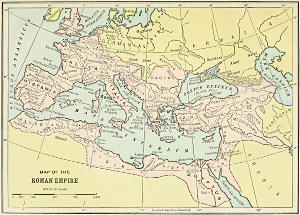
MAP OF THE ROMAN EMPIRE
BORMAY & CO.